Repository: FujiwaraChoki/MoneyPrinter
Branch: main
Commit: 608c3a9cb7a8
Files: 40
Total size: 171.1 KB
Directory structure:
gitextract__b835fml/

├── .github/
│   ├── FUNDING.yml
│   └── ISSUE_TEMPLATE/
│       ├── bug_report.md
│       └── feature_request.md
├── .gitignore
├── AGENTS.md
├── Backend/
│   ├── db.py
│   ├── gpt.py
│   ├── logstream.py
│   ├── main.py
│   ├── models.py
│   ├── pipeline.py
│   ├── repository.py
│   ├── search.py
│   ├── tiktokvoice.py
│   ├── utils.py
│   ├── video.py
│   ├── worker.py
│   └── youtube.py
├── CLAUDE.md
├── Dockerfile
├── Frontend/
│   ├── app.js
│   └── index.html
├── LICENSE
├── README.md
├── docker-compose.yml
├── docs/
│   ├── README.md
│   ├── architecture.md
│   ├── configuration.md
│   ├── docker.md
│   ├── quickstart.md
│   ├── testing.md
│   └── troubleshooting.md
├── pyproject.toml
├── setup.sh
└── tests/
    ├── conftest.py
    ├── test_api_jobs.py
    ├── test_api_misc.py
    ├── test_repository.py
    ├── test_utils.py
    └── test_worker.py
================================================
FILE CONTENTS
================================================
================================================
FILE: .github/FUNDING.yml
================================================
# These are supported funding model platforms
github: [FujiwaraChoki]
================================================
FILE: .github/ISSUE_TEMPLATE/bug_report.md
================================================
---
name: Bug report
about: Create a report to help us improve
title: "[BUG]"
labels: ''
assignees: FujiwaraChoki
---
**Describe the bug**
A clear and concise description of what the bug is.
**To Reproduce**
Steps to reproduce the behavior:
1. Go to '...'
2. Click on '....'
3. Scroll down to '....'
4. See error
**Expected behavior**
A clear and concise description of what you expected to happen.
**Screenshots**
If applicable, add screenshots to help explain your problem.
**Desktop (please complete the following information):**
- OS: [e.g. Linux, Windows]
- Browser [e.g. chrome, edge]
- Python Version [e.g. 3.9]
**Additional context**
Add any other context about the problem here.
================================================
FILE: .github/ISSUE_TEMPLATE/feature_request.md
================================================
---
name: Feature request
about: Suggest an idea for this project
title: ''
labels: ''
assignees: ''
---
**Is your feature request related to a problem? Please describe.**
A clear and concise description of what the problem is. Ex. I'm always frustrated when [...]
**Describe the solution you'd like**
A clear and concise description of what you want to happen.
**Describe alternatives you've considered**
A clear and concise description of any alternative solutions or features you've considered.
**Additional context**
Add any other context or screenshots about the feature request here.
================================================
FILE: .gitignore
================================================
__pycache__
.env
temp/*
sounds/*
output/*
images/*
*.zip
*.srt
*.mp4
*.mp3
.history
subtitles/*
/venv
.venv
client_secret.json
main.py-oauth2.json
.DS_Store
Backend/output*
Songs/
venv/
================================================
FILE: AGENTS.md
================================================
# AGENTS Guide for MoneyPrinter
This file is the operating manual for coding agents working in this repository.
Follow it before making changes.
## 1) Repository Layout
- `Backend/`: Flask API, DB-backed job queue, and video generation pipeline.
- `Frontend/`: static HTML/JS client served by `python -m http.server`.
- `docs/`: source-of-truth setup and runtime docs.
- `fonts/`, `Songs/`, `subtitles/`, `temp/`: runtime assets/output folders.
- Root output artifact: `output.mp4`.
## 2) Source of Truth and Existing Rules
- No `.cursor/rules/` directory found.
- No `.cursorrules` file found.
- No `.github/copilot-instructions.md` file found.
- If any of the above appear later, treat them as higher-priority constraints and update this file.
## 3) Environment and Setup Commands
- Python version: `>=3.11` (from `pyproject.toml`).
- Dependency manager used in docs: `uv`.
- Create local env file: `cp .env.example .env`.
- Install dependencies: `uv sync`.
- Run backend: `uv run python Backend/main.py`.
- Run worker (new terminal): `uv run python Backend/worker.py`.
- Run frontend (new terminal): `python3 -m http.server 3000 --directory Frontend`.
- Docker workflow: `docker compose up --build`.
## 4) Build, Lint, and Test Commands
This project has a baseline `pytest` setup for backend repository tests.
Use the commands below as the expected agent workflow.
### 4.1 Build / Runtime Verification
- Backend syntax check: `uv run python -m compileall Backend`.
- Frontend syntax sanity (lightweight): open `Frontend/index.html` in browser and run generation flow.
- API smoke check after backend start: `curl http://localhost:8080/api/models`.
- Queue smoke check: `curl -X POST http://localhost:8080/api/generate -H "Content-Type: application/json" -d '{"videoSubject":"test","voice":"en_us_001","paragraphNumber":1,"customPrompt":""}'`.
- Full local run: backend + worker + frontend servers, then generate a short sample video.
### 4.2 Lint / Formatting (Recommended)
- There is no enforced formatter in-repo today.
- Follow existing style and keep diffs minimal.
- If linting is requested, prefer adding tooling in a separate PR.
- Suggested ad-hoc checks when available locally:
- `uv run python -m py_compile Backend/*.py`
- `uv run python -m compileall Backend`
### 4.3 Test Commands (Current and Future)
- Run all tests: `uv run pytest`
- Run one file: `uv run pytest tests/test_file.py`
- Run a single test: `uv run pytest tests/test_file.py::test_name`
- Run a single class test: `uv run pytest tests/test_file.py::TestClass::test_name`
- Current suite location: `tests/`.
## 5) High-Confidence Conventions from Existing Code
These conventions are inferred from current source and should guide new changes.
### 5.1 Python Imports
- Prefer standard library imports first, then third-party, then local modules.
- Use one import per line for readability in long modules.
- Avoid wildcard imports in new code (`from module import *`), even if legacy files use them.
- Prefer explicit local imports, e.g. `from utils import ENV_FILE, TEMP_DIR`.
### 5.2 Formatting and Structure
- Use 4-space indentation in Python.
- Keep line length readable; split long calls across multiple lines.
- Favor small helper functions for distinct pipeline stages.
- Keep side-effectful startup logic near application boot (`load_dotenv`, env checks).
### 5.3 Typing and Signatures
- Add type hints to all new/modified function signatures.
- Reuse `Optional`, `List`, `Tuple`, `dict` typing already used in backend.
- Prefer explicit return types (`-> str`, `-> None`, `-> Tuple[...]`).
- Use `Path` for filesystem paths where practical.
### 5.4 Naming Conventions
- Python functions/variables: `snake_case`.
- Constants/env keys: `UPPER_SNAKE_CASE`.
- JS variables/functions in frontend: `camelCase`.
- Keep API route names simple and verb-oriented (`/api/generate`, `/api/cancel`).
### 5.5 Error Handling and Logging
- Fail fast on missing critical env vars (current code exits early in startup checks).
- Catch exceptions at boundary layers (HTTP handlers, external API calls, file IO).
- Return user-safe JSON error messages from Flask endpoints.
- Log actionable context with existing logger/log-stream helpers.
- Do not swallow exceptions silently; at minimum emit error logs.
### 5.6 Filesystem and Path Safety
- Prefer `pathlib.Path` operations.
- Ensure directories exist before writing (`mkdir(parents=True, exist_ok=True)`).
- Sanitize uploaded filenames (`os.path.basename`) before save.
- Avoid hardcoded OS-specific paths; rely on env vars and `Path.resolve()`.
### 5.7 Backend API Patterns
- Keep endpoint payloads consistent with `{"status": "success|error", ...}`.
- Use appropriate HTTP status codes for conflict/client errors (e.g., `409`, `400`).
- Long-running work should run in worker process from DB queue, not on request thread.
- Preserve cancellation semantics using per-job cancellation and persisted job events.
### 5.8 Frontend Patterns
- Use centralized API helper (`apiRequest`) for backend calls.
- Validate required fields before firing requests.
- Keep user feedback explicit via toasts and status area toggles.
- Preserve localStorage key patterns (`<fieldId>Value`).
## 6) Change Scope Rules for Agents
- Make minimal, targeted edits.
- Do not rename files/modules unless required by task.
- Do not introduce new frameworks/toolchains without request.
- Keep backward compatibility for existing API payload shape when possible.
- Update docs in `docs/` when setup, env vars, or runtime behavior changes.
## 7) Validation Checklist Before Finishing
- Ran relevant command(s) from section 4.
- Confirmed backend still starts (`uv run python Backend/main.py`).
- Confirmed worker still starts (`uv run python Backend/worker.py`).
- Confirmed frontend still loads (`python3 -m http.server 3000 --directory Frontend`).
- Verified changed endpoints still return JSON and preserve `status` field.
- Checked no secrets were added to tracked files.
## 8) Notes for Future Tooling PRs
- Keep tests standardized on `pytest` and document exact paths/selectors here.
- If adding linting, prefer `ruff` for lint + format and commit config files.
- If adding type checks, document command and strictness level (`mypy` or equivalent).
- Keep this file updated whenever workflow commands change.
## 9) Agent Workflow Expectations
- Prefer minimal diffs and preserve current behavior unless the task requires changes.
- Keep API responses machine-parseable and consistent for frontend consumers.
- Avoid checking in generated media/output artifacts unless explicitly requested.
- Before returning work, include what was validated and what was not validated.
- When adding commands or tooling, update this file and `docs/` together.
================================================
FILE: Backend/db.py
================================================
import os
from sqlalchemy import create_engine
from sqlalchemy.orm import DeclarativeBase, sessionmaker
from dotenv import load_dotenv
from utils import ENV_FILE
load_dotenv(ENV_FILE)
class Base(DeclarativeBase):
pass
def _database_url() -> str:
database_url = os.getenv("DATABASE_URL")
if database_url:
return database_url
return "sqlite:///moneyprinter.db"
DATABASE_URL = _database_url()
engine = create_engine(
DATABASE_URL,
pool_pre_ping=True,
connect_args={"check_same_thread": False}
if DATABASE_URL.startswith("sqlite")
else {},
)
SessionLocal = sessionmaker(
bind=engine, autoflush=False, autocommit=False, expire_on_commit=False
)
def init_db() -> None:
from models import Artifact, GenerationEvent, GenerationJob, Project, Script # noqa: F401
Base.metadata.create_all(bind=engine)
================================================
FILE: Backend/gpt.py
================================================
import re
import os
import json
from ollama import Client, ResponseError
from dotenv import load_dotenv
from logstream import log
from typing import Tuple, List, Optional
from utils import ENV_FILE
# Load environment variables
load_dotenv(ENV_FILE)
# Set environment variables
OLLAMA_BASE_URL = os.getenv("OLLAMA_BASE_URL", "http://localhost:11434").rstrip("/")
OLLAMA_MODEL = os.getenv("OLLAMA_MODEL", "llama3.1:8b")
OLLAMA_TIMEOUT = float(os.getenv("OLLAMA_TIMEOUT", "180"))
def _ollama_client() -> Client:
return Client(host=OLLAMA_BASE_URL, timeout=OLLAMA_TIMEOUT)
def _extract_model_name(model_obj) -> str:
if hasattr(model_obj, "model") and getattr(model_obj, "model"):
return str(getattr(model_obj, "model")).strip()
if hasattr(model_obj, "name") and getattr(model_obj, "name"):
return str(getattr(model_obj, "name")).strip()
if isinstance(model_obj, dict):
return str(model_obj.get("model") or model_obj.get("name") or "").strip()
return ""
def list_ollama_models() -> Tuple[List[str], str]:
"""
Returns available Ollama model names and configured default model.
Returns:
Tuple[List[str], str]: (available model names, default model)
"""
try:
response = _ollama_client().list()
except Exception as err:
raise RuntimeError(f"Failed to fetch Ollama models: {err}") from err
models = []
if hasattr(response, "models") and getattr(response, "models") is not None:
models = list(getattr(response, "models"))
elif isinstance(response, dict):
models = response.get("models") or []
model_names = [_extract_model_name(model) for model in models]
model_names = [name for name in model_names if name]
unique_names = list(dict.fromkeys(model_names))
if OLLAMA_MODEL and OLLAMA_MODEL in unique_names:
default_model = OLLAMA_MODEL
elif unique_names:
default_model = unique_names[0]
else:
default_model = OLLAMA_MODEL if OLLAMA_MODEL else ""
return unique_names, default_model
def generate_response(prompt: str, ai_model: str) -> str:
"""
Generate a script for a video, depending on the subject of the video.
Args:
video_subject (str): The subject of the video.
ai_model (str): The AI model to use for generation.
Returns:
str: The response from the AI model.
"""
model_name = (ai_model or "").strip() or OLLAMA_MODEL
try:
client = _ollama_client()
try:
response = client.chat(
model=model_name,
messages=[{"role": "user", "content": prompt}],
stream=False,
)
except ResponseError as err:
if err.status_code == 404:
try:
response = client.generate(
model=model_name, prompt=prompt, stream=False
)
except ResponseError as fallback_err:
if (
fallback_err.status_code == 404
and "not found" in str(fallback_err).lower()
):
available_models, _ = list_ollama_models()
available = (
", ".join(available_models) if available_models else "none"
)
raise RuntimeError(
f"Ollama model '{model_name}' is not installed. Available models: {available}. "
f"Install it with: ollama pull {model_name}"
) from fallback_err
raise
else:
raise
except RuntimeError:
raise
except Exception as err:
raise RuntimeError(f"Failed to connect to Ollama: {err}") from err
content = ""
if hasattr(response, "message") and getattr(response, "message") is not None:
message = getattr(response, "message")
if hasattr(message, "content") and getattr(message, "content"):
content = str(getattr(message, "content")).strip()
elif isinstance(message, dict):
content = str(message.get("content") or "").strip()
if not content:
if hasattr(response, "response") and getattr(response, "response"):
content = str(getattr(response, "response")).strip()
elif isinstance(response, dict):
content = (
str(response.get("message", {}).get("content") or "")
or str(response.get("response") or "")
).strip()
if not content:
raise RuntimeError("Ollama returned an empty response.")
return content
def generate_script(
video_subject: str,
paragraph_number: int,
ai_model: str,
voice: str,
customPrompt: str,
) -> Optional[str]:
"""
Generate a script for a video, depending on the subject of the video, the number of paragraphs, and the AI model.
Args:
video_subject (str): The subject of the video.
paragraph_number (int): The number of paragraphs to generate.
ai_model (str): The AI model to use for generation.
Returns:
str: The script for the video.
"""
# Build prompt
if customPrompt:
prompt = customPrompt
else:
prompt = """
Generate a script for a video, depending on the subject of the video.
The script is to be returned as a string with the specified number of paragraphs.
Here is an example of a string:
"This is an example string."
Do not under any circumstance reference this prompt in your response.
Get straight to the point, don't start with unnecessary things like, "welcome to this video".
Obviously, the script should be related to the subject of the video.
YOU MUST NOT INCLUDE ANY TYPE OF MARKDOWN OR FORMATTING IN THE SCRIPT, NEVER USE A TITLE.
YOU MUST WRITE THE SCRIPT IN THE LANGUAGE SPECIFIED IN [LANGUAGE].
ONLY RETURN THE RAW CONTENT OF THE SCRIPT. DO NOT INCLUDE "VOICEOVER", "NARRATOR" OR SIMILAR INDICATORS OF WHAT SHOULD BE SPOKEN AT THE BEGINNING OF EACH PARAGRAPH OR LINE. YOU MUST NOT MENTION THE PROMPT, OR ANYTHING ABOUT THE SCRIPT ITSELF. ALSO, NEVER TALK ABOUT THE AMOUNT OF PARAGRAPHS OR LINES. JUST WRITE THE SCRIPT.
"""
prompt += f"""
Subject: {video_subject}
Number of paragraphs: {paragraph_number}
Language: {voice}
"""
# Generate script
response = generate_response(prompt, ai_model)
log(response, "info")
# Return the generated script
if response:
# Clean the script
# Remove asterisks, hashes
response = response.replace("*", "")
response = response.replace("#", "")
# Remove markdown syntax
response = re.sub(r"\[.*\]", "", response)
response = re.sub(r"\(.*\)", "", response)
# Split the script into paragraphs
paragraphs = response.split("\n\n")
# Select the specified number of paragraphs
selected_paragraphs = paragraphs[:paragraph_number]
# Join the selected paragraphs into a single string
final_script = "\n\n".join(selected_paragraphs)
# Print to console the number of paragraphs used
log(f"Number of paragraphs used: {len(selected_paragraphs)}", "success")
return final_script
else:
log("[-] GPT returned an empty response.", "error")
return None
def get_search_terms(
video_subject: str, amount: int, script: str, ai_model: str
) -> List[str]:
"""
Generate a JSON-Array of search terms for stock videos,
depending on the subject of a video.
Args:
video_subject (str): The subject of the video.
amount (int): The amount of search terms to generate.
script (str): The script of the video.
ai_model (str): The AI model to use for generation.
Returns:
List[str]: The search terms for the video subject.
"""
# Build prompt
prompt = f"""
Generate {amount} search terms for stock videos,
depending on the subject of a video.
Subject: {video_subject}
The search terms are to be returned as
a JSON-Array of strings.
Each search term should consist of 1-3 words,
always add the main subject of the video.
YOU MUST ONLY RETURN THE JSON-ARRAY OF STRINGS.
YOU MUST NOT RETURN ANYTHING ELSE.
YOU MUST NOT RETURN THE SCRIPT.
The search terms must be related to the subject of the video.
Here is an example of a JSON-Array of strings:
["search term 1", "search term 2", "search term 3"]
For context, here is the full text:
{script}
"""
# Generate search terms
response = generate_response(prompt, ai_model)
log(response, "info")
# Parse response into a list of search terms
search_terms = []
try:
search_terms = json.loads(response)
if not isinstance(search_terms, list) or not all(
isinstance(term, str) for term in search_terms
):
raise ValueError("Response is not a list of strings.")
except (json.JSONDecodeError, ValueError):
log("[*] GPT returned an unformatted response. Attempting to clean...", "warning")
# Attempt to extract JSON array first
match = re.search(r"\[[\s\S]*\]", response)
if match:
try:
search_terms = json.loads(match.group())
except json.JSONDecodeError:
search_terms = []
# Last-resort fallback: collect quoted strings
if not search_terms:
search_terms = re.findall(r'"([^"\\]*(?:\\.[^"\\]*)*)"', response)
search_terms = [term.strip() for term in search_terms if term.strip()]
# Let user know
log(f"\nGenerated {len(search_terms)} search terms: {', '.join(search_terms)}", "info")
# Return search terms
return search_terms
def generate_metadata(
video_subject: str, script: str, ai_model: str
) -> Tuple[str, str, List[str]]:
"""
Generate metadata for a YouTube video, including the title, description, and keywords.
Args:
video_subject (str): The subject of the video.
script (str): The script of the video.
ai_model (str): The AI model to use for generation.
Returns:
Tuple[str, str, List[str]]: The title, description, and keywords for the video.
"""
# Build prompt for title
title_prompt = f"""
Generate a catchy and SEO-friendly title for a YouTube shorts video about {video_subject}.
"""
# Generate title
title = generate_response(title_prompt, ai_model).strip()
# Build prompt for description
description_prompt = f"""
Write a brief and engaging description for a YouTube shorts video about {video_subject}.
The video is based on the following script:
{script}
"""
# Generate description
description = generate_response(description_prompt, ai_model).strip()
# Generate keywords
keywords = get_search_terms(video_subject, 6, script, ai_model)
return title, description, keywords
================================================
FILE: Backend/logstream.py
================================================
import json
import queue
import re
import time
class LogStream:
"""Thread-safe log queue that doubles as an SSE generator."""
def __init__(self, maxsize: int = 500):
self._queue: queue.Queue = queue.Queue(maxsize=maxsize)
def clear(self) -> None:
"""Drain all pending items from the queue."""
while True:
try:
self._queue.get_nowait()
except queue.Empty:
break
def push(self, message: str, level: str = "info") -> None:
"""Add a log entry. Drops the oldest entry if the queue is full."""
entry = {
"type": "log",
"message": message,
"level": level,
"timestamp": time.time(),
}
try:
self._queue.put_nowait(entry)
except queue.Full:
try:
self._queue.get_nowait()
except queue.Empty:
pass
try:
self._queue.put_nowait(entry)
except queue.Full:
pass
def push_event(self, event_type: str, data: dict | None = None) -> None:
"""Send a control event (complete, error, cancelled)."""
entry = {
"type": event_type,
"timestamp": time.time(),
**(data or {}),
}
try:
self._queue.put_nowait(entry)
except queue.Full:
try:
self._queue.get_nowait()
except queue.Empty:
pass
try:
self._queue.put_nowait(entry)
except queue.Full:
pass
def stream(self, timeout: float = 30.0):
"""Generator yielding SSE-formatted lines. Terminates on control events."""
while True:
try:
entry = self._queue.get(timeout=timeout)
yield f"data: {json.dumps(entry)}\n\n"
if entry.get("type") in ("complete", "error", "cancelled"):
return
except queue.Empty:
# Send keepalive comment to prevent connection timeout
yield ": keepalive\n\n"
# Strip ANSI escape codes from terminal-colored strings
_ANSI_RE = re.compile(r"\x1b\[[0-9;]*m")
# Singleton shared by all modules
log_stream = LogStream()
# Color-to-level mapping for termcolor colors
_COLOR_LEVEL = {
"green": "success",
"red": "error",
"yellow": "warning",
"blue": "info",
"cyan": "info",
"magenta": "info",
}
def log(message: str, level: str = "info") -> None:
"""Drop-in replacement for ``print(colored(msg, color))``.
Prints to the terminal **and** pushes an ANSI-stripped copy to the SSE queue.
"""
print(message)
clean = _ANSI_RE.sub("", str(message))
log_stream.push(clean, level)
================================================
FILE: Backend/main.py
================================================
import os
from dotenv import load_dotenv
from flask import Flask, jsonify, request
from flask_cors import CORS
from sqlalchemy import and_, case, select
from db import SessionLocal, init_db
from gpt import list_ollama_models
from logstream import log
from repository import create_job, get_job, list_job_events, request_cancel
from utils import ENV_FILE, SONGS_DIR, check_env_vars, clean_dir
load_dotenv(ENV_FILE)
check_env_vars()
init_db()
app = Flask(__name__)
CORS(app)
HOST = "0.0.0.0"
PORT = 8080
@app.route("/api/models", methods=["GET"])
def models():
try:
available_models, default_model = list_ollama_models()
return jsonify(
{
"status": "success",
"models": available_models,
"default": default_model,
}
)
except Exception as err:
log(f"[-] Error fetching Ollama models: {str(err)}", "error")
return jsonify(
{
"status": "error",
"message": "Could not fetch Ollama models. Is Ollama running?",
"models": [os.getenv("OLLAMA_MODEL", "llama3.1:8b")],
"default": os.getenv("OLLAMA_MODEL", "llama3.1:8b"),
}
)
@app.route("/api/generate", methods=["POST"])
def generate():
data = request.get_json() or {}
if not data.get("videoSubject"):
return jsonify({"status": "error", "message": "videoSubject is required."}), 400
with SessionLocal() as session:
job = create_job(session, payload=data)
return jsonify(
{
"status": "success",
"message": "Video generation queued.",
"jobId": job.id,
}
)
@app.route("/api/jobs/<job_id>", methods=["GET"])
def get_job_status(job_id: str):
with SessionLocal() as session:
job = get_job(session, job_id)
if not job:
return jsonify({"status": "error", "message": "Job not found."}), 404
return jsonify(
{
"status": "success",
"job": {
"id": job.id,
"state": job.status,
"cancelRequested": job.cancel_requested,
"resultPath": job.result_path,
"errorMessage": job.error_message,
"createdAt": job.created_at.isoformat() if job.created_at else None,
"startedAt": job.started_at.isoformat() if job.started_at else None,
"completedAt": job.completed_at.isoformat()
if job.completed_at
else None,
},
}
)
@app.route("/api/jobs/<job_id>/events", methods=["GET"])
def get_events(job_id: str):
after_id = request.args.get("after", default=0, type=int)
with SessionLocal() as session:
job = get_job(session, job_id)
if not job:
return jsonify({"status": "error", "message": "Job not found."}), 404
events = list_job_events(session, job_id, after_id=after_id)
return jsonify(
{
"status": "success",
"events": [
{
"id": event.id,
"type": event.event_type,
"level": event.level,
"message": event.message,
"payload": event.payload,
"timestamp": event.created_at.timestamp()
if event.created_at
else None,
}
for event in events
],
}
)
@app.route("/api/jobs/<job_id>/cancel", methods=["POST"])
def cancel_job(job_id: str):
with SessionLocal() as session:
cancelled = request_cancel(session, job_id)
if not cancelled:
return jsonify({"status": "error", "message": "Job not found."}), 404
return jsonify({"status": "success", "message": "Cancellation requested."})
@app.route("/api/upload-songs", methods=["POST"])
def upload_songs():
try:
files = request.files.getlist("songs")
if not files:
return jsonify({"status": "error", "message": "No files uploaded."}), 400
clean_dir(str(SONGS_DIR))
saved = 0
for file_item in files:
if file_item.filename and file_item.filename.lower().endswith(".mp3"):
safe_name = os.path.basename(file_item.filename)
file_item.save(str(SONGS_DIR / safe_name))
saved += 1
if saved == 0:
return jsonify({"status": "error", "message": "No MP3 files found."}), 400
log(f"[+] Uploaded {saved} song(s) to {SONGS_DIR}", "success")
return jsonify({"status": "success", "message": f"Uploaded {saved} song(s)."})
except Exception as err:
log(f"[-] Error uploading songs: {str(err)}", "error")
return jsonify({"status": "error", "message": str(err)}), 500
@app.route("/api/cancel", methods=["POST"])
def cancel_latest_running_job():
with SessionLocal() as session:
from models import GenerationJob
stmt = (
select(GenerationJob)
.where(and_(GenerationJob.status.in_(["queued", "running"])))
.order_by(
case((GenerationJob.status == "running", 0), else_=1),
GenerationJob.created_at.desc(),
)
.limit(1)
)
latest_job = session.scalars(stmt).first()
if not latest_job:
return jsonify({"status": "error", "message": "No active job found."}), 404
request_cancel(session, latest_job.id)
return jsonify(
{
"status": "success",
"message": "Cancellation requested.",
"jobId": latest_job.id,
}
)
if __name__ == "__main__":
app.run(debug=True, host=HOST, port=PORT, threaded=True)
================================================
FILE: Backend/models.py
================================================
from datetime import datetime
from typing import Optional
from sqlalchemy import Boolean, DateTime, ForeignKey, Integer, JSON, String, Text, func
from sqlalchemy.orm import Mapped, mapped_column, relationship
from db import Base
class Project(Base):
__tablename__ = "projects"
id: Mapped[int] = mapped_column(Integer, primary_key=True, autoincrement=True)
name: Mapped[str] = mapped_column(String(255), nullable=False, unique=True)
created_at: Mapped[datetime] = mapped_column(
DateTime(timezone=True), server_default=func.now(), nullable=False
)
class GenerationJob(Base):
__tablename__ = "generation_jobs"
id: Mapped[str] = mapped_column(String(36), primary_key=True)
project_id: Mapped[Optional[int]] = mapped_column(
Integer,
ForeignKey("projects.id", ondelete="SET NULL"),
nullable=True,
index=True,
)
status: Mapped[str] = mapped_column(String(20), nullable=False, index=True)
payload: Mapped[dict] = mapped_column(JSON, nullable=False)
cancel_requested: Mapped[bool] = mapped_column(
Boolean, nullable=False, default=False
)
attempt_count: Mapped[int] = mapped_column(Integer, nullable=False, default=0)
max_attempts: Mapped[int] = mapped_column(Integer, nullable=False, default=1)
result_path: Mapped[Optional[str]] = mapped_column(String(512), nullable=True)
error_message: Mapped[Optional[str]] = mapped_column(Text, nullable=True)
created_at: Mapped[datetime] = mapped_column(
DateTime(timezone=True), server_default=func.now(), nullable=False, index=True
)
started_at: Mapped[Optional[datetime]] = mapped_column(
DateTime(timezone=True), nullable=True
)
completed_at: Mapped[Optional[datetime]] = mapped_column(
DateTime(timezone=True), nullable=True
)
updated_at: Mapped[datetime] = mapped_column(
DateTime(timezone=True),
server_default=func.now(),
onupdate=func.now(),
nullable=False,
)
project: Mapped[Optional[Project]] = relationship("Project")
events: Mapped[list["GenerationEvent"]] = relationship(
"GenerationEvent", back_populates="job", cascade="all, delete-orphan"
)
class GenerationEvent(Base):
__tablename__ = "generation_events"
id: Mapped[int] = mapped_column(Integer, primary_key=True, autoincrement=True)
job_id: Mapped[str] = mapped_column(
String(36),
ForeignKey("generation_jobs.id", ondelete="CASCADE"),
nullable=False,
index=True,
)
event_type: Mapped[str] = mapped_column(String(20), nullable=False, default="log")
level: Mapped[str] = mapped_column(String(20), nullable=False, default="info")
message: Mapped[str] = mapped_column(Text, nullable=False)
payload: Mapped[Optional[dict]] = mapped_column(JSON, nullable=True)
created_at: Mapped[datetime] = mapped_column(
DateTime(timezone=True), server_default=func.now(), nullable=False, index=True
)
job: Mapped[GenerationJob] = relationship("GenerationJob", back_populates="events")
class Script(Base):
__tablename__ = "scripts"
id: Mapped[int] = mapped_column(Integer, primary_key=True, autoincrement=True)
job_id: Mapped[str] = mapped_column(
String(36),
ForeignKey("generation_jobs.id", ondelete="CASCADE"),
nullable=False,
index=True,
)
model_name: Mapped[Optional[str]] = mapped_column(String(255), nullable=True)
content: Mapped[str] = mapped_column(Text, nullable=False)
created_at: Mapped[datetime] = mapped_column(
DateTime(timezone=True), server_default=func.now(), nullable=False
)
class Artifact(Base):
__tablename__ = "artifacts"
id: Mapped[int] = mapped_column(Integer, primary_key=True, autoincrement=True)
job_id: Mapped[str] = mapped_column(
String(36),
ForeignKey("generation_jobs.id", ondelete="CASCADE"),
nullable=False,
index=True,
)
artifact_type: Mapped[str] = mapped_column(String(64), nullable=False)
path: Mapped[str] = mapped_column(String(512), nullable=False)
metadata_json: Mapped[Optional[dict]] = mapped_column(JSON, nullable=True)
created_at: Mapped[datetime] = mapped_column(
DateTime(timezone=True), server_default=func.now(), nullable=False
)
================================================
FILE: Backend/pipeline.py
================================================
import os
import shutil
import subprocess
from apiclient.errors import HttpError
from moviepy import (
AudioFileClip,
CompositeAudioClip,
VideoFileClip,
afx,
concatenate_audioclips,
)
from uuid import uuid4
from gpt import generate_metadata, generate_script, get_search_terms
from logstream import log
from search import search_for_stock_videos
from tiktokvoice import tts
from utils import (
BASE_DIR,
PROJECT_ROOT,
SONGS_DIR,
SUBTITLES_DIR,
TEMP_DIR,
choose_random_song,
)
from video import combine_videos, generate_subtitles, generate_video, save_video
from youtube import upload_video
class PipelineCancelled(Exception):
pass
def run_generation_pipeline(
data: dict,
is_cancelled,
on_log,
amount_of_stock_videos: int = 5,
) -> str:
def emit(message: str, level: str = "info") -> None:
log(message, level)
if on_log:
on_log(message, level)
def guard_cancelled() -> None:
if is_cancelled and is_cancelled():
raise PipelineCancelled("Video generation was cancelled.")
paragraph_number = int(data.get("paragraphNumber", 1))
ai_model = data.get("aiModel")
n_threads = data.get("threads")
subtitles_position = data.get("subtitlesPosition")
text_color = data.get("color")
use_music = data.get("useMusic", False)
automate_youtube_upload = data.get("automateYoutubeUpload", False)
emit("[Video to be generated]", "info")
emit(" Subject: " + data["videoSubject"], "info")
emit(" AI Model: " + str(ai_model), "info")
emit(" Custom Prompt: " + data["customPrompt"], "info")
guard_cancelled()
voice = data.get("voice", "")
voice_prefix = voice[:2]
if not voice:
emit('[!] No voice was selected. Defaulting to "en_us_001"', "warning")
voice = "en_us_001"
voice_prefix = voice[:2]
script = generate_script(
data["videoSubject"],
paragraph_number,
ai_model,
voice,
data["customPrompt"],
)
if not script:
raise RuntimeError(
"Could not generate a script. Try a different model or prompt."
)
search_terms = get_search_terms(
data["videoSubject"], amount_of_stock_videos, script, ai_model
)
video_urls = []
it = 15
min_dur = 10
for search_term in search_terms:
guard_cancelled()
found_urls = search_for_stock_videos(
search_term, os.getenv("PEXELS_API_KEY"), it, min_dur
)
for url in found_urls:
if url not in video_urls:
video_urls.append(url)
break
if not video_urls:
raise RuntimeError("No videos found to download.")
video_paths = []
emit(f"[+] Downloading {len(video_urls)} videos...", "info")
for video_url in video_urls:
guard_cancelled()
try:
saved_video_path = save_video(video_url)
video_paths.append(saved_video_path)
except Exception:
emit(f"[-] Could not download video: {video_url}", "error")
emit("[+] Videos downloaded!", "success")
emit("[+] Script generated!", "success")
guard_cancelled()
sentences = script.split(". ")
sentences = list(filter(lambda x: x != "", sentences))
paths = []
for sentence in sentences:
guard_cancelled()
current_tts_path = str(TEMP_DIR / f"{uuid4()}.mp3")
tts(sentence, voice, filename=current_tts_path)
audio_clip = AudioFileClip(current_tts_path)
paths.append(audio_clip)
final_audio = concatenate_audioclips(paths)
tts_path = str(TEMP_DIR / f"{uuid4()}.mp3")
try:
final_audio.write_audiofile(tts_path)
finally:
final_audio.close()
for audio_clip in paths:
audio_clip.close()
try:
subtitles_path = generate_subtitles(
audio_path=tts_path,
sentences=sentences,
audio_clips=paths,
voice=voice_prefix,
)
except Exception as err:
emit(f"[-] Error generating subtitles: {err}", "error")
subtitles_path = None
if not subtitles_path:
raise RuntimeError(
"Could not generate subtitles. Check AssemblyAI key or local subtitle settings."
)
temp_audio = AudioFileClip(tts_path)
try:
combined_video_path = combine_videos(
video_paths, temp_audio.duration, 5, n_threads or 2
)
finally:
temp_audio.close()
try:
final_video_path = generate_video(
combined_video_path,
tts_path,
subtitles_path,
n_threads or 2,
subtitles_position,
text_color or "#FFFF00",
)
except Exception as err:
raise RuntimeError(
f"Could not render final video. Check subtitle/font/ImageMagick setup. ({err})"
) from err
title, description, keywords = generate_metadata(
data["videoSubject"], script, ai_model
)
emit("[-] Metadata for YouTube upload:", "info")
emit(" Title:", "info")
emit(f" {title}", "info")
emit(" Description:", "info")
emit(f" {description}", "info")
emit(" Keywords:", "info")
emit(f" {', '.join(keywords)}", "info")
if automate_youtube_upload:
client_secrets_file = str((BASE_DIR / "client_secret.json").resolve())
skip_yt_upload = False
if not os.path.exists(client_secrets_file):
skip_yt_upload = True
emit(
"[-] Client secrets file missing. YouTube upload will be skipped.",
"warning",
)
emit(
"[-] Please download the client_secret.json from Google Cloud Platform and store this inside the /Backend directory.",
"error",
)
if not skip_yt_upload:
video_category_id = "28"
privacy_status = "private"
video_metadata = {
"video_path": str((TEMP_DIR / final_video_path).resolve()),
"title": title,
"description": description,
"category": video_category_id,
"keywords": ",".join(keywords),
"privacyStatus": privacy_status,
}
try:
video_response = upload_video(
video_path=video_metadata["video_path"],
title=video_metadata["title"],
description=video_metadata["description"],
category=video_metadata["category"],
keywords=video_metadata["keywords"],
privacy_status=video_metadata["privacyStatus"],
)
emit(f"Uploaded video ID: {video_response.get('id')}", "success")
except HttpError as err:
emit(
f"An HTTP error {err.resp.status} occurred:\n{err.content}", "error"
)
final_output_path = str(PROJECT_ROOT / final_video_path)
rendered_video_path = str(TEMP_DIR / final_video_path)
render_threads = n_threads or (os.cpu_count() or 2)
guard_cancelled()
if use_music:
song_path = choose_random_song()
if not song_path:
emit(
"[-] Could not find songs in Songs/. Continuing without background music.",
"warning",
)
use_music = False
if use_music:
video_clip = VideoFileClip(rendered_video_path)
song_clip = None
mixed_audio = None
mixed_audio_path = str(TEMP_DIR / f"{uuid4()}_mixed_audio.m4a")
try:
original_duration = video_clip.duration
original_audio = video_clip.audio
song_clip = AudioFileClip(song_path).with_fps(44100)
song_clip = song_clip.with_effects(
[afx.AudioLoop(duration=original_duration)]
)
song_clip = song_clip.with_volume_scaled(0.1).with_fps(44100)
mixed_audio = CompositeAudioClip(
[original_audio, song_clip]
).with_duration(original_duration)
mixed_audio.write_audiofile(
mixed_audio_path,
fps=44100,
codec="aac",
bitrate="192k",
)
finally:
video_clip.close()
if mixed_audio is not None:
mixed_audio.close()
if song_clip is not None:
song_clip.close()
try:
subprocess.run(
[
"ffmpeg",
"-y",
"-i",
rendered_video_path,
"-i",
mixed_audio_path,
"-map",
"0:v:0",
"-map",
"1:a:0",
"-c:v",
"copy",
"-c:a",
"aac",
"-b:a",
"192k",
"-shortest",
final_output_path,
],
check=True,
capture_output=True,
text=True,
)
except Exception:
emit(
"[!] ffmpeg remux failed. Falling back to MoviePy render for music mix.",
"warning",
)
video_clip = VideoFileClip(rendered_video_path)
song_clip = None
try:
original_duration = video_clip.duration
original_audio = video_clip.audio
song_clip = AudioFileClip(song_path).with_fps(44100)
song_clip = song_clip.with_effects(
[afx.AudioLoop(duration=original_duration)]
)
song_clip = song_clip.with_volume_scaled(0.1).with_fps(44100)
comp_audio = CompositeAudioClip(
[original_audio, song_clip]
).with_duration(original_duration)
video_clip = (
video_clip.with_audio(comp_audio)
.with_fps(30)
.with_duration(original_duration)
)
video_clip.write_videofile(
final_output_path,
threads=render_threads,
fps=30,
codec="libx264",
audio_codec="aac",
preset="medium",
)
finally:
video_clip.close()
if song_clip is not None:
song_clip.close()
finally:
if os.path.exists(mixed_audio_path):
os.remove(mixed_audio_path)
if not use_music:
shutil.copy2(rendered_video_path, final_output_path)
emit(f"[+] Video generated: {final_video_path}!", "success")
if os.name == "nt":
subprocess.run(
["taskkill", "/f", "/im", "ffmpeg.exe"],
check=False,
capture_output=True,
text=True,
)
elif shutil.which("pkill"):
subprocess.run(
["pkill", "-f", "ffmpeg"],
check=False,
capture_output=True,
text=True,
)
return final_video_path
================================================
FILE: Backend/repository.py
================================================
from datetime import datetime, timezone
from typing import Optional
from uuid import uuid4
from sqlalchemy import and_, select, text
from sqlalchemy.orm import Session
from models import GenerationEvent, GenerationJob
def utcnow() -> datetime:
return datetime.now(timezone.utc)
def create_job(session: Session, payload: dict, max_attempts: int = 1) -> GenerationJob:
job = GenerationJob(
id=str(uuid4()),
status="queued",
payload=payload,
max_attempts=max_attempts,
cancel_requested=False,
)
session.add(job)
session.flush()
append_event(session, job.id, "queued", "info", "Job queued.")
session.commit()
session.refresh(job)
return job
def append_event(
session: Session,
job_id: str,
event_type: str,
level: str,
message: str,
payload: Optional[dict] = None,
) -> GenerationEvent:
event = GenerationEvent(
job_id=job_id,
event_type=event_type,
level=level,
message=message,
payload=payload,
)
session.add(event)
session.flush()
return event
def get_job(session: Session, job_id: str) -> Optional[GenerationJob]:
return session.get(GenerationJob, job_id)
def list_job_events(
session: Session, job_id: str, after_id: int = 0, limit: int = 200
) -> list[GenerationEvent]:
stmt = (
select(GenerationEvent)
.where(
and_(
GenerationEvent.job_id == job_id,
GenerationEvent.id > after_id,
)
)
.order_by(GenerationEvent.id.asc())
.limit(limit)
)
return list(session.scalars(stmt).all())
def request_cancel(session: Session, job_id: str) -> bool:
job = get_job(session, job_id)
if not job:
return False
if job.status in ("completed", "failed", "cancelled"):
return True
job.cancel_requested = True
job.updated_at = utcnow()
append_event(
session, job.id, "cancel_requested", "warning", "Cancellation requested."
)
if job.status == "queued":
job.status = "cancelled"
job.completed_at = utcnow()
append_event(
session, job.id, "cancelled", "warning", "Job cancelled before execution."
)
session.commit()
return True
def claim_next_queued_job(session: Session) -> Optional[GenerationJob]:
dialect = session.bind.dialect.name if session.bind else ""
if dialect == "postgresql":
row = session.execute(
text(
"""
SELECT id
FROM generation_jobs
WHERE status = 'queued' AND cancel_requested = false
ORDER BY created_at ASC
FOR UPDATE SKIP LOCKED
LIMIT 1
"""
)
).first()
if not row:
return None
job = get_job(session, row[0])
else:
stmt = (
select(GenerationJob)
.where(
and_(
GenerationJob.status == "queued",
GenerationJob.cancel_requested.is_(False),
)
)
.order_by(GenerationJob.created_at.asc())
.limit(1)
)
job = session.scalars(stmt).first()
if not job:
return None
job.status = "running"
job.attempt_count = (job.attempt_count or 0) + 1
job.started_at = utcnow()
job.updated_at = utcnow()
append_event(session, job.id, "running", "info", "Job started.")
session.commit()
session.refresh(job)
return job
def mark_completed(session: Session, job_id: str, result_path: str) -> None:
job = get_job(session, job_id)
if not job:
return
job.status = "completed"
job.result_path = result_path
job.error_message = None
job.completed_at = utcnow()
job.updated_at = utcnow()
append_event(
session,
job.id,
"complete",
"success",
"Video generated successfully.",
{"path": result_path},
)
session.commit()
def mark_cancelled(
session: Session, job_id: str, reason: str = "Job cancelled."
) -> None:
job = get_job(session, job_id)
if not job:
return
job.status = "cancelled"
job.completed_at = utcnow()
job.updated_at = utcnow()
append_event(session, job.id, "cancelled", "warning", reason)
session.commit()
def mark_failed(session: Session, job_id: str, error_message: str) -> None:
job = get_job(session, job_id)
if not job:
return
job.status = "failed"
job.error_message = error_message
job.completed_at = utcnow()
job.updated_at = utcnow()
append_event(session, job.id, "error", "error", error_message)
session.commit()
================================================
FILE: Backend/search.py
================================================
import requests
from typing import List
from logstream import log
def search_for_stock_videos(query: str, api_key: str, it: int, min_dur: int) -> List[str]:
"""
Searches for stock videos based on a query.
Args:
query (str): The query to search for.
api_key (str): The API key to use.
Returns:
List[str]: A list of stock videos.
"""
# Build headers
headers = {
"Authorization": api_key
}
# Build URL
qurl = f"https://api.pexels.com/videos/search?query={query}&per_page={it}"
# Send the request
r = requests.get(qurl, headers=headers)
# Parse the response
response = r.json()
# Parse each video
raw_urls = []
video_url = []
video_res = 0
try:
# loop through each video in the result
for i in range(it):
#check if video has desired minimum duration
if response["videos"][i]["duration"] < min_dur:
continue
raw_urls = response["videos"][i]["video_files"]
temp_video_url = ""
# loop through each url to determine the best quality
for video in raw_urls:
# Check if video has a valid download link
if ".com/video-files" in video["link"]:
# Only save the URL with the largest resolution
if (video["width"]*video["height"]) > video_res:
temp_video_url = video["link"]
video_res = video["width"]*video["height"]
# add the url to the return list if it's not empty
if temp_video_url != "":
video_url.append(temp_video_url)
except Exception as e:
log("[-] No Videos found.", "error")
log(str(e), "error")
# Let user know
log(f"\t=> \"{query}\" found {len(video_url)} Videos", "info")
# Return the video url
return video_url
================================================
FILE: Backend/tiktokvoice.py
================================================
# author: GiorDior aka Giorgio
# date: 12.06.2023
# topic: TikTok-Voice-TTS
# version: 1.0
# credits: https://github.com/oscie57/tiktok-voice
# --- MODIFIED VERSION --- #
import base64
import requests
import threading
from typing import List
from logstream import log
from playsound import playsound
VOICES = [
# DISNEY VOICES
"en_us_ghostface", # Ghost Face
"en_us_chewbacca", # Chewbacca
"en_us_c3po", # C3PO
"en_us_stitch", # Stitch
"en_us_stormtrooper", # Stormtrooper
"en_us_rocket", # Rocket
# ENGLISH VOICES
"en_au_001", # English AU - Female
"en_au_002", # English AU - Male
"en_uk_001", # English UK - Male 1
"en_uk_003", # English UK - Male 2
"en_us_001", # English US - Female (Int. 1)
"en_us_002", # English US - Female (Int. 2)
"en_us_006", # English US - Male 1
"en_us_007", # English US - Male 2
"en_us_009", # English US - Male 3
"en_us_010", # English US - Male 4
# EUROPE VOICES
"fr_001", # French - Male 1
"fr_002", # French - Male 2
"de_001", # German - Female
"de_002", # German - Male
"es_002", # Spanish - Male
# AMERICA VOICES
"es_mx_002", # Spanish MX - Male
"br_001", # Portuguese BR - Female 1
"br_003", # Portuguese BR - Female 2
"br_004", # Portuguese BR - Female 3
"br_005", # Portuguese BR - Male
# ASIA VOICES
"id_001", # Indonesian - Female
"jp_001", # Japanese - Female 1
"jp_003", # Japanese - Female 2
"jp_005", # Japanese - Female 3
"jp_006", # Japanese - Male
"kr_002", # Korean - Male 1
"kr_003", # Korean - Female
"kr_004", # Korean - Male 2
# SINGING VOICES
"en_female_f08_salut_damour", # Alto
"en_male_m03_lobby", # Tenor
"en_female_f08_warmy_breeze", # Warmy Breeze
"en_male_m03_sunshine_soon", # Sunshine Soon
# OTHER
"en_male_narration", # narrator
"en_male_funny", # wacky
"en_female_emotional", # peaceful
]
ENDPOINTS = [
"https://tiktok-tts.weilnet.workers.dev/api/generation",
"https://tiktoktts.com/api/tiktok-tts",
]
current_endpoint = 0
# in one conversion, the text can have a maximum length of 300 characters
TEXT_BYTE_LIMIT = 300
# create a list by splitting a string, every element has n chars
def split_string(string: str, chunk_size: int) -> List[str]:
words = string.split()
result = []
current_chunk = ""
for word in words:
if (
len(current_chunk) + len(word) + 1 <= chunk_size
): # Check if adding the word exceeds the chunk size
current_chunk += f" {word}"
else:
if current_chunk: # Append the current chunk if not empty
result.append(current_chunk.strip())
current_chunk = word
if current_chunk: # Append the last chunk if not empty
result.append(current_chunk.strip())
return result
# checking if the website that provides the service is available
def get_api_response() -> requests.Response:
url = f'{ENDPOINTS[current_endpoint].split("/a")[0]}'
response = requests.get(url)
return response
# saving the audio file
def save_audio_file(base64_data: str, filename: str = "output.mp3") -> None:
audio_bytes = base64.b64decode(base64_data)
with open(filename, "wb") as file:
file.write(audio_bytes)
# send POST request to get the audio data
def generate_audio(text: str, voice: str) -> bytes:
url = f"{ENDPOINTS[current_endpoint]}"
headers = {"Content-Type": "application/json"}
data = {"text": text, "voice": voice}
response = requests.post(url, headers=headers, json=data)
return response.content
# creates an text to speech audio file
def tts(
text: str,
voice: str = "none",
filename: str = "output.mp3",
play_sound: bool = False,
) -> None:
# checking if the website is available
global current_endpoint
if get_api_response().status_code == 200:
log("[+] TikTok TTS Service available!", "success")
else:
current_endpoint = (current_endpoint + 1) % 2
if get_api_response().status_code == 200:
log("[+] TTS Service available!", "success")
else:
log("[-] TTS Service not available and probably temporarily rate limited, try again later...", "error")
return
# checking if arguments are valid
if voice == "none":
log("[-] Please specify a voice", "error")
return
if voice not in VOICES:
log("[-] Voice not available", "error")
return
if not text:
log("[-] Please specify a text", "error")
return
# creating the audio file
try:
if len(text) < TEXT_BYTE_LIMIT:
audio = generate_audio((text), voice)
if current_endpoint == 0:
audio_base64_data = str(audio).split('"')[5]
else:
audio_base64_data = str(audio).split('"')[3].split(",")[1]
if audio_base64_data == "error":
log("[-] This voice is unavailable right now", "error")
return
else:
# Split longer text into smaller parts
text_parts = split_string(text, 299)
audio_base64_data = [None] * len(text_parts)
# Define a thread function to generate audio for each text part
def generate_audio_thread(text_part, index):
audio = generate_audio(text_part, voice)
if current_endpoint == 0:
base64_data = str(audio).split('"')[5]
else:
base64_data = str(audio).split('"')[3].split(",")[1]
if audio_base64_data == "error":
log("[-] This voice is unavailable right now", "error")
return "error"
audio_base64_data[index] = base64_data
threads = []
for index, text_part in enumerate(text_parts):
# Create and start a new thread for each text part
thread = threading.Thread(
target=generate_audio_thread, args=(text_part, index)
)
thread.start()
threads.append(thread)
# Wait for all threads to complete
for thread in threads:
thread.join()
# Concatenate the base64 data in the correct order
audio_base64_data = "".join(audio_base64_data)
save_audio_file(audio_base64_data, filename)
log(f"[+] Audio file saved successfully as '{filename}'", "success")
if play_sound:
playsound(filename)
except Exception as e:
log(f"[-] An error occurred during TTS: {e}", "error")
================================================
FILE: Backend/utils.py
================================================
import os
import sys
import random
import logging
import shutil
from pathlib import Path
from typing import Optional
from termcolor import colored
BASE_DIR = Path(__file__).resolve().parent
PROJECT_ROOT = BASE_DIR.parent
TEMP_DIR = PROJECT_ROOT / "temp"
SUBTITLES_DIR = PROJECT_ROOT / "subtitles"
SONGS_DIR = PROJECT_ROOT / "Songs"
FONTS_DIR = PROJECT_ROOT / "fonts"
ENV_FILE = PROJECT_ROOT / ".env"
# Configure logging
logging.basicConfig(level=logging.INFO)
logger = logging.getLogger(__name__)
def clean_dir(path: str) -> None:
"""
Removes every file in a directory.
Args:
path (str): Path to directory.
Returns:
None
"""
try:
directory = Path(path).expanduser().resolve()
directory.mkdir(parents=True, exist_ok=True)
logger.info(f"Ensured directory exists: {directory}")
for entry in directory.iterdir():
if entry.is_dir():
shutil.rmtree(entry)
logger.info(f"Removed directory: {entry}")
else:
entry.unlink(missing_ok=True)
logger.info(f"Removed file: {entry}")
logger.info(colored(f"Cleaned {directory} directory", "green"))
except Exception as e:
logger.error(f"Error occurred while cleaning directory {path}: {str(e)}")
def choose_random_song() -> Optional[str]:
"""
Chooses a random MP3 from the Songs/ directory.
Returns:
str: The path to the chosen song, or None if no MP3 files found.
"""
try:
if not SONGS_DIR.exists():
return None
songs = [
song
for song in SONGS_DIR.iterdir()
if song.is_file() and song.suffix.lower() == ".mp3"
]
if not songs:
return None
song = random.choice(songs)
logger.info(colored(f"Chose song: {song}", "green"))
return str(song)
except Exception as e:
logger.error(
colored(f"Error occurred while choosing random song: {str(e)}", "red")
)
def resolve_imagemagick_binary() -> Optional[str]:
"""
Resolves an ImageMagick executable path across Linux, macOS, and Windows.
Returns:
Optional[str]: Absolute executable path if found.
"""
configured_binary = os.getenv("IMAGEMAGICK_BINARY", "").strip().strip('"')
if configured_binary:
expanded = Path(configured_binary).expanduser()
if expanded.exists():
return str(expanded.resolve())
logger.warning(
colored("Configured IMAGEMAGICK_BINARY was not found on disk.", "yellow")
)
candidate_names = [
"magick",
"magick.exe",
"convert",
"convert.exe",
]
for candidate in candidate_names:
found = shutil.which(candidate)
if found:
return found
return None
def check_env_vars() -> None:
"""
Checks if the necessary environment variables are set.
Returns:
None
Raises:
SystemExit: If any required environment variables are missing.
"""
try:
required_vars = ["PEXELS_API_KEY", "TIKTOK_SESSION_ID"]
missing_vars = []
for var in required_vars:
value = os.getenv(var)
if value is None or len(value) == 0:
missing_vars.append(var)
if missing_vars:
missing_vars_str = ", ".join(missing_vars)
logger.error(
colored(
f"The following environment variables are missing: {missing_vars_str}",
"red",
)
)
logger.error(
colored(
"Please consult 'docs/configuration.md' for setup instructions.",
"yellow",
)
)
sys.exit(1) # Aborts the program
imagemagick_binary = resolve_imagemagick_binary()
if not imagemagick_binary:
logger.error(
colored(
"IMAGEMAGICK_BINARY is not set and no ImageMagick executable was detected in PATH.",
"red",
)
)
logger.error(
colored(
"Set IMAGEMAGICK_BINARY in .env or install ImageMagick and add it to PATH.",
"yellow",
)
)
sys.exit(1)
os.environ["IMAGEMAGICK_BINARY"] = imagemagick_binary
except Exception as e:
logger.error(f"Error occurred while checking environment variables: {str(e)}")
sys.exit(1) # Aborts the program if an unexpected error occurs
================================================
FILE: Backend/video.py
================================================
import os
import uuid
import requests
import srt_equalizer
import assemblyai as aai
from typing import List
from pathlib import Path
from moviepy import (
AudioFileClip,
CompositeVideoClip,
TextClip,
VideoFileClip,
concatenate_videoclips,
)
from dotenv import load_dotenv
from logstream import log
from moviepy.video.tools.subtitles import SubtitlesClip
from utils import ENV_FILE, TEMP_DIR, SUBTITLES_DIR, FONTS_DIR
load_dotenv(ENV_FILE)
ASSEMBLY_AI_API_KEY = os.getenv("ASSEMBLY_AI_API_KEY")
FRAME_EPSILON = 1 / 120
def save_video(video_url: str, directory: str = str(TEMP_DIR)) -> str:
"""
Saves a video from a given URL and returns the path to the video.
Args:
video_url (str): The URL of the video to save.
directory (str): The path of the temporary directory to save the video to
Returns:
str: The path to the saved video.
"""
destination = Path(directory).expanduser().resolve()
destination.mkdir(parents=True, exist_ok=True)
video_id = uuid.uuid4()
video_path = destination / f"{video_id}.mp4"
with open(video_path, "wb") as f:
f.write(requests.get(video_url).content)
return str(video_path)
def __generate_subtitles_assemblyai(audio_path: str, voice: str) -> str:
"""
Generates subtitles from a given audio file and returns the path to the subtitles.
Args:
audio_path (str): The path to the audio file to generate subtitles from.
Returns:
str: The generated subtitles
"""
language_mapping = {
"br": "pt",
"id": "en", # AssemblyAI doesn't have Indonesian
"jp": "ja",
"kr": "ko",
}
if voice in language_mapping:
lang_code = language_mapping[voice]
else:
lang_code = voice
aai.settings.api_key = ASSEMBLY_AI_API_KEY
config = aai.TranscriptionConfig(language_code=lang_code)
transcriber = aai.Transcriber(config=config)
transcript = transcriber.transcribe(audio_path)
subtitles = transcript.export_subtitles_srt()
return subtitles
def __generate_subtitles_locally(
sentences: List[str], audio_clips: List[AudioFileClip]
) -> str:
"""
Generates subtitles from a given audio file and returns the path to the subtitles.
Args:
sentences (List[str]): all the sentences said out loud in the audio clips
audio_clips (List[AudioFileClip]): all the individual audio clips which will make up the final audio track
Returns:
str: The generated subtitles
"""
def convert_to_srt_time_format(total_seconds: float) -> str:
# Convert total seconds to the SRT time format: HH:MM:SS,mmm
milliseconds_total = int(round(total_seconds * 1000))
hours, remainder = divmod(milliseconds_total, 3_600_000)
minutes, remainder = divmod(remainder, 60_000)
seconds, milliseconds = divmod(remainder, 1000)
return f"{hours:02d}:{minutes:02d}:{seconds:02d},{milliseconds:03d}"
start_time = 0
subtitles = []
for i, (sentence, audio_clip) in enumerate(zip(sentences, audio_clips), start=1):
duration = audio_clip.duration
end_time = start_time + duration
# Format: subtitle index, start time --> end time, sentence
subtitle_entry = f"{i}\n{convert_to_srt_time_format(start_time)} --> {convert_to_srt_time_format(end_time)}\n{sentence}\n"
subtitles.append(subtitle_entry)
start_time += duration # Update start time for the next subtitle
return "\n".join(subtitles)
def generate_subtitles(
audio_path: str, sentences: List[str], audio_clips: List[AudioFileClip], voice: str
) -> str:
"""
Generates subtitles from a given audio file and returns the path to the subtitles.
Args:
audio_path (str): The path to the audio file to generate subtitles from.
sentences (List[str]): all the sentences said out loud in the audio clips
audio_clips (List[AudioFileClip]): all the individual audio clips which will make up the final audio track
Returns:
str: The path to the generated subtitles.
"""
def equalize_subtitles(srt_path: str, max_chars: int = 10) -> None:
# Equalize subtitles
srt_equalizer.equalize_srt_file(srt_path, srt_path, max_chars)
# Save subtitles
SUBTITLES_DIR.mkdir(parents=True, exist_ok=True)
subtitles_path = SUBTITLES_DIR / f"{uuid.uuid4()}.srt"
if ASSEMBLY_AI_API_KEY is not None and ASSEMBLY_AI_API_KEY != "":
log("[+] Creating subtitles using AssemblyAI", "info")
subtitles = __generate_subtitles_assemblyai(audio_path, voice)
else:
log("[+] Creating subtitles locally", "info")
subtitles = __generate_subtitles_locally(sentences, audio_clips)
# print(colored("[-] Local subtitle generation has been disabled for the time being.", "red"))
# print(colored("[-] Exiting.", "red"))
# sys.exit(1)
with open(subtitles_path, "w", encoding="utf-8") as file:
file.write(subtitles)
# Equalize subtitles
equalize_subtitles(str(subtitles_path))
log("[+] Subtitles generated.", "success")
return str(subtitles_path)
def combine_videos(
video_paths: List[str], max_duration: int, max_clip_duration: int, threads: int
) -> str:
"""
Combines a list of videos into one video and returns the path to the combined video.
Args:
video_paths (List): A list of paths to the videos to combine.
max_duration (int): The maximum duration of the combined video.
max_clip_duration (int): The maximum duration of each clip.
threads (int): The number of threads to use for the video processing.
Returns:
str: The path to the combined video.
"""
video_id = uuid.uuid4()
TEMP_DIR.mkdir(parents=True, exist_ok=True)
combined_video_path = TEMP_DIR / f"{video_id}.mp4"
if not video_paths:
raise ValueError("No source videos were provided for concatenation.")
max_duration = float(max_duration)
max_clip_duration = float(max_clip_duration)
# Required duration of each clip
req_dur = max_duration / len(video_paths)
log("[+] Combining videos...", "info")
log(f"[+] Each clip will be maximum {req_dur} seconds long.", "info")
clips = []
tot_dur = 0
# Add downloaded clips over and over until the duration of the audio (max_duration) has been reached
while tot_dur < (max_duration - FRAME_EPSILON):
progressed = False
for video_path in video_paths:
remaining = max_duration - tot_dur
if remaining <= FRAME_EPSILON:
break
clip = VideoFileClip(video_path)
clip = clip.without_audio()
max_safe_source_duration = clip.duration - FRAME_EPSILON
if max_safe_source_duration <= 0:
clip.close()
continue
target_duration = min(req_dur, max_clip_duration, remaining)
target_duration = min(target_duration, max_safe_source_duration)
if target_duration <= 0:
clip.close()
continue
if target_duration < clip.duration:
clip = clip.subclipped(0, target_duration)
clip = clip.with_fps(30)
# Not all videos are same size,
# so we need to resize them
if round((clip.w / clip.h), 4) < 0.5625:
clip = clip.cropped(
width=clip.w,
height=round(clip.w / 0.5625),
x_center=clip.w / 2,
y_center=clip.h / 2,
)
else:
clip = clip.cropped(
width=round(0.5625 * clip.h),
height=clip.h,
x_center=clip.w / 2,
y_center=clip.h / 2,
)
clip = clip.resized(new_size=(1080, 1920))
clips.append(clip)
tot_dur += clip.duration
progressed = True
if not progressed:
raise RuntimeError("Could not reach target duration from source videos.")
if not clips:
raise RuntimeError("No valid clips were produced for concatenation.")
final_clip = concatenate_videoclips(clips, method="compose")
final_clip = final_clip.with_fps(30).with_duration(max_duration)
try:
final_clip.write_videofile(
str(combined_video_path),
threads=threads,
fps=30,
codec="libx264",
preset="medium",
audio=False,
)
finally:
final_clip.close()
for clip in clips:
clip.close()
return str(combined_video_path)
def generate_video(
combined_video_path: str,
tts_path: str,
subtitles_path: str,
threads: int,
subtitles_position: str,
text_color: str,
) -> str:
"""
This function creates the final video, with subtitles and audio.
Args:
combined_video_path (str): The path to the combined video.
tts_path (str): The path to the text-to-speech audio.
subtitles_path (str): The path to the subtitles.
threads (int): The number of threads to use for the video processing.
subtitles_position (str): The position of the subtitles.
Returns:
str: The path to the final video.
"""
# Make a generator that returns a TextClip when called with consecutive
font_path = str((FONTS_DIR / "bold_font.ttf").resolve())
generator = lambda txt: TextClip(
font=font_path,
text=txt,
font_size=100,
color=text_color,
stroke_color="black",
stroke_width=5,
)
# Split the subtitles position into horizontal and vertical
horizontal_subtitles_position, vertical_subtitles_position = (
subtitles_position.split(",")
)
# Burn the subtitles into the video
subtitles = SubtitlesClip(subtitles_path, make_textclip=generator)
subtitle_vertical_position = vertical_subtitles_position
if vertical_subtitles_position == "top":
subtitle_vertical_position = 80
base_video = VideoFileClip(str(combined_video_path))
audio = AudioFileClip(tts_path)
target_duration = min(base_video.duration, audio.duration)
result = CompositeVideoClip(
[
base_video.subclipped(0, target_duration),
subtitles.with_position(
(horizontal_subtitles_position, subtitle_vertical_position)
).with_duration(target_duration),
]
)
# Clamp audio/video to exactly the same duration to avoid end-frame overreads.
result = result.with_audio(audio.subclipped(0, target_duration)).with_duration(
target_duration
)
output_path = TEMP_DIR / "output.mp4"
try:
result.write_videofile(
str(output_path),
threads=threads or 2,
fps=30,
codec="libx264",
audio_codec="aac",
preset="medium",
)
finally:
result.close()
subtitles.close()
audio.close()
base_video.close()
return "output.mp4"
================================================
FILE: Backend/worker.py
================================================
import time
from dotenv import load_dotenv
from db import SessionLocal, init_db
from pipeline import PipelineCancelled, run_generation_pipeline
from repository import (
append_event,
claim_next_queued_job,
get_job,
mark_cancelled,
mark_completed,
mark_failed,
)
from utils import ENV_FILE, SUBTITLES_DIR, TEMP_DIR, check_env_vars, clean_dir
POLL_SECONDS = 1.0
def _job_cancelled(job_id: str) -> bool:
with SessionLocal() as session:
job = get_job(session, job_id)
if not job:
return True
return bool(job.cancel_requested or job.status == "cancelled")
def _log_event(job_id: str, message: str, level: str) -> None:
with SessionLocal() as session:
append_event(session, job_id, "log", level, str(message))
session.commit()
def process_next_job() -> bool:
with SessionLocal() as session:
job = claim_next_queued_job(session)
if not job:
return False
job_id = job.id
clean_dir(str(TEMP_DIR))
clean_dir(str(SUBTITLES_DIR))
try:
result_path = run_generation_pipeline(
data=job.payload,
is_cancelled=lambda: _job_cancelled(job_id),
on_log=lambda message, level: _log_event(job_id, message, level),
)
with SessionLocal() as session:
mark_completed(session, job_id, result_path)
except PipelineCancelled as err:
with SessionLocal() as session:
mark_cancelled(session, job_id, str(err))
except Exception as err:
with SessionLocal() as session:
mark_failed(session, job_id, str(err))
return True
def main() -> None:
load_dotenv(ENV_FILE)
check_env_vars()
init_db()
while True:
processed = process_next_job()
if not processed:
time.sleep(POLL_SECONDS)
if __name__ == "__main__":
main()
================================================
FILE: Backend/youtube.py
================================================
import os
import sys
import time
import random
import httplib2
from pathlib import Path
from logstream import log
from oauth2client.file import Storage
from apiclient.discovery import build
from apiclient.errors import HttpError
from apiclient.http import MediaFileUpload
from oauth2client.tools import argparser, run_flow
from oauth2client.client import flow_from_clientsecrets
# Explicitly tell the underlying HTTP transport library not to retry, since
# we are handling retry logic ourselves.
httplib2.RETRIES = 1
# Maximum number of times to retry before giving up.
MAX_RETRIES = 10
# Always retry when these exceptions are raised.
RETRIABLE_EXCEPTIONS = (httplib2.HttpLib2Error, IOError, httplib2.ServerNotFoundError)
# Always retry when an apiclient.errors.HttpError with one of these status
# codes is raised.
RETRIABLE_STATUS_CODES = [500, 502, 503, 504]
# The CLIENT_SECRETS_FILE variable specifies the name of a file that contains
# the OAuth 2.0 information for this application, including its client_id and
# client_secret.
BASE_DIR = Path(__file__).resolve().parent
CLIENT_SECRETS_FILE = str((BASE_DIR / "client_secret.json").resolve())
# This OAuth 2.0 access scope allows an application to upload files to the
# authenticated user's YouTube channel, but doesn't allow other types of access.
# YOUTUBE_UPLOAD_SCOPE = "https://www.googleapis.com/auth/youtube.upload"
SCOPES = [
"https://www.googleapis.com/auth/youtube.upload",
"https://www.googleapis.com/auth/youtube",
"https://www.googleapis.com/auth/youtubepartner",
]
YOUTUBE_API_SERVICE_NAME = "youtube"
YOUTUBE_API_VERSION = "v3"
# This variable defines a message to display if the CLIENT_SECRETS_FILE is
# missing.
MISSING_CLIENT_SECRETS_MESSAGE = f"""
WARNING: Please configure OAuth 2.0
To make this sample run you will need to populate the client_secrets.json file
found at:
{os.path.abspath(os.path.join(os.path.dirname(__file__), CLIENT_SECRETS_FILE))}
with information from the API Console
https://console.cloud.google.com/
For more information about the client_secrets.json file format, please visit:
https://developers.google.com/api-client-library/python/guide/aaa_client_secrets
"""
VALID_PRIVACY_STATUSES = ("public", "private", "unlisted")
def get_authenticated_service():
"""
This method retrieves the YouTube service.
Returns:
any: The authenticated YouTube service.
"""
flow = flow_from_clientsecrets(
CLIENT_SECRETS_FILE, scope=SCOPES, message=MISSING_CLIENT_SECRETS_MESSAGE
)
oauth_store = BASE_DIR / f"{Path(sys.argv[0]).name}-oauth2.json"
storage = Storage(str(oauth_store))
credentials = storage.get()
if credentials is None or credentials.invalid:
flags = argparser.parse_args()
credentials = run_flow(flow, storage, flags)
return build(
YOUTUBE_API_SERVICE_NAME,
YOUTUBE_API_VERSION,
http=credentials.authorize(httplib2.Http()),
)
def initialize_upload(youtube: any, options: dict):
"""
This method uploads a video to YouTube.
Args:
youtube (any): The authenticated YouTube service.
options (dict): The options to upload the video with.
Returns:
response: The response from the upload process.
"""
tags = None
if options["keywords"]:
tags = options["keywords"].split(",")
body = {
"snippet": {
"title": options["title"],
"description": options["description"],
"tags": tags,
"categoryId": options["category"],
},
"status": {
"privacyStatus": options["privacyStatus"],
"madeForKids": False, # Video is not made for kids
"selfDeclaredMadeForKids": False, # You declare that the video is not made for kids
},
}
# Call the API's videos.insert method to create and upload the video.
insert_request = youtube.videos().insert(
part=",".join(body.keys()),
body=body,
media_body=MediaFileUpload(options["file"], chunksize=-1, resumable=True),
)
return resumable_upload(insert_request)
def resumable_upload(insert_request: MediaFileUpload):
"""
This method implements an exponential backoff strategy to resume a
failed upload.
Args:
insert_request (MediaFileUpload): The request to insert the video.
Returns:
response: The response from the upload process.
"""
response = None
error = None
retry = 0
while response is None:
try:
log(" => Uploading file...", "info")
status, response = insert_request.next_chunk()
if "id" in response:
log(f"Video id '{response['id']}' was successfully uploaded.", "success")
return response
except HttpError as e:
if e.resp.status in RETRIABLE_STATUS_CODES:
error = f"A retriable HTTP error {e.resp.status} occurred:\n{e.content}"
else:
raise
except RETRIABLE_EXCEPTIONS as e:
error = f"A retriable error occurred: {e}"
if error is not None:
log(error, "error")
retry += 1
if retry > MAX_RETRIES:
raise Exception("No longer attempting to retry.")
max_sleep = 2**retry
sleep_seconds = random.random() * max_sleep
log(f" => Sleeping {sleep_seconds} seconds and then retrying...", "info")
time.sleep(sleep_seconds)
def upload_video(video_path, title, description, category, keywords, privacy_status):
try:
# Get the authenticated YouTube service
youtube = get_authenticated_service()
# Retrieve and print the channel ID for the authenticated user
channels_response = youtube.channels().list(mine=True, part="id").execute()
for channel in channels_response["items"]:
log(f" => Channel ID: {channel['id']}", "info")
# Initialize the upload process
video_response = initialize_upload(
youtube,
{
"file": video_path, # The path to the video file
"title": title,
"description": description,
"category": category,
"keywords": keywords,
"privacyStatus": privacy_status,
},
)
return video_response # Return the response from the upload process
except HttpError as e:
log(f"[-] An HTTP error {e.resp.status} occurred:\n{e.content}", "error")
if e.resp.status in [401, 403]:
# Here you could refresh the credentials and retry the upload
youtube = (
get_authenticated_service()
) # This will prompt for re-authentication if necessary
video_response = initialize_upload(
youtube,
{
"file": video_path,
"title": title,
"description": description,
"category": category,
"keywords": keywords,
"privacyStatus": privacy_status,
},
)
return video_response
else:
raise e
================================================
FILE: CLAUDE.md
================================================
# CLAUDE.md
This file provides guidance to Claude Code (claude.ai/code) when working with code in this repository.
## Project Overview
MoneyPrinter automates YouTube Shorts creation from text topics. It uses Ollama for script generation, TikTok TTS for voiceover, Pexels for stock footage, and moviepy/ImageMagick for video composition. Output: a 9:16 vertical video (`output.mp4`).
## Commands
### Setup
```bash
cp .env.example .env # then fill in API keys
uv sync # install dependencies
ollama serve # start Ollama (separate terminal)
ollama pull llama3.1:8b # pull default model
```
### Run (local)
```bash
uv run python Backend/main.py # API on :8080
uv run python Backend/worker.py # queue worker
python3 -m http.server 3000 --directory Frontend # frontend on :3000
```
### Run (Docker)
```bash
docker compose up --build # frontend :8001, backend :8080, postgres :5432
```
### Verify
```bash
uv run python -m compileall Backend # syntax check
curl http://localhost:8080/api/models # API smoke test
```
### Tests
No test suite exists yet. If added, use pytest:
```bash
uv run pytest -q # all tests
uv run pytest tests/test_file.py::test_name -q # single test
```
## Architecture
### Video Generation Pipeline (end-to-end flow)
```
User input (Frontend) → POST /api/generate → generation_jobs (Postgres queue)
→ worker.py claims queued job
→ gpt.py: generate_script() via Ollama
→ gpt.py: get_search_terms() → JSON keywords
→ search.py: Pexels API → download stock clips to temp/
→ tiktokvoice.py: TTS per sentence → MP3 chunks (threaded)
→ video.py: generate_subtitles() → .srt (AssemblyAI or local timestamps)
→ video.py: combine_videos() → concatenate/crop to 9:16
→ video.py: generate_video() → burn subtitles via ImageMagick, merge audio
→ (optional) mix background music from Songs/ at 10% volume
→ (optional) youtube.py: OAuth2 upload
→ output.mp4
```
### Frontend ↔ Backend Communication
- **REST**: JSON payloads to Flask endpoints (`/api/generate`, `/api/jobs/:id`, `/api/jobs/:id/events`, `/api/jobs/:id/cancel`, `/api/models`, `/api/upload-songs`)
- **Polling**: frontend polls job status and persisted generation events.
### Key Backend Modules
| File | Responsibility |
|------|---------------|
| `main.py` | Flask app and queue/job endpoints |
| `worker.py` | Job consumer that executes generation pipeline |
| `db.py`/`models.py`/`repository.py` | DB engine, schema, queue/event persistence |
| `gpt.py` | Ollama client: script generation, search terms, YouTube metadata |
| `video.py` | Video processing: combine clips, burn subtitles, merge audio |
| `search.py` | Pexels stock video search and download |
| `tiktokvoice.py` | TikTok TTS API (60+ voices, 300-char chunking, threaded) |
| `youtube.py` | YouTube upload via Google API with OAuth2 |
| `utils.py` | Path constants, env validation, ImageMagick detection |
| `pipeline.py` | Reusable generation pipeline used by worker |
### Frontend
- `index.html`: UI with inline CSS, form fields, live log viewer
- `app.js`: API client (`apiRequest()`), job polling UI, localStorage persistence
### Runtime Directories
- `temp/`: intermediate video/audio files (cleared each generation)
- `subtitles/`: generated .srt files (cleared each generation)
- `Songs/`: user-uploaded background music MP3s
- `fonts/`: subtitle font (`bold_font.ttf`)
## Required Environment Variables
- `TIKTOK_SESSION_ID` — TikTok cookie for TTS
- `PEXELS_API_KEY` — stock video API
- `IMAGEMAGICK_BINARY` — leave empty to auto-detect from PATH
Optional: `OLLAMA_BASE_URL`, `OLLAMA_MODEL`, `ASSEMBLY_AI_API_KEY`, `DATABASE_URL`
## Conventions
- **Python**: 4-space indent, `snake_case`, type hints on all new/modified signatures, `pathlib.Path` for filesystem ops
- **JS**: `camelCase`, centralized API calls via `apiRequest()`
- **API responses**: `{"status": "success|error", ...}` with proper HTTP codes
- **Long-running work**: database-backed queue and separate worker process
- **Concurrency**: multiple jobs can be queued; worker processes them safely via DB locking
- Update `docs/` when setup, env vars, or runtime behavior changes
================================================
FILE: Dockerfile
================================================
FROM python:3.11-slim-buster
COPY --from=ghcr.io/astral-sh/uv:latest /uv /uvx /bin/
RUN apt-get update && apt-get install --no-install-recommends -y \
build-essential autoconf pkg-config wget ghostscript curl libpng-dev
RUN wget https://github.com/ImageMagick/ImageMagick/archive/refs/tags/7.1.0-31.tar.gz && \
tar xzf 7.1.0-31.tar.gz && \
rm 7.1.0-31.tar.gz && \
apt-get clean && \
apt-get autoremove
RUN sh ./ImageMagick-7.1.0-31/configure --prefix=/usr/local --with-bzlib=yes --with-fontconfig=yes --with-freetype=yes --with-gslib=yes --with-gvc=yes --with-jpeg=yes --with-jp2=yes --with-png=yes --with-tiff=yes --with-xml=yes --with-gs-font-dir=yes && \
make -j && make install && ldconfig /usr/local/lib/
WORKDIR /app
COPY pyproject.toml .
RUN uv pip install --system -r pyproject.toml
================================================
FILE: Frontend/app.js
================================================
// ===== DOM REFS =====
const videoSubject = document.getElementById("videoSubject");
const aiModel = document.getElementById("aiModel");
const voice = document.getElementById("voice");
const songFiles = document.getElementById("songFiles");
const paragraphNumber = document.getElementById("paragraphNumber");
const youtubeToggle = document.getElementById("youtubeUploadToggle");
const useMusicToggle = document.getElementById("useMusicToggle");
const customPrompt = document.getElementById("customPrompt");
const generateButton = document.getElementById("generateButton");
const cancelButton = document.getElementById("cancelButton");
const advancedOptionsToggle = document.getElementById("advancedOptionsToggle");
const advancedPanel = document.getElementById("advancedOptions");
const statusArea = document.getElementById("statusArea");
const colorDot = document.getElementById("colorDot");
const subtitlesColor = document.getElementById("subtitlesColor");
const logViewer = document.getElementById("logViewer");
const logViewerBody = document.getElementById("logViewerBody");
const logClearBtn = document.getElementById("logClearBtn");
const backendHost = window.location.hostname || "localhost";
const backendProtocol = window.location.protocol || "http:";
const API_BASE_URL = `${backendProtocol}//${backendHost}:8080`;
const API_FALLBACK_URL = `http://${backendHost}:8080`;
let activeJobId = null;
let pollHandle = null;
let lastEventId = 0;
// ===== API HELPERS =====
async function apiRequest(path, options = {}) {
const endpoint = path.startsWith("/") ? path : `/${path}`;
async function request(baseUrl) {
const response = await fetch(`${baseUrl}${endpoint}`, options);
const data = await response.json();
if (!response.ok) {
throw new Error(data.message || `Request failed with status ${response.status}`);
}
return data;
}
try {
return await request(API_BASE_URL);
} catch (firstError) {
if (API_BASE_URL !== API_FALLBACK_URL) {
return request(API_FALLBACK_URL);
}
throw firstError;
}
}
function setModelOptions(models, preferredModel) {
aiModel.innerHTML = "";
models.forEach((modelName) => {
const option = document.createElement("option");
option.value = modelName;
option.textContent = modelName;
aiModel.appendChild(option);
});
if (preferredModel && models.includes(preferredModel)) {
aiModel.value = preferredModel;
} else if (models.length > 0) {
aiModel.value = models[0];
}
}
async function loadOllamaModels(reuseEnabled) {
const fallbackModel = localStorage.getItem("aiModelValue") || "llama3.1:8b";
try {
const data = await apiRequest("/api/models", {
method: "GET",
headers: {
Accept: "application/json",
},
});
const models = Array.isArray(data.models)
? data.models.filter((item) => typeof item === "string" && item.trim())
: [];
const defaultModel =
typeof data.default === "string" && data.default.trim()
? data.default.trim()
: fallbackModel;
const preferredModel =
reuseEnabled && localStorage.getItem("aiModelValue")
? localStorage.getItem("aiModelValue")
: defaultModel;
if (data.status && data.status !== "success" && data.message) {
showToast(data.message, "error");
}
if (models.length === 0) {
setModelOptions([defaultModel], preferredModel);
showToast("No Ollama models found. Pull one with: ollama pull llama3.1:8b", "error");
return;
}
setModelOptions(models, preferredModel);
} catch {
setModelOptions([fallbackModel], fallbackModel);
showToast("Could not load Ollama models. Is backend/Ollama running?", "error");
}
}
// ===== TOAST NOTIFICATIONS =====
function showToast(message, type = "info") {
const container = document.getElementById("toastContainer");
const toast = document.createElement("div");
toast.className = `toast toast-${type}`;
toast.innerHTML = `
<span class="toast-dot"></span>
<span class="toast-msg">${message}</span>
<button class="toast-close" aria-label="Close">×</button>
`;
toast.querySelector(".toast-close").addEventListener("click", () => {
dismissToast(toast);
});
container.appendChild(toast);
requestAnimationFrame(() => {
requestAnimationFrame(() => toast.classList.add("show"));
});
setTimeout(() => dismissToast(toast), 5000);
}
function dismissToast(toast) {
toast.classList.remove("show");
toast.addEventListener("transitionend", () => toast.remove(), { once: true });
}
// ===== COLOR DOT =====
function updateColorDot() {
if (colorDot && subtitlesColor) {
colorDot.style.backgroundColor = subtitlesColor.value;
}
}
updateColorDot();
subtitlesColor.addEventListener("change", updateColorDot);
// ===== ADVANCED OPTIONS TOGGLE =====
advancedOptionsToggle.addEventListener("click", () => {
advancedOptionsToggle.classList.toggle("open");
advancedPanel.classList.toggle("open");
});
// ===== LOG STREAM (SSE) =====
function formatTimestamp(ts) {
const d = new Date((ts || Date.now() / 1000) * 1000);
return d.toLocaleTimeString("en-GB", { hour12: false });
}
function appendLogEntry(entry) {
const row = document.createElement("div");
row.className = "log-entry";
const time = document.createElement("span");
time.className = "log-time";
time.textContent = formatTimestamp(entry.timestamp);
const msg = document.createElement("span");
msg.className = `log-msg log-${entry.level || "info"}`;
msg.textContent = entry.message;
row.appendChild(time);
row.appendChild(msg);
logViewerBody.appendChild(row);
// Auto-scroll to bottom
logViewerBody.scrollTop = logViewerBody.scrollHeight;
}
async function pollJob() {
if (!activeJobId) return;
try {
const eventsResult = await apiRequest(`/api/jobs/${activeJobId}/events?after=${lastEventId}`, {
method: "GET",
headers: {
Accept: "application/json",
},
});
const events = Array.isArray(eventsResult.events) ? eventsResult.events : [];
events.forEach((event) => {
appendLogEntry({
timestamp: event.timestamp,
message: event.message,
level: event.level || "info",
});
lastEventId = Math.max(lastEventId, event.id || 0);
});
const jobResult = await apiRequest(`/api/jobs/${activeJobId}`, {
method: "GET",
headers: {
Accept: "application/json",
},
});
const state = jobResult?.job?.state;
if (state === "completed") {
showToast("Video generated successfully.", "success");
stopJobPolling();
setGeneratingState(false);
} else if (state === "failed") {
showToast(jobResult?.job?.errorMessage || "Generation failed.", "error");
stopJobPolling();
setGeneratingState(false);
} else if (state === "cancelled") {
showToast("Generation cancelled.", "warning");
stopJobPolling();
setGeneratingState(false);
}
} catch {
// Ignore transient polling failures.
}
}
function startJobPolling(jobId) {
stopJobPolling();
activeJobId = jobId;
lastEventId = 0;
logViewer.classList.add("active");
pollHandle = setInterval(pollJob, 1200);
pollJob();
}
function stopJobPolling() {
if (pollHandle) {
clearInterval(pollHandle);
pollHandle = null;
}
}
// ===== GENERATE / CANCEL =====
function setGeneratingState(active) {
if (active) {
generateButton.classList.add("hidden");
cancelButton.classList.remove("hidden");
statusArea.classList.add("active");
} else {
stopJobPolling();
activeJobId = null;
generateButton.classList.remove("hidden");
cancelButton.classList.add("hidden");
statusArea.classList.remove("active");
generateButton.disabled = false;
logViewer.classList.remove("active");
}
}
function cancelGeneration() {
const targetPath = activeJobId ? `/api/jobs/${activeJobId}/cancel` : "/api/cancel";
apiRequest(targetPath, {
method: "POST",
headers: {
"Content-Type": "application/json",
Accept: "application/json",
},
})
.then((data) => showToast(data.message, "success"))
.catch(() => showToast("Failed to cancel. Is the server running?", "error"));
}
async function uploadSongs() {
const files = songFiles.files;
if (!files || files.length === 0) return true;
const mp3s = Array.from(files).filter((f) => f.name.toLowerCase().endsWith(".mp3"));
if (mp3s.length === 0) {
showToast("No MP3 files found in the selected folder.", "error");
return false;
}
const formData = new FormData();
mp3s.forEach((file) => formData.append("songs", file));
try {
await apiRequest("/api/upload-songs", {
method: "POST",
body: formData,
});
return true;
} catch {
showToast("Failed to upload songs.", "error");
return false;
}
}
async function generateVideo() {
const subject = videoSubject.value.trim();
if (!subject) {
showToast("Please enter a video subject.", "error");
videoSubject.focus();
return;
}
generateButton.disabled = true;
setGeneratingState(true);
// Clear previous log entries
logViewerBody.innerHTML = "";
// Upload songs first if a folder was selected
if (useMusicToggle.checked && songFiles.files.length > 0) {
const uploaded = await uploadSongs();
if (!uploaded) {
setGeneratingState(false);
return;
}
}
const data = {
videoSubject: subject,
aiModel: aiModel.value || "llama3.1:8b",
voice: voice.value,
paragraphNumber: paragraphNumber.value,
automateYoutubeUpload: youtubeToggle.checked,
useMusic: useMusicToggle.checked,
threads: document.getElementById("threads").value,
subtitlesPosition: document.getElementById("subtitlesPosition").value,
customPrompt: customPrompt.value,
color: subtitlesColor.value,
};
try {
const result = await apiRequest("/api/generate", {
method: "POST",
body: JSON.stringify(data),
headers: {
"Content-Type": "application/json",
Accept: "application/json",
},
});
if (result.status === "success") {
if (!result.jobId) {
showToast("Generation queued, but no job ID was returned.", "error");
setGeneratingState(false);
return;
}
startJobPolling(result.jobId);
} else {
showToast(result.message, "error");
setGeneratingState(false);
}
} catch {
showToast("Connection error. Is the backend server running?", "error");
setGeneratingState(false);
}
}
generateButton.addEventListener("click", generateVideo);
cancelButton.addEventListener("click", cancelGeneration);
videoSubject.addEventListener("keydown", (event) => {
if (event.key === "Enter" && !event.shiftKey) {
event.preventDefault();
generateVideo();
}
});
// ===== LOG CLEAR BUTTON =====
logClearBtn.addEventListener("click", () => {
logViewerBody.innerHTML = "";
});
// ===== LOCAL STORAGE PERSISTENCE =====
const toggleIds = [
"youtubeUploadToggle",
"useMusicToggle",
"reuseChoicesToggle",
];
const fieldIds = [
"voice",
"paragraphNumber",
"videoSubject",
"customPrompt",
"threads",
"subtitlesPosition",
"subtitlesColor",
];
document.addEventListener("DOMContentLoaded", async () => {
const reuseEnabled =
localStorage.getItem("reuseChoicesToggleValue") === "true";
await loadOllamaModels(reuseEnabled);
aiModel.addEventListener("change", (e) => {
localStorage.setItem("aiModelValue", e.target.value);
});
// Restore toggles
toggleIds.forEach((id) => {
const el = document.getElementById(id);
if (!el) return;
const stored = localStorage.getItem(`${id}Value`);
if (stored !== null && reuseEnabled) {
el.checked = stored === "true";
}
el.addEventListener("change", (e) => {
localStorage.setItem(`${id}Value`, e.target.checked);
});
});
// Restore fields
fieldIds.forEach((id) => {
const el = document.getElementById(id);
if (!el) return;
const stored = localStorage.getItem(`${id}Value`);
if (stored && reuseEnabled) {
el.value = stored;
}
el.addEventListener("change", (e) => {
localStorage.setItem(`${id}Value`, e.target.value);
});
});
// Update color dot after restoring values
updateColorDot();
});
================================================
FILE: Frontend/index.html
================================================
<!DOCTYPE html>
<html lang="en">
<head>
<meta charset="UTF-8" />
<meta name="viewport" content="width=device-width, initial-scale=1.0" />
<title>MoneyPrinter</title>
<link
rel="icon"
href="data:image/svg+xml,<svg xmlns=%22http://www.w3.org/2000/svg%22 viewBox=%220 0 100 100%22><text y=%22.9em%22 font-size=%2290%22>💸</text></svg>"
/>
<link rel="preconnect" href="https://fonts.googleapis.com" />
<link rel="preconnect" href="https://fonts.gstatic.com" crossorigin />
<link
href="https://fonts.googleapis.com/css2?family=Fraunces:opsz,wght@9..144,600;9..144,700;9..144,800&family=Plus+Jakarta+Sans:wght@400;500;600;700&display=swap"
rel="stylesheet"
/>
<style>
*,
*::before,
*::after {
margin: 0;
padding: 0;
box-sizing: border-box;
}
:root {
--bg: #f6f5f0;
--card: #ffffff;
--input-bg: #f2f1ec;
--input-bg-focus: #ffffff;
--border: #e5e3dc;
--border-focus: #16a34a;
--text: #1c1917;
--text-2: #57534e;
--text-3: #a8a29e;
--accent: #16a34a;
--accent-hover: #15803d;
--accent-light: rgba(22, 163, 74, 0.07);
--accent-ring: rgba(22, 163, 74, 0.12);
--danger: #dc2626;
--danger-light: rgba(220, 38, 38, 0.06);
--radius: 10px;
--radius-lg: 20px;
--shadow-sm: 0 1px 2px rgba(28, 25, 23, 0.03),
0 2px 8px rgba(28, 25, 23, 0.04);
--shadow: 0 1px 3px rgba(28, 25, 23, 0.03),
0 6px 24px rgba(28, 25, 23, 0.06);
--shadow-lg: 0 2px 4px rgba(28, 25, 23, 0.02),
0 12px 40px rgba(28, 25, 23, 0.08);
--font-display: "Fraunces", serif;
--font-body: "Plus Jakarta Sans", sans-serif;
}
html {
font-size: 16px;
-webkit-font-smoothing: antialiased;
-moz-osx-font-smoothing: grayscale;
}
body {
font-family: var(--font-body);
background: var(--bg);
color: var(--text);
min-height: 100vh;
line-height: 1.55;
display: flex;
align-items: center;
justify-content: center;
}
::-webkit-scrollbar {
width: 8px;
}
::-webkit-scrollbar-track {
background: var(--bg);
}
::-webkit-scrollbar-thumb {
background: var(--border);
border-radius: 4px;
}
::-webkit-scrollbar-thumb:hover {
background: #d6d3cd;
}
/* ===== LAYOUT ===== */
.container {
max-width: 660px;
margin: 0 auto;
padding: 72px 24px 48px;
}
/* ===== HEADER ===== */
.header {
text-align: center;
margin-bottom: 36px;
animation: fadeUp 0.5s ease both;
}
.title {
font-family: var(--font-display);
font-weight: 800;
font-size: clamp(2.2rem, 5.5vw, 3rem);
color: var(--text);
letter-spacing: -0.02em;
line-height: 1.15;
}
.title-emoji {
display: inline-block;
margin-left: 2px;
font-style: normal;
}
.subtitle {
font-size: 0.95rem;
font-weight: 400;
color: var(--text-2);
margin-top: 8px;
}
/* ===== CARD ===== */
.card {
background: var(--card);
border: 1px solid var(--border);
border-radius: var(--radius-lg);
padding: 32px;
box-shadow: var(--shadow);
animation: fadeUp 0.5s ease 0.08s both;
}
/* ===== FORM ELEMENTS ===== */
.form-group {
display: flex;
flex-direction: column;
gap: 5px;
}
.label {
font-size: 0.8rem;
font-weight: 600;
color: var(--text-2);
}
.label-hint {
font-weight: 400;
color: var(--text-3);
}
.form-input,
.form-textarea,
.form-select {
width: 100%;
font-family: var(--font-body);
font-size: 0.9rem;
font-weight: 400;
color: var(--text);
background: var(--input-bg);
border: 1.5px solid transparent;
border-radius: var(--radius);
padding: 10px 13px;
outline: none;
transition: border-color 0.2s, background 0.2s, box-shadow 0.2s;
}
.form-input:hover,
.form-textarea:hover,
.form-select:hover {
border-color: var(--border);
}
.form-input:focus,
.form-textarea:focus,
.form-select:focus {
background: var(--input-bg-focus);
border-color: var(--accent);
box-shadow: 0 0 0 3px var(--accent-ring);
}
.form-textarea {
resize: vertical;
min-height: 44px;
line-height: 1.55;
}
.form-select {
appearance: none;
-webkit-appearance: none;
cursor: pointer;
background-image: url("data:image/svg+xml,%3Csvg width='12' height='8' viewBox='0 0 12 8' fill='none' xmlns='http://www.w3.org/2000/svg'%3E%3Cpath d='M1 1.5L6 6.5L11 1.5' stroke='%2378716c' stroke-width='1.5' stroke-linecap='round' stroke-linejoin='round'/%3E%3C/svg%3E");
background-repeat: no-repeat;
background-position: right 12px center;
padding-right: 36px;
}
.form-select optgroup {
font-weight: 600;
color: var(--text-2);
}
.form-input::placeholder,
.form-textarea::placeholder {
color: var(--text-3);
}
.form-grid {
display: grid;
grid-template-columns: 1fr 1fr;
gap: 16px;
}
/* ===== COLOR DOT ===== */
.color-field {
position: relative;
}
.color-dot {
position: absolute;
top: 50%;
left: 13px;
transform: translateY(-50%);
width: 14px;
height: 14px;
border-radius: 50%;
border: 2px solid rgba(0, 0, 0, 0.06);
pointer-events: none;
z-index: 1;
}
.color-field .form-select {
padding-left: 36px;
}
/* ===== DIVIDER ===== */
.divider {
height: 1px;
background: var(--border);
margin: 24px 0;
}
/* ===== ADVANCED TOGGLE ===== */
.advanced-toggle {
display: flex;
align-items: center;
gap: 8px;
width: 100%;
padding: 0;
background: none;
border: none;
cursor: pointer;
font-family: var(--font-body);
font-size: 0.85rem;
font-weight: 600;
color: var(--text-2);
transition: color 0.2s;
}
.advanced-toggle:hover {
color: var(--text);
}
.advanced-toggle.open {
color: var(--accent);
}
.chevron {
width: 14px;
height: 14px;
transition: transform 0.3s cubic-bezier(0.22, 1, 0.36, 1);
flex-shrink: 0;
}
.advanced-toggle.open .chevron {
transform: rotate(180deg);
}
/* ===== ADVANCED PANEL ===== */
.advanced-panel {
display: grid;
grid-template-rows: 0fr;
transition: grid-template-rows 0.4s cubic-bezier(0.22, 1, 0.36, 1);
}
.advanced-panel.open {
grid-template-rows: 1fr;
}
.advanced-inner {
overflow: hidden;
}
.advanced-content {
display: flex;
flex-direction: column;
gap: 18px;
padding-top: 20px;
}
/* ===== TOGGLE SWITCHES ===== */
.toggles-row {
display: flex;
flex-wrap: wrap;
gap: 14px 24px;
padding-top: 2px;
}
.toggle {
display: flex;
align-items: center;
gap: 9px;
cursor: pointer;
user-select: none;
}
.toggle input {
position: absolute;
opacity: 0;
width: 0;
height: 0;
pointer-events: none;
}
.toggle-track {
position: relative;
width: 36px;
height: 20px;
background: #d6d3cd;
border-radius: 10px;
flex-shrink: 0;
transition: background 0.25s;
}
.toggle-thumb {
position: absolute;
top: 2px;
left: 2px;
width: 16px;
height: 16px;
background: #fff;
border-radius: 50%;
box-shadow: 0 1px 3px rgba(0, 0, 0, 0.12);
transition: transform 0.25s cubic-bezier(0.22, 1, 0.36, 1);
}
.toggle input:checked + .toggle-track {
background: var(--accent);
}
.toggle input:checked + .toggle-track .toggle-thumb {
transform: translateX(16px);
}
.toggle-text {
font-size: 0.84rem;
font-weight: 500;
color: var(--text-2);
transition: color 0.15s;
}
.toggle:hover .toggle-text {
color: var(--text);
}
/* ===== STATUS AREA ===== */
.status-area {
display: none;
flex-direction: column;
gap: 10px;
padding: 22px 18px 16px;
background: var(--accent-light);
border: 1px solid rgba(22, 163, 74, 0.12);
border-radius: var(--radius);
margin-top: 12px;
}
.status-area.active {
display: flex;
}
.progress-track {
width: 100%;
height: 3px;
background: rgba(22, 163, 74, 0.12);
border-radius: 2px;
overflow: hidden;
}
.progress-fill {
height: 100%;
width: 30%;
background: var(--accent);
border-radius: 2px;
animation: indeterminate 1.6s ease-in-out infinite;
}
.status-text {
font-size: 0.8rem;
font-weight: 500;
color: var(--accent);
}
/* ===== LOG VIEWER ===== */
.log-viewer {
display: none;
flex-direction: column;
margin-top: 10px;
border-radius: 8px;
overflow: hidden;
border: 1px solid rgba(28, 25, 23, 0.08);
}
.log-viewer.active {
display: flex;
}
.log-viewer-header {
display: flex;
align-items: center;
justify-content: space-between;
padding: 8px 12px;
background: #292524;
border-bottom: 1px solid #3f3a36;
}
.log-viewer-title {
font-size: 0.7rem;
font-weight: 600;
color: #a8a29e;
text-transform: uppercase;
letter-spacing: 0.05em;
}
.log-viewer-clear {
background: none;
border: none;
color: #78716c;
font-size: 1rem;
cursor: pointer;
padding: 0 4px;
line-height: 1;
transition: color 0.15s;
}
.log-viewer-clear:hover {
color: #d6d3cd;
}
.log-viewer-body {
background: #1c1917;
max-height: 240px;
overflow-y: auto;
padding: 10px 12px;
font-family: "SF Mono", "Cascadia Code", "Fira Code", "Consolas",
monospace;
font-size: 0.75rem;
line-height: 1.6;
}
.log-viewer-body::-webkit-scrollbar {
width: 6px;
}
.log-viewer-body::-webkit-scrollbar-track {
background: #1c1917;
}
.log-viewer-body::-webkit-scrollbar-thumb {
background: #3f3a36;
border-radius: 3px;
}
.log-viewer-body::-webkit-scrollbar-thumb:hover {
background: #57534e;
}
.log-entry {
display: flex;
gap: 8px;
padding: 1px 0;
}
.log-time {
color: #57534e;
flex-shrink: 0;
}
.log-msg {
color: #d6d3cd;
word-break: break-word;
white-space: pre-wrap;
}
.log-msg.log-success {
color: #4ade80;
}
.log-msg.log-error {
color: #f87171;
}
.log-msg.log-warning {
color: #facc15;
}
.log-msg.log-info {
color: #a8a29e;
}
/* ===== BUTTONS ===== */
.actions {
margin-top: 24px;
}
.btn {
width: 100%;
padding: 13px 24px;
font-family: var(--font-body);
font-size: 0.92rem;
font-weight: 700;
border: none;
border-radius: var(--radius);
cursor: pointer;
display: flex;
align-items: center;
justify-content: center;
gap: 8px;
transition: background 0.2s, box-shadow 0.2s, transform 0.1s;
}
.btn:active {
transform: scale(0.985);
}
.btn-generate {
background: var(--accent);
color: #fff;
}
.btn-generate:hover {
background: var(--accent-hover);
box-shadow: 0 4px 14px rgba(22, 163, 74, 0.2);
}
.btn-generate .btn-icon {
width: 17px;
height: 17px;
}
.btn-cancel {
background: var(--danger-light);
color: var(--danger);
border: 1px solid rgba(220, 38, 38, 0.12);
margin-top: 8px;
}
.btn-cancel:hover {
background: rgba(220, 38, 38, 0.1);
}
.hidden {
display: none !important;
}
/* ===== FOOTER ===== */
.footer {
text-align: center;
padding: 36px 0 20px;
animation: fadeUp 0.5s ease 0.16s both;
}
.footer p {
font-size: 0.8rem;
color: var(--text-3);
}
.footer a {
color: var(--text-2);
text-decoration: none;
font-weight: 500;
transition: color 0.15s;
}
.footer a:hover {
color: var(--accent);
}
/* ===== TOASTS ===== */
.toast-container {
position: fixed;
top: 20px;
right: 20px;
z-index: 99999;
display: flex;
flex-direction: column;
gap: 8px;
pointer-events: none;
}
.toast {
pointer-events: auto;
display: flex;
align-items: center;
gap: 10px;
padding: 13px 16px;
background: var(--card);
border: 1px solid var(--border);
border-radius: var(--radius);
font-size: 0.85rem;
font-weight: 500;
color: var(--text);
max-width: 380px;
box-shadow: var(--shadow-lg);
transform: translateX(120%);
opacity: 0;
transition: transform 0.4s cubic-bezier(0.22, 1, 0.36, 1),
opacity 0.3s ease;
}
.toast.show {
transform: translateX(0);
opacity: 1;
}
.toast-success {
border-left: 3px solid var(--accent);
}
.toast-error {
border-left: 3px solid var(--danger);
}
.toast-dot {
width: 7px;
height: 7px;
border-radius: 50%;
flex-shrink: 0;
background: var(--text-3);
}
.toast-success .toast-dot {
background: var(--accent);
}
.toast-error .toast-dot {
background: var(--danger);
}
.toast-msg {
flex: 1;
line-height: 1.4;
}
.toast-close {
background: none;
border: none;
color: var(--text-3);
cursor: pointer;
padding: 2px;
font-size: 1.1rem;
line-height: 1;
transition: color 0.15s;
flex-shrink: 0;
}
.toast-close:hover {
color: var(--text);
}
/* ===== ANIMATIONS ===== */
@keyframes fadeUp {
from {
opacity: 0;
transform: translateY(14px);
}
to {
opacity: 1;
transform: translateY(0);
}
}
@keyframes indeterminate {
0% {
transform: translateX(-100%);
}
100% {
transform: translateX(430%);
}
}
/* ===== RESPONSIVE ===== */
@media (max-width: 600px) {
.container {
padding: 40px 16px 32px;
}
.card {
padding: 22px 18px;
border-radius: 16px;
}
.form-grid {
grid-template-columns: 1fr;
}
.toggles-row {
flex-direction: column;
gap: 12px;
}
.toast-container {
left: 12px;
right: 12px;
}
.toast {
max-width: 100%;
}
}
</style>
</head>
<body>
<main class="container">
<header class="header">
<h1 class="title">
MoneyPrinter<span class="title-emoji"> 💸</span>
</h1>
<p class="subtitle">Automate YouTube Shorts with AI</p>
</header>
<div class="card">
<!-- Subject -->
<div class="form-group">
<label for="videoSubject" class="label">Video Subject</label>
<textarea
id="videoSubject"
name="videoSubject"
class="form-textarea"
rows="3"
placeholder="What should the video be about?"
></textarea>
</div>
<div class="divider"></div>
<!-- Advanced Options Toggle -->
<button
type="button"
id="advancedOptionsToggle"
class="advanced-toggle"
>
<svg
class="chevron"
viewBox="0 0 16 16"
fill="none"
stroke="currentColor"
stroke-width="2"
stroke-linecap="round"
stroke-linejoin="round"
>
<path d="M4 6l4 4 4-4" />
</svg>
<span>Advanced Options</span>
</button>
<!-- Advanced Panel -->
<div id="advancedOptions" class="advanced-panel">
<div class="advanced-inner">
<div class="advanced-content">
<!-- AI Model + Voice -->
<div class="form-grid">
<div class="form-group">
<label for="aiModel" class="label">Ollama Model</label>
<select id="aiModel" name="aiModel" class="form-select">
<option value="">Loading Ollama models...</option>
</select>
</div>
<div class="form-group">
<label for="voice" class="label">Voice</label>
<select id="voice" name="voice" class="form-select">
<optgroup label="Character">
<option value="en_us_ghostface">Ghost Face</option>
<option value="en_us_chewbacca">Chewbacca</option>
<option value="en_us_c3po">C3PO</option>
<option value="en_us_stitch">Stitch</option>
<option value="en_us_stormtrooper">Stormtrooper</option>
<option value="en_us_rocket">Rocket</option>
</optgroup>
<optgroup label="English (AU)">
<option value="en_au_001">Female</option>
<option value="en_au_002">Male</option>
</optgroup>
<optgroup label="English (UK)">
<option value="en_uk_001">Male 1</option>
<option value="en_uk_003">Male 2</option>
</optgroup>
<optgroup label="English (US)">
<option value="en_us_001">Female 1</option>
<option value="en_us_002">Female 2</option>
<option value="en_us_006">Male 1</option>
<option value="en_us_007">Male 2</option>
<option value="en_us_009">Male 3</option>
<option value="en_us_010">Male 4</option>
</optgroup>
<optgroup label="French">
<option value="fr_001">Male 1</option>
<option value="fr_002">Male 2</option>
</optgroup>
<optgroup label="German">
<option value="de_001">Female</option>
<option value="de_002">Male</option>
</optgroup>
<optgroup label="Spanish">
<option value="es_002">Male</option>
<option value="es_mx_002">Mexican Male</option>
</optgroup>
<optgroup label="Portuguese (BR)">
<option value="br_001">Female 1</option>
<option value="br_003">Female 2</option>
<option value="br_004">Female 3</option>
<option value="br_005">Male</option>
</optgroup>
<optgroup label="Indonesian">
<option value="id_001">Female</option>
</optgroup>
<optgroup label="Japanese">
<option value="jp_001">Female 1</option>
<option value="jp_003">Female 2</option>
<option value="jp_005">Female 3</option>
<option value="jp_006">Male</option>
</optgroup>
<optgroup label="Korean">
<option value="kr_002">Male 1</option>
<option value="kr_003">Female</option>
<option value="kr_004">Male 2</option>
</optgroup>
<optgroup label="Singing">
<option value="en_female_f08_salut_damour">Alto</option>
<option value="en_male_m03_lobby">Tenor</option>
<option value="en_female_f08_warmy_breeze">
Warmy Breeze
</option>
<option value="en_male_m03_sunshine_soon">
Sunshine Soon
</option>
</optgroup>
<optgroup label="Effects">
<option value="en_male_narration">Narrator</option>
<option value="en_male_funny">Wacky</option>
<option value="en_female_emotional">Peaceful</option>
</optgroup>
</select>
</div>
</div>
<!-- Subtitles Position + Color -->
<div class="form-grid">
<div class="form-group">
<label for="subtitlesPosition" class="label"
>Subtitles Position</label
>
<select
id="subtitlesPosition"
name="subtitlesPosition"
class="form-select"
>
<option value="center,top">Center · Top</option>
<option value="center,bottom">
Center · Bottom
</option>
<option value="center,center">
Center · Center
</option>
<option value="left,center">Left · Center</option>
<option value="left,bottom">Left · Bottom</option>
<option value="right,center">Right · Center</option>
<option value="right,bottom">Right · Bottom</option>
</select>
</div>
<div class="form-group">
<label for="subtitlesColor" class="label"
>Subtitle Color</label
>
<div class="color-field">
<span class="color-dot" id="colorDot"></span>
<select
id="subtitlesColor"
name="subtitlesColor"
class="form-select"
>
<option value="#FFFF00">Yellow</option>
<option value="#f4a261">Orange</option>
<option value="#e63946">Red</option>
<option value="#1d3557">Blue</option>
<option value="#fff">White</option>
<option value="#03071e">Black</option>
</select>
</div>
</div>
</div>
<!-- Threads + Paragraphs -->
<div class="form-grid">
<div class="form-group">
<label for="threads" class="label">Threads</label>
<input
type="number"
id="threads"
name="threads"
class="form-input"
value="2"
min="1"
max="100"
/>
</div>
<div class="form-group">
<label for="paragraphNumber" class="label">Paragraphs</label>
<input
type="number"
id="paragraphNumber"
name="paragraphNumber"
class="form-input"
value="1"
min="1"
max="100"
/>
</div>
</div>
<!-- Songs Folder -->
<div class="form-group">
<label for="songFiles" class="label"
>Songs Folder
<span class="label-hint"
>— select a folder with MP3 files</span
></label
>
<input
type="file"
id="songFiles"
name="songFiles"
class="form-input"
accept=".mp3"
webkitdirectory
/>
</div>
<!-- Custom Prompt -->
<div class="form-group">
<label for="customPrompt" class="label">Custom Prompt</label>
<textarea
id="customPrompt"
name="customPrompt"
class="form-textarea"
rows="3"
placeholder="Override the default AI prompt"
></textarea>
</div>
<!-- Toggles -->
<div class="toggles-row">
<label class="toggle">
<input
type="checkbox"
id="youtubeUploadToggle"
name="youtubeUploadToggle"
/>
<span class="toggle-track">
<span class="toggle-thumb"></span>
</span>
<span class="toggle-text">Upload to YouTube</span>
</label>
<label class="toggle">
<input
type="checkbox"
id="useMusicToggle"
name="useMusicToggle"
/>
<span class="toggle-track">
<span class="toggle-thumb"></span>
</span>
<span class="toggle-text">Use Music</span>
</label>
<label class="toggle">
<input
type="checkbox"
id="reuseChoicesToggle"
name="reuseChoicesToggle"
/>
<span class="toggle-track">
<span class="toggle-thumb"></span>
</span>
<span class="toggle-text">Reuse Choices</span>
</label>
</div>
</div>
</div>
</div>
<!-- Status Area -->
<div class="status-area" id="statusArea">
<div class="progress-track">
<div class="progress-fill"></div>
</div>
<span class="status-text">Generating your video…</span>
<div class="log-viewer" id="logViewer">
<div class="log-viewer-header">
<span class="log-viewer-title">Live Output</span>
<button type="button" class="log-viewer-clear" id="logClearBtn">×</button>
</div>
<div class="log-viewer-body" id="logViewerBody"></div>
</div>
</div>
<!-- Actions -->
<div class="actions">
<button type="button" id="generateButton" class="btn btn-generate">
<svg class="btn-icon" viewBox="0 0 20 20" fill="currentColor">
<path
d="M6.3 2.841A1.5 1.5 0 004 4.11V15.89a1.5 1.5 0 002.3 1.269l9.344-5.89a1.5 1.5 0 000-2.538L6.3 2.84z"
/>
</svg>
Generate
</button>
<button
type="button"
id="cancelButton"
class="btn btn-cancel hidden"
>
Cancel
</button>
</div>
</div>
<footer class="footer">
<p>
Made with ♥ by
<a href="https://github.com/FujiwaraChoki" target="_blank"
>Fuji Codes</a
>
</p>
</footer>
</main>
<div id="toastContainer" class="toast-container"></div>
<script src="app.js"></script>
</body>
</html>
================================================
FILE: LICENSE
================================================
MIT License
Copyright (c) 2024 FujiwaraChoki
Permission is hereby granted, free of charge, to any person obtaining a copy
of this software and associated documentation files (the "Software"), to deal
in the Software without restriction, including without limitation the rights
to use, copy, modify, merge, publish, distribute, sublicense, and/or sell
copies of the Software, and to permit persons to whom the Software is
furnished to do so, subject to the following conditions:
The above copyright notice and this permission notice shall be included in all
copies or substantial portions of the Software.
THE SOFTWARE IS PROVIDED "AS IS", WITHOUT WARRANTY OF ANY KIND, EXPRESS OR
IMPLIED, INCLUDING BUT NOT LIMITED TO THE WARRANTIES OF MERCHANTABILITY,
FITNESS FOR A PARTICULAR PURPOSE AND NONINFRINGEMENT. IN NO EVENT SHALL THE
AUTHORS OR COPYRIGHT HOLDERS BE LIABLE FOR ANY CLAIM, DAMAGES OR OTHER
LIABILITY, WHETHER IN AN ACTION OF CONTRACT, TORT OR OTHERWISE, ARISING FROM,
OUT OF OR IN CONNECTION WITH THE SOFTWARE OR THE USE OR OTHER DEALINGS IN THE
SOFTWARE.
================================================
FILE: README.md
================================================
# MoneyPrinter 💸
> ♥︎ Sponsor: The Best AI Chat App: [shiori.ai](https://www.shiori.ai)
---
> 𝕏 Also, follow me on X: [@DevBySami](https://x.com/DevBySami).
Automate the creation of YouTube Shorts by providing a video topic.
MoneyPrinter is Ollama-first: script generation and metadata are fully powered by local Ollama models.
MoneyPrinter now uses a DB-backed generation queue (API + worker + Postgres in Docker) for reliable, restart-safe processing.
<a href="https://trendshift.io/repositories/7545" target="_blank"><img src="https://trendshift.io/api/badge/repositories/7545" alt="FujiwaraChoki%2FMoneyPrinter | Trendshift" style="width: 250px; height: 55px;" width="250" height="55"/></a>
> **Important** Please make sure you look through existing/closed issues before opening your own. If it's just a question, please join our [discord](https://dsc.gg/fuji-community) and ask there.
> **🎥** Watch the video on [YouTube](https://youtu.be/mkZsaDA2JnA?si=pNne3MnluRVkWQbE).
## Documentation
Docs are centralized in [`docs/`](docs/README.md):
- [Interactive Setup Script](setup.sh)
- [Quickstart](docs/quickstart.md)
- [Configuration](docs/configuration.md)
- [Architecture](docs/architecture.md)
- [Docker](docs/docker.md)
- [Testing](docs/testing.md)
- [Troubleshooting](docs/troubleshooting.md)
## FAQ 🤔
### Which AI provider does MoneyPrinter use?
MoneyPrinter is fully Ollama-based. Start Ollama, pull a model, and select the model in the UI.
```bash
ollama serve
ollama pull llama3.1:8b
```
### How do I get the TikTok session ID?
You can obtain your TikTok session ID by logging into TikTok in your browser and copying the value of the `sessionid` cookie.
### My ImageMagick binary is not being detected
MoneyPrinter auto-detects ImageMagick from your `PATH` on Linux, macOS, and Windows. If auto-detection fails, set the executable path manually in `.env`, for example:
```env
IMAGEMAGICK_BINARY="C:\\Program Files\\ImageMagick-7.1.0-Q16\\magick.exe"
```
Don't forget to use double backslashes (`\\`) in the path, instead of one.
### I can't install `playsound`: Wheel failed to build
If you're having trouble installing `playsound`, you can try installing it using the following command:
```bash
uv pip install -U wheel
uv pip install -U playsound
```
If you were not able to find your solution, check [Troubleshooting](docs/troubleshooting.md), ask in Discord, or create an issue.
## Donate 🎁
If you like and enjoy `MoneyPrinter`, and would like to donate, you can do that by clicking on the button on the right hand side of the repository. ❤️
You will have your name (and/or logo) added to this repository as a supporter as a sign of appreciation.
## Contributing 🤝
Pull Requests will not be accepted for the time-being.
## Star History 🌟
[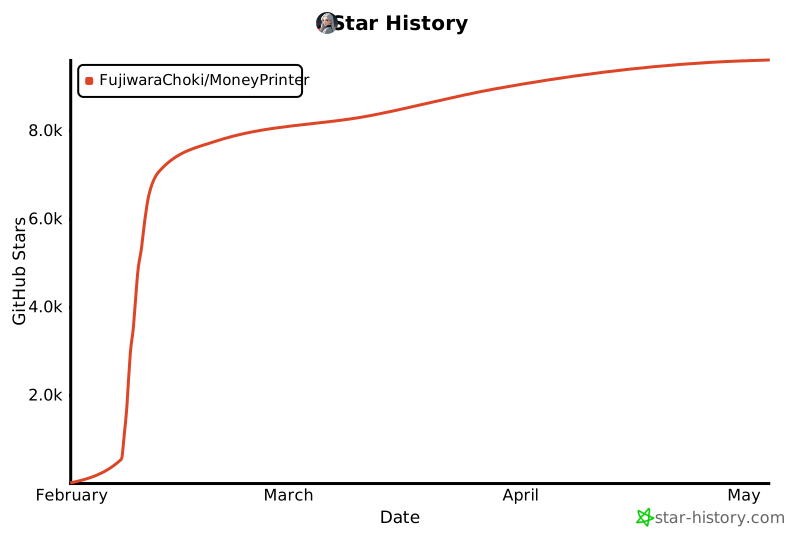](https://star-history.com/#FujiwaraChoki/MoneyPrinter&Date)
## License 📝
See [`LICENSE`](LICENSE) file for more information.
================================================
FILE: docker-compose.yml
================================================
version: "3"
services:
postgres:
image: postgres:16-alpine
container_name: "postgres"
ports:
- "5432:5432"
environment:
- POSTGRES_DB=${POSTGRES_DB:-moneyprinter}
- POSTGRES_USER=${POSTGRES_USER:-moneyprinter}
- POSTGRES_PASSWORD=${POSTGRES_PASSWORD:-moneyprinter}
volumes:
- postgres_data:/var/lib/postgresql/data
healthcheck:
test: ["CMD-SHELL", "pg_isready -U ${POSTGRES_USER:-moneyprinter} -d ${POSTGRES_DB:-moneyprinter}"]
interval: 5s
timeout: 5s
retries: 10
restart: always
frontend:
build:
context: .
dockerfile: Dockerfile
container_name: "frontend"
ports:
- "8001:8001"
command: ["python3", "-m", "http.server", "8001", "--directory", "frontend"]
volumes:
- ./Frontend:/app/frontend
restart: always
backend:
build:
context: .
dockerfile: Dockerfile
container_name: "backend"
ports:
- "8080:8080"
command: ["python3", "backend/main.py"]
volumes:
- ./files:/temp
- ./Backend:/app/backend
- ./fonts:/app/fonts
environment:
- ASSEMBLY_AI_API_KEY=${ASSEMBLY_AI_API_KEY}
- TIKTOK_SESSION_ID=${TIKTOK_SESSION_ID}
- IMAGEMAGICK_BINARY=/usr/local/bin/magick
- PEXELS_API_KEY=${PEXELS_API_KEY}
- OLLAMA_BASE_URL=${OLLAMA_BASE_URL:-http://host.docker.internal:11434}
- OLLAMA_MODEL=${OLLAMA_MODEL:-llama3.1:8b}
- DATABASE_URL=${DATABASE_URL:-postgresql+psycopg://moneyprinter:moneyprinter@postgres:5432/moneyprinter}
extra_hosts:
- "host.docker.internal:host-gateway"
depends_on:
- frontend
- postgres
restart: always
worker:
build:
context: .
dockerfile: Dockerfile
container_name: "worker"
command: ["python3", "backend/worker.py"]
volumes:
- ./files:/temp
- ./Backend:/app/backend
- ./fonts:/app/fonts
environment:
- ASSEMBLY_AI_API_KEY=${ASSEMBLY_AI_API_KEY}
- TIKTOK_SESSION_ID=${TIKTOK_SESSION_ID}
- IMAGEMAGICK_BINARY=/usr/local/bin/magick
- PEXELS_API_KEY=${PEXELS_API_KEY}
- OLLAMA_BASE_URL=${OLLAMA_BASE_URL:-http://host.docker.internal:11434}
- OLLAMA_MODEL=${OLLAMA_MODEL:-llama3.1:8b}
- DATABASE_URL=${DATABASE_URL:-postgresql+psycopg://moneyprinter:moneyprinter@postgres:5432/moneyprinter}
extra_hosts:
- "host.docker.internal:host-gateway"
depends_on:
- postgres
- backend
- frontend
restart: always
volumes:
files:
postgres_data:
================================================
FILE: docs/README.md
================================================
# MoneyPrinter Docs
This folder is the single source of truth for setup, configuration, and troubleshooting.
## Start Here
- [Interactive Setup Script](../setup.sh)
- [Quickstart](quickstart.md)
- [Configuration](configuration.md)
- [Architecture](architecture.md)
- [Docker](docker.md)
- [Testing](testing.md)
- [Troubleshooting](troubleshooting.md)
## Recommended Reading Order
1. Quickstart
2. Configuration
3. Docker (if you use containers)
4. Testing
5. Troubleshooting (when something breaks)
================================================
FILE: docs/architecture.md
================================================
# Architecture
MoneyPrinter now uses a database-backed queue architecture designed for reliability, restart safety, and future scaling.
## Overview
- `Frontend` submits generation requests and polls job status/events.
- `API (Flask)` validates input and enqueues jobs in Postgres.
- `Worker` claims queued jobs and runs the generation pipeline.
- `Postgres` is the source of truth for job state, progress events, and artifacts.
```mermaid
flowchart LR
U[User] --> F[Frontend\nindex.html + app.js]
F -->|POST /api/generate| A[API\nBackend/main.py]
F -->|GET /api/jobs/:id| A
F -->|GET /api/jobs/:id/events| A
F -->|POST /api/jobs/:id/cancel| A
A -->|insert job| DB[(Postgres)]
A -->|read status/events| DB
W[Worker\nBackend/worker.py] -->|claim queued job| DB
W -->|write logs/events| DB
W -->|update final state| DB
W --> P[Pipeline\nBackend/pipeline.py]
P --> FS[(temp/subtitles/output files)]
```
## Runtime Services (Docker)
```mermaid
flowchart TB
subgraph Compose
FE[frontend]
API[backend]
WK[worker]
PG[(postgres)]
end
FE --> API
API --> PG
WK --> PG
WK --> API
```
## Generation Lifecycle
```mermaid
stateDiagram-v2
[*] --> queued
queued --> running: worker claims job
queued --> cancelled: cancel before claim
running --> completed: success
running --> failed: unrecoverable error
running --> cancelled: cancellation requested
completed --> [*]
failed --> [*]
cancelled --> [*]
```
## API + Worker Sequence
```mermaid
sequenceDiagram
participant UI as Frontend
participant API as Flask API
participant DB as Postgres
participant WK as Worker
participant PL as Pipeline
UI->>API: POST /api/generate
API->>DB: INSERT generation_jobs(status=queued)
API-->>UI: { status: success, jobId }
loop Polling
UI->>API: GET /api/jobs/:id
API->>DB: SELECT job
API-->>UI: job state
UI->>API: GET /api/jobs/:id/events?after=n
API->>DB: SELECT events > n
API-->>UI: event list
end
WK->>DB: claim queued job
WK->>DB: UPDATE status=running + INSERT event
WK->>PL: run generation pipeline
PL-->>WK: result path OR error
WK->>DB: UPDATE status + INSERT terminal event
UI->>API: POST /api/jobs/:id/cancel
API->>DB: set cancel_requested=true
WK->>DB: observes cancel and marks cancelled
```
## Data Model (Current Core)
```mermaid
erDiagram
projects ||--o{ generation_jobs : contains
generation_jobs ||--o{ generation_events : has
generation_jobs ||--o{ scripts : produces
generation_jobs ||--o{ artifacts : produces
projects {
int id PK
string name
datetime created_at
}
generation_jobs {
string id PK
int project_id FK
string status
json payload
boolean cancel_requested
int attempt_count
int max_attempts
string result_path
text error_message
datetime created_at
datetime started_at
datetime completed_at
datetime updated_at
}
generation_events {
int id PK
string job_id FK
string event_type
string level
text message
json payload
datetime created_at
}
scripts {
int id PK
string job_id FK
string model_name
text content
datetime created_at
}
artifacts {
int id PK
string job_id FK
string artifact_type
string path
json metadata_json
datetime created_at
}
```
## Current Guarantees
- API is fast and non-blocking for generation requests.
- Job state and logs survive API/worker restarts.
- Cancellation is job-scoped (`cancel_requested`) and checked during processing.
- Frontend can recover progress after refresh by polling persisted events.
## Planned Next Hardening
- Add migration tool (Alembic) for schema versioning.
- Add retries/backoff with `next_retry_at` and dead-letter semantics.
- Add artifact metadata population and checksum tracking.
- Add worker concurrency controls and queue metrics endpoints.
================================================
FILE: docs/configuration.md
================================================
# Configuration
MoneyPrinter reads configuration from `.env` (project root).
Use `.env.example` as your template.
## Required
| Variable | Description |
|---|---|
| `TIKTOK_SESSION_ID` | TikTok session cookie (`sessionid`) used for TTS voice endpoint calls. |
| `PEXELS_API_KEY` | API key used to fetch stock video clips. |
## Optional
| Variable | Description | Default |
|---|---|---|
| `IMAGEMAGICK_BINARY` | Absolute path to ImageMagick executable. If empty, auto-detected from `PATH`. | auto-detect |
| `OLLAMA_BASE_URL` | Ollama server base URL used for model listing and chat generation. | `http://localhost:11434` |
| `OLLAMA_MODEL` | Fallback model if frontend does not send a model value. | `llama3.1:8b` |
| `ASSEMBLY_AI_API_KEY` | If set, subtitles are generated with AssemblyAI; otherwise local subtitle generation is used. | empty |
| `POSTGRES_DB` | Database name for Docker Postgres service. | `moneyprinter` |
| `POSTGRES_USER` | Database user for Docker Postgres service. | `moneyprinter` |
| `POSTGRES_PASSWORD` | Database password for Docker Postgres service. | `moneyprinter` |
| `DATABASE_URL` | SQLAlchemy DSN used by API and worker (`postgresql+psycopg://...` or `sqlite:///...`). | `sqlite:///moneyprinter.db` |
## Notes
- Ollama models shown in the frontend are fetched from backend endpoint `/api/models`, which queries `OLLAMA_BASE_URL/api/tags`.
- Pull models before use, for example:
```bash
ollama pull llama3.1:8b
```
- If ImageMagick is not discovered automatically, set `IMAGEMAGICK_BINARY` explicitly.
- New architecture uses a database-backed job queue. In Docker, use Postgres via `DATABASE_URL`.
================================================
FILE: docs/docker.md
================================================
# Docker
Run MoneyPrinter frontend, API, worker, and Postgres with Docker Compose.
## 1) Prepare environment
```bash
cp .env.example .env
```
Set required keys in `.env`:
- `TIKTOK_SESSION_ID`
- `PEXELS_API_KEY`
Database defaults (already in `.env.example`):
- `POSTGRES_DB=moneyprinter`
- `POSTGRES_USER=moneyprinter`
- `POSTGRES_PASSWORD=moneyprinter`
- `DATABASE_URL=postgresql+psycopg://moneyprinter:moneyprinter@postgres:5432/moneyprinter`
## 2) Ollama connectivity
By default, Docker backend expects Ollama on host machine:
- `OLLAMA_BASE_URL=http://host.docker.internal:11434`
Linux support is included via compose `extra_hosts` host-gateway mapping.
If Ollama runs in another container or machine, set `OLLAMA_BASE_URL` accordingly.
## 3) Start services
```bash
docker compose up --build
```
## 4) Access apps
- Frontend: `http://localhost:8001`
- Backend API: `http://localhost:8080`
- Postgres: `localhost:5432`
## 5) Verify model listing
```bash
curl http://localhost:8080/api/models
```
You should receive a JSON payload with `models` and `default`.
## 6) Queue a generation job
```bash
curl -X POST http://localhost:8080/api/generate \
-H "Content-Type: application/json" \
-d '{"videoSubject":"AI business ideas","aiModel":"llama3.1:8b","voice":"en_us_001","paragraphNumber":1,"customPrompt":""}'
```
Response includes `jobId`. Query status and events:
```bash
curl http://localhost:8080/api/jobs/<jobId>
curl "http://localhost:8080/api/jobs/<jobId>/events?after=0"
```
================================================
FILE: docs/quickstart.md
================================================
# Quickstart
Run MoneyPrinter locally with an Ollama model.
## 1) Clone repository
```bash
git clone https://github.com/FujiwaraChoki/MoneyPrinter.git
cd MoneyPrinter
```
## 2) Quick setup (recommended)
Run the interactive setup script:
```bash
./setup.sh
```
This script checks dependencies, sets up `.env`, installs Python packages with `uv`, and can optionally pull an Ollama model.
## 3) Manual setup
Use this path if you prefer to run each step yourself.
### Prerequisites
- Python 3.11+
- [uv](https://docs.astral.sh/uv/getting-started/installation/)
- FFmpeg
- ImageMagick
- Ollama
### Install and create env file
```bash
uv sync
cp .env.example .env
```
Windows PowerShell for `.env` copy:
```powershell
Copy-Item .env.example .env
```
## 4) Configure environment
Set required values in `.env`:
- `TIKTOK_SESSION_ID`
- `PEXELS_API_KEY`
See [Configuration](configuration.md) for all variables.
## Optional: Run tests
```bash
uv sync --group dev
uv run pytest
```
## 5) Start Ollama and pull a model
```bash
ollama serve
ollama pull llama3.1:8b
```
If Ollama runs on another machine/port, set `OLLAMA_BASE_URL` in `.env`.
## 6) Run backend
```bash
uv run python Backend/main.py
```
## 7) Run worker
In a new terminal:
```bash
uv run python Backend/worker.py
```
## 8) Run frontend
In a new terminal:
```bash
cd Frontend
python3 -m http.server 3000
```
Open `http://localhost:3000`.
## 9) Generate video
1. Enter a video subject.
2. Expand advanced options.
3. Choose an Ollama model from the dropdown (loaded dynamically from Ollama).
4. Click Generate.
Output file: `output.mp4` at project root.
================================================
FILE: docs/testing.md
================================================
# Testing
MoneyPrinter uses `pytest` for backend tests.
## Install test dependencies
Install dev dependencies (includes `pytest`):
```bash
uv sync --group dev
```
## Run tests
Run all tests:
```bash
uv run pytest
```
Run one test file:
```bash
uv run pytest tests/test_repository.py
```
Run one test:
```bash
uv run pytest tests/test_repository.py::test_create_job_persists_payload_and_queued_event
```
## Current test scope
- `tests/test_api_jobs.py`: API queue, job status/events, and cancellation endpoints.
- `tests/test_api_misc.py`: API model listing fallback and song upload endpoint behavior.
- `tests/test_repository.py`: queue/repository behavior for create, claim, cancel, and completion events.
- `tests/test_worker.py`: worker loop behavior for success, cancellation, failure, and empty queue.
- `tests/test_utils.py`: filesystem cleanup, song selection, and ImageMagick binary resolution.
- `tests/conftest.py`: isolated SQLite session fixture per test.
================================================
FILE: docs/troubleshooting.md
================================================
# Troubleshooting
## No Ollama models in dropdown
- Ensure Ollama is running: `ollama serve`
- Ensure at least one model exists: `ollama list`
- Pull a model if needed: `ollama pull llama3.1:8b`
- Verify backend can reach Ollama base URL in `.env` (`OLLAMA_BASE_URL`)
## Frontend cannot connect to backend
- Confirm backend is running on port `8080`
- Confirm frontend is opened from local server (for example `python3 -m http.server`)
- Check browser console/network for `/api/generate` or `/api/models` failures
## ImageMagick not detected
- Install ImageMagick and ensure executable is on `PATH`
- Or set explicit path in `.env`, for example:
```env
IMAGEMAGICK_BINARY="/usr/local/bin/magick"
```
Windows example:
```env
IMAGEMAGICK_BINARY="C:\\Program Files\\ImageMagick-7.1.1-Q16-HDRI\\magick.exe"
```
## No stock videos found
- Verify `PEXELS_API_KEY` is valid
- Try a broader video subject
- Retry generation; stock results vary by query
## Subtitles fail
- If using AssemblyAI, verify `ASSEMBLY_AI_API_KEY`
- If not using AssemblyAI, local subtitle generation should still work
## YouTube upload skipped
- Place `client_secret.json` inside `Backend/`
- Enable required YouTube scopes and OAuth consent in Google Cloud
================================================
FILE: pyproject.toml
================================================
[project]
name = "moneyprinter"
version = "1.0.0"
description = "Automate the creation of YouTube Shorts by providing a video topic."
readme = "README.md"
requires-python = ">=3.11"
dependencies = [
"requests==2.31.0",
"ollama==0.5.1",
"moviepy==2.2.1",
"termcolor==2.4.0",
"flask==3.0.0",
"curl-cffi",
"flask-cors==4.0.0",
"playsound==1.2.2",
"pillow==9.5.0",
"python-dotenv==1.0.0",
"srt-equalizer==0.1.8",
"platformdirs==4.1.0",
"undetected-chromedriver",
"assemblyai",
"brotli",
"google-api-python-client",
"oauth2client",
"sqlalchemy==2.0.36",
"psycopg[binary]==3.2.3",
]
[dependency-groups]
dev = [
"pytest==8.4.1",
]
[tool.pytest.ini_options]
testpaths = ["tests"]
addopts = "-q"
================================================
FILE: setup.sh
================================================
#!/usr/bin/env bash
set -u
SCRIPT_DIR="$(cd -- "$(dirname -- "${BASH_SOURCE[0]}")" && pwd)"
PROJECT_ROOT="$SCRIPT_DIR"
if ! cd "$PROJECT_ROOT"; then
printf 'Failed to enter project directory: %s\n' "$PROJECT_ROOT"
exit 1
fi
if [ -t 1 ] && command -v tput >/dev/null 2>&1; then
COLOR_COUNT="$(tput colors 2>/dev/null || printf '0')"
else
COLOR_COUNT="0"
fi
if [ "$COLOR_COUNT" -ge 8 ]; then
BOLD="$(tput bold)"
RESET="$(tput sgr0)"
RED="$(tput setaf 1)"
GREEN="$(tput setaf 2)"
YELLOW="$(tput setaf 3)"
BLUE="$(tput setaf 4)"
MAGENTA="$(tput setaf 5)"
CYAN="$(tput setaf 6)"
else
BOLD=''
RESET=''
RED=''
GREEN=''
YELLOW=''
BLUE=''
MAGENTA=''
CYAN=''
fi
print_banner() {
printf '\n'
printf '%s%sMoneyPrinter Interactive Setup%s\n' "$BOLD" "$MAGENTA" "$RESET"
printf '%s--------------------------------%s\n' "$MAGENTA" "$RESET"
printf '%sThis script helps you prepare your local environment.%s\n\n' "$CYAN" "$RESET"
}
info() {
printf '%s[INFO]%s %s\n' "$BLUE" "$RESET" "$1"
}
ok() {
printf '%s[OK]%s %s\n' "$GREEN" "$RESET" "$1"
}
warn() {
printf '%s[WARN]%s %s\n' "$YELLOW" "$RESET" "$1"
}
error() {
printf '%s[ERR]%s %s\n' "$RED" "$RESET" "$1"
}
command_exists() {
command -v "$1" >/dev/null 2>&1
}
ask_yes_no() {
prompt="$1"
default="$2"
while true; do
if [ "$default" = "y" ]; then
printf '%s [Y/n]: ' "$prompt"
else
printf '%s [y/N]: ' "$prompt"
fi
read -r reply
case "$reply" in
[Yy]|[Yy][Ee][Ss])
return 0
;;
[Nn]|[Nn][Oo])
return 1
;;
'')
if [ "$default" = "y" ]; then
return 0
fi
return 1
;;
*)
warn 'Please answer y or n.'
;;
esac
done
}
check_python_version() {
if ! command_exists python3; then
error 'python3 not found (required: 3.11+).'
return 1
fi
PYTHON_VERSION="$(python3 -c 'import sys; print(".".join(map(str, sys.version_info[:3])))' 2>/dev/null || printf '0.0.0')"
MAJOR="$(printf '%s' "$PYTHON_VERSION" | cut -d. -f1)"
MINOR="$(printf '%s' "$PYTHON_VERSION" | cut -d. -f2)"
if [ "$MAJOR" -gt 3 ] || { [ "$MAJOR" -eq 3 ] && [ "$MINOR" -ge 11 ]; }; then
ok "python3 found ($PYTHON_VERSION)"
return 0
fi
error "python3 version is $PYTHON_VERSION (need 3.11+)"
return 1
}
check_prereqs() {
info 'Checking prerequisites...'
missing_critical=0
if ! check_python_version; then
missing_critical=1
fi
if command_exists uv; then
ok 'uv found'
else
error 'uv not found (install: https://docs.astral.sh/uv/getting-started/installation/)'
missing_critical=1
fi
if command_exists ffmpeg; then
ok 'ffmpeg found'
else
warn 'ffmpeg not found (required for video generation).'
fi
if command_exists magick || command_exists convert; then
ok 'ImageMagick found'
else
warn 'ImageMagick not found (some text rendering features may fail).'
fi
if command_exists ollama; then
ok 'ollama found'
else
warn 'ollama not found (required for script generation).'
fi
if [ "$missing_critical" -eq 1 ]; then
error 'Missing critical dependencies. Please install them, then rerun setup.'
return 1
fi
return 0
}
configure_local_database_url() {
if [ ! -f .env ]; then
return 0
fi
db_result="$(python3 - <<'PY'
from pathlib import Path
env_path = Path('.env')
text = env_path.read_text(encoding='utf-8')
has_trailing_newline = text.endswith('\n')
lines = text.splitlines()
target = 'DATABASE_URL="sqlite:///moneyprinter.db"'
for index, line in enumerate(lines):
if not line.startswith('DATABASE_URL='):
continue
value = line.split('=', 1)[1].strip().strip('"').strip("'")
if value == '' or value.startswith('postgresql+psycopg://'):
lines[index] = target
env_path.write_text(
'\n'.join(lines) + ('\n' if has_trailing_newline else ''),
encoding='utf-8',
)
print('updated')
else:
print('kept')
break
else:
lines.append(target)
env_path.write_text(
'\n'.join(lines) + ('\n' if has_trailing_newline or lines else ''),
encoding='utf-8',
)
print('added')
PY
)"
case "$db_result" in
updated)
info 'Set DATABASE_URL to local SQLite default in .env'
;;
added)
info 'Added DATABASE_URL local SQLite default to .env'
;;
*)
info 'Keeping existing DATABASE_URL in .env'
;;
esac
}
setup_env_file() {
if [ ! -f .env.example ]; then
warn '.env.example is missing; skipping env setup.'
return 0
fi
if [ -f .env ]; then
if ask_yes_no '.env already exists. Overwrite it from .env.example?' 'n'; then
cp .env.example .env
ok '.env overwritten from .env.example'
else
info 'Keeping existing .env'
fi
else
cp .env.example .env
ok 'Created .env from .env.example'
fi
configure_local_database_url
if ask_yes_no 'Open .env now to edit required keys?' 'y'; then
if [ -n "${EDITOR:-}" ] && command_exists "$EDITOR"; then
"$EDITOR" .env
elif command_exists nano; then
nano .env
elif command_exists vi; then
vi .env
else
warn "No terminal editor detected. Please edit $PROJECT_ROOT/.env manually."
fi
fi
}
install_dependencies() {
if ask_yes_no 'Install Python dependencies with uv sync?' 'y'; then
info 'Running uv sync...'
if uv sync; then
ok 'Dependencies installed'
else
error 'uv sync failed'
return 1
fi
else
warn 'Skipped dependency installation.'
fi
return 0
}
check_ollama_models() {
if ! command_exists ollama; then
return 0
fi
if ! ask_yes_no 'Check local Ollama models now?' 'y'; then
return 0
fi
info 'Querying Ollama model list...'
if ollama list; then
ok 'Ollama is reachable.'
else
warn 'Could not query Ollama. If needed, run: ollama serve'
return 0
fi
if ask_yes_no 'Pull default model llama3.1:8b now?' 'n'; then
printf 'Model name [llama3.1:8b]: '
read -r model_name
model_name="${model_name:-llama3.1:8b}"
info "Pulling model $model_name ..."
if ollama pull "$model_name"; then
ok "Model $model_name is ready"
else
warn "Failed to pull model $model_name"
fi
fi
}
print_next_steps() {
printf '\n%sNext steps%s\n' "$BOLD" "$RESET"
printf '%s1.%s Start backend: %suv run python Backend/main.py%s\n' "$CYAN" "$RESET" "$BOLD" "$RESET"
printf '%s2.%s Start worker (new terminal): %suv run python Backend/worker.py%s\n' "$CYAN" "$RESET" "$BOLD" "$RESET"
printf '%s3.%s Start frontend (new terminal): %spython3 -m http.server 3000 --directory Frontend%s\n' "$CYAN" "$RESET" "$BOLD" "$RESET"
printf '%s4.%s Open: %shttp://localhost:3000%s\n\n' "$CYAN" "$RESET" "$BOLD" "$RESET"
}
main() {
print_banner
if ! check_prereqs; then
exit 1
fi
setup_env_file
if ! install_dependencies; then
exit 1
fi
check_ollama_models
print_next_steps
ok 'Setup complete. Happy building!'
}
main "$@"
================================================
FILE: tests/conftest.py
================================================
import os
import sys
from pathlib import Path
import pytest
from sqlalchemy import create_engine
from sqlalchemy.orm import sessionmaker
PROJECT_ROOT = Path(__file__).resolve().parents[1]
BACKEND_DIR = PROJECT_ROOT / "Backend"
if str(BACKEND_DIR) not in sys.path:
sys.path.insert(0, str(BACKEND_DIR))
os.environ["DATABASE_URL"] = "sqlite:///:memory:"
from db import Base # noqa: E402
import models # noqa: F401,E402
@pytest.fixture
def session_factory(tmp_path: Path):
database_file = tmp_path / "test.db"
engine = create_engine(
f"sqlite:///{database_file}",
connect_args={"check_same_thread": False},
)
session_factory = sessionmaker(
bind=engine,
autoflush=False,
autocommit=False,
expire_on_commit=False,
)
Base.metadata.create_all(bind=engine)
yield session_factory
Base.metadata.drop_all(bind=engine)
engine.dispose()
@pytest.fixture
def session(session_factory):
with session_factory() as db_session:
yield db_session
================================================
FILE: tests/test_api_jobs.py
================================================
import os
import pytest
from repository import append_event, create_job, get_job, list_job_events
os.environ.setdefault("PEXELS_API_KEY", "test-key")
os.environ.setdefault("TIKTOK_SESSION_ID", "test-session")
os.environ.setdefault("IMAGEMAGICK_BINARY", "/bin/echo")
os.environ.setdefault("DATABASE_URL", "sqlite:///moneyprinter_api_bootstrap.db")
import main
@pytest.fixture
def client(monkeypatch, session_factory):
monkeypatch.setattr(main, "SessionLocal", session_factory)
return main.app.test_client()
def test_generate_requires_video_subject(client):
response = client.post("/api/generate", json={})
assert response.status_code == 400
payload = response.get_json()
assert payload["status"] == "error"
assert payload["message"] == "videoSubject is required."
def test_generate_creates_job_and_job_status_is_fetchable(client):
response = client.post(
"/api/generate",
json={
"videoSubject": "api queue test",
"paragraphNumber": 1,
"customPrompt": "",
},
)
assert response.status_code == 200
payload = response.get_json()
assert payload["status"] == "success"
assert payload["message"] == "Video generation queued."
job_id = payload["jobId"]
job_response = client.get(f"/api/jobs/{job_id}")
job_payload = job_response.get_json()
assert job_response.status_code == 200
assert job_payload["status"] == "success"
assert job_payload["job"]["id"] == job_id
assert job_payload["job"]["state"] == "queued"
def test_get_events_respects_after_query_parameter(client, session_factory):
with session_factory() as session:
job = create_job(session, payload={"videoSubject": "events"})
first_event = list_job_events(session, job.id)[0]
append_event(session, job.id, "log", "info", "step 2")
append_event(session, job.id, "log", "info", "step 3")
session.commit()
response = client.get(f"/api/jobs/{job.id}/events?after={first_event.id}")
assert response.status_code == 200
payload = response.get_json()
assert payload["status"] == "success"
assert len(payload["events"]) == 2
assert payload["events"][0]["message"] == "step 2"
assert payload["events"][1]["message"] == "step 3"
def test_cancel_job_endpoint_cancels_existing_job(client, session_factory):
with session_factory() as session:
job = create_job(session, payload={"videoSubject": "cancel endpoint"})
response = client.post(f"/api/jobs/{job.id}/cancel")
assert response.status_code == 200
payload = response.get_json()
assert payload["status"] == "success"
assert payload["message"] == "Cancellation requested."
with session_factory() as session:
updated_job = get_job(session, job.id)
assert updated_job is not None
assert updated_job.status == "cancelled"
assert updated_job.cancel_requested is True
def test_cancel_job_endpoint_returns_404_for_unknown_job(client):
response = client.post("/api/jobs/missing-id/cancel")
assert response.status_code == 404
payload = response.get_json()
assert payload["status"] == "error"
assert payload["message"] == "Job not found."
def test_cancel_latest_running_job_returns_404_when_no_active_job(client):
response = client.post("/api/cancel")
assert response.status_code == 404
payload = response.get_json()
assert payload["status"] == "error"
assert payload["message"] == "No active job found."
def test_cancel_latest_running_job_cancels_active_job(client, session_factory):
with session_factory() as session:
older_job = create_job(session, payload={"videoSubject": "older"})
newer_job = create_job(session, payload={"videoSubject": "newer"})
response = client.post("/api/cancel")
assert response.status_code == 200
payload = response.get_json()
assert payload["status"] == "success"
assert payload["message"] == "Cancellation requested."
assert payload["jobId"] in {older_job.id, newer_job.id}
with session_factory() as session:
older = get_job(session, older_job.id)
newer = get_job(session, newer_job.id)
assert older is not None
assert newer is not None
cancelled_count = int(older.cancel_requested) + int(newer.cancel_requested)
assert cancelled_count == 1
================================================
FILE: tests/test_api_misc.py
================================================
import io
import os
import pytest
os.environ.setdefault("PEXELS_API_KEY", "test-key")
os.environ.setdefault("TIKTOK_SESSION_ID", "test-session")
os.environ.setdefault("IMAGEMAGICK_BINARY", "/bin/echo")
os.environ.setdefault("DATABASE_URL", "sqlite:///moneyprinter_api_misc_bootstrap.db")
import main
@pytest.fixture
def client():
return main.app.test_client()
def test_models_endpoint_success_response(client, monkeypatch):
def fake_list_models():
return ["llama3.1:8b", "qwen3:8b"], "qwen3:8b"
monkeypatch.setattr(main, "list_ollama_models", fake_list_models)
response = client.get("/api/models")
assert response.status_code == 200
payload = response.get_json()
assert payload["status"] == "success"
assert payload["models"] == ["llama3.1:8b", "qwen3:8b"]
assert payload["default"] == "qwen3:8b"
def test_models_endpoint_fallback_on_error(client, monkeypatch):
monkeypatch.setenv("OLLAMA_MODEL", "custom:model")
def fake_list_models():
raise RuntimeError("ollama unavailable")
monkeypatch.setattr(main, "list_ollama_models", fake_list_models)
response = client.get("/api/models")
assert response.status_code == 200
payload = response.get_json()
assert payload["status"] == "error"
assert payload["message"] == "Could not fetch Ollama models. Is Ollama running?"
assert payload["models"] == ["custom:model"]
assert payload["default"] == "custom:model"
def test_upload_songs_requires_files(client):
response = client.post(
"/api/upload-songs", data={}, content_type="multipart/form-data"
)
assert response.status_code == 400
payload = response.get_json()
assert payload["status"] == "error"
assert payload["message"] == "No files uploaded."
def test_upload_songs_rejects_non_mp3_files(client, monkeypatch, tmp_path):
songs_dir = tmp_path / "Songs"
songs_dir.mkdir()
monkeypatch.setattr(main, "SONGS_DIR", songs_dir)
monkeypatch.setattr(main, "clean_dir", lambda path: None)
data = {
"songs": (io.BytesIO(b"not-mp3"), "track.wav"),
}
response = client.post(
"/api/upload-songs",
data=data,
content_type="multipart/form-data",
)
assert response.status_code == 400
payload = response.get_json()
assert payload["status"] == "error"
assert payload["message"] == "No MP3 files found."
assert list(songs_dir.iterdir()) == []
def test_upload_songs_saves_mp3_and_sanitizes_filename(client, monkeypatch, tmp_path):
songs_dir = tmp_path / "Songs"
songs_dir.mkdir()
stale_file = songs_dir / "stale.mp3"
stale_file.write_bytes(b"old")
def fake_clean_dir(path: str):
assert path == str(songs_dir)
for item in songs_dir.iterdir():
if item.is_file():
item.unlink()
monkeypatch.setattr(main, "SONGS_DIR", songs_dir)
monkeypatch.setattr(main, "clean_dir", fake_clean_dir)
data = {
"songs": [
(io.BytesIO(b"song-a"), "../danger.mp3"),
(io.BytesIO(b"song-b"), "safe.mp3"),
(io.BytesIO(b"ignore"), "note.txt"),
]
}
response = client.post(
"/api/upload-songs",
data=data,
content_type="multipart/form-data",
)
assert response.status_code == 200
payload = response.get_json()
assert payload["status"] == "success"
assert payload["message"] == "Uploaded 2 song(s)."
saved_names = sorted(path.name for path in songs_dir.iterdir())
assert saved_names == ["danger.mp3", "safe.mp3"]
================================================
FILE: tests/test_repository.py
================================================
from repository import (
claim_next_queued_job,
create_job,
list_job_events,
mark_failed,
mark_completed,
mark_cancelled,
request_cancel,
)
def test_create_job_persists_payload_and_queued_event(session):
payload = {"videoSubject": "money basics", "paragraphNumber": 1}
job = create_job(session, payload=payload)
assert job.id
assert job.status == "queued"
assert job.payload == payload
events = list_job_events(session, job.id)
assert len(events) == 1
assert events[0].event_type == "queued"
assert events[0].message == "Job queued."
def test_request_cancel_cancels_queued_job_and_tracks_events(session):
job = create_job(session, payload={"videoSubject": "cancel me"})
cancelled = request_cancel(session, job.id)
assert cancelled is True
events = list_job_events(session, job.id)
event_types = [event.event_type for event in events]
assert "cancel_requested" in event_types
assert "cancelled" in event_types
def test_claim_next_queued_job_marks_running_and_skips_cancelled(session):
first_job = create_job(session, payload={"videoSubject": "first"})
second_job = create_job(session, payload={"videoSubject": "second"})
request_cancel(session, first_job.id)
claimed_job = claim_next_queued_job(session)
assert claimed_job is not None
assert claimed_job.id == second_job.id
assert claimed_job.status == "running"
assert claimed_job.attempt_count == 1
def test_mark_completed_updates_status_and_emits_complete_event(session):
job = create_job(session, payload={"videoSubject": "done"})
running_job = claim_next_queued_job(session)
assert running_job is not None
mark_completed(session, job.id, result_path="/tmp/output.mp4")
events = list_job_events(session, job.id)
complete_events = [event for event in events if event.event_type == "complete"]
assert len(complete_events) == 1
assert complete_events[0].payload == {"path": "/tmp/output.mp4"}
def test_mark_failed_updates_error_message_and_event(session):
job = create_job(session, payload={"videoSubject": "bad run"})
mark_failed(session, job.id, error_message="render crash")
events = list_job_events(session, job.id)
assert events[-1].event_type == "error"
assert events[-1].message == "render crash"
def test_mark_cancelled_sets_status_and_writes_cancelled_event(session):
job = create_job(session, payload={"videoSubject": "stop"})
mark_cancelled(session, job.id, reason="cancelled in worker")
events = list_job_events(session, job.id)
assert events[-1].event_type == "cancelled"
assert events[-1].message == "cancelled in worker"
================================================
FILE: tests/test_utils.py
================================================
from pathlib import Path
import utils
def test_clean_dir_removes_existing_files_and_directories(tmp_path: Path):
target_dir = tmp_path / "cleanup"
nested_dir = target_dir / "nested"
nested_dir.mkdir(parents=True)
(target_dir / "root.txt").write_text("root")
(nested_dir / "nested.txt").write_text("nested")
utils.clean_dir(str(target_dir))
assert target_dir.exists()
assert list(target_dir.iterdir()) == []
def test_choose_random_song_returns_none_if_songs_dir_missing(
monkeypatch, tmp_path: Path
):
songs_dir = tmp_path / "Songs"
monkeypatch.setattr(utils, "SONGS_DIR", songs_dir)
assert utils.choose_random_song() is None
def test_choose_random_song_returns_selected_mp3(monkeypatch, tmp_path: Path):
songs_dir = tmp_path / "Songs"
songs_dir.mkdir()
first_song = songs_dir / "a.mp3"
second_song = songs_dir / "b.mp3"
ignored_file = songs_dir / "notes.txt"
first_song.write_text("a")
second_song.write_text("b")
ignored_file.write_text("ignore")
monkeypatch.setattr(utils, "SONGS_DIR", songs_dir)
monkeypatch.setattr(utils.random, "choice", lambda songs: songs[0])
selected = utils.choose_random_song()
assert selected == str(first_song)
def test_resolve_imagemagick_binary_prefers_configured_existing_path(
monkeypatch, tmp_path: Path
):
fake_binary = tmp_path / "magick"
fake_binary.write_text("binary")
monkeypatch.setenv("IMAGEMAGICK_BINARY", str(fake_binary))
resolved = utils.resolve_imagemagick_binary()
assert resolved == str(fake_binary.resolve())
def test_resolve_imagemagick_binary_falls_back_to_path_lookup(monkeypatch):
monkeypatch.setenv("IMAGEMAGICK_BINARY", "")
def fake_which(candidate: str):
if candidate == "magick":
return "/usr/local/bin/magick"
return None
monkeypatch.setattr(utils.shutil, "which", fake_which)
resolved = utils.resolve_imagemagick_binary()
assert resolved == "/usr/local/bin/magick"
================================================
FILE: tests/test_worker.py
================================================
from repository import create_job, get_job, list_job_events
import worker
def _disable_cleanup(monkeypatch):
monkeypatch.setattr(worker, "clean_dir", lambda _: None)
def test_process_next_job_returns_false_when_queue_is_empty(
monkeypatch, session_factory
):
monkeypatch.setattr(worker, "SessionLocal", session_factory)
_disable_cleanup(monkeypatch)
assert worker.process_next_job() is False
def test_process_next_job_marks_completed_on_pipeline_success(
monkeypatch, session_factory
):
with session_factory() as session:
job = create_job(session, payload={"videoSubject": "worker success"})
monkeypatch.setattr(worker, "SessionLocal", session_factory)
_disable_cleanup(monkeypatch)
def fake_pipeline(data, is_cancelled, on_log):
assert data["videoSubject"] == "worker success"
assert is_cancelled() is False
on_log("pipeline started", "info")
return "rendered.mp4"
monkeypatch.setattr(worker, "run_generation_pipeline", fake_pipeline)
assert worker.process_next_job() is True
with session_factory() as session:
updated_job = get_job(session, job.id)
assert updated_job is not None
assert updated_job.status == "completed"
assert updated_job.result_path == "rendered.mp4"
event_types = [event.event_type for event in list_job_events(session, job.id)]
assert "running" in event_types
assert "log" in event_types
assert "complete" in event_types
def test_process_next_job_marks_cancelled_on_pipeline_cancelled(
monkeypatch, session_factory
):
with session_factory() as session:
job = create_job(session, payload={"videoSubject": "worker cancelled"})
monkeypatch.setattr(worker, "SessionLocal", session_factory)
_disable_cleanup(monkeypatch)
def fake_pipeline(*_args, **_kwargs):
raise worker.PipelineCancelled("cancelled by user")
monkeypatch.setattr(worker, "run_generation_pipeline", fake_pipeline)
assert worker.process_next_job() is True
with session_factory() as session:
updated_job = get_job(session, job.id)
assert updated_job is not None
assert updated_job.status == "cancelled"
events = list_job_events(session, job.id)
assert events[-1].event_type == "cancelled"
assert events[-1].message == "cancelled by user"
def test_process_next_job_marks_failed_on_pipeline_error(monkeypatch, session_factory):
with session_factory() as session:
job = create_job(session, payload={"videoSubject": "worker failure"})
monkeypatch.setattr(worker, "SessionLocal", session_factory)
_disable_cleanup(monkeypatch)
def fake_pipeline(*_args, **_kwargs):
raise RuntimeError("pipeline exploded")
monkeypatch.setattr(worker, "run_generation_pipeline", fake_pipeline)
assert worker.process_next_job() is True
with session_factory() as session:
updated_job = get_job(session, job.id)
assert updated_job is not None
assert updated_job.status == "failed"
assert updated_job.error_message == "pipeline exploded"
events = list_job_events(session, job.id)
assert events[-1].event_type == "error"
assert events[-1].message == "pipeline exploded"
def test_job_cancelled_helper_returns_true_for_missing_job(
monkeypatch, session_factory
):
monkeypatch.setattr(worker, "SessionLocal", session_factory)
assert worker._job_cancelled("missing-job-id") is True
def test_job_cancelled_helper_reflects_cancel_flag(monkeypatch, session_factory):
with session_factory() as session:
job = create_job(session, payload={"videoSubject": "cancel-check"})
monkeypatch.setattr(worker, "SessionLocal", session_factory)
assert worker._job_cancelled(job.id) is False
with session_factory() as session:
job_to_update = get_job(session, job.id)
assert job_to_update is not None
job_to_update.cancel_requested = True
session.commit()
assert worker._job_cancelled(job.id) is True
def test_log_event_helper_persists_log_event(monkeypatch, session_factory):
with session_factory() as session:
job = create_job(session, payload={"videoSubject": "log-check"})
monkeypatch.setattr(worker, "SessionLocal", session_factory)
worker._log_event(job.id, "hello event", "warning")
with session_factory() as session:
events = list_job_events(session, job.id)
assert events[-1].event_type == "log"
assert events[-1].level == "warning"
assert events[-1].message == "hello event"
gitextract__b835fml/
├── .github/
│ ├── FUNDING.yml
│ └── ISSUE_TEMPLATE/
│ ├── bug_report.md
│ └── feature_request.md
├── .gitignore
├── AGENTS.md
├── Backend/
│ ├── db.py
│ ├── gpt.py
│ ├── logstream.py
│ ├── main.py
│ ├── models.py
│ ├── pipeline.py
│ ├── repository.py
│ ├── search.py
│ ├── tiktokvoice.py
│ ├── utils.py
│ ├── video.py
│ ├── worker.py
│ └── youtube.py
├── CLAUDE.md
├── Dockerfile
├── Frontend/
│ ├── app.js
│ └── index.html
├── LICENSE
├── README.md
├── docker-compose.yml
├── docs/
│ ├── README.md
│ ├── architecture.md
│ ├── configuration.md
│ ├── docker.md
│ ├── quickstart.md
│ ├── testing.md
│ └── troubleshooting.md
├── pyproject.toml
├── setup.sh
└── tests/
├── conftest.py
├── test_api_jobs.py
├── test_api_misc.py
├── test_repository.py
├── test_utils.py
└── test_worker.py
SYMBOL INDEX (117 symbols across 20 files)

FILE: Backend/db.py
  class Base (line 13) | class Base(DeclarativeBase):
  function _database_url (line 17) | def _database_url() -> str:
  function init_db (line 39) | def init_db() -> None:

FILE: Backend/gpt.py
  function _ollama_client (line 20) | def _ollama_client() -> Client:
  function _extract_model_name (line 24) | def _extract_model_name(model_obj) -> str:
  function list_ollama_models (line 34) | def list_ollama_models() -> Tuple[List[str], str]:
  function generate_response (line 67) | def generate_response(prompt: str, ai_model: str) -> str:
  function generate_script (line 142) | def generate_script(
  function get_search_terms (line 237) | def get_search_terms(
  function generate_metadata (line 315) | def generate_metadata(

FILE: Backend/logstream.py
  class LogStream (line 7) | class LogStream:
    method __init__ (line 10) | def __init__(self, maxsize: int = 500):
    method clear (line 13) | def clear(self) -> None:
    method push (line 21) | def push(self, message: str, level: str = "info") -> None:
    method push_event (line 41) | def push_event(self, event_type: str, data: dict | None = None) -> None:
    method stream (line 60) | def stream(self, timeout: float = 30.0):
  function log (line 90) | def log(message: str, level: str = "info") -> None:

FILE: Backend/main.py
  function models (line 27) | def models():
  function generate (line 50) | def generate():
  function get_job_status (line 68) | def get_job_status(job_id: str):
  function get_events (line 94) | def get_events(job_id: str):
  function cancel_job (line 124) | def cancel_job(job_id: str):
  function upload_songs (line 134) | def upload_songs():
  function cancel_latest_running_job (line 159) | def cancel_latest_running_job():

FILE: Backend/models.py
  class Project (line 10) | class Project(Base):
  class GenerationJob (line 20) | class GenerationJob(Base):
  class GenerationEvent (line 61) | class GenerationEvent(Base):
  class Script (line 82) | class Script(Base):
  class Artifact (line 99) | class Artifact(Base):

FILE: Backend/pipeline.py
  class PipelineCancelled (line 31) | class PipelineCancelled(Exception):
  function run_generation_pipeline (line 35) | def run_generation_pipeline(

FILE: Backend/repository.py
  function utcnow (line 11) | def utcnow() -> datetime:
  function create_job (line 15) | def create_job(session: Session, payload: dict, max_attempts: int = 1) -...
  function append_event (line 31) | def append_event(
  function get_job (line 51) | def get_job(session: Session, job_id: str) -> Optional[GenerationJob]:
  function list_job_events (line 55) | def list_job_events(
  function request_cancel (line 72) | def request_cancel(session: Session, job_id: str) -> bool:
  function claim_next_queued_job (line 97) | def claim_next_queued_job(session: Session) -> Optional[GenerationJob]:
  function mark_completed (line 143) | def mark_completed(session: Session, job_id: str, result_path: str) -> N...
  function mark_cancelled (line 163) | def mark_cancelled(
  function mark_failed (line 176) | def mark_failed(session: Session, job_id: str, error_message: str) -> None:

FILE: Backend/search.py
  function search_for_stock_videos (line 6) | def search_for_stock_videos(query: str, api_key: str, it: int, min_dur: ...

FILE: Backend/tiktokvoice.py
  function split_string (line 79) | def split_string(string: str, chunk_size: int) -> List[str]:
  function get_api_response (line 98) | def get_api_response() -> requests.Response:
  function save_audio_file (line 105) | def save_audio_file(base64_data: str, filename: str = "output.mp3") -> N...
  function generate_audio (line 112) | def generate_audio(text: str, voice: str) -> bytes:
  function tts (line 121) | def tts(

FILE: Backend/utils.py
  function clean_dir (line 25) | def clean_dir(path: str) -> None:
  function choose_random_song (line 53) | def choose_random_song() -> Optional[str]:
  function resolve_imagemagick_binary (line 82) | def resolve_imagemagick_binary() -> Optional[str]:
  function check_env_vars (line 113) | def check_env_vars() -> None:

FILE: Backend/video.py
  function save_video (line 28) | def save_video(video_url: str, directory: str = str(TEMP_DIR)) -> str:
  function __generate_subtitles_assemblyai (line 49) | def __generate_subtitles_assemblyai(audio_path: str, voice: str) -> str:
  function __generate_subtitles_locally (line 81) | def __generate_subtitles_locally(
  function generate_subtitles (line 118) | def generate_subtitles(
  function combine_videos (line 162) | def combine_videos(
  function generate_video (line 268) | def generate_video(

FILE: Backend/worker.py
  function _job_cancelled (line 21) | def _job_cancelled(job_id: str) -> bool:
  function _log_event (line 29) | def _log_event(job_id: str, message: str, level: str) -> None:
  function process_next_job (line 35) | def process_next_job() -> bool:
  function main (line 65) | def main() -> None:

FILE: Backend/youtube.py
  function get_authenticated_service (line 67) | def get_authenticated_service():
  function initialize_upload (line 93) | def initialize_upload(youtube: any, options: dict):
  function resumable_upload (line 133) | def resumable_upload(insert_request: MediaFileUpload):
  function upload_video (line 174) | def upload_video(video_path, title, description, category, keywords, pri...

FILE: Frontend/app.js
  constant API_BASE_URL (line 22) | const API_BASE_URL = `${backendProtocol}//${backendHost}:8080`;
  constant API_FALLBACK_URL (line 23) | const API_FALLBACK_URL = `http://${backendHost}:8080`;
  function apiRequest (line 30) | async function apiRequest(path, options = {}) {
  function setModelOptions (line 52) | function setModelOptions(models, preferredModel) {
  function loadOllamaModels (line 69) | async function loadOllamaModels(reuseEnabled) {
  function showToast (line 110) | function showToast(message, type = "info") {
  function dismissToast (line 131) | function dismissToast(toast) {
  function updateColorDot (line 137) | function updateColorDot() {
  function formatTimestamp (line 152) | function formatTimestamp(ts) {
  function appendLogEntry (line 157) | function appendLogEntry(entry) {
  function pollJob (line 177) | async function pollJob() {
  function startJobPolling (line 224) | function startJobPolling(jobId) {
  function stopJobPolling (line 233) | function stopJobPolling() {
  function setGeneratingState (line 241) | function setGeneratingState(active) {
  function cancelGeneration (line 257) | function cancelGeneration() {
  function uploadSongs (line 271) | async function uploadSongs() {
  function generateVideo (line 296) | async function generateVideo() {

FILE: tests/conftest.py
  function session_factory (line 22) | def session_factory(tmp_path: Path):
  function session (line 43) | def session(session_factory):

FILE: tests/test_api_jobs.py
  function client (line 17) | def client(monkeypatch, session_factory):
  function test_generate_requires_video_subject (line 22) | def test_generate_requires_video_subject(client):
  function test_generate_creates_job_and_job_status_is_fetchable (line 31) | def test_generate_creates_job_and_job_status_is_fetchable(client):
  function test_get_events_respects_after_query_parameter (line 56) | def test_get_events_respects_after_query_parameter(client, session_facto...
  function test_cancel_job_endpoint_cancels_existing_job (line 74) | def test_cancel_job_endpoint_cancels_existing_job(client, session_factory):
  function test_cancel_job_endpoint_returns_404_for_unknown_job (line 92) | def test_cancel_job_endpoint_returns_404_for_unknown_job(client):
  function test_cancel_latest_running_job_returns_404_when_no_active_job (line 101) | def test_cancel_latest_running_job_returns_404_when_no_active_job(client):
  function test_cancel_latest_running_job_cancels_active_job (line 110) | def test_cancel_latest_running_job_cancels_active_job(client, session_fa...

FILE: tests/test_api_misc.py
  function client (line 16) | def client():
  function test_models_endpoint_success_response (line 20) | def test_models_endpoint_success_response(client, monkeypatch):
  function test_models_endpoint_fallback_on_error (line 35) | def test_models_endpoint_fallback_on_error(client, monkeypatch):
  function test_upload_songs_requires_files (line 53) | def test_upload_songs_requires_files(client):
  function test_upload_songs_rejects_non_mp3_files (line 64) | def test_upload_songs_rejects_non_mp3_files(client, monkeypatch, tmp_path):
  function test_upload_songs_saves_mp3_and_sanitizes_filename (line 87) | def test_upload_songs_saves_mp3_and_sanitizes_filename(client, monkeypat...

FILE: tests/test_repository.py
  function test_create_job_persists_payload_and_queued_event (line 12) | def test_create_job_persists_payload_and_queued_event(session):
  function test_request_cancel_cancels_queued_job_and_tracks_events (line 27) | def test_request_cancel_cancels_queued_job_and_tracks_events(session):
  function test_claim_next_queued_job_marks_running_and_skips_cancelled (line 40) | def test_claim_next_queued_job_marks_running_and_skips_cancelled(session):
  function test_mark_completed_updates_status_and_emits_complete_event (line 53) | def test_mark_completed_updates_status_and_emits_complete_event(session):
  function test_mark_failed_updates_error_message_and_event (line 66) | def test_mark_failed_updates_error_message_and_event(session):
  function test_mark_cancelled_sets_status_and_writes_cancelled_event (line 76) | def test_mark_cancelled_sets_status_and_writes_cancelled_event(session):

FILE: tests/test_utils.py
  function test_clean_dir_removes_existing_files_and_directories (line 6) | def test_clean_dir_removes_existing_files_and_directories(tmp_path: Path):
  function test_choose_random_song_returns_none_if_songs_dir_missing (line 19) | def test_choose_random_song_returns_none_if_songs_dir_missing(
  function test_choose_random_song_returns_selected_mp3 (line 28) | def test_choose_random_song_returns_selected_mp3(monkeypatch, tmp_path: ...
  function test_resolve_imagemagick_binary_prefers_configured_existing_path (line 46) | def test_resolve_imagemagick_binary_prefers_configured_existing_path(
  function test_resolve_imagemagick_binary_falls_back_to_path_lookup (line 58) | def test_resolve_imagemagick_binary_falls_back_to_path_lookup(monkeypatch):

FILE: tests/test_worker.py
  function _disable_cleanup (line 5) | def _disable_cleanup(monkeypatch):
  function test_process_next_job_returns_false_when_queue_is_empty (line 9) | def test_process_next_job_returns_false_when_queue_is_empty(
  function test_process_next_job_marks_completed_on_pipeline_success (line 18) | def test_process_next_job_marks_completed_on_pipeline_success(
  function test_process_next_job_marks_cancelled_on_pipeline_cancelled (line 49) | def test_process_next_job_marks_cancelled_on_pipeline_cancelled(
  function test_process_next_job_marks_failed_on_pipeline_error (line 75) | def test_process_next_job_marks_failed_on_pipeline_error(monkeypatch, se...
  function test_job_cancelled_helper_returns_true_for_missing_job (line 100) | def test_job_cancelled_helper_returns_true_for_missing_job(
  function test_job_cancelled_helper_reflects_cancel_flag (line 108) | def test_job_cancelled_helper_reflects_cancel_flag(monkeypatch, session_...
  function test_log_event_helper_persists_log_event (line 125) | def test_log_event_helper_persists_log_event(monkeypatch, session_factory):
Condensed preview — 40 files, each showing path, character count, and a content snippet. Download the .json file or copy for the full structured content (186K chars).
[
  {
    "path": ".github/FUNDING.yml",
    "chars": 71,
    "preview": "# These are supported funding model platforms\n\ngithub: [FujiwaraChoki]\n"
  },
  {
    "path": ".github/ISSUE_TEMPLATE/bug_report.md",
    "chars": 698,
    "preview": "---\nname: Bug report\nabout: Create a report to help us improve\ntitle: \"[BUG]\"\nlabels: ''\nassignees: FujiwaraChoki\n\n---\n\n"
  },
  {
    "path": ".github/ISSUE_TEMPLATE/feature_request.md",
    "chars": 595,
    "preview": "---\nname: Feature request\nabout: Suggest an idea for this project\ntitle: ''\nlabels: ''\nassignees: ''\n\n---\n\n**Is your fea"
  },
  {
    "path": ".gitignore",
    "chars": 185,
    "preview": "__pycache__\n.env\ntemp/*\nsounds/*\noutput/*\nimages/*\n*.zip\n*.srt\n*.mp4\n*.mp3\n.history\nsubtitles/*\n/venv\n.venv\nclient_secre"
  },
  {
    "path": "AGENTS.md",
    "chars": 6787,
    "preview": "# AGENTS Guide for MoneyPrinter\n\nThis file is the operating manual for coding agents working in this repository.\nFollow "
  },
  {
    "path": "Backend/db.py",
    "chars": 863,
    "preview": "import os\n\nfrom sqlalchemy import create_engine\nfrom sqlalchemy.orm import DeclarativeBase, sessionmaker\n\nfrom dotenv im"
  },
  {
    "path": "Backend/gpt.py",
    "chars": 11261,
    "preview": "import re\nimport os\nimport json\nfrom ollama import Client, ResponseError\n\nfrom dotenv import load_dotenv\nfrom logstream "
  },
  {
    "path": "Backend/logstream.py",
    "chars": 2821,
    "preview": "import json\nimport queue\nimport re\nimport time\n\n\nclass LogStream:\n    \"\"\"Thread-safe log queue that doubles as an SSE ge"
  },
  {
    "path": "Backend/main.py",
    "chars": 5974,
    "preview": "import os\n\nfrom dotenv import load_dotenv\nfrom flask import Flask, jsonify, request\nfrom flask_cors import CORS\nfrom sql"
  },
  {
    "path": "Backend/models.py",
    "chars": 4340,
    "preview": "from datetime import datetime\nfrom typing import Optional\n\nfrom sqlalchemy import Boolean, DateTime, ForeignKey, Integer"
  },
  {
    "path": "Backend/pipeline.py",
    "chars": 11763,
    "preview": "import os\nimport shutil\nimport subprocess\n\nfrom apiclient.errors import HttpError\nfrom moviepy import (\n    AudioFileCli"
  },
  {
    "path": "Backend/repository.py",
    "chars": 4798,
    "preview": "from datetime import datetime, timezone\nfrom typing import Optional\nfrom uuid import uuid4\n\nfrom sqlalchemy import and_,"
  },
  {
    "path": "Backend/search.py",
    "chars": 1989,
    "preview": "import requests\n\nfrom typing import List\nfrom logstream import log\n\ndef search_for_stock_videos(query: str, api_key: str"
  },
  {
    "path": "Backend/tiktokvoice.py",
    "chars": 6763,
    "preview": "# author: GiorDior aka Giorgio\n# date: 12.06.2023\n# topic: TikTok-Voice-TTS\n# version: 1.0\n# credits: https://github.com"
  },
  {
    "path": "Backend/utils.py",
    "chars": 4672,
    "preview": "import os\nimport sys\nimport random\nimport logging\nimport shutil\n\nfrom pathlib import Path\nfrom typing import Optional\nfr"
  },
  {
    "path": "Backend/video.py",
    "chars": 11205,
    "preview": "import os\nimport uuid\n\nimport requests\nimport srt_equalizer\nimport assemblyai as aai\n\nfrom typing import List\nfrom pathl"
  },
  {
    "path": "Backend/worker.py",
    "chars": 1890,
    "preview": "import time\n\nfrom dotenv import load_dotenv\n\nfrom db import SessionLocal, init_db\nfrom pipeline import PipelineCancelled"
  },
  {
    "path": "Backend/youtube.py",
    "chars": 7288,
    "preview": "import os\nimport sys\nimport time\nimport random\nimport httplib2\nfrom pathlib import Path\n\nfrom logstream import log\nfrom "
  },
  {
    "path": "CLAUDE.md",
    "chars": 4313,
    "preview": "# CLAUDE.md\n\nThis file provides guidance to Claude Code (claude.ai/code) when working with code in this repository.\n\n## "
  },
  {
    "path": "Dockerfile",
    "chars": 821,
    "preview": "FROM python:3.11-slim-buster\n\nCOPY --from=ghcr.io/astral-sh/uv:latest /uv /uvx /bin/\n\nRUN apt-get update && apt-get inst"
  },
  {
    "path": "Frontend/app.js",
    "chars": 12352,
    "preview": "// ===== DOM REFS =====\nconst videoSubject = document.getElementById(\"videoSubject\");\nconst aiModel = document.getElemen"
  },
  {
    "path": "Frontend/index.html",
    "chars": 29222,
    "preview": "<!DOCTYPE html>\n<html lang=\"en\">\n  <head>\n    <meta charset=\"UTF-8\" />\n    <meta name=\"viewport\" content=\"width=device-w"
  },
  {
    "path": "LICENSE",
    "chars": 1070,
    "preview": "MIT License\n\nCopyright (c) 2024 FujiwaraChoki\n\nPermission is hereby granted, free of charge, to any person obtaining a c"
  },
  {
    "path": "README.md",
    "chars": 3011,
    "preview": "# MoneyPrinter 💸\n\n> ♥︎ Sponsor: The Best AI Chat App: [shiori.ai](https://www.shiori.ai)\n---\n\n> 𝕏 Also, follow me on X: "
  },
  {
    "path": "docker-compose.yml",
    "chars": 2550,
    "preview": "version: \"3\"\nservices:\n  postgres:\n    image: postgres:16-alpine\n    container_name: \"postgres\"\n    ports:\n      - \"5432"
  },
  {
    "path": "docs/README.md",
    "chars": 504,
    "preview": "# MoneyPrinter Docs\n\nThis folder is the single source of truth for setup, configuration, and troubleshooting.\n\n## Start "
  },
  {
    "path": "docs/architecture.md",
    "chars": 4131,
    "preview": "# Architecture\n\nMoneyPrinter now uses a database-backed queue architecture designed for reliability, restart safety, and"
  },
  {
    "path": "docs/configuration.md",
    "chars": 1644,
    "preview": "# Configuration\n\nMoneyPrinter reads configuration from `.env` (project root).\n\nUse `.env.example` as your template.\n\n## "
  },
  {
    "path": "docs/docker.md",
    "chars": 1511,
    "preview": "# Docker\n\nRun MoneyPrinter frontend, API, worker, and Postgres with Docker Compose.\n\n## 1) Prepare environment\n\n```bash\n"
  },
  {
    "path": "docs/quickstart.md",
    "chars": 1639,
    "preview": "# Quickstart\n\nRun MoneyPrinter locally with an Ollama model.\n\n## 1) Clone repository\n\n```bash\ngit clone https://github.c"
  },
  {
    "path": "docs/testing.md",
    "chars": 981,
    "preview": "# Testing\n\nMoneyPrinter uses `pytest` for backend tests.\n\n## Install test dependencies\n\nInstall dev dependencies (includ"
  },
  {
    "path": "docs/troubleshooting.md",
    "chars": 1241,
    "preview": "# Troubleshooting\n\n## No Ollama models in dropdown\n\n- Ensure Ollama is running: `ollama serve`\n- Ensure at least one mod"
  },
  {
    "path": "pyproject.toml",
    "chars": 769,
    "preview": "[project]\nname = \"moneyprinter\"\nversion = \"1.0.0\"\ndescription = \"Automate the creation of YouTube Shorts by providing a "
  },
  {
    "path": "setup.sh",
    "chars": 7089,
    "preview": "#!/usr/bin/env bash\n\nset -u\n\nSCRIPT_DIR=\"$(cd -- \"$(dirname -- \"${BASH_SOURCE[0]}\")\" && pwd)\"\nPROJECT_ROOT=\"$SCRIPT_DIR\""
  },
  {
    "path": "tests/conftest.py",
    "chars": 1038,
    "preview": "import os\nimport sys\nfrom pathlib import Path\n\nimport pytest\nfrom sqlalchemy import create_engine\nfrom sqlalchemy.orm im"
  },
  {
    "path": "tests/test_api_jobs.py",
    "chars": 4402,
    "preview": "import os\n\nimport pytest\n\nfrom repository import append_event, create_job, get_job, list_job_events\n\n\nos.environ.setdefa"
  },
  {
    "path": "tests/test_api_misc.py",
    "chars": 3582,
    "preview": "import io\nimport os\n\nimport pytest\n\n\nos.environ.setdefault(\"PEXELS_API_KEY\", \"test-key\")\nos.environ.setdefault(\"TIKTOK_S"
  },
  {
    "path": "tests/test_repository.py",
    "chars": 2708,
    "preview": "from repository import (\n    claim_next_queued_job,\n    create_job,\n    list_job_events,\n    mark_failed,\n    mark_compl"
  },
  {
    "path": "tests/test_utils.py",
    "chars": 2016,
    "preview": "from pathlib import Path\n\nimport utils\n\n\ndef test_clean_dir_removes_existing_files_and_directories(tmp_path: Path):\n    "
  },
  {
    "path": "tests/test_worker.py",
    "chars": 4640,
    "preview": "from repository import create_job, get_job, list_job_events\nimport worker\n\n\ndef _disable_cleanup(monkeypatch):\n    monke"
  }
]
About this extraction
This page contains the full source code of the FujiwaraChoki/MoneyPrinter GitHub repository, extracted and formatted as plain text for AI agents and large language models (LLMs). The extraction includes 40 files (171.1 KB), approximately 42.7k tokens, and a symbol index with 117 extracted functions, classes, methods, constants, and types. Use this with OpenClaw, Claude, ChatGPT, Cursor, Windsurf, or any other AI tool that accepts text input. You can copy the full output to your clipboard or download it as a .txt file.
Extracted by GitExtract — free GitHub repo to text converter for AI. Built by Nikandr Surkov.