Repository: GeeeekExplorer/nano-vllm
Branch: main
Commit: 2f214426530e
Files: 25
Total size: 57.8 KB
Directory structure:
gitextract_hbnp3a47/

├── .gitignore
├── LICENSE
├── README.md
├── bench.py
├── example.py
├── nanovllm/
│   ├── __init__.py
│   ├── config.py
│   ├── engine/
│   │   ├── block_manager.py
│   │   ├── llm_engine.py
│   │   ├── model_runner.py
│   │   ├── scheduler.py
│   │   └── sequence.py
│   ├── layers/
│   │   ├── activation.py
│   │   ├── attention.py
│   │   ├── embed_head.py
│   │   ├── layernorm.py
│   │   ├── linear.py
│   │   ├── rotary_embedding.py
│   │   └── sampler.py
│   ├── llm.py
│   ├── models/
│   │   └── qwen3.py
│   ├── sampling_params.py
│   └── utils/
│       ├── context.py
│       └── loader.py
└── pyproject.toml
================================================
FILE CONTENTS
================================================
================================================
FILE: .gitignore
================================================
# Byte-compiled / optimized / DLL files
__pycache__/
*.py[cod]
*$py.class
# C extensions
*.so
# Distribution / packaging
.Python
build/
develop-eggs/
dist/
downloads/
eggs/
.eggs/
lib/
lib64/
parts/
sdist/
var/
wheels/
share/python-wheels/
*.egg-info/
.installed.cfg
*.egg
MANIFEST
# PyInstaller
# Usually these files are written by a python script from a template
# before PyInstaller builds the exe, so as to inject date/other infos into it.
*.manifest
*.spec
# Installer logs
pip-log.txt
pip-delete-this-directory.txt
# Unit test / coverage reports
htmlcov/
.tox/
.nox/
.coverage
.coverage.*
.cache
nosetests.xml
coverage.xml
*.cover
*.py,cover
.hypothesis/
.pytest_cache/
cover/
# Translations
*.mo
*.pot
# Django stuff:
*.log
local_settings.py
db.sqlite3
db.sqlite3-journal
# Flask stuff:
instance/
.webassets-cache
# Scrapy stuff:
.scrapy
# Sphinx documentation
docs/_build/
# PyBuilder
.pybuilder/
target/
# Jupyter Notebook
.ipynb_checkpoints
# IPython
profile_default/
ipython_config.py
# pyenv
# For a library or package, you might want to ignore these files since the code is
# intended to run in multiple environments; otherwise, check them in:
# .python-version
# pipenv
# According to pypa/pipenv#598, it is recommended to include Pipfile.lock in version control.
# However, in case of collaboration, if having platform-specific dependencies or dependencies
# having no cross-platform support, pipenv may install dependencies that don't work, or not
# install all needed dependencies.
#Pipfile.lock
# UV
# Similar to Pipfile.lock, it is generally recommended to include uv.lock in version control.
# This is especially recommended for binary packages to ensure reproducibility, and is more
# commonly ignored for libraries.
#uv.lock
# poetry
# Similar to Pipfile.lock, it is generally recommended to include poetry.lock in version control.
# This is especially recommended for binary packages to ensure reproducibility, and is more
# commonly ignored for libraries.
# https://python-poetry.org/docs/basic-usage/#commit-your-poetrylock-file-to-version-control
#poetry.lock
#poetry.toml
# pdm
# Similar to Pipfile.lock, it is generally recommended to include pdm.lock in version control.
#pdm.lock
# pdm stores project-wide configurations in .pdm.toml, but it is recommended to not include it
# in version control.
# https://pdm.fming.dev/latest/usage/project/#working-with-version-control
.pdm.toml
.pdm-python
.pdm-build/
# PEP 582; used by e.g. github.com/David-OConnor/pyflow and github.com/pdm-project/pdm
__pypackages__/
# Celery stuff
celerybeat-schedule
celerybeat.pid
# SageMath parsed files
*.sage.py
# Environments
.env
.venv
env/
venv/
ENV/
env.bak/
venv.bak/
# Spyder project settings
.spyderproject
.spyproject
# Rope project settings
.ropeproject
# mkdocs documentation
/site
# mypy
.mypy_cache/
.dmypy.json
dmypy.json
# Pyre type checker
.pyre/
# pytype static type analyzer
.pytype/
# Cython debug symbols
cython_debug/
# PyCharm
# JetBrains specific template is maintained in a separate JetBrains.gitignore that can
# be found at https://github.com/github/gitignore/blob/main/Global/JetBrains.gitignore
# and can be added to the global gitignore or merged into this file. For a more nuclear
# option (not recommended) you can uncomment the following to ignore the entire idea folder.
.idea/
# Abstra
# Abstra is an AI-powered process automation framework.
# Ignore directories containing user credentials, local state, and settings.
# Learn more at https://abstra.io/docs
.abstra/
# Visual Studio Code
# Visual Studio Code specific template is maintained in a separate VisualStudioCode.gitignore
# that can be found at https://github.com/github/gitignore/blob/main/Global/VisualStudioCode.gitignore
# and can be added to the global gitignore or merged into this file. However, if you prefer,
# you could uncomment the following to ignore the entire vscode folder
.vscode/
# Ruff stuff:
.ruff_cache/
# PyPI configuration file
.pypirc
# Cursor
# Cursor is an AI-powered code editor. `.cursorignore` specifies files/directories to
# exclude from AI features like autocomplete and code analysis. Recommended for sensitive data
# refer to https://docs.cursor.com/context/ignore-files
.cursorignore
.cursorindexingignore
================================================
FILE: LICENSE
================================================
MIT License
Copyright (c) 2025 Xingkai Yu
Permission is hereby granted, free of charge, to any person obtaining a copy
of this software and associated documentation files (the "Software"), to deal
in the Software without restriction, including without limitation the rights
to use, copy, modify, merge, publish, distribute, sublicense, and/or sell
copies of the Software, and to permit persons to whom the Software is
furnished to do so, subject to the following conditions:
The above copyright notice and this permission notice shall be included in all
copies or substantial portions of the Software.
THE SOFTWARE IS PROVIDED "AS IS", WITHOUT WARRANTY OF ANY KIND, EXPRESS OR
IMPLIED, INCLUDING BUT NOT LIMITED TO THE WARRANTIES OF MERCHANTABILITY,
FITNESS FOR A PARTICULAR PURPOSE AND NONINFRINGEMENT. IN NO EVENT SHALL THE
AUTHORS OR COPYRIGHT HOLDERS BE LIABLE FOR ANY CLAIM, DAMAGES OR OTHER
LIABILITY, WHETHER IN AN ACTION OF CONTRACT, TORT OR OTHERWISE, ARISING FROM,
OUT OF OR IN CONNECTION WITH THE SOFTWARE OR THE USE OR OTHER DEALINGS IN THE
SOFTWARE.
================================================
FILE: README.md
================================================
<p align="center">
<img width="300" src="assets/logo.png">
</p>
<p align="center">
<a href="https://trendshift.io/repositories/15323" target="_blank"><img src="https://trendshift.io/api/badge/repositories/15323" alt="GeeeekExplorer%2Fnano-vllm | Trendshift" style="width: 250px; height: 55px;" width="250" height="55"/></a>
</p>
# Nano-vLLM
A lightweight vLLM implementation built from scratch.
## Key Features
* 🚀 **Fast offline inference** - Comparable inference speeds to vLLM
* 📖 **Readable codebase** - Clean implementation in ~ 1,200 lines of Python code
* ⚡ **Optimization Suite** - Prefix caching, Tensor Parallelism, Torch compilation, CUDA graph, etc.
## Installation
```bash
pip install git+https://github.com/GeeeekExplorer/nano-vllm.git
```
## Model Download
To download the model weights manually, use the following command:
```bash
huggingface-cli download --resume-download Qwen/Qwen3-0.6B \
--local-dir ~/huggingface/Qwen3-0.6B/ \
--local-dir-use-symlinks False
```
## Quick Start
See `example.py` for usage. The API mirrors vLLM's interface with minor differences in the `LLM.generate` method:
```python
from nanovllm import LLM, SamplingParams
llm = LLM("/YOUR/MODEL/PATH", enforce_eager=True, tensor_parallel_size=1)
sampling_params = SamplingParams(temperature=0.6, max_tokens=256)
prompts = ["Hello, Nano-vLLM."]
outputs = llm.generate(prompts, sampling_params)
outputs[0]["text"]
```
## Benchmark
See `bench.py` for benchmark.
**Test Configuration:**
- Hardware: RTX 4070 Laptop (8GB)
- Model: Qwen3-0.6B
- Total Requests: 256 sequences
- Input Length: Randomly sampled between 100–1024 tokens
- Output Length: Randomly sampled between 100–1024 tokens
**Performance Results:**
| Inference Engine | Output Tokens | Time (s) | Throughput (tokens/s) |
|----------------|-------------|----------|-----------------------|
| vLLM | 133,966 | 98.37 | 1361.84 |
| Nano-vLLM | 133,966 | 93.41 | 1434.13 |
## Star History
[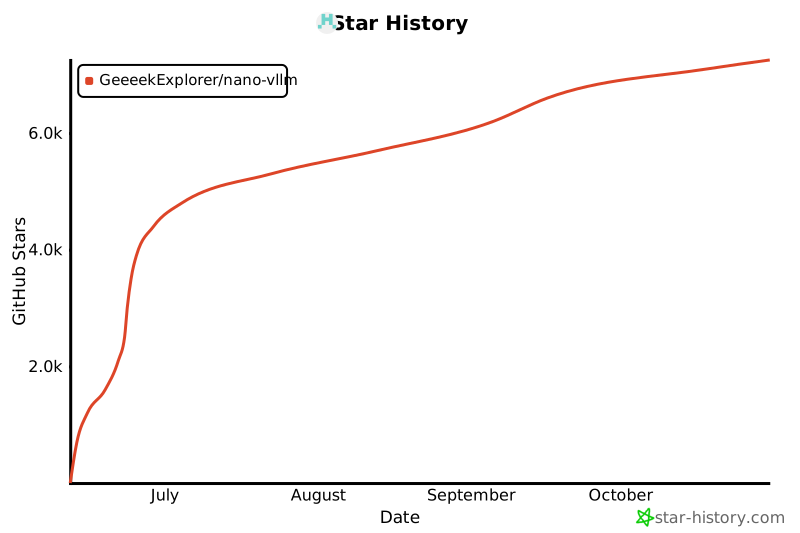](https://www.star-history.com/#GeeeekExplorer/nano-vllm&Date)
================================================
FILE: bench.py
================================================
import os
import time
from random import randint, seed
from nanovllm import LLM, SamplingParams
# from vllm import LLM, SamplingParams
def main():
seed(0)
num_seqs = 256
max_input_len = 1024
max_ouput_len = 1024
path = os.path.expanduser("~/huggingface/Qwen3-0.6B/")
llm = LLM(path, enforce_eager=False, max_model_len=4096)
prompt_token_ids = [[randint(0, 10000) for _ in range(randint(100, max_input_len))] for _ in range(num_seqs)]
sampling_params = [SamplingParams(temperature=0.6, ignore_eos=True, max_tokens=randint(100, max_ouput_len)) for _ in range(num_seqs)]
# uncomment the following line for vllm
# prompt_token_ids = [dict(prompt_token_ids=p) for p in prompt_token_ids]
llm.generate(["Benchmark: "], SamplingParams())
t = time.time()
llm.generate(prompt_token_ids, sampling_params, use_tqdm=False)
t = (time.time() - t)
total_tokens = sum(sp.max_tokens for sp in sampling_params)
throughput = total_tokens / t
print(f"Total: {total_tokens}tok, Time: {t:.2f}s, Throughput: {throughput:.2f}tok/s")
if __name__ == "__main__":
main()
================================================
FILE: example.py
================================================
import os
from nanovllm import LLM, SamplingParams
from transformers import AutoTokenizer
def main():
path = os.path.expanduser("~/huggingface/Qwen3-0.6B/")
tokenizer = AutoTokenizer.from_pretrained(path)
llm = LLM(path, enforce_eager=True, tensor_parallel_size=1)
sampling_params = SamplingParams(temperature=0.6, max_tokens=256)
prompts = [
"introduce yourself",
"list all prime numbers within 100",
]
prompts = [
tokenizer.apply_chat_template(
[{"role": "user", "content": prompt}],
tokenize=False,
add_generation_prompt=True,
)
for prompt in prompts
]
outputs = llm.generate(prompts, sampling_params)
for prompt, output in zip(prompts, outputs):
print("\n")
print(f"Prompt: {prompt!r}")
print(f"Completion: {output['text']!r}")
if __name__ == "__main__":
main()
================================================
FILE: nanovllm/__init__.py
================================================
from nanovllm.llm import LLM
from nanovllm.sampling_params import SamplingParams
================================================
FILE: nanovllm/config.py
================================================
import os
from dataclasses import dataclass
from transformers import AutoConfig
@dataclass
class Config:
model: str
max_num_batched_tokens: int = 16384
max_num_seqs: int = 512
max_model_len: int = 4096
gpu_memory_utilization: float = 0.9
tensor_parallel_size: int = 1
enforce_eager: bool = False
hf_config: AutoConfig | None = None
eos: int = -1
kvcache_block_size: int = 256
num_kvcache_blocks: int = -1
def __post_init__(self):
assert os.path.isdir(self.model)
assert self.kvcache_block_size % 256 == 0
assert 1 <= self.tensor_parallel_size <= 8
self.hf_config = AutoConfig.from_pretrained(self.model)
self.max_model_len = min(self.max_model_len, self.hf_config.max_position_embeddings)
assert self.max_num_batched_tokens >= self.max_model_len
================================================
FILE: nanovllm/engine/block_manager.py
================================================
from collections import deque
import xxhash
import numpy as np
from nanovllm.engine.sequence import Sequence
class Block:
def __init__(self, block_id):
self.block_id = block_id
self.ref_count = 0
self.hash = -1
self.token_ids = []
def update(self, hash: int, token_ids: list[int]):
self.hash = hash
self.token_ids = token_ids
def reset(self):
self.ref_count = 1
self.hash = -1
self.token_ids = []
class BlockManager:
def __init__(self, num_blocks: int, block_size: int):
self.block_size = block_size
self.blocks: list[Block] = [Block(i) for i in range(num_blocks)]
self.hash_to_block_id: dict[int, int] = dict()
self.free_block_ids: deque[int] = deque(range(num_blocks))
self.used_block_ids: set[int] = set()
@classmethod
def compute_hash(cls, token_ids: list[int], prefix: int = -1):
h = xxhash.xxh64()
if prefix != -1:
h.update(prefix.to_bytes(8, "little"))
h.update(np.array(token_ids).tobytes())
return h.intdigest()
def _allocate_block(self, block_id: int) -> Block:
block = self.blocks[block_id]
assert block.ref_count == 0
block.reset()
self.free_block_ids.remove(block_id)
self.used_block_ids.add(block_id)
return self.blocks[block_id]
def _deallocate_block(self, block_id: int) -> Block:
assert self.blocks[block_id].ref_count == 0
self.used_block_ids.remove(block_id)
self.free_block_ids.append(block_id)
def can_allocate(self, seq: Sequence) -> bool:
return len(self.free_block_ids) >= seq.num_blocks
def allocate(self, seq: Sequence):
assert not seq.block_table
h = -1
cache_miss = False
for i in range(seq.num_blocks):
token_ids = seq.block(i)
h = self.compute_hash(token_ids, h) if len(token_ids) == self.block_size else -1
block_id = self.hash_to_block_id.get(h, -1)
if block_id == -1 or self.blocks[block_id].token_ids != token_ids:
cache_miss = True
if cache_miss:
block_id = self.free_block_ids[0]
block = self._allocate_block(block_id)
else:
seq.num_cached_tokens += self.block_size
if block_id in self.used_block_ids:
block = self.blocks[block_id]
block.ref_count += 1
else:
block = self._allocate_block(block_id)
if h != -1:
block.update(h, token_ids)
self.hash_to_block_id[h] = block_id
seq.block_table.append(block_id)
def deallocate(self, seq: Sequence):
for block_id in reversed(seq.block_table):
block = self.blocks[block_id]
block.ref_count -= 1
if block.ref_count == 0:
self._deallocate_block(block_id)
seq.num_cached_tokens = 0
seq.block_table.clear()
def can_append(self, seq: Sequence) -> bool:
return len(self.free_block_ids) >= (len(seq) % self.block_size == 1)
def may_append(self, seq: Sequence):
block_table = seq.block_table
last_block = self.blocks[block_table[-1]]
if len(seq) % self.block_size == 1:
assert last_block.hash != -1
block_id = self.free_block_ids[0]
self._allocate_block(block_id)
block_table.append(block_id)
elif len(seq) % self.block_size == 0:
assert last_block.hash == -1
token_ids = seq.block(seq.num_blocks-1)
prefix = self.blocks[block_table[-2]].hash if len(block_table) > 1 else -1
h = self.compute_hash(token_ids, prefix)
last_block.update(h, token_ids)
self.hash_to_block_id[h] = last_block.block_id
else:
assert last_block.hash == -1
================================================
FILE: nanovllm/engine/llm_engine.py
================================================
import atexit
from dataclasses import fields
from time import perf_counter
from tqdm.auto import tqdm
from transformers import AutoTokenizer
import torch.multiprocessing as mp
from nanovllm.config import Config
from nanovllm.sampling_params import SamplingParams
from nanovllm.engine.sequence import Sequence
from nanovllm.engine.scheduler import Scheduler
from nanovllm.engine.model_runner import ModelRunner
class LLMEngine:
def __init__(self, model, **kwargs):
config_fields = {field.name for field in fields(Config)}
config_kwargs = {k: v for k, v in kwargs.items() if k in config_fields}
config = Config(model, **config_kwargs)
self.ps = []
self.events = []
ctx = mp.get_context("spawn")
for i in range(1, config.tensor_parallel_size):
event = ctx.Event()
process = ctx.Process(target=ModelRunner, args=(config, i, event))
process.start()
self.ps.append(process)
self.events.append(event)
self.model_runner = ModelRunner(config, 0, self.events)
self.tokenizer = AutoTokenizer.from_pretrained(config.model, use_fast=True)
config.eos = self.tokenizer.eos_token_id
self.scheduler = Scheduler(config)
atexit.register(self.exit)
def exit(self):
self.model_runner.call("exit")
del self.model_runner
for p in self.ps:
p.join()
def add_request(self, prompt: str | list[int], sampling_params: SamplingParams):
if isinstance(prompt, str):
prompt = self.tokenizer.encode(prompt)
seq = Sequence(prompt, sampling_params)
self.scheduler.add(seq)
def step(self):
seqs, is_prefill = self.scheduler.schedule()
token_ids = self.model_runner.call("run", seqs, is_prefill)
self.scheduler.postprocess(seqs, token_ids)
outputs = [(seq.seq_id, seq.completion_token_ids) for seq in seqs if seq.is_finished]
num_tokens = sum(len(seq) for seq in seqs) if is_prefill else -len(seqs)
return outputs, num_tokens
def is_finished(self):
return self.scheduler.is_finished()
def generate(
self,
prompts: list[str] | list[list[int]],
sampling_params: SamplingParams | list[SamplingParams],
use_tqdm: bool = True,
) -> list[str]:
if use_tqdm:
pbar = tqdm(total=len(prompts), desc="Generating", dynamic_ncols=True)
if not isinstance(sampling_params, list):
sampling_params = [sampling_params] * len(prompts)
for prompt, sp in zip(prompts, sampling_params):
self.add_request(prompt, sp)
outputs = {}
prefill_throughput = decode_throughput = 0.
while not self.is_finished():
t = perf_counter()
output, num_tokens = self.step()
if use_tqdm:
if num_tokens > 0:
prefill_throughput = num_tokens / (perf_counter() - t)
else:
decode_throughput = -num_tokens / (perf_counter() - t)
pbar.set_postfix({
"Prefill": f"{int(prefill_throughput)}tok/s",
"Decode": f"{int(decode_throughput)}tok/s",
})
for seq_id, token_ids in output:
outputs[seq_id] = token_ids
if use_tqdm:
pbar.update(1)
outputs = [outputs[seq_id] for seq_id in sorted(outputs.keys())]
outputs = [{"text": self.tokenizer.decode(token_ids), "token_ids": token_ids} for token_ids in outputs]
if use_tqdm:
pbar.close()
return outputs
================================================
FILE: nanovllm/engine/model_runner.py
================================================
import pickle
import torch
import torch.distributed as dist
from multiprocessing.synchronize import Event
from multiprocessing.shared_memory import SharedMemory
from nanovllm.config import Config
from nanovllm.engine.sequence import Sequence
from nanovllm.models.qwen3 import Qwen3ForCausalLM
from nanovllm.layers.sampler import Sampler
from nanovllm.utils.context import set_context, get_context, reset_context
from nanovllm.utils.loader import load_model
class ModelRunner:
def __init__(self, config: Config, rank: int, event: Event | list[Event]):
self.config = config
hf_config = config.hf_config
self.block_size = config.kvcache_block_size
self.enforce_eager = config.enforce_eager
self.world_size = config.tensor_parallel_size
self.rank = rank
self.event = event
dist.init_process_group("nccl", "tcp://localhost:2333", world_size=self.world_size, rank=rank)
torch.cuda.set_device(rank)
default_dtype = torch.get_default_dtype()
torch.set_default_dtype(hf_config.torch_dtype)
torch.set_default_device("cuda")
self.model = Qwen3ForCausalLM(hf_config)
load_model(self.model, config.model)
self.sampler = Sampler()
self.warmup_model()
self.allocate_kv_cache()
if not self.enforce_eager:
self.capture_cudagraph()
torch.set_default_device("cpu")
torch.set_default_dtype(default_dtype)
if self.world_size > 1:
if rank == 0:
self.shm = SharedMemory(name="nanovllm", create=True, size=2**20)
dist.barrier()
else:
dist.barrier()
self.shm = SharedMemory(name="nanovllm")
self.loop()
def exit(self):
if self.world_size > 1:
self.shm.close()
dist.barrier()
if self.rank == 0:
self.shm.unlink()
if not self.enforce_eager:
del self.graphs, self.graph_pool
torch.cuda.synchronize()
dist.destroy_process_group()
def loop(self):
while True:
method_name, args = self.read_shm()
self.call(method_name, *args)
if method_name == "exit":
break
def read_shm(self):
assert self.world_size > 1 and self.rank > 0
self.event.wait()
n = int.from_bytes(self.shm.buf[0:4], "little")
method_name, *args = pickle.loads(self.shm.buf[4:n+4])
self.event.clear()
return method_name, args
def write_shm(self, method_name, *args):
assert self.world_size > 1 and self.rank == 0
data = pickle.dumps([method_name, *args])
n = len(data)
self.shm.buf[0:4] = n.to_bytes(4, "little")
self.shm.buf[4:n+4] = data
for event in self.event:
event.set()
def call(self, method_name, *args):
if self.world_size > 1 and self.rank == 0:
self.write_shm(method_name, *args)
method = getattr(self, method_name, None)
return method(*args)
def warmup_model(self):
torch.cuda.empty_cache()
torch.cuda.reset_peak_memory_stats()
max_num_batched_tokens, max_model_len = self.config.max_num_batched_tokens, self.config.max_model_len
num_seqs = min(max_num_batched_tokens // max_model_len, self.config.max_num_seqs)
seqs = [Sequence([0] * max_model_len) for _ in range(num_seqs)]
self.run(seqs, True)
torch.cuda.empty_cache()
def allocate_kv_cache(self):
config = self.config
hf_config = config.hf_config
free, total = torch.cuda.mem_get_info()
used = total - free
peak = torch.cuda.memory_stats()["allocated_bytes.all.peak"]
current = torch.cuda.memory_stats()["allocated_bytes.all.current"]
num_kv_heads = hf_config.num_key_value_heads // self.world_size
head_dim = getattr(hf_config, "head_dim", hf_config.hidden_size // hf_config.num_attention_heads)
block_bytes = 2 * hf_config.num_hidden_layers * self.block_size * num_kv_heads * head_dim * hf_config.torch_dtype.itemsize
config.num_kvcache_blocks = int(total * config.gpu_memory_utilization - used - peak + current) // block_bytes
assert config.num_kvcache_blocks > 0
self.kv_cache = torch.empty(2, hf_config.num_hidden_layers, config.num_kvcache_blocks, self.block_size, num_kv_heads, head_dim)
layer_id = 0
for module in self.model.modules():
if hasattr(module, "k_cache") and hasattr(module, "v_cache"):
module.k_cache = self.kv_cache[0, layer_id]
module.v_cache = self.kv_cache[1, layer_id]
layer_id += 1
def prepare_block_tables(self, seqs: list[Sequence]):
max_len = max(len(seq.block_table) for seq in seqs)
block_tables = [seq.block_table + [-1] * (max_len - len(seq.block_table)) for seq in seqs]
block_tables = torch.tensor(block_tables, dtype=torch.int32, pin_memory=True).cuda(non_blocking=True)
return block_tables
def prepare_prefill(self, seqs: list[Sequence]):
input_ids = []
positions = []
cu_seqlens_q = [0]
cu_seqlens_k = [0]
max_seqlen_q = 0
max_seqlen_k = 0
slot_mapping = []
block_tables = None
for seq in seqs:
seqlen = len(seq)
input_ids.extend(seq[seq.num_cached_tokens:])
positions.extend(list(range(seq.num_cached_tokens, seqlen)))
seqlen_q = seqlen - seq.num_cached_tokens
seqlen_k = seqlen
cu_seqlens_q.append(cu_seqlens_q[-1] + seqlen_q)
cu_seqlens_k.append(cu_seqlens_k[-1] + seqlen_k)
max_seqlen_q = max(seqlen_q, max_seqlen_q)
max_seqlen_k = max(seqlen_k, max_seqlen_k)
if not seq.block_table: # warmup
continue
for i in range(seq.num_cached_blocks, seq.num_blocks):
start = seq.block_table[i] * self.block_size
if i != seq.num_blocks - 1:
end = start + self.block_size
else:
end = start + seq.last_block_num_tokens
slot_mapping.extend(list(range(start, end)))
if cu_seqlens_k[-1] > cu_seqlens_q[-1]: # prefix cache
block_tables = self.prepare_block_tables(seqs)
input_ids = torch.tensor(input_ids, dtype=torch.int64, pin_memory=True).cuda(non_blocking=True)
positions = torch.tensor(positions, dtype=torch.int64, pin_memory=True).cuda(non_blocking=True)
cu_seqlens_q = torch.tensor(cu_seqlens_q, dtype=torch.int32, pin_memory=True).cuda(non_blocking=True)
cu_seqlens_k = torch.tensor(cu_seqlens_k, dtype=torch.int32, pin_memory=True).cuda(non_blocking=True)
slot_mapping = torch.tensor(slot_mapping, dtype=torch.int32, pin_memory=True).cuda(non_blocking=True)
set_context(True, cu_seqlens_q, cu_seqlens_k, max_seqlen_q, max_seqlen_k, slot_mapping, None, block_tables)
return input_ids, positions
def prepare_decode(self, seqs: list[Sequence]):
input_ids = []
positions = []
slot_mapping = []
context_lens = []
for seq in seqs:
input_ids.append(seq.last_token)
positions.append(len(seq) - 1)
context_lens.append(len(seq))
slot_mapping.append(seq.block_table[-1] * self.block_size + seq.last_block_num_tokens - 1)
input_ids = torch.tensor(input_ids, dtype=torch.int64, pin_memory=True).cuda(non_blocking=True)
positions = torch.tensor(positions, dtype=torch.int64, pin_memory=True).cuda(non_blocking=True)
slot_mapping = torch.tensor(slot_mapping, dtype=torch.int32, pin_memory=True).cuda(non_blocking=True)
context_lens = torch.tensor(context_lens, dtype=torch.int32, pin_memory=True).cuda(non_blocking=True)
block_tables = self.prepare_block_tables(seqs)
set_context(False, slot_mapping=slot_mapping, context_lens=context_lens, block_tables=block_tables)
return input_ids, positions
def prepare_sample(self, seqs: list[Sequence]):
temperatures = []
for seq in seqs:
temperatures.append(seq.temperature)
temperatures = torch.tensor(temperatures, dtype=torch.float32, pin_memory=True).cuda(non_blocking=True)
return temperatures
@torch.inference_mode()
def run_model(self, input_ids: torch.Tensor, positions: torch.Tensor, is_prefill: bool):
if is_prefill or self.enforce_eager or input_ids.size(0) > 512:
return self.model.compute_logits(self.model(input_ids, positions))
else:
bs = input_ids.size(0)
context = get_context()
graph = self.graphs[next(x for x in self.graph_bs if x >= bs)]
graph_vars = self.graph_vars
graph_vars["input_ids"][:bs] = input_ids
graph_vars["positions"][:bs] = positions
graph_vars["slot_mapping"].fill_(-1)
graph_vars["slot_mapping"][:bs] = context.slot_mapping
graph_vars["context_lens"].zero_()
graph_vars["context_lens"][:bs] = context.context_lens
graph_vars["block_tables"][:bs, :context.block_tables.size(1)] = context.block_tables
graph.replay()
return self.model.compute_logits(graph_vars["outputs"][:bs])
def run(self, seqs: list[Sequence], is_prefill: bool) -> list[int]:
input_ids, positions = self.prepare_prefill(seqs) if is_prefill else self.prepare_decode(seqs)
temperatures = self.prepare_sample(seqs) if self.rank == 0 else None
logits = self.run_model(input_ids, positions, is_prefill)
token_ids = self.sampler(logits, temperatures).tolist() if self.rank == 0 else None
reset_context()
return token_ids
@torch.inference_mode()
def capture_cudagraph(self):
config = self.config
hf_config = config.hf_config
max_bs = min(self.config.max_num_seqs, 512)
max_num_blocks = (config.max_model_len + self.block_size - 1) // self.block_size
input_ids = torch.zeros(max_bs, dtype=torch.int64)
positions = torch.zeros(max_bs, dtype=torch.int64)
slot_mapping = torch.zeros(max_bs, dtype=torch.int32)
context_lens = torch.zeros(max_bs, dtype=torch.int32)
block_tables = torch.zeros(max_bs, max_num_blocks, dtype=torch.int32)
outputs = torch.zeros(max_bs, hf_config.hidden_size)
self.graph_bs = [1, 2, 4, 8] + list(range(16, max_bs + 1, 16))
self.graphs = {}
self.graph_pool = None
for bs in reversed(self.graph_bs):
graph = torch.cuda.CUDAGraph()
set_context(False, slot_mapping=slot_mapping[:bs], context_lens=context_lens[:bs], block_tables=block_tables[:bs])
outputs[:bs] = self.model(input_ids[:bs], positions[:bs]) # warmup
with torch.cuda.graph(graph, self.graph_pool):
outputs[:bs] = self.model(input_ids[:bs], positions[:bs]) # capture
if self.graph_pool is None:
self.graph_pool = graph.pool()
self.graphs[bs] = graph
torch.cuda.synchronize()
reset_context()
self.graph_vars = dict(
input_ids=input_ids,
positions=positions,
slot_mapping=slot_mapping,
context_lens=context_lens,
block_tables=block_tables,
outputs=outputs,
)
================================================
FILE: nanovllm/engine/scheduler.py
================================================
from collections import deque
from nanovllm.config import Config
from nanovllm.engine.sequence import Sequence, SequenceStatus
from nanovllm.engine.block_manager import BlockManager
class Scheduler:
def __init__(self, config: Config):
self.max_num_seqs = config.max_num_seqs
self.max_num_batched_tokens = config.max_num_batched_tokens
self.eos = config.eos
self.block_manager = BlockManager(config.num_kvcache_blocks, config.kvcache_block_size)
self.waiting: deque[Sequence] = deque()
self.running: deque[Sequence] = deque()
def is_finished(self):
return not self.waiting and not self.running
def add(self, seq: Sequence):
self.waiting.append(seq)
def schedule(self) -> tuple[list[Sequence], bool]:
# prefill
scheduled_seqs = []
num_seqs = 0
num_batched_tokens = 0
while self.waiting and num_seqs < self.max_num_seqs:
seq = self.waiting[0]
if num_batched_tokens + len(seq) > self.max_num_batched_tokens or not self.block_manager.can_allocate(seq):
break
num_seqs += 1
self.block_manager.allocate(seq)
num_batched_tokens += len(seq) - seq.num_cached_tokens
seq.status = SequenceStatus.RUNNING
self.waiting.popleft()
self.running.append(seq)
scheduled_seqs.append(seq)
if scheduled_seqs:
return scheduled_seqs, True
# decode
while self.running and num_seqs < self.max_num_seqs:
seq = self.running.popleft()
while not self.block_manager.can_append(seq):
if self.running:
self.preempt(self.running.pop())
else:
self.preempt(seq)
break
else:
num_seqs += 1
self.block_manager.may_append(seq)
scheduled_seqs.append(seq)
assert scheduled_seqs
self.running.extendleft(reversed(scheduled_seqs))
return scheduled_seqs, False
def preempt(self, seq: Sequence):
seq.status = SequenceStatus.WAITING
self.block_manager.deallocate(seq)
self.waiting.appendleft(seq)
def postprocess(self, seqs: list[Sequence], token_ids: list[int]) -> list[bool]:
for seq, token_id in zip(seqs, token_ids):
seq.append_token(token_id)
if (not seq.ignore_eos and token_id == self.eos) or seq.num_completion_tokens == seq.max_tokens:
seq.status = SequenceStatus.FINISHED
self.block_manager.deallocate(seq)
self.running.remove(seq)
================================================
FILE: nanovllm/engine/sequence.py
================================================
from copy import copy
from enum import Enum, auto
from itertools import count
from nanovllm.sampling_params import SamplingParams
class SequenceStatus(Enum):
WAITING = auto()
RUNNING = auto()
FINISHED = auto()
class Sequence:
block_size = 256
counter = count()
def __init__(self, token_ids: list[int], sampling_params = SamplingParams()):
self.seq_id = next(Sequence.counter)
self.status = SequenceStatus.WAITING
self.token_ids = copy(token_ids)
self.last_token = token_ids[-1]
self.num_tokens = len(self.token_ids)
self.num_prompt_tokens = len(token_ids)
self.num_cached_tokens = 0
self.block_table = []
self.temperature = sampling_params.temperature
self.max_tokens = sampling_params.max_tokens
self.ignore_eos = sampling_params.ignore_eos
def __len__(self):
return self.num_tokens
def __getitem__(self, key):
return self.token_ids[key]
@property
def is_finished(self):
return self.status == SequenceStatus.FINISHED
@property
def num_completion_tokens(self):
return self.num_tokens - self.num_prompt_tokens
@property
def prompt_token_ids(self):
return self.token_ids[:self.num_prompt_tokens]
@property
def completion_token_ids(self):
return self.token_ids[self.num_prompt_tokens:]
@property
def num_cached_blocks(self):
return self.num_cached_tokens // self.block_size
@property
def num_blocks(self):
return (self.num_tokens + self.block_size - 1) // self.block_size
@property
def last_block_num_tokens(self):
return self.num_tokens - (self.num_blocks - 1) * self.block_size
def block(self, i):
assert 0 <= i < self.num_blocks
return self.token_ids[i*self.block_size: (i+1)*self.block_size]
def append_token(self, token_id: int):
self.token_ids.append(token_id)
self.last_token = token_id
self.num_tokens += 1
def __getstate__(self):
return (self.num_tokens, self.num_prompt_tokens, self.num_cached_tokens, self.block_table,
self.token_ids if self.num_completion_tokens == 0 else self.last_token)
def __setstate__(self, state):
self.num_tokens, self.num_prompt_tokens, self.num_cached_tokens, self.block_table = state[:-1]
if self.num_completion_tokens == 0:
self.token_ids = state[-1]
else:
self.last_token = state[-1]
================================================
FILE: nanovllm/layers/activation.py
================================================
import torch
from torch import nn
import torch.nn.functional as F
class SiluAndMul(nn.Module):
def __init__(self):
super().__init__()
@torch.compile
def forward(self, x: torch.Tensor) -> torch.Tensor:
x, y = x.chunk(2, -1)
return F.silu(x) * y
================================================
FILE: nanovllm/layers/attention.py
================================================
import torch
from torch import nn
import triton
import triton.language as tl
from flash_attn import flash_attn_varlen_func, flash_attn_with_kvcache
from nanovllm.utils.context import get_context
@triton.jit
def store_kvcache_kernel(
key_ptr,
key_stride,
value_ptr,
value_stride,
k_cache_ptr,
v_cache_ptr,
slot_mapping_ptr,
D: tl.constexpr,
):
idx = tl.program_id(0)
slot = tl.load(slot_mapping_ptr + idx)
if slot == -1: return
key_offsets = idx * key_stride + tl.arange(0, D)
value_offsets = idx * value_stride + tl.arange(0, D)
key = tl.load(key_ptr + key_offsets)
value = tl.load(value_ptr + value_offsets)
cache_offsets = slot * D + tl.arange(0, D)
tl.store(k_cache_ptr + cache_offsets, key)
tl.store(v_cache_ptr + cache_offsets, value)
def store_kvcache(key: torch.Tensor, value: torch.Tensor, k_cache: torch.Tensor, v_cache: torch.Tensor, slot_mapping: torch.Tensor):
N, num_heads, head_dim = key.shape
D = num_heads * head_dim
assert key.stride(-1) == 1 and value.stride(-1) == 1
assert key.stride(1) == head_dim and value.stride(1) == head_dim
assert k_cache.stride(1) == D and v_cache.stride(1) == D
assert slot_mapping.numel() == N
store_kvcache_kernel[(N,)](key, key.stride(0), value, value.stride(0), k_cache, v_cache, slot_mapping, D)
class Attention(nn.Module):
def __init__(
self,
num_heads,
head_dim,
scale,
num_kv_heads,
):
super().__init__()
self.num_heads = num_heads
self.head_dim = head_dim
self.scale = scale
self.num_kv_heads = num_kv_heads
self.k_cache = self.v_cache = torch.tensor([])
def forward(self, q: torch.Tensor, k: torch.Tensor, v: torch.Tensor):
context = get_context()
k_cache, v_cache = self.k_cache, self.v_cache
if k_cache.numel() and v_cache.numel():
store_kvcache(k, v, k_cache, v_cache, context.slot_mapping)
if context.is_prefill:
if context.block_tables is not None: # prefix cache
k, v = k_cache, v_cache
o = flash_attn_varlen_func(q, k, v,
max_seqlen_q=context.max_seqlen_q, cu_seqlens_q=context.cu_seqlens_q,
max_seqlen_k=context.max_seqlen_k, cu_seqlens_k=context.cu_seqlens_k,
softmax_scale=self.scale, causal=True, block_table=context.block_tables)
else: # decode
o = flash_attn_with_kvcache(q.unsqueeze(1), k_cache, v_cache,
cache_seqlens=context.context_lens, block_table=context.block_tables,
softmax_scale=self.scale, causal=True)
return o
================================================
FILE: nanovllm/layers/embed_head.py
================================================
import torch
from torch import nn
import torch.nn.functional as F
import torch.distributed as dist
from nanovllm.utils.context import get_context
class VocabParallelEmbedding(nn.Module):
def __init__(
self,
num_embeddings: int,
embedding_dim: int,
):
super().__init__()
self.tp_rank = dist.get_rank()
self.tp_size = dist.get_world_size()
assert num_embeddings % self.tp_size == 0
self.num_embeddings = num_embeddings
self.num_embeddings_per_partition = self.num_embeddings // self.tp_size
self.vocab_start_idx = self.num_embeddings_per_partition * self.tp_rank
self.vocab_end_idx = self.vocab_start_idx + self.num_embeddings_per_partition
self.weight = nn.Parameter(torch.empty(self.num_embeddings_per_partition, embedding_dim))
self.weight.weight_loader = self.weight_loader
def weight_loader(self, param: nn.Parameter, loaded_weight: torch.Tensor):
param_data = param.data
shard_size = param_data.size(0)
start_idx = self.tp_rank * shard_size
loaded_weight = loaded_weight.narrow(0, start_idx, shard_size)
param_data.copy_(loaded_weight)
def forward(self, x: torch.Tensor):
if self.tp_size > 1:
mask = (x >= self.vocab_start_idx) & (x < self.vocab_end_idx)
x = mask * (x - self.vocab_start_idx)
y = F.embedding(x, self.weight)
if self.tp_size > 1:
y = mask.unsqueeze(1) * y
dist.all_reduce(y)
return y
class ParallelLMHead(VocabParallelEmbedding):
def __init__(
self,
num_embeddings: int,
embedding_dim: int,
bias: bool = False,
):
assert not bias
super().__init__(num_embeddings, embedding_dim)
def forward(self, x: torch.Tensor):
context = get_context()
if context.is_prefill:
last_indices = context.cu_seqlens_q[1:] - 1
x = x[last_indices].contiguous()
logits = F.linear(x, self.weight)
if self.tp_size > 1:
all_logits = [torch.empty_like(logits) for _ in range(self.tp_size)] if self.tp_rank == 0 else None
dist.gather(logits, all_logits, 0)
logits = torch.cat(all_logits, -1) if self.tp_rank == 0 else None
return logits
================================================
FILE: nanovllm/layers/layernorm.py
================================================
import torch
from torch import nn
class RMSNorm(nn.Module):
def __init__(
self,
hidden_size: int,
eps: float = 1e-6,
) -> None:
super().__init__()
self.eps = eps
self.weight = nn.Parameter(torch.ones(hidden_size))
@torch.compile
def rms_forward(
self,
x: torch.Tensor,
) -> torch.Tensor:
orig_dtype = x.dtype
x = x.float()
var = x.pow(2).mean(dim=-1, keepdim=True)
x.mul_(torch.rsqrt(var + self.eps))
x = x.to(orig_dtype).mul_(self.weight)
return x
@torch.compile
def add_rms_forward(
self,
x: torch.Tensor,
residual: torch.Tensor,
) -> tuple[torch.Tensor, torch.Tensor]:
orig_dtype = x.dtype
x = x.float().add_(residual.float())
residual = x.to(orig_dtype)
var = x.pow(2).mean(dim=-1, keepdim=True)
x.mul_(torch.rsqrt(var + self.eps))
x = x.to(orig_dtype).mul_(self.weight)
return x, residual
def forward(
self,
x: torch.Tensor,
residual: torch.Tensor | None = None,
) -> torch.Tensor | tuple[torch.Tensor, torch.Tensor]:
if residual is None:
return self.rms_forward(x)
else:
return self.add_rms_forward(x, residual)
================================================
FILE: nanovllm/layers/linear.py
================================================
import torch
from torch import nn
import torch.nn.functional as F
import torch.distributed as dist
def divide(numerator, denominator):
assert numerator % denominator == 0
return numerator // denominator
class LinearBase(nn.Module):
def __init__(
self,
input_size: int,
output_size: int,
bias: bool = False,
tp_dim: int | None = None,
):
super().__init__()
self.tp_dim = tp_dim
self.tp_rank = dist.get_rank()
self.tp_size = dist.get_world_size()
self.weight = nn.Parameter(torch.empty(output_size, input_size))
self.weight.weight_loader = self.weight_loader
if bias:
self.bias = nn.Parameter(torch.empty(output_size))
self.bias.weight_loader = self.weight_loader
else:
self.register_parameter("bias", None)
def forward(self, x: torch.Tensor) -> torch.Tensor:
raise NotImplementedError
class ReplicatedLinear(LinearBase):
def __init__(
self,
input_size: int,
output_size: int,
bias: bool = False,
):
super().__init__(input_size, output_size, bias)
def weight_loader(self, param: nn.Parameter, loaded_weight: torch.Tensor):
param.data.copy_(loaded_weight)
def forward(self, x: torch.Tensor) -> torch.Tensor:
return F.linear(x, self.weight, self.bias)
class ColumnParallelLinear(LinearBase):
def __init__(
self,
input_size: int,
output_size: int,
bias: bool = False,
):
tp_size = dist.get_world_size()
super().__init__(input_size, divide(output_size, tp_size), bias, 0)
def weight_loader(self, param: nn.Parameter, loaded_weight: torch.Tensor):
param_data = param.data
shard_size = param_data.size(self.tp_dim)
start_idx = self.tp_rank * shard_size
loaded_weight = loaded_weight.narrow(self.tp_dim, start_idx, shard_size)
param_data.copy_(loaded_weight)
def forward(self, x: torch.Tensor) -> torch.Tensor:
return F.linear(x, self.weight, self.bias)
class MergedColumnParallelLinear(ColumnParallelLinear):
def __init__(
self,
input_size: int,
output_sizes: list[int],
bias: bool = False,
):
self.output_sizes = output_sizes
super().__init__(input_size, sum(output_sizes), bias)
def weight_loader(self, param: nn.Parameter, loaded_weight: torch.Tensor, loaded_shard_id: int):
param_data = param.data
shard_offset = sum(self.output_sizes[:loaded_shard_id]) // self.tp_size
shard_size = self.output_sizes[loaded_shard_id] // self.tp_size
param_data = param_data.narrow(self.tp_dim, shard_offset, shard_size)
loaded_weight = loaded_weight.chunk(self.tp_size, self.tp_dim)[self.tp_rank]
param_data.copy_(loaded_weight)
class QKVParallelLinear(ColumnParallelLinear):
def __init__(
self,
hidden_size: int,
head_size: int,
total_num_heads: int,
total_num_kv_heads: int | None = None,
bias: bool = False,
):
tp_size = dist.get_world_size()
total_num_kv_heads = total_num_kv_heads or total_num_heads
self.head_size = head_size
self.num_heads = divide(total_num_heads, tp_size)
self.num_kv_heads = divide(total_num_kv_heads, tp_size)
output_size = (total_num_heads + 2 * total_num_kv_heads) * self.head_size
super().__init__(hidden_size, output_size, bias)
def weight_loader(self, param: nn.Parameter, loaded_weight: torch.Tensor, loaded_shard_id: str):
param_data = param.data
assert loaded_shard_id in ["q", "k", "v"]
if loaded_shard_id == "q":
shard_size = self.num_heads * self.head_size
shard_offset = 0
elif loaded_shard_id == "k":
shard_size = self.num_kv_heads * self.head_size
shard_offset = self.num_heads * self.head_size
else:
shard_size = self.num_kv_heads * self.head_size
shard_offset = self.num_heads * self.head_size + self.num_kv_heads * self.head_size
param_data = param_data.narrow(self.tp_dim, shard_offset, shard_size)
loaded_weight = loaded_weight.chunk(self.tp_size, self.tp_dim)[self.tp_rank]
param_data.copy_(loaded_weight)
class RowParallelLinear(LinearBase):
def __init__(
self,
input_size: int,
output_size: int,
bias: bool = False,
):
tp_size = dist.get_world_size()
super().__init__(divide(input_size, tp_size), output_size, bias, 1)
def weight_loader(self, param: nn.Parameter, loaded_weight: torch.Tensor):
param_data = param.data
shard_size = param_data.size(self.tp_dim)
start_idx = self.tp_rank * shard_size
loaded_weight = loaded_weight.narrow(self.tp_dim, start_idx, shard_size)
param_data.copy_(loaded_weight)
def forward(self, x: torch.Tensor) -> torch.Tensor:
y = F.linear(x, self.weight, self.bias if self.tp_rank == 0 else None)
if self.tp_size > 1:
dist.all_reduce(y)
return y
================================================
FILE: nanovllm/layers/rotary_embedding.py
================================================
from functools import lru_cache
import torch
from torch import nn
def apply_rotary_emb(
x: torch.Tensor,
cos: torch.Tensor,
sin: torch.Tensor,
) -> torch.Tensor:
x1, x2 = torch.chunk(x.float(), 2, dim=-1)
y1 = x1 * cos - x2 * sin
y2 = x2 * cos + x1 * sin
return torch.cat((y1, y2), dim=-1).to(x.dtype)
class RotaryEmbedding(nn.Module):
def __init__(
self,
head_size: int,
rotary_dim: int,
max_position_embeddings: int,
base: float,
) -> None:
super().__init__()
self.head_size = head_size
assert rotary_dim == head_size
inv_freq = 1.0 / (base**(torch.arange(0, rotary_dim, 2, dtype=torch.float) / rotary_dim))
t = torch.arange(max_position_embeddings, dtype=torch.float)
freqs = torch.einsum("i,j -> ij", t, inv_freq)
cos = freqs.cos()
sin = freqs.sin()
cache = torch.cat((cos, sin), dim=-1).unsqueeze_(1)
self.register_buffer("cos_sin_cache", cache, persistent=False)
@torch.compile
def forward(
self,
positions: torch.Tensor,
query: torch.Tensor,
key: torch.Tensor,
) -> tuple[torch.Tensor, torch.Tensor]:
cos_sin = self.cos_sin_cache[positions]
cos, sin = cos_sin.chunk(2, dim=-1)
query = apply_rotary_emb(query, cos, sin)
key = apply_rotary_emb(key, cos, sin)
return query, key
@lru_cache(1)
def get_rope(
head_size: int,
rotary_dim: int,
max_position: int,
base: float,
rope_scaling: dict | None = None,
):
assert rope_scaling is None
rotary_emb = RotaryEmbedding(head_size, rotary_dim, max_position, base)
return rotary_emb
================================================
FILE: nanovllm/layers/sampler.py
================================================
import torch
from torch import nn
class Sampler(nn.Module):
def __init__(self):
super().__init__()
@torch.compile
def forward(self, logits: torch.Tensor, temperatures: torch.Tensor):
logits = logits.float().div_(temperatures.unsqueeze(dim=1))
probs = torch.softmax(logits, dim=-1)
sample_tokens = probs.div_(torch.empty_like(probs).exponential_(1).clamp_min_(1e-10)).argmax(dim=-1)
return sample_tokens
================================================
FILE: nanovllm/llm.py
================================================
from nanovllm.engine.llm_engine import LLMEngine
class LLM(LLMEngine):
pass
================================================
FILE: nanovllm/models/qwen3.py
================================================
import torch
from torch import nn
import torch.distributed as dist
from transformers import Qwen3Config
from nanovllm.layers.activation import SiluAndMul
from nanovllm.layers.attention import Attention
from nanovllm.layers.layernorm import RMSNorm
from nanovllm.layers.linear import QKVParallelLinear, MergedColumnParallelLinear, RowParallelLinear
from nanovllm.layers.rotary_embedding import get_rope
from nanovllm.layers.embed_head import VocabParallelEmbedding, ParallelLMHead
class Qwen3Attention(nn.Module):
def __init__(
self,
hidden_size: int,
num_heads: int,
num_kv_heads: int,
max_position: int = 4096 * 32,
head_dim: int | None = None,
rms_norm_eps: float = 1e-06,
qkv_bias: bool = False,
rope_theta: float = 10000,
rope_scaling: tuple | None = None,
) -> None:
super().__init__()
tp_size = dist.get_world_size()
self.total_num_heads = num_heads
assert self.total_num_heads % tp_size == 0
self.num_heads = self.total_num_heads // tp_size
self.total_num_kv_heads = num_kv_heads
assert self.total_num_kv_heads % tp_size == 0
self.num_kv_heads = self.total_num_kv_heads // tp_size
self.head_dim = head_dim or hidden_size // self.total_num_heads
self.q_size = self.num_heads * self.head_dim
self.kv_size = self.num_kv_heads * self.head_dim
self.scaling = self.head_dim ** -0.5
self.qkv_bias = qkv_bias
self.qkv_proj = QKVParallelLinear(
hidden_size,
self.head_dim,
self.total_num_heads,
self.total_num_kv_heads,
bias=qkv_bias,
)
self.o_proj = RowParallelLinear(
self.total_num_heads * self.head_dim,
hidden_size,
bias=False,
)
self.rotary_emb = get_rope(
self.head_dim,
rotary_dim=self.head_dim,
max_position=max_position,
base=rope_theta,
rope_scaling=rope_scaling,
)
self.attn = Attention(
self.num_heads,
self.head_dim,
self.scaling,
self.num_kv_heads,
)
if not self.qkv_bias:
self.q_norm = RMSNorm(self.head_dim, eps=rms_norm_eps)
self.k_norm = RMSNorm(self.head_dim, eps=rms_norm_eps)
def forward(
self,
positions: torch.Tensor,
hidden_states: torch.Tensor,
) -> torch.Tensor:
qkv = self.qkv_proj(hidden_states)
q, k, v = qkv.split([self.q_size, self.kv_size, self.kv_size], dim=-1)
q = q.view(-1, self.num_heads, self.head_dim)
k = k.view(-1, self.num_kv_heads, self.head_dim)
v = v.view(-1, self.num_kv_heads, self.head_dim)
if not self.qkv_bias:
q = self.q_norm(q)
k = self.k_norm(k)
q, k = self.rotary_emb(positions, q, k)
o = self.attn(q, k, v)
output = self.o_proj(o.flatten(1, -1))
return output
class Qwen3MLP(nn.Module):
def __init__(
self,
hidden_size: int,
intermediate_size: int,
hidden_act: str,
) -> None:
super().__init__()
self.gate_up_proj = MergedColumnParallelLinear(
hidden_size,
[intermediate_size] * 2,
bias=False,
)
self.down_proj = RowParallelLinear(
intermediate_size,
hidden_size,
bias=False,
)
assert hidden_act == "silu"
self.act_fn = SiluAndMul()
def forward(self, x):
gate_up = self.gate_up_proj(x)
x = self.act_fn(gate_up)
x = self.down_proj(x)
return x
class Qwen3DecoderLayer(nn.Module):
def __init__(
self,
config: Qwen3Config,
) -> None:
super().__init__()
self.self_attn = Qwen3Attention(
hidden_size=config.hidden_size,
num_heads=config.num_attention_heads,
num_kv_heads=config.num_key_value_heads,
max_position=config.max_position_embeddings,
rms_norm_eps=config.rms_norm_eps,
qkv_bias=getattr(config, 'attention_bias', True),
head_dim=getattr(config, 'head_dim', None),
rope_theta=getattr(config, "rope_theta", 1000000),
rope_scaling=getattr(config, "rope_scaling", None),
)
self.mlp = Qwen3MLP(
hidden_size=config.hidden_size,
intermediate_size=config.intermediate_size,
hidden_act=config.hidden_act,
)
self.input_layernorm = RMSNorm(config.hidden_size, eps=config.rms_norm_eps)
self.post_attention_layernorm = RMSNorm(config.hidden_size, eps=config.rms_norm_eps)
def forward(
self,
positions: torch.Tensor,
hidden_states: torch.Tensor,
residual: torch.Tensor | None,
) -> tuple[torch.Tensor, torch.Tensor]:
if residual is None:
hidden_states, residual = self.input_layernorm(hidden_states), hidden_states
else:
hidden_states, residual = self.input_layernorm(hidden_states, residual)
hidden_states = self.self_attn(positions, hidden_states)
hidden_states, residual = self.post_attention_layernorm(hidden_states, residual)
hidden_states = self.mlp(hidden_states)
return hidden_states, residual
class Qwen3Model(nn.Module):
def __init__(
self,
config: Qwen3Config,
) -> None:
super().__init__()
self.embed_tokens = VocabParallelEmbedding(config.vocab_size, config.hidden_size)
self.layers = nn.ModuleList([Qwen3DecoderLayer(config) for _ in range(config.num_hidden_layers)])
self.norm = RMSNorm(config.hidden_size, eps=config.rms_norm_eps)
def forward(
self,
input_ids: torch.Tensor,
positions: torch.Tensor,
) -> torch.Tensor:
hidden_states = self.embed_tokens(input_ids)
residual = None
for layer in self.layers:
hidden_states, residual = layer(positions, hidden_states, residual)
hidden_states, _ = self.norm(hidden_states, residual)
return hidden_states
class Qwen3ForCausalLM(nn.Module):
packed_modules_mapping = {
"q_proj": ("qkv_proj", "q"),
"k_proj": ("qkv_proj", "k"),
"v_proj": ("qkv_proj", "v"),
"gate_proj": ("gate_up_proj", 0),
"up_proj": ("gate_up_proj", 1),
}
def __init__(
self,
config: Qwen3Config
) -> None:
super().__init__()
self.model = Qwen3Model(config)
self.lm_head = ParallelLMHead(config.vocab_size, config.hidden_size)
if config.tie_word_embeddings:
self.lm_head.weight.data = self.model.embed_tokens.weight.data
def forward(
self,
input_ids: torch.Tensor,
positions: torch.Tensor,
) -> torch.Tensor:
return self.model(input_ids, positions)
def compute_logits(
self,
hidden_states: torch.Tensor,
) -> torch.Tensor:
return self.lm_head(hidden_states)
================================================
FILE: nanovllm/sampling_params.py
================================================
from dataclasses import dataclass
@dataclass
class SamplingParams:
temperature: float = 1.0
max_tokens: int = 64
ignore_eos: bool = False
def __post_init__(self):
assert self.temperature > 1e-10, "greedy sampling is not permitted"
================================================
FILE: nanovllm/utils/context.py
================================================
from dataclasses import dataclass
import torch
@dataclass
class Context:
is_prefill: bool = False
cu_seqlens_q: torch.Tensor | None = None
cu_seqlens_k: torch.Tensor | None = None
max_seqlen_q: int = 0
max_seqlen_k: int = 0
slot_mapping: torch.Tensor | None = None
context_lens: torch.Tensor | None = None
block_tables: torch.Tensor | None = None
_CONTEXT = Context()
def get_context():
return _CONTEXT
def set_context(is_prefill, cu_seqlens_q=None, cu_seqlens_k=None, max_seqlen_q=0, max_seqlen_k=0, slot_mapping=None, context_lens=None, block_tables=None):
global _CONTEXT
_CONTEXT = Context(is_prefill, cu_seqlens_q, cu_seqlens_k, max_seqlen_q, max_seqlen_k, slot_mapping, context_lens, block_tables)
def reset_context():
global _CONTEXT
_CONTEXT = Context()
================================================
FILE: nanovllm/utils/loader.py
================================================
import os
from glob import glob
import torch
from torch import nn
from safetensors import safe_open
def default_weight_loader(param: nn.Parameter, loaded_weight: torch.Tensor):
param.data.copy_(loaded_weight)
def load_model(model: nn.Module, path: str):
packed_modules_mapping = getattr(model, "packed_modules_mapping", {})
for file in glob(os.path.join(path, "*.safetensors")):
with safe_open(file, "pt", "cpu") as f:
for weight_name in f.keys():
for k in packed_modules_mapping:
if k in weight_name:
v, shard_id = packed_modules_mapping[k]
param_name = weight_name.replace(k, v)
param = model.get_parameter(param_name)
weight_loader = getattr(param, "weight_loader")
weight_loader(param, f.get_tensor(weight_name), shard_id)
break
else:
param = model.get_parameter(weight_name)
weight_loader = getattr(param, "weight_loader", default_weight_loader)
weight_loader(param, f.get_tensor(weight_name))
================================================
FILE: pyproject.toml
================================================
[build-system]
requires = ["setuptools>=61"]
build-backend = "setuptools.build_meta"
[project]
name = "nano-vllm"
version = "0.2.0"
authors = [{ name = "Xingkai Yu" }]
license = "MIT"
license-files = ["LICENSE"]
readme = "README.md"
description = "a lightweight vLLM implementation built from scratch"
requires-python = ">=3.10,<3.13"
dependencies = [
"torch>=2.4.0",
"triton>=3.0.0",
"transformers>=4.51.0",
"flash-attn",
"xxhash",
]
[project.urls]
Homepage="https://github.com/GeeeekExplorer/nano-vllm"
[tool.setuptools.packages.find]
where = ["."]
include = ["nanovllm*"]
gitextract_hbnp3a47/ ├── .gitignore ├── LICENSE ├── README.md ├── bench.py ├── example.py ├── nanovllm/ │ ├── __init__.py │ ├── config.py │ ├── engine/ │ │ ├── block_manager.py │ │ ├── llm_engine.py │ │ ├── model_runner.py │ │ ├── scheduler.py │ │ └── sequence.py │ ├── layers/ │ │ ├── activation.py │ │ ├── attention.py │ │ ├── embed_head.py │ │ ├── layernorm.py │ │ ├── linear.py │ │ ├── rotary_embedding.py │ │ └── sampler.py │ ├── llm.py │ ├── models/ │ │ └── qwen3.py │ ├── sampling_params.py │ └── utils/ │ ├── context.py │ └── loader.py └── pyproject.toml
SYMBOL INDEX (139 symbols across 20 files)

FILE: bench.py
  function main (line 8) | def main():

FILE: example.py
  function main (line 6) | def main():

FILE: nanovllm/config.py
  class Config (line 7) | class Config:
    method __post_init__ (line 20) | def __post_init__(self):

FILE: nanovllm/engine/block_manager.py
  class Block (line 8) | class Block:
    method __init__ (line 10) | def __init__(self, block_id):
    method update (line 16) | def update(self, hash: int, token_ids: list[int]):
    method reset (line 20) | def reset(self):
  class BlockManager (line 26) | class BlockManager:
    method __init__ (line 28) | def __init__(self, num_blocks: int, block_size: int):
    method compute_hash (line 36) | def compute_hash(cls, token_ids: list[int], prefix: int = -1):
    method _allocate_block (line 43) | def _allocate_block(self, block_id: int) -> Block:
    method _deallocate_block (line 51) | def _deallocate_block(self, block_id: int) -> Block:
    method can_allocate (line 56) | def can_allocate(self, seq: Sequence) -> bool:
    method allocate (line 59) | def allocate(self, seq: Sequence):
    method deallocate (line 84) | def deallocate(self, seq: Sequence):
    method can_append (line 93) | def can_append(self, seq: Sequence) -> bool:
    method may_append (line 96) | def may_append(self, seq: Sequence):

FILE: nanovllm/engine/llm_engine.py
  class LLMEngine (line 15) | class LLMEngine:
    method __init__ (line 17) | def __init__(self, model, **kwargs):
    method exit (line 36) | def exit(self):
    method add_request (line 42) | def add_request(self, prompt: str | list[int], sampling_params: Sampli...
    method step (line 48) | def step(self):
    method is_finished (line 56) | def is_finished(self):
    method generate (line 59) | def generate(

FILE: nanovllm/engine/model_runner.py
  class ModelRunner (line 15) | class ModelRunner:
    method __init__ (line 17) | def __init__(self, config: Config, rank: int, event: Event | list[Even...
    method exit (line 50) | def exit(self):
    method loop (line 61) | def loop(self):
    method read_shm (line 68) | def read_shm(self):
    method write_shm (line 76) | def write_shm(self, method_name, *args):
    method call (line 85) | def call(self, method_name, *args):
    method warmup_model (line 91) | def warmup_model(self):
    method allocate_kv_cache (line 100) | def allocate_kv_cache(self):
    method prepare_block_tables (line 120) | def prepare_block_tables(self, seqs: list[Sequence]):
    method prepare_prefill (line 126) | def prepare_prefill(self, seqs: list[Sequence]):
    method prepare_decode (line 164) | def prepare_decode(self, seqs: list[Sequence]):
    method prepare_sample (line 182) | def prepare_sample(self, seqs: list[Sequence]):
    method run_model (line 190) | def run_model(self, input_ids: torch.Tensor, positions: torch.Tensor, ...
    method run (line 208) | def run(self, seqs: list[Sequence], is_prefill: bool) -> list[int]:
    method capture_cudagraph (line 217) | def capture_cudagraph(self):

FILE: nanovllm/engine/scheduler.py
  class Scheduler (line 8) | class Scheduler:
    method __init__ (line 10) | def __init__(self, config: Config):
    method is_finished (line 18) | def is_finished(self):
    method add (line 21) | def add(self, seq: Sequence):
    method schedule (line 24) | def schedule(self) -> tuple[list[Sequence], bool]:
    method preempt (line 60) | def preempt(self, seq: Sequence):
    method postprocess (line 65) | def postprocess(self, seqs: list[Sequence], token_ids: list[int]) -> l...

FILE: nanovllm/engine/sequence.py
  class SequenceStatus (line 8) | class SequenceStatus(Enum):
  class Sequence (line 14) | class Sequence:
    method __init__ (line 18) | def __init__(self, token_ids: list[int], sampling_params = SamplingPar...
    method __len__ (line 31) | def __len__(self):
    method __getitem__ (line 34) | def __getitem__(self, key):
    method is_finished (line 38) | def is_finished(self):
    method num_completion_tokens (line 42) | def num_completion_tokens(self):
    method prompt_token_ids (line 46) | def prompt_token_ids(self):
    method completion_token_ids (line 50) | def completion_token_ids(self):
    method num_cached_blocks (line 54) | def num_cached_blocks(self):
    method num_blocks (line 58) | def num_blocks(self):
    method last_block_num_tokens (line 62) | def last_block_num_tokens(self):
    method block (line 65) | def block(self, i):
    method append_token (line 69) | def append_token(self, token_id: int):
    method __getstate__ (line 74) | def __getstate__(self):
    method __setstate__ (line 78) | def __setstate__(self, state):

FILE: nanovllm/layers/activation.py
  class SiluAndMul (line 6) | class SiluAndMul(nn.Module):
    method __init__ (line 8) | def __init__(self):
    method forward (line 12) | def forward(self, x: torch.Tensor) -> torch.Tensor:

FILE: nanovllm/layers/attention.py
  function store_kvcache_kernel (line 11) | def store_kvcache_kernel(
  function store_kvcache (line 33) | def store_kvcache(key: torch.Tensor, value: torch.Tensor, k_cache: torch...
  class Attention (line 43) | class Attention(nn.Module):
    method __init__ (line 45) | def __init__(
    method forward (line 59) | def forward(self, q: torch.Tensor, k: torch.Tensor, v: torch.Tensor):

FILE: nanovllm/layers/embed_head.py
  class VocabParallelEmbedding (line 9) | class VocabParallelEmbedding(nn.Module):
    method __init__ (line 11) | def __init__(
    method weight_loader (line 27) | def weight_loader(self, param: nn.Parameter, loaded_weight: torch.Tens...
    method forward (line 34) | def forward(self, x: torch.Tensor):
  class ParallelLMHead (line 45) | class ParallelLMHead(VocabParallelEmbedding):
    method __init__ (line 47) | def __init__(
    method forward (line 56) | def forward(self, x: torch.Tensor):

FILE: nanovllm/layers/layernorm.py
  class RMSNorm (line 5) | class RMSNorm(nn.Module):
    method __init__ (line 7) | def __init__(
    method rms_forward (line 17) | def rms_forward(
    method add_rms_forward (line 29) | def add_rms_forward(
    method forward (line 42) | def forward(

FILE: nanovllm/layers/linear.py
  function divide (line 7) | def divide(numerator, denominator):
  class LinearBase (line 12) | class LinearBase(nn.Module):
    method __init__ (line 14) | def __init__(
    method forward (line 33) | def forward(self, x: torch.Tensor) -> torch.Tensor:
  class ReplicatedLinear (line 37) | class ReplicatedLinear(LinearBase):
    method __init__ (line 39) | def __init__(
    method weight_loader (line 47) | def weight_loader(self, param: nn.Parameter, loaded_weight: torch.Tens...
    method forward (line 50) | def forward(self, x: torch.Tensor) -> torch.Tensor:
  class ColumnParallelLinear (line 54) | class ColumnParallelLinear(LinearBase):
    method __init__ (line 56) | def __init__(
    method weight_loader (line 65) | def weight_loader(self, param: nn.Parameter, loaded_weight: torch.Tens...
    method forward (line 72) | def forward(self, x: torch.Tensor) -> torch.Tensor:
  class MergedColumnParallelLinear (line 76) | class MergedColumnParallelLinear(ColumnParallelLinear):
    method __init__ (line 78) | def __init__(
    method weight_loader (line 87) | def weight_loader(self, param: nn.Parameter, loaded_weight: torch.Tens...
  class QKVParallelLinear (line 96) | class QKVParallelLinear(ColumnParallelLinear):
    method __init__ (line 98) | def __init__(
    method weight_loader (line 114) | def weight_loader(self, param: nn.Parameter, loaded_weight: torch.Tens...
  class RowParallelLinear (line 131) | class RowParallelLinear(LinearBase):
    method __init__ (line 133) | def __init__(
    method weight_loader (line 142) | def weight_loader(self, param: nn.Parameter, loaded_weight: torch.Tens...
    method forward (line 149) | def forward(self, x: torch.Tensor) -> torch.Tensor:

FILE: nanovllm/layers/rotary_embedding.py
  function apply_rotary_emb (line 6) | def apply_rotary_emb(
  class RotaryEmbedding (line 17) | class RotaryEmbedding(nn.Module):
    method __init__ (line 19) | def __init__(
    method forward (line 38) | def forward(
  function get_rope (line 52) | def get_rope(

FILE: nanovllm/layers/sampler.py
  class Sampler (line 5) | class Sampler(nn.Module):
    method __init__ (line 7) | def __init__(self):
    method forward (line 11) | def forward(self, logits: torch.Tensor, temperatures: torch.Tensor):

FILE: nanovllm/llm.py
  class LLM (line 4) | class LLM(LLMEngine):

FILE: nanovllm/models/qwen3.py
  class Qwen3Attention (line 14) | class Qwen3Attention(nn.Module):
    method __init__ (line 16) | def __init__(
    method forward (line 71) | def forward(
  class Qwen3MLP (line 90) | class Qwen3MLP(nn.Module):
    method __init__ (line 92) | def __init__(
    method forward (line 112) | def forward(self, x):
  class Qwen3DecoderLayer (line 119) | class Qwen3DecoderLayer(nn.Module):
    method __init__ (line 121) | def __init__(
    method forward (line 145) | def forward(
  class Qwen3Model (line 161) | class Qwen3Model(nn.Module):
    method __init__ (line 163) | def __init__(
    method forward (line 172) | def forward(
  class Qwen3ForCausalLM (line 185) | class Qwen3ForCausalLM(nn.Module):
    method __init__ (line 194) | def __init__(
    method forward (line 204) | def forward(
    method compute_logits (line 211) | def compute_logits(

FILE: nanovllm/sampling_params.py
  class SamplingParams (line 5) | class SamplingParams:
    method __post_init__ (line 10) | def __post_init__(self):

FILE: nanovllm/utils/context.py
  class Context (line 6) | class Context:
  function get_context (line 18) | def get_context():
  function set_context (line 21) | def set_context(is_prefill, cu_seqlens_q=None, cu_seqlens_k=None, max_se...
  function reset_context (line 25) | def reset_context():

FILE: nanovllm/utils/loader.py
  function default_weight_loader (line 8) | def default_weight_loader(param: nn.Parameter, loaded_weight: torch.Tens...
  function load_model (line 12) | def load_model(model: nn.Module, path: str):
Condensed preview — 25 files, each showing path, character count, and a content snippet. Download the .json file or copy for the full structured content (62K chars).
[
  {
    "path": ".gitignore",
    "chars": 4329,
    "preview": "# Byte-compiled / optimized / DLL files\n__pycache__/\n*.py[cod]\n*$py.class\n\n# C extensions\n*.so\n\n# Distribution / packagi"
  },
  {
    "path": "LICENSE",
    "chars": 1067,
    "preview": "MIT License\n\nCopyright (c) 2025 Xingkai Yu\n\nPermission is hereby granted, free of charge, to any person obtaining a copy"
  },
  {
    "path": "README.md",
    "chars": 2173,
    "preview": "<p align=\"center\">\n<img width=\"300\" src=\"assets/logo.png\">\n</p>\n\n<p align=\"center\">\n<a href=\"https://trendshift.io/repos"
  },
  {
    "path": "bench.py",
    "chars": 1121,
    "preview": "import os\nimport time\nfrom random import randint, seed\nfrom nanovllm import LLM, SamplingParams\n# from vllm import LLM, "
  },
  {
    "path": "example.py",
    "chars": 916,
    "preview": "import os\nfrom nanovllm import LLM, SamplingParams\nfrom transformers import AutoTokenizer\n\n\ndef main():\n    path = os.pa"
  },
  {
    "path": "nanovllm/__init__.py",
    "chars": 81,
    "preview": "from nanovllm.llm import LLM\nfrom nanovllm.sampling_params import SamplingParams\n"
  },
  {
    "path": "nanovllm/config.py",
    "chars": 845,
    "preview": "import os\nfrom dataclasses import dataclass\nfrom transformers import AutoConfig\n\n\n@dataclass\nclass Config:\n    model: st"
  },
  {
    "path": "nanovllm/engine/block_manager.py",
    "chars": 3977,
    "preview": "from collections import deque\nimport xxhash\nimport numpy as np\n\nfrom nanovllm.engine.sequence import Sequence\n\n\nclass Bl"
  },
  {
    "path": "nanovllm/engine/llm_engine.py",
    "chars": 3678,
    "preview": "import atexit\nfrom dataclasses import fields\nfrom time import perf_counter\nfrom tqdm.auto import tqdm\nfrom transformers "
  },
  {
    "path": "nanovllm/engine/model_runner.py",
    "chars": 11592,
    "preview": "import pickle\nimport torch\nimport torch.distributed as dist\nfrom multiprocessing.synchronize import Event\nfrom multiproc"
  },
  {
    "path": "nanovllm/engine/scheduler.py",
    "chars": 2695,
    "preview": "from collections import deque\n\nfrom nanovllm.config import Config\nfrom nanovllm.engine.sequence import Sequence, Sequenc"
  },
  {
    "path": "nanovllm/engine/sequence.py",
    "chars": 2517,
    "preview": "from copy import copy\nfrom enum import Enum, auto\nfrom itertools import count\n\nfrom nanovllm.sampling_params import Samp"
  },
  {
    "path": "nanovllm/layers/activation.py",
    "chars": 284,
    "preview": "import torch\nfrom torch import nn\nimport torch.nn.functional as F\n\n\nclass SiluAndMul(nn.Module):\n\n    def __init__(self)"
  },
  {
    "path": "nanovllm/layers/attention.py",
    "chars": 2818,
    "preview": "import torch\nfrom torch import nn\nimport triton\nimport triton.language as tl\n\nfrom flash_attn import flash_attn_varlen_f"
  },
  {
    "path": "nanovllm/layers/embed_head.py",
    "chars": 2338,
    "preview": "import torch\nfrom torch import nn\nimport torch.nn.functional as F\nimport torch.distributed as dist\n\nfrom nanovllm.utils."
  },
  {
    "path": "nanovllm/layers/layernorm.py",
    "chars": 1320,
    "preview": "import torch\nfrom torch import nn\n\n\nclass RMSNorm(nn.Module):\n\n    def __init__(\n        self,\n        hidden_size: int,"
  },
  {
    "path": "nanovllm/layers/linear.py",
    "chars": 5186,
    "preview": "import torch\nfrom torch import nn\nimport torch.nn.functional as F\nimport torch.distributed as dist\n\n\ndef divide(numerato"
  },
  {
    "path": "nanovllm/layers/rotary_embedding.py",
    "chars": 1710,
    "preview": "from functools import lru_cache\nimport torch\nfrom torch import nn\n\n\ndef apply_rotary_emb(\n    x: torch.Tensor,\n    cos: "
  },
  {
    "path": "nanovllm/layers/sampler.py",
    "chars": 459,
    "preview": "import torch\nfrom torch import nn\n\n\nclass Sampler(nn.Module):\n\n    def __init__(self):\n        super().__init__()\n\n    @"
  },
  {
    "path": "nanovllm/llm.py",
    "chars": 82,
    "preview": "from nanovllm.engine.llm_engine import LLMEngine\n\n\nclass LLM(LLMEngine):\n    pass\n"
  },
  {
    "path": "nanovllm/models/qwen3.py",
    "chars": 7145,
    "preview": "import torch\nfrom torch import nn\nimport torch.distributed as dist\nfrom transformers import Qwen3Config\n\nfrom nanovllm.l"
  },
  {
    "path": "nanovllm/sampling_params.py",
    "chars": 258,
    "preview": "from dataclasses import dataclass\n\n\n@dataclass\nclass SamplingParams:\n    temperature: float = 1.0\n    max_tokens: int = "
  },
  {
    "path": "nanovllm/utils/context.py",
    "chars": 820,
    "preview": "from dataclasses import dataclass\nimport torch\n\n\n@dataclass\nclass Context:\n    is_prefill: bool = False\n    cu_seqlens_q"
  },
  {
    "path": "nanovllm/utils/loader.py",
    "chars": 1191,
    "preview": "import os\nfrom glob import glob\nimport torch\nfrom torch import nn\nfrom safetensors import safe_open\n\n\ndef default_weight"
  },
  {
    "path": "pyproject.toml",
    "chars": 598,
    "preview": "[build-system]\nrequires = [\"setuptools>=61\"]\nbuild-backend = \"setuptools.build_meta\"\n\n[project]\nname = \"nano-vllm\"\nversi"
  }
]
About this extraction
This page contains the full source code of the GeeeekExplorer/nano-vllm GitHub repository, extracted and formatted as plain text for AI agents and large language models (LLMs). The extraction includes 25 files (57.8 KB), approximately 14.9k tokens, and a symbol index with 139 extracted functions, classes, methods, constants, and types. Use this with OpenClaw, Claude, ChatGPT, Cursor, Windsurf, or any other AI tool that accepts text input. You can copy the full output to your clipboard or download it as a .txt file.
Extracted by GitExtract — free GitHub repo to text converter for AI. Built by Nikandr Surkov.