Repository: Kludex/uvicorn
Branch: main
Commit: 02bed6f8c38e
Files: 118
Total size: 570.2 KB
Directory structure:
gitextract_nb8gwzdb/
├── .github/
│ ├── ISSUE_TEMPLATE/
│ │ ├── 1-issue.yml
│ │ └── config.yml
│ ├── PULL_REQUEST_TEMPLATE.md
│ ├── dependabot.yml
│ └── workflows/
│ ├── benchmark.yml
│ ├── main.yml
│ └── publish.yml
├── .gitignore
├── CITATION.cff
├── LICENSE.md
├── README.md
├── docs/
│ ├── CNAME
│ ├── concepts/
│ │ ├── asgi.md
│ │ ├── event-loop.md
│ │ ├── lifespan.md
│ │ └── websockets.md
│ ├── contributing.md
│ ├── deployment/
│ │ ├── docker.md
│ │ └── index.md
│ ├── index.md
│ ├── installation.md
│ ├── overrides/
│ │ ├── main.html
│ │ └── partials/
│ │ ├── nav.html
│ │ └── toc-item.html
│ ├── plugins/
│ │ └── main.py
│ ├── release-notes.md
│ ├── server-behavior.md
│ ├── settings.md
│ └── sponsorship.md
├── mkdocs.yml
├── pyproject.toml
├── scripts/
│ ├── build
│ ├── check
│ ├── coverage
│ ├── docs
│ ├── install
│ ├── lint
│ ├── sync-version
│ └── test
├── tests/
│ ├── __init__.py
│ ├── benchmarks/
│ │ ├── __init__.py
│ │ ├── http.py
│ │ ├── test_http.py
│ │ ├── test_ws.py
│ │ └── ws.py
│ ├── conftest.py
│ ├── custom_loop_utils.py
│ ├── importer/
│ │ ├── __init__.py
│ │ ├── circular_import_a.py
│ │ ├── circular_import_b.py
│ │ ├── raise_import_error.py
│ │ └── test_importer.py
│ ├── middleware/
│ │ ├── __init__.py
│ │ ├── test_logging.py
│ │ ├── test_message_logger.py
│ │ ├── test_proxy_headers.py
│ │ └── test_wsgi.py
│ ├── protocols/
│ │ ├── __init__.py
│ │ ├── test_http.py
│ │ ├── test_utils.py
│ │ └── test_websocket.py
│ ├── response.py
│ ├── supervisors/
│ │ ├── __init__.py
│ │ ├── test_multiprocess.py
│ │ ├── test_reload.py
│ │ └── test_signal.py
│ ├── test_auto_detection.py
│ ├── test_cli.py
│ ├── test_compat.py
│ ├── test_config.py
│ ├── test_default_headers.py
│ ├── test_lifespan.py
│ ├── test_main.py
│ ├── test_server.py
│ ├── test_ssl.py
│ ├── test_subprocess.py
│ └── utils.py
└── uvicorn/
├── __init__.py
├── __main__.py
├── _compat.py
├── _subprocess.py
├── _types.py
├── config.py
├── importer.py
├── lifespan/
│ ├── __init__.py
│ ├── off.py
│ └── on.py
├── logging.py
├── loops/
│ ├── __init__.py
│ ├── asyncio.py
│ ├── auto.py
│ └── uvloop.py
├── main.py
├── middleware/
│ ├── __init__.py
│ ├── asgi2.py
│ ├── message_logger.py
│ ├── proxy_headers.py
│ └── wsgi.py
├── protocols/
│ ├── __init__.py
│ ├── http/
│ │ ├── __init__.py
│ │ ├── auto.py
│ │ ├── flow_control.py
│ │ ├── h11_impl.py
│ │ └── httptools_impl.py
│ ├── utils.py
│ └── websockets/
│ ├── __init__.py
│ ├── auto.py
│ ├── websockets_impl.py
│ ├── websockets_sansio_impl.py
│ └── wsproto_impl.py
├── py.typed
├── server.py
├── supervisors/
│ ├── __init__.py
│ ├── basereload.py
│ ├── multiprocess.py
│ ├── statreload.py
│ └── watchfilesreload.py
└── workers.py
================================================
FILE CONTENTS
================================================
================================================
FILE: .github/ISSUE_TEMPLATE/1-issue.yml
================================================
name: Issue
description: Report a bug or unexpected behavior. 🙏
body:
- type: markdown
attributes:
value: Thank you for contributing to Uvicorn! ✊
- type: checkboxes
id: checks
attributes:
label: Initial Checks
description: Just making sure you open a discussion first. 🙏
options:
- label: I confirm this was discussed, and the maintainers suggest I open an issue.
required: true
- label: I'm aware that if I created this issue without a discussion, it may be closed without a response.
required: true
- type: textarea
id: discussion
attributes:
label: Discussion Link
description: |
Please link to the discussion that led to this issue.
If you haven't discussed this issue yet, please do so before opening an issue.
render: Text
validations:
required: true
- type: textarea
id: description
attributes:
label: Description
description: |
Please explain what you're seeing and what you would expect to see.
Please provide as much detail as possible to make understanding and solving your problem as quick as possible. 🙏
validations:
required: true
- type: textarea
id: example
attributes:
label: Example Code
description: >
If applicable, please add a self-contained,
[minimal, reproducible, example](https://stackoverflow.com/help/minimal-reproducible-example)
demonstrating the bug.
render: Python
- type: textarea
id: version
attributes:
label: Python, Uvicorn & OS Version
description: |
Which version of Python & Uvicorn are you using, and which Operating System?
Please run the following command and copy the output below:
```bash
python -m uvicorn --version
```
render: Text
validations:
required: true
================================================
FILE: .github/ISSUE_TEMPLATE/config.yml
================================================
# Ref: https://help.github.com/en/github/building-a-strong-community/configuring-issue-templates-for-your-repository#configuring-the-template-chooser
blank_issues_enabled: false
contact_links:
- name: Discussions
url: https://github.com/Kludex/uvicorn/discussions
about: The "Discussions" forum is where you want to start. 💖
- name: Chat
url: https://discord.com/invite/SWU73HffbV
about: Our community Discord server. 💬
================================================
FILE: .github/PULL_REQUEST_TEMPLATE.md
================================================
# Summary
# Checklist
- [ ] I understand that this PR may be closed in case there was no previous discussion. (This doesn't apply to typos!)
- [ ] I've added a test for each change that was introduced, and I tried as much as possible to make a single atomic change.
- [ ] I've updated the documentation accordingly.
================================================
FILE: .github/dependabot.yml
================================================
version: 2
updates:
- package-ecosystem: "uv"
directory: "/"
schedule:
interval: "monthly"
groups:
python-packages:
patterns:
- "*"
- package-ecosystem: "github-actions"
directory: "/"
schedule:
interval: monthly
groups:
github-actions:
patterns:
- "*"
================================================
FILE: .github/workflows/benchmark.yml
================================================
---
name: CodSpeed
on:
push:
branches: ["main"]
pull_request:
branches: ["main"]
permissions:
id-token: write
contents: read
jobs:
benchmarks:
name: Run benchmarks
runs-on: ubuntu-latest
steps:
- uses: "actions/checkout@de0fac2e4500dabe0009e67214ff5f5447ce83dd" # v6.0.2
- name: Install uv
uses: astral-sh/setup-uv@5a095e7a2014a4212f075830d4f7277575a9d098 # v7.3.1
with:
python-version: "3.13"
- name: Install dependencies
run: scripts/install
shell: bash
- name: Run the benchmarks
uses: CodSpeedHQ/action@281164b0f014a4e7badd2c02cecad9b595b70537 # v4
with:
mode: instrumentation
run: uv run pytest tests/benchmarks/ --codspeed -n 0
================================================
FILE: .github/workflows/main.yml
================================================
---
name: Test Suite
on:
push:
branches: ["main"]
pull_request:
branches: ["main"]
jobs:
tests:
name: "Python ${{ matrix.python-version }} ${{ matrix.os }}"
runs-on: "${{ matrix.os }}"
timeout-minutes: 10
strategy:
fail-fast: false
matrix:
python-version: ["3.10", "3.11", "3.12", "3.13", "3.14", "3.14t"]
os: [windows-latest, ubuntu-latest, macos-latest]
steps:
- uses: "actions/checkout@de0fac2e4500dabe0009e67214ff5f5447ce83dd" # v6.0.2
- name: Install uv
uses: astral-sh/setup-uv@5a095e7a2014a4212f075830d4f7277575a9d098 # v7.3.1
with:
python-version: ${{ matrix.python-version }}
enable-cache: ${{ matrix.os != 'windows-latest' }}
- name: Install dependencies
run: scripts/install
shell: bash
- name: Run linting checks
run: scripts/check
if: "${{ matrix.os == 'ubuntu-latest'}}"
- name: "Build package & docs"
run: scripts/build
shell: bash
- name: "Run tests"
run: scripts/test
shell: bash
- name: "Enforce coverage"
run: scripts/coverage
shell: bash
# https://github.com/marketplace/actions/alls-green#why
check:
if: always()
needs: [tests]
runs-on: ubuntu-latest
steps:
- name: Decide whether the needed jobs succeeded or failed
uses: re-actors/alls-green@05ac9388f0aebcb5727afa17fcccfecd6f8ec5fe # v1.2.2
with:
jobs: ${{ toJSON(needs) }}
================================================
FILE: .github/workflows/publish.yml
================================================
name: Publish
on:
push:
tags:
- '*'
workflow_dispatch:
jobs:
build:
runs-on: ubuntu-latest
steps:
- uses: actions/checkout@de0fac2e4500dabe0009e67214ff5f5447ce83dd # v6.0.2
- name: Install uv
uses: astral-sh/setup-uv@5a095e7a2014a4212f075830d4f7277575a9d098 # v7.3.1
with:
python-version: "3.11"
enable-cache: true
- name: Install dependencies
run: scripts/install
- name: Build package & docs
run: scripts/build
- name: Upload package distributions
uses: actions/upload-artifact@bbbca2ddaa5d8feaa63e36b76fdaad77386f024f # v7.0.0
with:
name: package-distributions
path: dist/
- name: Upload documentation
uses: actions/upload-artifact@bbbca2ddaa5d8feaa63e36b76fdaad77386f024f # v7.0.0
with:
name: documentation
path: site/
pypi-publish:
runs-on: ubuntu-latest
needs: build
if: success() && startsWith(github.ref, 'refs/tags/')
permissions:
id-token: write
environment:
name: pypi
url: https://pypi.org/project/uvicorn
steps:
- name: Download artifacts
uses: actions/download-artifact@70fc10c6e5e1ce46ad2ea6f2b72d43f7d47b13c3 # v8.0.0
with:
name: package-distributions
path: dist/
- name: Publish distribution 📦 to PyPI
uses: pypa/gh-action-pypi-publish@ed0c53931b1dc9bd32cbe73a98c7f6766f8a527e # v1.13.0
docs-publish:
runs-on: ubuntu-latest
needs: build
permissions:
contents: write
steps:
- uses: actions/checkout@de0fac2e4500dabe0009e67214ff5f5447ce83dd # v6.0.2
- name: Download artifacts
uses: actions/download-artifact@70fc10c6e5e1ce46ad2ea6f2b72d43f7d47b13c3 # v8.0.0
with:
name: documentation
path: site/
- name: Configure Git Credentials
run: |
git config user.name github-actions[bot]
git config user.email 41898282+github-actions[bot]@users.noreply.github.com
- name: Install uv
uses: astral-sh/setup-uv@5a095e7a2014a4212f075830d4f7277575a9d098 # v7.3.1
with:
python-version: "3.12"
enable-cache: true
- name: Install dependencies
run: scripts/install
- name: Publish documentation 📚 to GitHub Pages
run: uv run mkdocs gh-deploy --force
docs-cloudflare:
runs-on: ubuntu-latest
needs: build
environment:
name: cloudflare
url: https://uvicorn.dev
steps:
- uses: actions/checkout@de0fac2e4500dabe0009e67214ff5f5447ce83dd # v6.0.2
- name: Download artifacts
uses: actions/download-artifact@70fc10c6e5e1ce46ad2ea6f2b72d43f7d47b13c3 # v8.0.0
with:
name: documentation
path: site/
- uses: cloudflare/wrangler-action@da0e0dfe58b7a431659754fdf3f186c529afbe65 # v3.14.1
with:
apiToken: ${{ secrets.CLOUDFLARE_API_TOKEN }}
command: >
pages deploy ./site
--project-name uvicorn
--commit-hash ${{ github.sha }}
--branch main
================================================
FILE: .gitignore
================================================
.cache
.coverage
.coverage.*
.mypy_cache/
__pycache__/
uvicorn.egg-info/
venv/
htmlcov/
site/
dist/
.codspeed/
================================================
FILE: CITATION.cff
================================================
# This CITATION.cff file was generated with cffinit.
# Visit https://bit.ly/cffinit to generate yours today!
cff-version: 1.2.0
title: Uvicorn
message: >-
If you use this software, please cite it using the
metadata from this file.
type: software
authors:
- given-names: Marcelo
family-names: Trylesinski
email: marcelotryle@gmail.com
- given-names: Tom
family-names: Christie
email: tom@tomchristie.com
repository-code: "https://github.com/Kludex/uvicorn"
url: "https://uvicorn.dev/"
abstract: Uvicorn is an ASGI web server implementation for Python.
keywords:
- asgi
- server
license: BSD-3-Clause
================================================
FILE: LICENSE.md
================================================
Copyright © 2017-present, [Encode OSS Ltd](https://www.encode.io/).
All rights reserved.
Redistribution and use in source and binary forms, with or without
modification, are permitted provided that the following conditions are met:
* Redistributions of source code must retain the above copyright notice, this
list of conditions and the following disclaimer.
* Redistributions in binary form must reproduce the above copyright notice,
this list of conditions and the following disclaimer in the documentation
and/or other materials provided with the distribution.
* Neither the name of the copyright holder nor the names of its
contributors may be used to endorse or promote products derived from
this software without specific prior written permission.
THIS SOFTWARE IS PROVIDED BY THE COPYRIGHT HOLDERS AND CONTRIBUTORS "AS IS"
AND ANY EXPRESS OR IMPLIED WARRANTIES, INCLUDING, BUT NOT LIMITED TO, THE
IMPLIED WARRANTIES OF MERCHANTABILITY AND FITNESS FOR A PARTICULAR PURPOSE ARE
DISCLAIMED. IN NO EVENT SHALL THE COPYRIGHT HOLDER OR CONTRIBUTORS BE LIABLE
FOR ANY DIRECT, INDIRECT, INCIDENTAL, SPECIAL, EXEMPLARY, OR CONSEQUENTIAL
DAMAGES (INCLUDING, BUT NOT LIMITED TO, PROCUREMENT OF SUBSTITUTE GOODS OR
SERVICES; LOSS OF USE, DATA, OR PROFITS; OR BUSINESS INTERRUPTION) HOWEVER
CAUSED AND ON ANY THEORY OF LIABILITY, WHETHER IN CONTRACT, STRICT LIABILITY,
OR TORT (INCLUDING NEGLIGENCE OR OTHERWISE) ARISING IN ANY WAY OUT OF THE USE
OF THIS SOFTWARE, EVEN IF ADVISED OF THE POSSIBILITY OF SUCH DAMAGE.
================================================
FILE: README.md
================================================
An ASGI web server, for Python.
---
[](https://github.com/Kludex/uvicorn/actions)
[](https://pypi.python.org/pypi/uvicorn)

[](https://pypi.org/project/uvicorn)

[](https://discord.gg/RxKUF5JuHs)

---
**Documentation**: [https://uvicorn.dev](https://uvicorn.dev)
**Source Code**: [https://www.github.com/Kludex/uvicorn](https://www.github.com/Kludex/uvicorn)
---
Uvicorn is an ASGI web server implementation for Python.
Until recently Python has lacked a minimal low-level server/application interface for
async frameworks. The [ASGI specification][asgi] fills this gap, and means we're now able to
start building a common set of tooling usable across all async frameworks.
Uvicorn supports HTTP/1.1 and WebSockets.
## Quickstart
Install using `pip`:
```shell
$ pip install uvicorn
```
This will install uvicorn with minimal (pure Python) dependencies.
```shell
$ pip install 'uvicorn[standard]'
```
This will install uvicorn with "Cython-based" dependencies (where possible) and other "optional extras".
In this context, "Cython-based" means the following:
- the event loop `uvloop` will be installed and used if possible.
- the http protocol will be handled by `httptools` if possible.
Moreover, "optional extras" means that:
- the websocket protocol will be handled by `websockets` (should you want to use `wsproto` you'd need to install it manually) if possible.
- the `--reload` flag in development mode will use `watchfiles`.
- windows users will have `colorama` installed for the colored logs.
- `python-dotenv` will be installed should you want to use the `--env-file` option.
- `PyYAML` will be installed to allow you to provide a `.yaml` file to `--log-config`, if desired.
Create an application, in `example.py`:
```python
async def app(scope, receive, send):
assert scope['type'] == 'http'
await send({
'type': 'http.response.start',
'status': 200,
'headers': [
(b'content-type', b'text/plain'),
],
})
await send({
'type': 'http.response.body',
'body': b'Hello, world!',
})
```
Run the server:
```shell
$ uvicorn example:app
```
---
## Why ASGI?
Most well established Python Web frameworks started out as WSGI-based frameworks.
WSGI applications are a single, synchronous callable that takes a request and returns a response.
This doesn’t allow for long-lived connections, like you get with long-poll HTTP or WebSocket connections,
which WSGI doesn't support well.
Having an async concurrency model also allows for options such as lightweight background tasks,
and can be less of a limiting factor for endpoints that have long periods being blocked on network
I/O such as dealing with slow HTTP requests.
---
## Alternative ASGI servers
A strength of the ASGI protocol is that it decouples the server implementation
from the application framework. This allows for an ecosystem of interoperating
webservers and application frameworks.
### Daphne
The first ASGI server implementation, originally developed to power Django Channels, is [the Daphne webserver][daphne].
It is run widely in production, and supports HTTP/1.1, HTTP/2, and WebSockets.
Any of the example applications given here can equally well be run using `daphne` instead.
```
$ pip install daphne
$ daphne app:App
```
### Hypercorn
[Hypercorn][hypercorn] was initially part of the Quart web framework, before
being separated out into a standalone ASGI server.
Hypercorn supports HTTP/1.1, HTTP/2, and WebSockets.
It also supports [the excellent `trio` async framework][trio], as an alternative to `asyncio`.
```
$ pip install hypercorn
$ hypercorn app:App
```
### Mangum
[Mangum][mangum] is an adapter for using ASGI applications with AWS Lambda & API Gateway.
### Granian
[Granian][granian] is an ASGI compatible Rust HTTP server which supports HTTP/2, TLS and WebSockets.
---
Uvicorn is BSD licensed code. Designed & crafted with care. — 🦄 —

[asgi]: https://asgi.readthedocs.io/en/latest/
[daphne]: https://github.com/django/daphne
[hypercorn]: https://github.com/pgjones/hypercorn
[trio]: https://trio.readthedocs.io
[mangum]: https://github.com/jordaneremieff/mangum
[granian]: https://github.com/emmett-framework/granian
================================================
FILE: docs/CNAME
================================================
www.uvicorn.org
================================================
FILE: docs/concepts/asgi.md
================================================
## ASGI
**Uvicorn** uses the [ASGI specification](https://asgi.readthedocs.io/en/latest/) for interacting with an application.
The application should expose an async callable which takes three arguments:
* `scope` - A dictionary containing information about the incoming connection.
* `receive` - A channel on which to receive incoming messages from the server.
* `send` - A channel on which to send outgoing messages to the server.
Two common patterns you might use are either function-based applications:
```python
async def app(scope, receive, send):
assert scope['type'] == 'http'
...
```
Or instance-based applications:
```python
class App:
async def __call__(self, scope, receive, send):
assert scope['type'] == 'http'
...
app = App()
```
It's good practice for applications to raise an exception on scope types
that they do not handle.
The content of the `scope` argument, and the messages expected by `receive` and `send` depend on the protocol being used.
The format for HTTP messages is described in the [ASGI HTTP Message format](https://asgi.readthedocs.io/en/latest/specs/www.html).
### HTTP Scope
An incoming HTTP request might have a connection `scope` like this:
```python
{
'type': 'http',
'scheme': 'http',
'root_path': '',
'server': ('127.0.0.1', 8000),
'http_version': '1.1',
'method': 'GET',
'path': '/',
'headers': [
(b'host', b'127.0.0.1:8000'),
(b'user-agent', b'curl/7.51.0'),
(b'accept', b'*/*')
]
}
```
### HTTP Messages
The instance coroutine communicates back to the server by sending messages to the `send` coroutine.
```python
await send({
'type': 'http.response.start',
'status': 200,
'headers': [
[b'content-type', b'text/plain'],
]
})
await send({
'type': 'http.response.body',
'body': b'Hello, world!',
})
```
### Requests & responses
Here's an example that displays the method and path used in the incoming request:
```python
async def app(scope, receive, send):
"""
Echo the method and path back in an HTTP response.
"""
assert scope['type'] == 'http'
body = f'Received {scope["method"]} request to {scope["path"]}'
await send({
'type': 'http.response.start',
'status': 200,
'headers': [
[b'content-type', b'text/plain'],
]
})
await send({
'type': 'http.response.body',
'body': body.encode('utf-8'),
})
```
### Reading the request body
You can stream the request body without blocking the asyncio task pool,
by fetching messages from the `receive` coroutine.
```python
async def read_body(receive):
"""
Read and return the entire body from an incoming ASGI message.
"""
body = b''
more_body = True
while more_body:
message = await receive()
body += message.get('body', b'')
more_body = message.get('more_body', False)
return body
async def app(scope, receive, send):
"""
Echo the request body back in an HTTP response.
"""
body = await read_body(receive)
await send({
'type': 'http.response.start',
'status': 200,
'headers': [
(b'content-type', b'text/plain'),
(b'content-length', str(len(body)).encode())
]
})
await send({
'type': 'http.response.body',
'body': body,
})
```
### Streaming responses
You can stream responses by sending multiple `http.response.body` messages to
the `send` coroutine.
```python
import asyncio
async def app(scope, receive, send):
"""
Send a slowly streaming HTTP response back to the client.
"""
await send({
'type': 'http.response.start',
'status': 200,
'headers': [
[b'content-type', b'text/plain'],
]
})
for chunk in [b'Hello', b', ', b'world!']:
await send({
'type': 'http.response.body',
'body': chunk,
'more_body': True
})
await asyncio.sleep(1)
await send({
'type': 'http.response.body',
'body': b'',
})
```
---
## Why ASGI?
Most well established Python Web frameworks started out as WSGI-based frameworks.
WSGI applications are a single, synchronous callable that takes a request and returns a response.
This doesn’t allow for long-lived connections, like you get with long-poll HTTP or WebSocket connections,
which WSGI doesn't support well.
Having an async concurrency model also allows for options such as lightweight background tasks,
and can be less of a limiting factor for endpoints that have long periods being blocked on network
I/O such as dealing with slow HTTP requests.
---
## Alternative ASGI servers
A strength of the ASGI protocol is that it decouples the server implementation
from the application framework. This allows for an ecosystem of interoperating
webservers and application frameworks.
### Daphne
The first ASGI server implementation, originally developed to power Django Channels, is
[the Daphne webserver](https://github.com/django/daphne).
It is run widely in production, and supports HTTP/1.1, HTTP/2, and WebSockets.
Any of the example applications given here can equally well be run using `daphne` instead.
```shell
pip install daphne
daphne app:App
```
### Hypercorn
[Hypercorn](https://github.com/pgjones/hypercorn) was initially part of the Quart web framework,
before being separated out into a standalone ASGI server.
Hypercorn supports HTTP/1.1, HTTP/2, HTTP/3 and WebSockets.
```shell
pip install hypercorn
hypercorn app:App
```
---
## ASGI frameworks
You can use Uvicorn, Daphne, or Hypercorn to run any ASGI framework.
For small services you can also write ASGI applications directly.
### Starlette
[Starlette](https://github.com/Kludex/starlette) is a lightweight ASGI framework/toolkit.
It is ideal for building high performance asyncio services, and supports both HTTP and WebSockets.
### Django Channels
The ASGI specification was originally designed for use with [Django Channels](https://channels.readthedocs.io/en/latest/).
Channels is a little different to other ASGI frameworks in that it provides
an asynchronous frontend onto a threaded-framework backend. It allows Django
to support WebSockets, background tasks, and long-running connections,
with application code still running in a standard threaded context.
### Quart
[Quart](https://pgjones.gitlab.io/quart/) is a Flask-like ASGI web framework.
### FastAPI
[**FastAPI**](https://github.com/tiangolo/fastapi) is an API framework based on **Starlette** and **Pydantic**, heavily inspired by previous server versions of **APIStar**.
You write your API function parameters with Python 3.6+ type declarations and get automatic data conversion, data validation, OpenAPI schemas (with JSON Schemas) and interactive API documentation UIs.
### BlackSheep
[BlackSheep](https://www.neoteroi.dev/blacksheep/) is a web framework based on ASGI, inspired by Flask and ASP.NET Core.
Its most distinctive features are built-in support for dependency injection, automatic binding of parameters by request handler's type annotations, and automatic generation of OpenAPI documentation and Swagger UI.
### Falcon
[Falcon](https://falconframework.org) is a minimalist REST and app backend framework for Python, with a focus on reliability, correctness, and performance at scale.
### Muffin
[Muffin](https://github.com/klen/muffin) is a fast, lightweight and asynchronous ASGI web-framework for Python 3.
### Litestar
[Litestar](https://litestar.dev) is a powerful, lightweight and flexible ASGI framework.
It includes everything that's needed to build modern APIs - from data serialization and validation to websockets, ORM integration, session management, authentication and more.
### Panther
[Panther](https://PantherPy.github.io/) is a fast & friendly web framework for building async APIs with Python 3.10+.
It has built-in Document-oriented Database, Caching System, Authentication and Permission Classes, Visual API Monitoring and also supports Websocket, Throttling, Middlewares.
================================================
FILE: docs/concepts/event-loop.md
================================================
# Event Loop
Uvicorn provides two event loop implementations that you can choose from using the [`--loop`](../settings.md#implementation) option:
```bash
uvicorn main:app --loop
```
By default, Uvicorn uses `--loop auto`, which automatically selects:
1. **uvloop** - If [uvloop](https://github.com/MagicStack/uvloop) is installed, Uvicorn will use it for maximum performance
2. **asyncio** - If uvloop is not available, Uvicorn falls back to Python's built-in asyncio event loop
Since `uvloop` is not compatible with Windows or PyPy, it is not available on these platforms.
On Windows, the asyncio implementation uses the standard [`ProactorEventLoop`][asyncio.ProactorEventLoop] in single-process mode.
When running with `--reload` or multiple workers, it uses [`SelectorEventLoop`][asyncio.SelectorEventLoop] instead.
??? info "Why can `ProactorEventLoop` fail with multiple processes on Windows?"
If you want to know more about it, you can read the issue [#cpython/122240](https://github.com/python/cpython/issues/122240).
## Custom Event Loop
You can use custom event loop implementations by specifying a module path and function name using the colon notation:
```bash
uvicorn main:app --loop :
```
The function should return a callable that creates a new event loop instance.
### rloop
[rloop](https://github.com/gi0baro/rloop) is an experimental AsyncIO event loop implemented in Rust on top of the [mio](https://github.com/tokio-rs/mio) crate. It aims to provide high performance through Rust's systems programming capabilities.
You can install it with:
=== "pip"
```bash
pip install rloop
```
=== "uv"
```bash
uv add rloop
```
You can run `uvicorn` with `rloop` with the following command:
```bash
uvicorn main:app --loop rloop:new_event_loop
```
!!! warning "Experimental"
rloop is currently **experimental** and **not suited for production usage**. It is only available on **Unix systems**.
### Winloop
[Winloop](https://github.com/Vizonex/Winloop) is an alternative library that brings uvloop-like performance to Windows. Since uvloop is based on libuv and doesn't support Windows, Winloop provides a Windows-compatible implementation with significant performance improvements over the standard Windows event loop policies.
You can install it with:
=== "pip"
```bash
pip install winloop
```
=== "uv"
```bash
uv add winloop
```
You can run `uvicorn` with `Winloop` with the following command:
```bash
uvicorn main:app --loop winloop:new_event_loop
```
================================================
FILE: docs/concepts/lifespan.md
================================================
Since Uvicorn is an ASGI server, it supports the
[ASGI lifespan protocol](https://asgi.readthedocs.io/en/latest/specs/lifespan.html).
This allows you to run **startup** and **shutdown** events for your application.
The lifespan protocol is useful for initializing resources that need to be available throughout
the lifetime of the application, such as database connections, caches, or other services.
Keep in mind that the lifespan is executed **only once per application instance**. If you have
multiple workers, each worker will execute the lifespan independently.
## Lifespan Architecture
The lifespan protocol runs as a sibling task alongside your main application, allowing both to execute concurrently.
Let's see how Uvicorn handles the lifespan and main application tasks:
```mermaid
sequenceDiagram
participant Server as Uvicorn Server
participant LifespanTask as Lifespan Task
participant AppTask as Application Task
participant UserApp as User Application
Note over Server: ✅ Server starts
Server->>+LifespanTask: spawn_task(lifespan_handler)
LifespanTask->>UserApp: {"type": "lifespan.startup"}
Note over UserApp: Initialize databases, caches, etc.
UserApp-->>LifespanTask: {"type": "lifespan.startup.complete"}
LifespanTask->>Server: ✅ Startup complete
Server->>+AppTask: spawn_task(application_handler)
Note over AppTask: ✅ Ready for requests
rect rgb(240, 248, 255)
Note over LifespanTask, AppTask: Both tasks running concurrently
par Lifespan maintains state
LifespanTask->>LifespanTask: Keep lifespan connection alive
and Application serves requests
AppTask->>UserApp: HTTP/WebSocket requests
UserApp-->>AppTask: Responses
end
end
Note over Server: Shutdown signal received
Server->>AppTask: Stop accepting new connections
AppTask->>AppTask: Complete pending requests
LifespanTask->>UserApp: {"type": "lifespan.shutdown"}
Note over UserApp: Cleanup databases, caches, etc.
UserApp-->>LifespanTask: {"type": "lifespan.shutdown.complete"}
LifespanTask->>-Server: Lifespan task complete
AppTask->>-Server: Application task complete
Note over Server: ✅ Server stopped
```
Having the lifespan task run as a sibling task is a deliberate design choice. It could have been implemented as a parent task that spawns the
application task. This decision has the implication that if you create a [`ContextVar`][contextvars.ContextVar]
in the lifespan task, it will not be available in the application task.
## Usage
Let's see an example of a minimal (but complete) ASGI application that implements the lifespan protocol:
```python title="ASGI application with lifespan" hl_lines="3-11"
async def app(scope, receive, send):
if scope['type'] == 'lifespan':
while True:
message = await receive()
if message['type'] == 'lifespan.startup':
print("Application is starting up...")
await send({'type': 'lifespan.startup.complete'})
elif message['type'] == 'lifespan.shutdown':
print("Application is shutting down...")
await send({'type': 'lifespan.shutdown.complete'})
return
elif scope['type'] == 'http':
await send({
'type': 'http.response.start',
'status': 200,
'headers': [(b'content-type', b'text/plain')],
})
await send({'type': 'http.response.body', 'body': b'Hello, World!'})
else:
raise RuntimeError("This server doesn't support WebSocket.")
```
You can run the above application with `uvicorn main:app`. Then you'll see the print statements when the
application starts. You can also try to send some HTTP requests to it, and it will respond with "Hello, World!".
And if you stop the server (`CTRL + C`), it will print `"Application is shutting down..."`.
## Disabling Lifespan
If you want to disable the lifespan protocol, you can do so by setting the `lifespan` option to `off` when running Uvicorn:
```bash
uvicorn main:app --lifespan off
```
By default, Uvicorn will automatically enable the lifespan protocol if the application supports it.
================================================
FILE: docs/concepts/websockets.md
================================================
**Uvicorn** supports the WebSocket protocol as defined in [RFC 6455](https://datatracker.ietf.org/doc/html/rfc6455).
## Upgrade Process
The WebSocket protocol starts as an HTTP connection that gets "upgraded" to a WebSocket connection
through a handshake process. Here's how it works:
```mermaid
sequenceDiagram
participant Client
participant Server
participant ASGI App
Note over Client,ASGI App: WebSocket Handshake Process
Client->>Server: HTTP GET Request
Note right of Client: Headers: Upgrade: websocket Connection: Upgrade Sec-WebSocket-Key: [key] Sec-WebSocket-Version: 13
Server->>ASGI App: websocket.connect event
Note right of Server: Scope type: "websocket"
alt Connection Accepted
ASGI App->>Server: {"type": "websocket.accept"}
Server->>Client: HTTP 101 Switching Protocols
Note right of Server: Headers: Upgrade: websocket Connection: Upgrade Sec-WebSocket-Accept: [hash]
Note over Client,ASGI App: WebSocket Connection Established
loop Message Exchange
Client->>Server: WebSocket Frame
Server->>ASGI App: websocket.receive event
ASGI App->>Server: {"type": "websocket.send", "text": "..."}
Server->>Client: WebSocket Frame
end
alt Client Closes
Client->>Server: Close Frame
Server->>ASGI App: websocket.disconnect event
else Server Closes
ASGI App->>Server: {"type": "websocket.close"}
Server->>Client: Close Frame
end
else Connection Rejected
ASGI App->>Server: {"type": "websocket.http.response.start", "status": 403}
Server->>Client: HTTP 403 Forbidden
end
```
1. **Initial HTTP Request**: The client sends a regular HTTP GET request with special headers indicating it wants to upgrade to WebSocket:
- `Upgrade: websocket`
- `Connection: Upgrade`
- `Sec-WebSocket-Key`: A base64-encoded random key
- `Sec-WebSocket-Version: 13`
2. **Server Processing**: Uvicorn receives the request and creates a WebSocket scope, sending a `websocket.connect` event to the ASGI application.
3. **Application Decision**: The ASGI app decides whether to accept or reject the connection based on authentication, authorization, or other logic.
4. **Handshake Completion**: If accepted, the server responds with HTTP 101 status and the computed `Sec-WebSocket-Accept` header.
5. **Full-Duplex Communication**: Once upgraded, both client and server can send messages at any time using WebSocket frames.
6. **Connection Termination**: Either side can initiate closing the connection with a close frame.
## ASGI WebSocket Events
**Uvicorn** translates WebSocket protocol messages into ASGI events:
- `websocket.connect`: Sent when a client requests a WebSocket upgrade
- `websocket.receive`: Sent when a message is received from the client
- `websocket.disconnect`: Sent when the connection is closed
The ASGI app can respond with:
- `websocket.accept`: Accept the connection upgrade with an optional subprotocol
- `websocket.send`: Send a message to the client
- `websocket.close`: Close the connection with an optional status code
You can read more about it on the [ASGI documentation](https://asgi.readthedocs.io/en/latest/specs/www.html#websocket).
## Protocol Implementations
**Uvicorn** has three implementations of the WebSocket protocol.
### WSProto Protocol
This implementation was the first implemented. It uses the
[`wsproto`](https://python-hyper.org/projects/wsproto/en/stable/) package underneath.
You can choose this protocol by setting the `--ws` option to `wsproto`.
### WebSocket Protocol
This implementation uses the [`websockets`](https://websockets.readthedocs.io/) package as dependency.
By default, if you have `websockets` installed, Uvicorn will use this protocol.
### WebSockets SansIO Protocol
Since `websockets` deprecated the API Uvicorn uses to run the previous protocol, we had to create this new
protocol that uses the `websockets` SansIO API.
You can choose this protocol by setting the `--ws` option to `websockets-sansio`.
!!! note
The SansIO implementation was released in Uvicorn version 0.35.0 in June 2025.
================================================
FILE: docs/contributing.md
================================================
# Contributing
Thank you for being interested in contributing to Uvicorn.
There are many ways you can contribute to the project:
- Using Uvicorn on your stack and [reporting bugs/issues you find](https://github.com/Kludex/uvicorn/issues/new)
- [Implementing new features and fixing bugs](https://github.com/Kludex/uvicorn/issues?q=is%3Aissue+is%3Aopen+label%3A%22help+wanted%22)
- [Review Pull Requests of others](https://github.com/Kludex/uvicorn/pulls)
- Write documentation
- Participate in discussions
## Reporting Bugs, Issues or Feature Requests
Found something that Uvicorn should support?
Stumbled upon some unexpected behaviour?
Need a missing functionality?
Contributions should generally start out from a previous discussion.
You can reach out someone at the [community chat](https://discord.com/invite/SWU73HffbV)
or at the [github discussions tab](https://github.com/Kludex/uvicorn/discussions).
When creating a new topic in the discussions tab, possible bugs may be raised
as a "Potential Issue" discussion, feature requests may be raised as an
"Ideas" discussion. We can then determine if the discussion needs
to be escalated into an "Issue" or not, or if we'd consider a pull request.
Try to be more descriptive as you can and in case of a bug report,
provide as much information as possible like:
- OS platform
- Python version
- Installed dependencies and versions (`python -m pip freeze`)
- Code snippet
- Error traceback
You should always try to reduce any examples to the *simplest possible case*
that demonstrates the issue.
Some possibly useful tips for narrowing down potential issues...
- Does the issue exist with a specific supervisor like `Multiprocess` or more than one?
- Does the issue exist on asgi, or wsgi, or both?
- Are you running Uvicorn in conjunction with Gunicorn, others, or standalone?
## Development
To start developing Uvicorn create a **fork** of the
[Uvicorn repository](https://github.com/Kludex/uvicorn) on GitHub.
Then clone your fork with the following command replacing `YOUR-USERNAME` with
your GitHub username:
```shell
$ git clone https://github.com/YOUR-USERNAME/uvicorn
```
You can now install the project and its dependencies using:
```shell
$ cd uvicorn
$ scripts/install
```
## Testing and Linting
We use custom shell scripts to automate testing, linting,
and documentation building workflow.
To run the tests, use:
```shell
$ scripts/test
```
Any additional arguments will be passed to `pytest`. See the [pytest documentation](https://docs.pytest.org/en/latest/how-to/usage.html) for more information.
For example, to run a single test script:
```shell
$ scripts/test tests/test_cli.py
```
To run the code auto-formatting:
```shell
$ scripts/lint
```
Lastly, to run code checks separately (they are also run as part of `scripts/test`), run:
```shell
$ scripts/check
```
## Documenting
Documentation pages are located under the `docs/` folder.
To run the documentation site locally (useful for previewing changes), use:
```shell
$ scripts/docs serve
```
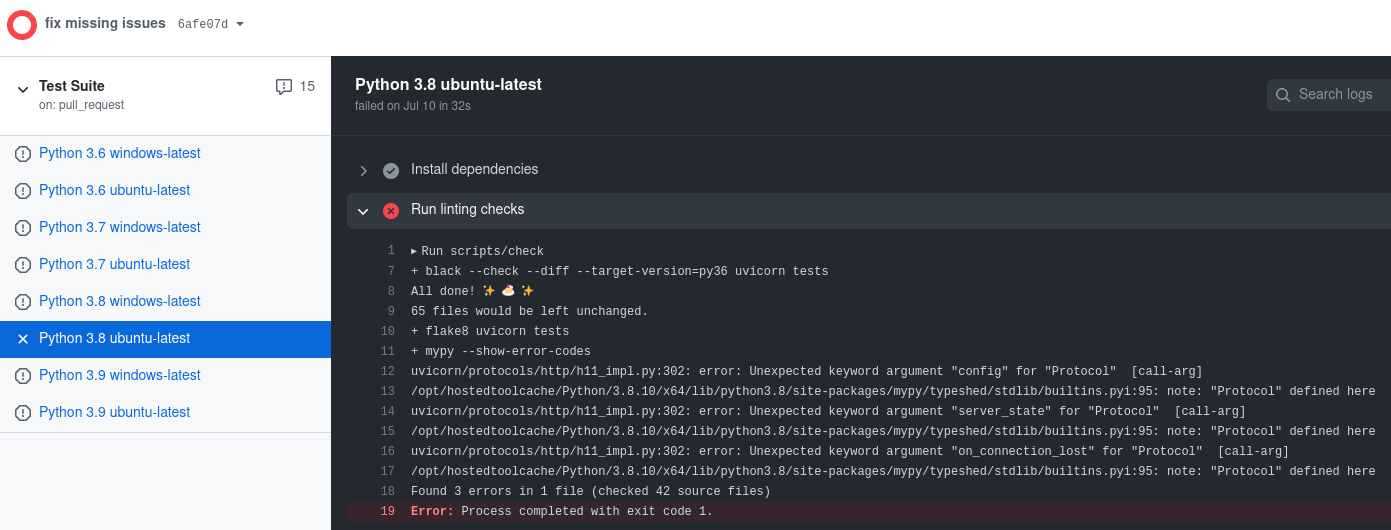
## Resolving Build / CI Failures
Once you've submitted your pull request, the test suite will
automatically run, and the results will show up in GitHub.
If the test suite fails, you'll want to click through to the
"Details" link, and try to identify why the test suite failed.
Here are some common ways the test suite can fail:
### Check Job Failed
This job failing means there is either a code formatting issue or type-annotation issue.
You can look at the job output to figure out why it's failed or within a shell run:
```shell
$ scripts/check
```
It may be worth it to run `$ scripts/lint` to attempt auto-formatting the code
and if that job succeeds commit the changes.
### Docs Job Failed
This job failing means the documentation failed to build. This can happen for
a variety of reasons like invalid markdown or missing configuration within `mkdocs.yml`.
### Python 3.X Job Failed
This job failing means the unit tests failed or not all code paths are covered by unit tests.
If tests are failing you will see this message under the coverage report:
`=== 1 failed, 354 passed, 1 skipped, 1 xfailed in 37.08s ===`
If tests succeed but coverage doesn't reach 100%, you will see this
message under the coverage report:
`Coverage failure: total of 98 is less than fail-under=100`
## Releasing
*This section is targeted at Uvicorn maintainers.*
Before releasing a new version, create a pull request that includes:
- **An update to the changelog**:
- We follow the format from [keepachangelog](https://keepachangelog.com/en/1.0.0/).
- [Compare](https://github.com/Kludex/uvicorn/compare/) `main` with the tag of the latest release, and list all entries that are of interest to our users:
- Things that **must** go in the changelog: added, changed, deprecated or removed features, and bug fixes.
- Things that **should not** go in the changelog: changes to documentation, tests or tooling.
- Try sorting entries in descending order of impact / importance.
- Keep it concise and to-the-point. 🎯
- **A version bump**: see `__init__.py`.
For an example, see [#1006](https://github.com/Kludex/uvicorn/pull/1107).
Once the release PR is merged, create a
[new release](https://github.com/Kludex/uvicorn/releases/new) including:
- Tag version like `0.13.3`.
- Release title `Version 0.13.3`
- Description copied from the changelog.
Once created this release will be automatically uploaded to PyPI.
================================================
FILE: docs/deployment/docker.md
================================================
# Dockerfile
**Docker** is a popular choice for modern application deployment. However, creating a good Dockerfile from scratch can be challenging. This guide provides a **solid foundation** that works well for most Python projects.
While the example below won't fit every use case, it offers an excellent starting point that you can adapt to your specific needs.
## Quickstart
For this example, we'll need to install [`docker`](https://docs.docker.com/get-docker/),
[docker-compose](https://docs.docker.com/compose/install/) and
[`uv`](https://docs.astral.sh/uv/getting-started/installation/).
Then, let's create a new project with `uv`:
```bash
uv init app
```
This will create a new project with a basic structure:
```bash
app/
├── main.py
├── pyproject.toml
└── README.md
```
On `main.py`, let's create a simple ASGI application:
```python title="main.py"
async def app(scope, receive, send):
body = "Hello, world!"
await send(
{
"type": "http.response.start",
"status": 200,
"headers": [
[b"content-type", b"text/plain"],
[b"content-length", len(body)],
],
}
)
await send(
{
"type": "http.response.body",
"body": body.encode("utf-8"),
}
)
```
We need to include `uvicorn` in the dependencies:
```bash
uv add uvicorn
```
This will also create a `uv.lock` file. :sunglasses:
??? tip "What is `uv.lock`?"
`uv.lock` is a `uv` specific lockfile. A lockfile is a file that contains the exact versions of the dependencies
that were installed when the `uv.lock` file was created.
This allows for deterministic builds and consistent deployments.
Just to make sure everything is working, let's run the application:
```bash
uv run uvicorn main:app
```
You should see the following output:
```bash
INFO: Started server process [62727]
INFO: Waiting for application startup.
INFO: ASGI 'lifespan' protocol appears unsupported.
INFO: Application startup complete.
INFO: Uvicorn running on http://127.0.0.1:8000 (Press CTRL+C to quit)
```
## Dockerfile
We'll create a **cache-aware Dockerfile** that optimizes build times. The key strategy is to install dependencies first, then copy the project files. This approach leverages Docker's caching mechanism to significantly speed up rebuilds.
```dockerfile title="Dockerfile"
FROM python:3.12-slim
COPY --from=ghcr.io/astral-sh/uv:latest /uv /uvx /bin/
# Change the working directory to the `app` directory
WORKDIR /app
# Install dependencies
RUN --mount=type=cache,target=/root/.cache/uv \
--mount=type=bind,source=uv.lock,target=uv.lock \
--mount=type=bind,source=pyproject.toml,target=pyproject.toml \
uv sync --frozen --no-install-project
# Copy the project into the image
ADD . /app
# Sync the project
RUN --mount=type=cache,target=/root/.cache/uv \
uv sync --frozen
# Run with uvicorn
CMD ["uv", "run", "uvicorn", "main:app", "--host", "0.0.0.0", "--port", "8000"]
```
A common question is **"how many workers should I run?"**. The image above uses a single Uvicorn worker.
The recommended approach is to let your orchestration system manage the number of deployed containers rather than
relying on the process manager inside the container.
You can read more about this in the
[Decouple applications](https://docs.docker.com/build/building/best-practices/#decouple-applications) section
of the Docker documentation.
!!! warning "For production, create a non-root user!"
When running in production, you should create a non-root user and run the container as that user.
To make sure it works, let's build the image and run it:
```bash
docker build -t my-app .
docker run -p 8000:8000 my-app
```
For more information on using uv with Docker, refer to the
[official uv Docker integration guide](https://docs.astral.sh/uv/guides/integration/docker/).
## Docker Compose
When running in development, it's often useful to have a way to hot-reload the application when code changes.
Let's create a `docker-compose.yml` file to run the application:
```yaml title="docker-compose.yml"
services:
backend:
build: .
ports:
- "8000:8000"
environment:
- UVICORN_RELOAD=true
volumes:
- .:/app
tty: true
```
You can run the application with `docker compose up` and it will automatically rebuild the image when code changes.
Now you have a fully working development environment! :tada:
================================================
FILE: docs/deployment/index.md
================================================
Server deployment is a complex area, that will depend on what kind of service you're deploying Uvicorn onto.
As a general rule, you probably want to:
* Run `uvicorn --reload` from the command line for local development.
* Run `gunicorn -k uvicorn.workers.UvicornWorker` for production.
* Additionally run behind Nginx for self-hosted deployments.
* Finally, run everything behind a CDN for caching support, and serious DDOS protection.
## Running from the command line
Typically you'll run `uvicorn` from the command line.
```bash
$ uvicorn main:app --reload --port 5000
```
The ASGI application should be specified in the form `path.to.module:instance.path`.
When running locally, use `--reload` to turn on auto-reloading.
The `--reload` and `--workers` arguments are **mutually exclusive**.
To see the complete set of available options, use `uvicorn --help`:
```bash
{{ uvicorn_help }}
```
See the [settings documentation](../settings.md) for more details on the supported options for running uvicorn.
## Running programmatically
To run directly from within a Python program, you should use `uvicorn.run(app, **config)`. For example:
```py title="main.py"
import uvicorn
class App:
...
app = App()
if __name__ == "__main__":
uvicorn.run("main:app", host="127.0.0.1", port=5000, log_level="info")
```
The set of configuration options is the same as for the command line tool.
Note that the application instance itself *can* be passed instead of the app
import string.
```python
uvicorn.run(app, host="127.0.0.1", port=5000, log_level="info")
```
However, this style only works if you are not using multiprocessing (`workers=NUM`)
or reloading (`reload=True`), so we recommend using the import string style.
Also note that in this case, you should put `uvicorn.run` into `if __name__ == '__main__'` clause in the main module.
!!! note
The `reload` and `workers` parameters are **mutually exclusive**.
## Using a process manager
Running Uvicorn using a process manager ensures that you can run multiple processes in a resilient manner, and allows you to perform server upgrades without dropping requests.
A process manager will handle the socket setup, start-up multiple server processes, monitor process aliveness, and listen for signals to provide for processes restarts, shutdowns, or dialing up and down the number of running processes.
### Built-in
Uvicorn includes a `--workers` option that allows you to run multiple worker processes.
```bash
$ uvicorn main:app --workers 4
```
Unlike gunicorn, uvicorn does not use pre-fork, but uses [`spawn`](https://docs.python.org/3/library/multiprocessing.html#contexts-and-start-methods), which allows uvicorn's multiprocess manager to still work well on Windows.
The default process manager monitors the status of child processes and automatically restarts child processes that die unexpectedly. Not only that, it will also monitor the status of the child process through the pipeline. When the child process is accidentally stuck, the corresponding child process will be killed through an unstoppable system signal or interface.
You can also manage child processes by sending specific signals to the main process. (Not supported on Windows.)
- `SIGHUP`: Work processeses are graceful restarted one after another. If you update the code, the new worker process will use the new code.
- `SIGTTIN`: Increase the number of worker processes by one.
- `SIGTTOU`: Decrease the number of worker processes by one.
### Gunicorn
!!! warning
The `uvicorn.workers` module is deprecated and will be removed in a future release.
You should use the [`uvicorn-worker`](https://github.com/Kludex/uvicorn-worker) package instead.
```bash
python -m pip install uvicorn-worker
```
Gunicorn is probably the simplest way to run and manage Uvicorn in a production setting. Uvicorn includes a gunicorn worker class that means you can get set up with very little configuration.
The following will start Gunicorn with four worker processes:
`gunicorn -w 4 -k uvicorn.workers.UvicornWorker`
The `UvicornWorker` implementation uses the `uvloop` and `httptools` implementations. To run under PyPy you'll want to use pure-python implementation instead. You can do this by using the `UvicornH11Worker` class.
`gunicorn -w 4 -k uvicorn.workers.UvicornH11Worker`
Gunicorn provides a different set of configuration options to Uvicorn, so some options such as `--limit-concurrency` are not yet supported when running with Gunicorn.
If you need to pass uvicorn's config arguments to gunicorn workers then you'll have to subclass `UvicornWorker`:
```python
from uvicorn.workers import UvicornWorker
class MyUvicornWorker(UvicornWorker):
CONFIG_KWARGS = {"loop": "asyncio", "http": "h11", "lifespan": "off"}
```
### Supervisor
To use `supervisor` as a process manager you should either:
* Hand over the socket to uvicorn using its file descriptor, which supervisor always makes available as `0`, and which must be set in the `fcgi-program` section.
* Or use a UNIX domain socket for each `uvicorn` process.
A simple supervisor configuration might look something like this:
```ini title="supervisord.conf"
[supervisord]
[fcgi-program:uvicorn]
socket=tcp://localhost:8000
command=venv/bin/uvicorn --fd 0 main:App
numprocs=4
process_name=uvicorn-%(process_num)d
stdout_logfile=/dev/stdout
stdout_logfile_maxbytes=0
```
Then run with `supervisord -n`.
## Running behind Nginx
Using Nginx as a proxy in front of your Uvicorn processes may not be necessary, but is recommended for additional resilience. Nginx can deal with serving your static media and buffering slow requests, leaving your application servers free from load as much as possible.
In managed environments such as `Heroku`, you won't typically need to configure Nginx, as your server processes will already be running behind load balancing proxies.
The recommended configuration for proxying from Nginx is to use a UNIX domain socket between Nginx and whatever the process manager that is being used to run Uvicorn. If using Uvicorn directly you can bind it to a UNIX domain socket using `uvicorn --uds /path/to/socket.sock <...>`.
When running your application behind one or more proxies you will want to make sure that each proxy sets appropriate headers to ensure that your application can properly determine the client address of the incoming connection, and if the connection was over `http` or `https`. For more information see [Proxies and Forwarded Headers](#proxies-and-forwarded-headers) below.
Here's how a simple Nginx configuration might look. This example includes setting proxy headers, and using a UNIX domain socket to communicate with the application server.
It also includes some basic configuration to forward websocket connections.
For more info on this, check [Nginx recommendations](https://nginx.org/en/docs/http/websocket.html).
```conf
http {
server {
listen 80;
client_max_body_size 4G;
server_name example.com;
location / {
proxy_set_header Host $http_host;
proxy_set_header X-Forwarded-For $proxy_add_x_forwarded_for;
proxy_set_header X-Forwarded-Proto $scheme;
proxy_set_header Upgrade $http_upgrade;
proxy_set_header Connection $connection_upgrade;
proxy_redirect off;
proxy_buffering off;
proxy_pass http://uvicorn;
}
location /static {
# path for static files
root /path/to/app/static;
}
}
map $http_upgrade $connection_upgrade {
default upgrade;
'' close;
}
upstream uvicorn {
server unix:/tmp/uvicorn.sock;
}
}
```
Uvicorn's `--proxy-headers` behavior may not be sufficient for more complex proxy configurations that use different combinations of headers, or where the application is running behind more than one intermediary proxying service.
In those cases, you might want to use an ASGI middleware to set the `client` and `scheme` dependant on the request headers.
## Running behind a CDN
Running behind a content delivery network, such as Cloudflare or Cloud Front, provides a serious layer of protection against DDoS attacks. Your service will be running behind huge clusters of proxies and load balancers that are designed for handling huge amounts of traffic, and have capabilities for detecting and closing off connections from DDoS attacks.
Proper usage of cache control headers can mean that a CDN is able to serve large amounts of data without always having to forward the request on to your server.
Content Delivery Networks can also be a low-effort way to provide HTTPS termination.
## Running with HTTPS
To run uvicorn with https, a certificate and a private key are required.
The recommended way to get them is using [Let's Encrypt](https://letsencrypt.org/).
For local development with https, it's possible to use [mkcert](https://github.com/FiloSottile/mkcert)
to generate a valid certificate and private key.
```bash
$ uvicorn main:app --port 5000 --ssl-keyfile=./key.pem --ssl-certfile=./cert.pem
```
### Running gunicorn worker
It's also possible to use certificates with uvicorn's worker for gunicorn.
```bash
$ gunicorn --keyfile=./key.pem --certfile=./cert.pem -k uvicorn.workers.UvicornWorker main:app
```
## Proxies and Forwarded Headers
When running an application behind one or more proxies, certain information about the request is lost.
To avoid this most proxies will add headers containing this information for downstream servers to read.
Uvicorn currently supports the following headers:
- `X-Forwarded-For` ([MDN Reference](https://developer.mozilla.org/en-US/docs/Web/HTTP/Headers/X-Forwarded-For))
- `X-Forwarded-Proto`([MDN Reference](https://developer.mozilla.org/en-US/docs/Web/HTTP/Headers/X-Forwarded-Proto))
Uvicorn can use these headers to correctly set the client and protocol in the request.
However as anyone can set these headers you must configure which "clients" you will trust to have set them correctly.
Uvicorn can be configured to trust IP Addresses (e.g. `127.0.0.1`), IP Networks (e.g. `10.100.0.0/16`),
or Literals (e.g. `/path/to/socket.sock`). When running from CLI these are configured using `--forwarded-allow-ips`.
!!! Warning "Only trust clients you can actually trust!"
Incorrectly trusting other clients can lead to malicious actors spoofing their apparent client address to your application.
For more information, check [`ProxyHeadersMiddleware`](https://github.com/Kludex/uvicorn/blob/main/uvicorn/middleware/proxy_headers.py).
### Client Port
Currently if the `ProxyHeadersMiddleware` is able to retrieve a trusted client value then the client's port will be set to `0`.
This is because port information is lost when using these headers.
### UNIX Domain Sockets (UDS)
Although it is common for UNIX Domain Sockets to be used for communicating between various HTTP servers, they can mess with some of the expected received values as they will be various non-address strings or missing values.
For example:
- when NGINX itself is running behind a UDS it will add the literal `unix:` as the client in the `X-Forwarded-For` header.
- When Uvicorn is running behind a UDS the initial client will be `None`.
### Trust Everything
Rather than specifying what to trust, you can instruct Uvicorn to trust all clients using the literal `"*"`.
You should only set this when you know you can trust all values within the forwarded headers (e.g. because
your proxies remove the existing headers before setting their own).
================================================
FILE: docs/index.md
================================================
An ASGI web server, for Python.
---
**Documentation**: [https://uvicorn.dev](https://uvicorn.dev)
**Source Code**: [https://www.github.com/Kludex/uvicorn](https://www.github.com/Kludex/uvicorn)
---
**Uvicorn** is an [ASGI](concepts/asgi.md) web server implementation for Python.
Until recently Python has lacked a minimal low-level server/application interface for
async frameworks. The [ASGI specification](https://asgi.readthedocs.io/en/latest/) fills this gap,
and means we're now able to start building a common set of tooling usable across all async frameworks.
Uvicorn currently supports **HTTP/1.1** and **WebSockets**.
## Quickstart
**Uvicorn** is available on [PyPI](https://pypi.org/project/uvicorn/) so installation is as simple as:
=== "pip"
```bash
pip install uvicorn
```
=== "uv"
```bash
uv add uvicorn
```
See the [installation documentation](installation.md) for more information.
---
Let's create a simple ASGI application to run with Uvicorn:
```python title="main.py"
async def app(scope, receive, send):
assert scope['type'] == 'http'
await send({
'type': 'http.response.start',
'status': 200,
'headers': [
(b'content-type', b'text/plain'),
(b'content-length', b'13'),
],
})
await send({
'type': 'http.response.body',
'body': b'Hello, world!',
})
```
Then we can run it with Uvicorn:
```shell
uvicorn main:app
```
---
## Usage
The uvicorn command line tool is the easiest way to run your application.
### Command line options
```bash
{{ uvicorn_help }}
```
For more information, see the [settings documentation](settings.md).
### Running programmatically
There are several ways to run uvicorn directly from your application.
#### `uvicorn.run`
If you're looking for a programmatic equivalent of the `uvicorn` command line interface, use `uvicorn.run()`:
```py title="main.py"
import uvicorn
async def app(scope, receive, send):
...
if __name__ == "__main__":
uvicorn.run("main:app", port=5000, log_level="info")
```
#### `Config` and `Server` instances
For more control over configuration and server lifecycle, use `uvicorn.Config` and `uvicorn.Server`:
```py title="main.py"
import uvicorn
async def app(scope, receive, send):
...
if __name__ == "__main__":
config = uvicorn.Config("main:app", port=5000, log_level="info")
server = uvicorn.Server(config)
server.run()
```
If you'd like to run Uvicorn from an already running async environment, use `uvicorn.Server.serve()` instead:
```py title="main.py"
import asyncio
import uvicorn
async def app(scope, receive, send):
...
async def main():
config = uvicorn.Config("main:app", port=5000, log_level="info")
server = uvicorn.Server(config)
await server.serve()
if __name__ == "__main__":
asyncio.run(main())
```
### Running with Gunicorn
!!! warning
The `uvicorn.workers` module is deprecated and will be removed in a future release.
You should use the [`uvicorn-worker`](https://github.com/Kludex/uvicorn-worker) package instead.
```bash
python -m pip install uvicorn-worker
```
[Gunicorn](https://gunicorn.org/) is a mature, fully featured server and process manager.
Uvicorn includes a Gunicorn worker class allowing you to run ASGI applications,
with all of Uvicorn's performance benefits, while also giving you Gunicorn's
fully-featured process management.
This allows you to increase or decrease the number of worker processes on the
fly, restart worker processes gracefully, or perform server upgrades without downtime.
For production deployments we recommend using gunicorn with the uvicorn worker class.
```
gunicorn example:app -w 4 -k uvicorn.workers.UvicornWorker
```
For a [PyPy](https://pypy.org/) compatible configuration use `uvicorn.workers.UvicornH11Worker`.
For more information, see the [deployment documentation](deployment/index.md).
### Application factories
The `--factory` flag allows loading the application from a factory function, rather than an application instance directly. The factory will be called with no arguments and should return an ASGI application.
```py title="main.py"
def create_app():
app = ...
return app
```
```shell
uvicorn --factory main:create_app
```
================================================
FILE: docs/installation.md
================================================
**Uvicorn** is available on [PyPI](https://pypi.org/project/uvicorn/) so installation is as simple as:
=== "pip"
```bash
pip install uvicorn
```
=== "uv"
```bash
uv add uvicorn
```
The above will install Uvicorn with the minimal set of dependencies:
- [`h11`](https://github.com/python-hyper/h11) — Pure Python sans-io HTTP/1.1 implementation.
- [`click`](https://github.com/pallets/click) — Command line interface library.
If you are running on Python 3.10 or early versions,
[`typing_extensions`](https://github.com/python/typing_extensions) will also be installed.
## Optional Dependencies
There are many optional dependencies that can be installed to add support for various features.
If you just want to install all of them at once, you can use the `standard` extra:
=== "pip"
```bash
pip install 'uvicorn[standard]'
```
=== "uv"
```bash
uv add 'uvicorn[standard]'
```
The `standard` extra installs the following dependencies:
- **[`uvloop`](https://github.com/MagicStack/uvloop) — Fast, drop-in replacement of the built-in asyncio event loop.**
When `uvloop` is installed, Uvicorn will use it by default.
- **[`httptools`](https://github.com/MagicStack/httptools) — Python binding for the Node.js HTTP parser.**
When `httptools` is installed, Uvicorn will use it by default for HTTP/1.1 parsing.
You can read this issue to understand how it compares with `h11`: [h11/issues/9](https://github.com/python-hyper/h11/issues/9).
- **[`websockets`](https://websockets.readthedocs.io/en/stable/) — WebSocket library for Python.**
When `websockets` is installed, Uvicorn will use it by default for WebSocket handling.
You can alternatively install **[`wsproto`](https://github.com/python-hyper/wsproto)** and set the `--ws`
option to `wsproto` to use it instead.
- **[`watchfiles`](https://github.com/samuelcolvin/watchfiles) — Simple, modern and high performance file
watching and code reload in python.**
When `watchfiles` is installed, Uvicorn will use it by default for the `--reload` option.
- **[`colorama`](https://github.com/tartley/colorama) — Cross-platform support for ANSI terminal
colors.**
This is installed only on Windows, to provide colored logs.
- **[`python-dotenv`](https://github.com/theskumar/python-dotenv) — Reads key-value pairs from a `.env` file
and adds them to the environment.**
This is installed to allow you to use the `--env-file` option.
- **[`PyYAML`](https://github.com/yaml/pyyaml) — YAML parser and emitter for Python.**
This is installed to allow you to provide a `.yaml` file to the `--log-config` option.
================================================
FILE: docs/overrides/main.html
================================================
{% extends "base.html" %}
{% block extrahead %}
{{ super() }}
{% endblock %}
================================================
FILE: docs/overrides/partials/nav.html
================================================
{% import "partials/nav-item.html" as item with context %}
{% set class = "md-nav md-nav--primary" %}
{% if "navigation.tabs" in features %}
{% set class = class ~ " md-nav--lifted" %}
{% endif %}
{% if "toc.integrate" in features %}
{% set class = class ~ " md-nav--integrated" %}
{% endif %}
{% include "partials/logo.html" %}
{{ config.site_name }}
{% if config.repo_url %}
{% include "partials/source.html" %}
{% endif %}
{% for nav_item in nav %}
{% set path = "__nav_" ~ loop.index %}
{{ item.render(nav_item, path, 1) }}
{% endfor %}
================================================
FILE: docs/overrides/partials/toc-item.html
================================================
{{ toc_item.title }}
{% if toc_item.children %}
{% for toc_item in toc_item.children %}
{% if not page.meta.toc_depth or toc_item.level <= page.meta.toc_depth %} {% include "partials/toc-item.html" %}
{% endif %} {% endfor %}
{% endif %}
================================================
FILE: docs/plugins/main.py
================================================
from __future__ import annotations as _annotations
import re
import subprocess
from functools import lru_cache
from mkdocs.config import Config
from mkdocs.structure.files import Files
from mkdocs.structure.pages import Page
def on_page_content(html: str, page: Page, config: Config, files: Files) -> str:
"""Called on each page after the markdown is converted to HTML."""
html = add_hyperlink_to_pull_request(html, page, config, files)
return html
def add_hyperlink_to_pull_request(html: str, page: Page, config: Config, files: Files) -> str:
"""Add hyperlink on PRs mentioned on the release notes page.
If we find "(#\\d+)" it will be added an hyperlink to https://github.com/Kludex/uvicorn/pull/$1.
"""
if not page.file.name == "release-notes":
return html
return re.sub(r"\(#(\d+)\)", r"(#\1 )", html)
def on_page_markdown(markdown: str, page: Page, config: Config, files: Files) -> str:
"""Called on each file after it is read and before it is converted to HTML."""
markdown = uvicorn_print_help(markdown, page)
return markdown
def uvicorn_print_help(markdown: str, page: Page) -> str:
return re.sub(r"{{ *uvicorn_help *}}", get_uvicorn_help(), markdown)
@lru_cache
def get_uvicorn_help():
output = subprocess.run(["uvicorn", "--help"], capture_output=True, check=True)
return output.stdout.decode()
================================================
FILE: docs/release-notes.md
================================================
---
toc_depth: 2
---
## 0.42.0 (March 16, 2026)
### Changed
* Use `bytearray` for request body accumulation to avoid O(n^2) allocation on fragmented bodies (#2845)
### Fixed
* Escape brackets and backslash in httptools `HEADER_RE` regex (#2824)
* Fix multiple issues in websockets sans-io implementation (#2825)
## 0.41.0 (February 16, 2026)
### Added
* Add `--limit-max-requests-jitter` to stagger worker restarts (#2707)
* Add socket path to `scope["server"]` (#2561)
### Changed
* Rename `LifespanOn.error_occured` to `error_occurred` (#2776)
### Fixed
* Ignore permission denied errors in watchfiles reloader (#2817)
* Ensure lifespan shutdown runs when `should_exit` is set during startup (#2812)
* Reduce the log level of 'request limit exceeded' messages (#2788)
## 0.40.0 (December 21, 2025)
### Remove
* Drop support for Python 3.9 (#2772)
## 0.39.0 (December 21, 2025)
### Fixed
* Send close frame on ASGI return for WebSockets (#2769)
* Explicitly start ASGI run with empty context (#2742)
## 0.38.0 (October 18, 2025)
### Added
* Support Python 3.14 (#2723)
## 0.37.0 (September 23, 2025)
### Added
* Add `--timeout-worker-healthcheck` option (#2711)
* Add `os.PathLike[str]` type to `ssl_ca_certs` (#2676)
## 0.36.1 (September 23, 2025)
### Fixed
* Raise an exception when calling removed `Config.setup_event_loop()` (#2709)
## 0.36.0 (September 20, 2025)
### Added
* Support custom IOLOOPs (#2435)
* Allow to provide importable string in `--http`, `--ws` and `--loop` (#2658)
## 0.35.0 (June 28, 2025)
### Added
* Add `WebSocketsSansIOProtocol` (#2540)
### Changed
* Refine help message for option `--proxy-headers` (#2653)
## 0.34.3 (June 1, 2025)
### Fixed
* Don't include `cwd()` when non-empty `--reload-dirs` is passed (#2598)
* Apply `get_client_addr` formatting to WebSocket logging (#2636)
## 0.34.2 (April 19, 2025)
### Fixed
* Flush stdout buffer on Windows to trigger reload (#2604)
## 0.34.1 (April 13, 2025)
### Deprecated
* Deprecate `ServerState` in the main module (#2581)
## 0.34.0 (December 15, 2024)
### Added
* Add `content-length` to 500 response in `wsproto` implementation (#2542)
### Removed
* Drop support for Python 3.8 (#2543)
## 0.33.0 (December 14, 2024)
### Removed
* Remove `WatchGod` support for `--reload` (#2536)
## 0.32.1 (November 20, 2024)
### Fixed
* Drop ASGI spec version to 2.3 on HTTP scope (#2513)
* Enable httptools lenient data on `httptools >= 0.6.3` (#2488)
## 0.32.0 (October 15, 2024)
### Added
* Officially support Python 3.13 (#2482)
* Warn when `max_request_limit` is exceeded (#2430)
## 0.31.1 (October 9, 2024)
### Fixed
* Support WebSockets 0.13.1 (#2471)
* Restore support for `[*]` in trusted hosts (#2480)
* Add `PathLike[str]` type hint for `ssl_keyfile` (#2481)
## 0.31.0 (September 27, 2024)
### Added
Improve `ProxyHeadersMiddleware` (#2468) and (#2231):
- Fix the host for requests from clients running on the proxy server itself.
- Fallback to host that was already set for empty x-forwarded-for headers.
- Also allow to specify IP Networks as trusted hosts. This greatly simplifies deployments
on docker swarm/kubernetes, where the reverse proxy might have a dynamic IP.
- This includes support for IPv6 Address/Networks.
## 0.30.6 (August 13, 2024)
### Fixed
- Don't warn when upgrade is not WebSocket and dependencies are installed (#2360)
## 0.30.5 (August 2, 2024)
### Fixed
- Don't close connection before receiving body on H11 (#2408)
## 0.30.4 (July 31, 2024)
### Fixed
- Close connection when `h11` sets client state to `MUST_CLOSE` (#2375)
## 0.30.3 (July 20, 2024)
### Fixed
- Suppress `KeyboardInterrupt` from CLI and programmatic usage (#2384)
- `ClientDisconnect` inherits from `OSError` instead of `IOError` (#2393)
## 0.30.2 (July 20, 2024)
### Added
- Add `reason` support to [`websocket.disconnect`](https://asgi.readthedocs.io/en/latest/specs/www.html#disconnect-receive-event-ws) event (#2324)
### Fixed
- Iterate subprocesses in-place on the process manager (#2373)
## 0.30.1 (June 2, 2024)
### Fixed
- Allow horizontal tabs `\t` in response header values (#2345)
## 0.30.0 (May 28, 2024)
### Added
- New multiprocess manager (#2183)
- Allow `ConfigParser` or a `io.IO[Any]` on `log_config` (#1976)
### Fixed
- Suppress side-effects of signal propagation (#2317)
- Send `content-length` header on 5xx (#2304)
### Deprecated
- Deprecate the `uvicorn.workers` module (#2302)
## 0.29.0 (March 19, 2024)
### Added
- Cooperative signal handling (#1600)
## 0.28.1 (March 19, 2024)
### Fixed
- Revert raise `ClientDisconnected` on HTTP (#2276)
## 0.28.0 (March 9, 2024)
### Added
- Raise `ClientDisconnected` on `send()` when client disconnected (#2220)
### Fixed
- Except `AttributeError` on `sys.stdin.fileno()` for Windows IIS10 (#1947)
- Use `X-Forwarded-Proto` for WebSockets scheme when the proxy provides it (#2258)
## 0.27.1 (February 10, 2024)
- Fix spurious LocalProtocolError errors when processing pipelined requests (#2243)
## 0.27.0.post1 (January 29, 2024)
### Fixed
- Fix nav overrides for newer version of Mkdocs Material (#2233)
## 0.27.0 (January 22, 2024)
### Added
- Raise `ClientDisconnect(IOError)` on `send()` when client disconnected (#2218)
- Bump ASGI WebSocket spec version to 2.4 (#2221)
## 0.26.0 (January 16, 2024)
### Changed
- Update `--root-path` to include the root path prefix in the full ASGI `path` as per the ASGI spec (#2213)
- Use `__future__.annotations` on some internal modules (#2199)
## 0.25.0 (December 17, 2023)
### Added
- Support the WebSocket Denial Response ASGI extension (#1916)
### Fixed
- Allow explicit hidden file paths on `--reload-include` (#2176)
- Properly annotate `uvicorn.run()` (#2158)
## 0.24.0.post1 (November 6, 2023)
### Fixed
- Revert mkdocs-material from 9.1.21 to 9.2.6 (#2148)
## 0.24.0 (November 4, 2023)
### Added
- Support Python 3.12 (#2145)
- Allow setting `app` via environment variable `UVICORN_APP` (#2106)
## 0.23.2 (July 31, 2023)
### Fixed
- Maintain the same behavior of `websockets` from 10.4 on 11.0 (#2061)
## 0.23.1 (July 18, 2023)
### Fixed
- Add `typing_extensions` for Python 3.10 and lower (#2053)
## 0.23.0 (July 10, 2023)
### Added
- Add `--ws-max-queue` parameter WebSockets (#2033)
### Removed
- Drop support for Python 3.7 (#1996)
- Remove `asgiref` as typing dependency (#1999)
### Fixed
- Set `scope["scheme"]` to `ws` or `wss` instead of `http` or `https` on `ProxyHeadersMiddleware` for WebSockets (#2043)
### Changed
- Raise `ImportError` on circular import (#2040)
- Use `logger.getEffectiveLevel()` instead of `logger.level` to check if log level is `TRACE` (#1966)
## 0.22.0 (April 28, 2023)
### Added
- Add `--timeout-graceful-shutdown` parameter (#1950)
- Handle `SIGBREAK` on Windows (#1909)
### Fixed
- Shutdown event is now being triggered on Windows when using hot reload (#1584)
- `--reload-delay` is effectively used on the `watchfiles` reloader (#1930)
## 0.21.1 (March 16, 2023)
### Fixed
- Reset lifespan state on each request (#1903)
## 0.21.0 (March 9, 2023)
### Added
- Introduce lifespan state (#1818)
- Allow headers to be sent as iterables on H11 implementation (#1782)
- Improve discoverability when --port=0 is used (#1890)
### Changed
- Avoid importing `h11` and `pyyaml` when not needed to improve import time (#1846)
- Replace current native `WSGIMiddleware` implementation by `a2wsgi` (#1825)
- Change default `--app-dir` from "." (dot) to "" (empty string) (#1835)
### Fixed
- Send code 1012 on shutdown for WebSockets (#1816)
- Use `surrogateescape` to encode headers on `websockets` implementation (#1005)
- Fix warning message on reload failure (#1784)
## 0.20.0 (November 20, 2022)
### Added
- Check if handshake is completed before sending frame on `wsproto` shutdown (#1737)
- Add default headers to WebSockets implementations (#1606 & #1747)
- Warn user when `reload` and `workers` flag are used together (#1731)
### Fixed
- Use correct `WebSocket` error codes on `close` (#1753)
- Send disconnect event on connection lost for `wsproto` (#996)
- Add `SIGQUIT` handler to `UvicornWorker` (#1710)
- Fix crash on exist with "--uds" if socket doesn't exist (#1725)
- Annotate `CONFIG_KWARGS` in `UvicornWorker` class (#1746)
### Removed
- Remove conditional on `RemoteProtocolError.event_hint` on `wsproto` (#1486)
- Remove unused `handle_no_connect` on `wsproto` implementation (#1759)
## 0.19.0 (October 19, 2022)
### Added
- Support Python 3.11 (#1652)
- Bump minimal `httptools` version to `0.5.0` (#1645)
- Ignore HTTP/2 upgrade and optionally ignore WebSocket upgrade (#1661)
- Add `py.typed` to comply with PEP 561 (#1687)
### Fixed
- Set `propagate` to `False` on "uvicorn" logger (#1288)
- USR1 signal is now handled correctly on `UvicornWorker`. (#1565)
- Use path with query string on `WebSockets` logs (#1385)
- Fix behavior on which "Date" headers were not updated on the same connection (#1706)
### Removed
- Remove the `--debug` flag (#1640)
- Remove the `DebugMiddleware` (#1697)
## 0.18.3 (August 24, 2022)
### Fixed
- Remove cyclic references on HTTP implementations. (#1604)
### Changed
- `reload_delay` default changed from `None` to `0.25` on `uvicorn.run()` and `Config`. `None` is not an acceptable value anymore. (#1545)
## 0.18.2 (June 27, 2022)
### Fixed
- Add default `log_config` on `uvicorn.run()` (#1541)
- Revert `logging` file name modification (#1543)
## 0.18.1 (June 23, 2022)
### Fixed
- Use `DEFAULT_MAX_INCOMPLETE_EVENT_SIZE` as default to `h11_max_incomplete_event_size` on the CLI (#1534)
## 0.18.0 (June 23, 2022)
### Added
- The `reload` flag prioritizes `watchfiles` instead of the deprecated `watchgod` (#1437)
- Annotate `uvicorn.run()` function (#1423)
- Allow configuring `max_incomplete_event_size` for `h11` implementation (#1514)
### Removed
- Remove `asgiref` dependency (#1532)
### Fixed
- Turn `raw_path` into bytes on both websockets implementations (#1487)
- Revert log exception traceback in case of invalid HTTP request (#1518)
- Set `asyncio.WindowsSelectorEventLoopPolicy()` when using multiple workers to avoid "WinError 87" (#1454)
## 0.17.6 (March 11, 2022)
### Changed
- Change `httptools` range to `>=0.4.0` (#1400)
## 0.17.5 (February 16, 2022)
### Fixed
- Fix case where url is fragmented in httptools protocol (#1263)
- Fix WSGI middleware not to explode quadratically in the case of a larger body (#1329)
### Changed
- Send HTTP 400 response for invalid request (#1352)
## 0.17.4 (February 4, 2022)
### Fixed
- Replace `create_server` by `create_unix_server` (#1362)
## 0.17.3 (February 3, 2022)
### Fixed
- Drop wsproto version checking. (#1359)
## 0.17.2 (February 3, 2022)
### Fixed
- Revert #1332. While trying to solve the memory leak, it introduced an issue (#1345) when the server receives big chunks of data using the `httptools` implementation. (#1354)
- Revert stream interface changes. This was introduced on 0.14.0, and caused an issue (#1226), which caused a memory leak when sending TCP pings. (#1355)
- Fix wsproto version check expression (#1342)
## 0.17.1 (January 28, 2022)
### Fixed
- Move all data handling logic to protocol and ensure connection is closed. (#1332)
- Change `spec_version` field from "2.1" to "2.3", as Uvicorn is compliant with that version of the ASGI specifications. (#1337)
## 0.17.0.post1 (January 24, 2022)
### Fixed
- Add the `python_requires` version specifier (#1328)
## 0.17.0 (January 14, 2022)
### Added
- Allow configurable websocket per-message-deflate setting (#1300)
- Support extra_headers for WS accept message (#1293)
- Add missing http version on websockets scope (#1309)
### Fixed/Removed
- Drop Python 3.6 support (#1261)
- Fix reload process behavior when exception is raised (#1313)
- Remove `root_path` from logs (#1294)
## 0.16.0 (December 8, 2021)
### Added
- Enable read of uvicorn settings from environment variables (#1279)
- Bump `websockets` to 10.0. (#1180)
- Ensure non-zero exit code when startup fails (#1278)
- Increase `httptools` version range from "==0.2.*" to ">=0.2.0,<0.4.0". (#1243)
- Override default asyncio event loop with reload only on Windows (#1257)
- Replace `HttpToolsProtocol.pipeline` type from `list` to `deque`. (#1213)
- Replace `WSGIResponder.send_queue` type from `list` to `deque`. (#1214)
### Fixed
- Main process exit after startup failure on reloader classes (#1177)
- Fix the need of `httptools` on minimal installation (#1135)
- Fix ping parameters annotation in Config class (#1127)
## 0.15.0 (August 13, 2021)
### Added
- Change reload to be configurable with glob patterns. Currently only `.py` files are watched, which is different from the previous default behavior. (#820)
- Add Python 3.10-rc.1 support. Now the server uses `asyncio.run` which will: start a fresh asyncio event loop, on shutdown cancel any background tasks rather than aborting them, `aexit` any remaining async generators, and shutdown the default `ThreadPoolExecutor`. (#1070)
- Exit with status 3 when worker starts failed (#1077)
- Add option to set websocket ping interval and timeout (#1048)
- Adapt bind_socket to make it usable with multiple processes (#1009)
- Add existence check to the reload directory(ies) (#1089)
- Add missing trace log for websocket protocols (#1083)
- Support disabling default Server and Date headers (#818)
### Changed
- Add PEP440 compliant version of click (#1099)
- Bump asgiref to 3.4.0 (#1100)
### Fixed
- When receiving a `SIGTERM` supervisors now terminate their processes before joining them (#1069)
- Fix `httptools` range to `>=0.4.0` (#1400)
## 0.14.0 (June 1, 2021)
### Added
- Defaults ws max_size on server to 16MB (#995)
- Improve user feedback if no ws library installed (#926 and #1023)
- Support 'reason' field in 'websocket.close' messages (#957)
- Implemented lifespan.shutdown.failed (#755)
### Changed
- Upgraded websockets requirements (#1065)
- Switch to asyncio streams API (#869)
- Update httptools from 0.1.* to 0.2.* (#1024)
- Allow Click 8.0, refs #1016 (#1042)
- Add search for a trusted host in ProxyHeadersMiddleware (#591)
- Up wsproto to 1.0.0 (#892)
### Fixed
- Force reload_dirs to be a list (#978)
- Fix gunicorn worker not running if extras not installed (#901)
- Fix socket port 0 (#975)
- Prevent garbage collection of main lifespan task (#972)
## 0.13.4 (February 20, 2021)
### Fixed
- Fixed wsgi middleware PATH_INFO encoding (#962)
- Fixed uvloop dependency (#952) then (#959)
- Relax watchgod up bound (#946)
- Return 'connection: close' header in response (#721)
### Added
- Docs: Nginx + websockets (#948)
- Document the default value of 1 for workers (#940) (#943)
- Enabled permessage-deflate extension in websockets (#764)
## 0.13.3 (December 29, 2020)
### Fixed
- Prevent swallowing of return codes from `subprocess` when running with Gunicorn by properly resetting signals. (#895)
- Tweak detection of app factories to be more robust. A warning is now logged when passing a factory without the `--factory` flag. (#914)
- Properly clean tasks when handshake is aborted when running with `--ws websockets`. (#921)
## 0.13.2 (December 12, 2020)
### Fixed
- Log full exception traceback in case of invalid HTTP request. (#886 and #888)
## 0.13.1 (December 12, 2020)
### Fixed
- Prevent exceptions when the ASGI application rejects a connection during the WebSocket handshake, when running on both `--ws wsproto` or `--ws websockets`. (#704 and #881)
- Ensure connection `scope` doesn't leak in logs when using JSON log formatters. (#859 and #884)
## 0.13.0 (December 8, 2020)
### Added
- Add `--factory` flag to support factory-style application imports. (#875)
- Skip installation of signal handlers when not in the main thread. Allows using `Server` in multithreaded contexts without having to override `.install_signal_handlers()`. (#871)
## 0.12.3 (November 21, 2020)
### Fixed
- Fix race condition that leads Quart to hang with uvicorn (#848)
- Use latin1 when decoding X-Forwarded-* headers (#701)
- Rework IPv6 support (#837)
- Cancel old keepalive-trigger before setting new one. (#832)
## 0.12.2 (October 19, 2020)
### Added
- Adding ability to decrypt ssl key file (#808)
- Support .yml log config files (#799)
- Added python 3.9 support (#804)
### Fixed
- Fixes watchgod with common prefixes (#817)
- Fix reload with ipv6 host (#803)
- Added cli support for headers containing colon (#813)
- Sharing socket across workers on windows (#802)
- Note the need to configure trusted "ips" when using unix sockets (#796)
## 0.12.1 (September 30, 2020)
### Changed
- Pinning h11 and python-dotenv to min versions (#789)
- Get docs/index.md in sync with README.md (#784)
### Fixed
- Improve changelog by pointing out breaking changes (#792)
## 0.12.0 (September 28, 2020)
### Added
- Make reload delay configurable (#774)
- Upgrade maximum h11 dependency version to 0.10 (#772)
- Allow .json or .yaml --log-config files (#665)
- Add ASGI dict to the lifespan scope (#754)
- Upgrade wsproto to 0.15.0 (#750)
- Use optional package installs (#666)
### Changed
- Don't set log level for root logger (#767) 8/28/20 df81b168
- Uvicorn no longer ships extra dependencies `uvloop`, `websockets` and `httptools` as default.
To install these dependencies use `uvicorn[standard]`.
### Fixed
- Revert "Improve shutdown robustness when using `--reload` or multiprocessing (#620)" (#756)
- Fix terminate error in windows (#744)
- Fix bug where --log-config disables uvicorn loggers (#512)
## 0.11.8 (July 30, 2020)
* Fix a regression that caused Uvicorn to crash when using `--interface=wsgi`. (#730)
* Fix a regression that caused Uvicorn to crash when using unix domain sockets. (#729)
## 0.11.7 (July 28, 2020)
* SECURITY FIX: Prevent sending invalid HTTP header names and values. (#725)
* SECURITY FIX: Ensure path value is escaped before logging to the console. (#724)
* Fix `--proxy-headers` client IP and host when using a Unix socket. (#636)
## 0.11.6 (July 17, 2020)
* Fix overriding the root logger.
## 0.11.5 (April 29, 2020)
* Revert "Watch all files, not just .py" due to unexpected side effects.
* Revert "Pass through gunicorn timeout config." due to unexpected side effects.
## 0.11.4 (April 28, 2020)
* Use `watchgod`, if installed, for watching code changes.
* Watch all files, not just .py.
* Pass through gunicorn timeout config.
## 0.11.3 (February 17, 2020)
* Update dependencies.
## 0.11.2 (January 20, 2020)
* Don't open socket until after application startup.
* Support `--backlog`.
## 0.11.1 (December 20, 2019)
* Use a more liberal `h11` dependency. Either `0.8.*` or `0.9.*``.
## 0.11.0 (December 20, 2019)
* Fix reload/multiprocessing on Windows with Python 3.8.
* Drop IOCP support. (Required for fix above.)
* Add `uvicorn --version` flag.
* Add `--use-colors` and `--no-use-colors` flags.
* Display port correctly, when auto port selection isused with `--port=0`.
## 0.10.8 (November 12, 2019)
* Fix reload/multiprocessing error.
## 0.10.7 (November 12, 2019)
* Use resource_sharer.DupSocket to resolve socket sharing on Windows.
## 0.10.6 (November 12, 2019)
* Exit if `workers` or `reload` are use without an app import string style.
* Reorganise supervisor processes to properly hand over sockets on windows.
## 0.10.5 (November 12, 2019)
* Update uvloop dependency to 0.14+
## 0.10.4 (November 9, 2019)
* Error clearly when `workers=` is used with app instance, instead of an app import string.
* Switch `--reload-dir` to current working directory by default.
## 0.10.3 (November 1, 2019)
* Add ``--log-level trace`
## 0.10.2 (October 31, 2019)
* Enable --proxy-headers by default.
## 0.10.1 (October 31, 2019)
* Resolve issues with logging when using `--reload` or `--workers`.
* Setup up root logger to capture output for all logger instances, not just `uvicorn.error` and `uvicorn.access`.
## 0.10.0 (October 29, 2019)
* Support for Python 3.8
* Separated out `uvicorn.error` and `uvicorn.access` logs.
* Coloured log output when connected to a terminal.
* Dropped `logger=` config setting.
* Added `--log-config [FILE]` and `log_config=[str|dict]`. May either be a Python logging config dictionary or the file name of a logging configuration.
* Added `--forwarded_allow_ips` and `forwarded_allow_ips`. Defaults to the value of the `$FORWARDED_ALLOW_IPS` environment variable or "127.0.0.1". The `--proxy-headers` flag now defaults to `True`, but only trusted IPs are used to populate forwarding info.
* The `--workers` setting now defaults to the value of the `$WEB_CONCURRENCY` environment variable.
* Added support for `--env-file`. Requires `python-dotenv`.
================================================
FILE: docs/server-behavior.md
================================================
# Server Behavior
Uvicorn is designed with particular attention to connection and resource management, in order to provide a robust server implementation. It aims to ensure graceful behavior to either server or client errors, and resilience to poor client behavior or denial of service attacks.
## HTTP Headers
The `Server` and `Date` headers are added to all outgoing requests.
If a `Connection: Close` header is included then Uvicorn will close the connection after the response. Otherwise connections will stay open, pending the keep-alive timeout.
If a `Content-Length` header is included then Uvicorn will ensure that the content length of the response body matches the value in the header, and raise an error otherwise.
If no `Content-Length` header is included then Uvicorn will use chunked encoding for the response body, and will set a `Transfer-Encoding` header if required.
If a `Transfer-Encoding` header is included then any `Content-Length` header will be ignored.
HTTP headers are mandated to be case-insensitive. Uvicorn will always send response headers strictly in lowercase.
---
## Flow Control
Proper flow control ensures that large amounts of data do not become buffered on the transport when either side of a connection is sending data faster than its counterpart is able to handle.
### Write flow control
If the write buffer passes a high water mark, then Uvicorn ensures the ASGI `send` messages will only return once the write buffer has been drained below the low water mark.
### Read flow control
Uvicorn will pause reading from a transport once the buffered request body hits a high water mark, and will only resume once `receive` has been called, or once the response has been sent.
---
## Request and Response bodies
### Response completion
Once a response has been sent, Uvicorn will no longer buffer any remaining request body. Any later calls to `receive` will return an `http.disconnect` message.
Together with the read flow control, this behavior ensures that responses that return without reading the request body will not stream any substantial amounts of data into memory.
### Expect: 100-Continue
The `Expect: 100-Continue` header may be sent by clients to require a confirmation from the server before uploading the request body. This can be used to ensure that large request bodies are only sent once the client has confirmation that the server is willing to accept the request.
Uvicorn ensures that any required `100 Continue` confirmations are only sent if the ASGI application calls `receive` to read the request body.
Note that proxy configurations may not necessarily forward on `Expect: 100-Continue` headers. In particular, Nginx defaults to buffering request bodies, and automatically sends `100 Continues` rather than passing the header on to the upstream server.
### HEAD requests
Uvicorn will strip any response body from HTTP requests with the `HEAD` method.
Applications should generally treat `HEAD` requests in the same manner as `GET` requests, in order to ensure that identical headers are sent in both cases, and that any ASGI middleware that modifies the headers will operate identically in either case.
One exception to this might be if your application serves large file downloads, in which case you might wish to only generate the response headers.
---
## Timeouts
Uvicorn provides the following timeouts:
* Keep-Alive. Defaults to 5 seconds. Between requests, connections must receive new data within this period or be disconnected.
---
## Resource Limits
Uvicorn provides the following resource limiting:
* Concurrency. Defaults to `None`. If set, this provides a maximum number of concurrent tasks *or* open connections that should be allowed. Any new requests or connections that occur once this limit has been reached will result in a "503 Service Unavailable" response. Setting this value to a limit that you know your servers are able to support will help ensure reliable resource usage, even against significantly over-resourced servers.
* Max requests. Defaults to `None`. If set, this provides a maximum number of HTTP requests that will be serviced before terminating a process. Together with a process manager this can be used to prevent memory leaks from impacting long running processes.
---
## Server Errors
Server errors will be logged at the `error` log level. All logging defaults to being written to `stdout`.
### Exceptions
If an exception is raised by an ASGI application, and a response has not yet been sent on the connection, then a `500 Server Error` HTTP response will be sent.
Uvicorn sends the headers and the status code as soon as it receives from the ASGI application. This means that if the application sends a [Response Start](https://asgi.readthedocs.io/en/latest/specs/www.html#response-start-send-event)
message with a status code of `200 OK`, and then an exception is raised, the response will still be sent with a status code of `200 OK`.
### Invalid responses
Uvicorn will ensure that ASGI applications send the correct sequence of messages, and will raise errors otherwise. This includes checking for no response sent, partial response sent, or invalid message sequences being sent.
---
## Graceful Process Shutdown
Graceful process shutdowns are particularly important during a restart period. During this period you want to:
* Start a number of new server processes to handle incoming requests, listening on the existing socket.
* Stop the previous server processes from listening on the existing socket.
* Close any connections that are not currently waiting on an HTTP response, and wait for any other connections to finalize their HTTP responses.
* Wait for any background tasks to run to completion, such as occurs when the ASGI application has sent the HTTP response, but the asyncio task has not yet run to completion.
Uvicorn handles process shutdown gracefully, ensuring that connections are properly finalized, and all tasks have run to completion. During a shutdown period Uvicorn will ensure that responses and tasks must still complete within the configured timeout periods.
---
## HTTP Pipelining
HTTP/1.1 provides support for sending multiple requests on a single connection, before having received each corresponding response. Servers are required to support HTTP pipelining, but it is now generally accepted to lead to implementation issues. It is not enabled on browsers, and may not necessarily be enabled on any proxies that the HTTP request passes through.
Uvicorn supports pipelining pragmatically. It will queue up any pipelined HTTP requests, and pause reading from the underlying transport. It will not start processing pipelined requests until each response has been dealt with in turn.
================================================
FILE: docs/settings.md
================================================
# Settings
Use the following options to configure Uvicorn, when running from the command line.
## Configuration Methods
There are three ways to configure Uvicorn:
1. **Command Line**: Use command line options when running Uvicorn directly.
```bash
uvicorn main:app --host 0.0.0.0 --port 8000
```
2. **Programmatic**: Use keyword arguments when running programmatically with `uvicorn.run()`.
```python
uvicorn.run("main:app", host="0.0.0.0", port=8000)
```
!!! note
When using `reload=True` or `workers=NUM`, you should put `uvicorn.run` into
an `if __name__ == '__main__'` clause in the main module.
3. **Environment Variables**: Use environment variables with the prefix `UVICORN_`.
```bash
export UVICORN_HOST="0.0.0.0"
export UVICORN_PORT="8000"
uvicorn main:app
```
CLI options and the arguments for `uvicorn.run()` take precedence over environment variables.
Also note that `UVICORN_*` prefixed settings cannot be used from within an environment
configuration file. Using an environment configuration file with the `--env-file` flag is
intended for configuring the ASGI application that uvicorn runs, rather than configuring
uvicorn itself.
## Application
* `APP` - The ASGI application to run, in the format `":"`.
* `--factory` - Treat `APP` as an application factory, i.e. a `() -> ` callable.
* `--app-dir ` - Look for APP in the specified directory by adding it to the PYTHONPATH. **Default:** *Current working directory*.
## Socket Binding
* `--host ` - Bind socket to this host. Use `--host 0.0.0.0` to make the application available on your local network. IPv6 addresses are supported, for example: `--host '::'`. **Default:** *'127.0.0.1'*.
* `--port ` - Bind to a socket with this port. If set to 0, an available port will be picked. **Default:** *8000*.
* `--uds ` - Bind to a UNIX domain socket, for example `--uds /tmp/uvicorn.sock`. Useful if you want to run Uvicorn behind a reverse proxy.
* `--fd ` - Bind to socket from this file descriptor. Useful if you want to run Uvicorn within a process manager.
## Development
* `--reload` - Enable auto-reload. Uvicorn supports two versions of auto-reloading behavior enabled by this option. **Default:** *False*.
* `--reload-dir ` - Specify which directories to watch for python file changes. May be used multiple times. If unused, then by default the whole current directory will be watched. If you are running programmatically use `reload_dirs=[]` and pass a list of strings.
* `--reload-delay ` - Delay between previous and next check if application needs to be reloaded. **Default:** *0.25*.
### Reloading without watchfiles
If Uvicorn _cannot_ load [watchfiles](https://pypi.org/project/watchfiles/) at runtime, it will periodically look for changes in modification times to all `*.py` files (and only `*.py` files) inside of its monitored directories. See the `--reload-dir` option. Specifying other file extensions is not supported unless watchfiles is installed. See the `--reload-include` and `--reload-exclude` options for details.
### Reloading with watchfiles
For more nuanced control over which file modifications trigger reloads, install `uvicorn[standard]`, which includes watchfiles as a dependency. Alternatively, install [watchfiles](https://pypi.org/project/watchfiles/) where Uvicorn can see it.
Using Uvicorn with watchfiles will enable the following options (which are otherwise ignored):
* `--reload-include ` - Specify a glob pattern to match files or directories which will be watched. May be used multiple times. By default the following patterns are included: `*.py`. These defaults can be overwritten by including them in `--reload-exclude`.
* `--reload-exclude ` - Specify a glob pattern to match files or directories which will excluded from watching. May be used multiple times. By default the following patterns are excluded: `.*, .py[cod], .sw.*, ~*`. These defaults can be overwritten by including them in `--reload-include`.
!!! tip
When using Uvicorn through [WSL](https://en.wikipedia.org/wiki/Windows_Subsystem_for_Linux), you might
have to set the `WATCHFILES_FORCE_POLLING` environment variable, for file changes to trigger a reload.
See [watchfiles documentation](https://watchfiles.helpmanual.io/api/watch/) for further details.
## Production
* `--workers ` - Number of worker processes. Defaults to the `$WEB_CONCURRENCY` environment variable if available, or 1. Not valid with `--reload`.
* `--env-file ` - Environment configuration file for the ASGI application. **Default:** *None*.
* `--timeout-worker-healthcheck ` - Maximum number of seconds to wait for a worker to respond to a healthcheck. **Default:** *5*.
!!! note
The `--reload` and `--workers` arguments are mutually exclusive. You cannot use both at the same time.
## Logging
* `--log-config ` - Logging configuration file. **Options:** *`dictConfig()` formats: .json, .yaml*. Any other format will be processed with `fileConfig()`. Set the `formatters.default.use_colors` and `formatters.access.use_colors` values to override the auto-detected behavior.
* If you wish to use a YAML file for your logging config, you will need to include PyYAML as a dependency for your project or install uvicorn with the `[standard]` optional extras.
* `--log-level ` - Set the log level. **Options:** *'critical', 'error', 'warning', 'info', 'debug', 'trace'.* **Default:** *'info'*.
* `--no-access-log` - Disable access log only, without changing log level.
* `--use-colors / --no-use-colors` - Enable / disable colorized formatting of the log records. If not set, colors will be auto-detected. This option is ignored if the `--log-config` CLI option is used.
## Implementation
* `--loop ` - Set the event loop implementation. The uvloop implementation provides greater performance, but is not compatible with Windows or PyPy. **Options:** *'auto', 'asyncio', 'uvloop'.* **Default:** *'auto'*.
* `--http ` - Set the HTTP protocol implementation. The httptools implementation provides greater performance, but it not compatible with PyPy. **Options:** *'auto', 'h11', 'httptools'.* **Default:** *'auto'*.
* `--ws ` - Set the WebSockets protocol implementation. Either of the `websockets` and `wsproto` packages are supported. There are two versions of `websockets` supported: `websockets` and `websockets-sansio`. Use `'none'` to ignore all websocket requests. **Options:** *'auto', 'none', 'websockets', 'websockets-sansio', 'wsproto'.* **Default:** *'auto'*.
* `--ws-max-size ` - Set the WebSockets max message size, in bytes. Only available with the `websockets` protocol. **Default:** *16777216* (16 MB).
* `--ws-max-queue ` - Set the maximum length of the WebSocket incoming message queue. Only available with the `websockets` protocol. **Default:** *32*.
* `--ws-ping-interval ` - Set the WebSockets ping interval, in seconds. Only available with the `websockets` protocol. **Default:** *20.0*.
* `--ws-ping-timeout ` - Set the WebSockets ping timeout, in seconds. Only available with the `websockets` protocol. **Default:** *20.0*.
* `--ws-per-message-deflate ` - Enable/disable WebSocket per-message-deflate compression. Only available with the `websockets` protocol. **Default:** *True*.
* `--lifespan ` - Set the Lifespan protocol implementation. **Options:** *'auto', 'on', 'off'.* **Default:** *'auto'*.
* `--h11-max-incomplete-event-size ` - Set the maximum number of bytes to buffer of an incomplete event. Only available for `h11` HTTP protocol implementation. **Default:** *16384* (16 KB).
## Application Interface
* `--interface ` - Select ASGI3, ASGI2, or WSGI as the application interface.
Note that WSGI mode always disables WebSocket support, as it is not supported by the WSGI interface.
**Options:** *'auto', 'asgi3', 'asgi2', 'wsgi'.* **Default:** *'auto'*.
!!! warning
Uvicorn's native WSGI implementation is deprecated, you should switch
to [a2wsgi](https://github.com/abersheeran/a2wsgi) (`pip install a2wsgi`).
## HTTP
* `--root-path ` - Set the ASGI `root_path` for applications submounted below a given URL path. **Default:** *""*.
* `--proxy-headers / --no-proxy-headers` - Enable/Disable X-Forwarded-Proto, X-Forwarded-For to populate remote address info. Defaults to enabled, but is restricted to only trusting connecting IPs in the `forwarded-allow-ips` configuration.
* `--forwarded-allow-ips ` - Comma separated list of IP Addresses, IP Networks, or literals (e.g. UNIX Socket path) to trust with proxy headers. Defaults to the `$FORWARDED_ALLOW_IPS` environment variable if available, or '127.0.0.1'. The literal `'*'` means trust everything.
* `--server-header / --no-server-header` - Enable/Disable default `Server` header. **Default:** *True*.
* `--date-header / --no-date-header` - Enable/Disable default `Date` header. **Default:** *True*.
* `--header ` - Specify custom default HTTP response headers as a Name:Value pair. May be used multiple times.
!!! note
The `--no-date-header` flag doesn't have effect on the `websockets` implementation.
## HTTPS
The [SSL context](https://docs.python.org/3/library/ssl.html#ssl.SSLContext) can be configured with the following options:
* `--ssl-keyfile ` - The SSL key file.
* `--ssl-keyfile-password ` - The password to decrypt the ssl key.
* `--ssl-certfile ` - The SSL certificate file.
* `--ssl-version ` - The SSL version to use. **Default:** *ssl.PROTOCOL_TLS_SERVER*.
* `--ssl-cert-reqs ` - Whether client certificate is required. **Default:** *ssl.CERT_NONE*.
* `--ssl-ca-certs ` - The CA certificates file.
* `--ssl-ciphers ` - The ciphers to use. **Default:** *"TLSv1"*.
To understand more about the SSL context options, please refer to the [Python documentation](https://docs.python.org/3/library/ssl.html).
## Resource Limits
* `--limit-concurrency ` - Maximum number of concurrent connections or tasks to allow, before issuing HTTP 503 responses. Useful for ensuring known memory usage patterns even under over-resourced loads.
* `--limit-max-requests ` - Maximum number of requests to service before terminating the process. Useful when running together with a process manager, for preventing memory leaks from impacting long-running processes.
* `--limit-max-requests-jitter ` - Maximum jitter to add to `limit-max-requests`. Each worker adds a random number in the range `[0, jitter]`, staggering restarts to avoid all workers restarting simultaneously. **Default:** *0*.
* `--backlog ` - Maximum number of connections to hold in backlog. Relevant for heavy incoming traffic. **Default:** *2048*.
## Timeouts
* `--timeout-keep-alive ` - Close Keep-Alive connections if no new data is received within this timeout (in seconds). **Default:** *5*.
* `--timeout-graceful-shutdown ` - Maximum number of seconds to wait for graceful shutdown. After this timeout, the server will start terminating requests.
================================================
FILE: docs/sponsorship.md
================================================
# ✨ Sponsor Starlette & Uvicorn ✨
Thank you for your interest in sponsoring Starlette and Uvicorn! ❤️
Your support *directly* contributes to the ongoing development, maintenance, and long-term sustainability of both projects.
67M+
Starlette Downloads/Month
57M+
Uvicorn Downloads/Month
19K+
Combined GitHub Stars
## Why Sponsor?
While Starlette and Uvicorn are part of the [Encode](https://github.com/encode) organization,
they have been primarily maintained by [**Marcelo Trylesinski (Kludex)**](https://github.com/Kludex)
for the past several years. His dedication and consistent work have been instrumental in keeping
these projects robust, secure, and up-to-date.
This sponsorship page was created to give the community an opportunity to support Marcelo's continued
efforts in maintaining and improving both projects. Your sponsorship directly enables him to
dedicate more time and resources to maintaining and improving these essential tools:
- [x] **Active Development:** Developing new features, enhancing existing ones, and
keeping both projects aligned with the latest developments in the Python and ASGI ecosystems. 💻
- [x] **Community Support:** Providing better support, addressing user issues,
and cultivating a welcoming environment for contributors. 🤝
- [x] **Long-Term Stability:** Ensuring the long-term viability of both projects through strategic
planning and addressing technical debt. 🌳
- [x] **Bug Fixes & Maintenance:** Providing prompt attention to bug reports and
general maintenance to keep the projects reliable. 🔨
- [x] **Security:** Ensuring robust security practices, conducting regular security audits, and
promptly addressing vulnerabilities to protect millions of production deployments. 🔒
- [x] **Documentation:** Creating comprehensive guides, tutorials, and examples to help users of all skill levels. 📖
## How Sponsorship Works
We currently manage sponsorships *exclusively* through **GitHub Sponsors**. This platform integrates seamlessly with the GitHub ecosystem, making it easy for organizations to contribute.
🌟 Become a Sponsor Today! 🌟
Your support helps keep Starlette and Uvicorn growing stronger!
❤️ Sponsor on GitHub
## Sponsorship Tiers 🎁
🥉 Bronze Sponsor
$100/month
✓ Company name on Sponsors page
✓ Small logo with link
✓ Our eternal gratitude
🥈 Silver Sponsor
$250/month
✓ All Bronze benefits
✓ Medium-sized logo
✓ Release notes mention
Popular
🥇 Gold Sponsor
$500/month
✓ All Silver benefits
✓ Large logo on main pages
✓ Priority support
🤝 Custom Sponsor
Looking for something different? Contact us to discuss custom sponsorship options!
## Current Sponsors
**Thank you to our generous sponsors!** 🙏
## Alternative Sponsorship Platforms
📢 We Want Your Input!
We are currently evaluating whether to expand our sponsorship options beyond GitHub Sponsors. If your company would be interested in sponsoring Starlette and Uvicorn but prefers to use a different platform (e.g., Open Collective, direct invoicing), please let us know!
Your feedback is invaluable in helping us make sponsorship as accessible as possible. Share your thoughts by:

## Community & Future Plans 🌟
We want to express our deepest gratitude to all the contributors who have helped shape Starlette and
Uvicorn over the years. These projects wouldn't be what they are today without the incredible work of
every single contributor.
Special thanks to some of our most impactful contributors:
- **Tom Christie** ([@tomchristie](https://github.com/tomchristie)) - The original creator of Starlette and Uvicorn.
- **Adrian Garcia Badaracco** ([@adriangb](https://github.com/adriangb)) - Major contributor to Starlette.
- **Thomas Grainger** ([@graingert](https://github.com/graingert)) - Major contributor to AnyIO, and significant contributions to Starlette and Uvicorn.
- **Alex Grönholm** ([@agronholm](https://github.com/agronholm)) - Creator of AnyIO.
- **Florimond Manca** ([@florimondmanca](https://github.com/florimondmanca)) - Important contributions to Starlette and Uvicorn.
If you want your name removed from the list above, or if I forgot a significant contributor, please let me know.
You can view all contributors on GitHub:
[Starlette Contributors](https://github.com/Kludex/starlette/graphs/contributors) / [Uvicorn Contributors](https://github.com/Kludex/uvicorn/graphs/contributors).
While the current sponsorship program directly supports Marcelo's maintenance work, we are exploring ways
to distribute funding to other key contributors in the future. This initiative is still in early planning
stages, as we want to ensure a fair and sustainable model that recognizes the valuable contributions of
our community members.
================================================
FILE: mkdocs.yml
================================================
site_name: Uvicorn
site_description: The lightning-fast ASGI server.
site_url: https://uvicorn.dev
repo_name: Kludex/uvicorn
repo_url: https://github.com/Kludex/uvicorn
edit_uri: edit/main/docs/
strict: true
theme:
name: material
custom_dir: docs/overrides
logo: uvicorn.png
favicon: uvicorn.png
palette:
- scheme: "default"
media: "(prefers-color-scheme: light)"
toggle:
icon: "material/lightbulb"
name: "Switch to dark mode"
- scheme: "slate"
media: "(prefers-color-scheme: dark)"
primary: "blue"
toggle:
icon: "material/lightbulb-outline"
name: "Switch to light mode"
icon:
repo: fontawesome/brands/github
features:
- content.code.annotate
- content.code.copy # https://squidfunk.github.io/mkdocs-material/upgrade/?h=content+copy#contentcodecopy
- content.tabs.link
- navigation.footer # https://squidfunk.github.io/mkdocs-material/upgrade/?h=content+copy#navigationfooter
- navigation.path
- navigation.sections # https://squidfunk.github.io/mkdocs-material/setup/setting-up-navigation
- navigation.top # https://squidfunk.github.io/mkdocs-material/setup/setting-up-navigation/#back-to-top-button
- navigation.tracking
- search.suggest
- search.highlight
- toc.follow # https://squidfunk.github.io/mkdocs-material/setup/setting-up-navigation/#anchor-following
# https://www.mkdocs.org/user-guide/configuration/#validation
validation:
omitted_files: warn
absolute_links: warn
unrecognized_links: warn
nav:
- Welcome: index.md
- Installation: installation.md
- Settings: settings.md
- Server Behavior: server-behavior.md
- Concepts:
- ASGI: concepts/asgi.md
- Lifespan: concepts/lifespan.md
- WebSockets: concepts/websockets.md
- Event Loop: concepts/event-loop.md
- Deployment:
- Deployment: deployment/index.md
- Docker: deployment/docker.md
- Release Notes: release-notes.md
- Contributing: contributing.md
- Sponsorship: sponsorship.md
extra:
analytics:
provider: google
property: G-KTS6TXPD85
social:
- icon: fontawesome/brands/github-alt
link: https://github.com/Kludex/uvicorn
- icon: fontawesome/brands/discord
link: https://discord.com/invite/RxKUF5JuHs
- icon: fontawesome/brands/twitter
link: https://x.com/marcelotryle
- icon: fontawesome/brands/linkedin
link: https://www.linkedin.com/in/marcelotryle
- icon: fontawesome/solid/globe
link: https://fastapiexpert.com
markdown_extensions:
- attr_list
- admonition
- codehilite:
css_class: highlight
- toc:
permalink: true
- pymdownx.details
- pymdownx.inlinehilite
- pymdownx.snippets
- pymdownx.superfences
- pymdownx.tabbed:
alternate_style: true
- pymdownx.emoji:
emoji_index: !!python/name:material.extensions.emoji.twemoji
emoji_generator: !!python/name:material.extensions.emoji.to_svg
- pymdownx.tasklist:
custom_checkbox: true
- pymdownx.extra:
pymdownx.superfences:
custom_fences:
- name: mermaid
class: mermaid
format: !!python/name:pymdownx.superfences.fence_code_format
plugins:
- search
- mkdocstrings:
handlers:
python:
inventories:
- https://docs.python.org/3/objects.inv
- llmstxt:
full_output: llms-full.txt
markdown_description: |-
Uvicorn is a lightning-fast ASGI server implementation, designed to run asynchronous web applications.
It supports the ASGI specification, which allows for both HTTP/1.1 and WebSocket protocols.
sections:
Sections:
- index.md
- settings.md
- deployment/*.md
- server-behavior.md
Concepts:
- concepts/*.md
hooks:
- docs/plugins/main.py
================================================
FILE: pyproject.toml
================================================
[build-system]
requires = ["hatchling"]
build-backend = "hatchling.build"
[project]
name = "uvicorn"
dynamic = ["version"]
description = "The lightning-fast ASGI server."
readme = "README.md"
license = "BSD-3-Clause"
license-files = ["LICENSE.md"]
requires-python = ">=3.10"
authors = [
{ name = "Tom Christie", email = "tom@tomchristie.com" },
]
maintainers = [
{ name = "Marcelo Trylesinski", email = "marcelotryle@gmail.com" },
]
classifiers = [
"Development Status :: 4 - Beta",
"Environment :: Web Environment",
"Intended Audience :: Developers",
"Operating System :: OS Independent",
"Programming Language :: Python :: 3",
"Programming Language :: Python :: 3.10",
"Programming Language :: Python :: 3.11",
"Programming Language :: Python :: 3.12",
"Programming Language :: Python :: 3.13",
"Programming Language :: Python :: 3.14",
"Programming Language :: Python :: Implementation :: CPython",
"Programming Language :: Python :: Implementation :: PyPy",
"Topic :: Internet :: WWW/HTTP",
]
dependencies = [
"click>=7.0",
"h11>=0.8",
"typing_extensions>=4.0; python_version < '3.11'",
]
[project.optional-dependencies]
standard = [
"colorama>=0.4; sys_platform == 'win32'",
"httptools>=0.6.3",
"python-dotenv>=0.13",
"PyYAML>=5.1",
"uvloop>=0.15.1; sys_platform != 'win32' and (sys_platform != 'cygwin' and platform_python_implementation != 'PyPy')",
"watchfiles>=0.20",
"websockets>=10.4",
]
[dependency-groups]
dev = [
# We add uvicorn[standard] so `uv sync` considers the extras.
"uvicorn[standard]",
"ruff==0.15.1",
"pytest==9.0.2",
"pytest-mock==3.15.1",
"pytest-xdist[psutil]==3.8.0",
"pytest-codspeed>=4.1.1",
"mypy==1.19.1",
"types-click==7.1.8",
"types-pyyaml==6.0.12.20250915",
"trustme==1.2.1",
"cryptography>=44.0.3",
"coverage==7.13.4",
"coverage-conditional-plugin==0.9.0",
"coverage-enable-subprocess==1.0",
"httpx==0.28.1",
# check dist
"twine==6.2.0",
# Explicit optionals,
"a2wsgi==1.10.10",
"wsproto==1.3.2",
"websockets==13.1",
]
docs = [
"mkdocs==1.6.1",
"mkdocs-material==9.7.1",
"mkdocstrings-python==2.0.2",
"mkdocs-llmstxt==0.5.0",
]
[tool.uv]
default-groups = ["dev", "docs"]
required-version = ">=0.8.6"
[project.scripts]
uvicorn = "uvicorn.main:main"
[project.urls]
Changelog = "https://uvicorn.dev/release-notes"
Funding = "https://github.com/sponsors/encode"
Homepage = "https://uvicorn.dev/"
Source = "https://github.com/Kludex/uvicorn"
[tool.hatch.version]
path = "uvicorn/__init__.py"
[tool.hatch.build.targets.sdist]
include = ["/uvicorn", "/tests"]
[tool.ruff]
line-length = 120
[tool.ruff.lint]
select = ["E", "F", "I", "FA", "UP"]
ignore = ["B904", "B028", "UP031"]
[tool.ruff.lint.isort]
combine-as-imports = true
[tool.mypy]
warn_unused_ignores = true
warn_redundant_casts = true
show_error_codes = true
disallow_untyped_defs = false
ignore_missing_imports = true
follow_imports = "silent"
[tool.pytest.ini_options]
addopts = "-rxXs --strict-config --strict-markers -n 8"
xfail_strict = true
filterwarnings = [
"error",
"ignore:Uvicorn's native WSGI implementation is deprecated.*:DeprecationWarning",
"ignore: 'cgi' is deprecated and slated for removal in Python 3.13:DeprecationWarning",
"ignore: remove second argument of ws_handler:DeprecationWarning:websockets",
"ignore: websockets.legacy is deprecated.*:DeprecationWarning",
"ignore: websockets.server.WebSocketServerProtocol is deprecated.*:DeprecationWarning",
"ignore: websockets.client.connect is deprecated.*:DeprecationWarning",
# httptools in Python 3.14t needs the `PYTHON_GIL=0` environment variable, or raises a RuntimeWarning.
"ignore: The global interpreter lock (GIL)*:RuntimeWarning"
]
[tool.coverage.run]
parallel = true
source_pkgs = ["uvicorn", "tests"]
plugins = ["coverage_conditional_plugin"]
omit = ["uvicorn/workers.py", "uvicorn/__main__.py", "uvicorn/_compat.py", "tests/benchmarks/*"]
[tool.coverage.report]
precision = 2
fail_under = 100
show_missing = true
skip_covered = true
exclude_lines = [
"pragma: no cover",
"pragma: nocover",
"pragma: full coverage",
"if TYPE_CHECKING:",
"if typing.TYPE_CHECKING:",
"raise NotImplementedError",
]
[tool.coverage.coverage_conditional_plugin.omit]
"sys_platform == 'win32'" = [
"uvicorn/loops/uvloop.py",
"uvicorn/supervisors/multiprocess.py",
"tests/supervisors/test_multiprocess.py",
]
"sys_platform != 'win32'" = ["uvicorn/loops/asyncio.py"]
[tool.coverage.coverage_conditional_plugin.rules]
py-win32 = "sys_platform == 'win32'"
py-not-win32 = "sys_platform != 'win32'"
py-linux = "sys_platform == 'linux'"
py-not-linux = "sys_platform != 'linux'"
py-darwin = "sys_platform == 'darwin'"
py-gte-39 = "sys_version_info >= (3, 9)"
py-lt-39 = "sys_version_info < (3, 9)"
py-gte-310 = "sys_version_info >= (3, 10)"
py-lt-310 = "sys_version_info < (3, 10)"
py-gte-311 = "sys_version_info >= (3, 11)"
py-lt-311 = "sys_version_info < (3, 11)"
================================================
FILE: scripts/build
================================================
#!/bin/sh -e
set -x
uv build
uv run twine check dist/*
uv run mkdocs build
================================================
FILE: scripts/check
================================================
#!/bin/sh -e
export SOURCE_FILES="uvicorn tests"
set -x
./scripts/sync-version
uv run ruff format --check --diff $SOURCE_FILES
uv run mypy $SOURCE_FILES
uv run ruff check $SOURCE_FILES
================================================
FILE: scripts/coverage
================================================
#!/bin/sh -e
export SOURCE_FILES="uvicorn tests"
set -x
uv run coverage combine
uv run coverage report
================================================
FILE: scripts/docs
================================================
#!/bin/sh -e
set -x
uv run mkdocs "$@"
================================================
FILE: scripts/install
================================================
#!/bin/sh -e
set -x
uv sync --frozen
================================================
FILE: scripts/lint
================================================
#!/bin/sh -e
export SOURCE_FILES="uvicorn tests"
set -x
uv run ruff format $SOURCE_FILES
uv run ruff check --fix $SOURCE_FILES
================================================
FILE: scripts/sync-version
================================================
#!/bin/sh -e
SEMVER_REGEX="([0-9]+)\.([0-9]+)\.([0-9]+)(-([0-9A-Za-z-]+(\.[0-9A-Za-z-]+)*))?(\+[0-9A-Za-z-]+)?"
CHANGELOG_VERSION=$(grep -o -E $SEMVER_REGEX docs/release-notes.md | head -1)
VERSION=$(grep -o -E $SEMVER_REGEX uvicorn/__init__.py | head -1)
if [ "$CHANGELOG_VERSION" != "$VERSION" ]; then
echo "Version in changelog does not match version in uvicorn/__init__.py!"
exit 1
fi
================================================
FILE: scripts/test
================================================
#!/bin/sh
set -ex
if [ -z $GITHUB_ACTIONS ]; then
scripts/check
fi
export COVERAGE_PROCESS_START=$(pwd)/pyproject.toml
uv run coverage run --debug config -m pytest "$@"
if [ -z $GITHUB_ACTIONS ]; then
scripts/coverage
fi
================================================
FILE: tests/__init__.py
================================================
================================================
FILE: tests/benchmarks/__init__.py
================================================
================================================
FILE: tests/benchmarks/http.py
================================================
from __future__ import annotations
import asyncio
from collections.abc import Callable
from typing import TYPE_CHECKING, Any, TypeAlias
from uvicorn._types import ASGIApplication, Scope
from uvicorn.config import Config
from uvicorn.lifespan.off import LifespanOff
from uvicorn.protocols.http.h11_impl import H11Protocol
from uvicorn.server import ServerState
if TYPE_CHECKING:
from uvicorn.protocols.http.httptools_impl import HttpToolsProtocol
from uvicorn.protocols.websockets.websockets_impl import WebSocketProtocol
from uvicorn.protocols.websockets.wsproto_impl import WSProtocol as _WSProtocol
WSProtocol: TypeAlias = WebSocketProtocol | _WSProtocol
HTTPProtocol: TypeAlias = H11Protocol | HttpToolsProtocol
SIMPLE_GET_REQUEST = b"\r\n".join([b"GET / HTTP/1.1", b"Host: example.org", b"", b""])
SIMPLE_POST_REQUEST = b"\r\n".join(
[
b"POST / HTTP/1.1",
b"Host: example.org",
b"Content-Type: application/json",
b"Content-Length: 18",
b"",
b'{"hello": "world"}',
]
)
LARGE_POST_REQUEST = b"\r\n".join(
[
b"POST / HTTP/1.1",
b"Host: example.org",
b"Content-Type: text/plain",
b"Content-Length: 100000",
b"",
b"x" * 100000,
]
)
HTTP10_GET_REQUEST = b"\r\n".join([b"GET / HTTP/1.0", b"Host: example.org", b"", b""])
CONNECTION_CLOSE_REQUEST = b"\r\n".join([b"GET / HTTP/1.1", b"Host: example.org", b"Connection: close", b"", b""])
START_POST_REQUEST = b"\r\n".join(
[
b"POST / HTTP/1.1",
b"Host: example.org",
b"Content-Type: application/json",
b"Content-Length: 18",
b"",
b"",
]
)
FINISH_POST_REQUEST = b'{"hello": "world"}'
BODY_CHUNK_SIZE = 256
FRAGMENTED_BODY_SIZE = 100_000
FRAGMENTED_POST_HEADERS = b"\r\n".join(
[
b"POST / HTTP/1.1",
b"Host: example.org",
b"Content-Type: application/octet-stream",
b"Content-Length: " + str(FRAGMENTED_BODY_SIZE).encode(),
b"",
b"",
]
)
FRAGMENTED_BODY_CHUNKS = [b"x" * BODY_CHUNK_SIZE] * (FRAGMENTED_BODY_SIZE // BODY_CHUNK_SIZE)
class MockTransport:
def __init__(self) -> None:
self.buffer = b""
self.closed = False
self.read_paused = False
def get_extra_info(self, key: Any) -> Any:
return {
"sockname": ("127.0.0.1", 8000),
"peername": ("127.0.0.1", 8001),
"sslcontext": False,
}.get(key)
def write(self, data: bytes) -> None:
self.buffer += data
def close(self) -> None:
self.closed = True
def pause_reading(self) -> None:
self.read_paused = True
def resume_reading(self) -> None:
self.read_paused = False
def is_closing(self) -> bool:
return self.closed
def clear_buffer(self) -> None:
self.buffer = b""
def set_protocol(self, protocol: asyncio.Protocol) -> None:
pass
class MockTimerHandle:
def __init__(
self, loop_later_list: list[MockTimerHandle], delay: float, callback: Callable[[], None], args: tuple[Any, ...]
) -> None:
self.loop_later_list = loop_later_list
self.delay = delay
self.callback = callback
self.args = args
self.cancelled = False
def cancel(self) -> None:
if not self.cancelled:
self.cancelled = True
self.loop_later_list.remove(self)
class MockLoop:
def __init__(self) -> None:
self._tasks: list[asyncio.Task[Any]] = []
self._later: list[MockTimerHandle] = []
def create_task(self, coroutine: Any) -> Any:
self._tasks.insert(0, coroutine)
return MockTask()
def call_later(self, delay: float, callback: Callable[[], None], *args: Any) -> MockTimerHandle:
handle = MockTimerHandle(self._later, delay, callback, args)
self._later.insert(0, handle)
return handle
async def run_one(self) -> Any:
return await self._tasks.pop()
class MockTask:
def add_done_callback(self, callback: Callable[[], None]) -> None:
pass
class MockProtocol(asyncio.Protocol):
loop: MockLoop
transport: MockTransport
timeout_keep_alive_task: asyncio.TimerHandle | None
ws_protocol_class: type[WSProtocol] | None
scope: Scope
def make_config(app: ASGIApplication, **kwargs: Any) -> Config:
return Config(app=app, **kwargs)
def get_connected_protocol(
config: Config,
http_protocol_cls: type[HTTPProtocol],
) -> MockProtocol:
loop = MockLoop()
transport = MockTransport()
lifespan = LifespanOff(config)
server_state = ServerState()
protocol = http_protocol_cls(config=config, server_state=server_state, app_state=lifespan.state, _loop=loop) # type: ignore
protocol.connection_made(transport) # type: ignore[arg-type]
return protocol # type: ignore[return-value]
================================================
FILE: tests/benchmarks/test_http.py
================================================
from __future__ import annotations
from typing import TYPE_CHECKING
import pytest
from tests.benchmarks.http import (
CONNECTION_CLOSE_REQUEST,
FINISH_POST_REQUEST,
FRAGMENTED_BODY_CHUNKS,
FRAGMENTED_POST_HEADERS,
HTTP10_GET_REQUEST,
LARGE_POST_REQUEST,
SIMPLE_GET_REQUEST,
SIMPLE_POST_REQUEST,
START_POST_REQUEST,
get_connected_protocol,
make_config,
)
from tests.response import Response
from uvicorn._types import ASGIReceiveCallable, ASGISendCallable, Scope
if TYPE_CHECKING:
from tests.benchmarks.http import HTTPProtocol
pytestmark = [pytest.mark.anyio, pytest.mark.benchmark]
_plain_text_app = Response("Hello, world", media_type="text/plain")
_no_content_app = Response(b"", status_code=204)
_chunked_app = Response(b"Hello, world!", status_code=200, headers={"transfer-encoding": "chunked"})
_plain_text_config = make_config(_plain_text_app)
_chunked_config = make_config(_chunked_app)
async def _body_echo_app(scope: Scope, receive: ASGIReceiveCallable, send: ASGISendCallable) -> None:
body = b""
while True:
message = await receive()
body += message.get("body", b"") # type: ignore[operator]
if not message.get("more_body", False):
break
headers = [(b"content-length", str(len(body)).encode())]
await send({"type": "http.response.start", "status": 200, "headers": headers})
await send({"type": "http.response.body", "body": body})
_body_echo_config = make_config(_body_echo_app)
async def test_bench_simple_get(http_protocol_cls: type[HTTPProtocol]) -> None:
protocol = get_connected_protocol(_plain_text_config, http_protocol_cls)
protocol.data_received(SIMPLE_GET_REQUEST)
await protocol.loop.run_one()
async def test_bench_simple_post(http_protocol_cls: type[HTTPProtocol]) -> None:
protocol = get_connected_protocol(_plain_text_config, http_protocol_cls)
protocol.data_received(SIMPLE_POST_REQUEST)
await protocol.loop.run_one()
async def test_bench_large_post(http_protocol_cls: type[HTTPProtocol]) -> None:
protocol = get_connected_protocol(_plain_text_config, http_protocol_cls)
protocol.data_received(LARGE_POST_REQUEST)
await protocol.loop.run_one()
async def test_bench_pipelined_requests(http_protocol_cls: type[HTTPProtocol]) -> None:
protocol = get_connected_protocol(_plain_text_config, http_protocol_cls)
protocol.data_received(SIMPLE_GET_REQUEST * 3)
await protocol.loop.run_one()
async def test_bench_keepalive_reuse(http_protocol_cls: type[HTTPProtocol]) -> None:
protocol = get_connected_protocol(_plain_text_config, http_protocol_cls)
protocol.data_received(SIMPLE_GET_REQUEST)
await protocol.loop.run_one()
protocol.data_received(SIMPLE_GET_REQUEST)
await protocol.loop.run_one()
async def test_bench_chunked_response(http_protocol_cls: type[HTTPProtocol]) -> None:
protocol = get_connected_protocol(_chunked_config, http_protocol_cls)
protocol.data_received(SIMPLE_GET_REQUEST)
await protocol.loop.run_one()
async def test_bench_http10(http_protocol_cls: type[HTTPProtocol]) -> None:
protocol = get_connected_protocol(_plain_text_config, http_protocol_cls)
protocol.data_received(HTTP10_GET_REQUEST)
await protocol.loop.run_one()
async def test_bench_connection_close(http_protocol_cls: type[HTTPProtocol]) -> None:
protocol = get_connected_protocol(_plain_text_config, http_protocol_cls)
protocol.data_received(CONNECTION_CLOSE_REQUEST)
await protocol.loop.run_one()
async def test_bench_fragmented_body(http_protocol_cls: type[HTTPProtocol]) -> None:
protocol = get_connected_protocol(_plain_text_config, http_protocol_cls)
protocol.data_received(FRAGMENTED_POST_HEADERS)
for chunk in FRAGMENTED_BODY_CHUNKS:
protocol.data_received(chunk)
await protocol.loop.run_one()
async def test_bench_post_body_receive(http_protocol_cls: type[HTTPProtocol]) -> None:
protocol = get_connected_protocol(_body_echo_config, http_protocol_cls)
protocol.data_received(START_POST_REQUEST)
protocol.data_received(FINISH_POST_REQUEST)
await protocol.loop.run_one()
================================================
FILE: tests/benchmarks/test_ws.py
================================================
from __future__ import annotations
import importlib.util
from typing import TYPE_CHECKING
import pytest
from tests.benchmarks.http import make_config
from tests.benchmarks.ws import WS_UPGRADE, get_connected_ws_protocol
from uvicorn._types import ASGIReceiveCallable, ASGISendCallable, Scope
if TYPE_CHECKING:
from tests.benchmarks.ws import WSProtocolClass
pytestmark = [pytest.mark.anyio, pytest.mark.benchmark]
@pytest.fixture(
params=[
pytest.param(
"wsproto",
marks=pytest.mark.skipif(not importlib.util.find_spec("wsproto"), reason="wsproto not installed."),
id="wsproto",
),
pytest.param("websockets-sansio", id="websockets-sansio"),
]
)
def ws_cls(request: pytest.FixtureRequest) -> WSProtocolClass:
if request.param == "wsproto":
from uvicorn.protocols.websockets.wsproto_impl import WSProtocol
return WSProtocol
from uvicorn.protocols.websockets.websockets_sansio_impl import WebSocketsSansIOProtocol
return WebSocketsSansIOProtocol
async def _ws_accept_close_app(scope: Scope, receive: ASGIReceiveCallable, send: ASGISendCallable) -> None:
await receive()
await send({"type": "websocket.accept"})
await send({"type": "websocket.close", "code": 1000})
async def _ws_send_text_app(scope: Scope, receive: ASGIReceiveCallable, send: ASGISendCallable) -> None:
await receive()
await send({"type": "websocket.accept"})
await send({"type": "websocket.send", "text": "Hello, world!"})
await send({"type": "websocket.close", "code": 1000})
_ws_accept_close_config = make_config(_ws_accept_close_app, access_log=False)
_ws_send_text_config = make_config(_ws_send_text_app, access_log=False)
async def test_bench_ws_handshake(ws_cls: WSProtocolClass) -> None:
protocol = get_connected_ws_protocol(_ws_accept_close_config, ws_cls)
protocol.data_received(WS_UPGRADE)
await protocol.loop.run_one()
async def test_bench_ws_send_text(ws_cls: WSProtocolClass) -> None:
protocol = get_connected_ws_protocol(_ws_send_text_config, ws_cls)
protocol.data_received(WS_UPGRADE)
await protocol.loop.run_one()
================================================
FILE: tests/benchmarks/ws.py
================================================
from __future__ import annotations
from typing import TYPE_CHECKING, Any, TypeAlias
from tests.benchmarks.http import MockLoop, MockTransport
from uvicorn.config import Config
from uvicorn.lifespan.off import LifespanOff
from uvicorn.server import ServerState
if TYPE_CHECKING:
from uvicorn.protocols.websockets.websockets_sansio_impl import WebSocketsSansIOProtocol
from uvicorn.protocols.websockets.wsproto_impl import WSProtocol
WSProtocolClass: TypeAlias = type[WSProtocol] | type[WebSocketsSansIOProtocol]
WS_UPGRADE = (
b"GET / HTTP/1.1\r\n"
b"Host: example.org\r\n"
b"Upgrade: websocket\r\n"
b"Connection: Upgrade\r\n"
b"Sec-WebSocket-Key: YmVuY2htYXJra2V5MTIzNA==\r\n"
b"Sec-WebSocket-Version: 13\r\n"
b"\r\n"
)
# Masked text frame: "Hello, world!" (13 bytes) with zero mask key
WS_TEXT_FRAME = b"\x81\x8d\x00\x00\x00\x00Hello, world!"
# Masked close frame: code 1000 with zero mask key
WS_CLOSE_FRAME = b"\x88\x82\x00\x00\x00\x00\x03\xe8"
def get_connected_ws_protocol(config: Config, ws_protocol_cls: WSProtocolClass) -> Any:
loop = MockLoop()
transport = MockTransport()
lifespan = LifespanOff(config)
server_state = ServerState()
protocol = ws_protocol_cls(config=config, server_state=server_state, app_state=lifespan.state, _loop=loop) # type: ignore[arg-type]
protocol.connection_made(transport) # type: ignore[arg-type]
return protocol
================================================
FILE: tests/conftest.py
================================================
from __future__ import annotations
import contextlib
import importlib.util
import os
import socket
import ssl
from copy import deepcopy
from hashlib import md5
from pathlib import Path
from tempfile import TemporaryDirectory
from typing import Any
from uuid import uuid4
import pytest
try:
import trustme
from cryptography.hazmat.backends import default_backend
from cryptography.hazmat.primitives import serialization
HAVE_TRUSTME = True
except ImportError: # pragma: no cover
HAVE_TRUSTME = False
from uvicorn.config import LOGGING_CONFIG
from uvicorn.importer import import_from_string
# Note: We explicitly turn the propagate on just for tests, because pytest
# caplog not able to capture no-propagate loggers.
#
# And the caplog_for_logger helper also not work on test config cases, because
# when create Config object, Config.configure_logging will remove caplog.handler.
#
# The simple solution is set propagate=True before execute tests.
#
# See also: https://github.com/pytest-dev/pytest/issues/3697
LOGGING_CONFIG["loggers"]["uvicorn"]["propagate"] = True
@pytest.fixture
def tls_certificate_authority() -> trustme.CA:
if not HAVE_TRUSTME:
pytest.skip("trustme not installed") # pragma: no cover
return trustme.CA()
@pytest.fixture
def tls_certificate(tls_certificate_authority: trustme.CA) -> trustme.LeafCert:
return tls_certificate_authority.issue_cert(
"localhost",
"127.0.0.1",
"::1",
)
@pytest.fixture
def tls_ca_certificate_pem_path(tls_certificate_authority: trustme.CA):
with tls_certificate_authority.cert_pem.tempfile() as ca_cert_pem:
yield ca_cert_pem
@pytest.fixture
def tls_ca_certificate_private_key_path(tls_certificate_authority: trustme.CA):
with tls_certificate_authority.private_key_pem.tempfile() as private_key:
yield private_key
@pytest.fixture
def tls_certificate_private_key_encrypted_path(tls_certificate):
private_key = serialization.load_pem_private_key(
tls_certificate.private_key_pem.bytes(),
password=None,
backend=default_backend(),
)
encrypted_key = private_key.private_bytes(
serialization.Encoding.PEM,
serialization.PrivateFormat.TraditionalOpenSSL,
serialization.BestAvailableEncryption(b"uvicorn password for the win"),
)
with trustme.Blob(encrypted_key).tempfile() as private_encrypted_key:
yield private_encrypted_key
@pytest.fixture
def tls_certificate_private_key_path(tls_certificate: trustme.CA):
with tls_certificate.private_key_pem.tempfile() as private_key:
yield private_key
@pytest.fixture
def tls_certificate_key_and_chain_path(tls_certificate: trustme.LeafCert):
with tls_certificate.private_key_and_cert_chain_pem.tempfile() as cert_pem:
yield cert_pem
@pytest.fixture
def tls_certificate_server_cert_path(tls_certificate: trustme.LeafCert):
with tls_certificate.cert_chain_pems[0].tempfile() as cert_pem:
yield cert_pem
@pytest.fixture
def tls_ca_ssl_context(tls_certificate_authority: trustme.CA) -> ssl.SSLContext:
ssl_ctx = ssl.create_default_context(ssl.Purpose.SERVER_AUTH)
tls_certificate_authority.configure_trust(ssl_ctx)
return ssl_ctx
@pytest.fixture(scope="package")
def reload_directory_structure(tmp_path_factory: pytest.TempPathFactory):
"""
This fixture creates a directory structure to enable reload parameter tests
The fixture has the following structure:
root
├── [app, app_first, app_second, app_third]
│ ├── css
│ │ └── main.css
│ ├── js
│ │ └── main.js
│ ├── src
│ │ └── main.py
│ └── sub
│ └── sub.py
├── ext
│ └── ext.jpg
├── .dotted
├── .dotted_dir
│ └── file.txt
└── main.py
"""
root = tmp_path_factory.mktemp("reload_directory")
apps = ["app", "app_first", "app_second", "app_third"]
root_file = root / "main.py"
root_file.touch()
dotted_file = root / ".dotted"
dotted_file.touch()
dotted_dir = root / ".dotted_dir"
dotted_dir.mkdir()
dotted_dir_file = dotted_dir / "file.txt"
dotted_dir_file.touch()
for app in apps:
app_path = root / app
app_path.mkdir()
dir_files = [
("src", ["main.py"]),
("js", ["main.js"]),
("css", ["main.css"]),
("sub", ["sub.py"]),
]
for directory, files in dir_files:
directory_path = app_path / directory
directory_path.mkdir()
for file in files:
file_path = directory_path / file
file_path.touch()
ext_dir = root / "ext"
ext_dir.mkdir()
ext_file = ext_dir / "ext.jpg"
ext_file.touch()
yield root
@pytest.fixture
def anyio_backend() -> str:
return "asyncio"
@pytest.fixture(scope="function")
def logging_config() -> dict[str, Any]:
return deepcopy(LOGGING_CONFIG)
@pytest.fixture
def short_socket_name(tmp_path, tmp_path_factory): # pragma: py-win32
max_sock_len = 100
socket_filename = "my.sock"
identifier = f"{uuid4()}-"
identifier_len = len(identifier.encode())
tmp_dir = Path("/tmp").resolve()
os_tmp_dir = Path(os.getenv("TMPDIR", "/tmp")).resolve()
basetemp = Path(
str(tmp_path_factory.getbasetemp()),
).resolve()
hash_basetemp = md5(
str(basetemp).encode(),
).hexdigest()
def make_tmp_dir(base_dir):
return TemporaryDirectory(
dir=str(base_dir),
prefix="p-",
suffix=f"-{hash_basetemp}",
)
paths = basetemp, os_tmp_dir, tmp_dir
for _num, tmp_dir_path in enumerate(paths, 1):
with make_tmp_dir(tmp_dir_path) as tmpd:
tmpd = Path(tmpd).resolve()
sock_path = str(tmpd / socket_filename)
sock_path_len = len(sock_path.encode())
if sock_path_len <= max_sock_len:
if max_sock_len - sock_path_len >= identifier_len: # pragma: no cover
sock_path = str(tmpd / "".join((identifier, socket_filename)))
yield sock_path
return
def _unused_port(socket_type: int) -> int:
"""Find an unused localhost port from 1024-65535 and return it."""
with contextlib.closing(socket.socket(type=socket_type)) as sock:
sock.bind(("127.0.0.1", 0))
return sock.getsockname()[1]
# This was copied from pytest-asyncio.
# Ref.: https://github.com/pytest-dev/pytest-asyncio/blob/25d9592286682bc6dbfbf291028ff7a9594cf283/pytest_asyncio/plugin.py#L525-L527 # noqa: E501
@pytest.fixture
def unused_tcp_port() -> int:
return _unused_port(socket.SOCK_STREAM)
@pytest.fixture(
params=[
pytest.param(
"uvicorn.protocols.websockets.wsproto_impl:WSProtocol",
marks=pytest.mark.skipif(not importlib.util.find_spec("wsproto"), reason="wsproto not installed."),
id="wsproto",
),
pytest.param("uvicorn.protocols.websockets.websockets_impl:WebSocketProtocol", id="websockets"),
pytest.param(
"uvicorn.protocols.websockets.websockets_sansio_impl:WebSocketsSansIOProtocol", id="websockets-sansio"
),
]
)
def ws_protocol_cls(request: pytest.FixtureRequest):
return import_from_string(request.param)
@pytest.fixture(
params=[
pytest.param(
"uvicorn.protocols.http.httptools_impl:HttpToolsProtocol",
marks=pytest.mark.skipif(
not importlib.util.find_spec("httptools"),
reason="httptools not installed.",
),
id="httptools",
),
pytest.param("uvicorn.protocols.http.h11_impl:H11Protocol", id="h11"),
]
)
def http_protocol_cls(request: pytest.FixtureRequest):
return import_from_string(request.param)
================================================
FILE: tests/custom_loop_utils.py
================================================
from __future__ import annotations
import asyncio
class CustomLoop(asyncio.SelectorEventLoop):
pass
================================================
FILE: tests/importer/__init__.py
================================================
================================================
FILE: tests/importer/circular_import_a.py
================================================
# Used by test_importer.py
from .circular_import_b import foo # noqa
bar = 123 # pragma: no cover
================================================
FILE: tests/importer/circular_import_b.py
================================================
# Used by test_importer.py
from .circular_import_a import bar # noqa
foo = 123 # pragma: no cover
================================================
FILE: tests/importer/raise_import_error.py
================================================
# Used by test_importer.py
myattr = 123
import does_not_exist # noqa
================================================
FILE: tests/importer/test_importer.py
================================================
import pytest
from uvicorn.importer import ImportFromStringError, import_from_string
def test_invalid_format() -> None:
with pytest.raises(ImportFromStringError) as exc_info:
import_from_string("example:")
expected = 'Import string "example:" must be in format ":".'
assert expected in str(exc_info.value)
def test_invalid_module() -> None:
with pytest.raises(ImportFromStringError) as exc_info:
import_from_string("module_does_not_exist:myattr")
expected = 'Could not import module "module_does_not_exist".'
assert expected in str(exc_info.value)
def test_invalid_attr() -> None:
with pytest.raises(ImportFromStringError) as exc_info:
import_from_string("tempfile:attr_does_not_exist")
expected = 'Attribute "attr_does_not_exist" not found in module "tempfile".'
assert expected in str(exc_info.value)
def test_internal_import_error() -> None:
with pytest.raises(ImportError):
import_from_string("tests.importer.raise_import_error:myattr")
def test_valid_import() -> None:
instance = import_from_string("tempfile:TemporaryFile")
from tempfile import TemporaryFile
assert instance == TemporaryFile
def test_no_import_needed() -> None:
from tempfile import TemporaryFile
instance = import_from_string(TemporaryFile)
assert instance == TemporaryFile
def test_circular_import_error() -> None:
with pytest.raises(ImportError) as exc_info:
import_from_string("tests.importer.circular_import_a:bar")
expected = (
"cannot import name 'bar' from partially initialized module "
"'tests.importer.circular_import_a' (most likely due to a circular import)"
)
assert expected in str(exc_info.value)
================================================
FILE: tests/middleware/__init__.py
================================================
================================================
FILE: tests/middleware/test_logging.py
================================================
from __future__ import annotations
import contextlib
import logging
import socket
import sys
from collections.abc import Iterator
from typing import TYPE_CHECKING, Any, TypeAlias
import httpx
import pytest
import websockets.client
from websockets.protocol import State
from tests.utils import run_server
from uvicorn import Config
from uvicorn._types import ASGIReceiveCallable, ASGISendCallable, Scope
if TYPE_CHECKING:
import sys
from uvicorn.protocols.websockets.websockets_impl import WebSocketProtocol
from uvicorn.protocols.websockets.wsproto_impl import WSProtocol as _WSProtocol
WSProtocol: TypeAlias = "type[WebSocketProtocol | _WSProtocol]"
pytestmark = pytest.mark.anyio
@contextlib.contextmanager
def caplog_for_logger(caplog: pytest.LogCaptureFixture, logger_name: str) -> Iterator[pytest.LogCaptureFixture]:
logger = logging.getLogger(logger_name)
logger.propagate, old_propagate = False, logger.propagate
logger.addHandler(caplog.handler)
try:
yield caplog
finally:
logger.removeHandler(caplog.handler)
logger.propagate = old_propagate
async def app(scope: Scope, receive: ASGIReceiveCallable, send: ASGISendCallable):
assert scope["type"] == "http"
await send({"type": "http.response.start", "status": 204, "headers": []})
await send({"type": "http.response.body", "body": b"", "more_body": False})
async def test_trace_logging(caplog: pytest.LogCaptureFixture, logging_config: dict[str, Any], unused_tcp_port: int):
config = Config(
app=app,
log_level="trace",
log_config=logging_config,
lifespan="auto",
port=unused_tcp_port,
)
with caplog_for_logger(caplog, "uvicorn.asgi"):
async with run_server(config):
async with httpx.AsyncClient() as client:
response = await client.get(f"http://127.0.0.1:{unused_tcp_port}")
assert response.status_code == 204
messages = [record.message for record in caplog.records if record.name == "uvicorn.asgi"]
assert "ASGI [1] Started scope=" in messages.pop(0)
assert "ASGI [1] Raised exception" in messages.pop(0)
assert "ASGI [2] Started scope=" in messages.pop(0)
assert "ASGI [2] Send " in messages.pop(0)
assert "ASGI [2] Completed" in messages.pop(0)
async def test_trace_logging_on_http_protocol(http_protocol_cls, caplog, logging_config, unused_tcp_port: int):
config = Config(
app=app,
log_level="trace",
http=http_protocol_cls,
log_config=logging_config,
port=unused_tcp_port,
)
with caplog_for_logger(caplog, "uvicorn.error"):
async with run_server(config):
async with httpx.AsyncClient() as client:
response = await client.get(f"http://127.0.0.1:{unused_tcp_port}")
assert response.status_code == 204
messages = [record.message for record in caplog.records if record.name == "uvicorn.error"]
assert any(" - HTTP connection made" in message for message in messages)
assert any(" - HTTP connection lost" in message for message in messages)
async def test_trace_logging_on_ws_protocol(
ws_protocol_cls: WSProtocol,
caplog: pytest.LogCaptureFixture,
logging_config: dict[str, Any],
unused_tcp_port: int,
):
async def websocket_app(scope: Scope, receive: ASGIReceiveCallable, send: ASGISendCallable):
assert scope["type"] == "websocket"
while True:
message = await receive()
if message["type"] == "websocket.connect":
await send({"type": "websocket.accept"})
elif message["type"] == "websocket.disconnect":
break
async def open_connection(url: str):
async with websockets.client.connect(url) as websocket:
return websocket.state is State.OPEN
config = Config(
app=websocket_app,
log_level="trace",
log_config=logging_config,
ws=ws_protocol_cls,
port=unused_tcp_port,
)
with caplog_for_logger(caplog, "uvicorn.error"):
async with run_server(config):
is_open = await open_connection(f"ws://127.0.0.1:{unused_tcp_port}")
assert is_open
messages = [record.message for record in caplog.records if record.name == "uvicorn.error"]
assert any(" - Upgrading to WebSocket" in message for message in messages)
assert any(" - WebSocket connection made" in message for message in messages)
assert any(" - WebSocket connection lost" in message for message in messages)
@pytest.mark.parametrize("use_colors", [(True), (False), (None)])
async def test_access_logging(
use_colors: bool, caplog: pytest.LogCaptureFixture, logging_config: dict[str, Any], unused_tcp_port: int
):
config = Config(app=app, use_colors=use_colors, log_config=logging_config, port=unused_tcp_port)
with caplog_for_logger(caplog, "uvicorn.access"):
async with run_server(config):
async with httpx.AsyncClient() as client:
response = await client.get(f"http://127.0.0.1:{unused_tcp_port}")
assert response.status_code == 204
messages = [record.message for record in caplog.records if record.name == "uvicorn.access"]
assert '"GET / HTTP/1.1" 204' in messages.pop()
@pytest.mark.parametrize("use_colors", [(True), (False)])
async def test_default_logging(
use_colors: bool, caplog: pytest.LogCaptureFixture, logging_config: dict[str, Any], unused_tcp_port: int
):
config = Config(app=app, use_colors=use_colors, log_config=logging_config, port=unused_tcp_port)
with caplog_for_logger(caplog, "uvicorn.access"):
async with run_server(config):
async with httpx.AsyncClient() as client:
response = await client.get(f"http://127.0.0.1:{unused_tcp_port}")
assert response.status_code == 204
messages = [record.message for record in caplog.records if "uvicorn" in record.name]
assert "Started server process" in messages.pop(0)
assert "Waiting for application startup" in messages.pop(0)
assert "ASGI 'lifespan' protocol appears unsupported" in messages.pop(0)
assert "Application startup complete" in messages.pop(0)
assert "Uvicorn running on http://127.0.0.1" in messages.pop(0)
assert '"GET / HTTP/1.1" 204' in messages.pop(0)
assert "Shutting down" in messages.pop(0)
@pytest.mark.skipif(sys.platform == "win32", reason="require unix-like system")
async def test_running_log_using_uds(
caplog: pytest.LogCaptureFixture, short_socket_name: str, unused_tcp_port: int
): # pragma: py-win32
config = Config(app=app, uds=short_socket_name, port=unused_tcp_port)
with caplog_for_logger(caplog, "uvicorn.access"):
async with run_server(config):
...
messages = [record.message for record in caplog.records if "uvicorn" in record.name]
assert f"Uvicorn running on unix socket {short_socket_name} (Press CTRL+C to quit)" in messages
@pytest.mark.skipif(sys.platform == "win32", reason="require unix-like system")
async def test_running_log_using_fd(caplog: pytest.LogCaptureFixture, unused_tcp_port: int): # pragma: py-win32
with contextlib.closing(socket.socket(socket.AF_INET, socket.SOCK_STREAM)) as sock:
fd = sock.fileno()
config = Config(app=app, fd=fd, port=unused_tcp_port)
with caplog_for_logger(caplog, "uvicorn.access"):
async with run_server(config):
...
sockname = sock.getsockname()
messages = [record.message for record in caplog.records if "uvicorn" in record.name]
assert f"Uvicorn running on socket {sockname} (Press CTRL+C to quit)" in messages
async def test_unknown_status_code(caplog: pytest.LogCaptureFixture, unused_tcp_port: int):
async def app(scope: Scope, receive: ASGIReceiveCallable, send: ASGISendCallable):
assert scope["type"] == "http"
await send({"type": "http.response.start", "status": 599, "headers": []})
await send({"type": "http.response.body", "body": b"", "more_body": False})
config = Config(app=app, port=unused_tcp_port)
with caplog_for_logger(caplog, "uvicorn.access"):
async with run_server(config):
async with httpx.AsyncClient() as client:
response = await client.get(f"http://127.0.0.1:{unused_tcp_port}")
assert response.status_code == 599
messages = [record.message for record in caplog.records if record.name == "uvicorn.access"]
assert '"GET / HTTP/1.1" 599' in messages.pop()
async def test_server_start_with_port_zero(caplog: pytest.LogCaptureFixture):
config = Config(app=app, port=0)
async with run_server(config) as _server:
server = _server.servers[0]
sock = server.sockets[0]
host, port = sock.getsockname()
messages = [record.message for record in caplog.records if "uvicorn" in record.name]
assert f"Uvicorn running on http://{host}:{port} (Press CTRL+C to quit)" in messages
================================================
FILE: tests/middleware/test_message_logger.py
================================================
import httpx
import pytest
from tests.middleware.test_logging import caplog_for_logger
from uvicorn._types import ASGIReceiveCallable, ASGISendCallable, Scope
from uvicorn.logging import TRACE_LOG_LEVEL
from uvicorn.middleware.message_logger import MessageLoggerMiddleware
@pytest.mark.anyio
async def test_message_logger(caplog: pytest.LogCaptureFixture) -> None:
async def app(scope: Scope, receive: ASGIReceiveCallable, send: ASGISendCallable) -> None:
await receive()
await send({"type": "http.response.start", "status": 200, "headers": []})
await send({"type": "http.response.body", "body": b"", "more_body": False})
with caplog_for_logger(caplog, "uvicorn.asgi"):
caplog.set_level(TRACE_LOG_LEVEL, logger="uvicorn.asgi")
caplog.set_level(TRACE_LOG_LEVEL)
transport = httpx.ASGITransport(MessageLoggerMiddleware(app)) # type: ignore
async with httpx.AsyncClient(transport=transport, base_url="http://testserver") as client:
response = await client.get("/")
assert response.status_code == 200
messages = [record.msg % record.args for record in caplog.records]
assert sum(["ASGI [1] Started" in message for message in messages]) == 1
assert sum(["ASGI [1] Send" in message for message in messages]) == 2
assert sum(["ASGI [1] Receive" in message for message in messages]) == 1
assert sum(["ASGI [1] Completed" in message for message in messages]) == 1
assert sum(["ASGI [1] Raised exception" in message for message in messages]) == 0
@pytest.mark.anyio
async def test_message_logger_exc(caplog: pytest.LogCaptureFixture) -> None:
async def app(scope: Scope, receive: ASGIReceiveCallable, send: ASGISendCallable) -> None:
raise RuntimeError()
with caplog_for_logger(caplog, "uvicorn.asgi"):
caplog.set_level(TRACE_LOG_LEVEL, logger="uvicorn.asgi")
caplog.set_level(TRACE_LOG_LEVEL)
transport = httpx.ASGITransport(MessageLoggerMiddleware(app)) # type: ignore
async with httpx.AsyncClient(transport=transport, base_url="http://testserver") as client:
with pytest.raises(RuntimeError):
await client.get("/")
messages = [record.msg % record.args for record in caplog.records]
assert sum(["ASGI [1] Started" in message for message in messages]) == 1
assert sum(["ASGI [1] Send" in message for message in messages]) == 0
assert sum(["ASGI [1] Receive" in message for message in messages]) == 0
assert sum(["ASGI [1] Completed" in message for message in messages]) == 0
assert sum(["ASGI [1] Raised exception" in message for message in messages]) == 1
================================================
FILE: tests/middleware/test_proxy_headers.py
================================================
from __future__ import annotations
from typing import TYPE_CHECKING
import httpx
import httpx._transports.asgi
import pytest
import websockets.client
from tests.response import Response
from tests.utils import run_server
from uvicorn._types import ASGIReceiveCallable, ASGISendCallable, Scope
from uvicorn.config import Config
from uvicorn.middleware.proxy_headers import ProxyHeadersMiddleware, _TrustedHosts
if TYPE_CHECKING:
from uvicorn.protocols.http.h11_impl import H11Protocol
from uvicorn.protocols.http.httptools_impl import HttpToolsProtocol
from uvicorn.protocols.websockets.websockets_impl import WebSocketProtocol
from uvicorn.protocols.websockets.wsproto_impl import WSProtocol
X_FORWARDED_FOR = "X-Forwarded-For"
X_FORWARDED_PROTO = "X-Forwarded-Proto"
async def default_app(scope: Scope, receive: ASGIReceiveCallable, send: ASGISendCallable) -> None:
scheme = scope["scheme"] # type: ignore
if (client := scope["client"]) is None: # type: ignore
client_addr = "NONE" # pragma: no cover
else:
host, port = client
client_addr = f"{host}:{port}"
response = Response(f"{scheme}://{client_addr}", media_type="text/plain")
await response(scope, receive, send)
def make_httpx_client(
trusted_hosts: str | list[str],
client: tuple[str, int] = ("127.0.0.1", 123),
) -> httpx.AsyncClient:
"""Create async client for use in test cases.
Args:
trusted_hosts: trusted_hosts for proxy middleware
client: transport client to use
"""
app = ProxyHeadersMiddleware(default_app, trusted_hosts)
transport = httpx.ASGITransport(app=app, client=client) # type: ignore
return httpx.AsyncClient(transport=transport, base_url="http://testserver")
# Note: we vary the format here to also test some of the functionality
# of the _TrustedHosts.__init__ method.
_TRUSTED_NOTHING: list[str] = []
_TRUSTED_EVERYTHING = "*"
_TRUSTED_EVERYTHING_LIST = ["*"]
_TRUSTED_IPv4_ADDRESSES = "127.0.0.1, 10.0.0.1"
_TRUSTED_IPv4_NETWORKS = ["127.0.0.0/8", "10.0.0.0/8"]
_TRUSTED_IPv6_ADDRESSES = [
"2001:db8::",
"2001:0db8:0001:0000:0000:0ab9:C0A8:0102",
"2001:db8:3333:4444:5555:6666:1.2.3.4", # This is a dual address
"::11.22.33.44", # This is a dual address
]
_TRUSTED_IPv6_NETWORKS = "2001:db8:abcd:0012::0/64"
_TRUSTED_LITERALS = "some-literal , unix:///foo/bar , /foo/bar, garba*gewith*"
@pytest.mark.parametrize(
("init_hosts", "test_host", "expected"),
[
## Never Trust trust
## -----------------------------
# Test IPv4 Addresses
(_TRUSTED_NOTHING, "127.0.0.0", False),
(_TRUSTED_NOTHING, "127.0.0.1", False),
(_TRUSTED_NOTHING, "127.1.1.1", False),
(_TRUSTED_NOTHING, "127.255.255.255", False),
(_TRUSTED_NOTHING, "10.0.0.0", False),
(_TRUSTED_NOTHING, "10.0.0.1", False),
(_TRUSTED_NOTHING, "10.1.1.1", False),
(_TRUSTED_NOTHING, "10.255.255.255", False),
(_TRUSTED_NOTHING, "192.168.0.0", False),
(_TRUSTED_NOTHING, "192.168.0.1", False),
(_TRUSTED_NOTHING, "1.1.1.1", False),
# Test IPv6 Addresses
(_TRUSTED_NOTHING, "2001:db8::", False),
(_TRUSTED_NOTHING, "2001:db8:abcd:0012::0", False),
(_TRUSTED_NOTHING, "2001:db8:abcd:0012::1:1", False),
(_TRUSTED_NOTHING, "::", False),
(_TRUSTED_NOTHING, "::1", False),
(
_TRUSTED_NOTHING,
"2001:db8:3333:4444:5555:6666:102:304",
False,
), # aka 2001:db8:3333:4444:5555:6666:1.2.3.4
(_TRUSTED_NOTHING, "::b16:212c", False), # aka ::11.22.33.44
(_TRUSTED_NOTHING, "a:b:c:d::", False),
(_TRUSTED_NOTHING, "::a:b:c:d", False),
# Test Literals
(_TRUSTED_NOTHING, "some-literal", False),
(_TRUSTED_NOTHING, "unix:///foo/bar", False),
(_TRUSTED_NOTHING, "/foo/bar", False),
(_TRUSTED_NOTHING, "*", False),
(_TRUSTED_NOTHING, "another-literal", False),
(_TRUSTED_NOTHING, "unix:///another/path", False),
(_TRUSTED_NOTHING, "/another/path", False),
(_TRUSTED_NOTHING, "", False),
## Always trust
## -----------------------------
# Test IPv4 Addresses
(_TRUSTED_EVERYTHING, "127.0.0.0", True),
(_TRUSTED_EVERYTHING, "127.0.0.1", True),
(_TRUSTED_EVERYTHING, "127.1.1.1", True),
(_TRUSTED_EVERYTHING, "127.255.255.255", True),
(_TRUSTED_EVERYTHING, "10.0.0.0", True),
(_TRUSTED_EVERYTHING, "10.0.0.1", True),
(_TRUSTED_EVERYTHING, "10.1.1.1", True),
(_TRUSTED_EVERYTHING, "10.255.255.255", True),
(_TRUSTED_EVERYTHING, "192.168.0.0", True),
(_TRUSTED_EVERYTHING, "192.168.0.1", True),
(_TRUSTED_EVERYTHING, "1.1.1.1", True),
(_TRUSTED_EVERYTHING_LIST, "1.1.1.1", True),
# Test IPv6 Addresses
(_TRUSTED_EVERYTHING, "2001:db8::", True),
(_TRUSTED_EVERYTHING, "2001:db8:abcd:0012::0", True),
(_TRUSTED_EVERYTHING, "2001:db8:abcd:0012::1:1", True),
(_TRUSTED_EVERYTHING, "::", True),
(_TRUSTED_EVERYTHING, "::1", True),
(
_TRUSTED_EVERYTHING,
"2001:db8:3333:4444:5555:6666:102:304",
True,
), # aka 2001:db8:3333:4444:5555:6666:1.2.3.4
(_TRUSTED_EVERYTHING, "::b16:212c", True), # aka ::11.22.33.44
(_TRUSTED_EVERYTHING, "a:b:c:d::", True),
(_TRUSTED_EVERYTHING, "::a:b:c:d", True),
(_TRUSTED_EVERYTHING_LIST, "::a:b:c:d", True),
# Test Literals
(_TRUSTED_EVERYTHING, "some-literal", True),
(_TRUSTED_EVERYTHING, "unix:///foo/bar", True),
(_TRUSTED_EVERYTHING, "/foo/bar", True),
(_TRUSTED_EVERYTHING, "*", True),
(_TRUSTED_EVERYTHING, "another-literal", True),
(_TRUSTED_EVERYTHING, "unix:///another/path", True),
(_TRUSTED_EVERYTHING, "/another/path", True),
(_TRUSTED_EVERYTHING, "", True),
(_TRUSTED_EVERYTHING_LIST, "", True),
## Trust IPv4 Addresses
## -----------------------------
# Test IPv4 Addresses
(_TRUSTED_IPv4_ADDRESSES, "127.0.0.0", False),
(_TRUSTED_IPv4_ADDRESSES, "127.0.0.1", True),
(_TRUSTED_IPv4_ADDRESSES, "127.1.1.1", False),
(_TRUSTED_IPv4_ADDRESSES, "127.255.255.255", False),
(_TRUSTED_IPv4_ADDRESSES, "10.0.0.0", False),
(_TRUSTED_IPv4_ADDRESSES, "10.0.0.1", True),
(_TRUSTED_IPv4_ADDRESSES, "10.1.1.1", False),
(_TRUSTED_IPv4_ADDRESSES, "10.255.255.255", False),
(_TRUSTED_IPv4_ADDRESSES, "192.168.0.0", False),
(_TRUSTED_IPv4_ADDRESSES, "192.168.0.1", False),
(_TRUSTED_IPv4_ADDRESSES, "1.1.1.1", False),
# Test IPv6 Addresses
(_TRUSTED_IPv4_ADDRESSES, "2001:db8::", False),
(_TRUSTED_IPv4_ADDRESSES, "2001:db8:abcd:0012::0", False),
(_TRUSTED_IPv4_ADDRESSES, "2001:db8:abcd:0012::1:1", False),
(_TRUSTED_IPv4_ADDRESSES, "::", False),
(_TRUSTED_IPv4_ADDRESSES, "::1", False),
(
_TRUSTED_IPv4_ADDRESSES,
"2001:db8:3333:4444:5555:6666:102:304",
False,
), # aka 2001:db8:3333:4444:5555:6666:1.2.3.4
(_TRUSTED_IPv4_ADDRESSES, "::b16:212c", False), # aka ::11.22.33.44
(_TRUSTED_IPv4_ADDRESSES, "a:b:c:d::", False),
(_TRUSTED_IPv4_ADDRESSES, "::a:b:c:d", False),
# Test Literals
(_TRUSTED_IPv4_ADDRESSES, "some-literal", False),
(_TRUSTED_IPv4_ADDRESSES, "unix:///foo/bar", False),
(_TRUSTED_IPv4_ADDRESSES, "*", False),
(_TRUSTED_IPv4_ADDRESSES, "/foo/bar", False),
(_TRUSTED_IPv4_ADDRESSES, "another-literal", False),
(_TRUSTED_IPv4_ADDRESSES, "unix:///another/path", False),
(_TRUSTED_IPv4_ADDRESSES, "/another/path", False),
(_TRUSTED_IPv4_ADDRESSES, "", False),
## Trust IPv6 Addresses
## -----------------------------
# Test IPv4 Addresses
(_TRUSTED_IPv6_ADDRESSES, "127.0.0.0", False),
(_TRUSTED_IPv6_ADDRESSES, "127.0.0.1", False),
(_TRUSTED_IPv6_ADDRESSES, "127.1.1.1", False),
(_TRUSTED_IPv6_ADDRESSES, "127.255.255.255", False),
(_TRUSTED_IPv6_ADDRESSES, "10.0.0.0", False),
(_TRUSTED_IPv6_ADDRESSES, "10.0.0.1", False),
(_TRUSTED_IPv6_ADDRESSES, "10.1.1.1", False),
(_TRUSTED_IPv6_ADDRESSES, "10.255.255.255", False),
(_TRUSTED_IPv6_ADDRESSES, "192.168.0.0", False),
(_TRUSTED_IPv6_ADDRESSES, "192.168.0.1", False),
(_TRUSTED_IPv6_ADDRESSES, "1.1.1.1", False),
# Test IPv6 Addresses
(_TRUSTED_IPv6_ADDRESSES, "2001:db8::", True),
(_TRUSTED_IPv6_ADDRESSES, "2001:db8:abcd:0012::0", False),
(_TRUSTED_IPv6_ADDRESSES, "2001:db8:abcd:0012::1:1", False),
(_TRUSTED_IPv6_ADDRESSES, "::", False),
(_TRUSTED_IPv6_ADDRESSES, "::1", False),
(
_TRUSTED_IPv6_ADDRESSES,
"2001:db8:3333:4444:5555:6666:102:304",
True,
), # aka 2001:db8:3333:4444:5555:6666:1.2.3.4
(_TRUSTED_IPv6_ADDRESSES, "::b16:212c", True), # aka ::11.22.33.44
(_TRUSTED_IPv6_ADDRESSES, "a:b:c:d::", False),
(_TRUSTED_IPv6_ADDRESSES, "::a:b:c:d", False),
# Test Literals
(_TRUSTED_IPv6_ADDRESSES, "some-literal", False),
(_TRUSTED_IPv6_ADDRESSES, "unix:///foo/bar", False),
(_TRUSTED_IPv6_ADDRESSES, "*", False),
(_TRUSTED_IPv6_ADDRESSES, "/foo/bar", False),
(_TRUSTED_IPv6_ADDRESSES, "another-literal", False),
(_TRUSTED_IPv6_ADDRESSES, "unix:///another/path", False),
(_TRUSTED_IPv6_ADDRESSES, "/another/path", False),
(_TRUSTED_IPv6_ADDRESSES, "", False),
## Trust IPv4 Networks
## -----------------------------
# Test IPv4 Addresses
(_TRUSTED_IPv4_NETWORKS, "127.0.0.0", True),
(_TRUSTED_IPv4_NETWORKS, "127.0.0.1", True),
(_TRUSTED_IPv4_NETWORKS, "127.1.1.1", True),
(_TRUSTED_IPv4_NETWORKS, "127.255.255.255", True),
(_TRUSTED_IPv4_NETWORKS, "10.0.0.0", True),
(_TRUSTED_IPv4_NETWORKS, "10.0.0.1", True),
(_TRUSTED_IPv4_NETWORKS, "10.1.1.1", True),
(_TRUSTED_IPv4_NETWORKS, "10.255.255.255", True),
(_TRUSTED_IPv4_NETWORKS, "192.168.0.0", False),
(_TRUSTED_IPv4_NETWORKS, "192.168.0.1", False),
(_TRUSTED_IPv4_NETWORKS, "1.1.1.1", False),
# Test IPv6 Addresses
(_TRUSTED_IPv4_NETWORKS, "2001:db8::", False),
(_TRUSTED_IPv4_NETWORKS, "2001:db8:abcd:0012::0", False),
(_TRUSTED_IPv4_NETWORKS, "2001:db8:abcd:0012::1:1", False),
(_TRUSTED_IPv4_NETWORKS, "::", False),
(_TRUSTED_IPv4_NETWORKS, "::1", False),
(
_TRUSTED_IPv4_NETWORKS,
"2001:db8:3333:4444:5555:6666:102:304",
False,
), # aka 2001:db8:3333:4444:5555:6666:1.2.3.4
(_TRUSTED_IPv4_NETWORKS, "::b16:212c", False), # aka ::11.22.33.44
(_TRUSTED_IPv4_NETWORKS, "a:b:c:d::", False),
(_TRUSTED_IPv4_NETWORKS, "::a:b:c:d", False),
# Test Literals
(_TRUSTED_IPv4_NETWORKS, "some-literal", False),
(_TRUSTED_IPv4_NETWORKS, "unix:///foo/bar", False),
(_TRUSTED_IPv4_NETWORKS, "*", False),
(_TRUSTED_IPv4_NETWORKS, "/foo/bar", False),
(_TRUSTED_IPv4_NETWORKS, "another-literal", False),
(_TRUSTED_IPv4_NETWORKS, "unix:///another/path", False),
(_TRUSTED_IPv4_NETWORKS, "/another/path", False),
(_TRUSTED_IPv4_NETWORKS, "", False),
## Trust IPv6 Networks
## -----------------------------
# Test IPv4 Addresses
(_TRUSTED_IPv6_NETWORKS, "127.0.0.0", False),
(_TRUSTED_IPv6_NETWORKS, "127.0.0.1", False),
(_TRUSTED_IPv6_NETWORKS, "127.1.1.1", False),
(_TRUSTED_IPv6_NETWORKS, "127.255.255.255", False),
(_TRUSTED_IPv6_NETWORKS, "10.0.0.0", False),
(_TRUSTED_IPv6_NETWORKS, "10.0.0.1", False),
(_TRUSTED_IPv6_NETWORKS, "10.1.1.1", False),
(_TRUSTED_IPv6_NETWORKS, "10.255.255.255", False),
(_TRUSTED_IPv6_NETWORKS, "192.168.0.0", False),
(_TRUSTED_IPv6_NETWORKS, "192.168.0.1", False),
(_TRUSTED_IPv6_NETWORKS, "1.1.1.1", False),
# Test IPv6 Addresses
(_TRUSTED_IPv6_NETWORKS, "2001:db8::", False),
(_TRUSTED_IPv6_NETWORKS, "2001:db8:abcd:0012::0", True),
(_TRUSTED_IPv6_NETWORKS, "2001:db8:abcd:0012::1:1", True),
(_TRUSTED_IPv6_NETWORKS, "::", False),
(_TRUSTED_IPv6_NETWORKS, "::1", False),
(
_TRUSTED_IPv6_NETWORKS,
"2001:db8:3333:4444:5555:6666:102:304",
False,
), # aka 2001:db8:3333:4444:5555:6666:1.2.3.4
(_TRUSTED_IPv6_NETWORKS, "::b16:212c", False), # aka ::11.22.33.44
(_TRUSTED_IPv6_NETWORKS, "a:b:c:d::", False),
(_TRUSTED_IPv6_NETWORKS, "::a:b:c:d", False),
# Test Literals
(_TRUSTED_IPv6_NETWORKS, "some-literal", False),
(_TRUSTED_IPv6_NETWORKS, "unix:///foo/bar", False),
(_TRUSTED_IPv6_NETWORKS, "*", False),
(_TRUSTED_IPv6_NETWORKS, "/foo/bar", False),
(_TRUSTED_IPv6_NETWORKS, "another-literal", False),
(_TRUSTED_IPv6_NETWORKS, "unix:///another/path", False),
(_TRUSTED_IPv6_NETWORKS, "/another/path", False),
(_TRUSTED_IPv6_NETWORKS, "", False),
## Trust Literals
## -----------------------------
# Test IPv4 Addresses
(_TRUSTED_LITERALS, "127.0.0.0", False),
(_TRUSTED_LITERALS, "127.0.0.1", False),
(_TRUSTED_LITERALS, "127.1.1.1", False),
(_TRUSTED_LITERALS, "127.255.255.255", False),
(_TRUSTED_LITERALS, "10.0.0.0", False),
(_TRUSTED_LITERALS, "10.0.0.1", False),
(_TRUSTED_LITERALS, "10.1.1.1", False),
(_TRUSTED_LITERALS, "10.255.255.255", False),
(_TRUSTED_LITERALS, "192.168.0.0", False),
(_TRUSTED_LITERALS, "192.168.0.1", False),
(_TRUSTED_LITERALS, "1.1.1.1", False),
# Test IPv6 Addresses
(_TRUSTED_LITERALS, "2001:db8::", False),
(_TRUSTED_LITERALS, "2001:db8:abcd:0012::0", False),
(_TRUSTED_LITERALS, "2001:db8:abcd:0012::1:1", False),
(_TRUSTED_LITERALS, "::", False),
(_TRUSTED_LITERALS, "::1", False),
(
_TRUSTED_LITERALS,
"2001:db8:3333:4444:5555:6666:102:304",
False,
), # aka 2001:db8:3333:4444:5555:6666:1.2.3.4
(_TRUSTED_LITERALS, "::b16:212c", False), # aka ::11.22.33.44
(_TRUSTED_LITERALS, "a:b:c:d::", False),
(_TRUSTED_LITERALS, "::a:b:c:d", False),
# Test Literals
(_TRUSTED_LITERALS, "some-literal", True),
(_TRUSTED_LITERALS, "unix:///foo/bar", True),
(_TRUSTED_LITERALS, "*", False),
(_TRUSTED_LITERALS, "/foo/bar", True),
(_TRUSTED_LITERALS, "another-literal", False),
(_TRUSTED_LITERALS, "unix:///another/path", False),
(_TRUSTED_LITERALS, "/another/path", False),
(_TRUSTED_LITERALS, "", False),
],
)
def test_forwarded_hosts(init_hosts: str | list[str], test_host: str, expected: bool) -> None:
trusted_hosts = _TrustedHosts(init_hosts)
assert (test_host in trusted_hosts) is expected
@pytest.mark.anyio
@pytest.mark.parametrize(
("trusted_hosts", "expected"),
[
# always trust
("*", "https://1.2.3.4:0"),
# trusted proxy
("127.0.0.1", "https://1.2.3.4:0"),
(["127.0.0.1"], "https://1.2.3.4:0"),
# trusted proxy list
(["127.0.0.1", "10.0.0.1"], "https://1.2.3.4:0"),
("127.0.0.1, 10.0.0.1", "https://1.2.3.4:0"),
# trusted proxy network
# https://github.com/Kludex/uvicorn/issues/1068#issuecomment-1004813267
("127.0.0.0/24, 10.0.0.1", "https://1.2.3.4:0"),
# request from untrusted proxy
("192.168.0.1", "http://127.0.0.1:123"),
# request from untrusted proxy network
("192.168.0.0/16", "http://127.0.0.1:123"),
# request from client running on proxy server itself
# https://github.com/Kludex/uvicorn/issues/1068#issuecomment-855371576
(["127.0.0.1", "1.2.3.4"], "https://1.2.3.4:0"),
],
)
async def test_proxy_headers_trusted_hosts(trusted_hosts: str | list[str], expected: str) -> None:
async with make_httpx_client(trusted_hosts) as client:
headers = {X_FORWARDED_FOR: "1.2.3.4", X_FORWARDED_PROTO: "https"}
response = await client.get("/", headers=headers)
assert response.status_code == 200
assert response.text == expected
@pytest.mark.anyio
@pytest.mark.parametrize(
("forwarded_for", "forwarded_proto", "expected"),
[
("", "", "http://127.0.0.1:123"),
("", None, "http://127.0.0.1:123"),
("", "asdf", "http://127.0.0.1:123"),
(" , ", "https", "https://127.0.0.1:123"),
(", , ", "https", "https://127.0.0.1:123"),
(" , 10.0.0.1", "https", "https://127.0.0.1:123"),
("9.9.9.9 , , , 10.0.0.1", "https", "https://127.0.0.1:123"),
(", , 9.9.9.9", "https", "https://9.9.9.9:0"),
(", , 9.9.9.9, , ", "https", "https://127.0.0.1:123"),
],
)
async def test_proxy_headers_trusted_hosts_malformed(
forwarded_for: str,
forwarded_proto: str | None,
expected: str,
) -> None:
async with make_httpx_client("127.0.0.1, 10.0.0.0/8") as client:
headers = {X_FORWARDED_FOR: forwarded_for}
if forwarded_proto is not None:
headers[X_FORWARDED_PROTO] = forwarded_proto
response = await client.get("/", headers=headers)
assert response.status_code == 200
assert response.text == expected
@pytest.mark.anyio
@pytest.mark.parametrize(
("trusted_hosts", "expected"),
[
# always trust
("*", "https://1.2.3.4:0"),
# all proxies are trusted
(["127.0.0.1", "10.0.2.1", "192.168.0.2"], "https://1.2.3.4:0"),
# order doesn't matter
(["10.0.2.1", "192.168.0.2", "127.0.0.1"], "https://1.2.3.4:0"),
# should set first untrusted as remote address
(["192.168.0.2", "127.0.0.1"], "https://10.0.2.1:0"),
# Mixed literals and networks
(["127.0.0.1", "10.0.0.0/8", "192.168.0.2"], "https://1.2.3.4:0"),
],
)
async def test_proxy_headers_multiple_proxies(trusted_hosts: str | list[str], expected: str) -> None:
async with make_httpx_client(trusted_hosts) as client:
headers = {X_FORWARDED_FOR: "1.2.3.4, 10.0.2.1, 192.168.0.2", X_FORWARDED_PROTO: "https"}
response = await client.get("/", headers=headers)
assert response.status_code == 200
assert response.text == expected
@pytest.mark.anyio
async def test_proxy_headers_invalid_x_forwarded_for() -> None:
async with make_httpx_client("*") as client:
headers = httpx.Headers(
{
X_FORWARDED_FOR: "1.2.3.4, \xf0\xfd\xfd\xfd, unix:, ::1",
X_FORWARDED_PROTO: "https",
},
encoding="latin-1",
)
response = await client.get("/", headers=headers)
assert response.status_code == 200
assert response.text == "https://1.2.3.4:0"
@pytest.mark.anyio
@pytest.mark.parametrize(
"forwarded_proto,expected",
[
("http", "ws://1.2.3.4:0"),
("https", "wss://1.2.3.4:0"),
("ws", "ws://1.2.3.4:0"),
("wss", "wss://1.2.3.4:0"),
],
)
async def test_proxy_headers_websocket_x_forwarded_proto(
forwarded_proto: str,
expected: str,
ws_protocol_cls: type[WSProtocol | WebSocketProtocol],
http_protocol_cls: type[H11Protocol | HttpToolsProtocol],
unused_tcp_port: int,
) -> None:
async def websocket_app(scope: Scope, receive: ASGIReceiveCallable, send: ASGISendCallable) -> None:
assert scope["type"] == "websocket"
scheme = scope["scheme"]
assert scope["client"] is not None
host, port = scope["client"]
await send({"type": "websocket.accept"})
await send({"type": "websocket.send", "text": f"{scheme}://{host}:{port}"})
await send({"type": "websocket.close"})
app_with_middleware = ProxyHeadersMiddleware(websocket_app, trusted_hosts="*")
config = Config(
app=app_with_middleware,
ws=ws_protocol_cls,
http=http_protocol_cls,
lifespan="off",
port=unused_tcp_port,
)
async with run_server(config):
url = f"ws://127.0.0.1:{unused_tcp_port}"
headers = {X_FORWARDED_FOR: "1.2.3.4", X_FORWARDED_PROTO: forwarded_proto}
async with websockets.client.connect(url, extra_headers=headers) as websocket:
data = await websocket.recv()
assert data == expected
@pytest.mark.anyio
async def test_proxy_headers_empty_x_forwarded_for() -> None:
# fallback to the default behavior if x-forwarded-for is an empty list
# https://github.com/Kludex/uvicorn/issues/1068#issuecomment-855371576
async with make_httpx_client("*") as client:
headers = {X_FORWARDED_FOR: "", X_FORWARDED_PROTO: "https"}
response = await client.get("/", headers=headers)
assert response.status_code == 200
assert response.text == "https://127.0.0.1:123"
================================================
FILE: tests/middleware/test_wsgi.py
================================================
from __future__ import annotations
import io
import sys
from collections.abc import AsyncGenerator, Callable
import a2wsgi
import httpx
import pytest
from uvicorn._types import Environ, HTTPRequestEvent, HTTPScope, StartResponse
from uvicorn.middleware import wsgi
def hello_world(environ: Environ, start_response: StartResponse) -> list[bytes]:
status = "200 OK"
output = b"Hello World!\n"
headers = [
("Content-Type", "text/plain; charset=utf-8"),
("Content-Length", str(len(output))),
]
start_response(status, headers, None)
return [output]
def echo_body(environ: Environ, start_response: StartResponse) -> list[bytes]:
status = "200 OK"
output = environ["wsgi.input"].read()
headers = [
("Content-Type", "text/plain; charset=utf-8"),
("Content-Length", str(len(output))),
]
start_response(status, headers, None)
return [output]
def raise_exception(environ: Environ, start_response: StartResponse) -> list[bytes]:
raise RuntimeError("Something went wrong")
def return_exc_info(environ: Environ, start_response: StartResponse) -> list[bytes]:
try:
raise RuntimeError("Something went wrong")
except RuntimeError:
status = "500 Internal Server Error"
output = b"Internal Server Error"
headers = [
("Content-Type", "text/plain; charset=utf-8"),
("Content-Length", str(len(output))),
]
start_response(status, headers, sys.exc_info()) # type: ignore[arg-type]
return [output]
@pytest.fixture(params=[wsgi._WSGIMiddleware, a2wsgi.WSGIMiddleware])
def wsgi_middleware(request: pytest.FixtureRequest) -> Callable:
return request.param
@pytest.mark.anyio
async def test_wsgi_get(wsgi_middleware: Callable) -> None:
transport = httpx.ASGITransport(wsgi_middleware(hello_world))
async with httpx.AsyncClient(transport=transport, base_url="http://testserver") as client:
response = await client.get("/")
assert response.status_code == 200
assert response.text == "Hello World!\n"
@pytest.mark.anyio
async def test_wsgi_post(wsgi_middleware: Callable) -> None:
transport = httpx.ASGITransport(wsgi_middleware(echo_body))
async with httpx.AsyncClient(transport=transport, base_url="http://testserver") as client:
response = await client.post("/", json={"example": 123})
assert response.status_code == 200
assert response.text == '{"example":123}'
@pytest.mark.anyio
async def test_wsgi_put_more_body(wsgi_middleware: Callable) -> None:
async def generate_body() -> AsyncGenerator[bytes, None]:
for _ in range(1024):
yield b"123456789abcdef\n" * 64
transport = httpx.ASGITransport(wsgi_middleware(echo_body))
async with httpx.AsyncClient(transport=transport, base_url="http://testserver") as client:
response = await client.put("/", content=generate_body())
assert response.status_code == 200
assert response.text == "123456789abcdef\n" * 64 * 1024
@pytest.mark.anyio
async def test_wsgi_exception(wsgi_middleware: Callable) -> None:
# Note that we're testing the WSGI app directly here.
# The HTTP protocol implementations would catch this error and return 500.
transport = httpx.ASGITransport(wsgi_middleware(raise_exception))
async with httpx.AsyncClient(transport=transport, base_url="http://testserver") as client:
with pytest.raises(RuntimeError):
await client.get("/")
@pytest.mark.anyio
async def test_wsgi_exc_info(wsgi_middleware: Callable) -> None:
app = wsgi_middleware(return_exc_info)
transport = httpx.ASGITransport(
app=app,
raise_app_exceptions=False,
)
async with httpx.AsyncClient(transport=transport, base_url="http://testserver") as client:
response = await client.get("/")
assert response.status_code == 500
assert response.text == "Internal Server Error"
def test_build_environ_encoding() -> None:
scope: HTTPScope = {
"asgi": {"version": "3.0", "spec_version": "2.0"},
"scheme": "http",
"raw_path": b"/\xe6\x96\x87%2Fall",
"type": "http",
"http_version": "1.1",
"method": "GET",
"path": "/文/all",
"root_path": "/文",
"client": None,
"server": None,
"query_string": b"a=123&b=456",
"headers": [(b"key", b"value1"), (b"key", b"value2")],
"extensions": {},
}
message: HTTPRequestEvent = {
"type": "http.request",
"body": b"",
"more_body": False,
}
environ = wsgi.build_environ(scope, message, io.BytesIO(b""))
assert environ["SCRIPT_NAME"] == "/文".encode().decode("latin-1")
assert environ["PATH_INFO"] == b"/all".decode("latin-1")
assert environ["HTTP_KEY"] == "value1,value2"
================================================
FILE: tests/protocols/__init__.py
================================================
================================================
FILE: tests/protocols/test_http.py
================================================
from __future__ import annotations
import asyncio
import logging
import socket
import threading
import time
from collections.abc import Callable
from typing import TYPE_CHECKING, Any, TypeAlias
import pytest
from tests.response import Response
from uvicorn import Server
from uvicorn._types import ASGIApplication, ASGIReceiveCallable, ASGISendCallable, Scope
from uvicorn.config import WS_PROTOCOLS, Config
from uvicorn.lifespan.off import LifespanOff
from uvicorn.lifespan.on import LifespanOn
from uvicorn.protocols.http.h11_impl import H11Protocol
from uvicorn.server import ServerState
try:
from uvicorn.protocols.http.httptools_impl import HttpToolsProtocol
skip_if_no_httptools = pytest.mark.skipif(False, reason="httptools is installed")
except ModuleNotFoundError: # pragma: no cover
skip_if_no_httptools = pytest.mark.skipif(True, reason="httptools is not installed")
if TYPE_CHECKING:
from uvicorn.protocols.http.httptools_impl import HttpToolsProtocol
from uvicorn.protocols.websockets.websockets_impl import WebSocketProtocol
from uvicorn.protocols.websockets.wsproto_impl import WSProtocol as _WSProtocol
WSProtocol: TypeAlias = WebSocketProtocol | _WSProtocol
HTTPProtocol: TypeAlias = H11Protocol | HttpToolsProtocol
pytestmark = pytest.mark.anyio
WEBSOCKET_PROTOCOLS = WS_PROTOCOLS.keys()
SIMPLE_GET_REQUEST = b"\r\n".join([b"GET / HTTP/1.1", b"Host: example.org", b"", b""])
SIMPLE_HEAD_REQUEST = b"\r\n".join([b"HEAD / HTTP/1.1", b"Host: example.org", b"", b""])
SIMPLE_POST_REQUEST = b"\r\n".join(
[
b"POST / HTTP/1.1",
b"Host: example.org",
b"Content-Type: application/json",
b"Content-Length: 18",
b"",
b'{"hello": "world"}',
]
)
CONNECTION_CLOSE_REQUEST = b"\r\n".join([b"GET / HTTP/1.1", b"Host: example.org", b"Connection: close", b"", b""])
CONNECTION_CLOSE_POST_REQUEST = b"\r\n".join(
[
b"POST / HTTP/1.1",
b"Host: example.org",
b"Connection: close",
b"Content-Type: application/json",
b"Content-Length: 18",
b"",
b"{'hello': 'world'}",
]
)
REQUEST_AFTER_CONNECTION_CLOSE = b"\r\n".join(
[
b"GET / HTTP/1.1",
b"Host: example.org",
b"Connection: close",
b"",
b"",
b"GET / HTTP/1.1",
b"Host: example.org",
b"",
b"",
]
)
LARGE_POST_REQUEST = b"\r\n".join(
[
b"POST / HTTP/1.1",
b"Host: example.org",
b"Content-Type: text/plain",
b"Content-Length: 100000",
b"",
b"x" * 100000,
]
)
START_POST_REQUEST = b"\r\n".join(
[
b"POST / HTTP/1.1",
b"Host: example.org",
b"Content-Type: application/json",
b"Content-Length: 18",
b"",
b"",
]
)
FINISH_POST_REQUEST = b'{"hello": "world"}'
HTTP10_GET_REQUEST = b"\r\n".join([b"GET / HTTP/1.0", b"Host: example.org", b"", b""])
GET_REQUEST_WITH_RAW_PATH = b"\r\n".join([b"GET /one%2Ftwo HTTP/1.1", b"Host: example.org", b"", b""])
UPGRADE_REQUEST = b"\r\n".join(
[
b"GET / HTTP/1.1",
b"Host: example.org",
b"Connection: upgrade",
b"Upgrade: websocket",
b"Sec-WebSocket-Version: 11",
b"",
b"",
]
)
UPGRADE_HTTP2_REQUEST = b"\r\n".join(
[
b"GET / HTTP/1.1",
b"Host: example.org",
b"Connection: upgrade",
b"Upgrade: h2c",
b"Sec-WebSocket-Version: 11",
b"",
b"",
]
)
INVALID_REQUEST_TEMPLATE = b"\r\n".join(
[
b"%s",
b"Host: example.org",
b"",
b"",
]
)
GET_REQUEST_HUGE_HEADERS = [
b"".join(
[
b"GET / HTTP/1.1\r\n",
b"Host: example.org\r\n",
b"Cookie: " + b"x" * 32 * 1024,
]
),
b"".join([b"x" * 32 * 1024 + b"\r\n", b"\r\n", b"\r\n"]),
]
UPGRADE_REQUEST_ERROR_FIELD = b"\r\n".join(
[
b"GET / HTTP/1.1",
b"Host: example.org",
b"Connection: upgrade",
b"Upgrade: not-websocket",
b"Sec-WebSocket-Version: 11",
b"",
b"",
]
)
class MockTransport:
def __init__(
self, sockname: tuple[str, int] | None = None, peername: tuple[str, int] | None = None, sslcontext: bool = False
):
self.sockname = ("127.0.0.1", 8000) if sockname is None else sockname
self.peername = ("127.0.0.1", 8001) if peername is None else peername
self.sslcontext = sslcontext
self.closed = False
self.buffer = b""
self.read_paused = False
def get_extra_info(self, key: Any):
return {"sockname": self.sockname, "peername": self.peername, "sslcontext": self.sslcontext}.get(key)
def write(self, data: bytes):
assert not self.closed
self.buffer += data
def close(self):
assert not self.closed
self.closed = True
def pause_reading(self):
self.read_paused = True
def resume_reading(self):
self.read_paused = False
def is_closing(self):
return self.closed
def clear_buffer(self):
self.buffer = b""
def set_protocol(self, protocol: asyncio.Protocol):
pass
class MockTimerHandle:
def __init__(
self, loop_later_list: list[MockTimerHandle], delay: float, callback: Callable[[], None], args: tuple[Any, ...]
):
self.loop_later_list = loop_later_list
self.delay = delay
self.callback = callback
self.args = args
self.cancelled = False
def cancel(self):
if not self.cancelled:
self.cancelled = True
self.loop_later_list.remove(self)
class MockLoop:
def __init__(self):
self._tasks: list[asyncio.Task[Any]] = []
self._later: list[MockTimerHandle] = []
def create_task(self, coroutine: Any) -> Any:
self._tasks.insert(0, coroutine)
return MockTask()
def call_later(self, delay: float, callback: Callable[[], None], *args: Any) -> MockTimerHandle:
handle = MockTimerHandle(self._later, delay, callback, args)
self._later.insert(0, handle)
return handle
async def run_one(self):
return await self._tasks.pop()
def run_later(self, with_delay: float) -> None:
later: list[MockTimerHandle] = []
for timer_handle in self._later:
if with_delay >= timer_handle.delay:
timer_handle.callback(*timer_handle.args)
else:
later.append(timer_handle)
self._later = later
class MockTask:
def add_done_callback(self, callback: Callable[[], None]):
pass
class MockProtocol(asyncio.Protocol):
loop: MockLoop
transport: MockTransport
timeout_keep_alive_task: asyncio.TimerHandle | None
ws_protocol_class: type[WSProtocol] | None
scope: Scope
def get_connected_protocol(
app: ASGIApplication,
http_protocol_cls: type[HTTPProtocol],
lifespan: LifespanOff | LifespanOn | None = None,
**kwargs: Any,
) -> MockProtocol:
loop = MockLoop()
transport = MockTransport()
config = Config(app=app, **kwargs)
lifespan = lifespan or LifespanOff(config)
server_state = ServerState()
protocol = http_protocol_cls(config=config, server_state=server_state, app_state=lifespan.state, _loop=loop) # type: ignore
protocol.connection_made(transport) # type: ignore[arg-type]
return protocol # type: ignore[return-value]
async def test_get_request(http_protocol_cls: type[HTTPProtocol]):
app = Response("Hello, world", media_type="text/plain")
protocol = get_connected_protocol(app, http_protocol_cls)
protocol.data_received(SIMPLE_GET_REQUEST)
await protocol.loop.run_one()
assert b"HTTP/1.1 200 OK" in protocol.transport.buffer
assert b"Hello, world" in protocol.transport.buffer
@pytest.mark.parametrize(
"char",
[
pytest.param("c", id="allow_ascii_letter"),
pytest.param("\t", id="allow_tab"),
pytest.param(" ", id="allow_space"),
pytest.param("µ", id="allow_non_ascii_char"),
],
)
async def test_header_value_allowed_characters(http_protocol_cls: type[HTTPProtocol], char: str):
app = Response("Hello, world", media_type="text/plain", headers={"key": f"<{char}>"})
protocol = get_connected_protocol(app, http_protocol_cls)
protocol.data_received(SIMPLE_GET_REQUEST)
await protocol.loop.run_one()
assert b"HTTP/1.1 200 OK" in protocol.transport.buffer
assert (b"\r\nkey: <" + char.encode() + b">\r\n") in protocol.transport.buffer
assert b"Hello, world" in protocol.transport.buffer
@pytest.mark.parametrize(
"name",
[
pytest.param("bad header", id="reject_space"),
pytest.param("bad\x00header", id="reject_null"),
pytest.param("bad(header", id="reject_open_paren"),
pytest.param("bad)header", id="reject_close_paren"),
pytest.param("badheader", id="reject_greater_than"),
pytest.param("bad@header", id="reject_at"),
pytest.param("bad,header", id="reject_comma"),
pytest.param("bad;header", id="reject_semicolon"),
pytest.param("bad:header", id="reject_colon"),
pytest.param("bad[header", id="reject_open_bracket"),
pytest.param("bad]header", id="reject_close_bracket"),
pytest.param("bad{header", id="reject_open_brace"),
pytest.param("bad}header", id="reject_close_brace"),
pytest.param("bad=header", id="reject_equals"),
pytest.param('bad"header', id="reject_double_quote"),
pytest.param("bad\\header", id="reject_backslash"),
pytest.param("bad\theader", id="reject_tab"),
pytest.param("bad\x7fheader", id="reject_del"),
],
)
async def test_invalid_header_name(http_protocol_cls: type[HTTPProtocol], name: str):
app = Response("Hello, world", media_type="text/plain", headers={name: "value"})
protocol = get_connected_protocol(app, http_protocol_cls)
protocol.data_received(SIMPLE_GET_REQUEST)
await protocol.loop.run_one()
# No 500 is sent because `response_started` is set before header validation,
# so the error handler just closes the connection.
assert b"HTTP/1.1 500 Internal Server Error" not in protocol.transport.buffer
assert name.encode() not in protocol.transport.buffer
assert protocol.transport.is_closing()
@pytest.mark.parametrize("path", ["/", "/?foo", "/?foo=bar", "/?foo=bar&baz=1"])
async def test_request_logging(path: str, http_protocol_cls: type[HTTPProtocol], caplog: pytest.LogCaptureFixture):
get_request_with_query_string = b"\r\n".join(
[f"GET {path} HTTP/1.1".encode("ascii"), b"Host: example.org", b"", b""]
)
caplog.set_level(logging.INFO, logger="uvicorn.access")
logging.getLogger("uvicorn.access").propagate = True
app = Response("Hello, world", media_type="text/plain")
protocol = get_connected_protocol(app, http_protocol_cls, log_config=None)
protocol.data_received(get_request_with_query_string)
await protocol.loop.run_one()
assert f'"GET {path} HTTP/1.1" 200' in caplog.records[0].message
async def test_head_request(http_protocol_cls: type[HTTPProtocol]):
app = Response("Hello, world", media_type="text/plain")
protocol = get_connected_protocol(app, http_protocol_cls)
protocol.data_received(SIMPLE_HEAD_REQUEST)
await protocol.loop.run_one()
assert b"HTTP/1.1 200 OK" in protocol.transport.buffer
assert b"Hello, world" not in protocol.transport.buffer
async def test_post_request(http_protocol_cls: type[HTTPProtocol]):
async def app(scope: Scope, receive: ASGIReceiveCallable, send: ASGISendCallable):
body = b""
more_body = True
while more_body:
message = await receive()
assert message["type"] == "http.request"
body += message.get("body", b"")
more_body = message.get("more_body", False)
response = Response(b"Body: " + body, media_type="text/plain")
await response(scope, receive, send)
protocol = get_connected_protocol(app, http_protocol_cls)
protocol.data_received(SIMPLE_POST_REQUEST)
await protocol.loop.run_one()
assert b"HTTP/1.1 200 OK" in protocol.transport.buffer
assert b'Body: {"hello": "world"}' in protocol.transport.buffer
async def test_keepalive(http_protocol_cls: type[HTTPProtocol]):
app = Response(b"", status_code=204)
protocol = get_connected_protocol(app, http_protocol_cls)
protocol.data_received(SIMPLE_GET_REQUEST)
await protocol.loop.run_one()
assert b"HTTP/1.1 204 No Content" in protocol.transport.buffer
assert not protocol.transport.is_closing()
async def test_keepalive_timeout(http_protocol_cls: type[HTTPProtocol]):
app = Response(b"", status_code=204)
protocol = get_connected_protocol(app, http_protocol_cls)
protocol.data_received(SIMPLE_GET_REQUEST)
await protocol.loop.run_one()
assert b"HTTP/1.1 204 No Content" in protocol.transport.buffer
assert not protocol.transport.is_closing()
protocol.loop.run_later(with_delay=1)
assert not protocol.transport.is_closing()
protocol.loop.run_later(with_delay=5)
assert protocol.transport.is_closing()
async def test_keepalive_timeout_with_pipelined_requests(http_protocol_cls: type[HTTPProtocol]):
app = Response("Hello, world", media_type="text/plain")
protocol = get_connected_protocol(app, http_protocol_cls)
protocol.data_received(SIMPLE_GET_REQUEST)
# After processing the first request, the keep-alive task should be
# disabled because the second request is not responded yet.
await protocol.loop.run_one()
assert b"HTTP/1.1 200 OK" in protocol.transport.buffer
assert b"Hello, world" in protocol.transport.buffer
assert protocol.timeout_keep_alive_task is None
# Process the second request and ensure that the keep-alive task
# has been enabled again as the connection is now idle.
protocol.transport.clear_buffer()
await protocol.loop.run_one()
assert b"HTTP/1.1 200 OK" in protocol.transport.buffer
assert b"Hello, world" in protocol.transport.buffer
assert protocol.timeout_keep_alive_task is not None
async def test_close(http_protocol_cls: type[HTTPProtocol]):
app = Response(b"", status_code=204, headers={"connection": "close"})
protocol = get_connected_protocol(app, http_protocol_cls)
protocol.data_received(SIMPLE_GET_REQUEST)
await protocol.loop.run_one()
assert b"HTTP/1.1 204 No Content" in protocol.transport.buffer
assert protocol.transport.is_closing()
async def test_chunked_encoding(http_protocol_cls: type[HTTPProtocol]):
app = Response(b"Hello, world!", status_code=200, headers={"transfer-encoding": "chunked"})
protocol = get_connected_protocol(app, http_protocol_cls)
protocol.data_received(SIMPLE_GET_REQUEST)
await protocol.loop.run_one()
assert b"HTTP/1.1 200 OK" in protocol.transport.buffer
assert b"0\r\n\r\n" in protocol.transport.buffer
assert not protocol.transport.is_closing()
async def test_chunked_encoding_empty_body(http_protocol_cls: type[HTTPProtocol]):
app = Response(b"Hello, world!", status_code=200, headers={"transfer-encoding": "chunked"})
protocol = get_connected_protocol(app, http_protocol_cls)
protocol.data_received(SIMPLE_GET_REQUEST)
await protocol.loop.run_one()
assert b"HTTP/1.1 200 OK" in protocol.transport.buffer
assert protocol.transport.buffer.count(b"0\r\n\r\n") == 1
assert not protocol.transport.is_closing()
async def test_chunked_encoding_head_request(http_protocol_cls: type[HTTPProtocol]):
app = Response(b"Hello, world!", status_code=200, headers={"transfer-encoding": "chunked"})
protocol = get_connected_protocol(app, http_protocol_cls)
protocol.data_received(SIMPLE_HEAD_REQUEST)
await protocol.loop.run_one()
assert b"HTTP/1.1 200 OK" in protocol.transport.buffer
assert not protocol.transport.is_closing()
async def test_pipelined_requests(http_protocol_cls: type[HTTPProtocol]):
app = Response("Hello, world", media_type="text/plain")
protocol = get_connected_protocol(app, http_protocol_cls)
protocol.data_received(SIMPLE_GET_REQUEST)
await protocol.loop.run_one()
assert b"HTTP/1.1 200 OK" in protocol.transport.buffer
assert b"Hello, world" in protocol.transport.buffer
protocol.transport.clear_buffer()
await protocol.loop.run_one()
assert b"HTTP/1.1 200 OK" in protocol.transport.buffer
assert b"Hello, world" in protocol.transport.buffer
protocol.transport.clear_buffer()
await protocol.loop.run_one()
assert b"HTTP/1.1 200 OK" in protocol.transport.buffer
assert b"Hello, world" in protocol.transport.buffer
protocol.transport.clear_buffer()
async def test_undersized_request(http_protocol_cls: type[HTTPProtocol]):
app = Response(b"xxx", headers={"content-length": "10"})
protocol = get_connected_protocol(app, http_protocol_cls)
protocol.data_received(SIMPLE_GET_REQUEST)
await protocol.loop.run_one()
assert protocol.transport.is_closing()
async def test_oversized_request(http_protocol_cls: type[HTTPProtocol]):
app = Response(b"xxx" * 20, headers={"content-length": "10"})
protocol = get_connected_protocol(app, http_protocol_cls)
protocol.data_received(SIMPLE_GET_REQUEST)
await protocol.loop.run_one()
assert protocol.transport.is_closing()
async def test_large_post_request(http_protocol_cls: type[HTTPProtocol]):
app = Response("Hello, world", media_type="text/plain")
protocol = get_connected_protocol(app, http_protocol_cls)
protocol.data_received(LARGE_POST_REQUEST)
assert protocol.transport.read_paused
await protocol.loop.run_one()
assert not protocol.transport.read_paused
async def test_invalid_http(http_protocol_cls: type[HTTPProtocol]):
app = Response("Hello, world", media_type="text/plain")
protocol = get_connected_protocol(app, http_protocol_cls)
protocol.data_received(b"x" * 100000)
assert protocol.transport.is_closing()
async def test_app_exception(http_protocol_cls: type[HTTPProtocol]):
async def app(scope: Scope, receive: ASGIReceiveCallable, send: ASGISendCallable):
raise Exception()
protocol = get_connected_protocol(app, http_protocol_cls)
protocol.data_received(SIMPLE_GET_REQUEST)
await protocol.loop.run_one()
assert b"HTTP/1.1 500 Internal Server Error" in protocol.transport.buffer
assert protocol.transport.is_closing()
async def test_exception_during_response(http_protocol_cls: type[HTTPProtocol]):
async def app(scope: Scope, receive: ASGIReceiveCallable, send: ASGISendCallable):
await send({"type": "http.response.start", "status": 200})
await send({"type": "http.response.body", "body": b"1", "more_body": True})
raise Exception()
protocol = get_connected_protocol(app, http_protocol_cls)
protocol.data_received(SIMPLE_GET_REQUEST)
await protocol.loop.run_one()
assert b"HTTP/1.1 500 Internal Server Error" not in protocol.transport.buffer
assert protocol.transport.is_closing()
async def test_no_response_returned(http_protocol_cls: type[HTTPProtocol]):
async def app(scope: Scope, receive: ASGIReceiveCallable, send: ASGISendCallable): ...
protocol = get_connected_protocol(app, http_protocol_cls)
protocol.data_received(SIMPLE_GET_REQUEST)
await protocol.loop.run_one()
assert b"HTTP/1.1 500 Internal Server Error" in protocol.transport.buffer
assert protocol.transport.is_closing()
async def test_partial_response_returned(http_protocol_cls: type[HTTPProtocol]):
async def app(scope: Scope, receive: ASGIReceiveCallable, send: ASGISendCallable):
await send({"type": "http.response.start", "status": 200})
protocol = get_connected_protocol(app, http_protocol_cls)
protocol.data_received(SIMPLE_GET_REQUEST)
await protocol.loop.run_one()
assert b"HTTP/1.1 500 Internal Server Error" not in protocol.transport.buffer
assert protocol.transport.is_closing()
async def test_response_header_splitting(http_protocol_cls: type[HTTPProtocol]):
app = Response(b"", headers={"key": "value\r\nCookie: smuggled=value"})
protocol = get_connected_protocol(app, http_protocol_cls)
protocol.data_received(SIMPLE_GET_REQUEST)
await protocol.loop.run_one()
assert b"HTTP/1.1 500 Internal Server Error" not in protocol.transport.buffer
assert b"\r\nCookie: smuggled=value\r\n" not in protocol.transport.buffer
assert protocol.transport.is_closing()
async def test_duplicate_start_message(http_protocol_cls: type[HTTPProtocol]):
async def app(scope: Scope, receive: ASGIReceiveCallable, send: ASGISendCallable):
await send({"type": "http.response.start", "status": 200})
protocol = get_connected_protocol(app, http_protocol_cls)
protocol.data_received(SIMPLE_GET_REQUEST)
await protocol.loop.run_one()
assert b"HTTP/1.1 500 Internal Server Error" not in protocol.transport.buffer
assert protocol.transport.is_closing()
async def test_missing_start_message(http_protocol_cls: type[HTTPProtocol]):
async def app(scope: Scope, receive: ASGIReceiveCallable, send: ASGISendCallable):
await send({"type": "http.response.body", "body": b""})
protocol = get_connected_protocol(app, http_protocol_cls)
protocol.data_received(SIMPLE_GET_REQUEST)
await protocol.loop.run_one()
assert b"HTTP/1.1 500 Internal Server Error" in protocol.transport.buffer
assert protocol.transport.is_closing()
async def test_message_after_body_complete(http_protocol_cls: type[HTTPProtocol]):
async def app(scope: Scope, receive: ASGIReceiveCallable, send: ASGISendCallable):
await send({"type": "http.response.start", "status": 200})
await send({"type": "http.response.body", "body": b""})
protocol = get_connected_protocol(app, http_protocol_cls)
protocol.data_received(SIMPLE_GET_REQUEST)
await protocol.loop.run_one()
assert b"HTTP/1.1 200 OK" in protocol.transport.buffer
assert protocol.transport.is_closing()
async def test_value_returned(http_protocol_cls: type[HTTPProtocol]):
async def app(scope: Scope, receive: ASGIReceiveCallable, send: ASGISendCallable):
await send({"type": "http.response.start", "status": 200})
await send({"type": "http.response.body", "body": b""})
return 123
protocol = get_connected_protocol(app, http_protocol_cls)
protocol.data_received(SIMPLE_GET_REQUEST)
await protocol.loop.run_one()
assert b"HTTP/1.1 200 OK" in protocol.transport.buffer
assert protocol.transport.is_closing()
async def test_early_disconnect(http_protocol_cls: type[HTTPProtocol]):
got_disconnect_event = False
async def app(scope: Scope, receive: ASGIReceiveCallable, send: ASGISendCallable):
nonlocal got_disconnect_event
while True:
message = await receive()
if message["type"] == "http.disconnect":
break
got_disconnect_event = True
protocol = get_connected_protocol(app, http_protocol_cls)
protocol.data_received(SIMPLE_POST_REQUEST)
protocol.eof_received()
protocol.connection_lost(None)
await protocol.loop.run_one()
assert got_disconnect_event
async def test_early_response(http_protocol_cls: type[HTTPProtocol]):
app = Response("Hello, world", media_type="text/plain")
protocol = get_connected_protocol(app, http_protocol_cls)
protocol.data_received(START_POST_REQUEST)
await protocol.loop.run_one()
assert b"HTTP/1.1 200 OK" in protocol.transport.buffer
protocol.data_received(FINISH_POST_REQUEST)
assert not protocol.transport.is_closing()
async def test_read_after_response(http_protocol_cls: type[HTTPProtocol]):
message_after_response = None
async def app(scope: Scope, receive: ASGIReceiveCallable, send: ASGISendCallable):
nonlocal message_after_response
response = Response("Hello, world", media_type="text/plain")
await response(scope, receive, send)
message_after_response = await receive()
protocol = get_connected_protocol(app, http_protocol_cls)
protocol.data_received(SIMPLE_POST_REQUEST)
await protocol.loop.run_one()
assert b"HTTP/1.1 200 OK" in protocol.transport.buffer
assert message_after_response == {"type": "http.disconnect"}
async def test_http10_request(http_protocol_cls: type[HTTPProtocol]):
async def app(scope: Scope, receive: ASGIReceiveCallable, send: ASGISendCallable):
assert scope["type"] == "http"
content = "Version: %s" % scope["http_version"]
response = Response(content, media_type="text/plain")
await response(scope, receive, send)
protocol = get_connected_protocol(app, http_protocol_cls)
protocol.data_received(HTTP10_GET_REQUEST)
await protocol.loop.run_one()
assert b"HTTP/1.1 200 OK" in protocol.transport.buffer
assert b"Version: 1.0" in protocol.transport.buffer
async def test_root_path(http_protocol_cls: type[HTTPProtocol]):
async def app(scope: Scope, receive: ASGIReceiveCallable, send: ASGISendCallable):
assert scope["type"] == "http"
root_path = scope.get("root_path", "")
path = scope["path"]
response = Response(f"root_path={root_path} path={path}", media_type="text/plain")
await response(scope, receive, send)
protocol = get_connected_protocol(app, http_protocol_cls, root_path="/app")
protocol.data_received(SIMPLE_GET_REQUEST)
await protocol.loop.run_one()
assert b"HTTP/1.1 200 OK" in protocol.transport.buffer
assert b"root_path=/app path=/app/" in protocol.transport.buffer
async def test_raw_path(http_protocol_cls: type[HTTPProtocol]):
async def app(scope: Scope, receive: ASGIReceiveCallable, send: ASGISendCallable):
assert scope["type"] == "http"
path = scope["path"]
raw_path = scope.get("raw_path", None)
assert "/app/one/two" == path
assert b"/app/one%2Ftwo" == raw_path
response = Response("Done", media_type="text/plain")
await response(scope, receive, send)
protocol = get_connected_protocol(app, http_protocol_cls, root_path="/app")
protocol.data_received(GET_REQUEST_WITH_RAW_PATH)
await protocol.loop.run_one()
assert b"Done" in protocol.transport.buffer
async def test_max_concurrency(http_protocol_cls: type[HTTPProtocol]):
app = Response("Hello, world", media_type="text/plain")
protocol = get_connected_protocol(app, http_protocol_cls, limit_concurrency=1)
protocol.data_received(SIMPLE_GET_REQUEST)
await protocol.loop.run_one()
assert (
b"\r\n".join(
[
b"HTTP/1.1 503 Service Unavailable",
b"content-type: text/plain; charset=utf-8",
b"content-length: 19",
b"connection: close",
b"",
b"Service Unavailable",
]
)
== protocol.transport.buffer
)
async def test_shutdown_during_request(http_protocol_cls: type[HTTPProtocol]):
app = Response(b"", status_code=204)
protocol = get_connected_protocol(app, http_protocol_cls)
protocol.data_received(SIMPLE_GET_REQUEST)
protocol.shutdown() # type: ignore[attr-defined]
await protocol.loop.run_one()
assert b"HTTP/1.1 204 No Content" in protocol.transport.buffer
assert protocol.transport.is_closing()
async def test_shutdown_during_idle(http_protocol_cls: type[HTTPProtocol]):
app = Response("Hello, world", media_type="text/plain")
protocol = get_connected_protocol(app, http_protocol_cls)
protocol.shutdown() # type: ignore[attr-defined]
assert protocol.transport.buffer == b""
assert protocol.transport.is_closing()
async def test_100_continue_sent_when_body_consumed(http_protocol_cls: type[HTTPProtocol]):
async def app(scope: Scope, receive: ASGIReceiveCallable, send: ASGISendCallable):
body = b""
more_body = True
while more_body:
message = await receive()
assert message["type"] == "http.request"
body += message.get("body", b"")
more_body = message.get("more_body", False)
response = Response(b"Body: " + body, media_type="text/plain")
await response(scope, receive, send)
protocol = get_connected_protocol(app, http_protocol_cls)
EXPECT_100_REQUEST = b"\r\n".join(
[
b"POST / HTTP/1.1",
b"Host: example.org",
b"Expect: 100-continue",
b"Content-Type: application/json",
b"Content-Length: 18",
b"",
b'{"hello": "world"}',
]
)
protocol.data_received(EXPECT_100_REQUEST)
await protocol.loop.run_one()
assert b"HTTP/1.1 100 Continue" in protocol.transport.buffer
assert b"HTTP/1.1 200 OK" in protocol.transport.buffer
assert b'Body: {"hello": "world"}' in protocol.transport.buffer
async def test_100_continue_not_sent_when_body_not_consumed(
http_protocol_cls: type[HTTPProtocol],
):
app = Response(b"", status_code=204)
protocol = get_connected_protocol(app, http_protocol_cls)
EXPECT_100_REQUEST = b"\r\n".join(
[
b"POST / HTTP/1.1",
b"Host: example.org",
b"Expect: 100-continue",
b"Content-Type: application/json",
b"Content-Length: 18",
b"",
b'{"hello": "world"}',
]
)
protocol.data_received(EXPECT_100_REQUEST)
await protocol.loop.run_one()
assert b"HTTP/1.1 100 Continue" not in protocol.transport.buffer
assert b"HTTP/1.1 204 No Content" in protocol.transport.buffer
async def test_supported_upgrade_request(http_protocol_cls: type[HTTPProtocol]):
pytest.importorskip("wsproto")
app = Response("Hello, world", media_type="text/plain")
protocol = get_connected_protocol(app, http_protocol_cls, ws="wsproto")
protocol.data_received(UPGRADE_REQUEST)
assert b"HTTP/1.1 426 " in protocol.transport.buffer
async def test_unsupported_ws_upgrade_request(http_protocol_cls: type[HTTPProtocol]):
app = Response("Hello, world", media_type="text/plain")
protocol = get_connected_protocol(app, http_protocol_cls, ws="none")
protocol.data_received(UPGRADE_REQUEST)
await protocol.loop.run_one()
assert b"HTTP/1.1 200 OK" in protocol.transport.buffer
assert b"Hello, world" in protocol.transport.buffer
async def test_unsupported_ws_upgrade_request_warn_on_auto(
caplog: pytest.LogCaptureFixture, http_protocol_cls: type[HTTPProtocol]
):
app = Response("Hello, world", media_type="text/plain")
protocol = get_connected_protocol(app, http_protocol_cls, ws="auto")
protocol.ws_protocol_class = None
protocol.data_received(UPGRADE_REQUEST)
await protocol.loop.run_one()
assert b"HTTP/1.1 200 OK" in protocol.transport.buffer
assert b"Hello, world" in protocol.transport.buffer
warnings = [record.msg for record in filter(lambda record: record.levelname == "WARNING", caplog.records)]
assert "Unsupported upgrade request." in warnings
msg = "No supported WebSocket library detected. Please use \"pip install 'uvicorn[standard]'\", or install 'websockets' or 'wsproto' manually." # noqa: E501
assert msg in warnings
async def test_http2_upgrade_request(http_protocol_cls: type[HTTPProtocol], ws_protocol_cls: type[WSProtocol]):
app = Response("Hello, world", media_type="text/plain")
protocol = get_connected_protocol(app, http_protocol_cls, ws=ws_protocol_cls)
protocol.data_received(UPGRADE_HTTP2_REQUEST)
await protocol.loop.run_one()
assert b"HTTP/1.1 200 OK" in protocol.transport.buffer
assert b"Hello, world" in protocol.transport.buffer
async def asgi3app(scope: Scope, receive: ASGIReceiveCallable, send: ASGISendCallable):
pass
def asgi2app(scope: Scope):
async def asgi(receive: ASGIReceiveCallable, send: ASGISendCallable):
pass
return asgi
@pytest.mark.parametrize(
"asgi2or3_app, expected_scopes",
[
(asgi3app, {"version": "3.0", "spec_version": "2.3"}),
(asgi2app, {"version": "2.0", "spec_version": "2.3"}),
],
)
async def test_scopes(
asgi2or3_app: ASGIApplication,
expected_scopes: dict[str, str],
http_protocol_cls: type[HTTPProtocol],
):
protocol = get_connected_protocol(asgi2or3_app, http_protocol_cls)
protocol.data_received(SIMPLE_GET_REQUEST)
await protocol.loop.run_one()
assert expected_scopes == protocol.scope.get("asgi")
@pytest.mark.parametrize(
"request_line",
[
pytest.param(b"G?T / HTTP/1.1", id="invalid-method"),
pytest.param(b"GET /?x=y z HTTP/1.1", id="invalid-path"),
pytest.param(b"GET / HTTP1.1", id="invalid-http-version"),
],
)
async def test_invalid_http_request(
request_line: str, http_protocol_cls: type[HTTPProtocol], caplog: pytest.LogCaptureFixture
):
app = Response("Hello, world", media_type="text/plain")
request = INVALID_REQUEST_TEMPLATE % request_line
caplog.set_level(logging.INFO, logger="uvicorn.error")
logging.getLogger("uvicorn.error").propagate = True
protocol = get_connected_protocol(app, http_protocol_cls)
protocol.data_received(request)
assert b"HTTP/1.1 400 Bad Request" in protocol.transport.buffer
assert b"Invalid HTTP request received." in protocol.transport.buffer
@skip_if_no_httptools
def test_fragmentation(unused_tcp_port: int):
def receive_all(sock: socket.socket):
chunks: list[bytes] = []
while True:
chunk = sock.recv(1024)
if not chunk:
break
chunks.append(chunk)
return b"".join(chunks)
app = Response("Hello, world", media_type="text/plain")
def send_fragmented_req(path: str):
sock = socket.socket(socket.AF_INET, socket.SOCK_STREAM)
sock.connect(("127.0.0.1", unused_tcp_port))
d = (f"GET {path} HTTP/1.1\r\nHost: localhost\r\nConnection: close\r\n\r\n").encode()
split = len(path) // 2
sock.sendall(d[:split])
time.sleep(0.01)
sock.sendall(d[split:])
resp = receive_all(sock)
# see https://github.com/kmonsoor/py-amqplib/issues/45
# we skip the error on bsd systems if python is too slow
try:
sock.shutdown(socket.SHUT_RDWR)
except Exception: # pragma: no cover
pass
sock.close()
return resp
config = Config(app=app, http="httptools", port=unused_tcp_port)
server = Server(config=config)
t = threading.Thread(target=server.run)
t.daemon = True
t.start()
time.sleep(1) # wait for uvicorn to start
path = "/?param=" + "q" * 10
response = send_fragmented_req(path)
bad_response = b"HTTP/1.1 400 Bad Request"
assert bad_response != response[: len(bad_response)]
server.should_exit = True
t.join()
async def test_huge_headers_h11protocol_failure():
app = Response("Hello, world", media_type="text/plain")
protocol = get_connected_protocol(app, H11Protocol)
# Huge headers make h11 fail in it's default config
# h11 sends back a 400 in this case
protocol.data_received(GET_REQUEST_HUGE_HEADERS[0])
assert b"HTTP/1.1 400 Bad Request" in protocol.transport.buffer
assert b"Connection: close" in protocol.transport.buffer
assert b"Invalid HTTP request received." in protocol.transport.buffer
@skip_if_no_httptools
async def test_huge_headers_httptools_will_pass():
app = Response("Hello, world", media_type="text/plain")
protocol = get_connected_protocol(app, HttpToolsProtocol)
# Huge headers make h11 fail in it's default config
# httptools protocol will always pass
protocol.data_received(GET_REQUEST_HUGE_HEADERS[0])
protocol.data_received(GET_REQUEST_HUGE_HEADERS[1])
await protocol.loop.run_one()
assert b"HTTP/1.1 200 OK" in protocol.transport.buffer
assert b"Hello, world" in protocol.transport.buffer
async def test_huge_headers_h11protocol_failure_with_setting():
app = Response("Hello, world", media_type="text/plain")
protocol = get_connected_protocol(app, H11Protocol, h11_max_incomplete_event_size=20 * 1024)
# Huge headers make h11 fail in it's default config
# h11 sends back a 400 in this case
protocol.data_received(GET_REQUEST_HUGE_HEADERS[0])
assert b"HTTP/1.1 400 Bad Request" in protocol.transport.buffer
assert b"Connection: close" in protocol.transport.buffer
assert b"Invalid HTTP request received." in protocol.transport.buffer
@skip_if_no_httptools
async def test_huge_headers_httptools():
app = Response("Hello, world", media_type="text/plain")
protocol = get_connected_protocol(app, HttpToolsProtocol)
# Huge headers make h11 fail in it's default config
# httptools protocol will always pass
protocol.data_received(GET_REQUEST_HUGE_HEADERS[0])
protocol.data_received(GET_REQUEST_HUGE_HEADERS[1])
await protocol.loop.run_one()
assert b"HTTP/1.1 200 OK" in protocol.transport.buffer
assert b"Hello, world" in protocol.transport.buffer
async def test_huge_headers_h11_max_incomplete():
app = Response("Hello, world", media_type="text/plain")
protocol = get_connected_protocol(app, H11Protocol, h11_max_incomplete_event_size=64 * 1024)
protocol.data_received(GET_REQUEST_HUGE_HEADERS[0])
protocol.data_received(GET_REQUEST_HUGE_HEADERS[1])
await protocol.loop.run_one()
assert b"HTTP/1.1 200 OK" in protocol.transport.buffer
assert b"Hello, world" in protocol.transport.buffer
async def test_return_close_header(http_protocol_cls: type[HTTPProtocol]):
app = Response("Hello, world", media_type="text/plain")
protocol = get_connected_protocol(app, http_protocol_cls)
protocol.data_received(CONNECTION_CLOSE_REQUEST)
await protocol.loop.run_one()
assert b"HTTP/1.1 200 OK" in protocol.transport.buffer
assert b"content-type: text/plain" in protocol.transport.buffer
assert b"content-length: 12" in protocol.transport.buffer
# NOTE: We need to use `.lower()` because H11 implementation doesn't allow Uvicorn
# to lowercase them. See: https://github.com/python-hyper/h11/issues/156
assert b"connection: close" in protocol.transport.buffer.lower()
async def test_close_connection_with_multiple_requests(http_protocol_cls: type[HTTPProtocol]):
app = Response("Hello, world", media_type="text/plain")
protocol = get_connected_protocol(app, http_protocol_cls)
protocol.data_received(REQUEST_AFTER_CONNECTION_CLOSE)
await protocol.loop.run_one()
assert b"HTTP/1.1 200 OK" in protocol.transport.buffer
assert b"content-type: text/plain" in protocol.transport.buffer
assert b"content-length: 12" in protocol.transport.buffer
# NOTE: We need to use `.lower()` because H11 implementation doesn't allow Uvicorn
# to lowercase them. See: https://github.com/python-hyper/h11/issues/156
assert b"connection: close" in protocol.transport.buffer.lower()
async def test_close_connection_with_post_request(http_protocol_cls: type[HTTPProtocol]):
async def app(scope: Scope, receive: ASGIReceiveCallable, send: ASGISendCallable):
body = b""
more_body = True
while more_body:
message = await receive()
assert message["type"] == "http.request"
body += message.get("body", b"")
more_body = message.get("more_body", False)
response = Response(b"Body: " + body, media_type="text/plain")
await response(scope, receive, send)
protocol = get_connected_protocol(app, http_protocol_cls)
protocol.data_received(CONNECTION_CLOSE_POST_REQUEST)
await protocol.loop.run_one()
assert b"HTTP/1.1 200 OK" in protocol.transport.buffer
assert b"Body: {'hello': 'world'}" in protocol.transport.buffer
async def test_iterator_headers(http_protocol_cls: type[HTTPProtocol]):
async def app(scope: Scope, receive: ASGIReceiveCallable, send: ASGISendCallable):
headers = iter([(b"x-test-header", b"test value")])
await send({"type": "http.response.start", "status": 200, "headers": headers})
await send({"type": "http.response.body", "body": b""})
protocol = get_connected_protocol(app, http_protocol_cls)
protocol.data_received(SIMPLE_GET_REQUEST)
await protocol.loop.run_one()
assert b"x-test-header: test value" in protocol.transport.buffer
async def test_lifespan_state(http_protocol_cls: type[HTTPProtocol]):
expected_states = [{"a": 123, "b": [1]}, {"a": 123, "b": [1, 2]}]
async def app(scope: Scope, receive: ASGIReceiveCallable, send: ASGISendCallable):
assert "state" in scope
expected_state = expected_states.pop(0)
assert scope["state"] == expected_state
# modifications to keys are not preserved
scope["state"]["a"] = 456
# unless of course the value itself is mutated
scope["state"]["b"].append(2)
return await Response("Hi!")(scope, receive, send)
lifespan = LifespanOn(config=Config(app=app))
# skip over actually running the lifespan, that is tested
# in the lifespan tests
lifespan.state.update({"a": 123, "b": [1]})
protocol = get_connected_protocol(app, http_protocol_cls, lifespan=lifespan)
for _ in range(2):
protocol.data_received(SIMPLE_GET_REQUEST)
await protocol.loop.run_one()
assert b"HTTP/1.1 200 OK" in protocol.transport.buffer
assert b"Hi!" in protocol.transport.buffer
assert not expected_states # consumed
async def test_header_upgrade_is_not_websocket_depend_installed(
caplog: pytest.LogCaptureFixture, http_protocol_cls: type[HTTPProtocol]
):
caplog.set_level(logging.WARNING, logger="uvicorn.error")
app = Response("Hello, world", media_type="text/plain")
protocol = get_connected_protocol(app, http_protocol_cls)
protocol.data_received(UPGRADE_REQUEST_ERROR_FIELD)
await protocol.loop.run_one()
assert "Unsupported upgrade request." in caplog.text
msg = "No supported WebSocket library detected. Please use \"pip install 'uvicorn[standard]'\", or install 'websockets' or 'wsproto' manually." # noqa: E501
assert msg not in caplog.text
assert b"HTTP/1.1 200 OK" in protocol.transport.buffer
assert b"Hello, world" in protocol.transport.buffer
async def test_header_upgrade_is_websocket_depend_not_installed(
caplog: pytest.LogCaptureFixture, http_protocol_cls: type[HTTPProtocol]
):
caplog.set_level(logging.WARNING, logger="uvicorn.error")
app = Response("Hello, world", media_type="text/plain")
protocol = get_connected_protocol(app, http_protocol_cls, ws="none")
protocol.data_received(UPGRADE_REQUEST_ERROR_FIELD)
await protocol.loop.run_one()
assert "Unsupported upgrade request." in caplog.text
msg = "No supported WebSocket library detected. Please use \"pip install 'uvicorn[standard]'\", or install 'websockets' or 'wsproto' manually." # noqa: E501
assert msg in caplog.text
assert b"HTTP/1.1 200 OK" in protocol.transport.buffer
assert b"Hello, world" in protocol.transport.buffer
================================================
FILE: tests/protocols/test_utils.py
================================================
from __future__ import annotations
import socket
from asyncio import Transport
from typing import Any
import pytest
from uvicorn.protocols.utils import get_client_addr, get_local_addr, get_remote_addr
class MockSocket:
def __init__(
self,
family: socket.AddressFamily,
peername: tuple[str, int] | None = None,
sockname: tuple[str, int] | str | None = None,
):
self.peername = peername
self.sockname = sockname
self.family = family
def getpeername(self):
return self.peername
def getsockname(self):
return self.sockname
class MockTransport(Transport):
def __init__(self, info: dict[str, Any]) -> None:
self.info = info
def get_extra_info(self, name: str, default: Any = None) -> Any:
return self.info.get(name)
def test_get_local_addr_with_socket():
transport = MockTransport({"socket": MockSocket(family=socket.AF_IPX)})
assert get_local_addr(transport) is None
transport = MockTransport({"socket": MockSocket(family=socket.AF_INET6, sockname=("::1", 123))})
assert get_local_addr(transport) == ("::1", 123)
transport = MockTransport({"socket": MockSocket(family=socket.AF_INET, sockname=("123.45.6.7", 123))})
assert get_local_addr(transport) == ("123.45.6.7", 123)
transport = MockTransport({"socket": MockSocket(family=socket.AF_INET, sockname="/tmp/test.sock")})
assert get_local_addr(transport) == ("/tmp/test.sock", None)
def test_get_remote_addr_with_socket():
transport = MockTransport({"socket": MockSocket(family=socket.AF_IPX)})
assert get_remote_addr(transport) is None
transport = MockTransport({"socket": MockSocket(family=socket.AF_INET6, peername=("::1", 123))})
assert get_remote_addr(transport) == ("::1", 123)
transport = MockTransport({"socket": MockSocket(family=socket.AF_INET, peername=("123.45.6.7", 123))})
assert get_remote_addr(transport) == ("123.45.6.7", 123)
if hasattr(socket, "AF_UNIX"): # pragma: no cover
transport = MockTransport({"socket": MockSocket(family=socket.AF_UNIX, peername=("127.0.0.1", 8000))})
assert get_remote_addr(transport) == ("127.0.0.1", 8000)
def test_get_local_addr():
transport = MockTransport({"sockname": "path/to/unix-domain-socket"})
assert get_local_addr(transport) == ("path/to/unix-domain-socket", None)
transport = MockTransport({"sockname": ("123.45.6.7", 123)})
assert get_local_addr(transport) == ("123.45.6.7", 123)
transport = MockTransport({})
assert get_local_addr(transport) is None
def test_get_remote_addr():
transport = MockTransport({"peername": None})
assert get_remote_addr(transport) is None
transport = MockTransport({"peername": ("123.45.6.7", 123)})
assert get_remote_addr(transport) == ("123.45.6.7", 123)
@pytest.mark.parametrize(
"scope, expected_client",
[({"client": ("127.0.0.1", 36000)}, "127.0.0.1:36000"), ({"client": None}, "")],
ids=["ip:port client", "None client"],
)
def test_get_client_addr(scope: Any, expected_client: str):
assert get_client_addr(scope) == expected_client
================================================
FILE: tests/protocols/test_websocket.py
================================================
from __future__ import annotations
import asyncio
from copy import deepcopy
from typing import TYPE_CHECKING, Any, TypeAlias, TypedDict
import httpx
import pytest
import websockets
import websockets.client
import websockets.exceptions
from websockets.extensions.permessage_deflate import ClientPerMessageDeflateFactory
from websockets.typing import Subprotocol
from tests.response import Response
from tests.utils import run_server
from uvicorn._types import (
ASGIReceiveCallable,
ASGIReceiveEvent,
ASGISendCallable,
Scope,
WebSocketCloseEvent,
WebSocketConnectEvent,
WebSocketDisconnectEvent,
WebSocketReceiveEvent,
WebSocketResponseStartEvent,
)
from uvicorn.config import Config
from uvicorn.protocols.websockets.websockets_impl import WebSocketProtocol
try:
from uvicorn.protocols.websockets.wsproto_impl import WSProtocol as _WSProtocol
skip_if_no_wsproto = pytest.mark.skipif(False, reason="wsproto is installed.")
except ModuleNotFoundError: # pragma: no cover
skip_if_no_wsproto = pytest.mark.skipif(True, reason="wsproto is not installed.")
if TYPE_CHECKING:
from uvicorn.protocols.http.h11_impl import H11Protocol
from uvicorn.protocols.http.httptools_impl import HttpToolsProtocol
from uvicorn.protocols.websockets.wsproto_impl import WSProtocol as _WSProtocol
HTTPProtocol: TypeAlias = "type[H11Protocol | HttpToolsProtocol]"
WSProtocol: TypeAlias = "type[_WSProtocol | WebSocketProtocol]"
pytestmark = pytest.mark.anyio
class WebSocketResponse:
def __init__(self, scope: Scope, receive: ASGIReceiveCallable, send: ASGISendCallable):
self.scope = scope
self.receive = receive
self.send = send
def __await__(self):
return self.asgi().__await__()
async def asgi(self):
while True:
message = await self.receive()
message_type = message["type"].replace(".", "_")
handler = getattr(self, message_type, None)
if handler is not None:
await handler(message)
if message_type == "websocket_disconnect":
break
async def wsresponse(url: str):
"""
A simple websocket connection request and response helper
"""
url = url.replace("ws:", "http:")
headers = {
"connection": "upgrade",
"upgrade": "websocket",
"Sec-WebSocket-Key": "x3JJHMbDL1EzLkh9GBhXDw==",
"Sec-WebSocket-Version": "13",
}
async with httpx.AsyncClient() as client:
return await client.get(url, headers=headers)
async def test_invalid_upgrade(ws_protocol_cls: WSProtocol, http_protocol_cls: HTTPProtocol, unused_tcp_port: int):
def app(scope: Scope):
return None
config = Config(app=app, ws=ws_protocol_cls, http=http_protocol_cls, port=unused_tcp_port)
async with run_server(config):
async with httpx.AsyncClient() as client:
response = await client.get(
f"http://127.0.0.1:{unused_tcp_port}",
headers={
"upgrade": "websocket",
"connection": "upgrade",
"sec-webSocket-version": "11",
},
)
if response.status_code == 426:
# response.text == ""
pass # ok, wsproto 0.13
else:
assert response.status_code == 400
assert response.text.lower().strip().rstrip(".") in [
"missing sec-websocket-key header",
"missing sec-websocket-version header", # websockets
"missing or empty sec-websocket-key header", # wsproto
"failed to open a websocket connection: missing sec-websocket-key header",
"failed to open a websocket connection: missing or empty sec-websocket-key header",
"failed to open a websocket connection: missing sec-websocket-key header; 'sec-websocket-key'",
]
async def test_accept_connection(ws_protocol_cls: WSProtocol, http_protocol_cls: HTTPProtocol, unused_tcp_port: int):
class App(WebSocketResponse):
async def websocket_connect(self, message: WebSocketConnectEvent):
await self.send({"type": "websocket.accept"})
async def open_connection(url: str):
async with websockets.client.connect(url) as websocket:
return websocket.open
config = Config(app=App, ws=ws_protocol_cls, http=http_protocol_cls, lifespan="off", port=unused_tcp_port)
async with run_server(config):
is_open = await open_connection(f"ws://127.0.0.1:{unused_tcp_port}")
assert is_open
async def test_shutdown(ws_protocol_cls: WSProtocol, http_protocol_cls: HTTPProtocol, unused_tcp_port: int):
class App(WebSocketResponse):
async def websocket_connect(self, message: WebSocketConnectEvent):
await self.send({"type": "websocket.accept"})
config = Config(app=App, ws=ws_protocol_cls, http=http_protocol_cls, lifespan="off", port=unused_tcp_port)
async with run_server(config) as server:
async with websockets.client.connect(f"ws://127.0.0.1:{unused_tcp_port}"):
# Attempt shutdown while connection is still open
await server.shutdown()
async def test_supports_permessage_deflate_extension(
ws_protocol_cls: WSProtocol, http_protocol_cls: HTTPProtocol, unused_tcp_port: int
):
class App(WebSocketResponse):
async def websocket_connect(self, message: WebSocketConnectEvent):
await self.send({"type": "websocket.accept"})
async def open_connection(url: str):
extension_factories = [ClientPerMessageDeflateFactory()]
async with websockets.client.connect(url, extensions=extension_factories) as websocket:
return [extension.name for extension in websocket.extensions]
config = Config(app=App, ws=ws_protocol_cls, http=http_protocol_cls, lifespan="off", port=unused_tcp_port)
async with run_server(config):
extension_names = await open_connection(f"ws://127.0.0.1:{unused_tcp_port}")
assert "permessage-deflate" in extension_names
async def test_can_disable_permessage_deflate_extension(
ws_protocol_cls: WSProtocol, http_protocol_cls: HTTPProtocol, unused_tcp_port: int
):
class App(WebSocketResponse):
async def websocket_connect(self, message: WebSocketConnectEvent):
await self.send({"type": "websocket.accept"})
async def open_connection(url: str):
# enable per-message deflate on the client, so that we can check the server
# won't support it when it's disabled.
extension_factories = [ClientPerMessageDeflateFactory()]
async with websockets.client.connect(url, extensions=extension_factories) as websocket:
return [extension.name for extension in websocket.extensions]
config = Config(
app=App,
ws=ws_protocol_cls,
http=http_protocol_cls,
lifespan="off",
ws_per_message_deflate=False,
port=unused_tcp_port,
)
async with run_server(config):
extension_names = await open_connection(f"ws://127.0.0.1:{unused_tcp_port}")
assert "permessage-deflate" not in extension_names
async def test_close_connection(ws_protocol_cls: WSProtocol, http_protocol_cls: HTTPProtocol, unused_tcp_port: int):
class App(WebSocketResponse):
async def websocket_connect(self, message: WebSocketConnectEvent):
await self.send({"type": "websocket.close"})
async def open_connection(url: str):
try:
await websockets.client.connect(url)
except websockets.exceptions.InvalidHandshake:
return False
return True # pragma: no cover
config = Config(app=App, ws=ws_protocol_cls, http=http_protocol_cls, lifespan="off", port=unused_tcp_port)
async with run_server(config):
is_open = await open_connection(f"ws://127.0.0.1:{unused_tcp_port}")
assert not is_open
async def test_headers(ws_protocol_cls: WSProtocol, http_protocol_cls: HTTPProtocol, unused_tcp_port: int):
class App(WebSocketResponse):
async def websocket_connect(self, message: WebSocketConnectEvent):
headers = self.scope.get("headers")
headers = dict(headers) # type: ignore
assert headers[b"host"].startswith(b"127.0.0.1")
assert headers[b"username"] == bytes("abraão", "utf-8")
await self.send({"type": "websocket.accept"})
async def open_connection(url: str):
async with websockets.client.connect(url, extra_headers=[("username", "abraão")]) as websocket:
return websocket.open
config = Config(app=App, ws=ws_protocol_cls, http=http_protocol_cls, lifespan="off", port=unused_tcp_port)
async with run_server(config):
is_open = await open_connection(f"ws://127.0.0.1:{unused_tcp_port}")
assert is_open
async def test_extra_headers(ws_protocol_cls: WSProtocol, http_protocol_cls: HTTPProtocol, unused_tcp_port: int):
class App(WebSocketResponse):
async def websocket_connect(self, message: WebSocketConnectEvent):
await self.send({"type": "websocket.accept", "headers": [(b"extra", b"header")]})
async def open_connection(url: str):
async with websockets.client.connect(url) as websocket:
return websocket.response_headers
config = Config(app=App, ws=ws_protocol_cls, http=http_protocol_cls, lifespan="off", port=unused_tcp_port)
async with run_server(config):
extra_headers = await open_connection(f"ws://127.0.0.1:{unused_tcp_port}")
assert extra_headers.get("extra") == "header"
async def test_path_and_raw_path(ws_protocol_cls: WSProtocol, http_protocol_cls: HTTPProtocol, unused_tcp_port: int):
class App(WebSocketResponse):
async def websocket_connect(self, message: WebSocketConnectEvent):
path = self.scope.get("path")
raw_path = self.scope.get("raw_path")
assert path == "/one/two"
assert raw_path == b"/one%2Ftwo"
await self.send({"type": "websocket.accept"})
async def open_connection(url: str):
async with websockets.client.connect(url) as websocket:
return websocket.open
config = Config(app=App, ws=ws_protocol_cls, http=http_protocol_cls, lifespan="off", port=unused_tcp_port)
async with run_server(config):
is_open = await open_connection(f"ws://127.0.0.1:{unused_tcp_port}/one%2Ftwo")
assert is_open
async def test_send_text_data_to_client(
ws_protocol_cls: WSProtocol, http_protocol_cls: HTTPProtocol, unused_tcp_port: int
):
class App(WebSocketResponse):
async def websocket_connect(self, message: WebSocketConnectEvent):
await self.send({"type": "websocket.accept"})
await self.send({"type": "websocket.send", "text": "123"})
async def get_data(url: str):
async with websockets.client.connect(url) as websocket:
return await websocket.recv()
config = Config(app=App, ws=ws_protocol_cls, http=http_protocol_cls, lifespan="off", port=unused_tcp_port)
async with run_server(config):
data = await get_data(f"ws://127.0.0.1:{unused_tcp_port}")
assert data == "123"
async def test_send_binary_data_to_client(
ws_protocol_cls: WSProtocol, http_protocol_cls: HTTPProtocol, unused_tcp_port: int
):
class App(WebSocketResponse):
async def websocket_connect(self, message: WebSocketConnectEvent):
await self.send({"type": "websocket.accept"})
await self.send({"type": "websocket.send", "bytes": b"123"})
async def get_data(url: str):
async with websockets.client.connect(url) as websocket:
return await websocket.recv()
config = Config(app=App, ws=ws_protocol_cls, http=http_protocol_cls, lifespan="off", port=unused_tcp_port)
async with run_server(config):
data = await get_data(f"ws://127.0.0.1:{unused_tcp_port}")
assert data == b"123"
async def test_send_and_close_connection(
ws_protocol_cls: WSProtocol, http_protocol_cls: HTTPProtocol, unused_tcp_port: int
):
class App(WebSocketResponse):
async def websocket_connect(self, message: WebSocketConnectEvent):
await self.send({"type": "websocket.accept"})
await self.send({"type": "websocket.send", "text": "123"})
await self.send({"type": "websocket.close"})
async def get_data(url: str):
async with websockets.client.connect(url) as websocket:
data = await websocket.recv()
is_open = True
try:
await websocket.recv()
except Exception:
is_open = False
return (data, is_open)
config = Config(app=App, ws=ws_protocol_cls, http=http_protocol_cls, lifespan="off", port=unused_tcp_port)
async with run_server(config):
(data, is_open) = await get_data(f"ws://127.0.0.1:{unused_tcp_port}")
assert data == "123"
assert not is_open
async def test_send_text_data_to_server(
ws_protocol_cls: WSProtocol, http_protocol_cls: HTTPProtocol, unused_tcp_port: int
):
class App(WebSocketResponse):
async def websocket_connect(self, message: WebSocketConnectEvent):
await self.send({"type": "websocket.accept"})
async def websocket_receive(self, message: WebSocketReceiveEvent):
_text = message.get("text")
assert _text is not None
await self.send({"type": "websocket.send", "text": _text})
async def send_text(url: str):
async with websockets.client.connect(url) as websocket:
await websocket.send("abc")
return await websocket.recv()
config = Config(app=App, ws=ws_protocol_cls, http=http_protocol_cls, lifespan="off", port=unused_tcp_port)
async with run_server(config):
data = await send_text(f"ws://127.0.0.1:{unused_tcp_port}")
assert data == "abc"
async def test_send_binary_data_to_server(
ws_protocol_cls: WSProtocol, http_protocol_cls: HTTPProtocol, unused_tcp_port: int
):
class App(WebSocketResponse):
async def websocket_connect(self, message: WebSocketConnectEvent):
await self.send({"type": "websocket.accept"})
async def websocket_receive(self, message: WebSocketReceiveEvent):
_bytes = message.get("bytes")
assert _bytes is not None
await self.send({"type": "websocket.send", "bytes": _bytes})
async def send_text(url: str):
async with websockets.client.connect(url) as websocket:
await websocket.send(b"abc")
return await websocket.recv()
config = Config(app=App, ws=ws_protocol_cls, http=http_protocol_cls, lifespan="off", port=unused_tcp_port)
async with run_server(config):
data = await send_text(f"ws://127.0.0.1:{unused_tcp_port}")
assert data == b"abc"
async def test_send_after_protocol_close(
ws_protocol_cls: WSProtocol, http_protocol_cls: HTTPProtocol, unused_tcp_port: int
):
class App(WebSocketResponse):
async def websocket_connect(self, message: WebSocketConnectEvent):
await self.send({"type": "websocket.accept"})
await self.send({"type": "websocket.send", "text": "123"})
await self.send({"type": "websocket.close"})
with pytest.raises(Exception):
await self.send({"type": "websocket.send", "text": "123"})
async def get_data(url: str):
async with websockets.client.connect(url) as websocket:
data = await websocket.recv()
is_open = True
try:
await websocket.recv()
except Exception:
is_open = False
return (data, is_open)
config = Config(app=App, ws=ws_protocol_cls, http=http_protocol_cls, lifespan="off", port=unused_tcp_port)
async with run_server(config):
(data, is_open) = await get_data(f"ws://127.0.0.1:{unused_tcp_port}")
assert data == "123"
assert not is_open
async def test_missing_handshake(ws_protocol_cls: WSProtocol, http_protocol_cls: HTTPProtocol, unused_tcp_port: int):
async def app(scope: Scope, receive: ASGIReceiveCallable, send: ASGISendCallable):
pass
async def connect(url: str):
await websockets.client.connect(url)
config = Config(app=app, ws=ws_protocol_cls, http=http_protocol_cls, lifespan="off", port=unused_tcp_port)
async with run_server(config):
with pytest.raises(websockets.exceptions.InvalidStatusCode) as exc_info:
await connect(f"ws://127.0.0.1:{unused_tcp_port}")
assert exc_info.value.status_code == 500
async def test_send_before_handshake(
ws_protocol_cls: WSProtocol, http_protocol_cls: HTTPProtocol, unused_tcp_port: int
):
async def app(scope: Scope, receive: ASGIReceiveCallable, send: ASGISendCallable):
await send({"type": "websocket.send", "text": "123"})
async def connect(url: str):
await websockets.client.connect(url)
config = Config(app=app, ws=ws_protocol_cls, http=http_protocol_cls, lifespan="off", port=unused_tcp_port)
async with run_server(config):
with pytest.raises(websockets.exceptions.InvalidStatusCode) as exc_info:
await connect(f"ws://127.0.0.1:{unused_tcp_port}")
assert exc_info.value.status_code == 500
async def test_duplicate_handshake(ws_protocol_cls: WSProtocol, http_protocol_cls: HTTPProtocol, unused_tcp_port: int):
async def app(scope: Scope, receive: ASGIReceiveCallable, send: ASGISendCallable):
await send({"type": "websocket.accept"})
config = Config(app=app, ws=ws_protocol_cls, http=http_protocol_cls, lifespan="off", port=unused_tcp_port)
async with run_server(config):
async with websockets.client.connect(f"ws://127.0.0.1:{unused_tcp_port}") as websocket:
with pytest.raises(websockets.exceptions.ConnectionClosed):
_ = await websocket.recv()
assert websocket.close_code == 1006
async def test_asgi_return_value(ws_protocol_cls: WSProtocol, http_protocol_cls: HTTPProtocol, unused_tcp_port: int):
"""
The ASGI callable should return 'None'. If it doesn't, make sure that
the connection is closed with an error condition.
"""
async def app(scope: Scope, receive: ASGIReceiveCallable, send: ASGISendCallable):
await send({"type": "websocket.accept"})
return 123
config = Config(app=app, ws=ws_protocol_cls, http=http_protocol_cls, lifespan="off", port=unused_tcp_port)
async with run_server(config):
async with websockets.client.connect(f"ws://127.0.0.1:{unused_tcp_port}") as websocket:
with pytest.raises(websockets.exceptions.ConnectionClosed):
_ = await websocket.recv()
assert websocket.close_code == 1006
async def test_close_transport_on_asgi_return(
ws_protocol_cls: WSProtocol, http_protocol_cls: HTTPProtocol, unused_tcp_port: int
):
"""The ASGI callable should call the `websocket.close` event.
If it doesn't, the server should still send a close frame to the client.
"""
async def app(scope: Scope, receive: ASGIReceiveCallable, send: ASGISendCallable):
message = await receive()
if message["type"] == "websocket.connect":
await send({"type": "websocket.accept"})
config = Config(app=app, ws=ws_protocol_cls, http=http_protocol_cls, lifespan="off", port=unused_tcp_port)
async with run_server(config):
async with websockets.client.connect(f"ws://127.0.0.1:{unused_tcp_port}") as websocket:
with pytest.raises(websockets.exceptions.ConnectionClosed):
await websocket.recv()
assert websocket.close_code == 1006
@pytest.mark.parametrize("code", [None, 1000, 1001])
@pytest.mark.parametrize("reason", [None, "test", False], ids=["none_as_reason", "normal_reason", "without_reason"])
async def test_app_close(
ws_protocol_cls: WSProtocol,
http_protocol_cls: HTTPProtocol,
unused_tcp_port: int,
code: int | None,
reason: str | None,
):
async def app(scope: Scope, receive: ASGIReceiveCallable, send: ASGISendCallable):
while True:
message = await receive()
if message["type"] == "websocket.connect":
await send({"type": "websocket.accept"})
elif message["type"] == "websocket.receive":
reply: WebSocketCloseEvent = {"type": "websocket.close"}
if code is not None:
reply["code"] = code
if reason is not False:
reply["reason"] = reason
await send(reply)
elif message["type"] == "websocket.disconnect":
break
config = Config(app=app, ws=ws_protocol_cls, http=http_protocol_cls, lifespan="off", port=unused_tcp_port)
async with run_server(config):
async with websockets.client.connect(f"ws://127.0.0.1:{unused_tcp_port}") as websocket:
await websocket.ping()
await websocket.send("abc")
with pytest.raises(websockets.exceptions.ConnectionClosed):
await websocket.recv()
assert websocket.close_code == (code or 1000)
assert websocket.close_reason == (reason or "")
async def test_client_close(ws_protocol_cls: WSProtocol, http_protocol_cls: HTTPProtocol, unused_tcp_port: int):
disconnect_message: WebSocketDisconnectEvent | None = None
async def app(scope: Scope, receive: ASGIReceiveCallable, send: ASGISendCallable):
nonlocal disconnect_message
while True:
message = await receive()
if message["type"] == "websocket.connect":
await send({"type": "websocket.accept"})
elif message["type"] == "websocket.receive":
pass
elif message["type"] == "websocket.disconnect":
disconnect_message = message
break
async def websocket_session(url: str):
async with websockets.client.connect(url) as websocket:
await websocket.ping()
await websocket.send("abc")
await websocket.close(code=1001, reason="custom reason")
config = Config(app=app, ws=ws_protocol_cls, http=http_protocol_cls, lifespan="off", port=unused_tcp_port)
async with run_server(config):
await websocket_session(f"ws://127.0.0.1:{unused_tcp_port}")
assert disconnect_message == {"type": "websocket.disconnect", "code": 1001, "reason": "custom reason"}
async def test_client_connection_lost(
ws_protocol_cls: WSProtocol, http_protocol_cls: HTTPProtocol, unused_tcp_port: int
):
got_disconnect_event = False
async def app(scope: Scope, receive: ASGIReceiveCallable, send: ASGISendCallable):
nonlocal got_disconnect_event
while True:
message = await receive()
if message["type"] == "websocket.connect":
await send({"type": "websocket.accept"})
elif message["type"] == "websocket.disconnect":
break
got_disconnect_event = True
config = Config(
app=app,
ws=ws_protocol_cls,
http=http_protocol_cls,
lifespan="off",
ws_ping_interval=0.0,
port=unused_tcp_port,
)
async with run_server(config):
async with websockets.client.connect(f"ws://127.0.0.1:{unused_tcp_port}") as websocket:
websocket.transport.close()
await asyncio.sleep(0.1)
got_disconnect_event_before_shutdown = got_disconnect_event
assert got_disconnect_event_before_shutdown is True
async def test_client_connection_lost_on_send(
ws_protocol_cls: WSProtocol, http_protocol_cls: HTTPProtocol, unused_tcp_port: int
):
disconnect = asyncio.Event()
got_disconnect_event = False
async def app(scope: Scope, receive: ASGIReceiveCallable, send: ASGISendCallable):
nonlocal got_disconnect_event
message = await receive()
if message["type"] == "websocket.connect":
await send({"type": "websocket.accept"})
try:
await disconnect.wait()
await send({"type": "websocket.send", "text": "123"})
except OSError:
got_disconnect_event = True
config = Config(app=app, ws=ws_protocol_cls, http=http_protocol_cls, lifespan="off", port=unused_tcp_port)
async with run_server(config):
url = f"ws://127.0.0.1:{unused_tcp_port}"
async with websockets.client.connect(url):
await asyncio.sleep(0.1)
disconnect.set()
assert got_disconnect_event is True
async def test_connection_lost_before_handshake_complete(
ws_protocol_cls: WSProtocol, http_protocol_cls: HTTPProtocol, unused_tcp_port: int
):
send_accept_task = asyncio.Event()
disconnect_message: WebSocketDisconnectEvent = {} # type: ignore
async def app(scope: Scope, receive: ASGIReceiveCallable, send: ASGISendCallable):
nonlocal disconnect_message
message = await receive()
if message["type"] == "websocket.connect":
await send_accept_task.wait()
disconnect_message = await receive() # type: ignore
async def websocket_session(uri: str):
async with httpx.AsyncClient() as client:
await client.get(
f"http://127.0.0.1:{unused_tcp_port}",
headers={
"upgrade": "websocket",
"connection": "upgrade",
"sec-websocket-version": "13",
"sec-websocket-key": "dGhlIHNhbXBsZSBub25jZQ==",
},
)
config = Config(app=app, ws=ws_protocol_cls, http=http_protocol_cls, lifespan="off", port=unused_tcp_port)
async with run_server(config):
task = asyncio.create_task(websocket_session(f"ws://127.0.0.1:{unused_tcp_port}"))
await asyncio.sleep(0.1)
send_accept_task.set()
await asyncio.sleep(0.1)
assert disconnect_message == {"type": "websocket.disconnect", "code": 1006}
await task
async def test_send_close_on_server_shutdown(
ws_protocol_cls: WSProtocol, http_protocol_cls: HTTPProtocol, unused_tcp_port: int
):
disconnect_message: WebSocketDisconnectEvent = {} # type: ignore
server_shutdown_event = asyncio.Event()
async def app(scope: Scope, receive: ASGIReceiveCallable, send: ASGISendCallable):
nonlocal disconnect_message
while True:
message = await receive()
if message["type"] == "websocket.connect":
await send({"type": "websocket.accept"})
elif message["type"] == "websocket.disconnect":
disconnect_message = message
break
websocket: websockets.client.WebSocketClientProtocol | None = None
async def websocket_session(uri: str):
nonlocal websocket
async with websockets.client.connect(uri) as ws_connection:
websocket = ws_connection
await server_shutdown_event.wait()
config = Config(app=app, ws=ws_protocol_cls, http=http_protocol_cls, lifespan="off", port=unused_tcp_port)
async with run_server(config):
task = asyncio.create_task(websocket_session(f"ws://127.0.0.1:{unused_tcp_port}"))
await asyncio.sleep(0.1)
disconnect_message_before_shutdown = disconnect_message
server_shutdown_event.set()
assert websocket is not None
assert websocket.close_code == 1012
assert disconnect_message_before_shutdown == {}
assert disconnect_message == {"type": "websocket.disconnect", "code": 1012}
task.cancel()
@pytest.mark.parametrize("subprotocol", ["proto1", "proto2"])
async def test_subprotocols(
ws_protocol_cls: WSProtocol,
http_protocol_cls: HTTPProtocol,
subprotocol: str,
unused_tcp_port: int,
):
class App(WebSocketResponse):
async def websocket_connect(self, message: WebSocketConnectEvent):
await self.send({"type": "websocket.accept", "subprotocol": subprotocol})
async def get_subprotocol(url: str):
async with websockets.client.connect(
url, subprotocols=[Subprotocol("proto1"), Subprotocol("proto2")]
) as websocket:
return websocket.subprotocol
config = Config(app=App, ws=ws_protocol_cls, http=http_protocol_cls, lifespan="off", port=unused_tcp_port)
async with run_server(config):
accepted_subprotocol = await get_subprotocol(f"ws://127.0.0.1:{unused_tcp_port}")
assert accepted_subprotocol == subprotocol
MAX_WS_BYTES = 1024 * 1024 * 16
MAX_WS_BYTES_PLUS1 = MAX_WS_BYTES + 1
@pytest.mark.parametrize(
"client_size_sent, server_size_max, expected_result",
[
(MAX_WS_BYTES, MAX_WS_BYTES, 0),
(MAX_WS_BYTES_PLUS1, MAX_WS_BYTES, 1009),
(10, 10, 0),
(11, 10, 1009),
],
ids=[
"max=defaults sent=defaults",
"max=defaults sent=defaults+1",
"max=10 sent=10",
"max=10 sent=11",
],
)
async def test_send_binary_data_to_server_bigger_than_default_on_websockets(
http_protocol_cls: HTTPProtocol,
client_size_sent: int,
server_size_max: int,
expected_result: int,
unused_tcp_port: int,
):
class App(WebSocketResponse):
async def websocket_connect(self, message: WebSocketConnectEvent):
await self.send({"type": "websocket.accept"})
async def websocket_receive(self, message: WebSocketReceiveEvent):
_bytes = message.get("bytes")
assert _bytes is not None
await self.send({"type": "websocket.send", "bytes": _bytes})
config = Config(
app=App,
ws=WebSocketProtocol,
http=http_protocol_cls,
lifespan="off",
ws_max_size=server_size_max,
port=unused_tcp_port,
)
async with run_server(config):
async with websockets.client.connect(f"ws://127.0.0.1:{unused_tcp_port}", max_size=client_size_sent) as ws:
await ws.send(b"\x01" * client_size_sent)
if expected_result == 0:
data = await ws.recv()
assert data == b"\x01" * client_size_sent
else:
with pytest.raises(websockets.exceptions.ConnectionClosedError):
await ws.recv()
assert ws.close_code == expected_result
async def test_server_reject_connection(
ws_protocol_cls: WSProtocol, http_protocol_cls: HTTPProtocol, unused_tcp_port: int
):
disconnected_message: ASGIReceiveEvent = {} # type: ignore
async def app(scope: Scope, receive: ASGIReceiveCallable, send: ASGISendCallable):
nonlocal disconnected_message
assert scope["type"] == "websocket"
# Pull up first recv message.
message = await receive()
assert message["type"] == "websocket.connect"
# Reject the connection.
await send({"type": "websocket.close"})
# -- At this point websockets' recv() is unusable. --
# This doesn't raise `TypeError`:
# See https://github.com/Kludex/uvicorn/issues/244
disconnected_message = await receive()
async def websocket_session(url: str):
with pytest.raises(websockets.exceptions.InvalidStatusCode) as exc_info:
async with websockets.client.connect(url):
pass # pragma: no cover
assert exc_info.value.status_code == 403
config = Config(app=app, ws=ws_protocol_cls, http=http_protocol_cls, lifespan="off", port=unused_tcp_port)
async with run_server(config):
await websocket_session(f"ws://127.0.0.1:{unused_tcp_port}")
assert disconnected_message == {"type": "websocket.disconnect", "code": 1006}
class EmptyDict(TypedDict): ...
async def test_server_reject_connection_with_response(
ws_protocol_cls: WSProtocol, http_protocol_cls: HTTPProtocol, unused_tcp_port: int
):
disconnected_message: WebSocketDisconnectEvent | EmptyDict = {}
async def app(scope: Scope, receive: ASGIReceiveCallable, send: ASGISendCallable):
nonlocal disconnected_message
assert scope["type"] == "websocket"
assert "extensions" in scope and "websocket.http.response" in scope["extensions"]
# Pull up first recv message.
message = await receive()
assert message["type"] == "websocket.connect"
# Reject the connection with a response
response = Response(b"goodbye", status_code=400)
await response(scope, receive, send)
disconnected_message = await receive()
async def websocket_session(url: str):
response = await wsresponse(url)
assert response.status_code == 400
assert response.content == b"goodbye"
config = Config(app=app, ws=ws_protocol_cls, http=http_protocol_cls, lifespan="off", port=unused_tcp_port)
async with run_server(config):
await websocket_session(f"ws://127.0.0.1:{unused_tcp_port}")
assert disconnected_message == {"type": "websocket.disconnect", "code": 1006}
async def test_server_reject_connection_with_multibody_response(
ws_protocol_cls: WSProtocol, http_protocol_cls: HTTPProtocol, unused_tcp_port: int
):
disconnected_message: ASGIReceiveEvent = {} # type: ignore
async def app(scope: Scope, receive: ASGIReceiveCallable, send: ASGISendCallable):
nonlocal disconnected_message
assert scope["type"] == "websocket"
assert "extensions" in scope
assert "websocket.http.response" in scope["extensions"]
# Pull up first recv message.
message = await receive()
assert message["type"] == "websocket.connect"
await send(
{
"type": "websocket.http.response.start",
"status": 400,
"headers": [
(b"Content-Length", b"20"),
(b"Content-Type", b"text/plain"),
],
}
)
await send({"type": "websocket.http.response.body", "body": b"x" * 10, "more_body": True})
await send({"type": "websocket.http.response.body", "body": b"y" * 10})
disconnected_message = await receive()
async def websocket_session(url: str):
response = await wsresponse(url)
assert response.status_code == 400
assert response.content == (b"x" * 10) + (b"y" * 10)
config = Config(app=app, ws=ws_protocol_cls, http=http_protocol_cls, lifespan="off", port=unused_tcp_port)
async with run_server(config):
await websocket_session(f"ws://127.0.0.1:{unused_tcp_port}")
assert disconnected_message == {"type": "websocket.disconnect", "code": 1006}
async def test_server_reject_connection_with_invalid_status(
ws_protocol_cls: WSProtocol, http_protocol_cls: HTTPProtocol, unused_tcp_port: int
):
# this test checks that even if there is an error in the response, the server
# can successfully send a 500 error back to the client
async def app(scope: Scope, receive: ASGIReceiveCallable, send: ASGISendCallable):
assert scope["type"] == "websocket"
assert "extensions" in scope and "websocket.http.response" in scope["extensions"]
# Pull up first recv message.
message = await receive()
assert message["type"] == "websocket.connect"
await send(
{
"type": "websocket.http.response.start",
"status": 700, # invalid status code
"headers": [(b"Content-Length", b"0"), (b"Content-Type", b"text/plain")],
}
)
async def websocket_session(url: str):
response = await wsresponse(url)
assert response.status_code == 500
assert response.content == b"Internal Server Error"
config = Config(app=app, ws=ws_protocol_cls, http=http_protocol_cls, lifespan="off", port=unused_tcp_port)
async with run_server(config):
await websocket_session(f"ws://127.0.0.1:{unused_tcp_port}")
async def test_server_reject_connection_with_body_nolength(
ws_protocol_cls: WSProtocol, http_protocol_cls: HTTPProtocol, unused_tcp_port: int
):
# test that the server can send a response with a body but no content-length
async def app(scope: Scope, receive: ASGIReceiveCallable, send: ASGISendCallable):
assert scope["type"] == "websocket"
assert "extensions" in scope
assert "websocket.http.response" in scope["extensions"]
# Pull up first recv message.
message = await receive()
assert message["type"] == "websocket.connect"
await send({"type": "websocket.http.response.start", "status": 403, "headers": []})
await send({"type": "websocket.http.response.body", "body": b"hardbody"})
async def websocket_session(url: str):
response = await wsresponse(url)
assert response.status_code == 403
assert response.content == b"hardbody"
if ws_protocol_cls == _WSProtocol:
# wsproto automatically makes the message chunked
assert response.headers["transfer-encoding"] == "chunked"
else:
# websockets automatically adds a content-length
assert response.headers["content-length"] == "8"
config = Config(app=app, ws=ws_protocol_cls, http=http_protocol_cls, lifespan="off", port=unused_tcp_port)
async with run_server(config):
await websocket_session(f"ws://127.0.0.1:{unused_tcp_port}")
async def test_server_reject_connection_with_invalid_msg(
ws_protocol_cls: WSProtocol, http_protocol_cls: HTTPProtocol, unused_tcp_port: int
):
if ws_protocol_cls.__name__ == "WebSocketsSansIOProtocol":
pytest.skip("WebSocketsSansIOProtocol sends both start and body messages in one message.")
async def app(scope: Scope, receive: ASGIReceiveCallable, send: ASGISendCallable):
assert scope["type"] == "websocket"
assert "extensions" in scope and "websocket.http.response" in scope["extensions"]
# Pull up first recv message.
message_rcvd = await receive()
assert message_rcvd["type"] == "websocket.connect"
message: WebSocketResponseStartEvent = {
"type": "websocket.http.response.start",
"status": 404,
"headers": [(b"Content-Length", b"0"), (b"Content-Type", b"text/plain")],
}
await send(message)
# send invalid message. This will raise an exception here
await send(message)
async def websocket_session(url: str):
with pytest.raises(websockets.exceptions.InvalidStatusCode) as exc_info:
async with websockets.client.connect(url):
pass # pragma: no cover
assert exc_info.value.status_code == 404
config = Config(app=app, ws=ws_protocol_cls, http=http_protocol_cls, lifespan="off", port=unused_tcp_port)
async with run_server(config):
await websocket_session(f"ws://127.0.0.1:{unused_tcp_port}")
async def test_server_reject_connection_with_missing_body(
ws_protocol_cls: WSProtocol, http_protocol_cls: HTTPProtocol, unused_tcp_port: int
):
if ws_protocol_cls.__name__ == "WebSocketsSansIOProtocol":
pytest.skip("WebSocketsSansIOProtocol sends both start and body messages in one message.")
async def app(scope: Scope, receive: ASGIReceiveCallable, send: ASGISendCallable):
assert scope["type"] == "websocket"
assert "extensions" in scope and "websocket.http.response" in scope["extensions"]
# Pull up first recv message.
message = await receive()
assert message["type"] == "websocket.connect"
await send(
{
"type": "websocket.http.response.start",
"status": 404,
"headers": [(b"Content-Length", b"0"), (b"Content-Type", b"text/plain")],
}
)
# no further message
async def websocket_session(url: str):
with pytest.raises(websockets.exceptions.InvalidStatusCode) as exc_info:
async with websockets.client.connect(url):
pass # pragma: no cover
assert exc_info.value.status_code == 404
config = Config(app=app, ws=ws_protocol_cls, http=http_protocol_cls, lifespan="off", port=unused_tcp_port)
async with run_server(config):
await websocket_session(f"ws://127.0.0.1:{unused_tcp_port}")
async def test_server_multiple_websocket_http_response_start_events(
ws_protocol_cls: WSProtocol, http_protocol_cls: HTTPProtocol, unused_tcp_port: int
):
"""
The server should raise an exception if it sends multiple
websocket.http.response.start events.
"""
if ws_protocol_cls.__name__ == "WebSocketsSansIOProtocol":
pytest.skip("WebSocketsSansIOProtocol sends both start and body messages in one message.")
exception_message: str | None = None
async def app(scope: Scope, receive: ASGIReceiveCallable, send: ASGISendCallable):
nonlocal exception_message
assert scope["type"] == "websocket"
assert "extensions" in scope
assert "websocket.http.response" in scope["extensions"]
# Pull up first recv message.
message = await receive()
assert message["type"] == "websocket.connect"
start_event: WebSocketResponseStartEvent = {
"type": "websocket.http.response.start",
"status": 404,
"headers": [(b"Content-Length", b"0"), (b"Content-Type", b"text/plain")],
}
await send(start_event)
try:
await send(start_event)
except Exception as exc:
exception_message = str(exc)
async def websocket_session(url: str):
with pytest.raises(websockets.exceptions.InvalidStatusCode) as exc_info:
async with websockets.client.connect(url):
pass # pragma: no cover
assert exc_info.value.status_code == 404
config = Config(app=app, ws=ws_protocol_cls, http=http_protocol_cls, lifespan="off", port=unused_tcp_port)
async with run_server(config):
await websocket_session(f"ws://127.0.0.1:{unused_tcp_port}")
assert exception_message == (
"Expected ASGI message 'websocket.http.response.body' but got 'websocket.http.response.start'."
)
async def test_server_can_read_messages_in_buffer_after_close(
ws_protocol_cls: WSProtocol, http_protocol_cls: HTTPProtocol, unused_tcp_port: int
):
frames: list[bytes] = []
disconnect_message: WebSocketDisconnectEvent | EmptyDict = {}
class App(WebSocketResponse):
async def websocket_connect(self, message: WebSocketConnectEvent):
await self.send({"type": "websocket.accept"})
# Ensure server doesn't start reading frames from read buffer until
# after client has sent close frame, but server is still able to
# read these frames
await asyncio.sleep(0.2)
async def websocket_disconnect(self, message: WebSocketDisconnectEvent):
nonlocal disconnect_message
disconnect_message = message
async def websocket_receive(self, message: WebSocketReceiveEvent):
_bytes = message.get("bytes")
assert _bytes is not None
frames.append(_bytes)
config = Config(app=App, ws=ws_protocol_cls, http=http_protocol_cls, lifespan="off", port=unused_tcp_port)
async with run_server(config):
async with websockets.client.connect(f"ws://127.0.0.1:{unused_tcp_port}") as websocket:
await websocket.send(b"abc")
assert frames == [b"abc", b"abc", b"abc"]
assert disconnect_message == {"type": "websocket.disconnect", "code": 1000, "reason": ""}
async def test_default_server_headers(
ws_protocol_cls: WSProtocol, http_protocol_cls: HTTPProtocol, unused_tcp_port: int
):
class App(WebSocketResponse):
async def websocket_connect(self, message: WebSocketConnectEvent):
await self.send({"type": "websocket.accept"})
async def open_connection(url: str):
async with websockets.client.connect(url) as websocket:
return websocket.response_headers
config = Config(app=App, ws=ws_protocol_cls, http=http_protocol_cls, lifespan="off", port=unused_tcp_port)
async with run_server(config):
headers = await open_connection(f"ws://127.0.0.1:{unused_tcp_port}")
assert headers.get("server") == "uvicorn" and "date" in headers
async def test_no_server_headers(ws_protocol_cls: WSProtocol, http_protocol_cls: HTTPProtocol, unused_tcp_port: int):
class App(WebSocketResponse):
async def websocket_connect(self, message: WebSocketConnectEvent):
await self.send({"type": "websocket.accept"})
async def open_connection(url: str):
async with websockets.client.connect(url) as websocket:
return websocket.response_headers
config = Config(
app=App,
ws=ws_protocol_cls,
http=http_protocol_cls,
lifespan="off",
server_header=False,
port=unused_tcp_port,
)
async with run_server(config):
headers = await open_connection(f"ws://127.0.0.1:{unused_tcp_port}")
assert "server" not in headers
@skip_if_no_wsproto
async def test_no_date_header_on_wsproto(http_protocol_cls: HTTPProtocol, unused_tcp_port: int):
class App(WebSocketResponse):
async def websocket_connect(self, message: WebSocketConnectEvent):
await self.send({"type": "websocket.accept"})
async def open_connection(url: str):
async with websockets.client.connect(url) as websocket:
return websocket.response_headers
config = Config(
app=App,
ws=_WSProtocol,
http=http_protocol_cls,
lifespan="off",
date_header=False,
port=unused_tcp_port,
)
async with run_server(config):
headers = await open_connection(f"ws://127.0.0.1:{unused_tcp_port}")
assert "date" not in headers
async def test_multiple_server_header(
ws_protocol_cls: WSProtocol, http_protocol_cls: HTTPProtocol, unused_tcp_port: int
):
class App(WebSocketResponse):
async def websocket_connect(self, message: WebSocketConnectEvent):
await self.send(
{
"type": "websocket.accept",
"headers": [
(b"Server", b"over-ridden"),
(b"Server", b"another-value"),
],
}
)
async def open_connection(url: str):
async with websockets.client.connect(url) as websocket:
return websocket.response_headers
config = Config(app=App, ws=ws_protocol_cls, http=http_protocol_cls, lifespan="off", port=unused_tcp_port)
async with run_server(config):
headers = await open_connection(f"ws://127.0.0.1:{unused_tcp_port}")
assert headers.get_all("Server") == ["uvicorn", "over-ridden", "another-value"]
async def test_lifespan_state(ws_protocol_cls: WSProtocol, http_protocol_cls: HTTPProtocol, unused_tcp_port: int):
expected_states: list[dict[str, Any]] = [
{"a": 123, "b": [1]},
{"a": 123, "b": [1, 2]},
]
actual_states: list[dict[str, Any]] = []
async def lifespan_app(scope: Scope, receive: ASGIReceiveCallable, send: ASGISendCallable):
message = await receive()
assert message["type"] == "lifespan.startup" and "state" in scope
scope["state"]["a"] = 123
scope["state"]["b"] = [1]
await send({"type": "lifespan.startup.complete"})
message = await receive()
assert message["type"] == "lifespan.shutdown"
await send({"type": "lifespan.shutdown.complete"})
class App(WebSocketResponse):
async def websocket_connect(self, message: WebSocketConnectEvent):
assert "state" in self.scope
actual_states.append(deepcopy(self.scope["state"]))
self.scope["state"]["a"] = 456
self.scope["state"]["b"].append(2)
await self.send({"type": "websocket.accept"})
async def open_connection(url: str):
async with websockets.client.connect(url) as websocket:
return websocket.open
async def app_wrapper(scope: Scope, receive: ASGIReceiveCallable, send: ASGISendCallable):
if scope["type"] == "lifespan":
return await lifespan_app(scope, receive, send)
return await App(scope, receive, send)
config = Config(app=app_wrapper, ws=ws_protocol_cls, http=http_protocol_cls, lifespan="on", port=unused_tcp_port)
async with run_server(config):
is_open = await open_connection(f"ws://127.0.0.1:{unused_tcp_port}")
assert is_open
is_open = await open_connection(f"ws://127.0.0.1:{unused_tcp_port}")
assert is_open
assert expected_states == actual_states
================================================
FILE: tests/response.py
================================================
class Response:
charset = "utf-8"
def __init__(self, content, status_code=200, headers=None, media_type=None):
self.body = self.render(content)
self.status_code = status_code
self.headers = headers or {}
self.media_type = media_type
self.set_content_type()
self.set_content_length()
async def __call__(self, scope, receive, send) -> None:
prefix = "websocket." if scope["type"] == "websocket" else ""
await send(
{
"type": prefix + "http.response.start",
"status": self.status_code,
"headers": [[key.encode(), value.encode()] for key, value in self.headers.items()],
}
)
await send({"type": prefix + "http.response.body", "body": self.body})
def render(self, content) -> bytes:
if isinstance(content, bytes):
return content
return content.encode(self.charset)
def set_content_length(self):
if "content-length" not in self.headers:
self.headers["content-length"] = str(len(self.body))
def set_content_type(self):
if self.media_type is not None and "content-type" not in self.headers:
content_type = self.media_type
if content_type.startswith("text/") and self.charset is not None:
content_type += "; charset=%s" % self.charset
self.headers["content-type"] = content_type
================================================
FILE: tests/supervisors/__init__.py
================================================
================================================
FILE: tests/supervisors/test_multiprocess.py
================================================
from __future__ import annotations
import functools
import os
import signal
import socket
import threading
import time
from collections.abc import Callable
from typing import Any
import pytest
from uvicorn import Config
from uvicorn._types import ASGIReceiveCallable, ASGISendCallable, Scope
from uvicorn.supervisors import Multiprocess
from uvicorn.supervisors.multiprocess import Process
def new_console_in_windows(test_function: Callable[[], Any]) -> Callable[[], Any]: # pragma: no cover
if os.name != "nt":
return test_function
@functools.wraps(test_function)
def new_function():
import subprocess
import sys
module = test_function.__module__
name = test_function.__name__
subprocess.check_call(
[sys.executable, "-c", f"from {module} import {name}; {name}.__wrapped__()"],
creationflags=subprocess.CREATE_NO_WINDOW,
)
return new_function
async def app(scope: Scope, receive: ASGIReceiveCallable, send: ASGISendCallable) -> None:
pass # pragma: no cover
def run(sockets: list[socket.socket] | None) -> None:
while True: # pragma: no cover
time.sleep(1)
def test_process_ping_pong() -> None:
process = Process(Config(app=app), target=lambda x: None, sockets=[])
threading.Thread(target=process.always_pong, daemon=True).start()
assert process.ping()
def test_process_ping_pong_timeout() -> None:
process = Process(Config(app=app), target=lambda x: None, sockets=[])
assert not process.ping(0.1)
@new_console_in_windows
def test_multiprocess_run() -> None:
"""
A basic sanity check.
Simply run the supervisor against a no-op server, and signal for it to
quit immediately.
"""
config = Config(app=app, workers=2)
supervisor = Multiprocess(config, target=run, sockets=[])
threading.Thread(target=supervisor.run, daemon=True).start()
supervisor.signal_queue.append(signal.SIGINT)
supervisor.join_all()
@new_console_in_windows
def test_multiprocess_health_check() -> None:
"""
Ensure that the health check works as expected.
"""
config = Config(app=app, workers=2)
supervisor = Multiprocess(config, target=run, sockets=[])
threading.Thread(target=supervisor.run, daemon=True).start()
time.sleep(1)
process = supervisor.processes[0]
process.kill()
assert not process.is_alive()
deadline = time.monotonic() + 10
while not all(p.is_alive() for p in supervisor.processes): # pragma: no cover
assert time.monotonic() < deadline, "Timed out waiting for processes to be alive"
time.sleep(0.1)
supervisor.signal_queue.append(signal.SIGINT)
supervisor.join_all()
@new_console_in_windows
def test_multiprocess_sigterm() -> None:
"""
Ensure that the SIGTERM signal is handled as expected.
"""
config = Config(app=app, workers=2)
supervisor = Multiprocess(config, target=run, sockets=[])
threading.Thread(target=supervisor.run, daemon=True).start()
time.sleep(1)
supervisor.signal_queue.append(signal.SIGTERM)
supervisor.join_all()
@pytest.mark.skipif(not hasattr(signal, "SIGBREAK"), reason="platform unsupports SIGBREAK")
@new_console_in_windows
def test_multiprocess_sigbreak() -> None: # pragma: py-not-win32
"""
Ensure that the SIGBREAK signal is handled as expected.
"""
config = Config(app=app, workers=2)
supervisor = Multiprocess(config, target=run, sockets=[])
threading.Thread(target=supervisor.run, daemon=True).start()
time.sleep(1)
supervisor.signal_queue.append(getattr(signal, "SIGBREAK"))
supervisor.join_all()
@pytest.mark.skipif(not hasattr(signal, "SIGHUP"), reason="platform unsupports SIGHUP")
def test_multiprocess_sighup() -> None:
"""
Ensure that the SIGHUP signal is handled as expected.
"""
config = Config(app=app, workers=2)
supervisor = Multiprocess(config, target=run, sockets=[])
threading.Thread(target=supervisor.run, daemon=True).start()
time.sleep(1)
pids = [p.pid for p in supervisor.processes]
supervisor.signal_queue.append(signal.SIGHUP)
# Poll instead of a fixed sleep — the supervisor loop runs on a 0.5s interval and `restart_all()` terminates/joins
# each worker sequentially, so the total time is non-deterministic.
deadline = time.monotonic() + 10
while time.monotonic() < deadline:
if [p.pid for p in supervisor.processes] != pids:
break
time.sleep(0.1)
assert pids != [p.pid for p in supervisor.processes]
supervisor.signal_queue.append(signal.SIGINT)
supervisor.join_all()
@pytest.mark.skipif(not hasattr(signal, "SIGTTIN"), reason="platform unsupports SIGTTIN")
def test_multiprocess_sigttin() -> None:
"""
Ensure that the SIGTTIN signal is handled as expected.
"""
config = Config(app=app, workers=2)
supervisor = Multiprocess(config, target=run, sockets=[])
threading.Thread(target=supervisor.run, daemon=True).start()
supervisor.signal_queue.append(signal.SIGTTIN)
time.sleep(1)
assert len(supervisor.processes) == 3
supervisor.signal_queue.append(signal.SIGINT)
supervisor.join_all()
@pytest.mark.skipif(not hasattr(signal, "SIGTTOU"), reason="platform unsupports SIGTTOU")
def test_multiprocess_sigttou() -> None:
"""
Ensure that the SIGTTOU signal is handled as expected.
"""
config = Config(app=app, workers=2)
supervisor = Multiprocess(config, target=run, sockets=[])
threading.Thread(target=supervisor.run, daemon=True).start()
supervisor.signal_queue.append(signal.SIGTTOU)
time.sleep(1)
assert len(supervisor.processes) == 1
supervisor.signal_queue.append(signal.SIGTTOU)
time.sleep(1)
assert len(supervisor.processes) == 1
supervisor.signal_queue.append(signal.SIGINT)
supervisor.join_all()
================================================
FILE: tests/supervisors/test_reload.py
================================================
from __future__ import annotations
import signal
import socket
import sys
from collections.abc import Callable, Generator
from pathlib import Path
from threading import Thread
from time import sleep
import pytest
from pytest_mock import MockerFixture
from tests.utils import as_cwd
from uvicorn.config import Config
from uvicorn.supervisors.basereload import BaseReload, _display_path
from uvicorn.supervisors.statreload import StatReload
try:
from uvicorn.supervisors.watchfilesreload import WatchFilesReload
except ImportError: # pragma: no cover
WatchFilesReload = None # type: ignore[misc,assignment]
# TODO: Investigate why this is flaky on MacOS, and Windows.
skip_non_linux = pytest.mark.skipif(sys.platform in ("darwin", "win32"), reason="Flaky on Windows and MacOS")
def run(sockets: list[socket.socket] | None) -> None:
pass # pragma: no cover
def sleep_touch(*paths: Path):
sleep(0.1)
for p in paths:
p.touch()
@pytest.fixture
def touch_soon() -> Generator[Callable[[Path], None]]:
threads: list[Thread] = []
def start(*paths: Path) -> None:
thread = Thread(target=sleep_touch, args=paths)
thread.start()
threads.append(thread)
yield start
for t in threads:
t.join()
class TestBaseReload:
@pytest.fixture(autouse=True)
def setup(self, reload_directory_structure: Path, reloader_class: type[BaseReload] | None):
if reloader_class is None: # pragma: no cover
pytest.skip("Needed dependency not installed")
self.reload_path = reload_directory_structure
self.reloader_class = reloader_class
def _setup_reloader(self, config: Config) -> BaseReload:
config.reload_delay = 0 # save time
reloader = self.reloader_class(config, target=run, sockets=[])
assert config.should_reload
reloader.startup()
return reloader
def _reload_tester(
self, touch_soon: Callable[[Path], None], reloader: BaseReload, *files: Path
) -> list[Path] | None:
reloader.restart()
if WatchFilesReload is not None and isinstance(reloader, WatchFilesReload):
touch_soon(*files)
else:
assert not next(reloader)
sleep(0.1)
for file in files:
file.touch()
return next(reloader)
@pytest.mark.parametrize("reloader_class", [StatReload, WatchFilesReload])
def test_reloader_should_initialize(self) -> None:
"""
A basic sanity check.
Simply run the reloader against a no-op server, and signal for it to
quit immediately.
"""
with as_cwd(self.reload_path):
config = Config(app="tests.test_config:asgi_app", reload=True)
reloader = self._setup_reloader(config)
reloader.shutdown()
@pytest.mark.parametrize("reloader_class", [StatReload, pytest.param(WatchFilesReload, marks=skip_non_linux)])
def test_reload_when_python_file_is_changed(self, touch_soon: Callable[[Path], None]):
file = self.reload_path / "main.py"
with as_cwd(self.reload_path):
config = Config(app="tests.test_config:asgi_app", reload=True)
reloader = self._setup_reloader(config)
changes = self._reload_tester(touch_soon, reloader, file)
assert changes == [file]
reloader.shutdown()
@pytest.mark.parametrize("reloader_class", [StatReload, WatchFilesReload])
def test_should_reload_when_python_file_in_subdir_is_changed(self, touch_soon: Callable[[Path], None]):
file = self.reload_path / "app" / "sub" / "sub.py"
with as_cwd(self.reload_path):
config = Config(app="tests.test_config:asgi_app", reload=True)
reloader = self._setup_reloader(config)
assert self._reload_tester(touch_soon, reloader, file)
reloader.shutdown()
@pytest.mark.parametrize("reloader_class", [WatchFilesReload])
def test_should_not_reload_when_python_file_in_excluded_subdir_is_changed(self, touch_soon: Callable[[Path], None]):
sub_dir = self.reload_path / "app" / "sub"
sub_file = sub_dir / "sub.py"
with as_cwd(self.reload_path):
config = Config(
app="tests.test_config:asgi_app",
reload=True,
reload_excludes=[str(sub_dir)],
)
reloader = self._setup_reloader(config)
assert not self._reload_tester(touch_soon, reloader, sub_file)
reloader.shutdown()
@pytest.mark.parametrize(
"reloader_class, result", [(StatReload, False), pytest.param(WatchFilesReload, True, marks=skip_non_linux)]
)
def test_reload_when_pattern_matched_file_is_changed(
self, result: bool, touch_soon: Callable[[Path], None]
): # pragma: py-not-linux
file = self.reload_path / "app" / "js" / "main.js"
with as_cwd(self.reload_path):
config = Config(app="tests.test_config:asgi_app", reload=True, reload_includes=["*.js"])
reloader = self._setup_reloader(config)
assert bool(self._reload_tester(touch_soon, reloader, file)) == result
reloader.shutdown()
@pytest.mark.parametrize("reloader_class", [pytest.param(WatchFilesReload, marks=skip_non_linux)])
def test_should_not_reload_when_exclude_pattern_match_file_is_changed(
self, touch_soon: Callable[[Path], None]
): # pragma: py-not-linux
python_file = self.reload_path / "app" / "src" / "main.py"
css_file = self.reload_path / "app" / "css" / "main.css"
js_file = self.reload_path / "app" / "js" / "main.js"
with as_cwd(self.reload_path):
config = Config(
app="tests.test_config:asgi_app",
reload=True,
reload_includes=["*"],
reload_excludes=["*.js"],
)
reloader = self._setup_reloader(config)
assert self._reload_tester(touch_soon, reloader, python_file)
assert self._reload_tester(touch_soon, reloader, css_file)
assert not self._reload_tester(touch_soon, reloader, js_file)
reloader.shutdown()
@pytest.mark.parametrize("reloader_class", [StatReload, WatchFilesReload])
def test_should_not_reload_when_dot_file_is_changed(self, touch_soon: Callable[[Path], None]):
file = self.reload_path / ".dotted"
with as_cwd(self.reload_path):
config = Config(app="tests.test_config:asgi_app", reload=True)
reloader = self._setup_reloader(config)
assert not self._reload_tester(touch_soon, reloader, file)
reloader.shutdown()
@pytest.mark.parametrize("reloader_class", [StatReload, pytest.param(WatchFilesReload, marks=skip_non_linux)])
def test_should_reload_when_directories_have_same_prefix(
self, touch_soon: Callable[[Path], None]
): # pragma: py-not-linux
app_dir = self.reload_path / "app"
app_file = app_dir / "src" / "main.py"
app_first_dir = self.reload_path / "app_first"
app_first_file = app_first_dir / "src" / "main.py"
with as_cwd(self.reload_path):
config = Config(
app="tests.test_config:asgi_app",
reload=True,
reload_dirs=[str(app_dir), str(app_first_dir)],
)
reloader = self._setup_reloader(config)
assert self._reload_tester(touch_soon, reloader, app_file)
assert self._reload_tester(touch_soon, reloader, app_first_file)
reloader.shutdown()
@pytest.mark.parametrize(
"reloader_class",
[StatReload, pytest.param(WatchFilesReload, marks=skip_non_linux)],
)
def test_should_not_reload_when_only_subdirectory_is_watched(
self, touch_soon: Callable[[Path], None]
): # pragma: py-not-linux
app_dir = self.reload_path / "app"
app_dir_file = self.reload_path / "app" / "src" / "main.py"
root_file = self.reload_path / "main.py"
config = Config(
app="tests.test_config:asgi_app",
reload=True,
reload_dirs=[str(app_dir)],
)
reloader = self._setup_reloader(config)
assert self._reload_tester(touch_soon, reloader, app_dir_file)
assert not self._reload_tester(touch_soon, reloader, root_file, app_dir / "~ignored")
reloader.shutdown()
@pytest.mark.parametrize("reloader_class", [pytest.param(WatchFilesReload, marks=skip_non_linux)])
def test_override_defaults(self, touch_soon: Callable[[Path], None]) -> None: # pragma: py-not-linux
dotted_file = self.reload_path / ".dotted"
dotted_dir_file = self.reload_path / ".dotted_dir" / "file.txt"
python_file = self.reload_path / "main.py"
with as_cwd(self.reload_path):
config = Config(
app="tests.test_config:asgi_app",
reload=True,
# We need to add *.txt otherwise no regular files will match
reload_includes=[".*", "*.txt"],
reload_excludes=["*.py"],
)
reloader = self._setup_reloader(config)
assert self._reload_tester(touch_soon, reloader, dotted_file)
assert self._reload_tester(touch_soon, reloader, dotted_dir_file)
assert not self._reload_tester(touch_soon, reloader, python_file)
reloader.shutdown()
@pytest.mark.parametrize("reloader_class", [pytest.param(WatchFilesReload, marks=skip_non_linux)])
def test_explicit_paths(self, touch_soon: Callable[[Path], None]) -> None: # pragma: py-not-linux
dotted_file = self.reload_path / ".dotted"
non_dotted_file = self.reload_path / "ext" / "ext.jpg"
python_file = self.reload_path / "main.py"
with as_cwd(self.reload_path):
config = Config(
app="tests.test_config:asgi_app",
reload=True,
reload_includes=[".dotted", "ext/ext.jpg"],
)
reloader = self._setup_reloader(config)
assert self._reload_tester(touch_soon, reloader, dotted_file)
assert self._reload_tester(touch_soon, reloader, non_dotted_file)
assert self._reload_tester(touch_soon, reloader, python_file)
reloader.shutdown()
@pytest.mark.skipif(WatchFilesReload is None, reason="watchfiles not available")
@pytest.mark.parametrize("reloader_class", [WatchFilesReload])
def test_watchfiles_no_changes(self) -> None:
sub_dir = self.reload_path / "app" / "sub"
with as_cwd(self.reload_path):
config = Config(
app="tests.test_config:asgi_app",
reload=True,
reload_excludes=[str(sub_dir)],
)
reloader = self._setup_reloader(config)
from watchfiles import watch
assert isinstance(reloader, WatchFilesReload)
# just so we can make rust_timeout 100ms
reloader.watcher = watch(
sub_dir,
watch_filter=None,
stop_event=reloader.should_exit,
yield_on_timeout=True,
rust_timeout=100,
)
assert reloader.should_restart() is None
reloader.shutdown()
@pytest.mark.skipif(WatchFilesReload is None, reason="watchfiles not available")
def test_should_watch_cwd(mocker: MockerFixture, reload_directory_structure: Path):
mock_watch = mocker.patch("uvicorn.supervisors.watchfilesreload.watch")
config = Config(app="tests.test_config:asgi_app", reload=True, reload_dirs=[])
WatchFilesReload(config, target=run, sockets=[])
mock_watch.assert_called_once()
assert mock_watch.call_args[0] == (Path.cwd(),)
@pytest.mark.skipif(WatchFilesReload is None, reason="watchfiles not available")
def test_should_watch_multiple_dirs(mocker: MockerFixture, reload_directory_structure: Path):
mock_watch = mocker.patch("uvicorn.supervisors.watchfilesreload.watch")
app_dir = reload_directory_structure / "app"
app_first_dir = reload_directory_structure / "app_first"
config = Config(
app="tests.test_config:asgi_app",
reload=True,
reload_dirs=[str(app_dir), str(app_first_dir)],
)
WatchFilesReload(config, target=run, sockets=[])
mock_watch.assert_called_once()
assert set(mock_watch.call_args[0]) == {
app_dir,
app_first_dir,
}
def test_display_path_relative(tmp_path: Path):
with as_cwd(tmp_path):
p = tmp_path / "app" / "foobar.py"
# accept windows paths as wells as posix
assert _display_path(p) in ("'app/foobar.py'", "'app\\foobar.py'")
def test_display_path_non_relative():
p = Path("/foo/bar.py")
assert _display_path(p) in ("'/foo/bar.py'", "'\\foo\\bar.py'")
def test_base_reloader_run(tmp_path: Path):
calls: list[str] = []
step = 0
class CustomReload(BaseReload):
def startup(self):
calls.append("startup")
def restart(self):
calls.append("restart")
def shutdown(self):
calls.append("shutdown")
def should_restart(self):
nonlocal step
step += 1
if step == 1:
return None
elif step == 2:
return [tmp_path / "foobar.py"]
else:
raise StopIteration()
config = Config(app="tests.test_config:asgi_app", reload=True)
reloader = CustomReload(config, target=run, sockets=[])
reloader.run()
assert calls == ["startup", "restart", "shutdown"]
def test_base_reloader_should_exit(tmp_path: Path):
config = Config(app="tests.test_config:asgi_app", reload=True)
reloader = BaseReload(config, target=run, sockets=[])
assert not reloader.should_exit.is_set()
reloader.pause()
if sys.platform == "win32":
reloader.signal_handler(signal.CTRL_C_EVENT, None) # pragma: py-not-win32
else:
reloader.signal_handler(signal.SIGINT, None) # pragma: py-win32
assert reloader.should_exit.is_set()
with pytest.raises(StopIteration):
reloader.pause()
def test_base_reloader_closes_sockets_on_shutdown():
sock = socket.socket(socket.AF_INET, socket.SOCK_STREAM)
config = Config(app="tests.test_config:asgi_app", reload=True)
reloader = BaseReload(config, target=run, sockets=[sock])
reloader.startup()
assert sock.fileno() != -1
reloader.shutdown()
assert sock.fileno() == -1
================================================
FILE: tests/supervisors/test_signal.py
================================================
import asyncio
import signal
from asyncio import Event
import httpx
import pytest
from tests.utils import assert_signal, run_server
from uvicorn import Server
from uvicorn.config import Config
@pytest.mark.anyio
async def test_sigint_finish_req(unused_tcp_port: int):
"""
1. Request is sent
2. Sigint is sent to uvicorn
3. Shutdown sequence start
4. Request is finished before timeout_graceful_shutdown=1
Result: Request should go through, even though the server was cancelled.
"""
server_event = Event()
async def wait_app(scope, receive, send):
await send({"type": "http.response.start", "status": 200, "headers": []})
await send({"type": "http.response.body", "body": b"start", "more_body": True})
await server_event.wait()
await send({"type": "http.response.body", "body": b"end", "more_body": False})
config = Config(app=wait_app, reload=False, port=unused_tcp_port, timeout_graceful_shutdown=1)
server: Server
with assert_signal(signal.SIGINT):
async with run_server(config) as server, httpx.AsyncClient() as client:
req = asyncio.create_task(client.get(f"http://127.0.0.1:{unused_tcp_port}"))
await asyncio.sleep(0.1) # ensure next tick
server.handle_exit(sig=signal.SIGINT, frame=None) # exit
server_event.set() # continue request
# ensure httpx has processed the response and result is complete
await req
assert req.result().status_code == 200
await asyncio.sleep(0.1) # ensure shutdown is complete
@pytest.mark.anyio
async def test_sigint_abort_req(unused_tcp_port: int, caplog):
"""
1. Request is sent
2. Sigint is sent to uvicorn
3. Shutdown sequence start
4. Request is _NOT_ finished before timeout_graceful_shutdown=1
Result: Request is cancelled mid-execution, and httpx will raise a
`RemoteProtocolError`.
"""
async def forever_app(scope, receive, send):
server_event = Event()
await send({"type": "http.response.start", "status": 200, "headers": []})
await send({"type": "http.response.body", "body": b"start", "more_body": True})
# we never continue this one, so this request will time out
await server_event.wait()
await send({"type": "http.response.body", "body": b"end", "more_body": False}) # pragma: full coverage
config = Config(app=forever_app, reload=False, port=unused_tcp_port, timeout_graceful_shutdown=1)
server: Server
with assert_signal(signal.SIGINT):
async with run_server(config) as server, httpx.AsyncClient() as client:
req = asyncio.create_task(client.get(f"http://127.0.0.1:{unused_tcp_port}"))
await asyncio.sleep(0.1) # next tick
# trigger exit, this request should time out in ~1 sec
server.handle_exit(sig=signal.SIGINT, frame=None)
with pytest.raises(httpx.RemoteProtocolError):
await req
# req.result()
assert "Cancel 1 running task(s), timeout graceful shutdown exceeded" in caplog.messages
@pytest.mark.anyio
async def test_sigint_deny_request_after_triggered(unused_tcp_port: int, caplog):
"""
1. Server is started
2. Shutdown sequence start
3. Request is sent, but not accepted
Result: Request should fail, and not be able to be sent, since server is no longer
accepting connections.
"""
async def app(scope, receive, send):
await send({"type": "http.response.start", "status": 200, "headers": []})
await asyncio.sleep(1) # pragma: full coverage
config = Config(app=app, reload=False, port=unused_tcp_port, timeout_graceful_shutdown=1)
server: Server
with assert_signal(signal.SIGINT):
async with run_server(config) as server, httpx.AsyncClient() as client:
# exit and ensure we do not accept more requests
server.handle_exit(sig=signal.SIGINT, frame=None)
await asyncio.sleep(0.1) # next tick
with pytest.raises(httpx.ConnectError):
await client.get(f"http://127.0.0.1:{unused_tcp_port}")
================================================
FILE: tests/test_auto_detection.py
================================================
import asyncio
import contextlib
import importlib
import pytest
from uvicorn.config import Config
from uvicorn.loops.auto import auto_loop_factory
from uvicorn.protocols.http.auto import AutoHTTPProtocol
from uvicorn.protocols.websockets.auto import AutoWebSocketsProtocol
from uvicorn.server import ServerState
try:
importlib.import_module("uvloop")
expected_loop = "uvloop" # pragma: py-win32
except ImportError: # pragma: py-not-win32
expected_loop = "asyncio"
try:
importlib.import_module("httptools")
expected_http = "HttpToolsProtocol"
except ImportError: # pragma: no cover
expected_http = "H11Protocol"
try:
importlib.import_module("websockets")
expected_websockets = "WebSocketProtocol"
except ImportError: # pragma: no cover
expected_websockets = "WSProtocol"
async def app(scope, receive, send):
pass # pragma: no cover
def test_loop_auto():
loop_factory = auto_loop_factory(use_subprocess=True)
with contextlib.closing(loop_factory()) as loop:
assert isinstance(loop, asyncio.AbstractEventLoop)
assert type(loop).__module__.startswith(expected_loop)
@pytest.mark.anyio
async def test_http_auto():
config = Config(app=app)
server_state = ServerState()
protocol = AutoHTTPProtocol(config=config, server_state=server_state, app_state={})
assert type(protocol).__name__ == expected_http
@pytest.mark.anyio
async def test_websocket_auto():
config = Config(app=app)
server_state = ServerState()
assert AutoWebSocketsProtocol is not None
protocol = AutoWebSocketsProtocol(config=config, server_state=server_state, app_state={})
assert type(protocol).__name__ == expected_websockets
================================================
FILE: tests/test_cli.py
================================================
import contextlib
import importlib
import os
import platform
import sys
from collections.abc import Iterator
from pathlib import Path
from textwrap import dedent
from unittest import mock
import pytest
from click.testing import CliRunner
import uvicorn
from uvicorn.config import Config
from uvicorn.main import main as cli
from uvicorn.server import Server
from uvicorn.supervisors import ChangeReload, Multiprocess
HEADERS = "Content-Security-Policy:default-src 'self'; script-src https://example.com"
main = importlib.import_module("uvicorn.main")
@contextlib.contextmanager
def load_env_var(key: str, value: str) -> Iterator[None]:
old_environ = dict(os.environ)
os.environ[key] = value
yield
os.environ.clear()
os.environ.update(old_environ)
class App:
pass
def test_cli_print_version() -> None:
runner = CliRunner()
result = runner.invoke(cli, ["--version"])
assert result.exit_code == 0
assert (
"Running uvicorn {version} with {py_implementation} {py_version} on {system}".format( # noqa: UP032
version=uvicorn.__version__,
py_implementation=platform.python_implementation(),
py_version=platform.python_version(),
system=platform.system(),
)
) in result.output
def test_cli_headers() -> None:
runner = CliRunner()
with mock.patch.object(main, "run") as mock_run:
result = runner.invoke(cli, ["tests.test_cli:App", "--header", HEADERS])
assert result.output == ""
assert result.exit_code == 0
mock_run.assert_called_once()
assert mock_run.call_args[1]["headers"] == [
[
"Content-Security-Policy",
"default-src 'self'; script-src https://example.com",
]
]
def test_cli_call_server_run() -> None:
runner = CliRunner()
with mock.patch.object(Server, "run") as mock_run:
result = runner.invoke(cli, ["tests.test_cli:App"])
assert result.exit_code == 3
mock_run.assert_called_once()
def test_cli_call_change_reload_run() -> None:
runner = CliRunner()
with mock.patch.object(Config, "bind_socket") as mock_bind_socket:
with mock.patch.object(ChangeReload, "run") as mock_run:
result = runner.invoke(cli, ["tests.test_cli:App", "--reload"])
assert result.exit_code == 0
mock_bind_socket.assert_called_once()
mock_run.assert_called_once()
def test_cli_call_multiprocess_run() -> None:
runner = CliRunner()
with mock.patch.object(Config, "bind_socket") as mock_bind_socket:
with mock.patch.object(Multiprocess, "run") as mock_run:
result = runner.invoke(cli, ["tests.test_cli:App", "--workers=2"])
assert result.exit_code == 0
mock_bind_socket.assert_called_once()
mock_run.assert_called_once()
@pytest.fixture(params=(True, False))
def uds_file(tmp_path: Path, request: pytest.FixtureRequest) -> Path: # pragma: py-win32
file = tmp_path / "uvicorn.sock"
should_create_file = request.param
if should_create_file:
file.touch(exist_ok=True)
return file
@pytest.mark.skipif(sys.platform == "win32", reason="require unix-like system")
def test_cli_uds(uds_file: Path) -> None: # pragma: py-win32
runner = CliRunner()
with mock.patch.object(Config, "bind_socket") as mock_bind_socket:
with mock.patch.object(Multiprocess, "run") as mock_run:
result = runner.invoke(cli, ["tests.test_cli:App", "--workers=2", "--uds", str(uds_file)])
assert result.exit_code == 0
assert result.output == ""
mock_bind_socket.assert_called_once()
mock_run.assert_called_once()
assert not uds_file.exists()
def test_cli_incomplete_app_parameter() -> None:
runner = CliRunner()
result = runner.invoke(cli, ["tests.test_cli"])
assert (
'Error loading ASGI app. Import string "tests.test_cli" must be in format ":".'
) in result.output
assert result.exit_code == 1
def test_cli_event_size() -> None:
runner = CliRunner()
with mock.patch.object(main, "run") as mock_run:
result = runner.invoke(
cli,
["tests.test_cli:App", "--h11-max-incomplete-event-size", str(32 * 1024)],
)
assert result.output == ""
assert result.exit_code == 0
mock_run.assert_called_once()
assert mock_run.call_args[1]["h11_max_incomplete_event_size"] == 32768
@pytest.mark.parametrize("http_protocol", ["h11", "httptools"])
def test_env_variables(http_protocol: str):
with load_env_var("UVICORN_HTTP", http_protocol):
runner = CliRunner(env=os.environ)
with mock.patch.object(main, "run") as mock_run:
runner.invoke(cli, ["tests.test_cli:App"])
_, kwargs = mock_run.call_args
assert kwargs["http"] == http_protocol
def test_ignore_environment_variable_when_set_on_cli():
with load_env_var("UVICORN_HTTP", "h11"):
runner = CliRunner(env=os.environ)
with mock.patch.object(main, "run") as mock_run:
runner.invoke(cli, ["tests.test_cli:App", "--http=httptools"])
_, kwargs = mock_run.call_args
assert kwargs["http"] == "httptools"
def test_app_dir(tmp_path: Path, caplog: pytest.LogCaptureFixture) -> None:
app_dir = tmp_path / "dir" / "app_dir"
app_file = app_dir / "main.py"
app_dir.mkdir(parents=True)
app_file.touch()
app_file.write_text(
dedent(
"""
async def app(scope, receive, send):
...
"""
)
)
runner = CliRunner()
with mock.patch.object(Server, "run") as mock_run:
result = runner.invoke(cli, ["main:app", "--app-dir", f"{str(app_dir)}"])
assert result.exit_code == 3
mock_run.assert_called_once()
assert sys.path[0] == str(app_dir)
def test_set_app_via_environment_variable():
app_path = "tests.test_cli:App"
with load_env_var("UVICORN_APP", app_path):
runner = CliRunner(env=os.environ)
with mock.patch.object(main, "run") as mock_run:
result = runner.invoke(cli)
args, _ = mock_run.call_args
assert result.exit_code == 0
assert args == (app_path,)
================================================
FILE: tests/test_compat.py
================================================
from __future__ import annotations
import asyncio
from asyncio import AbstractEventLoop
import pytest
from tests.custom_loop_utils import CustomLoop
from tests.utils import get_asyncio_default_loop_per_os
from uvicorn._compat import asyncio_run
async def assert_event_loop(expected_loop_class: type[AbstractEventLoop]):
assert isinstance(asyncio.get_running_loop(), expected_loop_class)
def test_asyncio_run__default_loop_factory() -> None:
asyncio_run(assert_event_loop(get_asyncio_default_loop_per_os()), loop_factory=None)
def test_asyncio_run__custom_loop_factory() -> None:
asyncio_run(assert_event_loop(CustomLoop), loop_factory=CustomLoop)
def test_asyncio_run__passing_a_non_awaitable_callback_should_throw_error() -> None:
# TypeError on Python >= 3.14
with pytest.raises((ValueError, TypeError)):
asyncio_run(lambda: None, loop_factory=CustomLoop) # type: ignore
================================================
FILE: tests/test_config.py
================================================
from __future__ import annotations
import configparser
import io
import json
import logging
import os
import socket
import sys
from collections.abc import Callable, Iterator
from contextlib import closing
from pathlib import Path
from typing import IO, Any, Literal
from unittest.mock import MagicMock
import pytest
import yaml
from pytest_mock import MockerFixture
from tests.custom_loop_utils import CustomLoop
from tests.utils import as_cwd, get_asyncio_default_loop_per_os
from uvicorn._types import ASGIApplication, ASGIReceiveCallable, ASGISendCallable, Environ, Scope, StartResponse
from uvicorn.config import Config, LoopFactoryType
from uvicorn.middleware.proxy_headers import ProxyHeadersMiddleware
from uvicorn.middleware.wsgi import WSGIMiddleware
from uvicorn.protocols.http.h11_impl import H11Protocol
@pytest.fixture
def mocked_logging_config_module(mocker: MockerFixture) -> MagicMock:
return mocker.patch("logging.config")
@pytest.fixture
def json_logging_config(logging_config: dict) -> str:
return json.dumps(logging_config)
@pytest.fixture
def yaml_logging_config(logging_config: dict) -> str:
return yaml.dump(logging_config)
async def asgi_app(scope: Scope, receive: ASGIReceiveCallable, send: ASGISendCallable) -> None:
pass # pragma: nocover
def wsgi_app(environ: Environ, start_response: StartResponse) -> None:
pass # pragma: nocover
@pytest.mark.parametrize(
"app, expected_should_reload",
[(asgi_app, False), ("tests.test_config:asgi_app", True)],
)
def test_config_should_reload_is_set(app: ASGIApplication, expected_should_reload: bool) -> None:
config = Config(app=app, reload=True)
assert config.reload is True
assert config.should_reload is expected_should_reload
def test_should_warn_on_invalid_reload_configuration(tmp_path: Path, caplog: pytest.LogCaptureFixture) -> None:
config_class = Config(app=asgi_app, reload_dirs=[str(tmp_path)])
assert not config_class.should_reload
assert len(caplog.records) == 1
assert (
caplog.records[-1].message == "Current configuration will not reload as not all conditions are met, "
"please refer to documentation."
)
config_no_reload = Config(app="tests.test_config:asgi_app", reload_dirs=[str(tmp_path)])
assert not config_no_reload.should_reload
assert len(caplog.records) == 2
assert (
caplog.records[-1].message == "Current configuration will not reload as not all conditions are met, "
"please refer to documentation."
)
def test_reload_dir_is_set(reload_directory_structure: Path, caplog: pytest.LogCaptureFixture) -> None:
app_dir = reload_directory_structure / "app"
with caplog.at_level(logging.INFO):
config = Config(app="tests.test_config:asgi_app", reload=True, reload_dirs=[str(app_dir)])
assert len(caplog.records) == 1
assert caplog.records[-1].message == f"Will watch for changes in these directories: {[str(app_dir)]}"
assert config.reload_dirs == [app_dir]
config = Config(app="tests.test_config:asgi_app", reload=True, reload_dirs=str(app_dir))
assert config.reload_dirs == [app_dir]
def test_non_existant_reload_dir_is_not_set(reload_directory_structure: Path, caplog: pytest.LogCaptureFixture) -> None:
with as_cwd(reload_directory_structure), caplog.at_level(logging.WARNING):
config = Config(app="tests.test_config:asgi_app", reload=True, reload_dirs=["reload"])
assert config.reload_dirs == [reload_directory_structure]
assert (
caplog.records[-1].message
== "Provided reload directories ['reload'] did not contain valid "
+ "directories, watching current working directory."
)
def test_reload_subdir_removal(reload_directory_structure: Path) -> None:
app_dir = reload_directory_structure / "app"
reload_dirs = [str(reload_directory_structure), "app", str(app_dir)]
with as_cwd(reload_directory_structure):
config = Config(app="tests.test_config:asgi_app", reload=True, reload_dirs=reload_dirs)
assert config.reload_dirs == [reload_directory_structure]
def test_reload_included_dir_is_added_to_reload_dirs(
reload_directory_structure: Path,
) -> None:
app_dir = reload_directory_structure / "app"
ext_dir = reload_directory_structure / "ext"
with as_cwd(reload_directory_structure):
config = Config(
app="tests.test_config:asgi_app",
reload=True,
reload_dirs=[str(app_dir)],
reload_includes=["*.js", str(ext_dir)],
)
assert frozenset(config.reload_dirs), frozenset([app_dir, ext_dir])
assert frozenset(config.reload_includes) == frozenset(["*.js", str(ext_dir)])
def test_reload_dir_subdirectories_are_removed(
reload_directory_structure: Path,
) -> None:
app_dir = reload_directory_structure / "app"
app_sub_dir = app_dir / "sub"
ext_dir = reload_directory_structure / "ext"
ext_sub_dir = ext_dir / "sub"
with as_cwd(reload_directory_structure):
config = Config(
app="tests.test_config:asgi_app",
reload=True,
reload_dirs=[
str(app_dir),
str(app_sub_dir),
str(ext_sub_dir),
str(ext_dir),
],
)
assert frozenset(config.reload_dirs) == frozenset([app_dir, ext_dir])
def test_reload_excluded_subdirectories_are_removed(
reload_directory_structure: Path,
) -> None:
app_dir = reload_directory_structure / "app"
app_sub_dir = app_dir / "sub"
with as_cwd(reload_directory_structure):
config = Config(
app="tests.test_config:asgi_app",
reload=True,
reload_excludes=[str(app_dir), str(app_sub_dir)],
)
assert frozenset(config.reload_dirs) == frozenset([reload_directory_structure])
assert frozenset(config.reload_dirs_excludes) == frozenset([app_dir])
assert frozenset(config.reload_excludes) == frozenset([str(app_dir), str(app_sub_dir)])
def test_reload_includes_exclude_dir_patterns_are_matched(
reload_directory_structure: Path, caplog: pytest.LogCaptureFixture
) -> None:
with caplog.at_level(logging.INFO):
first_app_dir = reload_directory_structure / "app_first" / "src"
second_app_dir = reload_directory_structure / "app_second" / "src"
with as_cwd(reload_directory_structure):
config = Config(
app="tests.test_config:asgi_app",
reload=True,
reload_includes=["*/src"],
reload_excludes=["app", "*third*"],
)
assert len(caplog.records) == 1
assert (
caplog.records[-1].message == "Will watch for changes in these directories: "
f"{sorted([str(first_app_dir), str(second_app_dir)])}"
)
assert frozenset(config.reload_dirs) == frozenset([first_app_dir, second_app_dir])
assert config.reload_includes == ["*/src"]
def test_wsgi_app() -> None:
config = Config(app=wsgi_app, interface="wsgi", proxy_headers=False)
config.load()
assert isinstance(config.loaded_app, WSGIMiddleware)
assert config.interface == "wsgi"
assert config.asgi_version == "3.0"
def test_proxy_headers() -> None:
config = Config(app=asgi_app)
config.load()
assert config.proxy_headers is True
assert isinstance(config.loaded_app, ProxyHeadersMiddleware)
def test_app_unimportable_module() -> None:
config = Config(app="no.such:app")
with pytest.raises(ImportError):
config.load()
def test_app_unimportable_other(caplog: pytest.LogCaptureFixture) -> None:
config = Config(app="tests.test_config:app")
with pytest.raises(SystemExit):
config.load()
error_messages = [
record.message for record in caplog.records if record.name == "uvicorn.error" and record.levelname == "ERROR"
]
assert (
'Error loading ASGI app. Attribute "app" not found in module "tests.test_config".' # noqa: E501
== error_messages.pop(0)
)
def test_app_factory(caplog: pytest.LogCaptureFixture) -> None:
def create_app() -> ASGIApplication:
return asgi_app
config = Config(app=create_app, factory=True, proxy_headers=False)
config.load()
assert config.loaded_app is asgi_app
# Flag not passed. In this case, successfully load the app, but issue a warning
# to indicate that an explicit flag is preferred.
caplog.clear()
config = Config(app=create_app, proxy_headers=False)
with caplog.at_level(logging.WARNING):
config.load()
assert config.loaded_app is asgi_app
assert len(caplog.records) == 1
assert "--factory" in caplog.records[0].message
# App not a no-arguments callable.
config = Config(app=asgi_app, factory=True)
with pytest.raises(SystemExit):
config.load()
def test_concrete_http_class() -> None:
config = Config(app=asgi_app, http=H11Protocol)
config.load()
assert config.http_protocol_class is H11Protocol
def test_socket_bind() -> None:
config = Config(app=asgi_app)
config.load()
sock = config.bind_socket()
assert isinstance(sock, socket.socket)
sock.close()
def test_ssl_config(
tls_ca_certificate_pem_path: str,
tls_ca_certificate_private_key_path: str,
) -> None:
config = Config(
app=asgi_app,
ssl_certfile=tls_ca_certificate_pem_path,
ssl_keyfile=tls_ca_certificate_private_key_path,
)
config.load()
assert config.is_ssl is True
def test_ssl_config_combined(tls_certificate_key_and_chain_path: str) -> None:
config = Config(
app=asgi_app,
ssl_certfile=tls_certificate_key_and_chain_path,
)
config.load()
assert config.is_ssl is True
def asgi2_app(scope: Scope) -> Callable:
async def asgi(receive: ASGIReceiveCallable, send: ASGISendCallable) -> None: # pragma: nocover
pass
return asgi # pragma: nocover
@pytest.mark.parametrize("app, expected_interface", [(asgi_app, "3.0"), (asgi2_app, "2.0")])
def test_asgi_version(app: ASGIApplication, expected_interface: Literal["2.0", "3.0"]) -> None:
config = Config(app=app)
config.load()
assert config.asgi_version == expected_interface
@pytest.mark.parametrize(
"use_colors, expected",
[
pytest.param(None, None, id="use_colors_not_provided"),
pytest.param("invalid", None, id="use_colors_invalid_value"),
pytest.param(True, True, id="use_colors_enabled"),
pytest.param(False, False, id="use_colors_disabled"),
],
)
def test_log_config_default(
mocked_logging_config_module: MagicMock,
use_colors: bool | None,
expected: bool | None,
logging_config: dict[str, Any],
) -> None:
"""
Test that one can specify the use_colors option when using the default logging
config.
"""
config = Config(app=asgi_app, use_colors=use_colors, log_config=logging_config)
config.load()
mocked_logging_config_module.dictConfig.assert_called_once_with(logging_config)
(provided_dict_config,), _ = mocked_logging_config_module.dictConfig.call_args
assert provided_dict_config["formatters"]["default"]["use_colors"] == expected
def test_log_config_json(
mocked_logging_config_module: MagicMock,
logging_config: dict[str, Any],
json_logging_config: str,
mocker: MockerFixture,
) -> None:
"""
Test that one can load a json config from disk.
"""
mocked_open = mocker.patch("uvicorn.config.open", mocker.mock_open(read_data=json_logging_config))
config = Config(app=asgi_app, log_config="log_config.json")
config.load()
mocked_open.assert_called_once_with("log_config.json")
mocked_logging_config_module.dictConfig.assert_called_once_with(logging_config)
@pytest.mark.parametrize("config_filename", ["log_config.yml", "log_config.yaml"])
def test_log_config_yaml(
mocked_logging_config_module: MagicMock,
logging_config: dict[str, Any],
yaml_logging_config: str,
mocker: MockerFixture,
config_filename: str,
) -> None:
"""
Test that one can load a yaml config from disk.
"""
mocked_open = mocker.patch("uvicorn.config.open", mocker.mock_open(read_data=yaml_logging_config))
config = Config(app=asgi_app, log_config=config_filename)
config.load()
mocked_open.assert_called_once_with(config_filename)
mocked_logging_config_module.dictConfig.assert_called_once_with(logging_config)
@pytest.mark.parametrize("config_file", ["log_config.ini", configparser.ConfigParser(), io.StringIO()])
def test_log_config_file(
mocked_logging_config_module: MagicMock,
config_file: str | configparser.RawConfigParser | IO[Any],
) -> None:
"""
Test that one can load a configparser config from disk.
"""
config = Config(app=asgi_app, log_config=config_file)
config.load()
mocked_logging_config_module.fileConfig.assert_called_once_with(config_file, disable_existing_loggers=False)
@pytest.fixture(params=[0, 1])
def web_concurrency(request: pytest.FixtureRequest) -> Iterator[int]:
yield request.param
if os.getenv("WEB_CONCURRENCY"):
del os.environ["WEB_CONCURRENCY"]
@pytest.fixture(params=["127.0.0.1", "127.0.0.2"])
def forwarded_allow_ips(request: pytest.FixtureRequest) -> Iterator[str]:
yield request.param
if os.getenv("FORWARDED_ALLOW_IPS"):
del os.environ["FORWARDED_ALLOW_IPS"]
def test_env_file(
web_concurrency: int,
forwarded_allow_ips: str,
caplog: pytest.LogCaptureFixture,
tmp_path: Path,
) -> None:
"""
Test that one can load environment variables using an env file.
"""
fp = tmp_path / ".env"
content = f"WEB_CONCURRENCY={web_concurrency}\nFORWARDED_ALLOW_IPS={forwarded_allow_ips}\n"
fp.write_text(content)
with caplog.at_level(logging.INFO):
config = Config(app=asgi_app, env_file=fp)
config.load()
assert config.workers == int(str(os.getenv("WEB_CONCURRENCY")))
assert config.forwarded_allow_ips == os.getenv("FORWARDED_ALLOW_IPS")
assert len(caplog.records) == 1
assert f"Loading environment from '{fp}'" in caplog.records[0].message
@pytest.mark.parametrize(
"access_log, handlers",
[
pytest.param(True, 1, id="access log enabled should have single handler"),
pytest.param(False, 0, id="access log disabled shouldn't have handlers"),
],
)
def test_config_access_log(access_log: bool, handlers: int) -> None:
config = Config(app=asgi_app, access_log=access_log)
config.load()
assert len(logging.getLogger("uvicorn.access").handlers) == handlers
assert config.access_log == access_log
@pytest.mark.parametrize("log_level", [5, 10, 20, 30, 40, 50])
def test_config_log_level(log_level: int) -> None:
config = Config(app=asgi_app, log_level=log_level)
config.load()
assert logging.getLogger("uvicorn.error").level == log_level
assert logging.getLogger("uvicorn.access").level == log_level
assert logging.getLogger("uvicorn.asgi").level == log_level
assert config.log_level == log_level
@pytest.mark.parametrize("log_level", [None, 0, 5, 10, 20, 30, 40, 50])
@pytest.mark.parametrize("uvicorn_logger_level", [0, 5, 10, 20, 30, 40, 50])
def test_config_log_effective_level(log_level: int, uvicorn_logger_level: int) -> None:
default_level = 30
log_config = {
"version": 1,
"disable_existing_loggers": False,
"loggers": {
"uvicorn": {"level": uvicorn_logger_level},
},
}
config = Config(app=asgi_app, log_level=log_level, log_config=log_config)
config.load()
effective_level = log_level or uvicorn_logger_level or default_level
assert logging.getLogger("uvicorn.error").getEffectiveLevel() == effective_level
assert logging.getLogger("uvicorn.access").getEffectiveLevel() == effective_level
assert logging.getLogger("uvicorn.asgi").getEffectiveLevel() == effective_level
def test_ws_max_size() -> None:
config = Config(app=asgi_app, ws_max_size=1000)
config.load()
assert config.ws_max_size == 1000
def test_ws_max_queue() -> None:
config = Config(app=asgi_app, ws_max_queue=64)
config.load()
assert config.ws_max_queue == 64
@pytest.mark.parametrize(
"reload, workers",
[
(True, 1),
(False, 2),
],
ids=["--reload=True --workers=1", "--reload=False --workers=2"],
)
@pytest.mark.skipif(sys.platform == "win32", reason="require unix-like system")
def test_bind_unix_socket_works_with_reload_or_workers(
tmp_path: Path, reload: bool, workers: int, short_socket_name: str
): # pragma: py-win32
config = Config(app=asgi_app, uds=short_socket_name, reload=reload, workers=workers)
config.load()
sock = config.bind_socket()
assert isinstance(sock, socket.socket)
assert sock.family == socket.AF_UNIX
assert sock.getsockname() == short_socket_name
sock.close()
@pytest.mark.parametrize(
"reload, workers",
[
(True, 1),
(False, 2),
],
ids=["--reload=True --workers=1", "--reload=False --workers=2"],
)
@pytest.mark.skipif(sys.platform == "win32", reason="require unix-like system")
def test_bind_fd_works_with_reload_or_workers(reload: bool, workers: int): # pragma: py-win32
fdsock = socket.socket(socket.AF_UNIX, socket.SOCK_STREAM)
fd = fdsock.fileno()
config = Config(app=asgi_app, fd=fd, reload=reload, workers=workers)
config.load()
sock = config.bind_socket()
assert isinstance(sock, socket.socket)
assert sock.family == socket.AF_UNIX
assert sock.getsockname() == ""
sock.close()
fdsock.close()
@pytest.mark.parametrize(
"reload, workers, expected",
[
(True, 1, True),
(False, 2, True),
(False, 1, False),
],
ids=[
"--reload=True --workers=1",
"--reload=False --workers=2",
"--reload=False --workers=1",
],
)
def test_config_use_subprocess(reload: bool, workers: int, expected: bool):
config = Config(app=asgi_app, reload=reload, workers=workers)
config.load()
assert config.use_subprocess == expected
def test_warn_when_using_reload_and_workers(caplog: pytest.LogCaptureFixture) -> None:
Config(app=asgi_app, reload=True, workers=2)
assert len(caplog.records) == 1
assert '"workers" flag is ignored when reloading is enabled.' in caplog.records[0].message
@pytest.mark.parametrize(
("loop_type", "expected_loop_factory"),
[
("none", None),
("asyncio", get_asyncio_default_loop_per_os()),
],
)
def test_get_loop_factory(loop_type: LoopFactoryType, expected_loop_factory: Any):
config = Config(app=asgi_app, loop=loop_type)
loop_factory = config.get_loop_factory()
if loop_factory is None:
assert expected_loop_factory is loop_factory
else:
loop = loop_factory()
with closing(loop):
assert loop is not None
assert isinstance(loop, expected_loop_factory)
def test_custom_loop__importable_custom_loop_setup_function() -> None:
config = Config(app=asgi_app, loop="tests.custom_loop_utils:CustomLoop")
config.load()
loop_factory = config.get_loop_factory()
assert loop_factory, "Loop factory should be set"
event_loop = loop_factory()
with closing(event_loop):
assert event_loop is not None
assert isinstance(event_loop, CustomLoop)
@pytest.mark.filterwarnings("ignore::pytest.PytestUnraisableExceptionWarning")
def test_custom_loop__not_importable_custom_loop_setup_function(caplog: pytest.LogCaptureFixture) -> None:
config = Config(app=asgi_app, loop="tests.test_config:non_existing_setup_function")
config.load()
with pytest.raises(SystemExit):
config.get_loop_factory()
error_messages = [
record.message for record in caplog.records if record.name == "uvicorn.error" and record.levelname == "ERROR"
]
assert (
'Error loading custom loop setup function. Attribute "non_existing_setup_function" not found in module "tests.test_config".' # noqa: E501
== error_messages.pop(0)
)
def test_setup_event_loop_is_removed(caplog: pytest.LogCaptureFixture) -> None:
config = Config(app=asgi_app)
with pytest.raises(
AttributeError, match="The `setup_event_loop` method was replaced by `get_loop_factory` in uvicorn 0.36.0."
):
config.setup_event_loop()
================================================
FILE: tests/test_default_headers.py
================================================
from __future__ import annotations
import httpx
import pytest
from tests.utils import run_server
from uvicorn import Config
from uvicorn._types import ASGIReceiveCallable, ASGISendCallable, Scope
pytestmark = pytest.mark.anyio
async def app(scope: Scope, receive: ASGIReceiveCallable, send: ASGISendCallable) -> None:
assert scope["type"] == "http"
await send({"type": "http.response.start", "status": 200, "headers": []})
await send({"type": "http.response.body", "body": b"", "more_body": False})
async def test_default_default_headers(unused_tcp_port: int):
config = Config(app=app, loop="asyncio", limit_max_requests=1, port=unused_tcp_port)
async with run_server(config):
async with httpx.AsyncClient() as client:
response = await client.get(f"http://127.0.0.1:{unused_tcp_port}")
assert response.headers["server"] == "uvicorn" and response.headers["date"]
async def test_override_server_header(unused_tcp_port: int):
headers: list[tuple[str, str]] = [("Server", "over-ridden")]
config = Config(app=app, loop="asyncio", limit_max_requests=1, headers=headers, port=unused_tcp_port)
async with run_server(config):
async with httpx.AsyncClient() as client:
response = await client.get(f"http://127.0.0.1:{unused_tcp_port}")
assert response.headers["server"] == "over-ridden" and response.headers["date"]
async def test_disable_default_server_header(unused_tcp_port: int):
config = Config(app=app, loop="asyncio", limit_max_requests=1, server_header=False, port=unused_tcp_port)
async with run_server(config):
async with httpx.AsyncClient() as client:
response = await client.get(f"http://127.0.0.1:{unused_tcp_port}")
assert "server" not in response.headers
async def test_override_server_header_multiple_times(unused_tcp_port: int):
headers: list[tuple[str, str]] = [("Server", "over-ridden"), ("Server", "another-value")]
config = Config(app=app, loop="asyncio", limit_max_requests=1, headers=headers, port=unused_tcp_port)
async with run_server(config):
async with httpx.AsyncClient() as client:
response = await client.get(f"http://127.0.0.1:{unused_tcp_port}")
assert response.headers["server"] == "over-ridden, another-value" and response.headers["date"]
async def test_add_additional_header(unused_tcp_port: int):
headers: list[tuple[str, str]] = [("X-Additional", "new-value")]
config = Config(app=app, loop="asyncio", limit_max_requests=1, headers=headers, port=unused_tcp_port)
async with run_server(config):
async with httpx.AsyncClient() as client:
response = await client.get(f"http://127.0.0.1:{unused_tcp_port}")
assert response.headers["x-additional"] == "new-value"
assert response.headers["server"] == "uvicorn"
assert response.headers["date"]
async def test_disable_default_date_header(unused_tcp_port: int):
config = Config(app=app, loop="asyncio", limit_max_requests=1, date_header=False, port=unused_tcp_port)
async with run_server(config):
async with httpx.AsyncClient() as client:
response = await client.get(f"http://127.0.0.1:{unused_tcp_port}")
assert "date" not in response.headers
================================================
FILE: tests/test_lifespan.py
================================================
import asyncio
import pytest
from uvicorn.config import Config
from uvicorn.lifespan.off import LifespanOff
from uvicorn.lifespan.on import LifespanOn
def test_lifespan_on():
startup_complete = False
shutdown_complete = False
async def app(scope, receive, send):
nonlocal startup_complete, shutdown_complete
message = await receive()
assert message["type"] == "lifespan.startup"
startup_complete = True
await send({"type": "lifespan.startup.complete"})
message = await receive()
assert message["type"] == "lifespan.shutdown"
shutdown_complete = True
await send({"type": "lifespan.shutdown.complete"})
async def test():
config = Config(app=app, lifespan="on")
lifespan = LifespanOn(config)
assert not startup_complete
assert not shutdown_complete
await lifespan.startup()
assert startup_complete
assert not shutdown_complete
await lifespan.shutdown()
assert startup_complete
assert shutdown_complete
loop = asyncio.new_event_loop()
loop.run_until_complete(test())
loop.close()
def test_lifespan_off():
async def app(scope, receive, send):
pass # pragma: no cover
async def test():
config = Config(app=app, lifespan="off")
lifespan = LifespanOff(config)
await lifespan.startup()
await lifespan.shutdown()
loop = asyncio.new_event_loop()
loop.run_until_complete(test())
loop.close()
def test_lifespan_auto():
startup_complete = False
shutdown_complete = False
async def app(scope, receive, send):
nonlocal startup_complete, shutdown_complete
message = await receive()
assert message["type"] == "lifespan.startup"
startup_complete = True
await send({"type": "lifespan.startup.complete"})
message = await receive()
assert message["type"] == "lifespan.shutdown"
shutdown_complete = True
await send({"type": "lifespan.shutdown.complete"})
async def test():
config = Config(app=app, lifespan="auto")
lifespan = LifespanOn(config)
assert not startup_complete
assert not shutdown_complete
await lifespan.startup()
assert startup_complete
assert not shutdown_complete
await lifespan.shutdown()
assert startup_complete
assert shutdown_complete
loop = asyncio.new_event_loop()
loop.run_until_complete(test())
loop.close()
def test_lifespan_auto_with_error():
async def app(scope, receive, send):
assert scope["type"] == "http"
async def test():
config = Config(app=app, lifespan="auto")
lifespan = LifespanOn(config)
await lifespan.startup()
assert lifespan.error_occurred
assert not lifespan.should_exit
await lifespan.shutdown()
loop = asyncio.new_event_loop()
loop.run_until_complete(test())
loop.close()
def test_lifespan_on_with_error():
async def app(scope, receive, send):
if scope["type"] != "http":
raise RuntimeError()
async def test():
config = Config(app=app, lifespan="on")
lifespan = LifespanOn(config)
await lifespan.startup()
assert lifespan.error_occurred
assert lifespan.should_exit
await lifespan.shutdown()
loop = asyncio.new_event_loop()
loop.run_until_complete(test())
loop.close()
@pytest.mark.parametrize("mode", ("auto", "on"))
@pytest.mark.parametrize("raise_exception", (True, False))
def test_lifespan_with_failed_startup(mode, raise_exception, caplog):
async def app(scope, receive, send):
message = await receive()
assert message["type"] == "lifespan.startup"
await send({"type": "lifespan.startup.failed", "message": "the lifespan event failed"})
if raise_exception:
# App should be able to re-raise an exception if startup failed.
raise RuntimeError()
async def test():
config = Config(app=app, lifespan=mode)
lifespan = LifespanOn(config)
await lifespan.startup()
assert lifespan.startup_failed
assert lifespan.error_occurred is raise_exception
assert lifespan.should_exit
await lifespan.shutdown()
loop = asyncio.new_event_loop()
loop.run_until_complete(test())
loop.close()
error_messages = [
record.message for record in caplog.records if record.name == "uvicorn.error" and record.levelname == "ERROR"
]
assert "the lifespan event failed" in error_messages.pop(0)
assert "Application startup failed. Exiting." in error_messages.pop(0)
def test_lifespan_scope_asgi3app():
async def asgi3app(scope, receive, send):
assert scope == {
"type": "lifespan",
"asgi": {"version": "3.0", "spec_version": "2.0"},
"state": {},
}
async def test():
config = Config(app=asgi3app, lifespan="on")
lifespan = LifespanOn(config)
await lifespan.startup()
assert not lifespan.startup_failed
assert not lifespan.error_occurred
assert not lifespan.should_exit
await lifespan.shutdown()
loop = asyncio.new_event_loop()
loop.run_until_complete(test())
loop.close()
def test_lifespan_scope_asgi2app():
def asgi2app(scope):
assert scope == {
"type": "lifespan",
"asgi": {"version": "2.0", "spec_version": "2.0"},
"state": {},
}
async def asgi(receive, send):
pass
return asgi
async def test():
config = Config(app=asgi2app, lifespan="on")
lifespan = LifespanOn(config)
await lifespan.startup()
await lifespan.shutdown()
loop = asyncio.new_event_loop()
loop.run_until_complete(test())
loop.close()
@pytest.mark.parametrize("mode", ("auto", "on"))
@pytest.mark.parametrize("raise_exception", (True, False))
def test_lifespan_with_failed_shutdown(mode, raise_exception, caplog):
async def app(scope, receive, send):
message = await receive()
assert message["type"] == "lifespan.startup"
await send({"type": "lifespan.startup.complete"})
message = await receive()
assert message["type"] == "lifespan.shutdown"
await send({"type": "lifespan.shutdown.failed", "message": "the lifespan event failed"})
if raise_exception:
# App should be able to re-raise an exception if startup failed.
raise RuntimeError()
async def test():
config = Config(app=app, lifespan=mode)
lifespan = LifespanOn(config)
await lifespan.startup()
assert not lifespan.startup_failed
await lifespan.shutdown()
assert lifespan.shutdown_failed
assert lifespan.error_occurred is raise_exception
assert lifespan.should_exit
loop = asyncio.new_event_loop()
loop.run_until_complete(test())
error_messages = [
record.message for record in caplog.records if record.name == "uvicorn.error" and record.levelname == "ERROR"
]
assert "the lifespan event failed" in error_messages.pop(0)
assert "Application shutdown failed. Exiting." in error_messages.pop(0)
loop.close()
def test_lifespan_state():
async def app(scope, receive, send):
message = await receive()
assert message["type"] == "lifespan.startup"
await send({"type": "lifespan.startup.complete"})
scope["state"]["foo"] = 123
message = await receive()
assert message["type"] == "lifespan.shutdown"
await send({"type": "lifespan.shutdown.complete"})
async def test():
config = Config(app=app, lifespan="on")
lifespan = LifespanOn(config)
await lifespan.startup()
assert lifespan.state == {"foo": 123}
await lifespan.shutdown()
loop = asyncio.new_event_loop()
loop.run_until_complete(test())
loop.close()
================================================
FILE: tests/test_main.py
================================================
import importlib
import inspect
import socket
from logging import WARNING
import httpx
import pytest
import uvicorn.server
from tests.utils import run_server
from uvicorn import Server
from uvicorn._types import ASGIReceiveCallable, ASGISendCallable, Scope
from uvicorn.config import Config
from uvicorn.main import run
pytestmark = pytest.mark.anyio
async def app(scope: Scope, receive: ASGIReceiveCallable, send: ASGISendCallable) -> None:
assert scope["type"] == "http"
await send({"type": "http.response.start", "status": 204, "headers": []})
await send({"type": "http.response.body", "body": b"", "more_body": False})
def _has_ipv6(host: str):
sock = None
has_ipv6 = False
if socket.has_ipv6:
try:
sock = socket.socket(socket.AF_INET6)
sock.bind((host, 0))
has_ipv6 = True
except Exception: # pragma: no cover
pass
if sock:
sock.close()
return has_ipv6
@pytest.mark.parametrize(
"host, url",
[
pytest.param(None, "http://127.0.0.1", id="default"),
pytest.param("localhost", "http://127.0.0.1", id="hostname"),
pytest.param(
"::1",
"http://[::1]",
id="ipv6",
marks=pytest.mark.skipif(not _has_ipv6("::1"), reason="IPV6 not enabled"),
),
],
)
async def test_run(host, url: str, unused_tcp_port: int):
config = Config(app=app, host=host, loop="asyncio", limit_max_requests=1, port=unused_tcp_port)
async with run_server(config):
async with httpx.AsyncClient() as client:
response = await client.get(f"{url}:{unused_tcp_port}")
assert response.status_code == 204
async def test_run_multiprocess(unused_tcp_port: int):
config = Config(app=app, loop="asyncio", workers=2, limit_max_requests=1, port=unused_tcp_port)
async with run_server(config):
async with httpx.AsyncClient() as client:
response = await client.get(f"http://127.0.0.1:{unused_tcp_port}")
assert response.status_code == 204
async def test_run_reload(unused_tcp_port: int):
config = Config(app=app, loop="asyncio", reload=True, limit_max_requests=1, port=unused_tcp_port)
async with run_server(config):
async with httpx.AsyncClient() as client:
response = await client.get(f"http://127.0.0.1:{unused_tcp_port}")
assert response.status_code == 204
def test_run_invalid_app_config_combination(caplog: pytest.LogCaptureFixture) -> None:
with pytest.raises(SystemExit) as exit_exception:
run(app, reload=True)
assert exit_exception.value.code == 1
assert caplog.records[-1].name == "uvicorn.error"
assert caplog.records[-1].levelno == WARNING
assert caplog.records[-1].message == (
"You must pass the application as an import string to enable 'reload' or 'workers'."
)
def test_run_startup_failure(caplog: pytest.LogCaptureFixture) -> None:
async def app(scope, receive, send):
assert scope["type"] == "lifespan"
message = await receive()
if message["type"] == "lifespan.startup":
raise RuntimeError("Startup failed")
with pytest.raises(SystemExit) as exit_exception:
run(app, lifespan="on")
assert exit_exception.value.code == 3
def test_run_match_config_params() -> None:
config_params = {
key: repr(value)
for key, value in inspect.signature(Config.__init__).parameters.items()
if key not in ("self", "timeout_notify", "callback_notify")
}
run_params = {
key: repr(value) for key, value in inspect.signature(run).parameters.items() if key not in ("app_dir",)
}
assert config_params == run_params
async def test_exit_on_create_server_with_invalid_host() -> None:
with pytest.raises(SystemExit) as exc_info:
config = Config(app=app, host="illegal_host")
server = Server(config=config)
await server.serve()
assert exc_info.value.code == 1
def test_deprecated_server_state_from_main() -> None:
with pytest.deprecated_call(
match="uvicorn.main.ServerState is deprecated, use uvicorn.server.ServerState instead."
):
main = importlib.import_module("uvicorn.main")
server_state_cls = getattr(main, "ServerState")
assert server_state_cls is uvicorn.server.ServerState
================================================
FILE: tests/test_server.py
================================================
from __future__ import annotations
import asyncio
import contextlib
import contextvars
import json
import logging
import signal
import sys
from collections.abc import Callable, Generator
from contextlib import AbstractContextManager
import httpx
import pytest
from tests.protocols.test_http import SIMPLE_GET_REQUEST
from tests.utils import run_server
from uvicorn import Server
from uvicorn._types import ASGIApplication, ASGIReceiveCallable, ASGISendCallable, Scope
from uvicorn.config import Config
from uvicorn.protocols.http.flow_control import HIGH_WATER_LIMIT
from uvicorn.protocols.http.h11_impl import H11Protocol
from uvicorn.protocols.http.httptools_impl import HttpToolsProtocol
pytestmark = pytest.mark.anyio
# asyncio does NOT allow raising in signal handlers, so to detect
# raised signals raised a mutable `witness` receives the signal
@contextlib.contextmanager
def capture_signal_sync(sig: signal.Signals) -> Generator[list[int], None, None]:
"""Replace `sig` handling with a normal exception via `signal"""
witness: list[int] = []
original_handler = signal.signal(sig, lambda signum, frame: witness.append(signum))
yield witness
signal.signal(sig, original_handler)
@contextlib.contextmanager
def capture_signal_async(sig: signal.Signals) -> Generator[list[int], None, None]: # pragma: py-win32
"""Replace `sig` handling with a normal exception via `asyncio"""
witness: list[int] = []
original_handler = signal.getsignal(sig)
asyncio.get_running_loop().add_signal_handler(sig, witness.append, sig)
yield witness
signal.signal(sig, original_handler)
async def dummy_app(scope, receive, send): # pragma: py-win32
pass
async def app(scope: Scope, receive: ASGIReceiveCallable, send: ASGISendCallable) -> None:
assert scope["type"] == "http"
await send({"type": "http.response.start", "status": 200, "headers": []})
await send({"type": "http.response.body", "body": b"", "more_body": False})
if sys.platform == "win32": # pragma: py-not-win32
signals = [signal.SIGBREAK]
signal_captures = [capture_signal_sync]
else: # pragma: py-win32
signals = [signal.SIGTERM, signal.SIGINT]
signal_captures = [capture_signal_sync, capture_signal_async]
@pytest.mark.parametrize("exception_signal", signals)
@pytest.mark.parametrize("capture_signal", signal_captures)
async def test_server_interrupt(
exception_signal: signal.Signals,
capture_signal: Callable[[signal.Signals], AbstractContextManager[None]],
unused_tcp_port: int,
): # pragma: py-win32
"""Test interrupting a Server that is run explicitly inside asyncio"""
async def interrupt_running(srv: Server):
while not srv.started:
await asyncio.sleep(0.01)
signal.raise_signal(exception_signal)
server = Server(Config(app=dummy_app, loop="asyncio", port=unused_tcp_port))
asyncio.create_task(interrupt_running(server))
with capture_signal(exception_signal) as witness:
await server.serve()
assert witness
# set by the server's graceful exit handler
assert server.should_exit
async def test_shutdown_on_early_exit_during_startup(unused_tcp_port: int):
"""Test that lifespan.shutdown is called even when should_exit is set during startup."""
startup_complete = False
shutdown_complete = False
async def app(scope: Scope, receive: ASGIReceiveCallable, send: ASGISendCallable) -> None:
nonlocal startup_complete, shutdown_complete
if scope["type"] == "lifespan":
while True:
message = await receive()
if message["type"] == "lifespan.startup":
await asyncio.sleep(0.5)
await send({"type": "lifespan.startup.complete"})
startup_complete = True
elif message["type"] == "lifespan.shutdown":
await send({"type": "lifespan.shutdown.complete"})
shutdown_complete = True
return
config = Config(app=app, lifespan="on", port=unused_tcp_port)
server = Server(config=config)
# Simulate a reload signal arriving during startup:
# set should_exit before the 0.5s startup sleep finishes.
async def set_exit():
await asyncio.sleep(0.2)
server.should_exit = True
asyncio.create_task(set_exit())
await server.serve()
assert startup_complete
assert shutdown_complete, "lifespan.shutdown was not called despite startup completing"
async def test_request_than_limit_max_requests_warn_log(
unused_tcp_port: int, http_protocol_cls: type[H11Protocol | HttpToolsProtocol], caplog: pytest.LogCaptureFixture
):
caplog.set_level(logging.INFO, logger="uvicorn.error")
config = Config(app=app, limit_max_requests=1, port=unused_tcp_port, http=http_protocol_cls)
async with run_server(config):
async with httpx.AsyncClient() as client:
tasks = [client.get(f"http://127.0.0.1:{unused_tcp_port}") for _ in range(2)]
responses = await asyncio.gather(*tasks)
assert len(responses) == 2
assert "Maximum request limit of 1 exceeded. Terminating process." in caplog.text
async def test_limit_max_requests_jitter(
unused_tcp_port: int, http_protocol_cls: type[H11Protocol | HttpToolsProtocol], caplog: pytest.LogCaptureFixture
):
caplog.set_level(logging.INFO, logger="uvicorn.error")
config = Config(
app=app, limit_max_requests=1, limit_max_requests_jitter=2, port=unused_tcp_port, http=http_protocol_cls
)
server = Server(config=config)
limit = server.limit_max_requests
assert limit is not None
assert 1 <= limit <= 3
task = asyncio.create_task(server.serve())
while not server.started:
await asyncio.sleep(0.01)
async with httpx.AsyncClient() as client:
for _ in range(limit + 1):
await client.get(f"http://127.0.0.1:{unused_tcp_port}")
await task
assert f"Maximum request limit of {limit} exceeded. Terminating process." in caplog.text
@contextlib.asynccontextmanager
async def server(*, app: ASGIApplication, port: int, http_protocol_cls: type[H11Protocol | HttpToolsProtocol]):
config = Config(app=app, port=port, loop="asyncio", http=http_protocol_cls)
server = Server(config=config)
task = asyncio.create_task(server.serve())
while not server.started:
await asyncio.sleep(0.01)
reader, writer = await asyncio.open_connection("127.0.0.1", port)
async def extract_json_body(request: bytes):
writer.write(request)
await writer.drain()
status, *headers = (await reader.readuntil(b"\r\n\r\n")).split(b"\r\n")[:-2]
assert status == b"HTTP/1.1 200 OK"
content_length = next(int(h.split(b":", 1)[1]) for h in headers if h.lower().startswith(b"content-length:"))
return json.loads(await reader.readexactly(content_length))
try:
yield extract_json_body
finally:
writer.close()
await writer.wait_closed()
server.should_exit = True
await task
async def test_no_contextvars_pollution_asyncio(
http_protocol_cls: type[H11Protocol | HttpToolsProtocol], unused_tcp_port: int
):
"""Non-regression test for https://github.com/encode/uvicorn/issues/2167."""
default_contextvars = {c.name for c in contextvars.copy_context().keys()}
ctx: contextvars.ContextVar[str] = contextvars.ContextVar("ctx")
async def app(scope: Scope, receive: ASGIReceiveCallable, send: ASGISendCallable):
assert scope["type"] == "http"
# initial context should be empty
initial_context = {
n: v for c, v in contextvars.copy_context().items() if (n := c.name) not in default_contextvars
}
# set any contextvar before the body is read
ctx.set(scope["path"])
while True:
message = await receive()
assert message["type"] == "http.request"
if not message["more_body"]:
break
# return the initial context for empty assertion
body = json.dumps(initial_context).encode("utf-8")
headers = [(b"content-type", b"application/json"), (b"content-length", str(len(body)).encode("utf-8"))]
await send({"type": "http.response.start", "status": 200, "headers": headers})
await send({"type": "http.response.body", "body": body})
# body has to be larger than HIGH_WATER_LIMIT to trigger a reading pause on the main thread
# and a resumption inside the ASGI task
large_body = b"a" * (HIGH_WATER_LIMIT + 1)
large_request = b"\r\n".join(
[
b"POST /large-body HTTP/1.1",
b"Host: example.org",
b"Content-Type: application/octet-stream",
f"Content-Length: {len(large_body)}".encode(),
b"",
large_body,
]
)
async with server(app=app, http_protocol_cls=http_protocol_cls, port=unused_tcp_port) as extract_json_body:
assert await extract_json_body(large_request) == {}
assert await extract_json_body(SIMPLE_GET_REQUEST) == {}
================================================
FILE: tests/test_ssl.py
================================================
import httpx
import pytest
from tests.utils import run_server
from uvicorn.config import Config
async def app(scope, receive, send):
assert scope["type"] == "http"
await send({"type": "http.response.start", "status": 204, "headers": []})
await send({"type": "http.response.body", "body": b"", "more_body": False})
@pytest.mark.anyio
async def test_run(
tls_ca_ssl_context,
tls_certificate_server_cert_path,
tls_certificate_private_key_path,
tls_ca_certificate_pem_path,
unused_tcp_port: int,
):
config = Config(
app=app,
loop="asyncio",
limit_max_requests=1,
ssl_keyfile=tls_certificate_private_key_path,
ssl_certfile=tls_certificate_server_cert_path,
ssl_ca_certs=tls_ca_certificate_pem_path,
port=unused_tcp_port,
)
async with run_server(config):
async with httpx.AsyncClient(verify=tls_ca_ssl_context) as client:
response = await client.get(f"https://127.0.0.1:{unused_tcp_port}")
assert response.status_code == 204
@pytest.mark.anyio
async def test_run_chain(
tls_ca_ssl_context,
tls_certificate_key_and_chain_path,
tls_ca_certificate_pem_path,
unused_tcp_port: int,
):
config = Config(
app=app,
loop="asyncio",
limit_max_requests=1,
ssl_certfile=tls_certificate_key_and_chain_path,
ssl_ca_certs=tls_ca_certificate_pem_path,
port=unused_tcp_port,
)
async with run_server(config):
async with httpx.AsyncClient(verify=tls_ca_ssl_context) as client:
response = await client.get(f"https://127.0.0.1:{unused_tcp_port}")
assert response.status_code == 204
@pytest.mark.anyio
async def test_run_chain_only(tls_ca_ssl_context, tls_certificate_key_and_chain_path, unused_tcp_port: int):
config = Config(
app=app,
loop="asyncio",
limit_max_requests=1,
ssl_certfile=tls_certificate_key_and_chain_path,
port=unused_tcp_port,
)
async with run_server(config):
async with httpx.AsyncClient(verify=tls_ca_ssl_context) as client:
response = await client.get(f"https://127.0.0.1:{unused_tcp_port}")
assert response.status_code == 204
@pytest.mark.anyio
async def test_run_password(
tls_ca_ssl_context,
tls_certificate_server_cert_path,
tls_ca_certificate_pem_path,
tls_certificate_private_key_encrypted_path,
unused_tcp_port: int,
):
config = Config(
app=app,
loop="asyncio",
limit_max_requests=1,
ssl_keyfile=tls_certificate_private_key_encrypted_path,
ssl_certfile=tls_certificate_server_cert_path,
ssl_keyfile_password="uvicorn password for the win",
ssl_ca_certs=tls_ca_certificate_pem_path,
port=unused_tcp_port,
)
async with run_server(config):
async with httpx.AsyncClient(verify=tls_ca_ssl_context) as client:
response = await client.get(f"https://127.0.0.1:{unused_tcp_port}")
assert response.status_code == 204
================================================
FILE: tests/test_subprocess.py
================================================
from __future__ import annotations
import socket
from unittest.mock import patch
from uvicorn._subprocess import SpawnProcess, get_subprocess, subprocess_started
from uvicorn._types import ASGIReceiveCallable, ASGISendCallable, Scope
from uvicorn.config import Config
def server_run(sockets: list[socket.socket]): # pragma: no cover
...
async def app(scope: Scope, receive: ASGIReceiveCallable, send: ASGISendCallable) -> None: # pragma: no cover
...
def test_get_subprocess() -> None:
fdsock = socket.socket(socket.AF_INET, socket.SOCK_STREAM)
fd = fdsock.fileno()
config = Config(app=app, fd=fd)
config.load()
process = get_subprocess(config, server_run, [fdsock])
assert isinstance(process, SpawnProcess)
fdsock.close()
def test_subprocess_started() -> None:
fdsock = socket.socket(socket.AF_INET, socket.SOCK_STREAM)
fd = fdsock.fileno()
config = Config(app=app, fd=fd)
config.load()
with patch("tests.test_subprocess.server_run") as mock_run:
with patch.object(config, "configure_logging") as mock_config_logging:
subprocess_started(config, server_run, [fdsock], None)
mock_run.assert_called_once()
mock_config_logging.assert_called_once()
fdsock.close()
================================================
FILE: tests/utils.py
================================================
from __future__ import annotations
import asyncio
import os
import signal
import sys
from collections.abc import AsyncIterator
from contextlib import asynccontextmanager, contextmanager
from pathlib import Path
from socket import socket
from uvicorn import Config, Server
@asynccontextmanager
async def run_server(config: Config, sockets: list[socket] | None = None) -> AsyncIterator[Server]:
server = Server(config=config)
task = asyncio.create_task(server.serve(sockets=sockets))
while not server.started:
await asyncio.sleep(0.05)
try:
yield server
finally:
await server.shutdown()
task.cancel()
@contextmanager
def assert_signal(sig: signal.Signals):
"""Check that a signal was received and handled in a block"""
seen: set[int] = set()
prev_handler = signal.signal(sig, lambda num, frame: seen.add(num))
try:
yield
assert sig in seen, f"process signal {signal.Signals(sig)!r} was not received or handled"
finally:
signal.signal(sig, prev_handler)
@contextmanager
def as_cwd(path: Path):
"""Changes working directory and returns to previous on exit."""
prev_cwd = Path.cwd()
os.chdir(path)
try:
yield
finally:
os.chdir(prev_cwd)
def get_asyncio_default_loop_per_os() -> type[asyncio.AbstractEventLoop]:
"""Get the default asyncio loop per OS."""
if sys.platform == "win32":
return asyncio.ProactorEventLoop # type: ignore # pragma: nocover
else:
return asyncio.SelectorEventLoop # pragma: nocover
================================================
FILE: uvicorn/__init__.py
================================================
from uvicorn.config import Config
from uvicorn.main import Server, main, run
__version__ = "0.42.0"
__all__ = ["main", "run", "Config", "Server"]
================================================
FILE: uvicorn/__main__.py
================================================
import uvicorn
if __name__ == "__main__":
uvicorn.main()
================================================
FILE: uvicorn/_compat.py
================================================
from __future__ import annotations
import asyncio
import sys
from collections.abc import Callable, Coroutine
from typing import Any, TypeVar
__all__ = ["asyncio_run", "iscoroutinefunction"]
if sys.version_info >= (3, 14):
from inspect import iscoroutinefunction
else:
from asyncio import iscoroutinefunction
_T = TypeVar("_T")
if sys.version_info >= (3, 12):
asyncio_run = asyncio.run
elif sys.version_info >= (3, 11):
def asyncio_run(
main: Coroutine[Any, Any, _T],
*,
debug: bool = False,
loop_factory: Callable[[], asyncio.AbstractEventLoop] | None = None,
) -> _T:
# asyncio.run from Python 3.12
# https://docs.python.org/3/license.html#psf-license
with asyncio.Runner(debug=debug, loop_factory=loop_factory) as runner:
return runner.run(main)
else:
# modified version of asyncio.run from Python 3.10 to add loop_factory kwarg
# https://docs.python.org/3/license.html#psf-license
def asyncio_run(
main: Coroutine[Any, Any, _T],
*,
debug: bool = False,
loop_factory: Callable[[], asyncio.AbstractEventLoop] | None = None,
) -> _T:
try:
asyncio.get_running_loop()
except RuntimeError:
pass
else:
raise RuntimeError("asyncio.run() cannot be called from a running event loop")
if not asyncio.iscoroutine(main):
raise ValueError(f"a coroutine was expected, got {main!r}")
if loop_factory is None:
loop = asyncio.new_event_loop()
else:
loop = loop_factory()
try:
if loop_factory is None:
asyncio.set_event_loop(loop)
if debug is not None:
loop.set_debug(debug)
return loop.run_until_complete(main)
finally:
try:
_cancel_all_tasks(loop)
loop.run_until_complete(loop.shutdown_asyncgens())
loop.run_until_complete(loop.shutdown_default_executor())
finally:
if loop_factory is None:
asyncio.set_event_loop(None)
loop.close()
def _cancel_all_tasks(loop: asyncio.AbstractEventLoop) -> None:
to_cancel = asyncio.all_tasks(loop)
if not to_cancel:
return
for task in to_cancel:
task.cancel()
loop.run_until_complete(asyncio.gather(*to_cancel, return_exceptions=True))
for task in to_cancel:
if task.cancelled():
continue
if task.exception() is not None:
loop.call_exception_handler(
{
"message": "unhandled exception during asyncio.run() shutdown",
"exception": task.exception(),
"task": task,
}
)
================================================
FILE: uvicorn/_subprocess.py
================================================
"""
Some light wrappers around Python's multiprocessing, to deal with cleanly
starting child processes.
"""
from __future__ import annotations
import multiprocessing
import os
import sys
from collections.abc import Callable
from multiprocessing.context import SpawnProcess
from socket import socket
from uvicorn.config import Config
multiprocessing.allow_connection_pickling()
spawn = multiprocessing.get_context("spawn")
def get_subprocess(
config: Config,
target: Callable[..., None],
sockets: list[socket],
) -> SpawnProcess:
"""
Called in the parent process, to instantiate a new child process instance.
The child is not yet started at this point.
* config - The Uvicorn configuration instance.
* target - A callable that accepts a list of sockets. In practice this will
be the `Server.run()` method.
* sockets - A list of sockets to pass to the server. Sockets are bound once
by the parent process, and then passed to the child processes.
"""
# We pass across the stdin fileno, and reopen it in the child process.
# This is required for some debugging environments.
try:
stdin_fileno = sys.stdin.fileno()
# The `sys.stdin` can be `None`, see https://docs.python.org/3/library/sys.html#sys.__stdin__.
except (AttributeError, OSError):
stdin_fileno = None
kwargs = {
"config": config,
"target": target,
"sockets": sockets,
"stdin_fileno": stdin_fileno,
}
return spawn.Process(target=subprocess_started, kwargs=kwargs)
def subprocess_started(
config: Config,
target: Callable[..., None],
sockets: list[socket],
stdin_fileno: int | None,
) -> None:
"""
Called when the child process starts.
* config - The Uvicorn configuration instance.
* target - A callable that accepts a list of sockets. In practice this will
be the `Server.run()` method.
* sockets - A list of sockets to pass to the server. Sockets are bound once
by the parent process, and then passed to the child processes.
* stdin_fileno - The file number of sys.stdin, so that it can be reattached
to the child process.
"""
# Re-open stdin.
if stdin_fileno is not None:
sys.stdin = os.fdopen(stdin_fileno) # pragma: full coverage
# Logging needs to be setup again for each child.
config.configure_logging()
try:
# Now we can call into `Server.run(sockets=sockets)`
target(sockets=sockets)
except KeyboardInterrupt: # pragma: no cover
# suppress the exception to avoid a traceback from subprocess.Popen
# the parent already expects us to end, so no vital information is lost
pass
================================================
FILE: uvicorn/_types.py
================================================
"""
Copyright (c) Django Software Foundation and individual contributors.
All rights reserved.
Redistribution and use in source and binary forms, with or without modification,
are permitted provided that the following conditions are met:
1. Redistributions of source code must retain the above copyright notice,
this list of conditions and the following disclaimer.
2. Redistributions in binary form must reproduce the above copyright
notice, this list of conditions and the following disclaimer in the
documentation and/or other materials provided with the distribution.
3. Neither the name of Django nor the names of its contributors may be used
to endorse or promote products derived from this software without
specific prior written permission.
THIS SOFTWARE IS PROVIDED BY THE COPYRIGHT HOLDERS AND CONTRIBUTORS "AS IS" AND
ANY EXPRESS OR IMPLIED WARRANTIES, INCLUDING, BUT NOT LIMITED TO, THE IMPLIED
WARRANTIES OF MERCHANTABILITY AND FITNESS FOR A PARTICULAR PURPOSE ARE
DISCLAIMED. IN NO EVENT SHALL THE COPYRIGHT OWNER OR CONTRIBUTORS BE LIABLE FOR
ANY DIRECT, INDIRECT, INCIDENTAL, SPECIAL, EXEMPLARY, OR CONSEQUENTIAL DAMAGES
(INCLUDING, BUT NOT LIMITED TO, PROCUREMENT OF SUBSTITUTE GOODS OR SERVICES;
LOSS OF USE, DATA, OR PROFITS; OR BUSINESS INTERRUPTION) HOWEVER CAUSED AND ON
ANY THEORY OF LIABILITY, WHETHER IN CONTRACT, STRICT LIABILITY, OR TORT
(INCLUDING NEGLIGENCE OR OTHERWISE) ARISING IN ANY WAY OUT OF THE USE OF THIS
SOFTWARE, EVEN IF ADVISED OF THE POSSIBILITY OF SUCH DAMAGE.
"""
from __future__ import annotations
import sys
import types
from collections.abc import Awaitable, Callable, Iterable, MutableMapping
from typing import Any, Literal, Protocol, TypedDict
if sys.version_info >= (3, 11): # pragma: py-lt-311
from typing import NotRequired
else: # pragma: py-gte-311
from typing_extensions import NotRequired
# WSGI
Environ = MutableMapping[str, Any]
ExcInfo = tuple[type[BaseException], BaseException, types.TracebackType | None]
StartResponse = Callable[[str, Iterable[tuple[str, str]], ExcInfo | None], None]
WSGIApp = Callable[[Environ, StartResponse], Iterable[bytes] | BaseException]
# ASGI
class ASGIVersions(TypedDict):
spec_version: str
version: Literal["2.0"] | Literal["3.0"]
class HTTPScope(TypedDict):
type: Literal["http"]
asgi: ASGIVersions
http_version: str
method: str
scheme: str
path: str
raw_path: bytes
query_string: bytes
root_path: str
headers: Iterable[tuple[bytes, bytes]]
client: tuple[str, int] | None
server: tuple[str, int | None] | None
state: NotRequired[dict[str, Any]]
extensions: NotRequired[dict[str, dict[object, object]]]
class WebSocketScope(TypedDict):
type: Literal["websocket"]
asgi: ASGIVersions
http_version: str
scheme: str
path: str
raw_path: bytes
query_string: bytes
root_path: str
headers: Iterable[tuple[bytes, bytes]]
client: tuple[str, int] | None
server: tuple[str, int | None] | None
subprotocols: Iterable[str]
state: NotRequired[dict[str, Any]]
extensions: NotRequired[dict[str, dict[object, object]]]
class LifespanScope(TypedDict):
type: Literal["lifespan"]
asgi: ASGIVersions
state: NotRequired[dict[str, Any]]
WWWScope = HTTPScope | WebSocketScope
Scope = HTTPScope | WebSocketScope | LifespanScope
class HTTPRequestEvent(TypedDict):
type: Literal["http.request"]
body: bytes
more_body: bool
class HTTPResponseDebugEvent(TypedDict):
type: Literal["http.response.debug"]
info: dict[str, object]
class HTTPResponseStartEvent(TypedDict):
type: Literal["http.response.start"]
status: int
headers: NotRequired[Iterable[tuple[bytes, bytes]]]
trailers: NotRequired[bool]
class HTTPResponseBodyEvent(TypedDict):
type: Literal["http.response.body"]
body: bytes
more_body: NotRequired[bool]
class HTTPResponseTrailersEvent(TypedDict):
type: Literal["http.response.trailers"]
headers: Iterable[tuple[bytes, bytes]]
more_trailers: bool
class HTTPServerPushEvent(TypedDict):
type: Literal["http.response.push"]
path: str
headers: Iterable[tuple[bytes, bytes]]
class HTTPDisconnectEvent(TypedDict):
type: Literal["http.disconnect"]
class WebSocketConnectEvent(TypedDict):
type: Literal["websocket.connect"]
class WebSocketAcceptEvent(TypedDict):
type: Literal["websocket.accept"]
subprotocol: NotRequired[str | None]
headers: NotRequired[Iterable[tuple[bytes, bytes]]]
class _WebSocketReceiveEventBytes(TypedDict):
type: Literal["websocket.receive"]
bytes: bytes
text: NotRequired[None]
class _WebSocketReceiveEventText(TypedDict):
type: Literal["websocket.receive"]
bytes: NotRequired[None]
text: str
WebSocketReceiveEvent = _WebSocketReceiveEventBytes | _WebSocketReceiveEventText
class _WebSocketSendEventBytes(TypedDict):
type: Literal["websocket.send"]
bytes: bytes
text: NotRequired[None]
class _WebSocketSendEventText(TypedDict):
type: Literal["websocket.send"]
bytes: NotRequired[None]
text: str
WebSocketSendEvent = _WebSocketSendEventBytes | _WebSocketSendEventText
class WebSocketResponseStartEvent(TypedDict):
type: Literal["websocket.http.response.start"]
status: int
headers: Iterable[tuple[bytes, bytes]]
class WebSocketResponseBodyEvent(TypedDict):
type: Literal["websocket.http.response.body"]
body: bytes
more_body: NotRequired[bool]
class WebSocketDisconnectEvent(TypedDict):
type: Literal["websocket.disconnect"]
code: int
reason: NotRequired[str | None]
class WebSocketCloseEvent(TypedDict):
type: Literal["websocket.close"]
code: NotRequired[int]
reason: NotRequired[str | None]
class LifespanStartupEvent(TypedDict):
type: Literal["lifespan.startup"]
class LifespanShutdownEvent(TypedDict):
type: Literal["lifespan.shutdown"]
class LifespanStartupCompleteEvent(TypedDict):
type: Literal["lifespan.startup.complete"]
class LifespanStartupFailedEvent(TypedDict):
type: Literal["lifespan.startup.failed"]
message: str
class LifespanShutdownCompleteEvent(TypedDict):
type: Literal["lifespan.shutdown.complete"]
class LifespanShutdownFailedEvent(TypedDict):
type: Literal["lifespan.shutdown.failed"]
message: str
WebSocketEvent = WebSocketReceiveEvent | WebSocketDisconnectEvent | WebSocketConnectEvent
ASGIReceiveEvent = (
HTTPRequestEvent
| HTTPDisconnectEvent
| WebSocketConnectEvent
| WebSocketReceiveEvent
| WebSocketDisconnectEvent
| LifespanStartupEvent
| LifespanShutdownEvent
)
ASGISendEvent = (
HTTPResponseStartEvent
| HTTPResponseBodyEvent
| HTTPResponseTrailersEvent
| HTTPServerPushEvent
| HTTPDisconnectEvent
| WebSocketAcceptEvent
| WebSocketSendEvent
| WebSocketResponseStartEvent
| WebSocketResponseBodyEvent
| WebSocketCloseEvent
| LifespanStartupCompleteEvent
| LifespanStartupFailedEvent
| LifespanShutdownCompleteEvent
| LifespanShutdownFailedEvent
)
ASGIReceiveCallable = Callable[[], Awaitable[ASGIReceiveEvent]]
ASGISendCallable = Callable[[ASGISendEvent], Awaitable[None]]
class ASGI2Protocol(Protocol):
def __init__(self, scope: Scope) -> None: ... # pragma: no cover
async def __call__(self, receive: ASGIReceiveCallable, send: ASGISendCallable) -> None: ... # pragma: no cover
ASGI2Application = type[ASGI2Protocol]
ASGI3Application = Callable[[Scope, ASGIReceiveCallable, ASGISendCallable], Awaitable[None]]
ASGIApplication = ASGI2Application | ASGI3Application
================================================
FILE: uvicorn/config.py
================================================
from __future__ import annotations
import asyncio
import inspect
import json
import logging
import logging.config
import os
import socket
import ssl
import sys
from collections.abc import Awaitable, Callable
from configparser import RawConfigParser
from pathlib import Path
from typing import IO, Any, Literal
import click
from uvicorn._compat import iscoroutinefunction
from uvicorn._types import ASGIApplication
from uvicorn.importer import ImportFromStringError, import_from_string
from uvicorn.logging import TRACE_LOG_LEVEL
from uvicorn.middleware.asgi2 import ASGI2Middleware
from uvicorn.middleware.message_logger import MessageLoggerMiddleware
from uvicorn.middleware.proxy_headers import ProxyHeadersMiddleware
from uvicorn.middleware.wsgi import WSGIMiddleware
HTTPProtocolType = Literal["auto", "h11", "httptools"]
WSProtocolType = Literal["auto", "none", "websockets", "websockets-sansio", "wsproto"]
LifespanType = Literal["auto", "on", "off"]
LoopFactoryType = Literal["none", "auto", "asyncio", "uvloop"]
InterfaceType = Literal["auto", "asgi3", "asgi2", "wsgi"]
LOG_LEVELS: dict[str, int] = {
"critical": logging.CRITICAL,
"error": logging.ERROR,
"warning": logging.WARNING,
"info": logging.INFO,
"debug": logging.DEBUG,
"trace": TRACE_LOG_LEVEL,
}
HTTP_PROTOCOLS: dict[str, str] = {
"auto": "uvicorn.protocols.http.auto:AutoHTTPProtocol",
"h11": "uvicorn.protocols.http.h11_impl:H11Protocol",
"httptools": "uvicorn.protocols.http.httptools_impl:HttpToolsProtocol",
}
WS_PROTOCOLS: dict[str, str | None] = {
"auto": "uvicorn.protocols.websockets.auto:AutoWebSocketsProtocol",
"none": None,
"websockets": "uvicorn.protocols.websockets.websockets_impl:WebSocketProtocol",
"websockets-sansio": "uvicorn.protocols.websockets.websockets_sansio_impl:WebSocketsSansIOProtocol",
"wsproto": "uvicorn.protocols.websockets.wsproto_impl:WSProtocol",
}
LIFESPAN: dict[str, str] = {
"auto": "uvicorn.lifespan.on:LifespanOn",
"on": "uvicorn.lifespan.on:LifespanOn",
"off": "uvicorn.lifespan.off:LifespanOff",
}
LOOP_FACTORIES: dict[str, str | None] = {
"none": None,
"auto": "uvicorn.loops.auto:auto_loop_factory",
"asyncio": "uvicorn.loops.asyncio:asyncio_loop_factory",
"uvloop": "uvicorn.loops.uvloop:uvloop_loop_factory",
}
INTERFACES: list[InterfaceType] = ["auto", "asgi3", "asgi2", "wsgi"]
SSL_PROTOCOL_VERSION: int = ssl.PROTOCOL_TLS_SERVER
LOGGING_CONFIG: dict[str, Any] = {
"version": 1,
"disable_existing_loggers": False,
"formatters": {
"default": {
"()": "uvicorn.logging.DefaultFormatter",
"fmt": "%(levelprefix)s %(message)s",
"use_colors": None,
},
"access": {
"()": "uvicorn.logging.AccessFormatter",
"fmt": '%(levelprefix)s %(client_addr)s - "%(request_line)s" %(status_code)s', # noqa: E501
},
},
"handlers": {
"default": {
"formatter": "default",
"class": "logging.StreamHandler",
"stream": "ext://sys.stderr",
},
"access": {
"formatter": "access",
"class": "logging.StreamHandler",
"stream": "ext://sys.stdout",
},
},
"loggers": {
"uvicorn": {"handlers": ["default"], "level": "INFO", "propagate": False},
"uvicorn.error": {"level": "INFO"},
"uvicorn.access": {"handlers": ["access"], "level": "INFO", "propagate": False},
},
}
logger = logging.getLogger("uvicorn.error")
def create_ssl_context(
certfile: str | os.PathLike[str],
keyfile: str | os.PathLike[str] | None,
password: str | None,
ssl_version: int,
cert_reqs: int,
ca_certs: str | os.PathLike[str] | None,
ciphers: str | None,
) -> ssl.SSLContext:
ctx = ssl.SSLContext(ssl_version)
get_password = (lambda: password) if password else None
ctx.load_cert_chain(certfile, keyfile, get_password)
ctx.verify_mode = ssl.VerifyMode(cert_reqs)
if ca_certs:
ctx.load_verify_locations(ca_certs)
if ciphers:
ctx.set_ciphers(ciphers)
return ctx
def is_dir(path: Path) -> bool:
try:
if not path.is_absolute():
path = path.resolve()
return path.is_dir()
except OSError: # pragma: full coverage
return False
def resolve_reload_patterns(patterns_list: list[str], directories_list: list[str]) -> tuple[list[str], list[Path]]:
directories: list[Path] = list(set(map(Path, directories_list.copy())))
patterns: list[str] = patterns_list.copy()
current_working_directory = Path.cwd()
for pattern in patterns_list:
# Special case for the .* pattern, otherwise this would only match
# hidden directories which is probably undesired
if pattern == ".*":
continue # pragma: py-not-linux
patterns.append(pattern)
if is_dir(Path(pattern)):
directories.append(Path(pattern))
else:
for match in current_working_directory.glob(pattern):
if is_dir(match):
directories.append(match)
directories = list(set(directories))
directories = list(map(Path, directories))
directories = list(map(lambda x: x.resolve(), directories))
directories = list({reload_path for reload_path in directories if is_dir(reload_path)})
children = []
for j in range(len(directories)):
for k in range(j + 1, len(directories)): # pragma: full coverage
if directories[j] in directories[k].parents:
children.append(directories[k])
elif directories[k] in directories[j].parents:
children.append(directories[j])
directories = list(set(directories).difference(set(children)))
return list(set(patterns)), directories
def _normalize_dirs(dirs: list[str] | str | None) -> list[str]:
if dirs is None:
return []
if isinstance(dirs, str):
return [dirs]
return list(set(dirs))
class Config:
def __init__(
self,
app: ASGIApplication | Callable[..., Any] | str,
host: str = "127.0.0.1",
port: int = 8000,
uds: str | None = None,
fd: int | None = None,
loop: LoopFactoryType | str = "auto",
http: type[asyncio.Protocol] | HTTPProtocolType | str = "auto",
ws: type[asyncio.Protocol] | WSProtocolType | str = "auto",
ws_max_size: int = 16 * 1024 * 1024,
ws_max_queue: int = 32,
ws_ping_interval: float | None = 20.0,
ws_ping_timeout: float | None = 20.0,
ws_per_message_deflate: bool = True,
lifespan: LifespanType = "auto",
env_file: str | os.PathLike[str] | None = None,
log_config: dict[str, Any] | str | RawConfigParser | IO[Any] | None = LOGGING_CONFIG,
log_level: str | int | None = None,
access_log: bool = True,
use_colors: bool | None = None,
interface: InterfaceType = "auto",
reload: bool = False,
reload_dirs: list[str] | str | None = None,
reload_delay: float = 0.25,
reload_includes: list[str] | str | None = None,
reload_excludes: list[str] | str | None = None,
workers: int | None = None,
proxy_headers: bool = True,
server_header: bool = True,
date_header: bool = True,
forwarded_allow_ips: list[str] | str | None = None,
root_path: str = "",
limit_concurrency: int | None = None,
limit_max_requests: int | None = None,
limit_max_requests_jitter: int = 0,
backlog: int = 2048,
timeout_keep_alive: int = 5,
timeout_notify: int = 30,
timeout_graceful_shutdown: int | None = None,
timeout_worker_healthcheck: int = 5,
callback_notify: Callable[..., Awaitable[None]] | None = None,
ssl_keyfile: str | os.PathLike[str] | None = None,
ssl_certfile: str | os.PathLike[str] | None = None,
ssl_keyfile_password: str | None = None,
ssl_version: int = SSL_PROTOCOL_VERSION,
ssl_cert_reqs: int = ssl.CERT_NONE,
ssl_ca_certs: str | os.PathLike[str] | None = None,
ssl_ciphers: str = "TLSv1",
headers: list[tuple[str, str]] | None = None,
factory: bool = False,
h11_max_incomplete_event_size: int | None = None,
):
self.app = app
self.host = host
self.port = port
self.uds = uds
self.fd = fd
self.loop = loop
self.http = http
self.ws = ws
self.ws_max_size = ws_max_size
self.ws_max_queue = ws_max_queue
self.ws_ping_interval = ws_ping_interval
self.ws_ping_timeout = ws_ping_timeout
self.ws_per_message_deflate = ws_per_message_deflate
self.lifespan = lifespan
self.log_config = log_config
self.log_level = log_level
self.access_log = access_log
self.use_colors = use_colors
self.interface = interface
self.reload = reload
self.reload_delay = reload_delay
self.workers = workers or 1
self.proxy_headers = proxy_headers
self.server_header = server_header
self.date_header = date_header
self.root_path = root_path
self.limit_concurrency = limit_concurrency
self.limit_max_requests = limit_max_requests
self.limit_max_requests_jitter = limit_max_requests_jitter
self.backlog = backlog
self.timeout_keep_alive = timeout_keep_alive
self.timeout_notify = timeout_notify
self.timeout_graceful_shutdown = timeout_graceful_shutdown
self.timeout_worker_healthcheck = timeout_worker_healthcheck
self.callback_notify = callback_notify
self.ssl_keyfile = ssl_keyfile
self.ssl_certfile = ssl_certfile
self.ssl_keyfile_password = ssl_keyfile_password
self.ssl_version = ssl_version
self.ssl_cert_reqs = ssl_cert_reqs
self.ssl_ca_certs = ssl_ca_certs
self.ssl_ciphers = ssl_ciphers
self.headers: list[tuple[str, str]] = headers or []
self.encoded_headers: list[tuple[bytes, bytes]] = []
self.factory = factory
self.h11_max_incomplete_event_size = h11_max_incomplete_event_size
self.loaded = False
self.configure_logging()
self.reload_dirs: list[Path] = []
self.reload_dirs_excludes: list[Path] = []
self.reload_includes: list[str] = []
self.reload_excludes: list[str] = []
if (reload_dirs or reload_includes or reload_excludes) and not self.should_reload:
logger.warning(
"Current configuration will not reload as not all conditions are met, please refer to documentation."
)
if self.should_reload:
reload_dirs = _normalize_dirs(reload_dirs)
reload_includes = _normalize_dirs(reload_includes)
reload_excludes = _normalize_dirs(reload_excludes)
self.reload_includes, self.reload_dirs = resolve_reload_patterns(reload_includes, reload_dirs)
self.reload_excludes, self.reload_dirs_excludes = resolve_reload_patterns(reload_excludes, [])
reload_dirs_tmp = self.reload_dirs.copy()
for directory in self.reload_dirs_excludes:
for reload_directory in reload_dirs_tmp:
if directory == reload_directory or directory in reload_directory.parents:
try:
self.reload_dirs.remove(reload_directory)
except ValueError: # pragma: full coverage
pass
for pattern in self.reload_excludes:
if pattern in self.reload_includes:
self.reload_includes.remove(pattern) # pragma: full coverage
if not self.reload_dirs:
if reload_dirs:
logger.warning(
"Provided reload directories %s did not contain valid "
+ "directories, watching current working directory.",
reload_dirs,
)
self.reload_dirs = [Path.cwd()]
logger.info(
"Will watch for changes in these directories: %s",
sorted(list(map(str, self.reload_dirs))),
)
if env_file is not None:
from dotenv import load_dotenv
logger.info("Loading environment from '%s'", env_file)
load_dotenv(dotenv_path=env_file)
if workers is None and "WEB_CONCURRENCY" in os.environ:
self.workers = int(os.environ["WEB_CONCURRENCY"])
self.forwarded_allow_ips: list[str] | str
if forwarded_allow_ips is None:
self.forwarded_allow_ips = os.environ.get("FORWARDED_ALLOW_IPS", "127.0.0.1")
else:
self.forwarded_allow_ips = forwarded_allow_ips # pragma: full coverage
if self.reload and self.workers > 1:
logger.warning('"workers" flag is ignored when reloading is enabled.')
@property
def asgi_version(self) -> Literal["2.0", "3.0"]:
mapping: dict[str, Literal["2.0", "3.0"]] = {
"asgi2": "2.0",
"asgi3": "3.0",
"wsgi": "3.0",
}
return mapping[self.interface]
@property
def is_ssl(self) -> bool:
return bool(self.ssl_keyfile or self.ssl_certfile)
@property
def use_subprocess(self) -> bool:
return bool(self.reload or self.workers > 1)
def configure_logging(self) -> None:
logging.addLevelName(TRACE_LOG_LEVEL, "TRACE")
if self.log_config is not None:
if isinstance(self.log_config, dict):
if self.use_colors in (True, False):
self.log_config["formatters"]["default"]["use_colors"] = self.use_colors
self.log_config["formatters"]["access"]["use_colors"] = self.use_colors
logging.config.dictConfig(self.log_config)
elif isinstance(self.log_config, str) and self.log_config.endswith(".json"):
with open(self.log_config) as file:
loaded_config = json.load(file)
logging.config.dictConfig(loaded_config)
elif isinstance(self.log_config, str) and self.log_config.endswith((".yaml", ".yml")):
# Install the PyYAML package or the uvicorn[standard] optional
# dependencies to enable this functionality.
import yaml
with open(self.log_config) as file:
loaded_config = yaml.safe_load(file)
logging.config.dictConfig(loaded_config)
else:
# See the note about fileConfig() here:
# https://docs.python.org/3/library/logging.config.html#configuration-file-format
logging.config.fileConfig(self.log_config, disable_existing_loggers=False)
if self.log_level is not None:
if isinstance(self.log_level, str):
log_level = LOG_LEVELS[self.log_level]
else:
log_level = self.log_level
logging.getLogger("uvicorn.error").setLevel(log_level)
logging.getLogger("uvicorn.access").setLevel(log_level)
logging.getLogger("uvicorn.asgi").setLevel(log_level)
if self.access_log is False:
logging.getLogger("uvicorn.access").handlers = []
logging.getLogger("uvicorn.access").propagate = False
def load(self) -> None:
assert not self.loaded
if self.is_ssl:
assert self.ssl_certfile
self.ssl: ssl.SSLContext | None = create_ssl_context(
keyfile=self.ssl_keyfile,
certfile=self.ssl_certfile,
password=self.ssl_keyfile_password,
ssl_version=self.ssl_version,
cert_reqs=self.ssl_cert_reqs,
ca_certs=self.ssl_ca_certs,
ciphers=self.ssl_ciphers,
)
else:
self.ssl = None
encoded_headers = [(key.lower().encode("latin1"), value.encode("latin1")) for key, value in self.headers]
self.encoded_headers = (
[(b"server", b"uvicorn")] + encoded_headers
if b"server" not in dict(encoded_headers) and self.server_header
else encoded_headers
)
if isinstance(self.http, str):
http_protocol_class = import_from_string(HTTP_PROTOCOLS.get(self.http, self.http))
self.http_protocol_class: type[asyncio.Protocol] = http_protocol_class
else:
self.http_protocol_class = self.http
if isinstance(self.ws, str):
ws_protocol_class = import_from_string(WS_PROTOCOLS.get(self.ws, self.ws))
self.ws_protocol_class: type[asyncio.Protocol] | None = ws_protocol_class
else:
self.ws_protocol_class = self.ws
self.lifespan_class = import_from_string(LIFESPAN[self.lifespan])
try:
self.loaded_app = import_from_string(self.app)
except ImportFromStringError as exc:
logger.error("Error loading ASGI app. %s" % exc)
sys.exit(1)
try:
self.loaded_app = self.loaded_app()
except TypeError as exc:
if self.factory:
logger.error("Error loading ASGI app factory: %s", exc)
sys.exit(1)
else:
if not self.factory:
logger.warning(
"ASGI app factory detected. Using it, but please consider setting the --factory flag explicitly."
)
if self.interface == "auto":
if inspect.isclass(self.loaded_app):
use_asgi_3 = hasattr(self.loaded_app, "__await__")
elif inspect.isfunction(self.loaded_app):
use_asgi_3 = iscoroutinefunction(self.loaded_app)
else:
call = getattr(self.loaded_app, "__call__", None)
use_asgi_3 = iscoroutinefunction(call)
self.interface = "asgi3" if use_asgi_3 else "asgi2"
if self.interface == "wsgi":
self.loaded_app = WSGIMiddleware(self.loaded_app)
self.ws_protocol_class = None
elif self.interface == "asgi2":
self.loaded_app = ASGI2Middleware(self.loaded_app)
if logger.getEffectiveLevel() <= TRACE_LOG_LEVEL:
self.loaded_app = MessageLoggerMiddleware(self.loaded_app)
if self.proxy_headers:
self.loaded_app = ProxyHeadersMiddleware(self.loaded_app, trusted_hosts=self.forwarded_allow_ips)
self.loaded = True
def setup_event_loop(self) -> None:
raise AttributeError(
"The `setup_event_loop` method was replaced by `get_loop_factory` in uvicorn 0.36.0.\n"
"None of those methods are supposed to be used directly. If you are doing it, please let me know here: "
"https://github.com/Kludex/uvicorn/discussions/2706. Thank you, and sorry for the inconvenience."
)
def get_loop_factory(self) -> Callable[[], asyncio.AbstractEventLoop] | None:
if self.loop in LOOP_FACTORIES:
loop_factory: Callable[..., Any] | None = import_from_string(LOOP_FACTORIES[self.loop])
else:
try:
return import_from_string(self.loop)
except ImportFromStringError as exc:
logger.error("Error loading custom loop setup function. %s" % exc)
sys.exit(1)
if loop_factory is None:
return None
return loop_factory(use_subprocess=self.use_subprocess)
def bind_socket(self) -> socket.socket:
logger_args: list[str | int]
if self.uds: # pragma: py-win32
path = self.uds
sock = socket.socket(socket.AF_UNIX, socket.SOCK_STREAM)
try:
sock.bind(path)
uds_perms = 0o666
os.chmod(self.uds, uds_perms)
except OSError as exc: # pragma: full coverage
logger.error(exc)
sys.exit(1)
message = "Uvicorn running on unix socket %s (Press CTRL+C to quit)"
sock_name_format = "%s"
color_message = "Uvicorn running on " + click.style(sock_name_format, bold=True) + " (Press CTRL+C to quit)"
logger_args = [self.uds]
elif self.fd: # pragma: py-win32
sock = socket.fromfd(self.fd, socket.AF_UNIX, socket.SOCK_STREAM)
message = "Uvicorn running on socket %s (Press CTRL+C to quit)"
fd_name_format = "%s"
color_message = "Uvicorn running on " + click.style(fd_name_format, bold=True) + " (Press CTRL+C to quit)"
logger_args = [sock.getsockname()]
else:
family = socket.AF_INET
addr_format = "%s://%s:%d"
if self.host and ":" in self.host: # pragma: full coverage
# It's an IPv6 address.
family = socket.AF_INET6
addr_format = "%s://[%s]:%d"
sock = socket.socket(family=family)
sock.setsockopt(socket.SOL_SOCKET, socket.SO_REUSEADDR, 1)
try:
sock.bind((self.host, self.port))
except OSError as exc: # pragma: full coverage
logger.error(exc)
sys.exit(1)
message = f"Uvicorn running on {addr_format} (Press CTRL+C to quit)"
color_message = "Uvicorn running on " + click.style(addr_format, bold=True) + " (Press CTRL+C to quit)"
protocol_name = "https" if self.is_ssl else "http"
logger_args = [protocol_name, self.host, sock.getsockname()[1]]
logger.info(message, *logger_args, extra={"color_message": color_message})
sock.set_inheritable(True)
return sock
@property
def should_reload(self) -> bool:
return isinstance(self.app, str) and self.reload
================================================
FILE: uvicorn/importer.py
================================================
import importlib
from typing import Any
class ImportFromStringError(Exception):
pass
def import_from_string(import_str: Any) -> Any:
if not isinstance(import_str, str):
return import_str
module_str, _, attrs_str = import_str.partition(":")
if not module_str or not attrs_str:
message = 'Import string "{import_str}" must be in format ":".'
raise ImportFromStringError(message.format(import_str=import_str))
try:
module = importlib.import_module(module_str)
except ModuleNotFoundError as exc:
if exc.name != module_str:
raise exc from None
message = 'Could not import module "{module_str}".'
raise ImportFromStringError(message.format(module_str=module_str))
instance = module
try:
for attr_str in attrs_str.split("."):
instance = getattr(instance, attr_str)
except AttributeError:
message = 'Attribute "{attrs_str}" not found in module "{module_str}".'
raise ImportFromStringError(message.format(attrs_str=attrs_str, module_str=module_str))
return instance
================================================
FILE: uvicorn/lifespan/__init__.py
================================================
================================================
FILE: uvicorn/lifespan/off.py
================================================
from __future__ import annotations
from typing import Any
from uvicorn import Config
class LifespanOff:
def __init__(self, config: Config) -> None:
self.should_exit = False
self.state: dict[str, Any] = {}
async def startup(self) -> None:
pass
async def shutdown(self) -> None:
pass
================================================
FILE: uvicorn/lifespan/on.py
================================================
from __future__ import annotations
import asyncio
import logging
from asyncio import Queue
from typing import Any
from uvicorn import Config
from uvicorn._types import (
LifespanScope,
LifespanShutdownCompleteEvent,
LifespanShutdownEvent,
LifespanShutdownFailedEvent,
LifespanStartupCompleteEvent,
LifespanStartupEvent,
LifespanStartupFailedEvent,
)
LifespanReceiveMessage = LifespanStartupEvent | LifespanShutdownEvent
LifespanSendMessage = (
LifespanStartupFailedEvent
| LifespanShutdownFailedEvent
| LifespanStartupCompleteEvent
| LifespanShutdownCompleteEvent
)
STATE_TRANSITION_ERROR = "Got invalid state transition on lifespan protocol."
class LifespanOn:
def __init__(self, config: Config) -> None:
if not config.loaded:
config.load()
self.config = config
self.logger = logging.getLogger("uvicorn.error")
self.startup_event = asyncio.Event()
self.shutdown_event = asyncio.Event()
self.receive_queue: Queue[LifespanReceiveMessage] = asyncio.Queue()
self.error_occurred = False
self.startup_failed = False
self.shutdown_failed = False
self.should_exit = False
self.state: dict[str, Any] = {}
async def startup(self) -> None:
self.logger.info("Waiting for application startup.")
loop = asyncio.get_event_loop()
main_lifespan_task = loop.create_task(self.main()) # noqa: F841
# Keep a hard reference to prevent garbage collection
# See https://github.com/Kludex/uvicorn/pull/972
startup_event: LifespanStartupEvent = {"type": "lifespan.startup"}
await self.receive_queue.put(startup_event)
await self.startup_event.wait()
if self.startup_failed or (self.error_occurred and self.config.lifespan == "on"):
self.logger.error("Application startup failed. Exiting.")
self.should_exit = True
else:
self.logger.info("Application startup complete.")
async def shutdown(self) -> None:
if self.error_occurred:
return
self.logger.info("Waiting for application shutdown.")
shutdown_event: LifespanShutdownEvent = {"type": "lifespan.shutdown"}
await self.receive_queue.put(shutdown_event)
await self.shutdown_event.wait()
if self.shutdown_failed or (self.error_occurred and self.config.lifespan == "on"):
self.logger.error("Application shutdown failed. Exiting.")
self.should_exit = True
else:
self.logger.info("Application shutdown complete.")
async def main(self) -> None:
try:
app = self.config.loaded_app
scope: LifespanScope = {
"type": "lifespan",
"asgi": {"version": self.config.asgi_version, "spec_version": "2.0"},
"state": self.state,
}
await app(scope, self.receive, self.send)
except BaseException as exc:
self.asgi = None
self.error_occurred = True
if self.startup_failed or self.shutdown_failed:
return
if self.config.lifespan == "auto":
msg = "ASGI 'lifespan' protocol appears unsupported."
self.logger.info(msg)
else:
msg = "Exception in 'lifespan' protocol\n"
self.logger.error(msg, exc_info=exc)
finally:
self.startup_event.set()
self.shutdown_event.set()
async def send(self, message: LifespanSendMessage) -> None:
assert message["type"] in (
"lifespan.startup.complete",
"lifespan.startup.failed",
"lifespan.shutdown.complete",
"lifespan.shutdown.failed",
)
if message["type"] == "lifespan.startup.complete":
assert not self.startup_event.is_set(), STATE_TRANSITION_ERROR
assert not self.shutdown_event.is_set(), STATE_TRANSITION_ERROR
self.startup_event.set()
elif message["type"] == "lifespan.startup.failed":
assert not self.startup_event.is_set(), STATE_TRANSITION_ERROR
assert not self.shutdown_event.is_set(), STATE_TRANSITION_ERROR
self.startup_event.set()
self.startup_failed = True
if message.get("message"):
self.logger.error(message["message"])
elif message["type"] == "lifespan.shutdown.complete":
assert self.startup_event.is_set(), STATE_TRANSITION_ERROR
assert not self.shutdown_event.is_set(), STATE_TRANSITION_ERROR
self.shutdown_event.set()
elif message["type"] == "lifespan.shutdown.failed":
assert self.startup_event.is_set(), STATE_TRANSITION_ERROR
assert not self.shutdown_event.is_set(), STATE_TRANSITION_ERROR
self.shutdown_event.set()
self.shutdown_failed = True
if message.get("message"):
self.logger.error(message["message"])
async def receive(self) -> LifespanReceiveMessage:
return await self.receive_queue.get()
================================================
FILE: uvicorn/logging.py
================================================
from __future__ import annotations
import http
import logging
import sys
from copy import copy
from typing import Literal
import click
TRACE_LOG_LEVEL = 5
class ColourizedFormatter(logging.Formatter):
"""
A custom log formatter class that:
* Outputs the LOG_LEVEL with an appropriate color.
* If a log call includes an `extra={"color_message": ...}` it will be used
for formatting the output, instead of the plain text message.
"""
level_name_colors = {
TRACE_LOG_LEVEL: lambda level_name: click.style(str(level_name), fg="blue"),
logging.DEBUG: lambda level_name: click.style(str(level_name), fg="cyan"),
logging.INFO: lambda level_name: click.style(str(level_name), fg="green"),
logging.WARNING: lambda level_name: click.style(str(level_name), fg="yellow"),
logging.ERROR: lambda level_name: click.style(str(level_name), fg="red"),
logging.CRITICAL: lambda level_name: click.style(str(level_name), fg="bright_red"),
}
def __init__(
self,
fmt: str | None = None,
datefmt: str | None = None,
style: Literal["%", "{", "$"] = "%",
use_colors: bool | None = None,
):
if use_colors in (True, False):
self.use_colors = use_colors
else:
self.use_colors = sys.stdout.isatty()
super().__init__(fmt=fmt, datefmt=datefmt, style=style)
def color_level_name(self, level_name: str, level_no: int) -> str:
def default(level_name: str) -> str:
return str(level_name) # pragma: no cover
func = self.level_name_colors.get(level_no, default)
return func(level_name)
def should_use_colors(self) -> bool:
return True # pragma: no cover
def formatMessage(self, record: logging.LogRecord) -> str:
recordcopy = copy(record)
levelname = recordcopy.levelname
separator = " " * (8 - len(recordcopy.levelname))
if self.use_colors:
levelname = self.color_level_name(levelname, recordcopy.levelno)
if "color_message" in recordcopy.__dict__:
recordcopy.msg = recordcopy.__dict__["color_message"]
recordcopy.__dict__["message"] = recordcopy.getMessage()
recordcopy.__dict__["levelprefix"] = levelname + ":" + separator
return super().formatMessage(recordcopy)
class DefaultFormatter(ColourizedFormatter):
def should_use_colors(self) -> bool:
return sys.stderr.isatty() # pragma: no cover
class AccessFormatter(ColourizedFormatter):
status_code_colours = {
1: lambda code: click.style(str(code), fg="bright_white"),
2: lambda code: click.style(str(code), fg="green"),
3: lambda code: click.style(str(code), fg="yellow"),
4: lambda code: click.style(str(code), fg="red"),
5: lambda code: click.style(str(code), fg="bright_red"),
}
def get_status_code(self, status_code: int) -> str:
try:
status_phrase = http.HTTPStatus(status_code).phrase
except ValueError:
status_phrase = ""
status_and_phrase = f"{status_code} {status_phrase}"
if self.use_colors:
def default(code: int) -> str:
return status_and_phrase # pragma: no cover
func = self.status_code_colours.get(status_code // 100, default)
return func(status_and_phrase)
return status_and_phrase
def formatMessage(self, record: logging.LogRecord) -> str:
recordcopy = copy(record)
(
client_addr,
method,
full_path,
http_version,
status_code,
) = recordcopy.args # type: ignore[misc]
status_code = self.get_status_code(int(status_code)) # type: ignore[arg-type]
request_line = f"{method} {full_path} HTTP/{http_version}"
if self.use_colors:
request_line = click.style(request_line, bold=True)
recordcopy.__dict__.update(
{
"client_addr": client_addr,
"request_line": request_line,
"status_code": status_code,
}
)
return super().formatMessage(recordcopy)
================================================
FILE: uvicorn/loops/__init__.py
================================================
================================================
FILE: uvicorn/loops/asyncio.py
================================================
from __future__ import annotations
import asyncio
import sys
from collections.abc import Callable
def asyncio_loop_factory(use_subprocess: bool = False) -> Callable[[], asyncio.AbstractEventLoop]:
if sys.platform == "win32" and not use_subprocess:
return asyncio.ProactorEventLoop
return asyncio.SelectorEventLoop
================================================
FILE: uvicorn/loops/auto.py
================================================
from __future__ import annotations
import asyncio
from collections.abc import Callable
def auto_loop_factory(use_subprocess: bool = False) -> Callable[[], asyncio.AbstractEventLoop]:
try:
import uvloop # noqa
except ImportError: # pragma: no cover
from uvicorn.loops.asyncio import asyncio_loop_factory as loop_factory
return loop_factory(use_subprocess=use_subprocess)
else: # pragma: no cover
from uvicorn.loops.uvloop import uvloop_loop_factory
return uvloop_loop_factory(use_subprocess=use_subprocess)
================================================
FILE: uvicorn/loops/uvloop.py
================================================
from __future__ import annotations
import asyncio
from collections.abc import Callable
import uvloop
def uvloop_loop_factory(use_subprocess: bool = False) -> Callable[[], asyncio.AbstractEventLoop]:
return uvloop.new_event_loop
================================================
FILE: uvicorn/main.py
================================================
from __future__ import annotations
import asyncio
import logging
import os
import platform
import ssl
import sys
import warnings
from collections.abc import Callable
from configparser import RawConfigParser
from typing import IO, Any, get_args
import click
import uvicorn
from uvicorn._types import ASGIApplication
from uvicorn.config import (
INTERFACES,
LIFESPAN,
LOG_LEVELS,
LOGGING_CONFIG,
SSL_PROTOCOL_VERSION,
Config,
HTTPProtocolType,
InterfaceType,
LifespanType,
LoopFactoryType,
WSProtocolType,
)
from uvicorn.server import Server
from uvicorn.supervisors import ChangeReload, Multiprocess
LEVEL_CHOICES = click.Choice(list(LOG_LEVELS.keys()))
LIFESPAN_CHOICES = click.Choice(list(LIFESPAN.keys()))
INTERFACE_CHOICES = click.Choice(INTERFACES)
def _metavar_from_type(_type: Any) -> str:
return f"[{'|'.join(key for key in get_args(_type) if key != 'none')}]"
STARTUP_FAILURE = 3
logger = logging.getLogger("uvicorn.error")
def print_version(ctx: click.Context, param: click.Parameter, value: bool) -> None:
if not value or ctx.resilient_parsing:
return
click.echo(
"Running uvicorn {version} with {py_implementation} {py_version} on {system}".format( # noqa: UP032
version=uvicorn.__version__,
py_implementation=platform.python_implementation(),
py_version=platform.python_version(),
system=platform.system(),
)
)
ctx.exit()
@click.command(context_settings={"auto_envvar_prefix": "UVICORN"})
@click.argument("app", envvar="UVICORN_APP")
@click.option(
"--host",
type=str,
default="127.0.0.1",
help="Bind socket to this host.",
show_default=True,
)
@click.option(
"--port",
type=int,
default=8000,
help="Bind socket to this port. If 0, an available port will be picked.",
show_default=True,
)
@click.option("--uds", type=str, default=None, help="Bind to a UNIX domain socket.")
@click.option("--fd", type=int, default=None, help="Bind to socket from this file descriptor.")
@click.option("--reload", is_flag=True, default=False, help="Enable auto-reload.")
@click.option(
"--reload-dir",
"reload_dirs",
multiple=True,
help="Set reload directories explicitly, instead of using the current working directory.",
type=click.Path(exists=True),
)
@click.option(
"--reload-include",
"reload_includes",
multiple=True,
help="Set glob patterns to include while watching for files. Includes '*.py' "
"by default; these defaults can be overridden with `--reload-exclude`. "
"This option has no effect unless watchfiles is installed.",
)
@click.option(
"--reload-exclude",
"reload_excludes",
multiple=True,
help="Set glob patterns to exclude while watching for files. Includes "
"'.*, .py[cod], .sw.*, ~*' by default; these defaults can be overridden "
"with `--reload-include`. This option has no effect unless watchfiles is "
"installed.",
)
@click.option(
"--reload-delay",
type=float,
default=0.25,
show_default=True,
help="Delay between previous and next check if application needs to be. Defaults to 0.25s.",
)
@click.option(
"--workers",
default=None,
type=int,
help="Number of worker processes. Defaults to the $WEB_CONCURRENCY environment"
" variable if available, or 1. Not valid with --reload.",
)
@click.option(
"--loop",
type=str,
metavar=_metavar_from_type(LoopFactoryType),
default="auto",
help="Event loop factory implementation.",
show_default=True,
)
@click.option(
"--http",
type=str,
metavar=_metavar_from_type(HTTPProtocolType),
default="auto",
help="HTTP protocol implementation.",
show_default=True,
)
@click.option(
"--ws",
type=str,
metavar=_metavar_from_type(WSProtocolType),
default="auto",
help="WebSocket protocol implementation.",
show_default=True,
)
@click.option(
"--ws-max-size",
type=int,
default=16777216,
help="WebSocket max size message in bytes",
show_default=True,
)
@click.option(
"--ws-max-queue",
type=int,
default=32,
help="The maximum length of the WebSocket message queue.",
show_default=True,
)
@click.option(
"--ws-ping-interval",
type=float,
default=20.0,
help="WebSocket ping interval in seconds.",
show_default=True,
)
@click.option(
"--ws-ping-timeout",
type=float,
default=20.0,
help="WebSocket ping timeout in seconds.",
show_default=True,
)
@click.option(
"--ws-per-message-deflate",
type=bool,
default=True,
help="WebSocket per-message-deflate compression",
show_default=True,
)
@click.option(
"--lifespan",
type=LIFESPAN_CHOICES,
default="auto",
help="Lifespan implementation.",
show_default=True,
)
@click.option(
"--interface",
type=INTERFACE_CHOICES,
default="auto",
help="Select ASGI3, ASGI2, or WSGI as the application interface.",
show_default=True,
)
@click.option(
"--env-file",
type=click.Path(exists=True),
default=None,
help="Environment configuration file.",
show_default=True,
)
@click.option(
"--log-config",
type=click.Path(exists=True),
default=None,
help="Logging configuration file. Supported formats: .ini, .json, .yaml.",
show_default=True,
)
@click.option(
"--log-level",
type=LEVEL_CHOICES,
default=None,
help="Log level. [default: info]",
show_default=True,
)
@click.option(
"--access-log/--no-access-log",
is_flag=True,
default=True,
help="Enable/Disable access log.",
)
@click.option(
"--use-colors/--no-use-colors",
is_flag=True,
default=None,
help="Enable/Disable colorized logging.",
)
@click.option(
"--proxy-headers/--no-proxy-headers",
is_flag=True,
default=True,
help="Enable/Disable X-Forwarded-Proto, X-Forwarded-For to populate url scheme and remote address info.",
)
@click.option(
"--server-header/--no-server-header",
is_flag=True,
default=True,
help="Enable/Disable default Server header.",
)
@click.option(
"--date-header/--no-date-header",
is_flag=True,
default=True,
help="Enable/Disable default Date header.",
)
@click.option(
"--forwarded-allow-ips",
type=str,
default=None,
help="Comma separated list of IP Addresses, IP Networks, or literals "
"(e.g. UNIX Socket path) to trust with proxy headers. Defaults to the "
"$FORWARDED_ALLOW_IPS environment variable if available, or '127.0.0.1'. "
"The literal '*' means trust everything.",
)
@click.option(
"--root-path",
type=str,
default="",
help="Set the ASGI 'root_path' for applications submounted below a given URL path.",
)
@click.option(
"--limit-concurrency",
type=int,
default=None,
help="Maximum number of concurrent connections or tasks to allow, before issuing HTTP 503 responses.",
)
@click.option(
"--backlog",
type=int,
default=2048,
help="Maximum number of connections to hold in backlog",
)
@click.option(
"--limit-max-requests",
type=int,
default=None,
help="Maximum number of requests to service before terminating the process.",
)
@click.option(
"--limit-max-requests-jitter",
type=int,
default=0,
help="Maximum jitter to add to limit_max_requests."
" Staggers worker restarts to avoid all workers restarting simultaneously.",
show_default=True,
)
@click.option(
"--timeout-keep-alive",
type=int,
default=5,
help="Close Keep-Alive connections if no new data is received within this timeout (in seconds).",
show_default=True,
)
@click.option(
"--timeout-graceful-shutdown",
type=int,
default=None,
help="Maximum number of seconds to wait for graceful shutdown.",
)
@click.option(
"--timeout-worker-healthcheck",
type=int,
default=5,
help="Maximum number of seconds to wait for a worker to respond to a healthcheck.",
show_default=True,
)
@click.option("--ssl-keyfile", type=str, default=None, help="SSL key file", show_default=True)
@click.option(
"--ssl-certfile",
type=str,
default=None,
help="SSL certificate file",
show_default=True,
)
@click.option(
"--ssl-keyfile-password",
type=str,
default=None,
help="SSL keyfile password",
show_default=True,
)
@click.option(
"--ssl-version",
type=int,
default=int(SSL_PROTOCOL_VERSION),
help="SSL version to use (see stdlib ssl module's)",
show_default=True,
)
@click.option(
"--ssl-cert-reqs",
type=int,
default=int(ssl.CERT_NONE),
help="Whether client certificate is required (see stdlib ssl module's)",
show_default=True,
)
@click.option(
"--ssl-ca-certs",
type=str,
default=None,
help="CA certificates file",
show_default=True,
)
@click.option(
"--ssl-ciphers",
type=str,
default="TLSv1",
help="Ciphers to use (see stdlib ssl module's)",
show_default=True,
)
@click.option(
"--header",
"headers",
multiple=True,
help="Specify custom default HTTP response headers as a Name:Value pair",
)
@click.option(
"--version",
is_flag=True,
callback=print_version,
expose_value=False,
is_eager=True,
help="Display the uvicorn version and exit.",
)
@click.option(
"--app-dir",
default="",
show_default=True,
help="Look for APP in the specified directory, by adding this to the PYTHONPATH."
" Defaults to the current working directory.",
)
@click.option(
"--h11-max-incomplete-event-size",
"h11_max_incomplete_event_size",
type=int,
default=None,
help="For h11, the maximum number of bytes to buffer of an incomplete event.",
)
@click.option(
"--factory",
is_flag=True,
default=False,
help="Treat APP as an application factory, i.e. a () -> callable.",
show_default=True,
)
def main(
app: str,
host: str,
port: int,
uds: str,
fd: int,
loop: LoopFactoryType | str,
http: HTTPProtocolType | str,
ws: WSProtocolType | str,
ws_max_size: int,
ws_max_queue: int,
ws_ping_interval: float,
ws_ping_timeout: float,
ws_per_message_deflate: bool,
lifespan: LifespanType,
interface: InterfaceType,
reload: bool,
reload_dirs: list[str],
reload_includes: list[str],
reload_excludes: list[str],
reload_delay: float,
workers: int,
env_file: str,
log_config: str,
log_level: str,
access_log: bool,
proxy_headers: bool,
server_header: bool,
date_header: bool,
forwarded_allow_ips: str,
root_path: str,
limit_concurrency: int,
backlog: int,
limit_max_requests: int,
limit_max_requests_jitter: int,
timeout_keep_alive: int,
timeout_graceful_shutdown: int | None,
timeout_worker_healthcheck: int,
ssl_keyfile: str,
ssl_certfile: str,
ssl_keyfile_password: str,
ssl_version: int,
ssl_cert_reqs: int,
ssl_ca_certs: str,
ssl_ciphers: str,
headers: list[str],
use_colors: bool,
app_dir: str,
h11_max_incomplete_event_size: int | None,
factory: bool,
) -> None:
run(
app,
host=host,
port=port,
uds=uds,
fd=fd,
loop=loop,
http=http,
ws=ws,
ws_max_size=ws_max_size,
ws_max_queue=ws_max_queue,
ws_ping_interval=ws_ping_interval,
ws_ping_timeout=ws_ping_timeout,
ws_per_message_deflate=ws_per_message_deflate,
lifespan=lifespan,
env_file=env_file,
log_config=LOGGING_CONFIG if log_config is None else log_config,
log_level=log_level,
access_log=access_log,
interface=interface,
reload=reload,
reload_dirs=reload_dirs or None,
reload_includes=reload_includes or None,
reload_excludes=reload_excludes or None,
reload_delay=reload_delay,
workers=workers,
proxy_headers=proxy_headers,
server_header=server_header,
date_header=date_header,
forwarded_allow_ips=forwarded_allow_ips,
root_path=root_path,
limit_concurrency=limit_concurrency,
backlog=backlog,
limit_max_requests=limit_max_requests,
limit_max_requests_jitter=limit_max_requests_jitter,
timeout_keep_alive=timeout_keep_alive,
timeout_graceful_shutdown=timeout_graceful_shutdown,
timeout_worker_healthcheck=timeout_worker_healthcheck,
ssl_keyfile=ssl_keyfile,
ssl_certfile=ssl_certfile,
ssl_keyfile_password=ssl_keyfile_password,
ssl_version=ssl_version,
ssl_cert_reqs=ssl_cert_reqs,
ssl_ca_certs=ssl_ca_certs,
ssl_ciphers=ssl_ciphers,
headers=[header.split(":", 1) for header in headers], # type: ignore[misc]
use_colors=use_colors,
factory=factory,
app_dir=app_dir,
h11_max_incomplete_event_size=h11_max_incomplete_event_size,
)
def run(
app: ASGIApplication | Callable[..., Any] | str,
*,
host: str = "127.0.0.1",
port: int = 8000,
uds: str | None = None,
fd: int | None = None,
loop: LoopFactoryType | str = "auto",
http: type[asyncio.Protocol] | HTTPProtocolType | str = "auto",
ws: type[asyncio.Protocol] | WSProtocolType | str = "auto",
ws_max_size: int = 16777216,
ws_max_queue: int = 32,
ws_ping_interval: float | None = 20.0,
ws_ping_timeout: float | None = 20.0,
ws_per_message_deflate: bool = True,
lifespan: LifespanType = "auto",
interface: InterfaceType = "auto",
reload: bool = False,
reload_dirs: list[str] | str | None = None,
reload_includes: list[str] | str | None = None,
reload_excludes: list[str] | str | None = None,
reload_delay: float = 0.25,
workers: int | None = None,
env_file: str | os.PathLike[str] | None = None,
log_config: dict[str, Any] | str | RawConfigParser | IO[Any] | None = LOGGING_CONFIG,
log_level: str | int | None = None,
access_log: bool = True,
proxy_headers: bool = True,
server_header: bool = True,
date_header: bool = True,
forwarded_allow_ips: list[str] | str | None = None,
root_path: str = "",
limit_concurrency: int | None = None,
backlog: int = 2048,
limit_max_requests: int | None = None,
limit_max_requests_jitter: int = 0,
timeout_keep_alive: int = 5,
timeout_graceful_shutdown: int | None = None,
timeout_worker_healthcheck: int = 5,
ssl_keyfile: str | os.PathLike[str] | None = None,
ssl_certfile: str | os.PathLike[str] | None = None,
ssl_keyfile_password: str | None = None,
ssl_version: int = SSL_PROTOCOL_VERSION,
ssl_cert_reqs: int = ssl.CERT_NONE,
ssl_ca_certs: str | os.PathLike[str] | None = None,
ssl_ciphers: str = "TLSv1",
headers: list[tuple[str, str]] | None = None,
use_colors: bool | None = None,
app_dir: str | None = None,
factory: bool = False,
h11_max_incomplete_event_size: int | None = None,
) -> None:
if app_dir is not None:
sys.path.insert(0, app_dir)
config = Config(
app,
host=host,
port=port,
uds=uds,
fd=fd,
loop=loop,
http=http,
ws=ws,
ws_max_size=ws_max_size,
ws_max_queue=ws_max_queue,
ws_ping_interval=ws_ping_interval,
ws_ping_timeout=ws_ping_timeout,
ws_per_message_deflate=ws_per_message_deflate,
lifespan=lifespan,
interface=interface,
reload=reload,
reload_dirs=reload_dirs,
reload_includes=reload_includes,
reload_excludes=reload_excludes,
reload_delay=reload_delay,
workers=workers,
env_file=env_file,
log_config=log_config,
log_level=log_level,
access_log=access_log,
proxy_headers=proxy_headers,
server_header=server_header,
date_header=date_header,
forwarded_allow_ips=forwarded_allow_ips,
root_path=root_path,
limit_concurrency=limit_concurrency,
backlog=backlog,
limit_max_requests=limit_max_requests,
limit_max_requests_jitter=limit_max_requests_jitter,
timeout_keep_alive=timeout_keep_alive,
timeout_graceful_shutdown=timeout_graceful_shutdown,
timeout_worker_healthcheck=timeout_worker_healthcheck,
ssl_keyfile=ssl_keyfile,
ssl_certfile=ssl_certfile,
ssl_keyfile_password=ssl_keyfile_password,
ssl_version=ssl_version,
ssl_cert_reqs=ssl_cert_reqs,
ssl_ca_certs=ssl_ca_certs,
ssl_ciphers=ssl_ciphers,
headers=headers,
use_colors=use_colors,
factory=factory,
h11_max_incomplete_event_size=h11_max_incomplete_event_size,
)
server = Server(config=config)
if (config.reload or config.workers > 1) and not isinstance(app, str):
logger = logging.getLogger("uvicorn.error")
logger.warning("You must pass the application as an import string to enable 'reload' or 'workers'.")
sys.exit(1)
try:
if config.should_reload:
sock = config.bind_socket()
ChangeReload(config, target=server.run, sockets=[sock]).run()
elif config.workers > 1:
sock = config.bind_socket()
Multiprocess(config, target=server.run, sockets=[sock]).run()
else:
server.run()
except KeyboardInterrupt:
pass # pragma: full coverage
finally:
if config.uds and os.path.exists(config.uds):
os.remove(config.uds) # pragma: py-win32
if not server.started and not config.should_reload and config.workers == 1:
sys.exit(STARTUP_FAILURE)
def __getattr__(name: str) -> Any:
if name == "ServerState":
warnings.warn(
"uvicorn.main.ServerState is deprecated, use uvicorn.server.ServerState instead.",
DeprecationWarning,
)
from uvicorn.server import ServerState
return ServerState
raise AttributeError(f"module {__name__} has no attribute {name}")
if __name__ == "__main__":
main() # pragma: no cover
================================================
FILE: uvicorn/middleware/__init__.py
================================================
================================================
FILE: uvicorn/middleware/asgi2.py
================================================
from uvicorn._types import (
ASGI2Application,
ASGIReceiveCallable,
ASGISendCallable,
Scope,
)
class ASGI2Middleware:
def __init__(self, app: "ASGI2Application"):
self.app = app
async def __call__(self, scope: "Scope", receive: "ASGIReceiveCallable", send: "ASGISendCallable") -> None:
instance = self.app(scope)
await instance(receive, send)
================================================
FILE: uvicorn/middleware/message_logger.py
================================================
import logging
from typing import Any
from uvicorn._types import (
ASGI3Application,
ASGIReceiveCallable,
ASGIReceiveEvent,
ASGISendCallable,
ASGISendEvent,
WWWScope,
)
from uvicorn.logging import TRACE_LOG_LEVEL
PLACEHOLDER_FORMAT = {
"body": "<{length} bytes>",
"bytes": "<{length} bytes>",
"text": "<{length} chars>",
"headers": "<...>",
}
def message_with_placeholders(message: Any) -> Any:
"""
Return an ASGI message, with any body-type content omitted and replaced
with a placeholder.
"""
new_message = message.copy()
for attr in PLACEHOLDER_FORMAT.keys():
if message.get(attr) is not None:
content = message[attr]
placeholder = PLACEHOLDER_FORMAT[attr].format(length=len(content))
new_message[attr] = placeholder
return new_message
class MessageLoggerMiddleware:
def __init__(self, app: "ASGI3Application"):
self.task_counter = 0
self.app = app
self.logger = logging.getLogger("uvicorn.asgi")
def trace(message: Any, *args: Any, **kwargs: Any) -> None:
self.logger.log(TRACE_LOG_LEVEL, message, *args, **kwargs)
self.logger.trace = trace # type: ignore
async def __call__(
self,
scope: "WWWScope",
receive: "ASGIReceiveCallable",
send: "ASGISendCallable",
) -> None:
self.task_counter += 1
task_counter = self.task_counter
client = scope.get("client")
prefix = "%s:%d - ASGI" % (client[0], client[1]) if client else "ASGI"
async def inner_receive() -> "ASGIReceiveEvent":
message = await receive()
logged_message = message_with_placeholders(message)
log_text = "%s [%d] Receive %s"
self.logger.trace( # type: ignore
log_text, prefix, task_counter, logged_message
)
return message
async def inner_send(message: "ASGISendEvent") -> None:
logged_message = message_with_placeholders(message)
log_text = "%s [%d] Send %s"
self.logger.trace( # type: ignore
log_text, prefix, task_counter, logged_message
)
await send(message)
logged_scope = message_with_placeholders(scope)
log_text = "%s [%d] Started scope=%s"
self.logger.trace(log_text, prefix, task_counter, logged_scope) # type: ignore
try:
await self.app(scope, inner_receive, inner_send)
except BaseException as exc:
log_text = "%s [%d] Raised exception"
self.logger.trace(log_text, prefix, task_counter) # type: ignore
raise exc from None
else:
log_text = "%s [%d] Completed"
self.logger.trace(log_text, prefix, task_counter) # type: ignore
================================================
FILE: uvicorn/middleware/proxy_headers.py
================================================
from __future__ import annotations
import ipaddress
from uvicorn._types import ASGI3Application, ASGIReceiveCallable, ASGISendCallable, Scope
class ProxyHeadersMiddleware:
"""Middleware for handling known proxy headers
This middleware can be used when a known proxy is fronting the application,
and is trusted to be properly setting the `X-Forwarded-Proto` and
`X-Forwarded-For` headers with the connecting client information.
Modifies the `client` and `scheme` information so that they reference
the connecting client, rather that the connecting proxy.
References:
-
-
"""
def __init__(self, app: ASGI3Application, trusted_hosts: list[str] | str = "127.0.0.1") -> None:
self.app = app
self.trusted_hosts = _TrustedHosts(trusted_hosts)
async def __call__(self, scope: Scope, receive: ASGIReceiveCallable, send: ASGISendCallable) -> None:
if scope["type"] == "lifespan":
return await self.app(scope, receive, send)
client_addr = scope.get("client")
client_host = client_addr[0] if client_addr else None
if client_host in self.trusted_hosts:
headers = dict(scope["headers"])
if b"x-forwarded-proto" in headers:
x_forwarded_proto = headers[b"x-forwarded-proto"].decode("latin1").strip()
if x_forwarded_proto in {"http", "https", "ws", "wss"}:
if scope["type"] == "websocket":
scope["scheme"] = x_forwarded_proto.replace("http", "ws")
else:
scope["scheme"] = x_forwarded_proto
if b"x-forwarded-for" in headers:
x_forwarded_for = headers[b"x-forwarded-for"].decode("latin1")
host = self.trusted_hosts.get_trusted_client_host(x_forwarded_for)
if host:
# If the x-forwarded-for header is empty then host is an empty string.
# Only set the client if we actually got something usable.
# See: https://github.com/Kludex/uvicorn/issues/1068
# We've lost the connecting client's port information by now,
# so only include the host.
port = 0
scope["client"] = (host, port)
return await self.app(scope, receive, send)
def _parse_raw_hosts(value: str) -> list[str]:
return [item.strip() for item in value.split(",")]
class _TrustedHosts:
"""Container for trusted hosts and networks"""
def __init__(self, trusted_hosts: list[str] | str) -> None:
self.always_trust: bool = trusted_hosts in ("*", ["*"])
self.trusted_literals: set[str] = set()
self.trusted_hosts: set[ipaddress.IPv4Address | ipaddress.IPv6Address] = set()
self.trusted_networks: set[ipaddress.IPv4Network | ipaddress.IPv6Network] = set()
# Notes:
# - We separate hosts from literals as there are many ways to write
# an IPv6 Address so we need to compare by object.
# - We don't convert IP Address to single host networks (e.g. /32 / 128) as
# it more efficient to do an address lookup in a set than check for
# membership in each network.
# - We still allow literals as it might be possible that we receive a
# something that isn't an IP Address e.g. a unix socket.
if not self.always_trust:
if isinstance(trusted_hosts, str):
trusted_hosts = _parse_raw_hosts(trusted_hosts)
for host in trusted_hosts:
# Note: because we always convert invalid IP types to literals it
# is not possible for the user to know they provided a malformed IP
# type - this may lead to unexpected / difficult to debug behaviour.
if "/" in host:
# Looks like a network
try:
self.trusted_networks.add(ipaddress.ip_network(host))
except ValueError:
# Was not a valid IP Network
self.trusted_literals.add(host)
else:
try:
self.trusted_hosts.add(ipaddress.ip_address(host))
except ValueError:
# Was not a valid IP Address
self.trusted_literals.add(host)
def __contains__(self, host: str | None) -> bool:
if self.always_trust:
return True
if not host:
return False
try:
ip = ipaddress.ip_address(host)
if ip in self.trusted_hosts:
return True
return any(ip in net for net in self.trusted_networks)
except ValueError:
return host in self.trusted_literals
def get_trusted_client_host(self, x_forwarded_for: str) -> str:
"""Extract the client host from x_forwarded_for header
In general this is the first "untrusted" host in the forwarded for list.
"""
x_forwarded_for_hosts = _parse_raw_hosts(x_forwarded_for)
if self.always_trust:
return x_forwarded_for_hosts[0]
# Note: each proxy appends to the header list so check it in reverse order
for host in reversed(x_forwarded_for_hosts):
if host not in self:
return host
# All hosts are trusted meaning that the client was also a trusted proxy
# See https://github.com/Kludex/uvicorn/issues/1068#issuecomment-855371576
return x_forwarded_for_hosts[0]
================================================
FILE: uvicorn/middleware/wsgi.py
================================================
from __future__ import annotations
import asyncio
import concurrent.futures
import io
import sys
import warnings
from collections import deque
from collections.abc import Iterable
from uvicorn._types import (
ASGIReceiveCallable,
ASGIReceiveEvent,
ASGISendCallable,
ASGISendEvent,
Environ,
ExcInfo,
HTTPRequestEvent,
HTTPResponseBodyEvent,
HTTPResponseStartEvent,
HTTPScope,
StartResponse,
WSGIApp,
)
def build_environ(scope: HTTPScope, message: ASGIReceiveEvent, body: io.BytesIO) -> Environ:
"""
Builds a scope and request message into a WSGI environ object.
"""
script_name = scope.get("root_path", "").encode("utf8").decode("latin1")
path_info = scope["path"].encode("utf8").decode("latin1")
if path_info.startswith(script_name):
path_info = path_info[len(script_name) :]
environ = {
"REQUEST_METHOD": scope["method"],
"SCRIPT_NAME": script_name,
"PATH_INFO": path_info,
"QUERY_STRING": scope["query_string"].decode("ascii"),
"SERVER_PROTOCOL": "HTTP/%s" % scope["http_version"],
"wsgi.version": (1, 0),
"wsgi.url_scheme": scope.get("scheme", "http"),
"wsgi.input": body,
"wsgi.errors": sys.stdout,
"wsgi.multithread": True,
"wsgi.multiprocess": True,
"wsgi.run_once": False,
}
# Get server name and port - required in WSGI, not in ASGI
server = scope.get("server")
if server is None:
server = ("localhost", 80)
environ["SERVER_NAME"] = server[0]
environ["SERVER_PORT"] = server[1]
# Get client IP address
client = scope.get("client")
if client is not None:
environ["REMOTE_ADDR"] = client[0]
# Go through headers and make them into environ entries
for name, value in scope.get("headers", []):
name_str: str = name.decode("latin1")
if name_str == "content-length":
corrected_name = "CONTENT_LENGTH"
elif name_str == "content-type":
corrected_name = "CONTENT_TYPE"
else:
corrected_name = "HTTP_%s" % name_str.upper().replace("-", "_")
# HTTPbis say only ASCII chars are allowed in headers, but we latin1
# just in case
value_str: str = value.decode("latin1")
if corrected_name in environ:
corrected_name_environ = environ[corrected_name]
assert isinstance(corrected_name_environ, str)
value_str = corrected_name_environ + "," + value_str
environ[corrected_name] = value_str
return environ
class _WSGIMiddleware:
def __init__(self, app: WSGIApp, workers: int = 10):
warnings.warn(
"Uvicorn's native WSGI implementation is deprecated, you should switch to a2wsgi (`pip install a2wsgi`).",
DeprecationWarning,
)
self.app = app
self.executor = concurrent.futures.ThreadPoolExecutor(max_workers=workers)
async def __call__(
self,
scope: HTTPScope,
receive: ASGIReceiveCallable,
send: ASGISendCallable,
) -> None:
assert scope["type"] == "http"
instance = WSGIResponder(self.app, self.executor, scope)
await instance(receive, send)
class WSGIResponder:
def __init__(
self,
app: WSGIApp,
executor: concurrent.futures.ThreadPoolExecutor,
scope: HTTPScope,
):
self.app = app
self.executor = executor
self.scope = scope
self.status = None
self.response_headers = None
self.send_event = asyncio.Event()
self.send_queue: deque[ASGISendEvent | None] = deque()
self.loop: asyncio.AbstractEventLoop = asyncio.get_event_loop()
self.response_started = False
self.exc_info: ExcInfo | None = None
async def __call__(self, receive: ASGIReceiveCallable, send: ASGISendCallable) -> None:
message: HTTPRequestEvent = await receive() # type: ignore[assignment]
body = io.BytesIO(message.get("body", b""))
more_body = message.get("more_body", False)
if more_body:
body.seek(0, io.SEEK_END)
while more_body:
body_message: HTTPRequestEvent = (
await receive() # type: ignore[assignment]
)
body.write(body_message.get("body", b""))
more_body = body_message.get("more_body", False)
body.seek(0)
environ = build_environ(self.scope, message, body)
self.loop = asyncio.get_event_loop()
wsgi = self.loop.run_in_executor(self.executor, self.wsgi, environ, self.start_response)
sender = self.loop.create_task(self.sender(send))
try:
await asyncio.wait_for(wsgi, None)
finally:
self.send_queue.append(None)
self.send_event.set()
await asyncio.wait_for(sender, None)
if self.exc_info is not None:
raise self.exc_info[0].with_traceback(self.exc_info[1], self.exc_info[2])
async def sender(self, send: ASGISendCallable) -> None:
while True:
if self.send_queue:
message = self.send_queue.popleft()
if message is None:
return
await send(message)
else: # pragma: no cover
await self.send_event.wait()
self.send_event.clear()
def start_response(
self,
status: str,
response_headers: Iterable[tuple[str, str]],
exc_info: ExcInfo | None = None,
) -> None:
self.exc_info = exc_info
if not self.response_started:
self.response_started = True
status_code_str, _ = status.split(" ", 1)
status_code = int(status_code_str)
headers = [(name.encode("ascii"), value.encode("ascii")) for name, value in response_headers]
http_response_start_event: HTTPResponseStartEvent = {
"type": "http.response.start",
"status": status_code,
"headers": headers,
}
self.send_queue.append(http_response_start_event)
self.loop.call_soon_threadsafe(self.send_event.set)
def wsgi(self, environ: Environ, start_response: StartResponse) -> None:
for chunk in self.app(environ, start_response): # type: ignore
response_body: HTTPResponseBodyEvent = {
"type": "http.response.body",
"body": chunk,
"more_body": True,
}
self.send_queue.append(response_body)
self.loop.call_soon_threadsafe(self.send_event.set)
empty_body: HTTPResponseBodyEvent = {
"type": "http.response.body",
"body": b"",
"more_body": False,
}
self.send_queue.append(empty_body)
self.loop.call_soon_threadsafe(self.send_event.set)
try:
from a2wsgi import WSGIMiddleware
except ModuleNotFoundError: # pragma: no cover
WSGIMiddleware = _WSGIMiddleware # type: ignore[misc, assignment]
================================================
FILE: uvicorn/protocols/__init__.py
================================================
================================================
FILE: uvicorn/protocols/http/__init__.py
================================================
================================================
FILE: uvicorn/protocols/http/auto.py
================================================
from __future__ import annotations
import asyncio
AutoHTTPProtocol: type[asyncio.Protocol]
try:
import httptools # noqa
except ImportError: # pragma: no cover
from uvicorn.protocols.http.h11_impl import H11Protocol
AutoHTTPProtocol = H11Protocol
else: # pragma: no cover
from uvicorn.protocols.http.httptools_impl import HttpToolsProtocol
AutoHTTPProtocol = HttpToolsProtocol
================================================
FILE: uvicorn/protocols/http/flow_control.py
================================================
import asyncio
from uvicorn._types import ASGIReceiveCallable, ASGISendCallable, Scope
CLOSE_HEADER = (b"connection", b"close")
HIGH_WATER_LIMIT = 65536
class FlowControl:
def __init__(self, transport: asyncio.Transport) -> None:
self._transport = transport
self.read_paused = False
self.write_paused = False
self._is_writable_event = asyncio.Event()
self._is_writable_event.set()
async def drain(self) -> None:
await self._is_writable_event.wait() # pragma: full coverage
def pause_reading(self) -> None:
if not self.read_paused:
self.read_paused = True
self._transport.pause_reading()
def resume_reading(self) -> None:
if self.read_paused:
self.read_paused = False
self._transport.resume_reading()
def pause_writing(self) -> None:
if not self.write_paused: # pragma: full coverage
self.write_paused = True
self._is_writable_event.clear()
def resume_writing(self) -> None:
if self.write_paused: # pragma: full coverage
self.write_paused = False
self._is_writable_event.set()
async def service_unavailable(scope: Scope, receive: ASGIReceiveCallable, send: ASGISendCallable) -> None:
await send(
{
"type": "http.response.start",
"status": 503,
"headers": [
(b"content-type", b"text/plain; charset=utf-8"),
(b"content-length", b"19"),
(b"connection", b"close"),
],
}
)
await send({"type": "http.response.body", "body": b"Service Unavailable", "more_body": False})
================================================
FILE: uvicorn/protocols/http/h11_impl.py
================================================
from __future__ import annotations
import asyncio
import contextvars
import http
import logging
from collections.abc import Callable
from typing import Any, Literal, cast
from urllib.parse import unquote
import h11
from h11._connection import DEFAULT_MAX_INCOMPLETE_EVENT_SIZE
from uvicorn._types import (
ASGI3Application,
ASGIReceiveEvent,
ASGISendEvent,
HTTPRequestEvent,
HTTPResponseBodyEvent,
HTTPResponseStartEvent,
HTTPScope,
)
from uvicorn.config import Config
from uvicorn.logging import TRACE_LOG_LEVEL
from uvicorn.protocols.http.flow_control import CLOSE_HEADER, HIGH_WATER_LIMIT, FlowControl, service_unavailable
from uvicorn.protocols.utils import get_client_addr, get_local_addr, get_path_with_query_string, get_remote_addr, is_ssl
from uvicorn.server import ServerState
def _get_status_phrase(status_code: int) -> bytes:
try:
return http.HTTPStatus(status_code).phrase.encode()
except ValueError:
return b""
STATUS_PHRASES = {status_code: _get_status_phrase(status_code) for status_code in range(100, 600)}
class H11Protocol(asyncio.Protocol):
def __init__(
self,
config: Config,
server_state: ServerState,
app_state: dict[str, Any],
_loop: asyncio.AbstractEventLoop | None = None,
) -> None:
if not config.loaded:
config.load()
self.config = config
self.app = config.loaded_app
self.loop = _loop or asyncio.get_event_loop()
self.logger = logging.getLogger("uvicorn.error")
self.access_logger = logging.getLogger("uvicorn.access")
self.access_log = self.access_logger.hasHandlers()
self.conn = h11.Connection(
h11.SERVER,
config.h11_max_incomplete_event_size
if config.h11_max_incomplete_event_size is not None
else DEFAULT_MAX_INCOMPLETE_EVENT_SIZE,
)
self.ws_protocol_class = config.ws_protocol_class
self.root_path = config.root_path
self.limit_concurrency = config.limit_concurrency
self.app_state = app_state
# Timeouts
self.timeout_keep_alive_task: asyncio.TimerHandle | None = None
self.timeout_keep_alive = config.timeout_keep_alive
# Shared server state
self.server_state = server_state
self.connections = server_state.connections
self.tasks = server_state.tasks
# Per-connection state
self.transport: asyncio.Transport = None # type: ignore[assignment]
self.flow: FlowControl = None # type: ignore[assignment]
self.server: tuple[str, int | None] | None = None
self.client: tuple[str, int] | None = None
self.scheme: Literal["http", "https"] | None = None
# Per-request state
self.scope: HTTPScope = None # type: ignore[assignment]
self.headers: list[tuple[bytes, bytes]] = None # type: ignore[assignment]
self.cycle: RequestResponseCycle = None # type: ignore[assignment]
# Protocol interface
def connection_made( # type: ignore[override]
self, transport: asyncio.Transport
) -> None:
self.connections.add(self)
self.transport = transport
self.flow = FlowControl(transport)
self.server = get_local_addr(transport)
self.client = get_remote_addr(transport)
self.scheme = "https" if is_ssl(transport) else "http"
if self.logger.level <= TRACE_LOG_LEVEL:
prefix = "%s:%d - " % self.client if self.client else ""
self.logger.log(TRACE_LOG_LEVEL, "%sHTTP connection made", prefix)
def connection_lost(self, exc: Exception | None) -> None:
self.connections.discard(self)
if self.logger.level <= TRACE_LOG_LEVEL:
prefix = "%s:%d - " % self.client if self.client else ""
self.logger.log(TRACE_LOG_LEVEL, "%sHTTP connection lost", prefix)
if self.cycle and not self.cycle.response_complete:
self.cycle.disconnected = True
if self.conn.our_state != h11.ERROR:
event = h11.ConnectionClosed()
try:
self.conn.send(event)
except h11.LocalProtocolError:
# Premature client disconnect
pass
if self.cycle is not None:
self.cycle.message_event.set()
if self.flow is not None:
self.flow.resume_writing()
if exc is None:
self.transport.close()
self._unset_keepalive_if_required()
def eof_received(self) -> None:
pass
def _unset_keepalive_if_required(self) -> None:
if self.timeout_keep_alive_task is not None:
self.timeout_keep_alive_task.cancel()
self.timeout_keep_alive_task = None
def _get_upgrade(self) -> bytes | None:
connection = []
upgrade = None
for name, value in self.headers:
if name == b"connection":
connection = [token.lower().strip() for token in value.split(b",")]
if name == b"upgrade":
upgrade = value.lower()
if b"upgrade" in connection:
return upgrade
return None
def _should_upgrade_to_ws(self) -> bool:
if self.ws_protocol_class is None:
return False
return True
def _unsupported_upgrade_warning(self) -> None:
msg = "Unsupported upgrade request."
self.logger.warning(msg)
if not self._should_upgrade_to_ws():
msg = "No supported WebSocket library detected. Please use \"pip install 'uvicorn[standard]'\", or install 'websockets' or 'wsproto' manually." # noqa: E501
self.logger.warning(msg)
def _should_upgrade(self) -> bool:
upgrade = self._get_upgrade()
if upgrade == b"websocket" and self._should_upgrade_to_ws():
return True
if upgrade is not None:
self._unsupported_upgrade_warning()
return False
def data_received(self, data: bytes) -> None:
self._unset_keepalive_if_required()
self.conn.receive_data(data)
self.handle_events()
def handle_events(self) -> None:
while True:
try:
event = self.conn.next_event()
except h11.RemoteProtocolError:
msg = "Invalid HTTP request received."
self.logger.warning(msg)
self.send_400_response(msg)
return
if event is h11.NEED_DATA:
break
elif event is h11.PAUSED:
# This case can occur in HTTP pipelining, so we need to
# stop reading any more data, and ensure that at the end
# of the active request/response cycle we handle any
# events that have been buffered up.
self.flow.pause_reading()
break
elif isinstance(event, h11.Request):
self.headers = [(key.lower(), value) for key, value in event.headers]
raw_path, _, query_string = event.target.partition(b"?")
path = unquote(raw_path.decode("ascii"))
full_path = self.root_path + path
full_raw_path = self.root_path.encode("ascii") + raw_path
self.scope = {
"type": "http",
"asgi": {"version": self.config.asgi_version, "spec_version": "2.3"},
"http_version": event.http_version.decode("ascii"),
"server": self.server,
"client": self.client,
"scheme": self.scheme, # type: ignore[typeddict-item]
"method": event.method.decode("ascii"),
"root_path": self.root_path,
"path": full_path,
"raw_path": full_raw_path,
"query_string": query_string,
"headers": self.headers,
"state": self.app_state.copy(),
}
if self._should_upgrade():
self.handle_websocket_upgrade(event)
return
# Handle 503 responses when 'limit_concurrency' is exceeded.
if self.limit_concurrency is not None and (
len(self.connections) >= self.limit_concurrency or len(self.tasks) >= self.limit_concurrency
):
app = service_unavailable
message = "Exceeded concurrency limit."
self.logger.warning(message)
else:
app = self.app
# When starting to process a request, disable the keep-alive
# timeout. Normally we disable this when receiving data from
# client and set back when finishing processing its request.
# However, for pipelined requests processing finishes after
# already receiving the next request and thus the timer may
# be set here, which we don't want.
self._unset_keepalive_if_required()
self.cycle = RequestResponseCycle(
scope=self.scope,
conn=self.conn,
transport=self.transport,
flow=self.flow,
logger=self.logger,
access_logger=self.access_logger,
access_log=self.access_log,
default_headers=self.server_state.default_headers,
message_event=asyncio.Event(),
on_response=self.on_response_complete,
)
# For the asyncio loop, we need to explicitly start with an empty context
# as it can be polluted from previous ASGI runs.
# See https://github.com/python/cpython/issues/140947 for details.
task = contextvars.Context().run(self.loop.create_task, self.cycle.run_asgi(app))
# TODO: Replace the line above with the line below for Python >= 3.11
# task = self.loop.create_task(self.cycle.run_asgi(app), context=contextvars.Context())
task.add_done_callback(self.tasks.discard)
self.tasks.add(task)
elif isinstance(event, h11.Data):
if self.conn.our_state is h11.DONE:
continue
self.cycle.body += event.data
if len(self.cycle.body) > HIGH_WATER_LIMIT:
self.flow.pause_reading()
self.cycle.message_event.set()
elif isinstance(event, h11.EndOfMessage):
if self.conn.our_state is h11.DONE:
self.transport.resume_reading()
self.conn.start_next_cycle()
continue
self.cycle.more_body = False
self.cycle.message_event.set()
if self.conn.their_state == h11.MUST_CLOSE:
break
def handle_websocket_upgrade(self, event: h11.Request) -> None:
if self.logger.level <= TRACE_LOG_LEVEL: # pragma: full coverage
prefix = "%s:%d - " % self.client if self.client else ""
self.logger.log(TRACE_LOG_LEVEL, "%sUpgrading to WebSocket", prefix)
self.connections.discard(self)
output = [event.method, b" ", event.target, b" HTTP/1.1\r\n"]
for name, value in self.headers:
output += [name, b": ", value, b"\r\n"]
output.append(b"\r\n")
protocol = self.ws_protocol_class( # type: ignore[call-arg, misc]
config=self.config,
server_state=self.server_state,
app_state=self.app_state,
)
protocol.connection_made(self.transport)
protocol.data_received(b"".join(output))
self.transport.set_protocol(protocol)
def send_400_response(self, msg: str) -> None:
reason = STATUS_PHRASES[400]
headers: list[tuple[bytes, bytes]] = [
(b"content-type", b"text/plain; charset=utf-8"),
(b"connection", b"close"),
]
event = h11.Response(status_code=400, headers=headers, reason=reason)
output = self.conn.send(event)
self.transport.write(output)
output = self.conn.send(event=h11.Data(data=msg.encode("ascii")))
self.transport.write(output)
output = self.conn.send(event=h11.EndOfMessage())
self.transport.write(output)
self.transport.close()
def on_response_complete(self) -> None:
self.server_state.total_requests += 1
if self.transport.is_closing():
return
# Set a short Keep-Alive timeout.
self._unset_keepalive_if_required()
self.timeout_keep_alive_task = self.loop.call_later(self.timeout_keep_alive, self.timeout_keep_alive_handler)
# Unpause data reads if needed.
self.flow.resume_reading()
# Unblock any pipelined events.
if self.conn.our_state is h11.DONE and self.conn.their_state is h11.DONE:
self.conn.start_next_cycle()
self.handle_events()
def shutdown(self) -> None:
"""
Called by the server to commence a graceful shutdown.
"""
if self.cycle is None or self.cycle.response_complete:
event = h11.ConnectionClosed()
self.conn.send(event)
self.transport.close()
else:
self.cycle.keep_alive = False
def pause_writing(self) -> None:
"""
Called by the transport when the write buffer exceeds the high water mark.
"""
self.flow.pause_writing() # pragma: full coverage
def resume_writing(self) -> None:
"""
Called by the transport when the write buffer drops below the low water mark.
"""
self.flow.resume_writing() # pragma: full coverage
def timeout_keep_alive_handler(self) -> None:
"""
Called on a keep-alive connection if no new data is received after a short
delay.
"""
if not self.transport.is_closing():
event = h11.ConnectionClosed()
self.conn.send(event)
self.transport.close()
class RequestResponseCycle:
def __init__(
self,
scope: HTTPScope,
conn: h11.Connection,
transport: asyncio.Transport,
flow: FlowControl,
logger: logging.Logger,
access_logger: logging.Logger,
access_log: bool,
default_headers: list[tuple[bytes, bytes]],
message_event: asyncio.Event,
on_response: Callable[..., None],
) -> None:
self.scope = scope
self.conn = conn
self.transport = transport
self.flow = flow
self.logger = logger
self.access_logger = access_logger
self.access_log = access_log
self.default_headers = default_headers
self.message_event = message_event
self.on_response = on_response
# Connection state
self.disconnected = False
self.keep_alive = True
self.waiting_for_100_continue = conn.they_are_waiting_for_100_continue
# Request state
self.body = bytearray()
self.more_body = True
# Response state
self.response_started = False
self.response_complete = False
# ASGI exception wrapper
async def run_asgi(self, app: ASGI3Application) -> None:
try:
result = await app( # type: ignore[func-returns-value]
self.scope, self.receive, self.send
)
except BaseException as exc:
msg = "Exception in ASGI application\n"
self.logger.error(msg, exc_info=exc)
if not self.response_started:
await self.send_500_response()
else:
self.transport.close()
else:
if result is not None:
msg = "ASGI callable should return None, but returned '%s'."
self.logger.error(msg, result)
self.transport.close()
elif not self.response_started and not self.disconnected:
msg = "ASGI callable returned without starting response."
self.logger.error(msg)
await self.send_500_response()
elif not self.response_complete and not self.disconnected:
msg = "ASGI callable returned without completing response."
self.logger.error(msg)
self.transport.close()
finally:
self.on_response = lambda: None
async def send_500_response(self) -> None:
response_start_event: HTTPResponseStartEvent = {
"type": "http.response.start",
"status": 500,
"headers": [
(b"content-type", b"text/plain; charset=utf-8"),
(b"connection", b"close"),
],
}
await self.send(response_start_event)
response_body_event: HTTPResponseBodyEvent = {
"type": "http.response.body",
"body": b"Internal Server Error",
"more_body": False,
}
await self.send(response_body_event)
# ASGI interface
async def send(self, message: ASGISendEvent) -> None:
message_type = message["type"]
if self.flow.write_paused and not self.disconnected:
await self.flow.drain() # pragma: full coverage
if self.disconnected:
return # pragma: full coverage
if not self.response_started:
# Sending response status line and headers
if message_type != "http.response.start":
msg = "Expected ASGI message 'http.response.start', but got '%s'."
raise RuntimeError(msg % message_type)
message = cast("HTTPResponseStartEvent", message)
self.response_started = True
self.waiting_for_100_continue = False
status = message["status"]
headers = self.default_headers + list(message.get("headers", []))
if CLOSE_HEADER in self.scope["headers"] and CLOSE_HEADER not in headers:
headers = headers + [CLOSE_HEADER]
if self.access_log:
self.access_logger.info(
'%s - "%s %s HTTP/%s" %d',
get_client_addr(self.scope),
self.scope["method"],
get_path_with_query_string(self.scope),
self.scope["http_version"],
status,
)
# Write response status line and headers
reason = STATUS_PHRASES[status]
response = h11.Response(status_code=status, headers=headers, reason=reason)
output = self.conn.send(event=response)
self.transport.write(output)
elif not self.response_complete:
# Sending response body
if message_type != "http.response.body":
msg = "Expected ASGI message 'http.response.body', but got '%s'."
raise RuntimeError(msg % message_type)
message = cast("HTTPResponseBodyEvent", message)
body = message.get("body", b"")
more_body = message.get("more_body", False)
# Write response body
data = b"" if self.scope["method"] == "HEAD" else body
output = self.conn.send(event=h11.Data(data=data))
self.transport.write(output)
# Handle response completion
if not more_body:
self.response_complete = True
self.message_event.set()
output = self.conn.send(event=h11.EndOfMessage())
self.transport.write(output)
else:
# Response already sent
msg = "Unexpected ASGI message '%s' sent, after response already completed."
raise RuntimeError(msg % message_type)
if self.response_complete:
if self.conn.our_state is h11.MUST_CLOSE or not self.keep_alive:
self.conn.send(event=h11.ConnectionClosed())
self.transport.close()
self.on_response()
async def receive(self) -> ASGIReceiveEvent:
if self.waiting_for_100_continue and not self.transport.is_closing():
headers: list[tuple[str, str]] = []
event = h11.InformationalResponse(status_code=100, headers=headers, reason="Continue")
output = self.conn.send(event=event)
self.transport.write(output)
self.waiting_for_100_continue = False
if not self.disconnected and not self.response_complete:
self.flow.resume_reading()
await self.message_event.wait()
self.message_event.clear()
if self.disconnected or self.response_complete:
return {"type": "http.disconnect"}
message: HTTPRequestEvent = {
"type": "http.request",
"body": bytes(self.body),
"more_body": self.more_body,
}
self.body = bytearray()
return message
================================================
FILE: uvicorn/protocols/http/httptools_impl.py
================================================
from __future__ import annotations
import asyncio
import contextvars
import http
import logging
import re
import urllib
from asyncio.events import TimerHandle
from collections import deque
from collections.abc import Callable
from typing import Any, Literal, cast
import httptools
from uvicorn._types import (
ASGI3Application,
ASGIReceiveEvent,
ASGISendEvent,
HTTPRequestEvent,
HTTPResponseStartEvent,
HTTPScope,
)
from uvicorn.config import Config
from uvicorn.logging import TRACE_LOG_LEVEL
from uvicorn.protocols.http.flow_control import CLOSE_HEADER, HIGH_WATER_LIMIT, FlowControl, service_unavailable
from uvicorn.protocols.utils import get_client_addr, get_local_addr, get_path_with_query_string, get_remote_addr, is_ssl
from uvicorn.server import ServerState
HEADER_RE = re.compile(b'[\x00-\x1f\x7f()<>@,;:\\[\\]={} \t\\\\"]')
HEADER_VALUE_RE = re.compile(b"[\x00-\x08\x0a-\x1f\x7f]")
def _get_status_line(status_code: int) -> bytes:
try:
phrase = http.HTTPStatus(status_code).phrase.encode()
except ValueError:
phrase = b""
return b"".join([b"HTTP/1.1 ", str(status_code).encode(), b" ", phrase, b"\r\n"])
STATUS_LINE = {status_code: _get_status_line(status_code) for status_code in range(100, 600)}
class HttpToolsProtocol(asyncio.Protocol):
def __init__(
self,
config: Config,
server_state: ServerState,
app_state: dict[str, Any],
_loop: asyncio.AbstractEventLoop | None = None,
) -> None:
if not config.loaded:
config.load()
self.config = config
self.app = config.loaded_app
self.loop = _loop or asyncio.get_event_loop()
self.logger = logging.getLogger("uvicorn.error")
self.access_logger = logging.getLogger("uvicorn.access")
self.access_log = self.access_logger.hasHandlers()
self.parser = httptools.HttpRequestParser(self)
try:
# Enable dangerous leniencies to allow server to a response on the first request from a pipelined request.
self.parser.set_dangerous_leniencies(lenient_data_after_close=True)
except AttributeError: # pragma: no cover
# httptools < 0.6.3
pass
self.ws_protocol_class = config.ws_protocol_class
self.root_path = config.root_path
self.limit_concurrency = config.limit_concurrency
self.app_state = app_state
# Timeouts
self.timeout_keep_alive_task: TimerHandle | None = None
self.timeout_keep_alive = config.timeout_keep_alive
# Global state
self.server_state = server_state
self.connections = server_state.connections
self.tasks = server_state.tasks
# Per-connection state
self.transport: asyncio.Transport = None # type: ignore[assignment]
self.flow: FlowControl = None # type: ignore[assignment]
self.server: tuple[str, int | None] | None = None
self.client: tuple[str, int] | None = None
self.scheme: Literal["http", "https"] | None = None
self.pipeline: deque[tuple[RequestResponseCycle, ASGI3Application]] = deque()
# Per-request state
self.scope: HTTPScope = None # type: ignore[assignment]
self.headers: list[tuple[bytes, bytes]] = None # type: ignore[assignment]
self.expect_100_continue = False
self.cycle: RequestResponseCycle = None # type: ignore[assignment]
# Protocol interface
def connection_made( # type: ignore[override]
self, transport: asyncio.Transport
) -> None:
self.connections.add(self)
self.transport = transport
self.flow = FlowControl(transport)
self.server = get_local_addr(transport)
self.client = get_remote_addr(transport)
self.scheme = "https" if is_ssl(transport) else "http"
if self.logger.level <= TRACE_LOG_LEVEL:
prefix = "%s:%d - " % self.client if self.client else ""
self.logger.log(TRACE_LOG_LEVEL, "%sHTTP connection made", prefix)
def connection_lost(self, exc: Exception | None) -> None:
self.connections.discard(self)
if self.logger.level <= TRACE_LOG_LEVEL:
prefix = "%s:%d - " % self.client if self.client else ""
self.logger.log(TRACE_LOG_LEVEL, "%sHTTP connection lost", prefix)
if self.cycle and not self.cycle.response_complete:
self.cycle.disconnected = True
if self.cycle is not None:
self.cycle.message_event.set()
if self.flow is not None:
self.flow.resume_writing()
if exc is None:
self.transport.close()
self._unset_keepalive_if_required()
self.parser = None
def eof_received(self) -> None:
pass
def _unset_keepalive_if_required(self) -> None:
if self.timeout_keep_alive_task is not None:
self.timeout_keep_alive_task.cancel()
self.timeout_keep_alive_task = None
def _get_upgrade(self) -> bytes | None:
connection = []
upgrade = None
for name, value in self.headers:
if name == b"connection":
connection = [token.lower().strip() for token in value.split(b",")]
if name == b"upgrade":
upgrade = value.lower()
if b"upgrade" in connection:
return upgrade
return None # pragma: full coverage
def _should_upgrade_to_ws(self) -> bool:
if self.ws_protocol_class is None:
return False
return True
def _unsupported_upgrade_warning(self) -> None:
self.logger.warning("Unsupported upgrade request.")
if not self._should_upgrade_to_ws():
msg = "No supported WebSocket library detected. Please use \"pip install 'uvicorn[standard]'\", or install 'websockets' or 'wsproto' manually." # noqa: E501
self.logger.warning(msg)
def _should_upgrade(self) -> bool:
upgrade = self._get_upgrade()
return upgrade == b"websocket" and self._should_upgrade_to_ws()
def data_received(self, data: bytes) -> None:
self._unset_keepalive_if_required()
try:
self.parser.feed_data(data)
except httptools.HttpParserError:
msg = "Invalid HTTP request received."
self.logger.warning(msg)
self.send_400_response(msg)
return
except httptools.HttpParserUpgrade:
if self._should_upgrade():
self.handle_websocket_upgrade()
else:
self._unsupported_upgrade_warning()
def handle_websocket_upgrade(self) -> None:
if self.logger.level <= TRACE_LOG_LEVEL:
prefix = "%s:%d - " % self.client if self.client else ""
self.logger.log(TRACE_LOG_LEVEL, "%sUpgrading to WebSocket", prefix)
self.connections.discard(self)
method = self.scope["method"].encode()
output = [method, b" ", self.url, b" HTTP/1.1\r\n"]
for name, value in self.scope["headers"]:
output += [name, b": ", value, b"\r\n"]
output.append(b"\r\n")
protocol = self.ws_protocol_class( # type: ignore[call-arg, misc]
config=self.config,
server_state=self.server_state,
app_state=self.app_state,
)
protocol.connection_made(self.transport)
protocol.data_received(b"".join(output))
self.transport.set_protocol(protocol)
def send_400_response(self, msg: str) -> None:
content = [STATUS_LINE[400]]
for name, value in self.server_state.default_headers:
content.extend([name, b": ", value, b"\r\n"]) # pragma: full coverage
content.extend(
[
b"content-type: text/plain; charset=utf-8\r\n",
b"content-length: " + str(len(msg)).encode("ascii") + b"\r\n",
b"connection: close\r\n",
b"\r\n",
msg.encode("ascii"),
]
)
self.transport.write(b"".join(content))
self.transport.close()
def on_message_begin(self) -> None:
self.url = b""
self.expect_100_continue = False
self.headers = []
self.scope = { # type: ignore[typeddict-item]
"type": "http",
"asgi": {"version": self.config.asgi_version, "spec_version": "2.3"},
"http_version": "1.1",
"server": self.server,
"client": self.client,
"scheme": self.scheme, # type: ignore[typeddict-item]
"root_path": self.root_path,
"headers": self.headers,
"state": self.app_state.copy(),
}
# Parser callbacks
def on_url(self, url: bytes) -> None:
self.url += url
def on_header(self, name: bytes, value: bytes) -> None:
name = name.lower()
if name == b"expect" and value.lower() == b"100-continue":
self.expect_100_continue = True
self.headers.append((name, value))
def on_headers_complete(self) -> None:
http_version = self.parser.get_http_version()
method = self.parser.get_method()
self.scope["method"] = method.decode("ascii")
if http_version != "1.1":
self.scope["http_version"] = http_version
if self.parser.should_upgrade() and self._should_upgrade():
return
parsed_url = httptools.parse_url(self.url)
raw_path = parsed_url.path
path = raw_path.decode("ascii")
if "%" in path:
path = urllib.parse.unquote(path)
full_path = self.root_path + path
full_raw_path = self.root_path.encode("ascii") + raw_path
self.scope["path"] = full_path
self.scope["raw_path"] = full_raw_path
self.scope["query_string"] = parsed_url.query or b""
# Handle 503 responses when 'limit_concurrency' is exceeded.
if self.limit_concurrency is not None and (
len(self.connections) >= self.limit_concurrency or len(self.tasks) >= self.limit_concurrency
):
app = service_unavailable
message = "Exceeded concurrency limit."
self.logger.warning(message)
else:
app = self.app
existing_cycle = self.cycle
self.cycle = RequestResponseCycle(
scope=self.scope,
transport=self.transport,
flow=self.flow,
logger=self.logger,
access_logger=self.access_logger,
access_log=self.access_log,
default_headers=self.server_state.default_headers,
message_event=asyncio.Event(),
expect_100_continue=self.expect_100_continue,
keep_alive=http_version != "1.0",
on_response=self.on_response_complete,
)
if existing_cycle is None or existing_cycle.response_complete:
# Standard case - start processing the request.
# For the asyncio loop, we need to explicitly start with an empty context
# as it can be polluted from previous ASGI runs.
# See https://github.com/python/cpython/issues/140947 for details.
task = contextvars.Context().run(self.loop.create_task, self.cycle.run_asgi(app))
# TODO: Replace the line above with the line below for Python >= 3.11
# task = self.loop.create_task(self.cycle.run_asgi(app), context=contextvars.Context())
task.add_done_callback(self.tasks.discard)
self.tasks.add(task)
else:
# Pipelined HTTP requests need to be queued up.
self.flow.pause_reading()
self.pipeline.appendleft((self.cycle, app))
def on_body(self, body: bytes) -> None:
if (self.parser.should_upgrade() and self._should_upgrade()) or self.cycle.response_complete:
return
self.cycle.body += body
if len(self.cycle.body) > HIGH_WATER_LIMIT:
self.flow.pause_reading()
self.cycle.message_event.set()
def on_message_complete(self) -> None:
if (self.parser.should_upgrade() and self._should_upgrade()) or self.cycle.response_complete:
return
self.cycle.more_body = False
self.cycle.message_event.set()
def on_response_complete(self) -> None:
# Callback for pipelined HTTP requests to be started.
self.server_state.total_requests += 1
if self.transport.is_closing():
return
self._unset_keepalive_if_required()
# Unpause data reads if needed.
self.flow.resume_reading()
# Unblock any pipelined events. If there are none, arm the
# Keep-Alive timeout instead.
if self.pipeline:
cycle, app = self.pipeline.pop()
task = self.loop.create_task(cycle.run_asgi(app))
task.add_done_callback(self.tasks.discard)
self.tasks.add(task)
else:
self.timeout_keep_alive_task = self.loop.call_later(
self.timeout_keep_alive, self.timeout_keep_alive_handler
)
def shutdown(self) -> None:
"""
Called by the server to commence a graceful shutdown.
"""
if self.cycle is None or self.cycle.response_complete:
self.transport.close()
else:
self.cycle.keep_alive = False
def pause_writing(self) -> None:
"""
Called by the transport when the write buffer exceeds the high water mark.
"""
self.flow.pause_writing() # pragma: full coverage
def resume_writing(self) -> None:
"""
Called by the transport when the write buffer drops below the low water mark.
"""
self.flow.resume_writing() # pragma: full coverage
def timeout_keep_alive_handler(self) -> None:
"""
Called on a keep-alive connection if no new data is received after a short
delay.
"""
if not self.transport.is_closing():
self.transport.close()
class RequestResponseCycle:
def __init__(
self,
scope: HTTPScope,
transport: asyncio.Transport,
flow: FlowControl,
logger: logging.Logger,
access_logger: logging.Logger,
access_log: bool,
default_headers: list[tuple[bytes, bytes]],
message_event: asyncio.Event,
expect_100_continue: bool,
keep_alive: bool,
on_response: Callable[..., None],
):
self.scope = scope
self.transport = transport
self.flow = flow
self.logger = logger
self.access_logger = access_logger
self.access_log = access_log
self.default_headers = default_headers
self.message_event = message_event
self.on_response = on_response
# Connection state
self.disconnected = False
self.keep_alive = keep_alive
self.waiting_for_100_continue = expect_100_continue
# Request state
self.body = bytearray()
self.more_body = True
# Response state
self.response_started = False
self.response_complete = False
self.chunked_encoding: bool | None = None
self.expected_content_length = 0
# ASGI exception wrapper
async def run_asgi(self, app: ASGI3Application) -> None:
try:
result = await app( # type: ignore[func-returns-value]
self.scope, self.receive, self.send
)
except BaseException as exc:
msg = "Exception in ASGI application\n"
self.logger.error(msg, exc_info=exc)
if not self.response_started:
await self.send_500_response()
else:
self.transport.close()
else:
if result is not None:
msg = "ASGI callable should return None, but returned '%s'."
self.logger.error(msg, result)
self.transport.close()
elif not self.response_started and not self.disconnected:
msg = "ASGI callable returned without starting response."
self.logger.error(msg)
await self.send_500_response()
elif not self.response_complete and not self.disconnected:
msg = "ASGI callable returned without completing response."
self.logger.error(msg)
self.transport.close()
finally:
self.on_response = lambda: None
async def send_500_response(self) -> None:
await self.send(
{
"type": "http.response.start",
"status": 500,
"headers": [
(b"content-type", b"text/plain; charset=utf-8"),
(b"content-length", b"21"),
(b"connection", b"close"),
],
}
)
await self.send({"type": "http.response.body", "body": b"Internal Server Error", "more_body": False})
# ASGI interface
async def send(self, message: ASGISendEvent) -> None:
message_type = message["type"]
if self.flow.write_paused and not self.disconnected:
await self.flow.drain() # pragma: full coverage
if self.disconnected:
return # pragma: full coverage
if not self.response_started:
# Sending response status line and headers
if message_type != "http.response.start":
msg = "Expected ASGI message 'http.response.start', but got '%s'."
raise RuntimeError(msg % message_type)
message = cast("HTTPResponseStartEvent", message)
self.response_started = True
self.waiting_for_100_continue = False
status_code = message["status"]
headers = self.default_headers + list(message.get("headers", []))
if CLOSE_HEADER in self.scope["headers"] and CLOSE_HEADER not in headers:
headers = headers + [CLOSE_HEADER]
if self.access_log:
self.access_logger.info(
'%s - "%s %s HTTP/%s" %d',
get_client_addr(self.scope),
self.scope["method"],
get_path_with_query_string(self.scope),
self.scope["http_version"],
status_code,
)
# Write response status line and headers
content = [STATUS_LINE[status_code]]
for name, value in headers:
if HEADER_RE.search(name):
raise RuntimeError("Invalid HTTP header name.") # pragma: full coverage
if HEADER_VALUE_RE.search(value):
raise RuntimeError("Invalid HTTP header value.")
name = name.lower()
if name == b"content-length" and self.chunked_encoding is None:
self.expected_content_length = int(value.decode())
self.chunked_encoding = False
elif name == b"transfer-encoding" and value.lower() == b"chunked":
self.expected_content_length = 0
self.chunked_encoding = True
elif name == b"connection" and value.lower() == b"close":
self.keep_alive = False
content.extend([name, b": ", value, b"\r\n"])
if self.chunked_encoding is None and self.scope["method"] != "HEAD" and status_code not in (204, 304):
# Neither content-length nor transfer-encoding specified
self.chunked_encoding = True
content.append(b"transfer-encoding: chunked\r\n")
content.append(b"\r\n")
self.transport.write(b"".join(content))
elif not self.response_complete:
# Sending response body
if message_type != "http.response.body":
msg = "Expected ASGI message 'http.response.body', but got '%s'."
raise RuntimeError(msg % message_type)
body = cast(bytes, message.get("body", b""))
more_body = message.get("more_body", False)
# Write response body
if self.scope["method"] == "HEAD":
self.expected_content_length = 0
elif self.chunked_encoding:
if body:
content = [b"%x\r\n" % len(body), body, b"\r\n"]
else:
content = []
if not more_body:
content.append(b"0\r\n\r\n")
self.transport.write(b"".join(content))
else:
num_bytes = len(body)
if num_bytes > self.expected_content_length:
raise RuntimeError("Response content longer than Content-Length")
else:
self.expected_content_length -= num_bytes
self.transport.write(body)
# Handle response completion
if not more_body:
if self.expected_content_length != 0:
raise RuntimeError("Response content shorter than Content-Length")
self.response_complete = True
self.message_event.set()
if not self.keep_alive:
self.transport.close()
self.on_response()
else:
# Response already sent
msg = "Unexpected ASGI message '%s' sent, after response already completed."
raise RuntimeError(msg % message_type)
async def receive(self) -> ASGIReceiveEvent:
if self.waiting_for_100_continue and not self.transport.is_closing():
self.transport.write(b"HTTP/1.1 100 Continue\r\n\r\n")
self.waiting_for_100_continue = False
if not self.disconnected and not self.response_complete:
self.flow.resume_reading()
await self.message_event.wait()
self.message_event.clear()
if self.disconnected or self.response_complete:
return {"type": "http.disconnect"}
message: HTTPRequestEvent = {"type": "http.request", "body": bytes(self.body), "more_body": self.more_body}
self.body = bytearray()
return message
================================================
FILE: uvicorn/protocols/utils.py
================================================
from __future__ import annotations
import asyncio
import socket
import urllib.parse
from uvicorn._types import WWWScope
class ClientDisconnected(OSError): ...
def get_remote_addr(transport: asyncio.Transport) -> tuple[str, int] | None:
socket_info: socket.socket | None = transport.get_extra_info("socket")
if socket_info is not None:
try:
info = socket_info.getpeername()
return (str(info[0]), int(info[1])) if isinstance(info, tuple) else None
except OSError: # pragma: no cover
# This case appears to inconsistently occur with uvloop
# bound to a unix domain socket.
return None
info = transport.get_extra_info("peername")
if info is not None and isinstance(info, list | tuple) and len(info) == 2:
return (str(info[0]), int(info[1]))
return None
def get_local_addr(transport: asyncio.Transport) -> tuple[str, int | None] | None:
socket_info: socket.socket | None = transport.get_extra_info("socket")
if socket_info is not None:
info = socket_info.getsockname()
if isinstance(info, tuple):
return (str(info[0]), int(info[1]))
if isinstance(info, str):
return (info, None)
return None
info = transport.get_extra_info("sockname")
if info is not None and isinstance(info, list | tuple) and len(info) == 2:
return (str(info[0]), int(info[1]))
if isinstance(info, str):
return (info, None)
return None
def is_ssl(transport: asyncio.Transport) -> bool:
return bool(transport.get_extra_info("sslcontext"))
def get_client_addr(scope: WWWScope) -> str:
client = scope.get("client")
if not client:
return ""
return "%s:%d" % client
def get_path_with_query_string(scope: WWWScope) -> str:
path_with_query_string = urllib.parse.quote(scope["path"])
if scope["query_string"]:
path_with_query_string = "{}?{}".format(path_with_query_string, scope["query_string"].decode("ascii"))
return path_with_query_string
================================================
FILE: uvicorn/protocols/websockets/__init__.py
================================================
================================================
FILE: uvicorn/protocols/websockets/auto.py
================================================
from __future__ import annotations
import asyncio
from collections.abc import Callable
AutoWebSocketsProtocol: Callable[..., asyncio.Protocol] | None
try:
import websockets # noqa
except ImportError: # pragma: no cover
try:
import wsproto # noqa
except ImportError:
AutoWebSocketsProtocol = None
else:
from uvicorn.protocols.websockets.wsproto_impl import WSProtocol
AutoWebSocketsProtocol = WSProtocol
else:
from uvicorn.protocols.websockets.websockets_impl import WebSocketProtocol
AutoWebSocketsProtocol = WebSocketProtocol
================================================
FILE: uvicorn/protocols/websockets/websockets_impl.py
================================================
from __future__ import annotations
import asyncio
import http
import logging
from collections.abc import Sequence
from typing import Any, Literal, cast
from urllib.parse import unquote
import websockets
import websockets.legacy.handshake
from websockets.datastructures import Headers
from websockets.exceptions import ConnectionClosed
from websockets.extensions.base import ServerExtensionFactory
from websockets.extensions.permessage_deflate import ServerPerMessageDeflateFactory
from websockets.legacy.server import HTTPResponse
from websockets.server import WebSocketServerProtocol
from websockets.typing import Subprotocol
from uvicorn._types import (
ASGI3Application,
ASGISendEvent,
WebSocketAcceptEvent,
WebSocketCloseEvent,
WebSocketConnectEvent,
WebSocketDisconnectEvent,
WebSocketReceiveEvent,
WebSocketResponseBodyEvent,
WebSocketResponseStartEvent,
WebSocketScope,
WebSocketSendEvent,
)
from uvicorn.config import Config
from uvicorn.logging import TRACE_LOG_LEVEL
from uvicorn.protocols.utils import (
ClientDisconnected,
get_client_addr,
get_local_addr,
get_path_with_query_string,
get_remote_addr,
is_ssl,
)
from uvicorn.server import ServerState
class Server:
closing = False
def register(self, ws: WebSocketServerProtocol) -> None:
pass
def unregister(self, ws: WebSocketServerProtocol) -> None:
pass
def is_serving(self) -> bool:
return not self.closing
class WebSocketProtocol(WebSocketServerProtocol):
extra_headers: list[tuple[str, str]]
logger: logging.Logger | logging.LoggerAdapter[Any]
def __init__(
self,
config: Config,
server_state: ServerState,
app_state: dict[str, Any],
_loop: asyncio.AbstractEventLoop | None = None,
):
if not config.loaded:
config.load()
self.config = config
self.app = cast(ASGI3Application, config.loaded_app)
self.loop = _loop or asyncio.get_event_loop()
self.root_path = config.root_path
self.app_state = app_state
# Shared server state
self.connections = server_state.connections
self.tasks = server_state.tasks
# Connection state
self.transport: asyncio.Transport = None # type: ignore[assignment]
self.server: tuple[str, int | None] | None = None
self.client: tuple[str, int] | None = None
self.scheme: Literal["wss", "ws"] = None # type: ignore[assignment]
# Connection events
self.scope: WebSocketScope
self.handshake_started_event = asyncio.Event()
self.handshake_completed_event = asyncio.Event()
self.closed_event = asyncio.Event()
self.initial_response: HTTPResponse | None = None
self.connect_sent = False
self.lost_connection_before_handshake = False
self.accepted_subprotocol: Subprotocol | None = None
self.ws_server: Server = Server() # type: ignore[assignment]
extensions: list[ServerExtensionFactory] = []
if self.config.ws_per_message_deflate:
extensions.append(ServerPerMessageDeflateFactory())
super().__init__(
ws_handler=self.ws_handler,
ws_server=self.ws_server, # type: ignore[arg-type]
max_size=self.config.ws_max_size,
max_queue=self.config.ws_max_queue,
ping_interval=self.config.ws_ping_interval,
ping_timeout=self.config.ws_ping_timeout,
extensions=extensions,
logger=logging.getLogger("uvicorn.error"),
)
self.server_header = None
self.extra_headers = [
(name.decode("latin-1"), value.decode("latin-1")) for name, value in server_state.default_headers
]
def connection_made( # type: ignore[override]
self, transport: asyncio.Transport
) -> None:
self.connections.add(self)
self.transport = transport
self.server = get_local_addr(transport)
self.client = get_remote_addr(transport)
self.scheme = "wss" if is_ssl(transport) else "ws"
if self.logger.isEnabledFor(TRACE_LOG_LEVEL):
prefix = "%s:%d - " % self.client if self.client else ""
self.logger.log(TRACE_LOG_LEVEL, "%sWebSocket connection made", prefix)
super().connection_made(transport)
def connection_lost(self, exc: Exception | None) -> None:
self.connections.remove(self)
if self.logger.isEnabledFor(TRACE_LOG_LEVEL):
prefix = "%s:%d - " % self.client if self.client else ""
self.logger.log(TRACE_LOG_LEVEL, "%sWebSocket connection lost", prefix)
self.lost_connection_before_handshake = not self.handshake_completed_event.is_set()
self.handshake_completed_event.set()
super().connection_lost(exc)
if exc is None:
self.transport.close()
def shutdown(self) -> None:
self.ws_server.closing = True
if self.handshake_completed_event.is_set():
self.fail_connection(1012)
else:
self.send_500_response()
self.transport.close()
def on_task_complete(self, task: asyncio.Task[None]) -> None:
self.tasks.discard(task)
async def process_request(self, path: str, request_headers: Headers) -> HTTPResponse | None:
"""
This hook is called to determine if the websocket should return
an HTTP response and close.
Our behavior here is to start the ASGI application, and then wait
for either `accept` or `close` in order to determine if we should
close the connection.
"""
path_portion, _, query_string = path.partition("?")
websockets.legacy.handshake.check_request(request_headers)
subprotocols: list[str] = []
for header in request_headers.get_all("Sec-WebSocket-Protocol"):
subprotocols.extend([token.strip() for token in header.split(",")])
asgi_headers = [
(name.encode("ascii"), value.encode("ascii", errors="surrogateescape"))
for name, value in request_headers.raw_items()
]
path = unquote(path_portion)
full_path = self.root_path + path
full_raw_path = self.root_path.encode("ascii") + path_portion.encode("ascii")
self.scope = {
"type": "websocket",
"asgi": {"version": self.config.asgi_version, "spec_version": "2.4"},
"http_version": "1.1",
"scheme": self.scheme,
"server": self.server,
"client": self.client,
"root_path": self.root_path,
"path": full_path,
"raw_path": full_raw_path,
"query_string": query_string.encode("ascii"),
"headers": asgi_headers,
"subprotocols": subprotocols,
"state": self.app_state.copy(),
"extensions": {"websocket.http.response": {}},
}
task = self.loop.create_task(self.run_asgi())
task.add_done_callback(self.on_task_complete)
self.tasks.add(task)
await self.handshake_started_event.wait()
return self.initial_response
def process_subprotocol(
self, headers: Headers, available_subprotocols: Sequence[Subprotocol] | None
) -> Subprotocol | None:
"""
We override the standard 'process_subprotocol' behavior here so that
we return whatever subprotocol is sent in the 'accept' message.
"""
return self.accepted_subprotocol
def send_500_response(self) -> None:
msg = b"Internal Server Error"
content = [
b"HTTP/1.1 500 Internal Server Error\r\ncontent-type: text/plain; charset=utf-8\r\n",
b"content-length: " + str(len(msg)).encode("ascii") + b"\r\n",
b"connection: close\r\n",
b"\r\n",
msg,
]
self.transport.write(b"".join(content))
# Allow handler task to terminate cleanly, as websockets doesn't cancel it by
# itself (see https://github.com/Kludex/uvicorn/issues/920)
self.handshake_started_event.set()
async def ws_handler(self, protocol: WebSocketServerProtocol, path: str) -> Any: # type: ignore[override]
"""
This is the main handler function for the 'websockets' implementation
to call into. We just wait for close then return, and instead allow
'send' and 'receive' events to drive the flow.
"""
self.handshake_completed_event.set()
await self.wait_closed()
async def run_asgi(self) -> None:
"""
Wrapper around the ASGI callable, handling exceptions and unexpected
termination states.
"""
try:
result = await self.app(self.scope, self.asgi_receive, self.asgi_send) # type: ignore[func-returns-value]
except ClientDisconnected: # pragma: full coverage
self.closed_event.set()
except BaseException:
self.closed_event.set()
self.logger.exception("Exception in ASGI application\n")
if not self.handshake_started_event.is_set():
self.send_500_response()
else:
await self.handshake_completed_event.wait()
else:
self.closed_event.set()
if not self.handshake_started_event.is_set():
self.logger.error("ASGI callable returned without sending handshake.")
self.send_500_response()
elif result is not None:
self.logger.error("ASGI callable should return None, but returned '%s'.", result)
await self.handshake_completed_event.wait()
self.transport.close()
async def asgi_send(self, message: ASGISendEvent) -> None:
message_type = message["type"]
if not self.handshake_started_event.is_set():
if message_type == "websocket.accept":
message = cast("WebSocketAcceptEvent", message)
self.logger.info(
'%s - "WebSocket %s" [accepted]',
get_client_addr(self.scope),
get_path_with_query_string(self.scope),
)
self.initial_response = None
self.accepted_subprotocol = cast(Subprotocol | None, message.get("subprotocol"))
if "headers" in message:
self.extra_headers.extend(
# ASGI spec requires bytes
# But for compatibility we need to convert it to strings
(name.decode("latin-1"), value.decode("latin-1"))
for name, value in message["headers"]
)
self.handshake_started_event.set()
elif message_type == "websocket.close":
message = cast("WebSocketCloseEvent", message)
self.logger.info(
'%s - "WebSocket %s" 403',
get_client_addr(self.scope),
get_path_with_query_string(self.scope),
)
self.initial_response = (http.HTTPStatus.FORBIDDEN, [], b"")
self.handshake_started_event.set()
self.closed_event.set()
elif message_type == "websocket.http.response.start":
message = cast("WebSocketResponseStartEvent", message)
self.logger.info(
'%s - "WebSocket %s" %d',
get_client_addr(self.scope),
get_path_with_query_string(self.scope),
message["status"],
)
# websockets requires the status to be an enum. look it up.
status = http.HTTPStatus(message["status"])
headers = [
(name.decode("latin-1"), value.decode("latin-1")) for name, value in message.get("headers", [])
]
self.initial_response = (status, headers, b"")
self.handshake_started_event.set()
else:
msg = (
"Expected ASGI message 'websocket.accept', 'websocket.close', "
"or 'websocket.http.response.start' but got '%s'."
)
raise RuntimeError(msg % message_type)
elif not self.closed_event.is_set() and self.initial_response is None:
await self.handshake_completed_event.wait()
try:
if message_type == "websocket.send":
message = cast("WebSocketSendEvent", message)
bytes_data = message.get("bytes")
text_data = message.get("text")
data = text_data if bytes_data is None else bytes_data
await self.send(data) # type: ignore[arg-type]
elif message_type == "websocket.close":
message = cast("WebSocketCloseEvent", message)
code = message.get("code", 1000)
reason = message.get("reason", "") or ""
await self.close(code, reason)
self.closed_event.set()
else:
msg = "Expected ASGI message 'websocket.send' or 'websocket.close', but got '%s'."
raise RuntimeError(msg % message_type)
except ConnectionClosed as exc:
raise ClientDisconnected from exc
elif self.initial_response is not None:
if message_type == "websocket.http.response.body":
message = cast("WebSocketResponseBodyEvent", message)
body = self.initial_response[2] + message["body"]
self.initial_response = self.initial_response[:2] + (body,)
if not message.get("more_body", False):
self.closed_event.set()
else:
msg = "Expected ASGI message 'websocket.http.response.body' but got '%s'."
raise RuntimeError(msg % message_type)
else:
msg = "Unexpected ASGI message '%s', after sending 'websocket.close' or response already completed."
raise RuntimeError(msg % message_type)
async def asgi_receive(self) -> WebSocketDisconnectEvent | WebSocketConnectEvent | WebSocketReceiveEvent:
if not self.connect_sent:
self.connect_sent = True
return {"type": "websocket.connect"}
await self.handshake_completed_event.wait()
if self.lost_connection_before_handshake:
# If the handshake failed or the app closed before handshake completion,
# use 1006 Abnormal Closure.
return {"type": "websocket.disconnect", "code": 1006}
if self.closed_event.is_set():
return {"type": "websocket.disconnect", "code": 1005}
try:
data = await self.recv()
except ConnectionClosed:
self.closed_event.set()
if self.ws_server.closing:
return {"type": "websocket.disconnect", "code": 1012}
return {"type": "websocket.disconnect", "code": self.close_code or 1005, "reason": self.close_reason}
if isinstance(data, str):
return {"type": "websocket.receive", "text": data}
return {"type": "websocket.receive", "bytes": data}
================================================
FILE: uvicorn/protocols/websockets/websockets_sansio_impl.py
================================================
from __future__ import annotations
import asyncio
import logging
import sys
from asyncio.transports import BaseTransport, Transport
from http import HTTPStatus
from typing import Any, Literal, cast
from urllib.parse import unquote
from websockets.exceptions import InvalidState
from websockets.extensions.permessage_deflate import ServerPerMessageDeflateFactory
from websockets.frames import Frame, Opcode
from websockets.http11 import Request
from websockets.server import ServerProtocol
from uvicorn._types import (
ASGIReceiveEvent,
ASGISendEvent,
WebSocketAcceptEvent,
WebSocketCloseEvent,
WebSocketResponseBodyEvent,
WebSocketResponseStartEvent,
WebSocketScope,
WebSocketSendEvent,
)
from uvicorn.config import Config
from uvicorn.logging import TRACE_LOG_LEVEL
from uvicorn.protocols.utils import (
ClientDisconnected,
get_client_addr,
get_local_addr,
get_path_with_query_string,
get_remote_addr,
is_ssl,
)
from uvicorn.server import ServerState
if sys.version_info >= (3, 11): # pragma: no cover
from typing import assert_never
else: # pragma: no cover
from typing_extensions import assert_never
class WebSocketsSansIOProtocol(asyncio.Protocol):
def __init__(
self,
config: Config,
server_state: ServerState,
app_state: dict[str, Any],
_loop: asyncio.AbstractEventLoop | None = None,
) -> None:
if not config.loaded:
config.load() # pragma: no cover
self.config = config
self.app = config.loaded_app
self.loop = _loop or asyncio.get_event_loop()
self.logger = logging.getLogger("uvicorn.error")
self.root_path = config.root_path
self.app_state = app_state
# Shared server state
self.connections = server_state.connections
self.tasks = server_state.tasks
self.default_headers = server_state.default_headers
# Connection state
self.transport: asyncio.Transport = None # type: ignore[assignment]
self.server: tuple[str, int | None] | None = None
self.client: tuple[str, int] | None = None
self.scheme: Literal["wss", "ws"] = None # type: ignore[assignment]
# WebSocket state
self.queue: asyncio.Queue[ASGIReceiveEvent] = asyncio.Queue()
self.handshake_initiated = False
self.handshake_complete = False
self.close_sent = False
self.initial_response: tuple[int, list[tuple[str, str]], bytes] | None = None
extensions = []
if self.config.ws_per_message_deflate:
extensions = [
ServerPerMessageDeflateFactory(
server_max_window_bits=12,
client_max_window_bits=12,
compress_settings={"memLevel": 5},
)
]
self.conn = ServerProtocol(
extensions=extensions,
max_size=self.config.ws_max_size,
logger=logging.getLogger("uvicorn.error"),
)
self.read_paused = False
self.writable = asyncio.Event()
self.writable.set()
# Buffers
self.bytes = b""
def connection_made(self, transport: BaseTransport) -> None:
"""Called when a connection is made."""
transport = cast(Transport, transport)
self.connections.add(self)
self.transport = transport
self.server = get_local_addr(transport)
self.client = get_remote_addr(transport)
self.scheme = "wss" if is_ssl(transport) else "ws"
if self.logger.level <= TRACE_LOG_LEVEL:
prefix = "%s:%d - " % self.client if self.client else ""
self.logger.log(TRACE_LOG_LEVEL, "%sWebSocket connection made", prefix)
def connection_lost(self, exc: Exception | None) -> None:
code = 1005 if self.handshake_complete else 1006
self.queue.put_nowait({"type": "websocket.disconnect", "code": code})
self.connections.remove(self)
if self.logger.level <= TRACE_LOG_LEVEL:
prefix = "%s:%d - " % self.client if self.client else ""
self.logger.log(TRACE_LOG_LEVEL, "%sWebSocket connection lost", prefix)
self.handshake_complete = True
if exc is None:
self.transport.close()
def eof_received(self) -> None:
pass
def shutdown(self) -> None:
if self.handshake_complete:
self.queue.put_nowait({"type": "websocket.disconnect", "code": 1012})
self.conn.send_close(1012)
output = self.conn.data_to_send()
self.transport.write(b"".join(output))
else:
self.send_500_response()
self.transport.close()
def data_received(self, data: bytes) -> None:
self.conn.receive_data(data)
if self.conn.parser_exc is not None: # pragma: no cover
self.handle_parser_exception()
return
self.handle_events()
def handle_events(self) -> None:
for event in self.conn.events_received():
if isinstance(event, Request):
self.handle_connect(event)
if isinstance(event, Frame):
if event.opcode == Opcode.CONT:
self.handle_cont(event) # pragma: no cover
elif event.opcode == Opcode.TEXT:
self.handle_text(event)
elif event.opcode == Opcode.BINARY:
self.handle_bytes(event)
elif event.opcode == Opcode.PING:
self.handle_ping()
elif event.opcode == Opcode.PONG:
pass # pragma: no cover
elif event.opcode == Opcode.CLOSE:
self.handle_close(event)
else:
assert_never(event.opcode) # pragma: no cover
# Event handlers
def handle_connect(self, event: Request) -> None:
self.request = event
self.response = self.conn.accept(event)
self.handshake_initiated = True
if self.response.status_code != 101:
self.handshake_complete = True
self.close_sent = True
self.conn.send_response(self.response)
output = self.conn.data_to_send()
self.transport.write(b"".join(output))
self.transport.close()
return
headers = [
(key.encode("ascii"), value.encode("ascii", errors="surrogateescape"))
for key, value in event.headers.raw_items()
]
raw_path, _, query_string = event.path.partition("?")
self.scope: WebSocketScope = {
"type": "websocket",
"asgi": {"version": self.config.asgi_version, "spec_version": "2.4"},
"http_version": "1.1",
"scheme": self.scheme,
"server": self.server,
"client": self.client,
"root_path": self.root_path,
"path": self.root_path + unquote(raw_path),
"raw_path": self.root_path.encode("ascii") + raw_path.encode("ascii"),
"query_string": query_string.encode("ascii"),
"headers": headers,
"subprotocols": event.headers.get_all("Sec-WebSocket-Protocol"),
"state": self.app_state.copy(),
"extensions": {"websocket.http.response": {}},
}
self.queue.put_nowait({"type": "websocket.connect"})
task = self.loop.create_task(self.run_asgi())
task.add_done_callback(self.on_task_complete)
self.tasks.add(task)
def handle_cont(self, event: Frame) -> None: # pragma: no cover
self.bytes += event.data
if event.fin:
self.send_receive_event_to_app()
def handle_text(self, event: Frame) -> None:
self.bytes = event.data
self.curr_msg_data_type: Literal["text", "bytes"] = "text"
if event.fin:
self.send_receive_event_to_app()
def handle_bytes(self, event: Frame) -> None:
self.bytes = event.data
self.curr_msg_data_type = "bytes"
if event.fin:
self.send_receive_event_to_app()
def send_receive_event_to_app(self) -> None:
if self.curr_msg_data_type == "text":
try:
self.queue.put_nowait({"type": "websocket.receive", "text": self.bytes.decode()})
except UnicodeDecodeError: # pragma: no cover
self.logger.exception("Invalid UTF-8 sequence received from client.")
self.conn.send_close(1007)
self.handle_parser_exception()
return
else:
self.queue.put_nowait({"type": "websocket.receive", "bytes": self.bytes})
if not self.read_paused:
self.read_paused = True
self.transport.pause_reading()
def handle_ping(self) -> None:
output = self.conn.data_to_send()
self.transport.write(b"".join(output))
def handle_close(self, event: Frame) -> None:
if not self.close_sent and not self.transport.is_closing():
assert self.conn.close_rcvd is not None
code = self.conn.close_rcvd.code
reason = self.conn.close_rcvd.reason
self.queue.put_nowait({"type": "websocket.disconnect", "code": code, "reason": reason})
output = self.conn.data_to_send()
self.transport.write(b"".join(output))
self.transport.close()
def handle_parser_exception(self) -> None: # pragma: no cover
assert self.conn.close_sent is not None
code = self.conn.close_sent.code
reason = self.conn.close_sent.reason
self.queue.put_nowait({"type": "websocket.disconnect", "code": code, "reason": reason})
output = self.conn.data_to_send()
self.transport.write(b"".join(output))
self.close_sent = True
self.transport.close()
def on_task_complete(self, task: asyncio.Task[None]) -> None:
self.tasks.discard(task)
async def run_asgi(self) -> None:
try:
result = await self.app(self.scope, self.receive, self.send)
except ClientDisconnected:
pass # pragma: full coverage
except BaseException:
self.logger.exception("Exception in ASGI application\n")
self.send_500_response()
else:
if not self.handshake_complete:
self.logger.error("ASGI callable returned without completing handshake.")
self.send_500_response()
elif result is not None:
self.logger.error("ASGI callable should return None, but returned '%s'.", result)
self.transport.close()
def send_500_response(self) -> None:
if self.initial_response or self.handshake_complete:
return
response = self.conn.reject(500, "Internal Server Error")
self.conn.send_response(response)
output = self.conn.data_to_send()
self.transport.write(b"".join(output))
async def send(self, message: ASGISendEvent) -> None:
await self.writable.wait()
message_type = message["type"]
if not self.handshake_complete and self.initial_response is None:
if message_type == "websocket.accept":
message = cast(WebSocketAcceptEvent, message)
self.logger.info(
'%s - "WebSocket %s" [accepted]',
get_client_addr(self.scope),
get_path_with_query_string(self.scope),
)
headers = [
(name.decode("latin-1").lower(), value.decode("latin-1"))
for name, value in (self.default_headers + list(message.get("headers", [])))
]
accepted_subprotocol = message.get("subprotocol")
if accepted_subprotocol:
headers.append(("Sec-WebSocket-Protocol", accepted_subprotocol))
self.response.headers.update(headers)
if not self.transport.is_closing():
self.handshake_complete = True
self.conn.send_response(self.response)
output = self.conn.data_to_send()
self.transport.write(b"".join(output))
elif message_type == "websocket.close":
message = cast(WebSocketCloseEvent, message)
self.queue.put_nowait({"type": "websocket.disconnect", "code": 1006})
self.logger.info(
'%s - "WebSocket %s" 403',
get_client_addr(self.scope),
get_path_with_query_string(self.scope),
)
response = self.conn.reject(HTTPStatus.FORBIDDEN, "")
self.conn.send_response(response)
output = self.conn.data_to_send()
self.close_sent = True
self.handshake_complete = True
self.transport.write(b"".join(output))
self.transport.close()
elif message_type == "websocket.http.response.start" and self.initial_response is None:
message = cast(WebSocketResponseStartEvent, message)
if not (100 <= message["status"] < 600):
raise RuntimeError("Invalid HTTP status code '%d' in response." % message["status"])
self.logger.info(
'%s - "WebSocket %s" %d',
get_client_addr(self.scope),
get_path_with_query_string(self.scope),
message["status"],
)
headers = [
(name.decode("latin-1"), value.decode("latin-1"))
for name, value in list(message.get("headers", []))
]
self.initial_response = (message["status"], headers, b"")
else:
msg = (
"Expected ASGI message 'websocket.accept', 'websocket.close' "
"or 'websocket.http.response.start' "
"but got '%s'."
)
raise RuntimeError(msg % message_type)
elif not self.close_sent and self.initial_response is None:
try:
if message_type == "websocket.send":
message = cast(WebSocketSendEvent, message)
bytes_data = message.get("bytes")
text_data = message.get("text")
if bytes_data is not None:
self.conn.send_binary(bytes_data)
elif text_data is not None:
self.conn.send_text(text_data.encode())
output = self.conn.data_to_send()
self.transport.write(b"".join(output))
elif message_type == "websocket.close":
if not self.transport.is_closing():
message = cast(WebSocketCloseEvent, message)
code = message.get("code", 1000)
reason = message.get("reason", "") or ""
self.queue.put_nowait({"type": "websocket.disconnect", "code": code, "reason": reason})
self.conn.send_close(code, reason)
output = self.conn.data_to_send()
self.transport.write(b"".join(output))
self.close_sent = True
self.transport.close()
else:
msg = "Expected ASGI message 'websocket.send' or 'websocket.close', but got '%s'."
raise RuntimeError(msg % message_type)
except InvalidState:
raise ClientDisconnected()
elif self.initial_response is not None:
if message_type == "websocket.http.response.body":
message = cast(WebSocketResponseBodyEvent, message)
body = self.initial_response[2] + message["body"]
self.initial_response = self.initial_response[:2] + (body,)
if not message.get("more_body", False):
response = self.conn.reject(self.initial_response[0], body.decode())
response.headers.update(self.initial_response[1])
self.queue.put_nowait({"type": "websocket.disconnect", "code": 1006})
self.conn.send_response(response)
output = self.conn.data_to_send()
self.close_sent = True
self.transport.write(b"".join(output))
self.transport.close()
else: # pragma: no cover
msg = "Expected ASGI message 'websocket.http.response.body' but got '%s'."
raise RuntimeError(msg % message_type)
else:
msg = "Unexpected ASGI message '%s', after sending 'websocket.close'."
raise RuntimeError(msg % message_type)
async def receive(self) -> ASGIReceiveEvent:
message = await self.queue.get()
if self.read_paused and self.queue.empty():
self.read_paused = False
self.transport.resume_reading()
return message
================================================
FILE: uvicorn/protocols/websockets/wsproto_impl.py
================================================
from __future__ import annotations
import asyncio
import logging
from typing import Any, Literal, cast
from urllib.parse import unquote
import wsproto
from wsproto import ConnectionType, events
from wsproto.connection import ConnectionState
from wsproto.extensions import Extension, PerMessageDeflate
from wsproto.utilities import LocalProtocolError, RemoteProtocolError
from uvicorn._types import (
ASGI3Application,
ASGISendEvent,
WebSocketAcceptEvent,
WebSocketCloseEvent,
WebSocketEvent,
WebSocketResponseBodyEvent,
WebSocketResponseStartEvent,
WebSocketScope,
WebSocketSendEvent,
)
from uvicorn.config import Config
from uvicorn.logging import TRACE_LOG_LEVEL
from uvicorn.protocols.utils import (
ClientDisconnected,
get_client_addr,
get_local_addr,
get_path_with_query_string,
get_remote_addr,
is_ssl,
)
from uvicorn.server import ServerState
class WSProtocol(asyncio.Protocol):
def __init__(
self,
config: Config,
server_state: ServerState,
app_state: dict[str, Any],
_loop: asyncio.AbstractEventLoop | None = None,
) -> None:
if not config.loaded:
config.load() # pragma: full coverage
self.config = config
self.app = cast(ASGI3Application, config.loaded_app)
self.loop = _loop or asyncio.get_event_loop()
self.logger = logging.getLogger("uvicorn.error")
self.root_path = config.root_path
self.app_state = app_state
# Shared server state
self.connections = server_state.connections
self.tasks = server_state.tasks
self.default_headers = server_state.default_headers
# Connection state
self.transport: asyncio.Transport = None # type: ignore[assignment]
self.server: tuple[str, int | None] | None = None
self.client: tuple[str, int] | None = None
self.scheme: Literal["wss", "ws"] = None # type: ignore[assignment]
# WebSocket state
self.queue: asyncio.Queue[WebSocketEvent] = asyncio.Queue()
self.handshake_complete = False
self.close_sent = False
# Rejection state
self.response_started = False
self.conn = wsproto.WSConnection(connection_type=ConnectionType.SERVER)
self.read_paused = False
self.writable = asyncio.Event()
self.writable.set()
# Buffers
self.bytes = b""
self.text = ""
# Protocol interface
def connection_made( # type: ignore[override]
self, transport: asyncio.Transport
) -> None:
self.connections.add(self)
self.transport = transport
self.server = get_local_addr(transport)
self.client = get_remote_addr(transport)
self.scheme = "wss" if is_ssl(transport) else "ws"
if self.logger.level <= TRACE_LOG_LEVEL:
prefix = "%s:%d - " % self.client if self.client else ""
self.logger.log(TRACE_LOG_LEVEL, "%sWebSocket connection made", prefix)
def connection_lost(self, exc: Exception | None) -> None:
code = 1005 if self.handshake_complete else 1006
self.queue.put_nowait({"type": "websocket.disconnect", "code": code})
self.connections.remove(self)
if self.logger.level <= TRACE_LOG_LEVEL:
prefix = "%s:%d - " % self.client if self.client else ""
self.logger.log(TRACE_LOG_LEVEL, "%sWebSocket connection lost", prefix)
self.handshake_complete = True
if exc is None:
self.transport.close()
def eof_received(self) -> None:
pass
def data_received(self, data: bytes) -> None:
try:
self.conn.receive_data(data)
except RemoteProtocolError as err:
# TODO: Remove `type: ignore` when wsproto fixes the type annotation.
self.transport.write(self.conn.send(err.event_hint)) # type: ignore[arg-type] # noqa: E501
self.transport.close()
else:
self.handle_events()
def handle_events(self) -> None:
for event in self.conn.events():
if isinstance(event, events.Request):
self.handle_connect(event)
elif isinstance(event, events.TextMessage):
self.handle_text(event)
elif isinstance(event, events.BytesMessage):
self.handle_bytes(event)
elif isinstance(event, events.CloseConnection):
self.handle_close(event)
elif isinstance(event, events.Ping):
self.handle_ping(event)
def pause_writing(self) -> None:
"""
Called by the transport when the write buffer exceeds the high water mark.
"""
self.writable.clear() # pragma: full coverage
def resume_writing(self) -> None:
"""
Called by the transport when the write buffer drops below the low water mark.
"""
self.writable.set() # pragma: full coverage
def shutdown(self) -> None:
if self.handshake_complete:
self.queue.put_nowait({"type": "websocket.disconnect", "code": 1012})
output = self.conn.send(wsproto.events.CloseConnection(code=1012))
self.transport.write(output)
else:
self.send_500_response()
self.transport.close()
def on_task_complete(self, task: asyncio.Task[None]) -> None:
self.tasks.discard(task)
# Event handlers
def handle_connect(self, event: events.Request) -> None:
headers = [(b"host", event.host.encode())]
headers += [(key.lower(), value) for key, value in event.extra_headers]
raw_path, _, query_string = event.target.partition("?")
path = unquote(raw_path)
full_path = self.root_path + path
full_raw_path = self.root_path.encode("ascii") + raw_path.encode("ascii")
self.scope: WebSocketScope = {
"type": "websocket",
"asgi": {"version": self.config.asgi_version, "spec_version": "2.4"},
"http_version": "1.1",
"scheme": self.scheme,
"server": self.server,
"client": self.client,
"root_path": self.root_path,
"path": full_path,
"raw_path": full_raw_path,
"query_string": query_string.encode("ascii"),
"headers": headers,
"subprotocols": event.subprotocols,
"state": self.app_state.copy(),
"extensions": {"websocket.http.response": {}},
}
self.queue.put_nowait({"type": "websocket.connect"})
task = self.loop.create_task(self.run_asgi())
task.add_done_callback(self.on_task_complete)
self.tasks.add(task)
def handle_text(self, event: events.TextMessage) -> None:
self.text += event.data
if event.message_finished:
self.queue.put_nowait({"type": "websocket.receive", "text": self.text})
self.text = ""
if not self.read_paused:
self.read_paused = True
self.transport.pause_reading()
def handle_bytes(self, event: events.BytesMessage) -> None:
self.bytes += event.data
# todo: we may want to guard the size of self.bytes and self.text
if event.message_finished:
self.queue.put_nowait({"type": "websocket.receive", "bytes": self.bytes})
self.bytes = b""
if not self.read_paused:
self.read_paused = True
self.transport.pause_reading()
def handle_close(self, event: events.CloseConnection) -> None:
if self.conn.state == ConnectionState.REMOTE_CLOSING:
self.transport.write(self.conn.send(event.response()))
self.queue.put_nowait({"type": "websocket.disconnect", "code": event.code, "reason": event.reason})
self.transport.close()
def handle_ping(self, event: events.Ping) -> None:
self.transport.write(self.conn.send(event.response()))
def send_500_response(self) -> None:
if self.response_started or self.handshake_complete:
return # we cannot send responses anymore
headers: list[tuple[bytes, bytes]] = [
(b"content-type", b"text/plain; charset=utf-8"),
(b"connection", b"close"),
(b"content-length", b"21"),
]
output = self.conn.send(wsproto.events.RejectConnection(status_code=500, headers=headers, has_body=True))
output += self.conn.send(wsproto.events.RejectData(data=b"Internal Server Error"))
self.transport.write(output)
async def run_asgi(self) -> None:
try:
result = await self.app(self.scope, self.receive, self.send) # type: ignore[func-returns-value]
except ClientDisconnected:
pass # pragma: full coverage
except BaseException:
self.logger.exception("Exception in ASGI application\n")
self.send_500_response()
else:
if not self.handshake_complete:
self.logger.error("ASGI callable returned without completing handshake.")
self.send_500_response()
elif result is not None:
self.logger.error("ASGI callable should return None, but returned '%s'.", result)
self.transport.close()
async def send(self, message: ASGISendEvent) -> None:
await self.writable.wait()
message_type = message["type"]
if not self.handshake_complete:
if message_type == "websocket.accept":
message = cast(WebSocketAcceptEvent, message)
self.logger.info(
'%s - "WebSocket %s" [accepted]',
get_client_addr(self.scope),
get_path_with_query_string(self.scope),
)
subprotocol = message.get("subprotocol")
extra_headers = self.default_headers + list(message.get("headers", []))
extensions: list[Extension] = []
if self.config.ws_per_message_deflate:
extensions.append(PerMessageDeflate())
if not self.transport.is_closing():
self.handshake_complete = True
output = self.conn.send(
wsproto.events.AcceptConnection(
subprotocol=subprotocol,
extensions=extensions,
extra_headers=extra_headers,
)
)
self.transport.write(output)
elif message_type == "websocket.close":
self.queue.put_nowait({"type": "websocket.disconnect", "code": 1006})
self.logger.info(
'%s - "WebSocket %s" 403',
get_client_addr(self.scope),
get_path_with_query_string(self.scope),
)
self.handshake_complete = True
self.close_sent = True
event = events.RejectConnection(status_code=403, headers=[])
output = self.conn.send(event)
self.transport.write(output)
self.transport.close()
elif message_type == "websocket.http.response.start":
message = cast(WebSocketResponseStartEvent, message)
# ensure status code is in the valid range
if not (100 <= message["status"] < 600):
msg = "Invalid HTTP status code '%d' in response."
raise RuntimeError(msg % message["status"])
self.logger.info(
'%s - "WebSocket %s" %d',
get_client_addr(self.scope),
get_path_with_query_string(self.scope),
message["status"],
)
self.handshake_complete = True
event = events.RejectConnection(
status_code=message["status"],
headers=list(message["headers"]),
has_body=True,
)
output = self.conn.send(event)
self.transport.write(output)
self.response_started = True
else:
msg = (
"Expected ASGI message 'websocket.accept', 'websocket.close' "
"or 'websocket.http.response.start' "
"but got '%s'."
)
raise RuntimeError(msg % message_type)
elif not self.close_sent and not self.response_started:
try:
if message_type == "websocket.send":
message = cast(WebSocketSendEvent, message)
bytes_data = message.get("bytes")
text_data = message.get("text")
data = text_data if bytes_data is None else bytes_data
output = self.conn.send(wsproto.events.Message(data=data)) # type: ignore
if not self.transport.is_closing():
self.transport.write(output)
elif message_type == "websocket.close":
message = cast(WebSocketCloseEvent, message)
self.close_sent = True
code = message.get("code", 1000)
reason = message.get("reason", "") or ""
self.queue.put_nowait({"type": "websocket.disconnect", "code": code, "reason": reason})
output = self.conn.send(wsproto.events.CloseConnection(code=code, reason=reason))
if not self.transport.is_closing():
self.transport.write(output)
self.transport.close()
else:
msg = "Expected ASGI message 'websocket.send' or 'websocket.close', but got '%s'."
raise RuntimeError(msg % message_type)
except LocalProtocolError as exc:
raise ClientDisconnected from exc
elif self.response_started:
if message_type == "websocket.http.response.body":
message = cast("WebSocketResponseBodyEvent", message)
body_finished = not message.get("more_body", False)
reject_data = events.RejectData(data=message["body"], body_finished=body_finished)
output = self.conn.send(reject_data)
self.transport.write(output)
if body_finished:
self.queue.put_nowait({"type": "websocket.disconnect", "code": 1006})
self.close_sent = True
self.transport.close()
else:
msg = "Expected ASGI message 'websocket.http.response.body' but got '%s'."
raise RuntimeError(msg % message_type)
else:
msg = "Unexpected ASGI message '%s', after sending 'websocket.close'."
raise RuntimeError(msg % message_type)
async def receive(self) -> WebSocketEvent:
message = await self.queue.get()
if self.read_paused and self.queue.empty():
self.read_paused = False
self.transport.resume_reading()
return message
================================================
FILE: uvicorn/py.typed
================================================
================================================
FILE: uvicorn/server.py
================================================
from __future__ import annotations
import asyncio
import contextlib
import functools
import logging
import os
import platform
import random
import signal
import socket
import sys
import threading
import time
from collections.abc import Generator, Sequence
from email.utils import formatdate
from types import FrameType
from typing import TYPE_CHECKING, TypeAlias
import click
from uvicorn._compat import asyncio_run
from uvicorn.config import Config
if TYPE_CHECKING:
from uvicorn.protocols.http.h11_impl import H11Protocol
from uvicorn.protocols.http.httptools_impl import HttpToolsProtocol
from uvicorn.protocols.websockets.websockets_impl import WebSocketProtocol
from uvicorn.protocols.websockets.websockets_sansio_impl import WebSocketsSansIOProtocol
from uvicorn.protocols.websockets.wsproto_impl import WSProtocol
Protocols: TypeAlias = H11Protocol | HttpToolsProtocol | WSProtocol | WebSocketProtocol | WebSocketsSansIOProtocol
HANDLED_SIGNALS = (
signal.SIGINT, # Unix signal 2. Sent by Ctrl+C.
signal.SIGTERM, # Unix signal 15. Sent by `kill `.
)
if sys.platform == "win32": # pragma: py-not-win32
HANDLED_SIGNALS += (signal.SIGBREAK,) # Windows signal 21. Sent by Ctrl+Break.
logger = logging.getLogger("uvicorn.error")
class ServerState:
"""
Shared servers state that is available between all protocol instances.
"""
def __init__(self) -> None:
self.total_requests = 0
self.connections: set[Protocols] = set()
self.tasks: set[asyncio.Task[None]] = set()
self.default_headers: list[tuple[bytes, bytes]] = []
class Server:
def __init__(self, config: Config) -> None:
self.config = config
self.server_state = ServerState()
self.started = False
self.should_exit = False
self.force_exit = False
self.last_notified = 0.0
self._captured_signals: list[int] = []
@functools.cached_property
def limit_max_requests(self) -> int | None:
if self.config.limit_max_requests is None:
return None
return self.config.limit_max_requests + random.randint(0, self.config.limit_max_requests_jitter)
def run(self, sockets: list[socket.socket] | None = None) -> None:
return asyncio_run(self.serve(sockets=sockets), loop_factory=self.config.get_loop_factory())
async def serve(self, sockets: list[socket.socket] | None = None) -> None:
with self.capture_signals():
await self._serve(sockets)
async def _serve(self, sockets: list[socket.socket] | None = None) -> None:
process_id = os.getpid()
config = self.config
if not config.loaded:
config.load()
self.lifespan = config.lifespan_class(config)
message = "Started server process [%d]"
color_message = "Started server process [" + click.style("%d", fg="cyan") + "]"
logger.info(message, process_id, extra={"color_message": color_message})
await self.startup(sockets=sockets)
if not self.should_exit:
await self.main_loop()
if self.started:
await self.shutdown(sockets=sockets)
message = "Finished server process [%d]"
color_message = "Finished server process [" + click.style("%d", fg="cyan") + "]"
logger.info(message, process_id, extra={"color_message": color_message})
async def startup(self, sockets: list[socket.socket] | None = None) -> None:
await self.lifespan.startup()
if self.lifespan.should_exit:
self.should_exit = True
return
config = self.config
def create_protocol(
_loop: asyncio.AbstractEventLoop | None = None,
) -> asyncio.Protocol:
return config.http_protocol_class( # type: ignore[call-arg]
config=config,
server_state=self.server_state,
app_state=self.lifespan.state,
_loop=_loop,
)
loop = asyncio.get_running_loop()
listeners: Sequence[socket.SocketType]
if sockets is not None: # pragma: full coverage
# Explicitly passed a list of open sockets.
# We use this when the server is run from a Gunicorn worker.
def _share_socket(
sock: socket.SocketType,
) -> socket.SocketType: # pragma py-not-win32
# Windows requires the socket be explicitly shared across
# multiple workers (processes).
from socket import fromshare # type: ignore[attr-defined]
sock_data = sock.share(os.getpid()) # type: ignore[attr-defined]
return fromshare(sock_data)
self.servers: list[asyncio.base_events.Server] = []
for sock in sockets:
is_windows = platform.system() == "Windows"
if config.workers > 1 and is_windows: # pragma: py-not-win32
sock = _share_socket(sock) # type: ignore[assignment]
server = await loop.create_server(create_protocol, sock=sock, ssl=config.ssl, backlog=config.backlog)
self.servers.append(server)
listeners = sockets
elif config.fd is not None: # pragma: py-win32
# Use an existing socket, from a file descriptor.
sock = socket.fromfd(config.fd, socket.AF_UNIX, socket.SOCK_STREAM)
server = await loop.create_server(create_protocol, sock=sock, ssl=config.ssl, backlog=config.backlog)
assert server.sockets is not None # mypy
listeners = server.sockets
self.servers = [server]
elif config.uds is not None: # pragma: py-win32
# Create a socket using UNIX domain socket.
uds_perms = 0o666
if os.path.exists(config.uds):
uds_perms = os.stat(config.uds).st_mode # pragma: full coverage
server = await loop.create_unix_server(
create_protocol, path=config.uds, ssl=config.ssl, backlog=config.backlog
)
os.chmod(config.uds, uds_perms)
assert server.sockets is not None # mypy
listeners = server.sockets
self.servers = [server]
else:
# Standard case. Create a socket from a host/port pair.
try:
server = await loop.create_server(
create_protocol,
host=config.host,
port=config.port,
ssl=config.ssl,
backlog=config.backlog,
)
except OSError as exc:
logger.error(exc)
await self.lifespan.shutdown()
sys.exit(1)
assert server.sockets is not None
listeners = server.sockets
self.servers = [server]
if sockets is None:
self._log_started_message(listeners)
else:
# We're most likely running multiple workers, so a message has already been
# logged by `config.bind_socket()`.
pass # pragma: full coverage
self.started = True
def _log_started_message(self, listeners: Sequence[socket.SocketType]) -> None:
config = self.config
if config.fd is not None: # pragma: py-win32
sock = listeners[0]
logger.info(
"Uvicorn running on socket %s (Press CTRL+C to quit)",
sock.getsockname(),
)
elif config.uds is not None: # pragma: py-win32
logger.info("Uvicorn running on unix socket %s (Press CTRL+C to quit)", config.uds)
else:
addr_format = "%s://%s:%d"
host = "0.0.0.0" if config.host is None else config.host
if ":" in host:
# It's an IPv6 address.
addr_format = "%s://[%s]:%d"
port = config.port
if port == 0:
port = listeners[0].getsockname()[1]
protocol_name = "https" if config.ssl else "http"
message = f"Uvicorn running on {addr_format} (Press CTRL+C to quit)"
color_message = "Uvicorn running on " + click.style(addr_format, bold=True) + " (Press CTRL+C to quit)"
logger.info(
message,
protocol_name,
host,
port,
extra={"color_message": color_message},
)
async def main_loop(self) -> None:
counter = 0
should_exit = await self.on_tick(counter)
while not should_exit:
counter += 1
counter = counter % 864000
await asyncio.sleep(0.1)
should_exit = await self.on_tick(counter)
async def on_tick(self, counter: int) -> bool:
# Update the default headers, once per second.
if counter % 10 == 0:
current_time = time.time()
current_date = formatdate(current_time, usegmt=True).encode()
if self.config.date_header:
date_header = [(b"date", current_date)]
else:
date_header = []
self.server_state.default_headers = date_header + self.config.encoded_headers
# Callback to `callback_notify` once every `timeout_notify` seconds.
if self.config.callback_notify is not None:
if current_time - self.last_notified > self.config.timeout_notify: # pragma: full coverage
self.last_notified = current_time
await self.config.callback_notify()
# Determine if we should exit.
if self.should_exit:
return True
max_requests = self.limit_max_requests
if max_requests is not None and self.server_state.total_requests >= max_requests:
logger.info("Maximum request limit of %d exceeded. Terminating process.", max_requests)
return True
return False
async def shutdown(self, sockets: list[socket.socket] | None = None) -> None:
logger.info("Shutting down")
# Stop accepting new connections.
for server in self.servers:
server.close()
for sock in sockets or []:
sock.close() # pragma: full coverage
# Request shutdown on all existing connections.
for connection in list(self.server_state.connections):
connection.shutdown()
await asyncio.sleep(0.1)
# When 3.10 is not supported anymore, use `async with asyncio.timeout(...):`.
try:
await asyncio.wait_for(
self._wait_tasks_to_complete(),
timeout=self.config.timeout_graceful_shutdown,
)
except asyncio.TimeoutError:
logger.error(
"Cancel %s running task(s), timeout graceful shutdown exceeded",
len(self.server_state.tasks),
)
for t in self.server_state.tasks:
t.cancel(msg="Task cancelled, timeout graceful shutdown exceeded")
# Send the lifespan shutdown event, and wait for application shutdown.
if not self.force_exit:
await self.lifespan.shutdown()
async def _wait_tasks_to_complete(self) -> None:
# Wait for existing connections to finish sending responses.
if self.server_state.connections and not self.force_exit:
msg = "Waiting for connections to close. (CTRL+C to force quit)"
logger.info(msg)
while self.server_state.connections and not self.force_exit:
await asyncio.sleep(0.1)
# Wait for existing tasks to complete.
if self.server_state.tasks and not self.force_exit:
msg = "Waiting for background tasks to complete. (CTRL+C to force quit)"
logger.info(msg)
while self.server_state.tasks and not self.force_exit:
await asyncio.sleep(0.1)
for server in self.servers:
await server.wait_closed()
@contextlib.contextmanager
def capture_signals(self) -> Generator[None, None, None]:
# Signals can only be listened to from the main thread.
if threading.current_thread() is not threading.main_thread():
yield
return
# always use signal.signal, even if loop.add_signal_handler is available
# this allows to restore previous signal handlers later on
original_handlers = {sig: signal.signal(sig, self.handle_exit) for sig in HANDLED_SIGNALS}
try:
yield
finally:
for sig, handler in original_handlers.items():
signal.signal(sig, handler)
# If we did gracefully shut down due to a signal, try to
# trigger the expected behaviour now; multiple signals would be
# done LIFO, see https://stackoverflow.com/questions/48434964
for captured_signal in reversed(self._captured_signals):
signal.raise_signal(captured_signal)
def handle_exit(self, sig: int, frame: FrameType | None) -> None:
self._captured_signals.append(sig)
if self.should_exit and sig == signal.SIGINT:
self.force_exit = True # pragma: full coverage
else:
self.should_exit = True
================================================
FILE: uvicorn/supervisors/__init__.py
================================================
from __future__ import annotations
from typing import TYPE_CHECKING
from uvicorn.supervisors.basereload import BaseReload
from uvicorn.supervisors.multiprocess import Multiprocess
if TYPE_CHECKING:
ChangeReload: type[BaseReload]
else:
try:
from uvicorn.supervisors.watchfilesreload import WatchFilesReload as ChangeReload
except ImportError: # pragma: no cover
from uvicorn.supervisors.statreload import StatReload as ChangeReload
__all__ = ["Multiprocess", "ChangeReload"]
================================================
FILE: uvicorn/supervisors/basereload.py
================================================
from __future__ import annotations
import logging
import os
import signal
import sys
import threading
from collections.abc import Callable, Iterator
from pathlib import Path
from socket import socket
from types import FrameType
import click
from uvicorn._subprocess import get_subprocess
from uvicorn.config import Config
HANDLED_SIGNALS = (
signal.SIGINT, # Unix signal 2. Sent by Ctrl+C.
signal.SIGTERM, # Unix signal 15. Sent by `kill `.
)
logger = logging.getLogger("uvicorn.error")
class BaseReload:
def __init__(
self,
config: Config,
target: Callable[[list[socket] | None], None],
sockets: list[socket],
) -> None:
self.config = config
self.target = target
self.sockets = sockets
self.should_exit = threading.Event()
self.pid = os.getpid()
self.is_restarting = False
self.reloader_name: str | None = None
def signal_handler(self, sig: int, frame: FrameType | None) -> None: # pragma: full coverage
"""
A signal handler that is registered with the parent process.
"""
if sys.platform == "win32" and self.is_restarting:
self.is_restarting = False
else:
self.should_exit.set()
def run(self) -> None:
self.startup()
for changes in self:
if changes:
logger.warning(
"%s detected changes in %s. Reloading...",
self.reloader_name,
", ".join(map(_display_path, changes)),
)
self.restart()
self.shutdown()
def pause(self) -> None:
if self.should_exit.wait(self.config.reload_delay):
raise StopIteration()
def __iter__(self) -> Iterator[list[Path] | None]:
return self
def __next__(self) -> list[Path] | None:
return self.should_restart()
def startup(self) -> None:
message = f"Started reloader process [{self.pid}] using {self.reloader_name}"
color_message = "Started reloader process [{}] using {}".format(
click.style(str(self.pid), fg="cyan", bold=True),
click.style(str(self.reloader_name), fg="cyan", bold=True),
)
logger.info(message, extra={"color_message": color_message})
for sig in HANDLED_SIGNALS:
signal.signal(sig, self.signal_handler)
self.process = get_subprocess(config=self.config, target=self.target, sockets=self.sockets)
self.process.start()
def restart(self) -> None:
if sys.platform == "win32": # pragma: py-not-win32
self.is_restarting = True
assert self.process.pid is not None
os.kill(self.process.pid, signal.CTRL_C_EVENT)
# This is a workaround to ensure the Ctrl+C event is processed
sys.stdout.write(" ") # This has to be a non-empty string
sys.stdout.flush()
else: # pragma: py-win32
self.process.terminate()
self.process.join()
self.process = get_subprocess(config=self.config, target=self.target, sockets=self.sockets)
self.process.start()
def shutdown(self) -> None:
if sys.platform == "win32":
self.should_exit.set() # pragma: py-not-win32
else:
self.process.terminate() # pragma: py-win32
self.process.join()
for sock in self.sockets:
sock.close()
message = f"Stopping reloader process [{str(self.pid)}]"
color_message = "Stopping reloader process [{}]".format(click.style(str(self.pid), fg="cyan", bold=True))
logger.info(message, extra={"color_message": color_message})
def should_restart(self) -> list[Path] | None:
raise NotImplementedError("Reload strategies should override should_restart()")
def _display_path(path: Path) -> str:
try:
return f"'{path.relative_to(Path.cwd())}'"
except ValueError:
return f"'{path}'"
================================================
FILE: uvicorn/supervisors/multiprocess.py
================================================
from __future__ import annotations
import logging
import os
import signal
import threading
from collections.abc import Callable
from multiprocessing import Pipe
from socket import socket
from typing import Any
import click
from uvicorn._subprocess import get_subprocess
from uvicorn.config import Config
SIGNALS = {
getattr(signal, f"SIG{x}"): x
for x in "INT TERM BREAK HUP QUIT TTIN TTOU USR1 USR2 WINCH".split()
if hasattr(signal, f"SIG{x}")
}
logger = logging.getLogger("uvicorn.error")
class Process:
def __init__(
self,
config: Config,
target: Callable[[list[socket] | None], None],
sockets: list[socket],
) -> None:
self.real_target = target
self.parent_conn, self.child_conn = Pipe()
self.process = get_subprocess(config, self.target, sockets)
def ping(self, timeout: float = 5) -> bool:
self.parent_conn.send(b"ping")
if self.parent_conn.poll(timeout):
self.parent_conn.recv()
return True
return False
def pong(self) -> None:
self.child_conn.recv()
self.child_conn.send(b"pong")
def always_pong(self) -> None:
while True:
self.pong()
def target(self, sockets: list[socket] | None = None) -> Any: # pragma: no cover
if os.name == "nt": # pragma: py-not-win32
# Windows doesn't support SIGTERM, so we use SIGBREAK instead.
# And then we raise SIGTERM when SIGBREAK is received.
# https://learn.microsoft.com/zh-cn/cpp/c-runtime-library/reference/signal?view=msvc-170
signal.signal(
signal.SIGBREAK, # type: ignore[attr-defined]
lambda sig, frame: signal.raise_signal(signal.SIGTERM),
)
threading.Thread(target=self.always_pong, daemon=True).start()
return self.real_target(sockets)
def is_alive(self, timeout: float = 5) -> bool:
if not self.process.is_alive():
return False # pragma: full coverage
return self.ping(timeout)
def start(self) -> None:
self.process.start()
def terminate(self) -> None:
if self.process.exitcode is None: # Process is still running
assert self.process.pid is not None
if os.name == "nt": # pragma: py-not-win32
# Windows doesn't support SIGTERM.
# So send SIGBREAK, and then in process raise SIGTERM.
os.kill(self.process.pid, signal.CTRL_BREAK_EVENT) # type: ignore[attr-defined]
else:
os.kill(self.process.pid, signal.SIGTERM)
logger.info(f"Terminated child process [{self.process.pid}]")
self.parent_conn.close()
self.child_conn.close()
def kill(self) -> None:
# In Windows, the method will call `TerminateProcess` to kill the process.
# In Unix, the method will send SIGKILL to the process.
self.process.kill()
def join(self) -> None:
logger.info(f"Waiting for child process [{self.process.pid}]")
self.process.join()
@property
def pid(self) -> int | None:
return self.process.pid
class Multiprocess:
def __init__(
self,
config: Config,
target: Callable[[list[socket] | None], None],
sockets: list[socket],
) -> None:
self.config = config
self.target = target
self.sockets = sockets
self.processes_num = config.workers
self.processes: list[Process] = []
self.should_exit = threading.Event()
self.signal_queue: list[int] = []
for sig in SIGNALS:
signal.signal(sig, lambda sig, frame: self.signal_queue.append(sig))
def init_processes(self) -> None:
for _ in range(self.processes_num):
process = Process(self.config, self.target, self.sockets)
process.start()
self.processes.append(process)
def terminate_all(self) -> None:
for process in self.processes:
process.terminate()
def join_all(self) -> None:
for process in self.processes:
process.join()
def restart_all(self) -> None:
for idx, process in enumerate(self.processes):
process.terminate()
process.join()
new_process = Process(self.config, self.target, self.sockets)
new_process.start()
self.processes[idx] = new_process
def run(self) -> None:
message = f"Started parent process [{os.getpid()}]"
color_message = "Started parent process [{}]".format(click.style(str(os.getpid()), fg="cyan", bold=True))
logger.info(message, extra={"color_message": color_message})
self.init_processes()
while not self.should_exit.wait(0.5):
self.handle_signals()
self.keep_subprocess_alive()
self.terminate_all()
self.join_all()
message = f"Stopping parent process [{os.getpid()}]"
color_message = "Stopping parent process [{}]".format(click.style(str(os.getpid()), fg="cyan", bold=True))
logger.info(message, extra={"color_message": color_message})
def keep_subprocess_alive(self) -> None:
if self.should_exit.is_set():
return # parent process is exiting, no need to keep subprocess alive
for idx, process in enumerate(self.processes):
if process.is_alive(timeout=self.config.timeout_worker_healthcheck):
continue
process.kill() # process is hung, kill it
process.join()
if self.should_exit.is_set():
return # pragma: full coverage
logger.info(f"Child process [{process.pid}] died")
process = Process(self.config, self.target, self.sockets)
process.start()
self.processes[idx] = process
def handle_signals(self) -> None:
for sig in tuple(self.signal_queue):
self.signal_queue.remove(sig)
sig_name = SIGNALS[sig]
sig_handler = getattr(self, f"handle_{sig_name.lower()}", None)
if sig_handler is not None:
sig_handler()
else: # pragma: no cover
logger.debug(f"Received signal {sig_name}, but no handler is defined for it.")
def handle_int(self) -> None:
logger.info("Received SIGINT, exiting.")
self.should_exit.set()
def handle_term(self) -> None:
logger.info("Received SIGTERM, exiting.")
self.should_exit.set()
def handle_break(self) -> None: # pragma: py-not-win32
logger.info("Received SIGBREAK, exiting.")
self.should_exit.set()
def handle_hup(self) -> None: # pragma: py-win32
logger.info("Received SIGHUP, restarting processes.")
self.restart_all()
def handle_ttin(self) -> None: # pragma: py-win32
logger.info("Received SIGTTIN, increasing the number of processes.")
self.processes_num += 1
process = Process(self.config, self.target, self.sockets)
process.start()
self.processes.append(process)
def handle_ttou(self) -> None: # pragma: py-win32
logger.info("Received SIGTTOU, decreasing number of processes.")
if self.processes_num <= 1:
logger.info("Already reached one process, cannot decrease the number of processes anymore.")
return
self.processes_num -= 1
process = self.processes.pop()
process.terminate()
process.join()
================================================
FILE: uvicorn/supervisors/statreload.py
================================================
from __future__ import annotations
import logging
from collections.abc import Callable, Iterator
from pathlib import Path
from socket import socket
from uvicorn.config import Config
from uvicorn.supervisors.basereload import BaseReload
logger = logging.getLogger("uvicorn.error")
class StatReload(BaseReload):
def __init__(
self,
config: Config,
target: Callable[[list[socket] | None], None],
sockets: list[socket],
) -> None:
super().__init__(config, target, sockets)
self.reloader_name = "StatReload"
self.mtimes: dict[Path, float] = {}
if config.reload_excludes or config.reload_includes:
logger.warning("--reload-include and --reload-exclude have no effect unless watchfiles is installed.")
def should_restart(self) -> list[Path] | None:
self.pause()
for file in self.iter_py_files():
try:
mtime = file.stat().st_mtime
except OSError: # pragma: nocover
continue
old_time = self.mtimes.get(file)
if old_time is None:
self.mtimes[file] = mtime
continue
elif mtime > old_time:
return [file]
return None
def restart(self) -> None:
self.mtimes = {}
return super().restart()
def iter_py_files(self) -> Iterator[Path]:
for reload_dir in self.config.reload_dirs:
for path in list(reload_dir.rglob("*.py")):
yield path.resolve()
================================================
FILE: uvicorn/supervisors/watchfilesreload.py
================================================
from __future__ import annotations
from collections.abc import Callable
from pathlib import Path
from socket import socket
from watchfiles import watch
from uvicorn.config import Config
from uvicorn.supervisors.basereload import BaseReload
class FileFilter:
def __init__(self, config: Config):
default_includes = ["*.py"]
self.includes = [default for default in default_includes if default not in config.reload_excludes]
self.includes.extend(config.reload_includes)
self.includes = list(set(self.includes))
default_excludes = [".*", ".py[cod]", ".sw.*", "~*"]
self.excludes = [default for default in default_excludes if default not in config.reload_includes]
self.exclude_dirs = []
for e in config.reload_excludes:
p = Path(e)
try:
is_dir = p.is_dir()
except OSError: # pragma: no cover
# gets raised on Windows for values like "*.py"
is_dir = False
if is_dir:
self.exclude_dirs.append(p)
else:
self.excludes.append(e) # pragma: full coverage
self.excludes = list(set(self.excludes))
def __call__(self, path: Path) -> bool:
for include_pattern in self.includes:
if path.match(include_pattern):
if str(path).endswith(include_pattern):
return True # pragma: full coverage
for exclude_dir in self.exclude_dirs:
if exclude_dir in path.parents:
return False
for exclude_pattern in self.excludes:
if path.match(exclude_pattern):
return False # pragma: full coverage
return True
return False
class WatchFilesReload(BaseReload):
def __init__(
self,
config: Config,
target: Callable[[list[socket] | None], None],
sockets: list[socket],
) -> None:
super().__init__(config, target, sockets)
self.reloader_name = "WatchFiles"
self.reload_dirs: list[Path] = []
for directory in config.reload_dirs:
self.reload_dirs.append(directory)
self.watch_filter = FileFilter(config)
self.watcher = watch(
*self.reload_dirs,
watch_filter=None,
stop_event=self.should_exit,
# using yield_on_timeout here mostly to make sure tests don't
# hang forever, won't affect the class's behavior
yield_on_timeout=True,
ignore_permission_denied=True,
)
def should_restart(self) -> list[Path] | None:
self.pause()
changes = next(self.watcher)
if changes:
unique_paths = {Path(c[1]) for c in changes}
return [p for p in unique_paths if self.watch_filter(p)]
return None
================================================
FILE: uvicorn/workers.py
================================================
from __future__ import annotations
import asyncio
import logging
import signal
import sys
import warnings
from typing import Any
from gunicorn.arbiter import Arbiter
from gunicorn.workers.base import Worker
from uvicorn._compat import asyncio_run
from uvicorn.config import Config
from uvicorn.server import Server
warnings.warn(
"The `uvicorn.workers` module is deprecated. Please use `uvicorn-worker` package instead.\n"
"For more details, see https://github.com/Kludex/uvicorn-worker.",
DeprecationWarning,
)
class UvicornWorker(Worker):
"""
A worker class for Gunicorn that interfaces with an ASGI consumer callable,
rather than a WSGI callable.
"""
CONFIG_KWARGS: dict[str, Any] = {"loop": "auto", "http": "auto"}
def __init__(self, *args: Any, **kwargs: Any) -> None:
super().__init__(*args, **kwargs)
logger = logging.getLogger("uvicorn.error")
logger.handlers = self.log.error_log.handlers
logger.setLevel(self.log.error_log.level)
logger.propagate = False
logger = logging.getLogger("uvicorn.access")
logger.handlers = self.log.access_log.handlers
logger.setLevel(self.log.access_log.level)
logger.propagate = False
config_kwargs: dict = {
"app": None,
"log_config": None,
"timeout_keep_alive": self.cfg.keepalive,
"timeout_notify": self.timeout,
"callback_notify": self.callback_notify,
"limit_max_requests": self.max_requests,
"forwarded_allow_ips": self.cfg.forwarded_allow_ips,
}
if self.cfg.is_ssl:
ssl_kwargs = {
"ssl_keyfile": self.cfg.ssl_options.get("keyfile"),
"ssl_certfile": self.cfg.ssl_options.get("certfile"),
"ssl_keyfile_password": self.cfg.ssl_options.get("password"),
"ssl_version": self.cfg.ssl_options.get("ssl_version"),
"ssl_cert_reqs": self.cfg.ssl_options.get("cert_reqs"),
"ssl_ca_certs": self.cfg.ssl_options.get("ca_certs"),
"ssl_ciphers": self.cfg.ssl_options.get("ciphers"),
}
config_kwargs.update(ssl_kwargs)
if self.cfg.settings["backlog"].value:
config_kwargs["backlog"] = self.cfg.settings["backlog"].value
config_kwargs.update(self.CONFIG_KWARGS)
self.config = Config(**config_kwargs)
def init_signals(self) -> None:
# Reset signals so Gunicorn doesn't swallow subprocess return codes
# other signals are set up by Server.install_signal_handlers()
# See: https://github.com/Kludex/uvicorn/issues/894
for s in self.SIGNALS:
signal.signal(s, signal.SIG_DFL)
signal.signal(signal.SIGUSR1, self.handle_usr1)
# Don't let SIGUSR1 disturb active requests by interrupting system calls
signal.siginterrupt(signal.SIGUSR1, False)
def _install_sigquit_handler(self) -> None:
"""Install a SIGQUIT handler on workers.
- https://github.com/Kludex/uvicorn/issues/1116
- https://github.com/benoitc/gunicorn/issues/2604
"""
loop = asyncio.get_running_loop()
loop.add_signal_handler(signal.SIGQUIT, self.handle_exit, signal.SIGQUIT, None)
async def _serve(self) -> None:
self.config.app = self.wsgi
server = Server(config=self.config)
self._install_sigquit_handler()
await server.serve(sockets=self.sockets)
if not server.started:
sys.exit(Arbiter.WORKER_BOOT_ERROR)
def run(self) -> None:
return asyncio_run(self._serve(), loop_factory=self.config.get_loop_factory())
async def callback_notify(self) -> None:
self.notify()
class UvicornH11Worker(UvicornWorker):
CONFIG_KWARGS = {"loop": "asyncio", "http": "h11"}