Showing preview only (3,097K chars total). Download the full file or copy to clipboard to get everything.
Repository: NovaSearch-Team/RAG-Retrieval
Branch: master
Commit: 950da5769356
Files: 82
Total size: 2.9 MB
Directory structure:
gitextract_v70jytjc/

├── .gitignore
├── LICENSE
├── README.md
├── README_zh.md
├── config/
│   ├── deepspeed/
│   │   ├── deepspeed_zero0.yaml
│   │   ├── deepspeed_zero1.yaml
│   │   ├── deepspeed_zero2.yaml
│   │   └── deepspeed_zero3.yaml
│   ├── default_fsdp.yaml
│   └── xlmroberta_default_config.yaml
├── example_data/
│   ├── grouped_reranker_eval_data.jsonl
│   ├── grouped_reranker_train_data_listwise_label.jsonl
│   ├── grouped_reranker_train_data_pointwise_label.jsonl
│   ├── lmsft.jsonl
│   ├── pointwise_reranker_eval_data.jsonl
│   ├── pointwise_reranker_train_data.jsonl
│   └── t2rank_100.jsonl
├── examples/
│   ├── MyopicTrap/
│   │   ├── README.md
│   │   ├── appendix_exp_cosine_sim.py
│   │   ├── commercial_embedding_api.py
│   │   ├── exp_FineWeb-PosQ.py
│   │   ├── exp_SQuAD-PosQ.py
│   │   ├── run_exp_FineWeb-PosQ.sh
│   │   ├── run_exp_SQuAD-PosQ.sh
│   │   └── utils.py
│   ├── Reranker_Tutorial.md
│   ├── distill_llm_to_bert_reranker/
│   │   ├── README.md
│   │   ├── create_distill_data.py
│   │   └── model_llm_generate.py
│   ├── stella_embedding_distill/
│   │   ├── README.md
│   │   ├── concate_two_teacher_embedding.py
│   │   ├── concate_two_teacher_embedding.sh
│   │   ├── create_distill_data.py
│   │   └── create_distill_data.sh
│   └── synthetic_data_embedding/
│       ├── README.md
│       ├── flashrag_config.yaml
│       └── get_lm_probs_dataset.py
├── pyproject.toml
├── rag_retrieval/
│   ├── __init__.py
│   ├── infer/
│   │   ├── __init__.py
│   │   └── reranker_models/
│   │       ├── __init__.py
│   │       ├── colbert_ranker.py
│   │       ├── cross_encoder_ranker.py
│   │       ├── llm_rankers.py
│   │       ├── ranker.py
│   │       ├── result.py
│   │       └── utils.py
│   ├── reranker.py
│   └── train/
│       ├── colbert/
│       │   ├── README.md
│       │   ├── data.py
│       │   ├── model.py
│       │   ├── train_colbert.py
│       │   ├── train_colbert.sh
│       │   └── trainer.py
│       ├── embedding/
│       │   ├── README.md
│       │   ├── README_zh.md
│       │   ├── config/
│       │   │   ├── distill_embedding.yaml
│       │   │   └── training_embedding.yaml
│       │   ├── data.py
│       │   ├── model.py
│       │   ├── model_distill.py
│       │   ├── train_embedding.py
│       │   ├── train_embedding.sh
│       │   └── trainer.py
│       └── reranker/
│           ├── README.md
│           ├── README_zh.md
│           ├── config/
│           │   ├── training_bert.yaml
│           │   └── training_llm.yaml
│           ├── data.py
│           ├── model_bert.py
│           ├── model_llm.py
│           ├── ranking_loss.py
│           ├── train_reranker.py
│           ├── train_reranker.sh
│           ├── trainer.py
│           └── utils.py
├── requirements.txt
└── tests/
    ├── test_cross_encoder_reranker_bce.py
    ├── test_cross_encoder_reranker_bge.py
    ├── test_cross_encoder_reranker_bge_m3.py
    ├── test_llm_reranker_bge_cpm.py
    └── test_llm_reranker_bge_gemma.py
================================================
FILE CONTENTS
================================================
================================================
FILE: .gitignore
================================================
*$py.class
# C extensions
*.so
# Distribution / packaging
.Python
build/
develop-eggs/
dist/
downloads/
eggs/
.eggs/
lib/
lib64/
parts/
sdist/
var/
wheels/
share/python-wheels/
*.egg-info/
.installed.cfg
*.egg
MANIFEST
# PyInstaller
# Usually these files are written by a python script from a template
# before PyInstaller builds the exe, so as to inject date/other infos into it.
*.manifest
*.spec
# Installer logs
pip-log.txt
pip-delete-this-directory.txt
# Unit test / coverage reports
htmlcov/
.tox/
.nox/
.coverage
.coverage.*
.cache
nosetests.xml
coverage.xml
*.cover
*.py,cover
.hypothesis/
.pytest_cache/
cover/
# Translations
*.mo
*.pot
# Django stuff:
*.log
local_settings.py
db.sqlite3
db.sqlite3-journal
# Flask stuff:
instance/
.webassets-cache
# Scrapy stuff:
.scrapy
# Sphinx documentation
docs/_build/
# PyBuilder
.pybuilder/
target/
# Jupyter Notebook
.ipynb_checkpoints
# IPython
profile_default/
ipython_config.py
# pyenv
# For a library or package, you might want to ignore these files since the code is
# intended to run in multiple environments; otherwise, check them in:
# .python-version
# pipenv
# According to pypa/pipenv#598, it is recommended to include Pipfile.lock in version control.
# However, in case of collaboration, if having platform-specific dependencies or dependencies
# having no cross-platform support, pipenv may install dependencies that don't work, or not
# install all needed dependencies.
#Pipfile.lock
# poetry
# Similar to Pipfile.lock, it is generally recommended to include poetry.lock in version control.
# This is especially recommended for binary packages to ensure reproducibility, and is more
# commonly ignored for libraries.
# https://python-poetry.org/docs/basic-usage/#commit-your-poetrylock-file-to-version-control
#poetry.lock
# pdm
# Similar to Pipfile.lock, it is generally recommended to include pdm.lock in version control.
#pdm.lock
# pdm stores project-wide configurations in .pdm.toml, but it is recommended to not include it
# in version control.
# https://pdm.fming.dev/#use-with-ide
.pdm.toml
# PEP 582; used by e.g. github.com/David-OConnor/pyflow and github.com/pdm-project/pdm
__pypackages__/
# Celery stuff
celerybeat-schedule
celerybeat.pid
# SageMath parsed files
*.sage.py
# Environments
.env
.venv
env/
venv/
ENV/
env.bak/
venv.bak/
# Spyder project settings
.spyderproject
.spyproject
# Rope project settings
.ropeproject
# mkdocs documentation
/site
# mypy
.mypy_cache/
.dmypy.json
dmypy.json
# Pyre type checker
.pyre/
# pytype static type analyzer
.pytype/
# Cython debug symbols
cython_debug/
# PyCharm
# JetBrains specific template is maintained in a separate JetBrains.gitignore that can
# be found at https://github.com/github/gitignore/blob/main/Global/JetBrains.gitignore
# and can be added to the global gitignore or merged into this file. For a more nuclear
# option (not recommended) you can uncomment the following to ignore the entire idea folder.
#.idea/
.ruff_cache/
dataset/
playground.ipynb
.vscode/
results/
*.dataset/
__pycache__
================================================
FILE: LICENSE
================================================
MIT License
Copyright (c) 2024
Permission is hereby granted, free of charge, to any person obtaining a copy
of this software and associated documentation files (the "Software"), to deal
in the Software without restriction, including without limitation the rights
to use, copy, modify, merge, publish, distribute, sublicense, and/or sell
copies of the Software, and to permit persons to whom the Software is
furnished to do so, subject to the following conditions:
The above copyright notice and this permission notice shall be included in all
copies or substantial portions of the Software.
THE SOFTWARE IS PROVIDED "AS IS", WITHOUT WARRANTY OF ANY KIND, EXPRESS OR
IMPLIED, INCLUDING BUT NOT LIMITED TO THE WARRANTIES OF MERCHANTABILITY,
FITNESS FOR A PARTICULAR PURPOSE AND NONINFRINGEMENT. IN NO EVENT SHALL THE
AUTHORS OR COPYRIGHT HOLDERS BE LIABLE FOR ANY CLAIM, DAMAGES OR OTHER
LIABILITY, WHETHER IN AN ACTION OF CONTRACT, TORT OR OTHERWISE, ARISING FROM,
OUT OF OR IN CONNECTION WITH THE SOFTWARE OR THE USE OR OTHER DEALINGS IN THE
SOFTWARE.
================================================
FILE: README.md
================================================
<h1 align="center">RAG-Retrieval</h1>
<p align="center">
<a href="https://pypi.org/project/rag-retrieval/#description">
<img alt="Build" src="https://img.shields.io/pypi/v/rag-retrieval?color=brightgreen">
</a>
<!-- <a href="https://www.pepy.tech/projects/rag-retrieval">
<img alt="Build" src="https://static.pepy.tech/personalized-badge/rag-retrieval?period=total&units=international_system&left_color=grey&right_color=brightgreen&left_text=downloads">
</a> -->
<a href="https://github.com/NLPJCL/RAG-Retrieval">
<img alt="Build" src="https://img.shields.io/badge/Contribution-Welcome-blue">
</a>
<a href="https://github.com/NLPJCL/RAG-Retrieval/blob/master/LICENSE">
<img alt="License" src="https://img.shields.io/badge/LICENSE-MIT-green">
</a>
</p>
[English](./README.md) | [中文](./README_zh.md)
The RAG-Retrieval offers end-to-end code for training, inference, and distillation of the RAG retrieval model.
- For training, **RAG-Retrieval supports fine-tuning of any open-source RAG retrieval models**, including embedding models (figure a,bert-based, llm-based), late interactive models (figure d,colbert), and reranker models (figure c,bert-based, llm-based).
- For inference, RAG-Retrieval focuses reranker and has developed a lightweight Python library [rag-retrieval](https://pypi.org/project/rag-retrieval/), **which provides a unified way to call any different RAG ranking models.**
- For distillation, **Distillation of support embedding models and reranker models**, support distill from a larger model to a smaller model (0.5b llm or bert-base).

# Communication between communities
[Join our WeChat group chat](https://www.notion.so/RAG-Retrieval-Roadmap-c817257e3e8a484b8850cac40a3fcf88)
# News
- 🔥 **22/05/2025**: RAG-Retrieval released Myopic Trap, an empirical study of positional bias across the full IR pipeline. We systematically evaluate a range of SOTA retrieval models—including BM25, dense embeddings, ColBERT-style models, and rerankers—on two carefully designed position-aware benchmarks: SQuAD-PosQ and FineWeb-PosQ. [Learn more](./examples/MyopicTrap/)
- **29/12/2024**: RAG-Retrieval released the core training code (stage3) of Stella and Jasper embedding model [Jasper and Stella: distillation of SOTA embedding models](https://arxiv.org/abs/2412.19048).
- **21/10/2024**: RAG-Retrieval released two different methods for Reranker tasks based on LLM, as well as a method for distilling them into BERT. [Best Practices for LLM in Reranker Tasks? A Simple Experiment Report (with code)](https://zhuanlan.zhihu.com/p/987727357)
- **05/06/2024**: Implementation of MRL loss for the Embedding model in RAG-Retrieval. [RAG-Retrieval: Making MRL Loss a Standard for Training Vector (Embedding) Models](https://zhuanlan.zhihu.com/p/701884479)
- **02/06/2024**: RAG-Retrieval implements LLM preference-based supervised fine-tuning of the RAG retriever. [RAG-Retrieval Implements LLM Preference-Based Supervised Fine-Tuning of the RAG Retriever](https://zhuanlan.zhihu.com/p/701215443)
- **05/05/2024**: Released a lightweight Python library for RAG-Retrieval. [RAG-Retrieval: Your RAG Application Deserves a better infer framework](https://zhuanlan.zhihu.com/p/692404995)
- **18/03/2024**: Released RAG-Retrieval [Introduction to RAG-Retrieval on Zhihu](https://zhuanlan.zhihu.com/p/683483778)
# Features
- **Simple yet Elegant**: Rejects complex, with a simple and understandable code structure for easy modifications.
- **Supports end-to-end fine-tuning of RAG retrieval models**: Embedding (bert-based, llm-based), late interaction models (colbert), and reranker models (bert-based, llm-based).
- **Supports fine-tuning of any open-source RAG retrieval models**: Compatible with most open-source embedding and reranker models, such as: bge (bge-embedding, bge-m3, bge-reranker), bce (bce-embedding, bce-reranker), gte (gte-embedding, gte-multilingual-reranker-base).
- **Supports distillation of larger models into smaller models**: Enables the distillation of larger LLM-based reranker or embedding models into smaller ones (e.g., a 0.5B-parameter LLM or BERT-base).
- **Advanced Algorithms**: For embedding models, supports the [MRL algorithm](https://arxiv.org/abs/2205.13147) to reduce the dimensionality of output vectors and [Stella distillation method](https://arxiv.org/abs/2412.19048).
- **Multi-gpu training strategy**: Includes deepspeed, fsdp.
# Quick Start
## Installation
For training (all):
```bash
conda create -n rag-retrieval python=3.8 && conda activate rag-retrieval
# To avoid incompatibility between the automatically installed torch and the local cuda, it is recommended to manually install the compatible version of torch before proceeding to the next step.
pip install -r requirements.txt
```
For prediction (reranker):
```bash
# To avoid incompatibility between the automatically installed torch and the local cuda, it is recommended to manually install the compatible version of torch before proceeding to the next step.
pip install rag-retrieval
```
## Training
For different model types, please go into different subdirectories. For example:
For [embedding](https://github.com/NLPJCL/RAG-Retrieval/tree/master/rag_retrieval/train/embedding), and similarly for others. Detailed procedures can be found in the README file in each subdirectories.
```bash
cd ./rag_retrieval/train/embedding
bash train_embedding.sh
```
## inference
RAG-Retrieval has developed a lightweight Python library, [rag-retrieval](https://pypi.org/project/rag-retrieval/), which provides a unified interface for calling various RAG reranker models with the following features:
- Supports multiple ranking models: Compatible with common open-source ranking models (Cross Encoder Reranker, Decoder-Only LLM Reranker).
- Long document friendly: Supports two different handling logics for long documents (maximum length truncation and splitting to take the maximum score).
- Easy to Extend: If there is a new ranking model, users only need to inherit from BaseReranker and implement the rank and compute_score functions.
**For detailed usage and considerations of the rag-retrieval package, please refer to the [Tutorial](https://github.com/NLPJCL/RAG-Retrieval/blob/master/examples/Reranker_Tutorial.md)**
# Experimental Results
## Results of the reranker model on the MTEB Reranking task
| **Model** | **Model Size(GB)** |**T2Reranking** | **MMarcoReranking** | **CMedQAv1** | **CMedQAv2** | **Avg** |
|:-----------:|:----------:|:----------:|:-------------:|:--------------:|:---------------:| :---------------:|
| bge-reranker-base | 1.11 | 67.28 | 35.46 | 81.27 | 84.10 | 67.03
| bce-reranker-base_v1 | 1.11 |70.25 | 34.13 | 79.64 | 81.31 | 66.33
| rag-retrieval-reranker | 0.41 | 67.33 | 31.57 | 83.54 | 86.03 | 67.12
Among them, rag-retrieval-reranker is the result of training on the hfl/chinese-roberta-wwm-ext model using the RAG-Retrieval code, and the training data uses the training data of the bge-rerank model.
## Results of the Colbert model in the MTEB Reranking task
| **Model** | **Model Size(GB)** | **Dim** | **T2Reranking** | **MMarcoReranking** | **CMedQAv1** | **CMedQAv2** | **Avg** |
|:-----------: |:----------:|:----------:|:----------:|:-------------:|:--------------:|:---------------:| :---------------:|
| bge-m3-colbert | 2.24 | 1024 | 66.82 | 26.71 | 75.88 | 76.83 | 61.56
| rag-retrieval-colbert | 0.41 | 1024| 66.85 | 31.46 | 81.05 | 84.22 | 65.90
Among them, rag-retrieval-colbert is the result of training on the hfl/chinese-roberta-wwm-ext model using the RAG-Retrieval code, and the training data uses the training data of the bge-rerank model.
## Fine-tune the open source BGE series models with domain data
| **Model** | **T2ranking** | |
|:-----------: |:----------:|:----------:|
| bge-v1.5-embedding | 66.49| |
| bge-v1.5-embedding **finetune** | 67.15 | **+0.66** |
| bge-m3-colbert | 66.82| |
| bge-m3-colbert **finetune** | 67.22 | **+0.40** |
| bge-reranker-base | 67.28| |
| bge-reranker-base **finetune** | 67.57 | **+0.29** |
The number with finetune at the end means that we used RAG-Retrieval to fine-tune the corresponding open source model, and the training data used the training set of T2-Reranking.
It is worth noting that the training set of the three open source models of bge already includes T2-Reranking, and the data is relatively general, so the performance improvement of fine-tuning using this data is not significant. However, if the open source model is fine-tuned using a vertical field data set, the performance improvement will be greater.
# Citation
If you find this repository helpful, please cite our work:
```bib
@misc{zhang2025jasperstelladistillationsota,
title={Jasper and Stella: distillation of SOTA embedding models},
author={Dun Zhang and Jiacheng Li and Ziyang Zeng and Fulong Wang},
year={2025},
eprint={2412.19048},
archivePrefix={arXiv},
primaryClass={cs.IR},
url={https://arxiv.org/abs/2412.19048},
}
```
# Acknowledge
During the development process, we borrowed or based on the implementation of the following projects. We sincerely appreciate the efforts of these teams for their contributions to open-source research and development.
- [FlagEmbedding](https://github.com/FlagOpen/FlagEmbedding)
- [uniem](https://github.com/wangyuxinwhy/uniem)
- [sentence-transformers](https://github.com/UKPLab/sentence-transformers)
- [rerankers](https://github.com/AnswerDotAI/rerankers)
# Star History
[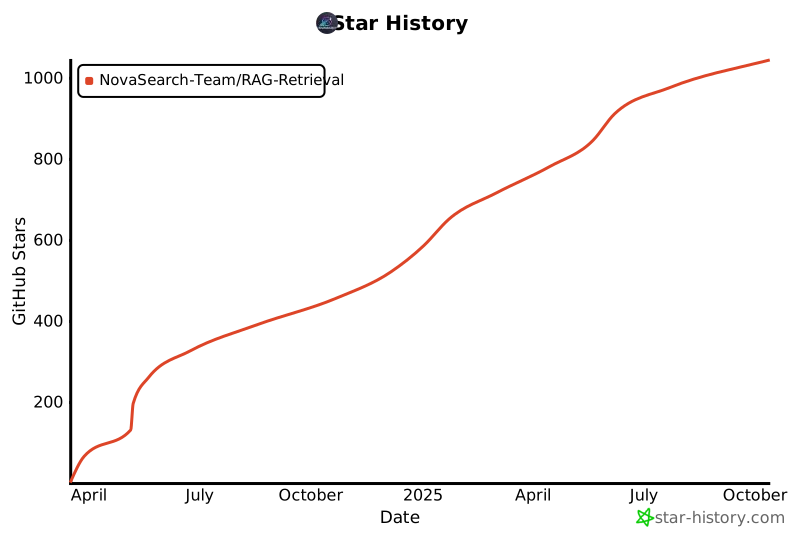](https://star-history.com/#NovaSearch-Team/RAG-Retrieval&Date)
# License
RAG-Retrieval is licensed under the [MIT License](https://github.com/NLPJCL/RAG-Retrieval/blob/master/LICENSE).
================================================
FILE: README_zh.md
================================================
<h1 align="center">RAG-Retrieval</h1>
<p align="center">
<a href="https://pypi.org/project/rag-retrieval/#description">
<img alt="Build" src="https://img.shields.io/pypi/v/rag-retrieval?color=brightgreen">
</a>
<a href="https://www.pepy.tech/projects/rag-retrieval">
<img alt="Build" src="https://static.pepy.tech/personalized-badge/rag-retrieval?period=total&units=international_system&left_color=grey&right_color=brightgreen&left_text=downloads">
</a>
<a href="https://github.com/NLPJCL/RAG-Retrieval">
<img alt="Build" src="https://img.shields.io/badge/Contribution-Welcome-blue">
</a>
<a href="https://github.com/NLPJCL/RAG-Retrieval/blob/master/LICENSE">
<img alt="License" src="https://img.shields.io/badge/LICENSE-MIT-green">
</a>
</p>
RAG-Retrieval 提供了全链路的RAG检索模型微调(train)和推理(infer)以及蒸馏(distill)代码。
- 对于微调,**支持微调任意开源的RAG检索模型**,包括向量模型(图a,bert-based,llm-based embedding)、迟交互式模型(图d,colbert)、重排序模型(图c,bert-based, llm-based reranker)。
- 对于推理,RAG-Retrieval专注于重排序(reranker),开发了一个轻量级的python库[rag-retrieval](https://pypi.org/project/rag-retrieval/),**提供统一的方式调用任意不同的RAG排序模型**。
- 对于蒸馏,**支持向量模型和排序模型的蒸馏**,可以从较大的模型蒸馏到较小的模型(0.5b llm or bert-base)中。

# 社区交流
[加入我们微信群聊](https://www.notion.so/RAG-Retrieval-Roadmap-c817257e3e8a484b8850cac40a3fcf88)
# 最新更新
- 🔥 22/05/2025:RAG-Retrieval 发布 Myopic Trap,一项针对全流程信息检索(IR)链路中位置偏置的实证研究。我们在两个精心设计的位置感知型基准数据集(SQuAD-PosQ 和 FineWeb-PosQ)上,系统评估了多种 SOTA 检索模型,包括 BM25、稠密向量模型、ColBERT-style 模型以及重排序器(reranker)。[了解更多](./examples/MyopicTrap/)
- 29/12/2024:RAG-Retrieval发布Stella and jasper embedidng model 的核心训练代码(stage3)[Jasper and Stella: distillation of SOTA embedding models](https://arxiv.org/abs/2412.19048).
- 21/10/2024: RAG-Retrieval发布基于LLM做Reranker任务的两种不同方法,以及将其蒸馏到bert中的方法。[LLM在Reranker任务上的最佳实践?A simple experiment report(with code)](https://zhuanlan.zhihu.com/p/987727357)
- 05/06/2024: RAG-Retrieval的Embedding模型的MRL loss实现。[RAG-Retrieval:让MRL loss成为训练向量(embedding)模型的标配](https://zhuanlan.zhihu.com/p/701884479)
- 02/06/2024: RAG-Retrieval实现基于LLM偏好监督RAG检索器微调。[RAG-Retrieval实现基于LLM偏好监督RAG检索器微调](https://zhuanlan.zhihu.com/p/701215443)
- 05/05/2024:发布RAG-Retrieval的轻量级的python库[RAG-Retrieval:你的RAG应用值得更好的排序推理框架](https://zhuanlan.zhihu.com/p/692404995)
- 18/03/2024:发布RAG-Retrieval [RAG-Retrieval知乎介绍](https://zhuanlan.zhihu.com/p/683483778)
# 项目特色
- **简单且优雅**: 拒绝复杂的封装,简单易懂的代码结构,方便修改。
- **支持全链路的RAG检索模型微调**: 向量(bert-based,llm-based),迟交互模型(colbert),重排序模型(bert-based,llm-based)。
- **支持微调任意开源的RAG检索模型**: 支持大部分开源的embedding和reranker模型,例如:bge(bge-embedding,bge-m3,bge-reranker),bce(bce-embedding,bce-reranker),gte(gte-embedding,gte-multilingual-reranker-base)。
- **支持将较大的检索模型蒸馏为较小的模型**: 支持将较大的基于LLM的 reranker 和 embedding 模型蒸馏到较小的检索模型中(例如,0.5B LLM 或 BERT)。
- **先进算法**: 对于embedding模型,支持[MRL算法](https://arxiv.org/abs/2205.13147)来缩减输出向量的维度,支持[Stella 模型](https://arxiv.org/abs/2412.19048)先进的蒸馏方法。
- **多卡训练策略**: deepspeed,fsdp。
# 快速开始
## 安装
对于训练(all):
```bash
conda create -n rag-retrieval python=3.8 && conda activate rag-retrieval
#为了避免自动安装的torch与本地的cuda不兼容,建议进行下一步之前先手动安装本地cuda版本兼容的torch。
pip install -r requirements.txt
```
对于预测(reranker):
```bash
#为了避免自动安装的torch与本地的cuda不兼容,建议进行下一步之前先手动安装本地cuda版本兼容的torch。
pip install rag-retrieval
```
## 训练
对于不同的模型类型,请进入不同的子目录。例如:
对于[embedding](https://github.com/NLPJCL/RAG-Retrieval/tree/master/rag_retrieval/train/embedding),其他同理。详细的流程可参考模型目录下的readme.
```bash
cd ./rag_retrieval/train/embedding
bash train_embedding.sh
```
## 预测
RAG-Retrieval开发了一个轻量级的python库[rag-retrieval](https://pypi.org/project/rag-retrieval/),提供统一的方式调用任意不同的RAG排序模型,具有以下的特点。
- 支持多种排序模型:支持常见的开源排序模型(Cross Encoder Reranker,Decoder-Only 的LLM Reranker)
- 长doc友好:支持两种不同的对于长doc的处理逻辑(最大长度截断,切分取最大分值)。
- 益于扩展:如果有新的排序模型,用户只需要继承basereranker,并且实现rank以及comput_score函数即可。
**rag-retrieval包详细的使用方法和注意事项可以参考[Tutorial](https://github.com/NLPJCL/RAG-Retrieval/blob/master/examples/Reranker_Tutorial.md)**
# 实验结果
## reranker模型在 MTEB Reranking 任务的结果
| **Model** | **Model Size(GB)** |**T2Reranking** | **MMarcoReranking** | **CMedQAv1** | **CMedQAv2** | **Avg** |
|:-----------:|:----------:|:----------:|:-------------:|:--------------:|:---------------:| :---------------:|
| bge-reranker-base | 1.11 | 67.28 | 35.46 | 81.27 | 84.10 | 67.03
| bce-reranker-base_v1 | 1.11 |70.25 | 34.13 | 79.64 | 81.31 | 66.33
| rag-retrieval-reranker | 0.41 | 67.33 | 31.57 | 83.54 | 86.03 | 67.12
其中,rag-retrieval-reranker是我们使用RAG-Retrieval代码在hfl/chinese-roberta-wwm-ext模型上训练所得,训练数据使用bge-rerank模型的训练数据.
## colbert模型在 MTEB Reranking 任务的结果
| **Model** | **Model Size(GB)** | **Dim** | **T2Reranking** | **MMarcoReranking** | **CMedQAv1** | **CMedQAv2** | **Avg** |
|:-----------: |:----------:|:----------:|:----------:|:-------------:|:--------------:|:---------------:| :---------------:|
| bge-m3-colbert | 2.24 | 1024 | 66.82 | 26.71 | 75.88 | 76.83 | 61.56
| rag-retrieval-colbert | 0.41 | 1024| 66.85 | 31.46 | 81.05 | 84.22 | 65.90
其中,rag-retrieval-colbert是我们使用RAG-Retrieval代码在hfl/chinese-roberta-wwm-ext模型上训练所得,训练数据使用bge-rerank模型的训练数据.
## 用领域内数据微调开源的BGE系列模型
| **Model** | **T2ranking** | |
|:-----------: |:----------:|:----------:|
| bge-v1.5-embedding | 66.49| |
| bge-v1.5-embedding **finetune** | 67.15 | **+0.66** |
| bge-m3-colbert | 66.82| |
| bge-m3-colbert **finetune** | 67.22 | **+0.40** |
| bge-reranker-base | 67.28| |
| bge-reranker-base **finetune** | 67.57 | **+0.29** |
后面带有finetune的代表我们使用RAG-Retrieval在对应开源模型的基础上继续微调所得,训练数据使用T2-Reranking的训练集。
值得注意的是bge的三种开源模型,训练集中已经包含了T2-Reranking,并且该数据较为通用,因此使用该数据继续微调的性能提升效果不大,但是如果使用垂直领域的数据集继续微调开源模型,性能提升会更大。
# Acknowledge
在开发过程中,我们借鉴或基于以下项目,衷心感谢这些团队为开源做出的贡献。
- [FlagEmbedding](https://github.com/FlagOpen/FlagEmbedding)
- [uniem](https://github.com/wangyuxinwhy/uniem)
- [sentence-transformers](https://github.com/UKPLab/sentence-transformers)
- [rerankers](https://github.com/AnswerDotAI/rerankers)
# Star History
[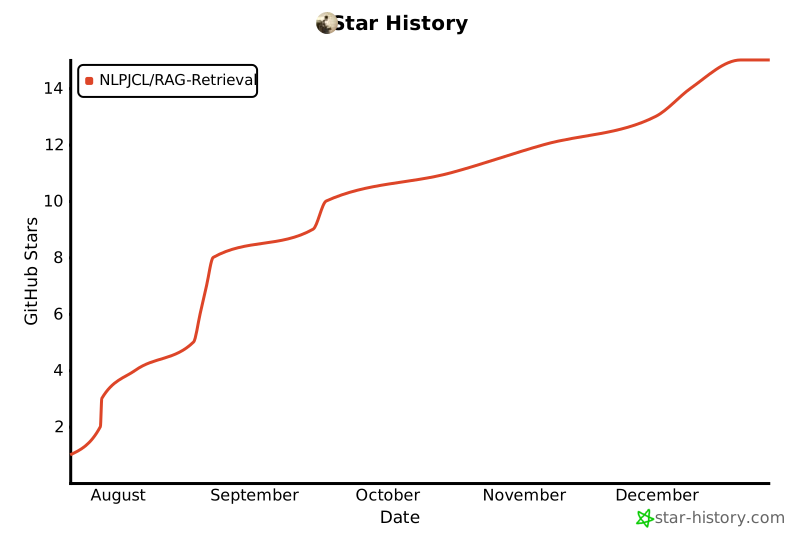](https://star-history.com/#NLPJCL/RAG-Retrieval&Date)
# License
RAG-Retrieval is licensed under the [MIT License](https://github.com/NLPJCL/RAG-Retrieval/blob/master/LICENSE).
================================================
FILE: config/deepspeed/deepspeed_zero0.yaml
================================================
compute_environment: LOCAL_MACHINE
deepspeed_config:
gradient_clipping: "auto"
offload_optimizer_device: none
offload_param_device: none
zero3_init_flag: true
zero_stage: 0
train_micro_batch_size_per_gpu: "auto"
distributed_type: DEEPSPEED
fsdp_config: {}
machine_rank: 0
main_process_ip: null
main_process_port: null
main_training_function: main
num_machines: 1
num_processes: 2
use_cpu: false
================================================
FILE: config/deepspeed/deepspeed_zero1.yaml
================================================
compute_environment: LOCAL_MACHINE
deepspeed_config:
gradient_clipping: "auto"
offload_optimizer_device: none
offload_param_device: none
zero3_init_flag: true
zero_stage: 1
train_micro_batch_size_per_gpu: "auto"
distributed_type: DEEPSPEED
fsdp_config: {}
machine_rank: 0
main_process_ip: null
main_process_port: null
main_training_function: main
num_machines: 1
num_processes: 2
use_cpu: false
================================================
FILE: config/deepspeed/deepspeed_zero2.yaml
================================================
compute_environment: LOCAL_MACHINE
deepspeed_config:
gradient_clipping: "auto"
offload_optimizer_device: none
offload_param_device: none
zero3_init_flag: true
zero_stage: 2
train_micro_batch_size_per_gpu: "auto"
distributed_type: DEEPSPEED
fsdp_config: {}
machine_rank: 0
main_process_ip: null
main_process_port: null
main_training_function: main
num_machines: 1
num_processes: 2
use_cpu: false
================================================
FILE: config/deepspeed/deepspeed_zero3.yaml
================================================
compute_environment: LOCAL_MACHINE
deepspeed_config:
gradient_clipping: "auto"
offload_optimizer_device: none
offload_param_device: none
zero3_init_flag: true
zero_stage: 3
train_micro_batch_size_per_gpu: "auto"
zero3_save_16bit_model: true
distributed_type: DEEPSPEED
fsdp_config: {}
machine_rank: 0
main_process_ip: null
main_process_port: null
main_training_function: main
mixed_precision: fp16
num_machines: 1
num_processes: 4
use_cpu: false
================================================
FILE: config/default_fsdp.yaml
================================================
compute_environment: LOCAL_MACHINE
distributed_type: FSDP
downcast_bf16: 'no'
fsdp_config:
fsdp_auto_wrap_policy: TRANSFORMER_BASED_WRAP
fsdp_backward_prefetch_policy: NO_PREFETCH
fsdp_offload_params: false
fsdp_sharding_strategy: 3
fsdp_state_dict_type: FULL_STATE_DICT
fsdp_transformer_layer_cls_to_wrap: BertLayer
machine_rank: 0
main_training_function: main
mixed_precision: 'no'
num_machines: 1
num_processes: 2
rdzv_backend: static
same_network: true
tpu_env: []
tpu_use_cluster: false
tpu_use_sudo: false
use_cpu: false
================================================
FILE: config/xlmroberta_default_config.yaml
================================================
compute_environment: LOCAL_MACHINE
distributed_type: FSDP
downcast_bf16: 'no'
fsdp_config:
fsdp_auto_wrap_policy: TRANSFORMER_BASED_WRAP
fsdp_backward_prefetch_policy: NO_PREFETCH
fsdp_offload_params: false
fsdp_sharding_strategy: 3
fsdp_state_dict_type: FULL_STATE_DICT
fsdp_transformer_layer_cls_to_wrap: XLMRobertaLayer
machine_rank: 0
main_training_function: main
mixed_precision: 'no'
num_machines: 1
num_processes: 2
rdzv_backend: static
same_network: true
tpu_env: []
tpu_use_cluster: false
tpu_use_sudo: false
use_cpu: false
================================================
FILE: example_data/grouped_reranker_eval_data.jsonl
================================================
{"query": "最近发表的论文中,有哪些新的化疗药物被用于治疗非小细胞肺癌(NSCLC)?", "hits": [{"content": "url: https://www.163.com/dy/article/IU2JIR7O053438SI.html\n标题: 2024 ELCC|杨彬教授:TROPION-Lung01研究最新成果揭晓,非鳞NSCLC患者迎来新希望\n发布时间: 2024年03月24日\n摘要: TROPION-Lung01研究最新结果显示,相较于多西他赛,Dato-DXd在治疗晚期经治非鳞NSCLC患者中取得了可观的PFS获益,且具有可控的安全性。 Dato-DXd已成为首个经III期研究证实的,能显著改善晚期经治非鳞NSCLC患者mPFS的ADC药物。 目前已有多项研究证实Dato-DXd兼顾疗效和安全性,为晚期NSCLC治疗带来新曙光。 2021年WCLC大会上,研究者初次公布了Dato-DXd首个人体研究——TROPION-PanTumor01研究结果。 2023年5月份,该研究的NSCLC队列的更新结果被发表在《Journal of Clinical Oncology》(影响因子50.717)上⁷。\n内容: # 2024 ELCC|杨彬教授:TROPION-Lung01研究最新成果揭晓,非鳞NSCLC患者迎来新希望|肺癌|肿瘤|单药|治疗|nsclc|靶向化疗药物_网易订阅\n[网易首页]()>[网易号]()> 正文[申请入驻]() \n\n# 2024 ELCC|杨彬教授:TROPION-Lung01研究最新成果揭晓,非鳞NSCLC患者迎来新希望\n2024-03-24 18:13:14 来源:[医脉通]()北京 [举报]() \n[0]() \n\n\n \n\n\n**前言**\n\n非小细胞肺癌(NSCLC)是肺癌中最常见的类型,在全球范围内发病率和死亡率较高,为患者家庭以及公共医疗体系带来沉重负担。近年来,以Datopotamab deruxtecan(Dato-DXd)为代表的滋养层细胞表面抗原2(TROP2)抗体药物偶联物(ADC)的快速发展刷新了晚期NSCLC患者的生存纪录,开创了肺癌诊疗新篇章。\n\n今年ELCC大会上,TROPION-Lung01作为Dato-DXd在肺癌领域的首个III期临床研究,进一步公布了Dato-DXd在非鳞癌亚组的疗效和安全性数据。医脉通特邀**湖北省肿瘤医院****杨彬教授**分享本次ELCC大会中TROPION-Lung01研究非鳞癌亚组的最新数据结果,并探讨Dato-DXd在肺癌治疗领域的研究方向。\n\n**杨彬 教授**\n\n \n\n+ \n\n\n\n湖北省肿瘤医院副主任医师\n\n\n+ \n\n\n\n中国抗癌协会肿瘤支持治疗专委会委员\n\n\n+ \n\n\n\n中国抗癌协会肿瘤临床化疗专委会青年委员\n\n\n+ \n\n\n\n湖北省免疫学会肿瘤精准治疗专委会副主任委员\n\n\n+ \n\n\n\n湖北省抗癌协会肺癌专业委员会委员\n\n\n+ \n\n\n\n湖北省抗癌协会肿瘤内科专业委员会委员\n\n\n+ \n\n\n\n湖北省临床肿瘤学会青年委员会常委\n\n\n+ \n\n\n\n湖北省临床肿瘤学会免疫治疗专委会委员\n\n\n+ \n\n\n\n湖北省免疫学会理事\n\n\n\n\n\n**晚期非鳞NSCLC治疗陷入困境****ADC药物掀起肺癌治疗革命风暴**\n\n非小细胞肺癌(NSCLC)是肺癌中最常见的病理类型,约占总病例的85%¹。大多数NSCLC患者在确诊时已处于临床晚期阶段,化疗效果通常有限,并且可能引起一系列不良反应。目前,靶向治疗和免疫治疗是晚期NSCLC治疗的重要手段,然而,获得性耐药却不可避免,后线治疗仍会面临“无药可用”的困境,晚期经治NSCLC患者的后线治疗迫切需要新的变革²。\n\n近年来,随着ADC药物在晚期/转移性NSCLC后线治疗的不断探索,针对TROP2等诸多靶点的ADC临床研究传来佳讯,为晚期/转移性NSCLC患者带来革命性治疗突破。ADC药物不仅在后线治疗中显示出了良好的疗效,还在从后线治疗走向一线治疗、从单药治疗探索联合治疗的策略中展现出了巨大的潜力。\n\n**TROPION-Lung01研究结果更新****Dato-DXd在非鳞NSCLC治疗领域获得突破**\n\nTROP2 ADC在肺癌领域首个III期临床试验——TROPION-Lung01研究,旨在评估Dato-DXd单药对比多西他赛,在既往至少接受过一次治疗的局部晚期或转移性NSCLC患者的疗效和安全性。研究纳入人群类型多样,并覆盖多种常见/少见突变人群(如EGFR、ALK以及NTRK等)。在全分析集(FAS)中,Dato-DXd组(n=299)和多西他赛组(n=305)分别纳入了78%和77%的非鳞NSCLC,两组分别有43%和42%既往接受过≥2线全身治疗³。\n\n \n\n\n图1 TROPION-Lung01研究设计\n\n2023年ESMO报道了阳性关键研究结果:Dato-DXd在意向治疗人群中达到了统计学阳性双终点之一的无进展生存期(PFS),相较于多西他赛,Dato-DXd显著改善既往经治NSCLC人群的mPFS(4.4个月 vs 3.7个月,HR=0.75;95% CI 0.62-0.91,P=0.004)。\n\n本次ELCC大会进一步报道了TROPION-Lung01研究中非鳞癌亚组的疗效和安全性⁴。**在非鳞癌亚组中,与多西他赛相比,Dato-DXd改善了PFS(5.5 vs 3.6个月,HR=0.63;95% CI 0.51-0.79)。**在安全性方面,**Dato-DXd组患者的≥3级治疗相关不良事件(TRAE)发生率远低于多西他赛组(22% vs 41%)。**Dato-DXd最常见的治疗期出现的不良事件(TEAE)为口腔炎和恶心。由此可见,Dato-DXd耐受性良好,安全性可控。\n\n \n\n\n图2 Dato-DXd在非鳞癌亚组的疗效(TROPION-Lung01研究)\n\n表1 Dato-DXd在非鳞癌亚组的安全性(TROPION-Lung01研究)\n\n \n\n\n**专家点评**\n\n**实力出道,Dato-DXd开启晚期非鳞NSCLC治疗新纪元**\n\n根据病理类型和临床治疗指南,NSCLC可进一步细分为鳞状和非鳞状癌,其中非鳞NSCLC约占总病例的75%⁵。约50%的非鳞癌具有EGFR、ALK、ROS1等驱动基因异常⁶。ADC药物的出现为晚期非鳞NSCLC治疗开启了新的时代。ADC药物将靶向治疗和细胞毒药物巧妙结合,其中Dato-DXd是一种靶向TROP2的ADC药物,具有**高活性的药物载荷、特异性的四肽可裂解连接子**以及**优化的药物抗体比(DAR)值**等独特属性,在安全性和疗效方面表现优异。\n\n本次ELCC大会公布了TROPION-Lung01研究的非鳞癌亚组数据,468例(试验组、对照组各234例)**预先指定的非鳞癌亚组的分析显示**:相较多西他赛,**Dato-DXd组中位PFS延长近2个月(5.5个月 vs 3.6个月);客观缓解率(ORR)提高至对照组的近3倍(31% vs 13%)**,其中Dato-DXd组有4例患者获得完全缓解(CR),而多西他赛组未观察到CR;中位缓解持续时间(DoR)延长2.1个月(7.7个月 vs 5.6个月)⁴。**中位总生存期(OS)数据亦显示非鳞NSCLC患者在Dato-DXd组有获益趋势:13.4个月 vs 11.4个月(HR=0.79,95%CI 0.60-1.02)**。在安全性方面,Dato-DXd组患者的**≥3级TRAE发生率较多西他赛组更低**(22% vs 41%),且 Dato-DXd 相比多西他赛**TRAE导致的剂量降低和停药比例更低**。TROPION-Lung01研究最新结果显示,相较于多西他赛,Dato-DXd在治疗晚期经治非鳞NSCLC患者中取得了可观的PFS获益,且具有可控的安全性。**Dato-DXd已成为首个经III期研究证实的,能显著改善晚期经治非鳞NSCLC患者mPFS的ADC药物。**\n\n**步步为营,Dato-DXd NSCLC治疗领域连获多项突破**\n\n目前已有多项研究证实Dato-DXd兼顾疗效和安全性,为晚期NSCLC治疗带来新曙光。2021年WCLC大会上,研究者初次公布了Dato-DXd首个人体研究——TROPION-PanTumor01研究结果。2023年5月份,该研究的NSCLC队列的更新结果被发表在《Journal of Clinical Oncology》(影响因子50.717)上⁷。亚组分析显示,在经过多线治疗并伴有可靶向基因组改变(AGA)的NSCLC患者(n=34)中,观察到了Dato-DXd令人惊喜的抗肿瘤疗效,**ORR达35%,DoR达9.5个月**,这与NSCLC患者总体情况一致。\n\n \n\n\n图3 TROPION-PanTumor01 NSCLC队列的研究设计\n\nTROPION-Lung05研究进一步聚焦伴AGA的NSCLC患者群体,评估了Dato-DXd用于既往经靶向治疗和含铂化疗失败后的晚期/转移性NSCLC患者中的疗效与安全性⁸。该研究共计入组137例患者,**95%患者组织病理分型为腺癌**。结果显示:**cORR为35.8%,DCR为78.8%,DOR为7.0个月,中位PFS为5.4个月。**安全性方面,**与既往Dato-DXd观察到的安全性一致,未出现新的安全性信号。≥3级治疗相关TEAEs发生率为29%,仅1例患者发生≥3级药物相关间质性肺病(ILD)。**\n\n \n\n\n图4 TROPION-Lung05研究设计\n\n \n\n\n图5 TROPION-Lung05研究疗效数据总结\n\n除此之外,Dato-DXd在TROPION-Lung02、TROPION-Lung04这两项探索联合用药方案的研究中也交出了满意的“答卷”。TROPION-Lung02研究评估了Dato-DXd联合帕博利珠单抗±铂类化疗在不伴AGA的晚期NSCLC患者中的疗效和安全性⁹。结果显示,**在总人群中,双联组(Dato-DXd+帕博利珠单抗)ORR为38%,三联组(Dato-DXd+帕博利珠单抗+铂类)ORR为49%。两组DCR分别为84%和87%;中位PFS分别为8.3个月和7.8个月。**\n\n \n\n\n图6 TROPION-Lung02研究设计\n\n \n\n\n图7 TROPION-Lung02研究的疗效结果\n\nTROPION-Lung04研究进一步证实了Dato-DXd双药联合和三药联合可作为不伴AGA的晚期NSCLC治疗方案的可行性与安全性¹⁰。**总人群中,双联组和三联组的ORR分别为47.4%和71.4%,在所有PD-L1表达水平的患者中均观察到缓解,且三联治疗的缓解率高于双联治疗。**\n\n \n\n\n图8 TROPION-Lung04研究设计\n\n在晚期NSCLC患者中,无论是Dato-DXd单药还是联合治疗方案,都显示出良好的应用前景,有望打破NSCLC免疫、靶向治疗耐药后的诊疗困境。TROPION-Lung01和TROPION-Lung05研究阳性结果的公布,进一步夯实Dato-DXd在晚期NSCLC治疗的领先地位。TROPION-Lung02和TROPION-Lung04的研究数据揭示了Dato-DXd联合方案在前线治疗的获益,无论患者驱动基因阳性或阴性的均有良好的应用前景。此外,目前TROPION-Lung07、TROPION-Lung08、AVANZAR等III期研究正在进行中,我们期待能够看到更多III期大型研究结果的公布,从而进一步巩固ADC在NSCLC领域的前沿循证医学证据,为更多患者提供更多的治疗新策略。\n\n**小结**\n\nDato-DXd作为肺癌领域中极具治疗前景的一款ADC药物,多种治疗策略的潜能在不断发掘。本次ELCC大会公布了TROPION-Lung01研究的非鳞癌亚组数据,Dato-DXd在治疗晚期经治非鳞NSCLC患者中取得了可观的PFS获益。希望未来Dato-DXd用于晚期NSCLC治疗能够积累更多可靠的数据支持,为全球的患者带来新的曙光和希望。\n\n参考文献(向上滑动查看):\n\n1. Herbst RS,et al. The biology and management of non-small cell lung cancer[J]. Nature.2018.553(7689): 446-454.\n\n2. 陈雅蕊,等.抗体偶联药物在晚期非小细胞肺癌中的研究进展[J].肿瘤防治研究.2022;(008):855-860.\n\n3. Aaron E. Lisberg, et al.Datopotamab deruxtecan (Dato-DXd) vs docetaxel in previously treated advanced/metastatic (adv/met) non-small cell lung cancer (NSCLC): results of the randomized phase 3 study TROPION-Lung01. 2023 ESMO. LBA12.\n\n4. Nicolas Girard, et al. Datopotamab Deruxtecan (Dato-DXd) in Patients with Previously Treated Advanced Non-Small Cell Lung Cancer (NSCLC) - Nonsquamous (NSQ) Histology in the Phase 3 TROPION-Lung01 Tria.2024 ELCC. 59P.\n\n5. 夏宇,等.晚期非鳞状非小细胞肺癌患者直接非医疗经济负担及影响因素分析[J].中国卫生资源.2022;25(6):724-729.\n\n6. Tan AC, et al. Utility of incorporating next-generation sequencing (NGS) in an Asian non-small cell lung cancer (NSCLC) population: Incremental yield of actionable alterations and cost-effectiveness analysis. Lung Cancer. 2020 ;139:207-215.\n\n7. Shimizu T,et al.First-in-Human, Phase I Dose-Escalation and Dose-Expansion Study of Trophoblast Cell-Surface Antigen 2-Directed Antibody-Drug Conjugate Datopotamab Deruxtecan in Non-Small-Cell Lung Cancer: TROPION-PanTumor01. J Clin Oncol. 2023 Oct 10;41(29):4678-4687.\n\n8. Luis Paz-Ares, et al. TROPION-Lung05: Datopotamab deruxtecan (Dato-DXd) in previously treated non-small cell lung cancer (NSCLC) with actionable genomic alterations (AGAs). 2023 ESMO. 1314MO.\n\n9. Goto Y, et al. TROPION-Lung02: Datopotamab deruxtecan (Dato-DXd) plus pembrolizumab (pembro) with or without platinum chemotherapy (Pt-CT) in advanced non-small cell lung cancer (aNSCLC). 2023 ASCO. Abstract 9004.\n\n10. Papadopoulos KP,et al. Datopotamab Deruxtecan (Dato-DXd) + Durvalumab ± Carboplatin in Advanced/mNSCLC: Initial Results from Phase 1b TROPION-Lung04. 2023 WCLC. OA05.06D.\n\n撰写:Myka\n\n审校:Felicia\n\n排版:Babel\n\n执行:Babel\n\n本平台旨在为医疗卫生专业人士传递更多医学信息。本平台发布的内容,不能以任何方式取代专业的医疗指导,也不应被视为诊疗建议。如该等信息被用于了解医学信息以外的目的,本平台不承担相关责任。本平台对发布的内容,并不代表同意其描述和观点。若涉及版权问题,烦请权利人与我们联系,我们将尽快处理。 \n\n\n特别声明:以上内容(如有图片或视频亦包括在内)为自媒体平台“网易号”用户上传并发布,本平台仅提供信息存储服务。\n\nNotice: The content above (including the pictures and videos if any) is uploaded and posted by a user of NetEase Hao, which is a social media platform and only provides information storage services. \n*/*阅读下一篇*/*### \n[返回网易首页]()[下载网易新闻客户端]()", "label": 0}, {"content": "url: https://www.nejm.org/doi/full/10.1056/NEJMoa2310532\n标题: Alectinib in Resected ALK-Positive Non–Small-Cell Lung Cancer\n发布时间: 2024年04月10日\n摘要: Platinum-based chemotherapy is the recommended adjuvant treatment for patients with resectable, ALK -positive non–small-cell lung cancer (NSCLC). Data on the efficacy and safety of adjuvant...\n内容: # Alectinib in Resected ALK-Positive Non–Small-Cell Lung Cancer | New England Journal of Medicine\n[Original Article]() \n\n# Alectinib in ResectedALK-Positive Non–Small-Cell Lung Cancer\nAuthors:Yi-LongWu,M.D.[https://orcid.org/0000-0002-3611-0258](),RafalDziadziuszko,M.D., Ph.D.,Jin SeokAhn,M.D., Ph.D.,FabriceBarlesi,M.D., Ph.D.,MakotoNishio,M.D., Ph.D.,Dae HoLee,M.D., Ph.D.,Jong-SeokLee,M.D., Ph.D.,+15,WenzhaoZhong,M.D., Ph.D.,HidehitoHorinouchi,M.D., Ph.D.,WeiminMao,M.D., Ph.D.,MaximilianHochmair,M.D.,Filippode Marinis,M.D.,M. RitaMigliorino,M.D.,IgorBondarenko,M.D., Ph.D.,ShunLu,M.D.,QunWang,M.D.,TaniaOchi Lohmann,Ph.D.,TingtingXu,M.D.,AndresCardona,M.Sc.,ThorstenRuf,M.D.,JohannesNoe,Ph.D., andBenjamin J.Solomon,M.B., B.S., Ph.D., forthe ALINA Investigators[*]()[Author Info & Affiliations]() \nPublishedApril 10, 2024 \nN Engl J Med2024;390:1265-1276 \nDOI: 10.1056/NEJMoa2310532 \n[VOL. 390 NO. 14]() \n[Copyright © 2024]() \n\n## Abstract\n\n### Background\nPlatinum-based chemotherapy is the recommended adjuvant treatment for patients with resectable,*ALK*-positive non–small-cell lung cancer (NSCLC). Data on the efficacy and safety of adjuvant alectinib as compared with chemotherapy in patients with resected*ALK*-positive NSCLC are lacking.\n### Methods\nWe conducted a global, phase 3, open-label, randomized trial in which patients with completely resected,*ALK*-positive NSCLC of stage IB (tumors ≥4 cm), II, or IIIA (as classified according to the seventh edition of the*Cancer Staging Manual*of the American Joint Committee on Cancer and Union for International Cancer Control) were randomly assigned in a 1:1 ratio to receive oral alectinib (600 mg twice daily) for 24 months or intravenous platinum-based chemotherapy in four 21-day cycles. The primary end point was disease-free survival, tested hierarchically among patients with stage II or IIIA disease and then in the intention-to-treat population. Other end points included central nervous system (CNS) disease–free survival, overall survival, and safety. \nDownload a PDF of the[Research Summary]().\n### Results\nIn total, 257 patients were randomly assigned to receive alectinib (130 patients) or chemotherapy (127 patients). The percentage of patients alive and disease-free at 2 years was 93.8% in the alectinib group and 63.0% in the chemotherapy group among patients with stage II or IIIA disease (hazard ratio for disease recurrence or death, 0.24; 95% confidence interval [CI], 0.13 to 0.45; P<0.001) and 93.6% and 63.7%, respectively, in the intention-to-treat population (hazard ratio, 0.24; 95% CI, 0.13 to 0.43; P<0.001). Alectinib was associated with a clinically meaningful benefit with respect to CNS disease–free survival as compared with chemotherapy (hazard ratio for CNS disease recurrence or death, 0.22; 95% CI, 0.08 to 0.58). Data for overall survival were immature. No unexpected safety findings were observed.\n### Conclusions\nAmong patients with resected*ALK*-positive NSCLC of stage IB, II, or IIIA, adjuvant alectinib significantly improved disease-free survival as compared with platinum-based chemotherapy. (Funded by F. Hoffmann–La Roche; ALINA ClinicalTrials.gov number,[NCT03456076]().) \n[Quick Take]()\n###### Alectinib in ResectedALK-Positive NSCLC\n2m 2s \nApproximately 50% of patients with non–small-cell lung cancer (NSCLC) receive a diagnosis with early-stage or locally advanced disease (stage I, II, or III).[1]()For patients with resectable disease, the primary treatment is surgery, with adjuvant or neoadjuvant treatment where recommended.[2-4]()Although the treatment landscape for early-stage NSCLC is rapidly evolving with the approval of cancer immunotherapy and targeted therapy regimens,[5-7]()adjuvant targeted therapy in patients with resectable NSCLC harboring a rearrangement in the anaplastic lymphoma kinase (*ALK*) gene (*ALK*-positive NSCLC) warrants evaluation.[8]() \nApproximately 4 to 5% of patients with NSCLC have*ALK*-positive disease.[9-11]()Patients with*ALK*-positive NSCLC are more likely to be younger, be nonsmokers, and receive a diagnosis with more advanced disease than those with*ALK*-negative NSCLC.[10,12,13]()They are also at high risk for brain metastases, which are seen in up to 50 to 60% of patients.[14,15]()Despite recent approvals for the treatment of resectable NSCLC, immunotherapy is generally not recommended in patients with*ALK*-positive disease because no clinical evidence has emerged that immunotherapy is beneficial in NSCLC with oncogenic driver alterations.[2–4,16–18]() \nThe current recommended adjuvant treatment for patients with resected*ALK*-positive NSCLC is platinum-based combination chemotherapy.[2–4,19]()However, adjuvant chemotherapy is associated with only modest improvements in patient outcomes (difference in survival as compared with observation, approximately 5 percentage points).[20]()The risk of disease recurrence remains high (with the 5-year risk of recurrence or death ranging from 45% for stage IB disease to 76% for stage III disease),[20]()and most cases of recurrence have metastatic spread.[21-26]()Five-year survival ranges from 71% for stage IB disease to just 36% for stage IIIA disease.[27]()Adjuvant chemotherapy is also associated with a high risk of adverse events,[28]()with one meta-analysis showing that 66% of patients had grade 3 or 4 adverse events after treatment with adjuvant cisplatin-based chemotherapy.[20]() \nTargeted therapies that have shown efficacy and become established in the treatment of advanced oncogene-dependent NSCLC have the potential to improve outcomes in patients with resectable disease. In the phase 3 ADAURA trial, adjuvant osimertinib showed a significant benefit with respect to disease-free survival as compared with placebo among patients with epidermal growth factor receptor (*EGFR*) mutation–positive NSCLC of stage IB, II, or IIIA.[7]()Recent data indicate that this large disease-free survival benefit can translate into an overall survival benefit.[29]() \nAlectinib is a potent oral ALK tyrosine kinase inhibitor (TKI) that has shown high levels of efficacy across three phase 3 trials involving patients with advanced*ALK*-positive NSCLC.[30-32]()In the global phase 3 ALEX trial, patients with previously untreated advanced*ALK*-positive NSCLC who received alectinib had significantly longer progression-free survival than those who received crizotinib,[31]()with improved 5-year overall survival.[33]()Alectinib has also shown substantial activity in patients with central nervous system (CNS) disease.[15,34,35]()Long-term treatment with alectinib has a safety profile that reflects mainly low-grade adverse events.[36]()On the basis of these results, alectinib is a preferred first-line treatment in patients with advanced*ALK*-positive NSCLC.[2,4]()These data in advanced NSCLC support investigation of alectinib in resected*ALK*-positive NSCLC to determine whether it can reduce the risk of disease recurrence, improve outcomes after surgery, and reduce the incidence of recurrence in the CNS. \nWe report results from the primary analysis of the randomized, open-label, phase 3 ALINA trial, which is investigating the efficacy and safety of adjuvant alectinib as compared with standard chemotherapy in patients with resected*ALK*-positive NSCLC. Follow-up is ongoing.\n## Methods\n\n### Trial Patients\nEligible patients were 18 years of age or older and had completely resected, histologically confirmed stage IB (tumors ≥4 cm), II, or IIIA NSCLC (as classified according to the seventh edition of the*Cancer Staging Manual*of the American Joint Committee on Cancer and Union for International Cancer Control) and documented*ALK*-positive disease by a Food and Drug Administration–approved or European Conformity (CE)–marked test, either locally or centrally performed. Other criteria included eligibility for platinum-based chemotherapy, an Eastern Cooperative Oncology Group performance-status score of 0 or 1 (on a 5-point scale in which higher scores reflect greater disability), and no previous systemic anticancer therapy. Full eligibility criteria are detailed in the trial[protocol](), available with the full text of this article at NEJM.org.\n### Trial Design and Treatment\nALINA is a global, phase 3, open-label, randomized trial (Fig. S1 in the[Supplementary Appendix](), available at NEJM.org). Screening and randomization occurred 4 to 12 weeks after patients had undergone complete surgical resection (lobectomy, sleeve lobectomy, bilobectomy, or pneumonectomy). Eligible patients were randomly assigned in a 1:1 ratio to receive either oral alectinib at a dose of 600 mg twice daily or intravenous platinum-based chemotherapy in four 21-day cycles. Randomization was stratified according to disease stage (IB [≥4 cm] vs. II vs. IIIA) and race (Asian vs. non-Asian). Treatment with alectinib was given for 24 months or until the occurrence of disease recurrence, unacceptable toxic effects, or withdrawal of consent, whichever occurred first. Chemotherapy options were cisplatin at a dose of 75 mg per square meter of body-surface area on day 1 of each cycle, plus vinorelbine at a dose of 25 mg per square meter (on days 1 and 8), gemcitabine at a dose of 1250 mg per square meter (on days 1 and 8), or pemetrexed at a dose of 500 mg per square meter (on day 1), according to local prescribing information. In the event of cisplatin intolerance, carboplatin at an area under the curve of 5 or 6 mg per milliliter per minute was administered. A formal crossover design was not built into this trial. Subsequent treatment after disease recurrence was entirely at the discretion of the investigators.\n### Trial Oversight\nThe trial was conducted in accordance with the Declaration of Helsinki and the International Council for Harmonisation guidelines for Good Clinical Practice. An independent data monitoring committee evaluated data regularly during the trial. The protocol and subsequent amendments were approved by the institutional review board or ethics committee at each site. All the patients provided written informed consent. \nF. Hoffmann–La Roche/Genentech sponsored the trial, provided the trial drugs, and collaborated with the academic authors on the collection, analysis, and interpretation of the data. All the authors vouch for the completeness and accuracy of the data and for the adherence of the trial to the protocol. Medical writing assistance, under the direction of the authors, was funded by F. Hoffmann–La Roche.\n### End Points and Assessments\nThe primary end point was disease-free survival, defined as the time from randomization to the first documented recurrence of disease or new primary NSCLC as determined by the investigator or to death from any cause. Secondary end points included overall survival and safety. Exploratory end points included CNS disease–free survival, defined as the time from randomization to the first documented recurrence of disease in the CNS or death from any cause. \nDisease assessments were conducted at baseline and every 12 weeks for the first 2 years, every 24 weeks for years 3 through 5, and then annually until the occurrence of disease recurrence, death, loss to follow-up, withdrawal of consent, or trial termination by the sponsor, whichever occurred first. All disease assessments included magnetic resonance imaging (MRI) of the brain (or computed tomography of the brain if MRI was unavailable). The adverse-event reporting period lasted until 28 days after the last alectinib dose or chemotherapy cycle.\n### Statistical Analysis\nEfficacy was assessed in the intention-to-treat population, defined as all the patients who underwent randomization, and in the subgroup of patients with stage II or IIIA NSCLC. The safety-evaluable population was defined as all the patients who underwent randomization and received any amount of trial drug. \nKaplan–Meier methods were used to estimate median disease-free survival and 2- and 3-year disease-free survival. Brookmeyer–Crowley methods and Greenwood’s formula were used to construct 95% confidence intervals for medians and landmark rates, respectively. A stratified log-rank test was used to compare disease-free survival between treatment groups. To control the overall level of significance at a two-sided error rate of 0.05, disease-free survival was tested with the use of a prespecified hierarchical approach, first among patients with stage II or IIIA disease and then in the intention-to-treat population. Hazard ratios among patients with stage II or IIIA disease were estimated with the use of a stratified Cox regression model with race (Asian vs. non-Asian) as a stratification factor. For the intention-to-treat population, disease stage (IB [≥4 cm] vs. II vs. IIIA) was also a stratification factor. \nThe trial was designed to show superiority of alectinib as compared with chemotherapy with respect to disease-free survival, with 80% power to detect a target hazard ratio of 0.55 among patients with stage II or IIIA disease and 0.58 in the intention-to-treat population. This preplanned interim analysis was conducted when 67% of events (59 events) were observed among patients with stage II or IIIA disease. \nHere we report the results of the preplanned interim analysis, conducted by an independent data monitoring committee. Additional statistical methods are provided in the[Supplementary Appendix](), and the statistical analysis plan is available with the protocol at NEJM.org.\n## Results\n\n### Patients and Treatment\nIn total, 257 patients were enrolled from August 2018 through December 2021 at 113 sites across 26 countries: 130 patients received alectinib and 127 patients received chemotherapy (Fig. S2 and Table S1). The median time from surgery to randomization was 1.7 months. At the data-cutoff date (June 26, 2023), 20.3% of the patients in the alectinib group were receiving treatment. \nThe demographic and clinical characteristics of the patients at baseline were generally well balanced between the treatment groups ([Table 1]()) and were broadly similar to the available demographic data in patients with*ALK*-positive NSCLC (Table S2); however, Black patients were underrepresented in the trial population. As compared with the chemotherapy group, the alectinib group had a higher percentage of female patients (57.7% vs. 46.5%) and patients who had never smoked (64.6% vs. 55.1%). No patients in the trial received neoadjuvant radiotherapy or postoperative radiotherapy. \nTable 1 \n\n\n|Characteristic |Alectinib(N=130) |Chemotherapy(N=127) |\n|-------|-------|-------|\n|Age | | |\n|Median — yr |54 |57 |\n|Distribution — no. (%) | | |\n|<65 yr |103 (79.2) |93 (73.2) |\n|≥65 yr |27 (20.8) |34 (26.8) |\n|Sex — no. (%) | | |\n|Female |75 (57.7) |59 (46.5) |\n|Male |55 (42.3) |68 (53.5) |\n|Race — no. (%)† | | |\n|Asian |72 (55.4) |71 (55.9) |\n|Black |1 (0.8) |0 |\n|White |55 (42.3) |52 (40.9) |\n|Unknown |2 (1.5) |4 (3.1) |\n|ECOG performance-status score — no. (%)‡ | | |\n|0 |72 (55.4) |65 (51.2) |\n|1 |58 (44.6) |62 (48.8) |\n|Smoking status — no. (%) | | |\n|Never smoked |84 (64.6) |70 (55.1) |\n|Previous smoker |41 (31.5) |54 (42.5) |\n|Current smoker |5 (3.8) |3 (2.4) |\n|Disease stage at initial diagnosis — no. (%)§ | | |\n|IB |14 (10.8) |12 (9.4) |\n|II |47 (36.2) |45 (35.4) |\n|IIIA |69 (53.1) |70 (55.1) |\n|Regional lymph-node stage — no. (%) | | |\n|N0 |21 (16.2) |18 (14.2) |\n|N1 |45 (34.6) |43 (33.9) |\n|N2 |64 (49.2) |66 (52.0) |\n|Nodal assessment — no. (%) | | |\n|MLND |108 (83.1) |105 (82.7) |\n|Lymph-node sampling |19 (14.6) |15 (11.8) |\n|MLND and lymph-node sampling not performed¶ |3 (2.3) |7 (5.5) |\n|Histologic type — no. (%) | | |\n|Squamous |6 (4.6) |3 (2.4) |\n|Nonsquamous |124 (95.4) |124 (97.6) |\n|Surgical procedure for lung cancer — no. (%) | | |\n|Lobectomy |126 (96.9) |117 (92.1) |\n|Sleeve lobectomy |0 |1 (0.8) |\n|Bilobectomy |2 (1.5) |5 (3.9) |\n|Pneumonectomy |2 (1.5) |4 (3.1) | \nDemographic and Clinical Characteristics of the Patients at Baseline (Intention-to-Treat Population).[*]() \n* \nThe intention-to-treat population includes all the patients who underwent randomization. Percentages may not total 100 because of rounding. MLND denotes mediastinal lymph-node dissection. \n† \nRace was reported by the patient. \n‡ \nEastern Cooperative Oncology Group (ECOG) performance-status scores range from 0 to 5, with higher scores indicating greater disability. \n§ \nDisease staging was based on the seventh edition of the*Cancer Staging Manual*of the American Joint Committee on Cancer and Union for International Cancer Control. \n¶ \nAn exception was granted for patients who had documented N2 disease in one nodal station or who had negative preoperative staging imaging (computed tomography and positron-emission tomography) in the mediastinum.\n### Efficacy\nThe median duration of follow-up for survival was 27.8 months (27.8 months in the alectinib group and 28.4 months in the chemotherapy group). At the data-cutoff date, approximately 18 months had passed since the last patient had undergone randomization. \nA total of 231 patients had stage II or IIIA disease: 116 in the alectinib group and 115 in the chemotherapy group. Of these, 59 patients had disease recurrence or had died by the data-cutoff date: 14 in the alectinib group and 45 in the chemotherapy group. The disease-free survival among patients with stage II or IIIA disease at 2 years was 93.8% in the alectinib group and 63.0% in the chemotherapy group; the values at 3 years were 88.3% and 53.3%, respectively. The hazard ratio for disease recurrence or death was 0.24 (95% confidence interval [CI], 0.13 to 0.45; P<0.001), which corresponds to a 76% lower risk with adjuvant alectinib than with chemotherapy. Kaplan–Meier curves for disease-free survival show early and sustained separation between the alectinib group and the chemotherapy group ([Figure 1A]()). \nFigure 1 \nDisease-free Survival among Patients with Stage II or IIIA Disease and in the Intention-to-Treat Population. \nThe intention-to-treat population included patients with stage IB, II, or IIIA disease who had undergone randomization. Disease staging was based on the seventh edition of the*Cancer Staging Manual*of the American Joint Committee on Cancer and Union for International Cancer Control (AJCC–UICC). The widths of the confidence intervals (indicated by shaded areas) have not been adjusted for multiplicity and may not be used in place of hypothesis testing. Tick marks indicate censored data. NE denotes could not be estimated. \nThe intention-to-treat population included 257 patients: 130 in the alectinib group and 127 in the chemotherapy group. Of these, 65 patients had disease recurrence or death: 15 in the alectinib group and 50 in the chemotherapy group. The disease-free survival in the intention-to-treat population at 2 years was 93.6% in the alectinib group and 63.7% in the chemotherapy group; the values at 3 years were 88.7% and 54.0%, respectively. The hazard ratio for disease recurrence or death in the alectinib group as compared with the chemotherapy group in the intention-to-treat population was 0.24 (95% CI, 0.13 to 0.43; P<0.001)([Figure 1B]()). \nThe disease-free survival benefit from adjuvant alectinib as compared with chemotherapy was generally consistent across all subgroups ([Figure 2]()). This consistency was seen in subgroups defined according to disease stage (Fig. S3), race, sex, and smoking status. \nFigure 2 \nSubgroup Analysis of Disease-free Survival. \nRace was reported by the patient. Eastern Cooperative Oncology Group (ECOG) performance-status scores range from 0 to 5, with higher scores indicating greater disability. Disease staging was based on the seventh edition of the*Cancer Staging Manual*of the AJCC–UICC. The widths of the confidence intervals have not been adjusted for multiplicity and may not be used in place of hypothesis testing. The dashed line indicates the hazard ratio among all patients. The size of the boxes is proportional to the number of patients in the subgroup. Arrows indicate that the confidence interval extends past the graphed area. \nDisease recurrence was observed in 15 patients (11.5%) in the alectinib group and 49 (38.6%) in the chemotherapy group. The most common site of recurrence was the brain, reported in 4 patients in the alectinib group and 14 in the chemotherapy group (Table S3). The hazard ratio for CNS disease recurrence or death was 0.22 (95% CI, 0.08 to 0.58) in favor of alectinib([Figure 3]()). After disease recurrence, at least one subsequent treatment was given to 13 patients in the alectinib group and 43 patients in the chemotherapy group (Table S4), most frequently alectinib (4 patients and 29 patients, respectively). \nFigure 3 \nCentral Nervous System (CNS) Disease–free Survival in the Intention-to-Treat Population. \nThe widths of the confidence intervals (indicated by shaded areas) have not been adjusted for multiplicity and may not be used in place of hypothesis testing. Tick marks indicate censored data. \nAt the data-cutoff date, data for overall survival were immature, with a 2.3% event–patient ratio; six events (deaths) were included in the analysis of overall survival: two in the alectinib group and four in the chemotherapy group. An additional patient in the chemotherapy group died, but data for this patient were censored owing to incomplete date of death recorded.\n### Safety\nThe safety-evaluable population included 128 patients who received alectinib and 120 patients who received chemotherapy. The median duration of treatment for the safety-evaluable population was 23.9 months with alectinib and 2.1 months with chemotherapy. The median dose intensity was 99.4% and 100%, respectively. \nAt least one adverse event was reported by 98.4% of the patients in the alectinib group and 93.3% of those in the chemotherapy group ([Table 2]()). The majority were grade 1 or 2 events. No grade 5 (fatal) adverse events were reported.The most commonly reported adverse events were increased creatine kinase levels (43.0%) and constipation (42.2%) in the alectinib group and nausea (72.5%) and decreased appetite (29.2%) in the chemotherapy group.Adverse events of any grade that were considered by the investigator to be related to treatment were reported in 93.8% of the patients in the alectinib group and 89.2% of those in the chemotherapy group; grade 3 or 4 treatment-related adverse events occurred in 18.0% and 27.5%, respectively. \nTable 2 \n\n\n|Adverse Event |Alectinib(N=128) |Chemotherapy(N=120) | | |\n|-------|-------|-------|-------|-------|\n| |Any Grade |Grade 3 or 4 |Any Grade |Grade 3 or 4 |\n| |number of patients (percent) | | | |\n|Any adverse event |126 (98.4) |38 (29.7) |112 (93.3) |37 (30.8) |\n|Nausea |10 (7.8) |0 |87 (72.5) |5 (4.2) |\n|Creatine kinase increased |55 (43.0) |8 (6.2) |1 (0.8) |1 (0.8) |\n|Constipation |54 (42.2) |1 (0.8) |30 (25.0) |1 (0.8) |\n|Aspartate aminotransferase increased |53 (41.4) |1 (0.8) |6 (5.0) |0 |\n|Alanine aminotransferase increased |43 (33.6) |2 (1.6) |11 (9.2) |0 |\n|Blood bilirubin increased |43 (33.6) |2 (1.6) |1 (0.8) |0 |\n|Decreased appetite |7 (5.5) |0 |35 (29.2) |1 (0.8) |\n|Covid-19 |37 (28.9) |0 |1 (0.8) |0 |\n|Myalgia |36 (28.1) |1 (0.8) |2 (1.7) |0 |\n|Anemia |30 (23.4) |0 |31 (25.8) |1 (0.8) |\n|Vomiting |9 (7.0) |0 |30 (25.0) |2 (1.7) |\n|Alkaline phosphatase increased |32 (25.0) |0 |4 (3.3) |0 |\n|White-cell count decreased |2 (1.6) |0 |23 (19.2) |4 (3.3) |\n|Neutrophil count decreased |3 (2.3) |0 |21 (17.5) |12 (10.0) |\n|Asthenia |14 (10.9) |0 |19 (15.8) |3 (2.5) |\n|Neutropenia |2 (1.6) |0 |19 (15.8) |10 (8.3) |\n|Creatinine increased |19 (14.8) |1 (0.8) |6 (5.0) |0 |\n|Cough |19 (14.8) |1 (0.8) |4 (3.3) |0 |\n|Fatigue |18 (14.1) |1 (0.8) |16 (13.3) |2 (1.7) |\n|Rash |18 (14.1) |1 (0.8) |7 (5.8) |0 |\n|Malaise |6 (4.7) |0 |16 (13.3) |0 |\n|Weight increased |17 (13.3) |1 (0.8) |1 (0.8) |0 |\n|Diarrhea |16 (12.5) |1 (0.8) |10 (8.3) |1 (0.8) |\n|Headache |14 (10.9) |0 |8 (6.7) |0 |\n|Dyspnea |13 (10.2) |1 (0.8) |3 (2.5) |0 |\n|Dysgeusia |13 (10.2) |0 |3 (2.5) |0 |\n|Edema, peripheral |13 (10.2) |0 |1 (0.8) |0 | \nAdverse Events Occurring in at Least 10% of Patients in Either Trial Group (Safety-Evaluable Population).[*]() \n* \nThe safety-evaluable population included patients who underwent randomization and received any amount of alectinib or chemotherapy. Adverse events are listed according to*Medical Dictionary for Regulatory Activities*preferred term. The median duration of treatment was 23.9 months in the alectinib group and 2.1 months in the chemotherapy group. No grade 5 events were observed. Multiple occurrences of the same adverse event in an individual patient are counted only once. Covid-19 denotes coronavirus disease 2019. \nSerious adverse events were reported in 17 patients (13.3%) in the alectinib group and 10 patients (8.3%) in the chemotherapy group (Table S5). All serious adverse events that were considered to be related to treatment with alectinib were resolved. \nAdverse events that led to dose reduction were reported in 25.8% of the patients in the alectinib group and 10.0% of those in the chemotherapy group, and adverse events that led to dose interruption were reported in 27.3% and 18.3%, respectively.Adverse events that led to dose discontinuation were reported in 5.5% of the patients in the alectinib group and 12.5% of those in the chemotherapy group.\n## Discussion\nIn the phase 3, randomized ALINA trial, patients with resected*ALK*-positive NSCLC who received adjuvant alectinib had significantly longer disease-free survival than those who received the standard adjuvant platinum-based chemotherapy.The hazard ratio for disease recurrence or death was 0.24 among patients with stage II or IIIA NSCLC and in the intention-to-treat population, which corresponds to a 76% lower risk with adjuvant alectinib than with chemotherapy. The disease-free survival benefit was seen consistently across prespecified subgroups, including those defined according to disease stage, race, sex, and smoking status. \nDisease-free survival is a well-established efficacy end point for trials of adjuvant therapy in resectable NSCLC. Most cases of recurrence after surgery are incurable, with metastatic spread and poor prognosis,[21–27,37]()so improved disease-free survival with alectinib represents a meaningful benefit to patients. Recent data for adjuvant osimertinib in resected*EGFR*-positive NSCLC indicate the potential for a large disease-free survival benefit with a highly effective TKI to translate into an overall survival benefit in the adjuvant context.[29]()In the ALINA trial, longer follow-up will be needed to better understand the effect of adjuvant alectinib on overall survival. \nPatients with*ALK*-positive NSCLC are at high risk for brain metastases, which are associated with poor prognosis and have a substantial effect on health-related quality of life.[14,38]()In the ALINA trial, recurrence in the brain was observed in fewer patients in the alectinib group (4 [3.1%]) than in the chemotherapy group (14 [11.0%]). An exploratory analysis showed a clinically meaningful prolongation of CNS disease–free survival with alectinib. These early data suggest that adjuvant alectinib can prevent or delay CNS recurrence, findings consistent with the intracranial efficacy of alectinib in advanced NSCLC.[15,34,35]() \nThe safety profile of adjuvant alectinib was consistent with that in previous reports in the context of advanced disease, with laboratory abnormalities and constipation being the most frequent adverse events, and no new safety concerns were identified.[30-32]()Although treatment duration with adjuvant alectinib was much longer than with chemotherapy (median of 2 years vs. 2 months), similar numbers of adverse events were observed in the two groups, and the percentage of patients who discontinued treatment owing to adverse events was lower with alectinib (5.5%) than with chemotherapy (12.5%). Long-term follow up will be needed to assess any potential long-term toxic effects of adjuvant alectinib. \nSome aspects of the design of the ALINA trial differ from previous phase 3 trials of adjuvant targeted therapy.[7]()An open-label trial design was used in order to make a head-to-head comparison between a chemotherapy-free regimen of 2 years of adjuvant oral alectinib and standard adjuvant intravenous chemotherapy, for which blinding would not be feasible.Chemotherapy-free regimens have potential benefits with respect to adverse-event profile, could allow chemotherapy to be reserved as a treatment option after disease recurrence, and may be preferred by patients and their families.[39]()However, our trial does not address the potential additional usefulness of adding chemotherapy to alectinib. This approach could allow intensification of therapy in selected groups of patients and should be investigated in future clinical trials. \nIn the ALINA trial, the choice of treatment after disease recurrence was at the discretion of the investigators, because the trial did not have a formal crossover design. ALK TKIs were the most common systemic therapies after recurrence in both groups, the majority being second- and third-generation, CNS-penetrant ALK TKIs, including alectinib, brigatinib, and lorlatinib. These post-recurrence treatments are consistent with current clinical practice and global guidelines for advanced disease.[2-4]() \nThe most effective timing and duration of adjuvant targeted therapy in resectable NSCLC has not yet been established. A 2-year treatment duration was chosen for the ALINA trial to balance the potential benefits of longer durations of adjuvant alectinib with limiting the burden of an extended treatment duration. A need remains for prospective trials to identify the most effective treatment duration of adjuvant targeted therapies in resectable NSCLC, which may differ for different patients depending on factors such as the molecular profile of tumors or the presence of minimal residual disease.[40,41]()Future studies are planned to investigate a combination of chemotherapy and alectinib, as well as a longer duration of treatment with adjuvant alectinib. \nThe data from the ALINA trial reinforce the need for rapid biomarker testing for*ALK*alterations across all stages of NSCLC.*ALK*testing is well established in advanced NSCLC and is increasingly becoming standard in the context of early-stage disease.[2,4]()Currently, biomarker testing for*ALK*alterations in resectable NSCLC is mainly performed to exclude patients from receiving immunotherapy, but routine*ALK*testing should also support identification of patients who are likely to benefit from adjuvant alectinib. \nAdjuvant alectinib showed a significant benefit with respect to disease-free survival as compared with chemotherapy, as well as a mainly low-grade safety profile with few discontinuations due to adverse events. Adjuvant alectinib represents an important efficacious new treatment strategy for patients with resected*ALK*-positive NSCLC of stage IB, II, or IIIA. \n\n## Notes\nA[data sharing statement]()provided by the authors is available with the full text of this article at NEJM.org. \nSupported byF. Hoffmann–La Roche. \n[Disclosure forms]()provided by the authors are available with the full text of this article at NEJM.org. \nWe thank all the patients, their families, trial investigators, clinical site staff, and the ALINA trial team past and present; and Sean R. Mills, Ph.D., of Ashfield MedComms, an Inizio company, for medical writing assistance with an earlier version of the manuscript.\n## Supplementary Material\nResearch Summary(nejmoa2310532_research-summary.pdf) \n\n+ [Download]()\n+ 901.63 KB \nProtocol(nejmoa2310532_protocol.pdf) \n\n+ [Download]()\n+ 4.31 MB \nSupplementary Appendix(nejmoa2310532_appendix.pdf) \n\n+ [Download]()\n+ 321.65 KB \nDisclosure Forms(nejmoa2310532_disclosures.pdf) \n\n+ [Download]()\n+ 2.17 MB \nData Sharing Statement(nejmoa2310532_data-sharing.pdf) \n\n+ [Download]()\n+ 90.76 KB\n## References\n1. \nWaser N, Vo L, McKenna M, Penrod JR, Goring S. Real-world treatment patterns in resectable (stages I-III) non-small-cell lung cancer: a systematic literature review.*Future Oncol*2022;18:1519-1530. \n[Go to Citation]() \n[Crossref]() \n[PubMed]() \n[Web of Science]() \n[Google Scholar]() \n2. \nNational Comprehensive Ca", "label": 0}, {"content": "url: https://www.nejm.org/doi/full/10.1056/NEJMoa2402614\n标题: Osimertinib after Chemoradiotherapy in Stage III EGFR-Mutated NSCLC ...\n发布时间: 2024年06月02日\n摘要: Osimertinib is a recommended treatment for advanced non–small-cell lung cancer (NSCLC) with an epidermal growth factor receptor (EGFR) mutation and as adjuvant treatment for...", "label": 0}, {"content": "url: https://pubmed.ncbi.nlm.nih.gov/8695545/\n标题: New drugs in the treatment of non-small cell lung cancer.\n作者: W P Steward,D J Dunlop\n来源期刊: Annals of oncology : official journal of the European Society for Medical Oncology\n发布时间: 1995年01月01日\n内容: Non-small cell lung cancer accounts for 75% of all lung tumours, and only about 10% of patients will remain alive 5 years after diagnosis. Few cytotoxic drugs currently registered produce more than a 15% response rate as a single agent or 30%-35% in combination, with only modest survival benefits. New cytotoxic drugs entering phase II and III studies, however, appear to have more than 20% activity against this disease. They include the taxanes (taxol and taxotere), camptothecin analogues (CPT-11 and topotecan), antimetabolites (edatrexate and gemcitabine) and the vinca alkaloid, navelbine. Taxol produces response rates of about 25% in previously untreated patients and is currently undergoing trials at higher doses in combination with cisplatin and granulocyte colony-stimulating factor. Taxotere produces response rates of 33% in previously untreated patients and 21% in patients previously refractory to platinum-containing regimens. The camptothecin analogues, which are inhibitors of topoisomerase I, may produce response rates of up to 41% in previously untreated patients, but these results have varied considerably between different trials (response rates as low as 13.5% have been reported for topotecan). A phase II study with edatrexate produced a response rate of 32% but subsequent trials using combination chemotherapy including this agent have been disappointing. The activity of gemcitabine as a single agent is 20%-25%. Three ongoing phase II studies combining cisplatin and gemcitabine have shown response rates of up to 50%. Gemcitabine has minimal subjective toxicity. Navelbine produces response rates of 22%-33% as a single agent and up to 65% in combination. These new cytotoxic agents with significant activity in non-small cell lung cancer provide exciting potential for developing novel combination regimens in the advanced setting and as neoadjuvant and adjuvant therapy.\n论文研究信息: 研究方法: Phase II and III studies; 研究目标: Response rates to new cytotoxic drugs; 研究人群: non-small cell lung cancer patients; 研究结论: Taxol produces response rates of about 25% in previously untreated patients; Taxotere produces response rates of 33% in previously untreated patients and 21% in patients previously refractory to platinum-containing regimens; Camptothecin analogues may produce response rates of up to 41% in previously untreated patients; Edatrexate produced a response rate of 32%; Gemcitabine as a single agent has a response rate of 20%-25%, and in combination with cisplatin, it can reach up to 50%; Navelbine produces response rates of 22%-33% as a single agent and up to 65% in combination.", "label": 1}, {"content": "url: https://pubmed.ncbi.nlm.nih.gov/8096453/\n标题: New directions for chemotherapy in non-small-cell lung cancer.\n作者: M R Green\n来源期刊: Chest\n发布时间: 1993年04月01日\n内容: Currently, only a few chemotherapeutic agents (ifosfamide, mitomycin, vinblastine, and vindesine) have consistently produced single-agent response rates greater than 15% in patients with non-small-cell lung cancer (NSCLC). While combination chemotherapy with these and other agents may prolong survival in some patients with advanced disease, complete responses and long-term disease control are achieved only infrequently. In recent years, several new drugs have produced single-agent response rates above 20% in phase I/II trials. These results have brightened the prospects for chemotherapy against NSCLC. This article reviews available data for several of these agents: navelbine, which is an analogue of vinblastine, the camptothecins CTP-11 and topotecan, and taxol, the first of a novel class of antimicrotubule drugs.\n论文研究信息: 研究方法: Literature Review; 研究目标: new drugs producing single-agent response rates above 20% in phase I/II trials; 研究人群: patients with non-small-cell lung cancer (NSCLC); 研究结论: Several new drugs like navelbine, camptothecins CTP-11 and topotecan, and taxol have shown promising single-agent response rates in phase I/II trials, brightening the prospects for chemotherapy against NSCLC.", "label": 1}, {"content": "url: https://pubmed.ncbi.nlm.nih.gov/20465389/\n标题: Clinical outcomes in non-small-cell lung cancer in relation to expression of predictive and prognostic biomarkers.\n作者: Navneet Singh,Amanjit Bal,Ashutosh N Aggarwal,Ashim Das,Digambar Behera\n来源期刊: Future oncology (London, England)\n发布时间: 2010年05月15日\n内容: Chemotherapy (platinum-based doublet) remains a key component of treatment for early, locally advanced and metastatic non-small-cell lung cancer. In the last decade, several important studies, including randomized clinical trials involving the use of new chemotherapeutic agents or targeted therapies, have been published. Targeted therapies have been tried as an alternative to, in conjunction with or following failure of standard chemotherapy regimens. Biomarkers have also been identified that predict responsiveness to and outcomes with commonly used chemotherapeutic agents, as well as targeted therapies. A trend for individualizing therapy for each patient based on baseline demographic characteristics, especially tumor histology and expression of predictive biomarkers, has been witnessed in the recent past. In this article, we have summarized the available literature on the role of histology and molecular markers of clinical relevance in the treatment of non-small-cell lung cancer.\n论文研究信息: 研究方法: Literature Review; 研究目标: role of histology and molecular markers in treatment; 研究人群: non-small-cell lung cancer patients; 研究结论: Biomarkers have been identified that predict responsiveness to and outcomes with commonly used chemotherapeutic agents, as well as targeted therapies.", "label": 1}, {"content": "url: https://guide.medlive.cn/guideline/18508\n标题: 晚期非小细胞肺癌抗血管生成药物治疗中国专家共识(2019版)\n作者: 中国临床肿瘤学会(CSCO,Chinese Society of Clinical Oncology),血管靶向治疗专家委员会,非小细胞肺癌专家委员会, 非小细胞肺癌抗血管生成药物治疗专家组\n来源期刊: 中国肺癌杂志.2019,22(7):401-412.\n发布时间: 2019年07月15日\n文献类型: 专家共识\n内容: 晚期非小细胞肺癌抗血管生成药物治疗中国专家共识(2019版)", "label": 0}, {"content": "url: https://guide.medlive.cn/guideline/26938\n标题: 三代EGFR-TKI在EGFR突变NSCLC治疗中应用的专家共识(2022年版)\n作者: 中国临床肿瘤学会(CSCO,Chinese Society of Clinical Oncology),抗肿瘤药物安全管理专家委员会\n来源期刊: 中国肺癌杂志.2022.25(9):627-641.\n发布时间: 2022年09月28日\n文献类型: 专家共识\n内容: 三代EGFR-TKI在EGFR突变NSCLC治疗中应用的专家共识(2022年版)", "label": 0}, {"content": "url: https://guide.medlive.cn/guideline/15998\n标题: 2018 SITC共识声明:非小细胞肺癌的免疫治疗\n作者: 肿瘤免疫治疗学会(SITC,Society for Immunotherapy of Cancer)\n来源期刊: J Immunother Cancer. 2018 Jul 17;6(1):75.\n发布时间: 2018年07月17日\n文献类型: 专家共识\n内容: \\begin{abstract}\nLung cancer is the leading cause of cancer-related mortality worldwide, with non-small cell lung cancer (NSCLC) accounting for over $85 \\%$ of all cases. Until recently, chemotherapy - characterized by some benefit but only rare durable responses - was the only treatment option for patients with NSCLC whose tumors lacked targetable mutations. By contrast, immune checkpoint inhibitors have demonstrated distinctly durable responses and represent the advent of a new treatment approach for patients with NSCLC. Three immune checkpoint inhibitors, pembrolizumab, nivolumab and atezolizumab, are now approved for use in first- and/or second-line settings for selected patients with advanced NSCLC, with promising benefit also seen in patients with stage III NSCLC. Additionally, durvalumab following chemoradiation has been approved for use in patients with locally advanced disease. Due to the distinct features of cancer immunotherapy, and rapid progress in the field, clinical guidance is needed on the use of these agents, including appropriate patient selection, sequencing of therapies, response monitoring, adverse event management, and biomarker testing. The Society for Immunotherapy of Cancer (SITC) convened an expert Task Force charged with developing consensus recommendations on these key issues. Following a systematic process as outlined by the National Academy of Medicine, a literature search and panel voting were used to rate the strength of evidence for each recommendation. This consensus statement provides evidence-based recommendations to help clinicians integrate immune checkpoint inhibitors into the treatment plan for patients with NSCLC. This guidance will be updated following relevant advances in the field.", "label": 0}, {"content": "url: https://guide.medlive.cn/guideline/5260\n标题: 2013 非小细胞肺癌小分子靶向药物耐药处理共识\n作者: 中国抗癌协会肺癌专业委员会\n来源期刊: 循证医学2013年4月第13卷第2期\n发布时间: 2013年04月01日\n文献类型: 专家共识\n内容: \\title{\n非小细胞肺癌小分子靶向药物耐药处理共识\n}", "label": 0}]}
{"query": "GST pull-down实验的基本原理是什么?", "hits": [{"content": "url: https://zhuanlan.zhihu.com/p/688382296\n标题: 实验宝典之大家都在做的GST pull-down实验\n发布时间: 2024年03月22日\n摘要: GST pull-down技术是体外条件下研究蛋白质相互作用的方法。 先将体外表达的GST融合蛋白结合到谷胱甘肽Beads上,再将靶蛋白-GST-Beads和细胞裂解液孵育,这样互作蛋白便一起吸附在Beads上。 洗涤掉未结合的蛋白后,再用洗脱液将互作蛋白复合物从Beads洗脱下来,即GST pull down产物。 这种互作复合物既可以用Western Blot检测已知蛋白A和已知蛋白B的互作验证,也可用质谱鉴定出与已知蛋白A相互作用的未知蛋白。 1. 缓冲液配制. 2. 样本制备. 【注】 样品在上样前**用0.22 µm或0.45 µm滤膜过滤,减少杂质。\n内容: # 实验宝典之大家都在做的GST pull-down实验 - 知乎\n切换模式 \n\n\n**一、GST pull-down****基本知识** \n\n\nGST pull-down技术是体外条件下研究蛋白质相互作用的方法。先将体外表达的GST融合蛋白结合到谷胱甘肽Beads上,再将靶蛋白-GST-Beads和细胞裂解液孵育,这样互作蛋白便一起吸附在Beads上。洗涤掉未结合的蛋白后,再用洗脱液将互作蛋白复合物从Beads洗脱下来,即GST pull down产物。这种互作复合物既可以用Western Blot检测已知蛋白A和已知蛋白B的互作验证,也可用质谱鉴定出与已知蛋白A相互作用的未知蛋白。 \n**二、GST pull-down实验原理图** \n\n\n \n**三、GST pull-down实验操作步骤** \n1. 缓冲液配制 \n平衡液/洗杂液:PBS, pH 7.4 (140 mM NaCI, 2.7 mM KCI, 10 mM Na2HPO4, 1.8 mM KH2PO4, pH 7.4) \n洗脱液:50 mM Tris-HCl, 10mM-20 mM还原型谷胱甘肽,pH 8.0 \n2. 样本制备 \n【注】 样品在上样前**用0.22 µm或0.45 µm滤膜过滤,减少杂质。 \n2.1细菌或酵母表达的蛋白 \n将培养液转移到离心杯中,7,000 rpm(7,500xg),离心15 min收集菌体,然后按照菌体:平衡液=1: 10 (W/V)加入平衡液,加入终浓度为1 mM的PMSF。加入溶菌酶,使其工作浓度为0.2-0.4 mg/mL。如果表达的宿主细胞内含pLysS或pLysE,可以不加溶菌酶。同时也可加入其他蛋白酶抑制剂,但不能影响目的蛋白与磁珠的结合。将菌体沉淀悬浮起来(如果菌液浓度高,也可考虑加入10μg/mLRNase A和5 μg/mLDNase I),混匀,冰上超声破碎细胞,至菌液基本保持澄清。将澄清的破碎液转移至离心管中,10,000rpm(15,000xg),4℃离心20-30 min。 \n取上清,置于冰上备用或-20℃保存。 \n2.2 酵母、昆虫和哺乳细胞分泌表达可溶性蛋白 \n将细胞培养液转移至离心杯中,5,000 rpm(3,800xg),离心10 min,收集菌体得上清,即可直接使用。对于大量体积的上清,需加入硫酸铵沉淀浓缩后,然后用Lysis Buffer透析后才能上样。 \n3. 磁珠准备 \n可根据目标蛋白产量和磁珠载量信息来准备适量的磁珠(磁珠体积为总体积的20%),将磁珠反复颠倒,充分混匀,使用移液器取适量的磁珠悬浮液,置于离心管中,将离心管置于磁分离器上,大约1min,待溶液变澄清后,用移液器吸弃清液。 \n将离心管从磁分离器上取下来,加入与悬浮液等体积的平衡液,使用枪头反复吹打5次,将离心管置于磁分离器上,大约1min,待溶液变澄清后,用移液器吸弃清液,重复洗涤2次。 \n4. GST标签蛋白纯化 \n结合 将备好的样本加入到处理好的磁珠中,反复颠倒混匀。将离心管置于混合仪上,室温孵育30 min以上(也可根据结合效果调整,延长孵育时间)。 \n洗杂 将离心管置于磁分离器,大约1min,待溶液变澄清后,用移液器移出上清液,保留,以备取样检测。向离心管中加入5倍悬浮液体积的洗杂液,使用枪头反复吹打5次,将离心管置于磁分离器上,大约1min,待溶液变澄清后,用移液器吸弃上清液。至少重复上述步骤2次。 \n洗脱 在上述离心管中加入3-5倍磁珠体积的洗脱液,用移液器吹打5次,然后在室温下置于翻转混合仪或者手工轻轻翻转离心管,5-10 min后,置于磁分离器上,大约1 min,待溶液变澄清后,吸取上清液,收集洗脱组分,即为目标蛋白。重复操作两次,分别收集洗脱组分,留待检测。 \n磁珠保存 使用后的磁珠用1 mL洗脱液重悬磁珠,然后置于磁分离器上,大约1 min,待溶液变澄清后,吸弃上清液。该操作重复两次。 再加入1 mL平衡液,悬浮磁珠,然后置于磁分离器上,大约1 min,待溶液变澄清后,吸弃上清液。再加入4倍磁珠体积的20%乙醇,置于4℃保存。 \n5. Pull-Down 实验 \n磁珠结合诱饵蛋白 将含有GST标签诱饵蛋白的样品加入到备好的磁珠中,颠倒混匀。将离心管置于混合仪上,室温孵育30 min以上(时间可根据结合效果调整)。 \n洗杂 将离心管置于磁分离器,大约1min,待溶液变澄清后,用移液器移出上清液,保留,以备取样检测。向离心管中加入5倍悬浮液体积的洗杂液,使用枪头反复吹打5-10次,将离心管置于磁分离器上,大约1 min,待溶液变澄清后,用移液器吸弃上清液。重复上述步骤2次。 即得到GST诱饵蛋白-磁珠复合物。 \n目标蛋白与诱饵蛋白-磁珠复合物结合 将含有目标蛋白的样品加入到处理好的诱饵蛋白-磁珠复合物中,颠倒混匀。将离心管置于混合仪上,室温孵育30 min以上(时间可根据结合效果调整)。 \n洗杂 将离心管置于磁分离器,大约1 min,待溶液变澄清后,用移液器移出上清液,保留,以备取样检测。向离心管中加入5倍悬浮液体积的洗杂液,使用枪头反复吹打5-10次,将离心管置于磁分离器上,大约1 min,待溶液变澄清后,用移液器吸弃上清液。重复上述步骤2次。 目标蛋白通过与诱饵蛋白的结合,从混合体系中被捕获。 \n目的蛋白的洗脱 在上述离心管中加入3-5倍磁珠体积的洗脱液,用移液器吹打5次,然后在室温下置于翻转混合仪或者手工轻轻翻转离心管,5-10 min后, 置于磁分离器上,大约1 min,待溶液变澄清后,吸取上清液,收集洗脱组分,即得到靶蛋白和目标蛋白复合物。再重复操作两次,分别收集洗脱组分,留待检测。 \n6. WB验证实验 \n \n四、GST pull-down实验操作步骤分析图 \n1.构建诱饵蛋白表达载体、蛋白表达和磁珠结合 \n \n\n\n \n \n \n2. 将磁珠结合的诱饵蛋白与总蛋白pull-down \n\n\n \n \n3. WB验证 \n\n\n \n \n**五、GST pull-down****与****Co-IP****区别及优缺点** \n\n1. GST pull-down 是两种蛋白在试管内(细胞以外)发生生化反应互作的结果,只要互作蛋白间具有相互结合的结构域基础即可,验证蛋白之间直接的相互作用。\n2. Co-IP 实验是细胞内高表达目的蛋白,并通过 IgG 球珠-抗体-蛋白复合物体系,分离出互作的蛋白复合物,是细胞内的体内反应结合。\n3. GST pull-down 实验优点:可验证蛋白质-蛋白质之间的直接互作,GSH 谷胱甘肽偶联球珠亲和力强,洗脱纯度高。\n4. GST pull-down 实验缺点:验证互作是在试管中进行的生化反应,不能够完全反应细胞内蛋白真实互作状态。融合表达的 GST 标签,肽链较长,可能会改变原目的蛋白的原有的折叠结构。\n\n \n现在,你又懂他多一点了吗? \n好啦,今天的分享就到这里啦,【研匠】带你简单生动的走进科学的世界,关注【研匠】不迷路奥,我们下期再见啦~ \n\n\n\n\n发布于 2024-03-22 09:23・IP 属地上海・来源官方网站 \n[实验]() \n[实验报告]() \n[生物实验]()", "label": 2}, {"content": "url: https://baijiahao.baidu.com/s?id=1797649000828245700\n标题: 蛋白互作:GST下拉实验(GST-pull down assay)实验原理及步骤\n发布时间: 2024年04月29日\n摘要: GST-pull down 技术是一种在体外验证蛋白质相互作用的试验技术,可用来进一步验证酵母双杂交的结果。 将靶蛋白与 GST(谷胱苷肽巯基转移酶, Glutathione-Stransferase)融合,使其与谷胱甘肽亲和树脂结合,然后在目的蛋白溶液过柱时,便可从中捕获与靶蛋白相互作用的目的蛋白,洗脱结合物后通过western blot分析,即可证实两种蛋白间的相互作用或筛选与之互作的蛋白。 ⑥拍照记录实验结果。 GST-pull down实验流程图. ②交付周期短,提供原始图片,保证数据真实可靠。\n内容: # 蛋白互作:GST下拉实验(GST-pull down assay)实验原理及步骤\n[百度首页]() \n[登录]() \n\n\n▲ GST下拉实验(GST-pull down)技术原理示意图 \nGST下拉实验原理简介 \n\n\n GST-pull down 技术是一种在体外验证蛋白质相互作用的试验技术,可用来进一步验证酵母双杂交的结果。将靶蛋白与 GST(谷胱苷肽巯基转移酶, Glutathione-Stransferase)融合,使其与谷胱甘肽亲和树脂结合,然后在目的蛋白溶液过柱时,便可从中捕获与靶蛋白相互作用的目的蛋白,洗脱结合物后通过western blot分析,即可证实两种蛋白间的相互作用或筛选与之互作的蛋白。 \nGST下拉实验流程 \n\n\n ①构建表达载体:目的基因克隆或目的基因合成;限制性内切酶酶切骨架载体并纯化;目的基因插入骨架载体;转化大肠杆菌,筛选阳性克隆并测序鉴定; \n ②转化表达菌株:将目的表达载体转化表达菌株; \n ③制备目的蛋白:诱导目的蛋白表达并提取目的蛋白; \n ④GST-pull down实验; \n ⑤Western Blot检测目的蛋白; \n ⑥拍照记录实验结果。 \n\n\n▲GST-pull down实验流程图 \nGST下拉实验结果展示 \n\n\n GST下拉实验技术服务范畴:验证两个已知蛋白质间的相互作用 \n 技术服务优势: \n ①团队经验丰富; \n ②交付周期短,提供原始图片,保证数据真实可靠。 \n举报/反馈 \n相关搜索 \n[蛋白pull down实验]()[蛋白互作实验]()[蛋白竞争结合实验]()[蛋白结合实验]()[蛋白裂解步骤]()[蛋白质交联反应]() \n[中科圣安生物]()6获赞3粉丝 \n关注 \n\n## 作者最新文章\n[微量热涌动技术(MicroScale Thermophoresis,MST)]() \n2024-08-2821阅读 \n[蛋白互作之酵母双杂交一对一互作验证——中科圣安]() \n2024-06-1695阅读 \n[蛋白质免疫印迹(Western Blot)]() \n2024-04-1543阅读 \n\n## 相关推荐\n[睡眠如何改变大脑表现]() \n[西塘少主]()[1评论]() \n[天生变态狂科学家:揭秘杀人犯基因下的非凡人生]() \n[神的孩子在推书]()[1评论]() \n[上海细胞库揭秘:细胞资源的收集、保存与分发]() \n[上海晶风生物科技有限公司]() \n[上海富衡|OD600 在悬浮培养真核细胞检测中的应用与考量]() \n[富衡生物]() \n[因为多拷贝了几份基因,它成了饮酒之王!]() \n[中国科技新闻网]()[1评论]() \n换一换\n+ 1[官方通报野猪伤人致死:4人撵野猪引发]()热\n+ 2[儿子在校一餐花8元妈妈心疼落泪]()热\n+ 3[中国沙化土地净减少6500万亩]()\n+ 4[余承东说Mate70对得起那四个字]()热\n+ 5[杨子开车窗报复麦琳]()\n+ 6[网传中国铁建投资集团副总坠亡]()\n+ 7[北大回应“羊毛月学历造假”]()\n+ 8[巴菲特后事安排:留0.5%财富给孩子]()\n+ 9[商业航天让太空旅行不是梦]()\n+ 10[羊毛月月收入近150万]() \n0 \n0 \n收藏 \n分享 \n[设为首页]()© Baidu [使用百度前必读]()[意见反馈]()京ICP证030173号 [京公网安备11000002000001号]()", "label": 2}, {"content": "url: https://pubmed.ncbi.nlm.nih.gov/37450141/\n标题: Detection of Protein-Protein Interactions Using Glutathione-S-Transferase (GST) Pull-Down Assay Technique.\n作者: Prabu Gnanasekaran,Hanu R Pappu\n来源期刊: Methods in molecular biology (Clifton, N.J.)\n发布时间: 2023年07月14日\n内容: Pull-down assay is a technique to analyze direct protein-protein interaction under in vitro condition. Also, this technique is appropriate for investigating the direct interaction between two purified proteins. Glutathione-s-transferase (GST) protein is a widely used affinity tag for affinity purification. In this chapter, we explain the widely used GST pull-down assay to identify the protein-protein interaction between purified proteins.\n论文研究信息: 研究方法: In Vitro Trial; 研究目标: Protein-protein interaction; 研究结论: The GST pull-down assay technique can be used to identify the interaction between purified proteins under in vitro conditions.", "label": 1}, {"content": "url: https://www.nature.com/articles/nmeth1204-275\n标题: Detection of protein-protein interactions using the GST fusion protein pull-down technique\n发布时间: 2024年11月04日\n摘要: Typically, GST pull-down experiments are used to identify interactions between a probe protein and unknown targets and to confirm suspected interactions between a probe protein and a known...\n内容: # Detection of protein-protein interactions using the GST fusion protein pull-down technique | Nature Methods\n[Skip to main content]() \n\n+ Classic Protocol\n+ Published:December 2004\n# Detection of protein-protein interactions using the GST fusion protein pull-down technique\n\n\n[*Nature Methods*]()**volume 1**, pages275–276 (2004)[Cite this article]() \n\n+ \n\n83kAccesses\n+ \n\n23Citations\n+ \n\n[Metrics details]() \n\n\nGlutathione-S-transferase (GST) fusion proteins have had a range of applications since their introduction as tools for synthesis of recombinant proteins in bacteria[1](). Typically, GST pull-down experiments are used to identify interactions between a probe protein and unknown targets and to confirm suspected interactions between a probe protein and a known protein[2](),[3](). The probe protein is a GST fusion, whose coding sequence is cloned into an isopropyl-β-D-thiogalactoside (IPTG)-inducible expression vector. This fusion protein is expressed in bacteria and purified by affinity chromatography on glutathione-agarose beads. Target proteins are usually lysates of cells, either labeled with [35S]methionine or unlabeled, depending on the method used to assay the interaction between the target and the probe. The cell lysate and the GST fusion protein are incubated together with glutathione-agarose beads. Complexes recovered from the beads are resolved by SDS-PAGE and analyzed by western blotting, autoradiography or staining. \n\n## Procedure\n\n### Precleaning the cell lysate\n\n\n1| Incubate the cell lysate with 50 μl of a 50% slurry of glutathione-agarose beads and 25 μg of GST for 2 h at 4 °C with end-over-end mixing. The amount of lysate needed to detect an interaction is highly variable. Start with a volume of lysate equivalent to 1 × 10⁶–1 × 10⁷cells.\n\n*Because the aim of the experiment is to compare GST with a GST fusion protein, it is necessary to prepare enough precleared lysate for each reaction. Efficient mixing of reagents is the key to success and is best achieved if the reaction is carried out in a reasonable volume: 500–1,000 μl is a good starting point. Typically a cell lysate is used in which the proteins are labeled with**35**S. It is, however, possible to use unlabeled cell lysates, depending on the goals of the experiment and the desired detection method*.\n\n2| Centrifuge the mixture at maximum speed for 2 min at 4 °C in a microcentrifuge.\n\n3| Transfer the supernatant (the precleared cell lysate) to a clean microcentrifuge tube.\n### Probing the cell lysate\n\n\n4| Set up two microcentrifuge tubes, each containing equal amounts of precleared cell lysate and 50 μl of glutathione-agarose beads. To one tube add∼10 μg of GST protein; to the other tube add∼10 μg of the GST fusion probe protein.\n\n*The amount of probe and control protein added should be equimolar in the two reactions (that is, the final molar concentration of GST should be the same as that of the GST fusion probe protein)*.\n\n5| Incubate the tubes for 2 h at 4 °C with end-over-end mixing, and centrifuge the samples at maximum speed for 2 min in a microcentrifuge.\n\n6| Save the supernatants at 4 °C in clean microcentrifuge tubes. These samples will be analyzed by SDS-PAGE in step 9.\n\n7| Wash the beads four times with 1 ml of ice-cold GST lysis buffer. Centrifuge the tubes at maximum speed for 1 min in a microcentrifuge. Discard the supernatants.\n\n*GST lysis buffer consists of 20 mM Tris-Cl (pH 8.0), 200 mM NaCl, 1 mM EDTA (pH 8.0), 0.5% Nonidet P-40, 2 μg/μl aprotinin, 1 μg/μl leupeptin, 0.7 μg/ml pepstatin and 25 μg/ml phenylmethylsulfonyl fluoride (PMSF)*.\n\n8| Optional: Elute the GST fusion protein and any proteins bound to it by adding 50 μl of 20 mM reduced glutathione in 50 mM Tris-Cl (pH 8.0) to the beads. Centrifuge the tubes at maximum speed for 2 min in a microcentrifuge.\n### Detecting interacting proteins\n\n\n9| Analyze the beads (from**step 7**) or the eluted proteins (from**step 8**) by SDS-PAGE. Detect the proteins associated with the GST fusion protein by one of the following means.\n\n*The method of detecting proteins associated with the GST fusion protein will depend on whether or not the cell lysate was radiolabeled and on the goal of the experiment*.\n\n**If the goal is to detect all of the****35****S-labeled proteins associated with the fusion protein:**\n\nDry the gel on a gel dryer and expose it to X-ray film to produce an autoradiograph.\n\n**If the goal is to detect specific associated proteins:**\n\nTransfer the proteins from the SDS-polyacrylamide gel to a membrane and perform immunoblotting.\n\n**If the goal is to determine the sizes and abundance of proteins associated with the fusion protein from a nonradioactive lysate:**\n\nStain the gel with Coomassie blue or silver nitrate. \n\n## Source\n\n\nThis protocol was adapted from “Detection of protein-protein interactions using the GST fusion protein pull-down technique,” in[Molecular Cloning: A Laboratory Manual]()(eds. Sambrook, J. & Russell, D.W.) Chapter 18 Protocol 3, pp. 18.55–18.59 (Cold Spring Harbor Laboratory Press, Cold Spring Harbor, New York, USA, 2001). This protocol was provided by Margret B. Einarson (Fox Chase Cancer Center, Philadelphia, Pennsylvania, USA). \n\n## References\n\n1. \n\nSmith, D.B. & Johnson, K.S. Single-step purification of polypeptides expressed in*Escherichia coli*as fusions of glutathione-S-transferase.*Gene***67**, 31–40 (1988).\n\n[Article]() [CAS]() [Google Scholar]() \n2. \n\nKaelin, W.G. Jr, Pallas, D.C., DeCaprio, J.A., Kaye, F.J. & Livingston, D.M. Identification of cellular proteins that can interact specifically with the T/E1A-binding region of the retinoblastoma gene product.*Cell***64**, 521–532 (1991).\n\n[Article]() [CAS]() [Google Scholar]() \n3. \n\nOrlinick, J.R. & Chao, M.V. Interactions of the cellular polypeptides with the cytoplasmic domain of the mouse Fas antigen.*J. Biol. Chem.***271**, 8627–8632 (1996).\n\n[Article]() [CAS]() [Google Scholar]() \n\n[Download references]() \n\n## Rights and permissions\n\n\n[Reprints and permissions]() \n\n## About this article\n\n### Cite this article\n\n\nDetection of protein-protein interactions using the GST fusion protein pull-down technique.*Nat Methods***1**, 275–276 (2004). https://doi.org/10.1038/nmeth1204-275\n\n[Download citation]()\n+ \n\nIssue Date:December 2004\n+ \n\nDOI:https://doi.org/10.1038/nmeth1204-275 \n\n## This article is cited by\n\n+ ### DNA-encoded chemical libraries\n\n + Alexander L. Satz\n + Andreas Brunschweiger\n + Jörg Scheuermann\n\n*Nature Reviews Methods Primers*(2022)\n+ ### Endomembrane Protein Trafficking Regulated by a TvCyP2 Cyclophilin in the Protozoan Parasite, Trichomonas vaginalis\n\n + Hong-Ming Hsu\n + Yu-Hsin Huang\n + Jung-Hsiang Tai\n\n*Scientific Reports*(2020)\n+ ### Surface immobilization of protein via biosilification catalyzed by silicatein fused to glutathione S-transferase (GST)\n\n + Mi-Ran Ki\n + Ki Baek Yeo\n + Seung Pil Pack\n\n*Bioprocess and Biosystems Engineering*(2013)", "label": 2}, {"content": "url: https://www.bilibili.com/opus/952844829715333137\n标题: 验证蛋白-蛋白相互作用,GST pull-down实验流程与结果解读\n发布时间: 2024年07月11日\n摘要: 利用重组技术将探针蛋白与GST谷胱苷肽巯基转移酶融合,融合蛋白通过GST与固相化在球珠上的GSH谷胱甘肽结合,从而分离出能与融合蛋白相互作用是的蛋白。 GST pull-down 研究对象是蛋白质与蛋白质之间的相互作用。 2、GST pull-down结合原理. GST pull-down利用DNA重组技术将探针蛋白与GST谷胱苷肽巯基转移酶融合。 融合蛋白通过谷胱苷肽巯基转移酶与载体上的谷胱苷肽分子特异性亲和原理,从而实现融合的探针蛋白与谷胱苷肽包被的琼脂糖球珠特异性结合。 3、GST pull-down 分离原理. GST pull-down中所用到的琼脂糖球珠载体由于其复合体比重大(而非体系蛋白比重小),能够能借助离心力更快速的沉淀分离。\n内容: # 验证蛋白-蛋白相互作用,GST pull-down实验流程与结果解读 - 哔哩哔哩\n验证蛋白-蛋白相互作用,GST pull-down实验流程与结果解读 \n南京福麦斯生物 \n2024年07月11日 17:24 \n收录于文集 \n实验技能 · 53篇 \n\n\nGST,全称为glutathione-S-transferase,即为谷胱甘肽-S-转移酶蛋白,可以与谷胱甘肽(glutathione,GSH)结合,其与CoIP实验都是验证蛋白互作的有效方法。\n\n \n\n**GST pull-down和与CoIP的区别**\n\n**GST pull-down**一般用于体外实验,因为诱饵蛋白是需要加上GST标签的重组蛋白,所以是非生理状态下的验证,蛋白质的结构和形式可能与天然状态下存在一定差异,一般用于体外验证两个已知蛋白的直接相互作用。\n\n在实验难度上,重组诱饵蛋白一般采用原核表达体系,有高效的商业化载体(真核表表达体系也可以做,但需要找到合适的载体);并且固相复合物组分更少,有商业化的GSH琼脂糖珠,整个实验相对而言难度较低。\n\n**Co-IP**反映的是两个蛋白在体内或细胞水平的相互作用,因为在进行CoIP检测时,样本一般源于非变性裂解细胞,活细胞状态下蛋白质之间的相互作用被保持,所以其反映的是细胞中真实的蛋白互作情况,但是诱饵蛋白和靶标蛋白之间是直接作用还是有其它蛋白介导的间接相互作用无法确定。\n\n在实验难度上,因为固相复合物组分多,需要非变性环境,并且对诱饵蛋白抗体的质量有较高要求,整个实验相对而言难度较大。\n\n综合而言,GST pull-down实验和Co-IP实验其实是相互补充的两种实验方法,通过二者结合,我们才能更准确地了解两个蛋白之间的真实互作情况。\n\n**1、GST pull-down基本概念**\n\n利用重组技术将探针蛋白与GST谷胱苷肽巯基转移酶融合,融合蛋白通过GST与固相化在球珠上的GSH谷胱甘肽结合,从而分离出能与融合蛋白相互作用是的蛋白。GST pull-down 研究对象是蛋白质与蛋白质之间的相互作用。 \n\n\n\n\n**2、GST pull-down结合原理**\n\nGST pull-down利用DNA重组技术将探针蛋白与GST谷胱苷肽巯基转移酶融合。融合蛋白通过谷胱苷肽巯基转移酶与载体上的谷胱苷肽分子特异性亲和原理,从而实现融合的探针蛋白与谷胱苷肽包被的琼脂糖球珠特异性结合。 \n\n\n\n\n**3、GST pull-down 分离原理**\n\nGST pull-down中所用到的琼脂糖球珠载体由于其复合体比重大(而非体系蛋白比重小),能够能借助离心力更快速的沉淀分离。在经过漂洗、离心之后就可以达到分离探针蛋白的目的。 \n\n\n\n\n**4、GST pull-down 实验流程**\n\n**①蛋白的抽提与纯化:原核表达蛋白分离纯化。**\n\n在裂解液上清中加入适量体积50%谷胱甘肽-琼脂糖凝胶4B,4℃摇床上缓慢摇动30~60min;\n\n4℃,4000rpm离心5min,弃去上清;\n\n加入200ul预冷的PBS溶液,轻晃悬浮珠子,洗涤一次,4℃,4000rpm离心5min,弃去上清,重复此步骤3次;\n\n吸走珠子表面的液体,但注意不要吸走珠子,即可获得结合GST-A的琼脂糖凝胶。 \n\n\n\n\n**②真核表达蛋白抽提** \n\n\n\n\n**③体系孵育与pull-down**\n\n混合含有A-GST蛋白和含有其他蛋白的溶液,将混合物在4°C旋转混匀孵育过夜;\n\n4℃,4000rpm离心5min,弃去上清液后,用预冷缓冲液进行洗涤,重复三次;\n\n吸干琼脂糖凝胶上方的水层后,加入1×蛋白电泳上样缓冲液,将蛋白样本煮好后,分装冻存于-80℃冰箱,用于后续检测。 \n\n\n\n\n**④GST pull-down 验证与结果分析**\n\nGST pull-down实验经过考马斯亮蓝和Western blot检测后即可进行结果分析。 \n\n\n**考马斯亮蓝检测:**通过考染胶中纯化条带区别于未纯化样品条带的分布情况,可以明显看出纯化后的探针蛋白A,在实验组与对照组中都有分布;下面与蛋白A互作的未知蛋白在实验组中存在,在对照组中不存在。证明实验体系与结果准确有效。 \n\n\n**Western blot检测:**探针蛋白A明显存在于Input组和实验组中,并且阴性组中没有,证明实验体系洗脱充分有效;下面出现的互作的未知蛋白在Input组和实验组中有明显条带,且在阴性组中没有条带,证明实验结果准确可靠。 \n\n\n\n\n**5、GST pull down实验对照与结果解读实例**\n\n**①GST pull-down实验对照设置**\n\n**Input**\n\n证明样品中加入了对应的蛋白,以及加入的蛋白量。\n\n实验组中加入的是GST融合蛋白,对照组是GST蛋白,实验组和对照组都加入His融合蛋白,目的是证明GST标签不会和His融合蛋白有相互作用。 \n\n**Pull down**\n\n通过GSH Beads 沉淀GST蛋白或GST融合蛋白,如果GST融合蛋白能够拉下His融合蛋白,而GST不能拉下His融合蛋白,则说明A蛋白和B蛋白有相互作用\n\n都拉下来或者都拉不下来则不能说明A蛋白和B蛋白有相互作用。\n\n**②结果解读** \n\n\n作者在GST的N端融合Sw-5b蛋白,在NSm21蛋白添加YFP标签便于免疫印迹。\n\nGST pull down+YFP IB组:表示GST pull down实验后用YFP进行免疫印迹。发现GST + NSm21-YFP组和GST-Sw-5b + YFP组无条带,表明GST pull down体系中的GST与NSm21-YFP,GST-Sw-5b与YFP组分之间无互作,是阴性对照组。GST-Sw-5b + NSm21-YFP组有条带,表明两种物质之间存在互作,结合阴性对照组结果证明是Sw-5b 与NSm21之间存在互作。\n\nGST pull down+GST IB组:表示GST pull down实验后用GST进行免疫印迹。发现三组均有条带,表明GST pull down实验体系可以正常发挥功能,也表明各组体系中含有GST相关的组分。\n\nInput + YFP IB组:表示不经过GST pull down实验,直接对实验前各组的混合体系用YFP进行免疫印迹,是阳性对照组表明各组有YFP相关组分。\n\n \n\n**6、GST pull-down 实验优缺点**\n\n**实验优点**\n\n①可验证蛋白质-蛋白质之间的直接互作反应,区别于co-ip的复杂细胞背景,是体外验证蛋白质分子互作的经典方法。\n\n②GSH谷胱甘肽偶联球珠亲和力强,洗脱纯度高,能够分离出纯度更高的蛋白体系。 \n\n\n**实验缺点**\n\n①验证蛋白质互作是在试管中进行的生化反应,不能够完全反应细胞内蛋白真实互作状态\n\n②融合表达的GST标签肽链较长,可能会改变原目的蛋白原有的折叠结构。 \n\n\n\n\n**7、GST pull-down常见问题解答**\n\n①如果蛋白表达在包涵体中是否可以进行后续GST pull- down实验?\n\n包涵体是由于蛋白未正确折叠而聚集形成的。可以使用高浓度的尿素和盐酸胍使其变性解聚,变性后的蛋白可能需要通过逐步去除变性剂并加入适当的缓冲液来重新折叠,以恢复其功能性构象,然后尝试进行后续的GST pull-down实验。\n\n②GST pull-down实验结果含有大量背景信号,怎么办?\n\n背景信号可能来自于非特异性结合。可以尝试增加洗脱步骤次数、使用更严格的洗脱条件,或添加非特异性结合抑制剂如BSA。\n\n③GST pull-down实验得到的蛋白带模糊不清,怎么提高分辨率?\n\n这可能是由于洗脱条件不足或蛋白纯度不高。可以增加洗脱液中洗脱剂的浓度,提高纯度,或使用其他柱层析方法提纯蛋白。\n\n④如何减少GST pull-down中的假阳性结果?\n\n假阳性结果主要是由于自发形成的聚集态,非特异的吸附和其他非特异性相互作用引起的。为了减少GST pull-down中的假阳性结果,通过添加更多的非离子型洗涤剂和用特定的pH缓冲液来消除这些非特异性的互作,同时在检测前应该用0.1%的Tween-20(或其他洗涤剂)处理GST-beads。\n\n④择适合的阴性对照组?\n\n选用不含目的蛋白的空GST蛋白作为阴性对照,以评估GST beads的特异性并排除假阳性结果。\n\n⑤GST pull-down的温度和时间应该如何选择?\n\n通常全程实验温度为4℃,时间为2-4小时,但也需要根据实验情况可能需要调整。\n\n⑥co-IP能验证到互作,为什么GST pull-down却验证不到?\n\nCo-IP是体内实验,可能检测到基于其他蛋白作为桥梁的间接互作,而GST pull-down证明的是两个蛋白的直接相互作用,如果中间桥梁缺失,则不会呈现互作状态。\n\n**科研资源汇总**\n\n扫描下方福麦斯生物二维码,回复对应的资源关键词就能在公众号下载资源 \n\n\n举个栗子:你想领科研人必备23个软件安装包,你就回复:软件916,之后会自动弹出\n\n1)科研人必备23个软件安装包(文献管理+科研绘图+写作翻译+统计分析+办公常用):回复关键词【**软件916**】;\n\n2)《实验protocol大全》 :回复关键词【**实验098**】;\n\n3)生物实验必看之《实验室保命指南》 :回复关键词【**实验903**】;\n\n4)2021年-2023年国自然生命科学部和医学科学部的立项清单+超过1000份往年经典中标标书:回复关键词【**基金必中**】;\n\n5)ScienceSlides插件安装包:回复关键词【**绘图830**】;\n\n6)80本科研电子书(高清版PDF):回复关键词【**资料1011**】;\n\n7)中文核心(北大核心)期刊、科技核心期刊、CSCD期刊最新期刊目录:回复关键词【**投稿116**】;\n\n8)Image J+Fiji+image pro plus安装包:回复关键词【**软件119**】 ;\n\n9)Acrobat Pro DC:回复关键词【**软件915**】;\n\n10)Stylewriter:回复关键词【**翻译121**】 ;\n\n11)Pathway Builder Tool:回复关键词【**绘图1124**】;\n\n12)引物设计四剑客 自动搜索&分析评价全搞定!Primer Premier 5/Primer Premier 6/Oligo 6 /Oligo 7 :回复关键词【**资源1117**】 ;\n\n13)WhiteSmoke安装包:回复关键词【**软件016**】;\n\n14)细胞自噬相关研究资料打包分享:回复关键词【**实验204**】;\n\n15)Zlibrary客户端下载:回复关键词【**工具226**】 ;\n\n16)常用的CD分子汇总表格:回复关键词【**实验229**】 ;\n\n17)Windows EndNote X9安装包:回复关键词【**软件314**】 ;\n\n18)Gel-Pro analyzer 4+quantity one 4.6.2+image lab 3.0安装包:回复关键词【**软件318**】 ;\n\n19)WB条带灰度分析6大神器:回复关键词【**资源0325**】;\n\n20)《Annexin V 凋亡染色实验全解手册》,回复关键词【**实验409**】;\n\n21)综合性分子生物学神器SnapGene:回复关键词【**资源0416**】。\n\n22)引物设计神器大汇总:Primer Premier 5&6以及Oligo6、Oligo7、Primer Express 3、BeaconDesigner 8、FastPCR 7:回复关键词【**引物设计**】 \n[gstpulldown结果解读]()[gstpulldown图怎么看]()[gstpulldown实验]()[gstpulldown实验图怎么看]()[gstpulldown技术原理]()[gstpulldown实验步骤]()[gstpulldown中的input]()[gstpulldown实验结果分析]()[gstpulldown与免疫沉淀]() \n投诉或建议", "label": 2}, {"content": "url: https://zhuanlan.zhihu.com/p/687813992\n标题: GST Pull-Down实验 - 知乎\n发布时间: 2024年03月19日\n摘要: 本笔记详细记录了GST pull-down实验的每一步,该实验旨在探究GST融合蛋白(GST-P53)与细胞内其他蛋白(如HSP70)的潜在互作。 实验目的 明确构建GST-P53融合蛋白表达载体的目的,并利用GST pull-down技术沉淀与P53蛋白互作的蛋白,通过Western Blot(WB)验证P53与HSP70的 ...", "label": 1}, {"content": "url: https://pubmed.ncbi.nlm.nih.gov/18228443/\n标题: Protein-protein interactions identified by pull-down experiments and mass spectrometry.\n作者: Adam Brymora,Valentina A Valova,Phillip J Robinson\n来源期刊: Current protocols in cell biology\n发布时间: 2008年01月30日\n内容: The aim of this unit is to provide a method for the identification of new protein-protein interactions. Pull-down experiments with GST fusion proteins attached to glutathione beads are a screening technique for identification of protein-protein interactions. When coupled with mass spectrometry, pull-downs can be considered as the protein-based equivalent of a yeast two-hybrid screen. To improve the isolation of specific binding partners, pull-down methods are described involving the use of cross-linking, large-scale tissue lysates, and spin columns. Alternative techniques are detailed for isolating activation state-dependent protein interactions with small GTPases. Appropriate methods of sample preparation for mass spectrometry-based identification of interacting proteins are described, including specialized gel staining techniques, band excision, and in-gel tryptic digestion. Data interpretation and the most commonly encountered problems are discussed.\n论文研究信息: 研究方法: Literature Review", "label": 1}, {"content": "url: https://pubmed.ncbi.nlm.nih.gov/24259493/\n标题: Single-step protease cleavage elution for identification of protein-protein interactions from GST pull-down and mass spectrometry.\n作者: Lin Luo,Nathan P King,Jeremy C Yeo,Alun Jones,Jennifer L Stow\n来源期刊: Proteomics\n发布时间: 2013年11月22日\n内容: The study of protein-protein interactions is a major theme in biological disciplines. Pull-down or affinity-precipitation assays using GST fusion proteins have become one of the most common and valuable approaches to identify novel binding partners for proteins of interest (bait). Non-specific binding of prey proteins to the beads or to GST itself, however, inevitably complicates and impedes subsequent analysis of pull-down results. A variety of measures, each with inherent advantages and limitations, can minimise the extent of the background. This technical brief details and tests a modification of established GST pull-down protocols. By specifically eluting only the bait (minus the GST tag) and the associated non-specific binding proteins with a simple, single-step protease cleavage, a cleaner platform for downstream protein identification with MS is established. We present a proof of concept for this method, as evidenced by a GST pull-down/MS case study of the small guanosine triphosphatase (GTPase) Rab31 in which: (i) sensitivity was enhanced, (ii) a reduced level of background was observed, (iii) distinguishability of non-specific contaminant proteins from genuine binders was improved and (iv) a putative new protein-protein interaction was discovered. Our protease cleavage step is readily applicable to all further affinity tag pull-downs.\n论文研究信息: 研究方法: Observational Study; 研究目标: Enhanced sensitivity, reduced background, improved distinguishability of non-specific contaminants, discovery of a new protein-protein interaction; 研究结论: A modified GST pull-down protocol using a single-step protease cleavage for elution was tested. The method showed enhanced sensitivity, reduced background, improved distinguishability of non-specific contaminants, and the discovery of a new protein-protein interaction.", "label": 1}, {"content": "url: https://www.ncbi.nlm.nih.gov/pmc/articles/PMC1853068/\n标题: An improved high throughput protein-protein interaction assay for nuclear hormone receptors.\n作者: Michael L Goodson,Behnom Farboud,Martin L Privalsky\n来源期刊: Nuclear receptor signaling\n发布时间: 2007年04月28日\n内容: The Glutathione-S-Transferase (GST) \"pulldown\" assay has been used extensively to assay protein interactions in vitro. This methodology has been especially useful for investigating the interactions of nuclear hormone receptors with a wide variety of their interacting partners and coregulatory proteins. Unfortunately, the original GST-pulldown technique relies on multiple binding, washing and elution steps performed in individual microfuge tubes, and requires repeated centrifugation, aspiration, and suspension steps. This type of batch processing creates a significant liquid handling bottleneck, limiting the number of sample points that can be incorporated into one experiment and producing inherently less efficient washing and elution than would a flow-through methodology. In this manuscript, we describe the adaptation of this GST-pulldown assay to a 96-well filter plate format. The use of a multi-well filter plate makes it possible to assay more samples in significantly less time using less reagents and more efficient sample processing than does the traditional single tube assay.\n论文研究信息: 研究方法: In Vitro Trial", "label": 2}, {"content": "url: https://pubmed.ncbi.nlm.nih.gov/11891216/\n标题: The PDZ proteins PICK1, GRIP, and syntenin bind multiple glutamate receptor subtypes. Analysis of PDZ binding motifs.\n作者: Hélène Hirbec,Olga Perestenko,Atsushi Nishimune,Guido Meyer,Shigetada Nakanishi,Jeremy M Henley,Kumlesh K Dev\n来源期刊: The Journal of biological chemistry\n发布时间: 2002年03月14日\n内容: Using sequence homology searches, yeast two-hybrid assays and glutathione S-transferase (GST)-pull-down approaches we have identified a series of glutamate receptor subunits that interact differentially with the PDZ proteins GRIP, PICK1, and syntenin. GST-pull-down experiments identified more interactions than detected by yeast two-hybrid assays. We report several receptor-protein interactions, strong ones include: (i) GRIP and syntenin with mGluR7a, mGluR4a, and mGluR6; (ii) PICK1 and GRIP with mGluR3; and (iii) syntenin with all forms of GluR1-4 and mGluR7b. We further characterized the novel mGluR7a-GRIP interaction found both in yeast two-hybrid and GST-pull-down assays and observed that mGluR7a localization overlapped with GRIP with in hippocampal neurons. The wide range of targets for PICK1, GRIP, and syntenin suggests they may represent a molecular mechanism that can concentrate and/or regulate a number of different receptors at a common site on a synapse. These data also suggest that the structural determinants involved in PDZ interactions are more complex than originally envisaged.\n论文研究信息: 研究地点: United Kingdom, Japan; 研究方法: Yeast two-hybrid assays, GST-pull-down approaches; 研究目标: Identify interactions between PDZ proteins and glutamate receptor subunits; 研究结论: Reported several receptor-protein interactions, including GRIP and syntenin with mGluR7a, mGluR4a, and mGluR6; PICK1 and GRIP with mGluR3; and syntenin with all forms of GluR1-4 and mGluR7b. Characterized the novel mGluR7a-GRIP interaction.", "label": 0}]}
{"query": "非甾体抗炎药在这些病例中反映出什么不良反应?产生机制是什么?如何解决?", "hits": [{"content": "url: https://www.ncbi.nlm.nih.gov/books/NBK547742/\n标题: Nonsteroidal Anti-Inflammatory Drugs (NSAIDs)\n发布时间: 2023年05月01日\n摘要: Adverse Effects. NSAIDs have well-known adverse effects affecting the gastric mucosa, renal system, cardiovascular system, hepatic system, and hematologic system. Gastric adverse effects are likely due to the inhibition of COX-1, preventing the creation of prostaglandins that protect the gastric mucosa. The damage is more likely in a patient ...\n内容: # Nonsteroidal Anti-Inflammatory Drugs (NSAIDs) - StatPearls - NCBI Bookshelf\n\n\nNCBI Bookshelf. A service of the National Library of Medicine, National Institutes of Health.\n\nStatPearls [Internet]. Treasure Island (FL): StatPearls Publishing; 2024 Jan-. \n\n## StatPearls [Internet].\n[Show details]() \n\n# Nonsteroidal Anti-Inflammatory Drugs (NSAIDs)\n\n\nIda Ghlichloo;Valerie Gerriets.[Author Information and Affiliations]() \n\n\nLast Update:May 1, 2023. \n[Go to:]()\n## Continuing Education Activity\n\n\nNSAIDs are a class of medications used to treat pain, fever, and other inflammatory processes. This activity describes the indications, mechanism of action, administration, adverse effects, contraindications, monitoring, and important points for providers regarding NSAIDs.\n\n**Objectives:**\n+ \nIdentify the mechanism of action of NSAIDs.\n+ \nDescribe the potential adverse effects of NSAIDs.\n+ \nReview the potential toxicity of NSAIDs.\n+ \nSummarize interprofessional team strategies for improving care and outcomes when using NSAID therapy.[Access free multiple choice questions on this topic.]()\n\n[Go to:]()\n## Indications\n\n\nNonsteroidal anti-inflammatory drugs (NSAIDs) are a drug class FDA-approved for use as antipyretic, anti-inflammatory, and analgesic agents.[\\[1\\]]() These effects make NSAIDs useful for treating muscle pain, dysmenorrhea, arthritic conditions, pyrexia, gout, migraines, and used as opioid-sparing agents in certain acute trauma cases.[\\[2\\]]()[\\[3\\]]()[\\[4\\]]()\n\nNSAIDs are typically divided into groups based on their chemical structure and selectivity: acetylated salicylates (aspirin), non-acetylated salicylates (diflunisal, salsalate), propionic acids (naproxen, ibuprofen, acetic acids (diclofenac, indomethacin), enolic acids (meloxicam, piroxicam) anthranilic acids (meclofenamate, mefenamic acid), naphthylalanine (nabumetone), and selective COX-2 inhibitors (celecoxib, etoricoxib). \n\nTopical NSAIDs (diclofenac gel) are also available for use in acute tenosynovitis, ankle sprains, and soft tissue injuries.[\\[5\\]]()[\\[6\\]]()[\\[7\\]]()[\\[8\\]]()\n\nListed below are the FDA-approved NSAIDs (organized alphabetically):\n\n**Non-selective NSAIDs**\n+ \nDiclofenac\n+ \nDiflunisal\n+ \nEtodolac\n+ \nFenoprofen\n+ \nFlurbiprofen\n+ \nIbuprofen\n+ \nIndomethacin\n+ \nKetoprofen\n+ \nKetorolac\n+ \nMefenamic acid\n+ \nMeloxicam\n+ \nNabumetone\n+ \nNaproxen\n+ \nOxaprozin\n+ \nPiroxicam\n+ \nSulindac\n+ \nTolmetin\n\n**COX-2 Selective NSAIDs**\n+ \nCelecoxib\n+ \nRofecoxib\n+ \nValdecoxib\n\n(However, rofecoxib and valdecoxib were withdrawn from the market in 2004 and 2005, respectively) \n[Go to:]()\n## Mechanism of Action\n\n\nThe main mechanism of action of NSAIDs is the inhibition of the enzyme cyclooxygenase (COX). Cyclooxygenase is required to convert arachidonic acid into thromboxanes, prostaglandins, and prostacyclins.[\\[9\\]]()The therapeutic effects of NSAIDs are attributed to the lack of these eicosanoids. Specifically, thromboxanes play a role in platelet adhesion, prostaglandins cause vasodilation, increase the temperature set-point in the hypothalamus, and play a role in anti-nociception. \n\nThere are two cyclooxygenase isoenzymes, COX-1 and COX-2. COX-1 gets constitutively expressed in the body, and it plays a role in maintaining gastrointestinal mucosa lining, kidney function, and platelet aggregation. COX-2 is not constitutively expressed in the body; and instead, it inducibly expresses during an inflammatory response. Most of the NSAIDs are nonselective and inhibit both COX-1 and COX-2. However, COX-2 selective NSAIDs (ex. celecoxib) only target COX-2 and therefore have a different side effect profile. Importantly, because COX-1 is the prime mediator for ensuring gastric mucosal integrity and COX-2 is mainly involved in inflammation, COX-2 selective NSAIDs should provide anti-inflammatory relief without compromising the gastric mucosa.[\\[10\\]]() \n[Go to:]()\n## Administration\n\n\nMost commonly, NSAIDs are available as oral tablets. According to the package insert, the dosage for the most common over-the-counter NSAIDs are as follows:\n+ \nIbuprofen: for 200 mg tablets, 1 to 2 tablets every 4 to 6 hours while symptoms persist. The daily limit for ibuprofen is 1200 mg. \n+ \nAspirin regular strength: for 325 mg tablets, 1 to 2 tablets every 4 hours, or 3 tablets every 6 hours. The daily limit for aspirin is 4000 mg.\n+ \nNaproxen sodium: for 220 mg tablets, 1 to 2 tablets every 8 to 12 hours. The daily limit for naproxen sodium is 660 mg. \n\nTopical NSAIDs are also available (diclofenac sodium 1.5% topical solution, diclofenac hydroxyethyl pyrrolidine 1.3% patch, and diclofenac sodium gel 1%). They are most useful for treating pain due to soft-tissue injuries and osteoarthritis.[\\[8\\]]()\n\nSpecific NSAIDs can also be administered parenterally; for example, intravenous ibuprofen is available, given as a 30-minute infusion; this can be used as a non-opioid analgesic to manage pain and can also reduce fever. Trials have shown that using intravenous ibuprofen and morphine in postoperative adult patients can lower the total use of morphine. For treating pyrexia, an initial 400mg dose then 400 or 100 to 200 mg every 4 to 6 hours as needed. For the treatment of pain, 400 to 800 mg, every 6 hours as needed, is the recommended dose regimen.[\\[11\\]]() Ketorolac is also available for parenteral administration. \n[Go to:]()\n## Adverse Effects\n\n\nNSAIDs have well-known adverse effects affecting the gastric mucosa, renal system, cardiovascular system, hepatic system, and hematologic system.\n\n**Gastric adverse effects**are likely due to the inhibition of COX-1, preventing the creation of prostaglandins that protect the gastric mucosa. The damage is more likely in a patient that has a prior history of peptic ulcers. Since it is COX-1 specific, the use of COX-2 selective NSAIDs is a lower-risk alternative.[\\[12\\]]()\n\n**Renal adverse effects** are because COX-1 and COX-2 facilitate the production of prostaglandins that play a role in renal hemodynamics. In a patient with normal renal function, inhibition of prostaglandin synthesis does not pose a large problem; however, in a patient with renal dysfunction, these prostaglandins play a greater role and can be the source of problems when reduced via NSAIDs. Complications that can occur include acute renal dysfunction, fluid and electrolyte disorders, renal papillary necrosis, and nephrotic syndrome/ interstitial nephritis.[\\[13\\]]()\n\n**Cardiovascular adverse effects** can also be increased with NSAID use; these include MI, thromboembolic events, and atrial fibrillation. Diclofenac seems to be the NSAID with the highest reported increase in adverse cardiovascular events.[\\[14\\]]()\n\n**Hepatic adverse effects **are less common; NSAID-associated risk of hepatotoxicity (raised aminotransferase levels) is not very common, and liver-related hospitalization is very rare. Among the various NSAIDs, Diclofenac has a higher rate of hepatotoxic effects.[\\[15\\]]() \n\n**Hematologic adverse effects **are possible, particularly with nonselective NSAIDs due to their antiplatelet activity. This antiplatelet effect typically only poses a problem if the patient has a history of GI ulcers, diseases that impair platelet activity (hemophilia, thrombocytopenia, von Willebrand, etc.), and in some perioperative cases.[\\[16\\]]()\n\n**Other minor adverse effects**include anaphylactoid reactions that involve the skin and pulmonary systems, like urticaria and aspirin-exacerbated respiratory disease.[\\[17\\]]()[\\[18\\]]()\n\nFor a complete list of adverse effects for an individual NSAID, please see the StatPearls article for that particular drug. \n[Go to:]()\n## Contraindications\n\n\nAccording to the package insert, NSAIDs are contraindicated in patients:\n+ \nWith NSAID hypersensitivity or salicylate hypersensitivity, as well as in patients who have experienced an allergic reaction (urticaria, asthma, etc.) after taking NSAIDs \n+ \nWho have undergone coronary artery bypass graft surgery\n+ \nDuring the third trimester of pregnancy \n[Go to:]()\n## Monitoring\n\n\nRecommended monitoring includes a CBC, renal tests, and hepatic panel. These recommendations are from the American College of Rheumatology for use in rheumatoid arthritis patients who use NSAIDs chronically and who have no comorbidities nor history of complications. Monitoring is less common in patients not considered high risk for NSAID toxicity. However, NSAIDs are either contraindicated, or their use requires monitoring in patients with liver or renal problems.[\\[19\\]]() \n[Go to:]()\n## Toxicity\n\n\nNSAID toxicity can manifest as GI bleeding, hypertension, hepatotoxicity, and renal damage. [\\[19\\]]() Typically, acute NSAID overdose is asymptomatic or has negligible gastrointestinal symptoms. However, other symptoms of toxicity complications may include anion gap metabolic acidosis, coma, convulsions, and acute renal failure. Also, NSAIDs can confer gastrointestinal damage by inhibiting COX-1, which causes decrease gastric mucosa production. Nephrotoxicity can also occur with NSAID use because these medications reduce prostaglandin levels, which are essential for the vasodilation of the renal arterioles. Lastly, neurologic toxicity can present with drowsiness, confusion, nystagmus, blurred vision, diplopia, headache, and tinnitus.[\\[20\\]]() \n[Go to:]()\n## Enhancing Healthcare Team Outcomes\n\n\nThe general public widely uses NSAIDs because of their wide range of commonly encountered indications. Patient education on the use of NSAIDs is an important piece of care that providers need to pay attention to because of the many possible adverse effects on multiple different organ systems. Because these adverse effects occur at a much higher rate in patients with specific comorbidities, it is crucial for physicians, nurses, and pharmacists to pay close attention to a patient's history and to educate the patient accordingly on risks and dosing. The treating clinician will initiate therapy, whether for a short or long-term regimen. The pharmacist will need to verify the dosing and administration and check for potential drug-drug interactions. Pharmacists should also offer patient counseling on how to best use their NSAID and minimize adverse events; this is particularly the case when the patient uses NSAIDs as an OTC agent. Nursing must also take a careful medication history and include OTC NSAID use, so the clinician can make an informed choice for prescribing NSAID therapy. MUrses, pharmacists, and clinicians all need to be cognizant of the signs and symptoms of NSAID toxicity or adverse effects to make changes to the patient's regimen as needed.\n\nThe healthcare team should communicate and work together to ensure that each patient receives the proper dose for their specific condition and comorbidities, high enough for efficacy but as low as possible to reduce the incidence of adverse effects. Through collaborative interprofessional teamwork, NSAID therapy can confer maximum benefit with minimal downside. [Level 5] \n[Go to:]()\n## Review Questions\n\n+ \n[Access free multiple choice questions on this topic.]()\n+ \n[Comment on this article.]() \n[Go to:]()\n## References\n\n\n\n1.\n: Phillips WJ, Currier BL. Analgesic pharmacology: II. Specific analgesics.J Am Acad Orthop Surg.2004 Jul-Aug;12(4):221-33.[PubMed: 15473674]\n\n2.\n: Dawood MY. Primary dysmenorrhea: advances in pathogenesis and management.Obstet Gynecol.2006 Aug;108(2):428-41.[PubMed: 16880317]\n\n3.\n: Shekelle PG, Newberry SJ, FitzGerald JD, Motala A, O'Hanlon CE, Tariq A, Okunogbe A, Han D, Shanman R. Management of Gout: A Systematic Review in Support of an American College of Physicians Clinical Practice Guideline.Ann Intern Med.2017 Jan 03;166(1):37-51.[PubMed: 27802478]\n\n4.\n: Oyler DR, Parli SE, Bernard AC, Chang PK, Procter LD, Harned ME. Nonopioid management of acute pain associated with trauma: Focus on pharmacologic options.J Trauma Acute Care Surg.2015 Sep;79(3):475-83.[PubMed: 26307883]\n\n5.\n: Zacher J, Altman R, Bellamy N, Brühlmann P, Da Silva J, Huskisson E, Taylor RS. Topical diclofenac and its role in pain and inflammation: an evidence-based review.Curr Med Res Opin.2008 Apr;24(4):925-50.[PubMed: 18279583]\n\n6.\n: van den Bekerom MPJ, Sjer A, Somford MP, Bulstra GH, Struijs PAA, Kerkhoffs GMMJ. Non-steroidal anti-inflammatory drugs (NSAIDs) for treating acute ankle sprains in adults: benefits outweigh adverse events.Knee Surg Sports Traumatol Arthrosc.2015 Aug;23(8):2390-2399.[PubMed: 24474583]\n\n7.\n: May JJ, Lovell G, Hopkins WG. Effectiveness of 1% diclofenac gel in the treatment of wrist extensor tenosynovitis in long distance kayakers.J Sci Med Sport.2007 Feb;10(1):59-65.[PubMed: 16787761]\n\n8.\n: Barkin RL. Topical Nonsteroidal Anti-Inflammatory Drugs: The Importance of Drug, Delivery, and Therapeutic Outcome.Am J Ther.2015 Sep-Oct;22(5):388-407.[PubMed: 22367354]\n\n9.\n: Vane JR. Inhibition of prostaglandin synthesis as a mechanism of action for aspirin-like drugs.Nat New Biol.1971 Jun 23;231(25):232-5.[PubMed: 5284360]\n\n10.\n: Chaiamnuay S, Allison JJ, Curtis JR. Risks versus benefits of cyclooxygenase-2-selective nonsteroidal antiinflammatory drugs.Am J Health Syst Pharm.2006 Oct 01;63(19):1837-51.[PubMed: 16990630]\n\n11.\n: Scott LJ. Intravenous ibuprofen: in adults for pain and fever.Drugs.2012 May 28;72(8):1099-109.[PubMed: 22621696]\n\n12.\n: Sostres C, Gargallo CJ, Arroyo MT, Lanas A. Adverse effects of non-steroidal anti-inflammatory drugs (NSAIDs, aspirin and coxibs) on upper gastrointestinal tract.Best Pract Res Clin Gastroenterol.2010 Apr;24(2):121-32.[PubMed: 20227026]\n\n13.\n: Whelton A. Nephrotoxicity of nonsteroidal anti-inflammatory drugs: physiologic foundations and clinical implications.Am J Med.1999 May 31;106(5B):13S-24S.[PubMed: 10390124]\n\n14.\n: Harirforoosh S, Asghar W, Jamali F. Adverse effects of nonsteroidal antiinflammatory drugs: an update of gastrointestinal, cardiovascular and renal complications.J Pharm Pharm Sci.2013;16(5):821-47.[PubMed: 24393558]\n\n15.\n: Sriuttha P, Sirichanchuen B, Permsuwan U. Hepatotoxicity of Nonsteroidal Anti-Inflammatory Drugs: A Systematic Review of Randomized Controlled Trials.Int J Hepatol.2018;2018:5253623.[PMC free article: PMC5820561] [PubMed: 29568654]\n\n16.\n: Schafer AI. Effects of nonsteroidal anti-inflammatory therapy on platelets.Am J Med.1999 May 31;106(5B):25S-36S.[PubMed: 10390125]\n\n17.\n: Berkes EA. Anaphylactic and anaphylactoid reactions to aspirin and other NSAIDs.Clin Rev Allergy Immunol.2003 Apr;24(2):137-48.[PubMed: 12668894]\n\n18.\n: Szczeklik A. Adverse reactions to aspirin and nonsteroidal anti-inflammatory drugs.Ann Allergy.1987 Nov;59(5 Pt 2):113-8.[PubMed: 3318575]\n\n19.\n: Rothenberg RJ, Holcomb JP. Guidelines for Monitoring of NSAIDS: Who Listened?J Clin Rheumatol.2000 Oct;6(5):258-65.[PubMed: 19078482]\n\n20.\n: Hunter LJ, Wood DM, Dargan PI. The patterns of toxicity and management of acute nonsteroidal anti-inflammatory drug (NSAID) overdose.Open Access Emerg Med.2011;3:39-48.[PMC free article: PMC4753966] [PubMed: 27147851] \n\n\n\n\n: **Disclosure:**Ida Ghlichloo declares no relevant financial relationships with ineligible companies.\n\n\n: **Disclosure:**Valerie Gerriets declares no relevant financial relationships with ineligible companies. \n[Copyright]()© 2024, StatPearls Publishing LLC.\n\nThis book is distributed under the terms of the Creative Commons Attribution-NonCommercial-NoDerivatives 4.0 International (CC BY-NC-ND 4.0) ([http://creativecommons.org/licenses/by-nc-nd/4.0/]()), which permits others to distribute the work, provided that the article is not altered or used commercially. You are not required to obtain permission to distribute this article, provided that you credit the author and journal. \nBookshelf ID: NBK547742PMID:[31613522]() \n\n### Views\n\n+ [PubReader]()\n+ [Print View]()\n+ [Cite this Page]() \n\n### In this Page\n\n+ [Continuing Education Activity]()\n+ [Indications]()\n+ [Mechanism of Action]()\n+ [Administration]()\n+ [Adverse Effects]()\n+ [Contraindications]()\n+ [Monitoring]()\n+ [Toxicity]()\n+ [Enhancing Healthcare Team Outcomes]()\n+ [Review Questions]()\n+ [References]() \n\n### Bulk Download\n\n+ [Bulk download StatPearls data from FTP]() \n\n### Related information\n\n+ [PMC]()\n+ [PubMed]() \n\n### Similar articles in PubMed\n\n+ [\\[The use of nonsteroidal anti - inflammatory drugs in polymorbid pathology\\].]()[Ter Arkh. 2020]\n+ [Knowledge About and the Use of Oral Nonsteroidal Anti-inflammatory Drugs Among Patients With Rheumatic Disorders in Saudi Arabia: A Cross-Sectional Study.]()[Cureus. 2023]\n+ [Review Risks and benefits of nonsteroidal anti-inflammatory drugs in children: a comparison with paracetamol.]()[Paediatr Drugs. 2001]\n+ [Review Interaction of nonsteroidal anti-inflammatory drugs with membranes: in vitro assessment and relevance for their biological actions.]()[Prog Lipid Res. 2013]\n+ [Review Can nonsteroidal anti-inflammatory drugs \\(NSAIDs\\) be repurposed for fungal infection?]()[Naunyn Schmiedebergs Arch Phar...][See reviews...]()[See all...]() \n\n### Recent Activity\n[Clear]()[Turn Off]()[Turn On]()\n+ [Nonsteroidal Anti-Inflammatory Drugs \\(NSAIDs\\) - StatPearls]() \n\n+ [Viral Pneumonia - StatPearls]() \n\n+ [Amenorrhea - StatPearls]() \n\n+ [Epistaxis - StatPearls]() \n\n+ [Anthracycline Medications \\(Doxorubicin\\) - StatPearls]() \n\n\nYour browsing activity is empty.\n\nActivity recording is turned off.\n\n[Turn recording back on]()[See more...]() \n[Preferences]()[Turn off]()", "label": 2}, {"content": "url: https://pubmed.ncbi.nlm.nih.gov/20948372/\n标题: NSAID-induced gastrointestinal and cardiovascular injury.\n作者: Siew C Ng,Francis K L Chan\n来源期刊: Current opinion in gastroenterology\n发布时间: 2010年10月16日\n内容: To review recent publications related to NSAID-induced adverse effects on the gastrointestinal and cardiovascular systems.\nThis paper explores novel mechanisms of NSAID-induced gastrointestinal injury, highlights new composite endpoints evaluating adverse events of NSAIDs in the entire gastrointestinal tract, and combines published data to establish evidence-based guidance on the best use of NSAIDs to achieve optimal clinical outcomes whilst minimizing cardiovascular and gastrointestinal injuries.\nNSAIDs can induce peptic ulcers via epithelial cell membrane disruption and the renin angiotensin system, independent of the cyclooxygenase (COX) pathways, whereas mast cells and bile acid sensors may have a protective effect on NSAID-induced gastrointestinal damage. Patients with arthritis treated with a COX-2 inhibitor are less likely to develop upper and lower gastrointestinal complications than those who are treated with diclofenac plus a proton pump inhibitor (PPI). PPI therapy is recommended in patients receiving dual antiplatelet treatment but observational studies show that clopidogrel users taking PPIs have an increased risk of cardiovascular events. Until further reliable controlled data are available, this potential, but currently unproven, clinical interaction can be minimized by widely separating the dosing of clopidogrel and PPI. Histamine-2 antagonists may be an alternative to PPI for the prevention of peptic ulcers in patients taking low-dose aspirin.\n论文研究信息: 研究地点: Hong Kong; 研究方法: Observational Study; 研究目标: upper and lower gastrointestinal complications, cardiovascular events; 研究人群: Patients with arthritis; 研究结论: Patients with arthritis treated with a COX-2 inhibitor are less likely to develop upper and lower gastrointestinal complications than those who are treated with diclofenac plus a proton pump inhibitor (PPI). PPI therapy is recommended in patients receiving dual antiplatelet treatment but observational studies show that clopidogrel users taking PPIs have an increased risk of cardiovascular events.", "label": 2}, {"content": "url: https://www.sciencedirect.com/science/article/abs/pii/S0016508517366660\n标题: Mechanisms of Damage to the Gastrointestinal Tract From Nonsteroidal ...\n发布时间: 2018年02月01日\n摘要: We review the mechanisms of gastrointestinal damage induction by NSAIDs via COX-mediated and COX-independent processes. NSAIDs interact with phospholipids and uncouple mitochondrial oxidative phosphorylation, which initiates biochemical changes that impair function of the gastrointestinal barrier.", "label": 0}, {"content": "url: https://pubmed.ncbi.nlm.nih.gov/3487106/\n标题: Renal toxicity of non-steroidal anti-inflammatory drugs.\n作者: H E Black\n来源期刊: Toxicologic pathology\n发布时间: 1986年01月01日\n内容: Non-steroidal anti-inflammatory drugs represent the most heavily prescribed and used class of drugs in human medicine. Most are derivatives of either salicylates, propionic acid, indoleacetic acid, anthranilic acid, pyrazolone, or oxicams. They depress the synthesis of prostaglandins from arachidonic acid by reversible inhibition of the enzyme cyclooxygenase. In the kidney, prostaglandins PGE2 and PGI2 modulate the vasoconstrictor effects of angiotensin II, norepinephrine, and vasopressin. In the presence of volume contraction, anesthesia, or disease states associated with high levels of these hormones, prostaglandins regulate glomerular filtration, vascular resistance, and renin secretion. They additionally influence urine volume and sodium content. In man, a syndrome of analgesic abuse that has been identified worldwide occurs more frequently in females than males and can result in severe renal damage, most notably renal papillary necrosis. Most common laboratory animals are relatively resistant to developing the renal lesion associated with NSAIDs unless high doses are given over long periods of time and some withholding of water is introduced into the protocol. Diuresis with 5% dextrose and water is protective. Studies of paracetamol and salicylate have demonstrated that these compounds concentrate in the papillary tip of the kidney at concentrations of 4 to 13 times the plasma levels in dogs and rabbits, respectively. Renal papillary necrosis has been described in horses on maintenance doses of phenylbutazone where dehydration or reduced water consumption has occurred. The lesion can be reproduced experimentally if water is withheld during a portion of the dosing interval. An increased incidence of uroepithelial tumors have been reported in patients with a history of analgesic abuse.(ABSTRACT TRUNCATED AT 250 WORDS)\n论文研究信息: 研究方法: Animal Trial; 研究目标: Renal papillary necrosis; 研究结论: Renal papillary necrosis has been described in horses on maintenance doses of phenylbutazone where dehydration or reduced water consumption has occurred. The lesion can be reproduced experimentally if water is withheld during a portion of the dosing interval.", "label": 1}, {"content": "url: https://pubmed.ncbi.nlm.nih.gov/12783761/\n标题: Special features of NSAID intolerance in children.\n作者: J A Porto Arceo\n来源期刊: Allergologia et immunopathologia\n发布时间: 2003年06月05日\n内容: Adverse reactions to acetylsalicylic acid (aspirin, ASA) and other non-steroidal anti-inflammatory drugs (NSAIDs) are the second most important cause of adverse drug reactions (ARDs) after beta-lactams. They produce various clinical manifestations and can affect different organs. Gastrointestinal reactions (pyrosis, vomiting, gastralgia), neurological reactions (tinnitus, deafness, vertigo), blood dyscrasias, and nephrotoxic and hepatotoxic reactions are well known.NSAIDs are the drugs of choice in the treatment of chronic arthropathies and other childhood connective-tissue diseases and are also commonly used in the treatment of febrile and acute inflammatory processes. Not all NAIDs are authorized for use in the pediatric population but their spectrum of use varies according to the entity for which they are indicated and the legislation of the country. Published studies on the prevalence of aspirin intolerance in patients with bronchial asthma show a fair amount of disagreement. This may be due to (i) the method of selecting asthmatic patients for the study, which differs according to whether all asthmatic patients are included or only those dependent on corticoids; (ii) the diagnostic method used, whether based on clinical criteria or oral provocation tests, which will affect the number of patients with a diagnosis of intolerance. In children aged less than 10 years, including children with asthma, the prevalence is low, while among children and young adults aged 10-20 years old, the prevalence is estimated at 10 %. Some hypotheses attempt to explain the mechanisms through which adverse reactions to NAIDs take place. One hypothesis attributes the reaction to a reaginic immunological mechanism but this hypothesis has only been confirmed in exceptional cases. The theory of the cyclooxygenase pathway, currently the most widely accepted, is based on the ability of NSAIDs to inhibit the cyclooxygenase pathway of arachidonic acid metabolism, leading to prostaglandin depletion and an increase in leukotrienes. The discovery of two isoforms of the cyclooxygenase enzymes, COX-1 and COX-2, has represented a great advance in our understanding of the mechanism of action of NSAIDs and has also elucidated the problem of cross-reactivities. According to the theory of viral infection, aspirin-induced asthma could be caused by chronic viral infection since, after initial exposure to the virus, cytotoxic lymphocytes are produced. Their activity is inhibited by prostaglandin E2 (PGE2); aspirin and other NSAIDs block PGE2 production and allow cytotoxic lymphocytes to attack and eliminate the respiratory tract cells infected by the virus. During this reaction lysosomal enzymes and mediators are released, which could precipitate an asthmatic crisis.Clinically, five types of reaction have been identified: 1. Respiratory illness with aspirin sensitivity. 2. Aspirin-induced urticarial disease. 3. Allergic reactions to NSAIDs and aspirin. 4 and 5. Aseptic meningitis and pneumonitis due to hypersensitivity. The latter are exceptional and are published as case reports. They have never been associated with aspirin or acetaminophen and usually occur in patients undergoing prolonged treatment. Diagnosis is based on a detailed history. Skin tests are not valid and in vitro tests are not widely used. Provocation tests with aspirin and NSAIDs definitively identify sensitized patients but their indications and limitations should be kept in mind. In children, certain features of adverse reactions to NSAIDs are observed in relation to their incidence and clinical manifestations. Acetaminophen is considered the drug of choice but further studies of other alternatives in children are required.\n论文研究信息: 研究方法: Literature Review; 研究目标: adverse reactions to NSAIDs, prevalence of aspirin intolerance, mechanisms of adverse reactions, types of reactions; 研究人群: children; 研究结论: Adverse reactions to NSAIDs are common in children, especially in those with asthma. The prevalence of aspirin intolerance is low in children under 10 years old but estimated at 10% in those aged 10-20. Various mechanisms and theories exist to explain these reactions, including reaginic immunological mechanisms and the cyclooxygenase pathway. Five types of reactions have been identified clinically.", "label": 2}, {"content": "url: https://guide.medlive.cn/guideline/3076\n标题: 2012EAU 欧洲非肌层浸润性膀胱癌诊治指南\n作者: 欧洲泌尿外科学会(EAU,European Association of Urology)\n发布时间: 2012年03月31日\n内容: \\subsection*{3.4.4.1 Non-opioid analgesics}\n- $\\quad$ Non-opioid analgesics are aspirin, paracetamol and non-steroidal anti-inflammatory drugs (NSAIDs).\n- $\\quad$ Can be useful alone for mild to moderate pain (step 1 of the analgesic ladder).\n- $\\quad$ May be combined with opioids.\n- $\\quad$ Have a ceiling effect of analgesic efficacy.\n- $\\quad$ No tolerance or physical dependence.\n- $\\quad$ Inhibit the enzyme cyclo-oxygenase and block the synthesis of prostaglandins.\n- Involvement of central mechanisms is also likely in paracetamol analgesia (6).\n- $\\quad$ Potential adverse effects (7): bleeding diathesis due to inhibition of platelet aggregation, gastroduodenopathy (including peptic ulcer disease) and renal impairment are the most common; less common adverse effects include confusion, precipitation of cardiac failure and exacerbation of hypertension. Particular caution must be used in elderly patients and those with blood-clotting disorders, predisposition to peptic ulceration, impaired renal function and concurrent corticosteroid therapy.\n- $\\quad$ Non-acetylated salicylates (choline magnesium trisalicylate and salsalate) are preferred in patients who have a predilection to bleeding; these drugs have less effect on platelet aggregation and no effect on bleeding time at the usual clinical doses.\n- $\\quad$ Rarely, paracetamol produces gastrointestinal toxicity, but with no adverse effect on platelet function. Hepatic toxicity is possible, however, and patients with chronic alcoholism and liver disease can develop severe hepatotoxicity at the usual therapeutic doses (8).", "label": 1}, {"content": "url: https://guide.medlive.cn/guideline/11791\n标题: 湖南省质子泵抑制剂的临床应用指导原则(试行)\n作者: 中国药学相关专家小组(统称),湖南省临床用药质控中心\n来源期刊: 中南药学.2016,14(7):673-683.\n发布时间: 2016年07月14日\n文献类型: 临床实践指南\n内容: \\section*{第四节 非甾体抗炎药相关的应激性溃疡的防治}", "label": 0}, {"content": "url: https://guide.medlive.cn/guideline/18446\n标题: 2019 OARSI指南:膝关节、髋关节和多关节骨关节炎的非手术治疗\n作者: 国际骨关节炎研究协会(OARSI,Osteoarthritis Research Society International)\n来源期刊: Osteoarthritis Cartilage. 2019 Jul 3.\n发布时间: 2019年07月03日\n文献类型: 临床实践指南\n内容: \\section*{Level 1A Recommendations ( $275 \\%$ In Favor \\& $>50 \\%$ Strong Recommendation)}\nTopical NSAIDs were strongly recommended for use in Knee OA patients with no comorbidities. High quality evidence involving a large number of patients showed modest benefits over the course of 12 weeks. The adverse events from topical NSAIDs were minimal and mild. The most common adverse events associated with topical NSAIDs were local skin reactions, which were minor and transient. Topical NSAIDs were also strongly recommended for Knee OA patients with GI or CV comorbidities and for patients with frailty for the same reasons as described above.\nNo interventions were strongly recommended for use for individuals with Knee OA with concomitant widespread pain disorders (e.g. fibromyalgia) and/or depression.", "label": 1}, {"content": "url: https://guide.medlive.cn/guideline/2823\n标题: 2010 ACAAI 药物过敏实践指南更新\n作者: 美国过敏、哮喘与免疫学院(ACAAI,American College of Allergy, Asthma and Immunology),美国过敏、哮喘和免疫学会(AAAAI,American Academy of Allergy, Asthma and Immunology),过敏、哮喘和免疫联合委员会(JCAAI,Joint Council of Allergy, Asthma and Immunology)\n来源期刊: Ann Allergy Asthma Immunol. 2010 Oct;105(4):259-273.\n发布时间: 2010年01月01日\n文献类型: 临床实践指南\n内容: \\section*{R. Aspirin and Nonsteroidal Anti-inflammatory Agents (NSAIDs)}\nSummary Statement 151: One type of adverse reaction to aspirin and NSAIDs is AERD, a clinical entity characterized by aspirin- and NSAID-induced respiratory reactions in patients with underlying asthma and/or rhinitis or sinusitis. (B)", "label": 1}, {"content": "url: https://www.sciencedirect.com/science/article/pii/S0976001612600180\n标题: Non-steroidal Anti Inflammatory Drugs and Gastrointestinal Toxicity ...\n发布时间: 2010年12月01日\n摘要: Non-steroidal anti inflammatory drugs (NSAIDs) because of their high efficacy as both anti-inflammatory and analgesic agents, are one of the most commonly prescribed drugs world-wide. They are used in treatment of many commonly occurring disorders such as chronic arthropathies, headache and low back pain.", "label": 0}]}
{"query": "3岁男童脖子上的淋巴结增大,并出现新的淋巴结,可能的原因是什么?", "hits": [{"content": "url: https://m.youlai.cn/video/article/CA1E41mgfn0.html\n标题: 小孩淋巴结肿大是什么原因引起的-有来医生\n发布时间: 2023年12月26日\n摘要: 正常情况下,每个人都有淋巴结,当淋巴结明显肿大时,才会引起关注,引起小孩淋巴结肿大的原因有以下几种:1、反应性淋巴结肿大:病毒感染或细菌感染,最常见的是呼吸道感染,当小孩有咽炎、喉炎或急性扁桃体炎、支气管炎、肺炎等呼吸道感染时,常会反应性引起颈部淋巴结肿大,是反应性淋巴结肿大;2、淋巴结本身的炎症:如急性淋巴结炎,此时淋巴结除肿大外,还会有明显的发红、疼痛、压痛,这时要针对淋巴结本身进行治疗;3、肿瘤性疾病:肿瘤性疾病可能会通过淋巴结进行转移,所以肿大的淋巴结本身是肿瘤性。\n内容: # 小孩淋巴结肿大是什么原因引起的-有来医生\n01:55\n# 小孩淋巴结肿大是什么原因引起的\n[王志新 儿科 主任医师]() \n\n\n小孩淋巴结肿大可以是感染性的因素或者非感染性的因素,最常见的是感染性因素造成的淋巴结炎症反应。感染性因素包括上呼吸道的感染、单独淋巴结炎症反应、特殊病毒感染。非感染性的因素包括血液性疾病、淋巴肿瘤、白血病、川崎病等。\n\n一、感染性因素:\n\n1、上呼吸道的感染:像扁桃体发炎、鼻炎、鼻窦炎、肺部感染或者支气管发炎,都可能会引发小孩出现淋巴结的炎症反应,出现淋巴结的肿大;\n\n2、单独淋巴结炎症反应:可能是外部感染不是很明显的情况下,出现单独淋巴结炎症反应也就是淋巴结炎;\n\n3、特殊病毒感染:淋巴结也会出现明显的肿大,像异变病毒感染可以出现明显的淋巴结肿大。\n\n二、非感染性因素: \n血液性疾病、淋巴肿瘤或者白血病的时候都可能伴有淋巴结明显肿大,川崎病也可以出现淋巴结的肿大。\n\n所以小孩淋巴结肿大,一定要结合全身临床表现进行判断。如果倾向于感染,有明确感染症状时,一般考虑淋巴结肿大与感染有关,适当进行抗炎抗病毒治疗可能会缓解肿大情况。如果是非感染性肿大,一定要结合具体的病情明确诊断之后,对症进行控制,也会缓解淋巴结肿大情况。 \n2023-12-26 \n本内容不能代替面诊,如有不适请尽快就医", "label": 2}, {"content": "url: https://pubmed.ncbi.nlm.nih.gov/23905828/\n标题: Enlarged neck lymph nodes in children\n发布时间: N/A\n摘要: A thorough history and physical examination are important in narrowing the differential diagnosis. Diagnostic studies and imaging studies play an important role as well. This article reviews the common causes of lymphadenopathy, and presents a methodical approach to a patient with cervical lymphadenopathy.\n内容: # Enlarged neck lymph nodes in children - PubMed\n[Skip to main page content]() \nReview \n.2013 Aug;60(4):923-36.doi: 10.1016/j.pcl.2013.04.005.Epub 2013 Jul 3.\n# Enlarged neck lymph nodes in children\n[Karthik Rajasekaran]() [1](), [Paul Krakovitz]() \nAffiliations\n+ PMID:**23905828**\n+ DOI:[10.1016/j.pcl.2013.04.005]() \nReview\n# Enlarged neck lymph nodes in children\nKarthik Rajasekaran et al.Pediatr Clin North Am.2013 Aug. \n\n## Abstract\n\n\nPediatric cervical lymphadenopathy is a challenging medical condition for the patient, family, and physician. There are a wide variety of causes for cervical lymphadenopathy and an understanding of these causes is paramount in determining the most appropriate workup and management. A thorough history and physical examination are important in narrowing the differential diagnosis. Diagnostic studies and imaging studies play an important role as well. This article reviews the common causes of lymphadenopathy, and presents a methodical approach to a patient with cervical lymphadenopathy.\n\n**Keywords:**Cervical adenopathy; Enlarged lymph nodes; Lymphadenopathy; Neck mass; Pediatric lymph nodes.\n\n[PubMed Disclaimer]() \n\n## Similar articles\n\n+ \n[Cervical lymphadenopathy in children.]() \nUmapathy N, De R, Donaldson I.Umapathy N, et al.Hosp Med. 2003 Feb;64(2):104-7.Hosp Med. 2003.PMID:12619339Review.\n+ \n[Pediatric cervical lymphadenopathy.]() \nRosenberg TL, Nolder AR.Rosenberg TL, et al.Otolaryngol Clin North Am. 2014 Oct;47(5):721-31. doi: 10.1016/j.otc.2014.06.012. Epub 2014 Jul 30.Otolaryngol Clin North Am. 2014.PMID:25213279Review.\n+ \n[Cervical lymphadenopathy in the dental patient: a review of clinical approach.]() \nParisi E, Glick M.Parisi E, et al.Quintessence Int. 2005 Jun;36(6):423-36.Quintessence Int. 2005.PMID:15954248\n+ \n[A retrospective chart review of evaluation of the cervical lymphadenopathies in children.]() \nCitak EC, Koku N, Demirci M, Tanyeri B, Deniz H.Citak EC, et al.Auris Nasus Larynx. 2011 Oct;38(5):618-21. doi: 10.1016/j.anl.2011.01.009. Epub 2011 Feb 21.Auris Nasus Larynx. 2011.PMID:21334837\n+ \n[Malignant neoplasms of the head and neck.]() \nDickson PV, Davidoff AM.Dickson PV, et al.Semin Pediatr Surg. 2006 May;15(2):92-8. doi: 10.1053/j.sempedsurg.2006.02.006.Semin Pediatr Surg. 2006.PMID:16616312Review. \n[See all similar articles]() \n\n## Cited by\n\n+ \n[Clinical and metagenomic characteristics of lymphadenopathy related to fever of unknown origin in children.]() \nZhou Y, Shen N, Luo L, Liu Y, Cao Q.Zhou Y, et al.Pediatr Res. 2024 Apr 27. doi: 10.1038/s41390-024-03187-3. Online ahead of print.Pediatr Res. 2024.PMID:38678116\n+ \n[Association between the Clinical, Laboratory and Ultrasound Characteristics and the Etiology of Peripheral Lymphadenopathy in Children.]() \nBerce V, Rataj N, Dorič M, Zorko A, Kolarič T.Berce V, et al.Children (Basel). 2023 Sep 23;10(10):1589. doi: 10.3390/children10101589.Children (Basel). 2023.PMID:37892252Free PMC article.\n+ \n[Acute bacterial lymphadenitis in children: a retrospective, cross-sectional study.]() \nHoward-Jones AR, Al Abdali K, Britton PN.Howard-Jones AR, et al.Eur J Pediatr. 2023 May;182(5):2325-2333. doi: 10.1007/s00431-023-04861-0. Epub 2023 Mar 7.Eur J Pediatr. 2023.PMID:36881144Free PMC article.\n+ \n[International Society of Paediatric Surgical Oncology \\(IPSO\\) Surgical Practice Guidelines.]() \nde Campos Vieira Abib S, Chui CH, Cox S, Abdelhafeez AH, Fernandez-Pineda I, Elgendy A, Karpelowsky J, Lobos P, Wijnen M, Fuchs J, Hayes A, Gerstle JT.de Campos Vieira Abib S, et al.Ecancermedicalscience. 2022 Feb 17;16:1356. doi: 10.3332/ecancer.2022.1356. eCollection 2022.Ecancermedicalscience. 2022.PMID:35510137Free PMC article.\n+ \n[An approach to cervical lymphadenopathy in children.]() \nChang SSY, Xiong M, How CH, Lee DM.Chang SSY, et al.Singapore Med J. 2020 Nov;61(11):569-577. doi: 10.11622/smedj.2020151.Singapore Med J. 2020.PMID:33283242Free PMC article.No abstract available. \n[See all \"Cited by\" articles]() \n\n## Publication types\n\n+ \n\n## MeSH terms\n\n+ \n\n+ \n\n+ \n\n+ \n\n+ \n\n+ \n\n+ \n\n+ \n\n+ \n\n+ \n\n+ \n\n## LinkOut - more resources\n\n+ ### Full Text Sources\n\n + [ClinicalKey Nursing]()\n + [Elsevier Science]()\n + [W.B. Saunders]()\n+ ### Other Literature Sources\n\n + [scite Smart Citations]()\n+ ### Medical\n\n + [MedlinePlus Health Information]() \n**Full text links** \n[Elsevier Science]() \nCite \nFormat: \n**Send To**\n+ [Clipboard]()\n+ [Email]()\n+ [Save]()\n+ [My Bibliography]()\n+ [Collections]()\n+ [Citation Manager]()", "label": 0}, {"content": "url: https://www.uptodate.com/contents/zh-Hans/cervical-lymphadenitis-in-children-diagnostic-approach-and-initial-management\n标题: 儿童颈淋巴结炎的诊断方法和初始治疗\n发布时间: 2024年06月14日\n摘要: 本文将总结儿童颈淋巴结炎的评估和初始治疗,儿童颈淋巴结炎的发病机制、病因和临床表现及外周淋巴结肿大的其他原因见其他专题。 (参见 “儿童颈淋巴结炎的病因和临床表现” 和 “儿童外周淋巴结肿大的病因” 和 “儿童外周淋巴结肿大的评估与诊断方法\n内容: # 儿童颈淋巴结炎的诊断方法和初始治疗 - UpToDate\n加载 \n请耐心等待 \n\n## 您的隐私\n\n\n为了给您最好的体验,我们使用 cookie 和类似技术。我们将通过这些技术收集的数据用于各种目的,包括增强网站功能、记住您的偏好、展示最相关的内容以及展示最有用的广告。您可以通过单击链接来选择您的偏好。如需更多信息,请查看我们的[隐私和 Cookie 通知]() \n\n## 隐私偏好中心\n您访问任何网站时,网站都可能在您的浏览器上存储或检索信息,大多数是以 Cookie 的形式进行。此信息可能与您、您的偏好、您的设备相关,或者该信息被用于使网站按照您期望的方式工作。这些信息通常不会直接识别您,但它可为您提供更多个性化的 Web 体验。您可以选择不允许使用某些类型的 Cookie。单击不同类别标题以了解更多信息并更改默认设置。但是,您应该知道,阻止某些类型的 Cookie 可能会影响您的网站体验和我们能够提供的服务。 \n[更多信息]()\n### 管理许可偏好\n始终处于活动状态 \n\n\n网站运行离不开这些 Cookie 且您不能在系统中将其关闭。通常仅根据您所做出的操作(即服务请求)来设置这些 Cookie,如设置隐私偏好、登录或填充表格。您可以将您的浏览器设置为阻止或向您提示这些 Cookie,但可能会导致某些网站功能无法工作。 \n性能 Cookie \n\n\n使用 Cookie,我们可以计算访问量和流量来源,以便衡量和提高我们网站的性能。Cookie 有助于我们了解哪些页面最受欢迎、哪些最不受欢迎,并查看访问者如何浏览网站。这些 Cookie 收集的所有信息都聚合在一起,因此是匿名处理方式。如果您不允许使用这些 Cookie,我们将不知道您何时访问了我们的网站。 \n\n### Performance Cookies\n\n\ncheckbox labellabel \nConsentLeg.Interest \ncheckbox labellabel \ncheckbox labellabel \ncheckbox labellabel \n\n+ \n### #### View Cookies \n\n + \nName \ncookie name", "label": 0}, {"content": "url: https://guide.medlive.cn/guideline/22032\n标题: 非结核分枝杆菌病诊断与治疗指南(2020年版)\n作者: 中华医学会结核病学分会\n来源期刊: 中华结核和呼吸杂志.2020.43(11):918-946.\n发布时间: 2020年11月15日\n内容: \\section*{(二) NTM 淋巴结病}\nNTM 淋巴结病多见于儿童, 是儿童最常见的 NTM 病, 近年来, NTM 淋巴结病也呈增多趋势 ${ }^{[12,69-71]}$ 。近 50 年来, 引起 NTM 淋巴结病的菌种发生了很大变化, 20 世纪 70 年代以痃病分枝杆菌最为常见, 随后被 MAC 所取代, 近来嗜血分枝杆菌引起的 NTM 淋巴结病快速增长 ${ }^{[12,69-71]}$, 主要菌种为 MAC、痃病分枝杆菌、玛尔摩分枝杆菌, 其次为龟分枝杆菌、偶发分枝杆菌、嗜血分枝杆菌、苏尔加分枝杆菌、日内瓦分枝杆菌、猿分枝杆菌、脓肿分枝杆菌、戈登分枝杆菌及堪萨斯分枝杆菌 ${ }^{[12,69]}$, 在某些国家该病的发生率已超过结核性淋巴结炎 ${ }^{[12,69]}$; 过去我国由于实验室诊断条件所限, NTM 淋巴结病的临床诊断病例很少 ${ }^{[72]}$ 。儿童 NTM 淋巴结病以 1 5 岁多见, 10 岁以上儿童少见, 男女之比为 $1: 1.3$ 2.0。最常累及的部位是上颈部和下领下淋巴结,耳部、腹股沟、腋下、纵隔、腹腔淋巴结等也可受累。单侧累及多见, 双侧少见。大多无全身症状及体征, 仅有局部淋巴结受累的表现, 无或有轻度压痛,可迅速软化、破溃形成慢性窦道, 可长期迁延不愈 ${ }^{[12,69,72]}$ 。", "label": 0}, {"content": "url: https://pubmed.ncbi.nlm.nih.gov/9570631/\n标题: Cervical lymphadenitis caused by nontuberculous mycobacteria in immunocompetent children: clinical and therapeutic experience.\n作者: G Losurdo,E Castagnola,E Cristina,L Tasso,P Toma,P Buffa,R Giacchino\n来源期刊: Head & neck\n发布时间: 1998年05月07日\n内容: Cervical lymphadenitis is a frequent manifestation of nontuberculous mycobacteria (NTM) infection in immunocompetent children. Surgical excision, the treatment of choice, is often incomplete and may be difficult. A medical approach could reduce treatment morbidity.\nSystemic antibiotic therapy was administered to seven children for at least 6 months as treatment for cervical lymphadenitis due to NTM: rifabutin and clarithromycin in 4 cases; rifabutin, clarithromicyn, and ethambutol in 2 cases; rifabutin, amikacin, and cycloserine in 1 case.\nAll patients, six followed for a mean of 3 years and one for 6 months, were initially seen with regression of local signs of infection without relapse. Toxicity, likely due to rifabutin, was represented by neutropenia in three patients and yellow skin pigmentation in one patient.\nSystemic antibiotic therapy was safe and effective in children with lymphadenitis due to NTM. This approach could represent a sound alternative or adjunct to surgery.\n论文研究信息: 研究时长: at least 6 months; 研究方法: Systematic Review; 研究目标: regression of local signs of infection without relapse; 研究人群: immunocompetent children; 研究结论: Systemic antibiotic therapy was safe and effective in children with lymphadenitis due to NTM.", "label": 0}, {"content": "url: https://pubmed.ncbi.nlm.nih.gov/32289087/\n标题: Evaluation and Management of Pediatric Neck Masses: An Otolaryngology Perspective.\n作者: Denise L Jackson\n来源期刊: Physician assistant clinics\n发布时间: 2018年04月01日\n内容: Most pediatric neck masses encountered in primary care are benign, reactive lymph nodes that originate from common pediatric viral processes. In a pediatric otolaryngology practice, more unusual pathologies are encountered, such as embryologic anomalies, vascular lesions, or neoplasms. Lesions that are larger or that have concerning features will ultimately need imaging and excisional biopsy for histopathologic confirmation of the diagnosis. A sound clinician understanding of anatomic neck spaces and common etiologies of pediatric neck masses can greatly reduce nonessential testing, cost, delay in treatment, and parental angst.\n论文研究信息: 研究方法: Observational Study; 研究目标: Evaluation and management of pediatric neck masses; 研究人群: Pediatric patients; 研究结论: Most pediatric neck masses are benign, reactive lymph nodes from common viral processes. Unusual pathologies like embryologic anomalies, vascular lesions, or neoplasms may be encountered. Larger or concerning lesions require imaging and biopsy.", "label": 2}, {"content": "url: https://www.ncbi.nlm.nih.gov/pmc/articles/PMC4273169/\n标题: Cervical lymph node diseases in children\n发布时间: 2014年12月01日\n摘要: Pathogenesis and etiology: Castleman’s disease (or giant lymph node hyperplasia, angiofollicular lymph node hyperplasia) is a rare (incidence <1:100,000) disorder of uncertain origin with angiofollicular lymph node hyperplasia .\n内容: # Cervical lymph node diseases in children - PMC\n[Skip to main content]() \n\n+ \n+ \n+ \n+ \n+ \n+ \nAs a library, NLM provides access to scientific literature. Inclusion in an NLM database does not imply endorsement of, or agreement with, the contents by NLM or the National Institutes of Health. \nLearn more:[PMC Disclaimer]()|[PMC Copyright Notice]() \n. 2014 Dec 1;13:Doc08. doi:[10.3205/cto000111]() \n\n# Cervical lymph node diseases in children\n[Stephan Lang]()1,*,[Benjamin Kansy]()1\n+ \n+ \n+ \nPMCID: PMC4273169 PMID:[25587368]()\n## Abstract\n\n\nThe lymph nodes are an essential part of the body’s immune system and as such are affected in many infectious, autoimmune, metabolic and malignant diseases. The cervical lymph nodes are particularly important because they are the first drainage stations for key points of contact with the outside world (mouth/throat/nose/eyes/ears/respiratory system) – a critical aspect especially among children – and can represent an early clinical sign in their exposed position on a child’s slim neck.\n\nInvolvement of the lymph nodes in multiple conditions is accompanied by a correspondingly large number of available diagnostic procedures. In the interests of time, patient wellbeing and cost, a careful choice of these must be made to permit appropriate treatment. The basis of diagnostic decisions is a detailed anamnesis and clinical examination. Sonography also plays an important role in differential diagnosis of lymph node swelling in children and is useful in answering one of the critical diagnostic questions: is there a suspicion of malignancy? If so, full dissection of the most conspicuous lymph node may be necessary to obtain histological confirmation.\n\nDiagnosis and treatment of childhood cervical lymph node disorders present the attending pediatric and ENT physicians with some particular challenges. The spectrum of differential diagnoses and the varying degrees of clinical relevance – from banal infections to malignant diseases – demand a clear and considered approach to the child’s individual clinical presentation. Such an approach is described in the following paper.\n## 1 Introduction\n\n\nNeck masses are a symptom ENT physicians in hospitals and surgeries are frequently confronted with among children. If the mass originates from the lymph nodes, the first step should be to establish whether the lymph node itself is enlarged: this is the case above a diameter of >1 cm (in the angle of the mandible >1.5 cm) and is defined as lymphadenopathy. A distinction is made between an acute (<2 weeks), subacute (2–6 weeks) and chronic (>6 weeks) course of the lymphadenopathy [[1]()]. Enlarged lymph nodes must also be differentiated from other possible causes of neck masses, such as midline thyroglossal cysts and branchial cysts, lipoma, vascular malformations (e.g. hemangioma), paraganglioma/neurinoma, lesions of the salivary or thyroid glands, lymphangioma, teratoma, (epi-)dermoid cysts, and ectopic thyroid tissue [[2]()] (see Figure 1[\\(Fig. 1\\)](), Figure 2[\\(Fig. 2\\)](), Figure 3[\\(Fig. 3\\)](), Figure 4[\\(Fig. 4\\)]()).\n### Figure 1. Ranula.\n\n\n[Open in a new tab]()\n### Figure 2. Mononucleosis.\n\n\n[Open in a new tab]()\n### Figure 3. Submandibular abscess.\n\n\n[Open in a new tab]()\n### Figure 4. Branchial cyst.\n\n\n[Open in a new tab]()\n\nAs Table 1[\\(Tab. 1\\)]()shows, there are many possible causes of lymph node enlargement. For this reason, anamnesis and thorough clinical examination are crucial steps towards securing a diagnosis [[3]()].\n### Table 1. Possible causes of cervical lymphadenopathy.\n\n\n[Open in a new tab]()\n## 2 Anamnesis\n\n\nThe more varied the possible differential diagnoses are, the greater the importance of the primary diagnostic instruments, namely anamnesis and clinical examination, available to the physician. The course of the illness is one of the first aspects to be considered in diagnosis: the majority of cases of*acute*lymphadenitis, which subside after 2 weeks, are of infectious origin; this contrasts with*chronic*lymph node enlargement, which is more likely to originate from neoplastic or metabolic disorders or opportunistic infections.*Subacute*lymph node enlargement has various possible causes, and additional criteria therefore need to be drawn on before determining the subsequent diagnostic and therapeutic steps (Figure 5[\\(Fig. 5\\)]()).\n### Figure 5. Algorithm of lymph node diagnosis.\n\n\n[Open in a new tab]()\n\nThe anamnesis must include any reference to a focus, including in the past, such as a sore throat, earache or toothache, insect bites or injuries. Local tenderness suggests an inflammatory component, while fever can occur equally in infections and as part of the B symptoms. Other B symptoms include night sweats (drenching) and weight loss (>10% of body weight in a period of 6 months). Positive B symptoms typically occur in malignant lymphomas (classification as A/B symptoms according to Ann Arbor), but may also accompany infectious diseases (tuberculosis, HIV, parasitosis). The same applies to symptoms such as bone/joint pain, weakness and lowered resilience or anorexia.\n\nDetails of foreign travel and possible contact with animals (in particular cats, rabbits, rodents, tick bites) and equally of all vaccinations must also be obtained in the anamnesis. Other environmental influences and noxa (including drugs) may more rarely be the cause of lymphadenopathy, but they should nevertheless always be considered. A family anamnesis not only includes acute infections but also chronic and systemic diseases such as sarcoidosis or tuberculosis.\n## 3 Clinical examination\n\n\nClinical examination of the young patients initially comprises inspection, palpation, ENT examination and more extensive examinations as indicated, including palpation of other lymph node regions (axillary, inguinal etc.) or of the liver and spleen.\n### Inspection\n\n\nInspection must never focus solely on the region of the lymph node itself but also extend to the drainage regions and in particular local portals of entry (tonsils, scratches or skin lesions e.g. associated with an allergic exanthema).\n### Palpation\n\n\nPalpation is similarly not restricted to the conspicuous lymph nodes and includes thorough examination of the head and neck region. It is advisable to work in a fixed order. The lymph nodes and diseases associated with them are listed in Table 2[\\(Tab. 2\\)](). One after the other, the submental and submandibular lymph nodes, the lymph nodes at the angle of the mandible, the pre- and post-auricular lymph nodes and the (sub-)occipital lymph nodes are palpated. These are followed by the group of vertical lymph nodes of the neck along the jugular vein and the posterior cervical lymph nodes along the anterior edge of the trapezius muscle and the supraclavicular lymph nodes in the supraclavicular fossa. Examination must also include other regions, in particular the axillary and inguinal lymph nodes, liver and spleen, in order to assess systemic involvement. Palpation of the deep cervical lymph nodes is facilitated by the patient inclining their head forwards slightly to relax the strong muscles that support the head [[4]()].\n#### Table 2. Overview of lymph node regions of the neck.\n\n\n[Open in a new tab]()\n\nAccording to the AJCC Classification of cervical lymph nodes: A = Level Ia, B = Level Ib, F = Level II-IV; G = Level V; I = Level VI\n\nThe conspicuous lymph nodes are palpated for tenderness, consistency and mobility in relation to the surrounding tissue/adjacent lymph nodes. For example, swollen lymph nodes originating from an infection are generally painful, soft, fluctuant if abscessed, while nodes associated with lymphoma are typically firm, rubbery and painless, and lymph node metastases from carcinomas hard and seldom mobile [[5]()], [[6]()].\n\nIf not just a single lymph node is conspicuous and enlarged, but several – possibly also on both sides – are affected, other aspects must be taken into account for differential diagnosis. If infectious in origin, bilateral enlargement tends to suggest a viral (e.g. Epstein-Barr virus = EBV) or group A streptococcal infection (e.g. in tonsillitis), while rubella or Erythema infectiosum (fifth disease) are more rarely the cause. Table 3[\\(Tab. 3\\)]()provides an overview of distribution.\n#### Table 3. Origin, localization and course of disease.\n\n\n[Open in a new tab]()\n\nA = submental, B = submandibular, C = pre-auricular, D = post-auricular, E = (sub-)occipital, F = jugular, G = posterior cervical, H = supraclavicular (s. also Table 2)\n\nThe location of the lymph node may play an additional role in securing diagnosis: in infections of the scalp, the (sub-)occipital lymph nodes are often affected and therefore require careful inspection of the skin (beneath the hair). The (sub-)occipital lymph nodes are also enlarged in toxoplasmosis, inflammation of the outer ear and rubella. Enlarged pre-auricular lymph nodes may indicate infections of the eyes (e.g. lid infections, conjunctivitis), ears, teeth or the parotid gland. Submental/submandibular lymph nodes are often conspicuous in infectious processes of the oral cavity, the nose, the maxillary sinus or the face. Lymphomas may appear practically anywhere but nevertheless often chiefly affect the lymph nodes along the jugular vein and in the occipital or supraclavicular regions. In relation to the supraclavicular lymph nodes, differential diagnosis should consider sarcoidosis and the – albeit rare – existence of lesions in the thorax and gastrointestinal tract [[6]()].\n\nThe age of the patient is a further criterion to be considered alongside location and palpation. Generally, the cause of lymph node swelling in young patients – from babies to infants and adolescents – is benign in over 80% of cases. This figure decreases considerably with age, to the extent that a malignant cause is found in over 60% of patients age 50 and above [[7]()]. However, if there is a suspicion of malignancy in a young patient, the most frequent causes in children under 6 years of age are acute leukemia, neuroblastoma, rhabdomyosarcoma and non-Hodgkin lymphoma. Between the ages of 7 and 13, non-Hodgkin lymphoma and Hodgkin’s lymphoma are roughly equal, with rhabdomyosarcoma and thyroid cancer occurring more rarely. From the age of 13, Hodgkin’s disease is the leading malignant cause of neck masses during childhood and adolescence [[8]()].\n\nClarifying whether a suspected malignancy exists is crucial to the further diagnostic process: a well thought-out and considerate approach to dealing with the concerned parents and the patient is essential in order to spare them any unnecessary (additional) worry while not trivializing a manifest suspicion. The doctor should assess the parents’ and patient’s need for information and be able to justify and communicate the next steps in the process. Conclusive evidence of malignancy is only possible by histological examination. In a study by Torsiglieri et. al, histological examination of 445 neck masses in children showed a malignant disease in 11% (n=48) of the cases [[9]()]. The following criteria can be used to distinguish between malignant and benign:\n\nCriteria more consistent with malignancy:\n+ \n\nover 2/2.5 cm in size\n+ \n\nfirm/hard consistency\n+ \n\nsupraclavicular/axillary localization, posterior edge of the sternocleidomastoid muscle\n+ \n\nabsence of tenderness\n+ \n\nlow mobility\n+ \n\nprogressive course\n+ \n\nB symptoms\n\nCriteria less consistent with malignancy:\n+ \n\nunder 1.5 cm in size\n+ \n\nsoft consistency\n+ \n\ntender\n+ \n\nerythema\n+ \n\nfluctuation\n+ \n\nmobility\n+ \n\nregressive course\n### Conclusion\n\n\nAnamnesis and clinical examination raise the following cardinal questions, the answers to which are instrumental in determining subsequent procedure:\n+ \n\nIs the lymph node swelling clearly pathological?\n+ \n\nHow long has the lymphadenopathy been apparent?\n+ \n\nHow old is the child?\n+ \n\nIs the course progressive, constant, regressive or intermittent?\n+ \n\nWhat is the localization?\n+ \n\nIs the lymph node swelling on one or both sides, uni- or multifocal?\n+ \n\nApart from “tumor”, are there other signs of inflammation such as “rubor”, “calor”, “dolor”, “functio laesa”?\n+ \n\nAre there any additional significant clinical findings?\n+ \n\nIs there any suspicion of malignancy?\n## 4 Further diagnosis\n\n\nIf the anamnesis and clinical examination prove inconclusive, or if confirmation of a suspected diagnosis is required, further diagnostic means are available, including serological tests, sonography as the main imaging technique, and for certain special indications also MRI and CT. As a means of obtaining histological confirmation, full dissection of a suspicious lymph node should take preference over fine-needle aspiration cytology (FNAC), compare 4.4.\n\nClinically it is neither reasonable nor cost-effective to routinely perform every one of the available serological and microbiological tests for every patient with lymph node swelling of uncertain origin. The same is true of the imaging and histological procedures. It is therefore a question of selecting a set of diagnostic measures that best meet the individual’s clinical presentation with the highest possible sensitivity and specificity. Table 4[\\(Tab. 4\\)]()gives an overview of clinical indications from anamnesis and examination, together with the possible cause and accompanying further diagnosis in each case.\n### Table 4. Clinical parameters and steps in differential diagnosis.\n\n\n[Open in a new tab]()\n### 4.1 Laboratory\n\n\nLaboratory diagnosis is widely used in lymphadenopathy of uncertain origin. Parameters such as the erythrocyte sedimentation rate (ESR), C-reactive protein (CRP) and lactatedehydrogenase (LDH) are elevated in many infectious but also neoplastic and immunologic disorders and therefore tend to be nonspecific. They are nevertheless often determined in order to add a further aspect to the diagnosis.\n\nA blood count including microscopic differential hemogram can further help to confirm a suspected malignancy. Once the diagnosis has been established, the laboratory tests are used to establish which organs are involved in systemic diseases (uric acid, creatinine levels for renal involvement e.g. in SLE; GOT, GGT for liver involvement e.g. in mononucleosis; LDH and muscle enzymes e.g. in dermatomyositis) and as part of the follow-up and clinical monitoring (e.g. blood count for malignant tumors).\n### 4.2 Microbiology\n\n\nThe success of microbiological diagnosis depends to a critical degree on the quality of the material submitted for testing. If this kind of diagnosis is not performed routinely on a regular basis and there is any doubt as to the sampling procedure, it is advisable to first contact the experts for further information. How the samples are transported (temperature, culture medium, aerobic/anaerobic milieu) likewise has a decisive influence on diagnosis.\n#### Serology\n\n\nSerology is primarily used to diagnose virus-associated diseases. Pathogens such as rubella, measles, CMV and EBV are diagnosed serologically (in combination with the corresponding clinical assessment). Here it is always necessary to obtain the patient’s vaccination anamnesis.\n#### (Swab) samples\n\n\nSamples must be placed in a transport medium. The time and site of sample removal must be recorded, together with details of any antibiotic treatment already initiated. The role of swabs in cervical lymphadenitis is primarily to diagnose abscessed lymph nodes.*Staphylococcus aureus*(*S. aureus*) and*Streptococcus pyogenes*(*S. pyogenes*) are found in the majority of cases (40–80%) [[10]()], [[11]()], [[12]()], [[13]()], [[14]()]. The proportion of methicillin-resistant*S. aureus*(MRSA) bacteria in childhood ENT infections is 10–30% [[15]()], [[16]()]. In a study by Neff and colleagues, swabs were taken intraoperatively from 277 immunocompetent children and cultures set up for aerobic, anaerobic, acid-fast pathogens and fungi [[17]()]. The results showed none of the fungal cultures, 1% of the anaerobic and 2% of the acid-fast cultures to be positive. In the study, the cost of the swab cultures was put at 402 $ US dollars per patient (aerobic 94 $, anaerobic 108 $, acid-fast 100 $, fungal 96 $). MRSA pathogens were found in 38 patients (14%), 100% of which were sensitive to clindamycin. Neff and colleagues conclude that only aerobic cultures should be employed and acid-fast pathogens only cultivated if a strong clinical suspicion exists. The authors recommend empiric (single) antibiotic therapy effective against S. aureus and S. pyogenes.\n#### Blood culture and other means of pathogen detection\n\n\nBlood cultures are considerably less reliable if antibiotic treatment has already begun, since antibiotic substances continue to work in the culture bottles and may hinder pathogen growth. Full diagnosis includes cultures in an aerobic and an anaerobic medium and should be repeated at intervals of several hours to raise their diagnostic value. Blood cultures are primarily indicated in septic patients, fever of unknown origin and serious infectious diseases such as meningitis.\n\nOther means of detecting pathogens include indirect material sampling (e.g. bronchoalveolar lavage, BAL) or testing secretions (sputum, gastric juice etc.), where appropriate combined with a polymerase chain reaction (PCR).\n#### Tuberculin skin test\n\n\nThere are various methods of tuberculin testing:\n\nThe*percutaneous test*is suitable for children under 10 years of age. It involves applying a salve containing tuberculin to the skin; the test is read after 72 hours [[18]()].\n\nIn the*Tine test*, four needles treated with tuberculin are pressed into the skin for three seconds and moved briefly. This test is also read at the earliest 72 h after administration. Both tests are approximate screening methods – the percutaneous test in particular is considered unreliable – and are therefore not recommended [[18]()].\n\nThe intracutaneous Mendel-Mantoux test is used to screen for suspected TBC by intracutaneously injecting tuberculin. The test is read after 72 hours; the induration must have a diameter of at least 6 mm to count as positive.\n\nWhat is important is that all the tuberculin tests make no distinction between an acute or past infection and only confirm exposure to the disease. The test is also positive after BCG vaccination. Infection with non-tuberculous mycobacteria (NTM) may produce a false-positive test.\n\nAnother diagnostic test for tuberculosis is the quantiferon test. It is a serological investigation and – depending on the interferon-γ levels – evaluated as positive or negative. The advantages of the quantiferon test are its higher sensitivity (75–80%) and its independence from the vaccination status [[19]()].\n### 4.3 Imaging\n\n\nImaging is used in cervical lymph node swelling in children to confirm or eliminate a specific diagnosis (e.g. abscess) or to assess the location and number of affected structures and can significantly contribute to diagnosis where clinical assessment and anamnesis are inconclusive. Particular attention must be paid here to the age of the patients, some of whom are very young, especially in terms of their exposure to radiation, e.g. during CT, the practicability and difficulty of the procedure, and stress.\n#### Sonography\n\n\nSonography is a very valuable way of assessing lymph node swelling in children. In inflamed processes, sonography is the instrument of choice for determining localization, number, size and characteristics of the affected structures [[17]()], [[20]()], [[21]()]. In the ultrasound, inflamed lymph nodes appear enlarged and are hypoechoic compared to the adjoining connective and muscle tissue [[22]()]. Both abscess-forming lymph nodes and tuberculous lymphadenitis are characterized by central cystic changes with loss of the echogenic hilum [[23]()].\n\nSize, form, structure, intranodal necrosis, hilum structure, calcification and edema of the surrounding connective tissue are also assessed in non-infectious processes [[24]()]. Doppler sonography additionally permits imaging of the vascularization of the hilum structure and the node. Ultrasound is not only valuable in helping to identify inflammatory, abscess-forming conditions but also and above all in assessing malignant processes. Here it is important to differentiate between suspected metastases from a solid tumor and – particularly in children – manifestations of other entities, such as lymphomas.\n\nUltrasound criteria that suggest a malignant process are changes in*size and form*[[25]()]. The specificity and sensitivity here essentially depend on the defined limits [[26]()]. In general, a L/D ratio (length/depth) of <2 is seen as an indication of a malignant process [[24]()], although this is an unreliable criterion especially in the case of small lymph nodes [[27]()].\n\nThe situation is similar with the*hilum echogenity*: 84–92% of benign lymph nodes have an echogenic hilum, while the hilum structures in 76–96% of malignant lymph nodes cannot be detected on account of intranodal processes [[28]()]. It is essential to note in sonographic assessment that this is rather to be seen as a late sign and that the negative predictive value of early involvement of the lymph nodes is low [[29]()].\n\nThe*cortex configuration*of the lymph node similarly allows to draw conclusions as to the dignity of the lymph node. It is considered in relation to the hilum structure and is suspicious if the cortex diameter is greater than half the diameter of the hilum [[29]()]. A distinction must be made between concentric (bulging into the hilum) thickening of the cortex, which is considered nonspecific and may also occur in reactive changes in the lymph nodes [[29]()], and eccentric (bulging outwards) cortical thickening, which is more likely an early sign of malignancy with a high positive predictive value [[30]()].\n\nThe*internal structure*of the lymph nodes may also help to identify origin. For example, microcalcification and necrosis can be caused by infections (e.g. tuberculosis or other inflammatory granulomatous conditions) and neoplastic diseases (e.g. metastases from thyroid carcinomas). At the same time, the existence of necrosis is less consistent with lymphoma [[31]()].\n\nA valuable contribution to differential diagnosis has been made with ongoing improvements in the quality of resolution by*intranodal angiography*using Doppler sonography: neoplastic lymph nodes often exhibit pronounced hypervascularization, i.e. formation of new vessels, chiefly in the periphery of the lymph node but in some cases also beyond the lymph node capsule, which is characterized by irregular distribution and flow properties [[32]()]. In lymphatic neoplasms, the periphery is rarely affected on its own due to their intranodal origin [[33]()]. In the literature, the measurement of vascular resistance and contrast agent-supported sonographic imaging are still subjects of controversial debate in relation to sensitivity and specificity in differential diagnosis [[27]()].\n#### Computer tomography and magnetic resonance imaging\n\n\nOn a CT scan, inflamed lymph nodes appear enlarged, absorb contrast agent and are oval in shape, with purulent abscesses exhibiting a ring with no contrast agent in the centre and thickening on the periphery. By contrast with tuberculous lymphadenitis, fatty deposits can often be observed in the nodes [[34]()], [[35]()]. This ring-shaped accumulation of contrast agent is often referred to in eliminating a suspected abscess, but since it is apparent in over 60% of lymphadenitis cases, it cannot be considered highly sensitive [[17]()].*Alongside exposure to radiation, this is a further reason why sonography should always be the preferred method of primary examination*[[20]()], [[21]()].\n\nA number of authors recommend computer tomography as the diagnostic instrument of choice in*deep*neck infections in order to achieve the best possible picture of the spread and origin of infection, monitor its course and help to assess the endangered mediastinal compartments [[36]()]. A CT scan provides morphological evidence to verify a suspected malignancy, primarily by size, shape and, in advanced stages, infiltration of the surrounding structures.\n\nMagnetic resonance imaging (MRI) is a further procedure available as part of more extensive diagnosis and can above all help to identify neck masses not originating in the lymph nodes. In this case – where necessary and possible – sedation is preferable to endotracheal anesthesia in children.\n### 4.4 Histological examination\n\n\nThere are two main examination techniques to obtain histological confirmation of a diagnosis: Lymph node dissection and fine-needle aspiration cytology (FNAC).\n\n*Full dissection*of the affected lymph node is considered the standard procedure of choice when it comes to obtaining histological confirmation of a diagnosis, as it permits assessment of the histopathological structures and their distribution (e.g. vascular growth beyond the capsule). It also supplies sufficient tissue for pathological and microbiological examination. This makes it possible to perform more extensive immunohistochemical staining, which is essential to differential diagnosis of lymphomas in particular, and more detailed analysis of the suspected pathogen DNA by PCR.\n\nVarying levels of sensitivity and specificity are also discussed in the literature in relation to*fine-needle biopsy*. In combination with sonography, this method produces accurate results with a high sensitivity (89–98%) and specificity (95–100%) in diagnosing malignant conditions [[37]()], [[38]()], [[39]()]. Since the negative predictive value is approx. 80%, diagnosis is incorrectly eliminated in a fifth of cases [[40]()]! This is particularly significant if only a single lymph node is affected, and FNAC causes a hemorrhagic lesion that hinders histological examination if dissection of the lymph node becomes necessary [[6]()]. In this case, the experience and expertise of the examining physician and the cytopathologist are crucial [[41]()]. Performing FNAC can be difficult anyway, particularly so in small children, and this is another consideration when deciding on procedure.\n\nA fine-needle biopsy is an option if (i) several lymph nodes are suspicious, (ii) surgical dissection is associated with a high risk that can be eliminated by FNAC, (iii) sufficient expertise is available, and (iiii) the patient is in compliance (age of the patient!).\n### Conclusion\n\n\nFurther diagnosis essentially builds on the anamnesis and clinical examination. Special laboratory tests should be conducted in particular if a specific clinical suspicion exists.*Sonography*is the first and standard choice of imaging procedure and provides answers to a range of questions in differential diagnosis. If a condition persists or malignancy is suspected,*histological examination*is warranted without too much delay, in which case the gold standard is*full dissection*of the affected lymph node.\n## 5 Causes\n\n\nThe following chapter looks at the causes of cervical lymphadenopathy, divided according to infectious, immunologic, metabolic and neoplastic origin.\n### 5.1 Infectious\n\n\nIndications of lymphadenopathy of infectious origin may be specific (pathogen entry site, concurrent tonsillitis/pharyngitis) and unspecific (signs of inflammation, fever, elevated CRP, ESR). Viral and bacterial infections are the most common causes in childhood, while parasites or fungal infections tend to play a less frequent role. Generalized/bilateral lymphadenitis is more consistent with viral infection, unilateral with bacterial.\n#### 5.1.1 Viral pathogens\n\n\n**Pathogenesis and etiology:**Viral infection is the most frequent cause of lymphadenitis in childhood [[42]()]. Precisely the recurring viral pathogens that are associated with infections of the upper respiratory tract (RS viruses, influenza and parainfluenza viruses, rhino-, adeno- and acute corona viruses) [[43]()], occur repeatedly in childhood and often cause*acute*cervical lymphadenitis. Other common viral agents, which can also cause*chronic*lymphadenitis, are the Epstein Barr virus, particularly in adolescence, and cytomegalovirus (CMV) [[1]()]. Less frequently lymphadenopathy is also caused by mumps, measles, rubella, varicella, Erythema infectiosum or fifth disease, herpes simplex and Coxsackie viruses [[44]()]. HIV-associated lymphadenopathy is far less common among children than adults, but depending on the risk profile it should also be considered as a potential cause in children and especially adolescents.\n\n**Clinical presentation:**The main symptoms are defined by the infection of the upper respiratory tract: fever, pharyngitis accompanied by odynophagia, occasionally otitis/sialadenitis. These may be attended by cutaneous symptoms typical of the relevant viral infection.\n\n**Lymph nodes:**The involved lymph nodes are usually affected multiply on both sides; without erythema/fluctuation if there is no bacterial superinfection.\n\n**Diagnostics:**If a specific suspicion exists, the diagnosis may additionally include virus serology for the relevant pathogen. If viruses that also affect the spleen and liver (e.g. EBV, CMV) are suspected, an ultrasound should always be performed on the abdomen to eliminate the possibility of hepatosplenomegaly.\n\n**Therapy:**Immunocompetent patients receive supportive therapy, while prophylactic antibiotic or antiviral therapy is only indicated for immunocompromised patients or a severe clinical course [[45]()]. If the symptoms persist, reevaluation is necessary.\n#### 5.1.2 Bacterial pathogens\n\n\n**Pathogenesis and etiology:**Bacterial infections also affecting the lymph nodes can likewise be divided into acute and chronic infections. The majority (40–80%) of acute bacterial infections are caused by staphylococci and beta hemolytic serogroup A streptococci [[10]()], [[11]()], [[12]()], [[13]()], [[14]()].*Francisella tularensis*(tularemia), pasteurella,*Haemophilus influenzae*type B and anaerobic organisms such as propionibacteria, fusobacteria and peptostreptococci are more rarely the cause of cervical lymphadenopathy [[1]()]. Chronic bacterial infections of the lymph nodes are chiefly caused by non-tuberculous mycobacteria (NTM) [[46]()], followed by other agents such as bartonella (cat-scratch disease), tuberculosis bacteria and brucella (brucellosis), cf. Table 5[\\(Tab. 5\\)]().\n##### Table 5. Overview of bacterial pathogens in cervical lymphadenopathy.\n\n\n[Open in a new tab]()\n\n**Clinical symptoms:**The clinical symptoms are often comparable to an acute viral infection of the upper respiratory tract, accompanied by fever, odynophagia, otitis media or cough. Anaerobes may be apparent in connection with dental/gingival infections.\n\n**Lymph nodes:**The lymph nodes in acute bacterial infections are typically painful, enlarged on one side and exhibit progressive growth. The predilection sites are the submental and submandibular, jugular and occipital lymph nodes [[44]()].\n\n**Diagnostics:**Diagnosis of bacterial lymphadenitis is based on the clinical symptoms and detection of pathogens in swabs/secretion by microscope, culture or PCR, serological procedures and evidence of antigens.\n\n**Therapy:**The therapy is adapted to the relevant pathogen. The majority of acute bacterial infections are sensitive to a combination of benzylpenicillins + beta lactamase inhibitors. If empiric therapy does not lead to regression, other pathogens must be considered. In very young or immunosuppressed patients in particular, therapy may initially need to take place intravenously under inpatient supervision to avoid any serious complications.\n#### 5.1.3 Parasites/protozoa\n\n\n**Pathogenesis and etiology:**If a parasitic or protozoa-associated lymphadenopathy is suspected, an anamnesis of foreign travel and environmental factors is of primary importance. Pathogens enter the body in food (unpasteurized milk, meat, contaminated water) or through wounds and close contact with animals. The neck and throat region, as the area associated with food intake, and the draining lymph node regions are predilection sites for manifestation of the diseases.\n\n**Clinical presentation:**Parasitic infections are characterized by a deterioration in the patient’s general condition, organ involvement (toxocara (roundworm) → lungs, eyes; toxoplasmosis → eyes, ", "label": 2}, {"content": "url: https://pubmed.ncbi.nlm.nih.gov/32617063/\n标题: Clinical Characteristics of and Cancer Incidence in Children Evaluated for Lymphadenoapthy Referred to Pediatric Oncology Clinics.\n作者: Sema Vural,Dildar Bahar Genc,Ezgi Celikboya\n来源期刊: Sisli Etfal Hastanesi tip bulteni\n发布时间: 2020年07月04日\n内容: In our study, we aimed to investigate the clinical characteristics and cancer frequency in patients referred to our pediatric oncology outpatient clinic for lymphadenopathy.\nThe charts of patients admitted to our pediatric oncology outpatient clinics for lymphadenopathy between January 2014, and December 2016 were retrospectively reviewed in this study. Age, gender, duration of complaints, previous therapies, systemic signs and symptoms, lymph node characteristics and laboratory findings were recorded. The frequency of malignancy was calculated.\nOne hundred thirty-four patients (34 girls) with a median age of six years (range four months-17 years) were included in our study. The majority of the patients (98%) had localized lymphadenopathy and the head and neck region was the most common site of involvement (87%). The median long-axis diameter of lymph nodes ranged between 0.5 cm and 5 cm (median 2 cm) by physical examination. Twenty-one patients (15.6%) had lymph node biopsy. Four patients had ruptured epidermal cyst, lymphangioma, pilomatricoma and ectopic thymus. Of the other biopsies, nine patients were diagnosed with reactive LAP, four with lymphadenitis, and four with Hodgkin's disease. The lymphoma patients had lymph node size greater than 2.5 cm and the duration of lymphadenopathy was longer than four weeks. Three out of four patients had systemic clinical findings accompanying lymph node enlargement.\nThree percent of the patients with lymphadenopathy who were referred for suspected malignancy received a cancer diagnosis. This rate, which is too low for a reference center, suggested that the patients might be referred to the pediatric oncology outpatient clinic without a thorough evaluation in primary health care.\n论文研究信息: 研究时长: between January 2014, and December 2016; 研究地点: not specified in the text, but inferred to be a country with pediatric oncology clinics; 研究方法: Observational Study; 研究目标: cancer incidence in patients with lymphadenopathy; 研究人群: patients admitted to pediatric oncology outpatient clinics for lymphadenopathy; 研究结论: 3% of the patients with lymphadenopathy who were referred for suspected malignancy received a cancer diagnosis.", "label": 0}, {"content": "url: https://guide.medlive.cn/guideline/18884\n标题: 儿童淋巴母细胞淋巴瘤诊疗规范(2019年版)\n作者: 中华人民共和国国家卫生健康委员会\n来源期刊: 中华人民共和国国家卫生健康委员会官网\n发布时间: 2019年09月05日\n文献类型: 临床实践指南\n内容: \\section*{二、适用范围}\n依据患儿临床特点, 经肿物活检、胸腹水或骨髓细胞形\n态学、免疫表型、细胞遗传学和分子生物学检测确诊, 并经至少两家三级甲等医院病理专家会诊结果一致, 按 WHO 2016 淋巴系统肿瘤病理诊断分型标准进行诊断和分型的儿童和青少年 LBL。", "label": 0}, {"content": "url: https://guide.medlive.cn/guideline/27134\n标题: 中国霍奇金淋巴瘤的诊断与治疗指南(2022年版)\n作者: 中国抗癌协会血液肿瘤专业委员会,中华医学会血液学分会(CMA,CHINESE MEDICAL ASSOCIATION),中国霍奇金淋巴瘤工作组\n来源期刊: 中华血液学杂志.2022,43(9):705-715.\n发布时间: 2022年09月30日\n文献类型: 临床实践指南\n内容: 全球数据 (GLOBOCAN 2020) 显示年全球新发 HL 共 83087 例, 其中男性 48981 例, 女性 34106 例,死亡 23376 例, 其中男性 14288 例, 女性 9088 例。而中国 2020 年新发 HL 也达 6829 例, 其中男性 4506 例, 女性 2323 例, 死亡 2807 例, 其中男性 1865 例, 女性 942 例 ${ }^{[34]}$ 。在我国, HL 占全部淋巴瘤的 $8.54 \\%{ }^{[3]}$, 男性多于女性。我国 HL 发病年龄较小, 中位发病年龄为 30 岁左右, $90 \\%$ 的 HL 以淋巴结肿大为首发症状, 以颈部淋巴结和锁骨上淋巴结常见, 然后扩散至其他淋巴结, 晚期可侵犯血管, 累及脾、肝、骨髓和消化道等。\n二、诊断、鉴别诊断、分期和预后\n(一)病理诊断\n1. 病理检查: 病理检查是确诊及分型的金标准, 推荐病变淋巴结或结外病灶切除活检, 应选择增长迅速、饱满、质韧的肿大淋巴结, 尽量完整切除; 尽量选择受炎症干扰较小部位的淋巴结; 术中应避免挤压组织, 切取的组织应尽快切开固定。除切除活检外, 不推荐细针穿刺细胞学检查, 对于纵隔或深部淋巴结可以考虑行粗针多条组织穿刺活\n检以明确病理诊断。", "label": 2}]}
{"query": "故宫目前的开放时间和参观流程是怎样的?", "hits": [{"content": "url: https://www.dpm.org.cn/singles_detail/259831.html\n标题: 故宫博物院参观须知\n发布时间: 2009年12月23日\n摘要: 因逾期未领取造成财物损失的,<em>故宫博物院</em>不承担责任。(四)院内<em>参观须知</em> 1、请爱护<em>故宫</em>世界文化遗产,<em>故宫博物院</em>内全范围禁止吸烟;禁止攀爬古建筑、陈设文物、假山石、古树名木等;禁止触摸、刻划、涂污古建、文物和展品。 2、请文...\n内容: 为贯彻落实“保护第一、加强管理、挖掘价值、有效利用、让文物活起来”的新时代文物工作方针,真实完整地保护并负责任地传承弘扬故宫承载的中华优秀传统文化,共同维护故宫良好的参观秩序,确保故宫古建、文物和观众安全,根据国家有关法律、法规规定,结合我院实际制定本须知,敬请观众朋友知悉: \n(一)订票、检票须知\n ※故宫博物院未授权任何第三方机构或个人代理门票(大门票和钟表馆、珍宝馆及展览预约)业务,为确保您顺利入院参观,避免经济损失,请务必通过官方渠道“故宫博物院”小程序预约门票及展览。 \n 1、故宫博物院周一闭馆(法定节假日除外),请广大观众提前安排好参观时间。 \n 2、故宫博物院不售当日票,所有观众 (含享受优惠政策的观众及陪护人)须实名预约参观,年票观众须至少提前一日登记参观。 \n 3、中国内地观众仅可使用身份证,非中国内地观众请使用港澳居民来往内地通行证、台湾居民来往大陆通行证、港澳台居民居住证、外国人永久居留身份证或护照订票、检票,同一证件每个参观日仅能预约一张门票。 \n 4、观众务必携带预约时使用的有效证件原件由午门(故宫南门)检票入院。 \n 5、门票 (大门票和钟表馆、珍宝馆及展览预约),应于参观前7日20:00开始预约,限参观当日使用有效。门票一经检票,不予退票。 \n 6、未使用的门票(大门票和钟表馆、珍宝馆及展览预约)可于参观前一日24:00前通过原订票渠道退票,不计爽约;参观当日20:00前仍可退票,但计1次爽约;参观当日20:00后不可退票退款,且计1次爽约。年票观众已登记但未检票的大门票可于参观当日20:00前通过原订单渠道取消,不计爽约。 \n 7、部分展览须预约,以预约页面信息为准。预约政策可能会因开放管理要求临时调整,敬请谅解并配合现场工作人员管理。如需退订,请于参观前一日24:00前通过原订票渠道退订,不计爽约。逾期未退订,计1次爽约。 \n 8、每人每日最多计1次爽约,180日内累计爽约3次,从第3次爽约的次日起,60日内将无法预约故宫博物院门票及展览。 \n 9、门票退款将在退订之日起5个工作日内原路返还至付款账户,请注意查收。如未收到退款,请致电客服查询。 \n 10、如需发票,请于预约之日起一个月内持预约时使用的有效证件原件到端门广场西侧观众服务中心票务窗口办理或致电客服咨询。 \n 11、端门广场西侧观众服务中心票务窗口,钟表馆、珍宝馆“综合服务窗口”工作时间: \n 旺季 (4月1日-10月31日) 08:30-16:00 \n 淡季 (11月1日-3月31日) 08:30-15:30 \n 12、客服电话: 400-950-1925 \n 工作时间: 08:00-20:00(全年无休) \n(二)安检须知\n 1、为保证古建、文物和观众的安全,建立良好的参观秩序,入院前请自觉接受安全检查,禁止携带物品详见《故宫博物院禁止携带物品目录》。安检发现的管制物品,将交由公安机关处理。目录中其他禁止携带物品,观众应按照故宫博物院管理规定自行处理,符合存包标准的可寄存。无法处理的,院方将协助办理退票手续。 \n 2、酗酒者、衣容不整者以及无监护人陪伴的无民事行为能力者或限制民事行为能力者,谢绝入院。 \n 附: 《故宫博物院禁止携带物品目录》\n(三)寄存须知\n 故宫博物院提供包裹寄存及免费托运服务,请寄存符合标准的物品,配合二次开箱查验并登记联系信息。 \n 1、存、取包时间: \n 4月1日至10月31日 \n 存包时间08:30—16:00 \n 取包时间09:30—17:10 \n 11月1日至次年3月31日 \n 存包时间08:30—15:30 \n 取包时间09:30—16:40 \n 2、存、取包处位置:存包处位于端门广场西侧观众服务中心寄存处,取包处 位于 神武门外广场东侧、东华门外广场北侧。 \n 3、寄存标准:行李箱、20寸及以上尺寸的大型包裹。 \n 4、禁存物品:现金、手表、电脑、数码产品、金银首饰等各种贵重物品,以及各种易燃、易爆、易损、易碎及带异味物品、食品等。 \n 5、存包牌(单)为唯一取包凭证,请妥善保管。因存包牌(单)丢失造成财物损失,故宫博物院不承担责任。 \n 6、故宫博物院仅提供临时寄存服务,请寄存人于当日闭馆前将寄存包裹取走,逾期未取走的,将移交有关部门处理。因逾期未领取造成财物损失的,故宫博物院不承担责任。 \n(四)院内参观须知\n 1、请爱护故宫世界文化遗产,故宫博物院内全范围禁止吸烟;禁止攀爬古建筑、陈设文物、假山石、古树名木等;禁止触摸、刻划、涂污古建、文物和展品。 \n 2、请文明有序参观,禁止追逐嬉戏、大声喧哗、乐器演奏、音响外放、长时间占用公共设施及公共空间。 \n 3、请爱护公共环境,请勿践踏草坪、攀折花木,禁止随地吐痰、便溺。 \n 4、请自觉维护展厅参观秩序,禁止在展厅内开展自媒体直播、录播活动;禁止在展厅内饮食、架设画架;禁止在展厅内使用闪光灯、自拍杆及支架类摄影器材拍摄。 \n 5、禁止乞讨、卖艺、拉横幅,禁止散发、悬挂、粘贴广告等,禁止开展违背公序良俗的活动或行为。 \n 6、未经我院允许,禁止进行各类表演、宣传、采访、社会调查、宗教活动、售卖商品或服务、商业性拍摄等非参观游览活动。 \n 7、如有以上或其他影响古建、文物、观众安全及参观秩序的行为,我院有权劝阻和制止。对情节严重者,我院将记录“不文明游客信息”并报文化和旅游主管部门,一经形成“旅游不文明行为记录”,将在相应期限内禁止其入院参观;对涉嫌违法行为的将交由公安机关处理。 \n 8、请树立环保意识,响应“故宫零废弃”倡议,按照垃圾分类规则投放废弃物。 \n 9、故宫博物院内多台阶、陡坡、路面不平处,请注意警示标识。请勿在屋檐下、树木旁、山石附近、通道狭窄处长时间逗留。 \n 10、如遇各类突发事件、意外情况或极端天气,请遵从工作人员引导或广播提示,有序疏散。", "label": 1}, {"content": "url: https://www.dpm.org.cn/Home.html,010\n标题: 故宫博物院院刊\n发布时间: 2025年01月01日\n摘要: 公告 6月30日起《<em>故宫博物院参观须知</em>》正式施行 <em>故宫博物院</em>关于暂停城墙开放的公告 2024 / 12 / 31关于<em>2025</em>年公共交通司乘人员主题免费开放...\n内容: 2025 / 1 / 3\n今日开馆\n除法定节假日,故宫博物院全年实行周一闭馆 参观须提前订票, 最早可于参观7日前20:00开始预订。 年票观众须至少提前一日登记参观。 刷身份证检票后入院参观。\n08:30\n开放入馆时间\n15:30\n停止入馆时间\n16:30\n闭馆时间\n开放 公告\n更多\n公告 6月30日起《故宫博物院参观须知》正式施行 \n故宫博物院关于暂停城墙开放的公告 \n2024 / 12 / 31\n 关于2025年公共交通司乘人员主题免费开放日的公告 新\n2024 / 11 / 30\n 关于2025年故宫博物院年票发售的公告 \n2024 / 11 / 26\n 关于2024年公安民警主题免费开放日的公告 \n2024 / 10 / 30\n 关于2024年医务人员和志愿者主题免费开放日的公告 \n2024 / 07 / 29\n 故宫博物院关于雕版馆暂时闭馆的通知 \n故宫 \n鹤顶红灵芝如意\n清乾隆 \n长35.6厘米\n如意雕作灵芝式。通体橙黄半透,如膏冻般,纹饰凸起处和边沿均为红色,呈现出别样风格。\n剔红福字盒\n清乾隆\n高8.7厘米,口径19.6厘米\n盒圆形,盖面以“卍”字锦纹为地,上雕硕大“福”字,笔道间又刻暗八仙、杂宝、折枝松竹等纹样,寓意吉祥。\n学术研究\n更多\n 清宫膳食结构的变化——“故宫学人讲故宫”系列讲座第六期第四讲", "label": 1}, {"content": "url: https://baijiahao.baidu.com/s?id=1775121206981164603\n标题: 故宫约票流程,这7点内容一定要牢记!\n发布时间: 2023年08月24日\n摘要: <em>故宫</em>约票<em>流程</em>包括选择访问日期和时间、注册账号、登录账号、选择<em>参观</em>门票类型、选择<em>参观</em>时间段、支付费用、领取门票和入场<em>参观</em>等...\n内容: 故宫作为世界文化遗产,吸引着无数游客的目光。想要参观故宫,首先需要掌握约票流程。下面是一份详细介绍,帮助你了解故宫约票的全过程。\n来百度APP畅享高清图片\n第一步:选择访问日期和时间\n故宫实行预约制度,游客需要提前选择访问日期和时间。在故宫官方网站或相关APP上,可以查询到故宫的开放日期和时间。根据自己的时间安排和喜好,选择一个合适的日期和时间段。\n第二步:注册账号\n在故宫官方网站或相关APP上,需要注册一个账号。填写必要的个人信息,如姓名、身份证号码、手机号码等。确保信息的准确性和完整性。\n第三步:登录账号\n注册成功后,使用用户名和密码登录账号。\n第四步:选择参观门票类型\n在登录账号后,进入故宫预约界面,选择参观门票类型。故宫提供不同类型的门票,包括常规门票、优惠门票、特殊展览门票等。根据自己的需求和预算,选择适合的门票类型。\n第五步:选择参观时间段\n在选择门票类型后,需要选择具体的参观时间段。故宫将游客分为不同时间段,每个时间段限定一定数量的游客。根据自己的计划和喜好,选择一个适合自己的参观时间段。\n第六步:支付费用\n选择完门票类型和参观时间段后,需要支付相应的费用。根据故宫官方网站或相关APP的支付方式,选择合适的方式进行支付。一般支持支付宝、微信、银联等多种支付方式。\n第七步:领取门票\n支付成功后,需要凭借有效证件(如身份证)到故宫指定的领票点领取门票。领票点一般设在故宫附近,可以提前查询相关信息。在领取门票时,需要出示有效证件和预约时使用的手机号码。\n第八步:入场参观\n领取门票后,按照预约的时间段,在故宫指定的入口处排队入场。出示门票和有效证件,接受安全检查后,即可进入故宫参观。\n特别提示:\n1. 预约故宫门票的时间需要提前规划,尤其是在节假日和旅游旺季,门票往往紧张,建议提前预约。\n2. 在预约时,确保个人信息的准确性和完整性,以避免因信息错误而导致预约失败。\n3. 故宫参观需要遵守相关规定,如禁止携带易燃易爆物品、禁止乱扔垃圾等,务必遵守规定,维护故宫的环境和秩序。\n4. 故宫参观时间一般为半日游,提前规划好时间,合理安排参观路线。\n总结:\n故宫约票流程包括选择访问日期和时间、注册账号、登录账号、选择参观门票类型、选择参观时间段、支付费用、领取门票和入场参观等步骤。通过预约制度,可以更好地控制游客数量,提升游览体验。希望以上介绍能够帮助您顺利地完成故宫门票预约。如果您还有任何疑问,可以随时向故宫博物院的官方网站或客服咨询,他们会给您及时的解答和帮助。当您完成预约后,就可以在指定的参观时间段内前往故宫博物院。在到达故宫之前,建议您提前了解一些相关的历史文化背景和知识,这样可以更好地理解和欣赏故宫的魅力。 \n在进入故宫之前,您需要出示有效的门票和身份证件,并接受安全检查。然后,您可以自由地参观故宫内的各个景点,欣赏中国古代宫廷建筑和文物的精华。在参观过程中,建议您注意保持环境整洁,遵守故宫的参观规定和安全提示,尊重其他游客的权益和自由。同时,您还可以在故宫内品尝美食、购买特色纪念品,以及参加各种文化活动和展览,体验中国传统文化的魅力。最后,当您结束参观后,可以前往出口离开故宫,结束这一段难忘的文化之旅。希望您能够在故宫博物院留下美好的回忆和宝贵的体验。 #我的旅行日记#", "label": 1}, {"content": "url: https://www.dpm.org.cn/?category_path=01.00.00.00.00.00&filter=0%7C1%7C0%7C0%7C0%7C0%7C0%7C0%7C0%7C0%7C0%7C0%7C0%7C0%7C0&key2=%BF%A8%B6%FB%A1%A4%C3%B7%D2%AE&medium=01&sort_type=sort_score_desc\n标题: 故宫博物院院刊\n发布时间: 2024年11月27日\n摘要: <em>开放</em>入馆<em>时间</em>15:30停止入馆<em>时间</em>16:30闭馆<em>时间</em>关于<em>2025年故宫博物院</em>年票发售的公告 关于2024年公安民警主题免费<em>开放</em>日的公告 关于2024...\n内容: 08:30\n开放入馆时间\n15:30\n停止入馆时间\n16:30\n闭馆时间\n 关于2025年故宫博物院年票发售的公告 \n 关于2024年公安民警主题免费开放日的公告 \n 关于2024年医务人员和志愿者主题免费开放日的公告 \n 故宫博物院关于雕版馆暂时闭馆的通知 \n花纹设计素雅恬静,兼以活泼之趣,缎地组织八枚三飞,经线深蓝色,纬线为深月色和白色两种色丝间隔,以显花换色,有一种梦幻般的气质。\n虾青色大洋花纹缎\n清宣统\n幅宽71.5厘米\n此纹缎以茛苕大叶花纹人字形排列,间以灌木花枝,枝叶线条优美,明暗对映,清雅华丽。\n米黄色洋花纹泰西缎\n清宣统\n幅宽54厘米。欧洲织造\n此缎花叶轮廓和枝干都以浮纬勾勒,使得纹饰清晰而有光彩。花样大方妩媚,是现代女性时装用料的流行风格。\n博物馆活动\n2024 / 08 / 06\n 2024年“孩子,圆你故宫梦”夏令营开营 香港内地青少年圆梦故宫学习传承中华优秀传统文化 \n2024 / 06 / 08\n 2024年遗产日:呈现故宫的文化与自然双属性 \n2024 / 06 / 08\n “故宫零废弃项目”获评“2023年度文物高质量发展十佳案例” \n2024 / 05 / 18\n 致力于教育和研究的博物馆——2024年故宫博物院“5·18”国际博物馆日活动 \n2024 / 04 / 28\n “云游故宫·凡尔赛宫”AI绘画大赛启动 \n2024 / 04 / 25\n “发现·养心殿” 主题数字体验展在澳门科学馆开幕 \n2024 / 04 / 02\n 国际零废物日:向“零”而行,生生不息,故宫“环保文创”低碳上新 \n学术研究\n2024 / 11 / 18\n 碑帖拓本知识与清宫御书处镌碑刻帖案例解说——“古梅讲坛”第四讲 \n2024 / 11 / 08\n 清宫典籍鉴藏与管理——“古梅讲坛”第一讲 \n2024 / 07 / 11\n 故宫研究院学术讲坛第113讲——玉文化讲坛第十一讲纪要:石峡文化出土良渚式雕纹玉石器探索 \n2024 / 07 / 01\n 中国文物学会玉器专业委员会玉文化论坛(二) ——小南山玉文化论坛在黑龙江省饶河县举行 \n2024 / 06 / 17\n 清宫膳食结构的变化——“故宫学人讲故宫”系列讲座第六期第四讲 \n2024 / 06 / 03\n 博物馆工作者的样子——我所了解的父亲——“故宫学人讲故宫”系列讲座第六期第三讲 \n2024 / 05 / 11\n 天子衡情:清代内务府与《大清律例》——“ 故宫学人讲故宫 ”系列讲座第六期第二讲 \n 《2024年度景德镇观音阁窑址发掘简报》 《景德镇市御窑厂遗址西北角明清官窑遗存考古简报》 《景德镇市建溪河流域窑柴码头考古发掘简报》 《景德镇市董家岭横弄清真寺遗址发掘简报》 \n本期\n往期", "label": 1}, {"content": "url: https://m.toutiao.com/article/6956929467017232910/\n标题: 故宫博物院“五一”假期参观提示:实名制预约参观、凭有效证件入院\n发布时间: 2021年04月30日\n摘要: “<em>故宫</em>博物院网络售票网站”和微信公众号“<em>故宫</em>博物院观众服务”为<em>预约故宫</em>博物院门票的官方途径,实行<em>实名制预约</em>,本人有效身份证件为唯一入院凭证,观众须凭有效证件入院。<em>故宫</em>博物院表示,“五一”假期期间,<em>故宫</em>博物院开馆时间从8时...\n内容: 新华社北京4月30日电(记者施雨岑)故宫博物院30日发布“五一”假期参观提示,“故宫博物院网络售票网站”和微信公众号“故宫博物院观众服务”为预约故宫博物院门票的官方途径,实行实名制预约,本人有效身份证件为唯一入院凭证,观众须凭有效证件入院。\n故宫博物院表示,“五一”假期期间,故宫博物院开馆时间从8时30分提前至8时。同时,为了更好地提供票务服务,即日起,故宫博物院门票的开售时间从每日24时提前至每日20时。\n据介绍,出于世界文化遗产保护需要和有效改善观众参观体验质量的考虑,故宫博物院科学核定了故宫观众最佳承载量——每日限流4万人。按照疫情防控要求,实行预约、错峰、限流接待措施,目前按照每日3万人次限定观众人数。\n针对5月1日向公众开放的陶瓷馆和在文华殿举行的“庙堂仪范——故宫博物院藏历代人物画特展(第一期)”,故宫博物院表示,根据疫情防控要求,两项展览都实行预约、限流、错峰参观。已购票观众可以在“故宫博物院网络售票网站”进行展厅预约,也可以在展厅门口扫描二维码进行现场预约,每项展览每天可接待3000名观众参观。(完)", "label": 0}, {"content": "url: https://m.bj.bendibao.com/mip/274045.html\n标题: 2020年5月1日起故宫开放范围(附示意图)\n发布时间: 2020年04月30日\n摘要: 疫情防控期间<em>故宫开放</em>范围结合当前常态化疫情防控工作要求和我院实际情况,目前<em>开放</em> 前三殿、后三宫、御花园、外西路、寿康宫、慈宁花园<em>区域</em>的室外展区及东西六宫部分院落。\n内容: 导语 2020年5月1日起故宫开放范围有哪些地方?具体的开放示意图见文中。\n疫情防控期间故宫开放范围\n 结合当前常态化疫情防控工作要求和我院实际情况,目前开放 前三殿、后三宫、御花园、外西路、寿康宫、慈宁花园区域的室外展区及东西六宫部分院落。\n珍宝馆、钟表馆 等室内展厅和室内服务场所 暂不开放。\n午门城楼、东华门城楼、神武门城楼及相连城墙 暂不开放(见故宫博物院疫情防控期间开放示意图)。 \n 开放的原状陈列殿宇采取殿外护栏隔离的参观方式。 \n 购票入口: 故宫博物院网络售票网站( https://ticket.dpm.org.cn/ ) \n 购票证件: 第二代身份证或护照信息预约购票 \n可预约时间 :当日24时前可预约10日内门票。 \n 故宫门票价格 :目前旺季票价60元 \n故宫每日限额: 每日限额5000人(8:30-13:00,3000人;13:00-16:00,2000人),额满为止。 \n 请严格按照预约时间段参观。故宫博物院会根据疫情防控形势变化,及时调整每日限额人数。", "label": 0}, {"content": "url: https://baijiahao.baidu.com/s?id=1776446568886956784\n标题: <em>故宫</em><em>博物院</em>游玩攻略\n发布时间: N/A\n摘要: 推荐游玩路线:午门—太和殿—乾清宫—钟表馆—珍宝馆—御花园—神武门。<br>注意事项:<br>1. 故宫博物院是历史文化遗产,参观时需保持安静,不可大声喧哗。\n内容: 故宫博物院,旧称紫禁城,与法国凡尔赛宫、英国白金汉宫、美国白宫、俄罗斯克里姆林宫并称世界五大宫殿。\n来百度APP畅享高清图片\n始建于1925年10月10日,是一座中国综合性博物馆,是中国最大的古代文化艺术博物馆,是第一批全国爱国主义教育示范基地。\n 故宫博物院的收藏品包括但不限于明朝、清朝两代皇宫及其收藏,涵盖几乎整个古代中国文明发展史和几乎所有文物门类。\n 故宫博物院位于北京市中心,以中轴线为中心,分为东、西、南、北四座城池,巍峨的宫殿、高耸的城墙和宽阔的御花园,展现了中国古代皇家建筑的精湛技艺和深厚文化底蕴。\n 推荐游玩路线:午门—太和殿—乾清宫—钟表馆—珍宝馆—御花园—神武门。\n 注意事项:\n1. 故宫博物院是历史文化遗产,参观时需保持安静,不可大声喧哗。\n2. 随身携带物品需妥善保管,不可在文物上涂写、刻画。\n3. 注意安全,不要攀爬、触摸文物及古建筑。\n4. 注意时间安排,尽量避开高峰期,提前购票,以免排队等候。", "label": 1}, {"content": "url: https://www.dpm.org.cn/classify_detail/167420.html\n标题: 关于故宫博物院网络售票的说明\n发布时间: 2012年09月11日\n摘要: 敬请广大游客按照以下途径<em>购买故宫博物院</em>网络<em>电子门票</em>。如因非经该途径<em>购买电子门票</em>,导致游客无法正常进入<em>故宫博物院</em>参观,<em>故宫博物院</em>对此恕不承担责任。 <em>故宫博物院</em>网络<em>电子门票</em>预售网址:http...\n内容: 故宫博物院授权北京春秋永乐文化传播有限公司(永乐票务)代理销售我院网络电子门票,网络售价与票面价格相同,无任何附加费用。敬请广大游客按照以下途径购买故宫博物院网络电子门票。如因非经该途径购买电子门票,导致游客无法正常进入故宫博物院参观,故宫博物院对此恕不承担责任。\n 故宫博物院网络电子门票预售网址:http://gugong.228.com.cn\n 另:游客也可登录故宫博物院官方网站 www.dpm.org.cn或北京春秋永乐文化传播有限公司(永乐票务)官方网站 www.228.com.cn 点击相关链接进入。\n故宫博物院\n2012年9月11日", "label": 0}, {"content": "url: https://baijiahao.baidu.com/s?id=1736234735708405703\n标题: 每日一词∣香港故宫文化博物馆 Hong Kong Palace Museum\n发布时间: 2022年06月21日\n摘要: <em>opening</em> exhibitions jointly curated with the <em>Palace</em> <em>Museum</em> <em>in</em> <em>Beijing</em>. More than 900 treasures from the ...\n内容: 香港故宫文化博物馆将于7月2日正式向公众开放。开幕展将由香港故宫和北京故宫博物院共同策展,届时来自北京故宫博物院的900余件珍贵文物将在开幕展中轮换展出。\nThe Hong Kong Palace Museum will open to the public on July 2, with opening exhibitions jointly curated with the Palace Museum in Beijing. More than 900 treasures from the collection of the Palace Museum will be put on display on rotation at the opening exhibitions.\n香港故宫文化博物馆的外观。(图片来源:中国日报)\n【知识点】\n2017年6月,香港特区政府与故宫博物院签署《兴建香港故宫文化博物馆合作协议》。香港故宫文博馆于2019年3月动工,工程于2021年12月竣工。文博馆位于西九文化区的西端海旁,占地约1.3万平方米。香港故宫文博馆共设有九个展厅,其中五个展厅专门展出故宫博物院藏品,主题围绕紫禁城建筑、故宫珍藏陶瓷、清代宫廷生活、清代帝后肖像、故宫典藏晋唐宋元书画等。剩余四个展厅,有两个展出香港的艺术收藏,另外两个展出文博馆独立策划或与其他机构合作的大型展览。香港故宫文博馆定位为一个“连结的博物馆”,旨在连结古今、连结香港与内地、连结世界。\n本次展览共展出故宫博物院珍贵文物900余件,其中约七成文物为首次赴港展出。故宫博物院于2018年启动展览的各项筹备工作,集结一流专家学者组成筹展团队,历经4年筹划,与香港故宫文化博物馆策展团队通力合作。这是截至目前故宫博物院规模最大、级别最高的文物出境展览。展览拟于7月2日起正式对公众开放。展品展期为1到12个月不等,部分文物计划轮换展出。\n【重要指示】\n中央全面准确贯彻“一国两制”方针的决心从没有动摇,更不会改变。在中央政府、香港特别行政区政府和社会各界的共同努力下,香港已实现由乱到治的重大转折,正处在由治及兴的关键时期。\nThe central authorities' resolve to fully and faithfully implement the principle of \"one country, two systems\" has never wavered, still less will it change. Thanks to the concerted efforts of the central government, the HKSAR government, and the whole of society, Hong Kong has achieved a return to order and is now at a crucial stage of advancing toward prosperity.\n——5月30日,国家主席习近平会见新当选并获中央政府任命的香港特别行政区第六任行政长官李家超时强调\n博物馆是保护和传承人类文明的重要殿堂,是连接过去、现在、未来的桥梁,在促进世界文明交流互鉴方面具有特殊作用。\nMuseums, which are important places that protect and pass on human civilizations, as well as bridges that link the past, the present and the future, play a special role in promoting the exchanges and mutual learning of the world's civilizations.\n——2016年11月10日,习近平向国际博物馆高级别论坛致贺信指出\n【相关词汇】\n故宫\nPalace Museum\n特别展览门票\nspecial exhibition tickets\n来源:中国日报网", "label": 0}, {"content": "url: https://m.diyifanwen.com/fanwen/daoyouci/yingwendaoyouci/14349001.html\n标题: 故宫的英文导游词\n发布时间: 2023年11月16日\n摘要: My name <em>is</em>,welcome to the <em>palace</em> <em>museum</em> I am very pleased to be your <em>guide</em>.Before the <em>visiting</em> I’d like to remind you the <em>museum</em> <em>is</em> the fire-control area.Please don’t smoke. The <em>palace</em>...\n内容: 故宫的英文导游词十五篇\n故宫的英文 导游词 篇1\n Lying at the center of Beijing, the Forbidden City, called Gu Gong, in Chinese, was the imperial palace during the Ming and Qing dynasties. Now known as the Palace Museum, it is to the north of Tiananmen Square. Rectangular in shape, it is the world‘s largest palace complex and covers 74 hectares. Surrounded by a six meter deep moat and a ten meter high wall are 9,999 buildings. The wall has a gate on each side. Opposite the Tiananmen Gate, to the north is the Gate of Devine Might (Shenwumen), which faces Jingshan Park. The distance between these two gates is 960 meters, while the distance between the gates in the east and west walls is 750 meters. There are unique and delicately structured towers on each of the four corners of the curtain wall. These afford views over both the palace and the city outside. The Forbidden City is divided into two parts. The southern section, or the Outer Court was where the emperor exercised his supreme power over the nation. The northern section, or the Inner Court was where he lived with his royal family. Until 1924 when the last emperor of China was driven from the Inner Court, fourteen emperors of the Ming dynasty and ten emperors of the Qing dynasty had reigned here. Having been the imperial palace for some five centuries, it houses numerous rare treasures and curiosities. Listed by UNESCO as a World Cultural Heritage Site in 1987, the Palace Museum is now one of the most popular tourist attractions world wide.\n Construction of the palace complex began in 1407, the 5th year of the Yongle reign of the third emperor of the Ming dynasty. It was completed fourteen years later in 1420. It was said that a million workers including one hundred thousand artisans were driven into the long-term hard labor. Stone needed was quarried from Fangshan, a suburb of Beijing. It was said a well was dug every fifty meters along the road in order to pour water onto the road in winter to slide huge stones on ice into the city. Huge amounts of timber and other materials were freighted from faraway provinces. Ancient Chinese people displayed their very considerable skills in building the Forbidden City. Take the grand red city wall for example. It has an 8.6 meters wide base reducing to 6.66 meters wide at the top. The angular shape of the wall totally frustrates attempts to climb it. The bricks were made from white lime and glutinous rice while the cement is made from glutinous rice and egg whites. These incredible materials make the wall extraordinarily strong.\n Since yellow is the symbol of the royal family, it is the dominant color in the Forbidden City. Roofs are built with yellow glazed tiles; decorations in the palace are painted yellow; even the bricks on the ground are made yellow by a special process. However, there is one exception. Wenyuange, the royal library, has a black roof. The reason is that it was believed black represented water then and could extinguish fire.\n Nowadays, the Forbidde...", "label": 0}]}
================================================
FILE: example_data/grouped_reranker_train_data_listwise_label.jsonl
================================================
{"query": "当前直播电商行业的市场现状和主要特点是什么?", "hits": [{"content": "url: https://m.toutiao.com/article/7166949218479768068/?upstream_biz=toutiao_pc\n标题: 2022年中国直播电商行业产业链上中下游市场分析\n发布时间: 2023年06月28日\n摘要: ...淘宝、抖音和快手三大<em>平台</em>垄断,三大<em>直播电商</em>巨头占据了中国<em>直播电商</em>行业99.7%的<em>份额</em>。其中抖音<em>市场份额</em>占比最大,达38.9%;其...\n内容: 中商情报网讯:直播电商是以直播为渠道来达成营销目的的新型电商形态,是数字化时代背景下直播与电商双向融合的产物。与传统电商相比,直播电商直播提供深度实时、富媒体形式的商品展示,为用户带来了更丰富、直接、实时的购物体验,拥有强互动性、强专业性与高转化率等优势。\n一、产业链\n电商直播指的是以直播为渠道来达成营销目的的电商形式,是数字化时代背景下直播与电商双向融合的产物。直播电商产业链由供应端、平台端和消费者构成,其中主要包括商家、MCN、主播、平台及用户等。\n资料来源:中商产业研究院整理\n资料来源:中商产业研究院整理\n二、上游分析\n近年来,中国网上零售额逐年增长。线上消费需求持续释放,网上零售保持较快增长。2022年10月份,社会消费品零售总额40271亿元,同比下降0.5%。1-10月份,全国网上零售额109542亿元,同比增长4.9%。其中,实物商品网上零售额94506亿元,增长7.2%,占社会消费品零售总额的比重为26.2%;在实物商品网上零售额中,吃类、穿类、用类商品分别增长16.7%、5.3%、6.5%。\n数据来源:国家统计局、中商产业研究院整理\n从整个市场来看,2022年1-10月我国汽车类及石油及制品类是具有较高需求的两大品类。从购物品类偏好来看,消费者在直购买的品类排名前四大类分别是汽车类、石油及制品类、粮油食品类、服装鞋帽针织品类。\n数据来源:国家统计局、中商产业研究院整理\n三、中游分析\n1、直播电商\n(1)市场规模\n目前,我国直播电商市场处于高增状态,仅用了4年时间就完成万亿增长。数据显示,2021年我国直播电商市场交易规模达到23615.1亿元,比2017年的196.4亿元增长了近120倍。预计今年将实现47.69%的增长,市场规模达34879亿元。\n数据来源:网经社、中商产业研究院整理\n(2)成交额\n直播电商从无到如今的万亿成交市场仅花了不足4年时间。2017年中国直播电商成交额为268亿元,2020年上升为12881亿元,增长4700%,发展迅速。中商产业研究院预计,2022年中国直播电商成交额将破2万亿元大关。\n数据来源:《2021年中国直播电商行业报告》、中商产业研究院整理\n(3)行业渗透率\n从渗透率来看,2017-2021年我国直播电商行业渗透率逐年递增,从0.27%增长至10.2%。预计2022年我国直播电商行业渗透率将达17.97%。\n数据来源:网经社、中商产业研究院整理\n(4)竞争格局\n目前,我国直播电商市场主要被淘宝、抖音和快手三大平台垄断,三大直播电商巨头占据了中国直播电商行业99.7%的份额。其中抖音市场份额占比最大,达38.9%;其次为淘宝,市场份额占比达31.1%。\n数据来源:网经社、中商产业研究院整理\n(5)重点企业\n资料来源:中商产业研究院整理\n2、MCN机构\n(1)市场规模\n中国MCN行业市场规模迅速增长,2018年市场规模超过100亿。2021,中国MCN行业市场规模已增至335亿元,年增长率为36.73%,是2018年市场规模的三倍。受到直播电商市场前景良好的影响,未来,直播电商将成为其发展的重要方向,机构将吸引更多明星或网红进行带货宣传。\n数据来源:克劳锐、中商产业研究院整理\n(2)竞争格局\n数据显示,2021年我国用户在MCN直播带货平台的选择上更倾向于抖音短视频平台、淘宝和快手。2021年我国MCN直播带货业务平台占比最高的为抖音,占比为95.8%;淘宝占比为34.7%;快手占比为29.6%。\n数据来源:克劳锐、中商产业研究院整理\n(3)重点企业\n中国MCN行业,从各大MCM机构的红人指数、内容创意、发展潜力三大方面进行综合评分,最终谦寻、美one、新片场、青藤文化、蜂群位列榜单前五位。\n资料来源:互联网周刊、中商产业研究院整理\n四、下游分析\n1、人均消费支出\n随着经济的发展、国民购买力的提升,使得消费者更有意愿和能力消费个人产品。2022年1-3季度,全国居民人均消费支出17878元,比上年同期名义增长3.5%。其中,食品烟酒消费支出5430元,增长5.6%,占人均消费支出的比重为30.4%;人均居住消费支出4243元,增长5.3%,占人均消费支出的比重为23.7%;人均交通通信消费支出2340元,增长4.6%,占人均消费支出的比重为13.1%;前三类消费支出占比共计67%。\n数据来源:国家统计局、中商产业研究院整理\n数据来源:国家统计局、中商产业研究院整理\n2、直播用户分析\n我国直播电商行业虽然起步较晚,但是发展飞速。近年来我国居民的消费需求升级催生了电商直播的蓬勃发展,据统计,截至2022年6月中国网络购物用户规模达84057万人次,使用率为80%。其中我国电商直播用户规模达4.69亿,网民使用率从32.9%提升到44.6%,两年增长11.7个百分点。\n数据来源:CNNIC、中商产业研究院整理\n数据来源:CNNIC、中商产业研究院整理\n随着越来越多互联网平台涉足电商业务,网购用户的线上消费渠道逐步从淘宝、京东等传统电商平台向短视频、社区团购、社交平台扩散。2022年1-6月,只在传统电商平台消费的用户占网购用户的比例为27.3%,在短视频直播、生鲜电商、社区团购及微信等平台进行网购消费的用户比例分别为49.7%、37.2%、32.4%和19.6%。\n数据来源:CNNIC、中商产业研究院整理\n受人均可支配收入的不断增长及更强劲的支付意愿所驱动,中国视频直播行业的付费用户数目由2016年的1370万增至2019年的3610万人,复合年增长率为38.12%,超过用户群的增长率。预计2022年付费用户将达到5320万人,付费率为11%。\n数据来源:弗若斯特沙利文、中商产业研究院整理\n更多资料请参考中商产业研究院发布的《中国直播电商市场前景及投资机会研究报告》,同时中商产业研究院还提供产业大数据、产业情报、行业研究报告、行业白皮书、商业计划书、可行性研究报告、园区产业规划、产业链招商图谱、产业招商指引、产业链招商考察&推介会等服务。", "label": -1}, {"content": "url: https://www.sz.gov.cn/cn/xxgk/zfxxgj/zwdt/content/post_10511447.html\n标题: 深圳发力打造直播电商之都 目标逾3000亿元\n发布时间: 2023年03月29日\n摘要: 到<em>2025年</em>,<em>直播电商</em>销售额超3000亿元,带动深圳网络零售经济实现质的飞跃。这是近日发布的《深圳市推进<em>直播电商</em>高质量发展行动方案(2023-<em>2025年</em>)》(简称《行动方案》)中,深圳定下的三年四大发展目标之一。同时明确提出依托综合授权改革试点,借助跨境<em>电商</em>产业优势,打造具有国际影响力的<em>直播电商</em>之都。四大目标若干个具体量化指标 近年来,我国<em>直播电商</em>行业快速发展。数据显示,2021年中...\n内容: 到2025年,直播电商销售额超3000亿元,带动深圳网络零售经济实现质的飞跃。这是近日发布的《深圳市推进直播电商高质量发展行动方案(2023-2025年)》(简称《行动方案》)中,深圳定下的三年四大发展目标之一。同时明确提出依托综合授权改革试点,借助跨境电商产业优势,打造具有国际影响力的直播电商之都。\n 四大目标若干个具体量化指标\n 近年来,我国直播电商行业快速发展。数据显示,2021年中国直播电商市场规模达到19977亿元,预计2022年将达28377亿元。\n 深圳主动作为,抢抓数字经济和直
gitextract_v70jytjc/
├── .gitignore
├── LICENSE
├── README.md
├── README_zh.md
├── config/
│ ├── deepspeed/
│ │ ├── deepspeed_zero0.yaml
│ │ ├── deepspeed_zero1.yaml
│ │ ├── deepspeed_zero2.yaml
│ │ └── deepspeed_zero3.yaml
│ ├── default_fsdp.yaml
│ └── xlmroberta_default_config.yaml
├── example_data/
│ ├── grouped_reranker_eval_data.jsonl
│ ├── grouped_reranker_train_data_listwise_label.jsonl
│ ├── grouped_reranker_train_data_pointwise_label.jsonl
│ ├── lmsft.jsonl
│ ├── pointwise_reranker_eval_data.jsonl
│ ├── pointwise_reranker_train_data.jsonl
│ └── t2rank_100.jsonl
├── examples/
│ ├── MyopicTrap/
│ │ ├── README.md
│ │ ├── appendix_exp_cosine_sim.py
│ │ ├── commercial_embedding_api.py
│ │ ├── exp_FineWeb-PosQ.py
│ │ ├── exp_SQuAD-PosQ.py
│ │ ├── run_exp_FineWeb-PosQ.sh
│ │ ├── run_exp_SQuAD-PosQ.sh
│ │ └── utils.py
│ ├── Reranker_Tutorial.md
│ ├── distill_llm_to_bert_reranker/
│ │ ├── README.md
│ │ ├── create_distill_data.py
│ │ └── model_llm_generate.py
│ ├── stella_embedding_distill/
│ │ ├── README.md
│ │ ├── concate_two_teacher_embedding.py
│ │ ├── concate_two_teacher_embedding.sh
│ │ ├── create_distill_data.py
│ │ └── create_distill_data.sh
│ └── synthetic_data_embedding/
│ ├── README.md
│ ├── flashrag_config.yaml
│ └── get_lm_probs_dataset.py
├── pyproject.toml
├── rag_retrieval/
│ ├── __init__.py
│ ├── infer/
│ │ ├── __init__.py
│ │ └── reranker_models/
│ │ ├── __init__.py
│ │ ├── colbert_ranker.py
│ │ ├── cross_encoder_ranker.py
│ │ ├── llm_rankers.py
│ │ ├── ranker.py
│ │ ├── result.py
│ │ └── utils.py
│ ├── reranker.py
│ └── train/
│ ├── colbert/
│ │ ├── README.md
│ │ ├── data.py
│ │ ├── model.py
│ │ ├── train_colbert.py
│ │ ├── train_colbert.sh
│ │ └── trainer.py
│ ├── embedding/
│ │ ├── README.md
│ │ ├── README_zh.md
│ │ ├── config/
│ │ │ ├── distill_embedding.yaml
│ │ │ └── training_embedding.yaml
│ │ ├── data.py
│ │ ├── model.py
│ │ ├── model_distill.py
│ │ ├── train_embedding.py
│ │ ├── train_embedding.sh
│ │ └── trainer.py
│ └── reranker/
│ ├── README.md
│ ├── README_zh.md
│ ├── config/
│ │ ├── training_bert.yaml
│ │ └── training_llm.yaml
│ ├── data.py
│ ├── model_bert.py
│ ├── model_llm.py
│ ├── ranking_loss.py
│ ├── train_reranker.py
│ ├── train_reranker.sh
│ ├── trainer.py
│ └── utils.py
├── requirements.txt
└── tests/
├── test_cross_encoder_reranker_bce.py
├── test_cross_encoder_reranker_bge.py
├── test_cross_encoder_reranker_bge_m3.py
├── test_llm_reranker_bge_cpm.py
└── test_llm_reranker_bge_gemma.py
SYMBOL INDEX (262 symbols across 34 files)

FILE: examples/MyopicTrap/appendix_exp_cosine_sim.py
  function add_eos (line 212) | def add_eos(input_examples):

FILE: examples/MyopicTrap/commercial_embedding_api.py
  class CommercialEncoder (line 14) | class CommercialEncoder(ABC):
    method encode (line 15) | def encode(
    method _generate_cache_key (line 24) | def _generate_cache_key(self, model_name: str, text: str, **kwargs):
  class OpenAIEncoder (line 29) | class OpenAIEncoder(CommercialEncoder):
    method __init__ (line 30) | def __init__(self):
    method encode (line 37) | def encode(
    method test (line 85) | def test():
  class CohereEncoder (line 94) | class CohereEncoder(CommercialEncoder):
    method __init__ (line 95) | def __init__(self):
    method encode (line 101) | def encode(
    method test (line 146) | def test():
  class VoyageEncoder (line 157) | class VoyageEncoder(CommercialEncoder):
    method __init__ (line 158) | def __init__(self):
    method encode (line 164) | def encode(
    method test (line 210) | def test():
  class JinaEncoder (line 222) | class JinaEncoder(CommercialEncoder):
    method __init__ (line 223) | def __init__(self):
    method encode (line 227) | def encode(
    method test (line 288) | def test():

FILE: examples/MyopicTrap/utils.py
  function compute_colbert_score (line 22) | def compute_colbert_score(q_reps, p_reps, q_mask=None):
  function convert_numpy_to_tensor (line 37) | def convert_numpy_to_tensor(output_1):
  function find_topk_via_faiss (line 59) | def find_topk_via_faiss(source_vecs: np.ndarray, target_vecs: np.ndarray...
  function find_topk_by_bm25 (line 66) | def find_topk_by_bm25(
  function find_topk_by_single_vecs (line 86) | def find_topk_by_single_vecs(
  function find_topk_by_multi_vecs (line 319) | def find_topk_by_multi_vecs(
  function find_topk_by_reranker (line 517) | def find_topk_by_reranker(

FILE: examples/distill_llm_to_bert_reranker/create_distill_data.py
  function get_train_data (line 11) | def get_train_data(train_data_path):

FILE: examples/distill_llm_to_bert_reranker/model_llm_generate.py
  class LLMGenerateDecoder (line 7) | class LLMGenerateDecoder(nn.Module):
    method __init__ (line 8) | def __init__(
    method forward (line 27) | def forward(self, batch, labels = None):
    method compute_score (line 41) | def compute_score(
    method preprocess (line 61) | def preprocess(self, sentences,max_len):
    method from_pretrained (line 81) | def from_pretrained(
  function test_relecance (line 103) | def test_relecance():

FILE: examples/stella_embedding_distill/create_distill_data.py
  function get_train_data (line 14) | def get_train_data(train_data_path):

FILE: examples/synthetic_data_embedding/get_lm_probs_dataset.py
  class LMProb (line 16) | class LMProb:
    method __init__ (line 23) | def __init__(self, config):
    method run (line 29) | def run(self, dataset):
    method calculate_prob (line 54) | def calculate_prob(self, prompt, answer):
  function main (line 59) | def main(

FILE: rag_retrieval/infer/reranker_models/cross_encoder_ranker.py
  class CorssEncoderRanker (line 13) | class CorssEncoderRanker(BaseRanker):
    method __init__ (line 14) | def __init__(self,
    method compute_score (line 43) | def compute_score(self,
    method rerank (line 77) | def rerank(self,
    method __max_length_truncation_rerank (line 99) | def __max_length_truncation_rerank(self,
    method __max_score_slice_rerank (line 119) | def __max_score_slice_rerank(self,
    method __reranker_tokenize_preproc (line 170) | def __reranker_tokenize_preproc(self,

FILE: rag_retrieval/infer/reranker_models/llm_rankers.py
  function sigmoid (line 11) | def sigmoid(x):
  class LLMRanker (line 14) | class LLMRanker(BaseRanker):
    method __init__ (line 16) | def __init__(self,
    method compute_score (line 54) | def compute_score(self,
    method rerank (line 91) | def rerank(self,
    method __max_length_truncation_rerank (line 114) | def __max_length_truncation_rerank(self,
    method __max_score_slice_rerank (line 144) | def __max_score_slice_rerank(self,
    method __reranker_tokenize_preproc (line 200) | def __reranker_tokenize_preproc(self,
    method get_inputs (line 289) | def get_inputs(self,

FILE: rag_retrieval/infer/reranker_models/ranker.py
  class BaseRanker (line 4) | class BaseRanker(ABC):
    method __init__ (line 6) | def __init__(self,
    method rerank (line 13) | def rerank(
    method compute_score (line 24) | def compute_score(

FILE: rag_retrieval/infer/reranker_models/result.py
  class Result (line 5) | class Result(BaseModel):
    method check_score_or_rank_exists (line 12) | def check_score_or_rank_exists(cls, v, values):
  class RankedResults (line 18) | class RankedResults(BaseModel):
    method results_count (line 23) | def results_count(self) -> int:
    method top_k (line 27) | def top_k(self, k: int) -> List[Result]:
    method get_score_by_docid (line 41) | def get_score_by_docid(self, doc_id: Union[int, str]) -> Optional[float]:

FILE: rag_retrieval/infer/reranker_models/utils.py
  function vprint (line 4) | def vprint(txt: str, verbose: int) -> None:
  function get_dtype (line 13) | def get_dtype(
  function get_device (line 35) | def get_device(

FILE: rag_retrieval/reranker.py
  function _get_model_type (line 28) | def _get_model_type(
  function Reranker (line 60) | def Reranker(

FILE: rag_retrieval/train/colbert/data.py
  class ColBERTDTripletataset (line 14) | class ColBERTDTripletataset(Dataset):
    method __init__ (line 15) | def __init__(self,
    method read_train_data (line 29) | def read_train_data(self,train_data_path):
    method __len__ (line 51) | def __len__(self):
    method __getitem__ (line 54) | def __getitem__(self,idx):
    method collate_fn (line 57) | def collate_fn(self,batch):
  function test_ColBERTDTripletataset (line 93) | def test_ColBERTDTripletataset():

FILE: rag_retrieval/train/colbert/model.py
  class ColBERT (line 12) | class ColBERT(nn.Module):
    method __init__ (line 13) | def __init__(self,
    method get_embedding (line 36) | def get_embedding(self,input_ids,attention_mask):
    method punctuation_padding_mask (line 52) | def punctuation_padding_mask(self,input_ids):
    method score (line 58) | def score(self,query_embedding,doc_embedding,query_attention_mask):
    method forward (line 69) | def forward(
    method compute_score (line 105) | def compute_score(self,
    method preprocess (line 128) | def preprocess(self,
    method save_pretrained (line 154) | def save_pretrained(self,
    method from_pretrained (line 168) | def from_pretrained(
  function test_relecance (line 192) | def test_relecance():

FILE: rag_retrieval/train/colbert/train_colbert.py
  function create_adamw_optimizer (line 15) | def create_adamw_optimizer(
  function parse_args (line 36) | def parse_args():
  function main (line 68) | def main():

FILE: rag_retrieval/train/colbert/trainer.py
  class Trainer (line 23) | class Trainer:
    method __init__ (line 24) | def __init__(
    method train (line 59) | def train(self):
    method log_metrics (line 114) | def log_metrics(self, metrics: dict[str, float], step: int):
    method add_prefix (line 119) | def add_prefix(values: dict[str, Any], prefix: str):
    method get_checkpoint_dir (line 122) | def get_checkpoint_dir(self, current_epoch):
  function evaluate (line 146) | def evaluate(
  class DummyProgressBar (line 162) | class DummyProgressBar:
    method update (line 163) | def update(self, n: int = 1) -> None:
    method close (line 166) | def close(self) -> None:
    method set_description (line 169) | def set_description(self, description: str) -> None:
  class DistributedTqdmProgressBar (line 173) | class DistributedTqdmProgressBar:
    method __init__ (line 174) | def __init__(self, epochs: int, num_steps_per_epoch: int | None, **kwa...
    method on_epoch_start (line 181) | def on_epoch_start(self):
    method update (line 187) | def update(self, n: int = 1) -> None:
    method close (line 190) | def close(self) -> None:
    method on_epoch_end (line 193) | def on_epoch_end(self) -> None:
    method show_metrics (line 197) | def show_metrics(self, metrics: dict[str, float]) -> None:
  class LossTracker (line 204) | class LossTracker:
    method __init__ (line 205) | def __init__(
    method update (line 214) | def update(self, loss_tensor: torch.Tensor):
    method reset (line 219) | def reset(self):
    method on_epoch_end (line 223) | def on_epoch_end(self, reset: bool = True):
    method loss (line 229) | def loss(self) -> float:

FILE: rag_retrieval/train/embedding/data.py
  class EmbeddingDataset (line 13) | class EmbeddingDataset(Dataset):
    method __init__ (line 14) | def __init__(
    method read_train_data (line 44) | def read_train_data(self, train_data_path):
    method __len__ (line 74) | def __len__(self):
    method __getitem__ (line 77) | def __getitem__(self, idx):
    method triplet_collate_fn (line 80) | def triplet_collate_fn(self, batch):
    method pair_collate_fn (line 103) | def pair_collate_fn(self, batch):
    method pair_score_collate_fn (line 121) | def pair_score_collate_fn(self, batch):
  class EmbeddingDistillDataset (line 142) | class EmbeddingDistillDataset(Dataset):
    method __init__ (line 143) | def __init__(
    method read_train_data (line 165) | def read_train_data(self, train_data_path):
    method __len__ (line 178) | def __len__(self):
    method __getitem__ (line 181) | def __getitem__(self, idx):
    method collate_fn (line 186) | def collate_fn(self, batch):
  function test_EmbeddingDataset (line 205) | def test_EmbeddingDataset():
  function test_EmbeddingDistillDataset (line 222) | def test_EmbeddingDistillDataset():

FILE: rag_retrieval/train/embedding/model.py
  class Embedding (line 14) | class Embedding(nn.Module):
    method __init__ (line 15) | def __init__(
    method get_embedding (line 33) | def get_embedding(self, input_ids, attention_mask):
    method forward (line 41) | def forward(
    method pair_inbatch_softmax_loss (line 205) | def pair_inbatch_softmax_loss(
    method triplet_inbatch_softmax_loss (line 231) | def triplet_inbatch_softmax_loss(
    method pair_kl_loss (line 270) | def pair_kl_loss(
    method encode (line 296) | def encode(
    method preprocess (line 329) | def preprocess(
    method _text_length (line 342) | def _text_length(self, text):
    method save_pretrained (line 358) | def save_pretrained(
    method from_pretrained (line 366) | def from_pretrained(
  function test_model_embedding (line 408) | def test_model_embedding():

FILE: rag_retrieval/train/embedding/model_distill.py
  class DistillEmbedding (line 13) | class DistillEmbedding(nn.Module):
    method __init__ (line 14) | def __init__(
    method get_embedding (line 26) | def get_embedding(self, input_ids, attention_mask):
    method forward (line 33) | def forward(
    method cosine_embedding_loss (line 71) | def cosine_embedding_loss(
    method pair_inbatch_similarity_loss (line 84) | def pair_inbatch_similarity_loss(
    method pair_inbatch_triplet_loss (line 97) | def pair_inbatch_triplet_loss(
    method get_score_diff (line 108) | def get_score_diff(
    method encode (line 119) | def encode(
    method preprocess (line 152) | def preprocess(
    method _text_length (line 165) | def _text_length(self, text):
    method save_pretrained (line 181) | def save_pretrained(
    method from_pretrained (line 190) | def from_pretrained(
  function test_model_embedding (line 215) | def test_model_embedding():

FILE: rag_retrieval/train/embedding/train_embedding.py
  function create_adamw_optimizer (line 16) | def create_adamw_optimizer(
  function parse_args (line 37) | def parse_args():
  function main (line 94) | def main():

FILE: rag_retrieval/train/embedding/trainer.py
  class Trainer (line 20) | class Trainer:
    method __init__ (line 21) | def __init__(
    method train (line 59) | def train(self):
    method log_metrics (line 154) | def log_metrics(self, metrics: dict[str, float], step: int):
    method add_prefix (line 159) | def add_prefix(values: dict[str, Any], prefix: str):
    method get_checkpoint_dir (line 162) | def get_checkpoint_dir(self, current_epoch, is_step=False):
  function evaluate (line 186) | def evaluate(
  class DummyProgressBar (line 214) | class DummyProgressBar:
    method update (line 215) | def update(self, n: int = 1) -> None:
    method close (line 218) | def close(self) -> None:
    method set_description (line 221) | def set_description(self, description: str) -> None:
  class DistributedTqdmProgressBar (line 225) | class DistributedTqdmProgressBar:
    method __init__ (line 226) | def __init__(self, accelerator, epochs: int, num_steps_per_epoch: int ...
    method on_epoch_start (line 233) | def on_epoch_start(self):
    method update (line 239) | def update(self, n: int = 1) -> None:
    method close (line 242) | def close(self) -> None:
    method on_epoch_end (line 245) | def on_epoch_end(self) -> None:
    method show_metrics (line 249) | def show_metrics(self, metrics: dict[str, float]) -> None:
  class LossTracker (line 256) | class LossTracker:
    method __init__ (line 257) | def __init__(
    method update (line 266) | def update(self, loss_tensor: torch.Tensor):
    method reset (line 271) | def reset(self):
    method on_epoch_end (line 275) | def on_epoch_end(self, reset: bool = True):
    method loss (line 281) | def loss(self) -> float:

FILE: rag_retrieval/train/reranker/data.py
  class PointwiseRankerDataset (line 10) | class PointwiseRankerDataset(Dataset):
    method __init__ (line 11) | def __init__(self, data_path=None, label_key="label", target_model=Non...
    method read_data (line 26) | def read_data(self, data_path):
    method __len__ (line 51) | def __len__(self):
    method __getitem__ (line 54) | def __getitem__(self, idx):
    method collate_fn (line 57) | def collate_fn(self, batch):
  class GroupedRankerDataset (line 73) | class GroupedRankerDataset(Dataset):
    method __init__ (line 74) | def __init__(self, data_path=None, label_key=None, target_model=None, ...
    method read_data (line 89) | def read_data(self, data_path):
    method __len__ (line 155) | def __len__(self):
    method __getitem__ (line 158) | def __getitem__(self, idx):
    method collate_fn (line 161) | def collate_fn(self, batch):
  function test_PointwiseRankerDataset (line 179) | def test_PointwiseRankerDataset():
  function test_GroupedRankerDataset (line 208) | def test_GroupedRankerDataset():

FILE: rag_retrieval/train/reranker/model_bert.py
  class CrossEncoder (line 9) | class CrossEncoder(nn.Module):
    method __init__ (line 10) | def __init__(
    method forward (line 27) | def forward(self, batch, labels=None):
    method compute_score (line 50) | def compute_score(
    method preprocess (line 71) | def preprocess(self, sentences_pairs, max_len):
    method from_pretrained (line 90) | def from_pretrained(
    method save_pretrained (line 112) | def save_pretrained(self, save_dir, safe_serialization=False):
  function test_CrossEncoder (line 127) | def test_CrossEncoder():

FILE: rag_retrieval/train/reranker/model_llm.py
  class LLMDecoder (line 8) | class LLMDecoder(nn.Module):
    method __init__ (line 9) | def __init__(
    method forward (line 36) | def forward(self, batch, labels=None):
    method compute_score (line 58) | def compute_score(
    method preprocess (line 80) | def preprocess(self, sentences_pairs, max_len):
    method from_pretrained (line 119) | def from_pretrained(
    method save_pretrained (line 160) | def save_pretrained(self, save_dir, safe_serialization=False):
  function test_LLMDecoder (line 175) | def test_LLMDecoder():

FILE: rag_retrieval/train/reranker/ranking_loss.py
  function pointwise_mse (line 6) | def pointwise_mse(logits, labels):
  function pointwise_bce (line 12) | def pointwise_bce(logits, labels):
  function pairwise_ranknet (line 16) | def pairwise_ranknet(logits, labels, group_size):
  function listwise_ce (line 51) | def listwise_ce(logits, labels, group_size):

FILE: rag_retrieval/train/reranker/train_reranker.py
  function create_adamw_optimizer (line 16) | def create_adamw_optimizer(
  function parse_args (line 37) | def parse_args():
  function main (line 104) | def main():

FILE: rag_retrieval/train/reranker/trainer.py
  class Trainer (line 21) | class Trainer:
    method __init__ (line 22) | def __init__(
    method train (line 59) | def train(self):
    method log_metrics (line 143) | def log_metrics(self, metrics: dict[str, float], step: int):
    method add_prefix (line 148) | def add_prefix(values: dict[str, Any], prefix: str):
    method get_checkpoint_dir (line 151) | def get_checkpoint_dir(self, current_epoch):
  function evaluate (line 183) | def evaluate(
  class DummyProgressBar (line 198) | class DummyProgressBar:
    method update (line 199) | def update(self, n: int = 1) -> None:
    method close (line 202) | def close(self) -> None:
    method set_description (line 205) | def set_description(self, description: str) -> None:
  class DistributedTqdmProgressBar (line 209) | class DistributedTqdmProgressBar:
    method __init__ (line 210) | def __init__(
    method on_epoch_start (line 219) | def on_epoch_start(self):
    method update (line 225) | def update(self, n: int = 1) -> None:
    method close (line 228) | def close(self) -> None:
    method on_epoch_end (line 231) | def on_epoch_end(self) -> None:
    method show_metrics (line 235) | def show_metrics(self, metrics: dict[str, float]) -> None:
  class LossTracker (line 242) | class LossTracker:
    method __init__ (line 243) | def __init__(
    method update (line 252) | def update(self, loss_tensor: torch.Tensor):
    method reset (line 257) | def reset(self):
    method on_epoch_end (line 261) | def on_epoch_end(self, reset: bool = True):
    method loss (line 267) | def loss(self) -> float:

FILE: rag_retrieval/train/reranker/utils.py
  function map_label_to_continuous (line 4) | def map_label_to_continuous(label, min_label, max_label):
  function visualize_label_distribution (line 22) | def visualize_label_distribution(label_distribution):
  function shuffle_text (line 65) | def shuffle_text(text, shuffle_ratio=0.15):
  function create_adamw_optimizer_with_special_lr_groups (line 85) | def create_adamw_optimizer_with_special_lr_groups(

FILE: tests/test_cross_encoder_reranker_bce.py
  function test_rag_retrieval_cross_encode (line 10) | def test_rag_retrieval_cross_encode(query,docs):
  function test_bce_cross_encoder (line 29) | def test_bce_cross_encoder(query,docs):

FILE: tests/test_cross_encoder_reranker_bge.py
  function test_rag_retrieval_cross_encode (line 10) | def test_rag_retrieval_cross_encode(query,docs):
  function test_bge_cross_encode (line 29) | def test_bge_cross_encode(query,docs):

FILE: tests/test_cross_encoder_reranker_bge_m3.py
  function test_rag_retrieval_cross_encode (line 10) | def test_rag_retrieval_cross_encode(query,docs):
  function test_bge_cross_encode (line 29) | def test_bge_cross_encode(query,docs):

FILE: tests/test_llm_reranker_bge_cpm.py
  function test_rag_retrieval_cpm (line 10) | def test_rag_retrieval_cpm(query,docs):
  function test_bge_cpm (line 28) | def test_bge_cpm(query,docs):

FILE: tests/test_llm_reranker_bge_gemma.py
  function test_rag_retrieval_gemma (line 10) | def test_rag_retrieval_gemma(query,docs):
  function test_bge_gemma (line 28) | def test_bge_gemma(query,docs):
Condensed preview — 82 files, each showing path, character count, and a content snippet. Download the .json file or copy for the full structured content (3,136K chars).
[
  {
    "path": ".gitignore",
    "chars": 3096,
    "preview": "*$py.class\n\n# C extensions\n*.so\n\n# Distribution / packaging\n.Python\nbuild/\ndevelop-eggs/\ndist/\ndownloads/\neggs/\n.eggs/\nl"
  },
  {
    "path": "LICENSE",
    "chars": 1055,
    "preview": "MIT License\n\nCopyright (c) 2024\n\nPermission is hereby granted, free of charge, to any person obtaining a copy\nof this so"
  },
  {
    "path": "README.md",
    "chars": 10139,
    "preview": "<h1 align=\"center\">RAG-Retrieval</h1>\n<p align=\"center\">\n    <a href=\"https://pypi.org/project/rag-retrieval/#descriptio"
  },
  {
    "path": "README_zh.md",
    "chars": 6441,
    "preview": "<h1 align=\"center\">RAG-Retrieval</h1>\n<p align=\"center\">\n    <a href=\"https://pypi.org/project/rag-retrieval/#descriptio"
  },
  {
    "path": "config/deepspeed/deepspeed_zero0.yaml",
    "chars": 400,
    "preview": "compute_environment: LOCAL_MACHINE\ndeepspeed_config:\n gradient_clipping: \"auto\"\n offload_optimizer_device: none\n offload"
  },
  {
    "path": "config/deepspeed/deepspeed_zero1.yaml",
    "chars": 400,
    "preview": "compute_environment: LOCAL_MACHINE\ndeepspeed_config:\n gradient_clipping: \"auto\"\n offload_optimizer_device: none\n offload"
  },
  {
    "path": "config/deepspeed/deepspeed_zero2.yaml",
    "chars": 400,
    "preview": "compute_environment: LOCAL_MACHINE\ndeepspeed_config:\n gradient_clipping: \"auto\"\n offload_optimizer_device: none\n offload"
  },
  {
    "path": "config/deepspeed/deepspeed_zero3.yaml",
    "chars": 453,
    "preview": "compute_environment: LOCAL_MACHINE\ndeepspeed_config:\n gradient_clipping: \"auto\"\n offload_optimizer_device: none\n offload"
  },
  {
    "path": "config/default_fsdp.yaml",
    "chars": 539,
    "preview": "compute_environment: LOCAL_MACHINE\ndistributed_type: FSDP\ndowncast_bf16: 'no'\nfsdp_config:\n  fsdp_auto_wrap_policy: TRAN"
  },
  {
    "path": "config/xlmroberta_default_config.yaml",
    "chars": 545,
    "preview": "compute_environment: LOCAL_MACHINE\ndistributed_type: FSDP\ndowncast_bf16: 'no'\nfsdp_config:\n  fsdp_auto_wrap_policy: TRAN"
  },
  {
    "path": "example_data/grouped_reranker_eval_data.jsonl",
    "chars": 171368,
    "preview": "{\"query\": \"最近发表的论文中,有哪些新的化疗药物被用于治疗非小细胞肺癌(NSCLC)?\", \"hits\": [{\"content\": \"url: https://www.163.com/dy/article/IU2JIR7O053"
  },
  {
    "path": "example_data/grouped_reranker_train_data_listwise_label.jsonl",
    "chars": 449771,
    "preview": "{\"query\": \"当前直播电商行业的市场现状和主要特点是什么?\", \"hits\": [{\"content\": \"url: https://m.toutiao.com/article/7166949218479768068/?upstre"
  },
  {
    "path": "example_data/grouped_reranker_train_data_pointwise_label.jsonl",
    "chars": 449771,
    "preview": "{\"query\": \"当前直播电商行业的市场现状和主要特点是什么?\", \"hits\": [{\"content\": \"url: https://m.toutiao.com/article/7166949218479768068/?upstre"
  },
  {
    "path": "example_data/lmsft.jsonl",
    "chars": 161,
    "preview": "{\"query\":  \"北京是中国的首都吗\", \"pos\": [\"北京是中国的首都\",\"华盛顿是美国的首都\"], \"scores\":  [0.8, 0.2]}\n{\"query\":  \"美国的首都是哪个城市\", \"pos\": [\"华盛顿是美国"
  },
  {
    "path": "example_data/pointwise_reranker_eval_data.jsonl",
    "chars": 173171,
    "preview": "{\"query\": \"最近发表的论文中,有哪些新的化疗药物被用于治疗非小细胞肺癌(NSCLC)?\", \"content\": \"url: https://www.163.com/dy/article/IU2JIR7O053438SI.html"
  },
  {
    "path": "example_data/pointwise_reranker_train_data.jsonl",
    "chars": 456105,
    "preview": "{\"query\": \"当前直播电商行业的市场现状和主要特点是什么?\", \"content\": \"url: https://m.toutiao.com/article/7166949218479768068/?upstream_biz=tou"
  },
  {
    "path": "example_data/t2rank_100.jsonl",
    "chars": 1028590,
    "preview": "{\"query\": \"鹦鹉吃自己的小鱼吗\", \"pos\": [\"关注养鱼老道,关注更多观赏鱼实践知识,让我们简单养水、轻松养鱼!看来是我错怪了这对迷你鹦鹉鱼,极有可能是我当天看错了,人家本来是不吃孩子的,被我误认为吃了孩子,所以硬生生的给人"
  },
  {
    "path": "examples/MyopicTrap/README.md",
    "chars": 3426,
    "preview": "# Myopic Trap: Positional Bias in Information Retrieval\n\nCode for the paper:\n**[Benchmarking the Myopic Trap: Positional"
  },
  {
    "path": "examples/MyopicTrap/appendix_exp_cosine_sim.py",
    "chars": 15799,
    "preview": "import os\n\nos.environ[\"HF_ENDPOINT\"] = \"https://hf-mirror.com\"\n\nfrom sentence_transformers import SentenceTransformer\nfr"
  },
  {
    "path": "examples/MyopicTrap/commercial_embedding_api.py",
    "chars": 12021,
    "preview": "import numpy as np\nfrom abc import ABC\nfrom typing import List\nimport requests\nfrom sklearn.preprocessing import normali"
  },
  {
    "path": "examples/MyopicTrap/exp_FineWeb-PosQ.py",
    "chars": 6992,
    "preview": "import os\n\nos.environ[\"HF_ENDPOINT\"] = \"https://hf-mirror.com\"\nimport numpy as np\nimport json\nfrom utils import (\n    fi"
  },
  {
    "path": "examples/MyopicTrap/exp_SQuAD-PosQ.py",
    "chars": 6397,
    "preview": "import os\n\nos.environ[\"HF_ENDPOINT\"] = \"https://hf-mirror.com\"\nfrom sentence_transformers import SentenceTransformer\nfro"
  },
  {
    "path": "examples/MyopicTrap/run_exp_FineWeb-PosQ.sh",
    "chars": 3637,
    "preview": "export HF_ENDPOINT=\"https://hf-mirror.com\"\nexport VOYAGE_KEY=\"\"\n# export CUDA_VISIBLE_DEVICES=1\n\n# echo \"run exp3 bm25\"\n"
  },
  {
    "path": "examples/MyopicTrap/run_exp_SQuAD-PosQ.sh",
    "chars": 4361,
    "preview": "export HF_ENDPOINT=\"https://hf-mirror.com\"\nexport VOYAGE_KEY=\"\"\n# export CUDA_VISIBLE_DEVICES=0\n\n# echo \"run exp1 bm25\"\n"
  },
  {
    "path": "examples/MyopicTrap/utils.py",
    "chars": 34087,
    "preview": "import os\n\nos.environ[\"HF_ENDPOINT\"] = \"https://hf-mirror.com\"\nimport os.path\nimport time\nimport hashlib\nimport numpy as"
  },
  {
    "path": "examples/Reranker_Tutorial.md",
    "chars": 5155,
    "preview": "\n欢迎使用rag_retrieval库的Reranker模块,这里是一份Reranker的Tutorial,主要来介绍下Reranker的功能以及注意事项,希望您可以使用的更加得心应手。\n\n\n# 安装\n\n```bash\n#为了避免自动安装的"
  },
  {
    "path": "examples/distill_llm_to_bert_reranker/README.md",
    "chars": 778,
    "preview": "\n\n#通过下面的命令,将train_data_path的query和pos和neg中的doc,两两组成pair,得到训练好的llm模型(ckpt_path)预测标签为1的score,再输出到distill_train_data_path中。"
  },
  {
    "path": "examples/distill_llm_to_bert_reranker/create_distill_data.py",
    "chars": 1573,
    "preview": "\n\n\nimport tqdm\nimport json\nfrom transformers import AutoTokenizer\nimport sys\nfrom model_llm_generate import LLMGenerateD"
  },
  {
    "path": "examples/distill_llm_to_bert_reranker/model_llm_generate.py",
    "chars": 3882,
    "preview": "\nimport torch\nfrom torch import nn\nfrom transformers import AutoTokenizer, AutoModelForCausalLM\nimport tqdm\n\nclass LLMGe"
  },
  {
    "path": "examples/stella_embedding_distill/README.md",
    "chars": 2179,
    "preview": "\n\n# Create distill data\nRefer to create_distill_data.sh to extract the embeddings of teacher1 and teacher2 in turn.\n\n**S"
  },
  {
    "path": "examples/stella_embedding_distill/concate_two_teacher_embedding.py",
    "chars": 1606,
    "preview": "import json\nimport sys\nfrom tqdm.autonotebook import trange\nimport torch\nimport numpy as np\n\nfrom sentence_transformers "
  },
  {
    "path": "examples/stella_embedding_distill/concate_two_teacher_embedding.sh",
    "chars": 547,
    "preview": "#concat teacher1 and teacher2\ntrain_data_nums=2087\nteacher1_dims=1792\nteacher2_dims=1792\nteacher1_distill_path=\"../../ex"
  },
  {
    "path": "examples/stella_embedding_distill/create_distill_data.py",
    "chars": 3294,
    "preview": "\n\n\nimport tqdm\nimport json\nfrom transformers import AutoTokenizer\nimport sys\nfrom tqdm.autonotebook import trange\nimport"
  },
  {
    "path": "examples/stella_embedding_distill/create_distill_data.sh",
    "chars": 739,
    "preview": "\n#distill teacher1\ntrain_data_path=\"../../example_data/t2rank_100.jsonl\"\nckpt_path=\"lier007/xiaobu-embedding-v2\"\nteacher"
  },
  {
    "path": "examples/synthetic_data_embedding/README.md",
    "chars": 2038,
    "preview": "# 利用LLM合成训练数据\n\n## 1.查询-文档相似度分数合成\n\n我们结合一个RAG的评估工具 [FlashRAG](https://github.com/RUC-NLPIR/FlashRAG) 进行实现和测试。 \n\n### 1.1 索引"
  },
  {
    "path": "examples/synthetic_data_embedding/flashrag_config.yaml",
    "chars": 3238,
    "preview": "# ------------------------------------------------Global Paths------------------------------------------------#\n# Paths "
  },
  {
    "path": "examples/synthetic_data_embedding/get_lm_probs_dataset.py",
    "chars": 2842,
    "preview": "# This file is used for generating LM supervised dataset to finetune retrievers\n# Implementation details are learned fro"
  },
  {
    "path": "pyproject.toml",
    "chars": 1310,
    "preview": "\n[build-system]\nrequires = [\"setuptools\"] \nbuild-backend = \"setuptools.build_meta\" \n\n[tool.setuptools]\npackages = [\n    "
  },
  {
    "path": "rag_retrieval/__init__.py",
    "chars": 68,
    "preview": "from rag_retrieval.reranker import Reranker\n\n__all__ = [\"Reranker\"]\n"
  },
  {
    "path": "rag_retrieval/infer/__init__.py",
    "chars": 0,
    "preview": ""
  },
  {
    "path": "rag_retrieval/infer/reranker_models/__init__.py",
    "chars": 720,
    "preview": "AVAILABLE_RANKERS = {}\n\ntry:\n    from rag_retrieval.infer.reranker_models.cross_encoder_ranker import CorssEncoderRanker"
  },
  {
    "path": "rag_retrieval/infer/reranker_models/colbert_ranker.py",
    "chars": 28,
    "preview": "\"\"\"TODO: NOT IMPLEMENTED\"\"\"\n"
  },
  {
    "path": "rag_retrieval/infer/reranker_models/cross_encoder_ranker.py",
    "chars": 8751,
    "preview": "\n\nfrom typing import Union, List, Optional, Tuple\nfrom .ranker import BaseRanker\nfrom .result import RankedResults, Resu"
  },
  {
    "path": "rag_retrieval/infer/reranker_models/llm_rankers.py",
    "chars": 13990,
    "preview": "from typing import Union, List, Optional, Tuple\nfrom .ranker import BaseRanker\nfrom .result import RankedResults, Result"
  },
  {
    "path": "rag_retrieval/infer/reranker_models/ranker.py",
    "chars": 639,
    "preview": "from abc import ABC, abstractmethod\nfrom typing import List, Optional, Union,Tuple\n\nclass BaseRanker(ABC):\n    @abstract"
  },
  {
    "path": "rag_retrieval/infer/reranker_models/result.py",
    "chars": 1482,
    "preview": "from typing import Union, Optional, List\nfrom pydantic import BaseModel, validator\n\n\nclass Result(BaseModel):\n    doc_id"
  },
  {
    "path": "rag_retrieval/infer/reranker_models/utils.py",
    "chars": 1543,
    "preview": "from typing import Union, Optional, List, Iterable\n\n\ndef vprint(txt: str, verbose: int) -> None:\n    if verbose > 0:\n   "
  },
  {
    "path": "rag_retrieval/reranker.py",
    "chars": 2701,
    "preview": "from typing import Optional\n\nfrom rag_retrieval.infer.reranker_models import AVAILABLE_RANKERS\nimport os \n\nos.environ.se"
  },
  {
    "path": "rag_retrieval/train/colbert/README.md",
    "chars": 2876,
    "preview": "\n# 安装环境\n```bash\nconda create -n rag-retrieval python=3.8 && conda activate rag-retrieval\n#为了避免自动安装的torch与本地的cuda不兼容,建议进行"
  },
  {
    "path": "rag_retrieval/train/colbert/data.py",
    "chars": 3747,
    "preview": "\n\nimport os\n\nimport torch\nfrom transformers import AutoTokenizer\nfrom torch.utils.data import Dataset, DataLoader\nimport"
  },
  {
    "path": "rag_retrieval/train/colbert/model.py",
    "chars": 7728,
    "preview": "import torch\nimport torch.nn as nn \nimport torch.nn.functional as F\nfrom transformers import (\n    AutoModel,\n    AutoTo"
  },
  {
    "path": "rag_retrieval/train/colbert/train_colbert.py",
    "chars": 5432,
    "preview": "import os\nos.environ[\"TOKENIZERS_PARALLELISM\"] = \"false\"\n\nimport torch\nfrom accelerate.utils import  set_seed, ProjectCo"
  },
  {
    "path": "rag_retrieval/train/colbert/train_colbert.sh",
    "chars": 729,
    "preview": "#!/bin/bash\n\nif [ ! -d \"./output\" ]; then\n    mkdir -p ./output\n    echo \"mkdir output\"\nfi\n\nif [ ! -d \"./logs\" ]; then\n "
  },
  {
    "path": "rag_retrieval/train/colbert/trainer.py",
    "chars": 7943,
    "preview": "\nfrom __future__ import annotations\n\n\nimport os\nimport re\nimport shutil\nfrom typing import Any, Sized\n\nimport torch\nfrom"
  },
  {
    "path": "rag_retrieval/train/embedding/README.md",
    "chars": 7404,
    "preview": "[English](./README.md) | [中文](./README_zh.md)\n# Setting Up the Environment\n```bash\nconda create -n rag-retrieval python="
  },
  {
    "path": "rag_retrieval/train/embedding/README_zh.md",
    "chars": 4548,
    "preview": "\n# 安装环境\n```bash\nconda create -n rag-retrieval python=3.8 && conda activate rag-retrieval\n#为了避免自动安装的torch与本地的cuda不兼容,建议进行"
  },
  {
    "path": "rag_retrieval/train/embedding/config/distill_embedding.yaml",
    "chars": 766,
    "preview": "# Model\nmodel_name_or_path: \"BAAI/bge-base-zh-v1.5\" #or Alibaba-NLP/gte-Qwen2-7B-instruct\ntrain_type: \"distill\"\n\n\n# Data"
  },
  {
    "path": "rag_retrieval/train/embedding/config/training_embedding.yaml",
    "chars": 704,
    "preview": "# Model\nmodel_name_or_path: \"BAAI/bge-base-zh-v1.5\" #or Alibaba-NLP/gte-Qwen2-7B-instruct\ntrain_type: \"train\"\n\n\n# Datase"
  },
  {
    "path": "rag_retrieval/train/embedding/data.py",
    "chars": 10532,
    "preview": "import os\nimport torch\nfrom transformers import AutoTokenizer\nfrom torch.utils.data import Dataset, DataLoader\nimport tq"
  },
  {
    "path": "rag_retrieval/train/embedding/model.py",
    "chars": 18585,
    "preview": "import torch\nimport torch.nn as nn\nimport numpy as np\nfrom tqdm import trange\n\nfrom sentence_transformers import Sentenc"
  },
  {
    "path": "rag_retrieval/train/embedding/model_distill.py",
    "chars": 8323,
    "preview": "import torch\nimport torch.nn as nn\nimport numpy as np\nfrom tqdm import trange\n\nfrom sentence_transformers import Sentenc"
  },
  {
    "path": "rag_retrieval/train/embedding/train_embedding.py",
    "chars": 8586,
    "preview": "import os\n\nos.environ[\"TOKENIZERS_PARALLELISM\"] = \"false\"\n\nimport torch\nfrom accelerate.utils import set_seed, ProjectCo"
  },
  {
    "path": "rag_retrieval/train/embedding/train_embedding.sh",
    "chars": 2864,
    "preview": "#!/bin/bash\n\nif [ ! -d \"./output\" ]; then\n    mkdir -p ./output\n    echo \"mkdir output\"\nfi\n\nif [ ! -d \"./logs\" ]; then\n "
  },
  {
    "path": "rag_retrieval/train/embedding/trainer.py",
    "chars": 10988,
    "preview": "from __future__ import annotations\n\nimport os\nimport re\nimport shutil\nfrom typing import Any, Callable, Sequence, Sized\n"
  },
  {
    "path": "rag_retrieval/train/reranker/README.md",
    "chars": 10713,
    "preview": "[English | [中文](README_zh.md)]\n# Environment Setup\n\n```bash\nconda create -n rag-retrieval python=3.8 && conda activate r"
  },
  {
    "path": "rag_retrieval/train/reranker/README_zh.md",
    "chars": 6185,
    "preview": "\n# 安装环境\n\n```bash\nconda create -n rag-retrieval python=3.8 && conda activate rag-retrieval\n#为了避免自动安装的torch与本地的cuda不兼容,建议进"
  },
  {
    "path": "rag_retrieval/train/reranker/config/training_bert.yaml",
    "chars": 1305,
    "preview": "# Model\nmodel_name_or_path: \"BAAI/bge-reranker-v2-m3\"\nmodel_type: \"bert_encoder\"\nnum_labels: 1\nquery_format: \"{}\"\ndocume"
  },
  {
    "path": "rag_retrieval/train/reranker/config/training_llm.yaml",
    "chars": 1352,
    "preview": "# Model\nmodel_name_or_path: \"Qwen/Qwen2.5-1.5B\"\nmodel_type: \"llm_decoder\"\nnum_labels: 1\nquery_format: \"query: {}\"\ndocume"
  },
  {
    "path": "rag_retrieval/train/reranker/data.py",
    "chars": 10006,
    "preview": "import torch\nfrom torch.utils.data import Dataset, DataLoader\nimport tqdm\nimport json\nfrom collections import defaultdic"
  },
  {
    "path": "rag_retrieval/train/reranker/model_bert.py",
    "chars": 4786,
    "preview": "import torch\nfrom torch import nn\nfrom torch.nn import MSELoss, BCEWithLogitsLoss\nfrom transformers import AutoTokenizer"
  },
  {
    "path": "rag_retrieval/train/reranker/model_llm.py",
    "chars": 6648,
    "preview": "import torch\nfrom torch import nn\nfrom transformers import AutoTokenizer, AutoModelForSequenceClassification\nimport tqdm"
  },
  {
    "path": "rag_retrieval/train/reranker/ranking_loss.py",
    "chars": 2837,
    "preview": "import torch\nimport torch.nn as nn\nfrom itertools import product\n\n\ndef pointwise_mse(logits, labels):\n    scores = torch"
  },
  {
    "path": "rag_retrieval/train/reranker/train_reranker.py",
    "chars": 10219,
    "preview": "import os\n\nos.environ[\"TOKENIZERS_PARALLELISM\"] = \"false\"\n\nimport torch\nfrom accelerate.utils import set_seed, ProjectCo"
  },
  {
    "path": "rag_retrieval/train/reranker/train_reranker.sh",
    "chars": 650,
    "preview": "#!/bin/bash\n\nif [ ! -d \"./output\" ]; then\n    mkdir -p ./output\n    echo \"mkdir output\"\nfi\n\nif [ ! -d \"./logs\" ]; then\n "
  },
  {
    "path": "rag_retrieval/train/reranker/trainer.py",
    "chars": 9611,
    "preview": "from __future__ import annotations\n\n\nimport os\nimport re\nimport shutil\nfrom typing import Any, Sized\n\nimport torch\nfrom "
  },
  {
    "path": "rag_retrieval/train/reranker/utils.py",
    "chars": 5185,
    "preview": "import random\n\n\ndef map_label_to_continuous(label, min_label, max_label):\n    \"\"\"\n    Maps a discrete label in the range"
  },
  {
    "path": "requirements.txt",
    "chars": 64,
    "preview": "accelerate\ntransformers\ntorch>=2.1.0\ntqdm\nsentence_transformers\n"
  },
  {
    "path": "tests/test_cross_encoder_reranker_bce.py",
    "chars": 3001,
    "preview": "\nimport os\nos.environ['CUDA_VISIBLE_DEVICES']='7'\n\nfrom rag_retrieval import Reranker\n\n\n\n\ndef test_rag_retrieval_cross_e"
  },
  {
    "path": "tests/test_cross_encoder_reranker_bge.py",
    "chars": 2225,
    "preview": "\nimport os\nos.environ['CUDA_VISIBLE_DEVICES']='7'\n\nfrom rag_retrieval import Reranker\n\n\n\n\ndef test_rag_retrieval_cross_e"
  },
  {
    "path": "tests/test_cross_encoder_reranker_bge_m3.py",
    "chars": 2190,
    "preview": "\nimport os\nos.environ['CUDA_VISIBLE_DEVICES']='7'\n\nfrom rag_retrieval import Reranker\n\n\n\n\ndef test_rag_retrieval_cross_e"
  },
  {
    "path": "tests/test_llm_reranker_bge_cpm.py",
    "chars": 2540,
    "preview": "\nimport os\nos.environ['CUDA_VISIBLE_DEVICES']='7'\n\nfrom rag_retrieval import Reranker\n\n\n\n\ndef test_rag_retrieval_cpm(que"
  },
  {
    "path": "tests/test_llm_reranker_bge_gemma.py",
    "chars": 2458,
    "preview": "\nimport os\nos.environ['CUDA_VISIBLE_DEVICES']='7'\n\nfrom rag_retrieval import Reranker\n\n\n\n\ndef test_rag_retrieval_gemma(q"
  }
]
About this extraction
This page contains the full source code of the NovaSearch-Team/RAG-Retrieval GitHub repository, extracted and formatted as plain text for AI agents and large language models (LLMs). The extraction includes 82 files (2.9 MB), approximately 774.7k tokens, and a symbol index with 262 extracted functions, classes, methods, constants, and types. Use this with OpenClaw, Claude, ChatGPT, Cursor, Windsurf, or any other AI tool that accepts text input. You can copy the full output to your clipboard or download it as a .txt file.
Extracted by GitExtract — free GitHub repo to text converter for AI. Built by Nikandr Surkov.