 "
]
},
{
"cell_type": "markdown",
"metadata": {},
"source": [
"# GPT-SoVITS Infer"
]
},
{
"cell_type": "markdown",
"metadata": {},
"source": [
"## Env Setup (Run Once Only)\n",
"## 环境配置, 只需运行一次"
]
},
{
"cell_type": "markdown",
"metadata": {},
"source": [
"### 1."
]
},
{
"cell_type": "code",
"execution_count": null,
"metadata": {
"id": "e9b7iFV3dm1f"
},
"outputs": [],
"source": [
"%%writefile /content/setup.sh\n",
"set -e\n",
"\n",
"cd /content\n",
"\n",
"git clone https://github.com/RVC-Boss/GPT-SoVITS.git\n",
"\n",
"cd GPT-SoVITS\n",
"\n",
"mkdir -p GPT_weights\n",
"\n",
"mkdir -p SoVITS_weights\n",
"\n",
"if conda env list | awk '{print $1}' | grep -Fxq \"GPTSoVITS\"; then\n",
" :\n",
"else\n",
" conda create -n GPTSoVITS python=3.10 -y\n",
"fi\n",
"\n",
"source activate GPTSoVITS\n",
"\n",
"pip install ipykernel\n",
"\n",
"bash install.sh --device CU126 --source HF"
]
},
{
"cell_type": "markdown",
"metadata": {},
"source": [
"### 2."
]
},
{
"cell_type": "code",
"execution_count": null,
"metadata": {
"cellView": "form",
"id": "0NgxXg5sjv7z"
},
"outputs": [],
"source": [
"%pip install -q condacolab\n",
"import condacolab\n",
"condacolab.install_from_url(\"https://repo.anaconda.com/archive/Anaconda3-2024.10-1-Linux-x86_64.sh\")\n",
"!cd /content && bash setup.sh"
]
},
{
"cell_type": "markdown",
"metadata": {},
"source": [
"# Download Model"
]
},
{
"cell_type": "markdown",
"metadata": {},
"source": [
"### Download From HuggingFace"
]
},
{
"cell_type": "code",
"execution_count": null,
"metadata": {
"cellView": "form",
"id": "vbZY-LnM0tzq"
},
"outputs": [],
"source": [
"# Modify These\n",
"USER_ID = \"AkitoP\"\n",
"REPO_NAME = \"GPT-SoVITS-v2-aegi\"\n",
"BRANCH = \"main\"\n",
"GPT_PATH = \"new_aegigoe-e100.ckpt\"\n",
"SOVITS_PATH = \"new_aegigoe_e60_s32220.pth\"\n",
"\n",
"# Do Not Modify\n",
"HF_BASE = \"https://huggingface.co\"\n",
"REPO_ID = f\"{USER_ID}/{REPO_NAME}\"\n",
"GPT_URL = f\"{HF_BASE}/{REPO_ID}/blob/{BRANCH}/{GPT_PATH}\"\n",
"SOVITS_URL = f\"{HF_BASE}/{REPO_ID}/blob/{BRANCH}/{SOVITS_PATH}\"\n",
"\n",
"!cd \"/content/GPT-SoVITS/GPT_weights\" && wget \"{GPT_URL}\"\n",
"!cd \"/content/GPT-SoVITS/SoVITS_weights\" && wget \"{SOVITS_URL}\"\n"
]
},
{
"cell_type": "markdown",
"metadata": {},
"source": [
"### Download From ModelScope"
]
},
{
"cell_type": "code",
"execution_count": null,
"metadata": {},
"outputs": [],
"source": [
"# Modify These\n",
"USER_ID = \"aihobbyist\"\n",
"REPO_NAME = \"GPT-SoVits-V2-models\"\n",
"BRANCH = \"master\"\n",
"GPT_PATH = \"Genshin_Impact/EN/GPT_GenshinImpact_EN_5.1.ckpt\"\n",
"SOVITS_PATH = \"Wuthering_Waves/CN/SV_WutheringWaves_CN_1.3.pth\"\n",
"\n",
"# Do Not Modify\n",
"HF_BASE = \"https://www.modelscope.cn/models\"\n",
"REPO_ID = f\"{USER_ID}/{REPO_NAME}\"\n",
"GPT_URL = f\"{HF_BASE}/{REPO_ID}/resolve/{BRANCH}/{GPT_PATH}\"\n",
"SOVITS_URL = f\"{HF_BASE}/{REPO_ID}/resolve/{BRANCH}/{SOVITS_PATH}\"\n",
"\n",
"!cd \"/content/GPT-SoVITS/GPT_weights\" && wget \"{GPT_URL}\"\n",
"!cd \"/content/GPT-SoVITS/SoVITS_weights\" && wget \"{SOVITS_URL}\""
]
},
{
"cell_type": "markdown",
"metadata": {},
"source": [
"# Launch WebUI\n",
"# 启动 WebUI"
]
},
{
"cell_type": "code",
"execution_count": null,
"metadata": {
"cellView": "form",
"id": "4oRGUzkrk8C7"
},
"outputs": [],
"source": [
"!cd /content/GPT-SoVITS && source activate GPTSoVITS && export is_share=True && python webui.py"
]
}
],
"metadata": {
"accelerator": "GPU",
"colab": {
"provenance": []
},
"kernelspec": {
"display_name": "Python 3",
"name": "python3"
}
},
"nbformat": 4,
"nbformat_minor": 0
}
================================================
FILE: Colab-WebUI.ipynb
================================================
{
"cells": [
{
"cell_type": "markdown",
"metadata": {
"colab_type": "text",
"id": "view-in-github"
},
"source": [
""
]
},
{
"cell_type": "markdown",
"metadata": {},
"source": [
"# GPT-SoVITS WebUI"
]
},
{
"cell_type": "markdown",
"metadata": {
"id": "_o6a8GS2lWQM"
},
"source": [
"## Env Setup (Run Once Only)\n",
"## 环境配置, 只需运行一次"
]
},
{
"cell_type": "markdown",
"metadata": {},
"source": [
"### 1."
]
},
{
"cell_type": "code",
"execution_count": null,
"metadata": {},
"outputs": [],
"source": [
"%%writefile /content/setup.sh\n",
"set -e\n",
"\n",
"cd /content\n",
"\n",
"git clone https://github.com/RVC-Boss/GPT-SoVITS.git\n",
"\n",
"cd GPT-SoVITS\n",
"\n",
"if conda env list | awk '{print $1}' | grep -Fxq \"GPTSoVITS\"; then\n",
" :\n",
"else\n",
" conda create -n GPTSoVITS python=3.10 -y\n",
"fi\n",
"\n",
"source activate GPTSoVITS\n",
"\n",
"pip install ipykernel\n",
"\n",
"bash install.sh --device CU126 --source HF --download-uvr5"
]
},
{
"cell_type": "markdown",
"metadata": {},
"source": [
"### 2."
]
},
{
"cell_type": "code",
"execution_count": null,
"metadata": {},
"outputs": [],
"source": [
"%pip install -q condacolab\n",
"import condacolab\n",
"condacolab.install_from_url(\"https://repo.anaconda.com/archive/Anaconda3-2024.10-1-Linux-x86_64.sh\")\n",
"!cd /content && bash setup.sh"
]
},
{
"cell_type": "markdown",
"metadata": {},
"source": [
"## Launch WebUI\n",
"## 启动 WebUI"
]
},
{
"cell_type": "code",
"execution_count": null,
"metadata": {
"id": "4oRGUzkrk8C7"
},
"outputs": [],
"source": [
"!cd /content/GPT-SoVITS && source activate GPTSoVITS && export is_share=True && python webui.py"
]
}
],
"metadata": {
"accelerator": "GPU",
"colab": {
"include_colab_link": true,
"provenance": []
},
"kernelspec": {
"display_name": "Python 3",
"name": "python3"
}
},
"nbformat": 4,
"nbformat_minor": 0
}
================================================
FILE: Docker/install_wrapper.sh
================================================
#!/bin/bash
SCRIPT_DIR="$(cd "$(dirname "${BASH_SOURCE[0]}")" &>/dev/null && pwd)"
cd "$SCRIPT_DIR" || exit 1
cd .. || exit 1
set -e
source "$HOME/conda/etc/profile.d/conda.sh"
mkdir -p GPT_SoVITS
mkdir -p GPT_SoVITS/text
ln -s /workspace/models/pretrained_models /workspace/GPT-SoVITS/GPT_SoVITS/pretrained_models
ln -s /workspace/models/G2PWModel /workspace/GPT-SoVITS/GPT_SoVITS/text/G2PWModel
TERM=dumb bash install.sh --device "CU${CUDA_VERSION//./}" --source HF
pip cache purge
pip show torch
rm -rf /tmp/* /var/tmp/*
rm -rf "$HOME/conda/pkgs"
mkdir -p "$HOME/conda/pkgs"
rm -rf /root/.conda /root/.cache
================================================
FILE: Docker/miniforge_install.sh
================================================
#!/bin/bash
set -e
SCRIPT_DIR="$(cd "$(dirname "${BASH_SOURCE[0]}")" &>/dev/null && pwd)"
cd "$SCRIPT_DIR" || exit 1
cd .. || exit 1
if [ -d "$HOME/conda" ]; then
exit 0
fi
WORKFLOW=${WORKFLOW:-"false"}
TARGETPLATFORM=${TARGETPLATFORM:-"linux/amd64"}
if [ "$WORKFLOW" = "true" ]; then
WGET_CMD=(wget -nv --tries=25 --wait=5 --read-timeout=40 --retry-on-http-error=404)
else
WGET_CMD=(wget --tries=25 --wait=5 --read-timeout=40 --retry-on-http-error=404)
fi
if [ "$TARGETPLATFORM" = "linux/amd64" ]; then
"${WGET_CMD[@]}" -O Miniforge.sh "https://github.com/conda-forge/miniforge/releases/latest/download/Miniforge3-$(uname)-$(uname -m).sh"
SYSROOT_PKG="sysroot_linux-64>=2.28"
elif [ "$TARGETPLATFORM" = "linux/arm64" ]; then
"${WGET_CMD[@]}" -O Miniforge.sh "https://github.com/conda-forge/miniforge/releases/latest/download/Miniforge3-$(uname)-$(uname -m).sh"
SYSROOT_PKG="sysroot_linux-aarch64>=2.28"
else
exit 1
fi
LOG_PATH="/tmp/miniforge-install.log"
bash Miniforge.sh -b -p "$HOME/conda" >"$LOG_PATH" 2>&1
if [ $? -eq 0 ]; then
echo "== Miniforge Installed =="
else
echo "Failed to Install miniforge"
tail -n 50 "$LOG_PATH"
exit 1
fi
rm Miniforge.sh
source "$HOME/conda/etc/profile.d/conda.sh"
"$HOME/conda/bin/conda" init bash
source "$HOME/.bashrc"
"$HOME/conda/bin/conda" info
"$HOME/conda/bin/conda" update --all -y
"$HOME/conda/bin/conda" install python=3.12 -y
"$HOME/conda/bin/conda" install gcc=11 gxx ffmpeg cmake make unzip $SYSROOT_PKG "libstdcxx-ng>=11" -y
if [ "$CUDA_VERSION" = "12.8" ]; then
"$HOME/conda/bin/pip" install torch torchcodec --no-cache-dir --index-url https://download.pytorch.org/whl/cu128
"$HOME/conda/bin/conda" install cuda-nvcc=12.8 -y
elif [ "$CUDA_VERSION" = "12.6" ]; then
"$HOME/conda/bin/pip" install torch torchcodec --no-cache-dir --index-url https://download.pytorch.org/whl/cu126
"$HOME/conda/bin/conda" install cuda-nvcc=12.6 -y
fi
export PATH="$HOME/conda/bin:$PATH"
"$HOME/conda/bin/pip" install psutil ninja packaging wheel "setuptools>=42" einops
"$HOME/conda/bin/pip" install flash-attn -i https://xxxxrt666.github.io/PIP-Index/ --no-build-isolation
"$HOME/conda/bin/pip" cache purge
rm $LOG_PATH
rm -rf "$HOME/conda/pkgs"
mkdir -p "$HOME/conda/pkgs"
rm -rf "$HOME/.conda" "$HOME/.cache"
================================================
FILE: Dockerfile
================================================
ARG CUDA_VERSION=12.6
ARG TORCH_BASE=full
FROM xxxxrt666/torch-base:cu${CUDA_VERSION}-${TORCH_BASE}
LABEL maintainer="XXXXRT"
LABEL version="V2 Pro"
LABEL description="Docker image for GPT-SoVITS"
ARG CUDA_VERSION=12.6
ENV CUDA_VERSION=${CUDA_VERSION}
SHELL ["/bin/bash", "-c"]
WORKDIR /workspace/GPT-SoVITS
COPY Docker /workspace/GPT-SoVITS/Docker/
ARG LITE=false
ENV LITE=${LITE}
ARG WORKFLOW=false
ENV WORKFLOW=${WORKFLOW}
ARG TARGETPLATFORM
ENV TARGETPLATFORM=${TARGETPLATFORM}
COPY extra-req.txt /workspace/GPT-SoVITS/
COPY requirements.txt /workspace/GPT-SoVITS/
COPY install.sh /workspace/GPT-SoVITS/
RUN bash Docker/install_wrapper.sh
EXPOSE 9871 9872 9873 9874 9880
ENV PYTHONPATH="/workspace/GPT-SoVITS"
RUN conda init bash && echo "conda activate base" >> ~/.bashrc
WORKDIR /workspace
RUN rm -rf /workspace/GPT-SoVITS
WORKDIR /workspace/GPT-SoVITS
COPY . /workspace/GPT-SoVITS
CMD ["/bin/bash", "-c", "\
rm -rf /workspace/GPT-SoVITS/GPT_SoVITS/pretrained_models && \
rm -rf /workspace/GPT-SoVITS/GPT_SoVITS/text/G2PWModel && \
rm -rf /workspace/GPT-SoVITS/tools/asr/models && \
rm -rf /workspace/GPT-SoVITS/tools/uvr5/uvr5_weights && \
ln -s /workspace/models/pretrained_models /workspace/GPT-SoVITS/GPT_SoVITS/pretrained_models && \
ln -s /workspace/models/G2PWModel /workspace/GPT-SoVITS/GPT_SoVITS/text/G2PWModel && \
ln -s /workspace/models/asr_models /workspace/GPT-SoVITS/tools/asr/models && \
ln -s /workspace/models/uvr5_weights /workspace/GPT-SoVITS/tools/uvr5/uvr5_weights && \
exec bash"]
================================================
FILE: GPT_SoVITS/AR/__init__.py
================================================
================================================
FILE: GPT_SoVITS/AR/data/__init__.py
================================================
================================================
FILE: GPT_SoVITS/AR/data/bucket_sampler.py
================================================
# modified from https://github.com/yangdongchao/SoundStorm/blob/master/soundstorm/s1/AR/data/bucket_sampler.py
# reference: https://github.com/lifeiteng/vall-e
import itertools
import math
import random
from random import shuffle
from typing import Iterator, Optional, TypeVar
import torch
import torch.distributed as dist
from torch.utils.data import Dataset, Sampler
__all__ = [
"DistributedBucketSampler",
]
T_co = TypeVar("T_co", covariant=True)
class DistributedBucketSampler(Sampler[T_co]):
r"""
sort the dataset wrt. input length
divide samples into buckets
sort within buckets
divide buckets into batches
sort batches
"""
def __init__(
self,
dataset: Dataset,
num_replicas: Optional[int] = None,
rank: Optional[int] = None,
shuffle: bool = True,
seed: int = 0,
drop_last: bool = False,
batch_size: int = 32,
) -> None:
if num_replicas is None:
if not dist.is_available():
raise RuntimeError("Requires distributed package to be available")
num_replicas = dist.get_world_size() if torch.cuda.is_available() else 1
if rank is None:
if not dist.is_available():
raise RuntimeError("Requires distributed package to be available")
rank = dist.get_rank() if torch.cuda.is_available() else 0
if torch.cuda.is_available():
torch.cuda.set_device(rank)
if rank >= num_replicas or rank < 0:
raise ValueError("Invalid rank {}, rank should be in the interval [0, {}]".format(rank, num_replicas - 1))
self.dataset = dataset
self.num_replicas = num_replicas
self.rank = rank
self.epoch = 0
self.drop_last = drop_last
# If the dataset length is evenly divisible by # of replicas, then there
# is no need to drop any data, since the dataset will be split equally.
if self.drop_last and len(self.dataset) % self.num_replicas != 0: # type: ignore[arg-type]
# Split to nearest available length that is evenly divisible.
# This is to ensure each rank receives the same amount of data when
# using this Sampler.
self.num_samples = math.ceil(
(len(self.dataset) - self.num_replicas) / self.num_replicas, # type: ignore[arg-type]
)
else:
self.num_samples = math.ceil(
len(self.dataset) / self.num_replicas,
) # type: ignore[arg-type]
self.total_size = self.num_samples * self.num_replicas
self.shuffle = shuffle
self.seed = seed
self.batch_size = batch_size
self.id_with_length = self._get_sample_lengths()
self.id_buckets = self.make_buckets(bucket_width=2.0)
def _get_sample_lengths(self):
id_with_lengths = []
for i in range(len(self.dataset)):
id_with_lengths.append((i, self.dataset.get_sample_length(i)))
id_with_lengths.sort(key=lambda x: x[1])
return id_with_lengths
def make_buckets(self, bucket_width: float = 2.0):
buckets = []
cur = []
max_sec = bucket_width
for id, sec in self.id_with_length:
if sec < max_sec:
cur.append(id)
else:
buckets.append(cur)
cur = [id]
max_sec += bucket_width
if len(cur) > 0:
buckets.append(cur)
return buckets
def __iter__(self) -> Iterator[T_co]:
if self.shuffle:
# deterministically shuffle based on epoch and seed
g = torch.Generator()
g.manual_seed(self.seed + self.epoch)
random.seed(self.epoch + self.seed)
shuffled_bucket = []
for buc in self.id_buckets:
buc_copy = buc.copy()
shuffle(buc_copy)
shuffled_bucket.append(buc_copy)
grouped_batch_size = self.batch_size * self.num_replicas
shuffled_bucket = list(itertools.chain(*shuffled_bucket))
n_batch = int(math.ceil(len(shuffled_bucket) / grouped_batch_size))
batches = [shuffled_bucket[b * grouped_batch_size : (b + 1) * grouped_batch_size] for b in range(n_batch)]
shuffle(batches)
indices = list(itertools.chain(*batches))
else:
# type: ignore[arg-type]
indices = list(range(len(self.dataset)))
if not self.drop_last:
# add extra samples to make it evenly divisible
padding_size = self.total_size - len(indices)
if padding_size <= len(indices):
indices += indices[:padding_size]
else:
indices += (indices * math.ceil(padding_size / len(indices)))[:padding_size]
else:
# remove tail of data to make it evenly divisible.
indices = indices[: self.total_size]
assert len(indices) == self.total_size
# subsample
indices = indices[self.rank : self.total_size : self.num_replicas]
assert len(indices) == self.num_samples
return iter(indices)
def __len__(self) -> int:
return self.num_samples
def set_epoch(self, epoch: int) -> None:
r"""
Sets the epoch for this sampler. When :attr:`shuffle=True`, this ensures all replicas
use a different random ordering for each epoch. Otherwise, the next iteration of this
sampler will yield the same ordering.
Args:
epoch (int): Epoch number.
"""
self.epoch = epoch
================================================
FILE: GPT_SoVITS/AR/data/data_module.py
================================================
# modified from https://github.com/yangdongchao/SoundStorm/blob/master/soundstorm/s1/AR/data/data_module.py
# reference: https://github.com/lifeiteng/vall-e
from pytorch_lightning import LightningDataModule
from torch.utils.data import DataLoader
from AR.data.bucket_sampler import DistributedBucketSampler
from AR.data.dataset import Text2SemanticDataset
class Text2SemanticDataModule(LightningDataModule):
def __init__(
self,
config,
train_semantic_path,
train_phoneme_path,
dev_semantic_path=None,
dev_phoneme_path=None,
):
super().__init__()
self.config = config
self.train_semantic_path = train_semantic_path
self.train_phoneme_path = train_phoneme_path
self.dev_semantic_path = dev_semantic_path
self.dev_phoneme_path = dev_phoneme_path
self.num_workers = self.config["data"]["num_workers"]
def prepare_data(self):
pass
def setup(self, stage=None, output_logs=False):
self._train_dataset = Text2SemanticDataset(
phoneme_path=self.train_phoneme_path,
semantic_path=self.train_semantic_path,
max_sec=self.config["data"]["max_sec"],
pad_val=self.config["data"]["pad_val"],
)
self._dev_dataset = self._train_dataset
# self._dev_dataset = Text2SemanticDataset(
# phoneme_path=self.dev_phoneme_path,
# semantic_path=self.dev_semantic_path,
# max_sample=self.config['data']['max_eval_sample'],
# max_sec=self.config['data']['max_sec'],
# pad_val=self.config['data']['pad_val'])
def train_dataloader(self):
batch_size = (
self.config["train"]["batch_size"] // 2
if self.config["train"].get("if_dpo", False) is True
else self.config["train"]["batch_size"]
)
batch_size = max(min(batch_size, len(self._train_dataset) // 4), 1) # 防止不保存
sampler = DistributedBucketSampler(self._train_dataset, batch_size=batch_size)
return DataLoader(
self._train_dataset,
batch_size=batch_size,
sampler=sampler,
collate_fn=self._train_dataset.collate,
num_workers=self.num_workers,
persistent_workers=True,
prefetch_factor=16,
)
def val_dataloader(self):
return DataLoader(
self._dev_dataset,
batch_size=1,
shuffle=False,
collate_fn=self._train_dataset.collate,
num_workers=max(self.num_workers, 12),
persistent_workers=True,
prefetch_factor=16,
)
# 这个会使用到嘛?
def test_dataloader(self):
return DataLoader(
self._dev_dataset,
batch_size=1,
shuffle=False,
collate_fn=self._train_dataset.collate,
)
================================================
FILE: GPT_SoVITS/AR/data/dataset.py
================================================
# modified from https://github.com/yangdongchao/SoundStorm/blob/master/soundstorm/s1/AR/data/dataset.py
# reference: https://github.com/lifeiteng/vall-e
# sys.path.append("/data/docker/liujing04/gpt-vits/mq-vits-s1bert_no_bert")
import os
import traceback
from typing import Dict, List
import numpy as np
import pandas as pd
import torch
from torch.utils.data import DataLoader, Dataset
version = os.environ.get("version", None)
from text import cleaned_text_to_sequence
# from config import exp_dir
def batch_sequences(sequences: List[np.array], axis: int = 0, pad_value: int = 0):
seq = sequences[0]
ndim = seq.ndim
if axis < 0:
axis += ndim
dtype = seq.dtype
pad_value = dtype.type(pad_value)
seq_lengths = [seq.shape[axis] for seq in sequences]
max_length = np.max(seq_lengths)
padded_sequences = []
for seq, length in zip(sequences, seq_lengths):
padding = [(0, 0)] * axis + [(0, max_length - length)] + [(0, 0)] * (ndim - axis - 1)
padded_seq = np.pad(seq, padding, mode="constant", constant_values=pad_value)
padded_sequences.append(padded_seq)
batch = np.stack(padded_sequences)
return batch
class Text2SemanticDataset(Dataset):
"""dataset class for text tokens to semantic model training."""
def __init__(
self,
phoneme_path: str,
semantic_path: str,
max_sample: int = None,
max_sec: int = 100,
pad_val: int = 1024,
# min value of phoneme/sec
min_ps_ratio: int = 3,
# max value of phoneme/sec
max_ps_ratio: int = 25,
) -> None:
super().__init__()
self.semantic_data = pd.read_csv(
semantic_path,
delimiter="\t",
encoding="utf-8",
)
# get dict
self.path2 = phoneme_path # "%s/2-name2text.txt"%exp_dir#phoneme_path
self.path3 = "%s/3-bert" % (
os.path.dirname(
phoneme_path,
)
) # "%s/3-bert"%exp_dir#bert_dir
self.path6 = semantic_path # "%s/6-name2semantic.tsv"%exp_dir#semantic_path
assert os.path.exists(self.path2)
assert os.path.exists(self.path6)
self.phoneme_data = {}
with open(self.path2, "r", encoding="utf8") as f:
lines = f.read().strip("\n").split("\n")
for line in lines:
tmp = line.split("\t")
if len(tmp) != 4:
continue
self.phoneme_data[tmp[0]] = [tmp[1], tmp[2], tmp[3]]
# self.phoneme_data = np.load(phoneme_path, allow_pickle=True).item()
# pad for semantic tokens
self.PAD: int = pad_val
# self.hz = 25
# with open("/data/docker/liujing04/gpt-vits/mq-vits-s1bert_no_bert/configs/s2.json", "r") as f:data = f.read()
# data=json.loads(data)["model"]["semantic_frame_rate"]#50hz
# self.hz=int(data[:-2])#
self.hz = int(os.environ.get("hz", "25hz")[:-2])
# max seconds of semantic token
self.max_sec = max_sec
self.min_ps_ratio = min_ps_ratio
self.max_ps_ratio = max_ps_ratio
if max_sample is not None:
self.semantic_data = self.semantic_data[:max_sample]
# {idx: (semantic, phoneme)}
# semantic list, phoneme list
self.semantic_phoneme = []
self.item_names = []
self.inited = False
if not self.inited:
# 调用初始化函数
self.init_batch()
self.inited = True
del self.semantic_data
del self.phoneme_data
# self.tokenizer = AutoTokenizer.from_pretrained("hfl/chinese-roberta-wwm-ext-large")
# self.tokenizer = AutoTokenizer.from_pretrained("/data/docker/liujing04/bert-vits2/Bert-VITS2-master20231106/bert/chinese-roberta-wwm-ext-large")
def init_batch(self):
semantic_data_len = len(self.semantic_data)
phoneme_data_len = len(self.phoneme_data.keys())
print("semantic_data_len:", semantic_data_len)
print("phoneme_data_len:", phoneme_data_len)
print(self.semantic_data)
idx = 0
num_not_in = 0
num_deleted_bigger = 0
num_deleted_ps = 0
for i in range(semantic_data_len):
# 先依次遍历
# get str
item_name = self.semantic_data.iloc[i, 0]
# print(self.phoneme_data)
try:
phoneme, word2ph, text = self.phoneme_data[item_name]
except Exception:
traceback.print_exc()
# print(f"{item_name} not in self.phoneme_data !")
num_not_in += 1
continue
semantic_str = self.semantic_data.iloc[i, 1]
# get token list
semantic_ids = [int(idx) for idx in semantic_str.split(" ")]
# (T), 是否需要变成 (1, T) -> 不需要,因为需要求 len
# 过滤掉太长的样本
if (
len(semantic_ids) > self.max_sec * self.hz
): #########1###根据token个数推测总时长过滤时长60s(config里)#40*25=1k
num_deleted_bigger += 1
continue
# (T, ), 这个速度不会很慢,所以可以在一开始就处理,无需在 __getitem__ 里面单个处理####
phoneme = phoneme.split(" ")
try:
phoneme_ids = cleaned_text_to_sequence(phoneme, version)
except:
traceback.print_exc()
# print(f"{item_name} not in self.phoneme_data !")
num_not_in += 1
continue
# if len(phoneme_ids) >400:###########2:改为恒定限制为semantic/2.5就行
if len(phoneme_ids) > self.max_sec * self.hz / 2.5: ###########2:改为恒定限制为semantic/2.5就行
num_deleted_ps += 1
continue
# if len(semantic_ids) > 1000:###########3
# num_deleted_bigger += 1
# continue
ps_ratio = len(phoneme_ids) / (len(semantic_ids) / self.hz)
if ps_ratio > self.max_ps_ratio or ps_ratio < self.min_ps_ratio: ##########4#3~25#每秒多少个phone
num_deleted_ps += 1
# print(item_name)
continue
self.semantic_phoneme.append((semantic_ids, phoneme_ids))
idx += 1
self.item_names.append(item_name)
min_num = 100 # 20直接不补#30补了也不存ckpt
leng = len(self.semantic_phoneme)
if leng < min_num:
tmp1 = self.semantic_phoneme
tmp2 = self.item_names
self.semantic_phoneme = []
self.item_names = []
for _ in range(max(2, int(min_num / leng))):
self.semantic_phoneme += tmp1
self.item_names += tmp2
if num_not_in > 0:
print(f"there are {num_not_in} semantic datas not in phoneme datas")
if num_deleted_bigger > 0:
print(
f"deleted {num_deleted_bigger} audios who's duration are bigger than {self.max_sec} seconds",
)
if num_deleted_ps > 0:
# 4702 for LibriTTS, LirbriTTS 是标注数据, 是否需要筛?=> 需要,有值为 100 的极端值
print(
f"deleted {num_deleted_ps} audios who's phoneme/sec are bigger than {self.max_ps_ratio} or smaller than {self.min_ps_ratio}",
)
"""
there are 31 semantic datas not in phoneme datas
deleted 34 audios who's duration are bigger than 54 seconds
deleted 3190 audios who's phoneme/sec are bigger than 25 or smaller than 3
dataset.__len__(): 366463
"""
# 345410 for LibriTTS
print("dataset.__len__():", self.__len__())
def __get_item_names__(self) -> List[str]:
return self.item_names
def __len__(self) -> int:
return len(self.semantic_phoneme)
def __getitem__(self, idx: int) -> Dict:
semantic_ids, phoneme_ids = self.semantic_phoneme[idx]
item_name = self.item_names[idx]
phoneme_ids_len = len(phoneme_ids)
# semantic tokens target
semantic_ids_len = len(semantic_ids)
flag = 0
path_bert = "%s/%s.pt" % (self.path3, item_name)
if os.path.exists(path_bert) == True:
bert_feature = torch.load(path_bert, map_location="cpu")
else:
flag = 1
if flag == 1:
# bert_feature=torch.zeros_like(phoneme_ids,dtype=torch.float32)
bert_feature = None
else:
assert bert_feature.shape[-1] == len(phoneme_ids)
return {
"idx": idx,
"phoneme_ids": phoneme_ids,
"phoneme_ids_len": phoneme_ids_len,
"semantic_ids": semantic_ids,
"semantic_ids_len": semantic_ids_len,
"bert_feature": bert_feature,
}
def get_sample_length(self, idx: int):
semantic_ids = self.semantic_phoneme[idx][0]
sec = 1.0 * len(semantic_ids) / self.hz
return sec
def collate(self, examples: List[Dict]) -> Dict:
sample_index: List[int] = []
phoneme_ids: List[torch.Tensor] = []
phoneme_ids_lens: List[int] = []
semantic_ids: List[torch.Tensor] = []
semantic_ids_lens: List[int] = []
# return
for item in examples:
sample_index.append(item["idx"])
phoneme_ids.append(np.array(item["phoneme_ids"], dtype=np.int64))
semantic_ids.append(np.array(item["semantic_ids"], dtype=np.int64))
phoneme_ids_lens.append(item["phoneme_ids_len"])
semantic_ids_lens.append(item["semantic_ids_len"])
# pad 0
phoneme_ids = batch_sequences(phoneme_ids)
semantic_ids = batch_sequences(semantic_ids, pad_value=self.PAD)
# # convert each batch to torch.tensor
phoneme_ids = torch.tensor(phoneme_ids)
semantic_ids = torch.tensor(semantic_ids)
phoneme_ids_lens = torch.tensor(phoneme_ids_lens)
semantic_ids_lens = torch.tensor(semantic_ids_lens)
bert_padded = torch.FloatTensor(len(examples), 1024, max(phoneme_ids_lens))
bert_padded.zero_()
for idx, item in enumerate(examples):
bert = item["bert_feature"]
if bert != None:
bert_padded[idx, :, : bert.shape[-1]] = bert
return {
# List[int]
"ids": sample_index,
# torch.Tensor (B, max_phoneme_length)
"phoneme_ids": phoneme_ids,
# torch.Tensor (B)
"phoneme_ids_len": phoneme_ids_lens,
# torch.Tensor (B, max_semantic_ids_length)
"semantic_ids": semantic_ids,
# torch.Tensor (B)
"semantic_ids_len": semantic_ids_lens,
# torch.Tensor (B, 1024, max_phoneme_length)
"bert_feature": bert_padded,
}
if __name__ == "__main__":
root_dir = "/data/docker/liujing04/gpt-vits/prepare/dump_mix/"
dataset = Text2SemanticDataset(
phoneme_path=root_dir + "phoneme_train.npy",
semantic_path=root_dir + "semantic_train.tsv",
)
batch_size = 12
dataloader = DataLoader(
dataset,
batch_size=batch_size,
collate_fn=dataset.collate,
shuffle=False,
)
for i, batch in enumerate(dataloader):
if i % 1000 == 0:
print(i)
# if i == 0:
# print('batch["ids"]:', batch["ids"])
# print('batch["phoneme_ids"]:', batch["phoneme_ids"],
# batch["phoneme_ids"].shape)
# print('batch["phoneme_ids_len"]:', batch["phoneme_ids_len"],
# batch["phoneme_ids_len"].shape)
# print('batch["semantic_ids"]:', batch["semantic_ids"],
# batch["semantic_ids"].shape)
# print('batch["semantic_ids_len"]:', batch["semantic_ids_len"],
# batch["semantic_ids_len"].shape)
================================================
FILE: GPT_SoVITS/AR/models/__init__.py
================================================
================================================
FILE: GPT_SoVITS/AR/models/t2s_lightning_module.py
================================================
# modified from https://github.com/yangdongchao/SoundStorm/blob/master/soundstorm/s1/AR/models/t2s_lightning_module.py
# reference: https://github.com/lifeiteng/vall-e
import os
import sys
now_dir = os.getcwd()
sys.path.append(now_dir)
from typing import Dict
import torch
from pytorch_lightning import LightningModule
from AR.models.t2s_model import Text2SemanticDecoder
from AR.modules.lr_schedulers import WarmupCosineLRSchedule
from AR.modules.optim import ScaledAdam
class Text2SemanticLightningModule(LightningModule):
def __init__(self, config, output_dir, is_train=True):
super().__init__()
self.config = config
self.top_k = 3
self.model = Text2SemanticDecoder(config=config, top_k=self.top_k)
pretrained_s1 = config.get("pretrained_s1")
if pretrained_s1 and is_train:
# print(self.load_state_dict(torch.load(pretrained_s1,map_location="cpu")["state_dict"]))
print(
self.load_state_dict(
torch.load(
pretrained_s1,
map_location="cpu",
weights_only=False,
)["weight"],
)
)
if is_train:
self.automatic_optimization = False
self.save_hyperparameters()
self.eval_dir = output_dir / "eval"
self.eval_dir.mkdir(parents=True, exist_ok=True)
def training_step(self, batch: Dict, batch_idx: int):
opt = self.optimizers()
scheduler = self.lr_schedulers()
forward = self.model.forward if self.config["train"].get("if_dpo", False) == True else self.model.forward_old
loss, acc = forward(
batch["phoneme_ids"],
batch["phoneme_ids_len"],
batch["semantic_ids"],
batch["semantic_ids_len"],
batch["bert_feature"],
)
self.manual_backward(loss)
if batch_idx > 0 and batch_idx % 4 == 0:
opt.step()
opt.zero_grad()
scheduler.step()
self.log(
"total_loss",
loss,
on_step=True,
on_epoch=True,
prog_bar=True,
sync_dist=True,
)
self.log(
"lr",
scheduler.get_last_lr()[0],
on_epoch=True,
prog_bar=True,
sync_dist=True,
)
self.log(
f"top_{self.top_k}_acc",
acc,
on_step=True,
on_epoch=True,
prog_bar=True,
sync_dist=True,
)
def validation_step(self, batch: Dict, batch_idx: int):
return
# # get loss
# loss, acc = self.model.forward(
# batch['phoneme_ids'], batch['phoneme_ids_len'],
# batch['semantic_ids'], batch['semantic_ids_len'],
# batch['bert_feature']
# )
#
# self.log(
# "val_total_loss",
# loss,
# on_step=True,
# on_epoch=True,
# prog_bar=True,
# sync_dist=True)
# self.log(
# f"val_top_{self.top_k}_acc",
# acc,
# on_step=True,
# on_epoch=True,
# prog_bar=True,
# sync_dist=True)
#
# # get infer output
# semantic_len = batch['semantic_ids'].size(1)
# prompt_len = min(int(semantic_len * 0.5), 150)
# prompt = batch['semantic_ids'][:, :prompt_len]
# pred_semantic = self.model.infer(batch['phoneme_ids'],
# batch['phoneme_ids_len'], prompt,
# batch['bert_feature']
# )
# save_name = f'semantic_toks_{batch_idx}.pt'
# save_path = os.path.join(self.eval_dir, save_name)
# torch.save(pred_semantic.detach().cpu(), save_path)
def configure_optimizers(self):
model_parameters = self.model.parameters()
parameters_names = []
parameters_names.append([name_param_pair[0] for name_param_pair in self.model.named_parameters()])
lm_opt = ScaledAdam(
model_parameters,
lr=0.01,
betas=(0.9, 0.95),
clipping_scale=2.0,
parameters_names=parameters_names,
show_dominant_parameters=False,
clipping_update_period=1000,
)
return {
"optimizer": lm_opt,
"lr_scheduler": {
"scheduler": WarmupCosineLRSchedule(
lm_opt,
init_lr=self.config["optimizer"]["lr_init"],
peak_lr=self.config["optimizer"]["lr"],
end_lr=self.config["optimizer"]["lr_end"],
warmup_steps=self.config["optimizer"]["warmup_steps"],
total_steps=self.config["optimizer"]["decay_steps"],
)
},
}
================================================
FILE: GPT_SoVITS/AR/models/t2s_lightning_module_onnx.py
================================================
# modified from https://github.com/yangdongchao/SoundStorm/blob/master/soundstorm/s1/AR/models/t2s_lightning_module.py
# reference: https://github.com/lifeiteng/vall-e
import os
import sys
now_dir = os.getcwd()
sys.path.append(now_dir)
from typing import Dict
import torch
from pytorch_lightning import LightningModule
from AR.models.t2s_model_onnx import Text2SemanticDecoder
from AR.modules.lr_schedulers import WarmupCosineLRSchedule
from AR.modules.optim import ScaledAdam
class Text2SemanticLightningModule(LightningModule):
def __init__(self, config, output_dir, is_train=True):
super().__init__()
self.config = config
self.top_k = 3
self.model = Text2SemanticDecoder(config=config, top_k=self.top_k)
pretrained_s1 = config.get("pretrained_s1")
if pretrained_s1 and is_train:
# print(self.load_state_dict(torch.load(pretrained_s1,map_location="cpu")["state_dict"]))
print(
self.load_state_dict(
torch.load(
pretrained_s1,
map_location="cpu",
)["weight"],
),
)
if is_train:
self.automatic_optimization = False
self.save_hyperparameters()
self.eval_dir = output_dir / "eval"
self.eval_dir.mkdir(parents=True, exist_ok=True)
def training_step(self, batch: Dict, batch_idx: int):
opt = self.optimizers()
scheduler = self.lr_schedulers()
loss, acc = self.model.forward(
batch["phoneme_ids"],
batch["phoneme_ids_len"],
batch["semantic_ids"],
batch["semantic_ids_len"],
batch["bert_feature"],
)
self.manual_backward(loss)
if batch_idx > 0 and batch_idx % 4 == 0:
opt.step()
opt.zero_grad()
scheduler.step()
self.log(
"total_loss",
loss,
on_step=True,
on_epoch=True,
prog_bar=True,
sync_dist=True,
)
self.log(
"lr",
scheduler.get_last_lr()[0],
on_epoch=True,
prog_bar=True,
sync_dist=True,
)
self.log(
f"top_{self.top_k}_acc",
acc,
on_step=True,
on_epoch=True,
prog_bar=True,
sync_dist=True,
)
def validation_step(self, batch: Dict, batch_idx: int):
return
def configure_optimizers(self):
model_parameters = self.model.parameters()
parameters_names = []
parameters_names.append([name_param_pair[0] for name_param_pair in self.model.named_parameters()])
lm_opt = ScaledAdam(
model_parameters,
lr=0.01,
betas=(0.9, 0.95),
clipping_scale=2.0,
parameters_names=parameters_names,
show_dominant_parameters=False,
clipping_update_period=1000,
)
return {
"optimizer": lm_opt,
"lr_scheduler": {
"scheduler": WarmupCosineLRSchedule(
lm_opt,
init_lr=self.config["optimizer"]["lr_init"],
peak_lr=self.config["optimizer"]["lr"],
end_lr=self.config["optimizer"]["lr_end"],
warmup_steps=self.config["optimizer"]["warmup_steps"],
total_steps=self.config["optimizer"]["decay_steps"],
)
},
}
================================================
FILE: GPT_SoVITS/AR/models/t2s_model.py
================================================
# modified from https://github.com/yangdongchao/SoundStorm/blob/master/soundstorm/s1/AR/models/t2s_model.py
# reference: https://github.com/lifeiteng/vall-e
import math
from typing import List, Optional
import torch
from torch import nn
from torch.nn import functional as F
from torchmetrics.classification import MulticlassAccuracy
from tqdm import tqdm
from AR.models.utils import (
dpo_loss,
get_batch_logps,
make_pad_mask,
make_pad_mask_left,
make_reject_y,
sample,
topk_sampling,
)
from AR.modules.embedding import SinePositionalEmbedding, TokenEmbedding
from AR.modules.transformer import LayerNorm, TransformerEncoder, TransformerEncoderLayer
default_config = {
"embedding_dim": 512,
"hidden_dim": 512,
"num_head": 8,
"num_layers": 12,
"num_codebook": 8,
"p_dropout": 0.0,
"vocab_size": 1024 + 1,
"phoneme_vocab_size": 512,
"EOS": 1024,
}
# @torch.jit.script ## 使用的话首次推理会非常慢,而且推理速度不稳定
# Efficient implementation equivalent to the following:
def scaled_dot_product_attention(
query: torch.Tensor,
key: torch.Tensor,
value: torch.Tensor,
attn_mask: Optional[torch.Tensor] = None,
scale: Optional[torch.Tensor] = None,
) -> torch.Tensor:
B, H, L, S = query.size(0), query.size(1), query.size(-2), key.size(-2)
if scale is None:
scale_factor = torch.tensor(1 / math.sqrt(query.size(-1)))
else:
scale_factor = scale
attn_bias = torch.zeros(B, H, L, S, dtype=query.dtype, device=query.device)
if attn_mask is not None:
if attn_mask.dtype == torch.bool:
attn_bias.masked_fill_(attn_mask, float("-inf"))
else:
attn_bias += attn_mask
attn_weight = query @ key.transpose(-2, -1) * scale_factor
attn_weight += attn_bias
attn_weight = torch.softmax(attn_weight, dim=-1)
if attn_mask is not None:
if attn_mask.dtype == torch.bool:
attn_weight.masked_fill_(attn_mask, 0)
else:
attn_mask[attn_mask != float("-inf")] = 0
attn_mask[attn_mask == float("-inf")] = 1
attn_weight.masked_fill_(attn_mask, 0)
return attn_weight @ value
@torch.jit.script
class T2SMLP:
def __init__(self, w1, b1, w2, b2):
self.w1 = w1
self.b1 = b1
self.w2 = w2
self.b2 = b2
def forward(self, x):
x = F.relu(F.linear(x, self.w1, self.b1))
x = F.linear(x, self.w2, self.b2)
return x
@torch.jit.script
class T2SBlock:
def __init__(
self,
num_heads,
hidden_dim: int,
mlp: T2SMLP,
qkv_w,
qkv_b,
out_w,
out_b,
norm_w1,
norm_b1,
norm_eps1,
norm_w2,
norm_b2,
norm_eps2,
):
self.num_heads = num_heads
self.mlp = mlp
self.hidden_dim: int = hidden_dim
self.qkv_w = qkv_w
self.qkv_b = qkv_b
self.out_w = out_w
self.out_b = out_b
self.norm_w1 = norm_w1
self.norm_b1 = norm_b1
self.norm_eps1 = norm_eps1
self.norm_w2 = norm_w2
self.norm_b2 = norm_b2
self.norm_eps2 = norm_eps2
self.false = torch.tensor(False, dtype=torch.bool)
@torch.jit.ignore
def to_mask(
self,
x: torch.Tensor,
padding_mask: Optional[torch.Tensor],
):
if padding_mask is None:
return x
if padding_mask.dtype == torch.bool:
return x.masked_fill(padding_mask, 0)
else:
return x * padding_mask
def process_prompt(
self,
x: torch.Tensor,
attn_mask: torch.Tensor,
padding_mask: Optional[torch.Tensor] = None,
torch_sdpa: bool = True,
):
q, k, v = F.linear(self.to_mask(x, padding_mask), self.qkv_w, self.qkv_b).chunk(3, dim=-1)
batch_size = q.shape[0]
q_len = q.shape[1]
kv_len = k.shape[1]
q = self.to_mask(q, padding_mask)
k_cache = self.to_mask(k, padding_mask)
v_cache = self.to_mask(v, padding_mask)
q = q.view(batch_size, q_len, self.num_heads, -1).transpose(1, 2)
k = k_cache.view(batch_size, kv_len, self.num_heads, -1).transpose(1, 2)
v = v_cache.view(batch_size, kv_len, self.num_heads, -1).transpose(1, 2)
if torch_sdpa:
attn = F.scaled_dot_product_attention(q, k, v, ~attn_mask)
else:
attn = scaled_dot_product_attention(q, k, v, attn_mask)
attn = attn.transpose(1, 2).reshape(batch_size, q_len, -1)
attn = F.linear(self.to_mask(attn, padding_mask), self.out_w, self.out_b)
x = x + attn
x = F.layer_norm(x, [self.hidden_dim], self.norm_w1, self.norm_b1, self.norm_eps1)
x = x + self.mlp.forward(x)
x = F.layer_norm(
x,
[self.hidden_dim],
self.norm_w2,
self.norm_b2,
self.norm_eps2,
)
return x, k_cache, v_cache
def decode_next_token(
self,
x: torch.Tensor,
k_cache: torch.Tensor,
v_cache: torch.Tensor,
attn_mask: torch.Tensor = None,
torch_sdpa: bool = True,
):
q, k, v = F.linear(x, self.qkv_w, self.qkv_b).chunk(3, dim=-1)
k_cache = torch.cat([k_cache, k], dim=1)
v_cache = torch.cat([v_cache, v], dim=1)
batch_size = q.shape[0]
q_len = q.shape[1]
kv_len = k_cache.shape[1]
q = q.view(batch_size, q_len, self.num_heads, -1).transpose(1, 2)
k = k_cache.view(batch_size, kv_len, self.num_heads, -1).transpose(1, 2)
v = v_cache.view(batch_size, kv_len, self.num_heads, -1).transpose(1, 2)
if torch_sdpa:
attn = F.scaled_dot_product_attention(q, k, v, (~attn_mask) if attn_mask is not None else None)
else:
attn = scaled_dot_product_attention(q, k, v, attn_mask)
attn = attn.transpose(1, 2).reshape(batch_size, q_len, -1)
attn = F.linear(attn, self.out_w, self.out_b)
x = x + attn
x = F.layer_norm(
x,
[self.hidden_dim],
self.norm_w1,
self.norm_b1,
self.norm_eps1,
)
x = x + self.mlp.forward(x)
x = F.layer_norm(
x,
[self.hidden_dim],
self.norm_w2,
self.norm_b2,
self.norm_eps2,
)
return x, k_cache, v_cache
@torch.jit.script
class T2STransformer:
def __init__(self, num_blocks: int, blocks: List[T2SBlock]):
self.num_blocks: int = num_blocks
self.blocks = blocks
def process_prompt(
self,
x: torch.Tensor,
attn_mask: torch.Tensor,
padding_mask: Optional[torch.Tensor] = None,
torch_sdpa: bool = True,
):
k_cache: List[torch.Tensor] = []
v_cache: List[torch.Tensor] = []
for i in range(self.num_blocks):
x, k_cache_, v_cache_ = self.blocks[i].process_prompt(x, attn_mask, padding_mask, torch_sdpa)
k_cache.append(k_cache_)
v_cache.append(v_cache_)
return x, k_cache, v_cache
def decode_next_token(
self,
x: torch.Tensor,
k_cache: List[torch.Tensor],
v_cache: List[torch.Tensor],
attn_mask: torch.Tensor = None,
torch_sdpa: bool = True,
):
for i in range(self.num_blocks):
x, k_cache[i], v_cache[i] = self.blocks[i].decode_next_token(
x, k_cache[i], v_cache[i], attn_mask, torch_sdpa
)
return x, k_cache, v_cache
class Text2SemanticDecoder(nn.Module):
def __init__(self, config, norm_first=False, top_k=3):
super(Text2SemanticDecoder, self).__init__()
self.model_dim = config["model"]["hidden_dim"]
self.embedding_dim = config["model"]["embedding_dim"]
self.num_head = config["model"]["head"]
self.num_layers = config["model"]["n_layer"]
self.norm_first = norm_first
self.vocab_size = config["model"]["vocab_size"]
self.phoneme_vocab_size = config["model"]["phoneme_vocab_size"]
self.p_dropout = config["model"]["dropout"]
self.EOS = config["model"]["EOS"]
self.norm_first = norm_first
assert self.EOS == self.vocab_size - 1
# should be same as num of kmeans bin
# assert self.EOS == 1024
self.bert_proj = nn.Linear(1024, self.embedding_dim)
self.ar_text_embedding = TokenEmbedding(
self.embedding_dim,
self.phoneme_vocab_size,
self.p_dropout,
)
self.ar_text_position = SinePositionalEmbedding(
self.embedding_dim,
dropout=0.1,
scale=False,
alpha=True,
)
self.ar_audio_embedding = TokenEmbedding(
self.embedding_dim,
self.vocab_size,
self.p_dropout,
)
self.ar_audio_position = SinePositionalEmbedding(
self.embedding_dim,
dropout=0.1,
scale=False,
alpha=True,
)
self.h = TransformerEncoder(
TransformerEncoderLayer(
d_model=self.model_dim,
nhead=self.num_head,
dim_feedforward=self.model_dim * 4,
dropout=0.1,
batch_first=True,
norm_first=norm_first,
),
num_layers=self.num_layers,
norm=LayerNorm(self.model_dim) if norm_first else None,
)
self.ar_predict_layer = nn.Linear(self.model_dim, self.vocab_size, bias=False)
self.loss_fct = nn.CrossEntropyLoss(reduction="sum")
self.ar_accuracy_metric = MulticlassAccuracy(
self.vocab_size,
top_k=top_k,
average="micro",
multidim_average="global",
ignore_index=self.EOS,
)
blocks = []
for i in range(self.num_layers):
layer = self.h.layers[i]
t2smlp = T2SMLP(
layer.linear1.weight,
layer.linear1.bias,
layer.linear2.weight,
layer.linear2.bias,
)
block = T2SBlock(
self.num_head,
self.model_dim,
t2smlp,
layer.self_attn.in_proj_weight,
layer.self_attn.in_proj_bias,
layer.self_attn.out_proj.weight,
layer.self_attn.out_proj.bias,
layer.norm1.weight,
layer.norm1.bias,
layer.norm1.eps,
layer.norm2.weight,
layer.norm2.bias,
layer.norm2.eps,
)
blocks.append(block)
self.t2s_transformer = T2STransformer(self.num_layers, blocks)
def make_input_data(self, x, x_lens, y, y_lens, bert_feature):
x = self.ar_text_embedding(x)
x = x + self.bert_proj(bert_feature.transpose(1, 2))
x = self.ar_text_position(x)
x_mask = make_pad_mask_left(x_lens)
y_mask = make_pad_mask(y_lens)
y_mask_int = y_mask.type(torch.int64)
codes = y.type(torch.int64) * (1 - y_mask_int)
# Training
# AR Decoder
y, targets = self.pad_y_eos(codes, y_mask_int, eos_id=self.EOS)
x_len = x_lens.max()
y_len = y_lens.max()
y_emb = self.ar_audio_embedding(y)
y_pos = self.ar_audio_position(y_emb)
xy_padding_mask = torch.concat([x_mask, y_mask], dim=1)
ar_xy_padding_mask = xy_padding_mask
x_attn_mask = F.pad(
torch.zeros((x_len, x_len), dtype=torch.bool, device=x.device),
(0, y_len),
value=True,
)
# x_attn_mask[:, x_len]=False
y_attn_mask = F.pad(
torch.triu(
torch.ones(y_len, y_len, dtype=torch.bool, device=x.device),
diagonal=1,
),
(x_len, 0),
value=False,
)
xy_attn_mask = torch.concat([x_attn_mask, y_attn_mask], dim=0)
bsz, src_len = x.shape[0], x_len + y_len
_xy_padding_mask = (
ar_xy_padding_mask.view(bsz, 1, 1, src_len)
.expand(-1, self.num_head, -1, -1)
.reshape(bsz * self.num_head, 1, src_len)
)
xy_attn_mask = xy_attn_mask.logical_or(_xy_padding_mask)
new_attn_mask = torch.zeros_like(xy_attn_mask, dtype=x.dtype)
new_attn_mask.masked_fill_(xy_attn_mask, float("-inf"))
xy_attn_mask = new_attn_mask
# x 和完整的 y 一次性输入模型
xy_pos = torch.concat([x, y_pos], dim=1)
return xy_pos, xy_attn_mask, targets
def forward(self, x, x_lens, y, y_lens, bert_feature):
"""
x: phoneme_ids
y: semantic_ids
"""
reject_y, reject_y_lens = make_reject_y(y, y_lens)
xy_pos, xy_attn_mask, targets = self.make_input_data(x, x_lens, y, y_lens, bert_feature)
xy_dec, _ = self.h(
(xy_pos, None),
mask=xy_attn_mask,
)
x_len = x_lens.max()
logits = self.ar_predict_layer(xy_dec[:, x_len-1:])
###### DPO #############
reject_xy_pos, reject_xy_attn_mask, reject_targets = self.make_input_data(
x, x_lens, reject_y, reject_y_lens, bert_feature
)
reject_xy_dec, _ = self.h(
(reject_xy_pos, None),
mask=reject_xy_attn_mask,
)
x_len = x_lens.max()
reject_logits = self.ar_predict_layer(reject_xy_dec[:, x_len-1:])
# loss
# from feiteng: 每次 duration 越多, 梯度更新也应该更多, 所以用 sum
loss_1 = F.cross_entropy(logits.permute(0, 2, 1), targets, reduction="sum")
acc = self.ar_accuracy_metric(logits.permute(0, 2, 1).detach(), targets).item()
A_logits, R_logits = get_batch_logps(logits, reject_logits, targets, reject_targets)
loss_2, _, _ = dpo_loss(A_logits, R_logits, 0, 0, 0.2, reference_free=True)
loss = loss_1 + loss_2
return loss, acc
def forward_old(self, x, x_lens, y, y_lens, bert_feature):
"""
x: phoneme_ids
y: semantic_ids
"""
x = self.ar_text_embedding(x)
x = x + self.bert_proj(bert_feature.transpose(1, 2))
x = self.ar_text_position(x)
x_mask = make_pad_mask_left(x_lens)
y_mask = make_pad_mask(y_lens)
y_mask_int = y_mask.type(torch.int64)
codes = y.type(torch.int64) * (1 - y_mask_int)
# Training
# AR Decoder
y, targets = self.pad_y_eos(codes, y_mask_int, eos_id=self.EOS)
x_len = x_lens.max()
y_len = y_lens.max()
y_emb = self.ar_audio_embedding(y)
y_pos = self.ar_audio_position(y_emb)
xy_padding_mask = torch.concat([x_mask, y_mask], dim=1)
ar_xy_padding_mask = xy_padding_mask
x_attn_mask = F.pad(
torch.zeros((x_len, x_len), dtype=torch.bool, device=x.device),
(0, y_len),
value=True,
)
y_attn_mask = F.pad(
torch.triu(
torch.ones(y_len, y_len, dtype=torch.bool, device=x.device),
diagonal=1,
),
(x_len, 0),
value=False,
)
xy_attn_mask = torch.concat([x_attn_mask, y_attn_mask], dim=0)
bsz, src_len = x.shape[0], x_len + y_len
_xy_padding_mask = (
ar_xy_padding_mask.view(bsz, 1, 1, src_len)
.expand(-1, self.num_head, -1, -1)
.reshape(bsz * self.num_head, 1, src_len)
)
xy_attn_mask = xy_attn_mask.logical_or(_xy_padding_mask)
new_attn_mask = torch.zeros_like(xy_attn_mask, dtype=x.dtype)
new_attn_mask.masked_fill_(xy_attn_mask, float("-inf"))
xy_attn_mask = new_attn_mask
# x 和完整的 y 一次性输入模型
xy_pos = torch.concat([x, y_pos], dim=1)
xy_dec, _ = self.h(
(xy_pos, None),
mask=xy_attn_mask,
)
logits = self.ar_predict_layer(xy_dec[:, x_len-1:]).permute(0, 2, 1)
# loss
# from feiteng: 每次 duration 越多, 梯度更新也应该更多, 所以用 sum
loss = F.cross_entropy(logits, targets, reduction="sum")
acc = self.ar_accuracy_metric(logits.detach(), targets).item()
return loss, acc
# 需要看下这个函数和 forward 的区别以及没有 semantic 的时候 prompts 输入什么
def infer(
self,
x,
x_lens,
prompts,
bert_feature,
top_k: int = -100,
early_stop_num: int = -1,
temperature: float = 1.0,
):
x = self.ar_text_embedding(x)
x = x + self.bert_proj(bert_feature.transpose(1, 2))
x = self.ar_text_position(x)
# AR Decoder
y = prompts
prefix_len = y.shape[1]
x_len = x.shape[1]
x_attn_mask = torch.zeros((x_len, x_len), dtype=torch.bool)
stop = False
for _ in tqdm(range(1500)):
y_emb = self.ar_audio_embedding(y)
y_pos = self.ar_audio_position(y_emb)
# x 和逐渐增长的 y 一起输入给模型
xy_pos = torch.concat([x, y_pos], dim=1)
y_len = y.shape[1]
x_attn_mask_pad = F.pad(
x_attn_mask,
(0, y_len),
value=True,
)
y_attn_mask = F.pad(
torch.triu(torch.ones(y_len, y_len, dtype=torch.bool), diagonal=1),
(x_len, 0),
value=False,
)
xy_attn_mask = torch.concat([x_attn_mask_pad, y_attn_mask], dim=0).to(y.device)
xy_dec, _ = self.h(
(xy_pos, None),
mask=xy_attn_mask,
)
logits = self.ar_predict_layer(xy_dec[:, -1])
samples = topk_sampling(logits, top_k=top_k, top_p=1.0, temperature=temperature)
if early_stop_num != -1 and (y.shape[1] - prefix_len) > early_stop_num:
print("use early stop num:", early_stop_num)
stop = True
if torch.argmax(logits, dim=-1)[0] == self.EOS or samples[0, 0] == self.EOS:
# print(torch.argmax(logits, dim=-1)[0] == self.EOS, samples[0, 0] == self.EOS)
stop = True
if stop:
if prompts.shape[1] == y.shape[1]:
y = torch.concat([y, torch.zeros_like(samples)], dim=1)
print("bad zero prediction")
print(f"T2S Decoding EOS [{prefix_len} -> {y.shape[1]}]")
break
# 本次生成的 semantic_ids 和之前的 y 构成新的 y
# print(samples.shape)#[1,1]#第一个1是bs
# import os
# os._exit(2333)
y = torch.concat([y, samples], dim=1)
return y
def pad_y_eos(self, y, y_mask_int, eos_id):
targets = F.pad(y, (0, 1), value=0) + eos_id * F.pad(y_mask_int, (0, 1), value=1)
# 错位
return targets[:, :-1], targets
def infer_panel_batch_infer(
self,
x: List[torch.LongTensor], #####全部文本token
x_lens: torch.LongTensor,
prompts: torch.LongTensor, ####参考音频token
bert_feature: List[torch.LongTensor],
top_k: int = -100,
top_p: int = 100,
early_stop_num: int = -1,
temperature: float = 1.0,
repetition_penalty: float = 1.35,
**kwargs,
):
if prompts is None:
print("Warning: Prompt free is not supported batch_infer! switch to naive_infer")
return self.infer_panel_naive_batched(
x,
x_lens,
prompts,
bert_feature,
top_k=top_k,
top_p=top_p,
early_stop_num=early_stop_num,
temperature=temperature,
**kwargs,
)
max_len = kwargs.get("max_len", x_lens.max())
x_list = []
for x_item, bert_item in zip(x, bert_feature):
# max_len = max(max_len, x_item.shape[0], bert_item.shape[1])
x_item = self.ar_text_embedding(x_item.unsqueeze(0))
x_item = x_item + self.bert_proj(bert_item.transpose(0, 1).unsqueeze(0))
x_item = self.ar_text_position(x_item).squeeze(0)
# x_item = F.pad(x_item,(0,0,0,max_len-x_item.shape[0]),value=0) if x_item.shape[0]
"
]
},
{
"cell_type": "markdown",
"metadata": {},
"source": [
"# GPT-SoVITS Infer"
]
},
{
"cell_type": "markdown",
"metadata": {},
"source": [
"## Env Setup (Run Once Only)\n",
"## 环境配置, 只需运行一次"
]
},
{
"cell_type": "markdown",
"metadata": {},
"source": [
"### 1."
]
},
{
"cell_type": "code",
"execution_count": null,
"metadata": {
"id": "e9b7iFV3dm1f"
},
"outputs": [],
"source": [
"%%writefile /content/setup.sh\n",
"set -e\n",
"\n",
"cd /content\n",
"\n",
"git clone https://github.com/RVC-Boss/GPT-SoVITS.git\n",
"\n",
"cd GPT-SoVITS\n",
"\n",
"mkdir -p GPT_weights\n",
"\n",
"mkdir -p SoVITS_weights\n",
"\n",
"if conda env list | awk '{print $1}' | grep -Fxq \"GPTSoVITS\"; then\n",
" :\n",
"else\n",
" conda create -n GPTSoVITS python=3.10 -y\n",
"fi\n",
"\n",
"source activate GPTSoVITS\n",
"\n",
"pip install ipykernel\n",
"\n",
"bash install.sh --device CU126 --source HF"
]
},
{
"cell_type": "markdown",
"metadata": {},
"source": [
"### 2."
]
},
{
"cell_type": "code",
"execution_count": null,
"metadata": {
"cellView": "form",
"id": "0NgxXg5sjv7z"
},
"outputs": [],
"source": [
"%pip install -q condacolab\n",
"import condacolab\n",
"condacolab.install_from_url(\"https://repo.anaconda.com/archive/Anaconda3-2024.10-1-Linux-x86_64.sh\")\n",
"!cd /content && bash setup.sh"
]
},
{
"cell_type": "markdown",
"metadata": {},
"source": [
"# Download Model"
]
},
{
"cell_type": "markdown",
"metadata": {},
"source": [
"### Download From HuggingFace"
]
},
{
"cell_type": "code",
"execution_count": null,
"metadata": {
"cellView": "form",
"id": "vbZY-LnM0tzq"
},
"outputs": [],
"source": [
"# Modify These\n",
"USER_ID = \"AkitoP\"\n",
"REPO_NAME = \"GPT-SoVITS-v2-aegi\"\n",
"BRANCH = \"main\"\n",
"GPT_PATH = \"new_aegigoe-e100.ckpt\"\n",
"SOVITS_PATH = \"new_aegigoe_e60_s32220.pth\"\n",
"\n",
"# Do Not Modify\n",
"HF_BASE = \"https://huggingface.co\"\n",
"REPO_ID = f\"{USER_ID}/{REPO_NAME}\"\n",
"GPT_URL = f\"{HF_BASE}/{REPO_ID}/blob/{BRANCH}/{GPT_PATH}\"\n",
"SOVITS_URL = f\"{HF_BASE}/{REPO_ID}/blob/{BRANCH}/{SOVITS_PATH}\"\n",
"\n",
"!cd \"/content/GPT-SoVITS/GPT_weights\" && wget \"{GPT_URL}\"\n",
"!cd \"/content/GPT-SoVITS/SoVITS_weights\" && wget \"{SOVITS_URL}\"\n"
]
},
{
"cell_type": "markdown",
"metadata": {},
"source": [
"### Download From ModelScope"
]
},
{
"cell_type": "code",
"execution_count": null,
"metadata": {},
"outputs": [],
"source": [
"# Modify These\n",
"USER_ID = \"aihobbyist\"\n",
"REPO_NAME = \"GPT-SoVits-V2-models\"\n",
"BRANCH = \"master\"\n",
"GPT_PATH = \"Genshin_Impact/EN/GPT_GenshinImpact_EN_5.1.ckpt\"\n",
"SOVITS_PATH = \"Wuthering_Waves/CN/SV_WutheringWaves_CN_1.3.pth\"\n",
"\n",
"# Do Not Modify\n",
"HF_BASE = \"https://www.modelscope.cn/models\"\n",
"REPO_ID = f\"{USER_ID}/{REPO_NAME}\"\n",
"GPT_URL = f\"{HF_BASE}/{REPO_ID}/resolve/{BRANCH}/{GPT_PATH}\"\n",
"SOVITS_URL = f\"{HF_BASE}/{REPO_ID}/resolve/{BRANCH}/{SOVITS_PATH}\"\n",
"\n",
"!cd \"/content/GPT-SoVITS/GPT_weights\" && wget \"{GPT_URL}\"\n",
"!cd \"/content/GPT-SoVITS/SoVITS_weights\" && wget \"{SOVITS_URL}\""
]
},
{
"cell_type": "markdown",
"metadata": {},
"source": [
"# Launch WebUI\n",
"# 启动 WebUI"
]
},
{
"cell_type": "code",
"execution_count": null,
"metadata": {
"cellView": "form",
"id": "4oRGUzkrk8C7"
},
"outputs": [],
"source": [
"!cd /content/GPT-SoVITS && source activate GPTSoVITS && export is_share=True && python webui.py"
]
}
],
"metadata": {
"accelerator": "GPU",
"colab": {
"provenance": []
},
"kernelspec": {
"display_name": "Python 3",
"name": "python3"
}
},
"nbformat": 4,
"nbformat_minor": 0
}
================================================
FILE: Colab-WebUI.ipynb
================================================
{
"cells": [
{
"cell_type": "markdown",
"metadata": {
"colab_type": "text",
"id": "view-in-github"
},
"source": [
""
]
},
{
"cell_type": "markdown",
"metadata": {},
"source": [
"# GPT-SoVITS WebUI"
]
},
{
"cell_type": "markdown",
"metadata": {
"id": "_o6a8GS2lWQM"
},
"source": [
"## Env Setup (Run Once Only)\n",
"## 环境配置, 只需运行一次"
]
},
{
"cell_type": "markdown",
"metadata": {},
"source": [
"### 1."
]
},
{
"cell_type": "code",
"execution_count": null,
"metadata": {},
"outputs": [],
"source": [
"%%writefile /content/setup.sh\n",
"set -e\n",
"\n",
"cd /content\n",
"\n",
"git clone https://github.com/RVC-Boss/GPT-SoVITS.git\n",
"\n",
"cd GPT-SoVITS\n",
"\n",
"if conda env list | awk '{print $1}' | grep -Fxq \"GPTSoVITS\"; then\n",
" :\n",
"else\n",
" conda create -n GPTSoVITS python=3.10 -y\n",
"fi\n",
"\n",
"source activate GPTSoVITS\n",
"\n",
"pip install ipykernel\n",
"\n",
"bash install.sh --device CU126 --source HF --download-uvr5"
]
},
{
"cell_type": "markdown",
"metadata": {},
"source": [
"### 2."
]
},
{
"cell_type": "code",
"execution_count": null,
"metadata": {},
"outputs": [],
"source": [
"%pip install -q condacolab\n",
"import condacolab\n",
"condacolab.install_from_url(\"https://repo.anaconda.com/archive/Anaconda3-2024.10-1-Linux-x86_64.sh\")\n",
"!cd /content && bash setup.sh"
]
},
{
"cell_type": "markdown",
"metadata": {},
"source": [
"## Launch WebUI\n",
"## 启动 WebUI"
]
},
{
"cell_type": "code",
"execution_count": null,
"metadata": {
"id": "4oRGUzkrk8C7"
},
"outputs": [],
"source": [
"!cd /content/GPT-SoVITS && source activate GPTSoVITS && export is_share=True && python webui.py"
]
}
],
"metadata": {
"accelerator": "GPU",
"colab": {
"include_colab_link": true,
"provenance": []
},
"kernelspec": {
"display_name": "Python 3",
"name": "python3"
}
},
"nbformat": 4,
"nbformat_minor": 0
}
================================================
FILE: Docker/install_wrapper.sh
================================================
#!/bin/bash
SCRIPT_DIR="$(cd "$(dirname "${BASH_SOURCE[0]}")" &>/dev/null && pwd)"
cd "$SCRIPT_DIR" || exit 1
cd .. || exit 1
set -e
source "$HOME/conda/etc/profile.d/conda.sh"
mkdir -p GPT_SoVITS
mkdir -p GPT_SoVITS/text
ln -s /workspace/models/pretrained_models /workspace/GPT-SoVITS/GPT_SoVITS/pretrained_models
ln -s /workspace/models/G2PWModel /workspace/GPT-SoVITS/GPT_SoVITS/text/G2PWModel
TERM=dumb bash install.sh --device "CU${CUDA_VERSION//./}" --source HF
pip cache purge
pip show torch
rm -rf /tmp/* /var/tmp/*
rm -rf "$HOME/conda/pkgs"
mkdir -p "$HOME/conda/pkgs"
rm -rf /root/.conda /root/.cache
================================================
FILE: Docker/miniforge_install.sh
================================================
#!/bin/bash
set -e
SCRIPT_DIR="$(cd "$(dirname "${BASH_SOURCE[0]}")" &>/dev/null && pwd)"
cd "$SCRIPT_DIR" || exit 1
cd .. || exit 1
if [ -d "$HOME/conda" ]; then
exit 0
fi
WORKFLOW=${WORKFLOW:-"false"}
TARGETPLATFORM=${TARGETPLATFORM:-"linux/amd64"}
if [ "$WORKFLOW" = "true" ]; then
WGET_CMD=(wget -nv --tries=25 --wait=5 --read-timeout=40 --retry-on-http-error=404)
else
WGET_CMD=(wget --tries=25 --wait=5 --read-timeout=40 --retry-on-http-error=404)
fi
if [ "$TARGETPLATFORM" = "linux/amd64" ]; then
"${WGET_CMD[@]}" -O Miniforge.sh "https://github.com/conda-forge/miniforge/releases/latest/download/Miniforge3-$(uname)-$(uname -m).sh"
SYSROOT_PKG="sysroot_linux-64>=2.28"
elif [ "$TARGETPLATFORM" = "linux/arm64" ]; then
"${WGET_CMD[@]}" -O Miniforge.sh "https://github.com/conda-forge/miniforge/releases/latest/download/Miniforge3-$(uname)-$(uname -m).sh"
SYSROOT_PKG="sysroot_linux-aarch64>=2.28"
else
exit 1
fi
LOG_PATH="/tmp/miniforge-install.log"
bash Miniforge.sh -b -p "$HOME/conda" >"$LOG_PATH" 2>&1
if [ $? -eq 0 ]; then
echo "== Miniforge Installed =="
else
echo "Failed to Install miniforge"
tail -n 50 "$LOG_PATH"
exit 1
fi
rm Miniforge.sh
source "$HOME/conda/etc/profile.d/conda.sh"
"$HOME/conda/bin/conda" init bash
source "$HOME/.bashrc"
"$HOME/conda/bin/conda" info
"$HOME/conda/bin/conda" update --all -y
"$HOME/conda/bin/conda" install python=3.12 -y
"$HOME/conda/bin/conda" install gcc=11 gxx ffmpeg cmake make unzip $SYSROOT_PKG "libstdcxx-ng>=11" -y
if [ "$CUDA_VERSION" = "12.8" ]; then
"$HOME/conda/bin/pip" install torch torchcodec --no-cache-dir --index-url https://download.pytorch.org/whl/cu128
"$HOME/conda/bin/conda" install cuda-nvcc=12.8 -y
elif [ "$CUDA_VERSION" = "12.6" ]; then
"$HOME/conda/bin/pip" install torch torchcodec --no-cache-dir --index-url https://download.pytorch.org/whl/cu126
"$HOME/conda/bin/conda" install cuda-nvcc=12.6 -y
fi
export PATH="$HOME/conda/bin:$PATH"
"$HOME/conda/bin/pip" install psutil ninja packaging wheel "setuptools>=42" einops
"$HOME/conda/bin/pip" install flash-attn -i https://xxxxrt666.github.io/PIP-Index/ --no-build-isolation
"$HOME/conda/bin/pip" cache purge
rm $LOG_PATH
rm -rf "$HOME/conda/pkgs"
mkdir -p "$HOME/conda/pkgs"
rm -rf "$HOME/.conda" "$HOME/.cache"
================================================
FILE: Dockerfile
================================================
ARG CUDA_VERSION=12.6
ARG TORCH_BASE=full
FROM xxxxrt666/torch-base:cu${CUDA_VERSION}-${TORCH_BASE}
LABEL maintainer="XXXXRT"
LABEL version="V2 Pro"
LABEL description="Docker image for GPT-SoVITS"
ARG CUDA_VERSION=12.6
ENV CUDA_VERSION=${CUDA_VERSION}
SHELL ["/bin/bash", "-c"]
WORKDIR /workspace/GPT-SoVITS
COPY Docker /workspace/GPT-SoVITS/Docker/
ARG LITE=false
ENV LITE=${LITE}
ARG WORKFLOW=false
ENV WORKFLOW=${WORKFLOW}
ARG TARGETPLATFORM
ENV TARGETPLATFORM=${TARGETPLATFORM}
COPY extra-req.txt /workspace/GPT-SoVITS/
COPY requirements.txt /workspace/GPT-SoVITS/
COPY install.sh /workspace/GPT-SoVITS/
RUN bash Docker/install_wrapper.sh
EXPOSE 9871 9872 9873 9874 9880
ENV PYTHONPATH="/workspace/GPT-SoVITS"
RUN conda init bash && echo "conda activate base" >> ~/.bashrc
WORKDIR /workspace
RUN rm -rf /workspace/GPT-SoVITS
WORKDIR /workspace/GPT-SoVITS
COPY . /workspace/GPT-SoVITS
CMD ["/bin/bash", "-c", "\
rm -rf /workspace/GPT-SoVITS/GPT_SoVITS/pretrained_models && \
rm -rf /workspace/GPT-SoVITS/GPT_SoVITS/text/G2PWModel && \
rm -rf /workspace/GPT-SoVITS/tools/asr/models && \
rm -rf /workspace/GPT-SoVITS/tools/uvr5/uvr5_weights && \
ln -s /workspace/models/pretrained_models /workspace/GPT-SoVITS/GPT_SoVITS/pretrained_models && \
ln -s /workspace/models/G2PWModel /workspace/GPT-SoVITS/GPT_SoVITS/text/G2PWModel && \
ln -s /workspace/models/asr_models /workspace/GPT-SoVITS/tools/asr/models && \
ln -s /workspace/models/uvr5_weights /workspace/GPT-SoVITS/tools/uvr5/uvr5_weights && \
exec bash"]
================================================
FILE: GPT_SoVITS/AR/__init__.py
================================================
================================================
FILE: GPT_SoVITS/AR/data/__init__.py
================================================
================================================
FILE: GPT_SoVITS/AR/data/bucket_sampler.py
================================================
# modified from https://github.com/yangdongchao/SoundStorm/blob/master/soundstorm/s1/AR/data/bucket_sampler.py
# reference: https://github.com/lifeiteng/vall-e
import itertools
import math
import random
from random import shuffle
from typing import Iterator, Optional, TypeVar
import torch
import torch.distributed as dist
from torch.utils.data import Dataset, Sampler
__all__ = [
"DistributedBucketSampler",
]
T_co = TypeVar("T_co", covariant=True)
class DistributedBucketSampler(Sampler[T_co]):
r"""
sort the dataset wrt. input length
divide samples into buckets
sort within buckets
divide buckets into batches
sort batches
"""
def __init__(
self,
dataset: Dataset,
num_replicas: Optional[int] = None,
rank: Optional[int] = None,
shuffle: bool = True,
seed: int = 0,
drop_last: bool = False,
batch_size: int = 32,
) -> None:
if num_replicas is None:
if not dist.is_available():
raise RuntimeError("Requires distributed package to be available")
num_replicas = dist.get_world_size() if torch.cuda.is_available() else 1
if rank is None:
if not dist.is_available():
raise RuntimeError("Requires distributed package to be available")
rank = dist.get_rank() if torch.cuda.is_available() else 0
if torch.cuda.is_available():
torch.cuda.set_device(rank)
if rank >= num_replicas or rank < 0:
raise ValueError("Invalid rank {}, rank should be in the interval [0, {}]".format(rank, num_replicas - 1))
self.dataset = dataset
self.num_replicas = num_replicas
self.rank = rank
self.epoch = 0
self.drop_last = drop_last
# If the dataset length is evenly divisible by # of replicas, then there
# is no need to drop any data, since the dataset will be split equally.
if self.drop_last and len(self.dataset) % self.num_replicas != 0: # type: ignore[arg-type]
# Split to nearest available length that is evenly divisible.
# This is to ensure each rank receives the same amount of data when
# using this Sampler.
self.num_samples = math.ceil(
(len(self.dataset) - self.num_replicas) / self.num_replicas, # type: ignore[arg-type]
)
else:
self.num_samples = math.ceil(
len(self.dataset) / self.num_replicas,
) # type: ignore[arg-type]
self.total_size = self.num_samples * self.num_replicas
self.shuffle = shuffle
self.seed = seed
self.batch_size = batch_size
self.id_with_length = self._get_sample_lengths()
self.id_buckets = self.make_buckets(bucket_width=2.0)
def _get_sample_lengths(self):
id_with_lengths = []
for i in range(len(self.dataset)):
id_with_lengths.append((i, self.dataset.get_sample_length(i)))
id_with_lengths.sort(key=lambda x: x[1])
return id_with_lengths
def make_buckets(self, bucket_width: float = 2.0):
buckets = []
cur = []
max_sec = bucket_width
for id, sec in self.id_with_length:
if sec < max_sec:
cur.append(id)
else:
buckets.append(cur)
cur = [id]
max_sec += bucket_width
if len(cur) > 0:
buckets.append(cur)
return buckets
def __iter__(self) -> Iterator[T_co]:
if self.shuffle:
# deterministically shuffle based on epoch and seed
g = torch.Generator()
g.manual_seed(self.seed + self.epoch)
random.seed(self.epoch + self.seed)
shuffled_bucket = []
for buc in self.id_buckets:
buc_copy = buc.copy()
shuffle(buc_copy)
shuffled_bucket.append(buc_copy)
grouped_batch_size = self.batch_size * self.num_replicas
shuffled_bucket = list(itertools.chain(*shuffled_bucket))
n_batch = int(math.ceil(len(shuffled_bucket) / grouped_batch_size))
batches = [shuffled_bucket[b * grouped_batch_size : (b + 1) * grouped_batch_size] for b in range(n_batch)]
shuffle(batches)
indices = list(itertools.chain(*batches))
else:
# type: ignore[arg-type]
indices = list(range(len(self.dataset)))
if not self.drop_last:
# add extra samples to make it evenly divisible
padding_size = self.total_size - len(indices)
if padding_size <= len(indices):
indices += indices[:padding_size]
else:
indices += (indices * math.ceil(padding_size / len(indices)))[:padding_size]
else:
# remove tail of data to make it evenly divisible.
indices = indices[: self.total_size]
assert len(indices) == self.total_size
# subsample
indices = indices[self.rank : self.total_size : self.num_replicas]
assert len(indices) == self.num_samples
return iter(indices)
def __len__(self) -> int:
return self.num_samples
def set_epoch(self, epoch: int) -> None:
r"""
Sets the epoch for this sampler. When :attr:`shuffle=True`, this ensures all replicas
use a different random ordering for each epoch. Otherwise, the next iteration of this
sampler will yield the same ordering.
Args:
epoch (int): Epoch number.
"""
self.epoch = epoch
================================================
FILE: GPT_SoVITS/AR/data/data_module.py
================================================
# modified from https://github.com/yangdongchao/SoundStorm/blob/master/soundstorm/s1/AR/data/data_module.py
# reference: https://github.com/lifeiteng/vall-e
from pytorch_lightning import LightningDataModule
from torch.utils.data import DataLoader
from AR.data.bucket_sampler import DistributedBucketSampler
from AR.data.dataset import Text2SemanticDataset
class Text2SemanticDataModule(LightningDataModule):
def __init__(
self,
config,
train_semantic_path,
train_phoneme_path,
dev_semantic_path=None,
dev_phoneme_path=None,
):
super().__init__()
self.config = config
self.train_semantic_path = train_semantic_path
self.train_phoneme_path = train_phoneme_path
self.dev_semantic_path = dev_semantic_path
self.dev_phoneme_path = dev_phoneme_path
self.num_workers = self.config["data"]["num_workers"]
def prepare_data(self):
pass
def setup(self, stage=None, output_logs=False):
self._train_dataset = Text2SemanticDataset(
phoneme_path=self.train_phoneme_path,
semantic_path=self.train_semantic_path,
max_sec=self.config["data"]["max_sec"],
pad_val=self.config["data"]["pad_val"],
)
self._dev_dataset = self._train_dataset
# self._dev_dataset = Text2SemanticDataset(
# phoneme_path=self.dev_phoneme_path,
# semantic_path=self.dev_semantic_path,
# max_sample=self.config['data']['max_eval_sample'],
# max_sec=self.config['data']['max_sec'],
# pad_val=self.config['data']['pad_val'])
def train_dataloader(self):
batch_size = (
self.config["train"]["batch_size"] // 2
if self.config["train"].get("if_dpo", False) is True
else self.config["train"]["batch_size"]
)
batch_size = max(min(batch_size, len(self._train_dataset) // 4), 1) # 防止不保存
sampler = DistributedBucketSampler(self._train_dataset, batch_size=batch_size)
return DataLoader(
self._train_dataset,
batch_size=batch_size,
sampler=sampler,
collate_fn=self._train_dataset.collate,
num_workers=self.num_workers,
persistent_workers=True,
prefetch_factor=16,
)
def val_dataloader(self):
return DataLoader(
self._dev_dataset,
batch_size=1,
shuffle=False,
collate_fn=self._train_dataset.collate,
num_workers=max(self.num_workers, 12),
persistent_workers=True,
prefetch_factor=16,
)
# 这个会使用到嘛?
def test_dataloader(self):
return DataLoader(
self._dev_dataset,
batch_size=1,
shuffle=False,
collate_fn=self._train_dataset.collate,
)
================================================
FILE: GPT_SoVITS/AR/data/dataset.py
================================================
# modified from https://github.com/yangdongchao/SoundStorm/blob/master/soundstorm/s1/AR/data/dataset.py
# reference: https://github.com/lifeiteng/vall-e
# sys.path.append("/data/docker/liujing04/gpt-vits/mq-vits-s1bert_no_bert")
import os
import traceback
from typing import Dict, List
import numpy as np
import pandas as pd
import torch
from torch.utils.data import DataLoader, Dataset
version = os.environ.get("version", None)
from text import cleaned_text_to_sequence
# from config import exp_dir
def batch_sequences(sequences: List[np.array], axis: int = 0, pad_value: int = 0):
seq = sequences[0]
ndim = seq.ndim
if axis < 0:
axis += ndim
dtype = seq.dtype
pad_value = dtype.type(pad_value)
seq_lengths = [seq.shape[axis] for seq in sequences]
max_length = np.max(seq_lengths)
padded_sequences = []
for seq, length in zip(sequences, seq_lengths):
padding = [(0, 0)] * axis + [(0, max_length - length)] + [(0, 0)] * (ndim - axis - 1)
padded_seq = np.pad(seq, padding, mode="constant", constant_values=pad_value)
padded_sequences.append(padded_seq)
batch = np.stack(padded_sequences)
return batch
class Text2SemanticDataset(Dataset):
"""dataset class for text tokens to semantic model training."""
def __init__(
self,
phoneme_path: str,
semantic_path: str,
max_sample: int = None,
max_sec: int = 100,
pad_val: int = 1024,
# min value of phoneme/sec
min_ps_ratio: int = 3,
# max value of phoneme/sec
max_ps_ratio: int = 25,
) -> None:
super().__init__()
self.semantic_data = pd.read_csv(
semantic_path,
delimiter="\t",
encoding="utf-8",
)
# get dict
self.path2 = phoneme_path # "%s/2-name2text.txt"%exp_dir#phoneme_path
self.path3 = "%s/3-bert" % (
os.path.dirname(
phoneme_path,
)
) # "%s/3-bert"%exp_dir#bert_dir
self.path6 = semantic_path # "%s/6-name2semantic.tsv"%exp_dir#semantic_path
assert os.path.exists(self.path2)
assert os.path.exists(self.path6)
self.phoneme_data = {}
with open(self.path2, "r", encoding="utf8") as f:
lines = f.read().strip("\n").split("\n")
for line in lines:
tmp = line.split("\t")
if len(tmp) != 4:
continue
self.phoneme_data[tmp[0]] = [tmp[1], tmp[2], tmp[3]]
# self.phoneme_data = np.load(phoneme_path, allow_pickle=True).item()
# pad for semantic tokens
self.PAD: int = pad_val
# self.hz = 25
# with open("/data/docker/liujing04/gpt-vits/mq-vits-s1bert_no_bert/configs/s2.json", "r") as f:data = f.read()
# data=json.loads(data)["model"]["semantic_frame_rate"]#50hz
# self.hz=int(data[:-2])#
self.hz = int(os.environ.get("hz", "25hz")[:-2])
# max seconds of semantic token
self.max_sec = max_sec
self.min_ps_ratio = min_ps_ratio
self.max_ps_ratio = max_ps_ratio
if max_sample is not None:
self.semantic_data = self.semantic_data[:max_sample]
# {idx: (semantic, phoneme)}
# semantic list, phoneme list
self.semantic_phoneme = []
self.item_names = []
self.inited = False
if not self.inited:
# 调用初始化函数
self.init_batch()
self.inited = True
del self.semantic_data
del self.phoneme_data
# self.tokenizer = AutoTokenizer.from_pretrained("hfl/chinese-roberta-wwm-ext-large")
# self.tokenizer = AutoTokenizer.from_pretrained("/data/docker/liujing04/bert-vits2/Bert-VITS2-master20231106/bert/chinese-roberta-wwm-ext-large")
def init_batch(self):
semantic_data_len = len(self.semantic_data)
phoneme_data_len = len(self.phoneme_data.keys())
print("semantic_data_len:", semantic_data_len)
print("phoneme_data_len:", phoneme_data_len)
print(self.semantic_data)
idx = 0
num_not_in = 0
num_deleted_bigger = 0
num_deleted_ps = 0
for i in range(semantic_data_len):
# 先依次遍历
# get str
item_name = self.semantic_data.iloc[i, 0]
# print(self.phoneme_data)
try:
phoneme, word2ph, text = self.phoneme_data[item_name]
except Exception:
traceback.print_exc()
# print(f"{item_name} not in self.phoneme_data !")
num_not_in += 1
continue
semantic_str = self.semantic_data.iloc[i, 1]
# get token list
semantic_ids = [int(idx) for idx in semantic_str.split(" ")]
# (T), 是否需要变成 (1, T) -> 不需要,因为需要求 len
# 过滤掉太长的样本
if (
len(semantic_ids) > self.max_sec * self.hz
): #########1###根据token个数推测总时长过滤时长60s(config里)#40*25=1k
num_deleted_bigger += 1
continue
# (T, ), 这个速度不会很慢,所以可以在一开始就处理,无需在 __getitem__ 里面单个处理####
phoneme = phoneme.split(" ")
try:
phoneme_ids = cleaned_text_to_sequence(phoneme, version)
except:
traceback.print_exc()
# print(f"{item_name} not in self.phoneme_data !")
num_not_in += 1
continue
# if len(phoneme_ids) >400:###########2:改为恒定限制为semantic/2.5就行
if len(phoneme_ids) > self.max_sec * self.hz / 2.5: ###########2:改为恒定限制为semantic/2.5就行
num_deleted_ps += 1
continue
# if len(semantic_ids) > 1000:###########3
# num_deleted_bigger += 1
# continue
ps_ratio = len(phoneme_ids) / (len(semantic_ids) / self.hz)
if ps_ratio > self.max_ps_ratio or ps_ratio < self.min_ps_ratio: ##########4#3~25#每秒多少个phone
num_deleted_ps += 1
# print(item_name)
continue
self.semantic_phoneme.append((semantic_ids, phoneme_ids))
idx += 1
self.item_names.append(item_name)
min_num = 100 # 20直接不补#30补了也不存ckpt
leng = len(self.semantic_phoneme)
if leng < min_num:
tmp1 = self.semantic_phoneme
tmp2 = self.item_names
self.semantic_phoneme = []
self.item_names = []
for _ in range(max(2, int(min_num / leng))):
self.semantic_phoneme += tmp1
self.item_names += tmp2
if num_not_in > 0:
print(f"there are {num_not_in} semantic datas not in phoneme datas")
if num_deleted_bigger > 0:
print(
f"deleted {num_deleted_bigger} audios who's duration are bigger than {self.max_sec} seconds",
)
if num_deleted_ps > 0:
# 4702 for LibriTTS, LirbriTTS 是标注数据, 是否需要筛?=> 需要,有值为 100 的极端值
print(
f"deleted {num_deleted_ps} audios who's phoneme/sec are bigger than {self.max_ps_ratio} or smaller than {self.min_ps_ratio}",
)
"""
there are 31 semantic datas not in phoneme datas
deleted 34 audios who's duration are bigger than 54 seconds
deleted 3190 audios who's phoneme/sec are bigger than 25 or smaller than 3
dataset.__len__(): 366463
"""
# 345410 for LibriTTS
print("dataset.__len__():", self.__len__())
def __get_item_names__(self) -> List[str]:
return self.item_names
def __len__(self) -> int:
return len(self.semantic_phoneme)
def __getitem__(self, idx: int) -> Dict:
semantic_ids, phoneme_ids = self.semantic_phoneme[idx]
item_name = self.item_names[idx]
phoneme_ids_len = len(phoneme_ids)
# semantic tokens target
semantic_ids_len = len(semantic_ids)
flag = 0
path_bert = "%s/%s.pt" % (self.path3, item_name)
if os.path.exists(path_bert) == True:
bert_feature = torch.load(path_bert, map_location="cpu")
else:
flag = 1
if flag == 1:
# bert_feature=torch.zeros_like(phoneme_ids,dtype=torch.float32)
bert_feature = None
else:
assert bert_feature.shape[-1] == len(phoneme_ids)
return {
"idx": idx,
"phoneme_ids": phoneme_ids,
"phoneme_ids_len": phoneme_ids_len,
"semantic_ids": semantic_ids,
"semantic_ids_len": semantic_ids_len,
"bert_feature": bert_feature,
}
def get_sample_length(self, idx: int):
semantic_ids = self.semantic_phoneme[idx][0]
sec = 1.0 * len(semantic_ids) / self.hz
return sec
def collate(self, examples: List[Dict]) -> Dict:
sample_index: List[int] = []
phoneme_ids: List[torch.Tensor] = []
phoneme_ids_lens: List[int] = []
semantic_ids: List[torch.Tensor] = []
semantic_ids_lens: List[int] = []
# return
for item in examples:
sample_index.append(item["idx"])
phoneme_ids.append(np.array(item["phoneme_ids"], dtype=np.int64))
semantic_ids.append(np.array(item["semantic_ids"], dtype=np.int64))
phoneme_ids_lens.append(item["phoneme_ids_len"])
semantic_ids_lens.append(item["semantic_ids_len"])
# pad 0
phoneme_ids = batch_sequences(phoneme_ids)
semantic_ids = batch_sequences(semantic_ids, pad_value=self.PAD)
# # convert each batch to torch.tensor
phoneme_ids = torch.tensor(phoneme_ids)
semantic_ids = torch.tensor(semantic_ids)
phoneme_ids_lens = torch.tensor(phoneme_ids_lens)
semantic_ids_lens = torch.tensor(semantic_ids_lens)
bert_padded = torch.FloatTensor(len(examples), 1024, max(phoneme_ids_lens))
bert_padded.zero_()
for idx, item in enumerate(examples):
bert = item["bert_feature"]
if bert != None:
bert_padded[idx, :, : bert.shape[-1]] = bert
return {
# List[int]
"ids": sample_index,
# torch.Tensor (B, max_phoneme_length)
"phoneme_ids": phoneme_ids,
# torch.Tensor (B)
"phoneme_ids_len": phoneme_ids_lens,
# torch.Tensor (B, max_semantic_ids_length)
"semantic_ids": semantic_ids,
# torch.Tensor (B)
"semantic_ids_len": semantic_ids_lens,
# torch.Tensor (B, 1024, max_phoneme_length)
"bert_feature": bert_padded,
}
if __name__ == "__main__":
root_dir = "/data/docker/liujing04/gpt-vits/prepare/dump_mix/"
dataset = Text2SemanticDataset(
phoneme_path=root_dir + "phoneme_train.npy",
semantic_path=root_dir + "semantic_train.tsv",
)
batch_size = 12
dataloader = DataLoader(
dataset,
batch_size=batch_size,
collate_fn=dataset.collate,
shuffle=False,
)
for i, batch in enumerate(dataloader):
if i % 1000 == 0:
print(i)
# if i == 0:
# print('batch["ids"]:', batch["ids"])
# print('batch["phoneme_ids"]:', batch["phoneme_ids"],
# batch["phoneme_ids"].shape)
# print('batch["phoneme_ids_len"]:', batch["phoneme_ids_len"],
# batch["phoneme_ids_len"].shape)
# print('batch["semantic_ids"]:', batch["semantic_ids"],
# batch["semantic_ids"].shape)
# print('batch["semantic_ids_len"]:', batch["semantic_ids_len"],
# batch["semantic_ids_len"].shape)
================================================
FILE: GPT_SoVITS/AR/models/__init__.py
================================================
================================================
FILE: GPT_SoVITS/AR/models/t2s_lightning_module.py
================================================
# modified from https://github.com/yangdongchao/SoundStorm/blob/master/soundstorm/s1/AR/models/t2s_lightning_module.py
# reference: https://github.com/lifeiteng/vall-e
import os
import sys
now_dir = os.getcwd()
sys.path.append(now_dir)
from typing import Dict
import torch
from pytorch_lightning import LightningModule
from AR.models.t2s_model import Text2SemanticDecoder
from AR.modules.lr_schedulers import WarmupCosineLRSchedule
from AR.modules.optim import ScaledAdam
class Text2SemanticLightningModule(LightningModule):
def __init__(self, config, output_dir, is_train=True):
super().__init__()
self.config = config
self.top_k = 3
self.model = Text2SemanticDecoder(config=config, top_k=self.top_k)
pretrained_s1 = config.get("pretrained_s1")
if pretrained_s1 and is_train:
# print(self.load_state_dict(torch.load(pretrained_s1,map_location="cpu")["state_dict"]))
print(
self.load_state_dict(
torch.load(
pretrained_s1,
map_location="cpu",
weights_only=False,
)["weight"],
)
)
if is_train:
self.automatic_optimization = False
self.save_hyperparameters()
self.eval_dir = output_dir / "eval"
self.eval_dir.mkdir(parents=True, exist_ok=True)
def training_step(self, batch: Dict, batch_idx: int):
opt = self.optimizers()
scheduler = self.lr_schedulers()
forward = self.model.forward if self.config["train"].get("if_dpo", False) == True else self.model.forward_old
loss, acc = forward(
batch["phoneme_ids"],
batch["phoneme_ids_len"],
batch["semantic_ids"],
batch["semantic_ids_len"],
batch["bert_feature"],
)
self.manual_backward(loss)
if batch_idx > 0 and batch_idx % 4 == 0:
opt.step()
opt.zero_grad()
scheduler.step()
self.log(
"total_loss",
loss,
on_step=True,
on_epoch=True,
prog_bar=True,
sync_dist=True,
)
self.log(
"lr",
scheduler.get_last_lr()[0],
on_epoch=True,
prog_bar=True,
sync_dist=True,
)
self.log(
f"top_{self.top_k}_acc",
acc,
on_step=True,
on_epoch=True,
prog_bar=True,
sync_dist=True,
)
def validation_step(self, batch: Dict, batch_idx: int):
return
# # get loss
# loss, acc = self.model.forward(
# batch['phoneme_ids'], batch['phoneme_ids_len'],
# batch['semantic_ids'], batch['semantic_ids_len'],
# batch['bert_feature']
# )
#
# self.log(
# "val_total_loss",
# loss,
# on_step=True,
# on_epoch=True,
# prog_bar=True,
# sync_dist=True)
# self.log(
# f"val_top_{self.top_k}_acc",
# acc,
# on_step=True,
# on_epoch=True,
# prog_bar=True,
# sync_dist=True)
#
# # get infer output
# semantic_len = batch['semantic_ids'].size(1)
# prompt_len = min(int(semantic_len * 0.5), 150)
# prompt = batch['semantic_ids'][:, :prompt_len]
# pred_semantic = self.model.infer(batch['phoneme_ids'],
# batch['phoneme_ids_len'], prompt,
# batch['bert_feature']
# )
# save_name = f'semantic_toks_{batch_idx}.pt'
# save_path = os.path.join(self.eval_dir, save_name)
# torch.save(pred_semantic.detach().cpu(), save_path)
def configure_optimizers(self):
model_parameters = self.model.parameters()
parameters_names = []
parameters_names.append([name_param_pair[0] for name_param_pair in self.model.named_parameters()])
lm_opt = ScaledAdam(
model_parameters,
lr=0.01,
betas=(0.9, 0.95),
clipping_scale=2.0,
parameters_names=parameters_names,
show_dominant_parameters=False,
clipping_update_period=1000,
)
return {
"optimizer": lm_opt,
"lr_scheduler": {
"scheduler": WarmupCosineLRSchedule(
lm_opt,
init_lr=self.config["optimizer"]["lr_init"],
peak_lr=self.config["optimizer"]["lr"],
end_lr=self.config["optimizer"]["lr_end"],
warmup_steps=self.config["optimizer"]["warmup_steps"],
total_steps=self.config["optimizer"]["decay_steps"],
)
},
}
================================================
FILE: GPT_SoVITS/AR/models/t2s_lightning_module_onnx.py
================================================
# modified from https://github.com/yangdongchao/SoundStorm/blob/master/soundstorm/s1/AR/models/t2s_lightning_module.py
# reference: https://github.com/lifeiteng/vall-e
import os
import sys
now_dir = os.getcwd()
sys.path.append(now_dir)
from typing import Dict
import torch
from pytorch_lightning import LightningModule
from AR.models.t2s_model_onnx import Text2SemanticDecoder
from AR.modules.lr_schedulers import WarmupCosineLRSchedule
from AR.modules.optim import ScaledAdam
class Text2SemanticLightningModule(LightningModule):
def __init__(self, config, output_dir, is_train=True):
super().__init__()
self.config = config
self.top_k = 3
self.model = Text2SemanticDecoder(config=config, top_k=self.top_k)
pretrained_s1 = config.get("pretrained_s1")
if pretrained_s1 and is_train:
# print(self.load_state_dict(torch.load(pretrained_s1,map_location="cpu")["state_dict"]))
print(
self.load_state_dict(
torch.load(
pretrained_s1,
map_location="cpu",
)["weight"],
),
)
if is_train:
self.automatic_optimization = False
self.save_hyperparameters()
self.eval_dir = output_dir / "eval"
self.eval_dir.mkdir(parents=True, exist_ok=True)
def training_step(self, batch: Dict, batch_idx: int):
opt = self.optimizers()
scheduler = self.lr_schedulers()
loss, acc = self.model.forward(
batch["phoneme_ids"],
batch["phoneme_ids_len"],
batch["semantic_ids"],
batch["semantic_ids_len"],
batch["bert_feature"],
)
self.manual_backward(loss)
if batch_idx > 0 and batch_idx % 4 == 0:
opt.step()
opt.zero_grad()
scheduler.step()
self.log(
"total_loss",
loss,
on_step=True,
on_epoch=True,
prog_bar=True,
sync_dist=True,
)
self.log(
"lr",
scheduler.get_last_lr()[0],
on_epoch=True,
prog_bar=True,
sync_dist=True,
)
self.log(
f"top_{self.top_k}_acc",
acc,
on_step=True,
on_epoch=True,
prog_bar=True,
sync_dist=True,
)
def validation_step(self, batch: Dict, batch_idx: int):
return
def configure_optimizers(self):
model_parameters = self.model.parameters()
parameters_names = []
parameters_names.append([name_param_pair[0] for name_param_pair in self.model.named_parameters()])
lm_opt = ScaledAdam(
model_parameters,
lr=0.01,
betas=(0.9, 0.95),
clipping_scale=2.0,
parameters_names=parameters_names,
show_dominant_parameters=False,
clipping_update_period=1000,
)
return {
"optimizer": lm_opt,
"lr_scheduler": {
"scheduler": WarmupCosineLRSchedule(
lm_opt,
init_lr=self.config["optimizer"]["lr_init"],
peak_lr=self.config["optimizer"]["lr"],
end_lr=self.config["optimizer"]["lr_end"],
warmup_steps=self.config["optimizer"]["warmup_steps"],
total_steps=self.config["optimizer"]["decay_steps"],
)
},
}
================================================
FILE: GPT_SoVITS/AR/models/t2s_model.py
================================================
# modified from https://github.com/yangdongchao/SoundStorm/blob/master/soundstorm/s1/AR/models/t2s_model.py
# reference: https://github.com/lifeiteng/vall-e
import math
from typing import List, Optional
import torch
from torch import nn
from torch.nn import functional as F
from torchmetrics.classification import MulticlassAccuracy
from tqdm import tqdm
from AR.models.utils import (
dpo_loss,
get_batch_logps,
make_pad_mask,
make_pad_mask_left,
make_reject_y,
sample,
topk_sampling,
)
from AR.modules.embedding import SinePositionalEmbedding, TokenEmbedding
from AR.modules.transformer import LayerNorm, TransformerEncoder, TransformerEncoderLayer
default_config = {
"embedding_dim": 512,
"hidden_dim": 512,
"num_head": 8,
"num_layers": 12,
"num_codebook": 8,
"p_dropout": 0.0,
"vocab_size": 1024 + 1,
"phoneme_vocab_size": 512,
"EOS": 1024,
}
# @torch.jit.script ## 使用的话首次推理会非常慢,而且推理速度不稳定
# Efficient implementation equivalent to the following:
def scaled_dot_product_attention(
query: torch.Tensor,
key: torch.Tensor,
value: torch.Tensor,
attn_mask: Optional[torch.Tensor] = None,
scale: Optional[torch.Tensor] = None,
) -> torch.Tensor:
B, H, L, S = query.size(0), query.size(1), query.size(-2), key.size(-2)
if scale is None:
scale_factor = torch.tensor(1 / math.sqrt(query.size(-1)))
else:
scale_factor = scale
attn_bias = torch.zeros(B, H, L, S, dtype=query.dtype, device=query.device)
if attn_mask is not None:
if attn_mask.dtype == torch.bool:
attn_bias.masked_fill_(attn_mask, float("-inf"))
else:
attn_bias += attn_mask
attn_weight = query @ key.transpose(-2, -1) * scale_factor
attn_weight += attn_bias
attn_weight = torch.softmax(attn_weight, dim=-1)
if attn_mask is not None:
if attn_mask.dtype == torch.bool:
attn_weight.masked_fill_(attn_mask, 0)
else:
attn_mask[attn_mask != float("-inf")] = 0
attn_mask[attn_mask == float("-inf")] = 1
attn_weight.masked_fill_(attn_mask, 0)
return attn_weight @ value
@torch.jit.script
class T2SMLP:
def __init__(self, w1, b1, w2, b2):
self.w1 = w1
self.b1 = b1
self.w2 = w2
self.b2 = b2
def forward(self, x):
x = F.relu(F.linear(x, self.w1, self.b1))
x = F.linear(x, self.w2, self.b2)
return x
@torch.jit.script
class T2SBlock:
def __init__(
self,
num_heads,
hidden_dim: int,
mlp: T2SMLP,
qkv_w,
qkv_b,
out_w,
out_b,
norm_w1,
norm_b1,
norm_eps1,
norm_w2,
norm_b2,
norm_eps2,
):
self.num_heads = num_heads
self.mlp = mlp
self.hidden_dim: int = hidden_dim
self.qkv_w = qkv_w
self.qkv_b = qkv_b
self.out_w = out_w
self.out_b = out_b
self.norm_w1 = norm_w1
self.norm_b1 = norm_b1
self.norm_eps1 = norm_eps1
self.norm_w2 = norm_w2
self.norm_b2 = norm_b2
self.norm_eps2 = norm_eps2
self.false = torch.tensor(False, dtype=torch.bool)
@torch.jit.ignore
def to_mask(
self,
x: torch.Tensor,
padding_mask: Optional[torch.Tensor],
):
if padding_mask is None:
return x
if padding_mask.dtype == torch.bool:
return x.masked_fill(padding_mask, 0)
else:
return x * padding_mask
def process_prompt(
self,
x: torch.Tensor,
attn_mask: torch.Tensor,
padding_mask: Optional[torch.Tensor] = None,
torch_sdpa: bool = True,
):
q, k, v = F.linear(self.to_mask(x, padding_mask), self.qkv_w, self.qkv_b).chunk(3, dim=-1)
batch_size = q.shape[0]
q_len = q.shape[1]
kv_len = k.shape[1]
q = self.to_mask(q, padding_mask)
k_cache = self.to_mask(k, padding_mask)
v_cache = self.to_mask(v, padding_mask)
q = q.view(batch_size, q_len, self.num_heads, -1).transpose(1, 2)
k = k_cache.view(batch_size, kv_len, self.num_heads, -1).transpose(1, 2)
v = v_cache.view(batch_size, kv_len, self.num_heads, -1).transpose(1, 2)
if torch_sdpa:
attn = F.scaled_dot_product_attention(q, k, v, ~attn_mask)
else:
attn = scaled_dot_product_attention(q, k, v, attn_mask)
attn = attn.transpose(1, 2).reshape(batch_size, q_len, -1)
attn = F.linear(self.to_mask(attn, padding_mask), self.out_w, self.out_b)
x = x + attn
x = F.layer_norm(x, [self.hidden_dim], self.norm_w1, self.norm_b1, self.norm_eps1)
x = x + self.mlp.forward(x)
x = F.layer_norm(
x,
[self.hidden_dim],
self.norm_w2,
self.norm_b2,
self.norm_eps2,
)
return x, k_cache, v_cache
def decode_next_token(
self,
x: torch.Tensor,
k_cache: torch.Tensor,
v_cache: torch.Tensor,
attn_mask: torch.Tensor = None,
torch_sdpa: bool = True,
):
q, k, v = F.linear(x, self.qkv_w, self.qkv_b).chunk(3, dim=-1)
k_cache = torch.cat([k_cache, k], dim=1)
v_cache = torch.cat([v_cache, v], dim=1)
batch_size = q.shape[0]
q_len = q.shape[1]
kv_len = k_cache.shape[1]
q = q.view(batch_size, q_len, self.num_heads, -1).transpose(1, 2)
k = k_cache.view(batch_size, kv_len, self.num_heads, -1).transpose(1, 2)
v = v_cache.view(batch_size, kv_len, self.num_heads, -1).transpose(1, 2)
if torch_sdpa:
attn = F.scaled_dot_product_attention(q, k, v, (~attn_mask) if attn_mask is not None else None)
else:
attn = scaled_dot_product_attention(q, k, v, attn_mask)
attn = attn.transpose(1, 2).reshape(batch_size, q_len, -1)
attn = F.linear(attn, self.out_w, self.out_b)
x = x + attn
x = F.layer_norm(
x,
[self.hidden_dim],
self.norm_w1,
self.norm_b1,
self.norm_eps1,
)
x = x + self.mlp.forward(x)
x = F.layer_norm(
x,
[self.hidden_dim],
self.norm_w2,
self.norm_b2,
self.norm_eps2,
)
return x, k_cache, v_cache
@torch.jit.script
class T2STransformer:
def __init__(self, num_blocks: int, blocks: List[T2SBlock]):
self.num_blocks: int = num_blocks
self.blocks = blocks
def process_prompt(
self,
x: torch.Tensor,
attn_mask: torch.Tensor,
padding_mask: Optional[torch.Tensor] = None,
torch_sdpa: bool = True,
):
k_cache: List[torch.Tensor] = []
v_cache: List[torch.Tensor] = []
for i in range(self.num_blocks):
x, k_cache_, v_cache_ = self.blocks[i].process_prompt(x, attn_mask, padding_mask, torch_sdpa)
k_cache.append(k_cache_)
v_cache.append(v_cache_)
return x, k_cache, v_cache
def decode_next_token(
self,
x: torch.Tensor,
k_cache: List[torch.Tensor],
v_cache: List[torch.Tensor],
attn_mask: torch.Tensor = None,
torch_sdpa: bool = True,
):
for i in range(self.num_blocks):
x, k_cache[i], v_cache[i] = self.blocks[i].decode_next_token(
x, k_cache[i], v_cache[i], attn_mask, torch_sdpa
)
return x, k_cache, v_cache
class Text2SemanticDecoder(nn.Module):
def __init__(self, config, norm_first=False, top_k=3):
super(Text2SemanticDecoder, self).__init__()
self.model_dim = config["model"]["hidden_dim"]
self.embedding_dim = config["model"]["embedding_dim"]
self.num_head = config["model"]["head"]
self.num_layers = config["model"]["n_layer"]
self.norm_first = norm_first
self.vocab_size = config["model"]["vocab_size"]
self.phoneme_vocab_size = config["model"]["phoneme_vocab_size"]
self.p_dropout = config["model"]["dropout"]
self.EOS = config["model"]["EOS"]
self.norm_first = norm_first
assert self.EOS == self.vocab_size - 1
# should be same as num of kmeans bin
# assert self.EOS == 1024
self.bert_proj = nn.Linear(1024, self.embedding_dim)
self.ar_text_embedding = TokenEmbedding(
self.embedding_dim,
self.phoneme_vocab_size,
self.p_dropout,
)
self.ar_text_position = SinePositionalEmbedding(
self.embedding_dim,
dropout=0.1,
scale=False,
alpha=True,
)
self.ar_audio_embedding = TokenEmbedding(
self.embedding_dim,
self.vocab_size,
self.p_dropout,
)
self.ar_audio_position = SinePositionalEmbedding(
self.embedding_dim,
dropout=0.1,
scale=False,
alpha=True,
)
self.h = TransformerEncoder(
TransformerEncoderLayer(
d_model=self.model_dim,
nhead=self.num_head,
dim_feedforward=self.model_dim * 4,
dropout=0.1,
batch_first=True,
norm_first=norm_first,
),
num_layers=self.num_layers,
norm=LayerNorm(self.model_dim) if norm_first else None,
)
self.ar_predict_layer = nn.Linear(self.model_dim, self.vocab_size, bias=False)
self.loss_fct = nn.CrossEntropyLoss(reduction="sum")
self.ar_accuracy_metric = MulticlassAccuracy(
self.vocab_size,
top_k=top_k,
average="micro",
multidim_average="global",
ignore_index=self.EOS,
)
blocks = []
for i in range(self.num_layers):
layer = self.h.layers[i]
t2smlp = T2SMLP(
layer.linear1.weight,
layer.linear1.bias,
layer.linear2.weight,
layer.linear2.bias,
)
block = T2SBlock(
self.num_head,
self.model_dim,
t2smlp,
layer.self_attn.in_proj_weight,
layer.self_attn.in_proj_bias,
layer.self_attn.out_proj.weight,
layer.self_attn.out_proj.bias,
layer.norm1.weight,
layer.norm1.bias,
layer.norm1.eps,
layer.norm2.weight,
layer.norm2.bias,
layer.norm2.eps,
)
blocks.append(block)
self.t2s_transformer = T2STransformer(self.num_layers, blocks)
def make_input_data(self, x, x_lens, y, y_lens, bert_feature):
x = self.ar_text_embedding(x)
x = x + self.bert_proj(bert_feature.transpose(1, 2))
x = self.ar_text_position(x)
x_mask = make_pad_mask_left(x_lens)
y_mask = make_pad_mask(y_lens)
y_mask_int = y_mask.type(torch.int64)
codes = y.type(torch.int64) * (1 - y_mask_int)
# Training
# AR Decoder
y, targets = self.pad_y_eos(codes, y_mask_int, eos_id=self.EOS)
x_len = x_lens.max()
y_len = y_lens.max()
y_emb = self.ar_audio_embedding(y)
y_pos = self.ar_audio_position(y_emb)
xy_padding_mask = torch.concat([x_mask, y_mask], dim=1)
ar_xy_padding_mask = xy_padding_mask
x_attn_mask = F.pad(
torch.zeros((x_len, x_len), dtype=torch.bool, device=x.device),
(0, y_len),
value=True,
)
# x_attn_mask[:, x_len]=False
y_attn_mask = F.pad(
torch.triu(
torch.ones(y_len, y_len, dtype=torch.bool, device=x.device),
diagonal=1,
),
(x_len, 0),
value=False,
)
xy_attn_mask = torch.concat([x_attn_mask, y_attn_mask], dim=0)
bsz, src_len = x.shape[0], x_len + y_len
_xy_padding_mask = (
ar_xy_padding_mask.view(bsz, 1, 1, src_len)
.expand(-1, self.num_head, -1, -1)
.reshape(bsz * self.num_head, 1, src_len)
)
xy_attn_mask = xy_attn_mask.logical_or(_xy_padding_mask)
new_attn_mask = torch.zeros_like(xy_attn_mask, dtype=x.dtype)
new_attn_mask.masked_fill_(xy_attn_mask, float("-inf"))
xy_attn_mask = new_attn_mask
# x 和完整的 y 一次性输入模型
xy_pos = torch.concat([x, y_pos], dim=1)
return xy_pos, xy_attn_mask, targets
def forward(self, x, x_lens, y, y_lens, bert_feature):
"""
x: phoneme_ids
y: semantic_ids
"""
reject_y, reject_y_lens = make_reject_y(y, y_lens)
xy_pos, xy_attn_mask, targets = self.make_input_data(x, x_lens, y, y_lens, bert_feature)
xy_dec, _ = self.h(
(xy_pos, None),
mask=xy_attn_mask,
)
x_len = x_lens.max()
logits = self.ar_predict_layer(xy_dec[:, x_len-1:])
###### DPO #############
reject_xy_pos, reject_xy_attn_mask, reject_targets = self.make_input_data(
x, x_lens, reject_y, reject_y_lens, bert_feature
)
reject_xy_dec, _ = self.h(
(reject_xy_pos, None),
mask=reject_xy_attn_mask,
)
x_len = x_lens.max()
reject_logits = self.ar_predict_layer(reject_xy_dec[:, x_len-1:])
# loss
# from feiteng: 每次 duration 越多, 梯度更新也应该更多, 所以用 sum
loss_1 = F.cross_entropy(logits.permute(0, 2, 1), targets, reduction="sum")
acc = self.ar_accuracy_metric(logits.permute(0, 2, 1).detach(), targets).item()
A_logits, R_logits = get_batch_logps(logits, reject_logits, targets, reject_targets)
loss_2, _, _ = dpo_loss(A_logits, R_logits, 0, 0, 0.2, reference_free=True)
loss = loss_1 + loss_2
return loss, acc
def forward_old(self, x, x_lens, y, y_lens, bert_feature):
"""
x: phoneme_ids
y: semantic_ids
"""
x = self.ar_text_embedding(x)
x = x + self.bert_proj(bert_feature.transpose(1, 2))
x = self.ar_text_position(x)
x_mask = make_pad_mask_left(x_lens)
y_mask = make_pad_mask(y_lens)
y_mask_int = y_mask.type(torch.int64)
codes = y.type(torch.int64) * (1 - y_mask_int)
# Training
# AR Decoder
y, targets = self.pad_y_eos(codes, y_mask_int, eos_id=self.EOS)
x_len = x_lens.max()
y_len = y_lens.max()
y_emb = self.ar_audio_embedding(y)
y_pos = self.ar_audio_position(y_emb)
xy_padding_mask = torch.concat([x_mask, y_mask], dim=1)
ar_xy_padding_mask = xy_padding_mask
x_attn_mask = F.pad(
torch.zeros((x_len, x_len), dtype=torch.bool, device=x.device),
(0, y_len),
value=True,
)
y_attn_mask = F.pad(
torch.triu(
torch.ones(y_len, y_len, dtype=torch.bool, device=x.device),
diagonal=1,
),
(x_len, 0),
value=False,
)
xy_attn_mask = torch.concat([x_attn_mask, y_attn_mask], dim=0)
bsz, src_len = x.shape[0], x_len + y_len
_xy_padding_mask = (
ar_xy_padding_mask.view(bsz, 1, 1, src_len)
.expand(-1, self.num_head, -1, -1)
.reshape(bsz * self.num_head, 1, src_len)
)
xy_attn_mask = xy_attn_mask.logical_or(_xy_padding_mask)
new_attn_mask = torch.zeros_like(xy_attn_mask, dtype=x.dtype)
new_attn_mask.masked_fill_(xy_attn_mask, float("-inf"))
xy_attn_mask = new_attn_mask
# x 和完整的 y 一次性输入模型
xy_pos = torch.concat([x, y_pos], dim=1)
xy_dec, _ = self.h(
(xy_pos, None),
mask=xy_attn_mask,
)
logits = self.ar_predict_layer(xy_dec[:, x_len-1:]).permute(0, 2, 1)
# loss
# from feiteng: 每次 duration 越多, 梯度更新也应该更多, 所以用 sum
loss = F.cross_entropy(logits, targets, reduction="sum")
acc = self.ar_accuracy_metric(logits.detach(), targets).item()
return loss, acc
# 需要看下这个函数和 forward 的区别以及没有 semantic 的时候 prompts 输入什么
def infer(
self,
x,
x_lens,
prompts,
bert_feature,
top_k: int = -100,
early_stop_num: int = -1,
temperature: float = 1.0,
):
x = self.ar_text_embedding(x)
x = x + self.bert_proj(bert_feature.transpose(1, 2))
x = self.ar_text_position(x)
# AR Decoder
y = prompts
prefix_len = y.shape[1]
x_len = x.shape[1]
x_attn_mask = torch.zeros((x_len, x_len), dtype=torch.bool)
stop = False
for _ in tqdm(range(1500)):
y_emb = self.ar_audio_embedding(y)
y_pos = self.ar_audio_position(y_emb)
# x 和逐渐增长的 y 一起输入给模型
xy_pos = torch.concat([x, y_pos], dim=1)
y_len = y.shape[1]
x_attn_mask_pad = F.pad(
x_attn_mask,
(0, y_len),
value=True,
)
y_attn_mask = F.pad(
torch.triu(torch.ones(y_len, y_len, dtype=torch.bool), diagonal=1),
(x_len, 0),
value=False,
)
xy_attn_mask = torch.concat([x_attn_mask_pad, y_attn_mask], dim=0).to(y.device)
xy_dec, _ = self.h(
(xy_pos, None),
mask=xy_attn_mask,
)
logits = self.ar_predict_layer(xy_dec[:, -1])
samples = topk_sampling(logits, top_k=top_k, top_p=1.0, temperature=temperature)
if early_stop_num != -1 and (y.shape[1] - prefix_len) > early_stop_num:
print("use early stop num:", early_stop_num)
stop = True
if torch.argmax(logits, dim=-1)[0] == self.EOS or samples[0, 0] == self.EOS:
# print(torch.argmax(logits, dim=-1)[0] == self.EOS, samples[0, 0] == self.EOS)
stop = True
if stop:
if prompts.shape[1] == y.shape[1]:
y = torch.concat([y, torch.zeros_like(samples)], dim=1)
print("bad zero prediction")
print(f"T2S Decoding EOS [{prefix_len} -> {y.shape[1]}]")
break
# 本次生成的 semantic_ids 和之前的 y 构成新的 y
# print(samples.shape)#[1,1]#第一个1是bs
# import os
# os._exit(2333)
y = torch.concat([y, samples], dim=1)
return y
def pad_y_eos(self, y, y_mask_int, eos_id):
targets = F.pad(y, (0, 1), value=0) + eos_id * F.pad(y_mask_int, (0, 1), value=1)
# 错位
return targets[:, :-1], targets
def infer_panel_batch_infer(
self,
x: List[torch.LongTensor], #####全部文本token
x_lens: torch.LongTensor,
prompts: torch.LongTensor, ####参考音频token
bert_feature: List[torch.LongTensor],
top_k: int = -100,
top_p: int = 100,
early_stop_num: int = -1,
temperature: float = 1.0,
repetition_penalty: float = 1.35,
**kwargs,
):
if prompts is None:
print("Warning: Prompt free is not supported batch_infer! switch to naive_infer")
return self.infer_panel_naive_batched(
x,
x_lens,
prompts,
bert_feature,
top_k=top_k,
top_p=top_p,
early_stop_num=early_stop_num,
temperature=temperature,
**kwargs,
)
max_len = kwargs.get("max_len", x_lens.max())
x_list = []
for x_item, bert_item in zip(x, bert_feature):
# max_len = max(max_len, x_item.shape[0], bert_item.shape[1])
x_item = self.ar_text_embedding(x_item.unsqueeze(0))
x_item = x_item + self.bert_proj(bert_item.transpose(0, 1).unsqueeze(0))
x_item = self.ar_text_position(x_item).squeeze(0)
# x_item = F.pad(x_item,(0,0,0,max_len-x_item.shape[0]),value=0) if x_item.shape[0]
for p in group["params"]:
state = self.state[p]
...
you can do:
with self.batched_params(group["params"]) as batches:
for p, state, p_names in batches:
...
Args:
group: a parameter group, which is a list of parameters; should be
one of self.param_groups.
group_params_names: name for each parameter in group,
which is List[str].
"""
batches = defaultdict(list) # `batches` maps from tuple (dtype_as_str,*shape) to list of nn.Parameter
batches_names = defaultdict(list) # `batches` maps from tuple (dtype_as_str,*shape) to list of str
assert len(param_group) == len(group_params_names)
for p, named_p in zip(param_group, group_params_names):
key = (str(p.dtype), *p.shape)
batches[key].append(p)
batches_names[key].append(named_p)
batches_names_keys = list(batches_names.keys())
sorted_idx = sorted(range(len(batches_names)), key=lambda i: batches_names_keys[i])
batches_names = [batches_names[batches_names_keys[idx]] for idx in sorted_idx]
batches = [batches[batches_names_keys[idx]] for idx in sorted_idx]
stacked_params_dict = dict()
# turn batches into a list, in deterministic order.
# tuples will contain tuples of (stacked_param, state, stacked_params_names),
# one for each batch in `batches`.
tuples = []
for batch, batch_names in zip(batches, batches_names):
p = batch[0]
# we arbitrarily store the state in the
# state corresponding to the 1st parameter in the
# group. class Optimizer will take care of saving/loading state.
state = self.state[p]
p_stacked = torch.stack(batch)
grad = torch.stack([torch.zeros_like(p) if p.grad is None else p.grad for p in batch])
p_stacked.grad = grad
stacked_params_dict[key] = p_stacked
tuples.append((p_stacked, state, batch_names))
yield tuples # <-- calling code will do the actual optimization here!
for (stacked_params, _state, _names), batch in zip(tuples, batches):
for i, p in enumerate(batch): # batch is list of Parameter
p.copy_(stacked_params[i])
class ScaledAdam(BatchedOptimizer):
"""
Implements 'Scaled Adam', a variant of Adam where we scale each parameter's update
proportional to the norm of that parameter; and also learn the scale of the parameter,
in log space, subject to upper and lower limits (as if we had factored each parameter as
param = underlying_param * log_scale.exp())
Args:
params: The parameters or param_groups to optimize (like other Optimizer subclasses)
lr: The learning rate. We will typically use a learning rate schedule that starts
at 0.03 and decreases over time, i.e. much higher than other common
optimizers.
clipping_scale: (e.g. 2.0)
A scale for gradient-clipping: if specified, the normalized gradients
over the whole model will be clipped to have 2-norm equal to
`clipping_scale` times the median 2-norm over the most recent period
of `clipping_update_period` minibatches. By "normalized gradients",
we mean after multiplying by the rms parameter value for this tensor
[for non-scalars]; this is appropriate because our update is scaled
by this quantity.
betas: beta1,beta2 are momentum constants for regular momentum, and moving sum-sq grad.
Must satisfy 0 < beta <= beta2 < 1.
scalar_lr_scale: A scaling factor on the learning rate, that we use to update the
scale of each parameter tensor and scalar parameters of the mode..
If each parameter were decomposed
as p * p_scale.exp(), where (p**2).mean().sqrt() == 1.0, scalar_lr_scale
would be a the scaling factor on the learning rate of p_scale.
eps: A general-purpose epsilon to prevent division by zero
param_min_rms: Minimum root-mean-square value of parameter tensor, for purposes of
learning the scale on the parameters (we'll constrain the rms of each non-scalar
parameter tensor to be >= this value)
param_max_rms: Maximum root-mean-square value of parameter tensor, for purposes of
learning the scale on the parameters (we'll constrain the rms of each non-scalar
parameter tensor to be <= this value)
scalar_max: Maximum absolute value for scalar parameters (applicable if your
model has any parameters with numel() == 1).
size_update_period: The periodicity, in steps, with which we update the size (scale)
of the parameter tensor. This is provided to save a little time
in the update.
clipping_update_period: if clipping_scale is specified, this is the period
"""
def __init__(
self,
params,
lr=3e-02,
clipping_scale=None,
betas=(0.9, 0.98),
scalar_lr_scale=0.1,
eps=1.0e-08,
param_min_rms=1.0e-05,
param_max_rms=3.0,
scalar_max=10.0,
size_update_period=4,
clipping_update_period=100,
parameters_names=None,
show_dominant_parameters=True,
):
assert parameters_names is not None, (
"Please prepare parameters_names,which is a List[List[str]]. Each List[str] is for a groupand each str is for a parameter"
)
defaults = dict(
lr=lr,
clipping_scale=clipping_scale,
betas=betas,
scalar_lr_scale=scalar_lr_scale,
eps=eps,
param_min_rms=param_min_rms,
param_max_rms=param_max_rms,
scalar_max=scalar_max,
size_update_period=size_update_period,
clipping_update_period=clipping_update_period,
)
super(ScaledAdam, self).__init__(params, defaults)
assert len(self.param_groups) == len(parameters_names)
self.parameters_names = parameters_names
self.show_dominant_parameters = show_dominant_parameters
def __setstate__(self, state):
super(ScaledAdam, self).__setstate__(state)
@torch.no_grad()
def step(self, closure=None):
"""Performs a single optimization step.
Arguments:
closure (callable, optional): A closure that reevaluates the model
and returns the loss.
"""
loss = None
if closure is not None:
with torch.enable_grad():
loss = closure()
batch = True
for group, group_params_names in zip(self.param_groups, self.parameters_names):
with self.batched_params(group["params"], group_params_names) as batches:
# batches is list of pairs (stacked_param, state). stacked_param is like
# a regular parameter, and will have a .grad, but the 1st dim corresponds to
# a stacking dim, it is not a real dim.
if len(batches[0][1]) == 0: # if len(first state) == 0: not yet initialized
clipping_scale = 1
else:
clipping_scale = self._get_clipping_scale(group, batches)
for p, state, _ in batches:
# Perform optimization step.
# grad is not going to be None, we handled that when creating the batches.
grad = p.grad
if grad.is_sparse:
raise RuntimeError("ScaledAdam optimizer does not support sparse gradients")
# State initialization
if len(state) == 0:
self._init_state(group, p, state)
self._step_one_batch(group, p, state, clipping_scale)
return loss
def _init_state(self, group: dict, p: Tensor, state: dict):
"""
Initializes state dict for parameter 'p'. Assumes that dim 0 of tensor p
is actually the batch dimension, corresponding to batched-together
parameters of a given shape.
Args:
group: Dict to look up configuration values.
p: The parameter that we are initializing the state for
state: Dict from string to whatever state we are initializing
"""
size_update_period = group["size_update_period"]
state["step"] = 0
kwargs = {"device": p.device, "dtype": p.dtype}
# 'delta' implements conventional momentum. There are
# several different kinds of update going on, so rather than
# compute "exp_avg" like in Adam, we store and decay a
# parameter-change "delta", which combines all forms of
# update. this is equivalent to how it's done in Adam,
# except for the first few steps.
state["delta"] = torch.zeros_like(p, memory_format=torch.preserve_format)
batch_size = p.shape[0]
numel = p.numel() // batch_size
numel = p.numel()
if numel > 1:
# "param_rms" just periodically records the scalar root-mean-square value of
# the parameter tensor.
# it has a shape like (batch_size, 1, 1, 1, 1)
param_rms = (p**2).mean(dim=list(range(1, p.ndim)), keepdim=True).sqrt()
state["param_rms"] = param_rms
state["scale_exp_avg_sq"] = torch.zeros_like(param_rms)
state["scale_grads"] = torch.zeros(size_update_period, *param_rms.shape, **kwargs)
# exp_avg_sq is the weighted sum of scaled gradients. as in Adam.
state["exp_avg_sq"] = torch.zeros_like(p, memory_format=torch.preserve_format)
def _get_clipping_scale(self, group: dict, tuples: List[Tuple[Tensor, dict, List[str]]]) -> float:
"""
Returns a scalar factor <= 1.0 that dictates gradient clipping, i.e. we will scale the gradients
by this amount before applying the rest of the update.
Args:
group: the parameter group, an item in self.param_groups
tuples: a list of tuples of (param, state, param_names)
where param is a batched set of parameters,
with a .grad (1st dim is batch dim)
and state is the state-dict where optimization parameters are kept.
param_names is a List[str] while each str is name for a parameter
in batched set of parameters "param".
"""
assert len(tuples) >= 1
clipping_scale = group["clipping_scale"]
(first_p, first_state, _) = tuples[0]
step = first_state["step"]
if clipping_scale is None or step == 0:
# no clipping. return early on step == 0 because the other
# parameters' state won't have been initialized yet.
return 1.0
clipping_update_period = group["clipping_update_period"]
tot_sumsq = torch.tensor(0.0, device=first_p.device)
for p, state, param_names in tuples:
grad = p.grad
if grad.is_sparse:
raise RuntimeError("ScaledAdam optimizer does not support sparse gradients")
if p.numel() == p.shape[0]: # a batch of scalars
tot_sumsq += (grad**2).sum() # sum() to change shape [1] to []
else:
tot_sumsq += ((grad * state["param_rms"]) ** 2).sum()
tot_norm = tot_sumsq.sqrt()
if "model_norms" not in first_state:
first_state["model_norms"] = torch.zeros(clipping_update_period, device=p.device)
first_state["model_norms"][step % clipping_update_period] = tot_norm
if step % clipping_update_period == 0:
# Print some stats.
# We don't reach here if step == 0 because we would have returned
# above.
sorted_norms = first_state["model_norms"].sort()[0].to("cpu")
quartiles = []
for n in range(0, 5):
index = min(
clipping_update_period - 1,
(clipping_update_period // 4) * n,
)
quartiles.append(sorted_norms[index].item())
median = quartiles[2]
threshold = clipping_scale * median
first_state["model_norm_threshold"] = threshold
percent_clipped = (
first_state["num_clipped"] * 100.0 / clipping_update_period if "num_clipped" in first_state else 0.0
)
first_state["num_clipped"] = 0
quartiles = " ".join(["%.3e" % x for x in quartiles])
logging.info(
f"Clipping_scale={clipping_scale}, grad-norm quartiles {quartiles}, threshold={threshold:.3e}, percent-clipped={percent_clipped:.1f}"
)
if step < clipping_update_period:
return 1.0 # We have not yet estimated a norm to clip to.
else:
try:
model_norm_threshold = first_state["model_norm_threshold"]
except KeyError:
logging.info(
"Warning: model_norm_threshold not in state: possibly you changed config when restarting, adding clipping_scale option?"
)
return 1.0
ans = min(1.0, (model_norm_threshold / (tot_norm + 1.0e-20)).item())
if ans < 1.0:
first_state["num_clipped"] += 1
if ans < 0.1:
logging.warning(f"Scaling gradients by {ans}, model_norm_threshold={model_norm_threshold}")
if self.show_dominant_parameters:
assert p.shape[0] == len(param_names)
self._show_gradient_dominating_parameter(tuples, tot_sumsq)
return ans
def _show_gradient_dominating_parameter(self, tuples: List[Tuple[Tensor, dict, List[str]]], tot_sumsq: Tensor):
"""
Show information of parameter which dominating tot_sumsq.
Args:
tuples: a list of tuples of (param, state, param_names)
where param is a batched set of parameters,
with a .grad (1st dim is batch dim)
and state is the state-dict where optimization parameters are kept.
param_names is a List[str] while each str is name for a parameter
in batched set of parameters "param".
tot_sumsq: sumsq of all parameters. Though it's could be calculated
from tuples, we still pass it to save some time.
"""
all_sumsq_orig = {}
for p, state, batch_param_names in tuples:
# p is a stacked batch parameters.
batch_grad = p.grad
if p.numel() == p.shape[0]: # a batch of scalars
batch_sumsq_orig = batch_grad**2
# Dummpy values used by following `zip` statement.
batch_rms_orig = torch.ones(p.shape[0])
else:
batch_rms_orig = state["param_rms"]
batch_sumsq_orig = ((batch_grad * batch_rms_orig) ** 2).sum(dim=list(range(1, batch_grad.ndim)))
for name, sumsq_orig, rms, grad in zip(
batch_param_names,
batch_sumsq_orig,
batch_rms_orig,
batch_grad,
):
proportion_orig = sumsq_orig / tot_sumsq
all_sumsq_orig[name] = (proportion_orig, sumsq_orig, rms, grad)
assert torch.isclose(
sum([value[0] for value in all_sumsq_orig.values()]).cpu(),
torch.tensor(1.0),
)
sorted_by_proportion = {
k: v
for k, v in sorted(
all_sumsq_orig.items(),
key=lambda item: item[1][0],
reverse=True,
)
}
dominant_param_name = next(iter(sorted_by_proportion))
(
dominant_proportion,
dominant_sumsq,
dominant_rms,
dominant_grad,
) = sorted_by_proportion[dominant_param_name]
logging.info(
f"Parameter Dominating tot_sumsq {dominant_param_name}"
f" with proportion {dominant_proportion:.2f},"
f" where dominant_sumsq=(grad_sumsq*orig_rms_sq)"
f"={dominant_sumsq:.3e},"
f" grad_sumsq = {(dominant_grad**2).sum():.3e},"
f" orig_rms_sq={(dominant_rms**2).item():.3e}"
)
def _step_one_batch(self, group: dict, p: Tensor, state: dict, clipping_scale: float):
"""
Do the step for one parameter, which is actually going to be a batch of
`real` parameters, with dim 0 as the batch dim.
Args:
group: dict to look up configuration values
p: parameter to update (actually multiple parameters stacked together
as a batch)
state: state-dict for p, to look up the optimizer state
"""
lr = group["lr"]
size_update_period = group["size_update_period"]
beta1 = group["betas"][0]
grad = p.grad
if clipping_scale != 1.0:
grad = grad * clipping_scale
step = state["step"]
delta = state["delta"]
delta.mul_(beta1)
batch_size = p.shape[0]
numel = p.numel() // batch_size
if numel > 1:
# Update the size/scale of p, and set param_rms
scale_grads = state["scale_grads"]
scale_grads[step % size_update_period] = (p * grad).sum(dim=list(range(1, p.ndim)), keepdim=True)
if step % size_update_period == size_update_period - 1:
param_rms = state["param_rms"] # shape: (batch_size, 1, 1, ..)
param_rms.copy_((p**2).mean(dim=list(range(1, p.ndim)), keepdim=True).sqrt())
if step > 0:
# self._size_update() learns the overall scale on the
# parameter, by shrinking or expanding it.
self._size_update(group, scale_grads, p, state)
if numel == 1:
# For parameters with 1 element we just use regular Adam.
# Updates delta.
self._step_scalar(group, p, state)
else:
self._step(group, p, state)
state["step"] = step + 1
def _size_update(
self,
group: dict,
scale_grads: Tensor,
p: Tensor,
state: dict,
) -> None:
"""
Called only where p.numel() > 1, this updates the scale of the parameter.
If we imagine: p = underlying_param * scale.exp(), and we are doing
gradient descent on underlying param and on scale, this function does the update
on `scale`.
Args:
group: dict to look up configuration values
scale_grads: a tensor of shape (size_update_period, batch_size, 1, 1,...) containing
grads w.r.t. the scales.
p: The parameter to update
state: The state-dict of p
"""
param_rms = state["param_rms"]
beta1, beta2 = group["betas"]
size_lr = group["lr"] * group["scalar_lr_scale"]
param_min_rms = group["param_min_rms"]
param_max_rms = group["param_max_rms"]
eps = group["eps"]
step = state["step"]
batch_size = p.shape[0]
size_update_period = scale_grads.shape[0]
# correct beta2 for the size update period: we will have
# faster decay at this level.
beta2_corr = beta2**size_update_period
scale_exp_avg_sq = state["scale_exp_avg_sq"] # shape: (batch_size, 1, 1, ..)
scale_exp_avg_sq.mul_(beta2_corr).add_(
(scale_grads**2).mean(dim=0), # mean over dim `size_update_period`
alpha=1 - beta2_corr,
) # shape is (batch_size, 1, 1, ...)
# The 1st time we reach here is when size_step == 1.
size_step = (step + 1) // size_update_period
bias_correction2 = 1 - beta2_corr**size_step
# we don't bother with bias_correction1; this will help prevent divergence
# at the start of training.
denom = scale_exp_avg_sq.sqrt() + eps
scale_step = -size_lr * (bias_correction2**0.5) * scale_grads.sum(dim=0) / denom
is_too_small = param_rms < param_min_rms
is_too_large = param_rms > param_max_rms
# when the param gets too small, just don't shrink it any further.
scale_step.masked_fill_(is_too_small, 0.0)
# when it gets too large, stop it from getting any larger.
scale_step.masked_fill_(is_too_large, -size_lr * size_update_period)
delta = state["delta"]
# the factor of (1-beta1) relates to momentum.
delta.add_(p * scale_step, alpha=(1 - beta1))
def _step(self, group: dict, p: Tensor, state: dict):
"""
This function does the core update of self.step(), in the case where the members of
the batch have more than 1 element.
Args:
group: A dict which will be used to look up configuration values
p: The parameter to be updated
grad: The grad of p
state: The state-dict corresponding to parameter p
This function modifies p.
"""
grad = p.grad
lr = group["lr"]
beta1, beta2 = group["betas"]
eps = group["eps"]
param_min_rms = group["param_min_rms"]
step = state["step"]
exp_avg_sq = state["exp_avg_sq"]
exp_avg_sq.mul_(beta2).addcmul_(grad, grad, value=(1 - beta2))
this_step = state["step"] - (state["zero_step"] if "zero_step" in state else 0)
bias_correction2 = 1 - beta2 ** (this_step + 1)
if bias_correction2 < 0.99:
# note: not in-place.
exp_avg_sq = exp_avg_sq * (1.0 / bias_correction2)
denom = exp_avg_sq.sqrt()
denom += eps
grad = grad / denom
alpha = -lr * (1 - beta1) * state["param_rms"].clamp(min=param_min_rms)
delta = state["delta"]
delta.add_(grad * alpha)
p.add_(delta)
def _step_scalar(self, group: dict, p: Tensor, state: dict):
"""
A simplified form of the core update for scalar tensors, where we cannot get a good
estimate of the parameter rms.
"""
beta1, beta2 = group["betas"]
scalar_max = group["scalar_max"]
eps = group["eps"]
lr = group["lr"] * group["scalar_lr_scale"]
grad = p.grad
exp_avg_sq = state["exp_avg_sq"] # shape: (batch_size,)
exp_avg_sq.mul_(beta2).addcmul_(grad, grad, value=1 - beta2)
# bias_correction2 is like in Adam. Don't bother with bias_correction1;
# slower update at the start will help stability anyway.
bias_correction2 = 1 - beta2 ** (state["step"] + 1)
denom = (exp_avg_sq / bias_correction2).sqrt() + eps
delta = state["delta"]
delta.add_(grad / denom, alpha=-lr * (1 - beta1))
p.clamp_(min=-scalar_max, max=scalar_max)
p.add_(delta)
================================================
FILE: GPT_SoVITS/AR/modules/patched_mha_with_cache.py
================================================
from torch.nn.functional import *
from torch.nn.functional import (
_mha_shape_check,
_canonical_mask,
_none_or_dtype,
_in_projection_packed,
)
import torch
# Tensor = torch.Tensor
# from typing import Callable, List, Optional, Tuple, Union
def multi_head_attention_forward_patched(
query,
key,
value,
embed_dim_to_check,
num_heads,
in_proj_weight,
in_proj_bias,
bias_k,
bias_v,
add_zero_attn,
dropout_p: float,
out_proj_weight,
out_proj_bias,
training=True,
key_padding_mask=None,
need_weights=True,
attn_mask=None,
use_separate_proj_weight=False,
q_proj_weight=None,
k_proj_weight=None,
v_proj_weight=None,
static_k=None,
static_v=None,
average_attn_weights=True,
is_causal=False,
cache=None,
):
r"""
Args:
query, key, value: map a query and a set of key-value pairs to an output.
See "Attention Is All You Need" for more details.
embed_dim_to_check: total dimension of the model.
num_heads: parallel attention heads.
in_proj_weight, in_proj_bias: input projection weight and bias.
bias_k, bias_v: bias of the key and value sequences to be added at dim=0.
add_zero_attn: add a new batch of zeros to the key and
value sequences at dim=1.
dropout_p: probability of an element to be zeroed.
out_proj_weight, out_proj_bias: the output projection weight and bias.
training: apply dropout if is ``True``.
key_padding_mask: if provided, specified padding elements in the key will
be ignored by the attention. This is an binary mask. When the value is True,
the corresponding value on the attention layer will be filled with -inf.
need_weights: output attn_output_weights.
Default: `True`
Note: `needs_weight` defaults to `True`, but should be set to `False`
For best performance when attention weights are not nedeeded.
*Setting needs_weights to `True`
leads to a significant performance degradation.*
attn_mask: 2D or 3D mask that prevents attention to certain positions. A 2D mask will be broadcasted for all
the batches while a 3D mask allows to specify a different mask for the entries of each batch.
is_causal: If specified, applies a causal mask as attention mask, and ignores
attn_mask for computing scaled dot product attention.
Default: ``False``.
.. warning::
is_causal is provides a hint that the attn_mask is the
causal mask.Providing incorrect hints can result in
incorrect execution, including forward and backward
compatibility.
use_separate_proj_weight: the function accept the proj. weights for query, key,
and value in different forms. If false, in_proj_weight will be used, which is
a combination of q_proj_weight, k_proj_weight, v_proj_weight.
q_proj_weight, k_proj_weight, v_proj_weight, in_proj_bias: input projection weight and bias.
static_k, static_v: static key and value used for attention operators.
average_attn_weights: If true, indicates that the returned ``attn_weights`` should be averaged across heads.
Otherwise, ``attn_weights`` are provided separately per head. Note that this flag only has an effect
when ``need_weights=True.``. Default: True
Shape:
Inputs:
- query: :math:`(L, E)` or :math:`(L, N, E)` where L is the target sequence length, N is the batch size, E is
the embedding dimension.
- key: :math:`(S, E)` or :math:`(S, N, E)`, where S is the source sequence length, N is the batch size, E is
the embedding dimension.
- value: :math:`(S, E)` or :math:`(S, N, E)` where S is the source sequence length, N is the batch size, E is
the embedding dimension.
- key_padding_mask: :math:`(S)` or :math:`(N, S)` where N is the batch size, S is the source sequence length.
If a FloatTensor is provided, it will be directly added to the value.
If a BoolTensor is provided, the positions with the
value of ``True`` will be ignored while the position with the value of ``False`` will be unchanged.
- attn_mask: 2D mask :math:`(L, S)` where L is the target sequence length, S is the source sequence length.
3D mask :math:`(N*num_heads, L, S)` where N is the batch size, L is the target sequence length,
S is the source sequence length. attn_mask ensures that position i is allowed to attend the unmasked
positions. If a BoolTensor is provided, positions with ``True``
are not allowed to attend while ``False`` values will be unchanged. If a FloatTensor
is provided, it will be added to the attention weight.
- static_k: :math:`(N*num_heads, S, E/num_heads)`, where S is the source sequence length,
N is the batch size, E is the embedding dimension. E/num_heads is the head dimension.
- static_v: :math:`(N*num_heads, S, E/num_heads)`, where S is the source sequence length,
N is the batch size, E is the embedding dimension. E/num_heads is the head dimension.
Outputs:
- attn_output: :math:`(L, E)` or :math:`(L, N, E)` where L is the target sequence length, N is the batch size,
E is the embedding dimension.
- attn_output_weights: Only returned when ``need_weights=True``. If ``average_attn_weights=True``, returns
attention weights averaged across heads of shape :math:`(L, S)` when input is unbatched or
:math:`(N, L, S)`, where :math:`N` is the batch size, :math:`L` is the target sequence length, and
:math:`S` is the source sequence length. If ``average_attn_weights=False``, returns attention weights per
head of shape :math:`(num_heads, L, S)` when input is unbatched or :math:`(N, num_heads, L, S)`.
"""
tens_ops = (
query,
key,
value,
in_proj_weight,
in_proj_bias,
bias_k,
bias_v,
out_proj_weight,
out_proj_bias,
)
if has_torch_function(tens_ops):
return handle_torch_function(
multi_head_attention_forward,
tens_ops,
query,
key,
value,
embed_dim_to_check,
num_heads,
in_proj_weight,
in_proj_bias,
bias_k,
bias_v,
add_zero_attn,
dropout_p,
out_proj_weight,
out_proj_bias,
training=training,
key_padding_mask=key_padding_mask,
need_weights=need_weights,
attn_mask=attn_mask,
is_causal=is_causal,
use_separate_proj_weight=use_separate_proj_weight,
q_proj_weight=q_proj_weight,
k_proj_weight=k_proj_weight,
v_proj_weight=v_proj_weight,
static_k=static_k,
static_v=static_v,
average_attn_weights=average_attn_weights,
cache=cache,
)
is_batched = _mha_shape_check(query, key, value, key_padding_mask, attn_mask, num_heads)
# For unbatched input, we unsqueeze at the expected batch-dim to pretend that the input
# is batched, run the computation and before returning squeeze the
# batch dimension so that the output doesn't carry this temporary batch dimension.
if not is_batched:
# unsqueeze if the input is unbatched
query = query.unsqueeze(1)
key = key.unsqueeze(1)
value = value.unsqueeze(1)
if key_padding_mask is not None:
key_padding_mask = key_padding_mask.unsqueeze(0)
# set up shape vars
tgt_len, bsz, embed_dim = query.shape
src_len, _, _ = key.shape
key_padding_mask = _canonical_mask(
mask=key_padding_mask,
mask_name="key_padding_mask",
other_type=_none_or_dtype(attn_mask),
other_name="attn_mask",
target_type=query.dtype,
)
if is_causal and attn_mask is None:
raise RuntimeError(
"Need attn_mask if specifying the is_causal hint. "
"You may use the Transformer module method "
"`generate_square_subsequent_mask` to create this mask."
)
if is_causal and key_padding_mask is None and not need_weights:
# when we have a kpm or need weights, we need attn_mask
# Otherwise, we use the is_causal hint go as is_causal
# indicator to SDPA.
attn_mask = None
else:
attn_mask = _canonical_mask(
mask=attn_mask,
mask_name="attn_mask",
other_type=None,
other_name="",
target_type=query.dtype,
check_other=False,
)
if key_padding_mask is not None:
# We have the attn_mask, and use that to merge kpm into it.
# Turn off use of is_causal hint, as the merged mask is no
# longer causal.
is_causal = False
assert embed_dim == embed_dim_to_check, (
f"was expecting embedding dimension of {embed_dim_to_check}, but got {embed_dim}"
)
if isinstance(embed_dim, torch.Tensor):
# embed_dim can be a tensor when JIT tracing
head_dim = embed_dim.div(num_heads, rounding_mode="trunc")
else:
head_dim = embed_dim // num_heads
assert head_dim * num_heads == embed_dim, f"embed_dim {embed_dim} not divisible by num_heads {num_heads}"
if use_separate_proj_weight:
# allow MHA to have different embedding dimensions when separate projection weights are used
assert key.shape[:2] == value.shape[:2], (
f"key's sequence and batch dims {key.shape[:2]} do not match value's {value.shape[:2]}"
)
else:
assert key.shape == value.shape, f"key shape {key.shape} does not match value shape {value.shape}"
#
# compute in-projection
#
if not use_separate_proj_weight:
assert in_proj_weight is not None, "use_separate_proj_weight is False but in_proj_weight is None"
q, k, v = _in_projection_packed(query, key, value, in_proj_weight, in_proj_bias)
else:
assert q_proj_weight is not None, "use_separate_proj_weight is True but q_proj_weight is None"
assert k_proj_weight is not None, "use_separate_proj_weight is True but k_proj_weight is None"
assert v_proj_weight is not None, "use_separate_proj_weight is True but v_proj_weight is None"
if in_proj_bias is None:
b_q = b_k = b_v = None
else:
b_q, b_k, b_v = in_proj_bias.chunk(3)
q, k, v = _in_projection(
query,
key,
value,
q_proj_weight,
k_proj_weight,
v_proj_weight,
b_q,
b_k,
b_v,
)
if cache != None:
if cache["first_infer"] == 1:
cache["k"][cache["stage"]] = k
# print(0,cache["k"].shape)
cache["v"][cache["stage"]] = v
else: ###12个layer每个都要留自己的cache_kv
# print(1,cache["k"].shape)
cache["k"][cache["stage"]] = torch.cat(
[cache["k"][cache["stage"]], k], 0
) ##本来时序是1,但是proj的时候可能transpose了所以时序到0维了
cache["v"][cache["stage"]] = torch.cat([cache["v"][cache["stage"]], v], 0)
# print(2, cache["k"].shape)
src_len = cache["k"][cache["stage"]].shape[0]
k = cache["k"][cache["stage"]]
v = cache["v"][cache["stage"]]
# if attn_mask is not None:
# attn_mask=attn_mask[-1:,]
# print(attn_mask.shape,attn_mask)
cache["stage"] = (cache["stage"] + 1) % cache["all_stage"]
# print(2333,cache)
# prep attention mask
attn_mask = _canonical_mask(
mask=attn_mask,
mask_name="attn_mask",
other_type=None,
other_name="",
target_type=q.dtype,
check_other=False,
)
if attn_mask is not None:
# ensure attn_mask's dim is 3
if attn_mask.dim() == 2:
correct_2d_size = (tgt_len, src_len)
if attn_mask.shape != correct_2d_size:
raise RuntimeError(
f"The shape of the 2D attn_mask is {attn_mask.shape}, but should be {correct_2d_size}."
)
attn_mask = attn_mask.unsqueeze(0)
elif attn_mask.dim() == 3:
correct_3d_size = (bsz * num_heads, tgt_len, src_len)
if attn_mask.shape != correct_3d_size:
raise RuntimeError(
f"The shape of the 3D attn_mask is {attn_mask.shape}, but should be {correct_3d_size}."
)
else:
raise RuntimeError(f"attn_mask's dimension {attn_mask.dim()} is not supported")
# add bias along batch dimension (currently second)
if bias_k is not None and bias_v is not None:
assert static_k is None, "bias cannot be added to static key."
assert static_v is None, "bias cannot be added to static value."
k = torch.cat([k, bias_k.repeat(1, bsz, 1)])
v = torch.cat([v, bias_v.repeat(1, bsz, 1)])
if attn_mask is not None:
attn_mask = pad(attn_mask, (0, 1))
if key_padding_mask is not None:
key_padding_mask = pad(key_padding_mask, (0, 1))
else:
assert bias_k is None
assert bias_v is None
#
# reshape q, k, v for multihead attention and make em batch first
#
q = q.view(tgt_len, bsz * num_heads, head_dim).transpose(0, 1)
if static_k is None:
k = k.view(k.shape[0], bsz * num_heads, head_dim).transpose(0, 1)
else:
# TODO finish disentangling control flow so we don't do in-projections when statics are passed
assert static_k.size(0) == bsz * num_heads, (
f"expecting static_k.size(0) of {bsz * num_heads}, but got {static_k.size(0)}"
)
assert static_k.size(2) == head_dim, f"expecting static_k.size(2) of {head_dim}, but got {static_k.size(2)}"
k = static_k
if static_v is None:
v = v.view(v.shape[0], bsz * num_heads, head_dim).transpose(0, 1)
else:
# TODO finish disentangling control flow so we don't do in-projections when statics are passed
assert static_v.size(0) == bsz * num_heads, (
f"expecting static_v.size(0) of {bsz * num_heads}, but got {static_v.size(0)}"
)
assert static_v.size(2) == head_dim, f"expecting static_v.size(2) of {head_dim}, but got {static_v.size(2)}"
v = static_v
# add zero attention along batch dimension (now first)
if add_zero_attn:
zero_attn_shape = (bsz * num_heads, 1, head_dim)
k = torch.cat([k, torch.zeros(zero_attn_shape, dtype=k.dtype, device=k.device)], dim=1)
v = torch.cat([v, torch.zeros(zero_attn_shape, dtype=v.dtype, device=v.device)], dim=1)
if attn_mask is not None:
attn_mask = pad(attn_mask, (0, 1))
if key_padding_mask is not None:
key_padding_mask = pad(key_padding_mask, (0, 1))
# update source sequence length after adjustments
src_len = k.size(1)
# merge key padding and attention masks
if key_padding_mask is not None:
assert key_padding_mask.shape == (
bsz,
src_len,
), f"expecting key_padding_mask shape of {(bsz, src_len)}, but got {key_padding_mask.shape}"
key_padding_mask = (
key_padding_mask.view(bsz, 1, 1, src_len).expand(-1, num_heads, -1, -1).reshape(bsz * num_heads, 1, src_len)
)
if attn_mask is None:
attn_mask = key_padding_mask
else:
attn_mask = attn_mask + key_padding_mask
# adjust dropout probability
if not training:
dropout_p = 0.0
#
# (deep breath) calculate attention and out projection
#
if need_weights:
B, Nt, E = q.shape
q_scaled = q / math.sqrt(E)
assert not (is_causal and attn_mask is None), "FIXME: is_causal not implemented for need_weights"
if attn_mask is not None:
attn_output_weights = torch.baddbmm(attn_mask, q_scaled, k.transpose(-2, -1))
else:
attn_output_weights = torch.bmm(q_scaled, k.transpose(-2, -1))
attn_output_weights = softmax(attn_output_weights, dim=-1)
if dropout_p > 0.0:
attn_output_weights = dropout(attn_output_weights, p=dropout_p)
attn_output = torch.bmm(attn_output_weights, v)
attn_output = attn_output.transpose(0, 1).contiguous().view(tgt_len * bsz, embed_dim)
attn_output = linear(attn_output, out_proj_weight, out_proj_bias)
attn_output = attn_output.view(tgt_len, bsz, attn_output.size(1))
# optionally average attention weights over heads
attn_output_weights = attn_output_weights.view(bsz, num_heads, tgt_len, src_len)
if average_attn_weights:
attn_output_weights = attn_output_weights.mean(dim=1)
if not is_batched:
# squeeze the output if input was unbatched
attn_output = attn_output.squeeze(1)
attn_output_weights = attn_output_weights.squeeze(0)
return attn_output, attn_output_weights
else:
# attn_mask can be either (L,S) or (N*num_heads, L, S)
# if attn_mask's shape is (1, L, S) we need to unsqueeze to (1, 1, L, S)
# in order to match the input for SDPA of (N, num_heads, L, S)
if attn_mask is not None:
if attn_mask.size(0) == 1 and attn_mask.dim() == 3:
attn_mask = attn_mask.unsqueeze(0)
else:
attn_mask = attn_mask.view(bsz, num_heads, -1, src_len)
q = q.view(bsz, num_heads, tgt_len, head_dim)
k = k.view(bsz, num_heads, src_len, head_dim)
v = v.view(bsz, num_heads, src_len, head_dim)
# with torch.backends.cuda.sdp_kernel(enable_flash=True, enable_math=True, enable_mem_efficient=True):
attn_output = scaled_dot_product_attention(q, k, v, attn_mask, dropout_p, is_causal)
attn_output = attn_output.permute(2, 0, 1, 3).contiguous().view(bsz * tgt_len, embed_dim)
attn_output = linear(attn_output, out_proj_weight, out_proj_bias)
attn_output = attn_output.view(tgt_len, bsz, attn_output.size(1))
if not is_batched:
# squeeze the output if input was unbatched
attn_output = attn_output.squeeze(1)
return attn_output, None
================================================
FILE: GPT_SoVITS/AR/modules/patched_mha_with_cache_onnx.py
================================================
from torch.nn.functional import *
from torch.nn.functional import (
_canonical_mask,
)
def multi_head_attention_forward_patched(
query,
key,
value,
embed_dim_to_check: int,
num_heads: int,
in_proj_weight,
in_proj_bias: Optional[Tensor],
bias_k: Optional[Tensor],
bias_v: Optional[Tensor],
add_zero_attn: bool,
dropout_p: float,
out_proj_weight: Tensor,
out_proj_bias: Optional[Tensor],
training: bool = True,
key_padding_mask: Optional[Tensor] = None,
need_weights: bool = True,
attn_mask: Optional[Tensor] = None,
use_separate_proj_weight: bool = False,
q_proj_weight: Optional[Tensor] = None,
k_proj_weight: Optional[Tensor] = None,
v_proj_weight: Optional[Tensor] = None,
static_k: Optional[Tensor] = None,
static_v: Optional[Tensor] = None,
average_attn_weights: bool = True,
is_causal: bool = False,
cache=None,
) -> Tuple[Tensor, Optional[Tensor]]:
# set up shape vars
_, _, embed_dim = query.shape
attn_mask = _canonical_mask(
mask=attn_mask,
mask_name="attn_mask",
other_type=None,
other_name="",
target_type=query.dtype,
check_other=False,
)
head_dim = embed_dim // num_heads
proj_qkv = linear(query, in_proj_weight, in_proj_bias)
proj_qkv = proj_qkv.unflatten(-1, (3, query.size(-1))).unsqueeze(0).transpose(0, -2).squeeze(-2).contiguous()
q, k, v = proj_qkv[0], proj_qkv[1], proj_qkv[2]
if cache["first_infer"] == 1:
cache["k"][cache["stage"]] = k
cache["v"][cache["stage"]] = v
else:
cache["k"][cache["stage"]] = torch.cat([cache["k"][cache["stage"]][:-1], k], 0)
cache["v"][cache["stage"]] = torch.cat([cache["v"][cache["stage"]][:-1], v], 0)
k = cache["k"][cache["stage"]]
v = cache["v"][cache["stage"]]
cache["stage"] = (cache["stage"] + 1) % cache["all_stage"]
attn_mask = _canonical_mask(
mask=attn_mask,
mask_name="attn_mask",
other_type=None,
other_name="",
target_type=q.dtype,
check_other=False,
)
attn_mask = attn_mask.unsqueeze(0)
q = q.view(-1, num_heads, head_dim).transpose(0, 1)
k = k.view(-1, num_heads, head_dim).transpose(0, 1)
v = v.view(-1, num_heads, head_dim).transpose(0, 1)
dropout_p = 0.0
attn_mask = attn_mask.unsqueeze(0)
q = q.view(num_heads, -1, head_dim).unsqueeze(0)
k = k.view(num_heads, -1, head_dim).unsqueeze(0)
v = v.view(num_heads, -1, head_dim).unsqueeze(0)
attn_output = scaled_dot_product_attention(q, k, v, attn_mask, dropout_p, is_causal)
attn_output = attn_output.permute(2, 0, 1, 3).contiguous().view(-1, embed_dim)
attn_output = linear(attn_output, out_proj_weight, out_proj_bias)
attn_output = attn_output.view(-1, 1, attn_output.size(1))
return attn_output
================================================
FILE: GPT_SoVITS/AR/modules/scaling.py
================================================
# Copyright 2022 Xiaomi Corp. (authors: Daniel Povey)
#
# See ../../../../LICENSE for clarification regarding multiple authors
#
# Licensed under the Apache License, Version 2.0 (the "License");
# you may not use this file except in compliance with the License.
# You may obtain a copy of the License at
#
# http://www.apache.org/licenses/LICENSE-2.0
#
# Unless required by applicable law or agreed to in writing, software
# distributed under the License is distributed on an "AS IS" BASIS,
# WITHOUT WARRANTIES OR CONDITIONS OF ANY KIND, either express or implied.
# See the License for the specific language governing permissions and
# limitations under the License.
import random
from typing import Optional
from typing import Tuple
import torch
import torch.nn as nn
from torch import Tensor
class DoubleSwishFunction(torch.autograd.Function):
"""
double_swish(x) = x * torch.sigmoid(x-1)
This is a definition, originally motivated by its close numerical
similarity to swish(swish(x)), where swish(x) = x * sigmoid(x).
Memory-efficient derivative computation:
double_swish(x) = x * s, where s(x) = torch.sigmoid(x-1)
double_swish'(x) = d/dx double_swish(x) = x * s'(x) + x' * s(x) = x * s'(x) + s(x).
Now, s'(x) = s(x) * (1-s(x)).
double_swish'(x) = x * s'(x) + s(x).
= x * s(x) * (1-s(x)) + s(x).
= double_swish(x) * (1-s(x)) + s(x)
... so we just need to remember s(x) but not x itself.
"""
@staticmethod
def forward(ctx, x: Tensor) -> Tensor:
requires_grad = x.requires_grad
x_dtype = x.dtype
if x.dtype == torch.float16:
x = x.to(torch.float32)
s = torch.sigmoid(x - 1.0)
y = x * s
if requires_grad:
deriv = y * (1 - s) + s
# notes on derivative of x * sigmoid(x - 1):
# https://www.wolframalpha.com/input?i=d%2Fdx+%28x+*+sigmoid%28x-1%29%29
# min \simeq -0.043638. Take floor as -0.043637 so it's a lower bund
# max \simeq 1.1990. Take ceil to be 1.2 so it's an upper bound.
# the combination of "+ torch.rand_like(deriv)" and casting to torch.uint8 (which
# floors), should be expectation-preserving.
floor = -0.043637
ceil = 1.2
d_scaled = (deriv - floor) * (255.0 / (ceil - floor)) + torch.rand_like(deriv)
if __name__ == "__main__":
# for self-testing only.
assert d_scaled.min() >= 0.0
assert d_scaled.max() < 256.0
d_int = d_scaled.to(torch.uint8)
ctx.save_for_backward(d_int)
if x.dtype == torch.float16 or torch.is_autocast_enabled():
y = y.to(torch.float16)
return y
@staticmethod
def backward(ctx, y_grad: Tensor) -> Tensor:
(d,) = ctx.saved_tensors
# the same constants as used in forward pass.
floor = -0.043637
ceil = 1.2
d = d * ((ceil - floor) / 255.0) + floor
return y_grad * d
class DoubleSwish(torch.nn.Module):
def forward(self, x: Tensor) -> Tensor:
"""Return double-swish activation function which is an approximation to Swish(Swish(x)),
that we approximate closely with x * sigmoid(x-1).
"""
if torch.jit.is_scripting() or torch.jit.is_tracing():
return x * torch.sigmoid(x - 1.0)
return DoubleSwishFunction.apply(x)
class ActivationBalancerFunction(torch.autograd.Function):
@staticmethod
def forward(
ctx,
x: Tensor,
scale_factor: Tensor,
sign_factor: Optional[Tensor],
channel_dim: int,
) -> Tensor:
if channel_dim < 0:
channel_dim += x.ndim
ctx.channel_dim = channel_dim
xgt0 = x > 0
if sign_factor is None:
ctx.save_for_backward(xgt0, scale_factor)
else:
ctx.save_for_backward(xgt0, scale_factor, sign_factor)
return x
@staticmethod
def backward(ctx, x_grad: Tensor) -> Tuple[Tensor, None, None, None]:
if len(ctx.saved_tensors) == 3:
xgt0, scale_factor, sign_factor = ctx.saved_tensors
for _ in range(ctx.channel_dim, x_grad.ndim - 1):
scale_factor = scale_factor.unsqueeze(-1)
sign_factor = sign_factor.unsqueeze(-1)
factor = sign_factor + scale_factor * (xgt0.to(x_grad.dtype) - 0.5)
else:
xgt0, scale_factor = ctx.saved_tensors
for _ in range(ctx.channel_dim, x_grad.ndim - 1):
scale_factor = scale_factor.unsqueeze(-1)
factor = scale_factor * (xgt0.to(x_grad.dtype) - 0.5)
neg_delta_grad = x_grad.abs() * factor
return (
x_grad - neg_delta_grad,
None,
None,
None,
)
def _compute_scale_factor(
x: Tensor,
channel_dim: int,
min_abs: float,
max_abs: float,
gain_factor: float,
max_factor: float,
) -> Tensor:
if channel_dim < 0:
channel_dim += x.ndim
sum_dims = [d for d in range(x.ndim) if d != channel_dim]
x_abs_mean = torch.mean(x.abs(), dim=sum_dims).to(torch.float32)
if min_abs == 0.0:
below_threshold = 0.0
else:
# below_threshold is 0 if x_abs_mean > min_abs, can be at most max_factor if
# x_abs)_mean , min_abs.
below_threshold = ((min_abs - x_abs_mean) * (gain_factor / min_abs)).clamp(min=0, max=max_factor)
above_threshold = ((x_abs_mean - max_abs) * (gain_factor / max_abs)).clamp(min=0, max=max_factor)
return below_threshold - above_threshold
def _compute_sign_factor(
x: Tensor,
channel_dim: int,
min_positive: float,
max_positive: float,
gain_factor: float,
max_factor: float,
) -> Tensor:
if channel_dim < 0:
channel_dim += x.ndim
sum_dims = [d for d in range(x.ndim) if d != channel_dim]
proportion_positive = torch.mean((x > 0).to(torch.float32), dim=sum_dims)
if min_positive == 0.0:
factor1 = 0.0
else:
# 0 if proportion_positive >= min_positive, else can be
# as large as max_factor.
factor1 = ((min_positive - proportion_positive) * (gain_factor / min_positive)).clamp_(min=0, max=max_factor)
if max_positive == 1.0:
factor2 = 0.0
else:
# 0 if self.proportion_positive <= max_positive, else can be
# as large as -max_factor.
factor2 = ((proportion_positive - max_positive) * (gain_factor / (1.0 - max_positive))).clamp_(
min=0, max=max_factor
)
sign_factor = factor1 - factor2
# require min_positive != 0 or max_positive != 1:
assert not isinstance(sign_factor, float)
return sign_factor
class ActivationBalancer(torch.nn.Module):
"""
Modifies the backpropped derivatives of a function to try to encourage, for
each channel, that it is positive at least a proportion `threshold` of the
time. It does this by multiplying negative derivative values by up to
(1+max_factor), and positive derivative values by up to (1-max_factor),
interpolated from 1 at the threshold to those extremal values when none
of the inputs are positive.
Args:
num_channels: the number of channels
channel_dim: the dimension/axis corresponding to the channel, e.g.
-1, 0, 1, 2; will be interpreted as an offset from x.ndim if negative.
min_positive: the minimum, per channel, of the proportion of the time
that (x > 0), below which we start to modify the derivatives.
max_positive: the maximum, per channel, of the proportion of the time
that (x > 0), above which we start to modify the derivatives.
max_factor: the maximum factor by which we modify the derivatives for
either the sign constraint or the magnitude constraint;
e.g. with max_factor=0.02, the the derivatives would be multiplied by
values in the range [0.98..1.02].
sign_gain_factor: determines the 'gain' with which we increase the
change in gradient once the constraints on min_positive and max_positive
are violated.
scale_gain_factor: determines the 'gain' with which we increase the
change in gradient once the constraints on min_abs and max_abs
are violated.
min_abs: the minimum average-absolute-value difference from the mean
value per channel, which we allow, before we start to modify
the derivatives to prevent this.
max_abs: the maximum average-absolute-value difference from the mean
value per channel, which we allow, before we start to modify
the derivatives to prevent this.
min_prob: determines the minimum probability with which we modify the
gradients for the {min,max}_positive and {min,max}_abs constraints,
on each forward(). This is done randomly to prevent all layers
from doing it at the same time. Early in training we may use
higher probabilities than this; it will decay to this value.
"""
def __init__(
self,
num_channels: int,
channel_dim: int,
min_positive: float = 0.05,
max_positive: float = 0.95,
max_factor: float = 0.04,
sign_gain_factor: float = 0.01,
scale_gain_factor: float = 0.02,
min_abs: float = 0.2,
max_abs: float = 100.0,
min_prob: float = 0.1,
):
super(ActivationBalancer, self).__init__()
self.num_channels = num_channels
self.channel_dim = channel_dim
self.min_positive = min_positive
self.max_positive = max_positive
self.max_factor = max_factor
self.min_abs = min_abs
self.max_abs = max_abs
self.min_prob = min_prob
self.sign_gain_factor = sign_gain_factor
self.scale_gain_factor = scale_gain_factor
# count measures how many times the forward() function has been called.
# We occasionally sync this to a tensor called `count`, that exists to
# make sure it is synced to disk when we load and save the model.
self.cpu_count = 0
self.register_buffer("count", torch.tensor(0, dtype=torch.int64))
def forward(self, x: Tensor) -> Tensor:
if torch.jit.is_scripting() or not x.requires_grad or torch.jit.is_tracing():
return _no_op(x)
count = self.cpu_count
self.cpu_count += 1
if random.random() < 0.01:
# Occasionally sync self.cpu_count with self.count.
# count affects the decay of 'prob'. don't do this on every iter,
# because syncing with the GPU is slow.
self.cpu_count = max(self.cpu_count, self.count.item())
self.count.fill_(self.cpu_count)
# the prob of doing some work exponentially decreases from 0.5 till it hits
# a floor at min_prob (==0.1, by default)
prob = max(self.min_prob, 0.5 ** (1 + (count / 4000.0)))
if random.random() < prob:
sign_gain_factor = 0.5
if self.min_positive != 0.0 or self.max_positive != 1.0:
sign_factor = _compute_sign_factor(
x,
self.channel_dim,
self.min_positive,
self.max_positive,
gain_factor=self.sign_gain_factor / prob,
max_factor=self.max_factor,
)
else:
sign_factor = None
scale_factor = _compute_scale_factor(
x.detach(),
self.channel_dim,
min_abs=self.min_abs,
max_abs=self.max_abs,
gain_factor=self.scale_gain_factor / prob,
max_factor=self.max_factor,
)
return ActivationBalancerFunction.apply(
x,
scale_factor,
sign_factor,
self.channel_dim,
)
else:
return _no_op(x)
def BalancedDoubleSwish(d_model, channel_dim=-1, max_abs=10.0, min_prob=0.25) -> nn.Sequential:
"""
ActivationBalancer -> DoubleSwish
"""
balancer = ActivationBalancer(d_model, channel_dim=channel_dim, max_abs=max_abs, min_prob=min_prob)
return nn.Sequential(
balancer,
DoubleSwish(),
)
================================================
FILE: GPT_SoVITS/AR/modules/transformer.py
================================================
# modified from https://github.com/lifeiteng/vall-e/blob/main/valle/modules/transformer.py
import copy
import numbers
from functools import partial
from typing import Any
from typing import Callable
from typing import List
from typing import Optional
from typing import Tuple
from typing import Union
import torch
from AR.modules.activation import MultiheadAttention
from AR.modules.scaling import BalancedDoubleSwish
from torch import nn
from torch import Tensor
from torch.nn import functional as F
_shape_t = Union[int, List[int], torch.Size]
class LayerNorm(nn.Module):
__constants__ = ["normalized_shape", "eps", "elementwise_affine"]
normalized_shape: Tuple[int, ...]
eps: float
elementwise_affine: bool
def __init__(
self,
normalized_shape: _shape_t,
eps: float = 1e-5,
elementwise_affine: bool = True,
device=None,
dtype=None,
) -> None:
factory_kwargs = {"device": device, "dtype": dtype}
super(LayerNorm, self).__init__()
if isinstance(normalized_shape, numbers.Integral):
# mypy error: incompatible types in assignment
normalized_shape = (normalized_shape,) # type: ignore[assignment]
self.normalized_shape = tuple(normalized_shape) # type: ignore[arg-type]
self.eps = eps
self.elementwise_affine = elementwise_affine
if self.elementwise_affine:
self.weight = nn.Parameter(torch.empty(self.normalized_shape, **factory_kwargs))
self.bias = nn.Parameter(torch.empty(self.normalized_shape, **factory_kwargs))
else:
self.register_parameter("weight", None)
self.register_parameter("bias", None)
self.reset_parameters()
def reset_parameters(self) -> None:
if self.elementwise_affine:
nn.init.ones_(self.weight)
nn.init.zeros_(self.bias)
def forward(self, input: Tensor, embedding: Any = None) -> Tensor:
if isinstance(input, tuple):
input, embedding = input
return (
F.layer_norm(
input,
self.normalized_shape,
self.weight,
self.bias,
self.eps,
),
embedding,
)
assert embedding is None
return F.layer_norm(input, self.normalized_shape, self.weight, self.bias, self.eps)
def extra_repr(self) -> str:
return "{normalized_shape}, eps={eps}, elementwise_affine={elementwise_affine}".format(**self.__dict__)
class IdentityNorm(nn.Module):
def __init__(
self,
d_model: int,
eps: float = 1e-5,
device=None,
dtype=None,
) -> None:
super(IdentityNorm, self).__init__()
def forward(self, input: Tensor, embedding: Any = None) -> Tensor:
if isinstance(input, tuple):
return input
assert embedding is None
return input
class TransformerEncoder(nn.Module):
r"""TransformerEncoder is a stack of N encoder layers. Users can build the
BERT(https://arxiv.org/abs/1810.04805) model with corresponding parameters.
Args:
encoder_layer: an instance of the TransformerEncoderLayer() class (required).
num_layers: the number of sub-encoder-layers in the encoder (required).
norm: the layer normalization component (optional).
enable_nested_tensor: if True, input will automatically convert to nested tensor
(and convert back on output). This will improve the overall performance of
TransformerEncoder when padding rate is high. Default: ``True`` (enabled).
Examples::
>>> encoder_layer = TransformerEncoderLayer(d_model=512, nhead=8)
>>> transformer_encoder = TransformerEncoder(encoder_layer, num_layers=6)
>>> src = torch.rand(10, 32, 512)
>>> out = transformer_encoder(src)
"""
__constants__ = ["norm"]
def __init__(self, encoder_layer, num_layers, norm=None):
super(TransformerEncoder, self).__init__()
self.layers = _get_clones(encoder_layer, num_layers)
self.num_layers = num_layers
self.norm = norm
def forward(
self,
src: Tensor,
mask: Optional[Tensor] = None,
src_key_padding_mask: Optional[Tensor] = None,
return_layer_states: bool = False,
cache=None,
) -> Tensor:
r"""Pass the input through the encoder layers in turn.
Args:
src: the sequence to the encoder (required).
mask: the mask for the src sequence (optional).
src_key_padding_mask: the mask for the src keys per batch (optional).
return_layer_states: return layers' state (optional).
Shape:
see the docs in Transformer class.
"""
if return_layer_states:
layer_states = [] # layers' output
output = src
for mod in self.layers:
output = mod(
output,
src_mask=mask,
src_key_padding_mask=src_key_padding_mask,
cache=cache,
)
layer_states.append(output[0])
if self.norm is not None:
output = self.norm(output)
return layer_states, output
output = src
for mod in self.layers:
output = mod(
output,
src_mask=mask,
src_key_padding_mask=src_key_padding_mask,
cache=cache,
)
if self.norm is not None:
output = self.norm(output)
return output
class TransformerEncoderLayer(nn.Module):
__constants__ = ["batch_first", "norm_first"]
def __init__(
self,
d_model: int,
nhead: int,
dim_feedforward: int = 2048,
dropout: float = 0.1,
activation: Union[str, Callable[[Tensor], Tensor]] = F.relu,
batch_first: bool = False,
norm_first: bool = False,
device=None,
dtype=None,
linear1_self_attention_cls: nn.Module = nn.Linear,
linear2_self_attention_cls: nn.Module = nn.Linear,
linear1_feedforward_cls: nn.Module = nn.Linear,
linear2_feedforward_cls: nn.Module = nn.Linear,
layer_norm_cls: nn.Module = LayerNorm,
layer_norm_eps: float = 1e-5,
adaptive_layer_norm=False,
) -> None:
factory_kwargs = {"device": device, "dtype": dtype}
super(TransformerEncoderLayer, self).__init__()
# print(233333333333,d_model,nhead)
# import os
# os._exit(2333333)
self.self_attn = MultiheadAttention(
d_model, # 512 16
nhead,
dropout=dropout,
batch_first=batch_first,
linear1_cls=linear1_self_attention_cls,
linear2_cls=linear2_self_attention_cls,
**factory_kwargs,
)
# Implementation of Feedforward model
self.linear1 = linear1_feedforward_cls(d_model, dim_feedforward, **factory_kwargs)
self.dropout = nn.Dropout(dropout)
self.linear2 = linear2_feedforward_cls(dim_feedforward, d_model, **factory_kwargs)
self.norm_first = norm_first
self.dropout1 = nn.Dropout(dropout)
self.dropout2 = nn.Dropout(dropout)
# Legacy string support for activation function.
if isinstance(activation, str):
activation = _get_activation_fn(activation)
elif isinstance(activation, partial):
activation = activation(d_model)
elif activation == BalancedDoubleSwish:
activation = BalancedDoubleSwish(d_model)
# # We can't test self.activation in forward() in TorchScript,
# # so stash some information about it instead.
# if activation is F.relu or isinstance(activation, torch.nn.ReLU):
# self.activation_relu_or_gelu = 1
# elif activation is F.gelu or isinstance(activation, torch.nn.GELU):
# self.activation_relu_or_gelu = 2
# else:
# self.activation_relu_or_gelu = 0
self.activation = activation
norm1 = layer_norm_cls(d_model, eps=layer_norm_eps, **factory_kwargs)
if layer_norm_cls == IdentityNorm:
norm2 = BalancedBasicNorm(d_model, eps=layer_norm_eps, **factory_kwargs)
else:
norm2 = layer_norm_cls(d_model, eps=layer_norm_eps, **factory_kwargs)
if adaptive_layer_norm:
self.norm1 = AdaptiveLayerNorm(d_model, norm1)
self.norm2 = AdaptiveLayerNorm(d_model, norm2)
else:
self.norm1 = norm1
self.norm2 = norm2
def __setstate__(self, state):
super(TransformerEncoderLayer, self).__setstate__(state)
if not hasattr(self, "activation"):
self.activation = F.relu
def forward(
self,
src: Tensor,
src_mask: Optional[Tensor] = None,
src_key_padding_mask: Optional[Tensor] = None,
cache=None,
) -> Tensor:
r"""Pass the input through the encoder layer.
Args:
src: the sequence to the encoder layer (required).
src_mask: the mask for the src sequence (optional).
src_key_padding_mask: the mask for the src keys per batch (optional).
Shape:
see the docs in Transformer class.
"""
x, stage_embedding = src, None
is_src_tuple = False
if isinstance(src, tuple):
x, stage_embedding = src
is_src_tuple = True
if src_key_padding_mask is not None:
_skpm_dtype = src_key_padding_mask.dtype
if _skpm_dtype != torch.bool and not torch.is_floating_point(src_key_padding_mask):
raise AssertionError("only bool and floating types of key_padding_mask are supported")
if self.norm_first:
x = x + self._sa_block(
self.norm1(x, stage_embedding),
src_mask,
src_key_padding_mask,
cache=cache,
)
x = x + self._ff_block(self.norm2(x, stage_embedding))
else:
x = self.norm1(
x + self._sa_block(x, src_mask, src_key_padding_mask, cache=cache),
stage_embedding,
)
x = self.norm2(x + self._ff_block(x), stage_embedding)
if is_src_tuple:
return (x, stage_embedding)
return x
# self-attention block
def _sa_block(
self,
x: Tensor,
attn_mask: Optional[Tensor],
key_padding_mask: Optional[Tensor],
cache=None,
) -> Tensor:
# print(x.shape,attn_mask.shape,key_padding_mask)
# torch.Size([1, 188, 512]) torch.Size([188, 188]) None
# import os
# os._exit(23333)
x = self.self_attn(
x,
x,
x,
attn_mask=attn_mask,
key_padding_mask=key_padding_mask,
need_weights=False,
cache=cache,
)[0]
return self.dropout1(x)
# feed forward block
def _ff_block(self, x: Tensor) -> Tensor:
x = self.linear2(self.dropout(self.activation(self.linear1(x))))
return self.dropout2(x)
class AdaptiveLayerNorm(nn.Module):
r"""Adaptive Layer Normalization"""
def __init__(self, d_model, norm) -> None:
super(AdaptiveLayerNorm, self).__init__()
self.project_layer = nn.Linear(d_model, 2 * d_model)
self.norm = norm
self.d_model = d_model
self.eps = self.norm.eps
def forward(self, input: Tensor, embedding: Tensor = None) -> Tensor:
if isinstance(input, tuple):
input, embedding = input
weight, bias = torch.split(
self.project_layer(embedding),
split_size_or_sections=self.d_model,
dim=-1,
)
return (weight * self.norm(input) + bias, embedding)
weight, bias = torch.split(
self.project_layer(embedding),
split_size_or_sections=self.d_model,
dim=-1,
)
return weight * self.norm(input) + bias
def _get_clones(module, N):
return nn.ModuleList([copy.deepcopy(module) for i in range(N)])
================================================
FILE: GPT_SoVITS/AR/modules/transformer_onnx.py
================================================
# modified from https://github.com/lifeiteng/vall-e/blob/main/valle/modules/transformer.py
import copy
import numbers
from functools import partial
from typing import Any
from typing import Callable
from typing import List
from typing import Optional
from typing import Tuple
from typing import Union
import torch
from AR.modules.activation_onnx import MultiheadAttention
from AR.modules.scaling import BalancedDoubleSwish
from torch import nn
from torch import Tensor
from torch.nn import functional as F
_shape_t = Union[int, List[int], torch.Size]
class LayerNorm(nn.Module):
__constants__ = ["normalized_shape", "eps", "elementwise_affine"]
normalized_shape: Tuple[int, ...]
eps: float
elementwise_affine: bool
def __init__(
self,
normalized_shape: _shape_t,
eps: float = 1e-5,
elementwise_affine: bool = True,
device=None,
dtype=None,
) -> None:
factory_kwargs = {"device": device, "dtype": dtype}
super(LayerNorm, self).__init__()
if isinstance(normalized_shape, numbers.Integral):
# mypy error: incompatible types in assignment
normalized_shape = (normalized_shape,) # type: ignore[assignment]
self.normalized_shape = tuple(normalized_shape) # type: ignore[arg-type]
self.eps = eps
self.elementwise_affine = elementwise_affine
if self.elementwise_affine:
self.weight = nn.Parameter(torch.empty(self.normalized_shape, **factory_kwargs))
self.bias = nn.Parameter(torch.empty(self.normalized_shape, **factory_kwargs))
else:
self.register_parameter("weight", None)
self.register_parameter("bias", None)
self.reset_parameters()
def reset_parameters(self) -> None:
if self.elementwise_affine:
nn.init.ones_(self.weight)
nn.init.zeros_(self.bias)
def forward(self, input: Tensor, embedding: Any = None) -> Tensor:
if isinstance(input, tuple):
input, embedding = input
return (
F.layer_norm(
input,
self.normalized_shape,
self.weight,
self.bias,
self.eps,
),
embedding,
)
assert embedding is None
return F.layer_norm(input, self.normalized_shape, self.weight, self.bias, self.eps)
def extra_repr(self) -> str:
return "{normalized_shape}, eps={eps}, elementwise_affine={elementwise_affine}".format(**self.__dict__)
class IdentityNorm(nn.Module):
def __init__(
self,
d_model: int,
eps: float = 1e-5,
device=None,
dtype=None,
) -> None:
super(IdentityNorm, self).__init__()
def forward(self, input: Tensor, embedding: Any = None) -> Tensor:
if isinstance(input, tuple):
return input
assert embedding is None
return input
class TransformerEncoder(nn.Module):
r"""TransformerEncoder is a stack of N encoder layers. Users can build the
BERT(https://arxiv.org/abs/1810.04805) model with corresponding parameters.
Args:
encoder_layer: an instance of the TransformerEncoderLayer() class (required).
num_layers: the number of sub-encoder-layers in the encoder (required).
norm: the layer normalization component (optional).
enable_nested_tensor: if True, input will automatically convert to nested tensor
(and convert back on output). This will improve the overall performance of
TransformerEncoder when padding rate is high. Default: ``True`` (enabled).
Examples::
>>> encoder_layer = TransformerEncoderLayer(d_model=512, nhead=8)
>>> transformer_encoder = TransformerEncoder(encoder_layer, num_layers=6)
>>> src = torch.rand(10, 32, 512)
>>> out = transformer_encoder(src)
"""
__constants__ = ["norm"]
def __init__(self, encoder_layer, num_layers, norm=None):
super(TransformerEncoder, self).__init__()
self.layers = _get_clones(encoder_layer, num_layers)
self.num_layers = num_layers
self.norm = norm
def forward(
self,
src: Tensor,
mask: Optional[Tensor] = None,
src_key_padding_mask: Optional[Tensor] = None,
return_layer_states: bool = False,
cache=None,
) -> Tensor:
output = src
for mod in self.layers:
output = mod(
output,
src_mask=mask,
src_key_padding_mask=src_key_padding_mask,
cache=cache,
)
if self.norm is not None:
output = self.norm(output)
return output
class TransformerEncoderLayer(nn.Module):
__constants__ = ["batch_first", "norm_first"]
def __init__(
self,
d_model: int,
nhead: int,
dim_feedforward: int = 2048,
dropout: float = 0.1,
activation: Union[str, Callable[[Tensor], Tensor]] = F.relu,
batch_first: bool = False,
norm_first: bool = False,
device=None,
dtype=None,
linear1_self_attention_cls: nn.Module = nn.Linear,
linear2_self_attention_cls: nn.Module = nn.Linear,
linear1_feedforward_cls: nn.Module = nn.Linear,
linear2_feedforward_cls: nn.Module = nn.Linear,
layer_norm_cls: nn.Module = LayerNorm,
layer_norm_eps: float = 1e-5,
adaptive_layer_norm=False,
) -> None:
factory_kwargs = {"device": device, "dtype": dtype}
super(TransformerEncoderLayer, self).__init__()
self.self_attn = MultiheadAttention(
d_model, # 512 16
nhead,
dropout=dropout,
batch_first=batch_first,
linear1_cls=linear1_self_attention_cls,
linear2_cls=linear2_self_attention_cls,
**factory_kwargs,
)
self.linear1 = linear1_feedforward_cls(d_model, dim_feedforward, **factory_kwargs)
self.dropout = nn.Dropout(dropout)
self.linear2 = linear2_feedforward_cls(dim_feedforward, d_model, **factory_kwargs)
self.norm_first = norm_first
self.dropout1 = nn.Dropout(dropout)
self.dropout2 = nn.Dropout(dropout)
if isinstance(activation, str):
activation = _get_activation_fn(activation)
elif isinstance(activation, partial):
activation = activation(d_model)
elif activation == BalancedDoubleSwish:
activation = BalancedDoubleSwish(d_model)
self.activation = activation
norm1 = layer_norm_cls(d_model, eps=layer_norm_eps, **factory_kwargs)
if layer_norm_cls == IdentityNorm:
norm2 = BalancedBasicNorm(d_model, eps=layer_norm_eps, **factory_kwargs)
else:
norm2 = layer_norm_cls(d_model, eps=layer_norm_eps, **factory_kwargs)
if adaptive_layer_norm:
self.norm1 = AdaptiveLayerNorm(d_model, norm1)
self.norm2 = AdaptiveLayerNorm(d_model, norm2)
else:
self.norm1 = norm1
self.norm2 = norm2
def __setstate__(self, state):
super(TransformerEncoderLayer, self).__setstate__(state)
if not hasattr(self, "activation"):
self.activation = F.relu
def forward(
self,
src: Tensor,
src_mask: Optional[Tensor] = None,
src_key_padding_mask: Optional[Tensor] = None,
cache=None,
) -> Tensor:
x = src
stage_embedding = None
x = self.norm1(
x + self._sa_block(x, src_mask, src_key_padding_mask, cache=cache),
stage_embedding,
)
x = self.norm2(x + self._ff_block(x), stage_embedding)
return x
def _sa_block(
self,
x: Tensor,
attn_mask: Optional[Tensor],
key_padding_mask: Optional[Tensor],
cache=None,
) -> Tensor:
x = self.self_attn(
x,
x,
x,
attn_mask=attn_mask,
key_padding_mask=key_padding_mask,
need_weights=False,
cache=cache,
)
return self.dropout1(x)
def _ff_block(self, x: Tensor) -> Tensor:
x = self.linear2(self.dropout(self.activation(self.linear1(x))))
return self.dropout2(x)
class AdaptiveLayerNorm(nn.Module):
r"""Adaptive Layer Normalization"""
def __init__(self, d_model, norm) -> None:
super(AdaptiveLayerNorm, self).__init__()
self.project_layer = nn.Linear(d_model, 2 * d_model)
self.norm = norm
self.d_model = d_model
self.eps = self.norm.eps
def forward(self, input: Tensor, embedding: Tensor = None) -> Tensor:
if isinstance(input, tuple):
input, embedding = input
weight, bias = torch.split(
self.project_layer(embedding),
split_size_or_sections=self.d_model,
dim=-1,
)
return (weight * self.norm(input) + bias, embedding)
weight, bias = torch.split(
self.project_layer(embedding),
split_size_or_sections=self.d_model,
dim=-1,
)
return weight * self.norm(input) + bias
def _get_clones(module, N):
return nn.ModuleList([copy.deepcopy(module) for i in range(N)])
================================================
FILE: GPT_SoVITS/AR/text_processing/__init__.py
================================================
================================================
FILE: GPT_SoVITS/AR/text_processing/phonemizer.py
================================================
# modified from https://github.com/yangdongchao/SoundStorm/blob/master/soundstorm/s1/AR/text_processing/phonemizer.py
# reference: https://github.com/lifeiteng/vall-e
import itertools
import re
from typing import Dict
from typing import List
import regex
from gruut import sentences
from gruut.const import Sentence
from gruut.const import Word
from AR.text_processing.symbols import SYMBOL_TO_ID
class GruutPhonemizer:
def __init__(self, language: str):
self._phonemizer = sentences
self.lang = language
self.symbol_to_id = SYMBOL_TO_ID
self._special_cases_dict: Dict[str] = {
r"\.\.\.": "... ",
";": "; ",
":": ": ",
",": ", ",
r"\.": ". ",
"!": "! ",
r"\?": "? ",
"—": "—",
"…": "… ",
"«": "«",
"»": "»",
}
self._punctuation_regexp: str = rf"([{''.join(self._special_cases_dict.keys())}])"
def _normalize_punctuation(self, text: str) -> str:
text = regex.sub(rf"\pZ+{self._punctuation_regexp}", r"\1", text)
text = regex.sub(rf"{self._punctuation_regexp}(\pL)", r"\1 \2", text)
text = regex.sub(r"\pZ+", r" ", text)
return text.strip()
def _convert_punctuation(self, word: Word) -> str:
if not word.phonemes:
return ""
if word.phonemes[0] in ["‖", "|"]:
return word.text.strip()
phonemes = "".join(word.phonemes)
# remove modifier characters ˈˌː with regex
phonemes = re.sub(r"[ˈˌː͡]", "", phonemes)
return phonemes.strip()
def phonemize(self, text: str, espeak: bool = False) -> str:
text_to_phonemize: str = self._normalize_punctuation(text)
sents: List[Sentence] = [sent for sent in self._phonemizer(text_to_phonemize, lang="en-us", espeak=espeak)]
words: List[str] = [self._convert_punctuation(word) for word in itertools.chain(*sents)]
return " ".join(words)
def transform(self, phonemes):
# convert phonemes to ids
# dictionary is in symbols.py
return [self.symbol_to_id[p] for p in phonemes if p in self.symbol_to_id.keys()]
if __name__ == "__main__":
phonemizer = GruutPhonemizer("en-us")
# text -> IPA
phonemes = phonemizer.phonemize("Hello, wor-ld ?")
print("phonemes:", phonemes)
print("len(phonemes):", len(phonemes))
phoneme_ids = phonemizer.transform(phonemes)
print("phoneme_ids:", phoneme_ids)
print("len(phoneme_ids):", len(phoneme_ids))
================================================
FILE: GPT_SoVITS/AR/text_processing/symbols.py
================================================
# modified from https://github.com/yangdongchao/SoundStorm/blob/master/soundstorm/s1/AR/text_processing/symbols.py
# reference: https://github.com/lifeiteng/vall-e
PAD = "_"
PUNCTUATION = ';:,.!?¡¿—…"«»“” '
LETTERS = "ABCDEFGHIJKLMNOPQRSTUVWXYZabcdefghijklmnopqrstuvwxyz"
IPA_LETTERS = (
"ɑɐɒæɓʙβɔɕçɗɖðʤəɘɚɛɜɝɞɟʄɡɠɢʛɦɧħɥʜɨɪʝɭɬɫɮʟɱɯɰŋɳɲɴøɵɸθœɶʘɹɺɾɻʀʁɽʂʃʈʧʉʊʋⱱʌɣɤʍχʎʏʑʐʒʔʡʕʢǀǁǂǃˈˌːˑʼʴʰʱʲʷˠˤ˞↓↑→↗↘'̩'ᵻ"
)
SYMBOLS = [PAD] + list(PUNCTUATION) + list(LETTERS) + list(IPA_LETTERS)
SPACE_ID = SYMBOLS.index(" ")
SYMBOL_TO_ID = {s: i for i, s in enumerate(SYMBOLS)}
ID_TO_SYMBOL = {i: s for i, s in enumerate(SYMBOLS)}
================================================
FILE: GPT_SoVITS/AR/utils/__init__.py
================================================
import re
def str2bool(str):
return True if str.lower() == "true" else False
def get_newest_ckpt(string_list):
# 定义一个正则表达式模式,用于匹配字符串中的数字
pattern = r"epoch=(\d+)-step=(\d+)\.ckpt"
# 使用正则表达式提取每个字符串中的数字信息,并创建一个包含元组的列表
extracted_info = []
for string in string_list:
match = re.match(pattern, string)
if match:
epoch = int(match.group(1))
step = int(match.group(2))
extracted_info.append((epoch, step, string))
# 按照 epoch 后面的数字和 step 后面的数字进行排序
sorted_info = sorted(extracted_info, key=lambda x: (x[0], x[1]), reverse=True)
# 获取最新的 ckpt 文件名
newest_ckpt = sorted_info[0][2]
return newest_ckpt
# 文本存在且不为空时 return True
def check_txt_file(file_path):
try:
with open(file_path, "r") as file:
text = file.readline().strip()
assert text.strip() != ""
return text
except Exception:
return False
return False
================================================
FILE: GPT_SoVITS/AR/utils/initialize.py
================================================
#!/usr/bin/env python3
"""Initialize modules for espnet2 neural networks."""
import torch
from typeguard import check_argument_types
def initialize(model: torch.nn.Module, init: str):
"""Initialize weights of a neural network module.
Parameters are initialized using the given method or distribution.
Custom initialization routines can be implemented into submodules
as function `espnet_initialization_fn` within the custom module.
Args:
model: Target.
init: Method of initialization.
"""
assert check_argument_types()
print("init with", init)
# weight init
for p in model.parameters():
if p.dim() > 1:
if init == "xavier_uniform":
torch.nn.init.xavier_uniform_(p.data)
elif init == "xavier_normal":
torch.nn.init.xavier_normal_(p.data)
elif init == "kaiming_uniform":
torch.nn.init.kaiming_uniform_(p.data, nonlinearity="relu")
elif init == "kaiming_normal":
torch.nn.init.kaiming_normal_(p.data, nonlinearity="relu")
else:
raise ValueError("Unknown initialization: " + init)
# bias init
for name, p in model.named_parameters():
if ".bias" in name and p.dim() == 1:
p.data.zero_()
================================================
FILE: GPT_SoVITS/AR/utils/io.py
================================================
import sys
import torch
import yaml
def load_yaml_config(path):
with open(path) as f:
config = yaml.full_load(f)
return config
def save_config_to_yaml(config, path):
assert path.endswith(".yaml")
with open(path, "w") as f:
f.write(yaml.dump(config))
f.close()
def write_args(args, path):
args_dict = dict((name, getattr(args, name)) for name in dir(args) if not name.startswith("_"))
with open(path, "a") as args_file:
args_file.write("==> torch version: {}\n".format(torch.__version__))
args_file.write("==> cudnn version: {}\n".format(torch.backends.cudnn.version()))
args_file.write("==> Cmd:\n")
args_file.write(str(sys.argv))
args_file.write("\n==> args:\n")
for k, v in sorted(args_dict.items()):
args_file.write(" %s: %s\n" % (str(k), str(v)))
args_file.close()
================================================
FILE: GPT_SoVITS/BigVGAN/LICENSE
================================================
MIT License
Copyright (c) 2024 NVIDIA CORPORATION.
Permission is hereby granted, free of charge, to any person obtaining a copy
of this software and associated documentation files (the "Software"), to deal
in the Software without restriction, including without limitation the rights
to use, copy, modify, merge, publish, distribute, sublicense, and/or sell
copies of the Software, and to permit persons to whom the Software is
furnished to do so, subject to the following conditions:
The above copyright notice and this permission notice shall be included in all
copies or substantial portions of the Software.
THE SOFTWARE IS PROVIDED "AS IS", WITHOUT WARRANTY OF ANY KIND, EXPRESS OR
IMPLIED, INCLUDING BUT NOT LIMITED TO THE WARRANTIES OF MERCHANTABILITY,
FITNESS FOR A PARTICULAR PURPOSE AND NONINFRINGEMENT. IN NO EVENT SHALL THE
AUTHORS OR COPYRIGHT HOLDERS BE LIABLE FOR ANY CLAIM, DAMAGES OR OTHER
LIABILITY, WHETHER IN AN ACTION OF CONTRACT, TORT OR OTHERWISE, ARISING FROM,
OUT OF OR IN CONNECTION WITH THE SOFTWARE OR THE USE OR OTHER DEALINGS IN THE
SOFTWARE.
================================================
FILE: GPT_SoVITS/BigVGAN/README.md
================================================
## BigVGAN: A Universal Neural Vocoder with Large-Scale Training
#### Sang-gil Lee, Wei Ping, Boris Ginsburg, Bryan Catanzaro, Sungroh Yoon
[[Paper]](https://arxiv.org/abs/2206.04658) - [[Code]](https://github.com/NVIDIA/BigVGAN) - [[Showcase]](https://bigvgan-demo.github.io/) - [[Project Page]](https://research.nvidia.com/labs/adlr/projects/bigvgan/) - [[Weights]](https://huggingface.co/collections/nvidia/bigvgan-66959df3d97fd7d98d97dc9a) - [[Demo]](https://huggingface.co/spaces/nvidia/BigVGAN)
[](https://paperswithcode.com/sota/speech-synthesis-on-libritts?p=bigvgan-a-universal-neural-vocoder-with-large)
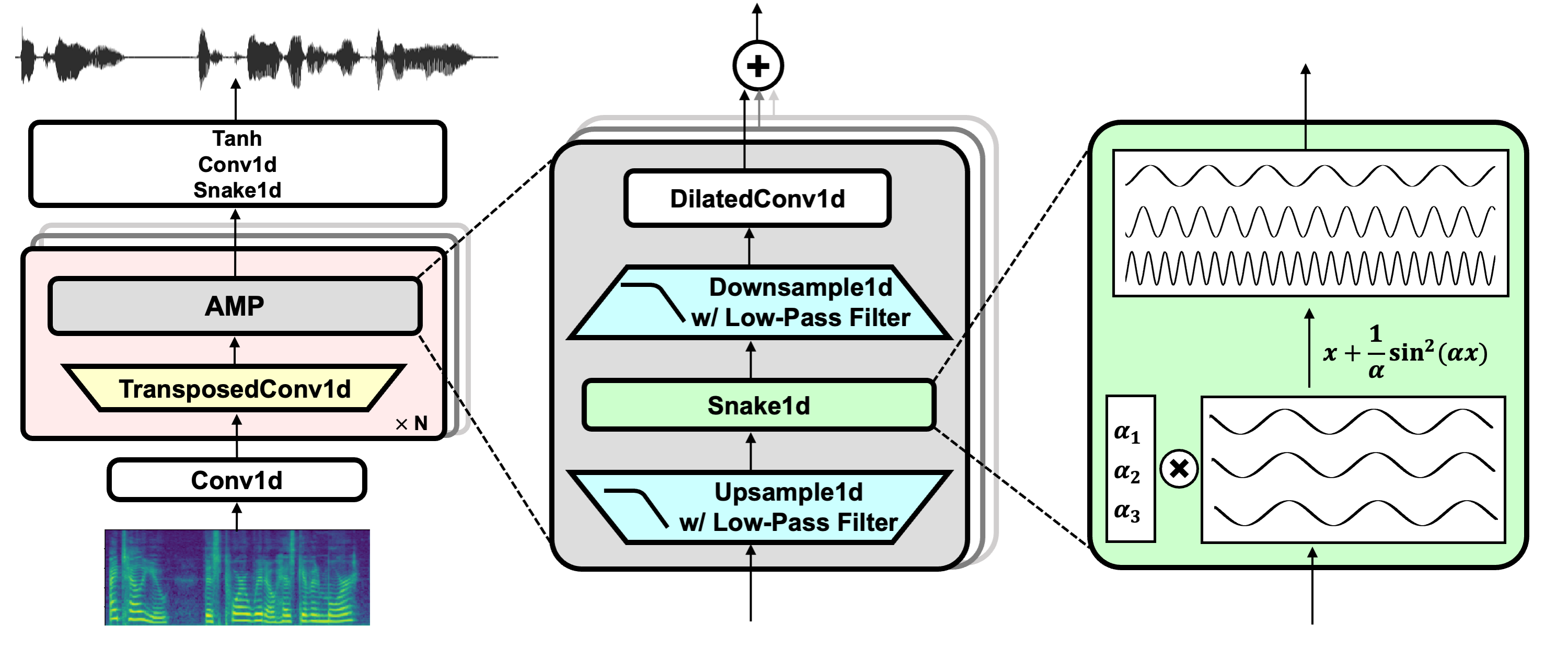
 You can run a local gradio demo using below command:
```python
pip install -r demo/requirements.txt
python demo/app.py
```
## Training
Create symbolic link to the root of the dataset. The codebase uses filelist with the relative path from the dataset. Below are the example commands for LibriTTS dataset:
```shell
cd filelists/LibriTTS && \
ln -s /path/to/your/LibriTTS/train-clean-100 train-clean-100 && \
ln -s /path/to/your/LibriTTS/train-clean-360 train-clean-360 && \
ln -s /path/to/your/LibriTTS/train-other-500 train-other-500 && \
ln -s /path/to/your/LibriTTS/dev-clean dev-clean && \
ln -s /path/to/your/LibriTTS/dev-other dev-other && \
ln -s /path/to/your/LibriTTS/test-clean test-clean && \
ln -s /path/to/your/LibriTTS/test-other test-other && \
cd ../..
```
Train BigVGAN model. Below is an example command for training BigVGAN-v2 using LibriTTS dataset at 24kHz with a full 100-band mel spectrogram as input:
```shell
python train.py \
--config configs/bigvgan_v2_24khz_100band_256x.json \
--input_wavs_dir filelists/LibriTTS \
--input_training_file filelists/LibriTTS/train-full.txt \
--input_validation_file filelists/LibriTTS/val-full.txt \
--list_input_unseen_wavs_dir filelists/LibriTTS filelists/LibriTTS \
--list_input_unseen_validation_file filelists/LibriTTS/dev-clean.txt filelists/LibriTTS/dev-other.txt \
--checkpoint_path exp/bigvgan_v2_24khz_100band_256x
```
## Synthesis
Synthesize from BigVGAN model. Below is an example command for generating audio from the model.
It computes mel spectrograms using wav files from `--input_wavs_dir` and saves the generated audio to `--output_dir`.
```shell
python inference.py \
--checkpoint_file /path/to/your/bigvgan_v2_24khz_100band_256x/bigvgan_generator.pt \
--input_wavs_dir /path/to/your/input_wav \
--output_dir /path/to/your/output_wav
```
`inference_e2e.py` supports synthesis directly from the mel spectrogram saved in `.npy` format, with shapes `[1, channel, frame]` or `[channel, frame]`.
It loads mel spectrograms from `--input_mels_dir` and saves the generated audio to `--output_dir`.
Make sure that the STFT hyperparameters for mel spectrogram are the same as the model, which are defined in `config.json` of the corresponding model.
```shell
python inference_e2e.py \
--checkpoint_file /path/to/your/bigvgan_v2_24khz_100band_256x/bigvgan_generator.pt \
--input_mels_dir /path/to/your/input_mel \
--output_dir /path/to/your/output_wav
```
## Using Custom CUDA Kernel for Synthesis
You can apply the fast CUDA inference kernel by using a parameter `use_cuda_kernel` when instantiating BigVGAN:
```python
generator = BigVGAN(h, use_cuda_kernel=True)
```
You can also pass `--use_cuda_kernel` to `inference.py` and `inference_e2e.py` to enable this feature.
When applied for the first time, it builds the kernel using `nvcc` and `ninja`. If the build succeeds, the kernel is saved to `alias_free_activation/cuda/build` and the model automatically loads the kernel. The codebase has been tested using CUDA `12.1`.
Please make sure that both are installed in your system and `nvcc` installed in your system matches the version your PyTorch build is using.
We recommend running `test_cuda_vs_torch_model.py` first to build and check the correctness of the CUDA kernel. See below example command and its output, where it returns `[Success] test CUDA fused vs. plain torch BigVGAN inference`:
```python
python tests/test_cuda_vs_torch_model.py \
--checkpoint_file /path/to/your/bigvgan_generator.pt
```
```shell
loading plain Pytorch BigVGAN
...
loading CUDA kernel BigVGAN with auto-build
Detected CUDA files, patching ldflags
Emitting ninja build file /path/to/your/BigVGAN/alias_free_activation/cuda/build/build.ninja..
Building extension module anti_alias_activation_cuda...
...
Loading extension module anti_alias_activation_cuda...
...
Loading '/path/to/your/bigvgan_generator.pt'
...
[Success] test CUDA fused vs. plain torch BigVGAN inference
> mean_difference=0.0007238413265440613
...
```
If you see `[Fail] test CUDA fused vs. plain torch BigVGAN inference`, it means that the CUDA kernel inference is incorrect. Please check if `nvcc` installed in your system is compatible with your PyTorch version.
## Pretrained Models
We provide the [pretrained models on Hugging Face Collections](https://huggingface.co/collections/nvidia/bigvgan-66959df3d97fd7d98d97dc9a).
One can download the checkpoints of the generator weight (named `bigvgan_generator.pt`) and its discriminator/optimizer states (named `bigvgan_discriminator_optimizer.pt`) within the listed model repositories.
| Model Name | Sampling Rate | Mel band | fmax | Upsampling Ratio | Params | Dataset | Steps | Fine-Tuned |
|:--------------------------------------------------------------------------------------------------------:|:-------------:|:--------:|:-----:|:----------------:|:------:|:--------------------------:|:-----:|:----------:|
| [bigvgan_v2_44khz_128band_512x](https://huggingface.co/nvidia/bigvgan_v2_44khz_128band_512x) | 44 kHz | 128 | 22050 | 512 | 122M | Large-scale Compilation | 5M | No |
| [bigvgan_v2_44khz_128band_256x](https://huggingface.co/nvidia/bigvgan_v2_44khz_128band_256x) | 44 kHz | 128 | 22050 | 256 | 112M | Large-scale Compilation | 5M | No |
| [bigvgan_v2_24khz_100band_256x](https://huggingface.co/nvidia/bigvgan_v2_24khz_100band_256x) | 24 kHz | 100 | 12000 | 256 | 112M | Large-scale Compilation | 5M | No |
| [bigvgan_v2_22khz_80band_256x](https://huggingface.co/nvidia/bigvgan_v2_22khz_80band_256x) | 22 kHz | 80 | 11025 | 256 | 112M | Large-scale Compilation | 5M | No |
| [bigvgan_v2_22khz_80band_fmax8k_256x](https://huggingface.co/nvidia/bigvgan_v2_22khz_80band_fmax8k_256x) | 22 kHz | 80 | 8000 | 256 | 112M | Large-scale Compilation | 5M | No |
| [bigvgan_24khz_100band](https://huggingface.co/nvidia/bigvgan_24khz_100band) | 24 kHz | 100 | 12000 | 256 | 112M | LibriTTS | 5M | No |
| [bigvgan_base_24khz_100band](https://huggingface.co/nvidia/bigvgan_base_24khz_100band) | 24 kHz | 100 | 12000 | 256 | 14M | LibriTTS | 5M | No |
| [bigvgan_22khz_80band](https://huggingface.co/nvidia/bigvgan_22khz_80band) | 22 kHz | 80 | 8000 | 256 | 112M | LibriTTS + VCTK + LJSpeech | 5M | No |
| [bigvgan_base_22khz_80band](https://huggingface.co/nvidia/bigvgan_base_22khz_80band) | 22 kHz | 80 | 8000 | 256 | 14M | LibriTTS + VCTK + LJSpeech | 5M | No |
The paper results are based on the original 24kHz BigVGAN models (`bigvgan_24khz_100band` and `bigvgan_base_24khz_100band`) trained on LibriTTS dataset.
We also provide 22kHz BigVGAN models with band-limited setup (i.e., fmax=8000) for TTS applications.
Note that the checkpoints use `snakebeta` activation with log scale parameterization, which have the best overall quality.
You can fine-tune the models by:
1. downloading the checkpoints (both the generator weight and its discriminator/optimizer states)
2. resuming training using your audio dataset by specifying `--checkpoint_path` that includes the checkpoints when launching `train.py`
## Training Details of BigVGAN-v2
Comapred to the original BigVGAN, the pretrained checkpoints of BigVGAN-v2 used `batch_size=32` with a longer `segment_size=65536` and are trained using 8 A100 GPUs.
Note that the BigVGAN-v2 `json` config files in `./configs` use `batch_size=4` as default to fit in a single A100 GPU for training. You can fine-tune the models adjusting `batch_size` depending on your GPUs.
When training BigVGAN-v2 from scratch with small batch size, it can potentially encounter the early divergence problem mentioned in the paper. In such case, we recommend lowering the `clip_grad_norm` value (e.g. `100`) for the early training iterations (e.g. 20000 steps) and increase the value to the default `500`.
## Evaluation Results of BigVGAN-v2
Below are the objective results of the 24kHz model (`bigvgan_v2_24khz_100band_256x`) obtained from the LibriTTS `dev` sets. BigVGAN-v2 shows noticeable improvements of the metrics. The model also exhibits reduced perceptual artifacts, especially for non-speech audio.
| Model | Dataset | Steps | PESQ(↑) | M-STFT(↓) | MCD(↓) | Periodicity(↓) | V/UV F1(↑) |
|:----------:|:-----------------------:|:-----:|:---------:|:----------:|:----------:|:--------------:|:----------:|
| BigVGAN | LibriTTS | 1M | 4.027 | 0.7997 | 0.3745 | 0.1018 | 0.9598 |
| BigVGAN | LibriTTS | 5M | 4.256 | 0.7409 | 0.2988 | 0.0809 | 0.9698 |
| BigVGAN-v2 | Large-scale Compilation | 3M | 4.359 | 0.7134 | 0.3060 | 0.0621 | 0.9777 |
| BigVGAN-v2 | Large-scale Compilation | 5M | **4.362** | **0.7026** | **0.2903** | **0.0593** | **0.9793** |
## Speed Benchmark
Below are the speed and VRAM usage benchmark results of BigVGAN from `tests/test_cuda_vs_torch_model.py`, using `bigvgan_v2_24khz_100band_256x` as a reference model.
| GPU | num_mel_frame | use_cuda_kernel | Speed (kHz) | Real-time Factor | VRAM (GB) |
|:--------------------------:|:-------------:|:---------------:|:-----------:|:----------------:|:---------:|
| NVIDIA A100 | 256 | False | 1672.1 | 69.7x | 1.3 |
| | | True | 3916.5 | 163.2x | 1.3 |
| | 2048 | False | 1899.6 | 79.2x | 1.7 |
| | | True | 5330.1 | 222.1x | 1.7 |
| | 16384 | False | 1973.8 | 82.2x | 5.0 |
| | | True | 5761.7 | 240.1x | 4.4 |
| NVIDIA GeForce RTX 3080 | 256 | False | 841.1 | 35.0x | 1.3 |
| | | True | 1598.1 | 66.6x | 1.3 |
| | 2048 | False | 929.9 | 38.7x | 1.7 |
| | | True | 1971.3 | 82.1x | 1.6 |
| | 16384 | False | 943.4 | 39.3x | 5.0 |
| | | True | 2026.5 | 84.4x | 3.9 |
| NVIDIA GeForce RTX 2080 Ti | 256 | False | 515.6 | 21.5x | 1.3 |
| | | True | 811.3 | 33.8x | 1.3 |
| | 2048 | False | 576.5 | 24.0x | 1.7 |
| | | True | 1023.0 | 42.6x | 1.5 |
| | 16384 | False | 589.4 | 24.6x | 5.0 |
| | | True | 1068.1 | 44.5x | 3.2 |
## Acknowledgements
We thank Vijay Anand Korthikanti and Kevin J. Shih for their generous support in implementing the CUDA kernel for inference.
## References
- [HiFi-GAN](https://github.com/jik876/hifi-gan) (for generator and multi-period discriminator)
- [Snake](https://github.com/EdwardDixon/snake) (for periodic activation)
- [Alias-free-torch](https://github.com/junjun3518/alias-free-torch) (for anti-aliasing)
- [Julius](https://github.com/adefossez/julius) (for low-pass filter)
- [UnivNet](https://github.com/mindslab-ai/univnet) (for multi-resolution discriminator)
- [descript-audio-codec](https://github.com/descriptinc/descript-audio-codec) and [vocos](https://github.com/gemelo-ai/vocos) (for multi-band multi-scale STFT discriminator and multi-scale mel spectrogram loss)
- [Amphion](https://github.com/open-mmlab/Amphion) (for multi-scale sub-band CQT discriminator)
================================================
FILE: GPT_SoVITS/BigVGAN/activations.py
================================================
# Implementation adapted from https://github.com/EdwardDixon/snake under the MIT license.
# LICENSE is in incl_licenses directory.
import torch
from torch import nn, sin, pow
from torch.nn import Parameter
class Snake(nn.Module):
"""
Implementation of a sine-based periodic activation function
Shape:
- Input: (B, C, T)
- Output: (B, C, T), same shape as the input
Parameters:
- alpha - trainable parameter
References:
- This activation function is from this paper by Liu Ziyin, Tilman Hartwig, Masahito Ueda:
https://arxiv.org/abs/2006.08195
Examples:
>>> a1 = snake(256)
>>> x = torch.randn(256)
>>> x = a1(x)
"""
def __init__(self, in_features, alpha=1.0, alpha_trainable=True, alpha_logscale=False):
"""
Initialization.
INPUT:
- in_features: shape of the input
- alpha: trainable parameter
alpha is initialized to 1 by default, higher values = higher-frequency.
alpha will be trained along with the rest of your model.
"""
super(Snake, self).__init__()
self.in_features = in_features
# Initialize alpha
self.alpha_logscale = alpha_logscale
if self.alpha_logscale: # Log scale alphas initialized to zeros
self.alpha = Parameter(torch.zeros(in_features) * alpha)
else: # Linear scale alphas initialized to ones
self.alpha = Parameter(torch.ones(in_features) * alpha)
self.alpha.requires_grad = alpha_trainable
self.no_div_by_zero = 0.000000001
def forward(self, x):
"""
Forward pass of the function.
Applies the function to the input elementwise.
Snake ∶= x + 1/a * sin^2 (xa)
"""
alpha = self.alpha.unsqueeze(0).unsqueeze(-1) # Line up with x to [B, C, T]
if self.alpha_logscale:
alpha = torch.exp(alpha)
x = x + (1.0 / (alpha + self.no_div_by_zero)) * pow(sin(x * alpha), 2)
return x
class SnakeBeta(nn.Module):
"""
A modified Snake function which uses separate parameters for the magnitude of the periodic components
Shape:
- Input: (B, C, T)
- Output: (B, C, T), same shape as the input
Parameters:
- alpha - trainable parameter that controls frequency
- beta - trainable parameter that controls magnitude
References:
- This activation function is a modified version based on this paper by Liu Ziyin, Tilman Hartwig, Masahito Ueda:
https://arxiv.org/abs/2006.08195
Examples:
>>> a1 = snakebeta(256)
>>> x = torch.randn(256)
>>> x = a1(x)
"""
def __init__(self, in_features, alpha=1.0, alpha_trainable=True, alpha_logscale=False):
"""
Initialization.
INPUT:
- in_features: shape of the input
- alpha - trainable parameter that controls frequency
- beta - trainable parameter that controls magnitude
alpha is initialized to 1 by default, higher values = higher-frequency.
beta is initialized to 1 by default, higher values = higher-magnitude.
alpha will be trained along with the rest of your model.
"""
super(SnakeBeta, self).__init__()
self.in_features = in_features
# Initialize alpha
self.alpha_logscale = alpha_logscale
if self.alpha_logscale: # Log scale alphas initialized to zeros
self.alpha = Parameter(torch.zeros(in_features) * alpha)
self.beta = Parameter(torch.zeros(in_features) * alpha)
else: # Linear scale alphas initialized to ones
self.alpha = Parameter(torch.ones(in_features) * alpha)
self.beta = Parameter(torch.ones(in_features) * alpha)
self.alpha.requires_grad = alpha_trainable
self.beta.requires_grad = alpha_trainable
self.no_div_by_zero = 0.000000001
def forward(self, x):
"""
Forward pass of the function.
Applies the function to the input elementwise.
SnakeBeta ∶= x + 1/b * sin^2 (xa)
"""
alpha = self.alpha.unsqueeze(0).unsqueeze(-1) # Line up with x to [B, C, T]
beta = self.beta.unsqueeze(0).unsqueeze(-1)
if self.alpha_logscale:
alpha = torch.exp(alpha)
beta = torch.exp(beta)
x = x + (1.0 / (beta + self.no_div_by_zero)) * pow(sin(x * alpha), 2)
return x
================================================
FILE: GPT_SoVITS/BigVGAN/alias_free_activation/cuda/__init__.py
================================================
================================================
FILE: GPT_SoVITS/BigVGAN/alias_free_activation/cuda/activation1d.py
================================================
# Copyright (c) 2024 NVIDIA CORPORATION.
# Licensed under the MIT license.
import torch
import torch.nn as nn
from alias_free_activation.torch.resample import UpSample1d, DownSample1d
# load fused CUDA kernel: this enables importing anti_alias_activation_cuda
from alias_free_activation.cuda import load
anti_alias_activation_cuda = load.load()
class FusedAntiAliasActivation(torch.autograd.Function):
"""
Assumes filter size 12, replication padding on upsampling/downsampling, and logscale alpha/beta parameters as inputs.
The hyperparameters are hard-coded in the kernel to maximize speed.
NOTE: The fused kenrel is incorrect for Activation1d with different hyperparameters.
"""
@staticmethod
def forward(ctx, inputs, up_ftr, down_ftr, alpha, beta):
activation_results = anti_alias_activation_cuda.forward(inputs, up_ftr, down_ftr, alpha, beta)
return activation_results
@staticmethod
def backward(ctx, output_grads):
raise NotImplementedError
return output_grads, None, None
class Activation1d(nn.Module):
def __init__(
self,
activation,
up_ratio: int = 2,
down_ratio: int = 2,
up_kernel_size: int = 12,
down_kernel_size: int = 12,
fused: bool = True,
):
super().__init__()
self.up_ratio = up_ratio
self.down_ratio = down_ratio
self.act = activation
self.upsample = UpSample1d(up_ratio, up_kernel_size)
self.downsample = DownSample1d(down_ratio, down_kernel_size)
self.fused = fused # Whether to use fused CUDA kernel or not
def forward(self, x):
if not self.fused:
x = self.upsample(x)
x = self.act(x)
x = self.downsample(x)
return x
else:
if self.act.__class__.__name__ == "Snake":
beta = self.act.alpha.data # Snake uses same params for alpha and beta
else:
beta = self.act.beta.data # Snakebeta uses different params for alpha and beta
alpha = self.act.alpha.data
if not self.act.alpha_logscale: # Exp baked into cuda kernel, cancel it out with a log
alpha = torch.log(alpha)
beta = torch.log(beta)
x = FusedAntiAliasActivation.apply(x, self.upsample.filter, self.downsample.lowpass.filter, alpha, beta)
return x
================================================
FILE: GPT_SoVITS/BigVGAN/alias_free_activation/cuda/anti_alias_activation.cpp
================================================
/* coding=utf-8
* Copyright (c) 2024, NVIDIA CORPORATION. All rights reserved.
*
* Licensed under the Apache License, Version 2.0 (the "License");
* you may not use this file except in compliance with the License.
* You may obtain a copy of the License at
*
* http://www.apache.org/licenses/LICENSE-2.0
*
* Unless required by applicable law or agreed to in writing, software
* distributed under the License is distributed on an "AS IS" BASIS,
* WITHOUT WARRANTIES OR CONDITIONS OF ANY KIND, either express or implied.
* See the License for the specific language governing permissions and
* limitations under the License.
*/
#include
You can run a local gradio demo using below command:
```python
pip install -r demo/requirements.txt
python demo/app.py
```
## Training
Create symbolic link to the root of the dataset. The codebase uses filelist with the relative path from the dataset. Below are the example commands for LibriTTS dataset:
```shell
cd filelists/LibriTTS && \
ln -s /path/to/your/LibriTTS/train-clean-100 train-clean-100 && \
ln -s /path/to/your/LibriTTS/train-clean-360 train-clean-360 && \
ln -s /path/to/your/LibriTTS/train-other-500 train-other-500 && \
ln -s /path/to/your/LibriTTS/dev-clean dev-clean && \
ln -s /path/to/your/LibriTTS/dev-other dev-other && \
ln -s /path/to/your/LibriTTS/test-clean test-clean && \
ln -s /path/to/your/LibriTTS/test-other test-other && \
cd ../..
```
Train BigVGAN model. Below is an example command for training BigVGAN-v2 using LibriTTS dataset at 24kHz with a full 100-band mel spectrogram as input:
```shell
python train.py \
--config configs/bigvgan_v2_24khz_100band_256x.json \
--input_wavs_dir filelists/LibriTTS \
--input_training_file filelists/LibriTTS/train-full.txt \
--input_validation_file filelists/LibriTTS/val-full.txt \
--list_input_unseen_wavs_dir filelists/LibriTTS filelists/LibriTTS \
--list_input_unseen_validation_file filelists/LibriTTS/dev-clean.txt filelists/LibriTTS/dev-other.txt \
--checkpoint_path exp/bigvgan_v2_24khz_100band_256x
```
## Synthesis
Synthesize from BigVGAN model. Below is an example command for generating audio from the model.
It computes mel spectrograms using wav files from `--input_wavs_dir` and saves the generated audio to `--output_dir`.
```shell
python inference.py \
--checkpoint_file /path/to/your/bigvgan_v2_24khz_100band_256x/bigvgan_generator.pt \
--input_wavs_dir /path/to/your/input_wav \
--output_dir /path/to/your/output_wav
```
`inference_e2e.py` supports synthesis directly from the mel spectrogram saved in `.npy` format, with shapes `[1, channel, frame]` or `[channel, frame]`.
It loads mel spectrograms from `--input_mels_dir` and saves the generated audio to `--output_dir`.
Make sure that the STFT hyperparameters for mel spectrogram are the same as the model, which are defined in `config.json` of the corresponding model.
```shell
python inference_e2e.py \
--checkpoint_file /path/to/your/bigvgan_v2_24khz_100band_256x/bigvgan_generator.pt \
--input_mels_dir /path/to/your/input_mel \
--output_dir /path/to/your/output_wav
```
## Using Custom CUDA Kernel for Synthesis
You can apply the fast CUDA inference kernel by using a parameter `use_cuda_kernel` when instantiating BigVGAN:
```python
generator = BigVGAN(h, use_cuda_kernel=True)
```
You can also pass `--use_cuda_kernel` to `inference.py` and `inference_e2e.py` to enable this feature.
When applied for the first time, it builds the kernel using `nvcc` and `ninja`. If the build succeeds, the kernel is saved to `alias_free_activation/cuda/build` and the model automatically loads the kernel. The codebase has been tested using CUDA `12.1`.
Please make sure that both are installed in your system and `nvcc` installed in your system matches the version your PyTorch build is using.
We recommend running `test_cuda_vs_torch_model.py` first to build and check the correctness of the CUDA kernel. See below example command and its output, where it returns `[Success] test CUDA fused vs. plain torch BigVGAN inference`:
```python
python tests/test_cuda_vs_torch_model.py \
--checkpoint_file /path/to/your/bigvgan_generator.pt
```
```shell
loading plain Pytorch BigVGAN
...
loading CUDA kernel BigVGAN with auto-build
Detected CUDA files, patching ldflags
Emitting ninja build file /path/to/your/BigVGAN/alias_free_activation/cuda/build/build.ninja..
Building extension module anti_alias_activation_cuda...
...
Loading extension module anti_alias_activation_cuda...
...
Loading '/path/to/your/bigvgan_generator.pt'
...
[Success] test CUDA fused vs. plain torch BigVGAN inference
> mean_difference=0.0007238413265440613
...
```
If you see `[Fail] test CUDA fused vs. plain torch BigVGAN inference`, it means that the CUDA kernel inference is incorrect. Please check if `nvcc` installed in your system is compatible with your PyTorch version.
## Pretrained Models
We provide the [pretrained models on Hugging Face Collections](https://huggingface.co/collections/nvidia/bigvgan-66959df3d97fd7d98d97dc9a).
One can download the checkpoints of the generator weight (named `bigvgan_generator.pt`) and its discriminator/optimizer states (named `bigvgan_discriminator_optimizer.pt`) within the listed model repositories.
| Model Name | Sampling Rate | Mel band | fmax | Upsampling Ratio | Params | Dataset | Steps | Fine-Tuned |
|:--------------------------------------------------------------------------------------------------------:|:-------------:|:--------:|:-----:|:----------------:|:------:|:--------------------------:|:-----:|:----------:|
| [bigvgan_v2_44khz_128band_512x](https://huggingface.co/nvidia/bigvgan_v2_44khz_128band_512x) | 44 kHz | 128 | 22050 | 512 | 122M | Large-scale Compilation | 5M | No |
| [bigvgan_v2_44khz_128band_256x](https://huggingface.co/nvidia/bigvgan_v2_44khz_128band_256x) | 44 kHz | 128 | 22050 | 256 | 112M | Large-scale Compilation | 5M | No |
| [bigvgan_v2_24khz_100band_256x](https://huggingface.co/nvidia/bigvgan_v2_24khz_100band_256x) | 24 kHz | 100 | 12000 | 256 | 112M | Large-scale Compilation | 5M | No |
| [bigvgan_v2_22khz_80band_256x](https://huggingface.co/nvidia/bigvgan_v2_22khz_80band_256x) | 22 kHz | 80 | 11025 | 256 | 112M | Large-scale Compilation | 5M | No |
| [bigvgan_v2_22khz_80band_fmax8k_256x](https://huggingface.co/nvidia/bigvgan_v2_22khz_80band_fmax8k_256x) | 22 kHz | 80 | 8000 | 256 | 112M | Large-scale Compilation | 5M | No |
| [bigvgan_24khz_100band](https://huggingface.co/nvidia/bigvgan_24khz_100band) | 24 kHz | 100 | 12000 | 256 | 112M | LibriTTS | 5M | No |
| [bigvgan_base_24khz_100band](https://huggingface.co/nvidia/bigvgan_base_24khz_100band) | 24 kHz | 100 | 12000 | 256 | 14M | LibriTTS | 5M | No |
| [bigvgan_22khz_80band](https://huggingface.co/nvidia/bigvgan_22khz_80band) | 22 kHz | 80 | 8000 | 256 | 112M | LibriTTS + VCTK + LJSpeech | 5M | No |
| [bigvgan_base_22khz_80band](https://huggingface.co/nvidia/bigvgan_base_22khz_80band) | 22 kHz | 80 | 8000 | 256 | 14M | LibriTTS + VCTK + LJSpeech | 5M | No |
The paper results are based on the original 24kHz BigVGAN models (`bigvgan_24khz_100band` and `bigvgan_base_24khz_100band`) trained on LibriTTS dataset.
We also provide 22kHz BigVGAN models with band-limited setup (i.e., fmax=8000) for TTS applications.
Note that the checkpoints use `snakebeta` activation with log scale parameterization, which have the best overall quality.
You can fine-tune the models by:
1. downloading the checkpoints (both the generator weight and its discriminator/optimizer states)
2. resuming training using your audio dataset by specifying `--checkpoint_path` that includes the checkpoints when launching `train.py`
## Training Details of BigVGAN-v2
Comapred to the original BigVGAN, the pretrained checkpoints of BigVGAN-v2 used `batch_size=32` with a longer `segment_size=65536` and are trained using 8 A100 GPUs.
Note that the BigVGAN-v2 `json` config files in `./configs` use `batch_size=4` as default to fit in a single A100 GPU for training. You can fine-tune the models adjusting `batch_size` depending on your GPUs.
When training BigVGAN-v2 from scratch with small batch size, it can potentially encounter the early divergence problem mentioned in the paper. In such case, we recommend lowering the `clip_grad_norm` value (e.g. `100`) for the early training iterations (e.g. 20000 steps) and increase the value to the default `500`.
## Evaluation Results of BigVGAN-v2
Below are the objective results of the 24kHz model (`bigvgan_v2_24khz_100band_256x`) obtained from the LibriTTS `dev` sets. BigVGAN-v2 shows noticeable improvements of the metrics. The model also exhibits reduced perceptual artifacts, especially for non-speech audio.
| Model | Dataset | Steps | PESQ(↑) | M-STFT(↓) | MCD(↓) | Periodicity(↓) | V/UV F1(↑) |
|:----------:|:-----------------------:|:-----:|:---------:|:----------:|:----------:|:--------------:|:----------:|
| BigVGAN | LibriTTS | 1M | 4.027 | 0.7997 | 0.3745 | 0.1018 | 0.9598 |
| BigVGAN | LibriTTS | 5M | 4.256 | 0.7409 | 0.2988 | 0.0809 | 0.9698 |
| BigVGAN-v2 | Large-scale Compilation | 3M | 4.359 | 0.7134 | 0.3060 | 0.0621 | 0.9777 |
| BigVGAN-v2 | Large-scale Compilation | 5M | **4.362** | **0.7026** | **0.2903** | **0.0593** | **0.9793** |
## Speed Benchmark
Below are the speed and VRAM usage benchmark results of BigVGAN from `tests/test_cuda_vs_torch_model.py`, using `bigvgan_v2_24khz_100band_256x` as a reference model.
| GPU | num_mel_frame | use_cuda_kernel | Speed (kHz) | Real-time Factor | VRAM (GB) |
|:--------------------------:|:-------------:|:---------------:|:-----------:|:----------------:|:---------:|
| NVIDIA A100 | 256 | False | 1672.1 | 69.7x | 1.3 |
| | | True | 3916.5 | 163.2x | 1.3 |
| | 2048 | False | 1899.6 | 79.2x | 1.7 |
| | | True | 5330.1 | 222.1x | 1.7 |
| | 16384 | False | 1973.8 | 82.2x | 5.0 |
| | | True | 5761.7 | 240.1x | 4.4 |
| NVIDIA GeForce RTX 3080 | 256 | False | 841.1 | 35.0x | 1.3 |
| | | True | 1598.1 | 66.6x | 1.3 |
| | 2048 | False | 929.9 | 38.7x | 1.7 |
| | | True | 1971.3 | 82.1x | 1.6 |
| | 16384 | False | 943.4 | 39.3x | 5.0 |
| | | True | 2026.5 | 84.4x | 3.9 |
| NVIDIA GeForce RTX 2080 Ti | 256 | False | 515.6 | 21.5x | 1.3 |
| | | True | 811.3 | 33.8x | 1.3 |
| | 2048 | False | 576.5 | 24.0x | 1.7 |
| | | True | 1023.0 | 42.6x | 1.5 |
| | 16384 | False | 589.4 | 24.6x | 5.0 |
| | | True | 1068.1 | 44.5x | 3.2 |
## Acknowledgements
We thank Vijay Anand Korthikanti and Kevin J. Shih for their generous support in implementing the CUDA kernel for inference.
## References
- [HiFi-GAN](https://github.com/jik876/hifi-gan) (for generator and multi-period discriminator)
- [Snake](https://github.com/EdwardDixon/snake) (for periodic activation)
- [Alias-free-torch](https://github.com/junjun3518/alias-free-torch) (for anti-aliasing)
- [Julius](https://github.com/adefossez/julius) (for low-pass filter)
- [UnivNet](https://github.com/mindslab-ai/univnet) (for multi-resolution discriminator)
- [descript-audio-codec](https://github.com/descriptinc/descript-audio-codec) and [vocos](https://github.com/gemelo-ai/vocos) (for multi-band multi-scale STFT discriminator and multi-scale mel spectrogram loss)
- [Amphion](https://github.com/open-mmlab/Amphion) (for multi-scale sub-band CQT discriminator)
================================================
FILE: GPT_SoVITS/BigVGAN/activations.py
================================================
# Implementation adapted from https://github.com/EdwardDixon/snake under the MIT license.
# LICENSE is in incl_licenses directory.
import torch
from torch import nn, sin, pow
from torch.nn import Parameter
class Snake(nn.Module):
"""
Implementation of a sine-based periodic activation function
Shape:
- Input: (B, C, T)
- Output: (B, C, T), same shape as the input
Parameters:
- alpha - trainable parameter
References:
- This activation function is from this paper by Liu Ziyin, Tilman Hartwig, Masahito Ueda:
https://arxiv.org/abs/2006.08195
Examples:
>>> a1 = snake(256)
>>> x = torch.randn(256)
>>> x = a1(x)
"""
def __init__(self, in_features, alpha=1.0, alpha_trainable=True, alpha_logscale=False):
"""
Initialization.
INPUT:
- in_features: shape of the input
- alpha: trainable parameter
alpha is initialized to 1 by default, higher values = higher-frequency.
alpha will be trained along with the rest of your model.
"""
super(Snake, self).__init__()
self.in_features = in_features
# Initialize alpha
self.alpha_logscale = alpha_logscale
if self.alpha_logscale: # Log scale alphas initialized to zeros
self.alpha = Parameter(torch.zeros(in_features) * alpha)
else: # Linear scale alphas initialized to ones
self.alpha = Parameter(torch.ones(in_features) * alpha)
self.alpha.requires_grad = alpha_trainable
self.no_div_by_zero = 0.000000001
def forward(self, x):
"""
Forward pass of the function.
Applies the function to the input elementwise.
Snake ∶= x + 1/a * sin^2 (xa)
"""
alpha = self.alpha.unsqueeze(0).unsqueeze(-1) # Line up with x to [B, C, T]
if self.alpha_logscale:
alpha = torch.exp(alpha)
x = x + (1.0 / (alpha + self.no_div_by_zero)) * pow(sin(x * alpha), 2)
return x
class SnakeBeta(nn.Module):
"""
A modified Snake function which uses separate parameters for the magnitude of the periodic components
Shape:
- Input: (B, C, T)
- Output: (B, C, T), same shape as the input
Parameters:
- alpha - trainable parameter that controls frequency
- beta - trainable parameter that controls magnitude
References:
- This activation function is a modified version based on this paper by Liu Ziyin, Tilman Hartwig, Masahito Ueda:
https://arxiv.org/abs/2006.08195
Examples:
>>> a1 = snakebeta(256)
>>> x = torch.randn(256)
>>> x = a1(x)
"""
def __init__(self, in_features, alpha=1.0, alpha_trainable=True, alpha_logscale=False):
"""
Initialization.
INPUT:
- in_features: shape of the input
- alpha - trainable parameter that controls frequency
- beta - trainable parameter that controls magnitude
alpha is initialized to 1 by default, higher values = higher-frequency.
beta is initialized to 1 by default, higher values = higher-magnitude.
alpha will be trained along with the rest of your model.
"""
super(SnakeBeta, self).__init__()
self.in_features = in_features
# Initialize alpha
self.alpha_logscale = alpha_logscale
if self.alpha_logscale: # Log scale alphas initialized to zeros
self.alpha = Parameter(torch.zeros(in_features) * alpha)
self.beta = Parameter(torch.zeros(in_features) * alpha)
else: # Linear scale alphas initialized to ones
self.alpha = Parameter(torch.ones(in_features) * alpha)
self.beta = Parameter(torch.ones(in_features) * alpha)
self.alpha.requires_grad = alpha_trainable
self.beta.requires_grad = alpha_trainable
self.no_div_by_zero = 0.000000001
def forward(self, x):
"""
Forward pass of the function.
Applies the function to the input elementwise.
SnakeBeta ∶= x + 1/b * sin^2 (xa)
"""
alpha = self.alpha.unsqueeze(0).unsqueeze(-1) # Line up with x to [B, C, T]
beta = self.beta.unsqueeze(0).unsqueeze(-1)
if self.alpha_logscale:
alpha = torch.exp(alpha)
beta = torch.exp(beta)
x = x + (1.0 / (beta + self.no_div_by_zero)) * pow(sin(x * alpha), 2)
return x
================================================
FILE: GPT_SoVITS/BigVGAN/alias_free_activation/cuda/__init__.py
================================================
================================================
FILE: GPT_SoVITS/BigVGAN/alias_free_activation/cuda/activation1d.py
================================================
# Copyright (c) 2024 NVIDIA CORPORATION.
# Licensed under the MIT license.
import torch
import torch.nn as nn
from alias_free_activation.torch.resample import UpSample1d, DownSample1d
# load fused CUDA kernel: this enables importing anti_alias_activation_cuda
from alias_free_activation.cuda import load
anti_alias_activation_cuda = load.load()
class FusedAntiAliasActivation(torch.autograd.Function):
"""
Assumes filter size 12, replication padding on upsampling/downsampling, and logscale alpha/beta parameters as inputs.
The hyperparameters are hard-coded in the kernel to maximize speed.
NOTE: The fused kenrel is incorrect for Activation1d with different hyperparameters.
"""
@staticmethod
def forward(ctx, inputs, up_ftr, down_ftr, alpha, beta):
activation_results = anti_alias_activation_cuda.forward(inputs, up_ftr, down_ftr, alpha, beta)
return activation_results
@staticmethod
def backward(ctx, output_grads):
raise NotImplementedError
return output_grads, None, None
class Activation1d(nn.Module):
def __init__(
self,
activation,
up_ratio: int = 2,
down_ratio: int = 2,
up_kernel_size: int = 12,
down_kernel_size: int = 12,
fused: bool = True,
):
super().__init__()
self.up_ratio = up_ratio
self.down_ratio = down_ratio
self.act = activation
self.upsample = UpSample1d(up_ratio, up_kernel_size)
self.downsample = DownSample1d(down_ratio, down_kernel_size)
self.fused = fused # Whether to use fused CUDA kernel or not
def forward(self, x):
if not self.fused:
x = self.upsample(x)
x = self.act(x)
x = self.downsample(x)
return x
else:
if self.act.__class__.__name__ == "Snake":
beta = self.act.alpha.data # Snake uses same params for alpha and beta
else:
beta = self.act.beta.data # Snakebeta uses different params for alpha and beta
alpha = self.act.alpha.data
if not self.act.alpha_logscale: # Exp baked into cuda kernel, cancel it out with a log
alpha = torch.log(alpha)
beta = torch.log(beta)
x = FusedAntiAliasActivation.apply(x, self.upsample.filter, self.downsample.lowpass.filter, alpha, beta)
return x
================================================
FILE: GPT_SoVITS/BigVGAN/alias_free_activation/cuda/anti_alias_activation.cpp
================================================
/* coding=utf-8
* Copyright (c) 2024, NVIDIA CORPORATION. All rights reserved.
*
* Licensed under the Apache License, Version 2.0 (the "License");
* you may not use this file except in compliance with the License.
* You may obtain a copy of the License at
*
* http://www.apache.org/licenses/LICENSE-2.0
*
* Unless required by applicable law or agreed to in writing, software
* distributed under the License is distributed on an "AS IS" BASIS,
* WITHOUT WARRANTIES OR CONDITIONS OF ANY KIND, either express or implied.
* See the License for the specific language governing permissions and
* limitations under the License.
*/
#include