Repository: RenYurui/PIRender
Branch: main
Commit: 9e59f194f1a0
Files: 56
Total size: 241.6 KB
Directory structure:
gitextract_uz8rj1lb/
├── .gitmodules
├── DatasetHelper.md
├── LICENSE.md
├── README.md
├── config/
│ ├── face.yaml
│ └── face_demo.yaml
├── config.py
├── data/
│ ├── __init__.py
│ ├── image_dataset.py
│ ├── vox_dataset.py
│ └── vox_video_dataset.py
├── demo_images/
│ └── expression.mat
├── generators/
│ ├── base_function.py
│ └── face_model.py
├── inference.py
├── intuitive_control.py
├── loss/
│ └── perceptual.py
├── requirements.txt
├── scripts/
│ ├── coeff_detector.py
│ ├── download_demo_dataset.sh
│ ├── download_weights.sh
│ ├── extract_kp_videos.py
│ ├── face_recon_images.py
│ ├── face_recon_videos.py
│ ├── inference_options.py
│ └── prepare_vox_lmdb.py
├── third_part/
│ └── PerceptualSimilarity/
│ ├── models/
│ │ ├── __init__.py
│ │ ├── base_model.py
│ │ ├── dist_model.py
│ │ ├── models.py
│ │ ├── networks_basic.py
│ │ └── pretrained_networks.py
│ ├── util/
│ │ ├── __init__.py
│ │ ├── html.py
│ │ ├── util.py
│ │ └── visualizer.py
│ └── weights/
│ ├── v0.0/
│ │ ├── alex.pth
│ │ ├── squeeze.pth
│ │ └── vgg.pth
│ └── v0.1/
│ ├── alex.pth
│ ├── squeeze.pth
│ └── vgg.pth
├── train.py
├── trainers/
│ ├── __init__.py
│ ├── base.py
│ └── face_trainer.py
└── util/
├── cudnn.py
├── distributed.py
├── flow_util.py
├── init_weight.py
├── io.py
├── logging.py
├── lpips.py
├── meters.py
├── misc.py
└── trainer.py
================================================
FILE CONTENTS
================================================
================================================
FILE: .gitmodules
================================================
[submodule "Deep3DFaceRecon_pytorch"]
path = Deep3DFaceRecon_pytorch
url = https://github.com/sicxu/Deep3DFaceRecon_pytorch
================================================
FILE: DatasetHelper.md
================================================
### Extract 3DMM Coefficients for Videos
We provide scripts for extracting 3dmm coefficients for videos by using [DeepFaceRecon_pytorch](https://github.com/sicxu/Deep3DFaceRecon_pytorch/tree/73d491102af6731bded9ae6b3cc7466c3b2e9e48).
1. Follow the instructions of their repo to build the environment of DeepFaceRecon.
2. Copy the provided scrips to the folder `Deep3DFaceRecon_pytorch`.
```bash
cp scripts/face_recon_videos.py ./Deep3DFaceRecon_pytorch
cp scripts/extract_kp_videos.py ./Deep3DFaceRecon_pytorch
cp scripts/coeff_detector.py ./Deep3DFaceRecon_pytorch
cp scripts/inference_options.py ./Deep3DFaceRecon_pytorch/options
cd Deep3DFaceRecon_pytorch
```
3. Extract facial landmarks from videos.
```bash
python extract_kp_videos.py \
--input_dir path_to_viodes \
--output_dir path_to_keypoint \
--device_ids 0,1,2,3 \
--workers 12
```
4. Extract coefficients for videos
```bash
python face_recon_videos.py \
--input_dir path_to_videos \
--keypoint_dir path_to_keypoint \
--output_dir output_dir \
--inference_batch_size 100 \
--name=model_name \
--epoch=20 \
--model facerecon
```
================================================
FILE: LICENSE.md
================================================
## creative commons
# Attribution-NonCommercial 4.0 International
Creative Commons Corporation (“Creative Commons”) is not a law firm and does not provide legal services or legal advice. Distribution of Creative Commons public licenses does not create a lawyer-client or other relationship. Creative Commons makes its licenses and related information available on an “as-is” basis. Creative Commons gives no warranties regarding its licenses, any material licensed under their terms and conditions, or any related information. Creative Commons disclaims all liability for damages resulting from their use to the fullest extent possible.
### Using Creative Commons Public Licenses
Creative Commons public licenses provide a standard set of terms and conditions that creators and other rights holders may use to share original works of authorship and other material subject to copyright and certain other rights specified in the public license below. The following considerations are for informational purposes only, are not exhaustive, and do not form part of our licenses.
* __Considerations for licensors:__ Our public licenses are intended for use by those authorized to give the public permission to use material in ways otherwise restricted by copyright and certain other rights. Our licenses are irrevocable. Licensors should read and understand the terms and conditions of the license they choose before applying it. Licensors should also secure all rights necessary before applying our licenses so that the public can reuse the material as expected. Licensors should clearly mark any material not subject to the license. This includes other CC-licensed material, or material used under an exception or limitation to copyright. [More considerations for licensors](http://wiki.creativecommons.org/Considerations_for_licensors_and_licensees#Considerations_for_licensors).
* __Considerations for the public:__ By using one of our public licenses, a licensor grants the public permission to use the licensed material under specified terms and conditions. If the licensor’s permission is not necessary for any reason–for example, because of any applicable exception or limitation to copyright–then that use is not regulated by the license. Our licenses grant only permissions under copyright and certain other rights that a licensor has authority to grant. Use of the licensed material may still be restricted for other reasons, including because others have copyright or other rights in the material. A licensor may make special requests, such as asking that all changes be marked or described. Although not required by our licenses, you are encouraged to respect those requests where reasonable. [More considerations for the public](http://wiki.creativecommons.org/Considerations_for_licensors_and_licensees#Considerations_for_licensees).
## Creative Commons Attribution-NonCommercial 4.0 International Public License
By exercising the Licensed Rights (defined below), You accept and agree to be bound by the terms and conditions of this Creative Commons Attribution-NonCommercial 4.0 International Public License ("Public License"). To the extent this Public License may be interpreted as a contract, You are granted the Licensed Rights in consideration of Your acceptance of these terms and conditions, and the Licensor grants You such rights in consideration of benefits the Licensor receives from making the Licensed Material available under these terms and conditions.
### Section 1 – Definitions.
a. __Adapted Material__ means material subject to Copyright and Similar Rights that is derived from or based upon the Licensed Material and in which the Licensed Material is translated, altered, arranged, transformed, or otherwise modified in a manner requiring permission under the Copyright and Similar Rights held by the Licensor. For purposes of this Public License, where the Licensed Material is a musical work, performance, or sound recording, Adapted Material is always produced where the Licensed Material is synched in timed relation with a moving image.
b. __Adapter's License__ means the license You apply to Your Copyright and Similar Rights in Your contributions to Adapted Material in accordance with the terms and conditions of this Public License.
c. __Copyright and Similar Rights__ means copyright and/or similar rights closely related to copyright including, without limitation, performance, broadcast, sound recording, and Sui Generis Database Rights, without regard to how the rights are labeled or categorized. For purposes of this Public License, the rights specified in Section 2(b)(1)-(2) are not Copyright and Similar Rights.
d. __Effective Technological Measures__ means those measures that, in the absence of proper authority, may not be circumvented under laws fulfilling obligations under Article 11 of the WIPO Copyright Treaty adopted on December 20, 1996, and/or similar international agreements.
e. __Exceptions and Limitations__ means fair use, fair dealing, and/or any other exception or limitation to Copyright and Similar Rights that applies to Your use of the Licensed Material.
f. __Licensed Material__ means the artistic or literary work, database, or other material to which the Licensor applied this Public License.
g. __Licensed Rights__ means the rights granted to You subject to the terms and conditions of this Public License, which are limited to all Copyright and Similar Rights that apply to Your use of the Licensed Material and that the Licensor has authority to license.
h. __Licensor__ means the individual(s) or entity(ies) granting rights under this Public License.
i. __NonCommercial__ means not primarily intended for or directed towards commercial advantage or monetary compensation. For purposes of this Public License, the exchange of the Licensed Material for other material subject to Copyright and Similar Rights by digital file-sharing or similar means is NonCommercial provided there is no payment of monetary compensation in connection with the exchange.
j. __Share__ means to provide material to the public by any means or process that requires permission under the Licensed Rights, such as reproduction, public display, public performance, distribution, dissemination, communication, or importation, and to make material available to the public including in ways that members of the public may access the material from a place and at a time individually chosen by them.
k. __Sui Generis Database Rights__ means rights other than copyright resulting from Directive 96/9/EC of the European Parliament and of the Council of 11 March 1996 on the legal protection of databases, as amended and/or succeeded, as well as other essentially equivalent rights anywhere in the world.
l. __You__ means the individual or entity exercising the Licensed Rights under this Public License. Your has a corresponding meaning.
### Section 2 – Scope.
a. ___License grant.___
1. Subject to the terms and conditions of this Public License, the Licensor hereby grants You a worldwide, royalty-free, non-sublicensable, non-exclusive, irrevocable license to exercise the Licensed Rights in the Licensed Material to:
A. reproduce and Share the Licensed Material, in whole or in part, for NonCommercial purposes only; and
B. produce, reproduce, and Share Adapted Material for NonCommercial purposes only.
2. __Exceptions and Limitations.__ For the avoidance of doubt, where Exceptions and Limitations apply to Your use, this Public License does not apply, and You do not need to comply with its terms and conditions.
3. __Term.__ The term of this Public License is specified in Section 6(a).
4. __Media and formats; technical modifications allowed.__ The Licensor authorizes You to exercise the Licensed Rights in all media and formats whether now known or hereafter created, and to make technical modifications necessary to do so. The Licensor waives and/or agrees not to assert any right or authority to forbid You from making technical modifications necessary to exercise the Licensed Rights, including technical modifications necessary to circumvent Effective Technological Measures. For purposes of this Public License, simply making modifications authorized by this Section 2(a)(4) never produces Adapted Material.
5. __Downstream recipients.__
A. __Offer from the Licensor – Licensed Material.__ Every recipient of the Licensed Material automatically receives an offer from the Licensor to exercise the Licensed Rights under the terms and conditions of this Public License.
B. __No downstream restrictions.__ You may not offer or impose any additional or different terms or conditions on, or apply any Effective Technological Measures to, the Licensed Material if doing so restricts exercise of the Licensed Rights by any recipient of the Licensed Material.
6. __No endorsement.__ Nothing in this Public License constitutes or may be construed as permission to assert or imply that You are, or that Your use of the Licensed Material is, connected with, or sponsored, endorsed, or granted official status by, the Licensor or others designated to receive attribution as provided in Section 3(a)(1)(A)(i).
b. ___Other rights.___
1. Moral rights, such as the right of integrity, are not licensed under this Public License, nor are publicity, privacy, and/or other similar personality rights; however, to the extent possible, the Licensor waives and/or agrees not to assert any such rights held by the Licensor to the limited extent necessary to allow You to exercise the Licensed Rights, but not otherwise.
2. Patent and trademark rights are not licensed under this Public License.
3. To the extent possible, the Licensor waives any right to collect royalties from You for the exercise of the Licensed Rights, whether directly or through a collecting society under any voluntary or waivable statutory or compulsory licensing scheme. In all other cases the Licensor expressly reserves any right to collect such royalties, including when the Licensed Material is used other than for NonCommercial purposes.
### Section 3 – License Conditions.
Your exercise of the Licensed Rights is expressly made subject to the following conditions.
a. ___Attribution.___
1. If You Share the Licensed Material (including in modified form), You must:
A. retain the following if it is supplied by the Licensor with the Licensed Material:
i. identification of the creator(s) of the Licensed Material and any others designated to receive attribution, in any reasonable manner requested by the Licensor (including by pseudonym if designated);
ii. a copyright notice;
iii. a notice that refers to this Public License;
iv. a notice that refers to the disclaimer of warranties;
v. a URI or hyperlink to the Licensed Material to the extent reasonably practicable;
B. indicate if You modified the Licensed Material and retain an indication of any previous modifications; and
C. indicate the Licensed Material is licensed under this Public License, and include the text of, or the URI or hyperlink to, this Public License.
2. You may satisfy the conditions in Section 3(a)(1) in any reasonable manner based on the medium, means, and context in which You Share the Licensed Material. For example, it may be reasonable to satisfy the conditions by providing a URI or hyperlink to a resource that includes the required information.
3. If requested by the Licensor, You must remove any of the information required by Section 3(a)(1)(A) to the extent reasonably practicable.
4. If You Share Adapted Material You produce, the Adapter's License You apply must not prevent recipients of the Adapted Material from complying with this Public License.
### Section 4 – Sui Generis Database Rights.
Where the Licensed Rights include Sui Generis Database Rights that apply to Your use of the Licensed Material:
a. for the avoidance of doubt, Section 2(a)(1) grants You the right to extract, reuse, reproduce, and Share all or a substantial portion of the contents of the database for NonCommercial purposes only;
b. if You include all or a substantial portion of the database contents in a database in which You have Sui Generis Database Rights, then the database in which You have Sui Generis Database Rights (but not its individual contents) is Adapted Material; and
c. You must comply with the conditions in Section 3(a) if You Share all or a substantial portion of the contents of the database.
For the avoidance of doubt, this Section 4 supplements and does not replace Your obligations under this Public License where the Licensed Rights include other Copyright and Similar Rights.
### Section 5 – Disclaimer of Warranties and Limitation of Liability.
a. __Unless otherwise separately undertaken by the Licensor, to the extent possible, the Licensor offers the Licensed Material as-is and as-available, and makes no representations or warranties of any kind concerning the Licensed Material, whether express, implied, statutory, or other. This includes, without limitation, warranties of title, merchantability, fitness for a particular purpose, non-infringement, absence of latent or other defects, accuracy, or the presence or absence of errors, whether or not known or discoverable. Where disclaimers of warranties are not allowed in full or in part, this disclaimer may not apply to You.__
b. __To the extent possible, in no event will the Licensor be liable to You on any legal theory (including, without limitation, negligence) or otherwise for any direct, special, indirect, incidental, consequential, punitive, exemplary, or other losses, costs, expenses, or damages arising out of this Public License or use of the Licensed Material, even if the Licensor has been advised of the possibility of such losses, costs, expenses, or damages. Where a limitation of liability is not allowed in full or in part, this limitation may not apply to You.__
c. The disclaimer of warranties and limitation of liability provided above shall be interpreted in a manner that, to the extent possible, most closely approximates an absolute disclaimer and waiver of all liability.
### Section 6 – Term and Termination.
a. This Public License applies for the term of the Copyright and Similar Rights licensed here. However, if You fail to comply with this Public License, then Your rights under this Public License terminate automatically.
b. Where Your right to use the Licensed Material has terminated under Section 6(a), it reinstates:
1. automatically as of the date the violation is cured, provided it is cured within 30 days of Your discovery of the violation; or
2. upon express reinstatement by the Licensor.
For the avoidance of doubt, this Section 6(b) does not affect any right the Licensor may have to seek remedies for Your violations of this Public License.
c. For the avoidance of doubt, the Licensor may also offer the Licensed Material under separate terms or conditions or stop distributing the Licensed Material at any time; however, doing so will not terminate this Public License.
d. Sections 1, 5, 6, 7, and 8 survive termination of this Public License.
### Section 7 – Other Terms and Conditions.
a. The Licensor shall not be bound by any additional or different terms or conditions communicated by You unless expressly agreed.
b. Any arrangements, understandings, or agreements regarding the Licensed Material not stated herein are separate from and independent of the terms and conditions of this Public License.
### Section 8 – Interpretation.
a. For the avoidance of doubt, this Public License does not, and shall not be interpreted to, reduce, limit, restrict, or impose conditions on any use of the Licensed Material that could lawfully be made without permission under this Public License.
b. To the extent possible, if any provision of this Public License is deemed unenforceable, it shall be automatically reformed to the minimum extent necessary to make it enforceable. If the provision cannot be reformed, it shall be severed from this Public License without affecting the enforceability of the remaining terms and conditions.
c. No term or condition of this Public License will be waived and no failure to comply consented to unless expressly agreed to by the Licensor.
d. Nothing in this Public License constitutes or may be interpreted as a limitation upon, or waiver of, any privileges and immunities that apply to the Licensor or You, including from the legal processes of any jurisdiction or authority.
> Creative Commons is not a party to its public licenses. Notwithstanding, Creative Commons may elect to apply one of its public licenses to material it publishes and in those instances will be considered the “Licensor.” Except for the limited purpose of indicating that material is shared under a Creative Commons public license or as otherwise permitted by the Creative Commons policies published at [creativecommons.org/policies](http://creativecommons.org/policies), Creative Commons does not authorize the use of the trademark “Creative Commons” or any other trademark or logo of Creative Commons without its prior written consent including, without limitation, in connection with any unauthorized modifications to any of its public licenses or any other arrangements, understandings, or agreements concerning use of licensed material. For the avoidance of doubt, this paragraph does not form part of the public licenses.
>
> Creative Commons may be contacted at creativecommons.org
================================================
FILE: README.md
================================================
Website
|
ArXiv
|
Get Start
|
Video
# PIRenderer
The source code of the ICCV2021 paper "[PIRenderer: Controllable Portrait Image Generation via Semantic Neural Rendering](https://arxiv.org/abs/2109.08379)" (ICCV2021)
The proposed **PIRenderer** can synthesis portrait images by intuitively controlling the face motions with fully disentangled 3DMM parameters. This model can be applied to tasks such as:
* **Intuitive Portrait Image Editing**
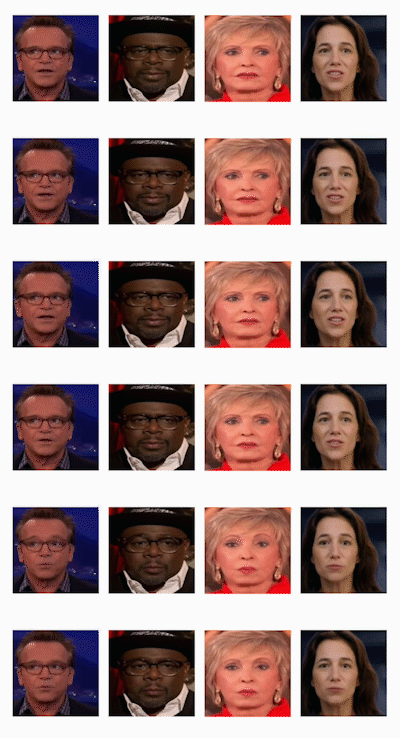
Intuitive Portrait Image Control

Pose & Expression Alignment
* **Motion Imitation**

Same & Corss-identity Reenactment
* **Audio-Driven Facial Reenactment**
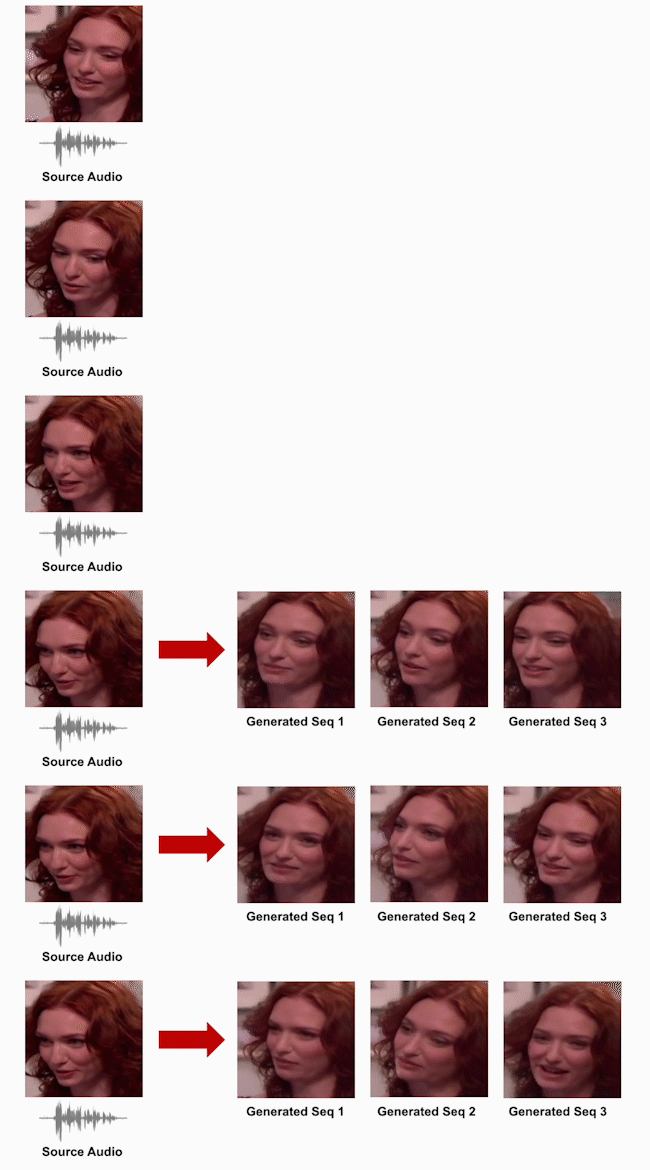
Audio-Driven Reenactment
## News
* 2021.9.20 Code for PyTorch is available!
## Colab Demo
Coming soon
## Get Start
### 1). Installation
#### Requirements
* Python 3
* PyTorch 1.7.1
* CUDA 10.2
#### Conda Installation
```bash
# 1. Create a conda virtual environment.
conda create -n PIRenderer python=3.6
conda activate PIRenderer
conda install -c pytorch pytorch=1.7.1 torchvision cudatoolkit=10.2
# 2. Install other dependencies
pip install -r requirements.txt
```
### 2). Dataset
We train our model using the [VoxCeleb](https://arxiv.org/abs/1706.08612). You can download the demo dataset for inference or prepare the dataset for training and testing.
#### Download the demo dataset
The demo dataset contains all 514 test videos. You can download the dataset with the following code:
```bash
./scripts/download_demo_dataset.sh
```
Or you can choose to download the resources with these links:
[Google Driven](https://drive.google.com/drive/folders/16Yn2r46b4cV6ZozOH6a8SdFz_iG7BQk1?usp=sharing) & [BaiDu Driven](https://pan.baidu.com/s/1e615bBHvM4Wz-2snk-86Xw) with extraction passwords ”p9ab“
Then unzip and save the files to `./dataset`
#### Prepare the dataset
1. The dataset is preprocessed follow the method used in [First-Order](https://github.com/AliaksandrSiarohin/video-preprocessing). You can follow the instructions in their repo to download and crop videos for training and testing.
2. After obtaining the VoxCeleb videos, we extract 3DMM parameters using [Deep3DFaceReconstruction](https://github.com/microsoft/Deep3DFaceReconstruction).
The folder are with format as:
```
${DATASET_ROOT_FOLDER}
└───path_to_videos
└───train
└───xxx.mp4
└───xxx.mp4
...
└───test
└───xxx.mp4
└───xxx.mp4
...
└───path_to_3dmm_coeff
└───train
└───xxx.mat
└───xxx.mat
...
└───test
└───xxx.mat
└───xxx.mat
...
```
**News**: We provide Scripts for extracting 3dmm coeffs from videos. Please check the [DatasetHelper](./DatasetHelper.md) for more details.
3. We save the video and 3DMM parameters in a lmdb file. Please run the following code to do this
```bash
python scripts/prepare_vox_lmdb.py \
--path path_to_videos \
--coeff_3dmm_path path_to_3dmm_coeff \
--out path_to_output_dir
```
### 3). Training and Inference
#### Inference
The trained weights can be downloaded by running the following code:
```bash
./scripts/download_weights.sh
```
Or you can choose to download the resources with these links:
[Google Driven](https://drive.google.com/file/d/1-0xOf6g58OmtKtEWJlU3VlnfRqPN9Uq7/view?usp=sharing) & [Baidu Driven](https://pan.baidu.com/s/18B3xfKMXnm4tOqlFSB8ntg) with extraction passwards "4sy1".
Then unzip and save the files to `./result/face`.
**Reenactment**
Run the demo for face reenactment:
```bash
# same identity
python -m torch.distributed.launch --nproc_per_node=1 --master_port 12345 inference.py \
--config ./config/face_demo.yaml \
--name face \
--no_resume \
--output_dir ./vox_result/face_reenactment
# cross identity
python -m torch.distributed.launch --nproc_per_node=1 --master_port 12345 inference.py \
--config ./config/face_demo.yaml \
--name face \
--no_resume \
--output_dir ./vox_result/face_reenactment_cross \
--cross_id
```
The output results are saved at `./vox_result/face_reenactment` and `./vox_result/face_reenactment_cross`
**Intuitive Control**
Our model can generate results by providing intuitive controlling coefficients.
We provide the following code for this task. Please note that you need to build the environment of [DeepFaceRecon](https://github.com/sicxu/Deep3DFaceRecon_pytorch/tree/73d491102af6731bded9ae6b3cc7466c3b2e9e48) first.
```bash
# 1. Copy the provided scrips to the folder `Deep3DFaceRecon_pytorch`.
cp scripts/face_recon_videos.py ./Deep3DFaceRecon_pytorch
cp scripts/extract_kp_videos.py ./Deep3DFaceRecon_pytorch
cp scripts/coeff_detector.py ./Deep3DFaceRecon_pytorch
cp scripts/inference_options.py ./Deep3DFaceRecon_pytorch/options
cd Deep3DFaceRecon_pytorch
# 2. Extracte the 3dmm coefficients of the demo images.
python coeff_detector.py \
--input_dir ../demo_images \
--keypoint_dir ../demo_images \
--output_dir ../demo_images \
--name=model_name \
--epoch=20 \
--model facerecon
# 3. control the source image with our model
cd ..
python -m torch.distributed.launch --nproc_per_node=1 --master_port 12345 intuitive_control.py \
--config ./config/face_demo.yaml \
--name face \
--no_resume \
--output_dir ./vox_result/face_intuitive \
--input_name ./demo_images
```
#### Train
Our model can be trained with the following code
```bash
python -m torch.distributed.launch --nproc_per_node=4 --master_port 12345 train.py \
--config ./config/face.yaml \
--name face
```
## Citation
If you find this code is helpful, please cite our paper
```tex
@misc{ren2021pirenderer,
title={PIRenderer: Controllable Portrait Image Generation via Semantic Neural Rendering},
author={Yurui Ren and Ge Li and Yuanqi Chen and Thomas H. Li and Shan Liu},
year={2021},
eprint={2109.08379},
archivePrefix={arXiv},
primaryClass={cs.CV}
}
```
## Acknowledgement
We build our project base on [imaginaire](https://github.com/NVlabs/imaginaire). Some dataset preprocessing methods are derived from [video-preprocessing](https://github.com/AliaksandrSiarohin/video-preprocessing).
================================================
FILE: config/face.yaml
================================================
# How often do you want to log the training stats.
# network_list:
# gen: gen_optimizer
# dis: dis_optimizer
distributed: True
image_to_tensorboard: True
snapshot_save_iter: 40000
snapshot_save_epoch: 20
snapshot_save_start_iter: 20000
snapshot_save_start_epoch: 10
image_save_iter: 1000
max_epoch: 200
logging_iter: 100
results_dir: ./eval_results
gen_optimizer:
type: adam
lr: 0.0001
adam_beta1: 0.5
adam_beta2: 0.999
lr_policy:
iteration_mode: True
type: step
step_size: 300000
gamma: 0.2
trainer:
type: trainers.face_trainer::FaceTrainer
pretrain_warp_iteration: 200000
loss_weight:
weight_perceptual_warp: 2.5
weight_perceptual_final: 4
vgg_param_warp:
network: vgg19
layers: ['relu_1_1', 'relu_2_1', 'relu_3_1', 'relu_4_1', 'relu_5_1']
use_style_loss: False
num_scales: 4
vgg_param_final:
network: vgg19
layers: ['relu_1_1', 'relu_2_1', 'relu_3_1', 'relu_4_1', 'relu_5_1']
use_style_loss: True
num_scales: 4
style_to_perceptual: 250
init:
type: 'normal'
gain: 0.02
gen:
type: generators.face_model::FaceGenerator
param:
mapping_net:
coeff_nc: 73
descriptor_nc: 256
layer: 3
warpping_net:
encoder_layer: 5
decoder_layer: 3
base_nc: 32
editing_net:
layer: 3
num_res_blocks: 2
base_nc: 64
common:
image_nc: 3
descriptor_nc: 256
max_nc: 256
use_spect: False
# Data options.
data:
type: data.vox_dataset::VoxDataset
path: ./dataset/vox_lmdb
resolution: 256
semantic_radius: 13
train:
batch_size: 5
distributed: True
val:
batch_size: 8
distributed: True
================================================
FILE: config/face_demo.yaml
================================================
# How often do you want to log the training stats.
# network_list:
# gen: gen_optimizer
# dis: dis_optimizer
distributed: True
image_to_tensorboard: True
snapshot_save_iter: 40000
snapshot_save_epoch: 20
snapshot_save_start_iter: 20000
snapshot_save_start_epoch: 10
image_save_iter: 1000
max_epoch: 200
logging_iter: 100
results_dir: ./eval_results
gen_optimizer:
type: adam
lr: 0.0001
adam_beta1: 0.5
adam_beta2: 0.999
lr_policy:
iteration_mode: True
type: step
step_size: 300000
gamma: 0.2
trainer:
type: trainers.face_trainer::FaceTrainer
pretrain_warp_iteration: 200000
loss_weight:
weight_perceptual_warp: 2.5
weight_perceptual_final: 4
vgg_param_warp:
network: vgg19
layers: ['relu_1_1', 'relu_2_1', 'relu_3_1', 'relu_4_1', 'relu_5_1']
use_style_loss: False
num_scales: 4
vgg_param_final:
network: vgg19
layers: ['relu_1_1', 'relu_2_1', 'relu_3_1', 'relu_4_1', 'relu_5_1']
use_style_loss: True
num_scales: 4
style_to_perceptual: 250
init:
type: 'normal'
gain: 0.02
gen:
type: generators.face_model::FaceGenerator
param:
mapping_net:
coeff_nc: 73
descriptor_nc: 256
layer: 3
warpping_net:
encoder_layer: 5
decoder_layer: 3
base_nc: 32
editing_net:
layer: 3
num_res_blocks: 2
base_nc: 64
common:
image_nc: 3
descriptor_nc: 256
max_nc: 256
use_spect: False
# Data options.
data:
type: data.vox_dataset::VoxDataset
path: ./dataset/vox_lmdb_demo
resolution: 256
semantic_radius: 13
train:
batch_size: 5
distributed: True
val:
batch_size: 8
distributed: True
================================================
FILE: config.py
================================================
import collections
import functools
import os
import re
import yaml
from util.distributed import master_only_print as print
class AttrDict(dict):
"""Dict as attribute trick."""
def __init__(self, *args, **kwargs):
super(AttrDict, self).__init__(*args, **kwargs)
self.__dict__ = self
for key, value in self.__dict__.items():
if isinstance(value, dict):
self.__dict__[key] = AttrDict(value)
elif isinstance(value, (list, tuple)):
if isinstance(value[0], dict):
self.__dict__[key] = [AttrDict(item) for item in value]
else:
self.__dict__[key] = value
def yaml(self):
"""Convert object to yaml dict and return."""
yaml_dict = {}
for key, value in self.__dict__.items():
if isinstance(value, AttrDict):
yaml_dict[key] = value.yaml()
elif isinstance(value, list):
if isinstance(value[0], AttrDict):
new_l = []
for item in value:
new_l.append(item.yaml())
yaml_dict[key] = new_l
else:
yaml_dict[key] = value
else:
yaml_dict[key] = value
return yaml_dict
def __repr__(self):
"""Print all variables."""
ret_str = []
for key, value in self.__dict__.items():
if isinstance(value, AttrDict):
ret_str.append('{}:'.format(key))
child_ret_str = value.__repr__().split('\n')
for item in child_ret_str:
ret_str.append(' ' + item)
elif isinstance(value, list):
if isinstance(value[0], AttrDict):
ret_str.append('{}:'.format(key))
for item in value:
# Treat as AttrDict above.
child_ret_str = item.__repr__().split('\n')
for item in child_ret_str:
ret_str.append(' ' + item)
else:
ret_str.append('{}: {}'.format(key, value))
else:
ret_str.append('{}: {}'.format(key, value))
return '\n'.join(ret_str)
class Config(AttrDict):
r"""Configuration class. This should include every human specifiable
hyperparameter values for your training."""
def __init__(self, filename=None, args=None, verbose=False, is_train=True):
super(Config, self).__init__()
# Set default parameters.
# Logging.
large_number = 1000000000
self.snapshot_save_iter = large_number
self.snapshot_save_epoch = large_number
self.snapshot_save_start_iter = 0
self.snapshot_save_start_epoch = 0
self.image_save_iter = large_number
self.eval_epoch = large_number
self.start_eval_epoch = large_number
self.eval_epoch = large_number
self.max_epoch = large_number
self.max_iter = large_number
self.logging_iter = 100
self.image_to_tensorboard=False
self.which_iter = args.which_iter
self.resume = not args.no_resume
self.checkpoints_dir = args.checkpoints_dir
self.name = args.name
self.phase = 'train' if is_train else 'test'
# Networks.
self.gen = AttrDict(type='generators.dummy')
self.dis = AttrDict(type='discriminators.dummy')
# Optimizers.
self.gen_optimizer = AttrDict(type='adam',
lr=0.0001,
adam_beta1=0.0,
adam_beta2=0.999,
eps=1e-8,
lr_policy=AttrDict(iteration_mode=False,
type='step',
step_size=large_number,
gamma=1))
self.dis_optimizer = AttrDict(type='adam',
lr=0.0001,
adam_beta1=0.0,
adam_beta2=0.999,
eps=1e-8,
lr_policy=AttrDict(iteration_mode=False,
type='step',
step_size=large_number,
gamma=1))
# Data.
self.data = AttrDict(name='dummy',
type='datasets.images',
num_workers=0)
self.test_data = AttrDict(name='dummy',
type='datasets.images',
num_workers=0,
test=AttrDict(is_lmdb=False,
roots='',
batch_size=1))
self.trainer = AttrDict(
model_average=False,
model_average_beta=0.9999,
model_average_start_iteration=1000,
model_average_batch_norm_estimation_iteration=30,
model_average_remove_sn=True,
image_to_tensorboard=False,
hparam_to_tensorboard=False,
distributed_data_parallel='pytorch',
delay_allreduce=True,
gan_relativistic=False,
gen_step=1,
dis_step=1)
# # Cudnn.
self.cudnn = AttrDict(deterministic=False,
benchmark=True)
# Others.
self.pretrained_weight = ''
self.inference_args = AttrDict()
# Update with given configurations.
assert os.path.exists(filename), 'File {} not exist.'.format(filename)
loader = yaml.SafeLoader
loader.add_implicit_resolver(
u'tag:yaml.org,2002:float',
re.compile(u'''^(?:
[-+]?(?:[0-9][0-9_]*)\\.[0-9_]*(?:[eE][-+]?[0-9]+)?
|[-+]?(?:[0-9][0-9_]*)(?:[eE][-+]?[0-9]+)
|\\.[0-9_]+(?:[eE][-+][0-9]+)?
|[-+]?[0-9][0-9_]*(?::[0-5]?[0-9])+\\.[0-9_]*
|[-+]?\\.(?:inf|Inf|INF)
|\\.(?:nan|NaN|NAN))$''', re.X),
list(u'-+0123456789.'))
try:
with open(filename, 'r') as f:
cfg_dict = yaml.load(f, Loader=loader)
except EnvironmentError:
print('Please check the file with name of "%s"', filename)
recursive_update(self, cfg_dict)
# Put common opts in both gen and dis.
if 'common' in cfg_dict:
self.common = AttrDict(**cfg_dict['common'])
self.gen.common = self.common
self.dis.common = self.common
if verbose:
print(' config '.center(80, '-'))
print(self.__repr__())
print(''.center(80, '-'))
def rsetattr(obj, attr, val):
"""Recursively find object and set value"""
pre, _, post = attr.rpartition('.')
return setattr(rgetattr(obj, pre) if pre else obj, post, val)
def rgetattr(obj, attr, *args):
"""Recursively find object and return value"""
def _getattr(obj, attr):
r"""Get attribute."""
return getattr(obj, attr, *args)
return functools.reduce(_getattr, [obj] + attr.split('.'))
def recursive_update(d, u):
"""Recursively update AttrDict d with AttrDict u"""
for key, value in u.items():
if isinstance(value, collections.abc.Mapping):
d.__dict__[key] = recursive_update(d.get(key, AttrDict({})), value)
elif isinstance(value, (list, tuple)):
if isinstance(value[0], dict):
d.__dict__[key] = [AttrDict(item) for item in value]
else:
d.__dict__[key] = value
else:
d.__dict__[key] = value
return d
================================================
FILE: data/__init__.py
================================================
import importlib
import torch.utils.data
from util.distributed import master_only_print as print
def find_dataset_using_name(dataset_name):
dataset_filename = dataset_name
module, target = dataset_name.split('::')
datasetlib = importlib.import_module(module)
dataset = None
for name, cls in datasetlib.__dict__.items():
if name == target:
dataset = cls
if dataset is None:
raise ValueError("In %s.py, there should be a class "
"with class name that matches %s in lowercase." %
(dataset_filename, target))
return dataset
def get_option_setter(dataset_name):
dataset_class = find_dataset_using_name(dataset_name)
return dataset_class.modify_commandline_options
def create_dataloader(opt, is_inference):
dataset = find_dataset_using_name(opt.type)
instance = dataset(opt, is_inference)
phase = 'val' if is_inference else 'training'
batch_size = opt.val.batch_size if is_inference else opt.train.batch_size
print("%s dataset [%s] of size %d was created" %
(phase, opt.type, len(instance)))
dataloader = torch.utils.data.DataLoader(
instance,
batch_size=batch_size,
sampler=data_sampler(instance, shuffle=not is_inference, distributed=opt.train.distributed),
drop_last=not is_inference,
num_workers=getattr(opt, 'num_workers', 0),
)
return dataloader
def data_sampler(dataset, shuffle, distributed):
if distributed:
return torch.utils.data.distributed.DistributedSampler(dataset, shuffle=shuffle)
if shuffle:
return torch.utils.data.RandomSampler(dataset)
else:
return torch.utils.data.SequentialSampler(dataset)
def get_dataloader(opt, is_inference=False):
dataset = create_dataloader(opt, is_inference=is_inference)
return dataset
def get_train_val_dataloader(opt):
val_dataset = create_dataloader(opt, is_inference=True)
train_dataset = create_dataloader(opt, is_inference=False)
return val_dataset, train_dataset
================================================
FILE: data/image_dataset.py
================================================
import os
import glob
import time
import numpy as np
from PIL import Image
import torch
import torchvision.transforms.functional as F
class ImageDataset():
def __init__(self, opt, input_name):
self.opt = opt
self.IMAGEEXT = ['png', 'jpg']
self.input_image_list, self.coeff_list = self.obtain_inputs(input_name)
self.index = -1
# load image dataset opt
self.resolution = opt.resolution
self.semantic_radius = opt.semantic_radius
def next_image(self):
self.index += 1
image_name = self.input_image_list[self.index]
coeff_name = self.coeff_list[self.index]
img = Image.open(image_name)
input_image = self.trans_image(img)
coeff_3dmm = np.loadtxt(coeff_name).astype(np.float32)
coeff_3dmm = self.transform_semantic(coeff_3dmm)
return {
'source_image': input_image[None],
'target_semantics': coeff_3dmm[None],
'name': os.path.splitext(os.path.basename(image_name))[0]
}
def obtain_inputs(self, root):
filenames = list()
IMAGE_EXTENSIONS_LOWERCASE = {'jpg', 'png', 'jpeg', 'webp'}
IMAGE_EXTENSIONS = IMAGE_EXTENSIONS_LOWERCASE.union({f.upper() for f in IMAGE_EXTENSIONS_LOWERCASE})
extensions = IMAGE_EXTENSIONS
for ext in extensions:
filenames += glob.glob(f'{root}/*.{ext}', recursive=True)
filenames = sorted(filenames)
coeffnames = sorted(glob.glob(f'{root}/*_3dmm_coeff.txt'))
return filenames, coeffnames
def transform_semantic(self, semantic):
semantic = semantic[None].repeat(self.semantic_radius*2+1, 0)
ex_coeff = semantic[:,80:144] #expression
angles = semantic[:,224:227] #euler angles for pose
translation = semantic[:,254:257] #translation
crop = semantic[:,259:262] #crop param
coeff_3dmm = np.concatenate([ex_coeff, angles, translation, crop], 1)
return torch.Tensor(coeff_3dmm).permute(1,0)
def trans_image(self, image):
image = F.resize(
image, size=self.resolution, interpolation=Image.BICUBIC)
image = F.to_tensor(image)
image = F.normalize(image, mean=(0.5, 0.5, 0.5), std=(0.5, 0.5, 0.5))
return image
def __len__(self):
return len(self.input_image_list)
================================================
FILE: data/vox_dataset.py
================================================
import os
import lmdb
import random
import collections
import numpy as np
from PIL import Image
from io import BytesIO
import torch
from torch.utils.data import Dataset
from torchvision import transforms
def format_for_lmdb(*args):
key_parts = []
for arg in args:
if isinstance(arg, int):
arg = str(arg).zfill(7)
key_parts.append(arg)
return '-'.join(key_parts).encode('utf-8')
class VoxDataset(Dataset):
def __init__(self, opt, is_inference):
path = opt.path
self.env = lmdb.open(
os.path.join(path, str(opt.resolution)),
max_readers=32,
readonly=True,
lock=False,
readahead=False,
meminit=False,
)
if not self.env:
raise IOError('Cannot open lmdb dataset', path)
list_file = "test_list.txt" if is_inference else "train_list.txt"
list_file = os.path.join(path, list_file)
with open(list_file, 'r') as f:
lines = f.readlines()
videos = [line.replace('\n', '') for line in lines]
self.resolution = opt.resolution
self.semantic_radius = opt.semantic_radius
self.video_items, self.person_ids = self.get_video_index(videos)
self.idx_by_person_id = self.group_by_key(self.video_items, key='person_id')
self.person_ids = self.person_ids * 100
self.transform = transforms.Compose(
[
transforms.ToTensor(),
transforms.Normalize((0.5, 0.5, 0.5), (0.5, 0.5, 0.5), inplace=True),
])
def get_video_index(self, videos):
video_items = []
for video in videos:
video_items.append(self.Video_Item(video))
person_ids = sorted(list({video.split('#')[0] for video in videos}))
return video_items, person_ids
def group_by_key(self, video_list, key):
return_dict = collections.defaultdict(list)
for index, video_item in enumerate(video_list):
return_dict[video_item[key]].append(index)
return return_dict
def Video_Item(self, video_name):
video_item = {}
video_item['video_name'] = video_name
video_item['person_id'] = video_name.split('#')[0]
with self.env.begin(write=False) as txn:
key = format_for_lmdb(video_item['video_name'], 'length')
length = int(txn.get(key).decode('utf-8'))
video_item['num_frame'] = length
return video_item
def __len__(self):
return len(self.person_ids)
def __getitem__(self, index):
data={}
person_id = self.person_ids[index]
video_item = self.video_items[random.choices(self.idx_by_person_id[person_id], k=1)[0]]
frame_source, frame_target = self.random_select_frames(video_item)
with self.env.begin(write=False) as txn:
key = format_for_lmdb(video_item['video_name'], frame_source)
img_bytes_1 = txn.get(key)
key = format_for_lmdb(video_item['video_name'], frame_target)
img_bytes_2 = txn.get(key)
semantics_key = format_for_lmdb(video_item['video_name'], 'coeff_3dmm')
semantics_numpy = np.frombuffer(txn.get(semantics_key), dtype=np.float32)
semantics_numpy = semantics_numpy.reshape((video_item['num_frame'],-1))
img1 = Image.open(BytesIO(img_bytes_1))
data['source_image'] = self.transform(img1)
img2 = Image.open(BytesIO(img_bytes_2))
data['target_image'] = self.transform(img2)
data['target_semantics'] = self.transform_semantic(semantics_numpy, frame_target)
data['source_semantics'] = self.transform_semantic(semantics_numpy, frame_source)
return data
def random_select_frames(self, video_item):
num_frame = video_item['num_frame']
frame_idx = random.choices(list(range(num_frame)), k=2)
return frame_idx[0], frame_idx[1]
def transform_semantic(self, semantic, frame_index):
index = self.obtain_seq_index(frame_index, semantic.shape[0])
coeff_3dmm = semantic[index,...]
# id_coeff = coeff_3dmm[:,:80] #identity
ex_coeff = coeff_3dmm[:,80:144] #expression
# tex_coeff = coeff_3dmm[:,144:224] #texture
angles = coeff_3dmm[:,224:227] #euler angles for pose
# gamma = coeff_3dmm[:,227:254] #lighting
translation = coeff_3dmm[:,254:257] #translation
crop = coeff_3dmm[:,257:260] #crop param
coeff_3dmm = np.concatenate([ex_coeff, angles, translation, crop], 1)
return torch.Tensor(coeff_3dmm).permute(1,0)
def obtain_seq_index(self, index, num_frames):
seq = list(range(index-self.semantic_radius, index+self.semantic_radius+1))
seq = [ min(max(item, 0), num_frames-1) for item in seq ]
return seq
================================================
FILE: data/vox_video_dataset.py
================================================
import os
import lmdb
import random
import collections
import numpy as np
from PIL import Image
from io import BytesIO
import torch
from data.vox_dataset import VoxDataset
from data.vox_dataset import format_for_lmdb
class VoxVideoDataset(VoxDataset):
def __init__(self, opt, is_inference):
super(VoxVideoDataset, self).__init__(opt, is_inference)
self.video_index = -1
self.cross_id = opt.cross_id
# whether normalize the crop parameters when performing cross_id reenactments
# set it as "True" always brings better performance
self.norm_crop_param = True
def __len__(self):
return len(self.video_items)
def load_next_video(self):
data={}
self.video_index += 1
video_item = self.video_items[self.video_index]
source_video_item = self.random_video(video_item) if self.cross_id else video_item
with self.env.begin(write=False) as txn:
key = format_for_lmdb(source_video_item['video_name'], 0)
img_bytes_1 = txn.get(key)
img1 = Image.open(BytesIO(img_bytes_1))
data['source_image'] = self.transform(img1)
semantics_key = format_for_lmdb(video_item['video_name'], 'coeff_3dmm')
semantics_numpy = np.frombuffer(txn.get(semantics_key), dtype=np.float32)
semantics_numpy = semantics_numpy.reshape((video_item['num_frame'],-1))
if self.cross_id and self.norm_crop_param:
semantics_source_key = format_for_lmdb(source_video_item['video_name'], 'coeff_3dmm')
semantics_source_numpy = np.frombuffer(txn.get(semantics_source_key), dtype=np.float32)
semantic_source_numpy = semantics_source_numpy.reshape((source_video_item['num_frame'],-1))[0:1]
crop_norm_ratio = self.find_crop_norm_ratio(semantic_source_numpy, semantics_numpy)
else:
crop_norm_ratio = None
data['target_image'], data['target_semantics'] = [], []
for frame_index in range(video_item['num_frame']):
key = format_for_lmdb(video_item['video_name'], frame_index)
img_bytes_1 = txn.get(key)
img1 = Image.open(BytesIO(img_bytes_1))
data['target_image'].append(self.transform(img1))
data['target_semantics'].append(
self.transform_semantic(semantics_numpy, frame_index, crop_norm_ratio)
)
data['video_name'] = self.obtain_name(video_item['video_name'], source_video_item['video_name'])
return data
def random_video(self, target_video_item):
target_person_id = target_video_item['person_id']
assert len(self.person_ids) > 1
source_person_id = np.random.choice(self.person_ids)
if source_person_id == target_person_id:
source_person_id = np.random.choice(self.person_ids)
source_video_index = np.random.choice(self.idx_by_person_id[source_person_id])
source_video_item = self.video_items[source_video_index]
return source_video_item
def find_crop_norm_ratio(self, source_coeff, target_coeffs):
alpha = 0.3
exp_diff = np.mean(np.abs(target_coeffs[:,80:144] - source_coeff[:,80:144]), 1)
angle_diff = np.mean(np.abs(target_coeffs[:,224:227] - source_coeff[:,224:227]), 1)
index = np.argmin(alpha*exp_diff + (1-alpha)*angle_diff)
crop_norm_ratio = source_coeff[:,-3] / target_coeffs[index:index+1, -3]
return crop_norm_ratio
def transform_semantic(self, semantic, frame_index, crop_norm_ratio):
index = self.obtain_seq_index(frame_index, semantic.shape[0])
coeff_3dmm = semantic[index,...]
# id_coeff = coeff_3dmm[:,:80] #identity
ex_coeff = coeff_3dmm[:,80:144] #expression
# tex_coeff = coeff_3dmm[:,144:224] #texture
angles = coeff_3dmm[:,224:227] #euler angles for pose
# gamma = coeff_3dmm[:,227:254] #lighting
translation = coeff_3dmm[:,254:257] #translation
crop = coeff_3dmm[:,257:300] #crop param
if self.cross_id and self.norm_crop_param:
crop[:, -3] = crop[:, -3] * crop_norm_ratio
coeff_3dmm = np.concatenate([ex_coeff, angles, translation, crop], 1)
return torch.Tensor(coeff_3dmm).permute(1,0)
def obtain_name(self, target_name, source_name):
if not self.cross_id:
return target_name
else:
source_name = os.path.splitext(os.path.basename(source_name))[0]
return source_name+'_to_'+target_name
================================================
FILE: generators/base_function.py
================================================
import sys
import math
import torch
from torch import nn
from torch.nn import functional as F
from torch.autograd import Function
from torch.nn.utils.spectral_norm import spectral_norm as SpectralNorm
class LayerNorm2d(nn.Module):
def __init__(self, n_out, affine=True):
super(LayerNorm2d, self).__init__()
self.n_out = n_out
self.affine = affine
if self.affine:
self.weight = nn.Parameter(torch.ones(n_out, 1, 1))
self.bias = nn.Parameter(torch.zeros(n_out, 1, 1))
def forward(self, x):
normalized_shape = x.size()[1:]
if self.affine:
return F.layer_norm(x, normalized_shape, \
self.weight.expand(normalized_shape),
self.bias.expand(normalized_shape))
else:
return F.layer_norm(x, normalized_shape)
class ADAINHourglass(nn.Module):
def __init__(self, image_nc, pose_nc, ngf, img_f, encoder_layers, decoder_layers, nonlinearity, use_spect):
super(ADAINHourglass, self).__init__()
self.encoder = ADAINEncoder(image_nc, pose_nc, ngf, img_f, encoder_layers, nonlinearity, use_spect)
self.decoder = ADAINDecoder(pose_nc, ngf, img_f, encoder_layers, decoder_layers, True, nonlinearity, use_spect)
self.output_nc = self.decoder.output_nc
def forward(self, x, z):
return self.decoder(self.encoder(x, z), z)
class ADAINEncoder(nn.Module):
def __init__(self, image_nc, pose_nc, ngf, img_f, layers, nonlinearity=nn.LeakyReLU(), use_spect=False):
super(ADAINEncoder, self).__init__()
self.layers = layers
self.input_layer = nn.Conv2d(image_nc, ngf, kernel_size=7, stride=1, padding=3)
for i in range(layers):
in_channels = min(ngf * (2**i), img_f)
out_channels = min(ngf *(2**(i+1)), img_f)
model = ADAINEncoderBlock(in_channels, out_channels, pose_nc, nonlinearity, use_spect)
setattr(self, 'encoder' + str(i), model)
self.output_nc = out_channels
def forward(self, x, z):
out = self.input_layer(x)
out_list = [out]
for i in range(self.layers):
model = getattr(self, 'encoder' + str(i))
out = model(out, z)
out_list.append(out)
return out_list
class ADAINDecoder(nn.Module):
"""docstring for ADAINDecoder"""
def __init__(self, pose_nc, ngf, img_f, encoder_layers, decoder_layers, skip_connect=True,
nonlinearity=nn.LeakyReLU(), use_spect=False):
super(ADAINDecoder, self).__init__()
self.encoder_layers = encoder_layers
self.decoder_layers = decoder_layers
self.skip_connect = skip_connect
use_transpose = True
for i in range(encoder_layers-decoder_layers, encoder_layers)[::-1]:
in_channels = min(ngf * (2**(i+1)), img_f)
in_channels = in_channels*2 if i != (encoder_layers-1) and self.skip_connect else in_channels
out_channels = min(ngf * (2**i), img_f)
model = ADAINDecoderBlock(in_channels, out_channels, out_channels, pose_nc, use_transpose, nonlinearity, use_spect)
setattr(self, 'decoder' + str(i), model)
self.output_nc = out_channels*2 if self.skip_connect else out_channels
def forward(self, x, z):
out = x.pop() if self.skip_connect else x
for i in range(self.encoder_layers-self.decoder_layers, self.encoder_layers)[::-1]:
model = getattr(self, 'decoder' + str(i))
out = model(out, z)
out = torch.cat([out, x.pop()], 1) if self.skip_connect else out
return out
class ADAINEncoderBlock(nn.Module):
def __init__(self, input_nc, output_nc, feature_nc, nonlinearity=nn.LeakyReLU(), use_spect=False):
super(ADAINEncoderBlock, self).__init__()
kwargs_down = {'kernel_size': 4, 'stride': 2, 'padding': 1}
kwargs_fine = {'kernel_size': 3, 'stride': 1, 'padding': 1}
self.conv_0 = spectral_norm(nn.Conv2d(input_nc, output_nc, **kwargs_down), use_spect)
self.conv_1 = spectral_norm(nn.Conv2d(output_nc, output_nc, **kwargs_fine), use_spect)
self.norm_0 = ADAIN(input_nc, feature_nc)
self.norm_1 = ADAIN(output_nc, feature_nc)
self.actvn = nonlinearity
def forward(self, x, z):
x = self.conv_0(self.actvn(self.norm_0(x, z)))
x = self.conv_1(self.actvn(self.norm_1(x, z)))
return x
class ADAINDecoderBlock(nn.Module):
def __init__(self, input_nc, output_nc, hidden_nc, feature_nc, use_transpose=True, nonlinearity=nn.LeakyReLU(), use_spect=False):
super(ADAINDecoderBlock, self).__init__()
# Attributes
self.actvn = nonlinearity
hidden_nc = min(input_nc, output_nc) if hidden_nc is None else hidden_nc
kwargs_fine = {'kernel_size':3, 'stride':1, 'padding':1}
if use_transpose:
kwargs_up = {'kernel_size':3, 'stride':2, 'padding':1, 'output_padding':1}
else:
kwargs_up = {'kernel_size':3, 'stride':1, 'padding':1}
# create conv layers
self.conv_0 = spectral_norm(nn.Conv2d(input_nc, hidden_nc, **kwargs_fine), use_spect)
if use_transpose:
self.conv_1 = spectral_norm(nn.ConvTranspose2d(hidden_nc, output_nc, **kwargs_up), use_spect)
self.conv_s = spectral_norm(nn.ConvTranspose2d(input_nc, output_nc, **kwargs_up), use_spect)
else:
self.conv_1 = nn.Sequential(spectral_norm(nn.Conv2d(hidden_nc, output_nc, **kwargs_up), use_spect),
nn.Upsample(scale_factor=2))
self.conv_s = nn.Sequential(spectral_norm(nn.Conv2d(input_nc, output_nc, **kwargs_up), use_spect),
nn.Upsample(scale_factor=2))
# define normalization layers
self.norm_0 = ADAIN(input_nc, feature_nc)
self.norm_1 = ADAIN(hidden_nc, feature_nc)
self.norm_s = ADAIN(input_nc, feature_nc)
def forward(self, x, z):
x_s = self.shortcut(x, z)
dx = self.conv_0(self.actvn(self.norm_0(x, z)))
dx = self.conv_1(self.actvn(self.norm_1(dx, z)))
out = x_s + dx
return out
def shortcut(self, x, z):
x_s = self.conv_s(self.actvn(self.norm_s(x, z)))
return x_s
def spectral_norm(module, use_spect=True):
"""use spectral normal layer to stable the training process"""
if use_spect:
return SpectralNorm(module)
else:
return module
class ADAIN(nn.Module):
def __init__(self, norm_nc, feature_nc):
super().__init__()
self.param_free_norm = nn.InstanceNorm2d(norm_nc, affine=False)
nhidden = 128
use_bias=True
self.mlp_shared = nn.Sequential(
nn.Linear(feature_nc, nhidden, bias=use_bias),
nn.ReLU()
)
self.mlp_gamma = nn.Linear(nhidden, norm_nc, bias=use_bias)
self.mlp_beta = nn.Linear(nhidden, norm_nc, bias=use_bias)
def forward(self, x, feature):
# Part 1. generate parameter-free normalized activations
normalized = self.param_free_norm(x)
# Part 2. produce scaling and bias conditioned on feature
feature = feature.view(feature.size(0), -1)
actv = self.mlp_shared(feature)
gamma = self.mlp_gamma(actv)
beta = self.mlp_beta(actv)
# apply scale and bias
gamma = gamma.view(*gamma.size()[:2], 1,1)
beta = beta.view(*beta.size()[:2], 1,1)
out = normalized * (1 + gamma) + beta
return out
class FineEncoder(nn.Module):
"""docstring for Encoder"""
def __init__(self, image_nc, ngf, img_f, layers, norm_layer=nn.BatchNorm2d, nonlinearity=nn.LeakyReLU(), use_spect=False):
super(FineEncoder, self).__init__()
self.layers = layers
self.first = FirstBlock2d(image_nc, ngf, norm_layer, nonlinearity, use_spect)
for i in range(layers):
in_channels = min(ngf*(2**i), img_f)
out_channels = min(ngf*(2**(i+1)), img_f)
model = DownBlock2d(in_channels, out_channels, norm_layer, nonlinearity, use_spect)
setattr(self, 'down' + str(i), model)
self.output_nc = out_channels
def forward(self, x):
x = self.first(x)
out=[x]
for i in range(self.layers):
model = getattr(self, 'down'+str(i))
x = model(x)
out.append(x)
return out
class FineDecoder(nn.Module):
"""docstring for FineDecoder"""
def __init__(self, image_nc, feature_nc, ngf, img_f, layers, num_block, norm_layer=nn.BatchNorm2d, nonlinearity=nn.LeakyReLU(), use_spect=False):
super(FineDecoder, self).__init__()
self.layers = layers
for i in range(layers)[::-1]:
in_channels = min(ngf*(2**(i+1)), img_f)
out_channels = min(ngf*(2**i), img_f)
up = UpBlock2d(in_channels, out_channels, norm_layer, nonlinearity, use_spect)
res = FineADAINResBlocks(num_block, in_channels, feature_nc, norm_layer, nonlinearity, use_spect)
jump = Jump(out_channels, norm_layer, nonlinearity, use_spect)
setattr(self, 'up' + str(i), up)
setattr(self, 'res' + str(i), res)
setattr(self, 'jump' + str(i), jump)
self.final = FinalBlock2d(out_channels, image_nc, use_spect, 'tanh')
self.output_nc = out_channels
def forward(self, x, z):
out = x.pop()
for i in range(self.layers)[::-1]:
res_model = getattr(self, 'res' + str(i))
up_model = getattr(self, 'up' + str(i))
jump_model = getattr(self, 'jump' + str(i))
out = res_model(out, z)
out = up_model(out)
out = jump_model(x.pop()) + out
out_image = self.final(out)
return out_image
class FirstBlock2d(nn.Module):
"""
Downsampling block for use in encoder.
"""
def __init__(self, input_nc, output_nc, norm_layer=nn.BatchNorm2d, nonlinearity=nn.LeakyReLU(), use_spect=False):
super(FirstBlock2d, self).__init__()
kwargs = {'kernel_size': 7, 'stride': 1, 'padding': 3}
conv = spectral_norm(nn.Conv2d(input_nc, output_nc, **kwargs), use_spect)
if type(norm_layer) == type(None):
self.model = nn.Sequential(conv, nonlinearity)
else:
self.model = nn.Sequential(conv, norm_layer(output_nc), nonlinearity)
def forward(self, x):
out = self.model(x)
return out
class DownBlock2d(nn.Module):
def __init__(self, input_nc, output_nc, norm_layer=nn.BatchNorm2d, nonlinearity=nn.LeakyReLU(), use_spect=False):
super(DownBlock2d, self).__init__()
kwargs = {'kernel_size': 3, 'stride': 1, 'padding': 1}
conv = spectral_norm(nn.Conv2d(input_nc, output_nc, **kwargs), use_spect)
pool = nn.AvgPool2d(kernel_size=(2, 2))
if type(norm_layer) == type(None):
self.model = nn.Sequential(conv, nonlinearity, pool)
else:
self.model = nn.Sequential(conv, norm_layer(output_nc), nonlinearity, pool)
def forward(self, x):
out = self.model(x)
return out
class UpBlock2d(nn.Module):
def __init__(self, input_nc, output_nc, norm_layer=nn.BatchNorm2d, nonlinearity=nn.LeakyReLU(), use_spect=False):
super(UpBlock2d, self).__init__()
kwargs = {'kernel_size': 3, 'stride': 1, 'padding': 1}
conv = spectral_norm(nn.Conv2d(input_nc, output_nc, **kwargs), use_spect)
if type(norm_layer) == type(None):
self.model = nn.Sequential(conv, nonlinearity)
else:
self.model = nn.Sequential(conv, norm_layer(output_nc), nonlinearity)
def forward(self, x):
out = self.model(F.interpolate(x, scale_factor=2))
return out
class FineADAINResBlocks(nn.Module):
def __init__(self, num_block, input_nc, feature_nc, norm_layer=nn.BatchNorm2d, nonlinearity=nn.LeakyReLU(), use_spect=False):
super(FineADAINResBlocks, self).__init__()
self.num_block = num_block
for i in range(num_block):
model = FineADAINResBlock2d(input_nc, feature_nc, norm_layer, nonlinearity, use_spect)
setattr(self, 'res'+str(i), model)
def forward(self, x, z):
for i in range(self.num_block):
model = getattr(self, 'res'+str(i))
x = model(x, z)
return x
class Jump(nn.Module):
def __init__(self, input_nc, norm_layer=nn.BatchNorm2d, nonlinearity=nn.LeakyReLU(), use_spect=False):
super(Jump, self).__init__()
kwargs = {'kernel_size': 3, 'stride': 1, 'padding': 1}
conv = spectral_norm(nn.Conv2d(input_nc, input_nc, **kwargs), use_spect)
if type(norm_layer) == type(None):
self.model = nn.Sequential(conv, nonlinearity)
else:
self.model = nn.Sequential(conv, norm_layer(input_nc), nonlinearity)
def forward(self, x):
out = self.model(x)
return out
class FineADAINResBlock2d(nn.Module):
"""
Define an Residual block for different types
"""
def __init__(self, input_nc, feature_nc, norm_layer=nn.BatchNorm2d, nonlinearity=nn.LeakyReLU(), use_spect=False):
super(FineADAINResBlock2d, self).__init__()
kwargs = {'kernel_size': 3, 'stride': 1, 'padding': 1}
self.conv1 = spectral_norm(nn.Conv2d(input_nc, input_nc, **kwargs), use_spect)
self.conv2 = spectral_norm(nn.Conv2d(input_nc, input_nc, **kwargs), use_spect)
self.norm1 = ADAIN(input_nc, feature_nc)
self.norm2 = ADAIN(input_nc, feature_nc)
self.actvn = nonlinearity
def forward(self, x, z):
dx = self.actvn(self.norm1(self.conv1(x), z))
dx = self.norm2(self.conv2(x), z)
out = dx + x
return out
class FinalBlock2d(nn.Module):
"""
Define the output layer
"""
def __init__(self, input_nc, output_nc, use_spect=False, tanh_or_sigmoid='tanh'):
super(FinalBlock2d, self).__init__()
kwargs = {'kernel_size': 7, 'stride': 1, 'padding':3}
conv = spectral_norm(nn.Conv2d(input_nc, output_nc, **kwargs), use_spect)
if tanh_or_sigmoid == 'sigmoid':
out_nonlinearity = nn.Sigmoid()
else:
out_nonlinearity = nn.Tanh()
self.model = nn.Sequential(conv, out_nonlinearity)
def forward(self, x):
out = self.model(x)
return out
================================================
FILE: generators/face_model.py
================================================
import functools
import numpy as np
import torch
import torch.nn as nn
import torch.nn.functional as F
from util import flow_util
from generators.base_function import LayerNorm2d, ADAINHourglass, FineEncoder, FineDecoder
class FaceGenerator(nn.Module):
def __init__(
self,
mapping_net,
warpping_net,
editing_net,
common
):
super(FaceGenerator, self).__init__()
self.mapping_net = MappingNet(**mapping_net)
self.warpping_net = WarpingNet(**warpping_net, **common)
self.editing_net = EditingNet(**editing_net, **common)
def forward(
self,
input_image,
driving_source,
stage=None
):
if stage == 'warp':
descriptor = self.mapping_net(driving_source)
output = self.warpping_net(input_image, descriptor)
else:
descriptor = self.mapping_net(driving_source)
output = self.warpping_net(input_image, descriptor)
output['fake_image'] = self.editing_net(input_image, output['warp_image'], descriptor)
return output
class MappingNet(nn.Module):
def __init__(self, coeff_nc, descriptor_nc, layer):
super( MappingNet, self).__init__()
self.layer = layer
nonlinearity = nn.LeakyReLU(0.1)
self.first = nn.Sequential(
torch.nn.Conv1d(coeff_nc, descriptor_nc, kernel_size=7, padding=0, bias=True))
for i in range(layer):
net = nn.Sequential(nonlinearity,
torch.nn.Conv1d(descriptor_nc, descriptor_nc, kernel_size=3, padding=0, dilation=3))
setattr(self, 'encoder' + str(i), net)
self.pooling = nn.AdaptiveAvgPool1d(1)
self.output_nc = descriptor_nc
def forward(self, input_3dmm):
out = self.first(input_3dmm)
for i in range(self.layer):
model = getattr(self, 'encoder' + str(i))
out = model(out) + out[:,:,3:-3]
out = self.pooling(out)
return out
class WarpingNet(nn.Module):
def __init__(
self,
image_nc,
descriptor_nc,
base_nc,
max_nc,
encoder_layer,
decoder_layer,
use_spect
):
super( WarpingNet, self).__init__()
nonlinearity = nn.LeakyReLU(0.1)
norm_layer = functools.partial(LayerNorm2d, affine=True)
kwargs = {'nonlinearity':nonlinearity, 'use_spect':use_spect}
self.descriptor_nc = descriptor_nc
self.hourglass = ADAINHourglass(image_nc, self.descriptor_nc, base_nc,
max_nc, encoder_layer, decoder_layer, **kwargs)
self.flow_out = nn.Sequential(norm_layer(self.hourglass.output_nc),
nonlinearity,
nn.Conv2d(self.hourglass.output_nc, 2, kernel_size=7, stride=1, padding=3))
self.pool = nn.AdaptiveAvgPool2d(1)
def forward(self, input_image, descriptor):
final_output={}
output = self.hourglass(input_image, descriptor)
final_output['flow_field'] = self.flow_out(output)
deformation = flow_util.convert_flow_to_deformation(final_output['flow_field'])
final_output['warp_image'] = flow_util.warp_image(input_image, deformation)
return final_output
class EditingNet(nn.Module):
def __init__(
self,
image_nc,
descriptor_nc,
layer,
base_nc,
max_nc,
num_res_blocks,
use_spect):
super(EditingNet, self).__init__()
nonlinearity = nn.LeakyReLU(0.1)
norm_layer = functools.partial(LayerNorm2d, affine=True)
kwargs = {'norm_layer':norm_layer, 'nonlinearity':nonlinearity, 'use_spect':use_spect}
self.descriptor_nc = descriptor_nc
# encoder part
self.encoder = FineEncoder(image_nc*2, base_nc, max_nc, layer, **kwargs)
self.decoder = FineDecoder(image_nc, self.descriptor_nc, base_nc, max_nc, layer, num_res_blocks, **kwargs)
def forward(self, input_image, warp_image, descriptor):
x = torch.cat([input_image, warp_image], 1)
x = self.encoder(x)
gen_image = self.decoder(x, descriptor)
return gen_image
================================================
FILE: inference.py
================================================
import os
import cv2
import lmdb
import math
import argparse
import numpy as np
from io import BytesIO
from PIL import Image
import torch
import torchvision.transforms.functional as F
import torchvision.transforms as transforms
from util.logging import init_logging, make_logging_dir
from util.distributed import init_dist
from util.trainer import get_model_optimizer_and_scheduler, set_random_seed, get_trainer
from util.distributed import master_only_print as print
from data.vox_video_dataset import VoxVideoDataset
from config import Config
def parse_args():
parser = argparse.ArgumentParser(description='Training')
parser.add_argument('--config', default='./config/face.yaml')
parser.add_argument('--name', default=None)
parser.add_argument('--checkpoints_dir', default='result',
help='Dir for saving logs and models.')
parser.add_argument('--seed', type=int, default=0, help='Random seed.')
parser.add_argument('--cross_id', action='store_true')
parser.add_argument('--which_iter', type=int, default=None)
parser.add_argument('--no_resume', action='store_true')
parser.add_argument('--local_rank', type=int, default=0)
parser.add_argument('--single_gpu', action='store_true')
parser.add_argument('--output_dir', type=str)
args = parser.parse_args()
return args
def write2video(results_dir, *video_list):
cat_video=None
for video in video_list:
video_numpy = video[:,:3,:,:].cpu().float().detach().numpy()
video_numpy = (np.transpose(video_numpy, (0, 2, 3, 1)) + 1) / 2.0 * 255.0
video_numpy = video_numpy.astype(np.uint8)
cat_video = np.concatenate([cat_video, video_numpy], 2) if cat_video is not None else video_numpy
image_array=[]
for i in range(cat_video.shape[0]):
image_array.append(cat_video[i])
out_name = results_dir+'.mp4'
_, height, width, layers = cat_video.shape
size = (width,height)
out = cv2.VideoWriter(out_name, cv2.VideoWriter_fourcc(*'mp4v'), 15, size)
for i in range(len(image_array)):
out.write(image_array[i][:,:,::-1])
out.release()
if __name__ == '__main__':
args = parse_args()
set_random_seed(args.seed)
opt = Config(args.config, args, is_train=False)
if not args.single_gpu:
opt.local_rank = args.local_rank
init_dist(opt.local_rank)
opt.device = torch.cuda.current_device()
# create a visualizer
date_uid, logdir = init_logging(opt)
opt.logdir = logdir
make_logging_dir(logdir, date_uid)
# create a model
net_G, net_G_ema, opt_G, sch_G \
= get_model_optimizer_and_scheduler(opt)
trainer = get_trainer(opt, net_G, net_G_ema, \
opt_G, sch_G, None)
current_epoch, current_iteration = trainer.load_checkpoint(
opt, args.which_iter)
net_G = trainer.net_G_ema.eval()
output_dir = os.path.join(
args.output_dir,
'epoch_{:05}_iteration_{:09}'.format(current_epoch, current_iteration)
)
os.makedirs(output_dir, exist_ok=True)
opt.data.cross_id = args.cross_id
dataset = VoxVideoDataset(opt.data, is_inference=True)
with torch.no_grad():
for video_index in range(dataset.__len__()):
data = dataset.load_next_video()
input_source = data['source_image'][None].cuda()
name = data['video_name']
output_images, gt_images, warp_images = [],[],[]
for frame_index in range(len(data['target_semantics'])):
target_semantic = data['target_semantics'][frame_index][None].cuda()
output_dict = net_G(input_source, target_semantic)
output_images.append(
output_dict['fake_image'].cpu().clamp_(-1, 1)
)
warp_images.append(
output_dict['warp_image'].cpu().clamp_(-1, 1)
)
gt_images.append(
data['target_image'][frame_index][None]
)
gen_images = torch.cat(output_images, 0)
gt_images = torch.cat(gt_images, 0)
warp_images = torch.cat(warp_images, 0)
write2video("{}/{}".format(output_dir, name), gt_images, warp_images, gen_images)
print("write results to video {}/{}".format(output_dir, name))
================================================
FILE: intuitive_control.py
================================================
import os
import math
import argparse
import numpy as np
from scipy.io import savemat,loadmat
import torch
import torchvision.transforms.functional as F
import torchvision.transforms as transforms
from config import Config
from util.logging import init_logging, make_logging_dir
from util.distributed import init_dist
from util.trainer import get_model_optimizer_and_scheduler, set_random_seed, get_trainer
from util.distributed import master_only_print as print
from data.image_dataset import ImageDataset
from inference import write2video
def parse_args():
parser = argparse.ArgumentParser(description='Training')
parser.add_argument('--config', default='./config/face.yaml')
parser.add_argument('--name', default=None)
parser.add_argument('--checkpoints_dir', default='result',
help='Dir for saving logs and models.')
parser.add_argument('--seed', type=int, default=0, help='Random seed.')
parser.add_argument('--which_iter', type=int, default=None)
parser.add_argument('--no_resume', action='store_true')
parser.add_argument('--input_name', type=str)
parser.add_argument('--local_rank', type=int, default=0)
parser.add_argument('--single_gpu', action='store_true')
parser.add_argument('--output_dir', type=str)
args = parser.parse_args()
return args
def get_control(input_name):
control_dict = {}
control_dict['rotation_center'] = torch.tensor([0,0,0,0,0,0.45])
control_dict['rotation_left_x'] = torch.tensor([0,0,math.pi/10,0,0,0.45])
control_dict['rotation_right_x'] = torch.tensor([0,0,-math.pi/10,0,0,0.45])
control_dict['rotation_left_y'] = torch.tensor([math.pi/10,0,0,0,0,0.45])
control_dict['rotation_right_y'] = torch.tensor([-math.pi/10,0,0,0,0,0.45])
control_dict['rotation_left_z'] = torch.tensor([0,math.pi/8,0,0,0,0.45])
control_dict['rotation_right_z'] = torch.tensor([0,-math.pi/8,0,0,0,0.45])
expession = loadmat('{}/expression.mat'.format(input_name))
for item in ['expression_center', 'expression_mouth', 'expression_eyebrow', 'expression_eyes']:
control_dict[item] = torch.tensor(expession[item])[0]
sort_rot_control = [
'rotation_left_x', 'rotation_center',
'rotation_right_x', 'rotation_center',
'rotation_left_y', 'rotation_center',
'rotation_right_y', 'rotation_center',
'rotation_left_z', 'rotation_center',
'rotation_right_z', 'rotation_center'
]
sort_exp_control = [
'expression_center', 'expression_mouth',
'expression_center', 'expression_eyebrow',
'expression_center', 'expression_eyes',
]
return control_dict, sort_rot_control, sort_exp_control
if __name__ == '__main__':
args = parse_args()
set_random_seed(args.seed)
opt = Config(args.config, args, is_train=False)
if not args.single_gpu:
opt.local_rank = args.local_rank
init_dist(opt.local_rank)
opt.device = torch.cuda.current_device()
# create a visualizer
date_uid, logdir = init_logging(opt)
opt.logdir = logdir
make_logging_dir(logdir, date_uid)
# create a model
net_G, net_G_ema, opt_G, sch_G \
= get_model_optimizer_and_scheduler(opt)
trainer = get_trainer(opt, net_G, net_G_ema, \
opt_G, sch_G, None)
current_epoch, current_iteration = trainer.load_checkpoint(
opt, args.which_iter)
net_G = trainer.net_G_ema.eval()
output_dir = os.path.join(
args.output_dir,
'epoch_{:05}_iteration_{:09}'.format(current_epoch, current_iteration)
)
os.makedirs(output_dir, exist_ok=True)
image_dataset = ImageDataset(opt.data, args.input_name)
control_dict, sort_rot_control, sort_exp_control = get_control(args.input_name)
for _ in range(image_dataset.__len__()):
with torch.no_grad():
data = image_dataset.next_image()
num = 10
output_images = []
# rotation control
current = control_dict['rotation_center']
for control in sort_rot_control:
for i in range(num):
rotation = (control_dict[control]-current)*i/(num-1)+current
data['target_semantics'][:, 64:70, :] = rotation[None, :, None]
output_dict = net_G(data['source_image'].cuda(), data['target_semantics'].cuda())
output_images.append(
output_dict['fake_image'].cpu().clamp_(-1, 1)
)
current = rotation
# expression control
current = data['target_semantics'][0, :64, 0]
for control in sort_exp_control:
for i in range(num):
expression = (control_dict[control]-current)*i/(num-1)+current
data['target_semantics'][:, :64, :] = expression[None, :, None]
output_dict = net_G(data['source_image'].cuda(), data['target_semantics'].cuda())
output_images.append(
output_dict['fake_image'].cpu().clamp_(-1, 1)
)
current = expression
output_images = torch.cat(output_images, 0)
print('write results to file {}/{}'.format(output_dir, data['name']))
write2video('{}/{}'.format(output_dir, data['name']), output_images)
================================================
FILE: loss/perceptual.py
================================================
import torch
import torch.nn.functional as F
import torchvision
from torch import nn
from util.distributed import master_only_print as print
def apply_imagenet_normalization(input):
r"""Normalize using ImageNet mean and std.
Args:
input (4D tensor NxCxHxW): The input images, assuming to be [-1, 1].
Returns:
Normalized inputs using the ImageNet normalization.
"""
# normalize the input back to [0, 1]
normalized_input = (input + 1) / 2
# normalize the input using the ImageNet mean and std
mean = normalized_input.new_tensor([0.485, 0.456, 0.406]).view(1, 3, 1, 1)
std = normalized_input.new_tensor([0.229, 0.224, 0.225]).view(1, 3, 1, 1)
output = (normalized_input - mean) / std
return output
class PerceptualLoss(nn.Module):
r"""Perceptual loss initialization.
Args:
network (str) : The name of the loss network: 'vgg16' | 'vgg19'.
layers (str or list of str) : The layers used to compute the loss.
weights (float or list of float : The loss weights of each layer.
criterion (str): The type of distance function: 'l1' | 'l2'.
resize (bool) : If ``True``, resize the input images to 224x224.
resize_mode (str): Algorithm used for resizing.
instance_normalized (bool): If ``True``, applies instance normalization
to the feature maps before computing the distance.
num_scales (int): The loss will be evaluated at original size and
this many times downsampled sizes.
"""
def __init__(self, network='vgg19', layers='relu_4_1', weights=None,
criterion='l1', resize=False, resize_mode='bilinear',
instance_normalized=False, num_scales=1,
use_style_loss=False, weight_style_to_perceptual=0):
super().__init__()
if isinstance(layers, str):
layers = [layers]
if weights is None:
weights = [1.] * len(layers)
elif isinstance(layers, float) or isinstance(layers, int):
weights = [weights]
assert len(layers) == len(weights), \
'The number of layers (%s) must be equal to ' \
'the number of weights (%s).' % (len(layers), len(weights))
if network == 'vgg19':
self.model = _vgg19(layers)
elif network == 'vgg16':
self.model = _vgg16(layers)
elif network == 'alexnet':
self.model = _alexnet(layers)
elif network == 'inception_v3':
self.model = _inception_v3(layers)
elif network == 'resnet50':
self.model = _resnet50(layers)
elif network == 'robust_resnet50':
self.model = _robust_resnet50(layers)
elif network == 'vgg_face_dag':
self.model = _vgg_face_dag(layers)
else:
raise ValueError('Network %s is not recognized' % network)
self.num_scales = num_scales
self.layers = layers
self.weights = weights
if criterion == 'l1':
self.criterion = nn.L1Loss()
elif criterion == 'l2' or criterion == 'mse':
self.criterion = nn.MSELoss()
else:
raise ValueError('Criterion %s is not recognized' % criterion)
self.resize = resize
self.resize_mode = resize_mode
self.instance_normalized = instance_normalized
self.use_style_loss = use_style_loss
self.weight_style = weight_style_to_perceptual
print('Perceptual loss:')
print('\tMode: {}'.format(network))
def forward(self, inp, target, mask=None):
r"""Perceptual loss forward.
Args:
inp (4D tensor) : Input tensor.
target (4D tensor) : Ground truth tensor, same shape as the input.
Returns:
(scalar tensor) : The perceptual loss.
"""
# Perceptual loss should operate in eval mode by default.
self.model.eval()
inp, target = \
apply_imagenet_normalization(inp), \
apply_imagenet_normalization(target)
if self.resize:
inp = F.interpolate(
inp, mode=self.resize_mode, size=(224, 224),
align_corners=False)
target = F.interpolate(
target, mode=self.resize_mode, size=(224, 224),
align_corners=False)
# Evaluate perceptual loss at each scale.
loss = 0
style_loss=0
for scale in range(self.num_scales):
input_features, target_features = \
self.model(inp), self.model(target)
for layer, weight in zip(self.layers, self.weights):
# Example per-layer VGG19 loss values after applying
# [0.03125, 0.0625, 0.125, 0.25, 1.0] weighting.
# relu_1_1, 0.014698
# relu_2_1, 0.085817
# relu_3_1, 0.349977
# relu_4_1, 0.544188
# relu_5_1, 0.906261
input_feature = input_features[layer]
target_feature = target_features[layer].detach()
if self.instance_normalized:
input_feature = F.instance_norm(input_feature)
target_feature = F.instance_norm(target_feature)
if mask is not None:
mask_ = F.interpolate(mask, input_feature.shape[2:],
mode='bilinear',
align_corners=False)
input_feature = input_feature * mask_
target_feature = target_feature * mask_
# print('mask',mask_.shape)
loss += weight * self.criterion(input_feature,
target_feature)
if self.use_style_loss and scale==0:
style_loss += self.criterion(self.compute_gram(input_feature),
self.compute_gram(target_feature))
# Downsample the input and target.
if scale != self.num_scales - 1:
inp = F.interpolate(
inp, mode=self.resize_mode, scale_factor=0.5,
align_corners=False, recompute_scale_factor=True)
target = F.interpolate(
target, mode=self.resize_mode, scale_factor=0.5,
align_corners=False, recompute_scale_factor=True)
if self.use_style_loss:
return loss + style_loss*self.weight_style
else:
return loss
def compute_gram(self, x):
b, ch, h, w = x.size()
f = x.view(b, ch, w * h)
f_T = f.transpose(1, 2)
G = f.bmm(f_T) / (h * w * ch)
return G
class _PerceptualNetwork(nn.Module):
r"""The network that extracts features to compute the perceptual loss.
Args:
network (nn.Sequential) : The network that extracts features.
layer_name_mapping (dict) : The dictionary that
maps a layer's index to its name.
layers (list of str): The list of layer names that we are using.
"""
def __init__(self, network, layer_name_mapping, layers):
super().__init__()
assert isinstance(network, nn.Sequential), \
'The network needs to be of type "nn.Sequential".'
self.network = network
self.layer_name_mapping = layer_name_mapping
self.layers = layers
for param in self.parameters():
param.requires_grad = False
def forward(self, x):
r"""Extract perceptual features."""
output = {}
for i, layer in enumerate(self.network):
x = layer(x)
layer_name = self.layer_name_mapping.get(i, None)
if layer_name in self.layers:
# If the current layer is used by the perceptual loss.
output[layer_name] = x
return output
def _vgg19(layers):
r"""Get vgg19 layers"""
network = torchvision.models.vgg19(pretrained=True).features
layer_name_mapping = {1: 'relu_1_1',
3: 'relu_1_2',
6: 'relu_2_1',
8: 'relu_2_2',
11: 'relu_3_1',
13: 'relu_3_2',
15: 'relu_3_3',
17: 'relu_3_4',
20: 'relu_4_1',
22: 'relu_4_2',
24: 'relu_4_3',
26: 'relu_4_4',
29: 'relu_5_1'}
return _PerceptualNetwork(network, layer_name_mapping, layers)
def _vgg16(layers):
r"""Get vgg16 layers"""
network = torchvision.models.vgg16(pretrained=True).features
layer_name_mapping = {1: 'relu_1_1',
3: 'relu_1_2',
6: 'relu_2_1',
8: 'relu_2_2',
11: 'relu_3_1',
13: 'relu_3_2',
15: 'relu_3_3',
18: 'relu_4_1',
20: 'relu_4_2',
22: 'relu_4_3',
25: 'relu_5_1'}
return _PerceptualNetwork(network, layer_name_mapping, layers)
def _alexnet(layers):
r"""Get alexnet layers"""
network = torchvision.models.alexnet(pretrained=True).features
layer_name_mapping = {0: 'conv_1',
1: 'relu_1',
3: 'conv_2',
4: 'relu_2',
6: 'conv_3',
7: 'relu_3',
8: 'conv_4',
9: 'relu_4',
10: 'conv_5',
11: 'relu_5'}
return _PerceptualNetwork(network, layer_name_mapping, layers)
def _inception_v3(layers):
r"""Get inception v3 layers"""
inception = torchvision.models.inception_v3(pretrained=True)
network = nn.Sequential(inception.Conv2d_1a_3x3,
inception.Conv2d_2a_3x3,
inception.Conv2d_2b_3x3,
nn.MaxPool2d(kernel_size=3, stride=2),
inception.Conv2d_3b_1x1,
inception.Conv2d_4a_3x3,
nn.MaxPool2d(kernel_size=3, stride=2),
inception.Mixed_5b,
inception.Mixed_5c,
inception.Mixed_5d,
inception.Mixed_6a,
inception.Mixed_6b,
inception.Mixed_6c,
inception.Mixed_6d,
inception.Mixed_6e,
inception.Mixed_7a,
inception.Mixed_7b,
inception.Mixed_7c,
nn.AdaptiveAvgPool2d(output_size=(1, 1)))
layer_name_mapping = {3: 'pool_1',
6: 'pool_2',
14: 'mixed_6e',
18: 'pool_3'}
return _PerceptualNetwork(network, layer_name_mapping, layers)
def _resnet50(layers):
r"""Get resnet50 layers"""
resnet50 = torchvision.models.resnet50(pretrained=True)
network = nn.Sequential(resnet50.conv1,
resnet50.bn1,
resnet50.relu,
resnet50.maxpool,
resnet50.layer1,
resnet50.layer2,
resnet50.layer3,
resnet50.layer4,
resnet50.avgpool)
layer_name_mapping = {4: 'layer_1',
5: 'layer_2',
6: 'layer_3',
7: 'layer_4'}
return _PerceptualNetwork(network, layer_name_mapping, layers)
def _robust_resnet50(layers):
r"""Get robust resnet50 layers"""
resnet50 = torchvision.models.resnet50(pretrained=False)
state_dict = torch.utils.model_zoo.load_url(
'http://andrewilyas.com/ImageNet.pt')
new_state_dict = {}
for k, v in state_dict['model'].items():
if k.startswith('module.model.'):
new_state_dict[k[13:]] = v
resnet50.load_state_dict(new_state_dict)
network = nn.Sequential(resnet50.conv1,
resnet50.bn1,
resnet50.relu,
resnet50.maxpool,
resnet50.layer1,
resnet50.layer2,
resnet50.layer3,
resnet50.layer4,
resnet50.avgpool)
layer_name_mapping = {4: 'layer_1',
5: 'layer_2',
6: 'layer_3',
7: 'layer_4'}
return _PerceptualNetwork(network, layer_name_mapping, layers)
def _vgg_face_dag(layers):
r"""Get vgg face layers"""
network = torchvision.models.vgg16(num_classes=2622)
state_dict = torch.utils.model_zoo.load_url(
'http://www.robots.ox.ac.uk/~albanie/models/pytorch-mcn/'
'vgg_face_dag.pth')
feature_layer_name_mapping = {
0: 'conv1_1',
2: 'conv1_2',
5: 'conv2_1',
7: 'conv2_2',
10: 'conv3_1',
12: 'conv3_2',
14: 'conv3_3',
17: 'conv4_1',
19: 'conv4_2',
21: 'conv4_3',
24: 'conv5_1',
26: 'conv5_2',
28: 'conv5_3'}
new_state_dict = {}
for k, v in feature_layer_name_mapping.items():
new_state_dict['features.' + str(k) + '.weight'] =\
state_dict[v + '.weight']
new_state_dict['features.' + str(k) + '.bias'] = \
state_dict[v + '.bias']
classifier_layer_name_mapping = {
0: 'fc6',
3: 'fc7',
6: 'fc8'}
for k, v in classifier_layer_name_mapping.items():
new_state_dict['classifier.' + str(k) + '.weight'] = \
state_dict[v + '.weight']
new_state_dict['classifier.' + str(k) + '.bias'] = \
state_dict[v + '.bias']
network.load_state_dict(new_state_dict)
class Flatten(nn.Module):
r"""Flatten the tensor"""
def forward(self, x):
r"""Flatten it"""
return x.view(x.shape[0], -1)
layer_name_mapping = {
1: 'avgpool',
3: 'fc6',
4: 'relu_6',
6: 'fc7',
7: 'relu_7',
9: 'fc8'}
seq_layers = [network.features, network.avgpool, Flatten()]
for i in range(7):
seq_layers += [network.classifier[i]]
network = nn.Sequential(*seq_layers)
return _PerceptualNetwork(network, layer_name_mapping, layers)
================================================
FILE: requirements.txt
================================================
absl-py==0.13.0
backcall==0.2.0
cachetools==4.2.2
certifi==2021.5.30
charset-normalizer==2.0.6
cycler==0.10.0
dataclasses==0.8
decorator==4.4.2
filelock==3.0.12
gdown==3.13.1
google-auth==1.35.0
google-auth-oauthlib==0.4.6
grpcio==1.40.0
idna==3.2
imageio==2.9.0
importlib-metadata==4.8.1
ipython==7.16.1
ipython-genutils==0.2.0
jedi==0.18.0
kiwisolver==1.3.1
lmdb==1.2.1
Markdown==3.3.4
matplotlib==3.3.4
mkl-fft==1.3.0
mkl-random==1.1.1
mkl-service==2.3.0
networkx==2.5.1
numpy==1.19.2
oauthlib==3.1.1
olefile==0.46
opencv-python==4.5.3.56
parso==0.8.2
pexpect==4.8.0
pickleshare==0.7.5
Pillow==8.3.1
pip==21.2.2
prompt-toolkit==3.0.20
protobuf==3.18.0
ptyprocess==0.7.0
pyasn1==0.4.8
pyasn1-modules==0.2.8
Pygments==2.10.0
pyparsing==2.4.7
PySocks==1.7.1
python-dateutil==2.8.2
PyWavelets==1.1.1
PyYAML==5.4.1
requests==2.26.0
requests-oauthlib==1.3.0
rsa==4.7.2
scikit-image==0.17.2
scipy==1.5.4
setuptools==58.0.4
six==1.16.0
tensorboard==2.6.0
tensorboard-data-server==0.6.1
tensorboard-plugin-wit==1.8.0
tifffile==2020.9.3
torch==1.7.1
torchvision==0.8.2
tqdm==4.62.2
traitlets==4.3.3
typing-extensions==3.10.0.2
urllib3==1.26.6
wcwidth==0.2.5
Werkzeug==2.0.1
wheel==0.37.0
zipp==3.5.0
================================================
FILE: scripts/coeff_detector.py
================================================
import os
import glob
import numpy as np
from os import makedirs, name
from PIL import Image
from tqdm import tqdm
import torch
import torch.nn as nn
from options.inference_options import InferenceOptions
from models import create_model
from util.preprocess import align_img
from util.load_mats import load_lm3d
from extract_kp_videos import KeypointExtractor
class CoeffDetector(nn.Module):
def __init__(self, opt):
super().__init__()
self.model = create_model(opt)
self.model.setup(opt)
self.model.device = 'cuda'
self.model.parallelize()
self.model.eval()
self.lm3d_std = load_lm3d(opt.bfm_folder)
def forward(self, img, lm):
img, trans_params = self.image_transform(img, lm)
data_input = {
'imgs': img[None],
}
self.model.set_input(data_input)
self.model.test()
pred_coeff = {key:self.model.pred_coeffs_dict[key].cpu().numpy() for key in self.model.pred_coeffs_dict}
pred_coeff = np.concatenate([
pred_coeff['id'],
pred_coeff['exp'],
pred_coeff['tex'],
pred_coeff['angle'],
pred_coeff['gamma'],
pred_coeff['trans'],
trans_params[None],
], 1)
return {'coeff_3dmm':pred_coeff,
'crop_img': Image.fromarray((img.cpu().permute(1, 2, 0).numpy()*255).astype(np.uint8))}
def image_transform(self, images, lm):
"""
param:
images: -- PIL image
lm: -- numpy array
"""
W,H = images.size
if np.mean(lm) == -1:
lm = (self.lm3d_std[:, :2]+1)/2.
lm = np.concatenate(
[lm[:, :1]*W, lm[:, 1:2]*H], 1
)
else:
lm[:, -1] = H - 1 - lm[:, -1]
trans_params, img, lm, _ = align_img(images, lm, self.lm3d_std)
img = torch.tensor(np.array(img)/255., dtype=torch.float32).permute(2, 0, 1)
trans_params = np.array([float(item) for item in np.hsplit(trans_params, 5)])
trans_params = torch.tensor(trans_params.astype(np.float32))
return img, trans_params
def get_data_path(root, keypoint_root):
filenames = list()
keypoint_filenames = list()
IMAGE_EXTENSIONS_LOWERCASE = {'jpg', 'png', 'jpeg', 'webp'}
IMAGE_EXTENSIONS = IMAGE_EXTENSIONS_LOWERCASE.union({f.upper() for f in IMAGE_EXTENSIONS_LOWERCASE})
extensions = IMAGE_EXTENSIONS
for ext in extensions:
filenames += glob.glob(f'{root}/*.{ext}', recursive=True)
filenames = sorted(filenames)
for filename in filenames:
name = os.path.splitext(os.path.basename(filename))[0]
keypoint_filenames.append(
os.path.join(keypoint_root, name + '.txt')
)
return filenames, keypoint_filenames
if __name__ == "__main__":
opt = InferenceOptions().parse()
coeff_detector = CoeffDetector(opt)
kp_extractor = KeypointExtractor()
image_names, keypoint_names = get_data_path(opt.input_dir, opt.keypoint_dir)
makedirs(opt.keypoint_dir, exist_ok=True)
makedirs(opt.output_dir, exist_ok=True)
for image_name, keypoint_name in tqdm(zip(image_names, keypoint_names)):
image = Image.open(image_name)
if not os.path.isfile(keypoint_name):
lm = kp_extractor.extract_keypoint(image, keypoint_name)
else:
lm = np.loadtxt(keypoint_name).astype(np.float32)
lm = lm.reshape([-1, 2])
predicted = coeff_detector(image, lm)
name = os.path.splitext(os.path.basename(image_name))[0]
np.savetxt(
"{}/{}_3dmm_coeff.txt".format(opt.output_dir, name),
predicted['coeff_3dmm'].reshape(-1))
================================================
FILE: scripts/download_demo_dataset.sh
================================================
gdown https://drive.google.com/uc?id=1ruuLw5-0fpm6EREexPn3I_UQPmkrBoq9
unzip -x ./vox_lmdb_demo.zip
mkdir ./dataset
mv vox_lmdb_demo ./dataset
================================================
FILE: scripts/download_weights.sh
================================================
gdown https://drive.google.com/uc?id=1-0xOf6g58OmtKtEWJlU3VlnfRqPN9Uq7
unzip -x ./face.zip
mkdir ./result
mv face ./result
rm face.zip
================================================
FILE: scripts/extract_kp_videos.py
================================================
import os
import cv2
import time
import glob
import argparse
import face_alignment
import numpy as np
from PIL import Image
from tqdm import tqdm
from itertools import cycle
from torch.multiprocessing import Pool, Process, set_start_method
class KeypointExtractor():
def __init__(self):
self.detector = face_alignment.FaceAlignment(face_alignment.LandmarksType._2D)
def extract_keypoint(self, images, name=None):
if isinstance(images, list):
keypoints = []
for image in images:
current_kp = self.extract_keypoint(image)
if np.mean(current_kp) == -1 and keypoints:
keypoints.append(keypoints[-1])
else:
keypoints.append(current_kp[None])
keypoints = np.concatenate(keypoints, 0)
np.savetxt(os.path.splitext(name)[0]+'.txt', keypoints.reshape(-1))
return keypoints
else:
while True:
try:
keypoints = self.detector.get_landmarks_from_image(np.array(images))[0]
break
except RuntimeError as e:
if str(e).startswith('CUDA'):
print("Warning: out of memory, sleep for 1s")
time.sleep(1)
else:
print(e)
break
except TypeError:
print('No face detected in this image')
shape = [68, 2]
keypoints = -1. * np.ones(shape)
break
if name is not None:
np.savetxt(os.path.splitext(name)[0]+'.txt', keypoints.reshape(-1))
return keypoints
def read_video(filename):
frames = []
cap = cv2.VideoCapture(filename)
while cap.isOpened():
ret, frame = cap.read()
if ret:
frame = cv2.cvtColor(frame, cv2.COLOR_BGR2RGB)
frame = Image.fromarray(frame)
frames.append(frame)
else:
break
cap.release()
return frames
def run(data):
filename, opt, device = data
os.environ['CUDA_VISIBLE_DEVICES'] = device
kp_extractor = KeypointExtractor()
images = read_video(filename)
name = filename.split('/')[-2:]
os.makedirs(os.path.join(opt.output_dir, name[-2]), exist_ok=True)
kp_extractor.extract_keypoint(
images,
name=os.path.join(opt.output_dir, name[-2], name[-1])
)
if __name__ == '__main__':
set_start_method('spawn')
parser = argparse.ArgumentParser(formatter_class=argparse.ArgumentDefaultsHelpFormatter)
parser.add_argument('--input_dir', type=str, help='the folder of the input files')
parser.add_argument('--output_dir', type=str, help='the folder of the output files')
parser.add_argument('--device_ids', type=str, default='0,1')
parser.add_argument('--workers', type=int, default=4)
opt = parser.parse_args()
filenames = list()
VIDEO_EXTENSIONS_LOWERCASE = {'mp4'}
VIDEO_EXTENSIONS = VIDEO_EXTENSIONS_LOWERCASE.union({f.upper() for f in VIDEO_EXTENSIONS_LOWERCASE})
extensions = VIDEO_EXTENSIONS
for ext in extensions:
filenames = sorted(glob.glob(f'{opt.input_dir}/**/*.{ext}'))
print('Total number of videos:', len(filenames))
pool = Pool(opt.workers)
args_list = cycle([opt])
device_ids = opt.device_ids.split(",")
device_ids = cycle(device_ids)
for data in tqdm(pool.imap_unordered(run, zip(filenames, args_list, device_ids))):
None
================================================
FILE: scripts/face_recon_images.py
================================================
import os
import glob
import numpy as np
from PIL import Image
from tqdm import tqdm
from scipy.io import savemat
import torch
from models import create_model
from options.inference_options import InferenceOptions
from util.preprocess import align_img
from util.load_mats import load_lm3d
from util.util import tensor2im, save_image
def get_data_path(root, keypoint_root):
filenames = list()
keypoint_filenames = list()
IMAGE_EXTENSIONS_LOWERCASE = {'jpg', 'png', 'jpeg', 'webp'}
IMAGE_EXTENSIONS = IMAGE_EXTENSIONS_LOWERCASE.union({f.upper() for f in IMAGE_EXTENSIONS_LOWERCASE})
extensions = IMAGE_EXTENSIONS
for ext in extensions:
filenames += glob.glob(f'{root}/*.{ext}', recursive=True)
filenames = sorted(filenames)
for filename in filenames:
name = os.path.splitext(os.path.basename(filename))[0]
keypoint_filenames.append(
os.path.join(keypoint_root, name + '.txt')
)
return filenames, keypoint_filenames
class ImagePathDataset(torch.utils.data.Dataset):
def __init__(self, filenames, txt_filenames, bfm_folder):
self.filenames = filenames
self.txt_filenames = txt_filenames
self.lm3d_std = load_lm3d(bfm_folder)
def __len__(self):
return len(self.filenames)
def __getitem__(self, i):
filename = self.filenames[i]
txt_filename = self.txt_filenames[i]
imgs, _, trans_params = self.read_data(filename, txt_filename)
return {
'imgs':imgs,
'trans_param':trans_params,
'filename': filename
}
def image_transform(self, images, lm):
W,H = images.size
if np.mean(lm) == -1:
lm = (self.lm3d_std[:, :2]+1)/2.
lm = np.concatenate(
[lm[:, :1]*W, lm[:, 1:2]*H], 1
)
else:
lm[:, -1] = H - 1 - lm[:, -1]
trans_params, img, lm, _ = align_img(images, lm, self.lm3d_std)
img = torch.tensor(np.array(img)/255., dtype=torch.float32).permute(2, 0, 1)
lm = torch.tensor(lm)
trans_params = np.array([float(item) for item in np.hsplit(trans_params, 5)])
trans_params = torch.tensor(trans_params.astype(np.float32))
return img, lm, trans_params
def read_data(self, filename, txt_filename):
images = Image.open(filename).convert('RGB')
lm = np.loadtxt(txt_filename).astype(np.float32)
lm = lm.reshape([-1, 2])
imgs, lms, trans_params = self.image_transform(images, lm)
return imgs, lms, trans_params
def main(opt, model):
import torch.multiprocessing
torch.multiprocessing.set_sharing_strategy('file_system')
filenames, keypoint_filenames = get_data_path(opt.input_dir, opt.keypoint_dir)
dataset = ImagePathDataset(filenames, keypoint_filenames, opt.bfm_folder)
dataloader = torch.utils.data.DataLoader(
dataset,
batch_size=opt.inference_batch_size,
shuffle=False,
drop_last=False,
num_workers=8,
)
pred_coeffs, pred_trans_params = [], []
print('nums of images:', dataset.__len__())
for iteration, data in tqdm(enumerate(dataloader)):
data_input = {
'imgs': data['imgs'],
}
model.set_input(data_input)
model.test()
pred_coeff = {key:model.pred_coeffs_dict[key].cpu().numpy() for key in model.pred_coeffs_dict}
pred_coeff = np.concatenate([
pred_coeff['id'],
pred_coeff['exp'],
pred_coeff['tex'],
pred_coeff['angle'],
pred_coeff['gamma'],
pred_coeff['trans']], 1)
pred_coeffs.append(pred_coeff)
trans_param = data['trans_param'].cpu().numpy()
pred_trans_params.append(trans_param)
if opt.save_split_files:
for index, filename in enumerate(data['filename']):
basename = os.path.splitext(os.path.basename(filename))[0]
output_path = os.path.join(opt.output_dir, basename+'.mat')
savemat(
output_path,
{'coeff':pred_coeff[index],
'transform_params':trans_param[index]}
)
# visuals = model.get_current_visuals() # get image results
# for name in visuals:
# images = visuals[name]
# for i in range(images.shape[0]):
# image_numpy = tensor2im(images[i])
# save_image(image_numpy, os.path.basename(data['filename'][i])+'.png')
pred_coeffs = np.concatenate(pred_coeffs, 0)
pred_trans_params = np.concatenate(pred_trans_params, 0)
savemat(os.path.join(opt.output_dir, 'ffhq.mat'), {'coeff':pred_coeffs, 'transform_params':pred_trans_params})
if __name__ == '__main__':
opt = InferenceOptions().parse() # get test options
model = create_model(opt)
model.setup(opt)
model.device = 'cuda:0'
model.parallelize()
model.eval()
lm3d_std = load_lm3d(opt.bfm_folder)
main(opt, model)
================================================
FILE: scripts/face_recon_videos.py
================================================
import os
import cv2
import glob
import numpy as np
from PIL import Image
from tqdm import tqdm
from scipy.io import savemat
import torch
from models import create_model
from options.inference_options import InferenceOptions
from util.preprocess import align_img
from util.load_mats import load_lm3d
from util.util import mkdirs, tensor2im, save_image
def get_data_path(root, keypoint_root):
filenames = list()
keypoint_filenames = list()
VIDEO_EXTENSIONS_LOWERCASE = {'mp4'}
VIDEO_EXTENSIONS = VIDEO_EXTENSIONS_LOWERCASE.union({f.upper() for f in VIDEO_EXTENSIONS_LOWERCASE})
extensions = VIDEO_EXTENSIONS
for ext in extensions:
filenames += glob.glob(f'{root}/**/*.{ext}', recursive=True)
filenames = sorted(filenames)
keypoint_filenames = sorted(glob.glob(f'{keypoint_root}/**/*.txt', recursive=True))
assert len(filenames) == len(keypoint_filenames)
return filenames, keypoint_filenames
class VideoPathDataset(torch.utils.data.Dataset):
def __init__(self, filenames, txt_filenames, bfm_folder):
self.filenames = filenames
self.txt_filenames = txt_filenames
self.lm3d_std = load_lm3d(bfm_folder)
def __len__(self):
return len(self.filenames)
def __getitem__(self, index):
filename = self.filenames[index]
txt_filename = self.txt_filenames[index]
frames = self.read_video(filename)
lm = np.loadtxt(txt_filename).astype(np.float32)
lm = lm.reshape([len(frames), -1, 2])
out_images, out_trans_params = list(), list()
for i in range(len(frames)):
out_img, _, out_trans_param \
= self.image_transform(frames[i], lm[i])
out_images.append(out_img[None])
out_trans_params.append(out_trans_param[None])
return {
'imgs': torch.cat(out_images, 0),
'trans_param':torch.cat(out_trans_params, 0),
'filename': filename
}
def read_video(self, filename):
frames = list()
cap = cv2.VideoCapture(filename)
while cap.isOpened():
ret, frame = cap.read()
if ret:
frame = cv2.cvtColor(frame, cv2.COLOR_BGR2RGB)
frame = Image.fromarray(frame)
frames.append(frame)
else:
break
cap.release()
return frames
def image_transform(self, images, lm):
W,H = images.size
if np.mean(lm) == -1:
lm = (self.lm3d_std[:, :2]+1)/2.
lm = np.concatenate(
[lm[:, :1]*W, lm[:, 1:2]*H], 1
)
else:
lm[:, -1] = H - 1 - lm[:, -1]
trans_params, img, lm, _ = align_img(images, lm, self.lm3d_std)
img = torch.tensor(np.array(img)/255., dtype=torch.float32).permute(2, 0, 1)
lm = torch.tensor(lm)
trans_params = np.array([float(item) for item in np.hsplit(trans_params, 5)])
trans_params = torch.tensor(trans_params.astype(np.float32))
return img, lm, trans_params
def main(opt, model):
import torch.multiprocessing
torch.multiprocessing.set_sharing_strategy('file_system')
filenames, keypoint_filenames = get_data_path(opt.input_dir, opt.keypoint_dir)
dataset = VideoPathDataset(filenames, keypoint_filenames, opt.bfm_folder)
dataloader = torch.utils.data.DataLoader(
dataset,
batch_size=1, # can noly set to one here!
shuffle=False,
drop_last=False,
num_workers=8,
)
batch_size = opt.inference_batch_size
for data in tqdm(dataloader):
num_batch = data['imgs'][0].shape[0] // batch_size + 1
pred_coeffs = list()
for index in range(num_batch):
data_input = {
'imgs': data['imgs'][0,index*batch_size:(index+1)*batch_size],
}
model.set_input(data_input)
model.test()
pred_coeff = {key:model.pred_coeffs_dict[key].cpu().numpy() for key in model.pred_coeffs_dict}
pred_coeff = np.concatenate([
pred_coeff['id'],
pred_coeff['exp'],
pred_coeff['tex'],
pred_coeff['angle'],
pred_coeff['gamma'],
pred_coeff['trans']], 1)
pred_coeffs.append(pred_coeff)
visuals = model.get_current_visuals() # get image results
if False: # debug
for name in visuals:
images = visuals[name]
for i in range(images.shape[0]):
image_numpy = tensor2im(images[i])
save_image(
image_numpy,
os.path.join(
opt.output_dir,
os.path.basename(data['filename'][0])+str(i).zfill(5)+'.jpg')
)
exit()
pred_coeffs = np.concatenate(pred_coeffs, 0)
pred_trans_params = data['trans_param'][0].cpu().numpy()
name = data['filename'][0].split('/')[-2:]
name[-1] = os.path.splitext(name[-1])[0] + '.mat'
os.makedirs(os.path.join(opt.output_dir, name[-2]), exist_ok=True)
savemat(
os.path.join(opt.output_dir, name[-2], name[-1]),
{'coeff':pred_coeffs, 'transform_params':pred_trans_params}
)
if __name__ == '__main__':
opt = InferenceOptions().parse() # get test options
model = create_model(opt)
model.setup(opt)
model.device = 'cuda:0'
model.parallelize()
model.eval()
main(opt, model)
================================================
FILE: scripts/inference_options.py
================================================
from .base_options import BaseOptions
class InferenceOptions(BaseOptions):
"""This class includes test options.
It also includes shared options defined in BaseOptions.
"""
def initialize(self, parser):
parser = BaseOptions.initialize(self, parser) # define shared options
parser.add_argument('--phase', type=str, default='test', help='train, val, test, etc')
parser.add_argument('--dataset_mode', type=str, default=None, help='chooses how datasets are loaded. [None | flist]')
parser.add_argument('--input_dir', type=str, help='the folder of the input files')
parser.add_argument('--keypoint_dir', type=str, help='the folder of the keypoint files')
parser.add_argument('--output_dir', type=str, default='mp4', help='the output dir to save the extracted coefficients')
parser.add_argument('--save_split_files', action='store_true', help='save split files or not')
parser.add_argument('--inference_batch_size', type=int, default=8)
# Dropout and Batchnorm has different behavior during training and test.
self.isTrain = False
return parser
================================================
FILE: scripts/prepare_vox_lmdb.py
================================================
import os
import cv2
import lmdb
import argparse
import multiprocessing
import numpy as np
from glob import glob
from io import BytesIO
from tqdm import tqdm
from PIL import Image
from scipy.io import loadmat
from torchvision.transforms import functional as trans_fn
def format_for_lmdb(*args):
key_parts = []
for arg in args:
if isinstance(arg, int):
arg = str(arg).zfill(7)
key_parts.append(arg)
return '-'.join(key_parts).encode('utf-8')
class Resizer:
def __init__(self, size, kp_root, coeff_3dmm_root, img_format):
self.size = size
self.kp_root = kp_root
self.coeff_3dmm_root = coeff_3dmm_root
self.img_format = img_format
def get_resized_bytes(self, img, img_format='jpeg'):
img = trans_fn.resize(img, (self.size, self.size), interpolation=Image.BICUBIC)
buf = BytesIO()
img.save(buf, format=img_format)
img_bytes = buf.getvalue()
return img_bytes
def prepare(self, filename):
frames = {'img':[], 'kp':None, 'coeff_3dmm':None}
cap = cv2.VideoCapture(filename)
while cap.isOpened():
ret, frame = cap.read()
if ret:
frame = cv2.cvtColor(frame, cv2.COLOR_BGR2RGB)
img_pil = Image.fromarray(frame)
img_bytes = self.get_resized_bytes(img_pil, self.img_format)
frames['img'].append(img_bytes)
else:
break
cap.release()
video_name = os.path.splitext(os.path.basename(filename))[0]
keypoint_byte = get_others(self.kp_root, video_name, 'keypoint')
coeff_3dmm_byte = get_others(self.coeff_3dmm_root, video_name, 'coeff_3dmm')
frames['kp'] = keypoint_byte
frames['coeff_3dmm'] = coeff_3dmm_byte
return frames
def __call__(self, index_filename):
index, filename = index_filename
result = self.prepare(filename)
return index, result, filename
def get_others(root, video_name, data_type):
if root is None:
return
else:
assert data_type in ('keypoint', 'coeff_3dmm')
if os.path.isfile(os.path.join(root, 'train', video_name+'.mat')):
file_path = os.path.join(root, 'train', video_name+'.mat')
else:
file_path = os.path.join(root, 'test', video_name+'.mat')
if data_type == 'keypoint':
return_byte = convert_kp(file_path)
else:
return_byte = convert_3dmm(file_path)
return return_byte
def convert_kp(file_path):
file_mat = loadmat(file_path)
kp_byte = file_mat['landmark'].tobytes()
return kp_byte
def convert_3dmm(file_path):
file_mat = loadmat(file_path)
coeff_3dmm = file_mat['coeff']
crop_param = file_mat['transform_params']
_, _, ratio, t0, t1 = np.hsplit(crop_param.astype(np.float32), 5)
crop_param = np.concatenate([ratio, t0, t1], 1)
coeff_3dmm_cat = np.concatenate([coeff_3dmm, crop_param], 1)
coeff_3dmm_byte = coeff_3dmm_cat.tobytes()
return coeff_3dmm_byte
def prepare_data(path, keypoint_path, coeff_3dmm_path, out, n_worker, sizes, chunksize, img_format):
filenames = list()
VIDEO_EXTENSIONS_LOWERCASE = {'mp4'}
VIDEO_EXTENSIONS = VIDEO_EXTENSIONS_LOWERCASE.union({f.upper() for f in VIDEO_EXTENSIONS_LOWERCASE})
extensions = VIDEO_EXTENSIONS
for ext in extensions:
filenames += glob(f'{path}/**/*.{ext}', recursive=True)
train_video, test_video = [], []
for item in filenames:
if "/train/" in item:
train_video.append(item)
else:
test_video.append(item)
print(len(train_video), len(test_video))
with open(os.path.join(out, 'train_list.txt'),'w') as f:
for item in train_video:
item = os.path.splitext(os.path.basename(item))[0]
f.write(item + '\n')
with open(os.path.join(out, 'test_list.txt'),'w') as f:
for item in test_video:
item = os.path.splitext(os.path.basename(item))[0]
f.write(item + '\n')
filenames = sorted(filenames)
total = len(filenames)
os.makedirs(out, exist_ok=True)
for size in sizes:
lmdb_path = os.path.join(out, str(size))
with lmdb.open(lmdb_path, map_size=1024 ** 4, readahead=False) as env:
with env.begin(write=True) as txn:
txn.put(format_for_lmdb('length'), format_for_lmdb(total))
resizer = Resizer(size, keypoint_path, coeff_3dmm_path, img_format)
with multiprocessing.Pool(n_worker) as pool:
for idx, result, filename in tqdm(
pool.imap_unordered(resizer, enumerate(filenames), chunksize=chunksize),
total=total):
filename = os.path.basename(filename)
video_name = os.path.splitext(filename)[0]
txn.put(format_for_lmdb(video_name, 'length'), format_for_lmdb(len(result['img'])))
for frame_idx, frame in enumerate(result['img']):
txn.put(format_for_lmdb(video_name, frame_idx), frame)
if result['kp']:
txn.put(format_for_lmdb(video_name, 'keypoint'), result['kp'])
if result['coeff_3dmm']:
txn.put(format_for_lmdb(video_name, 'coeff_3dmm'), result['coeff_3dmm'])
if __name__ == '__main__':
parser = argparse.ArgumentParser(formatter_class=argparse.ArgumentDefaultsHelpFormatter)
parser.add_argument('--path', type=str, help='a path to input directiory')
parser.add_argument('--keypoint_path', type=str, help='a path to output directory', default=None)
parser.add_argument('--coeff_3dmm_path', type=str, help='a path to output directory', default=None)
parser.add_argument('--out', type=str, help='a path to output directory')
parser.add_argument('--sizes', type=int, nargs='+', default=(256,))
parser.add_argument('--n_worker', type=int, help='number of worker processes', default=8)
parser.add_argument('--chunksize', type=int, help='approximate chunksize for each worker', default=10)
parser.add_argument('--img_format', type=str, default='jpeg')
args = parser.parse_args()
prepare_data(**vars(args))
================================================
FILE: third_part/PerceptualSimilarity/models/__init__.py
================================================
================================================
FILE: third_part/PerceptualSimilarity/models/base_model.py
================================================
import os
import torch
from torch.autograd import Variable
from pdb import set_trace as st
from IPython import embed
class BaseModel():
def __init__(self):
pass;
def name(self):
return 'BaseModel'
def initialize(self, use_gpu=True):
self.use_gpu = use_gpu
self.Tensor = torch.cuda.FloatTensor if self.use_gpu else torch.Tensor
# self.save_dir = os.path.join(opt.checkpoints_dir, opt.name)
def forward(self):
pass
def get_image_paths(self):
pass
def optimize_parameters(self):
pass
def get_current_visuals(self):
return self.input
def get_current_errors(self):
return {}
def save(self, label):
pass
# helper saving function that can be used by subclasses
def save_network(self, network, path, network_label, epoch_label):
save_filename = '%s_net_%s.pth' % (epoch_label, network_label)
save_path = os.path.join(path, save_filename)
torch.save(network.state_dict(), save_path)
# helper loading function that can be used by subclasses
def load_network(self, network, network_label, epoch_label):
# embed()
save_filename = '%s_net_%s.pth' % (epoch_label, network_label)
save_path = os.path.join(self.save_dir, save_filename)
print('Loading network from %s'%save_path)
network.load_state_dict(torch.load(save_path))
def update_learning_rate():
pass
def get_image_paths(self):
return self.image_paths
def save_done(self, flag=False):
np.save(os.path.join(self.save_dir, 'done_flag'),flag)
np.savetxt(os.path.join(self.save_dir, 'done_flag'),[flag,],fmt='%i')
================================================
FILE: third_part/PerceptualSimilarity/models/dist_model.py
================================================
from __future__ import absolute_import
import sys
sys.path.append('..')
sys.path.append('.')
import numpy as np
import torch
from torch import nn
import os
from collections import OrderedDict
from torch.autograd import Variable
import itertools
from .base_model import BaseModel
from scipy.ndimage import zoom
import fractions
import functools
import skimage.transform
from IPython import embed
from . import networks_basic as networks
from third_part.PerceptualSimilarity.util import util
# from util import util
class DistModel(BaseModel):
def name(self):
return self.model_name
def initialize(self, model='net-lin', net='alex', pnet_rand=False, pnet_tune=False, model_path=None, colorspace='Lab', use_gpu=True, printNet=False, spatial=False, spatial_shape=None, spatial_order=1, spatial_factor=None, is_train=False, lr=.0001, beta1=0.5, version='0.1'):
'''
INPUTS
model - ['net-lin'] for linearly calibrated network
['net'] for off-the-shelf network
['L2'] for L2 distance in Lab colorspace
['SSIM'] for ssim in RGB colorspace
net - ['squeeze','alex','vgg']
model_path - if None, will look in weights/[NET_NAME].pth
colorspace - ['Lab','RGB'] colorspace to use for L2 and SSIM
use_gpu - bool - whether or not to use a GPU
printNet - bool - whether or not to print network architecture out
spatial - bool - whether to output an array containing varying distances across spatial dimensions
spatial_shape - if given, output spatial shape. if None then spatial shape is determined automatically via spatial_factor (see below).
spatial_factor - if given, specifies upsampling factor relative to the largest spatial extent of a convolutional layer. if None then resized to size of input images.
spatial_order - spline order of filter for upsampling in spatial mode, by default 1 (bilinear).
is_train - bool - [True] for training mode
lr - float - initial learning rate
beta1 - float - initial momentum term for adam
version - 0.1 for latest, 0.0 was original
'''
BaseModel.initialize(self, use_gpu=use_gpu)
self.model = model
self.net = net
self.use_gpu = use_gpu
self.is_train = is_train
self.spatial = spatial
self.spatial_shape = spatial_shape
self.spatial_order = spatial_order
self.spatial_factor = spatial_factor
self.model_name = '%s [%s]'%(model,net)
if(self.model == 'net-lin'): # pretrained net + linear layer
self.net = networks.PNetLin(use_gpu=use_gpu,pnet_rand=pnet_rand, pnet_tune=pnet_tune, pnet_type=net,use_dropout=True,spatial=spatial,version=version)
kw = {}
if not use_gpu:
kw['map_location'] = 'cpu'
if(model_path is None):
import inspect
# model_path = './PerceptualSimilarity/weights/v%s/%s.pth'%(version,net)
model_path = os.path.abspath(os.path.join(inspect.getfile(self.initialize), '..', '..', 'weights/v%s/%s.pth'%(version,net)))
if(not is_train):
print('Loading model from: %s'%model_path)
self.net.load_state_dict(torch.load(model_path, map_location=lambda storage, loc: storage))
elif(self.model=='net'): # pretrained network
assert not self.spatial, 'spatial argument not supported yet for uncalibrated networks'
self.net = networks.PNet(use_gpu=use_gpu,pnet_type=net)
self.is_fake_net = True
elif(self.model in ['L2','l2']):
self.net = networks.L2(use_gpu=use_gpu,colorspace=colorspace) # not really a network, only for testing
self.model_name = 'L2'
elif(self.model in ['DSSIM','dssim','SSIM','ssim']):
self.net = networks.DSSIM(use_gpu=use_gpu,colorspace=colorspace)
self.model_name = 'SSIM'
else:
raise ValueError("Model [%s] not recognized." % self.model)
self.parameters = list(self.net.parameters())
if self.is_train: # training mode
# extra network on top to go from distances (d0,d1) => predicted human judgment (h*)
self.rankLoss = networks.BCERankingLoss(use_gpu=use_gpu)
self.parameters+=self.rankLoss.parameters
self.lr = lr
self.old_lr = lr
self.optimizer_net = torch.optim.Adam(self.parameters, lr=lr, betas=(beta1, 0.999))
else: # test mode
self.net.eval()
if(printNet):
print('---------- Networks initialized -------------')
networks.print_network(self.net)
print('-----------------------------------------------')
def forward_pair(self,in1,in2,retPerLayer=False):
if(retPerLayer):
return self.net.forward(in1,in2, retPerLayer=True)
else:
return self.net.forward(in1,in2)
def forward(self, in0, in1, retNumpy=True):
''' Function computes the distance between image patches in0 and in1
INPUTS
in0, in1 - torch.Tensor object of shape Nx3xXxY - image patch scaled to [-1,1]
retNumpy - [False] to return as torch.Tensor, [True] to return as numpy array
OUTPUT
computed distances between in0 and in1
'''
self.input_ref = in0
self.input_p0 = in1
if(self.use_gpu):
self.input_ref = self.input_ref.cuda()
self.input_p0 = self.input_p0.cuda()
self.var_ref = Variable(self.input_ref,requires_grad=True)
self.var_p0 = Variable(self.input_p0,requires_grad=True)
self.d0 = self.forward_pair(self.var_ref, self.var_p0)
self.loss_total = self.d0
def convert_output(d0):
if(retNumpy):
ans = d0.cpu().data.numpy()
if not self.spatial:
ans = ans.flatten()
else:
assert(ans.shape[0] == 1 and len(ans.shape) == 4)
return ans[0,...].transpose([1, 2, 0]) # Reshape to usual numpy image format: (height, width, channels)
return ans
else:
return d0
if self.spatial:
L = [convert_output(x) for x in self.d0]
spatial_shape = self.spatial_shape
if spatial_shape is None:
if(self.spatial_factor is None):
spatial_shape = (in0.size()[2],in0.size()[3])
else:
spatial_shape = (max([x.shape[0] for x in L])*self.spatial_factor, max([x.shape[1] for x in L])*self.spatial_factor)
L = [skimage.transform.resize(x, spatial_shape, order=self.spatial_order, mode='edge') for x in L]
L = np.mean(np.concatenate(L, 2) * len(L), 2)
return L
else:
return convert_output(self.d0)
# ***** TRAINING FUNCTIONS *****
def optimize_parameters(self):
self.forward_train()
self.optimizer_net.zero_grad()
self.backward_train()
self.optimizer_net.step()
self.clamp_weights()
def clamp_weights(self):
for module in self.net.modules():
if(hasattr(module, 'weight') and module.kernel_size==(1,1)):
module.weight.data = torch.clamp(module.weight.data,min=0)
def set_input(self, data):
self.input_ref = data['ref']
self.input_p0 = data['p0']
self.input_p1 = data['p1']
self.input_judge = data['judge']
if(self.use_gpu):
self.input_ref = self.input_ref.cuda()
self.input_p0 = self.input_p0.cuda()
self.input_p1 = self.input_p1.cuda()
self.input_judge = self.input_judge.cuda()
self.var_ref = Variable(self.input_ref,requires_grad=True)
self.var_p0 = Variable(self.input_p0,requires_grad=True)
self.var_p1 = Variable(self.input_p1,requires_grad=True)
def forward_train(self): # run forward pass
self.d0 = self.forward_pair(self.var_ref, self.var_p0)
self.d1 = self.forward_pair(self.var_ref, self.var_p1)
self.acc_r = self.compute_accuracy(self.d0,self.d1,self.input_judge)
# var_judge
self.var_judge = Variable(1.*self.input_judge).view(self.d0.size())
self.loss_total = self.rankLoss.forward(self.d0, self.d1, self.var_judge*2.-1.)
return self.loss_total
def backward_train(self):
torch.mean(self.loss_total).backward()
def compute_accuracy(self,d0,d1,judge):
''' d0, d1 are Variables, judge is a Tensor '''
d1_lt_d0 = (d1 %f' % (type,self.old_lr, lr))
self.old_lr = lr
def score_2afc_dataset(data_loader,func):
''' Function computes Two Alternative Forced Choice (2AFC) score using
distance function 'func' in dataset 'data_loader'
INPUTS
data_loader - CustomDatasetDataLoader object - contains a TwoAFCDataset inside
func - callable distance function - calling d=func(in0,in1) should take 2
pytorch tensors with shape Nx3xXxY, and return numpy array of length N
OUTPUTS
[0] - 2AFC score in [0,1], fraction of time func agrees with human evaluators
[1] - dictionary with following elements
d0s,d1s - N arrays containing distances between reference patch to perturbed patches
gts - N array in [0,1], preferred patch selected by human evaluators
(closer to "0" for left patch p0, "1" for right patch p1,
"0.6" means 60pct people preferred right patch, 40pct preferred left)
scores - N array in [0,1], corresponding to what percentage function agreed with humans
CONSTS
N - number of test triplets in data_loader
'''
d0s = []
d1s = []
gts = []
# bar = pb.ProgressBar(max_value=data_loader.load_data().__len__())
for (i,data) in enumerate(data_loader.load_data()):
d0s+=func(data['ref'],data['p0']).tolist()
d1s+=func(data['ref'],data['p1']).tolist()
gts+=data['judge'].cpu().numpy().flatten().tolist()
# bar.update(i)
d0s = np.array(d0s)
d1s = np.array(d1s)
gts = np.array(gts)
scores = (d0s 0:
with self.doc.head:
meta(http_equiv="reflesh", content=str(reflesh))
def get_image_dir(self):
return self.img_dir
def add_header(self, str):
with self.doc:
h3(str)
def add_table(self, border=1):
self.t = table(border=border, style="table-layout: fixed;")
self.doc.add(self.t)
def add_images(self, ims, txts, links, width=400):
self.add_table()
with self.t:
with tr():
for im, txt, link in zip(ims, txts, links):
with td(style="word-wrap: break-word;", halign="center", valign="top"):
with p():
with a(href=os.path.join(link)):
img(style="width:%dpx" % width, src=os.path.join(im))
br()
p(txt)
def save(self,file='index'):
html_file = '%s/%s.html' % (self.web_dir,file)
f = open(html_file, 'wt')
f.write(self.doc.render())
f.close()
if __name__ == '__main__':
html = HTML('web/', 'test_html')
html.add_header('hello world')
ims = []
txts = []
links = []
for n in range(4):
ims.append('image_%d.png' % n)
txts.append('text_%d' % n)
links.append('image_%d.png' % n)
html.add_images(ims, txts, links)
html.save()
================================================
FILE: third_part/PerceptualSimilarity/util/util.py
================================================
from __future__ import print_function
import numpy as np
from PIL import Image
import inspect
import re
import numpy as np
import os
import collections
import matplotlib.pyplot as plt
from scipy.ndimage.interpolation import zoom
from skimage.measure import compare_ssim
import torch
from IPython import embed
import cv2
from datetime import datetime
def datetime_str():
now = datetime.now()
return '%04d-%02d-%02d-%02d-%02d-%02d'%(now.year,now.month,now.day,now.hour,now.minute,now.second)
def read_text_file(in_path):
fid = open(in_path,'r')
vals = []
cur_line = fid.readline()
while(cur_line!=''):
vals.append(float(cur_line))
cur_line = fid.readline()
fid.close()
return np.array(vals)
def bootstrap(in_vec,num_samples=100,bootfunc=np.mean):
from astropy import stats
return stats.bootstrap(np.array(in_vec),bootnum=num_samples,bootfunc=bootfunc)
def rand_flip(input1,input2):
if(np.random.binomial(1,.5)==1):
return (input1,input2)
else:
return (input2,input1)
def l2(p0, p1, range=255.):
return .5*np.mean((p0 / range - p1 / range)**2)
def psnr(p0, p1, peak=255.):
return 10*np.log10(peak**2/np.mean((1.*p0-1.*p1)**2))
def dssim(p0, p1, range=255.):
# embed()
return (1 - compare_ssim(p0, p1, data_range=range, multichannel=True)) / 2.
def rgb2lab(in_img,mean_cent=False):
from skimage import color
img_lab = color.rgb2lab(in_img)
if(mean_cent):
img_lab[:,:,0] = img_lab[:,:,0]-50
return img_lab
def normalize_blob(in_feat,eps=1e-10):
norm_factor = np.sqrt(np.sum(in_feat**2,axis=1,keepdims=True))
return in_feat/(norm_factor+eps)
def cos_sim_blob(in0,in1):
in0_norm = normalize_blob(in0)
in1_norm = normalize_blob(in1)
(N,C,X,Y) = in0_norm.shape
return np.mean(np.mean(np.sum(in0_norm*in1_norm,axis=1),axis=1),axis=1)
def normalize_tensor(in_feat,eps=1e-10):
# norm_factor = torch.sqrt(torch.sum(in_feat**2,dim=1)).view(in_feat.size()[0],1,in_feat.size()[2],in_feat.size()[3]).repeat(1,in_feat.size()[1],1,1)
norm_factor = torch.sqrt(torch.sum(in_feat**2,dim=1)).view(in_feat.size()[0],1,in_feat.size()[2],in_feat.size()[3])
return in_feat/(norm_factor.expand_as(in_feat)+eps)
def cos_sim(in0,in1):
in0_norm = normalize_tensor(in0)
in1_norm = normalize_tensor(in1)
N = in0.size()[0]
X = in0.size()[2]
Y = in0.size()[3]
return torch.mean(torch.mean(torch.sum(in0_norm*in1_norm,dim=1).view(N,1,X,Y),dim=2).view(N,1,1,Y),dim=3).view(N)
# Converts a Tensor into a Numpy array
# |imtype|: the desired type of the conve
def tensor2np(tensor_obj):
# change dimension of a tensor object into a numpy array
return tensor_obj[0].cpu().float().numpy().transpose((1,2,0))
def np2tensor(np_obj):
# change dimenion of np array into tensor array
return torch.Tensor(np_obj[:, :, :, np.newaxis].transpose((3, 2, 0, 1)))
def tensor2tensorlab(image_tensor,to_norm=True,mc_only=False):
# image tensor to lab tensor
from skimage import color
img = tensor2im(image_tensor)
# print('img_rgb',img.flatten())
img_lab = color.rgb2lab(img)
# print('img_lab',img_lab.flatten())
if(mc_only):
img_lab[:,:,0] = img_lab[:,:,0]-50
if(to_norm and not mc_only):
img_lab[:,:,0] = img_lab[:,:,0]-50
img_lab = img_lab/100.
return np2tensor(img_lab)
def tensorlab2tensor(lab_tensor,return_inbnd=False):
from skimage import color
import warnings
warnings.filterwarnings("ignore")
lab = tensor2np(lab_tensor)*100.
lab[:,:,0] = lab[:,:,0]+50
# print('lab',lab)
rgb_back = 255.*np.clip(color.lab2rgb(lab.astype('float')),0,1)
# print('rgb',rgb_back)
if(return_inbnd):
# convert back to lab, see if we match
lab_back = color.rgb2lab(rgb_back.astype('uint8'))
# print('lab_back',lab_back)
# print('lab==lab_back',np.isclose(lab_back,lab,atol=1.))
# print('lab-lab_back',np.abs(lab-lab_back))
mask = 1.*np.isclose(lab_back,lab,atol=2.)
mask = np2tensor(np.prod(mask,axis=2)[:,:,np.newaxis])
return (im2tensor(rgb_back),mask)
else:
return im2tensor(rgb_back)
def tensor2im(image_tensor, imtype=np.uint8, cent=1., factor=255./2.):
# def tensor2im(image_tensor, imtype=np.uint8, cent=1., factor=1.):
image_numpy = image_tensor[0].cpu().float().numpy()
image_numpy = (np.transpose(image_numpy, (1, 2, 0)) + cent) * factor
return image_numpy.astype(imtype)
def im2tensor(image, imtype=np.uint8, cent=1., factor=255./2.):
# def im2tensor(image, imtype=np.uint8, cent=1., factor=1.):
return torch.Tensor((image / factor - cent)
[:, :, :, np.newaxis].transpose((3, 2, 0, 1)))
def tensor2vec(vector_tensor):
return vector_tensor.data.cpu().numpy()[:, :, 0, 0]
def diagnose_network(net, name='network'):
mean = 0.0
count = 0
for param in net.parameters():
if param.grad is not None:
mean += torch.mean(torch.abs(param.grad.data))
count += 1
if count > 0:
mean = mean / count
print(name)
print(mean)
def grab_patch(img_in, P, yy, xx):
return img_in[yy:yy+P,xx:xx+P,:]
def load_image(path):
if(path[-3:] == 'dng'):
import rawpy
with rawpy.imread(path) as raw:
img = raw.postprocess()
# img = plt.imread(path)
elif(path[-3:]=='bmp' or path[-3:]=='jpg' or path[-3:]=='png'):
import cv2
return cv2.imread(path)[:,:,::-1]
else:
img = (255*plt.imread(path)[:,:,:3]).astype('uint8')
return img
def resize_image(img, max_size=256):
[Y, X] = img.shape[:2]
# resize
max_dim = max([Y, X])
zoom_factor = 1. * max_size / max_dim
img = zoom(img, [zoom_factor, zoom_factor, 1])
return img
def resize_image_zoom(img, zoom_factor=1., order=3):
if(zoom_factor==1):
return img
else:
return zoom(img, [zoom_factor, zoom_factor, 1], order=order)
def save_image(image_numpy, image_path, ):
image_pil = Image.fromarray(image_numpy)
image_pil.save(image_path)
def prep_display_image(img, dtype='uint8'):
if(dtype == 'uint8'):
return np.clip(img, 0, 255).astype('uint8')
else:
return np.clip(img, 0, 1.)
def info(object, spacing=10, collapse=1):
"""Print methods and doc strings.
Takes module, class, list, dictionary, or string."""
methodList = [
e for e in dir(object) if isinstance(
getattr(
object,
e),
collections.Callable)]
processFunc = collapse and (lambda s: " ".join(s.split())) or (lambda s: s)
print("\n".join(["%s %s" %
(method.ljust(spacing),
processFunc(str(getattr(object, method).__doc__)))
for method in methodList]))
def varname(p):
for line in inspect.getframeinfo(inspect.currentframe().f_back)[3]:
m = re.search(r'\bvarname\s*\(\s*([A-Za-z_][A-Za-z0-9_]*)\s*\)', line)
if m:
return m.group(1)
def print_numpy(x, val=True, shp=False):
x = x.astype(np.float64)
if shp:
print('shape,', x.shape)
if val:
x = x.flatten()
print(
'mean = %3.3f, min = %3.3f, max = %3.3f, median = %3.3f, std=%3.3f' %
(np.mean(x), np.min(x), np.max(x), np.median(x), np.std(x)))
def mkdirs(paths):
if isinstance(paths, list) and not isinstance(paths, str):
for path in paths:
mkdir(path)
else:
mkdir(paths)
def mkdir(path):
if not os.path.exists(path):
os.makedirs(path)
def rgb2lab(input):
from skimage import color
return color.rgb2lab(input / 255.)
def montage(
imgs,
PAD=5,
RATIO=16 / 9.,
EXTRA_PAD=(
False,
False),
MM=-1,
NN=-1,
primeDir=0,
verbose=False,
returnGridPos=False,
backClr=np.array(
(0,
0,
0))):
# INPUTS
# imgs YxXxMxN or YxXxN
# PAD scalar number of pixels in between
# RATIO scalar target ratio of cols/rows
# MM scalar # rows, if specified, overrides RATIO
# NN scalar # columns, if specified, overrides RATIO
# primeDir scalar 0 for top-to-bottom, 1 for left-to-right
# OUTPUTS
# mont_imgs MM*Y x NN*X x M big image with everything montaged
# def montage(imgs, PAD=5, RATIO=16/9., MM=-1, NN=-1, primeDir=0,
# verbose=False, forceFloat=False):
if(imgs.ndim == 3):
toExp = True
imgs = imgs[:, :, np.newaxis, :]
else:
toExp = False
Y = imgs.shape[0]
X = imgs.shape[1]
M = imgs.shape[2]
N = imgs.shape[3]
PADS = np.array((PAD))
if(PADS.flatten().size == 1):
PADY = PADS
PADX = PADS
else:
PADY = PADS[0]
PADX = PADS[1]
if(MM == -1 and NN == -1):
NN = np.ceil(np.sqrt(1.0 * N * RATIO))
MM = np.ceil(1.0 * N / NN)
NN = np.ceil(1.0 * N / MM)
elif(MM == -1):
MM = np.ceil(1.0 * N / NN)
elif(NN == -1):
NN = np.ceil(1.0 * N / MM)
if(primeDir == 0): # write top-to-bottom
[grid_mm, grid_nn] = np.meshgrid(
np.arange(MM, dtype='uint'), np.arange(NN, dtype='uint'))
elif(primeDir == 1): # write left-to-right
[grid_nn, grid_mm] = np.meshgrid(
np.arange(NN, dtype='uint'), np.arange(MM, dtype='uint'))
grid_mm = np.uint(grid_mm.flatten()[0:N])
grid_nn = np.uint(grid_nn.flatten()[0:N])
EXTRA_PADY = EXTRA_PAD[0] * PADY
EXTRA_PADX = EXTRA_PAD[0] * PADX
# mont_imgs = np.zeros(((Y+PAD)*MM-PAD, (X+PAD)*NN-PAD, M), dtype=use_dtype)
mont_imgs = np.zeros(
(np.uint(
(Y + PADY) * MM - PADY + EXTRA_PADY),
np.uint(
(X + PADX) * NN - PADX + EXTRA_PADX),
M),
dtype=imgs.dtype)
mont_imgs = mont_imgs + \
backClr.flatten()[np.newaxis, np.newaxis, :].astype(mont_imgs.dtype)
for ii in np.random.permutation(N):
# print imgs[:,:,:,ii].shape
# mont_imgs[grid_mm[ii]*(Y+PAD):(grid_mm[ii]*(Y+PAD)+Y), grid_nn[ii]*(X+PAD):(grid_nn[ii]*(X+PAD)+X),:]
mont_imgs[np.uint(grid_mm[ii] *
(Y +
PADY)):np.uint((grid_mm[ii] *
(Y +
PADY) +
Y)), np.uint(grid_nn[ii] *
(X +
PADX)):np.uint((grid_nn[ii] *
(X +
PADX) +
X)), :] = imgs[:, :, :, ii]
if(M == 1):
imgs = imgs.reshape(imgs.shape[0], imgs.shape[1], imgs.shape[3])
if(toExp):
mont_imgs = mont_imgs[:, :, 0]
if(returnGridPos):
# return (mont_imgs,np.concatenate((grid_mm[:,:,np.newaxis]*(Y+PAD),
# grid_nn[:,:,np.newaxis]*(X+PAD)),axis=2))
return (mont_imgs, np.concatenate(
(grid_mm[:, np.newaxis] * (Y + PADY), grid_nn[:, np.newaxis] * (X + PADX)), axis=1))
# return (mont_imgs, (grid_mm,grid_nn))
else:
return mont_imgs
class zeroClipper(object):
def __init__(self, frequency=1):
self.frequency = frequency
def __call__(self, module):
embed()
if hasattr(module, 'weight'):
# module.weight.data = torch.max(module.weight.data, 0)
module.weight.data = torch.max(module.weight.data, 0) + 100
def flatten_nested_list(nested_list):
# only works for list of list
accum = []
for sublist in nested_list:
for item in sublist:
accum.append(item)
return accum
def read_file(in_path,list_lines=False):
agg_str = ''
f = open(in_path,'r')
cur_line = f.readline()
while(cur_line!=''):
agg_str+=cur_line
cur_line = f.readline()
f.close()
if(list_lines==False):
return agg_str.replace('\n','')
else:
line_list = agg_str.split('\n')
ret_list = []
for item in line_list:
if(item!=''):
ret_list.append(item)
return ret_list
def read_csv_file_as_text(in_path):
agg_str = []
f = open(in_path,'r')
cur_line = f.readline()
while(cur_line!=''):
agg_str.append(cur_line)
cur_line = f.readline()
f.close()
return agg_str
def random_swap(obj0,obj1):
if(np.random.rand() < .5):
return (obj0,obj1,0)
else:
return (obj1,obj0,1)
def voc_ap(rec, prec, use_07_metric=False):
""" ap = voc_ap(rec, prec, [use_07_metric])
Compute VOC AP given precision and recall.
If use_07_metric is true, uses the
VOC 07 11 point method (default:False).
"""
if use_07_metric:
# 11 point metric
ap = 0.
for t in np.arange(0., 1.1, 0.1):
if np.sum(rec >= t) == 0:
p = 0
else:
p = np.max(prec[rec >= t])
ap = ap + p / 11.
else:
# correct AP calculation
# first append sentinel values at the end
mrec = np.concatenate(([0.], rec, [1.]))
mpre = np.concatenate(([0.], prec, [0.]))
# compute the precision envelope
for i in range(mpre.size - 1, 0, -1):
mpre[i - 1] = np.maximum(mpre[i - 1], mpre[i])
# to calculate area under PR curve, look for points
# where X axis (recall) changes value
i = np.where(mrec[1:] != mrec[:-1])[0]
# and sum (\Delta recall) * prec
ap = np.sum((mrec[i + 1] - mrec[i]) * mpre[i + 1])
return ap
================================================
FILE: third_part/PerceptualSimilarity/util/visualizer.py
================================================
import numpy as np
import os
import time
from . import util
from . import html
# from pdb import set_trace as st
import matplotlib.pyplot as plt
import math
# from IPython import embed
def zoom_to_res(img,res=256,order=0,axis=0):
# img 3xXxX
from scipy.ndimage import zoom
zoom_factor = res/img.shape[1]
if(axis==0):
return zoom(img,[1,zoom_factor,zoom_factor],order=order)
elif(axis==2):
return zoom(img,[zoom_factor,zoom_factor,1],order=order)
class Visualizer():
def __init__(self, opt):
# self.opt = opt
self.display_id = opt.display_id
# self.use_html = opt.is_train and not opt.no_html
self.win_size = opt.display_winsize
self.name = opt.name
self.display_cnt = 0 # display_current_results counter
self.display_cnt_high = 0
self.use_html = opt.use_html
if self.display_id > 0:
import visdom
self.vis = visdom.Visdom(port = opt.display_port)
self.web_dir = os.path.join(opt.checkpoints_dir, opt.name, 'web')
util.mkdirs([self.web_dir,])
if self.use_html:
self.img_dir = os.path.join(self.web_dir, 'images')
print('create web directory %s...' % self.web_dir)
util.mkdirs([self.img_dir,])
# |visuals|: dictionary of images to display or save
def display_current_results(self, visuals, epoch, nrows=None, res=256):
if self.display_id > 0: # show images in the browser
title = self.name
if(nrows is None):
nrows = int(math.ceil(len(visuals.items()) / 2.0))
images = []
idx = 0
for label, image_numpy in visuals.items():
title += " | " if idx % nrows == 0 else ", "
title += label
img = image_numpy.transpose([2, 0, 1])
img = zoom_to_res(img,res=res,order=0)
images.append(img)
idx += 1
if len(visuals.items()) % 2 != 0:
white_image = np.ones_like(image_numpy.transpose([2, 0, 1]))*255
white_image = zoom_to_res(white_image,res=res,order=0)
images.append(white_image)
self.vis.images(images, nrow=nrows, win=self.display_id + 1,
opts=dict(title=title))
if self.use_html: # save images to a html file
for label, image_numpy in visuals.items():
img_path = os.path.join(self.img_dir, 'epoch%.3d_cnt%.6d_%s.png' % (epoch, self.display_cnt, label))
util.save_image(zoom_to_res(image_numpy, res=res, axis=2), img_path)
self.display_cnt += 1
self.display_cnt_high = np.maximum(self.display_cnt_high, self.display_cnt)
# update website
webpage = html.HTML(self.web_dir, 'Experiment name = %s' % self.name, reflesh=1)
for n in range(epoch, 0, -1):
webpage.add_header('epoch [%d]' % n)
if(n==epoch):
high = self.display_cnt
else:
high = self.display_cnt_high
for c in range(high-1,-1,-1):
ims = []
txts = []
links = []
for label, image_numpy in visuals.items():
img_path = 'epoch%.3d_cnt%.6d_%s.png' % (n, c, label)
ims.append(os.path.join('images',img_path))
txts.append(label)
links.append(os.path.join('images',img_path))
webpage.add_images(ims, txts, links, width=self.win_size)
webpage.save()
# save errors into a directory
def plot_current_errors_save(self, epoch, counter_ratio, opt, errors,keys='+ALL',name='loss', to_plot=False):
if not hasattr(self, 'plot_data'):
self.plot_data = {'X':[],'Y':[], 'legend':list(errors.keys())}
self.plot_data['X'].append(epoch + counter_ratio)
self.plot_data['Y'].append([errors[k] for k in self.plot_data['legend']])
# embed()
if(keys=='+ALL'):
plot_keys = self.plot_data['legend']
else:
plot_keys = keys
if(to_plot):
(f,ax) = plt.subplots(1,1)
for (k,kname) in enumerate(plot_keys):
kk = np.where(np.array(self.plot_data['legend'])==kname)[0][0]
x = self.plot_data['X']
y = np.array(self.plot_data['Y'])[:,kk]
if(to_plot):
ax.plot(x, y, 'o-', label=kname)
np.save(os.path.join(self.web_dir,'%s_x')%kname,x)
np.save(os.path.join(self.web_dir,'%s_y')%kname,y)
if(to_plot):
plt.legend(loc=0,fontsize='small')
plt.xlabel('epoch')
plt.ylabel('Value')
f.savefig(os.path.join(self.web_dir,'%s.png'%name))
f.clf()
plt.close()
# errors: dictionary of error labels and values
def plot_current_errors(self, epoch, counter_ratio, opt, errors):
if not hasattr(self, 'plot_data'):
self.plot_data = {'X':[],'Y':[], 'legend':list(errors.keys())}
self.plot_data['X'].append(epoch + counter_ratio)
self.plot_data['Y'].append([errors[k] for k in self.plot_data['legend']])
self.vis.line(
X=np.stack([np.array(self.plot_data['X'])]*len(self.plot_data['legend']),1),
Y=np.array(self.plot_data['Y']),
opts={
'title': self.name + ' loss over time',
'legend': self.plot_data['legend'],
'xlabel': 'epoch',
'ylabel': 'loss'},
win=self.display_id)
# errors: same format as |errors| of plotCurrentErrors
def print_current_errors(self, epoch, i, errors, t, t2=-1, t2o=-1, fid=None):
message = '(ep: %d, it: %d, t: %.3f[s], ept: %.2f/%.2f[h]) ' % (epoch, i, t, t2o, t2)
message += (', ').join(['%s: %.3f' % (k, v) for k, v in errors.items()])
print(message)
if(fid is not None):
fid.write('%s\n'%message)
# save image to the disk
def save_images_simple(self, webpage, images, names, in_txts, prefix='', res=256):
image_dir = webpage.get_image_dir()
ims = []
txts = []
links = []
for name, image_numpy, txt in zip(names, images, in_txts):
image_name = '%s_%s.png' % (prefix, name)
save_path = os.path.join(image_dir, image_name)
if(res is not None):
util.save_image(zoom_to_res(image_numpy,res=res,axis=2), save_path)
else:
util.save_image(image_numpy, save_path)
ims.append(os.path.join(webpage.img_subdir,image_name))
# txts.append(name)
txts.append(txt)
links.append(os.path.join(webpage.img_subdir,image_name))
# embed()
webpage.add_images(ims, txts, links, width=self.win_size)
# save image to the disk
def save_images(self, webpage, images, names, image_path, title=''):
image_dir = webpage.get_image_dir()
# short_path = ntpath.basename(image_path)
# name = os.path.splitext(short_path)[0]
# name = short_path
# webpage.add_header('%s, %s' % (name, title))
ims = []
txts = []
links = []
for label, image_numpy in zip(names, images):
image_name = '%s.jpg' % (label,)
save_path = os.path.join(image_dir, image_name)
util.save_image(image_numpy, save_path)
ims.append(image_name)
txts.append(label)
links.append(image_name)
webpage.add_images(ims, txts, links, width=self.win_size)
# save image to the disk
# def save_images(self, webpage, visuals, image_path, short=False):
# image_dir = webpage.get_image_dir()
# if short:
# short_path = ntpath.basename(image_path)
# name = os.path.splitext(short_path)[0]
# else:
# name = image_path
# webpage.add_header(name)
# ims = []
# txts = []
# links = []
# for label, image_numpy in visuals.items():
# image_name = '%s_%s.png' % (name, label)
# save_path = os.path.join(image_dir, image_name)
# util.save_image(image_numpy, save_path)
# ims.append(image_name)
# txts.append(label)
# links.append(image_name)
# webpage.add_images(ims, txts, links, width=self.win_size)
================================================
FILE: train.py
================================================
import argparse
import data as Dataset
from config import Config
from util.logging import init_logging, make_logging_dir
from util.trainer import get_model_optimizer_and_scheduler, set_random_seed, get_trainer
from util.distributed import init_dist
from util.distributed import master_only_print as print
def parse_args():
parser = argparse.ArgumentParser(description='Training')
parser.add_argument('--config', default='./config/face.yaml')
parser.add_argument('--name', default=None)
parser.add_argument('--checkpoints_dir', default='result',
help='Dir for saving logs and models.')
parser.add_argument('--seed', type=int, default=0, help='Random seed.')
parser.add_argument('--which_iter', type=int, default=None)
parser.add_argument('--no_resume', action='store_true')
parser.add_argument('--local_rank', type=int, default=0)
parser.add_argument('--single_gpu', action='store_true')
parser.add_argument('--debug', action='store_true')
args = parser.parse_args()
return args
if __name__ == '__main__':
# get training options
args = parse_args()
set_random_seed(args.seed)
opt = Config(args.config, args, is_train=True)
if not args.single_gpu:
opt.local_rank = args.local_rank
init_dist(opt.local_rank)
opt.device = opt.local_rank
# create a visualizer
date_uid, logdir = init_logging(opt)
opt.logdir = logdir
make_logging_dir(logdir, date_uid)
# create a dataset
val_dataset, train_dataset = Dataset.get_train_val_dataloader(opt.data)
# create a model
net_G, net_G_ema, opt_G, sch_G \
= get_model_optimizer_and_scheduler(opt)
trainer = get_trainer(opt, net_G, net_G_ema, opt_G, sch_G, train_dataset)
current_epoch, current_iteration = trainer.load_checkpoint(opt, args.which_iter)
# training flag
max_epoch = opt.max_epoch
if args.debug:
trainer.test_everything(train_dataset, val_dataset, current_epoch, current_iteration)
exit()
# Start training.
for epoch in range(current_epoch, opt.max_epoch):
print('Epoch {} ...'.format(epoch))
if not args.single_gpu:
train_dataset.sampler.set_epoch(current_epoch)
trainer.start_of_epoch(current_epoch)
for it, data in enumerate(train_dataset):
data = trainer.start_of_iteration(data, current_iteration)
trainer.optimize_parameters(data)
current_iteration += 1
trainer.end_of_iteration(data, current_epoch, current_iteration)
if current_iteration >= opt.max_iter:
print('Done with training!!!')
break
current_epoch += 1
trainer.end_of_epoch(data, val_dataset, current_epoch, current_iteration)
================================================
FILE: trainers/__init__.py
================================================
================================================
FILE: trainers/base.py
================================================
import os
import time
import glob
from tqdm import tqdm
import torch
import torchvision
from torch import nn
from util.distributed import is_master, master_only
from util.distributed import master_only_print as print
from util.meters import Meter, add_hparams
from util.misc import to_cuda, to_device, requires_grad
from util.lpips import LPIPS
class BaseTrainer(object):
r"""Base trainer. We expect that all trainers inherit this class.
Args:
opt (obj): Global configuration.
net_G (obj): Generator network.
net_D (obj): Discriminator network.
opt_G (obj): Optimizer for the generator network.
opt_D (obj): Optimizer for the discriminator network.
sch_G (obj): Scheduler for the generator optimizer.
sch_D (obj): Scheduler for the discriminator optimizer.
train_data_loader (obj): Train data loader.
val_data_loader (obj): Validation data loader.
"""
def __init__(self,
opt,
net_G,
net_G_ema,
opt_G,
sch_G,
train_data_loader,
val_data_loader=None):
super(BaseTrainer, self).__init__()
print('Setup trainer.')
# Initialize models and data loaders.
self.opt = opt
self.net_G = net_G
if opt.distributed:
self.net_G_module = self.net_G.module
else:
self.net_G_module = self.net_G
self.is_inference = train_data_loader is None
self.net_G_ema = net_G_ema
self.opt_G = opt_G
self.sch_G = sch_G
self.train_data_loader = train_data_loader
self.criteria = nn.ModuleDict()
self.weights = dict()
self.losses = dict(gen_update=dict(), dis_update=dict())
self.gen_losses = self.losses['gen_update']
self._init_loss(opt)
for loss_name, loss_weight in self.weights.items():
print("Loss {:<20} Weight {}".format(loss_name, loss_weight))
if loss_name in self.criteria.keys() and \
self.criteria[loss_name] is not None:
self.criteria[loss_name].to('cuda')
if self.is_inference:
# The initialization steps below can be skipped during inference.
return
# Initialize logging attributes.
self.current_iteration = 0
self.current_epoch = 0
self.start_iteration_time = None
self.start_epoch_time = None
self.elapsed_iteration_time = 0
self.time_iteration = -1
self.time_epoch = -1
if getattr(self.opt, 'speed_benchmark', False):
self.accu_gen_forw_iter_time = 0
self.accu_gen_loss_iter_time = 0
self.accu_gen_back_iter_time = 0
self.accu_gen_step_iter_time = 0
self.accu_gen_avg_iter_time = 0
# Initialize tensorboard and hparams.
self._init_tensorboard()
self._init_hparams()
self.lpips = LPIPS()
self.best_lpips = None
def _init_tensorboard(self):
r"""Initialize the tensorboard. Different algorithms might require
different performance metrics. Hence, custom tensorboard
initialization might be necessary.
"""
# Logging frequency: self.opt.logging_iter
self.meters = {}
names = ['optim/gen_lr', 'time/iteration', 'time/epoch',
'metric/best_lpips', 'metric/lpips']
for name in names:
self.meters[name] = Meter(name)
# Logging frequency: self.opt.image_display_iter
self.image_meter = Meter('images')
# Logging frequency: self.opt.snapshot_save_iter
# self.meters['metric/lpips'] = Meter('metric/lpips')
def _init_hparams(self):
r"""Initialize a dictionary of hyperparameters that we want to monitor
in the HParams dashboard in tensorBoard.
"""
self.hparam_dict = {}
def _write_tensorboard(self):
r"""Write values to tensorboard. By default, we will log the time used
per iteration, time used per epoch, generator learning rate, and
discriminator learning rate. We will log all the losses as well as
custom meters.
"""
# Logs that are shared by all models.
self._write_to_meters({'time/iteration': self.time_iteration,
'time/epoch': self.time_epoch,
'optim/gen_lr': self.sch_G.get_last_lr()[0]},
self.meters)
# Logs for loss values. Different models have different losses.
self._write_loss_meters()
# Other custom logs.
self._write_custom_meters()
# Write all logs to tensorboard.
self._flush_meters(self.meters)
def _write_loss_meters(self):
r"""Write all loss values to tensorboard."""
for loss_name, loss in self.gen_losses.items():
full_loss_name = 'gen_update' + '/' + loss_name
if full_loss_name not in self.meters.keys():
# Create a new meter if it doesn't exist.
self.meters[full_loss_name] = Meter(full_loss_name)
self.meters[full_loss_name].write(loss.item())
def test_everything(self, train_dataset, val_dataset, current_epoch, current_iteration):
r"""Test the functions defined in the models. by default, we will test the
training function, the inference function, the visualization function.
"""
self._set_custom_debug_parameter()
self.start_of_epoch(current_epoch)
print('Start testing your functions')
for it in tqdm(range(30)):
data = iter(train_dataset).next()
data = self.start_of_iteration(data, current_iteration)
self.optimize_parameters(data)
current_iteration += 1
self.end_of_iteration(data, current_epoch, current_iteration)
self.save_image(self._get_save_path('image', 'jpg'), data)
self._write_tensorboard()
self._print_current_errors()
self.write_metrics(data)
self.end_of_epoch(data, val_dataset, current_epoch, current_iteration)
print('End debugging')
def _set_custom_debug_parameter(self):
r"""Set custom debug parame.
"""
self.opt.logging_iter = 10
self.opt.image_save_iter = 10
def _write_custom_meters(self):
r"""Dummy member function to be overloaded by the child class.
In the child class, you can write down whatever you want to track.
"""
pass
@staticmethod
def _write_to_meters(data, meters):
r"""Write values to meters."""
for key, value in data.items():
meters[key].write(value)
def _flush_meters(self, meters):
r"""Flush all meters using the current iteration."""
for meter in meters.values():
meter.flush(self.current_iteration)
def _pre_save_checkpoint(self):
r"""Implement the things you want to do before saving a checkpoint.
For example, you can compute the K-mean features (pix2pixHD) before
saving the model weights to a checkpoint.
"""
pass
def save_checkpoint(self, current_epoch, current_iteration):
r"""Save network weights, optimizer parameters, scheduler parameters
to a checkpoint.
"""
self._pre_save_checkpoint()
_save_checkpoint(self.opt,
self.net_G, self.net_G_ema,
self.opt_G, self.sch_G,
current_epoch, current_iteration)
def load_checkpoint(self, opt, which_iter=None):
if which_iter is not None:
model_path = os.path.join(
opt.logdir, '*_iteration_{:09}_checkpoint.pt'.format(which_iter))
latest_checkpoint_path = glob.glob(model_path)
assert len(latest_checkpoint_path) <= 1, "please check the saved model {}".format(
model_path)
if len(latest_checkpoint_path) == 0:
current_epoch = 0
current_iteration = 0
print('No checkpoint found at iteration {}.'.format(which_iter))
return current_epoch, current_iteration
checkpoint_path = latest_checkpoint_path[0]
elif os.path.exists(os.path.join(opt.logdir, 'latest_checkpoint.txt')):
with open(os.path.join(opt.logdir, 'latest_checkpoint.txt'), 'r') as f:
line = f.readlines()[0].replace('\n', '')
checkpoint_path = os.path.join(opt.logdir, line.split(' ')[-1])
else:
current_epoch = 0
current_iteration = 0
print('No checkpoint found.')
return current_epoch, current_iteration
resume = opt.phase == 'train' and opt.resume
current_epoch, current_iteration = self._load_checkpoint(
checkpoint_path, resume)
return current_epoch, current_iteration
def _load_checkpoint(self, checkpoint_path, resume=True):
checkpoint = torch.load(checkpoint_path, map_location=lambda storage, loc: storage)
self.net_G.load_state_dict(checkpoint['net_G'], strict=False)
self.net_G_ema.load_state_dict(checkpoint['net_G_ema'], strict=False)
print('load [net_G] and [net_G_ema] from {}'.format(checkpoint_path))
if self.opt.phase == 'train' and resume:
# the checkpoint we provided does not contains
# the parameters of the optimizer and schdule
# because we train the model use another code
# which does not save these parameters
self.opt_G.load_state_dict(checkpoint['opt_G'])
self.sch_G.load_state_dict(checkpoint['sch_G'])
print('load optimizers and schdules from {}'.format(checkpoint_path))
if resume or self.opt.phase == 'test':
current_epoch = checkpoint['current_epoch']
current_iteration = checkpoint['current_iteration']
else:
current_epoch = 0
current_iteration = 0
print('Done with loading the checkpoint.')
return current_epoch, current_iteration
def start_of_epoch(self, current_epoch):
r"""Things to do before an epoch.
Args:
current_epoch (int): Current number of epoch.
"""
self._start_of_epoch(current_epoch)
self.current_epoch = current_epoch
self.start_epoch_time = time.time()
def start_of_iteration(self, data, current_iteration):
r"""Things to do before an iteration.
Args:
data (dict): Data used for the current iteration.
current_iteration (int): Current number of iteration.
"""
data = self._start_of_iteration(data, current_iteration)
data = to_cuda(data)
self.current_iteration = current_iteration
if not self.is_inference:
self.net_G.train()
self.start_iteration_time = time.time()
return data
def end_of_iteration(self, data, current_epoch, current_iteration):
r"""Things to do after an iteration.
Args:
data (dict): Data used for the current iteration.
current_epoch (int): Current number of epoch.
current_iteration (int): Current number of iteration.
"""
self.current_iteration = current_iteration
self.current_epoch = current_epoch
# Update the learning rate policy for the generator if operating in the
# iteration mode.
if self.opt.gen_optimizer.lr_policy.iteration_mode:
self.sch_G.step()
# Accumulate time
# torch.cuda.synchronize()
self.elapsed_iteration_time += time.time() - self.start_iteration_time
# Logging.
if current_iteration % self.opt.logging_iter == 0:
ave_t = self.elapsed_iteration_time / self.opt.logging_iter
self.time_iteration = ave_t
print('Iteration: {}, average iter time: '
'{:6f}.'.format(current_iteration, ave_t))
self.elapsed_iteration_time = 0
if getattr(self.opt, 'speed_benchmark', False):
# Below code block only needed when analyzing computation
# bottleneck.
print('\tGenerator FWD time {:6f}'.format(
self.accu_gen_forw_iter_time / self.opt.logging_iter))
print('\tGenerator LOS time {:6f}'.format(
self.accu_gen_loss_iter_time / self.opt.logging_iter))
print('\tGenerator BCK time {:6f}'.format(
self.accu_gen_back_iter_time / self.opt.logging_iter))
print('\tGenerator STP time {:6f}'.format(
self.accu_gen_step_iter_time / self.opt.logging_iter))
print('\tGenerator AVG time {:6f}'.format(
self.accu_gen_avg_iter_time / self.opt.logging_iter))
print('{:6f}'.format(ave_t))
self.accu_gen_forw_iter_time = 0
self.accu_gen_loss_iter_time = 0
self.accu_gen_back_iter_time = 0
self.accu_gen_step_iter_time = 0
self.accu_gen_avg_iter_time = 0
self._end_of_iteration(data, current_epoch, current_iteration)
# Save everything to the checkpoint.
if current_iteration >= self.opt.snapshot_save_start_iter and \
current_iteration % self.opt.snapshot_save_iter == 0:
self.save_image(self._get_save_path('image', 'jpg'), data)
self.save_checkpoint(current_epoch, current_iteration)
self.write_metrics(data)
# Compute image to be saved.
elif current_iteration % self.opt.image_save_iter == 0:
self.save_image(self._get_save_path('image', 'jpg'), data)
if current_iteration % self.opt.logging_iter == 0:
self._write_tensorboard()
self._print_current_errors()
def _print_current_errors(self):
epoch, iteration = self.current_epoch, self.current_iteration
message = '(epoch: %d, iters: %d) ' % (epoch, iteration)
for loss_name, losses in self.gen_losses.items():
full_loss_name = 'gen_update' + '/' + loss_name
message += '%s: %.3f ' % (full_loss_name, losses)
print(message)
log_name = os.path.join(self.opt.logdir, 'loss_log.txt')
with open(log_name, "a") as log_file:
log_file.write('%s\n' % message)
def end_of_epoch(self, data, val_dataset, current_epoch, current_iteration):
r"""Things to do after an epoch.
Args:
data (dict): Data used for the current iteration.
current_epoch (int): Current number of epoch.
current_iteration (int): Current number of iteration.
"""
# Update the learning rate policy for the generator if operating in the
# epoch mode.
self.current_iteration = current_iteration
self.current_epoch = current_epoch
if not self.opt.gen_optimizer.lr_policy.iteration_mode:
self.sch_G.step()
elapsed_epoch_time = time.time() - self.start_epoch_time
# Logging.
print('Epoch: {}, total time: {:6f}.'.format(current_epoch,
elapsed_epoch_time))
self.time_epoch = elapsed_epoch_time
self._end_of_epoch(data, current_epoch, current_iteration)
# Save everything to the checkpoint.
if current_epoch >= self.opt.snapshot_save_start_epoch and \
current_epoch % self.opt.snapshot_save_epoch == 0:
self.save_image(self._get_save_path('image', 'jpg'), data)
self.save_checkpoint(current_epoch, current_iteration)
self.write_metrics(data)
if self.current_epoch % self.opt.eval_epoch == 0 and self.current_epoch >= self.opt.start_eval_epoch:
self.eval(val_dataset)
# def eval(self, val_dataset):
# output_dir = os.path.join(
# self.opt.logdir, 'evaluation',
# 'epoch_{:05}_iteration_{:09}'.format(self.current_epoch, self.current_iteration)
# )
# os.makedirs(output_dir, exist_ok=True)
# lpips = self.test(val_dataset, output_dir, self.current_iteration)
# self.write_data_tensorboard({'test_lpips': lpips.mean()},
# self.current_epoch, self.current_iteration)
def write_data_tensorboard(self, data, epoch, iteration):
for name, value in data.items():
full_name = 'eval/' + name
if full_name not in self.meters.keys():
# Create a new meter if it doesn't exist.
self.meters[full_name] = Meter(full_name)
self.meters[full_name].write(value)
self.meters[full_name].flush(iteration)
# def pre_process(self, data):
# r"""Custom data pre-processing function. Utilize this function if you
# need to preprocess your data before sending it to the generator and
# discriminator.
# Args:
# data (dict): Data used for the current iteration.
# """
def save_image(self, path, data):
r"""Compute visualization images and save them to the disk.
Args:
path (str): Location of the file.
data (dict): Data used for the current iteration.
"""
self.net_G.eval()
vis_images = self._get_visualizations(data)
if is_master() and vis_images is not None:
vis_images = (vis_images + 1) / 2
print('Save output images to {}'.format(path))
vis_images.clamp_(0, 1)
os.makedirs(os.path.dirname(path), exist_ok=True)
image_grid = torchvision.utils.make_grid(
vis_images, nrow=1, padding=0, normalize=False)
if self.opt.trainer.image_to_tensorboard:
self.image_meter.write_image(image_grid, self.current_iteration)
torchvision.utils.save_image(image_grid, path, nrow=1)
def write_metrics(self, data):
r"""Write metrics to the tensorboard."""
cur_metrics = self._compute_metrics(data, self.current_iteration)
if cur_metrics is not None:
if self.best_lpips is not None:
self.best_lpips = min(self.best_lpips, cur_metrics['lpips'])
else:
self.best_lpips = cur_metrics['lpips']
metric_dict = {
'metric/lpips': cur_metrics['lpips'], 'metric/best_lpips': self.best_lpips
}
self._write_to_meters(metric_dict, self.meters)
self._flush_meters(self.meters)
if self.opt.trainer.hparam_to_tensorboard:
add_hparams(self.hparam_dict, metric_dict)
def _get_save_path(self, subdir, ext):
r"""Get the image save path.
Args:
subdir (str): Sub-directory under the main directory for saving
the outputs.
ext (str): Filename extension for the image (e.g., jpg, png, ...).
Return:
(str): image filename to be used to save the visualization results.
"""
subdir_path = os.path.join(self.opt.logdir, subdir)
if not os.path.exists(subdir_path):
os.makedirs(subdir_path, exist_ok=True)
return os.path.join(
subdir_path, 'epoch_{:05}_iteration_{:09}.{}'.format(
self.current_epoch, self.current_iteration, ext))
def _compute_metrics(self, data, current_iteration):
r"""Return the evaluation result.
"""
return None
def _start_of_epoch(self, current_epoch):
r"""Operations to do before starting an epoch.
Args:
current_epoch (int): Current number of epoch.
"""
pass
def _start_of_iteration(self, data, current_iteration):
r"""Operations to do before starting an iteration.
Args:
data (dict): Data used for the current iteration.
current_iteration (int): Current epoch number.
Returns:
(dict): Data used for the current iteration. They might be
processed by the custom _start_of_iteration function.
"""
return data
def _end_of_iteration(self, data, current_epoch, current_iteration):
r"""Operations to do after an iteration.
Args:
data (dict): Data used for the current iteration.
current_epoch (int): Current number of epoch.
current_iteration (int): Current epoch number.
"""
pass
def _end_of_epoch(self, data, current_epoch, current_iteration):
r"""Operations to do after an epoch.
Args:
data (dict): Data used for the current iteration.
current_epoch (int): Current number of epoch.
current_iteration (int): Current epoch number.
"""
pass
def _get_visualizations(self, data):
r"""Compute visualization outputs.
Args:
data (dict): Data used for the current iteration.
"""
return None
def _init_loss(self, opt):
r"""Every trainer should implement its own init loss function."""
raise NotImplementedError
def gen_forward(self, data):
r"""Every trainer should implement its own generator forward."""
raise NotImplementedError
def test(self, data_loader, output_dir, current_iteration):
r"""Compute results images for a batch of input data and save the
results in the specified folder.
Args:
data_loader (torch.utils.data.DataLoader): PyTorch dataloader.
output_dir (str): Target location for saving the output image.
"""
raise NotImplementedError
# def _get_total_loss(self, gen_forward):
# r"""Return the total loss to be backpropagated.
# Args:
# gen_forward (bool): If ``True``, backpropagates the generator loss,
# otherwise the discriminator loss.
# """
# losses = self.gen_losses if gen_forward else self.dis_losses
# total_loss = torch.tensor(0., device=torch.device('cuda'))
# # Iterates over all possible losses.
# for loss_name in self.weights:
# # If it is for the current model (gen/dis).
# if loss_name in losses:
# # Multiply it with the corresponding weight
# # and add it to the total loss.
# total_loss += losses[loss_name] * self.weights[loss_name]
# losses['total'] = total_loss # logging purpose
# return total_loss
# def _detach_losses(self):
# r"""Detach all logging variables to prevent potential memory leak."""
# for loss_name in self.gen_losses:
# self.gen_losses[loss_name] = self.gen_losses[loss_name].detach()
# for loss_name in self.dis_losses:
# self.dis_losses[loss_name] = self.dis_losses[loss_name].detach()
# def _time_before_forward(self):
# r"""
# Record time before applying forward.
# """
# if getattr(self.opt, 'speed_benchmark', False):
# torch.cuda.synchronize()
# self.forw_time = time.time()
# def _time_before_loss(self):
# r"""
# Record time before computing loss.
# """
# if getattr(self.opt, 'speed_benchmark', False):
# torch.cuda.synchronize()
# self.loss_time = time.time()
# def _time_before_backward(self):
# r"""
# Record time before applying backward.
# """
# if getattr(self.opt, 'speed_benchmark', False):
# torch.cuda.synchronize()
# self.back_time = time.time()
# def _time_before_step(self):
# r"""
# Record time before updating the weights
# """
# if getattr(self.opt, 'speed_benchmark', False):
# torch.cuda.synchronize()
# self.step_time = time.time()
# def _time_before_model_avg(self):
# r"""
# Record time before applying model average.
# """
# if getattr(self.opt, 'speed_benchmark', False):
# torch.cuda.synchronize()
# self.avg_time = time.time()
# def _time_before_leave_gen(self):
# r"""
# Record forward, backward, loss, and model average time for the
# generator update.
# """
# if getattr(self.opt, 'speed_benchmark', False):
# torch.cuda.synchronize()
# end_time = time.time()
# self.accu_gen_forw_iter_time += self.loss_time - self.forw_time
# self.accu_gen_loss_iter_time += self.back_time - self.loss_time
# self.accu_gen_back_iter_time += self.step_time - self.back_time
# self.accu_gen_step_iter_time += self.avg_time - self.step_time
# self.accu_gen_avg_iter_time += end_time - self.avg_time
# def _time_before_leave_dis(self):
# r"""
# Record forward, backward, loss time for the discriminator update.
# """
# if getattr(self.opt, 'speed_benchmark', False):
# torch.cuda.synchronize()
# end_time = time.time()
# self.accu_dis_forw_iter_time += self.loss_time - self.forw_time
# self.accu_dis_loss_iter_time += self.back_time - self.loss_time
# self.accu_dis_back_iter_time += self.step_time - self.back_time
# self.accu_dis_step_iter_time += end_time - self.step_time
@master_only
def _save_checkpoint(opt,
net_G, net_G_ema, opt_G, sch_G,
current_epoch, current_iteration):
r"""Save network weights, optimizer parameters, scheduler parameters
in the checkpoint.
Args:
opt (obj): Global configuration.
opt_G (obj): Optimizer for the generator network.
sch_G (obj): Scheduler for the generator optimizer.
current_epoch (int): Current epoch.
current_iteration (int): Current iteration.
"""
latest_checkpoint_path = 'epoch_{:05}_iteration_{:09}_checkpoint.pt'.format(
current_epoch, current_iteration)
save_path = os.path.join(opt.logdir, latest_checkpoint_path)
torch.save(
{
'net_G': net_G.state_dict(),
'net_G_ema': net_G_ema.state_dict(),
'opt_G': opt_G.state_dict(),
'sch_G': sch_G.state_dict(),
'current_epoch': current_epoch,
'current_iteration': current_iteration,
},
save_path,
)
fn = os.path.join(opt.logdir, 'latest_checkpoint.txt')
with open(fn, 'wt') as f:
f.write('latest_checkpoint: %s' % latest_checkpoint_path)
print('Save checkpoint to {}'.format(save_path))
return save_path
================================================
FILE: trainers/face_trainer.py
================================================
import math
import torch
from trainers.base import BaseTrainer
from util.trainer import accumulate, get_optimizer
from loss.perceptual import PerceptualLoss
class FaceTrainer(BaseTrainer):
r"""Initialize lambda model trainer.
Args:
cfg (obj): Global configuration.
net_G (obj): Generator network.
opt_G (obj): Optimizer for the generator network.
sch_G (obj): Scheduler for the generator optimizer.
train_data_loader (obj): Train data loader.
val_data_loader (obj): Validation data loader.
"""
def __init__(self, opt, net_G, opt_G, sch_G,
train_data_loader, val_data_loader=None):
super(FaceTrainer, self).__init__(opt, net_G, opt_G, sch_G, train_data_loader, val_data_loader)
self.accum = 0.5 ** (32 / (10 * 1000))
self.log_size = int(math.log(opt.data.resolution, 2))
def _init_loss(self, opt):
self._assign_criteria(
'perceptual_warp',
PerceptualLoss(
network=opt.trainer.vgg_param_warp.network,
layers=opt.trainer.vgg_param_warp.layers,
num_scales=getattr(opt.trainer.vgg_param_warp, 'num_scales', 1),
use_style_loss=getattr(opt.trainer.vgg_param_warp, 'use_style_loss', False),
weight_style_to_perceptual=getattr(opt.trainer.vgg_param_warp, 'style_to_perceptual', 0)
).to('cuda'),
opt.trainer.loss_weight.weight_perceptual_warp)
self._assign_criteria(
'perceptual_final',
PerceptualLoss(
network=opt.trainer.vgg_param_final.network,
layers=opt.trainer.vgg_param_final.layers,
num_scales=getattr(opt.trainer.vgg_param_final, 'num_scales', 1),
use_style_loss=getattr(opt.trainer.vgg_param_final, 'use_style_loss', False),
weight_style_to_perceptual=getattr(opt.trainer.vgg_param_final, 'style_to_perceptual', 0)
).to('cuda'),
opt.trainer.loss_weight.weight_perceptual_final)
def _assign_criteria(self, name, criterion, weight):
self.criteria[name] = criterion
self.weights[name] = weight
def optimize_parameters(self, data):
self.gen_losses = {}
source_image, target_image = data['source_image'], data['target_image']
source_semantic, target_semantic = data['source_semantics'], data['target_semantics']
input_image = torch.cat((source_image, target_image), 0)
input_semantic = torch.cat((target_semantic, source_semantic), 0)
gt_image = torch.cat((target_image, source_image), 0)
output_dict = self.net_G(input_image, input_semantic, self.training_stage)
if self.training_stage == 'gen':
fake_img = output_dict['fake_image']
warp_img = output_dict['warp_image']
self.gen_losses["perceptual_final"] = self.criteria['perceptual_final'](fake_img, gt_image)
self.gen_losses["perceptual_warp"] = self.criteria['perceptual_warp'](warp_img, gt_image)
else:
warp_img = output_dict['warp_image']
self.gen_losses["perceptual_warp"] = self.criteria['perceptual_warp'](warp_img, gt_image)
total_loss = 0
for key in self.gen_losses:
self.gen_losses[key] = self.gen_losses[key] * self.weights[key]
total_loss += self.gen_losses[key]
self.gen_losses['total_loss'] = total_loss
self.net_G.zero_grad()
total_loss.backward()
self.opt_G.step()
accumulate(self.net_G_ema, self.net_G_module, self.accum)
def _start_of_iteration(self, data, current_iteration):
self.training_stage = 'gen' if current_iteration >= self.opt.trainer.pretrain_warp_iteration else 'warp'
if current_iteration == self.opt.trainer.pretrain_warp_iteration:
self.reset_trainer()
return data
def reset_trainer(self):
self.opt_G = get_optimizer(self.opt.gen_optimizer, self.net_G.module)
def _get_visualizations(self, data):
source_image, target_image = data['source_image'], data['target_image']
source_semantic, target_semantic = data['source_semantics'], data['target_semantics']
input_image = torch.cat((source_image, target_image), 0)
input_semantic = torch.cat((target_semantic, source_semantic), 0)
with torch.no_grad():
self.net_G_ema.eval()
output_dict = self.net_G_ema(
input_image, input_semantic, self.training_stage
)
if self.training_stage == 'gen':
fake_img = torch.cat([output_dict['warp_image'], output_dict['fake_image']], 3)
else:
fake_img = output_dict['warp_image']
fake_source, fake_target = torch.chunk(fake_img, 2, dim=0)
sample_source = torch.cat([source_image, fake_source, target_image], 3)
sample_target = torch.cat([target_image, fake_target, source_image], 3)
sample = torch.cat([sample_source, sample_target], 2)
sample = torch.cat(torch.chunk(sample, sample.size(0), 0)[:3], 2)
return sample
def test(self, data_loader, output_dir, current_iteration=-1):
pass
def _compute_metrics(self, data, current_iteration):
if self.training_stage == 'gen':
source_image, target_image = data['source_image'], data['target_image']
source_semantic, target_semantic = data['source_semantics'], data['target_semantics']
input_image = torch.cat((source_image, target_image), 0)
input_semantic = torch.cat((target_semantic, source_semantic), 0)
gt_image = torch.cat((target_image, source_image), 0)
metrics = {}
with torch.no_grad():
self.net_G_ema.eval()
output_dict = self.net_G_ema(
input_image, input_semantic, self.training_stage
)
fake_image = output_dict['fake_image']
metrics['lpips'] = self.lpips(fake_image, gt_image).mean()
return metrics
================================================
FILE: util/cudnn.py
================================================
import torch.backends.cudnn as cudnn
from util.distributed import master_only_print as print
def init_cudnn(deterministic, benchmark):
r"""Initialize the cudnn module. The two things to consider is whether to
use cudnn benchmark and whether to use cudnn deterministic. If cudnn
benchmark is set, then the cudnn deterministic is automatically false.
Args:
deterministic (bool): Whether to use cudnn deterministic.
benchmark (bool): Whether to use cudnn benchmark.
"""
cudnn.deterministic = deterministic
cudnn.benchmark = benchmark
print('cudnn benchmark: {}'.format(benchmark))
print('cudnn deterministic: {}'.format(deterministic))
================================================
FILE: util/distributed.py
================================================
import functools
import torch
import torch.distributed as dist
def init_dist(local_rank, backend='nccl', **kwargs):
r"""Initialize distributed training"""
if dist.is_available():
if dist.is_initialized():
return torch.cuda.current_device()
torch.cuda.set_device(local_rank)
dist.init_process_group(backend=backend, init_method='env://', **kwargs)
def get_rank():
r"""Get rank of the thread."""
rank = 0
if dist.is_available():
if dist.is_initialized():
rank = dist.get_rank()
return rank
def get_world_size():
r"""Get world size. How many GPUs are available in this job."""
world_size = 1
if dist.is_available():
if dist.is_initialized():
world_size = dist.get_world_size()
return world_size
def master_only(func):
r"""Apply this function only to the master GPU."""
@functools.wraps(func)
def wrapper(*args, **kwargs):
r"""Simple function wrapper for the master function"""
if get_rank() == 0:
return func(*args, **kwargs)
else:
return None
return wrapper
def is_master():
r"""check if current process is the master"""
return get_rank() == 0
@master_only
def master_only_print(*args):
r"""master-only print"""
print(*args)
def dist_reduce_tensor(tensor):
r""" Reduce to rank 0 """
world_size = get_world_size()
if world_size < 2:
return tensor
with torch.no_grad():
dist.reduce(tensor, dst=0)
if get_rank() == 0:
tensor /= world_size
return tensor
def dist_all_reduce_tensor(tensor):
r""" Reduce to all ranks """
world_size = get_world_size()
if world_size < 2:
return tensor
with torch.no_grad():
dist.all_reduce(tensor)
tensor.div_(world_size)
return tensor
def dist_all_gather_tensor(tensor):
r""" gather to all ranks """
world_size = get_world_size()
if world_size < 2:
return [tensor]
tensor_list = [
torch.ones_like(tensor) for _ in range(dist.get_world_size())]
with torch.no_grad():
dist.all_gather(tensor_list, tensor)
return tensor_list
================================================
FILE: util/flow_util.py
================================================
import torch
def convert_flow_to_deformation(flow):
r"""convert flow fields to deformations.
Args:
flow (tensor): Flow field obtained by the model
Returns:
deformation (tensor): The deformation used for warpping
"""
b,c,h,w = flow.shape
flow_norm = 2 * torch.cat([flow[:,:1,...]/(w-1),flow[:,1:,...]/(h-1)], 1)
grid = make_coordinate_grid(flow)
deformation = grid + flow_norm.permute(0,2,3,1)
return deformation
def make_coordinate_grid(flow):
r"""obtain coordinate grid with the same size as the flow filed.
Args:
flow (tensor): Flow field obtained by the model
Returns:
grid (tensor): The grid with the same size as the input flow
"""
b,c,h,w = flow.shape
x = torch.arange(w).to(flow)
y = torch.arange(h).to(flow)
x = (2 * (x / (w - 1)) - 1)
y = (2 * (y / (h - 1)) - 1)
yy = y.view(-1, 1).repeat(1, w)
xx = x.view(1, -1).repeat(h, 1)
meshed = torch.cat([xx.unsqueeze_(2), yy.unsqueeze_(2)], 2)
meshed = meshed.expand(b, -1, -1, -1)
return meshed
def warp_image(source_image, deformation):
r"""warp the input image according to the deformation
Args:
source_image (tensor): source images to be warpped
deformation (tensor): deformations used to warp the images; value in range (-1, 1)
Returns:
output (tensor): the warpped images
"""
_, h_old, w_old, _ = deformation.shape
_, _, h, w = source_image.shape
if h_old != h or w_old != w:
deformation = deformation.permute(0, 3, 1, 2)
deformation = torch.nn.functional.interpolate(deformation, size=(h, w), mode='bilinear')
deformation = deformation.permute(0, 2, 3, 1)
return torch.nn.functional.grid_sample(source_image, deformation)
================================================
FILE: util/init_weight.py
================================================
from torch.nn import init
def weights_init(init_type='normal', gain=0.02, bias=None):
r"""Initialize weights in the network.
Args:
init_type (str): The name of the initialization scheme.
gain (float): The parameter that is required for the initialization
scheme.
bias (object): If not ``None``, specifies the initialization parameter
for bias.
Returns:
(obj): init function to be applied.
"""
def init_func(m):
r"""Init function
Args:
m: module to be weight initialized.
"""
class_name = m.__class__.__name__
if hasattr(m, 'weight') and (
class_name.find('Conv') != -1 or
class_name.find('Linear') != -1 or
class_name.find('Embedding') != -1):
if init_type == 'normal':
init.normal_(m.weight.data, 0.0, gain)
elif init_type == 'xavier':
init.xavier_normal_(m.weight.data, gain=gain)
elif init_type == 'xavier_uniform':
init.xavier_uniform_(m.weight.data, gain=1.0)
elif init_type == 'kaiming':
init.kaiming_normal_(m.weight.data, a=0, mode='fan_in')
elif init_type == 'orthogonal':
init.orthogonal_(m.weight.data, gain=gain)
elif init_type == 'none':
m.reset_parameters()
else:
raise NotImplementedError(
'initialization method [%s] is '
'not implemented' % init_type)
if hasattr(m, 'bias') and m.bias is not None:
if bias is not None:
bias_type = getattr(bias, 'type', 'normal')
if bias_type == 'normal':
bias_gain = getattr(bias, 'gain', 0.5)
init.normal_(m.bias.data, 0.0, bias_gain)
else:
raise NotImplementedError(
'initialization method [%s] is '
'not implemented' % bias_type)
else:
init.constant_(m.bias.data, 0.0)
return init_func
================================================
FILE: util/io.py
================================================
import os
import requests
import torch.distributed as dist
import torchvision.utils
from util.distributed import is_master
def save_pilimage_in_jpeg(fullname, output_img):
r"""Save PIL Image to JPEG.
Args:
fullname (str): Full save path.
output_img (PIL Image): Image to be saved.
"""
dirname = os.path.dirname(fullname)
os.makedirs(dirname, exist_ok=True)
output_img.save(fullname, 'JPEG', quality=99)
def save_intermediate_training_results(
visualization_images, logdir, current_epoch, current_iteration):
r"""Save intermediate training results for debugging purpose.
Args:
visualization_images (tensor): Image where pixel values are in [-1, 1].
logdir (str): Where to save the image.
current_epoch (int): Current training epoch.
current_iteration (int): Current training iteration.
"""
visualization_images = (visualization_images + 1) / 2
output_filename = os.path.join(
logdir, 'images',
'epoch_{:05}iteration{:09}.jpg'.format(
current_epoch, current_iteration))
print('Save output images to {}'.format(output_filename))
os.makedirs(os.path.dirname(output_filename), exist_ok=True)
image_grid = torchvision.utils.make_grid(
visualization_images.data, nrow=1, padding=0, normalize=False)
torchvision.utils.save_image(image_grid, output_filename, nrow=1)
def download_file_from_google_drive(file_id, destination):
r"""Download a file from the google drive by using the file ID.
Args:
file_id: Google drive file ID
destination: Path to save the file.
Returns:
"""
URL = "https://docs.google.com/uc?export=download"
session = requests.Session()
response = session.get(URL, params={'id': file_id}, stream=True)
token = get_confirm_token(response)
if token:
params = {'id': file_id, 'confirm': token}
response = session.get(URL, params=params, stream=True)
save_response_content(response, destination)
def get_confirm_token(response):
r"""Get confirm token
Args:
response: Check if the file exists.
Returns:
"""
for key, value in response.cookies.items():
if key.startswith('download_warning'):
return value
return None
def save_response_content(response, destination):
r"""Save response content
Args:
response:
destination: Path to save the file.
Returns:
"""
chunk_size = 32768
with open(destination, "wb") as f:
for chunk in response.iter_content(chunk_size):
if chunk:
f.write(chunk)
def get_checkpoint(checkpoint_path, url=''):
r"""Get the checkpoint path. If it does not exist yet, download it from
the url.
Args:
checkpoint_path (str): Checkpoint path.
url (str): URL to download checkpoint.
Returns:
(str): Full checkpoint path.
"""
if 'TORCH_HOME' not in os.environ:
os.environ['TORCH_HOME'] = os.getcwd()
save_dir = os.path.join(os.environ['TORCH_HOME'], 'checkpoints')
os.makedirs(save_dir, exist_ok=True)
full_checkpoint_path = os.path.join(save_dir, checkpoint_path)
if not os.path.exists(full_checkpoint_path):
os.makedirs(os.path.dirname(full_checkpoint_path), exist_ok=True)
if is_master():
print('Download {}'.format(url))
download_file_from_google_drive(url, full_checkpoint_path)
if dist.is_available() and dist.is_initialized():
dist.barrier()
return full_checkpoint_path
================================================
FILE: util/logging.py
================================================
import os
import datetime
from util.meters import set_summary_writer
from util.distributed import master_only_print as print
from util.distributed import master_only
def get_date_uid():
"""Generate a unique id based on date.
Returns:
str: Return uid string, e.g. '20171122171307111552'.
"""
return str(datetime.datetime.now().strftime("%Y_%m%d_%H%M_%S"))
def init_logging(opt):
date_uid = get_date_uid()
if opt.name is not None:
logdir = os.path.join(opt.checkpoints_dir, opt.name)
else:
logdir = os.path.join(opt.checkpoints_dir, date_uid)
opt.logdir = logdir
return date_uid, logdir
@master_only
def make_logging_dir(logdir, date_uid):
r"""Create the logging directory
Args:
logdir (str): Log directory name
"""
print('Make folder {}'.format(logdir))
os.makedirs(logdir, exist_ok=True)
tensorboard_dir = os.path.join(logdir, 'tensorboard')
image_dir = os.path.join(logdir, 'image')
eval_dir = os.path.join(logdir, 'evaluation')
os.makedirs(tensorboard_dir, exist_ok=True)
os.makedirs(image_dir, exist_ok=True)
os.makedirs(eval_dir, exist_ok=True)
set_summary_writer(tensorboard_dir)
loss_log_name = os.path.join(logdir, 'loss_log.txt')
with open(loss_log_name, "a") as log_file:
log_file.write('================ Training Loss (%s) ================\n' % date_uid)
================================================
FILE: util/lpips.py
================================================
import os
import glob
import numpy as np
from imageio import imread
import torch
from third_part.PerceptualSimilarity.models import dist_model as dm
def get_image_list(flist):
if isinstance(flist, list):
return flist
# flist: image file path, image directory path, text file flist path
if isinstance(flist, str):
if os.path.isdir(flist):
flist = list(glob.glob(flist + '/*.jpg')) + list(glob.glob(flist + '/*.png'))
flist.sort()
return flist
if os.path.isfile(flist):
try:
return np.genfromtxt(flist, dtype=np.str)
except:
return [flist]
print('can not read files from %s return empty list'%flist)
return []
def preprocess_path_for_deform_task(gt_path, distorted_path):
distorted_image_list = sorted(get_image_list(distorted_path))
gt_list=[]
distorated_list=[]
for distorted_image in distorted_image_list:
image = os.path.basename(distorted_image)
image = image.split('_2_')[-1]
image = image.split('_vis')[0] +'.jpg'
gt_image = os.path.join(gt_path, image)
if not os.path.isfile(gt_image):
gt_image = gt_image.replace('.jpg', '.png')
gt_list.append(gt_image)
distorated_list.append(distorted_image)
return gt_list, distorated_list
class LPIPS():
def __init__(self, use_gpu=True):
self.model = dm.DistModel()
self.model.initialize(model='net-lin', net='alex', use_gpu=use_gpu)
self.use_gpu=use_gpu
def __call__(self, image_1, image_2):
"""
image_1: images with size (n, 3, w, h) with value [-1, 1]
image_2: images with size (n, 3, w, h) with value [-1, 1]
"""
result = self.model.forward(image_1, image_2)
return result
def calculate_from_disk(self, gt_path, distorted_path, batch_size=64, verbose=False, for_deformation=True):
# if sort:
if for_deformation:
files_1, files_2 = preprocess_path_for_deform_task(gt_path, distorted_path)
else:
files_1 = sorted(get_image_list(gt_path))
files_2 = sorted(get_image_list(distorted_path))
new_files_1, new_files_2 = [], []
for item1,item2 in zip(files_1, files_2):
if os.path.isfile(item1) and os.path.isfile(item2):
new_files_1.append(item1)
new_files_2.append(item2)
else:
print(item2)
imgs_1 = np.array([imread(str(fn)).astype(np.float32)/127.5-1 for fn in new_files_1])
imgs_2 = np.array([imread(str(fn)).astype(np.float32)/127.5-1 for fn in new_files_2])
# Bring images to shape (B, 3, H, W)
imgs_1 = imgs_1.transpose((0, 3, 1, 2))
imgs_2 = imgs_2.transpose((0, 3, 1, 2))
result=[]
d0 = imgs_1.shape[0]
if batch_size > d0:
print(('Warning: batch size is bigger than the data size. '
'Setting batch size to data size'))
batch_size = d0
n_batches = d0 // batch_size
n_used_imgs = n_batches * batch_size
# imgs_1_arr = np.empty((n_used_imgs, self.dims))
# imgs_2_arr = np.empty((n_used_imgs, self.dims))
for i in range(n_batches):
if verbose:
print('\rPropagating batch %d/%d' % (i + 1, n_batches))
# end='', flush=True)
start = i * batch_size
end = start + batch_size
img_1_batch = torch.from_numpy(imgs_1[start:end]).type(torch.FloatTensor)
img_2_batch = torch.from_numpy(imgs_2[start:end]).type(torch.FloatTensor)
if self.use_gpu:
img_1_batch = img_1_batch.cuda()
img_2_batch = img_2_batch.cuda()
result.append(self.model.forward(img_1_batch, img_2_batch))
distance = np.average(result)
print('lpips: %.3f'%distance)
return distance
================================================
FILE: util/meters.py
================================================
import math
import torch
from torch.utils.tensorboard import SummaryWriter
from torch.utils.tensorboard.summary import hparams
from util.distributed import master_only
from util.distributed import master_only_print as print
LOG_WRITER = None
LOG_DIR = None
@torch.no_grad()
def sn_reshape_weight_to_matrix(weight):
r"""Reshape weight to obtain the matrix form.
Args:
weight (Parameters): pytorch layer parameter tensor.
"""
weight_mat = weight
height = weight_mat.size(0)
return weight_mat.reshape(height, -1)
@torch.no_grad()
def get_weight_stats(mod, cfg, loss_id):
r"""Get weight state
Args:
mod: Pytorch module
cfg: Configuration object
loss_id: Needed when using AMP.
"""
loss_scale = 1.0
if cfg.trainer.amp == 'O1' or cfg.trainer.amp == 'O2':
# AMP rescales the gradient so we have to undo it.
loss_scale = amp._amp_state.loss_scalers[loss_id].loss_scale()
if mod.weight_orig.grad is not None:
grad_norm = mod.weight_orig.grad.data.norm().item() / float(loss_scale)
else:
grad_norm = 0.
weight_norm = mod.weight_orig.data.norm().item()
weight_mat = sn_reshape_weight_to_matrix(mod.weight_orig)
sigma = torch.sum(mod.weight_u * torch.mv(weight_mat, mod.weight_v))
return grad_norm, weight_norm, sigma
@master_only
def set_summary_writer(log_dir):
r"""Set summary writer
Args:
log_dir (str): Log directory.
"""
global LOG_DIR, LOG_WRITER
LOG_DIR = log_dir
LOG_WRITER = SummaryWriter(log_dir=log_dir)
@master_only
def write_summary(name, summary, step, hist=False):
"""Utility function for write summary to log_writer.
"""
global LOG_WRITER
lw = LOG_WRITER
if lw is None:
raise Exception("Log writer not set.")
if hist:
lw.add_histogram(name, summary, step)
else:
lw.add_scalar(name, summary, step)
@master_only
def add_hparams(hparam_dict=None, metric_dict=None):
r"""Add a set of hyperparameters to be compared in tensorboard.
Args:
hparam_dict (dictionary): Each key-value pair in the dictionary is the
name of the hyper parameter and it's corresponding value.
The type of the value can be one of `bool`, `string`, `float`,
`int`, or `None`.
metric_dict (dictionary): Each key-value pair in the dictionary is the
name of the metric and it's corresponding value. Note that the key
used here should be unique in the tensorboard record. Otherwise the
value you added by `add_scalar` will be displayed in hparam plugin.
In most cases, this is unwanted.
"""
if type(hparam_dict) is not dict or type(metric_dict) is not dict:
raise TypeError('hparam_dict and metric_dict should be dictionary.')
global LOG_WRITER
lw = LOG_WRITER
exp, ssi, sei = hparams(hparam_dict, metric_dict)
lw.file_writer.add_summary(exp)
lw.file_writer.add_summary(ssi)
lw.file_writer.add_summary(sei)
class Meter(object):
"""Meter is to keep track of statistics along steps.
Meters write values for purpose like printing average values.
Meters can be flushed to log files (i.e. TensorBoard for now)
regularly.
Args:
name (str): the name of meter
"""
@master_only
def __init__(self, name):
self.name = name
self.values = []
@master_only
def reset(self):
r"""Reset the meter values"""
self.values = []
@master_only
def write(self, value):
r"""Record the value"""
self.values.append(value)
@master_only
def flush(self, step):
r"""Write the value in the tensorboard.
Args:
step (int): Epoch or iteration number.
"""
if not all(math.isfinite(x) for x in self.values):
print("meter {} contained a nan or inf.".format(self.name))
filtered_values = list(filter(lambda x: math.isfinite(x), self.values))
if float(len(filtered_values)) != 0:
value = float(sum(filtered_values)) / float(len(filtered_values))
write_summary(self.name, value, step)
self.reset()
@master_only
def write_image(self, img_grid, step):
r"""Write the value in the tensorboard.
Args:
img_grid:
step (int): Epoch or iteration number.
"""
global LOG_WRITER
lw = LOG_WRITER
if lw is None:
raise Exception("Log writer not set.")
lw.add_image("Visualizations", img_grid, step)
================================================
FILE: util/misc.py
================================================
"""Miscellaneous utils."""
from collections import OrderedDict
import numpy as np
import torch
import torch.nn.functional as F
from scipy.stats import truncnorm
from torch._six import container_abcs, string_classes
def split_labels(labels, label_lengths):
r"""Split concatenated labels into their parts.
Args:
labels (torch.Tensor): Labels obtained through concatenation.
label_lengths (OrderedDict): Containing order of labels & their lengths.
Returns:
"""
assert isinstance(label_lengths, OrderedDict)
start = 0
outputs = {}
for data_type, length in label_lengths.items():
end = start + length
if labels.dim() == 5:
outputs[data_type] = labels[:, :, start:end]
elif labels.dim() == 4:
outputs[data_type] = labels[:, start:end]
elif labels.dim() == 3:
outputs[data_type] = labels[start:end]
start = end
return outputs
def requires_grad(model, require=True):
r""" Set a model to require gradient or not.
Args:
model (nn.Module): Neural network model.
require (bool): Whether the network requires gradient or not.
Returns:
"""
for p in model.parameters():
p.requires_grad = require
def to_device(data, device):
r"""Move all tensors inside data to device.
Args:
data (dict, list, or tensor): Input data.
device (str): 'cpu' or 'cuda'.
"""
assert device in ['cpu', 'cuda']
if isinstance(data, torch.Tensor):
data = data.to(torch.device(device))
return data
elif isinstance(data, container_abcs.Mapping):
return {key: to_device(data[key], device) for key in data}
elif isinstance(data, container_abcs.Sequence) and \
not isinstance(data, string_classes):
return [to_device(d, device) for d in data]
else:
return data
def to_cuda(data):
r"""Move all tensors inside data to gpu.
Args:
data (dict, list, or tensor): Input data.
"""
return to_device(data, 'cuda')
def to_cpu(data):
r"""Move all tensors inside data to cpu.
Args:
data (dict, list, or tensor): Input data.
"""
return to_device(data, 'cpu')
def to_half(data):
r"""Move all floats to half.
Args:
data (dict, list or tensor): Input data.
"""
if isinstance(data, torch.Tensor) and torch.is_floating_point(data):
data = data.half()
return data
elif isinstance(data, container_abcs.Mapping):
return {key: to_half(data[key]) for key in data}
elif isinstance(data, container_abcs.Sequence) and \
not isinstance(data, string_classes):
return [to_half(d) for d in data]
else:
return data
def to_float(data):
r"""Move all halfs to float.
Args:
data (dict, list or tensor): Input data.
"""
if isinstance(data, torch.Tensor) and torch.is_floating_point(data):
data = data.float()
return data
elif isinstance(data, container_abcs.Mapping):
return {key: to_float(data[key]) for key in data}
elif isinstance(data, container_abcs.Sequence) and \
not isinstance(data, string_classes):
return [to_float(d) for d in data]
else:
return data
def get_and_setattr(cfg, name, default):
r"""Get attribute with default choice. If attribute does not exist, set it
using the default value.
Args:
cfg (obj) : Config options.
name (str) : Attribute name.
default (obj) : Default attribute.
Returns:
(obj) : Desired attribute.
"""
if not hasattr(cfg, name) or name not in cfg.__dict__:
setattr(cfg, name, default)
return getattr(cfg, name)
def get_nested_attr(cfg, attr_name, default):
r"""Iteratively try to get the attribute from cfg. If not found, return
default.
Args:
cfg (obj): Config file.
attr_name (str): Attribute name (e.g. XXX.YYY.ZZZ).
default (obj): Default return value for the attribute.
Returns:
(obj): Attribute value.
"""
names = attr_name.split('.')
atr = cfg
for name in names:
if not hasattr(atr, name):
return default
atr = getattr(atr, name)
return atr
def gradient_norm(model):
r"""Return the gradient norm of model.
Args:
model (PyTorch module): Your network.
"""
total_norm = 0
for p in model.parameters():
if p.grad is not None:
param_norm = p.grad.norm(2)
total_norm += param_norm.item() ** 2
return total_norm ** (1. / 2)
def random_shift(x, offset=0.05, mode='bilinear', padding_mode='reflection'):
r"""Randomly shift the input tensor.
Args:
x (4D tensor): The input batch of images.
offset (int): The maximum offset ratio that is between [0, 1].
The maximum shift is offset * image_size for each direction.
mode (str): The resample mode for 'F.grid_sample'.
padding_mode (str): The padding mode for 'F.grid_sample'.
Returns:
x (4D tensor) : The randomly shifted image.
"""
assert x.dim() == 4, "Input must be a 4D tensor."
batch_size = x.size(0)
theta = torch.eye(2, 3, device=x.device).unsqueeze(0).repeat(
batch_size, 1, 1)
theta[:, :, 2] = 2 * offset * torch.rand(batch_size, 2) - offset
grid = F.affine_grid(theta, x.size())
x = F.grid_sample(x, grid, mode=mode, padding_mode=padding_mode)
return x
def truncated_gaussian(threshold, size, seed=None, device=None):
r"""Apply the truncated gaussian trick to trade diversity for quality
Args:
threshold (float): Truncation threshold.
size (list of integer): Tensor size.
seed (int): Random seed.
device:
"""
state = None if seed is None else np.random.RandomState(seed)
values = truncnorm.rvs(-threshold, threshold,
size=size, random_state=state)
return torch.tensor(values, device=device).float()
def apply_imagenet_normalization(input):
r"""Normalize using ImageNet mean and std.
Args:
input (4D tensor NxCxHxW): The input images, assuming to be [-1, 1].
Returns:
Normalized inputs using the ImageNet normalization.
"""
# normalize the input back to [0, 1]
normalized_input = (input + 1) / 2
# normalize the input using the ImageNet mean and std
mean = normalized_input.new_tensor([0.485, 0.456, 0.406]).view(1, 3, 1, 1)
std = normalized_input.new_tensor([0.229, 0.224, 0.225]).view(1, 3, 1, 1)
output = (normalized_input - mean) / std
return output
================================================
FILE: util/trainer.py
================================================
import random
import importlib
import numpy as np
import torch
import torch.nn as nn
from torch.optim import Adam, lr_scheduler
from util.distributed import master_only_print as print
from util.init_weight import weights_init
def accumulate(model1, model2, decay=0.999):
par1 = dict(model1.named_parameters())
par2 = dict(model2.named_parameters())
for k in par1.keys():
par1[k].data.mul_(decay).add_(par2[k].data, alpha=1 - decay)
def set_random_seed(seed):
r"""Set random seeds for everything.
Args:
seed (int): Random seed.
by_rank (bool):
"""
random.seed(seed)
np.random.seed(seed)
torch.manual_seed(seed)
torch.cuda.manual_seed(seed)
torch.cuda.manual_seed_all(seed)
def get_trainer(opt, net_G, net_G_ema, opt_G, sch_G, train_dataset):
module, trainer_name = opt.trainer.type.split('::')
trainer_lib = importlib.import_module(module)
trainer_class = getattr(trainer_lib, trainer_name)
trainer = trainer_class(opt, net_G, net_G_ema, opt_G, sch_G, train_dataset)
return trainer
def get_model_optimizer_and_scheduler(opt):
gen_module, gen_network_name = opt.gen.type.split('::')
lib = importlib.import_module(gen_module)
network = getattr(lib, gen_network_name)
net_G = network(**opt.gen.param).to(opt.device)
init_bias = getattr(opt.trainer.init, 'bias', None)
net_G.apply(weights_init(
opt.trainer.init.type, opt.trainer.init.gain, init_bias))
net_G_ema = network(**opt.gen.param).to(opt.device)
net_G_ema.eval()
accumulate(net_G_ema, net_G, 0)
print('net [{}] parameter count: {:,}'.format(
'net_G', _calculate_model_size(net_G)))
print('Initialize net_G weights using '
'type: {} gain: {}'.format(opt.trainer.init.type,
opt.trainer.init.gain))
opt_G = get_optimizer(opt.gen_optimizer, net_G)
if opt.distributed:
net_G = nn.parallel.DistributedDataParallel(
net_G,
device_ids=[opt.local_rank],
output_device=opt.local_rank,
broadcast_buffers=False,
find_unused_parameters=True,
)
# Scheduler
sch_G = get_scheduler(opt.gen_optimizer, opt_G)
return net_G, net_G_ema, opt_G, sch_G
def _calculate_model_size(model):
r"""Calculate number of parameters in a PyTorch network.
Args:
model (obj): PyTorch network.
Returns:
(int): Number of parameters.
"""
return sum(p.numel() for p in model.parameters() if p.requires_grad)
def get_scheduler(opt_opt, opt):
"""Return the scheduler object.
Args:
opt_opt (obj): Config for the specific optimization module (gen/dis).
opt (obj): PyTorch optimizer object.
Returns:
(obj): Scheduler
"""
if opt_opt.lr_policy.type == 'step':
scheduler = lr_scheduler.StepLR(
opt,
step_size=opt_opt.lr_policy.step_size,
gamma=opt_opt.lr_policy.gamma)
elif opt_opt.lr_policy.type == 'constant':
scheduler = lr_scheduler.LambdaLR(opt, lambda x: 1)
else:
return NotImplementedError('Learning rate policy {} not implemented.'.
format(opt_opt.lr_policy.type))
return scheduler
def get_optimizer(opt_opt, net):
return get_optimizer_for_params(opt_opt, net.parameters())
def get_optimizer_for_params(opt_opt, params):
r"""Return the scheduler object.
Args:
opt_opt (obj): Config for the specific optimization module (gen/dis).
params (obj): Parameters to be trained by the parameters.
Returns:
(obj): Optimizer
"""
# We will use fuse optimizers by default.
if opt_opt.type == 'adam':
opt = Adam(params,
lr=opt_opt.lr,
betas=(opt_opt.adam_beta1, opt_opt.adam_beta2))
else:
raise NotImplementedError(
'Optimizer {} is not yet implemented.'.format(opt_opt.type))
return opt