Repository: TencentARC/GFPGAN
Branch: master
Commit: 7552a7791caa
Files: 53
Total size: 269.0 KB
Directory structure:
gitextract__x256uyn/
├── .github/
│ └── workflows/
│ ├── publish-pip.yml
│ ├── pylint.yml
│ └── release.yml
├── .gitignore
├── .pre-commit-config.yaml
├── .vscode/
│ └── settings.json
├── CODE_OF_CONDUCT.md
├── Comparisons.md
├── FAQ.md
├── LICENSE
├── MANIFEST.in
├── PaperModel.md
├── README.md
├── README_CN.md
├── VERSION
├── cog.yaml
├── cog_predict.py
├── gfpgan/
│ ├── __init__.py
│ ├── archs/
│ │ ├── __init__.py
│ │ ├── arcface_arch.py
│ │ ├── gfpgan_bilinear_arch.py
│ │ ├── gfpganv1_arch.py
│ │ ├── gfpganv1_clean_arch.py
│ │ ├── restoreformer_arch.py
│ │ ├── stylegan2_bilinear_arch.py
│ │ └── stylegan2_clean_arch.py
│ ├── data/
│ │ ├── __init__.py
│ │ └── ffhq_degradation_dataset.py
│ ├── models/
│ │ ├── __init__.py
│ │ └── gfpgan_model.py
│ ├── train.py
│ ├── utils.py
│ └── weights/
│ └── README.md
├── inference_gfpgan.py
├── options/
│ ├── train_gfpgan_v1.yml
│ └── train_gfpgan_v1_simple.yml
├── requirements.txt
├── scripts/
│ ├── convert_gfpganv_to_clean.py
│ └── parse_landmark.py
├── setup.cfg
├── setup.py
└── tests/
├── data/
│ ├── ffhq_gt.lmdb/
│ │ ├── data.mdb
│ │ ├── lock.mdb
│ │ └── meta_info.txt
│ ├── test_eye_mouth_landmarks.pth
│ ├── test_ffhq_degradation_dataset.yml
│ └── test_gfpgan_model.yml
├── test_arcface_arch.py
├── test_ffhq_degradation_dataset.py
├── test_gfpgan_arch.py
├── test_gfpgan_model.py
├── test_stylegan2_clean_arch.py
└── test_utils.py
================================================
FILE CONTENTS
================================================
================================================
FILE: .github/workflows/publish-pip.yml
================================================
name: PyPI Publish
on: push
jobs:
build-n-publish:
runs-on: ubuntu-latest
if: startsWith(github.event.ref, 'refs/tags')
steps:
- uses: actions/checkout@v2
- name: Set up Python 3.8
uses: actions/setup-python@v1
with:
python-version: 3.8
- name: Upgrade pip
run: pip install pip --upgrade
- name: Install PyTorch (cpu)
run: pip install torch==1.7.0+cpu torchvision==0.8.1+cpu -f https://download.pytorch.org/whl/torch_stable.html
- name: Install dependencies
run: pip install -r requirements.txt
- name: Build and install
run: rm -rf .eggs && pip install -e .
- name: Build for distribution
run: python setup.py sdist bdist_wheel
- name: Publish distribution to PyPI
uses: pypa/gh-action-pypi-publish@master
with:
password: ${{ secrets.PYPI_API_TOKEN }}
================================================
FILE: .github/workflows/pylint.yml
================================================
name: PyLint
on: [push, pull_request]
jobs:
build:
runs-on: ubuntu-latest
strategy:
matrix:
python-version: [3.8]
steps:
- uses: actions/checkout@v2
- name: Set up Python ${{ matrix.python-version }}
uses: actions/setup-python@v2
with:
python-version: ${{ matrix.python-version }}
- name: Install dependencies
run: |
python -m pip install --upgrade pip
pip install codespell flake8 isort yapf
- name: Lint
run: |
codespell
flake8 .
isort --check-only --diff gfpgan/ scripts/ inference_gfpgan.py setup.py
yapf -r -d gfpgan/ scripts/ inference_gfpgan.py setup.py
================================================
FILE: .github/workflows/release.yml
================================================
name: release
on:
push:
tags:
- '*'
jobs:
build:
permissions: write-all
name: Create Release
runs-on: ubuntu-latest
steps:
- name: Checkout code
uses: actions/checkout@v2
- name: Create Release
id: create_release
uses: actions/create-release@v1
env:
GITHUB_TOKEN: ${{ secrets.GITHUB_TOKEN }}
with:
tag_name: ${{ github.ref }}
release_name: GFPGAN ${{ github.ref }} Release Note
body: |
🚀 See you again 😸
🚀Have a nice day 😸 and happy everyday 😃
🚀 Long time no see ☄️
✨ **Highlights**
✅ [Features] Support ...
🐛 **Bug Fixes**
🌴 **Improvements**
📢📢📢

draft: true
prerelease: false
================================================
FILE: .gitignore
================================================
# ignored folders
datasets/*
experiments/*
results/*
tb_logger/*
wandb/*
tmp/*
version.py
# Byte-compiled / optimized / DLL files
__pycache__/
*.py[cod]
*$py.class
# C extensions
*.so
# Distribution / packaging
.Python
build/
develop-eggs/
dist/
downloads/
eggs/
.eggs/
lib/
lib64/
parts/
sdist/
var/
wheels/
pip-wheel-metadata/
share/python-wheels/
*.egg-info/
.installed.cfg
*.egg
MANIFEST
# PyInstaller
# Usually these files are written by a python script from a template
# before PyInstaller builds the exe, so as to inject date/other infos into it.
*.manifest
*.spec
# Installer logs
pip-log.txt
pip-delete-this-directory.txt
# Unit test / coverage reports
htmlcov/
.tox/
.nox/
.coverage
.coverage.*
.cache
nosetests.xml
coverage.xml
*.cover
*.py,cover
.hypothesis/
.pytest_cache/
# Translations
*.mo
*.pot
# Django stuff:
*.log
local_settings.py
db.sqlite3
db.sqlite3-journal
# Flask stuff:
instance/
.webassets-cache
# Scrapy stuff:
.scrapy
# Sphinx documentation
docs/_build/
# PyBuilder
target/
# Jupyter Notebook
.ipynb_checkpoints
# IPython
profile_default/
ipython_config.py
# pyenv
.python-version
# pipenv
# According to pypa/pipenv#598, it is recommended to include Pipfile.lock in version control.
# However, in case of collaboration, if having platform-specific dependencies or dependencies
# having no cross-platform support, pipenv may install dependencies that don't work, or not
# install all needed dependencies.
#Pipfile.lock
# PEP 582; used by e.g. github.com/David-OConnor/pyflow
__pypackages__/
# Celery stuff
celerybeat-schedule
celerybeat.pid
# SageMath parsed files
*.sage.py
# Environments
.env
.venv
env/
venv/
ENV/
env.bak/
venv.bak/
# Spyder project settings
.spyderproject
.spyproject
# Rope project settings
.ropeproject
# mkdocs documentation
/site
# mypy
.mypy_cache/
.dmypy.json
dmypy.json
# Pyre type checker
.pyre/
================================================
FILE: .pre-commit-config.yaml
================================================
repos:
# flake8
- repo: https://github.com/PyCQA/flake8
rev: 3.8.3
hooks:
- id: flake8
args: ["--config=setup.cfg", "--ignore=W504, W503"]
# modify known_third_party
- repo: https://github.com/asottile/seed-isort-config
rev: v2.2.0
hooks:
- id: seed-isort-config
# isort
- repo: https://github.com/timothycrosley/isort
rev: 5.2.2
hooks:
- id: isort
# yapf
- repo: https://github.com/pre-commit/mirrors-yapf
rev: v0.30.0
hooks:
- id: yapf
# codespell
- repo: https://github.com/codespell-project/codespell
rev: v2.1.0
hooks:
- id: codespell
# pre-commit-hooks
- repo: https://github.com/pre-commit/pre-commit-hooks
rev: v3.2.0
hooks:
- id: trailing-whitespace # Trim trailing whitespace
- id: check-yaml # Attempt to load all yaml files to verify syntax
- id: check-merge-conflict # Check for files that contain merge conflict strings
- id: double-quote-string-fixer # Replace double quoted strings with single quoted strings
- id: end-of-file-fixer # Make sure files end in a newline and only a newline
- id: requirements-txt-fixer # Sort entries in requirements.txt and remove incorrect entry for pkg-resources==0.0.0
- id: fix-encoding-pragma # Remove the coding pragma: # -*- coding: utf-8 -*-
args: ["--remove"]
- id: mixed-line-ending # Replace or check mixed line ending
args: ["--fix=lf"]
================================================
FILE: .vscode/settings.json
================================================
{
"files.trimTrailingWhitespace": true,
"editor.wordWrap": "on",
"editor.rulers": [
80,
120
],
"editor.renderWhitespace": "all",
"editor.renderControlCharacters": true,
"python.formatting.provider": "yapf",
"python.formatting.yapfArgs": [
"--style",
"{BASED_ON_STYLE = pep8, BLANK_LINE_BEFORE_NESTED_CLASS_OR_DEF = true, SPLIT_BEFORE_EXPRESSION_AFTER_OPENING_PAREN = true, COLUMN_LIMIT = 120}"
],
"python.linting.flake8Enabled": true,
"python.linting.flake8Args": [
"max-line-length=120"
],
}
================================================
FILE: CODE_OF_CONDUCT.md
================================================
# Contributor Covenant Code of Conduct
## Our Pledge
We as members, contributors, and leaders pledge to make participation in our
community a harassment-free experience for everyone, regardless of age, body
size, visible or invisible disability, ethnicity, sex characteristics, gender
identity and expression, level of experience, education, socio-economic status,
nationality, personal appearance, race, religion, or sexual identity
and orientation.
We pledge to act and interact in ways that contribute to an open, welcoming,
diverse, inclusive, and healthy community.
## Our Standards
Examples of behavior that contributes to a positive environment for our
community include:
* Demonstrating empathy and kindness toward other people
* Being respectful of differing opinions, viewpoints, and experiences
* Giving and gracefully accepting constructive feedback
* Accepting responsibility and apologizing to those affected by our mistakes,
and learning from the experience
* Focusing on what is best not just for us as individuals, but for the
overall community
Examples of unacceptable behavior include:
* The use of sexualized language or imagery, and sexual attention or
advances of any kind
* Trolling, insulting or derogatory comments, and personal or political attacks
* Public or private harassment
* Publishing others' private information, such as a physical or email
address, without their explicit permission
* Other conduct which could reasonably be considered inappropriate in a
professional setting
## Enforcement Responsibilities
Community leaders are responsible for clarifying and enforcing our standards of
acceptable behavior and will take appropriate and fair corrective action in
response to any behavior that they deem inappropriate, threatening, offensive,
or harmful.
Community leaders have the right and responsibility to remove, edit, or reject
comments, commits, code, wiki edits, issues, and other contributions that are
not aligned to this Code of Conduct, and will communicate reasons for moderation
decisions when appropriate.
## Scope
This Code of Conduct applies within all community spaces, and also applies when
an individual is officially representing the community in public spaces.
Examples of representing our community include using an official e-mail address,
posting via an official social media account, or acting as an appointed
representative at an online or offline event.
## Enforcement
Instances of abusive, harassing, or otherwise unacceptable behavior may be
reported to the community leaders responsible for enforcement at
xintao.wang@outlook.com or xintaowang@tencent.com.
All complaints will be reviewed and investigated promptly and fairly.
All community leaders are obligated to respect the privacy and security of the
reporter of any incident.
## Enforcement Guidelines
Community leaders will follow these Community Impact Guidelines in determining
the consequences for any action they deem in violation of this Code of Conduct:
### 1. Correction
**Community Impact**: Use of inappropriate language or other behavior deemed
unprofessional or unwelcome in the community.
**Consequence**: A private, written warning from community leaders, providing
clarity around the nature of the violation and an explanation of why the
behavior was inappropriate. A public apology may be requested.
### 2. Warning
**Community Impact**: A violation through a single incident or series
of actions.
**Consequence**: A warning with consequences for continued behavior. No
interaction with the people involved, including unsolicited interaction with
those enforcing the Code of Conduct, for a specified period of time. This
includes avoiding interactions in community spaces as well as external channels
like social media. Violating these terms may lead to a temporary or
permanent ban.
### 3. Temporary Ban
**Community Impact**: A serious violation of community standards, including
sustained inappropriate behavior.
**Consequence**: A temporary ban from any sort of interaction or public
communication with the community for a specified period of time. No public or
private interaction with the people involved, including unsolicited interaction
with those enforcing the Code of Conduct, is allowed during this period.
Violating these terms may lead to a permanent ban.
### 4. Permanent Ban
**Community Impact**: Demonstrating a pattern of violation of community
standards, including sustained inappropriate behavior, harassment of an
individual, or aggression toward or disparagement of classes of individuals.
**Consequence**: A permanent ban from any sort of public interaction within
the community.
## Attribution
This Code of Conduct is adapted from the [Contributor Covenant][homepage],
version 2.0, available at
https://www.contributor-covenant.org/version/2/0/code_of_conduct.html.
Community Impact Guidelines were inspired by [Mozilla's code of conduct
enforcement ladder](https://github.com/mozilla/diversity).
[homepage]: https://www.contributor-covenant.org
For answers to common questions about this code of conduct, see the FAQ at
https://www.contributor-covenant.org/faq. Translations are available at
https://www.contributor-covenant.org/translations.
================================================
FILE: Comparisons.md
================================================
# Comparisons
## Comparisons among different model versions
Note that V1.3 is not always better than V1.2. You may need to try different models based on your purpose and inputs.
| Version | Strengths | Weaknesses |
| :---: | :---: | :---: |
|V1.3 | ✓ natural outputs
✓better results on very low-quality inputs
✓ work on relatively high-quality inputs
✓ can have repeated (twice) restorations | ✗ not very sharp
✗ have a slight change on identity |
|V1.2 | ✓ sharper output
✓ with beauty makeup | ✗ some outputs are unnatural|
For the following images, you may need to **zoom in** for comparing details, or **click the image** to see in the full size.
| Input | V1 | V1.2 | V1.3
| :---: | :---: | :---: | :---: |
||  |  |  |
|  |  |  | |
|  |  |  | |
|  |  |  | |
|  |  |  | |
|  |  |  | |
|  |  |  | |
================================================
FILE: FAQ.md
================================================
# FAQ
1. **How to finetune the GFPGANCleanv1-NoCE-C2 (v1.2) model**
**A:** 1) The GFPGANCleanv1-NoCE-C2 (v1.2) model uses the *clean* architecture, which is more friendly for deploying.
2) This model is not directly trained. Instead, it is converted from another *bilinear* model.
3) If you want to finetune the GFPGANCleanv1-NoCE-C2 (v1.2), you need to finetune its original *bilinear* model, and then do the conversion.
================================================
FILE: LICENSE
================================================
Tencent is pleased to support the open source community by making GFPGAN available.
Copyright (C) 2021 THL A29 Limited, a Tencent company. All rights reserved.
GFPGAN is licensed under the Apache License Version 2.0 except for the third-party components listed below.
Terms of the Apache License Version 2.0:
---------------------------------------------
Apache License
Version 2.0, January 2004
http://www.apache.org/licenses/
TERMS AND CONDITIONS FOR USE, REPRODUCTION, AND DISTRIBUTION
1. Definitions.
“License” shall mean the terms and conditions for use, reproduction, and distribution as defined by Sections 1 through 9 of this document.
“Licensor” shall mean the copyright owner or entity authorized by the copyright owner that is granting the License.
“Legal Entity” shall mean the union of the acting entity and all other entities that control, are controlled by, or are under common control with that entity. For the purposes of this definition, “control” means (i) the power, direct or indirect, to cause the direction or management of such entity, whether by contract or otherwise, or (ii) ownership of fifty percent (50%) or more of the outstanding shares, or (iii) beneficial ownership of such entity.
“You” (or “Your”) shall mean an individual or Legal Entity exercising permissions granted by this License.
“Source” form shall mean the preferred form for making modifications, including but not limited to software source code, documentation source, and configuration files.
“Object” form shall mean any form resulting from mechanical transformation or translation of a Source form, including but not limited to compiled object code, generated documentation, and conversions to other media types.
“Work” shall mean the work of authorship, whether in Source or Object form, made available under the License, as indicated by a copyright notice that is included in or attached to the work (an example is provided in the Appendix below).
“Derivative Works” shall mean any work, whether in Source or Object form, that is based on (or derived from) the Work and for which the editorial revisions, annotations, elaborations, or other modifications represent, as a whole, an original work of authorship. For the purposes of this License, Derivative Works shall not include works that remain separable from, or merely link (or bind by name) to the interfaces of, the Work and Derivative Works thereof.
“Contribution” shall mean any work of authorship, including the original version of the Work and any modifications or additions to that Work or Derivative Works thereof, that is intentionally submitted to Licensor for inclusion in the Work by the copyright owner or by an individual or Legal Entity authorized to submit on behalf of the copyright owner. For the purposes of this definition, “submitted” means any form of electronic, verbal, or written communication sent to the Licensor or its representatives, including but not limited to communication on electronic mailing lists, source code control systems, and issue tracking systems that are managed by, or on behalf of, the Licensor for the purpose of discussing and improving the Work, but excluding communication that is conspicuously marked or otherwise designated in writing by the copyright owner as “Not a Contribution.”
“Contributor” shall mean Licensor and any individual or Legal Entity on behalf of whom a Contribution has been received by Licensor and subsequently incorporated within the Work.
2. Grant of Copyright License. Subject to the terms and conditions of this License, each Contributor hereby grants to You a perpetual, worldwide, non-exclusive, no-charge, royalty-free, irrevocable copyright license to reproduce, prepare Derivative Works of, publicly display, publicly perform, sublicense, and distribute the Work and such Derivative Works in Source or Object form.
3. Grant of Patent License. Subject to the terms and conditions of this License, each Contributor hereby grants to You a perpetual, worldwide, non-exclusive, no-charge, royalty-free, irrevocable (except as stated in this section) patent license to make, have made, use, offer to sell, sell, import, and otherwise transfer the Work, where such license applies only to those patent claims licensable by such Contributor that are necessarily infringed by their Contribution(s) alone or by combination of their Contribution(s) with the Work to which such Contribution(s) was submitted. If You institute patent litigation against any entity (including a cross-claim or counterclaim in a lawsuit) alleging that the Work or a Contribution incorporated within the Work constitutes direct or contributory patent infringement, then any patent licenses granted to You under this License for that Work shall terminate as of the date such litigation is filed.
4. Redistribution. You may reproduce and distribute copies of the Work or Derivative Works thereof in any medium, with or without modifications, and in Source or Object form, provided that You meet the following conditions:
You must give any other recipients of the Work or Derivative Works a copy of this License; and
You must cause any modified files to carry prominent notices stating that You changed the files; and
You must retain, in the Source form of any Derivative Works that You distribute, all copyright, patent, trademark, and attribution notices from the Source form of the Work, excluding those notices that do not pertain to any part of the Derivative Works; and
If the Work includes a “NOTICE” text file as part of its distribution, then any Derivative Works that You distribute must include a readable copy of the attribution notices contained within such NOTICE file, excluding those notices that do not pertain to any part of the Derivative Works, in at least one of the following places: within a NOTICE text file distributed as part of the Derivative Works; within the Source form or documentation, if provided along with the Derivative Works; or, within a display generated by the Derivative Works, if and wherever such third-party notices normally appear. The contents of the NOTICE file are for informational purposes only and do not modify the License. You may add Your own attribution notices within Derivative Works that You distribute, alongside or as an addendum to the NOTICE text from the Work, provided that such additional attribution notices cannot be construed as modifying the License.
You may add Your own copyright statement to Your modifications and may provide additional or different license terms and conditions for use, reproduction, or distribution of Your modifications, or for any such Derivative Works as a whole, provided Your use, reproduction, and distribution of the Work otherwise complies with the conditions stated in this License.
5. Submission of Contributions. Unless You explicitly state otherwise, any Contribution intentionally submitted for inclusion in the Work by You to the Licensor shall be under the terms and conditions of this License, without any additional terms or conditions. Notwithstanding the above, nothing herein shall supersede or modify the terms of any separate license agreement you may have executed with Licensor regarding such Contributions.
6. Trademarks. This License does not grant permission to use the trade names, trademarks, service marks, or product names of the Licensor, except as required for reasonable and customary use in describing the origin of the Work and reproducing the content of the NOTICE file.
7. Disclaimer of Warranty. Unless required by applicable law or agreed to in writing, Licensor provides the Work (and each Contributor provides its Contributions) on an “AS IS” BASIS, WITHOUT WARRANTIES OR CONDITIONS OF ANY KIND, either express or implied, including, without limitation, any warranties or conditions of TITLE, NON-INFRINGEMENT, MERCHANTABILITY, or FITNESS FOR A PARTICULAR PURPOSE. You are solely responsible for determining the appropriateness of using or redistributing the Work and assume any risks associated with Your exercise of permissions under this License.
8. Limitation of Liability. In no event and under no legal theory, whether in tort (including negligence), contract, or otherwise, unless required by applicable law (such as deliberate and grossly negligent acts) or agreed to in writing, shall any Contributor be liable to You for damages, including any direct, indirect, special, incidental, or consequential damages of any character arising as a result of this License or out of the use or inability to use the Work (including but not limited to damages for loss of goodwill, work stoppage, computer failure or malfunction, or any and all other commercial damages or losses), even if such Contributor has been advised of the possibility of such damages.
9. Accepting Warranty or Additional Liability. While redistributing the Work or Derivative Works thereof, You may choose to offer, and charge a fee for, acceptance of support, warranty, indemnity, or other liability obligations and/or rights consistent with this License. However, in accepting such obligations, You may act only on Your own behalf and on Your sole responsibility, not on behalf of any other Contributor, and only if You agree to indemnify, defend, and hold each Contributor harmless for any liability incurred by, or claims asserted against, such Contributor by reason of your accepting any such warranty or additional liability.
END OF TERMS AND CONDITIONS
Other dependencies and licenses:
Open Source Software licensed under the Apache 2.0 license and Other Licenses of the Third-Party Components therein:
---------------------------------------------
1. basicsr
Copyright 2018-2020 BasicSR Authors
This BasicSR project is released under the Apache 2.0 license.
A copy of Apache 2.0 is included in this file.
StyleGAN2
The codes are modified from the repository stylegan2-pytorch. Many thanks to the author - Kim Seonghyeon 😊 for translating from the official TensorFlow codes to PyTorch ones. Here is the license of stylegan2-pytorch.
The official repository is https://github.com/NVlabs/stylegan2, and here is the NVIDIA license.
DFDNet
The codes are largely modified from the repository DFDNet. Their license is Creative Commons Attribution-NonCommercial-ShareAlike 4.0 International License.
Terms of the Nvidia License:
---------------------------------------------
1. Definitions
"Licensor" means any person or entity that distributes its Work.
"Software" means the original work of authorship made available under
this License.
"Work" means the Software and any additions to or derivative works of
the Software that are made available under this License.
"Nvidia Processors" means any central processing unit (CPU), graphics
processing unit (GPU), field-programmable gate array (FPGA),
application-specific integrated circuit (ASIC) or any combination
thereof designed, made, sold, or provided by Nvidia or its affiliates.
The terms "reproduce," "reproduction," "derivative works," and
"distribution" have the meaning as provided under U.S. copyright law;
provided, however, that for the purposes of this License, derivative
works shall not include works that remain separable from, or merely
link (or bind by name) to the interfaces of, the Work.
Works, including the Software, are "made available" under this License
by including in or with the Work either (a) a copyright notice
referencing the applicability of this License to the Work, or (b) a
copy of this License.
2. License Grants
2.1 Copyright Grant. Subject to the terms and conditions of this
License, each Licensor grants to you a perpetual, worldwide,
non-exclusive, royalty-free, copyright license to reproduce,
prepare derivative works of, publicly display, publicly perform,
sublicense and distribute its Work and any resulting derivative
works in any form.
3. Limitations
3.1 Redistribution. You may reproduce or distribute the Work only
if (a) you do so under this License, (b) you include a complete
copy of this License with your distribution, and (c) you retain
without modification any copyright, patent, trademark, or
attribution notices that are present in the Work.
3.2 Derivative Works. You may specify that additional or different
terms apply to the use, reproduction, and distribution of your
derivative works of the Work ("Your Terms") only if (a) Your Terms
provide that the use limitation in Section 3.3 applies to your
derivative works, and (b) you identify the specific derivative
works that are subject to Your Terms. Notwithstanding Your Terms,
this License (including the redistribution requirements in Section
3.1) will continue to apply to the Work itself.
3.3 Use Limitation. The Work and any derivative works thereof only
may be used or intended for use non-commercially. The Work or
derivative works thereof may be used or intended for use by Nvidia
or its affiliates commercially or non-commercially. As used herein,
"non-commercially" means for research or evaluation purposes only.
3.4 Patent Claims. If you bring or threaten to bring a patent claim
against any Licensor (including any claim, cross-claim or
counterclaim in a lawsuit) to enforce any patents that you allege
are infringed by any Work, then your rights under this License from
such Licensor (including the grants in Sections 2.1 and 2.2) will
terminate immediately.
3.5 Trademarks. This License does not grant any rights to use any
Licensor's or its affiliates' names, logos, or trademarks, except
as necessary to reproduce the notices described in this License.
3.6 Termination. If you violate any term of this License, then your
rights under this License (including the grants in Sections 2.1 and
2.2) will terminate immediately.
4. Disclaimer of Warranty.
THE WORK IS PROVIDED "AS IS" WITHOUT WARRANTIES OR CONDITIONS OF ANY
KIND, EITHER EXPRESS OR IMPLIED, INCLUDING WARRANTIES OR CONDITIONS OF
MERCHANTABILITY, FITNESS FOR A PARTICULAR PURPOSE, TITLE OR
NON-INFRINGEMENT. YOU BEAR THE RISK OF UNDERTAKING ANY ACTIVITIES UNDER
THIS LICENSE.
5. Limitation of Liability.
EXCEPT AS PROHIBITED BY APPLICABLE LAW, IN NO EVENT AND UNDER NO LEGAL
THEORY, WHETHER IN TORT (INCLUDING NEGLIGENCE), CONTRACT, OR OTHERWISE
SHALL ANY LICENSOR BE LIABLE TO YOU FOR DAMAGES, INCLUDING ANY DIRECT,
INDIRECT, SPECIAL, INCIDENTAL, OR CONSEQUENTIAL DAMAGES ARISING OUT OF
OR RELATED TO THIS LICENSE, THE USE OR INABILITY TO USE THE WORK
(INCLUDING BUT NOT LIMITED TO LOSS OF GOODWILL, BUSINESS INTERRUPTION,
LOST PROFITS OR DATA, COMPUTER FAILURE OR MALFUNCTION, OR ANY OTHER
COMMERCIAL DAMAGES OR LOSSES), EVEN IF THE LICENSOR HAS BEEN ADVISED OF
THE POSSIBILITY OF SUCH DAMAGES.
MIT License
Copyright (c) 2019 Kim Seonghyeon
Permission is hereby granted, free of charge, to any person obtaining a copy
of this software and associated documentation files (the "Software"), to deal
in the Software without restriction, including without limitation the rights
to use, copy, modify, merge, publish, distribute, sublicense, and/or sell
copies of the Software, and to permit persons to whom the Software is
furnished to do so, subject to the following conditions:
The above copyright notice and this permission notice shall be included in all
copies or substantial portions of the Software.
THE SOFTWARE IS PROVIDED "AS IS", WITHOUT WARRANTY OF ANY KIND, EXPRESS OR
IMPLIED, INCLUDING BUT NOT LIMITED TO THE WARRANTIES OF MERCHANTABILITY,
FITNESS FOR A PARTICULAR PURPOSE AND NONINFRINGEMENT. IN NO EVENT SHALL THE
AUTHORS OR COPYRIGHT HOLDERS BE LIABLE FOR ANY CLAIM, DAMAGES OR OTHER
LIABILITY, WHETHER IN AN ACTION OF CONTRACT, TORT OR OTHERWISE, ARISING FROM,
OUT OF OR IN CONNECTION WITH THE SOFTWARE OR THE USE OR OTHER DEALINGS IN THE
SOFTWARE.
Open Source Software licensed under the BSD 3-Clause license:
---------------------------------------------
1. torchvision
Copyright (c) Soumith Chintala 2016,
All rights reserved.
2. torch
Copyright (c) 2016- Facebook, Inc (Adam Paszke)
Copyright (c) 2014- Facebook, Inc (Soumith Chintala)
Copyright (c) 2011-2014 Idiap Research Institute (Ronan Collobert)
Copyright (c) 2012-2014 Deepmind Technologies (Koray Kavukcuoglu)
Copyright (c) 2011-2012 NEC Laboratories America (Koray Kavukcuoglu)
Copyright (c) 2011-2013 NYU (Clement Farabet)
Copyright (c) 2006-2010 NEC Laboratories America (Ronan Collobert, Leon Bottou, Iain Melvin, Jason Weston)
Copyright (c) 2006 Idiap Research Institute (Samy Bengio)
Copyright (c) 2001-2004 Idiap Research Institute (Ronan Collobert, Samy Bengio, Johnny Mariethoz)
Terms of the BSD 3-Clause License:
---------------------------------------------
Redistribution and use in source and binary forms, with or without modification, are permitted provided that the following conditions are met:
1. Redistributions of source code must retain the above copyright notice, this list of conditions and the following disclaimer.
2. Redistributions in binary form must reproduce the above copyright notice, this list of conditions and the following disclaimer in the documentation and/or other materials provided with the distribution.
3. Neither the name of the copyright holder nor the names of its contributors may be used to endorse or promote products derived from this software without specific prior written permission.
THIS SOFTWARE IS PROVIDED BY THE COPYRIGHT HOLDERS AND CONTRIBUTORS “AS IS” AND ANY EXPRESS OR IMPLIED WARRANTIES, INCLUDING, BUT NOT LIMITED TO, THE IMPLIED WARRANTIES OF MERCHANTABILITY AND FITNESS FOR A PARTICULAR PURPOSE ARE DISCLAIMED. IN NO EVENT SHALL THE COPYRIGHT HOLDER OR CONTRIBUTORS BE LIABLE FOR ANY DIRECT, INDIRECT, INCIDENTAL, SPECIAL, EXEMPLARY, OR CONSEQUENTIAL DAMAGES (INCLUDING, BUT NOT LIMITED TO, PROCUREMENT OF SUBSTITUTE GOODS OR SERVICES; LOSS OF USE, DATA, OR PROFITS; OR BUSINESS INTERRUPTION) HOWEVER CAUSED AND ON ANY THEORY OF LIABILITY, WHETHER IN CONTRACT, STRICT LIABILITY, OR TORT (INCLUDING NEGLIGENCE OR OTHERWISE) ARISING IN ANY WAY OUT OF THE USE OF THIS SOFTWARE, EVEN IF ADVISED OF THE POSSIBILITY OF SUCH DAMAGE.
Open Source Software licensed under the BSD 3-Clause License and Other Licenses of the Third-Party Components therein:
---------------------------------------------
1. numpy
Copyright (c) 2005-2020, NumPy Developers.
All rights reserved.
A copy of BSD 3-Clause License is included in this file.
The NumPy repository and source distributions bundle several libraries that are
compatibly licensed. We list these here.
Name: Numpydoc
Files: doc/sphinxext/numpydoc/*
License: BSD-2-Clause
For details, see doc/sphinxext/LICENSE.txt
Name: scipy-sphinx-theme
Files: doc/scipy-sphinx-theme/*
License: BSD-3-Clause AND PSF-2.0 AND Apache-2.0
For details, see doc/scipy-sphinx-theme/LICENSE.txt
Name: lapack-lite
Files: numpy/linalg/lapack_lite/*
License: BSD-3-Clause
For details, see numpy/linalg/lapack_lite/LICENSE.txt
Name: tempita
Files: tools/npy_tempita/*
License: MIT
For details, see tools/npy_tempita/license.txt
Name: dragon4
Files: numpy/core/src/multiarray/dragon4.c
License: MIT
For license text, see numpy/core/src/multiarray/dragon4.c
Open Source Software licensed under the MIT license:
---------------------------------------------
1. facexlib
Copyright (c) 2020 Xintao Wang
2. opencv-python
Copyright (c) Olli-Pekka Heinisuo
Please note that only files in cv2 package are used.
Terms of the MIT License:
---------------------------------------------
Permission is hereby granted, free of charge, to any person obtaining a copy of this software and associated documentation files (the “Software”), to deal in the Software without restriction, including without limitation the rights to use, copy, modify, merge, publish, distribute, sublicense, and/or sell copies of the Software, and to permit persons to whom the Software is furnished to do so, subject to the following conditions:
The above copyright notice and this permission notice shall be included in all copies or substantial portions of the Software.
THE SOFTWARE IS PROVIDED “AS IS”, WITHOUT WARRANTY OF ANY KIND, EXPRESS OR IMPLIED, INCLUDING BUT NOT LIMITED TO THE WARRANTIES OF MERCHANTABILITY, FITNESS FOR A PARTICULAR PURPOSE AND NONINFRINGEMENT. IN NO EVENT SHALL THE AUTHORS OR COPYRIGHT HOLDERS BE LIABLE FOR ANY CLAIM, DAMAGES OR OTHER LIABILITY, WHETHER IN AN ACTION OF CONTRACT, TORT OR OTHERWISE, ARISING FROM, OUT OF OR IN CONNECTION WITH THE SOFTWARE OR THE USE OR OTHER DEALINGS IN THE SOFTWARE.
Open Source Software licensed under the MIT license and Other Licenses of the Third-Party Components therein:
---------------------------------------------
1. tqdm
Copyright (c) 2013 noamraph
`tqdm` is a product of collaborative work.
Unless otherwise stated, all authors (see commit logs) retain copyright
for their respective work, and release the work under the MIT licence
(text below).
Exceptions or notable authors are listed below
in reverse chronological order:
* files: *
MPLv2.0 2015-2020 (c) Casper da Costa-Luis
[casperdcl](https://github.com/casperdcl).
* files: tqdm/_tqdm.py
MIT 2016 (c) [PR #96] on behalf of Google Inc.
* files: tqdm/_tqdm.py setup.py README.rst MANIFEST.in .gitignore
MIT 2013 (c) Noam Yorav-Raphael, original author.
[PR #96]: https://github.com/tqdm/tqdm/pull/96
Mozilla Public Licence (MPL) v. 2.0 - Exhibit A
-----------------------------------------------
This Source Code Form is subject to the terms of the
Mozilla Public License, v. 2.0.
If a copy of the MPL was not distributed with this file,
You can obtain one at https://mozilla.org/MPL/2.0/.
MIT License (MIT)
-----------------
Copyright (c) 2013 noamraph
Permission is hereby granted, free of charge, to any person obtaining a copy of
this software and associated documentation files (the "Software"), to deal in
the Software without restriction, including without limitation the rights to
use, copy, modify, merge, publish, distribute, sublicense, and/or sell copies of
the Software, and to permit persons to whom the Software is furnished to do so,
subject to the following conditions:
The above copyright notice and this permission notice shall be included in all
copies or substantial portions of the Software.
THE SOFTWARE IS PROVIDED "AS IS", WITHOUT WARRANTY OF ANY KIND, EXPRESS OR
IMPLIED, INCLUDING BUT NOT LIMITED TO THE WARRANTIES OF MERCHANTABILITY, FITNESS
FOR A PARTICULAR PURPOSE AND NONINFRINGEMENT. IN NO EVENT SHALL THE AUTHORS OR
COPYRIGHT HOLDERS BE LIABLE FOR ANY CLAIM, DAMAGES OR OTHER LIABILITY, WHETHER
IN AN ACTION OF CONTRACT, TORT OR OTHERWISE, ARISING FROM, OUT OF OR IN
CONNECTION WITH THE SOFTWARE OR THE USE OR OTHER DEALINGS IN THE SOFTWARE.
================================================
FILE: MANIFEST.in
================================================
include assets/*
include inputs/*
include scripts/*.py
include inference_gfpgan.py
include VERSION
include LICENSE
include requirements.txt
include gfpgan/weights/README.md
================================================
FILE: PaperModel.md
================================================
# Installation
We now provide a *clean* version of GFPGAN, which does not require customized CUDA extensions. See [here](README.md#installation) for this easier installation.
If you want want to use the original model in our paper, please follow the instructions below.
1. Clone repo
```bash
git clone https://github.com/xinntao/GFPGAN.git
cd GFPGAN
```
1. Install dependent packages
As StyleGAN2 uses customized PyTorch C++ extensions, you need to **compile them during installation** or **load them just-in-time(JIT)**.
You can refer to [BasicSR-INSTALL.md](https://github.com/xinntao/BasicSR/blob/master/INSTALL.md) for more details.
**Option 1: Load extensions just-in-time(JIT)** (For those just want to do simple inferences, may have less issues)
```bash
# Install basicsr - https://github.com/xinntao/BasicSR
# We use BasicSR for both training and inference
pip install basicsr
# Install facexlib - https://github.com/xinntao/facexlib
# We use face detection and face restoration helper in the facexlib package
pip install facexlib
pip install -r requirements.txt
python setup.py develop
# remember to set BASICSR_JIT=True before your running commands
```
**Option 2: Compile extensions during installation** (For those need to train/inference for many times)
```bash
# Install basicsr - https://github.com/xinntao/BasicSR
# We use BasicSR for both training and inference
# Set BASICSR_EXT=True to compile the cuda extensions in the BasicSR - It may take several minutes to compile, please be patient
# Add -vvv for detailed log prints
BASICSR_EXT=True pip install basicsr -vvv
# Install facexlib - https://github.com/xinntao/facexlib
# We use face detection and face restoration helper in the facexlib package
pip install facexlib
pip install -r requirements.txt
python setup.py develop
```
## :zap: Quick Inference
Download pre-trained models: [GFPGANv1.pth](https://github.com/TencentARC/GFPGAN/releases/download/v0.1.0/GFPGANv1.pth)
```bash
wget https://github.com/TencentARC/GFPGAN/releases/download/v0.1.0/GFPGANv1.pth -P experiments/pretrained_models
```
- Option 1: Load extensions just-in-time(JIT)
```bash
BASICSR_JIT=True python inference_gfpgan.py --input inputs/whole_imgs --output results --version 1
# for aligned images
BASICSR_JIT=True python inference_gfpgan.py --input inputs/whole_imgs --output results --version 1 --aligned
```
- Option 2: Have successfully compiled extensions during installation
```bash
python inference_gfpgan.py --input inputs/whole_imgs --output results --version 1
# for aligned images
python inference_gfpgan.py --input inputs/whole_imgs --output results --version 1 --aligned
```
================================================
FILE: README.md
================================================

##
[](https://github.com/TencentARC/GFPGAN/releases)
[](https://pypi.org/project/gfpgan/)
[](https://github.com/TencentARC/GFPGAN/issues)
[](https://github.com/TencentARC/GFPGAN/issues)
[](https://github.com/TencentARC/GFPGAN/blob/master/LICENSE)
[](https://github.com/TencentARC/GFPGAN/blob/master/.github/workflows/pylint.yml)
[](https://github.com/TencentARC/GFPGAN/blob/master/.github/workflows/publish-pip.yml)
1. :boom: **Updated** online demo: [](https://replicate.com/tencentarc/gfpgan). Here is the [backup](https://replicate.com/xinntao/gfpgan).
1. :boom: **Updated** online demo: [](https://huggingface.co/spaces/Xintao/GFPGAN)
1. [Colab Demo](https://colab.research.google.com/drive/1sVsoBd9AjckIXThgtZhGrHRfFI6UUYOo) for GFPGAN  ; (Another [Colab Demo](https://colab.research.google.com/drive/1Oa1WwKB4M4l1GmR7CtswDVgOCOeSLChA?usp=sharing) for the original paper model)
> :rocket: **Thanks for your interest in our work. You may also want to check our new updates on the *tiny models* for *anime images and videos* in [Real-ESRGAN](https://github.com/xinntao/Real-ESRGAN/blob/master/docs/anime_video_model.md)** :blush:
GFPGAN aims at developing a **Practical Algorithm for Real-world Face Restoration**.
; (Another [Colab Demo](https://colab.research.google.com/drive/1Oa1WwKB4M4l1GmR7CtswDVgOCOeSLChA?usp=sharing) for the original paper model)
> :rocket: **Thanks for your interest in our work. You may also want to check our new updates on the *tiny models* for *anime images and videos* in [Real-ESRGAN](https://github.com/xinntao/Real-ESRGAN/blob/master/docs/anime_video_model.md)** :blush:
GFPGAN aims at developing a **Practical Algorithm for Real-world Face Restoration**.
It leverages rich and diverse priors encapsulated in a pretrained face GAN (*e.g.*, StyleGAN2) for blind face restoration.
:question: Frequently Asked Questions can be found in [FAQ.md](FAQ.md).
:triangular_flag_on_post: **Updates**
- :white_check_mark: Add [RestoreFormer](https://github.com/wzhouxiff/RestoreFormer) inference codes.
- :white_check_mark: Add [V1.4 model](https://github.com/TencentARC/GFPGAN/releases/download/v1.3.0/GFPGANv1.4.pth), which produces slightly more details and better identity than V1.3.
- :white_check_mark: Add **[V1.3 model](https://github.com/TencentARC/GFPGAN/releases/download/v1.3.0/GFPGANv1.3.pth)**, which produces **more natural** restoration results, and better results on *very low-quality* / *high-quality* inputs. See more in [Model zoo](#european_castle-model-zoo), [Comparisons.md](Comparisons.md)
- :white_check_mark: Integrated to [Huggingface Spaces](https://huggingface.co/spaces) with [Gradio](https://github.com/gradio-app/gradio). See [Gradio Web Demo](https://huggingface.co/spaces/akhaliq/GFPGAN).
- :white_check_mark: Support enhancing non-face regions (background) with [Real-ESRGAN](https://github.com/xinntao/Real-ESRGAN).
- :white_check_mark: We provide a *clean* version of GFPGAN, which does not require CUDA extensions.
- :white_check_mark: We provide an updated model without colorizing faces.
---
If GFPGAN is helpful in your photos/projects, please help to :star: this repo or recommend it to your friends. Thanks:blush:
Other recommended projects:
:arrow_forward: [Real-ESRGAN](https://github.com/xinntao/Real-ESRGAN): A practical algorithm for general image restoration
:arrow_forward: [BasicSR](https://github.com/xinntao/BasicSR): An open-source image and video restoration toolbox
:arrow_forward: [facexlib](https://github.com/xinntao/facexlib): A collection that provides useful face-relation functions
:arrow_forward: [HandyView](https://github.com/xinntao/HandyView): A PyQt5-based image viewer that is handy for view and comparison
---
### :book: GFP-GAN: Towards Real-World Blind Face Restoration with Generative Facial Prior
> [[Paper](https://arxiv.org/abs/2101.04061)] [[Project Page](https://xinntao.github.io/projects/gfpgan)] [Demo]
> [Xintao Wang](https://xinntao.github.io/), [Yu Li](https://yu-li.github.io/), [Honglun Zhang](https://scholar.google.com/citations?hl=en&user=KjQLROoAAAAJ), [Ying Shan](https://scholar.google.com/citations?user=4oXBp9UAAAAJ&hl=en)
> Applied Research Center (ARC), Tencent PCG
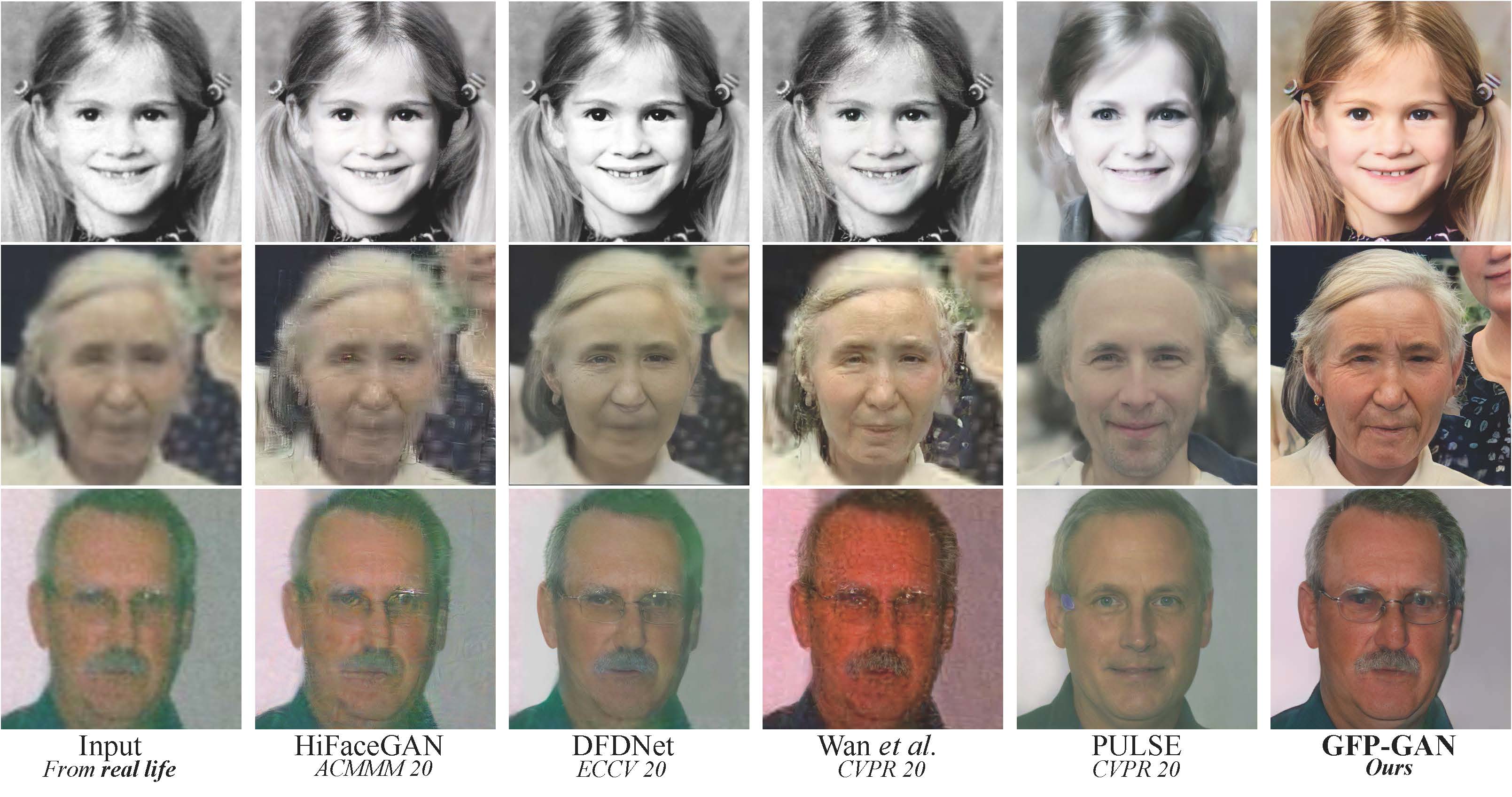
---
## :wrench: Dependencies and Installation
- Python >= 3.7 (Recommend to use [Anaconda](https://www.anaconda.com/download/#linux) or [Miniconda](https://docs.conda.io/en/latest/miniconda.html))
- [PyTorch >= 1.7](https://pytorch.org/)
- Option: NVIDIA GPU + [CUDA](https://developer.nvidia.com/cuda-downloads)
- Option: Linux
### Installation
We now provide a *clean* version of GFPGAN, which does not require customized CUDA extensions.
If you want to use the original model in our paper, please see [PaperModel.md](PaperModel.md) for installation.
1. Clone repo
```bash
git clone https://github.com/TencentARC/GFPGAN.git
cd GFPGAN
```
1. Install dependent packages
```bash
# Install basicsr - https://github.com/xinntao/BasicSR
# We use BasicSR for both training and inference
pip install basicsr
# Install facexlib - https://github.com/xinntao/facexlib
# We use face detection and face restoration helper in the facexlib package
pip install facexlib
pip install -r requirements.txt
python setup.py develop
# If you want to enhance the background (non-face) regions with Real-ESRGAN,
# you also need to install the realesrgan package
pip install realesrgan
```
## :zap: Quick Inference
We take the v1.3 version for an example. More models can be found [here](#european_castle-model-zoo).
Download pre-trained models: [GFPGANv1.3.pth](https://github.com/TencentARC/GFPGAN/releases/download/v1.3.0/GFPGANv1.3.pth)
```bash
wget https://github.com/TencentARC/GFPGAN/releases/download/v1.3.0/GFPGANv1.3.pth -P experiments/pretrained_models
```
**Inference!**
```bash
python inference_gfpgan.py -i inputs/whole_imgs -o results -v 1.3 -s 2
```
```console
Usage: python inference_gfpgan.py -i inputs/whole_imgs -o results -v 1.3 -s 2 [options]...
-h show this help
-i input Input image or folder. Default: inputs/whole_imgs
-o output Output folder. Default: results
-v version GFPGAN model version. Option: 1 | 1.2 | 1.3. Default: 1.3
-s upscale The final upsampling scale of the image. Default: 2
-bg_upsampler background upsampler. Default: realesrgan
-bg_tile Tile size for background sampler, 0 for no tile during testing. Default: 400
-suffix Suffix of the restored faces
-only_center_face Only restore the center face
-aligned Input are aligned faces
-ext Image extension. Options: auto | jpg | png, auto means using the same extension as inputs. Default: auto
```
If you want to use the original model in our paper, please see [PaperModel.md](PaperModel.md) for installation and inference.
## :european_castle: Model Zoo
| Version | Model Name | Description |
| :---: | :---: | :---: |
| V1.3 | [GFPGANv1.3.pth](https://github.com/TencentARC/GFPGAN/releases/download/v1.3.0/GFPGANv1.3.pth) | Based on V1.2; **more natural** restoration results; better results on very low-quality / high-quality inputs. |
| V1.2 | [GFPGANCleanv1-NoCE-C2.pth](https://github.com/TencentARC/GFPGAN/releases/download/v0.2.0/GFPGANCleanv1-NoCE-C2.pth) | No colorization; no CUDA extensions are required. Trained with more data with pre-processing. |
| V1 | [GFPGANv1.pth](https://github.com/TencentARC/GFPGAN/releases/download/v0.1.0/GFPGANv1.pth) | The paper model, with colorization. |
The comparisons are in [Comparisons.md](Comparisons.md).
Note that V1.3 is not always better than V1.2. You may need to select different models based on your purpose and inputs.
| Version | Strengths | Weaknesses |
| :---: | :---: | :---: |
|V1.3 | ✓ natural outputs
✓better results on very low-quality inputs
✓ work on relatively high-quality inputs
✓ can have repeated (twice) restorations | ✗ not very sharp
✗ have a slight change on identity |
|V1.2 | ✓ sharper output
✓ with beauty makeup | ✗ some outputs are unnatural |
You can find **more models (such as the discriminators)** here: [[Google Drive](https://drive.google.com/drive/folders/17rLiFzcUMoQuhLnptDsKolegHWwJOnHu?usp=sharing)], OR [[Tencent Cloud 腾讯微云](https://share.weiyun.com/ShYoCCoc)]
## :computer: Training
We provide the training codes for GFPGAN (used in our paper).
You could improve it according to your own needs.
**Tips**
1. More high quality faces can improve the restoration quality.
2. You may need to perform some pre-processing, such as beauty makeup.
**Procedures**
(You can try a simple version ( `options/train_gfpgan_v1_simple.yml`) that does not require face component landmarks.)
1. Dataset preparation: [FFHQ](https://github.com/NVlabs/ffhq-dataset)
1. Download pre-trained models and other data. Put them in the `experiments/pretrained_models` folder.
1. [Pre-trained StyleGAN2 model: StyleGAN2_512_Cmul1_FFHQ_B12G4_scratch_800k.pth](https://github.com/TencentARC/GFPGAN/releases/download/v0.1.0/StyleGAN2_512_Cmul1_FFHQ_B12G4_scratch_800k.pth)
1. [Component locations of FFHQ: FFHQ_eye_mouth_landmarks_512.pth](https://github.com/TencentARC/GFPGAN/releases/download/v0.1.0/FFHQ_eye_mouth_landmarks_512.pth)
1. [A simple ArcFace model: arcface_resnet18.pth](https://github.com/TencentARC/GFPGAN/releases/download/v0.1.0/arcface_resnet18.pth)
1. Modify the configuration file `options/train_gfpgan_v1.yml` accordingly.
1. Training
> python -m torch.distributed.launch --nproc_per_node=4 --master_port=22021 gfpgan/train.py -opt options/train_gfpgan_v1.yml --launcher pytorch
## :scroll: License and Acknowledgement
GFPGAN is released under Apache License Version 2.0.
## BibTeX
@InProceedings{wang2021gfpgan,
author = {Xintao Wang and Yu Li and Honglun Zhang and Ying Shan},
title = {Towards Real-World Blind Face Restoration with Generative Facial Prior},
booktitle={The IEEE Conference on Computer Vision and Pattern Recognition (CVPR)},
year = {2021}
}
## :e-mail: Contact
If you have any question, please email `xintao.wang@outlook.com` or `xintaowang@tencent.com`.
================================================
FILE: README_CN.md
================================================
##
还未完工,欢迎贡献!
================================================
FILE: VERSION
================================================
1.3.8
================================================
FILE: cog.yaml
================================================
# This file is used for constructing replicate env
image: "r8.im/tencentarc/gfpgan"
build:
gpu: true
python_version: "3.8"
system_packages:
- "libgl1-mesa-glx"
- "libglib2.0-0"
python_packages:
- "torch==1.7.1"
- "torchvision==0.8.2"
- "numpy==1.21.1"
- "lmdb==1.2.1"
- "opencv-python==4.5.3.56"
- "PyYAML==5.4.1"
- "tqdm==4.62.2"
- "yapf==0.31.0"
- "basicsr==1.4.2"
- "facexlib==0.2.5"
predict: "cog_predict.py:Predictor"
================================================
FILE: cog_predict.py
================================================
# flake8: noqa
# This file is used for deploying replicate models
# running: cog predict -i img=@inputs/whole_imgs/10045.png -i version='v1.4' -i scale=2
# push: cog push r8.im/tencentarc/gfpgan
# push (backup): cog push r8.im/xinntao/gfpgan
import os
os.system('python setup.py develop')
os.system('pip install realesrgan')
import cv2
import shutil
import tempfile
import torch
from basicsr.archs.srvgg_arch import SRVGGNetCompact
from gfpgan import GFPGANer
try:
from cog import BasePredictor, Input, Path
from realesrgan.utils import RealESRGANer
except Exception:
print('please install cog and realesrgan package')
class Predictor(BasePredictor):
def setup(self):
os.makedirs('output', exist_ok=True)
# download weights
if not os.path.exists('gfpgan/weights/realesr-general-x4v3.pth'):
os.system(
'wget https://github.com/xinntao/Real-ESRGAN/releases/download/v0.2.5.0/realesr-general-x4v3.pth -P ./gfpgan/weights'
)
if not os.path.exists('gfpgan/weights/GFPGANv1.2.pth'):
os.system(
'wget https://github.com/TencentARC/GFPGAN/releases/download/v1.3.0/GFPGANv1.2.pth -P ./gfpgan/weights')
if not os.path.exists('gfpgan/weights/GFPGANv1.3.pth'):
os.system(
'wget https://github.com/TencentARC/GFPGAN/releases/download/v1.3.0/GFPGANv1.3.pth -P ./gfpgan/weights')
if not os.path.exists('gfpgan/weights/GFPGANv1.4.pth'):
os.system(
'wget https://github.com/TencentARC/GFPGAN/releases/download/v1.3.0/GFPGANv1.4.pth -P ./gfpgan/weights')
if not os.path.exists('gfpgan/weights/RestoreFormer.pth'):
os.system(
'wget https://github.com/TencentARC/GFPGAN/releases/download/v1.3.4/RestoreFormer.pth -P ./gfpgan/weights'
)
# background enhancer with RealESRGAN
model = SRVGGNetCompact(num_in_ch=3, num_out_ch=3, num_feat=64, num_conv=32, upscale=4, act_type='prelu')
model_path = 'gfpgan/weights/realesr-general-x4v3.pth'
half = True if torch.cuda.is_available() else False
self.upsampler = RealESRGANer(
scale=4, model_path=model_path, model=model, tile=0, tile_pad=10, pre_pad=0, half=half)
# Use GFPGAN for face enhancement
self.face_enhancer = GFPGANer(
model_path='gfpgan/weights/GFPGANv1.4.pth',
upscale=2,
arch='clean',
channel_multiplier=2,
bg_upsampler=self.upsampler)
self.current_version = 'v1.4'
def predict(
self,
img: Path = Input(description='Input'),
version: str = Input(
description='GFPGAN version. v1.3: better quality. v1.4: more details and better identity.',
choices=['v1.2', 'v1.3', 'v1.4', 'RestoreFormer'],
default='v1.4'),
scale: float = Input(description='Rescaling factor', default=2),
) -> Path:
weight = 0.5
print(img, version, scale, weight)
try:
extension = os.path.splitext(os.path.basename(str(img)))[1]
img = cv2.imread(str(img), cv2.IMREAD_UNCHANGED)
if len(img.shape) == 3 and img.shape[2] == 4:
img_mode = 'RGBA'
elif len(img.shape) == 2:
img_mode = None
img = cv2.cvtColor(img, cv2.COLOR_GRAY2BGR)
else:
img_mode = None
h, w = img.shape[0:2]
if h < 300:
img = cv2.resize(img, (w * 2, h * 2), interpolation=cv2.INTER_LANCZOS4)
if self.current_version != version:
if version == 'v1.2':
self.face_enhancer = GFPGANer(
model_path='gfpgan/weights/GFPGANv1.2.pth',
upscale=2,
arch='clean',
channel_multiplier=2,
bg_upsampler=self.upsampler)
self.current_version = 'v1.2'
elif version == 'v1.3':
self.face_enhancer = GFPGANer(
model_path='gfpgan/weights/GFPGANv1.3.pth',
upscale=2,
arch='clean',
channel_multiplier=2,
bg_upsampler=self.upsampler)
self.current_version = 'v1.3'
elif version == 'v1.4':
self.face_enhancer = GFPGANer(
model_path='gfpgan/weights/GFPGANv1.4.pth',
upscale=2,
arch='clean',
channel_multiplier=2,
bg_upsampler=self.upsampler)
self.current_version = 'v1.4'
elif version == 'RestoreFormer':
self.face_enhancer = GFPGANer(
model_path='gfpgan/weights/RestoreFormer.pth',
upscale=2,
arch='RestoreFormer',
channel_multiplier=2,
bg_upsampler=self.upsampler)
try:
_, _, output = self.face_enhancer.enhance(
img, has_aligned=False, only_center_face=False, paste_back=True, weight=weight)
except RuntimeError as error:
print('Error', error)
try:
if scale != 2:
interpolation = cv2.INTER_AREA if scale < 2 else cv2.INTER_LANCZOS4
h, w = img.shape[0:2]
output = cv2.resize(output, (int(w * scale / 2), int(h * scale / 2)), interpolation=interpolation)
except Exception as error:
print('wrong scale input.', error)
if img_mode == 'RGBA': # RGBA images should be saved in png format
extension = 'png'
# save_path = f'output/out.{extension}'
# cv2.imwrite(save_path, output)
out_path = Path(tempfile.mkdtemp()) / f'out.{extension}'
cv2.imwrite(str(out_path), output)
except Exception as error:
print('global exception: ', error)
finally:
clean_folder('output')
return out_path
def clean_folder(folder):
for filename in os.listdir(folder):
file_path = os.path.join(folder, filename)
try:
if os.path.isfile(file_path) or os.path.islink(file_path):
os.unlink(file_path)
elif os.path.isdir(file_path):
shutil.rmtree(file_path)
except Exception as e:
print(f'Failed to delete {file_path}. Reason: {e}')
================================================
FILE: gfpgan/__init__.py
================================================
# flake8: noqa
from .archs import *
from .data import *
from .models import *
from .utils import *
# from .version import *
================================================
FILE: gfpgan/archs/__init__.py
================================================
import importlib
from basicsr.utils import scandir
from os import path as osp
# automatically scan and import arch modules for registry
# scan all the files that end with '_arch.py' under the archs folder
arch_folder = osp.dirname(osp.abspath(__file__))
arch_filenames = [osp.splitext(osp.basename(v))[0] for v in scandir(arch_folder) if v.endswith('_arch.py')]
# import all the arch modules
_arch_modules = [importlib.import_module(f'gfpgan.archs.{file_name}') for file_name in arch_filenames]
================================================
FILE: gfpgan/archs/arcface_arch.py
================================================
import torch.nn as nn
from basicsr.utils.registry import ARCH_REGISTRY
def conv3x3(inplanes, outplanes, stride=1):
"""A simple wrapper for 3x3 convolution with padding.
Args:
inplanes (int): Channel number of inputs.
outplanes (int): Channel number of outputs.
stride (int): Stride in convolution. Default: 1.
"""
return nn.Conv2d(inplanes, outplanes, kernel_size=3, stride=stride, padding=1, bias=False)
class BasicBlock(nn.Module):
"""Basic residual block used in the ResNetArcFace architecture.
Args:
inplanes (int): Channel number of inputs.
planes (int): Channel number of outputs.
stride (int): Stride in convolution. Default: 1.
downsample (nn.Module): The downsample module. Default: None.
"""
expansion = 1 # output channel expansion ratio
def __init__(self, inplanes, planes, stride=1, downsample=None):
super(BasicBlock, self).__init__()
self.conv1 = conv3x3(inplanes, planes, stride)
self.bn1 = nn.BatchNorm2d(planes)
self.relu = nn.ReLU(inplace=True)
self.conv2 = conv3x3(planes, planes)
self.bn2 = nn.BatchNorm2d(planes)
self.downsample = downsample
self.stride = stride
def forward(self, x):
residual = x
out = self.conv1(x)
out = self.bn1(out)
out = self.relu(out)
out = self.conv2(out)
out = self.bn2(out)
if self.downsample is not None:
residual = self.downsample(x)
out += residual
out = self.relu(out)
return out
class IRBlock(nn.Module):
"""Improved residual block (IR Block) used in the ResNetArcFace architecture.
Args:
inplanes (int): Channel number of inputs.
planes (int): Channel number of outputs.
stride (int): Stride in convolution. Default: 1.
downsample (nn.Module): The downsample module. Default: None.
use_se (bool): Whether use the SEBlock (squeeze and excitation block). Default: True.
"""
expansion = 1 # output channel expansion ratio
def __init__(self, inplanes, planes, stride=1, downsample=None, use_se=True):
super(IRBlock, self).__init__()
self.bn0 = nn.BatchNorm2d(inplanes)
self.conv1 = conv3x3(inplanes, inplanes)
self.bn1 = nn.BatchNorm2d(inplanes)
self.prelu = nn.PReLU()
self.conv2 = conv3x3(inplanes, planes, stride)
self.bn2 = nn.BatchNorm2d(planes)
self.downsample = downsample
self.stride = stride
self.use_se = use_se
if self.use_se:
self.se = SEBlock(planes)
def forward(self, x):
residual = x
out = self.bn0(x)
out = self.conv1(out)
out = self.bn1(out)
out = self.prelu(out)
out = self.conv2(out)
out = self.bn2(out)
if self.use_se:
out = self.se(out)
if self.downsample is not None:
residual = self.downsample(x)
out += residual
out = self.prelu(out)
return out
class Bottleneck(nn.Module):
"""Bottleneck block used in the ResNetArcFace architecture.
Args:
inplanes (int): Channel number of inputs.
planes (int): Channel number of outputs.
stride (int): Stride in convolution. Default: 1.
downsample (nn.Module): The downsample module. Default: None.
"""
expansion = 4 # output channel expansion ratio
def __init__(self, inplanes, planes, stride=1, downsample=None):
super(Bottleneck, self).__init__()
self.conv1 = nn.Conv2d(inplanes, planes, kernel_size=1, bias=False)
self.bn1 = nn.BatchNorm2d(planes)
self.conv2 = nn.Conv2d(planes, planes, kernel_size=3, stride=stride, padding=1, bias=False)
self.bn2 = nn.BatchNorm2d(planes)
self.conv3 = nn.Conv2d(planes, planes * self.expansion, kernel_size=1, bias=False)
self.bn3 = nn.BatchNorm2d(planes * self.expansion)
self.relu = nn.ReLU(inplace=True)
self.downsample = downsample
self.stride = stride
def forward(self, x):
residual = x
out = self.conv1(x)
out = self.bn1(out)
out = self.relu(out)
out = self.conv2(out)
out = self.bn2(out)
out = self.relu(out)
out = self.conv3(out)
out = self.bn3(out)
if self.downsample is not None:
residual = self.downsample(x)
out += residual
out = self.relu(out)
return out
class SEBlock(nn.Module):
"""The squeeze-and-excitation block (SEBlock) used in the IRBlock.
Args:
channel (int): Channel number of inputs.
reduction (int): Channel reduction ration. Default: 16.
"""
def __init__(self, channel, reduction=16):
super(SEBlock, self).__init__()
self.avg_pool = nn.AdaptiveAvgPool2d(1) # pool to 1x1 without spatial information
self.fc = nn.Sequential(
nn.Linear(channel, channel // reduction), nn.PReLU(), nn.Linear(channel // reduction, channel),
nn.Sigmoid())
def forward(self, x):
b, c, _, _ = x.size()
y = self.avg_pool(x).view(b, c)
y = self.fc(y).view(b, c, 1, 1)
return x * y
@ARCH_REGISTRY.register()
class ResNetArcFace(nn.Module):
"""ArcFace with ResNet architectures.
Ref: ArcFace: Additive Angular Margin Loss for Deep Face Recognition.
Args:
block (str): Block used in the ArcFace architecture.
layers (tuple(int)): Block numbers in each layer.
use_se (bool): Whether use the SEBlock (squeeze and excitation block). Default: True.
"""
def __init__(self, block, layers, use_se=True):
if block == 'IRBlock':
block = IRBlock
self.inplanes = 64
self.use_se = use_se
super(ResNetArcFace, self).__init__()
self.conv1 = nn.Conv2d(1, 64, kernel_size=3, padding=1, bias=False)
self.bn1 = nn.BatchNorm2d(64)
self.prelu = nn.PReLU()
self.maxpool = nn.MaxPool2d(kernel_size=2, stride=2)
self.layer1 = self._make_layer(block, 64, layers[0])
self.layer2 = self._make_layer(block, 128, layers[1], stride=2)
self.layer3 = self._make_layer(block, 256, layers[2], stride=2)
self.layer4 = self._make_layer(block, 512, layers[3], stride=2)
self.bn4 = nn.BatchNorm2d(512)
self.dropout = nn.Dropout()
self.fc5 = nn.Linear(512 * 8 * 8, 512)
self.bn5 = nn.BatchNorm1d(512)
# initialization
for m in self.modules():
if isinstance(m, nn.Conv2d):
nn.init.xavier_normal_(m.weight)
elif isinstance(m, nn.BatchNorm2d) or isinstance(m, nn.BatchNorm1d):
nn.init.constant_(m.weight, 1)
nn.init.constant_(m.bias, 0)
elif isinstance(m, nn.Linear):
nn.init.xavier_normal_(m.weight)
nn.init.constant_(m.bias, 0)
def _make_layer(self, block, planes, num_blocks, stride=1):
downsample = None
if stride != 1 or self.inplanes != planes * block.expansion:
downsample = nn.Sequential(
nn.Conv2d(self.inplanes, planes * block.expansion, kernel_size=1, stride=stride, bias=False),
nn.BatchNorm2d(planes * block.expansion),
)
layers = []
layers.append(block(self.inplanes, planes, stride, downsample, use_se=self.use_se))
self.inplanes = planes
for _ in range(1, num_blocks):
layers.append(block(self.inplanes, planes, use_se=self.use_se))
return nn.Sequential(*layers)
def forward(self, x):
x = self.conv1(x)
x = self.bn1(x)
x = self.prelu(x)
x = self.maxpool(x)
x = self.layer1(x)
x = self.layer2(x)
x = self.layer3(x)
x = self.layer4(x)
x = self.bn4(x)
x = self.dropout(x)
x = x.view(x.size(0), -1)
x = self.fc5(x)
x = self.bn5(x)
return x
================================================
FILE: gfpgan/archs/gfpgan_bilinear_arch.py
================================================
import math
import random
import torch
from basicsr.utils.registry import ARCH_REGISTRY
from torch import nn
from .gfpganv1_arch import ResUpBlock
from .stylegan2_bilinear_arch import (ConvLayer, EqualConv2d, EqualLinear, ResBlock, ScaledLeakyReLU,
StyleGAN2GeneratorBilinear)
class StyleGAN2GeneratorBilinearSFT(StyleGAN2GeneratorBilinear):
"""StyleGAN2 Generator with SFT modulation (Spatial Feature Transform).
It is the bilinear version. It does not use the complicated UpFirDnSmooth function that is not friendly for
deployment. It can be easily converted to the clean version: StyleGAN2GeneratorCSFT.
Args:
out_size (int): The spatial size of outputs.
num_style_feat (int): Channel number of style features. Default: 512.
num_mlp (int): Layer number of MLP style layers. Default: 8.
channel_multiplier (int): Channel multiplier for large networks of StyleGAN2. Default: 2.
lr_mlp (float): Learning rate multiplier for mlp layers. Default: 0.01.
narrow (float): The narrow ratio for channels. Default: 1.
sft_half (bool): Whether to apply SFT on half of the input channels. Default: False.
"""
def __init__(self,
out_size,
num_style_feat=512,
num_mlp=8,
channel_multiplier=2,
lr_mlp=0.01,
narrow=1,
sft_half=False):
super(StyleGAN2GeneratorBilinearSFT, self).__init__(
out_size,
num_style_feat=num_style_feat,
num_mlp=num_mlp,
channel_multiplier=channel_multiplier,
lr_mlp=lr_mlp,
narrow=narrow)
self.sft_half = sft_half
def forward(self,
styles,
conditions,
input_is_latent=False,
noise=None,
randomize_noise=True,
truncation=1,
truncation_latent=None,
inject_index=None,
return_latents=False):
"""Forward function for StyleGAN2GeneratorBilinearSFT.
Args:
styles (list[Tensor]): Sample codes of styles.
conditions (list[Tensor]): SFT conditions to generators.
input_is_latent (bool): Whether input is latent style. Default: False.
noise (Tensor | None): Input noise or None. Default: None.
randomize_noise (bool): Randomize noise, used when 'noise' is False. Default: True.
truncation (float): The truncation ratio. Default: 1.
truncation_latent (Tensor | None): The truncation latent tensor. Default: None.
inject_index (int | None): The injection index for mixing noise. Default: None.
return_latents (bool): Whether to return style latents. Default: False.
"""
# style codes -> latents with Style MLP layer
if not input_is_latent:
styles = [self.style_mlp(s) for s in styles]
# noises
if noise is None:
if randomize_noise:
noise = [None] * self.num_layers # for each style conv layer
else: # use the stored noise
noise = [getattr(self.noises, f'noise{i}') for i in range(self.num_layers)]
# style truncation
if truncation < 1:
style_truncation = []
for style in styles:
style_truncation.append(truncation_latent + truncation * (style - truncation_latent))
styles = style_truncation
# get style latents with injection
if len(styles) == 1:
inject_index = self.num_latent
if styles[0].ndim < 3:
# repeat latent code for all the layers
latent = styles[0].unsqueeze(1).repeat(1, inject_index, 1)
else: # used for encoder with different latent code for each layer
latent = styles[0]
elif len(styles) == 2: # mixing noises
if inject_index is None:
inject_index = random.randint(1, self.num_latent - 1)
latent1 = styles[0].unsqueeze(1).repeat(1, inject_index, 1)
latent2 = styles[1].unsqueeze(1).repeat(1, self.num_latent - inject_index, 1)
latent = torch.cat([latent1, latent2], 1)
# main generation
out = self.constant_input(latent.shape[0])
out = self.style_conv1(out, latent[:, 0], noise=noise[0])
skip = self.to_rgb1(out, latent[:, 1])
i = 1
for conv1, conv2, noise1, noise2, to_rgb in zip(self.style_convs[::2], self.style_convs[1::2], noise[1::2],
noise[2::2], self.to_rgbs):
out = conv1(out, latent[:, i], noise=noise1)
# the conditions may have fewer levels
if i < len(conditions):
# SFT part to combine the conditions
if self.sft_half: # only apply SFT to half of the channels
out_same, out_sft = torch.split(out, int(out.size(1) // 2), dim=1)
out_sft = out_sft * conditions[i - 1] + conditions[i]
out = torch.cat([out_same, out_sft], dim=1)
else: # apply SFT to all the channels
out = out * conditions[i - 1] + conditions[i]
out = conv2(out, latent[:, i + 1], noise=noise2)
skip = to_rgb(out, latent[:, i + 2], skip) # feature back to the rgb space
i += 2
image = skip
if return_latents:
return image, latent
else:
return image, None
@ARCH_REGISTRY.register()
class GFPGANBilinear(nn.Module):
"""The GFPGAN architecture: Unet + StyleGAN2 decoder with SFT.
It is the bilinear version and it does not use the complicated UpFirDnSmooth function that is not friendly for
deployment. It can be easily converted to the clean version: GFPGANv1Clean.
Ref: GFP-GAN: Towards Real-World Blind Face Restoration with Generative Facial Prior.
Args:
out_size (int): The spatial size of outputs.
num_style_feat (int): Channel number of style features. Default: 512.
channel_multiplier (int): Channel multiplier for large networks of StyleGAN2. Default: 2.
decoder_load_path (str): The path to the pre-trained decoder model (usually, the StyleGAN2). Default: None.
fix_decoder (bool): Whether to fix the decoder. Default: True.
num_mlp (int): Layer number of MLP style layers. Default: 8.
lr_mlp (float): Learning rate multiplier for mlp layers. Default: 0.01.
input_is_latent (bool): Whether input is latent style. Default: False.
different_w (bool): Whether to use different latent w for different layers. Default: False.
narrow (float): The narrow ratio for channels. Default: 1.
sft_half (bool): Whether to apply SFT on half of the input channels. Default: False.
"""
def __init__(
self,
out_size,
num_style_feat=512,
channel_multiplier=1,
decoder_load_path=None,
fix_decoder=True,
# for stylegan decoder
num_mlp=8,
lr_mlp=0.01,
input_is_latent=False,
different_w=False,
narrow=1,
sft_half=False):
super(GFPGANBilinear, self).__init__()
self.input_is_latent = input_is_latent
self.different_w = different_w
self.num_style_feat = num_style_feat
unet_narrow = narrow * 0.5 # by default, use a half of input channels
channels = {
'4': int(512 * unet_narrow),
'8': int(512 * unet_narrow),
'16': int(512 * unet_narrow),
'32': int(512 * unet_narrow),
'64': int(256 * channel_multiplier * unet_narrow),
'128': int(128 * channel_multiplier * unet_narrow),
'256': int(64 * channel_multiplier * unet_narrow),
'512': int(32 * channel_multiplier * unet_narrow),
'1024': int(16 * channel_multiplier * unet_narrow)
}
self.log_size = int(math.log(out_size, 2))
first_out_size = 2**(int(math.log(out_size, 2)))
self.conv_body_first = ConvLayer(3, channels[f'{first_out_size}'], 1, bias=True, activate=True)
# downsample
in_channels = channels[f'{first_out_size}']
self.conv_body_down = nn.ModuleList()
for i in range(self.log_size, 2, -1):
out_channels = channels[f'{2**(i - 1)}']
self.conv_body_down.append(ResBlock(in_channels, out_channels))
in_channels = out_channels
self.final_conv = ConvLayer(in_channels, channels['4'], 3, bias=True, activate=True)
# upsample
in_channels = channels['4']
self.conv_body_up = nn.ModuleList()
for i in range(3, self.log_size + 1):
out_channels = channels[f'{2**i}']
self.conv_body_up.append(ResUpBlock(in_channels, out_channels))
in_channels = out_channels
# to RGB
self.toRGB = nn.ModuleList()
for i in range(3, self.log_size + 1):
self.toRGB.append(EqualConv2d(channels[f'{2**i}'], 3, 1, stride=1, padding=0, bias=True, bias_init_val=0))
if different_w:
linear_out_channel = (int(math.log(out_size, 2)) * 2 - 2) * num_style_feat
else:
linear_out_channel = num_style_feat
self.final_linear = EqualLinear(
channels['4'] * 4 * 4, linear_out_channel, bias=True, bias_init_val=0, lr_mul=1, activation=None)
# the decoder: stylegan2 generator with SFT modulations
self.stylegan_decoder = StyleGAN2GeneratorBilinearSFT(
out_size=out_size,
num_style_feat=num_style_feat,
num_mlp=num_mlp,
channel_multiplier=channel_multiplier,
lr_mlp=lr_mlp,
narrow=narrow,
sft_half=sft_half)
# load pre-trained stylegan2 model if necessary
if decoder_load_path:
self.stylegan_decoder.load_state_dict(
torch.load(decoder_load_path, map_location=lambda storage, loc: storage)['params_ema'])
# fix decoder without updating params
if fix_decoder:
for _, param in self.stylegan_decoder.named_parameters():
param.requires_grad = False
# for SFT modulations (scale and shift)
self.condition_scale = nn.ModuleList()
self.condition_shift = nn.ModuleList()
for i in range(3, self.log_size + 1):
out_channels = channels[f'{2**i}']
if sft_half:
sft_out_channels = out_channels
else:
sft_out_channels = out_channels * 2
self.condition_scale.append(
nn.Sequential(
EqualConv2d(out_channels, out_channels, 3, stride=1, padding=1, bias=True, bias_init_val=0),
ScaledLeakyReLU(0.2),
EqualConv2d(out_channels, sft_out_channels, 3, stride=1, padding=1, bias=True, bias_init_val=1)))
self.condition_shift.append(
nn.Sequential(
EqualConv2d(out_channels, out_channels, 3, stride=1, padding=1, bias=True, bias_init_val=0),
ScaledLeakyReLU(0.2),
EqualConv2d(out_channels, sft_out_channels, 3, stride=1, padding=1, bias=True, bias_init_val=0)))
def forward(self, x, return_latents=False, return_rgb=True, randomize_noise=True):
"""Forward function for GFPGANBilinear.
Args:
x (Tensor): Input images.
return_latents (bool): Whether to return style latents. Default: False.
return_rgb (bool): Whether return intermediate rgb images. Default: True.
randomize_noise (bool): Randomize noise, used when 'noise' is False. Default: True.
"""
conditions = []
unet_skips = []
out_rgbs = []
# encoder
feat = self.conv_body_first(x)
for i in range(self.log_size - 2):
feat = self.conv_body_down[i](feat)
unet_skips.insert(0, feat)
feat = self.final_conv(feat)
# style code
style_code = self.final_linear(feat.view(feat.size(0), -1))
if self.different_w:
style_code = style_code.view(style_code.size(0), -1, self.num_style_feat)
# decode
for i in range(self.log_size - 2):
# add unet skip
feat = feat + unet_skips[i]
# ResUpLayer
feat = self.conv_body_up[i](feat)
# generate scale and shift for SFT layers
scale = self.condition_scale[i](feat)
conditions.append(scale.clone())
shift = self.condition_shift[i](feat)
conditions.append(shift.clone())
# generate rgb images
if return_rgb:
out_rgbs.append(self.toRGB[i](feat))
# decoder
image, _ = self.stylegan_decoder([style_code],
conditions,
return_latents=return_latents,
input_is_latent=self.input_is_latent,
randomize_noise=randomize_noise)
return image, out_rgbs
================================================
FILE: gfpgan/archs/gfpganv1_arch.py
================================================
import math
import random
import torch
from basicsr.archs.stylegan2_arch import (ConvLayer, EqualConv2d, EqualLinear, ResBlock, ScaledLeakyReLU,
StyleGAN2Generator)
from basicsr.ops.fused_act import FusedLeakyReLU
from basicsr.utils.registry import ARCH_REGISTRY
from torch import nn
from torch.nn import functional as F
class StyleGAN2GeneratorSFT(StyleGAN2Generator):
"""StyleGAN2 Generator with SFT modulation (Spatial Feature Transform).
Args:
out_size (int): The spatial size of outputs.
num_style_feat (int): Channel number of style features. Default: 512.
num_mlp (int): Layer number of MLP style layers. Default: 8.
channel_multiplier (int): Channel multiplier for large networks of StyleGAN2. Default: 2.
resample_kernel (list[int]): A list indicating the 1D resample kernel magnitude. A cross production will be
applied to extent 1D resample kernel to 2D resample kernel. Default: (1, 3, 3, 1).
lr_mlp (float): Learning rate multiplier for mlp layers. Default: 0.01.
narrow (float): The narrow ratio for channels. Default: 1.
sft_half (bool): Whether to apply SFT on half of the input channels. Default: False.
"""
def __init__(self,
out_size,
num_style_feat=512,
num_mlp=8,
channel_multiplier=2,
resample_kernel=(1, 3, 3, 1),
lr_mlp=0.01,
narrow=1,
sft_half=False):
super(StyleGAN2GeneratorSFT, self).__init__(
out_size,
num_style_feat=num_style_feat,
num_mlp=num_mlp,
channel_multiplier=channel_multiplier,
resample_kernel=resample_kernel,
lr_mlp=lr_mlp,
narrow=narrow)
self.sft_half = sft_half
def forward(self,
styles,
conditions,
input_is_latent=False,
noise=None,
randomize_noise=True,
truncation=1,
truncation_latent=None,
inject_index=None,
return_latents=False):
"""Forward function for StyleGAN2GeneratorSFT.
Args:
styles (list[Tensor]): Sample codes of styles.
conditions (list[Tensor]): SFT conditions to generators.
input_is_latent (bool): Whether input is latent style. Default: False.
noise (Tensor | None): Input noise or None. Default: None.
randomize_noise (bool): Randomize noise, used when 'noise' is False. Default: True.
truncation (float): The truncation ratio. Default: 1.
truncation_latent (Tensor | None): The truncation latent tensor. Default: None.
inject_index (int | None): The injection index for mixing noise. Default: None.
return_latents (bool): Whether to return style latents. Default: False.
"""
# style codes -> latents with Style MLP layer
if not input_is_latent:
styles = [self.style_mlp(s) for s in styles]
# noises
if noise is None:
if randomize_noise:
noise = [None] * self.num_layers # for each style conv layer
else: # use the stored noise
noise = [getattr(self.noises, f'noise{i}') for i in range(self.num_layers)]
# style truncation
if truncation < 1:
style_truncation = []
for style in styles:
style_truncation.append(truncation_latent + truncation * (style - truncation_latent))
styles = style_truncation
# get style latents with injection
if len(styles) == 1:
inject_index = self.num_latent
if styles[0].ndim < 3:
# repeat latent code for all the layers
latent = styles[0].unsqueeze(1).repeat(1, inject_index, 1)
else: # used for encoder with different latent code for each layer
latent = styles[0]
elif len(styles) == 2: # mixing noises
if inject_index is None:
inject_index = random.randint(1, self.num_latent - 1)
latent1 = styles[0].unsqueeze(1).repeat(1, inject_index, 1)
latent2 = styles[1].unsqueeze(1).repeat(1, self.num_latent - inject_index, 1)
latent = torch.cat([latent1, latent2], 1)
# main generation
out = self.constant_input(latent.shape[0])
out = self.style_conv1(out, latent[:, 0], noise=noise[0])
skip = self.to_rgb1(out, latent[:, 1])
i = 1
for conv1, conv2, noise1, noise2, to_rgb in zip(self.style_convs[::2], self.style_convs[1::2], noise[1::2],
noise[2::2], self.to_rgbs):
out = conv1(out, latent[:, i], noise=noise1)
# the conditions may have fewer levels
if i < len(conditions):
# SFT part to combine the conditions
if self.sft_half: # only apply SFT to half of the channels
out_same, out_sft = torch.split(out, int(out.size(1) // 2), dim=1)
out_sft = out_sft * conditions[i - 1] + conditions[i]
out = torch.cat([out_same, out_sft], dim=1)
else: # apply SFT to all the channels
out = out * conditions[i - 1] + conditions[i]
out = conv2(out, latent[:, i + 1], noise=noise2)
skip = to_rgb(out, latent[:, i + 2], skip) # feature back to the rgb space
i += 2
image = skip
if return_latents:
return image, latent
else:
return image, None
class ConvUpLayer(nn.Module):
"""Convolutional upsampling layer. It uses bilinear upsampler + Conv.
Args:
in_channels (int): Channel number of the input.
out_channels (int): Channel number of the output.
kernel_size (int): Size of the convolving kernel.
stride (int): Stride of the convolution. Default: 1
padding (int): Zero-padding added to both sides of the input. Default: 0.
bias (bool): If ``True``, adds a learnable bias to the output. Default: ``True``.
bias_init_val (float): Bias initialized value. Default: 0.
activate (bool): Whether use activateion. Default: True.
"""
def __init__(self,
in_channels,
out_channels,
kernel_size,
stride=1,
padding=0,
bias=True,
bias_init_val=0,
activate=True):
super(ConvUpLayer, self).__init__()
self.in_channels = in_channels
self.out_channels = out_channels
self.kernel_size = kernel_size
self.stride = stride
self.padding = padding
# self.scale is used to scale the convolution weights, which is related to the common initializations.
self.scale = 1 / math.sqrt(in_channels * kernel_size**2)
self.weight = nn.Parameter(torch.randn(out_channels, in_channels, kernel_size, kernel_size))
if bias and not activate:
self.bias = nn.Parameter(torch.zeros(out_channels).fill_(bias_init_val))
else:
self.register_parameter('bias', None)
# activation
if activate:
if bias:
self.activation = FusedLeakyReLU(out_channels)
else:
self.activation = ScaledLeakyReLU(0.2)
else:
self.activation = None
def forward(self, x):
# bilinear upsample
out = F.interpolate(x, scale_factor=2, mode='bilinear', align_corners=False)
# conv
out = F.conv2d(
out,
self.weight * self.scale,
bias=self.bias,
stride=self.stride,
padding=self.padding,
)
# activation
if self.activation is not None:
out = self.activation(out)
return out
class ResUpBlock(nn.Module):
"""Residual block with upsampling.
Args:
in_channels (int): Channel number of the input.
out_channels (int): Channel number of the output.
"""
def __init__(self, in_channels, out_channels):
super(ResUpBlock, self).__init__()
self.conv1 = ConvLayer(in_channels, in_channels, 3, bias=True, activate=True)
self.conv2 = ConvUpLayer(in_channels, out_channels, 3, stride=1, padding=1, bias=True, activate=True)
self.skip = ConvUpLayer(in_channels, out_channels, 1, bias=False, activate=False)
def forward(self, x):
out = self.conv1(x)
out = self.conv2(out)
skip = self.skip(x)
out = (out + skip) / math.sqrt(2)
return out
@ARCH_REGISTRY.register()
class GFPGANv1(nn.Module):
"""The GFPGAN architecture: Unet + StyleGAN2 decoder with SFT.
Ref: GFP-GAN: Towards Real-World Blind Face Restoration with Generative Facial Prior.
Args:
out_size (int): The spatial size of outputs.
num_style_feat (int): Channel number of style features. Default: 512.
channel_multiplier (int): Channel multiplier for large networks of StyleGAN2. Default: 2.
resample_kernel (list[int]): A list indicating the 1D resample kernel magnitude. A cross production will be
applied to extent 1D resample kernel to 2D resample kernel. Default: (1, 3, 3, 1).
decoder_load_path (str): The path to the pre-trained decoder model (usually, the StyleGAN2). Default: None.
fix_decoder (bool): Whether to fix the decoder. Default: True.
num_mlp (int): Layer number of MLP style layers. Default: 8.
lr_mlp (float): Learning rate multiplier for mlp layers. Default: 0.01.
input_is_latent (bool): Whether input is latent style. Default: False.
different_w (bool): Whether to use different latent w for different layers. Default: False.
narrow (float): The narrow ratio for channels. Default: 1.
sft_half (bool): Whether to apply SFT on half of the input channels. Default: False.
"""
def __init__(
self,
out_size,
num_style_feat=512,
channel_multiplier=1,
resample_kernel=(1, 3, 3, 1),
decoder_load_path=None,
fix_decoder=True,
# for stylegan decoder
num_mlp=8,
lr_mlp=0.01,
input_is_latent=False,
different_w=False,
narrow=1,
sft_half=False):
super(GFPGANv1, self).__init__()
self.input_is_latent = input_is_latent
self.different_w = different_w
self.num_style_feat = num_style_feat
unet_narrow = narrow * 0.5 # by default, use a half of input channels
channels = {
'4': int(512 * unet_narrow),
'8': int(512 * unet_narrow),
'16': int(512 * unet_narrow),
'32': int(512 * unet_narrow),
'64': int(256 * channel_multiplier * unet_narrow),
'128': int(128 * channel_multiplier * unet_narrow),
'256': int(64 * channel_multiplier * unet_narrow),
'512': int(32 * channel_multiplier * unet_narrow),
'1024': int(16 * channel_multiplier * unet_narrow)
}
self.log_size = int(math.log(out_size, 2))
first_out_size = 2**(int(math.log(out_size, 2)))
self.conv_body_first = ConvLayer(3, channels[f'{first_out_size}'], 1, bias=True, activate=True)
# downsample
in_channels = channels[f'{first_out_size}']
self.conv_body_down = nn.ModuleList()
for i in range(self.log_size, 2, -1):
out_channels = channels[f'{2**(i - 1)}']
self.conv_body_down.append(ResBlock(in_channels, out_channels, resample_kernel))
in_channels = out_channels
self.final_conv = ConvLayer(in_channels, channels['4'], 3, bias=True, activate=True)
# upsample
in_channels = channels['4']
self.conv_body_up = nn.ModuleList()
for i in range(3, self.log_size + 1):
out_channels = channels[f'{2**i}']
self.conv_body_up.append(ResUpBlock(in_channels, out_channels))
in_channels = out_channels
# to RGB
self.toRGB = nn.ModuleList()
for i in range(3, self.log_size + 1):
self.toRGB.append(EqualConv2d(channels[f'{2**i}'], 3, 1, stride=1, padding=0, bias=True, bias_init_val=0))
if different_w:
linear_out_channel = (int(math.log(out_size, 2)) * 2 - 2) * num_style_feat
else:
linear_out_channel = num_style_feat
self.final_linear = EqualLinear(
channels['4'] * 4 * 4, linear_out_channel, bias=True, bias_init_val=0, lr_mul=1, activation=None)
# the decoder: stylegan2 generator with SFT modulations
self.stylegan_decoder = StyleGAN2GeneratorSFT(
out_size=out_size,
num_style_feat=num_style_feat,
num_mlp=num_mlp,
channel_multiplier=channel_multiplier,
resample_kernel=resample_kernel,
lr_mlp=lr_mlp,
narrow=narrow,
sft_half=sft_half)
# load pre-trained stylegan2 model if necessary
if decoder_load_path:
self.stylegan_decoder.load_state_dict(
torch.load(decoder_load_path, map_location=lambda storage, loc: storage)['params_ema'])
# fix decoder without updating params
if fix_decoder:
for _, param in self.stylegan_decoder.named_parameters():
param.requires_grad = False
# for SFT modulations (scale and shift)
self.condition_scale = nn.ModuleList()
self.condition_shift = nn.ModuleList()
for i in range(3, self.log_size + 1):
out_channels = channels[f'{2**i}']
if sft_half:
sft_out_channels = out_channels
else:
sft_out_channels = out_channels * 2
self.condition_scale.append(
nn.Sequential(
EqualConv2d(out_channels, out_channels, 3, stride=1, padding=1, bias=True, bias_init_val=0),
ScaledLeakyReLU(0.2),
EqualConv2d(out_channels, sft_out_channels, 3, stride=1, padding=1, bias=True, bias_init_val=1)))
self.condition_shift.append(
nn.Sequential(
EqualConv2d(out_channels, out_channels, 3, stride=1, padding=1, bias=True, bias_init_val=0),
ScaledLeakyReLU(0.2),
EqualConv2d(out_channels, sft_out_channels, 3, stride=1, padding=1, bias=True, bias_init_val=0)))
def forward(self, x, return_latents=False, return_rgb=True, randomize_noise=True, **kwargs):
"""Forward function for GFPGANv1.
Args:
x (Tensor): Input images.
return_latents (bool): Whether to return style latents. Default: False.
return_rgb (bool): Whether return intermediate rgb images. Default: True.
randomize_noise (bool): Randomize noise, used when 'noise' is False. Default: True.
"""
conditions = []
unet_skips = []
out_rgbs = []
# encoder
feat = self.conv_body_first(x)
for i in range(self.log_size - 2):
feat = self.conv_body_down[i](feat)
unet_skips.insert(0, feat)
feat = self.final_conv(feat)
# style code
style_code = self.final_linear(feat.view(feat.size(0), -1))
if self.different_w:
style_code = style_code.view(style_code.size(0), -1, self.num_style_feat)
# decode
for i in range(self.log_size - 2):
# add unet skip
feat = feat + unet_skips[i]
# ResUpLayer
feat = self.conv_body_up[i](feat)
# generate scale and shift for SFT layers
scale = self.condition_scale[i](feat)
conditions.append(scale.clone())
shift = self.condition_shift[i](feat)
conditions.append(shift.clone())
# generate rgb images
if return_rgb:
out_rgbs.append(self.toRGB[i](feat))
# decoder
image, _ = self.stylegan_decoder([style_code],
conditions,
return_latents=return_latents,
input_is_latent=self.input_is_latent,
randomize_noise=randomize_noise)
return image, out_rgbs
@ARCH_REGISTRY.register()
class FacialComponentDiscriminator(nn.Module):
"""Facial component (eyes, mouth, noise) discriminator used in GFPGAN.
"""
def __init__(self):
super(FacialComponentDiscriminator, self).__init__()
# It now uses a VGG-style architectrue with fixed model size
self.conv1 = ConvLayer(3, 64, 3, downsample=False, resample_kernel=(1, 3, 3, 1), bias=True, activate=True)
self.conv2 = ConvLayer(64, 128, 3, downsample=True, resample_kernel=(1, 3, 3, 1), bias=True, activate=True)
self.conv3 = ConvLayer(128, 128, 3, downsample=False, resample_kernel=(1, 3, 3, 1), bias=True, activate=True)
self.conv4 = ConvLayer(128, 256, 3, downsample=True, resample_kernel=(1, 3, 3, 1), bias=True, activate=True)
self.conv5 = ConvLayer(256, 256, 3, downsample=False, resample_kernel=(1, 3, 3, 1), bias=True, activate=True)
self.final_conv = ConvLayer(256, 1, 3, bias=True, activate=False)
def forward(self, x, return_feats=False, **kwargs):
"""Forward function for FacialComponentDiscriminator.
Args:
x (Tensor): Input images.
return_feats (bool): Whether to return intermediate features. Default: False.
"""
feat = self.conv1(x)
feat = self.conv3(self.conv2(feat))
rlt_feats = []
if return_feats:
rlt_feats.append(feat.clone())
feat = self.conv5(self.conv4(feat))
if return_feats:
rlt_feats.append(feat.clone())
out = self.final_conv(feat)
if return_feats:
return out, rlt_feats
else:
return out, None
================================================
FILE: gfpgan/archs/gfpganv1_clean_arch.py
================================================
import math
import random
import torch
from basicsr.utils.registry import ARCH_REGISTRY
from torch import nn
from torch.nn import functional as F
from .stylegan2_clean_arch import StyleGAN2GeneratorClean
class StyleGAN2GeneratorCSFT(StyleGAN2GeneratorClean):
"""StyleGAN2 Generator with SFT modulation (Spatial Feature Transform).
It is the clean version without custom compiled CUDA extensions used in StyleGAN2.
Args:
out_size (int): The spatial size of outputs.
num_style_feat (int): Channel number of style features. Default: 512.
num_mlp (int): Layer number of MLP style layers. Default: 8.
channel_multiplier (int): Channel multiplier for large networks of StyleGAN2. Default: 2.
narrow (float): The narrow ratio for channels. Default: 1.
sft_half (bool): Whether to apply SFT on half of the input channels. Default: False.
"""
def __init__(self, out_size, num_style_feat=512, num_mlp=8, channel_multiplier=2, narrow=1, sft_half=False):
super(StyleGAN2GeneratorCSFT, self).__init__(
out_size,
num_style_feat=num_style_feat,
num_mlp=num_mlp,
channel_multiplier=channel_multiplier,
narrow=narrow)
self.sft_half = sft_half
def forward(self,
styles,
conditions,
input_is_latent=False,
noise=None,
randomize_noise=True,
truncation=1,
truncation_latent=None,
inject_index=None,
return_latents=False):
"""Forward function for StyleGAN2GeneratorCSFT.
Args:
styles (list[Tensor]): Sample codes of styles.
conditions (list[Tensor]): SFT conditions to generators.
input_is_latent (bool): Whether input is latent style. Default: False.
noise (Tensor | None): Input noise or None. Default: None.
randomize_noise (bool): Randomize noise, used when 'noise' is False. Default: True.
truncation (float): The truncation ratio. Default: 1.
truncation_latent (Tensor | None): The truncation latent tensor. Default: None.
inject_index (int | None): The injection index for mixing noise. Default: None.
return_latents (bool): Whether to return style latents. Default: False.
"""
# style codes -> latents with Style MLP layer
if not input_is_latent:
styles = [self.style_mlp(s) for s in styles]
# noises
if noise is None:
if randomize_noise:
noise = [None] * self.num_layers # for each style conv layer
else: # use the stored noise
noise = [getattr(self.noises, f'noise{i}') for i in range(self.num_layers)]
# style truncation
if truncation < 1:
style_truncation = []
for style in styles:
style_truncation.append(truncation_latent + truncation * (style - truncation_latent))
styles = style_truncation
# get style latents with injection
if len(styles) == 1:
inject_index = self.num_latent
if styles[0].ndim < 3:
# repeat latent code for all the layers
latent = styles[0].unsqueeze(1).repeat(1, inject_index, 1)
else: # used for encoder with different latent code for each layer
latent = styles[0]
elif len(styles) == 2: # mixing noises
if inject_index is None:
inject_index = random.randint(1, self.num_latent - 1)
latent1 = styles[0].unsqueeze(1).repeat(1, inject_index, 1)
latent2 = styles[1].unsqueeze(1).repeat(1, self.num_latent - inject_index, 1)
latent = torch.cat([latent1, latent2], 1)
# main generation
out = self.constant_input(latent.shape[0])
out = self.style_conv1(out, latent[:, 0], noise=noise[0])
skip = self.to_rgb1(out, latent[:, 1])
i = 1
for conv1, conv2, noise1, noise2, to_rgb in zip(self.style_convs[::2], self.style_convs[1::2], noise[1::2],
noise[2::2], self.to_rgbs):
out = conv1(out, latent[:, i], noise=noise1)
# the conditions may have fewer levels
if i < len(conditions):
# SFT part to combine the conditions
if self.sft_half: # only apply SFT to half of the channels
out_same, out_sft = torch.split(out, int(out.size(1) // 2), dim=1)
out_sft = out_sft * conditions[i - 1] + conditions[i]
out = torch.cat([out_same, out_sft], dim=1)
else: # apply SFT to all the channels
out = out * conditions[i - 1] + conditions[i]
out = conv2(out, latent[:, i + 1], noise=noise2)
skip = to_rgb(out, latent[:, i + 2], skip) # feature back to the rgb space
i += 2
image = skip
if return_latents:
return image, latent
else:
return image, None
class ResBlock(nn.Module):
"""Residual block with bilinear upsampling/downsampling.
Args:
in_channels (int): Channel number of the input.
out_channels (int): Channel number of the output.
mode (str): Upsampling/downsampling mode. Options: down | up. Default: down.
"""
def __init__(self, in_channels, out_channels, mode='down'):
super(ResBlock, self).__init__()
self.conv1 = nn.Conv2d(in_channels, in_channels, 3, 1, 1)
self.conv2 = nn.Conv2d(in_channels, out_channels, 3, 1, 1)
self.skip = nn.Conv2d(in_channels, out_channels, 1, bias=False)
if mode == 'down':
self.scale_factor = 0.5
elif mode == 'up':
self.scale_factor = 2
def forward(self, x):
out = F.leaky_relu_(self.conv1(x), negative_slope=0.2)
# upsample/downsample
out = F.interpolate(out, scale_factor=self.scale_factor, mode='bilinear', align_corners=False)
out = F.leaky_relu_(self.conv2(out), negative_slope=0.2)
# skip
x = F.interpolate(x, scale_factor=self.scale_factor, mode='bilinear', align_corners=False)
skip = self.skip(x)
out = out + skip
return out
@ARCH_REGISTRY.register()
class GFPGANv1Clean(nn.Module):
"""The GFPGAN architecture: Unet + StyleGAN2 decoder with SFT.
It is the clean version without custom compiled CUDA extensions used in StyleGAN2.
Ref: GFP-GAN: Towards Real-World Blind Face Restoration with Generative Facial Prior.
Args:
out_size (int): The spatial size of outputs.
num_style_feat (int): Channel number of style features. Default: 512.
channel_multiplier (int): Channel multiplier for large networks of StyleGAN2. Default: 2.
decoder_load_path (str): The path to the pre-trained decoder model (usually, the StyleGAN2). Default: None.
fix_decoder (bool): Whether to fix the decoder. Default: True.
num_mlp (int): Layer number of MLP style layers. Default: 8.
input_is_latent (bool): Whether input is latent style. Default: False.
different_w (bool): Whether to use different latent w for different layers. Default: False.
narrow (float): The narrow ratio for channels. Default: 1.
sft_half (bool): Whether to apply SFT on half of the input channels. Default: False.
"""
def __init__(
self,
out_size,
num_style_feat=512,
channel_multiplier=1,
decoder_load_path=None,
fix_decoder=True,
# for stylegan decoder
num_mlp=8,
input_is_latent=False,
different_w=False,
narrow=1,
sft_half=False):
super(GFPGANv1Clean, self).__init__()
self.input_is_latent = input_is_latent
self.different_w = different_w
self.num_style_feat = num_style_feat
unet_narrow = narrow * 0.5 # by default, use a half of input channels
channels = {
'4': int(512 * unet_narrow),
'8': int(512 * unet_narrow),
'16': int(512 * unet_narrow),
'32': int(512 * unet_narrow),
'64': int(256 * channel_multiplier * unet_narrow),
'128': int(128 * channel_multiplier * unet_narrow),
'256': int(64 * channel_multiplier * unet_narrow),
'512': int(32 * channel_multiplier * unet_narrow),
'1024': int(16 * channel_multiplier * unet_narrow)
}
self.log_size = int(math.log(out_size, 2))
first_out_size = 2**(int(math.log(out_size, 2)))
self.conv_body_first = nn.Conv2d(3, channels[f'{first_out_size}'], 1)
# downsample
in_channels = channels[f'{first_out_size}']
self.conv_body_down = nn.ModuleList()
for i in range(self.log_size, 2, -1):
out_channels = channels[f'{2**(i - 1)}']
self.conv_body_down.append(ResBlock(in_channels, out_channels, mode='down'))
in_channels = out_channels
self.final_conv = nn.Conv2d(in_channels, channels['4'], 3, 1, 1)
# upsample
in_channels = channels['4']
self.conv_body_up = nn.ModuleList()
for i in range(3, self.log_size + 1):
out_channels = channels[f'{2**i}']
self.conv_body_up.append(ResBlock(in_channels, out_channels, mode='up'))
in_channels = out_channels
# to RGB
self.toRGB = nn.ModuleList()
for i in range(3, self.log_size + 1):
self.toRGB.append(nn.Conv2d(channels[f'{2**i}'], 3, 1))
if different_w:
linear_out_channel = (int(math.log(out_size, 2)) * 2 - 2) * num_style_feat
else:
linear_out_channel = num_style_feat
self.final_linear = nn.Linear(channels['4'] * 4 * 4, linear_out_channel)
# the decoder: stylegan2 generator with SFT modulations
self.stylegan_decoder = StyleGAN2GeneratorCSFT(
out_size=out_size,
num_style_feat=num_style_feat,
num_mlp=num_mlp,
channel_multiplier=channel_multiplier,
narrow=narrow,
sft_half=sft_half)
# load pre-trained stylegan2 model if necessary
if decoder_load_path:
self.stylegan_decoder.load_state_dict(
torch.load(decoder_load_path, map_location=lambda storage, loc: storage)['params_ema'])
# fix decoder without updating params
if fix_decoder:
for _, param in self.stylegan_decoder.named_parameters():
param.requires_grad = False
# for SFT modulations (scale and shift)
self.condition_scale = nn.ModuleList()
self.condition_shift = nn.ModuleList()
for i in range(3, self.log_size + 1):
out_channels = channels[f'{2**i}']
if sft_half:
sft_out_channels = out_channels
else:
sft_out_channels = out_channels * 2
self.condition_scale.append(
nn.Sequential(
nn.Conv2d(out_channels, out_channels, 3, 1, 1), nn.LeakyReLU(0.2, True),
nn.Conv2d(out_channels, sft_out_channels, 3, 1, 1)))
self.condition_shift.append(
nn.Sequential(
nn.Conv2d(out_channels, out_channels, 3, 1, 1), nn.LeakyReLU(0.2, True),
nn.Conv2d(out_channels, sft_out_channels, 3, 1, 1)))
def forward(self, x, return_latents=False, return_rgb=True, randomize_noise=True, **kwargs):
"""Forward function for GFPGANv1Clean.
Args:
x (Tensor): Input images.
return_latents (bool): Whether to return style latents. Default: False.
return_rgb (bool): Whether return intermediate rgb images. Default: True.
randomize_noise (bool): Randomize noise, used when 'noise' is False. Default: True.
"""
conditions = []
unet_skips = []
out_rgbs = []
# encoder
feat = F.leaky_relu_(self.conv_body_first(x), negative_slope=0.2)
for i in range(self.log_size - 2):
feat = self.conv_body_down[i](feat)
unet_skips.insert(0, feat)
feat = F.leaky_relu_(self.final_conv(feat), negative_slope=0.2)
# style code
style_code = self.final_linear(feat.view(feat.size(0), -1))
if self.different_w:
style_code = style_code.view(style_code.size(0), -1, self.num_style_feat)
# decode
for i in range(self.log_size - 2):
# add unet skip
feat = feat + unet_skips[i]
# ResUpLayer
feat = self.conv_body_up[i](feat)
# generate scale and shift for SFT layers
scale = self.condition_scale[i](feat)
conditions.append(scale.clone())
shift = self.condition_shift[i](feat)
conditions.append(shift.clone())
# generate rgb images
if return_rgb:
out_rgbs.append(self.toRGB[i](feat))
# decoder
image, _ = self.stylegan_decoder([style_code],
conditions,
return_latents=return_latents,
input_is_latent=self.input_is_latent,
randomize_noise=randomize_noise)
return image, out_rgbs
================================================
FILE: gfpgan/archs/restoreformer_arch.py
================================================
"""Modified from https://github.com/wzhouxiff/RestoreFormer
"""
import numpy as np
import torch
import torch.nn as nn
import torch.nn.functional as F
class VectorQuantizer(nn.Module):
"""
see https://github.com/MishaLaskin/vqvae/blob/d761a999e2267766400dc646d82d3ac3657771d4/models/quantizer.py
____________________________________________
Discretization bottleneck part of the VQ-VAE.
Inputs:
- n_e : number of embeddings
- e_dim : dimension of embedding
- beta : commitment cost used in loss term, beta * ||z_e(x)-sg[e]||^2
_____________________________________________
"""
def __init__(self, n_e, e_dim, beta):
super(VectorQuantizer, self).__init__()
self.n_e = n_e
self.e_dim = e_dim
self.beta = beta
self.embedding = nn.Embedding(self.n_e, self.e_dim)
self.embedding.weight.data.uniform_(-1.0 / self.n_e, 1.0 / self.n_e)
def forward(self, z):
"""
Inputs the output of the encoder network z and maps it to a discrete
one-hot vector that is the index of the closest embedding vector e_j
z (continuous) -> z_q (discrete)
z.shape = (batch, channel, height, width)
quantization pipeline:
1. get encoder input (B,C,H,W)
2. flatten input to (B*H*W,C)
"""
# reshape z -> (batch, height, width, channel) and flatten
z = z.permute(0, 2, 3, 1).contiguous()
z_flattened = z.view(-1, self.e_dim)
# distances from z to embeddings e_j (z - e)^2 = z^2 + e^2 - 2 e * z
d = torch.sum(z_flattened ** 2, dim=1, keepdim=True) + \
torch.sum(self.embedding.weight**2, dim=1) - 2 * \
torch.matmul(z_flattened, self.embedding.weight.t())
# could possible replace this here
# #\start...
# find closest encodings
min_value, min_encoding_indices = torch.min(d, dim=1)
min_encoding_indices = min_encoding_indices.unsqueeze(1)
min_encodings = torch.zeros(min_encoding_indices.shape[0], self.n_e).to(z)
min_encodings.scatter_(1, min_encoding_indices, 1)
# dtype min encodings: torch.float32
# min_encodings shape: torch.Size([2048, 512])
# min_encoding_indices.shape: torch.Size([2048, 1])
# get quantized latent vectors
z_q = torch.matmul(min_encodings, self.embedding.weight).view(z.shape)
# .........\end
# with:
# .........\start
# min_encoding_indices = torch.argmin(d, dim=1)
# z_q = self.embedding(min_encoding_indices)
# ......\end......... (TODO)
# compute loss for embedding
loss = torch.mean((z_q.detach() - z)**2) + self.beta * torch.mean((z_q - z.detach())**2)
# preserve gradients
z_q = z + (z_q - z).detach()
# perplexity
e_mean = torch.mean(min_encodings, dim=0)
perplexity = torch.exp(-torch.sum(e_mean * torch.log(e_mean + 1e-10)))
# reshape back to match original input shape
z_q = z_q.permute(0, 3, 1, 2).contiguous()
return z_q, loss, (perplexity, min_encodings, min_encoding_indices, d)
def get_codebook_entry(self, indices, shape):
# shape specifying (batch, height, width, channel)
# TODO: check for more easy handling with nn.Embedding
min_encodings = torch.zeros(indices.shape[0], self.n_e).to(indices)
min_encodings.scatter_(1, indices[:, None], 1)
# get quantized latent vectors
z_q = torch.matmul(min_encodings.float(), self.embedding.weight)
if shape is not None:
z_q = z_q.view(shape)
# reshape back to match original input shape
z_q = z_q.permute(0, 3, 1, 2).contiguous()
return z_q
# pytorch_diffusion + derived encoder decoder
def nonlinearity(x):
# swish
return x * torch.sigmoid(x)
def Normalize(in_channels):
return torch.nn.GroupNorm(num_groups=32, num_channels=in_channels, eps=1e-6, affine=True)
class Upsample(nn.Module):
def __init__(self, in_channels, with_conv):
super().__init__()
self.with_conv = with_conv
if self.with_conv:
self.conv = torch.nn.Conv2d(in_channels, in_channels, kernel_size=3, stride=1, padding=1)
def forward(self, x):
x = torch.nn.functional.interpolate(x, scale_factor=2.0, mode='nearest')
if self.with_conv:
x = self.conv(x)
return x
class Downsample(nn.Module):
def __init__(self, in_channels, with_conv):
super().__init__()
self.with_conv = with_conv
if self.with_conv:
# no asymmetric padding in torch conv, must do it ourselves
self.conv = torch.nn.Conv2d(in_channels, in_channels, kernel_size=3, stride=2, padding=0)
def forward(self, x):
if self.with_conv:
pad = (0, 1, 0, 1)
x = torch.nn.functional.pad(x, pad, mode='constant', value=0)
x = self.conv(x)
else:
x = torch.nn.functional.avg_pool2d(x, kernel_size=2, stride=2)
return x
class ResnetBlock(nn.Module):
def __init__(self, *, in_channels, out_channels=None, conv_shortcut=False, dropout, temb_channels=512):
super().__init__()
self.in_channels = in_channels
out_channels = in_channels if out_channels is None else out_channels
self.out_channels = out_channels
self.use_conv_shortcut = conv_shortcut
self.norm1 = Normalize(in_channels)
self.conv1 = torch.nn.Conv2d(in_channels, out_channels, kernel_size=3, stride=1, padding=1)
if temb_channels > 0:
self.temb_proj = torch.nn.Linear(temb_channels, out_channels)
self.norm2 = Normalize(out_channels)
self.dropout = torch.nn.Dropout(dropout)
self.conv2 = torch.nn.Conv2d(out_channels, out_channels, kernel_size=3, stride=1, padding=1)
if self.in_channels != self.out_channels:
if self.use_conv_shortcut:
self.conv_shortcut = torch.nn.Conv2d(in_channels, out_channels, kernel_size=3, stride=1, padding=1)
else:
self.nin_shortcut = torch.nn.Conv2d(in_channels, out_channels, kernel_size=1, stride=1, padding=0)
def forward(self, x, temb):
h = x
h = self.norm1(h)
h = nonlinearity(h)
h = self.conv1(h)
if temb is not None:
h = h + self.temb_proj(nonlinearity(temb))[:, :, None, None]
h = self.norm2(h)
h = nonlinearity(h)
h = self.dropout(h)
h = self.conv2(h)
if self.in_channels != self.out_channels:
if self.use_conv_shortcut:
x = self.conv_shortcut(x)
else:
x = self.nin_shortcut(x)
return x + h
class MultiHeadAttnBlock(nn.Module):
def __init__(self, in_channels, head_size=1):
super().__init__()
self.in_channels = in_channels
self.head_size = head_size
self.att_size = in_channels // head_size
assert (in_channels % head_size == 0), 'The size of head should be divided by the number of channels.'
self.norm1 = Normalize(in_channels)
self.norm2 = Normalize(in_channels)
self.q = torch.nn.Conv2d(in_channels, in_channels, kernel_size=1, stride=1, padding=0)
self.k = torch.nn.Conv2d(in_channels, in_channels, kernel_size=1, stride=1, padding=0)
self.v = torch.nn.Conv2d(in_channels, in_channels, kernel_size=1, stride=1, padding=0)
self.proj_out = torch.nn.Conv2d(in_channels, in_channels, kernel_size=1, stride=1, padding=0)
self.num = 0
def forward(self, x, y=None):
h_ = x
h_ = self.norm1(h_)
if y is None:
y = h_
else:
y = self.norm2(y)
q = self.q(y)
k = self.k(h_)
v = self.v(h_)
# compute attention
b, c, h, w = q.shape
q = q.reshape(b, self.head_size, self.att_size, h * w)
q = q.permute(0, 3, 1, 2) # b, hw, head, att
k = k.reshape(b, self.head_size, self.att_size, h * w)
k = k.permute(0, 3, 1, 2)
v = v.reshape(b, self.head_size, self.att_size, h * w)
v = v.permute(0, 3, 1, 2)
q = q.transpose(1, 2)
v = v.transpose(1, 2)
k = k.transpose(1, 2).transpose(2, 3)
scale = int(self.att_size)**(-0.5)
q.mul_(scale)
w_ = torch.matmul(q, k)
w_ = F.softmax(w_, dim=3)
w_ = w_.matmul(v)
w_ = w_.transpose(1, 2).contiguous() # [b, h*w, head, att]
w_ = w_.view(b, h, w, -1)
w_ = w_.permute(0, 3, 1, 2)
w_ = self.proj_out(w_)
return x + w_
class MultiHeadEncoder(nn.Module):
def __init__(self,
ch,
out_ch,
ch_mult=(1, 2, 4, 8),
num_res_blocks=2,
attn_resolutions=(16, ),
dropout=0.0,
resamp_with_conv=True,
in_channels=3,
resolution=512,
z_channels=256,
double_z=True,
enable_mid=True,
head_size=1,
**ignore_kwargs):
super().__init__()
self.ch = ch
self.temb_ch = 0
self.num_resolutions = len(ch_mult)
self.num_res_blocks = num_res_blocks
self.resolution = resolution
self.in_channels = in_channels
self.enable_mid = enable_mid
# downsampling
self.conv_in = torch.nn.Conv2d(in_channels, self.ch, kernel_size=3, stride=1, padding=1)
curr_res = resolution
in_ch_mult = (1, ) + tuple(ch_mult)
self.down = nn.ModuleList()
for i_level in range(self.num_resolutions):
block = nn.ModuleList()
attn = nn.ModuleList()
block_in = ch * in_ch_mult[i_level]
block_out = ch * ch_mult[i_level]
for i_block in range(self.num_res_blocks):
block.append(
ResnetBlock(
in_channels=block_in, out_channels=block_out, temb_channels=self.temb_ch, dropout=dropout))
block_in = block_out
if curr_res in attn_resolutions:
attn.append(MultiHeadAttnBlock(block_in, head_size))
down = nn.Module()
down.block = block
down.attn = attn
if i_level != self.num_resolutions - 1:
down.downsample = Downsample(block_in, resamp_with_conv)
curr_res = curr_res // 2
self.down.append(down)
# middle
if self.enable_mid:
self.mid = nn.Module()
self.mid.block_1 = ResnetBlock(
in_channels=block_in, out_channels=block_in, temb_channels=self.temb_ch, dropout=dropout)
self.mid.attn_1 = MultiHeadAttnBlock(block_in, head_size)
self.mid.block_2 = ResnetBlock(
in_channels=block_in, out_channels=block_in, temb_channels=self.temb_ch, dropout=dropout)
# end
self.norm_out = Normalize(block_in)
self.conv_out = torch.nn.Conv2d(
block_in, 2 * z_channels if double_z else z_channels, kernel_size=3, stride=1, padding=1)
def forward(self, x):
hs = {}
# timestep embedding
temb = None
# downsampling
h = self.conv_in(x)
hs['in'] = h
for i_level in range(self.num_resolutions):
for i_block in range(self.num_res_blocks):
h = self.down[i_level].block[i_block](h, temb)
if len(self.down[i_level].attn) > 0:
h = self.down[i_level].attn[i_block](h)
if i_level != self.num_resolutions - 1:
# hs.append(h)
hs['block_' + str(i_level)] = h
h = self.down[i_level].downsample(h)
# middle
# h = hs[-1]
if self.enable_mid:
h = self.mid.block_1(h, temb)
hs['block_' + str(i_level) + '_atten'] = h
h = self.mid.attn_1(h)
h = self.mid.block_2(h, temb)
hs['mid_atten'] = h
# end
h = self.norm_out(h)
h = nonlinearity(h)
h = self.conv_out(h)
# hs.append(h)
hs['out'] = h
return hs
class MultiHeadDecoder(nn.Module):
def __init__(self,
ch,
out_ch,
ch_mult=(1, 2, 4, 8),
num_res_blocks=2,
attn_resolutions=(16, ),
dropout=0.0,
resamp_with_conv=True,
in_channels=3,
resolution=512,
z_channels=256,
give_pre_end=False,
enable_mid=True,
head_size=1,
**ignorekwargs):
super().__init__()
self.ch = ch
self.temb_ch = 0
self.num_resolutions = len(ch_mult)
self.num_res_blocks = num_res_blocks
self.resolution = resolution
self.in_channels = in_channels
self.give_pre_end = give_pre_end
self.enable_mid = enable_mid
# compute in_ch_mult, block_in and curr_res at lowest res
block_in = ch * ch_mult[self.num_resolutions - 1]
curr_res = resolution // 2**(self.num_resolutions - 1)
self.z_shape = (1, z_channels, curr_res, curr_res)
print('Working with z of shape {} = {} dimensions.'.format(self.z_shape, np.prod(self.z_shape)))
# z to block_in
self.conv_in = torch.nn.Conv2d(z_channels, block_in, kernel_size=3, stride=1, padding=1)
# middle
if self.enable_mid:
self.mid = nn.Module()
self.mid.block_1 = ResnetBlock(
in_channels=block_in, out_channels=block_in, temb_channels=self.temb_ch, dropout=dropout)
self.mid.attn_1 = MultiHeadAttnBlock(block_in, head_size)
self.mid.block_2 = ResnetBlock(
in_channels=block_in, out_channels=block_in, temb_channels=self.temb_ch, dropout=dropout)
# upsampling
self.up = nn.ModuleList()
for i_level in reversed(range(self.num_resolutions)):
block = nn.ModuleList()
attn = nn.ModuleList()
block_out = ch * ch_mult[i_level]
for i_block in range(self.num_res_blocks + 1):
block.append(
ResnetBlock(
in_channels=block_in, out_channels=block_out, temb_channels=self.temb_ch, dropout=dropout))
block_in = block_out
if curr_res in attn_resolutions:
attn.append(MultiHeadAttnBlock(block_in, head_size))
up = nn.Module()
up.block = block
up.attn = attn
if i_level != 0:
up.upsample = Upsample(block_in, resamp_with_conv)
curr_res = curr_res * 2
self.up.insert(0, up) # prepend to get consistent order
# end
self.norm_out = Normalize(block_in)
self.conv_out = torch.nn.Conv2d(block_in, out_ch, kernel_size=3, stride=1, padding=1)
def forward(self, z):
# assert z.shape[1:] == self.z_shape[1:]
self.last_z_shape = z.shape
# timestep embedding
temb = None
# z to block_in
h = self.conv_in(z)
# middle
if self.enable_mid:
h = self.mid.block_1(h, temb)
h = self.mid.attn_1(h)
h = self.mid.block_2(h, temb)
# upsampling
for i_level in reversed(range(self.num_resolutions)):
for i_block in range(self.num_res_blocks + 1):
h = self.up[i_level].block[i_block](h, temb)
if len(self.up[i_level].attn) > 0:
h = self.up[i_level].attn[i_block](h)
if i_level != 0:
h = self.up[i_level].upsample(h)
# end
if self.give_pre_end:
return h
h = self.norm_out(h)
h = nonlinearity(h)
h = self.conv_out(h)
return h
class MultiHeadDecoderTransformer(nn.Module):
def __init__(self,
ch,
out_ch,
ch_mult=(1, 2, 4, 8),
num_res_blocks=2,
attn_resolutions=(16, ),
dropout=0.0,
resamp_with_conv=True,
in_channels=3,
resolution=512,
z_channels=256,
give_pre_end=False,
enable_mid=True,
head_size=1,
**ignorekwargs):
super().__init__()
self.ch = ch
self.temb_ch = 0
self.num_resolutions = len(ch_mult)
self.num_res_blocks = num_res_blocks
self.resolution = resolution
self.in_channels = in_channels
self.give_pre_end = give_pre_end
self.enable_mid = enable_mid
# compute in_ch_mult, block_in and curr_res at lowest res
block_in = ch * ch_mult[self.num_resolutions - 1]
curr_res = resolution // 2**(self.num_resolutions - 1)
self.z_shape = (1, z_channels, curr_res, curr_res)
print('Working with z of shape {} = {} dimensions.'.format(self.z_shape, np.prod(self.z_shape)))
# z to block_in
self.conv_in = torch.nn.Conv2d(z_channels, block_in, kernel_size=3, stride=1, padding=1)
# middle
if self.enable_mid:
self.mid = nn.Module()
self.mid.block_1 = ResnetBlock(
in_channels=block_in, out_channels=block_in, temb_channels=self.temb_ch, dropout=dropout)
self.mid.attn_1 = MultiHeadAttnBlock(block_in, head_size)
self.mid.block_2 = ResnetBlock(
in_channels=block_in, out_channels=block_in, temb_channels=self.temb_ch, dropout=dropout)
# upsampling
self.up = nn.ModuleList()
for i_level in reversed(range(self.num_resolutions)):
block = nn.ModuleList()
attn = nn.ModuleList()
block_out = ch * ch_mult[i_level]
for i_block in range(self.num_res_blocks + 1):
block.append(
ResnetBlock(
in_channels=block_in, out_channels=block_out, temb_channels=self.temb_ch, dropout=dropout))
block_in = block_out
if curr_res in attn_resolutions:
attn.append(MultiHeadAttnBlock(block_in, head_size))
up = nn.Module()
up.block = block
up.attn = attn
if i_level != 0:
up.upsample = Upsample(block_in, resamp_with_conv)
curr_res = curr_res * 2
self.up.insert(0, up) # prepend to get consistent order
# end
self.norm_out = Normalize(block_in)
self.conv_out = torch.nn.Conv2d(block_in, out_ch, kernel_size=3, stride=1, padding=1)
def forward(self, z, hs):
# assert z.shape[1:] == self.z_shape[1:]
# self.last_z_shape = z.shape
# timestep embedding
temb = None
# z to block_in
h = self.conv_in(z)
# middle
if self.enable_mid:
h = self.mid.block_1(h, temb)
h = self.mid.attn_1(h, hs['mid_atten'])
h = self.mid.block_2(h, temb)
# upsampling
for i_level in reversed(range(self.num_resolutions)):
for i_block in range(self.num_res_blocks + 1):
h = self.up[i_level].block[i_block](h, temb)
if len(self.up[i_level].attn) > 0:
h = self.up[i_level].attn[i_block](h, hs['block_' + str(i_level) + '_atten'])
# hfeature = h.clone()
if i_level != 0:
h = self.up[i_level].upsample(h)
# end
if self.give_pre_end:
return h
h = self.norm_out(h)
h = nonlinearity(h)
h = self.conv_out(h)
return h
class RestoreFormer(nn.Module):
def __init__(self,
n_embed=1024,
embed_dim=256,
ch=64,
out_ch=3,
ch_mult=(1, 2, 2, 4, 4, 8),
num_res_blocks=2,
attn_resolutions=(16, ),
dropout=0.0,
in_channels=3,
resolution=512,
z_channels=256,
double_z=False,
enable_mid=True,
fix_decoder=False,
fix_codebook=True,
fix_encoder=False,
head_size=8):
super(RestoreFormer, self).__init__()
self.encoder = MultiHeadEncoder(
ch=ch,
out_ch=out_ch,
ch_mult=ch_mult,
num_res_blocks=num_res_blocks,
attn_resolutions=attn_resolutions,
dropout=dropout,
in_channels=in_channels,
resolution=resolution,
z_channels=z_channels,
double_z=double_z,
enable_mid=enable_mid,
head_size=head_size)
self.decoder = MultiHeadDecoderTransformer(
ch=ch,
out_ch=out_ch,
ch_mult=ch_mult,
num_res_blocks=num_res_blocks,
attn_resolutions=attn_resolutions,
dropout=dropout,
in_channels=in_channels,
resolution=resolution,
z_channels=z_channels,
enable_mid=enable_mid,
head_size=head_size)
self.quantize = VectorQuantizer(n_embed, embed_dim, beta=0.25)
self.quant_conv = torch.nn.Conv2d(z_channels, embed_dim, 1)
self.post_quant_conv = torch.nn.Conv2d(embed_dim, z_channels, 1)
if fix_decoder:
for _, param in self.decoder.named_parameters():
param.requires_grad = False
for _, param in self.post_quant_conv.named_parameters():
param.requires_grad = False
for _, param in self.quantize.named_parameters():
param.requires_grad = False
elif fix_codebook:
for _, param in self.quantize.named_parameters():
param.requires_grad = False
if fix_encoder:
for _, param in self.encoder.named_parameters():
param.requires_grad = False
def encode(self, x):
hs = self.encoder(x)
h = self.quant_conv(hs['out'])
quant, emb_loss, info = self.quantize(h)
return quant, emb_loss, info, hs
def decode(self, quant, hs):
quant = self.post_quant_conv(quant)
dec = self.decoder(quant, hs)
return dec
def forward(self, input, **kwargs):
quant, diff, info, hs = self.encode(input)
dec = self.decode(quant, hs)
return dec, None
================================================
FILE: gfpgan/archs/stylegan2_bilinear_arch.py
================================================
import math
import random
import torch
from basicsr.ops.fused_act import FusedLeakyReLU, fused_leaky_relu
from basicsr.utils.registry import ARCH_REGISTRY
from torch import nn
from torch.nn import functional as F
class NormStyleCode(nn.Module):
def forward(self, x):
"""Normalize the style codes.
Args:
x (Tensor): Style codes with shape (b, c).
Returns:
Tensor: Normalized tensor.
"""
return x * torch.rsqrt(torch.mean(x**2, dim=1, keepdim=True) + 1e-8)
class EqualLinear(nn.Module):
"""Equalized Linear as StyleGAN2.
Args:
in_channels (int): Size of each sample.
out_channels (int): Size of each output sample.
bias (bool): If set to ``False``, the layer will not learn an additive
bias. Default: ``True``.
bias_init_val (float): Bias initialized value. Default: 0.
lr_mul (float): Learning rate multiplier. Default: 1.
activation (None | str): The activation after ``linear`` operation.
Supported: 'fused_lrelu', None. Default: None.
"""
def __init__(self, in_channels, out_channels, bias=True, bias_init_val=0, lr_mul=1, activation=None):
super(EqualLinear, self).__init__()
self.in_channels = in_channels
self.out_channels = out_channels
self.lr_mul = lr_mul
self.activation = activation
if self.activation not in ['fused_lrelu', None]:
raise ValueError(f'Wrong activation value in EqualLinear: {activation}'
"Supported ones are: ['fused_lrelu', None].")
self.scale = (1 / math.sqrt(in_channels)) * lr_mul
self.weight = nn.Parameter(torch.randn(out_channels, in_channels).div_(lr_mul))
if bias:
self.bias = nn.Parameter(torch.zeros(out_channels).fill_(bias_init_val))
else:
self.register_parameter('bias', None)
def forward(self, x):
if self.bias is None:
bias = None
else:
bias = self.bias * self.lr_mul
if self.activation == 'fused_lrelu':
out = F.linear(x, self.weight * self.scale)
out = fused_leaky_relu(out, bias)
else:
out = F.linear(x, self.weight * self.scale, bias=bias)
return out
def __repr__(self):
return (f'{self.__class__.__name__}(in_channels={self.in_channels}, '
f'out_channels={self.out_channels}, bias={self.bias is not None})')
class ModulatedConv2d(nn.Module):
"""Modulated Conv2d used in StyleGAN2.
There is no bias in ModulatedConv2d.
Args:
in_channels (int): Channel number of the input.
out_channels (int): Channel number of the output.
kernel_size (int): Size of the convolving kernel.
num_style_feat (int): Channel number of style features.
demodulate (bool): Whether to demodulate in the conv layer.
Default: True.
sample_mode (str | None): Indicating 'upsample', 'downsample' or None.
Default: None.
eps (float): A value added to the denominator for numerical stability.
Default: 1e-8.
"""
def __init__(self,
in_channels,
out_channels,
kernel_size,
num_style_feat,
demodulate=True,
sample_mode=None,
eps=1e-8,
interpolation_mode='bilinear'):
super(ModulatedConv2d, self).__init__()
self.in_channels = in_channels
self.out_channels = out_channels
self.kernel_size = kernel_size
self.demodulate = demodulate
self.sample_mode = sample_mode
self.eps = eps
self.interpolation_mode = interpolation_mode
if self.interpolation_mode == 'nearest':
self.align_corners = None
else:
self.align_corners = False
self.scale = 1 / math.sqrt(in_channels * kernel_size**2)
# modulation inside each modulated conv
self.modulation = EqualLinear(
num_style_feat, in_channels, bias=True, bias_init_val=1, lr_mul=1, activation=None)
self.weight = nn.Parameter(torch.randn(1, out_channels, in_channels, kernel_size, kernel_size))
self.padding = kernel_size // 2
def forward(self, x, style):
"""Forward function.
Args:
x (Tensor): Tensor with shape (b, c, h, w).
style (Tensor): Tensor with shape (b, num_style_feat).
Returns:
Tensor: Modulated tensor after convolution.
"""
b, c, h, w = x.shape # c = c_in
# weight modulation
style = self.modulation(style).view(b, 1, c, 1, 1)
# self.weight: (1, c_out, c_in, k, k); style: (b, 1, c, 1, 1)
weight = self.scale * self.weight * style # (b, c_out, c_in, k, k)
if self.demodulate:
demod = torch.rsqrt(weight.pow(2).sum([2, 3, 4]) + self.eps)
weight = weight * demod.view(b, self.out_channels, 1, 1, 1)
weight = weight.view(b * self.out_channels, c, self.kernel_size, self.kernel_size)
if self.sample_mode == 'upsample':
x = F.interpolate(x, scale_factor=2, mode=self.interpolation_mode, align_corners=self.align_corners)
elif self.sample_mode == 'downsample':
x = F.interpolate(x, scale_factor=0.5, mode=self.interpolation_mode, align_corners=self.align_corners)
b, c, h, w = x.shape
x = x.view(1, b * c, h, w)
# weight: (b*c_out, c_in, k, k), groups=b
out = F.conv2d(x, weight, padding=self.padding, groups=b)
out = out.view(b, self.out_channels, *out.shape[2:4])
return out
def __repr__(self):
return (f'{self.__class__.__name__}(in_channels={self.in_channels}, '
f'out_channels={self.out_channels}, '
f'kernel_size={self.kernel_size}, '
f'demodulate={self.demodulate}, sample_mode={self.sample_mode})')
class StyleConv(nn.Module):
"""Style conv.
Args:
in_channels (int): Channel number of the input.
out_channels (int): Channel number of the output.
kernel_size (int): Size of the convolving kernel.
num_style_feat (int): Channel number of style features.
demodulate (bool): Whether demodulate in the conv layer. Default: True.
sample_mode (str | None): Indicating 'upsample', 'downsample' or None.
Default: None.
"""
def __init__(self,
in_channels,
out_channels,
kernel_size,
num_style_feat,
demodulate=True,
sample_mode=None,
interpolation_mode='bilinear'):
super(StyleConv, self).__init__()
self.modulated_conv = ModulatedConv2d(
in_channels,
out_channels,
kernel_size,
num_style_feat,
demodulate=demodulate,
sample_mode=sample_mode,
interpolation_mode=interpolation_mode)
self.weight = nn.Parameter(torch.zeros(1)) # for noise injection
self.activate = FusedLeakyReLU(out_channels)
def forward(self, x, style, noise=None):
# modulate
out = self.modulated_conv(x, style)
# noise injection
if noise is None:
b, _, h, w = out.shape
noise = out.new_empty(b, 1, h, w).normal_()
out = out + self.weight * noise
# activation (with bias)
out = self.activate(out)
return out
class ToRGB(nn.Module):
"""To RGB from features.
Args:
in_channels (int): Channel number of input.
num_style_feat (int): Channel number of style features.
upsample (bool): Whether to upsample. Default: True.
"""
def __init__(self, in_channels, num_style_feat, upsample=True, interpolation_mode='bilinear'):
super(ToRGB, self).__init__()
self.upsample = upsample
self.interpolation_mode = interpolation_mode
if self.interpolation_mode == 'nearest':
self.align_corners = None
else:
self.align_corners = False
self.modulated_conv = ModulatedConv2d(
in_channels,
3,
kernel_size=1,
num_style_feat=num_style_feat,
demodulate=False,
sample_mode=None,
interpolation_mode=interpolation_mode)
self.bias = nn.Parameter(torch.zeros(1, 3, 1, 1))
def forward(self, x, style, skip=None):
"""Forward function.
Args:
x (Tensor): Feature tensor with shape (b, c, h, w).
style (Tensor): Tensor with shape (b, num_style_feat).
skip (Tensor): Base/skip tensor. Default: None.
Returns:
Tensor: RGB images.
"""
out = self.modulated_conv(x, style)
out = out + self.bias
if skip is not None:
if self.upsample:
skip = F.interpolate(
skip, scale_factor=2, mode=self.interpolation_mode, align_corners=self.align_corners)
out = out + skip
return out
class ConstantInput(nn.Module):
"""Constant input.
Args:
num_channel (int): Channel number of constant input.
size (int): Spatial size of constant input.
"""
def __init__(self, num_channel, size):
super(ConstantInput, self).__init__()
self.weight = nn.Parameter(torch.randn(1, num_channel, size, size))
def forward(self, batch):
out = self.weight.repeat(batch, 1, 1, 1)
return out
@ARCH_REGISTRY.register()
class StyleGAN2GeneratorBilinear(nn.Module):
"""StyleGAN2 Generator.
Args:
out_size (int): The spatial size of outputs.
num_style_feat (int): Channel number of style features. Default: 512.
num_mlp (int): Layer number of MLP style layers. Default: 8.
channel_multiplier (int): Channel multiplier for large networks of
StyleGAN2. Default: 2.
lr_mlp (float): Learning rate multiplier for mlp layers. Default: 0.01.
narrow (float): Narrow ratio for channels. Default: 1.0.
"""
def __init__(self,
out_size,
num_style_feat=512,
num_mlp=8,
channel_multiplier=2,
lr_mlp=0.01,
narrow=1,
interpolation_mode='bilinear'):
super(StyleGAN2GeneratorBilinear, self).__init__()
# Style MLP layers
self.num_style_feat = num_style_feat
style_mlp_layers = [NormStyleCode()]
for i in range(num_mlp):
style_mlp_layers.append(
EqualLinear(
num_style_feat, num_style_feat, bias=True, bias_init_val=0, lr_mul=lr_mlp,
activation='fused_lrelu'))
self.style_mlp = nn.Sequential(*style_mlp_layers)
channels = {
'4': int(512 * narrow),
'8': int(512 * narrow),
'16': int(512 * narrow),
'32': int(512 * narrow),
'64': int(256 * channel_multiplier * narrow),
'128': int(128 * channel_multiplier * narrow),
'256': int(64 * channel_multiplier * narrow),
'512': int(32 * channel_multiplier * narrow),
'1024': int(16 * channel_multiplier * narrow)
}
self.channels = channels
self.constant_input = ConstantInput(channels['4'], size=4)
self.style_conv1 = StyleConv(
channels['4'],
channels['4'],
kernel_size=3,
num_style_feat=num_style_feat,
demodulate=True,
sample_mode=None,
interpolation_mode=interpolation_mode)
self.to_rgb1 = ToRGB(channels['4'], num_style_feat, upsample=False, interpolation_mode=interpolation_mode)
self.log_size = int(math.log(out_size, 2))
self.num_layers = (self.log_size - 2) * 2 + 1
self.num_latent = self.log_size * 2 - 2
self.style_convs = nn.ModuleList()
self.to_rgbs = nn.ModuleList()
self.noises = nn.Module()
in_channels = channels['4']
# noise
for layer_idx in range(self.num_layers):
resolution = 2**((layer_idx + 5) // 2)
shape = [1, 1, resolution, resolution]
self.noises.register_buffer(f'noise{layer_idx}', torch.randn(*shape))
# style convs and to_rgbs
for i in range(3, self.log_size + 1):
out_channels = channels[f'{2**i}']
self.style_convs.append(
StyleConv(
in_channels,
out_channels,
kernel_size=3,
num_style_feat=num_style_feat,
demodulate=True,
sample_mode='upsample',
interpolation_mode=interpolation_mode))
self.style_convs.append(
StyleConv(
out_channels,
out_channels,
kernel_size=3,
num_style_feat=num_style_feat,
demodulate=True,
sample_mode=None,
interpolation_mode=interpolation_mode))
self.to_rgbs.append(
ToRGB(out_channels, num_style_feat, upsample=True, interpolation_mode=interpolation_mode))
in_channels = out_channels
def make_noise(self):
"""Make noise for noise injection."""
device = self.constant_input.weight.device
noises = [torch.randn(1, 1, 4, 4, device=device)]
for i in range(3, self.log_size + 1):
for _ in range(2):
noises.append(torch.randn(1, 1, 2**i, 2**i, device=device))
return noises
def get_latent(self, x):
return self.style_mlp(x)
def mean_latent(self, num_latent):
latent_in = torch.randn(num_latent, self.num_style_feat, device=self.constant_input.weight.device)
latent = self.style_mlp(latent_in).mean(0, keepdim=True)
return latent
def forward(self,
styles,
input_is_latent=False,
noise=None,
randomize_noise=True,
truncation=1,
truncation_latent=None,
inject_index=None,
return_latents=False):
"""Forward function for StyleGAN2Generator.
Args:
styles (list[Tensor]): Sample codes of styles.
input_is_latent (bool): Whether input is latent style.
Default: False.
noise (Tensor | None): Input noise or None. Default: None.
randomize_noise (bool): Randomize noise, used when 'noise' is
False. Default: True.
truncation (float): TODO. Default: 1.
truncation_latent (Tensor | None): TODO. Default: None.
inject_index (int | None): The injection index for mixing noise.
Default: None.
return_latents (bool): Whether to return style latents.
Default: False.
"""
# style codes -> latents with Style MLP layer
if not input_is_latent:
styles = [self.style_mlp(s) for s in styles]
# noises
if noise is None:
if randomize_noise:
noise = [None] * self.num_layers # for each style conv layer
else: # use the stored noise
noise = [getattr(self.noises, f'noise{i}') for i in range(self.num_layers)]
# style truncation
if truncation < 1:
style_truncation = []
for style in styles:
style_truncation.append(truncation_latent + truncation * (style - truncation_latent))
styles = style_truncation
# get style latent with injection
if len(styles) == 1:
inject_index = self.num_latent
if styles[0].ndim < 3:
# repeat latent code for all the layers
latent = styles[0].unsqueeze(1).repeat(1, inject_index, 1)
else: # used for encoder with different latent code for each layer
latent = styles[0]
elif len(styles) == 2: # mixing noises
if inject_index is None:
inject_index = random.randint(1, self.num_latent - 1)
latent1 = styles[0].unsqueeze(1).repeat(1, inject_index, 1)
latent2 = styles[1].unsqueeze(1).repeat(1, self.num_latent - inject_index, 1)
latent = torch.cat([latent1, latent2], 1)
# main generation
out = self.constant_input(latent.shape[0])
out = self.style_conv1(out, latent[:, 0], noise=noise[0])
skip = self.to_rgb1(out, latent[:, 1])
i = 1
for conv1, conv2, noise1, noise2, to_rgb in zip(self.style_convs[::2], self.style_convs[1::2], noise[1::2],
noise[2::2], self.to_rgbs):
out = conv1(out, latent[:, i], noise=noise1)
out = conv2(out, latent[:, i + 1], noise=noise2)
skip = to_rgb(out, latent[:, i + 2], skip)
i += 2
image = skip
if return_latents:
return image, latent
else:
return image, None
class ScaledLeakyReLU(nn.Module):
"""Scaled LeakyReLU.
Args:
negative_slope (float): Negative slope. Default: 0.2.
"""
def __init__(self, negative_slope=0.2):
super(ScaledLeakyReLU, self).__init__()
self.negative_slope = negative_slope
def forward(self, x):
out = F.leaky_relu(x, negative_slope=self.negative_slope)
return out * math.sqrt(2)
class EqualConv2d(nn.Module):
"""Equalized Linear as StyleGAN2.
Args:
in_channels (int): Channel number of the input.
out_channels (int): Channel number of the output.
kernel_size (int): Size of the convolving kernel.
stride (int): Stride of the convolution. Default: 1
padding (int): Zero-padding added to both sides of the input.
Default: 0.
bias (bool): If ``True``, adds a learnable bias to the output.
Default: ``True``.
bias_init_val (float): Bias initialized value. Default: 0.
"""
def __init__(self, in_channels, out_channels, kernel_size, stride=1, padding=0, bias=True, bias_init_val=0):
super(EqualConv2d, self).__init__()
self.in_channels = in_channels
self.out_channels = out_channels
self.kernel_size = kernel_size
self.stride = stride
self.padding = padding
self.scale = 1 / math.sqrt(in_channels * kernel_size**2)
self.weight = nn.Parameter(torch.randn(out_channels, in_channels, kernel_size, kernel_size))
if bias:
self.bias = nn.Parameter(torch.zeros(out_channels).fill_(bias_init_val))
else:
self.register_parameter('bias', None)
def forward(self, x):
out = F.conv2d(
x,
self.weight * self.scale,
bias=self.bias,
stride=self.stride,
padding=self.padding,
)
return out
def __repr__(self):
return (f'{self.__class__.__name__}(in_channels={self.in_channels}, '
f'out_channels={self.out_channels}, '
f'kernel_size={self.kernel_size},'
f' stride={self.stride}, padding={self.padding}, '
f'bias={self.bias is not None})')
class ConvLayer(nn.Sequential):
"""Conv Layer used in StyleGAN2 Discriminator.
Args:
in_channels (int): Channel number of the input.
out_channels (int): Channel number of the output.
kernel_size (int): Kernel size.
downsample (bool): Whether downsample by a factor of 2.
Default: False.
bias (bool): Whether with bias. Default: True.
activate (bool): Whether use activateion. Default: True.
"""
def __init__(self,
in_channels,
out_channels,
kernel_size,
downsample=False,
bias=True,
activate=True,
interpolation_mode='bilinear'):
layers = []
self.interpolation_mode = interpolation_mode
# downsample
if downsample:
if self.interpolation_mode == 'nearest':
self.align_corners = None
else:
self.align_corners = False
layers.append(
torch.nn.Upsample(scale_factor=0.5, mode=interpolation_mode, align_corners=self.align_corners))
stride = 1
self.padding = kernel_size // 2
# conv
layers.append(
EqualConv2d(
in_channels, out_channels, kernel_size, stride=stride, padding=self.padding, bias=bias
and not activate))
# activation
if activate:
if bias:
layers.append(FusedLeakyReLU(out_channels))
else:
layers.append(ScaledLeakyReLU(0.2))
super(ConvLayer, self).__init__(*layers)
class ResBlock(nn.Module):
"""Residual block used in StyleGAN2 Discriminator.
Args:
in_channels (int): Channel number of the input.
out_channels (int): Channel number of the output.
"""
def __init__(self, in_channels, out_channels, interpolation_mode='bilinear'):
super(ResBlock, self).__init__()
self.conv1 = ConvLayer(in_channels, in_channels, 3, bias=True, activate=True)
self.conv2 = ConvLayer(
in_channels,
out_channels,
3,
downsample=True,
interpolation_mode=interpolation_mode,
bias=True,
activate=True)
self.skip = ConvLayer(
in_channels,
out_channels,
1,
downsample=True,
interpolation_mode=interpolation_mode,
bias=False,
activate=False)
def forward(self, x):
out = self.conv1(x)
out = self.conv2(out)
skip = self.skip(x)
out = (out + skip) / math.sqrt(2)
return out
================================================
FILE: gfpgan/archs/stylegan2_clean_arch.py
================================================
import math
import random
import torch
from basicsr.archs.arch_util import default_init_weights
from basicsr.utils.registry import ARCH_REGISTRY
from torch import nn
from torch.nn import functional as F
class NormStyleCode(nn.Module):
def forward(self, x):
"""Normalize the style codes.
Args:
x (Tensor): Style codes with shape (b, c).
Returns:
Tensor: Normalized tensor.
"""
return x * torch.rsqrt(torch.mean(x**2, dim=1, keepdim=True) + 1e-8)
class ModulatedConv2d(nn.Module):
"""Modulated Conv2d used in StyleGAN2.
There is no bias in ModulatedConv2d.
Args:
in_channels (int): Channel number of the input.
out_channels (int): Channel number of the output.
kernel_size (int): Size of the convolving kernel.
num_style_feat (int): Channel number of style features.
demodulate (bool): Whether to demodulate in the conv layer. Default: True.
sample_mode (str | None): Indicating 'upsample', 'downsample' or None. Default: None.
eps (float): A value added to the denominator for numerical stability. Default: 1e-8.
"""
def __init__(self,
in_channels,
out_channels,
kernel_size,
num_style_feat,
demodulate=True,
sample_mode=None,
eps=1e-8):
super(ModulatedConv2d, self).__init__()
self.in_channels = in_channels
self.out_channels = out_channels
self.kernel_size = kernel_size
self.demodulate = demodulate
self.sample_mode = sample_mode
self.eps = eps
# modulation inside each modulated conv
self.modulation = nn.Linear(num_style_feat, in_channels, bias=True)
# initialization
default_init_weights(self.modulation, scale=1, bias_fill=1, a=0, mode='fan_in', nonlinearity='linear')
self.weight = nn.Parameter(
torch.randn(1, out_channels, in_channels, kernel_size, kernel_size) /
math.sqrt(in_channels * kernel_size**2))
self.padding = kernel_size // 2
def forward(self, x, style):
"""Forward function.
Args:
x (Tensor): Tensor with shape (b, c, h, w).
style (Tensor): Tensor with shape (b, num_style_feat).
Returns:
Tensor: Modulated tensor after convolution.
"""
b, c, h, w = x.shape # c = c_in
# weight modulation
style = self.modulation(style).view(b, 1, c, 1, 1)
# self.weight: (1, c_out, c_in, k, k); style: (b, 1, c, 1, 1)
weight = self.weight * style # (b, c_out, c_in, k, k)
if self.demodulate:
demod = torch.rsqrt(weight.pow(2).sum([2, 3, 4]) + self.eps)
weight = weight * demod.view(b, self.out_channels, 1, 1, 1)
weight = weight.view(b * self.out_channels, c, self.kernel_size, self.kernel_size)
# upsample or downsample if necessary
if self.sample_mode == 'upsample':
x = F.interpolate(x, scale_factor=2, mode='bilinear', align_corners=False)
elif self.sample_mode == 'downsample':
x = F.interpolate(x, scale_factor=0.5, mode='bilinear', align_corners=False)
b, c, h, w = x.shape
x = x.view(1, b * c, h, w)
# weight: (b*c_out, c_in, k, k), groups=b
out = F.conv2d(x, weight, padding=self.padding, groups=b)
out = out.view(b, self.out_channels, *out.shape[2:4])
return out
def __repr__(self):
return (f'{self.__class__.__name__}(in_channels={self.in_channels}, out_channels={self.out_channels}, '
f'kernel_size={self.kernel_size}, demodulate={self.demodulate}, sample_mode={self.sample_mode})')
class StyleConv(nn.Module):
"""Style conv used in StyleGAN2.
Args:
in_channels (int): Channel number of the input.
out_channels (int): Channel number of the output.
kernel_size (int): Size of the convolving kernel.
num_style_feat (int): Channel number of style features.
demodulate (bool): Whether demodulate in the conv layer. Default: True.
sample_mode (str | None): Indicating 'upsample', 'downsample' or None. Default: None.
"""
def __init__(self, in_channels, out_channels, kernel_size, num_style_feat, demodulate=True, sample_mode=None):
super(StyleConv, self).__init__()
self.modulated_conv = ModulatedConv2d(
in_channels, out_channels, kernel_size, num_style_feat, demodulate=demodulate, sample_mode=sample_mode)
self.weight = nn.Parameter(torch.zeros(1)) # for noise injection
self.bias = nn.Parameter(torch.zeros(1, out_channels, 1, 1))
self.activate = nn.LeakyReLU(negative_slope=0.2, inplace=True)
def forward(self, x, style, noise=None):
# modulate
out = self.modulated_conv(x, style) * 2**0.5 # for conversion
# noise injection
if noise is None:
b, _, h, w = out.shape
noise = out.new_empty(b, 1, h, w).normal_()
out = out + self.weight * noise
# add bias
out = out + self.bias
# activation
out = self.activate(out)
return out
class ToRGB(nn.Module):
"""To RGB (image space) from features.
Args:
in_channels (int): Channel number of input.
num_style_feat (int): Channel number of style features.
upsample (bool): Whether to upsample. Default: True.
"""
def __init__(self, in_channels, num_style_feat, upsample=True):
super(ToRGB, self).__init__()
self.upsample = upsample
self.modulated_conv = ModulatedConv2d(
in_channels, 3, kernel_size=1, num_style_feat=num_style_feat, demodulate=False, sample_mode=None)
self.bias = nn.Parameter(torch.zeros(1, 3, 1, 1))
def forward(self, x, style, skip=None):
"""Forward function.
Args:
x (Tensor): Feature tensor with shape (b, c, h, w).
style (Tensor): Tensor with shape (b, num_style_feat).
skip (Tensor): Base/skip tensor. Default: None.
Returns:
Tensor: RGB images.
"""
out = self.modulated_conv(x, style)
out = out + self.bias
if skip is not None:
if self.upsample:
skip = F.interpolate(skip, scale_factor=2, mode='bilinear', align_corners=False)
out = out + skip
return out
class ConstantInput(nn.Module):
"""Constant input.
Args:
num_channel (int): Channel number of constant input.
size (int): Spatial size of constant input.
"""
def __init__(self, num_channel, size):
super(ConstantInput, self).__init__()
self.weight = nn.Parameter(torch.randn(1, num_channel, size, size))
def forward(self, batch):
out = self.weight.repeat(batch, 1, 1, 1)
return out
@ARCH_REGISTRY.register()
class StyleGAN2GeneratorClean(nn.Module):
"""Clean version of StyleGAN2 Generator.
Args:
out_size (int): The spatial size of outputs.
num_style_feat (int): Channel number of style features. Default: 512.
num_mlp (int): Layer number of MLP style layers. Default: 8.
channel_multiplier (int): Channel multiplier for large networks of StyleGAN2. Default: 2.
narrow (float): Narrow ratio for channels. Default: 1.0.
"""
def __init__(self, out_size, num_style_feat=512, num_mlp=8, channel_multiplier=2, narrow=1):
super(StyleGAN2GeneratorClean, self).__init__()
# Style MLP layers
self.num_style_feat = num_style_feat
style_mlp_layers = [NormStyleCode()]
for i in range(num_mlp):
style_mlp_layers.extend(
[nn.Linear(num_style_feat, num_style_feat, bias=True),
nn.LeakyReLU(negative_slope=0.2, inplace=True)])
self.style_mlp = nn.Sequential(*style_mlp_layers)
# initialization
default_init_weights(self.style_mlp, scale=1, bias_fill=0, a=0.2, mode='fan_in', nonlinearity='leaky_relu')
# channel list
channels = {
'4': int(512 * narrow),
'8': int(512 * narrow),
'16': int(512 * narrow),
'32': int(512 * narrow),
'64': int(256 * channel_multiplier * narrow),
'128': int(128 * channel_multiplier * narrow),
'256': int(64 * channel_multiplier * narrow),
'512': int(32 * channel_multiplier * narrow),
'1024': int(16 * channel_multiplier * narrow)
}
self.channels = channels
self.constant_input = ConstantInput(channels['4'], size=4)
self.style_conv1 = StyleConv(
channels['4'],
channels['4'],
kernel_size=3,
num_style_feat=num_style_feat,
demodulate=True,
sample_mode=None)
self.to_rgb1 = ToRGB(channels['4'], num_style_feat, upsample=False)
self.log_size = int(math.log(out_size, 2))
self.num_layers = (self.log_size - 2) * 2 + 1
self.num_latent = self.log_size * 2 - 2
self.style_convs = nn.ModuleList()
self.to_rgbs = nn.ModuleList()
self.noises = nn.Module()
in_channels = channels['4']
# noise
for layer_idx in range(self.num_layers):
resolution = 2**((layer_idx + 5) // 2)
shape = [1, 1, resolution, resolution]
self.noises.register_buffer(f'noise{layer_idx}', torch.randn(*shape))
# style convs and to_rgbs
for i in range(3, self.log_size + 1):
out_channels = channels[f'{2**i}']
self.style_convs.append(
StyleConv(
in_channels,
out_channels,
kernel_size=3,
num_style_feat=num_style_feat,
demodulate=True,
sample_mode='upsample'))
self.style_convs.append(
StyleConv(
out_channels,
out_channels,
kernel_size=3,
num_style_feat=num_style_feat,
demodulate=True,
sample_mode=None))
self.to_rgbs.append(ToRGB(out_channels, num_style_feat, upsample=True))
in_channels = out_channels
def make_noise(self):
"""Make noise for noise injection."""
device = self.constant_input.weight.device
noises = [torch.randn(1, 1, 4, 4, device=device)]
for i in range(3, self.log_size + 1):
for _ in range(2):
noises.append(torch.randn(1, 1, 2**i, 2**i, device=device))
return noises
def get_latent(self, x):
return self.style_mlp(x)
def mean_latent(self, num_latent):
latent_in = torch.randn(num_latent, self.num_style_feat, device=self.constant_input.weight.device)
latent = self.style_mlp(latent_in).mean(0, keepdim=True)
return latent
def forward(self,
styles,
input_is_latent=False,
noise=None,
randomize_noise=True,
truncation=1,
truncation_latent=None,
inject_index=None,
return_latents=False):
"""Forward function for StyleGAN2GeneratorClean.
Args:
styles (list[Tensor]): Sample codes of styles.
input_is_latent (bool): Whether input is latent style. Default: False.
noise (Tensor | None): Input noise or None. Default: None.
randomize_noise (bool): Randomize noise, used when 'noise' is False. Default: True.
truncation (float): The truncation ratio. Default: 1.
truncation_latent (Tensor | None): The truncation latent tensor. Default: None.
inject_index (int | None): The injection index for mixing noise. Default: None.
return_latents (bool): Whether to return style latents. Default: False.
"""
# style codes -> latents with Style MLP layer
if not input_is_latent:
styles = [self.style_mlp(s) for s in styles]
# noises
if noise is None:
if randomize_noise:
noise = [None] * self.num_layers # for each style conv layer
else: # use the stored noise
noise = [getattr(self.noises, f'noise{i}') for i in range(self.num_layers)]
# style truncation
if truncation < 1:
style_truncation = []
for style in styles:
style_truncation.append(truncation_latent + truncation * (style - truncation_latent))
styles = style_truncation
# get style latents with injection
if len(styles) == 1:
inject_index = self.num_latent
if styles[0].ndim < 3:
# repeat latent code for all the layers
latent = styles[0].unsqueeze(1).repeat(1, inject_index, 1)
else: # used for encoder with different latent code for each layer
latent = styles[0]
elif len(styles) == 2: # mixing noises
if inject_index is None:
inject_index = random.randint(1, self.num_latent - 1)
latent1 = styles[0].unsqueeze(1).repeat(1, inject_index, 1)
latent2 = styles[1].unsqueeze(1).repeat(1, self.num_latent - inject_index, 1)
latent = torch.cat([latent1, latent2], 1)
# main generation
out = self.constant_input(latent.shape[0])
out = self.style_conv1(out, latent[:, 0], noise=noise[0])
skip = self.to_rgb1(out, latent[:, 1])
i = 1
for conv1, conv2, noise1, noise2, to_rgb in zip(self.style_convs[::2], self.style_convs[1::2], noise[1::2],
noise[2::2], self.to_rgbs):
out = conv1(out, latent[:, i], noise=noise1)
out = conv2(out, latent[:, i + 1], noise=noise2)
skip = to_rgb(out, latent[:, i + 2], skip) # feature back to the rgb space
i += 2
image = skip
if return_latents:
return image, latent
else:
return image, None
================================================
FILE: gfpgan/data/__init__.py
================================================
import importlib
from basicsr.utils import scandir
from os import path as osp
# automatically scan and import dataset modules for registry
# scan all the files that end with '_dataset.py' under the data folder
data_folder = osp.dirname(osp.abspath(__file__))
dataset_filenames = [osp.splitext(osp.basename(v))[0] for v in scandir(data_folder) if v.endswith('_dataset.py')]
# import all the dataset modules
_dataset_modules = [importlib.import_module(f'gfpgan.data.{file_name}') for file_name in dataset_filenames]
================================================
FILE: gfpgan/data/ffhq_degradation_dataset.py
================================================
import cv2
import math
import numpy as np
import os.path as osp
import torch
import torch.utils.data as data
from basicsr.data import degradations as degradations
from basicsr.data.data_util import paths_from_folder
from basicsr.data.transforms import augment
from basicsr.utils import FileClient, get_root_logger, imfrombytes, img2tensor
from basicsr.utils.registry import DATASET_REGISTRY
from torchvision.transforms.functional import (adjust_brightness, adjust_contrast, adjust_hue, adjust_saturation,
normalize)
@DATASET_REGISTRY.register()
class FFHQDegradationDataset(data.Dataset):
"""FFHQ dataset for GFPGAN.
It reads high resolution images, and then generate low-quality (LQ) images on-the-fly.
Args:
opt (dict): Config for train datasets. It contains the following keys:
dataroot_gt (str): Data root path for gt.
io_backend (dict): IO backend type and other kwarg.
mean (list | tuple): Image mean.
std (list | tuple): Image std.
use_hflip (bool): Whether to horizontally flip.
Please see more options in the codes.
"""
def __init__(self, opt):
super(FFHQDegradationDataset, self).__init__()
self.opt = opt
# file client (io backend)
self.file_client = None
self.io_backend_opt = opt['io_backend']
self.gt_folder = opt['dataroot_gt']
self.mean = opt['mean']
self.std = opt['std']
self.out_size = opt['out_size']
self.crop_components = opt.get('crop_components', False) # facial components
self.eye_enlarge_ratio = opt.get('eye_enlarge_ratio', 1) # whether enlarge eye regions
if self.crop_components:
# load component list from a pre-process pth files
self.components_list = torch.load(opt.get('component_path'))
# file client (lmdb io backend)
if self.io_backend_opt['type'] == 'lmdb':
self.io_backend_opt['db_paths'] = self.gt_folder
if not self.gt_folder.endswith('.lmdb'):
raise ValueError(f"'dataroot_gt' should end with '.lmdb', but received {self.gt_folder}")
with open(osp.join(self.gt_folder, 'meta_info.txt')) as fin:
self.paths = [line.split('.')[0] for line in fin]
else:
# disk backend: scan file list from a folder
self.paths = paths_from_folder(self.gt_folder)
# degradation configurations
self.blur_kernel_size = opt['blur_kernel_size']
self.kernel_list = opt['kernel_list']
self.kernel_prob = opt['kernel_prob']
self.blur_sigma = opt['blur_sigma']
self.downsample_range = opt['downsample_range']
self.noise_range = opt['noise_range']
self.jpeg_range = opt['jpeg_range']
# color jitter
self.color_jitter_prob = opt.get('color_jitter_prob')
self.color_jitter_pt_prob = opt.get('color_jitter_pt_prob')
self.color_jitter_shift = opt.get('color_jitter_shift', 20)
# to gray
self.gray_prob = opt.get('gray_prob')
logger = get_root_logger()
logger.info(f'Blur: blur_kernel_size {self.blur_kernel_size}, sigma: [{", ".join(map(str, self.blur_sigma))}]')
logger.info(f'Downsample: downsample_range [{", ".join(map(str, self.downsample_range))}]')
logger.info(f'Noise: [{", ".join(map(str, self.noise_range))}]')
logger.info(f'JPEG compression: [{", ".join(map(str, self.jpeg_range))}]')
if self.color_jitter_prob is not None:
logger.info(f'Use random color jitter. Prob: {self.color_jitter_prob}, shift: {self.color_jitter_shift}')
if self.gray_prob is not None:
logger.info(f'Use random gray. Prob: {self.gray_prob}')
self.color_jitter_shift /= 255.
@staticmethod
def color_jitter(img, shift):
"""jitter color: randomly jitter the RGB values, in numpy formats"""
jitter_val = np.random.uniform(-shift, shift, 3).astype(np.float32)
img = img + jitter_val
img = np.clip(img, 0, 1)
return img
@staticmethod
def color_jitter_pt(img, brightness, contrast, saturation, hue):
"""jitter color: randomly jitter the brightness, contrast, saturation, and hue, in torch Tensor formats"""
fn_idx = torch.randperm(4)
for fn_id in fn_idx:
if fn_id == 0 and brightness is not None:
brightness_factor = torch.tensor(1.0).uniform_(brightness[0], brightness[1]).item()
img = adjust_brightness(img, brightness_factor)
if fn_id == 1 and contrast is not None:
contrast_factor = torch.tensor(1.0).uniform_(contrast[0], contrast[1]).item()
img = adjust_contrast(img, contrast_factor)
if fn_id == 2 and saturation is not None:
saturation_factor = torch.tensor(1.0).uniform_(saturation[0], saturation[1]).item()
img = adjust_saturation(img, saturation_factor)
if fn_id == 3 and hue is not None:
hue_factor = torch.tensor(1.0).uniform_(hue[0], hue[1]).item()
img = adjust_hue(img, hue_factor)
return img
def get_component_coordinates(self, index, status):
"""Get facial component (left_eye, right_eye, mouth) coordinates from a pre-loaded pth file"""
components_bbox = self.components_list[f'{index:08d}']
if status[0]: # hflip
# exchange right and left eye
tmp = components_bbox['left_eye']
components_bbox['left_eye'] = components_bbox['right_eye']
components_bbox['right_eye'] = tmp
# modify the width coordinate
components_bbox['left_eye'][0] = self.out_size - components_bbox['left_eye'][0]
components_bbox['right_eye'][0] = self.out_size - components_bbox['right_eye'][0]
components_bbox['mouth'][0] = self.out_size - components_bbox['mouth'][0]
# get coordinates
locations = []
for part in ['left_eye', 'right_eye', 'mouth']:
mean = components_bbox[part][0:2]
half_len = components_bbox[part][2]
if 'eye' in part:
half_len *= self.eye_enlarge_ratio
loc = np.hstack((mean - half_len + 1, mean + half_len))
loc = torch.from_numpy(loc).float()
locations.append(loc)
return locations
def __getitem__(self, index):
if self.file_client is None:
self.file_client = FileClient(self.io_backend_opt.pop('type'), **self.io_backend_opt)
# load gt image
# Shape: (h, w, c); channel order: BGR; image range: [0, 1], float32.
gt_path = self.paths[index]
img_bytes = self.file_client.get(gt_path)
img_gt = imfrombytes(img_bytes, float32=True)
# random horizontal flip
img_gt, status = augment(img_gt, hflip=self.opt['use_hflip'], rotation=False, return_status=True)
h, w, _ = img_gt.shape
# get facial component coordinates
if self.crop_components:
locations = self.get_component_coordinates(index, status)
loc_left_eye, loc_right_eye, loc_mouth = locations
# ------------------------ generate lq image ------------------------ #
# blur
kernel = degradations.random_mixed_kernels(
self.kernel_list,
self.kernel_prob,
self.blur_kernel_size,
self.blur_sigma,
self.blur_sigma, [-math.pi, math.pi],
noise_range=None)
img_lq = cv2.filter2D(img_gt, -1, kernel)
# downsample
scale = np.random.uniform(self.downsample_range[0], self.downsample_range[1])
img_lq = cv2.resize(img_lq, (int(w // scale), int(h // scale)), interpolation=cv2.INTER_LINEAR)
# noise
if self.noise_range is not None:
img_lq = degradations.random_add_gaussian_noise(img_lq, self.noise_range)
# jpeg compression
if self.jpeg_range is not None:
img_lq = degradations.random_add_jpg_compression(img_lq, self.jpeg_range)
# resize to original size
img_lq = cv2.resize(img_lq, (w, h), interpolation=cv2.INTER_LINEAR)
# random color jitter (only for lq)
if self.color_jitter_prob is not None and (np.random.uniform() < self.color_jitter_prob):
img_lq = self.color_jitter(img_lq, self.color_jitter_shift)
# random to gray (only for lq)
if self.gray_prob and np.random.uniform() < self.gray_prob:
img_lq = cv2.cvtColor(img_lq, cv2.COLOR_BGR2GRAY)
img_lq = np.tile(img_lq[:, :, None], [1, 1, 3])
if self.opt.get('gt_gray'): # whether convert GT to gray images
img_gt = cv2.cvtColor(img_gt, cv2.COLOR_BGR2GRAY)
img_gt = np.tile(img_gt[:, :, None], [1, 1, 3]) # repeat the color channels
# BGR to RGB, HWC to CHW, numpy to tensor
img_gt, img_lq = img2tensor([img_gt, img_lq], bgr2rgb=True, float32=True)
# random color jitter (pytorch version) (only for lq)
if self.color_jitter_pt_prob is not None and (np.random.uniform() < self.color_jitter_pt_prob):
brightness = self.opt.get('brightness', (0.5, 1.5))
contrast = self.opt.get('contrast', (0.5, 1.5))
saturation = self.opt.get('saturation', (0, 1.5))
hue = self.opt.get('hue', (-0.1, 0.1))
img_lq = self.color_jitter_pt(img_lq, brightness, contrast, saturation, hue)
# round and clip
img_lq = torch.clamp((img_lq * 255.0).round(), 0, 255) / 255.
# normalize
normalize(img_gt, self.mean, self.std, inplace=True)
normalize(img_lq, self.mean, self.std, inplace=True)
if self.crop_components:
return_dict = {
'lq': img_lq,
'gt': img_gt,
'gt_path': gt_path,
'loc_left_eye': loc_left_eye,
'loc_right_eye': loc_right_eye,
'loc_mouth': loc_mouth
}
return return_dict
else:
return {'lq': img_lq, 'gt': img_gt, 'gt_path': gt_path}
def __len__(self):
return len(self.paths)
================================================
FILE: gfpgan/models/__init__.py
================================================
import importlib
from basicsr.utils import scandir
from os import path as osp
# automatically scan and import model modules for registry
# scan all the files that end with '_model.py' under the model folder
model_folder = osp.dirname(osp.abspath(__file__))
model_filenames = [osp.splitext(osp.basename(v))[0] for v in scandir(model_folder) if v.endswith('_model.py')]
# import all the model modules
_model_modules = [importlib.import_module(f'gfpgan.models.{file_name}') for file_name in model_filenames]
================================================
FILE: gfpgan/models/gfpgan_model.py
================================================
import math
import os.path as osp
import torch
from basicsr.archs import build_network
from basicsr.losses import build_loss
from basicsr.losses.gan_loss import r1_penalty
from basicsr.metrics import calculate_metric
from basicsr.models.base_model import BaseModel
from basicsr.utils import get_root_logger, imwrite, tensor2img
from basicsr.utils.registry import MODEL_REGISTRY
from collections import OrderedDict
from torch.nn import functional as F
from torchvision.ops import roi_align
from tqdm import tqdm
@MODEL_REGISTRY.register()
class GFPGANModel(BaseModel):
"""The GFPGAN model for Towards real-world blind face restoratin with generative facial prior"""
def __init__(self, opt):
super(GFPGANModel, self).__init__(opt)
self.idx = 0 # it is used for saving data for check
# define network
self.net_g = build_network(opt['network_g'])
self.net_g = self.model_to_device(self.net_g)
self.print_network(self.net_g)
# load pretrained model
load_path = self.opt['path'].get('pretrain_network_g', None)
if load_path is not None:
param_key = self.opt['path'].get('param_key_g', 'params')
self.load_network(self.net_g, load_path, self.opt['path'].get('strict_load_g', True), param_key)
self.log_size = int(math.log(self.opt['network_g']['out_size'], 2))
if self.is_train:
self.init_training_settings()
def init_training_settings(self):
train_opt = self.opt['train']
# ----------- define net_d ----------- #
self.net_d = build_network(self.opt['network_d'])
self.net_d = self.model_to_device(self.net_d)
self.print_network(self.net_d)
# load pretrained model
load_path = self.opt['path'].get('pretrain_network_d', None)
if load_path is not None:
self.load_network(self.net_d, load_path, self.opt['path'].get('strict_load_d', True))
# ----------- define net_g with Exponential Moving Average (EMA) ----------- #
# net_g_ema only used for testing on one GPU and saving. There is no need to wrap with DistributedDataParallel
self.net_g_ema = build_network(self.opt['network_g']).to(self.device)
# load pretrained model
load_path = self.opt['path'].get('pretrain_network_g', None)
if load_path is not None:
self.load_network(self.net_g_ema, load_path, self.opt['path'].get('strict_load_g', True), 'params_ema')
else:
self.model_ema(0) # copy net_g weight
self.net_g.train()
self.net_d.train()
self.net_g_ema.eval()
# ----------- facial component networks ----------- #
if ('network_d_left_eye' in self.opt and 'network_d_right_eye' in self.opt and 'network_d_mouth' in self.opt):
self.use_facial_disc = True
else:
self.use_facial_disc = False
if self.use_facial_disc:
# left eye
self.net_d_left_eye = build_network(self.opt['network_d_left_eye'])
self.net_d_left_eye = self.model_to_device(self.net_d_left_eye)
self.print_network(self.net_d_left_eye)
load_path = self.opt['path'].get('pretrain_network_d_left_eye')
if load_path is not None:
self.load_network(self.net_d_left_eye, load_path, True, 'params')
# right eye
self.net_d_right_eye = build_network(self.opt['network_d_right_eye'])
self.net_d_right_eye = self.model_to_device(self.net_d_right_eye)
self.print_network(self.net_d_right_eye)
load_path = self.opt['path'].get('pretrain_network_d_right_eye')
if load_path is not None:
self.load_network(self.net_d_right_eye, load_path, True, 'params')
# mouth
self.net_d_mouth = build_network(self.opt['network_d_mouth'])
self.net_d_mouth = self.model_to_device(self.net_d_mouth)
self.print_network(self.net_d_mouth)
load_path = self.opt['path'].get('pretrain_network_d_mouth')
if load_path is not None:
self.load_network(self.net_d_mouth, load_path, True, 'params')
self.net_d_left_eye.train()
self.net_d_right_eye.train()
self.net_d_mouth.train()
# ----------- define facial component gan loss ----------- #
self.cri_component = build_loss(train_opt['gan_component_opt']).to(self.device)
# ----------- define losses ----------- #
# pixel loss
if train_opt.get('pixel_opt'):
self.cri_pix = build_loss(train_opt['pixel_opt']).to(self.device)
else:
self.cri_pix = None
# perceptual loss
if train_opt.get('perceptual_opt'):
self.cri_perceptual = build_loss(train_opt['perceptual_opt']).to(self.device)
else:
self.cri_perceptual = None
# L1 loss is used in pyramid loss, component style loss and identity loss
self.cri_l1 = build_loss(train_opt['L1_opt']).to(self.device)
# gan loss (wgan)
self.cri_gan = build_loss(train_opt['gan_opt']).to(self.device)
# ----------- define identity loss ----------- #
if 'network_identity' in self.opt:
self.use_identity = True
else:
self.use_identity = False
if self.use_identity:
# define identity network
self.network_identity = build_network(self.opt['network_identity'])
self.network_identity = self.model_to_device(self.network_identity)
self.print_network(self.network_identity)
load_path = self.opt['path'].get('pretrain_network_identity')
if load_path is not None:
self.load_network(self.network_identity, load_path, True, None)
self.network_identity.eval()
for param in self.network_identity.parameters():
param.requires_grad = False
# regularization weights
self.r1_reg_weight = train_opt['r1_reg_weight'] # for discriminator
self.net_d_iters = train_opt.get('net_d_iters', 1)
self.net_d_init_iters = train_opt.get('net_d_init_iters', 0)
self.net_d_reg_every = train_opt['net_d_reg_every']
# set up optimizers and schedulers
self.setup_optimizers()
self.setup_schedulers()
def setup_optimizers(self):
train_opt = self.opt['train']
# ----------- optimizer g ----------- #
net_g_reg_ratio = 1
normal_params = []
for _, param in self.net_g.named_parameters():
normal_params.append(param)
optim_params_g = [{ # add normal params first
'params': normal_params,
'lr': train_opt['optim_g']['lr']
}]
optim_type = train_opt['optim_g'].pop('type')
lr = train_opt['optim_g']['lr'] * net_g_reg_ratio
betas = (0**net_g_reg_ratio, 0.99**net_g_reg_ratio)
self.optimizer_g = self.get_optimizer(optim_type, optim_params_g, lr, betas=betas)
self.optimizers.append(self.optimizer_g)
# ----------- optimizer d ----------- #
net_d_reg_ratio = self.net_d_reg_every / (self.net_d_reg_every + 1)
normal_params = []
for _, param in self.net_d.named_parameters():
normal_params.append(param)
optim_params_d = [{ # add normal params first
'params': normal_params,
'lr': train_opt['optim_d']['lr']
}]
optim_type = train_opt['optim_d'].pop('type')
lr = train_opt['optim_d']['lr'] * net_d_reg_ratio
betas = (0**net_d_reg_ratio, 0.99**net_d_reg_ratio)
self.optimizer_d = self.get_optimizer(optim_type, optim_params_d, lr, betas=betas)
self.optimizers.append(self.optimizer_d)
# ----------- optimizers for facial component networks ----------- #
if self.use_facial_disc:
# setup optimizers for facial component discriminators
optim_type = train_opt['optim_component'].pop('type')
lr = train_opt['optim_component']['lr']
# left eye
self.optimizer_d_left_eye = self.get_optimizer(
optim_type, self.net_d_left_eye.parameters(), lr, betas=(0.9, 0.99))
self.optimizers.append(self.optimizer_d_left_eye)
# right eye
self.optimizer_d_right_eye = self.get_optimizer(
optim_type, self.net_d_right_eye.parameters(), lr, betas=(0.9, 0.99))
self.optimizers.append(self.optimizer_d_right_eye)
# mouth
self.optimizer_d_mouth = self.get_optimizer(
optim_type, self.net_d_mouth.parameters(), lr, betas=(0.9, 0.99))
self.optimizers.append(self.optimizer_d_mouth)
def feed_data(self, data):
self.lq = data['lq'].to(self.device)
if 'gt' in data:
self.gt = data['gt'].to(self.device)
if 'loc_left_eye' in data:
# get facial component locations, shape (batch, 4)
self.loc_left_eyes = data['loc_left_eye']
self.loc_right_eyes = data['loc_right_eye']
self.loc_mouths = data['loc_mouth']
# uncomment to check data
# import torchvision
# if self.opt['rank'] == 0:
# import os
# os.makedirs('tmp/gt', exist_ok=True)
# os.makedirs('tmp/lq', exist_ok=True)
# print(self.idx)
# torchvision.utils.save_image(
# self.gt, f'tmp/gt/gt_{self.idx}.png', nrow=4, padding=2, normalize=True, range=(-1, 1))
# torchvision.utils.save_image(
# self.lq, f'tmp/lq/lq{self.idx}.png', nrow=4, padding=2, normalize=True, range=(-1, 1))
# self.idx = self.idx + 1
def construct_img_pyramid(self):
"""Construct image pyramid for intermediate restoration loss"""
pyramid_gt = [self.gt]
down_img = self.gt
for _ in range(0, self.log_size - 3):
down_img = F.interpolate(down_img, scale_factor=0.5, mode='bilinear', align_corners=False)
pyramid_gt.insert(0, down_img)
return pyramid_gt
def get_roi_regions(self, eye_out_size=80, mouth_out_size=120):
face_ratio = int(self.opt['network_g']['out_size'] / 512)
eye_out_size *= face_ratio
mouth_out_size *= face_ratio
rois_eyes = []
rois_mouths = []
for b in range(self.loc_left_eyes.size(0)): # loop for batch size
# left eye and right eye
img_inds = self.loc_left_eyes.new_full((2, 1), b)
bbox = torch.stack([self.loc_left_eyes[b, :], self.loc_right_eyes[b, :]], dim=0) # shape: (2, 4)
rois = torch.cat([img_inds, bbox], dim=-1) # shape: (2, 5)
rois_eyes.append(rois)
# mouse
img_inds = self.loc_left_eyes.new_full((1, 1), b)
rois = torch.cat([img_inds, self.loc_mouths[b:b + 1, :]], dim=-1) # shape: (1, 5)
rois_mouths.append(rois)
rois_eyes = torch.cat(rois_eyes, 0).to(self.device)
rois_mouths = torch.cat(rois_mouths, 0).to(self.device)
# real images
all_eyes = roi_align(self.gt, boxes=rois_eyes, output_size=eye_out_size) * face_ratio
self.left_eyes_gt = all_eyes[0::2, :, :, :]
self.right_eyes_gt = all_eyes[1::2, :, :, :]
self.mouths_gt = roi_align(self.gt, boxes=rois_mouths, output_size=mouth_out_size) * face_ratio
# output
all_eyes = roi_align(self.output, boxes=rois_eyes, output_size=eye_out_size) * face_ratio
self.left_eyes = all_eyes[0::2, :, :, :]
self.right_eyes = all_eyes[1::2, :, :, :]
self.mouths = roi_align(self.output, boxes=rois_mouths, output_size=mouth_out_size) * face_ratio
def _gram_mat(self, x):
"""Calculate Gram matrix.
Args:
x (torch.Tensor): Tensor with shape of (n, c, h, w).
Returns:
torch.Tensor: Gram matrix.
"""
n, c, h, w = x.size()
features = x.view(n, c, w * h)
features_t = features.transpose(1, 2)
gram = features.bmm(features_t) / (c * h * w)
return gram
def gray_resize_for_identity(self, out, size=128):
out_gray = (0.2989 * out[:, 0, :, :] + 0.5870 * out[:, 1, :, :] + 0.1140 * out[:, 2, :, :])
out_gray = out_gray.unsqueeze(1)
out_gray = F.interpolate(out_gray, (size, size), mode='bilinear', align_corners=False)
return out_gray
def optimize_parameters(self, current_iter):
# optimize net_g
for p in self.net_d.parameters():
p.requires_grad = False
self.optimizer_g.zero_grad()
# do not update facial component net_d
if self.use_facial_disc:
for p in self.net_d_left_eye.parameters():
p.requires_grad = False
for p in self.net_d_right_eye.parameters():
p.requires_grad = False
for p in self.net_d_mouth.parameters():
p.requires_grad = False
# image pyramid loss weight
pyramid_loss_weight = self.opt['train'].get('pyramid_loss_weight', 0)
if pyramid_loss_weight > 0 and current_iter > self.opt['train'].get('remove_pyramid_loss', float('inf')):
pyramid_loss_weight = 1e-12 # very small weight to avoid unused param error
if pyramid_loss_weight > 0:
self.output, out_rgbs = self.net_g(self.lq, return_rgb=True)
pyramid_gt = self.construct_img_pyramid()
else:
self.output, out_rgbs = self.net_g(self.lq, return_rgb=False)
# get roi-align regions
if self.use_facial_disc:
self.get_roi_regions(eye_out_size=80, mouth_out_size=120)
l_g_total = 0
loss_dict = OrderedDict()
if (current_iter % self.net_d_iters == 0 and current_iter > self.net_d_init_iters):
# pixel loss
if self.cri_pix:
l_g_pix = self.cri_pix(self.output, self.gt)
l_g_total += l_g_pix
loss_dict['l_g_pix'] = l_g_pix
# image pyramid loss
if pyramid_loss_weight > 0:
for i in range(0, self.log_size - 2):
l_pyramid = self.cri_l1(out_rgbs[i], pyramid_gt[i]) * pyramid_loss_weight
l_g_total += l_pyramid
loss_dict[f'l_p_{2**(i+3)}'] = l_pyramid
# perceptual loss
if self.cri_perceptual:
l_g_percep, l_g_style = self.cri_perceptual(self.output, self.gt)
if l_g_percep is not None:
l_g_total += l_g_percep
loss_dict['l_g_percep'] = l_g_percep
if l_g_style is not None:
l_g_total += l_g_style
loss_dict['l_g_style'] = l_g_style
# gan loss
fake_g_pred = self.net_d(self.output)
l_g_gan = self.cri_gan(fake_g_pred, True, is_disc=False)
l_g_total += l_g_gan
loss_dict['l_g_gan'] = l_g_gan
# facial component loss
if self.use_facial_disc:
# left eye
fake_left_eye, fake_left_eye_feats = self.net_d_left_eye(self.left_eyes, return_feats=True)
l_g_gan = self.cri_component(fake_left_eye, True, is_disc=False)
l_g_total += l_g_gan
loss_dict['l_g_gan_left_eye'] = l_g_gan
# right eye
fake_right_eye, fake_right_eye_feats = self.net_d_right_eye(self.right_eyes, return_feats=True)
l_g_gan = self.cri_component(fake_right_eye, True, is_disc=False)
l_g_total += l_g_gan
loss_dict['l_g_gan_right_eye'] = l_g_gan
# mouth
fake_mouth, fake_mouth_feats = self.net_d_mouth(self.mouths, return_feats=True)
l_g_gan = self.cri_component(fake_mouth, True, is_disc=False)
l_g_total += l_g_gan
loss_dict['l_g_gan_mouth'] = l_g_gan
if self.opt['train'].get('comp_style_weight', 0) > 0:
# get gt feat
_, real_left_eye_feats = self.net_d_left_eye(self.left_eyes_gt, return_feats=True)
_, real_right_eye_feats = self.net_d_right_eye(self.right_eyes_gt, return_feats=True)
_, real_mouth_feats = self.net_d_mouth(self.mouths_gt, return_feats=True)
def _comp_style(feat, feat_gt, criterion):
return criterion(self._gram_mat(feat[0]), self._gram_mat(
feat_gt[0].detach())) * 0.5 + criterion(
self._gram_mat(feat[1]), self._gram_mat(feat_gt[1].detach()))
# facial component style loss
comp_style_loss = 0
comp_style_loss += _comp_style(fake_left_eye_feats, real_left_eye_feats, self.cri_l1)
comp_style_loss += _comp_style(fake_right_eye_feats, real_right_eye_feats, self.cri_l1)
comp_style_loss += _comp_style(fake_mouth_feats, real_mouth_feats, self.cri_l1)
comp_style_loss = comp_style_loss * self.opt['train']['comp_style_weight']
l_g_total += comp_style_loss
loss_dict['l_g_comp_style_loss'] = comp_style_loss
# identity loss
if self.use_identity:
identity_weight = self.opt['train']['identity_weight']
# get gray images and resize
out_gray = self.gray_resize_for_identity(self.output)
gt_gray = self.gray_resize_for_identity(self.gt)
identity_gt = self.network_identity(gt_gray).detach()
identity_out = self.network_identity(out_gray)
l_identity = self.cri_l1(identity_out, identity_gt) * identity_weight
l_g_total += l_identity
loss_dict['l_identity'] = l_identity
l_g_total.backward()
self.optimizer_g.step()
# EMA
self.model_ema(decay=0.5**(32 / (10 * 1000)))
# ----------- optimize net_d ----------- #
for p in self.net_d.parameters():
p.requires_grad = True
self.optimizer_d.zero_grad()
if self.use_facial_disc:
for p in self.net_d_left_eye.parameters():
p.requires_grad = True
for p in self.net_d_right_eye.parameters():
p.requires_grad = True
for p in self.net_d_mouth.parameters():
p.requires_grad = True
self.optimizer_d_left_eye.zero_grad()
self.optimizer_d_right_eye.zero_grad()
self.optimizer_d_mouth.zero_grad()
fake_d_pred = self.net_d(self.output.detach())
real_d_pred = self.net_d(self.gt)
l_d = self.cri_gan(real_d_pred, True, is_disc=True) + self.cri_gan(fake_d_pred, False, is_disc=True)
loss_dict['l_d'] = l_d
# In WGAN, real_score should be positive and fake_score should be negative
loss_dict['real_score'] = real_d_pred.detach().mean()
loss_dict['fake_score'] = fake_d_pred.detach().mean()
l_d.backward()
# regularization loss
if current_iter % self.net_d_reg_every == 0:
self.gt.requires_grad = True
real_pred = self.net_d(self.gt)
l_d_r1 = r1_penalty(real_pred, self.gt)
l_d_r1 = (self.r1_reg_weight / 2 * l_d_r1 * self.net_d_reg_every + 0 * real_pred[0])
loss_dict['l_d_r1'] = l_d_r1.detach().mean()
l_d_r1.backward()
self.optimizer_d.step()
# optimize facial component discriminators
if self.use_facial_disc:
# left eye
fake_d_pred, _ = self.net_d_left_eye(self.left_eyes.detach())
real_d_pred, _ = self.net_d_left_eye(self.left_eyes_gt)
l_d_left_eye = self.cri_component(
real_d_pred, True, is_disc=True) + self.cri_gan(
fake_d_pred, False, is_disc=True)
loss_dict['l_d_left_eye'] = l_d_left_eye
l_d_left_eye.backward()
# right eye
fake_d_pred, _ = self.net_d_right_eye(self.right_eyes.detach())
real_d_pred, _ = self.net_d_right_eye(self.right_eyes_gt)
l_d_right_eye = self.cri_component(
real_d_pred, True, is_disc=True) + self.cri_gan(
fake_d_pred, False, is_disc=True)
loss_dict['l_d_right_eye'] = l_d_right_eye
l_d_right_eye.backward()
# mouth
fake_d_pred, _ = self.net_d_mouth(self.mouths.detach())
real_d_pred, _ = self.net_d_mouth(self.mouths_gt)
l_d_mouth = self.cri_component(
real_d_pred, True, is_disc=True) + self.cri_gan(
fake_d_pred, False, is_disc=True)
loss_dict['l_d_mouth'] = l_d_mouth
l_d_mouth.backward()
self.optimizer_d_left_eye.step()
self.optimizer_d_right_eye.step()
self.optimizer_d_mouth.step()
self.log_dict = self.reduce_loss_dict(loss_dict)
def test(self):
with torch.no_grad():
if hasattr(self, 'net_g_ema'):
self.net_g_ema.eval()
self.output, _ = self.net_g_ema(self.lq)
else:
logger = get_root_logger()
logger.warning('Do not have self.net_g_ema, use self.net_g.')
self.net_g.eval()
self.output, _ = self.net_g(self.lq)
self.net_g.train()
def dist_validation(self, dataloader, current_iter, tb_logger, save_img):
if self.opt['rank'] == 0:
self.nondist_validation(dataloader, current_iter, tb_logger, save_img)
def nondist_validation(self, dataloader, current_iter, tb_logger, save_img):
dataset_name = dataloader.dataset.opt['name']
with_metrics = self.opt['val'].get('metrics') is not None
use_pbar = self.opt['val'].get('pbar', False)
if with_metrics:
if not hasattr(self, 'metric_results'): # only execute in the first run
self.metric_results = {metric: 0 for metric in self.opt['val']['metrics'].keys()}
# initialize the best metric results for each dataset_name (supporting multiple validation datasets)
self._initialize_best_metric_results(dataset_name)
# zero self.metric_results
self.metric_results = {metric: 0 for metric in self.metric_results}
metric_data = dict()
if use_pbar:
pbar = tqdm(total=len(dataloader), unit='image')
for idx, val_data in enumerate(dataloader):
img_name = osp.splitext(osp.basename(val_data['lq_path'][0]))[0]
self.feed_data(val_data)
self.test()
sr_img = tensor2img(self.output.detach().cpu(), min_max=(-1, 1))
metric_data['img'] = sr_img
if hasattr(self, 'gt'):
gt_img = tensor2img(self.gt.detach().cpu(), min_max=(-1, 1))
metric_data['img2'] = gt_img
del self.gt
# tentative for out of GPU memory
del self.lq
del self.output
torch.cuda.empty_cache()
if save_img:
if self.opt['is_train']:
save_img_path = osp.join(self.opt['path']['visualization'], img_name,
f'{img_name}_{current_iter}.png')
else:
if self.opt['val']['suffix']:
save_img_path = osp.join(self.opt['path']['visualization'], dataset_name,
f'{img_name}_{self.opt["val"]["suffix"]}.png')
else:
save_img_path = osp.join(self.opt['path']['visualization'], dataset_name,
f'{img_name}_{self.opt["name"]}.png')
imwrite(sr_img, save_img_path)
if with_metrics:
# calculate metrics
for name, opt_ in self.opt['val']['metrics'].items():
self.metric_results[name] += calculate_metric(metric_data, opt_)
if use_pbar:
pbar.update(1)
pbar.set_description(f'Test {img_name}')
if use_pbar:
pbar.close()
if with_metrics:
for metric in self.metric_results.keys():
self.metric_results[metric] /= (idx + 1)
# update the best metric result
self._update_best_metric_result(dataset_name, metric, self.metric_results[metric], current_iter)
self._log_validation_metric_values(current_iter, dataset_name, tb_logger)
def _log_validation_metric_values(self, current_iter, dataset_name, tb_logger):
log_str = f'Validation {dataset_name}\n'
for metric, value in self.metric_results.items():
log_str += f'\t # {metric}: {value:.4f}'
if hasattr(self, 'best_metric_results'):
log_str += (f'\tBest: {self.best_metric_results[dataset_name][metric]["val"]:.4f} @ '
f'{self.best_metric_results[dataset_name][metric]["iter"]} iter')
log_str += '\n'
logger = get_root_logger()
logger.info(log_str)
if tb_logger:
for metric, value in self.metric_results.items():
tb_logger.add_scalar(f'metrics/{dataset_name}/{metric}', value, current_iter)
def save(self, epoch, current_iter):
# save net_g and net_d
self.save_network([self.net_g, self.net_g_ema], 'net_g', current_iter, param_key=['params', 'params_ema'])
self.save_network(self.net_d, 'net_d', current_iter)
# save component discriminators
if self.use_facial_disc:
self.save_network(self.net_d_left_eye, 'net_d_left_eye', current_iter)
self.save_network(self.net_d_right_eye, 'net_d_right_eye', current_iter)
self.save_network(self.net_d_mouth, 'net_d_mouth', current_iter)
# save training state
self.save_training_state(epoch, current_iter)
================================================
FILE: gfpgan/train.py
================================================
# flake8: noqa
import os.path as osp
from basicsr.train import train_pipeline
import gfpgan.archs
import gfpgan.data
import gfpgan.models
if __name__ == '__main__':
root_path = osp.abspath(osp.join(__file__, osp.pardir, osp.pardir))
train_pipeline(root_path)
================================================
FILE: gfpgan/utils.py
================================================
import cv2
import os
import torch
from basicsr.utils import img2tensor, tensor2img
from basicsr.utils.download_util import load_file_from_url
from facexlib.utils.face_restoration_helper import FaceRestoreHelper
from torchvision.transforms.functional import normalize
from gfpgan.archs.gfpgan_bilinear_arch import GFPGANBilinear
from gfpgan.archs.gfpganv1_arch import GFPGANv1
from gfpgan.archs.gfpganv1_clean_arch import GFPGANv1Clean
ROOT_DIR = os.path.dirname(os.path.dirname(os.path.abspath(__file__)))
class GFPGANer():
"""Helper for restoration with GFPGAN.
It will detect and crop faces, and then resize the faces to 512x512.
GFPGAN is used to restored the resized faces.
The background is upsampled with the bg_upsampler.
Finally, the faces will be pasted back to the upsample background image.
Args:
model_path (str): The path to the GFPGAN model. It can be urls (will first download it automatically).
upscale (float): The upscale of the final output. Default: 2.
arch (str): The GFPGAN architecture. Option: clean | original. Default: clean.
channel_multiplier (int): Channel multiplier for large networks of StyleGAN2. Default: 2.
bg_upsampler (nn.Module): The upsampler for the background. Default: None.
"""
def __init__(self, model_path, upscale=2, arch='clean', channel_multiplier=2, bg_upsampler=None, device=None):
self.upscale = upscale
self.bg_upsampler = bg_upsampler
# initialize model
self.device = torch.device('cuda' if torch.cuda.is_available() else 'cpu') if device is None else device
# initialize the GFP-GAN
if arch == 'clean':
self.gfpgan = GFPGANv1Clean(
out_size=512,
num_style_feat=512,
channel_multiplier=channel_multiplier,
decoder_load_path=None,
fix_decoder=False,
num_mlp=8,
input_is_latent=True,
different_w=True,
narrow=1,
sft_half=True)
elif arch == 'bilinear':
self.gfpgan = GFPGANBilinear(
out_size=512,
num_style_feat=512,
channel_multiplier=channel_multiplier,
decoder_load_path=None,
fix_decoder=False,
num_mlp=8,
input_is_latent=True,
different_w=True,
narrow=1,
sft_half=True)
elif arch == 'original':
self.gfpgan = GFPGANv1(
out_size=512,
num_style_feat=512,
channel_multiplier=channel_multiplier,
decoder_load_path=None,
fix_decoder=True,
num_mlp=8,
input_is_latent=True,
different_w=True,
narrow=1,
sft_half=True)
elif arch == 'RestoreFormer':
from gfpgan.archs.restoreformer_arch import RestoreFormer
self.gfpgan = RestoreFormer()
# initialize face helper
self.face_helper = FaceRestoreHelper(
upscale,
face_size=512,
crop_ratio=(1, 1),
det_model='retinaface_resnet50',
save_ext='png',
use_parse=True,
device=self.device,
model_rootpath='gfpgan/weights')
if model_path.startswith('https://'):
model_path = load_file_from_url(
url=model_path, model_dir=os.path.join(ROOT_DIR, 'gfpgan/weights'), progress=True, file_name=None)
loadnet = torch.load(model_path)
if 'params_ema' in loadnet:
keyname = 'params_ema'
else:
keyname = 'params'
self.gfpgan.load_state_dict(loadnet[keyname], strict=True)
self.gfpgan.eval()
self.gfpgan = self.gfpgan.to(self.device)
@torch.no_grad()
def enhance(self, img, has_aligned=False, only_center_face=False, paste_back=True, weight=0.5):
self.face_helper.clean_all()
if has_aligned: # the inputs are already aligned
img = cv2.resize(img, (512, 512))
self.face_helper.cropped_faces = [img]
else:
self.face_helper.read_image(img)
# get face landmarks for each face
self.face_helper.get_face_landmarks_5(only_center_face=only_center_face, eye_dist_threshold=5)
# eye_dist_threshold=5: skip faces whose eye distance is smaller than 5 pixels
# TODO: even with eye_dist_threshold, it will still introduce wrong detections and restorations.
# align and warp each face
self.face_helper.align_warp_face()
# face restoration
for cropped_face in self.face_helper.cropped_faces:
# prepare data
cropped_face_t = img2tensor(cropped_face / 255., bgr2rgb=True, float32=True)
normalize(cropped_face_t, (0.5, 0.5, 0.5), (0.5, 0.5, 0.5), inplace=True)
cropped_face_t = cropped_face_t.unsqueeze(0).to(self.device)
try:
output = self.gfpgan(cropped_face_t, return_rgb=False, weight=weight)[0]
# convert to image
restored_face = tensor2img(output.squeeze(0), rgb2bgr=True, min_max=(-1, 1))
except RuntimeError as error:
print(f'\tFailed inference for GFPGAN: {error}.')
restored_face = cropped_face
restored_face = restored_face.astype('uint8')
self.face_helper.add_restored_face(restored_face)
if not has_aligned and paste_back:
# upsample the background
if self.bg_upsampler is not None:
# Now only support RealESRGAN for upsampling background
bg_img = self.bg_upsampler.enhance(img, outscale=self.upscale)[0]
else:
bg_img = None
self.face_helper.get_inverse_affine(None)
# paste each restored face to the input image
restored_img = self.face_helper.paste_faces_to_input_image(upsample_img=bg_img)
return self.face_helper.cropped_faces, self.face_helper.restored_faces, restored_img
else:
return self.face_helper.cropped_faces, self.face_helper.restored_faces, None
================================================
FILE: gfpgan/weights/README.md
================================================
# Weights
Put the downloaded weights to this folder.
================================================
FILE: inference_gfpgan.py
================================================
import argparse
import cv2
import glob
import numpy as np
import os
import torch
from basicsr.utils import imwrite
from gfpgan import GFPGANer
def main():
"""Inference demo for GFPGAN (for users).
"""
parser = argparse.ArgumentParser()
parser.add_argument(
'-i',
'--input',
type=str,
default='inputs/whole_imgs',
help='Input image or folder. Default: inputs/whole_imgs')
parser.add_argument('-o', '--output', type=str, default='results', help='Output folder. Default: results')
# we use version to select models, which is more user-friendly
parser.add_argument(
'-v', '--version', type=str, default='1.3', help='GFPGAN model version. Option: 1 | 1.2 | 1.3. Default: 1.3')
parser.add_argument(
'-s', '--upscale', type=int, default=2, help='The final upsampling scale of the image. Default: 2')
parser.add_argument(
'--bg_upsampler', type=str, default='realesrgan', help='background upsampler. Default: realesrgan')
parser.add_argument(
'--bg_tile',
type=int,
default=400,
help='Tile size for background sampler, 0 for no tile during testing. Default: 400')
parser.add_argument('--suffix', type=str, default=None, help='Suffix of the restored faces')
parser.add_argument('--only_center_face', action='store_true', help='Only restore the center face')
parser.add_argument('--aligned', action='store_true', help='Input are aligned faces')
parser.add_argument(
'--ext',
type=str,
default='auto',
help='Image extension. Options: auto | jpg | png, auto means using the same extension as inputs. Default: auto')
parser.add_argument('-w', '--weight', type=float, default=0.5, help='Adjustable weights.')
args = parser.parse_args()
args = parser.parse_args()
# ------------------------ input & output ------------------------
if args.input.endswith('/'):
args.input = args.input[:-1]
if os.path.isfile(args.input):
img_list = [args.input]
else:
img_list = sorted(glob.glob(os.path.join(args.input, '*')))
os.makedirs(args.output, exist_ok=True)
# ------------------------ set up background upsampler ------------------------
if args.bg_upsampler == 'realesrgan':
if not torch.cuda.is_available(): # CPU
import warnings
warnings.warn('The unoptimized RealESRGAN is slow on CPU. We do not use it. '
'If you really want to use it, please modify the corresponding codes.')
bg_upsampler = None
else:
from basicsr.archs.rrdbnet_arch import RRDBNet
from realesrgan import RealESRGANer
model = RRDBNet(num_in_ch=3, num_out_ch=3, num_feat=64, num_block=23, num_grow_ch=32, scale=2)
bg_upsampler = RealESRGANer(
scale=2,
model_path='https://github.com/xinntao/Real-ESRGAN/releases/download/v0.2.1/RealESRGAN_x2plus.pth',
model=model,
tile=args.bg_tile,
tile_pad=10,
pre_pad=0,
half=True) # need to set False in CPU mode
else:
bg_upsampler = None
# ------------------------ set up GFPGAN restorer ------------------------
if args.version == '1':
arch = 'original'
channel_multiplier = 1
model_name = 'GFPGANv1'
url = 'https://github.com/TencentARC/GFPGAN/releases/download/v0.1.0/GFPGANv1.pth'
elif args.version == '1.2':
arch = 'clean'
channel_multiplier = 2
model_name = 'GFPGANCleanv1-NoCE-C2'
url = 'https://github.com/TencentARC/GFPGAN/releases/download/v0.2.0/GFPGANCleanv1-NoCE-C2.pth'
elif args.version == '1.3':
arch = 'clean'
channel_multiplier = 2
model_name = 'GFPGANv1.3'
url = 'https://github.com/TencentARC/GFPGAN/releases/download/v1.3.0/GFPGANv1.3.pth'
elif args.version == '1.4':
arch = 'clean'
channel_multiplier = 2
model_name = 'GFPGANv1.4'
url = 'https://github.com/TencentARC/GFPGAN/releases/download/v1.3.0/GFPGANv1.4.pth'
elif args.version == 'RestoreFormer':
arch = 'RestoreFormer'
channel_multiplier = 2
model_name = 'RestoreFormer'
url = 'https://github.com/TencentARC/GFPGAN/releases/download/v1.3.4/RestoreFormer.pth'
else:
raise ValueError(f'Wrong model version {args.version}.')
# determine model paths
model_path = os.path.join('experiments/pretrained_models', model_name + '.pth')
if not os.path.isfile(model_path):
model_path = os.path.join('gfpgan/weights', model_name + '.pth')
if not os.path.isfile(model_path):
# download pre-trained models from url
model_path = url
restorer = GFPGANer(
model_path=model_path,
upscale=args.upscale,
arch=arch,
channel_multiplier=channel_multiplier,
bg_upsampler=bg_upsampler)
# ------------------------ restore ------------------------
for img_path in img_list:
# read image
img_name = os.path.basename(img_path)
print(f'Processing {img_name} ...')
basename, ext = os.path.splitext(img_name)
input_img = cv2.imread(img_path, cv2.IMREAD_COLOR)
# restore faces and background if necessary
cropped_faces, restored_faces, restored_img = restorer.enhance(
input_img,
has_aligned=args.aligned,
only_center_face=args.only_center_face,
paste_back=True,
weight=args.weight)
# save faces
for idx, (cropped_face, restored_face) in enumerate(zip(cropped_faces, restored_faces)):
# save cropped face
save_crop_path = os.path.join(args.output, 'cropped_faces', f'{basename}_{idx:02d}.png')
imwrite(cropped_face, save_crop_path)
# save restored face
if args.suffix is not None:
save_face_name = f'{basename}_{idx:02d}_{args.suffix}.png'
else:
save_face_name = f'{basename}_{idx:02d}.png'
save_restore_path = os.path.join(args.output, 'restored_faces', save_face_name)
imwrite(restored_face, save_restore_path)
# save comparison image
cmp_img = np.concatenate((cropped_face, restored_face), axis=1)
imwrite(cmp_img, os.path.join(args.output, 'cmp', f'{basename}_{idx:02d}.png'))
# save restored img
if restored_img is not None:
if args.ext == 'auto':
extension = ext[1:]
else:
extension = args.ext
if args.suffix is not None:
save_restore_path = os.path.join(args.output, 'restored_imgs', f'{basename}_{args.suffix}.{extension}')
else:
save_restore_path = os.path.join(args.output, 'restored_imgs', f'{basename}.{extension}')
imwrite(restored_img, save_restore_path)
print(f'Results are in the [{args.output}] folder.')
if __name__ == '__main__':
main()
================================================
FILE: options/train_gfpgan_v1.yml
================================================
# general settings
name: train_GFPGANv1_512
model_type: GFPGANModel
num_gpu: auto # officially, we use 4 GPUs
manual_seed: 0
# dataset and data loader settings
datasets:
train:
name: FFHQ
type: FFHQDegradationDataset
# dataroot_gt: datasets/ffhq/ffhq_512.lmdb
dataroot_gt: datasets/ffhq/ffhq_512
io_backend:
# type: lmdb
type: disk
use_hflip: true
mean: [0.5, 0.5, 0.5]
std: [0.5, 0.5, 0.5]
out_size: 512
blur_kernel_size: 41
kernel_list: ['iso', 'aniso']
kernel_prob: [0.5, 0.5]
blur_sigma: [0.1, 10]
downsample_range: [0.8, 8]
noise_range: [0, 20]
jpeg_range: [60, 100]
# color jitter and gray
color_jitter_prob: 0.3
color_jitter_shift: 20
color_jitter_pt_prob: 0.3
gray_prob: 0.01
# If you do not want colorization, please set
# color_jitter_prob: ~
# color_jitter_pt_prob: ~
# gray_prob: 0.01
# gt_gray: True
crop_components: true
component_path: experiments/pretrained_models/FFHQ_eye_mouth_landmarks_512.pth
eye_enlarge_ratio: 1.4
# data loader
use_shuffle: true
num_worker_per_gpu: 6
batch_size_per_gpu: 3
dataset_enlarge_ratio: 1
prefetch_mode: ~
val:
# Please modify accordingly to use your own validation
# Or comment the val block if do not need validation during training
name: validation
type: PairedImageDataset
dataroot_lq: datasets/faces/validation/input
dataroot_gt: datasets/faces/validation/reference
io_backend:
type: disk
mean: [0.5, 0.5, 0.5]
std: [0.5, 0.5, 0.5]
scale: 1
# network structures
network_g:
type: GFPGANv1
out_size: 512
num_style_feat: 512
channel_multiplier: 1
resample_kernel: [1, 3, 3, 1]
decoder_load_path: experiments/pretrained_models/StyleGAN2_512_Cmul1_FFHQ_B12G4_scratch_800k.pth
fix_decoder: true
num_mlp: 8
lr_mlp: 0.01
input_is_latent: true
different_w: true
narrow: 1
sft_half: true
network_d:
type: StyleGAN2Discriminator
out_size: 512
channel_multiplier: 1
resample_kernel: [1, 3, 3, 1]
network_d_left_eye:
type: FacialComponentDiscriminator
network_d_right_eye:
type: FacialComponentDiscriminator
network_d_mouth:
type: FacialComponentDiscriminator
network_identity:
type: ResNetArcFace
block: IRBlock
layers: [2, 2, 2, 2]
use_se: False
# path
path:
pretrain_network_g: ~
param_key_g: params_ema
strict_load_g: ~
pretrain_network_d: ~
pretrain_network_d_left_eye: ~
pretrain_network_d_right_eye: ~
pretrain_network_d_mouth: ~
pretrain_network_identity: experiments/pretrained_models/arcface_resnet18.pth
# resume
resume_state: ~
ignore_resume_networks: ['network_identity']
# training settings
train:
optim_g:
type: Adam
lr: !!float 2e-3
optim_d:
type: Adam
lr: !!float 2e-3
optim_component:
type: Adam
lr: !!float 2e-3
scheduler:
type: MultiStepLR
milestones: [600000, 700000]
gamma: 0.5
total_iter: 800000
warmup_iter: -1 # no warm up
# losses
# pixel loss
pixel_opt:
type: L1Loss
loss_weight: !!float 1e-1
reduction: mean
# L1 loss used in pyramid loss, component style loss and identity loss
L1_opt:
type: L1Loss
loss_weight: 1
reduction: mean
# image pyramid loss
pyramid_loss_weight: 1
remove_pyramid_loss: 50000
# perceptual loss (content and style losses)
perceptual_opt:
type: PerceptualLoss
layer_weights:
# before relu
'conv1_2': 0.1
'conv2_2': 0.1
'conv3_4': 1
'conv4_4': 1
'conv5_4': 1
vgg_type: vgg19
use_input_norm: true
perceptual_weight: !!float 1
style_weight: 50
range_norm: true
criterion: l1
# gan loss
gan_opt:
type: GANLoss
gan_type: wgan_softplus
loss_weight: !!float 1e-1
# r1 regularization for discriminator
r1_reg_weight: 10
# facial component loss
gan_component_opt:
type: GANLoss
gan_type: vanilla
real_label_val: 1.0
fake_label_val: 0.0
loss_weight: !!float 1
comp_style_weight: 200
# identity loss
identity_weight: 10
net_d_iters: 1
net_d_init_iters: 0
net_d_reg_every: 16
# validation settings
val:
val_freq: !!float 5e3
save_img: true
metrics:
psnr: # metric name
type: calculate_psnr
crop_border: 0
test_y_channel: false
# logging settings
logger:
print_freq: 100
save_checkpoint_freq: !!float 5e3
use_tb_logger: true
wandb:
project: ~
resume_id: ~
# dist training settings
dist_params:
backend: nccl
port: 29500
find_unused_parameters: true
================================================
FILE: options/train_gfpgan_v1_simple.yml
================================================
# general settings
name: train_GFPGANv1_512_simple
model_type: GFPGANModel
num_gpu: auto # officially, we use 4 GPUs
manual_seed: 0
# dataset and data loader settings
datasets:
train:
name: FFHQ
type: FFHQDegradationDataset
# dataroot_gt: datasets/ffhq/ffhq_512.lmdb
dataroot_gt: datasets/ffhq/ffhq_512
io_backend:
# type: lmdb
type: disk
use_hflip: true
mean: [0.5, 0.5, 0.5]
std: [0.5, 0.5, 0.5]
out_size: 512
blur_kernel_size: 41
kernel_list: ['iso', 'aniso']
kernel_prob: [0.5, 0.5]
blur_sigma: [0.1, 10]
downsample_range: [0.8, 8]
noise_range: [0, 20]
jpeg_range: [60, 100]
# color jitter and gray
color_jitter_prob: 0.3
color_jitter_shift: 20
color_jitter_pt_prob: 0.3
gray_prob: 0.01
# If you do not want colorization, please set
# color_jitter_prob: ~
# color_jitter_pt_prob: ~
# gray_prob: 0.01
# gt_gray: True
# data loader
use_shuffle: true
num_worker_per_gpu: 6
batch_size_per_gpu: 3
dataset_enlarge_ratio: 1
prefetch_mode: ~
val:
# Please modify accordingly to use your own validation
# Or comment the val block if do not need validation during training
name: validation
type: PairedImageDataset
dataroot_lq: datasets/faces/validation/input
dataroot_gt: datasets/faces/validation/reference
io_backend:
type: disk
mean: [0.5, 0.5, 0.5]
std: [0.5, 0.5, 0.5]
scale: 1
# network structures
network_g:
type: GFPGANv1
out_size: 512
num_style_feat: 512
channel_multiplier: 1
resample_kernel: [1, 3, 3, 1]
decoder_load_path: experiments/pretrained_models/StyleGAN2_512_Cmul1_FFHQ_B12G4_scratch_800k.pth
fix_decoder: true
num_mlp: 8
lr_mlp: 0.01
input_is_latent: true
different_w: true
narrow: 1
sft_half: true
network_d:
type: StyleGAN2Discriminator
out_size: 512
channel_multiplier: 1
resample_kernel: [1, 3, 3, 1]
# path
path:
pretrain_network_g: ~
param_key_g: params_ema
strict_load_g: ~
pretrain_network_d: ~
resume_state: ~
# training settings
train:
optim_g:
type: Adam
lr: !!float 2e-3
optim_d:
type: Adam
lr: !!float 2e-3
optim_component:
type: Adam
lr: !!float 2e-3
scheduler:
type: MultiStepLR
milestones: [600000, 700000]
gamma: 0.5
total_iter: 800000
warmup_iter: -1 # no warm up
# losses
# pixel loss
pixel_opt:
type: L1Loss
loss_weight: !!float 1e-1
reduction: mean
# L1 loss used in pyramid loss, component style loss and identity loss
L1_opt:
type: L1Loss
loss_weight: 1
reduction: mean
# image pyramid loss
pyramid_loss_weight: 1
remove_pyramid_loss: 50000
# perceptual loss (content and style losses)
perceptual_opt:
type: PerceptualLoss
layer_weights:
# before relu
'conv1_2': 0.1
'conv2_2': 0.1
'conv3_4': 1
'conv4_4': 1
'conv5_4': 1
vgg_type: vgg19
use_input_norm: true
perceptual_weight: !!float 1
style_weight: 50
range_norm: true
criterion: l1
# gan loss
gan_opt:
type: GANLoss
gan_type: wgan_softplus
loss_weight: !!float 1e-1
# r1 regularization for discriminator
r1_reg_weight: 10
net_d_iters: 1
net_d_init_iters: 0
net_d_reg_every: 16
# validation settings
val:
val_freq: !!float 5e3
save_img: true
metrics:
psnr: # metric name
type: calculate_psnr
crop_border: 0
test_y_channel: false
# logging settings
logger:
print_freq: 100
save_checkpoint_freq: !!float 5e3
use_tb_logger: true
wandb:
project: ~
resume_id: ~
# dist training settings
dist_params:
backend: nccl
port: 29500
find_unused_parameters: true
================================================
FILE: requirements.txt
================================================
basicsr>=1.4.2
facexlib>=0.2.5
lmdb
numpy
opencv-python
pyyaml
scipy
tb-nightly
torch>=1.7
torchvision
tqdm
yapf
================================================
FILE: scripts/convert_gfpganv_to_clean.py
================================================
import argparse
import math
import torch
from gfpgan.archs.gfpganv1_clean_arch import GFPGANv1Clean
def modify_checkpoint(checkpoint_bilinear, checkpoint_clean):
for ori_k, ori_v in checkpoint_bilinear.items():
if 'stylegan_decoder' in ori_k:
if 'style_mlp' in ori_k: # style_mlp_layers
lr_mul = 0.01
prefix, name, idx, var = ori_k.split('.')
idx = (int(idx) * 2) - 1
crt_k = f'{prefix}.{name}.{idx}.{var}'
if var == 'weight':
_, c_in = ori_v.size()
scale = (1 / math.sqrt(c_in)) * lr_mul
crt_v = ori_v * scale * 2**0.5
else:
crt_v = ori_v * lr_mul * 2**0.5
checkpoint_clean[crt_k] = crt_v
elif 'modulation' in ori_k: # modulation in StyleConv
lr_mul = 1
crt_k = ori_k
var = ori_k.split('.')[-1]
if var == 'weight':
_, c_in = ori_v.size()
scale = (1 / math.sqrt(c_in)) * lr_mul
crt_v = ori_v * scale
else:
crt_v = ori_v * lr_mul
checkpoint_clean[crt_k] = crt_v
elif 'style_conv' in ori_k:
# StyleConv in style_conv1 and style_convs
if 'activate' in ori_k: # FusedLeakyReLU
# eg. style_conv1.activate.bias
# eg. style_convs.13.activate.bias
split_rlt = ori_k.split('.')
if len(split_rlt) == 4:
prefix, name, _, var = split_rlt
crt_k = f'{prefix}.{name}.{var}'
elif len(split_rlt) == 5:
prefix, name, idx, _, var = split_rlt
crt_k = f'{prefix}.{name}.{idx}.{var}'
crt_v = ori_v * 2**0.5 # 2**0.5 used in FusedLeakyReLU
c = crt_v.size(0)
checkpoint_clean[crt_k] = crt_v.view(1, c, 1, 1)
elif 'modulated_conv' in ori_k:
# eg. style_conv1.modulated_conv.weight
# eg. style_convs.13.modulated_conv.weight
_, c_out, c_in, k1, k2 = ori_v.size()
scale = 1 / math.sqrt(c_in * k1 * k2)
crt_k = ori_k
checkpoint_clean[crt_k] = ori_v * scale
elif 'weight' in ori_k:
crt_k = ori_k
checkpoint_clean[crt_k] = ori_v * 2**0.5
elif 'to_rgb' in ori_k: # StyleConv in to_rgb1 and to_rgbs
if 'modulated_conv' in ori_k:
# eg. to_rgb1.modulated_conv.weight
# eg. to_rgbs.5.modulated_conv.weight
_, c_out, c_in, k1, k2 = ori_v.size()
scale = 1 / math.sqrt(c_in * k1 * k2)
crt_k = ori_k
checkpoint_clean[crt_k] = ori_v * scale
else:
crt_k = ori_k
checkpoint_clean[crt_k] = ori_v
else:
crt_k = ori_k
checkpoint_clean[crt_k] = ori_v
# end of 'stylegan_decoder'
elif 'conv_body_first' in ori_k or 'final_conv' in ori_k:
# key name
name, _, var = ori_k.split('.')
crt_k = f'{name}.{var}'
# weight and bias
if var == 'weight':
c_out, c_in, k1, k2 = ori_v.size()
scale = 1 / math.sqrt(c_in * k1 * k2)
checkpoint_clean[crt_k] = ori_v * scale * 2**0.5
else:
checkpoint_clean[crt_k] = ori_v * 2**0.5
elif 'conv_body' in ori_k:
if 'conv_body_up' in ori_k:
ori_k = ori_k.replace('conv2.weight', 'conv2.1.weight')
ori_k = ori_k.replace('skip.weight', 'skip.1.weight')
name1, idx1, name2, _, var = ori_k.split('.')
crt_k = f'{name1}.{idx1}.{name2}.{var}'
if name2 == 'skip':
c_out, c_in, k1, k2 = ori_v.size()
scale = 1 / math.sqrt(c_in * k1 * k2)
checkpoint_clean[crt_k] = ori_v * scale / 2**0.5
else:
if var == 'weight':
c_out, c_in, k1, k2 = ori_v.size()
scale = 1 / math.sqrt(c_in * k1 * k2)
checkpoint_clean[crt_k] = ori_v * scale
else:
checkpoint_clean[crt_k] = ori_v
if 'conv1' in ori_k:
checkpoint_clean[crt_k] *= 2**0.5
elif 'toRGB' in ori_k:
crt_k = ori_k
if 'weight' in ori_k:
c_out, c_in, k1, k2 = ori_v.size()
scale = 1 / math.sqrt(c_in * k1 * k2)
checkpoint_clean[crt_k] = ori_v * scale
else:
checkpoint_clean[crt_k] = ori_v
elif 'final_linear' in ori_k:
crt_k = ori_k
if 'weight' in ori_k:
_, c_in = ori_v.size()
scale = 1 / math.sqrt(c_in)
checkpoint_clean[crt_k] = ori_v * scale
else:
checkpoint_clean[crt_k] = ori_v
elif 'condition' in ori_k:
crt_k = ori_k
if '0.weight' in ori_k:
c_out, c_in, k1, k2 = ori_v.size()
scale = 1 / math.sqrt(c_in * k1 * k2)
checkpoint_clean[crt_k] = ori_v * scale * 2**0.5
elif '0.bias' in ori_k:
checkpoint_clean[crt_k] = ori_v * 2**0.5
elif '2.weight' in ori_k:
c_out, c_in, k1, k2 = ori_v.size()
scale = 1 / math.sqrt(c_in * k1 * k2)
checkpoint_clean[crt_k] = ori_v * scale
elif '2.bias' in ori_k:
checkpoint_clean[crt_k] = ori_v
return checkpoint_clean
if __name__ == '__main__':
parser = argparse.ArgumentParser()
parser.add_argument('--ori_path', type=str, help='Path to the original model')
parser.add_argument('--narrow', type=float, default=1)
parser.add_argument('--channel_multiplier', type=float, default=2)
parser.add_argument('--save_path', type=str)
args = parser.parse_args()
ori_ckpt = torch.load(args.ori_path)['params_ema']
net = GFPGANv1Clean(
512,
num_style_feat=512,
channel_multiplier=args.channel_multiplier,
decoder_load_path=None,
fix_decoder=False,
# for stylegan decoder
num_mlp=8,
input_is_latent=True,
different_w=True,
narrow=args.narrow,
sft_half=True)
crt_ckpt = net.state_dict()
crt_ckpt = modify_checkpoint(ori_ckpt, crt_ckpt)
print(f'Save to {args.save_path}.')
torch.save(dict(params_ema=crt_ckpt), args.save_path, _use_new_zipfile_serialization=False)
================================================
FILE: scripts/parse_landmark.py
================================================
import cv2
import json
import numpy as np
import os
import torch
from basicsr.utils import FileClient, imfrombytes
from collections import OrderedDict
# ---------------------------- This script is used to parse facial landmarks ------------------------------------- #
# Configurations
save_img = False
scale = 0.5 # 0.5 for official FFHQ (512x512), 1 for others
enlarge_ratio = 1.4 # only for eyes
json_path = 'ffhq-dataset-v2.json'
face_path = 'datasets/ffhq/ffhq_512.lmdb'
save_path = './FFHQ_eye_mouth_landmarks_512.pth'
print('Load JSON metadata...')
# use the official json file in FFHQ dataset
with open(json_path, 'rb') as f:
json_data = json.load(f, object_pairs_hook=OrderedDict)
print('Open LMDB file...')
# read ffhq images
file_client = FileClient('lmdb', db_paths=face_path)
with open(os.path.join(face_path, 'meta_info.txt')) as fin:
paths = [line.split('.')[0] for line in fin]
save_dict = {}
for item_idx, item in enumerate(json_data.values()):
print(f'\r{item_idx} / {len(json_data)}, {item["image"]["file_path"]} ', end='', flush=True)
# parse landmarks
lm = np.array(item['image']['face_landmarks'])
lm = lm * scale
item_dict = {}
# get image
if save_img:
img_bytes = file_client.get(paths[item_idx])
img = imfrombytes(img_bytes, float32=True)
# get landmarks for each component
map_left_eye = list(range(36, 42))
map_right_eye = list(range(42, 48))
map_mouth = list(range(48, 68))
# eye_left
mean_left_eye = np.mean(lm[map_left_eye], 0) # (x, y)
half_len_left_eye = np.max((np.max(np.max(lm[map_left_eye], 0) - np.min(lm[map_left_eye], 0)) / 2, 16))
item_dict['left_eye'] = [mean_left_eye[0], mean_left_eye[1], half_len_left_eye]
# mean_left_eye[0] = 512 - mean_left_eye[0] # for testing flip
half_len_left_eye *= enlarge_ratio
loc_left_eye = np.hstack((mean_left_eye - half_len_left_eye + 1, mean_left_eye + half_len_left_eye)).astype(int)
if save_img:
eye_left_img = img[loc_left_eye[1]:loc_left_eye[3], loc_left_eye[0]:loc_left_eye[2], :]
cv2.imwrite(f'tmp/{item_idx:08d}_eye_left.png', eye_left_img * 255)
# eye_right
mean_right_eye = np.mean(lm[map_right_eye], 0)
half_len_right_eye = np.max((np.max(np.max(lm[map_right_eye], 0) - np.min(lm[map_right_eye], 0)) / 2, 16))
item_dict['right_eye'] = [mean_right_eye[0], mean_right_eye[1], half_len_right_eye]
# mean_right_eye[0] = 512 - mean_right_eye[0] # # for testing flip
half_len_right_eye *= enlarge_ratio
loc_right_eye = np.hstack(
(mean_right_eye - half_len_right_eye + 1, mean_right_eye + half_len_right_eye)).astype(int)
if save_img:
eye_right_img = img[loc_right_eye[1]:loc_right_eye[3], loc_right_eye[0]:loc_right_eye[2], :]
cv2.imwrite(f'tmp/{item_idx:08d}_eye_right.png', eye_right_img * 255)
# mouth
mean_mouth = np.mean(lm[map_mouth], 0)
half_len_mouth = np.max((np.max(np.max(lm[map_mouth], 0) - np.min(lm[map_mouth], 0)) / 2, 16))
item_dict['mouth'] = [mean_mouth[0], mean_mouth[1], half_len_mouth]
# mean_mouth[0] = 512 - mean_mouth[0] # for testing flip
loc_mouth = np.hstack((mean_mouth - half_len_mouth + 1, mean_mouth + half_len_mouth)).astype(int)
if save_img:
mouth_img = img[loc_mouth[1]:loc_mouth[3], loc_mouth[0]:loc_mouth[2], :]
cv2.imwrite(f'tmp/{item_idx:08d}_mouth.png', mouth_img * 255)
save_dict[f'{item_idx:08d}'] = item_dict
print('Save...')
torch.save(save_dict, save_path)
================================================
FILE: setup.cfg
================================================
[flake8]
ignore =
# line break before binary operator (W503)
W503,
# line break after binary operator (W504)
W504,
max-line-length=120
[yapf]
based_on_style = pep8
column_limit = 120
blank_line_before_nested_class_or_def = true
split_before_expression_after_opening_paren = true
[isort]
line_length = 120
multi_line_output = 0
known_standard_library = pkg_resources,setuptools
known_first_party = gfpgan
known_third_party = basicsr,cv2,facexlib,numpy,pytest,torch,torchvision,tqdm,yaml
no_lines_before = STDLIB,LOCALFOLDER
default_section = THIRDPARTY
[codespell]
skip = .git,./docs/build
count =
quiet-level = 3
[aliases]
test=pytest
[tool:pytest]
addopts=tests/
================================================
FILE: setup.py
================================================
#!/usr/bin/env python
from setuptools import find_packages, setup
import os
import subprocess
import time
version_file = 'gfpgan/version.py'
def readme():
with open('README.md', encoding='utf-8') as f:
content = f.read()
return content
def get_git_hash():
def _minimal_ext_cmd(cmd):
# construct minimal environment
env = {}
for k in ['SYSTEMROOT', 'PATH', 'HOME']:
v = os.environ.get(k)
if v is not None:
env[k] = v
# LANGUAGE is used on win32
env['LANGUAGE'] = 'C'
env['LANG'] = 'C'
env['LC_ALL'] = 'C'
out = subprocess.Popen(cmd, stdout=subprocess.PIPE, env=env).communicate()[0]
return out
try:
out = _minimal_ext_cmd(['git', 'rev-parse', 'HEAD'])
sha = out.strip().decode('ascii')
except OSError:
sha = 'unknown'
return sha
def get_hash():
if os.path.exists('.git'):
sha = get_git_hash()[:7]
else:
sha = 'unknown'
return sha
def write_version_py():
content = """# GENERATED VERSION FILE
# TIME: {}
__version__ = '{}'
__gitsha__ = '{}'
version_info = ({})
"""
sha = get_hash()
with open('VERSION', 'r') as f:
SHORT_VERSION = f.read().strip()
VERSION_INFO = ', '.join([x if x.isdigit() else f'"{x}"' for x in SHORT_VERSION.split('.')])
version_file_str = content.format(time.asctime(), SHORT_VERSION, sha, VERSION_INFO)
with open(version_file, 'w') as f:
f.write(version_file_str)
def get_version():
with open(version_file, 'r') as f:
exec(compile(f.read(), version_file, 'exec'))
return locals()['__version__']
def get_requirements(filename='requirements.txt'):
here = os.path.dirname(os.path.realpath(__file__))
with open(os.path.join(here, filename), 'r') as f:
requires = [line.replace('\n', '') for line in f.readlines()]
return requires
if __name__ == '__main__':
write_version_py()
setup(
name='gfpgan',
version=get_version(),
description='GFPGAN aims at developing Practical Algorithms for Real-world Face Restoration',
long_description=readme(),
long_description_content_type='text/markdown',
author='Xintao Wang',
author_email='xintao.wang@outlook.com',
keywords='computer vision, pytorch, image restoration, super-resolution, face restoration, gan, gfpgan',
url='https://github.com/TencentARC/GFPGAN',
include_package_data=True,
packages=find_packages(exclude=('options', 'datasets', 'experiments', 'results', 'tb_logger', 'wandb')),
classifiers=[
'Development Status :: 4 - Beta',
'License :: OSI Approved :: Apache Software License',
'Operating System :: OS Independent',
'Programming Language :: Python :: 3',
'Programming Language :: Python :: 3.7',
'Programming Language :: Python :: 3.8',
],
license='Apache License Version 2.0',
setup_requires=['cython', 'numpy'],
install_requires=get_requirements(),
zip_safe=False)
================================================
FILE: tests/data/ffhq_gt.lmdb/meta_info.txt
================================================
00000000.png (512,512,3) 1
================================================
FILE: tests/data/test_ffhq_degradation_dataset.yml
================================================
name: UnitTest
type: FFHQDegradationDataset
dataroot_gt: tests/data/gt
io_backend:
type: disk
use_hflip: true
mean: [0.5, 0.5, 0.5]
std: [0.5, 0.5, 0.5]
out_size: 512
blur_kernel_size: 41
kernel_list: ['iso', 'aniso']
kernel_prob: [0.5, 0.5]
blur_sigma: [0.1, 10]
downsample_range: [0.8, 8]
noise_range: [0, 20]
jpeg_range: [60, 100]
# color jitter and gray
color_jitter_prob: 1
color_jitter_shift: 20
color_jitter_pt_prob: 1
gray_prob: 1
================================================
FILE: tests/data/test_gfpgan_model.yml
================================================
num_gpu: 1
manual_seed: 0
is_train: True
dist: False
# network structures
network_g:
type: GFPGANv1
out_size: 512
num_style_feat: 512
channel_multiplier: 1
resample_kernel: [1, 3, 3, 1]
decoder_load_path: ~
fix_decoder: true
num_mlp: 8
lr_mlp: 0.01
input_is_latent: true
different_w: true
narrow: 0.5
sft_half: true
network_d:
type: StyleGAN2Discriminator
out_size: 512
channel_multiplier: 1
resample_kernel: [1, 3, 3, 1]
network_d_left_eye:
type: FacialComponentDiscriminator
network_d_right_eye:
type: FacialComponentDiscriminator
network_d_mouth:
type: FacialComponentDiscriminator
network_identity:
type: ResNetArcFace
block: IRBlock
layers: [2, 2, 2, 2]
use_se: False
# path
path:
pretrain_network_g: ~
param_key_g: params_ema
strict_load_g: ~
pretrain_network_d: ~
pretrain_network_d_left_eye: ~
pretrain_network_d_right_eye: ~
pretrain_network_d_mouth: ~
pretrain_network_identity: ~
# resume
resume_state: ~
ignore_resume_networks: ['network_identity']
# training settings
train:
optim_g:
type: Adam
lr: !!float 2e-3
optim_d:
type: Adam
lr: !!float 2e-3
optim_component:
type: Adam
lr: !!float 2e-3
scheduler:
type: MultiStepLR
milestones: [600000, 700000]
gamma: 0.5
total_iter: 800000
warmup_iter: -1 # no warm up
# losses
# pixel loss
pixel_opt:
type: L1Loss
loss_weight: !!float 1e-1
reduction: mean
# L1 loss used in pyramid loss, component style loss and identity loss
L1_opt:
type: L1Loss
loss_weight: 1
reduction: mean
# image pyramid loss
pyramid_loss_weight: 1
remove_pyramid_loss: 50000
# perceptual loss (content and style losses)
perceptual_opt:
type: PerceptualLoss
layer_weights:
# before relu
'conv1_2': 0.1
'conv2_2': 0.1
'conv3_4': 1
'conv4_4': 1
'conv5_4': 1
vgg_type: vgg19
use_input_norm: true
perceptual_weight: !!float 1
style_weight: 50
range_norm: true
criterion: l1
# gan loss
gan_opt:
type: GANLoss
gan_type: wgan_softplus
loss_weight: !!float 1e-1
# r1 regularization for discriminator
r1_reg_weight: 10
# facial component loss
gan_component_opt:
type: GANLoss
gan_type: vanilla
real_label_val: 1.0
fake_label_val: 0.0
loss_weight: !!float 1
comp_style_weight: 200
# identity loss
identity_weight: 10
net_d_iters: 1
net_d_init_iters: 0
net_d_reg_every: 1
# validation settings
val:
val_freq: !!float 5e3
save_img: True
use_pbar: True
metrics:
psnr: # metric name
type: calculate_psnr
crop_border: 0
test_y_channel: false
================================================
FILE: tests/test_arcface_arch.py
================================================
import torch
from gfpgan.archs.arcface_arch import BasicBlock, Bottleneck, ResNetArcFace
def test_resnetarcface():
"""Test arch: ResNetArcFace."""
# model init and forward (gpu)
if torch.cuda.is_available():
net = ResNetArcFace(block='IRBlock', layers=(2, 2, 2, 2), use_se=True).cuda().eval()
img = torch.rand((1, 1, 128, 128), dtype=torch.float32).cuda()
output = net(img)
assert output.shape == (1, 512)
# -------------------- without SE block ----------------------- #
net = ResNetArcFace(block='IRBlock', layers=(2, 2, 2, 2), use_se=False).cuda().eval()
output = net(img)
assert output.shape == (1, 512)
def test_basicblock():
"""Test the BasicBlock in arcface_arch"""
block = BasicBlock(1, 3, stride=1, downsample=None).cuda()
img = torch.rand((1, 1, 12, 12), dtype=torch.float32).cuda()
output = block(img)
assert output.shape == (1, 3, 12, 12)
# ----------------- use the downsmaple module--------------- #
downsample = torch.nn.UpsamplingNearest2d(scale_factor=0.5).cuda()
block = BasicBlock(1, 3, stride=2, downsample=downsample).cuda()
img = torch.rand((1, 1, 12, 12), dtype=torch.float32).cuda()
output = block(img)
assert output.shape == (1, 3, 6, 6)
def test_bottleneck():
"""Test the Bottleneck in arcface_arch"""
block = Bottleneck(1, 1, stride=1, downsample=None).cuda()
img = torch.rand((1, 1, 12, 12), dtype=torch.float32).cuda()
output = block(img)
assert output.shape == (1, 4, 12, 12)
# ----------------- use the downsmaple module--------------- #
downsample = torch.nn.UpsamplingNearest2d(scale_factor=0.5).cuda()
block = Bottleneck(1, 1, stride=2, downsample=downsample).cuda()
img = torch.rand((1, 1, 12, 12), dtype=torch.float32).cuda()
output = block(img)
assert output.shape == (1, 4, 6, 6)
================================================
FILE: tests/test_ffhq_degradation_dataset.py
================================================
import pytest
import yaml
from gfpgan.data.ffhq_degradation_dataset import FFHQDegradationDataset
def test_ffhq_degradation_dataset():
with open('tests/data/test_ffhq_degradation_dataset.yml', mode='r') as f:
opt = yaml.load(f, Loader=yaml.FullLoader)
dataset = FFHQDegradationDataset(opt)
assert dataset.io_backend_opt['type'] == 'disk' # io backend
assert len(dataset) == 1 # whether to read correct meta info
assert dataset.kernel_list == ['iso', 'aniso'] # correct initialization the degradation configurations
assert dataset.color_jitter_prob == 1
# test __getitem__
result = dataset.__getitem__(0)
# check returned keys
expected_keys = ['gt', 'lq', 'gt_path']
assert set(expected_keys).issubset(set(result.keys()))
# check shape and contents
assert result['gt'].shape == (3, 512, 512)
assert result['lq'].shape == (3, 512, 512)
assert result['gt_path'] == 'tests/data/gt/00000000.png'
# ------------------ test with probability = 0 -------------------- #
opt['color_jitter_prob'] = 0
opt['color_jitter_pt_prob'] = 0
opt['gray_prob'] = 0
opt['io_backend'] = dict(type='disk')
dataset = FFHQDegradationDataset(opt)
assert dataset.io_backend_opt['type'] == 'disk' # io backend
assert len(dataset) == 1 # whether to read correct meta info
assert dataset.kernel_list == ['iso', 'aniso'] # correct initialization the degradation configurations
assert dataset.color_jitter_prob == 0
# test __getitem__
result = dataset.__getitem__(0)
# check returned keys
expected_keys = ['gt', 'lq', 'gt_path']
assert set(expected_keys).issubset(set(result.keys()))
# check shape and contents
assert result['gt'].shape == (3, 512, 512)
assert result['lq'].shape == (3, 512, 512)
assert result['gt_path'] == 'tests/data/gt/00000000.png'
# ------------------ test lmdb backend -------------------- #
opt['dataroot_gt'] = 'tests/data/ffhq_gt.lmdb'
opt['io_backend'] = dict(type='lmdb')
dataset = FFHQDegradationDataset(opt)
assert dataset.io_backend_opt['type'] == 'lmdb' # io backend
assert len(dataset) == 1 # whether to read correct meta info
assert dataset.kernel_list == ['iso', 'aniso'] # correct initialization the degradation configurations
assert dataset.color_jitter_prob == 0
# test __getitem__
result = dataset.__getitem__(0)
# check returned keys
expected_keys = ['gt', 'lq', 'gt_path']
assert set(expected_keys).issubset(set(result.keys()))
# check shape and contents
assert result['gt'].shape == (3, 512, 512)
assert result['lq'].shape == (3, 512, 512)
assert result['gt_path'] == '00000000'
# ------------------ test with crop_components -------------------- #
opt['crop_components'] = True
opt['component_path'] = 'tests/data/test_eye_mouth_landmarks.pth'
opt['eye_enlarge_ratio'] = 1.4
opt['gt_gray'] = True
opt['io_backend'] = dict(type='lmdb')
dataset = FFHQDegradationDataset(opt)
assert dataset.crop_components is True
# test __getitem__
result = dataset.__getitem__(0)
# check returned keys
expected_keys = ['gt', 'lq', 'gt_path', 'loc_left_eye', 'loc_right_eye', 'loc_mouth']
assert set(expected_keys).issubset(set(result.keys()))
# check shape and contents
assert result['gt'].shape == (3, 512, 512)
assert result['lq'].shape == (3, 512, 512)
assert result['gt_path'] == '00000000'
assert result['loc_left_eye'].shape == (4, )
assert result['loc_right_eye'].shape == (4, )
assert result['loc_mouth'].shape == (4, )
# ------------------ lmdb backend should have paths ends with lmdb -------------------- #
with pytest.raises(ValueError):
opt['dataroot_gt'] = 'tests/data/gt'
opt['io_backend'] = dict(type='lmdb')
dataset = FFHQDegradationDataset(opt)
================================================
FILE: tests/test_gfpgan_arch.py
================================================
import torch
from gfpgan.archs.gfpganv1_arch import FacialComponentDiscriminator, GFPGANv1, StyleGAN2GeneratorSFT
from gfpgan.archs.gfpganv1_clean_arch import GFPGANv1Clean, StyleGAN2GeneratorCSFT
def test_stylegan2generatorsft():
"""Test arch: StyleGAN2GeneratorSFT."""
# model init and forward (gpu)
if torch.cuda.is_available():
net = StyleGAN2GeneratorSFT(
out_size=32,
num_style_feat=512,
num_mlp=8,
channel_multiplier=1,
resample_kernel=(1, 3, 3, 1),
lr_mlp=0.01,
narrow=1,
sft_half=False).cuda().eval()
style = torch.rand((1, 512), dtype=torch.float32).cuda()
condition1 = torch.rand((1, 512, 8, 8), dtype=torch.float32).cuda()
condition2 = torch.rand((1, 512, 16, 16), dtype=torch.float32).cuda()
condition3 = torch.rand((1, 512, 32, 32), dtype=torch.float32).cuda()
conditions = [condition1, condition1, condition2, condition2, condition3, condition3]
output = net([style], conditions)
assert output[0].shape == (1, 3, 32, 32)
assert output[1] is None
# -------------------- with return_latents ----------------------- #
output = net([style], conditions, return_latents=True)
assert output[0].shape == (1, 3, 32, 32)
assert len(output[1]) == 1
# check latent
assert output[1][0].shape == (8, 512)
# -------------------- with randomize_noise = False ----------------------- #
output = net([style], conditions, randomize_noise=False)
assert output[0].shape == (1, 3, 32, 32)
assert output[1] is None
# -------------------- with truncation = 0.5 and mixing----------------------- #
output = net([style, style], conditions, truncation=0.5, truncation_latent=style)
assert output[0].shape == (1, 3, 32, 32)
assert output[1] is None
def test_gfpganv1():
"""Test arch: GFPGANv1."""
# model init and forward (gpu)
if torch.cuda.is_available():
net = GFPGANv1(
out_size=32,
num_style_feat=512,
channel_multiplier=1,
resample_kernel=(1, 3, 3, 1),
decoder_load_path=None,
fix_decoder=True,
# for stylegan decoder
num_mlp=8,
lr_mlp=0.01,
input_is_latent=False,
different_w=False,
narrow=1,
sft_half=True).cuda().eval()
img = torch.rand((1, 3, 32, 32), dtype=torch.float32).cuda()
output = net(img)
assert output[0].shape == (1, 3, 32, 32)
assert len(output[1]) == 3
# check out_rgbs for intermediate loss
assert output[1][0].shape == (1, 3, 8, 8)
assert output[1][1].shape == (1, 3, 16, 16)
assert output[1][2].shape == (1, 3, 32, 32)
# -------------------- with different_w = True ----------------------- #
net = GFPGANv1(
out_size=32,
num_style_feat=512,
channel_multiplier=1,
resample_kernel=(1, 3, 3, 1),
decoder_load_path=None,
fix_decoder=True,
# for stylegan decoder
num_mlp=8,
lr_mlp=0.01,
input_is_latent=False,
different_w=True,
narrow=1,
sft_half=True).cuda().eval()
img = torch.rand((1, 3, 32, 32), dtype=torch.float32).cuda()
output = net(img)
assert output[0].shape == (1, 3, 32, 32)
assert len(output[1]) == 3
# check out_rgbs for intermediate loss
assert output[1][0].shape == (1, 3, 8, 8)
assert output[1][1].shape == (1, 3, 16, 16)
assert output[1][2].shape == (1, 3, 32, 32)
def test_facialcomponentdiscriminator():
"""Test arch: FacialComponentDiscriminator."""
# model init and forward (gpu)
if torch.cuda.is_available():
net = FacialComponentDiscriminator().cuda().eval()
img = torch.rand((1, 3, 32, 32), dtype=torch.float32).cuda()
output = net(img)
assert len(output) == 2
assert output[0].shape == (1, 1, 8, 8)
assert output[1] is None
# -------------------- return intermediate features ----------------------- #
output = net(img, return_feats=True)
assert len(output) == 2
assert output[0].shape == (1, 1, 8, 8)
assert len(output[1]) == 2
assert output[1][0].shape == (1, 128, 16, 16)
assert output[1][1].shape == (1, 256, 8, 8)
def test_stylegan2generatorcsft():
"""Test arch: StyleGAN2GeneratorCSFT."""
# model init and forward (gpu)
if torch.cuda.is_available():
net = StyleGAN2GeneratorCSFT(
out_size=32, num_style_feat=512, num_mlp=8, channel_multiplier=1, narrow=1, sft_half=False).cuda().eval()
style = torch.rand((1, 512), dtype=torch.float32).cuda()
condition1 = torch.rand((1, 512, 8, 8), dtype=torch.float32).cuda()
condition2 = torch.rand((1, 512, 16, 16), dtype=torch.float32).cuda()
condition3 = torch.rand((1, 512, 32, 32), dtype=torch.float32).cuda()
conditions = [condition1, condition1, condition2, condition2, condition3, condition3]
output = net([style], conditions)
assert output[0].shape == (1, 3, 32, 32)
assert output[1] is None
# -------------------- with return_latents ----------------------- #
output = net([style], conditions, return_latents=True)
assert output[0].shape == (1, 3, 32, 32)
assert len(output[1]) == 1
# check latent
assert output[1][0].shape == (8, 512)
# -------------------- with randomize_noise = False ----------------------- #
output = net([style], conditions, randomize_noise=False)
assert output[0].shape == (1, 3, 32, 32)
assert output[1] is None
# -------------------- with truncation = 0.5 and mixing----------------------- #
output = net([style, style], conditions, truncation=0.5, truncation_latent=style)
assert output[0].shape == (1, 3, 32, 32)
assert output[1] is None
def test_gfpganv1clean():
"""Test arch: GFPGANv1Clean."""
# model init and forward (gpu)
if torch.cuda.is_available():
net = GFPGANv1Clean(
out_size=32,
num_style_feat=512,
channel_multiplier=1,
decoder_load_path=None,
fix_decoder=True,
# for stylegan decoder
num_mlp=8,
input_is_latent=False,
different_w=False,
narrow=1,
sft_half=True).cuda().eval()
img = torch.rand((1, 3, 32, 32), dtype=torch.float32).cuda()
output = net(img)
assert output[0].shape == (1, 3, 32, 32)
assert len(output[1]) == 3
# check out_rgbs for intermediate loss
assert output[1][0].shape == (1, 3, 8, 8)
assert output[1][1].shape == (1, 3, 16, 16)
assert output[1][2].shape == (1, 3, 32, 32)
# -------------------- with different_w = True ----------------------- #
net = GFPGANv1Clean(
out_size=32,
num_style_feat=512,
channel_multiplier=1,
decoder_load_path=None,
fix_decoder=True,
# for stylegan decoder
num_mlp=8,
input_is_latent=False,
different_w=True,
narrow=1,
sft_half=True).cuda().eval()
img = torch.rand((1, 3, 32, 32), dtype=torch.float32).cuda()
output = net(img)
assert output[0].shape == (1, 3, 32, 32)
assert len(output[1]) == 3
# check out_rgbs for intermediate loss
assert output[1][0].shape == (1, 3, 8, 8)
assert output[1][1].shape == (1, 3, 16, 16)
assert output[1][2].shape == (1, 3, 32, 32)
================================================
FILE: tests/test_gfpgan_model.py
================================================
import tempfile
import torch
import yaml
from basicsr.archs.stylegan2_arch import StyleGAN2Discriminator
from basicsr.data.paired_image_dataset import PairedImageDataset
from basicsr.losses.losses import GANLoss, L1Loss, PerceptualLoss
from gfpgan.archs.arcface_arch import ResNetArcFace
from gfpgan.archs.gfpganv1_arch import FacialComponentDiscriminator, GFPGANv1
from gfpgan.models.gfpgan_model import GFPGANModel
def test_gfpgan_model():
with open('tests/data/test_gfpgan_model.yml', mode='r') as f:
opt = yaml.load(f, Loader=yaml.FullLoader)
# build model
model = GFPGANModel(opt)
# test attributes
assert model.__class__.__name__ == 'GFPGANModel'
assert isinstance(model.net_g, GFPGANv1) # generator
assert isinstance(model.net_d, StyleGAN2Discriminator) # discriminator
# facial component discriminators
assert isinstance(model.net_d_left_eye, FacialComponentDiscriminator)
assert isinstance(model.net_d_right_eye, FacialComponentDiscriminator)
assert isinstance(model.net_d_mouth, FacialComponentDiscriminator)
# identity network
assert isinstance(model.network_identity, ResNetArcFace)
# losses
assert isinstance(model.cri_pix, L1Loss)
assert isinstance(model.cri_perceptual, PerceptualLoss)
assert isinstance(model.cri_gan, GANLoss)
assert isinstance(model.cri_l1, L1Loss)
# optimizer
assert isinstance(model.optimizers[0], torch.optim.Adam)
assert isinstance(model.optimizers[1], torch.optim.Adam)
# prepare data
gt = torch.rand((1, 3, 512, 512), dtype=torch.float32)
lq = torch.rand((1, 3, 512, 512), dtype=torch.float32)
loc_left_eye = torch.rand((1, 4), dtype=torch.float32)
loc_right_eye = torch.rand((1, 4), dtype=torch.float32)
loc_mouth = torch.rand((1, 4), dtype=torch.float32)
data = dict(gt=gt, lq=lq, loc_left_eye=loc_left_eye, loc_right_eye=loc_right_eye, loc_mouth=loc_mouth)
model.feed_data(data)
# check data shape
assert model.lq.shape == (1, 3, 512, 512)
assert model.gt.shape == (1, 3, 512, 512)
assert model.loc_left_eyes.shape == (1, 4)
assert model.loc_right_eyes.shape == (1, 4)
assert model.loc_mouths.shape == (1, 4)
# ----------------- test optimize_parameters -------------------- #
model.feed_data(data)
model.optimize_parameters(1)
assert model.output.shape == (1, 3, 512, 512)
assert isinstance(model.log_dict, dict)
# check returned keys
expected_keys = [
'l_g_pix', 'l_g_percep', 'l_g_style', 'l_g_gan', 'l_g_gan_left_eye', 'l_g_gan_right_eye', 'l_g_gan_mouth',
'l_g_comp_style_loss', 'l_identity', 'l_d', 'real_score', 'fake_score', 'l_d_r1', 'l_d_left_eye',
'l_d_right_eye', 'l_d_mouth'
]
assert set(expected_keys).issubset(set(model.log_dict.keys()))
# ----------------- remove pyramid_loss_weight-------------------- #
model.feed_data(data)
model.optimize_parameters(100000) # large than remove_pyramid_loss = 50000
assert model.output.shape == (1, 3, 512, 512)
assert isinstance(model.log_dict, dict)
# check returned keys
expected_keys = [
'l_g_pix', 'l_g_percep', 'l_g_style', 'l_g_gan', 'l_g_gan_left_eye', 'l_g_gan_right_eye', 'l_g_gan_mouth',
'l_g_comp_style_loss', 'l_identity', 'l_d', 'real_score', 'fake_score', 'l_d_r1', 'l_d_left_eye',
'l_d_right_eye', 'l_d_mouth'
]
assert set(expected_keys).issubset(set(model.log_dict.keys()))
# ----------------- test save -------------------- #
with tempfile.TemporaryDirectory() as tmpdir:
model.opt['path']['models'] = tmpdir
model.opt['path']['training_states'] = tmpdir
model.save(0, 1)
# ----------------- test the test function -------------------- #
model.test()
assert model.output.shape == (1, 3, 512, 512)
# delete net_g_ema
model.__delattr__('net_g_ema')
model.test()
assert model.output.shape == (1, 3, 512, 512)
assert model.net_g.training is True # should back to training mode after testing
# ----------------- test nondist_validation -------------------- #
# construct dataloader
dataset_opt = dict(
name='Demo',
dataroot_gt='tests/data/gt',
dataroot_lq='tests/data/gt',
io_backend=dict(type='disk'),
scale=4,
phase='val')
dataset = PairedImageDataset(dataset_opt)
dataloader = torch.utils.data.DataLoader(dataset=dataset, batch_size=1, shuffle=False, num_workers=0)
assert model.is_train is True
with tempfile.TemporaryDirectory() as tmpdir:
model.opt['path']['visualization'] = tmpdir
model.nondist_validation(dataloader, 1, None, save_img=True)
assert model.is_train is True
# check metric_results
assert 'psnr' in model.metric_results
assert isinstance(model.metric_results['psnr'], float)
# validation
with tempfile.TemporaryDirectory() as tmpdir:
model.opt['is_train'] = False
model.opt['val']['suffix'] = 'test'
model.opt['path']['visualization'] = tmpdir
model.opt['val']['pbar'] = True
model.nondist_validation(dataloader, 1, None, save_img=True)
# check metric_results
assert 'psnr' in model.metric_results
assert isinstance(model.metric_results['psnr'], float)
# if opt['val']['suffix'] is None
model.opt['val']['suffix'] = None
model.opt['name'] = 'demo'
model.opt['path']['visualization'] = tmpdir
model.nondist_validation(dataloader, 1, None, save_img=True)
# check metric_results
assert 'psnr' in model.metric_results
assert isinstance(model.metric_results['psnr'], float)
================================================
FILE: tests/test_stylegan2_clean_arch.py
================================================
import torch
from gfpgan.archs.stylegan2_clean_arch import StyleGAN2GeneratorClean
def test_stylegan2generatorclean():
"""Test arch: StyleGAN2GeneratorClean."""
# model init and forward (gpu)
if torch.cuda.is_available():
net = StyleGAN2GeneratorClean(
out_size=32, num_style_feat=512, num_mlp=8, channel_multiplier=1, narrow=0.5).cuda().eval()
style = torch.rand((1, 512), dtype=torch.float32).cuda()
output = net([style], input_is_latent=False)
assert output[0].shape == (1, 3, 32, 32)
assert output[1] is None
# -------------------- with return_latents ----------------------- #
output = net([style], input_is_latent=True, return_latents=True)
assert output[0].shape == (1, 3, 32, 32)
assert len(output[1]) == 1
# check latent
assert output[1][0].shape == (8, 512)
# -------------------- with randomize_noise = False ----------------------- #
output = net([style], randomize_noise=False)
assert output[0].shape == (1, 3, 32, 32)
assert output[1] is None
# -------------------- with truncation = 0.5 and mixing----------------------- #
output = net([style, style], truncation=0.5, truncation_latent=style)
assert output[0].shape == (1, 3, 32, 32)
assert output[1] is None
# ------------------ test make_noise ----------------------- #
out = net.make_noise()
assert len(out) == 7
assert out[0].shape == (1, 1, 4, 4)
assert out[1].shape == (1, 1, 8, 8)
assert out[2].shape == (1, 1, 8, 8)
assert out[3].shape == (1, 1, 16, 16)
assert out[4].shape == (1, 1, 16, 16)
assert out[5].shape == (1, 1, 32, 32)
assert out[6].shape == (1, 1, 32, 32)
# ------------------ test get_latent ----------------------- #
out = net.get_latent(style)
assert out.shape == (1, 512)
# ------------------ test mean_latent ----------------------- #
out = net.mean_latent(2)
assert out.shape == (1, 512)
================================================
FILE: tests/test_utils.py
================================================
import cv2
from facexlib.utils.face_restoration_helper import FaceRestoreHelper
from gfpgan.archs.gfpganv1_arch import GFPGANv1
from gfpgan.archs.gfpganv1_clean_arch import GFPGANv1Clean
from gfpgan.utils import GFPGANer
def test_gfpganer():
# initialize with the clean model
restorer = GFPGANer(
model_path='experiments/pretrained_models/GFPGANCleanv1-NoCE-C2.pth',
upscale=2,
arch='clean',
channel_multiplier=2,
bg_upsampler=None)
# test attribute
assert isinstance(restorer.gfpgan, GFPGANv1Clean)
assert isinstance(restorer.face_helper, FaceRestoreHelper)
# initialize with the original model
restorer = GFPGANer(
model_path='experiments/pretrained_models/GFPGANv1.pth',
upscale=2,
arch='original',
channel_multiplier=1,
bg_upsampler=None)
# test attribute
assert isinstance(restorer.gfpgan, GFPGANv1)
assert isinstance(restorer.face_helper, FaceRestoreHelper)
# ------------------ test enhance ---------------- #
img = cv2.imread('tests/data/gt/00000000.png', cv2.IMREAD_COLOR)
result = restorer.enhance(img, has_aligned=False, paste_back=True)
assert result[0][0].shape == (512, 512, 3)
assert result[1][0].shape == (512, 512, 3)
assert result[2].shape == (1024, 1024, 3)
# with has_aligned=True
result = restorer.enhance(img, has_aligned=True, paste_back=False)
assert result[0][0].shape == (512, 512, 3)
assert result[1][0].shape == (512, 512, 3)
assert result[2] is None