Repository: aliasmee/alpine-ikev2-vpn
Branch: master
Commit: 49d4196b2900
Files: 13
Total size: 63.0 KB
Directory structure:
gitextract_lsthsvm9/
├── Dockerfile
├── LICENSE
├── README.md
├── _config.yml
├── conf/
│ ├── eap-radius.conf.template
│ ├── ipsec.conf.template
│ ├── ipsec.secrets
│ ├── iptables
│ ├── strongswan.conf
│ └── supervisord.conf
├── init.sh
├── onekey_run_vpnserver.sh
└── scripts/
└── vpn
================================================
FILE CONTENTS
================================================
================================================
FILE: Dockerfile
================================================
# From alpine:latest image
FROM alpine:latest
MAINTAINER @aliasmee
# Define a dynamic variable for Certificate CN
ENV HOST_IP ''
ENV VPNUSER ''
ENV VPNPASS ''
ENV TZ=Asia/Shanghai
# strongSwan Version
ARG SS_VERSION="https://download.strongswan.org/strongswan-5.6.2.tar.gz"
# download en
ARG BUILD_DEPS="gettext"
ARG RUNTIME_DEPS="libintl"
# Install dep packge , Configure,make and install strongSwan
RUN apk --update add build-base curl bash iproute2 iptables-dev openssl openssl-dev supervisor bash && mkdir -p /tmp/strongswan \
&& apk add --update $RUNTIME_DEPS && apk add --virtual build_deps $BUILD_DEPS && cp /usr/bin/envsubst /usr/local/bin/envsubst \
&& curl -Lo /tmp/strongswan.tar.gz $SS_VERSION && tar --strip-components=1 -C /tmp/strongswan -xf /tmp/strongswan.tar.gz \
&& cd /tmp/strongswan \
&& ./configure --enable-eap-identity --enable-eap-md5 --enable-eap-mschapv2 --enable-eap-tls --enable-eap-ttls --enable-eap-peap --enable-eap-tnc --enable-eap-dynamic --enable-eap-radius --enable-xauth-eap --enable-dhcp --enable-openssl --enable-addrblock --enable-unity --enable-certexpire --enable-radattr --enable-swanctl --enable-openssl --disable-gmp && make && make install \
&& rm -rf /tmp/* && apk del build-base curl openssl-dev build_deps && rm -rf /var/cache/apk/* \
&& ln -snf /usr/share/zoneinfo/$TZ /etc/localtime && echo $TZ > /etc/timezone
# Change local zonetime(BeiJing)
# RUN \cp /usr/share/zoneinfo/Asia/Shanghai /etc/localtime
# Create cert dir
RUN mkdir -p /data/key_files
# Copy configure file to ipsec\iptables
COPY ./conf/strongswan.conf /usr/local/etc/strongswan.conf
COPY ./conf/ipsec.secrets /usr/local/etc/ipsec.secrets
COPY ./conf/iptables /etc/sysconfig/iptables
COPY ./conf/supervisord.conf /etc/supervisord.conf
COPY ./conf/eap-radius.conf.template eap-radius.conf.template
COPY ./conf/ipsec.conf.template ipsec.conf.template
# Make cert script and copy cert to ipsec dir
COPY ./scripts/vpn /usr/bin/vpn
# Open udp 500\4500 port
EXPOSE 500:500/udp 4500:4500/udp
# Privilege mode
#CMD ["/usr/bin/supervisord"]
ADD init.sh /init.sh
RUN chmod +x /init.sh
ENTRYPOINT ["/init.sh","/usr/bin/supervisord", "--nodaemon", "--configuration", "/etc/supervisord.conf"]
================================================
FILE: LICENSE
================================================
GNU GENERAL PUBLIC LICENSE
Version 3, 29 June 2007
Copyright (C) 2007 Free Software Foundation, Inc.
Everyone is permitted to copy and distribute verbatim copies
of this license document, but changing it is not allowed.
Preamble
The GNU General Public License is a free, copyleft license for
software and other kinds of works.
The licenses for most software and other practical works are designed
to take away your freedom to share and change the works. By contrast,
the GNU General Public License is intended to guarantee your freedom to
share and change all versions of a program--to make sure it remains free
software for all its users. We, the Free Software Foundation, use the
GNU General Public License for most of our software; it applies also to
any other work released this way by its authors. You can apply it to
your programs, too.
When we speak of free software, we are referring to freedom, not
price. Our General Public Licenses are designed to make sure that you
have the freedom to distribute copies of free software (and charge for
them if you wish), that you receive source code or can get it if you
want it, that you can change the software or use pieces of it in new
free programs, and that you know you can do these things.
To protect your rights, we need to prevent others from denying you
these rights or asking you to surrender the rights. Therefore, you have
certain responsibilities if you distribute copies of the software, or if
you modify it: responsibilities to respect the freedom of others.
For example, if you distribute copies of such a program, whether
gratis or for a fee, you must pass on to the recipients the same
freedoms that you received. You must make sure that they, too, receive
or can get the source code. And you must show them these terms so they
know their rights.
Developers that use the GNU GPL protect your rights with two steps:
(1) assert copyright on the software, and (2) offer you this License
giving you legal permission to copy, distribute and/or modify it.
For the developers' and authors' protection, the GPL clearly explains
that there is no warranty for this free software. For both users' and
authors' sake, the GPL requires that modified versions be marked as
changed, so that their problems will not be attributed erroneously to
authors of previous versions.
Some devices are designed to deny users access to install or run
modified versions of the software inside them, although the manufacturer
can do so. This is fundamentally incompatible with the aim of
protecting users' freedom to change the software. The systematic
pattern of such abuse occurs in the area of products for individuals to
use, which is precisely where it is most unacceptable. Therefore, we
have designed this version of the GPL to prohibit the practice for those
products. If such problems arise substantially in other domains, we
stand ready to extend this provision to those domains in future versions
of the GPL, as needed to protect the freedom of users.
Finally, every program is threatened constantly by software patents.
States should not allow patents to restrict development and use of
software on general-purpose computers, but in those that do, we wish to
avoid the special danger that patents applied to a free program could
make it effectively proprietary. To prevent this, the GPL assures that
patents cannot be used to render the program non-free.
The precise terms and conditions for copying, distribution and
modification follow.
TERMS AND CONDITIONS
0. Definitions.
"This License" refers to version 3 of the GNU General Public License.
"Copyright" also means copyright-like laws that apply to other kinds of
works, such as semiconductor masks.
"The Program" refers to any copyrightable work licensed under this
License. Each licensee is addressed as "you". "Licensees" and
"recipients" may be individuals or organizations.
To "modify" a work means to copy from or adapt all or part of the work
in a fashion requiring copyright permission, other than the making of an
exact copy. The resulting work is called a "modified version" of the
earlier work or a work "based on" the earlier work.
A "covered work" means either the unmodified Program or a work based
on the Program.
To "propagate" a work means to do anything with it that, without
permission, would make you directly or secondarily liable for
infringement under applicable copyright law, except executing it on a
computer or modifying a private copy. Propagation includes copying,
distribution (with or without modification), making available to the
public, and in some countries other activities as well.
To "convey" a work means any kind of propagation that enables other
parties to make or receive copies. Mere interaction with a user through
a computer network, with no transfer of a copy, is not conveying.
An interactive user interface displays "Appropriate Legal Notices"
to the extent that it includes a convenient and prominently visible
feature that (1) displays an appropriate copyright notice, and (2)
tells the user that there is no warranty for the work (except to the
extent that warranties are provided), that licensees may convey the
work under this License, and how to view a copy of this License. If
the interface presents a list of user commands or options, such as a
menu, a prominent item in the list meets this criterion.
1. Source Code.
The "source code" for a work means the preferred form of the work
for making modifications to it. "Object code" means any non-source
form of a work.
A "Standard Interface" means an interface that either is an official
standard defined by a recognized standards body, or, in the case of
interfaces specified for a particular programming language, one that
is widely used among developers working in that language.
The "System Libraries" of an executable work include anything, other
than the work as a whole, that (a) is included in the normal form of
packaging a Major Component, but which is not part of that Major
Component, and (b) serves only to enable use of the work with that
Major Component, or to implement a Standard Interface for which an
implementation is available to the public in source code form. A
"Major Component", in this context, means a major essential component
(kernel, window system, and so on) of the specific operating system
(if any) on which the executable work runs, or a compiler used to
produce the work, or an object code interpreter used to run it.
The "Corresponding Source" for a work in object code form means all
the source code needed to generate, install, and (for an executable
work) run the object code and to modify the work, including scripts to
control those activities. However, it does not include the work's
System Libraries, or general-purpose tools or generally available free
programs which are used unmodified in performing those activities but
which are not part of the work. For example, Corresponding Source
includes interface definition files associated with source files for
the work, and the source code for shared libraries and dynamically
linked subprograms that the work is specifically designed to require,
such as by intimate data communication or control flow between those
subprograms and other parts of the work.
The Corresponding Source need not include anything that users
can regenerate automatically from other parts of the Corresponding
Source.
The Corresponding Source for a work in source code form is that
same work.
2. Basic Permissions.
All rights granted under this License are granted for the term of
copyright on the Program, and are irrevocable provided the stated
conditions are met. This License explicitly affirms your unlimited
permission to run the unmodified Program. The output from running a
covered work is covered by this License only if the output, given its
content, constitutes a covered work. This License acknowledges your
rights of fair use or other equivalent, as provided by copyright law.
You may make, run and propagate covered works that you do not
convey, without conditions so long as your license otherwise remains
in force. You may convey covered works to others for the sole purpose
of having them make modifications exclusively for you, or provide you
with facilities for running those works, provided that you comply with
the terms of this License in conveying all material for which you do
not control copyright. Those thus making or running the covered works
for you must do so exclusively on your behalf, under your direction
and control, on terms that prohibit them from making any copies of
your copyrighted material outside their relationship with you.
Conveying under any other circumstances is permitted solely under
the conditions stated below. Sublicensing is not allowed; section 10
makes it unnecessary.
3. Protecting Users' Legal Rights From Anti-Circumvention Law.
No covered work shall be deemed part of an effective technological
measure under any applicable law fulfilling obligations under article
11 of the WIPO copyright treaty adopted on 20 December 1996, or
similar laws prohibiting or restricting circumvention of such
measures.
When you convey a covered work, you waive any legal power to forbid
circumvention of technological measures to the extent such circumvention
is effected by exercising rights under this License with respect to
the covered work, and you disclaim any intention to limit operation or
modification of the work as a means of enforcing, against the work's
users, your or third parties' legal rights to forbid circumvention of
technological measures.
4. Conveying Verbatim Copies.
You may convey verbatim copies of the Program's source code as you
receive it, in any medium, provided that you conspicuously and
appropriately publish on each copy an appropriate copyright notice;
keep intact all notices stating that this License and any
non-permissive terms added in accord with section 7 apply to the code;
keep intact all notices of the absence of any warranty; and give all
recipients a copy of this License along with the Program.
You may charge any price or no price for each copy that you convey,
and you may offer support or warranty protection for a fee.
5. Conveying Modified Source Versions.
You may convey a work based on the Program, or the modifications to
produce it from the Program, in the form of source code under the
terms of section 4, provided that you also meet all of these conditions:
a) The work must carry prominent notices stating that you modified
it, and giving a relevant date.
b) The work must carry prominent notices stating that it is
released under this License and any conditions added under section
7. This requirement modifies the requirement in section 4 to
"keep intact all notices".
c) You must license the entire work, as a whole, under this
License to anyone who comes into possession of a copy. This
License will therefore apply, along with any applicable section 7
additional terms, to the whole of the work, and all its parts,
regardless of how they are packaged. This License gives no
permission to license the work in any other way, but it does not
invalidate such permission if you have separately received it.
d) If the work has interactive user interfaces, each must display
Appropriate Legal Notices; however, if the Program has interactive
interfaces that do not display Appropriate Legal Notices, your
work need not make them do so.
A compilation of a covered work with other separate and independent
works, which are not by their nature extensions of the covered work,
and which are not combined with it such as to form a larger program,
in or on a volume of a storage or distribution medium, is called an
"aggregate" if the compilation and its resulting copyright are not
used to limit the access or legal rights of the compilation's users
beyond what the individual works permit. Inclusion of a covered work
in an aggregate does not cause this License to apply to the other
parts of the aggregate.
6. Conveying Non-Source Forms.
You may convey a covered work in object code form under the terms
of sections 4 and 5, provided that you also convey the
machine-readable Corresponding Source under the terms of this License,
in one of these ways:
a) Convey the object code in, or embodied in, a physical product
(including a physical distribution medium), accompanied by the
Corresponding Source fixed on a durable physical medium
customarily used for software interchange.
b) Convey the object code in, or embodied in, a physical product
(including a physical distribution medium), accompanied by a
written offer, valid for at least three years and valid for as
long as you offer spare parts or customer support for that product
model, to give anyone who possesses the object code either (1) a
copy of the Corresponding Source for all the software in the
product that is covered by this License, on a durable physical
medium customarily used for software interchange, for a price no
more than your reasonable cost of physically performing this
conveying of source, or (2) access to copy the
Corresponding Source from a network server at no charge.
c) Convey individual copies of the object code with a copy of the
written offer to provide the Corresponding Source. This
alternative is allowed only occasionally and noncommercially, and
only if you received the object code with such an offer, in accord
with subsection 6b.
d) Convey the object code by offering access from a designated
place (gratis or for a charge), and offer equivalent access to the
Corresponding Source in the same way through the same place at no
further charge. You need not require recipients to copy the
Corresponding Source along with the object code. If the place to
copy the object code is a network server, the Corresponding Source
may be on a different server (operated by you or a third party)
that supports equivalent copying facilities, provided you maintain
clear directions next to the object code saying where to find the
Corresponding Source. Regardless of what server hosts the
Corresponding Source, you remain obligated to ensure that it is
available for as long as needed to satisfy these requirements.
e) Convey the object code using peer-to-peer transmission, provided
you inform other peers where the object code and Corresponding
Source of the work are being offered to the general public at no
charge under subsection 6d.
A separable portion of the object code, whose source code is excluded
from the Corresponding Source as a System Library, need not be
included in conveying the object code work.
A "User Product" is either (1) a "consumer product", which means any
tangible personal property which is normally used for personal, family,
or household purposes, or (2) anything designed or sold for incorporation
into a dwelling. In determining whether a product is a consumer product,
doubtful cases shall be resolved in favor of coverage. For a particular
product received by a particular user, "normally used" refers to a
typical or common use of that class of product, regardless of the status
of the particular user or of the way in which the particular user
actually uses, or expects or is expected to use, the product. A product
is a consumer product regardless of whether the product has substantial
commercial, industrial or non-consumer uses, unless such uses represent
the only significant mode of use of the product.
"Installation Information" for a User Product means any methods,
procedures, authorization keys, or other information required to install
and execute modified versions of a covered work in that User Product from
a modified version of its Corresponding Source. The information must
suffice to ensure that the continued functioning of the modified object
code is in no case prevented or interfered with solely because
modification has been made.
If you convey an object code work under this section in, or with, or
specifically for use in, a User Product, and the conveying occurs as
part of a transaction in which the right of possession and use of the
User Product is transferred to the recipient in perpetuity or for a
fixed term (regardless of how the transaction is characterized), the
Corresponding Source conveyed under this section must be accompanied
by the Installation Information. But this requirement does not apply
if neither you nor any third party retains the ability to install
modified object code on the User Product (for example, the work has
been installed in ROM).
The requirement to provide Installation Information does not include a
requirement to continue to provide support service, warranty, or updates
for a work that has been modified or installed by the recipient, or for
the User Product in which it has been modified or installed. Access to a
network may be denied when the modification itself materially and
adversely affects the operation of the network or violates the rules and
protocols for communication across the network.
Corresponding Source conveyed, and Installation Information provided,
in accord with this section must be in a format that is publicly
documented (and with an implementation available to the public in
source code form), and must require no special password or key for
unpacking, reading or copying.
7. Additional Terms.
"Additional permissions" are terms that supplement the terms of this
License by making exceptions from one or more of its conditions.
Additional permissions that are applicable to the entire Program shall
be treated as though they were included in this License, to the extent
that they are valid under applicable law. If additional permissions
apply only to part of the Program, that part may be used separately
under those permissions, but the entire Program remains governed by
this License without regard to the additional permissions.
When you convey a copy of a covered work, you may at your option
remove any additional permissions from that copy, or from any part of
it. (Additional permissions may be written to require their own
removal in certain cases when you modify the work.) You may place
additional permissions on material, added by you to a covered work,
for which you have or can give appropriate copyright permission.
Notwithstanding any other provision of this License, for material you
add to a covered work, you may (if authorized by the copyright holders of
that material) supplement the terms of this License with terms:
a) Disclaiming warranty or limiting liability differently from the
terms of sections 15 and 16 of this License; or
b) Requiring preservation of specified reasonable legal notices or
author attributions in that material or in the Appropriate Legal
Notices displayed by works containing it; or
c) Prohibiting misrepresentation of the origin of that material, or
requiring that modified versions of such material be marked in
reasonable ways as different from the original version; or
d) Limiting the use for publicity purposes of names of licensors or
authors of the material; or
e) Declining to grant rights under trademark law for use of some
trade names, trademarks, or service marks; or
f) Requiring indemnification of licensors and authors of that
material by anyone who conveys the material (or modified versions of
it) with contractual assumptions of liability to the recipient, for
any liability that these contractual assumptions directly impose on
those licensors and authors.
All other non-permissive additional terms are considered "further
restrictions" within the meaning of section 10. If the Program as you
received it, or any part of it, contains a notice stating that it is
governed by this License along with a term that is a further
restriction, you may remove that term. If a license document contains
a further restriction but permits relicensing or conveying under this
License, you may add to a covered work material governed by the terms
of that license document, provided that the further restriction does
not survive such relicensing or conveying.
If you add terms to a covered work in accord with this section, you
must place, in the relevant source files, a statement of the
additional terms that apply to those files, or a notice indicating
where to find the applicable terms.
Additional terms, permissive or non-permissive, may be stated in the
form of a separately written license, or stated as exceptions;
the above requirements apply either way.
8. Termination.
You may not propagate or modify a covered work except as expressly
provided under this License. Any attempt otherwise to propagate or
modify it is void, and will automatically terminate your rights under
this License (including any patent licenses granted under the third
paragraph of section 11).
However, if you cease all violation of this License, then your
license from a particular copyright holder is reinstated (a)
provisionally, unless and until the copyright holder explicitly and
finally terminates your license, and (b) permanently, if the copyright
holder fails to notify you of the violation by some reasonable means
prior to 60 days after the cessation.
Moreover, your license from a particular copyright holder is
reinstated permanently if the copyright holder notifies you of the
violation by some reasonable means, this is the first time you have
received notice of violation of this License (for any work) from that
copyright holder, and you cure the violation prior to 30 days after
your receipt of the notice.
Termination of your rights under this section does not terminate the
licenses of parties who have received copies or rights from you under
this License. If your rights have been terminated and not permanently
reinstated, you do not qualify to receive new licenses for the same
material under section 10.
9. Acceptance Not Required for Having Copies.
You are not required to accept this License in order to receive or
run a copy of the Program. Ancillary propagation of a covered work
occurring solely as a consequence of using peer-to-peer transmission
to receive a copy likewise does not require acceptance. However,
nothing other than this License grants you permission to propagate or
modify any covered work. These actions infringe copyright if you do
not accept this License. Therefore, by modifying or propagating a
covered work, you indicate your acceptance of this License to do so.
10. Automatic Licensing of Downstream Recipients.
Each time you convey a covered work, the recipient automatically
receives a license from the original licensors, to run, modify and
propagate that work, subject to this License. You are not responsible
for enforcing compliance by third parties with this License.
An "entity transaction" is a transaction transferring control of an
organization, or substantially all assets of one, or subdividing an
organization, or merging organizations. If propagation of a covered
work results from an entity transaction, each party to that
transaction who receives a copy of the work also receives whatever
licenses to the work the party's predecessor in interest had or could
give under the previous paragraph, plus a right to possession of the
Corresponding Source of the work from the predecessor in interest, if
the predecessor has it or can get it with reasonable efforts.
You may not impose any further restrictions on the exercise of the
rights granted or affirmed under this License. For example, you may
not impose a license fee, royalty, or other charge for exercise of
rights granted under this License, and you may not initiate litigation
(including a cross-claim or counterclaim in a lawsuit) alleging that
any patent claim is infringed by making, using, selling, offering for
sale, or importing the Program or any portion of it.
11. Patents.
A "contributor" is a copyright holder who authorizes use under this
License of the Program or a work on which the Program is based. The
work thus licensed is called the contributor's "contributor version".
A contributor's "essential patent claims" are all patent claims
owned or controlled by the contributor, whether already acquired or
hereafter acquired, that would be infringed by some manner, permitted
by this License, of making, using, or selling its contributor version,
but do not include claims that would be infringed only as a
consequence of further modification of the contributor version. For
purposes of this definition, "control" includes the right to grant
patent sublicenses in a manner consistent with the requirements of
this License.
Each contributor grants you a non-exclusive, worldwide, royalty-free
patent license under the contributor's essential patent claims, to
make, use, sell, offer for sale, import and otherwise run, modify and
propagate the contents of its contributor version.
In the following three paragraphs, a "patent license" is any express
agreement or commitment, however denominated, not to enforce a patent
(such as an express permission to practice a patent or covenant not to
sue for patent infringement). To "grant" such a patent license to a
party means to make such an agreement or commitment not to enforce a
patent against the party.
If you convey a covered work, knowingly relying on a patent license,
and the Corresponding Source of the work is not available for anyone
to copy, free of charge and under the terms of this License, through a
publicly available network server or other readily accessible means,
then you must either (1) cause the Corresponding Source to be so
available, or (2) arrange to deprive yourself of the benefit of the
patent license for this particular work, or (3) arrange, in a manner
consistent with the requirements of this License, to extend the patent
license to downstream recipients. "Knowingly relying" means you have
actual knowledge that, but for the patent license, your conveying the
covered work in a country, or your recipient's use of the covered work
in a country, would infringe one or more identifiable patents in that
country that you have reason to believe are valid.
If, pursuant to or in connection with a single transaction or
arrangement, you convey, or propagate by procuring conveyance of, a
covered work, and grant a patent license to some of the parties
receiving the covered work authorizing them to use, propagate, modify
or convey a specific copy of the covered work, then the patent license
you grant is automatically extended to all recipients of the covered
work and works based on it.
A patent license is "discriminatory" if it does not include within
the scope of its coverage, prohibits the exercise of, or is
conditioned on the non-exercise of one or more of the rights that are
specifically granted under this License. You may not convey a covered
work if you are a party to an arrangement with a third party that is
in the business of distributing software, under which you make payment
to the third party based on the extent of your activity of conveying
the work, and under which the third party grants, to any of the
parties who would receive the covered work from you, a discriminatory
patent license (a) in connection with copies of the covered work
conveyed by you (or copies made from those copies), or (b) primarily
for and in connection with specific products or compilations that
contain the covered work, unless you entered into that arrangement,
or that patent license was granted, prior to 28 March 2007.
Nothing in this License shall be construed as excluding or limiting
any implied license or other defenses to infringement that may
otherwise be available to you under applicable patent law.
12. No Surrender of Others' Freedom.
If conditions are imposed on you (whether by court order, agreement or
otherwise) that contradict the conditions of this License, they do not
excuse you from the conditions of this License. If you cannot convey a
covered work so as to satisfy simultaneously your obligations under this
License and any other pertinent obligations, then as a consequence you may
not convey it at all. For example, if you agree to terms that obligate you
to collect a royalty for further conveying from those to whom you convey
the Program, the only way you could satisfy both those terms and this
License would be to refrain entirely from conveying the Program.
13. Use with the GNU Affero General Public License.
Notwithstanding any other provision of this License, you have
permission to link or combine any covered work with a work licensed
under version 3 of the GNU Affero General Public License into a single
combined work, and to convey the resulting work. The terms of this
License will continue to apply to the part which is the covered work,
but the special requirements of the GNU Affero General Public License,
section 13, concerning interaction through a network will apply to the
combination as such.
14. Revised Versions of this License.
The Free Software Foundation may publish revised and/or new versions of
the GNU General Public License from time to time. Such new versions will
be similar in spirit to the present version, but may differ in detail to
address new problems or concerns.
Each version is given a distinguishing version number. If the
Program specifies that a certain numbered version of the GNU General
Public License "or any later version" applies to it, you have the
option of following the terms and conditions either of that numbered
version or of any later version published by the Free Software
Foundation. If the Program does not specify a version number of the
GNU General Public License, you may choose any version ever published
by the Free Software Foundation.
If the Program specifies that a proxy can decide which future
versions of the GNU General Public License can be used, that proxy's
public statement of acceptance of a version permanently authorizes you
to choose that version for the Program.
Later license versions may give you additional or different
permissions. However, no additional obligations are imposed on any
author or copyright holder as a result of your choosing to follow a
later version.
15. Disclaimer of Warranty.
THERE IS NO WARRANTY FOR THE PROGRAM, TO THE EXTENT PERMITTED BY
APPLICABLE LAW. EXCEPT WHEN OTHERWISE STATED IN WRITING THE COPYRIGHT
HOLDERS AND/OR OTHER PARTIES PROVIDE THE PROGRAM "AS IS" WITHOUT WARRANTY
OF ANY KIND, EITHER EXPRESSED OR IMPLIED, INCLUDING, BUT NOT LIMITED TO,
THE IMPLIED WARRANTIES OF MERCHANTABILITY AND FITNESS FOR A PARTICULAR
PURPOSE. THE ENTIRE RISK AS TO THE QUALITY AND PERFORMANCE OF THE PROGRAM
IS WITH YOU. SHOULD THE PROGRAM PROVE DEFECTIVE, YOU ASSUME THE COST OF
ALL NECESSARY SERVICING, REPAIR OR CORRECTION.
16. Limitation of Liability.
IN NO EVENT UNLESS REQUIRED BY APPLICABLE LAW OR AGREED TO IN WRITING
WILL ANY COPYRIGHT HOLDER, OR ANY OTHER PARTY WHO MODIFIES AND/OR CONVEYS
THE PROGRAM AS PERMITTED ABOVE, BE LIABLE TO YOU FOR DAMAGES, INCLUDING ANY
GENERAL, SPECIAL, INCIDENTAL OR CONSEQUENTIAL DAMAGES ARISING OUT OF THE
USE OR INABILITY TO USE THE PROGRAM (INCLUDING BUT NOT LIMITED TO LOSS OF
DATA OR DATA BEING RENDERED INACCURATE OR LOSSES SUSTAINED BY YOU OR THIRD
PARTIES OR A FAILURE OF THE PROGRAM TO OPERATE WITH ANY OTHER PROGRAMS),
EVEN IF SUCH HOLDER OR OTHER PARTY HAS BEEN ADVISED OF THE POSSIBILITY OF
SUCH DAMAGES.
17. Interpretation of Sections 15 and 16.
If the disclaimer of warranty and limitation of liability provided
above cannot be given local legal effect according to their terms,
reviewing courts shall apply local law that most closely approximates
an absolute waiver of all civil liability in connection with the
Program, unless a warranty or assumption of liability accompanies a
copy of the Program in return for a fee.
END OF TERMS AND CONDITIONS
How to Apply These Terms to Your New Programs
If you develop a new program, and you want it to be of the greatest
possible use to the public, the best way to achieve this is to make it
free software which everyone can redistribute and change under these terms.
To do so, attach the following notices to the program. It is safest
to attach them to the start of each source file to most effectively
state the exclusion of warranty; and each file should have at least
the "copyright" line and a pointer to where the full notice is found.
{one line to give the program's name and a brief idea of what it does.}
Copyright (C) {year} {name of author}
This program is free software: you can redistribute it and/or modify
it under the terms of the GNU General Public License as published by
the Free Software Foundation, either version 3 of the License, or
(at your option) any later version.
This program is distributed in the hope that it will be useful,
but WITHOUT ANY WARRANTY; without even the implied warranty of
MERCHANTABILITY or FITNESS FOR A PARTICULAR PURPOSE. See the
GNU General Public License for more details.
You should have received a copy of the GNU General Public License
along with this program. If not, see .
Also add information on how to contact you by electronic and paper mail.
If the program does terminal interaction, make it output a short
notice like this when it starts in an interactive mode:
{project} Copyright (C) {year} {fullname}
This program comes with ABSOLUTELY NO WARRANTY; for details type `show w'.
This is free software, and you are welcome to redistribute it
under certain conditions; type `show c' for details.
The hypothetical commands `show w' and `show c' should show the appropriate
parts of the General Public License. Of course, your program's commands
might be different; for a GUI interface, you would use an "about box".
You should also get your employer (if you work as a programmer) or school,
if any, to sign a "copyright disclaimer" for the program, if necessary.
For more information on this, and how to apply and follow the GNU GPL, see
.
The GNU General Public License does not permit incorporating your program
into proprietary programs. If your program is a subroutine library, you
may consider it more useful to permit linking proprietary applications with
the library. If this is what you want to do, use the GNU Lesser General
Public License instead of this License. But first, please read
.
================================================
FILE: README.md
================================================
# A runing IKEv2 VPN's container on alpine linux system
## Overview ##
Let the IKEv2 vpn service run in the Docker container, do not need too much configuration, you just take the mirror on the Docker server, then run a container, the container generated certificate copy installed on your client, you can connect vpn The server. Welcome everyone's discussion!:blush:
## Features
* based on alpine image and Using supervisor to protect the IPSec process
* StrongSwan provides ikev2 VPN service
* In addition to Android and Linux, but other devices(Winodws 7+,Mac,iOS) by default comes with IKEv2 dial clients
* When the container is run, the certificate file is dynamically generated based on the environment variable (last version)
* Combined with Freeradius achieve Authentication, authorization, and accounting (AAA) (Done -> v0.1)
## Prerequisites
* The host can use physical machines, virtual machines, and VPS.
* The host machines and containers must be opened within ip_forward (net.ipv4.ip_forward)
* The host machines Install Docker engine.
* Support eap authentication radius server(EAP-RADIUS)
## Usage examples
### Install From Script `recommended approach`
1. As follows
```bash
# ./onekey_run_vpnserver.sh 'new_vpnuser' 'new_password'
```
`$1:` vpn user
`$2:` vpn password
*`WARNING`: As root privileged running*
### Install From Git source
1. Make a Image
[Method 1] Using git source code
```Bash
# git clone https://github.com/aliasmee/alpine-ikev2-vpn.git
```
build image:
```Bash
# cd alpine-ikev2-vpn/
# docker build -t ikev2 .
```
[Method 2] Using `docker pull` download images to the local from dockerhub
```Bash
# docker pull hanyifeng/alpine-ikev2-vpn
```
After building the image, run `docker run` command.
2. Start the service with the following command (Support radius AAA)
* eap-mschapv2 mode
```bash
# docker run --restart=always -itd --privileged -v /lib/modules:/lib/modules -e HOST_IP='Your's Public network IP' -e VPNUSER=jack -e VPNPASS="jack&opsAdmin" -p 500:500/udp -p 4500:4500/udp --name=ikev2-vpn ikev2
```
`HOST_IP:` Public network must be your host IP
`VPNUSER & VPNPASS :` The function is to customize the user name and password to connect to the VPN service.[Optional env]
Defalut vpnuser is `testUserOne`,passwd is `testOnePass`
* eap-radius mode
```bash
# docker run -itd --privileged -v /lib/modules:/lib/modules -e HOST_IP='Your's Public network IP' -e ACCOUNTING='yes' -e RADIUS_PORT='1812' -e RADIUS_SERVER='Your's radius server IP' -e RADIUS_SECRET='xxxxxxx' -e EAP_TYPE='eap-radius' -p 500:500/udp -p 4500:4500/udp --name=ikev2-vpn ikev2
```
`ACCOUNTING:` eap-radius mode Required.Value must be 'yes'
`RADIUS_PORT:` radius server running port. Required.
`RADIUS_SERVER:` radius server ip. Required.
`RADIUS_SECRET`: radius nas client psk. Required.
`EAP_TYPE`: ikev2 auth mode. Required.
3. Use the following command to generate the certificate and view the certificate contents
```Bash
# docker exec -it ikev2-vpn sh /usr/bin/vpn
net.ipv4.ip_forward = 1
ipsec: stopped
ipsec: started
Below the horizontal line is the content of the certificate. Copy the content to a file in the .cert suffix format. Such as: vpn.cert
______________________________________________________________
-----BEGIN CERTIFICATE-----
MIIDKjCCAhKgAwIBAgIIFsVYBZlPYyQwDQYJKoZIhvcNAQELBQAwMzELMAkGA1UE
BhMCY24xDjAMBgNVBAoTBWlsb3ZlMRQwEgYDVQQDEwtqZGNsb3VkIHZwbjAeFw0x
NzA3MjkxNTQzMzVaFw0yNzA3MjcxNTQzMzVaMDMxCzAJBgNVBAYTAmNuMQ4wDAYD
VQQKEwVpbG92ZTEUMBIGA1UEAxMLamRjbG91ZCB2cG4wggEiMA0GCSqGSIb3DQEB
AQUAA4IBDwAwggEKAoIBAQCcCRvhZImsZgIGcaR7oG9mNUJHlP3/UvpClPhWraLe
m19Vi3oumo8QZTrVDbJgih81lL8djhME7b4uWUdSJgkYw8a0UF2Y1St/17HAU161
/C6ETRCsiMFruiSjbfCiHEpegthm6740CWPk1SShRruIxsXqvPZ584M/SGmnxep+
H+bhT+SshZRsbVlQetf2dDObcEiYqGLTAVpzzhU/X3eBMx2S3Iq41CFAXBQ50vAl
q+uUzBss8GEqY9C9FZJthl+0QQbwEGxrDsGB5+VldNfwNZTv3xOf9lYvtYXDZ9iM
xeCSMsCOgyvnHWT0xAC7EcM9VLC5o38t8l1MHt9meTp9AgMBAAGjQjBAMA8GA1Ud
EwEB/wQFMAMBAf8wDgYDVR0PAQH/BAQDAgEGMB0GA1UdDgQWBBR18mRYIT8/nCJb
AwUYb8wc+R3QsTANBgkqhkiG9w0BAQsFAAOCAQEAFaxgrbFWUkX2StkplufJiSTz
73kRgOHGoR2FnGcwK6Jh0BTFPVSxn540WFEhEgqbXOrayg2K49NdNB2HheWGZLMr
zHGyEN1oBvYno8muLiWmeP4D3ihC6o99iR+riNaRo43xoYh2ksjetdk/OkbCtSJx
FePMC0WHptGeqyhW3XJfwJ1KZGffXBbsqARXVrG2zstvTHe9vi4JoIvUoGPLNAZ9
T6JXDKrHtWpPofVKuCreJkAn4pu2et9OhOgGYCoQrECVPsuWNtxuFVFYWaok4v2V
VDqjxrbBG+NdgjQm71vCNayb0gwv0qPkU5YLnY8pqloltN6l4fBqkUEqKvqSwA==
-----END CERTIFICATE-----
```
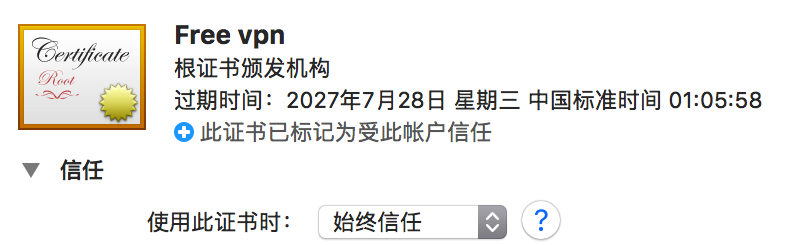
4. Copy this certificate to the remote client and name it xxx.cert or xxx.cert(Note:Windows need to modify the suffix pem for cer can be installed)
example:
5. Connect vpn it!
Open the network settings, create a new IKEv2 protocol VPN, enter the default VPN account and password, or use the custom user that starts the container to connect to VPN.
Create new VPN method is not described here ^_^.
## Other Tips
1. If you want to add VPN users, you can run the following command to enter the container and edit the ipsec.secrets file.
```bash
# docker exec -it ikev2-vpn bash
bash-4.3# vi /usr/local/etc/ipsec.secrets
```
`Pattern example:`
```
testUserOne %any : EAP "testOnePass"
testUserxxx %any : EAP "testpass"
```
```bash
bash-4.3# ipsec rereadsecrets
```
## Plan list
* Dynamically generated based on the environment variable (Completed)
* Support one-click installation (Completed)
* AAA Integrate Radius provides centralized Authentication, Authorization, and Accounting (Completed)
* Clients can connect without having to install a certificate
* Support for adding and deleting user functions
## Currently supported client device
Only test for the following client device system,You can test on the other system versions and feedback !
`Mac`: 10.11.4
`iOS`: 10.2
`Windows`: 10
`Centos`: 6.8
`Android`:(Download strongSwan APK)
## Authors
Name: aliasmee
## Licensing
This project is licensed under the GNU General Public License - see the [LICENSE.md](https://github.com/aliasmee/IKEv2-radius-vpn/blob/master/LICENSE) file for details
## Acknowledgments
https://www.strongswan.org/
## Stargazers over time
[](https://starcharts.herokuapp.com/aliasmee/alpine-ikev2-vpn)
================================================
FILE: _config.yml
================================================
theme: jekyll-theme-cayman
================================================
FILE: conf/eap-radius.conf.template
================================================
eap-radius {
# Send RADIUS accounting information to RADIUS servers.
accounting = ${ACCOUNTING}
# Close the IKE_SA if there is a timeout during interim RADIUS accounting
# updates.
# accounting_close_on_timeout = yes
# Interval in seconds for interim RADIUS accounting updates, if not
# specified by the RADIUS server in the Access-Accept message.
# accounting_interval = 0
# If enabled, accounting is disabled unless an IKE_SA has at least one
# virtual IP. Only for IKEv2, for IKEv1 a virtual IP is strictly necessary.
# accounting_requires_vip = no
# Use class attributes in Access-Accept messages as group membership
# information.
# class_group = no
# Closes all IKE_SAs if communication with the RADIUS server times out. If
# it is not set only the current IKE_SA is closed.
# close_all_on_timeout = no
# Send EAP-Start instead of EAP-Identity to start RADIUS conversation.
# eap_start = no
# Use filter_id attribute as group membership information.
# filter_id = no
# Prefix to EAP-Identity, some AAA servers use a IMSI prefix to select the
# EAP method.
# id_prefix =
# Whether to load the plugin. Can also be an integer to increase the
# priority of this plugin.
load = yes
# NAS-Identifier to include in RADIUS messages.
# nas_identifier = strongSwan
# Port of RADIUS server (authentication).
port = ${RADIUS_PORT}
# Base to use for calculating exponential back off.
# retransmit_base = 1.4
# Timeout in seconds before sending first retransmit.
# retransmit_timeout = 2.0
# Number of times to retransmit a packet before giving up.
# retransmit_tries = 4
# Shared secret between RADIUS and NAS. If set, make sure to adjust the
# permissions of the config file accordingly.
secret = ${RADIUS_SECRET}
# IP/Hostname of RADIUS server.
server = ${RADIUS_SERVER}
# Number of sockets (ports) to use, increase for high load.
# sockets = 1
dae {
# Enables support for the Dynamic Authorization Extension (RFC 5176).
# enable = no
# Address to listen for DAE messages from the RADIUS server.
# listen = 0.0.0.0
# Port to listen for DAE requests.
# port = 3799
# Shared secret used to verify/sign DAE messages. If set, make sure to
# adjust the permissions of the config file accordingly.
# secret =
}
forward {
# RADIUS attributes to be forwarded from IKEv2 to RADIUS.
# ike_to_radius =
# Same as ike_to_radius but from RADIUS to IKEv2.
# radius_to_ike =
}
# Section to specify multiple RADIUS servers.
servers {
}
# Section to configure multiple XAuth authentication rounds via RADIUS.
xauth {
}
}
================================================
FILE: conf/ipsec.conf.template
================================================
config setup
uniqueids=never
conn %default
ikelifetime=60m
keylife=20m
rekeymargin=3m
rekey=no
keyingtries=1
keyexchange=ike
leftsubnet=0.0.0.0/0
right=%any
rightsourceip=10.28.0.0/24
dpdaction=clear
dpddelay=300s
dpdtimeout=1h
conn Windows7-os+
keyexchange=ikev2
auto=add
leftauth=pubkey
leftcert=server.cert.pem
rightauth=eap-mschapv2
rightsendcert=never
eap_identity=%identity
compress=yes
conn IOS_Mac_IKEv2
keyexchange=ikev2
ike=aes256-sha256-modp2048,3des-sha1-modp2048!
esp=aes256-sha256,3des-sha1!
rekey=no
left=%defaultroute
leftid=$HOST_IP
leftsendcert=always
leftsubnet=0.0.0.0/0
leftcert=server.cert.pem
right=%any
rightauth=$EAP_TYPE
rightsourceip=10.28.0.0/24
rightsendcert=never
eap_identity=%any
dpdaction=clear
fragmentation=yes
auto=add
================================================
FILE: conf/ipsec.secrets
================================================
: RSA server.pem
: PSK "iloveworld"
: XAUTH "iloveworldPass"
testUserOne %any : EAP "testOnePass"
================================================
FILE: conf/iptables
================================================
*mangle
:PREROUTING ACCEPT [35404:24997929]
:INPUT ACCEPT [0:0]
:FORWARD ACCEPT [0:0]
:OUTPUT ACCEPT [0:0]
:POSTROUTING ACCEPT [0:0]
-A FORWARD -s 10.28.0.0/24 -o eth0 -p tcp -m tcp --tcp-flags SYN,RST SYN -m tcpmss --mss 1361:1536 -j TCPMSS --set-mss 1360
COMMIT
*filter
:INPUT ACCEPT [0:0]
:FORWARD ACCEPT [0:0]
:OUTPUT ACCEPT [342:64390]
-A INPUT -m state --state RELATED,ESTABLISHED -j ACCEPT
-A INPUT -p icmp -j ACCEPT
-A INPUT -i lo -j ACCEPT
-A INPUT -i eth0 -p esp -j ACCEPT
-A INPUT -i eth0 -p udp -m udp --dport 500 -j ACCEPT
-A INPUT -i eth0 -p udp -m udp --dport 4500 -j ACCEPT
-A INPUT -j REJECT --reject-with icmp-host-prohibited
#
-A FORWARD -m state --state RELATED,ESTABLISHED -j ACCEPT
-A FORWARD -s 10.28.0.0/24 -j ACCEPT
-A FORWARD -j REJECT --reject-with icmp-host-prohibited
COMMIT
*nat
:PREROUTING ACCEPT [24:10065]
:INPUT ACCEPT [5:241]
:OUTPUT ACCEPT [18:1422]
:POSTROUTING ACCEPT [18:1422]
-A POSTROUTING -s 10.28.0.0/24 -o eth0 -j MASQUERADE
COMMIT
================================================
FILE: conf/strongswan.conf
================================================
charon {
i_dont_care_about_security_and_use_aggressive_mode_psk = yes
load_modular = yes
duplicheck.enable = no
threads = 16
compress = yes
plugins {
include strongswan.d/charon/*.conf
}
dns1 = 8.8.8.8
dns2 = 114.114.114.114
nbns1 = 8.8.8.8
nbns2 = 8.8.4.4
}
include strongswan.d/*.conf
================================================
FILE: conf/supervisord.conf
================================================
; Sample supervisor config file.
;
; For more information on the config file, please see:
; http://supervisord.org/configuration.html
;
; Notes:
; - Shell expansion ("~" or "$HOME") is not supported. Environment
; variables can be expanded using this syntax: "%(ENV_HOME)s".
; - Quotes around values are not supported, except in the case of
; the environment= options as shown below.
; - Comments must have a leading space: "a=b ;comment" not "a=b;comment".
; - Command will be truncated if it looks like a config file comment, e.g.
; "command=bash -c 'foo ; bar'" will truncate to "command=bash -c 'foo ".
[unix_http_server]
file=/var/log/supervisor.sock ; the path to the socket file
;chmod=0700 ; socket file mode (default 0700)
;chown=nobody:nogroup ; socket file uid:gid owner
;username=user ; default is no username (open server)
;password=123 ; default is no password (open server)
;[inet_http_server] ; inet (TCP) server disabled by default
;port=127.0.0.1:9001 ; ip_address:port specifier, *:port for all iface
;username=user ; default is no username (open server)
;password=123 ; default is no password (open server)
[supervisord]
logfile=/var/log/supervisord.log ; main log file; default $CWD/supervisord.log
logfile_maxbytes=50MB ; max main logfile bytes b4 rotation; default 50MB
logfile_backups=10 ; # of main logfile backups; 0 means none, default 10
loglevel=info ; log level; default info; others: debug,warn,trace
pidfile=/var/log/supervisord.pid ; supervisord pidfile; default supervisord.pid
nodaemon=false ; start in foreground if true; default false
minfds=1024 ; min. avail startup file descriptors; default 1024
minprocs=200 ; min. avail process descriptors;default 200
;umask=022 ; process file creation umask; default 022
;user=chrism ; default is current user, required if root
;identifier=supervisor ; supervisord identifier, default is 'supervisor'
;directory=/tmp ; default is not to cd during start
;nocleanup=true ; don't clean up tempfiles at start; default false
childlogdir=/var/log/ ; 'AUTO' child log dir, default $TEMP
;environment=KEY="value" ; key value pairs to add to environment
;strip_ansi=false ; strip ansi escape codes in logs; def. false
; The rpcinterface:supervisor section must remain in the config file for
; RPC (supervisorctl/web interface) to work. Additional interfaces may be
; added by defining them in separate [rpcinterface:x] sections.
[rpcinterface:supervisor]
supervisor.rpcinterface_factory = supervisor.rpcinterface:make_main_rpcinterface
; The supervisorctl section configures how supervisorctl will connect to
; supervisord. configure it match the settings in either the unix_http_server
; or inet_http_server section.
[supervisorctl]
serverurl=unix:///var/log/supervisor.sock ; use a unix:// URL for a unix socket
;serverurl=http://127.0.0.1:9001 ; use an http:// url to specify an inet socket
;username=chris ; should be same as in [*_http_server] if set
;password=123 ; should be same as in [*_http_server] if set
;prompt=mysupervisor ; cmd line prompt (default "supervisor")
;history_file=~/.sc_history ; use readline history if available
; The sample program section below shows all possible program subsection values.
; Create one or more 'real' program: sections to be able to control them under
; supervisor.
;[program:theprogramname]
;command=/bin/cat ; the program (relative uses PATH, can take args)
;process_name=%(program_name)s ; process_name expr (default %(program_name)s)
;numprocs=1 ; number of processes copies to start (def 1)
;directory=/tmp ; directory to cwd to before exec (def no cwd)
;umask=022 ; umask for process (default None)
;priority=999 ; the relative start priority (default 999)
;autostart=true ; start at supervisord start (default: true)
;startsecs=1 ; # of secs prog must stay up to be running (def. 1)
;startretries=3 ; max # of serial start failures when starting (default 3)
;autorestart=unexpected ; when to restart if exited after running (def: unexpected)
;exitcodes=0,2 ; 'expected' exit codes used with autorestart (default 0,2)
;stopsignal=QUIT ; signal used to kill process (default TERM)
;stopwaitsecs=10 ; max num secs to wait b4 SIGKILL (default 10)
;stopasgroup=false ; send stop signal to the UNIX process group (default false)
;killasgroup=false ; SIGKILL the UNIX process group (def false)
;user=chrism ; setuid to this UNIX account to run the program
;redirect_stderr=true ; redirect proc stderr to stdout (default false)
; The rpcinterface:supervisor section must remain in the config file for
; RPC (supervisorctl/web interface) to work. Additional interfaces may be
; added by defining them in separate [rpcinterface:x] sections.
[rpcinterface:supervisor]
supervisor.rpcinterface_factory = supervisor.rpcinterface:make_main_rpcinterface
; The supervisorctl section configures how supervisorctl will connect to
; supervisord. configure it match the settings in either the unix_http_server
; or inet_http_server section.
[supervisorctl]
serverurl=unix:///var/log/supervisor.sock ; use a unix:// URL for a unix socket
;serverurl=http://127.0.0.1:9001 ; use an http:// url to specify an inet socket
;username=chris ; should be same as in [*_http_server] if set
;password=123 ; should be same as in [*_http_server] if set
;prompt=mysupervisor ; cmd line prompt (default "supervisor")
;history_file=~/.sc_history ; use readline history if available
; The sample program section below shows all possible program subsection values.
; Create one or more 'real' program: sections to be able to control them under
; supervisor.
;[program:theprogramname]
;command=/bin/cat ; the program (relative uses PATH, can take args)
;process_name=%(program_name)s ; process_name expr (default %(program_name)s)
;numprocs=1 ; number of processes copies to start (def 1)
;directory=/tmp ; directory to cwd to before exec (def no cwd)
;umask=022 ; umask for process (default None)
;priority=999 ; the relative start priority (default 999)
;autostart=true ; start at supervisord start (default: true)
;startsecs=1 ; # of secs prog must stay up to be running (def. 1)
;startretries=3 ; max # of serial start failures when starting (default 3)
;autorestart=unexpected ; when to restart if exited after running (def: unexpected)
;exitcodes=0,2 ; 'expected' exit codes used with autorestart (default 0,2)
;stopsignal=QUIT ; signal used to kill process (default TERM)
;stopwaitsecs=10 ; max num secs to wait b4 SIGKILL (default 10)
;stopasgroup=false ; send stop signal to the UNIX process group (default false)
;killasgroup=false ; SIGKILL the UNIX process group (def false)
;user=chrism ; setuid to this UNIX account to run the program
;redirect_stderr=true ; redirect proc stderr to stdout (default false)
;stdout_logfile=/a/path ; stdout log path, NONE for none; default AUTO
;stdout_logfile_maxbytes=1MB ; max # logfile bytes b4 rotation (default 50MB)
;stdout_logfile_backups=10 ; # of stdout logfile backups (0 means none, default 10)
;stdout_events_enabled=false ; emit events on stdout writes (default false)
;stderr_logfile=/a/path ; stderr log path, NONE for none; default AUTO
;stderr_logfile_maxbytes=1MB ; max # logfile bytes b4 rotation (default 50MB)
;stderr_logfile_backups=10 ; # of stderr logfile backups (0 means none, default 10)
;stderr_events_enabled=false ; emit events on stderr writes (default false)
;environment=A="1",B="2" ; process environment additions
;serverurl=AUTO ; override serverurl computation (childutils)
; The sample group section below shows all possible group values. Create one
; or more 'real' group: sections to create "heterogeneous" process groups.
;[group:thegroupname]
;programs=progname1,progname2 ; each refers to 'x' in [program:x] definitions
;priority=999 ; the relative start priority (default 999)
; The [include] section can just contain the "files" setting. This
; setting can list multiple files (separated by whitespace or
; newlines). It can also contain wildcards. The filenames are
; interpreted as relative to this file. Included files *cannot*
; include files themselves.
;[include]
;files = relative/directory/*.ini
[program:ipsec]
command=/usr/local/sbin/ipsec start --nofork
stdout_logfile=/var/log/ikev2.log
stdout_logfile_maxbytes=20MB
autostart=true
autorestart=true
startsecs=5
priority=3
stopasgroup=true
killasgroup=true
================================================
FILE: init.sh
================================================
#!/bin/bash
set -e
# Preload iptables,Rule lost when preventing restart of container!
iptables-restore < /etc/sysconfig/iptables
# Repair gcp container restart, can not access google family bucket(Disable pmtu discovery!)
sysctl -w net.ipv4.ip_forward=1
sysctl -w net.ipv4.ip_no_pmtu_disc=1
# Setting eap-radius config info
if [ -z "$ACCOUNTING" ]; then
export ACCOUNTING=no
fi
if [ -z "$RADIUS_PORT" ]; then
export RADIUS_PORT=1812
fi
if [ -z "$RADIUS_SERVER" ]; then
export RADIUS_SERVER=''
fi
if [ -z "$RADIUS_SECRET" ]; then
export RADIUS_SECRET=''
fi
envsubst '
${ACCOUNTING}
${RADIUS_PORT}
${RADIUS_SERVER}
${RADIUS_SECRET}
' < eap-radius.conf.template > /usr/local/etc/strongswan.d/charon/eap-radius.conf
# Setting eap auth type
if [ -z "$EAP_TYPE" ]; then
export EAP_TYPE='eap-mschapv2'
fi
if [ -z "$HOST_IP" ]; then
export HOST_IP='0.0.0.0'
fi
envsubst '
${EAP_TYPE}
${HOST_IP}
' < ipsec.conf.template > /usr/local/etc/ipsec.conf
exec "$@"
================================================
FILE: onekey_run_vpnserver.sh
================================================
#!/bin/bash
# File desc: onekey install ikev2 vpn server on docker
# Requirements: ubuntu 16.04+ / Centos7+
# Time: 2018-05-06
install_docker(){
if python -mplatform | grep -qi ubuntu ; then
export os_type=ubuntu
elif python -mplatform | grep -qi centos-6 ; then
echo "Error: Linux System is Centos6.x,Please update to Centos7.x"
echo "Exit install process..."
exit
elif python -mplatform | grep -qi centos-7 ; then
export os_type=centos
else
echo -e 'Unknow system platform\n'
fi
case $os_type in
ubuntu)
echo -e "*************** Install Docker... *******************\n"
sudo apt-get update
sudo apt-get install apt-transport-https ca-certificates ca-certificates software-properties-common dnsutils
curl -fsSL https://download.docker.com/linux/ubuntu/gpg | sudo apt-key add -
sudo add-apt-repository "deb [arch=amd64] https://download.docker.com/linux/ubuntu $(lsb_release -cs) stable"
sudo apt-get update
sudo apt-get install -y docker-ce
sudo systemctl enable docker -q
sudo systemctl start docker
echo -e "\n*************** Install docker on ubuntu. "
;;
centos)
echo -e "\n*************** Install Docker... *******************"
sudo yum install -y yum-utils device-mapper-persistent-data lvm2 bind-utils
sudo yum-config-manager --add-repo https://download.docker.com/linux/centos/docker-ce.repo
sudo yum install -y docker-ce-17.12.1.ce-1.el7.centos
sudo systemctl enable docker -q
sudo systemctl start docker
echo -e "\n*************** install docker on centos ***************"
;;
*)
echo -e "\n*************** please check os platform"
;;
esac
}
# ensure docker is running
running_docker(){
sudo systemctl start docker
}
# pull image command
pull_image(){
echo -e "\n*************** Pull ikev2 vpn image from docker hub... ***************"
sudo docker pull hanyifeng/alpine-ikev2-vpn
}
# run command
run_docker(){
sudo docker run --restart=always -itd --privileged -v /lib/modules:/lib/modules \
-e HOST_IP=$PUBLIC_IP -e VPNUSER=$VPNUSER -e VPNPASS="$VPNPASS" \
-p 500:500/udp -p 4500:4500/udp --name=ikev2-vpn hanyifeng/alpine-ikev2-vpn
}
# Run ikev2 server
run_vpnserver(){
export PUBLIC_IP=`dig +short myip.opendns.com @resolver1.opendns.com`
export VPNUSER=$1
export VPNPASS=$2
CONTAINER_NAME=`sudo docker ps -f name=ikev2-vpn --format '{{.Names}}'`
echo -e "\n*************** Start vpn server...***************"
if [ "$CONTAINER_NAME" = 'ikev2-vpn' ]; then
echo -e "\n*************** Delete old vpn server. "
sudo docker rm -f $CONTAINER_NAME
run_docker
else
run_docker
fi
echo -e "\n*************** Vpn Server is up, just a moment... ***************"
sleep 3
}
# Generate certificate
generate_cert(){
echo -e "\n*************** Generate certificate ***************"
sudo docker exec -it ikev2-vpn sh /usr/bin/vpn
echo -e "\n*************** Congratulations. 42. *************** "
echo "Note: Don't forget to set the cloud host's firewall to allow udp port 500 and port 4500 traffic ! ^_^"
}
install_dep_tools(){
echo "Install Dependent soft tools"
yum install bind-utils -y
}
# ensure installed docker engine
command -v docker >/dev/null 2>&1
if [ $? -eq 0 ] ; then
echo "Docker already exists !"
install_dep_tools
running_docker
pull_image
run_vpnserver $@
generate_cert
else
install_docker
install_dep_tools
running_docker
pull_image
run_vpnserver $@
generate_cert
fi
================================================
FILE: scripts/vpn
================================================
#!/bin/bash
#Author by @aliasmee
#Time 2018-03-6 01:10
# Create certificate
cd /data/key_files
ipsec pki --gen --outform pem > ca.pem
ipsec pki --self --in ca.pem --dn "C=cn, O=ilove, CN=Free vpn" --ca --lifetime 3650 --outform pem >ca.cert.pem
ipsec pki --gen --outform pem > server.pem
ipsec pki --gen --outform pem > client.pem
ipsec pki --pub --in server.pem | ipsec pki --issue --lifetime 1200 --cacert ca.cert.pem --cakey ca.pem --dn "C=cn, O=ilove, CN=$HOST_IP" --san="$HOST_IP" --flag serverAuth --flag ikeIntermediate --outform pem > server.cert.pem
ipsec pki --pub --in client.pem | ipsec pki --issue --cacert ca.cert.pem --cakey ca.pem --dn "C=cn, O=ilove, CN=Free vpn client" --outform pem > client.cert.pem
# Copy certificate to ipsec dir
\cp ca.cert.pem /usr/local/etc/ipsec.d/cacerts/
\cp server.cert.pem /usr/local/etc/ipsec.d/certs/
\cp server.pem /usr/local/etc/ipsec.d/private/
\cp client.cert.pem /usr/local/etc/ipsec.d/certs/
\cp client.pem /usr/local/etc/ipsec.d/private/
# Enable system forward
sysctl -w net.ipv4.ip_forward=1
sysctl -w net.ipv4.ip_no_pmtu_disc=1
# Load iptables rules
iptables-restore < /etc/sysconfig/iptables
# Custom connection VPN username password
sed -i "$ a $VPNUSER %any : EAP '$VPNPASS'" /usr/local/etc/ipsec.secrets
# Reboot ipsec vpn loading cert
supervisorctl restart ipsec
# View the certificate contents and save file
echo "Below the horizontal line is the content of the certificate. Copy the content to a file in the .cert suffix format. Such as: vpn.cert"
echo "_____________________Good Luck!________________________________________"
cat /data/key_files/ca.cert.pem