Repository: angristan/wireguard-install
Branch: master
Commit: 832fb9833501
Files: 8
Total size: 26.5 KB
Directory structure:
gitextract_5pbcnu4e/

├── .github/
│   ├── FUNDING.yml
│   ├── dependabot.yml
│   ├── issue_template.md
│   ├── pull_request_template.md
│   └── workflows/
│       └── lint.yml
├── LICENSE
├── README.md
└── wireguard-install.sh
================================================
FILE CONTENTS
================================================
================================================
FILE: .github/FUNDING.yml
================================================
ko_fi: stanislas
custom: https://coindrop.to/stanislas
================================================
FILE: .github/dependabot.yml
================================================
version: 2
updates:
- package-ecosystem: "github-actions"
directory: "/"
schedule:
interval: "weekly"
================================================
FILE: .github/issue_template.md
================================================
<!---
❗️ Please read ❗️
➡️ If you need help with WireGuard itself, please use the community forums (https://www.reddit.com/r/WireGuard/) or Stack Overflow (https://stackoverflow.com/questions/tagged/wireguard)
➡️ For the script, prefer opening a discussion thread for help: https://github.com/angristan/wireguard-install/discussions
💡 It helps keep the issue tracker clean and focused on bugs and feature requests.
🙏 Please include as much information as possible, and make sure you're running the latest version of the script.
✍️ Please state the Linux distribution you're using and its version, as well as the WireGuard version.
✋ For feature requests, remember that this script is meant to be simple and easy to use. If you want to add a lot of options, it's better to fork the project.
--->
================================================
FILE: .github/pull_request_template.md
================================================
<!---
❗️ Please read ❗️
➡️ Please make sure you've followed the guidelines: https://github.com/angristan/wireguard-install#contributing
✅ Please make sure your changes are tested and working
🗣️ Please avoid large PRs, and discuss changes in a GitHub issue first
✋ If the changes are too big and not in line with the project, they will probably be rejected. Remember that this script is meant to be simple and easy to use.
--->
================================================
FILE: .github/workflows/lint.yml
================================================
on: [push, pull_request, pull_request_target]
name: Lint
jobs:
shellcheck:
runs-on: ubuntu-latest
steps:
- uses: actions/checkout@v4
- name: shellcheck
uses: ludeeus/action-shellcheck@1.1.0
env:
SHELLCHECK_OPTS: -e SC1091,SC1117,SC2001,SC2034
shfmt:
runs-on: ubuntu-latest
steps:
- uses: actions/checkout@v4
- uses: mfinelli/setup-shfmt@v3
- run: shfmt -d wireguard-install.sh
================================================
FILE: LICENSE
================================================
MIT License
Copyright (c) 2019 angristan
Permission is hereby granted, free of charge, to any person obtaining a copy of
this software and associated documentation files (the "Software"), to deal in
the Software without restriction, including without limitation the rights to
use, copy, modify, merge, publish, distribute, sublicense, and/or sell copies of
the Software, and to permit persons to whom the Software is furnished to do so,
subject to the following conditions:
The above copyright notice and this permission notice shall be included in all
copies or substantial portions of the Software.
THE SOFTWARE IS PROVIDED "AS IS", WITHOUT WARRANTY OF ANY KIND, EXPRESS OR
IMPLIED, INCLUDING BUT NOT LIMITED TO THE WARRANTIES OF MERCHANTABILITY, FITNESS
FOR A PARTICULAR PURPOSE AND NONINFRINGEMENT. IN NO EVENT SHALL THE AUTHORS OR
COPYRIGHT HOLDERS BE LIABLE FOR ANY CLAIM, DAMAGES OR OTHER LIABILITY, WHETHER
IN AN ACTION OF CONTRACT, TORT OR OTHERWISE, ARISING FROM, OUT OF OR IN
CONNECTION WITH THE SOFTWARE OR THE USE OR OTHER DEALINGS IN THE SOFTWARE.
================================================
FILE: README.md
================================================
# WireGuard installer

[](https://saythanks.io/to/angristan)
**This project is a bash script that aims to setup a [WireGuard](https://www.wireguard.com/) VPN on a Linux server, as easily as possible!**
WireGuard is a point-to-point VPN that can be used in different ways. Here, we mean a VPN as in: the client will forward all its traffic through an encrypted tunnel to the server.
The server will apply NAT to the client's traffic so it will appear as if the client is browsing the web with the server's IP.
The script supports both IPv4 and IPv6. Please check the [issues](https://github.com/angristan/wireguard-install/issues) for ongoing development, bugs and planned features! You might also want to check the [discussions](https://github.com/angristan/wireguard-install/discussions) for help.
WireGuard does not fit your environment? Check out [openvpn-install](https://github.com/angristan/openvpn-install).
## Requirements
Supported distributions:
- AlmaLinux >= 8
- Alpine Linux
- Arch Linux
- CentOS Stream >= 8
- Debian >= 10
- Fedora >= 32
- Oracle Linux
- Rocky Linux >= 8
- Ubuntu >= 18.04
## Usage
Download and execute the script. Answer the questions asked by the script and it will take care of the rest.
```bash
curl -O https://raw.githubusercontent.com/angristan/wireguard-install/master/wireguard-install.sh
chmod +x wireguard-install.sh
./wireguard-install.sh
```
It will install WireGuard (kernel module and tools) on the server, configure it, create a systemd service and a client configuration file.
Run the script again to add or remove clients!
## Providers
I recommend these cheap cloud providers for your VPN server:
- [Vultr](https://www.vultr.com/?ref=8948982-8H): Worldwide locations, IPv6 support, starting at \$5/month
- [Hetzner](https://hetzner.cloud/?ref=ywtlvZsjgeDq): Germany, Finland and USA. IPv6, 20 TB of traffic, starting at 4.5€/month
- [Digital Ocean](https://m.do.co/c/ed0ba143fe53): Worldwide locations, IPv6 support, starting at \$4/month
## Contributing
Contributions are welcome! Here's how you can help:
### Discuss changes
Please open an issue before submitting a PR if you want to discuss a change, especially if it's a big one.
### Code formatting
We use [shellcheck](https://github.com/koalaman/shellcheck) and [shfmt](https://github.com/mvdan/sh) to enforce bash styling guidelines and good practices. They are executed for each commit / PR with GitHub Actions, so you can check the configuration [here](https://github.com/angristan/wireguard-install/blob/master/.github/workflows/lint.yml).
## Say thanks
You can [say thanks](https://saythanks.io/to/angristan) if you want!
## Credits & Licence
This project is under the [MIT Licence](https://raw.githubusercontent.com/angristan/wireguard-install/master/LICENSE)
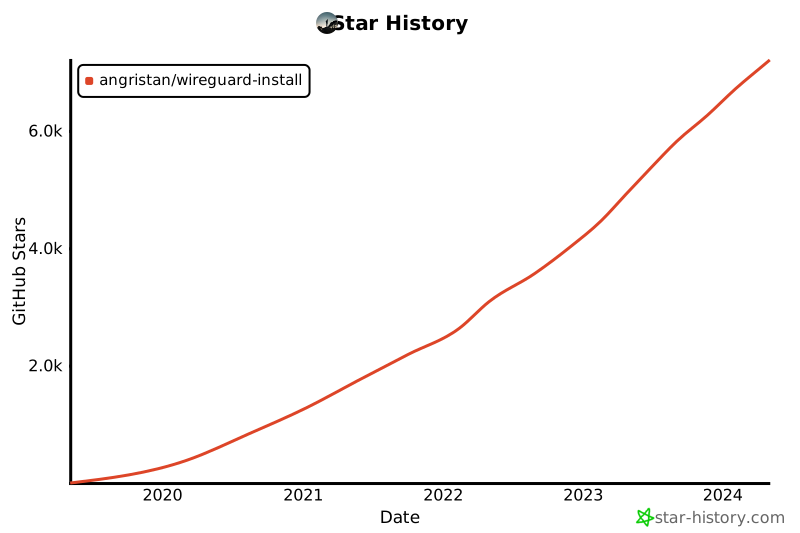
## Star History
[](https://star-history.com/#angristan/wireguard-install&Date)
================================================
FILE: wireguard-install.sh
================================================
#!/bin/bash
# Secure WireGuard server installer
# https://github.com/angristan/wireguard-install
RED='\033[0;31m'
ORANGE='\033[0;33m'
GREEN='\033[0;32m'
NC='\033[0m'
function installPackages() {
if ! "$@"; then
echo -e "${RED}Failed to install packages.${NC}"
echo "Please check your internet connection and package sources."
exit 1
fi
}
function isRoot() {
if [ "${EUID}" -ne 0 ]; then
echo "You need to run this script as root"
exit 1
fi
}
function checkVirt() {
if command -v virt-what &>/dev/null; then
VIRT=$(virt-what)
else
VIRT=$(systemd-detect-virt)
fi
if [[ ${VIRT} == "openvz" ]]; then
echo "OpenVZ is not supported"
exit 1
fi
if [[ ${VIRT} == "lxc" ]]; then
echo "LXC is not supported (yet)."
echo "WireGuard can technically run in an LXC container,"
echo "but the kernel module has to be installed on the host,"
echo "the container has to be run with some specific parameters"
echo "and only the tools need to be installed in the container."
exit 1
fi
}
function checkOS() {
source /etc/os-release
OS="${ID}"
if [[ ${OS} == "debian" || ${OS} == "raspbian" ]]; then
if [[ ${VERSION_ID} -lt 10 ]]; then
echo "Your version of Debian (${VERSION_ID}) is not supported. Please use Debian 10 Buster or later"
exit 1
fi
OS=debian # overwrite if raspbian
elif [[ ${OS} == "ubuntu" ]]; then
RELEASE_YEAR=$(echo "${VERSION_ID}" | cut -d'.' -f1)
if [[ ${RELEASE_YEAR} -lt 18 ]]; then
echo "Your version of Ubuntu (${VERSION_ID}) is not supported. Please use Ubuntu 18.04 or later"
exit 1
fi
elif [[ ${OS} == "fedora" ]]; then
if [[ ${VERSION_ID} -lt 32 ]]; then
echo "Your version of Fedora (${VERSION_ID}) is not supported. Please use Fedora 32 or later"
exit 1
fi
elif [[ ${OS} == 'centos' ]] || [[ ${OS} == 'almalinux' ]] || [[ ${OS} == 'rocky' ]]; then
if [[ ${VERSION_ID} == 7* ]]; then
echo "Your version of CentOS (${VERSION_ID}) is not supported. Please use CentOS 8 or later"
exit 1
fi
elif [[ -e /etc/oracle-release ]]; then
source /etc/os-release
OS=oracle
elif [[ -e /etc/arch-release ]]; then
OS=arch
elif [[ -e /etc/alpine-release ]]; then
OS=alpine
if ! command -v virt-what &>/dev/null; then
if ! (apk update && apk add virt-what); then
echo -e "${RED}Failed to install virt-what. Continuing without virtualization check.${NC}"
fi
fi
else
echo "Looks like you aren't running this installer on a Debian, Ubuntu, Fedora, CentOS, AlmaLinux, Oracle or Arch Linux system"
exit 1
fi
}
function getHomeDirForClient() {
local CLIENT_NAME=$1
if [ -z "${CLIENT_NAME}" ]; then
echo "Error: getHomeDirForClient() requires a client name as argument"
exit 1
fi
# Home directory of the user, where the client configuration will be written
if [ -e "/home/${CLIENT_NAME}" ]; then
# if $1 is a user name
HOME_DIR="/home/${CLIENT_NAME}"
elif [ "${SUDO_USER}" ]; then
# if not, use SUDO_USER
if [ "${SUDO_USER}" == "root" ]; then
# If running sudo as root
HOME_DIR="/root"
else
HOME_DIR="/home/${SUDO_USER}"
fi
else
# if not SUDO_USER, use /root
HOME_DIR="/root"
fi
echo "$HOME_DIR"
}
function initialCheck() {
isRoot
checkOS
checkVirt
}
function installQuestions() {
echo "Welcome to the WireGuard installer!"
echo "The git repository is available at: https://github.com/angristan/wireguard-install"
echo ""
echo "I need to ask you a few questions before starting the setup."
echo "You can keep the default options and just press enter if you are ok with them."
echo ""
# Detect public IPv4 or IPv6 address and pre-fill for the user
SERVER_PUB_IP=$(ip -4 addr | sed -ne 's|^.* inet \([^/]*\)/.* scope global.*$|\1|p' | awk '{print $1}' | head -1)
if [[ -z ${SERVER_PUB_IP} ]]; then
# Detect public IPv6 address
SERVER_PUB_IP=$(ip -6 addr | sed -ne 's|^.* inet6 \([^/]*\)/.* scope global.*$|\1|p' | head -1)
fi
read -rp "IPv4 or IPv6 public address: " -e -i "${SERVER_PUB_IP}" SERVER_PUB_IP
# Detect public interface and pre-fill for the user
SERVER_NIC="$(ip -4 route ls | grep default | awk '/dev/ {for (i=1; i<=NF; i++) if ($i == "dev") print $(i+1)}' | head -1)"
until [[ ${SERVER_PUB_NIC} =~ ^[a-zA-Z0-9_]+$ ]]; do
read -rp "Public interface: " -e -i "${SERVER_NIC}" SERVER_PUB_NIC
done
until [[ ${SERVER_WG_NIC} =~ ^[a-zA-Z0-9_]+$ && ${#SERVER_WG_NIC} -lt 16 ]]; do
read -rp "WireGuard interface name: " -e -i wg0 SERVER_WG_NIC
done
until [[ ${SERVER_WG_IPV4} =~ ^([0-9]{1,3}\.){3} ]]; do
read -rp "Server WireGuard IPv4: " -e -i 10.66.66.1 SERVER_WG_IPV4
done
until [[ ${SERVER_WG_IPV6} =~ ^([a-f0-9]{1,4}:){3,4}: ]]; do
read -rp "Server WireGuard IPv6: " -e -i fd42:42:42::1 SERVER_WG_IPV6
done
# Generate random number within private ports range
RANDOM_PORT=$(shuf -i49152-65535 -n1)
until [[ ${SERVER_PORT} =~ ^[0-9]+$ ]] && [ "${SERVER_PORT}" -ge 1 ] && [ "${SERVER_PORT}" -le 65535 ]; do
read -rp "Server WireGuard port [1-65535]: " -e -i "${RANDOM_PORT}" SERVER_PORT
done
# Cloudflare DNS by default
until [[ ${CLIENT_DNS_1} =~ ^((25[0-5]|2[0-4][0-9]|[01]?[0-9][0-9]?)\.){3}(25[0-5]|2[0-4][0-9]|[01]?[0-9][0-9]?)$ ]]; do
read -rp "First DNS resolver to use for the clients: " -e -i 1.1.1.1 CLIENT_DNS_1
done
until [[ ${CLIENT_DNS_2} =~ ^((25[0-5]|2[0-4][0-9]|[01]?[0-9][0-9]?)\.){3}(25[0-5]|2[0-4][0-9]|[01]?[0-9][0-9]?)$ ]]; do
read -rp "Second DNS resolver to use for the clients (optional): " -e -i 1.0.0.1 CLIENT_DNS_2
if [[ ${CLIENT_DNS_2} == "" ]]; then
CLIENT_DNS_2="${CLIENT_DNS_1}"
fi
done
until [[ ${ALLOWED_IPS} =~ ^.+$ ]]; do
echo -e "\nWireGuard uses a parameter called AllowedIPs to determine what is routed over the VPN."
read -rp "Allowed IPs list for generated clients (leave default to route everything): " -e -i '0.0.0.0/0,::/0' ALLOWED_IPS
if [[ ${ALLOWED_IPS} == "" ]]; then
ALLOWED_IPS="0.0.0.0/0,::/0"
fi
done
echo ""
echo "Okay, that was all I needed. We are ready to setup your WireGuard server now."
echo "You will be able to generate a client at the end of the installation."
read -n1 -r -p "Press any key to continue..."
}
function installWireGuard() {
# Run setup questions first
installQuestions
# Install WireGuard tools and module
if [[ ${OS} == 'ubuntu' ]] || [[ ${OS} == 'debian' && ${VERSION_ID} -gt 10 ]]; then
apt-get update
installPackages apt-get install -y wireguard iptables resolvconf qrencode
elif [[ ${OS} == 'debian' ]]; then
if ! grep -rqs "^deb .* buster-backports" /etc/apt/; then
echo "deb http://deb.debian.org/debian buster-backports main" >/etc/apt/sources.list.d/backports.list
apt-get update
fi
apt-get update
installPackages apt-get install -y iptables resolvconf qrencode
installPackages apt-get install -y -t buster-backports wireguard
elif [[ ${OS} == 'fedora' ]]; then
if [[ ${VERSION_ID} -lt 32 ]]; then
installPackages dnf install -y dnf-plugins-core
dnf copr enable -y jdoss/wireguard
installPackages dnf install -y wireguard-dkms
fi
installPackages dnf install -y wireguard-tools iptables qrencode
elif [[ ${OS} == 'centos' ]] || [[ ${OS} == 'almalinux' ]] || [[ ${OS} == 'rocky' ]]; then
if [[ ${VERSION_ID} == 8* ]]; then
installPackages yum install -y epel-release elrepo-release
installPackages yum install -y kmod-wireguard
yum install -y qrencode || true # not available on release 9
fi
installPackages yum install -y wireguard-tools iptables
elif [[ ${OS} == 'oracle' ]]; then
installPackages dnf install -y oraclelinux-developer-release-el8
dnf config-manager --disable -y ol8_developer
dnf config-manager --enable -y ol8_developer_UEKR6
dnf config-manager --save -y --setopt=ol8_developer_UEKR6.includepkgs='wireguard-tools*'
installPackages dnf install -y wireguard-tools qrencode iptables
elif [[ ${OS} == 'arch' ]]; then
installPackages pacman -S --needed --noconfirm wireguard-tools qrencode
elif [[ ${OS} == 'alpine' ]]; then
apk update
installPackages apk add wireguard-tools iptables libqrencode-tools
fi
# Verify WireGuard installation
if ! command -v wg &>/dev/null; then
echo -e "${RED}WireGuard installation failed. The 'wg' command was not found.${NC}"
echo "Please check the installation output above for errors."
exit 1
fi
# Make sure the directory exists (this does not seem the be the case on fedora)
mkdir /etc/wireguard >/dev/null 2>&1
chmod 600 -R /etc/wireguard/
SERVER_PRIV_KEY=$(wg genkey)
SERVER_PUB_KEY=$(echo "${SERVER_PRIV_KEY}" | wg pubkey)
# Save WireGuard settings
echo "SERVER_PUB_IP=${SERVER_PUB_IP}
SERVER_PUB_NIC=${SERVER_PUB_NIC}
SERVER_WG_NIC=${SERVER_WG_NIC}
SERVER_WG_IPV4=${SERVER_WG_IPV4}
SERVER_WG_IPV6=${SERVER_WG_IPV6}
SERVER_PORT=${SERVER_PORT}
SERVER_PRIV_KEY=${SERVER_PRIV_KEY}
SERVER_PUB_KEY=${SERVER_PUB_KEY}
CLIENT_DNS_1=${CLIENT_DNS_1}
CLIENT_DNS_2=${CLIENT_DNS_2}
ALLOWED_IPS=${ALLOWED_IPS}" >/etc/wireguard/params
# Add server interface
echo "[Interface]
Address = ${SERVER_WG_IPV4}/24,${SERVER_WG_IPV6}/64
ListenPort = ${SERVER_PORT}
PrivateKey = ${SERVER_PRIV_KEY}" >"/etc/wireguard/${SERVER_WG_NIC}.conf"
if pgrep firewalld; then
FIREWALLD_IPV4_ADDRESS=$(echo "${SERVER_WG_IPV4}" | cut -d"." -f1-3)".0"
FIREWALLD_IPV6_ADDRESS=$(echo "${SERVER_WG_IPV6}" | sed 's/:[^:]*$/:0/')
echo "PostUp = firewall-cmd --zone=public --add-interface=${SERVER_WG_NIC} && firewall-cmd --add-port ${SERVER_PORT}/udp && firewall-cmd --add-rich-rule='rule family=ipv4 source address=${FIREWALLD_IPV4_ADDRESS}/24 masquerade' && firewall-cmd --add-rich-rule='rule family=ipv6 source address=${FIREWALLD_IPV6_ADDRESS}/24 masquerade'
PostDown = firewall-cmd --zone=public --add-interface=${SERVER_WG_NIC} && firewall-cmd --remove-port ${SERVER_PORT}/udp && firewall-cmd --remove-rich-rule='rule family=ipv4 source address=${FIREWALLD_IPV4_ADDRESS}/24 masquerade' && firewall-cmd --remove-rich-rule='rule family=ipv6 source address=${FIREWALLD_IPV6_ADDRESS}/24 masquerade'" >>"/etc/wireguard/${SERVER_WG_NIC}.conf"
else
echo "PostUp = iptables -I INPUT -p udp --dport ${SERVER_PORT} -j ACCEPT
PostUp = iptables -I FORWARD -i ${SERVER_PUB_NIC} -o ${SERVER_WG_NIC} -j ACCEPT
PostUp = iptables -I FORWARD -i ${SERVER_WG_NIC} -j ACCEPT
PostUp = iptables -t nat -A POSTROUTING -o ${SERVER_PUB_NIC} -j MASQUERADE
PostUp = ip6tables -I FORWARD -i ${SERVER_WG_NIC} -j ACCEPT
PostUp = ip6tables -t nat -A POSTROUTING -o ${SERVER_PUB_NIC} -j MASQUERADE
PostDown = iptables -D INPUT -p udp --dport ${SERVER_PORT} -j ACCEPT
PostDown = iptables -D FORWARD -i ${SERVER_PUB_NIC} -o ${SERVER_WG_NIC} -j ACCEPT
PostDown = iptables -D FORWARD -i ${SERVER_WG_NIC} -j ACCEPT
PostDown = iptables -t nat -D POSTROUTING -o ${SERVER_PUB_NIC} -j MASQUERADE
PostDown = ip6tables -D FORWARD -i ${SERVER_WG_NIC} -j ACCEPT
PostDown = ip6tables -t nat -D POSTROUTING -o ${SERVER_PUB_NIC} -j MASQUERADE" >>"/etc/wireguard/${SERVER_WG_NIC}.conf"
fi
# Enable routing on the server
echo "net.ipv4.ip_forward = 1
net.ipv6.conf.all.forwarding = 1" >/etc/sysctl.d/wg.conf
if [[ ${OS} == 'fedora' ]]; then
chmod -v 700 /etc/wireguard
chmod -v 600 /etc/wireguard/*
fi
if [[ ${OS} == 'alpine' ]]; then
sysctl -p /etc/sysctl.d/wg.conf
rc-update add sysctl
ln -s /etc/init.d/wg-quick "/etc/init.d/wg-quick.${SERVER_WG_NIC}"
rc-service "wg-quick.${SERVER_WG_NIC}" start
rc-update add "wg-quick.${SERVER_WG_NIC}"
else
sysctl --system
systemctl start "wg-quick@${SERVER_WG_NIC}"
systemctl enable "wg-quick@${SERVER_WG_NIC}"
fi
newClient
echo -e "${GREEN}If you want to add more clients, you simply need to run this script another time!${NC}"
# Check if WireGuard is running
if [[ ${OS} == 'alpine' ]]; then
rc-service --quiet "wg-quick.${SERVER_WG_NIC}" status
else
systemctl is-active --quiet "wg-quick@${SERVER_WG_NIC}"
fi
WG_RUNNING=$?
# WireGuard might not work if we updated the kernel. Tell the user to reboot
if [[ ${WG_RUNNING} -ne 0 ]]; then
echo -e "\n${RED}WARNING: WireGuard does not seem to be running.${NC}"
if [[ ${OS} == 'alpine' ]]; then
echo -e "${ORANGE}You can check if WireGuard is running with: rc-service wg-quick.${SERVER_WG_NIC} status${NC}"
else
echo -e "${ORANGE}You can check if WireGuard is running with: systemctl status wg-quick@${SERVER_WG_NIC}${NC}"
fi
echo -e "${ORANGE}If you get something like \"Cannot find device ${SERVER_WG_NIC}\", please reboot!${NC}"
else # WireGuard is running
echo -e "\n${GREEN}WireGuard is running.${NC}"
if [[ ${OS} == 'alpine' ]]; then
echo -e "${GREEN}You can check the status of WireGuard with: rc-service wg-quick.${SERVER_WG_NIC} status\n\n${NC}"
else
echo -e "${GREEN}You can check the status of WireGuard with: systemctl status wg-quick@${SERVER_WG_NIC}\n\n${NC}"
fi
echo -e "${ORANGE}If you don't have internet connectivity from your client, try to reboot the server.${NC}"
fi
}
function newClient() {
# If SERVER_PUB_IP is IPv6, add brackets if missing
if [[ ${SERVER_PUB_IP} =~ .*:.* ]]; then
if [[ ${SERVER_PUB_IP} != *"["* ]] || [[ ${SERVER_PUB_IP} != *"]"* ]]; then
SERVER_PUB_IP="[${SERVER_PUB_IP}]"
fi
fi
ENDPOINT="${SERVER_PUB_IP}:${SERVER_PORT}"
echo ""
echo "Client configuration"
echo ""
echo "The client name must consist of alphanumeric character(s). It may also include underscores or dashes and can't exceed 15 chars."
until [[ ${CLIENT_NAME} =~ ^[a-zA-Z0-9_-]+$ && ${CLIENT_EXISTS} == '0' && ${#CLIENT_NAME} -lt 16 ]]; do
read -rp "Client name: " -e CLIENT_NAME
CLIENT_EXISTS=$(grep -c -E "^### Client ${CLIENT_NAME}\$" "/etc/wireguard/${SERVER_WG_NIC}.conf")
if [[ ${CLIENT_EXISTS} != 0 ]]; then
echo ""
echo -e "${ORANGE}A client with the specified name was already created, please choose another name.${NC}"
echo ""
fi
done
for DOT_IP in {2..254}; do
DOT_EXISTS=$(grep -c "${SERVER_WG_IPV4::-1}${DOT_IP}" "/etc/wireguard/${SERVER_WG_NIC}.conf")
if [[ ${DOT_EXISTS} == '0' ]]; then
break
fi
done
if [[ ${DOT_EXISTS} == '1' ]]; then
echo ""
echo "The subnet configured supports only 253 clients."
exit 1
fi
BASE_IP=$(echo "$SERVER_WG_IPV4" | awk -F '.' '{ print $1"."$2"."$3 }')
until [[ ${IPV4_EXISTS} == '0' ]]; do
read -rp "Client WireGuard IPv4: ${BASE_IP}." -e -i "${DOT_IP}" DOT_IP
CLIENT_WG_IPV4="${BASE_IP}.${DOT_IP}"
IPV4_EXISTS=$(grep -c "$CLIENT_WG_IPV4/32" "/etc/wireguard/${SERVER_WG_NIC}.conf")
if [[ ${IPV4_EXISTS} != 0 ]]; then
echo ""
echo -e "${ORANGE}A client with the specified IPv4 was already created, please choose another IPv4.${NC}"
echo ""
fi
done
BASE_IP=$(echo "$SERVER_WG_IPV6" | awk -F '::' '{ print $1 }')
until [[ ${IPV6_EXISTS} == '0' ]]; do
read -rp "Client WireGuard IPv6: ${BASE_IP}::" -e -i "${DOT_IP}" DOT_IP
CLIENT_WG_IPV6="${BASE_IP}::${DOT_IP}"
IPV6_EXISTS=$(grep -c "${CLIENT_WG_IPV6}/128" "/etc/wireguard/${SERVER_WG_NIC}.conf")
if [[ ${IPV6_EXISTS} != 0 ]]; then
echo ""
echo -e "${ORANGE}A client with the specified IPv6 was already created, please choose another IPv6.${NC}"
echo ""
fi
done
# Generate key pair for the client
CLIENT_PRIV_KEY=$(wg genkey)
CLIENT_PUB_KEY=$(echo "${CLIENT_PRIV_KEY}" | wg pubkey)
CLIENT_PRE_SHARED_KEY=$(wg genpsk)
HOME_DIR=$(getHomeDirForClient "${CLIENT_NAME}")
# Create client file and add the server as a peer
echo "[Interface]
PrivateKey = ${CLIENT_PRIV_KEY}
Address = ${CLIENT_WG_IPV4}/32,${CLIENT_WG_IPV6}/128
DNS = ${CLIENT_DNS_1},${CLIENT_DNS_2}
# Uncomment the next line to set a custom MTU
# This might impact performance, so use it only if you know what you are doing
# See https://github.com/nitred/nr-wg-mtu-finder to find your optimal MTU
# MTU = 1420
[Peer]
PublicKey = ${SERVER_PUB_KEY}
PresharedKey = ${CLIENT_PRE_SHARED_KEY}
Endpoint = ${ENDPOINT}
AllowedIPs = ${ALLOWED_IPS}" >"${HOME_DIR}/${SERVER_WG_NIC}-client-${CLIENT_NAME}.conf"
# Add the client as a peer to the server
echo -e "\n### Client ${CLIENT_NAME}
[Peer]
PublicKey = ${CLIENT_PUB_KEY}
PresharedKey = ${CLIENT_PRE_SHARED_KEY}
AllowedIPs = ${CLIENT_WG_IPV4}/32,${CLIENT_WG_IPV6}/128" >>"/etc/wireguard/${SERVER_WG_NIC}.conf"
wg syncconf "${SERVER_WG_NIC}" <(wg-quick strip "${SERVER_WG_NIC}")
# Generate QR code if qrencode is installed
if command -v qrencode &>/dev/null; then
echo -e "${GREEN}\nHere is your client config file as a QR Code:\n${NC}"
qrencode -t ansiutf8 -l L <"${HOME_DIR}/${SERVER_WG_NIC}-client-${CLIENT_NAME}.conf"
echo ""
fi
echo -e "${GREEN}Your client config file is in ${HOME_DIR}/${SERVER_WG_NIC}-client-${CLIENT_NAME}.conf${NC}"
}
function listClients() {
NUMBER_OF_CLIENTS=$(grep -c -E "^### Client" "/etc/wireguard/${SERVER_WG_NIC}.conf")
if [[ ${NUMBER_OF_CLIENTS} -eq 0 ]]; then
echo ""
echo "You have no existing clients!"
exit 1
fi
grep -E "^### Client" "/etc/wireguard/${SERVER_WG_NIC}.conf" | cut -d ' ' -f 3 | nl -s ') '
}
function revokeClient() {
NUMBER_OF_CLIENTS=$(grep -c -E "^### Client" "/etc/wireguard/${SERVER_WG_NIC}.conf")
if [[ ${NUMBER_OF_CLIENTS} == '0' ]]; then
echo ""
echo "You have no existing clients!"
exit 1
fi
echo ""
echo "Select the existing client you want to revoke"
grep -E "^### Client" "/etc/wireguard/${SERVER_WG_NIC}.conf" | cut -d ' ' -f 3 | nl -s ') '
until [[ ${CLIENT_NUMBER} -ge 1 && ${CLIENT_NUMBER} -le ${NUMBER_OF_CLIENTS} ]]; do
if [[ ${CLIENT_NUMBER} == '1' ]]; then
read -rp "Select one client [1]: " CLIENT_NUMBER
else
read -rp "Select one client [1-${NUMBER_OF_CLIENTS}]: " CLIENT_NUMBER
fi
done
# match the selected number to a client name
CLIENT_NAME=$(grep -E "^### Client" "/etc/wireguard/${SERVER_WG_NIC}.conf" | cut -d ' ' -f 3 | sed -n "${CLIENT_NUMBER}"p)
# remove [Peer] block matching $CLIENT_NAME
sed -i "/^### Client ${CLIENT_NAME}\$/,/^$/d" "/etc/wireguard/${SERVER_WG_NIC}.conf"
# remove generated client file
HOME_DIR=$(getHomeDirForClient "${CLIENT_NAME}")
rm -f "${HOME_DIR}/${SERVER_WG_NIC}-client-${CLIENT_NAME}.conf"
# restart wireguard to apply changes
wg syncconf "${SERVER_WG_NIC}" <(wg-quick strip "${SERVER_WG_NIC}")
}
function uninstallWg() {
echo ""
echo -e "\n${RED}WARNING: This will uninstall WireGuard and remove all the configuration files!${NC}"
echo -e "${ORANGE}Please backup the /etc/wireguard directory if you want to keep your configuration files.\n${NC}"
read -rp "Do you really want to remove WireGuard? [y/n]: " -e REMOVE
REMOVE=${REMOVE:-n}
if [[ $REMOVE == 'y' ]]; then
checkOS
if [[ ${OS} == 'alpine' ]]; then
rc-service "wg-quick.${SERVER_WG_NIC}" stop
rc-update del "wg-quick.${SERVER_WG_NIC}"
unlink "/etc/init.d/wg-quick.${SERVER_WG_NIC}"
rc-update del sysctl
else
systemctl stop "wg-quick@${SERVER_WG_NIC}"
systemctl disable "wg-quick@${SERVER_WG_NIC}"
fi
if [[ ${OS} == 'ubuntu' ]] || [[ ${OS} == 'debian' ]]; then
apt-get remove -y wireguard wireguard-tools qrencode
elif [[ ${OS} == 'fedora' ]]; then
dnf remove -y --noautoremove wireguard-tools qrencode
if [[ ${VERSION_ID} -lt 32 ]]; then
dnf remove -y --noautoremove wireguard-dkms
dnf copr disable -y jdoss/wireguard
fi
elif [[ ${OS} == 'centos' ]] || [[ ${OS} == 'almalinux' ]] || [[ ${OS} == 'rocky' ]]; then
yum remove -y --noautoremove wireguard-tools
if [[ ${VERSION_ID} == 8* ]]; then
yum remove --noautoremove kmod-wireguard qrencode
fi
elif [[ ${OS} == 'oracle' ]]; then
yum remove --noautoremove wireguard-tools qrencode
elif [[ ${OS} == 'arch' ]]; then
pacman -Rs --noconfirm wireguard-tools qrencode
elif [[ ${OS} == 'alpine' ]]; then
(cd qrencode-4.1.1 || exit && make uninstall)
rm -rf qrencode-* || exit
apk del wireguard-tools libqrencode libqrencode-tools
fi
rm -rf /etc/wireguard
rm -f /etc/sysctl.d/wg.conf
if [[ ${OS} == 'alpine' ]]; then
rc-service --quiet "wg-quick.${SERVER_WG_NIC}" status &>/dev/null
else
# Reload sysctl
sysctl --system
# Check if WireGuard is running
systemctl is-active --quiet "wg-quick@${SERVER_WG_NIC}"
fi
WG_RUNNING=$?
if [[ ${WG_RUNNING} -eq 0 ]]; then
echo "WireGuard failed to uninstall properly."
exit 1
else
echo "WireGuard uninstalled successfully."
exit 0
fi
else
echo ""
echo "Removal aborted!"
fi
}
function manageMenu() {
echo "Welcome to WireGuard-install!"
echo "The git repository is available at: https://github.com/angristan/wireguard-install"
echo ""
echo "It looks like WireGuard is already installed."
echo ""
echo "What do you want to do?"
echo " 1) Add a new user"
echo " 2) List all users"
echo " 3) Revoke existing user"
echo " 4) Uninstall WireGuard"
echo " 5) Exit"
until [[ ${MENU_OPTION} =~ ^[1-5]$ ]]; do
read -rp "Select an option [1-5]: " MENU_OPTION
done
case "${MENU_OPTION}" in
1)
newClient
;;
2)
listClients
;;
3)
revokeClient
;;
4)
uninstallWg
;;
5)
exit 0
;;
esac
}
# Check for root, virt, OS...
initialCheck
# Check if WireGuard is already installed and load params
if [[ -e /etc/wireguard/params ]]; then
source /etc/wireguard/params
manageMenu
else
installWireGuard
fi
gitextract_5pbcnu4e/ ├── .github/ │ ├── FUNDING.yml │ ├── dependabot.yml │ ├── issue_template.md │ ├── pull_request_template.md │ └── workflows/ │ └── lint.yml ├── LICENSE ├── README.md └── wireguard-install.sh
Condensed preview — 8 files, each showing path, character count, and a content snippet. Download the .json file or copy for the full structured content (29K chars).
[
{
"path": ".github/FUNDING.yml",
"chars": 55,
"preview": "ko_fi: stanislas\ncustom: https://coindrop.to/stanislas\n"
},
{
"path": ".github/dependabot.yml",
"chars": 118,
"preview": "version: 2\nupdates:\n - package-ecosystem: \"github-actions\"\n directory: \"/\"\n schedule:\n interval: \"weekly\"\n"
},
{
"path": ".github/issue_template.md",
"chars": 796,
"preview": "<!---\n❗️ Please read ❗️\n➡️ If you need help with WireGuard itself, please use the community forums (https://www.reddit.c"
},
{
"path": ".github/pull_request_template.md",
"chars": 427,
"preview": "<!---\n❗️ Please read ❗️\n➡️ Please make sure you've followed the guidelines: https://github.com/angristan/wireguard-insta"
},
{
"path": ".github/workflows/lint.yml",
"chars": 456,
"preview": "on: [push, pull_request, pull_request_target]\n\nname: Lint\n\njobs:\n shellcheck:\n runs-on: ubuntu-latest\n steps:\n "
},
{
"path": "LICENSE",
"chars": 1066,
"preview": "MIT License\n\nCopyright (c) 2019 angristan\n\nPermission is hereby granted, free of charge, to any person obtaining a copy "
},
{
"path": "README.md",
"chars": 3126,
"preview": "# WireGuard installer\n\n\n[. The extraction includes 8 files (26.5 KB), approximately 8.6k tokens. Use this with OpenClaw, Claude, ChatGPT, Cursor, Windsurf, or any other AI tool that accepts text input. You can copy the full output to your clipboard or download it as a .txt file.
Extracted by GitExtract — free GitHub repo to text converter for AI. Built by Nikandr Surkov.