Repository: ankandrew/fast-alpr
Branch: master
Commit: c5a94706f175
Files: 29
Total size: 51.6 KB
Directory structure:
gitextract_zyjy08no/
├── .editorconfig
├── .github/
│ ├── actionlint-matcher.json
│ └── workflows/
│ ├── ci.yaml
│ ├── close-inactive-issues.yaml
│ ├── codeql-analysis.yaml
│ ├── release.yaml
│ ├── secret-scanning.yaml
│ ├── test.yaml
│ └── workflow-lint.yaml
├── .gitignore
├── .yamllint.yaml
├── LICENSE
├── Makefile
├── README.md
├── docs/
│ ├── contributing.md
│ ├── custom_models.md
│ ├── index.md
│ ├── installation.md
│ ├── quick_start.md
│ └── reference.md
├── fast_alpr/
│ ├── __init__.py
│ ├── alpr.py
│ ├── base.py
│ ├── default_detector.py
│ └── default_ocr.py
├── mkdocs.yml
├── pyproject.toml
└── test/
├── __init__.py
└── test_alpr.py
================================================
FILE CONTENTS
================================================
================================================
FILE: .editorconfig
================================================
# EditorConfig helps maintain consistent coding styles for multiple developers working on the same
# project across various editors and IDEs. The EditorConfig project consists of a file format for
# defining coding styles and a collection of text editor plugins that enable editors to read the
# file format and adhere to defined styles. EditorConfig files are easily readable and they work
# nicely with version control systems. https://editorconfig.org/
# top-most EditorConfig file
root = true
# Unix-style newlines with a newline ending every file
[*]
end_of_line = lf
insert_final_newline = true
charset = utf-8
trim_trailing_whitespace = true
indent_style = space
# 4 space indentation
[*.py]
indent_size = 4
================================================
FILE: .github/actionlint-matcher.json
================================================
{
"problemMatcher": [
{
"owner": "actionlint",
"pattern": [
{
"regexp": "^(?:\\x1b\\[\\d+m)?(.+?)(?:\\x1b\\[\\d+m)*:(?:\\x1b\\[\\d+m)*(\\d+)(?:\\x1b\\[\\d+m)*:(?:\\x1b\\[\\d+m)*(\\d+)(?:\\x1b\\[\\d+m)*: (?:\\x1b\\[\\d+m)*(.+?)(?:\\x1b\\[\\d+m)* \\[(.+?)\\]$",
"file": 1,
"line": 2,
"column": 3,
"message": 4,
"code": 5
}
]
}
]
}
================================================
FILE: .github/workflows/ci.yaml
================================================
name: CI
on:
push:
branches: [ master ]
pull_request:
branches: [ master ]
jobs:
test:
uses: ./.github/workflows/test.yaml
================================================
FILE: .github/workflows/close-inactive-issues.yaml
================================================
name: Close inactive issues
on:
schedule:
- cron: "30 1 * * *" # Runs daily at 1:30 AM UTC
jobs:
close-issues:
runs-on: ubuntu-latest
permissions:
issues: write
pull-requests: write
steps:
- uses: actions/stale@v9
with:
days-before-issue-stale: 90 # The number of days old an issue can be before marking it stale
days-before-issue-close: 14 # The number of days to wait to close an issue after it being marked stale
stale-issue-label: "stale"
stale-issue-message: "This issue is stale because it has been open for 90 days with no activity."
close-issue-message: "This issue was closed because it has been inactive for 14 days since being marked as stale."
days-before-pr-stale: -1 # Disables stale behavior for PRs
days-before-pr-close: -1 # Disables closing behavior for PRs
repo-token: ${{ secrets.GITHUB_TOKEN }}
================================================
FILE: .github/workflows/codeql-analysis.yaml
================================================
name: "CodeQL Analysis"
on:
pull_request:
branches: [ master ]
push:
branches: [ master ]
schedule:
- cron: '31 0 * * 1'
permissions:
contents: read
security-events: write
jobs:
analyze:
name: Analyze Code
runs-on: ubuntu-latest
permissions:
contents: read
security-events: write
strategy:
fail-fast: false
matrix:
language: [ 'python' ]
steps:
- name: Checkout repository
uses: actions/checkout@v4
- name: Initialize CodeQL
uses: github/codeql-action/init@v3
with:
languages: ${{ matrix.language }}
build-mode: none
- name: Run CodeQL Analysis
uses: github/codeql-action/analyze@v3
with:
category: "security"
================================================
FILE: .github/workflows/release.yaml
================================================
name: Release
on:
push:
tags: [ 'v*' ]
jobs:
test:
uses: ./.github/workflows/test.yaml
publish-to-pypi:
name: Build and Publish to PyPI
needs:
- test
if: "startsWith(github.ref, 'refs/tags/v')"
runs-on: ubuntu-latest
environment:
name: pypi
url: https://pypi.org/p/fast-alpr
permissions:
id-token: write
steps:
- uses: actions/checkout@v4
- name: Install uv (and Python 3.10)
uses: astral-sh/setup-uv@v6
with:
version: "latest"
python-version: "3.10"
enable-cache: true
- name: Build distributions (sdist + wheel)
run: uv build --no-sources
- name: Publish distribution 📦 to PyPI
uses: pypa/gh-action-pypi-publish@release/v1
github-release:
name: Create GitHub release
needs:
- publish-to-pypi
runs-on: ubuntu-latest
permissions:
contents: write
steps:
- uses: actions/checkout@v4
- name: Check package version matches tag
id: check-version
uses: samuelcolvin/check-python-version@v4.1
with:
version_file_path: 'pyproject.toml'
- name: Create GitHub Release
env:
GITHUB_TOKEN: ${{ github.token }}
tag: ${{ github.ref_name }}
run: |
gh release create "$tag" \
--repo="$GITHUB_REPOSITORY" \
--title="${GITHUB_REPOSITORY#*/} ${tag#v}" \
--generate-notes
update_docs:
name: Update documentation
needs:
- github-release
runs-on: ubuntu-latest
steps:
- uses: actions/checkout@v4
with:
fetch-depth: 0
- name: Install uv (and Python 3.10)
uses: astral-sh/setup-uv@v6
with:
version: "latest"
python-version: "3.10"
enable-cache: true
- name: Configure Git user
run: |
git config --local user.email "github-actions[bot]@users.noreply.github.com"
git config --local user.name "github-actions[bot]"
- name: Retrieve version
id: check-version
uses: samuelcolvin/check-python-version@v4.1
with:
version_file_path: 'pyproject.toml'
skip_env_check: true
- name: Install docs dependencies
run: uv sync --locked --no-default-groups --group docs
- name: Deploy the docs
run: |
uv run mike deploy \
--update-aliases \
--push \
--branch docs-site \
${{ steps.check-version.outputs.VERSION_MAJOR_MINOR }} latest
================================================
FILE: .github/workflows/secret-scanning.yaml
================================================
on:
push:
branches:
- master
pull_request:
branches:
- '**'
name: Secret Leaks
jobs:
trufflehog:
runs-on: ubuntu-latest
steps:
- name: Checkout code
uses: actions/checkout@v4
with:
fetch-depth: 0
- name: Secret Scanning
uses: trufflesecurity/trufflehog@main
with:
extra_args: --results=verified,unknown
================================================
FILE: .github/workflows/test.yaml
================================================
name: Test
on:
workflow_call:
jobs:
test:
name: Test
strategy:
fail-fast: false
matrix:
python-version: [ '3.10', '3.11', '3.12', '3.13' ]
os: [ 'ubuntu-latest' ]
runs-on: ${{ matrix.os }}
steps:
- uses: actions/checkout@v4
- name: Install uv
uses: astral-sh/setup-uv@v6
with:
version: "latest"
python-version: ${{ matrix.python-version }}
enable-cache: true
- name: Install the project
run: make install
- name: Check format
run: make check_format
- name: Run linters
run: make lint
- name: Run tests
run: make test
================================================
FILE: .github/workflows/workflow-lint.yaml
================================================
name: Lint GitHub Actions workflows
on:
pull_request:
paths:
- '.github/workflows/**/*.yaml'
- '.github/workflows/**/*.yml'
push:
branches: [ master ]
paths:
- '.github/workflows/**/*.yaml'
- '.github/workflows/**/*.yml'
jobs:
actionlint:
runs-on: ubuntu-latest
steps:
- uses: actions/checkout@v4
- name: Enable matcher for actionlint
run: echo "::add-matcher::.github/actionlint-matcher.json"
- name: Download and run actionlint
run: |
bash <(curl https://raw.githubusercontent.com/rhysd/actionlint/main/scripts/download-actionlint.bash)
./actionlint -color
shell: bash
================================================
FILE: .gitignore
================================================
# Byte-compiled / optimized / DLL files
__pycache__/
*.py[cod]
*$py.class
# C extensions
*.so
# Distribution / packaging
.Python
build/
develop-eggs/
dist/
downloads/
eggs/
.eggs/
lib/
lib64/
parts/
sdist/
var/
wheels/
share/python-wheels/
*.egg-info/
.installed.cfg
*.egg
MANIFEST
# PyInstaller
# Usually these files are written by a python script from a template
# before PyInstaller builds the exe, so as to inject date/other infos into it.
*.manifest
*.spec
# Installer logs
pip-log.txt
pip-delete-this-directory.txt
# Unit test / coverage reports
htmlcov/
.tox/
.nox/
.coverage
.coverage.*
.cache
nosetests.xml
coverage.xml
*.cover
*.py,cover
.hypothesis/
.pytest_cache/
cover/
# Translations
*.mo
*.pot
# Django stuff:
*.log
local_settings.py
db.sqlite3
db.sqlite3-journal
# Flask stuff:
instance/
.webassets-cache
# Scrapy stuff:
.scrapy
# Sphinx documentation
docs/_build/
# PyBuilder
.pybuilder/
target/
# Jupyter Notebook
.ipynb_checkpoints
# IPython
profile_default/
ipython_config.py
# pyenv
# For a library or package, you might want to ignore these files since the code is
# intended to run in multiple environments; otherwise, check them in:
# .python-version
# pdm
# Similar to Pipfile.lock, it is generally recommended to include pdm.lock in version control.
#pdm.lock
# pdm stores project-wide configurations in .pdm.toml, but it is recommended to not include it
# in version control.
# https://pdm.fming.dev/#use-with-ide
.pdm.toml
# PEP 582; used by e.g. github.com/David-OConnor/pyflow and github.com/pdm-project/pdm
__pypackages__/
# Celery stuff
celerybeat-schedule
celerybeat.pid
# SageMath parsed files
*.sage.py
# Environments
.env
.venv
env/
venv/
ENV/
env.bak/
venv.bak/
# Spyder project settings
.spyderproject
.spyproject
# Rope project settings
.ropeproject
# mkdocs documentation
/site
# mypy
.mypy_cache/
.dmypy.json
dmypy.json
# Pyre type checker
.pyre/
# pytype static type analyzer
.pytype/
# Cython debug symbols
cython_debug/
# pyenv
.python-version
# CUDA DNN
cudnn64_7.dll
# Train folder
train_val_set/
# VS Code
.vscode/
# JetBrains IDEs
.idea/
*.iml
# macOS
.DS_Store
.AppleDouble
.LSOverride
# Windows
Thumbs.db
ehthumbs.db
Desktop.ini
# Linux
.directory
# Logs/runtime files
*.pid
*.tmp
*.bak
*.swp
*.swo
# Notebooks
**/.ipynb_checkpoints/
# Trained models
**/trained_models/
# Model artifacts
*.keras
*.h5
*.hdf5
*.weights.h5
# TensorFlow ckpts
checkpoint
*.ckpt
*.ckpt.*
*.index
*.data-*
# TF SavedModel
saved_model/
**/saved_model/
**/saved_model.pb
**/variables/
# Training outputs / logs
logs/
**/logs/
runs/
tb_logs/
tensorboard/
# ONNX related
*.onnx
*.ort
# Other Export formats
*.tflite
*.mlmodel
*.mlpackage
# Accelerator caches/artifacts
*.engine
*.plan
trt_engine_cache/
tensorrt/
================================================
FILE: .yamllint.yaml
================================================
# yamllint configuration file: https://yamllint.readthedocs.io/
extends: relaxed
rules:
line-length: disable
================================================
FILE: LICENSE
================================================
MIT License
Copyright (c) 2024 ankandrew
Permission is hereby granted, free of charge, to any person obtaining a copy
of this software and associated documentation files (the "Software"), to deal
in the Software without restriction, including without limitation the rights
to use, copy, modify, merge, publish, distribute, sublicense, and/or sell
copies of the Software, and to permit persons to whom the Software is
furnished to do so, subject to the following conditions:
The above copyright notice and this permission notice shall be included in all
copies or substantial portions of the Software.
THE SOFTWARE IS PROVIDED "AS IS", WITHOUT WARRANTY OF ANY KIND, EXPRESS OR
IMPLIED, INCLUDING BUT NOT LIMITED TO THE WARRANTIES OF MERCHANTABILITY,
FITNESS FOR A PARTICULAR PURPOSE AND NONINFRINGEMENT. IN NO EVENT SHALL THE
AUTHORS OR COPYRIGHT HOLDERS BE LIABLE FOR ANY CLAIM, DAMAGES OR OTHER
LIABILITY, WHETHER IN AN ACTION OF CONTRACT, TORT OR OTHERWISE, ARISING FROM,
OUT OF OR IN CONNECTION WITH THE SOFTWARE OR THE USE OR OTHER DEALINGS IN THE
SOFTWARE.
================================================
FILE: Makefile
================================================
# Directories
SRC_PATHS := fast_alpr/ test/
YAML_PATHS := .github/ mkdocs.yml
# Tasks
.PHONY: help
help:
@echo "Available targets:"
@echo " help : Show this help message"
@echo " install : Install project with all required dependencies"
@echo " format : Format code using Ruff format"
@echo " check_format : Check code formatting with Ruff format"
@echo " ruff : Run Ruff linter"
@echo " yamllint : Run yamllint linter"
@echo " pylint : Run Pylint linter"
@echo " mypy : Run MyPy static type checker"
@echo " lint : Run linters (Ruff, Pylint and Mypy)"
@echo " test : Run tests using pytest"
@echo " checks : Check format, lint, and test"
@echo " clean : Clean up caches and build artifacts"
.PHONY: install
install:
@echo "==> Installing project with all required dependencies..."
uv sync --locked --all-groups --extra onnx
.PHONY: format
format:
@echo "==> Sorting imports..."
@# Currently, the Ruff formatter does not sort imports, see https://docs.astral.sh/ruff/formatter/#sorting-imports
@uv run ruff check --select I --fix $(SRC_PATHS)
@echo "=====> Formatting code..."
@uv run ruff format $(SRC_PATHS)
.PHONY: check_format
check_format:
@echo "=====> Checking format..."
@uv run ruff format --check --diff $(SRC_PATHS)
@echo "=====> Checking imports are sorted..."
@uv run ruff check --select I --exit-non-zero-on-fix $(SRC_PATHS)
.PHONY: ruff
ruff:
@echo "=====> Running Ruff..."
@uv run ruff check $(SRC_PATHS)
.PHONY: yamllint
yamllint:
@echo "=====> Running yamllint..."
@uv run yamllint $(YAML_PATHS)
.PHONY: pylint
pylint:
@echo "=====> Running Pylint..."
@uv run pylint $(SRC_PATHS)
.PHONY: mypy
mypy:
@echo "=====> Running Mypy..."
@uv run mypy $(SRC_PATHS)
.PHONY: lint
lint: ruff yamllint pylint mypy
.PHONY: test
test:
@echo "=====> Running tests..."
@uv run pytest test/
.PHONY: clean
clean:
@echo "=====> Cleaning caches..."
@uv run ruff clean
@rm -rf .cache .pytest_cache .mypy_cache build dist *.egg-info
checks: format lint test
================================================
FILE: README.md
================================================
# FastALPR
[](https://github.com/ankandrew/fast-alpr/actions)
[](https://github.com/ankandrew/fast-alpr/actions)
[](https://github.com/astral-sh/ruff)
[](https://github.com/pylint-dev/pylint)
[](http://mypy-lang.org/)
[](https://onnx.ai/)
[](https://huggingface.co/spaces/ankandrew/fast-alpr)
[](https://ankandrew.github.io/fast-alpr/)
[](https://pypi.python.org/pypi/fast-alpr)
[](https://github.com/ankandrew/fast-alpr/releases)
[](./LICENSE)
[](https://youtu.be/-TPJot7-HTs?t=652)
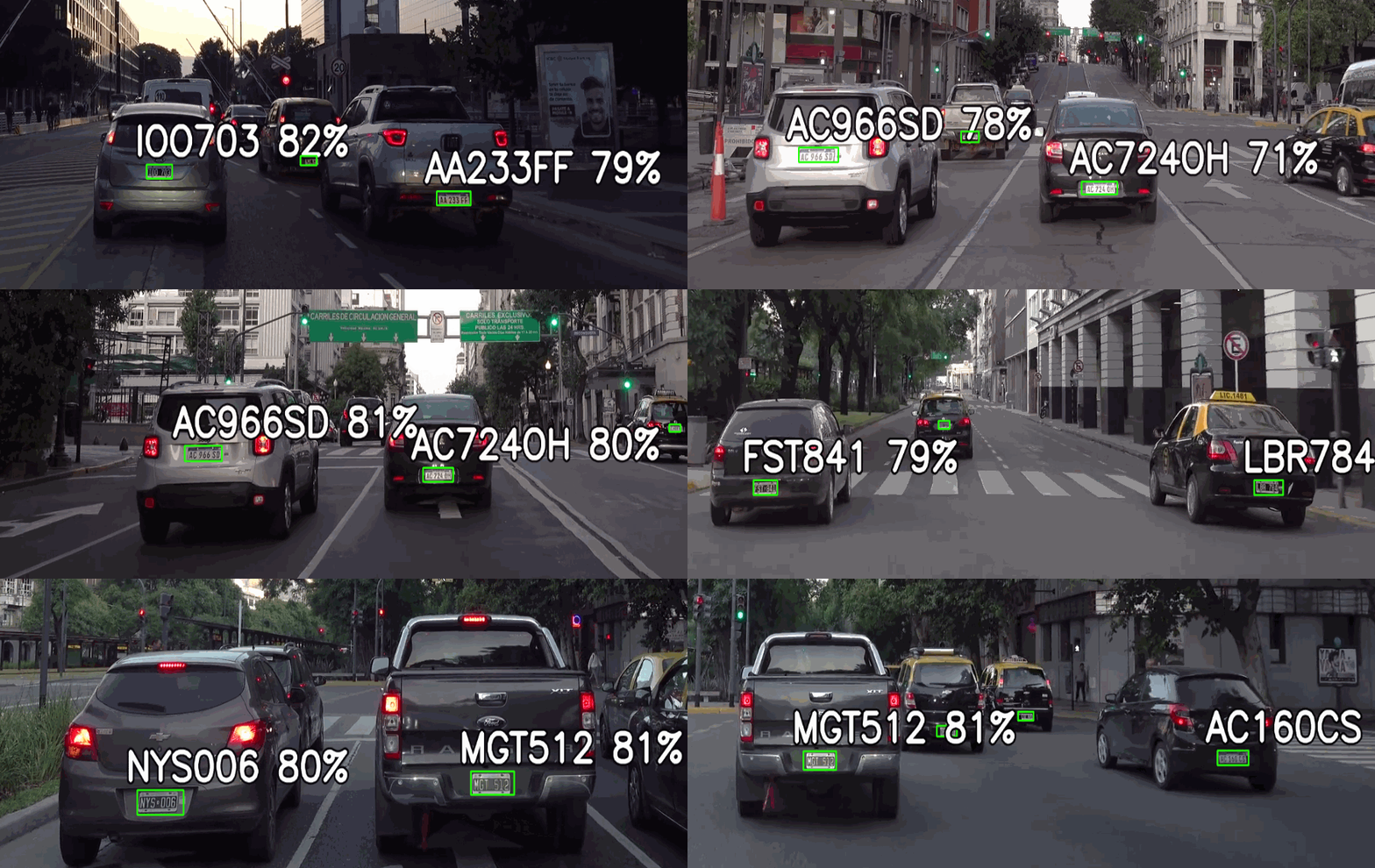
**FastALPR** is a high-performance, customizable Automatic License Plate Recognition (ALPR) system. We offer fast and
efficient ONNX models by default, but you can easily swap in your own models if needed.
For Optical Character Recognition (**OCR**), we use [fast-plate-ocr](https://github.com/ankandrew/fast-plate-ocr) by
default, and for **license plate detection**, we
use [open-image-models](https://github.com/ankandrew/open-image-models). However, you can integrate any OCR or detection
model of your choice.
## 📋 Table of Contents
* [✨ Features](#-features)
* [📦 Installation](#-installation)
* [🚀 Quick Start](#-quick-start)
* [🛠️ Customization and Flexibility](#-customization-and-flexibility)
* [📖 Documentation](#-documentation)
* [🤝 Contributing](#-contributing)
* [🙏 Acknowledgements](#-acknowledgements)
* [📫 Contact](#-contact)
## ✨ Features
- **High Accuracy**: Uses advanced models for precise license plate detection and OCR.
- **Customizable**: Easily switch out detection and OCR models.
- **Easy to Use**: Quick setup with a simple API.
- **Out-of-the-Box Models**: Includes ready-to-use detection and OCR models
- **Fast Performance**: Optimized with ONNX Runtime for speed.
## 📦 Installation
```shell
pip install fast-alpr[onnx-gpu]
```
By default, **no ONNX runtime is installed**. To run inference, you **must** install at least one ONNX backend using an appropriate extra.
| Platform/Use Case | Install Command | Notes |
|--------------------|----------------------------------------|----------------------|
| CPU (default) | `pip install fast-alpr[onnx]` | Cross-platform |
| NVIDIA GPU (CUDA) | `pip install fast-alpr[onnx-gpu]` | Linux/Windows |
| Intel (OpenVINO) | `pip install fast-alpr[onnx-openvino]` | Best on Intel CPUs |
| Windows (DirectML) | `pip install fast-alpr[onnx-directml]` | For DirectML support |
| Qualcomm (QNN) | `pip install fast-alpr[onnx-qnn]` | Qualcomm chipsets |
## 🚀 Quick Start
> [!TIP]
> Try `fast-alpr` in [Hugging Spaces](https://huggingface.co/spaces/ankandrew/fast-alpr).
Here's how to get started with FastALPR:
```python
from fast_alpr import ALPR
# You can also initialize the ALPR with custom plate detection and OCR models.
alpr = ALPR(
detector_model="yolo-v9-t-384-license-plate-end2end",
ocr_model="cct-xs-v2-global-model",
)
# The "assets/test_image.png" can be found in repo root dir
alpr_results = alpr.predict("assets/test_image.png")
print(alpr_results)
```
Output:
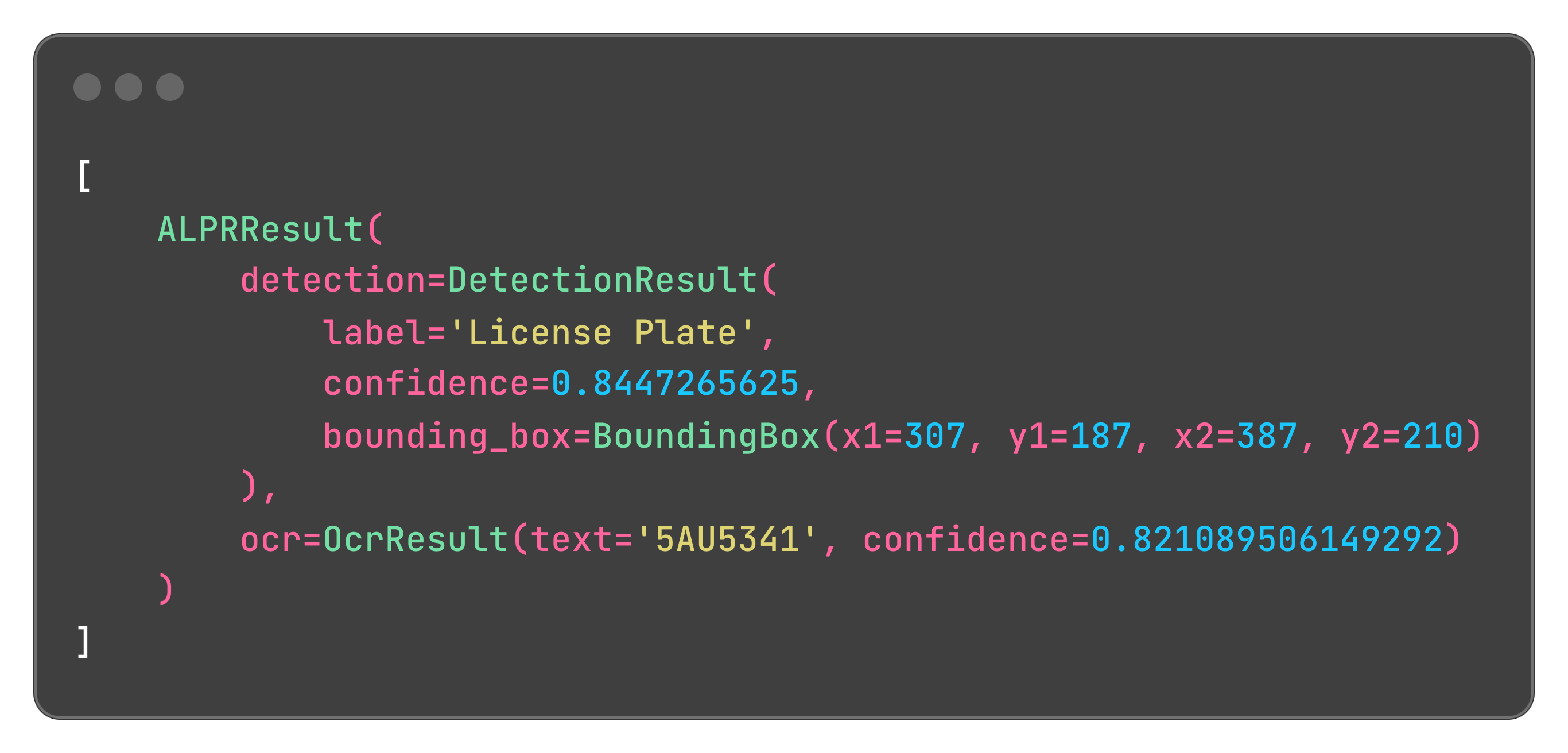 You can also draw the predictions directly on the image:
```python
import cv2
from fast_alpr import ALPR
# Initialize the ALPR
alpr = ALPR(
detector_model="yolo-v9-t-384-license-plate-end2end",
ocr_model="cct-xs-v2-global-model",
)
# Load the image
image_path = "assets/test_image.png"
frame = cv2.imread(image_path)
# Draw predictions on the image and get the ALPR results
drawn = alpr.draw_predictions(frame)
annotated_frame = drawn.image
results = drawn.results
```
Annotated frame:
You can also draw the predictions directly on the image:
```python
import cv2
from fast_alpr import ALPR
# Initialize the ALPR
alpr = ALPR(
detector_model="yolo-v9-t-384-license-plate-end2end",
ocr_model="cct-xs-v2-global-model",
)
# Load the image
image_path = "assets/test_image.png"
frame = cv2.imread(image_path)
# Draw predictions on the image and get the ALPR results
drawn = alpr.draw_predictions(frame)
annotated_frame = drawn.image
results = drawn.results
```
Annotated frame:
 ## 🛠️ Customization and Flexibility
FastALPR is designed to be flexible. You can customize the detector and OCR models according to your requirements.
You can very easily integrate with **Tesseract** OCR to leverage its capabilities:
```python
import re
from statistics import mean
import numpy as np
import pytesseract
from fast_alpr.alpr import ALPR, BaseOCR, OcrResult
class PytesseractOCR(BaseOCR):
def __init__(self) -> None:
"""
Init PytesseractOCR.
"""
def predict(self, cropped_plate: np.ndarray) -> OcrResult | None:
if cropped_plate is None:
return None
# You can change 'eng' to the appropriate language code as needed
data = pytesseract.image_to_data(
cropped_plate,
lang="eng",
config="--oem 3 --psm 6",
output_type=pytesseract.Output.DICT,
)
plate_text = " ".join(data["text"]).strip()
plate_text = re.sub(r"[^A-Za-z0-9]", "", plate_text)
avg_confidence = mean(conf for conf in data["conf"] if conf > 0) / 100.0
return OcrResult(text=plate_text, confidence=avg_confidence)
alpr = ALPR(detector_model="yolo-v9-t-384-license-plate-end2end", ocr=PytesseractOCR())
alpr_results = alpr.predict("assets/test_image.png")
print(alpr_results)
```
> [!TIP]
> See the [docs](https://ankandrew.github.io/fast-alpr/) for more examples!
## 📖 Documentation
Comprehensive documentation is available [here](https://ankandrew.github.io/fast-alpr/), including detailed API
references and additional examples.
## 🤝 Contributing
Contributions to the repo are greatly appreciated. Whether it's bug fixes, feature enhancements, or new models,
your contributions are warmly welcomed.
To start contributing or to begin development, you can follow these steps:
1. Clone repo
```shell
git clone https://github.com/ankandrew/fast-alpr.git
```
2. Install all dependencies (make sure you have [uv](https://docs.astral.sh/uv/getting-started/installation/) installed):
```shell
make install
```
3. To ensure your changes pass linting and tests before submitting a PR:
```shell
make checks
```
## 🙏 Acknowledgements
- [fast-plate-ocr](https://github.com/ankandrew/fast-plate-ocr) for default **OCR** models.
- [open-image-models](https://github.com/ankandrew/open-image-models) for default plate **detection** models.
## 📫 Contact
For questions or suggestions, feel free to open an issue.
================================================
FILE: docs/contributing.md
================================================
Contributions to the repo are greatly appreciated. Whether it's bug fixes, feature enhancements, or new models,
your contributions are warmly welcomed.
To start contributing or to begin development, you can follow these steps:
1. Clone repo
```shell
git clone https://github.com/ankandrew/fast-alpr.git
```
2. Install all dependencies (make sure you have [uv](https://docs.astral.sh/uv/getting-started/installation/) installed):
```shell
make install
```
3. To ensure your changes pass linting and tests before submitting a PR:
```shell
make checks
```
================================================
FILE: docs/custom_models.md
================================================
## 🛠️ Customization and Flexibility
FastALPR is designed to be flexible. You can customize the detector and OCR models according to your requirements.
### Using Tesseract OCR
You can very easily integrate with **Tesseract** OCR to leverage its capabilities:
```python title="tesseract_ocr.py"
import re
from statistics import mean
import numpy as np
import pytesseract
from fast_alpr.alpr import ALPR, BaseOCR, OcrResult
class PytesseractOCR(BaseOCR):
def __init__(self) -> None:
"""
Init PytesseractOCR.
"""
def predict(self, cropped_plate: np.ndarray) -> OcrResult | None:
if cropped_plate is None:
return None
# You can change 'eng' to the appropriate language code as needed
data = pytesseract.image_to_data(
cropped_plate,
lang="eng",
config="--oem 3 --psm 6",
output_type=pytesseract.Output.DICT,
)
plate_text = " ".join(data["text"]).strip()
plate_text = re.sub(r"[^A-Za-z0-9]", "", plate_text)
avg_confidence = mean(conf for conf in data["conf"] if conf > 0) / 100.0
return OcrResult(text=plate_text, confidence=avg_confidence)
alpr = ALPR(detector_model="yolo-v9-t-384-license-plate-end2end", ocr=PytesseractOCR())
alpr_results = alpr.predict("assets/test_image.png")
print(alpr_results)
```
???+ tip
You can implement this with any OCR you want! For example, [EasyOCR](https://github.com/JaidedAI/EasyOCR).
================================================
FILE: docs/index.md
================================================
# FastALPR
[](https://youtu.be/-TPJot7-HTs?t=652)
## Intro
**FastALPR** is a high-performance, customizable Automatic License Plate Recognition (ALPR) system. We offer fast and
efficient ONNX models by default, but you can easily swap in your own models if needed.
For Optical Character Recognition (**OCR**), we use [fast-plate-ocr](https://github.com/ankandrew/fast-plate-ocr) by
default, and for **license plate detection**, we
use [open-image-models](https://github.com/ankandrew/open-image-models). However, you can integrate any OCR or detection
model of your choice.
## Features
- **🔍 High Accuracy**: Uses advanced models for precise license plate detection and OCR.
- **🔧 Customizable**: Easily switch out detection and OCR models.
- **🚀 Easy to Use**: Quick setup with a simple API.
- **📦 Out-of-the-Box Models**: Includes ready-to-use detection and OCR models
- **⚡ Fast Performance**: Optimized with ONNX Runtime for speed.
## 🛠️ Customization and Flexibility
FastALPR is designed to be flexible. You can customize the detector and OCR models according to your requirements.
You can very easily integrate with **Tesseract** OCR to leverage its capabilities:
```python
import re
from statistics import mean
import numpy as np
import pytesseract
from fast_alpr.alpr import ALPR, BaseOCR, OcrResult
class PytesseractOCR(BaseOCR):
def __init__(self) -> None:
"""
Init PytesseractOCR.
"""
def predict(self, cropped_plate: np.ndarray) -> OcrResult | None:
if cropped_plate is None:
return None
# You can change 'eng' to the appropriate language code as needed
data = pytesseract.image_to_data(
cropped_plate,
lang="eng",
config="--oem 3 --psm 6",
output_type=pytesseract.Output.DICT,
)
plate_text = " ".join(data["text"]).strip()
plate_text = re.sub(r"[^A-Za-z0-9]", "", plate_text)
avg_confidence = mean(conf for conf in data["conf"] if conf > 0) / 100.0
return OcrResult(text=plate_text, confidence=avg_confidence)
alpr = ALPR(detector_model="yolo-v9-t-384-license-plate-end2end", ocr=PytesseractOCR())
alpr_results = alpr.predict("assets/test_image.png")
print(alpr_results)
```
> [!TIP]
> See the [docs](https://ankandrew.github.io/fast-alpr/) for more examples!
## 📖 Documentation
Comprehensive documentation is available [here](https://ankandrew.github.io/fast-alpr/), including detailed API
references and additional examples.
## 🤝 Contributing
Contributions to the repo are greatly appreciated. Whether it's bug fixes, feature enhancements, or new models,
your contributions are warmly welcomed.
To start contributing or to begin development, you can follow these steps:
1. Clone repo
```shell
git clone https://github.com/ankandrew/fast-alpr.git
```
2. Install all dependencies (make sure you have [uv](https://docs.astral.sh/uv/getting-started/installation/) installed):
```shell
make install
```
3. To ensure your changes pass linting and tests before submitting a PR:
```shell
make checks
```
## 🙏 Acknowledgements
- [fast-plate-ocr](https://github.com/ankandrew/fast-plate-ocr) for default **OCR** models.
- [open-image-models](https://github.com/ankandrew/open-image-models) for default plate **detection** models.
## 📫 Contact
For questions or suggestions, feel free to open an issue.
================================================
FILE: docs/contributing.md
================================================
Contributions to the repo are greatly appreciated. Whether it's bug fixes, feature enhancements, or new models,
your contributions are warmly welcomed.
To start contributing or to begin development, you can follow these steps:
1. Clone repo
```shell
git clone https://github.com/ankandrew/fast-alpr.git
```
2. Install all dependencies (make sure you have [uv](https://docs.astral.sh/uv/getting-started/installation/) installed):
```shell
make install
```
3. To ensure your changes pass linting and tests before submitting a PR:
```shell
make checks
```
================================================
FILE: docs/custom_models.md
================================================
## 🛠️ Customization and Flexibility
FastALPR is designed to be flexible. You can customize the detector and OCR models according to your requirements.
### Using Tesseract OCR
You can very easily integrate with **Tesseract** OCR to leverage its capabilities:
```python title="tesseract_ocr.py"
import re
from statistics import mean
import numpy as np
import pytesseract
from fast_alpr.alpr import ALPR, BaseOCR, OcrResult
class PytesseractOCR(BaseOCR):
def __init__(self) -> None:
"""
Init PytesseractOCR.
"""
def predict(self, cropped_plate: np.ndarray) -> OcrResult | None:
if cropped_plate is None:
return None
# You can change 'eng' to the appropriate language code as needed
data = pytesseract.image_to_data(
cropped_plate,
lang="eng",
config="--oem 3 --psm 6",
output_type=pytesseract.Output.DICT,
)
plate_text = " ".join(data["text"]).strip()
plate_text = re.sub(r"[^A-Za-z0-9]", "", plate_text)
avg_confidence = mean(conf for conf in data["conf"] if conf > 0) / 100.0
return OcrResult(text=plate_text, confidence=avg_confidence)
alpr = ALPR(detector_model="yolo-v9-t-384-license-plate-end2end", ocr=PytesseractOCR())
alpr_results = alpr.predict("assets/test_image.png")
print(alpr_results)
```
???+ tip
You can implement this with any OCR you want! For example, [EasyOCR](https://github.com/JaidedAI/EasyOCR).
================================================
FILE: docs/index.md
================================================
# FastALPR
[](https://youtu.be/-TPJot7-HTs?t=652)
## Intro
**FastALPR** is a high-performance, customizable Automatic License Plate Recognition (ALPR) system. We offer fast and
efficient ONNX models by default, but you can easily swap in your own models if needed.
For Optical Character Recognition (**OCR**), we use [fast-plate-ocr](https://github.com/ankandrew/fast-plate-ocr) by
default, and for **license plate detection**, we
use [open-image-models](https://github.com/ankandrew/open-image-models). However, you can integrate any OCR or detection
model of your choice.
## Features
- **🔍 High Accuracy**: Uses advanced models for precise license plate detection and OCR.
- **🔧 Customizable**: Easily switch out detection and OCR models.
- **🚀 Easy to Use**: Quick setup with a simple API.
- **📦 Out-of-the-Box Models**: Includes ready-to-use detection and OCR models
- **⚡ Fast Performance**: Optimized with ONNX Runtime for speed.
================================================
FILE: docs/installation.md
================================================
## Installation
For **inference**, install:
```shell
pip install fast-alpr[onnx-gpu]
```
???+ warning
By default, **no ONNX runtime is installed**.
To run inference, you **must install** one of the ONNX extras:
- `onnx` - for CPU inference (cross-platform)
- `onnx-gpu` - for NVIDIA GPUs (CUDA)
- `onnx-openvino` - for Intel CPUs / VPUs
- `onnx-directml` - for Windows devices via DirectML
- `onnx-qnn` - for Qualcomm chips on mobile
Dependencies for inference are kept **minimal by default**. Inference-related packages like **ONNX runtimes** are
**optional** and not installed unless **explicitly requested via extras**.
================================================
FILE: docs/quick_start.md
================================================
## 🚀 Quick Start
Here's how to get started with FastALPR:
### Predictions
```python
from fast_alpr import ALPR
# You can also initialize the ALPR with custom plate detection and OCR models.
alpr = ALPR(
detector_model="yolo-v9-t-384-license-plate-end2end",
ocr_model="cct-xs-v2-global-model",
)
# The "assets/test_image.png" can be found in repo root dir
# You can also pass a NumPy array containing cropped plate image
alpr_results = alpr.predict("assets/test_image.png")
print(alpr_results)
```
???+ note
See [reference](reference.md) for the available models.
Output:
### Draw Results
You can also **draw** the predictions directly on the image:
```python
import cv2
from fast_alpr import ALPR
# Initialize the ALPR
alpr = ALPR(
detector_model="yolo-v9-t-384-license-plate-end2end",
ocr_model="cct-xs-v2-global-model",
)
# Load the image
image_path = "assets/test_image.png"
frame = cv2.imread(image_path)
# Draw predictions on the image and get the ALPR results
drawn = alpr.draw_predictions(frame)
annotated_frame = drawn.image
results = drawn.results
```
Annotated frame:
================================================
FILE: docs/reference.md
================================================
# Reference
This page shows the public API of FastALPR.
## At a Glance
- Use `ALPR.predict()` to get structured ALPR results
- Use `ALPR.draw_predictions()` to get an annotated image and the same ALPR results
- `BoundingBox` and `DetectionResult` come from `open-image-models`
## Imports
```python
from fast_alpr import ALPR, ALPRResult, DrawPredictionsResult, OcrResult
```
## Common Inputs
- A NumPy image in BGR format
- A string path to an image file
## Common Returns
- `ALPR.predict(...)` returns `list[ALPRResult]`
- `ALPR.draw_predictions(...)` returns `DrawPredictionsResult`
`ALPRResult` contains:
- `detection`: box, label, and detection confidence
- `ocr`: recognized text and OCR confidence, or `None`
`DrawPredictionsResult` contains:
- `image`: the image with boxes and text drawn on it
- `results`: the same ALPR results used for drawing
## Available Models
See the available detection models in [open-image-models](https://ankandrew.github.io/open-image-models/0.4/reference/#open_image_models.detection.core.hub.PlateDetectorModel)
and OCR models in [fast-plate-ocr](https://ankandrew.github.io/fast-plate-ocr/1.0/inference/model_zoo/).
## Main Class
::: fast_alpr.alpr.ALPR
options:
show_root_heading: true
show_root_toc_entry: false
## Result Types
::: fast_alpr.alpr.ALPRResult
options:
show_root_heading: true
show_root_toc_entry: false
::: fast_alpr.alpr.DrawPredictionsResult
options:
show_root_heading: true
show_root_toc_entry: false
::: fast_alpr.base.OcrResult
options:
show_root_heading: true
show_root_toc_entry: false
## Interfaces
::: fast_alpr.base.BaseDetector
options:
show_root_heading: true
show_root_toc_entry: false
::: fast_alpr.base.BaseOCR
options:
show_root_heading: true
show_root_toc_entry: false
## External Types
See [`BoundingBox`][open_image_models.detection.core.base.BoundingBox]
and [`DetectionResult`][open_image_models.detection.core.base.DetectionResult].
================================================
FILE: fast_alpr/__init__.py
================================================
"""
FastALPR package.
"""
from fast_alpr.alpr import ALPR, ALPRResult, DrawPredictionsResult
from fast_alpr.base import BaseDetector, BaseOCR, DetectionResult, OcrResult
__all__ = [
"ALPR",
"ALPRResult",
"BaseDetector",
"BaseOCR",
"DetectionResult",
"DrawPredictionsResult",
"OcrResult",
]
================================================
FILE: fast_alpr/alpr.py
================================================
"""
ALPR module.
"""
import os
import statistics
from collections.abc import Sequence
from dataclasses import dataclass
from typing import Literal
import cv2
import numpy as np
import onnxruntime as ort
from fast_plate_ocr.inference.hub import OcrModel
from open_image_models.detection.core.hub import PlateDetectorModel
from fast_alpr.base import BaseDetector, BaseOCR, DetectionResult, OcrResult
from fast_alpr.default_detector import DefaultDetector
from fast_alpr.default_ocr import DefaultOCR
# pylint: disable=too-many-arguments, too-many-locals
# ruff: noqa: PLR0913
@dataclass(frozen=True)
class ALPRResult:
"""
Detection and OCR output for one license plate.
Attributes:
detection: Detector output for the plate.
ocr: OCR output for the plate, or None if OCR does not return a result.
"""
detection: DetectionResult
ocr: OcrResult | None
@dataclass(frozen=True, slots=True)
class DrawPredictionsResult:
"""
Return value from draw_predictions.
Attributes:
image: The input image with boxes and text drawn on it.
results: The ALPR results used to draw the annotations.
"""
image: np.ndarray
results: list[ALPRResult]
class ALPR:
"""
Automatic License Plate Recognition (ALPR) system class.
This class combines a detector and an OCR model to recognize license plates in images.
"""
def __init__(
self,
detector: BaseDetector | None = None,
ocr: BaseOCR | None = None,
detector_model: PlateDetectorModel = "yolo-v9-t-384-license-plate-end2end",
detector_conf_thresh: float = 0.4,
detector_providers: Sequence[str | tuple[str, dict]] | None = None,
detector_sess_options: ort.SessionOptions = None,
ocr_model: OcrModel | None = "cct-xs-v2-global-model",
ocr_device: Literal["cuda", "cpu", "auto"] = "auto",
ocr_providers: Sequence[str | tuple[str, dict]] | None = None,
ocr_sess_options: ort.SessionOptions | None = None,
ocr_model_path: str | os.PathLike | None = None,
ocr_config_path: str | os.PathLike | None = None,
ocr_force_download: bool = False,
) -> None:
"""
Initialize the ALPR system.
Parameters:
detector: An instance of BaseDetector. If None, the DefaultDetector is used.
ocr: An instance of BaseOCR. If None, the DefaultOCR is used.
detector_model: The name of the detector model or a PlateDetectorModel enum instance.
Defaults to "yolo-v9-t-384-license-plate-end2end".
detector_conf_thresh: Confidence threshold for the detector.
detector_providers: Execution providers for the detector.
detector_sess_options: Session options for the detector.
ocr_model: The name of the OCR model from the model hub. This can be none and
`ocr_model_path` and `ocr_config_path` parameters are expected to pass them to
`fast-plate-ocr` library.
ocr_device: The device to run the OCR model on ("cuda", "cpu", or "auto").
ocr_providers: Execution providers for the OCR. If None, the default providers are used.
ocr_sess_options: Session options for the OCR. If None, default session options are
used.
ocr_model_path: Custom model path for the OCR. If None, the model is downloaded from the
hub or cache.
ocr_config_path: Custom config path for the OCR. If None, the default configuration is
used.
ocr_force_download: Whether to force download the OCR model.
"""
# Initialize the detector
self.detector = detector or DefaultDetector(
model_name=detector_model,
conf_thresh=detector_conf_thresh,
providers=detector_providers,
sess_options=detector_sess_options,
)
# Initialize the OCR
self.ocr = ocr or DefaultOCR(
hub_ocr_model=ocr_model,
device=ocr_device,
providers=ocr_providers,
sess_options=ocr_sess_options,
model_path=ocr_model_path,
config_path=ocr_config_path,
force_download=ocr_force_download,
)
def predict(self, frame: np.ndarray | str) -> list[ALPRResult]:
"""
Run plate detection and OCR on an image.
Parameters:
frame: Unprocessed frame (Colors in order: BGR) or image path.
Returns:
A list of ALPRResult objects, one for each detected plate.
"""
if isinstance(frame, str):
img_path = frame
img = cv2.imread(img_path)
if img is None:
raise ValueError(f"Failed to load image from path: {img_path}")
else:
img = frame
plate_detections = self.detector.predict(img)
alpr_results: list[ALPRResult] = []
for detection in plate_detections:
bbox = detection.bounding_box
x1, y1 = max(bbox.x1, 0), max(bbox.y1, 0)
x2, y2 = min(bbox.x2, img.shape[1]), min(bbox.y2, img.shape[0])
cropped_plate = img[y1:y2, x1:x2]
ocr_result = self.ocr.predict(cropped_plate)
alpr_result = ALPRResult(detection=detection, ocr=ocr_result)
alpr_results.append(alpr_result)
return alpr_results
def draw_predictions(self, frame: np.ndarray | str) -> DrawPredictionsResult:
"""
Draw detections and OCR results on an image.
Parameters:
frame: The original frame or image path.
Returns:
A DrawPredictionsResult with the annotated image and the ALPR results.
"""
# If frame is a string, assume it's an image path and load it
if isinstance(frame, str):
img_path = frame
img = cv2.imread(img_path)
if img is None:
raise ValueError(f"Failed to load image from path: {img_path}")
else:
img = frame
# Get ALPR results using the ndarray
alpr_results = self.predict(img)
for result in alpr_results:
detection = result.detection
ocr_result = result.ocr
bbox = detection.bounding_box
x1, y1, x2, y2 = bbox.x1, bbox.y1, bbox.x2, bbox.y2
# Draw the bounding box
cv2.rectangle(img, (x1, y1), (x2, y2), (36, 255, 12), 2)
if ocr_result is None or not ocr_result.text or not ocr_result.confidence:
continue
confidence: float = (
statistics.mean(ocr_result.confidence)
if isinstance(ocr_result.confidence, list)
else ocr_result.confidence
)
font_scale = min(1.25, max(0.4, img.shape[1] / 1000))
text_thickness = 1 if font_scale < 0.75 else 2
outline_thickness = text_thickness + max(3, round(font_scale * 3))
display_lines = [f"{ocr_result.text} {confidence * 100:.0f}%"]
if ocr_result.region:
region_text = ocr_result.region
if ocr_result.region_confidence is not None:
region_text = f"{region_text} {ocr_result.region_confidence * 100:.0f}%"
display_lines.insert(0, region_text)
_, text_height = cv2.getTextSize(
display_lines[0], cv2.FONT_HERSHEY_SIMPLEX, font_scale, text_thickness
)[0]
line_gap = max(14, round(text_height * 0.6))
line_height = text_height + line_gap
text_y = y1 - 10 - ((len(display_lines) - 1) * line_height)
if text_y - text_height < 0:
text_y = y2 + text_height + 10
for idx, line in enumerate(display_lines):
text_width, current_text_height = cv2.getTextSize(
line, cv2.FONT_HERSHEY_SIMPLEX, font_scale, text_thickness
)[0]
text_x = min(max(x1, 5), max(5, img.shape[1] - text_width - 5))
current_y = min(
max(text_y + (idx * line_height), current_text_height + 5),
img.shape[0] - 5,
)
# Draw black background for better readability
cv2.putText(
img=img,
text=line,
org=(text_x, current_y),
fontFace=cv2.FONT_HERSHEY_SIMPLEX,
fontScale=font_scale,
color=(0, 0, 0),
thickness=outline_thickness,
lineType=cv2.LINE_AA,
)
# Draw white text
cv2.putText(
img=img,
text=line,
org=(text_x, current_y),
fontFace=cv2.FONT_HERSHEY_SIMPLEX,
fontScale=font_scale,
color=(255, 255, 255),
thickness=text_thickness,
lineType=cv2.LINE_AA,
)
return DrawPredictionsResult(image=img, results=alpr_results)
================================================
FILE: fast_alpr/base.py
================================================
"""
Base module.
"""
from abc import ABC, abstractmethod
from dataclasses import dataclass
import numpy as np
from open_image_models.detection.core.base import DetectionResult
@dataclass(frozen=True)
class OcrResult:
"""
OCR output for one cropped plate image.
Attributes:
text: Recognized plate text.
confidence: OCR confidence as one value or one value per character.
region: Optional region or country prediction.
region_confidence: Confidence for the region prediction.
"""
text: str
confidence: float | list[float]
region: str | None = None
region_confidence: float | None = None
class BaseDetector(ABC):
@abstractmethod
def predict(self, frame: np.ndarray) -> list[DetectionResult]:
"""Perform detection on the input frame and return a list of detections."""
class BaseOCR(ABC):
@abstractmethod
def predict(self, cropped_plate: np.ndarray) -> OcrResult | None:
"""Perform OCR on the cropped plate image and return the recognized text and character
probabilities."""
================================================
FILE: fast_alpr/default_detector.py
================================================
"""
Default Detector module.
"""
from collections.abc import Sequence
import numpy as np
import onnxruntime as ort
from open_image_models import LicensePlateDetector
from open_image_models.detection.core.hub import PlateDetectorModel
from fast_alpr.base import BaseDetector, DetectionResult
class DefaultDetector(BaseDetector):
"""
Default detector class for license plate detection using ONNX models.
This class utilizes the `LicensePlateDetector` from the `open_image_models` package
to perform detection on input frames.
"""
def __init__(
self,
model_name: PlateDetectorModel = "yolo-v9-t-384-license-plate-end2end",
conf_thresh: float = 0.4,
providers: Sequence[str | tuple[str, dict]] | None = None,
sess_options: ort.SessionOptions = None,
) -> None:
"""
Initialize the DefaultDetector with the specified parameters. Uses `open-image-models`'s
`LicensePlateDetector`.
Parameters:
model_name: The name of the detector model. See `PlateDetectorModel` for the available
models.
conf_thresh: Confidence threshold for the detector. Defaults to 0.25.
providers: The execution providers to use in ONNX Runtime. If None, the default
providers are used.
sess_options: Custom session options for ONNX Runtime. If None, default session options
are used.
"""
self.detector = LicensePlateDetector(
detection_model=model_name,
conf_thresh=conf_thresh,
providers=providers,
sess_options=sess_options,
)
def predict(self, frame: np.ndarray) -> list[DetectionResult]:
"""
Perform detection on the input frame and return a list of detections.
Parameters:
frame: The input image/frame in which to detect license plates.
Returns:
A list of detection results, each containing the label,
confidence, and bounding box of a detected license plate.
"""
return self.detector.predict(frame)
================================================
FILE: fast_alpr/default_ocr.py
================================================
"""
Default OCR module.
"""
import os
from collections.abc import Sequence
from typing import Literal
import cv2
import numpy as np
import onnxruntime as ort
from fast_plate_ocr import LicensePlateRecognizer
from fast_plate_ocr.inference.hub import OcrModel
from fast_alpr.base import BaseOCR, OcrResult
class DefaultOCR(BaseOCR):
"""
Default OCR class for license plate recognition using `fast-plate-ocr` models.
"""
def __init__(
self,
hub_ocr_model: OcrModel | None = None,
device: Literal["cuda", "cpu", "auto"] = "auto",
providers: Sequence[str | tuple[str, dict]] | None = None,
sess_options: ort.SessionOptions | None = None,
model_path: str | os.PathLike | None = None,
config_path: str | os.PathLike | None = None,
force_download: bool = False,
) -> None:
"""
Initialize the DefaultOCR with the specified parameters. Uses `fast-plate-ocr`'s
`LicensePlateRecognizer`
Parameters:
hub_ocr_model: The name of the OCR model from the model hub.
device: The device to run the model on. Options are "cuda", "cpu", or "auto". Defaults
to "auto".
providers: The execution providers to use in ONNX Runtime. If None, the default
providers are used.
sess_options: Custom session options for ONNX Runtime. If None, default session options
are used.
model_path: Path to a custom OCR model file. If None, the model is downloaded from the
hub or cache.
config_path: Path to a custom configuration file. If None, the default configuration is
used.
force_download: If True, forces the download of the model and overwrites any existing
files.
"""
self.ocr_model = LicensePlateRecognizer(
hub_ocr_model=hub_ocr_model,
device=device,
providers=providers,
sess_options=sess_options,
onnx_model_path=model_path,
plate_config_path=config_path,
force_download=force_download,
)
def predict(self, cropped_plate: np.ndarray) -> OcrResult | None:
"""
Perform OCR on a cropped license plate image.
Parameters:
cropped_plate: The cropped image of the license plate in BGR format.
Returns:
OcrResult: An object containing the recognized text and per-character confidence.
"""
if cropped_plate is None:
return None
if self.ocr_model.config.image_color_mode == "grayscale":
cropped_plate = cv2.cvtColor(cropped_plate, cv2.COLOR_BGR2GRAY)
elif self.ocr_model.config.image_color_mode == "rgb":
cropped_plate = cv2.cvtColor(cropped_plate, cv2.COLOR_BGR2RGB)
prediction = self.ocr_model.run_one(cropped_plate, return_confidence=True)
char_probs = prediction.char_probs
confidence: float | list[float] = (
0.0 if char_probs is None else [float(x) for x in char_probs.tolist()]
)
return OcrResult(
text=prediction.plate,
confidence=confidence,
region=prediction.region,
region_confidence=prediction.region_prob,
)
================================================
FILE: mkdocs.yml
================================================
site_name: FastALPR
site_author: ankandrew
site_description: Fast ALPR.
repo_url: https://github.com/ankandrew/fast-alpr
theme:
name: material
features:
- content.code.copy
- content.code.select
- content.footnote.tooltips
- header.autohide
- navigation.expand
- navigation.footer
- navigation.instant
- navigation.instant.progress
- navigation.path
- navigation.sections
- search.highlight
- search.suggest
- toc.follow
palette:
- scheme: default
toggle:
icon: material/lightbulb-outline
name: Switch to dark mode
- scheme: slate
toggle:
icon: material/lightbulb
name: Switch to light mode
nav:
- Introduction: index.md
- Installation: installation.md
- Quick Start: quick_start.md
- Custom Models: custom_models.md
- Contributing: contributing.md
- Reference: reference.md
plugins:
- search
- mike:
alias_type: symlink
canonical_version: latest
- mkdocstrings:
handlers:
python:
paths: [ fast_alpr ]
load_external_modules: true
inventories:
- https://ankandrew.github.io/open-image-models/0.5/objects.inv
- https://ankandrew.github.io/fast-plate-ocr/1.1/objects.inv
options:
members_order: source
separate_signature: true
filters: [ "!^_" ]
show_category_heading: true
docstring_options:
ignore_init_summary: true
show_signature: true
show_source: true
heading_level: 2
show_root_full_path: false
merge_init_into_class: true
show_signature_annotations: true
signature_crossrefs: true
extra:
version:
provider: mike
generator: false
markdown_extensions:
- admonition
- pymdownx.highlight:
anchor_linenums: true
line_spans: __span
pygments_lang_class: true
- pymdownx.inlinehilite
- pymdownx.snippets
- pymdownx.details
- pymdownx.superfences
- toc:
permalink: true
title: Page contents
================================================
FILE: pyproject.toml
================================================
[project]
name = "fast-alpr"
version = "0.4.0"
description = "Fast Automatic License Plate Recognition."
authors = [{ name = "ankandrew", email = "61120139+ankandrew@users.noreply.github.com" }]
requires-python = ">=3.10,<4.0"
readme = "README.md"
license = "MIT"
keywords = [
"image-processing",
"computer-vision",
"deep-learning",
"object-detection",
"plate-detection",
"license-plate-ocr",
"onnx",
]
classifiers = [
"Typing :: Typed",
"Intended Audience :: Developers",
"Intended Audience :: Education",
"Intended Audience :: Science/Research",
"Operating System :: OS Independent",
"Topic :: Software Development",
"Topic :: Scientific/Engineering",
"Topic :: Software Development :: Libraries",
"Topic :: Software Development :: Build Tools",
"Topic :: Scientific/Engineering :: Artificial Intelligence",
"Topic :: Software Development :: Libraries :: Python Modules",
"Programming Language :: Python :: 3",
"Programming Language :: Python :: 3 :: Only",
"Programming Language :: Python :: 3.10",
"Programming Language :: Python :: 3.11",
"Programming Language :: Python :: 3.12",
"Programming Language :: Python :: 3.13"
]
dependencies = [
"fast-plate-ocr>=1.1.0",
"open-image-models>=0.5.1",
"opencv-python-headless>=4.9.0.80",
]
[project.optional-dependencies]
onnx = ["onnxruntime>=1.19.2"]
onnx-gpu = ["onnxruntime-gpu>=1.19.2"]
onnx-openvino = ["onnxruntime-openvino>=1.19.2"]
onnx-directml = ["onnxruntime-directml>=1.19.2"]
onnx-qnn = ["onnxruntime-qnn>=1.19.2"]
[dependency-groups]
test = ["pytest"]
dev = [
"mypy",
"ruff",
"pylint",
"types-pyyaml",
"yamllint",
]
docs = [
"mkdocs-material",
"mkdocstrings[python]",
"mike",
]
[tool.uv]
default-groups = [
"test",
"dev",
"docs",
]
[build-system]
requires = ["hatchling"]
build-backend = "hatchling.build"
[tool.ruff]
line-length = 100
target-version = "py310"
[tool.ruff.lint]
select = [
# pycodestyle
"E",
"W",
# Pyflakes
"F",
# pep8-naming
"N",
# pyupgrade
"UP",
# flake8-bugbear
"B",
# flake8-simplify
"SIM",
# flake8-unused-arguments
"ARG",
# Pylint
"PL",
# Perflint
"PERF",
# Ruff-specific rules
"RUF",
# pandas-vet
"PD",
]
ignore = ["N812", "PLR2004", "PD011"]
fixable = ["ALL"]
unfixable = []
[tool.ruff.lint.pylint]
max-args = 8
[tool.ruff.format]
line-ending = "lf"
[tool.mypy]
disable_error_code = "import-untyped"
[tool.pylint.typecheck]
generated-members = ["cv2.*"]
signature-mutators = [
"click.decorators.option",
"click.decorators.argument",
"click.decorators.version_option",
"click.decorators.help_option",
"click.decorators.pass_context",
"click.decorators.confirmation_option"
]
[tool.pylint.format]
max-line-length = 100
[tool.pylint."messages control"]
disable = ["missing-class-docstring", "missing-function-docstring", "too-many-positional-arguments"]
[tool.pylint.design]
max-args = 8
min-public-methods = 1
[tool.pylint.basic]
no-docstring-rgx = "^__|^test_"
================================================
FILE: test/__init__.py
================================================
================================================
FILE: test/test_alpr.py
================================================
"""
Test ALPR end-to-end.
"""
from pathlib import Path
import cv2
import numpy as np
import pytest
from fast_plate_ocr.inference.hub import OcrModel
from open_image_models.detection.core.hub import PlateDetectorModel
from fast_alpr.alpr import ALPR
ASSETS_DIR = Path(__file__).resolve().parent.parent / "assets"
@pytest.fixture(scope="module", name="alpr")
def alpr_fixture() -> ALPR:
return ALPR(
detector_model="yolo-v9-t-384-license-plate-end2end",
ocr_model="cct-xs-v2-global-model",
)
@pytest.mark.parametrize(
"img_path, expected_plates", [(ASSETS_DIR / "test_image.png", {"5AU5341"})]
)
@pytest.mark.parametrize("detector_model", ["yolo-v9-t-384-license-plate-end2end"])
@pytest.mark.parametrize(
"ocr_model",
[
"cct-s-v2-global-model",
"cct-xs-v2-global-model",
"cct-s-v1-global-model",
"cct-xs-v1-global-model",
"global-plates-mobile-vit-v2-model",
"european-plates-mobile-vit-v2-model",
],
)
def test_default_alpr(
img_path: Path,
expected_plates: set[str],
detector_model: PlateDetectorModel,
ocr_model: OcrModel,
) -> None:
# pylint: disable=too-many-locals
im = cv2.imread(str(img_path))
assert im is not None, "Failed to load test image"
alpr = ALPR(
detector_model=detector_model,
ocr_model=ocr_model,
)
actual_result = alpr.predict(im)
actual_plates = {x.ocr.text for x in actual_result if x.ocr is not None}
assert actual_plates == expected_plates
for res in actual_result:
bbox = res.detection.bounding_box
height, width = im.shape[:2]
x1, y1 = max(bbox.x1, 0), max(bbox.y1, 0)
x2, y2 = min(bbox.x2, width), min(bbox.y2, height)
assert 0 <= x1 < width, f"x1 coordinate {x1} out of bounds (0, {width})"
assert 0 <= x2 <= width, f"x2 coordinate {x2} out of bounds (0, {width})"
assert 0 <= y1 < height, f"y1 coordinate {y1} out of bounds (0, {height})"
assert 0 <= y2 <= height, f"y2 coordinate {y2} out of bounds (0, {height})"
assert x1 < x2, f"x1 ({x1}) should be less than x2 ({x2})"
assert y1 < y2, f"y1 ({y1}) should be less than y2 ({y2})"
if res.ocr is not None:
conf = res.ocr.confidence
if isinstance(conf, list):
assert all(0.0 <= x <= 1.0 for x in conf)
elif isinstance(conf, float):
assert 0.0 <= conf <= 1.0
else:
raise TypeError(f"Unexpected type for confidence: {type(conf).__name__}")
@pytest.mark.parametrize("img_path", [ASSETS_DIR / "test_image.png"])
def test_draw_predictions(img_path: Path, alpr: ALPR) -> None:
im = cv2.imread(str(img_path))
assert im is not None, "Failed to load test image"
h, w, c = im.shape
# ndarray input
drawn_nd = alpr.draw_predictions(im.copy())
assert isinstance(drawn_nd.image, np.ndarray)
assert drawn_nd.image.shape == (h, w, c)
assert drawn_nd.results
diff_nd = cv2.absdiff(drawn_nd.image, im)
assert int(diff_nd.sum()) > 0
# string path input
drawn_path = alpr.draw_predictions(str(img_path))
assert isinstance(drawn_path.image, np.ndarray)
assert drawn_path.image.shape == (h, w, c)
assert drawn_path.results
diff_path = cv2.absdiff(drawn_path.image, im)
assert int(diff_path.sum()) > 0