Showing preview only (9,999K chars total). Download the full file or copy to clipboard to get everything.
Repository: aymericdamien/TensorFlow-Examples
Branch: master
Commit: 6dcbe1464916
Files: 168
Total size: 9.5 MB
Directory structure:
gitextract_u9xusu3s/

├── .gitignore
├── LICENSE
├── README.md
├── examples/
│   ├── 1_Introduction/
│   │   ├── basic_eager_api.py
│   │   ├── basic_operations.py
│   │   └── helloworld.py
│   ├── 2_BasicModels/
│   │   ├── gradient_boosted_decision_tree.py
│   │   ├── kmeans.py
│   │   ├── linear_regression.py
│   │   ├── linear_regression_eager_api.py
│   │   ├── logistic_regression.py
│   │   ├── logistic_regression_eager_api.py
│   │   ├── nearest_neighbor.py
│   │   ├── random_forest.py
│   │   └── word2vec.py
│   ├── 3_NeuralNetworks/
│   │   ├── autoencoder.py
│   │   ├── bidirectional_rnn.py
│   │   ├── convolutional_network.py
│   │   ├── convolutional_network_raw.py
│   │   ├── dcgan.py
│   │   ├── dynamic_rnn.py
│   │   ├── gan.py
│   │   ├── multilayer_perceptron.py
│   │   ├── neural_network.py
│   │   ├── neural_network_eager_api.py
│   │   ├── neural_network_raw.py
│   │   ├── recurrent_network.py
│   │   └── variational_autoencoder.py
│   ├── 4_Utils/
│   │   ├── save_restore_model.py
│   │   ├── tensorboard_advanced.py
│   │   └── tensorboard_basic.py
│   ├── 5_DataManagement/
│   │   ├── build_an_image_dataset.py
│   │   └── tensorflow_dataset_api.py
│   ├── 6_MultiGPU/
│   │   ├── multigpu_basics.py
│   │   └── multigpu_cnn.py
│   └── README.md
├── input_data.py
├── notebooks/
│   ├── 0_Prerequisite/
│   │   ├── ml_introduction.ipynb
│   │   └── mnist_dataset_intro.ipynb
│   ├── 1_Introduction/
│   │   ├── basic_eager_api.ipynb
│   │   ├── basic_operations.ipynb
│   │   └── helloworld.ipynb
│   ├── 2_BasicModels/
│   │   ├── gradient_boosted_decision_tree.ipynb
│   │   ├── kmeans.ipynb
│   │   ├── linear_regression.ipynb
│   │   ├── linear_regression_eager_api.ipynb
│   │   ├── logistic_regression.ipynb
│   │   ├── logistic_regression_eager_api.ipynb
│   │   ├── nearest_neighbor.ipynb
│   │   ├── random_forest.ipynb
│   │   └── word2vec.ipynb
│   ├── 3_NeuralNetworks/
│   │   ├── autoencoder.ipynb
│   │   ├── bidirectional_rnn.ipynb
│   │   ├── convolutional_network.ipynb
│   │   ├── convolutional_network_raw.ipynb
│   │   ├── dcgan.ipynb
│   │   ├── dynamic_rnn.ipynb
│   │   ├── gan.ipynb
│   │   ├── neural_network.ipynb
│   │   ├── neural_network_eager_api.ipynb
│   │   ├── neural_network_raw.ipynb
│   │   ├── recurrent_network.ipynb
│   │   └── variational_autoencoder.ipynb
│   ├── 4_Utils/
│   │   ├── save_restore_model.ipynb
│   │   ├── tensorboard_advanced.ipynb
│   │   └── tensorboard_basic.ipynb
│   ├── 5_DataManagement/
│   │   ├── build_an_image_dataset.ipynb
│   │   ├── image_transformation.ipynb
│   │   ├── load_data.ipynb
│   │   ├── tensorflow_dataset_api.ipynb
│   │   └── tfrecords.ipynb
│   ├── 6_MultiGPU/
│   │   ├── multigpu_basics.ipynb
│   │   └── multigpu_cnn.ipynb
│   └── README.md
├── tensorflow_v1/
│   ├── README.md
│   ├── examples/
│   │   ├── 1_Introduction/
│   │   │   ├── basic_eager_api.py
│   │   │   ├── basic_operations.py
│   │   │   └── helloworld.py
│   │   ├── 2_BasicModels/
│   │   │   ├── gradient_boosted_decision_tree.py
│   │   │   ├── kmeans.py
│   │   │   ├── linear_regression.py
│   │   │   ├── linear_regression_eager_api.py
│   │   │   ├── logistic_regression.py
│   │   │   ├── logistic_regression_eager_api.py
│   │   │   ├── nearest_neighbor.py
│   │   │   ├── random_forest.py
│   │   │   └── word2vec.py
│   │   ├── 3_NeuralNetworks/
│   │   │   ├── autoencoder.py
│   │   │   ├── bidirectional_rnn.py
│   │   │   ├── convolutional_network.py
│   │   │   ├── convolutional_network_raw.py
│   │   │   ├── dcgan.py
│   │   │   ├── dynamic_rnn.py
│   │   │   ├── gan.py
│   │   │   ├── multilayer_perceptron.py
│   │   │   ├── neural_network.py
│   │   │   ├── neural_network_eager_api.py
│   │   │   ├── neural_network_raw.py
│   │   │   ├── recurrent_network.py
│   │   │   └── variational_autoencoder.py
│   │   ├── 4_Utils/
│   │   │   ├── save_restore_model.py
│   │   │   ├── tensorboard_advanced.py
│   │   │   └── tensorboard_basic.py
│   │   ├── 5_DataManagement/
│   │   │   ├── build_an_image_dataset.py
│   │   │   └── tensorflow_dataset_api.py
│   │   └── 6_MultiGPU/
│   │       ├── multigpu_basics.py
│   │       └── multigpu_cnn.py
│   └── notebooks/
│       ├── 0_Prerequisite/
│       │   ├── ml_introduction.ipynb
│       │   └── mnist_dataset_intro.ipynb
│       ├── 1_Introduction/
│       │   ├── basic_eager_api.ipynb
│       │   ├── basic_operations.ipynb
│       │   └── helloworld.ipynb
│       ├── 2_BasicModels/
│       │   ├── gradient_boosted_decision_tree.ipynb
│       │   ├── kmeans.ipynb
│       │   ├── linear_regression.ipynb
│       │   ├── linear_regression_eager_api.ipynb
│       │   ├── logistic_regression.ipynb
│       │   ├── logistic_regression_eager_api.ipynb
│       │   ├── nearest_neighbor.ipynb
│       │   ├── random_forest.ipynb
│       │   └── word2vec.ipynb
│       ├── 3_NeuralNetworks/
│       │   ├── autoencoder.ipynb
│       │   ├── bidirectional_rnn.ipynb
│       │   ├── convolutional_network.ipynb
│       │   ├── convolutional_network_raw.ipynb
│       │   ├── dcgan.ipynb
│       │   ├── dynamic_rnn.ipynb
│       │   ├── gan.ipynb
│       │   ├── neural_network.ipynb
│       │   ├── neural_network_eager_api.ipynb
│       │   ├── neural_network_raw.ipynb
│       │   ├── recurrent_network.ipynb
│       │   └── variational_autoencoder.ipynb
│       ├── 4_Utils/
│       │   ├── save_restore_model.ipynb
│       │   ├── tensorboard_advanced.ipynb
│       │   └── tensorboard_basic.ipynb
│       ├── 5_DataManagement/
│       │   ├── build_an_image_dataset.ipynb
│       │   ├── image_transformation.ipynb
│       │   ├── load_data.ipynb
│       │   ├── tensorflow_dataset_api.ipynb
│       │   └── tfrecords.ipynb
│       └── 6_MultiGPU/
│           ├── multigpu_basics.ipynb
│           └── multigpu_cnn.ipynb
└── tensorflow_v2/
    ├── README.md
    └── notebooks/
        ├── 0_Prerequisite/
        │   ├── ml_introduction.ipynb
        │   └── mnist_dataset_intro.ipynb
        ├── 1_Introduction/
        │   ├── basic_operations.ipynb
        │   └── helloworld.ipynb
        ├── 2_BasicModels/
        │   ├── gradient_boosted_trees.ipynb
        │   ├── linear_regression.ipynb
        │   ├── logistic_regression.ipynb
        │   └── word2vec.ipynb
        ├── 3_NeuralNetworks/
        │   ├── autoencoder.ipynb
        │   ├── bidirectional_rnn.ipynb
        │   ├── convolutional_network.ipynb
        │   ├── convolutional_network_raw.ipynb
        │   ├── dcgan.ipynb
        │   ├── dynamic_rnn.ipynb
        │   ├── neural_network.ipynb
        │   ├── neural_network_raw.ipynb
        │   └── recurrent_network.ipynb
        ├── 4_Utils/
        │   ├── build_custom_layers.ipynb
        │   ├── save_restore_model.ipynb
        │   └── tensorboard.ipynb
        ├── 5_DataManagement/
        │   ├── image_transformation.ipynb
        │   ├── load_data.ipynb
        │   └── tfrecords.ipynb
        └── 6_Hardware/
            └── multigpu_training.ipynb
================================================
FILE CONTENTS
================================================
================================================
FILE: .gitignore
================================================
.DS_Store
.ipynb_checkpoints
*.pyc
__pycache__
*.egg-info
build/*
dist/*
*~
.cache
.coverage
checkpoint
htmlcov
mnist
================================================
FILE: LICENSE
================================================
The MIT License (MIT)
Permission is hereby granted, free of charge, to any person obtaining a copy
of this software and associated documentation files (the "Software"), to deal
in the Software without restriction, including without limitation the rights
to use, copy, modify, merge, publish, distribute, sublicense, and/or sell
copies of the Software, and to permit persons to whom the Software is
furnished to do so, subject to the following conditions:
The above copyright notice and this permission notice shall be included in all
copies or substantial portions of the Software.
THE SOFTWARE IS PROVIDED "AS IS", WITHOUT WARRANTY OF ANY KIND, EXPRESS OR
IMPLIED, INCLUDING BUT NOT LIMITED TO THE WARRANTIES OF MERCHANTABILITY,
FITNESS FOR A PARTICULAR PURPOSE AND NONINFRINGEMENT. IN NO EVENT SHALL THE
AUTHORS OR COPYRIGHT HOLDERS BE LIABLE FOR ANY CLAIM, DAMAGES OR OTHER
LIABILITY, WHETHER IN AN ACTION OF CONTRACT, TORT OR OTHERWISE, ARISING FROM,
OUT OF OR IN CONNECTION WITH THE SOFTWARE OR THE USE OR OTHER DEALINGS IN THE
SOFTWARE.
All contributions by Aymeric Damien:
Copyright (c) 2015, Aymeric Damien.
All rights reserved.
All other contributions:
Copyright (c) 2015, the respective contributors.
All rights reserved.
Each contributor holds copyright over their respective contributions.
The project versioning (Git) records all such contribution source information.
================================================
FILE: README.md
================================================
# TensorFlow Examples
This tutorial was designed for easily diving into TensorFlow, through examples. For readability, it includes both notebooks and source codes with explanation, for both TF v1 & v2.
It is suitable for beginners who want to find clear and concise examples about TensorFlow. Besides the traditional 'raw' TensorFlow implementations, you can also find the latest TensorFlow API practices (such as `layers`, `estimator`, `dataset`, ...).
**Update (05/16/2020):** Moving all default examples to TF2. For TF v1 examples: [check here](https://github.com/aymericdamien/TensorFlow-Examples/blob/master/tensorflow_v1).
## Tutorial index
#### 0 - Prerequisite
- [Introduction to Machine Learning](https://github.com/aymericdamien/TensorFlow-Examples/blob/master/tensorflow_v2/notebooks/0_Prerequisite/ml_introduction.ipynb).
- [Introduction to MNIST Dataset](https://github.com/aymericdamien/TensorFlow-Examples/blob/master/tensorflow_v2/notebooks/0_Prerequisite/mnist_dataset_intro.ipynb).
#### 1 - Introduction
- **Hello World** ([notebook](https://github.com/aymericdamien/TensorFlow-Examples/blob/master/tensorflow_v2/notebooks/1_Introduction/helloworld.ipynb)). Very simple example to learn how to print "hello world" using TensorFlow 2.0+.
- **Basic Operations** ([notebook](https://github.com/aymericdamien/TensorFlow-Examples/blob/master/tensorflow_v2/notebooks/1_Introduction/basic_operations.ipynb)). A simple example that cover TensorFlow 2.0+ basic operations.
#### 2 - Basic Models
- **Linear Regression** ([notebook](https://github.com/aymericdamien/TensorFlow-Examples/blob/master/tensorflow_v2/notebooks/2_BasicModels/linear_regression.ipynb)). Implement a Linear Regression with TensorFlow 2.0+.
- **Logistic Regression** ([notebook](https://github.com/aymericdamien/TensorFlow-Examples/blob/master/tensorflow_v2/notebooks/2_BasicModels/logistic_regression.ipynb)). Implement a Logistic Regression with TensorFlow 2.0+.
- **Word2Vec (Word Embedding)** ([notebook](https://github.com/aymericdamien/TensorFlow-Examples/blob/master/tensorflow_v2/notebooks/2_BasicModels/word2vec.ipynb)). Build a Word Embedding Model (Word2Vec) from Wikipedia data, with TensorFlow 2.0+.
- **GBDT (Gradient Boosted Decision Trees)** ([notebooks](https://github.com/aymericdamien/TensorFlow-Examples/blob/master/tensorflow_v2/notebooks/2_BasicModels/gradient_boosted_trees.ipynb)). Implement a Gradient Boosted Decision Trees with TensorFlow 2.0+ to predict house value using Boston Housing dataset.
#### 3 - Neural Networks
##### Supervised
- **Simple Neural Network** ([notebook](https://github.com/aymericdamien/TensorFlow-Examples/blob/master/tensorflow_v2/notebooks/3_NeuralNetworks/neural_network.ipynb)). Use TensorFlow 2.0 'layers' and 'model' API to build a simple neural network to classify MNIST digits dataset.
- **Simple Neural Network (low-level)** ([notebook](https://github.com/aymericdamien/TensorFlow-Examples/blob/master/tensorflow_v2/notebooks/3_NeuralNetworks/neural_network_raw.ipynb)). Raw implementation of a simple neural network to classify MNIST digits dataset.
- **Convolutional Neural Network** ([notebook](https://github.com/aymericdamien/TensorFlow-Examples/blob/master/tensorflow_v2/notebooks/3_NeuralNetworks/convolutional_network.ipynb)). Use TensorFlow 2.0+ 'layers' and 'model' API to build a convolutional neural network to classify MNIST digits dataset.
- **Convolutional Neural Network (low-level)** ([notebook](https://github.com/aymericdamien/TensorFlow-Examples/blob/master/tensorflow_v2/notebooks/3_NeuralNetworks/convolutional_network_raw.ipynb)). Raw implementation of a convolutional neural network to classify MNIST digits dataset.
- **Recurrent Neural Network (LSTM)** ([notebook](https://github.com/aymericdamien/TensorFlow-Examples/blob/master/tensorflow_v2/notebooks/3_NeuralNetworks/recurrent_network.ipynb)). Build a recurrent neural network (LSTM) to classify MNIST digits dataset, using TensorFlow 2.0 'layers' and 'model' API.
- **Bi-directional Recurrent Neural Network (LSTM)** ([notebook](https://github.com/aymericdamien/TensorFlow-Examples/blob/master/tensorflow_v2/notebooks/3_NeuralNetworks/bidirectional_rnn.ipynb)). Build a bi-directional recurrent neural network (LSTM) to classify MNIST digits dataset, using TensorFlow 2.0+ 'layers' and 'model' API.
- **Dynamic Recurrent Neural Network (LSTM)** ([notebook](https://github.com/aymericdamien/TensorFlow-Examples/blob/master/tensorflow_v2/notebooks/3_NeuralNetworks/dynamic_rnn.ipynb)). Build a recurrent neural network (LSTM) that performs dynamic calculation to classify sequences of variable length, using TensorFlow 2.0+ 'layers' and 'model' API.
##### Unsupervised
- **Auto-Encoder** ([notebook](https://github.com/aymericdamien/TensorFlow-Examples/blob/master/tensorflow_v2/notebooks/3_NeuralNetworks/autoencoder.ipynb)). Build an auto-encoder to encode an image to a lower dimension and re-construct it.
- **DCGAN (Deep Convolutional Generative Adversarial Networks)** ([notebook](https://github.com/aymericdamien/TensorFlow-Examples/blob/master/tensorflow_v2/notebooks/3_NeuralNetworks/dcgan.ipynb)). Build a Deep Convolutional Generative Adversarial Network (DCGAN) to generate images from noise.
#### 4 - Utilities
- **Save and Restore a model** ([notebook](https://github.com/aymericdamien/TensorFlow-Examples/blob/master/tensorflow_v2/notebooks/4_Utils/save_restore_model.ipynb)). Save and Restore a model with TensorFlow 2.0+.
- **Build Custom Layers & Modules** ([notebook](https://github.com/aymericdamien/TensorFlow-Examples/blob/master/tensorflow_v2/notebooks/4_Utils/build_custom_layers.ipynb)). Learn how to build your own layers / modules and integrate them into TensorFlow 2.0+ Models.
- **Tensorboard** ([notebook](https://github.com/aymericdamien/TensorFlow-Examples/blob/master/tensorflow_v2/notebooks/4_Utils/tensorboard.ipynb)). Track and visualize neural network computation graph, metrics, weights and more using TensorFlow 2.0+ tensorboard.
#### 5 - Data Management
- **Load and Parse data** ([notebook](https://github.com/aymericdamien/TensorFlow-Examples/blob/master/tensorflow_v2/notebooks/5_DataManagement/load_data.ipynb)). Build efficient data pipeline with TensorFlow 2.0 (Numpy arrays, Images, CSV files, custom data, ...).
- **Build and Load TFRecords** ([notebook](https://github.com/aymericdamien/TensorFlow-Examples/blob/master/tensorflow_v2/notebooks/5_DataManagement/tfrecords.ipynb)). Convert data into TFRecords format, and load them with TensorFlow 2.0+.
- **Image Transformation (i.e. Image Augmentation)** ([notebook](https://github.com/aymericdamien/TensorFlow-Examples/blob/master/tensorflow_v2/notebooks/5_DataManagement/image_transformation.ipynb)). Apply various image augmentation techniques with TensorFlow 2.0+, to generate distorted images for training.
#### 6 - Hardware
- **Multi-GPU Training** ([notebook](https://github.com/aymericdamien/TensorFlow-Examples/blob/master/tensorflow_v2/notebooks/6_Hardware/multigpu_training.ipynb)). Train a convolutional neural network with multiple GPUs on CIFAR-10 dataset.
## TensorFlow v1
The tutorial index for TF v1 is available here: [TensorFlow v1.15 Examples](tensorflow_v1). Or see below for a list of the examples.
## Dataset
Some examples require MNIST dataset for training and testing. Don't worry, this dataset will automatically be downloaded when running examples.
MNIST is a database of handwritten digits, for a quick description of that dataset, you can check [this notebook](https://github.com/aymericdamien/TensorFlow-Examples/blob/master/notebooks/0_Prerequisite/mnist_dataset_intro.ipynb).
Official Website: [http://yann.lecun.com/exdb/mnist/](http://yann.lecun.com/exdb/mnist/).
## Installation
To download all the examples, simply clone this repository:
```
git clone https://github.com/aymericdamien/TensorFlow-Examples
```
To run them, you also need the latest version of TensorFlow. To install it:
```
pip install tensorflow
```
or (with GPU support):
```
pip install tensorflow_gpu
```
For more details about TensorFlow installation, you can check [TensorFlow Installation Guide](https://www.tensorflow.org/install/)
## TensorFlow v1 Examples - Index
The tutorial index for TF v1 is available here: [TensorFlow v1.15 Examples](tensorflow_v1).
#### 0 - Prerequisite
- [Introduction to Machine Learning](https://github.com/aymericdamien/TensorFlow-Examples/blob/master/notebooks/tensorflow_v1/0_Prerequisite/ml_introduction.ipynb).
- [Introduction to MNIST Dataset](https://github.com/aymericdamien/TensorFlow-Examples/blob/master/notebooks/tensorflow_v1/0_Prerequisite/mnist_dataset_intro.ipynb).
#### 1 - Introduction
- **Hello World** ([notebook](https://github.com/aymericdamien/TensorFlow-Examples/blob/master/tensorflow_v1/notebooks/1_Introduction/helloworld.ipynb)) ([code](https://github.com/aymericdamien/TensorFlow-Examples/blob/master/tensorflow_v1/examples/1_Introduction/helloworld.py)). Very simple example to learn how to print "hello world" using TensorFlow.
- **Basic Operations** ([notebook](https://github.com/aymericdamien/TensorFlow-Examples/blob/master/notebooks/tensorflow_v1/1_Introduction/basic_operations.ipynb)) ([code](https://github.com/aymericdamien/TensorFlow-examples/Examples/blob/master/tensorflow_v1/1_Introduction/basic_operations.py)). A simple example that cover TensorFlow basic operations.
- **TensorFlow Eager API basics** ([notebook](https://github.com/aymericdamien/TensorFlow-Examples/blob/master/tensorflow_v1/notebooks/1_Introduction/basic_eager_api.ipynb)) ([code](https://github.com/aymericdamien/TensorFlow-Examples/blob/master/tensorflow_v1/examples/1_Introduction/basic_eager_api.py)). Get started with TensorFlow's Eager API.
#### 2 - Basic Models
- **Linear Regression** ([notebook](https://github.com/aymericdamien/TensorFlow-Examples/blob/master/tensorflow_v1/notebooks/2_BasicModels/linear_regression.ipynb)) ([code](https://github.com/aymericdamien/TensorFlow-Examples/blob/master/tensorflow_v1/examples/2_BasicModels/linear_regression.py)). Implement a Linear Regression with TensorFlow.
- **Linear Regression (eager api)** ([notebook](https://github.com/aymericdamien/TensorFlow-Examples/blob/master/tensorflow_v1/notebooks/2_BasicModels/linear_regression_eager_api.ipynb)) ([code](https://github.com/aymericdamien/TensorFlow-Examples/blob/master/tensorflow_v1/examples/2_BasicModels/linear_regression_eager_api.py)). Implement a Linear Regression using TensorFlow's Eager API.
- **Logistic Regression** ([notebook](https://github.com/aymericdamien/TensorFlow-Examples/blob/master/tensorflow_v1/notebooks/2_BasicModels/logistic_regression.ipynb)) ([code](https://github.com/aymericdamien/TensorFlow-Examples/blob/master/tensorflow_v1/examples/2_BasicModels/logistic_regression.py)). Implement a Logistic Regression with TensorFlow.
- **Logistic Regression (eager api)** ([notebook](https://github.com/aymericdamien/TensorFlow-Examples/blob/master/tensorflow_v1/notebooks/2_BasicModels/logistic_regression_eager_api.ipynb)) ([code](https://github.com/aymericdamien/TensorFlow-Examples/blob/master/tensorflow_v1/examples/2_BasicModels/logistic_regression_eager_api.py)). Implement a Logistic Regression using TensorFlow's Eager API.
- **Nearest Neighbor** ([notebook](https://github.com/aymericdamien/TensorFlow-Examples/blob/master/tensorflow_v1/notebooks/2_BasicModels/nearest_neighbor.ipynb)) ([code](https://github.com/aymericdamien/TensorFlow-Examples/blob/master/tensorflow_v1/examples/2_BasicModels/nearest_neighbor.py)). Implement Nearest Neighbor algorithm with TensorFlow.
- **K-Means** ([notebook](https://github.com/aymericdamien/TensorFlow-Examples/blob/master/tensorflow_v1/notebooks/2_BasicModels/kmeans.ipynb)) ([code](https://github.com/aymericdamien/TensorFlow-Examples/blob/master/tensorflow_v1/examples/2_BasicModels/kmeans.py)). Build a K-Means classifier with TensorFlow.
- **Random Forest** ([notebook](https://github.com/aymericdamien/TensorFlow-Examples/blob/master/tensorflow_v1/notebooks/2_BasicModels/random_forest.ipynb)) ([code](https://github.com/aymericdamien/TensorFlow-Examples/blob/master/tensorflow_v1/examples/2_BasicModels/random_forest.py)). Build a Random Forest classifier with TensorFlow.
- **Gradient Boosted Decision Tree (GBDT)** ([notebook](https://github.com/aymericdamien/TensorFlow-Examples/blob/master/tensorflow_v1/notebooks/2_BasicModels/gradient_boosted_decision_tree.ipynb)) ([code](https://github.com/aymericdamien/TensorFlow-Examples/blob/master/tensorflow_v1/examples/2_BasicModels/gradient_boosted_decision_tree.py)). Build a Gradient Boosted Decision Tree (GBDT) with TensorFlow.
- **Word2Vec (Word Embedding)** ([notebook](https://github.com/aymericdamien/TensorFlow-Examples/blob/master/tensorflow_v1/notebooks/2_BasicModels/word2vec.ipynb)) ([code](https://github.com/aymericdamien/TensorFlow-Examples/blob/master/tensorflow_v1/examples/2_BasicModels/word2vec.py)). Build a Word Embedding Model (Word2Vec) from Wikipedia data, with TensorFlow.
#### 3 - Neural Networks
##### Supervised
- **Simple Neural Network** ([notebook](https://github.com/aymericdamien/TensorFlow-Examples/blob/master/tensorflow_v1/3_NeuralNetworks/notebooks/neural_network_raw.ipynb)) ([code](https://github.com/aymericdamien/TensorFlow-Examples/blob/master/tensorflow_v1/examples/3_NeuralNetworks/neural_network_raw.py)). Build a simple neural network (a.k.a Multi-layer Perceptron) to classify MNIST digits dataset. Raw TensorFlow implementation.
- **Simple Neural Network (tf.layers/estimator api)** ([notebook](https://github.com/aymericdamien/TensorFlow-Examples/blob/master/tensorflow_v1/notebooks/3_NeuralNetworks/neural_network.ipynb)) ([code](https://github.com/aymericdamien/TensorFlow-Examples/blob/master/tensorflow_v1/examples/3_NeuralNetworks/neural_network.py)). Use TensorFlow 'layers' and 'estimator' API to build a simple neural network (a.k.a Multi-layer Perceptron) to classify MNIST digits dataset.
- **Simple Neural Network (eager api)** ([notebook](https://github.com/aymericdamien/TensorFlow-Examples/blob/master/tensorflow_v1/notebooks/3_NeuralNetworks/neural_network_eager_api.ipynb)) ([code](https://github.com/aymericdamien/TensorFlow-Examples/blob/master/tensorflow_v1/examples/3_NeuralNetworks/neural_network_eager_api.py)). Use TensorFlow Eager API to build a simple neural network (a.k.a Multi-layer Perceptron) to classify MNIST digits dataset.
- **Convolutional Neural Network** ([notebook](https://github.com/aymericdamien/TensorFlow-Examples/blob/master/tensorflow_v1/notebooks/3_NeuralNetworks/convolutional_network_raw.ipynb)) ([code](https://github.com/aymericdamien/TensorFlow-Examples/blob/master/tensorflow_v1/examples/3_NeuralNetworks/convolutional_network_raw.py)). Build a convolutional neural network to classify MNIST digits dataset. Raw TensorFlow implementation.
- **Convolutional Neural Network (tf.layers/estimator api)** ([notebook](https://github.com/aymericdamien/TensorFlow-Examples/blob/master/tensorflow_v1/notebooks/3_NeuralNetworks/convolutional_network.ipynb)) ([code](https://github.com/aymericdamien/TensorFlow-Examples/blob/master/tensorflow_v1/examples/3_NeuralNetworks/convolutional_network.py)). Use TensorFlow 'layers' and 'estimator' API to build a convolutional neural network to classify MNIST digits dataset.
- **Recurrent Neural Network (LSTM)** ([notebook](https://github.com/aymericdamien/TensorFlow-Examples/blob/master/tensorflow_v1/notebooks/3_NeuralNetworks/recurrent_network.ipynb)) ([code](https://github.com/aymericdamien/TensorFlow-Examples/blob/master/tensorflow_v1/examples/3_NeuralNetworks/recurrent_network.py)). Build a recurrent neural network (LSTM) to classify MNIST digits dataset.
- **Bi-directional Recurrent Neural Network (LSTM)** ([notebook](https://github.com/aymericdamien/TensorFlow-Examples/blob/master/tensorflow_v1/notebooks/3_NeuralNetworks/bidirectional_rnn.ipynb)) ([code](https://github.com/aymericdamien/TensorFlow-Examples/blob/master/tensorflow_v1/examples/3_NeuralNetworks/bidirectional_rnn.py)). Build a bi-directional recurrent neural network (LSTM) to classify MNIST digits dataset.
- **Dynamic Recurrent Neural Network (LSTM)** ([notebook](https://github.com/aymericdamien/TensorFlow-Examples/blob/master/tensorflow_v1/notebooks/3_NeuralNetworks/dynamic_rnn.ipynb)) ([code](https://github.com/aymericdamien/TensorFlow-Examples/blob/master/tensorflow_v1/examples/3_NeuralNetworks/dynamic_rnn.py)). Build a recurrent neural network (LSTM) that performs dynamic calculation to classify sequences of different length.
##### Unsupervised
- **Auto-Encoder** ([notebook](https://github.com/aymericdamien/TensorFlow-Examples/blob/master/tensorflow_v1/notebooks/3_NeuralNetworks/autoencoder.ipynb)) ([code](https://github.com/aymericdamien/TensorFlow-Examples/blob/master/tensorflow_v1/examples/3_NeuralNetworks/autoencoder.py)). Build an auto-encoder to encode an image to a lower dimension and re-construct it.
- **Variational Auto-Encoder** ([notebook](https://github.com/aymericdamien/TensorFlow-Examples/blob/master/tensorflow_v1/notebooks/3_NeuralNetworks/variational_autoencoder.ipynb)) ([code](https://github.com/aymericdamien/TensorFlow-Examples/blob/master/tensorflow_v1/examples/3_NeuralNetworks/variational_autoencoder.py)). Build a variational auto-encoder (VAE), to encode and generate images from noise.
- **GAN (Generative Adversarial Networks)** ([notebook](https://github.com/aymericdamien/TensorFlow-Examples/blob/master/tensorflow_v1/notebooks/3_NeuralNetworks/gan.ipynb)) ([code](https://github.com/aymericdamien/TensorFlow-Examples/blob/master/tensorflow_v1/examples/3_NeuralNetworks/gan.py)). Build a Generative Adversarial Network (GAN) to generate images from noise.
- **DCGAN (Deep Convolutional Generative Adversarial Networks)** ([notebook](https://github.com/aymericdamien/TensorFlow-Examples/blob/master/tensorflow_v1/notebooks/3_NeuralNetworks/dcgan.ipynb)) ([code](https://github.com/aymericdamien/TensorFlow-Examples/blob/master/tensorflow_v1/examples/3_NeuralNetworks/dcgan.py)). Build a Deep Convolutional Generative Adversarial Network (DCGAN) to generate images from noise.
#### 4 - Utilities
- **Save and Restore a model** ([notebook](https://github.com/aymericdamien/TensorFlow-Examples/blob/master/tensorflow_v1/notebooks/4_Utils/save_restore_model.ipynb)) ([code](https://github.com/aymericdamien/TensorFlow-Examples/blob/master/tensorflow_v1/examples/4_Utils/save_restore_model.py)). Save and Restore a model with TensorFlow.
- **Tensorboard - Graph and loss visualization** ([notebook](https://github.com/aymericdamien/TensorFlow-Examples/blob/master/tensorflow_v1/notebooks/4_Utils/tensorboard_basic.ipynb)) ([code](https://github.com/aymericdamien/TensorFlow-Examples/blob/master/tensorflow_v1/examples/4_Utils/tensorboard_basic.py)). Use Tensorboard to visualize the computation Graph and plot the loss.
- **Tensorboard - Advanced visualization** ([notebook](https://github.com/aymericdamien/TensorFlow-Examples/blob/master/tensorflow_v1/notebooks/4_Utils/tensorboard_advanced.ipynb)) ([code](https://github.com/aymericdamien/TensorFlow-Examples/blob/master/tensorflow_v1/examples/4_Utils/tensorboard_advanced.py)). Going deeper into Tensorboard; visualize the variables, gradients, and more...
#### 5 - Data Management
- **Build an image dataset** ([notebook](https://github.com/aymericdamien/TensorFlow-Examples/blob/master/tensorflow_v1/notebooks/5_DataManagement/build_an_image_dataset.ipynb)) ([code](https://github.com/aymericdamien/TensorFlow-Examples/blob/master/tensorflow_v1/examples/5_DataManagement/build_an_image_dataset.py)). Build your own images dataset with TensorFlow data queues, from image folders or a dataset file.
- **TensorFlow Dataset API** ([notebook](https://github.com/aymericdamien/TensorFlow-Examples/blob/master/tensorflow_v1/notebooks/5_DataManagement/tensorflow_dataset_api.ipynb)) ([code](https://github.com/aymericdamien/TensorFlow-Examples/blob/master/tensorflow_v1/examples/5_DataManagement/tensorflow_dataset_api.py)). Introducing TensorFlow Dataset API for optimizing the input data pipeline.
- **Load and Parse data** ([notebook](https://github.com/aymericdamien/TensorFlow-Examples/blob/master/tensorflow_v1/notebooks/5_DataManagement/load_data.ipynb)). Build efficient data pipeline (Numpy arrays, Images, CSV files, custom data, ...).
- **Build and Load TFRecords** ([notebook](https://github.com/aymericdamien/TensorFlow-Examples/blob/master/tensorflow_v1/notebooks/5_DataManagement/tfrecords.ipynb)). Convert data into TFRecords format, and load them.
- **Image Transformation (i.e. Image Augmentation)** ([notebook](https://github.com/aymericdamien/TensorFlow-Examples/blob/master/tensorflow_v1/notebooks/5_DataManagement/image_transformation.ipynb)). Apply various image augmentation techniques, to generate distorted images for training.
#### 6 - Multi GPU
- **Basic Operations on multi-GPU** ([notebook](https://github.com/aymericdamien/TensorFlow-Examples/blob/master/tensorflow_v1/notebooks/6_MultiGPU/multigpu_basics.ipynb)) ([code](https://github.com/aymericdamien/TensorFlow-Examples/blob/master/tensorflow_v1/examples/6_MultiGPU/multigpu_basics.py)). A simple example to introduce multi-GPU in TensorFlow.
- **Train a Neural Network on multi-GPU** ([notebook](https://github.com/aymericdamien/TensorFlow-Examples/blob/master/tensorflow_v1/notebooks/6_MultiGPU/multigpu_cnn.ipynb)) ([code](https://github.com/aymericdamien/TensorFlow-Examples/blob/master/tensorflow_v1/examples/6_MultiGPU/multigpu_cnn.py)). A clear and simple TensorFlow implementation to train a convolutional neural network on multiple GPUs.
## More Examples
The following examples are coming from [TFLearn](https://github.com/tflearn/tflearn), a library that provides a simplified interface for TensorFlow. You can have a look, there are many [examples](https://github.com/tflearn/tflearn/tree/master/examples) and [pre-built operations and layers](http://tflearn.org/doc_index/#api).
### Tutorials
- [TFLearn Quickstart](https://github.com/tflearn/tflearn/blob/master/tutorials/intro/quickstart.md). Learn the basics of TFLearn through a concrete machine learning task. Build and train a deep neural network classifier.
### Examples
- [TFLearn Examples](https://github.com/tflearn/tflearn/blob/master/examples). A large collection of examples using TFLearn.
================================================
FILE: examples/1_Introduction/basic_eager_api.py
================================================
'''
Basic introduction to TensorFlow's Eager API.
Author: Aymeric Damien
Project: https://github.com/aymericdamien/TensorFlow-Examples/
What is Eager API?
" Eager execution is an imperative, define-by-run interface where operations are
executed immediately as they are called from Python. This makes it easier to
get started with TensorFlow, and can make research and development more
intuitive. A vast majority of the TensorFlow API remains the same whether eager
execution is enabled or not. As a result, the exact same code that constructs
TensorFlow graphs (e.g. using the layers API) can be executed imperatively
by using eager execution. Conversely, most models written with Eager enabled
can be converted to a graph that can be further optimized and/or extracted
for deployment in production without changing code. " - Rajat Monga
'''
from __future__ import absolute_import, division, print_function
import numpy as np
import tensorflow as tf
import tensorflow.contrib.eager as tfe
# Set Eager API
print("Setting Eager mode...")
tfe.enable_eager_execution()
# Define constant tensors
print("Define constant tensors")
a = tf.constant(2)
print("a = %i" % a)
b = tf.constant(3)
print("b = %i" % b)
# Run the operation without the need for tf.Session
print("Running operations, without tf.Session")
c = a + b
print("a + b = %i" % c)
d = a * b
print("a * b = %i" % d)
# Full compatibility with Numpy
print("Mixing operations with Tensors and Numpy Arrays")
# Define constant tensors
a = tf.constant([[2., 1.],
[1., 0.]], dtype=tf.float32)
print("Tensor:\n a = %s" % a)
b = np.array([[3., 0.],
[5., 1.]], dtype=np.float32)
print("NumpyArray:\n b = %s" % b)
# Run the operation without the need for tf.Session
print("Running operations, without tf.Session")
c = a + b
print("a + b = %s" % c)
d = tf.matmul(a, b)
print("a * b = %s" % d)
print("Iterate through Tensor 'a':")
for i in range(a.shape[0]):
for j in range(a.shape[1]):
print(a[i][j])
================================================
FILE: examples/1_Introduction/basic_operations.py
================================================
'''
Basic Operations example using TensorFlow library.
Author: Aymeric Damien
Project: https://github.com/aymericdamien/TensorFlow-Examples/
'''
from __future__ import print_function
import tensorflow as tf
# Basic constant operations
# The value returned by the constructor represents the output
# of the Constant op.
a = tf.constant(2)
b = tf.constant(3)
# Launch the default graph.
with tf.Session() as sess:
print("a=2, b=3")
print("Addition with constants: %i" % sess.run(a+b))
print("Multiplication with constants: %i" % sess.run(a*b))
# Basic Operations with variable as graph input
# The value returned by the constructor represents the output
# of the Variable op. (define as input when running session)
# tf Graph input
a = tf.placeholder(tf.int16)
b = tf.placeholder(tf.int16)
# Define some operations
add = tf.add(a, b)
mul = tf.multiply(a, b)
# Launch the default graph.
with tf.Session() as sess:
# Run every operation with variable input
print("Addition with variables: %i" % sess.run(add, feed_dict={a: 2, b: 3}))
print("Multiplication with variables: %i" % sess.run(mul, feed_dict={a: 2, b: 3}))
# ----------------
# More in details:
# Matrix Multiplication from TensorFlow official tutorial
# Create a Constant op that produces a 1x2 matrix. The op is
# added as a node to the default graph.
#
# The value returned by the constructor represents the output
# of the Constant op.
matrix1 = tf.constant([[3., 3.]])
# Create another Constant that produces a 2x1 matrix.
matrix2 = tf.constant([[2.],[2.]])
# Create a Matmul op that takes 'matrix1' and 'matrix2' as inputs.
# The returned value, 'product', represents the result of the matrix
# multiplication.
product = tf.matmul(matrix1, matrix2)
# To run the matmul op we call the session 'run()' method, passing 'product'
# which represents the output of the matmul op. This indicates to the call
# that we want to get the output of the matmul op back.
#
# All inputs needed by the op are run automatically by the session. They
# typically are run in parallel.
#
# The call 'run(product)' thus causes the execution of threes ops in the
# graph: the two constants and matmul.
#
# The output of the op is returned in 'result' as a numpy `ndarray` object.
with tf.Session() as sess:
result = sess.run(product)
print(result)
# ==> [[ 12.]]
================================================
FILE: examples/1_Introduction/helloworld.py
================================================
'''
HelloWorld example using TensorFlow library.
Author: Aymeric Damien
Project: https://github.com/aymericdamien/TensorFlow-Examples/
'''
from __future__ import print_function
import tensorflow as tf
# Simple hello world using TensorFlow
# Create a Constant op
# The op is added as a node to the default graph.
#
# The value returned by the constructor represents the output
# of the Constant op.
hello = tf.constant('Hello, TensorFlow!')
# Start tf session
sess = tf.Session()
# Run the op
print(sess.run(hello))
================================================
FILE: examples/2_BasicModels/gradient_boosted_decision_tree.py
================================================
""" Gradient Boosted Decision Tree (GBDT).
Implement a Gradient Boosted Decision tree with TensorFlow to classify
handwritten digit images. This example is using the MNIST database of
handwritten digits as training samples (http://yann.lecun.com/exdb/mnist/).
Links:
[MNIST Dataset](http://yann.lecun.com/exdb/mnist/).
Author: Aymeric Damien
Project: https://github.com/aymericdamien/TensorFlow-Examples/
"""
from __future__ import print_function
import tensorflow as tf
from tensorflow.contrib.boosted_trees.estimator_batch.estimator import GradientBoostedDecisionTreeClassifier
from tensorflow.contrib.boosted_trees.proto import learner_pb2 as gbdt_learner
# Ignore all GPUs (current TF GBDT does not support GPU).
import os
os.environ["CUDA_VISIBLE_DEVICES"] = ""
# Import MNIST data
# Set verbosity to display errors only (Remove this line for showing warnings)
tf.logging.set_verbosity(tf.logging.ERROR)
from tensorflow.examples.tutorials.mnist import input_data
mnist = input_data.read_data_sets("/tmp/data/", one_hot=False,
source_url='http://yann.lecun.com/exdb/mnist/')
# Parameters
batch_size = 4096 # The number of samples per batch
num_classes = 10 # The 10 digits
num_features = 784 # Each image is 28x28 pixels
max_steps = 10000
# GBDT Parameters
learning_rate = 0.1
l1_regul = 0.
l2_regul = 1.
examples_per_layer = 1000
num_trees = 10
max_depth = 16
# Fill GBDT parameters into the config proto
learner_config = gbdt_learner.LearnerConfig()
learner_config.learning_rate_tuner.fixed.learning_rate = learning_rate
learner_config.regularization.l1 = l1_regul
learner_config.regularization.l2 = l2_regul / examples_per_layer
learner_config.constraints.max_tree_depth = max_depth
growing_mode = gbdt_learner.LearnerConfig.LAYER_BY_LAYER
learner_config.growing_mode = growing_mode
run_config = tf.contrib.learn.RunConfig(save_checkpoints_secs=300)
learner_config.multi_class_strategy = (
gbdt_learner.LearnerConfig.DIAGONAL_HESSIAN)\
# Create a TensorFlor GBDT Estimator
gbdt_model = GradientBoostedDecisionTreeClassifier(
model_dir=None, # No save directory specified
learner_config=learner_config,
n_classes=num_classes,
examples_per_layer=examples_per_layer,
num_trees=num_trees,
center_bias=False,
config=run_config)
# Display TF info logs
tf.logging.set_verbosity(tf.logging.INFO)
# Define the input function for training
input_fn = tf.estimator.inputs.numpy_input_fn(
x={'images': mnist.train.images}, y=mnist.train.labels,
batch_size=batch_size, num_epochs=None, shuffle=True)
# Train the Model
gbdt_model.fit(input_fn=input_fn, max_steps=max_steps)
# Evaluate the Model
# Define the input function for evaluating
input_fn = tf.estimator.inputs.numpy_input_fn(
x={'images': mnist.test.images}, y=mnist.test.labels,
batch_size=batch_size, shuffle=False)
# Use the Estimator 'evaluate' method
e = gbdt_model.evaluate(input_fn=input_fn)
print("Testing Accuracy:", e['accuracy'])
================================================
FILE: examples/2_BasicModels/kmeans.py
================================================
""" K-Means.
Implement K-Means algorithm with TensorFlow, and apply it to classify
handwritten digit images. This example is using the MNIST database of
handwritten digits as training samples (http://yann.lecun.com/exdb/mnist/).
Note: This example requires TensorFlow v1.1.0 or over.
Author: Aymeric Damien
Project: https://github.com/aymericdamien/TensorFlow-Examples/
"""
from __future__ import print_function
import numpy as np
import tensorflow as tf
from tensorflow.contrib.factorization import KMeans
# Ignore all GPUs, tf k-means does not benefit from it.
import os
os.environ["CUDA_VISIBLE_DEVICES"] = ""
# Import MNIST data
from tensorflow.examples.tutorials.mnist import input_data
mnist = input_data.read_data_sets("/tmp/data/", one_hot=True)
full_data_x = mnist.train.images
# Parameters
num_steps = 50 # Total steps to train
batch_size = 1024 # The number of samples per batch
k = 25 # The number of clusters
num_classes = 10 # The 10 digits
num_features = 784 # Each image is 28x28 pixels
# Input images
X = tf.placeholder(tf.float32, shape=[None, num_features])
# Labels (for assigning a label to a centroid and testing)
Y = tf.placeholder(tf.float32, shape=[None, num_classes])
# K-Means Parameters
kmeans = KMeans(inputs=X, num_clusters=k, distance_metric='cosine',
use_mini_batch=True)
# Build KMeans graph
training_graph = kmeans.training_graph()
if len(training_graph) > 6: # Tensorflow 1.4+
(all_scores, cluster_idx, scores, cluster_centers_initialized,
cluster_centers_var, init_op, train_op) = training_graph
else:
(all_scores, cluster_idx, scores, cluster_centers_initialized,
init_op, train_op) = training_graph
cluster_idx = cluster_idx[0] # fix for cluster_idx being a tuple
avg_distance = tf.reduce_mean(scores)
# Initialize the variables (i.e. assign their default value)
init_vars = tf.global_variables_initializer()
# Start TensorFlow session
sess = tf.Session()
# Run the initializer
sess.run(init_vars, feed_dict={X: full_data_x})
sess.run(init_op, feed_dict={X: full_data_x})
# Training
for i in range(1, num_steps + 1):
_, d, idx = sess.run([train_op, avg_distance, cluster_idx],
feed_dict={X: full_data_x})
if i % 10 == 0 or i == 1:
print("Step %i, Avg Distance: %f" % (i, d))
# Assign a label to each centroid
# Count total number of labels per centroid, using the label of each training
# sample to their closest centroid (given by 'idx')
counts = np.zeros(shape=(k, num_classes))
for i in range(len(idx)):
counts[idx[i]] += mnist.train.labels[i]
# Assign the most frequent label to the centroid
labels_map = [np.argmax(c) for c in counts]
labels_map = tf.convert_to_tensor(labels_map)
# Evaluation ops
# Lookup: centroid_id -> label
cluster_label = tf.nn.embedding_lookup(labels_map, cluster_idx)
# Compute accuracy
correct_prediction = tf.equal(cluster_label, tf.cast(tf.argmax(Y, 1), tf.int32))
accuracy_op = tf.reduce_mean(tf.cast(correct_prediction, tf.float32))
# Test Model
test_x, test_y = mnist.test.images, mnist.test.labels
print("Test Accuracy:", sess.run(accuracy_op, feed_dict={X: test_x, Y: test_y}))
================================================
FILE: examples/2_BasicModels/linear_regression.py
================================================
'''
A linear regression learning algorithm example using TensorFlow library.
Author: Aymeric Damien
Project: https://github.com/aymericdamien/TensorFlow-Examples/
'''
from __future__ import print_function
import tensorflow as tf
import numpy
import matplotlib.pyplot as plt
rng = numpy.random
# Parameters
learning_rate = 0.01
training_epochs = 1000
display_step = 50
# Training Data
train_X = numpy.asarray([3.3,4.4,5.5,6.71,6.93,4.168,9.779,6.182,7.59,2.167,
7.042,10.791,5.313,7.997,5.654,9.27,3.1])
train_Y = numpy.asarray([1.7,2.76,2.09,3.19,1.694,1.573,3.366,2.596,2.53,1.221,
2.827,3.465,1.65,2.904,2.42,2.94,1.3])
n_samples = train_X.shape[0]
# tf Graph Input
X = tf.placeholder("float")
Y = tf.placeholder("float")
# Set model weights
W = tf.Variable(rng.randn(), name="weight")
b = tf.Variable(rng.randn(), name="bias")
# Construct a linear model
pred = tf.add(tf.multiply(X, W), b)
# Mean squared error
cost = tf.reduce_sum(tf.pow(pred-Y, 2))/(2*n_samples)
# Gradient descent
# Note, minimize() knows to modify W and b because Variable objects are trainable=True by default
optimizer = tf.train.GradientDescentOptimizer(learning_rate).minimize(cost)
# Initialize the variables (i.e. assign their default value)
init = tf.global_variables_initializer()
# Start training
with tf.Session() as sess:
# Run the initializer
sess.run(init)
# Fit all training data
for epoch in range(training_epochs):
for (x, y) in zip(train_X, train_Y):
sess.run(optimizer, feed_dict={X: x, Y: y})
# Display logs per epoch step
if (epoch+1) % display_step == 0:
c = sess.run(cost, feed_dict={X: train_X, Y:train_Y})
print("Epoch:", '%04d' % (epoch+1), "cost=", "{:.9f}".format(c), \
"W=", sess.run(W), "b=", sess.run(b))
print("Optimization Finished!")
training_cost = sess.run(cost, feed_dict={X: train_X, Y: train_Y})
print("Training cost=", training_cost, "W=", sess.run(W), "b=", sess.run(b), '\n')
# Graphic display
plt.plot(train_X, train_Y, 'ro', label='Original data')
plt.plot(train_X, sess.run(W) * train_X + sess.run(b), label='Fitted line')
plt.legend()
plt.show()
# Testing example, as requested (Issue #2)
test_X = numpy.asarray([6.83, 4.668, 8.9, 7.91, 5.7, 8.7, 3.1, 2.1])
test_Y = numpy.asarray([1.84, 2.273, 3.2, 2.831, 2.92, 3.24, 1.35, 1.03])
print("Testing... (Mean square loss Comparison)")
testing_cost = sess.run(
tf.reduce_sum(tf.pow(pred - Y, 2)) / (2 * test_X.shape[0]),
feed_dict={X: test_X, Y: test_Y}) # same function as cost above
print("Testing cost=", testing_cost)
print("Absolute mean square loss difference:", abs(
training_cost - testing_cost))
plt.plot(test_X, test_Y, 'bo', label='Testing data')
plt.plot(train_X, sess.run(W) * train_X + sess.run(b), label='Fitted line')
plt.legend()
plt.show()
================================================
FILE: examples/2_BasicModels/linear_regression_eager_api.py
================================================
''' Linear Regression with Eager API.
A linear regression learning algorithm example using TensorFlow's Eager API.
Author: Aymeric Damien
Project: https://github.com/aymericdamien/TensorFlow-Examples/
'''
from __future__ import absolute_import, division, print_function
import matplotlib.pyplot as plt
import numpy as np
import tensorflow as tf
# Set Eager API
tf.enable_eager_execution()
tfe = tf.contrib.eager
# Training Data
train_X = [3.3, 4.4, 5.5, 6.71, 6.93, 4.168, 9.779, 6.182, 7.59, 2.167,
7.042, 10.791, 5.313, 7.997, 5.654, 9.27, 3.1]
train_Y = [1.7, 2.76, 2.09, 3.19, 1.694, 1.573, 3.366, 2.596, 2.53, 1.221,
2.827, 3.465, 1.65, 2.904, 2.42, 2.94, 1.3]
n_samples = len(train_X)
# Parameters
learning_rate = 0.01
display_step = 100
num_steps = 1000
# Weight and Bias
W = tfe.Variable(np.random.randn())
b = tfe.Variable(np.random.randn())
# Linear regression (Wx + b)
def linear_regression(inputs):
return inputs * W + b
# Mean square error
def mean_square_fn(model_fn, inputs, labels):
return tf.reduce_sum(tf.pow(model_fn(inputs) - labels, 2)) / (2 * n_samples)
# SGD Optimizer
optimizer = tf.train.GradientDescentOptimizer(learning_rate=learning_rate)
# Compute gradients
grad = tfe.implicit_gradients(mean_square_fn)
# Initial cost, before optimizing
print("Initial cost= {:.9f}".format(
mean_square_fn(linear_regression, train_X, train_Y)),
"W=", W.numpy(), "b=", b.numpy())
# Training
for step in range(num_steps):
optimizer.apply_gradients(grad(linear_regression, train_X, train_Y))
if (step + 1) % display_step == 0 or step == 0:
print("Epoch:", '%04d' % (step + 1), "cost=",
"{:.9f}".format(mean_square_fn(linear_regression, train_X, train_Y)),
"W=", W.numpy(), "b=", b.numpy())
# Graphic display
plt.plot(train_X, train_Y, 'ro', label='Original data')
plt.plot(train_X, np.array(W * train_X + b), label='Fitted line')
plt.legend()
plt.show()
================================================
FILE: examples/2_BasicModels/logistic_regression.py
================================================
'''
A logistic regression learning algorithm example using TensorFlow library.
This example is using the MNIST database of handwritten digits
(http://yann.lecun.com/exdb/mnist/)
Author: Aymeric Damien
Project: https://github.com/aymericdamien/TensorFlow-Examples/
'''
from __future__ import print_function
import tensorflow as tf
# Import MNIST data
from tensorflow.examples.tutorials.mnist import input_data
mnist = input_data.read_data_sets("/tmp/data/", one_hot=True)
# Parameters
learning_rate = 0.01
training_epochs = 25
batch_size = 100
display_step = 1
# tf Graph Input
x = tf.placeholder(tf.float32, [None, 784]) # mnist data image of shape 28*28=784
y = tf.placeholder(tf.float32, [None, 10]) # 0-9 digits recognition => 10 classes
# Set model weights
W = tf.Variable(tf.zeros([784, 10]))
b = tf.Variable(tf.zeros([10]))
# Construct model
pred = tf.nn.softmax(tf.matmul(x, W) + b) # Softmax
# Minimize error using cross entropy
cost = tf.reduce_mean(-tf.reduce_sum(y*tf.log(pred), reduction_indices=1))
# Gradient Descent
optimizer = tf.train.GradientDescentOptimizer(learning_rate).minimize(cost)
# Initialize the variables (i.e. assign their default value)
init = tf.global_variables_initializer()
# Start training
with tf.Session() as sess:
# Run the initializer
sess.run(init)
# Training cycle
for epoch in range(training_epochs):
avg_cost = 0.
total_batch = int(mnist.train.num_examples/batch_size)
# Loop over all batches
for i in range(total_batch):
batch_xs, batch_ys = mnist.train.next_batch(batch_size)
# Run optimization op (backprop) and cost op (to get loss value)
_, c = sess.run([optimizer, cost], feed_dict={x: batch_xs,
y: batch_ys})
# Compute average loss
avg_cost += c / total_batch
# Display logs per epoch step
if (epoch+1) % display_step == 0:
print("Epoch:", '%04d' % (epoch+1), "cost=", "{:.9f}".format(avg_cost))
print("Optimization Finished!")
# Test model
correct_prediction = tf.equal(tf.argmax(pred, 1), tf.argmax(y, 1))
# Calculate accuracy
accuracy = tf.reduce_mean(tf.cast(correct_prediction, tf.float32))
print("Accuracy:", accuracy.eval({x: mnist.test.images, y: mnist.test.labels}))
================================================
FILE: examples/2_BasicModels/logistic_regression_eager_api.py
================================================
''' Logistic Regression with Eager API.
A logistic regression learning algorithm example using TensorFlow's Eager API.
This example is using the MNIST database of handwritten digits
(http://yann.lecun.com/exdb/mnist/)
Author: Aymeric Damien
Project: https://github.com/aymericdamien/TensorFlow-Examples/
'''
from __future__ import absolute_import, division, print_function
import tensorflow as tf
# Set Eager API
tf.enable_eager_execution()
tfe = tf.contrib.eager
# Import MNIST data
from tensorflow.examples.tutorials.mnist import input_data
mnist = input_data.read_data_sets("/tmp/data/", one_hot=False)
# Parameters
learning_rate = 0.1
batch_size = 128
num_steps = 1000
display_step = 100
dataset = tf.data.Dataset.from_tensor_slices(
(mnist.train.images, mnist.train.labels))
dataset = dataset.repeat().batch(batch_size).prefetch(batch_size)
dataset_iter = tfe.Iterator(dataset)
# Variables
W = tfe.Variable(tf.zeros([784, 10]), name='weights')
b = tfe.Variable(tf.zeros([10]), name='bias')
# Logistic regression (Wx + b)
def logistic_regression(inputs):
return tf.matmul(inputs, W) + b
# Cross-Entropy loss function
def loss_fn(inference_fn, inputs, labels):
# Using sparse_softmax cross entropy
return tf.reduce_mean(tf.nn.sparse_softmax_cross_entropy_with_logits(
logits=inference_fn(inputs), labels=labels))
# Calculate accuracy
def accuracy_fn(inference_fn, inputs, labels):
prediction = tf.nn.softmax(inference_fn(inputs))
correct_pred = tf.equal(tf.argmax(prediction, 1), labels)
return tf.reduce_mean(tf.cast(correct_pred, tf.float32))
# SGD Optimizer
optimizer = tf.train.GradientDescentOptimizer(learning_rate=learning_rate)
# Compute gradients
grad = tfe.implicit_gradients(loss_fn)
# Training
average_loss = 0.
average_acc = 0.
for step in range(num_steps):
# Iterate through the dataset
d = dataset_iter.next()
# Images
x_batch = d[0]
# Labels
y_batch = tf.cast(d[1], dtype=tf.int64)
# Compute the batch loss
batch_loss = loss_fn(logistic_regression, x_batch, y_batch)
average_loss += batch_loss
# Compute the batch accuracy
batch_accuracy = accuracy_fn(logistic_regression, x_batch, y_batch)
average_acc += batch_accuracy
if step == 0:
# Display the initial cost, before optimizing
print("Initial loss= {:.9f}".format(average_loss))
# Update the variables following gradients info
optimizer.apply_gradients(grad(logistic_regression, x_batch, y_batch))
# Display info
if (step + 1) % display_step == 0 or step == 0:
if step > 0:
average_loss /= display_step
average_acc /= display_step
print("Step:", '%04d' % (step + 1), " loss=",
"{:.9f}".format(average_loss), " accuracy=",
"{:.4f}".format(average_acc))
average_loss = 0.
average_acc = 0.
# Evaluate model on the test image set
testX = mnist.test.images
testY = mnist.test.labels
test_acc = accuracy_fn(logistic_regression, testX, testY)
print("Testset Accuracy: {:.4f}".format(test_acc))
================================================
FILE: examples/2_BasicModels/nearest_neighbor.py
================================================
'''
A nearest neighbor learning algorithm example using TensorFlow library.
This example is using the MNIST database of handwritten digits
(http://yann.lecun.com/exdb/mnist/)
Author: Aymeric Damien
Project: https://github.com/aymericdamien/TensorFlow-Examples/
'''
from __future__ import print_function
import numpy as np
import tensorflow as tf
# Import MNIST data
from tensorflow.examples.tutorials.mnist import input_data
mnist = input_data.read_data_sets("/tmp/data/", one_hot=True)
# In this example, we limit mnist data
Xtr, Ytr = mnist.train.next_batch(5000) #5000 for training (nn candidates)
Xte, Yte = mnist.test.next_batch(200) #200 for testing
# tf Graph Input
xtr = tf.placeholder("float", [None, 784])
xte = tf.placeholder("float", [784])
# Nearest Neighbor calculation using L1 Distance
# Calculate L1 Distance
distance = tf.reduce_sum(tf.abs(tf.add(xtr, tf.negative(xte))), reduction_indices=1)
# Prediction: Get min distance index (Nearest neighbor)
pred = tf.arg_min(distance, 0)
accuracy = 0.
# Initialize the variables (i.e. assign their default value)
init = tf.global_variables_initializer()
# Start training
with tf.Session() as sess:
# Run the initializer
sess.run(init)
# loop over test data
for i in range(len(Xte)):
# Get nearest neighbor
nn_index = sess.run(pred, feed_dict={xtr: Xtr, xte: Xte[i, :]})
# Get nearest neighbor class label and compare it to its true label
print("Test", i, "Prediction:", np.argmax(Ytr[nn_index]), \
"True Class:", np.argmax(Yte[i]))
# Calculate accuracy
if np.argmax(Ytr[nn_index]) == np.argmax(Yte[i]):
accuracy += 1./len(Xte)
print("Done!")
print("Accuracy:", accuracy)
================================================
FILE: examples/2_BasicModels/random_forest.py
================================================
""" Random Forest.
Implement Random Forest algorithm with TensorFlow, and apply it to classify
handwritten digit images. This example is using the MNIST database of
handwritten digits as training samples (http://yann.lecun.com/exdb/mnist/).
Author: Aymeric Damien
Project: https://github.com/aymericdamien/TensorFlow-Examples/
"""
from __future__ import print_function
import tensorflow as tf
from tensorflow.contrib.tensor_forest.python import tensor_forest
from tensorflow.python.ops import resources
# Ignore all GPUs, tf random forest does not benefit from it.
import os
os.environ["CUDA_VISIBLE_DEVICES"] = ""
# Import MNIST data
from tensorflow.examples.tutorials.mnist import input_data
mnist = input_data.read_data_sets("/tmp/data/", one_hot=False)
# Parameters
num_steps = 500 # Total steps to train
batch_size = 1024 # The number of samples per batch
num_classes = 10 # The 10 digits
num_features = 784 # Each image is 28x28 pixels
num_trees = 10
max_nodes = 1000
# Input and Target data
X = tf.placeholder(tf.float32, shape=[None, num_features])
# For random forest, labels must be integers (the class id)
Y = tf.placeholder(tf.int32, shape=[None])
# Random Forest Parameters
hparams = tensor_forest.ForestHParams(num_classes=num_classes,
num_features=num_features,
num_trees=num_trees,
max_nodes=max_nodes).fill()
# Build the Random Forest
forest_graph = tensor_forest.RandomForestGraphs(hparams)
# Get training graph and loss
train_op = forest_graph.training_graph(X, Y)
loss_op = forest_graph.training_loss(X, Y)
# Measure the accuracy
infer_op, _, _ = forest_graph.inference_graph(X)
correct_prediction = tf.equal(tf.argmax(infer_op, 1), tf.cast(Y, tf.int64))
accuracy_op = tf.reduce_mean(tf.cast(correct_prediction, tf.float32))
# Initialize the variables (i.e. assign their default value) and forest resources
init_vars = tf.group(tf.global_variables_initializer(),
resources.initialize_resources(resources.shared_resources()))
# Start TensorFlow session
sess = tf.Session()
# Run the initializer
sess.run(init_vars)
# Training
for i in range(1, num_steps + 1):
# Prepare Data
# Get the next batch of MNIST data (only images are needed, not labels)
batch_x, batch_y = mnist.train.next_batch(batch_size)
_, l = sess.run([train_op, loss_op], feed_dict={X: batch_x, Y: batch_y})
if i % 50 == 0 or i == 1:
acc = sess.run(accuracy_op, feed_dict={X: batch_x, Y: batch_y})
print('Step %i, Loss: %f, Acc: %f' % (i, l, acc))
# Test Model
test_x, test_y = mnist.test.images, mnist.test.labels
print("Test Accuracy:", sess.run(accuracy_op, feed_dict={X: test_x, Y: test_y}))
================================================
FILE: examples/2_BasicModels/word2vec.py
================================================
""" Word2Vec.
Implement Word2Vec algorithm to compute vector representations of words.
This example is using a small chunk of Wikipedia articles to train from.
References:
- Mikolov, Tomas et al. "Efficient Estimation of Word Representations
in Vector Space.", 2013.
Links:
- [Word2Vec] https://arxiv.org/pdf/1301.3781.pdf
Author: Aymeric Damien
Project: https://github.com/aymericdamien/TensorFlow-Examples/
"""
from __future__ import division, print_function, absolute_import
import collections
import os
import random
import urllib
import zipfile
import numpy as np
import tensorflow as tf
# Training Parameters
learning_rate = 0.1
batch_size = 128
num_steps = 3000000
display_step = 10000
eval_step = 200000
# Evaluation Parameters
eval_words = ['five', 'of', 'going', 'hardware', 'american', 'britain']
# Word2Vec Parameters
embedding_size = 200 # Dimension of the embedding vector
max_vocabulary_size = 50000 # Total number of different words in the vocabulary
min_occurrence = 10 # Remove all words that does not appears at least n times
skip_window = 3 # How many words to consider left and right
num_skips = 2 # How many times to reuse an input to generate a label
num_sampled = 64 # Number of negative examples to sample
# Download a small chunk of Wikipedia articles collection
url = 'http://mattmahoney.net/dc/text8.zip'
data_path = 'text8.zip'
if not os.path.exists(data_path):
print("Downloading the dataset... (It may take some time)")
filename, _ = urllib.urlretrieve(url, data_path)
print("Done!")
# Unzip the dataset file. Text has already been processed
with zipfile.ZipFile(data_path) as f:
text_words = f.read(f.namelist()[0]).lower().split()
# Build the dictionary and replace rare words with UNK token
count = [('UNK', -1)]
# Retrieve the most common words
count.extend(collections.Counter(text_words).most_common(max_vocabulary_size - 1))
# Remove samples with less than 'min_occurrence' occurrences
for i in range(len(count) - 1, -1, -1):
if count[i][1] < min_occurrence:
count.pop(i)
else:
# The collection is ordered, so stop when 'min_occurrence' is reached
break
# Compute the vocabulary size
vocabulary_size = len(count)
# Assign an id to each word
word2id = dict()
for i, (word, _)in enumerate(count):
word2id[word] = i
data = list()
unk_count = 0
for word in text_words:
# Retrieve a word id, or assign it index 0 ('UNK') if not in dictionary
index = word2id.get(word, 0)
if index == 0:
unk_count += 1
data.append(index)
count[0] = ('UNK', unk_count)
id2word = dict(zip(word2id.values(), word2id.keys()))
print("Words count:", len(text_words))
print("Unique words:", len(set(text_words)))
print("Vocabulary size:", vocabulary_size)
print("Most common words:", count[:10])
data_index = 0
# Generate training batch for the skip-gram model
def next_batch(batch_size, num_skips, skip_window):
global data_index
assert batch_size % num_skips == 0
assert num_skips <= 2 * skip_window
batch = np.ndarray(shape=(batch_size), dtype=np.int32)
labels = np.ndarray(shape=(batch_size, 1), dtype=np.int32)
# get window size (words left and right + current one)
span = 2 * skip_window + 1
buffer = collections.deque(maxlen=span)
if data_index + span > len(data):
data_index = 0
buffer.extend(data[data_index:data_index + span])
data_index += span
for i in range(batch_size // num_skips):
context_words = [w for w in range(span) if w != skip_window]
words_to_use = random.sample(context_words, num_skips)
for j, context_word in enumerate(words_to_use):
batch[i * num_skips + j] = buffer[skip_window]
labels[i * num_skips + j, 0] = buffer[context_word]
if data_index == len(data):
buffer.extend(data[0:span])
data_index = span
else:
buffer.append(data[data_index])
data_index += 1
# Backtrack a little bit to avoid skipping words in the end of a batch
data_index = (data_index + len(data) - span) % len(data)
return batch, labels
# Input data
X = tf.placeholder(tf.int32, shape=[None])
# Input label
Y = tf.placeholder(tf.int32, shape=[None, 1])
# Ensure the following ops & var are assigned on CPU
# (some ops are not compatible on GPU)
with tf.device('/cpu:0'):
# Create the embedding variable (each row represent a word embedding vector)
embedding = tf.Variable(tf.random_normal([vocabulary_size, embedding_size]))
# Lookup the corresponding embedding vectors for each sample in X
X_embed = tf.nn.embedding_lookup(embedding, X)
# Construct the variables for the NCE loss
nce_weights = tf.Variable(tf.random_normal([vocabulary_size, embedding_size]))
nce_biases = tf.Variable(tf.zeros([vocabulary_size]))
# Compute the average NCE loss for the batch
loss_op = tf.reduce_mean(
tf.nn.nce_loss(weights=nce_weights,
biases=nce_biases,
labels=Y,
inputs=X_embed,
num_sampled=num_sampled,
num_classes=vocabulary_size))
# Define the optimizer
optimizer = tf.train.GradientDescentOptimizer(learning_rate)
train_op = optimizer.minimize(loss_op)
# Evaluation
# Compute the cosine similarity between input data embedding and every embedding vectors
X_embed_norm = X_embed / tf.sqrt(tf.reduce_sum(tf.square(X_embed)))
embedding_norm = embedding / tf.sqrt(tf.reduce_sum(tf.square(embedding), 1, keepdims=True))
cosine_sim_op = tf.matmul(X_embed_norm, embedding_norm, transpose_b=True)
# Initialize the variables (i.e. assign their default value)
init = tf.global_variables_initializer()
with tf.Session() as sess:
# Run the initializer
sess.run(init)
# Testing data
x_test = np.array([word2id[w] for w in eval_words])
average_loss = 0
for step in xrange(1, num_steps + 1):
# Get a new batch of data
batch_x, batch_y = next_batch(batch_size, num_skips, skip_window)
# Run training op
_, loss = sess.run([train_op, loss_op], feed_dict={X: batch_x, Y: batch_y})
average_loss += loss
if step % display_step == 0 or step == 1:
if step > 1:
average_loss /= display_step
print("Step " + str(step) + ", Average Loss= " + \
"{:.4f}".format(average_loss))
average_loss = 0
# Evaluation
if step % eval_step == 0 or step == 1:
print("Evaluation...")
sim = sess.run(cosine_sim_op, feed_dict={X: x_test})
for i in xrange(len(eval_words)):
top_k = 8 # number of nearest neighbors
nearest = (-sim[i, :]).argsort()[1:top_k + 1]
log_str = '"%s" nearest neighbors:' % eval_words[i]
for k in xrange(top_k):
log_str = '%s %s,' % (log_str, id2word[nearest[k]])
print(log_str)
================================================
FILE: examples/3_NeuralNetworks/autoencoder.py
================================================
""" Auto Encoder Example.
Build a 2 layers auto-encoder with TensorFlow to compress images to a
lower latent space and then reconstruct them.
References:
Y. LeCun, L. Bottou, Y. Bengio, and P. Haffner. "Gradient-based
learning applied to document recognition." Proceedings of the IEEE,
86(11):2278-2324, November 1998.
Links:
[MNIST Dataset] http://yann.lecun.com/exdb/mnist/
Author: Aymeric Damien
Project: https://github.com/aymericdamien/TensorFlow-Examples/
"""
from __future__ import division, print_function, absolute_import
import tensorflow as tf
import numpy as np
import matplotlib.pyplot as plt
# Import MNIST data
from tensorflow.examples.tutorials.mnist import input_data
mnist = input_data.read_data_sets("/tmp/data/", one_hot=True)
# Training Parameters
learning_rate = 0.01
num_steps = 30000
batch_size = 256
display_step = 1000
examples_to_show = 10
# Network Parameters
num_hidden_1 = 256 # 1st layer num features
num_hidden_2 = 128 # 2nd layer num features (the latent dim)
num_input = 784 # MNIST data input (img shape: 28*28)
# tf Graph input (only pictures)
X = tf.placeholder("float", [None, num_input])
weights = {
'encoder_h1': tf.Variable(tf.random_normal([num_input, num_hidden_1])),
'encoder_h2': tf.Variable(tf.random_normal([num_hidden_1, num_hidden_2])),
'decoder_h1': tf.Variable(tf.random_normal([num_hidden_2, num_hidden_1])),
'decoder_h2': tf.Variable(tf.random_normal([num_hidden_1, num_input])),
}
biases = {
'encoder_b1': tf.Variable(tf.random_normal([num_hidden_1])),
'encoder_b2': tf.Variable(tf.random_normal([num_hidden_2])),
'decoder_b1': tf.Variable(tf.random_normal([num_hidden_1])),
'decoder_b2': tf.Variable(tf.random_normal([num_input])),
}
# Building the encoder
def encoder(x):
# Encoder Hidden layer with sigmoid activation #1
layer_1 = tf.nn.sigmoid(tf.add(tf.matmul(x, weights['encoder_h1']),
biases['encoder_b1']))
# Encoder Hidden layer with sigmoid activation #2
layer_2 = tf.nn.sigmoid(tf.add(tf.matmul(layer_1, weights['encoder_h2']),
biases['encoder_b2']))
return layer_2
# Building the decoder
def decoder(x):
# Decoder Hidden layer with sigmoid activation #1
layer_1 = tf.nn.sigmoid(tf.add(tf.matmul(x, weights['decoder_h1']),
biases['decoder_b1']))
# Decoder Hidden layer with sigmoid activation #2
layer_2 = tf.nn.sigmoid(tf.add(tf.matmul(layer_1, weights['decoder_h2']),
biases['decoder_b2']))
return layer_2
# Construct model
encoder_op = encoder(X)
decoder_op = decoder(encoder_op)
# Prediction
y_pred = decoder_op
# Targets (Labels) are the input data.
y_true = X
# Define loss and optimizer, minimize the squared error
loss = tf.reduce_mean(tf.pow(y_true - y_pred, 2))
optimizer = tf.train.RMSPropOptimizer(learning_rate).minimize(loss)
# Initialize the variables (i.e. assign their default value)
init = tf.global_variables_initializer()
# Start Training
# Start a new TF session
with tf.Session() as sess:
# Run the initializer
sess.run(init)
# Training
for i in range(1, num_steps+1):
# Prepare Data
# Get the next batch of MNIST data (only images are needed, not labels)
batch_x, _ = mnist.train.next_batch(batch_size)
# Run optimization op (backprop) and cost op (to get loss value)
_, l = sess.run([optimizer, loss], feed_dict={X: batch_x})
# Display logs per step
if i % display_step == 0 or i == 1:
print('Step %i: Minibatch Loss: %f' % (i, l))
# Testing
# Encode and decode images from test set and visualize their reconstruction.
n = 4
canvas_orig = np.empty((28 * n, 28 * n))
canvas_recon = np.empty((28 * n, 28 * n))
for i in range(n):
# MNIST test set
batch_x, _ = mnist.test.next_batch(n)
# Encode and decode the digit image
g = sess.run(decoder_op, feed_dict={X: batch_x})
# Display original images
for j in range(n):
# Draw the original digits
canvas_orig[i * 28:(i + 1) * 28, j * 28:(j + 1) * 28] = \
batch_x[j].reshape([28, 28])
# Display reconstructed images
for j in range(n):
# Draw the reconstructed digits
canvas_recon[i * 28:(i + 1) * 28, j * 28:(j + 1) * 28] = \
g[j].reshape([28, 28])
print("Original Images")
plt.figure(figsize=(n, n))
plt.imshow(canvas_orig, origin="upper", cmap="gray")
plt.show()
print("Reconstructed Images")
plt.figure(figsize=(n, n))
plt.imshow(canvas_recon, origin="upper", cmap="gray")
plt.show()
================================================
FILE: examples/3_NeuralNetworks/bidirectional_rnn.py
================================================
""" Bi-directional Recurrent Neural Network.
A Bi-directional Recurrent Neural Network (LSTM) implementation example using
TensorFlow library. This example is using the MNIST database of handwritten
digits (http://yann.lecun.com/exdb/mnist/)
Links:
[Long Short Term Memory](http://deeplearning.cs.cmu.edu/pdfs/Hochreiter97_lstm.pdf)
[MNIST Dataset](http://yann.lecun.com/exdb/mnist/).
Author: Aymeric Damien
Project: https://github.com/aymericdamien/TensorFlow-Examples/
"""
from __future__ import print_function
import tensorflow as tf
from tensorflow.contrib import rnn
import numpy as np
# Import MNIST data
from tensorflow.examples.tutorials.mnist import input_data
mnist = input_data.read_data_sets("/tmp/data/", one_hot=True)
'''
To classify images using a bidirectional recurrent neural network, we consider
every image row as a sequence of pixels. Because MNIST image shape is 28*28px,
we will then handle 28 sequences of 28 steps for every sample.
'''
# Training Parameters
learning_rate = 0.001
training_steps = 10000
batch_size = 128
display_step = 200
# Network Parameters
num_input = 28 # MNIST data input (img shape: 28*28)
timesteps = 28 # timesteps
num_hidden = 128 # hidden layer num of features
num_classes = 10 # MNIST total classes (0-9 digits)
# tf Graph input
X = tf.placeholder("float", [None, timesteps, num_input])
Y = tf.placeholder("float", [None, num_classes])
# Define weights
weights = {
# Hidden layer weights => 2*n_hidden because of forward + backward cells
'out': tf.Variable(tf.random_normal([2*num_hidden, num_classes]))
}
biases = {
'out': tf.Variable(tf.random_normal([num_classes]))
}
def BiRNN(x, weights, biases):
# Prepare data shape to match `rnn` function requirements
# Current data input shape: (batch_size, timesteps, n_input)
# Required shape: 'timesteps' tensors list of shape (batch_size, num_input)
# Unstack to get a list of 'timesteps' tensors of shape (batch_size, num_input)
x = tf.unstack(x, timesteps, 1)
# Define lstm cells with tensorflow
# Forward direction cell
lstm_fw_cell = rnn.BasicLSTMCell(num_hidden, forget_bias=1.0)
# Backward direction cell
lstm_bw_cell = rnn.BasicLSTMCell(num_hidden, forget_bias=1.0)
# Get lstm cell output
try:
outputs, _, _ = rnn.static_bidirectional_rnn(lstm_fw_cell, lstm_bw_cell, x,
dtype=tf.float32)
except Exception: # Old TensorFlow version only returns outputs not states
outputs = rnn.static_bidirectional_rnn(lstm_fw_cell, lstm_bw_cell, x,
dtype=tf.float32)
# Linear activation, using rnn inner loop last output
return tf.matmul(outputs[-1], weights['out']) + biases['out']
logits = BiRNN(X, weights, biases)
prediction = tf.nn.softmax(logits)
# Define loss and optimizer
loss_op = tf.reduce_mean(tf.nn.softmax_cross_entropy_with_logits(
logits=logits, labels=Y))
optimizer = tf.train.GradientDescentOptimizer(learning_rate=learning_rate)
train_op = optimizer.minimize(loss_op)
# Evaluate model (with test logits, for dropout to be disabled)
correct_pred = tf.equal(tf.argmax(prediction, 1), tf.argmax(Y, 1))
accuracy = tf.reduce_mean(tf.cast(correct_pred, tf.float32))
# Initialize the variables (i.e. assign their default value)
init = tf.global_variables_initializer()
# Start training
with tf.Session() as sess:
# Run the initializer
sess.run(init)
for step in range(1, training_steps+1):
batch_x, batch_y = mnist.train.next_batch(batch_size)
# Reshape data to get 28 seq of 28 elements
batch_x = batch_x.reshape((batch_size, timesteps, num_input))
# Run optimization op (backprop)
sess.run(train_op, feed_dict={X: batch_x, Y: batch_y})
if step % display_step == 0 or step == 1:
# Calculate batch loss and accuracy
loss, acc = sess.run([loss_op, accuracy], feed_dict={X: batch_x,
Y: batch_y})
print("Step " + str(step) + ", Minibatch Loss= " + \
"{:.4f}".format(loss) + ", Training Accuracy= " + \
"{:.3f}".format(acc))
print("Optimization Finished!")
# Calculate accuracy for 128 mnist test images
test_len = 128
test_data = mnist.test.images[:test_len].reshape((-1, timesteps, num_input))
test_label = mnist.test.labels[:test_len]
print("Testing Accuracy:", \
sess.run(accuracy, feed_dict={X: test_data, Y: test_label}))
================================================
FILE: examples/3_NeuralNetworks/convolutional_network.py
================================================
""" Convolutional Neural Network.
Build and train a convolutional neural network with TensorFlow.
This example is using the MNIST database of handwritten digits
(http://yann.lecun.com/exdb/mnist/)
This example is using TensorFlow layers API, see 'convolutional_network_raw'
example for a raw implementation with variables.
Author: Aymeric Damien
Project: https://github.com/aymericdamien/TensorFlow-Examples/
"""
from __future__ import division, print_function, absolute_import
# Import MNIST data
from tensorflow.examples.tutorials.mnist import input_data
mnist = input_data.read_data_sets("/tmp/data/", one_hot=False)
import tensorflow as tf
# Training Parameters
learning_rate = 0.001
num_steps = 2000
batch_size = 128
# Network Parameters
num_input = 784 # MNIST data input (img shape: 28*28)
num_classes = 10 # MNIST total classes (0-9 digits)
dropout = 0.25 # Dropout, probability to drop a unit
# Create the neural network
def conv_net(x_dict, n_classes, dropout, reuse, is_training):
# Define a scope for reusing the variables
with tf.variable_scope('ConvNet', reuse=reuse):
# TF Estimator input is a dict, in case of multiple inputs
x = x_dict['images']
# MNIST data input is a 1-D vector of 784 features (28*28 pixels)
# Reshape to match picture format [Height x Width x Channel]
# Tensor input become 4-D: [Batch Size, Height, Width, Channel]
x = tf.reshape(x, shape=[-1, 28, 28, 1])
# Convolution Layer with 32 filters and a kernel size of 5
conv1 = tf.layers.conv2d(x, 32, 5, activation=tf.nn.relu)
# Max Pooling (down-sampling) with strides of 2 and kernel size of 2
conv1 = tf.layers.max_pooling2d(conv1, 2, 2)
# Convolution Layer with 64 filters and a kernel size of 3
conv2 = tf.layers.conv2d(conv1, 64, 3, activation=tf.nn.relu)
# Max Pooling (down-sampling) with strides of 2 and kernel size of 2
conv2 = tf.layers.max_pooling2d(conv2, 2, 2)
# Flatten the data to a 1-D vector for the fully connected layer
fc1 = tf.contrib.layers.flatten(conv2)
# Fully connected layer (in tf contrib folder for now)
fc1 = tf.layers.dense(fc1, 1024)
# Apply Dropout (if is_training is False, dropout is not applied)
fc1 = tf.layers.dropout(fc1, rate=dropout, training=is_training)
# Output layer, class prediction
out = tf.layers.dense(fc1, n_classes)
return out
# Define the model function (following TF Estimator Template)
def model_fn(features, labels, mode):
# Build the neural network
# Because Dropout have different behavior at training and prediction time, we
# need to create 2 distinct computation graphs that still share the same weights.
logits_train = conv_net(features, num_classes, dropout, reuse=False,
is_training=True)
logits_test = conv_net(features, num_classes, dropout, reuse=True,
is_training=False)
# Predictions
pred_classes = tf.argmax(logits_test, axis=1)
pred_probas = tf.nn.softmax(logits_test)
# If prediction mode, early return
if mode == tf.estimator.ModeKeys.PREDICT:
return tf.estimator.EstimatorSpec(mode, predictions=pred_classes)
# Define loss and optimizer
loss_op = tf.reduce_mean(tf.nn.sparse_softmax_cross_entropy_with_logits(
logits=logits_train, labels=tf.cast(labels, dtype=tf.int32)))
optimizer = tf.train.AdamOptimizer(learning_rate=learning_rate)
train_op = optimizer.minimize(loss_op,
global_step=tf.train.get_global_step())
# Evaluate the accuracy of the model
acc_op = tf.metrics.accuracy(labels=labels, predictions=pred_classes)
# TF Estimators requires to return a EstimatorSpec, that specify
# the different ops for training, evaluating, ...
estim_specs = tf.estimator.EstimatorSpec(
mode=mode,
predictions=pred_classes,
loss=loss_op,
train_op=train_op,
eval_metric_ops={'accuracy': acc_op})
return estim_specs
# Build the Estimator
model = tf.estimator.Estimator(model_fn)
# Define the input function for training
input_fn = tf.estimator.inputs.numpy_input_fn(
x={'images': mnist.train.images}, y=mnist.train.labels,
batch_size=batch_size, num_epochs=None, shuffle=True)
# Train the Model
model.train(input_fn, steps=num_steps)
# Evaluate the Model
# Define the input function for evaluating
input_fn = tf.estimator.inputs.numpy_input_fn(
x={'images': mnist.test.images}, y=mnist.test.labels,
batch_size=batch_size, shuffle=False)
# Use the Estimator 'evaluate' method
e = model.evaluate(input_fn)
print("Testing Accuracy:", e['accuracy'])
================================================
FILE: examples/3_NeuralNetworks/convolutional_network_raw.py
================================================
""" Convolutional Neural Network.
Build and train a convolutional neural network with TensorFlow.
This example is using the MNIST database of handwritten digits
(http://yann.lecun.com/exdb/mnist/)
Author: Aymeric Damien
Project: https://github.com/aymericdamien/TensorFlow-Examples/
"""
from __future__ import division, print_function, absolute_import
import tensorflow as tf
# Import MNIST data
from tensorflow.examples.tutorials.mnist import input_data
mnist = input_data.read_data_sets("/tmp/data/", one_hot=True)
# Training Parameters
learning_rate = 0.001
num_steps = 200
batch_size = 128
display_step = 10
# Network Parameters
num_input = 784 # MNIST data input (img shape: 28*28)
num_classes = 10 # MNIST total classes (0-9 digits)
dropout = 0.75 # Dropout, probability to keep units
# tf Graph input
X = tf.placeholder(tf.float32, [None, num_input])
Y = tf.placeholder(tf.float32, [None, num_classes])
keep_prob = tf.placeholder(tf.float32) # dropout (keep probability)
# Create some wrappers for simplicity
def conv2d(x, W, b, strides=1):
# Conv2D wrapper, with bias and relu activation
x = tf.nn.conv2d(x, W, strides=[1, strides, strides, 1], padding='SAME')
x = tf.nn.bias_add(x, b)
return tf.nn.relu(x)
def maxpool2d(x, k=2):
# MaxPool2D wrapper
return tf.nn.max_pool(x, ksize=[1, k, k, 1], strides=[1, k, k, 1],
padding='SAME')
# Create model
def conv_net(x, weights, biases, dropout):
# MNIST data input is a 1-D vector of 784 features (28*28 pixels)
# Reshape to match picture format [Height x Width x Channel]
# Tensor input become 4-D: [Batch Size, Height, Width, Channel]
x = tf.reshape(x, shape=[-1, 28, 28, 1])
# Convolution Layer
conv1 = conv2d(x, weights['wc1'], biases['bc1'])
# Max Pooling (down-sampling)
conv1 = maxpool2d(conv1, k=2)
# Convolution Layer
conv2 = conv2d(conv1, weights['wc2'], biases['bc2'])
# Max Pooling (down-sampling)
conv2 = maxpool2d(conv2, k=2)
# Fully connected layer
# Reshape conv2 output to fit fully connected layer input
fc1 = tf.reshape(conv2, [-1, weights['wd1'].get_shape().as_list()[0]])
fc1 = tf.add(tf.matmul(fc1, weights['wd1']), biases['bd1'])
fc1 = tf.nn.relu(fc1)
# Apply Dropout
fc1 = tf.nn.dropout(fc1, dropout)
# Output, class prediction
out = tf.add(tf.matmul(fc1, weights['out']), biases['out'])
return out
# Store layers weight & bias
weights = {
# 5x5 conv, 1 input, 32 outputs
'wc1': tf.Variable(tf.random_normal([5, 5, 1, 32])),
# 5x5 conv, 32 inputs, 64 outputs
'wc2': tf.Variable(tf.random_normal([5, 5, 32, 64])),
# fully connected, 7*7*64 inputs, 1024 outputs
'wd1': tf.Variable(tf.random_normal([7*7*64, 1024])),
# 1024 inputs, 10 outputs (class prediction)
'out': tf.Variable(tf.random_normal([1024, num_classes]))
}
biases = {
'bc1': tf.Variable(tf.random_normal([32])),
'bc2': tf.Variable(tf.random_normal([64])),
'bd1': tf.Variable(tf.random_normal([1024])),
'out': tf.Variable(tf.random_normal([num_classes]))
}
# Construct model
logits = conv_net(X, weights, biases, keep_prob)
prediction = tf.nn.softmax(logits)
# Define loss and optimizer
loss_op = tf.reduce_mean(tf.nn.softmax_cross_entropy_with_logits(
logits=logits, labels=Y))
optimizer = tf.train.AdamOptimizer(learning_rate=learning_rate)
train_op = optimizer.minimize(loss_op)
# Evaluate model
correct_pred = tf.equal(tf.argmax(prediction, 1), tf.argmax(Y, 1))
accuracy = tf.reduce_mean(tf.cast(correct_pred, tf.float32))
# Initialize the variables (i.e. assign their default value)
init = tf.global_variables_initializer()
# Start training
with tf.Session() as sess:
# Run the initializer
sess.run(init)
for step in range(1, num_steps+1):
batch_x, batch_y = mnist.train.next_batch(batch_size)
# Run optimization op (backprop)
sess.run(train_op, feed_dict={X: batch_x, Y: batch_y, keep_prob: 0.8})
if step % display_step == 0 or step == 1:
# Calculate batch loss and accuracy
loss, acc = sess.run([loss_op, accuracy], feed_dict={X: batch_x,
Y: batch_y,
keep_prob: 1.0})
print("Step " + str(step) + ", Minibatch Loss= " + \
"{:.4f}".format(loss) + ", Training Accuracy= " + \
"{:.3f}".format(acc))
print("Optimization Finished!")
# Calculate accuracy for 256 MNIST test images
print("Testing Accuracy:", \
sess.run(accuracy, feed_dict={X: mnist.test.images[:256],
Y: mnist.test.labels[:256],
keep_prob: 1.0}))
================================================
FILE: examples/3_NeuralNetworks/dcgan.py
================================================
""" Deep Convolutional Generative Adversarial Network (DCGAN).
Using deep convolutional generative adversarial networks (DCGAN) to generate
digit images from a noise distribution.
References:
- Unsupervised representation learning with deep convolutional generative
adversarial networks. A Radford, L Metz, S Chintala. arXiv:1511.06434.
Links:
- [DCGAN Paper](https://arxiv.org/abs/1511.06434).
- [MNIST Dataset](http://yann.lecun.com/exdb/mnist/).
Author: Aymeric Damien
Project: https://github.com/aymericdamien/TensorFlow-Examples/
"""
from __future__ import division, print_function, absolute_import
import matplotlib.pyplot as plt
import numpy as np
import tensorflow as tf
# Import MNIST data
from tensorflow.examples.tutorials.mnist import input_data
mnist = input_data.read_data_sets("/tmp/data/", one_hot=True)
# Training Params
num_steps = 20000
batch_size = 32
# Network Params
image_dim = 784 # 28*28 pixels * 1 channel
gen_hidden_dim = 256
disc_hidden_dim = 256
noise_dim = 200 # Noise data points
# Generator Network
# Input: Noise, Output: Image
def generator(x, reuse=False):
with tf.variable_scope('Generator', reuse=reuse):
# TensorFlow Layers automatically create variables and calculate their
# shape, based on the input.
x = tf.layers.dense(x, units=6 * 6 * 128)
x = tf.nn.tanh(x)
# Reshape to a 4-D array of images: (batch, height, width, channels)
# New shape: (batch, 6, 6, 128)
x = tf.reshape(x, shape=[-1, 6, 6, 128])
# Deconvolution, image shape: (batch, 14, 14, 64)
x = tf.layers.conv2d_transpose(x, 64, 4, strides=2)
# Deconvolution, image shape: (batch, 28, 28, 1)
x = tf.layers.conv2d_transpose(x, 1, 2, strides=2)
# Apply sigmoid to clip values between 0 and 1
x = tf.nn.sigmoid(x)
return x
# Discriminator Network
# Input: Image, Output: Prediction Real/Fake Image
def discriminator(x, reuse=False):
with tf.variable_scope('Discriminator', reuse=reuse):
# Typical convolutional neural network to classify images.
x = tf.layers.conv2d(x, 64, 5)
x = tf.nn.tanh(x)
x = tf.layers.average_pooling2d(x, 2, 2)
x = tf.layers.conv2d(x, 128, 5)
x = tf.nn.tanh(x)
x = tf.layers.average_pooling2d(x, 2, 2)
x = tf.contrib.layers.flatten(x)
x = tf.layers.dense(x, 1024)
x = tf.nn.tanh(x)
# Output 2 classes: Real and Fake images
x = tf.layers.dense(x, 2)
return x
# Build Networks
# Network Inputs
noise_input = tf.placeholder(tf.float32, shape=[None, noise_dim])
real_image_input = tf.placeholder(tf.float32, shape=[None, 28, 28, 1])
# Build Generator Network
gen_sample = generator(noise_input)
# Build 2 Discriminator Networks (one from real image input, one from generated samples)
disc_real = discriminator(real_image_input)
disc_fake = discriminator(gen_sample, reuse=True)
disc_concat = tf.concat([disc_real, disc_fake], axis=0)
# Build the stacked generator/discriminator
stacked_gan = discriminator(gen_sample, reuse=True)
# Build Targets (real or fake images)
disc_target = tf.placeholder(tf.int32, shape=[None])
gen_target = tf.placeholder(tf.int32, shape=[None])
# Build Loss
disc_loss = tf.reduce_mean(tf.nn.sparse_softmax_cross_entropy_with_logits(
logits=disc_concat, labels=disc_target))
gen_loss = tf.reduce_mean(tf.nn.sparse_softmax_cross_entropy_with_logits(
logits=stacked_gan, labels=gen_target))
# Build Optimizers
optimizer_gen = tf.train.AdamOptimizer(learning_rate=0.001)
optimizer_disc = tf.train.AdamOptimizer(learning_rate=0.001)
# Training Variables for each optimizer
# By default in TensorFlow, all variables are updated by each optimizer, so we
# need to precise for each one of them the specific variables to update.
# Generator Network Variables
gen_vars = tf.get_collection(tf.GraphKeys.TRAINABLE_VARIABLES, scope='Generator')
# Discriminator Network Variables
disc_vars = tf.get_collection(tf.GraphKeys.TRAINABLE_VARIABLES, scope='Discriminator')
# Create training operations
train_gen = optimizer_gen.minimize(gen_loss, var_list=gen_vars)
train_disc = optimizer_disc.minimize(disc_loss, var_list=disc_vars)
# Initialize the variables (i.e. assign their default value)
init = tf.global_variables_initializer()
# Start training
with tf.Session() as sess:
# Run the initializer
sess.run(init)
for i in range(1, num_steps+1):
# Prepare Input Data
# Get the next batch of MNIST data (only images are needed, not labels)
batch_x, _ = mnist.train.next_batch(batch_size)
batch_x = np.reshape(batch_x, newshape=[-1, 28, 28, 1])
# Generate noise to feed to the generator
z = np.random.uniform(-1., 1., size=[batch_size, noise_dim])
# Prepare Targets (Real image: 1, Fake image: 0)
# The first half of data fed to the discriminator are real images,
# the other half are fake images (coming from the generator).
batch_disc_y = np.concatenate(
[np.ones([batch_size]), np.zeros([batch_size])], axis=0)
# Generator tries to fool the discriminator, thus targets are 1.
batch_gen_y = np.ones([batch_size])
# Training
feed_dict = {real_image_input: batch_x, noise_input: z,
disc_target: batch_disc_y, gen_target: batch_gen_y}
_, _, gl, dl = sess.run([train_gen, train_disc, gen_loss, disc_loss],
feed_dict=feed_dict)
if i % 100 == 0 or i == 1:
print('Step %i: Generator Loss: %f, Discriminator Loss: %f' % (i, gl, dl))
# Generate images from noise, using the generator network.
f, a = plt.subplots(4, 10, figsize=(10, 4))
for i in range(10):
# Noise input.
z = np.random.uniform(-1., 1., size=[4, noise_dim])
g = sess.run(gen_sample, feed_dict={noise_input: z})
for j in range(4):
# Generate image from noise. Extend to 3 channels for matplot figure.
img = np.reshape(np.repeat(g[j][:, :, np.newaxis], 3, axis=2),
newshape=(28, 28, 3))
a[j][i].imshow(img)
f.show()
plt.draw()
plt.waitforbuttonpress()
================================================
FILE: examples/3_NeuralNetworks/dynamic_rnn.py
================================================
""" Dynamic Recurrent Neural Network.
TensorFlow implementation of a Recurrent Neural Network (LSTM) that performs
dynamic computation over sequences with variable length. This example is using
a toy dataset to classify linear sequences. The generated sequences have
variable length.
Links:
[Long Short Term Memory](http://deeplearning.cs.cmu.edu/pdfs/Hochreiter97_lstm.pdf)
Author: Aymeric Damien
Project: https://github.com/aymericdamien/TensorFlow-Examples/
"""
from __future__ import print_function
import tensorflow as tf
import random
# ====================
# TOY DATA GENERATOR
# ====================
class ToySequenceData(object):
""" Generate sequence of data with dynamic length.
This class generate samples for training:
- Class 0: linear sequences (i.e. [0, 1, 2, 3,...])
- Class 1: random sequences (i.e. [1, 3, 10, 7,...])
NOTICE:
We have to pad each sequence to reach 'max_seq_len' for TensorFlow
consistency (we cannot feed a numpy array with inconsistent
dimensions). The dynamic calculation will then be perform thanks to
'seqlen' attribute that records every actual sequence length.
"""
def __init__(self, n_samples=1000, max_seq_len=20, min_seq_len=3,
max_value=1000):
self.data = []
self.labels = []
self.seqlen = []
for i in range(n_samples):
# Random sequence length
len = random.randint(min_seq_len, max_seq_len)
# Monitor sequence length for TensorFlow dynamic calculation
self.seqlen.append(len)
# Add a random or linear int sequence (50% prob)
if random.random() < .5:
# Generate a linear sequence
rand_start = random.randint(0, max_value - len)
s = [[float(i)/max_value] for i in
range(rand_start, rand_start + len)]
# Pad sequence for dimension consistency
s += [[0.] for i in range(max_seq_len - len)]
self.data.append(s)
self.labels.append([1., 0.])
else:
# Generate a random sequence
s = [[float(random.randint(0, max_value))/max_value]
for i in range(len)]
# Pad sequence for dimension consistency
s += [[0.] for i in range(max_seq_len - len)]
self.data.append(s)
self.labels.append([0., 1.])
self.batch_id = 0
def next(self, batch_size):
""" Return a batch of data. When dataset end is reached, start over.
"""
if self.batch_id == len(self.data):
self.batch_id = 0
batch_data = (self.data[self.batch_id:min(self.batch_id +
batch_size, len(self.data))])
batch_labels = (self.labels[self.batch_id:min(self.batch_id +
batch_size, len(self.data))])
batch_seqlen = (self.seqlen[self.batch_id:min(self.batch_id +
batch_size, len(self.data))])
self.batch_id = min(self.batch_id + batch_size, len(self.data))
return batch_data, batch_labels, batch_seqlen
# ==========
# MODEL
# ==========
# Parameters
learning_rate = 0.01
training_steps = 10000
batch_size = 128
display_step = 200
# Network Parameters
seq_max_len = 20 # Sequence max length
n_hidden = 64 # hidden layer num of features
n_classes = 2 # linear sequence or not
trainset = ToySequenceData(n_samples=1000, max_seq_len=seq_max_len)
testset = ToySequenceData(n_samples=500, max_seq_len=seq_max_len)
# tf Graph input
x = tf.placeholder("float", [None, seq_max_len, 1])
y = tf.placeholder("float", [None, n_classes])
# A placeholder for indicating each sequence length
seqlen = tf.placeholder(tf.int32, [None])
# Define weights
weights = {
'out': tf.Variable(tf.random_normal([n_hidden, n_classes]))
}
biases = {
'out': tf.Variable(tf.random_normal([n_classes]))
}
def dynamicRNN(x, seqlen, weights, biases):
# Prepare data shape to match `rnn` function requirements
# Current data input shape: (batch_size, n_steps, n_input)
# Required shape: 'n_steps' tensors list of shape (batch_size, n_input)
# Unstack to get a list of 'n_steps' tensors of shape (batch_size, n_input)
x = tf.unstack(x, seq_max_len, 1)
# Define a lstm cell with tensorflow
lstm_cell = tf.contrib.rnn.BasicLSTMCell(n_hidden)
# Get lstm cell output, providing 'sequence_length' will perform dynamic
# calculation.
outputs, states = tf.contrib.rnn.static_rnn(lstm_cell, x, dtype=tf.float32,
sequence_length=seqlen)
# When performing dynamic calculation, we must retrieve the last
# dynamically computed output, i.e., if a sequence length is 10, we need
# to retrieve the 10th output.
# However TensorFlow doesn't support advanced indexing yet, so we build
# a custom op that for each sample in batch size, get its length and
# get the corresponding relevant output.
# 'outputs' is a list of output at every timestep, we pack them in a Tensor
# and change back dimension to [batch_size, n_step, n_input]
outputs = tf.stack(outputs)
outputs = tf.transpose(outputs, [1, 0, 2])
# Hack to build the indexing and retrieve the right output.
batch_size = tf.shape(outputs)[0]
# Start indices for each sample
index = tf.range(0, batch_size) * seq_max_len + (seqlen - 1)
# Indexing
outputs = tf.gather(tf.reshape(outputs, [-1, n_hidden]), index)
# Linear activation, using outputs computed above
return tf.matmul(outputs, weights['out']) + biases['out']
pred = dynamicRNN(x, seqlen, weights, biases)
# Define loss and optimizer
cost = tf.reduce_mean(tf.nn.softmax_cross_entropy_with_logits(logits=pred, labels=y))
optimizer = tf.train.GradientDescentOptimizer(learning_rate=learning_rate).minimize(cost)
# Evaluate model
correct_pred = tf.equal(tf.argmax(pred,1), tf.argmax(y,1))
accuracy = tf.reduce_mean(tf.cast(correct_pred, tf.float32))
# Initialize the variables (i.e. assign their default value)
init = tf.global_variables_initializer()
# Start training
with tf.Session() as sess:
# Run the initializer
sess.run(init)
for step in range(1, training_steps + 1):
batch_x, batch_y, batch_seqlen = trainset.next(batch_size)
# Run optimization op (backprop)
sess.run(optimizer, feed_dict={x: batch_x, y: batch_y,
seqlen: batch_seqlen})
if step % display_step == 0 or step == 1:
# Calculate batch accuracy & loss
acc, loss = sess.run([accuracy, cost], feed_dict={x: batch_x, y: batch_y,
seqlen: batch_seqlen})
print("Step " + str(step*batch_size) + ", Minibatch Loss= " + \
"{:.6f}".format(loss) + ", Training Accuracy= " + \
"{:.5f}".format(acc))
print("Optimization Finished!")
# Calculate accuracy
test_data = testset.data
test_label = testset.labels
test_seqlen = testset.seqlen
print("Testing Accuracy:", \
sess.run(accuracy, feed_dict={x: test_data, y: test_label,
seqlen: test_seqlen}))
================================================
FILE: examples/3_NeuralNetworks/gan.py
================================================
""" Generative Adversarial Networks (GAN).
Using generative adversarial networks (GAN) to generate digit images from a
noise distribution.
References:
- Generative adversarial nets. I Goodfellow, J Pouget-Abadie, M Mirza,
B Xu, D Warde-Farley, S Ozair, Y. Bengio. Advances in neural information
processing systems, 2672-2680.
- Understanding the difficulty of training deep feedforward neural networks.
X Glorot, Y Bengio. Aistats 9, 249-256
Links:
- [GAN Paper](https://arxiv.org/pdf/1406.2661.pdf).
- [MNIST Dataset](http://yann.lecun.com/exdb/mnist/).
- [Xavier Glorot Init](www.cs.cmu.edu/~bhiksha/courses/deeplearning/Fall.../AISTATS2010_Glorot.pdf).
Author: Aymeric Damien
Project: https://github.com/aymericdamien/TensorFlow-Examples/
"""
from __future__ import division, print_function, absolute_import
import matplotlib.pyplot as plt
import numpy as np
import tensorflow as tf
# Import MNIST data
from tensorflow.examples.tutorials.mnist import input_data
mnist = input_data.read_data_sets("/tmp/data/", one_hot=True)
# Training Params
num_steps = 100000
batch_size = 128
learning_rate = 0.0002
# Network Params
image_dim = 784 # 28*28 pixels
gen_hidden_dim = 256
disc_hidden_dim = 256
noise_dim = 100 # Noise data points
# A custom initialization (see Xavier Glorot init)
def glorot_init(shape):
return tf.random_normal(shape=shape, stddev=1. / tf.sqrt(shape[0] / 2.))
# Store layers weight & bias
weights = {
'gen_hidden1': tf.Variable(glorot_init([noise_dim, gen_hidden_dim])),
'gen_out': tf.Variable(glorot_init([gen_hidden_dim, image_dim])),
'disc_hidden1': tf.Variable(glorot_init([image_dim, disc_hidden_dim])),
'disc_out': tf.Variable(glorot_init([disc_hidden_dim, 1])),
}
biases = {
'gen_hidden1': tf.Variable(tf.zeros([gen_hidden_dim])),
'gen_out': tf.Variable(tf.zeros([image_dim])),
'disc_hidden1': tf.Variable(tf.zeros([disc_hidden_dim])),
'disc_out': tf.Variable(tf.zeros([1])),
}
# Generator
def generator(x):
hidden_layer = tf.matmul(x, weights['gen_hidden1'])
hidden_layer = tf.add(hidden_layer, biases['gen_hidden1'])
hidden_layer = tf.nn.relu(hidden_layer)
out_layer = tf.matmul(hidden_layer, weights['gen_out'])
out_layer = tf.add(out_layer, biases['gen_out'])
out_layer = tf.nn.sigmoid(out_layer)
return out_layer
# Discriminator
def discriminator(x):
hidden_layer = tf.matmul(x, weights['disc_hidden1'])
hidden_layer = tf.add(hidden_layer, biases['disc_hidden1'])
hidden_layer = tf.nn.relu(hidden_layer)
out_layer = tf.matmul(hidden_layer, weights['disc_out'])
out_layer = tf.add(out_layer, biases['disc_out'])
out_layer = tf.nn.sigmoid(out_layer)
return out_layer
# Build Networks
# Network Inputs
gen_input = tf.placeholder(tf.float32, shape=[None, noise_dim], name='input_noise')
disc_input = tf.placeholder(tf.float32, shape=[None, image_dim], name='disc_input')
# Build Generator Network
gen_sample = generator(gen_input)
# Build 2 Discriminator Networks (one from noise input, one from generated samples)
disc_real = discriminator(disc_input)
disc_fake = discriminator(gen_sample)
# Build Loss
gen_loss = -tf.reduce_mean(tf.log(disc_fake))
disc_loss = -tf.reduce_mean(tf.log(disc_real) + tf.log(1. - disc_fake))
# Build Optimizers
optimizer_gen = tf.train.AdamOptimizer(learning_rate=learning_rate)
optimizer_disc = tf.train.AdamOptimizer(learning_rate=learning_rate)
# Training Variables for each optimizer
# By default in TensorFlow, all variables are updated by each optimizer, so we
# need to precise for each one of them the specific variables to update.
# Generator Network Variables
gen_vars = [weights['gen_hidden1'], weights['gen_out'],
biases['gen_hidden1'], biases['gen_out']]
# Discriminator Network Variables
disc_vars = [weights['disc_hidden1'], weights['disc_out'],
biases['disc_hidden1'], biases['disc_out']]
# Create training operations
train_gen = optimizer_gen.minimize(gen_loss, var_list=gen_vars)
train_disc = optimizer_disc.minimize(disc_loss, var_list=disc_vars)
# Initialize the variables (i.e. assign their default value)
init = tf.global_variables_initializer()
# Start training
with tf.Session() as sess:
# Run the initializer
sess.run(init)
for i in range(1, num_steps+1):
# Prepare Data
# Get the next batch of MNIST data (only images are needed, not labels)
batch_x, _ = mnist.train.next_batch(batch_size)
# Generate noise to feed to the generator
z = np.random.uniform(-1., 1., size=[batch_size, noise_dim])
# Train
feed_dict = {disc_input: batch_x, gen_input: z}
_, _, gl, dl = sess.run([train_gen, train_disc, gen_loss, disc_loss],
feed_dict=feed_dict)
if i % 1000 == 0 or i == 1:
print('Step %i: Generator Loss: %f, Discriminator Loss: %f' % (i, gl, dl))
# Generate images from noise, using the generator network.
f, a = plt.subplots(4, 10, figsize=(10, 4))
for i in range(10):
# Noise input.
z = np.random.uniform(-1., 1., size=[4, noise_dim])
g = sess.run([gen_sample], feed_dict={gen_input: z})
g = np.reshape(g, newshape=(4, 28, 28, 1))
# Reverse colours for better display
g = -1 * (g - 1)
for j in range(4):
# Generate image from noise. Extend to 3 channels for matplot figure.
img = np.reshape(np.repeat(g[j][:, :, np.newaxis], 3, axis=2),
newshape=(28, 28, 3))
a[j][i].imshow(img)
f.show()
plt.draw()
plt.waitforbuttonpress()
================================================
FILE: examples/3_NeuralNetworks/multilayer_perceptron.py
================================================
""" Multilayer Perceptron.
A Multilayer Perceptron (Neural Network) implementation example using
TensorFlow library. This example is using the MNIST database of handwritten
digits (http://yann.lecun.com/exdb/mnist/).
Links:
[MNIST Dataset](http://yann.lecun.com/exdb/mnist/).
Author: Aymeric Damien
Project: https://github.com/aymericdamien/TensorFlow-Examples/
"""
# ------------------------------------------------------------------
#
# THIS EXAMPLE HAS BEEN RENAMED 'neural_network.py', FOR SIMPLICITY.
#
# ------------------------------------------------------------------
from __future__ import print_function
# Import MNIST data
from tensorflow.examples.tutorials.mnist import input_data
mnist = input_data.read_data_sets("/tmp/data/", one_hot=True)
import tensorflow as tf
# Parameters
learning_rate = 0.001
training_epochs = 15
batch_size = 100
display_step = 1
# Network Parameters
n_hidden_1 = 256 # 1st layer number of neurons
n_hidden_2 = 256 # 2nd layer number of neurons
n_input = 784 # MNIST data input (img shape: 28*28)
n_classes = 10 # MNIST total classes (0-9 digits)
# tf Graph input
X = tf.placeholder("float", [None, n_input])
Y = tf.placeholder("float", [None, n_classes])
# Store layers weight & bias
weights = {
'h1': tf.Variable(tf.random_normal([n_input, n_hidden_1])),
'h2': tf.Variable(tf.random_normal([n_hidden_1, n_hidden_2])),
'out': tf.Variable(tf.random_normal([n_hidden_2, n_classes]))
}
biases = {
'b1': tf.Variable(tf.random_normal([n_hidden_1])),
'b2': tf.Variable(tf.random_normal([n_hidden_2])),
'out': tf.Variable(tf.random_normal([n_classes]))
}
# Create model
def multilayer_perceptron(x):
# Hidden fully connected layer with 256 neurons
layer_1 = tf.add(tf.matmul(x, weights['h1']), biases['b1'])
# Hidden fully connected layer with 256 neurons
layer_2 = tf.add(tf.matmul(layer_1, weights['h2']), biases['b2'])
# Output fully connected layer with a neuron for each class
out_layer = tf.matmul(layer_2, weights['out']) + biases['out']
return out_layer
# Construct model
logits = multilayer_perceptron(X)
# Define loss and optimizer
loss_op = tf.reduce_mean(tf.nn.softmax_cross_entropy_with_logits(
logits=logits, labels=Y))
optimizer = tf.train.AdamOptimizer(learning_rate=learning_rate)
train_op = optimizer.minimize(loss_op)
# Initializing the variables
init = tf.global_variables_initializer()
with tf.Session() as sess:
sess.run(init)
# Training cycle
for epoch in range(training_epochs):
avg_cost = 0.
total_batch = int(mnist.train.num_examples/batch_size)
# Loop over all batches
for i in range(total_batch):
batch_x, batch_y = mnist.train.next_batch(batch_size)
# Run optimization op (backprop) and cost op (to get loss value)
_, c = sess.run([train_op, loss_op], feed_dict={X: batch_x,
Y: batch_y})
# Compute average loss
avg_cost += c / total_batch
# Display logs per epoch step
if epoch % display_step == 0:
print("Epoch:", '%04d' % (epoch+1), "cost={:.9f}".format(avg_cost))
print("Optimization Finished!")
# Test model
pred = tf.nn.softmax(logits) # Apply softmax to logits
correct_prediction = tf.equal(tf.argmax(pred, 1), tf.argmax(Y, 1))
# Calculate accuracy
accuracy = tf.reduce_mean(tf.cast(correct_prediction, "float"))
print("Accuracy:", accuracy.eval({X: mnist.test.images, Y: mnist.test.labels}))
================================================
FILE: examples/3_NeuralNetworks/neural_network.py
================================================
""" Neural Network.
A 2-Hidden Layers Fully Connected Neural Network (a.k.a Multilayer Perceptron)
implementation with TensorFlow. This example is using the MNIST database
of handwritten digits (http://yann.lecun.com/exdb/mnist/).
This example is using TensorFlow layers, see 'neural_network_raw' example for
a raw implementation with variables.
Links:
[MNIST Dataset](http://yann.lecun.com/exdb/mnist/).
Author: Aymeric Damien
Project: https://github.com/aymericdamien/TensorFlow-Examples/
"""
from __future__ import print_function
# Import MNIST data
from tensorflow.examples.tutorials.mnist import input_data
mnist = input_data.read_data_sets("/tmp/data/", one_hot=False)
import tensorflow as tf
# Parameters
learning_rate = 0.1
num_steps = 1000
batch_size = 128
display_step = 100
# Network Parameters
n_hidden_1 = 256 # 1st layer number of neurons
n_hidden_2 = 256 # 2nd layer number of neurons
num_input = 784 # MNIST data input (img shape: 28*28)
num_classes = 10 # MNIST total classes (0-9 digits)
# Define the neural network
def neural_net(x_dict):
# TF Estimator input is a dict, in case of multiple inputs
x = x_dict['images']
# Hidden fully connected layer with 256 neurons
layer_1 = tf.layers.dense(x, n_hidden_1)
# Hidden fully connected layer with 256 neurons
layer_2 = tf.layers.dense(layer_1, n_hidden_2)
# Output fully connected layer with a neuron for each class
out_layer = tf.layers.dense(layer_2, num_classes)
return out_layer
# Define the model function (following TF Estimator Template)
def model_fn(features, labels, mode):
# Build the neural network
logits = neural_net(features)
# Predictions
pred_classes = tf.argmax(logits, axis=1)
pred_probas = tf.nn.softmax(logits)
# If prediction mode, early return
if mode == tf.estimator.ModeKeys.PREDICT:
return tf.estimator.EstimatorSpec(mode, predictions=pred_classes)
# Define loss and optimizer
loss_op = tf.reduce_mean(tf.nn.sparse_softmax_cross_entropy_with_logits(
logits=logits, labels=tf.cast(labels, dtype=tf.int32)))
optimizer = tf.train.GradientDescentOptimizer(learning_rate=learning_rate)
train_op = optimizer.minimize(loss_op,
global_step=tf.train.get_global_step())
# Evaluate the accuracy of the model
acc_op = tf.metrics.accuracy(labels=labels, predictions=pred_classes)
# TF Estimators requires to return a EstimatorSpec, that specify
# the different ops for training, evaluating, ...
estim_specs = tf.estimator.EstimatorSpec(
mode=mode,
predictions=pred_classes,
loss=loss_op,
train_op=train_op,
eval_metric_ops={'accuracy': acc_op})
return estim_specs
# Build the Estimator
model = tf.estimator.Estimator(model_fn)
# Define the input function for training
input_fn = tf.estimator.inputs.numpy_input_fn(
x={'images': mnist.train.images}, y=mnist.train.labels,
batch_size=batch_size, num_epochs=None, shuffle=True)
# Train the Model
model.train(input_fn, steps=num_steps)
# Evaluate the Model
# Define the input function for evaluating
input_fn = tf.estimator.inputs.numpy_input_fn(
x={'images': mnist.test.images}, y=mnist.test.labels,
batch_size=batch_size, shuffle=False)
# Use the Estimator 'evaluate' method
e = model.evaluate(input_fn)
print("Testing Accuracy:", e['accuracy'])
================================================
FILE: examples/3_NeuralNetworks/neural_network_eager_api.py
================================================
""" Neural Network with Eager API.
A 2-Hidden Layers Fully Connected Neural Network (a.k.a Multilayer Perceptron)
implementation with TensorFlow's Eager API. This example is using the MNIST database
of handwritten digits (http://yann.lecun.com/exdb/mnist/).
This example is using TensorFlow layers, see 'neural_network_raw' example for
a raw implementation with variables.
Links:
[MNIST Dataset](http://yann.lecun.com/exdb/mnist/).
Author: Aymeric Damien
Project: https://github.com/aymericdamien/TensorFlow-Examples/
"""
from __future__ import print_function
import tensorflow as tf
# Set Eager API
tf.enable_eager_execution()
tfe = tf.contrib.eager
# Import MNIST data
from tensorflow.examples.tutorials.mnist import input_data
mnist = input_data.read_data_sets("/tmp/data/", one_hot=False)
# Parameters
learning_rate = 0.001
num_steps = 1000
batch_size = 128
display_step = 100
# Network Parameters
n_hidden_1 = 256 # 1st layer number of neurons
n_hidden_2 = 256 # 2nd layer number of neurons
num_input = 784 # MNIST data input (img shape: 28*28)
num_classes = 10 # MNIST total classes (0-9 digits)
# Using TF Dataset to split data into batches
dataset = tf.data.Dataset.from_tensor_slices(
(mnist.train.images, mnist.train.labels))
dataset = dataset.repeat().batch(batch_size).prefetch(batch_size)
dataset_iter = tfe.Iterator(dataset)
# Define the neural network. To use eager API and tf.layers API together,
# we must instantiate a tfe.Network class as follow:
class NeuralNet(tfe.Network):
def __init__(self):
# Define each layer
super(NeuralNet, self).__init__()
# Hidden fully connected layer with 256 neurons
self.layer1 = self.track_layer(
tf.layers.Dense(n_hidden_1, activation=tf.nn.relu))
# Hidden fully connected layer with 256 neurons
self.layer2 = self.track_layer(
tf.layers.Dense(n_hidden_2, activation=tf.nn.relu))
# Output fully connected layer with a neuron for each class
self.out_layer = self.track_layer(tf.layers.Dense(num_classes))
def call(self, x):
x = self.layer1(x)
x = self.layer2(x)
return self.out_layer(x)
neural_net = NeuralNet()
# Cross-Entropy loss function
def loss_fn(inference_fn, inputs, labels):
# Using sparse_softmax cross entropy
return tf.reduce_mean(tf.nn.sparse_softmax_cross_entropy_with_logits(
logits=inference_fn(inputs), labels=labels))
# Calculate accuracy
def accuracy_fn(inference_fn, inputs, labels):
prediction = tf.nn.softmax(inference_fn(inputs))
correct_pred = tf.equal(tf.argmax(prediction, 1), labels)
return tf.reduce_mean(tf.cast(correct_pred, tf.float32))
# SGD Optimizer
optimizer = tf.train.AdamOptimizer(learning_rate=learning_rate)
# Compute gradients
grad = tfe.implicit_gradients(loss_fn)
# Training
average_loss = 0.
average_acc = 0.
for step in range(num_steps):
# Iterate through the dataset
d = dataset_iter.next()
# Images
x_batch = d[0]
# Labels
y_batch = tf.cast(d[1], dtype=tf.int64)
# Compute the batch loss
batch_loss = loss_fn(neural_net, x_batch, y_batch)
average_loss += batch_loss
# Compute the batch accuracy
batch_accuracy = accuracy_fn(neural_net, x_batch, y_batch)
average_acc += batch_accuracy
if step == 0:
# Display the initial cost, before optimizing
print("Initial loss= {:.9f}".format(average_loss))
# Update the variables following gradients info
optimizer.apply_gradients(grad(neural_net, x_batch, y_batch))
# Display info
if (step + 1) % display_step == 0 or step == 0:
if step > 0:
average_loss /= display_step
average_acc /= display_step
print("Step:", '%04d' % (step + 1), " loss=",
"{:.9f}".format(average_loss), " accuracy=",
"{:.4f}".format(average_acc))
average_loss = 0.
average_acc = 0.
# Evaluate model on the test image set
testX = mnist.test.images
testY = mnist.test.labels
test_acc = accuracy_fn(neural_net, testX, testY)
print("Testset Accuracy: {:.4f}".format(test_acc))
================================================
FILE: examples/3_NeuralNetworks/neural_network_raw.py
================================================
""" Neural Network.
A 2-Hidden Layers Fully Connected Neural Network (a.k.a Multilayer Perceptron)
implementation with TensorFlow. This example is using the MNIST database
of handwritten digits (http://yann.lecun.com/exdb/mnist/).
Links:
[MNIST Dataset](http://yann.lecun.com/exdb/mnist/).
Author: Aymeric Damien
Project: https://github.com/aymericdamien/TensorFlow-Examples/
"""
from __future__ import print_function
# Import MNIST data
from tensorflow.examples.tutorials.mnist import input_data
mnist = input_data.read_data_sets("/tmp/data/", one_hot=True)
import tensorflow as tf
# Parameters
learning_rate = 0.1
num_steps = 500
batch_size = 128
display_step = 100
# Network Parameters
n_hidden_1 = 256 # 1st layer number of neurons
n_hidden_2 = 256 # 2nd layer number of neurons
num_input = 784 # MNIST data input (img shape: 28*28)
num_classes = 10 # MNIST total classes (0-9 digits)
# tf Graph input
X = tf.placeholder("float", [None, num_input])
Y = tf.placeholder("float", [None, num_classes])
# Store layers weight & bias
weights = {
'h1': tf.Variable(tf.random_normal([num_input, n_hidden_1])),
'h2': tf.Variable(tf.random_normal([n_hidden_1, n_hidden_2])),
'out': tf.Variable(tf.random_normal([n_hidden_2, num_classes]))
}
biases = {
'b1': tf.Variable(tf.random_normal([n_hidden_1])),
'b2': tf.Variable(tf.random_normal([n_hidden_2])),
'out': tf.Variable(tf.random_normal([num_classes]))
}
# Create model
def neural_net(x):
# Hidden fully connected layer with 256 neurons
layer_1 = tf.add(tf.matmul(x, weights['h1']), biases['b1'])
# Hidden fully connected layer with 256 neurons
layer_2 = tf.add(tf.matmul(layer_1, weights['h2']), biases['b2'])
# Output fully connected layer with a neuron for each class
out_layer = tf.matmul(layer_2, weights['out']) + biases['out']
return out_layer
# Construct model
logits = neural_net(X)
prediction = tf.nn.softmax(logits)
# Define loss and optimizer
loss_op = tf.reduce_mean(tf.nn.softmax_cross_entropy_with_logits(
logits=logits, labels=Y))
optimizer = tf.train.AdamOptimizer(learning_rate=learning_rate)
train_op = optimizer.minimize(loss_op)
# Evaluate model
correct_pred = tf.equal(tf.argmax(prediction, 1), tf.argmax(Y, 1))
accuracy = tf.reduce_mean(tf.cast(correct_pred, tf.float32))
# Initialize the variables (i.e. assign their default value)
init = tf.global_variables_initializer()
# Start training
with tf.Session() as sess:
# Run the initializer
sess.run(init)
for step in range(1, num_steps+1):
batch_x, batch_y = mnist.train.next_batch(batch_size)
# Run optimization op (backprop)
sess.run(train_op, feed_dict={X: batch_x, Y: batch_y})
if step % display_step == 0 or step == 1:
# Calculate batch loss and accuracy
loss, acc = sess.run([loss_op, accuracy], feed_dict={X: batch_x,
Y: batch_y})
print("Step " + str(step) + ", Minibatch Loss= " + \
"{:.4f}".format(loss) + ", Training Accuracy= " + \
"{:.3f}".format(acc))
print("Optimization Finished!")
# Calculate accuracy for MNIST test images
print("Testing Accuracy:", \
sess.run(accuracy, feed_dict={X: mnist.test.images,
Y: mnist.test.labels}))
================================================
FILE: examples/3_NeuralNetworks/recurrent_network.py
================================================
""" Recurrent Neural Network.
A Recurrent Neural Network (LSTM) implementation example using TensorFlow library.
This example is using the MNIST database of handwritten digits (http://yann.lecun.com/exdb/mnist/)
Links:
[Long Short Term Memory](http://deeplearning.cs.cmu.edu/pdfs/Hochreiter97_lstm.pdf)
[MNIST Dataset](http://yann.lecun.com/exdb/mnist/).
Author: Aymeric Damien
Project: https://github.com/aymericdamien/TensorFlow-Examples/
"""
from __future__ import print_function
import tensorflow as tf
from tensorflow.contrib import rnn
# Import MNIST data
from tensorflow.examples.tutorials.mnist import input_data
mnist = input_data.read_data_sets("/tmp/data/", one_hot=True)
'''
To classify images using a recurrent neural network, we consider every image
row as a sequence of pixels. Because MNIST image shape is 28*28px, we will then
handle 28 sequences of 28 steps for every sample.
'''
# Training Parameters
learning_rate = 0.001
training_steps = 10000
batch_size = 128
display_step = 200
# Network Parameters
num_input = 28 # MNIST data input (img shape: 28*28)
timesteps = 28 # timesteps
num_hidden = 128 # hidden layer num of features
num_classes = 10 # MNIST total classes (0-9 digits)
# tf Graph input
X = tf.placeholder("float", [None, timesteps, num_input])
Y = tf.placeholder("float", [None, num_classes])
# Define weights
weights = {
'out': tf.Variable(tf.random_normal([num_hidden, num_classes]))
}
biases = {
'out': tf.Variable(tf.random_normal([num_classes]))
}
def RNN(x, weights, biases):
# Prepare data shape to match `rnn` function requirements
# Current data input shape: (batch_size, timesteps, n_input)
# Required shape: 'timesteps' tensors list of shape (batch_size, n_input)
# Unstack to get a list of 'timesteps' tensors of shape (batch_size, n_input)
x = tf.unstack(x, timesteps, 1)
# Define a lstm cell with tensorflow
lstm_cell = rnn.BasicLSTMCell(num_hidden, forget_bias=1.0)
# Get lstm cell output
outputs, states = rnn.static_rnn(lstm_cell, x, dtype=tf.float32)
# Linear activation, using rnn inner loop last output
return tf.matmul(outputs[-1], weights['out']) + biases['out']
logits = RNN(X, weights, biases)
prediction = tf.nn.softmax(logits)
# Define loss and optimizer
loss_op = tf.reduce_mean(tf.nn.softmax_cross_entropy_with_logits(
logits=logits, labels=Y))
optimizer = tf.train.GradientDescentOptimizer(learning_rate=learning_rate)
train_op = optimizer.minimize(loss_op)
# Evaluate model (with test logits, for dropout to be disabled)
correct_pred = tf.equal(tf.argmax(prediction, 1), tf.argmax(Y, 1))
accuracy = tf.reduce_mean(tf.cast(correct_pred, tf.float32))
# Initialize the variables (i.e. assign their default value)
init = tf.global_variables_initializer()
# Start training
with tf.Session() as sess:
# Run the initializer
sess.run(init)
for step in range(1, training_steps+1):
batch_x, batch_y = mnist.train.next_batch(batch_size)
# Reshape data to get 28 seq of 28 elements
batch_x = batch_x.reshape((batch_size, timesteps, num_input))
# Run optimization op (backprop)
sess.run(train_op, feed_dict={X: batch_x, Y: batch_y})
if step % display_step == 0 or step == 1:
# Calculate batch loss and accuracy
loss, acc = sess.run([loss_op, accuracy], feed_dict={X: batch_x,
Y: batch_y})
print("Step " + str(step) + ", Minibatch Loss= " + \
"{:.4f}".format(loss) + ", Training Accuracy= " + \
"{:.3f}".format(acc))
print("Optimization Finished!")
# Calculate accuracy for 128 mnist test images
test_len = 128
test_data = mnist.test.images[:test_len].reshape((-1, timesteps, num_input))
test_label = mnist.test.labels[:test_len]
print("Testing Accuracy:", \
sess.run(accuracy, feed_dict={X: test_data, Y: test_label}))
================================================
FILE: examples/3_NeuralNetworks/variational_autoencoder.py
================================================
""" Variational Auto-Encoder Example.
Using a variational auto-encoder to generate digits images from noise.
MNIST handwritten digits are used as training examples.
References:
- Auto-Encoding Variational Bayes The International Conference on Learning
Representations (ICLR), Banff, 2014. D.P. Kingma, M. Welling
- Understanding the difficulty of training deep feedforward neural networks.
X Glorot, Y Bengio. Aistats 9, 249-256
- Y. LeCun, L. Bottou, Y. Bengio, and P. Haffner. "Gradient-based
learning applied to document recognition." Proceedings of the IEEE,
86(11):2278-2324, November 1998.
Links:
- [VAE Paper] https://arxiv.org/abs/1312.6114
- [Xavier Glorot Init](www.cs.cmu.edu/~bhiksha/courses/deeplearning/Fall.../AISTATS2010_Glorot.pdf).
- [MNIST Dataset] http://yann.lecun.com/exdb/mnist/
Author: Aymeric Damien
Project: https://github.com/aymericdamien/TensorFlow-Examples/
"""
from __future__ import division, print_function, absolute_import
import numpy as np
import matplotlib.pyplot as plt
from scipy.stats import norm
import tensorflow as tf
# Import MNIST data
from tensorflow.examples.tutorials.mnist import input_data
mnist = input_data.read_data_sets("/tmp/data/", one_hot=True)
# Parameters
learning_rate = 0.001
num_steps = 30000
batch_size = 64
# Network Parameters
image_dim = 784 # MNIST images are 28x28 pixels
hidden_dim = 512
latent_dim = 2
# A custom initialization (see Xavier Glorot init)
def glorot_init(shape):
return tf.random_normal(shape=shape, stddev=1. / tf.sqrt(shape[0] / 2.))
# Variables
weights = {
'encoder_h1': tf.Variable(glorot_init([image_dim, hidden_dim])),
'z_mean': tf.Variable(glorot_init([hidden_dim, latent_dim])),
'z_std': tf.Variable(glorot_init([hidden_dim, latent_dim])),
'decoder_h1': tf.Variable(glorot_init([latent_dim, hidden_dim])),
'decoder_out': tf.Variable(glorot_init([hidden_dim, image_dim]))
}
biases = {
'encoder_b1': tf.Variable(glorot_init([hidden_dim])),
'z_mean': tf.Variable(glorot_init([latent_dim])),
'z_std': tf.Variable(glorot_init([latent_dim])),
'decoder_b1': tf.Variable(glorot_init([hidden_dim])),
'decoder_out': tf.Variable(glorot_init([image_dim]))
}
# Building the encoder
input_image = tf.placeholder(tf.float32, shape=[None, image_dim])
encoder = tf.matmul(input_image, weights['encoder_h1']) + biases['encoder_b1']
encoder = tf.nn.tanh(encoder)
z_mean = tf.matmul(encoder, weights['z_mean']) + biases['z_mean']
z_std = tf.matmul(encoder, weights['z_std']) + biases['z_std']
# Sampler: Normal (gaussian) random distribution
eps = tf.random_normal(tf.shape(z_std), dtype=tf.float32, mean=0., stddev=1.0,
name='epsilon')
z = z_mean + tf.exp(z_std / 2) * eps
# Building the decoder (with scope to re-use these layers later)
decoder = tf.matmul(z, weights['decoder_h1']) + biases['decoder_b1']
decoder = tf.nn.tanh(decoder)
decoder = tf.matmul(decoder, weights['decoder_out']) + biases['decoder_out']
decoder = tf.nn.sigmoid(decoder)
# Define VAE Loss
def vae_loss(x_reconstructed, x_true):
# Reconstruction loss
encode_decode_loss = x_true * tf.log(1e-10 + x_reconstructed) \
+ (1 - x_true) * tf.log(1e-10 + 1 - x_reconstructed)
encode_decode_loss = -tf.reduce_sum(encode_decode_loss, 1)
# KL Divergence loss
kl_div_loss = 1 + z_std - tf.square(z_mean) - tf.exp(z_std)
kl_div_loss = -0.5 * tf.reduce_sum(kl_div_loss, 1)
return tf.reduce_mean(encode_decode_loss + kl_div_loss)
loss_op = vae_loss(decoder, input_image)
optimizer = tf.train.RMSPropOptimizer(learning_rate=learning_rate)
train_op = optimizer.minimize(loss_op)
# Initialize the variables (i.e. assign their default value)
init = tf.global_variables_initializer()
# Start training
with tf.Session() as sess:
# Run the initializer
sess.run(init)
for i in range(1, num_steps+1):
# Prepare Data
# Get the next batch of MNIST data (only images are needed, not labels)
batch_x, _ = mnist.train.next_batch(batch_size)
# Train
feed_dict = {input_image: batch_x}
_, l = sess.run([train_op, loss_op], feed_dict=feed_dict)
if i % 1000 == 0 or i == 1:
print('Step %i, Loss: %f' % (i, l))
# Testing
# Generator takes noise as input
noise_input = tf.placeholder(tf.float32, shape=[None, latent_dim])
# Rebuild the decoder to create image from noise
decoder = tf.matmul(noise_input, weights['decoder_h1']) + biases['decoder_b1']
decoder = tf.nn.tanh(decoder)
decoder = tf.matmul(decoder, weights['decoder_out']) + biases['decoder_out']
decoder = tf.nn.sigmoid(decoder)
# Building a manifold of generated digits
n = 20
x_axis = np.linspace(-3, 3, n)
y_axis = np.linspace(-3, 3, n)
canvas = np.empty((28 * n, 28 * n))
for i, yi in enumerate(x_axis):
for j, xi in enumerate(y_axis):
z_mu = np.array([[xi, yi]] * batch_size)
x_mean = sess.run(decoder, feed_dict={noise_input: z_mu})
canvas[(n - i - 1) * 28:(n - i) * 28, j * 28:(j + 1) * 28] = \
x_mean[0].reshape(28, 28)
plt.figure(figsize=(8, 10))
Xi, Yi = np.meshgrid(x_axis, y_axis)
plt.imshow(canvas, origin="upper", cmap="gray")
plt.show()
================================================
FILE: examples/4_Utils/save_restore_model.py
================================================
'''
Save and Restore a model using TensorFlow.
This example is using the MNIST database of handwritten digits
(http://yann.lecun.com/exdb/mnist/)
Author: Aymeric Damien
Project: https://github.com/aymericdamien/TensorFlow-Examples/
'''
from __future__ import print_function
# Import MNIST data
from tensorflow.examples.tutorials.mnist import input_data
mnist = input_data.read_data_sets("MNIST_data/", one_hot=True)
import tensorflow as tf
# Parameters
learning_rate = 0.001
batch_size = 100
display_step = 1
model_path = "/tmp/model.ckpt"
# Network Parameters
n_hidden_1 = 256 # 1st layer number of features
n_hidden_2 = 256 # 2nd layer number of features
n_input = 784 # MNIST data input (img shape: 28*28)
n_classes = 10 # MNIST total classes (0-9 digits)
# tf Graph input
x = tf.placeholder("float", [None, n_input])
y = tf.placeholder("float", [None, n_classes])
# Create model
def multilayer_perceptron(x, weights, biases):
# Hidden layer with RELU activation
layer_1 = tf.add(tf.matmul(x, weights['h1']), biases['b1'])
layer_1 = tf.nn.relu(layer_1)
# Hidden layer with RELU activation
layer_2 = tf.add(tf.matmul(layer_1, weights['h2']), biases['b2'])
layer_2 = tf.nn.relu(layer_2)
# Output layer with linear activation
out_layer = tf.matmul(layer_2, weights['out']) + biases['out']
return out_layer
# Store layers weight & bias
weights = {
'h1': tf.Variable(tf.random_normal([n_input, n_hidden_1])),
'h2': tf.Variable(tf.random_normal([n_hidden_1, n_hidden_2])),
'out': tf.Variable(tf.random_normal([n_hidden_2, n_classes]))
}
biases = {
'b1': tf.Variable(tf.random_normal([n_hidden_1])),
'b2': tf.Variable(tf.random_normal([n_hidden_2])),
'out': tf.Variable(tf.random_normal([n_classes]))
}
# Construct model
pred = multilayer_perceptron(x, weights, biases)
# Define loss and optimizer
cost = tf.reduce_mean(tf.nn.softmax_cross_entropy_with_logits(logits=pred, labels=y))
optimizer = tf.train.AdamOptimizer(learning_rate=learning_rate).minimize(cost)
# Initialize the variables (i.e. assign their default value)
init = tf.global_variables_initializer()
# 'Saver' op to save and restore all the variables
saver = tf.train.Saver()
# Running first session
print("Starting 1st session...")
with tf.Session() as sess:
# Run the initializer
sess.run(init)
# Training cycle
for epoch in range(3):
avg_cost = 0.
total_batch = int(mnist.train.num_examples/batch_size)
# Loop over all batches
for i in range(total_batch):
batch_x, batch_y = mnist.train.next_batch(batch_size)
# Run optimization op (backprop) and cost op (to get loss value)
_, c = sess.run([optimizer, cost], feed_dict={x: batch_x,
y: batch_y})
# Compute average loss
avg_cost += c / total_batch
# Display logs per epoch step
if epoch % display_step == 0:
print("Epoch:", '%04d' % (epoch+1), "cost=", \
"{:.9f}".format(avg_cost))
print("First Optimization Finished!")
# Test model
correct_prediction = tf.equal(tf.argmax(pred, 1), tf.argmax(y, 1))
# Calculate accuracy
accuracy = tf.reduce_mean(tf.cast(correct_prediction, "float"))
print("Accuracy:", accuracy.eval({x: mnist.test.images, y: mnist.test.labels}))
# Save model weights to disk
save_path = saver.save(sess, model_path)
print("Model saved in file: %s" % save_path)
# Running a new session
print("Starting 2nd session...")
with tf.Session() as sess:
# Initialize variables
sess.run(init)
# Restore model weights from previously saved model
saver.restore(sess, model_path)
print("Model restored from file: %s" % save_path)
# Resume training
for epoch in range(7):
avg_cost = 0.
total_batch = int(mnist.train.num_examples / batch_size)
# Loop over all batches
for i in range(total_batch):
batch_x, batch_y = mnist.train.next_batch(batch_size)
# Run optimization op (backprop) and cost op (to get loss value)
_, c = sess.run([optimizer, cost], feed_dict={x: batch_x,
y: batch_y})
# Compute average loss
avg_cost += c / total_batch
# Display logs per epoch step
if epoch % display_step == 0:
print("Epoch:", '%04d' % (epoch + 1), "cost=", \
"{:.9f}".format(avg_cost))
print("Second Optimization Finished!")
# Test model
correct_prediction = tf.equal(tf.argmax(pred, 1), tf.argmax(y, 1))
# Calculate accuracy
accuracy = tf.reduce_mean(tf.cast(correct_prediction, "float"))
print("Accuracy:", accuracy.eval(
{x: mnist.test.images, y: mnist.test.labels}))
================================================
FILE: examples/4_Utils/tensorboard_advanced.py
================================================
'''
Graph and Loss visualization using Tensorboard.
This example is using the MNIST database of handwritten digits
(http://yann.lecun.com/exdb/mnist/)
Author: Aymeric Damien
Project: https://github.com/aymericdamien/TensorFlow-Examples/
'''
from __future__ import print_function
import tensorflow as tf
# Import MNIST data
from tensorflow.examples.tutorials.mnist import input_data
mnist = input_data.read_data_sets("/tmp/data/", one_hot=True)
# Parameters
learning_rate = 0.01
training_epochs = 25
batch_size = 100
display_step = 1
logs_path = '/tmp/tensorflow_logs/example/'
# Network Parameters
n_hidden_1 = 256 # 1st layer number of features
n_hidden_2 = 256 # 2nd layer number of features
n_input = 784 # MNIST data input (img shape: 28*28)
n_classes = 10 # MNIST total classes (0-9 digits)
# tf Graph Input
# mnist data image of shape 28*28=784
x = tf.placeholder(tf.float32, [None, 784], name='InputData')
# 0-9 digits recognition => 10 classes
y = tf.placeholder(tf.float32, [None, 10], name='LabelData')
# Create model
def multilayer_perceptron(x, weights, biases):
# Hidden layer with RELU activation
layer_1 = tf.add(tf.matmul(x, weights['w1']), biases['b1'])
layer_1 = tf.nn.relu(layer_1)
# Create a summary to visualize the first layer ReLU activation
tf.summary.histogram("relu1", layer_1)
# Hidden layer with RELU activation
layer_2 = tf.add(tf.matmul(layer_1, weights['w2']), biases['b2'])
layer_2 = tf.nn.relu(layer_2)
# Create another summary to visualize the second layer ReLU activation
tf.summary.histogram("relu2", layer_2)
# Output layer
out_layer = tf.add(tf.matmul(layer_2, weights['w3']), biases['b3'])
return out_layer
# Store layers weight & bias
weights = {
'w1': tf.Variable(tf.random_normal([n_input, n_hidden_1]), name='W1'),
'w2': tf.Variable(tf.random_normal([n_hidden_1, n_hidden_2]), name='W2'),
'w3': tf.Variable(tf.random_normal([n_hidden_2, n_classes]), name='W3')
}
biases = {
'b1': tf.Variable(tf.random_normal([n_hidden_1]), name='b1'),
'b2': tf.Variable(tf.random_normal([n_hidden_2]), name='b2'),
'b3': tf.Variable(tf.random_normal([n_classes]), name='b3')
}
# Encapsulating all ops into scopes, making Tensorboard's Graph
# Visualization more convenient
with tf.name_scope('Model'):
# Build model
pred = multilayer_perceptron(x, weights, biases)
with tf.name_scope('Loss'):
# Softmax Cross entropy (cost function)
loss = tf.reduce_mean(tf.nn.softmax_cross_entropy_with_logits(logits=pred, labels=y))
with tf.name_scope('SGD'):
# Gradient Descent
optimizer = tf.train.GradientDescentOptimizer(learning_rate)
# Op to calculate every variable gradient
grads = tf.gradients(loss, tf.trainable_variables())
grads = list(zip(grads, tf.trainable_variables()))
# Op to update all variables according to their gradient
apply_grads = optimizer.apply_gradients(grads_and_vars=grads)
with tf.name_scope('Accuracy'):
# Accuracy
acc = tf.equal(tf.argmax(pred, 1), tf.argmax(y, 1))
acc = tf.reduce_mean(tf.cast(acc, tf.float32))
# Initialize the variables (i.e. assign their default value)
init = tf.global_variables_initializer()
# Create a summary to monitor cost tensor
tf.summary.scalar("loss", loss)
# Create a summary to monitor accuracy tensor
tf.summary.scalar("accuracy", acc)
# Create summaries to visualize weights
for var in tf.trainable_variables():
tf.summary.histogram(var.name, var)
# Summarize all gradients
for grad, var in grads:
tf.summary.histogram(var.name + '/gradient', grad)
# Merge all summaries into a single op
merged_summary_op = tf.summary.merge_all()
# Start training
with tf.Session() as sess:
# Run the initializer
sess.run(init)
# op to write logs to Tensorboard
summary_writer = tf.summary.FileWriter(logs_path,
graph=tf.get_default_graph())
# Training cycle
for epoch in range(training_epochs):
avg_cost = 0.
total_batch = int(mnist.train.num_examples/batch_size)
# Loop over all batches
for i in range(total_batch):
batch_xs, batch_ys = mnist.train.next_batch(batch_size)
# Run optimization op (backprop), cost op (to get loss value)
# and summary nodes
_, c, summary = sess.run([apply_grads, loss, merged_summary_op],
feed_dict={x: batch_xs, y: batch_ys})
# Write logs at every iteration
summary_writer.add_summary(summary, epoch * total_batch + i)
# Compute average loss
avg_cost += c / total_batch
# Display logs per epoch step
if (epoch+1) % display_step == 0:
print("Epoch:", '%04d' % (epoch+1), "cost=", "{:.9f}".format(avg_cost))
print("Optimization Finished!")
# Test model
# Calculate accuracy
print("Accuracy:", acc.eval({x: mnist.test.images, y: mnist.test.labels}))
print("Run the command line:\n" \
"--> tensorboard --logdir=/tmp/tensorflow_logs " \
"\nThen open http://0.0.0.0:6006/ into your web browser")
================================================
FILE: examples/4_Utils/tensorboard_basic.py
================================================
'''
Graph and Loss visualization using Tensorboard.
This example is using the MNIST database of handwritten digits
(http://yann.lecun.com/exdb/mnist/)
Author: Aymeric Damien
Project: https://github.com/aymericdamien/TensorFlow-Examples/
'''
from __future__ import print_function
import tensorflow as tf
# Import MNIST data
from tensorflow.examples.tutorials.mnist import input_data
mnist = input_data.read_data_sets("/tmp/data/", one_hot=True)
# Parameters
learning_rate = 0.01
training_epochs = 25
batch_size = 100
display_epoch = 1
logs_path = '/tmp/tensorflow_logs/example/'
# tf Graph Input
# mnist data image of shape 28*28=784
x = tf.placeholder(tf.float32, [None, 784], name='InputData')
# 0-9 digits recognition => 10 classes
y = tf.placeholder(tf.float32, [None, 10], name='LabelData')
# Set model weights
W = tf.Variable(tf.zeros([784, 10]), name='Weights')
b = tf.Variable(tf.zeros([10]), name='Bias')
# Construct model and encapsulating all ops into scopes, making
# Tensorboard's Graph visualization more convenient
with tf.name_scope('Model'):
# Model
pred = tf.nn.softmax(tf.matmul(x, W) + b) # Softmax
with tf.name_scope('Loss'):
# Minimize error using cross entropy
cost = tf.reduce_mean(-tf.reduce_sum(y*tf.log(pred), reduction_indices=1))
with tf.name_scope('SGD'):
# Gradient Descent
optimizer = tf.train.GradientDescentOptimizer(learning_rate).minimize(cost)
with tf.name_scope('Accuracy'):
# Accuracy
acc = tf.equal(tf.argmax(pred, 1), tf.argmax(y, 1))
acc = tf.reduce_mean(tf.cast(acc, tf.float32))
# Initialize the variables (i.e. assign their default value)
init = tf.global_variables_initializer()
# Create a summary to monitor cost tensor
tf.summary.scalar("loss", cost)
# Create a summary to monitor accuracy tensor
tf.summary.scalar("accuracy", acc)
# Merge all summaries into a single op
merged_summary_op = tf.summary.merge_all()
# Start training
with tf.Session() as sess:
# Run the initializer
sess.run(init)
# op to write logs to Tensorboard
summary_writer = tf.summary.FileWriter(logs_path, graph=tf.get_default_graph())
# Training cycle
for epoch in range(training_epochs):
avg_cost = 0.
total_batch = int(mnist.train.num_examples/batch_size)
# Loop over all batches
for i in range(total_batch):
batch_xs, batch_ys = mnist.train.next_batch(batch_size)
# Run optimization op (backprop), cost op (to get loss value)
# and summary nodes
_, c, summary = sess.run([optimizer, cost, merged_summary_op],
feed_dict={x: batch_xs, y: batch_ys})
# Write logs at every iteration
summary_writer.add_summary(summary, epoch * total_batch + i)
# Compute average loss
avg_cost += c / total_batch
# Display logs per epoch step
if (epoch+1) % display_epoch == 0:
print("Epoch:", '%04d' % (epoch+1), "cost=", "{:.9f}".format(avg_cost))
print("Optimization Finished!")
# Test model
# Calculate accuracy
print("Accuracy:", acc.eval({x: mnist.test.images, y: mnist.test.labels}))
print("Run the command line:\n" \
"--> tensorboard --logdir=/tmp/tensorflow_logs " \
"\nThen open http://0.0.0.0:6006/ into your web browser")
================================================
FILE: examples/5_DataManagement/build_an_image_dataset.py
================================================
""" Build an Image Dataset in TensorFlow.
For this example, you need to make your own set of images (JPEG).
We will show 2 different ways to build that dataset:
- From a root folder, that will have a sub-folder containing images for each class
```
ROOT_FOLDER
|-------- SUBFOLDER (CLASS 0)
| |
| | ----- image1.jpg
| | ----- image2.jpg
| | ----- etc...
|
|-------- SUBFOLDER (CLASS 1)
| |
| | ----- image1.jpg
| | ----- image2.jpg
| | ----- etc...
```
- From a plain text file, that will list all images with their class ID:
```
/path/to/image/1.jpg CLASS_ID
/path/to/image/2.jpg CLASS_ID
/path/to/image/3.jpg CLASS_ID
/path/to/image/4.jpg CLASS_ID
etc...
```
Below, there are some parameters that you need to change (Marked 'CHANGE HERE'),
such as the dataset path.
Author: Aymeric Damien
Project: https://github.com/aymericdamien/TensorFlow-Examples/
"""
from __future__ import print_function
import tensorflow as tf
import os
# Dataset Parameters - CHANGE HERE
MODE = 'folder' # or 'file', if you choose a plain text file (see above).
DATASET_PATH = '/path/to/dataset/' # the dataset file or root folder path.
# Image Parameters
N_CLASSES = 2 # CHANGE HERE, total number of classes
IMG_HEIGHT = 64 # CHANGE HERE, the image height to be resized to
IMG_WIDTH = 64 # CHANGE HERE, the image width to be resized to
CHANNELS = 3 # The 3 color channels, change to 1 if grayscale
# Reading the dataset
# 2 modes: 'file' or 'folder'
def read_images(dataset_path, mode, batch_size):
imagepaths, labels = list(), list()
if mode == 'file':
# Read dataset file
with open(dataset_path) as f:
data = f.read().splitlines()
for d in data:
imagepaths.append(d.split(' ')[0])
labels.append(int(d.split(' ')[1]))
elif mode == 'folder':
# An ID will be affected to each sub-folders by alphabetical order
label = 0
# List the directory
try: # Python 2
classes = sorted(os.walk(dataset_path).next()[1])
except Exception: # Python 3
classes = sorted(os.walk(dataset_path).__next__()[1])
# List each sub-directory (the classes)
for c in classes:
c_dir = os.path.join(dataset_path, c)
try: # Python 2
walk = os.walk(c_dir).next()
except Exception: # Python 3
walk = os.walk(c_dir).__next__()
# Add each image to the training set
for sample in walk[2]:
# Only keeps jpeg images
if sample.endswith('.jpg') or sample.endswith('.jpeg'):
imagepaths.append(os.path.join(c_dir, sample))
labels.append(label)
label += 1
else:
raise Exception("Unknown mode.")
# Convert to Tensor
imagepaths = tf.convert_to_tensor(imagepaths, dtype=tf.string)
labels = tf.convert_to_tensor(labels, dtype=tf.int32)
# Build a TF Queue, shuffle data
image, label = tf.train.slice_input_producer([imagepaths, labels],
shuffle=True)
# Read images from disk
image = tf.read_file(image)
image = tf.image.decode_jpeg(image, channels=CHANNELS)
# Resize images to a common size
image = tf.image.resize_images(image, [IMG_HEIGHT, IMG_WIDTH])
# Normalize
image = image * 1.0/127.5 - 1.0
# Create batches
X, Y = tf.train.batch([image, label], batch_size=batch_size,
capacity=batch_size * 8,
num_threads=4)
return X, Y
# -----------------------------------------------
# THIS IS A CLASSIC CNN (see examples, section 3)
# -----------------------------------------------
# Note that a few elements have changed (usage of queues).
# Parameters
learning_rate = 0.001
num_steps = 10000
batch_size = 128
display_step = 100
# Network Parameters
dropout = 0.75 # Dropout, probability to keep units
# Build the data input
X, Y = read_images(DATASET_PATH, MODE, batch_size)
# Create model
def conv_net(x, n_classes, dropout, reuse, is_training):
# Define a scope for reusing the variables
with tf.variable_scope('ConvNet', reuse=reuse):
# Convolution Layer with 32 filters and a kernel size of 5
conv1 = tf.layers.conv2d(x, 32, 5, activation=tf.nn.relu)
# Max Pooling (down-sampling) with strides of 2 and kernel size of 2
conv1 = tf.layers.max_pooling2d(conv1, 2, 2)
# Convolution Layer with 32 filters and a kernel size of 5
conv2 = tf.layers.conv2d(conv1, 64, 3, activation=tf.nn.relu)
# Max Pooling (down-sampling) with strides of 2 and kernel size of 2
conv2 = tf.layers.max_pooling2d(conv2, 2, 2)
# Flatten the data to a 1-D vector for the fully connected layer
fc1 = tf.contrib.layers.flatten(conv2)
# Fully connected layer (in contrib folder for now)
fc1 = tf.layers.dense(fc1, 1024)
# Apply Dropout (if is_training is False, dropout is not applied)
fc1 = tf.layers.dropout(fc1, rate=dropout, training=is_training)
# Output layer, class prediction
out = tf.layers.dense(fc1, n_classes)
# Because 'softmax_cross_entropy_with_logits' already apply softmax,
# we only apply softmax to testing network
out = tf.nn.softmax(out) if not is_training else out
return out
# Because Dropout have different behavior at training and prediction time, we
# need to create 2 distinct computation graphs that share the same weights.
# Create a graph for training
logits_train = conv_net(X, N_CLASSES, dropout, reuse=False, is_training=True)
# Create another graph for testing that reuse the same weights
logits_test = conv_net(X, N_CLASSES, dropout, reuse=True, is_training=False)
# Define loss and optimizer (with train logits, for dropout to take effect)
loss_op = tf.reduce_mean(tf.nn.sparse_softmax_cross_entropy_with_logits(
logits=logits_train, labels=Y))
optimizer = tf.train.AdamOptimizer(learning_rate=learning_rate)
train_op = optimizer.minimize(loss_op)
# Evaluate model (with test logits, for dropout to be disabled)
correct_pred = tf.equal(tf.argmax(logits_test, 1), tf.cast(Y, tf.int64))
accuracy = tf.reduce_mean(tf.cast(correct_pred, tf.float32))
# Initialize the variables (i.e. assign their default value)
init = tf.global_variables_initializer()
# Saver object
saver = tf.train.Saver()
# Start training
with tf.Session() as sess:
# Run the initializer
sess.run(init)
# Start the data queue
tf.train.start_queue_runners()
# Training cycle
for step in range(1, num_steps+1):
if step % display_step == 0:
# Run optimization and calculate batch loss and accuracy
_, loss, acc = sess.run([train_op, loss_op, accuracy])
print("Step " + str(step) + ", Minibatch Loss= " + \
"{:.4f}".format(loss) + ", Training Accuracy= " + \
"{:.3f}".format(acc))
else:
# Only run the optimization op (backprop)
sess.run(train_op)
print("Optimization Finished!")
# Save your model
saver.save(sess, 'my_tf_model')
================================================
FILE: examples/5_DataManagement/tensorflow_dataset_api.py
================================================
""" TensorFlow Dataset API.
In this example, we will show how to load numpy array data into the new
TensorFlow 'Dataset' API. The Dataset API implements an optimized data pipeline
with queues, that make data processing and training faster (especially on GPU).
Author: Aymeric Damien
Project: https://github.com/aymericdamien/TensorFlow-Examples/
"""
from __future__ import print_function
import tensorflow as tf
# Import MNIST data (Numpy format)
from tensorflow.examples.tutorials.mnist import input_data
mnist = input_data.read_data_sets("/tmp/data/", one_hot=True)
# Parameters
learning_rate = 0.001
num_steps = 2000
batch_size = 128
display_step = 100
# Network Parameters
n_input = 784 # MNIST data input (img shape: 28*28)
n_classes = 10 # MNIST total classes (0-9 digits)
dropout = 0.75 # Dropout, probability to keep units
sess = tf.Session()
# Create a dataset tensor from the images and the labels
dataset = tf.data.Dataset.from_tensor_slices(
(mnist.train.images, mnist.train.labels))
# Automatically refill the data queue when empty
dataset = dataset.repeat()
# Create batches of data
dataset = dataset.batch(batch_size)
# Prefetch data for faster consumption
dataset = dataset.prefetch(batch_size)
# Create an iterator over the dataset
iterator = dataset.make_initializable_iterator()
# Initialize the iterator
sess.run(iterator.initializer)
# Neural Net Input (images, labels)
X, Y = iterator.get_next()
# -----------------------------------------------
# THIS IS A CLASSIC CNN (see examples, section 3)
# -----------------------------------------------
# Note that a few elements have changed (usage of sess run).
# Create model
def conv_net(x, n_classes, dropout, reuse, is_training):
# Define a scope for reusing the variables
with tf.variable_scope('ConvNet', reuse=reuse):
# MNIST data input is a 1-D vector of 784 features (28*28 pixels)
# Reshape to match picture format [Height x Width x Channel]
# Tensor input become 4-D: [Batch Size, Height, Width, Channel]
x = tf.reshape(x, shape=[-1, 28, 28, 1])
# Convolution Layer with 32 filters and a kernel size of 5
conv1 = tf.layers.conv2d(x, 32, 5, activation=tf.nn.relu)
# Max Pooling (down-sampling) with strides of 2 and kernel size of 2
conv1 = tf.layers.max_pooling2d(conv1, 2, 2)
# Convolution Layer with 32 filters and a kernel size of 5
conv2 = tf.layers.conv2d(conv1, 64, 3, activation=tf.nn.relu)
# Max Pooling (down-sampling) with strides of 2 and kernel size of 2
conv2 = tf.layers.max_pooling2d(conv2, 2, 2)
# Flatten the data to a 1-D vector for the fully connected layer
fc1 = tf.contrib.layers.flatten(conv2)
# Fully connected layer (in contrib folder for now)
fc1 = tf.layers.dense(fc1, 1024)
# Apply Dropout (if is_training is False, dropout is not applied)
fc1 = tf.layers.dropout(fc1, rate=dropout, training=is_training)
# Output layer, class prediction
out = tf.layers.dense(fc1, n_classes)
# Because 'softmax_cross_entropy_with_logits' already apply softmax,
# we only apply softmax to testing network
out = tf.nn.softmax(out) if not is_training else out
return out
# Because Dropout have different behavior at training and prediction time, we
# need to create 2 distinct computation graphs that share the same weights.
# Create a graph for training
logits_train = conv_net(X, n_classes, dropout, reuse=False, is_training=True)
# Create another graph for testing that reuse the same weights, but has
# different behavior for 'dropout' (not applied).
logits_test = conv_net(X, n_classes, dropout, reuse=True, is_training=False)
# Define loss and optimizer (with train logits, for dropout to take effect)
loss_op = tf.reduce_mean(tf.nn.softmax_cross_entropy_with_logits(
logits=logits_train, labels=Y))
optimizer = tf.train.AdamOptimizer(learning_rate=learning_rate)
train_op = optimizer.minimize(loss_op)
# Evaluate model (with test logits, for dropout to be disabled)
correct_pred = tf.equal(tf.argmax(logits_test, 1), tf.argmax(Y, 1))
accuracy = tf.reduce_mean(tf.cast(correct_pred, tf.float32))
# Initialize the variables (i.e. assign their default value)
init = tf.global_variables_initializer()
# Run the initializer
sess.run(init)
# Training cycle
for step in range(1, num_steps + 1):
# Run optimization
sess.run(train_op)
if step % display_step == 0 or step == 1:
# Calculate batch loss and accuracy
# (note that this consume a new batch of data)
loss, acc = sess.run([loss_op, accuracy])
print("Step " + str(step) + ", Minibatch Loss= " + \
"{:.4f}".format(loss) + ", Training Accuracy= " + \
"{:.3f}".format(acc))
print("Optimization Finished!")
================================================
FILE: examples/6_MultiGPU/multigpu_basics.py
================================================
from __future__ import print_function
'''
Basic Multi GPU computation example using TensorFlow library.
Author: Aymeric Damien
Project: https://github.com/aymericdamien/TensorFlow-Examples/
'''
'''
This tutorial requires your machine to have 2 GPUs
"/cpu:0": The CPU of your machine.
"/gpu:0": The first GPU of your machine
"/gpu:1": The second GPU of your machine
'''
import numpy as np
import tensorflow as tf
import datetime
# Processing Units logs
log_device_placement = True
# Num of multiplications to perform
n = 10
'''
Example: compute A^n + B^n on 2 GPUs
Results on 8 cores with 2 GTX-980:
* Single GPU computation time: 0:00:11.277449
* Multi GPU computation time: 0:00:07.131701
'''
# Create random large matrix
A = np.random.rand(10000, 10000).astype('float32')
B = np.random.rand(10000, 10000).astype('float32')
# Create a graph to store results
c1 = []
c2 = []
def matpow(M, n):
if n < 1: #Abstract cases where n < 1
return M
else:
return tf.matmul(M, matpow(M, n-1))
'''
Single GPU computing
'''
with tf.device('/gpu:0'):
a = tf.placeholder(tf.float32, [10000, 10000])
b = tf.placeholder(tf.float32, [10000, 10000])
# Compute A^n and B^n and store results in c1
c1.append(matpow(a, n))
c1.append(matpow(b, n))
with tf.device('/cpu:0'):
sum = tf.add_n(c1) #Addition of all elements in c1, i.e. A^n + B^n
t1_1 = datetime.datetime.now()
with tf.Session(config=tf.ConfigProto(log_device_placement=log_device_placement)) as sess:
# Run the op.
sess.run(sum, {a:A, b:B})
t2_1 = datetime.datetime.now()
'''
Multi GPU computing
'''
# GPU:0 computes A^n
with tf.device('/gpu:0'):
# Compute A^n and store result in c2
a = tf.placeholder(tf.float32, [10000, 10000])
c2.append(matpow(a, n))
# GPU:1 computes B^n
with tf.device('/gpu:1'):
# Compute B^n and store result in c2
b = tf.placeholder(tf.float32, [10000, 10000])
c2.append(matpow(b, n))
with tf.device('/cpu:0'):
sum = tf.add_n(c2) #Addition of all elements in c2, i.e. A^n + B^n
t1_2 = datetime.datetime.now()
with tf.Session(config=tf.ConfigProto(log_device_placement=log_device_placement)) as sess:
# Run the op.
sess.run(sum, {a:A, b:B})
t2_2 = datetime.datetime.now()
print("Single GPU computation time: " + str(t2_1-t1_1))
print("Multi GPU computation time: " + str(t2_2-t1_2))
================================================
FILE: examples/6_MultiGPU/multigpu_cnn.py
================================================
''' Multi-GPU Training Example.
Train a convolutional neural network on multiple GPU with TensorFlow.
This example is using TensorFlow layers, see 'convolutional_network_raw' example
for a raw TensorFlow implementation with variables.
This example is using the MNIST database of handwritten digits
(http://yann.lecun.com/exdb/mnist/)
Author: Aymeric Damien
Project: https://github.com/aymericdamien/TensorFlow-Examples/
'''
from __future__ import division, print_function, absolute_import
import numpy as np
import tensorflow as tf
import time
# Import MNIST data
from tensorflow.examples.tutorials.mnist import input_data
mnist = input_data.read_data_sets("/tmp/data/", one_hot=True)
# Training Parameters
num_gpus = 2
num_steps = 200
learning_rate = 0.001
batch_size = 1024
display_step = 10
# Network Parameters
num_input = 784 # MNIST data input (img shape: 28*28)
num_classes = 10 # MNIST total classes (0-9 digits)
dropout = 0.75 # Dropout, probability to keep units
# Build a convolutional neural network
def conv_net(x, n_classes, dropout, reuse, is_training):
# Define a scope for reusing the variables
with tf.variable_scope('ConvNet', reuse=reuse):
# MNIST data input is a 1-D vector of 784 features (28*28 pixels)
# Reshape to match picture format [Height x Width x Channel]
# Tensor input become 4-D: [Batch Size, Height, Width, Channel]
x = tf.reshape(x, shape=[-1, 28, 28, 1])
# Convolution Layer with 64 filters and a kernel size of 5
x = tf.layers.conv2d(x, 64, 5, activation=tf.nn.relu)
# Max Pooling (down-sampling) with strides of 2 and kernel size of 2
x = tf.layers.max_pooling2d(x, 2, 2)
# Convolution Layer with 256 filters and a kernel size of 5
x = tf.layers.conv2d(x, 256, 3, activation=tf.nn.relu)
# Convolution Layer with 512 filters and a kernel size of 5
x = tf.layers.conv2d(x, 512, 3, activation=tf.nn.relu)
# Max Pooling (down-sampling) with strides of 2 and kernel size of 2
x = tf.layers.max_pooling2d(x, 2, 2)
# Flatten the data to a 1-D vector for the fully connected layer
x = tf.contrib.layers.flatten(x)
# Fully connected layer (in contrib folder for now)
x = tf.layers.dense(x, 2048)
# Apply Dropout (if is_training is False, dropout is not applied)
x = tf.layers.dropout(x, rate=dropout, training=is_training)
# Fully connected layer (in contrib folder for now)
x = tf.layers.dense(x, 1024)
# Apply Dropout (if is_training is False, dropout is not applied)
x = tf.layers.dropout(x, rate=dropout, training=is_training)
# Output layer, class prediction
out = tf.layers.dense(x, n_classes)
# Because 'softmax_cross_entropy_with_logits' loss already apply
# softmax, we only apply softmax to testing network
out = tf.nn.softmax(out) if not is_training else out
return out
def average_gradients(tower_grads):
average_grads = []
for grad_and_vars in zip(*tower_grads):
# Note that each grad_and_vars looks like the following:
# ((grad0_gpu0, var0_gpu0), ... , (grad0_gpuN, var0_gpuN))
grads = []
for g, _ in grad_and_vars:
# Add 0 dimension to the gradients to represent the tower.
expanded_g = tf.expand_dims(g, 0)
# Append on a 'tower' dimension which we will average over below.
grads.append(expanded_g)
# Average over the 'tower' dimension.
grad = tf.concat(grads, 0)
grad = tf.reduce_mean(grad, 0)
# Keep in mind that the Variables are redundant because they are shared
# across towers. So .. we will just return the first tower's pointer to
# the Variable.
v = grad_and_vars[0][1]
grad_and_var = (grad, v)
average_grads.append(grad_and_var)
return average_grads
# By default, all variables will be placed on '/gpu:0'
# So we need a custom device function, to assign all variables to '/cpu:0'
# Note: If GPUs are peered, '/gpu:0' can be a faster option
PS_OPS = ['Variable', 'VariableV2', 'AutoReloadVariable']
def assign_to_device(device, ps_device='/cpu:0'):
def _assign(op):
node_def = op if isinstance(op, tf.NodeDef) else op.node_def
if node_def.op in PS_OPS:
return "/" + ps_device
else:
return device
return _assign
# Place all ops on CPU by default
with tf.device('/cpu:0'):
tower_grads = []
reuse_vars = False
# tf Graph input
X = tf.placeholder(tf.float32, [None, num_input])
Y = tf.placeholder(tf.float32, [None, num_classes])
# Loop over all GPUs and construct their own computation graph
for i in range(num_gpus):
with tf.device(assign_to_device('/gpu:{}'.format(i), ps_device='/cpu:0')):
# Split data between GPUs
_x = X[i * batch_size: (i+1) * batch_size]
_y = Y[i * batch_size: (i+1) * batch_size]
# Because Dropout have different behavior at training and prediction time, we
# need to create 2 distinct computation graphs that share the same weights.
# Create a graph for training
logits_train = conv_net(_x, num_classes, dropout,
reuse=reuse_vars, is_training=True)
# Create another graph for testing that reuse the same weights
logits_test = conv_net(_x, num_classes, dropout,
reuse=True, is_training=False)
# Define loss and optimizer (with train logits, for dropout to take effect)
loss_op = tf.reduce_mean(tf.nn.softmax_cross_entropy_with_logits(
logits=logits_train, labels=_y))
optimizer = tf.train.AdamOptimizer(learning_rate=learning_rate)
grads = optimizer.compute_gradients(loss_op)
# Only first GPU compute accuracy
if i == 0:
# Evaluate model (with test logits, for dropout to be disabled)
correct_pred = tf.equal(tf.argmax(logits_test, 1), tf.argmax(_y, 1))
accuracy = tf.reduce_mean(tf.cast(correct_pred, tf.float32))
reuse_vars = True
tower_grads.append(grads)
tower_grads = average_gradients(tower_grads)
train_op = optimizer.apply_gradients(tower_grads)
# Initialize the variables (i.e. assign their default value)
init = tf.global_variables_initializer()
# Start Training
with tf.Session() as sess:
# Run the initializer
sess.run(init)
# Keep training until reach max iterations
for step in range(1, num_steps + 1):
# Get a batch for each GPU
batch_x, batch_y = mnist.train.next_batch(batch_size * num_gpus)
# Run optimization op (backprop)
ts = time.time()
sess.run(train_op, feed_dict={X: batch_x, Y: batch_y})
te = time.time() - ts
if step % display_step == 0 or step == 1:
# Calculate batch loss and accuracy
loss, acc = sess.run([loss_op, accuracy], feed_dict={X: batch_x,
Y: batch_y})
print("Step " + str(step) + ": Minibatch Loss= " + \
"{:.4f}".format(loss) + ", Training Accuracy= " + \
"{:.3f}".format(acc) + ", %i Examples/sec" % int(len(batch_x)/te))
step += 1
print("Optimization Finished!")
# Calculate accuracy for MNIST test images
print("Testing Accuracy:", \
np.mean([sess.run(accuracy, feed_dict={X: mnist.test.images[i:i+batch_size],
Y: mnist.test.labels[i:i+batch_size]}) for i in range(0, len(mnist.test.images), batch_size)]))
================================================
FILE: examples/README.md
================================================
## Deprecated - Please Read
Due to TensorFlow radically changing their API in v2, the examples index have been split between [v1](../tensorflow_v1) and [v2](../tensorflow_v2).
The following examples are the original TF v1 examples, and will be deprecated entirely in favor of [tensorflow_v1](../tensorflow_v1) directory in a future release.
================================================
FILE: input_data.py
================================================
"""Functions for downloading and reading MNIST data."""
from __future__ import print_function
import gzip
import os
import urllib
import numpy
SOURCE_URL = 'http://yann.lecun.com/exdb/mnist/'
def maybe_download(filename, work_directory):
"""Download the data from Yann's website, unless it's already here."""
if not os.path.exists(work_directory):
os.mkdir(work_directory)
filepath = os.path.join(work_directory, filename)
if not os.path.exists(filepath):
filepath, _ = urllib.urlretrieve(SOURCE_URL + filename, filepath)
statinfo = os.stat(filepath)
print('Succesfully downloaded', filename, statinfo.st_size, 'bytes.')
return filepath
def _read32(bytestream):
dt = numpy.dtype(numpy.uint32).newbyteorder('>')
return numpy.frombuffer(bytestream.read(4), dtype=dt)
def extract_images(filename):
"""Extract the images into a 4D uint8 numpy array [index, y, x, depth]."""
print('Extracting', filename)
with gzip.open(filename) as bytestream:
magic = _read32(bytestream)
if magic != 2051:
raise ValueError(
'Invalid magic number %d in MNIST image file: %s' %
(magic, filename))
num_images = _read32(bytestream)
rows = _read32(bytestream)
cols = _read32(bytestream)
buf = bytestream.read(rows * cols * num_images)
data = numpy.frombuffer(buf, dtype=numpy.uint8)
data = data.reshape(num_images, rows, cols, 1)
return data
def dense_to_one_hot(labels_dense, num_classes=10):
"""Convert class labels from scalars to one-hot vectors."""
num_labels = labels_dense.shape[0]
index_offset = numpy.arange(num_labels) * num_classes
labels_one_hot = numpy.zeros((num_labels, num_classes))
labels_one_hot.flat[index_offset + labels_dense.ravel()] = 1
return labels_one_hot
def extract_labels(filename, one_hot=False):
"""Extract the labels into a 1D uint8 numpy array [index]."""
print('Extracting', filename)
with gzip.open(filename) as bytestream:
magic = _read32(bytestream)
if magic != 2049:
raise ValueError(
'Invalid magic number %d in MNIST label file: %s' %
(magic, filename))
num_items = _read32(bytestream)
buf = bytestream.read(num_items)
labels = numpy.frombuffer(buf, dtype=numpy.uint8)
if one_hot:
return dense_to_one_hot(labels)
return labels
class DataSet(object):
def __init__(self, images, labels, fake_data=False):
if fake_data:
self._num_examples = 10000
else:
assert images.shape[0] == labels.shape[0], (
"images.shape: %s labels.shape: %s" % (images.shape,
labels.shape))
self._num_examples = images.shape[0]
# Convert shape from [num examples, rows, columns, depth]
# to [num examples, rows*columns] (assuming depth == 1)
assert images.shape[3] == 1
images = images.reshape(images.shape[0],
images.shape[1] * images.shape[2])
# Convert from [0, 255] -> [0.0, 1.0].
images = images.astype(numpy.float32)
images = numpy.multiply(images, 1.0 / 255.0)
self._images = images
self._labels = labels
self._epochs_completed = 0
self._index_in_epoch = 0
@property
def images(self):
return self._images
@property
def labels(self):
return self._labels
@property
def num_examples(self):
return self._num_examples
@property
def epochs_completed(self):
return self._epochs_completed
def next_batch(self, batch_size, fake_data=False):
"""Return the next `batch_size`examples from this data set."""
if fake_data:
fake_image = [1.0 for _ in xrange(784)]
fake_label = 0
return [fake_image for _ in xrange(batch_size)], [
fake_label for _ in xrange(batch_size)]
start = self._index_in_epoch
self._index_in_epoch += batch_size
if self._index_in_epoch > self._num_examples:
# Finished epoch
self._epochs_completed += 1
# Shuffle the data
perm = numpy.arange(self._num_examples)
numpy.random.shuffle(perm)
self._images = self._images[perm]
self._labels = self._labels[perm]
# Start next epoch
start = 0
self._index_in_epoch = batch_size
assert batch_size <= self._num_examples
end = self._index_in_epoch
return self._images[start:end], self._labels[start:end]
def read_data_sets(train_dir, fake_data=False, one_hot=False):
class DataSets(object):
pass
data_sets = DataSets()
if fake_data:
data_sets.train = DataSet([], [], fake_data=True)
data_sets.validation = DataSet([], [], fake_data=True)
data_sets.test = DataSet([], [], fake_data=True)
return data_sets
TRAIN_IMAGES = 'train-images-idx3-ubyte.gz'
TRAIN_LABELS = 'train-labels-idx1-ubyte.gz'
TEST_IMAGES = 't10k-images-idx3-ubyte.gz'
TEST_LABELS = 't10k-labels-idx1-ubyte.gz'
VALIDATION_SIZE = 5000
local_file = maybe_download(TRAIN_IMAGES, train_dir)
train_images = extract_images(local_file)
local_file = maybe_download(TRAIN_LABELS, train_dir)
train_labels = extract_labels(local_file, one_hot=one_hot)
local_file = maybe_download(TEST_IMAGES, train_dir)
test_images = extract_images(local_file)
local_file = maybe_download(TEST_LABELS, train_dir)
test_labels = extract_labels(local_file, one_hot=one_hot)
validation_images = train_images[:VALIDATION_SIZE]
validation_labels = train_labels[:VALIDATION_SIZE]
train_images = train_images[VALIDATION_SIZE:]
train_labels = train_labels[VALIDATION_SIZE:]
data_sets.train = DataSet(train_images, train_labels)
data_sets.validation = DataSet(validation_images, validation_labels)
data_sets.test = DataSet(test_images, test_labels)
return data_sets
================================================
FILE: notebooks/0_Prerequisite/ml_introduction.ipynb
================================================
{
"cells": [
{
"cell_type": "markdown",
"metadata": {},
"source": [
"# Machine Learning\n",
"\n",
"Prior to start browsing the examples, it may be useful that you get familiar with machine learning, as TensorFlow is mostly used for machine learning tasks (especially Neural Networks). You can find below a list of useful links, that can give you the basic knowledge required for this TensorFlow Tutorial.\n",
"\n",
"## Machine Learning\n",
"\n",
"- [An Introduction to Machine Learning Theory and Its Applications: A Visual Tutorial with Examples](https://www.toptal.com/machine-learning/machine-learning-theory-an-introductory-primer)\n",
"- [A Gentle Guide to Machine Learning](https://blog.monkeylearn.com/a-gentle-guide-to-machine-learning/)\n",
"- [A Visual Introduction to Machine Learning](http://www.r2d3.us/visual-intro-to-machine-learning-part-1/)\n",
"- [Introduction to Machine Learning](http://alex.smola.org/drafts/thebook.pdf)\n",
"\n",
"## Deep Learning & Neural Networks\n",
"\n",
"- [An Introduction to Neural Networks](http://www.cs.stir.ac.uk/~lss/NNIntro/InvSlides.html)\n",
"- [An Introduction to Image Recognition with Deep Learning](https://medium.com/@ageitgey/machine-learning-is-fun-part-3-deep-learning-and-convolutional-neural-networks-f40359318721)\n",
"- [Neural Networks and Deep Learning](http://neuralnetworksanddeeplearning.com/index.html)\n",
"\n"
]
}
],
"metadata": {
"kernelspec": {
"display_name": "IPython (Python 2.7)",
"language": "python",
"name": "python2"
},
"language_info": {
"codemirror_mode": {
"name": "ipython",
"version": 2
},
"file_extension": ".py",
"mimetype": "text/x-python",
"name": "python",
"nbconvert_exporter": "python",
"pygments_lexer": "ipython2",
"version": "2.7.11"
}
},
"nbformat": 4,
"nbformat_minor": 0
}
================================================
FILE: notebooks/0_Prerequisite/mnist_dataset_intro.ipynb
================================================
{
"cells": [
{
"cell_type": "markdown",
"metadata": {},
"source": [
"\n",
"# MNIST Dataset Introduction\n",
"\n",
"Most examples are using MNIST dataset of handwritten digits. The dataset contains 60,000 examples for training and 10,000 examples for testing. The digits have been size-normalized and centered in a fixed-size image (28x28 pixels) with values from 0 to 1. For simplicity, each image has been flatten and converted to a 1-D numpy array of 784 features (28*28).\n",
"\n",
"## Overview\n",
"\n",
"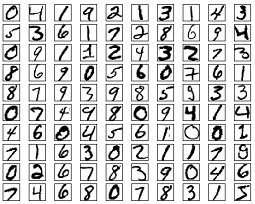\n",
"\n",
"## Usage\n",
"In our examples, we are using TensorFlow [input_data.py](https://github.com/tensorflow/tensorflow/blob/r0.7/tensorflow/examples/tutorials/mnist/input_data.py) script to load that dataset.\n",
"It is quite useful for managing our data, and handle:\n",
"\n",
"- Dataset downloading\n",
"\n",
"- Loading the entire dataset into numpy array: \n",
"\n",
"\n"
]
},
{
"cell_type": "code",
"execution_count": null,
"metadata": {
"collapsed": true
},
"outputs": [],
"source": [
"# Import MNIST\n",
"from tensorflow.examples.tutorials.mnist import input_data\n",
"mnist = input_data.read_data_sets(\"/tmp/data/\", one_hot=True)\n",
"\n",
"# Load data\n",
"X_train = mnist.train.images\n",
"Y_train = mnist.train.labels\n",
"X_test = mnist.test.images\n",
"Y_test = mnist.test.labels"
]
},
{
"cell_type": "markdown",
"metadata": {},
"source": [
"- A `next_batch` function that can iterate over the whole dataset and return only the desired fraction of the dataset samples (in order to save memory and avoid to load the entire dataset)."
]
},
{
"cell_type": "code",
"execution_count": null,
"metadata": {
"collapsed": true
},
"outputs": [],
"source": [
"# Get the next 64 images array and labels\n",
"batch_X, batch_Y = mnist.train.next_batch(64)"
]
},
{
"cell_type": "markdown",
"metadata": {},
"source": [
"Link: http://yann.lecun.com/exdb/mnist/"
]
}
],
"metadata": {
"kernelspec": {
"display_name": "Python 2",
"language": "python",
"name": "python2"
},
"language_info": {
"codemirror_mode": {
"name": "ipython",
"version": 2
},
"file_extension": ".py",
"mimetype": "text/x-python",
"name": "python",
"nbconvert_exporter": "python",
"pygments_lexer": "ipython2",
"version": "2.7.13"
}
},
"nbformat": 4,
"nbformat_minor": 0
}
================================================
FILE: notebooks/1_Introduction/basic_eager_api.ipynb
================================================
{
"cells": [
{
"cell_type": "markdown",
"metadata": {},
"source": [
"# Basic introduction to TensorFlow's Eager API\n",
"\n",
"A simple introduction to get started with TensorFlow's Eager API.\n",
"\n",
"- Author: Aymeric Damien\n",
"- Project: https://github.com/aymericdamien/TensorFlow-Examples/"
]
},
{
"cell_type": "markdown",
"metadata": {},
"source": [
"### What is TensorFlow's Eager API ?\n",
"\n",
"*Eager execution is an imperative, define-by-run interface where operations are\n",
"executed immediately as they are called from Python. This makes it easier to\n",
"get started with TensorFlow, and can make research and development more\n",
"intuitive. A vast majority of the TensorFlow API remains the same whether eager\n",
"execution is enabled or not. As a result, the exact same code that constructs\n",
"TensorFlow graphs (e.g. using the layers API) can be executed imperatively\n",
"by using eager execution. Conversely, most models written with Eager enabled\n",
"can be converted to a graph that can be further optimized and/or extracted\n",
"for deployment in production without changing code. - Rajat Monga*\n",
"\n",
"More info: https://research.googleblog.com/2017/10/eager-execution-imperative-define-by.html"
]
},
{
"cell_type": "code",
"execution_count": 1,
"metadata": {
"collapsed": true
},
"outputs": [],
"source": [
"from __future__ import absolute_import, division, print_function\n",
"\n",
"import numpy as np\n",
"import tensorflow as tf"
]
},
{
"cell_type": "code",
"execution_count": 2,
"metadata": {
"collapsed": false
},
"outputs": [
{
"name": "stdout",
"output_type": "stream",
"text": [
"Setting Eager mode...\n"
]
}
],
"source": [
"# Set Eager API\n",
"print(\"Setting Eager mode...\")\n",
"tf.enable_eager_execution()\n",
"tfe = tf.contrib.eager"
]
},
{
"cell_type": "code",
"execution_count": 3,
"metadata": {
"collapsed": false
},
"outputs": [
{
"name": "stdout",
"output_type": "stream",
"text": [
"Define constant tensors\n",
"a = 2\n",
"b = 3\n"
]
}
],
"source": [
"# Define constant tensors\n",
"print(\"Define constant tensors\")\n",
"a = tf.constant(2)\n",
"print(\"a = %i\" % a)\n",
"b = tf.constant(3)\n",
"print(\"b = %i\" % b)"
]
},
{
"cell_type": "code",
"execution_count": 4,
"metadata": {
"collapsed": false
},
"outputs": [
{
"name": "stdout",
"output_type": "stream",
"text": [
"Running operations, without tf.Session\n",
"a + b = 5\n",
"a * b = 6\n"
]
}
],
"source": [
"# Run the operation without the need for tf.Session\n",
"print(\"Running operations, without tf.Session\")\n",
"c = a + b\n",
"print(\"a + b = %i\" % c)\n",
"d = a * b\n",
"print(\"a * b = %i\" % d)"
]
},
{
"cell_type": "code",
"execution_count": 5,
"metadata": {
"collapsed": false
},
"outputs": [
{
"name": "stdout",
"output_type": "stream",
"text": [
"Mixing operations with Tensors and Numpy Arrays\n",
"Tensor:\n",
" a = tf.Tensor(\n",
"[[2. 1.]\n",
" [1. 0.]], shape=(2, 2), dtype=float32)\n",
"NumpyArray:\n",
" b = [[3. 0.]\n",
" [5. 1.]]\n"
]
}
],
"source": [
"# Full compatibility with Numpy\n",
"print(\"Mixing operations with Tensors and Numpy Arrays\")\n",
"\n",
"# Define constant tensors\n",
"a = tf.constant([[2., 1.],\n",
" [1., 0.]], dtype=tf.float32)\n",
"print(\"Tensor:\\n a = %s\" % a)\n",
"b = np.array([[3., 0.],\n",
" [5., 1.]], dtype=np.float32)\n",
"print(\"NumpyArray:\\n b = %s\" % b)"
]
},
{
"cell_type": "code",
"execution_count": 6,
"metadata": {
"collapsed": false
},
"outputs": [
{
"name": "stdout",
"output_type": "stream",
"text": [
"Running operations, without tf.Session\n",
"a + b = tf.Tensor(\n",
"[[5. 1.]\n",
" [6. 1.]], shape=(2, 2), dtype=float32)\n",
"a * b = tf.Tensor(\n",
"[[11. 1.]\n",
" [ 3. 0.]], shape=(2, 2), dtype=float32)\n"
]
}
],
"source": [
"# Run the operation without the need for tf.Session\n",
"print(\"Running operations, without tf.Session\")\n",
"\n",
"c = a + b\n",
"print(\"a + b = %s\" % c)\n",
"\n",
"d = tf.matmul(a, b)\n",
"print(\"a * b = %s\" % d)"
]
},
{
"cell_type": "code",
"execution_count": 7,
"metadata": {
"collapsed": false
},
"outputs": [
{
"name": "stdout",
"output_type": "stream",
"text": [
"Iterate through Tensor 'a':\n",
"tf.Tensor(2.0, shape=(), dtype=float32)\n",
"tf.Tensor(1.0, shape=(), dtype=float32)\n",
"tf.Tensor(1.0, shape=(), dtype=float32)\n",
"tf.Tensor(0.0, shape=(), dtype=float32)\n"
]
}
],
"source": [
"print(\"Iterate through Tensor 'a':\")\n",
"for i in range(a.shape[0]):\n",
" for j in range(a.shape[1]):\n",
" print(a[i][j])"
]
}
],
"metadata": {
"anaconda-cloud": {},
"kernelspec": {
"display_name": "Python [default]",
"language": "python",
"name": "python2"
},
"language_info": {
"codemirror_mode": {
"name": "ipython",
"version": 2
},
"file_extension": ".py",
"mimetype": "text/x-python",
"name": "python",
"nbconvert_exporter": "python",
"pygments_lexer": "ipython2",
"version": "2.7.12"
}
},
"nbformat": 4,
"nbformat_minor": 1
}
================================================
FILE: notebooks/1_Introduction/basic_operations.ipynb
================================================
{
"cells": [
{
"cell_type": "code",
"execution_count": 1,
"metadata": {
"collapsed": true
},
"outputs": [],
"source": [
"# Basic Operations example using TensorFlow library.\n",
"# Author: Aymeric Damien\n",
"# Project: https://github.com/aymericdamien/TensorFlow-Examples/"
]
},
{
"cell_type": "code",
"execution_count": 2,
"metadata": {
"collapsed": true
},
"outputs": [],
"source": [
"import tensorflow as tf"
]
},
{
"cell_type": "code",
"execution_count": 3,
"metadata": {
"collapsed": true
},
"outputs": [],
"source": [
"# Basic constant operations\n",
"# The value returned by the constructor represents the output\n",
"# of the Constant op.\n",
"a = tf.constant(2)\n",
"b = tf.constant(3)"
]
},
{
"cell_type": "code",
"execution_count": 4,
"metadata": {
"collapsed": false
},
"outputs": [
{
"name": "stdout",
"output_type": "stream",
"text": [
"a=2, b=3\n",
"Addition with constants: 5\n",
"Multiplication with constants: 6\n"
]
}
],
"source": [
"# Launch the default graph.\n",
"with tf.Session() as sess:\n",
" print \"a: %i\" % sess.run(a), \"b: %i\" % sess.run(b)\n",
" print \"Addition with constants: %i\" % sess.run(a+b)\n",
" print \"Multiplication with constants: %i\" % sess.run(a*b)"
]
},
{
"cell_type": "code",
"execution_count": 5,
"metadata": {
"collapsed": true
},
"outputs": [],
"source": [
"# Basic Operations with variable as graph input\n",
"# The value returned by the constructor represents the output\n",
"# of the Variable op. (define as input when running session)\n",
"# tf Graph input\n",
"a = tf.placeholder(tf.int16)\n",
"b = tf.placeholder(tf.int16)"
]
},
{
"cell_type": "code",
"execution_count": 6,
"metadata": {
"collapsed": true
},
"outputs": [],
"source": [
"# Define some operations\n",
"add = tf.add(a, b)\n",
"mul = tf.multiply(a, b)"
]
},
{
"cell_type": "code",
"execution_count": 7,
"metadata": {
"collapsed": false
},
"outputs": [
{
"name": "stdout",
"output_type": "stream",
"text": [
"Addition with variables: 5\n",
"Multiplication with variables: 6\n"
]
}
],
"source": [
"# Launch the default graph.\n",
"with tf.Session() as sess:\n",
" # Run every operation with variable input\n",
" print \"Addition with variables: %i\" % sess.run(add, feed_dict={a: 2, b: 3})\n",
" print \"Multiplication with variables: %i\" % sess.run(mul, feed_dict={a: 2, b: 3})"
]
},
{
"cell_type": "code",
"execution_count": 8,
"metadata": {
"collapsed": true
},
"outputs": [],
"source": [
"# ----------------\n",
"# More in details:\n",
"# Matrix Multiplication from TensorFlow official tutorial\n",
"\n",
"# Create a Constant op that produces a 1x2 matrix. The op is\n",
"# added as a node to the default graph.\n",
"#\n",
"# The value returned by the constructor represents the output\n",
"# of the Constant op.\n",
"matrix1 = tf.constant([[3., 3.]])"
]
},
{
"cell_type": "code",
"execution_count": 9,
"metadata": {
"collapsed": true
},
"outputs": [],
"source": [
"# Create another Constant that produces a 2x1 matrix.\n",
"matrix2 = tf.constant([[2.],[2.]])"
]
},
{
"cell_type": "code",
"execution_count": 10,
"metadata": {
"collapsed": true
},
"outputs": [],
"source": [
"# Create a Matmul op that takes 'matrix1' and 'matrix2' as inputs.\n",
"# The returned value, 'product', represents the result of the matrix\n",
"# multiplication.\n",
"product = tf.matmul(matrix1, matrix2)"
]
},
{
"cell_type": "code",
"execution_count": 11,
"metadata": {
"collapsed": false
},
"outputs": [
{
"name": "stdout",
"output_type": "stream",
"text": [
"[[ 12.]]\n"
]
}
],
"source": [
"# To run the matmul op we call the session 'run()' method, passing 'product'\n",
"# which represents the output of the matmul op. This indicates to the call\n",
"# that we want to get the output of the matmul op back.\n",
"#\n",
"# All inputs needed by the op are run automatically by the session. They\n",
"# typically are run in parallel.\n",
"#\n",
"# The call 'run(product)' thus causes the execution of threes ops in the\n",
"# graph: the two constants and matmul.\n",
"#\n",
"# The output of the op is returned in 'result' as a numpy `ndarray` object.\n",
"with tf.Session() as sess:\n",
" result = sess.run(product)\n",
" print result"
]
}
],
"metadata": {
"kernelspec": {
"display_name": "IPython (Python 2.7)",
"language": "python",
"name": "python2"
},
"language_info": {
"codemirror_mode": {
"name": "ipython",
"version": 2.0
},
"file_extension": ".py",
"mimetype": "text/x-python",
"name": "python",
"nbconvert_exporter": "python",
"pygments_lexer": "ipython2",
"version": "2.7.8"
}
},
"nbformat": 4,
"nbformat_minor": 0
}
================================================
FILE: notebooks/1_Introduction/helloworld.ipynb
================================================
{
"cells": [
{
"cell_type": "code",
"execution_count": 1,
"metadata": {
"collapsed": false
},
"outputs": [],
"source": [
"import tensorflow as tf"
]
},
{
"cell_type": "code",
"execution_count": 2,
"metadata": {
"collapsed": true
},
"outputs": [],
"source": [
"# Simple hello world using TensorFlow\n",
"\n",
"# Create a Constant op\n",
"# The op is added as a node to the default graph.\n",
"#\n",
"# The value returned by the constructor represents the output\n",
"# of the Constant op.\n",
"\n",
"hello = tf.constant('Hello, TensorFlow!')"
]
},
{
"cell_type": "code",
"execution_count": 3,
"metadata": {
"collapsed": true
},
"outputs": [],
"source": [
"# Start tf session\n",
"sess = tf.Session()"
]
},
{
"cell_type": "code",
"execution_count": 4,
"metadata": {
"collapsed": false
},
"outputs": [
{
"name": "stdout",
"output_type": "stream",
"text": [
"Hello, TensorFlow!\n"
]
}
],
"source": [
"# Run graph\n",
"print(sess.run(hello))"
]
}
],
"metadata": {
"kernelspec": {
"display_name": "IPython (Python 2.7)",
"language": "python",
"name": "python2"
},
"language_info": {
"codemirror_mode": {
"name": "ipython",
"version": 2.0
},
"file_extension": ".py",
"mimetype": "text/x-python",
"name": "python",
"nbconvert_exporter": "python",
"pygments_lexer": "ipython2",
"version": "2.7.8"
}
},
"nbformat": 4,
"nbformat_minor": 0
}
================================================
FILE: notebooks/2_BasicModels/gradient_boosted_decision_tree.ipynb
================================================
{
"cells": [
{
"cell_type": "markdown",
"metadata": {},
"source": [
"# Gradient Boosted Decision Tree\n",
"\n",
"Implement a Gradient Boosted Decision tree (GBDT) with TensorFlow to classify\n",
"handwritten digit images. This example is using the MNIST database of\n",
"handwritten digits as training samples (http://yann.lecun.com/exdb/mnist/).\n",
"\n",
"- Author: Aymeric Damien\n",
"- Project: https://github.com/aymericdamien/TensorFlow-Examples/"
]
},
{
"cell_type": "code",
"execution_count": 1,
"metadata": {
"collapsed": true
},
"outputs": [],
"source": [
"from __future__ import print_function\n",
"\n",
"import tensorflow as tf\n",
"from tensorflow.contrib.boosted_trees.estimator_batch.estimator import GradientBoostedDecisionTreeClassifier\n",
"from tensorflow.contrib.boosted_trees.proto import learner_pb2 as gbdt_learner\n",
"\n",
"# Ignore all GPUs (current TF GBDT does not support GPU).\n",
"import os\n",
"os.environ[\"CUDA_VISIBLE_DEVICES\"] = \"\""
]
},
{
"cell_type": "code",
"execution_count": 2,
"metadata": {
"collapsed": false
},
"outputs": [
{
"name": "stdout",
"output_type": "stream",
"text": [
"Extracting /tmp/data/train-images-idx3-ubyte.gz\n",
"Extracting /tmp/data/train-labels-idx1-ubyte.gz\n",
"Extracting /tmp/data/t10k-images-idx3-ubyte.gz\n",
"Extracting /tmp/data/t10k-labels-idx1-ubyte.gz\n"
]
}
],
"source": [
"# Import MNIST data\n",
"# Set verbosity to display errors only (Remove this line for showing warnings)\n",
"tf.logging.set_verbosity(tf.logging.ERROR)\n",
"from tensorflow.examples.tutorials.mnist import input_data\n",
"mnist = input_data.read_data_sets(\"/tmp/data/\", one_hot=False,\n",
" source_url='http://yann.lecun.com/exdb/mnist/')"
]
},
{
"cell_type": "code",
"execution_count": 3,
"metadata": {
"collapsed": true
},
"outputs": [],
"source": [
"# Parameters\n",
"batch_size = 4096 # The number of samples per batch\n",
"num_classes = 10 # The 10 digits\n",
"num_features = 784 # Each image is 28x28 pixels\n",
"max_steps = 10000\n",
"\n",
"# GBDT Parameters\n",
"learning_rate = 0.1\n",
"l1_regul = 0.\n",
"l2_regul = 1.\n",
"examples_per_layer = 1000\n",
"num_trees = 10\n",
"max_depth = 16"
]
},
{
"cell_type": "code",
"execution_count": 4,
"metadata": {
"collapsed": true
},
"outputs": [],
"source": [
"# Fill GBDT parameters into the config proto\n",
"learner_config = gbdt_learner.LearnerConfig()\n",
"learner_config.learning_rate_tuner.fixed.learning_rate = learning_rate\n",
"learner_config.regularization.l1 = l1_regul\n",
"learner_config.regularization.l2 = l2_regul / examples_per_layer\n",
"learner_config.constraints.max_tree_depth = max_depth\n",
"growing_mode = gbdt_learner.LearnerConfig.LAYER_BY_LAYER\n",
"learner_config.growing_mode = growing_mode\n",
"run_config = tf.contrib.learn.RunConfig(save_checkpoints_secs=300)\n",
"learner_config.multi_class_strategy = (\n",
" gbdt_learner.LearnerConfig.DIAGONAL_HESSIAN)\\\n",
"\n",
"# Create a TensorFlor GBDT Estimator\n",
"gbdt_model = GradientBoostedDecisionTreeClassifier(\n",
" model_dir=None, # No save directory specified\n",
" learner_config=learner_config,\n",
" n_classes=num_classes,\n",
" examples_per_layer=examples_per_layer,\n",
" num_trees=num_trees,\n",
" center_bias=False,\n",
" config=run_config)"
]
},
{
"cell_type": "code",
"execution_count": 5,
"metadata": {
"collapsed": false,
"scrolled": false
},
"outputs": [
{
"name": "stdout",
"output_type": "stream",
"text": [
"INFO:tensorflow:Active Feature Columns: ['images_0', 'images_1', 'images_2', 'images_3', 'images_4', 'images_5', 'images_6', 'images_7', 'images_8', 'images_9', 'images_10', 'images_11', 'images_12', 'images_13', 'images_14', 'images_15', 'images_16', 'images_17', 'images_18', 'images_19', 'images_20', 'images_21', 'images_22', 'images_23', 'images_24', 'images_25', 'images_26', 'images_27', 'images_28', 'images_29', 'images_30', 'images_31', 'images_32', 'images_33', 'images_34', 'images_35', 'images_36', 'images_37', 'images_38', 'images_39', 'images_40', 'images_41', 'images_42', 'images_43', 'images_44', 'images_45', 'images_46', 'images_47', 'images_48', 'images_49', 'images_50', 'images_51', 'images_52', 'images_53', 'images_54', 'images_55', 'images_56', 'images_57', 'images_58', 'images_59', 'images_60', 'images_61', 'images_62', 'images_63', 'images_64', 'images_65', 'images_66', 'images_67', 'images_68', 'images_69', 'images_70', 'images_71', 'images_72', 'images_73', 'images_74', 'images_75', 'images_76', 'images_77', 'images_78', 'images_79', 'images_80', 'images_81', 'images_82', 'images_83', 'images_84', 'images_85', 'images_86', 'images_87', 'images_88', 'images_89', 'images_90', 'images_91', 'images_92', 'images_93', 'images_94', 'images_95', 'images_96', 'images_97', 'images_98', 'images_99', 'images_100', 'images_101', 'images_102', 'images_103', 'images_104', 'images_105', 'images_106', 'images_107', 'images_108', 'images_109', 'images_110', 'images_111', 'images_112', 'images_113', 'images_114', 'images_115', 'images_116', 'images_117', 'images_118', 'images_119', 'images_120', 'images_121', 'images_122', 'images_123', 'images_124', 'images_125', 'images_126', 'images_127', 'images_128', 'images_129', 'images_130', 'images_131', 'images_132', 'images_133', 'images_134', 'images_135', 'images_136', 'images_137', 'images_138', 'images_139', 'images_140', 'images_141', 'images_142', 'images_143', 'images_144', 'images_145', 'images_146', 'images_147', 'images_148', 'images_149', 'images_150', 'images_151', 'images_152', 'images_153', 'images_154', 'images_155', 'images_156', 'images_157', 'images_158', 'images_159', 'images_160', 'images_161', 'images_162', 'images_163', 'images_164', 'images_165', 'images_166', 'images_167', 'images_168', 'images_169', 'images_170', 'images_171', 'images_172', 'images_173', 'images_174', 'images_175', 'images_176', 'images_177', 'images_178', 'images_179', 'images_180', 'images_181', 'images_182', 'images_183', 'images_184', 'images_185', 'images_186', 'images_187', 'images_188', 'images_189', 'images_190', 'images_191', 'images_192', 'images_193', 'images_194', 'images_195', 'images_196', 'images_197', 'images_198', 'images_199', 'images_200', 'images_201', 'images_202', 'images_203', 'images_204', 'images_205', 'images_206', 'images_207', 'images_208', 'images_209', 'images_210', 'images_211', 'images_212', 'images_213', 'images_214', 'images_215', 'images_216', 'images_217', 'images_218', 'images_219', 'images_220', 'images_221', 'images_222', 'images_223', 'images_224', 'images_225', 'images_226', 'images_227', 'images_228', 'images_229', 'images_230', 'images_231', 'images_232', 'images_233', 'images_234', 'images_235', 'images_236', 'images_237', 'images_238', 'images_239', 'images_240', 'images_241', 'images_242', 'images_243', 'images_244', 'images_245', 'images_246', 'images_247', 'images_248', 'images_249', 'images_250', 'images_251', 'images_252', 'images_253', 'images_254', 'images_255', 'images_256', 'images_257', 'images_258', 'images_259', 'images_260', 'images_261', 'images_262', 'images_263', 'images_264', 'images_265', 'images_266', 'images_267', 'images_268', 'images_269', 'images_270', 'images_271', 'images_272', 'images_273', 'images_274', 'images_275', 'images_276', 'images_277', 'images_278', 'images_279', 'images_280', 'images_281', 'images_282', 'images_283', 'images_284', 'images_285', 'images_286', 'images_287', 'images_288', 'images_289', 'images_290', 'images_291', 'images_292', 'images_293', 'images_294', 'images_295', 'images_296', 'images_297', 'images_298', 'images_299', 'images_300', 'images_301', 'images_302', 'images_303', 'images_304', 'images_305', 'images_306', 'images_307', 'images_308', 'images_309', 'images_310', 'images_311', 'images_312', 'images_313', 'images_314', 'images_315', 'images_316', 'images_317', 'images_318', 'images_319', 'images_320', 'images_321', 'images_322', 'images_323', 'images_324', 'images_325', 'images_326', 'images_327', 'images_328', 'images_329', 'images_330', 'images_331', 'images_332', 'images_333', 'images_334', 'images_335', 'images_336', 'images_337', 'images_338', 'images_339', 'images_340', 'images_341', 'images_342', 'images_343', 'images_344', 'images_345', 'images_346', 'images_347', 'images_348', 'images_349', 'images_350', 'images_351', 'images_352', 'images_353', 'images_354', 'images_355', 'images_356', 'images_357', 'images_358', 'images_359', 'images_360', 'images_361', 'images_362', 'images_363', 'images_364', 'images_365', 'images_366', 'images_367', 'images_368', 'images_369', 'images_370', 'images_371', 'images_372', 'images_373', 'images_374', 'images_375', 'images_376', 'images_377', 'images_378', 'images_379', 'images_380', 'images_381', 'images_382', 'images_383', 'images_384', 'images_385', 'images_386', 'images_387', 'images_388', 'images_389', 'images_390', 'images_391', 'images_392', 'images_393', 'images_394', 'images_395', 'images_396', 'images_397', 'images_398', 'images_399', 'images_400', 'images_401', 'images_402', 'images_403', 'images_404', 'images_405', 'images_406', 'images_407', 'images_408', 'images_409', 'images_410', 'images_411', 'images_412', 'images_413', 'images_414', 'images_415', 'images_416', 'images_417', 'images_418', 'images_419', 'images_420', 'images_421', 'images_422', 'images_423', 'images_424', 'images_425', 'images_426', 'images_427', 'images_428', 'images_429', 'images_430', 'images_431', 'images_432', 'images_433', 'images_434', 'images_435', 'images_436', 'images_437', 'images_438', 'images_439', 'images_440', 'images_441', 'images_442', 'images_443', 'images_444', 'images_445', 'images_446', 'images_447', 'images_448', 'images_449', 'images_450', 'images_451', 'images_452', 'images_453', 'images_454', 'images_455', 'images_456', 'images_457', 'images_458', 'images_459', 'images_460', 'images_461', 'images_462', 'images_463', 'images_464', 'images_465', 'images_466', 'images_467', 'images_468', 'images_469', 'images_470', 'images_471', 'images_472', 'images_473', 'images_474', 'images_475', 'images_476', 'images_477', 'images_478', 'images_479', 'images_480', 'images_481', 'images_482', 'images_483', 'images_484', 'images_485', 'images_486', 'images_487', 'images_488', 'images_489', 'images_490', 'images_491', 'images_492', 'images_493', 'images_494', 'images_495', 'images_496', 'images_497', 'images_498', 'images_499', 'images_500', 'images_501', 'images_502', 'images_503', 'images_504', 'images_505', 'images_506', 'images_507', 'images_508', 'images_509', 'images_510', 'images_511', 'images_512', 'images_513', 'images_514', 'images_515', 'images_516', 'images_517', 'images_518', 'images_519', 'images_520', 'images_521', 'images_522', 'images_523', 'images_524', 'images_525', 'images_526', 'images_527', 'images_528', 'images_529', 'images_530', 'images_531', 'images_532', 'images_533', 'images_534', 'images_535', 'images_536', 'images_537', 'images_538', 'images_539', 'images_540', 'images_541', 'images_542', 'images_543', 'images_544', 'images_545', 'images_546', 'images_547', 'images_548', 'images_549', 'images_550', 'images_551', 'images_552', 'images_553', 'images_554', 'images_555', 'images_556', 'images_557', 'images_558', 'images_559', 'images_560', 'images_561', 'images_562', 'images_563', 'images_564', 'images_565', 'images_566', 'images_567', 'images_568', 'images_569', 'images_570', 'images_571', 'images_572', 'images_573', 'images_574', 'images_575', 'images_576', 'images_577', 'images_578', 'images_579', 'images_580', 'images_581', 'images_582', 'images_583', 'images_584', 'images_585', 'images_586', 'images_587', 'images_588', 'images_589', 'images_590', 'images_591', 'images_592', 'images_593', 'images_594', 'images_595', 'images_596', 'images_597', 'images_598', 'images_599', 'images_600', 'images_601', 'images_602', 'images_603', 'images_604', 'images_605', 'images_606', 'images_607', 'images_608', 'images_609', 'images_610', 'images_611', 'images_612', 'images_613', 'images_614', 'images_615', 'images_616', 'images_617', 'images_618', 'images_619', 'images_620', 'images_621', 'images_622', 'images_623', 'images_624', 'images_625', 'images_626', 'images_627', 'images_628', 'images_629', 'images_630', 'images_631', 'images_632', 'images_633', 'images_634', 'images_635', 'images_636', 'images_637', 'images_638', 'images_639', 'images_640', 'images_641', 'images_642', 'images_643', 'images_644', 'images_645', 'images_646', 'images_647', 'images_648', 'images_649', 'images_650', 'images_651', 'images_652', 'images_653', 'images_654', 'images_655', 'images_656', 'images_657', 'images_658', 'images_659', 'images_660', 'images_661', 'images_662', 'images_663', 'images_664', 'images_665', 'images_666', 'images_667', 'images_668', 'images_669', 'images_670', 'images_671', 'images_672', 'images_673', 'images_674', 'images_675', 'images_676', 'images_677', 'images_678', 'images_679', 'images_680', 'images_681', 'images_682', 'images_683', 'images_684', 'images_685', 'images_686', 'images_687', 'images_688', 'images_689', 'images_690', 'images_691', 'images_692', 'images_693', 'images_694', 'images_695', 'images_696', 'images_697', 'images_698', 'images_699', 'images_700', 'images_701', 'images_702', 'images_703', 'images_704', 'images_705', 'images_706', 'images_707', 'images_708', 'images_709', 'images_710', 'images_711', 'images_712', 'images_713', 'images_714', 'images_715', 'images_716', 'images_717', 'images_718', 'images_719', 'images_720', 'images_721', 'images_722', 'images_723', 'images_724', 'images_725', 'images_726', 'images_727', 'images_728', 'images_729', 'images_730', 'images_731', 'images_732', 'images_733', 'images_734', 'images_735', 'images_736', 'images_737', 'images_738', 'images_739', 'images_740', 'images_741', 'images_742', 'images_743', 'images_744', 'images_745', 'images_746', 'images_747', 'images_748', 'images_749', 'images_750', 'images_751', 'images_752', 'images_753', 'images_754', 'images_755', 'images_756', 'images_757', 'images_758', 'images_759', 'images_760', 'images_761', 'images_762', 'images_763', 'images_764', 'images_765', 'images_766', 'images_767', 'images_768', 'images_769', 'images_770', 'images_771', 'images_772', 'images_773', 'images_774', 'images_775', 'images_776', 'images_777', 'images_778', 'images_779', 'images_780', 'images_781', 'images_782', 'images_783']\n",
"WARNING:tensorflow:From /Users/aymeric.damien/anaconda2/lib/python2.7/site-packages/tensorflow/contrib/learn/python/learn/estimators/head.py:678: __new__ (from tensorflow.contrib.learn.python.learn.estimators.model_fn) is deprecated and will be removed in a future version.\n",
"Instructions for updating:\n",
"When switching to tf.estimator.Estimator, use tf.estimator.EstimatorSpec. You can use the `estimator_spec` method to create an equivalent one.\n",
"INFO:tensorflow:Create CheckpointSaverHook.\n",
"WARNING:tensorflow:Issue encountered when serializing resources.\n",
"Type is unsupported, or the types of the items don't match field type in CollectionDef. Note this is a warning and probably safe to ignore.\n",
"'_Resource' object has no attribute 'name'\n",
"INFO:tensorflow:Graph was finalized.\n",
"INFO:tensorflow:R
gitextract_u9xusu3s/
├── .gitignore
├── LICENSE
├── README.md
├── examples/
│ ├── 1_Introduction/
│ │ ├── basic_eager_api.py
│ │ ├── basic_operations.py
│ │ └── helloworld.py
│ ├── 2_BasicModels/
│ │ ├── gradient_boosted_decision_tree.py
│ │ ├── kmeans.py
│ │ ├── linear_regression.py
│ │ ├── linear_regression_eager_api.py
│ │ ├── logistic_regression.py
│ │ ├── logistic_regression_eager_api.py
│ │ ├── nearest_neighbor.py
│ │ ├── random_forest.py
│ │ └── word2vec.py
│ ├── 3_NeuralNetworks/
│ │ ├── autoencoder.py
│ │ ├── bidirectional_rnn.py
│ │ ├── convolutional_network.py
│ │ ├── convolutional_network_raw.py
│ │ ├── dcgan.py
│ │ ├── dynamic_rnn.py
│ │ ├── gan.py
│ │ ├── multilayer_perceptron.py
│ │ ├── neural_network.py
│ │ ├── neural_network_eager_api.py
│ │ ├── neural_network_raw.py
│ │ ├── recurrent_network.py
│ │ └── variational_autoencoder.py
│ ├── 4_Utils/
│ │ ├── save_restore_model.py
│ │ ├── tensorboard_advanced.py
│ │ └── tensorboard_basic.py
│ ├── 5_DataManagement/
│ │ ├── build_an_image_dataset.py
│ │ └── tensorflow_dataset_api.py
│ ├── 6_MultiGPU/
│ │ ├── multigpu_basics.py
│ │ └── multigpu_cnn.py
│ └── README.md
├── input_data.py
├── notebooks/
│ ├── 0_Prerequisite/
│ │ ├── ml_introduction.ipynb
│ │ └── mnist_dataset_intro.ipynb
│ ├── 1_Introduction/
│ │ ├── basic_eager_api.ipynb
│ │ ├── basic_operations.ipynb
│ │ └── helloworld.ipynb
│ ├── 2_BasicModels/
│ │ ├── gradient_boosted_decision_tree.ipynb
│ │ ├── kmeans.ipynb
│ │ ├── linear_regression.ipynb
│ │ ├── linear_regression_eager_api.ipynb
│ │ ├── logistic_regression.ipynb
│ │ ├── logistic_regression_eager_api.ipynb
│ │ ├── nearest_neighbor.ipynb
│ │ ├── random_forest.ipynb
│ │ └── word2vec.ipynb
│ ├── 3_NeuralNetworks/
│ │ ├── autoencoder.ipynb
│ │ ├── bidirectional_rnn.ipynb
│ │ ├── convolutional_network.ipynb
│ │ ├── convolutional_network_raw.ipynb
│ │ ├── dcgan.ipynb
│ │ ├── dynamic_rnn.ipynb
│ │ ├── gan.ipynb
│ │ ├── neural_network.ipynb
│ │ ├── neural_network_eager_api.ipynb
│ │ ├── neural_network_raw.ipynb
│ │ ├── recurrent_network.ipynb
│ │ └── variational_autoencoder.ipynb
│ ├── 4_Utils/
│ │ ├── save_restore_model.ipynb
│ │ ├── tensorboard_advanced.ipynb
│ │ └── tensorboard_basic.ipynb
│ ├── 5_DataManagement/
│ │ ├── build_an_image_dataset.ipynb
│ │ ├── image_transformation.ipynb
│ │ ├── load_data.ipynb
│ │ ├── tensorflow_dataset_api.ipynb
│ │ └── tfrecords.ipynb
│ ├── 6_MultiGPU/
│ │ ├── multigpu_basics.ipynb
│ │ └── multigpu_cnn.ipynb
│ └── README.md
├── tensorflow_v1/
│ ├── README.md
│ ├── examples/
│ │ ├── 1_Introduction/
│ │ │ ├── basic_eager_api.py
│ │ │ ├── basic_operations.py
│ │ │ └── helloworld.py
│ │ ├── 2_BasicModels/
│ │ │ ├── gradient_boosted_decision_tree.py
│ │ │ ├── kmeans.py
│ │ │ ├── linear_regression.py
│ │ │ ├── linear_regression_eager_api.py
│ │ │ ├── logistic_regression.py
│ │ │ ├── logistic_regression_eager_api.py
│ │ │ ├── nearest_neighbor.py
│ │ │ ├── random_forest.py
│ │ │ └── word2vec.py
│ │ ├── 3_NeuralNetworks/
│ │ │ ├── autoencoder.py
│ │ │ ├── bidirectional_rnn.py
│ │ │ ├── convolutional_network.py
│ │ │ ├── convolutional_network_raw.py
│ │ │ ├── dcgan.py
│ │ │ ├── dynamic_rnn.py
│ │ │ ├── gan.py
│ │ │ ├── multilayer_perceptron.py
│ │ │ ├── neural_network.py
│ │ │ ├── neural_network_eager_api.py
│ │ │ ├── neural_network_raw.py
│ │ │ ├── recurrent_network.py
│ │ │ └── variational_autoencoder.py
│ │ ├── 4_Utils/
│ │ │ ├── save_restore_model.py
│ │ │ ├── tensorboard_advanced.py
│ │ │ └── tensorboard_basic.py
│ │ ├── 5_DataManagement/
│ │ │ ├── build_an_image_dataset.py
│ │ │ └── tensorflow_dataset_api.py
│ │ └── 6_MultiGPU/
│ │ ├── multigpu_basics.py
│ │ └── multigpu_cnn.py
│ └── notebooks/
│ ├── 0_Prerequisite/
│ │ ├── ml_introduction.ipynb
│ │ └── mnist_dataset_intro.ipynb
│ ├── 1_Introduction/
│ │ ├── basic_eager_api.ipynb
│ │ ├── basic_operations.ipynb
│ │ └── helloworld.ipynb
│ ├── 2_BasicModels/
│ │ ├── gradient_boosted_decision_tree.ipynb
│ │ ├── kmeans.ipynb
│ │ ├── linear_regression.ipynb
│ │ ├── linear_regression_eager_api.ipynb
│ │ ├── logistic_regression.ipynb
│ │ ├── logistic_regression_eager_api.ipynb
│ │ ├── nearest_neighbor.ipynb
│ │ ├── random_forest.ipynb
│ │ └── word2vec.ipynb
│ ├── 3_NeuralNetworks/
│ │ ├── autoencoder.ipynb
│ │ ├── bidirectional_rnn.ipynb
│ │ ├── convolutional_network.ipynb
│ │ ├── convolutional_network_raw.ipynb
│ │ ├── dcgan.ipynb
│ │ ├── dynamic_rnn.ipynb
│ │ ├── gan.ipynb
│ │ ├── neural_network.ipynb
│ │ ├── neural_network_eager_api.ipynb
│ │ ├── neural_network_raw.ipynb
│ │ ├── recurrent_network.ipynb
│ │ └── variational_autoencoder.ipynb
│ ├── 4_Utils/
│ │ ├── save_restore_model.ipynb
│ │ ├── tensorboard_advanced.ipynb
│ │ └── tensorboard_basic.ipynb
│ ├── 5_DataManagement/
│ │ ├── build_an_image_dataset.ipynb
│ │ ├── image_transformation.ipynb
│ │ ├── load_data.ipynb
│ │ ├── tensorflow_dataset_api.ipynb
│ │ └── tfrecords.ipynb
│ └── 6_MultiGPU/
│ ├── multigpu_basics.ipynb
│ └── multigpu_cnn.ipynb
└── tensorflow_v2/
├── README.md
└── notebooks/
├── 0_Prerequisite/
│ ├── ml_introduction.ipynb
│ └── mnist_dataset_intro.ipynb
├── 1_Introduction/
│ ├── basic_operations.ipynb
│ └── helloworld.ipynb
├── 2_BasicModels/
│ ├── gradient_boosted_trees.ipynb
│ ├── linear_regression.ipynb
│ ├── logistic_regression.ipynb
│ └── word2vec.ipynb
├── 3_NeuralNetworks/
│ ├── autoencoder.ipynb
│ ├── bidirectional_rnn.ipynb
│ ├── convolutional_network.ipynb
│ ├── convolutional_network_raw.ipynb
│ ├── dcgan.ipynb
│ ├── dynamic_rnn.ipynb
│ ├── neural_network.ipynb
│ ├── neural_network_raw.ipynb
│ └── recurrent_network.ipynb
├── 4_Utils/
│ ├── build_custom_layers.ipynb
│ ├── save_restore_model.ipynb
│ └── tensorboard.ipynb
├── 5_DataManagement/
│ ├── image_transformation.ipynb
│ ├── load_data.ipynb
│ └── tfrecords.ipynb
└── 6_Hardware/
└── multigpu_training.ipynb
SYMBOL INDEX (101 symbols across 45 files)

FILE: examples/2_BasicModels/linear_regression_eager_api.py
  function linear_regression (line 36) | def linear_regression(inputs):
  function mean_square_fn (line 41) | def mean_square_fn(model_fn, inputs, labels):

FILE: examples/2_BasicModels/logistic_regression_eager_api.py
  function logistic_regression (line 39) | def logistic_regression(inputs):
  function loss_fn (line 44) | def loss_fn(inference_fn, inputs, labels):
  function accuracy_fn (line 51) | def accuracy_fn(inference_fn, inputs, labels):

FILE: examples/2_BasicModels/word2vec.py
  function next_batch (line 93) | def next_batch(batch_size, num_skips, skip_window):

FILE: examples/3_NeuralNetworks/autoencoder.py
  function encoder (line 57) | def encoder(x):
  function decoder (line 68) | def decoder(x):

FILE: examples/3_NeuralNetworks/bidirectional_rnn.py
  function BiRNN (line 57) | def BiRNN(x, weights, biases):

FILE: examples/3_NeuralNetworks/convolutional_network.py
  function conv_net (line 33) | def conv_net(x_dict, n_classes, dropout, reuse, is_training):
  function model_fn (line 69) | def model_fn(features, labels, mode):

FILE: examples/3_NeuralNetworks/convolutional_network_raw.py
  function conv2d (line 37) | def conv2d(x, W, b, strides=1):
  function maxpool2d (line 44) | def maxpool2d(x, k=2):
  function conv_net (line 51) | def conv_net(x, weights, biases, dropout):

FILE: examples/3_NeuralNetworks/dcgan.py
  function generator (line 41) | def generator(x, reuse=False):
  function discriminator (line 61) | def discriminator(x, reuse=False):

FILE: examples/3_NeuralNetworks/dynamic_rnn.py
  class ToySequenceData (line 24) | class ToySequenceData(object):
    method __init__ (line 36) | def __init__(self, n_samples=1000, max_seq_len=20, min_seq_len=3,
    method next (line 66) | def next(self, batch_size):
  function dynamicRNN (line 114) | def dynamicRNN(x, seqlen, weights, biases):

FILE: examples/3_NeuralNetworks/gan.py
  function glorot_init (line 44) | def glorot_init(shape):
  function generator (line 63) | def generator(x):
  function discriminator (line 74) | def discriminator(x):

FILE: examples/3_NeuralNetworks/multilayer_perceptron.py
  function multilayer_perceptron (line 59) | def multilayer_perceptron(x):

FILE: examples/3_NeuralNetworks/neural_network.py
  function neural_net (line 39) | def neural_net(x_dict):
  function model_fn (line 52) | def model_fn(features, labels, mode):

FILE: examples/3_NeuralNetworks/neural_network_eager_api.py
  class NeuralNet (line 49) | class NeuralNet(tfe.Network):
    method __init__ (line 50) | def __init__(self):
    method call (line 62) | def call(self, x):
  function loss_fn (line 72) | def loss_fn(inference_fn, inputs, labels):
  function accuracy_fn (line 79) | def accuracy_fn(inference_fn, inputs, labels):

FILE: examples/3_NeuralNetworks/neural_network_raw.py
  function neural_net (line 52) | def neural_net(x):

FILE: examples/3_NeuralNetworks/recurrent_network.py
  function RNN (line 54) | def RNN(x, weights, biases):

FILE: examples/3_NeuralNetworks/variational_autoencoder.py
  function glorot_init (line 45) | def glorot_init(shape):
  function vae_loss (line 84) | def vae_loss(x_reconstructed, x_true):

FILE: examples/4_Utils/save_restore_model.py
  function multilayer_perceptron (line 36) | def multilayer_perceptron(x, weights, biases):

FILE: examples/4_Utils/tensorboard_advanced.py
  function multilayer_perceptron (line 39) | def multilayer_perceptron(x, weights, biases):

FILE: examples/5_DataManagement/build_an_image_dataset.py
  function read_images (line 55) | def read_images(dataset_path, mode, batch_size):
  function conv_net (line 132) | def conv_net(x, n_classes, dropout, reuse, is_training):

FILE: examples/5_DataManagement/tensorflow_dataset_api.py
  function conv_net (line 56) | def conv_net(x, n_classes, dropout, reuse, is_training):

FILE: examples/6_MultiGPU/multigpu_basics.py
  function matpow (line 42) | def matpow(M, n):

FILE: examples/6_MultiGPU/multigpu_cnn.py
  function conv_net (line 39) | def conv_net(x, n_classes, dropout, reuse, is_training):
  function average_gradients (line 81) | def average_gradients(tower_grads):
  function assign_to_device (line 112) | def assign_to_device(device, ps_device='/cpu:0'):

FILE: input_data.py
  function maybe_download (line 8) | def maybe_download(filename, work_directory):
  function _read32 (line 18) | def _read32(bytestream):
  function extract_images (line 21) | def extract_images(filename):
  function dense_to_one_hot (line 37) | def dense_to_one_hot(labels_dense, num_classes=10):
  function extract_labels (line 44) | def extract_labels(filename, one_hot=False):
  class DataSet (line 59) | class DataSet(object):
    method __init__ (line 60) | def __init__(self, images, labels, fake_data=False):
    method images (line 81) | def images(self):
    method labels (line 84) | def labels(self):
    method num_examples (line 87) | def num_examples(self):
    method epochs_completed (line 90) | def epochs_completed(self):
    method next_batch (line 92) | def next_batch(self, batch_size, fake_data=False):
  function read_data_sets (line 115) | def read_data_sets(train_dir, fake_data=False, one_hot=False):

FILE: tensorflow_v1/examples/2_BasicModels/linear_regression_eager_api.py
  function linear_regression (line 36) | def linear_regression(inputs):
  function mean_square_fn (line 41) | def mean_square_fn(model_fn, inputs, labels):

FILE: tensorflow_v1/examples/2_BasicModels/logistic_regression_eager_api.py
  function logistic_regression (line 39) | def logistic_regression(inputs):
  function loss_fn (line 44) | def loss_fn(inference_fn, inputs, labels):
  function accuracy_fn (line 51) | def accuracy_fn(inference_fn, inputs, labels):

FILE: tensorflow_v1/examples/2_BasicModels/word2vec.py
  function next_batch (line 93) | def next_batch(batch_size, num_skips, skip_window):

FILE: tensorflow_v1/examples/3_NeuralNetworks/autoencoder.py
  function encoder (line 57) | def encoder(x):
  function decoder (line 68) | def decoder(x):

FILE: tensorflow_v1/examples/3_NeuralNetworks/bidirectional_rnn.py
  function BiRNN (line 57) | def BiRNN(x, weights, biases):

FILE: tensorflow_v1/examples/3_NeuralNetworks/convolutional_network.py
  function conv_net (line 33) | def conv_net(x_dict, n_classes, dropout, reuse, is_training):
  function model_fn (line 69) | def model_fn(features, labels, mode):

FILE: tensorflow_v1/examples/3_NeuralNetworks/convolutional_network_raw.py
  function conv2d (line 37) | def conv2d(x, W, b, strides=1):
  function maxpool2d (line 44) | def maxpool2d(x, k=2):
  function conv_net (line 51) | def conv_net(x, weights, biases, dropout):

FILE: tensorflow_v1/examples/3_NeuralNetworks/dcgan.py
  function generator (line 41) | def generator(x, reuse=False):
  function discriminator (line 61) | def discriminator(x, reuse=False):

FILE: tensorflow_v1/examples/3_NeuralNetworks/dynamic_rnn.py
  class ToySequenceData (line 24) | class ToySequenceData(object):
    method __init__ (line 36) | def __init__(self, n_samples=1000, max_seq_len=20, min_seq_len=3,
    method next (line 66) | def next(self, batch_size):
  function dynamicRNN (line 114) | def dynamicRNN(x, seqlen, weights, biases):

FILE: tensorflow_v1/examples/3_NeuralNetworks/gan.py
  function glorot_init (line 44) | def glorot_init(shape):
  function generator (line 63) | def generator(x):
  function discriminator (line 74) | def discriminator(x):

FILE: tensorflow_v1/examples/3_NeuralNetworks/multilayer_perceptron.py
  function multilayer_perceptron (line 59) | def multilayer_perceptron(x):

FILE: tensorflow_v1/examples/3_NeuralNetworks/neural_network.py
  function neural_net (line 39) | def neural_net(x_dict):
  function model_fn (line 52) | def model_fn(features, labels, mode):

FILE: tensorflow_v1/examples/3_NeuralNetworks/neural_network_eager_api.py
  class NeuralNet (line 49) | class NeuralNet(tfe.Network):
    method __init__ (line 50) | def __init__(self):
    method call (line 62) | def call(self, x):
  function loss_fn (line 72) | def loss_fn(inference_fn, inputs, labels):
  function accuracy_fn (line 79) | def accuracy_fn(inference_fn, inputs, labels):

FILE: tensorflow_v1/examples/3_NeuralNetworks/neural_network_raw.py
  function neural_net (line 52) | def neural_net(x):

FILE: tensorflow_v1/examples/3_NeuralNetworks/recurrent_network.py
  function RNN (line 54) | def RNN(x, weights, biases):

FILE: tensorflow_v1/examples/3_NeuralNetworks/variational_autoencoder.py
  function glorot_init (line 45) | def glorot_init(shape):
  function vae_loss (line 84) | def vae_loss(x_reconstructed, x_true):

FILE: tensorflow_v1/examples/4_Utils/save_restore_model.py
  function multilayer_perceptron (line 36) | def multilayer_perceptron(x, weights, biases):

FILE: tensorflow_v1/examples/4_Utils/tensorboard_advanced.py
  function multilayer_perceptron (line 39) | def multilayer_perceptron(x, weights, biases):

FILE: tensorflow_v1/examples/5_DataManagement/build_an_image_dataset.py
  function read_images (line 55) | def read_images(dataset_path, mode, batch_size):
  function conv_net (line 132) | def conv_net(x, n_classes, dropout, reuse, is_training):

FILE: tensorflow_v1/examples/5_DataManagement/tensorflow_dataset_api.py
  function conv_net (line 56) | def conv_net(x, n_classes, dropout, reuse, is_training):

FILE: tensorflow_v1/examples/6_MultiGPU/multigpu_basics.py
  function matpow (line 42) | def matpow(M, n):

FILE: tensorflow_v1/examples/6_MultiGPU/multigpu_cnn.py
  function conv_net (line 39) | def conv_net(x, n_classes, dropout, reuse, is_training):
  function average_gradients (line 81) | def average_gradients(tower_grads):
  function assign_to_device (line 112) | def assign_to_device(device, ps_device='/cpu:0'):
Copy disabled (too large)
Download .json
Condensed preview — 168 files, each showing path, character count, and a content snippet. Download the .json file for the full structured content (10,101K chars).
[
  {
    "path": ".gitignore",
    "chars": 118,
    "preview": ".DS_Store\n.ipynb_checkpoints\n*.pyc\n__pycache__\n*.egg-info\nbuild/*\ndist/*\n*~\n.cache\n.coverage\ncheckpoint\nhtmlcov\nmnist\n"
  },
  {
    "path": "LICENSE",
    "chars": 1386,
    "preview": "The MIT License (MIT)\n\nPermission is hereby granted, free of charge, to any person obtaining a copy\nof this software and"
  },
  {
    "path": "README.md",
    "chars": 22407,
    "preview": "# TensorFlow Examples\n\nThis tutorial was designed for easily diving into TensorFlow, through examples. For readability, "
  },
  {
    "path": "examples/1_Introduction/basic_eager_api.py",
    "chars": 2002,
    "preview": "'''\nBasic introduction to TensorFlow's Eager API.\n\nAuthor: Aymeric Damien\nProject: https://github.com/aymericdamien/Tens"
  },
  {
    "path": "examples/1_Introduction/basic_operations.py",
    "chars": 2355,
    "preview": "'''\nBasic Operations example using TensorFlow library.\n\nAuthor: Aymeric Damien\nProject: https://github.com/aymericdamien"
  },
  {
    "path": "examples/1_Introduction/helloworld.py",
    "chars": 522,
    "preview": "'''\nHelloWorld example using TensorFlow library.\n\nAuthor: Aymeric Damien\nProject: https://github.com/aymericdamien/Tenso"
  },
  {
    "path": "examples/2_BasicModels/gradient_boosted_decision_tree.py",
    "chars": 2993,
    "preview": "\"\"\" Gradient Boosted Decision Tree (GBDT).\n\nImplement a Gradient Boosted Decision tree with TensorFlow to classify\nhandw"
  },
  {
    "path": "examples/2_BasicModels/kmeans.py",
    "chars": 3153,
    "preview": "\"\"\" K-Means.\n\nImplement K-Means algorithm with TensorFlow, and apply it to classify\nhandwritten digit images. This examp"
  },
  {
    "path": "examples/2_BasicModels/linear_regression.py",
    "chars": 2986,
    "preview": "'''\nA linear regression learning algorithm example using TensorFlow library.\n\nAuthor: Aymeric Damien\nProject: https://gi"
  },
  {
    "path": "examples/2_BasicModels/linear_regression_eager_api.py",
    "chars": 1964,
    "preview": "''' Linear Regression with Eager API.\n\nA linear regression learning algorithm example using TensorFlow's Eager API.\n\nAut"
  },
  {
    "path": "examples/2_BasicModels/logistic_regression.py",
    "chars": 2360,
    "preview": "'''\nA logistic regression learning algorithm example using TensorFlow library.\nThis example is using the MNIST database "
  },
  {
    "path": "examples/2_BasicModels/logistic_regression_eager_api.py",
    "chars": 3088,
    "preview": "''' Logistic Regression with Eager API.\n\nA logistic regression learning algorithm example using TensorFlow's Eager API.\n"
  },
  {
    "path": "examples/2_BasicModels/nearest_neighbor.py",
    "chars": 1739,
    "preview": "'''\nA nearest neighbor learning algorithm example using TensorFlow library.\nThis example is using the MNIST database of "
  },
  {
    "path": "examples/2_BasicModels/random_forest.py",
    "chars": 2753,
    "preview": "\"\"\" Random Forest.\n\nImplement Random Forest algorithm with TensorFlow, and apply it to classify \nhandwritten digit image"
  },
  {
    "path": "examples/2_BasicModels/word2vec.py",
    "chars": 6976,
    "preview": "\"\"\" Word2Vec.\n\nImplement Word2Vec algorithm to compute vector representations of words.\nThis example is using a small ch"
  },
  {
    "path": "examples/3_NeuralNetworks/autoencoder.py",
    "chars": 4755,
    "preview": "\"\"\" Auto Encoder Example.\n\nBuild a 2 layers auto-encoder with TensorFlow to compress images to a\nlower latent space and "
  },
  {
    "path": "examples/3_NeuralNetworks/bidirectional_rnn.py",
    "chars": 4571,
    "preview": "\"\"\" Bi-directional Recurrent Neural Network.\n\nA Bi-directional Recurrent Neural Network (LSTM) implementation example us"
  },
  {
    "path": "examples/3_NeuralNetworks/convolutional_network.py",
    "chars": 4759,
    "preview": "\"\"\" Convolutional Neural Network.\n\nBuild and train a convolutional neural network with TensorFlow.\nThis example is using"
  },
  {
    "path": "examples/3_NeuralNetworks/convolutional_network_raw.py",
    "chars": 4814,
    "preview": "\"\"\" Convolutional Neural Network.\n\nBuild and train a convolutional neural network with TensorFlow.\nThis example is using"
  },
  {
    "path": "examples/3_NeuralNetworks/dcgan.py",
    "chars": 6252,
    "preview": "\"\"\" Deep Convolutional Generative Adversarial Network (DCGAN).\n\nUsing deep convolutional generative adversarial networks"
  },
  {
    "path": "examples/3_NeuralNetworks/dynamic_rnn.py",
    "chars": 7373,
    "preview": "\"\"\" Dynamic Recurrent Neural Network.\n\nTensorFlow implementation of a Recurrent Neural Network (LSTM) that performs\ndyna"
  },
  {
    "path": "examples/3_NeuralNetworks/gan.py",
    "chars": 5655,
    "preview": "\"\"\" Generative Adversarial Networks (GAN).\n\nUsing generative adversarial networks (GAN) to generate digit images from a\n"
  },
  {
    "path": "examples/3_NeuralNetworks/multilayer_perceptron.py",
    "chars": 3562,
    "preview": "\"\"\" Multilayer Perceptron.\n\nA Multilayer Perceptron (Neural Network) implementation example using\nTensorFlow library. Th"
  },
  {
    "path": "examples/3_NeuralNetworks/neural_network.py",
    "chars": 3409,
    "preview": "\"\"\" Neural Network.\n\nA 2-Hidden Layers Fully Connected Neural Network (a.k.a Multilayer Perceptron)\nimplementation with "
  },
  {
    "path": "examples/3_NeuralNetworks/neural_network_eager_api.py",
    "chars": 4140,
    "preview": "\"\"\" Neural Network with Eager API.\n\nA 2-Hidden Layers Fully Connected Neural Network (a.k.a Multilayer Perceptron)\nimple"
  },
  {
    "path": "examples/3_NeuralNetworks/neural_network_raw.py",
    "chars": 3384,
    "preview": "\"\"\" Neural Network.\n\nA 2-Hidden Layers Fully Connected Neural Network (a.k.a Multilayer Perceptron)\nimplementation with "
  },
  {
    "path": "examples/3_NeuralNetworks/recurrent_network.py",
    "chars": 3989,
    "preview": "\"\"\" Recurrent Neural Network.\n\nA Recurrent Neural Network (LSTM) implementation example using TensorFlow library.\nThis e"
  },
  {
    "path": "examples/3_NeuralNetworks/variational_autoencoder.py",
    "chars": 5319,
    "preview": "\"\"\" Variational Auto-Encoder Example.\n\nUsing a variational auto-encoder to generate digits images from noise.\nMNIST hand"
  },
  {
    "path": "examples/4_Utils/save_restore_model.py",
    "chars": 4859,
    "preview": "'''\nSave and Restore a model using TensorFlow.\nThis example is using the MNIST database of handwritten digits\n(http://ya"
  },
  {
    "path": "examples/4_Utils/tensorboard_advanced.py",
    "chars": 5152,
    "preview": "'''\nGraph and Loss visualization using Tensorboard.\nThis example is using the MNIST database of handwritten digits\n(http"
  },
  {
    "path": "examples/4_Utils/tensorboard_basic.py",
    "chars": 3346,
    "preview": "'''\nGraph and Loss visualization using Tensorboard.\nThis example is using the MNIST database of handwritten digits\n(http"
  },
  {
    "path": "examples/5_DataManagement/build_an_image_dataset.py",
    "chars": 7417,
    "preview": "\"\"\" Build an Image Dataset in TensorFlow.\n\nFor this example, you need to make your own set of images (JPEG).\nWe will sho"
  },
  {
    "path": "examples/5_DataManagement/tensorflow_dataset_api.py",
    "chars": 4852,
    "preview": "\"\"\" TensorFlow Dataset API.\n\nIn this example, we will show how to load numpy array data into the new \nTensorFlow 'Datase"
  },
  {
    "path": "examples/6_MultiGPU/multigpu_basics.py",
    "chars": 2356,
    "preview": "from __future__ import print_function\n'''\nBasic Multi GPU computation example using TensorFlow library.\n\nAuthor: Aymeric"
  },
  {
    "path": "examples/6_MultiGPU/multigpu_cnn.py",
    "chars": 7873,
    "preview": "''' Multi-GPU Training Example.\n\nTrain a convolutional neural network on multiple GPU with TensorFlow.\n\nThis example is "
  },
  {
    "path": "examples/README.md",
    "chars": 343,
    "preview": "## Deprecated - Please Read\n\nDue to TensorFlow radically changing their API in v2, the examples index have been split be"
  },
  {
    "path": "input_data.py",
    "chars": 5709,
    "preview": "\"\"\"Functions for downloading and reading MNIST data.\"\"\"\nfrom __future__ import print_function\nimport gzip\nimport os\nimpo"
  },
  {
    "path": "notebooks/0_Prerequisite/ml_introduction.ipynb",
    "chars": 1914,
    "preview": "{\n \"cells\": [\n  {\n   \"cell_type\": \"markdown\",\n   \"metadata\": {},\n   \"source\": [\n    \"# Machine Learning\\n\",\n    \"\\n\",\n  "
  },
  {
    "path": "notebooks/0_Prerequisite/mnist_dataset_intro.ipynb",
    "chars": 2622,
    "preview": "{\n \"cells\": [\n  {\n   \"cell_type\": \"markdown\",\n   \"metadata\": {},\n   \"source\": [\n    \"\\n\",\n    \"# MNIST Dataset Introduct"
  },
  {
    "path": "notebooks/1_Introduction/basic_eager_api.ipynb",
    "chars": 5799,
    "preview": "{\n \"cells\": [\n  {\n   \"cell_type\": \"markdown\",\n   \"metadata\": {},\n   \"source\": [\n    \"# Basic introduction to TensorFlow'"
  },
  {
    "path": "notebooks/1_Introduction/basic_operations.ipynb",
    "chars": 5297,
    "preview": "{\n \"cells\": [\n  {\n   \"cell_type\": \"code\",\n   \"execution_count\": 1,\n   \"metadata\": {\n    \"collapsed\": true\n   },\n   \"outp"
  },
  {
    "path": "notebooks/1_Introduction/helloworld.ipynb",
    "chars": 1594,
    "preview": "{\n \"cells\": [\n  {\n   \"cell_type\": \"code\",\n   \"execution_count\": 1,\n   \"metadata\": {\n    \"collapsed\": false\n   },\n   \"out"
  },
  {
    "path": "notebooks/2_BasicModels/gradient_boosted_decision_tree.ipynb",
    "chars": 32353,
    "preview": "{\n \"cells\": [\n  {\n   \"cell_type\": \"markdown\",\n   \"metadata\": {},\n   \"source\": [\n    \"# Gradient Boosted Decision Tree\\n\""
  },
  {
    "path": "notebooks/2_BasicModels/kmeans.ipynb",
    "chars": 6364,
    "preview": "{\n \"cells\": [\n  {\n   \"cell_type\": \"markdown\",\n   \"metadata\": {},\n   \"source\": [\n    \"# K-Means Example\\n\",\n    \"\\n\",\n   "
  },
  {
    "path": "notebooks/2_BasicModels/linear_regression.ipynb",
    "chars": 62033,
    "preview": "{\n \"cells\": [\n  {\n   \"cell_type\": \"markdown\",\n   \"metadata\": {\n    \"collapsed\": false\n   },\n   \"source\": [\n    \"# Linear"
  },
  {
    "path": "notebooks/2_BasicModels/linear_regression_eager_api.ipynb",
    "chars": 27131,
    "preview": "{\n \"cells\": [\n  {\n   \"cell_type\": \"markdown\",\n   \"metadata\": {},\n   \"source\": [\n    \"# Linear Regression with Eager API\\"
  },
  {
    "path": "notebooks/2_BasicModels/logistic_regression.ipynb",
    "chars": 5539,
    "preview": "{\n \"cells\": [\n  {\n   \"cell_type\": \"markdown\",\n   \"metadata\": {\n    \"collapsed\": true\n   },\n   \"source\": [\n    \"# Logisti"
  },
  {
    "path": "notebooks/2_BasicModels/logistic_regression_eager_api.ipynb",
    "chars": 7382,
    "preview": "{\n \"cells\": [\n  {\n   \"cell_type\": \"markdown\",\n   \"metadata\": {},\n   \"source\": [\n    \"# Logistic Regression with Eager AP"
  },
  {
    "path": "notebooks/2_BasicModels/nearest_neighbor.ipynb",
    "chars": 13094,
    "preview": "{\n \"cells\": [\n  {\n   \"cell_type\": \"markdown\",\n   \"metadata\": {\n    \"collapsed\": true\n   },\n   \"source\": [\n    \"# Nearest"
  },
  {
    "path": "notebooks/2_BasicModels/random_forest.ipynb",
    "chars": 7741,
    "preview": "{\n \"cells\": [\n  {\n   \"cell_type\": \"markdown\",\n   \"metadata\": {},\n   \"source\": [\n    \"# Random Forest Example\\n\",\n    \"\\n"
  },
  {
    "path": "notebooks/2_BasicModels/word2vec.ipynb",
    "chars": 34258,
    "preview": "{\n \"cells\": [\n  {\n   \"cell_type\": \"markdown\",\n   \"metadata\": {},\n   \"source\": [\n    \"# Word2Vec (Word Embedding)\\n\",\n   "
  },
  {
    "path": "notebooks/3_NeuralNetworks/autoencoder.ipynb",
    "chars": 47239,
    "preview": "{\n \"cells\": [\n  {\n   \"cell_type\": \"markdown\",\n   \"metadata\": {},\n   \"source\": [\n    \"# Auto-Encoder Example\\n\",\n    \"\\n\""
  },
  {
    "path": "notebooks/3_NeuralNetworks/bidirectional_rnn.ipynb",
    "chars": 12053,
    "preview": "{\n \"cells\": [\n  {\n   \"cell_type\": \"markdown\",\n   \"metadata\": {\n    \"collapsed\": true\n   },\n   \"source\": [\n    \"# Bi-dire"
  },
  {
    "path": "notebooks/3_NeuralNetworks/convolutional_network.ipynb",
    "chars": 33214,
    "preview": "{\n \"cells\": [\n  {\n   \"cell_type\": \"markdown\",\n   \"metadata\": {},\n   \"source\": [\n    \"# Convolutional Neural Network Exam"
  },
  {
    "path": "notebooks/3_NeuralNetworks/convolutional_network_raw.ipynb",
    "chars": 12114,
    "preview": "{\n \"cells\": [\n  {\n   \"cell_type\": \"markdown\",\n   \"metadata\": {\n    \"collapsed\": true\n   },\n   \"source\": [\n    \"# Convolu"
  },
  {
    "path": "notebooks/3_NeuralNetworks/dcgan.ipynb",
    "chars": 50310,
    "preview": "{\n \"cells\": [\n  {\n   \"cell_type\": \"markdown\",\n   \"metadata\": {\n    \"collapsed\": true\n   },\n   \"source\": [\n    \"# Deep Co"
  },
  {
    "path": "notebooks/3_NeuralNetworks/dynamic_rnn.ipynb",
    "chars": 15134,
    "preview": "{\n \"cells\": [\n  {\n   \"cell_type\": \"markdown\",\n   \"metadata\": {},\n   \"source\": [\n    \"# Dynamic Recurrent Neural Network."
  },
  {
    "path": "notebooks/3_NeuralNetworks/gan.ipynb",
    "chars": 46898,
    "preview": "{\n \"cells\": [\n  {\n   \"cell_type\": \"markdown\",\n   \"metadata\": {\n    \"collapsed\": true\n   },\n   \"source\": [\n    \"# Generat"
  },
  {
    "path": "notebooks/3_NeuralNetworks/neural_network.ipynb",
    "chars": 30679,
    "preview": "{\n \"cells\": [\n  {\n   \"cell_type\": \"markdown\",\n   \"metadata\": {},\n   \"source\": [\n    \"# Neural Network Example\\n\",\n    \"\\"
  },
  {
    "path": "notebooks/3_NeuralNetworks/neural_network_eager_api.ipynb",
    "chars": 8838,
    "preview": "{\n \"cells\": [\n  {\n   \"cell_type\": \"markdown\",\n   \"metadata\": {},\n   \"source\": [\n    \"# Neural Network with Eager API\\n\","
  },
  {
    "path": "notebooks/3_NeuralNetworks/neural_network_raw.ipynb",
    "chars": 7146,
    "preview": "{\n \"cells\": [\n  {\n   \"cell_type\": \"markdown\",\n   \"metadata\": {\n    \"collapsed\": true\n   },\n   \"source\": [\n    \"# Neural "
  },
  {
    "path": "notebooks/3_NeuralNetworks/recurrent_network.ipynb",
    "chars": 11292,
    "preview": "{\n \"cells\": [\n  {\n   \"cell_type\": \"markdown\",\n   \"metadata\": {\n    \"collapsed\": true\n   },\n   \"source\": [\n    \"# Recurre"
  },
  {
    "path": "notebooks/3_NeuralNetworks/variational_autoencoder.ipynb",
    "chars": 298726,
    "preview": "{\n \"cells\": [\n  {\n   \"cell_type\": \"markdown\",\n   \"metadata\": {\n    \"collapsed\": true\n   },\n   \"source\": [\n    \"# Variati"
  },
  {
    "path": "notebooks/4_Utils/save_restore_model.ipynb",
    "chars": 8471,
    "preview": "{\n \"cells\": [\n  {\n   \"cell_type\": \"markdown\",\n   \"metadata\": {\n    \"collapsed\": true\n   },\n   \"source\": [\n    \"# Save & "
  },
  {
    "path": "notebooks/4_Utils/tensorboard_advanced.ipynb",
    "chars": 10238,
    "preview": "{\n \"cells\": [\n  {\n   \"cell_type\": \"markdown\",\n   \"metadata\": {},\n   \"source\": [\n    \"# Tensorboard Advanced\\n\",\n    \"\\n\""
  },
  {
    "path": "notebooks/4_Utils/tensorboard_basic.ipynb",
    "chars": 6959,
    "preview": "{\n \"cells\": [\n  {\n   \"cell_type\": \"markdown\",\n   \"metadata\": {\n    \"collapsed\": true\n   },\n   \"source\": [\n    \"# Tensorb"
  },
  {
    "path": "notebooks/5_DataManagement/build_an_image_dataset.ipynb",
    "chars": 10553,
    "preview": "{\n \"cells\": [\n  {\n   \"cell_type\": \"markdown\",\n   \"metadata\": {\n    \"collapsed\": false\n   },\n   \"source\": [\n    \"# Build "
  },
  {
    "path": "notebooks/5_DataManagement/image_transformation.ipynb",
    "chars": 2458254,
    "preview": "{\n \"cells\": [\n  {\n   \"cell_type\": \"markdown\",\n   \"metadata\": {},\n   \"source\": [\n    \"# Image Transformation (i.e. Image "
  },
  {
    "path": "notebooks/5_DataManagement/load_data.ipynb",
    "chars": 19079,
    "preview": "{\n \"cells\": [\n  {\n   \"cell_type\": \"markdown\",\n   \"metadata\": {},\n   \"source\": [\n    \"# Load and parse data with TensorFl"
  },
  {
    "path": "notebooks/5_DataManagement/tensorflow_dataset_api.ipynb",
    "chars": 8198,
    "preview": "{\n \"cells\": [\n  {\n   \"cell_type\": \"markdown\",\n   \"metadata\": {},\n   \"source\": [\n    \"# TensorFlow Dataset API\\n\",\n    \"\\"
  },
  {
    "path": "notebooks/5_DataManagement/tfrecords.ipynb",
    "chars": 10241,
    "preview": "{\n \"cells\": [\n  {\n   \"cell_type\": \"markdown\",\n   \"metadata\": {},\n   \"source\": [\n    \"# Create and Load TFRecords\\n\",\n   "
  },
  {
    "path": "notebooks/6_MultiGPU/multigpu_basics.ipynb",
    "chars": 4385,
    "preview": "{\n \"cells\": [\n  {\n   \"cell_type\": \"markdown\",\n   \"metadata\": {\n    \"collapsed\": true\n   },\n   \"source\": [\n    \"# Multi-G"
  },
  {
    "path": "notebooks/6_MultiGPU/multigpu_cnn.ipynb",
    "chars": 14411,
    "preview": "{\n \"cells\": [\n  {\n   \"cell_type\": \"markdown\",\n   \"metadata\": {},\n   \"source\": [\n    \"# Multi-GPU Training Example\\n\",\n  "
  },
  {
    "path": "notebooks/README.md",
    "chars": 343,
    "preview": "## Deprecated - Please Read\n\nDue to TensorFlow radically changing their API in v2, the examples index have been split be"
  },
  {
    "path": "tensorflow_v1/README.md",
    "chars": 15277,
    "preview": "# TensorFlow v1 Examples\n\nAll the following examples are the original TF v1 examples.\n\n*If you are using older TensorFlo"
  },
  {
    "path": "tensorflow_v1/examples/1_Introduction/basic_eager_api.py",
    "chars": 2002,
    "preview": "'''\nBasic introduction to TensorFlow's Eager API.\n\nAuthor: Aymeric Damien\nProject: https://github.com/aymericdamien/Tens"
  },
  {
    "path": "tensorflow_v1/examples/1_Introduction/basic_operations.py",
    "chars": 2355,
    "preview": "'''\nBasic Operations example using TensorFlow library.\n\nAuthor: Aymeric Damien\nProject: https://github.com/aymericdamien"
  },
  {
    "path": "tensorflow_v1/examples/1_Introduction/helloworld.py",
    "chars": 522,
    "preview": "'''\nHelloWorld example using TensorFlow library.\n\nAuthor: Aymeric Damien\nProject: https://github.com/aymericdamien/Tenso"
  },
  {
    "path": "tensorflow_v1/examples/2_BasicModels/gradient_boosted_decision_tree.py",
    "chars": 2993,
    "preview": "\"\"\" Gradient Boosted Decision Tree (GBDT).\n\nImplement a Gradient Boosted Decision tree with TensorFlow to classify\nhandw"
  },
  {
    "path": "tensorflow_v1/examples/2_BasicModels/kmeans.py",
    "chars": 3153,
    "preview": "\"\"\" K-Means.\n\nImplement K-Means algorithm with TensorFlow, and apply it to classify\nhandwritten digit images. This examp"
  },
  {
    "path": "tensorflow_v1/examples/2_BasicModels/linear_regression.py",
    "chars": 2986,
    "preview": "'''\nA linear regression learning algorithm example using TensorFlow library.\n\nAuthor: Aymeric Damien\nProject: https://gi"
  },
  {
    "path": "tensorflow_v1/examples/2_BasicModels/linear_regression_eager_api.py",
    "chars": 1964,
    "preview": "''' Linear Regression with Eager API.\n\nA linear regression learning algorithm example using TensorFlow's Eager API.\n\nAut"
  },
  {
    "path": "tensorflow_v1/examples/2_BasicModels/logistic_regression.py",
    "chars": 2360,
    "preview": "'''\nA logistic regression learning algorithm example using TensorFlow library.\nThis example is using the MNIST database "
  },
  {
    "path": "tensorflow_v1/examples/2_BasicModels/logistic_regression_eager_api.py",
    "chars": 3088,
    "preview": "''' Logistic Regression with Eager API.\n\nA logistic regression learning algorithm example using TensorFlow's Eager API.\n"
  },
  {
    "path": "tensorflow_v1/examples/2_BasicModels/nearest_neighbor.py",
    "chars": 1739,
    "preview": "'''\nA nearest neighbor learning algorithm example using TensorFlow library.\nThis example is using the MNIST database of "
  },
  {
    "path": "tensorflow_v1/examples/2_BasicModels/random_forest.py",
    "chars": 2753,
    "preview": "\"\"\" Random Forest.\n\nImplement Random Forest algorithm with TensorFlow, and apply it to classify \nhandwritten digit image"
  },
  {
    "path": "tensorflow_v1/examples/2_BasicModels/word2vec.py",
    "chars": 6976,
    "preview": "\"\"\" Word2Vec.\n\nImplement Word2Vec algorithm to compute vector representations of words.\nThis example is using a small ch"
  },
  {
    "path": "tensorflow_v1/examples/3_NeuralNetworks/autoencoder.py",
    "chars": 4755,
    "preview": "\"\"\" Auto Encoder Example.\n\nBuild a 2 layers auto-encoder with TensorFlow to compress images to a\nlower latent space and "
  },
  {
    "path": "tensorflow_v1/examples/3_NeuralNetworks/bidirectional_rnn.py",
    "chars": 4571,
    "preview": "\"\"\" Bi-directional Recurrent Neural Network.\n\nA Bi-directional Recurrent Neural Network (LSTM) implementation example us"
  },
  {
    "path": "tensorflow_v1/examples/3_NeuralNetworks/convolutional_network.py",
    "chars": 4759,
    "preview": "\"\"\" Convolutional Neural Network.\n\nBuild and train a convolutional neural network with TensorFlow.\nThis example is using"
  },
  {
    "path": "tensorflow_v1/examples/3_NeuralNetworks/convolutional_network_raw.py",
    "chars": 4814,
    "preview": "\"\"\" Convolutional Neural Network.\n\nBuild and train a convolutional neural network with TensorFlow.\nThis example is using"
  },
  {
    "path": "tensorflow_v1/examples/3_NeuralNetworks/dcgan.py",
    "chars": 6252,
    "preview": "\"\"\" Deep Convolutional Generative Adversarial Network (DCGAN).\n\nUsing deep convolutional generative adversarial networks"
  },
  {
    "path": "tensorflow_v1/examples/3_NeuralNetworks/dynamic_rnn.py",
    "chars": 7373,
    "preview": "\"\"\" Dynamic Recurrent Neural Network.\n\nTensorFlow implementation of a Recurrent Neural Network (LSTM) that performs\ndyna"
  },
  {
    "path": "tensorflow_v1/examples/3_NeuralNetworks/gan.py",
    "chars": 5655,
    "preview": "\"\"\" Generative Adversarial Networks (GAN).\n\nUsing generative adversarial networks (GAN) to generate digit images from a\n"
  },
  {
    "path": "tensorflow_v1/examples/3_NeuralNetworks/multilayer_perceptron.py",
    "chars": 3562,
    "preview": "\"\"\" Multilayer Perceptron.\n\nA Multilayer Perceptron (Neural Network) implementation example using\nTensorFlow library. Th"
  },
  {
    "path": "tensorflow_v1/examples/3_NeuralNetworks/neural_network.py",
    "chars": 3409,
    "preview": "\"\"\" Neural Network.\n\nA 2-Hidden Layers Fully Connected Neural Network (a.k.a Multilayer Perceptron)\nimplementation with "
  },
  {
    "path": "tensorflow_v1/examples/3_NeuralNetworks/neural_network_eager_api.py",
    "chars": 4140,
    "preview": "\"\"\" Neural Network with Eager API.\n\nA 2-Hidden Layers Fully Connected Neural Network (a.k.a Multilayer Perceptron)\nimple"
  },
  {
    "path": "tensorflow_v1/examples/3_NeuralNetworks/neural_network_raw.py",
    "chars": 3384,
    "preview": "\"\"\" Neural Network.\n\nA 2-Hidden Layers Fully Connected Neural Network (a.k.a Multilayer Perceptron)\nimplementation with "
  },
  {
    "path": "tensorflow_v1/examples/3_NeuralNetworks/recurrent_network.py",
    "chars": 3989,
    "preview": "\"\"\" Recurrent Neural Network.\n\nA Recurrent Neural Network (LSTM) implementation example using TensorFlow library.\nThis e"
  },
  {
    "path": "tensorflow_v1/examples/3_NeuralNetworks/variational_autoencoder.py",
    "chars": 5319,
    "preview": "\"\"\" Variational Auto-Encoder Example.\n\nUsing a variational auto-encoder to generate digits images from noise.\nMNIST hand"
  },
  {
    "path": "tensorflow_v1/examples/4_Utils/save_restore_model.py",
    "chars": 4859,
    "preview": "'''\nSave and Restore a model using TensorFlow.\nThis example is using the MNIST database of handwritten digits\n(http://ya"
  },
  {
    "path": "tensorflow_v1/examples/4_Utils/tensorboard_advanced.py",
    "chars": 5152,
    "preview": "'''\nGraph and Loss visualization using Tensorboard.\nThis example is using the MNIST database of handwritten digits\n(http"
  },
  {
    "path": "tensorflow_v1/examples/4_Utils/tensorboard_basic.py",
    "chars": 3346,
    "preview": "'''\nGraph and Loss visualization using Tensorboard.\nThis example is using the MNIST database of handwritten digits\n(http"
  },
  {
    "path": "tensorflow_v1/examples/5_DataManagement/build_an_image_dataset.py",
    "chars": 7417,
    "preview": "\"\"\" Build an Image Dataset in TensorFlow.\n\nFor this example, you need to make your own set of images (JPEG).\nWe will sho"
  },
  {
    "path": "tensorflow_v1/examples/5_DataManagement/tensorflow_dataset_api.py",
    "chars": 4852,
    "preview": "\"\"\" TensorFlow Dataset API.\n\nIn this example, we will show how to load numpy array data into the new \nTensorFlow 'Datase"
  },
  {
    "path": "tensorflow_v1/examples/6_MultiGPU/multigpu_basics.py",
    "chars": 2356,
    "preview": "from __future__ import print_function\n'''\nBasic Multi GPU computation example using TensorFlow library.\n\nAuthor: Aymeric"
  },
  {
    "path": "tensorflow_v1/examples/6_MultiGPU/multigpu_cnn.py",
    "chars": 7873,
    "preview": "''' Multi-GPU Training Example.\n\nTrain a convolutional neural network on multiple GPU with TensorFlow.\n\nThis example is "
  },
  {
    "path": "tensorflow_v1/notebooks/0_Prerequisite/ml_introduction.ipynb",
    "chars": 1914,
    "preview": "{\n \"cells\": [\n  {\n   \"cell_type\": \"markdown\",\n   \"metadata\": {},\n   \"source\": [\n    \"# Machine Learning\\n\",\n    \"\\n\",\n  "
  },
  {
    "path": "tensorflow_v1/notebooks/0_Prerequisite/mnist_dataset_intro.ipynb",
    "chars": 2622,
    "preview": "{\n \"cells\": [\n  {\n   \"cell_type\": \"markdown\",\n   \"metadata\": {},\n   \"source\": [\n    \"\\n\",\n    \"# MNIST Dataset Introduct"
  },
  {
    "path": "tensorflow_v1/notebooks/1_Introduction/basic_eager_api.ipynb",
    "chars": 5799,
    "preview": "{\n \"cells\": [\n  {\n   \"cell_type\": \"markdown\",\n   \"metadata\": {},\n   \"source\": [\n    \"# Basic introduction to TensorFlow'"
  },
  {
    "path": "tensorflow_v1/notebooks/1_Introduction/basic_operations.ipynb",
    "chars": 5297,
    "preview": "{\n \"cells\": [\n  {\n   \"cell_type\": \"code\",\n   \"execution_count\": 1,\n   \"metadata\": {\n    \"collapsed\": true\n   },\n   \"outp"
  },
  {
    "path": "tensorflow_v1/notebooks/1_Introduction/helloworld.ipynb",
    "chars": 1594,
    "preview": "{\n \"cells\": [\n  {\n   \"cell_type\": \"code\",\n   \"execution_count\": 1,\n   \"metadata\": {\n    \"collapsed\": false\n   },\n   \"out"
  },
  {
    "path": "tensorflow_v1/notebooks/2_BasicModels/gradient_boosted_decision_tree.ipynb",
    "chars": 32353,
    "preview": "{\n \"cells\": [\n  {\n   \"cell_type\": \"markdown\",\n   \"metadata\": {},\n   \"source\": [\n    \"# Gradient Boosted Decision Tree\\n\""
  },
  {
    "path": "tensorflow_v1/notebooks/2_BasicModels/kmeans.ipynb",
    "chars": 6364,
    "preview": "{\n \"cells\": [\n  {\n   \"cell_type\": \"markdown\",\n   \"metadata\": {},\n   \"source\": [\n    \"# K-Means Example\\n\",\n    \"\\n\",\n   "
  },
  {
    "path": "tensorflow_v1/notebooks/2_BasicModels/linear_regression.ipynb",
    "chars": 62033,
    "preview": "{\n \"cells\": [\n  {\n   \"cell_type\": \"markdown\",\n   \"metadata\": {\n    \"collapsed\": false\n   },\n   \"source\": [\n    \"# Linear"
  },
  {
    "path": "tensorflow_v1/notebooks/2_BasicModels/linear_regression_eager_api.ipynb",
    "chars": 27131,
    "preview": "{\n \"cells\": [\n  {\n   \"cell_type\": \"markdown\",\n   \"metadata\": {},\n   \"source\": [\n    \"# Linear Regression with Eager API\\"
  },
  {
    "path": "tensorflow_v1/notebooks/2_BasicModels/logistic_regression.ipynb",
    "chars": 5539,
    "preview": "{\n \"cells\": [\n  {\n   \"cell_type\": \"markdown\",\n   \"metadata\": {\n    \"collapsed\": true\n   },\n   \"source\": [\n    \"# Logisti"
  },
  {
    "path": "tensorflow_v1/notebooks/2_BasicModels/logistic_regression_eager_api.ipynb",
    "chars": 7382,
    "preview": "{\n \"cells\": [\n  {\n   \"cell_type\": \"markdown\",\n   \"metadata\": {},\n   \"source\": [\n    \"# Logistic Regression with Eager AP"
  },
  {
    "path": "tensorflow_v1/notebooks/2_BasicModels/nearest_neighbor.ipynb",
    "chars": 13094,
    "preview": "{\n \"cells\": [\n  {\n   \"cell_type\": \"markdown\",\n   \"metadata\": {\n    \"collapsed\": true\n   },\n   \"source\": [\n    \"# Nearest"
  },
  {
    "path": "tensorflow_v1/notebooks/2_BasicModels/random_forest.ipynb",
    "chars": 7741,
    "preview": "{\n \"cells\": [\n  {\n   \"cell_type\": \"markdown\",\n   \"metadata\": {},\n   \"source\": [\n    \"# Random Forest Example\\n\",\n    \"\\n"
  },
  {
    "path": "tensorflow_v1/notebooks/2_BasicModels/word2vec.ipynb",
    "chars": 34258,
    "preview": "{\n \"cells\": [\n  {\n   \"cell_type\": \"markdown\",\n   \"metadata\": {},\n   \"source\": [\n    \"# Word2Vec (Word Embedding)\\n\",\n   "
  },
  {
    "path": "tensorflow_v1/notebooks/3_NeuralNetworks/autoencoder.ipynb",
    "chars": 47239,
    "preview": "{\n \"cells\": [\n  {\n   \"cell_type\": \"markdown\",\n   \"metadata\": {},\n   \"source\": [\n    \"# Auto-Encoder Example\\n\",\n    \"\\n\""
  },
  {
    "path": "tensorflow_v1/notebooks/3_NeuralNetworks/bidirectional_rnn.ipynb",
    "chars": 11956,
    "preview": "{\n \"cells\": [\n  {\n   \"cell_type\": \"markdown\",\n   \"metadata\": {\n    \"collapsed\": true\n   },\n   \"source\": [\n    \"# Bi-dire"
  },
  {
    "path": "tensorflow_v1/notebooks/3_NeuralNetworks/convolutional_network.ipynb",
    "chars": 33214,
    "preview": "{\n \"cells\": [\n  {\n   \"cell_type\": \"markdown\",\n   \"metadata\": {},\n   \"source\": [\n    \"# Convolutional Neural Network Exam"
  },
  {
    "path": "tensorflow_v1/notebooks/3_NeuralNetworks/convolutional_network_raw.ipynb",
    "chars": 12114,
    "preview": "{\n \"cells\": [\n  {\n   \"cell_type\": \"markdown\",\n   \"metadata\": {\n    \"collapsed\": true\n   },\n   \"source\": [\n    \"# Convolu"
  },
  {
    "path": "tensorflow_v1/notebooks/3_NeuralNetworks/dcgan.ipynb",
    "chars": 50310,
    "preview": "{\n \"cells\": [\n  {\n   \"cell_type\": \"markdown\",\n   \"metadata\": {\n    \"collapsed\": true\n   },\n   \"source\": [\n    \"# Deep Co"
  },
  {
    "path": "tensorflow_v1/notebooks/3_NeuralNetworks/dynamic_rnn.ipynb",
    "chars": 15134,
    "preview": "{\n \"cells\": [\n  {\n   \"cell_type\": \"markdown\",\n   \"metadata\": {},\n   \"source\": [\n    \"# Dynamic Recurrent Neural Network."
  },
  {
    "path": "tensorflow_v1/notebooks/3_NeuralNetworks/gan.ipynb",
    "chars": 46898,
    "preview": "{\n \"cells\": [\n  {\n   \"cell_type\": \"markdown\",\n   \"metadata\": {\n    \"collapsed\": true\n   },\n   \"source\": [\n    \"# Generat"
  },
  {
    "path": "tensorflow_v1/notebooks/3_NeuralNetworks/neural_network.ipynb",
    "chars": 30679,
    "preview": "{\n \"cells\": [\n  {\n   \"cell_type\": \"markdown\",\n   \"metadata\": {},\n   \"source\": [\n    \"# Neural Network Example\\n\",\n    \"\\"
  },
  {
    "path": "tensorflow_v1/notebooks/3_NeuralNetworks/neural_network_eager_api.ipynb",
    "chars": 8838,
    "preview": "{\n \"cells\": [\n  {\n   \"cell_type\": \"markdown\",\n   \"metadata\": {},\n   \"source\": [\n    \"# Neural Network with Eager API\\n\","
  },
  {
    "path": "tensorflow_v1/notebooks/3_NeuralNetworks/neural_network_raw.ipynb",
    "chars": 7146,
    "preview": "{\n \"cells\": [\n  {\n   \"cell_type\": \"markdown\",\n   \"metadata\": {\n    \"collapsed\": true\n   },\n   \"source\": [\n    \"# Neural "
  },
  {
    "path": "tensorflow_v1/notebooks/3_NeuralNetworks/recurrent_network.ipynb",
    "chars": 11292,
    "preview": "{\n \"cells\": [\n  {\n   \"cell_type\": \"markdown\",\n   \"metadata\": {\n    \"collapsed\": true\n   },\n   \"source\": [\n    \"# Recurre"
  },
  {
    "path": "tensorflow_v1/notebooks/3_NeuralNetworks/variational_autoencoder.ipynb",
    "chars": 298726,
    "preview": "{\n \"cells\": [\n  {\n   \"cell_type\": \"markdown\",\n   \"metadata\": {\n    \"collapsed\": true\n   },\n   \"source\": [\n    \"# Variati"
  },
  {
    "path": "tensorflow_v1/notebooks/4_Utils/save_restore_model.ipynb",
    "chars": 8471,
    "preview": "{\n \"cells\": [\n  {\n   \"cell_type\": \"markdown\",\n   \"metadata\": {\n    \"collapsed\": true\n   },\n   \"source\": [\n    \"# Save & "
  },
  {
    "path": "tensorflow_v1/notebooks/4_Utils/tensorboard_advanced.ipynb",
    "chars": 10238,
    "preview": "{\n \"cells\": [\n  {\n   \"cell_type\": \"markdown\",\n   \"metadata\": {},\n   \"source\": [\n    \"# Tensorboard Advanced\\n\",\n    \"\\n\""
  },
  {
    "path": "tensorflow_v1/notebooks/4_Utils/tensorboard_basic.ipynb",
    "chars": 6959,
    "preview": "{\n \"cells\": [\n  {\n   \"cell_type\": \"markdown\",\n   \"metadata\": {\n    \"collapsed\": true\n   },\n   \"source\": [\n    \"# Tensorb"
  },
  {
    "path": "tensorflow_v1/notebooks/5_DataManagement/build_an_image_dataset.ipynb",
    "chars": 10553,
    "preview": "{\n \"cells\": [\n  {\n   \"cell_type\": \"markdown\",\n   \"metadata\": {\n    \"collapsed\": false\n   },\n   \"source\": [\n    \"# Build "
  },
  {
    "path": "tensorflow_v1/notebooks/5_DataManagement/image_transformation.ipynb",
    "chars": 2458254,
    "preview": "{\n \"cells\": [\n  {\n   \"cell_type\": \"markdown\",\n   \"metadata\": {},\n   \"source\": [\n    \"# Image Transformation (i.e. Image "
  },
  {
    "path": "tensorflow_v1/notebooks/5_DataManagement/load_data.ipynb",
    "chars": 19079,
    "preview": "{\n \"cells\": [\n  {\n   \"cell_type\": \"markdown\",\n   \"metadata\": {},\n   \"source\": [\n    \"# Load and parse data with TensorFl"
  },
  {
    "path": "tensorflow_v1/notebooks/5_DataManagement/tensorflow_dataset_api.ipynb",
    "chars": 8198,
    "preview": "{\n \"cells\": [\n  {\n   \"cell_type\": \"markdown\",\n   \"metadata\": {},\n   \"source\": [\n    \"# TensorFlow Dataset API\\n\",\n    \"\\"
  },
  {
    "path": "tensorflow_v1/notebooks/5_DataManagement/tfrecords.ipynb",
    "chars": 10241,
    "preview": "{\n \"cells\": [\n  {\n   \"cell_type\": \"markdown\",\n   \"metadata\": {},\n   \"source\": [\n    \"# Create and Load TFRecords\\n\",\n   "
  },
  {
    "path": "tensorflow_v1/notebooks/6_MultiGPU/multigpu_basics.ipynb",
    "chars": 4385,
    "preview": "{\n \"cells\": [\n  {\n   \"cell_type\": \"markdown\",\n   \"metadata\": {\n    \"collapsed\": true\n   },\n   \"source\": [\n    \"# Multi-G"
  },
  {
    "path": "tensorflow_v1/notebooks/6_MultiGPU/multigpu_cnn.ipynb",
    "chars": 14411,
    "preview": "{\n \"cells\": [\n  {\n   \"cell_type\": \"markdown\",\n   \"metadata\": {},\n   \"source\": [\n    \"# Multi-GPU Training Example\\n\",\n  "
  },
  {
    "path": "tensorflow_v2/README.md",
    "chars": 6680,
    "preview": "## TensorFlow 2.0 Examples\n\n*** More examples to be added later... ***\n\n#### 0 - Prerequisite\n- [Introduction to Machine"
  },
  {
    "path": "tensorflow_v2/notebooks/0_Prerequisite/ml_introduction.ipynb",
    "chars": 1958,
    "preview": "{\n \"cells\": [\n  {\n   \"cell_type\": \"markdown\",\n   \"execution_count\": null,\n   \"metadata\": {},\n   \"outputs\": [],\n   \"sourc"
  },
  {
    "path": "tensorflow_v2/notebooks/0_Prerequisite/mnist_dataset_intro.ipynb",
    "chars": 2570,
    "preview": "{\n \"cells\": [\n  {\n   \"cell_type\": \"markdown\",\n   \"metadata\": {},\n   \"source\": [\n    \"\\n\",\n    \"# MNIST Dataset Introduct"
  },
  {
    "path": "tensorflow_v2/notebooks/1_Introduction/basic_operations.ipynb",
    "chars": 3526,
    "preview": "{\n \"cells\": [\n  {\n   \"cell_type\": \"markdown\",\n   \"metadata\": {},\n   \"source\": [\n    \"# Basic Tensor Operations\\n\",\n    \""
  },
  {
    "path": "tensorflow_v2/notebooks/1_Introduction/helloworld.ipynb",
    "chars": 1541,
    "preview": "{\n \"cells\": [\n  {\n   \"cell_type\": \"markdown\",\n   \"metadata\": {},\n   \"source\": [\n    \"# Hello World\\n\",\n    \"\\n\",\n    \"A "
  },
  {
    "path": "tensorflow_v2/notebooks/2_BasicModels/gradient_boosted_trees.ipynb",
    "chars": 29572,
    "preview": "{\n \"cells\": [\n  {\n   \"cell_type\": \"markdown\",\n   \"metadata\": {},\n   \"source\": [\n    \"# Gradient Boosted Decision Tree (G"
  },
  {
    "path": "tensorflow_v2/notebooks/2_BasicModels/linear_regression.ipynb",
    "chars": 18444,
    "preview": "{\n \"cells\": [\n  {\n   \"cell_type\": \"markdown\",\n   \"metadata\": {},\n   \"source\": [\n    \"# Linear Regression Example\\n\",\n   "
  },
  {
    "path": "tensorflow_v2/notebooks/2_BasicModels/logistic_regression.ipynb",
    "chars": 33510,
    "preview": "{\n \"cells\": [\n  {\n   \"cell_type\": \"markdown\",\n   \"metadata\": {},\n   \"source\": [\n    \"# Logistic Regression Example\\n\",\n "
  },
  {
    "path": "tensorflow_v2/notebooks/2_BasicModels/word2vec.ipynb",
    "chars": 33133,
    "preview": "{\n \"cells\": [\n  {\n   \"cell_type\": \"markdown\",\n   \"metadata\": {},\n   \"source\": [\n    \"# Word2Vec (Word Embedding)\\n\",\n   "
  },
  {
    "path": "tensorflow_v2/notebooks/3_NeuralNetworks/autoencoder.ipynb",
    "chars": 44104,
    "preview": "{\n \"cells\": [\n  {\n   \"cell_type\": \"markdown\",\n   \"metadata\": {},\n   \"source\": [\n    \"# Auto-Encoder Example\\n\",\n    \"\\n\""
  },
  {
    "path": "tensorflow_v2/notebooks/3_NeuralNetworks/bidirectional_rnn.ipynb",
    "chars": 8554,
    "preview": "{\n \"cells\": [\n  {\n   \"cell_type\": \"markdown\",\n   \"metadata\": {},\n   \"source\": [\n    \"# Bi-directional Recurrent Neural N"
  },
  {
    "path": "tensorflow_v2/notebooks/3_NeuralNetworks/convolutional_network.ipynb",
    "chars": 35656,
    "preview": "{\n \"cells\": [\n  {\n   \"cell_type\": \"markdown\",\n   \"metadata\": {},\n   \"source\": [\n    \"# Convolutional Neural Network Exam"
  },
  {
    "path": "tensorflow_v2/notebooks/3_NeuralNetworks/convolutional_network_raw.ipynb",
    "chars": 36608,
    "preview": "{\n \"cells\": [\n  {\n   \"cell_type\": \"markdown\",\n   \"metadata\": {},\n   \"source\": [\n    \"# Convolutional Neural Network Exam"
  },
  {
    "path": "tensorflow_v2/notebooks/3_NeuralNetworks/dcgan.ipynb",
    "chars": 51453,
    "preview": "{\n \"cells\": [\n  {\n   \"cell_type\": \"markdown\",\n   \"metadata\": {},\n   \"source\": [\n    \"# Deep Convolutional Generative Adv"
  },
  {
    "path": "tensorflow_v2/notebooks/3_NeuralNetworks/dynamic_rnn.ipynb",
    "chars": 10566,
    "preview": "{\n \"cells\": [\n  {\n   \"cell_type\": \"markdown\",\n   \"metadata\": {},\n   \"source\": [\n    \"# Dynamic Recurrent Neural Network."
  },
  {
    "path": "tensorflow_v2/notebooks/3_NeuralNetworks/neural_network.ipynb",
    "chars": 34934,
    "preview": "{\n \"cells\": [\n  {\n   \"cell_type\": \"markdown\",\n   \"metadata\": {},\n   \"source\": [\n    \"# Neural Network Example\\n\",\n    \"\\"
  },
  {
    "path": "tensorflow_v2/notebooks/3_NeuralNetworks/neural_network_raw.ipynb",
    "chars": 35894,
    "preview": "{\n \"cells\": [\n  {\n   \"cell_type\": \"markdown\",\n   \"metadata\": {},\n   \"source\": [\n    \"# Neural Network Example\\n\",\n    \"\\"
  },
  {
    "path": "tensorflow_v2/notebooks/3_NeuralNetworks/recurrent_network.ipynb",
    "chars": 8295,
    "preview": "{\n \"cells\": [\n  {\n   \"cell_type\": \"markdown\",\n   \"metadata\": {},\n   \"source\": [\n    \"# Recurrent Neural Network Example\\"
  },
  {
    "path": "tensorflow_v2/notebooks/4_Utils/build_custom_layers.ipynb",
    "chars": 9790,
    "preview": "{\n \"cells\": [\n  {\n   \"cell_type\": \"markdown\",\n   \"metadata\": {},\n   \"source\": [\n    \"# Build Custom Layers & Modules\\n\","
  },
  {
    "path": "tensorflow_v2/notebooks/4_Utils/save_restore_model.ipynb",
    "chars": 16315,
    "preview": "{\n \"cells\": [\n  {\n   \"cell_type\": \"markdown\",\n   \"metadata\": {},\n   \"source\": [\n    \"# Save & Restore a Model\\n\",\n    \"\\"
  },
  {
    "path": "tensorflow_v2/notebooks/4_Utils/tensorboard.ipynb",
    "chars": 12366,
    "preview": "{\n \"cells\": [\n  {\n   \"cell_type\": \"markdown\",\n   \"metadata\": {},\n   \"source\": [\n    \"## Tensorboard\\n\",\n    \"Graph, Loss"
  },
  {
    "path": "tensorflow_v2/notebooks/5_DataManagement/image_transformation.ipynb",
    "chars": 2503084,
    "preview": "{\n \"cells\": [\n  {\n   \"cell_type\": \"markdown\",\n   \"metadata\": {},\n   \"source\": [\n    \"# Image Transformation (i.e. Image "
  },
  {
    "path": "tensorflow_v2/notebooks/5_DataManagement/load_data.ipynb",
    "chars": 19052,
    "preview": "{\n \"cells\": [\n  {\n   \"cell_type\": \"markdown\",\n   \"metadata\": {},\n   \"source\": [\n    \"# Load and parse data with TensorFl"
  },
  {
    "path": "tensorflow_v2/notebooks/5_DataManagement/tfrecords.ipynb",
    "chars": 8372,
    "preview": "{\n \"cells\": [\n  {\n   \"cell_type\": \"markdown\",\n   \"metadata\": {},\n   \"source\": [\n    \"# Create and Load TFRecords\\n\",\n   "
  },
  {
    "path": "tensorflow_v2/notebooks/6_Hardware/multigpu_training.ipynb",
    "chars": 16704,
    "preview": "{\n \"cells\": [\n  {\n   \"cell_type\": \"markdown\",\n   \"metadata\": {},\n   \"source\": [\n    \"# Multi-GPU Training Example\\n\",\n  "
  }
]
About this extraction
This page contains the full source code of the aymericdamien/TensorFlow-Examples GitHub repository, extracted and formatted as plain text for AI agents and large language models (LLMs). The extraction includes 168 files (9.5 MB), approximately 2.5M tokens, and a symbol index with 101 extracted functions, classes, methods, constants, and types. Use this with OpenClaw, Claude, ChatGPT, Cursor, Windsurf, or any other AI tool that accepts text input. You can copy the full output to your clipboard or download it as a .txt file.
Extracted by GitExtract — free GitHub repo to text converter for AI. Built by Nikandr Surkov.