Repository: barisgecer/TBGAN
Branch: master
Commit: b2776c0ed923
Files: 26
Total size: 33.6 MB
Directory structure:
gitextract__mj9yhwx/
├── .gitignore
├── 512_UV_dict.pkl
├── LICENSE.txt
├── LICENSE_NVIDIA.txt
├── README.md
├── UV_manipulation_2.py
├── __init__.py
├── config.py
├── config_test.py
├── dataset.py
├── dataset_tool.py
├── legacy.py
├── loss.py
├── metrics/
│ ├── __init__.py
│ ├── frechet_inception_distance.py
│ ├── inception_score.py
│ ├── ms_ssim.py
│ └── sliced_wasserstein.py
├── misc.py
├── myutil.py
├── networks.py
├── requirements-pip.txt
├── test.py
├── tfutil.py
├── train.py
└── util_scripts.py
================================================
FILE CONTENTS
================================================
================================================
FILE: .gitignore
================================================
/results/
/.idea/
================================================
FILE: 512_UV_dict.pkl
================================================
[File too large to display: 33.3 MB]
================================================
FILE: LICENSE.txt
================================================
GNU GENERAL PUBLIC LICENSE
Version 3, 29 June 2007
Copyright (C) 2007 Free Software Foundation, Inc.
Everyone is permitted to copy and distribute verbatim copies
of this license document, but changing it is not allowed.
Preamble
The GNU General Public License is a free, copyleft license for
software and other kinds of works.
The licenses for most software and other practical works are designed
to take away your freedom to share and change the works. By contrast,
the GNU General Public License is intended to guarantee your freedom to
share and change all versions of a program--to make sure it remains free
software for all its users. We, the Free Software Foundation, use the
GNU General Public License for most of our software; it applies also to
any other work released this way by its authors. You can apply it to
your programs, too.
When we speak of free software, we are referring to freedom, not
price. Our General Public Licenses are designed to make sure that you
have the freedom to distribute copies of free software (and charge for
them if you wish), that you receive source code or can get it if you
want it, that you can change the software or use pieces of it in new
free programs, and that you know you can do these things.
To protect your rights, we need to prevent others from denying you
these rights or asking you to surrender the rights. Therefore, you have
certain responsibilities if you distribute copies of the software, or if
you modify it: responsibilities to respect the freedom of others.
For example, if you distribute copies of such a program, whether
gratis or for a fee, you must pass on to the recipients the same
freedoms that you received. You must make sure that they, too, receive
or can get the source code. And you must show them these terms so they
know their rights.
Developers that use the GNU GPL protect your rights with two steps:
(1) assert copyright on the software, and (2) offer you this License
giving you legal permission to copy, distribute and/or modify it.
For the developers' and authors' protection, the GPL clearly explains
that there is no warranty for this free software. For both users' and
authors' sake, the GPL requires that modified versions be marked as
changed, so that their problems will not be attributed erroneously to
authors of previous versions.
Some devices are designed to deny users access to install or run
modified versions of the software inside them, although the manufacturer
can do so. This is fundamentally incompatible with the aim of
protecting users' freedom to change the software. The systematic
pattern of such abuse occurs in the area of products for individuals to
use, which is precisely where it is most unacceptable. Therefore, we
have designed this version of the GPL to prohibit the practice for those
products. If such problems arise substantially in other domains, we
stand ready to extend this provision to those domains in future versions
of the GPL, as needed to protect the freedom of users.
Finally, every program is threatened constantly by software patents.
States should not allow patents to restrict development and use of
software on general-purpose computers, but in those that do, we wish to
avoid the special danger that patents applied to a free program could
make it effectively proprietary. To prevent this, the GPL assures that
patents cannot be used to render the program non-free.
The precise terms and conditions for copying, distribution and
modification follow.
TERMS AND CONDITIONS
0. Definitions.
"This License" refers to version 3 of the GNU General Public License.
"Copyright" also means copyright-like laws that apply to other kinds of
works, such as semiconductor masks.
"The Program" refers to any copyrightable work licensed under this
License. Each licensee is addressed as "you". "Licensees" and
"recipients" may be individuals or organizations.
To "modify" a work means to copy from or adapt all or part of the work
in a fashion requiring copyright permission, other than the making of an
exact copy. The resulting work is called a "modified version" of the
earlier work or a work "based on" the earlier work.
A "covered work" means either the unmodified Program or a work based
on the Program.
To "propagate" a work means to do anything with it that, without
permission, would make you directly or secondarily liable for
infringement under applicable copyright law, except executing it on a
computer or modifying a private copy. Propagation includes copying,
distribution (with or without modification), making available to the
public, and in some countries other activities as well.
To "convey" a work means any kind of propagation that enables other
parties to make or receive copies. Mere interaction with a user through
a computer network, with no transfer of a copy, is not conveying.
An interactive user interface displays "Appropriate Legal Notices"
to the extent that it includes a convenient and prominently visible
feature that (1) displays an appropriate copyright notice, and (2)
tells the user that there is no warranty for the work (except to the
extent that warranties are provided), that licensees may convey the
work under this License, and how to view a copy of this License. If
the interface presents a list of user commands or options, such as a
menu, a prominent item in the list meets this criterion.
1. Source Code.
The "source code" for a work means the preferred form of the work
for making modifications to it. "Object code" means any non-source
form of a work.
A "Standard Interface" means an interface that either is an official
standard defined by a recognized standards body, or, in the case of
interfaces specified for a particular programming language, one that
is widely used among developers working in that language.
The "System Libraries" of an executable work include anything, other
than the work as a whole, that (a) is included in the normal form of
packaging a Major Component, but which is not part of that Major
Component, and (b) serves only to enable use of the work with that
Major Component, or to implement a Standard Interface for which an
implementation is available to the public in source code form. A
"Major Component", in this context, means a major essential component
(kernel, window system, and so on) of the specific operating system
(if any) on which the executable work runs, or a compiler used to
produce the work, or an object code interpreter used to run it.
The "Corresponding Source" for a work in object code form means all
the source code needed to generate, install, and (for an executable
work) run the object code and to modify the work, including scripts to
control those activities. However, it does not include the work's
System Libraries, or general-purpose tools or generally available free
programs which are used unmodified in performing those activities but
which are not part of the work. For example, Corresponding Source
includes interface definition files associated with source files for
the work, and the source code for shared libraries and dynamically
linked subprograms that the work is specifically designed to require,
such as by intimate data communication or control flow between those
subprograms and other parts of the work.
The Corresponding Source need not include anything that users
can regenerate automatically from other parts of the Corresponding
Source.
The Corresponding Source for a work in source code form is that
same work.
2. Basic Permissions.
All rights granted under this License are granted for the term of
copyright on the Program, and are irrevocable provided the stated
conditions are met. This License explicitly affirms your unlimited
permission to run the unmodified Program. The output from running a
covered work is covered by this License only if the output, given its
content, constitutes a covered work. This License acknowledges your
rights of fair use or other equivalent, as provided by copyright law.
You may make, run and propagate covered works that you do not
convey, without conditions so long as your license otherwise remains
in force. You may convey covered works to others for the sole purpose
of having them make modifications exclusively for you, or provide you
with facilities for running those works, provided that you comply with
the terms of this License in conveying all material for which you do
not control copyright. Those thus making or running the covered works
for you must do so exclusively on your behalf, under your direction
and control, on terms that prohibit them from making any copies of
your copyrighted material outside their relationship with you.
Conveying under any other circumstances is permitted solely under
the conditions stated below. Sublicensing is not allowed; section 10
makes it unnecessary.
3. Protecting Users' Legal Rights From Anti-Circumvention Law.
No covered work shall be deemed part of an effective technological
measure under any applicable law fulfilling obligations under article
11 of the WIPO copyright treaty adopted on 20 December 1996, or
similar laws prohibiting or restricting circumvention of such
measures.
When you convey a covered work, you waive any legal power to forbid
circumvention of technological measures to the extent such circumvention
is effected by exercising rights under this License with respect to
the covered work, and you disclaim any intention to limit operation or
modification of the work as a means of enforcing, against the work's
users, your or third parties' legal rights to forbid circumvention of
technological measures.
4. Conveying Verbatim Copies.
You may convey verbatim copies of the Program's source code as you
receive it, in any medium, provided that you conspicuously and
appropriately publish on each copy an appropriate copyright notice;
keep intact all notices stating that this License and any
non-permissive terms added in accord with section 7 apply to the code;
keep intact all notices of the absence of any warranty; and give all
recipients a copy of this License along with the Program.
You may charge any price or no price for each copy that you convey,
and you may offer support or warranty protection for a fee.
5. Conveying Modified Source Versions.
You may convey a work based on the Program, or the modifications to
produce it from the Program, in the form of source code under the
terms of section 4, provided that you also meet all of these conditions:
a) The work must carry prominent notices stating that you modified
it, and giving a relevant date.
b) The work must carry prominent notices stating that it is
released under this License and any conditions added under section
7. This requirement modifies the requirement in section 4 to
"keep intact all notices".
c) You must license the entire work, as a whole, under this
License to anyone who comes into possession of a copy. This
License will therefore apply, along with any applicable section 7
additional terms, to the whole of the work, and all its parts,
regardless of how they are packaged. This License gives no
permission to license the work in any other way, but it does not
invalidate such permission if you have separately received it.
d) If the work has interactive user interfaces, each must display
Appropriate Legal Notices; however, if the Program has interactive
interfaces that do not display Appropriate Legal Notices, your
work need not make them do so.
A compilation of a covered work with other separate and independent
works, which are not by their nature extensions of the covered work,
and which are not combined with it such as to form a larger program,
in or on a volume of a storage or distribution medium, is called an
"aggregate" if the compilation and its resulting copyright are not
used to limit the access or legal rights of the compilation's users
beyond what the individual works permit. Inclusion of a covered work
in an aggregate does not cause this License to apply to the other
parts of the aggregate.
6. Conveying Non-Source Forms.
You may convey a covered work in object code form under the terms
of sections 4 and 5, provided that you also convey the
machine-readable Corresponding Source under the terms of this License,
in one of these ways:
a) Convey the object code in, or embodied in, a physical product
(including a physical distribution medium), accompanied by the
Corresponding Source fixed on a durable physical medium
customarily used for software interchange.
b) Convey the object code in, or embodied in, a physical product
(including a physical distribution medium), accompanied by a
written offer, valid for at least three years and valid for as
long as you offer spare parts or customer support for that product
model, to give anyone who possesses the object code either (1) a
copy of the Corresponding Source for all the software in the
product that is covered by this License, on a durable physical
medium customarily used for software interchange, for a price no
more than your reasonable cost of physically performing this
conveying of source, or (2) access to copy the
Corresponding Source from a network server at no charge.
c) Convey individual copies of the object code with a copy of the
written offer to provide the Corresponding Source. This
alternative is allowed only occasionally and noncommercially, and
only if you received the object code with such an offer, in accord
with subsection 6b.
d) Convey the object code by offering access from a designated
place (gratis or for a charge), and offer equivalent access to the
Corresponding Source in the same way through the same place at no
further charge. You need not require recipients to copy the
Corresponding Source along with the object code. If the place to
copy the object code is a network server, the Corresponding Source
may be on a different server (operated by you or a third party)
that supports equivalent copying facilities, provided you maintain
clear directions next to the object code saying where to find the
Corresponding Source. Regardless of what server hosts the
Corresponding Source, you remain obligated to ensure that it is
available for as long as needed to satisfy these requirements.
e) Convey the object code using peer-to-peer transmission, provided
you inform other peers where the object code and Corresponding
Source of the work are being offered to the general public at no
charge under subsection 6d.
A separable portion of the object code, whose source code is excluded
from the Corresponding Source as a System Library, need not be
included in conveying the object code work.
A "User Product" is either (1) a "consumer product", which means any
tangible personal property which is normally used for personal, family,
or household purposes, or (2) anything designed or sold for incorporation
into a dwelling. In determining whether a product is a consumer product,
doubtful cases shall be resolved in favor of coverage. For a particular
product received by a particular user, "normally used" refers to a
typical or common use of that class of product, regardless of the status
of the particular user or of the way in which the particular user
actually uses, or expects or is expected to use, the product. A product
is a consumer product regardless of whether the product has substantial
commercial, industrial or non-consumer uses, unless such uses represent
the only significant mode of use of the product.
"Installation Information" for a User Product means any methods,
procedures, authorization keys, or other information required to install
and execute modified versions of a covered work in that User Product from
a modified version of its Corresponding Source. The information must
suffice to ensure that the continued functioning of the modified object
code is in no case prevented or interfered with solely because
modification has been made.
If you convey an object code work under this section in, or with, or
specifically for use in, a User Product, and the conveying occurs as
part of a transaction in which the right of possession and use of the
User Product is transferred to the recipient in perpetuity or for a
fixed term (regardless of how the transaction is characterized), the
Corresponding Source conveyed under this section must be accompanied
by the Installation Information. But this requirement does not apply
if neither you nor any third party retains the ability to install
modified object code on the User Product (for example, the work has
been installed in ROM).
The requirement to provide Installation Information does not include a
requirement to continue to provide support service, warranty, or updates
for a work that has been modified or installed by the recipient, or for
the User Product in which it has been modified or installed. Access to a
network may be denied when the modification itself materially and
adversely affects the operation of the network or violates the rules and
protocols for communication across the network.
Corresponding Source conveyed, and Installation Information provided,
in accord with this section must be in a format that is publicly
documented (and with an implementation available to the public in
source code form), and must require no special password or key for
unpacking, reading or copying.
7. Additional Terms.
"Additional permissions" are terms that supplement the terms of this
License by making exceptions from one or more of its conditions.
Additional permissions that are applicable to the entire Program shall
be treated as though they were included in this License, to the extent
that they are valid under applicable law. If additional permissions
apply only to part of the Program, that part may be used separately
under those permissions, but the entire Program remains governed by
this License without regard to the additional permissions.
When you convey a copy of a covered work, you may at your option
remove any additional permissions from that copy, or from any part of
it. (Additional permissions may be written to require their own
removal in certain cases when you modify the work.) You may place
additional permissions on material, added by you to a covered work,
for which you have or can give appropriate copyright permission.
Notwithstanding any other provision of this License, for material you
add to a covered work, you may (if authorized by the copyright holders of
that material) supplement the terms of this License with terms:
a) Disclaiming warranty or limiting liability differently from the
terms of sections 15 and 16 of this License; or
b) Requiring preservation of specified reasonable legal notices or
author attributions in that material or in the Appropriate Legal
Notices displayed by works containing it; or
c) Prohibiting misrepresentation of the origin of that material, or
requiring that modified versions of such material be marked in
reasonable ways as different from the original version; or
d) Limiting the use for publicity purposes of names of licensors or
authors of the material; or
e) Declining to grant rights under trademark law for use of some
trade names, trademarks, or service marks; or
f) Requiring indemnification of licensors and authors of that
material by anyone who conveys the material (or modified versions of
it) with contractual assumptions of liability to the recipient, for
any liability that these contractual assumptions directly impose on
those licensors and authors.
All other non-permissive additional terms are considered "further
restrictions" within the meaning of section 10. If the Program as you
received it, or any part of it, contains a notice stating that it is
governed by this License along with a term that is a further
restriction, you may remove that term. If a license document contains
a further restriction but permits relicensing or conveying under this
License, you may add to a covered work material governed by the terms
of that license document, provided that the further restriction does
not survive such relicensing or conveying.
If you add terms to a covered work in accord with this section, you
must place, in the relevant source files, a statement of the
additional terms that apply to those files, or a notice indicating
where to find the applicable terms.
Additional terms, permissive or non-permissive, may be stated in the
form of a separately written license, or stated as exceptions;
the above requirements apply either way.
8. Termination.
You may not propagate or modify a covered work except as expressly
provided under this License. Any attempt otherwise to propagate or
modify it is void, and will automatically terminate your rights under
this License (including any patent licenses granted under the third
paragraph of section 11).
However, if you cease all violation of this License, then your
license from a particular copyright holder is reinstated (a)
provisionally, unless and until the copyright holder explicitly and
finally terminates your license, and (b) permanently, if the copyright
holder fails to notify you of the violation by some reasonable means
prior to 60 days after the cessation.
Moreover, your license from a particular copyright holder is
reinstated permanently if the copyright holder notifies you of the
violation by some reasonable means, this is the first time you have
received notice of violation of this License (for any work) from that
copyright holder, and you cure the violation prior to 30 days after
your receipt of the notice.
Termination of your rights under this section does not terminate the
licenses of parties who have received copies or rights from you under
this License. If your rights have been terminated and not permanently
reinstated, you do not qualify to receive new licenses for the same
material under section 10.
9. Acceptance Not Required for Having Copies.
You are not required to accept this License in order to receive or
run a copy of the Program. Ancillary propagation of a covered work
occurring solely as a consequence of using peer-to-peer transmission
to receive a copy likewise does not require acceptance. However,
nothing other than this License grants you permission to propagate or
modify any covered work. These actions infringe copyright if you do
not accept this License. Therefore, by modifying or propagating a
covered work, you indicate your acceptance of this License to do so.
10. Automatic Licensing of Downstream Recipients.
Each time you convey a covered work, the recipient automatically
receives a license from the original licensors, to run, modify and
propagate that work, subject to this License. You are not responsible
for enforcing compliance by third parties with this License.
An "entity transaction" is a transaction transferring control of an
organization, or substantially all assets of one, or subdividing an
organization, or merging organizations. If propagation of a covered
work results from an entity transaction, each party to that
transaction who receives a copy of the work also receives whatever
licenses to the work the party's predecessor in interest had or could
give under the previous paragraph, plus a right to possession of the
Corresponding Source of the work from the predecessor in interest, if
the predecessor has it or can get it with reasonable efforts.
You may not impose any further restrictions on the exercise of the
rights granted or affirmed under this License. For example, you may
not impose a license fee, royalty, or other charge for exercise of
rights granted under this License, and you may not initiate litigation
(including a cross-claim or counterclaim in a lawsuit) alleging that
any patent claim is infringed by making, using, selling, offering for
sale, or importing the Program or any portion of it.
11. Patents.
A "contributor" is a copyright holder who authorizes use under this
License of the Program or a work on which the Program is based. The
work thus licensed is called the contributor's "contributor version".
A contributor's "essential patent claims" are all patent claims
owned or controlled by the contributor, whether already acquired or
hereafter acquired, that would be infringed by some manner, permitted
by this License, of making, using, or selling its contributor version,
but do not include claims that would be infringed only as a
consequence of further modification of the contributor version. For
purposes of this definition, "control" includes the right to grant
patent sublicenses in a manner consistent with the requirements of
this License.
Each contributor grants you a non-exclusive, worldwide, royalty-free
patent license under the contributor's essential patent claims, to
make, use, sell, offer for sale, import and otherwise run, modify and
propagate the contents of its contributor version.
In the following three paragraphs, a "patent license" is any express
agreement or commitment, however denominated, not to enforce a patent
(such as an express permission to practice a patent or covenant not to
sue for patent infringement). To "grant" such a patent license to a
party means to make such an agreement or commitment not to enforce a
patent against the party.
If you convey a covered work, knowingly relying on a patent license,
and the Corresponding Source of the work is not available for anyone
to copy, free of charge and under the terms of this License, through a
publicly available network server or other readily accessible means,
then you must either (1) cause the Corresponding Source to be so
available, or (2) arrange to deprive yourself of the benefit of the
patent license for this particular work, or (3) arrange, in a manner
consistent with the requirements of this License, to extend the patent
license to downstream recipients. "Knowingly relying" means you have
actual knowledge that, but for the patent license, your conveying the
covered work in a country, or your recipient's use of the covered work
in a country, would infringe one or more identifiable patents in that
country that you have reason to believe are valid.
If, pursuant to or in connection with a single transaction or
arrangement, you convey, or propagate by procuring conveyance of, a
covered work, and grant a patent license to some of the parties
receiving the covered work authorizing them to use, propagate, modify
or convey a specific copy of the covered work, then the patent license
you grant is automatically extended to all recipients of the covered
work and works based on it.
A patent license is "discriminatory" if it does not include within
the scope of its coverage, prohibits the exercise of, or is
conditioned on the non-exercise of one or more of the rights that are
specifically granted under this License. You may not convey a covered
work if you are a party to an arrangement with a third party that is
in the business of distributing software, under which you make payment
to the third party based on the extent of your activity of conveying
the work, and under which the third party grants, to any of the
parties who would receive the covered work from you, a discriminatory
patent license (a) in connection with copies of the covered work
conveyed by you (or copies made from those copies), or (b) primarily
for and in connection with specific products or compilations that
contain the covered work, unless you entered into that arrangement,
or that patent license was granted, prior to 28 March 2007.
Nothing in this License shall be construed as excluding or limiting
any implied license or other defenses to infringement that may
otherwise be available to you under applicable patent law.
12. No Surrender of Others' Freedom.
If conditions are imposed on you (whether by court order, agreement or
otherwise) that contradict the conditions of this License, they do not
excuse you from the conditions of this License. If you cannot convey a
covered work so as to satisfy simultaneously your obligations under this
License and any other pertinent obligations, then as a consequence you may
not convey it at all. For example, if you agree to terms that obligate you
to collect a royalty for further conveying from those to whom you convey
the Program, the only way you could satisfy both those terms and this
License would be to refrain entirely from conveying the Program.
13. Use with the GNU Affero General Public License.
Notwithstanding any other provision of this License, you have
permission to link or combine any covered work with a work licensed
under version 3 of the GNU Affero General Public License into a single
combined work, and to convey the resulting work. The terms of this
License will continue to apply to the part which is the covered work,
but the special requirements of the GNU Affero General Public License,
section 13, concerning interaction through a network will apply to the
combination as such.
14. Revised Versions of this License.
The Free Software Foundation may publish revised and/or new versions of
the GNU General Public License from time to time. Such new versions will
be similar in spirit to the present version, but may differ in detail to
address new problems or concerns.
Each version is given a distinguishing version number. If the
Program specifies that a certain numbered version of the GNU General
Public License "or any later version" applies to it, you have the
option of following the terms and conditions either of that numbered
version or of any later version published by the Free Software
Foundation. If the Program does not specify a version number of the
GNU General Public License, you may choose any version ever published
by the Free Software Foundation.
If the Program specifies that a proxy can decide which future
versions of the GNU General Public License can be used, that proxy's
public statement of acceptance of a version permanently authorizes you
to choose that version for the Program.
Later license versions may give you additional or different
permissions. However, no additional obligations are imposed on any
author or copyright holder as a result of your choosing to follow a
later version.
15. Disclaimer of Warranty.
THERE IS NO WARRANTY FOR THE PROGRAM, TO THE EXTENT PERMITTED BY
APPLICABLE LAW. EXCEPT WHEN OTHERWISE STATED IN WRITING THE COPYRIGHT
HOLDERS AND/OR OTHER PARTIES PROVIDE THE PROGRAM "AS IS" WITHOUT WARRANTY
OF ANY KIND, EITHER EXPRESSED OR IMPLIED, INCLUDING, BUT NOT LIMITED TO,
THE IMPLIED WARRANTIES OF MERCHANTABILITY AND FITNESS FOR A PARTICULAR
PURPOSE. THE ENTIRE RISK AS TO THE QUALITY AND PERFORMANCE OF THE PROGRAM
IS WITH YOU. SHOULD THE PROGRAM PROVE DEFECTIVE, YOU ASSUME THE COST OF
ALL NECESSARY SERVICING, REPAIR OR CORRECTION.
16. Limitation of Liability.
IN NO EVENT UNLESS REQUIRED BY APPLICABLE LAW OR AGREED TO IN WRITING
WILL ANY COPYRIGHT HOLDER, OR ANY OTHER PARTY WHO MODIFIES AND/OR CONVEYS
THE PROGRAM AS PERMITTED ABOVE, BE LIABLE TO YOU FOR DAMAGES, INCLUDING ANY
GENERAL, SPECIAL, INCIDENTAL OR CONSEQUENTIAL DAMAGES ARISING OUT OF THE
USE OR INABILITY TO USE THE PROGRAM (INCLUDING BUT NOT LIMITED TO LOSS OF
DATA OR DATA BEING RENDERED INACCURATE OR LOSSES SUSTAINED BY YOU OR THIRD
PARTIES OR A FAILURE OF THE PROGRAM TO OPERATE WITH ANY OTHER PROGRAMS),
EVEN IF SUCH HOLDER OR OTHER PARTY HAS BEEN ADVISED OF THE POSSIBILITY OF
SUCH DAMAGES.
17. Interpretation of Sections 15 and 16.
If the disclaimer of warranty and limitation of liability provided
above cannot be given local legal effect according to their terms,
reviewing courts shall apply local law that most closely approximates
an absolute waiver of all civil liability in connection with the
Program, unless a warranty or assumption of liability accompanies a
copy of the Program in return for a fee.
END OF TERMS AND CONDITIONS
How to Apply These Terms to Your New Programs
If you develop a new program, and you want it to be of the greatest
possible use to the public, the best way to achieve this is to make it
free software which everyone can redistribute and change under these terms.
To do so, attach the following notices to the program. It is safest
to attach them to the start of each source file to most effectively
state the exclusion of warranty; and each file should have at least
the "copyright" line and a pointer to where the full notice is found.
Copyright (C)
This program is free software: you can redistribute it and/or modify
it under the terms of the GNU General Public License as published by
the Free Software Foundation, either version 3 of the License, or
(at your option) any later version.
This program is distributed in the hope that it will be useful,
but WITHOUT ANY WARRANTY; without even the implied warranty of
MERCHANTABILITY or FITNESS FOR A PARTICULAR PURPOSE. See the
GNU General Public License for more details.
You should have received a copy of the GNU General Public License
along with this program. If not, see .
Also add information on how to contact you by electronic and paper mail.
If the program does terminal interaction, make it output a short
notice like this when it starts in an interactive mode:
Copyright (C)
This program comes with ABSOLUTELY NO WARRANTY; for details type `show w'.
This is free software, and you are welcome to redistribute it
under certain conditions; type `show c' for details.
The hypothetical commands `show w' and `show c' should show the appropriate
parts of the General Public License. Of course, your program's commands
might be different; for a GUI interface, you would use an "about box".
You should also get your employer (if you work as a programmer) or school,
if any, to sign a "copyright disclaimer" for the program, if necessary.
For more information on this, and how to apply and follow the GNU GPL, see
.
The GNU General Public License does not permit incorporating your program
into proprietary programs. If your program is a subroutine library, you
may consider it more useful to permit linking proprietary applications with
the library. If this is what you want to do, use the GNU Lesser General
Public License instead of this License. But first, please read
.
================================================
FILE: LICENSE_NVIDIA.txt
================================================
Copyright (c) 2018, NVIDIA CORPORATION. All rights reserved.
Attribution-NonCommercial 4.0 International
=======================================================================
Creative Commons Corporation ("Creative Commons") is not a law firm and
does not provide legal services or legal advice. Distribution of
Creative Commons public licenses does not create a lawyer-client or
other relationship. Creative Commons makes its licenses and related
information available on an "as-is" basis. Creative Commons gives no
warranties regarding its licenses, any material licensed under their
terms and conditions, or any related information. Creative Commons
disclaims all liability for damages resulting from their use to the
fullest extent possible.
Using Creative Commons Public Licenses
Creative Commons public licenses provide a standard set of terms and
conditions that creators and other rights holders may use to share
original works of authorship and other material subject to copyright
and certain other rights specified in the public license below. The
following considerations are for informational purposes only, are not
exhaustive, and do not form part of our licenses.
Considerations for licensors: Our public licenses are
intended for use by those authorized to give the public
permission to use material in ways otherwise restricted by
copyright and certain other rights. Our licenses are
irrevocable. Licensors should read and understand the terms
and conditions of the license they choose before applying it.
Licensors should also secure all rights necessary before
applying our licenses so that the public can reuse the
material as expected. Licensors should clearly mark any
material not subject to the license. This includes other CC-
licensed material, or material used under an exception or
limitation to copyright. More considerations for licensors:
wiki.creativecommons.org/Considerations_for_licensors
Considerations for the public: By using one of our public
licenses, a licensor grants the public permission to use the
licensed material under specified terms and conditions. If
the licensor's permission is not necessary for any reason--for
example, because of any applicable exception or limitation to
copyright--then that use is not regulated by the license. Our
licenses grant only permissions under copyright and certain
other rights that a licensor has authority to grant. Use of
the licensed material may still be restricted for other
reasons, including because others have copyright or other
rights in the material. A licensor may make special requests,
such as asking that all changes be marked or described.
Although not required by our licenses, you are encouraged to
respect those requests where reasonable. More_considerations
for the public:
wiki.creativecommons.org/Considerations_for_licensees
=======================================================================
Creative Commons Attribution-NonCommercial 4.0 International Public
License
By exercising the Licensed Rights (defined below), You accept and agree
to be bound by the terms and conditions of this Creative Commons
Attribution-NonCommercial 4.0 International Public License ("Public
License"). To the extent this Public License may be interpreted as a
contract, You are granted the Licensed Rights in consideration of Your
acceptance of these terms and conditions, and the Licensor grants You
such rights in consideration of benefits the Licensor receives from
making the Licensed Material available under these terms and
conditions.
Section 1 -- Definitions.
a. Adapted Material means material subject to Copyright and Similar
Rights that is derived from or based upon the Licensed Material
and in which the Licensed Material is translated, altered,
arranged, transformed, or otherwise modified in a manner requiring
permission under the Copyright and Similar Rights held by the
Licensor. For purposes of this Public License, where the Licensed
Material is a musical work, performance, or sound recording,
Adapted Material is always produced where the Licensed Material is
synched in timed relation with a moving image.
b. Adapter's License means the license You apply to Your Copyright
and Similar Rights in Your contributions to Adapted Material in
accordance with the terms and conditions of this Public License.
c. Copyright and Similar Rights means copyright and/or similar rights
closely related to copyright including, without limitation,
performance, broadcast, sound recording, and Sui Generis Database
Rights, without regard to how the rights are labeled or
categorized. For purposes of this Public License, the rights
specified in Section 2(b)(1)-(2) are not Copyright and Similar
Rights.
d. Effective Technological Measures means those measures that, in the
absence of proper authority, may not be circumvented under laws
fulfilling obligations under Article 11 of the WIPO Copyright
Treaty adopted on December 20, 1996, and/or similar international
agreements.
e. Exceptions and Limitations means fair use, fair dealing, and/or
any other exception or limitation to Copyright and Similar Rights
that applies to Your use of the Licensed Material.
f. Licensed Material means the artistic or literary work, database,
or other material to which the Licensor applied this Public
License.
g. Licensed Rights means the rights granted to You subject to the
terms and conditions of this Public License, which are limited to
all Copyright and Similar Rights that apply to Your use of the
Licensed Material and that the Licensor has authority to license.
h. Licensor means the individual(s) or entity(ies) granting rights
under this Public License.
i. NonCommercial means not primarily intended for or directed towards
commercial advantage or monetary compensation. For purposes of
this Public License, the exchange of the Licensed Material for
other material subject to Copyright and Similar Rights by digital
file-sharing or similar means is NonCommercial provided there is
no payment of monetary compensation in connection with the
exchange.
j. Share means to provide material to the public by any means or
process that requires permission under the Licensed Rights, such
as reproduction, public display, public performance, distribution,
dissemination, communication, or importation, and to make material
available to the public including in ways that members of the
public may access the material from a place and at a time
individually chosen by them.
k. Sui Generis Database Rights means rights other than copyright
resulting from Directive 96/9/EC of the European Parliament and of
the Council of 11 March 1996 on the legal protection of databases,
as amended and/or succeeded, as well as other essentially
equivalent rights anywhere in the world.
l. You means the individual or entity exercising the Licensed Rights
under this Public License. Your has a corresponding meaning.
Section 2 -- Scope.
a. License grant.
1. Subject to the terms and conditions of this Public License,
the Licensor hereby grants You a worldwide, royalty-free,
non-sublicensable, non-exclusive, irrevocable license to
exercise the Licensed Rights in the Licensed Material to:
a. reproduce and Share the Licensed Material, in whole or
in part, for NonCommercial purposes only; and
b. produce, reproduce, and Share Adapted Material for
NonCommercial purposes only.
2. Exceptions and Limitations. For the avoidance of doubt, where
Exceptions and Limitations apply to Your use, this Public
License does not apply, and You do not need to comply with
its terms and conditions.
3. Term. The term of this Public License is specified in Section
6(a).
4. Media and formats; technical modifications allowed. The
Licensor authorizes You to exercise the Licensed Rights in
all media and formats whether now known or hereafter created,
and to make technical modifications necessary to do so. The
Licensor waives and/or agrees not to assert any right or
authority to forbid You from making technical modifications
necessary to exercise the Licensed Rights, including
technical modifications necessary to circumvent Effective
Technological Measures. For purposes of this Public License,
simply making modifications authorized by this Section 2(a)
(4) never produces Adapted Material.
5. Downstream recipients.
a. Offer from the Licensor -- Licensed Material. Every
recipient of the Licensed Material automatically
receives an offer from the Licensor to exercise the
Licensed Rights under the terms and conditions of this
Public License.
b. No downstream restrictions. You may not offer or impose
any additional or different terms or conditions on, or
apply any Effective Technological Measures to, the
Licensed Material if doing so restricts exercise of the
Licensed Rights by any recipient of the Licensed
Material.
6. No endorsement. Nothing in this Public License constitutes or
may be construed as permission to assert or imply that You
are, or that Your use of the Licensed Material is, connected
with, or sponsored, endorsed, or granted official status by,
the Licensor or others designated to receive attribution as
provided in Section 3(a)(1)(A)(i).
b. Other rights.
1. Moral rights, such as the right of integrity, are not
licensed under this Public License, nor are publicity,
privacy, and/or other similar personality rights; however, to
the extent possible, the Licensor waives and/or agrees not to
assert any such rights held by the Licensor to the limited
extent necessary to allow You to exercise the Licensed
Rights, but not otherwise.
2. Patent and trademark rights are not licensed under this
Public License.
3. To the extent possible, the Licensor waives any right to
collect royalties from You for the exercise of the Licensed
Rights, whether directly or through a collecting society
under any voluntary or waivable statutory or compulsory
licensing scheme. In all other cases the Licensor expressly
reserves any right to collect such royalties, including when
the Licensed Material is used other than for NonCommercial
purposes.
Section 3 -- License Conditions.
Your exercise of the Licensed Rights is expressly made subject to the
following conditions.
a. Attribution.
1. If You Share the Licensed Material (including in modified
form), You must:
a. retain the following if it is supplied by the Licensor
with the Licensed Material:
i. identification of the creator(s) of the Licensed
Material and any others designated to receive
attribution, in any reasonable manner requested by
the Licensor (including by pseudonym if
designated);
ii. a copyright notice;
iii. a notice that refers to this Public License;
iv. a notice that refers to the disclaimer of
warranties;
v. a URI or hyperlink to the Licensed Material to the
extent reasonably practicable;
b. indicate if You modified the Licensed Material and
retain an indication of any previous modifications; and
c. indicate the Licensed Material is licensed under this
Public License, and include the text of, or the URI or
hyperlink to, this Public License.
2. You may satisfy the conditions in Section 3(a)(1) in any
reasonable manner based on the medium, means, and context in
which You Share the Licensed Material. For example, it may be
reasonable to satisfy the conditions by providing a URI or
hyperlink to a resource that includes the required
information.
3. If requested by the Licensor, You must remove any of the
information required by Section 3(a)(1)(A) to the extent
reasonably practicable.
4. If You Share Adapted Material You produce, the Adapter's
License You apply must not prevent recipients of the Adapted
Material from complying with this Public License.
Section 4 -- Sui Generis Database Rights.
Where the Licensed Rights include Sui Generis Database Rights that
apply to Your use of the Licensed Material:
a. for the avoidance of doubt, Section 2(a)(1) grants You the right
to extract, reuse, reproduce, and Share all or a substantial
portion of the contents of the database for NonCommercial purposes
only;
b. if You include all or a substantial portion of the database
contents in a database in which You have Sui Generis Database
Rights, then the database in which You have Sui Generis Database
Rights (but not its individual contents) is Adapted Material; and
c. You must comply with the conditions in Section 3(a) if You Share
all or a substantial portion of the contents of the database.
For the avoidance of doubt, this Section 4 supplements and does not
replace Your obligations under this Public License where the Licensed
Rights include other Copyright and Similar Rights.
Section 5 -- Disclaimer of Warranties and Limitation of Liability.
a. UNLESS OTHERWISE SEPARATELY UNDERTAKEN BY THE LICENSOR, TO THE
EXTENT POSSIBLE, THE LICENSOR OFFERS THE LICENSED MATERIAL AS-IS
AND AS-AVAILABLE, AND MAKES NO REPRESENTATIONS OR WARRANTIES OF
ANY KIND CONCERNING THE LICENSED MATERIAL, WHETHER EXPRESS,
IMPLIED, STATUTORY, OR OTHER. THIS INCLUDES, WITHOUT LIMITATION,
WARRANTIES OF TITLE, MERCHANTABILITY, FITNESS FOR A PARTICULAR
PURPOSE, NON-INFRINGEMENT, ABSENCE OF LATENT OR OTHER DEFECTS,
ACCURACY, OR THE PRESENCE OR ABSENCE OF ERRORS, WHETHER OR NOT
KNOWN OR DISCOVERABLE. WHERE DISCLAIMERS OF WARRANTIES ARE NOT
ALLOWED IN FULL OR IN PART, THIS DISCLAIMER MAY NOT APPLY TO YOU.
b. TO THE EXTENT POSSIBLE, IN NO EVENT WILL THE LICENSOR BE LIABLE
TO YOU ON ANY LEGAL THEORY (INCLUDING, WITHOUT LIMITATION,
NEGLIGENCE) OR OTHERWISE FOR ANY DIRECT, SPECIAL, INDIRECT,
INCIDENTAL, CONSEQUENTIAL, PUNITIVE, EXEMPLARY, OR OTHER LOSSES,
COSTS, EXPENSES, OR DAMAGES ARISING OUT OF THIS PUBLIC LICENSE OR
USE OF THE LICENSED MATERIAL, EVEN IF THE LICENSOR HAS BEEN
ADVISED OF THE POSSIBILITY OF SUCH LOSSES, COSTS, EXPENSES, OR
DAMAGES. WHERE A LIMITATION OF LIABILITY IS NOT ALLOWED IN FULL OR
IN PART, THIS LIMITATION MAY NOT APPLY TO YOU.
c. The disclaimer of warranties and limitation of liability provided
above shall be interpreted in a manner that, to the extent
possible, most closely approximates an absolute disclaimer and
waiver of all liability.
Section 6 -- Term and Termination.
a. This Public License applies for the term of the Copyright and
Similar Rights licensed here. However, if You fail to comply with
this Public License, then Your rights under this Public License
terminate automatically.
b. Where Your right to use the Licensed Material has terminated under
Section 6(a), it reinstates:
1. automatically as of the date the violation is cured, provided
it is cured within 30 days of Your discovery of the
violation; or
2. upon express reinstatement by the Licensor.
For the avoidance of doubt, this Section 6(b) does not affect any
right the Licensor may have to seek remedies for Your violations
of this Public License.
c. For the avoidance of doubt, the Licensor may also offer the
Licensed Material under separate terms or conditions or stop
distributing the Licensed Material at any time; however, doing so
will not terminate this Public License.
d. Sections 1, 5, 6, 7, and 8 survive termination of this Public
License.
Section 7 -- Other Terms and Conditions.
a. The Licensor shall not be bound by any additional or different
terms or conditions communicated by You unless expressly agreed.
b. Any arrangements, understandings, or agreements regarding the
Licensed Material not stated herein are separate from and
independent of the terms and conditions of this Public License.
Section 8 -- Interpretation.
a. For the avoidance of doubt, this Public License does not, and
shall not be interpreted to, reduce, limit, restrict, or impose
conditions on any use of the Licensed Material that could lawfully
be made without permission under this Public License.
b. To the extent possible, if any provision of this Public License is
deemed unenforceable, it shall be automatically reformed to the
minimum extent necessary to make it enforceable. If the provision
cannot be reformed, it shall be severed from this Public License
without affecting the enforceability of the remaining terms and
conditions.
c. No term or condition of this Public License will be waived and no
failure to comply consented to unless expressly agreed to by the
Licensor.
d. Nothing in this Public License constitutes or may be interpreted
as a limitation upon, or waiver of, any privileges and immunities
that apply to the Licensor or You, including from the legal
processes of any jurisdiction or authority.
=======================================================================
Creative Commons is not a party to its public
licenses. Notwithstanding, Creative Commons may elect to apply one of
its public licenses to material it publishes and in those instances
will be considered the "Licensor." The text of the Creative Commons
public licenses is dedicated to the public domain under the CC0 Public
Domain Dedication. Except for the limited purpose of indicating that
material is shared under a Creative Commons public license or as
otherwise permitted by the Creative Commons policies published at
creativecommons.org/policies, Creative Commons does not authorize the
use of the trademark "Creative Commons" or any other trademark or logo
of Creative Commons without its prior written consent including,
without limitation, in connection with any unauthorized modifications
to any of its public licenses or any other arrangements,
understandings, or agreements concerning use of licensed material. For
the avoidance of doubt, this paragraph does not form part of the
public licenses.
Creative Commons may be contacted at creativecommons.org.
================================================
FILE: README.md
================================================
# The model is now available [HERE](https://ibug.doc.ic.ac.uk/resources/tbgan/)
(Requires to sign End User License Agreement)
# [Synthesizing Coupled 3D Face Modalities by Trunk-Branch Generative Adversarial Networks](https://barisgecer.github.io/files/gecer_tbgan_arxiv.pdf)
[ArXiv](https://arxiv.org/pdf/1909.02215.pdf), [Supplementary Video](https://www.youtube.com/watch?v=wehBCetIb7E)
[Baris Gecer](http://barisgecer.github.io) 1,2, [Alexander Lattas](https://alexanderlattas.com/) 1,2, [Stylianos Ploumpis](https://ibug.doc.ic.ac.uk/people/sploumpis) 1,2, [Jiankang Deng](https://jiankangdeng.github.io/) 1,2, [Athanasios Papaioannou](https://ibug.doc.ic.ac.uk/people/apapaioannou) 1,2, [Stylianos Moschoglou](https://ibug.doc.ic.ac.uk/people/smoschoglou) 1,2, & [Stefanos Zafeiriou](https://wp.doc.ic.ac.uk/szafeiri/) 1,2
1 Imperial College London
2 FaceSoft.io
#### This repo provides Tensorflow implementation of above paper for training
## Abstract

Generating realistic 3D faces is of high importance for computer graphics and computer vision applications. Generally, research on 3D face generation revolves around linear statistical models of the facial surface. Nevertheless, these models cannot represent faithfully either the facial texture or the normals of the face, which are very crucial for photo-realistic face synthesis. Recently, it was demonstrated that Generative Adversarial Networks (GANs) can be used for generating high-quality textures of faces. Nevertheless, the generation process either omits the geometry and normals, or independent processes are used to produce 3D shape information. In this paper, we present the first methodology that generates high-quality texture, shape, and normals jointly, which can be used for photo-realistic synthesis. To do so, we propose a novel GAN that can generate data from different modalities while exploiting their correlations. Furthermore, we demonstrate how we can condition the generation on the expression and create faces with various facial expressions. The qualitative results shown in this paper are compressed due to size limitations, full-resolution results and the accompanying video can be found in the supplementary documents.
## Supplementary Video
[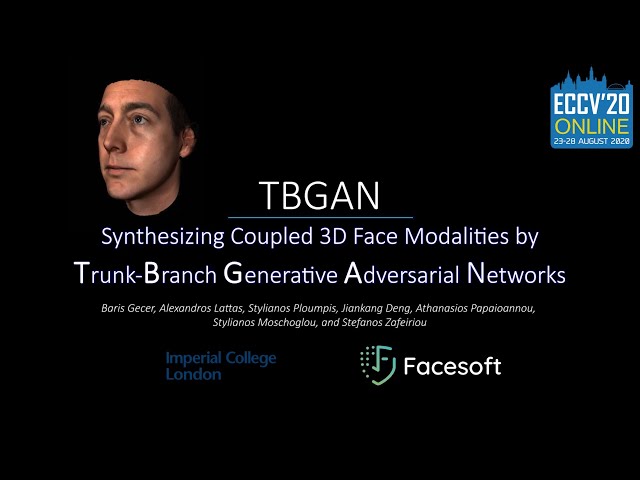
](https://www.youtube.com/watch?v=wehBCetIb7E)
## Testing the Model
- Download the model after signing the agreement and place it under '/results' directory
- Install menpo3d by
> pip install menpo3d
- And then Run the test script:
> python test.py
## Preparing datasets for training
The TBGAN code repository contains a command-line tool for recreating bit-exact replicas of the datasets that we used in the paper. The tool also provides various utilities for operating on the datasets:
```
usage: dataset_tool.py [-h] ...
display Display images in dataset.
extract Extract images from dataset.
compare Compare two datasets.
create_from_pkl_img_norm Create dataset from a directory full of texture, normals and shape.
Type "dataset_tool.py -h" for more information.
Please ignore other functions. The main function to prepare tf_records is 'create_from_pkl_img_norm'
```
The datasets are represented by directories containing the same image data in several resolutions to enable efficient streaming. There is a separate `*.tfrecords` file for each resolution, and if the dataset contains labels, they are stored in a separate file as well:
```
> python dataset_tool.py create_from_pkl_img_norm datasets/tf_records datasets/texture(/*.png) dataset/shape(/*.pkl) dataset/normals(/*.pkl)
```
The ```create_*``` commands take the standard version of a given dataset as input and produce the corresponding `*.tfrecords` files as output.
## Training networks
```
Please see how to start training with a PROGAN
Additionally, you will need to add
> "dynamic_range=[-1,1],dtype = 'float32'"
arguments to 'dataset' EasyDict() in config.py
```
Once the necessary datasets are set up, you can proceed to train your own networks. The general procedure is as follows:
1. Edit `config.py` to specify the dataset and training configuration by uncommenting/editing specific lines.
2. Run the training script with `python train.py`.
3. The results are written into a newly created subdirectory under `config.result_dir`
4. Wait several days (or weeks) for the training to converge, and analyze the results.
By default, `config.py` is configured to train a 1024x1024 network for CelebA-HQ using a single-GPU. This is expected to take about two weeks even on the highest-end NVIDIA GPUs. The key to enabling faster training is to employ multiple GPUs and/or go for a lower-resolution dataset. To this end, `config.py` contains several examples for commonly used datasets, as well as a set of "configuration presets" for multi-GPU training. All of the presets are expected to yield roughly the same image quality for CelebA-HQ, but their total training time can vary considerably:
* `preset-v1-1gpu`: Original config that was used to produce the CelebA-HQ and LSUN results shown in the paper. Expected to take about 1 month on NVIDIA Tesla V100.
* `preset-v2-1gpu`: Optimized config that converges considerably faster than the original one. Expected to take about 2 weeks on 1xV100.
* `preset-v2-2gpus`: Optimized config for 2 GPUs. Takes about 1 week on 2xV100.
* `preset-v2-4gpus`: Optimized config for 4 GPUs. Takes about 3 days on 4xV100.
* `preset-v2-8gpus`: Optimized config for 8 GPUs. Takes about 2 days on 8xV100.
For reference, the expected output of each configuration preset for CelebA-HQ can be found in [`networks/tensorflow-version/example_training_runs`](https://drive.google.com/open?id=1A9SKoQ7Xu2fqK22GHdMw8LZTh6qLvR7H)
Other noteworthy config options:
* `fp16`: Enable [FP16 mixed-precision training](http://docs.nvidia.com/deeplearning/sdk/mixed-precision-training/index.html) to reduce the training times even further. The actual speedup is heavily dependent on GPU architecture and cuDNN version, and it can be expected to increase considerably in the future.
* `BENCHMARK`: Quickly iterate through the resolutions to measure the raw training performance.
* `BENCHMARK0`: Same as `BENCHMARK`, but only use the highest resolution.
* `syn1024rgb`: Synthetic 1024x1024 dataset consisting of just black images. Useful for benchmarking.
* `VERBOSE`: Save image and network snapshots very frequently to facilitate debugging.
* `GRAPH` and `HIST`: Include additional data in the TensorBoard report.
## Analyzing results
Training results can be analyzed in several ways:
* **Manual inspection**: The training script saves a snapshot of randomly generated images at regular intervals in `fakes*.png` and reports the overall progress in `log.txt`.
* **TensorBoard**: The training script also exports various running statistics in a `*.tfevents` file that can be visualized in TensorBoard with `tensorboard --logdir `.
* **Generating images and videos**: At the end of `config.py`, there are several pre-defined configs to launch utility scripts (`generate_*`). For example:
* Suppose you have an ongoing training run titled `010-pgan-celebahq-preset-v1-1gpu-fp32`, and you want to generate a video of random interpolations for the latest snapshot.
* Uncomment the `generate_interpolation_video` line in `config.py`, replace `run_id=10`, and run `python train.py`
* The script will automatically locate the latest network snapshot and create a new result directory containing a single MP4 file.
* **Quality metrics**: Similar to the previous example, `config.py` also contains pre-defined configs to compute various quality metrics (Sliced Wasserstein distance, Fréchet inception distance, etc.) for an existing training run. The metrics are computed for each network snapshot in succession and stored in `metric-*.txt` in the original result directory.
## Acknowledgement
Baris Gecer is supported by the Turkish Ministry of National Education, Stylianos Ploumpis by the EPSRC Project EP/N007743/1 (FACER2VM), and Stefanos Zafeiriou by EPSRC Fellowship DEFORM (EP/S010203/1).
Code borrows heavily from NVIDIA's [PRO-GAN implementation](https://github.com/tkarras/progressive_growing_of_gans), please check and comply with its [License](https://github.com/tkarras/progressive_growing_of_gans/blob/master/LICENSE.txt). and cite their paper:
```
@inproceedings{karras2018progressive,
title={Progressive Growing of GANs for Improved Quality, Stability, and Variation},
author={Karras, Tero and Aila, Timo and Laine, Samuli and Lehtinen, Jaakko},
booktitle={International Conference on Learning Representations},
year={2018}
}
```
## Citation
If you find this work is useful for your research, please cite our [paper](https://arxiv.org/abs/1909.02215):
```
@inproceedings{gecer2020tbgan,
title={Synthesizing Coupled 3D Face Modalities by Trunk-Branch Generative Adversarial Networks},
author={{Gecer}, Baris and {Lattas}, Alexander and {Ploumpis}, Stylianos and
{Deng}, Jiankang and {Papaioannou}, Athanasios and
{Moschoglou}, Stylianos and {Zafeiriou}, Stefanos},
booktitle={Proceedings of the European conference on computer vision (ECCV)},
year={2020},
organization={Springer}
doi = {10.1007/978-3-030-58526-6_25}
}
```
================================================
FILE: UV_manipulation_2.py
================================================
import os
import menpo3d.io as m3io
from menpo3d import io
import menpo.io as mio
import numpy as np
from menpo.shape import TriMesh, ColouredTriMesh, PointCloud, TexturedTriMesh
from menpo.image import Image
from scipy.interpolate import NearestNDInterpolator
from menpo.image import MaskedImage
from functools import lru_cache
from menpo.transform import AlignmentSimilarity
#-------------------------------------------------------------------#
#Full face load dictionaries
@lru_cache()
def load_512_ifo_dict():
return mio.import_pickle('512_UV_dict.pkl')
#-------------------------------------------------------------------#
@lru_cache()
def load_mean():
return mio.import_pickle('./pkls/all_all_all_mean.pkl'),mio.import_pickle('./pkls/all_all_all_lands_ids.pkl')
#-------------------------------------------------------------------#
def alignment(mesh):
if mesh.n_points==53215:
template, idxs= load_mean()
alignment = AlignmentSimilarity(PointCloud(mesh.points[idxs]), PointCloud(template.points[idxs]))
aligned_mesh = alignment.apply(mesh)
return aligned_mesh
def import_uv_info(instance, res, uv_layout='oval', topology='full'):
if np.logical_or(type(instance).__name__=='TriMesh',type(instance).__name__=='TexturedTriMesh'):
if instance.n_points == 53215:
topology = 'full'
else:
raise ValueError('Unknown topology')
if topology == 'full':
if res==512:
if uv_layout=='oval':
info_dict = load_512_ifo_dict()
elif uv_layout=='stretch':
info_dict = load_512_ifo_dict_strech()
else:
raise ValueError('Wrong resolution')
elif type(instance).__name__=='Image':
if topology == 'full':
if res==512:
if uv_layout=='oval':
info_dict = load_512_ifo_dict()
elif uv_layout=='stretch':
info_dict = load_512_ifo_dict_strech()
else:
raise ValueError('Wrong resolution')
return info_dict
def from_UV_2_3D(uv, uv_layout='oval', topology='full', plot=False):
res = uv.shape[0]
info_dict = import_uv_info(uv,res,uv_layout=uv_layout,topology=topology)
tmask = info_dict['tmask']
tc_ps = info_dict['tcoords_pixel_scaled']
tmask_im = info_dict['tmask_image']
trilist = info_dict['trilist']
#uv = interpolaton_of_uv_xyz(uv,tmask).as_unmasked()
x = uv.pixels[0][(tc_ps.points.astype(int).T[0,:], tc_ps.points.astype(int).T[1,:])]
y = uv.pixels[1][(tc_ps.points.astype(int).T[0,:], tc_ps.points.astype(int).T[1,:])]
z = uv.pixels[2][(tc_ps.points.astype(int).T[0,:], tc_ps.points.astype(int).T[1,:])]
points = np.hstack((x.T[:,None],y.T[:,None],z.T[:,None]))
if plot is True:
TriMesh(points,trilist).view()
return TriMesh(points,trilist)
================================================
FILE: __init__.py
================================================
__all__ = ["config", "dataset", "dataset_tool","legacy","loss","misc","myutil","networks","tfutil","util_scripts","train"]
import tfutil
import util_scripts
================================================
FILE: config.py
================================================
# Copyright (c) 2018, NVIDIA CORPORATION. All rights reserved.
#
# This work is licensed under the Creative Commons Attribution-NonCommercial
# 4.0 International License. To view a copy of this license, visit
# http://creativecommons.org/licenses/by-nc/4.0/ or send a letter to
# Creative Commons, PO Box 1866, Mountain View, CA 94042, USA.
#----------------------------------------------------------------------------
# Convenience class that behaves exactly like dict(), but allows accessing
# the keys and values using the attribute syntax, i.e., "mydict.key = value".
class EasyDict(dict):
def __init__(self, *args, **kwargs): super().__init__(*args, **kwargs)
def __getattr__(self, name): return self[name]
def __setattr__(self, name, value): self[name] = value
def __delattr__(self, name): del self[name]
#----------------------------------------------------------------------------
# Paths.
data_dir = './'
result_dir = './results'
#----------------------------------------------------------------------------
# TensorFlow options.
tf_config = EasyDict() # TensorFlow session config, set by tfutil.init_tf().
env = EasyDict() # Environment variables, set by the main program in train.py.
tf_config['graph_options.place_pruned_graph'] = False # False (default) = Check that all ops are available on the designated device. True = Skip the check for ops that are not used.
tf_config['gpu_options.allow_growth'] = False # False (default) = Allocate all GPU memory at the beginning. True = Allocate only as much GPU memory as needed.
#env.CUDA_VISIBLE_DEVICES = '0' # Unspecified (default) = Use all available GPUs. List of ints = CUDA device numbers to use.
env.TF_CPP_MIN_LOG_LEVEL = '1' # 0 (default) = Print all available debug info from TensorFlow. 1 = Print warnings and errors, but disable debug info.
#----------------------------------------------------------------------------
# Official training configs, targeted mainly for CelebA-HQ.
# To run, comment/uncomment the lines as appropriate and launch train.py.
desc = 'pgan' # Description string included in result subdir name.
random_seed = 1000 # Global random seed.
dataset = EasyDict() # Options for dataset.load_dataset().
train = EasyDict(func='train.train_progressive_gan') # Options for main training func.
G = EasyDict(func='networks.G_paper') # Options for generator network.
D = EasyDict(func='networks.D_paper') # Options for discriminator network.
G_opt = EasyDict(beta1=0.0, beta2=0.99, epsilon=1e-8) # Options for generator optimizer.
D_opt = EasyDict(beta1=0.0, beta2=0.99, epsilon=1e-8) # Options for discriminator optimizer.
G_loss = EasyDict(func='loss.G_wgan_acgan') # Options for generator loss.
D_loss = EasyDict(func='loss.D_wgangp_acgan') # Options for discriminator loss.
sched = EasyDict() # Options for train.TrainingSchedule.
grid = EasyDict(size='1080p', layout='random') # Options for train.setup_snapshot_image_grid().
# desc += '-mein3d_texture_uv_tf_512'; dataset = EasyDict(tfrecord_dir='mein3d_texture_uv_tf_512');
# desc += '-mein3d_shape_uv_tf_512_bary'; dataset = EasyDict(tfrecord_dir='mein3d_shape_uv_tf_512_bary',dynamic_range=[-1,1],dtype = 'float32');
desc += '-3dmd_all_newuv_crop_tf'; dataset = EasyDict(tfrecord_dir='3dmd_all_newuv_crop_tf',dynamic_range=[-1,1],dtype = 'float32');
G.lod_sep = 7
D.lod_sep = 7
dataset.max_label_size = 'full'
grid.layout = 'row_per_class'
grid.size = '4k'
# Continue
#train.resume_run_id = 30
#train.resume_kimg = 12000
#train.resume_time = 7*24*60*60 + 5*60*60 + 0*60
# Conditioning & snapshot options.
#desc += '-cond'; dataset.max_label_size = 'full' # conditioned on full label
#desc += '-cond1'; dataset.max_label_size = 1 # conditioned on first component of the label
#desc += '-g4k'; grid.size = '4k'
#desc += '-grpc'; grid.layout = 'row_per_class'
# Config presets (choose one).
#desc += '-preset-v1-1gpu'; num_gpus = 1; D.mbstd_group_size = 16; sched.minibatch_base = 16; sched.minibatch_dict = {256: 14, 512: 6, 1024: 3}; sched.lod_training_kimg = 800; sched.lod_transition_kimg = 800; train.total_kimg = 19000
# desc += '-preset-v2-1gpu'; num_gpus = 1; sched.minibatch_base = 4; sched.minibatch_dict = {4: 128, 8: 128, 16: 128, 32: 64, 64: 32, 128: 16, 256: 8, 512: 4}; sched.G_lrate_dict = {1024: 0.0015}; sched.D_lrate_dict = EasyDict(sched.G_lrate_dict); train.total_kimg = 12000
# desc += '-preset-v2-2gpus'; num_gpus = 2; sched.minibatch_base = 8; sched.minibatch_dict = {4: 256, 8: 256, 16: 128, 32: 64, 64: 32, 128: 16, 256: 8, 512: 4}; sched.G_lrate_dict = {512: 0.0015, 1024: 0.002}; sched.D_lrate_dict = EasyDict(sched.G_lrate_dict); train.total_kimg = 12000
desc += '-preset-v2-4gpus'; num_gpus = 4; sched.minibatch_base = 16; sched.minibatch_dict = {4: 512, 8: 256, 16: 128, 32: 64, 64: 32, 128: 16}; sched.G_lrate_dict = {256: 0.0015, 512: 0.002, 1024: 0.003}; sched.D_lrate_dict = EasyDict(sched.G_lrate_dict); train.total_kimg = 16000
#desc += '-preset-v2-8gpus'; num_gpus = 8; sched.minibatch_base = 32; sched.minibatch_dict = {4: 512, 8: 256, 16: 128, 32: 64, 64: 32}; sched.G_lrate_dict = {128: 0.0015, 256: 0.002, 512: 0.003, 1024: 0.003}; sched.D_lrate_dict = EasyDict(sched.G_lrate_dict); train.total_kimg = 12000
# Numerical precision (choose one).
# desc += '-fp32'; sched.max_minibatch_per_gpu = {256: 16, 512: 8, 1024: 4}
#desc += '-fp16'; G.dtype = 'float16'; D.dtype = 'float16'; G.pixelnorm_epsilon=1e-4; G_opt.use_loss_scaling = True; D_opt.use_loss_scaling = True; sched.max_minibatch_per_gpu = {512: 16, 1024: 8}
# Disable individual features.
#desc += '-nogrowing'; sched.lod_initial_resolution = 1024; sched.lod_training_kimg = 0; sched.lod_transition_kimg = 0; train.total_kimg = 10000
#desc += '-nopixelnorm'; G.use_pixelnorm = False
#desc += '-nowscale'; G.use_wscale = False; D.use_wscale = False
#desc += '-noleakyrelu'; G.use_leakyrelu = False
#desc += '-nosmoothing'; train.G_smoothing = 0.0
#desc += '-norepeat'; train.minibatch_repeats = 1
#desc += '-noreset'; train.reset_opt_for_new_lod = False
# Special modes.
#desc += '-BENCHMARK'; sched.lod_initial_resolution = 4; sched.lod_training_kimg = 3; sched.lod_transition_kimg = 3; train.total_kimg = (8*2+1)*3; sched.tick_kimg_base = 1; sched.tick_kimg_dict = {}; train.image_snapshot_ticks = 1000; train.network_snapshot_ticks = 1000
#desc += '-BENCHMARK0'; sched.lod_initial_resolution = 1024; train.total_kimg = 10; sched.tick_kimg_base = 1; sched.tick_kimg_dict = {}; train.image_snapshot_ticks = 1000; train.network_snapshot_ticks = 1000
desc += '-VERBOSE'; sched.tick_kimg_base = 100; sched.tick_kimg_dict = {}; train.image_snapshot_ticks = 2; train.network_snapshot_ticks = 2
#desc += '-GRAPH'; train.save_tf_graph = True
#desc += '-HIST'; train.save_weight_histograms = True
#----------------------------------------------------------------------------
# Utility scripts.
# To run, uncomment the appropriate line and launch train.py.
# train = EasyDict(func='util_scripts.fit_real_images', run_id=0, png_prefix='', num_pngs=1000); num_gpus = 1; desc = 'real-images-' + str(train.run_id)
#train = EasyDict(func='util_scripts.generate_fake_images_glob', run_id=0, num_pngs=1000); num_gpus = 1; desc = 'fake-images-' + str(train.run_id)
#train = EasyDict(func='util_scripts.generate_fake_images', run_id=0, png_prefix='', num_pngs=100000); num_gpus = 1; desc = 'fake-images-' + str(train.run_id)
#train = EasyDict(func='util_scripts.generate_fake_images', run_id=23, grid_size=[15,8], num_pngs=10, image_shrink=4); num_gpus = 1; desc = 'fake-grids-' + str(train.run_id)
#train = EasyDict(func='util_scripts.generate_interpolation_video', run_id=0, grid_size=[1,1], duration_sec=600.0, smoothing_sec=1.0); num_gpus = 1; desc = 'interpolation-video-' + str(train.run_id)
#train = EasyDict(func='util_scripts.generate_interpolation_images', run_id=30, grid_size=[1,1], duration_sec=60.0, smoothing_sec=1.0); num_gpus = 1; desc = 'interpolation-images-' + str(train.run_id)
#train = EasyDict(func='util_scripts.generate_interpolation_video_bydim', run_id=0, grid_size=[1,1], duration_sec=10.0, mp4_fps=30, smoothing_sec=1.0,dim=3); num_gpus = 1; desc = 'interpolation-video-' + str(train.run_id) + '_dim'+str(train.dim)
#train = EasyDict(func='util_scripts.generate_training_video', run_id=0, duration_sec=20.0); num_gpus = 1; desc = 'training-video-' + str(train.run_id)
#train = EasyDict(func='util_scripts.evaluate_metrics', run_id=23, log='metric-swd-16k.txt', metrics=['swd'], num_images=16384, real_passes=2); num_gpus = 1; desc = train.log.split('.')[0] + '-' + str(train.run_id)
#train = EasyDict(func='util_scripts.evaluate_metrics', run_id=23, log='metric-fid-10k.txt', metrics=['fid'], num_images=10000, real_passes=1); num_gpus = 1; desc = train.log.split('.')[0] + '-' + str(train.run_id)
#train = EasyDict(func='util_scripts.evaluate_metrics', run_id=23, log='metric-fid-50k.txt', metrics=['fid'], num_images=50000, real_passes=1); num_gpus = 1; desc = train.log.split('.')[0] + '-' + str(train.run_id)
#train = EasyDict(func='util_scripts.evaluate_metrics', run_id=23, log='metric-is-50k.txt', metrics=['is'], num_images=50000, real_passes=1); num_gpus = 1; desc = train.log.split('.')[0] + '-' + str(train.run_id)
#train = EasyDict(func='util_scripts.evaluate_metrics', run_id=23, log='metric-msssim-20k.txt', metrics=['msssim'], num_images=20000, real_passes=1); num_gpus = 1; desc = train.log.split('.')[0] + '-' + str(train.run_id)
================================================
FILE: config_test.py
================================================
# Copyright (c) 2018, NVIDIA CORPORATION. All rights reserved.
#
# This work is licensed under the Creative Commons Attribution-NonCommercial
# 4.0 International License. To view a copy of this license, visit
# http://creativecommons.org/licenses/by-nc/4.0/ or send a letter to
# Creative Commons, PO Box 1866, Mountain View, CA 94042, USA.
#----------------------------------------------------------------------------
# Convenience class that behaves exactly like dict(), but allows accessing
# the keys and values using the attribute syntax, i.e., "mydict.key = value".
class EasyDict(dict):
def __init__(self, *args, **kwargs): super().__init__(*args, **kwargs)
def __getattr__(self, name): return self[name]
def __setattr__(self, name, value): self[name] = value
def __delattr__(self, name): del self[name]
#----------------------------------------------------------------------------
# Paths.
data_dir = './'
result_dir = './results'
#----------------------------------------------------------------------------
# TensorFlow options.
tf_config = EasyDict() # TensorFlow session config, set by tfutil.init_tf().
env = EasyDict() # Environment variables, set by the main program in train.py.
tf_config['graph_options.place_pruned_graph'] = False # False (default) = Check that all ops are available on the designated device. True = Skip the check for ops that are not used.
tf_config['gpu_options.allow_growth'] = False # False (default) = Allocate all GPU memory at the beginning. True = Allocate only as much GPU memory as needed.
#env.CUDA_VISIBLE_DEVICES = '0' # Unspecified (default) = Use all available GPUs. List of ints = CUDA device numbers to use.
env.TF_CPP_MIN_LOG_LEVEL = '1' # 0 (default) = Print all available debug info from TensorFlow. 1 = Print warnings and errors, but disable debug info.
#----------------------------------------------------------------------------
# Official training configs, targeted mainly for CelebA-HQ.
# To run, comment/uncomment the lines as appropriate and launch train.py.
desc = 'pgan' # Description string included in result subdir name.
random_seed = 1000 # Global random seed.
dataset = EasyDict() # Options for dataset.load_dataset().
train = EasyDict(func='train.train_progressive_gan') # Options for main training func.
G = EasyDict(func='networks.G_paper') # Options for generator network.
D = EasyDict(func='networks.D_paper') # Options for discriminator network.
G_opt = EasyDict(beta1=0.0, beta2=0.99, epsilon=1e-8) # Options for generator optimizer.
D_opt = EasyDict(beta1=0.0, beta2=0.99, epsilon=1e-8) # Options for discriminator optimizer.
G_loss = EasyDict(func='loss.G_wgan_acgan') # Options for generator loss.
D_loss = EasyDict(func='loss.D_wgangp_acgan') # Options for discriminator loss.
sched = EasyDict() # Options for train.TrainingSchedule.
grid = EasyDict(size='1080p', layout='random') # Options for train.setup_snapshot_image_grid().
# desc += '-mein3d_texture_uv_tf_512'; dataset = EasyDict(tfrecord_dir='mein3d_texture_uv_tf_512');
# desc += '-mein3d_shape_uv_tf_512_bary'; dataset = EasyDict(tfrecord_dir='mein3d_shape_uv_tf_512_bary',dynamic_range=[-1,1],dtype = 'float32');
desc += '-3dmd_all_newuv_crop_tf'; dataset = EasyDict(tfrecord_dir='3dmd_all_newuv_crop_tf',dynamic_range=[-1,1],dtype = 'float32');
G.lod_sep = 7
D.lod_sep = 7
dataset.max_label_size = 'full'
grid.layout = 'row_per_class'
grid.size = '4k'
# Continue
#train.resume_run_id = 30
#train.resume_kimg = 12000
#train.resume_time = 7*24*60*60 + 5*60*60 + 0*60
# Conditioning & snapshot options.
#desc += '-cond'; dataset.max_label_size = 'full' # conditioned on full label
#desc += '-cond1'; dataset.max_label_size = 1 # conditioned on first component of the label
#desc += '-g4k'; grid.size = '4k'
#desc += '-grpc'; grid.layout = 'row_per_class'
# Config presets (choose one).
desc += '-preset-v1-1gpu'; num_gpus = 1; D.mbstd_group_size = 16; sched.minibatch_base = 16; sched.minibatch_dict = {256: 14, 512: 6, 1024: 3}; sched.lod_training_kimg = 800; sched.lod_transition_kimg = 800; train.total_kimg = 19000
# desc += '-preset-v2-1gpu'; num_gpus = 1; sched.minibatch_base = 4; sched.minibatch_dict = {4: 128, 8: 128, 16: 128, 32: 64, 64: 32, 128: 16, 256: 8, 512: 4}; sched.G_lrate_dict = {1024: 0.0015}; sched.D_lrate_dict = EasyDict(sched.G_lrate_dict); train.total_kimg = 12000
# desc += '-preset-v2-2gpus'; num_gpus = 2; sched.minibatch_base = 8; sched.minibatch_dict = {4: 256, 8: 256, 16: 128, 32: 64, 64: 32, 128: 16, 256: 8, 512: 4}; sched.G_lrate_dict = {512: 0.0015, 1024: 0.002}; sched.D_lrate_dict = EasyDict(sched.G_lrate_dict); train.total_kimg = 12000
#desc += '-preset-v2-4gpus'; num_gpus = 4; sched.minibatch_base = 16; sched.minibatch_dict = {4: 512, 8: 256, 16: 128, 32: 64, 64: 32, 128: 16}; sched.G_lrate_dict = {256: 0.0015, 512: 0.002, 1024: 0.003}; sched.D_lrate_dict = EasyDict(sched.G_lrate_dict); train.total_kimg = 16000
#desc += '-preset-v2-8gpus'; num_gpus = 8; sched.minibatch_base = 32; sched.minibatch_dict = {4: 512, 8: 256, 16: 128, 32: 64, 64: 32}; sched.G_lrate_dict = {128: 0.0015, 256: 0.002, 512: 0.003, 1024: 0.003}; sched.D_lrate_dict = EasyDict(sched.G_lrate_dict); train.total_kimg = 12000
# Numerical precision (choose one).
# desc += '-fp32'; sched.max_minibatch_per_gpu = {256: 16, 512: 8, 1024: 4}
#desc += '-fp16'; G.dtype = 'float16'; D.dtype = 'float16'; G.pixelnorm_epsilon=1e-4; G_opt.use_loss_scaling = True; D_opt.use_loss_scaling = True; sched.max_minibatch_per_gpu = {512: 16, 1024: 8}
# Disable individual features.
#desc += '-nogrowing'; sched.lod_initial_resolution = 1024; sched.lod_training_kimg = 0; sched.lod_transition_kimg = 0; train.total_kimg = 10000
#desc += '-nopixelnorm'; G.use_pixelnorm = False
#desc += '-nowscale'; G.use_wscale = False; D.use_wscale = False
#desc += '-noleakyrelu'; G.use_leakyrelu = False
#desc += '-nosmoothing'; train.G_smoothing = 0.0
#desc += '-norepeat'; train.minibatch_repeats = 1
#desc += '-noreset'; train.reset_opt_for_new_lod = False
# Special modes.
#desc += '-BENCHMARK'; sched.lod_initial_resolution = 4; sched.lod_training_kimg = 3; sched.lod_transition_kimg = 3; train.total_kimg = (8*2+1)*3; sched.tick_kimg_base = 1; sched.tick_kimg_dict = {}; train.image_snapshot_ticks = 1000; train.network_snapshot_ticks = 1000
#desc += '-BENCHMARK0'; sched.lod_initial_resolution = 1024; train.total_kimg = 10; sched.tick_kimg_base = 1; sched.tick_kimg_dict = {}; train.image_snapshot_ticks = 1000; train.network_snapshot_ticks = 1000
desc += '-VERBOSE'; sched.tick_kimg_base = 100; sched.tick_kimg_dict = {}; train.image_snapshot_ticks = 2; train.network_snapshot_ticks = 2
#desc += '-GRAPH'; train.save_tf_graph = True
#desc += '-HIST'; train.save_weight_histograms = True
#----------------------------------------------------------------------------
# Utility scripts.
# To run, uncomment the appropriate line and launch train.py.
# train = EasyDict(func='util_scripts.fit_real_images', run_id=0, png_prefix='', num_pngs=1000); num_gpus = 1; desc = 'real-images-' + str(train.run_id)
#train = EasyDict(func='util_scripts.generate_fake_images_glob', run_id=0, num_pngs=1000); num_gpus = 1; desc = 'fake-images-' + str(train.run_id)
# train = EasyDict(func='util_scripts.generate_fake_images', run_id=32, png_prefix='', num_pngs=100); num_gpus = 1; desc = 'fake-images-' + str(train.run_id)
#train = EasyDict(func='util_scripts.generate_fake_images', run_id=23, grid_size=[15,8], num_pngs=10, image_shrink=4); num_gpus = 1; desc = 'fake-grids-' + str(train.run_id)
#train = EasyDict(func='util_scripts.generate_interpolation_video', run_id=0, grid_size=[1,1], duration_sec=600.0, smoothing_sec=1.0); num_gpus = 1; desc = 'interpolation-video-' + str(train.run_id)
train = EasyDict(func='util_scripts.generate_interpolation_images', run_id=32, grid_size=[1,1], duration_sec=5.0, smoothing_sec=0.1); num_gpus = 1; desc = 'interpolation-images-' + str(train.run_id)
#train = EasyDict(func='util_scripts.generate_interpolation_video_bydim', run_id=0, grid_size=[1,1], duration_sec=10.0, mp4_fps=30, smoothing_sec=1.0,dim=3); num_gpus = 1; desc = 'interpolation-video-' + str(train.run_id) + '_dim'+str(train.dim)
#train = EasyDict(func='util_scripts.generate_training_video', run_id=0, duration_sec=20.0); num_gpus = 1; desc = 'training-video-' + str(train.run_id)
#train = EasyDict(func='util_scripts.evaluate_metrics', run_id=23, log='metric-swd-16k.txt', metrics=['swd'], num_images=16384, real_passes=2); num_gpus = 1; desc = train.log.split('.')[0] + '-' + str(train.run_id)
#train = EasyDict(func='util_scripts.evaluate_metrics', run_id=23, log='metric-fid-10k.txt', metrics=['fid'], num_images=10000, real_passes=1); num_gpus = 1; desc = train.log.split('.')[0] + '-' + str(train.run_id)
#train = EasyDict(func='util_scripts.evaluate_metrics', run_id=23, log='metric-fid-50k.txt', metrics=['fid'], num_images=50000, real_passes=1); num_gpus = 1; desc = train.log.split('.')[0] + '-' + str(train.run_id)
#train = EasyDict(func='util_scripts.evaluate_metrics', run_id=23, log='metric-is-50k.txt', metrics=['is'], num_images=50000, real_passes=1); num_gpus = 1; desc = train.log.split('.')[0] + '-' + str(train.run_id)
#train = EasyDict(func='util_scripts.evaluate_metrics', run_id=23, log='metric-msssim-20k.txt', metrics=['msssim'], num_images=20000, real_passes=1); num_gpus = 1; desc = train.log.split('.')[0] + '-' + str(train.run_id)
================================================
FILE: dataset.py
================================================
# Copyright (c) 2018, NVIDIA CORPORATION. All rights reserved.
#
# This work is licensed under the Creative Commons Attribution-NonCommercial
# 4.0 International License. To view a copy of this license, visit
# http://creativecommons.org/licenses/by-nc/4.0/ or send a letter to
# Creative Commons, PO Box 1866, Mountain View, CA 94042, USA.
import os
import glob
import numpy as np
import tensorflow as tf
import tfutil
#----------------------------------------------------------------------------
# Parse individual image from a tfrecords file.
#----------------------------------------------------------------------------
# Dataset class that loads data from tfrecords files.
class TFRecordDataset:
def __init__(self,
tfrecord_dir, # Directory containing a collection of tfrecords files.
resolution = None, # Dataset resolution, None = autodetect.
label_file = None, # Relative path of the labels file, None = autodetect.
max_label_size = 0, # 0 = no labels, 'full' = full labels, = N first label components.
repeat = True, # Repeat dataset indefinitely.
shuffle_mb = 4096, # Shuffle data within specified window (megabytes), 0 = disable shuffling.
prefetch_mb = 2048, # Amount of data to prefetch (megabytes), 0 = disable prefetching.
buffer_mb = 256, # Read buffer size (megabytes).
num_threads = 2, # Number of concurrent threads.
dtype ='uint8',
dynamic_range =[0, 255]):
self.tfrecord_dir = tfrecord_dir
self.resolution = None
self.resolution_log2 = None
self.shape = [] # [channel, height, width]
self.dtype = dtype
self.dynamic_range = dynamic_range
self.label_file = label_file
self.label_size = None # [component]
self.label_dtype = None
self._np_labels = None
self._tf_minibatch_in = None
self._tf_labels_var = None
self._tf_labels_dataset = None
self._tf_datasets = dict()
self._tf_iterator = None
self._tf_init_ops = dict()
self._tf_minibatch_np = None
self._cur_minibatch = -1
self._cur_lod = -1
# List tfrecords files and inspect their shapes.
assert os.path.isdir(self.tfrecord_dir)
tfr_files = sorted(glob.glob(os.path.join(self.tfrecord_dir, '*.tfrecords')))
assert len(tfr_files) >= 1
tfr_shapes = []
for tfr_file in tfr_files:
tfr_opt = tf.python_io.TFRecordOptions(tf.python_io.TFRecordCompressionType.NONE)
for record in tf.python_io.tf_record_iterator(tfr_file, tfr_opt):
tfr_shapes.append(self.parse_tfrecord_np(record).shape)
break
# Autodetect label filename.
if self.label_file is None:
guess = sorted(glob.glob(os.path.join(self.tfrecord_dir, '*.labels')))
if len(guess):
self.label_file = guess[0]
elif not os.path.isfile(self.label_file):
guess = os.path.join(self.tfrecord_dir, self.label_file)
if os.path.isfile(guess):
self.label_file = guess
# Determine shape and resolution.
max_shape = max(tfr_shapes, key=lambda shape: np.prod(shape))
self.resolution = resolution if resolution is not None else max_shape[1]
self.resolution_log2 = int(np.log2(self.resolution))
self.shape = [max_shape[0], self.resolution, self.resolution]
tfr_lods = [self.resolution_log2 - int(np.log2(shape[1])) for shape in tfr_shapes]
assert all(shape[0] == max_shape[0] for shape in tfr_shapes)
assert all(shape[1] == shape[2] for shape in tfr_shapes)
assert all(shape[1] == self.resolution // (2**lod) for shape, lod in zip(tfr_shapes, tfr_lods))
assert all(lod in tfr_lods for lod in range(self.resolution_log2 - 1))
# Load labels.
assert max_label_size == 'full' or max_label_size >= 0
self._np_labels = np.zeros([1<<20, 0], dtype=np.float32)
if self.label_file is not None and max_label_size != 0:
self._np_labels = np.load(self.label_file)
assert self._np_labels.ndim == 2
if max_label_size != 'full' and self._np_labels.shape[1] > max_label_size:
self._np_labels = self._np_labels[:, :max_label_size]
self.label_size = self._np_labels.shape[1]
self.label_dtype = self._np_labels.dtype.name
# Build TF expressions.
with tf.name_scope('Dataset'), tf.device('/cpu:0'):
self._tf_minibatch_in = tf.placeholder(tf.int64, name='minibatch_in', shape=[])
tf_labels_init = tf.zeros(self._np_labels.shape, self._np_labels.dtype)
self._tf_labels_var = tf.Variable(tf_labels_init, name='labels_var')
tfutil.set_vars({self._tf_labels_var: self._np_labels})
self._tf_labels_dataset = tf.data.Dataset.from_tensor_slices(self._tf_labels_var)
for tfr_file, tfr_shape, tfr_lod in zip(tfr_files, tfr_shapes, tfr_lods):
if tfr_lod < 0:
continue
dset = tf.data.TFRecordDataset(tfr_file, compression_type='', buffer_size=buffer_mb<<20)
dset = dset.map(self.parse_tfrecord_tf, num_parallel_calls=num_threads)
dset = tf.data.Dataset.zip((dset, self._tf_labels_dataset))
bytes_per_item = np.prod(tfr_shape) * np.dtype(self.dtype).itemsize
if shuffle_mb > 0:
dset = dset.shuffle(((shuffle_mb << 20) - 1) // bytes_per_item + 1)
if repeat:
dset = dset.repeat()
if prefetch_mb > 0:
dset = dset.prefetch(((prefetch_mb << 20) - 1) // bytes_per_item + 1)
dset = dset.batch(self._tf_minibatch_in)
self._tf_datasets[tfr_lod] = dset
self._tf_iterator = tf.data.Iterator.from_structure(self._tf_datasets[0].output_types, self._tf_datasets[0].output_shapes)
self._tf_init_ops = {lod: self._tf_iterator.make_initializer(dset) for lod, dset in self._tf_datasets.items()}
# Use the given minibatch size and level-of-detail for the data returned by get_minibatch_tf().
def configure(self, minibatch_size, lod=0):
lod = int(np.floor(lod))
assert minibatch_size >= 1 and lod in self._tf_datasets
if self._cur_minibatch != minibatch_size or self._cur_lod != lod:
self._tf_init_ops[lod].run({self._tf_minibatch_in: minibatch_size})
self._cur_minibatch = minibatch_size
self._cur_lod = lod
# Get next minibatch as TensorFlow expressions.
def get_minibatch_tf(self): # => images, labels
return self._tf_iterator.get_next()
# Get next minibatch as NumPy arrays.
def get_minibatch_np(self, minibatch_size, lod=0): # => images, labels
self.configure(minibatch_size, lod)
if self._tf_minibatch_np is None:
self._tf_minibatch_np = self.get_minibatch_tf()
return tfutil.run(self._tf_minibatch_np)
# Get random labels as TensorFlow expression.
def get_random_labels_tf(self, minibatch_size): # => labels
if self.label_size > 0:
return tf.gather(self._tf_labels_var, tf.random_uniform([minibatch_size], 0, self._np_labels.shape[0], dtype=tf.int32))
else:
return tf.zeros([minibatch_size, 0], self.label_dtype)
# Get random labels as NumPy array.
def get_random_labels_np(self, minibatch_size): # => labels
if self.label_size > 0:
return self._np_labels[np.random.randint(self._np_labels.shape[0], size=[minibatch_size])]
else:
return np.zeros([minibatch_size, 0], self.label_dtype)
def parse_tfrecord_tf(self, record):
features = tf.parse_single_example(record, features={
'shape': tf.FixedLenFeature([3], tf.int64),
'data': tf.FixedLenFeature([], tf.string)})
data = tf.decode_raw(features['data'], tf.as_dtype(self.dtype))
return tf.reshape(data, features['shape'])
def parse_tfrecord_np(self, record):
ex = tf.train.Example()
ex.ParseFromString(record)
shape = ex.features.feature['shape'].int64_list.value
data = ex.features.feature['data'].bytes_list.value[0]
return np.fromstring(data, np.dtype(self.dtype).type).reshape(shape)
#----------------------------------------------------------------------------
# Base class for datasets that are generated on the fly.
class SyntheticDataset:
def __init__(self, resolution=1024, num_channels=3, dtype='uint8', dynamic_range=[0,255], label_size=0, label_dtype='float32'):
self.resolution = resolution
self.resolution_log2 = int(np.log2(resolution))
self.shape = [num_channels, resolution, resolution]
self.dtype = dtype
self.dynamic_range = dynamic_range
self.label_size = label_size
self.label_dtype = label_dtype
self._tf_minibatch_var = None
self._tf_lod_var = None
self._tf_minibatch_np = None
self._tf_labels_np = None
assert self.resolution == 2 ** self.resolution_log2
with tf.name_scope('Dataset'):
self._tf_minibatch_var = tf.Variable(np.int32(0), name='minibatch_var')
self._tf_lod_var = tf.Variable(np.int32(0), name='lod_var')
def configure(self, minibatch_size, lod=0):
lod = int(np.floor(lod))
assert minibatch_size >= 1 and lod >= 0 and lod <= self.resolution_log2
tfutil.set_vars({self._tf_minibatch_var: minibatch_size, self._tf_lod_var: lod})
def get_minibatch_tf(self): # => images, labels
with tf.name_scope('SyntheticDataset'):
shrink = tf.cast(2.0 ** tf.cast(self._tf_lod_var, tf.float32), tf.int32)
shape = [self.shape[0], self.shape[1] // shrink, self.shape[2] // shrink]
images = self._generate_images(self._tf_minibatch_var, self._tf_lod_var, shape)
labels = self._generate_labels(self._tf_minibatch_var)
return images, labels
def get_minibatch_np(self, minibatch_size, lod=0): # => images, labels
self.configure(minibatch_size, lod)
if self._tf_minibatch_np is None:
self._tf_minibatch_np = self.get_minibatch_tf()
return tfutil.run(self._tf_minibatch_np)
def get_random_labels_tf(self, minibatch_size): # => labels
with tf.name_scope('SyntheticDataset'):
return self._generate_labels(minibatch_size)
def get_random_labels_np(self, minibatch_size): # => labels
self.configure(minibatch_size)
if self._tf_labels_np is None:
self._tf_labels_np = self.get_random_labels_tf()
return tfutil.run(self._tf_labels_np)
def _generate_images(self, minibatch, lod, shape): # to be overridden by subclasses
return tf.zeros([minibatch] + shape, self.dtype)
def _generate_labels(self, minibatch): # to be overridden by subclasses
return tf.zeros([minibatch, self.label_size], self.label_dtype)
#----------------------------------------------------------------------------
# Helper func for constructing a dataset object using the given options.
def load_dataset(class_name='dataset.TFRecordDataset', data_dir=None, verbose=False, **kwargs):
adjusted_kwargs = dict(kwargs)
if 'tfrecord_dir' in adjusted_kwargs and data_dir is not None:
adjusted_kwargs['tfrecord_dir'] = os.path.join(data_dir, adjusted_kwargs['tfrecord_dir'])
if verbose:
print('Streaming data using %s...' % class_name)
dataset = tfutil.import_obj(class_name)(**adjusted_kwargs)
if verbose:
print('Dataset shape =', np.int32(dataset.shape).tolist())
print('Dynamic range =', dataset.dynamic_range)
print('Label size =', dataset.label_size)
return dataset
#----------------------------------------------------------------------------
================================================
FILE: dataset_tool.py
================================================
# Copyright (c) 2018, NVIDIA CORPORATION. All rights reserved.
#
# This work is licensed under the Creative Commons Attribution-NonCommercial
# 4.0 International License. To view a copy of this license, visit
# http://creativecommons.org/licenses/by-nc/4.0/ or send a letter to
# Creative Commons, PO Box 1866, Mountain View, CA 94042, USA.
import os
import sys
import glob
import argparse
import threading
import six.moves.queue as Queue
import traceback
import numpy as np
import tensorflow as tf
import PIL.Image
import tfutil
import dataset
import menpo.io as mio
import scipy
#----------------------------------------------------------------------------
def error(msg):
print('Error: ' + msg)
exit(1)
#----------------------------------------------------------------------------
class TFRecordExporter:
def __init__(self, tfrecord_dir, expected_images, print_progress=True, progress_interval=10):
self.tfrecord_dir = tfrecord_dir
self.tfr_prefix = os.path.join(self.tfrecord_dir, os.path.basename(self.tfrecord_dir))
self.expected_images = expected_images
self.cur_images = 0
self.shape = None
self.resolution_log2 = None
self.tfr_writers = []
self.print_progress = print_progress
self.progress_interval = progress_interval
if self.print_progress:
print('Creating dataset "%s"' % tfrecord_dir)
if not os.path.isdir(self.tfrecord_dir):
os.makedirs(self.tfrecord_dir)
assert(os.path.isdir(self.tfrecord_dir))
def close(self):
if self.print_progress:
print('%-40s\r' % 'Flushing data...', end='', flush=True)
for tfr_writer in self.tfr_writers:
tfr_writer.close()
self.tfr_writers = []
if self.print_progress:
print('%-40s\r' % '', end='', flush=True)
print('Added %d images.' % self.cur_images)
def choose_shuffled_order(self): # Note: Images and labels must be added in shuffled order.
order = np.arange(self.expected_images)
np.random.RandomState(123).shuffle(order)
return order
def add_image(self, img):
if self.print_progress and self.cur_images % self.progress_interval == 0:
print('%d / %d\r' % (self.cur_images, self.expected_images), end='', flush=True)
if self.shape is None:
self.shape = img.shape
self.resolution_log2 = int(np.log2(self.shape[1]))
assert self.shape[0] in [1, 3]
assert self.shape[1] == self.shape[2]
assert self.shape[1] == 2**self.resolution_log2
tfr_opt = tf.python_io.TFRecordOptions(tf.python_io.TFRecordCompressionType.NONE)
for lod in range(self.resolution_log2 - 1):
tfr_file = self.tfr_prefix + '-r%02d.tfrecords' % (self.resolution_log2 - lod)
self.tfr_writers.append(tf.python_io.TFRecordWriter(tfr_file, tfr_opt))
assert img.shape == self.shape
for lod, tfr_writer in enumerate(self.tfr_writers):
if lod:
img = img.astype(np.float32)
img = (img[:, 0::2, 0::2] + img[:, 0::2, 1::2] + img[:, 1::2, 0::2] + img[:, 1::2, 1::2]) * 0.25
quant = np.rint(img).clip(0, 255).astype(np.uint8)
ex = tf.train.Example(features=tf.train.Features(feature={
'shape': tf.train.Feature(int64_list=tf.train.Int64List(value=quant.shape)),
'data': tf.train.Feature(bytes_list=tf.train.BytesList(value=[quant.tostring()]))}))
tfr_writer.write(ex.SerializeToString())
self.cur_images += 1
def add_shape(self, img):
if self.print_progress and self.cur_images % self.progress_interval == 0:
print('%d / %d\r' % (self.cur_images, self.expected_images), end='', flush=True)
if self.shape is None:
self.shape = img.shape
self.resolution_log2 = int(np.log2(self.shape[1]))
assert self.shape[0] in [1, 3]
assert self.shape[1] == self.shape[2]
assert self.shape[1] == 2**self.resolution_log2
tfr_opt = tf.python_io.TFRecordOptions(tf.python_io.TFRecordCompressionType.NONE)
for lod in range(self.resolution_log2 - 1):
tfr_file = self.tfr_prefix + '-r%02d.tfrecords' % (self.resolution_log2 - lod)
self.tfr_writers.append(tf.python_io.TFRecordWriter(tfr_file, tfr_opt))
assert img.shape == self.shape
for lod, tfr_writer in enumerate(self.tfr_writers):
if lod:
img = img.astype(np.float32)
img = (img[:, 0::2, 0::2] + img[:, 0::2, 1::2] + img[:, 1::2, 0::2] + img[:, 1::2, 1::2]) * 0.25
ex = tf.train.Example(features=tf.train.Features(feature={
'shape': tf.train.Feature(int64_list=tf.train.Int64List(value=img.shape)),
'data': tf.train.Feature(bytes_list=tf.train.BytesList(value=[img.tostring()]))}))
tfr_writer.write(ex.SerializeToString())
self.cur_images += 1
def add_both(self, img):
if self.print_progress and self.cur_images % self.progress_interval == 0:
print('%d / %d\r' % (self.cur_images, self.expected_images), end='', flush=True)
if self.shape is None:
self.shape = img.shape
self.resolution_log2 = int(np.log2(self.shape[1]))
assert self.shape[0] in [1, 6, 9]
assert self.shape[1] == self.shape[2]
assert self.shape[1] == 2**self.resolution_log2
tfr_opt = tf.python_io.TFRecordOptions(tf.python_io.TFRecordCompressionType.NONE)
for lod in range(self.resolution_log2 - 1):
tfr_file = self.tfr_prefix + '-r%02d.tfrecords' % (self.resolution_log2 - lod)
self.tfr_writers.append(tf.python_io.TFRecordWriter(tfr_file, tfr_opt))
assert img.shape == self.shape
for lod, tfr_writer in enumerate(self.tfr_writers):
if lod:
img = img.astype(np.float32)
img = (img[:, 0::2, 0::2] + img[:, 0::2, 1::2] + img[:, 1::2, 0::2] + img[:, 1::2, 1::2]) * 0.25
ex = tf.train.Example(features=tf.train.Features(feature={
'shape': tf.train.Feature(int64_list=tf.train.Int64List(value=img.shape)),
'data': tf.train.Feature(bytes_list=tf.train.BytesList(value=[img.tostring()]))}))
tfr_writer.write(ex.SerializeToString())
self.cur_images += 1
def add_labels(self, labels):
if self.print_progress:
print('%-40s\r' % 'Saving labels...', end='', flush=True)
assert labels.shape[0] == self.cur_images
with open(self.tfr_prefix + '-rxx.labels', 'wb') as f:
np.save(f, labels.astype(np.float32))
def __enter__(self):
return self
def __exit__(self, *args):
self.close()
#----------------------------------------------------------------------------
class ExceptionInfo(object):
def __init__(self):
self.value = sys.exc_info()[1]
self.traceback = traceback.format_exc()
#----------------------------------------------------------------------------
class WorkerThread(threading.Thread):
def __init__(self, task_queue):
threading.Thread.__init__(self)
self.task_queue = task_queue
def run(self):
while True:
func, args, result_queue = self.task_queue.get()
if func is None:
break
try:
result = func(*args)
except:
result = ExceptionInfo()
result_queue.put((result, args))
#----------------------------------------------------------------------------
class ThreadPool(object):
def __init__(self, num_threads):
assert num_threads >= 1
self.task_queue = Queue.Queue()
self.result_queues = dict()
self.num_threads = num_threads
for idx in range(self.num_threads):
thread = WorkerThread(self.task_queue)
thread.daemon = True
thread.start()
def add_task(self, func, args=()):
assert hasattr(func, '__call__') # must be a function
if func not in self.result_queues:
self.result_queues[func] = Queue.Queue()
self.task_queue.put((func, args, self.result_queues[func]))
def get_result(self, func): # returns (result, args)
result, args = self.result_queues[func].get()
if isinstance(result, ExceptionInfo):
print('\n\nWorker thread caught an exception:\n' + result.traceback)
raise result.value
return result, args
def finish(self):
for idx in range(self.num_threads):
self.task_queue.put((None, (), None))
def __enter__(self): # for 'with' statement
return self
def __exit__(self, *excinfo):
self.finish()
def process_items_concurrently(self, item_iterator, process_func=lambda x: x, pre_func=lambda x: x, post_func=lambda x: x, max_items_in_flight=None):
if max_items_in_flight is None: max_items_in_flight = self.num_threads * 4
assert max_items_in_flight >= 1
results = []
retire_idx = [0]
def task_func(prepared, idx):
return process_func(prepared)
def retire_result():
processed, (prepared, idx) = self.get_result(task_func)
results[idx] = processed
while retire_idx[0] < len(results) and results[retire_idx[0]] is not None:
yield post_func(results[retire_idx[0]])
results[retire_idx[0]] = None
retire_idx[0] += 1
for idx, item in enumerate(item_iterator):
prepared = pre_func(item)
results.append(None)
self.add_task(func=task_func, args=(prepared, idx))
while retire_idx[0] < idx - max_items_in_flight + 2:
for res in retire_result(): yield res
while retire_idx[0] < len(results):
for res in retire_result(): yield res
#----------------------------------------------------------------------------
def display(tfrecord_dir):
print('Loading dataset "%s"' % tfrecord_dir)
tfutil.init_tf({'gpu_options.allow_growth': True})
dset = dataset.TFRecordDataset(tfrecord_dir, max_label_size='full', repeat=False, shuffle_mb=0)
tfutil.init_uninited_vars()
idx = 0
while True:
try:
images, labels = dset.get_minibatch_np(1)
except tf.errors.OutOfRangeError:
break
if idx == 0:
print('Displaying images')
import cv2 # pip install opencv-python
cv2.namedWindow('dataset_tool')
print('Press SPACE or ENTER to advance, ESC to exit')
print('\nidx = %-8d\nlabel = %s' % (idx, labels[0].tolist()))
cv2.imshow('dataset_tool', images[0].transpose(1, 2, 0)[:, :, ::-1]) # CHW => HWC, RGB => BGR
idx += 1
if cv2.waitKey() == 27:
break
print('\nDisplayed %d images.' % idx)
#----------------------------------------------------------------------------
def extract(tfrecord_dir, output_dir):
print('Loading dataset "%s"' % tfrecord_dir)
tfutil.init_tf({'gpu_options.allow_growth': True})
dset = dataset.TFRecordDataset(tfrecord_dir, max_label_size=0, repeat=False, shuffle_mb=0)
tfutil.init_uninited_vars()
print('Extracting images to "%s"' % output_dir)
if not os.path.isdir(output_dir):
os.makedirs(output_dir)
idx = 0
while True:
if idx % 10 == 0:
print('%d\r' % idx, end='', flush=True)
try:
images, labels = dset.get_minibatch_np(1)
except tf.errors.OutOfRangeError:
break
if images.shape[1] == 1:
img = PIL.Image.fromarray(images[0][0], 'L')
else:
img = PIL.Image.fromarray(images[0].transpose(1, 2, 0), 'RGB')
img.save(os.path.join(output_dir, 'img%08d.png' % idx))
idx += 1
print('Extracted %d images.' % idx)
#----------------------------------------------------------------------------
def compare(tfrecord_dir_a, tfrecord_dir_b, ignore_labels):
max_label_size = 0 if ignore_labels else 'full'
print('Loading dataset "%s"' % tfrecord_dir_a)
tfutil.init_tf({'gpu_options.allow_growth': True})
dset_a = dataset.TFRecordDataset(tfrecord_dir_a, max_label_size=max_label_size, repeat=False, shuffle_mb=0)
print('Loading dataset "%s"' % tfrecord_dir_b)
dset_b = dataset.TFRecordDataset(tfrecord_dir_b, max_label_size=max_label_size, repeat=False, shuffle_mb=0)
tfutil.init_uninited_vars()
print('Comparing datasets')
idx = 0
identical_images = 0
identical_labels = 0
while True:
if idx % 100 == 0:
print('%d\r' % idx, end='', flush=True)
try:
images_a, labels_a = dset_a.get_minibatch_np(1)
except tf.errors.OutOfRangeError:
images_a, labels_a = None, None
try:
images_b, labels_b = dset_b.get_minibatch_np(1)
except tf.errors.OutOfRangeError:
images_b, labels_b = None, None
if images_a is None or images_b is None:
if images_a is not None or images_b is not None:
print('Datasets contain different number of images')
break
if images_a.shape == images_b.shape and np.all(images_a == images_b):
identical_images += 1
else:
print('Image %d is different' % idx)
if labels_a.shape == labels_b.shape and np.all(labels_a == labels_b):
identical_labels += 1
else:
print('Label %d is different' % idx)
idx += 1
print('Identical images: %d / %d' % (identical_images, idx))
if not ignore_labels:
print('Identical labels: %d / %d' % (identical_labels, idx))
#----------------------------------------------------------------------------
def create_mnist(tfrecord_dir, mnist_dir):
print('Loading MNIST from "%s"' % mnist_dir)
import gzip
with gzip.open(os.path.join(mnist_dir, 'train-images-idx3-ubyte.gz'), 'rb') as file:
images = np.frombuffer(file.read(), np.uint8, offset=16)
with gzip.open(os.path.join(mnist_dir, 'train-labels-idx1-ubyte.gz'), 'rb') as file:
labels = np.frombuffer(file.read(), np.uint8, offset=8)
images = images.reshape(-1, 1, 28, 28)
images = np.pad(images, [(0,0), (0,0), (2,2), (2,2)], 'constant', constant_values=0)
assert images.shape == (60000, 1, 32, 32) and images.dtype == np.uint8
assert labels.shape == (60000,) and labels.dtype == np.uint8
assert np.min(images) == 0 and np.max(images) == 255
assert np.min(labels) == 0 and np.max(labels) == 9
onehot = np.zeros((labels.size, np.max(labels) + 1), dtype=np.float32)
onehot[np.arange(labels.size), labels] = 1.0
with TFRecordExporter(tfrecord_dir, images.shape[0]) as tfr:
order = tfr.choose_shuffled_order()
for idx in range(order.size):
tfr.add_image(images[order[idx]])
tfr.add_labels(onehot[order])
#----------------------------------------------------------------------------
def create_mnistrgb(tfrecord_dir, mnist_dir, num_images=1000000, random_seed=123):
print('Loading MNIST from "%s"' % mnist_dir)
import gzip
with gzip.open(os.path.join(mnist_dir, 'train-images-idx3-ubyte.gz'), 'rb') as file:
images = np.frombuffer(file.read(), np.uint8, offset=16)
images = images.reshape(-1, 28, 28)
images = np.pad(images, [(0,0), (2,2), (2,2)], 'constant', constant_values=0)
assert images.shape == (60000, 32, 32) and images.dtype == np.uint8
assert np.min(images) == 0 and np.max(images) == 255
with TFRecordExporter(tfrecord_dir, num_images) as tfr:
rnd = np.random.RandomState(random_seed)
for idx in range(num_images):
tfr.add_image(images[rnd.randint(images.shape[0], size=3)])
#----------------------------------------------------------------------------
def create_cifar10(tfrecord_dir, cifar10_dir):
print('Loading CIFAR-10 from "%s"' % cifar10_dir)
import pickle
images = []
labels = []
for batch in range(1, 6):
with open(os.path.join(cifar10_dir, 'data_batch_%d' % batch), 'rb') as file:
data = pickle.load(file, encoding='latin1')
images.append(data['data'].reshape(-1, 3, 32, 32))
labels.append(data['labels'])
images = np.concatenate(images)
labels = np.concatenate(labels)
assert images.shape == (50000, 3, 32, 32) and images.dtype == np.uint8
assert labels.shape == (50000,) and labels.dtype == np.int32
assert np.min(images) == 0 and np.max(images) == 255
assert np.min(labels) == 0 and np.max(labels) == 9
onehot = np.zeros((labels.size, np.max(labels) + 1), dtype=np.float32)
onehot[np.arange(labels.size), labels] = 1.0
with TFRecordExporter(tfrecord_dir, images.shape[0]) as tfr:
order = tfr.choose_shuffled_order()
for idx in range(order.size):
tfr.add_image(images[order[idx]])
tfr.add_labels(onehot[order])
#----------------------------------------------------------------------------
def create_cifar100(tfrecord_dir, cifar100_dir):
print('Loading CIFAR-100 from "%s"' % cifar100_dir)
import pickle
with open(os.path.join(cifar100_dir, 'train'), 'rb') as file:
data = pickle.load(file, encoding='latin1')
images = data['data'].reshape(-1, 3, 32, 32)
labels = np.array(data['fine_labels'])
assert images.shape == (50000, 3, 32, 32) and images.dtype == np.uint8
assert labels.shape == (50000,) and labels.dtype == np.int32
assert np.min(images) == 0 and np.max(images) == 255
assert np.min(labels) == 0 and np.max(labels) == 99
onehot = np.zeros((labels.size, np.max(labels) + 1), dtype=np.float32)
onehot[np.arange(labels.size), labels] = 1.0
with TFRecordExporter(tfrecord_dir, images.shape[0]) as tfr:
order = tfr.choose_shuffled_order()
for idx in range(order.size):
tfr.add_image(images[order[idx]])
tfr.add_labels(onehot[order])
#----------------------------------------------------------------------------
def create_svhn(tfrecord_dir, svhn_dir):
print('Loading SVHN from "%s"' % svhn_dir)
import pickle
images = []
labels = []
for batch in range(1, 4):
with open(os.path.join(svhn_dir, 'train_%d.pkl' % batch), 'rb') as file:
data = pickle.load(file, encoding='latin1')
images.append(data[0])
labels.append(data[1])
images = np.concatenate(images)
labels = np.concatenate(labels)
assert images.shape == (73257, 3, 32, 32) and images.dtype == np.uint8
assert labels.shape == (73257,) and labels.dtype == np.uint8
assert np.min(images) == 0 and np.max(images) == 255
assert np.min(labels) == 0 and np.max(labels) == 9
onehot = np.zeros((labels.size, np.max(labels) + 1), dtype=np.float32)
onehot[np.arange(labels.size), labels] = 1.0
with TFRecordExporter(tfrecord_dir, images.shape[0]) as tfr:
order = tfr.choose_shuffled_order()
for idx in range(order.size):
tfr.add_image(images[order[idx]])
tfr.add_labels(onehot[order])
#----------------------------------------------------------------------------
def create_lsun(tfrecord_dir, lmdb_dir, resolution=256, max_images=None):
print('Loading LSUN dataset from "%s"' % lmdb_dir)
import lmdb # pip install lmdb
import cv2 # pip install opencv-python
import io
with lmdb.open(lmdb_dir, readonly=True).begin(write=False) as txn:
total_images = txn.stat()['entries']
if max_images is None:
max_images = total_images
with TFRecordExporter(tfrecord_dir, max_images) as tfr:
for idx, (key, value) in enumerate(txn.cursor()):
try:
try:
img = cv2.imdecode(np.fromstring(value, dtype=np.uint8), 1)
if img is None:
raise IOError('cv2.imdecode failed')
img = img[:, :, ::-1] # BGR => RGB
except IOError:
img = np.asarray(PIL.Image.open(io.BytesIO(value)))
crop = np.min(img.shape[:2])
img = img[(img.shape[0] - crop) // 2 : (img.shape[0] + crop) // 2, (img.shape[1] - crop) // 2 : (img.shape[1] + crop) // 2]
img = PIL.Image.fromarray(img, 'RGB')
img = img.resize((resolution, resolution), PIL.Image.ANTIALIAS)
img = np.asarray(img)
img = img.transpose(2, 0, 1) # HWC => CHW
tfr.add_image(img)
except:
print(sys.exc_info()[1])
if tfr.cur_images == max_images:
break
#----------------------------------------------------------------------------
def create_celeba(tfrecord_dir, celeba_dir, cx=89, cy=121):
print('Loading CelebA from "%s"' % celeba_dir)
glob_pattern = os.path.join(celeba_dir, 'img_align_celeba_png', '*.png')
image_filenames = sorted(glob.glob(glob_pattern))
expected_images = 202599
if len(image_filenames) != expected_images:
error('Expected to find %d images' % expected_images)
with TFRecordExporter(tfrecord_dir, len(image_filenames)) as tfr:
order = tfr.choose_shuffled_order()
for idx in range(order.size):
img = np.asarray(PIL.Image.open(image_filenames[order[idx]]))
assert img.shape == (218, 178, 3)
img = img[cy - 64 : cy + 64, cx - 64 : cx + 64]
img = img.transpose(2, 0, 1) # HWC => CHW
tfr.add_image(img)
#----------------------------------------------------------------------------
def create_celebahq(tfrecord_dir, celeba_dir, delta_dir, num_threads=4, num_tasks=100):
print('Loading CelebA from "%s"' % celeba_dir)
expected_images = 202599
if len(glob.glob(os.path.join(celeba_dir, 'img_celeba', '*.jpg'))) != expected_images:
error('Expected to find %d images' % expected_images)
with open(os.path.join(celeba_dir, 'Anno', 'list_landmarks_celeba.txt'), 'rt') as file:
landmarks = [[float(value) for value in line.split()[1:]] for line in file.readlines()[2:]]
landmarks = np.float32(landmarks).reshape(-1, 5, 2)
print('Loading CelebA-HQ deltas from "%s"' % delta_dir)
import scipy.ndimage
import hashlib
import bz2
import zipfile
import base64
import cryptography.hazmat.primitives.hashes
import cryptography.hazmat.backends
import cryptography.hazmat.primitives.kdf.pbkdf2
import cryptography.fernet
expected_zips = 30
if len(glob.glob(os.path.join(delta_dir, 'delta*.zip'))) != expected_zips:
error('Expected to find %d zips' % expected_zips)
with open(os.path.join(delta_dir, 'image_list.txt'), 'rt') as file:
lines = [line.split() for line in file]
fields = dict()
for idx, field in enumerate(lines[0]):
type = int if field.endswith('idx') else str
fields[field] = [type(line[idx]) for line in lines[1:]]
indices = np.array(fields['idx'])
# Must use pillow version 3.1.1 for everything to work correctly.
if getattr(PIL, 'PILLOW_VERSION', '') != '3.1.1':
error('create_celebahq requires pillow version 3.1.1') # conda install pillow=3.1.1
# Must use libjpeg version 8d for everything to work correctly.
img = np.array(PIL.Image.open(os.path.join(celeba_dir, 'img_celeba', '000001.jpg')))
md5 = hashlib.md5()
md5.update(img.tobytes())
if md5.hexdigest() != '9cad8178d6cb0196b36f7b34bc5eb6d3':
error('create_celebahq requires libjpeg version 8d') # conda install jpeg=8d
def rot90(v):
return np.array([-v[1], v[0]])
def process_func(idx):
# Load original image.
orig_idx = fields['orig_idx'][idx]
orig_file = fields['orig_file'][idx]
orig_path = os.path.join(celeba_dir, 'img_celeba', orig_file)
img = PIL.Image.open(orig_path)
# Choose oriented crop rectangle.
lm = landmarks[orig_idx]
eye_avg = (lm[0] + lm[1]) * 0.5 + 0.5
mouth_avg = (lm[3] + lm[4]) * 0.5 + 0.5
eye_to_eye = lm[1] - lm[0]
eye_to_mouth = mouth_avg - eye_avg
x = eye_to_eye - rot90(eye_to_mouth)
x /= np.hypot(*x)
x *= max(np.hypot(*eye_to_eye) * 2.0, np.hypot(*eye_to_mouth) * 1.8)
y = rot90(x)
c = eye_avg + eye_to_mouth * 0.1
quad = np.stack([c - x - y, c - x + y, c + x + y, c + x - y])
zoom = 1024 / (np.hypot(*x) * 2)
# Shrink.
shrink = int(np.floor(0.5 / zoom))
if shrink > 1:
size = (int(np.round(float(img.size[0]) / shrink)), int(np.round(float(img.size[1]) / shrink)))
img = img.resize(size, PIL.Image.ANTIALIAS)
quad /= shrink
zoom *= shrink
# Crop.
border = max(int(np.round(1024 * 0.1 / zoom)), 3)
crop = (int(np.floor(min(quad[:,0]))), int(np.floor(min(quad[:,1]))), int(np.ceil(max(quad[:,0]))), int(np.ceil(max(quad[:,1]))))
crop = (max(crop[0] - border, 0), max(crop[1] - border, 0), min(crop[2] + border, img.size[0]), min(crop[3] + border, img.size[1]))
if crop[2] - crop[0] < img.size[0] or crop[3] - crop[1] < img.size[1]:
img = img.crop(crop)
quad -= crop[0:2]
# Simulate super-resolution.
superres = int(np.exp2(np.ceil(np.log2(zoom))))
if superres > 1:
img = img.resize((img.size[0] * superres, img.size[1] * superres), PIL.Image.ANTIALIAS)
quad *= superres
zoom /= superres
# Pad.
pad = (int(np.floor(min(quad[:,0]))), int(np.floor(min(quad[:,1]))), int(np.ceil(max(quad[:,0]))), int(np.ceil(max(quad[:,1]))))
pad = (max(-pad[0] + border, 0), max(-pad[1] + border, 0), max(pad[2] - img.size[0] + border, 0), max(pad[3] - img.size[1] + border, 0))
if max(pad) > border - 4:
pad = np.maximum(pad, int(np.round(1024 * 0.3 / zoom)))
img = np.pad(np.float32(img), ((pad[1], pad[3]), (pad[0], pad[2]), (0, 0)), 'reflect')
h, w, _ = img.shape
y, x, _ = np.mgrid[:h, :w, :1]
mask = 1.0 - np.minimum(np.minimum(np.float32(x) / pad[0], np.float32(y) / pad[1]), np.minimum(np.float32(w-1-x) / pad[2], np.float32(h-1-y) / pad[3]))
blur = 1024 * 0.02 / zoom
img += (scipy.ndimage.gaussian_filter(img, [blur, blur, 0]) - img) * np.clip(mask * 3.0 + 1.0, 0.0, 1.0)
img += (np.median(img, axis=(0,1)) - img) * np.clip(mask, 0.0, 1.0)
img = PIL.Image.fromarray(np.uint8(np.clip(np.round(img), 0, 255)), 'RGB')
quad += pad[0:2]
# Transform.
img = img.transform((4096, 4096), PIL.Image.QUAD, (quad + 0.5).flatten(), PIL.Image.BILINEAR)
img = img.resize((1024, 1024), PIL.Image.ANTIALIAS)
img = np.asarray(img).transpose(2, 0, 1)
# Verify MD5.
md5 = hashlib.md5()
md5.update(img.tobytes())
assert md5.hexdigest() == fields['proc_md5'][idx]
# Load delta image and original JPG.
with zipfile.ZipFile(os.path.join(delta_dir, 'deltas%05d.zip' % (idx - idx % 1000)), 'r') as zip:
delta_bytes = zip.read('delta%05d.dat' % idx)
with open(orig_path, 'rb') as file:
orig_bytes = file.read()
# Decrypt delta image, using original JPG data as decryption key.
algorithm = cryptography.hazmat.primitives.hashes.SHA256()
backend = cryptography.hazmat.backends.default_backend()
salt = bytes(orig_file, 'ascii')
kdf = cryptography.hazmat.primitives.kdf.pbkdf2.PBKDF2HMAC(algorithm=algorithm, length=32, salt=salt, iterations=100000, backend=backend)
key = base64.urlsafe_b64encode(kdf.derive(orig_bytes))
delta = np.frombuffer(bz2.decompress(cryptography.fernet.Fernet(key).decrypt(delta_bytes)), dtype=np.uint8).reshape(3, 1024, 1024)
# Apply delta image.
img = img + delta
# Verify MD5.
md5 = hashlib.md5()
md5.update(img.tobytes())
assert md5.hexdigest() == fields['final_md5'][idx]
return img
with TFRecordExporter(tfrecord_dir, indices.size) as tfr:
order = tfr.choose_shuffled_order()
with ThreadPool(num_threads) as pool:
for img in pool.process_items_concurrently(indices[order].tolist(), process_func=process_func, max_items_in_flight=num_tasks):
tfr.add_image(img)
#----------------------------------------------------------------------------
def create_from_images(tfrecord_dir, image_dir, shuffle):
print('Loading images from "%s"' % image_dir)
image_filenames = sorted(glob.glob(os.path.join(image_dir, '*')))
if len(image_filenames) == 0:
error('No input images found')
good_ids = mio.import_pickle('/vol/construct3dmm/visualizations/nicp/mein3d/good_ids.pkl')
img = np.asarray(PIL.Image.open(image_filenames[0]))
resolution = img.shape[0]
channels = img.shape[2] if img.ndim == 3 else 1
# if img.shape[1] != resolution:
# error('Input images must have the same width and height')
# if resolution != 2 ** int(np.floor(np.log2(resolution))):
# error('Input image resolution must be a power-of-two')
if channels not in [1, 3]:
error('Input images must be stored as RGB or grayscale')
with TFRecordExporter(tfrecord_dir, len(image_filenames)) as tfr:
order = tfr.choose_shuffled_order() if shuffle else np.arange(len(image_filenames))
for idx in range(order.size):
img = PIL.Image.open(image_filenames[order[idx]])
# img.crop((41, 0, img.size[0]-42, resolution))
# new_im = PIL.Image.new("RGB", (512, 512),(0, 0, 0))
# new_im.paste(img, ((512 - img.size[0]) // 2,(512 - img.size[1]) // 2))
img = np.asarray(img)
if channels == 1:
img = img[np.newaxis, :, :] # HW => CHW
else:
img = img.transpose(2, 0, 1) # HWC => CHW
tfr.add_image(img)
#----------------------------------------------------------------------------
def create_from_pkl(tfrecord_dir, image_dir, shuffle):
print('Loading images from "%s"' % image_dir)
image_filenames = sorted(glob.glob(os.path.join(image_dir, '*')))
if len(image_filenames) == 0:
error('No input images found')
# good_ids = mio.import_pickle('/vol/construct3dmm/visualizations/nicp/mein3d/good_ids.pkl')
img = mio.import_pickle(image_filenames[0])
resolution = img.shape[2]
channels = img.shape[0] if img.ndim == 3 else 1
if img.shape[1] != resolution:
error('Input images must have the same width and height')
if resolution != 2 ** int(np.floor(np.log2(resolution))):
error('Input image resolution must be a power-of-two')
if channels not in [1, 3]:
error('Input images must be stored as RGB or grayscale')
with TFRecordExporter(tfrecord_dir, len(image_filenames)) as tfr:
order = tfr.choose_shuffled_order() if shuffle else np.arange(len(image_filenames))
for idx in range(order.size):
img = mio.import_pickle(image_filenames[order[idx]]).astype(np.float32)
# img[0, :, :] = scipy.ndimage.gaussian_filter(img[0, :, :], 2)
# img[1, :, :] = scipy.ndimage.gaussian_filter(img[1, :, :], 2)
# img[2, :, :] = scipy.ndimage.gaussian_filter(img[2, :, :], 2)
# img_resized = np.stack((cv2.resize(img[0],dsize=(256,256)),cv2.resize(img[1],dsize=(256,256)),cv2.resize(img[2],dsize=(256,256))))
tfr.add_shape(img)
#----------------------------------------------------------------------------
def create_from_pkl_img(tfrecord_dir, image_dir, pickle_dir, shuffle):
print('Loading images from "%s"' % image_dir)
image_filenames = sorted(glob.glob(os.path.join(image_dir, '*')))
pickle_filenames = sorted(glob.glob(os.path.join(pickle_dir, '*')))
if len(image_filenames) == 0:
error('No input images found')
# good_ids = mio.import_pickle('/vol/construct3dmm/visualizations/nicp/mein3d/good_ids.pkl')
img = mio.import_pickle(pickle_filenames[0])
resolution = img.shape[2]
channels = img.shape[0] if img.ndim == 3 else 1
if img.shape[1] != resolution:
error('Input images must have the same width and height')
if resolution != 2 ** int(np.floor(np.log2(resolution))):
error('Input image resolution must be a power-of-two')
if channels not in [1, 3]:
error('Input images must be stored as RGB or grayscale')
with TFRecordExporter(tfrecord_dir, len(image_filenames)) as tfr:
order = tfr.choose_shuffled_order() if shuffle else np.arange(len(image_filenames))
for idx in range(order.size):
img = mio.import_image(image_filenames[order[idx]]).pixels.astype(np.float32)*2-1
pkl = mio.import_pickle(pickle_filenames[order[idx]]).astype(np.float32)
# pkl[0, :, :] = scipy.ndimage.gaussian_filter(pkl[0, :, :], 2)
# pkl[1, :, :] = scipy.ndimage.gaussian_filter(pkl[1, :, :], 2)
# pkl[2, :, :] = scipy.ndimage.gaussian_filter(pkl[2, :, :], 2)
# img_resized = np.stack((cv2.resize(img[0],dsize=(256,256)),cv2.resize(img[1],dsize=(256,256)),cv2.resize(img[2],dsize=(256,256))))
tfr.add_both(np.concatenate([img,pkl]))
#----------------------------------------------------------------------------
def create_from_pkl_img_norm(tfrecord_dir, mein3d_image_dir, mein3d_pickle_dir, mein3d_normal_dir, shuffle):
print('Loading images from "%s"' % mein3d_image_dir)
_3dmd_image_dir = '/raid/baris/data/3dmd_crop/texture/'
_3dmd_pickle_dir = '/raid/baris/data/3dmd_crop/shape/'
_3dmd_normal_dir = '/raid/baris/data/3dmd_crop/normals/'
labels_mein3d = mio.import_pickle('../Prepare_dataset/results_mein3d.pkl')
paths_mein3d = mio.import_pickle('../Prepare_dataset/paths_mein3d.pkl')
paths_mein3d_tex = [os.path.join(mein3d_image_dir, im + '.png') for im in paths_mein3d]
actual_paths_mein3d_tex = glob.glob(mein3d_image_dir + '/*.png')
actual_paths_mein3d_shp = glob.glob(mein3d_pickle_dir + '/*.pkl')
actual_paths_mein3d_nor = glob.glob(mein3d_normal_dir + '/*.pkl')
idx =[]
for path in actual_paths_mein3d_tex:
idx.append(paths_mein3d_tex.index(path))
actual_labels_mein3d = labels_mein3d[idx]
assert len(actual_paths_mein3d_tex) == len(actual_paths_mein3d_shp) == len(actual_paths_mein3d_nor) == len(actual_labels_mein3d)
labels_3dmd = mio.import_pickle('../Prepare_dataset/results_3dmd.pkl')
paths_3dmd = mio.import_pickle('../Prepare_dataset/paths_3dmd.pkl')
paths_3dmd_shp = [os.path.join(_3dmd_pickle_dir,str.split(im,'.')[0], im + '.pkl') for im in paths_3dmd]
actual_paths_3dmd_tex = glob.glob(_3dmd_image_dir + '/*/*.*.png')
actual_paths_3dmd_shp = glob.glob(_3dmd_pickle_dir + '/*/*.*.pkl')
actual_paths_3dmd_nor = glob.glob(_3dmd_normal_dir + '/*/*.*.pkl')
idx =[]
for path in actual_paths_3dmd_shp:
if path in paths_3dmd_shp and path.replace('shape','texture').replace('.pkl','.png') in actual_paths_3dmd_tex:
idx.append(paths_3dmd_shp.index(path))
actual_labels_3dmd = labels_3dmd[idx]
intersection_paths_tex = [os.path.join(_3dmd_image_dir, str.split(im, '.')[0], im + '.png') for im in [paths_3dmd[i] for i in idx]]
intersection_paths_shp = [os.path.join(_3dmd_pickle_dir,str.split(im,'.')[0], im + '.pkl') for im in [paths_3dmd[i] for i in idx]]
intersection_paths_nor = [os.path.join(_3dmd_normal_dir, str.split(im, '.')[0], im + '.pkl') for im in [paths_3dmd[i] for i in idx]]
assert len(intersection_paths_tex) == len(intersection_paths_shp) == len(intersection_paths_nor) == len(actual_labels_3dmd)
image_filenames = actual_paths_mein3d_tex + intersection_paths_tex
pickle_filenames = actual_paths_mein3d_shp + intersection_paths_shp
normal_filenames = actual_paths_mein3d_nor + intersection_paths_nor
# image_filenames = paths_mein3d[0:100]
if len(image_filenames) == 0:
error('No input images found')
labels = np.append(actual_labels_mein3d,actual_labels_3dmd,0)
# labels = labels[0:100]
if len(image_filenames) == 0:
error('No input images found')
# good_ids = mio.import_pickle('/vol/construct3dmm/visualizations/nicp/mein3d/good_ids.pkl')
img = mio.import_pickle(pickle_filenames[0])
resolution = img.shape[2]
channels = img.shape[0] if img.ndim == 3 else 1
if img.shape[1] != resolution:
error('Input images must have the same width and height')
if resolution != 2 ** int(np.floor(np.log2(resolution))):
error('Input image resolution must be a power-of-two')
if channels not in [1, 3]:
error('Input images must be stored as RGB or grayscale')
with TFRecordExporter(tfrecord_dir, len(image_filenames)) as tfr:
order = tfr.choose_shuffled_order() if shuffle else np.arange(len(image_filenames))
for idx in range(order.size):
img = mio.import_image(image_filenames[order[idx]]).pixels.astype(np.float32)*2-1
pkl = mio.import_pickle(pickle_filenames[order[idx]]).astype(np.float32)
normal = mio.import_pickle(normal_filenames[order[idx]]).astype(np.float32)
# pkl[0, :, :] = scipy.ndimage.gaussian_filter(pkl[0, :, :], 2)
# pkl[1, :, :] = scipy.ndimage.gaussian_filter(pkl[1, :, :], 2)
# pkl[2, :, :] = scipy.ndimage.gaussian_filter(pkl[2, :, :], 2)
# img_resized = np.stack((cv2.resize(img[0],dsize=(256,256)),cv2.resize(img[1],dsize=(256,256)),cv2.resize(img[2],dsize=(256,256))))
tfr.add_both(np.concatenate([img,pkl,normal]))
tfr.add_labels(labels[order,:])
#----------------------------------------------------------------------------
def create_from_hdf5(tfrecord_dir, hdf5_filename, shuffle):
print('Loading HDF5 archive from "%s"' % hdf5_filename)
import h5py # conda install h5py
with h5py.File(hdf5_filename, 'r') as hdf5_file:
hdf5_data = max([value for key, value in hdf5_file.items() if key.startswith('data')], key=lambda lod: lod.shape[3])
with TFRecordExporter(tfrecord_dir, hdf5_data.shape[0]) as tfr:
order = tfr.choose_shuffled_order() if shuffle else np.arange(hdf5_data.shape[0])
for idx in range(order.size):
tfr.add_image(hdf5_data[order[idx]])
npy_filename = os.path.splitext(hdf5_filename)[0] + '-labels.npy'
if os.path.isfile(npy_filename):
tfr.add_labels(np.load(npy_filename)[order])
#----------------------------------------------------------------------------
def execute_cmdline(argv):
prog = argv[0]
parser = argparse.ArgumentParser(
prog = prog,
description = 'Tool for creating, extracting, and visualizing Progressive GAN datasets.',
epilog = 'Type "%s -h" for more information.' % prog)
subparsers = parser.add_subparsers(dest='command')
subparsers.required = True
def add_command(cmd, desc, example=None):
epilog = 'Example: %s %s' % (prog, example) if example is not None else None
return subparsers.add_parser(cmd, description=desc, help=desc, epilog=epilog)
p = add_command( 'display', 'Display images in dataset.',
'display datasets/mnist')
p.add_argument( 'tfrecord_dir', help='Directory containing dataset')
p = add_command( 'extract', 'Extract images from dataset.',
'extract datasets/mnist mnist-images')
p.add_argument( 'tfrecord_dir', help='Directory containing dataset')
p.add_argument( 'output_dir', help='Directory to extract the images into')
p = add_command( 'compare', 'Compare two datasets.',
'compare datasets/mydataset datasets/mnist')
p.add_argument( 'tfrecord_dir_a', help='Directory containing first dataset')
p.add_argument( 'tfrecord_dir_b', help='Directory containing second dataset')
p.add_argument( '--ignore_labels', help='Ignore labels (default: 0)', type=int, default=0)
p = add_command( 'create_mnist', 'Create dataset for MNIST.',
'create_mnist datasets/mnist ~/downloads/mnist')
p.add_argument( 'tfrecord_dir', help='New dataset directory to be created')
p.add_argument( 'mnist_dir', help='Directory containing MNIST')
p = add_command( 'create_mnistrgb', 'Create dataset for MNIST-RGB.',
'create_mnistrgb datasets/mnistrgb ~/downloads/mnist')
p.add_argument( 'tfrecord_dir', help='New dataset directory to be created')
p.add_argument( 'mnist_dir', help='Directory containing MNIST')
p.add_argument( '--num_images', help='Number of composite images to create (default: 1000000)', type=int, default=1000000)
p.add_argument( '--random_seed', help='Random seed (default: 123)', type=int, default=123)
p = add_command( 'create_cifar10', 'Create dataset for CIFAR-10.',
'create_cifar10 datasets/cifar10 ~/downloads/cifar10')
p.add_argument( 'tfrecord_dir', help='New dataset directory to be created')
p.add_argument( 'cifar10_dir', help='Directory containing CIFAR-10')
p = add_command( 'create_cifar100', 'Create dataset for CIFAR-100.',
'create_cifar100 datasets/cifar100 ~/downloads/cifar100')
p.add_argument( 'tfrecord_dir', help='New dataset directory to be created')
p.add_argument( 'cifar100_dir', help='Directory containing CIFAR-100')
p = add_command( 'create_svhn', 'Create dataset for SVHN.',
'create_svhn datasets/svhn ~/downloads/svhn')
p.add_argument( 'tfrecord_dir', help='New dataset directory to be created')
p.add_argument( 'svhn_dir', help='Directory containing SVHN')
p = add_command( 'create_lsun', 'Create dataset for single LSUN category.',
'create_lsun datasets/lsun-car-100k ~/downloads/lsun/car_lmdb --resolution 256 --max_images 100000')
p.add_argument( 'tfrecord_dir', help='New dataset directory to be created')
p.add_argument( 'lmdb_dir', help='Directory containing LMDB database')
p.add_argument( '--resolution', help='Output resolution (default: 256)', type=int, default=256)
p.add_argument( '--max_images', help='Maximum number of images (default: none)', type=int, default=None)
p = add_command( 'create_celeba', 'Create dataset for CelebA.',
'create_celeba datasets/celeba ~/downloads/celeba')
p.add_argument( 'tfrecord_dir', help='New dataset directory to be created')
p.add_argument( 'celeba_dir', help='Directory containing CelebA')
p.add_argument( '--cx', help='Center X coordinate (default: 89)', type=int, default=89)
p.add_argument( '--cy', help='Center Y coordinate (default: 121)', type=int, default=121)
p = add_command( 'create_celebahq', 'Create dataset for CelebA-HQ.',
'create_celebahq datasets/celebahq ~/downloads/celeba ~/downloads/celeba-hq-deltas')
p.add_argument( 'tfrecord_dir', help='New dataset directory to be created')
p.add_argument( 'celeba_dir', help='Directory containing CelebA')
p.add_argument( 'delta_dir', help='Directory containing CelebA-HQ deltas')
p.add_argument( '--num_threads', help='Number of concurrent threads (default: 4)', type=int, default=4)
p.add_argument( '--num_tasks', help='Number of concurrent processing tasks (default: 100)', type=int, default=100)
p = add_command( 'create_from_images', 'Create dataset from a directory full of images.',
'create_from_images datasets/mydataset myimagedir')
p.add_argument( 'tfrecord_dir', help='New dataset directory to be created')
p.add_argument( 'image_dir', help='Directory containing the images')
p.add_argument( '--shuffle', help='Randomize image order (default: 1)', type=int, default=1)
p = add_command( 'create_from_pkl', 'Create dataset from a directory full of images.',
'create_from_pkl datasets/mydataset myimagedir')
p.add_argument( 'tfrecord_dir', help='New dataset directory to be created')
p.add_argument( 'image_dir', help='Directory containing the images')
p.add_argument( '--shuffle', help='Randomize image order (default: 1)', type=int, default=1)
p = add_command( 'create_from_pkl_img', 'Create dataset from a directory full of images.',
'create_from_pkl_img datasets/mydataset myimagedir myshapedir')
p.add_argument( 'tfrecord_dir', help='New dataset directory to be created')
p.add_argument( 'image_dir', help='Directory containing the images')
p.add_argument( 'pickle_dir', help='Directory containing the shape pickles')
p.add_argument( '--shuffle', help='Randomize image order (default: 1)', type=int, default=1)
p = add_command( 'create_from_pkl_img_norm', 'Create dataset from a directory full of images.',
'create_from_pkl_img_norm datasets/mydataset myimagedir myshapedir')
p.add_argument( 'tfrecord_dir', help='New dataset directory to be created')
p.add_argument( 'mein3d_image_dir', help='Directory containing the images')
p.add_argument( 'mein3d_pickle_dir', help='Directory containing the shape pickles')
p.add_argument( 'mein3d_normal_dir', help='Directory containing the normal pickles')
p.add_argument( '--shuffle', help='Randomize image order (default: 1)', type=int, default=1)
p = add_command( 'create_from_hdf5', 'Create dataset from legacy HDF5 archive.',
'create_from_hdf5 datasets/celebahq ~/downloads/celeba-hq-1024x1024.h5')
p.add_argument( 'tfrecord_dir', help='New dataset directory to be created')
p.add_argument( 'hdf5_filename', help='HDF5 archive containing the images')
p.add_argument( '--shuffle', help='Randomize image order (default: 1)', type=int, default=1)
args = parser.parse_args(argv[1:] if len(argv) > 1 else ['-h'])
func = globals()[args.command]
del args.command
func(**vars(args))
#----------------------------------------------------------------------------
if __name__ == "__main__":
execute_cmdline(sys.argv)
#----------------------------------------------------------------------------
================================================
FILE: legacy.py
================================================
# Copyright (c) 2018, NVIDIA CORPORATION. All rights reserved.
#
# This work is licensed under the Creative Commons Attribution-NonCommercial
# 4.0 International License. To view a copy of this license, visit
# http://creativecommons.org/licenses/by-nc/4.0/ or send a letter to
# Creative Commons, PO Box 1866, Mountain View, CA 94042, USA.
import pickle
import inspect
import numpy as np
import tfutil
import networks
#----------------------------------------------------------------------------
# Custom unpickler that is able to load network pickles produced by
# the old Theano implementation.
class LegacyUnpickler(pickle.Unpickler):
def __init__(self, *args, **kwargs):
super().__init__(*args, **kwargs)
def find_class(self, module, name):
module = module.replace('uv_gan.','')
if module == 'network' and name == 'Network':
return tfutil.Network
return super().find_class(module, name)
#----------------------------------------------------------------------------
# Import handler for tfutil.Network that silently converts networks produced
# by the old Theano implementation to a suitable format.
theano_gan_remap = {
'G_paper': 'G_paper',
'G_progressive_8': 'G_paper',
'D_paper': 'D_paper',
'D_progressive_8': 'D_paper'}
def patch_theano_gan(state):
if 'version' in state or state['build_func_spec']['func'] not in theano_gan_remap:
return state
spec = dict(state['build_func_spec'])
func = spec.pop('func')
resolution = spec.get('resolution', 32)
resolution_log2 = int(np.log2(resolution))
use_wscale = spec.get('use_wscale', True)
assert spec.pop('label_size', 0) == 0
assert spec.pop('use_batchnorm', False) == False
assert spec.pop('tanh_at_end', None) is None
assert spec.pop('mbstat_func', 'Tstdeps') == 'Tstdeps'
assert spec.pop('mbstat_avg', 'all') == 'all'
assert spec.pop('mbdisc_kernels', None) is None
spec.pop( 'use_gdrop', True) # doesn't make a difference
assert spec.pop('use_layernorm', False) == False
spec[ 'fused_scale'] = False
spec[ 'mbstd_group_size'] = 16
vars = []
param_iter = iter(state['param_values'])
relu = np.sqrt(2); linear = 1.0
def flatten2(w): return w.reshape(w.shape[0], -1)
def he_std(gain, w): return gain / np.sqrt(np.prod(w.shape[:-1]))
def wscale(gain, w): return w * next(param_iter) / he_std(gain, w) if use_wscale else w
def layer(name, gain, w): return [(name + '/weight', wscale(gain, w)), (name + '/bias', next(param_iter))]
if func.startswith('G'):
vars += layer('4x4/Dense', relu/4, flatten2(next(param_iter).transpose(1,0,2,3)))
vars += layer('4x4/Conv', relu, next(param_iter).transpose(2,3,1,0)[::-1,::-1])
for res in range(3, resolution_log2 + 1):
vars += layer('%dx%d/Conv0' % (2**res, 2**res), relu, next(param_iter).transpose(2,3,1,0)[::-1,::-1])
vars += layer('%dx%d/Conv1' % (2**res, 2**res), relu, next(param_iter).transpose(2,3,1,0)[::-1,::-1])
for lod in range(0, resolution_log2 - 1):
vars += layer('ToRGB_lod%d' % lod, linear, next(param_iter)[np.newaxis, np.newaxis])
if func.startswith('D'):
vars += layer('FromRGB_lod0', relu, next(param_iter)[np.newaxis, np.newaxis])
for res in range(resolution_log2, 2, -1):
vars += layer('%dx%d/Conv0' % (2**res, 2**res), relu, next(param_iter).transpose(2,3,1,0)[::-1,::-1])
vars += layer('%dx%d/Conv1' % (2**res, 2**res), relu, next(param_iter).transpose(2,3,1,0)[::-1,::-1])
vars += layer('FromRGB_lod%d' % (resolution_log2 - (res - 1)), relu, next(param_iter)[np.newaxis, np.newaxis])
vars += layer('4x4/Conv', relu, next(param_iter).transpose(2,3,1,0)[::-1,::-1])
vars += layer('4x4/Dense0', relu, flatten2(next(param_iter)[:,:,::-1,::-1]).transpose())
vars += layer('4x4/Dense1', linear, next(param_iter))
vars += [('lod', state['toplevel_params']['cur_lod'])]
return {
'version': 2,
'name': func,
'build_module_src': inspect.getsource(networks),
'build_func_name': theano_gan_remap[func],
'static_kwargs': spec,
'variables': vars}
tfutil.network_import_handlers.append(patch_theano_gan)
#----------------------------------------------------------------------------
# Import handler for tfutil.Network that ignores unsupported/deprecated
# networks produced by older versions of the code.
def ignore_unknown_theano_network(state):
if 'version' in state:
return state
print('Ignoring unknown Theano network:', state['build_func_spec']['func'])
return {
'version': 2,
'name': 'Dummy',
'build_module_src': 'def dummy(input, **kwargs): input.set_shape([None, 1]); return input',
'build_func_name': 'dummy',
'static_kwargs': {},
'variables': []}
tfutil.network_import_handlers.append(ignore_unknown_theano_network)
#----------------------------------------------------------------------------
================================================
FILE: loss.py
================================================
# Copyright (c) 2018, NVIDIA CORPORATION. All rights reserved.
#
# This work is licensed under the Creative Commons Attribution-NonCommercial
# 4.0 International License. To view a copy of this license, visit
# http://creativecommons.org/licenses/by-nc/4.0/ or send a letter to
# Creative Commons, PO Box 1866, Mountain View, CA 94042, USA.
import tensorflow as tf
import tfutil
#----------------------------------------------------------------------------
# Convenience func that casts all of its arguments to tf.float32.
def fp32(*values):
if len(values) == 1 and isinstance(values[0], tuple):
values = values[0]
values = tuple(tf.cast(v, tf.float32) for v in values)
return values if len(values) >= 2 else values[0]
#----------------------------------------------------------------------------
# Generator loss function used in the paper (WGAN + AC-GAN).
def G_wgan_acgan(G, D, opt, training_set, minibatch_size,
cond_weight = 1.0): # Weight of the conditioning term.
latents = tf.random_normal([minibatch_size] + G.input_shapes[0][1:])
labels = training_set.get_random_labels_tf(minibatch_size)
labels = tf.nn.softmax(labels)
fake_images_out = G.get_output_for(latents, labels, is_training=True)
fake_scores_out, fake_labels_out = fp32(D.get_output_for(fake_images_out, is_training=True))
loss = -fake_scores_out
if D.output_shapes[1][1] > 0:
with tf.name_scope('LabelPenalty'):
label_penalty_fakes = tf.nn.softmax_cross_entropy_with_logits_v2(labels=labels, logits=fake_labels_out)
loss += label_penalty_fakes * cond_weight
return loss
#----------------------------------------------------------------------------
# Discriminator loss function used in the paper (WGAN-GP + AC-GAN).
def D_wgangp_acgan(G, D, opt, training_set, minibatch_size, reals, labels,
wgan_lambda = 10.0, # Weight for the gradient penalty term.
wgan_epsilon = 0.001, # Weight for the epsilon term, \epsilon_{drift}.
wgan_target = 1.0, # Target value for gradient magnitudes.
cond_weight = 1.0): # Weight of the conditioning terms.
labels = tf.nn.softmax(labels)
latents = tf.random_normal([minibatch_size] + G.input_shapes[0][1:])
fake_images_out = G.get_output_for(latents, labels, is_training=True)
real_scores_out, real_labels_out = fp32(D.get_output_for(reals, is_training=True))
fake_scores_out, fake_labels_out = fp32(D.get_output_for(fake_images_out, is_training=True))
real_scores_out = tfutil.autosummary('Loss/real_scores', real_scores_out)
fake_scores_out = tfutil.autosummary('Loss/fake_scores', fake_scores_out)
loss = fake_scores_out - real_scores_out
with tf.name_scope('GradientPenalty'):
mixing_factors = tf.random_uniform([minibatch_size, 1, 1, 1], 0.0, 1.0, dtype=fake_images_out.dtype)
mixed_images_out = tfutil.lerp(tf.cast(reals, fake_images_out.dtype), fake_images_out, mixing_factors)
mixed_scores_out, mixed_labels_out = fp32(D.get_output_for(mixed_images_out, is_training=True))
mixed_scores_out = tfutil.autosummary('Loss/mixed_scores', mixed_scores_out)
mixed_loss = opt.apply_loss_scaling(tf.reduce_sum(mixed_scores_out))
mixed_grads = opt.undo_loss_scaling(fp32(tf.gradients(mixed_loss, [mixed_images_out])[0]))
mixed_norms = tf.sqrt(tf.reduce_sum(tf.square(mixed_grads), axis=[1,2,3]))
mixed_norms = tfutil.autosummary('Loss/mixed_norms', mixed_norms)
gradient_penalty = tf.square(mixed_norms - wgan_target)
loss += gradient_penalty * (wgan_lambda / (wgan_target**2))
with tf.name_scope('EpsilonPenalty'):
epsilon_penalty = tfutil.autosummary('Loss/epsilon_penalty', tf.square(real_scores_out))
loss += epsilon_penalty * wgan_epsilon
if D.output_shapes[1][1] > 0:
with tf.name_scope('LabelPenalty'):
label_penalty_reals = tf.nn.softmax_cross_entropy_with_logits_v2(labels=labels, logits=real_labels_out)
label_penalty_fakes = tf.nn.softmax_cross_entropy_with_logits_v2(labels=labels, logits=fake_labels_out)
label_penalty_reals = tfutil.autosummary('Loss/label_penalty_reals', label_penalty_reals)
label_penalty_fakes = tfutil.autosummary('Loss/label_penalty_fakes', label_penalty_fakes)
loss += (label_penalty_reals + label_penalty_fakes) * cond_weight
return loss
#----------------------------------------------------------------------------
================================================
FILE: metrics/__init__.py
================================================
# empty
================================================
FILE: metrics/frechet_inception_distance.py
================================================
#!/usr/bin/env python3
#
# Copyright 2017 Martin Heusel
#
# Licensed under the Apache License, Version 2.0 (the "License");
# you may not use this file except in compliance with the License.
# You may obtain a copy of the License at
#
# http://www.apache.org/licenses/LICENSE-2.0
#
# Unless required by applicable law or agreed to in writing, software
# distributed under the License is distributed on an "AS IS" BASIS,
# WITHOUT WARRANTIES OR CONDITIONS OF ANY KIND, either express or implied.
# See the License for the specific language governing permissions and
# limitations under the License.
# Adapted from the original implementation by Martin Heusel.
# Source https://github.com/bioinf-jku/TTUR/blob/master/fid.py
''' Calculates the Frechet Inception Distance (FID) to evalulate GANs.
The FID metric calculates the distance between two distributions of images.
Typically, we have summary statistics (mean & covariance matrix) of one
of these distributions, while the 2nd distribution is given by a GAN.
When run as a stand-alone program, it compares the distribution of
images that are stored as PNG/JPEG at a specified location with a
distribution given by summary statistics (in pickle format).
The FID is calculated by assuming that X_1 and X_2 are the activations of
the pool_3 layer of the inception net for generated samples and real world
samples respectivly.
See --help to see further details.
'''
from __future__ import absolute_import, division, print_function
import numpy as np
import scipy as sp
import os
import gzip, pickle
import tensorflow as tf
from scipy.misc import imread
import pathlib
import urllib
class InvalidFIDException(Exception):
pass
def create_inception_graph(pth):
"""Creates a graph from saved GraphDef file."""
# Creates graph from saved graph_def.pb.
with tf.gfile.FastGFile( pth, 'rb') as f:
graph_def = tf.GraphDef()
graph_def.ParseFromString( f.read())
_ = tf.import_graph_def( graph_def, name='FID_Inception_Net')
#-------------------------------------------------------------------------------
# code for handling inception net derived from
# https://github.com/openai/improved-gan/blob/master/inception_score/model.py
def _get_inception_layer(sess):
"""Prepares inception net for batched usage and returns pool_3 layer. """
layername = 'FID_Inception_Net/pool_3:0'
pool3 = sess.graph.get_tensor_by_name(layername)
ops = pool3.graph.get_operations()
for op_idx, op in enumerate(ops):
for o in op.outputs:
shape = o.get_shape()
if shape._dims is not None:
shape = [s.value for s in shape]
new_shape = []
for j, s in enumerate(shape):
if s == 1 and j == 0:
new_shape.append(None)
else:
new_shape.append(s)
try:
o._shape = tf.TensorShape(new_shape)
except ValueError:
o._shape_val = tf.TensorShape(new_shape) # EDIT: added for compatibility with tensorflow 1.6.0
return pool3
#-------------------------------------------------------------------------------
def get_activations(images, sess, batch_size=50, verbose=False):
"""Calculates the activations of the pool_3 layer for all images.
Params:
-- images : Numpy array of dimension (n_images, hi, wi, 3). The values
must lie between 0 and 256.
-- sess : current session
-- batch_size : the images numpy array is split into batches with batch size
batch_size. A reasonable batch size depends on the disposable hardware.
-- verbose : If set to True and parameter out_step is given, the number of calculated
batches is reported.
Returns:
-- A numpy array of dimension (num images, 2048) that contains the
activations of the given tensor when feeding inception with the query tensor.
"""
inception_layer = _get_inception_layer(sess)
d0 = images.shape[0]
if batch_size > d0:
print("warning: batch size is bigger than the data size. setting batch size to data size")
batch_size = d0
n_batches = d0//batch_size
n_used_imgs = n_batches*batch_size
pred_arr = np.empty((n_used_imgs,2048))
for i in range(n_batches):
if verbose:
print("\rPropagating batch %d/%d" % (i+1, n_batches), end="", flush=True)
start = i*batch_size
end = start + batch_size
batch = images[start:end]
pred = sess.run(inception_layer, {'FID_Inception_Net/ExpandDims:0': batch})
pred_arr[start:end] = pred.reshape(batch_size,-1)
if verbose:
print(" done")
return pred_arr
#-------------------------------------------------------------------------------
def calculate_frechet_distance(mu1, sigma1, mu2, sigma2):
"""Numpy implementation of the Frechet Distance.
The Frechet distance between two multivariate Gaussians X_1 ~ N(mu_1, C_1)
and X_2 ~ N(mu_2, C_2) is
d^2 = ||mu_1 - mu_2||^2 + Tr(C_1 + C_2 - 2*sqrt(C_1*C_2)).
Params:
-- mu1 : Numpy array containing the activations of the pool_3 layer of the
inception net ( like returned by the function 'get_predictions')
-- mu2 : The sample mean over activations of the pool_3 layer, precalcualted
on an representive data set.
-- sigma2: The covariance matrix over activations of the pool_3 layer,
precalcualted on an representive data set.
Returns:
-- dist : The Frechet Distance.
Raises:
-- InvalidFIDException if nan occures.
"""
m = np.square(mu1 - mu2).sum()
#s = sp.linalg.sqrtm(np.dot(sigma1, sigma2)) # EDIT: commented out
s, _ = sp.linalg.sqrtm(np.dot(sigma1, sigma2), disp=False) # EDIT: added
dist = m + np.trace(sigma1+sigma2 - 2*s)
#if np.isnan(dist): # EDIT: commented out
# raise InvalidFIDException("nan occured in distance calculation.") # EDIT: commented out
#return dist # EDIT: commented out
return np.real(dist) # EDIT: added
#-------------------------------------------------------------------------------
def calculate_activation_statistics(images, sess, batch_size=50, verbose=False):
"""Calculation of the statistics used by the FID.
Params:
-- images : Numpy array of dimension (n_images, hi, wi, 3). The values
must lie between 0 and 255.
-- sess : current session
-- batch_size : the images numpy array is split into batches with batch size
batch_size. A reasonable batch size depends on the available hardware.
-- verbose : If set to True and parameter out_step is given, the number of calculated
batches is reported.
Returns:
-- mu : The mean over samples of the activations of the pool_3 layer of
the incption model.
-- sigma : The covariance matrix of the activations of the pool_3 layer of
the incption model.
"""
act = get_activations(images, sess, batch_size, verbose)
mu = np.mean(act, axis=0)
sigma = np.cov(act, rowvar=False)
return mu, sigma
#-------------------------------------------------------------------------------
#-------------------------------------------------------------------------------
# The following functions aren't needed for calculating the FID
# they're just here to make this module work as a stand-alone script
# for calculating FID scores
#-------------------------------------------------------------------------------
def check_or_download_inception(inception_path):
''' Checks if the path to the inception file is valid, or downloads
the file if it is not present. '''
INCEPTION_URL = 'http://download.tensorflow.org/models/image/imagenet/inception-2015-12-05.tgz'
if inception_path is None:
inception_path = '/tmp'
inception_path = pathlib.Path(inception_path)
model_file = inception_path / 'classify_image_graph_def.pb'
if not model_file.exists():
print("Downloading Inception model")
from urllib import request
import tarfile
fn, _ = request.urlretrieve(INCEPTION_URL)
with tarfile.open(fn, mode='r') as f:
f.extract('classify_image_graph_def.pb', str(model_file.parent))
return str(model_file)
def _handle_path(path, sess):
if path.endswith('.npz'):
f = np.load(path)
m, s = f['mu'][:], f['sigma'][:]
f.close()
else:
path = pathlib.Path(path)
files = list(path.glob('*.jpg')) + list(path.glob('*.png'))
x = np.array([imread(str(fn)).astype(np.float32) for fn in files])
m, s = calculate_activation_statistics(x, sess)
return m, s
def calculate_fid_given_paths(paths, inception_path):
''' Calculates the FID of two paths. '''
inception_path = check_or_download_inception(inception_path)
for p in paths:
if not os.path.exists(p):
raise RuntimeError("Invalid path: %s" % p)
create_inception_graph(str(inception_path))
with tf.Session() as sess:
sess.run(tf.global_variables_initializer())
m1, s1 = _handle_path(paths[0], sess)
m2, s2 = _handle_path(paths[1], sess)
fid_value = calculate_frechet_distance(m1, s1, m2, s2)
return fid_value
if __name__ == "__main__":
from argparse import ArgumentParser, ArgumentDefaultsHelpFormatter
parser = ArgumentParser(formatter_class=ArgumentDefaultsHelpFormatter)
parser.add_argument("path", type=str, nargs=2,
help='Path to the generated images or to .npz statistic files')
parser.add_argument("-i", "--inception", type=str, default=None,
help='Path to Inception model (will be downloaded if not provided)')
parser.add_argument("--gpu", default="", type=str,
help='GPU to use (leave blank for CPU only)')
args = parser.parse_args()
os.environ['CUDA_VISIBLE_DEVICES'] = args.gpu
fid_value = calculate_fid_given_paths(args.path, args.inception)
print("FID: ", fid_value)
#----------------------------------------------------------------------------
# EDIT: added
class API:
def __init__(self, num_images, image_shape, image_dtype, minibatch_size):
import config
self.network_dir = os.path.join(config.result_dir, '_inception_fid')
self.network_file = check_or_download_inception(self.network_dir)
self.sess = tf.get_default_session()
create_inception_graph(self.network_file)
def get_metric_names(self):
return ['FID']
def get_metric_formatting(self):
return ['%-10.4f']
def begin(self, mode):
assert mode in ['warmup', 'reals', 'fakes']
self.activations = []
def feed(self, mode, minibatch):
act = get_activations(minibatch.transpose(0,2,3,1), self.sess, batch_size=minibatch.shape[0])
self.activations.append(act)
def end(self, mode):
act = np.concatenate(self.activations)
mu = np.mean(act, axis=0)
sigma = np.cov(act, rowvar=False)
if mode in ['warmup', 'reals']:
self.mu_real = mu
self.sigma_real = sigma
fid = calculate_frechet_distance(mu, sigma, self.mu_real, self.sigma_real)
return [fid]
#----------------------------------------------------------------------------
================================================
FILE: metrics/inception_score.py
================================================
# Copyright 2016 Wojciech Zaremba
#
# Licensed under the Apache License, Version 2.0 (the "License");
# you may not use this file except in compliance with the License.
# You may obtain a copy of the License at
#
# http://www.apache.org/licenses/LICENSE-2.0
#
# Unless required by applicable law or agreed to in writing, software
# distributed under the License is distributed on an "AS IS" BASIS,
# WITHOUT WARRANTIES OR CONDITIONS OF ANY KIND, either express or implied.
# See the License for the specific language governing permissions and
# limitations under the License.
# Adapted from the original implementation by Wojciech Zaremba.
# Source: https://github.com/openai/improved-gan/blob/master/inception_score/model.py
from __future__ import absolute_import
from __future__ import division
from __future__ import print_function
import os.path
import sys
import tarfile
import numpy as np
from six.moves import urllib
import tensorflow as tf
import glob
import scipy.misc
import math
import sys
MODEL_DIR = '/tmp/imagenet'
DATA_URL = 'http://download.tensorflow.org/models/image/imagenet/inception-2015-12-05.tgz'
softmax = None
# Call this function with list of images. Each of elements should be a
# numpy array with values ranging from 0 to 255.
def get_inception_score(images, splits=10):
assert(type(images) == list)
assert(type(images[0]) == np.ndarray)
assert(len(images[0].shape) == 3)
#assert(np.max(images[0]) > 10) # EDIT: commented out
#assert(np.min(images[0]) >= 0.0)
inps = []
for img in images:
img = img.astype(np.float32)
inps.append(np.expand_dims(img, 0))
bs = 100
with tf.Session() as sess:
preds = []
n_batches = int(math.ceil(float(len(inps)) / float(bs)))
for i in range(n_batches):
#sys.stdout.write(".") # EDIT: commented out
#sys.stdout.flush()
inp = inps[(i * bs):min((i + 1) * bs, len(inps))]
inp = np.concatenate(inp, 0)
pred = sess.run(softmax, {'ExpandDims:0': inp})
preds.append(pred)
preds = np.concatenate(preds, 0)
scores = []
for i in range(splits):
part = preds[(i * preds.shape[0] // splits):((i + 1) * preds.shape[0] // splits), :]
kl = part * (np.log(part) - np.log(np.expand_dims(np.mean(part, 0), 0)))
kl = np.mean(np.sum(kl, 1))
scores.append(np.exp(kl))
return np.mean(scores), np.std(scores)
# This function is called automatically.
def _init_inception():
global softmax
if not os.path.exists(MODEL_DIR):
os.makedirs(MODEL_DIR)
filename = DATA_URL.split('/')[-1]
filepath = os.path.join(MODEL_DIR, filename)
if not os.path.exists(filepath):
def _progress(count, block_size, total_size):
sys.stdout.write('\r>> Downloading %s %.1f%%' % (
filename, float(count * block_size) / float(total_size) * 100.0))
sys.stdout.flush()
filepath, _ = urllib.request.urlretrieve(DATA_URL, filepath, _progress)
print()
statinfo = os.stat(filepath)
print('Succesfully downloaded', filename, statinfo.st_size, 'bytes.')
tarfile.open(filepath, 'r:gz').extractall(MODEL_DIR) # EDIT: increased indent
with tf.gfile.FastGFile(os.path.join(
MODEL_DIR, 'classify_image_graph_def.pb'), 'rb') as f:
graph_def = tf.GraphDef()
graph_def.ParseFromString(f.read())
_ = tf.import_graph_def(graph_def, name='')
# Works with an arbitrary minibatch size.
with tf.Session() as sess:
pool3 = sess.graph.get_tensor_by_name('pool_3:0')
ops = pool3.graph.get_operations()
for op_idx, op in enumerate(ops):
for o in op.outputs:
shape = o.get_shape()
shape = [s.value for s in shape]
new_shape = []
for j, s in enumerate(shape):
if s == 1 and j == 0:
new_shape.append(None)
else:
new_shape.append(s)
try:
o._shape = tf.TensorShape(new_shape)
except ValueError:
o._shape_val = tf.TensorShape(new_shape) # EDIT: added for compatibility with tensorflow 1.6.0
w = sess.graph.get_operation_by_name("softmax/logits/MatMul").inputs[1]
logits = tf.matmul(tf.squeeze(pool3), w)
softmax = tf.nn.softmax(logits)
#if softmax is None: # EDIT: commented out
# _init_inception() # EDIT: commented out
#----------------------------------------------------------------------------
# EDIT: added
class API:
def __init__(self, num_images, image_shape, image_dtype, minibatch_size):
import config
globals()['MODEL_DIR'] = os.path.join(config.result_dir, '_inception')
self.sess = tf.get_default_session()
_init_inception()
def get_metric_names(self):
return ['IS_mean', 'IS_std']
def get_metric_formatting(self):
return ['%-10.4f', '%-10.4f']
def begin(self, mode):
assert mode in ['warmup', 'reals', 'fakes']
self.images = []
def feed(self, mode, minibatch):
self.images.append(minibatch.transpose(0, 2, 3, 1))
def end(self, mode):
images = list(np.concatenate(self.images))
with self.sess.as_default():
mean, std = get_inception_score(images)
return [mean, std]
#----------------------------------------------------------------------------
================================================
FILE: metrics/ms_ssim.py
================================================
#!/usr/bin/python
#
# Copyright 2016 The TensorFlow Authors. All Rights Reserved.
#
# Licensed under the Apache License, Version 2.0 (the "License");
# you may not use this file except in compliance with the License.
# You may obtain a copy of the License at
#
# http://www.apache.org/licenses/LICENSE-2.0
#
# Unless required by applicable law or agreed to in writing, software
# distributed under the License is distributed on an "AS IS" BASIS,
# WITHOUT WARRANTIES OR CONDITIONS OF ANY KIND, either express or implied.
# See the License for the specific language governing permissions and
# limitations under the License.
# ==============================================================================
# Adapted from the original implementation by The TensorFlow Authors.
# Source: https://github.com/tensorflow/models/blob/master/research/compression/image_encoder/msssim.py
import numpy as np
from scipy import signal
from scipy.ndimage.filters import convolve
def _FSpecialGauss(size, sigma):
"""Function to mimic the 'fspecial' gaussian MATLAB function."""
radius = size // 2
offset = 0.0
start, stop = -radius, radius + 1
if size % 2 == 0:
offset = 0.5
stop -= 1
x, y = np.mgrid[offset + start:stop, offset + start:stop]
assert len(x) == size
g = np.exp(-((x**2 + y**2)/(2.0 * sigma**2)))
return g / g.sum()
def _SSIMForMultiScale(img1, img2, max_val=255, filter_size=11, filter_sigma=1.5, k1=0.01, k2=0.03):
"""Return the Structural Similarity Map between `img1` and `img2`.
This function attempts to match the functionality of ssim_index_new.m by
Zhou Wang: http://www.cns.nyu.edu/~lcv/ssim/msssim.zip
Arguments:
img1: Numpy array holding the first RGB image batch.
img2: Numpy array holding the second RGB image batch.
max_val: the dynamic range of the images (i.e., the difference between the
maximum the and minimum allowed values).
filter_size: Size of blur kernel to use (will be reduced for small images).
filter_sigma: Standard deviation for Gaussian blur kernel (will be reduced
for small images).
k1: Constant used to maintain stability in the SSIM calculation (0.01 in
the original paper).
k2: Constant used to maintain stability in the SSIM calculation (0.03 in
the original paper).
Returns:
Pair containing the mean SSIM and contrast sensitivity between `img1` and
`img2`.
Raises:
RuntimeError: If input images don't have the same shape or don't have four
dimensions: [batch_size, height, width, depth].
"""
if img1.shape != img2.shape:
raise RuntimeError('Input images must have the same shape (%s vs. %s).' % (img1.shape, img2.shape))
if img1.ndim != 4:
raise RuntimeError('Input images must have four dimensions, not %d' % img1.ndim)
img1 = img1.astype(np.float32)
img2 = img2.astype(np.float32)
_, height, width, _ = img1.shape
# Filter size can't be larger than height or width of images.
size = min(filter_size, height, width)
# Scale down sigma if a smaller filter size is used.
sigma = size * filter_sigma / filter_size if filter_size else 0
if filter_size:
window = np.reshape(_FSpecialGauss(size, sigma), (1, size, size, 1))
mu1 = signal.fftconvolve(img1, window, mode='valid')
mu2 = signal.fftconvolve(img2, window, mode='valid')
sigma11 = signal.fftconvolve(img1 * img1, window, mode='valid')
sigma22 = signal.fftconvolve(img2 * img2, window, mode='valid')
sigma12 = signal.fftconvolve(img1 * img2, window, mode='valid')
else:
# Empty blur kernel so no need to convolve.
mu1, mu2 = img1, img2
sigma11 = img1 * img1
sigma22 = img2 * img2
sigma12 = img1 * img2
mu11 = mu1 * mu1
mu22 = mu2 * mu2
mu12 = mu1 * mu2
sigma11 -= mu11
sigma22 -= mu22
sigma12 -= mu12
# Calculate intermediate values used by both ssim and cs_map.
c1 = (k1 * max_val) ** 2
c2 = (k2 * max_val) ** 2
v1 = 2.0 * sigma12 + c2
v2 = sigma11 + sigma22 + c2
ssim = np.mean((((2.0 * mu12 + c1) * v1) / ((mu11 + mu22 + c1) * v2)), axis=(1, 2, 3)) # Return for each image individually.
cs = np.mean(v1 / v2, axis=(1, 2, 3))
return ssim, cs
def _HoxDownsample(img):
return (img[:, 0::2, 0::2, :] + img[:, 1::2, 0::2, :] + img[:, 0::2, 1::2, :] + img[:, 1::2, 1::2, :]) * 0.25
def msssim(img1, img2, max_val=255, filter_size=11, filter_sigma=1.5, k1=0.01, k2=0.03, weights=None):
"""Return the MS-SSIM score between `img1` and `img2`.
This function implements Multi-Scale Structural Similarity (MS-SSIM) Image
Quality Assessment according to Zhou Wang's paper, "Multi-scale structural
similarity for image quality assessment" (2003).
Link: https://ece.uwaterloo.ca/~z70wang/publications/msssim.pdf
Author's MATLAB implementation:
http://www.cns.nyu.edu/~lcv/ssim/msssim.zip
Arguments:
img1: Numpy array holding the first RGB image batch.
img2: Numpy array holding the second RGB image batch.
max_val: the dynamic range of the images (i.e., the difference between the
maximum the and minimum allowed values).
filter_size: Size of blur kernel to use (will be reduced for small images).
filter_sigma: Standard deviation for Gaussian blur kernel (will be reduced
for small images).
k1: Constant used to maintain stability in the SSIM calculation (0.01 in
the original paper).
k2: Constant used to maintain stability in the SSIM calculation (0.03 in
the original paper).
weights: List of weights for each level; if none, use five levels and the
weights from the original paper.
Returns:
MS-SSIM score between `img1` and `img2`.
Raises:
RuntimeError: If input images don't have the same shape or don't have four
dimensions: [batch_size, height, width, depth].
"""
if img1.shape != img2.shape:
raise RuntimeError('Input images must have the same shape (%s vs. %s).' % (img1.shape, img2.shape))
if img1.ndim != 4:
raise RuntimeError('Input images must have four dimensions, not %d' % img1.ndim)
# Note: default weights don't sum to 1.0 but do match the paper / matlab code.
weights = np.array(weights if weights else [0.0448, 0.2856, 0.3001, 0.2363, 0.1333])
levels = weights.size
downsample_filter = np.ones((1, 2, 2, 1)) / 4.0
im1, im2 = [x.astype(np.float32) for x in [img1, img2]]
mssim = []
mcs = []
for _ in range(levels):
ssim, cs = _SSIMForMultiScale(
im1, im2, max_val=max_val, filter_size=filter_size,
filter_sigma=filter_sigma, k1=k1, k2=k2)
mssim.append(ssim)
mcs.append(cs)
im1, im2 = [_HoxDownsample(x) for x in [im1, im2]]
# Clip to zero. Otherwise we get NaNs.
mssim = np.clip(np.asarray(mssim), 0.0, np.inf)
mcs = np.clip(np.asarray(mcs), 0.0, np.inf)
# Average over images only at the end.
return np.mean(np.prod(mcs[:-1, :] ** weights[:-1, np.newaxis], axis=0) * (mssim[-1, :] ** weights[-1]))
#----------------------------------------------------------------------------
# EDIT: added
class API:
def __init__(self, num_images, image_shape, image_dtype, minibatch_size):
assert num_images % 2 == 0 and minibatch_size % 2 == 0
self.num_pairs = num_images // 2
def get_metric_names(self):
return ['MS-SSIM']
def get_metric_formatting(self):
return ['%-10.4f']
def begin(self, mode):
assert mode in ['warmup', 'reals', 'fakes']
self.sum = 0.0
def feed(self, mode, minibatch):
images = minibatch.transpose(0, 2, 3, 1)
score = msssim(images[0::2], images[1::2])
self.sum += score * (images.shape[0] // 2)
def end(self, mode):
avg = self.sum / self.num_pairs
return [avg]
#----------------------------------------------------------------------------
================================================
FILE: metrics/sliced_wasserstein.py
================================================
# Copyright (c) 2018, NVIDIA CORPORATION. All rights reserved.
#
# This work is licensed under the Creative Commons Attribution-NonCommercial
# 4.0 International License. To view a copy of this license, visit
# http://creativecommons.org/licenses/by-nc/4.0/ or send a letter to
# Creative Commons, PO Box 1866, Mountain View, CA 94042, USA.
import numpy as np
import scipy.ndimage
#----------------------------------------------------------------------------
def get_descriptors_for_minibatch(minibatch, nhood_size, nhoods_per_image):
S = minibatch.shape # (minibatch, channel, height, width)
assert len(S) == 4 and S[1] == 3
N = nhoods_per_image * S[0]
H = nhood_size // 2
nhood, chan, x, y = np.ogrid[0:N, 0:3, -H:H+1, -H:H+1]
img = nhood // nhoods_per_image
x = x + np.random.randint(H, S[3] - H, size=(N, 1, 1, 1))
y = y + np.random.randint(H, S[2] - H, size=(N, 1, 1, 1))
idx = ((img * S[1] + chan) * S[2] + y) * S[3] + x
return minibatch.flat[idx]
#----------------------------------------------------------------------------
def finalize_descriptors(desc):
if isinstance(desc, list):
desc = np.concatenate(desc, axis=0)
assert desc.ndim == 4 # (neighborhood, channel, height, width)
desc -= np.mean(desc, axis=(0, 2, 3), keepdims=True)
desc /= np.std(desc, axis=(0, 2, 3), keepdims=True)
desc = desc.reshape(desc.shape[0], -1)
return desc
#----------------------------------------------------------------------------
def sliced_wasserstein(A, B, dir_repeats, dirs_per_repeat):
assert A.ndim == 2 and A.shape == B.shape # (neighborhood, descriptor_component)
results = []
for repeat in range(dir_repeats):
dirs = np.random.randn(A.shape[1], dirs_per_repeat) # (descriptor_component, direction)
dirs /= np.sqrt(np.sum(np.square(dirs), axis=0, keepdims=True)) # normalize descriptor components for each direction
dirs = dirs.astype(np.float32)
projA = np.matmul(A, dirs) # (neighborhood, direction)
projB = np.matmul(B, dirs)
projA = np.sort(projA, axis=0) # sort neighborhood projections for each direction
projB = np.sort(projB, axis=0)
dists = np.abs(projA - projB) # pointwise wasserstein distances
results.append(np.mean(dists)) # average over neighborhoods and directions
return np.mean(results) # average over repeats
#----------------------------------------------------------------------------
def downscale_minibatch(minibatch, lod):
if lod == 0:
return minibatch
t = minibatch.astype(np.float32)
for i in range(lod):
t = (t[:, :, 0::2, 0::2] + t[:, :, 0::2, 1::2] + t[:, :, 1::2, 0::2] + t[:, :, 1::2, 1::2]) * 0.25
return np.round(t).clip(0, 255).astype(np.uint8)
#----------------------------------------------------------------------------
gaussian_filter = np.float32([
[1, 4, 6, 4, 1],
[4, 16, 24, 16, 4],
[6, 24, 36, 24, 6],
[4, 16, 24, 16, 4],
[1, 4, 6, 4, 1]]) / 256.0
def pyr_down(minibatch): # matches cv2.pyrDown()
assert minibatch.ndim == 4
return scipy.ndimage.convolve(minibatch, gaussian_filter[np.newaxis, np.newaxis, :, :], mode='mirror')[:, :, ::2, ::2]
def pyr_up(minibatch): # matches cv2.pyrUp()
assert minibatch.ndim == 4
S = minibatch.shape
res = np.zeros((S[0], S[1], S[2] * 2, S[3] * 2), minibatch.dtype)
res[:, :, ::2, ::2] = minibatch
return scipy.ndimage.convolve(res, gaussian_filter[np.newaxis, np.newaxis, :, :] * 4.0, mode='mirror')
def generate_laplacian_pyramid(minibatch, num_levels):
pyramid = [np.float32(minibatch)]
for i in range(1, num_levels):
pyramid.append(pyr_down(pyramid[-1]))
pyramid[-2] -= pyr_up(pyramid[-1])
return pyramid
def reconstruct_laplacian_pyramid(pyramid):
minibatch = pyramid[-1]
for level in pyramid[-2::-1]:
minibatch = pyr_up(minibatch) + level
return minibatch
#----------------------------------------------------------------------------
class API:
def __init__(self, num_images, image_shape, image_dtype, minibatch_size):
self.nhood_size = 7
self.nhoods_per_image = 128
self.dir_repeats = 4
self.dirs_per_repeat = 128
self.resolutions = []
res = image_shape[1]
while res >= 16:
self.resolutions.append(res)
res //= 2
def get_metric_names(self):
return ['SWDx1e3_%d' % res for res in self.resolutions] + ['SWDx1e3_avg']
def get_metric_formatting(self):
return ['%-13.4f'] * len(self.get_metric_names())
def begin(self, mode):
assert mode in ['warmup', 'reals', 'fakes']
self.descriptors = [[] for res in self.resolutions]
def feed(self, mode, minibatch):
for lod, level in enumerate(generate_laplacian_pyramid(minibatch, len(self.resolutions))):
desc = get_descriptors_for_minibatch(level, self.nhood_size, self.nhoods_per_image)
self.descriptors[lod].append(desc)
def end(self, mode):
desc = [finalize_descriptors(d) for d in self.descriptors]
del self.descriptors
if mode in ['warmup', 'reals']:
self.desc_real = desc
dist = [sliced_wasserstein(dreal, dfake, self.dir_repeats, self.dirs_per_repeat) for dreal, dfake in zip(self.desc_real, desc)]
del desc
dist = [d * 1e3 for d in dist] # multiply by 10^3
return dist + [np.mean(dist)]
#----------------------------------------------------------------------------
================================================
FILE: misc.py
================================================
# Copyright (c) 2018, NVIDIA CORPORATION. All rights reserved.
#
# This work is licensed under the Creative Commons Attribution-NonCommercial
# 4.0 International License. To view a copy of this license, visit
# http://creativecommons.org/licenses/by-nc/4.0/ or send a letter to
# Creative Commons, PO Box 1866, Mountain View, CA 94042, USA.
import os
import sys
import glob
import datetime
import pickle
import re
import numpy as np
from collections import OrderedDict
import scipy.ndimage
import PIL.Image
import config
import dataset
import legacy
#----------------------------------------------------------------------------
# Convenience wrappers for pickle that are able to load data produced by
# older versions of the code.
def load_pkl(filename):
with open(filename, 'rb') as file:
return legacy.LegacyUnpickler(file, encoding='latin1').load()
def save_pkl(obj, filename):
with open(filename, 'wb') as file:
pickle.dump(obj, file, protocol=pickle.HIGHEST_PROTOCOL)
#----------------------------------------------------------------------------
# Image utils.
def adjust_dynamic_range(data, drange_in, drange_out):
if drange_in != drange_out:
scale = (np.float32(drange_out[1]) - np.float32(drange_out[0])) / (np.float32(drange_in[1]) - np.float32(drange_in[0]))
bias = (np.float32(drange_out[0]) - np.float32(drange_in[0]) * scale)
data = data * scale + bias
return data
def create_image_grid(images, grid_size=None):
assert images.ndim == 3 or images.ndim == 4
num, img_w, img_h = images.shape[0], images.shape[-1], images.shape[-2]
if grid_size is not None:
grid_w, grid_h = tuple(grid_size)
else:
grid_w = max(int(np.ceil(np.sqrt(num))), 1)
grid_h = max((num - 1) // grid_w + 1, 1)
grid = np.zeros(list(images.shape[1:-2]) + [grid_h * img_h, grid_w * img_w], dtype=images.dtype)
for idx in range(num):
x = (idx % grid_w) * img_w
y = (idx // grid_w) * img_h
grid[..., y : y + img_h, x : x + img_w] = images[idx]
return grid
def convert_to_pil_image(image, drange=[0,1]):
assert image.ndim == 2 or image.ndim == 3
if image.ndim == 3:
if image.shape[0] == 1:
image = image[0] # grayscale CHW => HW
else:
image = image.transpose(1, 2, 0) # CHW -> HWC
image = adjust_dynamic_range(image, drange, [0,255])
image = np.rint(image).clip(0, 255).astype(np.uint8)
format = 'RGB' if image.ndim == 3 else 'L'
return PIL.Image.fromarray(image, format)
def save_image(image, filename, drange=[0,1], quality=95):
img = convert_to_pil_image(image, drange)
if '.jpg' in filename:
img.save(filename,"JPEG", quality=quality, optimize=True)
else:
img.save(filename)
def save_image_grid(images, filename, drange=[0,1], grid_size=None):
if images.shape[-3] <=3:
convert_to_pil_image(create_image_grid(images, grid_size), drange).save(filename)
elif images.shape[-3]==6:
convert_to_pil_image(create_image_grid(images[:,0:3,:,:], grid_size), drange).save(filename)
convert_to_pil_image(create_image_grid(images[:, 3:6, :, :], grid_size), drange).save(os.path.splitext(filename)[0]+'_shp'+os.path.splitext(filename)[1])
elif images.shape[-3] == 9:
convert_to_pil_image(create_image_grid(images[:, 0:3, :, :], grid_size), drange).save(filename)
convert_to_pil_image(create_image_grid(images[:, 3:6, :, :], grid_size), drange).save(
os.path.splitext(filename)[0] + '_shp' + os.path.splitext(filename)[1])
convert_to_pil_image(create_image_grid(images[:, 6:9, :, :], grid_size), drange).save(
os.path.splitext(filename)[0] + '_nor' + os.path.splitext(filename)[1])
#----------------------------------------------------------------------------
# Logging of stdout and stderr to a file.
class OutputLogger(object):
def __init__(self):
self.file = None
self.buffer = ''
def set_log_file(self, filename, mode='wt'):
assert self.file is None
self.file = open(filename, mode)
if self.buffer is not None:
self.file.write(self.buffer)
self.buffer = None
def write(self, data):
if self.file is not None:
self.file.write(data)
if self.buffer is not None:
self.buffer += data
def flush(self):
if self.file is not None:
self.file.flush()
class TeeOutputStream(object):
def __init__(self, child_streams, autoflush=False):
self.child_streams = child_streams
self.autoflush = autoflush
def write(self, data):
for stream in self.child_streams:
stream.write(data)
if self.autoflush:
self.flush()
def flush(self):
for stream in self.child_streams:
stream.flush()
output_logger = None
def init_output_logging():
global output_logger
if output_logger is None:
output_logger = OutputLogger()
sys.stdout = TeeOutputStream([sys.stdout, output_logger], autoflush=True)
sys.stderr = TeeOutputStream([sys.stderr, output_logger], autoflush=True)
def set_output_log_file(filename, mode='wt'):
if output_logger is not None:
output_logger.set_log_file(filename, mode)
#----------------------------------------------------------------------------
# Reporting results.
def create_result_subdir(result_dir, desc):
# Select run ID and create subdir.
while True:
run_id = 0
for fname in glob.glob(os.path.join(result_dir, '*')):
try:
fbase = os.path.basename(fname)
ford = int(fbase[:fbase.find('-')])
run_id = max(run_id, ford + 1)
except ValueError:
pass
result_subdir = os.path.join(result_dir, '%03d-%s' % (run_id, desc))
try:
os.makedirs(result_subdir)
break
except OSError:
if os.path.isdir(result_subdir):
continue
raise
print("Saving results to", result_subdir)
set_output_log_file(os.path.join(result_subdir, 'log.txt'))
# Export config.
try:
with open(os.path.join(result_subdir, 'config.txt'), 'wt') as fout:
for k, v in sorted(config.__dict__.items()):
if not k.startswith('_'):
fout.write("%s = %s\n" % (k, str(v)))
except:
pass
return result_subdir
def format_time(seconds):
s = int(np.rint(seconds))
if s < 60: return '%ds' % (s)
elif s < 60*60: return '%dm %02ds' % (s // 60, s % 60)
elif s < 24*60*60: return '%dh %02dm %02ds' % (s // (60*60), (s // 60) % 60, s % 60)
else: return '%dd %02dh %02dm' % (s // (24*60*60), (s // (60*60)) % 24, (s // 60) % 60)
#----------------------------------------------------------------------------
# Locating results.
def locate_result_subdir(run_id_or_result_subdir):
if isinstance(run_id_or_result_subdir, str) and os.path.isdir(run_id_or_result_subdir):
return run_id_or_result_subdir
searchdirs = []
searchdirs += ['']
searchdirs += ['results']
searchdirs += ['networks']
for searchdir in searchdirs:
dir = config.result_dir if searchdir == '' else os.path.join(config.result_dir, searchdir)
dir = os.path.join(dir, str(run_id_or_result_subdir))
if os.path.isdir(dir):
return dir
prefix = '%03d' % run_id_or_result_subdir if isinstance(run_id_or_result_subdir, int) else str(run_id_or_result_subdir)
dirs = sorted(glob.glob(os.path.join(config.result_dir, searchdir, prefix + '-*')))
dirs = [dir for dir in dirs if os.path.isdir(dir)]
if len(dirs) == 1:
return dirs[0]
raise IOError('Cannot locate result subdir for run', run_id_or_result_subdir)
def list_network_pkls(run_id_or_result_subdir, include_final=True):
result_subdir = locate_result_subdir(run_id_or_result_subdir)
pkls = sorted(glob.glob(os.path.join(result_subdir, 'network-*.pkl')))
if len(pkls) >= 1 and os.path.basename(pkls[0]) == 'network-final.pkl':
if include_final:
pkls.append(pkls[0])
del pkls[0]
return pkls
def locate_network_pkl(run_id_or_result_subdir_or_network_pkl, snapshot=None):
if isinstance(run_id_or_result_subdir_or_network_pkl, str) and os.path.isfile(run_id_or_result_subdir_or_network_pkl):
return run_id_or_result_subdir_or_network_pkl
pkls = list_network_pkls(run_id_or_result_subdir_or_network_pkl)
if len(pkls) >= 1 and snapshot is None:
return pkls[-1]
for pkl in pkls:
try:
name = os.path.splitext(os.path.basename(pkl))[0]
number = int(name.split('-')[-1])
if number == snapshot:
return pkl
except ValueError: pass
except IndexError: pass
raise IOError('Cannot locate network pkl for snapshot', snapshot)
def get_id_string_for_network_pkl(network_pkl):
p = network_pkl.replace('.pkl', '').replace('\\', '/').split('/')
return '-'.join(p[max(len(p) - 2, 0):])
#----------------------------------------------------------------------------
# Loading and using trained networks.
def load_network_pkl(run_id_or_result_subdir_or_network_pkl, snapshot=None):
return load_pkl(locate_network_pkl(run_id_or_result_subdir_or_network_pkl, snapshot))
def random_latents(num_latents, G, random_state=None):
if random_state is not None:
return random_state.randn(num_latents, *G.input_shape[1:]).astype(np.float32)
else:
return np.random.randn(num_latents, *G.input_shape[1:]).astype(np.float32)
def load_dataset_for_previous_run(run_id, **kwargs): # => dataset_obj, mirror_augment
result_subdir = locate_result_subdir(run_id)
# Parse config.txt.
parsed_cfg = dict()
with open(os.path.join(result_subdir, 'config.txt'), 'rt') as f:
for line in f:
if line.startswith('dataset =') or line.startswith('train ='):
exec(line, parsed_cfg, parsed_cfg)
dataset_cfg = parsed_cfg.get('dataset', dict())
train_cfg = parsed_cfg.get('train', dict())
mirror_augment = train_cfg.get('mirror_augment', False)
# Handle legacy options.
if 'h5_path' in dataset_cfg:
dataset_cfg['tfrecord_dir'] = dataset_cfg.pop('h5_path').replace('.h5', '')
if 'mirror_augment' in dataset_cfg:
mirror_augment = dataset_cfg.pop('mirror_augment')
if 'max_labels' in dataset_cfg:
v = dataset_cfg.pop('max_labels')
if v is None: v = 0
if v == 'all': v = 'full'
dataset_cfg['max_label_size'] = v
if 'max_images' in dataset_cfg:
dataset_cfg.pop('max_images')
# Handle legacy dataset names.
v = dataset_cfg['tfrecord_dir']
v = v.replace('-32x32', '').replace('-32', '')
v = v.replace('-128x128', '').replace('-128', '')
v = v.replace('-256x256', '').replace('-256', '')
v = v.replace('-1024x1024', '').replace('-1024', '')
v = v.replace('celeba-hq', 'celebahq')
v = v.replace('cifar-10', 'cifar10')
v = v.replace('cifar-100', 'cifar100')
v = v.replace('mnist-rgb', 'mnistrgb')
v = re.sub('lsun-100k-([^-]*)', 'lsun-\\1-100k', v)
v = re.sub('lsun-full-([^-]*)', 'lsun-\\1-full', v)
dataset_cfg['tfrecord_dir'] = v
# Load dataset.
dataset_cfg.update(kwargs)
dataset_obj = dataset.load_dataset(data_dir=config.data_dir, **dataset_cfg)
return dataset_obj, mirror_augment
def apply_mirror_augment(minibatch):
mask = np.random.rand(minibatch.shape[0]) < 0.5
minibatch = np.array(minibatch)
minibatch[mask] = minibatch[mask, :, :, ::-1]
return minibatch
#----------------------------------------------------------------------------
# Text labels.
_text_label_cache = OrderedDict()
def draw_text_label(img, text, x, y, alignx=0.5, aligny=0.5, color=255, opacity=1.0, glow_opacity=1.0, **kwargs):
color = np.array(color).flatten().astype(np.float32)
assert img.ndim == 3 and img.shape[2] == color.size or color.size == 1
alpha, glow = setup_text_label(text, **kwargs)
xx, yy = int(np.rint(x - alpha.shape[1] * alignx)), int(np.rint(y - alpha.shape[0] * aligny))
xb, yb = max(-xx, 0), max(-yy, 0)
xe, ye = min(alpha.shape[1], img.shape[1] - xx), min(alpha.shape[0], img.shape[0] - yy)
img = np.array(img)
slice = img[yy+yb : yy+ye, xx+xb : xx+xe, :]
slice[:] = slice * (1.0 - (1.0 - (1.0 - alpha[yb:ye, xb:xe]) * (1.0 - glow[yb:ye, xb:xe] * glow_opacity)) * opacity)[:, :, np.newaxis]
slice[:] = slice + alpha[yb:ye, xb:xe, np.newaxis] * (color * opacity)[np.newaxis, np.newaxis, :]
return img
def setup_text_label(text, font='Calibri', fontsize=32, padding=6, glow_size=2.0, glow_coef=3.0, glow_exp=2.0, cache_size=100): # => (alpha, glow)
# Lookup from cache.
key = (text, font, fontsize, padding, glow_size, glow_coef, glow_exp)
if key in _text_label_cache:
value = _text_label_cache[key]
del _text_label_cache[key] # LRU policy
_text_label_cache[key] = value
return value
# Limit cache size.
while len(_text_label_cache) >= cache_size:
_text_label_cache.popitem(last=False)
# Render text.
import moviepy.editor # pip install moviepy
alpha = moviepy.editor.TextClip(text, font=font, fontsize=fontsize).mask.make_frame(0)
alpha = np.pad(alpha, padding, mode='constant', constant_values=0.0)
glow = scipy.ndimage.gaussian_filter(alpha, glow_size)
glow = 1.0 - np.maximum(1.0 - glow * glow_coef, 0.0) ** glow_exp
# Add to cache.
value = (alpha, glow)
_text_label_cache[key] = value
return value
#----------------------------------------------------------------------------
================================================
FILE: myutil.py
================================================
import numpy as np
import os
import PIL.Image
from menpo.image import Image
def crop_im(img):
img = img.crop((41, 0, img.size[0] - 42, 377))
new_img = PIL.Image.new("RGB", (512, 512), (0, 0, 0))
new_img.paste(img, ((512 - img.size[0]) // 2, (512 - img.size[1]) // 2))
return new_img
def crop_im_512(img_377):
img = img_377
if isinstance(img_377, Image):
img = img_377.pixels_with_channels_at_back()
if img.shape[0]==3:
np.transpose(img, [1, 2, 0])
img = img[:, 41:img.shape[1] - 42, :]
img = np.pad(img, ((67, 68),(0, 0) , (0, 0)), 'constant')
img = np.clip(img,0,1)
if isinstance(img_377, Image):
img = Image(np.transpose(img,[2,0,1]))
return img
def crop_im_377(img_512):
img = img_512
if isinstance(img_512, Image):
img = img_512.pixels_with_channels_at_back()
if img.shape[0]==3:
img = np.transpose(img, [1, 2, 0])
img = img[67:img.shape[1] - 68, :, :]
img = np.pad(img, ((0, 0),(41, 42) , (0, 0)), 'constant')
img = np.clip(img,0,1)
img[:, 0:42, :] = np.transpose(np.tile(img[:, 42, :], [42, 1, 1]), [1, 0, 2])
img[:, 552:, :] = np.transpose(np.tile(img[:, 552, :], [43, 1, 1]), [1, 0, 2])
if isinstance(img_512, Image):
img = Image(np.transpose(img,[2,0,1]))
return img
def concat_image(im1, im2):
if type(im1) is not PIL.Image.Image:
im1 = PIL.Image.fromarray(im1)
if type(im2) is not PIL.Image.Image:
im2 = PIL.Image.fromarray(im2)
new_im = PIL.Image.new('RGB', (512, 377 * 2))
new_im.paste(im1.crop((0, 67, im1.size[0], im1.size[1] - 68)), (0, 0))
new_im.paste(im2.crop((0, 67, im2.size[0], im2.size[1] - 68)), (0, 377))
return new_im
def rgb2tf(img):
return np.transpose(np.asarray(img)/127.5-1,(2,0,1))
def tf2rgb(img):
return (np.clip(np.transpose(img[0][0],(1,2,0))*127.5+127.5,0,255)).astype(np.uint8)
def files_gen(path):
for file in os.listdir(path):
if os.path.isfile(os.path.join(path, file)):
yield file
def files(path):
return list(files_gen(path))
================================================
FILE: networks.py
================================================
# Copyright (c) 2018, NVIDIA CORPORATION. All rights reserved.
#
# This work is licensed under the Creative Commons Attribution-NonCommercial
# 4.0 International License. To view a copy of this license, visit
# http://creativecommons.org/licenses/by-nc/4.0/ or send a letter to
# Creative Commons, PO Box 1866, Mountain View, CA 94042, USA.
import numpy as np
import tensorflow as tf
# NOTE: Do not import any application-specific modules here!
#----------------------------------------------------------------------------
def lerp(a, b, t): return a + (b - a) * t
def lerp_clip(a, b, t): return a + (b - a) * tf.clip_by_value(t, 0.0, 1.0)
def cset(cur_lambda, new_cond, new_lambda): return lambda: tf.cond(new_cond, new_lambda, cur_lambda)
#----------------------------------------------------------------------------
# Get/create weight tensor for a convolutional or fully-connected layer.
def get_weight(shape, gain=np.sqrt(2), use_wscale=False, fan_in=None):
if fan_in is None: fan_in = np.prod(shape[:-1])
std = gain / np.sqrt(fan_in) # He init
if use_wscale:
wscale = tf.constant(np.float32(std), name='wscale')
return tf.get_variable('weight', shape=shape, initializer=tf.initializers.random_normal()) * wscale
else:
return tf.get_variable('weight', shape=shape, initializer=tf.initializers.random_normal(0, std))
#----------------------------------------------------------------------------
# Fully-connected layer.
def dense(x, fmaps, gain=np.sqrt(2), use_wscale=False):
if len(x.shape) > 2:
x = tf.reshape(x, [-1, np.prod([d.value for d in x.shape[1:]])])
w = get_weight([x.shape[1].value, fmaps], gain=gain, use_wscale=use_wscale)
w = tf.cast(w, x.dtype)
return tf.matmul(x, w)
#----------------------------------------------------------------------------
# Convolutional layer.
def conv2d(x, fmaps, kernel, gain=np.sqrt(2), use_wscale=False):
assert kernel >= 1 and kernel % 2 == 1
w = get_weight([kernel, kernel, x.shape[1].value, fmaps], gain=gain, use_wscale=use_wscale)
w = tf.cast(w, x.dtype)
return tf.nn.conv2d(x, w, strides=[1,1,1,1], padding='SAME', data_format='NCHW')
#----------------------------------------------------------------------------
# Apply bias to the given activation tensor.
def apply_bias(x):
b = tf.get_variable('bias', shape=[x.shape[1]], initializer=tf.initializers.zeros())
b = tf.cast(b, x.dtype)
if len(x.shape) == 2:
return x + b
else:
return x + tf.reshape(b, [1, -1, 1, 1])
#----------------------------------------------------------------------------
# Leaky ReLU activation. Same as tf.nn.leaky_relu, but supports FP16.
def leaky_relu(x, alpha=0.2):
with tf.name_scope('LeakyRelu'):
alpha = tf.constant(alpha, dtype=x.dtype, name='alpha')
return tf.maximum(x * alpha, x)
#----------------------------------------------------------------------------
# Nearest-neighbor upscaling layer.
def upscale2d(x, factor=2):
assert isinstance(factor, int) and factor >= 1
if factor == 1: return x
with tf.variable_scope('Upscale2D'):
s = x.shape
x = tf.reshape(x, [-1, s[1], s[2], 1, s[3], 1])
x = tf.tile(x, [1, 1, 1, factor, 1, factor])
x = tf.reshape(x, [-1, s[1], s[2] * factor, s[3] * factor])
return x
#----------------------------------------------------------------------------
# Fused upscale2d + conv2d.
# Faster and uses less memory than performing the operations separately.
def upscale2d_conv2d(x, fmaps, kernel, gain=np.sqrt(2), use_wscale=False):
assert kernel >= 1 and kernel % 2 == 1
w = get_weight([kernel, kernel, fmaps, x.shape[1].value], gain=gain, use_wscale=use_wscale, fan_in=(kernel**2)*x.shape[1].value)
w = tf.pad(w, [[1,1], [1,1], [0,0], [0,0]], mode='CONSTANT')
w = tf.add_n([w[1:, 1:], w[:-1, 1:], w[1:, :-1], w[:-1, :-1]])
w = tf.cast(w, x.dtype)
os = [tf.shape(x)[0], fmaps, x.shape[2] * 2, x.shape[3] * 2]
return tf.nn.conv2d_transpose(x, w, os, strides=[1,1,2,2], padding='SAME', data_format='NCHW')
#----------------------------------------------------------------------------
# Box filter downscaling layer.
def downscale2d(x, factor=2):
assert isinstance(factor, int) and factor >= 1
if factor == 1: return x
with tf.variable_scope('Downscale2D'):
ksize = [1, 1, factor, factor]
return tf.nn.avg_pool(x, ksize=ksize, strides=ksize, padding='VALID', data_format='NCHW') # NOTE: requires tf_config['graph_options.place_pruned_graph'] = True
#----------------------------------------------------------------------------
# Fused conv2d + downscale2d.
# Faster and uses less memory than performing the operations separately.
def conv2d_downscale2d(x, fmaps, kernel, gain=np.sqrt(2), use_wscale=False):
assert kernel >= 1 and kernel % 2 == 1
w = get_weight([kernel, kernel, x.shape[1].value, fmaps], gain=gain, use_wscale=use_wscale)
w = tf.pad(w, [[1,1], [1,1], [0,0], [0,0]], mode='CONSTANT')
w = tf.add_n([w[1:, 1:], w[:-1, 1:], w[1:, :-1], w[:-1, :-1]]) * 0.25
w = tf.cast(w, x.dtype)
return tf.nn.conv2d(x, w, strides=[1,1,2,2], padding='SAME', data_format='NCHW')
#----------------------------------------------------------------------------
# Pixelwise feature vector normalization.
def pixel_norm(x, epsilon=1e-8):
with tf.variable_scope('PixelNorm'):
return x * tf.rsqrt(tf.reduce_mean(tf.square(x), axis=1, keepdims=True) + epsilon)
#----------------------------------------------------------------------------
# Minibatch standard deviation.
def minibatch_stddev_layer(x, group_size=4):
with tf.variable_scope('MinibatchStddev'):
group_size = tf.minimum(group_size, tf.shape(x)[0]) # Minibatch must be divisible by (or smaller than) group_size.
s = x.shape # [NCHW] Input shape.
y = tf.reshape(x, [group_size, -1, s[1], s[2], s[3]]) # [GMCHW] Split minibatch into M groups of size G.
y = tf.cast(y, tf.float32) # [GMCHW] Cast to FP32.
y -= tf.reduce_mean(y, axis=0, keepdims=True) # [GMCHW] Subtract mean over group.
y = tf.reduce_mean(tf.square(y), axis=0) # [MCHW] Calc variance over group.
y = tf.sqrt(y + 1e-8) # [MCHW] Calc stddev over group.
y = tf.reduce_mean(y, axis=[1,2,3], keepdims=True) # [M111] Take average over fmaps and pixels.
y = tf.cast(y, x.dtype) # [M111] Cast back to original data type.
y = tf.tile(y, [group_size, 1, s[2], s[3]]) # [N1HW] Replicate over group and pixels.
return tf.concat([x, y], axis=1) # [NCHW] Append as new fmap.
#----------------------------------------------------------------------------
# Generator network used in the paper.
def G_paper(
latents_in, # First input: Latent vectors [minibatch, latent_size].
labels_in, # Second input: Labels [minibatch, label_size].
num_channels = 1, # Number of output color channels. Overridden based on dataset.
resolution = 32, # Output resolution. Overridden based on dataset.
label_size = 0, # Dimensionality of the labels, 0 if no labels. Overridden based on dataset.
fmap_base = 8192, # Overall multiplier for the number of feature maps.
fmap_decay = 1.0, # log2 feature map reduction when doubling the resolution.
fmap_max = 512, # Maximum number of feature maps in any layer.
latent_size = None, # Dimensionality of the latent vectors. None = min(fmap_base, fmap_max).
normalize_latents = True, # Normalize latent vectors before feeding them to the network?
use_wscale = True, # Enable equalized learning rate?
use_pixelnorm = True, # Enable pixelwise feature vector normalization?
pixelnorm_epsilon = 1e-8, # Constant epsilon for pixelwise feature vector normalization.
use_leakyrelu = True, # True = leaky ReLU, False = ReLU.
dtype = 'float32', # Data type to use for activations and outputs.
fused_scale = True, # True = use fused upscale2d + conv2d, False = separate upscale2d layers.
structure = None, # 'linear' = human-readable, 'recursive' = efficient, None = select automatically.
is_template_graph = False, # True = template graph constructed by the Network class, False = actual evaluation.
lod_sep = 9,
**kwargs): # Ignore unrecognized keyword args.
resolution_log2 = int(np.log2(resolution))
assert resolution == 2**resolution_log2 and resolution >= 4
def nf(stage): return 3*int((min(int(fmap_base / (2.0 ** (stage * fmap_decay))), fmap_max))) #*(int(stage>=lod_sep)+1)
def PN(x): return pixel_norm(x, epsilon=pixelnorm_epsilon) if use_pixelnorm else x
if latent_size is None: latent_size = nf(0)
if structure is None: structure = 'linear' if is_template_graph else 'recursive'
act = leaky_relu if use_leakyrelu else tf.nn.relu
latents_in.set_shape([None, latent_size])
labels_in.set_shape([None, label_size])
combo_in = tf.cast(tf.concat([latents_in, labels_in], axis=1), dtype)
lod_in = tf.cast(tf.get_variable('lod', initializer=np.float32(0.0), trainable=False), dtype)
# Building blocks.
def block(x, res): # res = 2..resolution_log2
with tf.variable_scope('%dx%d' % (2**res, 2**res)):
if res == 2: # 4x4
if normalize_latents: x = pixel_norm(x, epsilon=pixelnorm_epsilon)
with tf.variable_scope('Dense'):
x = dense(x, fmaps=nf(res-1)*16, gain=np.sqrt(2)/4, use_wscale=use_wscale) # override gain to match the original Theano implementation
x = tf.reshape(x, [-1, nf(res-1), 4, 4])
x = PN(act(apply_bias(x)))
with tf.variable_scope('Conv'):
x = PN(act(apply_bias(conv2d(x, fmaps=nf(res-1), kernel=3, use_wscale=use_wscale))))
elif res <= lod_sep: # 8x8 and upto seperation
if fused_scale:
with tf.variable_scope('Conv0_up'):
x = PN(act(apply_bias(upscale2d_conv2d(x, fmaps=nf(res-1), kernel=3, use_wscale=use_wscale))))
else:
x = upscale2d(x)
with tf.variable_scope('Conv0'):
x = PN(act(apply_bias(conv2d(x, fmaps=nf(res-1), kernel=3, use_wscale=use_wscale))))
with tf.variable_scope('Conv1'):
x = PN(act(apply_bias(conv2d(x, fmaps=nf(res-1), kernel=3, use_wscale=use_wscale))))
else:
inputs = tf.split(x, 3, 1)
with tf.variable_scope('tex'):
if fused_scale:
with tf.variable_scope('Conv0_up'):
x = PN(act(apply_bias(upscale2d_conv2d(inputs[0], fmaps=int(nf(res-1)/3), kernel=3, use_wscale=use_wscale))))
else:
x = upscale2d(inputs[0])
with tf.variable_scope('Conv0'):
x = PN(act(apply_bias(conv2d(x, fmaps=nf(res-1)/3, kernel=3, use_wscale=use_wscale))))
with tf.variable_scope('Conv1'):
tex = PN(act(apply_bias(conv2d(x, fmaps=nf(res-1)/3, kernel=3, use_wscale=use_wscale))))
with tf.variable_scope('shp'):
if fused_scale:
with tf.variable_scope('Conv0_up'):
x = PN(act(apply_bias(upscale2d_conv2d(inputs[1], fmaps=int(nf(res-1)/3), kernel=3, use_wscale=use_wscale))))
else:
x = upscale2d(inputs[1])
with tf.variable_scope('Conv0'):
x = PN(act(apply_bias(conv2d(x, fmaps=nf(res-1)/3, kernel=3, use_wscale=use_wscale))))
with tf.variable_scope('Conv1'):
shp = PN(act(apply_bias(conv2d(x, fmaps=nf(res-1)/3, kernel=3, use_wscale=use_wscale))))
with tf.variable_scope('nor'):
if fused_scale:
with tf.variable_scope('Conv0_up'):
x = PN(act(apply_bias(upscale2d_conv2d(inputs[2], fmaps=int(nf(res-1)/3), kernel=3, use_wscale=use_wscale))))
else:
x = upscale2d(inputs[2])
with tf.variable_scope('Conv0'):
x = PN(act(apply_bias(conv2d(x, fmaps=nf(res-1)/3, kernel=3, use_wscale=use_wscale))))
with tf.variable_scope('Conv1'):
nor = PN(act(apply_bias(conv2d(x, fmaps=nf(res-1)/3, kernel=3, use_wscale=use_wscale))))
x = tf.concat([tex,shp,nor],1)
return x
def torgb(x, res): # res = 2..resolution_log2
lod = resolution_log2 - res
with tf.variable_scope('ToRGB_lod%d' % lod):
if res <= lod_sep:
return apply_bias(conv2d(x, fmaps=num_channels, kernel=1, gain=1, use_wscale=use_wscale))
else:
inputs = tf.split(x, 3, 1)
with tf.variable_scope('tex'):
tex = apply_bias(conv2d(inputs[0], fmaps=num_channels/3, kernel=1, gain=1, use_wscale=use_wscale))
with tf.variable_scope('shp'):
shp = apply_bias(conv2d(inputs[1], fmaps=num_channels/3, kernel=1, gain=1, use_wscale=use_wscale))
with tf.variable_scope('nor'):
nor = apply_bias(conv2d(inputs[2], fmaps=num_channels/3, kernel=1, gain=1, use_wscale=use_wscale))
return tf.concat([tex,shp,nor],1)
# Linear structure: simple but inefficient.
if structure == 'linear':
x = block(combo_in, 2)
images_out = torgb(x, 2)
for res in range(3, resolution_log2 + 1):
lod = resolution_log2 - res
x = block(x, res)
img = torgb(x, res)
images_out = upscale2d(images_out)
with tf.variable_scope('Grow_lod%d' % lod):
images_out = lerp_clip(img, images_out, lod_in - lod)
# Recursive structure: complex but efficient.
if structure == 'recursive':
def grow(x, res, lod):
y = block(x, res)
img = lambda: upscale2d(torgb(y, res), 2**lod)
if res > 2: img = cset(img, (lod_in > lod), lambda: upscale2d(lerp(torgb(y, res), upscale2d(torgb(x, res - 1)), lod_in - lod), 2**lod))
if lod > 0: img = cset(img, (lod_in < lod), lambda: grow(y, res + 1, lod - 1))
return img()
images_out = grow(combo_in, 2, resolution_log2 - 2)
assert images_out.dtype == tf.as_dtype(dtype)
images_out = tf.identity(images_out, name='images_out')
return images_out
#----------------------------------------------------------------------------
# Discriminator network used in the paper.
def D_paper(
images_in, # Input: Images [minibatch, channel, height, width].
num_channels = 1, # Number of input color channels. Overridden based on dataset.
resolution = 32, # Input resolution. Overridden based on dataset.
label_size = 0, # Dimensionality of the labels, 0 if no labels. Overridden based on dataset.
fmap_base = 8192, # Overall multiplier for the number of feature maps.
fmap_decay = 1.0, # log2 feature map reduction when doubling the resolution.
fmap_max = 512, # Maximum number of feature maps in any layer.
use_wscale = True, # Enable equalized learning rate?
mbstd_group_size = 4, # Group size for the minibatch standard deviation layer, 0 = disable.
dtype = 'float32', # Data type to use for activations and outputs.
fused_scale = True, # True = use fused conv2d + downscale2d, False = separate downscale2d layers.
structure = None, # 'linear' = human-readable, 'recursive' = efficient, None = select automatically
is_template_graph = False, # True = template graph constructed by the Network class, False = actual evaluation.
lod_sep = 9,
**kwargs): # Ignore unrecognized keyword args.
resolution_log2 = int(np.log2(resolution))
assert resolution == 2**resolution_log2 and resolution >= 4
def nf(stage):
return 3*int((min(int(fmap_base / (2.0 ** (stage * fmap_decay))), fmap_max))) #*(int(stage>=lod_sep)+1)
if structure is None: structure = 'linear' if is_template_graph else 'recursive'
act = leaky_relu
images_in.set_shape([None, num_channels, resolution, resolution])
images_in = tf.cast(images_in, dtype)
lod_in = tf.cast(tf.get_variable('lod', initializer=np.float32(0.0), trainable=False), dtype)
# Building blocks.
def fromrgb(x, res): # res = 2..resolution_log2
with tf.variable_scope('FromRGB_lod%d' % (resolution_log2 - res)):
if res >= lod_sep-1:
inputs = tf.split(x, 3, 1)
with tf.variable_scope('tex'):
tex = act(apply_bias(conv2d(inputs[0], fmaps=int(nf(res-1)/3), kernel=1, use_wscale=use_wscale)))
with tf.variable_scope('shp'):
shp = act(apply_bias(conv2d(inputs[1], fmaps=int(nf(res-1)/3), kernel=1, use_wscale=use_wscale)))
with tf.variable_scope('nor'):
nor = act(apply_bias(conv2d(inputs[2], fmaps=int(nf(res-1)/3), kernel=1, use_wscale=use_wscale)))
return tf.concat([tex, shp,nor], 1)
else:
return act(apply_bias(conv2d(x, fmaps=nf(res-1), kernel=1, use_wscale=use_wscale)))
def block(x, res): # res = 2..resolution_log2
with tf.variable_scope('%dx%d' % (2**res, 2**res)):
if res >= lod_sep:
inputs = tf.split(x, 3, 1)
with tf.variable_scope('tex'):
with tf.variable_scope('Conv0'):
x = act(apply_bias(conv2d(inputs[0], fmaps=int(nf(res-1)/3), kernel=3, use_wscale=use_wscale)))
if fused_scale:
with tf.variable_scope('Conv1_down'):
x = act(apply_bias(conv2d_downscale2d(x, fmaps=int(nf(res-2)/3), kernel=3, use_wscale=use_wscale)))
else:
with tf.variable_scope('Conv1'):
x = act(apply_bias(conv2d(x, fmaps=int(nf(res-2)/3), kernel=3, use_wscale=use_wscale)))
x = downscale2d(x)
tex = x
with tf.variable_scope('shp'):
with tf.variable_scope('Conv0'):
x = act(apply_bias(conv2d(inputs[1], fmaps=int(nf(res-1)/3), kernel=3, use_wscale=use_wscale)))
if fused_scale:
with tf.variable_scope('Conv1_down'):
x = act(apply_bias(conv2d_downscale2d(x, fmaps=int(nf(res-2)/3), kernel=3, use_wscale=use_wscale)))
else:
with tf.variable_scope('Conv1'):
x = act(apply_bias(conv2d(x, fmaps=int(nf(res-2)/3), kernel=3, use_wscale=use_wscale)))
x = downscale2d(x)
shp =x
with tf.variable_scope('nor'):
with tf.variable_scope('Conv0'):
x = act(apply_bias(conv2d(inputs[2], fmaps=int(nf(res-1)/3), kernel=3, use_wscale=use_wscale)))
if fused_scale:
with tf.variable_scope('Conv1_down'):
x = act(apply_bias(conv2d_downscale2d(x, fmaps=int(nf(res-2)/3), kernel=3, use_wscale=use_wscale)))
else:
with tf.variable_scope('Conv1'):
x = act(apply_bias(conv2d(x, fmaps=int(nf(res-2)/3), kernel=3, use_wscale=use_wscale)))
x = downscale2d(x)
nor =x
x = tf.concat([tex,shp,nor],1)
elif res >= 3: # 8x8 and up
with tf.variable_scope('Conv0'):
x = act(apply_bias(conv2d(x, fmaps=nf(res-1), kernel=3, use_wscale=use_wscale)))
if fused_scale:
with tf.variable_scope('Conv1_down'):
x = act(apply_bias(conv2d_downscale2d(x, fmaps=nf(res-2), kernel=3, use_wscale=use_wscale)))
else:
with tf.variable_scope('Conv1'):
x = act(apply_bias(conv2d(x, fmaps=nf(res-2), kernel=3, use_wscale=use_wscale)))
x = downscale2d(x)
else: # 4x4
if mbstd_group_size > 1:
x = minibatch_stddev_layer(x, mbstd_group_size)
with tf.variable_scope('Conv'):
x = act(apply_bias(conv2d(x, fmaps=nf(res-1), kernel=3, use_wscale=use_wscale)))
with tf.variable_scope('Dense0'):
x = act(apply_bias(dense(x, fmaps=nf(res-2), use_wscale=use_wscale)))
with tf.variable_scope('Dense1'):
x = apply_bias(dense(x, fmaps=1+label_size, gain=1, use_wscale=use_wscale))
return x
# Linear structure: simple but inefficient.
if structure == 'linear':
img = images_in
x = fromrgb(img, resolution_log2)
for res in range(resolution_log2, 2, -1):
lod = resolution_log2 - res
x = block(x, res)
img = downscale2d(img)
y = fromrgb(img, res - 1)
with tf.variable_scope('Grow_lod%d' % lod):
x = lerp_clip(x, y, lod_in - lod)
combo_out = block(x, 2)
# Recursive structure: complex but efficient.
if structure == 'recursive':
def grow(res, lod):
x = lambda: fromrgb(downscale2d(images_in, 2**lod), res)
if lod > 0: x = cset(x, (lod_in < lod), lambda: grow(res + 1, lod - 1))
x = block(x(), res); y = lambda: x
if res > 2: y = cset(y, (lod_in > lod), lambda: lerp(x, fromrgb(downscale2d(images_in, 2**(lod+1)), res - 1), lod_in - lod))
return y()
combo_out = grow(2, resolution_log2 - 2)
assert combo_out.dtype == tf.as_dtype(dtype)
scores_out = tf.identity(combo_out[:, :1], name='scores_out')
labels_out = tf.identity(combo_out[:, 1:], name='labels_out')
return scores_out, labels_out
#----------------------------------------------------------------------------
================================================
FILE: requirements-pip.txt
================================================
numpy>=1.13.3
scipy>=1.0.0
tensorflow-gpu>=1.6.0
moviepy>=0.2.3.2
Pillow>=3.1.1
lmdb>=0.93
opencv-python>=3.4.0.12
cryptography>=2.1.4
h5py>=2.7.1
six>=1.11.0
================================================
FILE: test.py
================================================
# Copyright (c) 2018, NVIDIA CORPORATION. All rights reserved.
#
# This work is licensed under the Creative Commons Attribution-NonCommercial
# 4.0 International License. To view a copy of this license, visit
# http://creativecommons.org/licenses/by-nc/4.0/ or send a letter to
# Creative Commons, PO Box 1866, Mountain View, CA 94042, USA.
import os
import time
import numpy as np
import tensorflow as tf
import config_test
import tfutil
import dataset
import misc
#----------------------------------------------------------------------------
# Choose the size and contents of the image snapshot grids that are exported
# periodically during training.
def setup_snapshot_image_grid(G, training_set,
size = '1080p', # '1080p' = to be viewed on 1080p display, '4k' = to be viewed on 4k display.
layout = 'random'): # 'random' = grid contents are selected randomly, 'row_per_class' = each row corresponds to one class label.
# Select size.
gw = 1; gh = 1
if size == '1080p':
gw = np.clip(1920 // G.output_shape[3], 3, 32)
gh = np.clip(1080 // G.output_shape[2], 2, 32)
if size == '4k':
gw = np.clip(3840 // G.output_shape[3], 7, 32)
gh = np.clip(2160 // G.output_shape[2], 4, 32)
# Fill in reals and labels.
reals = np.zeros([gw * gh] + training_set.shape, dtype=training_set.dtype)
labels = np.zeros([gw * gh, training_set.label_size], dtype=training_set.label_dtype)
for idx in range(gw * gh):
x = idx % gw; y = idx // gw
while True:
real, label = training_set.get_minibatch_np(1)
if layout == 'row_per_class' and training_set.label_size > 0:
if label[0, y % training_set.label_size] == 0.0:
continue
reals[idx] = real[0]
labels[idx] = label[0]
break
# Generate latents.
latents = misc.random_latents(gw * gh, G)
return (gw, gh), reals, labels, latents
#----------------------------------------------------------------------------
# Just-in-time processing of training images before feeding them to the networks.
def process_reals(x, lod, mirror_augment, drange_data, drange_net):
with tf.name_scope('ProcessReals'):
if drange_data != drange_net:
with tf.name_scope('DynamicRange'):
x = tf.cast(x, tf.float32)
x = misc.adjust_dynamic_range(x, drange_data, drange_net)
if mirror_augment:
with tf.name_scope('MirrorAugment'):
s = tf.shape(x)
mask = tf.random_uniform([s[0], 1, 1, 1], 0.0, 1.0)
mask = tf.tile(mask, [1, s[1], s[2], s[3]])
x = tf.where(mask < 0.5, x, tf.reverse(x, axis=[3]))
with tf.name_scope('FadeLOD'): # Smooth crossfade between consecutive levels-of-detail.
s = tf.shape(x)
y = tf.reshape(x, [-1, s[1], s[2]//2, 2, s[3]//2, 2])
y = tf.reduce_mean(y, axis=[3, 5], keepdims=True)
y = tf.tile(y, [1, 1, 1, 2, 1, 2])
y = tf.reshape(y, [-1, s[1], s[2], s[3]])
x = tfutil.lerp(x, y, lod - tf.floor(lod))
with tf.name_scope('UpscaleLOD'): # Upscale to match the expected input/output size of the networks.
s = tf.shape(x)
factor = tf.cast(2 ** tf.floor(lod), tf.int32)
x = tf.reshape(x, [-1, s[1], s[2], 1, s[3], 1])
x = tf.tile(x, [1, 1, 1, factor, 1, factor])
x = tf.reshape(x, [-1, s[1], s[2] * factor, s[3] * factor])
return x
#----------------------------------------------------------------------------
# Class for evaluating and storing the values of time-varying training parameters.
class TrainingSchedule:
def __init__(
self,
cur_nimg,
training_set,
lod_initial_resolution = 4, # Image resolution used at the beginning.
lod_training_kimg = 1000, # Thousands of real images to show before doubling the resolution.
lod_transition_kimg = 1000, # Thousands of real images to show when fading in new layers.
minibatch_base = 16, # Maximum minibatch size, divided evenly among GPUs.
minibatch_dict = {}, # Resolution-specific overrides.
max_minibatch_per_gpu = {}, # Resolution-specific maximum minibatch size per GPU.
G_lrate_base = 0.001, # Learning rate for the generator.
G_lrate_dict = {}, # Resolution-specific overrides.
D_lrate_base = 0.001, # Learning rate for the discriminator.
D_lrate_dict = {}, # Resolution-specific overrides.
tick_kimg_base = 160, # Default interval of progress snapshots.
tick_kimg_dict = {4: 160, 8:140, 16:120, 32:100, 64:80, 128:60, 256:40, 512:20, 1024:10}): # Resolution-specific overrides.
# Training phase.
self.kimg = cur_nimg / 1000.0
phase_dur = lod_training_kimg + lod_transition_kimg
phase_idx = int(np.floor(self.kimg / phase_dur)) if phase_dur > 0 else 0
phase_kimg = self.kimg - phase_idx * phase_dur
# Level-of-detail and resolution.
self.lod = training_set.resolution_log2
self.lod -= np.floor(np.log2(lod_initial_resolution))
self.lod -= phase_idx
if lod_transition_kimg > 0:
self.lod -= max(phase_kimg - lod_training_kimg, 0.0) / lod_transition_kimg
self.lod = max(self.lod, 0.0)
self.resolution = 2 ** (training_set.resolution_log2 - int(np.floor(self.lod)))
# Minibatch size.
self.minibatch = minibatch_dict.get(self.resolution, minibatch_base)
self.minibatch -= self.minibatch % config_test.num_gpus
if self.resolution in max_minibatch_per_gpu:
self.minibatch = min(self.minibatch, max_minibatch_per_gpu[self.resolution] * config_test.num_gpus)
# Other parameters.
self.G_lrate = G_lrate_dict.get(self.resolution, G_lrate_base)
self.D_lrate = D_lrate_dict.get(self.resolution, D_lrate_base)
self.tick_kimg = tick_kimg_dict.get(self.resolution, tick_kimg_base)
#----------------------------------------------------------------------------
# Main training script.
# To run, comment/uncomment appropriate lines in config.py and launch train.py.
def train_progressive_gan(
G_smoothing = 0.999, # Exponential running average of generator weights.
D_repeats = 1, # How many times the discriminator is trained per G iteration.
minibatch_repeats = 4, # Number of minibatches to run before adjusting training parameters.
reset_opt_for_new_lod = True, # Reset optimizer internal state (e.g. Adam moments) when new layers are introduced?
total_kimg = 15000, # Total length of the training, measured in thousands of real images.
mirror_augment = False, # Enable mirror augment?
drange_net = [-1,1], # Dynamic range used when feeding image data to the networks.
image_snapshot_ticks = 1, # How often to export image snapshots?
network_snapshot_ticks = 10, # How often to export network snapshots?
save_tf_graph = False, # Include full TensorFlow computation graph in the tfevents file?
save_weight_histograms = False, # Include weight histograms in the tfevents file?
resume_run_id = None, # Run ID or network pkl to resume training from, None = start from scratch.
resume_snapshot = None, # Snapshot index to resume training from, None = autodetect.
resume_kimg = 0.0, # Assumed training progress at the beginning. Affects reporting and training schedule.
resume_time = 0.0): # Assumed wallclock time at the beginning. Affects reporting.
maintenance_start_time = time.time()
training_set = dataset.load_dataset(data_dir=config_test.data_dir, verbose=True, **config_test.dataset)
# Construct networks.
with tf.device('/gpu:0'):
if resume_run_id is not None:
network_pkl = misc.locate_network_pkl(resume_run_id, resume_snapshot)
print('Loading networks from "%s"...' % network_pkl)
G, D, Gs = misc.load_pkl(network_pkl)
else:
print('Constructing networks...')
G = tfutil.Network('G', num_channels=training_set.shape[0], resolution=training_set.shape[1], label_size=training_set.label_size, **config_test.G)
D = tfutil.Network('D', num_channels=training_set.shape[0], resolution=training_set.shape[1], label_size=training_set.label_size, **config_test.D)
Gs = G.clone('Gs')
Gs_update_op = Gs.setup_as_moving_average_of(G, beta=G_smoothing)
G.print_layers(); D.print_layers()
print('Building TensorFlow graph...')
with tf.name_scope('Inputs'):
lod_in = tf.placeholder(tf.float32, name='lod_in', shape=[])
lrate_in = tf.placeholder(tf.float32, name='lrate_in', shape=[])
minibatch_in = tf.placeholder(tf.int32, name='minibatch_in', shape=[])
minibatch_split = minibatch_in // config_test.num_gpus
reals, labels = training_set.get_minibatch_tf()
reals_split = tf.split(reals, config_test.num_gpus)
labels_split = tf.split(labels, config_test.num_gpus)
G_opt = tfutil.Optimizer(name='TrainG', learning_rate=lrate_in, **config_test.G_opt)
D_opt = tfutil.Optimizer(name='TrainD', learning_rate=lrate_in, **config_test.D_opt)
for gpu in range(config_test.num_gpus):
with tf.name_scope('GPU%d' % gpu), tf.device('/gpu:%d' % gpu):
G_gpu = G if gpu == 0 else G.clone(G.name + '_shadow')
D_gpu = D if gpu == 0 else D.clone(D.name + '_shadow')
lod_assign_ops = [tf.assign(G_gpu.find_var('lod'), lod_in), tf.assign(D_gpu.find_var('lod'), lod_in)]
reals_gpu = process_reals(reals_split[gpu], lod_in, mirror_augment, training_set.dynamic_range, drange_net)
labels_gpu = labels_split[gpu]
with tf.name_scope('G_loss'), tf.control_dependencies(lod_assign_ops):
G_loss = tfutil.call_func_by_name(G=G_gpu, D=D_gpu, opt=G_opt, training_set=training_set, minibatch_size=minibatch_split, **config_test.G_loss)
with tf.name_scope('D_loss'), tf.control_dependencies(lod_assign_ops):
D_loss = tfutil.call_func_by_name(G=G_gpu, D=D_gpu, opt=D_opt, training_set=training_set, minibatch_size=minibatch_split, reals=reals_gpu, labels=labels_gpu, **config_test.D_loss)
G_opt.register_gradients(tf.reduce_mean(G_loss), G_gpu.trainables)
D_opt.register_gradients(tf.reduce_mean(D_loss), D_gpu.trainables)
G_train_op = G_opt.apply_updates()
D_train_op = D_opt.apply_updates()
print('Setting up snapshot image grid...')
grid_size, grid_reals, grid_labels, grid_latents = setup_snapshot_image_grid(G, training_set, **config_test.grid)
sched = TrainingSchedule(total_kimg * 1000, training_set, **config_test.sched)
grid_fakes = Gs.run(grid_latents, grid_labels, minibatch_size=sched.minibatch // config_test.num_gpus)
print('Setting up result dir...')
result_subdir = misc.create_result_subdir(config_test.result_dir, config_test.desc)
misc.save_image_grid(grid_reals, os.path.join(result_subdir, 'reals.png'), drange=training_set.dynamic_range, grid_size=grid_size)
misc.save_image_grid(grid_fakes, os.path.join(result_subdir, 'fakes%06d.png' % 0), drange=drange_net, grid_size=grid_size)
summary_log = tf.summary.FileWriter(result_subdir)
if save_tf_graph:
summary_log.add_graph(tf.get_default_graph())
if save_weight_histograms:
G.setup_weight_histograms(); D.setup_weight_histograms()
print('Training...')
cur_nimg = int(resume_kimg * 1000)
cur_tick = 0
tick_start_nimg = cur_nimg
tick_start_time = time.time()
train_start_time = tick_start_time - resume_time
prev_lod = -1.0
while cur_nimg < total_kimg * 1000:
# Choose training parameters and configure training ops.
sched = TrainingSchedule(cur_nimg, training_set, **config_test.sched)
training_set.configure(sched.minibatch, sched.lod)
if reset_opt_for_new_lod:
if np.floor(sched.lod) != np.floor(prev_lod) or np.ceil(sched.lod) != np.ceil(prev_lod):
G_opt.reset_optimizer_state(); D_opt.reset_optimizer_state()
prev_lod = sched.lod
# Run training ops.
for repeat in range(minibatch_repeats):
for _ in range(D_repeats):
tfutil.run([D_train_op, Gs_update_op], {lod_in: sched.lod, lrate_in: sched.D_lrate, minibatch_in: sched.minibatch})
cur_nimg += sched.minibatch
tfutil.run([G_train_op], {lod_in: sched.lod, lrate_in: sched.G_lrate, minibatch_in: sched.minibatch})
# Perform maintenance tasks once per tick.
done = (cur_nimg >= total_kimg * 1000)
if cur_nimg >= tick_start_nimg + sched.tick_kimg * 1000 or done:
cur_tick += 1
cur_time = time.time()
tick_kimg = (cur_nimg - tick_start_nimg) / 1000.0
tick_start_nimg = cur_nimg
tick_time = cur_time - tick_start_time
total_time = cur_time - train_start_time
maintenance_time = tick_start_time - maintenance_start_time
maintenance_start_time = cur_time
# Report progress.
print('tick %-5d kimg %-8.1f lod %-5.2f minibatch %-4d time %-12s sec/tick %-7.1f sec/kimg %-7.2f maintenance %.1f' % (
tfutil.autosummary('Progress/tick', cur_tick),
tfutil.autosummary('Progress/kimg', cur_nimg / 1000.0),
tfutil.autosummary('Progress/lod', sched.lod),
tfutil.autosummary('Progress/minibatch', sched.minibatch),
misc.format_time(tfutil.autosummary('Timing/total_sec', total_time)),
tfutil.autosummary('Timing/sec_per_tick', tick_time),
tfutil.autosummary('Timing/sec_per_kimg', tick_time / tick_kimg),
tfutil.autosummary('Timing/maintenance_sec', maintenance_time)))
tfutil.autosummary('Timing/total_hours', total_time / (60.0 * 60.0))
tfutil.autosummary('Timing/total_days', total_time / (24.0 * 60.0 * 60.0))
tfutil.save_summaries(summary_log, cur_nimg)
# Save snapshots.
if cur_tick % image_snapshot_ticks == 0 or done:
grid_fakes = Gs.run(grid_latents, grid_labels, minibatch_size=sched.minibatch // config_test.num_gpus)
misc.save_image_grid(grid_fakes, os.path.join(result_subdir, 'fakes%06d.png' % (cur_nimg // 1000)), drange=drange_net, grid_size=grid_size)
if cur_tick % network_snapshot_ticks == 0 or done:
misc.save_pkl((G, D, Gs), os.path.join(result_subdir, 'network-snapshot-%06d.pkl' % (cur_nimg // 1000)))
# Record start time of the next tick.
tick_start_time = time.time()
# Write final results.
misc.save_pkl((G, D, Gs), os.path.join(result_subdir, 'network-final.pkl'))
summary_log.close()
open(os.path.join(result_subdir, '_training-done.txt'), 'wt').close()
#----------------------------------------------------------------------------
# Main entry point.
# Calls the function indicated in config.py.
if __name__ == "__main__":
misc.init_output_logging()
np.random.seed(config_test.random_seed)
print('Initializing TensorFlow...')
os.environ.update(config_test.env)
tfutil.init_tf(config_test.tf_config)
print('Running %s()...' % config_test.train['func'])
tfutil.call_func_by_name(**config_test.train)
print('Exiting...')
#----------------------------------------------------------------------------
================================================
FILE: tfutil.py
================================================
# Copyright (c) 2018, NVIDIA CORPORATION. All rights reserved.
#
# This work is licensed under the Creative Commons Attribution-NonCommercial
# 4.0 International License. To view a copy of this license, visit
# http://creativecommons.org/licenses/by-nc/4.0/ or send a letter to
# Creative Commons, PO Box 1866, Mountain View, CA 94042, USA.
import inspect
import importlib
import imp
import numpy as np
from collections import OrderedDict
import tensorflow as tf
#----------------------------------------------------------------------------
# Convenience.
def run(*args, **kwargs): # Run the specified ops in the default session.
return tf.get_default_session().run(*args, **kwargs)
def is_tf_expression(x):
return isinstance(x, tf.Tensor) or isinstance(x, tf.Variable) or isinstance(x, tf.Operation)
def shape_to_list(shape):
return [dim.value for dim in shape]
def flatten(x):
with tf.name_scope('Flatten'):
return tf.reshape(x, [-1])
def log2(x):
with tf.name_scope('Log2'):
return tf.log(x) * np.float32(1.0 / np.log(2.0))
def exp2(x):
with tf.name_scope('Exp2'):
return tf.exp(x * np.float32(np.log(2.0)))
def lerp(a, b, t):
with tf.name_scope('Lerp'):
return a + (b - a) * t
def lerp_clip(a, b, t):
with tf.name_scope('LerpClip'):
return a + (b - a) * tf.clip_by_value(t, 0.0, 1.0)
def absolute_name_scope(scope): # Forcefully enter the specified name scope, ignoring any surrounding scopes.
return tf.name_scope(scope + '/')
#----------------------------------------------------------------------------
# Initialize TensorFlow graph and session using good default settings.
def init_tf(config_dict=dict()):
if tf.get_default_session() is None:
tf.set_random_seed(np.random.randint(1 << 31))
create_session(config_dict, force_as_default=True)
#----------------------------------------------------------------------------
# Create tf.Session based on config dict of the form
# {'gpu_options.allow_growth': True}
def create_session(config_dict=dict(), force_as_default=False):
config = tf.ConfigProto()
for key, value in config_dict.items():
fields = key.split('.')
obj = config
for field in fields[:-1]:
obj = getattr(obj, field)
setattr(obj, fields[-1], value)
session = tf.Session(config=config)
if force_as_default:
session._default_session = session.as_default()
session._default_session.enforce_nesting = False
session._default_session.__enter__()
return session
#----------------------------------------------------------------------------
# Initialize all tf.Variables that have not already been initialized.
# Equivalent to the following, but more efficient and does not bloat the tf graph:
# tf.variables_initializer(tf.report_unitialized_variables()).run()
def init_uninited_vars(vars=None):
if vars is None: vars = tf.global_variables()
test_vars = []; test_ops = []
with tf.control_dependencies(None): # ignore surrounding control_dependencies
for var in vars:
assert is_tf_expression(var)
try:
tf.get_default_graph().get_tensor_by_name(var.name.replace(':0', '/IsVariableInitialized:0'))
except KeyError:
# Op does not exist => variable may be uninitialized.
test_vars.append(var)
with absolute_name_scope(var.name.split(':')[0]):
test_ops.append(tf.is_variable_initialized(var))
init_vars = [var for var, inited in zip(test_vars, run(test_ops)) if not inited]
run([var.initializer for var in init_vars])
#----------------------------------------------------------------------------
# Set the values of given tf.Variables.
# Equivalent to the following, but more efficient and does not bloat the tf graph:
# tfutil.run([tf.assign(var, value) for var, value in var_to_value_dict.items()]
def set_vars(var_to_value_dict):
ops = []
feed_dict = {}
for var, value in var_to_value_dict.items():
assert is_tf_expression(var)
try:
setter = tf.get_default_graph().get_tensor_by_name(var.name.replace(':0', '/setter:0')) # look for existing op
except KeyError:
with absolute_name_scope(var.name.split(':')[0]):
with tf.control_dependencies(None): # ignore surrounding control_dependencies
setter = tf.assign(var, tf.placeholder(var.dtype, var.shape, 'new_value'), name='setter') # create new setter
ops.append(setter)
feed_dict[setter.op.inputs[1]] = value
run(ops, feed_dict)
#----------------------------------------------------------------------------
# Autosummary creates an identity op that internally keeps track of the input
# values and automatically shows up in TensorBoard. The reported value
# represents an average over input components. The average is accumulated
# constantly over time and flushed when save_summaries() is called.
#
# Notes:
# - The output tensor must be used as an input for something else in the
# graph. Otherwise, the autosummary op will not get executed, and the average
# value will not get accumulated.
# - It is perfectly fine to include autosummaries with the same name in
# several places throughout the graph, even if they are executed concurrently.
# - It is ok to also pass in a python scalar or numpy array. In this case, it
# is added to the average immediately.
_autosummary_vars = OrderedDict() # name => [var, ...]
_autosummary_immediate = OrderedDict() # name => update_op, update_value
_autosummary_finalized = False
def autosummary(name, value):
id = name.replace('/', '_')
if is_tf_expression(value):
with tf.name_scope('summary_' + id), tf.device(value.device):
update_op = _create_autosummary_var(name, value)
with tf.control_dependencies([update_op]):
return tf.identity(value)
else: # python scalar or numpy array
if name not in _autosummary_immediate:
with absolute_name_scope('Autosummary/' + id), tf.device(None), tf.control_dependencies(None):
update_value = tf.placeholder(tf.float32)
update_op = _create_autosummary_var(name, update_value)
_autosummary_immediate[name] = update_op, update_value
update_op, update_value = _autosummary_immediate[name]
run(update_op, {update_value: np.float32(value)})
return value
# Create the necessary ops to include autosummaries in TensorBoard report.
# Note: This should be done only once per graph.
def finalize_autosummaries():
global _autosummary_finalized
if _autosummary_finalized:
return
_autosummary_finalized = True
init_uninited_vars([var for vars in _autosummary_vars.values() for var in vars])
with tf.device(None), tf.control_dependencies(None):
for name, vars in _autosummary_vars.items():
id = name.replace('/', '_')
with absolute_name_scope('Autosummary/' + id):
sum = tf.add_n(vars)
avg = sum[0] / sum[1]
with tf.control_dependencies([avg]): # read before resetting
reset_ops = [tf.assign(var, tf.zeros(2)) for var in vars]
with tf.name_scope(None), tf.control_dependencies(reset_ops): # reset before reporting
tf.summary.scalar(name, avg)
# Internal helper for creating autosummary accumulators.
def _create_autosummary_var(name, value_expr):
assert not _autosummary_finalized
v = tf.cast(value_expr, tf.float32)
if v.shape.ndims is 0:
v = [v, np.float32(1.0)]
elif v.shape.ndims is 1:
v = [tf.reduce_sum(v), tf.cast(tf.shape(v)[0], tf.float32)]
else:
v = [tf.reduce_sum(v), tf.reduce_prod(tf.cast(tf.shape(v), tf.float32))]
v = tf.cond(tf.is_finite(v[0]), lambda: tf.stack(v), lambda: tf.zeros(2))
with tf.control_dependencies(None):
var = tf.Variable(tf.zeros(2)) # [numerator, denominator]
update_op = tf.cond(tf.is_variable_initialized(var), lambda: tf.assign_add(var, v), lambda: tf.assign(var, v))
if name in _autosummary_vars:
_autosummary_vars[name].append(var)
else:
_autosummary_vars[name] = [var]
return update_op
#----------------------------------------------------------------------------
# Call filewriter.add_summary() with all summaries in the default graph,
# automatically finalizing and merging them on the first call.
_summary_merge_op = None
def save_summaries(filewriter, global_step=None):
global _summary_merge_op
if _summary_merge_op is None:
finalize_autosummaries()
with tf.device(None), tf.control_dependencies(None):
_summary_merge_op = tf.summary.merge_all()
filewriter.add_summary(_summary_merge_op.eval(), global_step)
#----------------------------------------------------------------------------
# Utilities for importing modules and objects by name.
def import_module(module_or_obj_name):
parts = module_or_obj_name.split('.')
parts[0] = {'np': 'numpy', 'tf': 'tensorflow'}.get(parts[0], parts[0])
for i in range(len(parts), 0, -1):
try:
module = importlib.import_module('.'.join(parts[:i]))
relative_obj_name = '.'.join(parts[i:])
return module, relative_obj_name
except ImportError:
pass
raise ImportError(module_or_obj_name)
def find_obj_in_module(module, relative_obj_name):
obj = module
for part in relative_obj_name.split('.'):
obj = getattr(obj, part)
return obj
def import_obj(obj_name):
module, relative_obj_name = import_module(obj_name)
return find_obj_in_module(module, relative_obj_name)
def call_func_by_name(*args, func=None, **kwargs):
assert func is not None
return import_obj(func)(*args, **kwargs)
#----------------------------------------------------------------------------
# Wrapper for tf.train.Optimizer that automatically takes care of:
# - Gradient averaging for multi-GPU training.
# - Dynamic loss scaling and typecasts for FP16 training.
# - Ignoring corrupted gradients that contain NaNs/Infs.
# - Reporting statistics.
# - Well-chosen default settings.
class Optimizer:
def __init__(
self,
name = 'Train',
tf_optimizer = 'tf.train.AdamOptimizer',
learning_rate = 0.001,
use_loss_scaling = False,
loss_scaling_init = 64.0,
loss_scaling_inc = 0.0005,
loss_scaling_dec = 1.0,
**kwargs):
# Init fields.
self.name = name
self.learning_rate = tf.convert_to_tensor(learning_rate)
self.id = self.name.replace('/', '.')
self.scope = tf.get_default_graph().unique_name(self.id)
self.optimizer_class = import_obj(tf_optimizer)
self.optimizer_kwargs = dict(kwargs)
self.use_loss_scaling = use_loss_scaling
self.loss_scaling_init = loss_scaling_init
self.loss_scaling_inc = loss_scaling_inc
self.loss_scaling_dec = loss_scaling_dec
self._grad_shapes = None # [shape, ...]
self._dev_opt = OrderedDict() # device => optimizer
self._dev_grads = OrderedDict() # device => [[(grad, var), ...], ...]
self._dev_ls_var = OrderedDict() # device => variable (log2 of loss scaling factor)
self._updates_applied = False
# Register the gradients of the given loss function with respect to the given variables.
# Intended to be called once per GPU.
def register_gradients(self, loss, vars):
assert not self._updates_applied
# Validate arguments.
if isinstance(vars, dict):
vars = list(vars.values()) # allow passing in Network.trainables as vars
assert isinstance(vars, list) and len(vars) >= 1
assert all(is_tf_expression(expr) for expr in vars + [loss])
if self._grad_shapes is None:
self._grad_shapes = [shape_to_list(var.shape) for var in vars]
assert len(vars) == len(self._grad_shapes)
assert all(shape_to_list(var.shape) == var_shape for var, var_shape in zip(vars, self._grad_shapes))
dev = loss.device
assert all(var.device == dev for var in vars)
# Register device and compute gradients.
with tf.name_scope(self.id + '_grad'), tf.device(dev):
if dev not in self._dev_opt:
opt_name = self.scope.replace('/', '_') + '_opt%d' % len(self._dev_opt)
self._dev_opt[dev] = self.optimizer_class(name=opt_name, learning_rate=self.learning_rate, **self.optimizer_kwargs)
self._dev_grads[dev] = []
loss = self.apply_loss_scaling(tf.cast(loss, tf.float32))
grads = self._dev_opt[dev].compute_gradients(loss, vars, gate_gradients=tf.train.Optimizer.GATE_NONE) # disable gating to reduce memory usage
grads = [(g, v) if g is not None else (tf.zeros_like(v), v) for g, v in grads] # replace disconnected gradients with zeros
self._dev_grads[dev].append(grads)
# Construct training op to update the registered variables based on their gradients.
def apply_updates(self):
assert not self._updates_applied
self._updates_applied = True
devices = list(self._dev_grads.keys())
total_grads = sum(len(grads) for grads in self._dev_grads.values())
assert len(devices) >= 1 and total_grads >= 1
ops = []
with absolute_name_scope(self.scope):
# Cast gradients to FP32 and calculate partial sum within each device.
dev_grads = OrderedDict() # device => [(grad, var), ...]
for dev_idx, dev in enumerate(devices):
with tf.name_scope('ProcessGrads%d' % dev_idx), tf.device(dev):
sums = []
for gv in zip(*self._dev_grads[dev]):
assert all(v is gv[0][1] for g, v in gv)
g = [tf.cast(g, tf.float32) for g, v in gv]
g = g[0] if len(g) == 1 else tf.add_n(g)
sums.append((g, gv[0][1]))
dev_grads[dev] = sums
# Sum gradients across devices.
if len(devices) > 1:
with tf.name_scope('SumAcrossGPUs'), tf.device(None):
for var_idx, grad_shape in enumerate(self._grad_shapes):
g = [dev_grads[dev][var_idx][0] for dev in devices]
if np.prod(grad_shape): # nccl does not support zero-sized tensors
g = tf.contrib.nccl.all_sum(g)
for dev, gg in zip(devices, g):
dev_grads[dev][var_idx] = (gg, dev_grads[dev][var_idx][1])
# Apply updates separately on each device.
for dev_idx, (dev, grads) in enumerate(dev_grads.items()):
with tf.name_scope('ApplyGrads%d' % dev_idx), tf.device(dev):
# Scale gradients as needed.
if self.use_loss_scaling or total_grads > 1:
with tf.name_scope('Scale'):
coef = tf.constant(np.float32(1.0 / total_grads), name='coef')
coef = self.undo_loss_scaling(coef)
grads = [(g * coef, v) for g, v in grads]
# Check for overflows.
with tf.name_scope('CheckOverflow'):
grad_ok = tf.reduce_all(tf.stack([tf.reduce_all(tf.is_finite(g)) for g, v in grads]))
# Update weights and adjust loss scaling.
with tf.name_scope('UpdateWeights'):
opt = self._dev_opt[dev]
ls_var = self.get_loss_scaling_var(dev)
if not self.use_loss_scaling:
ops.append(tf.cond(grad_ok, lambda: opt.apply_gradients(grads), tf.no_op))
else:
ops.append(tf.cond(grad_ok,
lambda: tf.group(tf.assign_add(ls_var, self.loss_scaling_inc), opt.apply_gradients(grads)),
lambda: tf.group(tf.assign_sub(ls_var, self.loss_scaling_dec))))
# Report statistics on the last device.
if dev == devices[-1]:
with tf.name_scope('Statistics'):
ops.append(autosummary(self.id + '/learning_rate', self.learning_rate))
ops.append(autosummary(self.id + '/overflow_frequency', tf.where(grad_ok, 0, 1)))
if self.use_loss_scaling:
ops.append(autosummary(self.id + '/loss_scaling_log2', ls_var))
# Initialize variables and group everything into a single op.
self.reset_optimizer_state()
init_uninited_vars(list(self._dev_ls_var.values()))
return tf.group(*ops, name='TrainingOp')
# Reset internal state of the underlying optimizer.
def reset_optimizer_state(self):
run([var.initializer for opt in self._dev_opt.values() for var in opt.variables()])
# Get or create variable representing log2 of the current dynamic loss scaling factor.
def get_loss_scaling_var(self, device):
if not self.use_loss_scaling:
return None
if device not in self._dev_ls_var:
with absolute_name_scope(self.scope + '/LossScalingVars'), tf.control_dependencies(None):
self._dev_ls_var[device] = tf.Variable(np.float32(self.loss_scaling_init), name='loss_scaling_var')
return self._dev_ls_var[device]
# Apply dynamic loss scaling for the given expression.
def apply_loss_scaling(self, value):
assert is_tf_expression(value)
if not self.use_loss_scaling:
return value
return value * exp2(self.get_loss_scaling_var(value.device))
# Undo the effect of dynamic loss scaling for the given expression.
def undo_loss_scaling(self, value):
assert is_tf_expression(value)
if not self.use_loss_scaling:
return value
return value * exp2(-self.get_loss_scaling_var(value.device))
#----------------------------------------------------------------------------
# Generic network abstraction.
#
# Acts as a convenience wrapper for a parameterized network construction
# function, providing several utility methods and convenient access to
# the inputs/outputs/weights.
#
# Network objects can be safely pickled and unpickled for long-term
# archival purposes. The pickling works reliably as long as the underlying
# network construction function is defined in a standalone Python module
# that has no side effects or application-specific imports.
network_import_handlers = [] # Custom import handlers for dealing with legacy data in pickle import.
_network_import_modules = [] # Temporary modules create during pickle import.
class Network:
def __init__(self,
name=None, # Network name. Used to select TensorFlow name and variable scopes.
func=None, # Fully qualified name of the underlying network construction function.
**static_kwargs): # Keyword arguments to be passed in to the network construction function.
self._init_fields()
self.name = name
self.static_kwargs = dict(static_kwargs)
# Init build func.
module, self._build_func_name = import_module(func)
self._build_module_src = inspect.getsource(module)
self._build_func = find_obj_in_module(module, self._build_func_name)
# Init graph.
self._init_graph()
self.reset_vars()
def _init_fields(self):
self.name = None # User-specified name, defaults to build func name if None.
self.scope = None # Unique TF graph scope, derived from the user-specified name.
self.static_kwargs = dict() # Arguments passed to the user-supplied build func.
self.num_inputs = 0 # Number of input tensors.
self.num_outputs = 0 # Number of output tensors.
self.input_shapes = [[]] # Input tensor shapes (NC or NCHW), including minibatch dimension.
self.output_shapes = [[]] # Output tensor shapes (NC or NCHW), including minibatch dimension.
self.input_shape = [] # Short-hand for input_shapes[0].
self.output_shape = [] # Short-hand for output_shapes[0].
self.input_templates = [] # Input placeholders in the template graph.
self.output_templates = [] # Output tensors in the template graph.
self.input_names = [] # Name string for each input.
self.output_names = [] # Name string for each output.
self.vars = OrderedDict() # All variables (localname => var).
self.trainables = OrderedDict() # Trainable variables (localname => var).
self._build_func = None # User-supplied build function that constructs the network.
self._build_func_name = None # Name of the build function.
self._build_module_src = None # Full source code of the module containing the build function.
self._run_cache = dict() # Cached graph data for Network.run().
def _init_graph(self):
# Collect inputs.
self.input_names = []
for param in inspect.signature(self._build_func).parameters.values():
if param.kind == param.POSITIONAL_OR_KEYWORD and param.default is param.empty:
self.input_names.append(param.name)
self.num_inputs = len(self.input_names)
assert self.num_inputs >= 1
# Choose name and scope.
if self.name is None:
self.name = self._build_func_name
self.scope = tf.get_default_graph().unique_name(self.name.replace('/', '_'), mark_as_used=False)
# Build template graph.
with tf.variable_scope(self.scope, reuse=tf.AUTO_REUSE):
assert tf.get_variable_scope().name == self.scope
with absolute_name_scope(self.scope): # ignore surrounding name_scope
with tf.control_dependencies(None): # ignore surrounding control_dependencies
self.input_templates = [tf.placeholder(tf.float32, name=name) for name in self.input_names]
out_expr = self._build_func(*self.input_templates, is_template_graph=True, **self.static_kwargs)
# Collect outputs.
assert is_tf_expression(out_expr) or isinstance(out_expr, tuple)
self.output_templates = [out_expr] if is_tf_expression(out_expr) else list(out_expr)
self.output_names = [t.name.split('/')[-1].split(':')[0] for t in self.output_templates]
self.num_outputs = len(self.output_templates)
assert self.num_outputs >= 1
# Populate remaining fields.
self.input_shapes = [shape_to_list(t.shape) for t in self.input_templates]
self.output_shapes = [shape_to_list(t.shape) for t in self.output_templates]
self.input_shape = self.input_shapes[0]
self.output_shape = self.output_shapes[0]
self.vars = OrderedDict([(self.get_var_localname(var), var) for var in tf.global_variables(self.scope + '/')])
self.trainables = OrderedDict([(self.get_var_localname(var), var) for var in tf.trainable_variables(self.scope + '/')])
# Run initializers for all variables defined by this network.
def reset_vars(self):
run([var.initializer for var in self.vars.values()])
# Run initializers for all trainable variables defined by this network.
def reset_trainables(self):
run([var.initializer for var in self.trainables.values()])
# Get TensorFlow expression(s) for the output(s) of this network, given the inputs.
def get_output_for(self, *in_expr, return_as_list=False, **dynamic_kwargs):
assert len(in_expr) == self.num_inputs
all_kwargs = dict(self.static_kwargs)
all_kwargs.update(dynamic_kwargs)
with tf.variable_scope(self.scope, reuse=True):
assert tf.get_variable_scope().name == self.scope
named_inputs = [tf.identity(expr, name=name) for expr, name in zip(in_expr, self.input_names)]
out_expr = self._build_func(*named_inputs, **all_kwargs)
assert is_tf_expression(out_expr) or isinstance(out_expr, tuple)
if return_as_list:
out_expr = [out_expr] if is_tf_expression(out_expr) else list(out_expr)
return out_expr
# Get the local name of a given variable, excluding any surrounding name scopes.
def get_var_localname(self, var_or_globalname):
assert is_tf_expression(var_or_globalname) or isinstance(var_or_globalname, str)
globalname = var_or_globalname if isinstance(var_or_globalname, str) else var_or_globalname.name
assert globalname.startswith(self.scope + '/')
localname = globalname[len(self.scope) + 1:]
localname = localname.split(':')[0]
return localname
# Find variable by local or global name.
def find_var(self, var_or_localname):
assert is_tf_expression(var_or_localname) or isinstance(var_or_localname, str)
return self.vars[var_or_localname] if isinstance(var_or_localname, str) else var_or_localname
# Get the value of a given variable as NumPy array.
# Note: This method is very inefficient -- prefer to use tfutil.run(list_of_vars) whenever possible.
def get_var(self, var_or_localname):
return self.find_var(var_or_localname).eval()
# Set the value of a given variable based on the given NumPy array.
# Note: This method is very inefficient -- prefer to use tfutil.set_vars() whenever possible.
def set_var(self, var_or_localname, new_value):
return set_vars({self.find_var(var_or_localname): new_value})
# Pickle export.
def __getstate__(self):
return {
'version': 2,
'name': self.name,
'static_kwargs': self.static_kwargs,
'build_module_src': self._build_module_src,
'build_func_name': self._build_func_name,
'variables': list(zip(self.vars.keys(), run(list(self.vars.values()))))}
# Pickle import.
def __setstate__(self, state):
self._init_fields()
# Execute custom import handlers.
for handler in network_import_handlers:
state = handler(state)
# Set basic fields.
assert state['version'] == 2
self.name = state['name']
self.static_kwargs = state['static_kwargs']
self._build_module_src = state['build_module_src']
self._build_func_name = state['build_func_name']
# Parse imported module.
module = imp.new_module('_tfutil_network_import_module_%d' % len(_network_import_modules))
exec(self._build_module_src, module.__dict__)
self._build_func = find_obj_in_module(module, self._build_func_name)
_network_import_modules.append(module) # avoid gc
# Init graph.
self._init_graph()
self.reset_vars()
set_vars({self.find_var(name): value for name, value in state['variables']})
# Create a clone of this network with its own copy of the variables.
def clone(self, name=None):
net = object.__new__(Network)
net._init_fields()
net.name = name if name is not None else self.name
net.static_kwargs = dict(self.static_kwargs)
net._build_module_src = self._build_module_src
net._build_func_name = self._build_func_name
net._build_func = self._build_func
net._init_graph()
net.copy_vars_from(self)
return net
# Copy the values of all variables from the given network.
def copy_vars_from(self, src_net):
assert isinstance(src_net, Network)
name_to_value = run({name: src_net.find_var(name) for name in self.vars.keys()})
set_vars({self.find_var(name): value for name, value in name_to_value.items()})
# Copy the values of all trainable variables from the given network.
def copy_trainables_from(self, src_net):
assert isinstance(src_net, Network)
name_to_value = run({name: src_net.find_var(name) for name in self.trainables.keys()})
set_vars({self.find_var(name): value for name, value in name_to_value.items()})
# Create new network with the given parameters, and copy all variables from this network.
def convert(self, name=None, func=None, **static_kwargs):
net = Network(name, func, **static_kwargs)
net.copy_vars_from(self)
return net
# Construct a TensorFlow op that updates the variables of this network
# to be slightly closer to those of the given network.
def setup_as_moving_average_of(self, src_net, beta=0.99, beta_nontrainable=0.0):
assert isinstance(src_net, Network)
with absolute_name_scope(self.scope):
with tf.name_scope('MovingAvg'):
ops = []
for name, var in self.vars.items():
if name in src_net.vars:
cur_beta = beta if name in self.trainables else beta_nontrainable
new_value = lerp(src_net.vars[name], var, cur_beta)
ops.append(var.assign(new_value))
return tf.group(*ops)
# Run this network for the given NumPy array(s), and return the output(s) as NumPy array(s).
def fit(self, *in_arrays,
return_as_list = False, # True = return a list of NumPy arrays, False = return a single NumPy array, or a tuple if there are multiple outputs.
print_progress = False, # Print progress to the console? Useful for very large input arrays.
minibatch_size = None, # Maximum minibatch size to use, None = disable batching.
num_gpus = 1, # Number of GPUs to use.
out_mul = 1.0, # Multiplicative constant to apply to the output(s).
out_add = 0.0, # Additive constant to apply to the output(s).
out_shrink = 1, # Shrink the spatial dimensions of the output(s) by the given factor.
out_dtype = None, # Convert the output to the specified data type.
**dynamic_kwargs): # Additional keyword arguments to pass into the network construction function.
assert len(in_arrays) == self.num_inputs
num_items = in_arrays[0].shape[0]
if minibatch_size is None:
minibatch_size = num_items
key = str([list(sorted(dynamic_kwargs.items())), num_gpus, out_mul, out_add, out_shrink, out_dtype])
# Build graph.
if key not in self._run_cache:
with absolute_name_scope(self.scope + '/Fit'), tf.control_dependencies(None):
in_split = list(zip(*[tf.split(x, num_gpus) for x in in_arrays]))
out_split = []
for gpu in range(num_gpus):
with tf.device('/gpu:%d' % gpu):
out_expr = self.get_output_for(*in_split[gpu], return_as_list=True, **dynamic_kwargs)
if out_mul != 1.0:
out_expr = [x * out_mul for x in out_expr]
if out_add != 0.0:
out_expr = [x + out_add for x in out_expr]
if out_shrink > 1:
ksize = [1, 1, out_shrink, out_shrink]
out_expr = [tf.nn.avg_pool(x, ksize=ksize, strides=ksize, padding='VALID', data_format='NCHW') for x in out_expr]
if out_dtype is not None:
if tf.as_dtype(out_dtype).is_integer:
out_expr = [tf.round(x) for x in out_expr]
out_expr = [tf.saturate_cast(x, out_dtype) for x in out_expr]
out_split.append(out_expr)
self._run_cache[key] = [tf.concat(outputs, axis=0) for outputs in zip(*out_split)]
# Run minibatches.
out_expr = self._run_cache[key]
return out_expr
# Run this network for the given NumPy array(s), and return the output(s) as NumPy array(s).
def run(self, *in_arrays,
return_as_list = False, # True = return a list of NumPy arrays, False = return a single NumPy array, or a tuple if there are multiple outputs.
print_progress = False, # Print progress to the console? Useful for very large input arrays.
minibatch_size = None, # Maximum minibatch size to use, None = disable batching.
num_gpus = 1, # Number of GPUs to use.
out_mul = 1.0, # Multiplicative constant to apply to the output(s).
out_add = 0.0, # Additive constant to apply to the output(s).
out_shrink = 1, # Shrink the spatial dimensions of the output(s) by the given factor.
out_dtype = None, # Convert the output to the specified data type.
**dynamic_kwargs): # Additional keyword arguments to pass into the network construction function.
assert len(in_arrays) == self.num_inputs
num_items = in_arrays[0].shape[0]
if minibatch_size is None:
minibatch_size = num_items
key = str([list(sorted(dynamic_kwargs.items())), num_gpus, out_mul, out_add, out_shrink, out_dtype])
# Build graph.
if key not in self._run_cache:
with absolute_name_scope(self.scope + '/Run'), tf.control_dependencies(None):
in_split = list(zip(*[tf.split(x, num_gpus) for x in self.input_templates]))
out_split = []
for gpu in range(num_gpus):
with tf.device('/gpu:%d' % gpu):
out_expr = self.get_output_for(*in_split[gpu], return_as_list=True, **dynamic_kwargs)
if out_mul != 1.0:
out_expr = [x * out_mul for x in out_expr]
if out_add != 0.0:
out_expr = [x + out_add for x in out_expr]
if out_shrink > 1:
ksize = [1, 1, out_shrink, out_shrink]
out_expr = [tf.nn.avg_pool(x, ksize=ksize, strides=ksize, padding='VALID', data_format='NCHW') for x in out_expr]
if out_dtype is not None:
if tf.as_dtype(out_dtype).is_integer:
out_expr = [tf.round(x) for x in out_expr]
out_expr = [tf.saturate_cast(x, out_dtype) for x in out_expr]
out_split.append(out_expr)
self._run_cache[key] = [tf.concat(outputs, axis=0) for outputs in zip(*out_split)]
# Run minibatches.
out_expr = self._run_cache[key]
out_arrays = [np.empty([num_items] + shape_to_list(expr.shape)[1:], expr.dtype.name) for expr in out_expr]
for mb_begin in range(0, num_items, minibatch_size):
if print_progress:
print('\r%d / %d' % (mb_begin, num_items), end='')
mb_end = min(mb_begin + minibatch_size, num_items)
mb_in = [src[mb_begin : mb_end] for src in in_arrays]
mb_out = tf.get_default_session().run(out_expr, dict(zip(self.input_templates, mb_in)))
for dst, src in zip(out_arrays, mb_out):
dst[mb_begin : mb_end] = src
# Done.
if print_progress:
print('\r%d / %d' % (num_items, num_items))
if not return_as_list:
out_arrays = out_arrays[0] if len(out_arrays) == 1 else tuple(out_arrays)
return out_arrays
# Returns a list of (name, output_expr, trainable_vars) tuples corresponding to
# individual layers of the network. Mainly intended to be used for reporting.
def list_layers(self):
patterns_to_ignore = ['/Setter', '/new_value', '/Shape', '/strided_slice', '/Cast', '/concat']
all_ops = tf.get_default_graph().get_operations()
all_ops = [op for op in all_ops if not any(p in op.name for p in patterns_to_ignore)]
layers = []
def recurse(scope, parent_ops, level):
prefix = scope + '/'
ops = [op for op in parent_ops if op.name == scope or op.name.startswith(prefix)]
# Does not contain leaf nodes => expand immediate children.
if level == 0 or all('/' in op.name[len(prefix):] for op in ops):
visited = set()
for op in ops:
suffix = op.name[len(prefix):]
if '/' in suffix:
suffix = suffix[:suffix.index('/')]
if suffix not in visited:
recurse(prefix + suffix, ops, level + 1)
visited.add(suffix)
# Otherwise => interpret as a layer.
else:
layer_name = scope[len(self.scope)+1:]
layer_output = ops[-1].outputs[0]
layer_trainables = [op.outputs[0] for op in ops if op.type.startswith('Variable') and self.get_var_localname(op.name) in self.trainables]
layers.append((layer_name, layer_output, layer_trainables))
recurse(self.scope, all_ops, 0)
return layers
# Print a summary table of the network structure.
def print_layers(self, title=None, hide_layers_with_no_params=False):
if title is None: title = self.name
print()
print('%-28s%-12s%-24s%-24s' % (title, 'Params', 'OutputShape', 'WeightShape'))
print('%-28s%-12s%-24s%-24s' % (('---',) * 4))
total_params = 0
for layer_name, layer_output, layer_trainables in self.list_layers():
weights = [var for var in layer_trainables if var.name.endswith('/weight:0')]
num_params = sum(np.prod(shape_to_list(var.shape)) for var in layer_trainables)
total_params += num_params
if hide_layers_with_no_params and num_params == 0:
continue
print('%-28s%-12s%-24s%-24s' % (
layer_name,
num_params if num_params else '-',
layer_output.shape,
weights[0].shape if len(weights) == 1 else '-'))
print('%-28s%-12s%-24s%-24s' % (('---',) * 4))
print('%-28s%-12s%-24s%-24s' % ('Total', total_params, '', ''))
print()
# Construct summary ops to include histograms of all trainable parameters in TensorBoard.
def setup_weight_histograms(self, title=None):
if title is None: title = self.name
with tf.name_scope(None), tf.device(None), tf.control_dependencies(None):
for localname, var in self.trainables.items():
if '/' in localname:
p = localname.split('/')
name = title + '_' + p[-1] + '/' + '_'.join(p[:-1])
else:
name = title + '_toplevel/' + localname
tf.summary.histogram(name, var)
#----------------------------------------------------------------------------
================================================
FILE: train.py
================================================
# Copyright (c) 2018, NVIDIA CORPORATION. All rights reserved.
#
# This work is licensed under the Creative Commons Attribution-NonCommercial
# 4.0 International License. To view a copy of this license, visit
# http://creativecommons.org/licenses/by-nc/4.0/ or send a letter to
# Creative Commons, PO Box 1866, Mountain View, CA 94042, USA.
import os
import time
import numpy as np
import tensorflow as tf
import config
import tfutil
import dataset
import misc
#----------------------------------------------------------------------------
# Choose the size and contents of the image snapshot grids that are exported
# periodically during training.
def setup_snapshot_image_grid(G, training_set,
size = '1080p', # '1080p' = to be viewed on 1080p display, '4k' = to be viewed on 4k display.
layout = 'random'): # 'random' = grid contents are selected randomly, 'row_per_class' = each row corresponds to one class label.
# Select size.
gw = 1; gh = 1
if size == '1080p':
gw = np.clip(1920 // G.output_shape[3], 3, 32)
gh = np.clip(1080 // G.output_shape[2], 2, 32)
if size == '4k':
gw = np.clip(3840 // G.output_shape[3], 7, 32)
gh = np.clip(2160 // G.output_shape[2], 4, 32)
# Fill in reals and labels.
reals = np.zeros([gw * gh] + training_set.shape, dtype=training_set.dtype)
labels = np.zeros([gw * gh, training_set.label_size], dtype=training_set.label_dtype)
for idx in range(gw * gh):
x = idx % gw; y = idx // gw
while True:
real, label = training_set.get_minibatch_np(1)
if layout == 'row_per_class' and training_set.label_size > 0:
if label[0, y % training_set.label_size] == 0.0:
continue
reals[idx] = real[0]
labels[idx] = label[0]
break
# Generate latents.
latents = misc.random_latents(gw * gh, G)
return (gw, gh), reals, labels, latents
#----------------------------------------------------------------------------
# Just-in-time processing of training images before feeding them to the networks.
def process_reals(x, lod, mirror_augment, drange_data, drange_net):
with tf.name_scope('ProcessReals'):
if drange_data != drange_net:
with tf.name_scope('DynamicRange'):
x = tf.cast(x, tf.float32)
x = misc.adjust_dynamic_range(x, drange_data, drange_net)
if mirror_augment:
with tf.name_scope('MirrorAugment'):
s = tf.shape(x)
mask = tf.random_uniform([s[0], 1, 1, 1], 0.0, 1.0)
mask = tf.tile(mask, [1, s[1], s[2], s[3]])
x = tf.where(mask < 0.5, x, tf.reverse(x, axis=[3]))
with tf.name_scope('FadeLOD'): # Smooth crossfade between consecutive levels-of-detail.
s = tf.shape(x)
y = tf.reshape(x, [-1, s[1], s[2]//2, 2, s[3]//2, 2])
y = tf.reduce_mean(y, axis=[3, 5], keepdims=True)
y = tf.tile(y, [1, 1, 1, 2, 1, 2])
y = tf.reshape(y, [-1, s[1], s[2], s[3]])
x = tfutil.lerp(x, y, lod - tf.floor(lod))
with tf.name_scope('UpscaleLOD'): # Upscale to match the expected input/output size of the networks.
s = tf.shape(x)
factor = tf.cast(2 ** tf.floor(lod), tf.int32)
x = tf.reshape(x, [-1, s[1], s[2], 1, s[3], 1])
x = tf.tile(x, [1, 1, 1, factor, 1, factor])
x = tf.reshape(x, [-1, s[1], s[2] * factor, s[3] * factor])
return x
#----------------------------------------------------------------------------
# Class for evaluating and storing the values of time-varying training parameters.
class TrainingSchedule:
def __init__(
self,
cur_nimg,
training_set,
lod_initial_resolution = 4, # Image resolution used at the beginning.
lod_training_kimg = 1000, # Thousands of real images to show before doubling the resolution.
lod_transition_kimg = 1000, # Thousands of real images to show when fading in new layers.
minibatch_base = 16, # Maximum minibatch size, divided evenly among GPUs.
minibatch_dict = {}, # Resolution-specific overrides.
max_minibatch_per_gpu = {}, # Resolution-specific maximum minibatch size per GPU.
G_lrate_base = 0.001, # Learning rate for the generator.
G_lrate_dict = {}, # Resolution-specific overrides.
D_lrate_base = 0.001, # Learning rate for the discriminator.
D_lrate_dict = {}, # Resolution-specific overrides.
tick_kimg_base = 160, # Default interval of progress snapshots.
tick_kimg_dict = {4: 160, 8:140, 16:120, 32:100, 64:80, 128:60, 256:40, 512:20, 1024:10}): # Resolution-specific overrides.
# Training phase.
self.kimg = cur_nimg / 1000.0
phase_dur = lod_training_kimg + lod_transition_kimg
phase_idx = int(np.floor(self.kimg / phase_dur)) if phase_dur > 0 else 0
phase_kimg = self.kimg - phase_idx * phase_dur
# Level-of-detail and resolution.
self.lod = training_set.resolution_log2
self.lod -= np.floor(np.log2(lod_initial_resolution))
self.lod -= phase_idx
if lod_transition_kimg > 0:
self.lod -= max(phase_kimg - lod_training_kimg, 0.0) / lod_transition_kimg
self.lod = max(self.lod, 0.0)
self.resolution = 2 ** (training_set.resolution_log2 - int(np.floor(self.lod)))
# Minibatch size.
self.minibatch = minibatch_dict.get(self.resolution, minibatch_base)
self.minibatch -= self.minibatch % config.num_gpus
if self.resolution in max_minibatch_per_gpu:
self.minibatch = min(self.minibatch, max_minibatch_per_gpu[self.resolution] * config.num_gpus)
# Other parameters.
self.G_lrate = G_lrate_dict.get(self.resolution, G_lrate_base)
self.D_lrate = D_lrate_dict.get(self.resolution, D_lrate_base)
self.tick_kimg = tick_kimg_dict.get(self.resolution, tick_kimg_base)
#----------------------------------------------------------------------------
# Main training script.
# To run, comment/uncomment appropriate lines in config.py and launch train.py.
def train_progressive_gan(
G_smoothing = 0.999, # Exponential running average of generator weights.
D_repeats = 1, # How many times the discriminator is trained per G iteration.
minibatch_repeats = 4, # Number of minibatches to run before adjusting training parameters.
reset_opt_for_new_lod = True, # Reset optimizer internal state (e.g. Adam moments) when new layers are introduced?
total_kimg = 15000, # Total length of the training, measured in thousands of real images.
mirror_augment = False, # Enable mirror augment?
drange_net = [-1,1], # Dynamic range used when feeding image data to the networks.
image_snapshot_ticks = 1, # How often to export image snapshots?
network_snapshot_ticks = 10, # How often to export network snapshots?
save_tf_graph = False, # Include full TensorFlow computation graph in the tfevents file?
save_weight_histograms = False, # Include weight histograms in the tfevents file?
resume_run_id = None, # Run ID or network pkl to resume training from, None = start from scratch.
resume_snapshot = None, # Snapshot index to resume training from, None = autodetect.
resume_kimg = 0.0, # Assumed training progress at the beginning. Affects reporting and training schedule.
resume_time = 0.0): # Assumed wallclock time at the beginning. Affects reporting.
maintenance_start_time = time.time()
training_set = dataset.load_dataset(data_dir=config.data_dir, verbose=True, **config.dataset)
# Construct networks.
with tf.device('/gpu:0'):
if resume_run_id is not None:
network_pkl = misc.locate_network_pkl(resume_run_id, resume_snapshot)
print('Loading networks from "%s"...' % network_pkl)
G, D, Gs = misc.load_pkl(network_pkl)
else:
print('Constructing networks...')
G = tfutil.Network('G', num_channels=training_set.shape[0], resolution=training_set.shape[1], label_size=training_set.label_size, **config.G)
D = tfutil.Network('D', num_channels=training_set.shape[0], resolution=training_set.shape[1], label_size=training_set.label_size, **config.D)
Gs = G.clone('Gs')
Gs_update_op = Gs.setup_as_moving_average_of(G, beta=G_smoothing)
G.print_layers(); D.print_layers()
print('Building TensorFlow graph...')
with tf.name_scope('Inputs'):
lod_in = tf.placeholder(tf.float32, name='lod_in', shape=[])
lrate_in = tf.placeholder(tf.float32, name='lrate_in', shape=[])
minibatch_in = tf.placeholder(tf.int32, name='minibatch_in', shape=[])
minibatch_split = minibatch_in // config.num_gpus
reals, labels = training_set.get_minibatch_tf()
reals_split = tf.split(reals, config.num_gpus)
labels_split = tf.split(labels, config.num_gpus)
G_opt = tfutil.Optimizer(name='TrainG', learning_rate=lrate_in, **config.G_opt)
D_opt = tfutil.Optimizer(name='TrainD', learning_rate=lrate_in, **config.D_opt)
for gpu in range(config.num_gpus):
with tf.name_scope('GPU%d' % gpu), tf.device('/gpu:%d' % gpu):
G_gpu = G if gpu == 0 else G.clone(G.name + '_shadow')
D_gpu = D if gpu == 0 else D.clone(D.name + '_shadow')
lod_assign_ops = [tf.assign(G_gpu.find_var('lod'), lod_in), tf.assign(D_gpu.find_var('lod'), lod_in)]
reals_gpu = process_reals(reals_split[gpu], lod_in, mirror_augment, training_set.dynamic_range, drange_net)
labels_gpu = labels_split[gpu]
with tf.name_scope('G_loss'), tf.control_dependencies(lod_assign_ops):
G_loss = tfutil.call_func_by_name(G=G_gpu, D=D_gpu, opt=G_opt, training_set=training_set, minibatch_size=minibatch_split, **config.G_loss)
with tf.name_scope('D_loss'), tf.control_dependencies(lod_assign_ops):
D_loss = tfutil.call_func_by_name(G=G_gpu, D=D_gpu, opt=D_opt, training_set=training_set, minibatch_size=minibatch_split, reals=reals_gpu, labels=labels_gpu, **config.D_loss)
G_opt.register_gradients(tf.reduce_mean(G_loss), G_gpu.trainables)
D_opt.register_gradients(tf.reduce_mean(D_loss), D_gpu.trainables)
G_train_op = G_opt.apply_updates()
D_train_op = D_opt.apply_updates()
print('Setting up snapshot image grid...')
grid_size, grid_reals, grid_labels, grid_latents = setup_snapshot_image_grid(G, training_set, **config.grid)
sched = TrainingSchedule(total_kimg * 1000, training_set, **config.sched)
grid_fakes = Gs.run(grid_latents, grid_labels, minibatch_size=sched.minibatch//config.num_gpus)
print('Setting up result dir...')
result_subdir = misc.create_result_subdir(config.result_dir, config.desc)
misc.save_image_grid(grid_reals, os.path.join(result_subdir, 'reals.png'), drange=training_set.dynamic_range, grid_size=grid_size)
misc.save_image_grid(grid_fakes, os.path.join(result_subdir, 'fakes%06d.png' % 0), drange=drange_net, grid_size=grid_size)
summary_log = tf.summary.FileWriter(result_subdir)
if save_tf_graph:
summary_log.add_graph(tf.get_default_graph())
if save_weight_histograms:
G.setup_weight_histograms(); D.setup_weight_histograms()
print('Training...')
cur_nimg = int(resume_kimg * 1000)
cur_tick = 0
tick_start_nimg = cur_nimg
tick_start_time = time.time()
train_start_time = tick_start_time - resume_time
prev_lod = -1.0
while cur_nimg < total_kimg * 1000:
# Choose training parameters and configure training ops.
sched = TrainingSchedule(cur_nimg, training_set, **config.sched)
training_set.configure(sched.minibatch, sched.lod)
if reset_opt_for_new_lod:
if np.floor(sched.lod) != np.floor(prev_lod) or np.ceil(sched.lod) != np.ceil(prev_lod):
G_opt.reset_optimizer_state(); D_opt.reset_optimizer_state()
prev_lod = sched.lod
# Run training ops.
for repeat in range(minibatch_repeats):
for _ in range(D_repeats):
tfutil.run([D_train_op, Gs_update_op], {lod_in: sched.lod, lrate_in: sched.D_lrate, minibatch_in: sched.minibatch})
cur_nimg += sched.minibatch
tfutil.run([G_train_op], {lod_in: sched.lod, lrate_in: sched.G_lrate, minibatch_in: sched.minibatch})
# Perform maintenance tasks once per tick.
done = (cur_nimg >= total_kimg * 1000)
if cur_nimg >= tick_start_nimg + sched.tick_kimg * 1000 or done:
cur_tick += 1
cur_time = time.time()
tick_kimg = (cur_nimg - tick_start_nimg) / 1000.0
tick_start_nimg = cur_nimg
tick_time = cur_time - tick_start_time
total_time = cur_time - train_start_time
maintenance_time = tick_start_time - maintenance_start_time
maintenance_start_time = cur_time
# Report progress.
print('tick %-5d kimg %-8.1f lod %-5.2f minibatch %-4d time %-12s sec/tick %-7.1f sec/kimg %-7.2f maintenance %.1f' % (
tfutil.autosummary('Progress/tick', cur_tick),
tfutil.autosummary('Progress/kimg', cur_nimg / 1000.0),
tfutil.autosummary('Progress/lod', sched.lod),
tfutil.autosummary('Progress/minibatch', sched.minibatch),
misc.format_time(tfutil.autosummary('Timing/total_sec', total_time)),
tfutil.autosummary('Timing/sec_per_tick', tick_time),
tfutil.autosummary('Timing/sec_per_kimg', tick_time / tick_kimg),
tfutil.autosummary('Timing/maintenance_sec', maintenance_time)))
tfutil.autosummary('Timing/total_hours', total_time / (60.0 * 60.0))
tfutil.autosummary('Timing/total_days', total_time / (24.0 * 60.0 * 60.0))
tfutil.save_summaries(summary_log, cur_nimg)
# Save snapshots.
if cur_tick % image_snapshot_ticks == 0 or done:
grid_fakes = Gs.run(grid_latents, grid_labels, minibatch_size=sched.minibatch//config.num_gpus)
misc.save_image_grid(grid_fakes, os.path.join(result_subdir, 'fakes%06d.png' % (cur_nimg // 1000)), drange=drange_net, grid_size=grid_size)
if cur_tick % network_snapshot_ticks == 0 or done:
misc.save_pkl((G, D, Gs), os.path.join(result_subdir, 'network-snapshot-%06d.pkl' % (cur_nimg // 1000)))
# Record start time of the next tick.
tick_start_time = time.time()
# Write final results.
misc.save_pkl((G, D, Gs), os.path.join(result_subdir, 'network-final.pkl'))
summary_log.close()
open(os.path.join(result_subdir, '_training-done.txt'), 'wt').close()
#----------------------------------------------------------------------------
# Main entry point.
# Calls the function indicated in config.py.
if __name__ == "__main__":
misc.init_output_logging()
np.random.seed(config.random_seed)
print('Initializing TensorFlow...')
os.environ.update(config.env)
tfutil.init_tf(config.tf_config)
print('Running %s()...' % config.train['func'])
tfutil.call_func_by_name(**config.train)
print('Exiting...')
#----------------------------------------------------------------------------
================================================
FILE: util_scripts.py
================================================
# Copyright (c) 2018, NVIDIA CORPORATION. All rights reserved.
#
# This work is licensed under the Creative Commons Attribution-NonCommercial
# 4.0 International License. To view a copy of this license, visit
# http://creativecommons.org/licenses/by-nc/4.0/ or send a letter to
# Creative Commons, PO Box 1866, Mountain View, CA 94042, USA.
import os
import time
import re
import bisect
import numpy as np
import tensorflow as tf
import scipy.ndimage
import scipy.misc
from scipy.spatial.distance import cdist
from sklearn.utils.extmath import softmax
import scipy.ndimage as ndimage
import config_test
import misc
import tfutil
import myutil
import menpo.io as mio
import menpo3d.io as m3io
from menpo.shape import TexturedTriMesh, TriMesh, ColouredTriMesh
from UV_manipulation_2 import from_UV_2_3D
from menpo.image import Image
#----------------------------------------------------------------------------
# Generate random images or image grids using a previously trained network.
# To run, uncomment the appropriate line in config_test.py and launch train.py.
def get_generator(run_id, snapshot=None, image_shrink=1, minibatch_size=8):
network_pkl = misc.locate_network_pkl(run_id, snapshot)
print('Loading network from "%s"...' % network_pkl)
G, D, Gs = misc.load_network_pkl(run_id, snapshot)
latent = tf.get_variable('latent',shape=(1,512),trainable=True)
label = tf.get_variable('label',shape=(1,0),trainable=True,initializer=tf.zeros_initializer)
images = Gs.fit(latent, label, minibatch_size=minibatch_size, num_gpus=config_test.num_gpus, out_mul=0.5, out_add=0.5, out_shrink=image_shrink, out_dtype=np.float32)
sess = tf.get_default_session()
sess.run(tf.variables_initializer([latent, label]))
return images, latent, sess
def fit_real_images(run_id, snapshot=None, num_pngs=1, image_shrink=1, png_prefix=None, random_seed=1000, minibatch_size=8):
network_pkl = misc.locate_network_pkl(run_id, snapshot)
if png_prefix is None:
png_prefix = misc.get_id_string_for_network_pkl(network_pkl) + '-'
random_state = np.random.RandomState(random_seed)
print('Loading network from "%s"...' % network_pkl)
G, D, Gs = misc.load_network_pkl(run_id, snapshot)
latent = tf.get_variable('latent',shape=(1,512),trainable=True)
label = tf.get_variable('label',shape=(1,0),trainable=True)
images = Gs.fit(latent, label, minibatch_size=minibatch_size, num_gpus=config_test.num_gpus)
sess = tf.get_default_session()
target = tf.placeholder(tf.float32,name='target')
lr = tf.placeholder(tf.float32,name='lr')
#loss = tf.reduce_sum(tf.abs(images[0][0] - target))
loss = tf.nn.l2_loss(images[0][0] - target)
with tf.variable_scope('adam'):
opt = tf.train.AdamOptimizer(lr).minimize(loss,var_list=latent)
sess.run(tf.variables_initializer([latent, label]))
sess.run(tf.variables_initializer(tf.global_variables('adam')))
# real_path = '/vol/phoebe/3DMD_SCIENCE_MUSEUM/Colour_UV_maps'
# real_path = '/home/baris/data/mein3d_600x600'
real_path = '/media/gen/pca_alone'
save_path = '/media/gen/gan-pca'
#target_im = PIL.Image.open('/media/logs-nvidia/002-fake-images-0/000-pgan-mein3d_tf-preset-v2-2gpus-fp32-VERBOSE-HIST-network-final-000001.png')
for ind, real in enumerate(myutil.files(real_path)):
target_im = myutil.crop_im(PIL.Image.open(os.path.join(real_path,real)))
for j in [0.1,0.01,0.001]:
for i in range(500):
l2,_ = sess.run([loss,opt],{target: myutil.rgb2tf(target_im),lr:j})
if i % 100 == 0:
print(l2)
myutil.concat_image(np.asarray(target_im),myutil.tf2rgb(sess.run(images))).save(os.path.join(save_path,real))
sess.close()
def generate_fake_images_glob(run_id, snapshot=None, grid_size=[1,1], num_pngs=1, image_shrink=1, png_prefix=None, random_seed=1000, minibatch_size=8):
network_pkl = misc.locate_network_pkl(run_id, snapshot)
if png_prefix is None:
png_prefix = misc.get_id_string_for_network_pkl(network_pkl) + '-'
random_state = np.random.RandomState(random_seed)
print('Loading network from "%s"...' % network_pkl)
G, D, Gs = misc.load_network_pkl(run_id, snapshot)
latents = random_state.randn(num_pngs, *G.input_shape[1:]).astype(np.float32)
dist = cdist(latents,latents)
np.fill_diagonal(dist,100)
result_subdir = misc.create_result_subdir(config_test.result_dir, config_test.desc)
for png_idx in range(num_pngs):
print('Generating png %d / %d...' % (png_idx, num_pngs))
latents = misc.random_latents(np.prod(grid_size), Gs, random_state=random_state)
labels = np.zeros([latents.shape[0], 0], np.float32)
images = Gs.run(latents, labels, minibatch_size=minibatch_size, num_gpus=config_test.num_gpus, out_mul=127.5, out_add=127.5, out_shrink=image_shrink, out_dtype=np.uint8)
misc.save_image_grid(images, os.path.join(result_subdir, '%s%06d.png' % (png_prefix, png_idx)), [0,255], grid_size)
open(os.path.join(result_subdir, '_done.txt'), 'wt').close()
def generate_fake_images(run_id, snapshot=None, grid_size=[1,1],batch_size=8, num_pngs=1, image_shrink=1, png_prefix=None, random_seed=1000, minibatch_size=8):
network_pkl = misc.locate_network_pkl(run_id, snapshot)
if png_prefix is None:
png_prefix = misc.get_id_string_for_network_pkl(network_pkl) + '-'
random_state = np.random.RandomState(random_seed)
print('Loading network from "%s"...' % network_pkl)
G, D, Gs = misc.load_network_pkl(run_id, snapshot)
result_subdir = misc.create_result_subdir(config_test.result_dir, config_test.desc)
for png_idx in range(int(num_pngs/batch_size)):
start = time.time()
print('Generating png %d-%d / %d... in ' % (png_idx*batch_size,(png_idx+1)*batch_size, num_pngs),end='')
latents = misc.random_latents(np.prod(grid_size)*batch_size, Gs, random_state=random_state)
labels = np.zeros([latents.shape[0], 7], np.float32)
images = Gs.run(latents, labels, minibatch_size=minibatch_size, num_gpus=config_test.num_gpus, out_shrink=image_shrink)
for i in range(batch_size):
if images.shape[1]==3:
mio.export_pickle(images[i],os.path.join(result_subdir, '%s%06d.pkl' % (png_prefix, png_idx*batch_size+i)))
# misc.save_image(images[i], os.path.join(result_subdir, '%s%06d.png' % (png_prefix, png_idx*batch_size+i)), [0,255], grid_size)
elif images.shape[1]==6:
mio.export_pickle(images[i][3:6],
os.path.join(result_subdir, '%s%06d.pkl' % (png_prefix, png_idx * batch_size + i)),overwrite=True)
misc.save_image(images[i][0:3], os.path.join(result_subdir, '%s%06d.png' % (png_prefix, png_idx*batch_size+i)), [-1,1], grid_size)
elif images.shape[1]==9:
mio.export_pickle(images[i][3:6],
os.path.join(result_subdir, '%s%06d_shp.pkl' % (png_prefix, png_idx * batch_size + i)),overwrite=True)
mio.export_pickle(images[i][6:9],
os.path.join(result_subdir, '%s%06d_nor.pkl' % (png_prefix, png_idx * batch_size + i)),overwrite=True)
misc.save_image(images[i][0:3], os.path.join(result_subdir, '%s%06d.png' % (png_prefix, png_idx*batch_size+i)), [-1,1], grid_size)
print('%0.2f seconds' % (time.time() - start))
open(os.path.join(result_subdir, '_done.txt'), 'wt').close()
#----------------------------------------------------------------------------
# Generate MP4 video of random interpolations using a previously trained network.
# To run, uncomment the appropriate line in config_test.py and launch train.py.
def generate_interpolation_video(run_id, snapshot=None, grid_size=[1,1], image_shrink=1, image_zoom=1, duration_sec=60.0, smoothing_sec=1.0, mp4=None, mp4_fps=30, mp4_codec='libx265', mp4_bitrate='16M', random_seed=1000, minibatch_size=8):
network_pkl = misc.locate_network_pkl(run_id, snapshot)
if mp4 is None:
mp4 = misc.get_id_string_for_network_pkl(network_pkl) + '-lerp.mp4'
num_frames = int(np.rint(duration_sec * mp4_fps))
random_state = np.random.RandomState(random_seed)
print('Loading network from "%s"...' % network_pkl)
G, D, Gs = misc.load_network_pkl(run_id, snapshot)
print('Generating latent vectors...')
shape = [num_frames, np.prod(grid_size)] + Gs.input_shape[1:] # [frame, image, channel, component]
all_latents = random_state.randn(*shape).astype(np.float32)
all_latents = scipy.ndimage.gaussian_filter(all_latents, [smoothing_sec * mp4_fps] + [0] * len(Gs.input_shape), mode='wrap')
all_latents /= np.sqrt(np.mean(np.square(all_latents)))
# Frame generation func for moviepy.
def make_frame(t):
frame_idx = int(np.clip(np.round(t * mp4_fps), 0, num_frames - 1))
latents = all_latents[frame_idx]
labels = np.zeros([latents.shape[0], 0], np.float32)
images = Gs.run(latents, labels, minibatch_size=minibatch_size, num_gpus=config_test.num_gpus, out_mul=127.5, out_add=127.5, out_shrink=image_shrink, out_dtype=np.uint8)
grid = misc.create_image_grid(images, grid_size).transpose(1, 2, 0) # HWC
if image_zoom > 1:
grid = scipy.ndimage.zoom(grid, [image_zoom, image_zoom, 1], order=0)
if grid.shape[2] == 1:
grid = grid.repeat(3, 2) # grayscale => RGB
return grid
# Generate video.
import moviepy.editor # pip install moviepy
result_subdir = misc.create_result_subdir(config_test.result_dir, config_test.desc)
moviepy.editor.VideoClip(make_frame, duration=duration_sec).write_videofile(os.path.join(result_subdir, mp4), fps=mp4_fps, codec='libx264', bitrate=mp4_bitrate)
open(os.path.join(result_subdir, '_done.txt'), 'wt').close()
#----------------------------------------------------------------------------
# Generate MP4 video of random interpolations using a previously trained network.
# To run, uncomment the appropriate line in config_test.py and launch train.py.
def generate_interpolation_images(run_id, snapshot=None, grid_size=[1,1], image_shrink=1, image_zoom=1, duration_sec=60.0, smoothing_sec=1.0, mp4=None, mp4_fps=30, mp4_codec='libx265', mp4_bitrate='16M', random_seed=1000, minibatch_size=8):
network_pkl = misc.locate_network_pkl(run_id, snapshot)
if mp4 is None:
mp4 = misc.get_id_string_for_network_pkl(network_pkl) + '-lerp.mp4'
num_frames = int(np.rint(duration_sec * mp4_fps))
random_state = np.random.RandomState(random_seed)
print('Loading network from "%s"...' % network_pkl)
G, D, Gs = misc.load_network_pkl(run_id, snapshot)
print('Generating latent vectors...')
shape = [num_frames, np.prod(grid_size)] + [Gs.input_shape[1:][0]+Gs.input_shapes[1][1:][0]] # [frame, image, channel, component]
all_latents = random_state.randn(*shape).astype(np.float32)
all_latents = scipy.ndimage.gaussian_filter(all_latents, [smoothing_sec * mp4_fps] + [0] * len(Gs.input_shape), mode='wrap')
all_latents /= np.sqrt(np.mean(np.square(all_latents)))
#10 10 10 10 5 3 10
# model = mio.import_pickle('../models/lsfm_shape_model_fw.pkl')
# facesoft_model = mio.import_pickle('../models/facesoft_id_and_exp_3d_face_model.pkl')['shape_model']
# lsfm_model = m3io.import_lsfm_model('/home/baris/Projects/faceganhd/models/all_all_all.mat')
# model_mean = lsfm_model.mean().copy()
# mask = mio.import_pickle('../UV_spaces_V2/mask_full_2_crop.pkl')
lsfm_tcoords = \
mio.import_pickle('512_UV_dict.pkl')['tcoords']
lsfm_params = []
result_subdir = misc.create_result_subdir(config_test.result_dir, config_test.desc)
for png_idx in range(int(num_frames/minibatch_size)):
start = time.time()
print('Generating png %d-%d / %d... in ' % (png_idx*minibatch_size,(png_idx+1)*minibatch_size, num_frames),end='')
latents = all_latents[png_idx*minibatch_size:(png_idx+1)*minibatch_size,0,:Gs.input_shape[1:][0]]
labels = all_latents[png_idx*minibatch_size:(png_idx+1)*minibatch_size,0,Gs.input_shape[1:][0]:]
labels_softmax = softmax(labels) *np.array([10,10,10,10,5,3,10])
images = Gs.run(latents, labels_softmax, minibatch_size=minibatch_size, num_gpus=config_test.num_gpus, out_shrink=image_shrink)
for i in range(minibatch_size):
texture = Image(np.clip(images[i,0:3]/2+0.5,0,1))
img_shape = ndimage.gaussian_filter(images[i,3:6], sigma=(0, 3, 3), order=0)
mesh_raw = from_UV_2_3D(Image(img_shape),topology='full',uv_layout='oval')
# model_mean.points[mask,:] = mesh_raw.points
normals = images[i,6:9]
normals_norm = (normals - normals.min()) / (normals.max() - normals.min())
mesh = mesh_raw#facesoft_model.reconstruct(model_mean).from_mask(mask)
# lsfm_params.append(lsfm_model.project(mesh_raw))
t_mesh = TexturedTriMesh(mesh.points, lsfm_tcoords.points, texture, mesh.trilist)
m3io.export_textured_mesh(t_mesh, os.path.join(result_subdir, '%06d.obj' % (png_idx * minibatch_size + i)),texture_extension='.png')
fix_obj(os.path.join(result_subdir, '%06d.obj' % (png_idx * minibatch_size + i)))
mio.export_image(Image(normals_norm), os.path.join(result_subdir, '%06d_nor.png' % (png_idx * minibatch_size + i)))
print('%0.2f seconds' % (time.time() - start))
mio.export_pickle(lsfm_params,os.path.join(result_subdir, 'lsfm_params.pkl'))
open(os.path.join(result_subdir, '_done.txt'), 'wt').close()
def generate_interpolation_video_bydim(run_id, snapshot=None, grid_size=[1,1], image_shrink=1, image_zoom=1, duration_sec=60.0, smoothing_sec=1.0, mp4=None, mp4_fps=30, mp4_codec='libx265', mp4_bitrate='16M', random_seed=1000, minibatch_size=8, dim=0):
network_pkl = misc.locate_network_pkl(run_id, snapshot)
if mp4 is None:
mp4 = misc.get_id_string_for_network_pkl(network_pkl) + '-lerp.mp4'
num_frames = int(np.rint(duration_sec * mp4_fps))
random_state = np.random.RandomState(random_seed)
print('Loading network from "%s"...' % network_pkl)
G, D, Gs = misc.load_network_pkl(run_id, snapshot)
print('Generating latent vectors...')
shape = [num_frames, np.prod(grid_size)] + Gs.input_shape[1:] # [frame, image, channel, component]
all_latents = np.tile(random_state.randn(*shape[1:3]).astype(np.float32),[shape[0],1,1])
#all_latents = random_state.randn(*shape).astype(np.float32)
#all_latents = scipy.ndimage.gaussian_filter(all_latents, [smoothing_sec * mp4_fps] + [0] * len(Gs.input_shape), mode='wrap')
all_latents[:,0,dim]=np.linspace(-4.0,4.0,shape[0])
all_latents /= np.sqrt(np.mean(np.square(all_latents)))
# Frame generation func for moviepy.
def make_frame(t):
frame_idx = int(np.clip(np.round(t * mp4_fps), 0, num_frames - 1))
latents = all_latents[frame_idx]
labels = np.zeros([latents.shape[0], 0], np.float32)
images = Gs.run(latents, labels, minibatch_size=minibatch_size, num_gpus=config_test.num_gpus, out_mul=127.5, out_add=127.5, out_shrink=image_shrink, out_dtype=np.uint8)
grid = misc.create_image_grid(images, grid_size).transpose(1, 2, 0) # HWC
if image_zoom > 1:
grid = scipy.ndimage.zoom(grid, [image_zoom, image_zoom, 1], order=0)
if grid.shape[2] == 1:
grid = grid.repeat(3, 2) # grayscale => RGB
return grid
# Generate video.
import moviepy.editor # pip install moviepy
result_subdir = misc.create_result_subdir(config_test.result_dir, config_test.desc)
moviepy.editor.VideoClip(make_frame, duration=duration_sec).write_videofile(os.path.join(result_subdir, mp4), fps=mp4_fps, codec='libx264', bitrate=mp4_bitrate)
open(os.path.join(result_subdir, '_done.txt'), 'wt').close()
#----------------------------------------------------------------------------
# Generate MP4 video of training progress for a previous training run.
# To run, uncomment the appropriate line in config_test.py and launch train.py.
def generate_training_video(run_id, duration_sec=20.0, time_warp=1.5, mp4=None, mp4_fps=30, mp4_codec='libx265', mp4_bitrate='16M'):
src_result_subdir = misc.locate_result_subdir(run_id)
if mp4 is None:
mp4 = os.path.basename(src_result_subdir) + '-train.mp4'
# Parse log.
times = []
snaps = [] # [(png, kimg, lod), ...]
with open(os.path.join(src_result_subdir, 'log.txt'), 'rt') as log:
for line in log:
k = re.search(r'kimg ([\d\.]+) ', line)
l = re.search(r'lod ([\d\.]+) ', line)
t = re.search(r'time (\d+d)? *(\d+h)? *(\d+m)? *(\d+s)? ', line)
if k and l and t:
k = float(k.group(1))
l = float(l.group(1))
t = [int(t.group(i)[:-1]) if t.group(i) else 0 for i in range(1, 5)]
t = t[0] * 24*60*60 + t[1] * 60*60 + t[2] * 60 + t[3]
png = os.path.join(src_result_subdir, 'fakes%06d.png' % int(np.floor(k)))
if os.path.isfile(png):
times.append(t)
snaps.append((png, k, l))
assert len(times)
# Frame generation func for moviepy.
png_cache = [None, None] # [png, img]
def make_frame(t):
wallclock = ((t / duration_sec) ** time_warp) * times[-1]
png, kimg, lod = snaps[max(bisect.bisect(times, wallclock) - 1, 0)]
if png_cache[0] == png:
img = png_cache[1]
else:
img = scipy.misc.imread(png)
while img.shape[1] > 1920 or img.shape[0] > 1080:
img = img.astype(np.float32).reshape(img.shape[0]//2, 2, img.shape[1]//2, 2, -1).mean(axis=(1,3))
png_cache[:] = [png, img]
img = misc.draw_text_label(img, 'lod %.2f' % lod, 16, img.shape[0]-4, alignx=0.0, aligny=1.0)
img = misc.draw_text_label(img, misc.format_time(int(np.rint(wallclock))), img.shape[1]//2, img.shape[0]-4, alignx=0.5, aligny=1.0)
img = misc.draw_text_label(img, '%.0f kimg' % kimg, img.shape[1]-16, img.shape[0]-4, alignx=1.0, aligny=1.0)
return img
# Generate video.
import moviepy.editor # pip install moviepy
result_subdir = misc.create_result_subdir(config_test.result_dir, config_test.desc)
moviepy.editor.VideoClip(make_frame, duration=duration_sec).write_videofile(os.path.join(result_subdir, mp4), fps=mp4_fps, codec='libx264', bitrate=mp4_bitrate)
open(os.path.join(result_subdir, '_done.txt'), 'wt').close()
#----------------------------------------------------------------------------
# Evaluate one or more metrics for a previous training run.
# To run, uncomment one of the appropriate lines in config_test.py and launch train.py.
def evaluate_metrics(run_id, log, metrics, num_images, real_passes, minibatch_size=None):
metric_class_names = {
'swd': 'metrics.sliced_wasserstein.API',
'fid': 'metrics.frechet_inception_distance.API',
'is': 'metrics.inception_score.API',
'msssim': 'metrics.ms_ssim.API',
}
# Locate training run and initialize logging.
result_subdir = misc.locate_result_subdir(run_id)
snapshot_pkls = misc.list_network_pkls(result_subdir, include_final=False)
assert len(snapshot_pkls) >= 1
log_file = os.path.join(result_subdir, log)
print('Logging output to', log_file)
misc.set_output_log_file(log_file)
# Initialize dataset and select minibatch size.
dataset_obj, mirror_augment = misc.load_dataset_for_previous_run(result_subdir, verbose=True, shuffle_mb=0)
if minibatch_size is None:
minibatch_size = np.clip(8192 // dataset_obj.shape[1], 4, 256)
# Initialize metrics.
metric_objs = []
for name in metrics:
class_name = metric_class_names.get(name, name)
print('Initializing %s...' % class_name)
class_def = tfutil.import_obj(class_name)
image_shape = [3] + dataset_obj.shape[1:]
obj = class_def(num_images=num_images, image_shape=image_shape, image_dtype=np.uint8, minibatch_size=minibatch_size)
tfutil.init_uninited_vars()
mode = 'warmup'
obj.begin(mode)
for idx in range(10):
obj.feed(mode, np.random.randint(0, 256, size=[minibatch_size]+image_shape, dtype=np.uint8))
obj.end(mode)
metric_objs.append(obj)
# Print table header.
print()
print('%-10s%-12s' % ('Snapshot', 'Time_eval'), end='')
for obj in metric_objs:
for name, fmt in zip(obj.get_metric_names(), obj.get_metric_formatting()):
print('%-*s' % (len(fmt % 0), name), end='')
print()
print('%-10s%-12s' % ('---', '---'), end='')
for obj in metric_objs:
for fmt in obj.get_metric_formatting():
print('%-*s' % (len(fmt % 0), '---'), end='')
print()
# Feed in reals.
for title, mode in [('Reals', 'reals'), ('Reals2', 'fakes')][:real_passes]:
print('%-10s' % title, end='')
time_begin = time.time()
labels = np.zeros([num_images, dataset_obj.label_size], dtype=np.float32)
[obj.begin(mode) for obj in metric_objs]
for begin in range(0, num_images, minibatch_size):
end = min(begin + minibatch_size, num_images)
images, labels[begin:end] = dataset_obj.get_minibatch_np(end - begin)
if mirror_augment:
images = misc.apply_mirror_augment(images)
if images.shape[1] == 1:
images = np.tile(images, [1, 3, 1, 1]) # grayscale => RGB
[obj.feed(mode, images) for obj in metric_objs]
results = [obj.end(mode) for obj in metric_objs]
print('%-12s' % misc.format_time(time.time() - time_begin), end='')
for obj, vals in zip(metric_objs, results):
for val, fmt in zip(vals, obj.get_metric_formatting()):
print(fmt % val, end='')
print()
# Evaluate each network snapshot.
for snapshot_idx, snapshot_pkl in enumerate(reversed(snapshot_pkls)):
prefix = 'network-snapshot-'; postfix = '.pkl'
snapshot_name = os.path.basename(snapshot_pkl)
assert snapshot_name.startswith(prefix) and snapshot_name.endswith(postfix)
snapshot_kimg = int(snapshot_name[len(prefix) : -len(postfix)])
print('%-10d' % snapshot_kimg, end='')
mode ='fakes'
[obj.begin(mode) for obj in metric_objs]
time_begin = time.time()
with tf.Graph().as_default(), tfutil.create_session(config_test.tf_config).as_default():
G, D, Gs = misc.load_pkl(snapshot_pkl)
for begin in range(0, num_images, minibatch_size):
end = min(begin + minibatch_size, num_images)
latents = misc.random_latents(end - begin, Gs)
images = Gs.run(latents, labels[begin:end], num_gpus=config_test.num_gpus, out_mul=127.5, out_add=127.5, out_dtype=np.uint8)
if images.shape[1] == 1:
images = np.tile(images, [1, 3, 1, 1]) # grayscale => RGB
[obj.feed(mode, images) for obj in metric_objs]
results = [obj.end(mode) for obj in metric_objs]
print('%-12s' % misc.format_time(time.time() - time_begin), end='')
for obj, vals in zip(metric_objs, results):
for val, fmt in zip(vals, obj.get_metric_formatting()):
print(fmt % val, end='')
print()
print()
def fix_obj(fp):
os.path.dirname(fp)
template = """# Produced by Dimensional Imaging OBJ exporter
# http://www.di3d.com
#
#
newmtl merged_material
Ka 0.5 0.5 0.5
Kd 0.5 0.5 0.5
Ks 0.47 0.47 0.47
d 1
Ns 0
illum 2
map_Kd {}.png
#
#
# EOF""".format(os.path.splitext(os.path.basename(fp))[0])
with open(os.path.join(os.path.dirname(fp), os.path.splitext(os.path.basename(fp))[0] + '.mtl'), 'w') as f:
f.write(template)
with open(fp, 'r+') as f:
content = f.read()
f.seek(0, 0)
f.write('mtllib ' + os.path.splitext(os.path.basename(fp))[0] + '.mtl' + '\n' + content)
#----------------------------------------------------------------------------