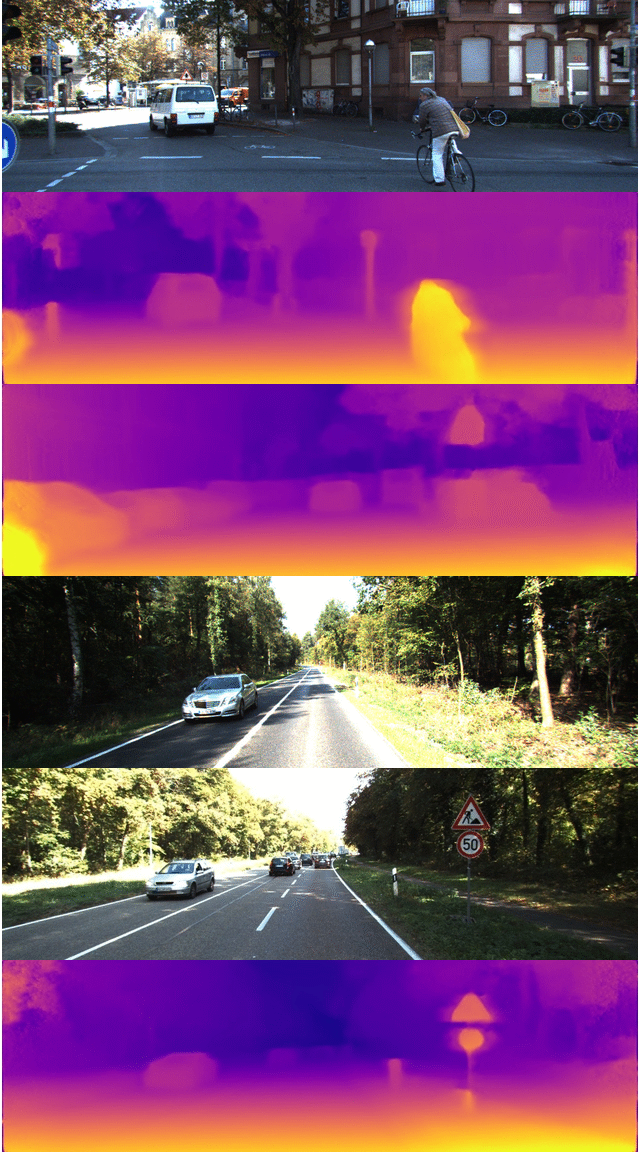
*Synthetic Defocusing using Monocular Depth Estimation*
Graded blurring of an image based on how far a point is from focus using just a single image with no extra data.
To achieve this we generate a depth map for the image using machine learning.
Create blurred versions of the image in levels based on how far a point is from the depth of focus.
Stitch the different blurred images to create the final image with the selected point fully focussed and points further away become more blurred.
## How to run
You'll need to setup Tensorflow v1 and OpenCV for the bare minimum run.
> **_NOTE:_** Setting up Tensorflow v1 can be tricky, hence it is recommeneded to use a prebuilt docker image.
> ```bash
> docker pull tensorflow/tensorflow:1.0.0-py3
> ```
> GPU specific images are also available.
Install a trained model for depth estimation.
```sh
sh ./depth/get_model.sh model_kitti depth/
```
This will download the model which will give the best results for the sample in the repo.
Call main.py with model path and image path
```sh
python main.py --model_path /path/to/model --image_path /path/to/image
```
The image will load up. Clicking anywhere sets that as the point of focus, regenerating the image.
*I've actually pushed in the depth data for the sample images, so you can actually run the program without tensorflow or a trained model for the sample images :)*
### To use our nice GUI
Install dependencies from requirements.txt
Run the gui version as
```sh
python gui.py --model_path /path/to/model
```
Gui version requires some additional packages. Install as necessary.
## Depth Estimation
We have used the method based on the paper Unsupervised Monocular Depth Estimation with Left-Right Consistency. You can find more about their amazing paper [here](http://visual.cs.ucl.ac.uk/pubs/monoDepth/).
They train a machine learning model to generate a depth map using just a single image.
### How the machine learing model is trained in simple terms:
The model is trained on a large set of stereo(left-right) images to generate a right image from a given left image.
Generating the right image, the model is learning internally about the depth of various points in the image.
Once the model is trained. We can give it a simple image and it will be able to generate a depth map for that image.
You can learn more about their amazing project on [github](https://github.com/mrharicot/monodepth).
Their trained models give way better results than what we can so we are using that.
The depth estimation code we have is a minimal stripped down version just to run the model.
## The Team
This was done as a final year project by [Haritha Paul](https://github.com/haritha1997), [Navin Mohan](https://github.com/navin-mohan), [Roshan V](https://github.com/ros-han) and me.
Leave a star if you liked the project. :)
================================================
FILE: defocus/defocus.py
================================================
import argparse
import copy
import cv2
import numpy as np
import os
parser = argparse.ArgumentParser(description='Defocus using depth map.')
parser.add_argument('--image_path', type=str, help='path to input image', default='../images/sample2.png')
parser.add_argument('--blur_method', type=str, help='The type of blur to be applied', default='gaussian')
args = parser.parse_args()
# This class holds functions that handle defocusing of an image using a depth map
# It takes in the path to the image to be defocused and the blur method to be used for defocusing
# It requires the depth map to be saved in the same folder as the image, with the suffix and extension _disp.npy
# Parameters:
# image_path: Path to the image which is to be defocused
# blur_method: The blur function to be used for blurring.
# Available values are: gaussian, avg_blur, median, bilateral
class DefocuserObject():
def __init__(self, image_path = "../images/sample2.png", blur_method = "gaussian"):
self.img_name = os.path.basename(image_path).split('.')[0]
self.img_ext = os.path.basename(image_path).split('.')[-1]
self.img_dir = os.path.dirname(image_path)
self.blur_method = blur_method
# Lambda functions to call the appropriate blur function according to set method
# All the functions takes 2 arguments: the image and the kernel size to be used in the function
# As the kernel size increases the amount of blur increases
self.blur_function = {
'avg_blur': lambda img,ker_size: cv2.blur(img, (ker_size,ker_size)),
'gaussian': lambda img,ker_size: cv2.GaussianBlur(img, (ker_size,ker_size), 0),
'median': lambda img,ker_size: cv2.medianBlur(img, ker_size),
'bilateral': lambda img,ker_size: cv2.bilateralFilter(img, ker_size, 75, 75),
}
self.depth_data = np.load(os.path.join(self.img_dir, self.img_name + "_disp.npy"))
self.img = cv2.imread(os.path.join(self.img_dir, self.img_name + "." + self.img_ext))
self.blur_imgs = []
# The blurred versions of the images can be precalculated
self.blur_images()
# Normalizes the depth values based on the depth of focus
# The depth of focus is saved in point_of_focus
# norm_depth_data holds the final normalized depth of focus
# 0 value corresponds to the point which is focused
# 1 value corresponds to the point furthest from the point of focus
def normalize_pof(self):
self.norm_depth_data = self.depth_data - self.point_of_focus
self.norm_depth_data = np.abs(self.norm_depth_data)
self.norm_depth_data = self.norm_depth_data / self.norm_depth_data.max()
# Mouse callback function
# The point of the click is taken as the point of focus and defocusing is performed around it
def depth_callback(self, event, x, y, flags, param):
if event == cv2.EVENT_LBUTTONDOWN:
self.point_of_focus = self.depth_data[y][x]
self.defocus_with_pof()
# The depth map is normalized around the point of focus after which the defocusing of the image is done by sectioning and masking
def defocus_with_pof(self):
print("Point of focus: ", self.point_of_focus)
self.normalize_pof()
print("Normalized depth data around point of focus")
section_size = 1 / len(self.blur_imgs)
final_image = np.zeros(self.img.shape)
for index, blur_img in enumerate(self.blur_imgs):
mask = (index*section_size <= self.norm_depth_data) & (self.norm_depth_data < (index+1)*section_size)
masked_img = copy.deepcopy(blur_img)
# Applying mask on copy of blurred image
masked_img[mask==0] = [0, 0, 0]
final_image = final_image + masked_img
final_image = np.uint8(final_image)
# cv2.imshow("Final", final_image)
cv2.imwrite(os.path.join(self.img_dir, self.img_name + "_defocus.png"), final_image)
cv2.imshow("Project Defude", final_image)
def set_pof_from_coord(self, norm_x, norm_y):
h, w = self.depth_data.shape[:2]
self.point_of_focus = self.depth_data[int(h * norm_y)][int(w * norm_x)]
self.defocus_with_pof()
# Creates a window to display the original image
# The callback function is attached to this window
def view_image_for_blur(self):
cv2.namedWindow("Project Defude", flags = (cv2.WINDOW_GUI_NORMAL | cv2.WINDOW_AUTOSIZE))
cv2.setMouseCallback("Project Defude", self.depth_callback)
cv2.imshow("Project Defude", self.img)
# cv2.namedWindow("Project Defude", flags=cv2.WINDOW_GUI_NORMAL)
while(cv2.waitKey() != 27):
pass
cv2.destroyAllWindows()
# Generated different blurred versions of the original image
# The blurred versions are stored in the list blur_imgs
def blur_images(self):
print("Generating blurred versions for image")
self.blur_imgs.append(self.img)
for ker_size in range(5, 22, 4):
self.blur_imgs.append(self.blur_function[self.blur_method](self.img, ker_size))
# Show blurred images
# for index, blur_img in enumerate(self.blur_imgs):
# cv2.imshow("blur " + str(index), blur_img)
if __name__ == "__main__":
PATH = args.image_path
BLUR = args.blur_method
defocuser = DefocuserObject(image_path = PATH, blur_method = BLUR)
# defocuser.set_pof_from_coord(0.9, 0.9)
defocuser.view_image_for_blur()
================================================
FILE: depth/README.md
================================================
# Monodepth
Tensorflow implementation of unsupervised single image depth prediction using a convolutional neural network.
**Unsupervised Monocular Depth Estimation with Left-Right Consistency**
[Clément Godard](http://www0.cs.ucl.ac.uk/staff/C.Godard/), [Oisin Mac Aodha](http://vision.caltech.edu/~macaodha/) and [Gabriel J. Brostow](http://www0.cs.ucl.ac.uk/staff/g.brostow/)
CVPR 2017
For more details:
[github](http://visual.cs.ucl.ac.uk/pubs/monoDepth/),
[project page](http://visual.cs.ucl.ac.uk/pubs/monoDepth/),
[arXiv](https://arxiv.org/abs/1609.03677)
This code is a minimal stripped down version of the original monodepth code using OpenCV backend.
All ownership and rights to this code and it's implementation belong to the original project owners and their organization.
Please check the [original repository](https://github.com/mrharicot/monodepth) and their [LICENSE](https://github.com/mrharicot/monodepth/blob/master/LICENSE) file for more information.
================================================
FILE: depth/average_gradients.py
================================================
# Copyright 2015 The TensorFlow Authors. All Rights Reserved.
#
# Licensed under the Apache License, Version 2.0 (the "License");
# you may not use this file except in compliance with the License.
# You may obtain a copy of the License at
#
# http://www.apache.org/licenses/LICENSE-2.0
#
# Unless required by applicable law or agreed to in writing, software
# distributed under the License is distributed on an "AS IS" BASIS,
# WITHOUT WARRANTIES OR CONDITIONS OF ANY KIND, either express or implied.
# See the License for the specific language governing permissions and
# limitations under the License.
from __future__ import absolute_import, division, print_function
import tensorflow as tf
def average_gradients(tower_grads):
average_grads = []
for grad_and_vars in zip(*tower_grads):
# Note that each grad_and_vars looks like the following:
# ((grad0_gpu0, var0_gpu0), ... , (grad0_gpuN, var0_gpuN))
grads = []
for g, _ in grad_and_vars:
# Add 0 dimension to the gradients to represent the tower.
expanded_g = tf.expand_dims(g, 0)
# Append on a 'tower' dimension which we will average over below.
grads.append(expanded_g)
# Average over the 'tower' dimension.
grad = tf.concat(axis=0, values=grads)
grad = tf.reduce_mean(grad, 0)
# Keep in mind that the Variables are redundant because they are shared
# across towers. So .. we will just return the first tower's pointer to
# the Variable.
v = grad_and_vars[0][1]
grad_and_var = (grad, v)
average_grads.append(grad_and_var)
return average_grads
================================================
FILE: depth/bilinear_sampler.py
================================================
# Copyright 2016 The TensorFlow Authors. All Rights Reserved.
# Copyright 2017 Modifications Clement Godard.
#
# Licensed under the Apache License, Version 2.0 (the "License");
# you may not use this file except in compliance with the License.
# You may obtain a copy of the License at
#
# http://www.apache.org/licenses/LICENSE-2.0
#
# Unless required by applicable law or agreed to in writing, software
# distributed under the License is distributed on an "AS IS" BASIS,
# WITHOUT WARRANTIES OR CONDITIONS OF ANY KIND, either express or implied.
# See the License for the specific language governing permissions and
# limitations under the License.
# ==============================================================================
from __future__ import absolute_import, division, print_function
import tensorflow as tf
def bilinear_sampler_1d_h(input_images, x_offset, wrap_mode='border', name='bilinear_sampler', **kwargs):
def _repeat(x, n_repeats):
with tf.variable_scope('_repeat'):
rep = tf.tile(tf.expand_dims(x, 1), [1, n_repeats])
return tf.reshape(rep, [-1])
def _interpolate(im, x, y):
with tf.variable_scope('_interpolate'):
# handle both texture border types
_edge_size = 0
if _wrap_mode == 'border':
_edge_size = 1
im = tf.pad(im, [[0, 0], [1, 1], [1, 1], [0, 0]], mode='CONSTANT')
x = x + _edge_size
y = y + _edge_size
elif _wrap_mode == 'edge':
_edge_size = 0
else:
return None
x = tf.clip_by_value(x, 0.0, _width_f - 1 + 2 * _edge_size)
x0_f = tf.floor(x)
y0_f = tf.floor(y)
x1_f = x0_f + 1
x0 = tf.cast(x0_f, tf.int32)
y0 = tf.cast(y0_f, tf.int32)
x1 = tf.cast(tf.minimum(x1_f, _width_f - 1 + 2 * _edge_size), tf.int32)
dim2 = (_width + 2 * _edge_size)
dim1 = (_width + 2 * _edge_size) * (_height + 2 * _edge_size)
base = _repeat(tf.range(_num_batch) * dim1, _height * _width)
base_y0 = base + y0 * dim2
idx_l = base_y0 + x0
idx_r = base_y0 + x1
im_flat = tf.reshape(im, tf.stack([-1, _num_channels]))
pix_l = tf.gather(im_flat, idx_l)
pix_r = tf.gather(im_flat, idx_r)
weight_l = tf.expand_dims(x1_f - x, 1)
weight_r = tf.expand_dims(x - x0_f, 1)
return weight_l * pix_l + weight_r * pix_r
def _transform(input_images, x_offset):
with tf.variable_scope('transform'):
# grid of (x_t, y_t, 1), eq (1) in ref [1]
x_t, y_t = tf.meshgrid(tf.linspace(0.0, _width_f - 1.0, _width),
tf.linspace(0.0 , _height_f - 1.0 , _height))
x_t_flat = tf.reshape(x_t, (1, -1))
y_t_flat = tf.reshape(y_t, (1, -1))
x_t_flat = tf.tile(x_t_flat, tf.stack([_num_batch, 1]))
y_t_flat = tf.tile(y_t_flat, tf.stack([_num_batch, 1]))
x_t_flat = tf.reshape(x_t_flat, [-1])
y_t_flat = tf.reshape(y_t_flat, [-1])
x_t_flat = x_t_flat + tf.reshape(x_offset, [-1]) * _width_f
input_transformed = _interpolate(input_images, x_t_flat, y_t_flat)
output = tf.reshape(
input_transformed, tf.stack([_num_batch, _height, _width, _num_channels]))
return output
with tf.variable_scope(name):
_num_batch = tf.shape(input_images)[0]
_height = tf.shape(input_images)[1]
_width = tf.shape(input_images)[2]
_num_channels = tf.shape(input_images)[3]
_height_f = tf.cast(_height, tf.float32)
_width_f = tf.cast(_width, tf.float32)
_wrap_mode = wrap_mode
output = _transform(input_images, x_offset)
return output
================================================
FILE: depth/depth_dataloader.py
================================================
# Copyright UCL Business plc 2017. Patent Pending. All rights reserved.
#
# The MonoDepth Software is licensed under the terms of the UCLB ACP-A licence
# which allows for non-commercial use only, the full terms of which are made
# available in the LICENSE file.
#
# For any other use of the software not covered by the UCLB ACP-A Licence,
# please contact info@uclb.com
"""Depth data loader.
"""
import tensorflow as tf
def string_length_tf(t):
return tf.py_func(len, [t], [tf.int64])
class DepthDataloader(object):
"""Depth dataloader"""
def __init__(self, data_path, filenames_file, params, mode):
self.data_path = data_path
self.params = params
self.mode = mode
self.left_image_batch = None
self.right_image_batch = None
input_queue = tf.train.string_input_producer([filenames_file], shuffle=False)
line_reader = tf.TextLineReader()
_, line = line_reader.read(input_queue)
split_line = tf.string_split([line]).values
# we load only one image for test
if mode == 'test':
left_image_path = tf.string_join([self.data_path, split_line[0]])
left_image_o = self.read_image(left_image_path)
if mode == 'train':
# randomly flip images
do_flip = tf.random_uniform([], 0, 1)
left_image = tf.cond(do_flip > 0.5, lambda: tf.image.flip_left_right(right_image_o), lambda: left_image_o)
right_image = tf.cond(do_flip > 0.5, lambda: tf.image.flip_left_right(left_image_o), lambda: right_image_o)
# randomly augment images
do_augment = tf.random_uniform([], 0, 1)
left_image, right_image = tf.cond(do_augment > 0.5, lambda: self.augment_image_pair(left_image, right_image), lambda: (left_image, right_image))
left_image.set_shape( [None, None, 3])
right_image.set_shape([None, None, 3])
# capacity = min_after_dequeue + (num_threads + a small safety margin) * batch_size
min_after_dequeue = 2048
capacity = min_after_dequeue + 4 * params.batch_size
self.left_image_batch, self.right_image_batch = tf.train.shuffle_batch([left_image, right_image],
params.batch_size, capacity, min_after_dequeue, params.num_threads)
elif mode == 'test':
self.left_image_batch = tf.stack([left_image_o, tf.image.flip_left_right(left_image_o)], 0)
self.left_image_batch.set_shape( [2, None, None, 3])
def augment_image_pair(self, left_image, right_image):
# randomly shift gamma
random_gamma = tf.random_uniform([], 0.8, 1.2)
left_image_aug = left_image ** random_gamma
right_image_aug = right_image ** random_gamma
# randomly shift brightness
random_brightness = tf.random_uniform([], 0.5, 2.0)
left_image_aug = left_image_aug * random_brightness
right_image_aug = right_image_aug * random_brightness
# randomly shift color
random_colors = tf.random_uniform([3], 0.8, 1.2)
white = tf.ones([tf.shape(left_image)[0], tf.shape(left_image)[1]])
color_image = tf.stack([white * random_colors[i] for i in range(3)], axis=2)
left_image_aug *= color_image
right_image_aug *= color_image
# saturate
left_image_aug = tf.clip_by_value(left_image_aug, 0, 1)
right_image_aug = tf.clip_by_value(right_image_aug, 0, 1)
return left_image_aug, right_image_aug
def read_image(self, image_path):
# tf.decode_image does not return the image size, this is an ugly workaround to handle both jpeg and png
path_length = string_length_tf(image_path)[0]
file_extension = tf.substr(image_path, path_length - 3, 3)
file_cond = tf.equal(file_extension, 'jpg')
image = tf.cond(file_cond, lambda: tf.image.decode_jpeg(tf.read_file(image_path)), lambda: tf.image.decode_png(tf.read_file(image_path)))
image = tf.image.convert_image_dtype(image, tf.float32)
image = tf.image.resize_images(image, [self.params.height, self.params.width], tf.image.ResizeMethod.AREA)
return image
================================================
FILE: depth/depth_model.py
================================================
# Copyright UCL Business plc 2017. Patent Pending. All rights reserved.
#
# The MonoDepth Software is licensed under the terms of the UCLB ACP-A licence
# which allows for non-commercial use only, the full terms of which are made
# available in the LICENSE file.
#
# For any other use of the software not covered by the UCLB ACP-A Licence,
# please contact info@uclb.com
"""Fully convolutional model for monocular depth estimation
by Clement Godard, Oisin Mac Aodha and Gabriel J. Brostow
http://visual.cs.ucl.ac.uk/pubs/monoDepth/
"""
from __future__ import absolute_import, division, print_function
from collections import namedtuple
import numpy as np
import tensorflow as tf
import tensorflow.contrib.slim as slim
from bilinear_sampler import *
depth_parameters = namedtuple('parameters',
'encoder, '
'height, width, '
'batch_size, '
'num_threads, '
'num_epochs, '
'wrap_mode, '
'use_deconv, '
'alpha_image_loss, '
'disp_gradient_loss_weight, '
'lr_loss_weight, '
'full_summary')
class DepthModel(object):
"""depth model"""
def __init__(self, params, mode, left, right, reuse_variables=None, model_index=0):
self.params = params
self.mode = mode
self.left = left
self.right = right
self.model_collection = ['model_' + str(model_index)]
self.reuse_variables = reuse_variables
self.build_model()
self.build_outputs()
if self.mode == 'test':
return
self.build_losses()
self.build_summaries()
def gradient_x(self, img):
gx = img[:,:,:-1,:] - img[:,:,1:,:]
return gx
def gradient_y(self, img):
gy = img[:,:-1,:,:] - img[:,1:,:,:]
return gy
def upsample_nn(self, x, ratio):
s = tf.shape(x)
h = s[1]
w = s[2]
return tf.image.resize_nearest_neighbor(x, [h * ratio, w * ratio])
def scale_pyramid(self, img, num_scales):
scaled_imgs = [img]
s = tf.shape(img)
h = s[1]
w = s[2]
for i in range(num_scales - 1):
ratio = 2 ** (i + 1)
nh = h // ratio
nw = w // ratio
scaled_imgs.append(tf.image.resize_area(img, [nh, nw]))
return scaled_imgs
def generate_image_left(self, img, disp):
return bilinear_sampler_1d_h(img, -disp)
def generate_image_right(self, img, disp):
return bilinear_sampler_1d_h(img, disp)
def SSIM(self, x, y):
C1 = 0.01 ** 2
C2 = 0.03 ** 2
mu_x = slim.avg_pool2d(x, 3, 1, 'VALID')
mu_y = slim.avg_pool2d(y, 3, 1, 'VALID')
sigma_x = slim.avg_pool2d(x ** 2, 3, 1, 'VALID') - mu_x ** 2
sigma_y = slim.avg_pool2d(y ** 2, 3, 1, 'VALID') - mu_y ** 2
sigma_xy = slim.avg_pool2d(x * y , 3, 1, 'VALID') - mu_x * mu_y
SSIM_n = (2 * mu_x * mu_y + C1) * (2 * sigma_xy + C2)
SSIM_d = (mu_x ** 2 + mu_y ** 2 + C1) * (sigma_x + sigma_y + C2)
SSIM = SSIM_n / SSIM_d
return tf.clip_by_value((1 - SSIM) / 2, 0, 1)
def get_disparity_smoothness(self, disp, pyramid):
disp_gradients_x = [self.gradient_x(d) for d in disp]
disp_gradients_y = [self.gradient_y(d) for d in disp]
image_gradients_x = [self.gradient_x(img) for img in pyramid]
image_gradients_y = [self.gradient_y(img) for img in pyramid]
weights_x = [tf.exp(-tf.reduce_mean(tf.abs(g), 3, keep_dims=True)) for g in image_gradients_x]
weights_y = [tf.exp(-tf.reduce_mean(tf.abs(g), 3, keep_dims=True)) for g in image_gradients_y]
smoothness_x = [disp_gradients_x[i] * weights_x[i] for i in range(4)]
smoothness_y = [disp_gradients_y[i] * weights_y[i] for i in range(4)]
return smoothness_x + smoothness_y
def get_disp(self, x):
disp = 0.3 * self.conv(x, 2, 3, 1, tf.nn.sigmoid)
return disp
def conv(self, x, num_out_layers, kernel_size, stride, activation_fn=tf.nn.elu):
p = np.floor((kernel_size - 1) / 2).astype(np.int32)
p_x = tf.pad(x, [[0, 0], [p, p], [p, p], [0, 0]])
return slim.conv2d(p_x, num_out_layers, kernel_size, stride, 'VALID', activation_fn=activation_fn)
def conv_block(self, x, num_out_layers, kernel_size):
conv1 = self.conv(x, num_out_layers, kernel_size, 1)
conv2 = self.conv(conv1, num_out_layers, kernel_size, 2)
return conv2
def maxpool(self, x, kernel_size):
p = np.floor((kernel_size - 1) / 2).astype(np.int32)
p_x = tf.pad(x, [[0, 0], [p, p], [p, p], [0, 0]])
return slim.max_pool2d(p_x, kernel_size)
def resconv(self, x, num_layers, stride):
do_proj = tf.shape(x)[3] != num_layers or stride == 2
shortcut = []
conv1 = self.conv(x, num_layers, 1, 1)
conv2 = self.conv(conv1, num_layers, 3, stride)
conv3 = self.conv(conv2, 4 * num_layers, 1, 1, None)
if do_proj:
shortcut = self.conv(x, 4 * num_layers, 1, stride, None)
else:
shortcut = x
return tf.nn.elu(conv3 + shortcut)
def resblock(self, x, num_layers, num_blocks):
out = x
for i in range(num_blocks - 1):
out = self.resconv(out, num_layers, 1)
out = self.resconv(out, num_layers, 2)
return out
def upconv(self, x, num_out_layers, kernel_size, scale):
upsample = self.upsample_nn(x, scale)
conv = self.conv(upsample, num_out_layers, kernel_size, 1)
return conv
def deconv(self, x, num_out_layers, kernel_size, scale):
p_x = tf.pad(x, [[0, 0], [1, 1], [1, 1], [0, 0]])
conv = slim.conv2d_transpose(p_x, num_out_layers, kernel_size, scale, 'SAME')
return conv[:,3:-1,3:-1,:]
def build_resnet50(self):
#set convenience functions
conv = self.conv
if self.params.use_deconv:
upconv = self.deconv
else:
upconv = self.upconv
with tf.variable_scope('encoder'):
conv1 = conv(self.model_input, 64, 7, 2) # H/2 - 64D
pool1 = self.maxpool(conv1, 3) # H/4 - 64D
conv2 = self.resblock(pool1, 64, 3) # H/8 - 256D
conv3 = self.resblock(conv2, 128, 4) # H/16 - 512D
conv4 = self.resblock(conv3, 256, 6) # H/32 - 1024D
conv5 = self.resblock(conv4, 512, 3) # H/64 - 2048D
with tf.variable_scope('skips'):
skip1 = conv1
skip2 = pool1
skip3 = conv2
skip4 = conv3
skip5 = conv4
# DECODING
with tf.variable_scope('decoder'):
upconv6 = upconv(conv5, 512, 3, 2) #H/32
concat6 = tf.concat([upconv6, skip5], 3)
iconv6 = conv(concat6, 512, 3, 1)
upconv5 = upconv(iconv6, 256, 3, 2) #H/16
concat5 = tf.concat([upconv5, skip4], 3)
iconv5 = conv(concat5, 256, 3, 1)
upconv4 = upconv(iconv5, 128, 3, 2) #H/8
concat4 = tf.concat([upconv4, skip3], 3)
iconv4 = conv(concat4, 128, 3, 1)
self.disp4 = self.get_disp(iconv4)
udisp4 = self.upsample_nn(self.disp4, 2)
upconv3 = upconv(iconv4, 64, 3, 2) #H/4
concat3 = tf.concat([upconv3, skip2, udisp4], 3)
iconv3 = conv(concat3, 64, 3, 1)
self.disp3 = self.get_disp(iconv3)
udisp3 = self.upsample_nn(self.disp3, 2)
upconv2 = upconv(iconv3, 32, 3, 2) #H/2
concat2 = tf.concat([upconv2, skip1, udisp3], 3)
iconv2 = conv(concat2, 32, 3, 1)
self.disp2 = self.get_disp(iconv2)
udisp2 = self.upsample_nn(self.disp2, 2)
upconv1 = upconv(iconv2, 16, 3, 2) #H
concat1 = tf.concat([upconv1, udisp2], 3)
iconv1 = conv(concat1, 16, 3, 1)
self.disp1 = self.get_disp(iconv1)
def build_model(self):
with slim.arg_scope([slim.conv2d, slim.conv2d_transpose], activation_fn=tf.nn.elu):
with tf.variable_scope('model', reuse=self.reuse_variables):
self.left_pyramid = self.scale_pyramid(self.left, 4)
if self.mode == 'train':
self.right_pyramid = self.scale_pyramid(self.right, 4)
self.model_input = self.left
#build model
if self.params.encoder == 'resnet50':
self.build_resnet50()
else:
return None
def build_outputs(self):
# STORE DISPARITIES
with tf.variable_scope('disparities'):
self.disp_est = [self.disp1, self.disp2, self.disp3, self.disp4]
self.disp_left_est = [tf.expand_dims(d[:,:,:,0], 3) for d in self.disp_est]
self.disp_right_est = [tf.expand_dims(d[:,:,:,1], 3) for d in self.disp_est]
if self.mode == 'test':
return
# GENERATE IMAGES
with tf.variable_scope('images'):
self.left_est = [self.generate_image_left(self.right_pyramid[i], self.disp_left_est[i]) for i in range(4)]
self.right_est = [self.generate_image_right(self.left_pyramid[i], self.disp_right_est[i]) for i in range(4)]
# LR CONSISTENCY
with tf.variable_scope('left-right'):
self.right_to_left_disp = [self.generate_image_left(self.disp_right_est[i], self.disp_left_est[i]) for i in range(4)]
self.left_to_right_disp = [self.generate_image_right(self.disp_left_est[i], self.disp_right_est[i]) for i in range(4)]
# DISPARITY SMOOTHNESS
with tf.variable_scope('smoothness'):
self.disp_left_smoothness = self.get_disparity_smoothness(self.disp_left_est, self.left_pyramid)
self.disp_right_smoothness = self.get_disparity_smoothness(self.disp_right_est, self.right_pyramid)
def build_losses(self):
with tf.variable_scope('losses', reuse=self.reuse_variables):
# IMAGE RECONSTRUCTION
# L1
self.l1_left = [tf.abs( self.left_est[i] - self.left_pyramid[i]) for i in range(4)]
self.l1_reconstruction_loss_left = [tf.reduce_mean(l) for l in self.l1_left]
self.l1_right = [tf.abs(self.right_est[i] - self.right_pyramid[i]) for i in range(4)]
self.l1_reconstruction_loss_right = [tf.reduce_mean(l) for l in self.l1_right]
# SSIM
self.ssim_left = [self.SSIM( self.left_est[i], self.left_pyramid[i]) for i in range(4)]
self.ssim_loss_left = [tf.reduce_mean(s) for s in self.ssim_left]
self.ssim_right = [self.SSIM(self.right_est[i], self.right_pyramid[i]) for i in range(4)]
self.ssim_loss_right = [tf.reduce_mean(s) for s in self.ssim_right]
# WEIGTHED SUM
self.image_loss_right = [self.params.alpha_image_loss * self.ssim_loss_right[i] + (1 - self.params.alpha_image_loss) * self.l1_reconstruction_loss_right[i] for i in range(4)]
self.image_loss_left = [self.params.alpha_image_loss * self.ssim_loss_left[i] + (1 - self.params.alpha_image_loss) * self.l1_reconstruction_loss_left[i] for i in range(4)]
self.image_loss = tf.add_n(self.image_loss_left + self.image_loss_right)
# DISPARITY SMOOTHNESS
self.disp_left_loss = [tf.reduce_mean(tf.abs(self.disp_left_smoothness[i])) / 2 ** i for i in range(4)]
self.disp_right_loss = [tf.reduce_mean(tf.abs(self.disp_right_smoothness[i])) / 2 ** i for i in range(4)]
self.disp_gradient_loss = tf.add_n(self.disp_left_loss + self.disp_right_loss)
# LR CONSISTENCY
self.lr_left_loss = [tf.reduce_mean(tf.abs(self.right_to_left_disp[i] - self.disp_left_est[i])) for i in range(4)]
self.lr_right_loss = [tf.reduce_mean(tf.abs(self.left_to_right_disp[i] - self.disp_right_est[i])) for i in range(4)]
self.lr_loss = tf.add_n(self.lr_left_loss + self.lr_right_loss)
# TOTAL LOSS
self.total_loss = self.image_loss + self.params.disp_gradient_loss_weight * self.disp_gradient_loss + self.params.lr_loss_weight * self.lr_loss
def build_summaries(self):
# SUMMARIES
with tf.device('/cpu:0'):
for i in range(4):
tf.summary.scalar('ssim_loss_' + str(i), self.ssim_loss_left[i] + self.ssim_loss_right[i], collections=self.model_collection)
tf.summary.scalar('l1_loss_' + str(i), self.l1_reconstruction_loss_left[i] + self.l1_reconstruction_loss_right[i], collections=self.model_collection)
tf.summary.scalar('image_loss_' + str(i), self.image_loss_left[i] + self.image_loss_right[i], collections=self.model_collection)
tf.summary.scalar('disp_gradient_loss_' + str(i), self.disp_left_loss[i] + self.disp_right_loss[i], collections=self.model_collection)
tf.summary.scalar('lr_loss_' + str(i), self.lr_left_loss[i] + self.lr_right_loss[i], collections=self.model_collection)
tf.summary.image('disp_left_est_' + str(i), self.disp_left_est[i], max_outputs=4, collections=self.model_collection)
tf.summary.image('disp_right_est_' + str(i), self.disp_right_est[i], max_outputs=4, collections=self.model_collection)
================================================
FILE: depth/depth_simple.py
================================================
# Copyright UCL Business plc 2017. Patent Pending. All rights reserved.
#
# The MonoDepth Software is licensed under the terms of the UCLB ACP-A licence
# which allows for non-commercial use only, the full terms of which are made
# available in the LICENSE file.
#
# For any other use of the software not covered by the UCLB ACP-A Licence,
# please contact info@uclb.com
# only keep warnings and errors
import os
os.environ['TF_CPP_MIN_LOG_LEVEL']='0'
import numpy as np
import argparse
import re
import time
import tensorflow as tf
import tensorflow.contrib.slim as slim
import cv2
import matplotlib
matplotlib.use('agg')
import matplotlib.pyplot as plt
from depth_model import *
from depth_dataloader import *
from average_gradients import *
parser = argparse.ArgumentParser(description='Depth TensorFlow implementation.')
parser.add_argument('--encoder', type=str, help='type of encoder, resnet50', default='resnet50')
parser.add_argument('--image_path', type=str, help='path to the image', required=True)
parser.add_argument('--checkpoint_path', type=str, help='path to a specific checkpoint to load', required=True)
parser.add_argument('--input_height', type=int, help='input height', default=256)
parser.add_argument('--input_width', type=int, help='input width', default=512)
args = parser.parse_args()
def post_process_disparity(disp):
_, h, w = disp.shape
l_disp = disp[0,:,:]
r_disp = np.fliplr(disp[1,:,:])
m_disp = 0.5 * (l_disp + r_disp)
l, _ = np.meshgrid(np.linspace(0, 1, w), np.linspace(0, 1, h))
l_mask = 1.0 - np.clip(20 * (l - 0.05), 0, 1)
r_mask = np.fliplr(l_mask)
return r_mask * l_disp + l_mask * r_disp + (1.0 - l_mask - r_mask) * m_disp
def test_simple(params):
"""Test function."""
left = tf.placeholder(tf.float32, [2, args.input_height, args.input_width, 3])
model = DepthModel(params, "test", left, None)
input_image = cv2.imread(args.image_path)
input_image = cv2.cvtColor(input_image, cv2.COLOR_BGR2RGB)
original_height, original_width, num_channels = input_image.shape
input_image = cv2.resize(input_image, dsize = (args.input_width, args.input_height))
input_image = input_image.astype(np.float32) / 255
input_images = np.stack((input_image, np.fliplr(input_image)), 0)
# SESSION
config = tf.ConfigProto(allow_soft_placement=True)
sess = tf.Session(config=config)
# SAVER
train_saver = tf.train.Saver()
# INIT
sess.run(tf.global_variables_initializer())
sess.run(tf.local_variables_initializer())
coordinator = tf.train.Coordinator()
# RESTORE
restore_path = args.checkpoint_path.split(".")[0]
train_saver.restore(sess, restore_path)
disp = sess.run(model.disp_left_est[0], feed_dict={left: input_images})
disp_pp = post_process_disparity(disp.squeeze()).astype(np.float32)
output_directory = os.path.dirname(args.image_path)
output_name = os.path.splitext(os.path.basename(args.image_path))[0]
# np.save(os.path.join(output_directory, "{}_disp.npy".format(output_name)), disp_pp)
disp_to_img = cv2.resize(disp_pp.squeeze(), dsize = (original_width, original_height))
np.save(os.path.join(output_directory, "{}_disp.npy".format(output_name)), disp_to_img)
plt.imsave(os.path.join(output_directory, "{}_disp.png".format(output_name)), disp_to_img, cmap='plasma')
print('done!')
def main(_):
params = depth_parameters(
encoder=args.encoder,
height=args.input_height,
width=args.input_width,
batch_size=2,
num_threads=1,
num_epochs=1,
wrap_mode="border",
use_deconv=False,
alpha_image_loss=0,
disp_gradient_loss_weight=0,
lr_loss_weight=0,
full_summary=False)
test_simple(params)
if __name__ == '__main__':
tf.app.run()
================================================
FILE: depth/get_model.sh
================================================
model_name=$1
output_location=$2
filename=$model_name.zip
url=http://visual.cs.ucl.ac.uk/pubs/monoDepth/models/$filename
output_file=$output_location/$filename
echo "Downloading $model_name"
wget -nc $url -O $output_file
unzip $output_file -d $output_location
rm $output_file
================================================
FILE: gui.py
================================================
import gi
gi.require_version('Gtk','3.0')
from gi.repository import Gtk, Gdk, GdkPixbuf
import threading
from functools import partial
import os
from defocus.defocus import DefocuserObject
import cv2
class DefudeGui(object):
def __init__(self,checkpoint_path,glade_file='ui-stepper.glade'):
self.builder = Gtk.Builder()
# load the glade file describing the UI
self.builder.add_from_file(glade_file)
# connect the event handlers
self.builder.connect_signals(self)
# all the available windows
self.main_window = self.builder.get_object('main-window')
self.about_dialog = self.builder.get_object('about-dialog')
self.help_dialog = self.builder.get_object('help-dialog')
# some ui elements
self.input_image_drop = self.builder.get_object('input-image-drop')
self.select_input_image_picker = self.builder.get_object('select-image-file-picker')
self.step_stack = self.builder.get_object('main-step-stack')
self.image_drop_dest = self.builder.get_object('image-drag-drop-dest')
self.input_image_spinner = self.builder.get_object('input-image-spinner')
self.input_image_status_line = self.builder.get_object('input-image-status')
self.input_image_delete_btn = self.builder.get_object('delete-input-img-btn')
self.input_image_next_btn = self.builder.get_object('input-image-next-btn')
self.depth_map_image = self.builder.get_object('depth-map-image')
self.pof_image = self.builder.get_object('pick-pof-image')
self.pof_status_line = self.builder.get_object('pof-status-line')
self.pof_status_spinner = self.builder.get_object('pof-status-spinner')
self.result_image = self.builder.get_object('result-image')
self.header_bar = self.builder.get_object('main-header-bar')
page_ids = (
'start-page',
'select-image-page',
'depth-map-preview',
'pick-pof',
'result-page'
)
self.pages = tuple(
self.builder.get_object(page_id)
for page_id in page_ids
)
# some useful constants
self.IMAGE_WIDTH = 600
self.CHECKPOINT_PATH = checkpoint_path
self.STATUS_MESSAGES = {
'depth_est_running': 'Estimating depthmap...',
'defocus_running': 'Performing defocusing...',
'idle': '',
'resizing': 'Loading the image...'
}
self.DEFAULT_INPUT_IMAGE = 'assets/drag-and-drop.png'
self.WINDOW_TITLE = 'Synthetic Defocusing and Depth Estimation Tool'
# state variables
self.INPUT_IMAGE_PATH = None
self.INPUT_IMAGE_SIZE = None
self.DEPTH_MAP_PATH = None
self.DEFOCUS_IMAGE_PATH = None
self.CURRENT_STACK_PAGE = 0
# set the image as a drag drop destination
self.image_drop_dest.drag_dest_set(
# do all the default stuff
Gtk.DestDefaults.ALL,
# enforce target
[Gtk.TargetEntry.new('text/plain',Gtk.TargetFlags(4), 129)],
Gdk.DragAction.COPY
)
def _next_page(self):
if self.CURRENT_STACK_PAGE < len(self.pages) - 1:
self.CURRENT_STACK_PAGE += 1
self.step_stack.set_visible_child(self.pages[self.CURRENT_STACK_PAGE])
def _prev_page(self):
if self.CURRENT_STACK_PAGE > 0:
self.CURRENT_STACK_PAGE -= 1
self.step_stack.set_visible_child(self.pages[self.CURRENT_STACK_PAGE])
def _set_input_image_impl(self, img_path):
spinner = self.input_image_spinner
status_line = self.input_image_status_line
self.INPUT_IMAGE_PATH = img_path
img,w,h = self._resize_image(img_path,return_size=True)
self.INPUT_IMAGE_SIZE = (w,h)
self.input_image_drop.set_from_pixbuf(img)
self.select_input_image_picker.hide()
spinner.stop()
status_line.set_label(self.STATUS_MESSAGES['idle'])
self.input_image_delete_btn.set_sensitive(True)
self.input_image_next_btn.set_sensitive(True)
def _set_input_image(self, img_path):
spinner = self.input_image_spinner
status_line = self.input_image_status_line
spinner.start()
status_line.set_label(self.STATUS_MESSAGES['resizing'])
thread = threading.Thread(target=partial(self._set_input_image_impl,img_path))
thread.daemon = True
thread.start()
def _unset_input_image(self):
self.INPUT_IMAGE_PATH = None
self.INPUT_IMAGE_SIZE = None
self.input_image_drop.set_from_file(self.DEFAULT_INPUT_IMAGE)
self.select_input_image_picker.show()
self.input_image_next_btn.set_sensitive(False)
def _resize_image(self,path,size=None,return_size=False):
img = GdkPixbuf.Pixbuf.new_from_file(path)
if size is None:
h = img.get_height()
w = img.get_width()
ar = h / float(w)
size = (self.IMAGE_WIDTH,int(self.IMAGE_WIDTH*ar))
resized = img.scale_simple(size[0],size[1],GdkPixbuf.InterpType.BILINEAR)
if return_size:
return resized,size[0],size[1]
return resized
def _estimate_depthmap_impl(self):
os.system("python ./depth/depth_simple.py --checkpoint_path " + self.CHECKPOINT_PATH + " --image_path " + self.INPUT_IMAGE_PATH)
self.DEPTH_MAP_PATH = os.path.join(os.path.dirname(self.INPUT_IMAGE_PATH), os.path.basename(self.INPUT_IMAGE_PATH).split('.')[0]) + '_disp.png'
depthmap_img = self._resize_image(self.DEPTH_MAP_PATH)
self.depth_map_image.set_from_pixbuf(depthmap_img)
self.input_image_spinner.stop()
self.input_image_status_line.set_label(self.STATUS_MESSAGES['idle'])
self._next_page()
self.input_image_next_btn.set_sensitive(True)
self.input_image_delete_btn.set_sensitive(True)
def _estimate_depthmap(self):
self.input_image_next_btn.set_sensitive(False)
self.input_image_delete_btn.set_sensitive(False)
self.input_image_spinner.start()
self.input_image_status_line.set_label(self.STATUS_MESSAGES['depth_est_running'])
thread = threading.Thread(target=self._estimate_depthmap_impl)
thread.daemon = True
thread.start()
def _defocus_image_impl(self, x_norm, y_norm):
defocusser = DefocuserObject(self.INPUT_IMAGE_PATH)
defocusser.set_pof_from_coord(x_norm,y_norm)
self.DEFOCUS_IMAGE_PATH = os.path.join(os.path.dirname(self.INPUT_IMAGE_PATH), os.path.basename(self.INPUT_IMAGE_PATH).split('.')[0]) + '_defocus.png'
img = self._resize_image(self.DEFOCUS_IMAGE_PATH)
self.result_image.set_from_pixbuf(img)
self.pof_status_spinner.stop()
self.pof_status_line.set_label(self.STATUS_MESSAGES['idle'])
self._next_page()
def _defocus_image(self, x_norm, y_norm):
self.pof_status_spinner.start()
self.pof_status_line.set_label(self.STATUS_MESSAGES['defocus_running'])
thread = threading.Thread(target=partial(self._defocus_image_impl,x_norm,y_norm))
thread.daemon = True
thread.start()
def _save(self, src_filename):
dialog = Gtk.FileChooserDialog("Save as",self.main_window,Gtk.FileChooserAction.SAVE,(Gtk.STOCK_SAVE,Gtk.ResponseType.OK,Gtk.STOCK_CANCEL,Gtk.ResponseType.CANCEL))
response = dialog.run()
if response == Gtk.ResponseType.OK:
img = cv2.imread(src_filename)
cv2.imwrite(dialog.get_filename(),img)
dialog.destroy()
def _cleanup(self):
file_list = (
self.DEFOCUS_IMAGE_PATH,
self.DEPTH_MAP_PATH,
)
for file in file_list:
if file:
if os.path.isfile(file):
os.remove(file)
def show(self):
self.main_window.show_all()
Gtk.main()
def onDestroy(self, *args):
Gtk.main_quit()
# self._cleanup()
def onStartPageNext(self, *args):
self._next_page()
def onBack(self, *args):
self._prev_page()
def onAbout(self, *args):
self.about_dialog.run()
self.about_dialog.hide()
def onHelp(self, *args):
self.help_dialog.run()
self.help_dialog.hide()
def onImagePickerSet(self, *args):
input_file_name = args[0].get_filename()
self._set_input_image(input_file_name)
def onImageDrop(self, *args):
filename = args[4].get_text()[7:-1]
self._set_input_image(filename)
def onDeleteInputImage(self, *args):
self._unset_input_image()
self.input_image_delete_btn.set_sensitive(False)
def onInputImageNextBtn(self, *args):
self._estimate_depthmap()
def onDepthMapNextBtn(self, *args):
img = self.input_image_drop.get_pixbuf()
self.pof_image.set_from_pixbuf(img)
self._next_page()
def onDepthMapSave(self, *args):
self._save(self.DEPTH_MAP_PATH)
def onPofPick(self, *args):
event = args[1]
x,y = event.x, event.y
x_norm = x / self.INPUT_IMAGE_SIZE[0]
y_norm = y / self.INPUT_IMAGE_SIZE[1]
print("x_norm: {} y_norm: {}".format(x_norm,y_norm))
self._defocus_image(x_norm,y_norm)
def onResultSave(self, *args):
self._save(self.DEFOCUS_IMAGE_PATH)
if __name__ == '__main__':
parser = argparse.ArgumentParser(description='Synthetic Defocussing Using Depth Estimation')
parser.add_argument('--model_path', type=str, help='path to saved model', required=True)
args = parser.parse_args()
model_path = os.path.abspath(args.model_path)
gui = DefudeGui(model_path)
gui.show()
================================================
FILE: main.py
================================================
import argparse
import os
parser = argparse.ArgumentParser(description='Synthetic Defocussing Using Depth Estimation')
parser.add_argument('--image_path', type=str, help='path to input image', default='images/sample2.png')
parser.add_argument('--model_path', type=str, help='path to saved model', default='blah')
parser.add_argument('--blur_method', type=str, help='the type of blur to be applied', default='gaussian')
args = parser.parse_args()
img_path = os.path.abspath(args.image_path)
model_path = os.path.abspath(args.model_path)
blur_method = args.blur_method
os.system("python ./depth/depth_simple.py --model_path " + model_path + " --image_path " + img_path)
os.system("python ./defocus/defocus.py --image_path " + img_path + " --blur_method " + blur_method)
================================================
FILE: preprocessing.py
================================================
# Project: Synthetic Defocusing using Unsupervised Monocular Depth Estimation
# This file contains the function for preprocessing stage
# Input: Image file of any image format extension
# Output: Preprocessed image for input to the model
import cv2
import numpy as np
import glob # Used for file access
# Performs preprocessing functions on the given image
# Params:
# img: Image in OpenCV image type (numpy.ndarray)
# Returns: Preprocessed image in OpenCV image type
def preprocess(img):
# Denoising
denoised_img = cv2.fastNlMeansDenoisingColored(img)
# Conversion to Grayscale
# gray_img = cv2.cvtColor(denoised_img, cv2.COLOR_BGR2GRAY)
# Sharpening
kernel = np.array([[0,-1,0], [-1,5,-1], [0,-1,0]])
sharpen_img = cv2.filter2D(denoised_img, -1, kernel)
# Histogram Equalization
equ_img = cv2.equalizeHist(sharpen_img)
clahe = cv2.createCLAHE(clipLimit=2.0, tileGridSize=(8,8))
clahe = cv2.createCLAHE()
equ_img = clahe.apply(sharpen_img)
# Resizing
resized_img = cv2.resize(sharpen_img, (512,256), cv2.INTER_AREA)
prep_img = resized_img
return prep_img
# Run the preprocessing functions on a single image with before and after
# Escape Key terminates the windows
# The output of the file can be written to a file by setting output param
# Params
# file: Filename of the image as string
# waitTime: How long the image should be shown in ms
# output: Write the preprocessed file here
# Returns: false if terminated using Esc key else true
def preprocess_single(file, waitTime = 0, output = ""):
img = cv2.imread(file)
prep_img = preprocess(img)
if output:
cv2.imwrite(output, prep_img)
cv2.imshow("Original Image", img)
cv2.imshow("Preprocessed Image", prep_img)
if cv2.waitKey(waitTime) == 27:
cv2.destroyAllWindows()
return 0
cv2.destroyAllWindows()
# Performs preprocessing function on multiple images in a folder
# Params:
# folder_path: Folder name which holds the images with ending slash
def preprocess_multiple(folder_path):
folder_path = folder_path + ".png"
for file in glob.glob(folder_path):
preprocess_single(file, 2000)
if __name__ == "__main__":
preprocess_single("./images/sample0.png", output="./sample0_pre.png")
================================================
FILE: requirements.txt
================================================
cycler==0.10.0
kiwisolver==1.1.0
matplotlib==3.0.3
numpy==1.16.3
opencv-python==4.1.0.25
protobuf==3.7.1
pycairo==1.18.1
PyGObject==3.32.1
pyparsing==2.4.0
python-dateutil==2.8.0
six==1.12.0
tensorflow==1.15.4
================================================
FILE: screenshot/README.md
================================================
## Our beautiful UI :D


================================================
FILE: ui-stepper.glade
================================================
================================================
FILE: ui.glade
================================================