Repository: bertjiazheng/Structured3D
Branch: master
Commit: a1aa97f761f8
Files: 17
Total size: 64.6 KB
Directory structure:
gitextract_zakvmfv2/
├── .gitignore
├── LICENSE
├── README.md
├── data_organization.md
├── metadata/
│ ├── errata.txt
│ ├── labelids.txt
│ └── room_types.txt
├── misc/
│ ├── __init__.py
│ ├── colors.py
│ ├── figures.py
│ ├── panorama.py
│ └── utils.py
├── visualize_3d.py
├── visualize_bbox.py
├── visualize_floorplan.py
├── visualize_layout.py
└── visualize_mesh.py
================================================
FILE CONTENTS
================================================
================================================
FILE: .gitignore
================================================
# Byte-compiled / optimized / DLL files
__pycache__/
vis/
apex/
cocoapi/
demo/
vis_xtion/
MASK_R_*/
old/
checkpoints/
VOCdevkit/
*.py[cod]
*$py.class
pano_pred/
pano_pred.json
# C extensions
*.so
*.log
# Distribution / packaging
.Python
build/
develop-eggs/
dist/
downloads/
eggs/
.eggs/
lib/
lib64/
parts/
sdist/
var/
wheels/
pip-wheel-metadata/
share/python-wheels/
*.egg-info/
.installed.cfg
*.egg
MANIFEST
# PyInstaller
# Usually these files are written by a python script from a template
# before PyInstaller builds the exe, so as to inject date/other infos into it.
*.manifest
*.spec
# Installer logs
pip-log.txt
pip-delete-this-directory.txt
# Unit test / coverage reports
htmlcov/
.tox/
.nox/
.coverage
.coverage.*
.cache
nosetests.xml
coverage.xml
*.cover
.hypothesis/
.pytest_cache/
# Translations
*.mo
*.pot
# Django stuff:
*.log
local_settings.py
db.sqlite3
# Flask stuff:
instance/
.webassets-cache
# Scrapy stuff:
.scrapy
# Sphinx documentation
docs/_build/
# PyBuilder
target/
# Jupyter Notebook
.ipynb_checkpoints
# IPython
profile_default/
ipython_config.py
# pyenv
.python-version
# pipenv
# According to pypa/pipenv#598, it is recommended to include Pipfile.lock in version control.
# However, in case of collaboration, if having platform-specific dependencies or dependencies
# having no cross-platform support, pipenv may install dependencies that don’t work, or not
# install all needed dependencies.
#Pipfile.lock
# celery beat schedule file
celerybeat-schedule
# SageMath parsed files
*.sage.py
# Environments
.env
.venv
env/
venv/
ENV/
env.bak/
venv.bak/
# Spyder project settings
.spyderproject
.spyproject
# Rope project settings
.ropeproject
# mkdocs documentation
/site
# mypy
.mypy_cache/
.dmypy.json
dmypy.json
# Pyre type checker
.pyre/
================================================
FILE: LICENSE
================================================
MIT License
Copyright (c) 2019 Structured3D Group
Permission is hereby granted, free of charge, to any person obtaining a copy
of this software and associated documentation files (the "Software"), to deal
in the Software without restriction, including without limitation the rights
to use, copy, modify, merge, publish, distribute, sublicense, and/or sell
copies of the Software, and to permit persons to whom the Software is
furnished to do so, subject to the following conditions:
The above copyright notice and this permission notice shall be included in all
copies or substantial portions of the Software.
THE SOFTWARE IS PROVIDED "AS IS", WITHOUT WARRANTY OF ANY KIND, EXPRESS OR
IMPLIED, INCLUDING BUT NOT LIMITED TO THE WARRANTIES OF MERCHANTABILITY,
FITNESS FOR A PARTICULAR PURPOSE AND NONINFRINGEMENT. IN NO EVENT SHALL THE
AUTHORS OR COPYRIGHT HOLDERS BE LIABLE FOR ANY CLAIM, DAMAGES OR OTHER
LIABILITY, WHETHER IN AN ACTION OF CONTRACT, TORT OR OTHERWISE, ARISING FROM,
OUT OF OR IN CONNECTION WITH THE SOFTWARE OR THE USE OR OTHER DEALINGS IN THE
SOFTWARE.
================================================
FILE: README.md
================================================
# Structured3D
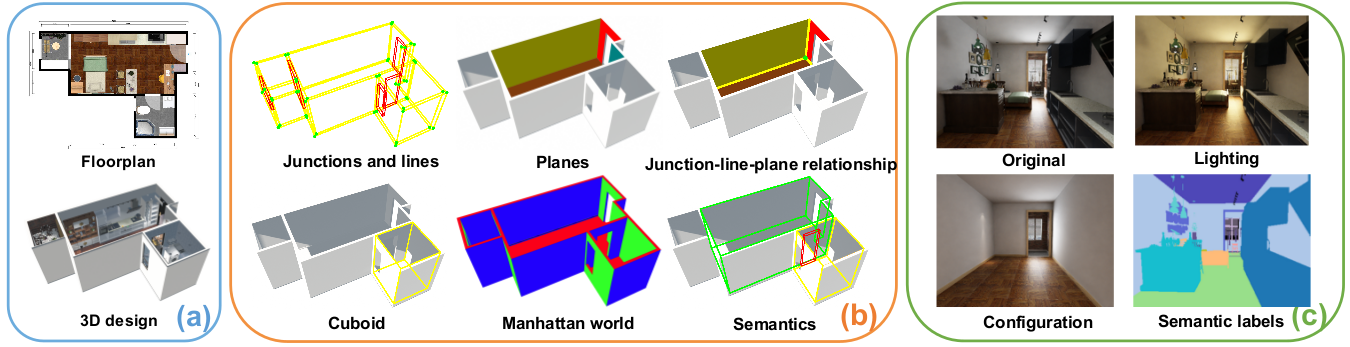
Structured3D is a large-scale photo-realistic dataset containing 3.5K house designs **(a)** created by professional designers with a variety of ground truth 3D structure annotations **(b)** and generate photo-realistic 2D images **(c)**.
## Paper
**Structured3D: A Large Photo-realistic Dataset for Structured 3D Modeling**
[Jia Zheng](https://bertjiazheng.github.io/)\*,
[Junfei Zhang](https://www.linkedin.com/in/骏飞-张-1bb82691/?locale=en_US)\*,
[Jing Li](https://cn.linkedin.com/in/jing-li-253b26139),
[Rui Tang](https://cn.linkedin.com/in/rui-tang-50973488),
[Shenghua Gao](http://sist.shanghaitech.edu.cn/sist_en/2018/0820/c3846a31775/page.htm),
[Zihan Zhou](https://faculty.ist.psu.edu/zzhou)
European Conference on Computer Vision (ECCV), 2020
[[Preprint](https://arxiv.org/abs/1908.00222)]
[[Paper](https://www.ecva.net/papers/eccv_2020/papers_ECCV/papers/123540494.pdf)]
[[Supplementary Material](https://www.ecva.net/papers/eccv_2020/papers_ECCV/papers/123540494-supp.pdf)]
[[Benchmark](https://competitions.codalab.org/competitions/24183)]
(\* Equal contribution)
## Data
The dataset consists of rendering images and corresponding ground truth annotations (_e.g._, semantic, albedo, depth, surface normal, layout) under different lighting and furniture configurations. Please refer to [data organization](data_organization.md) for more details.
To download the dataset, please fill the [agreement form](https://forms.gle/LXg4bcjC2aEjrL9o8) that indicates you agree to the [Structured3D Terms of Use](https://drive.google.com/open?id=13ZwWpU_557ZQccwOUJ8H5lvXD7MeZFMa). After we receive your agreement form, we will provide download access to the dataset.
For fair comparison, we define standard training, validation, and testing splits as follows: _scene_00000_ to _scene_02999_ for training, _scene_03000_ to _scene_03249_ for validation, and _scene_03250_ to _scene_03499_ for testing.
## Errata
- 2020-04-06: We provide a list of invalid cases [here](metadata/errata.txt). You can ignore these cases when using our data.
- 2020-03-26: Fix issue [#10](https://github.com/bertjiazheng/Structured3D/issues/10) about the basis of the bounding box annotations. Please re-download the annotations if you use them.
## Tools
We provide the basic code for viewing the structure annotations of our dataset.
### Installation
Clone repository:
```bash
git clone git@github.com:bertjiazheng/Structured3D.git
```
Please use Python 3, then follow [installation](https://pymesh.readthedocs.io/en/latest/installation.html) to install [PyMesh](https://github.com/PyMesh/PyMesh) (only for plane visualization) and the other dependencies:
```bash
conda install -y open3d -c open3d-admin
conda install -y opencv -c conda-forge
conda install -y descartes matplotlib numpy shapely
pip install panda3d
```
### Visualize 3D Annotation
We use [open3D](https://github.com/intel-isl/Open3D) for wireframe and plane visualization, please refer to interaction control [here](http://www.open3d.org/docs/tutorial/Basic/visualization.html#function-draw-geometries).
```bash
python visualize_3d.py --path /path/to/dataset --scene scene_id --type wireframe/plane/floorplan
```
| Wireframe | Plane | Floorplan |
| ------------------------------------- | ----------------------------- | ------------------------------------- |
|  |  |  |
### Visualize 3D Textured Mesh
```bash
python visualize_mesh.py --path /path/to/dataset --scene scene_id --room room_id
```

### Visualize 2D Layout
```bash
python visualize_layout.py --path /path/to/dataset --scene scene_id --type perspective/panorama
```
#### Panorama Layout


Please refer to the [Supplementary Material](https://www.ecva.net/papers/eccv_2020/papers_ECCV/papers/123540494-supp.pdf) for more example ground truth room layouts.
#### Perspective Layout


### Visualize 3D Bounding Box
```bash
python visualize_bbox.py --path /path/to/dataset --scene scene_id
```


### Visualize Floorplan
```bash
python visualize_floorplan.py --path /path/to/dataset --scene scene_id
```

## Citation
Please cite `Structured3D` in your publications if it helps your research:
```bibtex
@inproceedings{Structured3D,
title = {Structured3D: A Large Photo-realistic Dataset for Structured 3D Modeling},
author = {Jia Zheng and Junfei Zhang and Jing Li and Rui Tang and Shenghua Gao and Zihan Zhou},
booktitle = {Proceedings of The European Conference on Computer Vision (ECCV)},
year = {2020}
}
```
## License
The data is released under the [Structured3D Terms of Use](https://drive.google.com/open?id=13ZwWpU_557ZQccwOUJ8H5lvXD7MeZFMa), and the code is released under the [MIT license](LICENSE).
## Contact
Please contact us at [Structured3D Group](mailto:structured3d@googlegroups.com) if you have any questions.
## Acknowledgement
We would like to thank Kujiale.com for providing the database of house designs and the rendering engine. We especially thank Qing Ye and Qi Wu from Kujiale.com for the help on the data rendering.
================================================
FILE: data_organization.md
================================================
# Data Organization
There is a separate subdirectory for every scene (_i.e._, house design), which is named by a unique ID. Within each scene directory, there are separate directories for different types of data as follows:
```
scene_
├── 2D_rendering
│ └──
│ ├── panorama
│ │ ├──
│ │ │ ├── rgb_light.png
│ │ │ ├── semantic.png
│ │ │ ├── instance.png
│ │ │ ├── albedo.png
│ │ │ ├── depth.png
│ │ │ └── normal.png
│ │ ├── layout.txt
│ │ └── camera_xyz.txt
│ └── perspective
│ └──
│ └──
│ ├── rgb_rawlight.png
│ ├── semantic.png
│ ├── instance.png
│ ├── albedo.png
│ ├── depth.png
│ ├── normal.png
│ ├── layout.json
│ └── camera_pose.txt
├── bbox_3d.json
└── annotation_3d.json
```
# Annotation Format
We provide the primitive and relationship based structure annotation for each scene, and oriented bounding box for each object instance.
**Structure annotation (`annotation_3d.json`)**: see all the room types [here](metadata/room_types.txt).
```
{
// PRIMITVIES
"junctions":[
{
"ID": : int,
"coordinate" : List[float] // 3D vector
}
],
"lines": [
{
"ID": : int,
"point" : List[float], // 3D vector
"direction" : List[float] // 3D vector
}
],
"planes": [
{
"ID": : int,
"type" : str, // ceiling, floor, wall
"normal" : List[float], // 3D vector, the normal points to the empty space
"offset" : float
}
],
// RELATIONSHIPS
"semantics": [
{
"ID" : int,
"type" : str, // room type, door, window
"planeID" : List[int] // indices of the planes
}
],
"planeLineMatrix" : Matrix[int], // matrix W_1 where the ij-th entry is 1 iff l_i is on p_j
"lineJunctionMatrix" : Matrix[int], // matrix W_2 here the mn-th entry is 1 iff x_m is on l_nj
// OTHERS
"cuboids": [
{
"ID": : int,
"planeID" : List[int] // indices of the planes
}
]
"manhattan": [
{
"ID": : int,
"planeID" : List[int] // indices of the planes
}
]
}
```
**Bounding box (`bbox_3d.json`)**: the oriented bounding box annotation in world coordinate, same as the [SUN RGB-D Dataset](http://rgbd.cs.princeton.edu).
```
[
{
"ID" : int, // instance id
"basis" : Matrix[float], // basis of the bounding box, one row is one basis
"coeffs" : List[float], // radii in each dimension
"centroid" : List[float], // 3D centroid of the bounding box
}
]
```
For each image, we provide semantic, instance, albedo, depth, normal, layout annotation and camera position. Please note that we have different layout and camera annotation formats for panoramic and perspective images.
**Semantic annotation (`semantic.png`)**: unsigned 8-bit integers within a PNG. We use [NYUv2](https://cs.nyu.edu/~silberman/datasets/nyu_depth_v2) 40-label set, see all the label ids [here](metadata/labelids.txt).
**Instance annotation (`instance.png`)**: unsigned 16-bit integers within a PNG. We only provide instance annotation for full configuration. The maximum value (65535) denotes _background_.
**Albedo data (`albedo.png`)**: unsigned 8-bit integers within a PNG.
**Depth data (`depth.png`)**: unsigned 16-bit integers within a PNG. The units are millimeters, a value of 1000 is a meter. A zero value denotes _no reading_.
**Normal data (`normal.png`)**: unsigned 8-bit integers within a PNG (x, y, z), where the integer values in the file are 128 \* (1 + n), where n is a normal coordinate in range the [-1, 1].
**Layout annotation for panorama (`layout.txt`)**: an ordered list of 2D positions of the junctions (same as [LayoutNet](https://github.com/zouchuhang/LayoutNet) and [HorizonNet](https://github.com/sunset1995/HorizonNet)). The order of the junctions is shown in the figure below. In our dataset, the cameras of the panoramas are aligned with the gravity direction, thus a pair of ceiling-wall and floor-wall junctions share the same x-axis coordinates.

**Layout annotation for perspective (`layout.json`)**: We also include the junctions formed by line segments intersecting with each other or image boundary. We consider the visible and invisible parts caused by the room structure instead of furniture.
```
{
"junctions":[
{
"ID" : int, // corresponding 3D junction id, none corresponds to fake 3D junction
"coordinate" : List[int], // 2D location in the camera coordinate
"isvisible" : bool // this junction is whether occluded by the other walls
}
],
"planes": [
{
"ID" : int, // corresponding 3D plane id
"visible_mask" : List[List[int]], // visible segmentation mask, list of junctions ids
"amodal_mask" : List[List[int]], // amodal segmentation mask, list of junctions ids
"normal" : List[float], // normal in the camera coordinate
"offset" : float, // offset in the camera coordinate
"type" : str // ceiling, floor, wall
}
]
}
```
**Camera location for panorama (`camera_xyz.txt`)**: For each panoramic image, we only store the camera location in millimeters in global coordinates. The direction of the camera is always along the negative y-axis. The z-axis is upward.
**Camera location for perspective (`camera_pose.txt`)**: For each perspective image, we store the camera location and pose in global coordinates.
```
vx vy vz tx ty tz ux uy uz xfov yfov 1
```
where `(vx, vy, vz)` is the eye viewpoint of the camera in millimeters, `(tx, ty, tz)` is the view direction, `(ux, uy, uz)` is the up direction, and `xfov` and `yfov` are the half-angles of the horizontal and vertical fields of view of the camera in radians (the angle from the central ray to the leftmost/bottommost ray in the field of view), same as the [Matterport3D Dataset](https://github.com/niessner/Matterport).
================================================
FILE: metadata/errata.txt
================================================
# invalid scene
scene_01155
scene_01714
scene_01816
scene_03398
scene_01192
scene_01852
# a pair of junctions are not aligned along the x-axis
scene_01778_room_858455
# self-intersection layout
scene_00010_room_846619
scene_00043_room_1518
scene_00043_room_3128
scene_00043_room_474
scene_00043_room_732
scene_00043_room_856
scene_00173_room_4722
scene_00240_room_384
scene_00325_room_970753
scene_00335_room_686
scene_00339_room_2193
scene_00501_room_1840
scene_00515_room_277475
scene_00543_room_176
scene_00587_room_9914
scene_00703_room_762455
scene_00703_room_771712
scene_00728_room_5662
scene_00828_room_607228
scene_00865_room_1026
scene_00865_room_1402
scene_00875_room_739214
scene_00917_room_188
scene_00917_room_501284
scene_00926_room_2290
scene_00936_room_311
scene_00937_room_1955
scene_00986_room_141
scene_01009_room_3234
scene_01009_room_3571
scene_01021_room_689126
scene_01034_room_222021
scene_01036_room_301
scene_01043_room_2193
scene_01104_room_875
scene_01151_room_563
scene_01165_room_204
scene_01221_room_26619
scene_01222_room_273364
scene_01282_room_1917
scene_01282_room_24057
scene_01282_room_2631
scene_01400_room_10576
scene_01445_room_3495
scene_01470_room_1413
scene_01530_room_577
scene_01670_room_291
scene_01745_room_342
scene_01759_room_3584
scene_01759_room_3588
scene_01772_room_897997
scene_01774_room_143
scene_01781_room_335
scene_01781_room_878137
scene_01786_room_5837
scene_01916_room_2648
scene_01993_room_849
scene_01998_room_54762
scene_02034_room_921879
scene_02040_room_311
scene_02046_room_1014
scene_02046_room_834
scene_02047_room_934954
scene_02101_room_255228
scene_02172_room_335
scene_02235_room_799012
scene_02274_room_4093
scene_02326_room_836436
scene_02334_room_869673
scene_02357_room_118319
scene_02484_room_43003
scene_02499_room_1607
scene_02499_room_977359
scene_02509_room_687231
scene_02542_room_671853
scene_02564_room_702502
scene_02580_room_724891
scene_02650_room_877946
scene_02659_room_577142
scene_02690_room_586296
scene_02706_room_823368
scene_02788_room_815473
scene_02889_room_848271
scene_03035_room_631066
scene_03120_room_830640
scene_03327_room_315045
scene_03376_room_800900
scene_03399_room_337
scene_03478_room_2193
================================================
FILE: metadata/labelids.txt
================================================
1 wall
2 floor
3 cabinet
4 bed
5 chair
6 sofa
7 table
8 door
9 window
10 bookshelf
11 picture
12 counter
13 blinds
14 desk
15 shelves
16 curtain
17 dresser
18 pillow
19 mirror
20 floor mat
21 clothes
22 ceiling
23 books
24 refrigerator
25 television
26 paper
27 towel
28 shower curtain
29 box
30 whiteboard
31 person
32 nightstand
33 toilet
34 sink
35 lamp
36 bathtub
37 bag
38 otherstructure
39 otherfurniture
40 otherprop
================================================
FILE: metadata/room_types.txt
================================================
living room
kitchen
bedroom
bathroom
balcony
corridor
dining room
study
studio
store room
garden
laundry room
office
basement
garage
undefined
================================================
FILE: misc/__init__.py
================================================
================================================
FILE: misc/colors.py
================================================
semantics_cmap = {
'living room': '#e6194b',
'kitchen': '#3cb44b',
'bedroom': '#ffe119',
'bathroom': '#0082c8',
'balcony': '#f58230',
'corridor': '#911eb4',
'dining room': '#46f0f0',
'study': '#f032e6',
'studio': '#d2f53c',
'store room': '#fabebe',
'garden': '#008080',
'laundry room': '#e6beff',
'office': '#aa6e28',
'basement': '#fffac8',
'garage': '#800000',
'undefined': '#aaffc3',
'door': '#808000',
'window': '#ffd7b4',
'outwall': '#000000',
}
colormap_255 = [
[230, 25, 75],
[ 60, 180, 75],
[255, 225, 25],
[ 0, 130, 200],
[245, 130, 48],
[145, 30, 180],
[ 70, 240, 240],
[240, 50, 230],
[210, 245, 60],
[250, 190, 190],
[ 0, 128, 128],
[230, 190, 255],
[170, 110, 40],
[255, 250, 200],
[128, 0, 0],
[170, 255, 195],
[128, 128, 0],
[255, 215, 180],
[ 0, 0, 128],
[128, 128, 128],
[255, 255, 255],
[ 0, 0, 0]
]
================================================
FILE: misc/figures.py
================================================
"""
Copy from https://github.com/Toblerity/Shapely/blob/master/docs/code/figures.py
"""
from math import sqrt
from shapely import affinity
GM = (sqrt(5)-1.0)/2.0
W = 8.0
H = W*GM
SIZE = (W, H)
BLUE = '#6699cc'
GRAY = '#999999'
DARKGRAY = '#333333'
YELLOW = '#ffcc33'
GREEN = '#339933'
RED = '#ff3333'
BLACK = '#000000'
COLOR_ISVALID = {
True: BLUE,
False: RED,
}
def plot_line(ax, ob, color=GRAY, zorder=1, linewidth=3, alpha=1):
x, y = ob.xy
ax.plot(x, y, color=color, linewidth=linewidth, solid_capstyle='round', zorder=zorder, alpha=alpha)
def plot_coords(ax, ob, color=BLACK, zorder=1, alpha=1):
x, y = ob.xy
ax.plot(x, y, color=color, zorder=zorder, alpha=alpha)
def color_isvalid(ob, valid=BLUE, invalid=RED):
if ob.is_valid:
return valid
else:
return invalid
def color_issimple(ob, simple=BLUE, complex=YELLOW):
if ob.is_simple:
return simple
else:
return complex
def plot_line_isvalid(ax, ob, **kwargs):
kwargs["color"] = color_isvalid(ob)
plot_line(ax, ob, **kwargs)
def plot_line_issimple(ax, ob, **kwargs):
kwargs["color"] = color_issimple(ob)
plot_line(ax, ob, **kwargs)
def plot_bounds(ax, ob, zorder=1, alpha=1):
x, y = zip(*list((p.x, p.y) for p in ob.boundary))
ax.plot(x, y, 'o', color=BLACK, zorder=zorder, alpha=alpha)
def add_origin(ax, geom, origin):
x, y = xy = affinity.interpret_origin(geom, origin, 2)
ax.plot(x, y, 'o', color=GRAY, zorder=1)
ax.annotate(str(xy), xy=xy, ha='center',
textcoords='offset points', xytext=(0, 8))
def set_limits(ax, x0, xN, y0, yN):
ax.set_xlim(x0, xN)
ax.set_xticks(range(x0, xN+1))
ax.set_ylim(y0, yN)
ax.set_yticks(range(y0, yN+1))
ax.set_aspect("equal")
================================================
FILE: misc/panorama.py
================================================
"""
Copy from https://github.com/sunset1995/pytorch-layoutnet/blob/master/pano.py
"""
import numpy as np
import numpy.matlib as matlib
def xyz_2_coorxy(xs, ys, zs, H=512, W=1024):
us = np.arctan2(xs, ys)
vs = -np.arctan(zs / np.sqrt(xs**2 + ys**2))
coorx = (us / (2 * np.pi) + 0.5) * W
coory = (vs / np.pi + 0.5) * H
return coorx, coory
def coords2uv(coords, width, height):
"""
Image coordinates (xy) to uv
"""
middleX = width / 2 + 0.5
middleY = height / 2 + 0.5
uv = np.hstack([
(coords[:, [0]] - middleX) / width * 2 * np.pi,
-(coords[:, [1]] - middleY) / height * np.pi])
return uv
def uv2xyzN(uv, planeID=1):
ID1 = (int(planeID) - 1 + 0) % 3
ID2 = (int(planeID) - 1 + 1) % 3
ID3 = (int(planeID) - 1 + 2) % 3
xyz = np.zeros((uv.shape[0], 3))
xyz[:, ID1] = np.cos(uv[:, 1]) * np.sin(uv[:, 0])
xyz[:, ID2] = np.cos(uv[:, 1]) * np.cos(uv[:, 0])
xyz[:, ID3] = np.sin(uv[:, 1])
return xyz
def uv2xyzN_vec(uv, planeID):
"""
vectorization version of uv2xyzN
@uv N x 2
@planeID N
"""
assert (planeID.astype(int) != planeID).sum() == 0
planeID = planeID.astype(int)
ID1 = (planeID - 1 + 0) % 3
ID2 = (planeID - 1 + 1) % 3
ID3 = (planeID - 1 + 2) % 3
ID = np.arange(len(uv))
xyz = np.zeros((len(uv), 3))
xyz[ID, ID1] = np.cos(uv[:, 1]) * np.sin(uv[:, 0])
xyz[ID, ID2] = np.cos(uv[:, 1]) * np.cos(uv[:, 0])
xyz[ID, ID3] = np.sin(uv[:, 1])
return xyz
def xyz2uvN(xyz, planeID=1):
ID1 = (int(planeID) - 1 + 0) % 3
ID2 = (int(planeID) - 1 + 1) % 3
ID3 = (int(planeID) - 1 + 2) % 3
normXY = np.sqrt(xyz[:, [ID1]] ** 2 + xyz[:, [ID2]] ** 2)
normXY[normXY < 0.000001] = 0.000001
normXYZ = np.sqrt(xyz[:, [ID1]] ** 2 + xyz[:, [ID2]] ** 2 + xyz[:, [ID3]] ** 2)
v = np.arcsin(xyz[:, [ID3]] / normXYZ)
u = np.arcsin(xyz[:, [ID1]] / normXY)
valid = (xyz[:, [ID2]] < 0) & (u >= 0)
u[valid] = np.pi - u[valid]
valid = (xyz[:, [ID2]] < 0) & (u <= 0)
u[valid] = -np.pi - u[valid]
uv = np.hstack([u, v])
uv[np.isnan(uv[:, 0]), 0] = 0
return uv
def computeUVN(n, in_, planeID):
"""
compute v given u and normal.
"""
if planeID == 2:
n = np.array([n[1], n[2], n[0]])
elif planeID == 3:
n = np.array([n[2], n[0], n[1]])
bc = n[0] * np.sin(in_) + n[1] * np.cos(in_)
bs = n[2]
out = np.arctan(-bc / (bs + 1e-9))
return out
def computeUVN_vec(n, in_, planeID):
"""
vectorization version of computeUVN
@n N x 3
@in_ MN x 1
@planeID N
"""
n = n.copy()
if (planeID == 2).sum():
n[planeID == 2] = np.roll(n[planeID == 2], 2, axis=1)
if (planeID == 3).sum():
n[planeID == 3] = np.roll(n[planeID == 3], 1, axis=1)
n = np.repeat(n, in_.shape[0] // n.shape[0], axis=0)
assert n.shape[0] == in_.shape[0]
bc = n[:, [0]] * np.sin(in_) + n[:, [1]] * np.cos(in_)
bs = n[:, [2]]
out = np.arctan(-bc / (bs + 1e-9))
return out
def lineFromTwoPoint(pt1, pt2):
"""
Generate line segment based on two points on panorama
pt1, pt2: two points on panorama
line:
1~3-th dim: normal of the line
4-th dim: the projection dimension ID
5~6-th dim: the u of line segment endpoints in projection plane
"""
numLine = pt1.shape[0]
lines = np.zeros((numLine, 6))
n = np.cross(pt1, pt2)
n = n / (matlib.repmat(np.sqrt(np.sum(n ** 2, 1, keepdims=True)), 1, 3) + 1e-9)
lines[:, 0:3] = n
areaXY = np.abs(np.sum(n * matlib.repmat([0, 0, 1], numLine, 1), 1, keepdims=True))
areaYZ = np.abs(np.sum(n * matlib.repmat([1, 0, 0], numLine, 1), 1, keepdims=True))
areaZX = np.abs(np.sum(n * matlib.repmat([0, 1, 0], numLine, 1), 1, keepdims=True))
planeIDs = np.argmax(np.hstack([areaXY, areaYZ, areaZX]), axis=1) + 1
lines[:, 3] = planeIDs
for i in range(numLine):
uv = xyz2uvN(np.vstack([pt1[i, :], pt2[i, :]]), lines[i, 3])
umax = uv[:, 0].max() + np.pi
umin = uv[:, 0].min() + np.pi
if umax - umin > np.pi:
lines[i, 4:6] = np.array([umax, umin]) / 2 / np.pi
else:
lines[i, 4:6] = np.array([umin, umax]) / 2 / np.pi
return lines
def lineIdxFromCors(cor_all, im_w, im_h):
assert len(cor_all) % 2 == 0
uv = coords2uv(cor_all, im_w, im_h)
xyz = uv2xyzN(uv)
lines = lineFromTwoPoint(xyz[0::2], xyz[1::2])
num_sample = max(im_h, im_w)
cs, rs = [], []
for i in range(lines.shape[0]):
n = lines[i, 0:3]
sid = lines[i, 4] * 2 * np.pi
eid = lines[i, 5] * 2 * np.pi
if eid < sid:
x = np.linspace(sid, eid + 2 * np.pi, num_sample)
x = x % (2 * np.pi)
else:
x = np.linspace(sid, eid, num_sample)
u = -np.pi + x.reshape(-1, 1)
v = computeUVN(n, u, lines[i, 3])
xyz = uv2xyzN(np.hstack([u, v]), lines[i, 3])
uv = xyz2uvN(xyz, 1)
r = np.minimum(np.floor((uv[:, 0] + np.pi) / (2 * np.pi) * im_w) + 1,
im_w).astype(np.int32)
c = np.minimum(np.floor((np.pi / 2 - uv[:, 1]) / np.pi * im_h) + 1,
im_h).astype(np.int32)
cs.extend(r - 1)
rs.extend(c - 1)
return rs, cs
def draw_boundary_from_cor_id(cor_id, img_src):
im_h, im_w = img_src.shape[:2]
cor_all = [cor_id]
for i in range(len(cor_id)):
cor_all.append(cor_id[i, :])
cor_all.append(cor_id[(i+2) % len(cor_id), :])
cor_all = np.vstack(cor_all)
rs, cs = lineIdxFromCors(cor_all, im_w, im_h)
rs = np.array(rs)
cs = np.array(cs)
panoEdgeC = img_src.astype(np.uint8)
for dx, dy in [[-1, 0], [1, 0], [0, 0], [0, 1], [0, -1]]:
panoEdgeC[np.clip(rs + dx, 0, im_h - 1), np.clip(cs + dy, 0, im_w - 1), 0] = 0
panoEdgeC[np.clip(rs + dx, 0, im_h - 1), np.clip(cs + dy, 0, im_w - 1), 1] = 0
panoEdgeC[np.clip(rs + dx, 0, im_h - 1), np.clip(cs + dy, 0, im_w - 1), 2] = 255
return panoEdgeC
def coorx2u(x, w=1024):
return ((x + 0.5) / w - 0.5) * 2 * np.pi
def coory2v(y, h=512):
return ((y + 0.5) / h - 0.5) * np.pi
def u2coorx(u, w=1024):
return (u / (2 * np.pi) + 0.5) * w - 0.5
def v2coory(v, h=512):
return (v / np.pi + 0.5) * h - 0.5
def uv2xy(u, v, z=-50):
c = z / np.tan(v)
x = c * np.cos(u)
y = c * np.sin(u)
return x, y
def pano_connect_points(p1, p2, z=-50, w=1024, h=512):
u1 = coorx2u(p1[0], w)
v1 = coory2v(p1[1], h)
u2 = coorx2u(p2[0], w)
v2 = coory2v(p2[1], h)
x1, y1 = uv2xy(u1, v1, z)
x2, y2 = uv2xy(u2, v2, z)
if abs(p1[0] - p2[0]) < w / 2:
pstart = np.ceil(min(p1[0], p2[0]))
pend = np.floor(max(p1[0], p2[0]))
else:
pstart = np.ceil(max(p1[0], p2[0]))
pend = np.floor(min(p1[0], p2[0]) + w)
coorxs = (np.arange(pstart, pend + 1) % w).astype(np.float64)
vx = x2 - x1
vy = y2 - y1
us = coorx2u(coorxs, w)
ps = (np.tan(us) * x1 - y1) / (vy - np.tan(us) * vx)
cs = np.sqrt((x1 + ps * vx) ** 2 + (y1 + ps * vy) ** 2)
vs = np.arctan2(z, cs)
coorys = v2coory(vs)
return np.stack([coorxs, coorys], axis=-1)
================================================
FILE: misc/utils.py
================================================
"""
Adapted from https://github.com/thusiyuan/cooperative_scene_parsing/blob/master/utils/sunrgbd_utils.py
"""
import numpy as np
def normalize(vector):
return vector / np.linalg.norm(vector)
def parse_camera_info(camera_info, height, width):
""" extract intrinsic and extrinsic matrix
"""
lookat = normalize(camera_info[3:6])
up = normalize(camera_info[6:9])
W = lookat
U = np.cross(W, up)
V = -np.cross(W, U)
rot = np.vstack((U, V, W))
trans = camera_info[:3]
xfov = camera_info[9]
yfov = camera_info[10]
K = np.diag([1, 1, 1])
K[0, 2] = width / 2
K[1, 2] = height / 2
K[0, 0] = K[0, 2] / np.tan(xfov)
K[1, 1] = K[1, 2] / np.tan(yfov)
return rot, trans, K
def flip_towards_viewer(normals, points):
points = points / np.linalg.norm(points)
proj = points.dot(normals[:2, :].T)
flip = np.where(proj > 0)
normals[flip, :] = -normals[flip, :]
return normals
def get_corners_of_bb3d(basis, coeffs, centroid):
corners = np.zeros((8, 3))
# order the basis
index = np.argsort(np.abs(basis[:, 0]))[::-1]
# the case that two same value appear the same time
if index[2] != 2:
index[1:] = index[1:][::-1]
basis = basis[index, :]
coeffs = coeffs[index]
# Now, we know the basis vectors are orders X, Y, Z. Next, flip the basis vectors towards the viewer
basis = flip_towards_viewer(basis, centroid)
coeffs = np.abs(coeffs)
corners[0, :] = -basis[0, :] * coeffs[0] + basis[1, :] * coeffs[1] + basis[2, :] * coeffs[2]
corners[1, :] = basis[0, :] * coeffs[0] + basis[1, :] * coeffs[1] + basis[2, :] * coeffs[2]
corners[2, :] = basis[0, :] * coeffs[0] + -basis[1, :] * coeffs[1] + basis[2, :] * coeffs[2]
corners[3, :] = -basis[0, :] * coeffs[0] + -basis[1, :] * coeffs[1] + basis[2, :] * coeffs[2]
corners[4, :] = -basis[0, :] * coeffs[0] + basis[1, :] * coeffs[1] + -basis[2, :] * coeffs[2]
corners[5, :] = basis[0, :] * coeffs[0] + basis[1, :] * coeffs[1] + -basis[2, :] * coeffs[2]
corners[6, :] = basis[0, :] * coeffs[0] + -basis[1, :] * coeffs[1] + -basis[2, :] * coeffs[2]
corners[7, :] = -basis[0, :] * coeffs[0] + -basis[1, :] * coeffs[1] + -basis[2, :] * coeffs[2]
corners = corners + np.tile(centroid, (8, 1))
return corners
def get_corners_of_bb3d_no_index(basis, coeffs, centroid):
corners = np.zeros((8, 3))
coeffs = np.abs(coeffs)
corners[0, :] = -basis[0, :] * coeffs[0] + basis[1, :] * coeffs[1] + basis[2, :] * coeffs[2]
corners[1, :] = basis[0, :] * coeffs[0] + basis[1, :] * coeffs[1] + basis[2, :] * coeffs[2]
corners[2, :] = basis[0, :] * coeffs[0] + -basis[1, :] * coeffs[1] + basis[2, :] * coeffs[2]
corners[3, :] = -basis[0, :] * coeffs[0] + -basis[1, :] * coeffs[1] + basis[2, :] * coeffs[2]
corners[4, :] = -basis[0, :] * coeffs[0] + basis[1, :] * coeffs[1] + -basis[2, :] * coeffs[2]
corners[5, :] = basis[0, :] * coeffs[0] + basis[1, :] * coeffs[1] + -basis[2, :] * coeffs[2]
corners[6, :] = basis[0, :] * coeffs[0] + -basis[1, :] * coeffs[1] + -basis[2, :] * coeffs[2]
corners[7, :] = -basis[0, :] * coeffs[0] + -basis[1, :] * coeffs[1] + -basis[2, :] * coeffs[2]
corners = corners + np.tile(centroid, (8, 1))
return corners
def project_3d_points_to_2d(points3d, R_ex, K):
"""
Project 3d points from camera-centered coordinate to 2D image plane
Parameters
----------
points3d: numpy array
3d location of point
R_ex: numpy array
extrinsic camera parameter
K: numpy array
intrinsic camera parameter
Returns
-------
points2d: numpy array
2d location of the point
"""
points3d = R_ex.dot(points3d.T).T
x3 = points3d[:, 0]
y3 = -points3d[:, 1]
z3 = np.abs(points3d[:, 2])
xx = x3 * K[0, 0] / z3 + K[0, 2]
yy = y3 * K[1, 1] / z3 + K[1, 2]
points2d = np.vstack((xx, yy))
return points2d
def project_struct_bdb_to_2d(basis, coeffs, center, R_ex, K):
"""
Project 3d bounding box to 2d bounding box
Parameters
----------
basis, coeffs, center, R_ex, K
: K is the intrinsic camera parameter matrix
: Rtilt is the extrinsic camera parameter matrix in right hand coordinates
Returns
-------
bdb2d: dict
Keys: {'x1', 'x2', 'y1', 'y2'}
The (x1, y1) position is at the top left corner,
the (x2, y2) position is at the bottom right corner
"""
corners3d = get_corners_of_bb3d(basis, coeffs, center)
corners = project_3d_points_to_2d(corners3d, R_ex, K)
bdb2d = dict()
bdb2d['x1'] = int(max(np.min(corners[0, :]), 1)) # x1
bdb2d['y1'] = int(max(np.min(corners[1, :]), 1)) # y1
bdb2d['x2'] = int(min(np.max(corners[0, :]), 2*K[0, 2])) # x2
bdb2d['y2'] = int(min(np.max(corners[1, :]), 2*K[1, 2])) # y2
# if not check_bdb(bdb2d, 2*K[0, 2], 2*K[1, 2]):
# bdb2d = None
return bdb2d
================================================
FILE: visualize_3d.py
================================================
import os
import json
import argparse
import open3d
import pymesh
import numpy as np
import matplotlib.pyplot as plt
from shapely.geometry import Polygon
from descartes.patch import PolygonPatch
from misc.figures import plot_coords
from misc.colors import colormap_255, semantics_cmap
def visualize_wireframe(annos):
"""visualize wireframe
"""
colormap = np.array(colormap_255) / 255
junctions = np.array([item['coordinate'] for item in annos['junctions']])
_, junction_pairs = np.where(np.array(annos['lineJunctionMatrix']))
junction_pairs = junction_pairs.reshape(-1, 2)
# extract hole lines
lines_holes = []
for semantic in annos['semantics']:
if semantic['type'] in ['window', 'door']:
for planeID in semantic['planeID']:
lines_holes.extend(np.where(np.array(annos['planeLineMatrix'][planeID]))[0].tolist())
lines_holes = np.unique(lines_holes)
# extract cuboid lines
cuboid_lines = []
for cuboid in annos['cuboids']:
for planeID in cuboid['planeID']:
cuboid_lineID = np.where(np.array(annos['planeLineMatrix'][planeID]))[0].tolist()
cuboid_lines.extend(cuboid_lineID)
cuboid_lines = np.unique(cuboid_lines)
cuboid_lines = np.setdiff1d(cuboid_lines, lines_holes)
# visualize junctions
connected_junctions = junctions[np.unique(junction_pairs)]
connected_colors = np.repeat(colormap[0].reshape(1, 3), len(connected_junctions), axis=0)
junction_set = open3d.geometry.PointCloud()
junction_set.points = open3d.utility.Vector3dVector(connected_junctions)
junction_set.colors = open3d.utility.Vector3dVector(connected_colors)
# visualize line segments
line_colors = np.repeat(colormap[5].reshape(1, 3), len(junction_pairs), axis=0)
# color holes
if len(lines_holes) != 0:
line_colors[lines_holes] = colormap[6]
# color cuboids
if len(cuboid_lines) != 0:
line_colors[cuboid_lines] = colormap[2]
line_set = open3d.geometry.LineSet()
line_set.points = open3d.utility.Vector3dVector(junctions)
line_set.lines = open3d.utility.Vector2iVector(junction_pairs)
line_set.colors = open3d.utility.Vector3dVector(line_colors)
open3d.visualization.draw_geometries([junction_set, line_set])
def project(x, meta):
""" project 3D to 2D for polygon clipping
"""
proj_axis = max(range(3), key=lambda i: abs(meta['normal'][i]))
return tuple(c for i, c in enumerate(x) if i != proj_axis)
def project_inv(x, meta):
""" recover 3D points from 2D
"""
# Returns the vector w in the walls' plane such that project(w) equals x.
proj_axis = max(range(3), key=lambda i: abs(meta['normal'][i]))
w = list(x)
w[proj_axis:proj_axis] = [0.0]
c = -meta['offset']
for i in range(3):
c -= w[i] * meta['normal'][i]
c /= meta['normal'][proj_axis]
w[proj_axis] = c
return tuple(w)
def triangulate(points):
""" triangulate the plane for operation and visualization
"""
num_points = len(points)
indices = np.arange(num_points, dtype=np.int)
segments = np.vstack((indices, np.roll(indices, -1))).T
tri = pymesh.triangle()
tri.points = np.array(points)
tri.segments = segments
tri.verbosity = 0
tri.run()
return tri.mesh
def clip_polygon(polygons, vertices_hole, junctions, meta):
""" clip polygon the hole
"""
if len(polygons) == 1:
junctions = [junctions[vertex] for vertex in polygons[0]]
mesh_wall = triangulate(junctions)
vertices = np.array(mesh_wall.vertices)
faces = np.array(mesh_wall.faces)
return vertices, faces
else:
wall = []
holes = []
for polygon in polygons:
if np.any(np.intersect1d(polygon, vertices_hole)):
holes.append(polygon)
else:
wall.append(polygon)
# extract junctions on this plane
indices = []
junctions_wall = []
for plane in wall:
for vertex in plane:
indices.append(vertex)
junctions_wall.append(junctions[vertex])
junctions_holes = []
for plane in holes:
junctions_hole = []
for vertex in plane:
indices.append(vertex)
junctions_hole.append(junctions[vertex])
junctions_holes.append(junctions_hole)
junctions_wall = [project(x, meta) for x in junctions_wall]
junctions_holes = [[project(x, meta) for x in junctions_hole] for junctions_hole in junctions_holes]
mesh_wall = triangulate(junctions_wall)
for hole in junctions_holes:
mesh_hole = triangulate(hole)
mesh_wall = pymesh.boolean(mesh_wall, mesh_hole, 'difference')
vertices = [project_inv(vertex, meta) for vertex in mesh_wall.vertices]
return vertices, np.array(mesh_wall.faces)
def draw_geometries_with_back_face(geometries):
vis = open3d.visualization.Visualizer()
vis.create_window()
render_option = vis.get_render_option()
render_option.mesh_show_back_face = True
for geometry in geometries:
vis.add_geometry(geometry)
vis.run()
vis.destroy_window()
def convert_lines_to_vertices(lines):
"""convert line representation to polygon vertices
"""
polygons = []
lines = np.array(lines)
polygon = None
while len(lines) != 0:
if polygon is None:
polygon = lines[0].tolist()
lines = np.delete(lines, 0, 0)
lineID, juncID = np.where(lines == polygon[-1])
vertex = lines[lineID[0], 1 - juncID[0]]
lines = np.delete(lines, lineID, 0)
if vertex in polygon:
polygons.append(polygon)
polygon = None
else:
polygon.append(vertex)
return polygons
def visualize_plane(annos, args, eps=0.9):
"""visualize plane
"""
colormap = np.array(colormap_255) / 255
junctions = [item['coordinate'] for item in annos['junctions']]
if args.color == 'manhattan':
manhattan = dict()
for planes in annos['manhattan']:
for planeID in planes['planeID']:
manhattan[planeID] = planes['ID']
# extract hole vertices
lines_holes = []
for semantic in annos['semantics']:
if semantic['type'] in ['window', 'door']:
for planeID in semantic['planeID']:
lines_holes.extend(np.where(np.array(annos['planeLineMatrix'][planeID]))[0].tolist())
lines_holes = np.unique(lines_holes)
_, vertices_holes = np.where(np.array(annos['lineJunctionMatrix'])[lines_holes])
vertices_holes = np.unique(vertices_holes)
# load polygons
polygons = []
for semantic in annos['semantics']:
for planeID in semantic['planeID']:
plane_anno = annos['planes'][planeID]
lineIDs = np.where(np.array(annos['planeLineMatrix'][planeID]))[0].tolist()
junction_pairs = [np.where(np.array(annos['lineJunctionMatrix'][lineID]))[0].tolist() for lineID in lineIDs]
polygon = convert_lines_to_vertices(junction_pairs)
vertices, faces = clip_polygon(polygon, vertices_holes, junctions, plane_anno)
polygons.append([vertices, faces, planeID, plane_anno['normal'], plane_anno['type'], semantic['type']])
plane_set = []
for i, (vertices, faces, planeID, normal, plane_type, semantic_type) in enumerate(polygons):
# ignore the room ceiling
if plane_type == 'ceiling' and semantic_type not in ['door', 'window']:
continue
plane_vis = open3d.geometry.TriangleMesh()
plane_vis.vertices = open3d.utility.Vector3dVector(vertices)
plane_vis.triangles = open3d.utility.Vector3iVector(faces)
if args.color == 'normal':
if np.dot(normal, [1, 0, 0]) > eps:
plane_vis.paint_uniform_color(colormap[0])
elif np.dot(normal, [-1, 0, 0]) > eps:
plane_vis.paint_uniform_color(colormap[1])
elif np.dot(normal, [0, 1, 0]) > eps:
plane_vis.paint_uniform_color(colormap[2])
elif np.dot(normal, [0, -1, 0]) > eps:
plane_vis.paint_uniform_color(colormap[3])
elif np.dot(normal, [0, 0, 1]) > eps:
plane_vis.paint_uniform_color(colormap[4])
elif np.dot(normal, [0, 0, -1]) > eps:
plane_vis.paint_uniform_color(colormap[5])
else:
plane_vis.paint_uniform_color(colormap[6])
elif args.color == 'manhattan':
# paint each plane with manhattan world
if planeID not in manhattan.keys():
plane_vis.paint_uniform_color(colormap[6])
else:
plane_vis.paint_uniform_color(colormap[manhattan[planeID]])
plane_set.append(plane_vis)
draw_geometries_with_back_face(plane_set)
def plot_floorplan(annos, polygons):
"""plot floorplan
"""
fig = plt.figure()
ax = fig.add_subplot(1, 1, 1)
junctions = np.array([junc['coordinate'][:2] for junc in annos['junctions']])
for (polygon, poly_type) in polygons:
polygon = Polygon(junctions[np.array(polygon)])
plot_coords(ax, polygon.exterior, alpha=0.5)
if poly_type == 'outwall':
patch = PolygonPatch(polygon, facecolor=semantics_cmap[poly_type], alpha=0)
else:
patch = PolygonPatch(polygon, facecolor=semantics_cmap[poly_type], alpha=0.5)
ax.add_patch(patch)
plt.axis('equal')
plt.axis('off')
plt.show()
def visualize_floorplan(annos):
"""visualize floorplan
"""
# extract the floor in each semantic for floorplan visualization
planes = []
for semantic in annos['semantics']:
for planeID in semantic['planeID']:
if annos['planes'][planeID]['type'] == 'floor':
planes.append({'planeID': planeID, 'type': semantic['type']})
if semantic['type'] == 'outwall':
outerwall_planes = semantic['planeID']
# extract hole vertices
lines_holes = []
for semantic in annos['semantics']:
if semantic['type'] in ['window', 'door']:
for planeID in semantic['planeID']:
lines_holes.extend(np.where(np.array(annos['planeLineMatrix'][planeID]))[0].tolist())
lines_holes = np.unique(lines_holes)
# junctions on the floor
junctions = np.array([junc['coordinate'] for junc in annos['junctions']])
junction_floor = np.where(np.isclose(junctions[:, -1], 0))[0]
# construct each polygon
polygons = []
for plane in planes:
lineIDs = np.where(np.array(annos['planeLineMatrix'][plane['planeID']]))[0].tolist()
junction_pairs = [np.where(np.array(annos['lineJunctionMatrix'][lineID]))[0].tolist() for lineID in lineIDs]
polygon = convert_lines_to_vertices(junction_pairs)
polygons.append([polygon[0], plane['type']])
outerwall_floor = []
for planeID in outerwall_planes:
lineIDs = np.where(np.array(annos['planeLineMatrix'][planeID]))[0].tolist()
lineIDs = np.setdiff1d(lineIDs, lines_holes)
junction_pairs = [np.where(np.array(annos['lineJunctionMatrix'][lineID]))[0].tolist() for lineID in lineIDs]
for start, end in junction_pairs:
if start in junction_floor and end in junction_floor:
outerwall_floor.append([start, end])
outerwall_polygon = convert_lines_to_vertices(outerwall_floor)
polygons.append([outerwall_polygon[0], 'outwall'])
plot_floorplan(annos, polygons)
def parse_args():
parser = argparse.ArgumentParser(description="Structured3D 3D Visualization")
parser.add_argument("--path", required=True,
help="dataset path", metavar="DIR")
parser.add_argument("--scene", required=True,
help="scene id", type=int)
parser.add_argument("--type", choices=("floorplan", "wireframe", "plane"),
default="plane", type=str)
parser.add_argument("--color", choices=["normal", "manhattan"],
default="normal", type=str)
return parser.parse_args()
def main():
args = parse_args()
# load annotations from json
with open(os.path.join(args.path, f"scene_{args.scene:05d}", "annotation_3d.json")) as file:
annos = json.load(file)
if args.type == "wireframe":
visualize_wireframe(annos)
elif args.type == "plane":
visualize_plane(annos, args)
elif args.type == "floorplan":
visualize_floorplan(annos)
if __name__ == "__main__":
main()
================================================
FILE: visualize_bbox.py
================================================
import os
import json
import argparse
import cv2
import numpy as np
import matplotlib.pyplot as plt
from misc.utils import get_corners_of_bb3d_no_index, project_3d_points_to_2d, parse_camera_info
def visualize_bbox(args):
with open(os.path.join(args.path, f"scene_{args.scene:05d}", "bbox_3d.json")) as file:
annos = json.load(file)
id2index = dict()
for index, object in enumerate(annos):
id2index[object.get('ID')] = index
scene_path = os.path.join(args.path, f"scene_{args.scene:05d}", "2D_rendering")
for room_id in np.sort(os.listdir(scene_path)):
room_path = os.path.join(scene_path, room_id, "perspective", "full")
if not os.path.exists(room_path):
continue
for position_id in np.sort(os.listdir(room_path)):
position_path = os.path.join(room_path, position_id)
image = cv2.imread(os.path.join(position_path, 'rgb_rawlight.png'))
image = cv2.cvtColor(image, cv2.COLOR_BGR2RGB)
height, width, _ = image.shape
instance = cv2.imread(os.path.join(position_path, 'instance.png'), cv2.IMREAD_UNCHANGED)
camera_info = np.loadtxt(os.path.join(position_path, 'camera_pose.txt'))
rot, trans, K = parse_camera_info(camera_info, height, width)
plt.figure()
plt.imshow(image)
for index in np.unique(instance)[:-1]:
# for each instance in current image
bbox = annos[id2index[index]]
basis = np.array(bbox['basis'])
coeffs = np.array(bbox['coeffs'])
centroid = np.array(bbox['centroid'])
corners = get_corners_of_bb3d_no_index(basis, coeffs, centroid)
corners = corners - trans
gt2dcorners = project_3d_points_to_2d(corners, rot, K)
num_corner = gt2dcorners.shape[1] // 2
plt.plot(np.hstack((gt2dcorners[0, :num_corner], gt2dcorners[0, 0])),
np.hstack((gt2dcorners[1, :num_corner], gt2dcorners[1, 0])), 'r')
plt.plot(np.hstack((gt2dcorners[0, num_corner:], gt2dcorners[0, num_corner])),
np.hstack((gt2dcorners[1, num_corner:], gt2dcorners[1, num_corner])), 'b')
for i in range(num_corner):
plt.plot(gt2dcorners[0, [i, i + num_corner]], gt2dcorners[1, [i, i + num_corner]], 'y')
plt.axis('off')
plt.axis([0, width, height, 0])
plt.show()
def parse_args():
parser = argparse.ArgumentParser(
description="Structured3D 3D Bounding Box Visualization")
parser.add_argument("--path", required=True,
help="dataset path", metavar="DIR")
parser.add_argument("--scene", required=True,
help="scene id", type=int)
return parser.parse_args()
def main():
args = parse_args()
visualize_bbox(args)
if __name__ == "__main__":
main()
================================================
FILE: visualize_floorplan.py
================================================
import argparse
import json
import os
import matplotlib.pyplot as plt
import numpy as np
from matplotlib import colors
from shapely.geometry import Polygon
from shapely.plotting import plot_polygon
from misc.colors import semantics_cmap
from misc.utils import get_corners_of_bb3d_no_index
def convert_lines_to_vertices(lines):
"""convert line representation to polygon vertices
"""
polygons = []
lines = np.array(lines)
polygon = None
while len(lines) != 0:
if polygon is None:
polygon = lines[0].tolist()
lines = np.delete(lines, 0, 0)
lineID, juncID = np.where(lines == polygon[-1])
vertex = lines[lineID[0], 1 - juncID[0]]
lines = np.delete(lines, lineID, 0)
if vertex in polygon:
polygons.append(polygon)
polygon = None
else:
polygon.append(vertex)
return polygons
def visualize_floorplan(args):
"""visualize floorplan
"""
with open(os.path.join(args.path, f"scene_{args.scene:05d}", "annotation_3d.json")) as file:
annos = json.load(file)
with open(os.path.join(args.path, f"scene_{args.scene:05d}", "bbox_3d.json")) as file:
boxes = json.load(file)
# extract the floor in each semantic for floorplan visualization
planes = []
for semantic in annos['semantics']:
for planeID in semantic['planeID']:
if annos['planes'][planeID]['type'] == 'floor':
planes.append({'planeID': planeID, 'type': semantic['type']})
if semantic['type'] == 'outwall':
outerwall_planes = semantic['planeID']
# extract hole vertices
lines_holes = []
for semantic in annos['semantics']:
if semantic['type'] in ['window', 'door']:
for planeID in semantic['planeID']:
lines_holes.extend(np.where(np.array(annos['planeLineMatrix'][planeID]))[0].tolist())
lines_holes = np.unique(lines_holes)
# junctions on the floor
junctions = np.array([junc['coordinate'] for junc in annos['junctions']])
junction_floor = np.where(np.isclose(junctions[:, -1], 0))[0]
# construct each polygon
polygons = []
for plane in planes:
lineIDs = np.where(np.array(annos['planeLineMatrix'][plane['planeID']]))[0].tolist()
junction_pairs = [np.where(np.array(annos['lineJunctionMatrix'][lineID]))[0].tolist() for lineID in lineIDs]
polygon = convert_lines_to_vertices(junction_pairs)
polygons.append([polygon[0], plane['type']])
outerwall_floor = []
for planeID in outerwall_planes:
lineIDs = np.where(np.array(annos['planeLineMatrix'][planeID]))[0].tolist()
lineIDs = np.setdiff1d(lineIDs, lines_holes)
junction_pairs = [np.where(np.array(annos['lineJunctionMatrix'][lineID]))[0].tolist() for lineID in lineIDs]
for start, end in junction_pairs:
if start in junction_floor and end in junction_floor:
outerwall_floor.append([start, end])
outerwall_polygon = convert_lines_to_vertices(outerwall_floor)
polygons.append([outerwall_polygon[0], 'outwall'])
fig = plt.figure()
ax = fig.add_subplot(1, 1, 1)
junctions = np.array([junc['coordinate'][:2] for junc in annos['junctions']])
for (polygon, poly_type) in polygons:
polygon = np.array(polygon + [polygon[0], ])
polygon = Polygon(junctions[polygon])
if poly_type == 'outwall':
plot_polygon(polygon, ax=ax, add_points=False, facecolor=semantics_cmap[poly_type], alpha=0)
else:
plot_polygon(polygon, ax=ax, add_points=False, facecolor=semantics_cmap[poly_type], alpha=0.5)
for bbox in boxes:
basis = np.array(bbox['basis'])
coeffs = np.array(bbox['coeffs'])
centroid = np.array(bbox['centroid'])
corners = get_corners_of_bb3d_no_index(basis, coeffs, centroid)
corners = corners[[0, 1, 2, 3, 0], :2]
polygon = Polygon(corners)
plot_polygon(polygon, ax=ax, add_points=False, facecolor=colors.rgb2hex(np.random.rand(3)), alpha=0.5)
plt.axis('equal')
plt.axis('off')
plt.show()
def parse_args():
parser = argparse.ArgumentParser(
description="Structured3D Floorplan Visualization")
parser.add_argument("--path", required=True,
help="dataset path", metavar="DIR")
parser.add_argument("--scene", required=True,
help="scene id", type=int)
return parser.parse_args()
def main():
args = parse_args()
visualize_floorplan(args)
if __name__ == "__main__":
main()
================================================
FILE: visualize_layout.py
================================================
import os
import json
import argparse
import cv2
import numpy as np
import matplotlib.pyplot as plt
from shapely.geometry import Polygon
from descartes.patch import PolygonPatch
from misc.panorama import draw_boundary_from_cor_id
from misc.colors import colormap_255
def visualize_panorama(args):
"""visualize panorama layout
"""
scene_path = os.path.join(args.path, f"scene_{args.scene:05d}", "2D_rendering")
for room_id in np.sort(os.listdir(scene_path)):
room_path = os.path.join(scene_path, room_id, "panorama")
cor_id = np.loadtxt(os.path.join(room_path, "layout.txt"))
img_src = cv2.imread(os.path.join(room_path, "full", "rgb_rawlight.png"))
img_src = cv2.cvtColor(img_src, cv2.COLOR_BGR2RGB)
img_viz = draw_boundary_from_cor_id(cor_id, img_src)
plt.axis('off')
plt.imshow(img_viz)
plt.show()
def visualize_perspective(args):
"""visualize perspective layout
"""
colors = np.array(colormap_255) / 255
scene_path = os.path.join(args.path, f"scene_{args.scene:05d}", "2D_rendering")
for room_id in np.sort(os.listdir(scene_path)):
room_path = os.path.join(scene_path, room_id, "perspective", "full")
if not os.path.exists(room_path):
continue
for position_id in np.sort(os.listdir(room_path)):
position_path = os.path.join(room_path, position_id)
image = cv2.imread(os.path.join(position_path, "rgb_rawlight.png"))
image = cv2.cvtColor(image, cv2.COLOR_BGR2RGB)
with open(os.path.join(position_path, "layout.json")) as f:
annos = json.load(f)
fig = plt.figure()
for i, key in enumerate(['amodal_mask', 'visible_mask']):
ax = fig.add_subplot(2, 1, i + 1)
plt.axis('off')
plt.imshow(image)
for i, planes in enumerate(annos['planes']):
if len(planes[key]):
for plane in planes[key]:
polygon = Polygon([annos['junctions'][id]['coordinate'] for id in plane])
patch = PolygonPatch(polygon, facecolor=colors[i], alpha=0.5)
ax.add_patch(patch)
plt.title(key)
plt.show()
def parse_args():
parser = argparse.ArgumentParser(description="Structured3D 2D Layout Visualization")
parser.add_argument("--path", required=True,
help="dataset path", metavar="DIR")
parser.add_argument("--scene", required=True,
help="scene id", type=int)
parser.add_argument("--type", choices=["perspective", "panorama"], required=True,
help="type of camera", type=str)
return parser.parse_args()
def main():
args = parse_args()
if args.type == 'panorama':
visualize_panorama(args)
elif args.type == 'perspective':
visualize_perspective(args)
if __name__ == "__main__":
main()
================================================
FILE: visualize_mesh.py
================================================
import os
import json
import argparse
import cv2
import open3d
import numpy as np
from panda3d.core import Triangulator
from misc.panorama import xyz_2_coorxy
from visualize_3d import convert_lines_to_vertices
def E2P(image, corner_i, corner_j, wall_height, camera, resolution=512, is_wall=True):
"""convert panorama to persepctive image
"""
corner_i = corner_i - camera
corner_j = corner_j - camera
if is_wall:
xs = np.linspace(corner_i[0], corner_j[0], resolution)[None].repeat(resolution, 0)
ys = np.linspace(corner_i[1], corner_j[1], resolution)[None].repeat(resolution, 0)
zs = np.linspace(-camera[-1], wall_height - camera[-1], resolution)[:, None].repeat(resolution, 1)
else:
xs = np.linspace(corner_i[0], corner_j[0], resolution)[None].repeat(resolution, 0)
ys = np.linspace(corner_i[1], corner_j[1], resolution)[:, None].repeat(resolution, 1)
zs = np.zeros_like(xs) + wall_height - camera[-1]
coorx, coory = xyz_2_coorxy(xs, ys, zs)
persp = cv2.remap(image, coorx.astype(np.float32), coory.astype(np.float32),
cv2.INTER_CUBIC, borderMode=cv2.BORDER_WRAP)
return persp
def create_plane_mesh(vertices, vertices_floor, textures, texture_floor, texture_ceiling,
delta_height, ignore_ceiling=False):
# create mesh for 3D floorplan visualization
triangles = []
triangle_uvs = []
# the number of vertical walls
num_walls = len(vertices)
# 1. vertical wall (always rectangle)
num_vertices = 0
for i in range(len(vertices)):
# hardcode triangles for each vertical wall
triangle = np.array([[0, 2, 1], [2, 0, 3]])
triangles.append(triangle + num_vertices)
num_vertices += 4
triangle_uv = np.array(
[
[i / (num_walls + 2), 0],
[i / (num_walls + 2), 1],
[(i+1) / (num_walls + 2), 1],
[(i+1) / (num_walls + 2), 0]
],
dtype=np.float32
)
triangle_uvs.append(triangle_uv)
# 2. floor and ceiling
# Since the floor and ceiling may not be a rectangle, triangulate the polygon first.
tri = Triangulator()
for i in range(len(vertices_floor)):
tri.add_vertex(vertices_floor[i, 0], vertices_floor[i, 1])
for i in range(len(vertices_floor)):
tri.add_polygon_vertex(i)
tri.triangulate()
# polygon triangulation
triangle = []
for i in range(tri.getNumTriangles()):
triangle.append([tri.get_triangle_v0(i), tri.get_triangle_v1(i), tri.get_triangle_v2(i)])
triangle = np.array(triangle)
# add triangles for floor and ceiling
triangles.append(triangle + num_vertices)
num_vertices += len(np.unique(triangle))
if not ignore_ceiling:
triangles.append(triangle + num_vertices)
# texture for floor and ceiling
vertices_floor_min = np.min(vertices_floor[:, :2], axis=0)
vertices_floor_max = np.max(vertices_floor[:, :2], axis=0)
# normalize to [0, 1]
triangle_uv = (vertices_floor[:, :2] - vertices_floor_min) / (vertices_floor_max - vertices_floor_min)
triangle_uv[:, 0] = (triangle_uv[:, 0] + num_walls) / (num_walls + 2)
triangle_uvs.append(triangle_uv)
# normalize to [0, 1]
triangle_uv = (vertices_floor[:, :2] - vertices_floor_min) / (vertices_floor_max - vertices_floor_min)
triangle_uv[:, 0] = (triangle_uv[:, 0] + num_walls + 1) / (num_walls + 2)
triangle_uvs.append(triangle_uv)
# 3. Merge wall, floor, and ceiling
vertices.append(vertices_floor)
vertices.append(vertices_floor + delta_height)
vertices = np.concatenate(vertices, axis=0)
triangles = np.concatenate(triangles, axis=0)
textures.append(texture_floor)
textures.append(texture_ceiling)
textures = np.concatenate(textures, axis=1)
triangle_uvs = np.concatenate(triangle_uvs, axis=0)
mesh = open3d.geometry.TriangleMesh(
vertices=open3d.utility.Vector3dVector(vertices),
triangles=open3d.utility.Vector3iVector(triangles)
)
mesh.compute_vertex_normals()
mesh.texture = open3d.geometry.Image(textures)
mesh.triangle_uvs = np.array(triangle_uvs[triangles.reshape(-1), :], dtype=np.float64)
return mesh
def verify_normal(corner_i, corner_j, delta_height, plane_normal):
edge_a = corner_j + delta_height - corner_i
edge_b = delta_height
normal = np.cross(edge_a, edge_b)
normal /= np.linalg.norm(normal, ord=2)
inner_product = normal.dot(plane_normal)
if inner_product > 1e-8:
return False
else:
return True
def visualize_mesh(args):
"""visualize as water-tight mesh
"""
image = cv2.imread(os.path.join(args.path, f"scene_{args.scene:05d}", "2D_rendering",
str(args.room), "panorama/full/rgb_rawlight.png"))
image = cv2.cvtColor(image, cv2.COLOR_BGR2RGB)
# load room annotations
with open(os.path.join(args.path, f"scene_{args.scene:05d}" , "annotation_3d.json")) as f:
annos = json.load(f)
# load camera info
camera_center = np.loadtxt(os.path.join(args.path, f"scene_{args.scene:05d}", "2D_rendering",
str(args.room), "panorama", "camera_xyz.txt"))
# parse corners
junctions = np.array([item['coordinate'] for item in annos['junctions']])
lines_holes = []
for semantic in annos['semantics']:
if semantic['type'] in ['window', 'door']:
for planeID in semantic['planeID']:
lines_holes.extend(np.where(np.array(annos['planeLineMatrix'][planeID]))[0].tolist())
lines_holes = np.unique(lines_holes)
_, vertices_holes = np.where(np.array(annos['lineJunctionMatrix'])[lines_holes])
vertices_holes = np.unique(vertices_holes)
# parse annotations
walls = dict()
walls_normal = dict()
for semantic in annos['semantics']:
if semantic['ID'] != int(args.room):
continue
# find junctions of ceiling and floor
for planeID in semantic['planeID']:
plane_anno = annos['planes'][planeID]
if plane_anno['type'] != 'wall':
lineIDs = np.where(np.array(annos['planeLineMatrix'][planeID]))[0]
lineIDs = np.setdiff1d(lineIDs, lines_holes)
junction_pairs = [np.where(np.array(annos['lineJunctionMatrix'][lineID]))[0].tolist() for lineID in lineIDs]
wall = convert_lines_to_vertices(junction_pairs)
walls[plane_anno['type']] = wall[0]
# save normal of the vertical walls
for planeID in semantic['planeID']:
plane_anno = annos['planes'][planeID]
if plane_anno['type'] == 'wall':
lineIDs = np.where(np.array(annos['planeLineMatrix'][planeID]))[0]
lineIDs = np.setdiff1d(lineIDs, lines_holes)
junction_pairs = [np.where(np.array(annos['lineJunctionMatrix'][lineID]))[0].tolist() for lineID in lineIDs]
wall = convert_lines_to_vertices(junction_pairs)
walls_normal[tuple(np.intersect1d(wall, walls['floor']))] = plane_anno['normal']
# we assume that zs of floor equals 0, then the wall height is from the ceiling
wall_height = np.mean(junctions[walls['ceiling']], axis=0)[-1]
delta_height = np.array([0, 0, wall_height])
# list of corner index
wall_floor = walls['floor']
corners = [] # 3D coordinate for each wall
textures = [] # texture for each wall
# wall
for i, j in zip(wall_floor, np.roll(wall_floor, shift=-1)):
corner_i, corner_j = junctions[i], junctions[j]
flip = verify_normal(corner_i, corner_j, delta_height, walls_normal[tuple(sorted([i, j]))])
if flip:
corner_j, corner_i = corner_i, corner_j
texture = E2P(image, corner_i, corner_j, wall_height, camera_center)
corner = np.array([corner_i, corner_i + delta_height, corner_j + delta_height, corner_j])
corners.append(corner)
textures.append(texture)
# floor and ceiling
# the floor/ceiling texture is cropped by the maximum bounding box
corner_floor = junctions[wall_floor]
corner_min = np.min(corner_floor, axis=0)
corner_max = np.max(corner_floor, axis=0)
texture_floor = E2P(image, corner_min, corner_max, 0, camera_center, is_wall=False)
texture_ceiling = E2P(image, corner_min, corner_max, wall_height, camera_center, is_wall=False)
# create mesh
mesh = create_plane_mesh(corners, corner_floor, textures, texture_floor, texture_ceiling,
delta_height, ignore_ceiling=args.ignore_ceiling)
# visualize mesh
open3d.visualization.draw_geometries([mesh])
def parse_args():
parser = argparse.ArgumentParser(description="Structured3D 3D Textured Mesh Visualization")
parser.add_argument("--path", required=True,
help="dataset path", metavar="DIR")
parser.add_argument("--scene", required=True,
help="scene id", type=int)
parser.add_argument("--room", required=True,
help="room id", type=int)
parser.add_argument("--ignore_ceiling", action='store_true',
help="ignore ceiling for better visualization")
return parser.parse_args()
def main():
args = parse_args()
visualize_mesh(args)
if __name__ == "__main__":
main()