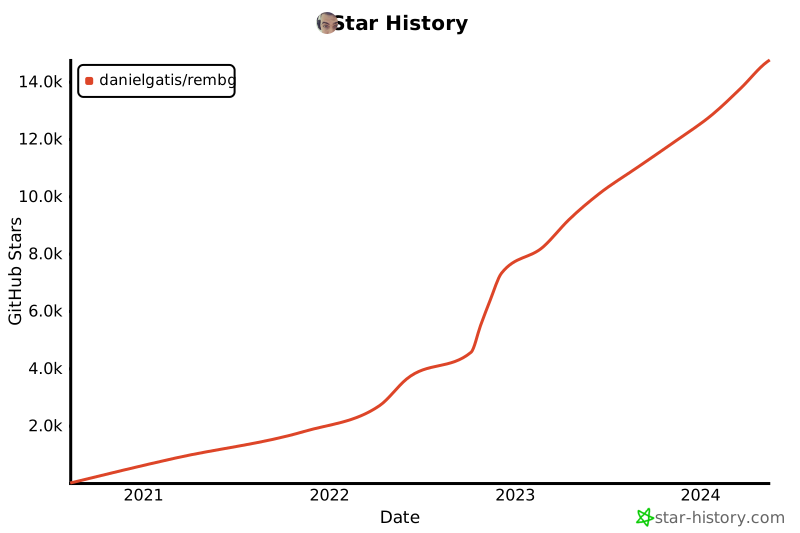
Repository: danielgatis/rembg Branch: main Commit: 5e10e9baaaef Files: 64 Total size: 141.4 KB Directory structure: gitextract_xxyh1rmd/ ├── .dockerignore ├── .editorconfig ├── .gitattributes ├── .github/ │ ├── FUNDING.yml │ ├── ISSUE_TEMPLATE/ │ │ ├── bug_report.md │ │ └── feature_request.md │ └── workflows/ │ ├── close_inactive_issues.yml │ ├── lint_python.yml │ ├── publish_docker.yml │ ├── publish_pypi.yml │ └── windows_installer.yml ├── .gitignore ├── .markdownlint.yaml ├── .python-version ├── CITATION.cff ├── Dockerfile ├── Dockerfile_nvidia_cuda_cudnn_gpu ├── LICENSE.txt ├── MANIFEST.in ├── README.md ├── USAGE.md ├── _build-exe.ps1 ├── _modpath.iss ├── _setup-cpu.iss ├── _setup-gpu.iss ├── docker-compose.yml ├── man/ │ └── rembg.1 ├── pyproject.toml ├── pytest.ini ├── rembg/ │ ├── __init__.py │ ├── bg.py │ ├── cli.py │ ├── commands/ │ │ ├── __init__.py │ │ ├── b_command.py │ │ ├── d_command.py │ │ ├── i_command.py │ │ ├── p_command.py │ │ └── s_command.py │ ├── session_factory.py │ └── sessions/ │ ├── __init__.py │ ├── base.py │ ├── ben_custom.py │ ├── birefnet_cod.py │ ├── birefnet_dis.py │ ├── birefnet_general.py │ ├── birefnet_general_lite.py │ ├── birefnet_hrsod.py │ ├── birefnet_massive.py │ ├── birefnet_portrait.py │ ├── bria_rmbg.py │ ├── dis_anime.py │ ├── dis_custom.py │ ├── dis_general_use.py │ ├── sam.py │ ├── silueta.py │ ├── u2net.py │ ├── u2net_cloth_seg.py │ ├── u2net_custom.py │ ├── u2net_human_seg.py │ └── u2netp.py ├── rembg.ipynb ├── rembg.py ├── rembg.spec └── tests/ └── test_remove.py ================================================ FILE CONTENTS ================================================ ================================================ FILE: .dockerignore ================================================ * !rembg !pyproject.toml !poetry.lock !README.md !.git .env ================================================ FILE: .editorconfig ================================================ # https://editorconfig.org/ root = true [*] indent_style = space indent_size = 4 insert_final_newline = true trim_trailing_whitespace = true end_of_line = lf charset = utf-8 ================================================ FILE: .gitattributes ================================================ rembg/_version.py export-subst ================================================ FILE: .github/FUNDING.yml ================================================ github: [danielgatis] custom: ["https://www.buymeacoffee.com/danielgatis"] ================================================ FILE: .github/ISSUE_TEMPLATE/bug_report.md ================================================ --- name: Bug report about: Create a report to help us improve title: "[BUG] ..." labels: bug assignees: "" --- **Describe the bug** A clear and concise description of what the bug is. **To Reproduce** Steps to reproduce the behavior: 1. Go to '...' 2. Click on '....' 3. Scroll down to '....' 4. See error **Expected behavior** A clear and concise description of what you expected to happen. **Images** Input images to reproduce. **OS Version:** iOS 22 **Rembg version:** v2.0.21 **Additional context** Add any other context about the problem here. ================================================ FILE: .github/ISSUE_TEMPLATE/feature_request.md ================================================ --- name: Feature request about: Suggest an idea for this project title: "[FEATURE] ..." labels: enhancement assignees: "" --- **Is your feature request related to a problem? Please describe.** A clear and concise description of what the problem is. Ex. I'm always frustrated when [...] **Describe the solution you'd like** A clear and concise description of what you want to happen. **Describe alternatives you've considered** A clear and concise description of any alternative solutions or features you've considered. **Additional context** Add any other context or screenshots about the feature request here. ================================================ FILE: .github/workflows/close_inactive_issues.yml ================================================ name: Close inactive issues on: schedule: - cron: "30 1 * * *" jobs: close_inactive_issues: runs-on: ubuntu-latest permissions: issues: write pull-requests: write steps: - uses: actions/stale@v9 with: days-before-issue-stale: 30 days-before-issue-close: 14 stale-issue-label: "stale" stale-issue-message: "This issue is stale because it has been open for 30 days with no activity." close-issue-message: "This issue was closed because it has been inactive for 14 days since being marked as stale." days-before-pr-stale: -1 days-before-pr-close: -1 repo-token: ${{ secrets.GITHUB_TOKEN }} ================================================ FILE: .github/workflows/lint_python.yml ================================================ name: Lint on: push: branches: - "**" pull_request: jobs: lint_python: runs-on: ubuntu-latest steps: - uses: actions/checkout@v4 - uses: actions/setup-python@v5 - name: Install Poetry uses: snok/install-poetry@v1 with: virtualenvs-create: true virtualenvs-in-project: true - name: Install dependencies run: poetry install --with dev --extras "cpu cli" - run: poetry run mypy --install-types --non-interactive --ignore-missing-imports ./rembg - run: poetry run bandit --recursive --skip B101,B104,B310,B311,B303,B110 --exclude ./rembg/_version.py ./rembg - run: poetry run black --force-exclude rembg/_version.py --check --diff ./rembg - run: poetry run flake8 ./rembg --count --ignore=B008,C901,E203,E266,E731,F401,F811,F841,W503,E501,E402 --show-source --statistics --exclude ./rembg/_version.py - run: poetry run isort --check-only --profile black ./rembg ================================================ FILE: .github/workflows/publish_docker.yml ================================================ name: Publish Docker image on: push: tags: - "v*.*.*" jobs: publish_docker: name: Push Docker image to Docker Hub runs-on: ubuntu-24.04 steps: - name: Checkout uses: actions/checkout@v4 - name: Docker meta id: meta uses: docker/metadata-action@v5 with: # list of Docker images to use as base name for tags images: | ${{ secrets.DOCKER_HUB_USERNAME }}/rembg # generate Docker tags based on the following events/attributes tags: | type=ref,event=branch type=ref,event=branch type=ref,event=pr type=semver,pattern={{version}} type=semver,pattern={{major}}.{{minor}} type=semver,pattern={{major}} type=sha - name: Set up QEMU uses: docker/setup-qemu-action@v3 - name: Set up Docker Buildx uses: docker/setup-buildx-action@v3 - name: Login to Docker Hub uses: docker/login-action@v3 with: username: ${{ secrets.DOCKER_HUB_USERNAME }} password: ${{ secrets.DOCKER_HUB_ACCESS_TOKEN }} - name: Build and push uses: docker/build-push-action@v6 with: context: . platforms: linux/amd64 push: ${{ github.event_name != 'pull_request' }} tags: ${{ steps.meta.outputs.tags }} labels: ${{ steps.meta.outputs.labels }} cache-from: type=registry,ref=${{ secrets.DOCKER_HUB_USERNAME }}/rembg:buildcache cache-to: type=registry,ref=${{ secrets.DOCKER_HUB_USERNAME }}/rembg:buildcache,mode=max ================================================ FILE: .github/workflows/publish_pypi.yml ================================================ name: Publish to Pypi on: push: tags: - "v*.*.*" jobs: publish_pypi: runs-on: ubuntu-latest steps: - uses: actions/checkout@v4 with: fetch-depth: 0 - uses: actions/setup-python@v5 - name: Install Poetry uses: snok/install-poetry@v1 with: virtualenvs-create: true virtualenvs-in-project: true - name: Install dependencies run: | poetry self add "poetry-dynamic-versioning[plugin]" poetry install --with dev --extras "cpu cli" - name: Build and publish to PyPI run: | poetry build poetry publish env: POETRY_PYPI_TOKEN_PYPI: ${{ secrets.PIPY_PASSWORD }} test_install: needs: publish_pypi runs-on: ubuntu-latest strategy: matrix: python-version: ["3.13"] steps: - uses: actions/checkout@v4 - name: Set up Python ${{ matrix.python-version }} uses: actions/setup-python@v5 with: python-version: ${{ matrix.python-version }} - name: Wait for PyPI to update run: sleep 60 - name: Install from PyPI run: pip install rembg[cpu,cli] - name: Test installation run: | attempt=0 until rembg d || [ $attempt -eq 5 ]; do attempt=$((attempt+1)) echo "Attempt $attempt to download the models..." done if [ $attempt -eq 5 ]; then echo "downloading the models failed 5 times, exiting..." exit 1 fi rembg --version ================================================ FILE: .github/workflows/windows_installer.yml ================================================ name: Build Windows Installer on: push: tags: - "v*.*.*" jobs: windows_installer: name: Build the Inno Setup Installer runs-on: windows-latest steps: - uses: actions/setup-python@v5 - uses: actions/checkout@v4 - shell: pwsh run: ./_build-exe.ps1 - name: Compile CPU Installer uses: Minionguyjpro/Inno-Setup-Action@v1.2.2 with: path: _setup-cpu.iss options: /O+ - name: Compile GPU Installer uses: Minionguyjpro/Inno-Setup-Action@v1.2.2 with: path: _setup-gpu.iss options: /O+ - name: Upload CPU installer to release uses: svenstaro/upload-release-action@v2 with: repo_token: ${{ secrets.GITHUB_TOKEN }} file: dist/rembg-cli-cpu-installer.exe asset_name: rembg-cli-cpu-installer.exe tag: ${{ github.ref }} overwrite: true - name: Upload GPU installer to release uses: svenstaro/upload-release-action@v2 with: repo_token: ${{ secrets.GITHUB_TOKEN }} file: dist/rembg-cli-gpu-installer.exe asset_name: rembg-cli-gpu-installer.exe tag: ${{ github.ref }} overwrite: true ================================================ FILE: .gitignore ================================================ # general things to ignore build/ dist/ .venv/ .direnv/ *.egg-info/ *.egg *.py[cod] __pycache__/ *.so *~≈ .env .envrc .idea .pytest_cache # due to using tox and pytest .tox .cache .mypy_cache # Poetry # For libraries, poetry.lock is often not committed # For applications, it should be committed poetry.lock ================================================ FILE: .markdownlint.yaml ================================================ --- default: true MD013: false # line-length MD033: false # no-inline-html ================================================ FILE: .python-version ================================================ 3.13.9 ================================================ FILE: CITATION.cff ================================================ cff-version: 1.2.0 title: rembg message: Rembg is a tool to remove images background type: software authors: - given-names: Daniel family-names: Gatis email: danielgatis@gmail.com identifiers: - type: url value: 'https://github.com/danielgatis' repository-code: 'https://github.com/danielgatis/rembg' url: 'https://github.com/danielgatis/rembg' abstract: Rembg is a tool to remove images background. license: MIT commit: 9079508935ae55d6eefa0fd75f870599640e8593 version: 2.0.66 date-released: '2025-02-21' ================================================ FILE: Dockerfile ================================================ FROM python:3.11-slim WORKDIR /rembg RUN pip install --upgrade pip && \ pip install poetry poetry-dynamic-versioning RUN apt-get update && apt-get install -y curl git && apt-get clean && rm -rf /var/lib/apt/lists/* COPY . . RUN poetry config virtualenvs.create false && \ poetry install --extras "cpu cli" --without dev RUN rembg d u2net EXPOSE 7000 ENTRYPOINT ["rembg"] CMD ["--help"] ================================================ FILE: Dockerfile_nvidia_cuda_cudnn_gpu ================================================ FROM nvidia/cuda:12.4.1-cudnn-devel-ubuntu22.04 WORKDIR /rembg RUN apt-get update && apt-get install -y --no-install-recommends python3-pip python-is-python3 curl && apt-get clean && rm -rf /var/lib/apt/lists/* COPY . . RUN python -m pip install ".[gpu,cli]" --break-system-packages RUN rembg d u2net EXPOSE 7000 ENTRYPOINT ["rembg"] CMD ["--help"] ================================================ FILE: LICENSE.txt ================================================ MIT License Copyright (c) 2020 Daniel Gatis Permission is hereby granted, free of charge, to any person obtaining a copy of this software and associated documentation files (the "Software"), to deal in the Software without restriction, including without limitation the rights to use, copy, modify, merge, publish, distribute, sublicense, and/or sell copies of the Software, and to permit persons to whom the Software is furnished to do so, subject to the following conditions: The above copyright notice and this permission notice shall be included in all copies or substantial portions of the Software. THE SOFTWARE IS PROVIDED "AS IS", WITHOUT WARRANTY OF ANY KIND, EXPRESS OR IMPLIED, INCLUDING BUT NOT LIMITED TO THE WARRANTIES OF MERCHANTABILITY, FITNESS FOR A PARTICULAR PURPOSE AND NONINFRINGEMENT. IN NO EVENT SHALL THE AUTHORS OR COPYRIGHT HOLDERS BE LIABLE FOR ANY CLAIM, DAMAGES OR OTHER LIABILITY, WHETHER IN AN ACTION OF CONTRACT, TORT OR OTHERWISE, ARISING FROM, OUT OF OR IN CONNECTION WITH THE SOFTWARE OR THE USE OR OTHER DEALINGS IN THE SOFTWARE. ================================================ FILE: MANIFEST.in ================================================ include LICENSE.txt include README.md include pyproject.toml ================================================ FILE: README.md ================================================

Rembg Logo

Rembg is a tool to remove image backgrounds. It can be used as a CLI, Python library, HTTP server, or Docker container.


License Hugging Face Spaces Streamlit App Open in Colab RepoMapr

danielgatis%2Frembg | Trendshift

## Sponsors
Unsplash PhotoRoom Remove Background API
https://photoroom.com/api

Fast and accurate background remover API

**If this project has helped you, please consider making a [donation](https://www.buymeacoffee.com/danielgatis).** ## Requirements ```text python: >=3.11, <3.14 ``` ## Installation Choose **one** of the following backends based on your hardware: ### CPU support ```bash pip install "rembg[cpu]" # for library pip install "rembg[cpu,cli]" # for library + cli ``` ### GPU support (NVIDIA/CUDA) First, check if your system supports `onnxruntime-gpu` by visiting [onnxruntime.ai](https://onnxruntime.ai/getting-started) and reviewing the installation matrix.

onnxruntime-installation-matrix

If your system is compatible, run: ```bash pip install "rembg[gpu]" # for library pip install "rembg[gpu,cli]" # for library + cli ``` > **Note:** NVIDIA GPUs may require `onnxruntime-gpu`, CUDA, and `cudnn-devel`. See [#668](https://github.com/danielgatis/rembg/issues/668#issuecomment-2689830314) for details. If `rembg[gpu]` doesn't work and you can't install CUDA or `cudnn-devel`, use `rembg[cpu]` with `onnxruntime` instead. ### GPU support (AMD/ROCm) ROCm support requires the `onnxruntime-rocm` package. Install it by following [AMD's documentation](https://rocm.docs.amd.com/projects/radeon/en/latest/docs/install/native_linux/install-onnx.html). Once `onnxruntime-rocm` is installed and working, install rembg with ROCm support: ```bash pip install "rembg[rocm]" # for library pip install "rembg[rocm,cli]" # for library + cli ``` ## Usage as a CLI After installation, you can use rembg by typing `rembg` in your terminal. The `rembg` command has 4 subcommands, one for each input type: - `i` - single files - `p` - folders (batch processing) - `s` - HTTP server - `b` - RGB24 pixel binary stream You can get help about the main command using: ```shell rembg --help ``` You can also get help for any subcommand: ```shell rembg --help ``` ### rembg `i` Used for processing single files. **Remove background from a remote image:** ```shell curl -s http://input.png | rembg i > output.png ``` **Remove background from a local file:** ```shell rembg i path/to/input.png path/to/output.png ``` **Specify a model:** ```shell rembg i -m u2netp path/to/input.png path/to/output.png ``` **Return only the mask:** ```shell rembg i -om path/to/input.png path/to/output.png ``` **Apply alpha matting:** ```shell rembg i -a path/to/input.png path/to/output.png ``` **Pass extra parameters (SAM example):** ```shell rembg i -m sam -x '{ "sam_prompt": [{"type": "point", "data": [724, 740], "label": 1}] }' examples/plants-1.jpg examples/plants-1.out.png ``` **Pass extra parameters (custom model):** ```shell rembg i -m u2net_custom -x '{"model_path": "~/.u2net/u2net.onnx"}' path/to/input.png path/to/output.png ``` ### rembg `p` Used for batch processing entire folders. **Process all images in a folder:** ```shell rembg p path/to/input path/to/output ``` **Watch mode (process new/changed files automatically):** ```shell rembg p -w path/to/input path/to/output ``` ### rembg `s` Used to start an HTTP server. ```shell rembg s --host 0.0.0.0 --port 7000 --log_level info ``` For complete API documentation, visit: `http://localhost:7000/api` **Remove background from an image URL:** ```shell curl -s "http://localhost:7000/api/remove?url=http://input.png" -o output.png ``` **Remove background from an uploaded image:** ```shell curl -s -F file=@/path/to/input.jpg "http://localhost:7000/api/remove" -o output.png ``` ### rembg `b` Process a sequence of RGB24 images from stdin. This is intended to be used with programs like FFmpeg that output RGB24 pixel data to stdout. ```shell rembg b -o ``` **Arguments:** | Argument | Description | |----------|-------------| | `width` | Width of input image(s) | | `height` | Height of input image(s) | | `output_specifier` | Printf-style specifier for output filenames (e.g., `output-%03u.png` produces `output-000.png`, `output-001.png`, etc.). Omit to write to stdout. | **Example with FFmpeg:** ```shell ffmpeg -i input.mp4 -ss 10 -an -f rawvideo -pix_fmt rgb24 pipe:1 | rembg b 1280 720 -o folder/output-%03u.png ``` > **Note:** The width and height must match FFmpeg's output dimensions. The flags `-an -f rawvideo -pix_fmt rgb24 pipe:1` are required for FFmpeg compatibility. ## Usage as a Library **Input and output as bytes:** ```python from rembg import remove with open('input.png', 'rb') as i: with open('output.png', 'wb') as o: input = i.read() output = remove(input) o.write(output) ``` **Input and output as a PIL image:** ```python from rembg import remove from PIL import Image input = Image.open('input.png') output = remove(input) output.save('output.png') ``` **Input and output as a NumPy array:** ```python from rembg import remove import cv2 input = cv2.imread('input.png') output = remove(input) cv2.imwrite('output.png', output) ``` **Force output as bytes:** ```python from rembg import remove with open('input.png', 'rb') as i: with open('output.png', 'wb') as o: input = i.read() output = remove(input, force_return_bytes=True) o.write(output) ``` **Batch processing with session reuse (recommended for performance):** ```python from pathlib import Path from rembg import remove, new_session session = new_session() for file in Path('path/to/folder').glob('*.png'): input_path = str(file) output_path = str(file.parent / (file.stem + ".out.png")) with open(input_path, 'rb') as i: with open(output_path, 'wb') as o: input = i.read() output = remove(input, session=session) o.write(output) ``` For more examples, see the [examples](USAGE.md) page. ## Usage with Docker ### CPU Only Replace the `rembg` command with `docker run danielgatis/rembg`: ```shell docker run -v .:/data danielgatis/rembg i /data/input.png /data/output.png ``` ### NVIDIA CUDA GPU Acceleration **Requirements:** Your host must have the [NVIDIA Container Toolkit](https://docs.nvidia.com/datacenter/cloud-native/container-toolkit/latest/install-guide.html) installed. CUDA acceleration requires `cudnn-devel`, so you need to build the Docker image yourself. See [#668](https://github.com/danielgatis/rembg/issues/668#issuecomment-2689914205) for details. **Build the image:** ```shell docker build -t rembg-nvidia-cuda-cudnn-gpu -f Dockerfile_nvidia_cuda_cudnn_gpu . ``` > **Note:** This image requires ~11GB of disk space (CPU version is ~1.6GB). Models are not included. **Run the container:** ```shell sudo docker run --rm -it --gpus all -v /dev/dri:/dev/dri -v $PWD:/data rembg-nvidia-cuda-cudnn-gpu i -m birefnet-general /data/input.png /data/output.png ``` **Tips:** - You can create your own NVIDIA CUDA image and install `rembg[gpu,cli]` in it. - Use `-v /path/to/models/:/root/.u2net` to store model files outside the container, avoiding re-downloads. ## Models All models are automatically downloaded and saved to `~/.u2net/` on first use. ### Available Models - u2net ([download](https://github.com/danielgatis/rembg/releases/download/v0.0.0/u2net.onnx), [source](https://github.com/xuebinqin/U-2-Net)): A pre-trained model for general use cases. - u2netp ([download](https://github.com/danielgatis/rembg/releases/download/v0.0.0/u2netp.onnx), [source](https://github.com/xuebinqin/U-2-Net)): A lightweight version of u2net model. - u2net_human_seg ([download](https://github.com/danielgatis/rembg/releases/download/v0.0.0/u2net_human_seg.onnx), [source](https://github.com/xuebinqin/U-2-Net)): A pre-trained model for human segmentation. - u2net_cloth_seg ([download](https://github.com/danielgatis/rembg/releases/download/v0.0.0/u2net_cloth_seg.onnx), [source](https://github.com/levindabhi/cloth-segmentation)): A pre-trained model for Cloths Parsing from human portrait. Here clothes are parsed into 3 category: Upper body, Lower body and Full body. - silueta ([download](https://github.com/danielgatis/rembg/releases/download/v0.0.0/silueta.onnx), [source](https://github.com/xuebinqin/U-2-Net/issues/295)): Same as u2net but the size is reduced to 43Mb. - isnet-general-use ([download](https://github.com/danielgatis/rembg/releases/download/v0.0.0/isnet-general-use.onnx), [source](https://github.com/xuebinqin/DIS)): A new pre-trained model for general use cases. - isnet-anime ([download](https://github.com/danielgatis/rembg/releases/download/v0.0.0/isnet-anime.onnx), [source](https://github.com/SkyTNT/anime-segmentation)): A high-accuracy segmentation for anime character. - sam ([download encoder](https://github.com/danielgatis/rembg/releases/download/v0.0.0/vit_b-encoder-quant.onnx), [download decoder](https://github.com/danielgatis/rembg/releases/download/v0.0.0/vit_b-decoder-quant.onnx), [source](https://github.com/facebookresearch/segment-anything)): A pre-trained model for any use cases. - birefnet-general ([download](https://github.com/danielgatis/rembg/releases/download/v0.0.0/BiRefNet-general-epoch_244.onnx), [source](https://github.com/ZhengPeng7/BiRefNet)): A pre-trained model for general use cases. - birefnet-general-lite ([download](https://github.com/danielgatis/rembg/releases/download/v0.0.0/BiRefNet-general-bb_swin_v1_tiny-epoch_232.onnx), [source](https://github.com/ZhengPeng7/BiRefNet)): A light pre-trained model for general use cases. - birefnet-portrait ([download](https://github.com/danielgatis/rembg/releases/download/v0.0.0/BiRefNet-portrait-epoch_150.onnx), [source](https://github.com/ZhengPeng7/BiRefNet)): A pre-trained model for human portraits. - birefnet-dis ([download](https://github.com/danielgatis/rembg/releases/download/v0.0.0/BiRefNet-DIS-epoch_590.onnx), [source](https://github.com/ZhengPeng7/BiRefNet)): A pre-trained model for dichotomous image segmentation (DIS). - birefnet-hrsod ([download](https://github.com/danielgatis/rembg/releases/download/v0.0.0/BiRefNet-HRSOD_DHU-epoch_115.onnx), [source](https://github.com/ZhengPeng7/BiRefNet)): A pre-trained model for high-resolution salient object detection (HRSOD). - birefnet-cod ([download](https://github.com/danielgatis/rembg/releases/download/v0.0.0/BiRefNet-COD-epoch_125.onnx), [source](https://github.com/ZhengPeng7/BiRefNet)): A pre-trained model for concealed object detection (COD). - birefnet-massive ([download](https://github.com/danielgatis/rembg/releases/download/v0.0.0/BiRefNet-massive-TR_DIS5K_TR_TEs-epoch_420.onnx), [source](https://github.com/ZhengPeng7/BiRefNet)): A pre-trained model with massive dataset. - bria-rmbg ([download](https://github.com/danielgatis/rembg/releases/download/v0.0.0/bria-rmbg-2.0.onnx), [source](https://huggingface.co/briaai/RMBG-2.0)): A state-of-the-art background removal model by BRIA AI. ## Environment Variables | Variable | Description | |----------|-------------| | `U2NET_HOME` | Path to the directory where models are stored. Defaults to `$XDG_DATA_HOME/.u2net` (or `~/.u2net` if `XDG_DATA_HOME` is not set). | | `XDG_DATA_HOME` | Base data directory used when `U2NET_HOME` is not set. Defaults to `~`. | | `MODEL_CHECKSUM_DISABLED` | When set (e.g. `MODEL_CHECKSUM_DISABLED=1`), disables hash verification for downloaded models. This is useful if you want to use your own custom/converted model files without rembg re-downloading the originals. | | `OMP_NUM_THREADS` | Sets the number of threads used by ONNX Runtime for inference. | ### Using custom model files If you need to use a modified version of a model (e.g. converted to a different ONNX IR version for compatibility with an older CUDA toolkit), you can prevent rembg from overwriting it: 1. Set `MODEL_CHECKSUM_DISABLED=1` 2. Place your custom `.onnx` file in the models directory (`~/.u2net/` by default) with the expected filename (e.g. `u2net.onnx`) 3. Rembg will detect the file exists and use it without re-downloading ## FAQ ### When will this library support Python version 3.xx? This library depends on [onnxruntime](https://pypi.org/project/onnxruntime). Python version support is determined by onnxruntime's compatibility. ## Support If you find this project useful, consider buying me a coffee (or a beer): Buy Me A Coffee ## Star History [![Star History Chart](https://api.star-history.com/svg?repos=danielgatis/rembg&type=Date)](https://star-history.com/#danielgatis/rembg&Date) ## License Copyright (c) 2020-present [Daniel Gatis](https://github.com/danielgatis) Licensed under the [MIT License](./LICENSE.txt). ================================================ FILE: USAGE.md ================================================ # How to use the remove function ## Load the Image ```python from PIL import Image from rembg import new_session, remove input_path = 'input.png' output_path = 'output.png' input = Image.open(input_path) ``` ## Removing the background ### Without additional arguments This defaults to the `u2net` model. ```python output = remove(input) output.save(output_path) ``` ### With a specific model You can use the `new_session` function to create a session with a specific model. ```python model_name = "isnet-general-use" session = new_session(model_name) output = remove(input, session=session) ``` ### For processing multiple image files By default, `remove` initialises a new session every call. This can be a large bottleneck if you're having to process multiple images. Initialise a session and pass it in to the `remove` function for fast multi-image support ```python model_name = "unet" rembg_session = new_session(model_name) for img in images: output = remove(img, session=rembg_session) ``` ### With alpha matting Alpha matting is a post processing step that can be used to improve the quality of the output. ```python output = remove(input, alpha_matting=True, alpha_matting_foreground_threshold=270,alpha_matting_background_threshold=20, alpha_matting_erode_size=11) ``` ### Only mask If you only want the mask, you can use the `only_mask` argument. ```python output = remove(input, only_mask=True) ``` ### With post processing You can use the `post_process_mask` argument to post process the mask to get better results. ```python output = remove(input, post_process_mask=True) ``` ### Replacing the background color You can use the `bgcolor` argument to replace the background color. ```python output = remove(input, bgcolor=(255, 255, 255, 255)) ``` ### Using input points You can use the `input_points` and `input_labels` arguments to specify the points that should be used for the masks. This only works with the `sam` model. ```python import numpy as np # Define the points and labels # The points are defined as [y, x] input_points = np.array([[400, 350], [700, 400], [200, 400]]) input_labels = np.array([1, 1, 2]) image = remove(image,session=session, input_points=input_points, input_labels=input_labels) ``` ## Save the image ```python output.save(output_path) ``` ================================================ FILE: _build-exe.ps1 ================================================ # Install Poetry if not already installed if (-not (Get-Command poetry -ErrorAction SilentlyContinue)) { pip install poetry } # Build CPU version Write-Host "Building CPU version..." -ForegroundColor Cyan poetry install --extras "cli cpu" poetry run pip install pyinstaller poetry run pyinstaller rembg.spec Rename-Item -Path "dist/rembg" -NewName "rembg-cpu" # Build GPU version Write-Host "Building GPU version..." -ForegroundColor Cyan poetry install --extras "cli gpu" poetry run pip install pyinstaller poetry run pyinstaller rembg.spec --noconfirm Rename-Item -Path "dist/rembg" -NewName "rembg-gpu" Write-Host "Build complete!" -ForegroundColor Green Write-Host "CPU version: dist/rembg-cpu" Write-Host "GPU version: dist/rembg-gpu" ================================================ FILE: _modpath.iss ================================================ // ---------------------------------------------------------------------------- // // Inno Setup Ver: 5.4.2 // Script Version: 1.4.2 // Author: Jared Breland // Homepage: http://www.legroom.net/software // License: GNU Lesser General Public License (LGPL), version 3 // http://www.gnu.org/licenses/lgpl.html // // Script Function: // Allow modification of environmental path directly from Inno Setup installers // // Instructions: // Copy modpath.iss to the same directory as your setup script // // Add this statement to your [Setup] section // ChangesEnvironment=true // // Add this statement to your [Tasks] section // You can change the Description or Flags // You can change the Name, but it must match the ModPathName setting below // Name: modifypath; Description: &Add application directory to your environmental path; Flags: unchecked // // Add the following to the end of your [Code] section // ModPathName defines the name of the task defined above // ModPathType defines whether the 'user' or 'system' path will be modified; // this will default to user if anything other than system is set // setArrayLength must specify the total number of dirs to be added // Result[0] contains first directory, Result[1] contains second, etc. // const // ModPathName = 'modifypath'; // ModPathType = 'user'; // // function ModPathDir(): TArrayOfString; // begin // setArrayLength(Result, 1); // Result[0] := ExpandConstant('{app}'); // end; // #include "modpath.iss" // ---------------------------------------------------------------------------- procedure ModPath(); var oldpath: String; newpath: String; updatepath: Boolean; pathArr: TArrayOfString; aExecFile: String; aExecArr: TArrayOfString; i, d: Integer; pathdir: TArrayOfString; regroot: Integer; regpath: String; begin // Get constants from main script and adjust behavior accordingly // ModPathType MUST be 'system' or 'user'; force 'user' if invalid if ModPathType = 'system' then begin regroot := HKEY_LOCAL_MACHINE; regpath := 'SYSTEM\CurrentControlSet\Control\Session Manager\Environment'; end else begin regroot := HKEY_CURRENT_USER; regpath := 'Environment'; end; // Get array of new directories and act on each individually pathdir := ModPathDir(); for d := 0 to GetArrayLength(pathdir)-1 do begin updatepath := true; // Modify WinNT path if UsingWinNT() = true then begin // Get current path, split into an array RegQueryStringValue(regroot, regpath, 'Path', oldpath); oldpath := oldpath + ';'; i := 0; while (Pos(';', oldpath) > 0) do begin SetArrayLength(pathArr, i+1); pathArr[i] := Copy(oldpath, 0, Pos(';', oldpath)-1); oldpath := Copy(oldpath, Pos(';', oldpath)+1, Length(oldpath)); i := i + 1; // Check if current directory matches app dir if pathdir[d] = pathArr[i-1] then begin // if uninstalling, remove dir from path if IsUninstaller() = true then begin continue; // if installing, flag that dir already exists in path end else begin updatepath := false; end; end; // Add current directory to new path if i = 1 then begin newpath := pathArr[i-1]; end else begin newpath := newpath + ';' + pathArr[i-1]; end; end; // Append app dir to path if not already included if (IsUninstaller() = false) AND (updatepath = true) then newpath := newpath + ';' + pathdir[d]; // Write new path RegWriteStringValue(regroot, regpath, 'Path', newpath); // Modify Win9x path end else begin // Convert to shortened dirname pathdir[d] := GetShortName(pathdir[d]); // If autoexec.bat exists, check if app dir already exists in path aExecFile := 'C:\AUTOEXEC.BAT'; if FileExists(aExecFile) then begin LoadStringsFromFile(aExecFile, aExecArr); for i := 0 to GetArrayLength(aExecArr)-1 do begin if IsUninstaller() = false then begin // If app dir already exists while installing, skip add if (Pos(pathdir[d], aExecArr[i]) > 0) then updatepath := false; break; end else begin // If app dir exists and = what we originally set, then delete at uninstall if aExecArr[i] = 'SET PATH=%PATH%;' + pathdir[d] then aExecArr[i] := ''; end; end; end; // If app dir not found, or autoexec.bat didn't exist, then (create and) append to current path if (IsUninstaller() = false) AND (updatepath = true) then begin SaveStringToFile(aExecFile, #13#10 + 'SET PATH=%PATH%;' + pathdir[d], True); // If uninstalling, write the full autoexec out end else begin SaveStringsToFile(aExecFile, aExecArr, False); end; end; end; end; // Split a string into an array using passed delimiter procedure MPExplode(var Dest: TArrayOfString; Text: String; Separator: String); var i: Integer; begin i := 0; repeat SetArrayLength(Dest, i+1); if Pos(Separator,Text) > 0 then begin Dest[i] := Copy(Text, 1, Pos(Separator, Text)-1); Text := Copy(Text, Pos(Separator,Text) + Length(Separator), Length(Text)); i := i + 1; end else begin Dest[i] := Text; Text := ''; end; until Length(Text)=0; end; procedure CurStepChanged(CurStep: TSetupStep); var taskname: String; begin taskname := ModPathName; if CurStep = ssPostInstall then if IsTaskSelected(taskname) then ModPath(); end; procedure CurUninstallStepChanged(CurUninstallStep: TUninstallStep); var aSelectedTasks: TArrayOfString; i: Integer; taskname: String; regpath: String; regstring: String; appid: String; begin // only run during actual uninstall if CurUninstallStep = usUninstall then begin // get list of selected tasks saved in registry at install time appid := '{#emit SetupSetting("AppId")}'; if appid = '' then appid := '{#emit SetupSetting("AppName")}'; regpath := ExpandConstant('Software\Microsoft\Windows\CurrentVersion\Uninstall\'+appid+'_is1'); RegQueryStringValue(HKLM, regpath, 'Inno Setup: Selected Tasks', regstring); if regstring = '' then RegQueryStringValue(HKCU, regpath, 'Inno Setup: Selected Tasks', regstring); // check each task; if matches modpath taskname, trigger patch removal if regstring <> '' then begin taskname := ModPathName; MPExplode(aSelectedTasks, regstring, ','); if GetArrayLength(aSelectedTasks) > 0 then begin for i := 0 to GetArrayLength(aSelectedTasks)-1 do begin if comparetext(aSelectedTasks[i], taskname) = 0 then ModPath(); end; end; end; end; end; function NeedRestart(): Boolean; var taskname: String; begin taskname := ModPathName; if IsTaskSelected(taskname) and not UsingWinNT() then begin Result := True; end else begin Result := False; end; end; ================================================ FILE: _setup-cpu.iss ================================================ #define MyAppName "Rembg CPU" #define MyAppVersion "STABLE" #define MyAppPublisher "danielgatis" #define MyAppURL "https://github.com/danielgatis/rembg" #define MyAppExeName "rembg.exe" #define MyAppId "49AB7484-212F-4B31-A49F-533A480F3FD4" [Setup] AppId={#MyAppId} AppName={#MyAppName} AppVersion={#MyAppVersion} AppPublisher={#MyAppPublisher} AppPublisherURL={#MyAppURL} AppSupportURL={#MyAppURL} AppUpdatesURL={#MyAppURL} DefaultDirName={autopf}\Rembg DefaultGroupName=Rembg DisableProgramGroupPage=yes OutputBaseFilename=rembg-cli-cpu-installer Compression=lzma SolidCompression=yes WizardStyle=modern OutputDir=dist ChangesEnvironment=yes [Languages] Name: "english"; MessagesFile: "compiler:Default.isl" [Files] Source: "{#SourcePath}dist\rembg-cpu\{#MyAppExeName}"; DestDir: "{app}"; Flags: ignoreversion Source: "{#SourcePath}dist\rembg-cpu\*"; DestDir: "{app}"; Flags: ignoreversion recursesubdirs createallsubdirs [Tasks] Name: modifypath; Description: "Add to PATH variable" [Icons] Name: "{group}\Rembg"; Filename: "{app}\{#MyAppExeName}" [Code] const ModPathName = 'modifypath'; ModPathType = 'user'; function ModPathDir(): TArrayOfString; begin setArrayLength(Result, 1) Result[0] := ExpandConstant('{app}'); end; #include "_modpath.iss" ================================================ FILE: _setup-gpu.iss ================================================ #define MyAppName "Rembg GPU" #define MyAppVersion "STABLE" #define MyAppPublisher "danielgatis" #define MyAppURL "https://github.com/danielgatis/rembg" #define MyAppExeName "rembg.exe" #define MyAppId "49AB7484-212F-4B31-A49F-533A480F3FD4" [Setup] AppId={#MyAppId} AppName={#MyAppName} AppVersion={#MyAppVersion} AppPublisher={#MyAppPublisher} AppPublisherURL={#MyAppURL} AppSupportURL={#MyAppURL} AppUpdatesURL={#MyAppURL} DefaultDirName={autopf}\Rembg DefaultGroupName=Rembg DisableProgramGroupPage=yes OutputBaseFilename=rembg-cli-gpu-installer Compression=lzma SolidCompression=yes WizardStyle=modern OutputDir=dist ChangesEnvironment=yes [Languages] Name: "english"; MessagesFile: "compiler:Default.isl" [Files] Source: "{#SourcePath}dist\rembg-gpu\{#MyAppExeName}"; DestDir: "{app}"; Flags: ignoreversion Source: "{#SourcePath}dist\rembg-gpu\*"; DestDir: "{app}"; Flags: ignoreversion recursesubdirs createallsubdirs [Tasks] Name: modifypath; Description: "Add to PATH variable" [Icons] Name: "{group}\Rembg"; Filename: "{app}\{#MyAppExeName}" [Code] const ModPathName = 'modifypath'; ModPathType = 'user'; function ModPathDir(): TArrayOfString; begin setArrayLength(Result, 1) Result[0] := ExpandConstant('{app}'); end; #include "_modpath.iss" ================================================ FILE: docker-compose.yml ================================================ --- # You can set variables in .env file in root folder # # PUBLIC_PORT=7000:7000 # REPLICAS_COUNT=1 services: app: build: . command: ["s"] deploy: replicas: ${REPLICAS_COUNT:-1} ports: - ${PUBLIC_PORT:-7000:7000} version: '3' ================================================ FILE: man/rembg.1 ================================================ .TH REMBG 1 "Januar 2026" "2.0.72" "User Commands" .SH NAME rembg \- tool to remove background from images .SH SYNOPSIS .B rembg [OPTIONS] COMMAND [ARGS]... .SH DESCRIPTION .B rembg is a tool to remove images background. .PP It works as a command line interface and a library. .SH OPTIONS .TP .BR \-\-version Show the version and exit. .TP .BR \-\-help Show this message and exit. .SH SEE ALSO Full documentation at: ================================================ FILE: pyproject.toml ================================================ [tool.poetry] name = "rembg" version = "0.0.0" # Managed by poetry-dynamic-versioning description = "Remove image background" authors = ["Daniel Gatis "] license = "MIT" readme = "README.md" homepage = "https://github.com/danielgatis/rembg" repository = "https://github.com/danielgatis/rembg" keywords = ["remove", "background", "u2net"] classifiers = [ "License :: OSI Approved :: MIT License", "Topic :: Scientific/Engineering", "Topic :: Scientific/Engineering :: Mathematics", "Topic :: Scientific/Engineering :: Artificial Intelligence", "Topic :: Software Development", "Topic :: Software Development :: Libraries", "Topic :: Software Development :: Libraries :: Python Modules", "Programming Language :: Python", "Programming Language :: Python :: 3 :: Only", "Programming Language :: Python :: 3.11", "Programming Language :: Python :: 3.12", "Programming Language :: Python :: 3.13", ] packages = [{include = "rembg"}] [tool.poetry.dependencies] python = "^3.11" jsonschema = "^4.25.1" numpy = "^2.3.0" pillow = "^12.1.0" pooch = "^1.8.2" pymatting = "^1.1.14" scikit-image = "^0.26.0" scipy = "^1.16.3" tqdm = "^4.67.1" # CPU backend (optional) onnxruntime = {version = "^1.23.2", optional = true} # GPU backend (optional) - only available on Linux/Windows, not on macOS onnxruntime-gpu = {version = "^1.23.2", optional = true, markers = "sys_platform != 'darwin'"} # ROCm backend (optional) - only available on Linux (latest is 1.22.x) onnxruntime-rocm = {version = "^1.22.0", optional = true, markers = "sys_platform == 'linux'"} # CLI dependencies (optional) aiohttp = {version = "^3.13.2", optional = true} asyncer = {version = "^0.0.12", optional = true} click = {version = "^8.3.1", optional = true} fastapi = {version = "^0.128.0", optional = true} filetype = {version = "^1.2.0", optional = true} gradio = {version = "^6.2.0", optional = true} python-multipart = {version = "^0.0.21", optional = true} sniffio = {version = "^1.3.1", optional = true} uvicorn = {version = "^0.40.0", optional = true} watchdog = {version = "^6.0.0", optional = true} # Dev dependencies (optional, for pip install .[dev]) bandit = {version = "^1.9.2", optional = true} black = {version = "^25.12.0", optional = true} flake8 = {version = "^7.3.0", optional = true} imagehash = {version = "^4.3.2", optional = true} isort = {version = "^7.0.0", optional = true} mypy = {version = "^1.19.1", optional = true} pytest = {version = "^9.0.2", optional = true} [tool.poetry.group.dev.dependencies] bandit = "^1.9.2" black = "^25.12.0" flake8 = "^7.3.0" imagehash = "^4.3.2" isort = "^7.0.0" mypy = "^1.19.1" pytest = "^9.0.2" [tool.poetry.extras] cpu = ["onnxruntime"] gpu = ["onnxruntime-gpu"] rocm = ["onnxruntime-rocm"] cli = ["aiohttp", "asyncer", "click", "fastapi", "filetype", "gradio", "python-multipart", "sniffio", "uvicorn", "watchdog"] dev = ["bandit", "black", "flake8", "imagehash", "isort", "mypy", "pytest"] [tool.poetry.scripts] rembg = "rembg.cli:main" [build-system] requires = ["poetry-core>=1.0.0", "poetry-dynamic-versioning>=1.0.0,<2.0.0"] build-backend = "poetry_dynamic_versioning.backend" [tool.poetry-dynamic-versioning] enable = true vcs = "git" style = "pep440" pattern = "^v(?P\\d+\\.\\d+\\.\\d+)" [tool.poetry-dynamic-versioning.substitution] files = ["rembg/__init__.py"] ================================================ FILE: pytest.ini ================================================ [pytest] filterwarnings = ignore::DeprecationWarning ================================================ FILE: rembg/__init__.py ================================================ try: from importlib.metadata import PackageNotFoundError, version try: __version__ = version("rembg") except PackageNotFoundError: __version__ = "0.0.0" # Fallback for development except ImportError: __version__ = "0.0.0" # Fallback for older Python versions from .bg import remove from .session_factory import new_session ================================================ FILE: rembg/bg.py ================================================ import io import sys from enum import Enum from typing import Any, List, Optional, Tuple, Union, cast import numpy as np try: import onnxruntime as ort # type: ignore[import-untyped] except ImportError: print("No onnxruntime backend found.") print("Please install rembg with CPU or GPU support:") print() print(' pip install "rembg[cpu]" # for CPU') print(' pip install "rembg[gpu]" # for NVIDIA/CUDA GPU') print() print( "For more information, see: https://github.com/danielgatis/rembg#installation" ) sys.exit(1) from PIL import Image, ImageOps from PIL.Image import Image as PILImage from pymatting.alpha.estimate_alpha_cf import estimate_alpha_cf from pymatting.foreground.estimate_foreground_ml import estimate_foreground_ml from pymatting.util.util import stack_images from scipy.ndimage import binary_erosion, gaussian_filter from skimage.morphology import disk, opening from .session_factory import new_session from .sessions import sessions, sessions_names from .sessions.base import BaseSession ort.set_default_logger_severity(3) kernel = disk(1) class ReturnType(Enum): BYTES = 0 PILLOW = 1 NDARRAY = 2 def alpha_matting_cutout( img: PILImage, mask: PILImage, foreground_threshold: int, background_threshold: int, erode_structure_size: int, ) -> PILImage: """ Perform alpha matting on an image using a given mask and threshold values. This function takes a PIL image `img` and a PIL image `mask` as input, along with the `foreground_threshold` and `background_threshold` values used to determine foreground and background pixels. The `erode_structure_size` parameter specifies the size of the erosion structure to be applied to the mask. The function returns a PIL image representing the cutout of the foreground object from the original image. """ if img.mode == "RGBA" or img.mode == "CMYK": img = img.convert("RGB") img_array = np.asarray(img) mask_array = np.asarray(mask) is_foreground = mask_array > foreground_threshold is_background = mask_array < background_threshold structure = None if erode_structure_size > 0: structure = np.ones( (erode_structure_size, erode_structure_size), dtype=np.uint8 ) is_foreground = binary_erosion(is_foreground, structure=structure) is_background = binary_erosion(is_background, structure=structure, border_value=1) trimap = np.full(mask_array.shape, dtype=np.uint8, fill_value=128) trimap[is_foreground] = 255 trimap[is_background] = 0 img_normalized = img_array / 255.0 trimap_normalized = trimap / 255.0 alpha = estimate_alpha_cf(img_normalized, trimap_normalized) foreground = estimate_foreground_ml(img_normalized, alpha) cutout = stack_images(foreground, alpha) cutout = np.clip(cutout * 255, 0, 255).astype(np.uint8) cutout = Image.fromarray(cutout) return cutout def naive_cutout(img: PILImage, mask: PILImage) -> PILImage: """ Perform a simple cutout operation on an image using a mask. This function takes a PIL image `img` and a PIL image `mask` as input. It uses the mask to create a new image where the pixels from `img` are cut out based on the mask. The function returns a PIL image representing the cutout of the original image using the mask. """ empty = Image.new("RGBA", (img.size), 0) cutout = Image.composite(img, empty, mask) return cutout def putalpha_cutout(img: PILImage, mask: PILImage) -> PILImage: """ Apply the specified mask to the image as an alpha cutout. Args: img (PILImage): The image to be modified. mask (PILImage): The mask to be applied. Returns: PILImage: The modified image with the alpha cutout applied. """ img.putalpha(mask) return img def get_concat_v_multi(imgs: List[PILImage]) -> PILImage: """ Concatenate multiple images vertically. Args: imgs (List[PILImage]): The list of images to be concatenated. Returns: PILImage: The concatenated image. """ pivot = imgs.pop(0) for im in imgs: pivot = get_concat_v(pivot, im) return pivot def get_concat_v(img1: PILImage, img2: PILImage) -> PILImage: """ Concatenate two images vertically. Args: img1 (PILImage): The first image. img2 (PILImage): The second image to be concatenated below the first image. Returns: PILImage: The concatenated image. """ dst = Image.new("RGBA", (img1.width, img1.height + img2.height)) dst.paste(img1, (0, 0)) dst.paste(img2, (0, img1.height)) return dst def post_process(mask: np.ndarray) -> np.ndarray: """ Post Process the mask for a smooth boundary by applying Morphological Operations Research based on paper: https://www.sciencedirect.com/science/article/pii/S2352914821000757 args: mask: Binary Numpy Mask """ mask = opening(mask, kernel) mask = gaussian_filter(mask.astype(np.float64), sigma=2) mask = np.where(mask < 127, 0, 255).astype(np.uint8) return mask def apply_background_color(img: PILImage, color: Tuple[int, int, int, int]) -> PILImage: """ Apply the specified background color to the image. Args: img (PILImage): The image to be modified. color (Tuple[int, int, int, int]): The RGBA color to be applied. Returns: PILImage: The modified image with the background color applied. """ background = Image.new("RGBA", img.size, tuple(color)) colored_image = Image.alpha_composite(background, img) return colored_image def fix_image_orientation(img: PILImage) -> PILImage: """ Fix the orientation of the image based on its EXIF data. Args: img (PILImage): The image to be fixed. Returns: PILImage: The fixed image. """ return cast(PILImage, ImageOps.exif_transpose(img)) def download_models(models: tuple[str, ...]) -> None: """ Download models for image processing. """ if len(models) == 0: print("No models specified, downloading all models") models = tuple(sessions_names) for model in models: session = sessions.get(model) if session is None: print(f"Error: no model found: {model}") sys.exit(1) else: print(f"Downloading model: {model}") try: session.download_models() except Exception as e: print(f"Error downloading model: {e}") def remove( data: Union[bytes, PILImage, np.ndarray], alpha_matting: bool = False, alpha_matting_foreground_threshold: int = 240, alpha_matting_background_threshold: int = 10, alpha_matting_erode_size: int = 10, session: Optional[BaseSession] = None, only_mask: bool = False, post_process_mask: bool = False, bgcolor: Optional[Tuple[int, int, int, int]] = None, force_return_bytes: bool = False, *args: Optional[Any], **kwargs: Optional[Any], ) -> Union[bytes, PILImage, np.ndarray]: """ Remove the background from an input image. This function takes in various parameters and returns a modified version of the input image with the background removed. The function can handle input data in the form of bytes, a PIL image, or a numpy array. The function first checks the type of the input data and converts it to a PIL image if necessary. It then fixes the orientation of the image and proceeds to perform background removal using the 'u2net' model. The result is a list of binary masks representing the foreground objects in the image. These masks are post-processed and combined to create a final cutout image. If a background color is provided, it is applied to the cutout image. The function returns the resulting cutout image in the format specified by the input 'return_type' parameter or as python bytes if force_return_bytes is true. Parameters: data (Union[bytes, PILImage, np.ndarray]): The input image data. alpha_matting (bool, optional): Flag indicating whether to use alpha matting. Defaults to False. alpha_matting_foreground_threshold (int, optional): Foreground threshold for alpha matting. Defaults to 240. alpha_matting_background_threshold (int, optional): Background threshold for alpha matting. Defaults to 10. alpha_matting_erode_size (int, optional): Erosion size for alpha matting. Defaults to 10. session (Optional[BaseSession], optional): A session object for the 'u2net' model. Defaults to None. only_mask (bool, optional): Flag indicating whether to return only the binary masks. Defaults to False. post_process_mask (bool, optional): Flag indicating whether to post-process the masks. Defaults to False. bgcolor (Optional[Tuple[int, int, int, int]], optional): Background color for the cutout image. Defaults to None. force_return_bytes (bool, optional): Flag indicating whether to return the cutout image as bytes. Defaults to False. *args (Optional[Any]): Additional positional arguments. **kwargs (Optional[Any]): Additional keyword arguments. Returns: Union[bytes, PILImage, np.ndarray]: The cutout image with the background removed. """ if isinstance(data, bytes) or force_return_bytes: return_type = ReturnType.BYTES img = cast(PILImage, Image.open(io.BytesIO(cast(bytes, data)))) elif isinstance(data, PILImage): return_type = ReturnType.PILLOW img = cast(PILImage, data) elif isinstance(data, np.ndarray): return_type = ReturnType.NDARRAY img = cast(PILImage, Image.fromarray(data)) else: raise ValueError( "Input type {} is not supported. Try using force_return_bytes=True to force python bytes output".format( type(data) ) ) putalpha = kwargs.pop("putalpha", False) # Fix image orientation img = fix_image_orientation(img) if session is None: session = new_session("u2net", *args, **kwargs) masks = session.predict(img, *args, **kwargs) cutouts = [] for mask in masks: if post_process_mask: mask = Image.fromarray(post_process(np.array(mask))) if only_mask: cutout = mask elif alpha_matting: try: cutout = alpha_matting_cutout( img, mask, alpha_matting_foreground_threshold, alpha_matting_background_threshold, alpha_matting_erode_size, ) except ValueError: if putalpha: cutout = putalpha_cutout(img, mask) else: cutout = naive_cutout(img, mask) else: if putalpha: cutout = putalpha_cutout(img, mask) else: cutout = naive_cutout(img, mask) cutouts.append(cutout) cutout = img if len(cutouts) > 0: cutout = get_concat_v_multi(cutouts) if bgcolor is not None and not only_mask: cutout = apply_background_color(cutout, bgcolor) if ReturnType.PILLOW == return_type: return cutout if ReturnType.NDARRAY == return_type: return np.asarray(cutout) bio = io.BytesIO() cutout.save(bio, "PNG") bio.seek(0) return bio.read() ================================================ FILE: rembg/cli.py ================================================ import sys # Fast path for --version (avoid importing heavy dependencies) if len(sys.argv) == 2 and sys.argv[1] in ("--version", "-V"): from importlib.metadata import version print(f"rembg, version {version('rembg')}") sys.exit(0) try: import click except ImportError: print("The CLI dependencies are not installed.") print("Please install rembg with CLI support:") print() print(' pip install "rembg[cpu,cli]" # for CPU') print(' pip install "rembg[gpu,cli]" # for NVIDIA/CUDA GPU') print() print( "For more information, see: https://github.com/danielgatis/rembg#installation" ) sys.exit(1) from . import __version__ from .commands import command_functions @click.group() @click.version_option(version=__version__) def main() -> None: pass for command in command_functions: main.add_command(command) ================================================ FILE: rembg/commands/__init__.py ================================================ command_functions = [] from .b_command import b_command from .d_command import d_command from .i_command import i_command from .p_command import p_command from .s_command import s_command command_functions.append(b_command) command_functions.append(d_command) command_functions.append(i_command) command_functions.append(p_command) command_functions.append(s_command) ================================================ FILE: rembg/commands/b_command.py ================================================ import asyncio import io import json import os import sys from typing import IO import click import PIL from ..bg import remove from ..session_factory import new_session from ..sessions import sessions_names @click.command( # type: ignore name="b", help="for a byte stream as input", ) @click.option( "-m", "--model", default="u2net", type=click.Choice(sessions_names), show_default=True, show_choices=True, help="model name", ) @click.option( "-a", "--alpha-matting", is_flag=True, show_default=True, help="use alpha matting", ) @click.option( "-af", "--alpha-matting-foreground-threshold", default=240, type=int, show_default=True, help="trimap fg threshold", ) @click.option( "-ab", "--alpha-matting-background-threshold", default=10, type=int, show_default=True, help="trimap bg threshold", ) @click.option( "-ae", "--alpha-matting-erode-size", default=10, type=int, show_default=True, help="erode size", ) @click.option( "-om", "--only-mask", is_flag=True, show_default=True, help="output only the mask", ) @click.option( "-ppm", "--post-process-mask", is_flag=True, show_default=True, help="post process the mask", ) @click.option( "-bgc", "--bgcolor", default=(0, 0, 0, 0), type=(int, int, int, int), nargs=4, help="Background color (R G B A) to replace the removed background with", ) @click.option("-x", "--extras", type=str) @click.option( "-o", "--output_specifier", type=str, help="printf-style specifier for output filenames (e.g. 'output-%d.png'))", ) @click.argument( "image_width", type=int, ) @click.argument( "image_height", type=int, ) def b_command( model: str, extras: str, image_width: int, image_height: int, output_specifier: str, **kwargs ) -> None: """ Command-line interface for processing images by removing the background using a specified model and generating a mask. This CLI command takes several options and arguments to configure the background removal process and save the processed images. Parameters: model (str): The name of the model to use for background removal. extras (str): Additional options in JSON format that can be passed to customize the background removal process. image_width (int): The width of the input images in pixels. image_height (int): The height of the input images in pixels. output_specifier (str): A printf-style specifier for the output filenames. If specified, the processed images will be saved to the specified output directory with filenames generated using the specifier. **kwargs: Additional keyword arguments that can be used to customize the background removal process. Returns: None """ if extras: try: kwargs.update(json.loads(extras)) except Exception: raise click.BadParameter("extras must be a valid JSON string") session = new_session(model, **kwargs) bytes_per_img = image_width * image_height * 3 if output_specifier: output_dir = os.path.dirname( os.path.abspath(os.path.expanduser(output_specifier)) ) if not os.path.isdir(output_dir): os.makedirs(output_dir, exist_ok=True) def img_to_byte_array(img: PIL.Image.Image) -> bytes: buff = io.BytesIO() img.save(buff, format="PNG") return buff.getvalue() async def connect_stdin_stdout(): loop = asyncio.get_event_loop() reader = asyncio.StreamReader() protocol = asyncio.StreamReaderProtocol(reader) await loop.connect_read_pipe(lambda: protocol, sys.stdin) w_transport, w_protocol = await loop.connect_write_pipe( asyncio.streams.FlowControlMixin, sys.stdout ) writer = asyncio.StreamWriter(w_transport, w_protocol, reader, loop) return reader, writer async def main(): reader, writer = await connect_stdin_stdout() idx = 0 while True: try: img_bytes = await reader.readexactly(bytes_per_img) if not img_bytes: break img = PIL.Image.frombytes("RGB", (image_width, image_height), img_bytes) output = remove(img, session=session, **kwargs) if output_specifier: output.save((output_specifier % idx), format="PNG") else: writer.write(img_to_byte_array(output)) idx += 1 except asyncio.IncompleteReadError: break asyncio.run(main()) ================================================ FILE: rembg/commands/d_command.py ================================================ import click from ..bg import download_models @click.command( # type: ignore name="d", help="download models", ) @click.argument("models", nargs=-1) def d_command(models: tuple[str, ...]) -> None: """ Download models """ download_models(models) ================================================ FILE: rembg/commands/i_command.py ================================================ import json import sys from typing import IO import click from ..bg import remove from ..session_factory import new_session from ..sessions import sessions_names @click.command( # type: ignore name="i", help="for a file as input", ) @click.option( "-m", "--model", default="u2net", type=click.Choice(sessions_names), show_default=True, show_choices=True, help="model name", ) @click.option( "-a", "--alpha-matting", is_flag=True, show_default=True, help="use alpha matting", ) @click.option( "-af", "--alpha-matting-foreground-threshold", default=240, type=int, show_default=True, help="trimap fg threshold", ) @click.option( "-ab", "--alpha-matting-background-threshold", default=10, type=int, show_default=True, help="trimap bg threshold", ) @click.option( "-ae", "--alpha-matting-erode-size", default=10, type=int, show_default=True, help="erode size", ) @click.option( "-om", "--only-mask", is_flag=True, show_default=True, help="output only the mask", ) @click.option( "-ppm", "--post-process-mask", is_flag=True, show_default=True, help="post process the mask", ) @click.option( "-bgc", "--bgcolor", default=(0, 0, 0, 0), type=(int, int, int, int), nargs=4, help="Background color (R G B A) to replace the removed background with", ) @click.option("-x", "--extras", type=str) @click.argument( "input", default=(None if sys.stdin.isatty() else "-"), type=click.File("rb") ) @click.argument( "output", default=(None if sys.stdin.isatty() else "-"), type=click.File("wb", lazy=True), ) def i_command(model: str, extras: str, input: IO, output: IO, **kwargs) -> None: """ Click command line interface function to process an input file based on the provided options. This function is the entry point for the CLI program. It reads an input file, applies image processing operations based on the provided options, and writes the output to a file. Parameters: model (str): The name of the model to use for image processing. extras (str): Additional options in JSON format. input: The input file to process. output: The output file to write the processed image to. **kwargs: Additional keyword arguments corresponding to the command line options. Returns: None """ try: kwargs.update(json.loads(extras)) except Exception: pass output.write(remove(input.read(), session=new_session(model, **kwargs), **kwargs)) ================================================ FILE: rembg/commands/p_command.py ================================================ import json import pathlib import time from typing import cast import click import filetype from tqdm import tqdm from watchdog.events import FileSystemEvent, FileSystemEventHandler from watchdog.observers import Observer from ..bg import remove from ..session_factory import new_session from ..sessions import sessions_names @click.command( # type: ignore name="p", help="for a folder as input", ) @click.option( "-m", "--model", default="u2net", type=click.Choice(sessions_names), show_default=True, show_choices=True, help="model name", ) @click.option( "-a", "--alpha-matting", is_flag=True, show_default=True, help="use alpha matting", ) @click.option( "-af", "--alpha-matting-foreground-threshold", default=240, type=int, show_default=True, help="trimap fg threshold", ) @click.option( "-ab", "--alpha-matting-background-threshold", default=10, type=int, show_default=True, help="trimap bg threshold", ) @click.option( "-ae", "--alpha-matting-erode-size", default=10, type=int, show_default=True, help="erode size", ) @click.option( "-om", "--only-mask", is_flag=True, show_default=True, help="output only the mask", ) @click.option( "-ppm", "--post-process-mask", is_flag=True, show_default=True, help="post process the mask", ) @click.option( "-w", "--watch", default=False, is_flag=True, show_default=True, help="watches a folder for changes", ) @click.option( "-d", "--delete_input", default=False, is_flag=True, show_default=True, help="delete input file after processing", ) @click.option( "-bgc", "--bgcolor", default=(0, 0, 0, 0), type=(int, int, int, int), nargs=4, help="Background color (R G B A) to replace the removed background with", ) @click.option("-x", "--extras", type=str) @click.argument( "input", type=click.Path( exists=True, path_type=pathlib.Path, file_okay=False, dir_okay=True, readable=True, ), ) @click.argument( "output", type=click.Path( exists=False, path_type=pathlib.Path, file_okay=False, dir_okay=True, writable=True, ), ) def p_command( model: str, extras: str, input: pathlib.Path, output: pathlib.Path, watch: bool, delete_input: bool, **kwargs, ) -> None: """ Command-line interface (CLI) program for performing background removal on images in a folder. This program takes a folder as input and uses a specified model to remove the background from the images in the folder. It provides various options for configuration, such as choosing the model, enabling alpha matting, setting trimap thresholds, erode size, etc. Additional options include outputting only the mask and post-processing the mask. The program can also watch the input folder for changes and automatically process new images. The resulting images with the background removed are saved in the specified output folder. Parameters: model (str): The name of the model to use for background removal. extras (str): Additional options in JSON format. input (pathlib.Path): The path to the input folder. output (pathlib.Path): The path to the output folder. watch (bool): Whether to watch the input folder for changes. delete_input (bool): Whether to delete the input file after processing. **kwargs: Additional keyword arguments. Returns: None """ try: kwargs.update(json.loads(extras)) except Exception: pass session = new_session(model, **kwargs) def process(each_input: pathlib.Path) -> None: try: mimetype = filetype.guess(each_input) if mimetype is None: return if mimetype.mime.find("image") < 0: return each_output = (output / each_input.name).with_suffix(".png") each_output.parents[0].mkdir(parents=True, exist_ok=True) if not each_output.exists(): each_output.write_bytes( cast( bytes, remove(each_input.read_bytes(), session=session, **kwargs), ) ) if watch: print( f"processed: {each_input.absolute()} -> {each_output.absolute()}" ) if delete_input: each_input.unlink() except Exception as e: print(e) inputs = list(input.glob("**/*")) inputs_tqdm = inputs if watch else tqdm(inputs) for each_input in inputs_tqdm: if not each_input.is_dir(): process(each_input) if watch: should_watch = True observer = Observer() class EventHandler(FileSystemEventHandler): def on_any_event(self, event: FileSystemEvent) -> None: src_path = cast(str, event.src_path) if ( not ( event.is_directory or event.event_type in ["deleted", "closed"] ) and pathlib.Path(src_path).exists() ): if src_path.endswith("stop.txt"): nonlocal should_watch should_watch = False pathlib.Path(src_path).unlink() return process(pathlib.Path(src_path)) event_handler = EventHandler() observer.schedule(event_handler, str(input), recursive=False) observer.start() try: while should_watch: time.sleep(1) finally: observer.stop() observer.join() ================================================ FILE: rembg/commands/s_command.py ================================================ import json import os import webbrowser from typing import Optional, Tuple, cast import aiohttp import click import gradio as gr import uvicorn from asyncer import asyncify from fastapi import Depends, FastAPI, File, Form, Query from fastapi.middleware.cors import CORSMiddleware from starlette.responses import Response from .. import __version__ from ..bg import remove from ..session_factory import new_session from ..sessions import sessions_names from ..sessions.base import BaseSession @click.command( # type: ignore name="s", help="for a http server", ) @click.option( "-p", "--port", default=7000, type=int, show_default=True, help="port", ) @click.option( "-h", "--host", default="0.0.0.0", type=str, show_default=True, help="host", ) @click.option( "-l", "--log_level", default="info", type=str, show_default=True, help="log level", ) @click.option( "-t", "--threads", default=None, type=int, show_default=True, help="number of worker threads", ) def s_command(port: int, host: str, log_level: str, threads: int) -> None: """ Command-line interface for running the FastAPI web server. This function starts the FastAPI web server with the specified port and log level. If the number of worker threads is specified, it sets the thread limiter accordingly. """ sessions: dict[str, BaseSession] = {} tags_metadata = [ { "name": "Background Removal", "description": "Endpoints that perform background removal with different image sources.", "externalDocs": { "description": "GitHub Source", "url": "https://github.com/danielgatis/rembg", }, }, ] app = FastAPI( title="Rembg", description="Rembg is a tool to remove images background. That is it.", version=__version__, contact={ "name": "Daniel Gatis", "url": "https://github.com/danielgatis", "email": "danielgatis@gmail.com", }, license_info={ "name": "MIT License", "url": "https://github.com/danielgatis/rembg/blob/main/LICENSE.txt", }, openapi_tags=tags_metadata, docs_url="/api", ) app.add_middleware( CORSMiddleware, allow_credentials=True, allow_origins=["*"], allow_methods=["*"], allow_headers=["*"], ) class CommonQueryParams: def __init__( self, model: str = Query( description="Model to use when processing image", regex=r"(" + "|".join(sessions_names) + ")", default="u2net", ), a: bool = Query(default=False, description="Enable Alpha Matting"), af: int = Query( default=240, ge=0, le=255, description="Alpha Matting (Foreground Threshold)", ), ab: int = Query( default=10, ge=0, le=255, description="Alpha Matting (Background Threshold)", ), ae: int = Query( default=10, ge=0, description="Alpha Matting (Erode Structure Size)" ), om: bool = Query(default=False, description="Only Mask"), ppm: bool = Query(default=False, description="Post Process Mask"), bgc: Optional[str] = Query(default=None, description="Background Color"), extras: Optional[str] = Query( default=None, description="Extra parameters as JSON" ), ): self.model = model self.a = a self.af = af self.ab = ab self.ae = ae self.om = om self.ppm = ppm self.extras = extras self.bgc = ( cast(Tuple[int, int, int, int], tuple(map(int, bgc.split(",")))) if bgc else None ) class CommonQueryPostParams: def __init__( self, model: str = Form( description="Model to use when processing image", regex=r"(" + "|".join(sessions_names) + ")", default="u2net", ), a: bool = Form(default=False, description="Enable Alpha Matting"), af: int = Form( default=240, ge=0, le=255, description="Alpha Matting (Foreground Threshold)", ), ab: int = Form( default=10, ge=0, le=255, description="Alpha Matting (Background Threshold)", ), ae: int = Form( default=10, ge=0, description="Alpha Matting (Erode Structure Size)" ), om: bool = Form(default=False, description="Only Mask"), ppm: bool = Form(default=False, description="Post Process Mask"), bgc: Optional[str] = Query(default=None, description="Background Color"), extras: Optional[str] = Query( default=None, description="Extra parameters as JSON" ), ): self.model = model self.a = a self.af = af self.ab = ab self.ae = ae self.om = om self.ppm = ppm self.extras = extras self.bgc = ( cast(Tuple[int, int, int, int], tuple(map(int, bgc.split(",")))) if bgc else None ) def im_without_bg(content: bytes, commons: CommonQueryParams) -> Response: kwargs = {} if commons.extras: try: kwargs.update(json.loads(commons.extras)) except Exception: pass session = sessions.get(commons.model) if session is None: session = new_session(commons.model, **kwargs) sessions[commons.model] = session return Response( remove( content, session=session, alpha_matting=commons.a, alpha_matting_foreground_threshold=commons.af, alpha_matting_background_threshold=commons.ab, alpha_matting_erode_size=commons.ae, only_mask=commons.om, post_process_mask=commons.ppm, bgcolor=commons.bgc, **kwargs, ), media_type="image/png", ) @app.on_event("startup") def startup(): try: webbrowser.open(f"http://localhost:{port}") except Exception: pass if threads is not None: from anyio import CapacityLimiter from anyio.lowlevel import RunVar RunVar("_default_thread_limiter").set(CapacityLimiter(threads)) @app.get( path="/api/remove", tags=["Background Removal"], summary="Remove from URL", description="Removes the background from an image obtained by retrieving an URL.", ) async def get_index( url: str = Query( default=..., description="URL of the image that has to be processed." ), commons: CommonQueryParams = Depends(), ): async with aiohttp.ClientSession() as session: async with session.get(url) as response: file = await response.read() return await asyncify(im_without_bg)(file, commons) @app.post( path="/api/remove", tags=["Background Removal"], summary="Remove from Stream", description="Removes the background from an image sent within the request itself.", ) async def post_index( file: bytes = File( default=..., description="Image file (byte stream) that has to be processed.", ), commons: CommonQueryPostParams = Depends(), ): return await asyncify(im_without_bg)(file, commons) # type: ignore def gr_app(app): def inference(input_path, model, *args): output_path = "output.png" a, af, ab, ae, om, ppm, cmd_args = args kwargs = { "alpha_matting": a, "alpha_matting_foreground_threshold": af, "alpha_matting_background_threshold": ab, "alpha_matting_erode_size": ae, "only_mask": om, "post_process_mask": ppm, } if cmd_args: kwargs.update(json.loads(cmd_args)) session = sessions.get(model) if session is None: session = new_session(model, **kwargs) sessions[model] = session kwargs["session"] = session with open(input_path, "rb") as i: with open(output_path, "wb") as o: input = i.read() output = remove(input, **kwargs) o.write(output) return os.path.join(output_path) interface = gr.Interface( inference, [ gr.components.Image(type="filepath", label="Input"), gr.components.Dropdown(sessions_names, value="u2net", label="Models"), gr.components.Checkbox(value=True, label="Alpha matting"), gr.components.Slider( value=240, minimum=0, maximum=255, label="Foreground threshold" ), gr.components.Slider( value=10, minimum=0, maximum=255, label="Background threshold" ), gr.components.Slider( value=40, minimum=0, maximum=255, label="Erosion size" ), gr.components.Checkbox(value=False, label="Only mask"), gr.components.Checkbox(value=True, label="Post process mask"), gr.components.Textbox(label="Arguments"), ], gr.components.Image(type="filepath", label="Output"), concurrency_limit=3, analytics_enabled=False, ) app = gr.mount_gradio_app(app, interface, path="/") return app print( f"To access the API documentation, go to http://{'localhost' if host == '0.0.0.0' else host}:{port}/api" ) print( f"To access the UI, go to http://{'localhost' if host == '0.0.0.0' else host}:{port}" ) uvicorn.run(gr_app(app), host=host, port=port, log_level=log_level) ================================================ FILE: rembg/session_factory.py ================================================ import os from typing import Optional, Type import onnxruntime as ort from .sessions import sessions_class from .sessions.base import BaseSession from .sessions.u2net import U2netSession def new_session(model_name: str = "u2net", *args, **kwargs) -> BaseSession: """ Create a new session object based on the specified model name. This function searches for the session class based on the model name in the 'sessions_class' list. It then creates an instance of the session class with the provided arguments. The 'sess_opts' object is created using the 'ort.SessionOptions()' constructor. If the 'OMP_NUM_THREADS' environment variable is set, the 'inter_op_num_threads' option of 'sess_opts' is set to its value. Parameters: model_name (str): The name of the model. *args: Additional positional arguments. **kwargs: Additional keyword arguments. Raises: ValueError: If no session class with the given `model_name` is found. Returns: BaseSession: The created session object. """ session_class: Optional[Type[BaseSession]] = None for sc in sessions_class: if sc.name() == model_name: session_class = sc break if session_class is None: raise ValueError(f"No session class found for model '{model_name}'") sess_opts = ort.SessionOptions() if "OMP_NUM_THREADS" in os.environ: threads = int(os.environ["OMP_NUM_THREADS"]) sess_opts.inter_op_num_threads = threads sess_opts.intra_op_num_threads = threads return session_class(model_name, sess_opts, *args, **kwargs) ================================================ FILE: rembg/sessions/__init__.py ================================================ from __future__ import annotations from typing import Dict, List from .base import BaseSession sessions: Dict[str, type[BaseSession]] = {} from .birefnet_general import BiRefNetSessionGeneral sessions[BiRefNetSessionGeneral.name()] = BiRefNetSessionGeneral from .birefnet_general_lite import BiRefNetSessionGeneralLite sessions[BiRefNetSessionGeneralLite.name()] = BiRefNetSessionGeneralLite from .birefnet_portrait import BiRefNetSessionPortrait sessions[BiRefNetSessionPortrait.name()] = BiRefNetSessionPortrait from .birefnet_dis import BiRefNetSessionDIS sessions[BiRefNetSessionDIS.name()] = BiRefNetSessionDIS from .birefnet_hrsod import BiRefNetSessionHRSOD sessions[BiRefNetSessionHRSOD.name()] = BiRefNetSessionHRSOD from .birefnet_cod import BiRefNetSessionCOD sessions[BiRefNetSessionCOD.name()] = BiRefNetSessionCOD from .birefnet_massive import BiRefNetSessionMassive sessions[BiRefNetSessionMassive.name()] = BiRefNetSessionMassive from .dis_anime import DisSession sessions[DisSession.name()] = DisSession from .dis_custom import DisCustomSession sessions[DisCustomSession.name()] = DisCustomSession from .dis_general_use import DisSession as DisSessionGeneralUse sessions[DisSessionGeneralUse.name()] = DisSessionGeneralUse from .sam import SamSession sessions[SamSession.name()] = SamSession from .silueta import SiluetaSession sessions[SiluetaSession.name()] = SiluetaSession from .u2net_cloth_seg import Unet2ClothSession sessions[Unet2ClothSession.name()] = Unet2ClothSession from .u2net_custom import U2netCustomSession sessions[U2netCustomSession.name()] = U2netCustomSession from .u2net_human_seg import U2netHumanSegSession sessions[U2netHumanSegSession.name()] = U2netHumanSegSession from .u2net import U2netSession sessions[U2netSession.name()] = U2netSession from .u2netp import U2netpSession sessions[U2netpSession.name()] = U2netpSession from .bria_rmbg import BriaRmBgSession sessions[BriaRmBgSession.name()] = BriaRmBgSession from .ben_custom import BenCustomSession sessions[BenCustomSession.name()] = BenCustomSession sessions_names = list(sessions.keys()) sessions_class = list(sessions.values()) ================================================ FILE: rembg/sessions/base.py ================================================ import os from typing import Dict, List, Tuple import numpy as np import onnxruntime as ort from PIL import Image from PIL.Image import Image as PILImage class BaseSession: """This is a base class for managing a session with a machine learning model.""" def __init__(self, model_name: str, sess_opts: ort.SessionOptions, *args, **kwargs): """Initialize an instance of the BaseSession class.""" self.model_name = model_name if "providers" in kwargs and isinstance(kwargs["providers"], list): providers = kwargs.pop("providers") else: device_type = ort.get_device() if ( device_type == "GPU" and "CUDAExecutionProvider" in ort.get_available_providers() ): providers = ["CUDAExecutionProvider", "CPUExecutionProvider"] elif ( device_type[0:3] == "GPU" and "ROCMExecutionProvider" in ort.get_available_providers() ): providers = ["ROCMExecutionProvider", "CPUExecutionProvider"] else: providers = ["CPUExecutionProvider"] self.inner_session = ort.InferenceSession( str(self.__class__.download_models(*args, **kwargs)), sess_options=sess_opts, providers=providers, ) def normalize( self, img: PILImage, mean: Tuple[float, float, float], std: Tuple[float, float, float], size: Tuple[int, int], *args, **kwargs ) -> Dict[str, np.ndarray]: im = img.convert("RGB").resize(size, Image.Resampling.LANCZOS) im_ary = np.array(im) im_ary = im_ary / max(np.max(im_ary), 1e-6) tmpImg = np.zeros((im_ary.shape[0], im_ary.shape[1], 3)) tmpImg[:, :, 0] = (im_ary[:, :, 0] - mean[0]) / std[0] tmpImg[:, :, 1] = (im_ary[:, :, 1] - mean[1]) / std[1] tmpImg[:, :, 2] = (im_ary[:, :, 2] - mean[2]) / std[2] tmpImg = tmpImg.transpose((2, 0, 1)) return { self.inner_session.get_inputs()[0] .name: np.expand_dims(tmpImg, 0) .astype(np.float32) } def predict(self, img: PILImage, *args, **kwargs) -> List[PILImage]: raise NotImplementedError @classmethod def checksum_disabled(cls, *args, **kwargs): return os.getenv("MODEL_CHECKSUM_DISABLED", None) is not None @classmethod def u2net_home(cls, *args, **kwargs): return os.path.expanduser( os.getenv( "U2NET_HOME", os.path.join(os.getenv("XDG_DATA_HOME", "~"), ".u2net") ) ) @classmethod def download_models(cls, *args, **kwargs): raise NotImplementedError @classmethod def name(cls, *args, **kwargs): raise NotImplementedError ================================================ FILE: rembg/sessions/ben_custom.py ================================================ import os from typing import List import numpy as np import onnxruntime as ort from PIL import Image from PIL.Image import Image as PILImage from .base import BaseSession class BenCustomSession(BaseSession): """This is a class representing a custom session for the Ben model.""" def __init__(self, model_name: str, sess_opts: ort.SessionOptions, *args, **kwargs): """ Initialize a new BenCustomSession object. Parameters: model_name (str): The name of the model. sess_opts: The session options. *args: Additional positional arguments. **kwargs: Additional keyword arguments. """ model_path = kwargs.get("model_path") if model_path is None: raise ValueError("model_path is required") super().__init__(model_name, sess_opts, *args, **kwargs) def predict(self, img: PILImage, *args, **kwargs) -> List[PILImage]: """ Predicts the mask image for the input image. This method takes a PILImage object as input and returns a list of PILImage objects as output. It performs several image processing operations to generate the mask image. Parameters: img (PILImage): The input image. Returns: List[PILImage]: A list of PILImage objects representing the generated mask image. """ ort_outs = self.inner_session.run( None, self.normalize(img, (0.5, 0.5, 0.5), (1.0, 1.0, 1.0), (1024, 1024)), ) pred = ort_outs[0][:, 0, :, :] ma = np.max(pred) mi = np.min(pred) pred = (pred - mi) / (ma - mi) pred = np.squeeze(pred) mask = Image.fromarray((pred * 255).astype("uint8"), mode="L") mask = mask.resize(img.size, Image.Resampling.LANCZOS) return [mask] @classmethod def download_models(cls, *args, **kwargs): """ Download the model files. Parameters: *args: Additional positional arguments. **kwargs: Additional keyword arguments. Returns: str: The absolute path to the model files. """ model_path = kwargs.get("model_path") if model_path is None: raise ValueError("model_path is required") return os.path.abspath(os.path.expanduser(model_path)) @classmethod def name(cls, *args, **kwargs): """ Get the name of the model. Parameters: *args: Additional positional arguments. **kwargs: Additional keyword arguments. Returns: str: The name of the model. """ return "ben_custom" ================================================ FILE: rembg/sessions/birefnet_cod.py ================================================ import os import pooch from . import BiRefNetSessionGeneral class BiRefNetSessionCOD(BiRefNetSessionGeneral): """ This class represents a BiRefNet-COD session, which is a subclass of BiRefNetSessionGeneral. """ @classmethod def download_models(cls, *args, **kwargs): """ Downloads the BiRefNet-COD model file from a specific URL and saves it. Parameters: *args: Additional positional arguments. **kwargs: Additional keyword arguments. Returns: str: The path to the downloaded model file. """ fname = f"{cls.name(*args, **kwargs)}.onnx" pooch.retrieve( "https://github.com/danielgatis/rembg/releases/download/v0.0.0/BiRefNet-COD-epoch_125.onnx", ( None if cls.checksum_disabled(*args, **kwargs) else "md5:f6d0d21ca89d287f17e7afe9f5fd3b45" ), fname=fname, path=cls.u2net_home(*args, **kwargs), progressbar=True, ) return os.path.join(cls.u2net_home(*args, **kwargs), fname) @classmethod def name(cls, *args, **kwargs): """ Returns the name of the BiRefNet-COD session. Parameters: *args: Additional positional arguments. **kwargs: Additional keyword arguments. Returns: str: The name of the session. """ return "birefnet-cod" ================================================ FILE: rembg/sessions/birefnet_dis.py ================================================ import os import pooch from . import BiRefNetSessionGeneral class BiRefNetSessionDIS(BiRefNetSessionGeneral): """ This class represents a BiRefNet-DIS session, which is a subclass of BiRefNetSessionGeneral. """ @classmethod def download_models(cls, *args, **kwargs): """ Downloads the BiRefNet-DIS model file from a specific URL and saves it. Parameters: *args: Additional positional arguments. **kwargs: Additional keyword arguments. Returns: str: The path to the downloaded model file. """ fname = f"{cls.name(*args, **kwargs)}.onnx" pooch.retrieve( "https://github.com/danielgatis/rembg/releases/download/v0.0.0/BiRefNet-DIS-epoch_590.onnx", ( None if cls.checksum_disabled(*args, **kwargs) else "md5:2d4d44102b446f33a4ebb2e56c051f2b" ), fname=fname, path=cls.u2net_home(*args, **kwargs), progressbar=True, ) return os.path.join(cls.u2net_home(*args, **kwargs), fname) @classmethod def name(cls, *args, **kwargs): """ Returns the name of the BiRefNet-DIS session. Parameters: *args: Additional positional arguments. **kwargs: Additional keyword arguments. Returns: str: The name of the session. """ return "birefnet-dis" ================================================ FILE: rembg/sessions/birefnet_general.py ================================================ import os from typing import List import numpy as np import pooch from PIL import Image from PIL.Image import Image as PILImage from .base import BaseSession class BiRefNetSessionGeneral(BaseSession): """ This class represents a BiRefNet-General session, which is a subclass of BaseSession. """ def sigmoid(self, mat): return 1 / (1 + np.exp(-mat)) def predict(self, img: PILImage, *args, **kwargs) -> List[PILImage]: """ Predicts the output masks for the input image using the inner session. Parameters: img (PILImage): The input image. *args: Additional positional arguments. **kwargs: Additional keyword arguments. Returns: List[PILImage]: The list of output masks. """ ort_outs = self.inner_session.run( None, self.normalize( img, (0.485, 0.456, 0.406), (0.229, 0.224, 0.225), (1024, 1024) ), ) pred = self.sigmoid(ort_outs[0][:, 0, :, :]) ma = np.max(pred) mi = np.min(pred) pred = (pred - mi) / (ma - mi) pred = np.squeeze(pred) mask = Image.fromarray((pred * 255).astype("uint8"), mode="L") mask = mask.resize(img.size, Image.Resampling.LANCZOS) return [mask] @classmethod def download_models(cls, *args, **kwargs): """ Downloads the BiRefNet-General model file from a specific URL and saves it. Parameters: *args: Additional positional arguments. **kwargs: Additional keyword arguments. Returns: str: The path to the downloaded model file. """ fname = f"{cls.name(*args, **kwargs)}.onnx" pooch.retrieve( "https://github.com/danielgatis/rembg/releases/download/v0.0.0/BiRefNet-general-epoch_244.onnx", ( None if cls.checksum_disabled(*args, **kwargs) else "md5:7a35a0141cbbc80de11d9c9a28f52697" ), fname=fname, path=cls.u2net_home(*args, **kwargs), progressbar=True, ) return os.path.join(cls.u2net_home(*args, **kwargs), fname) @classmethod def name(cls, *args, **kwargs): """ Returns the name of the BiRefNet-General session. Parameters: *args: Additional positional arguments. **kwargs: Additional keyword arguments. Returns: str: The name of the session. """ return "birefnet-general" ================================================ FILE: rembg/sessions/birefnet_general_lite.py ================================================ import os import pooch from . import BiRefNetSessionGeneral class BiRefNetSessionGeneralLite(BiRefNetSessionGeneral): """ This class represents a BiRefNet-General-Lite session, which is a subclass of BiRefNetSessionGeneral. """ @classmethod def download_models(cls, *args, **kwargs): """ Downloads the BiRefNet-General-Lite model file from a specific URL and saves it. Parameters: *args: Additional positional arguments. **kwargs: Additional keyword arguments. Returns: str: The path to the downloaded model file. """ fname = f"{cls.name(*args, **kwargs)}.onnx" pooch.retrieve( "https://github.com/danielgatis/rembg/releases/download/v0.0.0/BiRefNet-general-bb_swin_v1_tiny-epoch_232.onnx", ( None if cls.checksum_disabled(*args, **kwargs) else "md5:4fab47adc4ff364be1713e97b7e66334" ), fname=fname, path=cls.u2net_home(*args, **kwargs), progressbar=True, ) return os.path.join(cls.u2net_home(*args, **kwargs), fname) @classmethod def name(cls, *args, **kwargs): """ Returns the name of the BiRefNet-General-Lite session. Parameters: *args: Additional positional arguments. **kwargs: Additional keyword arguments. Returns: str: The name of the session. """ return "birefnet-general-lite" ================================================ FILE: rembg/sessions/birefnet_hrsod.py ================================================ import os import pooch from . import BiRefNetSessionGeneral class BiRefNetSessionHRSOD(BiRefNetSessionGeneral): """ This class represents a BiRefNet-HRSOD session, which is a subclass of BiRefNetSessionGeneral. """ @classmethod def download_models(cls, *args, **kwargs): """ Downloads the BiRefNet-HRSOD model file from a specific URL and saves it. Parameters: *args: Additional positional arguments. **kwargs: Additional keyword arguments. Returns: str: The path to the downloaded model file. """ fname = f"{cls.name(*args, **kwargs)}.onnx" pooch.retrieve( "https://github.com/danielgatis/rembg/releases/download/v0.0.0/BiRefNet-HRSOD_DHU-epoch_115.onnx", ( None if cls.checksum_disabled(*args, **kwargs) else "md5:c017ade5de8a50ff0fd74d790d268dda" ), fname=fname, path=cls.u2net_home(*args, **kwargs), progressbar=True, ) return os.path.join(cls.u2net_home(*args, **kwargs), fname) @classmethod def name(cls, *args, **kwargs): """ Returns the name of the BiRefNet-HRSOD session. Parameters: *args: Additional positional arguments. **kwargs: Additional keyword arguments. Returns: str: The name of the session. """ return "birefnet-hrsod" ================================================ FILE: rembg/sessions/birefnet_massive.py ================================================ import os import pooch from . import BiRefNetSessionGeneral class BiRefNetSessionMassive(BiRefNetSessionGeneral): """ This class represents a BiRefNet-Massive session, which is a subclass of BiRefNetSessionGeneral. """ @classmethod def download_models(cls, *args, **kwargs): """ Downloads the BiRefNet-Massive model file from a specific URL and saves it. Parameters: *args: Additional positional arguments. **kwargs: Additional keyword arguments. Returns: str: The path to the downloaded model file. """ fname = f"{cls.name(*args, **kwargs)}.onnx" pooch.retrieve( "https://github.com/danielgatis/rembg/releases/download/v0.0.0/BiRefNet-massive-TR_DIS5K_TR_TEs-epoch_420.onnx", ( None if cls.checksum_disabled(*args, **kwargs) else "md5:33e726a2136a3d59eb0fdf613e31e3e9" ), fname=fname, path=cls.u2net_home(*args, **kwargs), progressbar=True, ) return os.path.join(cls.u2net_home(*args, **kwargs), fname) @classmethod def name(cls, *args, **kwargs): """ Returns the name of the BiRefNet-Massive session. Parameters: *args: Additional positional arguments. **kwargs: Additional keyword arguments. Returns: str: The name of the session. """ return "birefnet-massive" ================================================ FILE: rembg/sessions/birefnet_portrait.py ================================================ import os import pooch from . import BiRefNetSessionGeneral class BiRefNetSessionPortrait(BiRefNetSessionGeneral): """ This class represents a BiRefNet-Portrait session, which is a subclass of BiRefNetSessionGeneral. """ @classmethod def download_models(cls, *args, **kwargs): """ Downloads the BiRefNet-Portrait model file from a specific URL and saves it. Parameters: *args: Additional positional arguments. **kwargs: Additional keyword arguments. Returns: str: The path to the downloaded model file. """ fname = f"{cls.name(*args, **kwargs)}.onnx" pooch.retrieve( "https://github.com/danielgatis/rembg/releases/download/v0.0.0/BiRefNet-portrait-epoch_150.onnx", ( None if cls.checksum_disabled(*args, **kwargs) else "md5:c3a64a6abf20250d090cd055f12a3b67" ), fname=fname, path=cls.u2net_home(*args, **kwargs), progressbar=True, ) return os.path.join(cls.u2net_home(*args, **kwargs), fname) @classmethod def name(cls, *args, **kwargs): """ Returns the name of the BiRefNet-Portrait session. Parameters: *args: Additional positional arguments. **kwargs: Additional keyword arguments. Returns: str: The name of the session. """ return "birefnet-portrait" ================================================ FILE: rembg/sessions/bria_rmbg.py ================================================ import os from typing import List import numpy as np import pooch from PIL import Image from PIL.Image import Image as PILImage from .base import BaseSession class BriaRmBgSession(BaseSession): """ This class represents a Bria-rmbg-2.0 session, which is a subclass of BaseSession. """ def predict(self, img: PILImage, *args, **kwargs) -> List[PILImage]: """ Predicts the output masks for the input image using the inner session. Parameters: img (PILImage): The input image. *args: Additional positional arguments. **kwargs: Additional keyword arguments. Returns: List[PILImage]: The list of output masks. """ ort_outs = self.inner_session.run( None, self.normalize( img, (0.485, 0.456, 0.406), (0.229, 0.224, 0.225), (1024, 1024) ), ) pred = ort_outs[0][:, 0, :, :] ma = np.max(pred) mi = np.min(pred) pred = (pred - mi) / (ma - mi) pred = np.squeeze(pred) mask = Image.fromarray((pred * 255).astype("uint8"), mode="L") mask = mask.resize(img.size, Image.Resampling.LANCZOS) return [mask] @classmethod def download_models(cls, *args, **kwargs): """ Downloads the BRIA-RMBG 2.0 model file from a specific URL and saves it. Parameters: *args: Additional positional arguments. **kwargs: Additional keyword arguments. Returns: str: The path to the downloaded model file. """ fname = f"{cls.name(*args, **kwargs)}.onnx" pooch.retrieve( "https://github.com/danielgatis/rembg/releases/download/v0.0.0/bria-rmbg-2.0.onnx", ( None if cls.checksum_disabled(*args, **kwargs) else "sha256:5b486f08200f513f460da46dd701db5fbb47d79b4be4b708a19444bcd4e79958" ), fname=fname, path=cls.u2net_home(*args, **kwargs), progressbar=True, ) return os.path.join(cls.u2net_home(*args, **kwargs), fname) @classmethod def name(cls, *args, **kwargs): """ Returns the name of the Bria-rmbg session. Parameters: *args: Additional positional arguments. **kwargs: Additional keyword arguments. Returns: str: The name of the session. """ return "bria-rmbg" ================================================ FILE: rembg/sessions/dis_anime.py ================================================ import os from typing import List import numpy as np import pooch from PIL import Image from PIL.Image import Image as PILImage from .base import BaseSession class DisSession(BaseSession): """ This class represents a session for object detection. """ def predict(self, img: PILImage, *args, **kwargs) -> List[PILImage]: """ Use a pre-trained model to predict the object in the given image. Parameters: img (PILImage): The input image. *args: Variable length argument list. **kwargs: Arbitrary keyword arguments. Returns: List[PILImage]: A list of predicted mask images. """ ort_outs = self.inner_session.run( None, self.normalize(img, (0.485, 0.456, 0.406), (1.0, 1.0, 1.0), (1024, 1024)), ) pred = ort_outs[0][:, 0, :, :] ma = np.max(pred) mi = np.min(pred) pred = (pred - mi) / (ma - mi) pred = np.squeeze(pred) mask = Image.fromarray((pred * 255).astype("uint8"), mode="L") mask = mask.resize(img.size, Image.Resampling.LANCZOS) return [mask] @classmethod def download_models(cls, *args, **kwargs): """ Download the pre-trained models. Parameters: *args: Variable length argument list. **kwargs: Arbitrary keyword arguments. Returns: str: The path of the downloaded model file. """ fname = f"{cls.name(*args, **kwargs)}.onnx" pooch.retrieve( "https://github.com/danielgatis/rembg/releases/download/v0.0.0/isnet-anime.onnx", ( None if cls.checksum_disabled(*args, **kwargs) else "md5:6f184e756bb3bd901c8849220a83e38e" ), fname=fname, path=cls.u2net_home(*args, **kwargs), progressbar=True, ) return os.path.join(cls.u2net_home(*args, **kwargs), fname) @classmethod def name(cls, *args, **kwargs): """ Get the name of the pre-trained model. Parameters: *args: Variable length argument list. **kwargs: Arbitrary keyword arguments. Returns: str: The name of the pre-trained model. """ return "isnet-anime" ================================================ FILE: rembg/sessions/dis_custom.py ================================================ import os from typing import List import numpy as np import onnxruntime as ort from PIL import Image from PIL.Image import Image as PILImage from .base import BaseSession class DisCustomSession(BaseSession): """This is a class representing a custom session for the Dis model.""" def __init__(self, model_name: str, sess_opts: ort.SessionOptions, *args, **kwargs): """ Initialize a new DisCustomSession object. Parameters: model_name (str): The name of the model. sess_opts: The session options. *args: Additional positional arguments. **kwargs: Additional keyword arguments. """ model_path = kwargs.get("model_path") if model_path is None: raise ValueError("model_path is required") super().__init__(model_name, sess_opts, *args, **kwargs) def predict(self, img: PILImage, *args, **kwargs) -> List[PILImage]: """ Predicts the mask image for the input image. This method takes a PILImage object as input and returns a list of PILImage objects as output. It performs several image processing operations to generate the mask image. Parameters: img (PILImage): The input image. Returns: List[PILImage]: A list of PILImage objects representing the generated mask image. """ ort_outs = self.inner_session.run( None, self.normalize(img, (0.5, 0.5, 0.5), (1.0, 1.0, 1.0), (1024, 1024)), ) pred = ort_outs[0][:, 0, :, :] ma = np.max(pred) mi = np.min(pred) pred = (pred - mi) / (ma - mi) pred = np.squeeze(pred) mask = Image.fromarray((pred * 255).astype("uint8"), mode="L") mask = mask.resize(img.size, Image.Resampling.LANCZOS) return [mask] @classmethod def download_models(cls, *args, **kwargs): """ Download the model files. Parameters: *args: Additional positional arguments. **kwargs: Additional keyword arguments. Returns: str: The absolute path to the model files. """ model_path = kwargs.get("model_path") if model_path is None: raise ValueError("model_path is required") return os.path.abspath(os.path.expanduser(model_path)) @classmethod def name(cls, *args, **kwargs): """ Get the name of the model. Parameters: *args: Additional positional arguments. **kwargs: Additional keyword arguments. Returns: str: The name of the model. """ return "dis_custom" ================================================ FILE: rembg/sessions/dis_general_use.py ================================================ import os from typing import List import numpy as np import pooch from PIL import Image from PIL.Image import Image as PILImage from .base import BaseSession class DisSession(BaseSession): def predict(self, img: PILImage, *args, **kwargs) -> List[PILImage]: """ Predicts the mask image for the input image. This method takes a PILImage object as input and returns a list of PILImage objects as output. It performs several image processing operations to generate the mask image. Parameters: img (PILImage): The input image. Returns: List[PILImage]: A list of PILImage objects representing the generated mask image. """ ort_outs = self.inner_session.run( None, self.normalize(img, (0.5, 0.5, 0.5), (1.0, 1.0, 1.0), (1024, 1024)), ) pred = ort_outs[0][:, 0, :, :] ma = np.max(pred) mi = np.min(pred) pred = (pred - mi) / (ma - mi) pred = np.squeeze(pred) mask = Image.fromarray((pred * 255).astype("uint8"), mode="L") mask = mask.resize(img.size, Image.Resampling.LANCZOS) return [mask] @classmethod def download_models(cls, *args, **kwargs): """ Downloads the pre-trained model file. This class method downloads the pre-trained model file from a specified URL using the pooch library. Parameters: args: Additional positional arguments. kwargs: Additional keyword arguments. Returns: str: The path to the downloaded model file. """ fname = f"{cls.name(*args, **kwargs)}.onnx" pooch.retrieve( "https://github.com/danielgatis/rembg/releases/download/v0.0.0/isnet-general-use.onnx", ( None if cls.checksum_disabled(*args, **kwargs) else "md5:fc16ebd8b0c10d971d3513d564d01e29" ), fname=fname, path=cls.u2net_home(*args, **kwargs), progressbar=True, ) return os.path.join(cls.u2net_home(*args, **kwargs), fname) @classmethod def name(cls, *args, **kwargs): """ Returns the name of the model. This class method returns the name of the model. Parameters: args: Additional positional arguments. kwargs: Additional keyword arguments. Returns: str: The name of the model. """ return "isnet-general-use" ================================================ FILE: rembg/sessions/sam.py ================================================ import os from copy import deepcopy from typing import List import numpy as np import onnxruntime as ort import pooch from jsonschema import validate from PIL import Image from PIL.Image import Image as PILImage from scipy.ndimage import map_coordinates from .base import BaseSession def warp_affine( image: np.ndarray, matrix: np.ndarray, output_shape: tuple ) -> np.ndarray: """ Apply affine transformation to an image (matching cv2.warpAffine behavior). cv2.warpAffine maps source coordinates to destination coordinates: dst(M @ [x, y, 1]^T) = src(x, y) So to fill dst(x', y'), we compute the inverse: src_coords = M^(-1) @ [x', y', 1]^T Args: image: Input image (H, W) or (H, W, C) matrix: 2x3 affine transformation matrix output_shape: (height, width) of output Returns: Transformed image """ h, w = output_shape # Build full 3x3 matrix and compute inverse M_full = np.vstack([matrix, [0, 0, 1]]) M_inv = np.linalg.inv(M_full)[:2] # Create output coordinate grid cols = np.arange(w) rows = np.arange(h) x_coords, y_coords = np.meshgrid(cols, rows) # Apply inverse transform to get source coordinates src_x = M_inv[0, 0] * x_coords + M_inv[0, 1] * y_coords + M_inv[0, 2] src_y = M_inv[1, 0] * x_coords + M_inv[1, 1] * y_coords + M_inv[1, 2] if image.ndim == 2: result = map_coordinates( image.astype(np.float64), [src_y, src_x], order=1, mode="constant", cval=0 ) else: result = np.zeros((h, w, image.shape[2]), dtype=np.float64) for c in range(image.shape[2]): result[:, :, c] = map_coordinates( image[:, :, c].astype(np.float64), [src_y, src_x], order=1, mode="constant", cval=0, ) return result.astype(image.dtype) def get_preprocess_shape(oldh: int, oldw: int, long_side_length: int): scale = long_side_length * 1.0 / max(oldh, oldw) newh, neww = oldh * scale, oldw * scale neww = int(neww + 0.5) newh = int(newh + 0.5) return (newh, neww) def apply_coords(coords: np.ndarray, original_size, target_length): old_h, old_w = original_size new_h, new_w = get_preprocess_shape( original_size[0], original_size[1], target_length ) coords = deepcopy(coords).astype(float) coords[..., 0] = coords[..., 0] * (new_w / old_w) coords[..., 1] = coords[..., 1] * (new_h / old_h) return coords def get_input_points(prompt): points = [] labels = [] for mark in prompt: if mark["type"] == "point": points.append(mark["data"]) labels.append(mark["label"]) elif mark["type"] == "rectangle": points.append([mark["data"][0], mark["data"][1]]) points.append([mark["data"][2], mark["data"][3]]) labels.append(2) labels.append(3) points, labels = np.array(points), np.array(labels) return points, labels def transform_masks(masks, original_size, transform_matrix): output_masks = [] for batch in range(masks.shape[0]): batch_masks = [] for mask_id in range(masks.shape[1]): mask = masks[batch, mask_id] mask = warp_affine( mask, transform_matrix[:2], (original_size[0], original_size[1]), ) batch_masks.append(mask) output_masks.append(batch_masks) return np.array(output_masks) class SamSession(BaseSession): """ This class represents a session for the Sam model. Args: model_name (str): The name of the model. sess_opts (ort.SessionOptions): The session options. *args: Variable length argument list. **kwargs: Arbitrary keyword arguments. """ def __init__( self, model_name: str, sess_opts: ort.SessionOptions, *args, **kwargs, ): """ Initialize a new SamSession with the given model name and session options. Args: model_name (str): The name of the model. sess_opts (ort.SessionOptions): The session options. *args: Variable length argument list. **kwargs: Arbitrary keyword arguments. """ self.model_name = model_name paths = self.__class__.download_models(*args, **kwargs) self.encoder = ort.InferenceSession( str(paths[0]), sess_options=sess_opts, ) self.decoder = ort.InferenceSession( str(paths[1]), sess_options=sess_opts, ) def predict( self, img: PILImage, *args, **kwargs, ) -> List[PILImage]: """ Predict masks for an input image. This function takes an image as input and performs various preprocessing steps on the image. It then runs the image through an encoder to obtain an image embedding. The function also takes input labels and points as additional arguments. It concatenates the input points and labels with padding and transforms them. It creates an empty mask input and an indicator for no mask. The function then passes the image embedding, point coordinates, point labels, mask input, and has mask input to a decoder. The decoder generates masks based on the input and returns them as a list of images. Parameters: img (PILImage): The input image. *args: Additional arguments. **kwargs: Additional keyword arguments. Returns: List[PILImage]: A list of masks generated by the decoder. """ prompt = kwargs.get( "sam_prompt", [ { "type": "point", "label": 1, "data": [int(img.width / 2), int(img.height / 2)], } ], ) schema = { "type": "array", "items": { "type": "object", "properties": { "type": {"type": "string"}, "label": {"type": "integer"}, "data": { "type": "array", "items": {"type": "number"}, }, }, }, } validate(instance=prompt, schema=schema) target_size = 1024 input_size = (684, 1024) encoder_input_name = self.encoder.get_inputs()[0].name img = img.convert("RGB") cv_image = np.array(img) original_size = cv_image.shape[:2] scale_x = input_size[1] / cv_image.shape[1] scale_y = input_size[0] / cv_image.shape[0] scale = min(scale_x, scale_y) transform_matrix = np.array( [ [scale, 0, 0], [0, scale, 0], [0, 0, 1], ] ) cv_image = warp_affine( cv_image, transform_matrix[:2], (input_size[0], input_size[1]), ) ## encoder encoder_inputs = { encoder_input_name: cv_image.astype(np.float32), } encoder_output = self.encoder.run(None, encoder_inputs) image_embedding = encoder_output[0] embedding = { "image_embedding": image_embedding, "original_size": original_size, "transform_matrix": transform_matrix, } ## decoder input_points, input_labels = get_input_points(prompt) onnx_coord = np.concatenate([input_points, np.array([[0.0, 0.0]])], axis=0)[ None, :, : ] onnx_label = np.concatenate([input_labels, np.array([-1])], axis=0)[ None, : ].astype(np.float32) onnx_coord = apply_coords(onnx_coord, input_size, target_size).astype( np.float32 ) onnx_coord = np.concatenate( [ onnx_coord, np.ones((1, onnx_coord.shape[1], 1), dtype=np.float32), ], axis=2, ) onnx_coord = np.matmul(onnx_coord, transform_matrix.T) onnx_coord = onnx_coord[:, :, :2].astype(np.float32) onnx_mask_input = np.zeros((1, 1, 256, 256), dtype=np.float32) onnx_has_mask_input = np.zeros(1, dtype=np.float32) decoder_inputs = { "image_embeddings": image_embedding, "point_coords": onnx_coord, "point_labels": onnx_label, "mask_input": onnx_mask_input, "has_mask_input": onnx_has_mask_input, "orig_im_size": np.array(input_size, dtype=np.float32), } masks, _, _ = self.decoder.run(None, decoder_inputs) inv_transform_matrix = np.linalg.inv(transform_matrix) masks = transform_masks(masks, original_size, inv_transform_matrix) mask = np.zeros((masks.shape[2], masks.shape[3], 3), dtype=np.uint8) for m in masks[0, :, :, :]: mask[m > 0.0] = [255, 255, 255] return [Image.fromarray(mask).convert("L")] @classmethod def download_models(cls, *args, **kwargs): """ Class method to download ONNX model files. This method is responsible for downloading two ONNX model files from specified URLs and saving them locally. The downloaded files are saved with the naming convention 'name_encoder.onnx' and 'name_decoder.onnx', where 'name' is the value returned by the 'name' method. Parameters: cls: The class object. *args: Variable length argument list. **kwargs: Arbitrary keyword arguments. Returns: tuple: A tuple containing the file paths of the downloaded encoder and decoder models. """ model_name = kwargs.get("sam_model", "sam_vit_b_01ec64") quant = kwargs.get("sam_quant", False) fname_encoder = f"{model_name}.encoder.onnx" fname_decoder = f"{model_name}.decoder.onnx" if quant: fname_encoder = f"{model_name}.encoder.quant.onnx" fname_decoder = f"{model_name}.decoder.quant.onnx" pooch.retrieve( f"https://github.com/danielgatis/rembg/releases/download/v0.0.0/{fname_encoder}", None, fname=fname_encoder, path=cls.u2net_home(*args, **kwargs), progressbar=True, ) pooch.retrieve( f"https://github.com/danielgatis/rembg/releases/download/v0.0.0/{fname_decoder}", None, fname=fname_decoder, path=cls.u2net_home(*args, **kwargs), progressbar=True, ) if fname_encoder == "sam_vit_h_4b8939.encoder.onnx" and not os.path.exists( os.path.join( cls.u2net_home(*args, **kwargs), "sam_vit_h_4b8939.encoder_data.bin" ) ): content = bytearray() for i in range(1, 4): pooch.retrieve( f"https://github.com/danielgatis/rembg/releases/download/v0.0.0/sam_vit_h_4b8939.encoder_data.{i}.bin", None, fname=f"sam_vit_h_4b8939.encoder_data.{i}.bin", path=cls.u2net_home(*args, **kwargs), progressbar=True, ) fbin = os.path.join( cls.u2net_home(*args, **kwargs), f"sam_vit_h_4b8939.encoder_data.{i}.bin", ) content.extend(open(fbin, "rb").read()) os.remove(fbin) with open( os.path.join( cls.u2net_home(*args, **kwargs), "sam_vit_h_4b8939.encoder_data.bin", ), "wb", ) as fp: fp.write(content) return ( os.path.join(cls.u2net_home(*args, **kwargs), fname_encoder), os.path.join(cls.u2net_home(*args, **kwargs), fname_decoder), ) @classmethod def name(cls, *args, **kwargs): """ Class method to return a string value. This method returns the string value 'sam'. Parameters: cls: The class object. *args: Variable length argument list. **kwargs: Arbitrary keyword arguments. Returns: str: The string value 'sam'. """ return "sam" ================================================ FILE: rembg/sessions/silueta.py ================================================ import os from typing import List import numpy as np import pooch from PIL import Image from PIL.Image import Image as PILImage from .base import BaseSession class SiluetaSession(BaseSession): """This is a class representing a SiluetaSession object.""" def predict(self, img: PILImage, *args, **kwargs) -> List[PILImage]: """ Predict the mask of the input image. This method takes an image as input, preprocesses it, and performs a prediction to generate a mask. The generated mask is then post-processed and returned as a list of PILImage objects. Parameters: img (PILImage): The input image to be processed. *args: Variable length argument list. **kwargs: Arbitrary keyword arguments. Returns: List[PILImage]: A list of post-processed masks. """ ort_outs = self.inner_session.run( None, self.normalize( img, (0.485, 0.456, 0.406), (0.229, 0.224, 0.225), (320, 320) ), ) pred = ort_outs[0][:, 0, :, :] ma = np.max(pred) mi = np.min(pred) pred = (pred - mi) / (ma - mi) pred = np.squeeze(pred) mask = Image.fromarray((pred * 255).astype("uint8"), mode="L") mask = mask.resize(img.size, Image.Resampling.LANCZOS) return [mask] @classmethod def download_models(cls, *args, **kwargs): """ Download the pre-trained model file. This method downloads the pre-trained model file from a specified URL. The file is saved to the U2NET home directory. Parameters: *args: Variable length argument list. **kwargs: Arbitrary keyword arguments. Returns: str: The path to the downloaded model file. """ fname = f"{cls.name()}.onnx" pooch.retrieve( "https://github.com/danielgatis/rembg/releases/download/v0.0.0/silueta.onnx", ( None if cls.checksum_disabled(*args, **kwargs) else "md5:55e59e0d8062d2f5d013f4725ee84782" ), fname=fname, path=cls.u2net_home(*args, **kwargs), progressbar=True, ) return os.path.join(cls.u2net_home(*args, **kwargs), fname) @classmethod def name(cls, *args, **kwargs): """ Return the name of the model. This method returns the name of the Silueta model. Parameters: *args: Variable length argument list. **kwargs: Arbitrary keyword arguments. Returns: str: The name of the model. """ return "silueta" ================================================ FILE: rembg/sessions/u2net.py ================================================ import os from typing import List import numpy as np import pooch from PIL import Image from PIL.Image import Image as PILImage from .base import BaseSession class U2netSession(BaseSession): """ This class represents a U2net session, which is a subclass of BaseSession. """ def predict(self, img: PILImage, *args, **kwargs) -> List[PILImage]: """ Predicts the output masks for the input image using the inner session. Parameters: img (PILImage): The input image. *args: Additional positional arguments. **kwargs: Additional keyword arguments. Returns: List[PILImage]: The list of output masks. """ ort_outs = self.inner_session.run( None, self.normalize( img, (0.485, 0.456, 0.406), (0.229, 0.224, 0.225), (320, 320) ), ) pred = ort_outs[0][:, 0, :, :] ma = np.max(pred) mi = np.min(pred) pred = (pred - mi) / (ma - mi) pred = np.squeeze(pred) mask = Image.fromarray((pred.clip(0, 1) * 255).astype("uint8"), mode="L") mask = mask.resize(img.size, Image.Resampling.LANCZOS) return [mask] @classmethod def download_models(cls, *args, **kwargs): """ Downloads the U2net model file from a specific URL and saves it. Parameters: *args: Additional positional arguments. **kwargs: Additional keyword arguments. Returns: str: The path to the downloaded model file. """ fname = f"{cls.name(*args, **kwargs)}.onnx" pooch.retrieve( "https://github.com/danielgatis/rembg/releases/download/v0.0.0/u2net.onnx", ( None if cls.checksum_disabled(*args, **kwargs) else "md5:60024c5c889badc19c04ad937298a77b" ), fname=fname, path=cls.u2net_home(*args, **kwargs), progressbar=True, ) return os.path.join(cls.u2net_home(*args, **kwargs), fname) @classmethod def name(cls, *args, **kwargs): """ Returns the name of the U2net session. Parameters: *args: Additional positional arguments. **kwargs: Additional keyword arguments. Returns: str: The name of the session. """ return "u2net" ================================================ FILE: rembg/sessions/u2net_cloth_seg.py ================================================ import os from typing import List import numpy as np import pooch from PIL import Image from PIL.Image import Image as PILImage from .base import BaseSession palette1 = [ 0, 0, 0, 255, 255, 255, 0, 0, 0, 0, 0, 0, ] palette2 = [ 0, 0, 0, 0, 0, 0, 255, 255, 255, 0, 0, 0, ] palette3 = [ 0, 0, 0, 0, 0, 0, 0, 0, 0, 255, 255, 255, ] class Unet2ClothSession(BaseSession): def predict(self, img: PILImage, *args, **kwargs) -> List[PILImage]: """ Predict the cloth category of an image. This method takes an image as input and predicts the cloth category of the image. The method uses the inner_session to make predictions using a pre-trained model. The predicted mask is then converted to an image and resized to match the size of the input image. Depending on the cloth category specified in the method arguments, the method applies different color palettes to the mask and appends the resulting images to a list. Parameters: img (PILImage): The input image. *args: Additional positional arguments. **kwargs: Additional keyword arguments. Returns: List[PILImage]: A list of images representing the predicted masks. """ ort_outs = self.inner_session.run( None, self.normalize( img, (0.485, 0.456, 0.406), (0.229, 0.224, 0.225), (768, 768) ), ) pred = np.argmax(ort_outs[0], axis=1, keepdims=True) pred = np.squeeze(pred, 0) pred = np.squeeze(pred, 0) mask = Image.fromarray(pred.astype("uint8"), mode="L") mask = mask.resize(img.size, Image.Resampling.LANCZOS) masks = [] cloth_category = kwargs.get("cc") or kwargs.get("cloth_category") def upper_cloth(): mask1 = mask.copy() mask1.putpalette(palette1) mask1 = mask1.convert("RGB").convert("L") masks.append(mask1) def lower_cloth(): mask2 = mask.copy() mask2.putpalette(palette2) mask2 = mask2.convert("RGB").convert("L") masks.append(mask2) def full_cloth(): mask3 = mask.copy() mask3.putpalette(palette3) mask3 = mask3.convert("RGB").convert("L") masks.append(mask3) if cloth_category == "upper": upper_cloth() elif cloth_category == "lower": lower_cloth() elif cloth_category == "full": full_cloth() else: upper_cloth() lower_cloth() full_cloth() return masks @classmethod def download_models(cls, *args, **kwargs): fname = f"{cls.name(*args, **kwargs)}.onnx" pooch.retrieve( "https://github.com/danielgatis/rembg/releases/download/v0.0.0/u2net_cloth_seg.onnx", ( None if cls.checksum_disabled(*args, **kwargs) else "md5:2434d1f3cb744e0e49386c906e5a08bb" ), fname=fname, path=cls.u2net_home(*args, **kwargs), progressbar=True, ) return os.path.join(cls.u2net_home(*args, **kwargs), fname) @classmethod def name(cls, *args, **kwargs): return "u2net_cloth_seg" ================================================ FILE: rembg/sessions/u2net_custom.py ================================================ import os from typing import List import numpy as np import onnxruntime as ort import pooch from PIL import Image from PIL.Image import Image as PILImage from .base import BaseSession class U2netCustomSession(BaseSession): """This is a class representing a custom session for the U2net model.""" def __init__(self, model_name: str, sess_opts: ort.SessionOptions, *args, **kwargs): """ Initialize a new U2netCustomSession object. Parameters: model_name (str): The name of the model. sess_opts (ort.SessionOptions): The session options. *args: Additional positional arguments. **kwargs: Additional keyword arguments. Raises: ValueError: If model_path is None. """ model_path = kwargs.get("model_path") if model_path is None: raise ValueError("model_path is required") super().__init__(model_name, sess_opts, *args, **kwargs) def predict(self, img: PILImage, *args, **kwargs) -> List[PILImage]: """ Predict the segmentation mask for the input image. Parameters: img (PILImage): The input image. *args: Additional positional arguments. **kwargs: Additional keyword arguments. Returns: List[PILImage]: A list of PILImage objects representing the segmentation mask. """ ort_outs = self.inner_session.run( None, self.normalize( img, (0.485, 0.456, 0.406), (0.229, 0.224, 0.225), (320, 320) ), ) pred = ort_outs[0][:, 0, :, :] ma = np.max(pred) mi = np.min(pred) pred = (pred - mi) / (ma - mi) pred = np.squeeze(pred) mask = Image.fromarray((pred * 255).astype("uint8"), mode="L") mask = mask.resize(img.size, Image.Resampling.LANCZOS) return [mask] @classmethod def download_models(cls, *args, **kwargs): """ Download the model files. Parameters: *args: Additional positional arguments. **kwargs: Additional keyword arguments. Returns: str: The absolute path to the model files. """ model_path = kwargs.get("model_path") if model_path is None: raise ValueError("model_path is required") return os.path.abspath(os.path.expanduser(model_path)) @classmethod def name(cls, *args, **kwargs): """ Get the name of the model. Parameters: *args: Additional positional arguments. **kwargs: Additional keyword arguments. Returns: str: The name of the model. """ return "u2net_custom" ================================================ FILE: rembg/sessions/u2net_human_seg.py ================================================ import os from typing import List import numpy as np import pooch from PIL import Image from PIL.Image import Image as PILImage from .base import BaseSession class U2netHumanSegSession(BaseSession): """ This class represents a session for performing human segmentation using the U2Net model. """ def predict(self, img: PILImage, *args, **kwargs) -> List[PILImage]: """ Predicts human segmentation masks for the input image. Parameters: img (PILImage): The input image. *args: Variable length argument list. **kwargs: Arbitrary keyword arguments. Returns: List[PILImage]: A list of predicted masks. """ ort_outs = self.inner_session.run( None, self.normalize( img, (0.485, 0.456, 0.406), (0.229, 0.224, 0.225), (320, 320) ), ) pred = ort_outs[0][:, 0, :, :] ma = np.max(pred) mi = np.min(pred) pred = (pred - mi) / (ma - mi) pred = np.squeeze(pred) mask = Image.fromarray((pred * 255).astype("uint8"), mode="L") mask = mask.resize(img.size, Image.Resampling.LANCZOS) return [mask] @classmethod def download_models(cls, *args, **kwargs): """ Downloads the U2Net model weights. Parameters: *args: Variable length argument list. **kwargs: Arbitrary keyword arguments. Returns: str: The path to the downloaded model weights. """ fname = f"{cls.name(*args, **kwargs)}.onnx" pooch.retrieve( "https://github.com/danielgatis/rembg/releases/download/v0.0.0/u2net_human_seg.onnx", ( None if cls.checksum_disabled(*args, **kwargs) else "md5:c09ddc2e0104f800e3e1bb4652583d1f" ), fname=fname, path=cls.u2net_home(*args, **kwargs), progressbar=True, ) return os.path.join(cls.u2net_home(*args, **kwargs), fname) @classmethod def name(cls, *args, **kwargs): """ Returns the name of the U2Net model. Parameters: *args: Variable length argument list. **kwargs: Arbitrary keyword arguments. Returns: str: The name of the model. """ return "u2net_human_seg" ================================================ FILE: rembg/sessions/u2netp.py ================================================ import os from typing import List import numpy as np import pooch from PIL import Image from PIL.Image import Image as PILImage from .base import BaseSession class U2netpSession(BaseSession): """This class represents a session for using the U2netp model.""" def predict(self, img: PILImage, *args, **kwargs) -> List[PILImage]: """ Predicts the mask for the given image using the U2netp model. Parameters: img (PILImage): The input image. Returns: List[PILImage]: The predicted mask. """ ort_outs = self.inner_session.run( None, self.normalize( img, (0.485, 0.456, 0.406), (0.229, 0.224, 0.225), (320, 320) ), ) pred = ort_outs[0][:, 0, :, :] ma = np.max(pred) mi = np.min(pred) pred = (pred - mi) / (ma - mi) pred = np.squeeze(pred) mask = Image.fromarray((pred * 255).astype("uint8"), mode="L") mask = mask.resize(img.size, Image.Resampling.LANCZOS) return [mask] @classmethod def download_models(cls, *args, **kwargs): """ Downloads the U2netp model. Returns: str: The path to the downloaded model. """ fname = f"{cls.name(*args, **kwargs)}.onnx" pooch.retrieve( "https://github.com/danielgatis/rembg/releases/download/v0.0.0/u2netp.onnx", ( None if cls.checksum_disabled(*args, **kwargs) else "md5:8e83ca70e441ab06c318d82300c84806" ), fname=fname, path=cls.u2net_home(*args, **kwargs), progressbar=True, ) return os.path.join(cls.u2net_home(*args, **kwargs), fname) @classmethod def name(cls, *args, **kwargs): """ Returns the name of the U2netp model. Returns: str: The name of the model. """ return "u2netp" ================================================ FILE: rembg.ipynb ================================================ { "nbformat": 4, "nbformat_minor": 0, "metadata": { "colab": { "provenance": [], "gpuType": "T4" }, "kernelspec": { "name": "python3", "display_name": "Python 3" }, "language_info": { "name": "python" }, "accelerator": "GPU" }, "cells": [ { "cell_type": "code", "execution_count": 3, "metadata": { "colab": { "base_uri": "https://localhost:8080/" }, "id": "hF9llNyHkiRB", "outputId": "bd4e1cc0-f871-4c3f-d6e3-b503fe170f71" }, "outputs": [ ], "source": [ "! pip install \"rembg[gpu,cli]\"\n", "! git clone https://huggingface.co/spaces/KenjieDec/RemBG\n", "%cd RemBG\n", "!python app.py" ] } ] } ================================================ FILE: rembg.py ================================================ from rembg.cli import main if __name__ == "__main__": main() ================================================ FILE: rembg.spec ================================================ # -*- mode: python ; coding: utf-8 -*- from PyInstaller.utils.hooks import collect_data_files, collect_dynamic_libs datas = [] datas += collect_data_files('gradio_client') datas += collect_data_files('gradio') datas += collect_data_files('safehttpx') datas += collect_data_files('groovy') binaries = [] # Collect onnxruntime (works for both CPU and GPU versions) # The pip packages are named differently (onnxruntime vs onnxruntime-gpu) # but both install the Python module as 'onnxruntime' try: datas += collect_data_files('onnxruntime') binaries += collect_dynamic_libs('onnxruntime') except Exception: pass a = Analysis( ['rembg.py'], pathex=[], binaries=binaries, datas=datas, hiddenimports=[ # Core dependencies 'numpy', 'PIL', 'scipy', 'scipy.ndimage', 'skimage', 'skimage.morphology', 'pymatting', 'pymatting.alpha', 'pymatting.foreground', 'pymatting.util', 'tqdm', 'pooch', 'jsonschema', 'onnxruntime', # CLI dependencies 'click', 'uvicorn', 'fastapi', 'starlette', 'starlette.responses', 'aiohttp', 'asyncer', 'filetype', 'gradio', 'watchdog', 'sniffio', 'multipart', ], hookspath=[], hooksconfig={}, runtime_hooks=[], excludes=[], noarchive=False, module_collection_mode={ 'gradio': 'py', }, ) pyz = PYZ(a.pure) exe = EXE( pyz, a.scripts, [], exclude_binaries=True, name='rembg', debug=False, bootloader_ignore_signals=False, strip=False, upx=True, console=True, disable_windowed_traceback=False, argv_emulation=False, target_arch=None, codesign_identity=None, entitlements_file=None, ) coll = COLLECT( exe, a.binaries, a.datas, strip=False, upx=True, upx_exclude=[], name='rembg', ) ================================================ FILE: tests/test_remove.py ================================================ from io import BytesIO from pathlib import Path from imagehash import phash as hash_img from PIL import Image from rembg import new_session, remove here = Path(__file__).parent.resolve() failures_dir = here / "failures" failures_dir.mkdir(exist_ok=True) def test_remove(): kwargs = { "sam": { "anime-girl-1" : { "sam_prompt" :[{"type": "point", "data": [400, 165], "label": 1}], } } } for model in [ "u2net", "u2netp", "u2net_human_seg", "u2net_cloth_seg", "silueta", "isnet-general-use", "isnet-anime", "sam", "birefnet-general", "birefnet-general-lite", "birefnet-portrait", "birefnet-dis", "birefnet-hrsod", "birefnet-cod", "birefnet-massive" ]: for picture in ["anime-girl-1"]: image_path = Path(here / "fixtures" / f"{picture}.jpg") image = image_path.read_bytes() actual = remove(image, session=new_session(model), **kwargs.get(model, {}).get(picture, {})) actual_hash = hash_img(Image.open(BytesIO(actual))) expected_path = Path(here / "results" / f"{picture}.{model}.png") # Uncomment to update the expected results # f = open(expected_path, "wb") # f.write(actual) # f.close() expected = expected_path.read_bytes() expected_hash = hash_img(Image.open(BytesIO(expected))) print(f"image_path: {image_path}") print(f"expected_path: {expected_path}") print(f"actual_hash: {actual_hash}") print(f"expected_hash: {expected_hash}") print(f"actual_hash == expected_hash: {actual_hash == expected_hash}") print("---\n") if actual_hash != expected_hash: # Salva as imagens que falharam para comparação actual_failure_path = failures_dir / f"{picture}.{model}.actual.png" expected_failure_path = failures_dir / f"{picture}.{model}.expected.png" with open(actual_failure_path, "wb") as f: f.write(actual) with open(expected_failure_path, "wb") as f: f.write(expected) print(f"FAILURE: Saved comparison images to {failures_dir}") assert actual_hash == expected_hash