Repository: eriklindernoren/ML-From-Scratch
Branch: master
Commit: a2806c6732ee
Files: 89
Total size: 265.9 KB
Directory structure:
gitextract_ltomqai7/
├── .gitignore
├── LICENSE
├── MANIFEST.in
├── README.md
├── mlfromscratch/
│ ├── __init__.py
│ ├── data/
│ │ └── TempLinkoping2016.txt
│ ├── deep_learning/
│ │ ├── __init__.py
│ │ ├── activation_functions.py
│ │ ├── layers.py
│ │ ├── loss_functions.py
│ │ ├── neural_network.py
│ │ └── optimizers.py
│ ├── examples/
│ │ ├── adaboost.py
│ │ ├── apriori.py
│ │ ├── bayesian_regression.py
│ │ ├── convolutional_neural_network.py
│ │ ├── dbscan.py
│ │ ├── decision_tree_classifier.py
│ │ ├── decision_tree_regressor.py
│ │ ├── deep_q_network.py
│ │ ├── demo.py
│ │ ├── elastic_net.py
│ │ ├── fp_growth.py
│ │ ├── gaussian_mixture_model.py
│ │ ├── genetic_algorithm.py
│ │ ├── gradient_boosting_classifier.py
│ │ ├── gradient_boosting_regressor.py
│ │ ├── k_means.py
│ │ ├── k_nearest_neighbors.py
│ │ ├── lasso_regression.py
│ │ ├── linear_discriminant_analysis.py
│ │ ├── linear_regression.py
│ │ ├── logistic_regression.py
│ │ ├── multi_class_lda.py
│ │ ├── multilayer_perceptron.py
│ │ ├── naive_bayes.py
│ │ ├── neuroevolution.py
│ │ ├── particle_swarm_optimization.py
│ │ ├── partitioning_around_medoids.py
│ │ ├── perceptron.py
│ │ ├── polynomial_regression.py
│ │ ├── principal_component_analysis.py
│ │ ├── random_forest.py
│ │ ├── recurrent_neural_network.py
│ │ ├── restricted_boltzmann_machine.py
│ │ ├── ridge_regression.py
│ │ ├── support_vector_machine.py
│ │ └── xgboost.py
│ ├── reinforcement_learning/
│ │ ├── __init__.py
│ │ └── deep_q_network.py
│ ├── supervised_learning/
│ │ ├── __init__.py
│ │ ├── adaboost.py
│ │ ├── bayesian_regression.py
│ │ ├── decision_tree.py
│ │ ├── gradient_boosting.py
│ │ ├── k_nearest_neighbors.py
│ │ ├── linear_discriminant_analysis.py
│ │ ├── logistic_regression.py
│ │ ├── multi_class_lda.py
│ │ ├── multilayer_perceptron.py
│ │ ├── naive_bayes.py
│ │ ├── neuroevolution.py
│ │ ├── particle_swarm_optimization.py
│ │ ├── perceptron.py
│ │ ├── random_forest.py
│ │ ├── regression.py
│ │ ├── support_vector_machine.py
│ │ └── xgboost.py
│ ├── unsupervised_learning/
│ │ ├── __init__.py
│ │ ├── apriori.py
│ │ ├── autoencoder.py
│ │ ├── dbscan.py
│ │ ├── dcgan.py
│ │ ├── fp_growth.py
│ │ ├── gaussian_mixture_model.py
│ │ ├── generative_adversarial_network.py
│ │ ├── genetic_algorithm.py
│ │ ├── k_means.py
│ │ ├── partitioning_around_medoids.py
│ │ ├── principal_component_analysis.py
│ │ └── restricted_boltzmann_machine.py
│ └── utils/
│ ├── __init__.py
│ ├── data_manipulation.py
│ ├── data_operation.py
│ ├── kernels.py
│ └── misc.py
├── requirements.txt
├── setup.cfg
└── setup.py
================================================
FILE CONTENTS
================================================
================================================
FILE: .gitignore
================================================
*~
\.DS_STORE
build/
dist/
*egg-info*
*__pycache__/
*.py[cod]
*eggs*
*\.png
================================================
FILE: LICENSE
================================================
MIT License
Copyright (c) 2017 Erik Linder-Norén
Permission is hereby granted, free of charge, to any person obtaining a copy
of this software and associated documentation files (the "Software"), to deal
in the Software without restriction, including without limitation the rights
to use, copy, modify, merge, publish, distribute, sublicense, and/or sell
copies of the Software, and to permit persons to whom the Software is
furnished to do so, subject to the following conditions:
The above copyright notice and this permission notice shall be included in all
copies or substantial portions of the Software.
THE SOFTWARE IS PROVIDED "AS IS", WITHOUT WARRANTY OF ANY KIND, EXPRESS OR
IMPLIED, INCLUDING BUT NOT LIMITED TO THE WARRANTIES OF MERCHANTABILITY,
FITNESS FOR A PARTICULAR PURPOSE AND NONINFRINGEMENT. IN NO EVENT SHALL THE
AUTHORS OR COPYRIGHT HOLDERS BE LIABLE FOR ANY CLAIM, DAMAGES OR OTHER
LIABILITY, WHETHER IN AN ACTION OF CONTRACT, TORT OR OTHERWISE, ARISING FROM,
OUT OF OR IN CONNECTION WITH THE SOFTWARE OR THE USE OR OTHER DEALINGS IN THE
SOFTWARE.
================================================
FILE: MANIFEST.in
================================================
recursive-include mlfs.data *
================================================
FILE: README.md
================================================
# Machine Learning From Scratch
## About
Python implementations of some of the fundamental Machine Learning models and algorithms from scratch.
The purpose of this project is not to produce as optimized and computationally efficient algorithms as possible
but rather to present the inner workings of them in a transparent and accessible way.
## Table of Contents
- [Machine Learning From Scratch](#machine-learning-from-scratch)
* [About](#about)
* [Table of Contents](#table-of-contents)
* [Installation](#installation)
* [Examples](#examples)
+ [Polynomial Regression](#polynomial-regression)
+ [Classification With CNN](#classification-with-cnn)
+ [Density-Based Clustering](#density-based-clustering)
+ [Generating Handwritten Digits](#generating-handwritten-digits)
+ [Deep Reinforcement Learning](#deep-reinforcement-learning)
+ [Image Reconstruction With RBM](#image-reconstruction-with-rbm)
+ [Evolutionary Evolved Neural Network](#evolutionary-evolved-neural-network)
+ [Genetic Algorithm](#genetic-algorithm)
+ [Association Analysis](#association-analysis)
* [Implementations](#implementations)
+ [Supervised Learning](#supervised-learning)
+ [Unsupervised Learning](#unsupervised-learning)
+ [Reinforcement Learning](#reinforcement-learning)
+ [Deep Learning](#deep-learning)
* [Contact](#contact)
## Installation
$ git clone https://github.com/eriklindernoren/ML-From-Scratch
$ cd ML-From-Scratch
$ python setup.py install
## Examples
### Polynomial Regression
$ python mlfromscratch/examples/polynomial_regression.py

Figure: Training progress of a regularized polynomial regression model fitting
temperature data measured in Linköping, Sweden 2016.
### Classification With CNN
$ python mlfromscratch/examples/convolutional_neural_network.py
+---------+
| ConvNet |
+---------+
Input Shape: (1, 8, 8)
+----------------------+------------+--------------+
| Layer Type | Parameters | Output Shape |
+----------------------+------------+--------------+
| Conv2D | 160 | (16, 8, 8) |
| Activation (ReLU) | 0 | (16, 8, 8) |
| Dropout | 0 | (16, 8, 8) |
| BatchNormalization | 2048 | (16, 8, 8) |
| Conv2D | 4640 | (32, 8, 8) |
| Activation (ReLU) | 0 | (32, 8, 8) |
| Dropout | 0 | (32, 8, 8) |
| BatchNormalization | 4096 | (32, 8, 8) |
| Flatten | 0 | (2048,) |
| Dense | 524544 | (256,) |
| Activation (ReLU) | 0 | (256,) |
| Dropout | 0 | (256,) |
| BatchNormalization | 512 | (256,) |
| Dense | 2570 | (10,) |
| Activation (Softmax) | 0 | (10,) |
+----------------------+------------+--------------+
Total Parameters: 538570
Training: 100% [------------------------------------------------------------------------] Time: 0:01:55
Accuracy: 0.987465181058

Figure: Classification of the digit dataset using CNN.
### Density-Based Clustering
$ python mlfromscratch/examples/dbscan.py

Figure: Clustering of the moons dataset using DBSCAN.
### Generating Handwritten Digits
$ python mlfromscratch/unsupervised_learning/generative_adversarial_network.py
+-----------+
| Generator |
+-----------+
Input Shape: (100,)
+------------------------+------------+--------------+
| Layer Type | Parameters | Output Shape |
+------------------------+------------+--------------+
| Dense | 25856 | (256,) |
| Activation (LeakyReLU) | 0 | (256,) |
| BatchNormalization | 512 | (256,) |
| Dense | 131584 | (512,) |
| Activation (LeakyReLU) | 0 | (512,) |
| BatchNormalization | 1024 | (512,) |
| Dense | 525312 | (1024,) |
| Activation (LeakyReLU) | 0 | (1024,) |
| BatchNormalization | 2048 | (1024,) |
| Dense | 803600 | (784,) |
| Activation (TanH) | 0 | (784,) |
+------------------------+------------+--------------+
Total Parameters: 1489936
+---------------+
| Discriminator |
+---------------+
Input Shape: (784,)
+------------------------+------------+--------------+
| Layer Type | Parameters | Output Shape |
+------------------------+------------+--------------+
| Dense | 401920 | (512,) |
| Activation (LeakyReLU) | 0 | (512,) |
| Dropout | 0 | (512,) |
| Dense | 131328 | (256,) |
| Activation (LeakyReLU) | 0 | (256,) |
| Dropout | 0 | (256,) |
| Dense | 514 | (2,) |
| Activation (Softmax) | 0 | (2,) |
+------------------------+------------+--------------+
Total Parameters: 533762
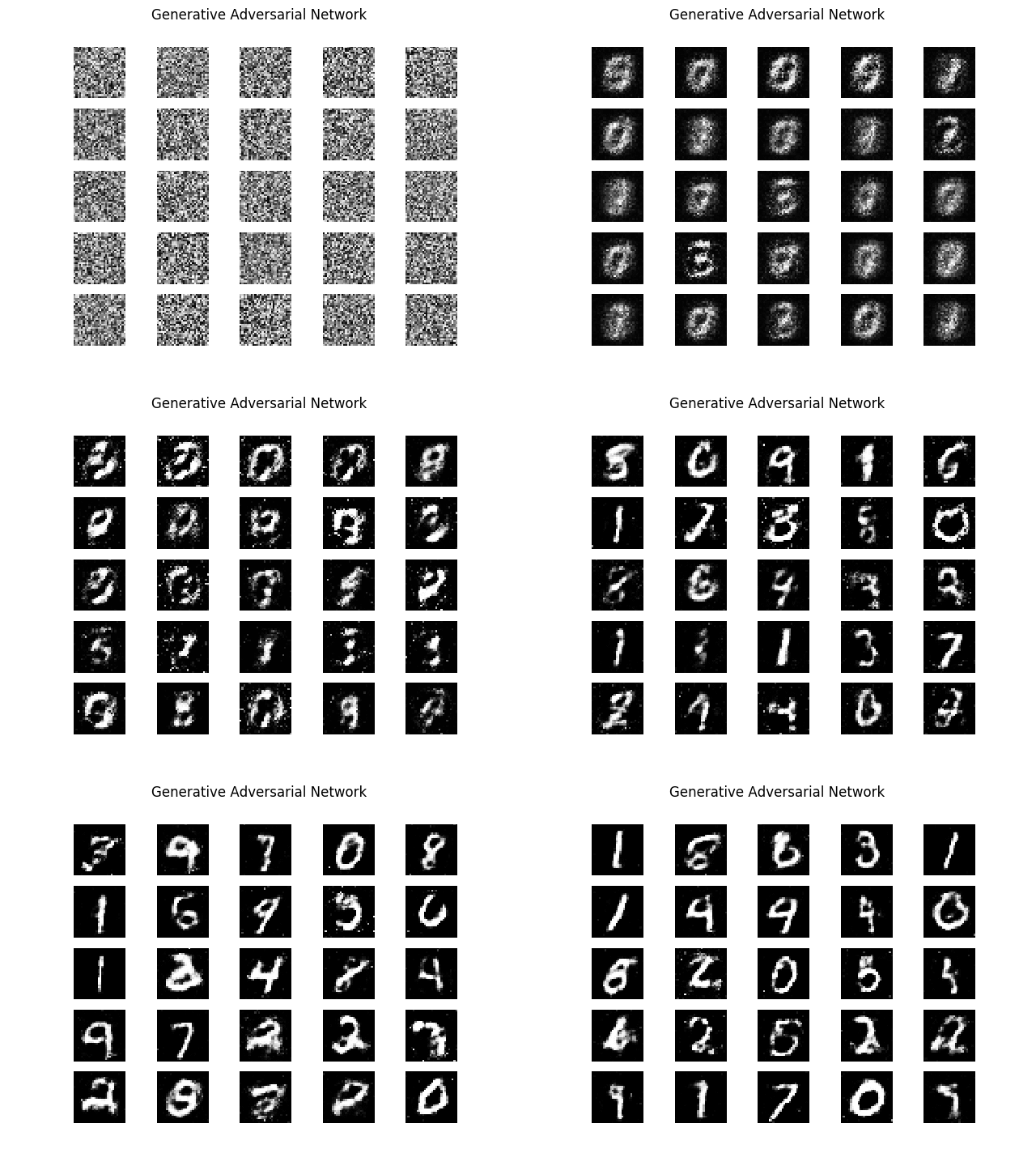
Figure: Training progress of a Generative Adversarial Network generating
handwritten digits.
### Deep Reinforcement Learning
$ python mlfromscratch/examples/deep_q_network.py
+----------------+
| Deep Q-Network |
+----------------+
Input Shape: (4,)
+-------------------+------------+--------------+
| Layer Type | Parameters | Output Shape |
+-------------------+------------+--------------+
| Dense | 320 | (64,) |
| Activation (ReLU) | 0 | (64,) |
| Dense | 130 | (2,) |
+-------------------+------------+--------------+
Total Parameters: 450

Figure: Deep Q-Network solution to the CartPole-v1 environment in OpenAI gym.
### Image Reconstruction With RBM
$ python mlfromscratch/examples/restricted_boltzmann_machine.py
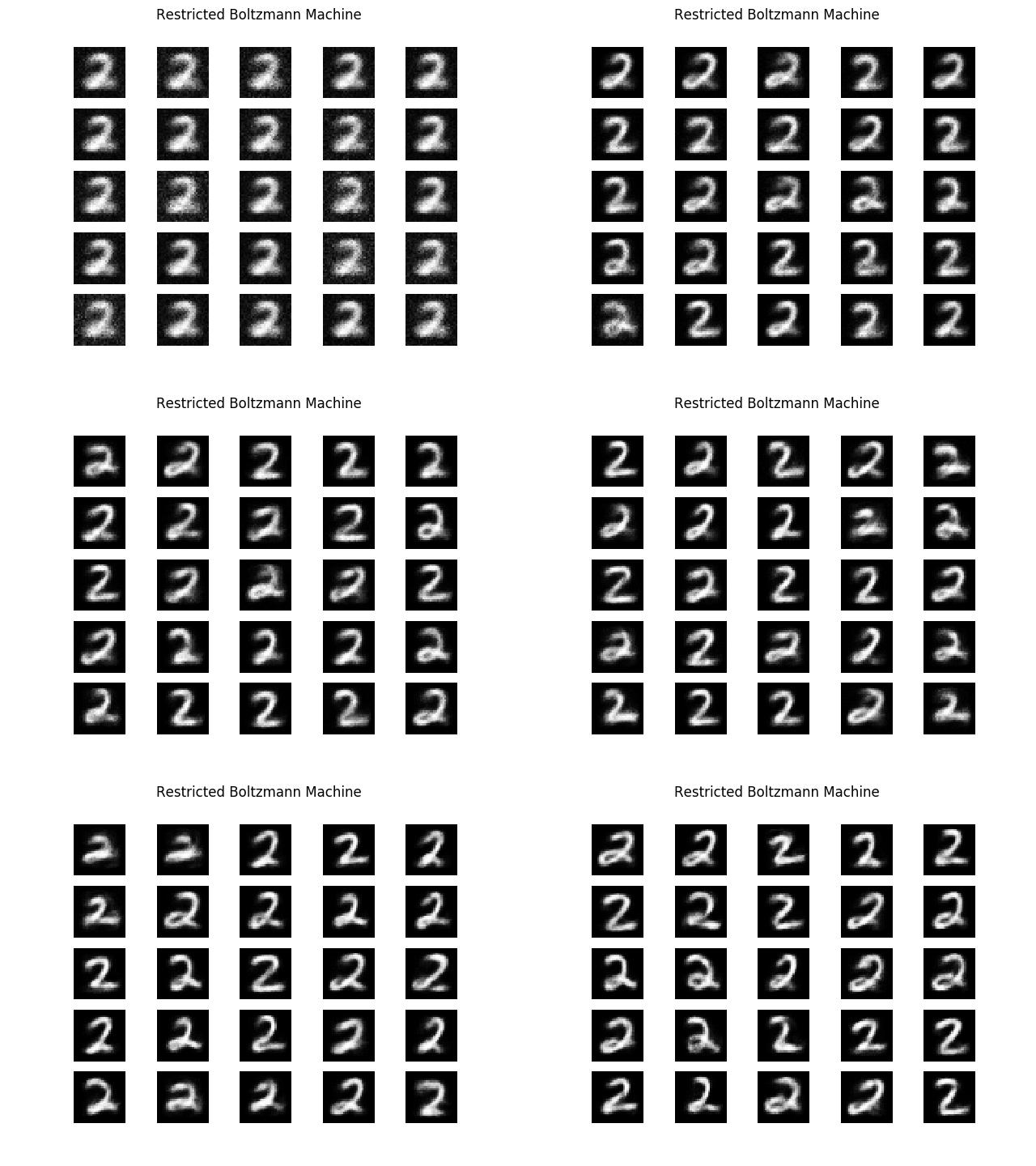
Figure: Shows how the network gets better during training at reconstructing
the digit 2 in the MNIST dataset.
### Evolutionary Evolved Neural Network
$ python mlfromscratch/examples/neuroevolution.py
+---------------+
| Model Summary |
+---------------+
Input Shape: (64,)
+----------------------+------------+--------------+
| Layer Type | Parameters | Output Shape |
+----------------------+------------+--------------+
| Dense | 1040 | (16,) |
| Activation (ReLU) | 0 | (16,) |
| Dense | 170 | (10,) |
| Activation (Softmax) | 0 | (10,) |
+----------------------+------------+--------------+
Total Parameters: 1210
Population Size: 100
Generations: 3000
Mutation Rate: 0.01
[0 Best Individual - Fitness: 3.08301, Accuracy: 10.5%]
[1 Best Individual - Fitness: 3.08746, Accuracy: 12.0%]
...
[2999 Best Individual - Fitness: 94.08513, Accuracy: 98.5%]
Test set accuracy: 96.7%

Figure: Classification of the digit dataset by a neural network which has
been evolutionary evolved.
### Genetic Algorithm
$ python mlfromscratch/examples/genetic_algorithm.py
+--------+
| GA |
+--------+
Description: Implementation of a Genetic Algorithm which aims to produce
the user specified target string. This implementation calculates each
candidate's fitness based on the alphabetical distance between the candidate
and the target. A candidate is selected as a parent with probabilities proportional
to the candidate's fitness. Reproduction is implemented as a single-point
crossover between pairs of parents. Mutation is done by randomly assigning
new characters with uniform probability.
Parameters
----------
Target String: 'Genetic Algorithm'
Population Size: 100
Mutation Rate: 0.05
[0 Closest Candidate: 'CJqlJguPlqzvpoJmb', Fitness: 0.00]
[1 Closest Candidate: 'MCxZxdr nlfiwwGEk', Fitness: 0.01]
[2 Closest Candidate: 'MCxZxdm nlfiwwGcx', Fitness: 0.01]
[3 Closest Candidate: 'SmdsAklMHn kBIwKn', Fitness: 0.01]
[4 Closest Candidate: ' lotneaJOasWfu Z', Fitness: 0.01]
...
[292 Closest Candidate: 'GeneticaAlgorithm', Fitness: 1.00]
[293 Closest Candidate: 'GeneticaAlgorithm', Fitness: 1.00]
[294 Answer: 'Genetic Algorithm']
### Association Analysis
$ python mlfromscratch/examples/apriori.py
+-------------+
| Apriori |
+-------------+
Minimum Support: 0.25
Minimum Confidence: 0.8
Transactions:
[1, 2, 3, 4]
[1, 2, 4]
[1, 2]
[2, 3, 4]
[2, 3]
[3, 4]
[2, 4]
Frequent Itemsets:
[1, 2, 3, 4, [1, 2], [1, 4], [2, 3], [2, 4], [3, 4], [1, 2, 4], [2, 3, 4]]
Rules:
1 -> 2 (support: 0.43, confidence: 1.0)
4 -> 2 (support: 0.57, confidence: 0.8)
[1, 4] -> 2 (support: 0.29, confidence: 1.0)
## Implementations
### Supervised Learning
- [Adaboost](mlfromscratch/supervised_learning/adaboost.py)
- [Bayesian Regression](mlfromscratch/supervised_learning/bayesian_regression.py)
- [Decision Tree](mlfromscratch/supervised_learning/decision_tree.py)
- [Elastic Net](mlfromscratch/supervised_learning/regression.py)
- [Gradient Boosting](mlfromscratch/supervised_learning/gradient_boosting.py)
- [K Nearest Neighbors](mlfromscratch/supervised_learning/k_nearest_neighbors.py)
- [Lasso Regression](mlfromscratch/supervised_learning/regression.py)
- [Linear Discriminant Analysis](mlfromscratch/supervised_learning/linear_discriminant_analysis.py)
- [Linear Regression](mlfromscratch/supervised_learning/regression.py)
- [Logistic Regression](mlfromscratch/supervised_learning/logistic_regression.py)
- [Multi-class Linear Discriminant Analysis](mlfromscratch/supervised_learning/multi_class_lda.py)
- [Multilayer Perceptron](mlfromscratch/supervised_learning/multilayer_perceptron.py)
- [Naive Bayes](mlfromscratch/supervised_learning/naive_bayes.py)
- [Neuroevolution](mlfromscratch/supervised_learning/neuroevolution.py)
- [Particle Swarm Optimization of Neural Network](mlfromscratch/supervised_learning/particle_swarm_optimization.py)
- [Perceptron](mlfromscratch/supervised_learning/perceptron.py)
- [Polynomial Regression](mlfromscratch/supervised_learning/regression.py)
- [Random Forest](mlfromscratch/supervised_learning/random_forest.py)
- [Ridge Regression](mlfromscratch/supervised_learning/regression.py)
- [Support Vector Machine](mlfromscratch/supervised_learning/support_vector_machine.py)
- [XGBoost](mlfromscratch/supervised_learning/xgboost.py)
### Unsupervised Learning
- [Apriori](mlfromscratch/unsupervised_learning/apriori.py)
- [Autoencoder](mlfromscratch/unsupervised_learning/autoencoder.py)
- [DBSCAN](mlfromscratch/unsupervised_learning/dbscan.py)
- [FP-Growth](mlfromscratch/unsupervised_learning/fp_growth.py)
- [Gaussian Mixture Model](mlfromscratch/unsupervised_learning/gaussian_mixture_model.py)
- [Generative Adversarial Network](mlfromscratch/unsupervised_learning/generative_adversarial_network.py)
- [Genetic Algorithm](mlfromscratch/unsupervised_learning/genetic_algorithm.py)
- [K-Means](mlfromscratch/unsupervised_learning/k_means.py)
- [Partitioning Around Medoids](mlfromscratch/unsupervised_learning/partitioning_around_medoids.py)
- [Principal Component Analysis](mlfromscratch/unsupervised_learning/principal_component_analysis.py)
- [Restricted Boltzmann Machine](mlfromscratch/unsupervised_learning/restricted_boltzmann_machine.py)
### Reinforcement Learning
- [Deep Q-Network](mlfromscratch/reinforcement_learning/deep_q_network.py)
### Deep Learning
+ [Neural Network](mlfromscratch/deep_learning/neural_network.py)
+ [Layers](mlfromscratch/deep_learning/layers.py)
* Activation Layer
* Average Pooling Layer
* Batch Normalization Layer
* Constant Padding Layer
* Convolutional Layer
* Dropout Layer
* Flatten Layer
* Fully-Connected (Dense) Layer
* Fully-Connected RNN Layer
* Max Pooling Layer
* Reshape Layer
* Up Sampling Layer
* Zero Padding Layer
+ Model Types
* [Convolutional Neural Network](mlfromscratch/examples/convolutional_neural_network.py)
* [Multilayer Perceptron](mlfromscratch/examples/multilayer_perceptron.py)
* [Recurrent Neural Network](mlfromscratch/examples/recurrent_neural_network.py)
## Contact
If there's some implementation you would like to see here or if you're just feeling social,
feel free to [email](mailto:eriklindernoren@gmail.com) me or connect with me on [LinkedIn](https://www.linkedin.com/in/eriklindernoren/).
================================================
FILE: mlfromscratch/__init__.py
================================================
================================================
FILE: mlfromscratch/data/TempLinkoping2016.txt
================================================
time temp
0.00273224 0.1
0.005464481 -4.5
0.008196721 -6.3
0.010928962 -9.6
0.013661202 -9.9
0.016393443 -17.1
0.019125683 -11.6
0.021857923 -6.2
0.024590164 -6.4
0.027322404 -0.5
0.030054645 0.5
0.032786885 -2.4
0.035519126 -7.5
0.038251366 -16.8
0.040983607 -16.6
0.043715847 -14.6
0.046448087 -9.6
0.049180328 -5.8
0.051912568 -8.6
0.054644809 -9.0
0.057377049 -9.7
0.06010929 -6.9
0.06284153 -3.9
0.06557377 1.4
0.068306011 1.9
0.071038251 4.3
0.073770492 6.9
0.076502732 4.3
0.079234973 5.9
0.081967213 3.8
0.084699454 1.5
0.087431694 0.1
0.090163934 4.6
0.092896175 0.8
0.095628415 -0.5
0.098360656 -1.0
0.101092896 4.2
0.103825137 6.6
0.106557377 4.8
0.109289617 4.7
0.112021858 1.3
0.114754098 0.9
0.117486339 -2.8
0.120218579 -3.3
0.12295082 -5.3
0.12568306 -6.8
0.128415301 -5.1
0.131147541 -2.6
0.133879781 -0.5
0.136612022 -0.5
0.139344262 0.1
0.142076503 1.7
0.144808743 2.4
0.147540984 -0.9
0.150273224 -1.3
0.153005464 -1.4
0.155737705 -0.1
0.158469945 -0.7
0.161202186 -2.6
0.163934426 -4.1
0.166666667 -2.7
0.169398907 0.7
0.172131148 2.0
0.174863388 1.7
0.177595628 0.9
0.180327869 0.3
0.183060109 0.9
0.18579235 1.1
0.18852459 0.1
0.191256831 -0.9
0.193989071 0.2
0.196721311 0.1
0.199453552 1.0
0.202185792 3.4
0.204918033 5.2
0.207650273 4.9
0.210382514 4.9
0.213114754 2.2
0.215846995 2.9
0.218579235 5.3
0.221311475 3.7
0.224043716 3.4
0.226775956 2.1
0.229508197 1.8
0.232240437 4.3
0.234972678 7.0
0.237704918 7.7
0.240437158 6.2
0.243169399 7.5
0.245901639 4.9
0.24863388 4.4
0.25136612 3.8
0.254098361 6.4
0.256830601 8.0
0.259562842 7.9
0.262295082 8.9
0.265027322 6.6
0.267759563 6.5
0.270491803 5.8
0.273224044 5.6
0.275956284 4.7
0.278688525 5.5
0.281420765 5.5
0.284153005 5.8
0.286885246 5.3
0.289617486 6.9
0.292349727 5.9
0.295081967 6.1
0.297814208 6.6
0.300546448 6.7
0.303278689 6.5
0.306010929 7.0
0.308743169 5.8
0.31147541 3.0
0.31420765 2.5
0.316939891 2.4
0.319672131 4.3
0.322404372 2.8
0.325136612 3.6
0.327868852 6.8
0.330601093 9.1
0.333333333 8.4
0.336065574 9.3
0.338797814 13.3
0.341530055 10.6
0.344262295 10.5
0.346994536 11.8
0.349726776 14.7
0.352459016 16.2
0.355191257 16.4
0.357923497 16.9
0.360655738 12.3
0.363387978 10.2
0.366120219 11.2
0.368852459 6.1
0.371584699 6.4
0.37431694 6.1
0.37704918 10.4
0.379781421 10.3
0.382513661 11.9
0.385245902 12.9
0.387978142 12.5
0.390710383 17.5
0.393442623 19.9
0.396174863 19.3
0.398907104 11.4
0.401639344 9.7
0.404371585 10.7
0.407103825 13.0
0.409836066 12.4
0.412568306 16.3
0.415300546 19.2
0.418032787 19.2
0.420765027 19.8
0.423497268 19.5
0.426229508 16.6
0.428961749 13.0
0.431693989 12.6
0.43442623 17.6
0.43715847 13.7
0.43989071 11.3
0.442622951 10.2
0.445355191 10.2
0.448087432 11.6
0.450819672 14.2
0.453551913 14.4
0.456284153 17.4
0.459016393 13.1
0.461748634 17.4
0.464480874 15.9
0.467213115 15.9
0.469945355 15.5
0.472677596 16.4
0.475409836 16.7
0.478142077 18.2
0.480874317 20.9
0.483606557 22.2
0.486338798 19.1
0.489071038 16.3
0.491803279 16.6
0.494535519 15.1
0.49726776 14.5
0.5 17.4
0.50273224 16.5
0.505464481 13.7
0.508196721 14.0
0.510928962 14.2
0.513661202 15.6
0.516393443 15.7
0.519125683 15.6
0.521857923 16.2
0.524590164 16.3
0.527322404 18.3
0.530054645 16.6
0.532786885 16.1
0.535519126 15.9
0.538251366 16.0
0.540983607 15.9
0.543715847 16.0
0.546448087 15.7
0.549180328 17.2
0.551912568 19.9
0.554644809 21.0
0.557377049 19.4
0.56010929 20.4
0.56284153 23.1
0.56557377 23.0
0.568306011 19.9
0.571038251 17.6
0.573770492 18.8
0.576502732 17.8
0.579234973 18.6
0.581967213 16.4
0.584699454 15.2
0.587431694 15.3
0.590163934 16.0
0.592896175 18.0
0.595628415 17.7
0.598360656 16.0
0.601092896 16.4
0.603825137 16.7
0.606557377 14.3
0.609289617 12.2
0.612021858 10.0
0.614754098 12.0
0.617486339 16.2
0.620218579 15.9
0.62295082 14.5
0.62568306 15.3
0.628415301 13.3
0.631147541 14.5
0.633879781 15.5
0.636612022 15.3
0.639344262 17.3
0.642076503 15.3
0.644808743 16.4
0.647540984 17.0
0.650273224 20.2
0.653005464 22.4
0.655737705 18.1
0.658469945 11.6
0.661202186 14.6
0.663934426 13.5
0.666666667 17.9
0.669398907 16.4
0.672131148 15.5
0.674863388 15.9
0.677595628 14.1
0.680327869 13.2
0.683060109 14.5
0.68579235 19.0
0.68852459 18.3
0.691256831 18.8
0.693989071 16.8
0.696721311 16.8
0.699453552 14.3
0.702185792 18.4
0.704918033 18.3
0.707650273 18.4
0.710382514 14.9
0.713114754 11.4
0.715846995 12.6
0.718579235 14.0
0.721311475 14.8
0.724043716 9.9
0.726775956 11.4
0.729508197 12.9
0.732240437 12.1
0.734972678 12.8
0.737704918 13.5
0.740437158 12.9
0.743169399 14.0
0.745901639 14.6
0.74863388 12.0
0.75136612 10.5
0.754098361 9.5
0.756830601 7.6
0.759562842 6.4
0.762295082 7.0
0.765027322 8.1
0.767759563 8.1
0.770491803 7.6
0.773224044 7.4
0.775956284 7.2
0.778688525 7.0
0.781420765 6.4
0.784153005 5.8
0.786885246 5.5
0.789617486 6.4
0.792349727 7.3
0.795081967 7.4
0.797814208 7.8
0.800546448 7.9
0.803278689 6.9
0.806010929 6.1
0.808743169 3.7
0.81147541 5.3
0.81420765 6.1
0.816939891 4.3
0.819672131 3.3
0.822404372 8.8
0.825136612 9.8
0.827868852 6.4
0.830601093 4.6
0.833333333 5.2
0.836065574 5.5
0.838797814 1.4
0.841530055 0.5
0.844262295 -2.6
0.846994536 2.4
0.849726776 -0.8
0.852459016 -3.3
0.855191257 -2.8
0.857923497 -3.5
0.860655738 -2.8
0.863387978 -2.2
0.866120219 -0.3
0.868852459 0.0
0.871584699 2.3
0.87431694 4.9
0.87704918 3.1
0.879781421 3.6
0.882513661 5.2
0.885245902 3.8
0.887978142 3.2
0.890710383 7.7
0.893442623 7.8
0.896174863 6.9
0.898907104 2.7
0.901639344 2.8
0.904371585 6.6
0.907103825 1.9
0.909836066 -1.4
0.912568306 2.2
0.915300546 1.9
0.918032787 -1.3
0.920765027 -1.6
0.923497268 -3.2
0.926229508 -2.7
0.928961749 3.7
0.931693989 -3.2
0.93442623 -0.2
0.93715847 9.3
0.93989071 7.1
0.942622951 3.2
0.945355191 1.1
0.948087432 -6.0
0.950819672 1.7
0.953551913 -1.3
0.956284153 -2.2
0.959016393 -1.2
0.961748634 1.0
0.964480874 1.7
0.967213115 3.7
0.969945355 4.7
0.972677596 -0.3
0.975409836 3.5
0.978142077 3.4
0.980874317 3.9
0.983606557 4.5
0.986338798 5.3
0.989071038 2.7
0.991803279 -0.4
0.994535519 4.3
0.99726776 7.0
1 9.3
================================================
FILE: mlfromscratch/deep_learning/__init__.py
================================================
from .neural_network import NeuralNetwork
================================================
FILE: mlfromscratch/deep_learning/activation_functions.py
================================================
import numpy as np
# Collection of activation functions
# Reference: https://en.wikipedia.org/wiki/Activation_function
class Sigmoid():
def __call__(self, x):
return 1 / (1 + np.exp(-x))
def gradient(self, x):
return self.__call__(x) * (1 - self.__call__(x))
class Softmax():
def __call__(self, x):
e_x = np.exp(x - np.max(x, axis=-1, keepdims=True))
return e_x / np.sum(e_x, axis=-1, keepdims=True)
def gradient(self, x):
p = self.__call__(x)
return p * (1 - p)
class TanH():
def __call__(self, x):
return 2 / (1 + np.exp(-2*x)) - 1
def gradient(self, x):
return 1 - np.power(self.__call__(x), 2)
class ReLU():
def __call__(self, x):
return np.where(x >= 0, x, 0)
def gradient(self, x):
return np.where(x >= 0, 1, 0)
class LeakyReLU():
def __init__(self, alpha=0.2):
self.alpha = alpha
def __call__(self, x):
return np.where(x >= 0, x, self.alpha * x)
def gradient(self, x):
return np.where(x >= 0, 1, self.alpha)
class ELU():
def __init__(self, alpha=0.1):
self.alpha = alpha
def __call__(self, x):
return np.where(x >= 0.0, x, self.alpha * (np.exp(x) - 1))
def gradient(self, x):
return np.where(x >= 0.0, 1, self.__call__(x) + self.alpha)
class SELU():
# Reference : https://arxiv.org/abs/1706.02515,
# https://github.com/bioinf-jku/SNNs/blob/master/SelfNormalizingNetworks_MLP_MNIST.ipynb
def __init__(self):
self.alpha = 1.6732632423543772848170429916717
self.scale = 1.0507009873554804934193349852946
def __call__(self, x):
return self.scale * np.where(x >= 0.0, x, self.alpha*(np.exp(x)-1))
def gradient(self, x):
return self.scale * np.where(x >= 0.0, 1, self.alpha * np.exp(x))
class SoftPlus():
def __call__(self, x):
return np.log(1 + np.exp(x))
def gradient(self, x):
return 1 / (1 + np.exp(-x))
================================================
FILE: mlfromscratch/deep_learning/layers.py
================================================
from __future__ import print_function, division
import math
import numpy as np
import copy
from mlfromscratch.deep_learning.activation_functions import Sigmoid, ReLU, SoftPlus, LeakyReLU
from mlfromscratch.deep_learning.activation_functions import TanH, ELU, SELU, Softmax
class Layer(object):
def set_input_shape(self, shape):
""" Sets the shape that the layer expects of the input in the forward
pass method """
self.input_shape = shape
def layer_name(self):
""" The name of the layer. Used in model summary. """
return self.__class__.__name__
def parameters(self):
""" The number of trainable parameters used by the layer """
return 0
def forward_pass(self, X, training):
""" Propogates the signal forward in the network """
raise NotImplementedError()
def backward_pass(self, accum_grad):
""" Propogates the accumulated gradient backwards in the network.
If the has trainable weights then these weights are also tuned in this method.
As input (accum_grad) it receives the gradient with respect to the output of the layer and
returns the gradient with respect to the output of the previous layer. """
raise NotImplementedError()
def output_shape(self):
""" The shape of the output produced by forward_pass """
raise NotImplementedError()
class Dense(Layer):
"""A fully-connected NN layer.
Parameters:
-----------
n_units: int
The number of neurons in the layer.
input_shape: tuple
The expected input shape of the layer. For dense layers a single digit specifying
the number of features of the input. Must be specified if it is the first layer in
the network.
"""
def __init__(self, n_units, input_shape=None):
self.layer_input = None
self.input_shape = input_shape
self.n_units = n_units
self.trainable = True
self.W = None
self.w0 = None
def initialize(self, optimizer):
# Initialize the weights
limit = 1 / math.sqrt(self.input_shape[0])
self.W = np.random.uniform(-limit, limit, (self.input_shape[0], self.n_units))
self.w0 = np.zeros((1, self.n_units))
# Weight optimizers
self.W_opt = copy.copy(optimizer)
self.w0_opt = copy.copy(optimizer)
def parameters(self):
return np.prod(self.W.shape) + np.prod(self.w0.shape)
def forward_pass(self, X, training=True):
self.layer_input = X
return X.dot(self.W) + self.w0
def backward_pass(self, accum_grad):
# Save weights used during forwards pass
W = self.W
if self.trainable:
# Calculate gradient w.r.t layer weights
grad_w = self.layer_input.T.dot(accum_grad)
grad_w0 = np.sum(accum_grad, axis=0, keepdims=True)
# Update the layer weights
self.W = self.W_opt.update(self.W, grad_w)
self.w0 = self.w0_opt.update(self.w0, grad_w0)
# Return accumulated gradient for next layer
# Calculated based on the weights used during the forward pass
accum_grad = accum_grad.dot(W.T)
return accum_grad
def output_shape(self):
return (self.n_units, )
class RNN(Layer):
"""A Vanilla Fully-Connected Recurrent Neural Network layer.
Parameters:
-----------
n_units: int
The number of hidden states in the layer.
activation: string
The name of the activation function which will be applied to the output of each state.
bptt_trunc: int
Decides how many time steps the gradient should be propagated backwards through states
given the loss gradient for time step t.
input_shape: tuple
The expected input shape of the layer. For dense layers a single digit specifying
the number of features of the input. Must be specified if it is the first layer in
the network.
Reference:
http://www.wildml.com/2015/09/recurrent-neural-networks-tutorial-part-2-implementing-a-language-model-rnn-with-python-numpy-and-theano/
"""
def __init__(self, n_units, activation='tanh', bptt_trunc=5, input_shape=None):
self.input_shape = input_shape
self.n_units = n_units
self.activation = activation_functions[activation]()
self.trainable = True
self.bptt_trunc = bptt_trunc
self.W = None # Weight of the previous state
self.V = None # Weight of the output
self.U = None # Weight of the input
def initialize(self, optimizer):
timesteps, input_dim = self.input_shape
# Initialize the weights
limit = 1 / math.sqrt(input_dim)
self.U = np.random.uniform(-limit, limit, (self.n_units, input_dim))
limit = 1 / math.sqrt(self.n_units)
self.V = np.random.uniform(-limit, limit, (input_dim, self.n_units))
self.W = np.random.uniform(-limit, limit, (self.n_units, self.n_units))
# Weight optimizers
self.U_opt = copy.copy(optimizer)
self.V_opt = copy.copy(optimizer)
self.W_opt = copy.copy(optimizer)
def parameters(self):
return np.prod(self.W.shape) + np.prod(self.U.shape) + np.prod(self.V.shape)
def forward_pass(self, X, training=True):
self.layer_input = X
batch_size, timesteps, input_dim = X.shape
# Save these values for use in backprop.
self.state_input = np.zeros((batch_size, timesteps, self.n_units))
self.states = np.zeros((batch_size, timesteps+1, self.n_units))
self.outputs = np.zeros((batch_size, timesteps, input_dim))
# Set last time step to zero for calculation of the state_input at time step zero
self.states[:, -1] = np.zeros((batch_size, self.n_units))
for t in range(timesteps):
# Input to state_t is the current input and output of previous states
self.state_input[:, t] = X[:, t].dot(self.U.T) + self.states[:, t-1].dot(self.W.T)
self.states[:, t] = self.activation(self.state_input[:, t])
self.outputs[:, t] = self.states[:, t].dot(self.V.T)
return self.outputs
def backward_pass(self, accum_grad):
_, timesteps, _ = accum_grad.shape
# Variables where we save the accumulated gradient w.r.t each parameter
grad_U = np.zeros_like(self.U)
grad_V = np.zeros_like(self.V)
grad_W = np.zeros_like(self.W)
# The gradient w.r.t the layer input.
# Will be passed on to the previous layer in the network
accum_grad_next = np.zeros_like(accum_grad)
# Back Propagation Through Time
for t in reversed(range(timesteps)):
# Update gradient w.r.t V at time step t
grad_V += accum_grad[:, t].T.dot(self.states[:, t])
# Calculate the gradient w.r.t the state input
grad_wrt_state = accum_grad[:, t].dot(self.V) * self.activation.gradient(self.state_input[:, t])
# Gradient w.r.t the layer input
accum_grad_next[:, t] = grad_wrt_state.dot(self.U)
# Update gradient w.r.t W and U by backprop. from time step t for at most
# self.bptt_trunc number of time steps
for t_ in reversed(np.arange(max(0, t - self.bptt_trunc), t+1)):
grad_U += grad_wrt_state.T.dot(self.layer_input[:, t_])
grad_W += grad_wrt_state.T.dot(self.states[:, t_-1])
# Calculate gradient w.r.t previous state
grad_wrt_state = grad_wrt_state.dot(self.W) * self.activation.gradient(self.state_input[:, t_-1])
# Update weights
self.U = self.U_opt.update(self.U, grad_U)
self.V = self.V_opt.update(self.V, grad_V)
self.W = self.W_opt.update(self.W, grad_W)
return accum_grad_next
def output_shape(self):
return self.input_shape
class Conv2D(Layer):
"""A 2D Convolution Layer.
Parameters:
-----------
n_filters: int
The number of filters that will convolve over the input matrix. The number of channels
of the output shape.
filter_shape: tuple
A tuple (filter_height, filter_width).
input_shape: tuple
The shape of the expected input of the layer. (batch_size, channels, height, width)
Only needs to be specified for first layer in the network.
padding: string
Either 'same' or 'valid'. 'same' results in padding being added so that the output height and width
matches the input height and width. For 'valid' no padding is added.
stride: int
The stride length of the filters during the convolution over the input.
"""
def __init__(self, n_filters, filter_shape, input_shape=None, padding='same', stride=1):
self.n_filters = n_filters
self.filter_shape = filter_shape
self.padding = padding
self.stride = stride
self.input_shape = input_shape
self.trainable = True
def initialize(self, optimizer):
# Initialize the weights
filter_height, filter_width = self.filter_shape
channels = self.input_shape[0]
limit = 1 / math.sqrt(np.prod(self.filter_shape))
self.W = np.random.uniform(-limit, limit, size=(self.n_filters, channels, filter_height, filter_width))
self.w0 = np.zeros((self.n_filters, 1))
# Weight optimizers
self.W_opt = copy.copy(optimizer)
self.w0_opt = copy.copy(optimizer)
def parameters(self):
return np.prod(self.W.shape) + np.prod(self.w0.shape)
def forward_pass(self, X, training=True):
batch_size, channels, height, width = X.shape
self.layer_input = X
# Turn image shape into column shape
# (enables dot product between input and weights)
self.X_col = image_to_column(X, self.filter_shape, stride=self.stride, output_shape=self.padding)
# Turn weights into column shape
self.W_col = self.W.reshape((self.n_filters, -1))
# Calculate output
output = self.W_col.dot(self.X_col) + self.w0
# Reshape into (n_filters, out_height, out_width, batch_size)
output = output.reshape(self.output_shape() + (batch_size, ))
# Redistribute axises so that batch size comes first
return output.transpose(3,0,1,2)
def backward_pass(self, accum_grad):
# Reshape accumulated gradient into column shape
accum_grad = accum_grad.transpose(1, 2, 3, 0).reshape(self.n_filters, -1)
if self.trainable:
# Take dot product between column shaped accum. gradient and column shape
# layer input to determine the gradient at the layer with respect to layer weights
grad_w = accum_grad.dot(self.X_col.T).reshape(self.W.shape)
# The gradient with respect to bias terms is the sum similarly to in Dense layer
grad_w0 = np.sum(accum_grad, axis=1, keepdims=True)
# Update the layers weights
self.W = self.W_opt.update(self.W, grad_w)
self.w0 = self.w0_opt.update(self.w0, grad_w0)
# Recalculate the gradient which will be propogated back to prev. layer
accum_grad = self.W_col.T.dot(accum_grad)
# Reshape from column shape to image shape
accum_grad = column_to_image(accum_grad,
self.layer_input.shape,
self.filter_shape,
stride=self.stride,
output_shape=self.padding)
return accum_grad
def output_shape(self):
channels, height, width = self.input_shape
pad_h, pad_w = determine_padding(self.filter_shape, output_shape=self.padding)
output_height = (height + np.sum(pad_h) - self.filter_shape[0]) / self.stride + 1
output_width = (width + np.sum(pad_w) - self.filter_shape[1]) / self.stride + 1
return self.n_filters, int(output_height), int(output_width)
class BatchNormalization(Layer):
"""Batch normalization.
"""
def __init__(self, momentum=0.99):
self.momentum = momentum
self.trainable = True
self.eps = 0.01
self.running_mean = None
self.running_var = None
def initialize(self, optimizer):
# Initialize the parameters
self.gamma = np.ones(self.input_shape)
self.beta = np.zeros(self.input_shape)
# parameter optimizers
self.gamma_opt = copy.copy(optimizer)
self.beta_opt = copy.copy(optimizer)
def parameters(self):
return np.prod(self.gamma.shape) + np.prod(self.beta.shape)
def forward_pass(self, X, training=True):
# Initialize running mean and variance if first run
if self.running_mean is None:
self.running_mean = np.mean(X, axis=0)
self.running_var = np.var(X, axis=0)
if training and self.trainable:
mean = np.mean(X, axis=0)
var = np.var(X, axis=0)
self.running_mean = self.momentum * self.running_mean + (1 - self.momentum) * mean
self.running_var = self.momentum * self.running_var + (1 - self.momentum) * var
else:
mean = self.running_mean
var = self.running_var
# Statistics saved for backward pass
self.X_centered = X - mean
self.stddev_inv = 1 / np.sqrt(var + self.eps)
X_norm = self.X_centered * self.stddev_inv
output = self.gamma * X_norm + self.beta
return output
def backward_pass(self, accum_grad):
# Save parameters used during the forward pass
gamma = self.gamma
# If the layer is trainable the parameters are updated
if self.trainable:
X_norm = self.X_centered * self.stddev_inv
grad_gamma = np.sum(accum_grad * X_norm, axis=0)
grad_beta = np.sum(accum_grad, axis=0)
self.gamma = self.gamma_opt.update(self.gamma, grad_gamma)
self.beta = self.beta_opt.update(self.beta, grad_beta)
batch_size = accum_grad.shape[0]
# The gradient of the loss with respect to the layer inputs (use weights and statistics from forward pass)
accum_grad = (1 / batch_size) * gamma * self.stddev_inv * (
batch_size * accum_grad
- np.sum(accum_grad, axis=0)
- self.X_centered * self.stddev_inv**2 * np.sum(accum_grad * self.X_centered, axis=0)
)
return accum_grad
def output_shape(self):
return self.input_shape
class PoolingLayer(Layer):
"""A parent class of MaxPooling2D and AveragePooling2D
"""
def __init__(self, pool_shape=(2, 2), stride=1, padding=0):
self.pool_shape = pool_shape
self.stride = stride
self.padding = padding
self.trainable = True
def forward_pass(self, X, training=True):
self.layer_input = X
batch_size, channels, height, width = X.shape
_, out_height, out_width = self.output_shape()
X = X.reshape(batch_size*channels, 1, height, width)
X_col = image_to_column(X, self.pool_shape, self.stride, self.padding)
# MaxPool or AveragePool specific method
output = self._pool_forward(X_col)
output = output.reshape(out_height, out_width, batch_size, channels)
output = output.transpose(2, 3, 0, 1)
return output
def backward_pass(self, accum_grad):
batch_size, _, _, _ = accum_grad.shape
channels, height, width = self.input_shape
accum_grad = accum_grad.transpose(2, 3, 0, 1).ravel()
# MaxPool or AveragePool specific method
accum_grad_col = self._pool_backward(accum_grad)
accum_grad = column_to_image(accum_grad_col, (batch_size * channels, 1, height, width), self.pool_shape, self.stride, 0)
accum_grad = accum_grad.reshape((batch_size,) + self.input_shape)
return accum_grad
def output_shape(self):
channels, height, width = self.input_shape
out_height = (height - self.pool_shape[0]) / self.stride + 1
out_width = (width - self.pool_shape[1]) / self.stride + 1
assert out_height % 1 == 0
assert out_width % 1 == 0
return channels, int(out_height), int(out_width)
class MaxPooling2D(PoolingLayer):
def _pool_forward(self, X_col):
arg_max = np.argmax(X_col, axis=0).flatten()
output = X_col[arg_max, range(arg_max.size)]
self.cache = arg_max
return output
def _pool_backward(self, accum_grad):
accum_grad_col = np.zeros((np.prod(self.pool_shape), accum_grad.size))
arg_max = self.cache
accum_grad_col[arg_max, range(accum_grad.size)] = accum_grad
return accum_grad_col
class AveragePooling2D(PoolingLayer):
def _pool_forward(self, X_col):
output = np.mean(X_col, axis=0)
return output
def _pool_backward(self, accum_grad):
accum_grad_col = np.zeros((np.prod(self.pool_shape), accum_grad.size))
accum_grad_col[:, range(accum_grad.size)] = 1. / accum_grad_col.shape[0] * accum_grad
return accum_grad_col
class ConstantPadding2D(Layer):
"""Adds rows and columns of constant values to the input.
Expects the input to be of shape (batch_size, channels, height, width)
Parameters:
-----------
padding: tuple
The amount of padding along the height and width dimension of the input.
If (pad_h, pad_w) the same symmetric padding is applied along height and width dimension.
If ((pad_h0, pad_h1), (pad_w0, pad_w1)) the specified padding is added to beginning and end of
the height and width dimension.
padding_value: int or tuple
The value the is added as padding.
"""
def __init__(self, padding, padding_value=0):
self.padding = padding
self.trainable = True
if not isinstance(padding[0], tuple):
self.padding = ((padding[0], padding[0]), padding[1])
if not isinstance(padding[1], tuple):
self.padding = (self.padding[0], (padding[1], padding[1]))
self.padding_value = padding_value
def forward_pass(self, X, training=True):
output = np.pad(X,
pad_width=((0,0), (0,0), self.padding[0], self.padding[1]),
mode="constant",
constant_values=self.padding_value)
return output
def backward_pass(self, accum_grad):
pad_top, pad_left = self.padding[0][0], self.padding[1][0]
height, width = self.input_shape[1], self.input_shape[2]
accum_grad = accum_grad[:, :, pad_top:pad_top+height, pad_left:pad_left+width]
return accum_grad
def output_shape(self):
new_height = self.input_shape[1] + np.sum(self.padding[0])
new_width = self.input_shape[2] + np.sum(self.padding[1])
return (self.input_shape[0], new_height, new_width)
class ZeroPadding2D(ConstantPadding2D):
"""Adds rows and columns of zero values to the input.
Expects the input to be of shape (batch_size, channels, height, width)
Parameters:
-----------
padding: tuple
The amount of padding along the height and width dimension of the input.
If (pad_h, pad_w) the same symmetric padding is applied along height and width dimension.
If ((pad_h0, pad_h1), (pad_w0, pad_w1)) the specified padding is added to beginning and end of
the height and width dimension.
"""
def __init__(self, padding):
self.padding = padding
if isinstance(padding[0], int):
self.padding = ((padding[0], padding[0]), padding[1])
if isinstance(padding[1], int):
self.padding = (self.padding[0], (padding[1], padding[1]))
self.padding_value = 0
class Flatten(Layer):
""" Turns a multidimensional matrix into two-dimensional """
def __init__(self, input_shape=None):
self.prev_shape = None
self.trainable = True
self.input_shape = input_shape
def forward_pass(self, X, training=True):
self.prev_shape = X.shape
return X.reshape((X.shape[0], -1))
def backward_pass(self, accum_grad):
return accum_grad.reshape(self.prev_shape)
def output_shape(self):
return (np.prod(self.input_shape),)
class UpSampling2D(Layer):
""" Nearest neighbor up sampling of the input. Repeats the rows and
columns of the data by size[0] and size[1] respectively.
Parameters:
-----------
size: tuple
(size_y, size_x) - The number of times each axis will be repeated.
"""
def __init__(self, size=(2,2), input_shape=None):
self.prev_shape = None
self.trainable = True
self.size = size
self.input_shape = input_shape
def forward_pass(self, X, training=True):
self.prev_shape = X.shape
# Repeat each axis as specified by size
X_new = X.repeat(self.size[0], axis=2).repeat(self.size[1], axis=3)
return X_new
def backward_pass(self, accum_grad):
# Down sample input to previous shape
accum_grad = accum_grad[:, :, ::self.size[0], ::self.size[1]]
return accum_grad
def output_shape(self):
channels, height, width = self.input_shape
return channels, self.size[0] * height, self.size[1] * width
class Reshape(Layer):
""" Reshapes the input tensor into specified shape
Parameters:
-----------
shape: tuple
The shape which the input shall be reshaped to.
"""
def __init__(self, shape, input_shape=None):
self.prev_shape = None
self.trainable = True
self.shape = shape
self.input_shape = input_shape
def forward_pass(self, X, training=True):
self.prev_shape = X.shape
return X.reshape((X.shape[0], ) + self.shape)
def backward_pass(self, accum_grad):
return accum_grad.reshape(self.prev_shape)
def output_shape(self):
return self.shape
class Dropout(Layer):
"""A layer that randomly sets a fraction p of the output units of the previous layer
to zero.
Parameters:
-----------
p: float
The probability that unit x is set to zero.
"""
def __init__(self, p=0.2):
self.p = p
self._mask = None
self.input_shape = None
self.n_units = None
self.pass_through = True
self.trainable = True
def forward_pass(self, X, training=True):
c = (1 - self.p)
if training:
self._mask = np.random.uniform(size=X.shape) > self.p
c = self._mask
return X * c
def backward_pass(self, accum_grad):
return accum_grad * self._mask
def output_shape(self):
return self.input_shape
activation_functions = {
'relu': ReLU,
'sigmoid': Sigmoid,
'selu': SELU,
'elu': ELU,
'softmax': Softmax,
'leaky_relu': LeakyReLU,
'tanh': TanH,
'softplus': SoftPlus
}
class Activation(Layer):
"""A layer that applies an activation operation to the input.
Parameters:
-----------
name: string
The name of the activation function that will be used.
"""
def __init__(self, name):
self.activation_name = name
self.activation_func = activation_functions[name]()
self.trainable = True
def layer_name(self):
return "Activation (%s)" % (self.activation_func.__class__.__name__)
def forward_pass(self, X, training=True):
self.layer_input = X
return self.activation_func(X)
def backward_pass(self, accum_grad):
return accum_grad * self.activation_func.gradient(self.layer_input)
def output_shape(self):
return self.input_shape
# Method which calculates the padding based on the specified output shape and the
# shape of the filters
def determine_padding(filter_shape, output_shape="same"):
# No padding
if output_shape == "valid":
return (0, 0), (0, 0)
# Pad so that the output shape is the same as input shape (given that stride=1)
elif output_shape == "same":
filter_height, filter_width = filter_shape
# Derived from:
# output_height = (height + pad_h - filter_height) / stride + 1
# In this case output_height = height and stride = 1. This gives the
# expression for the padding below.
pad_h1 = int(math.floor((filter_height - 1)/2))
pad_h2 = int(math.ceil((filter_height - 1)/2))
pad_w1 = int(math.floor((filter_width - 1)/2))
pad_w2 = int(math.ceil((filter_width - 1)/2))
return (pad_h1, pad_h2), (pad_w1, pad_w2)
# Reference: CS231n Stanford
def get_im2col_indices(images_shape, filter_shape, padding, stride=1):
# First figure out what the size of the output should be
batch_size, channels, height, width = images_shape
filter_height, filter_width = filter_shape
pad_h, pad_w = padding
out_height = int((height + np.sum(pad_h) - filter_height) / stride + 1)
out_width = int((width + np.sum(pad_w) - filter_width) / stride + 1)
i0 = np.repeat(np.arange(filter_height), filter_width)
i0 = np.tile(i0, channels)
i1 = stride * np.repeat(np.arange(out_height), out_width)
j0 = np.tile(np.arange(filter_width), filter_height * channels)
j1 = stride * np.tile(np.arange(out_width), out_height)
i = i0.reshape(-1, 1) + i1.reshape(1, -1)
j = j0.reshape(-1, 1) + j1.reshape(1, -1)
k = np.repeat(np.arange(channels), filter_height * filter_width).reshape(-1, 1)
return (k, i, j)
# Method which turns the image shaped input to column shape.
# Used during the forward pass.
# Reference: CS231n Stanford
def image_to_column(images, filter_shape, stride, output_shape='same'):
filter_height, filter_width = filter_shape
pad_h, pad_w = determine_padding(filter_shape, output_shape)
# Add padding to the image
images_padded = np.pad(images, ((0, 0), (0, 0), pad_h, pad_w), mode='constant')
# Calculate the indices where the dot products are to be applied between weights
# and the image
k, i, j = get_im2col_indices(images.shape, filter_shape, (pad_h, pad_w), stride)
# Get content from image at those indices
cols = images_padded[:, k, i, j]
channels = images.shape[1]
# Reshape content into column shape
cols = cols.transpose(1, 2, 0).reshape(filter_height * filter_width * channels, -1)
return cols
# Method which turns the column shaped input to image shape.
# Used during the backward pass.
# Reference: CS231n Stanford
def column_to_image(cols, images_shape, filter_shape, stride, output_shape='same'):
batch_size, channels, height, width = images_shape
pad_h, pad_w = determine_padding(filter_shape, output_shape)
height_padded = height + np.sum(pad_h)
width_padded = width + np.sum(pad_w)
images_padded = np.zeros((batch_size, channels, height_padded, width_padded))
# Calculate the indices where the dot products are applied between weights
# and the image
k, i, j = get_im2col_indices(images_shape, filter_shape, (pad_h, pad_w), stride)
cols = cols.reshape(channels * np.prod(filter_shape), -1, batch_size)
cols = cols.transpose(2, 0, 1)
# Add column content to the images at the indices
np.add.at(images_padded, (slice(None), k, i, j), cols)
# Return image without padding
return images_padded[:, :, pad_h[0]:height+pad_h[0], pad_w[0]:width+pad_w[0]]
================================================
FILE: mlfromscratch/deep_learning/loss_functions.py
================================================
from __future__ import division
import numpy as np
from mlfromscratch.utils import accuracy_score
from mlfromscratch.deep_learning.activation_functions import Sigmoid
class Loss(object):
def loss(self, y_true, y_pred):
return NotImplementedError()
def gradient(self, y, y_pred):
raise NotImplementedError()
def acc(self, y, y_pred):
return 0
class SquareLoss(Loss):
def __init__(self): pass
def loss(self, y, y_pred):
return 0.5 * np.power((y - y_pred), 2)
def gradient(self, y, y_pred):
return -(y - y_pred)
class CrossEntropy(Loss):
def __init__(self): pass
def loss(self, y, p):
# Avoid division by zero
p = np.clip(p, 1e-15, 1 - 1e-15)
return - y * np.log(p) - (1 - y) * np.log(1 - p)
def acc(self, y, p):
return accuracy_score(np.argmax(y, axis=1), np.argmax(p, axis=1))
def gradient(self, y, p):
# Avoid division by zero
p = np.clip(p, 1e-15, 1 - 1e-15)
return - (y / p) + (1 - y) / (1 - p)
================================================
FILE: mlfromscratch/deep_learning/neural_network.py
================================================
from __future__ import print_function, division
from terminaltables import AsciiTable
import numpy as np
import progressbar
from mlfromscratch.utils import batch_iterator
from mlfromscratch.utils.misc import bar_widgets
class NeuralNetwork():
"""Neural Network. Deep Learning base model.
Parameters:
-----------
optimizer: class
The weight optimizer that will be used to tune the weights in order of minimizing
the loss.
loss: class
Loss function used to measure the model's performance. SquareLoss or CrossEntropy.
validation: tuple
A tuple containing validation data and labels (X, y)
"""
def __init__(self, optimizer, loss, validation_data=None):
self.optimizer = optimizer
self.layers = []
self.errors = {"training": [], "validation": []}
self.loss_function = loss()
self.progressbar = progressbar.ProgressBar(widgets=bar_widgets)
self.val_set = None
if validation_data:
X, y = validation_data
self.val_set = {"X": X, "y": y}
def set_trainable(self, trainable):
""" Method which enables freezing of the weights of the network's layers. """
for layer in self.layers:
layer.trainable = trainable
def add(self, layer):
""" Method which adds a layer to the neural network """
# If this is not the first layer added then set the input shape
# to the output shape of the last added layer
if self.layers:
layer.set_input_shape(shape=self.layers[-1].output_shape())
# If the layer has weights that needs to be initialized
if hasattr(layer, 'initialize'):
layer.initialize(optimizer=self.optimizer)
# Add layer to the network
self.layers.append(layer)
def test_on_batch(self, X, y):
""" Evaluates the model over a single batch of samples """
y_pred = self._forward_pass(X, training=False)
loss = np.mean(self.loss_function.loss(y, y_pred))
acc = self.loss_function.acc(y, y_pred)
return loss, acc
def train_on_batch(self, X, y):
""" Single gradient update over one batch of samples """
y_pred = self._forward_pass(X)
loss = np.mean(self.loss_function.loss(y, y_pred))
acc = self.loss_function.acc(y, y_pred)
# Calculate the gradient of the loss function wrt y_pred
loss_grad = self.loss_function.gradient(y, y_pred)
# Backpropagate. Update weights
self._backward_pass(loss_grad=loss_grad)
return loss, acc
def fit(self, X, y, n_epochs, batch_size):
""" Trains the model for a fixed number of epochs """
for _ in self.progressbar(range(n_epochs)):
batch_error = []
for X_batch, y_batch in batch_iterator(X, y, batch_size=batch_size):
loss, _ = self.train_on_batch(X_batch, y_batch)
batch_error.append(loss)
self.errors["training"].append(np.mean(batch_error))
if self.val_set is not None:
val_loss, _ = self.test_on_batch(self.val_set["X"], self.val_set["y"])
self.errors["validation"].append(val_loss)
return self.errors["training"], self.errors["validation"]
def _forward_pass(self, X, training=True):
""" Calculate the output of the NN """
layer_output = X
for layer in self.layers:
layer_output = layer.forward_pass(layer_output, training)
return layer_output
def _backward_pass(self, loss_grad):
""" Propagate the gradient 'backwards' and update the weights in each layer """
for layer in reversed(self.layers):
loss_grad = layer.backward_pass(loss_grad)
def summary(self, name="Model Summary"):
# Print model name
print (AsciiTable([[name]]).table)
# Network input shape (first layer's input shape)
print ("Input Shape: %s" % str(self.layers[0].input_shape))
# Iterate through network and get each layer's configuration
table_data = [["Layer Type", "Parameters", "Output Shape"]]
tot_params = 0
for layer in self.layers:
layer_name = layer.layer_name()
params = layer.parameters()
out_shape = layer.output_shape()
table_data.append([layer_name, str(params), str(out_shape)])
tot_params += params
# Print network configuration table
print (AsciiTable(table_data).table)
print ("Total Parameters: %d\n" % tot_params)
def predict(self, X):
""" Use the trained model to predict labels of X """
return self._forward_pass(X, training=False)
================================================
FILE: mlfromscratch/deep_learning/optimizers.py
================================================
import numpy as np
from mlfromscratch.utils import make_diagonal, normalize
# Optimizers for models that use gradient based methods for finding the
# weights that minimizes the loss.
# A great resource for understanding these methods:
# http://sebastianruder.com/optimizing-gradient-descent/index.html
class StochasticGradientDescent():
def __init__(self, learning_rate=0.01, momentum=0):
self.learning_rate = learning_rate
self.momentum = momentum
self.w_updt = None
def update(self, w, grad_wrt_w):
# If not initialized
if self.w_updt is None:
self.w_updt = np.zeros(np.shape(w))
# Use momentum if set
self.w_updt = self.momentum * self.w_updt + (1 - self.momentum) * grad_wrt_w
# Move against the gradient to minimize loss
return w - self.learning_rate * self.w_updt
class NesterovAcceleratedGradient():
def __init__(self, learning_rate=0.001, momentum=0.4):
self.learning_rate = learning_rate
self.momentum = momentum
self.w_updt = np.array([])
def update(self, w, grad_func):
# Calculate the gradient of the loss a bit further down the slope from w
approx_future_grad = np.clip(grad_func(w - self.momentum * self.w_updt), -1, 1)
# Initialize on first update
if not self.w_updt.any():
self.w_updt = np.zeros(np.shape(w))
self.w_updt = self.momentum * self.w_updt + self.learning_rate * approx_future_grad
# Move against the gradient to minimize loss
return w - self.w_updt
class Adagrad():
def __init__(self, learning_rate=0.01):
self.learning_rate = learning_rate
self.G = None # Sum of squares of the gradients
self.eps = 1e-8
def update(self, w, grad_wrt_w):
# If not initialized
if self.G is None:
self.G = np.zeros(np.shape(w))
# Add the square of the gradient of the loss function at w
self.G += np.power(grad_wrt_w, 2)
# Adaptive gradient with higher learning rate for sparse data
return w - self.learning_rate * grad_wrt_w / np.sqrt(self.G + self.eps)
class Adadelta():
def __init__(self, rho=0.95, eps=1e-6):
self.E_w_updt = None # Running average of squared parameter updates
self.E_grad = None # Running average of the squared gradient of w
self.w_updt = None # Parameter update
self.eps = eps
self.rho = rho
def update(self, w, grad_wrt_w):
# If not initialized
if self.w_updt is None:
self.w_updt = np.zeros(np.shape(w))
self.E_w_updt = np.zeros(np.shape(w))
self.E_grad = np.zeros(np.shape(grad_wrt_w))
# Update average of gradients at w
self.E_grad = self.rho * self.E_grad + (1 - self.rho) * np.power(grad_wrt_w, 2)
RMS_delta_w = np.sqrt(self.E_w_updt + self.eps)
RMS_grad = np.sqrt(self.E_grad + self.eps)
# Adaptive learning rate
adaptive_lr = RMS_delta_w / RMS_grad
# Calculate the update
self.w_updt = adaptive_lr * grad_wrt_w
# Update the running average of w updates
self.E_w_updt = self.rho * self.E_w_updt + (1 - self.rho) * np.power(self.w_updt, 2)
return w - self.w_updt
class RMSprop():
def __init__(self, learning_rate=0.01, rho=0.9):
self.learning_rate = learning_rate
self.Eg = None # Running average of the square gradients at w
self.eps = 1e-8
self.rho = rho
def update(self, w, grad_wrt_w):
# If not initialized
if self.Eg is None:
self.Eg = np.zeros(np.shape(grad_wrt_w))
self.Eg = self.rho * self.Eg + (1 - self.rho) * np.power(grad_wrt_w, 2)
# Divide the learning rate for a weight by a running average of the magnitudes of recent
# gradients for that weight
return w - self.learning_rate * grad_wrt_w / np.sqrt(self.Eg + self.eps)
class Adam():
def __init__(self, learning_rate=0.001, b1=0.9, b2=0.999):
self.learning_rate = learning_rate
self.eps = 1e-8
self.m = None
self.v = None
# Decay rates
self.b1 = b1
self.b2 = b2
def update(self, w, grad_wrt_w):
# If not initialized
if self.m is None:
self.m = np.zeros(np.shape(grad_wrt_w))
self.v = np.zeros(np.shape(grad_wrt_w))
self.m = self.b1 * self.m + (1 - self.b1) * grad_wrt_w
self.v = self.b2 * self.v + (1 - self.b2) * np.power(grad_wrt_w, 2)
m_hat = self.m / (1 - self.b1)
v_hat = self.v / (1 - self.b2)
self.w_updt = self.learning_rate * m_hat / (np.sqrt(v_hat) + self.eps)
return w - self.w_updt
================================================
FILE: mlfromscratch/examples/adaboost.py
================================================
from __future__ import division, print_function
import numpy as np
from sklearn import datasets
# Import helper functions
from mlfromscratch.supervised_learning import Adaboost
from mlfromscratch.utils.data_manipulation import train_test_split
from mlfromscratch.utils.data_operation import accuracy_score
from mlfromscratch.utils import Plot
def main():
data = datasets.load_digits()
X = data.data
y = data.target
digit1 = 1
digit2 = 8
idx = np.append(np.where(y == digit1)[0], np.where(y == digit2)[0])
y = data.target[idx]
# Change labels to {-1, 1}
y[y == digit1] = -1
y[y == digit2] = 1
X = data.data[idx]
X_train, X_test, y_train, y_test = train_test_split(X, y, test_size=0.5)
# Adaboost classification with 5 weak classifiers
clf = Adaboost(n_clf=5)
clf.fit(X_train, y_train)
y_pred = clf.predict(X_test)
accuracy = accuracy_score(y_test, y_pred)
print ("Accuracy:", accuracy)
# Reduce dimensions to 2d using pca and plot the results
Plot().plot_in_2d(X_test, y_pred, title="Adaboost", accuracy=accuracy)
if __name__ == "__main__":
main()
================================================
FILE: mlfromscratch/examples/apriori.py
================================================
from __future__ import division, print_function
import numpy as np
from mlfromscratch.unsupervised_learning import Apriori
def main():
# Demo transaction set
# Example 2: https://en.wikipedia.org/wiki/Apriori_algorithm
transactions = np.array([[1, 2, 3, 4], [1, 2, 4], [1, 2], [2, 3, 4], [2, 3], [3, 4], [2, 4]])
print ("+-------------+")
print ("| Apriori |")
print ("+-------------+")
min_sup = 0.25
min_conf = 0.8
print ("Minimum Support: %.2f" % (min_sup))
print ("Minimum Confidence: %s" % (min_conf))
print ("Transactions:")
for transaction in transactions:
print ("\t%s" % transaction)
apriori = Apriori(min_sup=min_sup, min_conf=min_conf)
# Get and print the frequent itemsets
frequent_itemsets = apriori.find_frequent_itemsets(transactions)
print ("Frequent Itemsets:\n\t%s" % frequent_itemsets)
# Get and print the rules
rules = apriori.generate_rules(transactions)
print ("Rules:")
for rule in rules:
print ("\t%s -> %s (support: %.2f, confidence: %s)" % (rule.antecedent, rule.concequent, rule.support, rule.confidence,))
if __name__ == "__main__":
main()
================================================
FILE: mlfromscratch/examples/bayesian_regression.py
================================================
import numpy as np
import pandas as pd
import matplotlib.pyplot as plt
# Import helper functions
from mlfromscratch.utils.data_operation import mean_squared_error
from mlfromscratch.utils.data_manipulation import train_test_split, polynomial_features
from mlfromscratch.supervised_learning import BayesianRegression
def main():
# Load temperature data
data = pd.read_csv('mlfromscratch/data/TempLinkoping2016.txt', sep="\t")
time = np.atleast_2d(data["time"].values).T
temp = np.atleast_2d(data["temp"].values).T
X = time # fraction of the year [0, 1]
y = temp
X_train, X_test, y_train, y_test = train_test_split(X, y, test_size=0.4)
n_samples, n_features = np.shape(X)
# Prior parameters
# - Weights are assumed distr. according to a Normal distribution
# - The variance of the weights are assumed distributed according to
# a scaled inverse chi-squared distribution.
# High prior uncertainty!
# Normal
mu0 = np.array([0] * n_features)
omega0 = np.diag([.0001] * n_features)
# Scaled inverse chi-squared
nu0 = 1
sigma_sq0 = 100
# The credible interval
cred_int = 10
clf = BayesianRegression(n_draws=2000,
poly_degree=4,
mu0=mu0,
omega0=omega0,
nu0=nu0,
sigma_sq0=sigma_sq0,
cred_int=cred_int)
clf.fit(X_train, y_train)
y_pred = clf.predict(X_test)
mse = mean_squared_error(y_test, y_pred)
# Get prediction line
y_pred_, y_lower_, y_upper_ = clf.predict(X=X, eti=True)
# Print the mean squared error
print ("Mean Squared Error:", mse)
# Color map
cmap = plt.get_cmap('viridis')
# Plot the results
m1 = plt.scatter(366 * X_train, y_train, color=cmap(0.9), s=10)
m2 = plt.scatter(366 * X_test, y_test, color=cmap(0.5), s=10)
p1 = plt.plot(366 * X, y_pred_, color="black", linewidth=2, label="Prediction")
p2 = plt.plot(366 * X, y_lower_, color="gray", linewidth=2, label="{0}% Credible Interval".format(cred_int))
p3 = plt.plot(366 * X, y_upper_, color="gray", linewidth=2)
plt.axis((0, 366, -20, 25))
plt.suptitle("Bayesian Regression")
plt.title("MSE: %.2f" % mse, fontsize=10)
plt.xlabel('Day')
plt.ylabel('Temperature in Celcius')
plt.legend(loc='lower right')
# plt.legend((m1, m2), ("Training data", "Test data"), loc='lower right')
plt.legend(loc='lower right')
plt.show()
if __name__ == "__main__":
main()
================================================
FILE: mlfromscratch/examples/convolutional_neural_network.py
================================================
from __future__ import print_function
from sklearn import datasets
import matplotlib.pyplot as plt
import math
import numpy as np
# Import helper functions
from mlfromscratch.deep_learning import NeuralNetwork
from mlfromscratch.utils import train_test_split, to_categorical, normalize
from mlfromscratch.utils import get_random_subsets, shuffle_data, Plot
from mlfromscratch.utils.data_operation import accuracy_score
from mlfromscratch.deep_learning.optimizers import StochasticGradientDescent, Adam, RMSprop, Adagrad, Adadelta
from mlfromscratch.deep_learning.loss_functions import CrossEntropy
from mlfromscratch.utils.misc import bar_widgets
from mlfromscratch.deep_learning.layers import Dense, Dropout, Conv2D, Flatten, Activation, MaxPooling2D
from mlfromscratch.deep_learning.layers import AveragePooling2D, ZeroPadding2D, BatchNormalization, RNN
def main():
#----------
# Conv Net
#----------
optimizer = Adam()
data = datasets.load_digits()
X = data.data
y = data.target
# Convert to one-hot encoding
y = to_categorical(y.astype("int"))
X_train, X_test, y_train, y_test = train_test_split(X, y, test_size=0.4, seed=1)
# Reshape X to (n_samples, channels, height, width)
X_train = X_train.reshape((-1,1,8,8))
X_test = X_test.reshape((-1,1,8,8))
clf = NeuralNetwork(optimizer=optimizer,
loss=CrossEntropy,
validation_data=(X_test, y_test))
clf.add(Conv2D(n_filters=16, filter_shape=(3,3), stride=1, input_shape=(1,8,8), padding='same'))
clf.add(Activation('relu'))
clf.add(Dropout(0.25))
clf.add(BatchNormalization())
clf.add(Conv2D(n_filters=32, filter_shape=(3,3), stride=1, padding='same'))
clf.add(Activation('relu'))
clf.add(Dropout(0.25))
clf.add(BatchNormalization())
clf.add(Flatten())
clf.add(Dense(256))
clf.add(Activation('relu'))
clf.add(Dropout(0.4))
clf.add(BatchNormalization())
clf.add(Dense(10))
clf.add(Activation('softmax'))
print ()
clf.summary(name="ConvNet")
train_err, val_err = clf.fit(X_train, y_train, n_epochs=50, batch_size=256)
# Training and validation error plot
n = len(train_err)
training, = plt.plot(range(n), train_err, label="Training Error")
validation, = plt.plot(range(n), val_err, label="Validation Error")
plt.legend(handles=[training, validation])
plt.title("Error Plot")
plt.ylabel('Error')
plt.xlabel('Iterations')
plt.show()
_, accuracy = clf.test_on_batch(X_test, y_test)
print ("Accuracy:", accuracy)
y_pred = np.argmax(clf.predict(X_test), axis=1)
X_test = X_test.reshape(-1, 8*8)
# Reduce dimension to 2D using PCA and plot the results
Plot().plot_in_2d(X_test, y_pred, title="Convolutional Neural Network", accuracy=accuracy, legend_labels=range(10))
if __name__ == "__main__":
main()
================================================
FILE: mlfromscratch/examples/dbscan.py
================================================
import sys
import os
import math
import random
from sklearn import datasets
import numpy as np
# Import helper functions
from mlfromscratch.utils import Plot
from mlfromscratch.unsupervised_learning import DBSCAN
def main():
# Load the dataset
X, y = datasets.make_moons(n_samples=300, noise=0.08, shuffle=False)
# Cluster the data using DBSCAN
clf = DBSCAN(eps=0.17, min_samples=5)
y_pred = clf.predict(X)
# Project the data onto the 2 primary principal components
p = Plot()
p.plot_in_2d(X, y_pred, title="DBSCAN")
p.plot_in_2d(X, y, title="Actual Clustering")
if __name__ == "__main__":
main()
================================================
FILE: mlfromscratch/examples/decision_tree_classifier.py
================================================
from __future__ import division, print_function
import numpy as np
from sklearn import datasets
import matplotlib.pyplot as plt
import sys
import os
# Import helper functions
from mlfromscratch.utils import train_test_split, standardize, accuracy_score
from mlfromscratch.utils import mean_squared_error, calculate_variance, Plot
from mlfromscratch.supervised_learning import ClassificationTree
def main():
print ("-- Classification Tree --")
data = datasets.load_iris()
X = data.data
y = data.target
X_train, X_test, y_train, y_test = train_test_split(X, y, test_size=0.4)
clf = ClassificationTree()
clf.fit(X_train, y_train)
y_pred = clf.predict(X_test)
accuracy = accuracy_score(y_test, y_pred)
print ("Accuracy:", accuracy)
Plot().plot_in_2d(X_test, y_pred,
title="Decision Tree",
accuracy=accuracy,
legend_labels=data.target_names)
if __name__ == "__main__":
main()
================================================
FILE: mlfromscratch/examples/decision_tree_regressor.py
================================================
from __future__ import division, print_function
import numpy as np
import matplotlib.pyplot as plt
import pandas as pd
from mlfromscratch.utils import train_test_split, standardize, accuracy_score
from mlfromscratch.utils import mean_squared_error, calculate_variance, Plot
from mlfromscratch.supervised_learning import RegressionTree
def main():
print ("-- Regression Tree --")
# Load temperature data
data = pd.read_csv('mlfromscratch/data/TempLinkoping2016.txt', sep="\t")
time = np.atleast_2d(data["time"].values).T
temp = np.atleast_2d(data["temp"].values).T
X = standardize(time) # Time. Fraction of the year [0, 1]
y = temp[:, 0] # Temperature. Reduce to one-dim
X_train, X_test, y_train, y_test = train_test_split(X, y, test_size=0.3)
model = RegressionTree()
model.fit(X_train, y_train)
y_pred = model.predict(X_test)
y_pred_line = model.predict(X)
# Color map
cmap = plt.get_cmap('viridis')
mse = mean_squared_error(y_test, y_pred)
print ("Mean Squared Error:", mse)
# Plot the results
# Plot the results
m1 = plt.scatter(366 * X_train, y_train, color=cmap(0.9), s=10)
m2 = plt.scatter(366 * X_test, y_test, color=cmap(0.5), s=10)
m3 = plt.scatter(366 * X_test, y_pred, color='black', s=10)
plt.suptitle("Regression Tree")
plt.title("MSE: %.2f" % mse, fontsize=10)
plt.xlabel('Day')
plt.ylabel('Temperature in Celcius')
plt.legend((m1, m2, m3), ("Training data", "Test data", "Prediction"), loc='lower right')
plt.show()
if __name__ == "__main__":
main()
================================================
FILE: mlfromscratch/examples/deep_q_network.py
================================================
from __future__ import print_function
import numpy as np
from mlfromscratch.utils import to_categorical
from mlfromscratch.deep_learning.optimizers import Adam
from mlfromscratch.deep_learning.loss_functions import SquareLoss
from mlfromscratch.deep_learning.layers import Dense, Dropout, Flatten, Activation, Reshape, BatchNormalization
from mlfromscratch.deep_learning import NeuralNetwork
from mlfromscratch.reinforcement_learning import DeepQNetwork
def main():
dqn = DeepQNetwork(env_name='CartPole-v1',
epsilon=0.9,
gamma=0.8,
decay_rate=0.005,
min_epsilon=0.1)
# Model builder
def model(n_inputs, n_outputs):
clf = NeuralNetwork(optimizer=Adam(), loss=SquareLoss)
clf.add(Dense(64, input_shape=(n_inputs,)))
clf.add(Activation('relu'))
clf.add(Dense(n_outputs))
return clf
dqn.set_model(model)
print ()
dqn.model.summary(name="Deep Q-Network")
dqn.train(n_epochs=500)
dqn.play(n_epochs=100)
if __name__ == "__main__":
main()
================================================
FILE: mlfromscratch/examples/demo.py
================================================
from __future__ import print_function
from sklearn import datasets
import numpy as np
import math
import matplotlib.pyplot as plt
from mlfromscratch.utils import train_test_split, normalize, to_categorical, accuracy_score
from mlfromscratch.deep_learning.optimizers import Adam
from mlfromscratch.deep_learning.loss_functions import CrossEntropy
from mlfromscratch.deep_learning.activation_functions import Softmax
from mlfromscratch.utils.kernels import *
from mlfromscratch.supervised_learning import *
from mlfromscratch.deep_learning import *
from mlfromscratch.unsupervised_learning import PCA
from mlfromscratch.deep_learning.layers import Dense, Dropout, Conv2D, Flatten, Activation
print ("+-------------------------------------------+")
print ("| |")
print ("| Machine Learning From Scratch |")
print ("| |")
print ("+-------------------------------------------+")
# ...........
# LOAD DATA
# ...........
data = datasets.load_digits()
digit1 = 1
digit2 = 8
idx = np.append(np.where(data.target == digit1)[0], np.where(data.target == digit2)[0])
y = data.target[idx]
# Change labels to {0, 1}
y[y == digit1] = 0
y[y == digit2] = 1
X = data.data[idx]
X = normalize(X)
print ("Dataset: The Digit Dataset (digits %s and %s)" % (digit1, digit2))
# ..........................
# DIMENSIONALITY REDUCTION
# ..........................
pca = PCA()
X = pca.transform(X, n_components=5) # Reduce to 5 dimensions
n_samples, n_features = np.shape(X)
# ..........................
# TRAIN / TEST SPLIT
# ..........................
X_train, X_test, y_train, y_test = train_test_split(X, y, test_size=0.5)
# Rescaled labels {-1, 1}
rescaled_y_train = 2*y_train - np.ones(np.shape(y_train))
rescaled_y_test = 2*y_test - np.ones(np.shape(y_test))
# .......
# SETUP
# .......
adaboost = Adaboost(n_clf = 8)
naive_bayes = NaiveBayes()
knn = KNN(k=4)
logistic_regression = LogisticRegression()
mlp = NeuralNetwork(optimizer=Adam(),
loss=CrossEntropy)
mlp.add(Dense(input_shape=(n_features,), n_units=64))
mlp.add(Activation('relu'))
mlp.add(Dense(n_units=64))
mlp.add(Activation('relu'))
mlp.add(Dense(n_units=2))
mlp.add(Activation('softmax'))
perceptron = Perceptron()
decision_tree = ClassificationTree()
random_forest = RandomForest(n_estimators=50)
support_vector_machine = SupportVectorMachine()
lda = LDA()
gbc = GradientBoostingClassifier(n_estimators=50, learning_rate=.9, max_depth=2)
xgboost = XGBoost(n_estimators=50, learning_rate=0.5)
# ........
# TRAIN
# ........
print ("Training:")
print ("- Adaboost")
adaboost.fit(X_train, rescaled_y_train)
print ("- Decision Tree")
decision_tree.fit(X_train, y_train)
print ("- Gradient Boosting")
gbc.fit(X_train, y_train)
print ("- LDA")
lda.fit(X_train, y_train)
print ("- Logistic Regression")
logistic_regression.fit(X_train, y_train)
print ("- Multilayer Perceptron")
mlp.fit(X_train, to_categorical(y_train), n_epochs=300, batch_size=50)
print ("- Naive Bayes")
naive_bayes.fit(X_train, y_train)
print ("- Perceptron")
perceptron.fit(X_train, to_categorical(y_train))
print ("- Random Forest")
random_forest.fit(X_train, y_train)
print ("- Support Vector Machine")
support_vector_machine.fit(X_train, rescaled_y_train)
print ("- XGBoost")
xgboost.fit(X_train, y_train)
# .........
# PREDICT
# .........
y_pred = {}
y_pred["Adaboost"] = adaboost.predict(X_test)
y_pred["Gradient Boosting"] = gbc.predict(X_test)
y_pred["Naive Bayes"] = naive_bayes.predict(X_test)
y_pred["K Nearest Neighbors"] = knn.predict(X_test, X_train, y_train)
y_pred["Logistic Regression"] = logistic_regression.predict(X_test)
y_pred["LDA"] = lda.predict(X_test)
y_pred["Multilayer Perceptron"] = np.argmax(mlp.predict(X_test), axis=1)
y_pred["Perceptron"] = np.argmax(perceptron.predict(X_test), axis=1)
y_pred["Decision Tree"] = decision_tree.predict(X_test)
y_pred["Random Forest"] = random_forest.predict(X_test)
y_pred["Support Vector Machine"] = support_vector_machine.predict(X_test)
y_pred["XGBoost"] = xgboost.predict(X_test)
# ..........
# ACCURACY
# ..........
print ("Accuracy:")
for clf in y_pred:
# Rescaled {-1 1}
if clf == "Adaboost" or clf == "Support Vector Machine":
print ("\t%-23s: %.5f" %(clf, accuracy_score(rescaled_y_test, y_pred[clf])))
# Categorical
else:
print ("\t%-23s: %.5f" %(clf, accuracy_score(y_test, y_pred[clf])))
# .......
# PLOT
# .......
plt.scatter(X_test[:,0], X_test[:,1], c=y_test)
plt.ylabel("Principal Component 2")
plt.xlabel("Principal Component 1")
plt.title("The Digit Dataset (digits %s and %s)" % (digit1, digit2))
plt.show()
================================================
FILE: mlfromscratch/examples/elastic_net.py
================================================
from __future__ import print_function
import matplotlib.pyplot as plt
import numpy as np
import pandas as pd
# Import helper functions
from mlfromscratch.supervised_learning import ElasticNet
from mlfromscratch.utils import k_fold_cross_validation_sets, normalize, mean_squared_error
from mlfromscratch.utils import train_test_split, polynomial_features, Plot
def main():
# Load temperature data
data = pd.read_csv('mlfromscratch/data/TempLinkoping2016.txt', sep="\t")
time = np.atleast_2d(data["time"].values).T
temp = data["temp"].values
X = time # fraction of the year [0, 1]
y = temp
X_train, X_test, y_train, y_test = train_test_split(X, y, test_size=0.4)
poly_degree = 13
model = ElasticNet(degree=15,
reg_factor=0.01,
l1_ratio=0.7,
learning_rate=0.001,
n_iterations=4000)
model.fit(X_train, y_train)
# Training error plot
n = len(model.training_errors)
training, = plt.plot(range(n), model.training_errors, label="Training Error")
plt.legend(handles=[training])
plt.title("Error Plot")
plt.ylabel('Mean Squared Error')
plt.xlabel('Iterations')
plt.show()
y_pred = model.predict(X_test)
mse = mean_squared_error(y_test, y_pred)
print ("Mean squared error: %s (given by reg. factor: %s)" % (mse, 0.05))
y_pred_line = model.predict(X)
# Color map
cmap = plt.get_cmap('viridis')
# Plot the results
m1 = plt.scatter(366 * X_train, y_train, color=cmap(0.9), s=10)
m2 = plt.scatter(366 * X_test, y_test, color=cmap(0.5), s=10)
plt.plot(366 * X, y_pred_line, color='black', linewidth=2, label="Prediction")
plt.suptitle("Elastic Net")
plt.title("MSE: %.2f" % mse, fontsize=10)
plt.xlabel('Day')
plt.ylabel('Temperature in Celcius')
plt.legend((m1, m2), ("Training data", "Test data"), loc='lower right')
plt.show()
if __name__ == "__main__":
main()
================================================
FILE: mlfromscratch/examples/fp_growth.py
================================================
import numpy as np
from mlfromscratch.unsupervised_learning import FPGrowth
def main():
# Demo transaction set
# Example:
# https://en.wikibooks.org/wiki/Data_Mining_Algorithms_In_R/Frequent_Pattern_Mining/The_FP-Growth_Algorithm
transactions = np.array([
["A", "B", "D", "E"],
["B", "C", "E"],
["A", "B", "D", "E"],
["A", "B", "C", "E"],
["A", "B", "C", "D", "E"],
["B", "C", "D"]
])
print ("")
print ("+---------------+")
print ("| FP-Growth |")
print ("+---------------+")
min_sup = 3
print ("Minimum Support: %s" % min_sup)
print ("")
print ("Transactions:")
for transaction in transactions:
print ("\t%s" % transaction)
fp_growth = FPGrowth(min_sup=min_sup)
print ("")
# Get and print the frequent itemsets
frequent_itemsets = fp_growth.find_frequent_itemsets(
transactions, show_tree=True)
print ("")
print ("Frequent itemsets:")
for itemset in frequent_itemsets:
print ("\t%s" % itemset)
print ("")
if __name__ == "__main__":
main()
================================================
FILE: mlfromscratch/examples/gaussian_mixture_model.py
================================================
from __future__ import division, print_function
import sys
import os
import math
import random
from sklearn import datasets
import numpy as np
from mlfromscratch.unsupervised_learning import GaussianMixtureModel
from mlfromscratch.utils import Plot
def main():
# Load the dataset
X, y = datasets.make_blobs()
# Cluster the data
clf = GaussianMixtureModel(k=3)
y_pred = clf.predict(X)
p = Plot()
p.plot_in_2d(X, y_pred, title="GMM Clustering")
p.plot_in_2d(X, y, title="Actual Clustering")
if __name__ == "__main__":
main()
================================================
FILE: mlfromscratch/examples/genetic_algorithm.py
================================================
from mlfromscratch.unsupervised_learning import GeneticAlgorithm
def main():
target_string = "Genetic Algorithm"
population_size = 100
mutation_rate = 0.05
genetic_algorithm = GeneticAlgorithm(target_string,
population_size,
mutation_rate)
print ("")
print ("+--------+")
print ("| GA |")
print ("+--------+")
print ("Description: Implementation of a Genetic Algorithm which aims to produce")
print ("the user specified target string. This implementation calculates each")
print ("candidate's fitness based on the alphabetical distance between the candidate")
print ("and the target. A candidate is selected as a parent with probabilities proportional")
print ("to the candidate's fitness. Reproduction is implemented as a single-point")
print ("crossover between pairs of parents. Mutation is done by randomly assigning")
print ("new characters with uniform probability.")
print ("")
print ("Parameters")
print ("----------")
print ("Target String: '%s'" % target_string)
print ("Population Size: %d" % population_size)
print ("Mutation Rate: %s" % mutation_rate)
print ("")
genetic_algorithm.run(iterations=1000)
if __name__ == "__main__":
main()
================================================
FILE: mlfromscratch/examples/gradient_boosting_classifier.py
================================================
from __future__ import division, print_function
import numpy as np
from sklearn import datasets
import matplotlib.pyplot as plt
# Import helper functions
from mlfromscratch.utils import train_test_split, accuracy_score
from mlfromscratch.deep_learning.loss_functions import CrossEntropy
from mlfromscratch.utils import Plot
from mlfromscratch.supervised_learning import GradientBoostingClassifier
def main():
print ("-- Gradient Boosting Classification --")
data = datasets.load_iris()
X = data.data
y = data.target
X_train, X_test, y_train, y_test = train_test_split(X, y, test_size=0.4)
clf = GradientBoostingClassifier()
clf.fit(X_train, y_train)
y_pred = clf.predict(X_test)
accuracy = accuracy_score(y_test, y_pred)
print ("Accuracy:", accuracy)
Plot().plot_in_2d(X_test, y_pred,
title="Gradient Boosting",
accuracy=accuracy,
legend_labels=data.target_names)
if __name__ == "__main__":
main()
================================================
FILE: mlfromscratch/examples/gradient_boosting_regressor.py
================================================
from __future__ import division, print_function
import numpy as np
import pandas as pd
import matplotlib.pyplot as plt
import progressbar
from mlfromscratch.utils import train_test_split, standardize, to_categorical
from mlfromscratch.utils import mean_squared_error, accuracy_score, Plot
from mlfromscratch.utils.loss_functions import SquareLoss
from mlfromscratch.utils.misc import bar_widgets
from mlfromscratch.supervised_learning import GradientBoostingRegressor
def main():
print ("-- Gradient Boosting Regression --")
# Load temperature data
data = pd.read_csv('mlfromscratch/data/TempLinkoping2016.txt', sep="\t")
time = np.atleast_2d(data["time"].values).T
temp = np.atleast_2d(data["temp"].values).T
X = time.reshape((-1, 1)) # Time. Fraction of the year [0, 1]
X = np.insert(X, 0, values=1, axis=1) # Insert bias term
y = temp[:, 0] # Temperature. Reduce to one-dim
X_train, X_test, y_train, y_test = train_test_split(X, y, test_size=0.5)
model = GradientBoostingRegressor()
model.fit(X_train, y_train)
y_pred = model.predict(X_test)
y_pred_line = model.predict(X)
# Color map
cmap = plt.get_cmap('viridis')
mse = mean_squared_error(y_test, y_pred)
print ("Mean Squared Error:", mse)
# Plot the results
m1 = plt.scatter(366 * X_train[:, 1], y_train, color=cmap(0.9), s=10)
m2 = plt.scatter(366 * X_test[:, 1], y_test, color=cmap(0.5), s=10)
m3 = plt.scatter(366 * X_test[:, 1], y_pred, color='black', s=10)
plt.suptitle("Regression Tree")
plt.title("MSE: %.2f" % mse, fontsize=10)
plt.xlabel('Day')
plt.ylabel('Temperature in Celcius')
plt.legend((m1, m2, m3), ("Training data", "Test data", "Prediction"), loc='lower right')
plt.show()
if __name__ == "__main__":
main()
================================================
FILE: mlfromscratch/examples/k_means.py
================================================
from __future__ import division, print_function
from sklearn import datasets
import numpy as np
from mlfromscratch.unsupervised_learning import KMeans
from mlfromscratch.utils import Plot
def main():
# Load the dataset
X, y = datasets.make_blobs()
# Cluster the data using K-Means
clf = KMeans(k=3)
y_pred = clf.predict(X)
# Project the data onto the 2 primary principal components
p = Plot()
p.plot_in_2d(X, y_pred, title="K-Means Clustering")
p.plot_in_2d(X, y, title="Actual Clustering")
if __name__ == "__main__":
main()
================================================
FILE: mlfromscratch/examples/k_nearest_neighbors.py
================================================
from __future__ import print_function
import numpy as np
import matplotlib.pyplot as plt
from sklearn import datasets
from mlfromscratch.utils import train_test_split, normalize, accuracy_score
from mlfromscratch.utils import euclidean_distance, Plot
from mlfromscratch.supervised_learning import KNN
def main():
data = datasets.load_iris()
X = normalize(data.data)
y = data.target
X_train, X_test, y_train, y_test = train_test_split(X, y, test_size=0.33)
clf = KNN(k=5)
y_pred = clf.predict(X_test, X_train, y_train)
accuracy = accuracy_score(y_test, y_pred)
print ("Accuracy:", accuracy)
# Reduce dimensions to 2d using pca and plot the results
Plot().plot_in_2d(X_test, y_pred, title="K Nearest Neighbors", accuracy=accuracy, legend_labels=data.target_names)
if __name__ == "__main__":
main()
================================================
FILE: mlfromscratch/examples/lasso_regression.py
================================================
from __future__ import print_function
import matplotlib.pyplot as plt
import numpy as np
import pandas as pd
# Import helper functions
from mlfromscratch.supervised_learning import LassoRegression
from mlfromscratch.utils import k_fold_cross_validation_sets, normalize, mean_squared_error
from mlfromscratch.utils import train_test_split, polynomial_features, Plot
def main():
# Load temperature data
data = pd.read_csv('mlfromscratch/data/TempLinkoping2016.txt', sep="\t")
time = np.atleast_2d(data["time"].values).T
temp = data["temp"].values
X = time # fraction of the year [0, 1]
y = temp
X_train, X_test, y_train, y_test = train_test_split(X, y, test_size=0.4)
poly_degree = 13
model = LassoRegression(degree=15,
reg_factor=0.05,
learning_rate=0.001,
n_iterations=4000)
model.fit(X_train, y_train)
# Training error plot
n = len(model.training_errors)
training, = plt.plot(range(n), model.training_errors, label="Training Error")
plt.legend(handles=[training])
plt.title("Error Plot")
plt.ylabel('Mean Squared Error')
plt.xlabel('Iterations')
plt.show()
y_pred = model.predict(X_test)
mse = mean_squared_error(y_test, y_pred)
print ("Mean squared error: %s (given by reg. factor: %s)" % (mse, 0.05))
y_pred_line = model.predict(X)
# Color map
cmap = plt.get_cmap('viridis')
# Plot the results
m1 = plt.scatter(366 * X_train, y_train, color=cmap(0.9), s=10)
m2 = plt.scatter(366 * X_test, y_test, color=cmap(0.5), s=10)
plt.plot(366 * X, y_pred_line, color='black', linewidth=2, label="Prediction")
plt.suptitle("Lasso Regression")
plt.title("MSE: %.2f" % mse, fontsize=10)
plt.xlabel('Day')
plt.ylabel('Temperature in Celcius')
plt.legend((m1, m2), ("Training data", "Test data"), loc='lower right')
plt.show()
if __name__ == "__main__":
main()
================================================
FILE: mlfromscratch/examples/linear_discriminant_analysis.py
================================================
from __future__ import print_function
from sklearn import datasets
import matplotlib.pyplot as plt
import numpy as np
from mlfromscratch.supervised_learning import LDA
from mlfromscratch.utils import calculate_covariance_matrix, accuracy_score
from mlfromscratch.utils import normalize, standardize, train_test_split, Plot
from mlfromscratch.unsupervised_learning import PCA
def main():
# Load the dataset
data = datasets.load_iris()
X = data.data
y = data.target
# Three -> two classes
X = X[y != 2]
y = y[y != 2]
X_train, X_test, y_train, y_test = train_test_split(X, y, test_size=0.33)
# Fit and predict using LDA
lda = LDA()
lda.fit(X_train, y_train)
y_pred = lda.predict(X_test)
accuracy = accuracy_score(y_test, y_pred)
print ("Accuracy:", accuracy)
Plot().plot_in_2d(X_test, y_pred, title="LDA", accuracy=accuracy)
if __name__ == "__main__":
main()
================================================
FILE: mlfromscratch/examples/linear_regression.py
================================================
import numpy as np
import pandas as pd
import matplotlib.pyplot as plt
from sklearn.datasets import make_regression
from mlfromscratch.utils import train_test_split, polynomial_features
from mlfromscratch.utils import mean_squared_error, Plot
from mlfromscratch.supervised_learning import LinearRegression
def main():
X, y = make_regression(n_samples=100, n_features=1, noise=20)
X_train, X_test, y_train, y_test = train_test_split(X, y, test_size=0.4)
n_samples, n_features = np.shape(X)
model = LinearRegression(n_iterations=100)
model.fit(X_train, y_train)
# Training error plot
n = len(model.training_errors)
training, = plt.plot(range(n), model.training_errors, label="Training Error")
plt.legend(handles=[training])
plt.title("Error Plot")
plt.ylabel('Mean Squared Error')
plt.xlabel('Iterations')
plt.show()
y_pred = model.predict(X_test)
mse = mean_squared_error(y_test, y_pred)
print ("Mean squared error: %s" % (mse))
y_pred_line = model.predict(X)
# Color map
cmap = plt.get_cmap('viridis')
# Plot the results
m1 = plt.scatter(366 * X_train, y_train, color=cmap(0.9), s=10)
m2 = plt.scatter(366 * X_test, y_test, color=cmap(0.5), s=10)
plt.plot(366 * X, y_pred_line, color='black', linewidth=2, label="Prediction")
plt.suptitle("Linear Regression")
plt.title("MSE: %.2f" % mse, fontsize=10)
plt.xlabel('Day')
plt.ylabel('Temperature in Celcius')
plt.legend((m1, m2), ("Training data", "Test data"), loc='lower right')
plt.show()
if __name__ == "__main__":
main()
================================================
FILE: mlfromscratch/examples/logistic_regression.py
================================================
from __future__ import print_function
from sklearn import datasets
import numpy as np
import matplotlib.pyplot as plt
# Import helper functions
from mlfromscratch.utils import make_diagonal, normalize, train_test_split, accuracy_score
from mlfromscratch.deep_learning.activation_functions import Sigmoid
from mlfromscratch.utils import Plot
from mlfromscratch.supervised_learning import LogisticRegression
def main():
# Load dataset
data = datasets.load_iris()
X = normalize(data.data[data.target != 0])
y = data.target[data.target != 0]
y[y == 1] = 0
y[y == 2] = 1
X_train, X_test, y_train, y_test = train_test_split(X, y, test_size=0.33, seed=1)
clf = LogisticRegression(gradient_descent=True)
clf.fit(X_train, y_train)
y_pred = clf.predict(X_test)
accuracy = accuracy_score(y_test, y_pred)
print ("Accuracy:", accuracy)
# Reduce dimension to two using PCA and plot the results
Plot().plot_in_2d(X_test, y_pred, title="Logistic Regression", accuracy=accuracy)
if __name__ == "__main__":
main()
================================================
FILE: mlfromscratch/examples/multi_class_lda.py
================================================
from __future__ import print_function
from sklearn import datasets
import numpy as np
from mlfromscratch.supervised_learning import MultiClassLDA
from mlfromscratch.utils import normalize
def main():
# Load the dataset
data = datasets.load_iris()
X = normalize(data.data)
y = data.target
# Project the data onto the 2 primary components
multi_class_lda = MultiClassLDA()
multi_class_lda.plot_in_2d(X, y, title="LDA")
if __name__ == "__main__":
main()
================================================
FILE: mlfromscratch/examples/multilayer_perceptron.py
================================================
from __future__ import print_function
from sklearn import datasets
import matplotlib.pyplot as plt
import numpy as np
# Import helper functions
from mlfromscratch.deep_learning import NeuralNetwork
from mlfromscratch.utils import train_test_split, to_categorical, normalize, Plot
from mlfromscratch.utils import get_random_subsets, shuffle_data, accuracy_score
from mlfromscratch.deep_learning.optimizers import StochasticGradientDescent, Adam, RMSprop, Adagrad, Adadelta
from mlfromscratch.deep_learning.loss_functions import CrossEntropy
from mlfromscratch.utils.misc import bar_widgets
from mlfromscratch.deep_learning.layers import Dense, Dropout, Activation
def main():
optimizer = Adam()
#-----
# MLP
#-----
data = datasets.load_digits()
X = data.data
y = data.target
# Convert to one-hot encoding
y = to_categorical(y.astype("int"))
n_samples, n_features = X.shape
n_hidden = 512
X_train, X_test, y_train, y_test = train_test_split(X, y, test_size=0.4, seed=1)
clf = NeuralNetwork(optimizer=optimizer,
loss=CrossEntropy,
validation_data=(X_test, y_test))
clf.add(Dense(n_hidden, input_shape=(n_features,)))
clf.add(Activation('leaky_relu'))
clf.add(Dense(n_hidden))
clf.add(Activation('leaky_relu'))
clf.add(Dropout(0.25))
clf.add(Dense(n_hidden))
clf.add(Activation('leaky_relu'))
clf.add(Dropout(0.25))
clf.add(Dense(n_hidden))
clf.add(Activation('leaky_relu'))
clf.add(Dropout(0.25))
clf.add(Dense(10))
clf.add(Activation('softmax'))
print ()
clf.summary(name="MLP")
train_err, val_err = clf.fit(X_train, y_train, n_epochs=50, batch_size=256)
# Training and validation error plot
n = len(train_err)
training, = plt.plot(range(n), train_err, label="Training Error")
validation, = plt.plot(range(n), val_err, label="Validation Error")
plt.legend(handles=[training, validation])
plt.title("Error Plot")
plt.ylabel('Error')
plt.xlabel('Iterations')
plt.show()
_, accuracy = clf.test_on_batch(X_test, y_test)
print ("Accuracy:", accuracy)
# Reduce dimension to 2D using PCA and plot the results
y_pred = np.argmax(clf.predict(X_test), axis=1)
Plot().plot_in_2d(X_test, y_pred, title="Multilayer Perceptron", accuracy=accuracy, legend_labels=range(10))
if __name__ == "__main__":
main()
================================================
FILE: mlfromscratch/examples/naive_bayes.py
================================================
from __future__ import division, print_function
from sklearn import datasets
import numpy as np
from mlfromscratch.utils import train_test_split, normalize, accuracy_score, Plot
from mlfromscratch.supervised_learning import NaiveBayes
def main():
data = datasets.load_digits()
X = normalize(data.data)
y = data.target
X_train, X_test, y_train, y_test = train_test_split(X, y, test_size=0.4)
clf = NaiveBayes()
clf.fit(X_train, y_train)
y_pred = clf.predict(X_test)
accuracy = accuracy_score(y_test, y_pred)
print ("Accuracy:", accuracy)
# Reduce dimension to two using PCA and plot the results
Plot().plot_in_2d(X_test, y_pred, title="Naive Bayes", accuracy=accuracy, legend_labels=data.target_names)
if __name__ == "__main__":
main()
================================================
FILE: mlfromscratch/examples/neuroevolution.py
================================================
from __future__ import print_function
from sklearn import datasets
import matplotlib.pyplot as plt
import numpy as np
from mlfromscratch.supervised_learning import Neuroevolution
from mlfromscratch.utils import train_test_split, to_categorical, normalize, Plot
from mlfromscratch.deep_learning import NeuralNetwork
from mlfromscratch.deep_learning.layers import Activation, Dense
from mlfromscratch.deep_learning.loss_functions import CrossEntropy
from mlfromscratch.deep_learning.optimizers import Adam
def main():
X, y = datasets.make_classification(n_samples=1000, n_features=10, n_classes=4, n_clusters_per_class=1, n_informative=2)
data = datasets.load_digits()
X = normalize(data.data)
y = data.target
y = to_categorical(y.astype("int"))
# Model builder
def model_builder(n_inputs, n_outputs):
model = NeuralNetwork(optimizer=Adam(), loss=CrossEntropy)
model.add(Dense(16, input_shape=(n_inputs,)))
model.add(Activation('relu'))
model.add(Dense(n_outputs))
model.add(Activation('softmax'))
return model
# Print the model summary of a individual in the population
print ("")
model_builder(n_inputs=X.shape[1], n_outputs=y.shape[1]).summary()
population_size = 100
n_generations = 3000
mutation_rate = 0.01
print ("Population Size: %d" % population_size)
print ("Generations: %d" % n_generations)
print ("Mutation Rate: %.2f" % mutation_rate)
print ("")
X_train, X_test, y_train, y_test = train_test_split(X, y, test_size=0.4, seed=1)
model = Neuroevolution(population_size=population_size,
mutation_rate=mutation_rate,
model_builder=model_builder)
model = model.evolve(X_train, y_train, n_generations=n_generations)
loss, accuracy = model.test_on_batch(X_test, y_test)
# Reduce dimension to 2D using PCA and plot the results
y_pred = np.argmax(model.predict(X_test), axis=1)
Plot().plot_in_2d(X_test, y_pred, title="Evolutionary Evolved Neural Network", accuracy=accuracy, legend_labels=range(y.shape[1]))
if __name__ == "__main__":
main()
================================================
FILE: mlfromscratch/examples/particle_swarm_optimization.py
================================================
from __future__ import print_function
from sklearn import datasets
import matplotlib.pyplot as plt
import numpy as np
from mlfromscratch.supervised_learning import ParticleSwarmOptimizedNN
from mlfromscratch.utils import train_test_split, to_categorical, normalize, Plot
from mlfromscratch.deep_learning import NeuralNetwork
from mlfromscratch.deep_learning.layers import Activation, Dense
from mlfromscratch.deep_learning.loss_functions import CrossEntropy
from mlfromscratch.deep_learning.optimizers import Adam
def main():
X, y = datasets.make_classification(n_samples=1000, n_features=10, n_classes=4, n_clusters_per_class=1, n_informative=2)
data = datasets.load_iris()
X = normalize(data.data)
y = data.target
y = to_categorical(y.astype("int"))
# Model builder
def model_builder(n_inputs, n_outputs):
model = NeuralNetwork(optimizer=Adam(), loss=CrossEntropy)
model.add(Dense(16, input_shape=(n_inputs,)))
model.add(Activation('relu'))
model.add(Dense(n_outputs))
model.add(Activation('softmax'))
return model
# Print the model summary of a individual in the population
print ("")
model_builder(n_inputs=X.shape[1], n_outputs=y.shape[1]).summary()
population_size = 100
n_generations = 10
X_train, X_test, y_train, y_test = train_test_split(X, y, test_size=0.4, seed=1)
inertia_weight = 0.8
cognitive_weight = 0.8
social_weight = 0.8
print ("Population Size: %d" % population_size)
print ("Generations: %d" % n_generations)
print ("")
print ("Inertia Weight: %.2f" % inertia_weight)
print ("Cognitive Weight: %.2f" % cognitive_weight)
print ("Social Weight: %.2f" % social_weight)
print ("")
model = ParticleSwarmOptimizedNN(population_size=population_size,
inertia_weight=inertia_weight,
cognitive_weight=cognitive_weight,
social_weight=social_weight,
max_velocity=5,
model_builder=model_builder)
model = model.evolve(X_train, y_train, n_generations=n_generations)
loss, accuracy = model.test_on_batch(X_test, y_test)
print ("Accuracy: %.1f%%" % float(100*accuracy))
# Reduce dimension to 2D using PCA and plot the results
y_pred = np.argmax(model.predict(X_test), axis=1)
Plot().plot_in_2d(X_test, y_pred, title="Particle Swarm Optimized Neural Network", accuracy=accuracy, legend_labels=range(y.shape[1]))
if __name__ == "__main__":
main()
================================================
FILE: mlfromscratch/examples/partitioning_around_medoids.py
================================================
from sklearn import datasets
import numpy as np
# Import helper functions
from mlfromscratch.utils import Plot
from mlfromscratch.unsupervised_learning import PAM
def main():
# Load the dataset
X, y = datasets.make_blobs()
# Cluster the data using K-Medoids
clf = PAM(k=3)
y_pred = clf.predict(X)
# Project the data onto the 2 primary principal components
p = Plot()
p.plot_in_2d(X, y_pred, title="PAM Clustering")
p.plot_in_2d(X, y, title="Actual Clustering")
if __name__ == "__main__":
main()
================================================
FILE: mlfromscratch/examples/perceptron.py
================================================
from __future__ import print_function
from sklearn import datasets
import numpy as np
# Import helper functions
from mlfromscratch.utils import train_test_split, normalize, to_categorical, accuracy_score
from mlfromscratch.deep_learning.activation_functions import Sigmoid
from mlfromscratch.deep_learning.loss_functions import CrossEntropy
from mlfromscratch.utils import Plot
from mlfromscratch.supervised_learning import Perceptron
def main():
data = datasets.load_digits()
X = normalize(data.data)
y = data.target
# One-hot encoding of nominal y-values
y = to_categorical(y)
X_train, X_test, y_train, y_test = train_test_split(X, y, test_size=0.33, seed=1)
# Perceptron
clf = Perceptron(n_iterations=5000,
learning_rate=0.001,
loss=CrossEntropy,
activation_function=Sigmoid)
clf.fit(X_train, y_train)
y_pred = np.argmax(clf.predict(X_test), axis=1)
y_test = np.argmax(y_test, axis=1)
accuracy = accuracy_score(y_test, y_pred)
print ("Accuracy:", accuracy)
# Reduce dimension to two using PCA and plot the results
Plot().plot_in_2d(X_test, y_pred, title="Perceptron", accuracy=accuracy, legend_labels=np.unique(y))
if __name__ == "__main__":
main()
================================================
FILE: mlfromscratch/examples/polynomial_regression.py
================================================
from __future__ import print_function
import matplotlib.pyplot as plt
import numpy as np
import pandas as pd
# Import helper functions
from mlfromscratch.supervised_learning import PolynomialRidgeRegression
from mlfromscratch.utils import k_fold_cross_validation_sets, normalize, mean_squared_error
from mlfromscratch.utils import train_test_split, polynomial_features, Plot
def main():
# Load temperature data
data = pd.read_csv('mlfromscratch/data/TempLinkoping2016.txt', sep="\t")
time = np.atleast_2d(data["time"].values).T
temp = data["temp"].values
X = time # fraction of the year [0, 1]
y = temp
X_train, X_test, y_train, y_test = train_test_split(X, y, test_size=0.4)
poly_degree = 15
# Finding regularization constant using cross validation
lowest_error = float("inf")
best_reg_factor = None
print ("Finding regularization constant using cross validation:")
k = 10
for reg_factor in np.arange(0, 0.1, 0.01):
cross_validation_sets = k_fold_cross_validation_sets(
X_train, y_train, k=k)
mse = 0
for _X_train, _X_test, _y_train, _y_test in cross_validation_sets:
model = PolynomialRidgeRegression(degree=poly_degree,
reg_factor=reg_factor,
learning_rate=0.001,
n_iterations=10000)
model.fit(_X_train, _y_train)
y_pred = model.predict(_X_test)
_mse = mean_squared_error(_y_test, y_pred)
mse += _mse
mse /= k
# Print the mean squared error
print ("\tMean Squared Error: %s (regularization: %s)" % (mse, reg_factor))
# Save reg. constant that gave lowest error
if mse < lowest_error:
best_reg_factor = reg_factor
lowest_error = mse
# Make final prediction
model = PolynomialRidgeRegression(degree=poly_degree,
reg_factor=best_reg_factor,
learning_rate=0.001,
n_iterations=10000)
model.fit(X_train, y_train)
y_pred = model.predict(X_test)
mse = mean_squared_error(y_test, y_pred)
print ("Mean squared error: %s (given by reg. factor: %s)" % (lowest_error, best_reg_factor))
y_pred_line = model.predict(X)
# Color map
cmap = plt.get_cmap('viridis')
# Plot the results
m1 = plt.scatter(366 * X_train, y_train, color=cmap(0.9), s=10)
m2 = plt.scatter(366 * X_test, y_test, color=cmap(0.5), s=10)
plt.plot(366 * X, y_pred_line, color='black', linewidth=2, label="Prediction")
plt.suptitle("Polynomial Ridge Regression")
plt.title("MSE: %.2f" % mse, fontsize=10)
plt.xlabel('Day')
plt.ylabel('Temperature in Celcius')
plt.legend((m1, m2), ("Training data", "Test data"), loc='lower right')
plt.show()
if __name__ == "__main__":
main()
================================================
FILE: mlfromscratch/examples/principal_component_analysis.py
================================================
from sklearn import datasets
import matplotlib.pyplot as plt
import matplotlib.cm as cmx
import matplotlib.colors as colors
import numpy as np
from mlfromscratch.unsupervised_learning import PCA
def main():
# Demo of how to reduce the dimensionality of the data to two dimension
# and plot the results.
# Load the dataset
data = datasets.load_digits()
X = data.data
y = data.target
# Project the data onto the 2 primary principal components
X_trans = PCA().transform(X, 2)
x1 = X_trans[:, 0]
x2 = X_trans[:, 1]
cmap = plt.get_cmap('viridis')
colors = [cmap(i) for i in np.linspace(0, 1, len(np.unique(y)))]
class_distr = []
# Plot the different class distributions
for i, l in enumerate(np.unique(y)):
_x1 = x1[y == l]
_x2 = x2[y == l]
_y = y[y == l]
class_distr.append(plt.scatter(_x1, _x2, color=colors[i]))
# Add a legend
plt.legend(class_distr, y, loc=1)
# Axis labels
plt.suptitle("PCA Dimensionality Reduction")
plt.title("Digit Dataset")
plt.xlabel('Principal Component 1')
plt.ylabel('Principal Component 2')
plt.show()
if __name__ == "__main__":
main()
================================================
FILE: mlfromscratch/examples/random_forest.py
================================================
from __future__ import division, print_function
import numpy as np
from sklearn import datasets
from mlfromscratch.utils import train_test_split, accuracy_score, Plot
from mlfromscratch.supervised_learning import RandomForest
def main():
data = datasets.load_digits()
X = data.data
y = data.target
X_train, X_test, y_train, y_test = train_test_split(X, y, test_size=0.4, seed=2)
clf = RandomForest(n_estimators=100)
clf.fit(X_train, y_train)
y_pred = clf.predict(X_test)
accuracy = accuracy_score(y_test, y_pred)
print ("Accuracy:", accuracy)
Plot().plot_in_2d(X_test, y_pred, title="Random Forest", accuracy=accuracy, legend_labels=data.target_names)
if __name__ == "__main__":
main()
================================================
FILE: mlfromscratch/examples/recurrent_neural_network.py
================================================
from __future__ import print_function
import matplotlib.pyplot as plt
import numpy as np
from mlfromscratch.deep_learning import NeuralNetwork
from mlfromscratch.utils import train_test_split, to_categorical, normalize, Plot
from mlfromscratch.utils import get_random_subsets, shuffle_data, accuracy_score
from mlfromscratch.deep_learning.optimizers import StochasticGradientDescent, Adam, RMSprop, Adagrad, Adadelta
from mlfromscratch.deep_learning.loss_functions import CrossEntropy
from mlfromscratch.utils.misc import bar_widgets
from mlfromscratch.deep_learning.layers import RNN, Activation
def main():
optimizer = Adam()
def gen_mult_ser(nums):
""" Method which generates multiplication series """
X = np.zeros([nums, 10, 61], dtype=float)
y = np.zeros([nums, 10, 61], dtype=float)
for i in range(nums):
start = np.random.randint(2, 7)
mult_ser = np.linspace(start, start*10, num=10, dtype=int)
X[i] = to_categorical(mult_ser, n_col=61)
y[i] = np.roll(X[i], -1, axis=0)
y[:, -1, 1] = 1 # Mark endpoint as 1
return X, y
def gen_num_seq(nums):
""" Method which generates sequence of numbers """
X = np.zeros([nums, 10, 20], dtype=float)
y = np.zeros([nums, 10, 20], dtype=float)
for i in range(nums):
start = np.random.randint(0, 10)
num_seq = np.arange(start, start+10)
X[i] = to_categorical(num_seq, n_col=20)
y[i] = np.roll(X[i], -1, axis=0)
y[:, -1, 1] = 1 # Mark endpoint as 1
return X, y
X, y = gen_mult_ser(3000)
X_train, X_test, y_train, y_test = train_test_split(X, y, test_size=0.4)
# Model definition
clf = NeuralNetwork(optimizer=optimizer,
loss=CrossEntropy)
clf.add(RNN(10, activation="tanh", bptt_trunc=5, input_shape=(10, 61)))
clf.add(Activation('softmax'))
clf.summary("RNN")
# Print a problem instance and the correct solution
tmp_X = np.argmax(X_train[0], axis=1)
tmp_y = np.argmax(y_train[0], axis=1)
print ("Number Series Problem:")
print ("X = [" + " ".join(tmp_X.astype("str")) + "]")
print ("y = [" + " ".join(tmp_y.astype("str")) + "]")
print ()
train_err, _ = clf.fit(X_train, y_train, n_epochs=500, batch_size=512)
# Predict labels of the test data
y_pred = np.argmax(clf.predict(X_test), axis=2)
y_test = np.argmax(y_test, axis=2)
print ()
print ("Results:")
for i in range(5):
# Print a problem instance and the correct solution
tmp_X = np.argmax(X_test[i], axis=1)
tmp_y1 = y_test[i]
tmp_y2 = y_pred[i]
print ("X = [" + " ".join(tmp_X.astype("str")) + "]")
print ("y_true = [" + " ".join(tmp_y1.astype("str")) + "]")
print ("y_pred = [" + " ".join(tmp_y2.astype("str")) + "]")
print ()
accuracy = np.mean(accuracy_score(y_test, y_pred))
print ("Accuracy:", accuracy)
training = plt.plot(range(500), train_err, label="Training Error")
plt.title("Error Plot")
plt.ylabel('Training Error')
plt.xlabel('Iterations')
plt.show()
if __name__ == "__main__":
main()
================================================
FILE: mlfromscratch/examples/restricted_boltzmann_machine.py
================================================
import logging
import numpy as np
from sklearn import datasets
from sklearn.datasets import fetch_mldata
import matplotlib.pyplot as plt
from mlfromscratch.unsupervised_learning import RBM
logging.basicConfig(level=logging.DEBUG)
def main():
mnist = fetch_mldata('MNIST original')
X = mnist.data / 255.0
y = mnist.target
# Select the samples of the digit 2
X = X[y == 2]
# Limit dataset to 500 samples
idx = np.random.choice(range(X.shape[0]), size=500, replace=False)
X = X[idx]
rbm = RBM(n_hidden=50, n_iterations=200, batch_size=25, learning_rate=0.001)
rbm.fit(X)
# Training error plot
training, = plt.plot(range(len(rbm.training_errors)), rbm.training_errors, label="Training Error")
plt.legend(handles=[training])
plt.title("Error Plot")
plt.ylabel('Error')
plt.xlabel('Iterations')
plt.show()
# Get the images that were reconstructed during training
gen_imgs = rbm.training_reconstructions
# Plot the reconstructed images during the first iteration
fig, axs = plt.subplots(5, 5)
plt.suptitle("Restricted Boltzmann Machine - First Iteration")
cnt = 0
for i in range(5):
for j in range(5):
axs[i,j].imshow(gen_imgs[0][cnt].reshape((28, 28)), cmap='gray')
axs[i,j].axis('off')
cnt += 1
fig.savefig("rbm_first.png")
plt.close()
# Plot the images during the last iteration
fig, axs = plt.subplots(5, 5)
plt.suptitle("Restricted Boltzmann Machine - Last Iteration")
cnt = 0
for i in range(5):
for j in range(5):
axs[i,j].imshow(gen_imgs[-1][cnt].reshape((28, 28)), cmap='gray')
axs[i,j].axis('off')
cnt += 1
fig.savefig("rbm_last.png")
plt.close()
if __name__ == "__main__":
main()
================================================
FILE: mlfromscratch/examples/ridge_regression.py
================================================
from __future__ import print_function
import matplotlib.pyplot as plt
import numpy as np
import pandas as pd
# Import helper functions
from mlfromscratch.supervised_learning import PolynomialRidgeRegression
from mlfromscratch.utils import k_fold_cross_validation_sets, normalize, Plot
from mlfromscratch.utils import train_test_split, polynomial_features, mean_squared_error
def main():
# Load temperature data
data = pd.read_csv('mlfromscratch/data/TempLinkoping2016.txt', sep="\t")
time = np.atleast_2d(data["time"].values).T
temp = data["temp"].values
X = time # fraction of the year [0, 1]
y = temp
X_train, X_test, y_train, y_test = train_test_split(X, y, test_size=0.4)
poly_degree = 15
# Finding regularization constant using cross validation
lowest_error = float("inf")
best_reg_factor = None
print ("Finding regularization constant using cross validation:")
k = 10
for reg_factor in np.arange(0, 0.1, 0.01):
cross_validation_sets = k_fold_cross_validation_sets(
X_train, y_train, k=k)
mse = 0
for _X_train, _X_test, _y_train, _y_test in cross_validation_sets:
model = PolynomialRidgeRegression(degree=poly_degree,
reg_factor=reg_factor,
learning_rate=0.001,
n_iterations=10000)
model.fit(_X_train, _y_train)
y_pred = model.predict(_X_test)
_mse = mean_squared_error(_y_test, y_pred)
mse += _mse
mse /= k
# Print the mean squared error
print ("\tMean Squared Error: %s (regularization: %s)" % (mse, reg_factor))
# Save reg. constant that gave lowest error
if mse < lowest_error:
best_reg_factor = reg_factor
lowest_error = mse
# Make final prediction
model = PolynomialRidgeRegression(degree=poly_degree,
reg_factor=reg_factor,
learning_rate=0.001,
n_iterations=10000)
model.fit(X_train, y_train)
y_pred = model.predict(X_test)
mse = mean_squared_error(y_test, y_pred)
print ("Mean squared error: %s (given by reg. factor: %s)" % (mse, reg_factor))
y_pred_line = model.predict(X)
# Color map
cmap = plt.get_cmap('viridis')
# Plot the results
m1 = plt.scatter(366 * X_train, y_train, color=cmap(0.9), s=10)
m2 = plt.scatter(366 * X_test, y_test, color=cmap(0.5), s=10)
plt.plot(366 * X, y_pred_line, color='black', linewidth=2, label="Prediction")
plt.suptitle("Polynomial Ridge Regression")
plt.title("MSE: %.2f" % mse, fontsize=10)
plt.xlabel('Day')
plt.ylabel('Temperature in Celcius')
plt.legend((m1, m2), ("Training data", "Test data"), loc='lower right')
plt.show()
if __name__ == "__main__":
main()
================================================
FILE: mlfromscratch/examples/support_vector_machine.py
================================================
from __future__ import division, print_function
import numpy as np
from sklearn import datasets
# Import helper functions
from mlfromscratch.utils import train_test_split, normalize, accuracy_score, Plot
from mlfromscratch.utils.kernels import *
from mlfromscratch.supervised_learning import SupportVectorMachine
def main():
data = datasets.load_iris()
X = normalize(data.data[data.target != 0])
y = data.target[data.target != 0]
y[y == 1] = -1
y[y == 2] = 1
X_train, X_test, y_train, y_test = train_test_split(X, y, test_size=0.33)
clf = SupportVectorMachine(kernel=polynomial_kernel, power=4, coef=1)
clf.fit(X_train, y_train)
y_pred = clf.predict(X_test)
accuracy = accuracy_score(y_test, y_pred)
print ("Accuracy:", accuracy)
# Reduce dimension to two using PCA and plot the results
Plot().plot_in_2d(X_test, y_pred, title="Support Vector Machine", accuracy=accuracy)
if __name__ == "__main__":
main()
================================================
FILE: mlfromscratch/examples/xgboost.py
================================================
from __future__ import division, print_function
import numpy as np
from sklearn import datasets
import matplotlib.pyplot as plt
import progressbar
from mlfromscratch.utils import train_test_split, standardize, to_categorical, normalize
from mlfromscratch.utils import mean_squared_error, accuracy_score, Plot
from mlfromscratch.supervised_learning import XGBoost
def main():
print ("-- XGBoost --")
data = datasets.load_iris()
X = data.data
y = data.target
X_train, X_test, y_train, y_test = train_test_split(X, y, test_size=0.4, seed=2)
clf = XGBoost()
clf.fit(X_train, y_train)
y_pred = clf.predict(X_test)
accuracy = accuracy_score(y_test, y_pred)
print ("Accuracy:", accuracy)
Plot().plot_in_2d(X_test, y_pred,
title="XGBoost",
accuracy=accuracy,
legend_labels=data.target_names)
if __name__ == "__main__":
main()
================================================
FILE: mlfromscratch/reinforcement_learning/__init__.py
================================================
from .deep_q_network import DeepQNetwork
================================================
FILE: mlfromscratch/reinforcement_learning/deep_q_network.py
================================================
from __future__ import print_function, division
import random
import numpy as np
import gym
from collections import deque
class DeepQNetwork():
"""Q-Learning with deep neural network to learn the control policy.
Uses a deep neural network model to predict the expected utility (Q-value) of executing an action in a given state.
Reference: https://arxiv.org/abs/1312.5602
Parameters:
-----------
env_name: string
The environment that the agent will explore.
Check: https://gym.openai.com/envs
epsilon: float
The epsilon-greedy value. The probability that the agent should select a random action instead of
the action that will maximize the expected utility.
gamma: float
Determines how much the agent should consider future rewards.
decay_rate: float
The rate of decay for the epsilon value after each epoch.
min_epsilon: float
The value which epsilon will approach as the training progresses.
"""
def __init__(self, env_name='CartPole-v1', epsilon=1, gamma=0.9, decay_rate=0.005, min_epsilon=0.1):
self.epsilon = epsilon
self.gamma = gamma
self.decay_rate = decay_rate
self.min_epsilon = min_epsilon
self.memory_size = 300
self.memory = []
# Initialize the environment
self.env = gym.make(env_name)
self.n_states = self.env.observation_space.shape[0]
self.n_actions = self.env.action_space.n
def set_model(self, model):
self.model = model(n_inputs=self.n_states, n_outputs=self.n_actions)
def _select_action(self, state):
if np.random.rand() < self.epsilon:
# Choose action randomly
action = np.random.randint(self.n_actions)
else:
# Take action with highest predicted utility given state
action = np.argmax(self.model.predict(state), axis=1)[0]
return action
def _memorize(self, state, action, reward, new_state, done):
self.memory.append((state, action, reward, new_state, done))
# Make sure we restrict memory size to specified limit
if len(self.memory) > self.memory_size:
self.memory.pop(0)
def _construct_training_set(self, replay):
# Select states and new states from replay
states = np.array([a[0] for a in replay])
new_states = np.array([a[3] for a in replay])
# Predict the expected utility of current state and new state
Q = self.model.predict(states)
Q_new = self.model.predict(new_states)
replay_size = len(replay)
X = np.empty((replay_size, self.n_states))
y = np.empty((replay_size, self.n_actions))
# Construct training set
for i in range(replay_size):
state_r, action_r, reward_r, new_state_r, done_r = replay[i]
target = Q[i]
target[action_r] = reward_r
# If we're done the utility is simply the reward of executing action a in
# state s, otherwise we add the expected maximum future reward as well
if not done_r:
target[action_r] += self.gamma * np.amax(Q_new[i])
X[i] = state_r
y[i] = target
return X, y
def train(self, n_epochs=500, batch_size=32):
max_reward = 0
for epoch in range(n_epochs):
state = self.env.reset()
total_reward = 0
epoch_loss = []
while True:
action = self._select_action(state)
# Take a step
new_state, reward, done, _ = self.env.step(action)
self._memorize(state, action, reward, new_state, done)
# Sample replay batch from memory
_batch_size = min(len(self.memory), batch_size)
replay = random.sample(self.memory, _batch_size)
# Construct training set from replay
X, y = self._construct_training_set(replay)
# Learn control policy
loss = self.model.train_on_batch(X, y)
epoch_loss.append(loss)
total_reward += reward
state = new_state
if done: break
epoch_loss = np.mean(epoch_loss)
# Reduce the epsilon parameter
self.epsilon = self.min_epsilon + (1.0 - self.min_epsilon) * np.exp(-self.decay_rate * epoch)
max_reward = max(max_reward, total_reward)
print ("%d [Loss: %.4f, Reward: %s, Epsilon: %.4f, Max Reward: %s]" % (epoch, epoch_loss, total_reward, self.epsilon, max_reward))
print ("Training Finished")
def play(self, n_epochs):
# self.env = gym.wrappers.Monitor(self.env, '/tmp/cartpole-experiment-1', force=True)
for epoch in range(n_epochs):
state = self.env.reset()
total_reward = 0
while True:
self.env.render()
action = np.argmax(self.model.predict(state), axis=1)[0]
state, reward, done, _ = self.env.step(action)
total_reward += reward
if done: break
print ("%d Reward: %s" % (epoch, total_reward))
self.env.close()
================================================
FILE: mlfromscratch/supervised_learning/__init__.py
================================================
from .adaboost import Adaboost
from .bayesian_regression import BayesianRegression
from .decision_tree import RegressionTree, ClassificationTree, XGBoostRegressionTree
from .gradient_boosting import GradientBoostingClassifier, GradientBoostingRegressor
from .k_nearest_neighbors import KNN
from .linear_discriminant_analysis import LDA
from .regression import LinearRegression, PolynomialRegression, LassoRegression
from .regression import RidgeRegression, PolynomialRidgeRegression, ElasticNet
from .logistic_regression import LogisticRegression
from .multi_class_lda import MultiClassLDA
from .naive_bayes import NaiveBayes
from .perceptron import Perceptron
from .random_forest import RandomForest
from .support_vector_machine import SupportVectorMachine
from .xgboost import XGBoost
from .neuroevolution import Neuroevolution
from .particle_swarm_optimization import ParticleSwarmOptimizedNN
================================================
FILE: mlfromscratch/supervised_learning/adaboost.py
================================================
from __future__ import division, print_function
import numpy as np
import math
from sklearn import datasets
import matplotlib.pyplot as plt
import pandas as pd
# Import helper functions
from mlfromscratch.utils import train_test_split, accuracy_score, Plot
# Decision stump used as weak classifier in this impl. of Adaboost
class DecisionStump():
def __init__(self):
# Determines if sample shall be classified as -1 or 1 given threshold
self.polarity = 1
# The index of the feature used to make classification
self.feature_index = None
# The threshold value that the feature should be measured against
self.threshold = None
# Value indicative of the classifier's accuracy
self.alpha = None
class Adaboost():
"""Boosting method that uses a number of weak classifiers in
ensemble to make a strong classifier. This implementation uses decision
stumps, which is a one level Decision Tree.
Parameters:
-----------
n_clf: int
The number of weak classifiers that will be used.
"""
def __init__(self, n_clf=5):
self.n_clf = n_clf
def fit(self, X, y):
n_samples, n_features = np.shape(X)
# Initialize weights to 1/N
w = np.full(n_samples, (1 / n_samples))
self.clfs = []
# Iterate through classifiers
for _ in range(self.n_clf):
clf = DecisionStump()
# Minimum error given for using a certain feature value threshold
# for predicting sample label
min_error = float('inf')
# Iterate throught every unique feature value and see what value
# makes the best threshold for predicting y
for feature_i in range(n_features):
feature_values = np.expand_dims(X[:, feature_i], axis=1)
unique_values = np.unique(feature_values)
# Try every unique feature value as threshold
for threshold in unique_values:
p = 1
# Set all predictions to '1' initially
prediction = np.ones(np.shape(y))
# Label the samples whose values are below threshold as '-1'
prediction[X[:, feature_i] < threshold] = -1
# Error = sum of weights of misclassified samples
error = sum(w[y != prediction])
# If the error is over 50% we flip the polarity so that samples that
# were classified as 0 are classified as 1, and vice versa
# E.g error = 0.8 => (1 - error) = 0.2
if error > 0.5:
error = 1 - error
p = -1
# If this threshold resulted in the smallest error we save the
# configuration
if error < min_error:
clf.polarity = p
clf.threshold = threshold
clf.feature_index = feature_i
min_error = error
# Calculate the alpha which is used to update the sample weights,
# Alpha is also an approximation of this classifier's proficiency
clf.alpha = 0.5 * math.log((1.0 - min_error) / (min_error + 1e-10))
# Set all predictions to '1' initially
predictions = np.ones(np.shape(y))
# The indexes where the sample values are below threshold
negative_idx = (clf.polarity * X[:, clf.feature_index] < clf.polarity * clf.threshold)
# Label those as '-1'
predictions[negative_idx] = -1
# Calculate new weights
# Missclassified samples gets larger weights and correctly classified samples smaller
w *= np.exp(-clf.alpha * y * predictions)
# Normalize to one
w /= np.sum(w)
# Save classifier
self.clfs.append(clf)
def predict(self, X):
n_samples = np.shape(X)[0]
y_pred = np.zeros((n_samples, 1))
# For each classifier => label the samples
for clf in self.clfs:
# Set all predictions to '1' initially
predictions = np.ones(np.shape(y_pred))
# The indexes where the sample values are below threshold
negative_idx = (clf.polarity * X[:, clf.feature_index] < clf.polarity * clf.threshold)
# Label those as '-1'
predictions[negative_idx] = -1
# Add predictions weighted by the classifiers alpha
# (alpha indicative of classifier's proficiency)
y_pred += clf.alpha * predictions
# Return sign of prediction sum
y_pred = np.sign(y_pred).flatten()
return y_pred
def main():
data = datasets.load_digits()
X = data.data
y = data.target
digit1 = 1
digit2 = 8
idx = np.append(np.where(y == digit1)[0], np.where(y == digit2)[0])
y = data.target[idx]
# Change labels to {-1, 1}
y[y == digit1] = -1
y[y == digit2] = 1
X = data.data[idx]
X_train, X_test, y_train, y_test = train_test_split(X, y, test_size=0.5)
# Adaboost classification with 5 weak classifiers
clf = Adaboost(n_clf=5)
clf.fit(X_train, y_train)
y_pred = clf.predict(X_test)
accuracy = accuracy_score(y_test, y_pred)
print ("Accuracy:", accuracy)
# Reduce dimensions to 2d using pca and plot the results
Plot().plot_in_2d(X_test, y_pred, title="Adaboost", accuracy=accuracy)
if __name__ == "__main__":
main()
================================================
FILE: mlfromscratch/supervised_learning/bayesian_regression.py
================================================
from __future__ import print_function, division
import numpy as np
from scipy.stats import chi2, multivariate_normal
from mlfromscratch.utils import mean_squared_error, train_test_split, polynomial_features
class BayesianRegression(object):
"""Bayesian regression model. If poly_degree is specified the features will
be transformed to with a polynomial basis function, which allows for polynomial
regression. Assumes Normal prior and likelihood for the weights and scaled inverse
chi-squared prior and likelihood for the variance of the weights.
Parameters:
-----------
n_draws: float
The number of simulated draws from the posterior of the parameters.
mu0: array
The mean values of the prior Normal distribution of the parameters.
omega0: array
The precision matrix of the prior Normal distribution of the parameters.
nu0: float
The degrees of freedom of the prior scaled inverse chi squared distribution.
sigma_sq0: float
The scale parameter of the prior scaled inverse chi squared distribution.
poly_degree: int
The polynomial degree that the features should be transformed to. Allows
for polynomial regression.
cred_int: float
The credible interval (ETI in this impl.). 95 => 95% credible interval of the posterior
of the parameters.
Reference:
https://github.com/mattiasvillani/BayesLearnCourse/raw/master/Slides/BayesLearnL5.pdf
"""
def __init__(self, n_draws, mu0, omega0, nu0, sigma_sq0, poly_degree=0, cred_int=95):
self.w = None
self.n_draws = n_draws
self.poly_degree = poly_degree
self.cred_int = cred_int
# Prior parameters
self.mu0 = mu0
self.omega0 = omega0
self.nu0 = nu0
self.sigma_sq0 = sigma_sq0
# Allows for simulation from the scaled inverse chi squared
# distribution. Assumes the variance is distributed according to
# this distribution.
# Reference:
# https://en.wikipedia.org/wiki/Scaled_inverse_chi-squared_distribution
def _draw_scaled_inv_chi_sq(self, n, df, scale):
X = chi2.rvs(size=n, df=df)
sigma_sq = df * scale / X
return sigma_sq
def fit(self, X, y):
# If polynomial transformation
if self.poly_degree:
X = polynomial_features(X, degree=self.poly_degree)
n_samples, n_features = np.shape(X)
X_X = X.T.dot(X)
# Least squares approximate of beta
beta_hat = np.linalg.pinv(X_X).dot(X.T).dot(y)
# The posterior parameters can be determined analytically since we assume
# conjugate priors for the likelihoods.
# Normal prior / likelihood => Normal posterior
mu_n = np.linalg.pinv(X_X + self.omega0).dot(X_X.dot(beta_hat)+self.omega0.dot(self.mu0))
omega_n = X_X + self.omega0
# Scaled inverse chi-squared prior / likelihood => Scaled inverse chi-squared posterior
nu_n = self.nu0 + n_samples
sigma_sq_n = (1.0/nu_n)*(self.nu0*self.sigma_sq0 + \
(y.T.dot(y) + self.mu0.T.dot(self.omega0).dot(self.mu0) - mu_n.T.dot(omega_n.dot(mu_n))))
# Simulate parameter values for n_draws
beta_draws = np.empty((self.n_draws, n_features))
for i in range(self.n_draws):
sigma_sq = self._draw_scaled_inv_chi_sq(n=1, df=nu_n, scale=sigma_sq_n)
beta = multivariate_normal.rvs(size=1, mean=mu_n[:,0], cov=sigma_sq*np.linalg.pinv(omega_n))
# Save parameter draws
beta_draws[i, :] = beta
# Select the mean of the simulated variables as the ones used to make predictions
self.w = np.mean(beta_draws, axis=0)
# Lower and upper boundary of the credible interval
l_eti = 50 - self.cred_int/2
u_eti = 50 + self.cred_int/2
self.eti = np.array([[np.percentile(beta_draws[:,i], q=l_eti), np.percentile(beta_draws[:,i], q=u_eti)] \
for i in range(n_features)])
def predict(self, X, eti=False):
# If polynomial transformation
if self.poly_degree:
X = polynomial_features(X, degree=self.poly_degree)
y_pred = X.dot(self.w)
# If the lower and upper boundaries for the 95%
# equal tail interval should be returned
if eti:
lower_w = self.eti[:, 0]
upper_w = self.eti[:, 1]
y_lower_pred = X.dot(lower_w)
y_upper_pred = X.dot(upper_w)
return y_pred, y_lower_pred, y_upper_pred
return y_pred
================================================
FILE: mlfromscratch/supervised_learning/decision_tree.py
================================================
from __future__ import division, print_function
import numpy as np
from mlfromscratch.utils import divide_on_feature, train_test_split, standardize, mean_squared_error
from mlfromscratch.utils import calculate_entropy, accuracy_score, calculate_variance
class DecisionNode():
"""Class that represents a decision node or leaf in the decision tree
Parameters:
-----------
feature_i: int
Feature index which we want to use as the threshold measure.
threshold: float
The value that we will compare feature values at feature_i against to
determine the prediction.
value: float
The class prediction if classification tree, or float value if regression tree.
true_branch: DecisionNode
Next decision node for samples where features value met the threshold.
false_branch: DecisionNode
Next decision node for samples where features value did not meet the threshold.
"""
def __init__(self, feature_i=None, threshold=None,
value=None, true_branch=None, false_branch=None):
self.feature_i = feature_i # Index for the feature that is tested
self.threshold = threshold # Threshold value for feature
self.value = value # Value if the node is a leaf in the tree
self.true_branch = true_branch # 'Left' subtree
self.false_branch = false_branch # 'Right' subtree
# Super class of RegressionTree and ClassificationTree
class DecisionTree(object):
"""Super class of RegressionTree and ClassificationTree.
Parameters:
-----------
min_samples_split: int
The minimum number of samples needed to make a split when building a tree.
min_impurity: float
The minimum impurity required to split the tree further.
max_depth: int
The maximum depth of a tree.
loss: function
Loss function that is used for Gradient Boosting models to calculate impurity.
"""
def __init__(self, min_samples_split=2, min_impurity=1e-7,
max_depth=float("inf"), loss=None):
self.root = None # Root node in dec. tree
# Minimum n of samples to justify split
self.min_samples_split = min_samples_split
# The minimum impurity to justify split
self.min_impurity = min_impurity
# The maximum depth to grow the tree to
self.max_depth = max_depth
# Function to calculate impurity (classif.=>info gain, regr=>variance reduct.)
self._impurity_calculation = None
# Function to determine prediction of y at leaf
self._leaf_value_calculation = None
# If y is one-hot encoded (multi-dim) or not (one-dim)
self.one_dim = None
# If Gradient Boost
self.loss = loss
def fit(self, X, y, loss=None):
""" Build decision tree """
self.one_dim = len(np.shape(y)) == 1
self.root = self._build_tree(X, y)
self.loss=None
def _build_tree(self, X, y, current_depth=0):
""" Recursive method which builds out the decision tree and splits X and respective y
on the feature of X which (based on impurity) best separates the data"""
largest_impurity = 0
best_criteria = None # Feature index and threshold
best_sets = None # Subsets of the data
# Check if expansion of y is needed
if len(np.shape(y)) == 1:
y = np.expand_dims(y, axis=1)
# Add y as last column of X
Xy = np.concatenate((X, y), axis=1)
n_samples, n_features = np.shape(X)
if n_samples >= self.min_samples_split and current_depth <= self.max_depth:
# Calculate the impurity for each feature
for feature_i in range(n_features):
# All values of feature_i
feature_values = np.expand_dims(X[:, feature_i], axis=1)
unique_values = np.unique(feature_values)
# Iterate through all unique values of feature column i and
# calculate the impurity
for threshold in unique_values:
# Divide X and y depending on if the feature value of X at index feature_i
# meets the threshold
Xy1, Xy2 = divide_on_feature(Xy, feature_i, threshold)
if len(Xy1) > 0 and len(Xy2) > 0:
# Select the y-values of the two sets
y1 = Xy1[:, n_features:]
y2 = Xy2[:, n_features:]
# Calculate impurity
impurity = self._impurity_calculation(y, y1, y2)
# If this threshold resulted in a higher information gain than previously
# recorded save the threshold value and the feature
# index
if impurity > largest_impurity:
largest_impurity = impurity
best_criteria = {"feature_i": feature_i, "threshold": threshold}
best_sets = {
"leftX": Xy1[:, :n_features], # X of left subtree
"lefty": Xy1[:, n_features:], # y of left subtree
"rightX": Xy2[:, :n_features], # X of right subtree
"righty": Xy2[:, n_features:] # y of right subtree
}
if largest_impurity > self.min_impurity:
# Build subtrees for the right and left branches
true_branch = self._build_tree(best_sets["leftX"], best_sets["lefty"], current_depth + 1)
false_branch = self._build_tree(best_sets["rightX"], best_sets["righty"], current_depth + 1)
return DecisionNode(feature_i=best_criteria["feature_i"], threshold=best_criteria[
"threshold"], true_branch=true_branch, false_branch=false_branch)
# We're at leaf => determine value
leaf_value = self._leaf_value_calculation(y)
return DecisionNode(value=leaf_value)
def predict_value(self, x, tree=None):
""" Do a recursive search down the tree and make a prediction of the data sample by the
value of the leaf that we end up at """
if tree is None:
tree = self.root
# If we have a value (i.e we're at a leaf) => return value as the prediction
if tree.value is not None:
return tree.value
# Choose the feature that we will test
feature_value = x[tree.feature_i]
# Determine if we will follow left or right branch
branch = tree.false_branch
if isinstance(feature_value, int) or isinstance(feature_value, float):
if feature_value >= tree.threshold:
branch = tree.true_branch
elif feature_value == tree.threshold:
branch = tree.true_branch
# Test subtree
return self.predict_value(x, branch)
def predict(self, X):
""" Classify samples one by one and return the set of labels """
y_pred = [self.predict_value(sample) for sample in X]
return y_pred
def print_tree(self, tree=None, indent=" "):
""" Recursively print the decision tree """
if not tree:
tree = self.root
# If we're at leaf => print the label
if tree.value is not None:
print (tree.value)
# Go deeper down the tree
else:
# Print test
print ("%s:%s? " % (tree.feature_i, tree.threshold))
# Print the true scenario
print ("%sT->" % (indent), end="")
self.print_tree(tree.true_branch, indent + indent)
# Print the false scenario
print ("%sF->" % (indent), end="")
self.print_tree(tree.false_branch, indent + indent)
class XGBoostRegressionTree(DecisionTree):
"""
Regression tree for XGBoost
- Reference -
http://xgboost.readthedocs.io/en/latest/model.html
"""
def _split(self, y):
""" y contains y_true in left half of the middle column and
y_pred in the right half. Split and return the two matrices """
col = int(np.shape(y)[1]/2)
y, y_pred = y[:, :col], y[:, col:]
return y, y_pred
def _gain(self, y, y_pred):
nominator = np.power((y * self.loss.gradient(y, y_pred)).sum(), 2)
denominator = self.loss.hess(y, y_pred).sum()
return 0.5 * (nominator / denominator)
def _gain_by_taylor(self, y, y1, y2):
# Split
y, y_pred = self._split(y)
y1, y1_pred = self._split(y1)
y2, y2_pred = self._split(y2)
true_gain = self._gain(y1, y1_pred)
false_gain = self._gain(y2, y2_pred)
gain = self._gain(y, y_pred)
return true_gain + false_gain - gain
def _approximate_update(self, y):
# y split into y, y_pred
y, y_pred = self._split(y)
# Newton's Method
gradient = np.sum(y * self.loss.gradient(y, y_pred), axis=0)
hessian = np.sum(self.loss.hess(y, y_pred), axis=0)
update_approximation = gradient / hessian
return update_approximation
def fit(self, X, y):
self._impurity_calculation = self._gain_by_taylor
self._leaf_value_calculation = self._approximate_update
super(XGBoostRegressionTree, self).fit(X, y)
class RegressionTree(DecisionTree):
def _calculate_variance_reduction(self, y, y1, y2):
var_tot = calculate_variance(y)
var_1 = calculate_variance(y1)
var_2 = calculate_variance(y2)
frac_1 = len(y1) / len(y)
frac_2 = len(y2) / len(y)
# Calculate the variance reduction
variance_reduction = var_tot - (frac_1 * var_1 + frac_2 * var_2)
return sum(variance_reduction)
def _mean_of_y(self, y):
value = np.mean(y, axis=0)
return value if len(value) > 1 else value[0]
def fit(self, X, y):
self._impurity_calculation = self._calculate_variance_reduction
self._leaf_value_calculation = self._mean_of_y
super(RegressionTree, self).fit(X, y)
class ClassificationTree(DecisionTree):
def _calculate_information_gain(self, y, y1, y2):
# Calculate information gain
p = len(y1) / len(y)
entropy = calculate_entropy(y)
info_gain = entropy - p * \
calculate_entropy(y1) - (1 - p) * \
calculate_entropy(y2)
return info_gain
def _majority_vote(self, y):
most_common = None
max_count = 0
for label in np.unique(y):
# Count number of occurences of samples with label
count = len(y[y == label])
if count > max_count:
most_common = label
max_count = count
return most_common
def fit(self, X, y):
self._impurity_calculation = self._calculate_information_gain
self._leaf_value_calculation = self._majority_vote
super(ClassificationTree, self).fit(X, y)
================================================
FILE: mlfromscratch/supervised_learning/gradient_boosting.py
================================================
from __future__ import division, print_function
import numpy as np
import progressbar
# Import helper functions
from mlfromscratch.utils import train_test_split, standardize, to_categorical
from mlfromscratch.utils import mean_squared_error, accuracy_score
from mlfromscratch.deep_learning.loss_functions import SquareLoss, CrossEntropy
from mlfromscratch.supervised_learning.decision_tree import RegressionTree
from mlfromscratch.utils.misc import bar_widgets
class GradientBoosting(object):
"""Super class of GradientBoostingClassifier and GradientBoostinRegressor.
Uses a collection of regression trees that trains on predicting the gradient
of the loss function.
Parameters:
-----------
n_estimators: int
The number of classification trees that are used.
learning_rate: float
The step length that will be taken when following the negative gradient during
training.
min_samples_split: int
The minimum number of samples needed to make a split when building a tree.
min_impurity: float
The minimum impurity required to split the tree further.
max_depth: int
The maximum depth of a tree.
regression: boolean
True or false depending on if we're doing regression or classification.
"""
def __init__(self, n_estimators, learning_rate, min_samples_split,
min_impurity, max_depth, regression):
self.n_estimators = n_estimators
self.learning_rate = learning_rate
self.min_samples_split = min_samples_split
self.min_impurity = min_impurity
self.max_depth = max_depth
self.regression = regression
self.bar = progressbar.ProgressBar(widgets=bar_widgets)
# Square loss for regression
# Log loss for classification
self.loss = SquareLoss()
if not self.regression:
self.loss = CrossEntropy()
# Initialize regression trees
self.trees = []
for _ in range(n_estimators):
tree = RegressionTree(
min_samples_split=self.min_samples_split,
min_impurity=min_impurity,
max_depth=self.max_depth)
self.trees.append(tree)
def fit(self, X, y):
y_pred = np.full(np.shape(y), np.mean(y, axis=0))
for i in self.bar(range(self.n_estimators)):
gradient = self.loss.gradient(y, y_pred)
self.trees[i].fit(X, gradient)
update = self.trees[i].predict(X)
# Update y prediction
y_pred -= np.multiply(self.learning_rate, update)
def predict(self, X):
y_pred = np.array([])
# Make predictions
for tree in self.trees:
update = tree.predict(X)
update = np.multiply(self.learning_rate, update)
y_pred = -update if not y_pred.any() else y_pred - update
if not self.regression:
# Turn into probability distribution
y_pred = np.exp(y_pred) / np.expand_dims(np.sum(np.exp(y_pred), axis=1), axis=1)
# Set label to the value that maximizes probability
y_pred = np.argmax(y_pred, axis=1)
return y_pred
class GradientBoostingRegressor(GradientBoosting):
def __init__(self, n_estimators=200, learning_rate=0.5, min_samples_split=2,
min_var_red=1e-7, max_depth=4, debug=False):
super(GradientBoostingRegressor, self).__init__(n_estimators=n_estimators,
learning_rate=learning_rate,
min_samples_split=min_samples_split,
min_impurity=min_var_red,
max_depth=max_depth,
regression=True)
class GradientBoostingClassifier(GradientBoosting):
def __init__(self, n_estimators=200, learning_rate=.5, min_samples_split=2,
min_info_gain=1e-7, max_depth=2, debug=False):
super(GradientBoostingClassifier, self).__init__(n_estimators=n_estimators,
learning_rate=learning_rate,
min_samples_split=min_samples_split,
min_impurity=min_info_gain,
max_depth=max_depth,
regression=False)
def fit(self, X, y):
y = to_categorical(y)
super(GradientBoostingClassifier, self).fit(X, y)
================================================
FILE: mlfromscratch/supervised_learning/k_nearest_neighbors.py
================================================
from __future__ import print_function, division
import numpy as np
from mlfromscratch.utils import euclidean_distance
class KNN():
""" K Nearest Neighbors classifier.
Parameters:
-----------
k: int
The number of closest neighbors that will determine the class of the
sample that we wish to predict.
"""
def __init__(self, k=5):
self.k = k
def _vote(self, neighbor_labels):
""" Return the most common class among the neighbor samples """
counts = np.bincount(neighbor_labels.astype('int'))
return counts.argmax()
def predict(self, X_test, X_train, y_train):
y_pred = np.empty(X_test.shape[0])
# Determine the class of each sample
for i, test_sample in enumerate(X_test):
# Sort the training samples by their distance to the test sample and get the K nearest
idx = np.argsort([euclidean_distance(test_sample, x) for x in X_train])[:self.k]
# Extract the labels of the K nearest neighboring training samples
k_nearest_neighbors = np.array([y_train[i] for i in idx])
# Label sample as the most common class label
y_pred[i] = self._vote(k_nearest_neighbors)
return y_pred
================================================
FILE: mlfromscratch/supervised_learning/linear_discriminant_analysis.py
================================================
from __future__ import print_function, division
import numpy as np
from mlfromscratch.utils import calculate_covariance_matrix, normalize, standardize
class LDA():
"""The Linear Discriminant Analysis classifier, also known as Fisher's linear discriminant.
Can besides from classification also be used to reduce the dimensionaly of the dataset.
"""
def __init__(self):
self.w = None
def transform(self, X, y):
self.fit(X, y)
# Project data onto vector
X_transform = X.dot(self.w)
return X_transform
def fit(self, X, y):
# Separate data by class
X1 = X[y == 0]
X2 = X[y == 1]
# Calculate the covariance matrices of the two datasets
cov1 = calculate_covariance_matrix(X1)
cov2 = calculate_covariance_matrix(X2)
cov_tot = cov1 + cov2
# Calculate the mean of the two datasets
mean1 = X1.mean(0)
mean2 = X2.mean(0)
mean_diff = np.atleast_1d(mean1 - mean2)
# Determine the vector which when X is projected onto it best separates the
# data by class. w = (mean1 - mean2) / (cov1 + cov2)
self.w = np.linalg.pinv(cov_tot).dot(mean_diff)
def predict(self, X):
y_pred = []
for sample in X:
h = sample.dot(self.w)
y = 1 * (h < 0)
y_pred.append(y)
return y_pred
================================================
FILE: mlfromscratch/supervised_learning/logistic_regression.py
================================================
from __future__ import print_function, division
import numpy as np
import math
from mlfromscratch.utils import make_diagonal, Plot
from mlfromscratch.deep_learning.activation_functions import Sigmoid
class LogisticRegression():
""" Logistic Regression classifier.
Parameters:
-----------
learning_rate: float
The step length that will be taken when following the negative gradient during
training.
gradient_descent: boolean
True or false depending if gradient descent should be used when training. If
false then we use batch optimization by least squares.
"""
def __init__(self, learning_rate=.1, gradient_descent=True):
self.param = None
self.learning_rate = learning_rate
self.gradient_descent = gradient_descent
self.sigmoid = Sigmoid()
def _initialize_parameters(self, X):
n_features = np.shape(X)[1]
# Initialize parameters between [-1/sqrt(N), 1/sqrt(N)]
limit = 1 / math.sqrt(n_features)
self.param = np.random.uniform(-limit, limit, (n_features,))
def fit(self, X, y, n_iterations=4000):
self._initialize_parameters(X)
# Tune parameters for n iterations
for i in range(n_iterations):
# Make a new prediction
y_pred = self.sigmoid(X.dot(self.param))
if self.gradient_descent:
# Move against the gradient of the loss function with
# respect to the parameters to minimize the loss
self.param -= self.learning_rate * -(y - y_pred).dot(X)
else:
# Make a diagonal matrix of the sigmoid gradient column vector
diag_gradient = make_diagonal(self.sigmoid.gradient(X.dot(self.param)))
# Batch opt:
self.param = np.linalg.pinv(X.T.dot(diag_gradient).dot(X)).dot(X.T).dot(diag_gradient.dot(X).dot(self.param) + y - y_pred)
def predict(self, X):
y_pred = np.round(self.sigmoid(X.dot(self.param))).astype(int)
return y_pred
================================================
FILE: mlfromscratch/supervised_learning/multi_class_lda.py
================================================
from __future__ import print_function, division
import matplotlib.pyplot as plt
import numpy as np
from mlfromscratch.utils import calculate_covariance_matrix, normalize, standardize
class MultiClassLDA():
"""Enables dimensionality reduction for multiple
class distributions. It transforms the features space into a space where
the between class scatter is maximized and the within class scatter is
minimized.
Parameters:
-----------
solver: str
If 'svd' we use the pseudo-inverse to calculate the inverse of matrices
when doing the transformation.
"""
def __init__(self, solver="svd"):
self.solver = solver
def _calculate_scatter_matrices(self, X, y):
n_features = np.shape(X)[1]
labels = np.unique(y)
# Within class scatter matrix:
# SW = sum{ (X_for_class - mean_of_X_for_class)^2 }
# <=> (n_samples_X_for_class - 1) * covar(X_for_class)
SW = np.empty((n_features, n_features))
for label in labels:
_X = X[y == label]
SW += (len(_X) - 1) * calculate_covariance_matrix(_X)
# Between class scatter:
# SB = sum{ n_samples_for_class * (mean_for_class - total_mean)^2 }
total_mean = np.mean(X, axis=0)
SB = np.empty((n_features, n_features))
for label in labels:
_X = X[y == label]
_mean = np.mean(_X, axis=0)
SB += len(_X) * (_mean - total_mean).dot((_mean - total_mean).T)
return SW, SB
def transform(self, X, y, n_components):
SW, SB = self._calculate_scatter_matrices(X, y)
# Determine SW^-1 * SB by calculating inverse of SW
A = np.linalg.inv(SW).dot(SB)
# Get eigenvalues and eigenvectors of SW^-1 * SB
eigenvalues, eigenvectors = np.linalg.eigh(A)
# Sort the eigenvalues and corresponding eigenvectors from largest
# to smallest eigenvalue and select the first n_components
idx = eigenvalues.argsort()[::-1]
eigenvalues = eigenvalues[idx][:n_components]
eigenvectors = eigenvectors[:, idx][:, :n_components]
# Project the data onto eigenvectors
X_transformed = X.dot(eigenvectors)
return X_transformed
def plot_in_2d(self, X, y, title=None):
""" Plot the dataset X and the corresponding labels y in 2D using the LDA
transformation."""
X_transformed = self.transform(X, y, n_components=2)
x1 = X_transformed[:, 0]
x2 = X_transformed[:, 1]
plt.scatter(x1, x2, c=y)
if title: plt.title(title)
plt.show()
================================================
FILE: mlfromscratch/supervised_learning/multilayer_perceptron.py
================================================
from __future__ import print_function, division
import numpy as np
import math
from sklearn import datasets
from mlfromscratch.utils import train_test_split, to_categorical, normalize, accuracy_score, Plot
from mlfromscratch.deep_learning.activation_functions import Sigmoid, Softmax
from mlfromscratch.deep_learning.loss_functions import CrossEntropy
class MultilayerPerceptron():
"""Multilayer Perceptron classifier. A fully-connected neural network with one hidden layer.
Unrolled to display the whole forward and backward pass.
Parameters:
-----------
n_hidden: int:
The number of processing nodes (neurons) in the hidden layer.
n_iterations: float
The number of training iterations the algorithm will tune the weights for.
learning_rate: float
The step length that will be used when updating the weights.
"""
def __init__(self, n_hidden, n_iterations=3000, learning_rate=0.01):
self.n_hidden = n_hidden
self.n_iterations = n_iterations
self.learning_rate = learning_rate
self.hidden_activation = Sigmoid()
self.output_activation = Softmax()
self.loss = CrossEntropy()
def _initialize_weights(self, X, y):
n_samples, n_features = X.shape
_, n_outputs = y.shape
# Hidden layer
limit = 1 / math.sqrt(n_features)
self.W = np.random.uniform(-limit, limit, (n_features, self.n_hidden))
self.w0 = np.zeros((1, self.n_hidden))
# Output layer
limit = 1 / math.sqrt(self.n_hidden)
self.V = np.random.uniform(-limit, limit, (self.n_hidden, n_outputs))
self.v0 = np.zeros((1, n_outputs))
def fit(self, X, y):
self._initialize_weights(X, y)
for i in range(self.n_iterations):
# ..............
# Forward Pass
# ..............
# HIDDEN LAYER
hidden_input = X.dot(self.W) + self.w0
hidden_output = self.hidden_activation(hidden_input)
# OUTPUT LAYER
output_layer_input = hidden_output.dot(self.V) + self.v0
y_pred = self.output_activation(output_layer_input)
# ...............
# Backward Pass
# ...............
# OUTPUT LAYER
# Grad. w.r.t input of output layer
grad_wrt_out_l_input = self.loss.gradient(y, y_pred) * self.output_activation.gradient(output_layer_input)
grad_v = hidden_output.T.dot(grad_wrt_out_l_input)
grad_v0 = np.sum(grad_wrt_out_l_input, axis=0, keepdims=True)
# HIDDEN LAYER
# Grad. w.r.t input of hidden layer
grad_wrt_hidden_l_input = grad_wrt_out_l_input.dot(self.V.T) * self.hidden_activation.gradient(hidden_input)
grad_w = X.T.dot(grad_wrt_hidden_l_input)
grad_w0 = np.sum(grad_wrt_hidden_l_input, axis=0, keepdims=True)
# Update weights (by gradient descent)
# Move against the gradient to minimize loss
self.V -= self.learning_rate * grad_v
self.v0 -= self.learning_rate * grad_v0
self.W -= self.learning_rate * grad_w
self.w0 -= self.learning_rate * grad_w0
# Use the trained model to predict labels of X
def predict(self, X):
# Forward pass:
hidden_input = X.dot(self.W) + self.w0
hidden_output = self.hidden_activation(hidden_input)
output_layer_input = hidden_output.dot(self.V) + self.v0
y_pred = self.output_activation(output_layer_input)
return y_pred
def main():
data = datasets.load_digits()
X = normalize(data.data)
y = data.target
# Convert the nominal y values to binary
y = to_categorical(y)
X_train, X_test, y_train, y_test = train_test_split(X, y, test_size=0.4, seed=1)
# MLP
clf = MultilayerPerceptron(n_hidden=16,
n_iterations=1000,
learning_rate=0.01)
clf.fit(X_train, y_train)
y_pred = np.argmax(clf.predict(X_test), axis=1)
y_test = np.argmax(y_test, axis=1)
accuracy = accuracy_score(y_test, y_pred)
print ("Accuracy:", accuracy)
# Reduce dimension to two using PCA and plot the results
Plot().plot_in_2d(X_test, y_pred, title="Multilayer Perceptron", accuracy=accuracy, legend_labels=np.unique(y))
if __name__ == "__main__":
main()
================================================
FILE: mlfromscratch/supervised_learning/naive_bayes.py
================================================
from __future__ import division, print_function
import numpy as np
import math
from mlfromscratch.utils import train_test_split, normalize
from mlfromscratch.utils import Plot, accuracy_score
class NaiveBayes():
"""The Gaussian Naive Bayes classifier. """
def fit(self, X, y):
self.X, self.y = X, y
self.classes = np.unique(y)
self.parameters = []
# Calculate the mean and variance of each feature for each class
for i, c in enumerate(self.classes):
# Only select the rows where the label equals the given class
X_where_c = X[np.where(y == c)]
self.parameters.append([])
# Add the mean and variance for each feature (column)
for col in X_where_c.T:
parameters = {"mean": col.mean(), "var": col.var()}
self.parameters[i].append(parameters)
def _calculate_likelihood(self, mean, var, x):
""" Gaussian likelihood of the data x given mean and var """
eps = 1e-4 # Added in denominator to prevent division by zero
coeff = 1.0 / math.sqrt(2.0 * math.pi * var + eps)
exponent = math.exp(-(math.pow(x - mean, 2) / (2 * var + eps)))
return coeff * exponent
def _calculate_prior(self, c):
""" Calculate the prior of class c
(samples where class == c / total number of samples)"""
frequency = np.mean(self.y == c)
return frequency
def _classify(self, sample):
""" Classification using Bayes Rule P(Y|X) = P(X|Y)*P(Y)/P(X),
or Posterior = Likelihood * Prior / Scaling Factor
P(Y|X) - The posterior is the probability that sample x is of class y given the
feature values of x being distributed according to distribution of y and the prior.
P(X|Y) - Likelihood of data X given class distribution Y.
Gaussian distribution (given by _calculate_likelihood)
P(Y) - Prior (given by _calculate_prior)
P(X) - Scales the posterior to make it a proper probability distribution.
This term is ignored in this implementation since it doesn't affect
which class distribution the sample is most likely to belong to.
Classifies the sample as the class that results in the largest P(Y|X) (posterior)
"""
posteriors = []
# Go through list of classes
for i, c in enumerate(self.classes):
# Initialize posterior as prior
posterior = self._calculate_prior(c)
# Naive assumption (independence):
# P(x1,x2,x3|Y) = P(x1|Y)*P(x2|Y)*P(x3|Y)
# Posterior is product of prior and likelihoods (ignoring scaling factor)
for feature_value, params in zip(sample, self.parameters[i]):
# Likelihood of feature value given distribution of feature values given y
likelihood = self._calculate_likelihood(params["mean"], params["var"], feature_value)
posterior *= likelihood
posteriors.append(posterior)
# Return the class with the largest posterior probability
return self.classes[np.argmax(posteriors)]
def predict(self, X):
""" Predict the class labels of the samples in X """
y_pred = [self._classify(sample) for sample in X]
return y_pred
================================================
FILE: mlfromscratch/supervised_learning/neuroevolution.py
================================================
from __future__ import print_function, division
import numpy as np
import copy
class Neuroevolution():
""" Evolutionary optimization of Neural Networks.
Parameters:
-----------
n_individuals: int
The number of neural networks that are allowed in the population at a time.
mutation_rate: float
The probability that a weight will be mutated.
model_builder: method
A method which returns a user specified NeuralNetwork instance.
"""
def __init__(self, population_size, mutation_rate, model_builder):
self.population_size = population_size
self.mutation_rate = mutation_rate
self.model_builder = model_builder
def _build_model(self, id):
""" Returns a new individual """
model = self.model_builder(n_inputs=self.X.shape[1], n_outputs=self.y.shape[1])
model.id = id
model.fitness = 0
model.accuracy = 0
return model
def _initialize_population(self):
""" Initialization of the neural networks forming the population"""
self.population = []
for _ in range(self.population_size):
model = self._build_model(id=np.random.randint(1000))
self.population.append(model)
def _mutate(self, individual, var=1):
""" Add zero mean gaussian noise to the layer weights with probability mutation_rate """
for layer in individual.layers:
if hasattr(layer, 'W'):
# Mutation of weight with probability self.mutation_rate
mutation_mask = np.random.binomial(1, p=self.mutation_rate, size=layer.W.shape)
layer.W += np.random.normal(loc=0, scale=var, size=layer.W.shape) * mutation_mask
mutation_mask = np.random.binomial(1, p=self.mutation_rate, size=layer.w0.shape)
layer.w0 += np.random.normal(loc=0, scale=var, size=layer.w0.shape) * mutation_mask
return individual
def _inherit_weights(self, child, parent):
""" Copies the weights from parent to child """
for i in range(len(child.layers)):
if hasattr(child.layers[i], 'W'):
# The child inherits both weights W and bias weights w0
child.layers[i].W = parent.layers[i].W.copy()
child.layers[i].w0 = parent.layers[i].w0.copy()
def _crossover(self, parent1, parent2):
""" Performs crossover between the neurons in parent1 and parent2 to form offspring """
child1 = self._build_model(id=parent1.id+1)
self._inherit_weights(child1, parent1)
child2 = self._build_model(id=parent2.id+1)
self._inherit_weights(child2, parent2)
# Perform crossover
for i in range(len(child1.layers)):
if hasattr(child1.layers[i], 'W'):
n_neurons = child1.layers[i].W.shape[1]
# Perform crossover between the individuals' neuron weights
cutoff = np.random.randint(0, n_neurons)
child1.layers[i].W[:, cutoff:] = parent2.layers[i].W[:, cutoff:].copy()
child1.layers[i].w0[:, cutoff:] = parent2.layers[i].w0[:, cutoff:].copy()
child2.layers[i].W[:, cutoff:] = parent1.layers[i].W[:, cutoff:].copy()
child2.layers[i].w0[:, cutoff:] = parent1.layers[i].w0[:, cutoff:].copy()
return child1, child2
def _calculate_fitness(self):
""" Evaluate the NNs on the test set to get fitness scores """
for individual in self.population:
loss, acc = individual.test_on_batch(self.X, self.y)
individual.fitness = 1 / (loss + 1e-8)
individual.accuracy = acc
def evolve(self, X, y, n_generations):
""" Will evolve the population for n_generations based on dataset X and labels y"""
self.X, self.y = X, y
self._initialize_population()
# The 40% highest fittest individuals will be selected for the next generation
n_winners = int(self.population_size * 0.4)
# The fittest 60% of the population will be selected as parents to form offspring
n_parents = self.population_size - n_winners
for epoch in range(n_generations):
# Determine the fitness of the individuals in the population
self._calculate_fitness()
# Sort population by fitness
sorted_i = np.argsort([model.fitness for model in self.population])[::-1]
self.population = [self.population[i] for i in sorted_i]
# Get the individual with the highest fitness
fittest_individual = self.population[0]
print ("[%d Best Individual - Fitness: %.5f, Accuracy: %.1f%%]" % (epoch,
fittest_individual.fitness,
float(100*fittest_individual.accuracy)))
# The 'winners' are selected for the next generation
next_population = [self.population[i] for i in range(n_winners)]
total_fitness = np.sum([model.fitness for model in self.population])
# The probability that a individual will be selected as a parent is proportionate to its fitness
parent_probabilities = [model.fitness / total_fitness for model in self.population]
# Select parents according to probabilities (without replacement to preserve diversity)
parents = np.random.choice(self.population, size=n_parents, p=parent_probabilities, replace=False)
for i in np.arange(0, len(parents), 2):
# Perform crossover to produce offspring
child1, child2 = self._crossover(parents[i], parents[i+1])
# Save mutated offspring for next population
next_population += [self._mutate(child1), self._mutate(child2)]
self.population = next_population
return fittest_individual
================================================
FILE: mlfromscratch/supervised_learning/particle_swarm_optimization.py
================================================
from __future__ import print_function, division
import numpy as np
import copy
class ParticleSwarmOptimizedNN():
""" Particle Swarm Optimization of Neural Network.
Parameters:
-----------
n_individuals: int
The number of neural networks that are allowed in the population at a time.
model_builder: method
A method which returns a user specified NeuralNetwork instance.
inertia_weight: float [0,1)
cognitive_weight: float [0,1)
social_weight: float [0,1)
max_velocity: float
The maximum allowed value for the velocity.
Reference:
Neural Network Training Using Particle Swarm Optimization
https://visualstudiomagazine.com/articles/2013/12/01/neural-network-training-using-particle-swarm-optimization.aspx
"""
def __init__(self, population_size,
model_builder,
inertia_weight=0.8,
cognitive_weight=2,
social_weight=2,
max_velocity=20):
self.population_size = population_size
self.model_builder = model_builder
self.best_individual = None
# Parameters used to update velocity
self.cognitive_w = cognitive_weight
self.inertia_w = inertia_weight
self.social_w = social_weight
self.min_v = -max_velocity
self.max_v = max_velocity
def _build_model(self, id):
""" Returns a new individual """
model = self.model_builder(n_inputs=self.X.shape[1], n_outputs=self.y.shape[1])
model.id = id
model.fitness = 0
model.highest_fitness = 0
model.accuracy = 0
# Set intial best as the current initialization
model.best_layers = copy.copy(model.layers)
# Set initial velocity to zero
model.velocity = []
for layer in model.layers:
velocity = {"W": 0, "w0": 0}
if hasattr(layer, 'W'):
velocity = {"W": np.zeros_like(layer.W), "w0": np.zeros_like(layer.w0)}
model.velocity.append(velocity)
return model
def _initialize_population(self):
""" Initialization of the neural networks forming the population"""
self.population = []
for i in range(self.population_size):
model = self._build_model(id=i)
self.population.append(model)
def _update_weights(self, individual):
""" Calculate the new velocity and update weights for each layer """
# Two random parameters used to update the velocity
r1 = np.random.uniform()
r2 = np.random.uniform()
for i, layer in enumerate(individual.layers):
if hasattr(layer, 'W'):
# Layer weights velocity
first_term_W = self.inertia_w * individual.velocity[i]["W"]
second_term_W = self.cognitive_w * r1 * (individual.best_layers[i].W - layer.W)
third_term_W = self.social_w * r2 * (self.best_individual.layers[i].W - layer.W)
new_velocity = first_term_W + second_term_W + third_term_W
individual.velocity[i]["W"] = np.clip(new_velocity, self.min_v, self.max_v)
# Bias weight velocity
first_term_w0 = self.inertia_w * individual.velocity[i]["w0"]
second_term_w0 = self.cognitive_w * r1 * (individual.best_layers[i].w0 - layer.w0)
third_term_w0 = self.social_w * r2 * (self.best_individual.layers[i].w0 - layer.w0)
new_velocity = first_term_w0 + second_term_w0 + third_term_w0
individual.velocity[i]["w0"] = np.clip(new_velocity, self.min_v, self.max_v)
# Update layer weights with velocity
individual.layers[i].W += individual.velocity[i]["W"]
individual.layers[i].w0 += individual.velocity[i]["w0"]
def _calculate_fitness(self, individual):
""" Evaluate the individual on the test set to get fitness scores """
loss, acc = individual.test_on_batch(self.X, self.y)
individual.fitness = 1 / (loss + 1e-8)
individual.accuracy = acc
def evolve(self, X, y, n_generations):
""" Will evolve the population for n_generations based on dataset X and labels y"""
self.X, self.y = X, y
self._initialize_population()
# The best individual of the population is initialized as population's first ind.
self.best_individual = copy.copy(self.population[0])
for epoch in range(n_generations):
for individual in self.population:
# Calculate new velocity and update the NN weights
self._update_weights(individual)
# Calculate the fitness of the updated individual
self._calculate_fitness(individual)
# If the current fitness is higher than the individual's previous highest
# => update the individual's best layer setup
if individual.fitness > individual.highest_fitness:
individual.best_layers = copy.copy(individual.layers)
individual.highest_fitness = individual.fitness
# If the individual's fitness is higher than the highest recorded fitness for the
# whole population => update the best individual
if individual.fitness > self.best_individual.fitness:
self.best_individual = copy.copy(individual)
print ("[%d Best Individual - ID: %d Fitness: %.5f, Accuracy: %.1f%%]" % (epoch,
self.best_individual.id,
self.best_individual.fitness,
100*float(self.best_individual.accuracy)))
return self.best_individual
================================================
FILE: mlfromscratch/supervised_learning/perceptron.py
================================================
from __future__ import print_function, division
import math
import numpy as np
# Import helper functions
from mlfromscratch.utils import train_test_split, to_categorical, normalize, accuracy_score
from mlfromscratch.deep_learning.activation_functions import Sigmoid, ReLU, SoftPlus, LeakyReLU, TanH, ELU
from mlfromscratch.deep_learning.loss_functions import CrossEntropy, SquareLoss
from mlfromscratch.utils import Plot
from mlfromscratch.utils.misc import bar_widgets
import progressbar
class Perceptron():
"""The Perceptron. One layer neural network classifier.
Parameters:
-----------
n_iterations: float
The number of training iterations the algorithm will tune the weights for.
activation_function: class
The activation that shall be used for each neuron.
Possible choices: Sigmoid, ExpLU, ReLU, LeakyReLU, SoftPlus, TanH
loss: class
The loss function used to assess the model's performance.
Possible choices: SquareLoss, CrossEntropy
learning_rate: float
The step length that will be used when updating the weights.
"""
def __init__(self, n_iterations=20000, activation_function=Sigmoid, loss=SquareLoss, learning_rate=0.01):
self.n_iterations = n_iterations
self.learning_rate = learning_rate
self.loss = loss()
self.activation_func = activation_function()
self.progressbar = progressbar.ProgressBar(widgets=bar_widgets)
def fit(self, X, y):
n_samples, n_features = np.shape(X)
_, n_outputs = np.shape(y)
# Initialize weights between [-1/sqrt(N), 1/sqrt(N)]
limit = 1 / math.sqrt(n_features)
self.W = np.random.uniform(-limit, limit, (n_features, n_outputs))
self.w0 = np.zeros((1, n_outputs))
for i in self.progressbar(range(self.n_iterations)):
# Calculate outputs
linear_output = X.dot(self.W) + self.w0
y_pred = self.activation_func(linear_output)
# Calculate the loss gradient w.r.t the input of the activation function
error_gradient = self.loss.gradient(y, y_pred) * self.activation_func.gradient(linear_output)
# Calculate the gradient of the loss with respect to each weight
grad_wrt_w = X.T.dot(error_gradient)
grad_wrt_w0 = np.sum(error_gradient, axis=0, keepdims=True)
# Update weights
self.W -= self.learning_rate * grad_wrt_w
self.w0 -= self.learning_rate * grad_wrt_w0
# Use the trained model to predict labels of X
def predict(self, X):
y_pred = self.activation_func(X.dot(self.W) + self.w0)
return y_pred
================================================
FILE: mlfromscratch/supervised_learning/random_forest.py
================================================
from __future__ import division, print_function
import numpy as np
import math
import progressbar
# Import helper functions
from mlfromscratch.utils import divide_on_feature, train_test_split, get_random_subsets, normalize
from mlfromscratch.utils import accuracy_score, calculate_entropy
from mlfromscratch.unsupervised_learning import PCA
from mlfromscratch.supervised_learning import ClassificationTree
from mlfromscratch.utils.misc import bar_widgets
from mlfromscratch.utils import Plot
class RandomForest():
"""Random Forest classifier. Uses a collection of classification trees that
trains on random subsets of the data using a random subsets of the features.
Parameters:
-----------
n_estimators: int
The number of classification trees that are used.
max_features: int
The maximum number of features that the classification trees are allowed to
use.
min_samples_split: int
The minimum number of samples needed to make a split when building a tree.
min_gain: float
The minimum impurity required to split the tree further.
max_depth: int
The maximum depth of a tree.
"""
def __init__(self, n_estimators=100, max_features=None, min_samples_split=2,
min_gain=0, max_depth=float("inf")):
self.n_estimators = n_estimators # Number of trees
self.max_features = max_features # Maxmimum number of features per tree
self.min_samples_split = min_samples_split
self.min_gain = min_gain # Minimum information gain req. to continue
self.max_depth = max_depth # Maximum depth for tree
self.progressbar = progressbar.ProgressBar(widgets=bar_widgets)
# Initialize decision trees
self.trees = []
for _ in range(n_estimators):
self.trees.append(
ClassificationTree(
min_samples_split=self.min_samples_split,
min_impurity=min_gain,
max_depth=self.max_depth))
def fit(self, X, y):
n_features = np.shape(X)[1]
# If max_features have not been defined => select it as
# sqrt(n_features)
if not self.max_features:
self.max_features = int(math.sqrt(n_features))
# Choose one random subset of the data for each tree
subsets = get_random_subsets(X, y, self.n_estimators)
for i in self.progressbar(range(self.n_estimators)):
X_subset, y_subset = subsets[i]
# Feature bagging (select random subsets of the features)
idx = np.random.choice(range(n_features), size=self.max_features, replace=True)
# Save the indices of the features for prediction
self.trees[i].feature_indices = idx
# Choose the features corresponding to the indices
X_subset = X_subset[:, idx]
# Fit the tree to the data
self.trees[i].fit(X_subset, y_subset)
def predict(self, X):
y_preds = np.empty((X.shape[0], len(self.trees)))
# Let each tree make a prediction on the data
for i, tree in enumerate(self.trees):
# Indices of the features that the tree has trained on
idx = tree.feature_indices
# Make a prediction based on those features
prediction = tree.predict(X[:, idx])
y_preds[:, i] = prediction
y_pred = []
# For each sample
for sample_predictions in y_preds:
# Select the most common class prediction
y_pred.append(np.bincount(sample_predictions.astype('int')).argmax())
return y_pred
================================================
FILE: mlfromscratch/supervised_learning/regression.py
================================================
from __future__ import print_function, division
import numpy as np
import math
from mlfromscratch.utils import normalize, polynomial_features
class l1_regularization():
""" Regularization for Lasso Regression """
def __init__(self, alpha):
self.alpha = alpha
def __call__(self, w):
return self.alpha * np.linalg.norm(w)
def grad(self, w):
return self.alpha * np.sign(w)
class l2_regularization():
""" Regularization for Ridge Regression """
def __init__(self, alpha):
self.alpha = alpha
def __call__(self, w):
return self.alpha * 0.5 * w.T.dot(w)
def grad(self, w):
return self.alpha * w
class l1_l2_regularization():
""" Regularization for Elastic Net Regression """
def __init__(self, alpha, l1_ratio=0.5):
self.alpha = alpha
self.l1_ratio = l1_ratio
def __call__(self, w):
l1_contr = self.l1_ratio * np.linalg.norm(w)
l2_contr = (1 - self.l1_ratio) * 0.5 * w.T.dot(w)
return self.alpha * (l1_contr + l2_contr)
def grad(self, w):
l1_contr = self.l1_ratio * np.sign(w)
l2_contr = (1 - self.l1_ratio) * w
return self.alpha * (l1_contr + l2_contr)
class Regression(object):
""" Base regression model. Models the relationship between a scalar dependent variable y and the independent
variables X.
Parameters:
-----------
n_iterations: float
The number of training iterations the algorithm will tune the weights for.
learning_rate: float
The step length that will be used when updating the weights.
"""
def __init__(self, n_iterations, learning_rate):
self.n_iterations = n_iterations
self.learning_rate = learning_rate
def initialize_weights(self, n_features):
""" Initialize weights randomly [-1/N, 1/N] """
limit = 1 / math.sqrt(n_features)
self.w = np.random.uniform(-limit, limit, (n_features, ))
def fit(self, X, y):
# Insert constant ones for bias weights
X = np.insert(X, 0, 1, axis=1)
self.training_errors = []
self.initialize_weights(n_features=X.shape[1])
# Do gradient descent for n_iterations
for i in range(self.n_iterations):
y_pred = X.dot(self.w)
# Calculate l2 loss
mse = np.mean(0.5 * (y - y_pred)**2 + self.regularization(self.w))
self.training_errors.append(mse)
# Gradient of l2 loss w.r.t w
grad_w = -(y - y_pred).dot(X) + self.regularization.grad(self.w)
# Update the weights
self.w -= self.learning_rate * grad_w
def predict(self, X):
# Insert constant ones for bias weights
X = np.insert(X, 0, 1, axis=1)
y_pred = X.dot(self.w)
return y_pred
class LinearRegression(Regression):
"""Linear model.
Parameters:
-----------
n_iterations: float
The number of training iterations the algorithm will tune the weights for.
learning_rate: float
The step length that will be used when updating the weights.
gradient_descent: boolean
True or false depending if gradient descent should be used when training. If
false then we use batch optimization by least squares.
"""
def __init__(self, n_iterations=100, learning_rate=0.001, gradient_descent=True):
self.gradient_descent = gradient_descent
# No regularization
self.regularization = lambda x: 0
self.regularization.grad = lambda x: 0
super(LinearRegression, self).__init__(n_iterations=n_iterations,
learning_rate=learning_rate)
def fit(self, X, y):
# If not gradient descent => Least squares approximation of w
if not self.gradient_descent:
# Insert constant ones for bias weights
X = np.insert(X, 0, 1, axis=1)
# Calculate weights by least squares (using Moore-Penrose pseudoinverse)
U, S, V = np.linalg.svd(X.T.dot(X))
S = np.diag(S)
X_sq_reg_inv = V.dot(np.linalg.pinv(S)).dot(U.T)
self.w = X_sq_reg_inv.dot(X.T).dot(y)
else:
super(LinearRegression, self).fit(X, y)
class LassoRegression(Regression):
"""Linear regression model with a regularization factor which does both variable selection
and regularization. Model that tries to balance the fit of the model with respect to the training
data and the complexity of the model. A large regularization factor with decreases the variance of
the model and do para.
Parameters:
-----------
degree: int
The degree of the polynomial that the independent variable X will be transformed to.
reg_factor: float
The factor that will determine the amount of regularization and feature
shrinkage.
n_iterations: float
The number of training iterations the algorithm will tune the weights for.
learning_rate: float
The step length that will be used when updating the weights.
"""
def __init__(self, degree, reg_factor, n_iterations=3000, learning_rate=0.01):
self.degree = degree
self.regularization = l1_regularization(alpha=reg_factor)
super(LassoRegression, self).__init__(n_iterations,
learning_rate)
def fit(self, X, y):
X = normalize(polynomial_features(X, degree=self.degree))
super(LassoRegression, self).fit(X, y)
def predict(self, X):
X = normalize(polynomial_features(X, degree=self.degree))
return super(LassoRegression, self).predict(X)
class PolynomialRegression(Regression):
"""Performs a non-linear transformation of the data before fitting the model
and doing predictions which allows for doing non-linear regression.
Parameters:
-----------
degree: int
The degree of the polynomial that the independent variable X will be transformed to.
n_iterations: float
The number of training iterations the algorithm will tune the weights for.
learning_rate: float
The step length that will be used when updating the weights.
"""
def __init__(self, degree, n_iterations=3000, learning_rate=0.001):
self.degree = degree
# No regularization
self.regularization = lambda x: 0
self.regularization.grad = lambda x: 0
super(PolynomialRegression, self).__init__(n_iterations=n_iterations,
learning_rate=learning_rate)
def fit(self, X, y):
X = polynomial_features(X, degree=self.degree)
super(PolynomialRegression, self).fit(X, y)
def predict(self, X):
X = polynomial_features(X, degree=self.degree)
return super(PolynomialRegression, self).predict(X)
class RidgeRegression(Regression):
"""Also referred to as Tikhonov regularization. Linear regression model with a regularization factor.
Model that tries to balance the fit of the model with respect to the training data and the complexity
of the model. A large regularization factor with decreases the variance of the model.
Parameters:
-----------
reg_factor: float
The factor that will determine the amount of regularization and feature
shrinkage.
n_iterations: float
The number of training iterations the algorithm will tune the weights for.
learning_rate: float
The step length that will be used when updating the weights.
"""
def __init__(self, reg_factor, n_iterations=1000, learning_rate=0.001):
self.regularization = l2_regularization(alpha=reg_factor)
super(RidgeRegression, self).__init__(n_iterations,
learning_rate)
class PolynomialRidgeRegression(Regression):
"""Similar to regular ridge regression except that the data is transformed to allow
for polynomial regression.
Parameters:
-----------
degree: int
The degree of the polynomial that the independent variable X will be transformed to.
reg_factor: float
The factor that will determine the amount of regularization and feature
shrinkage.
n_iterations: float
The number of training iterations the algorithm will tune the weights for.
learning_rate: float
The step length that will be used when updating the weights.
"""
def __init__(self, degree, reg_factor, n_iterations=3000, learning_rate=0.01, gradient_descent=True):
self.degree = degree
self.regularization = l2_regularization(alpha=reg_factor)
super(PolynomialRidgeRegression, self).__init__(n_iterations,
learning_rate)
def fit(self, X, y):
X = normalize(polynomial_features(X, degree=self.degree))
super(PolynomialRidgeRegression, self).fit(X, y)
def predict(self, X):
X = normalize(polynomial_features(X, degree=self.degree))
return super(PolynomialRidgeRegression, self).predict(X)
class ElasticNet(Regression):
""" Regression where a combination of l1 and l2 regularization are used. The
ratio of their contributions are set with the 'l1_ratio' parameter.
Parameters:
-----------
degree: int
The degree of the polynomial that the independent variable X will be transformed to.
reg_factor: float
The factor that will determine the amount of regularization and feature
shrinkage.
l1_ration: float
Weighs the contribution of l1 and l2 regularization.
n_iterations: float
The number of training iterations the algorithm will tune the weights for.
learning_rate: float
The step length that will be used when updating the weights.
"""
def __init__(self, degree=1, reg_factor=0.05, l1_ratio=0.5, n_iterations=3000,
learning_rate=0.01):
self.degree = degree
self.regularization = l1_l2_regularization(alpha=reg_factor, l1_ratio=l1_ratio)
super(ElasticNet, self).__init__(n_iterations,
learning_rate)
def fit(self, X, y):
X = normalize(polynomial_features(X, degree=self.degree))
super(ElasticNet, self).fit(X, y)
def predict(self, X):
X = normalize(polynomial_features(X, degree=self.degree))
return super(ElasticNet, self).predict(X)
================================================
FILE: mlfromscratch/supervised_learning/support_vector_machine.py
================================================
from __future__ import division, print_function
import numpy as np
import cvxopt
from mlfromscratch.utils import train_test_split, normalize, accuracy_score
from mlfromscratch.utils.kernels import *
from mlfromscratch.utils import Plot
# Hide cvxopt output
cvxopt.solvers.options['show_progress'] = False
class SupportVectorMachine(object):
"""The Support Vector Machine classifier.
Uses cvxopt to solve the quadratic optimization problem.
Parameters:
-----------
C: float
Penalty term.
kernel: function
Kernel function. Can be either polynomial, rbf or linear.
power: int
The degree of the polynomial kernel. Will be ignored by the other
kernel functions.
gamma: float
Used in the rbf kernel function.
coef: float
Bias term used in the polynomial kernel function.
"""
def __init__(self, C=1, kernel=rbf_kernel, power=4, gamma=None, coef=4):
self.C = C
self.kernel = kernel
self.power = power
self.gamma = gamma
self.coef = coef
self.lagr_multipliers = None
self.support_vectors = None
self.support_vector_labels = None
self.intercept = None
def fit(self, X, y):
n_samples, n_features = np.shape(X)
# Set gamma to 1/n_features by default
if not self.gamma:
self.gamma = 1 / n_features
# Initialize kernel method with parameters
self.kernel = self.kernel(
power=self.power,
gamma=self.gamma,
coef=self.coef)
# Calculate kernel matrix
kernel_matrix = np.zeros((n_samples, n_samples))
for i in range(n_samples):
for j in range(n_samples):
kernel_matrix[i, j] = self.kernel(X[i], X[j])
# Define the quadratic optimization problem
P = cvxopt.matrix(np.outer(y, y) * kernel_matrix, tc='d')
q = cvxopt.matrix(np.ones(n_samples) * -1)
A = cvxopt.matrix(y, (1, n_samples), tc='d')
b = cvxopt.matrix(0, tc='d')
if not self.C:
G = cvxopt.matrix(np.identity(n_samples) * -1)
h = cvxopt.matrix(np.zeros(n_samples))
else:
G_max = np.identity(n_samples) * -1
G_min = np.identity(n_samples)
G = cvxopt.matrix(np.vstack((G_max, G_min)))
h_max = cvxopt.matrix(np.zeros(n_samples))
h_min = cvxopt.matrix(np.ones(n_samples) * self.C)
h = cvxopt.matrix(np.vstack((h_max, h_min)))
# Solve the quadratic optimization problem using cvxopt
minimization = cvxopt.solvers.qp(P, q, G, h, A, b)
# Lagrange multipliers
lagr_mult = np.ravel(minimization['x'])
# Extract support vectors
# Get indexes of non-zero lagr. multipiers
idx = lagr_mult > 1e-7
# Get the corresponding lagr. multipliers
self.lagr_multipliers = lagr_mult[idx]
# Get the samples that will act as support vectors
self.support_vectors = X[idx]
# Get the corresponding labels
self.support_vector_labels = y[idx]
# Calculate intercept with first support vector
self.intercept = self.support_vector_labels[0]
for i in range(len(self.lagr_multipliers)):
self.intercept -= self.lagr_multipliers[i] * self.support_vector_labels[
i] * self.kernel(self.support_vectors[i], self.support_vectors[0])
def predict(self, X):
y_pred = []
# Iterate through list of samples and make predictions
for sample in X:
prediction = 0
# Determine the label of the sample by the support vectors
for i in range(len(self.lagr_multipliers)):
prediction += self.lagr_multipliers[i] * self.support_vector_labels[
i] * self.kernel(self.support_vectors[i], sample)
prediction += self.intercept
y_pred.append(np.sign(prediction))
return np.array(y_pred)
================================================
FILE: mlfromscratch/supervised_learning/xgboost.py
================================================
from __future__ import division, print_function
import numpy as np
import progressbar
from mlfromscratch.utils import train_test_split, standardize, to_categorical, normalize
from mlfromscratch.utils import mean_squared_error, accuracy_score
from mlfromscratch.supervised_learning import XGBoostRegressionTree
from mlfromscratch.deep_learning.activation_functions import Sigmoid
from mlfromscratch.utils.misc import bar_widgets
from mlfromscratch.utils import Plot
class LogisticLoss():
def __init__(self):
sigmoid = Sigmoid()
self.log_func = sigmoid
self.log_grad = sigmoid.gradient
def loss(self, y, y_pred):
y_pred = np.clip(y_pred, 1e-15, 1 - 1e-15)
p = self.log_func(y_pred)
return y * np.log(p) + (1 - y) * np.log(1 - p)
# gradient w.r.t y_pred
def gradient(self, y, y_pred):
p = self.log_func(y_pred)
return -(y - p)
# w.r.t y_pred
def hess(self, y, y_pred):
p = self.log_func(y_pred)
return p * (1 - p)
class XGBoost(object):
"""The XGBoost classifier.
Reference: http://xgboost.readthedocs.io/en/latest/model.html
Parameters:
-----------
n_estimators: int
The number of classification trees that are used.
learning_rate: float
The step length that will be taken when following the negative gradient during
training.
min_samples_split: int
The minimum number of samples needed to make a split when building a tree.
min_impurity: float
The minimum impurity required to split the tree further.
max_depth: int
The maximum depth of a tree.
"""
def __init__(self, n_estimators=200, learning_rate=0.001, min_samples_split=2,
min_impurity=1e-7, max_depth=2):
self.n_estimators = n_estimators # Number of trees
self.learning_rate = learning_rate # Step size for weight update
self.min_samples_split = min_samples_split # The minimum n of sampels to justify split
self.min_impurity = min_impurity # Minimum variance reduction to continue
self.max_depth = max_depth # Maximum depth for tree
self.bar = progressbar.ProgressBar(widgets=bar_widgets)
# Log loss for classification
self.loss = LogisticLoss()
# Initialize regression trees
self.trees = []
for _ in range(n_estimators):
tree = XGBoostRegressionTree(
min_samples_split=self.min_samples_split,
min_impurity=min_impurity,
max_depth=self.max_depth,
loss=self.loss)
self.trees.append(tree)
def fit(self, X, y):
y = to_categorical(y)
y_pred = np.zeros(np.shape(y))
for i in self.bar(range(self.n_estimators)):
tree = self.trees[i]
y_and_pred = np.concatenate((y, y_pred), axis=1)
tree.fit(X, y_and_pred)
update_pred = tree.predict(X)
y_pred -= np.multiply(self.learning_rate, update_pred)
def predict(self, X):
y_pred = None
# Make predictions
for tree in self.trees:
# Estimate gradient and update prediction
update_pred = tree.predict(X)
if y_pred is None:
y_pred = np.zeros_like(update_pred)
y_pred -= np.multiply(self.learning_rate, update_pred)
# Turn into probability distribution (Softmax)
y_pred = np.exp(y_pred) / np.sum(np.exp(y_pred), axis=1, keepdims=True)
# Set label to the value that maximizes probability
y_pred = np.argmax(y_pred, axis=1)
return y_pred
================================================
FILE: mlfromscratch/unsupervised_learning/__init__.py
================================================
from .principal_component_analysis import PCA
from .apriori import Apriori
from .dbscan import DBSCAN
from .fp_growth import FPGrowth
from .gaussian_mixture_model import GaussianMixtureModel
from .genetic_algorithm import GeneticAlgorithm
from .k_means import KMeans
from .partitioning_around_medoids import PAM
from .restricted_boltzmann_machine import RBM
================================================
FILE: mlfromscratch/unsupervised_learning/apriori.py
================================================
from __future__ import division, print_function
import numpy as np
import itertools
class Rule():
def __init__(self, antecedent, concequent, confidence, support):
self.antecedent = antecedent
self.concequent = concequent
self.confidence = confidence
self.support = support
class Apriori():
"""A method for determining frequent itemsets in a transactional database and
also for generating rules for those itemsets.
Parameters:
-----------
min_sup: float
The minimum fraction of transactions an itemets needs to
occur in to be deemed frequent
min_conf: float:
The minimum fraction of times the antecedent needs to imply
the concequent to justify rule
"""
def __init__(self, min_sup=0.3, min_conf=0.81):
self.min_sup = min_sup
self.min_conf = min_conf
self.freq_itemsets = None # List of freqeuent itemsets
self.transactions = None # List of transactions
def _calculate_support(self, itemset):
count = 0
for transaction in self.transactions:
if self._transaction_contains_items(transaction, itemset):
count += 1
support = count / len(self.transactions)
return support
def _get_frequent_itemsets(self, candidates):
""" Prunes the candidates that are not frequent => returns list with
only frequent itemsets """
frequent = []
# Find frequent items
for itemset in candidates:
support = self._calculate_support(itemset)
if support >= self.min_sup:
frequent.append(itemset)
return frequent
def _has_infrequent_itemsets(self, candidate):
""" True or false depending on the candidate has any
subset with size k - 1 that is not in the frequent itemset """
k = len(candidate)
# Find all combinations of size k-1 in candidate
# E.g [1,2,3] => [[1,2],[1,3],[2,3]]
subsets = list(itertools.combinations(candidate, k - 1))
for t in subsets:
# t - is tuple. If size == 1 get the element
subset = list(t) if len(t) > 1 else t[0]
if not subset in self.freq_itemsets[-1]:
return True
return False
def _generate_candidates(self, freq_itemset):
""" Joins the elements in the frequent itemset and prunes
resulting sets if they contain subsets that have been determined
to be infrequent. """
candidates = []
for itemset1 in freq_itemset:
for itemset2 in freq_itemset:
# Valid if every element but the last are the same
# and the last element in itemset1 is smaller than the last
# in itemset2
valid = False
single_item = isinstance(itemset1, int)
if single_item and itemset1 < itemset2:
valid = True
elif not single_item and np.array_equal(itemset1[:-1], itemset2[:-1]) and itemset1[-1] < itemset2[-1]:
valid = True
if valid:
# JOIN: Add the last element in itemset2 to itemset1 to
# create a new candidate
if single_item:
candidate = [itemset1, itemset2]
else:
candidate = itemset1 + [itemset2[-1]]
# PRUNE: Check if any subset of candidate have been determined
# to be infrequent
infrequent = self._has_infrequent_itemsets(candidate)
if not infrequent:
candidates.append(candidate)
return candidates
def _transaction_contains_items(self, transaction, items):
""" True or false depending on each item in the itemset is
in the transaction """
# If items is in fact only one item
if isinstance(items, int):
return items in transaction
# Iterate through list of items and make sure that
# all items are in the transaction
for item in items:
if not item in transaction:
return False
return True
def find_frequent_itemsets(self, transactions):
""" Returns the set of frequent itemsets in the list of transactions """
self.transactions = transactions
# Get all unique items in the transactions
unique_items = set(item for transaction in self.transactions for item in transaction)
# Get the frequent items
self.freq_itemsets = [self._get_frequent_itemsets(unique_items)]
while(True):
# Generate new candidates from last added frequent itemsets
candidates = self._generate_candidates(self.freq_itemsets[-1])
# Get the frequent itemsets among those candidates
frequent_itemsets = self._get_frequent_itemsets(candidates)
# If there are no frequent itemsets we're done
if not frequent_itemsets:
break
# Add them to the total list of frequent itemsets and start over
self.freq_itemsets.append(frequent_itemsets)
# Flatten the array and return every frequent itemset
frequent_itemsets = [
itemset for sublist in self.freq_itemsets for itemset in sublist]
return frequent_itemsets
def _rules_from_itemset(self, initial_itemset, itemset):
""" Recursive function which returns the rules where confidence >= min_confidence
Starts with large itemset and recursively explores rules for subsets """
rules = []
k = len(itemset)
# Get all combinations of sub-itemsets of size k - 1 from itemset
# E.g [1,2,3] => [[1,2],[1,3],[2,3]]
subsets = list(itertools.combinations(itemset, k - 1))
support = self._calculate_support(initial_itemset)
for antecedent in subsets:
# itertools.combinations returns tuples => convert to list
antecedent = list(antecedent)
antecedent_support = self._calculate_support(antecedent)
# Calculate the confidence as sup(A and B) / sup(B), if antecedent
# is B in an itemset of A and B
confidence = float("{0:.2f}".format(support / antecedent_support))
if confidence >= self.min_conf:
# The concequent is the initial_itemset except for antecedent
concequent = [itemset for itemset in initial_itemset if not itemset in antecedent]
# If single item => get item
if len(antecedent) == 1:
antecedent = antecedent[0]
if len(concequent) == 1:
concequent = concequent[0]
# Create new rule
rule = Rule(
antecedent=antecedent,
concequent=concequent,
confidence=confidence,
support=support)
rules.append(rule)
# If there are subsets that could result in rules
# recursively add rules from subsets
if k - 1 > 1:
rules += self._rules_from_itemset(initial_itemset, antecedent)
return rules
def generate_rules(self, transactions):
self.transactions = transactions
frequent_itemsets = self.find_frequent_itemsets(transactions)
# Only consider itemsets of size >= 2 items
frequent_itemsets = [itemset for itemset in frequent_itemsets if not isinstance(
itemset, int)]
rules = []
for itemset in frequent_itemsets:
rules += self._rules_from_itemset(itemset, itemset)
# Remove empty values
return rules
================================================
FILE: mlfromscratch/unsupervised_learning/autoencoder.py
================================================
from __future__ import print_function, division
from sklearn import datasets
import math
import matplotlib.pyplot as plt
import numpy as np
import progressbar
from sklearn.datasets import fetch_mldata
from mlfromscratch.deep_learning.optimizers import Adam
from mlfromscratch.deep_learning.loss_functions import CrossEntropy, SquareLoss
from mlfromscratch.deep_learning.layers import Dense, Dropout, Flatten, Activation, Reshape, BatchNormalization
from mlfromscratch.deep_learning import NeuralNetwork
class Autoencoder():
"""An Autoencoder with deep fully-connected neural nets.
Training Data: MNIST Handwritten Digits (28x28 images)
"""
def __init__(self):
self.img_rows = 28
self.img_cols = 28
self.img_dim = self.img_rows * self.img_cols
self.latent_dim = 128 # The dimension of the data embedding
optimizer = Adam(learning_rate=0.0002, b1=0.5)
loss_function = SquareLoss
self.encoder = self.build_encoder(optimizer, loss_function)
self.decoder = self.build_decoder(optimizer, loss_function)
self.autoencoder = NeuralNetwork(optimizer=optimizer, loss=loss_function)
self.autoencoder.layers.extend(self.encoder.layers)
self.autoencoder.layers.extend(self.decoder.layers)
print ()
self.autoencoder.summary(name="Variational Autoencoder")
def build_encoder(self, optimizer, loss_function):
encoder = NeuralNetwork(optimizer=optimizer, loss=loss_function)
encoder.add(Dense(512, input_shape=(self.img_dim,)))
encoder.add(Activation('leaky_relu'))
encoder.add(BatchNormalization(momentum=0.8))
encoder.add(Dense(256))
encoder.add(Activation('leaky_relu'))
encoder.add(BatchNormalization(momentum=0.8))
encoder.add(Dense(self.latent_dim))
return encoder
def build_decoder(self, optimizer, loss_function):
decoder = NeuralNetwork(optimizer=optimizer, loss=loss_function)
decoder.add(Dense(256, input_shape=(self.latent_dim,)))
decoder.add(Activation('leaky_relu'))
decoder.add(BatchNormalization(momentum=0.8))
decoder.add(Dense(512))
decoder.add(Activation('leaky_relu'))
decoder.add(BatchNormalization(momentum=0.8))
decoder.add(Dense(self.img_dim))
decoder.add(Activation('tanh'))
return decoder
def train(self, n_epochs, batch_size=128, save_interval=50):
mnist = fetch_mldata('MNIST original')
X = mnist.data
y = mnist.target
# Rescale [-1, 1]
X = (X.astype(np.float32) - 127.5) / 127.5
for epoch in range(n_epochs):
# Select a random half batch of images
idx = np.random.randint(0, X.shape[0], batch_size)
imgs = X[idx]
# Train the Autoencoder
loss, _ = self.autoencoder.train_on_batch(imgs, imgs)
# Display the progress
print ("%d [D loss: %f]" % (epoch, loss))
# If at save interval => save generated image samples
if epoch % save_interval == 0:
self.save_imgs(epoch, X)
def save_imgs(self, epoch, X):
r, c = 5, 5 # Grid size
# Select a random half batch of images
idx = np.random.randint(0, X.shape[0], r*c)
imgs = X[idx]
# Generate images and reshape to image shape
gen_imgs = self.autoencoder.predict(imgs).reshape((-1, self.img_rows, self.img_cols))
# Rescale images 0 - 1
gen_imgs = 0.5 * gen_imgs + 0.5
fig, axs = plt.subplots(r, c)
plt.suptitle("Autoencoder")
cnt = 0
for i in range(r):
for j in range(c):
axs[i,j].imshow(gen_imgs[cnt,:,:], cmap='gray')
axs[i,j].axis('off')
cnt += 1
fig.savefig("ae_%d.png" % epoch)
plt.close()
if __name__ == '__main__':
ae = Autoencoder()
ae.train(n_epochs=200000, batch_size=64, save_interval=400)
================================================
FILE: mlfromscratch/unsupervised_learning/dbscan.py
================================================
from __future__ import print_function, division
import numpy as np
from mlfromscratch.utils import Plot, euclidean_distance, normalize
class DBSCAN():
"""A density based clustering method that expands clusters from
samples that have more neighbors within a radius specified by eps
than the value min_samples.
Parameters:
-----------
eps: float
The radius within which samples are considered neighbors
min_samples: int
The number of neighbors required for the sample to be a core point.
"""
def __init__(self, eps=1, min_samples=5):
self.eps = eps
self.min_samples = min_samples
def _get_neighbors(self, sample_i):
""" Return a list of indexes of neighboring samples
A sample_2 is considered a neighbor of sample_1 if the distance between
them is smaller than epsilon """
neighbors = []
idxs = np.arange(len(self.X))
for i, _sample in enumerate(self.X[idxs != sample_i]):
distance = euclidean_distance(self.X[sample_i], _sample)
if distance < self.eps:
neighbors.append(i)
return np.array(neighbors)
def _expand_cluster(self, sample_i, neighbors):
""" Recursive method which expands the cluster until we have reached the border
of the dense area (density determined by eps and min_samples) """
cluster = [sample_i]
# Iterate through neighbors
for neighbor_i in neighbors:
if not neighbor_i in self.visited_samples:
self.visited_samples.append(neighbor_i)
# Fetch the sample's distant neighbors (neighbors of neighbor)
self.neighbors[neighbor_i] = self._get_neighbors(neighbor_i)
# Make sure the neighbor's neighbors are more than min_samples
# (If this is true the neighbor is a core point)
if len(self.neighbors[neighbor_i]) >= self.min_samples:
# Expand the cluster from the neighbor
expanded_cluster = self._expand_cluster(
neighbor_i, self.neighbors[neighbor_i])
# Add expanded cluster to this cluster
cluster = cluster + expanded_cluster
else:
# If the neighbor is not a core point we only add the neighbor point
cluster.append(neighbor_i)
return cluster
def _get_cluster_labels(self):
""" Return the samples labels as the index of the cluster in which they are
contained """
# Set default value to number of clusters
# Will make sure all outliers have same cluster label
labels = np.full(shape=self.X.shape[0], fill_value=len(self.clusters))
for cluster_i, cluster in enumerate(self.clusters):
for sample_i in cluster:
labels[sample_i] = cluster_i
return labels
# DBSCAN
def predict(self, X):
self.X = X
self.clusters = []
self.visited_samples = []
self.neighbors = {}
n_samples = np.shape(self.X)[0]
# Iterate through samples and expand clusters from them
# if they have more neighbors than self.min_samples
for sample_i in range(n_samples):
if sample_i in self.visited_samples:
continue
self.neighbors[sample_i] = self._get_neighbors(sample_i)
if len(self.neighbors[sample_i]) >= self.min_samples:
# If core point => mark as visited
self.visited_samples.append(sample_i)
# Sample has more neighbors than self.min_samples => expand
# cluster from sample
new_cluster = self._expand_cluster(
sample_i, self.neighbors[sample_i])
# Add cluster to list of clusters
self.clusters.append(new_cluster)
# Get the resulting cluster labels
cluster_labels = self._get_cluster_labels()
return cluster_labels
================================================
FILE: mlfromscratch/unsupervised_learning/dcgan.py
================================================
from __future__ import print_function, division
import matplotlib.pyplot as plt
import numpy as np
import progressbar
from sklearn.datasets import fetch_mldata
from mlfromscratch.deep_learning.optimizers import Adam
from mlfromscratch.deep_learning.loss_functions import CrossEntropy
from mlfromscratch.deep_learning.layers import Dense, Dropout, Flatten, Activation, Reshape, BatchNormalization, ZeroPadding2D, Conv2D, UpSampling2D
from mlfromscratch.deep_learning import NeuralNetwork
class DCGAN():
def __init__(self):
self.img_rows = 28
self.img_cols = 28
self.channels = 1
self.img_shape = (self.channels, self.img_rows, self.img_cols)
self.latent_dim = 100
optimizer = Adam(learning_rate=0.0002, b1=0.5)
loss_function = CrossEntropy
# Build the discriminator
self.discriminator = self.build_discriminator(optimizer, loss_function)
# Build the generator
self.generator = self.build_generator(optimizer, loss_function)
# Build the combined model
self.combined = NeuralNetwork(optimizer=optimizer, loss=loss_function)
self.combined.layers.extend(self.generator.layers)
self.combined.layers.extend(self.discriminator.layers)
print ()
self.generator.summary(name="Generator")
self.discriminator.summary(name="Discriminator")
def build_generator(self, optimizer, loss_function):
model = NeuralNetwork(optimizer=optimizer, loss=loss_function)
model.add(Dense(128 * 7 * 7, input_shape=(100,)))
model.add(Activation('leaky_relu'))
model.add(Reshape((128, 7, 7)))
model.add(BatchNormalization(momentum=0.8))
model.add(UpSampling2D())
model.add(Conv2D(128, filter_shape=(3,3), padding='same'))
model.add(Activation("leaky_relu"))
model.add(BatchNormalization(momentum=0.8))
model.add(UpSampling2D())
model.add(Conv2D(64, filter_shape=(3,3), padding='same'))
model.add(Activation("leaky_relu"))
model.add(BatchNormalization(momentum=0.8))
model.add(Conv2D(1, filter_shape=(3,3), padding='same'))
model.add(Activation("tanh"))
return model
def build_discriminator(self, optimizer, loss_function):
model = NeuralNetwork(optimizer=optimizer, loss=loss_function)
model.add(Conv2D(32, filter_shape=(3,3), stride=2, input_shape=self.img_shape, padding='same'))
model.add(Activation('leaky_relu'))
model.add(Dropout(0.25))
model.add(Conv2D(64, filter_shape=(3,3), stride=2, padding='same'))
model.add(ZeroPadding2D(padding=((0,1),(0,1))))
model.add(Activation('leaky_relu'))
model.add(Dropout(0.25))
model.add(BatchNormalization(momentum=0.8))
model.add(Conv2D(128, filter_shape=(3,3), stride=2, padding='same'))
model.add(Activation('leaky_relu'))
model.add(Dropout(0.25))
model.add(BatchNormalization(momentum=0.8))
model.add(Conv2D(256, filter_shape=(3,3), stride=1, padding='same'))
model.add(Activation('leaky_relu'))
model.add(Dropout(0.25))
model.add(Flatten())
model.add(Dense(2))
model.add(Activation('softmax'))
return model
def train(self, epochs, batch_size=128, save_interval=50):
mnist = fetch_mldata('MNIST original')
X = mnist.data.reshape((-1,) + self.img_shape)
y = mnist.target
# Rescale -1 to 1
X = (X.astype(np.float32) - 127.5) / 127.5
half_batch = int(batch_size / 2)
for epoch in range(epochs):
# ---------------------
# Train Discriminator
# ---------------------
self.discriminator.set_trainable(True)
# Select a random half batch of images
idx = np.random.randint(0, X.shape[0], half_batch)
imgs = X[idx]
# Sample noise to use as generator input
noise = np.random.normal(0, 1, (half_batch, 100))
# Generate a half batch of images
gen_imgs = self.generator.predict(noise)
valid = np.concatenate((np.ones((half_batch, 1)), np.zeros((half_batch, 1))), axis=1)
fake = np.concatenate((np.zeros((half_batch, 1)), np.ones((half_batch, 1))), axis=1)
# Train the discriminator
d_loss_real, d_acc_real = self.discriminator.train_on_batch(imgs, valid)
d_loss_fake, d_acc_fake = self.discriminator.train_on_batch(gen_imgs, fake)
d_loss = 0.5 * (d_loss_real + d_loss_fake)
d_acc = 0.5 * (d_acc_real + d_acc_fake)
# ---------------------
# Train Generator
# ---------------------
# We only want to train the generator for the combined model
self.discriminator.set_trainable(False)
# Sample noise and use as generator input
noise = np.random.normal(0, 1, (batch_size, self.latent_dim))
# The generator wants the discriminator to label the generated samples as valid
valid = np.concatenate((np.ones((batch_size, 1)), np.zeros((batch_size, 1))), axis=1)
# Train the generator
g_loss, g_acc = self.combined.train_on_batch(noise, valid)
# Display the progress
print ("%d [D loss: %f, acc: %.2f%%] [G loss: %f, acc: %.2f%%]" % (epoch, d_loss, 100*d_acc, g_loss, 100*g_acc))
# If at save interval => save generated image samples
if epoch % save_interval == 0:
self.save_imgs(epoch)
def save_imgs(self, epoch):
r, c = 5, 5
noise = np.random.normal(0, 1, (r * c, 100))
gen_imgs = self.generator.predict(noise)
# Rescale images 0 - 1 (from -1 to 1)
gen_imgs = 0.5 * (gen_imgs + 1)
fig, axs = plt.subplots(r, c)
plt.suptitle("Deep Convolutional Generative Adversarial Network")
cnt = 0
for i in range(r):
for j in range(c):
axs[i,j].imshow(gen_imgs[cnt,0,:,:], cmap='gray')
axs[i,j].axis('off')
cnt += 1
fig.savefig("mnist_%d.png" % epoch)
plt.close()
if __name__ == '__main__':
dcgan = DCGAN()
dcgan.train(epochs=200000, batch_size=64, save_interval=50)
================================================
FILE: mlfromscratch/unsupervised_learning/fp_growth.py
================================================
from __future__ import division, print_function
import numpy as np
import itertools
class FPTreeNode():
def __init__(self, item=None, support=1):
# 'Value' of the item
self.item = item
# Number of times the item occurs in a
# transaction
self.support = support
# Child nodes in the FP Growth Tree
self.children = {}
class FPGrowth():
"""A method for determining frequent itemsets in a transactional database.
This is done by building a so called FP Growth tree, which can then be mined
to collect the frequent itemsets. More effective than Apriori for large transactional
databases.
Parameters:
-----------
min_sup: float
The minimum fraction of transactions an itemets needs to
occur in to be deemed frequent
"""
def __init__(self, min_sup=0.3):
self.min_sup = min_sup
# The root of the initial FP Growth Tree
self.tree_root = None
# Prefixes of itemsets in the FP Growth Tree
self.prefixes = {}
self.frequent_itemsets = []
# Count the number of transactions that contains item.
def _calculate_support(self, item, transactions):
count = 0
for transaction in transactions:
if item in transaction:
count += 1
support = count
return support
def _get_frequent_items(self, transactions):
""" Returns a set of frequent items. An item is determined to
be frequent if there are atleast min_sup transactions that contains
it. """
# Get all unique items in the transactions
unique_items = set(
item for transaction in transactions for item in transaction)
items = []
for item in unique_items:
sup = self._calculate_support(item, transactions)
if sup >= self.min_sup:
items.append([item, sup])
# Sort by support - Highest to lowest
items.sort(key=lambda item: item[1], reverse=True)
frequent_items = [[el[0]] for el in items]
# Only return the items
return frequent_items
def _insert_tree(self, node, children):
""" Recursive method which adds nodes to the tree. """
if not children:
return
# Create new node as the first item in children list
child_item = children[0]
child = FPTreeNode(item=child_item)
# If parent already contains item => increase the support
if child_item in node.children:
node.children[child.item].support += 1
else:
node.children[child.item] = child
# Execute _insert_tree on the rest of the children list
# from the new node
self._insert_tree(node.children[child.item], children[1:])
def _construct_tree(self, transactions, frequent_items=None):
if not frequent_items:
# Get frequent items sorted by support
frequent_items = self._get_frequent_items(transactions)
unique_frequent_items = list(
set(item for itemset in frequent_items for item in itemset))
# Construct the root of the FP Growth tree
root = FPTreeNode()
for transaction in transactions:
# Remove items that are not frequent according to
# unique_frequent_items
transaction = [item for item in transaction if item in unique_frequent_items]
transaction.sort(key=lambda item: frequent_items.index([item]))
self._insert_tree(root, transaction)
return root
def print_tree(self, node=None, indent_times=0):
""" Recursive method which prints the FP Growth Tree """
if not node:
node = self.tree_root
indent = " " * indent_times
print ("%s%s:%s" % (indent, node.item, node.support))
for child_key in node.children:
child = node.children[child_key]
self.print_tree(child, indent_times + 1)
def _is_prefix(self, itemset, node):
""" Makes sure that the first item in itemset is a child of node
and that every following item in itemset is reachable via that path """
for item in itemset:
if not item in node.children:
return False
node = node.children[item]
return True
def _determine_prefixes(self, itemset, node, prefixes=None):
""" Recursive method that adds prefixes to the itemset by traversing the
FP Growth Tree"""
if not prefixes:
prefixes = []
# If the current node is a prefix to the itemset
# add the current prefixes value as prefix to the itemset
if self._is_prefix(itemset, node):
itemset_key = self._get_itemset_key(itemset)
if not itemset_key in self.prefixes:
self.prefixes[itemset_key] = []
self.prefixes[itemset_key] += [{"prefix": prefixes, "support": node.children[itemset[0]].support}]
for child_key in node.children:
child = node.children[child_key]
# Recursive call with child as new node. Add the child item as potential
# prefix.
self._determine_prefixes(itemset, child, prefixes + [child.item])
def _get_itemset_key(self, itemset):
""" Determines the look of the hashmap key for self.prefixes
List of more strings than one gets joined by '-' """
if len(itemset) > 1:
itemset_key = "-".join(itemset)
else:
itemset_key = str(itemset[0])
return itemset_key
def _determine_frequent_itemsets(self, conditional_database, suffix):
# Calculate new frequent items from the conditional database
# of suffix
frequent_items = self._get_frequent_items(conditional_database)
cond_tree = None
if suffix:
cond_tree = self._construct_tree(conditional_database, frequent_items)
# Output new frequent itemset as the suffix added to the frequent
# items
self.frequent_itemsets += [el + suffix for el in frequent_items]
# Find larger frequent itemset by finding prefixes
# of the frequent items in the FP Growth Tree for the conditional
# database.
self.prefixes = {}
for itemset in frequent_items:
# If no suffix (first run)
if not cond_tree:
cond_tree = self.tree_root
# Determine prefixes to itemset
self._determine_prefixes(itemset, cond_tree)
conditional_database = []
itemset_key = self._get_itemset_key(itemset)
# Build new conditional database
if itemset_key in self.prefixes:
for el in self.prefixes[itemset_key]:
# If support = 4 => add 4 of the corresponding prefix set
for _ in range(el["support"]):
conditional_database.append(el["prefix"])
# Create new suffix
new_suffix = itemset + suffix if suffix else itemset
self._determine_frequent_itemsets(conditional_database, suffix=new_suffix)
def find_frequent_itemsets(self, transactions, suffix=None, show_tree=False):
self.transactions = transactions
# Build the FP Growth Tree
self.tree_root = self._construct_tree(transactions)
if show_tree:
print ("FP-Growth Tree:")
self.print_tree(self.tree_root)
self._determine_frequent_itemsets(transactions, suffix=None)
return self.frequent_itemsets
================================================
FILE: mlfromscratch/unsupervised_learning/gaussian_mixture_model.py
================================================
from __future__ import division, print_function
import math
from sklearn import datasets
import numpy as np
from mlfromscratch.utils import normalize, euclidean_distance, calculate_covariance_matrix
from mlfromscratch.utils import Plot
class GaussianMixtureModel():
"""A probabilistic clustering method for determining groupings among data samples.
Parameters:
-----------
k: int
The number of clusters the algorithm will form.
max_iterations: int
The number of iterations the algorithm will run for if it does
not converge before that.
tolerance: float
If the difference of the results from one iteration to the next is
smaller than this value we will say that the algorithm has converged.
"""
def __init__(self, k=2, max_iterations=2000, tolerance=1e-8):
self.k = k
self.parameters = []
self.max_iterations = max_iterations
self.tolerance = tolerance
self.responsibilities = []
self.sample_assignments = None
self.responsibility = None
def _init_random_gaussians(self, X):
""" Initialize gaussian randomly """
n_samples = np.shape(X)[0]
self.priors = (1 / self.k) * np.ones(self.k)
for i in range(self.k):
params = {}
params["mean"] = X[np.random.choice(range(n_samples))]
params["cov"] = calculate_covariance_matrix(X)
self.parameters.append(params)
def multivariate_gaussian(self, X, params):
""" Likelihood """
n_features = np.shape(X)[1]
mean = params["mean"]
covar = params["cov"]
determinant = np.linalg.det(covar)
likelihoods = np.zeros(np.shape(X)[0])
for i, sample in enumerate(X):
d = n_features # dimension
coeff = (1.0 / (math.pow((2.0 * math.pi), d / 2)
* math.sqrt(determinant)))
exponent = math.exp(-0.5 * (sample - mean).T.dot(np.linalg.pinv(covar)).dot((sample - mean)))
likelihoods[i] = coeff * exponent
return likelihoods
def _get_likelihoods(self, X):
""" Calculate the likelihood over all samples """
n_samples = np.shape(X)[0]
likelihoods = np.zeros((n_samples, self.k))
for i in range(self.k):
likelihoods[
:, i] = self.multivariate_gaussian(
X, self.parameters[i])
return likelihoods
def _expectation(self, X):
""" Calculate the responsibility """
# Calculate probabilities of X belonging to the different clusters
weighted_likelihoods = self._get_likelihoods(X) * self.priors
sum_likelihoods = np.expand_dims(
np.sum(weighted_likelihoods, axis=1), axis=1)
# Determine responsibility as P(X|y)*P(y)/P(X)
self.responsibility = weighted_likelihoods / sum_likelihoods
# Assign samples to cluster that has largest probability
self.sample_assignments = self.responsibility.argmax(axis=1)
# Save value for convergence check
self.responsibilities.append(np.max(self.responsibility, axis=1))
def _maximization(self, X):
""" Update the parameters and priors """
# Iterate through clusters and recalculate mean and covariance
for i in range(self.k):
resp = np.expand_dims(self.responsibility[:, i], axis=1)
mean = (resp * X).sum(axis=0) / resp.sum()
covariance = (X - mean).T.dot((X - mean) * resp) / resp.sum()
self.parameters[i]["mean"], self.parameters[
i]["cov"] = mean, covariance
# Update weights
n_samples = np.shape(X)[0]
self.priors = self.responsibility.sum(axis=0) / n_samples
def _converged(self, X):
""" Covergence if || likehood - last_likelihood || < tolerance """
if len(self.responsibilities) < 2:
return False
diff = np.linalg.norm(
self.responsibilities[-1] - self.responsibilities[-2])
# print ("Likelihood update: %s (tol: %s)" % (diff, self.tolerance))
return diff <= self.tolerance
def predict(self, X):
""" Run GMM and return the cluster indices """
# Initialize the gaussians randomly
self._init_random_gaussians(X)
# Run EM until convergence or for max iterations
for _ in range(self.max_iterations):
self._expectation(X) # E-step
self._maximization(X) # M-step
# Check convergence
if self._converged(X):
break
# Make new assignments and return them
self._expectation(X)
return self.sample_assignments
================================================
FILE: mlfromscratch/unsupervised_learning/generative_adversarial_network.py
================================================
from __future__ import print_function, division
from sklearn import datasets
import math
import matplotlib.pyplot as plt
import numpy as np
import progressbar
from sklearn.datasets import fetch_mldata
from mlfromscratch.deep_learning.optimizers import Adam
from mlfromscratch.deep_learning.loss_functions import CrossEntropy
from mlfromscratch.deep_learning.layers import Dense, Dropout, Flatten, Activation, Reshape, BatchNormalization
from mlfromscratch.deep_learning import NeuralNetwork
class GAN():
"""A Generative Adversarial Network with deep fully-connected neural nets as
Generator and Discriminator.
Training Data: MNIST Handwritten Digits (28x28 images)
"""
def __init__(self):
self.img_rows = 28
self.img_cols = 28
self.img_dim = self.img_rows * self.img_cols
self.latent_dim = 100
optimizer = Adam(learning_rate=0.0002, b1=0.5)
loss_function = CrossEntropy
# Build the discriminator
self.discriminator = self.build_discriminator(optimizer, loss_function)
# Build the generator
self.generator = self.build_generator(optimizer, loss_function)
# Build the combined model
self.combined = NeuralNetwork(optimizer=optimizer, loss=loss_function)
self.combined.layers.extend(self.generator.layers)
self.combined.layers.extend(self.discriminator.layers)
print ()
self.generator.summary(name="Generator")
self.discriminator.summary(name="Discriminator")
def build_generator(self, optimizer, loss_function):
model = NeuralNetwork(optimizer=optimizer, loss=loss_function)
model.add(Dense(256, input_shape=(self.latent_dim,)))
model.add(Activation('leaky_relu'))
model.add(BatchNormalization(momentum=0.8))
model.add(Dense(512))
model.add(Activation('leaky_relu'))
model.add(BatchNormalization(momentum=0.8))
model.add(Dense(1024))
model.add(Activation('leaky_relu'))
model.add(BatchNormalization(momentum=0.8))
model.add(Dense(self.img_dim))
model.add(Activation('tanh'))
return model
def build_discriminator(self, optimizer, loss_function):
model = NeuralNetwork(optimizer=optimizer, loss=loss_function)
model.add(Dense(512, input_shape=(self.img_dim,)))
model.add(Activation('leaky_relu'))
model.add(Dropout(0.5))
model.add(Dense(256))
model.add(Activation('leaky_relu'))
model.add(Dropout(0.5))
model.add(Dense(2))
model.add(Activation('softmax'))
return model
def train(self, n_epochs, batch_size=128, save_interval=50):
mnist = fetch_mldata('MNIST original')
X = mnist.data
y = mnist.target
# Rescale [-1, 1]
X = (X.astype(np.float32) - 127.5) / 127.5
half_batch = int(batch_size / 2)
for epoch in range(n_epochs):
# ---------------------
# Train Discriminator
# ---------------------
self.discriminator.set_trainable(True)
# Select a random half batch of images
idx = np.random.randint(0, X.shape[0], half_batch)
imgs = X[idx]
# Sample noise to use as generator input
noise = np.random.normal(0, 1, (half_batch, self.latent_dim))
# Generate a half batch of images
gen_imgs = self.generator.predict(noise)
# Valid = [1, 0], Fake = [0, 1]
valid = np.concatenate((np.ones((half_batch, 1)), np.zeros((half_batch, 1))), axis=1)
fake = np.concatenate((np.zeros((half_batch, 1)), np.ones((half_batch, 1))), axis=1)
# Train the discriminator
d_loss_real, d_acc_real = self.discriminator.train_on_batch(imgs, valid)
d_loss_fake, d_acc_fake = self.discriminator.train_on_batch(gen_imgs, fake)
d_loss = 0.5 * (d_loss_real + d_loss_fake)
d_acc = 0.5 * (d_acc_real + d_acc_fake)
# ---------------------
# Train Generator
# ---------------------
# We only want to train the generator for the combined model
self.discriminator.set_trainable(False)
# Sample noise and use as generator input
noise = np.random.normal(0, 1, (batch_size, self.latent_dim))
# The generator wants the discriminator to label the generated samples as valid
valid = np.concatenate((np.ones((batch_size, 1)), np.zeros((batch_size, 1))), axis=1)
# Train the generator
g_loss, g_acc = self.combined.train_on_batch(noise, valid)
# Display the progress
print ("%d [D loss: %f, acc: %.2f%%] [G loss: %f, acc: %.2f%%]" % (epoch, d_loss, 100*d_acc, g_loss, 100*g_acc))
# If at save interval => save generated image samples
if epoch % save_interval == 0:
self.save_imgs(epoch)
def save_imgs(self, epoch):
r, c = 5, 5 # Grid size
noise = np.random.normal(0, 1, (r * c, self.latent_dim))
# Generate images and reshape to image shape
gen_imgs = self.generator.predict(noise).reshape((-1, self.img_rows, self.img_cols))
# Rescale images 0 - 1
gen_imgs = 0.5 * gen_imgs + 0.5
fig, axs = plt.subplots(r, c)
plt.suptitle("Generative Adversarial Network")
cnt = 0
for i in range(r):
for j in range(c):
axs[i,j].imshow(gen_imgs[cnt,:,:], cmap='gray')
axs[i,j].axis('off')
cnt += 1
fig.savefig("mnist_%d.png" % epoch)
plt.close()
if __name__ == '__main__':
gan = GAN()
gan.train(n_epochs=200000, batch_size=64, save_interval=400)
================================================
FILE: mlfromscratch/unsupervised_learning/genetic_algorithm.py
================================================
from __future__ import print_function, division
import string
import numpy as np
class GeneticAlgorithm():
"""An implementation of a Genetic Algorithm which will try to produce the user
specified target string.
Parameters:
-----------
target_string: string
The string which the GA should try to produce.
population_size: int
The number of individuals (possible solutions) in the population.
mutation_rate: float
The rate (or probability) of which the alleles (chars in this case) should be
randomly changed.
"""
def __init__(self, target_string, population_size, mutation_rate):
self.target = target_string
self.population_size = population_size
self.mutation_rate = mutation_rate
self.letters = [" "] + list(string.ascii_letters)
def _initialize(self):
""" Initialize population with random strings """
self.population = []
for _ in range(self.population_size):
# Select random letters as new individual
individual = "".join(np.random.choice(self.letters, size=len(self.target)))
self.population.append(individual)
def _calculate_fitness(self):
""" Calculates the fitness of each individual in the population """
population_fitness = []
for individual in self.population:
# Calculate loss as the alphabetical distance between
# the characters in the individual and the target string
loss = 0
for i in range(len(individual)):
letter_i1 = self.letters.index(individual[i])
letter_i2 = self.letters.index(self.target[i])
loss += abs(letter_i1 - letter_i2)
fitness = 1 / (loss + 1e-6)
population_fitness.append(fitness)
return population_fitness
def _mutate(self, individual):
""" Randomly change the individual's characters with probability
self.mutation_rate """
individual = list(individual)
for j in range(len(individual)):
# Make change with probability mutation_rate
if np.random.random() < self.mutation_rate:
individual[j] = np.random.choice(self.letters)
# Return mutated individual as string
return "".join(individual)
def _crossover(self, parent1, parent2):
""" Create children from parents by crossover """
# Select random crossover point
cross_i = np.random.randint(0, len(parent1))
child1 = parent1[:cross_i] + parent2[cross_i:]
child2 = parent2[:cross_i] + parent1[cross_i:]
return child1, child2
def run(self, iterations):
# Initialize new population
self._initialize()
for epoch in range(iterations):
population_fitness = self._calculate_fitness()
fittest_individual = self.population[np.argmax(population_fitness)]
highest_fitness = max(population_fitness)
# If we have found individual which matches the target => Done
if fittest_individual == self.target:
break
# Set the probability that the individual should be selected as a parent
# proportionate to the individual's fitness.
parent_probabilities = [fitness / sum(population_fitness) for fitness in population_fitness]
# Determine the next generation
new_population = []
for i in np.arange(0, self.population_size, 2):
# Select two parents randomly according to probabilities
parent1, parent2 = np.random.choice(self.population, size=2, p=parent_probabilities, replace=False)
# Perform crossover to produce offspring
child1, child2 = self._crossover(parent1, parent2)
# Save mutated offspring for next generation
new_population += [self._mutate(child1), self._mutate(child2)]
print ("[%d Closest Candidate: '%s', Fitness: %.2f]" % (epoch, fittest_individual, highest_fitness))
self.population = new_population
print ("[%d Answer: '%s']" % (epoch, fittest_individual))
================================================
FILE: mlfromscratch/unsupervised_learning/k_means.py
================================================
from __future__ import print_function, division
import numpy as np
from mlfromscratch.utils import normalize, euclidean_distance, Plot
from mlfromscratch.unsupervised_learning import *
class KMeans():
"""A simple clustering method that forms k clusters by iteratively reassigning
samples to the closest centroids and after that moves the centroids to the center
of the new formed clusters.
Parameters:
-----------
k: int
The number of clusters the algorithm will form.
max_iterations: int
The number of iterations the algorithm will run for if it does
not converge before that.
"""
def __init__(self, k=2, max_iterations=500):
self.k = k
self.max_iterations = max_iterations
def _init_random_centroids(self, X):
""" Initialize the centroids as k random samples of X"""
n_samples, n_features = np.shape(X)
centroids = np.zeros((self.k, n_features))
for i in range(self.k):
centroid = X[np.random.choice(range(n_samples))]
centroids[i] = centroid
return centroids
def _closest_centroid(self, sample, centroids):
""" Return the index of the closest centroid to the sample """
closest_i = 0
closest_dist = float('inf')
for i, centroid in enumerate(centroids):
distance = euclidean_distance(sample, centroid)
if distance < closest_dist:
closest_i = i
closest_dist = distance
return closest_i
def _create_clusters(self, centroids, X):
""" Assign the samples to the closest centroids to create clusters """
n_samples = np.shape(X)[0]
clusters = [[] for _ in range(self.k)]
for sample_i, sample in enumerate(X):
centroid_i = self._closest_centroid(sample, centroids)
clusters[centroid_i].append(sample_i)
return clusters
def _calculate_centroids(self, clusters, X):
""" Calculate new centroids as the means of the samples in each cluster """
n_features = np.shape(X)[1]
centroids = np.zeros((self.k, n_features))
for i, cluster in enumerate(clusters):
centroid = np.mean(X[cluster], axis=0)
centroids[i] = centroid
return centroids
def _get_cluster_labels(self, clusters, X):
""" Classify samples as the index of their clusters """
# One prediction for each sample
y_pred = np.zeros(np.shape(X)[0])
for cluster_i, cluster in enumerate(clusters):
for sample_i in cluster:
y_pred[sample_i] = cluster_i
return y_pred
def predict(self, X):
""" Do K-Means clustering and return cluster indices """
# Initialize centroids as k random samples from X
centroids = self._init_random_centroids(X)
# Iterate until convergence or for max iterations
for _ in range(self.max_iterations):
# Assign samples to closest centroids (create clusters)
clusters = self._create_clusters(centroids, X)
# Save current centroids for convergence check
prev_centroids = centroids
# Calculate new centroids from the clusters
centroids = self._calculate_centroids(clusters, X)
# If no centroids have changed => convergence
diff = centroids - prev_centroids
if not diff.any():
break
return self._get_cluster_labels(clusters, X)
================================================
FILE: mlfromscratch/unsupervised_learning/partitioning_around_medoids.py
================================================
from __future__ import print_function, division
import numpy as np
from mlfromscratch.utils import normalize, euclidean_distance, Plot
from mlfromscratch.unsupervised_learning import PCA
class PAM():
"""A simple clustering method that forms k clusters by first assigning
samples to the closest medoids, and then swapping medoids with non-medoid
samples if the total distance (cost) between the cluster members and their medoid
is smaller than prevoisly.
Parameters:
-----------
k: int
The number of clusters the algorithm will form.
"""
def __init__(self, k=2):
self.k = k
def _init_random_medoids(self, X):
""" Initialize the medoids as random samples """
n_samples, n_features = np.shape(X)
medoids = np.zeros((self.k, n_features))
for i in range(self.k):
medoid = X[np.random.choice(range(n_samples))]
medoids[i] = medoid
return medoids
def _closest_medoid(self, sample, medoids):
""" Return the index of the closest medoid to the sample """
closest_i = None
closest_distance = float("inf")
for i, medoid in enumerate(medoids):
distance = euclidean_distance(sample, medoid)
if distance < closest_distance:
closest_i = i
closest_distance = distance
return closest_i
def _create_clusters(self, X, medoids):
""" Assign the samples to the closest medoids to create clusters """
clusters = [[] for _ in range(self.k)]
for sample_i, sample in enumerate(X):
medoid_i = self._closest_medoid(sample, medoids)
clusters[medoid_i].append(sample_i)
return clusters
def _calculate_cost(self, X, clusters, medoids):
""" Calculate the cost (total distance between samples and their medoids) """
cost = 0
# For each cluster
for i, cluster in enumerate(clusters):
medoid = medoids[i]
for sample_i in cluster:
# Add distance between sample and medoid as cost
cost += euclidean_distance(X[sample_i], medoid)
return cost
def _get_non_medoids(self, X, medoids):
""" Returns a list of all samples that are not currently medoids """
non_medoids = []
for sample in X:
if not sample in medoids:
non_medoids.append(sample)
return non_medoids
def _get_cluster_labels(self, clusters, X):
""" Classify samples as the index of their clusters """
# One prediction for each sample
y_pred = np.zeros(np.shape(X)[0])
for cluster_i in range(len(clusters)):
cluster = clusters[cluster_i]
for sample_i in cluster:
y_pred[sample_i] = cluster_i
return y_pred
def predict(self, X):
""" Do Partitioning Around Medoids and return the cluster labels """
# Initialize medoids randomly
medoids = self._init_random_medoids(X)
# Assign samples to closest medoids
clusters = self._create_clusters(X, medoids)
# Calculate the initial cost (total distance between samples and
# corresponding medoids)
cost = self._calculate_cost(X, clusters, medoids)
# Iterate until we no longer have a cheaper cost
while True:
best_medoids = medoids
lowest_cost = cost
for medoid in medoids:
# Get all non-medoid samples
non_medoids = self._get_non_medoids(X, medoids)
# Calculate the cost when swapping medoid and samples
for sample in non_medoids:
# Swap sample with the medoid
new_medoids = medoids.copy()
new_medoids[medoids == medoid] = sample
# Assign samples to new medoids
new_clusters = self._create_clusters(X, new_medoids)
# Calculate the cost with the new set of medoids
new_cost = self._calculate_cost(
X, new_clusters, new_medoids)
# If the swap gives us a lower cost we save the medoids and cost
if new_cost < lowest_cost:
lowest_cost = new_cost
best_medoids = new_medoids
# If there was a swap that resultet in a lower cost we save the
# resulting medoids from the best swap and the new cost
if lowest_cost < cost:
cost = lowest_cost
medoids = best_medoids
# Else finished
else:
break
final_clusters = self._create_clusters(X, medoids)
# Return the samples cluster indices as labels
return self._get_cluster_labels(final_clusters, X)
================================================
FILE: mlfromscratch/unsupervised_learning/principal_component_analysis.py
================================================
from __future__ import print_function, division
import numpy as np
from mlfromscratch.utils import calculate_covariance_matrix
class PCA():
"""A method for doing dimensionality reduction by transforming the feature
space to a lower dimensionality, removing correlation between features and
maximizing the variance along each feature axis. This class is also used throughout
the project to plot data.
"""
def transform(self, X, n_components):
""" Fit the dataset to the number of principal components specified in the
constructor and return the transformed dataset """
covariance_matrix = calculate_covariance_matrix(X)
# Where (eigenvector[:,0] corresponds to eigenvalue[0])
eigenvalues, eigenvectors = np.linalg.eig(covariance_matrix)
# Sort the eigenvalues and corresponding eigenvectors from largest
# to smallest eigenvalue and select the first n_components
idx = eigenvalues.argsort()[::-1]
eigenvalues = eigenvalues[idx][:n_components]
eigenvectors = np.atleast_1d(eigenvectors[:, idx])[:, :n_components]
# Project the data onto principal components
X_transformed = X.dot(eigenvectors)
return X_transformed
================================================
FILE: mlfromscratch/unsupervised_learning/restricted_boltzmann_machine.py
================================================
import logging
import numpy as np
import progressbar
from mlfromscratch.utils.misc import bar_widgets
from mlfromscratch.utils import batch_iterator
from mlfromscratch.deep_learning.activation_functions import Sigmoid
sigmoid = Sigmoid()
class RBM():
"""Bernoulli Restricted Boltzmann Machine (RBM)
Parameters:
-----------
n_hidden: int:
The number of processing nodes (neurons) in the hidden layer.
learning_rate: float
The step length that will be used when updating the weights.
batch_size: int
The size of the mini-batch used to calculate each weight update.
n_iterations: float
The number of training iterations the algorithm will tune the weights for.
Reference:
A Practical Guide to Training Restricted Boltzmann Machines
URL: https://www.cs.toronto.edu/~hinton/absps/guideTR.pdf
"""
def __init__(self, n_hidden=128, learning_rate=0.1, batch_size=10, n_iterations=100):
self.n_iterations = n_iterations
self.batch_size = batch_size
self.lr = learning_rate
self.n_hidden = n_hidden
self.progressbar = progressbar.ProgressBar(widgets=bar_widgets)
def _initialize_weights(self, X):
n_visible = X.shape[1]
self.W = np.random.normal(scale=0.1, size=(n_visible, self.n_hidden))
self.v0 = np.zeros(n_visible) # Bias visible
self.h0 = np.zeros(self.n_hidden) # Bias hidden
def fit(self, X, y=None):
'''Contrastive Divergence training procedure'''
self._initialize_weights(X)
self.training_errors = []
self.training_reconstructions = []
for _ in self.progressbar(range(self.n_iterations)):
batch_errors = []
for batch in batch_iterator(X, batch_size=self.batch_size):
# Positive phase
positive_hidden = sigmoid(batch.dot(self.W) + self.h0)
hidden_states = self._sample(positive_hidden)
positive_associations = batch.T.dot(positive_hidden)
# Negative phase
negative_visible = sigmoid(hidden_states.dot(self.W.T) + self.v0)
negative_visible = self._sample(negative_visible)
negative_hidden = sigmoid(negative_visible.dot(self.W) + self.h0)
negative_associations = negative_visible.T.dot(negative_hidden)
self.W += self.lr * (positive_associations - negative_associations)
self.h0 += self.lr * (positive_hidden.sum(axis=0) - negative_hidden.sum(axis=0))
self.v0 += self.lr * (batch.sum(axis=0) - negative_visible.sum(axis=0))
batch_errors.append(np.mean((batch - negative_visible) ** 2))
self.training_errors.append(np.mean(batch_errors))
# Reconstruct a batch of images from the training set
idx = np.random.choice(range(X.shape[0]), self.batch_size)
self.training_reconstructions.append(self.reconstruct(X[idx]))
def _sample(self, X):
return X > np.random.random_sample(size=X.shape)
def reconstruct(self, X):
positive_hidden = sigmoid(X.dot(self.W) + self.h0)
hidden_states = self._sample(positive_hidden)
negative_visible = sigmoid(hidden_states.dot(self.W.T) + self.v0)
return negative_visible
================================================
FILE: mlfromscratch/utils/__init__.py
================================================
from .misc import Plot
from .data_manipulation import *
from .data_operation import *
================================================
FILE: mlfromscratch/utils/data_manipulation.py
================================================
from __future__ import division
from itertools import combinations_with_replacement
import numpy as np
import math
import sys
def shuffle_data(X, y, seed=None):
""" Random shuffle of the samples in X and y """
if seed:
np.random.seed(seed)
idx = np.arange(X.shape[0])
np.random.shuffle(idx)
return X[idx], y[idx]
def batch_iterator(X, y=None, batch_size=64):
""" Simple batch generator """
n_samples = X.shape[0]
for i in np.arange(0, n_samples, batch_size):
begin, end = i, min(i+batch_size, n_samples)
if y is not None:
yield X[begin:end], y[begin:end]
else:
yield X[begin:end]
def divide_on_feature(X, feature_i, threshold):
""" Divide dataset based on if sample value on feature index is larger than
the given threshold """
split_func = None
if isinstance(threshold, int) or isinstance(threshold, float):
split_func = lambda sample: sample[feature_i] >= threshold
else:
split_func = lambda sample: sample[feature_i] == threshold
X_1 = np.array([sample for sample in X if split_func(sample)])
X_2 = np.array([sample for sample in X if not split_func(sample)])
return np.array([X_1, X_2])
def polynomial_features(X, degree):
n_samples, n_features = np.shape(X)
def index_combinations():
combs = [combinations_with_replacement(range(n_features), i) for i in range(0, degree + 1)]
flat_combs = [item for sublist in combs for item in sublist]
return flat_combs
combinations = index_combinations()
n_output_features = len(combinations)
X_new = np.empty((n_samples, n_output_features))
for i, index_combs in enumerate(combinations):
X_new[:, i] = np.prod(X[:, index_combs], axis=1)
return X_new
def get_random_subsets(X, y, n_subsets, replacements=True):
""" Return random subsets (with replacements) of the data """
n_samples = np.shape(X)[0]
# Concatenate x and y and do a random shuffle
X_y = np.concatenate((X, y.reshape((1, len(y))).T), axis=1)
np.random.shuffle(X_y)
subsets = []
# Uses 50% of training samples without replacements
subsample_size = int(n_samples // 2)
if replacements:
subsample_size = n_samples # 100% with replacements
for _ in range(n_subsets):
idx = np.random.choice(
range(n_samples),
size=np.shape(range(subsample_size)),
replace=replacements)
X = X_y[idx][:, :-1]
y = X_y[idx][:, -1]
subsets.append([X, y])
return subsets
def normalize(X, axis=-1, order=2):
""" Normalize the dataset X """
l2 = np.atleast_1d(np.linalg.norm(X, order, axis))
l2[l2 == 0] = 1
return X / np.expand_dims(l2, axis)
def standardize(X):
""" Standardize the dataset X """
X_std = X
mean = X.mean(axis=0)
std = X.std(axis=0)
for col in range(np.shape(X)[1]):
if std[col]:
X_std[:, col] = (X_std[:, col] - mean[col]) / std[col]
# X_std = (X - X.mean(axis=0)) / X.std(axis=0)
return X_std
def train_test_split(X, y, test_size=0.5, shuffle=True, seed=None):
""" Split the data into train and test sets """
if shuffle:
X, y = shuffle_data(X, y, seed)
# Split the training data from test data in the ratio specified in
# test_size
split_i = len(y) - int(len(y) // (1 / test_size))
X_train, X_test = X[:split_i], X[split_i:]
y_train, y_test = y[:split_i], y[split_i:]
return X_train, X_test, y_train, y_test
def k_fold_cross_validation_sets(X, y, k, shuffle=True):
""" Split the data into k sets of training / test data """
if shuffle:
X, y = shuffle_data(X, y)
n_samples = len(y)
left_overs = {}
n_left_overs = (n_samples % k)
if n_left_overs != 0:
left_overs["X"] = X[-n_left_overs:]
left_overs["y"] = y[-n_left_overs:]
X = X[:-n_left_overs]
y = y[:-n_left_overs]
X_split = np.split(X, k)
y_split = np.split(y, k)
sets = []
for i in range(k):
X_test, y_test = X_split[i], y_split[i]
X_train = np.concatenate(X_split[:i] + X_split[i + 1:], axis=0)
y_train = np.concatenate(y_split[:i] + y_split[i + 1:], axis=0)
sets.append([X_train, X_test, y_train, y_test])
# Add left over samples to last set as training samples
if n_left_overs != 0:
np.append(sets[-1][0], left_overs["X"], axis=0)
np.append(sets[-1][2], left_overs["y"], axis=0)
return np.array(sets)
def to_categorical(x, n_col=None):
""" One-hot encoding of nominal values """
if not n_col:
n_col = np.amax(x) + 1
one_hot = np.zeros((x.shape[0], n_col))
one_hot[np.arange(x.shape[0]), x] = 1
return one_hot
def to_nominal(x):
""" Conversion from one-hot encoding to nominal """
return np.argmax(x, axis=1)
def make_diagonal(x):
""" Converts a vector into an diagonal matrix """
m = np.zeros((len(x), len(x)))
for i in range(len(m[0])):
m[i, i] = x[i]
return m
================================================
FILE: mlfromscratch/utils/data_operation.py
================================================
from __future__ import division
import numpy as np
import math
import sys
def calculate_entropy(y):
""" Calculate the entropy of label array y """
log2 = lambda x: math.log(x) / math.log(2)
unique_labels = np.unique(y)
entropy = 0
for label in unique_labels:
count = len(y[y == label])
p = count / len(y)
entropy += -p * log2(p)
return entropy
def mean_squared_error(y_true, y_pred):
""" Returns the mean squared error between y_true and y_pred """
mse = np.mean(np.power(y_true - y_pred, 2))
return mse
def calculate_variance(X):
""" Return the variance of the features in dataset X """
mean = np.ones(np.shape(X)) * X.mean(0)
n_samples = np.shape(X)[0]
variance = (1 / n_samples) * np.diag((X - mean).T.dot(X - mean))
return variance
def calculate_std_dev(X):
""" Calculate the standard deviations of the features in dataset X """
std_dev = np.sqrt(calculate_variance(X))
return std_dev
def euclidean_distance(x1, x2):
""" Calculates the l2 distance between two vectors """
distance = 0
# Squared distance between each coordinate
for i in range(len(x1)):
distance += pow((x1[i] - x2[i]), 2)
return math.sqrt(distance)
def accuracy_score(y_true, y_pred):
""" Compare y_true to y_pred and return the accuracy """
accuracy = np.sum(y_true == y_pred, axis=0) / len(y_true)
return accuracy
def calculate_covariance_matrix(X, Y=None):
""" Calculate the covariance matrix for the dataset X """
if Y is None:
Y = X
n_samples = np.shape(X)[0]
covariance_matrix = (1 / (n_samples-1)) * (X - X.mean(axis=0)).T.dot(Y - Y.mean(axis=0))
return np.array(covariance_matrix, dtype=float)
def calculate_correlation_matrix(X, Y=None):
""" Calculate the correlation matrix for the dataset X """
if Y is None:
Y = X
n_samples = np.shape(X)[0]
covariance = (1 / n_samples) * (X - X.mean(0)).T.dot(Y - Y.mean(0))
std_dev_X = np.expand_dims(calculate_std_dev(X), 1)
std_dev_y = np.expand_dims(calculate_std_dev(Y), 1)
correlation_matrix = np.divide(covariance, std_dev_X.dot(std_dev_y.T))
return np.array(correlation_matrix, dtype=float)
================================================
FILE: mlfromscratch/utils/kernels.py
================================================
import numpy as np
def linear_kernel(**kwargs):
def f(x1, x2):
return np.inner(x1, x2)
return f
def polynomial_kernel(power, coef, **kwargs):
def f(x1, x2):
return (np.inner(x1, x2) + coef)**power
return f
def rbf_kernel(gamma, **kwargs):
def f(x1, x2):
distance = np.linalg.norm(x1 - x2) ** 2
return np.exp(-gamma * distance)
return f
================================================
FILE: mlfromscratch/utils/misc.py
================================================
import progressbar
from mpl_toolkits.mplot3d import Axes3D
import matplotlib.pyplot as plt
import matplotlib.cm as cmx
import matplotlib.colors as colors
import numpy as np
from mlfromscratch.utils.data_operation import calculate_covariance_matrix
from mlfromscratch.utils.data_operation import calculate_correlation_matrix
from mlfromscratch.utils.data_manipulation import standardize
bar_widgets = [
'Training: ', progressbar.Percentage(), ' ', progressbar.Bar(marker="-", left="[", right="]"),
' ', progressbar.ETA()
]
class Plot():
def __init__(self):
self.cmap = plt.get_cmap('viridis')
def _transform(self, X, dim):
covariance = calculate_covariance_matrix(X)
eigenvalues, eigenvectors = np.linalg.eig(covariance)
# Sort eigenvalues and eigenvector by largest eigenvalues
idx = eigenvalues.argsort()[::-1]
eigenvalues = eigenvalues[idx][:dim]
eigenvectors = np.atleast_1d(eigenvectors[:, idx])[:, :dim]
# Project the data onto principal components
X_transformed = X.dot(eigenvectors)
return X_transformed
def plot_regression(self, lines, title, axis_labels=None, mse=None, scatter=None, legend={"type": "lines", "loc": "lower right"}):
if scatter:
scatter_plots = scatter_labels = []
for s in scatter:
scatter_plots += [plt.scatter(s["x"], s["y"], color=s["color"], s=s["size"])]
scatter_labels += [s["label"]]
scatter_plots = tuple(scatter_plots)
scatter_labels = tuple(scatter_labels)
for l in lines:
li = plt.plot(l["x"], l["y"], color=s["color"], linewidth=l["width"], label=l["label"])
if mse:
plt.suptitle(title)
plt.title("MSE: %.2f" % mse, fontsize=10)
else:
plt.title(title)
if axis_labels:
plt.xlabel(axis_labels["x"])
plt.ylabel(axis_labels["y"])
if legend["type"] == "lines":
plt.legend(loc="lower_left")
elif legend["type"] == "scatter" and scatter:
plt.legend(scatter_plots, scatter_labels, loc=legend["loc"])
plt.show()
# Plot the dataset X and the corresponding labels y in 2D using PCA.
def plot_in_2d(self, X, y=None, title=None, accuracy=None, legend_labels=None):
X_transformed = self._transform(X, dim=2)
x1 = X_transformed[:, 0]
x2 = X_transformed[:, 1]
class_distr = []
y = np.array(y).astype(int)
colors = [self.cmap(i) for i in np.linspace(0, 1, len(np.unique(y)))]
# Plot the different class distributions
for i, l in enumerate(np.unique(y)):
_x1 = x1[y == l]
_x2 = x2[y == l]
_y = y[y == l]
class_distr.append(plt.scatter(_x1, _x2, color=colors[i]))
# Plot legend
if not legend_labels is None:
plt.legend(class_distr, legend_labels, loc=1)
# Plot title
if title:
if accuracy:
perc = 100 * accuracy
plt.suptitle(title)
plt.title("Accuracy: %.1f%%" % perc, fontsize=10)
else:
plt.title(title)
# Axis labels
plt.xlabel('Principal Component 1')
plt.ylabel('Principal Component 2')
plt.show()
# Plot the dataset X and the corresponding labels y in 3D using PCA.
def plot_in_3d(self, X, y=None):
X_transformed = self._transform(X, dim=3)
x1 = X_transformed[:, 0]
x2 = X_transformed[:, 1]
x3 = X_transformed[:, 2]
fig = plt.figure()
ax = fig.add_subplot(111, projection='3d')
ax.scatter(x1, x2, x3, c=y)
plt.show()
================================================
FILE: requirements.txt
================================================
matplotlib
numpy
sklearn
pandas
cvxopt
scipy
progressbar33
terminaltables
gym
================================================
FILE: setup.cfg
================================================
[metadata]
description-file = README.md
[easy_install]
================================================
FILE: setup.py
================================================
from setuptools import setup, find_packages
from codecs import open
from os import path
__version__ = '0.0.4'
here = path.abspath(path.dirname(__file__))
# get the dependencies and installs
with open(path.join(here, 'requirements.txt'), encoding='utf-8') as f:
all_reqs = f.read().split('\n')
install_requires = [x.strip() for x in all_reqs if 'git+' not in x]
dependency_links = [x.strip().replace('git+', '') for x in all_reqs if x.startswith('git+')]
setup(
name='mlfromscratch',
version=__version__,
description='Python implementations of some of the fundamental Machine Learning models and algorithms from scratch.',
url='https://github.com/eriklindernoren/ML-From-Scratch',
download_url='https://github.com/eriklindernoren/ML-From-Scratch/tarball/master',
license='MIT',
packages=find_packages(),
include_package_data=True,
author='Erik Linder-Noren',
install_requires=install_requires,
setup_requires=['numpy>=1.10', 'scipy>=0.17'],
dependency_links=dependency_links,
author_email='eriklindernoren@gmail.com'
)