Repository: facebookresearch/ImageBind
Branch: main
Commit: 53680b02d7e3
Files: 15
Total size: 99.5 KB
Directory structure:
gitextract_kp0ri88r/

├── .gitignore
├── CODE_OF_CONDUCT.md
├── CONTRIBUTING.md
├── LICENSE
├── README.md
├── imagebind/
│   ├── __init__.py
│   ├── data.py
│   └── models/
│       ├── __init__.py
│       ├── helpers.py
│       ├── imagebind_model.py
│       ├── multimodal_preprocessors.py
│       └── transformer.py
├── model_card.md
├── requirements.txt
└── setup.py
================================================
FILE CONTENTS
================================================
================================================
FILE: .gitignore
================================================
**__pycache__
.vscode
.idea/
.python-version
build/
imagebind.egg-info
.DS_Store
venv/
================================================
FILE: CODE_OF_CONDUCT.md
================================================
# Code of Conduct
## Our Pledge
In the interest of fostering an open and welcoming environment, we as
contributors and maintainers pledge to make participation in our project and
our community a harassment-free experience for everyone, regardless of age, body
size, disability, ethnicity, sex characteristics, gender identity and expression,
level of experience, education, socio-economic status, nationality, personal
appearance, race, religion, or sexual identity and orientation.
## Our Standards
Examples of behavior that contributes to creating a positive environment
include:
* Using welcoming and inclusive language
* Being respectful of differing viewpoints and experiences
* Gracefully accepting constructive criticism
* Focusing on what is best for the community
* Showing empathy towards other community members
Examples of unacceptable behavior by participants include:
* The use of sexualized language or imagery and unwelcome sexual attention or
advances
* Trolling, insulting/derogatory comments, and personal or political attacks
* Public or private harassment
* Publishing others' private information, such as a physical or electronic
address, without explicit permission
* Other conduct which could reasonably be considered inappropriate in a
professional setting
## Our Responsibilities
Project maintainers are responsible for clarifying the standards of acceptable
behavior and are expected to take appropriate and fair corrective action in
response to any instances of unacceptable behavior.
Project maintainers have the right and responsibility to remove, edit, or
reject comments, commits, code, wiki edits, issues, and other contributions
that are not aligned to this Code of Conduct, or to ban temporarily or
permanently any contributor for other behaviors that they deem inappropriate,
threatening, offensive, or harmful.
## Scope
This Code of Conduct applies within all project spaces, and it also applies when
an individual is representing the project or its community in public spaces.
Examples of representing a project or community include using an official
project e-mail address, posting via an official social media account, or acting
as an appointed representative at an online or offline event. Representation of
a project may be further defined and clarified by project maintainers.
This Code of Conduct also applies outside the project spaces when there is a
reasonable belief that an individual's behavior may have a negative impact on
the project or its community.
## Enforcement
Instances of abusive, harassing, or otherwise unacceptable behavior may be
reported by contacting the project team at <opensource-conduct@fb.com>. All
complaints will be reviewed and investigated and will result in a response that
is deemed necessary and appropriate to the circumstances. The project team is
obligated to maintain confidentiality with regard to the reporter of an incident.
Further details of specific enforcement policies may be posted separately.
Project maintainers who do not follow or enforce the Code of Conduct in good
faith may face temporary or permanent repercussions as determined by other
members of the project's leadership.
## Attribution
This Code of Conduct is adapted from the [Contributor Covenant][homepage], version 1.4,
available at https://www.contributor-covenant.org/version/1/4/code-of-conduct.html
[homepage]: https://www.contributor-covenant.org
For answers to common questions about this code of conduct, see
https://www.contributor-covenant.org/faq
================================================
FILE: CONTRIBUTING.md
================================================
# Contributing to ImageBind
We want to make contributing to this project as easy and transparent as
possible.
## Pull Requests
We actively welcome your pull requests.
1. Fork the repo and create your branch from `main`.
2. If you've added code that should be tested, add tests.
3. If you've changed APIs, update the documentation.
4. Ensure the test suite passes.
5. Make sure your code lints.
6. If you haven't already, complete the Contributor License Agreement ("CLA").
## Contributor License Agreement ("CLA")
In order to accept your pull request, we need you to submit a CLA. You only need
to do this once to work on any of Meta's open source projects.
Complete your CLA here: <https://code.facebook.com/cla>
## Issues
We use GitHub issues to track public bugs. Please ensure your description is
clear and has sufficient instructions to be able to reproduce the issue.
Meta has a [bounty program](https://www.facebook.com/whitehat/) for the safe
disclosure of security bugs. In those cases, please go through the process
outlined on that page and do not file a public issue.
## License
By contributing to Omnivore, you agree that your contributions will be licensed
under the [LICENSE](LICENSE) file in the root directory of this source tree.
================================================
FILE: LICENSE
================================================
Attribution-NonCommercial-ShareAlike 4.0 International
=======================================================================
Creative Commons Corporation ("Creative Commons") is not a law firm and
does not provide legal services or legal advice. Distribution of
Creative Commons public licenses does not create a lawyer-client or
other relationship. Creative Commons makes its licenses and related
information available on an "as-is" basis. Creative Commons gives no
warranties regarding its licenses, any material licensed under their
terms and conditions, or any related information. Creative Commons
disclaims all liability for damages resulting from their use to the
fullest extent possible.
Using Creative Commons Public Licenses
Creative Commons public licenses provide a standard set of terms and
conditions that creators and other rights holders may use to share
original works of authorship and other material subject to copyright
and certain other rights specified in the public license below. The
following considerations are for informational purposes only, are not
exhaustive, and do not form part of our licenses.
Considerations for licensors: Our public licenses are
intended for use by those authorized to give the public
permission to use material in ways otherwise restricted by
copyright and certain other rights. Our licenses are
irrevocable. Licensors should read and understand the terms
and conditions of the license they choose before applying it.
Licensors should also secure all rights necessary before
applying our licenses so that the public can reuse the
material as expected. Licensors should clearly mark any
material not subject to the license. This includes other CC-
licensed material, or material used under an exception or
limitation to copyright. More considerations for licensors:
wiki.creativecommons.org/Considerations_for_licensors
Considerations for the public: By using one of our public
licenses, a licensor grants the public permission to use the
licensed material under specified terms and conditions. If
the licensor's permission is not necessary for any reason--for
example, because of any applicable exception or limitation to
copyright--then that use is not regulated by the license. Our
licenses grant only permissions under copyright and certain
other rights that a licensor has authority to grant. Use of
the licensed material may still be restricted for other
reasons, including because others have copyright or other
rights in the material. A licensor may make special requests,
such as asking that all changes be marked or described.
Although not required by our licenses, you are encouraged to
respect those requests where reasonable. More considerations
for the public:
wiki.creativecommons.org/Considerations_for_licensees
=======================================================================
Creative Commons Attribution-NonCommercial-ShareAlike 4.0 International
Public License
By exercising the Licensed Rights (defined below), You accept and agree
to be bound by the terms and conditions of this Creative Commons
Attribution-NonCommercial-ShareAlike 4.0 International Public License
("Public License"). To the extent this Public License may be
interpreted as a contract, You are granted the Licensed Rights in
consideration of Your acceptance of these terms and conditions, and the
Licensor grants You such rights in consideration of benefits the
Licensor receives from making the Licensed Material available under
these terms and conditions.
Section 1 -- Definitions.
a. Adapted Material means material subject to Copyright and Similar
Rights that is derived from or based upon the Licensed Material
and in which the Licensed Material is translated, altered,
arranged, transformed, or otherwise modified in a manner requiring
permission under the Copyright and Similar Rights held by the
Licensor. For purposes of this Public License, where the Licensed
Material is a musical work, performance, or sound recording,
Adapted Material is always produced where the Licensed Material is
synched in timed relation with a moving image.
b. Adapter's License means the license You apply to Your Copyright
and Similar Rights in Your contributions to Adapted Material in
accordance with the terms and conditions of this Public License.
c. BY-NC-SA Compatible License means a license listed at
creativecommons.org/compatiblelicenses, approved by Creative
Commons as essentially the equivalent of this Public License.
d. Copyright and Similar Rights means copyright and/or similar rights
closely related to copyright including, without limitation,
performance, broadcast, sound recording, and Sui Generis Database
Rights, without regard to how the rights are labeled or
categorized. For purposes of this Public License, the rights
specified in Section 2(b)(1)-(2) are not Copyright and Similar
Rights.
e. Effective Technological Measures means those measures that, in the
absence of proper authority, may not be circumvented under laws
fulfilling obligations under Article 11 of the WIPO Copyright
Treaty adopted on December 20, 1996, and/or similar international
agreements.
f. Exceptions and Limitations means fair use, fair dealing, and/or
any other exception or limitation to Copyright and Similar Rights
that applies to Your use of the Licensed Material.
g. License Elements means the license attributes listed in the name
of a Creative Commons Public License. The License Elements of this
Public License are Attribution, NonCommercial, and ShareAlike.
h. Licensed Material means the artistic or literary work, database,
or other material to which the Licensor applied this Public
License.
i. Licensed Rights means the rights granted to You subject to the
terms and conditions of this Public License, which are limited to
all Copyright and Similar Rights that apply to Your use of the
Licensed Material and that the Licensor has authority to license.
j. Licensor means the individual(s) or entity(ies) granting rights
under this Public License.
k. NonCommercial means not primarily intended for or directed towards
commercial advantage or monetary compensation. For purposes of
this Public License, the exchange of the Licensed Material for
other material subject to Copyright and Similar Rights by digital
file-sharing or similar means is NonCommercial provided there is
no payment of monetary compensation in connection with the
exchange.
l. Share means to provide material to the public by any means or
process that requires permission under the Licensed Rights, such
as reproduction, public display, public performance, distribution,
dissemination, communication, or importation, and to make material
available to the public including in ways that members of the
public may access the material from a place and at a time
individually chosen by them.
m. Sui Generis Database Rights means rights other than copyright
resulting from Directive 96/9/EC of the European Parliament and of
the Council of 11 March 1996 on the legal protection of databases,
as amended and/or succeeded, as well as other essentially
equivalent rights anywhere in the world.
n. You means the individual or entity exercising the Licensed Rights
under this Public License. Your has a corresponding meaning.
Section 2 -- Scope.
a. License grant.
1. Subject to the terms and conditions of this Public License,
the Licensor hereby grants You a worldwide, royalty-free,
non-sublicensable, non-exclusive, irrevocable license to
exercise the Licensed Rights in the Licensed Material to:
a. reproduce and Share the Licensed Material, in whole or
in part, for NonCommercial purposes only; and
b. produce, reproduce, and Share Adapted Material for
NonCommercial purposes only.
2. Exceptions and Limitations. For the avoidance of doubt, where
Exceptions and Limitations apply to Your use, this Public
License does not apply, and You do not need to comply with
its terms and conditions.
3. Term. The term of this Public License is specified in Section
6(a).
4. Media and formats; technical modifications allowed. The
Licensor authorizes You to exercise the Licensed Rights in
all media and formats whether now known or hereafter created,
and to make technical modifications necessary to do so. The
Licensor waives and/or agrees not to assert any right or
authority to forbid You from making technical modifications
necessary to exercise the Licensed Rights, including
technical modifications necessary to circumvent Effective
Technological Measures. For purposes of this Public License,
simply making modifications authorized by this Section 2(a)
(4) never produces Adapted Material.
5. Downstream recipients.
a. Offer from the Licensor -- Licensed Material. Every
recipient of the Licensed Material automatically
receives an offer from the Licensor to exercise the
Licensed Rights under the terms and conditions of this
Public License.
b. Additional offer from the Licensor -- Adapted Material.
Every recipient of Adapted Material from You
automatically receives an offer from the Licensor to
exercise the Licensed Rights in the Adapted Material
under the conditions of the Adapter's License You apply.
c. No downstream restrictions. You may not offer or impose
any additional or different terms or conditions on, or
apply any Effective Technological Measures to, the
Licensed Material if doing so restricts exercise of the
Licensed Rights by any recipient of the Licensed
Material.
6. No endorsement. Nothing in this Public License constitutes or
may be construed as permission to assert or imply that You
are, or that Your use of the Licensed Material is, connected
with, or sponsored, endorsed, or granted official status by,
the Licensor or others designated to receive attribution as
provided in Section 3(a)(1)(A)(i).
b. Other rights.
1. Moral rights, such as the right of integrity, are not
licensed under this Public License, nor are publicity,
privacy, and/or other similar personality rights; however, to
the extent possible, the Licensor waives and/or agrees not to
assert any such rights held by the Licensor to the limited
extent necessary to allow You to exercise the Licensed
Rights, but not otherwise.
2. Patent and trademark rights are not licensed under this
Public License.
3. To the extent possible, the Licensor waives any right to
collect royalties from You for the exercise of the Licensed
Rights, whether directly or through a collecting society
under any voluntary or waivable statutory or compulsory
licensing scheme. In all other cases the Licensor expressly
reserves any right to collect such royalties, including when
the Licensed Material is used other than for NonCommercial
purposes.
Section 3 -- License Conditions.
Your exercise of the Licensed Rights is expressly made subject to the
following conditions.
a. Attribution.
1. If You Share the Licensed Material (including in modified
form), You must:
a. retain the following if it is supplied by the Licensor
with the Licensed Material:
i. identification of the creator(s) of the Licensed
Material and any others designated to receive
attribution, in any reasonable manner requested by
the Licensor (including by pseudonym if
designated);
ii. a copyright notice;
iii. a notice that refers to this Public License;
iv. a notice that refers to the disclaimer of
warranties;
v. a URI or hyperlink to the Licensed Material to the
extent reasonably practicable;
b. indicate if You modified the Licensed Material and
retain an indication of any previous modifications; and
c. indicate the Licensed Material is licensed under this
Public License, and include the text of, or the URI or
hyperlink to, this Public License.
2. You may satisfy the conditions in Section 3(a)(1) in any
reasonable manner based on the medium, means, and context in
which You Share the Licensed Material. For example, it may be
reasonable to satisfy the conditions by providing a URI or
hyperlink to a resource that includes the required
information.
3. If requested by the Licensor, You must remove any of the
information required by Section 3(a)(1)(A) to the extent
reasonably practicable.
b. ShareAlike.
In addition to the conditions in Section 3(a), if You Share
Adapted Material You produce, the following conditions also apply.
1. The Adapter's License You apply must be a Creative Commons
license with the same License Elements, this version or
later, or a BY-NC-SA Compatible License.
2. You must include the text of, or the URI or hyperlink to, the
Adapter's License You apply. You may satisfy this condition
in any reasonable manner based on the medium, means, and
context in which You Share Adapted Material.
3. You may not offer or impose any additional or different terms
or conditions on, or apply any Effective Technological
Measures to, Adapted Material that restrict exercise of the
rights granted under the Adapter's License You apply.
Section 4 -- Sui Generis Database Rights.
Where the Licensed Rights include Sui Generis Database Rights that
apply to Your use of the Licensed Material:
a. for the avoidance of doubt, Section 2(a)(1) grants You the right
to extract, reuse, reproduce, and Share all or a substantial
portion of the contents of the database for NonCommercial purposes
only;
b. if You include all or a substantial portion of the database
contents in a database in which You have Sui Generis Database
Rights, then the database in which You have Sui Generis Database
Rights (but not its individual contents) is Adapted Material,
including for purposes of Section 3(b); and
c. You must comply with the conditions in Section 3(a) if You Share
all or a substantial portion of the contents of the database.
For the avoidance of doubt, this Section 4 supplements and does not
replace Your obligations under this Public License where the Licensed
Rights include other Copyright and Similar Rights.
Section 5 -- Disclaimer of Warranties and Limitation of Liability.
a. UNLESS OTHERWISE SEPARATELY UNDERTAKEN BY THE LICENSOR, TO THE
EXTENT POSSIBLE, THE LICENSOR OFFERS THE LICENSED MATERIAL AS-IS
AND AS-AVAILABLE, AND MAKES NO REPRESENTATIONS OR WARRANTIES OF
ANY KIND CONCERNING THE LICENSED MATERIAL, WHETHER EXPRESS,
IMPLIED, STATUTORY, OR OTHER. THIS INCLUDES, WITHOUT LIMITATION,
WARRANTIES OF TITLE, MERCHANTABILITY, FITNESS FOR A PARTICULAR
PURPOSE, NON-INFRINGEMENT, ABSENCE OF LATENT OR OTHER DEFECTS,
ACCURACY, OR THE PRESENCE OR ABSENCE OF ERRORS, WHETHER OR NOT
KNOWN OR DISCOVERABLE. WHERE DISCLAIMERS OF WARRANTIES ARE NOT
ALLOWED IN FULL OR IN PART, THIS DISCLAIMER MAY NOT APPLY TO YOU.
b. TO THE EXTENT POSSIBLE, IN NO EVENT WILL THE LICENSOR BE LIABLE
TO YOU ON ANY LEGAL THEORY (INCLUDING, WITHOUT LIMITATION,
NEGLIGENCE) OR OTHERWISE FOR ANY DIRECT, SPECIAL, INDIRECT,
INCIDENTAL, CONSEQUENTIAL, PUNITIVE, EXEMPLARY, OR OTHER LOSSES,
COSTS, EXPENSES, OR DAMAGES ARISING OUT OF THIS PUBLIC LICENSE OR
USE OF THE LICENSED MATERIAL, EVEN IF THE LICENSOR HAS BEEN
ADVISED OF THE POSSIBILITY OF SUCH LOSSES, COSTS, EXPENSES, OR
DAMAGES. WHERE A LIMITATION OF LIABILITY IS NOT ALLOWED IN FULL OR
IN PART, THIS LIMITATION MAY NOT APPLY TO YOU.
c. The disclaimer of warranties and limitation of liability provided
above shall be interpreted in a manner that, to the extent
possible, most closely approximates an absolute disclaimer and
waiver of all liability.
Section 6 -- Term and Termination.
a. This Public License applies for the term of the Copyright and
Similar Rights licensed here. However, if You fail to comply with
this Public License, then Your rights under this Public License
terminate automatically.
b. Where Your right to use the Licensed Material has terminated under
Section 6(a), it reinstates:
1. automatically as of the date the violation is cured, provided
it is cured within 30 days of Your discovery of the
violation; or
2. upon express reinstatement by the Licensor.
For the avoidance of doubt, this Section 6(b) does not affect any
right the Licensor may have to seek remedies for Your violations
of this Public License.
c. For the avoidance of doubt, the Licensor may also offer the
Licensed Material under separate terms or conditions or stop
distributing the Licensed Material at any time; however, doing so
will not terminate this Public License.
d. Sections 1, 5, 6, 7, and 8 survive termination of this Public
License.
Section 7 -- Other Terms and Conditions.
a. The Licensor shall not be bound by any additional or different
terms or conditions communicated by You unless expressly agreed.
b. Any arrangements, understandings, or agreements regarding the
Licensed Material not stated herein are separate from and
independent of the terms and conditions of this Public License.
Section 8 -- Interpretation.
a. For the avoidance of doubt, this Public License does not, and
shall not be interpreted to, reduce, limit, restrict, or impose
conditions on any use of the Licensed Material that could lawfully
be made without permission under this Public License.
b. To the extent possible, if any provision of this Public License is
deemed unenforceable, it shall be automatically reformed to the
minimum extent necessary to make it enforceable. If the provision
cannot be reformed, it shall be severed from this Public License
without affecting the enforceability of the remaining terms and
conditions.
c. No term or condition of this Public License will be waived and no
failure to comply consented to unless expressly agreed to by the
Licensor.
d. Nothing in this Public License constitutes or may be interpreted
as a limitation upon, or waiver of, any privileges and immunities
that apply to the Licensor or You, including from the legal
processes of any jurisdiction or authority.
=======================================================================
Creative Commons is not a party to its public
licenses. Notwithstanding, Creative Commons may elect to apply one of
its public licenses to material it publishes and in those instances
will be considered the “Licensor.” The text of the Creative Commons
public licenses is dedicated to the public domain under the CC0 Public
Domain Dedication. Except for the limited purpose of indicating that
material is shared under a Creative Commons public license or as
otherwise permitted by the Creative Commons policies published at
creativecommons.org/policies, Creative Commons does not authorize the
use of the trademark "Creative Commons" or any other trademark or logo
of Creative Commons without its prior written consent including,
without limitation, in connection with any unauthorized modifications
to any of its public licenses or any other arrangements,
understandings, or agreements concerning use of licensed material. For
the avoidance of doubt, this paragraph does not form part of the
public licenses.
Creative Commons may be contacted at creativecommons.org.
================================================
FILE: README.md
================================================
# ImageBind: One Embedding Space To Bind Them All
**[FAIR, Meta AI](https://ai.facebook.com/research/)**
Rohit Girdhar*,
Alaaeldin El-Nouby*,
Zhuang Liu,
Mannat Singh,
Kalyan Vasudev Alwala,
Armand Joulin,
Ishan Misra*
To appear at CVPR 2023 (*Highlighted paper*)
[[`Paper`](https://facebookresearch.github.io/ImageBind/paper)] [[`Blog`](https://ai.facebook.com/blog/imagebind-six-modalities-binding-ai/)] [[`Demo`](https://imagebind.metademolab.com/)] [[`Supplementary Video`](https://dl.fbaipublicfiles.com/imagebind/imagebind_video.mp4)] [[`BibTex`](#citing-imagebind)]
PyTorch implementation and pretrained models for ImageBind. For details, see the paper: **[ImageBind: One Embedding Space To Bind Them All](https://facebookresearch.github.io/ImageBind/paper)**.
ImageBind learns a joint embedding across six different modalities - images, text, audio, depth, thermal, and IMU data. It enables novel emergent applications ‘out-of-the-box’ including cross-modal retrieval, composing modalities with arithmetic, cross-modal detection and generation.
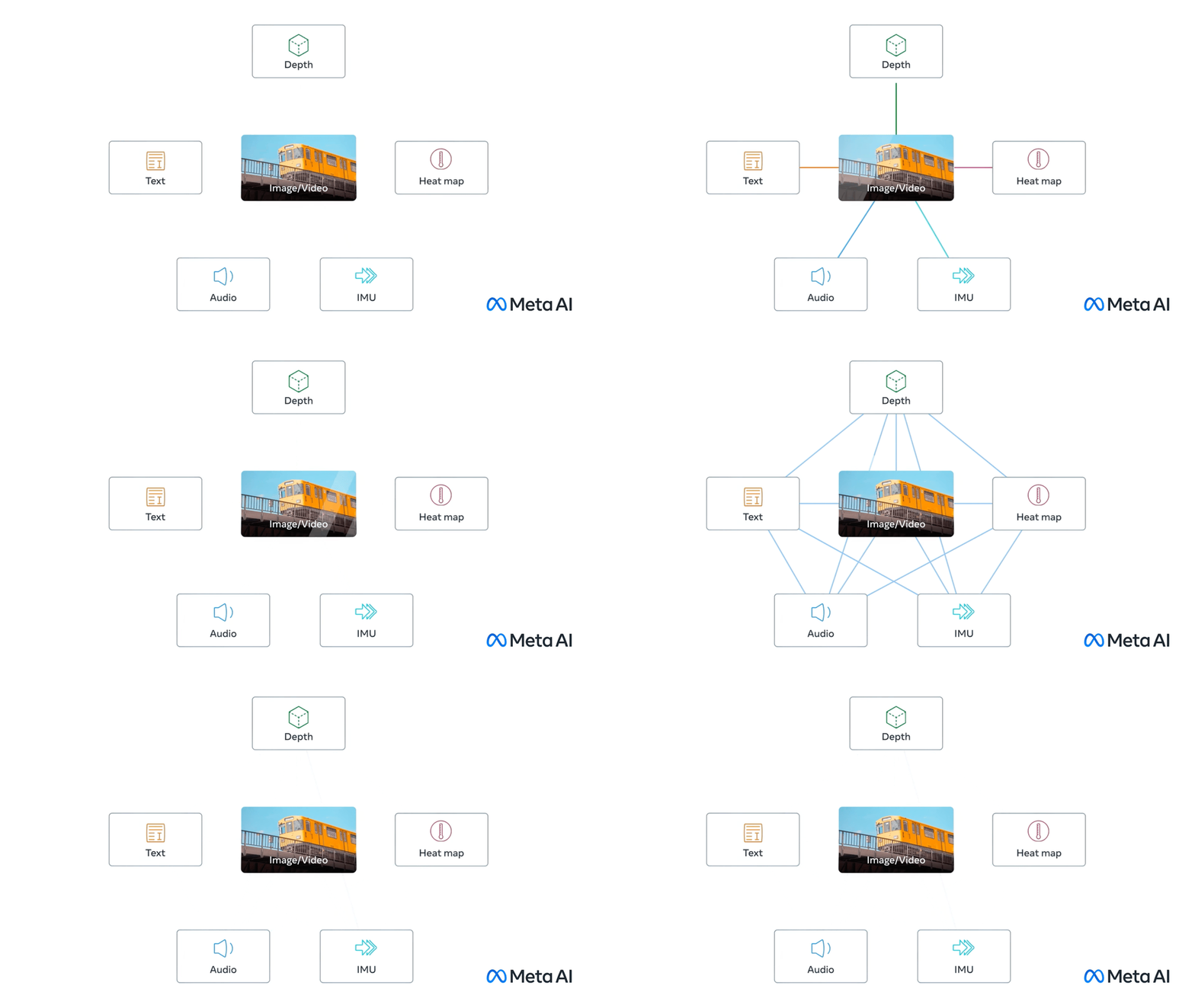
## ImageBind model
Emergent zero-shot classification performance.
<table style="margin: auto">
<tr>
<th>Model</th>
<th><span style="color:blue">IN1k</span></th>
<th><span style="color:purple">K400</span></th>
<th><span style="color:green">NYU-D</span></th>
<th><span style="color:LightBlue">ESC</span></th>
<th><span style="color:orange">LLVIP</span></th>
<th><span style="color:purple">Ego4D</span></th>
<th>download</th>
</tr>
<tr>
<td>imagebind_huge</td>
<td align="right">77.7</td>
<td align="right">50.0</td>
<td align="right">54.0</td>
<td align="right">66.9</td>
<td align="right">63.4</td>
<td align="right">25.0</td>
<td><a href="https://dl.fbaipublicfiles.com/imagebind/imagebind_huge.pth">checkpoint</a></td>
</tr>
</table>
## Usage
Install pytorch 2.0+ and other 3rd party dependencies.
```shell
conda create --name imagebind python=3.10 -y
conda activate imagebind
pip install .
```
For windows users, you might need to install `soundfile` for reading/writing audio files. (Thanks @congyue1977)
```
pip install soundfile
```
Extract and compare features across modalities (e.g. Image, Text and Audio).
```python
from imagebind import data
import torch
from imagebind.models import imagebind_model
from imagebind.models.imagebind_model import ModalityType
text_list=["A dog.", "A car", "A bird"]
image_paths=[".assets/dog_image.jpg", ".assets/car_image.jpg", ".assets/bird_image.jpg"]
audio_paths=[".assets/dog_audio.wav", ".assets/car_audio.wav", ".assets/bird_audio.wav"]
device = "cuda:0" if torch.cuda.is_available() else "cpu"
# Instantiate model
model = imagebind_model.imagebind_huge(pretrained=True)
model.eval()
model.to(device)
# Load data
inputs = {
ModalityType.TEXT: data.load_and_transform_text(text_list, device),
ModalityType.VISION: data.load_and_transform_vision_data(image_paths, device),
ModalityType.AUDIO: data.load_and_transform_audio_data(audio_paths, device),
}
with torch.no_grad():
embeddings = model(inputs)
print(
"Vision x Text: ",
torch.softmax(embeddings[ModalityType.VISION] @ embeddings[ModalityType.TEXT].T, dim=-1),
)
print(
"Audio x Text: ",
torch.softmax(embeddings[ModalityType.AUDIO] @ embeddings[ModalityType.TEXT].T, dim=-1),
)
print(
"Vision x Audio: ",
torch.softmax(embeddings[ModalityType.VISION] @ embeddings[ModalityType.AUDIO].T, dim=-1),
)
# Expected output:
#
# Vision x Text:
# tensor([[9.9761e-01, 2.3694e-03, 1.8612e-05],
# [3.3836e-05, 9.9994e-01, 2.4118e-05],
# [4.7997e-05, 1.3496e-02, 9.8646e-01]])
#
# Audio x Text:
# tensor([[1., 0., 0.],
# [0., 1., 0.],
# [0., 0., 1.]])
#
# Vision x Audio:
# tensor([[0.8070, 0.1088, 0.0842],
# [0.1036, 0.7884, 0.1079],
# [0.0018, 0.0022, 0.9960]])
```
## Model card
Please see the [model card](model_card.md) for details.
## License
ImageBind code and model weights are released under the CC-BY-NC 4.0 license. See [LICENSE](LICENSE) for additional details.
## Contributing
See [contributing](CONTRIBUTING.md) and the [code of conduct](CODE_OF_CONDUCT.md).
## Citing ImageBind
If you find this repository useful, please consider giving a star :star: and citation
```
@inproceedings{girdhar2023imagebind,
title={ImageBind: One Embedding Space To Bind Them All},
author={Girdhar, Rohit and El-Nouby, Alaaeldin and Liu, Zhuang
and Singh, Mannat and Alwala, Kalyan Vasudev and Joulin, Armand and Misra, Ishan},
booktitle={CVPR},
year={2023}
}
```
================================================
FILE: imagebind/__init__.py
================================================
from imagebind import data
from imagebind.models import imagebind_model
from imagebind.models.imagebind_model import ModalityType
================================================
FILE: imagebind/data.py
================================================
#!/usr/bin/env python3
# Portions Copyright (c) Meta Platforms, Inc. and affiliates.
# All rights reserved.
# This source code is licensed under the license found in the
# LICENSE file in the root directory of this source tree.
import logging
import math
import pkg_resources
import torch
import torch.nn as nn
import torchaudio
from PIL import Image
from pytorchvideo import transforms as pv_transforms
from pytorchvideo.data.clip_sampling import ConstantClipsPerVideoSampler
from pytorchvideo.data.encoded_video import EncodedVideo
from torchvision import transforms
from imagebind.models.multimodal_preprocessors import SimpleTokenizer
DEFAULT_AUDIO_FRAME_SHIFT_MS = 10 # in milliseconds
def return_bpe_path():
return pkg_resources.resource_filename(
"imagebind", "bpe/bpe_simple_vocab_16e6.txt.gz"
)
def waveform2melspec(waveform, sample_rate, num_mel_bins, target_length):
# Based on https://github.com/YuanGongND/ast/blob/d7d8b4b8e06cdaeb6c843cdb38794c1c7692234c/src/dataloader.py#L102
waveform -= waveform.mean()
fbank = torchaudio.compliance.kaldi.fbank(
waveform,
htk_compat=True,
sample_frequency=sample_rate,
use_energy=False,
window_type="hanning",
num_mel_bins=num_mel_bins,
dither=0.0,
frame_length=25,
frame_shift=DEFAULT_AUDIO_FRAME_SHIFT_MS,
)
# Convert to [mel_bins, num_frames] shape
fbank = fbank.transpose(0, 1)
# Pad to target_length
n_frames = fbank.size(1)
p = target_length - n_frames
# if p is too large (say >20%), flash a warning
if abs(p) / n_frames > 0.2:
logging.warning(
"Large gap between audio n_frames(%d) and "
"target_length (%d). Is the audio_target_length "
"setting correct?",
n_frames,
target_length,
)
# cut and pad
if p > 0:
fbank = torch.nn.functional.pad(fbank, (0, p), mode="constant", value=0)
elif p < 0:
fbank = fbank[:, 0:target_length]
# Convert to [1, mel_bins, num_frames] shape, essentially like a 1
# channel image
fbank = fbank.unsqueeze(0)
return fbank
def get_clip_timepoints(clip_sampler, duration):
# Read out all clips in this video
all_clips_timepoints = []
is_last_clip = False
end = 0.0
while not is_last_clip:
start, end, _, _, is_last_clip = clip_sampler(end, duration, annotation=None)
all_clips_timepoints.append((start, end))
return all_clips_timepoints
def load_and_transform_vision_data(image_paths, device):
if image_paths is None:
return None
image_outputs = []
data_transform = transforms.Compose(
[
transforms.Resize(224, interpolation=transforms.InterpolationMode.BICUBIC),
transforms.CenterCrop(224),
transforms.ToTensor(),
transforms.Normalize(
mean=(0.48145466, 0.4578275, 0.40821073),
std=(0.26862954, 0.26130258, 0.27577711),
),
]
)
for image_path in image_paths:
with open(image_path, "rb") as fopen:
image = Image.open(fopen).convert("RGB")
image = data_transform(image).to(device)
image_outputs.append(image)
return torch.stack(image_outputs, dim=0)
def load_and_transform_text(text, device):
if text is None:
return None
tokenizer = SimpleTokenizer(bpe_path=return_bpe_path())
tokens = [tokenizer(t).unsqueeze(0).to(device) for t in text]
tokens = torch.cat(tokens, dim=0)
return tokens
def load_and_transform_audio_data(
audio_paths,
device,
num_mel_bins=128,
target_length=204,
sample_rate=16000,
clip_duration=2,
clips_per_video=3,
mean=-4.268,
std=9.138,
):
if audio_paths is None:
return None
audio_outputs = []
clip_sampler = ConstantClipsPerVideoSampler(
clip_duration=clip_duration, clips_per_video=clips_per_video
)
for audio_path in audio_paths:
waveform, sr = torchaudio.load(audio_path)
if sample_rate != sr:
waveform = torchaudio.functional.resample(
waveform, orig_freq=sr, new_freq=sample_rate
)
all_clips_timepoints = get_clip_timepoints(
clip_sampler, waveform.size(1) / sample_rate
)
all_clips = []
for clip_timepoints in all_clips_timepoints:
waveform_clip = waveform[
:,
int(clip_timepoints[0] * sample_rate) : int(
clip_timepoints[1] * sample_rate
),
]
waveform_melspec = waveform2melspec(
waveform_clip, sample_rate, num_mel_bins, target_length
)
all_clips.append(waveform_melspec)
normalize = transforms.Normalize(mean=mean, std=std)
all_clips = [normalize(ac).to(device) for ac in all_clips]
all_clips = torch.stack(all_clips, dim=0)
audio_outputs.append(all_clips)
return torch.stack(audio_outputs, dim=0)
def crop_boxes(boxes, x_offset, y_offset):
"""
Perform crop on the bounding boxes given the offsets.
Args:
boxes (ndarray or None): bounding boxes to perform crop. The dimension
is `num boxes` x 4.
x_offset (int): cropping offset in the x axis.
y_offset (int): cropping offset in the y axis.
Returns:
cropped_boxes (ndarray or None): the cropped boxes with dimension of
`num boxes` x 4.
"""
cropped_boxes = boxes.copy()
cropped_boxes[:, [0, 2]] = boxes[:, [0, 2]] - x_offset
cropped_boxes[:, [1, 3]] = boxes[:, [1, 3]] - y_offset
return cropped_boxes
def uniform_crop(images, size, spatial_idx, boxes=None, scale_size=None):
"""
Perform uniform spatial sampling on the images and corresponding boxes.
Args:
images (tensor): images to perform uniform crop. The dimension is
`num frames` x `channel` x `height` x `width`.
size (int): size of height and weight to crop the images.
spatial_idx (int): 0, 1, or 2 for left, center, and right crop if width
is larger than height. Or 0, 1, or 2 for top, center, and bottom
crop if height is larger than width.
boxes (ndarray or None): optional. Corresponding boxes to images.
Dimension is `num boxes` x 4.
scale_size (int): optinal. If not None, resize the images to scale_size before
performing any crop.
Returns:
cropped (tensor): images with dimension of
`num frames` x `channel` x `size` x `size`.
cropped_boxes (ndarray or None): the cropped boxes with dimension of
`num boxes` x 4.
"""
assert spatial_idx in [0, 1, 2]
ndim = len(images.shape)
if ndim == 3:
images = images.unsqueeze(0)
height = images.shape[2]
width = images.shape[3]
if scale_size is not None:
if width <= height:
width, height = scale_size, int(height / width * scale_size)
else:
width, height = int(width / height * scale_size), scale_size
images = torch.nn.functional.interpolate(
images,
size=(height, width),
mode="bilinear",
align_corners=False,
)
y_offset = int(math.ceil((height - size) / 2))
x_offset = int(math.ceil((width - size) / 2))
if height > width:
if spatial_idx == 0:
y_offset = 0
elif spatial_idx == 2:
y_offset = height - size
else:
if spatial_idx == 0:
x_offset = 0
elif spatial_idx == 2:
x_offset = width - size
cropped = images[:, :, y_offset : y_offset + size, x_offset : x_offset + size]
cropped_boxes = crop_boxes(boxes, x_offset, y_offset) if boxes is not None else None
if ndim == 3:
cropped = cropped.squeeze(0)
return cropped, cropped_boxes
class SpatialCrop(nn.Module):
"""
Convert the video into 3 smaller clips spatially. Must be used after the
temporal crops to get spatial crops, and should be used with
-2 in the spatial crop at the slowfast augmentation stage (so full
frames are passed in here). Will return a larger list with the
3x spatial crops as well.
"""
def __init__(self, crop_size: int = 224, num_crops: int = 3):
super().__init__()
self.crop_size = crop_size
if num_crops == 3:
self.crops_to_ext = [0, 1, 2]
self.flipped_crops_to_ext = []
elif num_crops == 1:
self.crops_to_ext = [1]
self.flipped_crops_to_ext = []
else:
raise NotImplementedError("Nothing else supported yet")
def forward(self, videos):
"""
Args:
videos: A list of C, T, H, W videos.
Returns:
videos: A list with 3x the number of elements. Each video converted
to C, T, H', W' by spatial cropping.
"""
assert isinstance(videos, list), "Must be a list of videos after temporal crops"
assert all([video.ndim == 4 for video in videos]), "Must be (C,T,H,W)"
res = []
for video in videos:
for spatial_idx in self.crops_to_ext:
res.append(uniform_crop(video, self.crop_size, spatial_idx)[0])
if not self.flipped_crops_to_ext:
continue
flipped_video = transforms.functional.hflip(video)
for spatial_idx in self.flipped_crops_to_ext:
res.append(uniform_crop(flipped_video, self.crop_size, spatial_idx)[0])
return res
class NormalizeVideo:
def __init__(self, mean, std, inplace=False):
self.mean = mean
self.std = std
self.inplace = inplace
def __call__(self, clip):
if not self.inplace:
clip = clip.clone()
mean = torch.as_tensor(self.mean, dtype=clip.dtype, device=clip.device)
std = torch.as_tensor(self.std, dtype=clip.dtype, device=clip.device)
clip.sub_(mean[:, None, None, None]).div_(std[:, None, None, None])
return clip
def load_and_transform_video_data(
video_paths,
device,
clip_duration=2,
clips_per_video=5,
sample_rate=16000,
):
if video_paths is None:
return None
video_outputs = []
video_transform = transforms.Compose(
[
pv_transforms.ShortSideScale(224),
NormalizeVideo(
mean=(0.48145466, 0.4578275, 0.40821073),
std=(0.26862954, 0.26130258, 0.27577711),
),
]
)
clip_sampler = ConstantClipsPerVideoSampler(
clip_duration=clip_duration, clips_per_video=clips_per_video
)
frame_sampler = pv_transforms.UniformTemporalSubsample(num_samples=clip_duration)
for video_path in video_paths:
video = EncodedVideo.from_path(
video_path,
decoder="decord",
decode_audio=False,
**{"sample_rate": sample_rate},
)
all_clips_timepoints = get_clip_timepoints(clip_sampler, video.duration)
all_video = []
for clip_timepoints in all_clips_timepoints:
# Read the clip, get frames
clip = video.get_clip(clip_timepoints[0], clip_timepoints[1])
if clip is None:
raise ValueError("No clip found")
video_clip = frame_sampler(clip["video"])
video_clip = video_clip / 255.0 # since this is float, need 0-1
all_video.append(video_clip)
all_video = [video_transform(clip) for clip in all_video]
all_video = SpatialCrop(224, num_crops=3)(all_video)
all_video = torch.stack(all_video, dim=0)
video_outputs.append(all_video)
return torch.stack(video_outputs, dim=0).to(device)
================================================
FILE: imagebind/models/__init__.py
================================================
================================================
FILE: imagebind/models/helpers.py
================================================
#!/usr/bin/env python3
# Portions Copyright (c) Meta Platforms, Inc. and affiliates.
# All rights reserved.
# This source code is licensed under the license found in the
# LICENSE file in the root directory of this source tree.
import einops
import numpy as np
import torch
import torch.nn as nn
class Normalize(nn.Module):
def __init__(self, dim: int) -> None:
super().__init__()
self.dim = dim
def forward(self, x):
return torch.nn.functional.normalize(x, dim=self.dim, p=2)
class LearnableLogitScaling(nn.Module):
def __init__(
self,
logit_scale_init: float = 1 / 0.07,
learnable: bool = True,
max_logit_scale: float = 100,
) -> None:
super().__init__()
self.max_logit_scale = max_logit_scale
self.logit_scale_init = logit_scale_init
self.learnable = learnable
log_logit_scale = torch.ones([]) * np.log(self.logit_scale_init)
if learnable:
self.log_logit_scale = nn.Parameter(log_logit_scale)
else:
self.register_buffer("log_logit_scale", log_logit_scale)
def forward(self, x):
return torch.clip(self.log_logit_scale.exp(), max=self.max_logit_scale) * x
def extra_repr(self):
st = f"logit_scale_init={self.logit_scale_init},learnable={self.learnable}," \
f" max_logit_scale={self.max_logit_scale}"
return st
class EinOpsRearrange(nn.Module):
def __init__(self, rearrange_expr: str, **kwargs) -> None:
super().__init__()
self.rearrange_expr = rearrange_expr
self.kwargs = kwargs
def forward(self, x):
assert isinstance(x, torch.Tensor)
return einops.rearrange(x, self.rearrange_expr, **self.kwargs)
class VerboseNNModule(nn.Module):
"""
Wrapper around nn.Module that prints registered buffers and parameter names.
"""
@staticmethod
def get_readable_tensor_repr(name: str, tensor: torch.Tensor) -> str:
st = (
"("
+ name
+ "): "
+ "tensor("
+ str(tuple(tensor[1].shape))
+ ", requires_grad="
+ str(tensor[1].requires_grad)
+ ")\n"
)
return st
def extra_repr(self) -> str:
named_modules = set()
for p in self.named_modules():
named_modules.update([p[0]])
named_modules = list(named_modules)
string_repr = ""
for p in self.named_parameters():
name = p[0].split(".")[0]
if name not in named_modules:
string_repr += self.get_readable_tensor_repr(name, p)
for p in self.named_buffers():
name = p[0].split(".")[0]
string_repr += self.get_readable_tensor_repr(name, p)
return string_repr
def cast_if_src_dtype(
tensor: torch.Tensor, src_dtype: torch.dtype, tgt_dtype: torch.dtype
):
updated = False
if tensor.dtype == src_dtype:
tensor = tensor.to(dtype=tgt_dtype)
updated = True
return tensor, updated
class QuickGELU(nn.Module):
# From https://github.com/openai/CLIP/blob/d50d76daa670286dd6cacf3bcd80b5e4823fc8e1/clip/model.py#L166
def forward(self, x: torch.Tensor):
return x * torch.sigmoid(1.702 * x)
class SelectElement(nn.Module):
def __init__(self, index) -> None:
super().__init__()
self.index = index
def forward(self, x):
assert x.ndim >= 3
return x[:, self.index, ...]
class SelectEOSAndProject(nn.Module):
"""
Text Pooling used in OpenCLIP
"""
def __init__(self, proj: nn.Module) -> None:
super().__init__()
self.proj = proj
def forward(self, x, seq_len):
assert x.ndim == 3
# x is of shape B x L x D
# take features from the eot embedding (eot_token is the highest number in each sequence)
x = x[torch.arange(x.shape[0]), seq_len]
x = self.proj(x)
return x
================================================
FILE: imagebind/models/imagebind_model.py
================================================
#!/usr/bin/env python3
# Portions Copyright (c) Meta Platforms, Inc. and affiliates.
# All rights reserved.
# This source code is licensed under the license found in the
# LICENSE file in the root directory of this source tree.
import os
from functools import partial
from types import SimpleNamespace
import torch
import torch.nn as nn
from imagebind.models.helpers import (EinOpsRearrange, LearnableLogitScaling, Normalize,
SelectElement, SelectEOSAndProject)
from imagebind.models.multimodal_preprocessors import (AudioPreprocessor,
IMUPreprocessor, PadIm2Video,
PatchEmbedGeneric,
RGBDTPreprocessor,
SpatioTemporalPosEmbeddingHelper,
TextPreprocessor,
ThermalPreprocessor)
from imagebind.models.transformer import MultiheadAttention, SimpleTransformer
ModalityType = SimpleNamespace(
VISION="vision",
TEXT="text",
AUDIO="audio",
THERMAL="thermal",
DEPTH="depth",
IMU="imu",
)
class ImageBindModel(nn.Module):
def __init__(
self,
video_frames=2,
kernel_size=(2, 14, 14),
audio_kernel_size=16,
audio_stride=10,
out_embed_dim=768,
vision_embed_dim=1024,
vision_num_blocks=24,
vision_num_heads=16,
audio_embed_dim=768,
audio_num_blocks=12,
audio_num_heads=12,
audio_num_mel_bins=128,
audio_target_len=204,
audio_drop_path=0.1,
text_embed_dim=768,
text_num_blocks=12,
text_num_heads=12,
depth_embed_dim=384,
depth_kernel_size=16,
depth_num_blocks=12,
depth_num_heads=8,
depth_drop_path=0.0,
thermal_embed_dim=768,
thermal_kernel_size=16,
thermal_num_blocks=12,
thermal_num_heads=12,
thermal_drop_path=0.0,
imu_embed_dim=512,
imu_kernel_size=8,
imu_num_blocks=6,
imu_num_heads=8,
imu_drop_path=0.7,
):
super().__init__()
self.modality_preprocessors = self._create_modality_preprocessors(
video_frames,
vision_embed_dim,
kernel_size,
text_embed_dim,
audio_embed_dim,
audio_kernel_size,
audio_stride,
audio_num_mel_bins,
audio_target_len,
depth_embed_dim,
depth_kernel_size,
thermal_embed_dim,
thermal_kernel_size,
imu_embed_dim,
)
self.modality_trunks = self._create_modality_trunks(
vision_embed_dim,
vision_num_blocks,
vision_num_heads,
text_embed_dim,
text_num_blocks,
text_num_heads,
audio_embed_dim,
audio_num_blocks,
audio_num_heads,
audio_drop_path,
depth_embed_dim,
depth_num_blocks,
depth_num_heads,
depth_drop_path,
thermal_embed_dim,
thermal_num_blocks,
thermal_num_heads,
thermal_drop_path,
imu_embed_dim,
imu_num_blocks,
imu_num_heads,
imu_drop_path,
)
self.modality_heads = self._create_modality_heads(
out_embed_dim,
vision_embed_dim,
text_embed_dim,
audio_embed_dim,
depth_embed_dim,
thermal_embed_dim,
imu_embed_dim,
)
self.modality_postprocessors = self._create_modality_postprocessors(
out_embed_dim
)
def _create_modality_preprocessors(
self,
video_frames=2,
vision_embed_dim=1024,
kernel_size=(2, 14, 14),
text_embed_dim=768,
audio_embed_dim=768,
audio_kernel_size=16,
audio_stride=10,
audio_num_mel_bins=128,
audio_target_len=204,
depth_embed_dim=768,
depth_kernel_size=16,
thermal_embed_dim=768,
thermal_kernel_size=16,
imu_embed_dim=512,
):
rgbt_stem = PatchEmbedGeneric(
proj_stem=[
PadIm2Video(pad_type="repeat", ntimes=2),
nn.Conv3d(
in_channels=3,
kernel_size=kernel_size,
out_channels=vision_embed_dim,
stride=kernel_size,
bias=False,
),
]
)
rgbt_preprocessor = RGBDTPreprocessor(
img_size=[3, video_frames, 224, 224],
num_cls_tokens=1,
pos_embed_fn=partial(SpatioTemporalPosEmbeddingHelper, learnable=True),
rgbt_stem=rgbt_stem,
depth_stem=None,
)
text_preprocessor = TextPreprocessor(
context_length=77,
vocab_size=49408,
embed_dim=text_embed_dim,
causal_masking=True,
)
audio_stem = PatchEmbedGeneric(
proj_stem=[
nn.Conv2d(
in_channels=1,
kernel_size=audio_kernel_size,
stride=audio_stride,
out_channels=audio_embed_dim,
bias=False,
),
],
norm_layer=nn.LayerNorm(normalized_shape=audio_embed_dim),
)
audio_preprocessor = AudioPreprocessor(
img_size=[1, audio_num_mel_bins, audio_target_len],
num_cls_tokens=1,
pos_embed_fn=partial(SpatioTemporalPosEmbeddingHelper, learnable=True),
audio_stem=audio_stem,
)
depth_stem = PatchEmbedGeneric(
[
nn.Conv2d(
kernel_size=depth_kernel_size,
in_channels=1,
out_channels=depth_embed_dim,
stride=depth_kernel_size,
bias=False,
),
],
norm_layer=nn.LayerNorm(normalized_shape=depth_embed_dim),
)
depth_preprocessor = RGBDTPreprocessor(
img_size=[1, 224, 224],
num_cls_tokens=1,
pos_embed_fn=partial(SpatioTemporalPosEmbeddingHelper, learnable=True),
rgbt_stem=None,
depth_stem=depth_stem,
)
thermal_stem = PatchEmbedGeneric(
[
nn.Conv2d(
kernel_size=thermal_kernel_size,
in_channels=1,
out_channels=thermal_embed_dim,
stride=thermal_kernel_size,
bias=False,
),
],
norm_layer=nn.LayerNorm(normalized_shape=thermal_embed_dim),
)
thermal_preprocessor = ThermalPreprocessor(
img_size=[1, 224, 224],
num_cls_tokens=1,
pos_embed_fn=partial(SpatioTemporalPosEmbeddingHelper, learnable=True),
thermal_stem=thermal_stem,
)
imu_stem = PatchEmbedGeneric(
[
nn.Linear(
in_features=48,
out_features=imu_embed_dim,
bias=False,
),
],
norm_layer=nn.LayerNorm(normalized_shape=imu_embed_dim),
)
imu_preprocessor = IMUPreprocessor(
img_size=[6, 2000],
num_cls_tokens=1,
kernel_size=8,
embed_dim=imu_embed_dim,
pos_embed_fn=partial(SpatioTemporalPosEmbeddingHelper, learnable=True),
imu_stem=imu_stem,
)
modality_preprocessors = {
ModalityType.VISION: rgbt_preprocessor,
ModalityType.TEXT: text_preprocessor,
ModalityType.AUDIO: audio_preprocessor,
ModalityType.DEPTH: depth_preprocessor,
ModalityType.THERMAL: thermal_preprocessor,
ModalityType.IMU: imu_preprocessor,
}
return nn.ModuleDict(modality_preprocessors)
def _create_modality_trunks(
self,
vision_embed_dim=1024,
vision_num_blocks=24,
vision_num_heads=16,
text_embed_dim=768,
text_num_blocks=12,
text_num_heads=12,
audio_embed_dim=768,
audio_num_blocks=12,
audio_num_heads=12,
audio_drop_path=0.0,
depth_embed_dim=768,
depth_num_blocks=12,
depth_num_heads=12,
depth_drop_path=0.0,
thermal_embed_dim=768,
thermal_num_blocks=12,
thermal_num_heads=12,
thermal_drop_path=0.0,
imu_embed_dim=512,
imu_num_blocks=6,
imu_num_heads=8,
imu_drop_path=0.7,
):
def instantiate_trunk(
embed_dim, num_blocks, num_heads, pre_transformer_ln, add_bias_kv, drop_path
):
return SimpleTransformer(
embed_dim=embed_dim,
num_blocks=num_blocks,
ffn_dropout_rate=0.0,
drop_path_rate=drop_path,
attn_target=partial(
MultiheadAttention,
embed_dim=embed_dim,
num_heads=num_heads,
bias=True,
add_bias_kv=add_bias_kv,
),
pre_transformer_layer=nn.Sequential(
nn.LayerNorm(embed_dim, eps=1e-6)
if pre_transformer_ln
else nn.Identity(),
EinOpsRearrange("b l d -> l b d"),
),
post_transformer_layer=EinOpsRearrange("l b d -> b l d"),
)
modality_trunks = {}
modality_trunks[ModalityType.VISION] = instantiate_trunk(
vision_embed_dim,
vision_num_blocks,
vision_num_heads,
pre_transformer_ln=True,
add_bias_kv=False,
drop_path=0.0,
)
modality_trunks[ModalityType.TEXT] = instantiate_trunk(
text_embed_dim,
text_num_blocks,
text_num_heads,
pre_transformer_ln=False,
add_bias_kv=False,
drop_path=0.0,
)
modality_trunks[ModalityType.AUDIO] = instantiate_trunk(
audio_embed_dim,
audio_num_blocks,
audio_num_heads,
pre_transformer_ln=False,
add_bias_kv=True,
drop_path=audio_drop_path,
)
modality_trunks[ModalityType.DEPTH] = instantiate_trunk(
depth_embed_dim,
depth_num_blocks,
depth_num_heads,
pre_transformer_ln=False,
add_bias_kv=True,
drop_path=depth_drop_path,
)
modality_trunks[ModalityType.THERMAL] = instantiate_trunk(
thermal_embed_dim,
thermal_num_blocks,
thermal_num_heads,
pre_transformer_ln=False,
add_bias_kv=True,
drop_path=thermal_drop_path,
)
modality_trunks[ModalityType.IMU] = instantiate_trunk(
imu_embed_dim,
imu_num_blocks,
imu_num_heads,
pre_transformer_ln=False,
add_bias_kv=True,
drop_path=imu_drop_path,
)
return nn.ModuleDict(modality_trunks)
def _create_modality_heads(
self,
out_embed_dim,
vision_embed_dim,
text_embed_dim,
audio_embed_dim,
depth_embed_dim,
thermal_embed_dim,
imu_embed_dim,
):
modality_heads = {}
modality_heads[ModalityType.VISION] = nn.Sequential(
nn.LayerNorm(normalized_shape=vision_embed_dim, eps=1e-6),
SelectElement(index=0),
nn.Linear(vision_embed_dim, out_embed_dim, bias=False),
)
modality_heads[ModalityType.TEXT] = SelectEOSAndProject(
proj=nn.Sequential(
nn.LayerNorm(normalized_shape=text_embed_dim, eps=1e-6),
nn.Linear(text_embed_dim, out_embed_dim, bias=False),
)
)
modality_heads[ModalityType.AUDIO] = nn.Sequential(
nn.LayerNorm(normalized_shape=audio_embed_dim, eps=1e-6),
SelectElement(index=0),
nn.Linear(audio_embed_dim, out_embed_dim, bias=False),
)
modality_heads[ModalityType.DEPTH] = nn.Sequential(
nn.LayerNorm(normalized_shape=depth_embed_dim, eps=1e-6),
SelectElement(index=0),
nn.Linear(depth_embed_dim, out_embed_dim, bias=False),
)
modality_heads[ModalityType.THERMAL] = nn.Sequential(
nn.LayerNorm(normalized_shape=thermal_embed_dim, eps=1e-6),
SelectElement(index=0),
nn.Linear(thermal_embed_dim, out_embed_dim, bias=False),
)
modality_heads[ModalityType.IMU] = nn.Sequential(
nn.LayerNorm(normalized_shape=imu_embed_dim, eps=1e-6),
SelectElement(index=0),
nn.Dropout(p=0.5),
nn.Linear(imu_embed_dim, out_embed_dim, bias=False),
)
return nn.ModuleDict(modality_heads)
def _create_modality_postprocessors(self, out_embed_dim):
modality_postprocessors = {}
modality_postprocessors[ModalityType.VISION] = Normalize(dim=-1)
modality_postprocessors[ModalityType.TEXT] = nn.Sequential(
Normalize(dim=-1), LearnableLogitScaling(learnable=True)
)
modality_postprocessors[ModalityType.AUDIO] = nn.Sequential(
Normalize(dim=-1),
LearnableLogitScaling(logit_scale_init=20.0, learnable=False),
)
modality_postprocessors[ModalityType.DEPTH] = nn.Sequential(
Normalize(dim=-1),
LearnableLogitScaling(logit_scale_init=5.0, learnable=False),
)
modality_postprocessors[ModalityType.THERMAL] = nn.Sequential(
Normalize(dim=-1),
LearnableLogitScaling(logit_scale_init=10.0, learnable=False),
)
modality_postprocessors[ModalityType.IMU] = nn.Sequential(
Normalize(dim=-1),
LearnableLogitScaling(logit_scale_init=5.0, learnable=False),
)
return nn.ModuleDict(modality_postprocessors)
def forward(self, inputs):
outputs = {}
for modality_key, modality_value in inputs.items():
reduce_list = (
modality_value.ndim >= 5
) # Audio and Video inputs consist of multiple clips
if reduce_list:
B, S = modality_value.shape[:2]
modality_value = modality_value.reshape(
B * S, *modality_value.shape[2:]
)
if modality_value is not None:
modality_value = self.modality_preprocessors[modality_key](
**{modality_key: modality_value}
)
trunk_inputs = modality_value["trunk"]
head_inputs = modality_value["head"]
modality_value = self.modality_trunks[modality_key](**trunk_inputs)
modality_value = self.modality_heads[modality_key](
modality_value, **head_inputs
)
modality_value = self.modality_postprocessors[modality_key](
modality_value
)
if reduce_list:
modality_value = modality_value.reshape(B, S, -1)
modality_value = modality_value.mean(dim=1)
outputs[modality_key] = modality_value
return outputs
def imagebind_huge(pretrained=False):
model = ImageBindModel(
vision_embed_dim=1280,
vision_num_blocks=32,
vision_num_heads=16,
text_embed_dim=1024,
text_num_blocks=24,
text_num_heads=16,
out_embed_dim=1024,
audio_drop_path=0.1,
imu_drop_path=0.7,
)
if pretrained:
if not os.path.exists(".checkpoints/imagebind_huge.pth"):
print(
"Downloading imagebind weights to .checkpoints/imagebind_huge.pth ..."
)
os.makedirs(".checkpoints", exist_ok=True)
torch.hub.download_url_to_file(
"https://dl.fbaipublicfiles.com/imagebind/imagebind_huge.pth",
".checkpoints/imagebind_huge.pth",
progress=True,
)
model.load_state_dict(torch.load(".checkpoints/imagebind_huge.pth", weights_only=True))
return model
================================================
FILE: imagebind/models/multimodal_preprocessors.py
================================================
#!/usr/bin/env python3
# Portions Copyright (c) Meta Platforms, Inc. and affiliates.
# All rights reserved.
# This source code is licensed under the license found in the
# LICENSE file in the root directory of this source tree.
import gzip
import html
import io
import math
from functools import lru_cache
from typing import Callable, List, Optional, Tuple
import ftfy
import numpy as np
import regex as re
import torch
import torch.nn as nn
from iopath.common.file_io import g_pathmgr
from timm.layers import trunc_normal_
from imagebind.models.helpers import VerboseNNModule, cast_if_src_dtype
def get_sinusoid_encoding_table(n_position, d_hid):
"""Sinusoid position encoding table"""
# TODO: make it with torch instead of numpy
def get_position_angle_vec(position):
return [
position / np.power(10000, 2 * (hid_j // 2) / d_hid)
for hid_j in range(d_hid)
]
sinusoid_table = np.array(
[get_position_angle_vec(pos_i) for pos_i in range(n_position)]
)
sinusoid_table[:, 0::2] = np.sin(sinusoid_table[:, 0::2]) # dim 2i
sinusoid_table[:, 1::2] = np.cos(sinusoid_table[:, 1::2]) # dim 2i+1
return torch.FloatTensor(sinusoid_table).unsqueeze(0)
def interpolate_pos_encoding_2d(target_spatial_size, pos_embed):
N = pos_embed.shape[1]
if N == target_spatial_size:
return pos_embed
dim = pos_embed.shape[-1]
# nn.functional.interpolate doesn't work with bfloat16 so we cast to float32
pos_embed, updated = cast_if_src_dtype(pos_embed, torch.bfloat16, torch.float32)
pos_embed = nn.functional.interpolate(
pos_embed.reshape(1, int(math.sqrt(N)), int(math.sqrt(N)), dim).permute(
0, 3, 1, 2
),
scale_factor=math.sqrt(target_spatial_size / N),
mode="bicubic",
)
if updated:
pos_embed, _ = cast_if_src_dtype(pos_embed, torch.float32, torch.bfloat16)
pos_embed = pos_embed.permute(0, 2, 3, 1).view(1, -1, dim)
return pos_embed
def interpolate_pos_encoding(
npatch_per_img,
pos_embed,
patches_layout,
input_shape=None,
first_patch_idx=1,
):
assert first_patch_idx == 0 or first_patch_idx == 1, "there is 1 CLS token or none"
N = pos_embed.shape[1] - first_patch_idx # since it's 1 if cls_token exists
if npatch_per_img == N:
return pos_embed
assert (
patches_layout[-1] == patches_layout[-2]
), "Interpolation of pos embed not supported for non-square layouts"
class_emb = pos_embed[:, :first_patch_idx]
pos_embed = pos_embed[:, first_patch_idx:]
if input_shape is None or patches_layout[0] == 1:
# simple 2D pos embedding, no temporal component
pos_embed = interpolate_pos_encoding_2d(npatch_per_img, pos_embed)
elif patches_layout[0] > 1:
# pos embed has a temporal component
assert len(input_shape) == 4, "temporal interpolation not supported"
# we only support 2D interpolation in this case
num_frames = patches_layout[0]
num_spatial_tokens = patches_layout[1] * patches_layout[2]
pos_embed = pos_embed.view(1, num_frames, num_spatial_tokens, -1)
# interpolate embedding for zeroth frame
pos_embed = interpolate_pos_encoding_2d(
npatch_per_img, pos_embed[0, 0, ...].unsqueeze(0)
)
else:
raise ValueError("This type of interpolation isn't implemented")
return torch.cat((class_emb, pos_embed), dim=1)
def _get_pos_embedding(
npatch_per_img,
pos_embed,
patches_layout,
input_shape,
first_patch_idx=1,
):
pos_embed = interpolate_pos_encoding(
npatch_per_img,
pos_embed,
patches_layout,
input_shape=input_shape,
first_patch_idx=first_patch_idx,
)
return pos_embed
class PatchEmbedGeneric(nn.Module):
"""
PatchEmbed from Hydra
"""
def __init__(self, proj_stem, norm_layer: Optional[nn.Module] = None):
super().__init__()
if len(proj_stem) > 1:
self.proj = nn.Sequential(*proj_stem)
else:
# Special case to be able to load pre-trained models that were
# trained with a standard stem
self.proj = proj_stem[0]
self.norm_layer = norm_layer
def get_patch_layout(self, img_size):
with torch.no_grad():
dummy_img = torch.zeros(
[
1,
]
+ img_size
)
dummy_out = self.proj(dummy_img)
embed_dim = dummy_out.shape[1]
patches_layout = tuple(dummy_out.shape[2:])
num_patches = np.prod(patches_layout)
return patches_layout, num_patches, embed_dim
def forward(self, x):
x = self.proj(x)
# B C (T) H W -> B (T)HW C
x = x.flatten(2).transpose(1, 2)
if self.norm_layer is not None:
x = self.norm_layer(x)
return x
class SpatioTemporalPosEmbeddingHelper(VerboseNNModule):
def __init__(
self,
patches_layout: List,
num_patches: int,
num_cls_tokens: int,
embed_dim: int,
learnable: bool,
) -> None:
super().__init__()
self.num_cls_tokens = num_cls_tokens
self.patches_layout = patches_layout
self.num_patches = num_patches
self.num_tokens = num_cls_tokens + num_patches
self.learnable = learnable
if self.learnable:
self.pos_embed = nn.Parameter(torch.zeros(1, self.num_tokens, embed_dim))
trunc_normal_(self.pos_embed, std=0.02)
else:
self.register_buffer(
"pos_embed", get_sinusoid_encoding_table(self.num_tokens, embed_dim)
)
def get_pos_embedding(self, vision_input, all_vision_tokens):
input_shape = vision_input.shape
pos_embed = _get_pos_embedding(
all_vision_tokens.size(1) - self.num_cls_tokens,
pos_embed=self.pos_embed,
patches_layout=self.patches_layout,
input_shape=input_shape,
first_patch_idx=self.num_cls_tokens,
)
return pos_embed
class RGBDTPreprocessor(VerboseNNModule):
def __init__(
self,
rgbt_stem: PatchEmbedGeneric,
depth_stem: Optional[PatchEmbedGeneric],
img_size: Tuple = (3, 224, 224),
num_cls_tokens: int = 1,
pos_embed_fn: Optional[Callable] = None,
use_type_embed: bool = False,
init_param_style: str = "openclip",
) -> None:
super().__init__()
stem = rgbt_stem if rgbt_stem is not None else depth_stem
(
self.patches_layout,
self.num_patches,
self.embed_dim,
) = stem.get_patch_layout(img_size)
self.rgbt_stem = rgbt_stem
self.depth_stem = depth_stem
self.use_pos_embed = pos_embed_fn is not None
self.use_type_embed = use_type_embed
self.num_cls_tokens = num_cls_tokens
if self.use_pos_embed:
self.pos_embedding_helper = pos_embed_fn(
patches_layout=self.patches_layout,
num_cls_tokens=num_cls_tokens,
num_patches=self.num_patches,
embed_dim=self.embed_dim,
)
if self.num_cls_tokens > 0:
self.cls_token = nn.Parameter(
torch.zeros(1, self.num_cls_tokens, self.embed_dim)
)
if self.use_type_embed:
self.type_embed = nn.Parameter(torch.zeros(1, 1, self.embed_dim))
self.init_parameters(init_param_style)
@torch.no_grad()
def init_parameters(self, init_param_style):
if init_param_style == "openclip":
# OpenCLIP style initialization
scale = self.embed_dim**-0.5
if self.use_pos_embed:
nn.init.normal_(self.pos_embedding_helper.pos_embed)
self.pos_embedding_helper.pos_embed *= scale
if self.num_cls_tokens > 0:
nn.init.normal_(self.cls_token)
self.cls_token *= scale
elif init_param_style == "vit":
self.cls_token.data.fill_(0)
else:
raise ValueError(f"Unknown init {init_param_style}")
if self.use_type_embed:
nn.init.normal_(self.type_embed)
def tokenize_input_and_cls_pos(self, input, stem, mask):
# tokens is of shape B x L x D
tokens = stem(input)
assert tokens.ndim == 3
assert tokens.shape[2] == self.embed_dim
B = tokens.shape[0]
if self.num_cls_tokens > 0:
class_tokens = self.cls_token.expand(
B, -1, -1
) # stole class_tokens impl from Phil Wang, thanks
tokens = torch.cat((class_tokens, tokens), dim=1)
if self.use_pos_embed:
pos_embed = self.pos_embedding_helper.get_pos_embedding(input, tokens)
tokens = tokens + pos_embed
if self.use_type_embed:
tokens = tokens + self.type_embed.expand(B, -1, -1)
return tokens
def forward(self, vision=None, depth=None, patch_mask=None):
if patch_mask is not None:
raise NotImplementedError()
if vision is not None:
vision_tokens = self.tokenize_input_and_cls_pos(
vision, self.rgbt_stem, patch_mask
)
if depth is not None:
depth_tokens = self.tokenize_input_and_cls_pos(
depth, self.depth_stem, patch_mask
)
# aggregate tokens
if vision is not None and depth is not None:
final_tokens = vision_tokens + depth_tokens
else:
final_tokens = vision_tokens if vision is not None else depth_tokens
return_dict = {
"trunk": {
"tokens": final_tokens,
},
"head": {},
}
return return_dict
class AudioPreprocessor(RGBDTPreprocessor):
def __init__(self, audio_stem: PatchEmbedGeneric, **kwargs) -> None:
super().__init__(rgbt_stem=audio_stem, depth_stem=None, **kwargs)
def forward(self, audio=None):
return super().forward(vision=audio)
class ThermalPreprocessor(RGBDTPreprocessor):
def __init__(self, thermal_stem: PatchEmbedGeneric, **kwargs) -> None:
super().__init__(rgbt_stem=thermal_stem, depth_stem=None, **kwargs)
def forward(self, thermal=None):
return super().forward(vision=thermal)
def build_causal_attention_mask(context_length):
# lazily create causal attention mask, with full attention between the vision tokens
# pytorch uses additive attention mask; fill with -inf
mask = torch.empty(context_length, context_length, requires_grad=False)
mask.fill_(float("-inf"))
mask.triu_(1) # zero out the lower diagonal
return mask
class TextPreprocessor(VerboseNNModule):
def __init__(
self,
vocab_size: int,
context_length: int,
embed_dim: int,
causal_masking: bool,
supply_seq_len_to_head: bool = True,
num_cls_tokens: int = 0,
init_param_style: str = "openclip",
) -> None:
super().__init__()
self.vocab_size = vocab_size
self.context_length = context_length
self.token_embedding = nn.Embedding(vocab_size, embed_dim)
self.pos_embed = nn.Parameter(
torch.empty(1, self.context_length + num_cls_tokens, embed_dim)
)
self.causal_masking = causal_masking
if self.causal_masking:
mask = build_causal_attention_mask(self.context_length)
# register the mask as a buffer so it can be moved to the right device
self.register_buffer("mask", mask)
self.supply_seq_len_to_head = supply_seq_len_to_head
self.num_cls_tokens = num_cls_tokens
self.embed_dim = embed_dim
if num_cls_tokens > 0:
assert self.causal_masking is False, "Masking + CLS token isn't implemented"
self.cls_token = nn.Parameter(
torch.zeros(1, self.num_cls_tokens, embed_dim)
)
self.init_parameters(init_param_style)
@torch.no_grad()
def init_parameters(self, init_param_style="openclip"):
# OpenCLIP style initialization
nn.init.normal_(self.token_embedding.weight, std=0.02)
nn.init.normal_(self.pos_embed, std=0.01)
if init_param_style == "openclip":
# OpenCLIP style initialization
scale = self.embed_dim**-0.5
if self.num_cls_tokens > 0:
nn.init.normal_(self.cls_token)
self.cls_token *= scale
elif init_param_style == "vit":
self.cls_token.data.fill_(0)
else:
raise ValueError(f"Unknown init {init_param_style}")
def forward(self, text):
# text tokens are of shape B x L x D
text_tokens = self.token_embedding(text)
# concat CLS tokens if any
if self.num_cls_tokens > 0:
B = text_tokens.shape[0]
class_tokens = self.cls_token.expand(
B, -1, -1
) # stole class_tokens impl from Phil Wang, thanks
text_tokens = torch.cat((class_tokens, text_tokens), dim=1)
text_tokens = text_tokens + self.pos_embed
return_dict = {
"trunk": {
"tokens": text_tokens,
},
"head": {},
}
# Compute sequence length after adding CLS tokens
if self.supply_seq_len_to_head:
text_lengths = text.argmax(dim=-1)
return_dict["head"] = {
"seq_len": text_lengths,
}
if self.causal_masking:
return_dict["trunk"].update({"attn_mask": self.mask})
return return_dict
class Im2Video(nn.Module):
"""Convert an image into a trivial video."""
def __init__(self, time_dim=2):
super().__init__()
self.time_dim = time_dim
def forward(self, x):
if x.ndim == 4:
# B, C, H, W -> B, C, T, H, W
return x.unsqueeze(self.time_dim)
elif x.ndim == 5:
return x
else:
raise ValueError(f"Dimension incorrect {x.shape}")
class PadIm2Video(Im2Video):
def __init__(self, ntimes, pad_type, time_dim=2):
super().__init__(time_dim=time_dim)
assert ntimes > 0
assert pad_type in ["zero", "repeat"]
self.ntimes = ntimes
self.pad_type = pad_type
def forward(self, x):
x = super().forward(x)
if x.shape[self.time_dim] == 1:
if self.pad_type == "repeat":
new_shape = [1] * len(x.shape)
new_shape[self.time_dim] = self.ntimes
x = x.repeat(new_shape)
elif self.pad_type == "zero":
padarg = [0, 0] * len(x.shape)
padarg[2 * self.time_dim + 1] = self.ntimes - x.shape[self.time_dim]
x = nn.functional.pad(x, padarg)
return x
# Modified from github.com/openai/CLIP
@lru_cache()
def bytes_to_unicode():
"""
Returns list of utf-8 byte and a corresponding list of unicode strings.
The reversible bpe codes work on unicode strings.
This means you need a large # of unicode characters in your vocab if you want to avoid UNKs.
When you're at something like a 10B token dataset you end up needing around 5K for decent coverage.
This is a signficant percentage of your normal, say, 32K bpe vocab.
To avoid that, we want lookup tables between utf-8 bytes and unicode strings.
And avoids mapping to whitespace/control characters the bpe code barfs on.
"""
bs = (
list(range(ord("!"), ord("~") + 1))
+ list(range(ord("¡"), ord("¬") + 1))
+ list(range(ord("®"), ord("ÿ") + 1))
)
cs = bs[:]
n = 0
for b in range(2**8):
if b not in bs:
bs.append(b)
cs.append(2**8 + n)
n += 1
cs = [chr(n) for n in cs]
return dict(zip(bs, cs))
def get_pairs(word):
"""Return set of symbol pairs in a word.
Word is represented as tuple of symbols (symbols being variable-length strings).
"""
pairs = set()
prev_char = word[0]
for char in word[1:]:
pairs.add((prev_char, char))
prev_char = char
return pairs
def basic_clean(text):
text = ftfy.fix_text(text)
text = html.unescape(html.unescape(text))
return text.strip()
def whitespace_clean(text):
text = re.sub(r"\s+", " ", text)
text = text.strip()
return text
class SimpleTokenizer(object):
def __init__(self, bpe_path: str, context_length=77):
self.byte_encoder = bytes_to_unicode()
self.byte_decoder = {v: k for k, v in self.byte_encoder.items()}
with g_pathmgr.open(bpe_path, "rb") as fh:
bpe_bytes = io.BytesIO(fh.read())
merges: List[str] = gzip.open(bpe_bytes).read().decode("utf-8").split("\n")
merges = merges[1 : 49152 - 256 - 2 + 1]
merges: List[Tuple[str, ...]] = [tuple(merge.split()) for merge in merges]
vocab = list(bytes_to_unicode().values())
vocab = vocab + [v + "</w>" for v in vocab]
for merge in merges:
vocab.append("".join(merge))
vocab.extend(["<|startoftext|>", "<|endoftext|>"])
self.encoder = dict(zip(vocab, range(len(vocab))))
self.decoder = {v: k for k, v in self.encoder.items()}
self.bpe_ranks = dict(zip(merges, range(len(merges))))
self.cache = {
"<|startoftext|>": "<|startoftext|>",
"<|endoftext|>": "<|endoftext|>",
}
self.pat = re.compile(
r"""<\|startoftext\|>|<\|endoftext\|>|'s|'t|'re|'ve|'m|'ll|'d|[\p{L}]+|[\p{N}]|[^\s\p{L}\p{N}]+""",
re.IGNORECASE,
)
self.context_length = context_length
def bpe(self, token):
if token in self.cache:
return self.cache[token]
word = tuple(token[:-1]) + (token[-1] + "</w>",)
pairs = get_pairs(word)
if not pairs:
return token + "</w>"
while True:
bigram = min(pairs, key=lambda pair: self.bpe_ranks.get(pair, float("inf")))
if bigram not in self.bpe_ranks:
break
first, second = bigram
new_word = []
i = 0
while i < len(word):
try:
j = word.index(first, i)
new_word.extend(word[i:j])
i = j
except:
new_word.extend(word[i:])
break
if word[i] == first and i < len(word) - 1 and word[i + 1] == second:
new_word.append(first + second)
i += 2
else:
new_word.append(word[i])
i += 1
new_word = tuple(new_word)
word = new_word
if len(word) == 1:
break
else:
pairs = get_pairs(word)
word = " ".join(word)
self.cache[token] = word
return word
def encode(self, text):
bpe_tokens = []
text = whitespace_clean(basic_clean(text)).lower()
for token in re.findall(self.pat, text):
token = "".join(self.byte_encoder[b] for b in token.encode("utf-8"))
bpe_tokens.extend(
self.encoder[bpe_token] for bpe_token in self.bpe(token).split(" ")
)
return bpe_tokens
def decode(self, tokens):
text = "".join([self.decoder[token] for token in tokens])
text = (
bytearray([self.byte_decoder[c] for c in text])
.decode("utf-8", errors="replace")
.replace("</w>", " ")
)
return text
def __call__(self, texts, context_length=None):
if not context_length:
context_length = self.context_length
if isinstance(texts, str):
texts = [texts]
sot_token = self.encoder["<|startoftext|>"]
eot_token = self.encoder["<|endoftext|>"]
all_tokens = [[sot_token] + self.encode(text) for text in texts]
result = torch.zeros(len(all_tokens), context_length, dtype=torch.long)
for i, tokens in enumerate(all_tokens):
tokens = tokens[:context_length - 1] + [eot_token]
result[i, : len(tokens)] = torch.tensor(tokens)
if len(result) == 1:
return result[0]
return result
class IMUPreprocessor(VerboseNNModule):
def __init__(
self,
kernel_size: int,
imu_stem: PatchEmbedGeneric,
embed_dim: int,
img_size: Tuple = (6, 2000),
num_cls_tokens: int = 1,
pos_embed_fn: Optional[Callable] = None,
init_param_style: str = "openclip",
) -> None:
super().__init__()
self.imu_stem = imu_stem
self.embed_dim = embed_dim
self.use_pos_embed = pos_embed_fn is not None
self.num_cls_tokens = num_cls_tokens
self.kernel_size = kernel_size
self.pos_embed = nn.Parameter(
torch.empty(1, (img_size[1] // kernel_size) + num_cls_tokens, embed_dim)
)
if self.num_cls_tokens > 0:
self.cls_token = nn.Parameter(
torch.zeros(1, self.num_cls_tokens, self.embed_dim)
)
self.init_parameters(init_param_style)
@torch.no_grad()
def init_parameters(self, init_param_style):
nn.init.normal_(self.pos_embed, std=0.01)
if init_param_style == "openclip":
# OpenCLIP style initialization
scale = self.embed_dim**-0.5
if self.num_cls_tokens > 0:
nn.init.normal_(self.cls_token)
self.cls_token *= scale
elif init_param_style == "vit":
self.cls_token.data.fill_(0)
else:
raise ValueError(f"Unknown init {init_param_style}")
def tokenize_input_and_cls_pos(self, input, stem):
# tokens is of shape B x L x D
tokens = stem.norm_layer(stem.proj(input))
assert tokens.ndim == 3
assert tokens.shape[2] == self.embed_dim
B = tokens.shape[0]
if self.num_cls_tokens > 0:
class_tokens = self.cls_token.expand(
B, -1, -1
) # stole class_tokens impl from Phil Wang, thanks
tokens = torch.cat((class_tokens, tokens), dim=1)
if self.use_pos_embed:
tokens = tokens + self.pos_embed
return tokens
def forward(self, imu):
# Patchify
imu = imu.unfold(
-1,
self.kernel_size,
self.kernel_size,
).permute(0, 2, 1, 3)
imu = imu.reshape(imu.size(0), imu.size(1), -1)
imu_tokens = self.tokenize_input_and_cls_pos(
imu,
self.imu_stem,
)
return_dict = {
"trunk": {
"tokens": imu_tokens,
},
"head": {},
}
return return_dict
================================================
FILE: imagebind/models/transformer.py
================================================
#!/usr/bin/env python3
# Portions Copyright (c) Meta Platforms, Inc. and affiliates.
# All rights reserved.
# This source code is licensed under the license found in the
# LICENSE file in the root directory of this source tree.
# Code modified from
# https://github.com/rwightman/pytorch-image-models/blob/master/timm/models/vision_transformer.py ;
# https://github.com/facebookresearch/deit/blob/main/models.py
# and https://github.com/facebookresearch/vissl/blob/main/vissl/models/trunks/vision_transformer.py
from functools import partial
from typing import Callable, List, Optional
import torch
import torch.nn as nn
import torch.utils.checkpoint as checkpoint
from timm.layers import DropPath, trunc_normal_
class Attention(nn.Module):
def __init__(
self,
dim,
num_heads=8,
qkv_bias=False,
qk_scale=None,
attn_drop=0.0,
proj_drop=0.0,
):
super().__init__()
self.num_heads = num_heads
head_dim = dim // num_heads
# NOTE scale factor was wrong in my original version,
# can set manually to be compat with prev weights
self.scale = qk_scale or head_dim**-0.5
self.qkv = nn.Linear(dim, dim * 3, bias=qkv_bias)
self.attn_drop = nn.Dropout(attn_drop)
self.proj = nn.Linear(dim, dim)
self.proj_drop = nn.Dropout(proj_drop)
def forward(self, x):
B, N, C = x.shape
qkv = (
self.qkv(x)
.reshape(B, N, 3, self.num_heads, C // self.num_heads)
.permute(2, 0, 3, 1, 4)
)
q, k, v = (
qkv[0],
qkv[1],
qkv[2],
) # make torchscript happy (cannot use tensor as tuple)
attn = (q @ k.transpose(-2, -1)) * self.scale
attn = attn.softmax(dim=-1)
attn = self.attn_drop(attn)
x = (attn @ v).transpose(1, 2).reshape(B, N, C)
x = self.proj(x)
x = self.proj_drop(x)
return x
class Mlp(nn.Module):
def __init__(
self,
in_features,
hidden_features=None,
out_features=None,
act_layer=nn.GELU,
drop=0.0,
):
super().__init__()
out_features = out_features or in_features
hidden_features = hidden_features or in_features
self.fc1 = nn.Linear(in_features, hidden_features)
self.act = act_layer()
self.fc2 = nn.Linear(hidden_features, out_features)
self.drop = nn.Dropout(drop)
def forward(self, x):
x = self.fc1(x)
x = self.act(x)
x = self.drop(x)
x = self.fc2(x)
x = self.drop(x)
return x
class MultiheadAttention(nn.MultiheadAttention):
def forward(self, x: torch.Tensor, attn_mask: torch.Tensor):
return super().forward(x, x, x, need_weights=False, attn_mask=attn_mask)[0]
class ViTAttention(Attention):
def forward(self, x: torch.Tensor, attn_mask: torch.Tensor):
assert attn_mask is None
return super().forward(x)
class BlockWithMasking(nn.Module):
def __init__(
self,
dim: int,
attn_target: Callable,
mlp_ratio: int = 4,
act_layer: Callable = nn.GELU,
norm_layer: Callable = nn.LayerNorm,
ffn_dropout_rate: float = 0.0,
drop_path: float = 0.0,
layer_scale_type: Optional[str] = None,
layer_scale_init_value: float = 1e-4,
):
super().__init__()
assert not isinstance(
attn_target, nn.Module
), "attn_target should be a Callable. Otherwise attn_target is shared across blocks!"
self.attn = attn_target()
if drop_path > 0.0:
self.drop_path = DropPath(drop_path)
else:
self.drop_path = nn.Identity()
self.norm_1 = norm_layer(dim)
mlp_hidden_dim = int(mlp_ratio * dim)
self.mlp = Mlp(
in_features=dim,
hidden_features=mlp_hidden_dim,
act_layer=act_layer,
drop=ffn_dropout_rate,
)
self.norm_2 = norm_layer(dim)
self.layer_scale_type = layer_scale_type
if self.layer_scale_type is not None:
assert self.layer_scale_type in [
"per_channel",
"scalar",
], f"Found Layer scale type {self.layer_scale_type}"
if self.layer_scale_type == "per_channel":
# one gamma value per channel
gamma_shape = [1, 1, dim]
elif self.layer_scale_type == "scalar":
# single gamma value for all channels
gamma_shape = [1, 1, 1]
# two gammas: for each part of the fwd in the encoder
self.layer_scale_gamma1 = nn.Parameter(
torch.ones(size=gamma_shape) * layer_scale_init_value,
requires_grad=True,
)
self.layer_scale_gamma2 = nn.Parameter(
torch.ones(size=gamma_shape) * layer_scale_init_value,
requires_grad=True,
)
def forward(self, x: torch.Tensor, attn_mask: torch.Tensor):
if self.layer_scale_type is None:
x = x + self.drop_path(self.attn(self.norm_1(x), attn_mask))
x = x + self.drop_path(self.mlp(self.norm_2(x)))
else:
x = (
x
+ self.drop_path(self.attn(self.norm_1(x), attn_mask))
* self.layer_scale_gamma1
)
x = x + self.drop_path(self.mlp(self.norm_2(x))) * self.layer_scale_gamma2
return x
_LAYER_NORM = partial(nn.LayerNorm, eps=1e-6)
class SimpleTransformer(nn.Module):
def __init__(
self,
attn_target: Callable,
embed_dim: int,
num_blocks: int,
block: Callable = BlockWithMasking,
pre_transformer_layer: Optional[Callable] = None,
post_transformer_layer: Optional[Callable] = None,
drop_path_rate: float = 0.0,
drop_path_type: str = "progressive",
norm_layer: Callable = _LAYER_NORM,
mlp_ratio: int = 4,
ffn_dropout_rate: float = 0.0,
layer_scale_type: Optional[str] = None, # from cait; possible values are None, "per_channel", "scalar"
layer_scale_init_value: float = 1e-4, # from cait; float
weight_init_style: str = "jax", # possible values jax or pytorch
):
"""
Simple Transformer with the following features
1. Supports masked attention
2. Supports DropPath
3. Supports LayerScale
4. Supports Dropout in Attention and FFN
5. Makes few assumptions about the input except that it is a Tensor
"""
super().__init__()
self.pre_transformer_layer = pre_transformer_layer
if drop_path_type == "progressive":
dpr = [x.item() for x in torch.linspace(0, drop_path_rate, num_blocks)]
elif drop_path_type == "uniform":
dpr = [drop_path_rate for i in range(num_blocks)]
else:
raise ValueError(f"Unknown drop_path_type: {drop_path_type}")
self.blocks = nn.Sequential(
*[
block(
dim=embed_dim,
attn_target=attn_target,
mlp_ratio=mlp_ratio,
ffn_dropout_rate=ffn_dropout_rate,
drop_path=dpr[i],
norm_layer=norm_layer,
layer_scale_type=layer_scale_type,
layer_scale_init_value=layer_scale_init_value,
)
for i in range(num_blocks)
]
)
self.post_transformer_layer = post_transformer_layer
self.weight_init_style = weight_init_style
self.apply(self._init_weights)
def _init_weights(self, m):
if isinstance(m, nn.Linear):
if self.weight_init_style == "jax":
# Based on MAE and official Jax ViT implementation
torch.nn.init.xavier_uniform_(m.weight)
elif self.weight_init_style == "pytorch":
# PyTorch ViT uses trunc_normal_
trunc_normal_(m.weight, std=0.02)
if m.bias is not None:
nn.init.constant_(m.bias, 0)
elif isinstance(m, (nn.LayerNorm)):
nn.init.constant_(m.bias, 0)
nn.init.constant_(m.weight, 1.0)
def forward(
self,
tokens: torch.Tensor,
attn_mask: torch.Tensor = None,
use_checkpoint: bool = False,
checkpoint_every_n: int = 1,
checkpoint_blk_ids: Optional[List[int]] = None,
):
"""
Inputs
- tokens: data of shape N x L x D (or L x N x D depending on the attention implementation)
- attn: mask of shape L x L
Output
- x: data of shape N x L x D (or L x N x D depending on the attention implementation)
"""
if self.pre_transformer_layer:
tokens = self.pre_transformer_layer(tokens)
if use_checkpoint and checkpoint_blk_ids is None:
checkpoint_blk_ids = [
blk_id
for blk_id in range(len(self.blocks))
if blk_id % checkpoint_every_n == 0
]
if checkpoint_blk_ids:
checkpoint_blk_ids = set(checkpoint_blk_ids)
for blk_id, blk in enumerate(self.blocks):
if use_checkpoint and blk_id in checkpoint_blk_ids:
tokens = checkpoint.checkpoint(
blk, tokens, attn_mask, use_reentrant=False
)
else:
tokens = blk(tokens, attn_mask=attn_mask)
if self.post_transformer_layer:
tokens = self.post_transformer_layer(tokens)
return tokens
================================================
FILE: model_card.md
================================================
# Model Card for ImageBind
Multimodal joint embedding model for image/video, text, audio, depth, IMU, and thermal images.
Input any of the six modalities and get the same sized embedding that can be used for cross-modal and multimodal tasks.
# Model Details
## Model Description
<!-- Provide a longer summary of what this model is/does. -->
Multimodal joint embedding model for image/video, text, audio, depth, IMU, and thermal images
- **Developed by:** Meta AI
- **Model type:** Multimodal model
- **Language(s) (NLP):** en
- **License:** CC BY-NC-SA 4.0
- **Resources for more information:**
- [GitHub Repo](https://github.com/facebookresearch/ImageBind)
# Uses
<!-- Address questions around how the model is intended to be used, including the foreseeable users of the model and those affected by the model. -->
This model is intended only for research purposes. It provides a joint embedding space for different modalities -- image/video, text, audio, depth, IMU and thermal images.
We hope that these joint embeddings can be used for a variety of different cross-modal research, e.g., cross-modal retrieval and combining embeddings from different modalities.
## Out-of-Scope Use
<!-- This section addresses misuse, malicious use, and uses that the model will not work well for. -->
<!-- If the user enters content, print that. If not, but they enter a task in the list, use that. If neither, say "more info needed." -->
This model is *NOT* intended to be used in any real world application -- commercial or otherwise.
It may produce harmful associations with different inputs.
The model needs to be investigated and likely re-trained on specific data for any such application.
The model is expected to work better on web-based visual data since it was trained on such data.
The text encoder is likely to work only on English language text because of the underlying training datasets.
# Bias, Risks, and Limitations
<!-- This section is meant to convey both technical and sociotechnical limitations. -->
Open-domain joint embedding models are prone to producing specific biases, e.g., study from [CLIP](https://github.com/openai/CLIP/blob/main/model-card.md#bias-and-fairness).
Since our model uses such models as initialization, it will exhibit such biases too.
Moreover, for learning joint embeddings for other modalities such as audio, thermal, depth, and IMU we leverage datasets that are relatively small. These joint embeddings are thus limited to the concepts present in the datasets. For example, the thermal datasets we used are limited to outdoor street scenes, while the depth datasets are limited to indoor scenes.
# Training Details
## Training Data
<!-- This should link to a Data Card, perhaps with a short stub of information on what the training data is all about as well as documentation related to data pre-processing or additional filtering. -->
ImageBind uses image-paired data for training -- (image, X) where X is one of text, audio, depth, IMU or thermal data.
In particular, we initialize and freeze the image and text encoders using an OpenCLIP ViT-H encoder.
We train audio embeddings using Audioset, depth embeddings using the SUN RGB-D dataset, IMU using the Ego4D dataset and thermal embeddings using the LLVIP dataset.
We provide the exact training data details in the paper.
## Training Procedure
<!-- This relates heavily to the Technical Specifications. Content here should link to that section when it is relevant to the training procedure. -->
Please refer to the research paper and github repo for exact details on this.
# Evaluation
## Testing Data, Factors & Metrics
We evaluate the model on a variety of different classification benchmarks for each modality.
The evaluation details are presented in the paper.
The models performance is measured using standard classification metrics such as accuracy and mAP.
# Citation
<!-- If there is a paper or blog post introducing the model, the APA and Bibtex information for that should go in this section. -->
**BibTeX:**
```
@inproceedings{girdhar2023imagebind,
title={ImageBind: One Embedding Space To Bind Them All},
author={Girdhar, Rohit and El-Nouby, Alaaeldin and Liu, Zhuang
and Singh, Mannat and Alwala, Kalyan Vasudev and Joulin, Armand and Misra, Ishan},
booktitle={CVPR},
year={2023}
}
```
# Model Card Contact
Please reach out to the authors at: rgirdhar@meta.com imisra@meta.com alaaelnouby@gmail.com
# How to Get Started with the Model
Our github repo provides a simple example to extract embeddings from images, audio etc.
================================================
FILE: requirements.txt
================================================
torch>=2.0.0
torchvision # because torch version already specific, the right torchvision will be derived automatically
torchaudio # because torch version already specific, the right torchaudio will be derived automatically
pytorchvideo @ git+https://github.com/facebookresearch/pytorchvideo.git@6cdc929315aab1b5674b6dcf73b16ec99147735f
timm
ftfy
regex
einops
iopath
numpy>=1.19
types-regex
================================================
FILE: setup.py
================================================
from setuptools import setup, find_packages
with open('requirements.txt') as f:
required = f.read().splitlines()
setup(
name='imagebind',
version='0.1.0',
packages=find_packages(),
package_data={
'imagebind': ['bpe/bpe_simple_vocab_16e6.txt.gz'],
},
description='A brief description of the package',
long_description=open('README.md', encoding='utf-8').read(),
long_description_content_type="text/markdown",
url='https://github.com/facebookresearch/ImageBind',
classifiers=[
'Programming Language :: Python :: 3',
'License :: Creative Commons Attribution-NonCommercial-ShareAlike 4.0 International',
],
install_requires=required,
dependency_links=['https://download.pytorch.org/whl/cu113'],
)
gitextract_kp0ri88r/ ├── .gitignore ├── CODE_OF_CONDUCT.md ├── CONTRIBUTING.md ├── LICENSE ├── README.md ├── imagebind/ │ ├── __init__.py │ ├── data.py │ └── models/ │ ├── __init__.py │ ├── helpers.py │ ├── imagebind_model.py │ ├── multimodal_preprocessors.py │ └── transformer.py ├── model_card.md ├── requirements.txt └── setup.py
SYMBOL INDEX (110 symbols across 5 files)

FILE: imagebind/data.py
  function return_bpe_path (line 26) | def return_bpe_path():
  function waveform2melspec (line 32) | def waveform2melspec(waveform, sample_rate, num_mel_bins, target_length):
  function get_clip_timepoints (line 71) | def get_clip_timepoints(clip_sampler, duration):
  function load_and_transform_vision_data (line 82) | def load_and_transform_vision_data(image_paths, device):
  function load_and_transform_text (line 109) | def load_and_transform_text(text, device):
  function load_and_transform_audio_data (line 118) | def load_and_transform_audio_data(
  function crop_boxes (line 168) | def crop_boxes(boxes, x_offset, y_offset):
  function uniform_crop (line 187) | def uniform_crop(images, size, spatial_idx, boxes=None, scale_size=None):
  class SpatialCrop (line 246) | class SpatialCrop(nn.Module):
    method __init__ (line 255) | def __init__(self, crop_size: int = 224, num_crops: int = 3):
    method forward (line 267) | def forward(self, videos):
  class NormalizeVideo (line 289) | class NormalizeVideo:
    method __init__ (line 290) | def __init__(self, mean, std, inplace=False):
    method __call__ (line 295) | def __call__(self, clip):
  function load_and_transform_video_data (line 304) | def load_and_transform_video_data(

FILE: imagebind/models/helpers.py
  class Normalize (line 15) | class Normalize(nn.Module):
    method __init__ (line 16) | def __init__(self, dim: int) -> None:
    method forward (line 20) | def forward(self, x):
  class LearnableLogitScaling (line 24) | class LearnableLogitScaling(nn.Module):
    method __init__ (line 25) | def __init__(
    method forward (line 41) | def forward(self, x):
    method extra_repr (line 44) | def extra_repr(self):
  class EinOpsRearrange (line 50) | class EinOpsRearrange(nn.Module):
    method __init__ (line 51) | def __init__(self, rearrange_expr: str, **kwargs) -> None:
    method forward (line 56) | def forward(self, x):
  class VerboseNNModule (line 61) | class VerboseNNModule(nn.Module):
    method get_readable_tensor_repr (line 67) | def get_readable_tensor_repr(name: str, tensor: torch.Tensor) -> str:
    method extra_repr (line 80) | def extra_repr(self) -> str:
  function cast_if_src_dtype (line 99) | def cast_if_src_dtype(
  class QuickGELU (line 109) | class QuickGELU(nn.Module):
    method forward (line 111) | def forward(self, x: torch.Tensor):
  class SelectElement (line 115) | class SelectElement(nn.Module):
    method __init__ (line 116) | def __init__(self, index) -> None:
    method forward (line 120) | def forward(self, x):
  class SelectEOSAndProject (line 125) | class SelectEOSAndProject(nn.Module):
    method __init__ (line 130) | def __init__(self, proj: nn.Module) -> None:
    method forward (line 134) | def forward(self, x, seq_len):

FILE: imagebind/models/imagebind_model.py
  class ImageBindModel (line 37) | class ImageBindModel(nn.Module):
    method __init__ (line 38) | def __init__(
    method _create_modality_preprocessors (line 131) | def _create_modality_preprocessors(
    method _create_modality_trunks (line 265) | def _create_modality_trunks(
    method _create_modality_heads (line 366) | def _create_modality_heads(
    method _create_modality_postprocessors (line 418) | def _create_modality_postprocessors(self, out_embed_dim):
    method forward (line 444) | def forward(self, inputs):
  function imagebind_huge (line 479) | def imagebind_huge(pretrained=False):

FILE: imagebind/models/multimodal_preprocessors.py
  function get_sinusoid_encoding_table (line 26) | def get_sinusoid_encoding_table(n_position, d_hid):
  function interpolate_pos_encoding_2d (line 45) | def interpolate_pos_encoding_2d(target_spatial_size, pos_embed):
  function interpolate_pos_encoding (line 65) | def interpolate_pos_encoding(
  function _get_pos_embedding (line 104) | def _get_pos_embedding(
  class PatchEmbedGeneric (line 121) | class PatchEmbedGeneric(nn.Module):
    method __init__ (line 126) | def __init__(self, proj_stem, norm_layer: Optional[nn.Module] = None):
    method get_patch_layout (line 137) | def get_patch_layout(self, img_size):
    method forward (line 151) | def forward(self, x):
  class SpatioTemporalPosEmbeddingHelper (line 160) | class SpatioTemporalPosEmbeddingHelper(VerboseNNModule):
    method __init__ (line 161) | def __init__(
    method get_pos_embedding (line 183) | def get_pos_embedding(self, vision_input, all_vision_tokens):
  class RGBDTPreprocessor (line 195) | class RGBDTPreprocessor(VerboseNNModule):
    method __init__ (line 196) | def __init__(
    method init_parameters (line 236) | def init_parameters(self, init_param_style):
    method tokenize_input_and_cls_pos (line 255) | def tokenize_input_and_cls_pos(self, input, stem, mask):
    method forward (line 273) | def forward(self, vision=None, depth=None, patch_mask=None):
  class AudioPreprocessor (line 301) | class AudioPreprocessor(RGBDTPreprocessor):
    method __init__ (line 302) | def __init__(self, audio_stem: PatchEmbedGeneric, **kwargs) -> None:
    method forward (line 305) | def forward(self, audio=None):
  class ThermalPreprocessor (line 309) | class ThermalPreprocessor(RGBDTPreprocessor):
    method __init__ (line 310) | def __init__(self, thermal_stem: PatchEmbedGeneric, **kwargs) -> None:
    method forward (line 313) | def forward(self, thermal=None):
  function build_causal_attention_mask (line 317) | def build_causal_attention_mask(context_length):
  class TextPreprocessor (line 326) | class TextPreprocessor(VerboseNNModule):
    method __init__ (line 327) | def __init__(
    method init_parameters (line 362) | def init_parameters(self, init_param_style="openclip"):
    method forward (line 378) | def forward(self, text):
  class Im2Video (line 406) | class Im2Video(nn.Module):
    method __init__ (line 409) | def __init__(self, time_dim=2):
    method forward (line 413) | def forward(self, x):
  class PadIm2Video (line 423) | class PadIm2Video(Im2Video):
    method __init__ (line 424) | def __init__(self, ntimes, pad_type, time_dim=2):
    method forward (line 431) | def forward(self, x):
  function bytes_to_unicode (line 447) | def bytes_to_unicode():
  function get_pairs (line 473) | def get_pairs(word):
  function basic_clean (line 485) | def basic_clean(text):
  function whitespace_clean (line 491) | def whitespace_clean(text):
  class SimpleTokenizer (line 497) | class SimpleTokenizer(object):
    method __init__ (line 498) | def __init__(self, bpe_path: str, context_length=77):
    method bpe (line 525) | def bpe(self, token):
    method encode (line 566) | def encode(self, text):
    method decode (line 576) | def decode(self, tokens):
    method __call__ (line 585) | def __call__(self, texts, context_length=None):
  class IMUPreprocessor (line 606) | class IMUPreprocessor(VerboseNNModule):
    method __init__ (line 607) | def __init__(
    method init_parameters (line 635) | def init_parameters(self, init_param_style):
    method tokenize_input_and_cls_pos (line 650) | def tokenize_input_and_cls_pos(self, input, stem):
    method forward (line 665) | def forward(self, imu):

FILE: imagebind/models/transformer.py
  class Attention (line 23) | class Attention(nn.Module):
    method __init__ (line 24) | def __init__(
    method forward (line 45) | def forward(self, x):
  class Mlp (line 68) | class Mlp(nn.Module):
    method __init__ (line 69) | def __init__(
    method forward (line 85) | def forward(self, x):
  class MultiheadAttention (line 94) | class MultiheadAttention(nn.MultiheadAttention):
    method forward (line 95) | def forward(self, x: torch.Tensor, attn_mask: torch.Tensor):
  class ViTAttention (line 99) | class ViTAttention(Attention):
    method forward (line 100) | def forward(self, x: torch.Tensor, attn_mask: torch.Tensor):
  class BlockWithMasking (line 105) | class BlockWithMasking(nn.Module):
    method __init__ (line 106) | def __init__(
    method forward (line 159) | def forward(self, x: torch.Tensor, attn_mask: torch.Tensor):
  class SimpleTransformer (line 176) | class SimpleTransformer(nn.Module):
    method __init__ (line 177) | def __init__(
    method _init_weights (line 230) | def _init_weights(self, m):
    method forward (line 245) | def forward(
Condensed preview — 15 files, each showing path, character count, and a content snippet. Download the .json file or copy for the full structured content (106K chars).
[
  {
    "path": ".gitignore",
    "chars": 86,
    "preview": "**__pycache__\n.vscode\n.idea/\n.python-version\nbuild/\nimagebind.egg-info\n.DS_Store\nvenv/"
  },
  {
    "path": "CODE_OF_CONDUCT.md",
    "chars": 3534,
    "preview": "# Code of Conduct\n\n## Our Pledge\n\nIn the interest of fostering an open and welcoming environment, we as\ncontributors and"
  },
  {
    "path": "CONTRIBUTING.md",
    "chars": 1255,
    "preview": "# Contributing to ImageBind\nWe want to make contributing to this project as easy and transparent as\npossible.\n\n## Pull R"
  },
  {
    "path": "LICENSE",
    "chars": 20844,
    "preview": "Attribution-NonCommercial-ShareAlike 4.0 International\n\n================================================================"
  },
  {
    "path": "README.md",
    "chars": 4729,
    "preview": "# ImageBind: One Embedding Space To Bind Them All\n\n**[FAIR, Meta AI](https://ai.facebook.com/research/)** \n\nRohit Girdha"
  },
  {
    "path": "imagebind/__init__.py",
    "chars": 129,
    "preview": "from imagebind import data\nfrom imagebind.models import imagebind_model\nfrom imagebind.models.imagebind_model import Mod"
  },
  {
    "path": "imagebind/data.py",
    "chars": 11921,
    "preview": "#!/usr/bin/env python3\n# Portions Copyright (c) Meta Platforms, Inc. and affiliates.\n# All rights reserved.\n\n# This sour"
  },
  {
    "path": "imagebind/models/__init__.py",
    "chars": 0,
    "preview": ""
  },
  {
    "path": "imagebind/models/helpers.py",
    "chars": 3989,
    "preview": "#!/usr/bin/env python3\n# Portions Copyright (c) Meta Platforms, Inc. and affiliates.\n# All rights reserved.\n\n# This sour"
  },
  {
    "path": "imagebind/models/imagebind_model.py",
    "chars": 16719,
    "preview": "#!/usr/bin/env python3\n# Portions Copyright (c) Meta Platforms, Inc. and affiliates.\n# All rights reserved.\n\n# This sour"
  },
  {
    "path": "imagebind/models/multimodal_preprocessors.py",
    "chars": 23145,
    "preview": "#!/usr/bin/env python3\n# Portions Copyright (c) Meta Platforms, Inc. and affiliates.\n# All rights reserved.\n\n# This sour"
  },
  {
    "path": "imagebind/models/transformer.py",
    "chars": 9758,
    "preview": "#!/usr/bin/env python3\n# Portions Copyright (c) Meta Platforms, Inc. and affiliates.\n# All rights reserved.\n\n# This sour"
  },
  {
    "path": "model_card.md",
    "chars": 4570,
    "preview": "# Model Card for ImageBind\n\nMultimodal joint embedding model for image/video, text, audio, depth, IMU, and thermal image"
  },
  {
    "path": "requirements.txt",
    "chars": 392,
    "preview": "torch>=2.0.0\ntorchvision  # because torch version already specific, the right torchvision will be derived automatically\n"
  },
  {
    "path": "setup.py",
    "chars": 775,
    "preview": "from setuptools import setup, find_packages\n\nwith open('requirements.txt') as f:\n    required = f.read().splitlines()\n\ns"
  }
]
About this extraction
This page contains the full source code of the facebookresearch/ImageBind GitHub repository, extracted and formatted as plain text for AI agents and large language models (LLMs). The extraction includes 15 files (99.5 KB), approximately 23.5k tokens, and a symbol index with 110 extracted functions, classes, methods, constants, and types. Use this with OpenClaw, Claude, ChatGPT, Cursor, Windsurf, or any other AI tool that accepts text input. You can copy the full output to your clipboard or download it as a .txt file.
Extracted by GitExtract — free GitHub repo to text converter for AI. Built by Nikandr Surkov.