Repository: forcecore/Keras-GAN-Animeface-Character
Branch: master
Commit: eef29baec4c8
Files: 11
Total size: 35.7 KB
Directory structure:
gitextract_c27pvakc/

├── .gitignore
├── LICENSE
├── README.md
├── args.py
├── data.py
├── discrimination.py
├── gan.py
├── layers.py
├── make_mp4.sh
├── nets.py
└── requirements.txt
================================================
FILE CONTENTS
================================================
================================================
FILE: .gitignore
================================================
# Byte-compiled / optimized / DLL files
__pycache__/
*.py[cod]
*$py.class
# C extensions
*.so
# Distribution / packaging
.Python
env/
build/
develop-eggs/
dist/
downloads/
eggs/
.eggs/
lib/
lib64/
parts/
sdist/
var/
*.egg-info/
.installed.cfg
*.egg
# PyInstaller
# Usually these files are written by a python script from a template
# before PyInstaller builds the exe, so as to inject date/other infos into it.
*.manifest
*.spec
# Installer logs
pip-log.txt
pip-delete-this-directory.txt
# Unit test / coverage reports
htmlcov/
.tox/
.coverage
.coverage.*
.cache
nosetests.xml
coverage.xml
*,cover
.hypothesis/
# Translations
*.mo
*.pot
# Django stuff:
*.log
local_settings.py
# Flask stuff:
instance/
.webassets-cache
# Scrapy stuff:
.scrapy
# Sphinx documentation
docs/_build/
# PyBuilder
target/
# IPython Notebook
.ipynb_checkpoints
# pyenv
.python-version
# celery beat schedule file
celerybeat-schedule
# dotenv
.env
# virtualenv
venv/
ENV/
# Spyder project settings
.spyderproject
# Rope project settings
.ropeproject
================================================
FILE: LICENSE
================================================
MIT License
Copyright (c) 2017
Permission is hereby granted, free of charge, to any person obtaining a copy
of this software and associated documentation files (the "Software"), to deal
in the Software without restriction, including without limitation the rights
to use, copy, modify, merge, publish, distribute, sublicense, and/or sell
copies of the Software, and to permit persons to whom the Software is
furnished to do so, subject to the following conditions:
The above copyright notice and this permission notice shall be included in all
copies or substantial portions of the Software.
THE SOFTWARE IS PROVIDED "AS IS", WITHOUT WARRANTY OF ANY KIND, EXPRESS OR
IMPLIED, INCLUDING BUT NOT LIMITED TO THE WARRANTIES OF MERCHANTABILITY,
FITNESS FOR A PARTICULAR PURPOSE AND NONINFRINGEMENT. IN NO EVENT SHALL THE
AUTHORS OR COPYRIGHT HOLDERS BE LIABLE FOR ANY CLAIM, DAMAGES OR OTHER
LIABILITY, WHETHER IN AN ACTION OF CONTRACT, TORT OR OTHERWISE, ARISING FROM,
OUT OF OR IN CONNECTION WITH THE SOFTWARE OR THE USE OR OTHER DEALINGS IN THE
SOFTWARE.
================================================
FILE: README.md
================================================
# Keras-GAN-Animeface-Character
GAN example for Keras. Cuz MNIST is too small and there
should an example on something more realistic.
## Some results
### Training for 22 epochs
Youtube Video, click on the image
[](https://www.youtube.com/watch?v=YuGFmgCQV8I)
### Loss graph for 5000 mini-batches

1 mini-batch = 64 images.
Dataset = 14490, hence 5000 mini-batches is approximately 22 epochs.
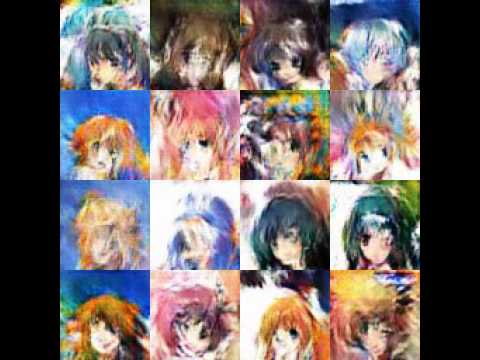
### Some outputs of 5000th min-batch

### Some training images

## Useful resources, before you go on
* There are great examples on MNIST already. Be sure to check them out.
* https://oshearesearch.com/index.php/2016/07/01/mnist-generative-adversarial-model-in-keras/
* https://github.com/osh/KerasGAN
* https://medium.com/towards-data-science/gan-by-example-using-keras-on-tensorflow-backend-1a6d515a60d0
* "How to Train a GAN? Tips and tricks to make GANs work" is a must read! (GAN Hacks)
* The advices were extremely helpful in making this example.
* https://github.com/soumith/ganhacks
* Projects doing the same thing:
* https://github.com/jayleicn/animeGAN
* https://github.com/tdrussell/IllustrationGAN
* I used slow implementation for the sake of simplicity. However, the correct way is:
* https://ctmakro.github.io/site/on_learning/fast_gan_in_keras.html
* https://github.com/shekkizh/neuralnetworks.thought-experiments/blob/master/Generative%20Models/GAN/Readme.md
## How to run this example
### Setup
* My environment: Python 3.6 + Keras 2.0.4 + Tensorflow 1.x
* If you are on Keras 2.0.0, you need to update it otherwise BatchNormalization() will
cause bug, saying "you need to pass float to input" or something
like that from Tensorflow back end.
* Use [virtualenv](https://docs.python.org/3/tutorial/venv.html) to initialize a similar environment (python and dependencies):
```bash
pip install virtualenv
virtualenv -p <PATH_TO_BIN_DIR>/python3.6 venv
source venv/bin/activate
pip install -r requirements.txt
```
* I HATE making a program that has so many command line parameters to pass.
Many of the parameters are there in the scripts. Adjust the script as you need.
The "main()" function is at the bottom of the script as people do in C/C++
* Most global parameters are defined in args.py.
* They are defined as class variables not instance variables so you may have trouble
running/training multiple instances of the GAN with different parameters.
(which is very unlikely to happen)
* Download dataset from http://www.nurs.or.jp/~nagadomi/animeface-character-dataset/
* Extract it to this directory so that the scipt can find
./animeface-character-dataset/thumb/
* Any dataset should work in principle but GAN is sensitive to hyperparameters and may not work
on yours. I tuned the parameters for animeface-character-dataset.
### Preprocessing
* Run the preprocessing script. It saves training time to resize/scale the input than
doing those tasks on the fly in the training loop.
* ./data.py
* The image, when loaded from PNG files, the RGB values have [0, 255]. (uint8 type). data.py will collect the images, resize the images to 64x64 and scale the RGB values so that they will be in [-1.0, 1.0] range.
* Data.py will only sample a subset of the dataset if configured to do so. The size of the subset is determined
by dataset_sz defined in args.py
* The images will be written to data.hdf5.
* Made it small to verify the training is working.
* You can increase it but you need to adjust the network sizes accordingly.
* Again, which files to read is defined in the script at the bottom, not by sys.argv.
* You need a large enough dataset. Otherwise the discriminator will sort of "memorize"
the true data and reject all that's generated.
### Training
* Open gan.py then at the bottom, uncomment train\_autoenc() if you wish.
* This is useful for seeing the generator network's capability to reproduce the input.
* The auto-encoder will be trained on input images.
* The output will be blurry, as the auto-encoder having mean-squared-error loss.
(This is why GAN got invented in the first place!)
* To run training, modify main() so that train\_gan() is uncommented.
* The script will dump reals.png and fakes.png every 10 epoch so that you can see
how the training is going.
* The training takes a while. For this example on Anime Face dataset, it took about 10000 mini-batches
to get good results.
* If you see only uniform color or "modern art" until 2000 then the training is not working!
* The script also dumps weights every 10 batches. Utilize them to save training time.
Weights before diverging is preferred :)
Uncomment load\_weights() in train\_gan().
### Training tips
What I experienced during my training of GAN.
* As described in GAN Hacks, discriminator should be ahead of the generator so that
the generator can be "guided" by the discriminator.
* If you look at loss graph at https://github.com/osh/KerasGAN,
they had gen loss in range of 2 to 4. Their training worked well.
The discriminator loss is low, arond 0.1.
* You'll need trial and error to get the hyper-pameters right
so that the training stays in the stable, balanced zone.
That includes learning rate of D and G, momentums, etc.
* The convergence is quite sensitive with LR, beware!
* If things go well, the discriminator loss for detecting real/fake = dloss0/dloss1 should
be less than or around 0.1, which means it is good at telling whether the input is real or fake.
* If learning rate is too high, the discriminator will diverge and
one of the loss will get high and will not fall. Training fails in this case.
* If you make LR too small, it will only slow the learning and will not prevent other issues
such as oscillation. It only needs to be lower than certain threshold that is data dependent.
* If adjusting LR doesn't work, it could be lack of complexity in the discriminator layer.
Add more layers, or some other parameters. It could be anything :( Good luck!
* On the other hand, generator loss will be relatively higher than discriminator loss.
In this script, it oscillates in range 0.1 to 4.
* If you see any of the D loss staying > 15 (when batch size is 32) the training is screwed.
* In case of G loss > 15, see if it escapes within 30 batches.
If it stays there for too long, it isn't good, I think.
* In case you're seeing high G loss, it could mean it can't keep up with discriminator.
You might need to increase LR. (Must be slower than discriminator though)
* One final piece of the training I was missing was the parameter in BatchNormalization.
I found about it in this link:
https://github.com/shekkizh/neuralnetworks.thought-experiments/blob/master/Generative%20Models/GAN/Readme.md
* Sort of interesting, in PyTorch, momentum parameter for BatchNorm is 0.1, according to the API documents, while in Keras it is 0.99. I'm not sure if 0.1 in PyTorch actually means 1 - 0.1. I didn't look into PyTorch backend implementation.
================================================
FILE: args.py
================================================
#!/usr/bin/env python3
class Args :
# dataset size... Use positive number to sample subset of the full dataset.
dataset_sz = -1
# Archive outputs of training here for animating later.
anim_dir = "anim"
# images size we will work on. (sz, sz, 3)
sz = 64
# alpha, used by leaky relu of D and G networks.
alpha_D = 0.2
alpha_G = 0.2
# batch size, during training.
batch_sz = 64
# Length of the noise vector to generate the faces from.
# Latent space z
noise_shape = (1, 1, 100)
# GAN training can be ruined any moment if not careful.
# Archive some snapshots in this directory.
snapshot_dir = "./snapshots"
# dropout probability
dropout = 0.3
# noisy label magnitude
label_noise = 0.1
# history to keep. Slower training but higher quality.
history_sz = 8
genw = "gen.hdf5"
discw = "disc.hdf5"
# Weight initialization function.
#kernel_initializer = 'Orthogonal'
#kernel_initializer = 'RandomNormal'
# Same as default in Keras, but good for GAN, says
# https://github.com/gheinrich/DIGITS-GAN/blob/master/examples/weight-init/README.md#experiments-with-lenet-on-mnist
kernel_initializer = 'glorot_uniform'
# Since DCGAN paper, everybody uses 0.5 and for me, it works the best too.
# I tried 0.9, 0.1.
adam_beta = 0.5
# BatchNormalization matters too.
bn_momentum = 0.3
================================================
FILE: data.py
================================================
#!/usr/bin/env python3
import glob
import h5py
import numpy as np
import scipy.misc
import random
import cv2
from args import Args
def normalize4gan(im):
'''
Convert colorspace and
cale the input in [-1, 1] range, as described in ganhacks
'''
#im = cv2.cvtColor(im, cv2.COLOR_RGB2YCR_CB).astype(np.float32)
# HSV... not helpful.
im = im.astype(np.float32)
im /= 128.0
im -= 1.0 # now in [-1, 1]
return im
def denormalize4gan(im):
'''
Does opposite of normalize4gan:
[-1, 1] to [0, 255].
Warning: input im is modified in-place!
'''
im += 1.0 # in [0, 2]
im *= 127.0 # in [0, 255]
return im.astype(np.uint8)
def make_hdf5(ofname, wildcard):
'''
Preprocess files given by wildcard and save them in hdf5 file, as ofname.
'''
pool = list(glob.glob(wildcard))
if Args.dataset_sz <= 0:
fnames = pool
else:
fnames = []
for i in range(Args.dataset_sz):
# possible duplicate but don't care
fnames.append(random.choice(pool))
with h5py.File(ofname, "w") as f:
faces = f.create_dataset("faces", (len(fnames), Args.sz, Args.sz, 3), dtype='f')
for i, fname in enumerate(fnames):
print(fname)
im = scipy.misc.imread(fname, mode='RGB') # some have alpha channel
im = scipy.misc.imresize(im, (Args.sz, Args.sz))
faces[i] = normalize4gan(im)
def test(hdff):
'''
Reads in hdf file and check if pixels are scaled in [-1, 1] range.
'''
with h5py.File(hdff, "r") as f:
X = f.get("faces")
print(np.min(X[:,:,:,0]))
print(np.max(X[:,:,:,0]))
print(np.min(X[:,:,:,1]))
print(np.max(X[:,:,:,1]))
print(np.min(X[:,:,:,2]))
print(np.max(X[:,:,:,2]))
print("Dataset size:", len(X))
assert np.max(X) <= 1.0
assert np.min(X) >= -1.0
if __name__ == "__main__" :
# Thankfully the dataset is in PNG, not JPEG.
# Anime style suffers from significant quality degradation in JPEG.
make_hdf5("data.hdf5", "animeface-character-dataset/thumb/*/*.png")
#make_hdf5("data.hdf5", "animeface-character-dataset/thumb/025*/*.png")
# Uncomment and run test, if you want.
test("data.hdf5")
================================================
FILE: discrimination.py
================================================
from keras import backend as K
from keras.engine import InputSpec, Layer
from keras import initializers, regularizers, constraints
# From a PR that is not pulled into Keras
# https://github.com/fchollet/keras/pull/3677
# I updated the code to work on Keras 2.x
class MinibatchDiscrimination(Layer):
"""Concatenates to each sample information about how different the input
features for that sample are from features of other samples in the same
minibatch, as described in Salimans et. al. (2016). Useful for preventing
GANs from collapsing to a single output. When using this layer, generated
samples and reference samples should be in separate batches.
# Example
```python
# apply a convolution 1d of length 3 to a sequence with 10 timesteps,
# with 64 output filters
model = Sequential()
model.add(Convolution1D(64, 3, border_mode='same', input_shape=(10, 32)))
# now model.output_shape == (None, 10, 64)
# flatten the output so it can be fed into a minibatch discrimination layer
model.add(Flatten())
# now model.output_shape == (None, 640)
# add the minibatch discrimination layer
model.add(MinibatchDiscrimination(5, 3))
# now model.output_shape = (None, 645)
```
# Arguments
nb_kernels: Number of discrimination kernels to use
(dimensionality concatenated to output).
kernel_dim: The dimensionality of the space where closeness of samples
is calculated.
init: name of initialization function for the weights of the layer
(see [initializations](../initializations.md)),
or alternatively, Theano function to use for weights initialization.
This parameter is only relevant if you don't pass a `weights` argument.
weights: list of numpy arrays to set as initial weights.
W_regularizer: instance of [WeightRegularizer](../regularizers.md)
(eg. L1 or L2 regularization), applied to the main weights matrix.
activity_regularizer: instance of [ActivityRegularizer](../regularizers.md),
applied to the network output.
W_constraint: instance of the [constraints](../constraints.md) module
(eg. maxnorm, nonneg), applied to the main weights matrix.
input_dim: Number of channels/dimensions in the input.
Either this argument or the keyword argument `input_shape`must be
provided when using this layer as the first layer in a model.
# Input shape
2D tensor with shape: `(samples, input_dim)`.
# Output shape
2D tensor with shape: `(samples, input_dim + nb_kernels)`.
# References
- [Improved Techniques for Training GANs](https://arxiv.org/abs/1606.03498)
"""
def __init__(self, nb_kernels, kernel_dim, init='glorot_uniform', weights=None,
W_regularizer=None, activity_regularizer=None,
W_constraint=None, input_dim=None, **kwargs):
self.init = initializers.get(init)
self.nb_kernels = nb_kernels
self.kernel_dim = kernel_dim
self.input_dim = input_dim
self.W_regularizer = regularizers.get(W_regularizer)
self.activity_regularizer = regularizers.get(activity_regularizer)
self.W_constraint = constraints.get(W_constraint)
self.initial_weights = weights
self.input_spec = [InputSpec(ndim=2)]
if self.input_dim:
kwargs['input_shape'] = (self.input_dim,)
super(MinibatchDiscrimination, self).__init__(**kwargs)
def build(self, input_shape):
assert len(input_shape) == 2
input_dim = input_shape[1]
self.input_spec = [InputSpec(dtype=K.floatx(),
shape=(None, input_dim))]
self.W = self.add_weight(shape=(self.nb_kernels, input_dim, self.kernel_dim),
initializer=self.init,
name='kernel',
regularizer=self.W_regularizer,
trainable=True,
constraint=self.W_constraint)
# Set built to true.
super(MinibatchDiscrimination, self).build(input_shape)
def call(self, x, mask=None):
activation = K.reshape(K.dot(x, self.W), (-1, self.nb_kernels, self.kernel_dim))
diffs = K.expand_dims(activation, 3) - K.expand_dims(K.permute_dimensions(activation, [1, 2, 0]), 0)
abs_diffs = K.sum(K.abs(diffs), axis=2)
minibatch_features = K.sum(K.exp(-abs_diffs), axis=2)
return K.concatenate([x, minibatch_features], 1)
def compute_output_shape(self, input_shape):
assert input_shape and len(input_shape) == 2
return input_shape[0], input_shape[1]+self.nb_kernels
def get_config(self):
config = {'nb_kernels': self.nb_kernels,
'kernel_dim': self.kernel_dim,
'init': self.init.__name__,
'W_regularizer': self.W_regularizer.get_config() if self.W_regularizer else None,
'activity_regularizer': self.activity_regularizer.get_config() if self.activity_regularizer else None,
'W_constraint': self.W_constraint.get_config() if self.W_constraint else None,
'input_dim': self.input_dim}
base_config = super(MinibatchDiscrimination, self).get_config()
return dict(list(base_config.items()) + list(config.items()))
================================================
FILE: gan.py
================================================
#!/usr/bin/env python3
import os
import sys
import numpy as np
import random
from keras import models
from keras import optimizers
from keras.layers import Input
from keras.optimizers import Adam, Adagrad, Adadelta, Adamax, SGD
from keras.callbacks import CSVLogger
import scipy
import h5py
from args import Args
from data import denormalize4gan
#from layers import bilinear2x
from discrimination import MinibatchDiscrimination
from nets import build_discriminator, build_gen, build_enc
#import tensorflow as tf
#import keras
#keras.backend.get_session().run(tf.initialize_all_variables())
def sample_faces( faces ):
reals = []
for i in range( Args.batch_sz ) :
j = random.randrange( len(faces) )
face = faces[ j ]
reals.append( face )
reals = np.array(reals)
return reals
def binary_noise(cnt):
# Distribution of noise matters.
# If you use single ranf that spans [0, 1], training will not work.
# Well, for me at least.
# Either normal or ranf works for me but be sure to use them with randrange(2) or something.
#noise = np.random.normal( scale=Args.label_noise, size=((Args.batch_sz,) + Args.noise_shape) )
# Note about noise rangel.
# 0, 1 noise vs -1, 1 noise. -1, 1 seems to be better and stable.
noise = Args.label_noise * np.random.ranf((cnt,) + Args.noise_shape) # [0, 0.1]
noise -= 0.05 # [-0.05, 0.05]
noise += np.random.randint(0, 2, size=((cnt,) + Args.noise_shape))
noise -= 0.5
noise *= 2
return noise
def sample_fake( gen ) :
noise = binary_noise(Args.batch_sz)
fakes = gen.predict(noise)
return fakes, noise
def dump_batch(imgs, cnt, ofname):
'''
Merges cnt x cnt generated images into one big image.
Use the command
$ feh dump.png --reload 1
to refresh image peroidically during training!
'''
assert Args.batch_sz >= cnt * cnt
rows = []
for i in range( cnt ) :
cols = []
for j in range(cnt*i, cnt*i+cnt):
cols.append( imgs[j] )
rows.append( np.concatenate(cols, axis=1) )
alles = np.concatenate( rows, axis=0 )
alles = denormalize4gan( alles )
#alles = scipy.misc.imresize(alles, 200) # uncomment to scale
scipy.misc.imsave( ofname, alles )
def build_networks():
shape = (Args.sz, Args.sz, 3)
# Learning rate is important.
# Optimizers are important too, try experimenting them yourself to fit your dataset.
# I recommend you read DCGAN paper.
# Unlike gan hacks, sgd doesn't seem to work well.
# DCGAN paper states that they used Adam for both G and D.
#opt = optimizers.SGD(lr=0.0001, decay=0.0, momentum=0.9, nesterov=True)
#dopt = optimizers.SGD(lr=0.0001, decay=0.0, momentum=0.9, nesterov=True)
# lr=0.010. Looks good, statistically (low d loss, higher g loss)
# but too much for the G to create face.
# If you see only one color 'flood fill' during training for about 10 batches or so,
# training is failing. If you see only a few colors (instead of colorful noise)
# then lr is too high for the opt and G will not have chance to form face.
#dopt = Adam(lr=0.010, beta_1=0.5)
#opt = Adam(lr=0.001, beta_1=0.5)
# vague faces @ 500
# Still can't get higher frequency component.
#dopt = Adam(lr=0.0010, beta_1=0.5)
#opt = Adam(lr=0.0001, beta_1=0.5)
# better faces @ 500
# but mode collapse after that, probably due to learning rate being too high.
# opt.lr = dopt.lr / 10 works nicely. I found this with trial and error.
# now same lr, as we are using history to train D multiple times.
# I don't exactly understand how decay parameter in Adam works. Certainly not exponential.
# Actually faster than exponential, when I look at the code and plot it in Excel.
dopt = Adam(lr=0.0002, beta_1=Args.adam_beta)
opt = Adam(lr=0.0001, beta_1=Args.adam_beta)
# too slow
# Another thing about LR.
# If you make it small, it will only optimize slowly.
# LR only has to be smaller than certain threshold that is data dependent.
# (related to the largest gradient that prevents optimization)
#dopt = Adam(lr=0.000010, beta_1=0.5)
#opt = Adam(lr=0.000001, beta_1=0.5)
# generator part
gen = build_gen( shape )
# loss function doesn't seem to matter for this one, as it is not directly trained
gen.compile(optimizer=opt, loss='binary_crossentropy')
gen.summary()
# discriminator part
disc = build_discriminator( shape )
disc.compile(optimizer=dopt, loss='binary_crossentropy')
disc.summary()
# GAN stack
# https://ctmakro.github.io/site/on_learning/fast_gan_in_keras.html is the faster way.
# Here, for simplicity, I use slower way (slower due to duplicate computation).
noise = Input( shape=Args.noise_shape )
gened = gen( noise )
result = disc( gened )
gan = models.Model( inputs=noise, outputs=result )
gan.compile(optimizer=opt, loss='binary_crossentropy')
gan.summary()
return gen, disc, gan
def train_autoenc( dataf ):
'''
Train an autoencoder first to see if your network is large enough.
'''
f = h5py.File( dataf, 'r' )
faces = f.get( 'faces' )
opt = Adam(lr=0.001)
shape = (Args.sz, Args.sz, 3)
enc = build_enc( shape )
enc.compile(optimizer=opt, loss='mse')
enc.summary()
# generator part
gen = build_gen( shape )
# generator is not directly trained. Optimizer and loss doesn't matter too much.
gen.compile(optimizer=opt, loss='mse')
gen.summary()
face = Input( shape=shape )
vector = enc(face)
recons = gen(vector)
autoenc = models.Model( inputs=face, outputs=recons )
autoenc.compile(optimizer=opt, loss='mse')
epoch = 0
while epoch < 200 :
for i in range(10) :
reals = sample_faces( faces )
fakes, noises = sample_fake( gen )
loss = autoenc.train_on_batch( reals, reals )
epoch += 1
print(epoch, loss)
fakes = autoenc.predict(reals)
dump_batch(fakes, 4, "fakes.png")
dump_batch(reals, 4, "reals.png")
gen.save_weights(Args.genw)
enc.save_weights(Args.discw)
print("Saved", Args.genw, Args.discw)
def load_weights(model, wf):
'''
I find error message in load_weights hard to understand sometimes.
'''
try:
model.load_weights(wf)
except:
print("failed to load weight, network changed or corrupt hdf5", wf, file=sys.stderr)
sys.exit(1)
def train_gan( dataf ) :
gen, disc, gan = build_networks()
# Uncomment these, if you want to continue training from some snapshot.
# (or load pretrained generator weights)
#load_weights(gen, Args.genw)
#load_weights(disc, Args.discw)
logger = CSVLogger('loss.csv') # yeah, you can use callbacks independently
logger.on_train_begin() # initialize csv file
with h5py.File( dataf, 'r' ) as f :
faces = f.get( 'faces' )
run_batches(gen, disc, gan, faces, logger, range(5000))
logger.on_train_end()
def run_batches(gen, disc, gan, faces, logger, itr_generator):
history = [] # need this to prevent G from shifting from mode to mode to trick D.
train_disc = True
for batch in itr_generator:
# Using soft labels here.
lbl_fake = Args.label_noise * np.random.ranf(Args.batch_sz)
lbl_real = 1 - Args.label_noise * np.random.ranf(Args.batch_sz)
fakes, noises = sample_fake( gen )
reals = sample_faces( faces )
# Add noise...
# My dataset works without this.
#reals += 0.5 * np.exp(-batch/100) * np.random.normal( size=reals.shape )
if batch % 10 == 0 :
if len(history) > Args.history_sz:
history.pop(0) # evict oldest
history.append( (reals, fakes) )
gen.trainable = False
#for reals, fakes in history:
d_loss1 = disc.train_on_batch( reals, lbl_real )
d_loss0 = disc.train_on_batch( fakes, lbl_fake )
gen.trainable = True
#if d_loss1 > 15.0 or d_loss0 > 15.0 :
# artificial training of one of G or D based on
# statistics is not good at all.
# pretrain train discriminator only
if batch < 20 :
print( batch, "d0:{} d1:{}".format( d_loss0, d_loss1 ) )
continue
disc.trainable = False
g_loss = gan.train_on_batch( noises, lbl_real ) # try to trick the classifier.
disc.trainable = True
# To escape this loop, both D and G should be trained so that
# D begins to mark everything that's wrong that G has done.
# Otherwise G will only change locally and fail to escape the minima.
#train_disc = True if g_loss < 15 else False
print( batch, "d0:{} d1:{} g:{}".format( d_loss0, d_loss1, g_loss ) )
# save weights every 10 batches
if batch % 10 == 0 and batch != 0 :
end_of_batch_task(batch, gen, disc, reals, fakes)
row = {"d_loss0": d_loss0, "d_loss1": d_loss1, "g_loss": g_loss}
logger.on_epoch_end(batch, row)
_bits = binary_noise(Args.batch_sz)
def end_of_batch_task(batch, gen, disc, reals, fakes):
try :
# Dump how the generator is doing.
# Animation dump
dump_batch(reals, 4, "reals.png")
dump_batch(fakes, 4, "fakes.png") # to check how noisy the image is
frame = gen.predict(_bits)
animf = os.path.join(Args.anim_dir, "frame_{:08d}.png".format(int(batch/10)))
dump_batch(frame, 4, animf)
dump_batch(frame, 4, "frame.png")
serial = int(batch / 10) % 10
prefix = os.path.join(Args.snapshot_dir, str(serial) + ".")
print("Saving weights", serial)
gen.save_weights(prefix + Args.genw)
disc.save_weights(prefix + Args.discw)
except KeyboardInterrupt :
print("Saving, don't interrupt with Ctrl+C!", serial)
# recursion to surely save everything haha
end_of_batch_task(batch, gen, disc, reals, fakes)
raise
def generate( genw, cnt ):
shape = (Args.sz, Args.sz, 3)
gen = build_gen( shape )
gen.compile(optimizer='sgd', loss='mse')
load_weights(gen, Args.genw)
generated = gen.predict(binary_noise(Args.batch_sz))
# Unoffset, in batch.
# Must convert back to unit8 to stop color distortion.
generated = denormalize4gan(generated)
for i in range(cnt):
ofname = "{:04d}.png".format(i)
scipy.misc.imsave( ofname, generated[i] )
def main( argv ) :
if not os.path.exists(Args.snapshot_dir) :
os.mkdir(Args.snapshot_dir)
if not os.path.exists(Args.anim_dir) :
os.mkdir(Args.anim_dir)
# test the capability of generator network through autoencoder test.
# The argument is that if the generator network can memorize the inputs then
# it should be enough to GAN-generate stuff.
# Pretraining gen isn't that useful in gan training as
# the untrained discriminator will soon ruin everything.
#train_autoenc( "data.hdf5" )
# train GAN with inputs in data.hdf5
train_gan( "data.hdf5" )
# Lets generate stuff
#generate( "gen.hdf5", 256 )
if __name__ == '__main__':
main(sys.argv)
================================================
FILE: layers.py
================================================
#!/usr/bin/env python3
from keras.layers.convolutional import Conv2DTranspose
from keras.initializers import Constant
import numpy as np
def upsample_filt(size):
factor = (size + 1) // 2
if size % 2 == 1:
center = factor - 1
else:
center = factor - 0.5
og = np.ogrid[:size, :size]
return (1 - abs(og[0] - center) / factor) * (1 - abs(og[1] - center) / factor)
def bilinear_upsample_weights(factor, number_of_classes):
filter_size = factor*2 - factor%2
weights = np.zeros((filter_size, filter_size, number_of_classes, number_of_classes),
dtype=np.float32)
upsample_kernel = upsample_filt(filter_size)
for i in range(number_of_classes):
weights[:, :, i, i] = upsample_kernel
return weights
def bilinear2x(x, nfilters):
'''
Ugh, I don't like making layers.
My credit goes to: https://kivantium.net/keras-bilinear
'''
return Conv2DTranspose(nfilters, (4, 4),
strides=(2, 2),
padding='same',
kernel_initializer=Constant(bilinear_upsample_weights(2, nfilters)))(x)
================================================
FILE: make_mp4.sh
================================================
#!/bin/bash
# -r specifies FPS, of the video.
# -s specifies video size.
# framerate is the rate the next image will show... sort of confusing with -r but
# if you want to show one image long, use this option.
# I might have misunderstood, refer to man page for the options.
#-framerate 2 \
ffmpeg \
-f image2 \
-i anim/frame_%08d.png \
-r 30 \
-crf 5 -pix_fmt yuv420p \
-vcodec libx264 \
anim.mp4
================================================
FILE: nets.py
================================================
#!/usr/bin/env python3
import os
import sys
import numpy as np
import random
from keras import models
from keras import optimizers
from keras.layers.normalization import BatchNormalization
from keras.layers.convolutional import Conv2D, Conv2DTranspose, UpSampling2D
from keras.layers.pooling import MaxPooling2D
from keras.layers.core import Dense, Activation, Flatten, Reshape, Dropout
from keras.layers import Input
from keras.optimizers import Adam, Adagrad, Adadelta, Adamax, SGD
from keras.callbacks import CSVLogger
# GAN doesn't like spare gradients (says ganhack). LeakyReLU better.
from keras.layers.advanced_activations import LeakyReLU
import scipy
import h5py
from args import Args
from data import denormalize4gan
from layers import bilinear2x
from discrimination import MinibatchDiscrimination
#import tensorflow as tf
#import keras
#keras.backend.get_session().run(tf.initialize_all_variables())
def build_enc( shape ) :
return build_discriminator(shape, build_disc=False)
def build_discriminator( shape, build_disc=True ) :
'''
Build discriminator.
Set build_disc=False to build an encoder network to test
the encoding/discrimination capability with autoencoder...
'''
def conv2d( x, filters, shape=(4, 4), **kwargs ) :
'''
I don't want to write lengthy parameters so I made a short hand function.
'''
x = Conv2D( filters, shape, strides=(2, 2),
padding='same',
kernel_initializer=Args.kernel_initializer,
**kwargs )( x )
#x = MaxPooling2D()( x )
x = BatchNormalization(momentum=Args.bn_momentum)( x )
x = LeakyReLU(alpha=Args.alpha_D)( x )
return x
# https://github.com/tdrussell/IllustrationGAN
# As proposed by them, unlike GAN hacks, MaxPooling works better for anime dataset it seems.
# However, animeGAN doesn't use it so I'll keep it more similar to DCGAN.
face = Input( shape=shape )
x = face
# Warning: Don't batchnorm the first set of Conv2D.
x = Conv2D( 64, (4, 4), strides=(2, 2),
padding='same',
kernel_initializer=Args.kernel_initializer )( x )
x = LeakyReLU(alpha=Args.alpha_D)( x )
# 32x32
x = conv2d( x, 128 )
# 16x16
x = conv2d( x, 256 )
# 8x8
x = conv2d( x, 512 )
# 4x4
if build_disc:
x = Flatten()(x)
# add 16 features. Run 1D conv of size 3.
#x = MinibatchDiscrimination(16, 3)( x )
#x = Dense(1024, kernel_initializer=Args.kernel_initializer)( x )
#x = LeakyReLU(alpha=Args.alpha_D)( x )
# 1 when "real", 0 when "fake".
x = Dense(1, activation='sigmoid',
kernel_initializer=Args.kernel_initializer)( x )
return models.Model( inputs=face, outputs=x )
else:
# build encoder.
x = Conv2D(Args.noise_shape[2], (4, 4), activation='tanh')(x)
return models.Model( inputs=face, outputs=x )
def build_gen( shape ) :
def deconv2d( x, filters, shape=(4, 4) ) :
'''
Conv2DTransposed gives me checkerboard artifact...
Select one of the 3.
'''
# Simpe Conv2DTranspose
# Not good, compared to upsample + conv2d below.
x= Conv2DTranspose( filters, shape, padding='same',
strides=(2, 2), kernel_initializer=Args.kernel_initializer )(x)
# simple and works
#x = UpSampling2D( (2, 2) )( x )
#x = Conv2D( filters, shape, padding='same' )( x )
# Bilinear2x... Not sure if it is without bug, not tested yet.
# Tend to make output blurry though
#x = bilinear2x( x, filters )
#x = Conv2D( filters, shape, padding='same' )( x )
x = BatchNormalization(momentum=Args.bn_momentum)( x )
x = LeakyReLU(alpha=Args.alpha_G)( x )
return x
# https://github.com/tdrussell/IllustrationGAN z predictor...?
# might help. Not sure.
noise = Input( shape=Args.noise_shape )
x = noise
# 1x1x256
# noise is not useful for generating images.
x= Conv2DTranspose( 512, (4, 4),
kernel_initializer=Args.kernel_initializer )(x)
x = BatchNormalization(momentum=Args.bn_momentum)( x )
x = LeakyReLU(alpha=Args.alpha_G)( x )
# 4x4
x = deconv2d( x, 256 )
# 8x8
x = deconv2d( x, 128 )
# 16x16
x = deconv2d( x, 64 )
# 32x32
# Extra layer
x = Conv2D( 64, (3, 3), padding='same',
kernel_initializer=Args.kernel_initializer )( x )
x = BatchNormalization(momentum=Args.bn_momentum)( x )
x = LeakyReLU(alpha=Args.alpha_G)( x )
# 32x32
x= Conv2DTranspose( 3, (4, 4), padding='same', activation='tanh',
strides=(2, 2), kernel_initializer=Args.kernel_initializer )(x)
# 64x64
return models.Model( inputs=noise, outputs=x )
================================================
FILE: requirements.txt
================================================
absl-py==0.3.0
astor==0.7.1
backports.weakref==1.0rc1
bleach==1.5.0
enum34==1.1.6
gast==0.2.0
grpcio==1.13.0
h5py==2.8.0
html5lib==0.9999999
Keras==2.0.4
Markdown==2.6.11
numpy==1.15.0
opencv-python==3.3.0.9
Pillow==5.2.0
protobuf==3.6.0
PyYAML==3.13
scipy==1.1.0
six==1.11.0
tensorboard==1.9.0
tensorflow==1.9.0
tensorflow-tensorboard==1.5.1
termcolor==1.1.0
Theano==1.0.2
Werkzeug==0.14.1
gitextract_c27pvakc/ ├── .gitignore ├── LICENSE ├── README.md ├── args.py ├── data.py ├── discrimination.py ├── gan.py ├── layers.py ├── make_mp4.sh ├── nets.py └── requirements.txt
SYMBOL INDEX (29 symbols across 6 files)

FILE: args.py
  class Args (line 3) | class Args :

FILE: data.py
  function normalize4gan (line 13) | def normalize4gan(im):
  function denormalize4gan (line 27) | def denormalize4gan(im):
  function make_hdf5 (line 39) | def make_hdf5(ofname, wildcard):
  function test (line 63) | def test(hdff):

FILE: discrimination.py
  class MinibatchDiscrimination (line 9) | class MinibatchDiscrimination(Layer):
    method __init__ (line 64) | def __init__(self, nb_kernels, kernel_dim, init='glorot_uniform', weig...
    method build (line 84) | def build(self, input_shape):
    method call (line 101) | def call(self, x, mask=None):
    method compute_output_shape (line 108) | def compute_output_shape(self, input_shape):
    method get_config (line 112) | def get_config(self):

FILE: gan.py
  function sample_faces (line 25) | def sample_faces( faces ):
  function binary_noise (line 36) | def binary_noise(cnt):
  function sample_fake (line 56) | def sample_fake( gen ) :
  function dump_batch (line 63) | def dump_batch(imgs, cnt, ofname):
  function build_networks (line 87) | def build_networks():
  function train_autoenc (line 154) | def train_autoenc( dataf ):
  function load_weights (line 197) | def load_weights(model, wf):
  function train_gan (line 209) | def train_gan( dataf ) :
  function run_batches (line 226) | def run_batches(gen, disc, gan, faces, logger, itr_generator):
  function end_of_batch_task (line 280) | def end_of_batch_task(batch, gen, disc, reals, fakes):
  function generate (line 305) | def generate( genw, cnt ):
  function main (line 322) | def main( argv ) :

FILE: layers.py
  function upsample_filt (line 8) | def upsample_filt(size):
  function bilinear_upsample_weights (line 18) | def bilinear_upsample_weights(factor, number_of_classes):
  function bilinear2x (line 28) | def bilinear2x(x, nfilters):

FILE: nets.py
  function build_enc (line 30) | def build_enc( shape ) :
  function build_discriminator (line 35) | def build_discriminator( shape, build_disc=True ) :
  function build_gen (line 96) | def build_gen( shape ) :
Condensed preview — 11 files, each showing path, character count, and a content snippet. Download the .json file or copy for the full structured content (38K chars).
[
  {
    "path": ".gitignore",
    "chars": 1045,
    "preview": "# Byte-compiled / optimized / DLL files\n__pycache__/\n*.py[cod]\n*$py.class\n\n# C extensions\n*.so\n\n# Distribution / packagi"
  },
  {
    "path": "LICENSE",
    "chars": 1057,
    "preview": "MIT License\n\nCopyright (c) 2017 \n\nPermission is hereby granted, free of charge, to any person obtaining a copy\nof this s"
  },
  {
    "path": "README.md",
    "chars": 7270,
    "preview": "# Keras-GAN-Animeface-Character\n\nGAN example for Keras. Cuz MNIST is too small and there\nshould an example on something "
  },
  {
    "path": "args.py",
    "chars": 1427,
    "preview": "#!/usr/bin/env python3\n\nclass Args :\n    # dataset size... Use positive number to sample subset of the full dataset.\n   "
  },
  {
    "path": "data.py",
    "chars": 2292,
    "preview": "#!/usr/bin/env python3\nimport glob\nimport h5py\nimport numpy as np\nimport scipy.misc\nimport random\nimport cv2\n\nfrom args "
  },
  {
    "path": "discrimination.py",
    "chars": 5429,
    "preview": "from keras import backend as K\nfrom keras.engine import InputSpec, Layer\nfrom keras import initializers, regularizers, c"
  },
  {
    "path": "gan.py",
    "chars": 11299,
    "preview": "#!/usr/bin/env python3\nimport os\nimport sys\nimport numpy as np\nimport random\nfrom keras import models\nfrom keras import "
  },
  {
    "path": "layers.py",
    "chars": 1085,
    "preview": "#!/usr/bin/env python3\nfrom keras.layers.convolutional import Conv2DTranspose\nfrom keras.initializers import Constant\nim"
  },
  {
    "path": "make_mp4.sh",
    "chars": 424,
    "preview": "#!/bin/bash\n\n# -r specifies FPS, of the video.\n# -s specifies video size.\n# framerate is the rate the next image will sh"
  },
  {
    "path": "nets.py",
    "chars": 4809,
    "preview": "#!/usr/bin/env python3\nimport os\nimport sys\nimport numpy as np\nimport random\nfrom keras import models\nfrom keras import "
  },
  {
    "path": "requirements.txt",
    "chars": 390,
    "preview": "absl-py==0.3.0\nastor==0.7.1\nbackports.weakref==1.0rc1\nbleach==1.5.0\nenum34==1.1.6\ngast==0.2.0\ngrpcio==1.13.0\nh5py==2.8.0"
  }
]
About this extraction
This page contains the full source code of the forcecore/Keras-GAN-Animeface-Character GitHub repository, extracted and formatted as plain text for AI agents and large language models (LLMs). The extraction includes 11 files (35.7 KB), approximately 9.9k tokens, and a symbol index with 29 extracted functions, classes, methods, constants, and types. Use this with OpenClaw, Claude, ChatGPT, Cursor, Windsurf, or any other AI tool that accepts text input. You can copy the full output to your clipboard or download it as a .txt file.
Extracted by GitExtract — free GitHub repo to text converter for AI. Built by Nikandr Surkov.