Repository: fudan-generative-vision/hallo
Branch: main
Commit: 8fd7c572a3d4
Files: 48
Total size: 623.2 KB
Directory structure:
gitextract_p10rx2rb/
├── .github/
│ └── workflows/
│ └── static-check.yaml
├── .gitignore
├── .pre-commit-config.yaml
├── .pylintrc
├── LICENSE
├── README.md
├── accelerate_config.yaml
├── configs/
│ ├── inference/
│ │ ├── .gitkeep
│ │ └── default.yaml
│ ├── train/
│ │ ├── stage1.yaml
│ │ └── stage2.yaml
│ └── unet/
│ └── unet.yaml
├── hallo/
│ ├── __init__.py
│ ├── animate/
│ │ ├── __init__.py
│ │ ├── face_animate.py
│ │ └── face_animate_static.py
│ ├── datasets/
│ │ ├── __init__.py
│ │ ├── audio_processor.py
│ │ ├── image_processor.py
│ │ ├── mask_image.py
│ │ └── talk_video.py
│ ├── models/
│ │ ├── __init__.py
│ │ ├── attention.py
│ │ ├── audio_proj.py
│ │ ├── face_locator.py
│ │ ├── image_proj.py
│ │ ├── motion_module.py
│ │ ├── mutual_self_attention.py
│ │ ├── resnet.py
│ │ ├── transformer_2d.py
│ │ ├── transformer_3d.py
│ │ ├── unet_2d_blocks.py
│ │ ├── unet_2d_condition.py
│ │ ├── unet_3d.py
│ │ ├── unet_3d_blocks.py
│ │ └── wav2vec.py
│ └── utils/
│ ├── __init__.py
│ ├── config.py
│ └── util.py
├── requirements.txt
├── scripts/
│ ├── app.py
│ ├── data_preprocess.py
│ ├── extract_meta_info_stage1.py
│ ├── extract_meta_info_stage2.py
│ ├── inference.py
│ ├── train_stage1.py
│ └── train_stage2.py
└── setup.py
================================================
FILE CONTENTS
================================================
================================================
FILE: .github/workflows/static-check.yaml
================================================
name: Pylint
on: [push, pull_request]
jobs:
static-check:
runs-on: ${{ matrix.os }}
strategy:
matrix:
os: [ubuntu-22.04]
python-version: ["3.10"]
steps:
- uses: actions/checkout@v3
- name: Set up Python ${{ matrix.python-version }}
uses: actions/setup-python@v3
with:
python-version: ${{ matrix.python-version }}
- name: Install dependencies
run: |
python -m pip install --upgrade pylint
python -m pip install --upgrade isort
python -m pip install -r requirements.txt
- name: Analysing the code with pylint
run: |
isort $(git ls-files '*.py') --check-only --diff
pylint $(git ls-files '*.py')
================================================
FILE: .gitignore
================================================
# running cache
mlruns/
# Test directories
test_data/
pretrained_models/
# Poetry project
poetry.lock
# Byte-compiled / optimized / DLL files
__pycache__/
*.py[cod]
*$py.class
# C extensions
*.so
# Distribution / packaging
.Python
build/
develop-eggs/
dist/
downloads/
eggs/
.eggs/
lib/
lib64/
parts/
sdist/
var/
wheels/
share/python-wheels/
*.egg-info/
.installed.cfg
*.egg
MANIFEST
# PyInstaller
# Usually these files are written by a python script from a template
# before PyInstaller builds the exe, so as to inject date/other infos into it.
*.manifest
*.spec
# Installer logs
pip-log.txt
pip-delete-this-directory.txt
# Unit test / coverage reports
htmlcov/
.tox/
.nox/
.coverage
.coverage.*
.cache
nosetests.xml
coverage.xml
*.cover
*.py,cover
.hypothesis/
.pytest_cache/
cover/
# Translations
*.mo
*.pot
# Django stuff:
*.log
local_settings.py
db.sqlite3
db.sqlite3-journal
# Flask stuff:
instance/
.webassets-cache
# Scrapy stuff:
.scrapy
# Sphinx documentation
docs/_build/
# PyBuilder
.pybuilder/
target/
# Jupyter Notebook
.ipynb_checkpoints
# IPython
profile_default/
ipython_config.py
# pyenv
# For a library or package, you might want to ignore these files since the code is
# intended to run in multiple environments; otherwise, check them in:
# .python-version
# pipenv
# According to pypa/pipenv#598, it is recommended to include Pipfile.lock in version control.
# However, in case of collaboration, if having platform-specific dependencies or dependencies
# having no cross-platform support, pipenv may install dependencies that don't work, or not
# install all needed dependencies.
#Pipfile.lock
# poetry
# Similar to Pipfile.lock, it is generally recommended to include poetry.lock in version control.
# This is especially recommended for binary packages to ensure reproducibility, and is more
# commonly ignored for libraries.
# https://python-poetry.org/docs/basic-usage/#commit-your-poetrylock-file-to-version-control
#poetry.lock
# pdm
# Similar to Pipfile.lock, it is generally recommended to include pdm.lock in version control.
#pdm.lock
# pdm stores project-wide configurations in .pdm.toml, but it is recommended to not include it
# in version control.
# https://pdm.fming.dev/#use-with-ide
.pdm.toml
# PEP 582; used by e.g. github.com/David-OConnor/pyflow and github.com/pdm-project/pdm
__pypackages__/
# Celery stuff
celerybeat-schedule
celerybeat.pid
# SageMath parsed files
*.sage.py
# Environments
.env
.venv
env/
venv/
ENV/
env.bak/
venv.bak/
# Spyder project settings
.spyderproject
.spyproject
# Rope project settings
.ropeproject
# mkdocs documentation
/site
# mypy
.mypy_cache/
.dmypy.json
dmypy.json
# Pyre type checker
.pyre/
# pytype static type analyzer
.pytype/
# Cython debug symbols
cython_debug/
# IDE
.idea/
.vscode/
data
pretrained_models
test_data
================================================
FILE: .pre-commit-config.yaml
================================================
repos:
- repo: local
hooks:
- id: isort
name: isort
language: system
types: [python]
pass_filenames: false
entry: isort
args: ["."]
- id: pylint
name: pylint
language: system
types: [python]
pass_filenames: false
entry: pylint
args: ["**/*.py"]
================================================
FILE: .pylintrc
================================================
[MAIN]
# Analyse import fallback blocks. This can be used to support both Python 2 and
# 3 compatible code, which means that the block might have code that exists
# only in one or another interpreter, leading to false positives when analysed.
analyse-fallback-blocks=no
# Clear in-memory caches upon conclusion of linting. Useful if running pylint
# in a server-like mode.
clear-cache-post-run=no
# Load and enable all available extensions. Use --list-extensions to see a list
# all available extensions.
#enable-all-extensions=
# In error mode, messages with a category besides ERROR or FATAL are
# suppressed, and no reports are done by default. Error mode is compatible with
# disabling specific errors.
#errors-only=
# Always return a 0 (non-error) status code, even if lint errors are found.
# This is primarily useful in continuous integration scripts.
#exit-zero=
# A comma-separated list of package or module names from where C extensions may
# be loaded. Extensions are loading into the active Python interpreter and may
# run arbitrary code.
extension-pkg-allow-list=
# A comma-separated list of package or module names from where C extensions may
# be loaded. Extensions are loading into the active Python interpreter and may
# run arbitrary code. (This is an alternative name to extension-pkg-allow-list
# for backward compatibility.)
extension-pkg-whitelist=cv2
# Return non-zero exit code if any of these messages/categories are detected,
# even if score is above --fail-under value. Syntax same as enable. Messages
# specified are enabled, while categories only check already-enabled messages.
fail-on=
# Specify a score threshold under which the program will exit with error.
fail-under=10
# Interpret the stdin as a python script, whose filename needs to be passed as
# the module_or_package argument.
#from-stdin=
# Files or directories to be skipped. They should be base names, not paths.
ignore=CVS
# Add files or directories matching the regular expressions patterns to the
# ignore-list. The regex matches against paths and can be in Posix or Windows
# format. Because '\\' represents the directory delimiter on Windows systems,
# it can't be used as an escape character.
ignore-paths=
# Files or directories matching the regular expression patterns are skipped.
# The regex matches against base names, not paths. The default value ignores
# Emacs file locks
ignore-patterns=^\.#
# List of module names for which member attributes should not be checked
# (useful for modules/projects where namespaces are manipulated during runtime
# and thus existing member attributes cannot be deduced by static analysis). It
# supports qualified module names, as well as Unix pattern matching.
ignored-modules=cv2
# Python code to execute, usually for sys.path manipulation such as
# pygtk.require().
init-hook='import sys; sys.path.append(".")'
# Use multiple processes to speed up Pylint. Specifying 0 will auto-detect the
# number of processors available to use, and will cap the count on Windows to
# avoid hangs.
jobs=1
# Control the amount of potential inferred values when inferring a single
# object. This can help the performance when dealing with large functions or
# complex, nested conditions.
limit-inference-results=100
# List of plugins (as comma separated values of python module names) to load,
# usually to register additional checkers.
load-plugins=
# Pickle collected data for later comparisons.
persistent=yes
# Minimum Python version to use for version dependent checks. Will default to
# the version used to run pylint.
py-version=3.10
# Discover python modules and packages in the file system subtree.
recursive=no
# Add paths to the list of the source roots. Supports globbing patterns. The
# source root is an absolute path or a path relative to the current working
# directory used to determine a package namespace for modules located under the
# source root.
source-roots=
# When enabled, pylint would attempt to guess common misconfiguration and emit
# user-friendly hints instead of false-positive error messages.
suggestion-mode=yes
# Allow loading of arbitrary C extensions. Extensions are imported into the
# active Python interpreter and may run arbitrary code.
unsafe-load-any-extension=no
# In verbose mode, extra non-checker-related info will be displayed.
#verbose=
[BASIC]
# Naming style matching correct argument names.
argument-naming-style=snake_case
# Regular expression matching correct argument names. Overrides argument-
# naming-style. If left empty, argument names will be checked with the set
# naming style.
#argument-rgx=
# Naming style matching correct attribute names.
attr-naming-style=snake_case
# Regular expression matching correct attribute names. Overrides attr-naming-
# style. If left empty, attribute names will be checked with the set naming
# style.
#attr-rgx=
# Bad variable names which should always be refused, separated by a comma.
bad-names=foo,
bar,
baz,
toto,
tutu,
tata
# Bad variable names regexes, separated by a comma. If names match any regex,
# they will always be refused
bad-names-rgxs=
# Naming style matching correct class attribute names.
class-attribute-naming-style=any
# Regular expression matching correct class attribute names. Overrides class-
# attribute-naming-style. If left empty, class attribute names will be checked
# with the set naming style.
#class-attribute-rgx=
# Naming style matching correct class constant names.
class-const-naming-style=UPPER_CASE
# Regular expression matching correct class constant names. Overrides class-
# const-naming-style. If left empty, class constant names will be checked with
# the set naming style.
#class-const-rgx=
# Naming style matching correct class names.
class-naming-style=PascalCase
# Regular expression matching correct class names. Overrides class-naming-
# style. If left empty, class names will be checked with the set naming style.
#class-rgx=
# Naming style matching correct constant names.
const-naming-style=UPPER_CASE
# Regular expression matching correct constant names. Overrides const-naming-
# style. If left empty, constant names will be checked with the set naming
# style.
#const-rgx=
# Minimum line length for functions/classes that require docstrings, shorter
# ones are exempt.
docstring-min-length=-1
# Naming style matching correct function names.
function-naming-style=snake_case
# Regular expression matching correct function names. Overrides function-
# naming-style. If left empty, function names will be checked with the set
# naming style.
#function-rgx=
# Good variable names which should always be accepted, separated by a comma.
good-names=i,
j,
k,
ex,
Run,
_
# Good variable names regexes, separated by a comma. If names match any regex,
# they will always be accepted
good-names-rgxs=
# Include a hint for the correct naming format with invalid-name.
include-naming-hint=no
# Naming style matching correct inline iteration names.
inlinevar-naming-style=any
# Regular expression matching correct inline iteration names. Overrides
# inlinevar-naming-style. If left empty, inline iteration names will be checked
# with the set naming style.
#inlinevar-rgx=
# Naming style matching correct method names.
method-naming-style=snake_case
# Regular expression matching correct method names. Overrides method-naming-
# style. If left empty, method names will be checked with the set naming style.
#method-rgx=
# Naming style matching correct module names.
module-naming-style=snake_case
# Regular expression matching correct module names. Overrides module-naming-
# style. If left empty, module names will be checked with the set naming style.
#module-rgx=
# Colon-delimited sets of names that determine each other's naming style when
# the name regexes allow several styles.
name-group=
# Regular expression which should only match function or class names that do
# not require a docstring.
no-docstring-rgx=^_
# List of decorators that produce properties, such as abc.abstractproperty. Add
# to this list to register other decorators that produce valid properties.
# These decorators are taken in consideration only for invalid-name.
property-classes=abc.abstractproperty
# Regular expression matching correct type alias names. If left empty, type
# alias names will be checked with the set naming style.
#typealias-rgx=
# Regular expression matching correct type variable names. If left empty, type
# variable names will be checked with the set naming style.
#typevar-rgx=
# Naming style matching correct variable names.
variable-naming-style=snake_case
# Regular expression matching correct variable names. Overrides variable-
# naming-style. If left empty, variable names will be checked with the set
# naming style.
variable-rgx=(_?[a-z][A-Za-z0-9]{0,30})|([A-Z0-9]{1,30})
[CLASSES]
# Warn about protected attribute access inside special methods
check-protected-access-in-special-methods=no
# List of method names used to declare (i.e. assign) instance attributes.
defining-attr-methods=__init__,
__new__,
setUp,
asyncSetUp,
__post_init__
# List of member names, which should be excluded from the protected access
# warning.
exclude-protected=_asdict,_fields,_replace,_source,_make,os._exit
# List of valid names for the first argument in a class method.
valid-classmethod-first-arg=cls
# List of valid names for the first argument in a metaclass class method.
valid-metaclass-classmethod-first-arg=mcs
[DESIGN]
# List of regular expressions of class ancestor names to ignore when counting
# public methods (see R0903)
exclude-too-few-public-methods=
# List of qualified class names to ignore when counting class parents (see
# R0901)
ignored-parents=
# Maximum number of arguments for function / method.
max-args=7
# Maximum number of attributes for a class (see R0902).
max-attributes=20
# Maximum number of boolean expressions in an if statement (see R0916).
max-bool-expr=5
# Maximum number of branch for function / method body.
max-branches=12
# Maximum number of locals for function / method body.
max-locals=15
# Maximum number of parents for a class (see R0901).
max-parents=7
# Maximum number of public methods for a class (see R0904).
max-public-methods=20
# Maximum number of return / yield for function / method body.
max-returns=6
# Maximum number of statements in function / method body.
max-statements=300
# Minimum number of public methods for a class (see R0903).
min-public-methods=1
[EXCEPTIONS]
# Exceptions that will emit a warning when caught.
overgeneral-exceptions=builtins.BaseException,builtins.Exception
[FORMAT]
# Expected format of line ending, e.g. empty (any line ending), LF or CRLF.
expected-line-ending-format=
# Regexp for a line that is allowed to be longer than the limit.
ignore-long-lines=^\s*(# )??$
# Number of spaces of indent required inside a hanging or continued line.
indent-after-paren=4
# String used as indentation unit. This is usually " " (4 spaces) or "\t" (1
# tab).
indent-string=' '
# Maximum number of characters on a single line.
max-line-length=150
# Maximum number of lines in a module.
max-module-lines=2000
# Allow the body of a class to be on the same line as the declaration if body
# contains single statement.
single-line-class-stmt=no
# Allow the body of an if to be on the same line as the test if there is no
# else.
single-line-if-stmt=no
[IMPORTS]
# List of modules that can be imported at any level, not just the top level
# one.
allow-any-import-level=
# Allow explicit reexports by alias from a package __init__.
allow-reexport-from-package=no
# Allow wildcard imports from modules that define __all__.
allow-wildcard-with-all=no
# Deprecated modules which should not be used, separated by a comma.
deprecated-modules=
# Output a graph (.gv or any supported image format) of external dependencies
# to the given file (report RP0402 must not be disabled).
ext-import-graph=
# Output a graph (.gv or any supported image format) of all (i.e. internal and
# external) dependencies to the given file (report RP0402 must not be
# disabled).
import-graph=
# Output a graph (.gv or any supported image format) of internal dependencies
# to the given file (report RP0402 must not be disabled).
int-import-graph=
# Force import order to recognize a module as part of the standard
# compatibility libraries.
known-standard-library=
# Force import order to recognize a module as part of a third party library.
known-third-party=enchant
# Couples of modules and preferred modules, separated by a comma.
preferred-modules=
[LOGGING]
# The type of string formatting that logging methods do. `old` means using %
# formatting, `new` is for `{}` formatting.
logging-format-style=old
# Logging modules to check that the string format arguments are in logging
# function parameter format.
logging-modules=logging
[MESSAGES CONTROL]
# Only show warnings with the listed confidence levels. Leave empty to show
# all. Valid levels: HIGH, CONTROL_FLOW, INFERENCE, INFERENCE_FAILURE,
# UNDEFINED.
confidence=HIGH,
CONTROL_FLOW,
INFERENCE,
INFERENCE_FAILURE,
UNDEFINED
# Disable the message, report, category or checker with the given id(s). You
# can either give multiple identifiers separated by comma (,) or put this
# option multiple times (only on the command line, not in the configuration
# file where it should appear only once). You can also use "--disable=all" to
# disable everything first and then re-enable specific checks. For example, if
# you want to run only the similarities checker, you can use "--disable=all
# --enable=similarities". If you want to run only the classes checker, but have
# no Warning level messages displayed, use "--disable=all --enable=classes
# --disable=W".
disable=too-many-arguments,
too-many-locals,
too-many-branches,
protected-access
# Enable the message, report, category or checker with the given id(s). You can
# either give multiple identifier separated by comma (,) or put this option
# multiple time (only on the command line, not in the configuration file where
# it should appear only once). See also the "--disable" option for examples.
enable=
[METHOD_ARGS]
# List of qualified names (i.e., library.method) which require a timeout
# parameter e.g. 'requests.api.get,requests.api.post'
timeout-methods=requests.api.delete,requests.api.get,requests.api.head,requests.api.options,requests.api.patch,requests.api.post,requests.api.put,requests.api.request
[MISCELLANEOUS]
# List of note tags to take in consideration, separated by a comma.
notes=FIXME,
XXX
# Regular expression of note tags to take in consideration.
notes-rgx=
[REFACTORING]
# Maximum number of nested blocks for function / method body
max-nested-blocks=5
# Complete name of functions that never returns. When checking for
# inconsistent-return-statements if a never returning function is called then
# it will be considered as an explicit return statement and no message will be
# printed.
never-returning-functions=sys.exit,argparse.parse_error
# Let 'consider-using-join' be raised when the separator to join on would be
# non-empty (resulting in expected fixes of the type: ``"- " + " -
# ".join(items)``)
# suggest-join-with-non-empty-separator=yes
[REPORTS]
# Python expression which should return a score less than or equal to 10. You
# have access to the variables 'fatal', 'error', 'warning', 'refactor',
# 'convention', and 'info' which contain the number of messages in each
# category, as well as 'statement' which is the total number of statements
# analyzed. This score is used by the global evaluation report (RP0004).
evaluation=max(0, 0 if fatal else 10.0 - ((float(5 * error + warning + refactor + convention) / statement) * 10))
# Template used to display messages. This is a python new-style format string
# used to format the message information. See doc for all details.
msg-template=
# Set the output format. Available formats are: text, parseable, colorized,
# json2 (improved json format), json (old json format) and msvs (visual
# studio). You can also give a reporter class, e.g.
# mypackage.mymodule.MyReporterClass.
#output-format=
# Tells whether to display a full report or only the messages.
reports=no
# Activate the evaluation score.
score=yes
[SIMILARITIES]
# Comments are removed from the similarity computation
ignore-comments=yes
# Docstrings are removed from the similarity computation
ignore-docstrings=yes
# Imports are removed from the similarity computation
ignore-imports=yes
# Signatures are removed from the similarity computation
ignore-signatures=yes
# Minimum lines number of a similarity.
min-similarity-lines=4
[SPELLING]
# Limits count of emitted suggestions for spelling mistakes.
max-spelling-suggestions=4
# Spelling dictionary name. No available dictionaries : You need to install
# both the python package and the system dependency for enchant to work.
spelling-dict=
# List of comma separated words that should be considered directives if they
# appear at the beginning of a comment and should not be checked.
spelling-ignore-comment-directives=fmt: on,fmt: off,noqa:,noqa,nosec,isort:skip,mypy:
# List of comma separated words that should not be checked.
spelling-ignore-words=
# A path to a file that contains the private dictionary; one word per line.
spelling-private-dict-file=
# Tells whether to store unknown words to the private dictionary (see the
# --spelling-private-dict-file option) instead of raising a message.
spelling-store-unknown-words=no
[STRING]
# This flag controls whether inconsistent-quotes generates a warning when the
# character used as a quote delimiter is used inconsistently within a module.
check-quote-consistency=no
# This flag controls whether the implicit-str-concat should generate a warning
# on implicit string concatenation in sequences defined over several lines.
check-str-concat-over-line-jumps=no
[TYPECHECK]
# List of decorators that produce context managers, such as
# contextlib.contextmanager. Add to this list to register other decorators that
# produce valid context managers.
contextmanager-decorators=contextlib.contextmanager
# List of members which are set dynamically and missed by pylint inference
# system, and so shouldn't trigger E1101 when accessed. Python regular
# expressions are accepted.
generated-members=
# Tells whether to warn about missing members when the owner of the attribute
# is inferred to be None.
ignore-none=yes
# This flag controls whether pylint should warn about no-member and similar
# checks whenever an opaque object is returned when inferring. The inference
# can return multiple potential results while evaluating a Python object, but
# some branches might not be evaluated, which results in partial inference. In
# that case, it might be useful to still emit no-member and other checks for
# the rest of the inferred objects.
ignore-on-opaque-inference=yes
# List of symbolic message names to ignore for Mixin members.
ignored-checks-for-mixins=no-member,
not-async-context-manager,
not-context-manager,
attribute-defined-outside-init
# List of class names for which member attributes should not be checked (useful
# for classes with dynamically set attributes). This supports the use of
# qualified names.
ignored-classes=optparse.Values,thread._local,_thread._local,argparse.Namespace
# Show a hint with possible names when a member name was not found. The aspect
# of finding the hint is based on edit distance.
missing-member-hint=yes
# The minimum edit distance a name should have in order to be considered a
# similar match for a missing member name.
missing-member-hint-distance=1
# The total number of similar names that should be taken in consideration when
# showing a hint for a missing member.
missing-member-max-choices=1
# Regex pattern to define which classes are considered mixins.
mixin-class-rgx=.*[Mm]ixin
# List of decorators that change the signature of a decorated function.
signature-mutators=
[VARIABLES]
# List of additional names supposed to be defined in builtins. Remember that
# you should avoid defining new builtins when possible.
additional-builtins=
# Tells whether unused global variables should be treated as a violation.
allow-global-unused-variables=yes
# List of names allowed to shadow builtins
allowed-redefined-builtins=
# List of strings which can identify a callback function by name. A callback
# name must start or end with one of those strings.
callbacks=cb_,
_cb
# A regular expression matching the name of dummy variables (i.e. expected to
# not be used).
dummy-variables-rgx=_+$|(_[a-zA-Z0-9_]*[a-zA-Z0-9]+?$)|dummy|^ignored_|^unused_
# Argument names that match this expression will be ignored.
ignored-argument-names=_.*|^ignored_|^unused_
# Tells whether we should check for unused import in __init__ files.
init-import=no
# List of qualified module names which can have objects that can redefine
# builtins.
redefining-builtins-modules=six.moves,past.builtins,future.builtins,builtins,io
================================================
FILE: LICENSE
================================================
MIT License
Copyright (c) 2024 Fusion Lab: Generative Vision Lab of Fudan University
Permission is hereby granted, free of charge, to any person obtaining a copy
of this software and associated documentation files (the "Software"), to deal
in the Software without restriction, including without limitation the rights
to use, copy, modify, merge, publish, distribute, sublicense, and/or sell
copies of the Software, and to permit persons to whom the Software is
furnished to do so, subject to the following conditions:
The above copyright notice and this permission notice shall be included in all
copies or substantial portions of the Software.
THE SOFTWARE IS PROVIDED "AS IS", WITHOUT WARRANTY OF ANY KIND, EXPRESS OR
IMPLIED, INCLUDING BUT NOT LIMITED TO THE WARRANTIES OF MERCHANTABILITY,
FITNESS FOR A PARTICULAR PURPOSE AND NONINFRINGEMENT. IN NO EVENT SHALL THE
AUTHORS OR COPYRIGHT HOLDERS BE LIABLE FOR ANY CLAIM, DAMAGES OR OTHER
LIABILITY, WHETHER IN AN ACTION OF CONTRACT, TORT OR OTHERWISE, ARISING FROM,
OUT OF OR IN CONNECTION WITH THE SOFTWARE OR THE USE OR OTHER DEALINGS IN THE
SOFTWARE.
================================================
FILE: README.md
================================================
Hallo: Hierarchical Audio-Driven Visual Synthesis for Portrait Image Animation
1Fudan University 2Baidu Inc 3ETH Zurich 4Nanjing University
## 📸 Showcase
https://github.com/fudan-generative-vision/hallo/assets/17402682/9d1a0de4-3470-4d38-9e4f-412f517f834c
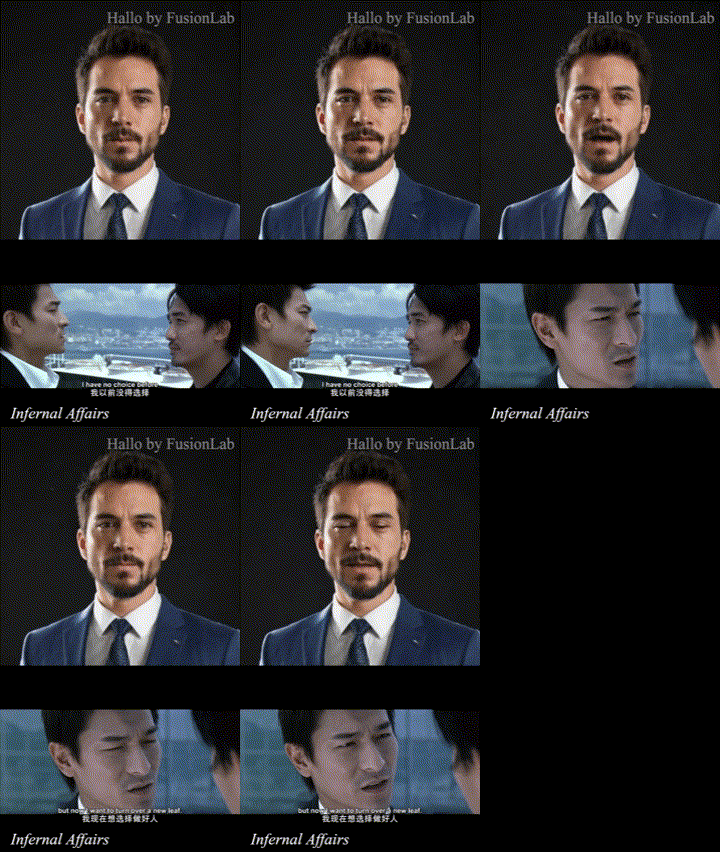
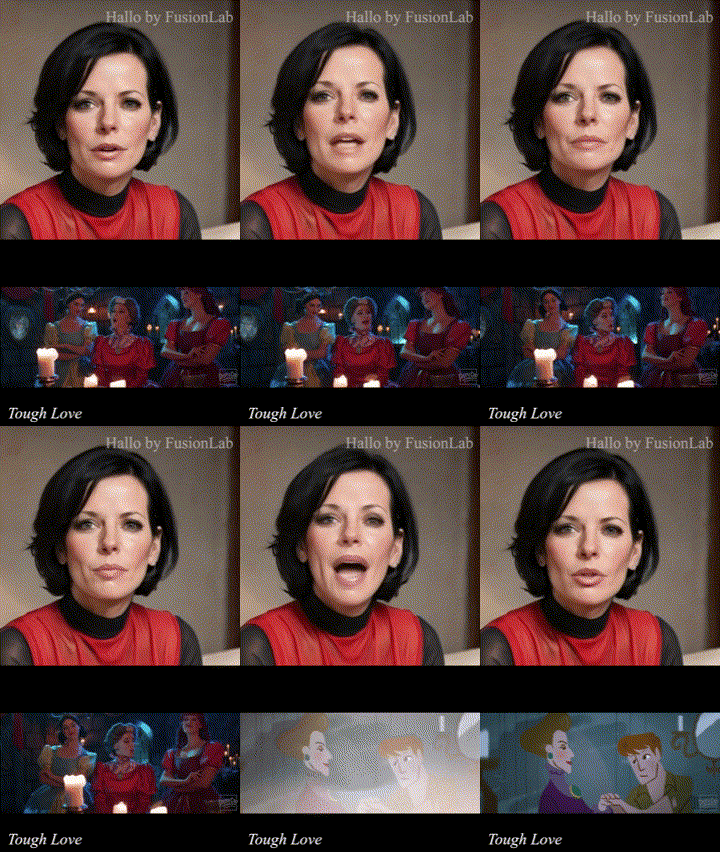
### 🎬 Honoring Classic Films
| Devil Wears Prada |
Green Book |
Infernal Affairs |
 |
 |
 |
| Patch Adams |
Tough Love |
Shawshank Redemption |
 |
 |
 |
Explore [more examples](https://fudan-generative-vision.github.io/hallo).
## 📰 News
- **`2024/06/28`**: 🎉🎉🎉 We are proud to announce the release of our model training code. Try your own training data. Here is [tutorial](#training).
- **`2024/06/21`**: 🚀🚀🚀 Cloned a Gradio demo on [🤗Huggingface space](https://huggingface.co/spaces/fudan-generative-ai/hallo).
- **`2024/06/20`**: 🌟🌟🌟 Received numerous contributions from the community, including a [Windows version](https://github.com/sdbds/hallo-for-windows), [ComfyUI](https://github.com/AIFSH/ComfyUI-Hallo), [WebUI](https://github.com/fudan-generative-vision/hallo/pull/51), and [Docker template](https://github.com/ashleykleynhans/hallo-docker).
- **`2024/06/15`**: ✨✨✨ Released some images and audios for inference testing on [🤗Huggingface](https://huggingface.co/datasets/fudan-generative-ai/hallo_inference_samples).
- **`2024/06/15`**: 🎉🎉🎉 Launched the first version on 🫡[GitHub](https://github.com/fudan-generative-vision/hallo).
## 🤝 Community Resources
Explore the resources developed by our community to enhance your experience with Hallo:
- [TTS x Hallo Talking Portrait Generator](https://huggingface.co/spaces/fffiloni/tts-hallo-talking-portrait) - Check out this awesome Gradio demo by [@Sylvain Filoni](https://huggingface.co/fffiloni)! With this tool, you can conveniently prepare portrait image and audio for Hallo.
- [Demo on Huggingface](https://huggingface.co/spaces/multimodalart/hallo) - Check out this easy-to-use Gradio demo by [@multimodalart](https://huggingface.co/multimodalart).
- [hallo-webui](https://github.com/daswer123/hallo-webui) - Explore the WebUI created by [@daswer123](https://github.com/daswer123).
- [hallo-for-windows](https://github.com/sdbds/hallo-for-windows) - Utilize Hallo on Windows with the guide by [@sdbds](https://github.com/sdbds).
- [ComfyUI-Hallo](https://github.com/AIFSH/ComfyUI-Hallo) - Integrate Hallo with the ComfyUI tool by [@AIFSH](https://github.com/AIFSH).
- [hallo-docker](https://github.com/ashleykleynhans/hallo-docker) - Docker image for Hallo by [@ashleykleynhans](https://github.com/ashleykleynhans).
- [RunPod Template](https://runpod.io/console/deploy?template=aeyibwyvzy&ref=2xxro4syy) - Deploy Hallo to RunPod by [@ashleykleynhans](https://github.com/ashleykleynhans).
- [JoyHallo](https://jdh-algo.github.io/JoyHallo/) - JoyHallo extends the capabilities of Hallo, enabling it to support Mandarin
Thanks to all of them.
Join our community and explore these amazing resources to make the most out of Hallo. Enjoy and elevate their creative projects!
## 🔧️ Framework


## ⚙️ Installation
- System requirement: Ubuntu 20.04/Ubuntu 22.04, Cuda 12.1
- Tested GPUs: A100
Create conda environment:
```bash
conda create -n hallo python=3.10
conda activate hallo
```
Install packages with `pip`
```bash
pip install -r requirements.txt
pip install .
```
Besides, ffmpeg is also needed:
```bash
apt-get install ffmpeg
```
## 🗝️️ Usage
The entry point for inference is `scripts/inference.py`. Before testing your cases, two preparations need to be completed:
1. [Download all required pretrained models](#download-pretrained-models).
2. [Prepare source image and driving audio pairs](#prepare-inference-data).
3. [Run inference](#run-inference).
### 📥 Download Pretrained Models
You can easily get all pretrained models required by inference from our [HuggingFace repo](https://huggingface.co/fudan-generative-ai/hallo).
Clone the pretrained models into `${PROJECT_ROOT}/pretrained_models` directory by cmd below:
```shell
git lfs install
git clone https://huggingface.co/fudan-generative-ai/hallo pretrained_models
```
Or you can download them separately from their source repo:
- [hallo](https://huggingface.co/fudan-generative-ai/hallo/tree/main/hallo): Our checkpoints consist of denoising UNet, face locator, image & audio proj.
- [audio_separator](https://huggingface.co/huangjackson/Kim_Vocal_2): Kim\_Vocal\_2 MDX-Net vocal removal model. (_Thanks to [KimberleyJensen](https://github.com/KimberleyJensen)_)
- [insightface](https://github.com/deepinsight/insightface/tree/master/python-package#model-zoo): 2D and 3D Face Analysis placed into `pretrained_models/face_analysis/models/`. (_Thanks to deepinsight_)
- [face landmarker](https://storage.googleapis.com/mediapipe-models/face_landmarker/face_landmarker/float16/1/face_landmarker.task): Face detection & mesh model from [mediapipe](https://ai.google.dev/edge/mediapipe/solutions/vision/face_landmarker#models) placed into `pretrained_models/face_analysis/models`.
- [motion module](https://github.com/guoyww/AnimateDiff/blob/main/README.md#202309-animatediff-v2): motion module from [AnimateDiff](https://github.com/guoyww/AnimateDiff). (_Thanks to [guoyww](https://github.com/guoyww)_).
- [sd-vae-ft-mse](https://huggingface.co/stabilityai/sd-vae-ft-mse): Weights are intended to be used with the diffusers library. (_Thanks to [stablilityai](https://huggingface.co/stabilityai)_)
- [StableDiffusion V1.5](https://huggingface.co/runwayml/stable-diffusion-v1-5): Initialized and fine-tuned from Stable-Diffusion-v1-2. (_Thanks to [runwayml](https://huggingface.co/runwayml)_)
- [wav2vec](https://huggingface.co/facebook/wav2vec2-base-960h): wav audio to vector model from [Facebook](https://huggingface.co/facebook/wav2vec2-base-960h).
Finally, these pretrained models should be organized as follows:
```text
./pretrained_models/
|-- audio_separator/
| |-- download_checks.json
| |-- mdx_model_data.json
| |-- vr_model_data.json
| `-- Kim_Vocal_2.onnx
|-- face_analysis/
| `-- models/
| |-- face_landmarker_v2_with_blendshapes.task # face landmarker model from mediapipe
| |-- 1k3d68.onnx
| |-- 2d106det.onnx
| |-- genderage.onnx
| |-- glintr100.onnx
| `-- scrfd_10g_bnkps.onnx
|-- motion_module/
| `-- mm_sd_v15_v2.ckpt
|-- sd-vae-ft-mse/
| |-- config.json
| `-- diffusion_pytorch_model.safetensors
|-- stable-diffusion-v1-5/
| `-- unet/
| |-- config.json
| `-- diffusion_pytorch_model.safetensors
`-- wav2vec/
`-- wav2vec2-base-960h/
|-- config.json
|-- feature_extractor_config.json
|-- model.safetensors
|-- preprocessor_config.json
|-- special_tokens_map.json
|-- tokenizer_config.json
`-- vocab.json
```
### 🛠️ Prepare Inference Data
Hallo has a few simple requirements for input data:
For the source image:
1. It should be cropped into squares.
2. The face should be the main focus, making up 50%-70% of the image.
3. The face should be facing forward, with a rotation angle of less than 30° (no side profiles).
For the driving audio:
1. It must be in WAV format.
2. It must be in English since our training datasets are only in this language.
3. Ensure the vocals are clear; background music is acceptable.
We have provided [some samples](examples/) for your reference.
### 🎮 Run Inference
Simply to run the `scripts/inference.py` and pass `source_image` and `driving_audio` as input:
```bash
python scripts/inference.py --source_image examples/reference_images/1.jpg --driving_audio examples/driving_audios/1.wav
```
Animation results will be saved as `${PROJECT_ROOT}/.cache/output.mp4` by default. You can pass `--output` to specify the output file name. You can find more examples for inference at [examples folder](https://github.com/fudan-generative-vision/hallo/tree/main/examples).
For more options:
```shell
usage: inference.py [-h] [-c CONFIG] [--source_image SOURCE_IMAGE] [--driving_audio DRIVING_AUDIO] [--output OUTPUT] [--pose_weight POSE_WEIGHT]
[--face_weight FACE_WEIGHT] [--lip_weight LIP_WEIGHT] [--face_expand_ratio FACE_EXPAND_RATIO]
options:
-h, --help show this help message and exit
-c CONFIG, --config CONFIG
--source_image SOURCE_IMAGE
source image
--driving_audio DRIVING_AUDIO
driving audio
--output OUTPUT output video file name
--pose_weight POSE_WEIGHT
weight of pose
--face_weight FACE_WEIGHT
weight of face
--lip_weight LIP_WEIGHT
weight of lip
--face_expand_ratio FACE_EXPAND_RATIO
face region
```
## Training
### Prepare Data for Training
The training data, which utilizes some talking-face videos similar to the source images used for inference, also needs to meet the following requirements:
1. It should be cropped into squares.
2. The face should be the main focus, making up 50%-70% of the image.
3. The face should be facing forward, with a rotation angle of less than 30° (no side profiles).
Organize your raw videos into the following directory structure:
```text
dataset_name/
|-- videos/
| |-- 0001.mp4
| |-- 0002.mp4
| |-- 0003.mp4
| `-- 0004.mp4
```
You can use any `dataset_name`, but ensure the `videos` directory is named as shown above.
Next, process the videos with the following commands:
```bash
python -m scripts.data_preprocess --input_dir dataset_name/videos --step 1
python -m scripts.data_preprocess --input_dir dataset_name/videos --step 2
```
**Note:** Execute steps 1 and 2 sequentially as they perform different tasks. Step 1 converts videos into frames, extracts audio from each video, and generates the necessary masks. Step 2 generates face embeddings using InsightFace and audio embeddings using Wav2Vec, and requires a GPU. For parallel processing, use the `-p` and `-r` arguments. The `-p` argument specifies the total number of instances to launch, dividing the data into `p` parts. The `-r` argument specifies which part the current process should handle. You need to manually launch multiple instances with different values for `-r`.
Generate the metadata JSON files with the following commands:
```bash
python scripts/extract_meta_info_stage1.py -r path/to/dataset -n dataset_name
python scripts/extract_meta_info_stage2.py -r path/to/dataset -n dataset_name
```
Replace `path/to/dataset` with the path to the parent directory of `videos`, such as `dataset_name` in the example above. This will generate `dataset_name_stage1.json` and `dataset_name_stage2.json` in the `./data` directory.
### Training
Update the data meta path settings in the configuration YAML files, `configs/train/stage1.yaml` and `configs/train/stage2.yaml`:
```yaml
#stage1.yaml
data:
meta_paths:
- ./data/dataset_name_stage1.json
#stage2.yaml
data:
meta_paths:
- ./data/dataset_name_stage2.json
```
Start training with the following command:
```shell
accelerate launch -m \
--config_file accelerate_config.yaml \
--machine_rank 0 \
--main_process_ip 0.0.0.0 \
--main_process_port 20055 \
--num_machines 1 \
--num_processes 8 \
scripts.train_stage1 --config ./configs/train/stage1.yaml
```
#### Accelerate Usage Explanation
The `accelerate launch` command is used to start the training process with distributed settings.
```shell
accelerate launch [arguments] {training_script} --{training_script-argument-1} --{training_script-argument-2} ...
```
**Arguments for Accelerate:**
- `-m, --module`: Interpret the launch script as a Python module.
- `--config_file`: Configuration file for Hugging Face Accelerate.
- `--machine_rank`: Rank of the current machine in a multi-node setup.
- `--main_process_ip`: IP address of the master node.
- `--main_process_port`: Port of the master node.
- `--num_machines`: Total number of nodes participating in the training.
- `--num_processes`: Total number of processes for training, matching the total number of GPUs across all machines.
**Arguments for Training:**
- `{training_script}`: The training script, such as `scripts.train_stage1` or `scripts.train_stage2`.
- `--{training_script-argument-1}`: Arguments specific to the training script. Our training scripts accept one argument, `--config`, to specify the training configuration file.
For multi-node training, you need to manually run the command with different `machine_rank` on each node separately.
For more settings, refer to the [Accelerate documentation](https://huggingface.co/docs/accelerate/en/index).
## 📅️ Roadmap
| Status | Milestone | ETA |
| :----: | :---------------------------------------------------------------------------------------------------- | :--------: |
| ✅ | **[Inference source code meet everyone on GitHub](https://github.com/fudan-generative-vision/hallo)** | 2024-06-15 |
| ✅ | **[Pretrained models on Huggingface](https://huggingface.co/fudan-generative-ai/hallo)** | 2024-06-15 |
| ✅ | **[Releasing data preparation and training scripts](#training)** | 2024-06-28 |
| 🚀 | **[Improving the model's performance on Mandarin Chinese]()** | TBD |
Other Enhancements
- [x] Enhancement: Test and ensure compatibility with Windows operating system. [#39](https://github.com/fudan-generative-vision/hallo/issues/39)
- [x] Bug: Output video may lose several frames. [#41](https://github.com/fudan-generative-vision/hallo/issues/41)
- [ ] Bug: Sound volume affecting inference results (audio normalization).
- [ ] ~~Enhancement: Inference code logic optimization~~. This solution doesn't show significant performance improvements. Trying other approaches.
## 📝 Citation
If you find our work useful for your research, please consider citing the paper:
```
@misc{xu2024hallo,
title={Hallo: Hierarchical Audio-Driven Visual Synthesis for Portrait Image Animation},
author={Mingwang Xu and Hui Li and Qingkun Su and Hanlin Shang and Liwei Zhang and Ce Liu and Jingdong Wang and Yao Yao and Siyu zhu},
year={2024},
eprint={2406.08801},
archivePrefix={arXiv},
primaryClass={cs.CV}
}
```
## 🌟 Opportunities Available
Multiple research positions are open at the **Generative Vision Lab, Fudan University**! Include:
- Research assistant
- Postdoctoral researcher
- PhD candidate
- Master students
Interested individuals are encouraged to contact us at [siyuzhu@fudan.edu.cn](mailto://siyuzhu@fudan.edu.cn) for further information.
## ⚠️ Social Risks and Mitigations
The development of portrait image animation technologies driven by audio inputs poses social risks, such as the ethical implications of creating realistic portraits that could be misused for deepfakes. To mitigate these risks, it is crucial to establish ethical guidelines and responsible use practices. Privacy and consent concerns also arise from using individuals' images and voices. Addressing these involves transparent data usage policies, informed consent, and safeguarding privacy rights. By addressing these risks and implementing mitigations, the research aims to ensure the responsible and ethical development of this technology.
## 🤗 Acknowledgements
We would like to thank the contributors to the [magic-animate](https://github.com/magic-research/magic-animate), [AnimateDiff](https://github.com/guoyww/AnimateDiff), [ultimatevocalremovergui](https://github.com/Anjok07/ultimatevocalremovergui), [AniPortrait](https://github.com/Zejun-Yang/AniPortrait) and [Moore-AnimateAnyone](https://github.com/MooreThreads/Moore-AnimateAnyone) repositories, for their open research and exploration.
If we missed any open-source projects or related articles, we would like to complement the acknowledgement of this specific work immediately.
## 👏 Community Contributors
Thank you to all the contributors who have helped to make this project better!
 ================================================
FILE: accelerate_config.yaml
================================================
compute_environment: LOCAL_MACHINE
debug: true
deepspeed_config:
deepspeed_multinode_launcher: standard
gradient_accumulation_steps: 1
offload_optimizer_device: none
offload_param_device: none
zero3_init_flag: false
zero_stage: 2
distributed_type: DEEPSPEED
downcast_bf16: "no"
main_training_function: main
mixed_precision: "fp16"
num_machines: 1
num_processes: 8
rdzv_backend: static
same_network: true
tpu_env: []
tpu_use_cluster: false
tpu_use_sudo: false
use_cpu: false
================================================
FILE: configs/inference/.gitkeep
================================================
================================================
FILE: configs/inference/default.yaml
================================================
source_image: examples/reference_images/1.jpg
driving_audio: examples/driving_audios/1.wav
weight_dtype: fp16
data:
n_motion_frames: 2
n_sample_frames: 16
source_image:
width: 512
height: 512
driving_audio:
sample_rate: 16000
export_video:
fps: 25
inference_steps: 40
cfg_scale: 3.5
audio_ckpt_dir: ./pretrained_models/hallo
base_model_path: ./pretrained_models/stable-diffusion-v1-5
motion_module_path: ./pretrained_models/motion_module/mm_sd_v15_v2.ckpt
face_analysis:
model_path: ./pretrained_models/face_analysis
wav2vec:
model_path: ./pretrained_models/wav2vec/wav2vec2-base-960h
features: all
audio_separator:
model_path: ./pretrained_models/audio_separator/Kim_Vocal_2.onnx
vae:
model_path: ./pretrained_models/sd-vae-ft-mse
save_path: ./.cache
face_expand_ratio: 1.2
pose_weight: 1.0
face_weight: 1.0
lip_weight: 1.0
unet_additional_kwargs:
use_inflated_groupnorm: true
unet_use_cross_frame_attention: false
unet_use_temporal_attention: false
use_motion_module: true
use_audio_module: true
motion_module_resolutions:
- 1
- 2
- 4
- 8
motion_module_mid_block: true
motion_module_decoder_only: false
motion_module_type: Vanilla
motion_module_kwargs:
num_attention_heads: 8
num_transformer_block: 1
attention_block_types:
- Temporal_Self
- Temporal_Self
temporal_position_encoding: true
temporal_position_encoding_max_len: 32
temporal_attention_dim_div: 1
audio_attention_dim: 768
stack_enable_blocks_name:
- "up"
- "down"
- "mid"
stack_enable_blocks_depth: [0,1,2,3]
enable_zero_snr: true
noise_scheduler_kwargs:
beta_start: 0.00085
beta_end: 0.012
beta_schedule: "linear"
clip_sample: false
steps_offset: 1
### Zero-SNR params
prediction_type: "v_prediction"
rescale_betas_zero_snr: True
timestep_spacing: "trailing"
sampler: DDIM
================================================
FILE: configs/train/stage1.yaml
================================================
data:
train_bs: 8
train_width: 512
train_height: 512
meta_paths:
- "./data/HDTF_meta.json"
# Margin of frame indexes between ref and tgt images
sample_margin: 30
solver:
gradient_accumulation_steps: 1
mixed_precision: "no"
enable_xformers_memory_efficient_attention: True
gradient_checkpointing: False
max_train_steps: 30000
max_grad_norm: 1.0
# lr
learning_rate: 1.0e-5
scale_lr: False
lr_warmup_steps: 1
lr_scheduler: "constant"
# optimizer
use_8bit_adam: False
adam_beta1: 0.9
adam_beta2: 0.999
adam_weight_decay: 1.0e-2
adam_epsilon: 1.0e-8
val:
validation_steps: 500
noise_scheduler_kwargs:
num_train_timesteps: 1000
beta_start: 0.00085
beta_end: 0.012
beta_schedule: "scaled_linear"
steps_offset: 1
clip_sample: false
base_model_path: "./pretrained_models/stable-diffusion-v1-5/"
vae_model_path: "./pretrained_models/sd-vae-ft-mse"
face_analysis_model_path: "./pretrained_models/face_analysis"
weight_dtype: "fp16" # [fp16, fp32]
uncond_ratio: 0.1
noise_offset: 0.05
snr_gamma: 5.0
enable_zero_snr: True
face_locator_pretrained: False
seed: 42
resume_from_checkpoint: "latest"
checkpointing_steps: 500
exp_name: "stage1"
output_dir: "./exp_output"
ref_image_paths:
- "examples/reference_images/1.jpg"
mask_image_paths:
- "examples/masks/1.png"
================================================
FILE: configs/train/stage2.yaml
================================================
data:
train_bs: 4
val_bs: 1
train_width: 512
train_height: 512
fps: 25
sample_rate: 16000
n_motion_frames: 2
n_sample_frames: 14
audio_margin: 2
train_meta_paths:
- "./data/hdtf_split_stage2.json"
wav2vec_config:
audio_type: "vocals" # audio vocals
model_scale: "base" # base large
features: "all" # last avg all
model_path: ./pretrained_models/wav2vec/wav2vec2-base-960h
audio_separator:
model_path: ./pretrained_models/audio_separator/Kim_Vocal_2.onnx
face_expand_ratio: 1.2
solver:
gradient_accumulation_steps: 1
mixed_precision: "no"
enable_xformers_memory_efficient_attention: True
gradient_checkpointing: True
max_train_steps: 30000
max_grad_norm: 1.0
# lr
learning_rate: 1e-5
scale_lr: False
lr_warmup_steps: 1
lr_scheduler: "constant"
# optimizer
use_8bit_adam: True
adam_beta1: 0.9
adam_beta2: 0.999
adam_weight_decay: 1.0e-2
adam_epsilon: 1.0e-8
val:
validation_steps: 1000
noise_scheduler_kwargs:
num_train_timesteps: 1000
beta_start: 0.00085
beta_end: 0.012
beta_schedule: "linear"
steps_offset: 1
clip_sample: false
unet_additional_kwargs:
use_inflated_groupnorm: true
unet_use_cross_frame_attention: false
unet_use_temporal_attention: false
use_motion_module: true
use_audio_module: true
motion_module_resolutions:
- 1
- 2
- 4
- 8
motion_module_mid_block: true
motion_module_decoder_only: false
motion_module_type: Vanilla
motion_module_kwargs:
num_attention_heads: 8
num_transformer_block: 1
attention_block_types:
- Temporal_Self
- Temporal_Self
temporal_position_encoding: true
temporal_position_encoding_max_len: 32
temporal_attention_dim_div: 1
audio_attention_dim: 768
stack_enable_blocks_name:
- "up"
- "down"
- "mid"
stack_enable_blocks_depth: [0,1,2,3]
trainable_para:
- audio_modules
- motion_modules
base_model_path: "./pretrained_models/stable-diffusion-v1-5/"
vae_model_path: "./pretrained_models/sd-vae-ft-mse"
face_analysis_model_path: "./pretrained_models/face_analysis"
mm_path: "./pretrained_models/motion_module/mm_sd_v15_v2.ckpt"
weight_dtype: "fp16" # [fp16, fp32]
uncond_img_ratio: 0.05
uncond_audio_ratio: 0.05
uncond_ia_ratio: 0.05
start_ratio: 0.05
noise_offset: 0.05
snr_gamma: 5.0
enable_zero_snr: True
stage1_ckpt_dir: "./exp_output/stage1/"
single_inference_times: 10
inference_steps: 40
cfg_scale: 3.5
seed: 42
resume_from_checkpoint: "latest"
checkpointing_steps: 500
exp_name: "stage2"
output_dir: "./exp_output"
ref_img_path:
- "examples/reference_images/1.jpg"
audio_path:
- "examples/driving_audios/1.wav"
================================================
FILE: configs/unet/unet.yaml
================================================
unet_additional_kwargs:
use_inflated_groupnorm: true
unet_use_cross_frame_attention: false
unet_use_temporal_attention: false
use_motion_module: true
use_audio_module: true
motion_module_resolutions:
- 1
- 2
- 4
- 8
motion_module_mid_block: true
motion_module_decoder_only: false
motion_module_type: Vanilla
motion_module_kwargs:
num_attention_heads: 8
num_transformer_block: 1
attention_block_types:
- Temporal_Self
- Temporal_Self
temporal_position_encoding: true
temporal_position_encoding_max_len: 32
temporal_attention_dim_div: 1
audio_attention_dim: 768
stack_enable_blocks_name:
- "up"
- "down"
- "mid"
stack_enable_blocks_depth: [0,1,2,3]
enable_zero_snr: true
noise_scheduler_kwargs:
beta_start: 0.00085
beta_end: 0.012
beta_schedule: "linear"
clip_sample: false
steps_offset: 1
### Zero-SNR params
prediction_type: "v_prediction"
rescale_betas_zero_snr: True
timestep_spacing: "trailing"
sampler: DDIM
================================================
FILE: hallo/__init__.py
================================================
================================================
FILE: hallo/animate/__init__.py
================================================
================================================
FILE: hallo/animate/face_animate.py
================================================
# pylint: disable=R0801
"""
This module is responsible for animating faces in videos using a combination of deep learning techniques.
It provides a pipeline for generating face animations by processing video frames and extracting face features.
The module utilizes various schedulers and utilities for efficient face animation and supports different types
of latents for more control over the animation process.
Functions and Classes:
- FaceAnimatePipeline: A class that extends the DiffusionPipeline class from the diffusers library to handle face animation tasks.
- __init__: Initializes the pipeline with the necessary components (VAE, UNets, face locator, etc.).
- prepare_latents: Generates or loads latents for the animation process, scaling them according to the scheduler's requirements.
- prepare_extra_step_kwargs: Prepares extra keyword arguments for the scheduler step, ensuring compatibility with different schedulers.
- decode_latents: Decodes the latents into video frames, ready for animation.
Usage:
- Import the necessary packages and classes.
- Create a FaceAnimatePipeline instance with the required components.
- Prepare the latents for the animation process.
- Use the pipeline to generate the animated video.
Note:
- This module is designed to work with the diffusers library, which provides the underlying framework for face animation using deep learning.
- The module is intended for research and development purposes, and further optimization and customization may be required for specific use cases.
"""
import inspect
from dataclasses import dataclass
from typing import Callable, List, Optional, Union
import numpy as np
import torch
from diffusers import (DDIMScheduler, DiffusionPipeline,
DPMSolverMultistepScheduler,
EulerAncestralDiscreteScheduler, EulerDiscreteScheduler,
LMSDiscreteScheduler, PNDMScheduler)
from diffusers.image_processor import VaeImageProcessor
from diffusers.utils import BaseOutput
from diffusers.utils.torch_utils import randn_tensor
from einops import rearrange, repeat
from tqdm import tqdm
from hallo.models.mutual_self_attention import ReferenceAttentionControl
@dataclass
class FaceAnimatePipelineOutput(BaseOutput):
"""
FaceAnimatePipelineOutput is a custom class that inherits from BaseOutput and represents the output of the FaceAnimatePipeline.
Attributes:
videos (Union[torch.Tensor, np.ndarray]): A tensor or numpy array containing the generated video frames.
Methods:
__init__(self, videos: Union[torch.Tensor, np.ndarray]): Initializes the FaceAnimatePipelineOutput object with the generated video frames.
"""
videos: Union[torch.Tensor, np.ndarray]
class FaceAnimatePipeline(DiffusionPipeline):
"""
FaceAnimatePipeline is a custom DiffusionPipeline for animating faces.
It inherits from the DiffusionPipeline class and is used to animate faces by
utilizing a variational autoencoder (VAE), a reference UNet, a denoising UNet,
a face locator, and an image processor. The pipeline is responsible for generating
and animating face latents, and decoding the latents to produce the final video output.
Attributes:
vae (VaeImageProcessor): Variational autoencoder for processing images.
reference_unet (nn.Module): Reference UNet for mutual self-attention.
denoising_unet (nn.Module): Denoising UNet for image denoising.
face_locator (nn.Module): Face locator for detecting and cropping faces.
image_proj (nn.Module): Image projector for processing images.
scheduler (Union[DDIMScheduler, PNDMScheduler, LMSDiscreteScheduler,
EulerDiscreteScheduler, EulerAncestralDiscreteScheduler,
DPMSolverMultistepScheduler]): Diffusion scheduler for
controlling the noise level.
Methods:
__init__(self, vae, reference_unet, denoising_unet, face_locator,
image_proj, scheduler): Initializes the FaceAnimatePipeline
with the given components and scheduler.
prepare_latents(self, batch_size, num_channels_latents, width, height,
video_length, dtype, device, generator=None, latents=None):
Prepares the initial latents for video generation.
prepare_extra_step_kwargs(self, generator, eta): Prepares extra keyword
arguments for the scheduler step.
decode_latents(self, latents): Decodes the latents to produce the final
video output.
"""
def __init__(
self,
vae,
reference_unet,
denoising_unet,
face_locator,
image_proj,
scheduler: Union[
DDIMScheduler,
PNDMScheduler,
LMSDiscreteScheduler,
EulerDiscreteScheduler,
EulerAncestralDiscreteScheduler,
DPMSolverMultistepScheduler,
],
) -> None:
super().__init__()
self.register_modules(
vae=vae,
reference_unet=reference_unet,
denoising_unet=denoising_unet,
face_locator=face_locator,
scheduler=scheduler,
image_proj=image_proj,
)
self.vae_scale_factor: int = 2 ** (len(self.vae.config.block_out_channels) - 1)
self.ref_image_processor = VaeImageProcessor(
vae_scale_factor=self.vae_scale_factor, do_convert_rgb=True,
)
@property
def _execution_device(self):
if self.device != torch.device("meta") or not hasattr(self.unet, "_hf_hook"):
return self.device
for module in self.unet.modules():
if (
hasattr(module, "_hf_hook")
and hasattr(module._hf_hook, "execution_device")
and module._hf_hook.execution_device is not None
):
return torch.device(module._hf_hook.execution_device)
return self.device
def prepare_latents(
self,
batch_size: int, # Number of videos to generate in parallel
num_channels_latents: int, # Number of channels in the latents
width: int, # Width of the video frame
height: int, # Height of the video frame
video_length: int, # Length of the video in frames
dtype: torch.dtype, # Data type of the latents
device: torch.device, # Device to store the latents on
generator: Optional[torch.Generator] = None, # Random number generator for reproducibility
latents: Optional[torch.Tensor] = None # Pre-generated latents (optional)
):
"""
Prepares the initial latents for video generation.
Args:
batch_size (int): Number of videos to generate in parallel.
num_channels_latents (int): Number of channels in the latents.
width (int): Width of the video frame.
height (int): Height of the video frame.
video_length (int): Length of the video in frames.
dtype (torch.dtype): Data type of the latents.
device (torch.device): Device to store the latents on.
generator (Optional[torch.Generator]): Random number generator for reproducibility.
latents (Optional[torch.Tensor]): Pre-generated latents (optional).
Returns:
latents (torch.Tensor): Tensor of shape (batch_size, num_channels_latents, width, height)
containing the initial latents for video generation.
"""
shape = (
batch_size,
num_channels_latents,
video_length,
height // self.vae_scale_factor,
width // self.vae_scale_factor,
)
if isinstance(generator, list) and len(generator) != batch_size:
raise ValueError(
f"You have passed a list of generators of length {len(generator)}, but requested an effective batch"
f" size of {batch_size}. Make sure the batch size matches the length of the generators."
)
if latents is None:
latents = randn_tensor(
shape, generator=generator, device=device, dtype=dtype
)
else:
latents = latents.to(device)
# scale the initial noise by the standard deviation required by the scheduler
latents = latents * self.scheduler.init_noise_sigma
return latents
def prepare_extra_step_kwargs(self, generator, eta):
"""
Prepares extra keyword arguments for the scheduler step.
Args:
generator (Optional[torch.Generator]): Random number generator for reproducibility.
eta (float): The eta (η) parameter used with the DDIMScheduler.
It corresponds to η in the DDIM paper (https://arxiv.org/abs/2010.02502) and should be between [0, 1].
Returns:
dict: A dictionary containing the extra keyword arguments for the scheduler step.
"""
# prepare extra kwargs for the scheduler step, since not all schedulers have the same signature
# eta (η) is only used with the DDIMScheduler, it will be ignored for other schedulers.
# eta corresponds to η in DDIM paper: https://arxiv.org/abs/2010.02502
# and should be between [0, 1]
accepts_eta = "eta" in set(
inspect.signature(self.scheduler.step).parameters.keys()
)
extra_step_kwargs = {}
if accepts_eta:
extra_step_kwargs["eta"] = eta
# check if the scheduler accepts generator
accepts_generator = "generator" in set(
inspect.signature(self.scheduler.step).parameters.keys()
)
if accepts_generator:
extra_step_kwargs["generator"] = generator
return extra_step_kwargs
def decode_latents(self, latents):
"""
Decode the latents to produce a video.
Parameters:
latents (torch.Tensor): The latents to be decoded.
Returns:
video (torch.Tensor): The decoded video.
video_length (int): The length of the video in frames.
"""
video_length = latents.shape[2]
latents = 1 / 0.18215 * latents
latents = rearrange(latents, "b c f h w -> (b f) c h w")
# video = self.vae.decode(latents).sample
video = []
for frame_idx in tqdm(range(latents.shape[0])):
video.append(self.vae.decode(
latents[frame_idx: frame_idx + 1]).sample)
video = torch.cat(video)
video = rearrange(video, "(b f) c h w -> b c f h w", f=video_length)
video = (video / 2 + 0.5).clamp(0, 1)
# we always cast to float32 as this does not cause significant overhead and is compatible with bfloa16
video = video.cpu().float().numpy()
return video
@torch.no_grad()
def __call__(
self,
ref_image,
face_emb,
audio_tensor,
face_mask,
pixel_values_full_mask,
pixel_values_face_mask,
pixel_values_lip_mask,
width,
height,
video_length,
num_inference_steps,
guidance_scale,
num_images_per_prompt=1,
eta: float = 0.0,
motion_scale: Optional[List[torch.Tensor]] = None,
generator: Optional[Union[torch.Generator,
List[torch.Generator]]] = None,
output_type: Optional[str] = "tensor",
return_dict: bool = True,
callback: Optional[Callable[[
int, int, torch.FloatTensor], None]] = None,
callback_steps: Optional[int] = 1,
**kwargs,
):
# Default height and width to unet
height = height or self.unet.config.sample_size * self.vae_scale_factor
width = width or self.unet.config.sample_size * self.vae_scale_factor
device = self._execution_device
do_classifier_free_guidance = guidance_scale > 1.0
# Prepare timesteps
self.scheduler.set_timesteps(num_inference_steps, device=device)
timesteps = self.scheduler.timesteps
batch_size = 1
# prepare clip image embeddings
clip_image_embeds = face_emb
clip_image_embeds = clip_image_embeds.to(self.image_proj.device, self.image_proj.dtype)
encoder_hidden_states = self.image_proj(clip_image_embeds)
uncond_encoder_hidden_states = self.image_proj(torch.zeros_like(clip_image_embeds))
if do_classifier_free_guidance:
encoder_hidden_states = torch.cat([uncond_encoder_hidden_states, encoder_hidden_states], dim=0)
reference_control_writer = ReferenceAttentionControl(
self.reference_unet,
do_classifier_free_guidance=do_classifier_free_guidance,
mode="write",
batch_size=batch_size,
fusion_blocks="full",
)
reference_control_reader = ReferenceAttentionControl(
self.denoising_unet,
do_classifier_free_guidance=do_classifier_free_guidance,
mode="read",
batch_size=batch_size,
fusion_blocks="full",
)
num_channels_latents = self.denoising_unet.in_channels
latents = self.prepare_latents(
batch_size * num_images_per_prompt,
num_channels_latents,
width,
height,
video_length,
clip_image_embeds.dtype,
device,
generator,
)
# Prepare extra step kwargs.
extra_step_kwargs = self.prepare_extra_step_kwargs(generator, eta)
# Prepare ref image latents
ref_image_tensor = rearrange(ref_image, "b f c h w -> (b f) c h w")
ref_image_tensor = self.ref_image_processor.preprocess(ref_image_tensor, height=height, width=width) # (bs, c, width, height)
ref_image_tensor = ref_image_tensor.to(dtype=self.vae.dtype, device=self.vae.device)
ref_image_latents = self.vae.encode(ref_image_tensor).latent_dist.mean
ref_image_latents = ref_image_latents * 0.18215 # (b, 4, h, w)
face_mask = face_mask.unsqueeze(1).to(dtype=self.face_locator.dtype, device=self.face_locator.device) # (bs, f, c, H, W)
face_mask = repeat(face_mask, "b f c h w -> b (repeat f) c h w", repeat=video_length)
face_mask = face_mask.transpose(1, 2) # (bs, c, f, H, W)
face_mask = self.face_locator(face_mask)
face_mask = torch.cat([torch.zeros_like(face_mask), face_mask], dim=0) if do_classifier_free_guidance else face_mask
pixel_values_full_mask = (
[torch.cat([mask] * 2) for mask in pixel_values_full_mask]
if do_classifier_free_guidance
else pixel_values_full_mask
)
pixel_values_face_mask = (
[torch.cat([mask] * 2) for mask in pixel_values_face_mask]
if do_classifier_free_guidance
else pixel_values_face_mask
)
pixel_values_lip_mask = (
[torch.cat([mask] * 2) for mask in pixel_values_lip_mask]
if do_classifier_free_guidance
else pixel_values_lip_mask
)
pixel_values_face_mask_ = []
for mask in pixel_values_face_mask:
pixel_values_face_mask_.append(
mask.to(device=self.denoising_unet.device, dtype=self.denoising_unet.dtype))
pixel_values_face_mask = pixel_values_face_mask_
pixel_values_lip_mask_ = []
for mask in pixel_values_lip_mask:
pixel_values_lip_mask_.append(
mask.to(device=self.denoising_unet.device, dtype=self.denoising_unet.dtype))
pixel_values_lip_mask = pixel_values_lip_mask_
pixel_values_full_mask_ = []
for mask in pixel_values_full_mask:
pixel_values_full_mask_.append(
mask.to(device=self.denoising_unet.device, dtype=self.denoising_unet.dtype))
pixel_values_full_mask = pixel_values_full_mask_
uncond_audio_tensor = torch.zeros_like(audio_tensor)
audio_tensor = torch.cat([uncond_audio_tensor, audio_tensor], dim=0)
audio_tensor = audio_tensor.to(dtype=self.denoising_unet.dtype, device=self.denoising_unet.device)
# denoising loop
num_warmup_steps = len(timesteps) - num_inference_steps * self.scheduler.order
with self.progress_bar(total=num_inference_steps) as progress_bar:
for i, t in enumerate(timesteps):
# Forward reference image
if i == 0:
self.reference_unet(
ref_image_latents.repeat(
(2 if do_classifier_free_guidance else 1), 1, 1, 1
),
torch.zeros_like(t),
encoder_hidden_states=encoder_hidden_states,
return_dict=False,
)
reference_control_reader.update(reference_control_writer)
# expand the latents if we are doing classifier free guidance
latent_model_input = torch.cat([latents] * 2) if do_classifier_free_guidance else latents
latent_model_input = self.scheduler.scale_model_input(latent_model_input, t)
noise_pred = self.denoising_unet(
latent_model_input,
t,
encoder_hidden_states=encoder_hidden_states,
mask_cond_fea=face_mask,
full_mask=pixel_values_full_mask,
face_mask=pixel_values_face_mask,
lip_mask=pixel_values_lip_mask,
audio_embedding=audio_tensor,
motion_scale=motion_scale,
return_dict=False,
)[0]
# perform guidance
if do_classifier_free_guidance:
noise_pred_uncond, noise_pred_text = noise_pred.chunk(2)
noise_pred = noise_pred_uncond + guidance_scale * (noise_pred_text - noise_pred_uncond)
# compute the previous noisy sample x_t -> x_t-1
latents = self.scheduler.step(noise_pred, t, latents, **extra_step_kwargs, return_dict=False)[0]
# call the callback, if provided
if i == len(timesteps) - 1 or (i + 1) > num_warmup_steps and (i + 1) % self.scheduler.order == 0:
progress_bar.update()
if callback is not None and i % callback_steps == 0:
step_idx = i // getattr(self.scheduler, "order", 1)
callback(step_idx, t, latents)
reference_control_reader.clear()
reference_control_writer.clear()
# Post-processing
images = self.decode_latents(latents) # (b, c, f, h, w)
# Convert to tensor
if output_type == "tensor":
images = torch.from_numpy(images)
if not return_dict:
return images
return FaceAnimatePipelineOutput(videos=images)
================================================
FILE: hallo/animate/face_animate_static.py
================================================
# pylint: disable=R0801
"""
This module is responsible for handling the animation of faces using a combination of deep learning models and image processing techniques.
It provides a pipeline to generate realistic face animations by incorporating user-provided conditions such as facial expressions and environments.
The module utilizes various schedulers and utilities to optimize the animation process and ensure efficient performance.
Functions and Classes:
- StaticPipelineOutput: A class that represents the output of the animation pipeline, c
ontaining properties and methods related to the generated images.
- prepare_latents: A function that prepares the initial noise for the animation process,
scaling it according to the scheduler's requirements.
- prepare_condition: A function that processes the user-provided conditions
(e.g., facial expressions) and prepares them for use in the animation pipeline.
- decode_latents: A function that decodes the latent representations of the face animations into
their corresponding image formats.
- prepare_extra_step_kwargs: A function that prepares additional parameters for each step of
the animation process, such as the generator and eta values.
Dependencies:
- numpy: A library for numerical computing.
- torch: A machine learning library based on PyTorch.
- diffusers: A library for image-to-image diffusion models.
- transformers: A library for pre-trained transformer models.
Usage:
- To create an instance of the animation pipeline, provide the necessary components such as
the VAE, reference UNET, denoising UNET, face locator, and image processor.
- Use the pipeline's methods to prepare the latents, conditions, and extra step arguments as
required for the animation process.
- Generate the face animations by decoding the latents and processing the conditions.
Note:
- The module is designed to work with the diffusers library, which is based on
the paper "Diffusion Models for Image-to-Image Translation" (https://arxiv.org/abs/2102.02765).
- The face animations generated by this module should be used for entertainment purposes
only and should respect the rights and privacy of the individuals involved.
"""
import inspect
from dataclasses import dataclass
from typing import Callable, List, Optional, Union
import numpy as np
import torch
from diffusers import DiffusionPipeline
from diffusers.image_processor import VaeImageProcessor
from diffusers.schedulers import (DDIMScheduler, DPMSolverMultistepScheduler,
EulerAncestralDiscreteScheduler,
EulerDiscreteScheduler, LMSDiscreteScheduler,
PNDMScheduler)
from diffusers.utils import BaseOutput, is_accelerate_available
from diffusers.utils.torch_utils import randn_tensor
from einops import rearrange
from tqdm import tqdm
from transformers import CLIPImageProcessor
from hallo.models.mutual_self_attention import ReferenceAttentionControl
if is_accelerate_available():
from accelerate import cpu_offload
else:
raise ImportError("Please install accelerate via `pip install accelerate`")
@dataclass
class StaticPipelineOutput(BaseOutput):
"""
StaticPipelineOutput is a class that represents the output of the static pipeline.
It contains the images generated by the pipeline as a union of torch.Tensor and np.ndarray.
Attributes:
images (Union[torch.Tensor, np.ndarray]): The generated images.
"""
images: Union[torch.Tensor, np.ndarray]
class StaticPipeline(DiffusionPipeline):
"""
StaticPipelineOutput is a class that represents the output of the static pipeline.
It contains the images generated by the pipeline as a union of torch.Tensor and np.ndarray.
Attributes:
images (Union[torch.Tensor, np.ndarray]): The generated images.
"""
_optional_components = []
def __init__(
self,
vae,
reference_unet,
denoising_unet,
face_locator,
imageproj,
scheduler: Union[
DDIMScheduler,
PNDMScheduler,
LMSDiscreteScheduler,
EulerDiscreteScheduler,
EulerAncestralDiscreteScheduler,
DPMSolverMultistepScheduler,
],
):
super().__init__()
self.register_modules(
vae=vae,
reference_unet=reference_unet,
denoising_unet=denoising_unet,
face_locator=face_locator,
scheduler=scheduler,
imageproj=imageproj,
)
self.vae_scale_factor = 2 ** (
len(self.vae.config.block_out_channels) - 1)
self.clip_image_processor = CLIPImageProcessor()
self.ref_image_processor = VaeImageProcessor(
vae_scale_factor=self.vae_scale_factor, do_convert_rgb=True
)
self.cond_image_processor = VaeImageProcessor(
vae_scale_factor=self.vae_scale_factor,
do_convert_rgb=True,
do_normalize=False,
)
def enable_vae_slicing(self):
"""
Enable VAE slicing.
This method enables slicing for the VAE model, which can help improve the performance of decoding latents when working with large images.
"""
self.vae.enable_slicing()
def disable_vae_slicing(self):
"""
Disable vae slicing.
This function disables the vae slicing for the StaticPipeline object.
It calls the `disable_slicing()` method of the vae model.
This is useful when you want to use the entire vae model for decoding latents
instead of slicing it for better performance.
"""
self.vae.disable_slicing()
def enable_sequential_cpu_offload(self, gpu_id=0):
"""
Offloads selected models to the GPU for increased performance.
Args:
gpu_id (int, optional): The ID of the GPU to offload models to. Defaults to 0.
"""
device = torch.device(f"cuda:{gpu_id}")
for cpu_offloaded_model in [self.unet, self.text_encoder, self.vae]:
if cpu_offloaded_model is not None:
cpu_offload(cpu_offloaded_model, device)
@property
def _execution_device(self):
if self.device != torch.device("meta") or not hasattr(self.unet, "_hf_hook"):
return self.device
for module in self.unet.modules():
if (
hasattr(module, "_hf_hook")
and hasattr(module._hf_hook, "execution_device")
and module._hf_hook.execution_device is not None
):
return torch.device(module._hf_hook.execution_device)
return self.device
def decode_latents(self, latents):
"""
Decode the given latents to video frames.
Parameters:
latents (torch.Tensor): The latents to be decoded. Shape: (batch_size, num_channels_latents, video_length, height, width).
Returns:
video (torch.Tensor): The decoded video frames. Shape: (batch_size, num_channels_latents, video_length, height, width).
"""
video_length = latents.shape[2]
latents = 1 / 0.18215 * latents
latents = rearrange(latents, "b c f h w -> (b f) c h w")
# video = self.vae.decode(latents).sample
video = []
for frame_idx in tqdm(range(latents.shape[0])):
video.append(self.vae.decode(
latents[frame_idx: frame_idx + 1]).sample)
video = torch.cat(video)
video = rearrange(video, "(b f) c h w -> b c f h w", f=video_length)
video = (video / 2 + 0.5).clamp(0, 1)
# we always cast to float32 as this does not cause significant overhead and is compatible with bfloa16
video = video.cpu().float().numpy()
return video
def prepare_extra_step_kwargs(self, generator, eta):
"""
Prepare extra keyword arguments for the scheduler step.
Since not all schedulers have the same signature, this function helps to create a consistent interface for the scheduler.
Args:
generator (Optional[torch.Generator]): A random number generator for reproducibility.
eta (float): The eta parameter used with the DDIMScheduler. It should be between 0 and 1.
Returns:
dict: A dictionary containing the extra keyword arguments for the scheduler step.
"""
# eta (η) is only used with the DDIMScheduler, it will be ignored for other schedulers.
# eta corresponds to η in DDIM paper: https://arxiv.org/abs/2010.02502
# and should be between [0, 1]
accepts_eta = "eta" in set(
inspect.signature(self.scheduler.step).parameters.keys()
)
extra_step_kwargs = {}
if accepts_eta:
extra_step_kwargs["eta"] = eta
# check if the scheduler accepts generator
accepts_generator = "generator" in set(
inspect.signature(self.scheduler.step).parameters.keys()
)
if accepts_generator:
extra_step_kwargs["generator"] = generator
return extra_step_kwargs
def prepare_latents(
self,
batch_size,
num_channels_latents,
width,
height,
dtype,
device,
generator,
latents=None,
):
"""
Prepares the initial latents for the diffusion pipeline.
Args:
batch_size (int): The number of images to generate in one forward pass.
num_channels_latents (int): The number of channels in the latents tensor.
width (int): The width of the latents tensor.
height (int): The height of the latents tensor.
dtype (torch.dtype): The data type of the latents tensor.
device (torch.device): The device to place the latents tensor on.
generator (Optional[torch.Generator], optional): A random number generator
for reproducibility. Defaults to None.
latents (Optional[torch.Tensor], optional): Pre-computed latents to use as
initial conditions for the diffusion process. Defaults to None.
Returns:
torch.Tensor: The prepared latents tensor.
"""
shape = (
batch_size,
num_channels_latents,
height // self.vae_scale_factor,
width // self.vae_scale_factor,
)
if isinstance(generator, list) and len(generator) != batch_size:
raise ValueError(
f"You have passed a list of generators of length {len(generator)}, but requested an effective batch"
f" size of {batch_size}. Make sure the batch size matches the length of the generators."
)
if latents is None:
latents = randn_tensor(
shape, generator=generator, device=device, dtype=dtype
)
else:
latents = latents.to(device)
# scale the initial noise by the standard deviation required by the scheduler
latents = latents * self.scheduler.init_noise_sigma
return latents
def prepare_condition(
self,
cond_image,
width,
height,
device,
dtype,
do_classififer_free_guidance=False,
):
"""
Prepares the condition for the face animation pipeline.
Args:
cond_image (torch.Tensor): The conditional image tensor.
width (int): The width of the output image.
height (int): The height of the output image.
device (torch.device): The device to run the pipeline on.
dtype (torch.dtype): The data type of the tensor.
do_classififer_free_guidance (bool, optional): Whether to use classifier-free guidance or not. Defaults to False.
Returns:
Tuple[torch.Tensor, torch.Tensor]: A tuple of processed condition and mask tensors.
"""
image = self.cond_image_processor.preprocess(
cond_image, height=height, width=width
).to(dtype=torch.float32)
image = image.to(device=device, dtype=dtype)
if do_classififer_free_guidance:
image = torch.cat([image] * 2)
return image
@torch.no_grad()
def __call__(
self,
ref_image,
face_mask,
width,
height,
num_inference_steps,
guidance_scale,
face_embedding,
num_images_per_prompt=1,
eta: float = 0.0,
generator: Optional[Union[torch.Generator,
List[torch.Generator]]] = None,
output_type: Optional[str] = "tensor",
return_dict: bool = True,
callback: Optional[Callable[[
int, int, torch.FloatTensor], None]] = None,
callback_steps: Optional[int] = 1,
**kwargs,
):
# Default height and width to unet
height = height or self.unet.config.sample_size * self.vae_scale_factor
width = width or self.unet.config.sample_size * self.vae_scale_factor
device = self._execution_device
do_classifier_free_guidance = guidance_scale > 1.0
# Prepare timesteps
self.scheduler.set_timesteps(num_inference_steps, device=device)
timesteps = self.scheduler.timesteps
batch_size = 1
image_prompt_embeds = self.imageproj(face_embedding)
uncond_image_prompt_embeds = self.imageproj(
torch.zeros_like(face_embedding))
if do_classifier_free_guidance:
image_prompt_embeds = torch.cat(
[uncond_image_prompt_embeds, image_prompt_embeds], dim=0
)
reference_control_writer = ReferenceAttentionControl(
self.reference_unet,
do_classifier_free_guidance=do_classifier_free_guidance,
mode="write",
batch_size=batch_size,
fusion_blocks="full",
)
reference_control_reader = ReferenceAttentionControl(
self.denoising_unet,
do_classifier_free_guidance=do_classifier_free_guidance,
mode="read",
batch_size=batch_size,
fusion_blocks="full",
)
num_channels_latents = self.denoising_unet.in_channels
latents = self.prepare_latents(
batch_size * num_images_per_prompt,
num_channels_latents,
width,
height,
face_embedding.dtype,
device,
generator,
)
latents = latents.unsqueeze(2) # (bs, c, 1, h', w')
# latents_dtype = latents.dtype
# Prepare extra step kwargs.
extra_step_kwargs = self.prepare_extra_step_kwargs(generator, eta)
# Prepare ref image latents
ref_image_tensor = self.ref_image_processor.preprocess(
ref_image, height=height, width=width
) # (bs, c, width, height)
ref_image_tensor = ref_image_tensor.to(
dtype=self.vae.dtype, device=self.vae.device
)
ref_image_latents = self.vae.encode(ref_image_tensor).latent_dist.mean
ref_image_latents = ref_image_latents * 0.18215 # (b, 4, h, w)
# Prepare face mask image
face_mask_tensor = self.cond_image_processor.preprocess(
face_mask, height=height, width=width
)
face_mask_tensor = face_mask_tensor.unsqueeze(2) # (bs, c, 1, h, w)
face_mask_tensor = face_mask_tensor.to(
device=device, dtype=self.face_locator.dtype
)
mask_fea = self.face_locator(face_mask_tensor)
mask_fea = (
torch.cat(
[mask_fea] * 2) if do_classifier_free_guidance else mask_fea
)
# denoising loop
num_warmup_steps = len(timesteps) - \
num_inference_steps * self.scheduler.order
with self.progress_bar(total=num_inference_steps) as progress_bar:
for i, t in enumerate(timesteps):
# 1. Forward reference image
if i == 0:
self.reference_unet(
ref_image_latents.repeat(
(2 if do_classifier_free_guidance else 1), 1, 1, 1
),
torch.zeros_like(t),
encoder_hidden_states=image_prompt_embeds,
return_dict=False,
)
# 2. Update reference unet feature into denosing net
reference_control_reader.update(reference_control_writer)
# 3.1 expand the latents if we are doing classifier free guidance
latent_model_input = (
torch.cat(
[latents] * 2) if do_classifier_free_guidance else latents
)
latent_model_input = self.scheduler.scale_model_input(
latent_model_input, t
)
noise_pred = self.denoising_unet(
latent_model_input,
t,
encoder_hidden_states=image_prompt_embeds,
mask_cond_fea=mask_fea,
return_dict=False,
)[0]
# perform guidance
if do_classifier_free_guidance:
noise_pred_uncond, noise_pred_text = noise_pred.chunk(2)
noise_pred = noise_pred_uncond + guidance_scale * (
noise_pred_text - noise_pred_uncond
)
# compute the previous noisy sample x_t -> x_t-1
latents = self.scheduler.step(
noise_pred, t, latents, **extra_step_kwargs, return_dict=False
)[0]
# call the callback, if provided
if i == len(timesteps) - 1 or (
(i + 1) > num_warmup_steps and (i +
1) % self.scheduler.order == 0
):
progress_bar.update()
if callback is not None and i % callback_steps == 0:
step_idx = i // getattr(self.scheduler, "order", 1)
callback(step_idx, t, latents)
reference_control_reader.clear()
reference_control_writer.clear()
# Post-processing
image = self.decode_latents(latents) # (b, c, 1, h, w)
# Convert to tensor
if output_type == "tensor":
image = torch.from_numpy(image)
if not return_dict:
return image
return StaticPipelineOutput(images=image)
================================================
FILE: hallo/datasets/__init__.py
================================================
================================================
FILE: hallo/datasets/audio_processor.py
================================================
# pylint: disable=C0301
'''
This module contains the AudioProcessor class and related functions for processing audio data.
It utilizes various libraries and models to perform tasks such as preprocessing, feature extraction,
and audio separation. The class is initialized with configuration parameters and can process
audio files using the provided models.
'''
import math
import os
import librosa
import numpy as np
import torch
from audio_separator.separator import Separator
from einops import rearrange
from transformers import Wav2Vec2FeatureExtractor
from hallo.models.wav2vec import Wav2VecModel
from hallo.utils.util import resample_audio
class AudioProcessor:
"""
AudioProcessor is a class that handles the processing of audio files.
It takes care of preprocessing the audio files, extracting features
using wav2vec models, and separating audio signals if needed.
:param sample_rate: Sampling rate of the audio file
:param fps: Frames per second for the extracted features
:param wav2vec_model_path: Path to the wav2vec model
:param only_last_features: Whether to only use the last features
:param audio_separator_model_path: Path to the audio separator model
:param audio_separator_model_name: Name of the audio separator model
:param cache_dir: Directory to cache the intermediate results
:param device: Device to run the processing on
"""
def __init__(
self,
sample_rate,
fps,
wav2vec_model_path,
only_last_features,
audio_separator_model_path:str=None,
audio_separator_model_name:str=None,
cache_dir:str='',
device="cuda:0",
) -> None:
self.sample_rate = sample_rate
self.fps = fps
self.device = device
self.audio_encoder = Wav2VecModel.from_pretrained(wav2vec_model_path, local_files_only=True).to(device=device)
self.audio_encoder.feature_extractor._freeze_parameters()
self.only_last_features = only_last_features
if audio_separator_model_name is not None:
try:
os.makedirs(cache_dir, exist_ok=True)
except OSError as _:
print("Fail to create the output cache dir.")
self.audio_separator = Separator(
output_dir=cache_dir,
output_single_stem="vocals",
model_file_dir=audio_separator_model_path,
)
self.audio_separator.load_model(audio_separator_model_name)
assert self.audio_separator.model_instance is not None, "Fail to load audio separate model."
else:
self.audio_separator=None
print("Use audio directly without vocals seperator.")
self.wav2vec_feature_extractor = Wav2Vec2FeatureExtractor.from_pretrained(wav2vec_model_path, local_files_only=True)
def preprocess(self, wav_file: str, clip_length: int=-1):
"""
Preprocess a WAV audio file by separating the vocals from the background and resampling it to a 16 kHz sample rate.
The separated vocal track is then converted into wav2vec2 for further processing or analysis.
Args:
wav_file (str): The path to the WAV file to be processed. This file should be accessible and in WAV format.
Raises:
RuntimeError: Raises an exception if the WAV file cannot be processed. This could be due to issues
such as file not found, unsupported file format, or errors during the audio processing steps.
Returns:
torch.tensor: Returns an audio embedding as a torch.tensor
"""
if self.audio_separator is not None:
# 1. separate vocals
# TODO: process in memory
outputs = self.audio_separator.separate(wav_file)
if len(outputs) <= 0:
raise RuntimeError("Audio separate failed.")
vocal_audio_file = outputs[0]
vocal_audio_name, _ = os.path.splitext(vocal_audio_file)
vocal_audio_file = os.path.join(self.audio_separator.output_dir, vocal_audio_file)
vocal_audio_file = resample_audio(vocal_audio_file, os.path.join(self.audio_separator.output_dir, f"{vocal_audio_name}-16k.wav"), self.sample_rate)
else:
vocal_audio_file=wav_file
# 2. extract wav2vec features
speech_array, sampling_rate = librosa.load(vocal_audio_file, sr=self.sample_rate)
audio_feature = np.squeeze(self.wav2vec_feature_extractor(speech_array, sampling_rate=sampling_rate).input_values)
seq_len = math.ceil(len(audio_feature) / self.sample_rate * self.fps)
audio_length = seq_len
audio_feature = torch.from_numpy(audio_feature).float().to(device=self.device)
if clip_length>0 and seq_len % clip_length != 0:
audio_feature = torch.nn.functional.pad(audio_feature, (0, (clip_length - seq_len % clip_length) * (self.sample_rate // self.fps)), 'constant', 0.0)
seq_len += clip_length - seq_len % clip_length
audio_feature = audio_feature.unsqueeze(0)
with torch.no_grad():
embeddings = self.audio_encoder(audio_feature, seq_len=seq_len, output_hidden_states=True)
assert len(embeddings) > 0, "Fail to extract audio embedding"
if self.only_last_features:
audio_emb = embeddings.last_hidden_state.squeeze()
else:
audio_emb = torch.stack(embeddings.hidden_states[1:], dim=1).squeeze(0)
audio_emb = rearrange(audio_emb, "b s d -> s b d")
audio_emb = audio_emb.cpu().detach()
return audio_emb, audio_length
def get_embedding(self, wav_file: str):
"""preprocess wav audio file convert to embeddings
Args:
wav_file (str): The path to the WAV file to be processed. This file should be accessible and in WAV format.
Returns:
torch.tensor: Returns an audio embedding as a torch.tensor
"""
speech_array, sampling_rate = librosa.load(
wav_file, sr=self.sample_rate)
assert sampling_rate == 16000, "The audio sample rate must be 16000"
audio_feature = np.squeeze(self.wav2vec_feature_extractor(
speech_array, sampling_rate=sampling_rate).input_values)
seq_len = math.ceil(len(audio_feature) / self.sample_rate * self.fps)
audio_feature = torch.from_numpy(
audio_feature).float().to(device=self.device)
audio_feature = audio_feature.unsqueeze(0)
with torch.no_grad():
embeddings = self.audio_encoder(
audio_feature, seq_len=seq_len, output_hidden_states=True)
assert len(embeddings) > 0, "Fail to extract audio embedding"
if self.only_last_features:
audio_emb = embeddings.last_hidden_state.squeeze()
else:
audio_emb = torch.stack(
embeddings.hidden_states[1:], dim=1).squeeze(0)
audio_emb = rearrange(audio_emb, "b s d -> s b d")
audio_emb = audio_emb.cpu().detach()
return audio_emb
def close(self):
"""
TODO: to be implemented
"""
return self
def __enter__(self):
return self
def __exit__(self, _exc_type, _exc_val, _exc_tb):
self.close()
================================================
FILE: hallo/datasets/image_processor.py
================================================
# pylint: disable=W0718
"""
This module is responsible for processing images, particularly for face-related tasks.
It uses various libraries such as OpenCV, NumPy, and InsightFace to perform tasks like
face detection, augmentation, and mask rendering. The ImageProcessor class encapsulates
the functionality for these operations.
"""
import os
from typing import List
import cv2
import mediapipe as mp
import numpy as np
import torch
from insightface.app import FaceAnalysis
from PIL import Image
from torchvision import transforms
from ..utils.util import (blur_mask, get_landmark_overframes, get_mask,
get_union_face_mask, get_union_lip_mask)
MEAN = 0.5
STD = 0.5
class ImageProcessor:
"""
ImageProcessor is a class responsible for processing images, particularly for face-related tasks.
It takes in an image and performs various operations such as augmentation, face detection,
face embedding extraction, and rendering a face mask. The processed images are then used for
further analysis or recognition purposes.
Attributes:
img_size (int): The size of the image to be processed.
face_analysis_model_path (str): The path to the face analysis model.
Methods:
preprocess(source_image_path, cache_dir):
Preprocesses the input image by performing augmentation, face detection,
face embedding extraction, and rendering a face mask.
close():
Closes the ImageProcessor and releases any resources being used.
_augmentation(images, transform, state=None):
Applies image augmentation to the input images using the given transform and state.
__enter__():
Enters a runtime context and returns the ImageProcessor object.
__exit__(_exc_type, _exc_val, _exc_tb):
Exits a runtime context and handles any exceptions that occurred during the processing.
"""
def __init__(self, img_size, face_analysis_model_path) -> None:
self.img_size = img_size
self.pixel_transform = transforms.Compose(
[
transforms.Resize(self.img_size),
transforms.ToTensor(),
transforms.Normalize([MEAN], [STD]),
]
)
self.cond_transform = transforms.Compose(
[
transforms.Resize(self.img_size),
transforms.ToTensor(),
]
)
self.attn_transform_64 = transforms.Compose(
[
transforms.Resize(
(self.img_size[0] // 8, self.img_size[0] // 8)),
transforms.ToTensor(),
]
)
self.attn_transform_32 = transforms.Compose(
[
transforms.Resize(
(self.img_size[0] // 16, self.img_size[0] // 16)),
transforms.ToTensor(),
]
)
self.attn_transform_16 = transforms.Compose(
[
transforms.Resize(
(self.img_size[0] // 32, self.img_size[0] // 32)),
transforms.ToTensor(),
]
)
self.attn_transform_8 = transforms.Compose(
[
transforms.Resize(
(self.img_size[0] // 64, self.img_size[0] // 64)),
transforms.ToTensor(),
]
)
self.face_analysis = FaceAnalysis(
name="",
root=face_analysis_model_path,
providers=["CUDAExecutionProvider", "CPUExecutionProvider"],
)
self.face_analysis.prepare(ctx_id=0, det_size=(640, 640))
def preprocess(self, source_image_path: str, cache_dir: str, face_region_ratio: float):
"""
Apply preprocessing to the source image to prepare for face analysis.
Parameters:
source_image_path (str): The path to the source image.
cache_dir (str): The directory to cache intermediate results.
Returns:
None
"""
source_image = Image.open(source_image_path)
ref_image_pil = source_image.convert("RGB")
# 1. image augmentation
pixel_values_ref_img = self._augmentation(ref_image_pil, self.pixel_transform)
# 2.1 detect face
faces = self.face_analysis.get(cv2.cvtColor(np.array(ref_image_pil.copy()), cv2.COLOR_RGB2BGR))
if not faces:
print("No faces detected in the image. Using the entire image as the face region.")
# Use the entire image as the face region
face = {
"bbox": [0, 0, ref_image_pil.width, ref_image_pil.height],
"embedding": np.zeros(512)
}
else:
# Sort faces by size and select the largest one
faces_sorted = sorted(faces, key=lambda x: (x["bbox"][2] - x["bbox"][0]) * (x["bbox"][3] - x["bbox"][1]), reverse=True)
face = faces_sorted[0] # Select the largest face
# 2.2 face embedding
face_emb = face["embedding"]
# 2.3 render face mask
get_mask(source_image_path, cache_dir, face_region_ratio)
file_name = os.path.basename(source_image_path).split(".")[0]
face_mask_pil = Image.open(
os.path.join(cache_dir, f"{file_name}_face_mask.png")).convert("RGB")
face_mask = self._augmentation(face_mask_pil, self.cond_transform)
# 2.4 detect and expand lip, face mask
sep_background_mask = Image.open(
os.path.join(cache_dir, f"{file_name}_sep_background.png"))
sep_face_mask = Image.open(
os.path.join(cache_dir, f"{file_name}_sep_face.png"))
sep_lip_mask = Image.open(
os.path.join(cache_dir, f"{file_name}_sep_lip.png"))
pixel_values_face_mask = [
self._augmentation(sep_face_mask, self.attn_transform_64),
self._augmentation(sep_face_mask, self.attn_transform_32),
self._augmentation(sep_face_mask, self.attn_transform_16),
self._augmentation(sep_face_mask, self.attn_transform_8),
]
pixel_values_lip_mask = [
self._augmentation(sep_lip_mask, self.attn_transform_64),
self._augmentation(sep_lip_mask, self.attn_transform_32),
self._augmentation(sep_lip_mask, self.attn_transform_16),
self._augmentation(sep_lip_mask, self.attn_transform_8),
]
pixel_values_full_mask = [
self._augmentation(sep_background_mask, self.attn_transform_64),
self._augmentation(sep_background_mask, self.attn_transform_32),
self._augmentation(sep_background_mask, self.attn_transform_16),
self._augmentation(sep_background_mask, self.attn_transform_8),
]
pixel_values_full_mask = [mask.view(1, -1)
for mask in pixel_values_full_mask]
pixel_values_face_mask = [mask.view(1, -1)
for mask in pixel_values_face_mask]
pixel_values_lip_mask = [mask.view(1, -1)
for mask in pixel_values_lip_mask]
return pixel_values_ref_img, face_mask, face_emb, pixel_values_full_mask, pixel_values_face_mask, pixel_values_lip_mask
def close(self):
"""
Closes the ImageProcessor and releases any resources held by the FaceAnalysis instance.
Args:
self: The ImageProcessor instance.
Returns:
None.
"""
for _, model in self.face_analysis.models.items():
if hasattr(model, "Dispose"):
model.Dispose()
def _augmentation(self, images, transform, state=None):
if state is not None:
torch.set_rng_state(state)
if isinstance(images, List):
transformed_images = [transform(img) for img in images]
ret_tensor = torch.stack(transformed_images, dim=0) # (f, c, h, w)
else:
ret_tensor = transform(images) # (c, h, w)
return ret_tensor
def __enter__(self):
return self
def __exit__(self, _exc_type, _exc_val, _exc_tb):
self.close()
class ImageProcessorForDataProcessing():
"""
ImageProcessor is a class responsible for processing images, particularly for face-related tasks.
It takes in an image and performs various operations such as augmentation, face detection,
face embedding extraction, and rendering a face mask. The processed images are then used for
further analysis or recognition purposes.
Attributes:
img_size (int): The size of the image to be processed.
face_analysis_model_path (str): The path to the face analysis model.
Methods:
preprocess(source_image_path, cache_dir):
Preprocesses the input image by performing augmentation, face detection,
face embedding extraction, and rendering a face mask.
close():
Closes the ImageProcessor and releases any resources being used.
_augmentation(images, transform, state=None):
Applies image augmentation to the input images using the given transform and state.
__enter__():
Enters a runtime context and returns the ImageProcessor object.
__exit__(_exc_type, _exc_val, _exc_tb):
Exits a runtime context and handles any exceptions that occurred during the processing.
"""
def __init__(self, face_analysis_model_path, landmark_model_path, step) -> None:
if step == 2:
self.face_analysis = FaceAnalysis(
name="",
root=face_analysis_model_path,
providers=["CUDAExecutionProvider", "CPUExecutionProvider"],
)
self.face_analysis.prepare(ctx_id=0, det_size=(640, 640))
self.landmarker = None
else:
BaseOptions = mp.tasks.BaseOptions
FaceLandmarker = mp.tasks.vision.FaceLandmarker
FaceLandmarkerOptions = mp.tasks.vision.FaceLandmarkerOptions
VisionRunningMode = mp.tasks.vision.RunningMode
# Create a face landmarker instance with the video mode:
options = FaceLandmarkerOptions(
base_options=BaseOptions(model_asset_path=landmark_model_path),
running_mode=VisionRunningMode.IMAGE,
)
self.landmarker = FaceLandmarker.create_from_options(options)
self.face_analysis = None
def preprocess(self, source_image_path: str):
"""
Apply preprocessing to the source image to prepare for face analysis.
Parameters:
source_image_path (str): The path to the source image.
cache_dir (str): The directory to cache intermediate results.
Returns:
None
"""
# 1. get face embdeding
face_mask, face_emb, sep_pose_mask, sep_face_mask, sep_lip_mask = None, None, None, None, None
if self.face_analysis:
for frame in sorted(os.listdir(source_image_path)):
try:
source_image = Image.open(
os.path.join(source_image_path, frame))
ref_image_pil = source_image.convert("RGB")
# 2.1 detect face
faces = self.face_analysis.get(cv2.cvtColor(
np.array(ref_image_pil.copy()), cv2.COLOR_RGB2BGR))
# use max size face
face = sorted(faces, key=lambda x: (
x["bbox"][2] - x["bbox"][0]) * (x["bbox"][3] - x["bbox"][1]))[-1]
# 2.2 face embedding
face_emb = face["embedding"]
if face_emb is not None:
break
except Exception as _:
continue
if self.landmarker:
# 3.1 get landmark
landmarks, height, width = get_landmark_overframes(
self.landmarker, source_image_path)
assert len(landmarks) == len(os.listdir(source_image_path))
# 3 render face and lip mask
face_mask = get_union_face_mask(landmarks, height, width)
lip_mask = get_union_lip_mask(landmarks, height, width)
# 4 gaussian blur
blur_face_mask = blur_mask(face_mask, (64, 64), (51, 51))
blur_lip_mask = blur_mask(lip_mask, (64, 64), (31, 31))
# 5 seperate mask
sep_face_mask = cv2.subtract(blur_face_mask, blur_lip_mask)
sep_pose_mask = 255.0 - blur_face_mask
sep_lip_mask = blur_lip_mask
return face_mask, face_emb, sep_pose_mask, sep_face_mask, sep_lip_mask
def close(self):
"""
Closes the ImageProcessor and releases any resources held by the FaceAnalysis instance.
Args:
self: The ImageProcessor instance.
Returns:
None.
"""
for _, model in self.face_analysis.models.items():
if hasattr(model, "Dispose"):
model.Dispose()
def _augmentation(self, images, transform, state=None):
if state is not None:
torch.set_rng_state(state)
if isinstance(images, List):
transformed_images = [transform(img) for img in images]
ret_tensor = torch.stack(transformed_images, dim=0) # (f, c, h, w)
else:
ret_tensor = transform(images) # (c, h, w)
return ret_tensor
def __enter__(self):
return self
def __exit__(self, _exc_type, _exc_val, _exc_tb):
self.close()
================================================
FILE: hallo/datasets/mask_image.py
================================================
# pylint: disable=R0801
"""
This module contains the code for a dataset class called FaceMaskDataset, which is used to process and
load image data related to face masks. The dataset class inherits from the PyTorch Dataset class and
provides methods for data augmentation, getting items from the dataset, and determining the length of the
dataset. The module also includes imports for necessary libraries such as json, random, pathlib, torch,
PIL, and transformers.
"""
import json
import random
from pathlib import Path
import torch
from PIL import Image
from torch.utils.data import Dataset
from torchvision import transforms
from transformers import CLIPImageProcessor
class FaceMaskDataset(Dataset):
"""
FaceMaskDataset is a custom dataset for face mask images.
Args:
img_size (int): The size of the input images.
drop_ratio (float, optional): The ratio of dropped pixels during data augmentation. Defaults to 0.1.
data_meta_paths (list, optional): The paths to the metadata files containing image paths and labels. Defaults to ["./data/HDTF_meta.json"].
sample_margin (int, optional): The margin for sampling regions in the image. Defaults to 30.
Attributes:
img_size (int): The size of the input images.
drop_ratio (float): The ratio of dropped pixels during data augmentation.
data_meta_paths (list): The paths to the metadata files containing image paths and labels.
sample_margin (int): The margin for sampling regions in the image.
processor (CLIPImageProcessor): The image processor for preprocessing images.
transform (transforms.Compose): The image augmentation transform.
"""
def __init__(
self,
img_size,
drop_ratio=0.1,
data_meta_paths=None,
sample_margin=30,
):
super().__init__()
self.img_size = img_size
self.sample_margin = sample_margin
vid_meta = []
for data_meta_path in data_meta_paths:
with open(data_meta_path, "r", encoding="utf-8") as f:
vid_meta.extend(json.load(f))
self.vid_meta = vid_meta
self.length = len(self.vid_meta)
self.clip_image_processor = CLIPImageProcessor()
self.transform = transforms.Compose(
[
transforms.Resize(self.img_size),
transforms.ToTensor(),
transforms.Normalize([0.5], [0.5]),
]
)
self.cond_transform = transforms.Compose(
[
transforms.Resize(self.img_size),
transforms.ToTensor(),
]
)
self.drop_ratio = drop_ratio
def augmentation(self, image, transform, state=None):
"""
Apply data augmentation to the input image.
Args:
image (PIL.Image): The input image.
transform (torchvision.transforms.Compose): The data augmentation transforms.
state (dict, optional): The random state for reproducibility. Defaults to None.
Returns:
PIL.Image: The augmented image.
"""
if state is not None:
torch.set_rng_state(state)
return transform(image)
def __getitem__(self, index):
video_meta = self.vid_meta[index]
video_path = video_meta["image_path"]
mask_path = video_meta["mask_path"]
face_emb_path = video_meta["face_emb"]
video_frames = sorted(Path(video_path).iterdir())
video_length = len(video_frames)
margin = min(self.sample_margin, video_length)
ref_img_idx = random.randint(0, video_length - 1)
if ref_img_idx + margin < video_length:
tgt_img_idx = random.randint(
ref_img_idx + margin, video_length - 1)
elif ref_img_idx - margin > 0:
tgt_img_idx = random.randint(0, ref_img_idx - margin)
else:
tgt_img_idx = random.randint(0, video_length - 1)
ref_img_pil = Image.open(video_frames[ref_img_idx])
tgt_img_pil = Image.open(video_frames[tgt_img_idx])
tgt_mask_pil = Image.open(mask_path)
assert ref_img_pil is not None, "Fail to load reference image."
assert tgt_img_pil is not None, "Fail to load target image."
assert tgt_mask_pil is not None, "Fail to load target mask."
state = torch.get_rng_state()
tgt_img = self.augmentation(tgt_img_pil, self.transform, state)
tgt_mask_img = self.augmentation(
tgt_mask_pil, self.cond_transform, state)
tgt_mask_img = tgt_mask_img.repeat(3, 1, 1)
ref_img_vae = self.augmentation(
ref_img_pil, self.transform, state)
face_emb = torch.load(face_emb_path)
sample = {
"video_dir": video_path,
"img": tgt_img,
"tgt_mask": tgt_mask_img,
"ref_img": ref_img_vae,
"face_emb": face_emb,
}
return sample
def __len__(self):
return len(self.vid_meta)
if __name__ == "__main__":
data = FaceMaskDataset(img_size=(512, 512))
train_dataloader = torch.utils.data.DataLoader(
data, batch_size=4, shuffle=True, num_workers=1
)
for step, batch in enumerate(train_dataloader):
print(batch["tgt_mask"].shape)
break
================================================
FILE: hallo/datasets/talk_video.py
================================================
# pylint: disable=R0801
"""
talking_video_dataset.py
This module defines the TalkingVideoDataset class, a custom PyTorch dataset
for handling talking video data. The dataset uses video files, masks, and
embeddings to prepare data for tasks such as video generation and
speech-driven video animation.
Classes:
TalkingVideoDataset
Dependencies:
json
random
torch
decord.VideoReader, decord.cpu
PIL.Image
torch.utils.data.Dataset
torchvision.transforms
Example:
from talking_video_dataset import TalkingVideoDataset
from torch.utils.data import DataLoader
# Example configuration for the Wav2Vec model
class Wav2VecConfig:
def __init__(self, audio_type, model_scale, features):
self.audio_type = audio_type
self.model_scale = model_scale
self.features = features
wav2vec_cfg = Wav2VecConfig(audio_type="wav2vec2", model_scale="base", features="feature")
# Initialize dataset
dataset = TalkingVideoDataset(
img_size=(512, 512),
sample_rate=16000,
audio_margin=2,
n_motion_frames=0,
n_sample_frames=16,
data_meta_paths=["path/to/meta1.json", "path/to/meta2.json"],
wav2vec_cfg=wav2vec_cfg,
)
# Initialize dataloader
dataloader = DataLoader(dataset, batch_size=4, shuffle=True)
# Fetch one batch of data
batch = next(iter(dataloader))
print(batch["pixel_values_vid"].shape) # Example output: (4, 16, 3, 512, 512)
The TalkingVideoDataset class provides methods for loading video frames, masks,
audio embeddings, and other relevant data, applying transformations, and preparing
the data for training and evaluation in a deep learning pipeline.
Attributes:
img_size (tuple): The dimensions to resize the video frames to.
sample_rate (int): The audio sample rate.
audio_margin (int): The margin for audio sampling.
n_motion_frames (int): The number of motion frames.
n_sample_frames (int): The number of sample frames.
data_meta_paths (list): List of paths to the JSON metadata files.
wav2vec_cfg (object): Configuration for the Wav2Vec model.
Methods:
augmentation(images, transform, state=None): Apply transformation to input images.
__getitem__(index): Get a sample from the dataset at the specified index.
__len__(): Return the length of the dataset.
"""
import json
import random
from typing import List
import torch
from decord import VideoReader, cpu
from PIL import Image
from torch.utils.data import Dataset
from torchvision import transforms
class TalkingVideoDataset(Dataset):
"""
A dataset class for processing talking video data.
Args:
img_size (tuple, optional): The size of the output images. Defaults to (512, 512).
sample_rate (int, optional): The sample rate of the audio data. Defaults to 16000.
audio_margin (int, optional): The margin for the audio data. Defaults to 2.
n_motion_frames (int, optional): The number of motion frames. Defaults to 0.
n_sample_frames (int, optional): The number of sample frames. Defaults to 16.
data_meta_paths (list, optional): The paths to the data metadata. Defaults to None.
wav2vec_cfg (dict, optional): The configuration for the wav2vec model. Defaults to None.
Attributes:
img_size (tuple): The size of the output images.
sample_rate (int): The sample rate of the audio data.
audio_margin (int): The margin for the audio data.
n_motion_frames (int): The number of motion frames.
n_sample_frames (int): The number of sample frames.
data_meta_paths (list): The paths to the data metadata.
wav2vec_cfg (dict): The configuration for the wav2vec model.
"""
def __init__(
self,
img_size=(512, 512),
sample_rate=16000,
audio_margin=2,
n_motion_frames=0,
n_sample_frames=16,
data_meta_paths=None,
wav2vec_cfg=None,
):
super().__init__()
self.sample_rate = sample_rate
self.img_size = img_size
self.audio_margin = audio_margin
self.n_motion_frames = n_motion_frames
self.n_sample_frames = n_sample_frames
self.audio_type = wav2vec_cfg.audio_type
self.audio_model = wav2vec_cfg.model_scale
self.audio_features = wav2vec_cfg.features
vid_meta = []
for data_meta_path in data_meta_paths:
with open(data_meta_path, "r", encoding="utf-8") as f:
vid_meta.extend(json.load(f))
self.vid_meta = vid_meta
self.length = len(self.vid_meta)
self.pixel_transform = transforms.Compose(
[
transforms.Resize(self.img_size),
transforms.ToTensor(),
transforms.Normalize([0.5], [0.5]),
]
)
self.cond_transform = transforms.Compose(
[
transforms.Resize(self.img_size),
transforms.ToTensor(),
]
)
self.attn_transform_64 = transforms.Compose(
[
transforms.Resize(
(self.img_size[0] // 8, self.img_size[0] // 8)),
transforms.ToTensor(),
]
)
self.attn_transform_32 = transforms.Compose(
[
transforms.Resize(
(self.img_size[0] // 16, self.img_size[0] // 16)),
transforms.ToTensor(),
]
)
self.attn_transform_16 = transforms.Compose(
[
transforms.Resize(
(self.img_size[0] // 32, self.img_size[0] // 32)),
transforms.ToTensor(),
]
)
self.attn_transform_8 = transforms.Compose(
[
transforms.Resize(
(self.img_size[0] // 64, self.img_size[0] // 64)),
transforms.ToTensor(),
]
)
def augmentation(self, images, transform, state=None):
"""
Apply the given transformation to the input images.
Args:
images (List[PIL.Image] or PIL.Image): The input images to be transformed.
transform (torchvision.transforms.Compose): The transformation to be applied to the images.
state (torch.ByteTensor, optional): The state of the random number generator.
If provided, it will set the RNG state to this value before applying the transformation. Defaults to None.
Returns:
torch.Tensor: The transformed images as a tensor.
If the input was a list of images, the tensor will have shape (f, c, h, w),
where f is the number of images, c is the number of channels, h is the height, and w is the width.
If the input was a single image, the tensor will have shape (c, h, w),
where c is the number of channels, h is the height, and w is the width.
"""
if state is not None:
torch.set_rng_state(state)
if isinstance(images, List):
transformed_images = [transform(img) for img in images]
ret_tensor = torch.stack(transformed_images, dim=0) # (f, c, h, w)
else:
ret_tensor = transform(images) # (c, h, w)
return ret_tensor
def __getitem__(self, index):
video_meta = self.vid_meta[index]
video_path = video_meta["video_path"]
mask_path = video_meta["mask_path"]
lip_mask_union_path = video_meta.get("sep_mask_lip", None)
face_mask_union_path = video_meta.get("sep_mask_face", None)
full_mask_union_path = video_meta.get("sep_mask_border", None)
face_emb_path = video_meta["face_emb_path"]
audio_emb_path = video_meta[
f"{self.audio_type}_emb_{self.audio_model}_{self.audio_features}"
]
tgt_mask_pil = Image.open(mask_path)
video_frames = VideoReader(video_path, ctx=cpu(0))
assert tgt_mask_pil is not None, "Fail to load target mask."
assert (video_frames is not None and len(video_frames) > 0), "Fail to load video frames."
video_length = len(video_frames)
assert (
video_length
> self.n_sample_frames + self.n_motion_frames + 2 * self.audio_margin
)
start_idx = random.randint(
self.n_motion_frames,
video_length - self.n_sample_frames - self.audio_margin - 1,
)
videos = video_frames[start_idx : start_idx + self.n_sample_frames]
frame_list = [
Image.fromarray(video).convert("RGB") for video in videos.asnumpy()
]
face_masks_list = [Image.open(face_mask_union_path)] * self.n_sample_frames
lip_masks_list = [Image.open(lip_mask_union_path)] * self.n_sample_frames
full_masks_list = [Image.open(full_mask_union_path)] * self.n_sample_frames
assert face_masks_list[0] is not None, "Fail to load face mask."
assert lip_masks_list[0] is not None, "Fail to load lip mask."
assert full_masks_list[0] is not None, "Fail to load full mask."
face_emb = torch.load(face_emb_path)
audio_emb = torch.load(audio_emb_path)
indices = (
torch.arange(2 * self.audio_margin + 1) - self.audio_margin
) # Generates [-2, -1, 0, 1, 2]
center_indices = torch.arange(
start_idx,
start_idx + self.n_sample_frames,
).unsqueeze(1) + indices.unsqueeze(0)
audio_tensor = audio_emb[center_indices]
ref_img_idx = random.randint(
self.n_motion_frames,
video_length - self.n_sample_frames - self.audio_margin - 1,
)
ref_img = video_frames[ref_img_idx].asnumpy()
ref_img = Image.fromarray(ref_img)
if self.n_motion_frames > 0:
motions = video_frames[start_idx - self.n_motion_frames : start_idx]
motion_list = [
Image.fromarray(motion).convert("RGB") for motion in motions.asnumpy()
]
# transform
state = torch.get_rng_state()
pixel_values_vid = self.augmentation(frame_list, self.pixel_transform, state)
pixel_values_mask = self.augmentation(tgt_mask_pil, self.cond_transform, state)
pixel_values_mask = pixel_values_mask.repeat(3, 1, 1)
pixel_values_face_mask = [
self.augmentation(face_masks_list, self.attn_transform_64, state),
self.augmentation(face_masks_list, self.attn_transform_32, state),
self.augmentation(face_masks_list, self.attn_transform_16, state),
self.augmentation(face_masks_list, self.attn_transform_8, state),
]
pixel_values_lip_mask = [
self.augmentation(lip_masks_list, self.attn_transform_64, state),
self.augmentation(lip_masks_list, self.attn_transform_32, state),
self.augmentation(lip_masks_list, self.attn_transform_16, state),
self.augmentation(lip_masks_list, self.attn_transform_8, state),
]
pixel_values_full_mask = [
self.augmentation(full_masks_list, self.attn_transform_64, state),
self.augmentation(full_masks_list, self.attn_transform_32, state),
self.augmentation(full_masks_list, self.attn_transform_16, state),
self.augmentation(full_masks_list, self.attn_transform_8, state),
]
pixel_values_ref_img = self.augmentation(ref_img, self.pixel_transform, state)
pixel_values_ref_img = pixel_values_ref_img.unsqueeze(0)
if self.n_motion_frames > 0:
pixel_values_motion = self.augmentation(
motion_list, self.pixel_transform, state
)
pixel_values_ref_img = torch.cat(
[pixel_values_ref_img, pixel_values_motion], dim=0
)
sample = {
"video_dir": video_path,
"pixel_values_vid": pixel_values_vid,
"pixel_values_mask": pixel_values_mask,
"pixel_values_face_mask": pixel_values_face_mask,
"pixel_values_lip_mask": pixel_values_lip_mask,
"pixel_values_full_mask": pixel_values_full_mask,
"audio_tensor": audio_tensor,
"pixel_values_ref_img": pixel_values_ref_img,
"face_emb": face_emb,
}
return sample
def __len__(self):
return len(self.vid_meta)
================================================
FILE: hallo/models/__init__.py
================================================
================================================
FILE: hallo/models/attention.py
================================================
# pylint: disable=R0801
# pylint: disable=C0303
"""
This module contains various transformer blocks for different applications, such as BasicTransformerBlock,
TemporalBasicTransformerBlock, and AudioTemporalBasicTransformerBlock. These blocks are used in various models,
such as GLIGEN, UNet, and others. The transformer blocks implement self-attention, cross-attention, feed-forward
networks, and other related functions.
Functions and classes included in this module are:
- BasicTransformerBlock: A basic transformer block with self-attention, cross-attention, and feed-forward layers.
- TemporalBasicTransformerBlock: A transformer block with additional temporal attention mechanisms for video data.
- AudioTemporalBasicTransformerBlock: A transformer block with additional audio-specific mechanisms for audio data.
- zero_module: A function to zero out the parameters of a given module.
For more information on each specific class and function, please refer to the respective docstrings.
"""
from typing import Any, Dict, List, Optional
import torch
from diffusers.models.attention import (AdaLayerNorm, AdaLayerNormZero,
Attention, FeedForward)
from diffusers.models.embeddings import SinusoidalPositionalEmbedding
from einops import rearrange
from torch import nn
class GatedSelfAttentionDense(nn.Module):
"""
A gated self-attention dense layer that combines visual features and object features.
Parameters:
query_dim (`int`): The number of channels in the query.
context_dim (`int`): The number of channels in the context.
n_heads (`int`): The number of heads to use for attention.
d_head (`int`): The number of channels in each head.
"""
def __init__(self, query_dim: int, context_dim: int, n_heads: int, d_head: int):
super().__init__()
# we need a linear projection since we need cat visual feature and obj feature
self.linear = nn.Linear(context_dim, query_dim)
self.attn = Attention(query_dim=query_dim, heads=n_heads, dim_head=d_head)
self.ff = FeedForward(query_dim, activation_fn="geglu")
self.norm1 = nn.LayerNorm(query_dim)
self.norm2 = nn.LayerNorm(query_dim)
self.register_parameter("alpha_attn", nn.Parameter(torch.tensor(0.0)))
self.register_parameter("alpha_dense", nn.Parameter(torch.tensor(0.0)))
self.enabled = True
def forward(self, x: torch.Tensor, objs: torch.Tensor) -> torch.Tensor:
"""
Apply the Gated Self-Attention mechanism to the input tensor `x` and object tensor `objs`.
Args:
x (torch.Tensor): The input tensor.
objs (torch.Tensor): The object tensor.
Returns:
torch.Tensor: The output tensor after applying Gated Self-Attention.
"""
if not self.enabled:
return x
n_visual = x.shape[1]
objs = self.linear(objs)
x = x + self.alpha_attn.tanh() * self.attn(self.norm1(torch.cat([x, objs], dim=1)))[:, :n_visual, :]
x = x + self.alpha_dense.tanh() * self.ff(self.norm2(x))
return x
class BasicTransformerBlock(nn.Module):
r"""
A basic Transformer block.
Parameters:
dim (`int`): The number of channels in the input and output.
num_attention_heads (`int`): The number of heads to use for multi-head attention.
attention_head_dim (`int`): The number of channels in each head.
dropout (`float`, *optional*, defaults to 0.0): The dropout probability to use.
cross_attention_dim (`int`, *optional*): The size of the encoder_hidden_states vector for cross attention.
activation_fn (`str`, *optional*, defaults to `"geglu"`): Activation function to be used in feed-forward.
num_embeds_ada_norm (:
obj: `int`, *optional*): The number of diffusion steps used during training. See `Transformer2DModel`.
attention_bias (:
obj: `bool`, *optional*, defaults to `False`): Configure if the attentions should contain a bias parameter.
only_cross_attention (`bool`, *optional*):
Whether to use only cross-attention layers. In this case two cross attention layers are used.
double_self_attention (`bool`, *optional*):
Whether to use two self-attention layers. In this case no cross attention layers are used.
upcast_attention (`bool`, *optional*):
Whether to upcast the attention computation to float32. This is useful for mixed precision training.
norm_elementwise_affine (`bool`, *optional*, defaults to `True`):
Whether to use learnable elementwise affine parameters for normalization.
norm_type (`str`, *optional*, defaults to `"layer_norm"`):
The normalization layer to use. Can be `"layer_norm"`, `"ada_norm"` or `"ada_norm_zero"`.
final_dropout (`bool` *optional*, defaults to False):
Whether to apply a final dropout after the last feed-forward layer.
attention_type (`str`, *optional*, defaults to `"default"`):
The type of attention to use. Can be `"default"` or `"gated"` or `"gated-text-image"`.
positional_embeddings (`str`, *optional*, defaults to `None`):
The type of positional embeddings to apply to.
num_positional_embeddings (`int`, *optional*, defaults to `None`):
The maximum number of positional embeddings to apply.
"""
def __init__(
self,
dim: int,
num_attention_heads: int,
attention_head_dim: int,
dropout=0.0,
cross_attention_dim: Optional[int] = None,
activation_fn: str = "geglu",
num_embeds_ada_norm: Optional[int] = None,
attention_bias: bool = False,
only_cross_attention: bool = False,
double_self_attention: bool = False,
upcast_attention: bool = False,
norm_elementwise_affine: bool = True,
# 'layer_norm', 'ada_norm', 'ada_norm_zero', 'ada_norm_single'
norm_type: str = "layer_norm",
norm_eps: float = 1e-5,
final_dropout: bool = False,
attention_type: str = "default",
positional_embeddings: Optional[str] = None,
num_positional_embeddings: Optional[int] = None,
):
super().__init__()
self.only_cross_attention = only_cross_attention
self.use_ada_layer_norm_zero = (
num_embeds_ada_norm is not None
) and norm_type == "ada_norm_zero"
self.use_ada_layer_norm = (
num_embeds_ada_norm is not None
) and norm_type == "ada_norm"
self.use_ada_layer_norm_single = norm_type == "ada_norm_single"
self.use_layer_norm = norm_type == "layer_norm"
if norm_type in ("ada_norm", "ada_norm_zero") and num_embeds_ada_norm is None:
raise ValueError(
f"`norm_type` is set to {norm_type}, but `num_embeds_ada_norm` is not defined. Please make sure to"
f" define `num_embeds_ada_norm` if setting `norm_type` to {norm_type}."
)
if positional_embeddings and (num_positional_embeddings is None):
raise ValueError(
"If `positional_embedding` type is defined, `num_positition_embeddings` must also be defined."
)
if positional_embeddings == "sinusoidal":
self.pos_embed = SinusoidalPositionalEmbedding(
dim, max_seq_length=num_positional_embeddings
)
else:
self.pos_embed = None
# Define 3 blocks. Each block has its own normalization layer.
# 1. Self-Attn
if self.use_ada_layer_norm:
self.norm1 = AdaLayerNorm(dim, num_embeds_ada_norm)
elif self.use_ada_layer_norm_zero:
self.norm1 = AdaLayerNormZero(dim, num_embeds_ada_norm)
else:
self.norm1 = nn.LayerNorm(
dim, elementwise_affine=norm_elementwise_affine, eps=norm_eps
)
self.attn1 = Attention(
query_dim=dim,
heads=num_attention_heads,
dim_head=attention_head_dim,
dropout=dropout,
bias=attention_bias,
cross_attention_dim=cross_attention_dim if only_cross_attention else None,
upcast_attention=upcast_attention,
)
# 2. Cross-Attn
if cross_attention_dim is not None or double_self_attention:
# We currently only use AdaLayerNormZero for self attention where there will only be one attention block.
# I.e. the number of returned modulation chunks from AdaLayerZero would not make sense if returned during
# the second cross attention block.
self.norm2 = (
AdaLayerNorm(dim, num_embeds_ada_norm)
if self.use_ada_layer_norm
else nn.LayerNorm(
dim, elementwise_affine=norm_elementwise_affine, eps=norm_eps
)
)
self.attn2 = Attention(
query_dim=dim,
cross_attention_dim=(
cross_attention_dim if not double_self_attention else None
),
heads=num_attention_heads,
dim_head=attention_head_dim,
dropout=dropout,
bias=attention_bias,
upcast_attention=upcast_attention,
) # is self-attn if encoder_hidden_states is none
else:
self.norm2 = None
self.attn2 = None
# 3. Feed-forward
if not self.use_ada_layer_norm_single:
self.norm3 = nn.LayerNorm(
dim, elementwise_affine=norm_elementwise_affine, eps=norm_eps
)
self.ff = FeedForward(
dim,
dropout=dropout,
activation_fn=activation_fn,
final_dropout=final_dropout,
)
# 4. Fuser
if attention_type in {"gated", "gated-text-image"}: # Updated line
self.fuser = GatedSelfAttentionDense(
dim, cross_attention_dim, num_attention_heads, attention_head_dim
)
# 5. Scale-shift for PixArt-Alpha.
if self.use_ada_layer_norm_single:
self.scale_shift_table = nn.Parameter(
torch.randn(6, dim) / dim**0.5)
# let chunk size default to None
self._chunk_size = None
self._chunk_dim = 0
def set_chunk_feed_forward(self, chunk_size: Optional[int], dim: int = 0):
"""
Sets the chunk size for feed-forward processing in the transformer block.
Args:
chunk_size (Optional[int]): The size of the chunks to process in feed-forward layers.
If None, the chunk size is set to the maximum possible value.
dim (int, optional): The dimension along which to split the input tensor into chunks. Defaults to 0.
Returns:
None.
"""
self._chunk_size = chunk_size
self._chunk_dim = dim
def forward(
self,
hidden_states: torch.FloatTensor,
attention_mask: Optional[torch.FloatTensor] = None,
encoder_hidden_states: Optional[torch.FloatTensor] = None,
encoder_attention_mask: Optional[torch.FloatTensor] = None,
timestep: Optional[torch.LongTensor] = None,
cross_attention_kwargs: Dict[str, Any] = None,
class_labels: Optional[torch.LongTensor] = None,
) -> torch.FloatTensor:
"""
This function defines the forward pass of the BasicTransformerBlock.
Args:
self (BasicTransformerBlock):
An instance of the BasicTransformerBlock class.
hidden_states (torch.FloatTensor):
A tensor containing the hidden states.
attention_mask (Optional[torch.FloatTensor], optional):
A tensor containing the attention mask. Defaults to None.
encoder_hidden_states (Optional[torch.FloatTensor], optional):
A tensor containing the encoder hidden states. Defaults to None.
encoder_attention_mask (Optional[torch.FloatTensor], optional):
A tensor containing the encoder attention mask. Defaults to None.
timestep (Optional[torch.LongTensor], optional):
A tensor containing the timesteps. Defaults to None.
cross_attention_kwargs (Dict[str, Any], optional):
Additional cross-attention arguments. Defaults to None.
class_labels (Optional[torch.LongTensor], optional):
A tensor containing the class labels. Defaults to None.
Returns:
torch.FloatTensor:
A tensor containing the transformed hidden states.
"""
# Notice that normalization is always applied before the real computation in the following blocks.
# 0. Self-Attention
batch_size = hidden_states.shape[0]
gate_msa = None
scale_mlp = None
shift_mlp = None
gate_mlp = None
if self.use_ada_layer_norm:
norm_hidden_states = self.norm1(hidden_states, timestep)
elif self.use_ada_layer_norm_zero:
norm_hidden_states, gate_msa, shift_mlp, scale_mlp, gate_mlp = self.norm1(
hidden_states, timestep, class_labels, hidden_dtype=hidden_states.dtype
)
elif self.use_layer_norm:
norm_hidden_states = self.norm1(hidden_states)
elif self.use_ada_layer_norm_single:
shift_msa, scale_msa, gate_msa, shift_mlp, scale_mlp, gate_mlp = (
self.scale_shift_table[None] +
timestep.reshape(batch_size, 6, -1)
).chunk(6, dim=1)
norm_hidden_states = self.norm1(hidden_states)
norm_hidden_states = norm_hidden_states * \
(1 + scale_msa) + shift_msa
norm_hidden_states = norm_hidden_states.squeeze(1)
else:
raise ValueError("Incorrect norm used")
if self.pos_embed is not None:
norm_hidden_states = self.pos_embed(norm_hidden_states)
# 1. Retrieve lora scale.
lora_scale = (
cross_attention_kwargs.get("scale", 1.0)
if cross_attention_kwargs is not None
else 1.0
)
# 2. Prepare GLIGEN inputs
cross_attention_kwargs = (
cross_attention_kwargs.copy() if cross_attention_kwargs is not None else {}
)
gligen_kwargs = cross_attention_kwargs.pop("gligen", None)
attn_output = self.attn1(
norm_hidden_states,
encoder_hidden_states=(
encoder_hidden_states if self.only_cross_attention else None
),
attention_mask=attention_mask,
**cross_attention_kwargs,
)
if self.use_ada_layer_norm_zero:
attn_output = gate_msa.unsqueeze(1) * attn_output
elif self.use_ada_layer_norm_single:
attn_output = gate_msa * attn_output
hidden_states = attn_output + hidden_states
if hidden_states.ndim == 4:
hidden_states = hidden_states.squeeze(1)
# 2.5 GLIGEN Control
if gligen_kwargs is not None:
hidden_states = self.fuser(hidden_states, gligen_kwargs["objs"])
# 3. Cross-Attention
if self.attn2 is not None:
if self.use_ada_layer_norm:
norm_hidden_states = self.norm2(hidden_states, timestep)
elif self.use_ada_layer_norm_zero or self.use_layer_norm:
norm_hidden_states = self.norm2(hidden_states)
elif self.use_ada_layer_norm_single:
# For PixArt norm2 isn't applied here:
# https://github.com/PixArt-alpha/PixArt-alpha/blob/0f55e922376d8b797edd44d25d0e7464b260dcab/diffusion/model/nets/PixArtMS.py#L70C1-L76C103
norm_hidden_states = hidden_states
else:
raise ValueError("Incorrect norm")
if self.pos_embed is not None and self.use_ada_layer_norm_single is False:
norm_hidden_states = self.pos_embed(norm_hidden_states)
attn_output = self.attn2(
norm_hidden_states,
encoder_hidden_states=encoder_hidden_states,
attention_mask=encoder_attention_mask,
**cross_attention_kwargs,
)
hidden_states = attn_output + hidden_states
# 4. Feed-forward
if not self.use_ada_layer_norm_single:
norm_hidden_states = self.norm3(hidden_states)
if self.use_ada_layer_norm_zero:
norm_hidden_states = (
norm_hidden_states *
(1 + scale_mlp[:, None]) + shift_mlp[:, None]
)
if self.use_ada_layer_norm_single:
norm_hidden_states = self.norm2(hidden_states)
norm_hidden_states = norm_hidden_states * \
(1 + scale_mlp) + shift_mlp
ff_output = self.ff(norm_hidden_states, scale=lora_scale)
if self.use_ada_layer_norm_zero:
ff_output = gate_mlp.unsqueeze(1) * ff_output
elif self.use_ada_layer_norm_single:
ff_output = gate_mlp * ff_output
hidden_states = ff_output + hidden_states
if hidden_states.ndim == 4:
hidden_states = hidden_states.squeeze(1)
return hidden_states
class TemporalBasicTransformerBlock(nn.Module):
"""
A PyTorch module that extends the BasicTransformerBlock to include temporal attention mechanisms.
This class is particularly useful for video-related tasks where capturing temporal information within the sequence of frames is necessary.
Attributes:
dim (int): The dimension of the input and output embeddings.
num_attention_heads (int): The number of attention heads in the multi-head self-attention mechanism.
attention_head_dim (int): The dimension of each attention head.
dropout (float): The dropout probability for the attention scores.
cross_attention_dim (Optional[int]): The dimension of the cross-attention mechanism.
activation_fn (str): The activation function used in the feed-forward layer.
num_embeds_ada_norm (Optional[int]): The number of embeddings for adaptive normalization.
attention_bias (bool): If True, uses bias in the attention mechanism.
only_cross_attention (bool): If True, only uses cross-attention.
upcast_attention (bool): If True, upcasts the attention mechanism for better performance.
unet_use_cross_frame_attention (Optional[bool]): If True, uses cross-frame attention in the UNet model.
unet_use_temporal_attention (Optional[bool]): If True, uses temporal attention in the UNet model.
"""
def __init__(
self,
dim: int,
num_attention_heads: int,
attention_head_dim: int,
dropout=0.0,
cross_attention_dim: Optional[int] = None,
activation_fn: str = "geglu",
num_embeds_ada_norm: Optional[int] = None,
attention_bias: bool = False,
only_cross_attention: bool = False,
upcast_attention: bool = False,
unet_use_cross_frame_attention=None,
unet_use_temporal_attention=None,
):
"""
The TemporalBasicTransformerBlock class is a PyTorch module that extends the BasicTransformerBlock to include temporal attention mechanisms.
This is particularly useful for video-related tasks, where the model needs to capture the temporal information within the sequence of frames.
The block consists of self-attention, cross-attention, feed-forward, and temporal attention mechanisms.
dim (int): The dimension of the input and output embeddings.
num_attention_heads (int): The number of attention heads in the multi-head self-attention mechanism.
attention_head_dim (int): The dimension of each attention head.
dropout (float, optional): The dropout probability for the attention scores. Defaults to 0.0.
cross_attention_dim (int, optional): The dimension of the cross-attention mechanism. Defaults to None.
activation_fn (str, optional): The activation function used in the feed-forward layer. Defaults to "geglu".
num_embeds_ada_norm (int, optional): The number of embeddings for adaptive normalization. Defaults to None.
attention_bias (bool, optional): If True, uses bias in the attention mechanism. Defaults to False.
only_cross_attention (bool, optional): If True, only uses cross-attention. Defaults to False.
upcast_attention (bool, optional): If True, upcasts the attention mechanism for better performance. Defaults to False.
unet_use_cross_frame_attention (bool, optional): If True, uses cross-frame attention in the UNet model. Defaults to None.
unet_use_temporal_attention (bool, optional): If True, uses temporal attention in the UNet model. Defaults to None.
Forward method:
hidden_states (torch.FloatTensor): The input hidden states.
encoder_hidden_states (torch.FloatTensor, optional): The encoder hidden states. Defaults to None.
timestep (torch.LongTensor, optional): The current timestep for the transformer model. Defaults to None.
attention_mask (torch.FloatTensor, optional): The attention mask for the self-attention mechanism. Defaults to None.
video_length (int, optional): The length of the video sequence. Defaults to None.
Returns:
torch.FloatTensor: The output hidden states after passing through the TemporalBasicTransformerBlock.
"""
super().__init__()
self.only_cross_attention = only_cross_attention
self.use_ada_layer_norm = num_embeds_ada_norm is not None
self.unet_use_cross_frame_attention = unet_use_cross_frame_attention
self.unet_use_temporal_attention = unet_use_temporal_attention
# SC-Attn
self.attn1 = Attention(
query_dim=dim,
heads=num_attention_heads,
dim_head=attention_head_dim,
dropout=dropout,
bias=attention_bias,
upcast_attention=upcast_attention,
)
self.norm1 = (
AdaLayerNorm(dim, num_embeds_ada_norm)
if self.use_ada_layer_norm
else nn.LayerNorm(dim)
)
# Cross-Attn
if cross_attention_dim is not None:
self.attn2 = Attention(
query_dim=dim,
cross_attention_dim=cross_attention_dim,
heads=num_attention_heads,
dim_head=attention_head_dim,
dropout=dropout,
bias=attention_bias,
upcast_attention=upcast_attention,
)
else:
self.attn2 = None
if cross_attention_dim is not None:
self.norm2 = (
AdaLayerNorm(dim, num_embeds_ada_norm)
if self.use_ada_layer_norm
else nn.LayerNorm(dim)
)
else:
self.norm2 = None
# Feed-forward
self.ff = FeedForward(dim, dropout=dropout,
activation_fn=activation_fn)
self.norm3 = nn.LayerNorm(dim)
self.use_ada_layer_norm_zero = False
# Temp-Attn
# assert unet_use_temporal_attention is not None
if unet_use_temporal_attention is None:
unet_use_temporal_attention = False
if unet_use_temporal_attention:
self.attn_temp = Attention(
query_dim=dim,
heads=num_attention_heads,
dim_head=attention_head_dim,
dropout=dropout,
bias=attention_bias,
upcast_attention=upcast_attention,
)
nn.init.zeros_(self.attn_temp.to_out[0].weight.data)
self.norm_temp = (
AdaLayerNorm(dim, num_embeds_ada_norm)
if self.use_ada_layer_norm
else nn.LayerNorm(dim)
)
def forward(
self,
hidden_states,
encoder_hidden_states=None,
timestep=None,
attention_mask=None,
video_length=None,
):
"""
Forward pass for the TemporalBasicTransformerBlock.
Args:
hidden_states (torch.FloatTensor): The input hidden states with shape (batch_size, seq_len, dim).
encoder_hidden_states (torch.FloatTensor, optional): The encoder hidden states with shape (batch_size, src_seq_len, dim).
timestep (torch.LongTensor, optional): The timestep for the transformer block.
attention_mask (torch.FloatTensor, optional): The attention mask with shape (batch_size, seq_len, seq_len).
video_length (int, optional): The length of the video sequence.
Returns:
torch.FloatTensor: The output tensor after passing through the transformer block with shape (batch_size, seq_len, dim).
"""
norm_hidden_states = (
self.norm1(hidden_states, timestep)
if self.use_ada_layer_norm
else self.norm1(hidden_states)
)
if self.unet_use_cross_frame_attention:
hidden_states = (
self.attn1(
norm_hidden_states,
attention_mask=attention_mask,
video_length=video_length,
)
+ hidden_states
)
else:
hidden_states = (
self.attn1(norm_hidden_states, attention_mask=attention_mask)
+ hidden_states
)
if self.attn2 is not None:
# Cross-Attention
norm_hidden_states = (
self.norm2(hidden_states, timestep)
if self.use_ada_layer_norm
else self.norm2(hidden_states)
)
hidden_states = (
self.attn2(
norm_hidden_states,
encoder_hidden_states=encoder_hidden_states,
attention_mask=attention_mask,
)
+ hidden_states
)
# Feed-forward
hidden_states = self.ff(self.norm3(hidden_states)) + hidden_states
# Temporal-Attention
if self.unet_use_temporal_attention:
d = hidden_states.shape[1]
hidden_states = rearrange(
hidden_states, "(b f) d c -> (b d) f c", f=video_length
)
norm_hidden_states = (
self.norm_temp(hidden_states, timestep)
if self.use_ada_layer_norm
else self.norm_temp(hidden_states)
)
hidden_states = self.attn_temp(norm_hidden_states) + hidden_states
hidden_states = rearrange(
hidden_states, "(b d) f c -> (b f) d c", d=d)
return hidden_states
class AudioTemporalBasicTransformerBlock(nn.Module):
"""
A PyTorch module designed to handle audio data within a transformer framework, including temporal attention mechanisms.
Attributes:
dim (int): The dimension of the input and output embeddings.
num_attention_heads (int): The number of attention heads.
attention_head_dim (int): The dimension of each attention head.
dropout (float): The dropout probability.
cross_attention_dim (Optional[int]): The dimension of the cross-attention mechanism.
activation_fn (str): The activation function for the feed-forward network.
num_embeds_ada_norm (Optional[int]): The number of embeddings for adaptive normalization.
attention_bias (bool): If True, uses bias in the attention mechanism.
only_cross_attention (bool): If True, only uses cross-attention.
upcast_attention (bool): If True, upcasts the attention mechanism to float32.
unet_use_cross_frame_attention (Optional[bool]): If True, uses cross-frame attention in UNet.
unet_use_temporal_attention (Optional[bool]): If True, uses temporal attention in UNet.
depth (int): The depth of the transformer block.
unet_block_name (Optional[str]): The name of the UNet block.
stack_enable_blocks_name (Optional[List[str]]): The list of enabled blocks in the stack.
stack_enable_blocks_depth (Optional[List[int]]): The list of depths for the enabled blocks in the stack.
"""
def __init__(
self,
dim: int,
num_attention_heads: int,
attention_head_dim: int,
dropout=0.0,
cross_attention_dim: Optional[int] = None,
activation_fn: str = "geglu",
num_embeds_ada_norm: Optional[int] = None,
attention_bias: bool = False,
only_cross_attention: bool = False,
upcast_attention: bool = False,
unet_use_cross_frame_attention=None,
unet_use_temporal_attention=None,
depth=0,
unet_block_name=None,
stack_enable_blocks_name: Optional[List[str]] = None,
stack_enable_blocks_depth: Optional[List[int]] = None,
):
"""
Initializes the AudioTemporalBasicTransformerBlock module.
Args:
dim (int): The dimension of the input and output embeddings.
num_attention_heads (int): The number of attention heads in the multi-head self-attention mechanism.
attention_head_dim (int): The dimension of each attention head.
dropout (float, optional): The dropout probability for the attention mechanism. Defaults to 0.0.
cross_attention_dim (Optional[int], optional): The dimension of the cross-attention mechanism. Defaults to None.
activation_fn (str, optional): The activation function to be used in the feed-forward network. Defaults to "geglu".
num_embeds_ada_norm (Optional[int], optional): The number of embeddings for adaptive normalization. Defaults to None.
attention_bias (bool, optional): If True, uses bias in the attention mechanism. Defaults to False.
only_cross_attention (bool, optional): If True, only uses cross-attention. Defaults to False.
upcast_attention (bool, optional): If True, upcasts the attention mechanism to float32. Defaults to False.
unet_use_cross_frame_attention (Optional[bool], optional): If True, uses cross-frame attention in UNet. Defaults to None.
unet_use_temporal_attention (Optional[bool], optional): If True, uses temporal attention in UNet. Defaults to None.
depth (int, optional): The depth of the transformer block. Defaults to 0.
unet_block_name (Optional[str], optional): The name of the UNet block. Defaults to None.
stack_enable_blocks_name (Optional[List[str]], optional): The list of enabled blocks in the stack. Defaults to None.
stack_enable_blocks_depth (Optional[List[int]], optional): The list of depths for the enabled blocks in the stack. Defaults to None.
"""
super().__init__()
self.only_cross_attention = only_cross_attention
self.use_ada_layer_norm = num_embeds_ada_norm is not None
self.unet_use_cross_frame_attention = unet_use_cross_frame_attention
self.unet_use_temporal_attention = unet_use_temporal_attention
self.unet_block_name = unet_block_name
self.depth = depth
zero_conv_full = nn.Conv2d(
dim, dim, kernel_size=1)
self.zero_conv_full = zero_module(zero_conv_full)
zero_conv_face = nn.Conv2d(
dim, dim, kernel_size=1)
self.zero_conv_face = zero_module(zero_conv_face)
zero_conv_lip = nn.Conv2d(
dim, dim, kernel_size=1)
self.zero_conv_lip = zero_module(zero_conv_lip)
# SC-Attn
self.attn1 = Attention(
query_dim=dim,
heads=num_attention_heads,
dim_head=attention_head_dim,
dropout=dropout,
bias=attention_bias,
upcast_attention=upcast_attention,
)
self.norm1 = (
AdaLayerNorm(dim, num_embeds_ada_norm)
if self.use_ada_layer_norm
else nn.LayerNorm(dim)
)
# Cross-Attn
if cross_attention_dim is not None:
if (stack_enable_blocks_name is not None and
stack_enable_blocks_depth is not None and
self.unet_block_name in stack_enable_blocks_name and
self.depth in stack_enable_blocks_depth):
self.attn2_0 = Attention(
query_dim=dim,
cross_attention_dim=cross_attention_dim,
heads=num_attention_heads,
dim_head=attention_head_dim,
dropout=dropout,
bias=attention_bias,
upcast_attention=upcast_attention,
)
self.attn2_1 = Attention(
query_dim=dim,
cross_attention_dim=cross_attention_dim,
heads=num_attention_heads,
dim_head=attention_head_dim,
dropout=dropout,
bias=attention_bias,
upcast_attention=upcast_attention,
)
self.attn2_2 = Attention(
query_dim=dim,
cross_attention_dim=cross_attention_dim,
heads=num_attention_heads,
dim_head=attention_head_dim,
dropout=dropout,
bias=attention_bias,
upcast_attention=upcast_attention,
)
self.attn2 = None
else:
self.attn2 = Attention(
query_dim=dim,
cross_attention_dim=cross_attention_dim,
heads=num_attention_heads,
dim_head=attention_head_dim,
dropout=dropout,
bias=attention_bias,
upcast_attention=upcast_attention,
)
self.attn2_0=None
else:
self.attn2 = None
self.attn2_0 = None
if cross_attention_dim is not None:
self.norm2 = (
AdaLayerNorm(dim, num_embeds_ada_norm)
if self.use_ada_layer_norm
else nn.LayerNorm(dim)
)
else:
self.norm2 = None
# Feed-forward
self.ff = FeedForward(dim, dropout=dropout,
activation_fn=activation_fn)
self.norm3 = nn.LayerNorm(dim)
self.use_ada_layer_norm_zero = False
def forward(
self,
hidden_states,
encoder_hidden_states=None,
timestep=None,
attention_mask=None,
full_mask=None,
face_mask=None,
lip_mask=None,
motion_scale=None,
video_length=None,
):
"""
Forward pass for the AudioTemporalBasicTransformerBlock.
Args:
hidden_states (torch.FloatTensor): The input hidden states.
encoder_hidden_states (torch.FloatTensor, optional): The encoder hidden states. Defaults to None.
timestep (torch.LongTensor, optional): The timestep for the transformer block. Defaults to None.
attention_mask (torch.FloatTensor, optional): The attention mask. Defaults to None.
full_mask (torch.FloatTensor, optional): The full mask. Defaults to None.
face_mask (torch.FloatTensor, optional): The face mask. Defaults to None.
lip_mask (torch.FloatTensor, optional): The lip mask. Defaults to None.
video_length (int, optional): The length of the video. Defaults to None.
Returns:
torch.FloatTensor: The output tensor after passing through the AudioTemporalBasicTransformerBlock.
"""
norm_hidden_states = (
self.norm1(hidden_states, timestep)
if self.use_ada_layer_norm
else self.norm1(hidden_states)
)
if self.unet_use_cross_frame_attention:
hidden_states = (
self.attn1(
norm_hidden_states,
attention_mask=attention_mask,
video_length=video_length,
)
+ hidden_states
)
else:
hidden_states = (
self.attn1(norm_hidden_states, attention_mask=attention_mask)
+ hidden_states
)
if self.attn2 is not None:
# Cross-Attention
norm_hidden_states = (
self.norm2(hidden_states, timestep)
if self.use_ada_layer_norm
else self.norm2(hidden_states)
)
hidden_states = self.attn2(
norm_hidden_states,
encoder_hidden_states=encoder_hidden_states,
attention_mask=attention_mask,
) + hidden_states
elif self.attn2_0 is not None:
norm_hidden_states = (
self.norm2(hidden_states, timestep)
if self.use_ada_layer_norm
else self.norm2(hidden_states)
)
level = self.depth
full_hidden_states = (
self.attn2_0(
norm_hidden_states,
encoder_hidden_states=encoder_hidden_states,
attention_mask=attention_mask,
) * full_mask[level][:, :, None]
)
bz, sz, c = full_hidden_states.shape
sz_sqrt = int(sz ** 0.5)
full_hidden_states = full_hidden_states.reshape(
bz, sz_sqrt, sz_sqrt, c).permute(0, 3, 1, 2)
full_hidden_states = self.zero_conv_full(full_hidden_states).permute(0, 2, 3, 1).reshape(bz, -1, c)
face_hidden_state = (
self.attn2_1(
norm_hidden_states,
encoder_hidden_states=encoder_hidden_states,
attention_mask=attention_mask,
) * face_mask[level][:, :, None]
)
face_hidden_state = face_hidden_state.reshape(
bz, sz_sqrt, sz_sqrt, c).permute(0, 3, 1, 2)
face_hidden_state = self.zero_conv_face(
face_hidden_state).permute(0, 2, 3, 1).reshape(bz, -1, c)
lip_hidden_state = (
self.attn2_2(
norm_hidden_states,
encoder_hidden_states=encoder_hidden_states,
attention_mask=attention_mask,
) * lip_mask[level][:, :, None]
) # [32, 4096, 320]
lip_hidden_state = lip_hidden_state.reshape(
bz, sz_sqrt, sz_sqrt, c).permute(0, 3, 1, 2)
lip_hidden_state = self.zero_conv_lip(
lip_hidden_state).permute(0, 2, 3, 1).reshape(bz, -1, c)
if motion_scale is not None:
hidden_states = (
motion_scale[0] * full_hidden_states +
motion_scale[1] * face_hidden_state +
motion_scale[2] * lip_hidden_state + hidden_states
)
else:
hidden_states = (
full_hidden_states +
face_hidden_state +
lip_hidden_state + hidden_states
)
# Feed-forward
hidden_states = self.ff(self.norm3(hidden_states)) + hidden_states
return hidden_states
def zero_module(module):
"""
Zeroes out the parameters of a given module.
Args:
module (nn.Module): The module whose parameters need to be zeroed out.
Returns:
None.
"""
for p in module.parameters():
nn.init.zeros_(p)
return module
================================================
FILE: hallo/models/audio_proj.py
================================================
"""
This module provides the implementation of an Audio Projection Model, which is designed for
audio processing tasks. The model takes audio embeddings as input and outputs context tokens
that can be used for various downstream applications, such as audio analysis or synthesis.
The AudioProjModel class is based on the ModelMixin class from the diffusers library, which
provides a foundation for building custom models. This implementation includes multiple linear
layers with ReLU activation functions and a LayerNorm for normalization.
Key Features:
- Audio embedding input with flexible sequence length and block structure.
- Multiple linear layers for feature transformation.
- ReLU activation for non-linear transformation.
- LayerNorm for stabilizing and speeding up training.
- Rearrangement of input embeddings to match the model's expected input shape.
- Customizable number of blocks, channels, and context tokens for adaptability.
The module is structured to be easily integrated into larger systems or used as a standalone
component for audio feature extraction and processing.
Classes:
- AudioProjModel: A class representing the audio projection model with configurable parameters.
Functions:
- (none)
Dependencies:
- torch: For tensor operations and neural network components.
- diffusers: For the ModelMixin base class.
- einops: For tensor rearrangement operations.
"""
import torch
from diffusers import ModelMixin
from einops import rearrange
from torch import nn
class AudioProjModel(ModelMixin):
"""Audio Projection Model
This class defines an audio projection model that takes audio embeddings as input
and produces context tokens as output. The model is based on the ModelMixin class
and consists of multiple linear layers and activation functions. It can be used
for various audio processing tasks.
Attributes:
seq_len (int): The length of the audio sequence.
blocks (int): The number of blocks in the audio projection model.
channels (int): The number of channels in the audio projection model.
intermediate_dim (int): The intermediate dimension of the model.
context_tokens (int): The number of context tokens in the output.
output_dim (int): The output dimension of the context tokens.
Methods:
__init__(self, seq_len=5, blocks=12, channels=768, intermediate_dim=512, context_tokens=32, output_dim=768):
Initializes the AudioProjModel with the given parameters.
forward(self, audio_embeds):
Defines the forward pass for the AudioProjModel.
Parameters:
audio_embeds (torch.Tensor): The input audio embeddings with shape (batch_size, video_length, blocks, channels).
Returns:
context_tokens (torch.Tensor): The output context tokens with shape (batch_size, video_length, context_tokens, output_dim).
"""
def __init__(
self,
seq_len=5,
blocks=12, # add a new parameter blocks
channels=768, # add a new parameter channels
intermediate_dim=512,
output_dim=768,
context_tokens=32,
):
super().__init__()
self.seq_len = seq_len
self.blocks = blocks
self.channels = channels
self.input_dim = (
seq_len * blocks * channels
) # update input_dim to be the product of blocks and channels.
self.intermediate_dim = intermediate_dim
self.context_tokens = context_tokens
self.output_dim = output_dim
# define multiple linear layers
self.proj1 = nn.Linear(self.input_dim, intermediate_dim)
self.proj2 = nn.Linear(intermediate_dim, intermediate_dim)
self.proj3 = nn.Linear(intermediate_dim, context_tokens * output_dim)
self.norm = nn.LayerNorm(output_dim)
def forward(self, audio_embeds):
"""
Defines the forward pass for the AudioProjModel.
Parameters:
audio_embeds (torch.Tensor): The input audio embeddings with shape (batch_size, video_length, blocks, channels).
Returns:
context_tokens (torch.Tensor): The output context tokens with shape (batch_size, video_length, context_tokens, output_dim).
"""
# merge
video_length = audio_embeds.shape[1]
audio_embeds = rearrange(audio_embeds, "bz f w b c -> (bz f) w b c")
batch_size, window_size, blocks, channels = audio_embeds.shape
audio_embeds = audio_embeds.view(batch_size, window_size * blocks * channels)
audio_embeds = torch.relu(self.proj1(audio_embeds))
audio_embeds = torch.relu(self.proj2(audio_embeds))
context_tokens = self.proj3(audio_embeds).reshape(
batch_size, self.context_tokens, self.output_dim
)
context_tokens = self.norm(context_tokens)
context_tokens = rearrange(
context_tokens, "(bz f) m c -> bz f m c", f=video_length
)
return context_tokens
================================================
FILE: hallo/models/face_locator.py
================================================
"""
This module implements the FaceLocator class, which is a neural network model designed to
locate and extract facial features from input images or tensors. It uses a series of
convolutional layers to progressively downsample and refine the facial feature map.
The FaceLocator class is part of a larger system that may involve facial recognition or
similar tasks where precise location and extraction of facial features are required.
Attributes:
conditioning_embedding_channels (int): The number of channels in the output embedding.
conditioning_channels (int): The number of input channels for the conditioning tensor.
block_out_channels (Tuple[int]): A tuple of integers representing the output channels
for each block in the model.
The model uses the following components:
- InflatedConv3d: A convolutional layer that inflates the input to increase the depth.
- zero_module: A utility function that may set certain parameters to zero for regularization
or other purposes.
The forward method of the FaceLocator class takes a conditioning tensor as input and
produces an embedding tensor as output, which can be used for further processing or analysis.
"""
from typing import Tuple
import torch.nn.functional as F
from diffusers.models.modeling_utils import ModelMixin
from torch import nn
from .motion_module import zero_module
from .resnet import InflatedConv3d
class FaceLocator(ModelMixin):
"""
The FaceLocator class is a neural network model designed to process and extract facial
features from an input tensor. It consists of a series of convolutional layers that
progressively downsample the input while increasing the depth of the feature map.
The model is built using InflatedConv3d layers, which are designed to inflate the
feature channels, allowing for more complex feature extraction. The final output is a
conditioning embedding that can be used for various tasks such as facial recognition or
feature-based image manipulation.
Parameters:
conditioning_embedding_channels (int): The number of channels in the output embedding.
conditioning_channels (int, optional): The number of input channels for the conditioning tensor. Default is 3.
block_out_channels (Tuple[int], optional): A tuple of integers representing the output channels
for each block in the model. The default is (16, 32, 64, 128), which defines the
progression of the network's depth.
Attributes:
conv_in (InflatedConv3d): The initial convolutional layer that starts the feature extraction process.
blocks (ModuleList[InflatedConv3d]): A list of convolutional layers that form the core of the model.
conv_out (InflatedConv3d): The final convolutional layer that produces the output embedding.
The forward method applies the convolutional layers to the input conditioning tensor and
returns the resulting embedding tensor.
"""
def __init__(
self,
conditioning_embedding_channels: int,
conditioning_channels: int = 3,
block_out_channels: Tuple[int] = (16, 32, 64, 128),
):
super().__init__()
self.conv_in = InflatedConv3d(
conditioning_channels, block_out_channels[0], kernel_size=3, padding=1
)
self.blocks = nn.ModuleList([])
for i in range(len(block_out_channels) - 1):
channel_in = block_out_channels[i]
channel_out = block_out_channels[i + 1]
self.blocks.append(
InflatedConv3d(channel_in, channel_in, kernel_size=3, padding=1)
)
self.blocks.append(
InflatedConv3d(
channel_in, channel_out, kernel_size=3, padding=1, stride=2
)
)
self.conv_out = zero_module(
InflatedConv3d(
block_out_channels[-1],
conditioning_embedding_channels,
kernel_size=3,
padding=1,
)
)
def forward(self, conditioning):
"""
Forward pass of the FaceLocator model.
Args:
conditioning (Tensor): The input conditioning tensor.
Returns:
Tensor: The output embedding tensor.
"""
embedding = self.conv_in(conditioning)
embedding = F.silu(embedding)
for block in self.blocks:
embedding = block(embedding)
embedding = F.silu(embedding)
embedding = self.conv_out(embedding)
return embedding
================================================
FILE: hallo/models/image_proj.py
================================================
"""
image_proj_model.py
This module defines the ImageProjModel class, which is responsible for
projecting image embeddings into a different dimensional space. The model
leverages a linear transformation followed by a layer normalization to
reshape and normalize the input image embeddings for further processing in
cross-attention mechanisms or other downstream tasks.
Classes:
ImageProjModel
Dependencies:
torch
diffusers.ModelMixin
"""
import torch
from diffusers import ModelMixin
class ImageProjModel(ModelMixin):
"""
ImageProjModel is a class that projects image embeddings into a different
dimensional space. It inherits from ModelMixin, providing additional functionalities
specific to image projection.
Attributes:
cross_attention_dim (int): The dimension of the cross attention.
clip_embeddings_dim (int): The dimension of the CLIP embeddings.
clip_extra_context_tokens (int): The number of extra context tokens in CLIP.
Methods:
forward(image_embeds): Forward pass of the ImageProjModel, which takes in image
embeddings and returns the projected tokens.
"""
def __init__(
self,
cross_attention_dim=1024,
clip_embeddings_dim=1024,
clip_extra_context_tokens=4,
):
super().__init__()
self.generator = None
self.cross_attention_dim = cross_attention_dim
self.clip_extra_context_tokens = clip_extra_context_tokens
self.proj = torch.nn.Linear(
clip_embeddings_dim, self.clip_extra_context_tokens * cross_attention_dim
)
self.norm = torch.nn.LayerNorm(cross_attention_dim)
def forward(self, image_embeds):
"""
Forward pass of the ImageProjModel, which takes in image embeddings and returns the
projected tokens after reshaping and normalization.
Args:
image_embeds (torch.Tensor): The input image embeddings, with shape
batch_size x num_image_tokens x clip_embeddings_dim.
Returns:
clip_extra_context_tokens (torch.Tensor): The projected tokens after reshaping
and normalization, with shape batch_size x (clip_extra_context_tokens *
cross_attention_dim).
"""
embeds = image_embeds
clip_extra_context_tokens = self.proj(embeds).reshape(
-1, self.clip_extra_context_tokens, self.cross_attention_dim
)
clip_extra_context_tokens = self.norm(clip_extra_context_tokens)
return clip_extra_context_tokens
================================================
FILE: hallo/models/motion_module.py
================================================
# pylint: disable=R0801
# pylint: disable=W0613
# pylint: disable=W0221
"""
temporal_transformers.py
This module provides classes and functions for implementing Temporal Transformers
in PyTorch, designed for handling video data and temporal sequences within transformer-based models.
Functions:
zero_module(module)
Zero out the parameters of a module and return it.
Classes:
TemporalTransformer3DModelOutput(BaseOutput)
Dataclass for storing the output of TemporalTransformer3DModel.
VanillaTemporalModule(nn.Module)
A Vanilla Temporal Module class for handling temporal data.
TemporalTransformer3DModel(nn.Module)
A Temporal Transformer 3D Model class for transforming temporal data.
TemporalTransformerBlock(nn.Module)
A Temporal Transformer Block class for building the transformer architecture.
PositionalEncoding(nn.Module)
A Positional Encoding module for transformers to encode positional information.
Dependencies:
math
dataclasses.dataclass
typing (Callable, Optional)
torch
diffusers (FeedForward, Attention, AttnProcessor)
diffusers.utils (BaseOutput)
diffusers.utils.import_utils (is_xformers_available)
einops (rearrange, repeat)
torch.nn
xformers
xformers.ops
Example Usage:
>>> motion_module = get_motion_module(in_channels=512, motion_module_type="Vanilla", motion_module_kwargs={})
>>> output = motion_module(input_tensor, temb, encoder_hidden_states)
This module is designed to facilitate the creation, training, and inference of transformer models
that operate on temporal data, such as videos or time-series. It includes mechanisms for applying temporal attention,
managing positional encoding, and integrating with external libraries for efficient attention operations.
"""
# This code is copied from https://github.com/guoyww/AnimateDiff.
import math
import torch
import xformers
import xformers.ops
from diffusers.models.attention import FeedForward
from diffusers.models.attention_processor import Attention, AttnProcessor
from diffusers.utils import BaseOutput
from diffusers.utils.import_utils import is_xformers_available
from einops import rearrange, repeat
from torch import nn
def zero_module(module):
"""
Zero out the parameters of a module and return it.
Args:
- module: A PyTorch module to zero out its parameters.
Returns:
A zeroed out PyTorch module.
"""
for p in module.parameters():
p.detach().zero_()
return module
class TemporalTransformer3DModelOutput(BaseOutput):
"""
Output class for the TemporalTransformer3DModel.
Attributes:
sample (torch.FloatTensor): The output sample tensor from the model.
"""
sample: torch.FloatTensor
def get_sample_shape(self):
"""
Returns the shape of the sample tensor.
Returns:
Tuple: The shape of the sample tensor.
"""
return self.sample.shape
def get_motion_module(in_channels, motion_module_type: str, motion_module_kwargs: dict):
"""
This function returns a motion module based on the given type and parameters.
Args:
- in_channels (int): The number of input channels for the motion module.
- motion_module_type (str): The type of motion module to create. Currently, only "Vanilla" is supported.
- motion_module_kwargs (dict): Additional keyword arguments to pass to the motion module constructor.
Returns:
VanillaTemporalModule: The created motion module.
Raises:
ValueError: If an unsupported motion_module_type is provided.
"""
if motion_module_type == "Vanilla":
return VanillaTemporalModule(
in_channels=in_channels,
**motion_module_kwargs,
)
raise ValueError
class VanillaTemporalModule(nn.Module):
"""
A Vanilla Temporal Module class.
Args:
- in_channels (int): The number of input channels for the motion module.
- num_attention_heads (int): Number of attention heads.
- num_transformer_block (int): Number of transformer blocks.
- attention_block_types (tuple): Types of attention blocks.
- cross_frame_attention_mode: Mode for cross-frame attention.
- temporal_position_encoding (bool): Flag for temporal position encoding.
- temporal_position_encoding_max_len (int): Maximum length for temporal position encoding.
- temporal_attention_dim_div (int): Divisor for temporal attention dimension.
- zero_initialize (bool): Flag for zero initialization.
"""
def __init__(
self,
in_channels,
num_attention_heads=8,
num_transformer_block=2,
attention_block_types=("Temporal_Self", "Temporal_Self"),
cross_frame_attention_mode=None,
temporal_position_encoding=False,
temporal_position_encoding_max_len=24,
temporal_attention_dim_div=1,
zero_initialize=True,
):
super().__init__()
self.temporal_transformer = TemporalTransformer3DModel(
in_channels=in_channels,
num_attention_heads=num_attention_heads,
attention_head_dim=in_channels
// num_attention_heads
// temporal_attention_dim_div,
num_layers=num_transformer_block,
attention_block_types=attention_block_types,
cross_frame_attention_mode=cross_frame_attention_mode,
temporal_position_encoding=temporal_position_encoding,
temporal_position_encoding_max_len=temporal_position_encoding_max_len,
)
if zero_initialize:
self.temporal_transformer.proj_out = zero_module(
self.temporal_transformer.proj_out
)
def forward(
self,
input_tensor,
encoder_hidden_states,
attention_mask=None,
):
"""
Forward pass of the TemporalTransformer3DModel.
Args:
hidden_states (torch.Tensor): The hidden states of the model.
encoder_hidden_states (torch.Tensor, optional): The hidden states of the encoder.
attention_mask (torch.Tensor, optional): The attention mask.
Returns:
torch.Tensor: The output tensor after the forward pass.
"""
hidden_states = input_tensor
hidden_states = self.temporal_transformer(
hidden_states, encoder_hidden_states
)
output = hidden_states
return output
class TemporalTransformer3DModel(nn.Module):
"""
A Temporal Transformer 3D Model class.
Args:
- in_channels (int): The number of input channels.
- num_attention_heads (int): Number of attention heads.
- attention_head_dim (int): Dimension of attention heads.
- num_layers (int): Number of transformer layers.
- attention_block_types (tuple): Types of attention blocks.
- dropout (float): Dropout rate.
- norm_num_groups (int): Number of groups for normalization.
- cross_attention_dim (int): Dimension for cross-attention.
- activation_fn (str): Activation function.
- attention_bias (bool): Flag for attention bias.
- upcast_attention (bool): Flag for upcast attention.
- cross_frame_attention_mode: Mode for cross-frame attention.
- temporal_position_encoding (bool): Flag for temporal position encoding.
- temporal_position_encoding_max_len (int): Maximum length for temporal position encoding.
"""
def __init__(
self,
in_channels,
num_attention_heads,
attention_head_dim,
num_layers,
attention_block_types=(
"Temporal_Self",
"Temporal_Self",
),
dropout=0.0,
norm_num_groups=32,
cross_attention_dim=768,
activation_fn="geglu",
attention_bias=False,
upcast_attention=False,
cross_frame_attention_mode=None,
temporal_position_encoding=False,
temporal_position_encoding_max_len=24,
):
super().__init__()
inner_dim = num_attention_heads * attention_head_dim
self.norm = torch.nn.GroupNorm(
num_groups=norm_num_groups, num_channels=in_channels, eps=1e-6, affine=True
)
self.proj_in = nn.Linear(in_channels, inner_dim)
self.transformer_blocks = nn.ModuleList(
[
TemporalTransformerBlock(
dim=inner_dim,
num_attention_heads=num_attention_heads,
attention_head_dim=attention_head_dim,
attention_block_types=attention_block_types,
dropout=dropout,
cross_attention_dim=cross_attention_dim,
activation_fn=activation_fn,
attention_bias=attention_bias,
upcast_attention=upcast_attention,
cross_frame_attention_mode=cross_frame_attention_mode,
temporal_position_encoding=temporal_position_encoding,
temporal_position_encoding_max_len=temporal_position_encoding_max_len,
)
for d in range(num_layers)
]
)
self.proj_out = nn.Linear(inner_dim, in_channels)
def forward(self, hidden_states, encoder_hidden_states=None):
"""
Forward pass for the TemporalTransformer3DModel.
Args:
hidden_states (torch.Tensor): The input hidden states with shape (batch_size, sequence_length, in_channels).
encoder_hidden_states (torch.Tensor, optional): The encoder hidden states with shape (batch_size, encoder_sequence_length, in_channels).
Returns:
torch.Tensor: The output hidden states with shape (batch_size, sequence_length, in_channels).
"""
assert (
hidden_states.dim() == 5
), f"Expected hidden_states to have ndim=5, but got ndim={hidden_states.dim()}."
video_length = hidden_states.shape[2]
hidden_states = rearrange(hidden_states, "b c f h w -> (b f) c h w")
batch, _, height, weight = hidden_states.shape
residual = hidden_states
hidden_states = self.norm(hidden_states)
inner_dim = hidden_states.shape[1]
hidden_states = hidden_states.permute(0, 2, 3, 1).reshape(
batch, height * weight, inner_dim
)
hidden_states = self.proj_in(hidden_states)
# Transformer Blocks
for block in self.transformer_blocks:
hidden_states = block(
hidden_states,
encoder_hidden_states=encoder_hidden_states,
video_length=video_length,
)
# output
hidden_states = self.proj_out(hidden_states)
hidden_states = (
hidden_states.reshape(batch, height, weight, inner_dim)
.permute(0, 3, 1, 2)
.contiguous()
)
output = hidden_states + residual
output = rearrange(output, "(b f) c h w -> b c f h w", f=video_length)
return output
class TemporalTransformerBlock(nn.Module):
"""
A Temporal Transformer Block class.
Args:
- dim (int): Dimension of the block.
- num_attention_heads (int): Number of attention heads.
- attention_head_dim (int): Dimension of attention heads.
- attention_block_types (tuple): Types of attention blocks.
- dropout (float): Dropout rate.
- cross_attention_dim (int): Dimension for cross-attention.
- activation_fn (str): Activation function.
- attention_bias (bool): Flag for attention bias.
- upcast_attention (bool): Flag for upcast attention.
- cross_frame_attention_mode: Mode for cross-frame attention.
- temporal_position_encoding (bool): Flag for temporal position encoding.
- temporal_position_encoding_max_len (int): Maximum length for temporal position encoding.
"""
def __init__(
self,
dim,
num_attention_heads,
attention_head_dim,
attention_block_types=(
"Temporal_Self",
"Temporal_Self",
),
dropout=0.0,
cross_attention_dim=768,
activation_fn="geglu",
attention_bias=False,
upcast_attention=False,
cross_frame_attention_mode=None,
temporal_position_encoding=False,
temporal_position_encoding_max_len=24,
):
super().__init__()
attention_blocks = []
norms = []
for block_name in attention_block_types:
attention_blocks.append(
VersatileAttention(
attention_mode=block_name.split("_", maxsplit=1)[0],
cross_attention_dim=cross_attention_dim
if block_name.endswith("_Cross")
else None,
query_dim=dim,
heads=num_attention_heads,
dim_head=attention_head_dim,
dropout=dropout,
bias=attention_bias,
upcast_attention=upcast_attention,
cross_frame_attention_mode=cross_frame_attention_mode,
temporal_position_encoding=temporal_position_encoding,
temporal_position_encoding_max_len=temporal_position_encoding_max_len,
)
)
norms.append(nn.LayerNorm(dim))
self.attention_blocks = nn.ModuleList(attention_blocks)
self.norms = nn.ModuleList(norms)
self.ff = FeedForward(dim, dropout=dropout,
activation_fn=activation_fn)
self.ff_norm = nn.LayerNorm(dim)
def forward(
self,
hidden_states,
encoder_hidden_states=None,
video_length=None,
):
"""
Forward pass for the TemporalTransformerBlock.
Args:
hidden_states (torch.Tensor): The input hidden states with shape
(batch_size, video_length, in_channels).
encoder_hidden_states (torch.Tensor, optional): The encoder hidden states
with shape (batch_size, encoder_length, in_channels).
video_length (int, optional): The length of the video.
Returns:
torch.Tensor: The output hidden states with shape
(batch_size, video_length, in_channels).
"""
for attention_block, norm in zip(self.attention_blocks, self.norms):
norm_hidden_states = norm(hidden_states)
hidden_states = (
attention_block(
norm_hidden_states,
encoder_hidden_states=encoder_hidden_states
if attention_block.is_cross_attention
else None,
video_length=video_length,
)
+ hidden_states
)
hidden_states = self.ff(self.ff_norm(hidden_states)) + hidden_states
output = hidden_states
return output
class PositionalEncoding(nn.Module):
"""
Positional Encoding module for transformers.
Args:
- d_model (int): Model dimension.
- dropout (float): Dropout rate.
- max_len (int): Maximum length for positional encoding.
"""
def __init__(self, d_model, dropout=0.0, max_len=24):
super().__init__()
self.dropout = nn.Dropout(p=dropout)
position = torch.arange(max_len).unsqueeze(1)
div_term = torch.exp(
torch.arange(0, d_model, 2) * (-math.log(10000.0) / d_model)
)
pe = torch.zeros(1, max_len, d_model)
pe[0, :, 0::2] = torch.sin(position * div_term)
pe[0, :, 1::2] = torch.cos(position * div_term)
self.register_buffer("pe", pe)
def forward(self, x):
"""
Forward pass of the PositionalEncoding module.
This method takes an input tensor `x` and adds the positional encoding to it. The positional encoding is
generated based on the input tensor's shape and is added to the input tensor element-wise.
Args:
x (torch.Tensor): The input tensor to be positionally encoded.
Returns:
torch.Tensor: The positionally encoded tensor.
"""
x = x + self.pe[:, : x.size(1)]
return self.dropout(x)
class VersatileAttention(Attention):
"""
Versatile Attention class.
Args:
- attention_mode: Attention mode.
- temporal_position_encoding (bool): Flag for temporal position encoding.
- temporal_position_encoding_max_len (int): Maximum length for temporal position encoding.
"""
def __init__(
self,
*args,
attention_mode=None,
cross_frame_attention_mode=None,
temporal_position_encoding=False,
temporal_position_encoding_max_len=24,
**kwargs,
):
super().__init__(*args, **kwargs)
assert attention_mode == "Temporal"
self.attention_mode = attention_mode
self.is_cross_attention = kwargs.get("cross_attention_dim") is not None
self.pos_encoder = (
PositionalEncoding(
kwargs["query_dim"],
dropout=0.0,
max_len=temporal_position_encoding_max_len,
)
if (temporal_position_encoding and attention_mode == "Temporal")
else None
)
def extra_repr(self):
"""
Returns a string representation of the module with information about the attention mode and whether it is cross-attention.
Returns:
str: A string representation of the module.
"""
return f"(Module Info) Attention_Mode: {self.attention_mode}, Is_Cross_Attention: {self.is_cross_attention}"
def set_use_memory_efficient_attention_xformers(
self,
use_memory_efficient_attention_xformers: bool,
attention_op = None,
):
"""
Sets the use of memory-efficient attention xformers for the VersatileAttention class.
Args:
use_memory_efficient_attention_xformers (bool): A boolean flag indicating whether to use memory-efficient attention xformers or not.
Returns:
None
"""
if use_memory_efficient_attention_xformers:
if not is_xformers_available():
raise ModuleNotFoundError(
(
"Refer to https://github.com/facebookresearch/xformers for more information on how to install"
" xformers"
),
name="xformers",
)
if not torch.cuda.is_available():
raise ValueError(
"torch.cuda.is_available() should be True but is False. xformers' memory efficient attention is"
" only available for GPU "
)
try:
# Make sure we can run the memory efficient attention
_ = xformers.ops.memory_efficient_attention(
torch.randn((1, 2, 40), device="cuda"),
torch.randn((1, 2, 40), device="cuda"),
torch.randn((1, 2, 40), device="cuda"),
)
except Exception as e:
raise e
processor = AttnProcessor()
else:
processor = AttnProcessor()
self.set_processor(processor)
def forward(
self,
hidden_states,
encoder_hidden_states=None,
attention_mask=None,
video_length=None,
**cross_attention_kwargs,
):
"""
Args:
hidden_states (`torch.Tensor`):
The hidden states to be passed through the model.
encoder_hidden_states (`torch.Tensor`, optional):
The encoder hidden states to be passed through the model.
attention_mask (`torch.Tensor`, optional):
The attention mask to be used in the model.
video_length (`int`, optional):
The length of the video.
cross_attention_kwargs (`dict`, optional):
Additional keyword arguments to be used for cross-attention.
Returns:
`torch.Tensor`:
The output tensor after passing through the model.
"""
if self.attention_mode == "Temporal":
d = hidden_states.shape[1] # d means HxW
hidden_states = rearrange(
hidden_states, "(b f) d c -> (b d) f c", f=video_length
)
if self.pos_encoder is not None:
hidden_states = self.pos_encoder(hidden_states)
encoder_hidden_states = (
repeat(encoder_hidden_states, "b n c -> (b d) n c", d=d)
if encoder_hidden_states is not None
else encoder_hidden_states
)
else:
raise NotImplementedError
hidden_states = self.processor(
self,
hidden_states,
encoder_hidden_states=encoder_hidden_states,
attention_mask=attention_mask,
**cross_attention_kwargs,
)
if self.attention_mode == "Temporal":
hidden_states = rearrange(
hidden_states, "(b d) f c -> (b f) d c", d=d)
return hidden_states
================================================
FILE: hallo/models/mutual_self_attention.py
================================================
# pylint: disable=E1120
"""
This module contains the implementation of mutual self-attention,
which is a type of attention mechanism used in deep learning models.
The module includes several classes and functions related to attention mechanisms,
such as BasicTransformerBlock and TemporalBasicTransformerBlock.
The main purpose of this module is to provide a comprehensive attention mechanism for various tasks in deep learning,
such as image and video processing, natural language processing, and so on.
"""
from typing import Any, Dict, Optional
import torch
from einops import rearrange
from .attention import BasicTransformerBlock, TemporalBasicTransformerBlock
def torch_dfs(model: torch.nn.Module):
"""
Perform a depth-first search (DFS) traversal on a PyTorch model's neural network architecture.
This function recursively traverses all the children modules of a given PyTorch model and returns a list
containing all the modules in the model's architecture. The DFS approach starts with the input model and
explores its children modules depth-wise before backtracking and exploring other branches.
Args:
model (torch.nn.Module): The root module of the neural network to traverse.
Returns:
list: A list of all the modules in the model's architecture.
"""
result = [model]
for child in model.children():
result += torch_dfs(child)
return result
class ReferenceAttentionControl:
"""
This class is used to control the reference attention mechanism in a neural network model.
It is responsible for managing the guidance and fusion blocks, and modifying the self-attention
and group normalization mechanisms. The class also provides methods for registering reference hooks
and updating/clearing the internal state of the attention control object.
Attributes:
unet: The UNet model associated with this attention control object.
mode: The operating mode of the attention control object, either 'write' or 'read'.
do_classifier_free_guidance: Whether to use classifier-free guidance in the attention mechanism.
attention_auto_machine_weight: The weight assigned to the attention auto-machine.
gn_auto_machine_weight: The weight assigned to the group normalization auto-machine.
style_fidelity: The style fidelity parameter for the attention mechanism.
reference_attn: Whether to use reference attention in the model.
reference_adain: Whether to use reference AdaIN in the model.
fusion_blocks: The type of fusion blocks to use in the model ('midup', 'late', or 'nofusion').
batch_size: The batch size used for processing video frames.
Methods:
register_reference_hooks: Registers the reference hooks for the attention control object.
hacked_basic_transformer_inner_forward: The modified inner forward method for the basic transformer block.
update: Updates the internal state of the attention control object using the provided writer and dtype.
clear: Clears the internal state of the attention control object.
"""
def __init__(
self,
unet,
mode="write",
do_classifier_free_guidance=False,
attention_auto_machine_weight=float("inf"),
gn_auto_machine_weight=1.0,
style_fidelity=1.0,
reference_attn=True,
reference_adain=False,
fusion_blocks="midup",
batch_size=1,
) -> None:
"""
Initializes the ReferenceAttentionControl class.
Args:
unet (torch.nn.Module): The UNet model.
mode (str, optional): The mode of operation. Defaults to "write".
do_classifier_free_guidance (bool, optional): Whether to do classifier-free guidance. Defaults to False.
attention_auto_machine_weight (float, optional): The weight for attention auto-machine. Defaults to infinity.
gn_auto_machine_weight (float, optional): The weight for group-norm auto-machine. Defaults to 1.0.
style_fidelity (float, optional): The style fidelity. Defaults to 1.0.
reference_attn (bool, optional): Whether to use reference attention. Defaults to True.
reference_adain (bool, optional): Whether to use reference AdaIN. Defaults to False.
fusion_blocks (str, optional): The fusion blocks to use. Defaults to "midup".
batch_size (int, optional): The batch size. Defaults to 1.
Raises:
ValueError: If the mode is not recognized.
ValueError: If the fusion blocks are not recognized.
"""
# 10. Modify self attention and group norm
self.unet = unet
assert mode in ["read", "write"]
assert fusion_blocks in ["midup", "full"]
self.reference_attn = reference_attn
self.reference_adain = reference_adain
self.fusion_blocks = fusion_blocks
self.register_reference_hooks(
mode,
do_classifier_free_guidance,
attention_auto_machine_weight,
gn_auto_machine_weight,
style_fidelity,
reference_attn,
reference_adain,
fusion_blocks,
batch_size=batch_size,
)
def register_reference_hooks(
self,
mode,
do_classifier_free_guidance,
_attention_auto_machine_weight,
_gn_auto_machine_weight,
_style_fidelity,
_reference_attn,
_reference_adain,
_dtype=torch.float16,
batch_size=1,
num_images_per_prompt=1,
device=torch.device("cpu"),
_fusion_blocks="midup",
):
"""
Registers reference hooks for the model.
This function is responsible for registering reference hooks in the model,
which are used to modify the attention mechanism and group normalization layers.
It takes various parameters as input, such as mode,
do_classifier_free_guidance, _attention_auto_machine_weight, _gn_auto_machine_weight, _style_fidelity,
_reference_attn, _reference_adain, _dtype, batch_size, num_images_per_prompt, device, and _fusion_blocks.
Args:
self: Reference to the instance of the class.
mode: The mode of operation for the reference hooks.
do_classifier_free_guidance: A boolean flag indicating whether to use classifier-free guidance.
_attention_auto_machine_weight: The weight for the attention auto-machine.
_gn_auto_machine_weight: The weight for the group normalization auto-machine.
_style_fidelity: The style fidelity for the reference hooks.
_reference_attn: A boolean flag indicating whether to use reference attention.
_reference_adain: A boolean flag indicating whether to use reference AdaIN.
_dtype: The data type for the reference hooks.
batch_size: The batch size for the reference hooks.
num_images_per_prompt: The number of images per prompt for the reference hooks.
device: The device for the reference hooks.
_fusion_blocks: The fusion blocks for the reference hooks.
Returns:
None
"""
MODE = mode
if do_classifier_free_guidance:
uc_mask = (
torch.Tensor(
[1] * batch_size * num_images_per_prompt * 16
+ [0] * batch_size * num_images_per_prompt * 16
)
.to(device)
.bool()
)
else:
uc_mask = (
torch.Tensor([0] * batch_size * num_images_per_prompt * 2)
.to(device)
.bool()
)
def hacked_basic_transformer_inner_forward(
self,
hidden_states: torch.FloatTensor,
attention_mask: Optional[torch.FloatTensor] = None,
encoder_hidden_states: Optional[torch.FloatTensor] = None,
encoder_attention_mask: Optional[torch.FloatTensor] = None,
timestep: Optional[torch.LongTensor] = None,
cross_attention_kwargs: Dict[str, Any] = None,
class_labels: Optional[torch.LongTensor] = None,
video_length=None,
):
gate_msa = None
shift_mlp = None
scale_mlp = None
gate_mlp = None
if self.use_ada_layer_norm: # False
norm_hidden_states = self.norm1(hidden_states, timestep)
elif self.use_ada_layer_norm_zero:
(
norm_hidden_states,
gate_msa,
shift_mlp,
scale_mlp,
gate_mlp,
) = self.norm1(
hidden_states,
timestep,
class_labels,
hidden_dtype=hidden_states.dtype,
)
else:
norm_hidden_states = self.norm1(hidden_states)
# 1. Self-Attention
# self.only_cross_attention = False
cross_attention_kwargs = (
cross_attention_kwargs if cross_attention_kwargs is not None else {}
)
if self.only_cross_attention:
attn_output = self.attn1(
norm_hidden_states,
encoder_hidden_states=(
encoder_hidden_states if self.only_cross_attention else None
),
attention_mask=attention_mask,
**cross_attention_kwargs,
)
else:
if MODE == "write":
self.bank.append(norm_hidden_states.clone())
attn_output = self.attn1(
norm_hidden_states,
encoder_hidden_states=(
encoder_hidden_states if self.only_cross_attention else None
),
attention_mask=attention_mask,
**cross_attention_kwargs,
)
if MODE == "read":
bank_fea = [
rearrange(
rearrange(
d,
"(b s) l c -> b s l c",
b=norm_hidden_states.shape[0] // video_length,
)[:, 0, :, :]
# .unsqueeze(1)
.repeat(1, video_length, 1, 1),
"b t l c -> (b t) l c",
)
for d in self.bank
]
motion_frames_fea = [rearrange(
d,
"(b s) l c -> b s l c",
b=norm_hidden_states.shape[0] // video_length,
)[:, 1:, :, :] for d in self.bank]
modify_norm_hidden_states = torch.cat(
[norm_hidden_states] + bank_fea, dim=1
)
hidden_states_uc = (
self.attn1(
norm_hidden_states,
encoder_hidden_states=modify_norm_hidden_states,
attention_mask=attention_mask,
)
+ hidden_states
)
if do_classifier_free_guidance:
hidden_states_c = hidden_states_uc.clone()
_uc_mask = uc_mask.clone()
if hidden_states.shape[0] != _uc_mask.shape[0]:
_uc_mask = (
torch.Tensor(
[1] * (hidden_states.shape[0] // 2)
+ [0] * (hidden_states.shape[0] // 2)
)
.to(device)
.bool()
)
hidden_states_c[_uc_mask] = (
self.attn1(
norm_hidden_states[_uc_mask],
encoder_hidden_states=norm_hidden_states[_uc_mask],
attention_mask=attention_mask,
)
+ hidden_states[_uc_mask]
)
hidden_states = hidden_states_c.clone()
else:
hidden_states = hidden_states_uc
# self.bank.clear()
if self.attn2 is not None:
# Cross-Attention
norm_hidden_states = (
self.norm2(hidden_states, timestep)
if self.use_ada_layer_norm
else self.norm2(hidden_states)
)
hidden_states = (
self.attn2(
norm_hidden_states,
encoder_hidden_states=encoder_hidden_states,
attention_mask=attention_mask,
)
+ hidden_states
)
# Feed-forward
hidden_states = self.ff(self.norm3(
hidden_states)) + hidden_states
# Temporal-Attention
if self.unet_use_temporal_attention:
d = hidden_states.shape[1]
hidden_states = rearrange(
hidden_states, "(b f) d c -> (b d) f c", f=video_length
)
norm_hidden_states = (
self.norm_temp(hidden_states, timestep)
if self.use_ada_layer_norm
else self.norm_temp(hidden_states)
)
hidden_states = (
self.attn_temp(norm_hidden_states) + hidden_states
)
hidden_states = rearrange(
hidden_states, "(b d) f c -> (b f) d c", d=d
)
return hidden_states, motion_frames_fea
if self.use_ada_layer_norm_zero:
attn_output = gate_msa.unsqueeze(1) * attn_output
hidden_states = attn_output + hidden_states
if self.attn2 is not None:
norm_hidden_states = (
self.norm2(hidden_states, timestep)
if self.use_ada_layer_norm
else self.norm2(hidden_states)
)
# 2. Cross-Attention
tmp = norm_hidden_states.shape[0] // encoder_hidden_states.shape[0]
attn_output = self.attn2(
norm_hidden_states,
# TODO: repeat这个地方需要斟酌一下
encoder_hidden_states=encoder_hidden_states.repeat(
tmp, 1, 1),
attention_mask=encoder_attention_mask,
**cross_attention_kwargs,
)
hidden_states = attn_output + hidden_states
# 3. Feed-forward
norm_hidden_states = self.norm3(hidden_states)
if self.use_ada_layer_norm_zero:
norm_hidden_states = (
norm_hidden_states *
(1 + scale_mlp[:, None]) + shift_mlp[:, None]
)
ff_output = self.ff(norm_hidden_states)
if self.use_ada_layer_norm_zero:
ff_output = gate_mlp.unsqueeze(1) * ff_output
hidden_states = ff_output + hidden_states
return hidden_states
if self.reference_attn:
if self.fusion_blocks == "midup":
attn_modules = [
module
for module in (
torch_dfs(self.unet.mid_block) +
torch_dfs(self.unet.up_blocks)
)
if isinstance(module, (BasicTransformerBlock, TemporalBasicTransformerBlock))
]
elif self.fusion_blocks == "full":
attn_modules = [
module
for module in torch_dfs(self.unet)
if isinstance(module, (BasicTransformerBlock, TemporalBasicTransformerBlock))
]
attn_modules = sorted(
attn_modules, key=lambda x: -x.norm1.normalized_shape[0]
)
for i, module in enumerate(attn_modules):
module._original_inner_forward = module.forward
if isinstance(module, BasicTransformerBlock):
module.forward = hacked_basic_transformer_inner_forward.__get__(
module,
BasicTransformerBlock)
if isinstance(module, TemporalBasicTransformerBlock):
module.forward = hacked_basic_transformer_inner_forward.__get__(
module,
TemporalBasicTransformerBlock)
module.bank = []
module.attn_weight = float(i) / float(len(attn_modules))
def update(self, writer, dtype=torch.float16):
"""
Update the model's parameters.
Args:
writer (torch.nn.Module): The model's writer object.
dtype (torch.dtype, optional): The data type to be used for the update. Defaults to torch.float16.
Returns:
None.
"""
if self.reference_attn:
if self.fusion_blocks == "midup":
reader_attn_modules = [
module
for module in (
torch_dfs(self.unet.mid_block) +
torch_dfs(self.unet.up_blocks)
)
if isinstance(module, TemporalBasicTransformerBlock)
]
writer_attn_modules = [
module
for module in (
torch_dfs(writer.unet.mid_block)
+ torch_dfs(writer.unet.up_blocks)
)
if isinstance(module, BasicTransformerBlock)
]
elif self.fusion_blocks == "full":
reader_attn_modules = [
module
for module in torch_dfs(self.unet)
if isinstance(module, TemporalBasicTransformerBlock)
]
writer_attn_modules = [
module
for module in torch_dfs(writer.unet)
if isinstance(module, BasicTransformerBlock)
]
assert len(reader_attn_modules) == len(writer_attn_modules)
reader_attn_modules = sorted(
reader_attn_modules, key=lambda x: -x.norm1.normalized_shape[0]
)
writer_attn_modules = sorted(
writer_attn_modules, key=lambda x: -x.norm1.normalized_shape[0]
)
for r, w in zip(reader_attn_modules, writer_attn_modules):
r.bank = [v.clone().to(dtype) for v in w.bank]
def clear(self):
"""
Clears the attention bank of all reader attention modules.
This method is used when the `reference_attn` attribute is set to `True`.
It clears the attention bank of all reader attention modules inside the UNet
model based on the selected `fusion_blocks` mode.
If `fusion_blocks` is set to "midup", it searches for reader attention modules
in both the mid block and up blocks of the UNet model. If `fusion_blocks` is set
to "full", it searches for reader attention modules in the entire UNet model.
It sorts the reader attention modules by the number of neurons in their
`norm1.normalized_shape[0]` attribute in descending order. This sorting ensures
that the modules with more neurons are cleared first.
Finally, it iterates through the sorted list of reader attention modules and
calls the `clear()` method on each module's `bank` attribute to clear the
attention bank.
"""
if self.reference_attn:
if self.fusion_blocks == "midup":
reader_attn_modules = [
module
for module in (
torch_dfs(self.unet.mid_block) +
torch_dfs(self.unet.up_blocks)
)
if isinstance(module, (BasicTransformerBlock, TemporalBasicTransformerBlock))
]
elif self.fusion_blocks == "full":
reader_attn_modules = [
module
for module in torch_dfs(self.unet)
if isinstance(module, (BasicTransformerBlock, TemporalBasicTransformerBlock))
]
reader_attn_modules = sorted(
reader_attn_modules, key=lambda x: -x.norm1.normalized_shape[0]
)
for r in reader_attn_modules:
r.bank.clear()
================================================
FILE: hallo/models/resnet.py
================================================
# pylint: disable=E1120
# pylint: disable=E1102
# pylint: disable=W0237
# src/models/resnet.py
"""
This module defines various components used in the ResNet model, such as InflatedConv3D, InflatedGroupNorm,
Upsample3D, Downsample3D, ResnetBlock3D, and Mish activation function. These components are used to construct
a deep neural network model for image classification or other computer vision tasks.
Classes:
- InflatedConv3d: An inflated 3D convolutional layer, inheriting from nn.Conv2d.
- InflatedGroupNorm: An inflated group normalization layer, inheriting from nn.GroupNorm.
- Upsample3D: A 3D upsampling module, used to increase the resolution of the input tensor.
- Downsample3D: A 3D downsampling module, used to decrease the resolution of the input tensor.
- ResnetBlock3D: A 3D residual block, commonly used in ResNet architectures.
- Mish: A Mish activation function, which is a smooth, non-monotonic activation function.
To use this module, simply import the classes and functions you need and follow the instructions provided in
the respective class and function docstrings.
"""
import torch
import torch.nn.functional as F
from einops import rearrange
from torch import nn
class InflatedConv3d(nn.Conv2d):
"""
InflatedConv3d is a class that inherits from torch.nn.Conv2d and overrides the forward method.
This class is used to perform 3D convolution on input tensor x. It is a specialized type of convolutional layer
commonly used in deep learning models for computer vision tasks. The main difference between a regular Conv2d and
InflatedConv3d is that InflatedConv3d is designed to handle 3D input tensors, which are typically the result of
inflating 2D convolutional layers to 3D for use in 3D deep learning tasks.
Attributes:
Same as torch.nn.Conv2d.
Methods:
forward(self, x):
Performs 3D convolution on the input tensor x using the InflatedConv3d layer.
Example:
conv_layer = InflatedConv3d(in_channels=3, out_channels=64, kernel_size=3, stride=1, padding=1)
output = conv_layer(input_tensor)
"""
def forward(self, x):
"""
Forward pass of the InflatedConv3d layer.
Args:
x (torch.Tensor): Input tensor to the layer.
Returns:
torch.Tensor: Output tensor after applying the InflatedConv3d layer.
"""
video_length = x.shape[2]
x = rearrange(x, "b c f h w -> (b f) c h w")
x = super().forward(x)
x = rearrange(x, "(b f) c h w -> b c f h w", f=video_length)
return x
class InflatedGroupNorm(nn.GroupNorm):
"""
InflatedGroupNorm is a custom class that inherits from torch.nn.GroupNorm.
It is used to apply group normalization to 3D tensors.
Args:
num_groups (int): The number of groups to divide the channels into.
num_channels (int): The number of channels in the input tensor.
eps (float, optional): A small constant to add to the variance to avoid division by zero. Defaults to 1e-5.
affine (bool, optional): If True, the module has learnable affine parameters. Defaults to True.
Attributes:
weight (torch.Tensor): The learnable weight tensor for scale.
bias (torch.Tensor): The learnable bias tensor for shift.
Forward method:
x (torch.Tensor): Input tensor to be normalized.
return (torch.Tensor): Normalized tensor.
"""
def forward(self, x):
"""
Performs a forward pass through the CustomClassName.
:param x: Input tensor of shape (batch_size, channels, video_length, height, width).
:return: Output tensor of shape (batch_size, channels, video_length, height, width).
"""
video_length = x.shape[2]
x = rearrange(x, "b c f h w -> (b f) c h w")
x = super().forward(x)
x = rearrange(x, "(b f) c h w -> b c f h w", f=video_length)
return x
class Upsample3D(nn.Module):
"""
Upsample3D is a PyTorch module that upsamples a 3D tensor.
Args:
channels (int): The number of channels in the input tensor.
use_conv (bool): Whether to use a convolutional layer for upsampling.
use_conv_transpose (bool): Whether to use a transposed convolutional layer for upsampling.
out_channels (int): The number of channels in the output tensor.
name (str): The name of the convolutional layer.
"""
def __init__(
self,
channels,
use_conv=False,
use_conv_transpose=False,
out_channels=None,
name="conv",
):
super().__init__()
self.channels = channels
self.out_channels = out_channels or channels
self.use_conv = use_conv
self.use_conv_transpose = use_conv_transpose
self.name = name
if use_conv_transpose:
raise NotImplementedError
if use_conv:
self.conv = InflatedConv3d(self.channels, self.out_channels, 3, padding=1)
def forward(self, hidden_states, output_size=None):
"""
Forward pass of the Upsample3D class.
Args:
hidden_states (torch.Tensor): Input tensor to be upsampled.
output_size (tuple, optional): Desired output size of the upsampled tensor.
Returns:
torch.Tensor: Upsampled tensor.
Raises:
AssertionError: If the number of channels in the input tensor does not match the expected channels.
"""
assert hidden_states.shape[1] == self.channels
if self.use_conv_transpose:
raise NotImplementedError
# Cast to float32 to as 'upsample_nearest2d_out_frame' op does not support bfloat16
dtype = hidden_states.dtype
if dtype == torch.bfloat16:
hidden_states = hidden_states.to(torch.float32)
# upsample_nearest_nhwc fails with large batch sizes. see https://github.com/huggingface/diffusers/issues/984
if hidden_states.shape[0] >= 64:
hidden_states = hidden_states.contiguous()
# if `output_size` is passed we force the interpolation output
# size and do not make use of `scale_factor=2`
if output_size is None:
hidden_states = F.interpolate(
hidden_states, scale_factor=[1.0, 2.0, 2.0], mode="nearest"
)
else:
hidden_states = F.interpolate(
hidden_states, size=output_size, mode="nearest"
)
# If the input is bfloat16, we cast back to bfloat16
if dtype == torch.bfloat16:
hidden_states = hidden_states.to(dtype)
# if self.use_conv:
# if self.name == "conv":
# hidden_states = self.conv(hidden_states)
# else:
# hidden_states = self.Conv2d_0(hidden_states)
hidden_states = self.conv(hidden_states)
return hidden_states
class Downsample3D(nn.Module):
"""
The Downsample3D class is a PyTorch module for downsampling a 3D tensor, which is used to
reduce the spatial resolution of feature maps, commonly in the encoder part of a neural network.
Attributes:
channels (int): Number of input channels.
use_conv (bool): Flag to use a convolutional layer for downsampling.
out_channels (int, optional): Number of output channels. Defaults to input channels if None.
padding (int): Padding added to the input.
name (str): Name of the convolutional layer used for downsampling.
Methods:
forward(self, hidden_states):
Downsamples the input tensor hidden_states and returns the downsampled tensor.
"""
def __init__(
self, channels, use_conv=False, out_channels=None, padding=1, name="conv"
):
"""
Downsamples the given input in the 3D space.
Args:
channels: The number of input channels.
use_conv: Whether to use a convolutional layer for downsampling.
out_channels: The number of output channels. If None, the input channels are used.
padding: The amount of padding to be added to the input.
name: The name of the convolutional layer.
"""
super().__init__()
self.channels = channels
self.out_channels = out_channels or channels
self.use_conv = use_conv
self.padding = padding
stride = 2
self.name = name
if use_conv:
self.conv = InflatedConv3d(
self.channels, self.out_channels, 3, stride=stride, padding=padding
)
else:
raise NotImplementedError
def forward(self, hidden_states):
"""
Forward pass for the Downsample3D class.
Args:
hidden_states (torch.Tensor): Input tensor to be downsampled.
Returns:
torch.Tensor: Downsampled tensor.
Raises:
AssertionError: If the number of channels in the input tensor does not match the expected channels.
"""
assert hidden_states.shape[1] == self.channels
if self.use_conv and self.padding == 0:
raise NotImplementedError
assert hidden_states.shape[1] == self.channels
hidden_states = self.conv(hidden_states)
return hidden_states
class ResnetBlock3D(nn.Module):
"""
The ResnetBlock3D class defines a 3D residual block, a common building block in ResNet
architectures for both image and video modeling tasks.
Attributes:
in_channels (int): Number of input channels.
out_channels (int, optional): Number of output channels, defaults to in_channels if None.
conv_shortcut (bool): Flag to use a convolutional shortcut.
dropout (float): Dropout rate.
temb_channels (int): Number of channels in the time embedding tensor.
groups (int): Number of groups for the group normalization layers.
eps (float): Epsilon value for group normalization.
non_linearity (str): Type of nonlinearity to apply after convolutions.
time_embedding_norm (str): Type of normalization for the time embedding.
output_scale_factor (float): Scaling factor for the output tensor.
use_in_shortcut (bool): Flag to include the input tensor in the shortcut connection.
use_inflated_groupnorm (bool): Flag to use inflated group normalization layers.
Methods:
forward(self, input_tensor, temb):
Passes the input tensor and time embedding through the residual block and
returns the output tensor.
"""
def __init__(
self,
*,
in_channels,
out_channels=None,
conv_shortcut=False,
dropout=0.0,
temb_channels=512,
groups=32,
groups_out=None,
pre_norm=True,
eps=1e-6,
non_linearity="swish",
time_embedding_norm="default",
output_scale_factor=1.0,
use_in_shortcut=None,
use_inflated_groupnorm=None,
):
super().__init__()
self.pre_norm = pre_norm
self.pre_norm = True
self.in_channels = in_channels
out_channels = in_channels if out_channels is None else out_channels
self.out_channels = out_channels
self.use_conv_shortcut = conv_shortcut
self.time_embedding_norm = time_embedding_norm
self.output_scale_factor = output_scale_factor
if groups_out is None:
groups_out = groups
assert use_inflated_groupnorm is not None
if use_inflated_groupnorm:
self.norm1 = InflatedGroupNorm(
num_groups=groups, num_channels=in_channels, eps=eps, affine=True
)
else:
self.norm1 = torch.nn.GroupNorm(
num_groups=groups, num_channels=in_channels, eps=eps, affine=True
)
self.conv1 = InflatedConv3d(
in_channels, out_channels, kernel_size=3, stride=1, padding=1
)
if temb_channels is not None:
if self.time_embedding_norm == "default":
time_emb_proj_out_channels = out_channels
elif self.time_embedding_norm == "scale_shift":
time_emb_proj_out_channels = out_channels * 2
else:
raise ValueError(
f"unknown time_embedding_norm : {self.time_embedding_norm} "
)
self.time_emb_proj = torch.nn.Linear(
temb_channels, time_emb_proj_out_channels
)
else:
self.time_emb_proj = None
if use_inflated_groupnorm:
self.norm2 = InflatedGroupNorm(
num_groups=groups_out, num_channels=out_channels, eps=eps, affine=True
)
else:
self.norm2 = torch.nn.GroupNorm(
num_groups=groups_out, num_channels=out_channels, eps=eps, affine=True
)
self.dropout = torch.nn.Dropout(dropout)
self.conv2 = InflatedConv3d(
out_channels, out_channels, kernel_size=3, stride=1, padding=1
)
if non_linearity == "swish":
self.nonlinearity = F.silu()
elif non_linearity == "mish":
self.nonlinearity = Mish()
elif non_linearity == "silu":
self.nonlinearity = nn.SiLU()
self.use_in_shortcut = (
self.in_channels != self.out_channels
if use_in_shortcut is None
else use_in_shortcut
)
self.conv_shortcut = None
if self.use_in_shortcut:
self.conv_shortcut = InflatedConv3d(
in_channels, out_channels, kernel_size=1, stride=1, padding=0
)
def forward(self, input_tensor, temb):
"""
Forward pass for the ResnetBlock3D class.
Args:
input_tensor (torch.Tensor): Input tensor to the ResnetBlock3D layer.
temb (torch.Tensor): Token embedding tensor.
Returns:
torch.Tensor: Output tensor after passing through the ResnetBlock3D layer.
"""
hidden_states = input_tensor
hidden_states = self.norm1(hidden_states)
hidden_states = self.nonlinearity(hidden_states)
hidden_states = self.conv1(hidden_states)
if temb is not None:
temb = self.time_emb_proj(self.nonlinearity(temb))[:, :, None, None, None]
if temb is not None and self.time_embedding_norm == "default":
hidden_states = hidden_states + temb
hidden_states = self.norm2(hidden_states)
if temb is not None and self.time_embedding_norm == "scale_shift":
scale, shift = torch.chunk(temb, 2, dim=1)
hidden_states = hidden_states * (1 + scale) + shift
hidden_states = self.nonlinearity(hidden_states)
hidden_states = self.dropout(hidden_states)
hidden_states = self.conv2(hidden_states)
if self.conv_shortcut is not None:
input_tensor = self.conv_shortcut(input_tensor)
output_tensor = (input_tensor + hidden_states) / self.output_scale_factor
return output_tensor
class Mish(torch.nn.Module):
"""
The Mish class implements the Mish activation function, a smooth, non-monotonic function
that can be used in neural networks as an alternative to traditional activation functions like ReLU.
Methods:
forward(self, hidden_states):
Applies the Mish activation function to the input tensor hidden_states and
returns the resulting tensor.
"""
def forward(self, hidden_states):
"""
Mish activation function.
Args:
hidden_states (torch.Tensor): The input tensor to apply the Mish activation function to.
Returns:
hidden_states (torch.Tensor): The output tensor after applying the Mish activation function.
"""
return hidden_states * torch.tanh(torch.nn.functional.softplus(hidden_states))
================================================
FILE: hallo/models/transformer_2d.py
================================================
# pylint: disable=E1101
# src/models/transformer_2d.py
"""
This module defines the Transformer2DModel, a PyTorch model that extends ModelMixin and ConfigMixin. It includes
methods for gradient checkpointing, forward propagation, and various utility functions. The model is designed for
2D image-related tasks and uses LoRa (Low-Rank All-Attention) compatible layers for efficient attention computation.
The file includes the following import statements:
- From dataclasses import dataclass
- From typing import Any, Dict, Optional
- Import torch
- From diffusers.configuration_utils import ConfigMixin, register_to_config
- From diffusers.models.lora import LoRACompatibleConv, LoRACompatibleLinear
- From diffusers.models.modeling_utils import ModelMixin
- From diffusers.models.normalization import AdaLayerNormSingle
- From diffusers.utils import (USE_PEFT_BACKEND, BaseOutput, deprecate,
is_torch_version)
- From torch import nn
- From .attention import BasicTransformerBlock
The file also includes the following classes and functions:
- Transformer2DModel: A model class that extends ModelMixin and ConfigMixin. It includes methods for gradient
checkpointing, forward propagation, and various utility functions.
- _set_gradient_checkpointing: A utility function to set gradient checkpointing for a given module.
- forward: The forward propagation method for the Transformer2DModel.
To use this module, you can import the Transformer2DModel class and create an instance of the model with the desired
configuration. Then, you can use the forward method to pass input tensors through the model and get the output tensors.
"""
from dataclasses import dataclass
from typing import Any, Dict, Optional
import torch
from diffusers.configuration_utils import ConfigMixin, register_to_config
# from diffusers.models.embeddings import CaptionProjection
from diffusers.models.lora import LoRACompatibleConv, LoRACompatibleLinear
from diffusers.models.modeling_utils import ModelMixin
from diffusers.models.normalization import AdaLayerNormSingle
from diffusers.utils import (USE_PEFT_BACKEND, BaseOutput, deprecate,
is_torch_version)
from torch import nn
from .attention import BasicTransformerBlock
@dataclass
class Transformer2DModelOutput(BaseOutput):
"""
The output of [`Transformer2DModel`].
Args:
sample (`torch.FloatTensor` of shape `(batch_size, num_channels, height, width)`
or `(batch size, num_vector_embeds - 1, num_latent_pixels)` if [`Transformer2DModel`] is discrete):
The hidden states output conditioned on the `encoder_hidden_states` input. If discrete, returns probability
distributions for the unnoised latent pixels.
"""
sample: torch.FloatTensor
ref_feature: torch.FloatTensor
class Transformer2DModel(ModelMixin, ConfigMixin):
"""
A 2D Transformer model for image-like data.
Parameters:
num_attention_heads (`int`, *optional*, defaults to 16): The number of heads to use for multi-head attention.
attention_head_dim (`int`, *optional*, defaults to 88): The number of channels in each head.
in_channels (`int`, *optional*):
The number of channels in the input and output (specify if the input is **continuous**).
num_layers (`int`, *optional*, defaults to 1): The number of layers of Transformer blocks to use.
dropout (`float`, *optional*, defaults to 0.0): The dropout probability to use.
cross_attention_dim (`int`, *optional*): The number of `encoder_hidden_states` dimensions to use.
sample_size (`int`, *optional*): The width of the latent images (specify if the input is **discrete**).
This is fixed during training since it is used to learn a number of position embeddings.
num_vector_embeds (`int`, *optional*):
The number of classes of the vector embeddings of the latent pixels (specify if the input is **discrete**).
Includes the class for the masked latent pixel.
activation_fn (`str`, *optional*, defaults to `"geglu"`): Activation function to use in feed-forward.
num_embeds_ada_norm ( `int`, *optional*):
The number of diffusion steps used during training. Pass if at least one of the norm_layers is
`AdaLayerNorm`. This is fixed during training since it is used to learn a number of embeddings that are
added to the hidden states.
During inference, you can denoise for up to but not more steps than `num_embeds_ada_norm`.
attention_bias (`bool`, *optional*):
Configure if the `TransformerBlocks` attention should contain a bias parameter.
"""
_supports_gradient_checkpointing = True
@register_to_config
def __init__(
self,
num_attention_heads: int = 16,
attention_head_dim: int = 88,
in_channels: Optional[int] = None,
out_channels: Optional[int] = None,
num_layers: int = 1,
dropout: float = 0.0,
norm_num_groups: int = 32,
cross_attention_dim: Optional[int] = None,
attention_bias: bool = False,
num_vector_embeds: Optional[int] = None,
patch_size: Optional[int] = None,
activation_fn: str = "geglu",
num_embeds_ada_norm: Optional[int] = None,
use_linear_projection: bool = False,
only_cross_attention: bool = False,
double_self_attention: bool = False,
upcast_attention: bool = False,
norm_type: str = "layer_norm",
norm_elementwise_affine: bool = True,
norm_eps: float = 1e-5,
attention_type: str = "default",
):
super().__init__()
self.use_linear_projection = use_linear_projection
self.num_attention_heads = num_attention_heads
self.attention_head_dim = attention_head_dim
inner_dim = num_attention_heads * attention_head_dim
conv_cls = nn.Conv2d if USE_PEFT_BACKEND else LoRACompatibleConv
linear_cls = nn.Linear if USE_PEFT_BACKEND else LoRACompatibleLinear
# 1. Transformer2DModel can process both standard continuous images of
# shape `(batch_size, num_channels, width, height)` as well as quantized image embeddings of
# shape `(batch_size, num_image_vectors)`
# Define whether input is continuous or discrete depending on configuration
self.is_input_continuous = (in_channels is not None) and (patch_size is None)
self.is_input_vectorized = num_vector_embeds is not None
self.is_input_patches = in_channels is not None and patch_size is not None
if norm_type == "layer_norm" and num_embeds_ada_norm is not None:
deprecation_message = (
f"The configuration file of this model: {self.__class__} is outdated. `norm_type` is either not set or"
" incorrectly set to `'layer_norm'`.Make sure to set `norm_type` to `'ada_norm'` in the config."
" Please make sure to update the config accordingly as leaving `norm_type` might led to incorrect"
" results in future versions. If you have downloaded this checkpoint from the Hugging Face Hub, it"
" would be very nice if you could open a Pull request for the `transformer/config.json` file"
)
deprecate(
"norm_type!=num_embeds_ada_norm",
"1.0.0",
deprecation_message,
standard_warn=False,
)
norm_type = "ada_norm"
if self.is_input_continuous and self.is_input_vectorized:
raise ValueError(
f"Cannot define both `in_channels`: {in_channels} and `num_vector_embeds`: {num_vector_embeds}. Make"
" sure that either `in_channels` or `num_vector_embeds` is None."
)
if self.is_input_vectorized and self.is_input_patches:
raise ValueError(
f"Cannot define both `num_vector_embeds`: {num_vector_embeds} and `patch_size`: {patch_size}. Make"
" sure that either `num_vector_embeds` or `num_patches` is None."
)
if (
not self.is_input_continuous
and not self.is_input_vectorized
and not self.is_input_patches
):
raise ValueError(
f"Has to define `in_channels`: {in_channels}, `num_vector_embeds`: {num_vector_embeds}, or patch_size:"
f" {patch_size}. Make sure that `in_channels`, `num_vector_embeds` or `num_patches` is not None."
)
# 2. Define input layers
self.in_channels = in_channels
self.norm = torch.nn.GroupNorm(
num_groups=norm_num_groups,
num_channels=in_channels,
eps=1e-6,
affine=True,
)
if use_linear_projection:
self.proj_in = linear_cls(in_channels, inner_dim)
else:
self.proj_in = conv_cls(
in_channels, inner_dim, kernel_size=1, stride=1, padding=0
)
# 3. Define transformers blocks
self.transformer_blocks = nn.ModuleList(
[
BasicTransformerBlock(
inner_dim,
num_attention_heads,
attention_head_dim,
dropout=dropout,
cross_attention_dim=cross_attention_dim,
activation_fn=activation_fn,
num_embeds_ada_norm=num_embeds_ada_norm,
attention_bias=attention_bias,
only_cross_attention=only_cross_attention,
double_self_attention=double_self_attention,
upcast_attention=upcast_attention,
norm_type=norm_type,
norm_elementwise_affine=norm_elementwise_affine,
norm_eps=norm_eps,
attention_type=attention_type,
)
for d in range(num_layers)
]
)
# 4. Define output layers
self.out_channels = in_channels if out_channels is None else out_channels
# TODO: should use out_channels for continuous projections
if use_linear_projection:
self.proj_out = linear_cls(inner_dim, in_channels)
else:
self.proj_out = conv_cls(
inner_dim, in_channels, kernel_size=1, stride=1, padding=0
)
# 5. PixArt-Alpha blocks.
self.adaln_single = None
self.use_additional_conditions = False
if norm_type == "ada_norm_single":
self.use_additional_conditions = self.config.sample_size == 128
# TODO(Sayak, PVP) clean this, for now we use sample size to determine whether to use
# additional conditions until we find better name
self.adaln_single = AdaLayerNormSingle(
inner_dim, use_additional_conditions=self.use_additional_conditions
)
self.caption_projection = None
self.gradient_checkpointing = False
def _set_gradient_checkpointing(self, module, value=False):
if hasattr(module, "gradient_checkpointing"):
module.gradient_checkpointing = value
def forward(
self,
hidden_states: torch.Tensor,
encoder_hidden_states: Optional[torch.Tensor] = None,
timestep: Optional[torch.LongTensor] = None,
_added_cond_kwargs: Dict[str, torch.Tensor] = None,
class_labels: Optional[torch.LongTensor] = None,
cross_attention_kwargs: Dict[str, Any] = None,
attention_mask: Optional[torch.Tensor] = None,
encoder_attention_mask: Optional[torch.Tensor] = None,
return_dict: bool = True,
):
"""
The [`Transformer2DModel`] forward method.
Args:
hidden_states (`torch.LongTensor` of shape `(batch size, num latent pixels)` if discrete,
`torch.FloatTensor` of shape `(batch size, channel, height, width)` if continuous):
Input `hidden_states`.
encoder_hidden_states ( `torch.FloatTensor` of shape `(batch size, sequence len, embed dims)`, *optional*):
Conditional embeddings for cross attention layer. If not given, cross-attention defaults to
self-attention.
timestep ( `torch.LongTensor`, *optional*):
Used to indicate denoising step. Optional timestep to be applied as an embedding in `AdaLayerNorm`.
class_labels ( `torch.LongTensor` of shape `(batch size, num classes)`, *optional*):
Used to indicate class labels conditioning. Optional class labels to be applied as an embedding in
`AdaLayerZeroNorm`.
cross_attention_kwargs ( `Dict[str, Any]`, *optional*):
A kwargs dictionary that if specified is passed along to the `AttentionProcessor` as defined under
`self.processor` in
[diffusers.models.attention_processor]
(https://github.com/huggingface/diffusers/blob/main/src/diffusers/models/attention_processor.py).
attention_mask ( `torch.Tensor`, *optional*):
An attention mask of shape `(batch, key_tokens)` is applied to `encoder_hidden_states`. If `1` the mask
is kept, otherwise if `0` it is discarded. Mask will be converted into a bias, which adds large
negative values to the attention scores corresponding to "discard" tokens.
encoder_attention_mask ( `torch.Tensor`, *optional*):
Cross-attention mask applied to `encoder_hidden_states`. Two formats supported:
* Mask `(batch, sequence_length)` True = keep, False = discard.
* Bias `(batch, 1, sequence_length)` 0 = keep, -10000 = discard.
If `ndim == 2`: will be interpreted as a mask, then converted into a bias consistent with the format
above. This bias will be added to the cross-attention scores.
return_dict (`bool`, *optional*, defaults to `True`):
Whether or not to return a [`~models.unet_2d_condition.UNet2DConditionOutput`] instead of a plain
tuple.
Returns:
If `return_dict` is True, an [`~models.transformer_2d.Transformer2DModelOutput`] is returned, otherwise a
`tuple` where the first element is the sample tensor.
"""
# ensure attention_mask is a bias, and give it a singleton query_tokens dimension.
# we may have done this conversion already, e.g. if we came here via UNet2DConditionModel#forward.
# we can tell by counting dims; if ndim == 2: it's a mask rather than a bias.
# expects mask of shape:
# [batch, key_tokens]
# adds singleton query_tokens dimension:
# [batch, 1, key_tokens]
# this helps to broadcast it as a bias over attention scores, which will be in one of the following shapes:
# [batch, heads, query_tokens, key_tokens] (e.g. torch sdp attn)
# [batch * heads, query_tokens, key_tokens] (e.g. xformers or classic attn)
if attention_mask is not None and attention_mask.ndim == 2:
# assume that mask is expressed as:
# (1 = keep, 0 = discard)
# convert mask into a bias that can be added to attention scores:
# (keep = +0, discard = -10000.0)
attention_mask = (1 - attention_mask.to(hidden_states.dtype)) * -10000.0
attention_mask = attention_mask.unsqueeze(1)
# convert encoder_attention_mask to a bias the same way we do for attention_mask
if encoder_attention_mask is not None and encoder_attention_mask.ndim == 2:
encoder_attention_mask = (
1 - encoder_attention_mask.to(hidden_states.dtype)
) * -10000.0
encoder_attention_mask = encoder_attention_mask.unsqueeze(1)
# Retrieve lora scale.
lora_scale = (
cross_attention_kwargs.get("scale", 1.0)
if cross_attention_kwargs is not None
else 1.0
)
# 1. Input
batch, _, height, width = hidden_states.shape
residual = hidden_states
hidden_states = self.norm(hidden_states)
if not self.use_linear_projection:
hidden_states = (
self.proj_in(hidden_states, scale=lora_scale)
if not USE_PEFT_BACKEND
else self.proj_in(hidden_states)
)
inner_dim = hidden_states.shape[1]
hidden_states = hidden_states.permute(0, 2, 3, 1).reshape(
batch, height * width, inner_dim
)
else:
inner_dim = hidden_states.shape[1]
hidden_states = hidden_states.permute(0, 2, 3, 1).reshape(
batch, height * width, inner_dim
)
hidden_states = (
self.proj_in(hidden_states, scale=lora_scale)
if not USE_PEFT_BACKEND
else self.proj_in(hidden_states)
)
# 2. Blocks
if self.caption_projection is not None:
batch_size = hidden_states.shape[0]
encoder_hidden_states = self.caption_projection(encoder_hidden_states)
encoder_hidden_states = encoder_hidden_states.view(
batch_size, -1, hidden_states.shape[-1]
)
ref_feature = hidden_states.reshape(batch, height, width, inner_dim)
for block in self.transformer_blocks:
if self.training and self.gradient_checkpointing:
def create_custom_forward(module, return_dict=None):
def custom_forward(*inputs):
if return_dict is not None:
return module(*inputs, return_dict=return_dict)
return module(*inputs)
return custom_forward
ckpt_kwargs: Dict[str, Any] = (
{"use_reentrant": False} if is_torch_version(">=", "1.11.0") else {}
)
hidden_states = torch.utils.checkpoint.checkpoint(
create_custom_forward(block),
hidden_states,
attention_mask,
encoder_hidden_states,
encoder_attention_mask,
timestep,
cross_attention_kwargs,
class_labels,
**ckpt_kwargs,
)
else:
hidden_states = block(
hidden_states, # shape [5, 4096, 320]
attention_mask=attention_mask,
encoder_hidden_states=encoder_hidden_states, # shape [1,4,768]
encoder_attention_mask=encoder_attention_mask,
timestep=timestep,
cross_attention_kwargs=cross_attention_kwargs,
class_labels=class_labels,
)
# 3. Output
output = None
if self.is_input_continuous:
if not self.use_linear_projection:
hidden_states = (
hidden_states.reshape(batch, height, width, inner_dim)
.permute(0, 3, 1, 2)
.contiguous()
)
hidden_states = (
self.proj_out(hidden_states, scale=lora_scale)
if not USE_PEFT_BACKEND
else self.proj_out(hidden_states)
)
else:
hidden_states = (
self.proj_out(hidden_states, scale=lora_scale)
if not USE_PEFT_BACKEND
else self.proj_out(hidden_states)
)
hidden_states = (
hidden_states.reshape(batch, height, width, inner_dim)
.permute(0, 3, 1, 2)
.contiguous()
)
output = hidden_states + residual
if not return_dict:
return (output, ref_feature)
return Transformer2DModelOutput(sample=output, ref_feature=ref_feature)
================================================
FILE: hallo/models/transformer_3d.py
================================================
# pylint: disable=R0801
"""
This module implements the Transformer3DModel, a PyTorch model designed for processing
3D data such as videos. It extends ModelMixin and ConfigMixin to provide a transformer
model with support for gradient checkpointing and various types of attention mechanisms.
The model can be configured with different parameters such as the number of attention heads,
attention head dimension, and the number of layers. It also supports the use of audio modules
for enhanced feature extraction from video data.
"""
from dataclasses import dataclass
from typing import Optional
import torch
from diffusers.configuration_utils import ConfigMixin, register_to_config
from diffusers.models import ModelMixin
from diffusers.utils import BaseOutput
from einops import rearrange, repeat
from torch import nn
from .attention import (AudioTemporalBasicTransformerBlock,
TemporalBasicTransformerBlock)
@dataclass
class Transformer3DModelOutput(BaseOutput):
"""
The output of the [`Transformer3DModel`].
Attributes:
sample (`torch.FloatTensor`):
The output tensor from the transformer model, which is the result of processing the input
hidden states through the transformer blocks and any subsequent layers.
"""
sample: torch.FloatTensor
class Transformer3DModel(ModelMixin, ConfigMixin):
"""
Transformer3DModel is a PyTorch model that extends `ModelMixin` and `ConfigMixin` to create a 3D transformer model.
It implements the forward pass for processing input hidden states, encoder hidden states, and various types of attention masks.
The model supports gradient checkpointing, which can be enabled by calling the `enable_gradient_checkpointing()` method.
"""
_supports_gradient_checkpointing = True
@register_to_config
def __init__(
self,
num_attention_heads: int = 16,
attention_head_dim: int = 88,
in_channels: Optional[int] = None,
num_layers: int = 1,
dropout: float = 0.0,
norm_num_groups: int = 32,
cross_attention_dim: Optional[int] = None,
attention_bias: bool = False,
activation_fn: str = "geglu",
num_embeds_ada_norm: Optional[int] = None,
use_linear_projection: bool = False,
only_cross_attention: bool = False,
upcast_attention: bool = False,
unet_use_cross_frame_attention=None,
unet_use_temporal_attention=None,
use_audio_module=False,
depth=0,
unet_block_name=None,
stack_enable_blocks_name = None,
stack_enable_blocks_depth = None,
):
super().__init__()
self.use_linear_projection = use_linear_projection
self.num_attention_heads = num_attention_heads
self.attention_head_dim = attention_head_dim
inner_dim = num_attention_heads * attention_head_dim
self.use_audio_module = use_audio_module
# Define input layers
self.in_channels = in_channels
self.norm = torch.nn.GroupNorm(
num_groups=norm_num_groups, num_channels=in_channels, eps=1e-6, affine=True
)
if use_linear_projection:
self.proj_in = nn.Linear(in_channels, inner_dim)
else:
self.proj_in = nn.Conv2d(
in_channels, inner_dim, kernel_size=1, stride=1, padding=0
)
if use_audio_module:
self.transformer_blocks = nn.ModuleList(
[
AudioTemporalBasicTransformerBlock(
inner_dim,
num_attention_heads,
attention_head_dim,
dropout=dropout,
cross_attention_dim=cross_attention_dim,
activation_fn=activation_fn,
num_embeds_ada_norm=num_embeds_ada_norm,
attention_bias=attention_bias,
only_cross_attention=only_cross_attention,
upcast_attention=upcast_attention,
unet_use_cross_frame_attention=unet_use_cross_frame_attention,
unet_use_temporal_attention=unet_use_temporal_attention,
depth=depth,
unet_block_name=unet_block_name,
stack_enable_blocks_name=stack_enable_blocks_name,
stack_enable_blocks_depth=stack_enable_blocks_depth,
)
for d in range(num_layers)
]
)
else:
# Define transformers blocks
self.transformer_blocks = nn.ModuleList(
[
TemporalBasicTransformerBlock(
inner_dim,
num_attention_heads,
attention_head_dim,
dropout=dropout,
cross_attention_dim=cross_attention_dim,
activation_fn=activation_fn,
num_embeds_ada_norm=num_embeds_ada_norm,
attention_bias=attention_bias,
only_cross_attention=only_cross_attention,
upcast_attention=upcast_attention,
)
for d in range(num_layers)
]
)
# 4. Define output layers
if use_linear_projection:
self.proj_out = nn.Linear(in_channels, inner_dim)
else:
self.proj_out = nn.Conv2d(
inner_dim, in_channels, kernel_size=1, stride=1, padding=0
)
self.gradient_checkpointing = False
def _set_gradient_checkpointing(self, module, value=False):
if hasattr(module, "gradient_checkpointing"):
module.gradient_checkpointing = value
def forward(
self,
hidden_states,
encoder_hidden_states=None,
attention_mask=None,
full_mask=None,
face_mask=None,
lip_mask=None,
motion_scale=None,
timestep=None,
return_dict: bool = True,
):
"""
Forward pass for the Transformer3DModel.
Args:
hidden_states (torch.Tensor): The input hidden states.
encoder_hidden_states (torch.Tensor, optional): The input encoder hidden states.
attention_mask (torch.Tensor, optional): The attention mask.
full_mask (torch.Tensor, optional): The full mask.
face_mask (torch.Tensor, optional): The face mask.
lip_mask (torch.Tensor, optional): The lip mask.
timestep (int, optional): The current timestep.
return_dict (bool, optional): Whether to return a dictionary or a tuple.
Returns:
output (Union[Tuple, BaseOutput]): The output of the Transformer3DModel.
"""
# Input
assert (
hidden_states.dim() == 5
), f"Expected hidden_states to have ndim=5, but got ndim={hidden_states.dim()}."
video_length = hidden_states.shape[2]
hidden_states = rearrange(hidden_states, "b c f h w -> (b f) c h w")
# TODO
if self.use_audio_module:
encoder_hidden_states = rearrange(
encoder_hidden_states,
"bs f margin dim -> (bs f) margin dim",
)
else:
if encoder_hidden_states.shape[0] != hidden_states.shape[0]:
encoder_hidden_states = repeat(
encoder_hidden_states, "b n c -> (b f) n c", f=video_length
)
batch, _, height, weight = hidden_states.shape
residual = hidden_states
hidden_states = self.norm(hidden_states)
if not self.use_linear_projection:
hidden_states = self.proj_in(hidden_states)
inner_dim = hidden_states.shape[1]
hidden_states = hidden_states.permute(0, 2, 3, 1).reshape(
batch, height * weight, inner_dim
)
else:
inner_dim = hidden_states.shape[1]
hidden_states = hidden_states.permute(0, 2, 3, 1).reshape(
batch, height * weight, inner_dim
)
hidden_states = self.proj_in(hidden_states)
# Blocks
motion_frames = []
for _, block in enumerate(self.transformer_blocks):
if isinstance(block, TemporalBasicTransformerBlock):
hidden_states, motion_frame_fea = block(
hidden_states,
encoder_hidden_states=encoder_hidden_states,
timestep=timestep,
video_length=video_length,
)
motion_frames.append(motion_frame_fea)
else:
hidden_states = block(
hidden_states, # shape [2, 4096, 320]
encoder_hidden_states=encoder_hidden_states, # shape [2, 20, 640]
attention_mask=attention_mask,
full_mask=full_mask,
face_mask=face_mask,
lip_mask=lip_mask,
timestep=timestep,
video_length=video_length,
motion_scale=motion_scale,
)
# Output
if not self.use_linear_projection:
hidden_states = (
hidden_states.reshape(batch, height, weight, inner_dim)
.permute(0, 3, 1, 2)
.contiguous()
)
hidden_states = self.proj_out(hidden_states)
else:
hidden_states = self.proj_out(hidden_states)
hidden_states = (
hidden_states.reshape(batch, height, weight, inner_dim)
.permute(0, 3, 1, 2)
.contiguous()
)
output = hidden_states + residual
output = rearrange(output, "(b f) c h w -> b c f h w", f=video_length)
if not return_dict:
return (output, motion_frames)
return Transformer3DModelOutput(sample=output)
================================================
FILE: hallo/models/unet_2d_blocks.py
================================================
# pylint: disable=R0801
# pylint: disable=W1203
"""
This file defines the 2D blocks for the UNet model in a PyTorch implementation.
The UNet model is a popular architecture for image segmentation tasks,
which consists of an encoder, a decoder, and a skip connection mechanism.
The 2D blocks in this file include various types of layers, such as ResNet blocks,
Transformer blocks, and cross-attention blocks,
which are used to build the encoder and decoder parts of the UNet model.
The AutoencoderTinyBlock class is a simple autoencoder block for tiny models,
and the UNetMidBlock2D and CrossAttnDownBlock2D, DownBlock2D, CrossAttnUpBlock2D,
and UpBlock2D classes are used for the middle and decoder parts of the UNet model.
The classes and functions in this file provide a flexible and modular way
to construct the UNet model for different image segmentation tasks.
"""
from typing import Any, Dict, Optional, Tuple, Union
import torch
from diffusers.models.activations import get_activation
from diffusers.models.attention_processor import Attention
from diffusers.models.resnet import Downsample2D, ResnetBlock2D, Upsample2D
from diffusers.models.transformers.dual_transformer_2d import \
DualTransformer2DModel
from diffusers.utils import is_torch_version, logging
from diffusers.utils.torch_utils import apply_freeu
from torch import nn
from .transformer_2d import Transformer2DModel
logger = logging.get_logger(__name__) # pylint: disable=invalid-name
def get_down_block(
down_block_type: str,
num_layers: int,
in_channels: int,
out_channels: int,
temb_channels: int,
add_downsample: bool,
resnet_eps: float,
resnet_act_fn: str,
transformer_layers_per_block: int = 1,
num_attention_heads: Optional[int] = None,
resnet_groups: Optional[int] = None,
cross_attention_dim: Optional[int] = None,
downsample_padding: Optional[int] = None,
dual_cross_attention: bool = False,
use_linear_projection: bool = False,
only_cross_attention: bool = False,
upcast_attention: bool = False,
resnet_time_scale_shift: str = "default",
attention_type: str = "default",
attention_head_dim: Optional[int] = None,
dropout: float = 0.0,
):
""" This function creates and returns a UpBlock2D or CrossAttnUpBlock2D object based on the given up_block_type.
Args:
up_block_type (str): The type of up block to create. Must be either "UpBlock2D" or "CrossAttnUpBlock2D".
num_layers (int): The number of layers in the ResNet block.
in_channels (int): The number of input channels.
out_channels (int): The number of output channels.
prev_output_channel (int): The number of channels in the previous output.
temb_channels (int): The number of channels in the token embedding.
add_upsample (bool): Whether to add an upsample layer after the ResNet block. Defaults to True.
resnet_eps (float): The epsilon value for the ResNet block. Defaults to 1e-6.
resnet_act_fn (str): The activation function to use in the ResNet block. Defaults to "swish".
resnet_groups (int): The number of groups in the ResNet block. Defaults to 32.
resnet_pre_norm (bool): Whether to use pre-normalization in the ResNet block. Defaults to True.
output_scale_factor (float): The scale factor to apply to the output. Defaults to 1.0.
Returns:
nn.Module: The created UpBlock2D or CrossAttnUpBlock2D object.
"""
# If attn head dim is not defined, we default it to the number of heads
if attention_head_dim is None:
logger.warning("It is recommended to provide `attention_head_dim` when calling `get_down_block`.")
logger.warning(f"Defaulting `attention_head_dim` to {num_attention_heads}.")
attention_head_dim = num_attention_heads
down_block_type = (
down_block_type[7:]
if down_block_type.startswith("UNetRes")
else down_block_type
)
if down_block_type == "DownBlock2D":
return DownBlock2D(
num_layers=num_layers,
in_channels=in_channels,
out_channels=out_channels,
temb_channels=temb_channels,
dropout=dropout,
add_downsample=add_downsample,
resnet_eps=resnet_eps,
resnet_act_fn=resnet_act_fn,
resnet_groups=resnet_groups,
downsample_padding=downsample_padding,
resnet_time_scale_shift=resnet_time_scale_shift,
)
if down_block_type == "CrossAttnDownBlock2D":
if cross_attention_dim is None:
raise ValueError(
"cross_attention_dim must be specified for CrossAttnDownBlock2D"
)
return CrossAttnDownBlock2D(
num_layers=num_layers,
transformer_layers_per_block=transformer_layers_per_block,
in_channels=in_channels,
out_channels=out_channels,
temb_channels=temb_channels,
dropout=dropout,
add_downsample=add_downsample,
resnet_eps=resnet_eps,
resnet_act_fn=resnet_act_fn,
resnet_groups=resnet_groups,
downsample_padding=downsample_padding,
cross_attention_dim=cross_attention_dim,
num_attention_heads=num_attention_heads,
dual_cross_attention=dual_cross_attention,
use_linear_projection=use_linear_projection,
only_cross_attention=only_cross_attention,
upcast_attention=upcast_attention,
resnet_time_scale_shift=resnet_time_scale_shift,
attention_type=attention_type,
)
raise ValueError(f"{down_block_type} does not exist.")
def get_up_block(
up_block_type: str,
num_layers: int,
in_channels: int,
out_channels: int,
prev_output_channel: int,
temb_channels: int,
add_upsample: bool,
resnet_eps: float,
resnet_act_fn: str,
resolution_idx: Optional[int] = None,
transformer_layers_per_block: int = 1,
num_attention_heads: Optional[int] = None,
resnet_groups: Optional[int] = None,
cross_attention_dim: Optional[int] = None,
dual_cross_attention: bool = False,
use_linear_projection: bool = False,
only_cross_attention: bool = False,
upcast_attention: bool = False,
resnet_time_scale_shift: str = "default",
attention_type: str = "default",
attention_head_dim: Optional[int] = None,
dropout: float = 0.0,
) -> nn.Module:
""" This function ...
Args:
Returns:
"""
# If attn head dim is not defined, we default it to the number of heads
if attention_head_dim is None:
logger.warning("It is recommended to provide `attention_head_dim` when calling `get_up_block`.")
logger.warning(f"Defaulting `attention_head_dim` to {num_attention_heads}.")
attention_head_dim = num_attention_heads
up_block_type = (
up_block_type[7:] if up_block_type.startswith("UNetRes") else up_block_type
)
if up_block_type == "UpBlock2D":
return UpBlock2D(
num_layers=num_layers,
in_channels=in_channels,
out_channels=out_channels,
prev_output_channel=prev_output_channel,
temb_channels=temb_channels,
resolution_idx=resolution_idx,
dropout=dropout,
add_upsample=add_upsample,
resnet_eps=resnet_eps,
resnet_act_fn=resnet_act_fn,
resnet_groups=resnet_groups,
resnet_time_scale_shift=resnet_time_scale_shift,
)
if up_block_type == "CrossAttnUpBlock2D":
if cross_attention_dim is None:
raise ValueError(
"cross_attention_dim must be specified for CrossAttnUpBlock2D"
)
return CrossAttnUpBlock2D(
num_layers=num_layers,
transformer_layers_per_block=transformer_layers_per_block,
in_channels=in_channels,
out_channels=out_channels,
prev_output_channel=prev_output_channel,
temb_channels=temb_channels,
resolution_idx=resolution_idx,
dropout=dropout,
add_upsample=add_upsample,
resnet_eps=resnet_eps,
resnet_act_fn=resnet_act_fn,
resnet_groups=resnet_groups,
cross_attention_dim=cross_attention_dim,
num_attention_heads=num_attention_heads,
dual_cross_attention=dual_cross_attention,
use_linear_projection=use_linear_projection,
only_cross_attention=only_cross_attention,
upcast_attention=upcast_attention,
resnet_time_scale_shift=resnet_time_scale_shift,
attention_type=attention_type,
)
raise ValueError(f"{up_block_type} does not exist.")
class AutoencoderTinyBlock(nn.Module):
"""
Tiny Autoencoder block used in [`AutoencoderTiny`]. It is a mini residual module consisting of plain conv + ReLU
blocks.
Args:
in_channels (`int`): The number of input channels.
out_channels (`int`): The number of output channels.
act_fn (`str`):
` The activation function to use. Supported values are `"swish"`, `"mish"`, `"gelu"`, and `"relu"`.
Returns:
`torch.FloatTensor`: A tensor with the same shape as the input tensor, but with the number of channels equal to
`out_channels`.
"""
def __init__(self, in_channels: int, out_channels: int, act_fn: str):
super().__init__()
act_fn = get_activation(act_fn)
self.conv = nn.Sequential(
nn.Conv2d(in_channels, out_channels, kernel_size=3, padding=1),
act_fn,
nn.Conv2d(out_channels, out_channels, kernel_size=3, padding=1),
act_fn,
nn.Conv2d(out_channels, out_channels, kernel_size=3, padding=1),
)
self.skip = (
nn.Conv2d(in_channels, out_channels, kernel_size=1, bias=False)
if in_channels != out_channels
else nn.Identity()
)
self.fuse = nn.ReLU()
def forward(self, x: torch.FloatTensor) -> torch.FloatTensor:
"""
Forward pass of the AutoencoderTinyBlock class.
Parameters:
x (torch.FloatTensor): The input tensor to the AutoencoderTinyBlock.
Returns:
torch.FloatTensor: The output tensor after passing through the AutoencoderTinyBlock.
"""
return self.fuse(self.conv(x) + self.skip(x))
class UNetMidBlock2D(nn.Module):
"""
A 2D UNet mid-block [`UNetMidBlock2D`] with multiple residual blocks and optional attention blocks.
Args:
in_channels (`int`): The number of input channels.
temb_channels (`int`): The number of temporal embedding channels.
dropout (`float`, *optional*, defaults to 0.0): The dropout rate.
num_layers (`int`, *optional*, defaults to 1): The number of residual blocks.
resnet_eps (`float`, *optional*, 1e-6 ): The epsilon value for the resnet blocks.
resnet_time_scale_shift (`str`, *optional*, defaults to `default`):
The type of normalization to apply to the time embeddings. This can help to improve the performance of the
model on tasks with long-range temporal dependencies.
resnet_act_fn (`str`, *optional*, defaults to `swish`): The activation function for the resnet blocks.
resnet_groups (`int`, *optional*, defaults to 32):
The number of groups to use in the group normalization layers of the resnet blocks.
attn_groups (`Optional[int]`, *optional*, defaults to None): The number of groups for the attention blocks.
resnet_pre_norm (`bool`, *optional*, defaults to `True`):
Whether to use pre-normalization for the resnet blocks.
add_attention (`bool`, *optional*, defaults to `True`): Whether to add attention blocks.
attention_head_dim (`int`, *optional*, defaults to 1):
Dimension of a single attention head. The number of attention heads is determined based on this value and
the number of input channels.
output_scale_factor (`float`, *optional*, defaults to 1.0): The output scale factor.
Returns:
`torch.FloatTensor`: The output of the last residual block, which is a tensor of shape `(batch_size,
in_channels, height, width)`.
"""
def __init__(
self,
in_channels: int,
temb_channels: int,
dropout: float = 0.0,
num_layers: int = 1,
resnet_eps: float = 1e-6,
resnet_time_scale_shift: str = "default", # default, spatial
resnet_act_fn: str = "swish",
resnet_groups: int = 32,
attn_groups: Optional[int] = None,
resnet_pre_norm: bool = True,
add_attention: bool = True,
attention_head_dim: int = 1,
output_scale_factor: float = 1.0,
):
super().__init__()
resnet_groups = (
resnet_groups if resnet_groups is not None else min(in_channels // 4, 32)
)
self.add_attention = add_attention
if attn_groups is None:
attn_groups = (
resnet_groups if resnet_time_scale_shift == "default" else None
)
# there is always at least one resnet
resnets = [
ResnetBlock2D(
in_channels=in_channels,
out_channels=in_channels,
temb_channels=temb_channels,
eps=resnet_eps,
groups=resnet_groups,
dropout=dropout,
time_embedding_norm=resnet_time_scale_shift,
non_linearity=resnet_act_fn,
output_scale_factor=output_scale_factor,
pre_norm=resnet_pre_norm,
)
]
attentions = []
if attention_head_dim is None:
logger.warning(
f"It is not recommend to pass `attention_head_dim=None`. Defaulting `attention_head_dim` to `in_channels`: {in_channels}."
)
attention_head_dim = in_channels
for _ in range(num_layers):
if self.add_attention:
attentions.append(
Attention(
in_channels,
heads=in_channels // attention_head_dim,
dim_head=attention_head_dim,
rescale_output_factor=output_scale_factor,
eps=resnet_eps,
norm_num_groups=attn_groups,
spatial_norm_dim=(
temb_channels
if resnet_time_scale_shift == "spatial"
else None
),
residual_connection=True,
bias=True,
upcast_softmax=True,
_from_deprecated_attn_block=True,
)
)
else:
attentions.append(None)
resnets.append(
ResnetBlock2D(
in_channels=in_channels,
out_channels=in_channels,
temb_channels=temb_channels,
eps=resnet_eps,
groups=resnet_groups,
dropout=dropout,
time_embedding_norm=resnet_time_scale_shift,
non_linearity=resnet_act_fn,
output_scale_factor=output_scale_factor,
pre_norm=resnet_pre_norm,
)
)
self.attentions = nn.ModuleList(attentions)
self.resnets = nn.ModuleList(resnets)
def forward(
self, hidden_states: torch.FloatTensor, temb: Optional[torch.FloatTensor] = None
) -> torch.FloatTensor:
"""
Forward pass of the UNetMidBlock2D class.
Args:
hidden_states (torch.FloatTensor): The input tensor to the UNetMidBlock2D.
temb (Optional[torch.FloatTensor], optional): The token embedding tensor. Defaults to None.
Returns:
torch.FloatTensor: The output tensor after passing through the UNetMidBlock2D.
"""
# Your implementation here
hidden_states = self.resnets[0](hidden_states, temb)
for attn, resnet in zip(self.attentions, self.resnets[1:]):
if attn is not None:
hidden_states = attn(hidden_states, temb=temb)
hidden_states = resnet(hidden_states, temb)
return hidden_states
class UNetMidBlock2DCrossAttn(nn.Module):
"""
UNetMidBlock2DCrossAttn is a class that represents a mid-block 2D UNet with cross-attention.
This block is responsible for processing the input tensor with a series of residual blocks,
and applying cross-attention mechanism to attend to the global information in the encoder.
Args:
in_channels (int): The number of input channels.
temb_channels (int): The number of channels for the token embedding.
dropout (float, optional): The dropout rate. Defaults to 0.0.
num_layers (int, optional): The number of layers in the residual blocks. Defaults to 1.
resnet_eps (float, optional): The epsilon value for the residual blocks. Defaults to 1e-6.
resnet_time_scale_shift (str, optional): The time scale shift type for the residual blocks. Defaults to "default".
resnet_act_fn (str, optional): The activation function for the residual blocks. Defaults to "swish".
resnet_groups (int, optional): The number of groups for the residual blocks. Defaults to 32.
resnet_pre_norm (bool, optional): Whether to apply pre-normalization for the residual blocks. Defaults to True.
num_attention_heads (int, optional): The number of attention heads for cross-attention. Defaults to 1.
cross_attention_dim (int, optional): The dimension of the cross-attention. Defaults to 1280.
output_scale_factor (float, optional): The scale factor for the output tensor. Defaults to 1.0.
"""
def __init__(
self,
in_channels: int,
temb_channels: int,
dropout: float = 0.0,
num_layers: int = 1,
transformer_layers_per_block: Union[int, Tuple[int]] = 1,
resnet_eps: float = 1e-6,
resnet_time_scale_shift: str = "default",
resnet_act_fn: str = "swish",
resnet_groups: int = 32,
resnet_pre_norm: bool = True,
num_attention_heads: int = 1,
output_scale_factor: float = 1.0,
cross_attention_dim: int = 1280,
dual_cross_attention: bool = False,
use_linear_projection: bool = False,
upcast_attention: bool = False,
attention_type: str = "default",
):
super().__init__()
self.has_cross_attention = True
self.num_attention_heads = num_attention_heads
resnet_groups = (
resnet_groups if resnet_groups is not None else min(in_channels // 4, 32)
)
# support for variable transformer layers per block
if isinstance(transformer_layers_per_block, int):
transformer_layers_per_block = [transformer_layers_per_block] * num_layers
# there is always at least one resnet
resnets = [
ResnetBlock2D(
in_channels=in_channels,
out_channels=in_channels,
temb_channels=temb_channels,
eps=resnet_eps,
groups=resnet_groups,
dropout=dropout,
time_embedding_norm=resnet_time_scale_shift,
non_linearity=resnet_act_fn,
output_scale_factor=output_scale_factor,
pre_norm=resnet_pre_norm,
)
]
attentions = []
for i in range(num_layers):
if not dual_cross_attention:
attentions.append(
Transformer2DModel(
num_attention_heads,
in_channels // num_attention_heads,
in_channels=in_channels,
num_layers=transformer_layers_per_block[i],
cross_attention_dim=cross_attention_dim,
norm_num_groups=resnet_groups,
use_linear_projection=use_linear_projection,
upcast_attention=upcast_attention,
attention_type=attention_type,
)
)
else:
attentions.append(
DualTransformer2DModel(
num_attention_heads,
in_channels // num_attention_heads,
in_channels=in_channels,
num_layers=1,
cross_attention_dim=cross_attention_dim,
norm_num_groups=resnet_groups,
)
)
resnets.append(
ResnetBlock2D(
in_channels=in_channels,
out_channels=in_channels,
temb_channels=temb_channels,
eps=resnet_eps,
groups=resnet_groups,
dropout=dropout,
time_embedding_norm=resnet_time_scale_shift,
non_linearity=resnet_act_fn,
output_scale_factor=output_scale_factor,
pre_norm=resnet_pre_norm,
)
)
self.attentions = nn.ModuleList(attentions)
self.resnets = nn.ModuleList(resnets)
self.gradient_checkpointing = False
def forward(
self,
hidden_states: torch.FloatTensor,
temb: Optional[torch.FloatTensor] = None,
encoder_hidden_states: Optional[torch.FloatTensor] = None,
attention_mask: Optional[torch.FloatTensor] = None,
cross_attention_kwargs: Optional[Dict[str, Any]] = None,
encoder_attention_mask: Optional[torch.FloatTensor] = None,
) -> torch.FloatTensor:
"""
Forward pass for the UNetMidBlock2DCrossAttn class.
Args:
hidden_states (torch.FloatTensor): The input hidden states tensor.
temb (Optional[torch.FloatTensor], optional): The optional tensor for time embeddings.
encoder_hidden_states (Optional[torch.FloatTensor], optional): The optional encoder hidden states tensor.
attention_mask (Optional[torch.FloatTensor], optional): The optional attention mask tensor.
cross_attention_kwargs (Optional[Dict[str, Any]], optional): The optional cross-attention kwargs tensor.
encoder_attention_mask (Optional[torch.FloatTensor], optional): The optional encoder attention mask tensor.
Returns:
torch.FloatTensor: The output tensor after passing through the UNetMidBlock2DCrossAttn layers.
"""
lora_scale = (
cross_attention_kwargs.get("scale", 1.0)
if cross_attention_kwargs is not None
else 1.0
)
hidden_states = self.resnets[0](hidden_states, temb, scale=lora_scale)
for attn, resnet in zip(self.attentions, self.resnets[1:]):
if self.training and self.gradient_checkpointing:
def create_custom_forward(module, return_dict=None):
def custom_forward(*inputs):
if return_dict is not None:
return module(*inputs, return_dict=return_dict)
return module(*inputs)
return custom_forward
ckpt_kwargs: Dict[str, Any] = (
{"use_reentrant": False} if is_torch_version(">=", "1.11.0") else {}
)
hidden_states, _ref_feature = attn(
hidden_states,
encoder_hidden_states=encoder_hidden_states,
cross_attention_kwargs=cross_attention_kwargs,
attention_mask=attention_mask,
encoder_attention_mask=encoder_attention_mask,
return_dict=False,
)
hidden_states = torch.utils.checkpoint.checkpoint(
create_custom_forward(resnet),
hidden_states,
temb,
**ckpt_kwargs,
)
else:
hidden_states, _ref_feature = attn(
hidden_states,
encoder_hidden_states=encoder_hidden_states,
cross_attention_kwargs=cross_attention_kwargs,
attention_mask=attention_mask,
encoder_attention_mask=encoder_attention_mask,
return_dict=False,
)
hidden_states = resnet(hidden_states, temb, scale=lora_scale)
return hidden_states
class CrossAttnDownBlock2D(nn.Module):
"""
CrossAttnDownBlock2D is a class that represents a 2D cross-attention downsampling block.
This block is used in the UNet model and consists of a series of ResNet blocks and Transformer layers.
It takes input hidden states, a tensor embedding, and optional encoder hidden states, attention mask,
and cross-attention kwargs. The block performs a series of operations including downsampling, cross-attention,
and residual connections.
Attributes:
in_channels (int): The number of input channels.
out_channels (int): The number of output channels.
temb_channels (int): The number of tensor embedding channels.
dropout (float): The dropout rate.
num_layers (int): The number of ResNet layers.
transformer_layers_per_block (Union[int, Tuple[int]]): The number of Transformer layers per block.
resnet_eps (float): The ResNet epsilon value.
resnet_time_scale_shift (str): The ResNet time scale shift type.
resnet_act_fn (str): The ResNet activation function.
resnet_groups (int): The ResNet group size.
resnet_pre_norm (bool): Whether to use ResNet pre-normalization.
num_attention_heads (int): The number of attention heads.
cross_attention_dim (int): The cross-attention dimension.
output_scale_factor (float): The output scale factor.
downsample_padding (int): The downsampling padding.
add_downsample (bool): Whether to add downsampling.
dual_cross_attention (bool): Whether to use dual cross-attention.
use_linear_projection (bool): Whether to use linear projection.
only_cross_attention (bool): Whether to use only cross-attention.
upcast_attention (bool): Whether to upcast attention.
attention_type (str): The attention type.
"""
def __init__(
self,
in_channels: int,
out_channels: int,
temb_channels: int,
dropout: float = 0.0,
num_layers: int = 1,
transformer_layers_per_block: Union[int, Tuple[int]] = 1,
resnet_eps: float = 1e-6,
resnet_time_scale_shift: str = "default",
resnet_act_fn: str = "swish",
resnet_groups: int = 32,
resnet_pre_norm: bool = True,
num_attention_heads: int = 1,
cross_attention_dim: int = 1280,
output_scale_factor: float = 1.0,
downsample_padding: int = 1,
add_downsample: bool = True,
dual_cross_attention: bool = False,
use_linear_projection: bool = False,
only_cross_attention: bool = False,
upcast_attention: bool = False,
attention_type: str = "default",
):
super().__init__()
resnets = []
attentions = []
self.has_cross_attention = True
self.num_attention_heads = num_attention_heads
if isinstance(transformer_layers_per_block, int):
transformer_layers_per_block = [transformer_layers_per_block] * num_layers
for i in range(num_layers):
in_channels = in_channels if i == 0 else out_channels
resnets.append(
ResnetBlock2D(
in_channels=in_channels,
out_channels=out_channels,
temb_channels=temb_channels,
eps=resnet_eps,
groups=resnet_groups,
dropout=dropout,
time_embedding_norm=resnet_time_scale_shift,
non_linearity=resnet_act_fn,
output_scale_factor=output_scale_factor,
pre_norm=resnet_pre_norm,
)
)
if not dual_cross_attention:
attentions.append(
Transformer2DModel(
num_attention_heads,
out_channels // num_attention_heads,
in_channels=out_channels,
num_layers=transformer_layers_per_block[i],
cross_attention_dim=cross_attention_dim,
norm_num_groups=resnet_groups,
use_linear_projection=use_linear_projection,
only_cross_attention=only_cross_attention,
upcast_attention=upcast_attention,
attention_type=attention_type,
)
)
else:
attentions.append(
DualTransformer2DModel(
num_attention_heads,
out_channels // num_attention_heads,
in_channels=out_channels,
num_layers=1,
cross_attention_dim=cross_attention_dim,
norm_num_groups=resnet_groups,
)
)
self.attentions = nn.ModuleList(attentions)
self.resnets = nn.ModuleList(resnets)
if add_downsample:
self.downsamplers = nn.ModuleList(
[
Downsample2D(
out_channels,
use_conv=True,
out_channels=out_channels,
padding=downsample_padding,
name="op",
)
]
)
else:
self.downsamplers = None
self.gradient_checkpointing = False
def forward(
self,
hidden_states: torch.FloatTensor,
temb: Optional[torch.FloatTensor] = None,
encoder_hidden_states: Optional[torch.FloatTensor] = None,
attention_mask: Optional[torch.FloatTensor] = None,
cross_attention_kwargs: Optional[Dict[str, Any]] = None,
encoder_attention_mask: Optional[torch.FloatTensor] = None,
additional_residuals: Optional[torch.FloatTensor] = None,
) -> Tuple[torch.FloatTensor, Tuple[torch.FloatTensor, ...]]:
"""
Forward pass for the CrossAttnDownBlock2D class.
Args:
hidden_states (torch.FloatTensor): The input hidden states.
temb (Optional[torch.FloatTensor], optional): The token embeddings. Defaults to None.
encoder_hidden_states (Optional[torch.FloatTensor], optional): The encoder hidden states. Defaults to None.
attention_mask (Optional[torch.FloatTensor], optional): The attention mask. Defaults to None.
cross_attention_kwargs (Optional[Dict[str, Any]], optional): The cross-attention kwargs. Defaults to None.
encoder_attention_mask (Optional[torch.FloatTensor], optional): The encoder attention mask. Defaults to None.
additional_residuals (Optional[torch.FloatTensor], optional): The additional residuals. Defaults to None.
Returns:
Tuple[torch.FloatTensor, Tuple[torch.FloatTensor, ...]]: The output hidden states and residuals.
"""
output_states = ()
lora_scale = (
cross_attention_kwargs.get("scale", 1.0)
if cross_attention_kwargs is not None
else 1.0
)
blocks = list(zip(self.resnets, self.attentions))
for i, (resnet, attn) in enumerate(blocks):
if self.training and self.gradient_checkpointing:
def create_custom_forward(module, return_dict=None):
def custom_forward(*inputs):
if return_dict is not None:
return module(*inputs, return_dict=return_dict)
return module(*inputs)
return custom_forward
ckpt_kwargs: Dict[str, Any] = (
{"use_reentrant": False} if is_torch_version(">=", "1.11.0") else {}
)
hidden_states = torch.utils.checkpoint.checkpoint(
create_custom_forward(resnet),
hidden_states,
temb,
**ckpt_kwargs,
)
hidden_states, _ref_feature = attn(
hidden_states,
encoder_hidden_states=encoder_hidden_states,
cross_attention_kwargs=cross_attention_kwargs,
attention_mask=attention_mask,
encoder_attention_mask=encoder_attention_mask,
return_dict=False,
)
else:
hidden_states = resnet(hidden_states, temb, scale=lora_scale)
hidden_states, _ref_feature = attn(
hidden_states,
encoder_hidden_states=encoder_hidden_states,
cross_attention_kwargs=cross_attention_kwargs,
attention_mask=attention_mask,
encoder_attention_mask=encoder_attention_mask,
return_dict=False,
)
# apply additional residuals to the output of the last pair of resnet and attention blocks
if i == len(blocks) - 1 and additional_residuals is not None:
hidden_states = hidden_states + additional_residuals
output_states = output_states + (hidden_states,)
if self.downsamplers is not None:
for downsampler in self.downsamplers:
hidden_states = downsampler(hidden_states, scale=lora_scale)
output_states = output_states + (hidden_states,)
return hidden_states, output_states
class DownBlock2D(nn.Module):
"""
DownBlock2D is a class that represents a 2D downsampling block in a neural network.
It takes the following parameters:
- in_channels (int): The number of input channels in the block.
- out_channels (int): The number of output channels in the block.
- temb_channels (int): The number of channels in the token embedding.
- dropout (float): The dropout rate for the block.
- num_layers (int): The number of layers in the block.
- resnet_eps (float): The epsilon value for the ResNet layer.
- resnet_time_scale_shift (str): The type of activation function for the ResNet layer.
- resnet_act_fn (str): The activation function for the ResNet layer.
- resnet_groups (int): The number of groups in the ResNet layer.
- resnet_pre_norm (bool): Whether to apply layer normalization before the ResNet layer.
- output_scale_factor (float): The scale factor for the output.
- add_downsample (bool): Whether to add a downsampling layer.
- downsample_padding (int): The padding value for the downsampling layer.
The DownBlock2D class inherits from the nn.Module class and defines the following methods:
- __init__: Initializes the DownBlock2D class with the given parameters.
- forward: Forward pass of the DownBlock2D class.
The forward method takes the following parameters:
- hidden_states (torch.FloatTensor): The input tensor to the block.
- temb (Optional[torch.FloatTensor]): The token embedding tensor.
- scale (float): The scale factor for the input tensor.
The forward method returns a tuple containing the output tensor and a tuple of hidden states.
"""
def __init__(
self,
in_channels: int,
out_channels: int,
temb_channels: int,
dropout: float = 0.0,
num_layers: int = 1,
resnet_eps: float = 1e-6,
resnet_time_scale_shift: str = "default",
resnet_act_fn: str = "swish",
resnet_groups: int = 32,
resnet_pre_norm: bool = True,
output_scale_factor: float = 1.0,
add_downsample: bool = True,
downsample_padding: int = 1,
):
super().__init__()
resnets = []
for i in range(num_layers):
in_channels = in_channels if i == 0 else out_channels
resnets.append(
ResnetBlock2D(
in_channels=in_channels,
out_channels=out_channels,
temb_channels=temb_channels,
eps=resnet_eps,
groups=resnet_groups,
dropout=dropout,
time_embedding_norm=resnet_time_scale_shift,
non_linearity=resnet_act_fn,
output_scale_factor=output_scale_factor,
pre_norm=resnet_pre_norm,
)
)
self.resnets = nn.ModuleList(resnets)
if add_downsample:
self.downsamplers = nn.ModuleList(
[
Downsample2D(
out_channels,
use_conv=True,
out_channels=out_channels,
padding=downsample_padding,
name="op",
)
]
)
else:
self.downsamplers = None
self.gradient_checkpointing = False
def forward(
self,
hidden_states: torch.FloatTensor,
temb: Optional[torch.FloatTensor] = None,
scale: float = 1.0,
) -> Tuple[torch.FloatTensor, Tuple[torch.FloatTensor, ...]]:
"""
Forward pass of the DownBlock2D class.
Args:
hidden_states (torch.FloatTensor): The input tensor to the DownBlock2D layer.
temb (Optional[torch.FloatTensor], optional): The token embedding tensor. Defaults to None.
scale (float, optional): The scale factor for the input tensor. Defaults to 1.0.
Returns:
Tuple[torch.FloatTensor, Tuple[torch.FloatTensor, ...]]: The output tensor and any additional hidden states.
"""
output_states = ()
for resnet in self.resnets:
if self.training and self.gradient_checkpointing:
def create_custom_forward(module):
def custom_forward(*inputs):
return module(*inputs)
return custom_forward
if is_torch_version(">=", "1.11.0"):
hidden_states = torch.utils.checkpoint.checkpoint(
create_custom_forward(resnet),
hidden_states,
temb,
use_reentrant=False,
)
else:
hidden_states = torch.utils.checkpoint.checkpoint(
create_custom_forward(resnet), hidden_states, temb
)
else:
hidden_states = resnet(hidden_states, temb, scale=scale)
output_states = output_states + (hidden_states,)
if self.downsamplers is not None:
for downsampler in self.downsamplers:
hidden_states = downsampler(hidden_states, scale=scale)
output_states = output_states + (hidden_states,)
return hidden_states, output_states
class CrossAttnUpBlock2D(nn.Module):
"""
CrossAttnUpBlock2D is a class that represents a cross-attention UpBlock in a 2D UNet architecture.
This block is responsible for upsampling the input tensor and performing cross-attention with the encoder's hidden states.
Args:
in_channels (int): The number of input channels in the tensor.
out_channels (int): The number of output channels in the tensor.
prev_output_channel (int): The number of channels in the previous output tensor.
temb_channels (int): The number of channels in the token embedding tensor.
resolution_idx (Optional[int]): The index of the resolution in the model.
dropout (float): The dropout rate for the layer.
num_layers (int): The number of layers in the ResNet block.
transformer_layers_per_block (Union[int, Tuple[int]]): The number of transformer layers per block.
resnet_eps (float): The epsilon value for the ResNet layer.
resnet_time_scale_shift (str): The type of time scale shift to be applied in the ResNet layer.
resnet_act_fn (str): The activation function to be used in the ResNet layer.
resnet_groups (int): The number of groups in the ResNet layer.
resnet_pre_norm (bool): Whether to use pre-normalization in the ResNet layer.
num_attention_heads (int): The number of attention heads in the cross-attention layer.
cross_attention_dim (int): The dimension of the cross-attention layer.
output_scale_factor (float): The scale factor for the output tensor.
add_upsample (bool): Whether to add upsampling to the block.
dual_cross_attention (bool): Whether to use dual cross-attention.
use_linear_projection (bool): Whether to use linear projection in the cross-attention layer.
only_cross_attention (bool): Whether to only use cross-attention and no self-attention.
upcast_attention (bool): Whether to upcast the attention weights.
attention_type (str): The type of attention to be used in the cross-attention layer.
Attributes:
up_block (nn.Module): The UpBlock module responsible for upsampling the input tensor.
cross_attn (nn.Module): The cross-attention module that performs attention between
the decoder's hidden states and the encoder's hidden states.
resnet_blocks (nn.ModuleList): A list of ResNet blocks that make up the ResNet portion of the block.
"""
def __init__(
self,
in_channels: int,
out_channels: int,
prev_output_channel: int,
temb_channels: int,
resolution_idx: Optional[int] = None,
dropout: float = 0.0,
num_layers: int = 1,
transformer_layers_per_block: Union[int, Tuple[int]] = 1,
resnet_eps: float = 1e-6,
resnet_time_scale_shift: str = "default",
resnet_act_fn: str = "swish",
resnet_groups: int = 32,
resnet_pre_norm: bool = True,
num_attention_heads: int = 1,
cross_attention_dim: int = 1280,
output_scale_factor: float = 1.0,
add_upsample: bool = True,
dual_cross_attention: bool = False,
use_linear_projection: bool = False,
only_cross_attention: bool = False,
upcast_attention: bool = False,
attention_type: str = "default",
):
super().__init__()
resnets = []
attentions = []
self.has_cross_attention = True
self.num_attention_heads = num_attention_heads
if isinstance(transformer_layers_per_block, int):
transformer_layers_per_block = [transformer_layers_per_block] * num_layers
for i in range(num_layers):
res_skip_channels = in_channels if (i == num_layers - 1) else out_channels
resnet_in_channels = prev_output_channel if i == 0 else out_channels
resnets.append(
ResnetBlock2D(
in_channels=resnet_in_channels + res_skip_channels,
out_channels=out_channels,
temb_channels=temb_channels,
eps=resnet_eps,
groups=resnet_groups,
dropout=dropout,
time_embedding_norm=resnet_time_scale_shift,
non_linearity=resnet_act_fn,
output_scale_factor=output_scale_factor,
pre_norm=resnet_pre_norm,
)
)
if not dual_cross_attention:
attentions.append(
Transformer2DModel(
num_attention_heads,
out_channels // num_attention_heads,
in_channels=out_channels,
num_layers=transformer_layers_per_block[i],
cross_attention_dim=cross_attention_dim,
norm_num_groups=resnet_groups,
use_linear_projection=use_linear_projection,
only_cross_attention=only_cross_attention,
upcast_attention=upcast_attention,
attention_type=attention_type,
)
)
else:
attentions.append(
DualTransformer2DModel(
num_attention_heads,
out_channels // num_attention_heads,
in_channels=out_channels,
num_layers=1,
cross_attention_dim=cross_attention_dim,
norm_num_groups=resnet_groups,
)
)
self.attentions = nn.ModuleList(attentions)
self.resnets = nn.ModuleList(resnets)
if add_upsample:
self.upsamplers = nn.ModuleList(
[Upsample2D(out_channels, use_conv=True, out_channels=out_channels)]
)
else:
self.upsamplers = None
self.gradient_checkpointing = False
self.resolution_idx = resolution_idx
def forward(
self,
hidden_states: torch.FloatTensor,
res_hidden_states_tuple: Tuple[torch.FloatTensor, ...],
temb: Optional[torch.FloatTensor] = None,
encoder_hidden_states: Optional[torch.FloatTensor] = None,
cross_attention_kwargs: Optional[Dict[str, Any]] = None,
upsample_size: Optional[int] = None,
attention_mask: Optional[torch.FloatTensor] = None,
encoder_attention_mask: Optional[torch.FloatTensor] = None,
) -> torch.FloatTensor:
"""
Forward pass for the CrossAttnUpBlock2D class.
Args:
self (CrossAttnUpBlock2D): An instance of the CrossAttnUpBlock2D class.
hidden_states (torch.FloatTensor): The input hidden states tensor.
res_hidden_states_tuple (Tuple[torch.FloatTensor, ...]): A tuple of residual hidden states tensors.
temb (Optional[torch.FloatTensor], optional): The token embeddings tensor. Defaults to None.
encoder_hidden_states (Optional[torch.FloatTensor], optional): The encoder hidden states tensor. Defaults to None.
cross_attention_kwargs (Optional[Dict[str, Any]], optional): Additional keyword arguments for cross attention. Defaults to None.
upsample_size (Optional[int], optional): The upsample size. Defaults to None.
attention_mask (Optional[torch.FloatTensor], optional): The attention mask tensor. Defaults to None.
encoder_attention_mask (Optional[torch.FloatTensor], optional): The encoder attention mask tensor. Defaults to None.
Returns:
torch.FloatTensor: The output tensor after passing through the block.
"""
lora_scale = (
cross_attention_kwargs.get("scale", 1.0)
if cross_attention_kwargs is not None
else 1.0
)
is_freeu_enabled = (
getattr(self, "s1", None)
and getattr(self, "s2", None)
and getattr(self, "b1", None)
and getattr(self, "b2", None)
)
for resnet, attn in zip(self.resnets, self.attentions):
# pop res hidden states
res_hidden_states = res_hidden_states_tuple[-1]
res_hidden_states_tuple = res_hidden_states_tuple[:-1]
# FreeU: Only operate on the first two stages
if is_freeu_enabled:
hidden_states, res_hidden_states = apply_freeu(
self.resolution_idx,
hidden_states,
res_hidden_states,
s1=self.s1,
s2=self.s2,
b1=self.b1,
b2=self.b2,
)
hidden_states = torch.cat([hidden_states, res_hidden_states], dim=1)
if self.training and self.gradient_checkpointing:
def create_custom_forward(module, return_dict=None):
def custom_forward(*inputs):
if return_dict is not None:
return module(*inputs, return_dict=return_dict)
return module(*inputs)
return custom_forward
ckpt_kwargs: Dict[str, Any] = (
{"use_reentrant": False} if is_torch_version(">=", "1.11.0") else {}
)
hidden_states = torch.utils.checkpoint.checkpoint(
create_custom_forward(resnet),
hidden_states,
temb,
**ckpt_kwargs,
)
hidden_states, _ref_feature = attn(
hidden_states,
encoder_hidden_states=encoder_hidden_states,
cross_attention_kwargs=cross_attention_kwargs,
attention_mask=attention_mask,
encoder_attention_mask=encoder_attention_mask,
return_dict=False,
)
else:
hidden_states = resnet(hidden_states, temb, scale=lora_scale)
hidden_states, _ref_feature = attn(
hidden_states,
encoder_hidden_states=encoder_hidden_states,
cross_attention_kwargs=cross_attention_kwargs,
attention_mask=attention_mask,
encoder_attention_mask=encoder_attention_mask,
return_dict=False,
)
if self.upsamplers is not None:
for upsampler in self.upsamplers:
hidden_states = upsampler(
hidden_states, upsample_size, scale=lora_scale
)
return hidden_states
class UpBlock2D(nn.Module):
"""
UpBlock2D is a class that represents a 2D upsampling block in a neural network.
This block is used for upsampling the input tensor by a factor of 2 in both dimensions.
It takes the previous output channel, input channels, and output channels as input
and applies a series of convolutional layers, batch normalization, and activation
functions to produce the upsampled tensor.
Args:
in_channels (int): The number of input channels in the tensor.
prev_output_channel (int): The number of channels in the previous output tensor.
out_channels (int): The number of output channels in the tensor.
temb_channels (int): The number of channels in the time embedding tensor.
resolution_idx (Optional[int], optional): The index of the resolution in the sequence of resolutions. Defaults to None.
dropout (float, optional): The dropout rate to be applied to the convolutional layers. Defaults to 0.0.
num_layers (int, optional): The number of convolutional layers in the block. Defaults to 1.
resnet_eps (float, optional): The epsilon value used in the batch normalization layer. Defaults to 1e-6.
resnet_time_scale_shift (str, optional): The type of activation function to be applied after the convolutional layers. Defaults to "default".
resnet_act_fn (str, optional): The activation function to be applied after the batch normalization layer. Defaults to "swish".
resnet_groups (int, optional): The number of groups in the group normalization layer. Defaults to 32.
resnet_pre_norm (bool, optional): A flag indicating whether to apply layer normalization before the activation function. Defaults to True.
output_scale_factor (float, optional): The scale factor to be applied to the output tensor. Defaults to 1.0.
add_upsample (bool, optional): A flag indicating whether to add an upsampling layer to the block. Defaults to True.
Attributes:
layers (nn.ModuleList): A list of nn.Module objects representing the convolutional layers in the block.
upsample (nn.Module): The upsampling layer in the block, if add_upsample is True.
"""
def __init__(
self,
in_channels: int,
prev_output_channel: int,
out_channels: int,
temb_channels: int,
resolution_idx: Optional[int] = None,
dropout: float = 0.0,
num_layers: int = 1,
resnet_eps: float = 1e-6,
resnet_time_scale_shift: str = "default",
resnet_act_fn: str = "swish",
resnet_groups: int = 32,
resnet_pre_norm: bool = True,
output_scale_factor: float = 1.0,
add_upsample: bool = True,
):
super().__init__()
resnets = []
for i in range(num_layers):
res_skip_channels = in_channels if (i == num_layers - 1) else out_channels
resnet_in_channels = prev_output_channel if i == 0 else out_channels
resnets.append(
ResnetBlock2D(
in_channels=resnet_in_channels + res_skip_channels,
out_channels=out_channels,
temb_channels=temb_channels,
eps=resnet_eps,
groups=resnet_groups,
dropout=dropout,
time_embedding_norm=resnet_time_scale_shift,
non_linearity=resnet_act_fn,
output_scale_factor=output_scale_factor,
pre_norm=resnet_pre_norm,
)
)
self.resnets = nn.ModuleList(resnets)
if add_upsample:
self.upsamplers = nn.ModuleList(
[Upsample2D(out_channels, use_conv=True, out_channels=out_channels)]
)
else:
self.upsamplers = None
self.gradient_checkpointing = False
self.resolution_idx = resolution_idx
def forward(
self,
hidden_states: torch.FloatTensor,
res_hidden_states_tuple: Tuple[torch.FloatTensor, ...],
temb: Optional[torch.FloatTensor] = None,
upsample_size: Optional[int] = None,
scale: float = 1.0,
) -> torch.FloatTensor:
"""
Forward pass for the UpBlock2D class.
Args:
self (UpBlock2D): An instance of the UpBlock2D class.
hidden_states (torch.FloatTensor): The input tensor to the block.
res_hidden_states_tuple (Tuple[torch.FloatTensor, ...]): A tuple of residual hidden states.
temb (Optional[torch.FloatTensor], optional): The token embeddings. Defaults to None.
upsample_size (Optional[int], optional): The size to upsample the input tensor to. Defaults to None.
scale (float, optional): The scale factor to apply to the input tensor. Defaults to 1.0.
Returns:
torch.FloatTensor: The output tensor after passing through the block.
"""
is_freeu_enabled = (
getattr(self, "s1", None)
and getattr(self, "s2", None)
and getattr(self, "b1", None)
and getattr(self, "b2", None)
)
for resnet in self.resnets:
# pop res hidden states
res_hidden_states = res_hidden_states_tuple[-1]
res_hidden_states_tuple = res_hidden_states_tuple[:-1]
# FreeU: Only operate on the first two stages
if is_freeu_enabled:
hidden_states, res_hidden_states = apply_freeu(
self.resolution_idx,
hidden_states,
res_hidden_states,
s1=self.s1,
s2=self.s2,
b1=self.b1,
b2=self.b2,
)
hidden_states = torch.cat([hidden_states, res_hidden_states], dim=1)
if self.training and self.gradient_checkpointing:
def create_custom_forward(module):
def custom_forward(*inputs):
return module(*inputs)
return custom_forward
if is_torch_version(">=", "1.11.0"):
hidden_states = torch.utils.checkpoint.checkpoint(
create_custom_forward(resnet),
hidden_states,
temb,
use_reentrant=False,
)
else:
hidden_states = torch.utils.checkpoint.checkpoint(
create_custom_forward(resnet), hidden_states, temb
)
else:
hidden_states = resnet(hidden_states, temb, scale=scale)
if self.upsamplers is not None:
for upsampler in self.upsamplers:
hidden_states = upsampler(hidden_states, upsample_size, scale=scale)
return hidden_states
================================================
FILE: hallo/models/unet_2d_condition.py
================================================
# pylint: disable=R0801
# pylint: disable=E1101
# pylint: disable=W1203
"""
This module implements the `UNet2DConditionModel`,
a variant of the 2D U-Net architecture designed for conditional image generation tasks.
The model is capable of taking a noisy input sample and conditioning it based on additional information such as class labels,
time steps, and encoder hidden states to produce a denoised output.
The `UNet2DConditionModel` leverages various components such as time embeddings,
class embeddings, and cross-attention mechanisms to integrate the conditioning information effectively.
It is built upon several sub-blocks including down-blocks, a middle block, and up-blocks,
each responsible for different stages of the U-Net's downsampling and upsampling process.
Key Features:
- Support for multiple types of down and up blocks, including those with cross-attention capabilities.
- Flexible configuration of the model's layers, including the number of layers per block and the output channels for each block.
- Integration of time embeddings and class embeddings to condition the model's output on additional information.
- Implementation of cross-attention to leverage encoder hidden states for conditional generation.
- The model supports gradient checkpointing to reduce memory usage during training.
The module also includes utility functions and classes such as `UNet2DConditionOutput` for structured output
and `load_change_cross_attention_dim` for loading and modifying pre-trained models.
Example Usage:
>>> import torch
>>> from unet_2d_condition_model import UNet2DConditionModel
>>> model = UNet2DConditionModel(
... sample_size=(64, 64),
... in_channels=3,
... out_channels=3,
... encoder_hid_dim=512,
... cross_attention_dim=1024,
... )
>>> # Prepare input tensors
>>> sample = torch.randn(1, 3, 64, 64)
>>> timestep = 0
>>> encoder_hidden_states = torch.randn(1, 14, 512)
>>> # Forward pass through the model
>>> output = model(sample, timestep, encoder_hidden_states)
This module is part of a larger ecosystem of diffusion models and can be used for various conditional image generation tasks.
"""
from dataclasses import dataclass
from os import PathLike
from pathlib import Path
from typing import Any, Dict, List, Optional, Tuple, Union
import torch
import torch.utils.checkpoint
from diffusers.configuration_utils import ConfigMixin, register_to_config
from diffusers.loaders import UNet2DConditionLoadersMixin
from diffusers.models.activations import get_activation
from diffusers.models.attention_processor import (
ADDED_KV_ATTENTION_PROCESSORS, CROSS_ATTENTION_PROCESSORS,
AttentionProcessor, AttnAddedKVProcessor, AttnProcessor)
from diffusers.models.embeddings import (GaussianFourierProjection,
GLIGENTextBoundingboxProjection,
ImageHintTimeEmbedding,
ImageProjection, ImageTimeEmbedding,
TextImageProjection,
TextImageTimeEmbedding,
TextTimeEmbedding, TimestepEmbedding,
Timesteps)
from diffusers.models.modeling_utils import ModelMixin
from diffusers.utils import (SAFETENSORS_WEIGHTS_NAME, USE_PEFT_BACKEND,
WEIGHTS_NAME, BaseOutput, deprecate, logging,
scale_lora_layers, unscale_lora_layers)
from safetensors.torch import load_file
from torch import nn
from .unet_2d_blocks import (UNetMidBlock2D, UNetMidBlock2DCrossAttn,
get_down_block, get_up_block)
logger = logging.get_logger(__name__) # pylint: disable=invalid-name
@dataclass
class UNet2DConditionOutput(BaseOutput):
"""
The output of [`UNet2DConditionModel`].
Args:
sample (`torch.FloatTensor` of shape `(batch_size, num_channels, height, width)`):
The hidden states output conditioned on `encoder_hidden_states` input. Output of last layer of model.
"""
sample: torch.FloatTensor = None
ref_features: Tuple[torch.FloatTensor] = None
class UNet2DConditionModel(ModelMixin, ConfigMixin, UNet2DConditionLoadersMixin):
r"""
A conditional 2D UNet model that takes a noisy sample, conditional state, and a timestep and returns a sample
shaped output.
This model inherits from [`ModelMixin`]. Check the superclass documentation for it's generic methods implemented
for all models (such as downloading or saving).
Parameters:
sample_size (`int` or `Tuple[int, int]`, *optional*, defaults to `None`):
Height and width of input/output sample.
in_channels (`int`, *optional*, defaults to 4): Number of channels in the input sample.
out_channels (`int`, *optional*, defaults to 4): Number of channels in the output.
center_input_sample (`bool`, *optional*, defaults to `False`): Whether to center the input sample.
flip_sin_to_cos (`bool`, *optional*, defaults to `False`):
Whether to flip the sin to cos in the time embedding.
freq_shift (`int`, *optional*, defaults to 0): The frequency shift to apply to the time embedding.
down_block_types (`Tuple[str]`, *optional*, defaults to
`("CrossAttnDownBlock2D", "CrossAttnDownBlock2D", "CrossAttnDownBlock2D", "DownBlock2D")`):
The tuple of downsample blocks to use.
mid_block_type (`str`, *optional*, defaults to `"UNetMidBlock2DCrossAttn"`):
Block type for middle of UNet, it can be one of `UNetMidBlock2DCrossAttn`, `UNetMidBlock2D`, or
`UNetMidBlock2DSimpleCrossAttn`. If `None`, the mid block layer is skipped.
up_block_types (`Tuple[str]`, *optional*, defaults to `("UpBlock2D", "CrossAttnUpBlock2D", "CrossAttnUpBlock2D", "CrossAttnUpBlock2D")`):
The tuple of upsample blocks to use.
only_cross_attention(`bool` or `Tuple[bool]`, *optional*, default to `False`):
Whether to include self-attention in the basic transformer blocks, see
[`~models.attention.BasicTransformerBlock`].
block_out_channels (`Tuple[int]`, *optional*, defaults to `(320, 640, 1280, 1280)`):
The tuple of output channels for each block.
layers_per_block (`int`, *optional*, defaults to 2): The number of layers per block.
downsample_padding (`int`, *optional*, defaults to 1): The padding to use for the downsampling convolution.
mid_block_scale_factor (`float`, *optional*, defaults to 1.0): The scale factor to use for the mid block.
dropout (`float`, *optional*, defaults to 0.0): The dropout probability to use.
act_fn (`str`, *optional*, defaults to `"silu"`): The activation function to use.
norm_num_groups (`int`, *optional*, defaults to 32): The number of groups to use for the normalization.
If `None`, normalization and activation layers is skipped in post-processing.
norm_eps (`float`, *optional*, defaults to 1e-5): The epsilon to use for the normalization.
cross_attention_dim (`int` or `Tuple[int]`, *optional*, defaults to 1280):
The dimension of the cross attention features.
transformer_layers_per_block (`int`, `Tuple[int]`, or `Tuple[Tuple]` , *optional*, defaults to 1):
The number of transformer blocks of type [`~models.attention.BasicTransformerBlock`]. Only relevant for
[`~models.unet_2d_blocks.CrossAttnDownBlock2D`], [`~models.unet_2d_blocks.CrossAttnUpBlock2D`],
[`~models.unet_2d_blocks.UNetMidBlock2DCrossAttn`].
reverse_transformer_layers_per_block : (`Tuple[Tuple]`, *optional*, defaults to None):
The number of transformer blocks of type [`~models.attention.BasicTransformerBlock`], in the upsampling
blocks of the U-Net. Only relevant if `transformer_layers_per_block` is of type `Tuple[Tuple]` and for
[`~models.unet_2d_blocks.CrossAttnDownBlock2D`], [`~models.unet_2d_blocks.CrossAttnUpBlock2D`],
[`~models.unet_2d_blocks.UNetMidBlock2DCrossAttn`].
encoder_hid_dim (`int`, *optional*, defaults to None):
If `encoder_hid_dim_type` is defined, `encoder_hidden_states` will be projected from `encoder_hid_dim`
dimension to `cross_attention_dim`.
encoder_hid_dim_type (`str`, *optional*, defaults to `None`):
If given, the `encoder_hidden_states` and potentially other embeddings are down-projected to text
embeddings of dimension `cross_attention` according to `encoder_hid_dim_type`.
attention_head_dim (`int`, *optional*, defaults to 8): The dimension of the attention heads.
num_attention_heads (`int`, *optional*):
The number of attention heads. If not defined, defaults to `attention_head_dim`
resnet_time_scale_shift (`str`, *optional*, defaults to `"default"`): Time scale shift config
for ResNet blocks (see [`~models.resnet.ResnetBlock2D`]). Choose from `default` or `scale_shift`.
class_embed_type (`str`, *optional*, defaults to `None`):
The type of class embedding to use which is ultimately summed with the time embeddings. Choose from `None`,
`"timestep"`, `"identity"`, `"projection"`, or `"simple_projection"`.
addition_embed_type (`str`, *optional*, defaults to `None`):
Configures an optional embedding which will be summed with the time embeddings. Choose from `None` or
"text". "text" will use the `TextTimeEmbedding` layer.
addition_time_embed_dim: (`int`, *optional*, defaults to `None`):
Dimension for the timestep embeddings.
num_class_embeds (`int`, *optional*, defaults to `None`):
Input dimension of the learnable embedding matrix to be projected to `time_embed_dim`, when performing
class conditioning with `class_embed_type` equal to `None`.
time_embedding_type (`str`, *optional*, defaults to `positional`):
The type of position embedding to use for timesteps. Choose from `positional` or `fourier`.
time_embedding_dim (`int`, *optional*, defaults to `None`):
An optional override for the dimension of the projected time embedding.
time_embedding_act_fn (`str`, *optional*, defaults to `None`):
Optional activation function to use only once on the time embeddings before they are passed to the rest of
the UNet. Choose from `silu`, `mish`, `gelu`, and `swish`.
timestep_post_act (`str`, *optional*, defaults to `None`):
The second activation function to use in timestep embedding. Choose from `silu`, `mish` and `gelu`.
time_cond_proj_dim (`int`, *optional*, defaults to `None`):
The dimension of `cond_proj` layer in the timestep embedding.
conv_in_kernel (`int`, *optional*, default to `3`): The kernel size of `conv_in` layer. conv_out_kernel (`int`,
*optional*, default to `3`): The kernel size of `conv_out` layer. projection_class_embeddings_input_dim (`int`,
*optional*): The dimension of the `class_labels` input when
`class_embed_type="projection"`. Required when `class_embed_type="projection"`.
class_embeddings_concat (`bool`, *optional*, defaults to `False`): Whether to concatenate the time
embeddings with the class embeddings.
mid_block_only_cross_attention (`bool`, *optional*, defaults to `None`):
Whether to use cross attention with the mid block when using the `UNetMidBlock2DSimpleCrossAttn`. If
`only_cross_attention` is given as a single boolean and `mid_block_only_cross_attention` is `None`, the
`only_cross_attention` value is used as the value for `mid_block_only_cross_attention`. Default to `False`
otherwise.
"""
_supports_gradient_checkpointing = True
@register_to_config
def __init__(
self,
sample_size: Optional[int] = None,
in_channels: int = 4,
_out_channels: int = 4,
_center_input_sample: bool = False,
flip_sin_to_cos: bool = True,
freq_shift: int = 0,
down_block_types: Tuple[str] = (
"CrossAttnDownBlock2D",
"CrossAttnDownBlock2D",
"CrossAttnDownBlock2D",
"DownBlock2D",
),
mid_block_type: Optional[str] = "UNetMidBlock2DCrossAttn",
up_block_types: Tuple[str] = (
"UpBlock2D",
"CrossAttnUpBlock2D",
"CrossAttnUpBlock2D",
"CrossAttnUpBlock2D",
),
only_cross_attention: Union[bool, Tuple[bool]] = False,
block_out_channels: Tuple[int] = (320, 640, 1280, 1280),
layers_per_block: Union[int, Tuple[int]] = 2,
downsample_padding: int = 1,
mid_block_scale_factor: float = 1,
dropout: float = 0.0,
act_fn: str = "silu",
norm_num_groups: Optional[int] = 32,
norm_eps: float = 1e-5,
cross_attention_dim: Union[int, Tuple[int]] = 1280,
transformer_layers_per_block: Union[int, Tuple[int], Tuple[Tuple]] = 1,
reverse_transformer_layers_per_block: Optional[Tuple[Tuple[int]]] = None,
encoder_hid_dim: Optional[int] = None,
encoder_hid_dim_type: Optional[str] = None,
attention_head_dim: Union[int, Tuple[int]] = 8,
num_attention_heads: Optional[Union[int, Tuple[int]]] = None,
dual_cross_attention: bool = False,
use_linear_projection: bool = False,
class_embed_type: Optional[str] = None,
addition_embed_type: Optional[str] = None,
addition_time_embed_dim: Optional[int] = None,
num_class_embeds: Optional[int] = None,
upcast_attention: bool = False,
resnet_time_scale_shift: str = "default",
time_embedding_type: str = "positional",
time_embedding_dim: Optional[int] = None,
time_embedding_act_fn: Optional[str] = None,
timestep_post_act: Optional[str] = None,
time_cond_proj_dim: Optional[int] = None,
conv_in_kernel: int = 3,
projection_class_embeddings_input_dim: Optional[int] = None,
attention_type: str = "default",
class_embeddings_concat: bool = False,
mid_block_only_cross_attention: Optional[bool] = None,
addition_embed_type_num_heads=64,
_landmark_net=False,
):
super().__init__()
self.sample_size = sample_size
if num_attention_heads is not None:
raise ValueError(
"At the moment it is not possible to define the number of attention heads via `num_attention_heads`"
"because of a naming issue as described in https://github.com/huggingface/diffusers/issues/2011#issuecomment-1547958131."
"Passing `num_attention_heads` will only be supported in diffusers v0.19."
)
# If `num_attention_heads` is not defined (which is the case for most models)
# it will default to `attention_head_dim`. This looks weird upon first reading it and it is.
# The reason for this behavior is to correct for incorrectly named variables that were introduced
# when this library was created. The incorrect naming was only discovered much later in
# https://github.com/huggingface/diffusers/issues/2011#issuecomment-1547958131
# Changing `attention_head_dim` to `num_attention_heads` for 40,000+ configurations is too backwards breaking
# which is why we correct for the naming here.
num_attention_heads = num_attention_heads or attention_head_dim
# Check inputs
if len(down_block_types) != len(up_block_types):
raise ValueError(
"Must provide the same number of `down_block_types` as `up_block_types`."
f"`down_block_types`: {down_block_types}. `up_block_types`: {up_block_types}."
)
if len(block_out_channels) != len(down_block_types):
raise ValueError(
"Must provide the same number of `block_out_channels` as `down_block_types`."
f"`block_out_channels`: {block_out_channels}. `down_block_types`: {down_block_types}."
)
if not isinstance(only_cross_attention, bool) and len(
only_cross_attention
) != len(down_block_types):
raise ValueError(
"Must provide the same number of `only_cross_attention` as `down_block_types`."
f"`only_cross_attention`: {only_cross_attention}. `down_block_types`: {down_block_types}."
)
if not isinstance(num_attention_heads, int) and len(num_attention_heads) != len(
down_block_types
):
raise ValueError(
"Must provide the same number of `num_attention_heads` as `down_block_types`."
f"`num_attention_heads`: {num_attention_heads}. `down_block_types`: {down_block_types}."
)
if not isinstance(attention_head_dim, int) and len(attention_head_dim) != len(
down_block_types
):
raise ValueError(
"Must provide the same number of `attention_head_dim` as `down_block_types`."
f"`attention_head_dim`: {attention_head_dim}. `down_block_types`: {down_block_types}."
)
if isinstance(cross_attention_dim, list) and len(cross_attention_dim) != len(
down_block_types
):
raise ValueError(
"Must provide the same number of `cross_attention_dim` as `down_block_types`."
f"`cross_attention_dim`: {cross_attention_dim}. `down_block_types`: {down_block_types}."
)
if not isinstance(layers_per_block, int) and len(layers_per_block) != len(
down_block_types
):
raise ValueError(
"Must provide the same number of `layers_per_block` as `down_block_types`."
f"`layers_per_block`: {layers_per_block}. `down_block_types`: {down_block_types}."
)
if (
isinstance(transformer_layers_per_block, list)
and reverse_transformer_layers_per_block is None
):
for layer_number_per_block in transformer_layers_per_block:
if isinstance(layer_number_per_block, list):
raise ValueError(
"Must provide 'reverse_transformer_layers_per_block` if using asymmetrical UNet."
)
# input
conv_in_padding = (conv_in_kernel - 1) // 2
self.conv_in = nn.Conv2d(
in_channels,
block_out_channels[0],
kernel_size=conv_in_kernel,
padding=conv_in_padding,
)
# time
if time_embedding_type == "fourier":
time_embed_dim = time_embedding_dim or block_out_channels[0] * 2
if time_embed_dim % 2 != 0:
raise ValueError(
f"`time_embed_dim` should be divisible by 2, but is {time_embed_dim}."
)
self.time_proj = GaussianFourierProjection(
time_embed_dim // 2,
set_W_to_weight=False,
log=False,
flip_sin_to_cos=flip_sin_to_cos,
)
timestep_input_dim = time_embed_dim
elif time_embedding_type == "positional":
time_embed_dim = time_embedding_dim or block_out_channels[0] * 4
self.time_proj = Timesteps(
block_out_channels[0], flip_sin_to_cos, freq_shift
)
timestep_input_dim = block_out_channels[0]
else:
raise ValueError(
f"{time_embedding_type} does not exist. Please make sure to use one of `fourier` or `positional`."
)
self.time_embedding = TimestepEmbedding(
timestep_input_dim,
time_embed_dim,
act_fn=act_fn,
post_act_fn=timestep_post_act,
cond_proj_dim=time_cond_proj_dim,
)
if encoder_hid_dim_type is None and encoder_hid_dim is not None:
encoder_hid_dim_type = "text_proj"
self.register_to_config(encoder_hid_dim_type=encoder_hid_dim_type)
logger.info(
"encoder_hid_dim_type defaults to 'text_proj' as `encoder_hid_dim` is defined."
)
if encoder_hid_dim is None and encoder_hid_dim_type is not None:
raise ValueError(
f"`encoder_hid_dim` has to be defined when `encoder_hid_dim_type` is set to {encoder_hid_dim_type}."
)
if encoder_hid_dim_type == "text_proj":
self.encoder_hid_proj = nn.Linear(
encoder_hid_dim, cross_attention_dim)
elif encoder_hid_dim_type == "text_image_proj":
# image_embed_dim DOESN'T have to be `cross_attention_dim`. To not clutter the __init__ too much
# they are set to `cross_attention_dim` here as this is exactly the required dimension for the currently only use
# case when `addition_embed_type == "text_image_proj"` (Kadinsky 2.1)`
self.encoder_hid_proj = TextImageProjection(
text_embed_dim=encoder_hid_dim,
image_embed_dim=cross_attention_dim,
cross_attention_dim=cross_attention_dim,
)
elif encoder_hid_dim_type == "image_proj":
# Kandinsky 2.2
self.encoder_hid_proj = ImageProjection(
image_embed_dim=encoder_hid_dim,
cross_attention_dim=cross_attention_dim,
)
elif encoder_hid_dim_type is not None:
raise ValueError(
f"encoder_hid_dim_type: {encoder_hid_dim_type} must be None, 'text_proj' or 'text_image_proj'."
)
else:
self.encoder_hid_proj = None
# class embedding
if class_embed_type is None and num_class_embeds is not None:
self.class_embedding = nn.Embedding(
num_class_embeds, time_embed_dim)
elif class_embed_type == "timestep":
self.class_embedding = TimestepEmbedding(
timestep_input_dim, time_embed_dim, act_fn=act_fn
)
elif class_embed_type == "identity":
self.class_embedding = nn.Identity(time_embed_dim, time_embed_dim)
elif class_embed_type == "projection":
if projection_class_embeddings_input_dim is None:
raise ValueError(
"`class_embed_type`: 'projection' requires `projection_class_embeddings_input_dim` be set"
)
# The projection `class_embed_type` is the same as the timestep `class_embed_type` except
# 1. the `class_labels` inputs are not first converted to sinusoidal embeddings
# 2. it projects from an arbitrary input dimension.
#
# Note that `TimestepEmbedding` is quite general, being mainly linear layers and activations.
# When used for embedding actual timesteps, the timesteps are first converted to sinusoidal embeddings.
# As a result, `TimestepEmbedding` can be passed arbitrary vectors.
self.class_embedding = TimestepEmbedding(
projection_class_embeddings_input_dim, time_embed_dim
)
elif class_embed_type == "simple_projection":
if projection_class_embeddings_input_dim is None:
raise ValueError(
"`class_embed_type`: 'simple_projection' requires `projection_class_embeddings_input_dim` be set"
)
self.class_embedding = nn.Linear(
projection_class_embeddings_input_dim, time_embed_dim
)
else:
self.class_embedding = None
if addition_embed_type == "text":
if encoder_hid_dim is not None:
text_time_embedding_from_dim = encoder_hid_dim
else:
text_time_embedding_from_dim = cross_attention_dim
self.add_embedding = TextTimeEmbedding(
text_time_embedding_from_dim,
time_embed_dim,
num_heads=addition_embed_type_num_heads,
)
elif addition_embed_type == "text_image":
# text_embed_dim and image_embed_dim DON'T have to be `cross_attention_dim`. To not clutter the __init__ too much
# they are set to `cross_attention_dim` here as this is exactly the required dimension for the currently only use
# case when `addition_embed_type == "text_image"` (Kadinsky 2.1)`
self.add_embedding = TextImageTimeEmbedding(
text_embed_dim=cross_attention_dim,
image_embed_dim=cross_attention_dim,
time_embed_dim=time_embed_dim,
)
elif addition_embed_type == "text_time":
self.add_time_proj = Timesteps(
addition_time_embed_dim, flip_sin_to_cos, freq_shift
)
self.add_embedding = TimestepEmbedding(
projection_class_embeddings_input_dim, time_embed_dim
)
elif addition_embed_type == "image":
# Kandinsky 2.2
self.add_embedding = ImageTimeEmbedding(
image_embed_dim=encoder_hid_dim, time_embed_dim=time_embed_dim
)
elif addition_embed_type == "image_hint":
# Kandinsky 2.2 ControlNet
self.add_embedding = ImageHintTimeEmbedding(
image_embed_dim=encoder_hid_dim, time_embed_dim=time_embed_dim
)
elif addition_embed_type is not None:
raise ValueError(
f"addition_embed_type: {addition_embed_type} must be None, 'text' or 'text_image'."
)
if time_embedding_act_fn is None:
self.time_embed_act = None
else:
self.time_embed_act = get_activation(time_embedding_act_fn)
self.down_blocks = nn.ModuleList([])
self.up_blocks = nn.ModuleList([])
if isinstance(only_cross_attention, bool):
if mid_block_only_cross_attention is None:
mid_block_only_cross_attention = only_cross_attention
only_cross_attention = [
only_cross_attention] * len(down_block_types)
if mid_block_only_cross_attention is None:
mid_block_only_cross_attention = False
if isinstance(num_attention_heads, int):
num_attention_heads = (num_attention_heads,) * \
len(down_block_types)
if isinstance(attention_head_dim, int):
attention_head_dim = (attention_head_dim,) * len(down_block_types)
if isinstance(cross_attention_dim, int):
cross_attention_dim = (cross_attention_dim,) * \
len(down_block_types)
if isinstance(layers_per_block, int):
layers_per_block = [layers_per_block] * len(down_block_types)
if isinstance(transformer_layers_per_block, int):
transformer_layers_per_block = [transformer_layers_per_block] * len(
down_block_types
)
if class_embeddings_concat:
# The time embeddings are concatenated with the class embeddings. The dimension of the
# time embeddings passed to the down, middle, and up blocks is twice the dimension of the
# regular time embeddings
blocks_time_embed_dim = time_embed_dim * 2
else:
blocks_time_embed_dim = time_embed_dim
# down
output_channel = block_out_channels[0]
for i, down_block_type in enumerate(down_block_types):
input_channel = output_channel
output_channel = block_out_channels[i]
is_final_block = i == len(block_out_channels) - 1
down_block = get_down_block(
down_block_type,
num_layers=layers_per_block[i],
transformer_layers_per_block=transformer_layers_per_block[i],
in_channels=input_channel,
out_channels=output_channel,
temb_channels=blocks_time_embed_dim,
add_downsample=not is_final_block,
resnet_eps=norm_eps,
resnet_act_fn=act_fn,
resnet_groups=norm_num_groups,
cross_attention_dim=cross_attention_dim[i],
num_attention_heads=num_attention_heads[i],
downsample_padding=downsample_padding,
dual_cross_attention=dual_cross_attention,
use_linear_projection=use_linear_projection,
only_cross_attention=only_cross_attention[i],
upcast_attention=upcast_attention,
resnet_time_scale_shift=resnet_time_scale_shift,
attention_type=attention_type,
attention_head_dim=(
attention_head_dim[i]
if attention_head_dim[i] is not None
else output_channel
),
dropout=dropout,
)
self.down_blocks.append(down_block)
# mid
if mid_block_type == "UNetMidBlock2DCrossAttn":
self.mid_block = UNetMidBlock2DCrossAttn(
transformer_layers_per_block=transformer_layers_per_block[-1],
in_channels=block_out_channels[-1],
temb_channels=blocks_time_embed_dim,
dropout=dropout,
resnet_eps=norm_eps,
resnet_act_fn=act_fn,
output_scale_factor=mid_block_scale_factor,
resnet_time_scale_shift=resnet_time_scale_shift,
cross_attention_dim=cross_attention_dim[-1],
num_attention_heads=num_attention_heads[-1],
resnet_groups=norm_num_groups,
dual_cross_attention=dual_cross_attention,
use_linear_projection=use_linear_projection,
upcast_attention=upcast_attention,
attention_type=attention_type,
)
elif mid_block_type == "UNetMidBlock2DSimpleCrossAttn":
raise NotImplementedError(
f"Unsupport mid_block_type: {mid_block_type}")
elif mid_block_type == "UNetMidBlock2D":
self.mid_block = UNetMidBlock2D(
in_channels=block_out_channels[-1],
temb_channels=blocks_time_embed_dim,
dropout=dropout,
num_layers=0,
resnet_eps=norm_eps,
resnet_act_fn=act_fn,
output_scale_factor=mid_block_scale_factor,
resnet_groups=norm_num_groups,
resnet_time_scale_shift=resnet_time_scale_shift,
add_attention=False,
)
elif mid_block_type is None:
self.mid_block = None
else:
raise ValueError(f"unknown mid_block_type : {mid_block_type}")
# count how many layers upsample the images
self.num_upsamplers = 0
# up
reversed_block_out_channels = list(reversed(block_out_channels))
reversed_num_attention_heads = list(reversed(num_attention_heads))
reversed_layers_per_block = list(reversed(layers_per_block))
reversed_cross_attention_dim = list(reversed(cross_attention_dim))
reversed_transformer_layers_per_block = (
list(reversed(transformer_layers_per_block))
if reverse_transformer_layers_per_block is None
else reverse_transformer_layers_per_block
)
only_cross_attention = list(reversed(only_cross_attention))
output_channel = reversed_block_out_channels[0]
for i, up_block_type in enumerate(up_block_types):
is_final_block = i == len(block_out_channels) - 1
prev_output_channel = output_channel
output_channel = reversed_block_out_channels[i]
input_channel = reversed_block_out_channels[
min(i + 1, len(block_out_channels) - 1)
]
# add upsample block for all BUT final layer
if not is_final_block:
add_upsample = True
self.num_upsamplers += 1
else:
add_upsample = False
up_block = get_up_block(
up_block_type,
num_layers=reversed_layers_per_block[i] + 1,
transformer_layers_per_block=reversed_transformer_layers_per_block[i],
in_channels=input_channel,
out_channels=output_channel,
prev_output_channel=prev_output_channel,
temb_channels=blocks_time_embed_dim,
add_upsample=add_upsample,
resnet_eps=norm_eps,
resnet_act_fn=act_fn,
resolution_idx=i,
resnet_groups=norm_num_groups,
cross_attention_dim=reversed_cross_attention_dim[i],
num_attention_heads=reversed_num_attention_heads[i],
dual_cross_attention=dual_cross_attention,
use_linear_projection=use_linear_projection,
only_cross_attention=only_cross_attention[i],
upcast_attention=upcast_attention,
resnet_time_scale_shift=resnet_time_scale_shift,
attention_type=attention_type,
attention_head_dim=(
attention_head_dim[i]
if attention_head_dim[i] is not None
else output_channel
),
dropout=dropout,
)
self.up_blocks.append(up_block)
prev_output_channel = output_channel
# out
if norm_num_groups is not None:
self.conv_norm_out = nn.GroupNorm(
num_channels=block_out_channels[0],
num_groups=norm_num_groups,
eps=norm_eps,
)
self.conv_act = get_activation(act_fn)
else:
self.conv_norm_out = None
self.conv_act = None
self.conv_norm_out = None
if attention_type in ["gated", "gated-text-image"]:
positive_len = 768
if isinstance(cross_attention_dim, int):
positive_len = cross_attention_dim
elif isinstance(cross_attention_dim, (tuple, list)):
positive_len = cross_attention_dim[0]
feature_type = "text-only" if attention_type == "gated" else "text-image"
self.position_net = GLIGENTextBoundingboxProjection(
positive_len=positive_len,
out_dim=cross_attention_dim,
feature_type=feature_type,
)
@property
def attn_processors(self) -> Dict[str, AttentionProcessor]:
r"""
Returns:
`dict` of attention processors: A dictionary containing all attention processors used in the model with
indexed by its weight name.
"""
# set recursively
processors = {}
def fn_recursive_add_processors(
name: str,
module: torch.nn.Module,
processors: Dict[str, AttentionProcessor],
):
if hasattr(module, "get_processor"):
processors[f"{name}.processor"] = module.get_processor(
return_deprecated_lora=True
)
for sub_name, child in module.named_children():
fn_recursive_add_processors(
f"{name}.{sub_name}", child, processors)
return processors
for name, module in self.named_children():
fn_recursive_add_processors(name, module, processors)
return processors
def set_attn_processor(
self,
processor: Union[AttentionProcessor, Dict[str, AttentionProcessor]],
_remove_lora=False,
):
r"""
Sets the attention processor to use to compute attention.
Parameters:
processor (`dict` of `AttentionProcessor` or only `AttentionProcessor`):
The instantiated processor class or a dictionary of processor classes that will be set as the processor
for **all** `Attention` layers.
If `processor` is a dict, the key needs to define the path to the corresponding cross attention
processor. This is strongly recommended when setting trainable attention processors.
"""
count = len(self.attn_processors.keys())
if isinstance(processor, dict) and len(processor) != count:
raise ValueError(
f"A dict of processors was passed, but the number of processors {len(processor)} does not match the"
f" number of attention layers: {count}. Please make sure to pass {count} processor classes."
)
def fn_recursive_attn_processor(name: str, module: torch.nn.Module, processor):
if hasattr(module, "set_processor"):
if not isinstance(processor, dict):
module.set_processor(processor, _remove_lora=_remove_lora)
else:
module.set_processor(
processor.pop(f"{name}.processor"), _remove_lora=_remove_lora
)
for sub_name, child in module.named_children():
fn_recursive_attn_processor(
f"{name}.{sub_name}", child, processor)
for name, module in self.named_children():
fn_recursive_attn_processor(name, module, processor)
def set_default_attn_processor(self):
"""
Disables custom attention processors and sets the default attention implementation.
"""
if all(
proc.__class__ in ADDED_KV_ATTENTION_PROCESSORS
for proc in self.attn_processors.values()
):
processor = AttnAddedKVProcessor()
elif all(
proc.__class__ in CROSS_ATTENTION_PROCESSORS
for proc in self.attn_processors.values()
):
processor = AttnProcessor()
else:
raise ValueError(
f"Cannot call `set_default_attn_processor` when attention processors are of type {next(iter(self.attn_processors.values()))}"
)
self.set_attn_processor(processor, _remove_lora=True)
def set_attention_slice(self, slice_size):
r"""
Enable sliced attention computation.
When this option is enabled, the attention module splits the input tensor in slices to compute attention in
several steps. This is useful for saving some memory in exchange for a small decrease in speed.
Args:
slice_size (`str` or `int` or `list(int)`, *optional*, defaults to `"auto"`):
When `"auto"`, input to the attention heads is halved, so attention is computed in two steps. If
`"max"`, maximum amount of memory is saved by running only one slice at a time. If a number is
provided, uses as many slices as `attention_head_dim // slice_size`. In this case, `attention_head_dim`
must be a multiple of `slice_size`.
"""
sliceable_head_dims = []
def fn_recursive_retrieve_sliceable_dims(module: torch.nn.Module):
if hasattr(module, "set_attention_slice"):
sliceable_head_dims.append(module.sliceable_head_dim)
for child in module.children():
fn_recursive_retrieve_sliceable_dims(child)
# retrieve number of attention layers
for module in self.children():
fn_recursive_retrieve_sliceable_dims(module)
num_sliceable_layers = len(sliceable_head_dims)
if slice_size == "auto":
# half the attention head size is usually a good trade-off between
# speed and memory
slice_size = [dim // 2 for dim in sliceable_head_dims]
elif slice_size == "max":
# make smallest slice possible
slice_size = num_sliceable_layers * [1]
slice_size = (
num_sliceable_layers * [slice_size]
if not isinstance(slice_size, list)
else slice_size
)
if len(slice_size) != len(sliceable_head_dims):
raise ValueError(
f"You have provided {len(slice_size)}, but {self.config} has {len(sliceable_head_dims)} different"
f" attention layers. Make sure to match `len(slice_size)` to be {len(sliceable_head_dims)}."
)
for i, size in enumerate(slice_size):
dim = sliceable_head_dims[i]
if size is not None and size > dim:
raise ValueError(
f"size {size} has to be smaller or equal to {dim}.")
# Recursively walk through all the children.
# Any children which exposes the set_attention_slice method
# gets the message
def fn_recursive_set_attention_slice(
module: torch.nn.Module, slice_size: List[int]
):
if hasattr(module, "set_attention_slice"):
module.set_attention_slice(slice_size.pop())
for child in module.children():
fn_recursive_set_attention_slice(child, slice_size)
reversed_slice_size = list(reversed(slice_size))
for module in self.children():
fn_recursive_set_attention_slice(module, reversed_slice_size)
def _set_gradient_checkpointing(self, module, value=False):
if hasattr(module, "gradient_checkpointing"):
module.gradient_checkpointing = value
def enable_freeu(self, s1, s2, b1, b2):
r"""Enables the FreeU mechanism from https://arxiv.org/abs/2309.11497.
The suffixes after the scaling factors represent the stage blocks where they are being applied.
Please refer to the [official repository](https://github.com/ChenyangSi/FreeU) for combinations of values that
are known to work well for different pipelines such as Stable Diffusion v1, v2, and Stable Diffusion XL.
Args:
s1 (`float`):
Scaling factor for stage 1 to attenuate the contributions of the skip features. This is done to
mitigate the "oversmoothing effect" in the enhanced denoising process.
s2 (`float`):
Scaling factor for stage 2 to attenuate the contributions of the skip features. This is done to
mitigate the "oversmoothing effect" in the enhanced denoising process.
b1 (`float`): Scaling factor for stage 1 to amplify the contributions of backbone features.
b2 (`float`): Scaling factor for stage 2 to amplify the contributions of backbone features.
"""
for _, upsample_block in enumerate(self.up_blocks):
setattr(upsample_block, "s1", s1)
setattr(upsample_block, "s2", s2)
setattr(upsample_block, "b1", b1)
setattr(upsample_block, "b2", b2)
def disable_freeu(self):
"""Disables the FreeU mechanism."""
freeu_keys = {"s1", "s2", "b1", "b2"}
for _, upsample_block in enumerate(self.up_blocks):
for k in freeu_keys:
if (
hasattr(upsample_block, k)
or getattr(upsample_block, k, None) is not None
):
setattr(upsample_block, k, None)
def forward(
self,
sample: torch.FloatTensor,
timestep: Union[torch.Tensor, float, int],
encoder_hidden_states: torch.Tensor,
cond_tensor: torch.FloatTensor=None,
class_labels: Optional[torch.Tensor] = None,
timestep_cond: Optional[torch.Tensor] = None,
attention_mask: Optional[torch.Tensor] = None,
cross_attention_kwargs: Optional[Dict[str, Any]] = None,
added_cond_kwargs: Optional[Dict[str, torch.Tensor]] = None,
down_block_additional_residuals: Optional[Tuple[torch.Tensor]] = None,
mid_block_additional_residual: Optional[torch.Tensor] = None,
down_intrablock_additional_residuals: Optional[Tuple[torch.Tensor]] = None,
encoder_attention_mask: Optional[torch.Tensor] = None,
return_dict: bool = True,
post_process: bool = False,
) -> Union[UNet2DConditionOutput, Tuple]:
r"""
The [`UNet2DConditionModel`] forward method.
Args:
sample (`torch.FloatTensor`):
The noisy input tensor with the following shape `(batch, channel, height, width)`.
timestep (`torch.FloatTensor` or `float` or `int`): The number of timesteps to denoise an input.
encoder_hidden_states (`torch.FloatTensor`):
The encoder hidden states with shape `(batch, sequence_length, feature_dim)`.
class_labels (`torch.Tensor`, *optional*, defaults to `None`):
Optional class labels for conditioning. Their embeddings will be summed with the timestep embeddings.
timestep_cond: (`torch.Tensor`, *optional*, defaults to `None`):
Conditional embeddings for timestep. If provided, the embeddings will be summed with the samples passed
through the `self.time_embedding` layer to obtain the timestep embeddings.
attention_mask (`torch.Tensor`, *optional*, defaults to `None`):
An attention mask of shape `(batch, key_tokens)` is applied to `encoder_hidden_states`. If `1` the mask
is kept, otherwise if `0` it is discarded. Mask will be converted into a bias, which adds large
negative values to the attention scores corresponding to "discard" tokens.
cross_attention_kwargs (`dict`, *optional*):
A kwargs dictionary that if specified is passed along to the `AttentionProcessor` as defined under
`self.processor` in
[diffusers.models.attention_processor]
(https://github.com/huggingface/diffusers/blob/main/src/diffusers/models/attention_processor.py).
added_cond_kwargs: (`dict`, *optional*):
A kwargs dictionary containing additional embeddings that if specified are added to the embeddings that
are passed along to the UNet blocks.
down_block_additional_residuals: (`tuple` of `torch.Tensor`, *optional*):
A tuple of tensors that if specified are added to the residuals of down unet blocks.
mid_block_additional_residual: (`torch.Tensor`, *optional*):
A tensor that if specified is added to the residual of the middle unet block.
encoder_attention_mask (`torch.Tensor`):
A cross-attention mask of shape `(batch, sequence_length)` is applied to `encoder_hidden_states`. If
`True` the mask is kept, otherwise if `False` it is discarded. Mask will be converted into a bias,
which adds large negative values to the attention scores corresponding to "discard" tokens.
return_dict (`bool`, *optional*, defaults to `True`):
Whether or not to return a [`~models.unet_2d_condition.UNet2DConditionOutput`] instead of a plain
tuple.
cross_attention_kwargs (`dict`, *optional*):
A kwargs dictionary that if specified is passed along to the [`AttnProcessor`].
added_cond_kwargs: (`dict`, *optional*):
A kwargs dictionary containin additional embeddings that if specified are added to the embeddings that
are passed along to the UNet blocks.
down_block_additional_residuals (`tuple` of `torch.Tensor`, *optional*):
additional residuals to be added to UNet long skip connections from down blocks to up blocks for
example from ControlNet side model(s)
mid_block_additional_residual (`torch.Tensor`, *optional*):
additional residual to be added to UNet mid block output, for example from ControlNet side model
down_intrablock_additional_residuals (`tuple` of `torch.Tensor`, *optional*):
additional residuals to be added within UNet down blocks, for example from T2I-Adapter side model(s)
Returns:
[`~models.unet_2d_condition.UNet2DConditionOutput`] or `tuple`:
If `return_dict` is True, an [`~models.unet_2d_condition.UNet2DConditionOutput`] is returned, otherwise
a `tuple` is returned where the first element is the sample tensor.
"""
# By default samples have to be AT least a multiple of the overall upsampling factor.
# The overall upsampling factor is equal to 2 ** (# num of upsampling layers).
# However, the upsampling interpolation output size can be forced to fit any upsampling size
# on the fly if necessary.
default_overall_up_factor = 2**self.num_upsamplers
# upsample size should be forwarded when sample is not a multiple of `default_overall_up_factor`
forward_upsample_size = False
upsample_size = None
for dim in sample.shape[-2:]:
if dim % default_overall_up_factor != 0:
# Forward upsample size to force interpolation output size.
forward_upsample_size = True
break
# ensure attention_mask is a bias, and give it a singleton query_tokens dimension
# expects mask of shape:
# [batch, key_tokens]
# adds singleton query_tokens dimension:
# [batch, 1, key_tokens]
# this helps to broadcast it as a bias over attention scores, which will be in one of the following shapes:
# [batch, heads, query_tokens, key_tokens] (e.g. torch sdp attn)
# [batch * heads, query_tokens, key_tokens] (e.g. xformers or classic attn)
if attention_mask is not None:
# assume that mask is expressed as:
# (1 = keep, 0 = discard)
# convert mask into a bias that can be added to attention scores:
# (keep = +0, discard = -10000.0)
attention_mask = (1 - attention_mask.to(sample.dtype)) * -10000.0
attention_mask = attention_mask.unsqueeze(1)
# convert encoder_attention_mask to a bias the same way we do for attention_mask
if encoder_attention_mask is not None:
encoder_attention_mask = (
1 - encoder_attention_mask.to(sample.dtype)
) * -10000.0
encoder_attention_mask = encoder_attention_mask.unsqueeze(1)
# 0. center input if necessary
if self.config.center_input_sample:
sample = 2 * sample - 1.0
# 1. time
timesteps = timestep
if not torch.is_tensor(timesteps):
# TODO: this requires sync between CPU and GPU. So try to pass timesteps as tensors if you can
# This would be a good case for the `match` statement (Python 3.10+)
is_mps = sample.device.type == "mps"
if isinstance(timestep, float):
dtype = torch.float32 if is_mps else torch.float64
else:
dtype = torch.int32 if is_mps else torch.int64
timesteps = torch.tensor(
[timesteps], dtype=dtype, device=sample.device)
elif len(timesteps.shape) == 0:
timesteps = timesteps[None].to(sample.device)
# broadcast to batch dimension in a way that's compatible with ONNX/Core ML
timesteps = timesteps.expand(sample.shape[0])
t_emb = self.time_proj(timesteps)
# `Timesteps` does not contain any weights and will always return f32 tensors
# but time_embedding might actually be running in fp16. so we need to cast here.
# there might be better ways to encapsulate this.
t_emb = t_emb.to(dtype=sample.dtype)
emb = self.time_embedding(t_emb, timestep_cond)
aug_emb = None
if self.class_embedding is not None:
if class_labels is None:
raise ValueError(
"class_labels should be provided when num_class_embeds > 0"
)
if self.config.class_embed_type == "timestep":
class_labels = self.time_proj(class_labels)
# `Timesteps` does not contain any weights and will always return f32 tensors
# there might be better ways to encapsulate this.
class_labels = class_labels.to(dtype=sample.dtype)
class_emb = self.class_embedding(
class_labels).to(dtype=sample.dtype)
if self.config.class_embeddings_concat:
emb = torch.cat([emb, class_emb], dim=-1)
else:
emb = emb + class_emb
if self.config.addition_embed_type == "text":
aug_emb = self.add_embedding(encoder_hidden_states)
elif self.config.addition_embed_type == "text_image":
# Kandinsky 2.1 - style
if "image_embeds" not in added_cond_kwargs:
raise ValueError(
f"{self.__class__} has the config param `addition_embed_type` set to 'text_image'"
"which requires the keyword argument `image_embeds` to be passed in `added_cond_kwargs`"
)
image_embs = added_cond_kwargs.get("image_embeds")
text_embs = added_cond_kwargs.get(
"text_embeds", encoder_hidden_states)
aug_emb = self.add_embedding(text_embs, image_embs)
elif self.config.addition_embed_type == "text_time":
# SDXL - style
if "text_embeds" not in added_cond_kwargs:
raise ValueError(
f"{self.__class__} has the config param `addition_embed_type` set to 'text_time'"
"which requires the keyword argument `text_embeds` to be passed in `added_cond_kwargs`"
)
text_embeds = added_cond_kwargs.get("text_embeds")
if "time_ids" not in added_cond_kwargs:
raise ValueError(
f"{self.__class__} has the config param `addition_embed_type` set to 'text_time'"
"which requires the keyword argument `time_ids` to be passed in `added_cond_kwargs`"
)
time_ids = added_cond_kwargs.get("time_ids")
time_embeds = self.add_time_proj(time_ids.flatten())
time_embeds = time_embeds.reshape((text_embeds.shape[0], -1))
add_embeds = torch.concat([text_embeds, time_embeds], dim=-1)
add_embeds = add_embeds.to(emb.dtype)
aug_emb = self.add_embedding(add_embeds)
elif self.config.addition_embed_type == "image":
# Kandinsky 2.2 - style
if "image_embeds" not in added_cond_kwargs:
raise ValueError(
f"{self.__class__} has the config param `addition_embed_type` set to 'image'"
"which requires the keyword argument `image_embeds` to be passed in `added_cond_kwargs`"
)
image_embs = added_cond_kwargs.get("image_embeds")
aug_emb = self.add_embedding(image_embs)
elif self.config.addition_embed_type == "image_hint":
# Kandinsky 2.2 - style
if (
"image_embeds" not in added_cond_kwargs
or "hint" not in added_cond_kwargs
):
raise ValueError(
f"{self.__class__} has the config param `addition_embed_type` set to 'image_hint'"
"which requires the keyword arguments `image_embeds` and `hint` to be passed in `added_cond_kwargs`"
)
image_embs = added_cond_kwargs.get("image_embeds")
hint = added_cond_kwargs.get("hint")
aug_emb, hint = self.add_embedding(image_embs, hint)
sample = torch.cat([sample, hint], dim=1)
emb = emb + aug_emb if aug_emb is not None else emb
if self.time_embed_act is not None:
emb = self.time_embed_act(emb)
if (
self.encoder_hid_proj is not None
and self.config.encoder_hid_dim_type == "text_proj"
):
encoder_hidden_states = self.encoder_hid_proj(
encoder_hidden_states)
elif (
self.encoder_hid_proj is not None
and self.config.encoder_hid_dim_type == "text_image_proj"
):
# Kadinsky 2.1 - style
if "image_embeds" not in added_cond_kwargs:
raise ValueError(
f"{self.__class__} has the config param `encoder_hid_dim_type` set to 'text_image_proj'"
"which requires the keyword argument `image_embeds` to be passed in `added_conditions`"
)
image_embeds = added_cond_kwargs.get("image_embeds")
encoder_hidden_states = self.encoder_hid_proj(
encoder_hidden_states, image_embeds
)
elif (
self.encoder_hid_proj is not None
and self.config.encoder_hid_dim_type == "image_proj"
):
# Kandinsky 2.2 - style
if "image_embeds" not in added_cond_kwargs:
raise ValueError(
f"{self.__class__} has the config param `encoder_hid_dim_type` set to 'image_proj'"
"which requires the keyword argument `image_embeds` to be passed in `added_conditions`"
)
image_embeds = added_cond_kwargs.get("image_embeds")
encoder_hidden_states = self.encoder_hid_proj(image_embeds)
elif (
self.encoder_hid_proj is not None
and self.config.encoder_hid_dim_type == "ip_image_proj"
):
if "image_embeds" not in added_cond_kwargs:
raise ValueError(
f"{self.__class__} has the config param `encoder_hid_dim_type` set to 'ip_image_proj'"
"which requires the keyword argument `image_embeds` to be passed in `added_conditions`"
)
image_embeds = added_cond_kwargs.get("image_embeds")
image_embeds = self.encoder_hid_proj(image_embeds).to(
encoder_hidden_states.dtype
)
encoder_hidden_states = torch.cat(
[encoder_hidden_states, image_embeds], dim=1
)
# 2. pre-process
sample = self.conv_in(sample)
if cond_tensor is not None:
sample = sample + cond_tensor
# 2.5 GLIGEN position net
if (
cross_attention_kwargs is not None
and cross_attention_kwargs.get("gligen", None) is not None
):
cross_attention_kwargs = cross_attention_kwargs.copy()
gligen_args = cross_attention_kwargs.pop("gligen")
cross_attention_kwargs["gligen"] = {
"objs": self.position_net(**gligen_args)
}
# 3. down
lora_scale = (
cross_attention_kwargs.get("scale", 1.0)
if cross_attention_kwargs is not None
else 1.0
)
if USE_PEFT_BACKEND:
# weight the lora layers by setting `lora_scale` for each PEFT layer
scale_lora_layers(self, lora_scale)
is_controlnet = (
mid_block_additional_residual is not None
and down_block_additional_residuals is not None
)
# using new arg down_intrablock_additional_residuals for T2I-Adapters, to distinguish from controlnets
is_adapter = down_intrablock_additional_residuals is not None
# maintain backward compatibility for legacy usage, where
# T2I-Adapter and ControlNet both use down_block_additional_residuals arg
# but can only use one or the other
if (
not is_adapter
and mid_block_additional_residual is None
and down_block_additional_residuals is not None
):
deprecate(
"T2I should not use down_block_additional_residuals",
"1.3.0",
"Passing intrablock residual connections with `down_block_additional_residuals` is deprecated \
and will be removed in diffusers 1.3.0. `down_block_additional_residuals` should only be used \
for ControlNet. Please make sure use `down_intrablock_additional_residuals` instead. ",
standard_warn=False,
)
down_intrablock_additional_residuals = down_block_additional_residuals
is_adapter = True
down_block_res_samples = (sample,)
for downsample_block in self.down_blocks:
if (
hasattr(downsample_block, "has_cross_attention")
and downsample_block.has_cross_attention
):
# For t2i-adapter CrossAttnDownBlock2D
additional_residuals = {}
if is_adapter and len(down_intrablock_additional_residuals) > 0:
additional_residuals["additional_residuals"] = (
down_intrablock_additional_residuals.pop(0)
)
sample, res_samples = downsample_block(
hidden_states=sample,
temb=emb,
encoder_hidden_states=encoder_hidden_states,
attention_mask=attention_mask,
cross_attention_kwargs=cross_attention_kwargs,
encoder_attention_mask=encoder_attention_mask,
**additional_residuals,
)
else:
sample, res_samples = downsample_block(
hidden_states=sample, temb=emb, scale=lora_scale
)
if is_adapter and len(down_intrablock_additional_residuals) > 0:
sample += down_intrablock_additional_residuals.pop(0)
down_block_res_samples += res_samples
if is_controlnet:
new_down_block_res_samples = ()
for down_block_res_sample, down_block_additional_residual in zip(
down_block_res_samples, down_block_additional_residuals
):
down_block_res_sample = (
down_block_res_sample + down_block_additional_residual
)
new_down_block_res_samples = new_down_block_res_samples + (
down_block_res_sample,
)
down_block_res_samples = new_down_block_res_samples
# 4. mid
if self.mid_block is not None:
if (
hasattr(self.mid_block, "has_cross_attention")
and self.mid_block.has_cross_attention
):
sample = self.mid_block(
sample,
emb,
encoder_hidden_states=encoder_hidden_states,
attention_mask=attention_mask,
cross_attention_kwargs=cross_attention_kwargs,
encoder_attention_mask=encoder_attention_mask,
)
else:
sample = self.mid_block(sample, emb)
# To support T2I-Adapter-XL
if (
is_adapter
and len(down_intrablock_additional_residuals) > 0
and sample.shape == down_intrablock_additional_residuals[0].shape
):
sample += down_intrablock_additional_residuals.pop(0)
if is_controlnet:
sample = sample + mid_block_additional_residual
# 5. up
for i, upsample_block in enumerate(self.up_blocks):
is_final_block = i == len(self.up_blocks) - 1
res_samples = down_block_res_samples[-len(upsample_block.resnets):]
down_block_res_samples = down_block_res_samples[
: -len(upsample_block.resnets)
]
# if we have not reached the final block and need to forward the
# upsample size, we do it here
if not is_final_block and forward_upsample_size:
upsample_size = down_block_res_samples[-1].shape[2:]
if (
hasattr(upsample_block, "has_cross_attention")
and upsample_block.has_cross_attention
):
sample = upsample_block(
hidden_states=sample,
temb=emb,
res_hidden_states_tuple=res_samples,
encoder_hidden_states=encoder_hidden_states,
cross_attention_kwargs=cross_attention_kwargs,
upsample_size=upsample_size,
attention_mask=attention_mask,
encoder_attention_mask=encoder_attention_mask,
)
else:
sample = upsample_block(
hidden_states=sample,
temb=emb,
res_hidden_states_tuple=res_samples,
upsample_size=upsample_size,
scale=lora_scale,
)
# 6. post-process
if post_process:
if self.conv_norm_out:
sample = self.conv_norm_out(sample)
sample = self.conv_act(sample)
sample = self.conv_out(sample)
if USE_PEFT_BACKEND:
# remove `lora_scale` from each PEFT layer
unscale_lora_layers(self, lora_scale)
if not return_dict:
return (sample,)
return UNet2DConditionOutput(sample=sample)
@classmethod
def load_change_cross_attention_dim(
cls,
pretrained_model_path: PathLike,
subfolder=None,
# unet_additional_kwargs=None,
):
"""
Load or change the cross-attention dimension of a pre-trained model.
Parameters:
pretrained_model_name_or_path (:class:`~typing.Union[str, :class:`~pathlib.Path`]`):
The identifier of the pre-trained model or the path to the local folder containing the model.
force_download (:class:`~bool`):
If True, re-download the model even if it is already cached.
resume_download (:class:`~bool`):
If True, resume the download of the model if partially downloaded.
proxies (:class:`~dict`):
A dictionary of proxy servers to use for downloading the model.
cache_dir (:class:`~Optional[str]`):
The path to the cache directory for storing downloaded models.
use_auth_token (:class:`~bool`):
If True, use the authentication token for private models.
revision (:class:`~str`):
The specific model version to use.
use_safetensors (:class:`~bool`):
If True, use the SafeTensors format for loading the model weights.
**kwargs (:class:`~dict`):
Additional keyword arguments passed to the model.
"""
pretrained_model_path = Path(pretrained_model_path)
if subfolder is not None:
pretrained_model_path = pretrained_model_path.joinpath(subfolder)
config_file = pretrained_model_path / "config.json"
if not (config_file.exists() and config_file.is_file()):
raise RuntimeError(
f"{config_file} does not exist or is not a file")
unet_config = cls.load_config(config_file)
unet_config["cross_attention_dim"] = 1024
model = cls.from_config(unet_config)
# load the vanilla weights
if pretrained_model_path.joinpath(SAFETENSORS_WEIGHTS_NAME).exists():
logger.debug(
f"loading safeTensors weights from {pretrained_model_path} ..."
)
state_dict = load_file(
pretrained_model_path.joinpath(SAFETENSORS_WEIGHTS_NAME), device="cpu"
)
elif pretrained_model_path.joinpath(WEIGHTS_NAME).exists():
logger.debug(f"loading weights from {pretrained_model_path} ...")
state_dict = torch.load(
pretrained_model_path.joinpath(WEIGHTS_NAME),
map_location="cpu",
weights_only=True,
)
else:
raise FileNotFoundError(
f"no weights file found in {pretrained_model_path}")
model_state_dict = model.state_dict()
for k in state_dict:
if k in model_state_dict:
if state_dict[k].shape != model_state_dict[k].shape:
state_dict[k] = model_state_dict[k]
# load the weights into the model
m, u = model.load_state_dict(state_dict, strict=False)
print(m, u)
return model
================================================
FILE: hallo/models/unet_3d.py
================================================
# pylint: disable=R0801
# pylint: disable=E1101
# pylint: disable=R0402
# pylint: disable=W1203
"""
This is the main file for the UNet3DConditionModel, which defines the UNet3D model architecture.
The UNet3D model is a 3D convolutional neural network designed for image segmentation and
other computer vision tasks. It consists of an encoder, a decoder, and skip connections between
the corresponding layers of the encoder and decoder. The model can handle 3D data and
performs well on tasks such as image segmentation, object detection, and video analysis.
This file contains the necessary imports, the main UNet3DConditionModel class, and its
methods for setting attention slice, setting gradient checkpointing, setting attention
processor, and the forward method for model inference.
The module provides a comprehensive solution for 3D image segmentation tasks and can be
easily extended for other computer vision tasks as well.
"""
from collections import OrderedDict
from dataclasses import dataclass
from os import PathLike
from pathlib import Path
from typing import Dict, List, Optional, Tuple, Union
import torch
import torch.nn as nn
import torch.utils.checkpoint
from diffusers.configuration_utils import ConfigMixin, register_to_config
from diffusers.models.attention_processor import AttentionProcessor
from diffusers.models.embeddings import TimestepEmbedding, Timesteps
from diffusers.models.modeling_utils import ModelMixin
from diffusers.utils import (SAFETENSORS_WEIGHTS_NAME, WEIGHTS_NAME,
BaseOutput, logging)
from safetensors.torch import load_file
from .resnet import InflatedConv3d, InflatedGroupNorm
from .unet_3d_blocks import (UNetMidBlock3DCrossAttn, get_down_block,
get_up_block)
logger = logging.get_logger(__name__) # pylint: disable=invalid-name
@dataclass
class UNet3DConditionOutput(BaseOutput):
"""
Data class that serves as the output of the UNet3DConditionModel.
Attributes:
sample (`torch.FloatTensor`):
A tensor representing the processed sample. The shape and nature of this tensor will depend on the
specific configuration of the model and the input data.
"""
sample: torch.FloatTensor
class UNet3DConditionModel(ModelMixin, ConfigMixin):
"""
A 3D UNet model designed to handle conditional image and video generation tasks. This model is particularly
suited for tasks that require the generation of 3D data, such as volumetric medical imaging or 3D video
generation, while incorporating additional conditioning information.
The model consists of an encoder-decoder structure with skip connections. It utilizes a series of downsampling
and upsampling blocks, with a middle block for further processing. Each block can be customized with different
types of layers and attention mechanisms.
Parameters:
sample_size (`int`, optional): The size of the input sample.
in_channels (`int`, defaults to 8): The number of input channels.
out_channels (`int`, defaults to 8): The number of output channels.
center_input_sample (`bool`, defaults to False): Whether to center the input sample.
flip_sin_to_cos (`bool`, defaults to True): Whether to flip the sine to cosine in the time embedding.
freq_shift (`int`, defaults to 0): The frequency shift for the time embedding.
down_block_types (`Tuple[str]`): A tuple of strings specifying the types of downsampling blocks.
mid_block_type (`str`): The type of middle block.
up_block_types (`Tuple[str]`): A tuple of strings specifying the types of upsampling blocks.
only_cross_attention (`Union[bool, Tuple[bool]]`): Whether to use only cross-attention.
block_out_channels (`Tuple[int]`): A tuple of integers specifying the output channels for each block.
layers_per_block (`int`, defaults to 2): The number of layers per block.
downsample_padding (`int`, defaults to 1): The padding used in downsampling.
mid_block_scale_factor (`float`, defaults to 1): The scale factor for the middle block.
act_fn (`str`, defaults to 'silu'): The activation function to be used.
norm_num_groups (`int`, defaults to 32): The number of groups for normalization.
norm_eps (`float`, defaults to 1e-5): The epsilon for normalization.
cross_attention_dim (`int`, defaults to 1280): The dimension for cross-attention.
attention_head_dim (`Union[int, Tuple[int]]`): The dimension for attention heads.
dual_cross_attention (`bool`, defaults to False): Whether to use dual cross-attention.
use_linear_projection (`bool`, defaults to False): Whether to use linear projection.
class_embed_type (`str`, optional): The type of class embedding.
num_class_embeds (`int`, optional): The number of class embeddings.
upcast_attention (`bool`, defaults to False): Whether to upcast attention.
resnet_time_scale_shift (`str`, defaults to 'default'): The time scale shift for the ResNet.
use_inflated_groupnorm (`bool`, defaults to False): Whether to use inflated group normalization.
use_motion_module (`bool`, defaults to False): Whether to use a motion module.
motion_module_resolutions (`Tuple[int]`): A tuple of resolutions for the motion module.
motion_module_mid_block (`bool`, defaults to False): Whether to use a motion module in the middle block.
motion_module_decoder_only (`bool`, defaults to False): Whether to use the motion module only in the decoder.
motion_module_type (`str`, optional): The type of motion module.
motion_module_kwargs (`dict`): Keyword arguments for the motion module.
unet_use_cross_frame_attention (`bool`, optional): Whether to use cross-frame attention in the UNet.
unet_use_temporal_attention (`bool`, optional): Whether to use temporal attention in the UNet.
use_audio_module (`bool`, defaults to False): Whether to use an audio module.
audio_attention_dim (`int`, defaults to 768): The dimension for audio attention.
The model supports various features such as gradient checkpointing, attention processors, and sliced attention
computation, making it flexible and efficient for different computational requirements and use cases.
The forward method of the model accepts a sample, timestep, and encoder hidden states as input, and it returns
the processed sample as output. The method also supports additional conditioning information such as class
labels, audio embeddings, and masks for specialized tasks.
The from_pretrained_2d class method allows loading a pre-trained 2D UNet model and adapting it for 3D tasks by
incorporating motion modules and other 3D specific features.
"""
_supports_gradient_checkpointing = True
@register_to_config
def __init__(
self,
sample_size: Optional[int] = None,
in_channels: int = 8,
out_channels: int = 8,
flip_sin_to_cos: bool = True,
freq_shift: int = 0,
down_block_types: Tuple[str] = (
"CrossAttnDownBlock3D",
"CrossAttnDownBlock3D",
"CrossAttnDownBlock3D",
"DownBlock3D",
),
mid_block_type: str = "UNetMidBlock3DCrossAttn",
up_block_types: Tuple[str] = (
"UpBlock3D",
"CrossAttnUpBlock3D",
"CrossAttnUpBlock3D",
"CrossAttnUpBlock3D",
),
only_cross_attention: Union[bool, Tuple[bool]] = False,
block_out_channels: Tuple[int] = (320, 640, 1280, 1280),
layers_per_block: int = 2,
downsample_padding: int = 1,
mid_block_scale_factor: float = 1,
act_fn: str = "silu",
norm_num_groups: int = 32,
norm_eps: float = 1e-5,
cross_attention_dim: int = 1280,
attention_head_dim: Union[int, Tuple[int]] = 8,
dual_cross_attention: bool = False,
use_linear_projection: bool = False,
class_embed_type: Optional[str] = None,
num_class_embeds: Optional[int] = None,
upcast_attention: bool = False,
resnet_time_scale_shift: str = "default",
use_inflated_groupnorm=False,
# Additional
use_motion_module=False,
motion_module_resolutions=(1, 2, 4, 8),
motion_module_mid_block=False,
motion_module_decoder_only=False,
motion_module_type=None,
motion_module_kwargs=None,
unet_use_cross_frame_attention=None,
unet_use_temporal_attention=None,
# audio
use_audio_module=False,
audio_attention_dim=768,
stack_enable_blocks_name=None,
stack_enable_blocks_depth=None,
):
super().__init__()
self.sample_size = sample_size
time_embed_dim = block_out_channels[0] * 4
# input
self.conv_in = InflatedConv3d(
in_channels, block_out_channels[0], kernel_size=3, padding=(1, 1)
)
# time
self.time_proj = Timesteps(
block_out_channels[0], flip_sin_to_cos, freq_shift)
timestep_input_dim = block_out_channels[0]
self.time_embedding = TimestepEmbedding(
timestep_input_dim, time_embed_dim)
# class embedding
if class_embed_type is None and num_class_embeds is not None:
self.class_embedding = nn.Embedding(
num_class_embeds, time_embed_dim)
elif class_embed_type == "timestep":
self.class_embedding = TimestepEmbedding(
timestep_input_dim, time_embed_dim)
elif class_embed_type == "identity":
self.class_embedding = nn.Identity(time_embed_dim, time_embed_dim)
else:
self.class_embedding = None
self.down_blocks = nn.ModuleList([])
self.mid_block = None
self.up_blocks = nn.ModuleList([])
if isinstance(only_cross_attention, bool):
only_cross_attention = [
only_cross_attention] * len(down_block_types)
if isinstance(attention_head_dim, int):
attention_head_dim = (attention_head_dim,) * len(down_block_types)
# down
output_channel = block_out_channels[0]
for i, down_block_type in enumerate(down_block_types):
res = 2**i
input_channel = output_channel
output_channel = block_out_channels[i]
is_final_block = i == len(block_out_channels) - 1
down_block = get_down_block(
down_block_type,
num_layers=layers_per_block,
in_channels=input_channel,
out_channels=output_channel,
temb_channels=time_embed_dim,
add_downsample=not is_final_block,
resnet_eps=norm_eps,
resnet_act_fn=act_fn,
resnet_groups=norm_num_groups,
cross_attention_dim=cross_attention_dim,
attn_num_head_channels=attention_head_dim[i],
downsample_padding=downsample_padding,
dual_cross_attention=dual_cross_attention,
use_linear_projection=use_linear_projection,
only_cross_attention=only_cross_attention[i],
upcast_attention=upcast_attention,
resnet_time_scale_shift=resnet_time_scale_shift,
unet_use_cross_frame_attention=unet_use_cross_frame_attention,
unet_use_temporal_attention=unet_use_temporal_attention,
use_inflated_groupnorm=use_inflated_groupnorm,
use_motion_module=use_motion_module
and (res in motion_module_resolutions)
and (not motion_module_decoder_only),
motion_module_type=motion_module_type,
motion_module_kwargs=motion_module_kwargs,
use_audio_module=use_audio_module,
audio_attention_dim=audio_attention_dim,
depth=i,
stack_enable_blocks_name=stack_enable_blocks_name,
stack_enable_blocks_depth=stack_enable_blocks_depth,
)
self.down_blocks.append(down_block)
# mid
if mid_block_type == "UNetMidBlock3DCrossAttn":
self.mid_block = UNetMidBlock3DCrossAttn(
in_channels=block_out_channels[-1],
temb_channels=time_embed_dim,
resnet_eps=norm_eps,
resnet_act_fn=act_fn,
output_scale_factor=mid_block_scale_factor,
resnet_time_scale_shift=resnet_time_scale_shift,
cross_attention_dim=cross_attention_dim,
attn_num_head_channels=attention_head_dim[-1],
resnet_groups=norm_num_groups,
dual_cross_attention=dual_cross_attention,
use_linear_projection=use_linear_projection,
upcast_attention=upcast_attention,
unet_use_cross_frame_attention=unet_use_cross_frame_attention,
unet_use_temporal_attention=unet_use_temporal_attention,
use_inflated_groupnorm=use_inflated_groupnorm,
use_motion_module=use_motion_module and motion_module_mid_block,
motion_module_type=motion_module_type,
motion_module_kwargs=motion_module_kwargs,
use_audio_module=use_audio_module,
audio_attention_dim=audio_attention_dim,
depth=3,
stack_enable_blocks_name=stack_enable_blocks_name,
stack_enable_blocks_depth=stack_enable_blocks_depth,
)
else:
raise ValueError(f"unknown mid_block_type : {mid_block_type}")
# count how many layers upsample the videos
self.num_upsamplers = 0
# up
reversed_block_out_channels = list(reversed(block_out_channels))
reversed_attention_head_dim = list(reversed(attention_head_dim))
only_cross_attention = list(reversed(only_cross_attention))
output_channel = reversed_block_out_channels[0]
for i, up_block_type in enumerate(up_block_types):
res = 2 ** (3 - i)
is_final_block = i == len(block_out_channels) - 1
prev_output_channel = output_channel
output_channel = reversed_block_out_channels[i]
input_channel = reversed_block_out_channels[
min(i + 1, len(block_out_channels) - 1)
]
# add upsample block for all BUT final layer
if not is_final_block:
add_upsample = True
self.num_upsamplers += 1
else:
add_upsample = False
up_block = get_up_block(
up_block_type,
num_layers=layers_per_block + 1,
in_channels=input_channel,
out_channels=output_channel,
prev_output_channel=prev_output_channel,
temb_channels=time_embed_dim,
add_upsample=add_upsample,
resnet_eps=norm_eps,
resnet_act_fn=act_fn,
resnet_groups=norm_num_groups,
cross_attention_dim=cross_attention_dim,
attn_num_head_channels=reversed_attention_head_dim[i],
dual_cross_attention=dual_cross_attention,
use_linear_projection=use_linear_projection,
only_cross_attention=only_cross_attention[i],
upcast_attention=upcast_attention,
resnet_time_scale_shift=resnet_time_scale_shift,
unet_use_cross_frame_attention=unet_use_cross_frame_attention,
unet_use_temporal_attention=unet_use_temporal_attention,
use_inflated_groupnorm=use_inflated_groupnorm,
use_motion_module=use_motion_module
and (res in motion_module_resolutions),
motion_module_type=motion_module_type,
motion_module_kwargs=motion_module_kwargs,
use_audio_module=use_audio_module,
audio_attention_dim=audio_attention_dim,
depth=3-i,
stack_enable_blocks_name=stack_enable_blocks_name,
stack_enable_blocks_depth=stack_enable_blocks_depth,
)
self.up_blocks.append(up_block)
prev_output_channel = output_channel
# out
if use_inflated_groupnorm:
self.conv_norm_out = InflatedGroupNorm(
num_channels=block_out_channels[0],
num_groups=norm_num_groups,
eps=norm_eps,
)
else:
self.conv_norm_out = nn.GroupNorm(
num_channels=block_out_channels[0],
num_groups=norm_num_groups,
eps=norm_eps,
)
self.conv_act = nn.SiLU()
self.conv_out = InflatedConv3d(
block_out_channels[0], out_channels, kernel_size=3, padding=1
)
@property
# Copied from diffusers.models.unet_2d_condition.UNet2DConditionModel.attn_processors
def attn_processors(self) -> Dict[str, AttentionProcessor]:
r"""
Returns:
`dict` of attention processors: A dictionary containing all attention processors used in the model with
indexed by its weight name.
"""
# set recursively
processors = {}
def fn_recursive_add_processors(
name: str,
module: torch.nn.Module,
processors: Dict[str, AttentionProcessor],
):
if hasattr(module, "set_processor"):
processors[f"{name}.processor"] = module.processor
for sub_name, child in module.named_children():
if "temporal_transformer" not in sub_name:
fn_recursive_add_processors(
f"{name}.{sub_name}", child, processors)
return processors
for name, module in self.named_children():
if "temporal_transformer" not in name:
fn_recursive_add_processors(name, module, processors)
return processors
def set_attention_slice(self, slice_size):
r"""
Enable sliced attention computation.
When this option is enabled, the attention module will split the input tensor in slices, to compute attention
in several steps. This is useful to save some memory in exchange for a small speed decrease.
Args:
slice_size (`str` or `int` or `list(int)`, *optional*, defaults to `"auto"`):
When `"auto"`, halves the input to the attention heads, so attention will be computed in two steps. If
`"max"`, maxium amount of memory will be saved by running only one slice at a time. If a number is
provided, uses as many slices as `attention_head_dim // slice_size`. In this case, `attention_head_dim`
must be a multiple of `slice_size`.
"""
sliceable_head_dims = []
def fn_recursive_retrieve_slicable_dims(module: torch.nn.Module):
if hasattr(module, "set_attention_slice"):
sliceable_head_dims.append(module.sliceable_head_dim)
for child in module.children():
fn_recursive_retrieve_slicable_dims(child)
# retrieve number of attention layers
for module in self.children():
fn_recursive_retrieve_slicable_dims(module)
num_slicable_layers = len(sliceable_head_dims)
if slice_size == "auto":
# half the attention head size is usually a good trade-off between
# speed and memory
slice_size = [dim // 2 for dim in sliceable_head_dims]
elif slice_size == "max":
# make smallest slice possible
slice_size = num_slicable_layers * [1]
slice_size = (
num_slicable_layers * [slice_size]
if not isinstance(slice_size, list)
else slice_size
)
if len(slice_size) != len(sliceable_head_dims):
raise ValueError(
f"You have provided {len(slice_size)}, but {self.config} has {len(sliceable_head_dims)} different"
f" attention layers. Make sure to match `len(slice_size)` to be {len(sliceable_head_dims)}."
)
for i, size in enumerate(slice_size):
dim = sliceable_head_dims[i]
if size is not None and size > dim:
raise ValueError(
f"size {size} has to be smaller or equal to {dim}.")
# Recursively walk through all the children.
# Any children which exposes the set_attention_slice method
# gets the message
def fn_recursive_set_attention_slice(
module: torch.nn.Module, slice_size: List[int]
):
if hasattr(module, "set_attention_slice"):
module.set_attention_slice(slice_size.pop())
for child in module.children():
fn_recursive_set_attention_slice(child, slice_size)
reversed_slice_size = list(reversed(slice_size))
for module in self.children():
fn_recursive_set_attention_slice(module, reversed_slice_size)
def _set_gradient_checkpointing(self, module, value=False):
if hasattr(module, "gradient_checkpointing"):
module.gradient_checkpointing = value
# Copied from diffusers.models.unet_2d_condition.UNet2DConditionModel.set_attn_processor
def set_attn_processor(
self, processor: Union[AttentionProcessor, Dict[str, AttentionProcessor]]
):
r"""
Sets the attention processor to use to compute attention.
Parameters:
processor (`dict` of `AttentionProcessor` or only `AttentionProcessor`):
The instantiated processor class or a dictionary of processor classes that will be set as the processor
for **all** `Attention` layers.
If `processor` is a dict, the key needs to define the path to the corresponding cross attention
processor. This is strongly recommended when setting trainable attention processors.
"""
count = len(self.attn_processors.keys())
if isinstance(processor, dict) and len(processor) != count:
raise ValueError(
f"A dict of processors was passed, but the number of processors {len(processor)} does not match the"
f" number of attention layers: {count}. Please make sure to pass {count} processor classes."
)
def fn_recursive_attn_processor(name: str, module: torch.nn.Module, processor):
if hasattr(module, "set_processor"):
if not isinstance(processor, dict):
module.set_processor(processor)
else:
module.set_processor(processor.pop(f"{name}.processor"))
for sub_name, child in module.named_children():
if "temporal_transformer" not in sub_name:
fn_recursive_attn_processor(
f"{name}.{sub_name}", child, processor)
for name, module in self.named_children():
if "temporal_transformer" not in name:
fn_recursive_attn_processor(name, module, processor)
def forward(
self,
sample: torch.FloatTensor,
timestep: Union[torch.Tensor, float, int],
encoder_hidden_states: torch.Tensor,
audio_embedding: Optional[torch.Tensor] = None,
class_labels: Optional[torch.Tensor] = None,
mask_cond_fea: Optional[torch.Tensor] = None,
attention_mask: Optional[torch.Tensor] = None,
full_mask: Optional[torch.Tensor] = None,
face_mask: Optional[torch.Tensor] = None,
lip_mask: Optional[torch.Tensor] = None,
motion_scale: Optional[torch.Tensor] = None,
down_block_additional_residuals: Optional[Tuple[torch.Tensor]] = None,
mid_block_additional_residual: Optional[torch.Tensor] = None,
return_dict: bool = True,
# start: bool = False,
) -> Union[UNet3DConditionOutput, Tuple]:
r"""
Args:
sample (`torch.FloatTensor`): (batch, channel, height, width) noisy inputs tensor
timestep (`torch.FloatTensor` or `float` or `int`): (batch) timesteps
encoder_hidden_states (`torch.FloatTensor`): (batch, sequence_length, feature_dim) encoder hidden states
return_dict (`bool`, *optional*, defaults to `True`):
Whether or not to return a [`models.unet_2d_condition.UNet2DConditionOutput`] instead of a plain tuple.
Returns:
[`~models.unet_2d_condition.UNet2DConditionOutput`] or `tuple`:
[`~models.unet_2d_condition.UNet2DConditionOutput`] if `return_dict` is True, otherwise a `tuple`. When
returning a tuple, the first element is the sample tensor.
"""
# By default samples have to be AT least a multiple of the overall upsampling factor.
# The overall upsampling factor is equal to 2 ** (# num of upsampling layears).
# However, the upsampling interpolation output size can be forced to fit any upsampling size
# on the fly if necessary.
default_overall_up_factor = 2**self.num_upsamplers
# upsample size should be forwarded when sample is not a multiple of `default_overall_up_factor`
forward_upsample_size = False
upsample_size = None
if any(s % default_overall_up_factor != 0 for s in sample.shape[-2:]):
logger.info(
"Forward upsample size to force interpolation output size.")
forward_upsample_size = True
# prepare attention_mask
if attention_mask is not None:
attention_mask = (1 - attention_mask.to(sample.dtype)) * -10000.0
attention_mask = attention_mask.unsqueeze(1)
# center input if necessary
if self.config.center_input_sample:
sample = 2 * sample - 1.0
# time
timesteps = timestep
if not torch.is_tensor(timesteps):
# This would be a good case for the `match` statement (Python 3.10+)
is_mps = sample.device.type == "mps"
if isinstance(timestep, float):
dtype = torch.float32 if is_mps else torch.float64
else:
dtype = torch.int32 if is_mps else torch.int64
timesteps = torch.tensor(
[timesteps], dtype=dtype, device=sample.device)
elif len(timesteps.shape) == 0:
timesteps = timesteps[None].to(sample.device)
# broadcast to batch dimension in a way that's compatible with ONNX/Core ML
timesteps = timesteps.expand(sample.shape[0])
t_emb = self.time_proj(timesteps)
# timesteps does not contain any weights and will always return f32 tensors
# but time_embedding might actually be running in fp16. so we need to cast here.
# there might be better ways to encapsulate this.
t_emb = t_emb.to(dtype=self.dtype)
emb = self.time_embedding(t_emb)
if self.class_embedding is not None:
if class_labels is None:
raise ValueError(
"class_labels should be provided when num_class_embeds > 0"
)
if self.config.class_embed_type == "timestep":
class_labels = self.time_proj(class_labels)
class_emb = self.class_embedding(class_labels).to(dtype=self.dtype)
emb = emb + class_emb
# pre-process
sample = self.conv_in(sample)
if mask_cond_fea is not None:
sample = sample + mask_cond_fea
# down
down_block_res_samples = (sample,)
for downsample_block in self.down_blocks:
if (
hasattr(downsample_block, "has_cross_attention")
and downsample_block.has_cross_attention
):
sample, res_samples = downsample_block(
hidden_states=sample,
temb=emb,
encoder_hidden_states=encoder_hidden_states,
attention_mask=attention_mask,
full_mask=full_mask,
face_mask=face_mask,
lip_mask=lip_mask,
audio_embedding=audio_embedding,
motion_scale=motion_scale,
)
# print("")
else:
sample, res_samples = downsample_block(
hidden_states=sample,
temb=emb,
encoder_hidden_states=encoder_hidden_states,
# audio_embedding=audio_embedding,
)
# print("")
down_block_res_samples += res_samples
if down_block_additional_residuals is not None:
new_down_block_res_samples = ()
for down_block_res_sample, down_block_additional_residual in zip(
down_block_res_samples, down_block_additional_residuals
):
down_block_res_sample = (
down_block_res_sample + down_block_additional_residual
)
new_down_block_res_samples += (down_block_res_sample,)
down_block_res_samples = new_down_block_res_samples
# mid
sample = self.mid_block(
sample,
emb,
encoder_hidden_states=encoder_hidden_states,
attention_mask=attention_mask,
full_mask=full_mask,
face_mask=face_mask,
lip_mask=lip_mask,
audio_embedding=audio_embedding,
motion_scale=motion_scale,
)
if mid_block_additional_residual is not None:
sample = sample + mid_block_additional_residual
# up
for i, upsample_block in enumerate(self.up_blocks):
is_final_block = i == len(self.up_blocks) - 1
res_samples = down_block_res_samples[-len(upsample_block.resnets):]
down_block_res_samples = down_block_res_samples[
: -len(upsample_block.resnets)
]
# if we have not reached the final block and need to forward the
# upsample size, we do it here
if not is_final_block and forward_upsample_size:
upsample_size = down_block_res_samples[-1].shape[2:]
if (
hasattr(upsample_block, "has_cross_attention")
and upsample_block.has_cross_attention
):
sample = upsample_block(
hidden_states=sample,
temb=emb,
res_hidden_states_tuple=res_samples,
encoder_hidden_states=encoder_hidden_states,
upsample_size=upsample_size,
attention_mask=attention_mask,
full_mask=full_mask,
face_mask=face_mask,
lip_mask=lip_mask,
audio_embedding=audio_embedding,
motion_scale=motion_scale,
)
else:
sample = upsample_block(
hidden_states=sample,
temb=emb,
res_hidden_states_tuple=res_samples,
upsample_size=upsample_size,
encoder_hidden_states=encoder_hidden_states,
# audio_embedding=audio_embedding,
)
# post-process
sample = self.conv_norm_out(sample)
sample = self.conv_act(sample)
sample = self.conv_out(sample)
if not return_dict:
return (sample,)
return UNet3DConditionOutput(sample=sample)
@classmethod
def from_pretrained_2d(
cls,
pretrained_model_path: PathLike,
motion_module_path: PathLike,
subfolder=None,
unet_additional_kwargs=None,
mm_zero_proj_out=False,
use_landmark=True,
):
"""
Load a pre-trained 2D UNet model from a given directory.
Parameters:
pretrained_model_path (`str` or `PathLike`):
Path to the directory containing a pre-trained 2D UNet model.
dtype (`torch.dtype`, *optional*):
The data type of the loaded model. If not provided, the default data type is used.
device (`torch.device`, *optional*):
The device on which the loaded model will be placed. If not provided, the default device is used.
**kwargs (`Any`):
Additional keyword arguments passed to the model.
Returns:
`UNet3DConditionModel`:
The loaded 2D UNet model.
"""
pretrained_model_path = Path(pretrained_model_path)
motion_module_path = Path(motion_module_path)
if subfolder is not None:
pretrained_model_path = pretrained_model_path.joinpath(subfolder)
logger.info(
f"loaded temporal unet's pretrained weights from {pretrained_model_path} ..."
)
config_file = pretrained_model_path / "config.json"
if not (config_file.exists() and config_file.is_file()):
raise RuntimeError(
f"{config_file} does not exist or is not a file")
unet_config = cls.load_config(config_file)
unet_config["_class_name"] = cls.__name__
unet_config["down_block_types"] = [
"CrossAttnDownBlock3D",
"CrossAttnDownBlock3D",
"CrossAttnDownBlock3D",
"DownBlock3D",
]
unet_config["up_block_types"] = [
"UpBlock3D",
"CrossAttnUpBlock3D",
"CrossAttnUpBlock3D",
"CrossAttnUpBlock3D",
]
unet_config["mid_block_type"] = "UNetMidBlock3DCrossAttn"
if use_landmark:
unet_config["in_channels"] = 8
unet_config["out_channels"] = 8
model = cls.from_config(unet_config, **unet_additional_kwargs)
# load the vanilla weights
if pretrained_model_path.joinpath(SAFETENSORS_WEIGHTS_NAME).exists():
logger.debug(
f"loading safeTensors weights from {pretrained_model_path} ..."
)
state_dict = load_file(
pretrained_model_path.joinpath(SAFETENSORS_WEIGHTS_NAME), device="cpu"
)
elif pretrained_model_path.joinpath(WEIGHTS_NAME).exists():
logger.debug(f"loading weights from {pretrained_model_path} ...")
state_dict = torch.load(
pretrained_model_path.joinpath(WEIGHTS_NAME),
map_location="cpu",
weights_only=True,
)
else:
raise FileNotFoundError(
f"no weights file found in {pretrained_model_path}")
# load the motion module weights
if motion_module_path.exists() and motion_module_path.is_file():
if motion_module_path.suffix.lower() in [".pth", ".pt", ".ckpt"]:
print(
f"Load motion module params from {motion_module_path}")
motion_state_dict = torch.load(
motion_module_path, map_location="cpu", weights_only=True
)
elif motion_module_path.suffix.lower() == ".safetensors":
motion_state_dict = load_file(motion_module_path, device="cpu")
else:
raise RuntimeError(
f"unknown file format for motion module weights: {motion_module_path.suffix}"
)
if mm_zero_proj_out:
logger.info(
"Zero initialize proj_out layers in motion module...")
new_motion_state_dict = OrderedDict()
for k in motion_state_dict:
if "proj_out" in k:
continue
new_motion_state_dict[k] = motion_state_dict[k]
motion_state_dict = new_motion_state_dict
# merge the state dicts
state_dict.update(motion_state_dict)
model_state_dict = model.state_dict()
for k in state_dict:
if k in model_state_dict:
if state_dict[k].shape != model_state_dict[k].shape:
state_dict[k] = model_state_dict[k]
# load the weights into the model
m, u = model.load_state_dict(state_dict, strict=False)
logger.debug(
f"### missing keys: {len(m)}; \n### unexpected keys: {len(u)};")
params = [
p.numel() if "temporal" in n else 0 for n, p in model.named_parameters()
]
logger.info(f"Loaded {sum(params) / 1e6}M-parameter motion module")
return model
================================================
FILE: hallo/models/unet_3d_blocks.py
================================================
# pylint: disable=R0801
# src/models/unet_3d_blocks.py
"""
This module defines various 3D UNet blocks used in the video model.
The blocks include:
- UNetMidBlock3DCrossAttn: The middle block of the UNet with cross attention.
- CrossAttnDownBlock3D: The downsampling block with cross attention.
- DownBlock3D: The standard downsampling block without cross attention.
- CrossAttnUpBlock3D: The upsampling block with cross attention.
- UpBlock3D: The standard upsampling block without cross attention.
These blocks are used to construct the 3D UNet architecture for video-related tasks.
"""
import torch
from einops import rearrange
from torch import nn
from .motion_module import get_motion_module
from .resnet import Downsample3D, ResnetBlock3D, Upsample3D
from .transformer_3d import Transformer3DModel
def get_down_block(
down_block_type,
num_layers,
in_channels,
out_channels,
temb_channels,
add_downsample,
resnet_eps,
resnet_act_fn,
attn_num_head_channels,
resnet_groups=None,
cross_attention_dim=None,
audio_attention_dim=None,
downsample_padding=None,
dual_cross_attention=False,
use_linear_projection=False,
only_cross_attention=False,
upcast_attention=False,
resnet_time_scale_shift="default",
unet_use_cross_frame_attention=None,
unet_use_temporal_attention=None,
use_inflated_groupnorm=None,
use_motion_module=None,
motion_module_type=None,
motion_module_kwargs=None,
use_audio_module=None,
depth=0,
stack_enable_blocks_name=None,
stack_enable_blocks_depth=None,
):
"""
Factory function to instantiate a down-block module for the 3D UNet architecture.
Down blocks are used in the downsampling part of the U-Net to reduce the spatial dimensions
of the feature maps while increasing the depth. This function can create blocks with or without
cross attention based on the specified parameters.
Parameters:
- down_block_type (str): The type of down block to instantiate.
- num_layers (int): The number of layers in the block.
- in_channels (int): The number of input channels.
- out_channels (int): The number of output channels.
- temb_channels (int): The number of token embedding channels.
- add_downsample (bool): Flag to add a downsampling layer.
- resnet_eps (float): Epsilon for residual block stability.
- resnet_act_fn (callable): Activation function for the residual block.
- ... (remaining parameters): Additional parameters for configuring the block.
Returns:
- nn.Module: An instance of a down-sampling block module.
"""
down_block_type = (
down_block_type[7:]
if down_block_type.startswith("UNetRes")
else down_block_type
)
if down_block_type == "DownBlock3D":
return DownBlock3D(
num_layers=num_layers,
in_channels=in_channels,
out_channels=out_channels,
temb_channels=temb_channels,
add_downsample=add_downsample,
resnet_eps=resnet_eps,
resnet_act_fn=resnet_act_fn,
resnet_groups=resnet_groups,
downsample_padding=downsample_padding,
resnet_time_scale_shift=resnet_time_scale_shift,
use_inflated_groupnorm=use_inflated_groupnorm,
use_motion_module=use_motion_module,
motion_module_type=motion_module_type,
motion_module_kwargs=motion_module_kwargs,
)
if down_block_type == "CrossAttnDownBlock3D":
if cross_attention_dim is None:
raise ValueError(
"cross_attention_dim must be specified for CrossAttnDownBlock3D"
)
return CrossAttnDownBlock3D(
num_layers=num_layers,
in_channels=in_channels,
out_channels=out_channels,
temb_channels=temb_channels,
add_downsample=add_downsample,
resnet_eps=resnet_eps,
resnet_act_fn=resnet_act_fn,
resnet_groups=resnet_groups,
downsample_padding=downsample_padding,
cross_attention_dim=cross_attention_dim,
audio_attention_dim=audio_attention_dim,
attn_num_head_channels=attn_num_head_channels,
dual_cross_attention=dual_cross_attention,
use_linear_projection=use_linear_projection,
only_cross_attention=only_cross_attention,
upcast_attention=upcast_attention,
resnet_time_scale_shift=resnet_time_scale_shift,
unet_use_cross_frame_attention=unet_use_cross_frame_attention,
unet_use_temporal_attention=unet_use_temporal_attention,
use_inflated_groupnorm=use_inflated_groupnorm,
use_motion_module=use_motion_module,
motion_module_type=motion_module_type,
motion_module_kwargs=motion_module_kwargs,
use_audio_module=use_audio_module,
depth=depth,
stack_enable_blocks_name=stack_enable_blocks_name,
stack_enable_blocks_depth=stack_enable_blocks_depth,
)
raise ValueError(f"{down_block_type} does not exist.")
def get_up_block(
up_block_type,
num_layers,
in_channels,
out_channels,
prev_output_channel,
temb_channels,
add_upsample,
resnet_eps,
resnet_act_fn,
attn_num_head_channels,
resnet_groups=None,
cross_attention_dim=None,
audio_attention_dim=None,
dual_cross_attention=False,
use_linear_projection=False,
only_cross_attention=False,
upcast_attention=False,
resnet_time_scale_shift="default",
unet_use_cross_frame_attention=None,
unet_use_temporal_attention=None,
use_inflated_groupnorm=None,
use_motion_module=None,
motion_module_type=None,
motion_module_kwargs=None,
use_audio_module=None,
depth=0,
stack_enable_blocks_name=None,
stack_enable_blocks_depth=None,
):
"""
Factory function to instantiate an up-block module for the 3D UNet architecture.
Up blocks are used in the upsampling part of the U-Net to increase the spatial dimensions
of the feature maps while decreasing the depth. This function can create blocks with or without
cross attention based on the specified parameters.
Parameters:
- up_block_type (str): The type of up block to instantiate.
- num_layers (int): The number of layers in the block.
- in_channels (int): The number of input channels.
- out_channels (int): The number of output channels.
- prev_output_channel (int): The number of channels from the previous layer's output.
- temb_channels (int): The number of token embedding channels.
- add_upsample (bool): Flag to add an upsampling layer.
- resnet_eps (float): Epsilon for residual block stability.
- resnet_act_fn (callable): Activation function for the residual block.
- ... (remaining parameters): Additional parameters for configuring the block.
Returns:
- nn.Module: An instance of an up-sampling block module.
"""
up_block_type = (
up_block_type[7:] if up_block_type.startswith("UNetRes") else up_block_type
)
if up_block_type == "UpBlock3D":
return UpBlock3D(
num_layers=num_layers,
in_channels=in_channels,
out_channels=out_channels,
prev_output_channel=prev_output_channel,
temb_channels=temb_channels,
add_upsample=add_upsample,
resnet_eps=resnet_eps,
resnet_act_fn=resnet_act_fn,
resnet_groups=resnet_groups,
resnet_time_scale_shift=resnet_time_scale_shift,
use_inflated_groupnorm=use_inflated_groupnorm,
use_motion_module=use_motion_module,
motion_module_type=motion_module_type,
motion_module_kwargs=motion_module_kwargs,
)
if up_block_type == "CrossAttnUpBlock3D":
if cross_attention_dim is None:
raise ValueError(
"cross_attention_dim must be specified for CrossAttnUpBlock3D"
)
return CrossAttnUpBlock3D(
num_layers=num_layers,
in_channels=in_channels,
out_channels=out_channels,
prev_output_channel=prev_output_channel,
temb_channels=temb_channels,
add_upsample=add_upsample,
resnet_eps=resnet_eps,
resnet_act_fn=resnet_act_fn,
resnet_groups=resnet_groups,
cross_attention_dim=cross_attention_dim,
audio_attention_dim=audio_attention_dim,
attn_num_head_channels=attn_num_head_channels,
dual_cross_attention=dual_cross_attention,
use_linear_projection=use_linear_projection,
only_cross_attention=only_cross_attention,
upcast_attention=upcast_attention,
resnet_time_scale_shift=resnet_time_scale_shift,
unet_use_cross_frame_attention=unet_use_cross_frame_attention,
unet_use_temporal_attention=unet_use_temporal_attention,
use_inflated_groupnorm=use_inflated_groupnorm,
use_motion_module=use_motion_module,
motion_module_type=motion_module_type,
motion_module_kwargs=motion_module_kwargs,
use_audio_module=use_audio_module,
depth=depth,
stack_enable_blocks_name=stack_enable_blocks_name,
stack_enable_blocks_depth=stack_enable_blocks_depth,
)
raise ValueError(f"{up_block_type} does not exist.")
class UNetMidBlock3DCrossAttn(nn.Module):
"""
A 3D UNet middle block with cross attention mechanism. This block is part of the U-Net architecture
and is used for feature extraction in the middle of the downsampling path.
Parameters:
- in_channels (int): Number of input channels.
- temb_channels (int): Number of token embedding channels.
- dropout (float): Dropout rate.
- num_layers (int): Number of layers in the block.
- resnet_eps (float): Epsilon for residual block.
- resnet_time_scale_shift (str): Time scale shift for time embedding normalization.
- resnet_act_fn (str): Activation function for the residual block.
- resnet_groups (int): Number of groups for the convolutions in the residual block.
- resnet_pre_norm (bool): Whether to use pre-normalization in the residual block.
- attn_num_head_channels (int): Number of attention heads.
- cross_attention_dim (int): Dimensionality of the cross attention layers.
- audio_attention_dim (int): Dimensionality of the audio attention layers.
- dual_cross_attention (bool): Whether to use dual cross attention.
- use_linear_projection (bool): Whether to use linear projection in attention.
- upcast_attention (bool): Whether to upcast attention to the original input dimension.
- unet_use_cross_frame_attention (bool): Whether to use cross frame attention in U-Net.
- unet_use_temporal_attention (bool): Whether to use temporal attention in U-Net.
- use_inflated_groupnorm (bool): Whether to use inflated group normalization.
- use_motion_module (bool): Whether to use motion module.
- motion_module_type (str): Type of motion module.
- motion_module_kwargs (dict): Keyword arguments for the motion module.
- use_audio_module (bool): Whether to use audio module.
- depth (int): Depth of the block in the network.
- stack_enable_blocks_name (str): Name of the stack enable blocks.
- stack_enable_blocks_depth (int): Depth of the stack enable blocks.
Forward method:
The forward method applies the residual blocks, cross attention, and optional motion and audio modules
to the input hidden states. It returns the transformed hidden states.
"""
def __init__(
self,
in_channels: int,
temb_channels: int,
dropout: float = 0.0,
num_layers: int = 1,
resnet_eps: float = 1e-6,
resnet_time_scale_shift: str = "default",
resnet_act_fn: str = "swish",
resnet_groups: int = 32,
resnet_pre_norm: bool = True,
attn_num_head_channels=1,
output_scale_factor=1.0,
cross_attention_dim=1280,
audio_attention_dim=1024,
dual_cross_attention=False,
use_linear_projection=False,
upcast_attention=False,
unet_use_cross_frame_attention=None,
unet_use_temporal_attention=None,
use_inflated_groupnorm=None,
use_motion_module=None,
motion_module_type=None,
motion_module_kwargs=None,
use_audio_module=None,
depth=0,
stack_enable_blocks_name=None,
stack_enable_blocks_depth=None,
):
super().__init__()
self.has_cross_attention = True
self.attn_num_head_channels = attn_num_head_channels
resnet_groups = (
resnet_groups if resnet_groups is not None else min(in_channels // 4, 32)
)
# there is always at least one resnet
resnets = [
ResnetBlock3D(
in_channels=in_channels,
out_channels=in_channels,
temb_channels=temb_channels,
eps=resnet_eps,
groups=resnet_groups,
dropout=dropout,
time_embedding_norm=resnet_time_scale_shift,
non_linearity=resnet_act_fn,
output_scale_factor=output_scale_factor,
pre_norm=resnet_pre_norm,
use_inflated_groupnorm=use_inflated_groupnorm,
)
]
attentions = []
motion_modules = []
audio_modules = []
for _ in range(num_layers):
if dual_cross_attention:
raise NotImplementedError
attentions.append(
Transformer3DModel(
attn_num_head_channels,
in_channels // attn_num_head_channels,
in_channels=in_channels,
num_layers=1,
cross_attention_dim=cross_attention_dim,
norm_num_groups=resnet_groups,
use_linear_projection=use_linear_projection,
upcast_attention=upcast_attention,
unet_use_cross_frame_attention=unet_use_cross_frame_attention,
unet_use_temporal_attention=unet_use_temporal_attention,
)
)
audio_modules.append(
Transformer3DModel(
attn_num_head_channels,
in_channels // attn_num_head_channels,
in_channels=in_channels,
num_layers=1,
cross_attention_dim=audio_attention_dim,
norm_num_groups=resnet_groups,
use_linear_projection=use_linear_projection,
upcast_attention=upcast_attention,
use_audio_module=use_audio_module,
depth=depth,
unet_block_name="mid",
stack_enable_blocks_name=stack_enable_blocks_name,
stack_enable_blocks_depth=stack_enable_blocks_depth,
)
if use_audio_module
else None
)
motion_modules.append(
get_motion_module(
in_channels=in_channels,
motion_module_type=motion_module_type,
motion_module_kwargs=motion_module_kwargs,
)
if use_motion_module
else None
)
resnets.append(
ResnetBlock3D(
in_channels=in_channels,
out_channels=in_channels,
temb_channels=temb_channels,
eps=resnet_eps,
groups=resnet_groups,
dropout=dropout,
time_embedding_norm=resnet_time_scale_shift,
non_linearity=resnet_act_fn,
output_scale_factor=output_scale_factor,
pre_norm=resnet_pre_norm,
use_inflated_groupnorm=use_inflated_groupnorm,
)
)
self.attentions = nn.ModuleList(attentions)
self.resnets = nn.ModuleList(resnets)
self.audio_modules = nn.ModuleList(audio_modules)
self.motion_modules = nn.ModuleList(motion_modules)
def forward(
self,
hidden_states,
temb=None,
encoder_hidden_states=None,
attention_mask=None,
full_mask=None,
face_mask=None,
lip_mask=None,
audio_embedding=None,
motion_scale=None,
):
"""
Forward pass for the UNetMidBlock3DCrossAttn class.
Args:
self (UNetMidBlock3DCrossAttn): An instance of the UNetMidBlock3DCrossAttn class.
hidden_states (Tensor): The input hidden states tensor.
temb (Tensor, optional): The input temporal embedding tensor. Defaults to None.
encoder_hidden_states (Tensor, optional): The encoder hidden states tensor. Defaults to None.
attention_mask (Tensor, optional): The attention mask tensor. Defaults to None.
full_mask (Tensor, optional): The full mask tensor. Defaults to None.
face_mask (Tensor, optional): The face mask tensor. Defaults to None.
lip_mask (Tensor, optional): The lip mask tensor. Defaults to None.
audio_embedding (Tensor, optional): The audio embedding tensor. Defaults to None.
Returns:
Tensor: The output tensor after passing through the UNetMidBlock3DCrossAttn layers.
"""
hidden_states = self.resnets[0](hidden_states, temb)
for attn, resnet, audio_module, motion_module in zip(
self.attentions, self.resnets[1:], self.audio_modules, self.motion_modules
):
hidden_states, motion_frame = attn(
hidden_states,
encoder_hidden_states=encoder_hidden_states,
return_dict=False,
) # .sample
if len(motion_frame[0]) > 0:
# if motion_frame[0][0].numel() > 0:
motion_frames = motion_frame[0][0]
motion_frames = rearrange(
motion_frames,
"b f (d1 d2) c -> b c f d1 d2",
d1=hidden_states.size(-1),
)
else:
motion_frames = torch.zeros(
hidden_states.shape[0],
hidden_states.shape[1],
4,
hidden_states.shape[3],
hidden_states.shape[4],
)
n_motion_frames = motion_frames.size(2)
if audio_module is not None:
hidden_states = (
audio_module(
hidden_states,
encoder_hidden_states=audio_embedding,
attention_mask=attention_mask,
full_mask=full_mask,
face_mask=face_mask,
lip_mask=lip_mask,
motion_scale=motion_scale,
return_dict=False,
)
)[0] # .sample
if motion_module is not None:
motion_frames = motion_frames.to(
device=hidden_states.device, dtype=hidden_states.dtype
)
_hidden_states = (
torch.cat([motion_frames, hidden_states], dim=2)
if n_motion_frames > 0
else hidden_states
)
hidden_states = motion_module(
_hidden_states, encoder_hidden_states=encoder_hidden_states
)
hidden_states = hidden_states[:, :, n_motion_frames:]
hidden_states = resnet(hidden_states, temb)
return hidden_states
class CrossAttnDownBlock3D(nn.Module):
"""
A 3D downsampling block with cross attention for the U-Net architecture.
Parameters:
- (same as above, refer to the constructor for details)
Forward method:
The forward method downsamples the input hidden states using residual blocks and cross attention.
It also applies optional motion and audio modules. The method supports gradient checkpointing
to save memory during training.
"""
def __init__(
self,
in_channels: int,
out_channels: int,
temb_channels: int,
dropout: float = 0.0,
num_layers: int = 1,
resnet_eps: float = 1e-6,
resnet_time_scale_shift: str = "default",
resnet_act_fn: str = "swish",
resnet_groups: int = 32,
resnet_pre_norm: bool = True,
attn_num_head_channels=1,
cross_attention_dim=1280,
audio_attention_dim=1024,
output_scale_factor=1.0,
downsample_padding=1,
add_downsample=True,
dual_cross_attention=False,
use_linear_projection=False,
only_cross_attention=False,
upcast_attention=False,
unet_use_cross_frame_attention=None,
unet_use_temporal_attention=None,
use_inflated_groupnorm=None,
use_motion_module=None,
motion_module_type=None,
motion_module_kwargs=None,
use_audio_module=None,
depth=0,
stack_enable_blocks_name=None,
stack_enable_blocks_depth=None,
):
super().__init__()
resnets = []
attentions = []
audio_modules = []
motion_modules = []
self.has_cross_attention = True
self.attn_num_head_channels = attn_num_head_channels
for i in range(num_layers):
in_channels = in_channels if i == 0 else out_channels
resnets.append(
ResnetBlock3D(
in_channels=in_channels,
out_channels=out_channels,
temb_channels=temb_channels,
eps=resnet_eps,
groups=resnet_groups,
dropout=dropout,
time_embedding_norm=resnet_time_scale_shift,
non_linearity=resnet_act_fn,
output_scale_factor=output_scale_factor,
pre_norm=resnet_pre_norm,
use_inflated_groupnorm=use_inflated_groupnorm,
)
)
if dual_cross_attention:
raise NotImplementedError
attentions.append(
Transformer3DModel(
attn_num_head_channels,
out_channels // attn_num_head_channels,
in_channels=out_channels,
num_layers=1,
cross_attention_dim=cross_attention_dim,
norm_num_groups=resnet_groups,
use_linear_projection=use_linear_projection,
only_cross_attention=only_cross_attention,
upcast_attention=upcast_attention,
unet_use_cross_frame_attention=unet_use_cross_frame_attention,
unet_use_temporal_attention=unet_use_temporal_attention,
)
)
# TODO:检查维度
audio_modules.append(
Transformer3DModel(
attn_num_head_channels,
in_channels // attn_num_head_channels,
in_channels=out_channels,
num_layers=1,
cross_attention_dim=audio_attention_dim,
norm_num_groups=resnet_groups,
use_linear_projection=use_linear_projection,
only_cross_attention=only_cross_attention,
upcast_attention=upcast_attention,
use_audio_module=use_audio_module,
depth=depth,
unet_block_name="down",
stack_enable_blocks_name=stack_enable_blocks_name,
stack_enable_blocks_depth=stack_enable_blocks_depth,
)
if use_audio_module
else None
)
motion_modules.append(
get_motion_module(
in_channels=out_channels,
motion_module_type=motion_module_type,
motion_module_kwargs=motion_module_kwargs,
)
if use_motion_module
else None
)
self.attentions = nn.ModuleList(attentions)
self.resnets = nn.ModuleList(resnets)
self.audio_modules = nn.ModuleList(audio_modules)
self.motion_modules = nn.ModuleList(motion_modules)
if add_downsample:
self.downsamplers = nn.ModuleList(
[
Downsample3D(
out_channels,
use_conv=True,
out_channels=out_channels,
padding=downsample_padding,
name="op",
)
]
)
else:
self.downsamplers = None
self.gradient_checkpointing = False
def forward(
self,
hidden_states,
temb=None,
encoder_hidden_states=None,
attention_mask=None,
full_mask=None,
face_mask=None,
lip_mask=None,
audio_embedding=None,
motion_scale=None,
):
"""
Defines the forward pass for the CrossAttnDownBlock3D class.
Parameters:
- hidden_states : torch.Tensor
The input tensor to the block.
temb : torch.Tensor, optional
The token embeddings from the previous block.
encoder_hidden_states : torch.Tensor, optional
The hidden states from the encoder.
attention_mask : torch.Tensor, optional
The attention mask for the cross-attention mechanism.
full_mask : torch.Tensor, optional
The full mask for the cross-attention mechanism.
face_mask : torch.Tensor, optional
The face mask for the cross-attention mechanism.
lip_mask : torch.Tensor, optional
The lip mask for the cross-attention mechanism.
audio_embedding : torch.Tensor, optional
The audio embedding for the cross-attention mechanism.
Returns:
-- torch.Tensor
The output tensor from the block.
"""
output_states = ()
for _, (resnet, attn, audio_module, motion_module) in enumerate(
zip(self.resnets, self.attentions, self.audio_modules, self.motion_modules)
):
# self.gradient_checkpointing = False
if self.training and self.gradient_checkpointing:
def create_custom_forward(module, return_dict=None):
def custom_forward(*inputs):
if return_dict is not None:
return module(*inputs, return_dict=return_dict)
return module(*inputs)
return custom_forward
hidden_states = torch.utils.checkpoint.checkpoint(
create_custom_forward(resnet), hidden_states, temb
)
motion_frames = []
hidden_states, motion_frame = torch.utils.checkpoint.checkpoint(
create_custom_forward(attn, return_dict=False),
hidden_states,
encoder_hidden_states,
)
if len(motion_frame[0]) > 0:
motion_frames = motion_frame[0][0]
# motion_frames = torch.cat(motion_frames, dim=0)
motion_frames = rearrange(
motion_frames,
"b f (d1 d2) c -> b c f d1 d2",
d1=hidden_states.size(-1),
)
else:
motion_frames = torch.zeros(
hidden_states.shape[0],
hidden_states.shape[1],
4,
hidden_states.shape[3],
hidden_states.shape[4],
)
n_motion_frames = motion_frames.size(2)
if audio_module is not None:
# audio_embedding = audio_embedding
hidden_states = torch.utils.checkpoint.checkpoint(
create_custom_forward(audio_module, return_dict=False),
hidden_states,
audio_embedding,
attention_mask,
full_mask,
face_mask,
lip_mask,
motion_scale,
)[0]
# add motion module
if motion_module is not None:
motion_frames = motion_frames.to(
device=hidden_states.device, dtype=hidden_states.dtype
)
_hidden_states = torch.cat(
[motion_frames, hidden_states], dim=2
) # if n_motion_frames > 0 else hidden_states
hidden_states = torch.utils.checkpoint.checkpoint(
create_custom_forward(motion_module),
_hidden_states,
encoder_hidden_states,
)
hidden_states = hidden_states[:, :, n_motion_frames:]
else:
hidden_states = resnet(hidden_states, temb)
hidden_states = attn(
hidden_states,
encoder_hidden_states=encoder_hidden_states,
).sample
if audio_module is not None:
hidden_states = audio_module(
hidden_states,
audio_embedding,
attention_mask=attention_mask,
full_mask=full_mask,
face_mask=face_mask,
lip_mask=lip_mask,
return_dict=False,
)[0]
# add motion module
if motion_module is not None:
hidden_states = motion_module(
hidden_states, encoder_hidden_states=encoder_hidden_states
)
output_states += (hidden_states,)
if self.downsamplers is not None:
for downsampler in self.downsamplers:
hidden_states = downsampler(hidden_states)
output_states += (hidden_states,)
return hidden_states, output_states
class DownBlock3D(nn.Module):
"""
A 3D downsampling block for the U-Net architecture. This block performs downsampling operations
using residual blocks and an optional motion module.
Parameters:
- in_channels (int): Number of input channels.
- out_channels (int): Number of output channels.
- temb_channels (int): Number of token embedding channels.
- dropout (float): Dropout rate for the block.
- num_layers (int): Number of layers in the block.
- resnet_eps (float): Epsilon for residual block stability.
- resnet_time_scale_shift (str): Time scale shift for the residual block's time embedding.
- resnet_act_fn (str): Activation function used in the residual block.
- resnet_groups (int): Number of groups for the convolutions in the residual block.
- resnet_pre_norm (bool): Whether to use pre-normalization in the residual block.
- output_scale_factor (float): Scaling factor for the block's output.
- add_downsample (bool): Whether to add a downsampling layer.
- downsample_padding (int): Padding for the downsampling layer.
- use_inflated_groupnorm (bool): Whether to use inflated group normalization.
- use_motion_module (bool): Whether to include a motion module.
- motion_module_type (str): Type of motion module to use.
- motion_module_kwargs (dict): Keyword arguments for the motion module.
Forward method:
The forward method processes the input hidden states through the residual blocks and optional
motion modules, followed by an optional downsampling step. It supports gradient checkpointing
during training to reduce memory usage.
"""
def __init__(
self,
in_channels: int,
out_channels: int,
temb_channels: int,
dropout: float = 0.0,
num_layers: int = 1,
resnet_eps: float = 1e-6,
resnet_time_scale_shift: str = "default",
resnet_act_fn: str = "swish",
resnet_groups: int = 32,
resnet_pre_norm: bool = True,
output_scale_factor=1.0,
add_downsample=True,
downsample_padding=1,
use_inflated_groupnorm=None,
use_motion_module=None,
motion_module_type=None,
motion_module_kwargs=None,
):
super().__init__()
resnets = []
motion_modules = []
# use_motion_module = False
for i in range(num_layers):
in_channels = in_channels if i == 0 else out_channels
resnets.append(
ResnetBlock3D(
in_channels=in_channels,
out_channels=out_channels,
temb_channels=temb_channels,
eps=resnet_eps,
groups=resnet_groups,
dropout=dropout,
time_embedding_norm=resnet_time_scale_shift,
non_linearity=resnet_act_fn,
output_scale_factor=output_scale_factor,
pre_norm=resnet_pre_norm,
use_inflated_groupnorm=use_inflated_groupnorm,
)
)
motion_modules.append(
get_motion_module(
in_channels=out_channels,
motion_module_type=motion_module_type,
motion_module_kwargs=motion_module_kwargs,
)
if use_motion_module
else None
)
self.resnets = nn.ModuleList(resnets)
self.motion_modules = nn.ModuleList(motion_modules)
if add_downsample:
self.downsamplers = nn.ModuleList(
[
Downsample3D(
out_channels,
use_conv=True,
out_channels=out_channels,
padding=downsample_padding,
name="op",
)
]
)
else:
self.downsamplers = None
self.gradient_checkpointing = False
def forward(
self,
hidden_states,
temb=None,
encoder_hidden_states=None,
):
"""
forward method for the DownBlock3D class.
Args:
hidden_states (Tensor): The input tensor to the DownBlock3D layer.
temb (Tensor, optional): The token embeddings, if using transformer.
encoder_hidden_states (Tensor, optional): The hidden states from the encoder.
Returns:
Tensor: The output tensor after passing through the DownBlock3D layer.
"""
output_states = ()
for resnet, motion_module in zip(self.resnets, self.motion_modules):
# print(f"DownBlock3D {self.gradient_checkpointing = }")
if self.training and self.gradient_checkpointing:
def create_custom_forward(module):
def custom_forward(*inputs):
return module(*inputs)
return custom_forward
hidden_states = torch.utils.checkpoint.checkpoint(
create_custom_forward(resnet), hidden_states, temb
)
else:
hidden_states = resnet(hidden_states, temb)
# add motion module
hidden_states = (
motion_module(
hidden_states, encoder_hidden_states=encoder_hidden_states
)
if motion_module is not None
else hidden_states
)
output_states += (hidden_states,)
if self.downsamplers is not None:
for downsampler in self.downsamplers:
hidden_states = downsampler(hidden_states)
output_states += (hidden_states,)
return hidden_states, output_states
class CrossAttnUpBlock3D(nn.Module):
"""
Standard 3D downsampling block for the U-Net architecture. This block performs downsampling
operations in the U-Net using residual blocks and an optional motion module.
Parameters:
- in_channels (int): Number of input channels.
- out_channels (int): Number of output channels.
- temb_channels (int): Number of channels for the temporal embedding.
- dropout (float): Dropout rate for the block.
- num_layers (int): Number of layers in the block.
- resnet_eps (float): Epsilon for residual block stability.
- resnet_time_scale_shift (str): Time scale shift for the residual block's time embedding.
- resnet_act_fn (str): Activation function used in the residual block.
- resnet_groups (int): Number of groups for the convolutions in the residual block.
- resnet_pre_norm (bool): Whether to use pre-normalization in the residual block.
- output_scale_factor (float): Scaling factor for the block's output.
- add_downsample (bool): Whether to add a downsampling layer.
- downsample_padding (int): Padding for the downsampling layer.
- use_inflated_groupnorm (bool): Whether to use inflated group normalization.
- use_motion_module (bool): Whether to include a motion module.
- motion_module_type (str): Type of motion module to use.
- motion_module_kwargs (dict): Keyword arguments for the motion module.
Forward method:
The forward method processes the input hidden states through the residual blocks and optional
motion modules, followed by an optional downsampling step. It supports gradient checkpointing
during training to reduce memory usage.
"""
def __init__(
self,
in_channels: int,
out_channels: int,
prev_output_channel: int,
temb_channels: int,
dropout: float = 0.0,
num_layers: int = 1,
resnet_eps: float = 1e-6,
resnet_time_scale_shift: str = "default",
resnet_act_fn: str = "swish",
resnet_groups: int = 32,
resnet_pre_norm: bool = True,
attn_num_head_channels=1,
cross_attention_dim=1280,
audio_attention_dim=1024,
output_scale_factor=1.0,
add_upsample=True,
dual_cross_attention=False,
use_linear_projection=False,
only_cross_attention=False,
upcast_attention=False,
unet_use_cross_frame_attention=None,
unet_use_temporal_attention=None,
use_motion_module=None,
use_inflated_groupnorm=None,
motion_module_type=None,
motion_module_kwargs=None,
use_audio_module=None,
depth=0,
stack_enable_blocks_name=None,
stack_enable_blocks_depth=None,
):
super().__init__()
resnets = []
attentions = []
audio_modules = []
motion_modules = []
self.has_cross_attention = True
self.attn_num_head_channels = attn_num_head_channels
for i in range(num_layers):
res_skip_channels = in_channels if (i == num_layers - 1) else out_channels
resnet_in_channels = prev_output_channel if i == 0 else out_channels
resnets.append(
ResnetBlock3D(
in_channels=resnet_in_channels + res_skip_channels,
out_channels=out_channels,
temb_channels=temb_channels,
eps=resnet_eps,
groups=resnet_groups,
dropout=dropout,
time_embedding_norm=resnet_time_scale_shift,
non_linearity=resnet_act_fn,
output_scale_factor=output_scale_factor,
pre_norm=resnet_pre_norm,
use_inflated_groupnorm=use_inflated_groupnorm,
)
)
if dual_cross_attention:
raise NotImplementedError
attentions.append(
Transformer3DModel(
attn_num_head_channels,
out_channels // attn_num_head_channels,
in_channels=out_channels,
num_layers=1,
cross_attention_dim=cross_attention_dim,
norm_num_groups=resnet_groups,
use_linear_projection=use_linear_projection,
only_cross_attention=only_cross_attention,
upcast_attention=upcast_attention,
unet_use_cross_frame_attention=unet_use_cross_frame_attention,
unet_use_temporal_attention=unet_use_temporal_attention,
)
)
audio_modules.append(
Transformer3DModel(
attn_num_head_channels,
in_channels // attn_num_head_channels,
in_channels=out_channels,
num_layers=1,
cross_attention_dim=audio_attention_dim,
norm_num_groups=resnet_groups,
use_linear_projection=use_linear_projection,
only_cross_attention=only_cross_attention,
upcast_attention=upcast_attention,
use_audio_module=use_audio_module,
depth=depth,
unet_block_name="up",
stack_enable_blocks_name=stack_enable_blocks_name,
stack_enable_blocks_depth=stack_enable_blocks_depth,
)
if use_audio_module
else None
)
motion_modules.append(
get_motion_module(
in_channels=out_channels,
motion_module_type=motion_module_type,
motion_module_kwargs=motion_module_kwargs,
)
if use_motion_module
else None
)
self.attentions = nn.ModuleList(attentions)
self.resnets = nn.ModuleList(resnets)
self.audio_modules = nn.ModuleList(audio_modules)
self.motion_modules = nn.ModuleList(motion_modules)
if add_upsample:
self.upsamplers = nn.ModuleList(
[Upsample3D(out_channels, use_conv=True, out_channels=out_channels)]
)
else:
self.upsamplers = None
self.gradient_checkpointing = False
def forward(
self,
hidden_states,
res_hidden_states_tuple,
temb=None,
encoder_hidden_states=None,
upsample_size=None,
attention_mask=None,
full_mask=None,
face_mask=None,
lip_mask=None,
audio_embedding=None,
motion_scale=None,
):
"""
Forward pass for the CrossAttnUpBlock3D class.
Args:
self (CrossAttnUpBlock3D): An instance of the CrossAttnUpBlock3D class.
hidden_states (Tensor): The input hidden states tensor.
res_hidden_states_tuple (Tuple[Tensor]): A tuple of residual hidden states tensors.
temb (Tensor, optional): The token embeddings tensor. Defaults to None.
encoder_hidden_states (Tensor, optional): The encoder hidden states tensor. Defaults to None.
upsample_size (int, optional): The upsample size. Defaults to None.
attention_mask (Tensor, optional): The attention mask tensor. Defaults to None.
full_mask (Tensor, optional): The full mask tensor. Defaults to None.
face_mask (Tensor, optional): The face mask tensor. Defaults to None.
lip_mask (Tensor, optional): The lip mask tensor. Defaults to None.
audio_embedding (Tensor, optional): The audio embedding tensor. Defaults to None.
Returns:
Tensor: The output tensor after passing through the CrossAttnUpBlock3D.
"""
for _, (resnet, attn, audio_module, motion_module) in enumerate(
zip(self.resnets, self.attentions, self.audio_modules, self.motion_modules)
):
# pop res hidden states
res_hidden_states = res_hidden_states_tuple[-1]
res_hidden_states_tuple = res_hidden_states_tuple[:-1]
hidden_states = torch.cat([hidden_states, res_hidden_states], dim=1)
if self.training and self.gradient_checkpointing:
def create_custom_forward(module, return_dict=None):
def custom_forward(*inputs):
if return_dict is not None:
return module(*inputs, return_dict=return_dict)
return module(*inputs)
return custom_forward
hidden_states = torch.utils.checkpoint.checkpoint(
create_custom_forward(resnet), hidden_states, temb
)
motion_frames = []
hidden_states, motion_frame = torch.utils.checkpoint.checkpoint(
create_custom_forward(attn, return_dict=False),
hidden_states,
encoder_hidden_states,
)
if len(motion_frame[0]) > 0:
motion_frames = motion_frame[0][0]
# motion_frames = torch.cat(motion_frames, dim=0)
motion_frames = rearrange(
motion_frames,
"b f (d1 d2) c -> b c f d1 d2",
d1=hidden_states.size(-1),
)
else:
motion_frames = torch.zeros(
hidden_states.shape[0],
hidden_states.shape[1],
4,
hidden_states.shape[3],
hidden_states.shape[4],
)
n_motion_frames = motion_frames.size(2)
if audio_module is not None:
# audio_embedding = audio_embedding
hidden_states = torch.utils.checkpoint.checkpoint(
create_custom_forward(audio_module, return_dict=False),
hidden_states,
audio_embedding,
attention_mask,
full_mask,
face_mask,
lip_mask,
motion_scale,
)[0]
# add motion module
if motion_module is not None:
motion_frames = motion_frames.to(
device=hidden_states.device, dtype=hidden_states.dtype
)
_hidden_states = (
torch.cat([motion_frames, hidden_states], dim=2)
if n_motion_frames > 0
else hidden_states
)
hidden_states = torch.utils.checkpoint.checkpoint(
create_custom_forward(motion_module),
_hidden_states,
encoder_hidden_states,
)
hidden_states = hidden_states[:, :, n_motion_frames:]
else:
hidden_states = resnet(hidden_states, temb)
hidden_states = attn(
hidden_states,
encoder_hidden_states=encoder_hidden_states,
).sample
if audio_module is not None:
hidden_states = (
audio_module(
hidden_states,
encoder_hidden_states=audio_embedding,
attention_mask=attention_mask,
full_mask=full_mask,
face_mask=face_mask,
lip_mask=lip_mask,
)
).sample
# add motion module
hidden_states = (
motion_module(
hidden_states, encoder_hidden_states=encoder_hidden_states
)
if motion_module is not None
else hidden_states
)
if self.upsamplers is not None:
for upsampler in self.upsamplers:
hidden_states = upsampler(hidden_states, upsample_size)
return hidden_states
class UpBlock3D(nn.Module):
"""
3D upsampling block with cross attention for the U-Net architecture. This block performs
upsampling operations and incorporates cross attention mechanisms, which allow the model to
focus on different parts of the input when upscaling.
Parameters:
- in_channels (int): Number of input channels.
- out_channels (int): Number of output channels.
- prev_output_channel (int): Number of channels from the previous layer's output.
- temb_channels (int): Number of channels for the temporal embedding.
- dropout (float): Dropout rate for the block.
- num_layers (int): Number of layers in the block.
- resnet_eps (float): Epsilon for residual block stability.
- resnet_time_scale_shift (str): Time scale shift for the residual block's time embedding.
- resnet_act_fn (str): Activation function used in the residual block.
- resnet_groups (int): Number of groups for the convolutions in the residual block.
- resnet_pre_norm (bool): Whether to use pre-normalization in the residual block.
- attn_num_head_channels (int): Number of attention heads for the cross attention mechanism.
- cross_attention_dim (int): Dimensionality of the cross attention layers.
- audio_attention_dim (int): Dimensionality of the audio attention layers.
- output_scale_factor (float): Scaling factor for the block's output.
- add_upsample (bool): Whether to add an upsampling layer.
- dual_cross_attention (bool): Whether to use dual cross attention (not implemented).
- use_linear_projection (bool): Whether to use linear projection in the cross attention.
- only_cross_attention (bool): Whether to use only cross attention (no self-attention).
- upcast_attention (bool): Whether to upcast attention to the original input dimension.
- unet_use_cross_frame_attention (bool): Whether to use cross frame attention in U-Net.
- unet_use_temporal_attention (bool): Whether to use temporal attention in U-Net.
- use_motion_module (bool): Whether to include a motion module.
- use_inflated_groupnorm (bool): Whether to use inflated group normalization.
- motion_module_type (str): Type of motion module to use.
- motion_module_kwargs (dict): Keyword arguments for the motion module.
- use_audio_module (bool): Whether to include an audio module.
- depth (int): Depth of the block in the network.
- stack_enable_blocks_name (str): Name of the stack enable blocks.
- stack_enable_blocks_depth (int): Depth of the stack enable blocks.
Forward method:
The forward method upsamples the input hidden states and residual hidden states, processes
them through the residual and cross attention blocks, and optional motion and audio modules.
It supports gradient checkpointing during training.
"""
def __init__(
self,
in_channels: int,
prev_output_channel: int,
out_channels: int,
temb_channels: int,
dropout: float = 0.0,
num_layers: int = 1,
resnet_eps: float = 1e-6,
resnet_time_scale_shift: str = "default",
resnet_act_fn: str = "swish",
resnet_groups: int = 32,
resnet_pre_norm: bool = True,
output_scale_factor=1.0,
add_upsample=True,
use_inflated_groupnorm=None,
use_motion_module=None,
motion_module_type=None,
motion_module_kwargs=None,
):
super().__init__()
resnets = []
motion_modules = []
# use_motion_module = False
for i in range(num_layers):
res_skip_channels = in_channels if (i == num_layers - 1) else out_channels
resnet_in_channels = prev_output_channel if i == 0 else out_channels
resnets.append(
ResnetBlock3D(
in_channels=resnet_in_channels + res_skip_channels,
out_channels=out_channels,
temb_channels=temb_channels,
eps=resnet_eps,
groups=resnet_groups,
dropout=dropout,
time_embedding_norm=resnet_time_scale_shift,
non_linearity=resnet_act_fn,
output_scale_factor=output_scale_factor,
pre_norm=resnet_pre_norm,
use_inflated_groupnorm=use_inflated_groupnorm,
)
)
motion_modules.append(
get_motion_module(
in_channels=out_channels,
motion_module_type=motion_module_type,
motion_module_kwargs=motion_module_kwargs,
)
if use_motion_module
else None
)
self.resnets = nn.ModuleList(resnets)
self.motion_modules = nn.ModuleList(motion_modules)
if add_upsample:
self.upsamplers = nn.ModuleList(
[Upsample3D(out_channels, use_conv=True, out_channels=out_channels)]
)
else:
self.upsamplers = None
self.gradient_checkpointing = False
def forward(
self,
hidden_states,
res_hidden_states_tuple,
temb=None,
upsample_size=None,
encoder_hidden_states=None,
):
"""
Forward pass for the UpBlock3D class.
Args:
self (UpBlock3D): An instance of the UpBlock3D class.
hidden_states (Tensor): The input hidden states tensor.
res_hidden_states_tuple (Tuple[Tensor]): A tuple of residual hidden states tensors.
temb (Tensor, optional): The token embeddings tensor. Defaults to None.
upsample_size (int, optional): The upsample size. Defaults to None.
encoder_hidden_states (Tensor, optional): The encoder hidden states tensor. Defaults to None.
Returns:
Tensor: The output tensor after passing through the UpBlock3D layers.
"""
for resnet, motion_module in zip(self.resnets, self.motion_modules):
# pop res hidden states
res_hidden_states = res_hidden_states_tuple[-1]
res_hidden_states_tuple = res_hidden_states_tuple[:-1]
hidden_states = torch.cat([hidden_states, res_hidden_states], dim=1)
# print(f"UpBlock3D {self.gradient_checkpointing = }")
if self.training and self.gradient_checkpointing:
def create_custom_forward(module):
def custom_forward(*inputs):
return module(*inputs)
return custom_forward
hidden_states = torch.utils.checkpoint.checkpoint(
create_custom_forward(resnet), hidden_states, temb
)
else:
hidden_states = resnet(hidden_states, temb)
hidden_states = (
motion_module(
hidden_states, encoder_hidden_states=encoder_hidden_states
)
if motion_module is not None
else hidden_states
)
if self.upsamplers is not None:
for upsampler in self.upsamplers:
hidden_states = upsampler(hidden_states, upsample_size)
return hidden_states
================================================
FILE: hallo/models/wav2vec.py
================================================
# pylint: disable=R0901
# src/models/wav2vec.py
"""
This module defines the Wav2Vec model, which is a pre-trained model for speech recognition and understanding.
It inherits from the Wav2Vec2Model class in the transformers library and provides additional functionalities
such as feature extraction and encoding.
Classes:
Wav2VecModel: Inherits from Wav2Vec2Model and adds additional methods for feature extraction and encoding.
Functions:
linear_interpolation: Interpolates the features based on the sequence length.
"""
import torch.nn.functional as F
from transformers import Wav2Vec2Model
from transformers.modeling_outputs import BaseModelOutput
class Wav2VecModel(Wav2Vec2Model):
"""
Wav2VecModel is a custom model class that extends the Wav2Vec2Model class from the transformers library.
It inherits all the functionality of the Wav2Vec2Model and adds additional methods for feature extraction and encoding.
...
Attributes:
base_model (Wav2Vec2Model): The base Wav2Vec2Model object.
Methods:
forward(input_values, seq_len, attention_mask=None, mask_time_indices=None
, output_attentions=None, output_hidden_states=None, return_dict=None):
Forward pass of the Wav2VecModel.
It takes input_values, seq_len, and other optional parameters as input and returns the output of the base model.
feature_extract(input_values, seq_len):
Extracts features from the input_values using the base model.
encode(extract_features, attention_mask=None, mask_time_indices=None, output_attentions=None, output_hidden_states=None, return_dict=None):
Encodes the extracted features using the base model and returns the encoded features.
"""
def forward(
self,
input_values,
seq_len,
attention_mask=None,
mask_time_indices=None,
output_attentions=None,
output_hidden_states=None,
return_dict=None,
):
"""
Forward pass of the Wav2Vec model.
Args:
self: The instance of the model.
input_values: The input values (waveform) to the model.
seq_len: The sequence length of the input values.
attention_mask: Attention mask to be used for the model.
mask_time_indices: Mask indices to be used for the model.
output_attentions: If set to True, returns attentions.
output_hidden_states: If set to True, returns hidden states.
return_dict: If set to True, returns a BaseModelOutput instead of a tuple.
Returns:
The output of the Wav2Vec model.
"""
self.config.output_attentions = True
output_hidden_states = (
output_hidden_states if output_hidden_states is not None else self.config.output_hidden_states
)
return_dict = return_dict if return_dict is not None else self.config.use_return_dict
extract_features = self.feature_extractor(input_values)
extract_features = extract_features.transpose(1, 2)
extract_features = linear_interpolation(extract_features, seq_len=seq_len)
if attention_mask is not None:
# compute reduced attention_mask corresponding to feature vectors
attention_mask = self._get_feature_vector_attention_mask(
extract_features.shape[1], attention_mask, add_adapter=False
)
hidden_states, extract_features = self.feature_projection(extract_features)
hidden_states = self._mask_hidden_states(
hidden_states, mask_time_indices=mask_time_indices, attention_mask=attention_mask
)
encoder_outputs = self.encoder(
hidden_states,
attention_mask=attention_mask,
output_attentions=output_attentions,
output_hidden_states=output_hidden_states,
return_dict=return_dict,
)
hidden_states = encoder_outputs[0]
if self.adapter is not None:
hidden_states = self.adapter(hidden_states)
if not return_dict:
return (hidden_states, ) + encoder_outputs[1:]
return BaseModelOutput(
last_hidden_state=hidden_states,
hidden_states=encoder_outputs.hidden_states,
attentions=encoder_outputs.attentions,
)
def feature_extract(
self,
input_values,
seq_len,
):
"""
Extracts features from the input values and returns the extracted features.
Parameters:
input_values (torch.Tensor): The input values to be processed.
seq_len (torch.Tensor): The sequence lengths of the input values.
Returns:
extracted_features (torch.Tensor): The extracted features from the input values.
"""
extract_features = self.feature_extractor(input_values)
extract_features = extract_features.transpose(1, 2)
extract_features = linear_interpolation(extract_features, seq_len=seq_len)
return extract_features
def encode(
self,
extract_features,
attention_mask=None,
mask_time_indices=None,
output_attentions=None,
output_hidden_states=None,
return_dict=None,
):
"""
Encodes the input features into the output space.
Args:
extract_features (torch.Tensor): The extracted features from the audio signal.
attention_mask (torch.Tensor, optional): Attention mask to be used for padding.
mask_time_indices (torch.Tensor, optional): Masked indices for the time dimension.
output_attentions (bool, optional): If set to True, returns the attention weights.
output_hidden_states (bool, optional): If set to True, returns all hidden states.
return_dict (bool, optional): If set to True, returns a BaseModelOutput instead of the tuple.
Returns:
The encoded output features.
"""
self.config.output_attentions = True
output_hidden_states = (
output_hidden_states if output_hidden_states is not None else self.config.output_hidden_states
)
return_dict = return_dict if return_dict is not None else self.config.use_return_dict
if attention_mask is not None:
# compute reduced attention_mask corresponding to feature vectors
attention_mask = self._get_feature_vector_attention_mask(
extract_features.shape[1], attention_mask, add_adapter=False
)
hidden_states, extract_features = self.feature_projection(extract_features)
hidden_states = self._mask_hidden_states(
hidden_states, mask_time_indices=mask_time_indices, attention_mask=attention_mask
)
encoder_outputs = self.encoder(
hidden_states,
attention_mask=attention_mask,
output_attentions=output_attentions,
output_hidden_states=output_hidden_states,
return_dict=return_dict,
)
hidden_states = encoder_outputs[0]
if self.adapter is not None:
hidden_states = self.adapter(hidden_states)
if not return_dict:
return (hidden_states, ) + encoder_outputs[1:]
return BaseModelOutput(
last_hidden_state=hidden_states,
hidden_states=encoder_outputs.hidden_states,
attentions=encoder_outputs.attentions,
)
def linear_interpolation(features, seq_len):
"""
Transpose the features to interpolate linearly.
Args:
features (torch.Tensor): The extracted features to be interpolated.
seq_len (torch.Tensor): The sequence lengths of the features.
Returns:
torch.Tensor: The interpolated features.
"""
features = features.transpose(1, 2)
output_features = F.interpolate(features, size=seq_len, align_corners=True, mode='linear')
return output_features.transpose(1, 2)
================================================
FILE: hallo/utils/__init__.py
================================================
================================================
FILE: hallo/utils/config.py
================================================
"""
This module provides utility functions for configuration manipulation.
"""
from typing import Dict
def filter_non_none(dict_obj: Dict):
"""
Filters out key-value pairs from the given dictionary where the value is None.
Args:
dict_obj (Dict): The dictionary to be filtered.
Returns:
Dict: The dictionary with key-value pairs removed where the value was None.
This function creates a new dictionary containing only the key-value pairs from
the original dictionary where the value is not None. It then clears the original
dictionary and updates it with the filtered key-value pairs.
"""
non_none_filter = { k: v for k, v in dict_obj.items() if v is not None }
dict_obj.clear()
dict_obj.update(non_none_filter)
return dict_obj
================================================
FILE: hallo/utils/util.py
================================================
# pylint: disable=C0116
# pylint: disable=W0718
# pylint: disable=R1732
# pylint: disable=R0801
"""
utils.py
This module provides utility functions for various tasks such as setting random seeds,
importing modules from files, managing checkpoint files, and saving video files from
sequences of PIL images.
Functions:
seed_everything(seed)
import_filename(filename)
delete_additional_ckpt(base_path, num_keep)
save_videos_from_pil(pil_images, path, fps=8)
Dependencies:
importlib
os
os.path as osp
random
shutil
sys
pathlib.Path
av
cv2
mediapipe as mp
numpy as np
torch
torchvision
einops.rearrange
moviepy.editor.AudioFileClip, VideoClip
PIL.Image
Examples:
seed_everything(42)
imported_module = import_filename('path/to/your/module.py')
delete_additional_ckpt('path/to/checkpoints', 1)
save_videos_from_pil(pil_images, 'output/video.mp4', fps=12)
The functions in this module ensure reproducibility of experiments by seeding random number
generators, allow dynamic importing of modules, manage checkpoint files by deleting extra ones,
and provide a way to save sequences of images as video files.
Function Details:
seed_everything(seed)
Seeds all random number generators to ensure reproducibility.
import_filename(filename)
Imports a module from a given file location.
delete_additional_ckpt(base_path, num_keep)
Deletes additional checkpoint files in the given directory.
save_videos_from_pil(pil_images, path, fps=8)
Saves a sequence of images as a video using the Pillow library.
Attributes:
_ (str): Placeholder for static type checking
"""
import importlib
import os
import os.path as osp
import random
import shutil
import subprocess
import sys
from pathlib import Path
from typing import List
import av
import cv2
import mediapipe as mp
import numpy as np
import torch
import torchvision
from einops import rearrange
from moviepy.editor import AudioFileClip, VideoClip
from PIL import Image
def seed_everything(seed):
"""
Seeds all random number generators to ensure reproducibility.
Args:
seed (int): The seed value to set for all random number generators.
"""
torch.manual_seed(seed)
torch.cuda.manual_seed_all(seed)
np.random.seed(seed % (2**32))
random.seed(seed)
def import_filename(filename):
"""
Import a module from a given file location.
Args:
filename (str): The path to the file containing the module to be imported.
Returns:
module: The imported module.
Raises:
ImportError: If the module cannot be imported.
Example:
>>> imported_module = import_filename('path/to/your/module.py')
"""
spec = importlib.util.spec_from_file_location("mymodule", filename)
module = importlib.util.module_from_spec(spec)
sys.modules[spec.name] = module
spec.loader.exec_module(module)
return module
def delete_additional_ckpt(base_path, num_keep):
"""
Deletes additional checkpoint files in the given directory.
Args:
base_path (str): The path to the directory containing the checkpoint files.
num_keep (int): The number of most recent checkpoint files to keep.
Returns:
None
Raises:
FileNotFoundError: If the base_path does not exist.
Example:
>>> delete_additional_ckpt('path/to/checkpoints', 1)
# This will delete all but the most recent checkpoint file in 'path/to/checkpoints'.
"""
dirs = []
for d in os.listdir(base_path):
if d.startswith("checkpoint-"):
dirs.append(d)
num_tot = len(dirs)
if num_tot <= num_keep:
return
# ensure ckpt is sorted and delete the ealier!
del_dirs = sorted(dirs, key=lambda x: int(
x.split("-")[-1]))[: num_tot - num_keep]
for d in del_dirs:
path_to_dir = osp.join(base_path, d)
if osp.exists(path_to_dir):
shutil.rmtree(path_to_dir)
def save_videos_from_pil(pil_images, path, fps=8):
"""
Save a sequence of images as a video using the Pillow library.
Args:
pil_images (List[PIL.Image]): A list of PIL.Image objects representing the frames of the video.
path (str): The output file path for the video.
fps (int, optional): The frames per second rate of the video. Defaults to 8.
Returns:
None
Raises:
ValueError: If the save format is not supported.
This function takes a list of PIL.Image objects and saves them as a video file with a specified frame rate.
The output file format is determined by the file extension of the provided path. Supported formats include
.mp4, .avi, and .mkv. The function uses the Pillow library to handle the image processing and video
creation.
"""
save_fmt = Path(path).suffix
os.makedirs(os.path.dirname(path), exist_ok=True)
width, height = pil_images[0].size
if save_fmt == ".mp4":
codec = "libx264"
container = av.open(path, "w")
stream = container.add_stream(codec, rate=fps)
stream.width = width
stream.height = height
for pil_image in pil_images:
# pil_image = Image.fromarray(image_arr).convert("RGB")
av_frame = av.VideoFrame.from_image(pil_image)
container.mux(stream.encode(av_frame))
container.mux(stream.encode())
container.close()
elif save_fmt == ".gif":
pil_images[0].save(
fp=path,
format="GIF",
append_images=pil_images[1:],
save_all=True,
duration=(1 / fps * 1000),
loop=0,
)
else:
raise ValueError("Unsupported file type. Use .mp4 or .gif.")
def save_videos_grid(videos: torch.Tensor, path: str, rescale=False, n_rows=6, fps=8):
"""
Save a grid of videos as an animation or video.
Args:
videos (torch.Tensor): A tensor of shape (batch_size, channels, time, height, width)
containing the videos to save.
path (str): The path to save the video grid. Supported formats are .mp4, .avi, and .gif.
rescale (bool, optional): If True, rescale the video to the original resolution.
Defaults to False.
n_rows (int, optional): The number of rows in the video grid. Defaults to 6.
fps (int, optional): The frame rate of the saved video. Defaults to 8.
Raises:
ValueError: If the video format is not supported.
Returns:
None
"""
videos = rearrange(videos, "b c t h w -> t b c h w")
# height, width = videos.shape[-2:]
outputs = []
for x in videos:
x = torchvision.utils.make_grid(x, nrow=n_rows) # (c h w)
x = x.transpose(0, 1).transpose(1, 2).squeeze(-1) # (h w c)
if rescale:
x = (x + 1.0) / 2.0 # -1,1 -> 0,1
x = (x * 255).numpy().astype(np.uint8)
x = Image.fromarray(x)
outputs.append(x)
os.makedirs(os.path.dirname(path), exist_ok=True)
save_videos_from_pil(outputs, path, fps)
def read_frames(video_path):
"""
Reads video frames from a given video file.
Args:
video_path (str): The path to the video file.
Returns:
container (av.container.InputContainer): The input container object
containing the video stream.
Raises:
FileNotFoundError: If the video file is not found.
RuntimeError: If there is an error in reading the video stream.
The function reads the video frames from the specified video file using the
Python AV library (av). It returns an input container object that contains
the video stream. If the video file is not found, it raises a FileNotFoundError,
and if there is an error in reading the video stream, it raises a RuntimeError.
"""
container = av.open(video_path)
video_stream = next(s for s in container.streams if s.type == "video")
frames = []
for packet in container.demux(video_stream):
for frame in packet.decode():
image = Image.frombytes(
"RGB",
(frame.width, frame.height),
frame.to_rgb().to_ndarray(),
)
frames.append(image)
return frames
def get_fps(video_path):
"""
Get the frame rate (FPS) of a video file.
Args:
video_path (str): The path to the video file.
Returns:
int: The frame rate (FPS) of the video file.
"""
container = av.open(video_path)
video_stream = next(s for s in container.streams if s.type == "video")
fps = video_stream.average_rate
container.close()
return fps
def tensor_to_video(tensor, output_video_file, audio_source, fps=25):
"""
Converts a Tensor with shape [c, f, h, w] into a video and adds an audio track from the specified audio file.
Args:
tensor (Tensor): The Tensor to be converted, shaped [c, f, h, w].
output_video_file (str): The file path where the output video will be saved.
audio_source (str): The path to the audio file (WAV file) that contains the audio track to be added.
fps (int): The frame rate of the output video. Default is 25 fps.
"""
tensor = tensor.permute(1, 2, 3, 0).cpu(
).numpy() # convert to [f, h, w, c]
tensor = np.clip(tensor * 255, 0, 255).astype(
np.uint8
) # to [0, 255]
def make_frame(t):
# get index
frame_index = min(int(t * fps), tensor.shape[0] - 1)
return tensor[frame_index]
new_video_clip = VideoClip(make_frame, duration=tensor.shape[0] / fps)
audio_clip = AudioFileClip(audio_source).subclip(0, tensor.shape[0] / fps)
new_video_clip = new_video_clip.set_audio(audio_clip)
new_video_clip.write_videofile(output_video_file, fps=fps, audio_codec='aac')
silhouette_ids = [
10, 338, 297, 332, 284, 251, 389, 356, 454, 323, 361, 288,
397, 365, 379, 378, 400, 377, 152, 148, 176, 149, 150, 136,
172, 58, 132, 93, 234, 127, 162, 21, 54, 103, 67, 109
]
lip_ids = [61, 185, 40, 39, 37, 0, 267, 269, 270, 409, 291,
146, 91, 181, 84, 17, 314, 405, 321, 375]
def compute_face_landmarks(detection_result, h, w):
"""
Compute face landmarks from a detection result.
Args:
detection_result (mediapipe.solutions.face_mesh.FaceMesh): The detection result containing face landmarks.
h (int): The height of the video frame.
w (int): The width of the video frame.
Returns:
face_landmarks_list (list): A list of face landmarks.
"""
face_landmarks_list = detection_result.face_landmarks
if len(face_landmarks_list) != 1:
print("#face is invalid:", len(face_landmarks_list))
return []
return [[p.x * w, p.y * h] for p in face_landmarks_list[0]]
def get_landmark(file):
"""
This function takes a file as input and returns the facial landmarks detected in the file.
Args:
file (str): The path to the file containing the video or image to be processed.
Returns:
Tuple[List[float], List[float]]: A tuple containing two lists of floats representing the x and y coordinates of the facial landmarks.
"""
model_path = "pretrained_models/face_analysis/models/face_landmarker_v2_with_blendshapes.task"
BaseOptions = mp.tasks.BaseOptions
FaceLandmarker = mp.tasks.vision.FaceLandmarker
FaceLandmarkerOptions = mp.tasks.vision.FaceLandmarkerOptions
VisionRunningMode = mp.tasks.vision.RunningMode
# Create a face landmarker instance with the video mode:
options = FaceLandmarkerOptions(
base_options=BaseOptions(model_asset_path=model_path),
running_mode=VisionRunningMode.IMAGE,
)
with FaceLandmarker.create_from_options(options) as landmarker:
image = mp.Image.create_from_file(str(file))
height, width = image.height, image.width
face_landmarker_result = landmarker.detect(image)
face_landmark = compute_face_landmarks(
face_landmarker_result, height, width)
return np.array(face_landmark), height, width
def get_landmark_overframes(landmark_model, frames_path):
"""
This function iterate frames and returns the facial landmarks detected in each frame.
Args:
landmark_model: mediapipe landmark model instance
frames_path (str): The path to the video frames.
Returns:
List[List[float], float, float]: A List containing two lists of floats representing the x and y coordinates of the facial landmarks.
"""
face_landmarks = []
for file in sorted(os.listdir(frames_path)):
image = mp.Image.create_from_file(os.path.join(frames_path, file))
height, width = image.height, image.width
landmarker_result = landmark_model.detect(image)
frame_landmark = compute_face_landmarks(
landmarker_result, height, width)
face_landmarks.append(frame_landmark)
return face_landmarks, height, width
def get_lip_mask(landmarks, height, width, out_path=None, expand_ratio=2.0):
"""
Extracts the lip region from the given landmarks and saves it as an image.
Parameters:
landmarks (numpy.ndarray): Array of facial landmarks.
height (int): Height of the output lip mask image.
width (int): Width of the output lip mask image.
out_path (pathlib.Path): Path to save the lip mask image.
expand_ratio (float): Expand ratio of mask.
"""
lip_landmarks = np.take(landmarks, lip_ids, 0)
min_xy_lip = np.round(np.min(lip_landmarks, 0))
max_xy_lip = np.round(np.max(lip_landmarks, 0))
min_xy_lip[0], max_xy_lip[0], min_xy_lip[1], max_xy_lip[1] = expand_region(
[min_xy_lip[0], max_xy_lip[0], min_xy_lip[1], max_xy_lip[1]], width, height, expand_ratio)
lip_mask = np.zeros((height, width), dtype=np.uint8)
lip_mask[round(min_xy_lip[1]):round(max_xy_lip[1]),
round(min_xy_lip[0]):round(max_xy_lip[0])] = 255
if out_path:
cv2.imwrite(str(out_path), lip_mask)
return None
return lip_mask
def get_union_lip_mask(landmarks, height, width, expand_ratio=1):
"""
Extracts the lip region from the given landmarks and saves it as an image.
Parameters:
landmarks (numpy.ndarray): Array of facial landmarks.
height (int): Height of the output lip mask image.
width (int): Width of the output lip mask image.
expand_ratio (float): Expand ratio of mask.
"""
lip_masks = []
for landmark in landmarks:
lip_masks.append(get_lip_mask(landmarks=landmark, height=height,
width=width, expand_ratio=expand_ratio))
union_mask = get_union_mask(lip_masks)
return union_mask
def get_face_mask(landmarks, height, width, out_path=None, expand_ratio=1.2):
"""
Generate a face mask based on the given landmarks.
Args:
landmarks (numpy.ndarray): The landmarks of the face.
height (int): The height of the output face mask image.
width (int): The width of the output face mask image.
out_path (pathlib.Path): The path to save the face mask image.
expand_ratio (float): Expand ratio of mask.
Returns:
None. The face mask image is saved at the specified path.
"""
face_landmarks = np.take(landmarks, silhouette_ids, 0)
min_xy_face = np.round(np.min(face_landmarks, 0))
max_xy_face = np.round(np.max(face_landmarks, 0))
min_xy_face[0], max_xy_face[0], min_xy_face[1], max_xy_face[1] = expand_region(
[min_xy_face[0], max_xy_face[0], min_xy_face[1], max_xy_face[1]], width, height, expand_ratio)
face_mask = np.zeros((height, width), dtype=np.uint8)
face_mask[round(min_xy_face[1]):round(max_xy_face[1]),
round(min_xy_face[0]):round(max_xy_face[0])] = 255
if out_path:
cv2.imwrite(str(out_path), face_mask)
return None
return face_mask
def get_union_face_mask(landmarks, height, width, expand_ratio=1):
"""
Generate a face mask based on the given landmarks.
Args:
landmarks (numpy.ndarray): The landmarks of the face.
height (int): The height of the output face mask image.
width (int): The width of the output face mask image.
expand_ratio (float): Expand ratio of mask.
Returns:
None. The face mask image is saved at the specified path.
"""
face_masks = []
for landmark in landmarks:
face_masks.append(get_face_mask(landmarks=landmark,height=height,width=width,expand_ratio=expand_ratio))
union_mask = get_union_mask(face_masks)
return union_mask
def get_mask(file, cache_dir, face_expand_raio):
"""
Generate a face mask based on the given landmarks and save it to the specified cache directory.
Args:
file (str): The path to the file containing the landmarks.
cache_dir (str): The directory to save the generated face mask.
Returns:
None
"""
landmarks, height, width = get_landmark(file)
file_name = os.path.basename(file).split(".")[0]
get_lip_mask(landmarks, height, width, os.path.join(
cache_dir, f"{file_name}_lip_mask.png"))
get_face_mask(landmarks, height, width, os.path.join(
cache_dir, f"{file_name}_face_mask.png"), face_expand_raio)
get_blur_mask(os.path.join(
cache_dir, f"{file_name}_face_mask.png"), os.path.join(
cache_dir, f"{file_name}_face_mask_blur.png"), kernel_size=(51, 51))
get_blur_mask(os.path.join(
cache_dir, f"{file_name}_lip_mask.png"), os.path.join(
cache_dir, f"{file_name}_sep_lip.png"), kernel_size=(31, 31))
get_background_mask(os.path.join(
cache_dir, f"{file_name}_face_mask_blur.png"), os.path.join(
cache_dir, f"{file_name}_sep_background.png"))
get_sep_face_mask(os.path.join(
cache_dir, f"{file_name}_face_mask_blur.png"), os.path.join(
cache_dir, f"{file_name}_sep_lip.png"), os.path.join(
cache_dir, f"{file_name}_sep_face.png"))
def expand_region(region, image_w, image_h, expand_ratio=1.0):
"""
Expand the given region by a specified ratio.
Args:
region (tuple): A tuple containing the coordinates (min_x, max_x, min_y, max_y) of the region.
image_w (int): The width of the image.
image_h (int): The height of the image.
expand_ratio (float, optional): The ratio by which the region should be expanded. Defaults to 1.0.
Returns:
tuple: A tuple containing the expanded coordinates (min_x, max_x, min_y, max_y) of the region.
"""
min_x, max_x, min_y, max_y = region
mid_x = (max_x + min_x) // 2
side_len_x = (max_x - min_x) * expand_ratio
mid_y = (max_y + min_y) // 2
side_len_y = (max_y - min_y) * expand_ratio
min_x = mid_x - side_len_x // 2
max_x = mid_x + side_len_x // 2
min_y = mid_y - side_len_y // 2
max_y = mid_y + side_len_y // 2
if min_x < 0:
max_x -= min_x
min_x = 0
if max_x > image_w:
min_x -= max_x - image_w
max_x = image_w
if min_y < 0:
max_y -= min_y
min_y = 0
if max_y > image_h:
min_y -= max_y - image_h
max_y = image_h
return round(min_x), round(max_x), round(min_y), round(max_y)
def get_blur_mask(file_path, output_file_path, resize_dim=(64, 64), kernel_size=(101, 101)):
"""
Read, resize, blur, normalize, and save an image.
Parameters:
file_path (str): Path to the input image file.
output_dir (str): Path to the output directory to save blurred images.
resize_dim (tuple): Dimensions to resize the images to.
kernel_size (tuple): Size of the kernel to use for Gaussian blur.
"""
# Read the mask image
mask = cv2.imread(file_path, cv2.IMREAD_GRAYSCALE)
# Check if the image is loaded successfully
if mask is not None:
normalized_mask = blur_mask(mask,resize_dim=resize_dim,kernel_size=kernel_size)
# Save the normalized mask image
cv2.imwrite(output_file_path, normalized_mask)
return f"Processed, normalized, and saved: {output_file_path}"
return f"Failed to load image: {file_path}"
def blur_mask(mask, resize_dim=(64, 64), kernel_size=(51, 51)):
"""
Read, resize, blur, normalize, and save an image.
Parameters:
file_path (str): Path to the input image file.
resize_dim (tuple): Dimensions to resize the images to.
kernel_size (tuple): Size of the kernel to use for Gaussian blur.
"""
# Check if the image is loaded successfully
normalized_mask = None
if mask is not None:
# Resize the mask image
resized_mask = cv2.resize(mask, resize_dim)
# Apply Gaussian blur to the resized mask image
blurred_mask = cv2.GaussianBlur(resized_mask, kernel_size, 0)
# Normalize the blurred image
normalized_mask = cv2.normalize(
blurred_mask, None, 0, 255, cv2.NORM_MINMAX)
# Save the normalized mask image
return normalized_mask
def get_background_mask(file_path, output_file_path):
"""
Read an image, invert its values, and save the result.
Parameters:
file_path (str): Path to the input image file.
output_dir (str): Path to the output directory to save the inverted image.
"""
# Read the image
image = cv2.imread(file_path, cv2.IMREAD_GRAYSCALE)
if image is None:
print(f"Failed to load image: {file_path}")
return
# Invert the image
inverted_image = 1.0 - (
image / 255.0
) # Assuming the image values are in [0, 255] range
# Convert back to uint8
inverted_image = (inverted_image * 255).astype(np.uint8)
# Save the inverted image
cv2.imwrite(output_file_path, inverted_image)
print(f"Processed and saved: {output_file_path}")
def get_sep_face_mask(file_path1, file_path2, output_file_path):
"""
Read two images, subtract the second one from the first, and save the result.
Parameters:
output_dir (str): Path to the output directory to save the subtracted image.
"""
# Read the images
mask1 = cv2.imread(file_path1, cv2.IMREAD_GRAYSCALE)
mask2 = cv2.imread(file_path2, cv2.IMREAD_GRAYSCALE)
if mask1 is None or mask2 is None:
print(f"Failed to load images: {file_path1}")
return
# Ensure the images are the same size
if mask1.shape != mask2.shape:
print(
f"Image shapes do not match for {file_path1}: {mask1.shape} vs {mask2.shape}"
)
return
# Subtract the second mask from the first
result_mask = cv2.subtract(mask1, mask2)
# Save the result mask image
cv2.imwrite(output_file_path, result_mask)
print(f"Processed and saved: {output_file_path}")
def resample_audio(input_audio_file: str, output_audio_file: str, sample_rate: int):
p = subprocess.Popen([
"ffmpeg", "-y", "-v", "error", "-i", input_audio_file, "-ar", str(sample_rate), output_audio_file
])
ret = p.wait()
assert ret == 0, "Resample audio failed!"
return output_audio_file
def get_face_region(image_path: str, detector):
try:
image = cv2.imread(image_path)
if image is None:
print(f"Failed to open image: {image_path}. Skipping...")
return None, None
mp_image = mp.Image(image_format=mp.ImageFormat.SRGB, data=image)
detection_result = detector.detect(mp_image)
# Adjust mask creation for the three-channel image
mask = np.zeros_like(image, dtype=np.uint8)
for detection in detection_result.detections:
bbox = detection.bounding_box
start_point = (int(bbox.origin_x), int(bbox.origin_y))
end_point = (int(bbox.origin_x + bbox.width),
int(bbox.origin_y + bbox.height))
cv2.rectangle(mask, start_point, end_point,
(255, 255, 255), thickness=-1)
save_path = image_path.replace("images", "face_masks")
os.makedirs(os.path.dirname(save_path), exist_ok=True)
cv2.imwrite(save_path, mask)
# print(f"Processed and saved {save_path}")
return image_path, mask
except Exception as e:
print(f"Error processing image {image_path}: {e}")
return None, None
def save_checkpoint(model: torch.nn.Module, save_dir: str, prefix: str, ckpt_num: int, total_limit: int = -1) -> None:
"""
Save the model's state_dict to a checkpoint file.
If `total_limit` is provided, this function will remove the oldest checkpoints
until the total number of checkpoints is less than the specified limit.
Args:
model (nn.Module): The model whose state_dict is to be saved.
save_dir (str): The directory where the checkpoint will be saved.
prefix (str): The prefix for the checkpoint file name.
ckpt_num (int): The checkpoint number to be saved.
total_limit (int, optional): The maximum number of checkpoints to keep.
Defaults to None, in which case no checkpoints will be removed.
Raises:
FileNotFoundError: If the save directory does not exist.
ValueError: If the checkpoint number is negative.
OSError: If there is an error saving the checkpoint.
"""
if not osp.exists(save_dir):
raise FileNotFoundError(
f"The save directory {save_dir} does not exist.")
if ckpt_num < 0:
raise ValueError(f"Checkpoint number {ckpt_num} must be non-negative.")
save_path = osp.join(save_dir, f"{prefix}-{ckpt_num}.pth")
if total_limit > 0:
checkpoints = os.listdir(save_dir)
checkpoints = [d for d in checkpoints if d.startswith(prefix)]
checkpoints = sorted(
checkpoints, key=lambda x: int(x.split("-")[1].split(".")[0])
)
if len(checkpoints) >= total_limit:
num_to_remove = len(checkpoints) - total_limit + 1
removing_checkpoints = checkpoints[0:num_to_remove]
print(
f"{len(checkpoints)} checkpoints already exist, removing {len(removing_checkpoints)} checkpoints"
)
print(
f"Removing checkpoints: {', '.join(removing_checkpoints)}"
)
for removing_checkpoint in removing_checkpoints:
removing_checkpoint_path = osp.join(
save_dir, removing_checkpoint)
try:
os.remove(removing_checkpoint_path)
except OSError as e:
print(
f"Error removing checkpoint {removing_checkpoint_path}: {e}")
state_dict = model.state_dict()
try:
torch.save(state_dict, save_path)
print(f"Checkpoint saved at {save_path}")
except OSError as e:
raise OSError(f"Error saving checkpoint at {save_path}: {e}") from e
def init_output_dir(dir_list: List[str]):
"""
Initialize the output directories.
This function creates the directories specified in the `dir_list`. If a directory already exists, it does nothing.
Args:
dir_list (List[str]): List of directory paths to create.
"""
for path in dir_list:
os.makedirs(path, exist_ok=True)
def load_checkpoint(cfg, save_dir, accelerator):
"""
Load the most recent checkpoint from the specified directory.
This function loads the latest checkpoint from the `save_dir` if the `resume_from_checkpoint` parameter is set to "latest".
If a specific checkpoint is provided in `resume_from_checkpoint`, it loads that checkpoint. If no checkpoint is found,
it starts training from scratch.
Args:
cfg: The configuration object containing training parameters.
save_dir (str): The directory where checkpoints are saved.
accelerator: The accelerator object for distributed training.
Returns:
int: The global step at which to resume training.
"""
if cfg.resume_from_checkpoint != "latest":
resume_dir = cfg.resume_from_checkpoint
else:
resume_dir = save_dir
# Get the most recent checkpoint
dirs = os.listdir(resume_dir)
dirs = [d for d in dirs if d.startswith("checkpoint")]
if len(dirs) > 0:
dirs = sorted(dirs, key=lambda x: int(x.split("-")[1]))
path = dirs[-1]
accelerator.load_state(os.path.join(resume_dir, path))
accelerator.print(f"Resuming from checkpoint {path}")
global_step = int(path.split("-")[1])
else:
accelerator.print(
f"Could not find checkpoint under {resume_dir}, start training from scratch")
global_step = 0
return global_step
def compute_snr(noise_scheduler, timesteps):
"""
Computes SNR as per
https://github.com/TiankaiHang/Min-SNR-Diffusion-Training/blob/
521b624bd70c67cee4bdf49225915f5945a872e3/guided_diffusion/gaussian_diffusion.py#L847-L849
"""
alphas_cumprod = noise_scheduler.alphas_cumprod
sqrt_alphas_cumprod = alphas_cumprod**0.5
sqrt_one_minus_alphas_cumprod = (1.0 - alphas_cumprod) ** 0.5
# Expand the tensors.
# Adapted from https://github.com/TiankaiHang/Min-SNR-Diffusion-Training/blob/
# 521b624bd70c67cee4bdf49225915f5945a872e3/guided_diffusion/gaussian_diffusion.py#L1026
sqrt_alphas_cumprod = sqrt_alphas_cumprod.to(device=timesteps.device)[
timesteps
].float()
while len(sqrt_alphas_cumprod.shape) < len(timesteps.shape):
sqrt_alphas_cumprod = sqrt_alphas_cumprod[..., None]
alpha = sqrt_alphas_cumprod.expand(timesteps.shape)
sqrt_one_minus_alphas_cumprod = sqrt_one_minus_alphas_cumprod.to(
device=timesteps.device
)[timesteps].float()
while len(sqrt_one_minus_alphas_cumprod.shape) < len(timesteps.shape):
sqrt_one_minus_alphas_cumprod = sqrt_one_minus_alphas_cumprod[..., None]
sigma = sqrt_one_minus_alphas_cumprod.expand(timesteps.shape)
# Compute SNR.
snr = (alpha / sigma) ** 2
return snr
def extract_audio_from_videos(video_path: Path, audio_output_path: Path) -> Path:
"""
Extract audio from a video file and save it as a WAV file.
This function uses ffmpeg to extract the audio stream from a given video file and saves it as a WAV file
in the specified output directory.
Args:
video_path (Path): The path to the input video file.
output_dir (Path): The directory where the extracted audio file will be saved.
Returns:
Path: The path to the extracted audio file.
Raises:
subprocess.CalledProcessError: If the ffmpeg command fails to execute.
"""
ffmpeg_command = [
'ffmpeg', '-y',
'-i', str(video_path),
'-vn', '-acodec',
"pcm_s16le", '-ar', '16000', '-ac', '2',
str(audio_output_path)
]
try:
print(f"Running command: {' '.join(ffmpeg_command)}")
subprocess.run(ffmpeg_command, check=True)
except subprocess.CalledProcessError as e:
print(f"Error extracting audio from video: {e}")
raise
return audio_output_path
def convert_video_to_images(video_path: Path, output_dir: Path) -> Path:
"""
Convert a video file into a sequence of images.
This function uses ffmpeg to convert each frame of the given video file into an image. The images are saved
in a directory named after the video file stem under the specified output directory.
Args:
video_path (Path): The path to the input video file.
output_dir (Path): The directory where the extracted images will be saved.
Returns:
Path: The path to the directory containing the extracted images.
Raises:
subprocess.CalledProcessError: If the ffmpeg command fails to execute.
"""
ffmpeg_command = [
'ffmpeg',
'-i', str(video_path),
'-vf', 'fps=25',
str(output_dir / '%04d.png')
]
try:
print(f"Running command: {' '.join(ffmpeg_command)}")
subprocess.run(ffmpeg_command, check=True)
except subprocess.CalledProcessError as e:
print(f"Error converting video to images: {e}")
raise
return output_dir
def get_union_mask(masks):
"""
Compute the union of a list of masks.
This function takes a list of masks and computes their union by taking the maximum value at each pixel location.
Additionally, it finds the bounding box of the non-zero regions in the mask and sets the bounding box area to white.
Args:
masks (list of np.ndarray): List of masks to be combined.
Returns:
np.ndarray: The union of the input masks.
"""
union_mask = None
for mask in masks:
if union_mask is None:
union_mask = mask
else:
union_mask = np.maximum(union_mask, mask)
if union_mask is not None:
# Find the bounding box of the non-zero regions in the mask
rows = np.any(union_mask, axis=1)
cols = np.any(union_mask, axis=0)
try:
ymin, ymax = np.where(rows)[0][[0, -1]]
xmin, xmax = np.where(cols)[0][[0, -1]]
except Exception as e:
print(str(e))
return 0.0
# Set bounding box area to white
union_mask[ymin: ymax + 1, xmin: xmax + 1] = np.max(union_mask)
return union_mask
def move_final_checkpoint(save_dir, module_dir, prefix):
"""
Move the final checkpoint file to the save directory.
This function identifies the latest checkpoint file based on the given prefix and moves it to the specified save directory.
Args:
save_dir (str): The directory where the final checkpoint file should be saved.
module_dir (str): The directory containing the checkpoint files.
prefix (str): The prefix used to identify checkpoint files.
Raises:
ValueError: If no checkpoint files are found with the specified prefix.
"""
checkpoints = os.listdir(module_dir)
checkpoints = [d for d in checkpoints if d.startswith(prefix)]
checkpoints = sorted(
checkpoints, key=lambda x: int(x.split("-")[1].split(".")[0])
)
shutil.copy2(os.path.join(
module_dir, checkpoints[-1]), os.path.join(save_dir, prefix + '.pth'))
================================================
FILE: requirements.txt
================================================
--find-links https://download.pytorch.org/whl/torch_stable.html
accelerate==0.28.0
audio-separator==0.17.2
av==12.1.0
bitsandbytes==0.43.1
decord==0.6.0
diffusers==0.27.2
einops==0.8.0
insightface==0.7.3
librosa==0.10.2.post1
mediapipe[vision]==0.10.14
mlflow==2.13.1
moviepy==1.0.3
numpy==1.26.4
omegaconf==2.3.0
onnx2torch==1.5.14
onnx==1.16.1
onnxruntime-gpu==1.18.0
opencv-contrib-python==4.9.0.80
opencv-python-headless==4.9.0.80
opencv-python==4.9.0.80
pillow==10.3.0
setuptools==70.0.0
torch==2.2.2+cu121
torchvision==0.17.2+cu121
tqdm==4.66.4
transformers==4.39.2
xformers==0.0.25.post1
isort==5.13.2
pylint==3.2.2
pre-commit==3.7.1
gradio==4.36.1
================================================
FILE: scripts/app.py
================================================
"""
This script is a gradio web ui.
The script takes an image and an audio clip, and lets you configure all the
variables such as cfg_scale, pose_weight, face_weight, lip_weight, etc.
Usage:
This script can be run from the command line with the following command:
python scripts/app.py
"""
import argparse
import gradio as gr
from inference import inference_process
def predict(image, audio, pose_weight, face_weight, lip_weight, face_expand_ratio, progress=gr.Progress(track_tqdm=True)):
"""
Create a gradio interface with the configs.
"""
_ = progress
config = {
'source_image': image,
'driving_audio': audio,
'pose_weight': pose_weight,
'face_weight': face_weight,
'lip_weight': lip_weight,
'face_expand_ratio': face_expand_ratio,
'config': 'configs/inference/default.yaml',
'checkpoint': None,
'output': ".cache/output.mp4"
}
args = argparse.Namespace()
for key, value in config.items():
setattr(args, key, value)
return inference_process(args)
app = gr.Interface(
fn=predict,
inputs=[
gr.Image(label="source image (no webp)", type="filepath", format="jpeg"),
gr.Audio(label="source audio", type="filepath"),
gr.Number(label="pose weight", value=1.0),
gr.Number(label="face weight", value=1.0),
gr.Number(label="lip weight", value=1.0),
gr.Number(label="face expand ratio", value=1.2),
],
outputs=[gr.Video()],
)
app.launch()
================================================
FILE: scripts/data_preprocess.py
================================================
# pylint: disable=W1203,W0718
"""
This module is used to process videos to prepare data for training. It utilizes various libraries and models
to perform tasks such as video frame extraction, audio extraction, face mask generation, and face embedding extraction.
The script takes in command-line arguments to specify the input and output directories, GPU status, level of parallelism,
and rank for distributed processing.
Usage:
python -m scripts.data_preprocess --input_dir /path/to/video_dir --dataset_name dataset_name --gpu_status --parallelism 4 --rank 0
Example:
python -m scripts.data_preprocess -i data/videos -o data/output -g -p 4 -r 0
"""
import argparse
import logging
import os
from pathlib import Path
from typing import List
import cv2
import torch
from tqdm import tqdm
from hallo.datasets.audio_processor import AudioProcessor
from hallo.datasets.image_processor import ImageProcessorForDataProcessing
from hallo.utils.util import convert_video_to_images, extract_audio_from_videos
# Configure logging
logging.basicConfig(level=logging.INFO,
format='%(asctime)s - %(levelname)s - %(message)s')
def setup_directories(video_path: Path) -> dict:
"""
Setup directories for storing processed files.
Args:
video_path (Path): Path to the video file.
Returns:
dict: A dictionary containing paths for various directories.
"""
base_dir = video_path.parent.parent
dirs = {
"face_mask": base_dir / "face_mask",
"sep_pose_mask": base_dir / "sep_pose_mask",
"sep_face_mask": base_dir / "sep_face_mask",
"sep_lip_mask": base_dir / "sep_lip_mask",
"face_emb": base_dir / "face_emb",
"audio_emb": base_dir / "audio_emb"
}
for path in dirs.values():
path.mkdir(parents=True, exist_ok=True)
return dirs
def process_single_video(video_path: Path,
output_dir: Path,
image_processor: ImageProcessorForDataProcessing,
audio_processor: AudioProcessor,
step: int) -> None:
"""
Process a single video file.
Args:
video_path (Path): Path to the video file.
output_dir (Path): Directory to save the output.
image_processor (ImageProcessorForDataProcessing): Image processor object.
audio_processor (AudioProcessor): Audio processor object.
gpu_status (bool): Whether to use GPU for processing.
"""
assert video_path.exists(), f"Video path {video_path} does not exist"
dirs = setup_directories(video_path)
logging.info(f"Processing video: {video_path}")
try:
if step == 1:
images_output_dir = output_dir / 'images' / video_path.stem
images_output_dir.mkdir(parents=True, exist_ok=True)
images_output_dir = convert_video_to_images(
video_path, images_output_dir)
logging.info(f"Images saved to: {images_output_dir}")
audio_output_dir = output_dir / 'audios'
audio_output_dir.mkdir(parents=True, exist_ok=True)
audio_output_path = audio_output_dir / f'{video_path.stem}.wav'
audio_output_path = extract_audio_from_videos(
video_path, audio_output_path)
logging.info(f"Audio extracted to: {audio_output_path}")
face_mask, _, sep_pose_mask, sep_face_mask, sep_lip_mask = image_processor.preprocess(
images_output_dir)
cv2.imwrite(
str(dirs["face_mask"] / f"{video_path.stem}.png"), face_mask)
cv2.imwrite(str(dirs["sep_pose_mask"] /
f"{video_path.stem}.png"), sep_pose_mask)
cv2.imwrite(str(dirs["sep_face_mask"] /
f"{video_path.stem}.png"), sep_face_mask)
cv2.imwrite(str(dirs["sep_lip_mask"] /
f"{video_path.stem}.png"), sep_lip_mask)
else:
images_dir = output_dir / "images" / video_path.stem
audio_path = output_dir / "audios" / f"{video_path.stem}.wav"
_, face_emb, _, _, _ = image_processor.preprocess(images_dir)
torch.save(face_emb, str(
dirs["face_emb"] / f"{video_path.stem}.pt"))
audio_emb, _ = audio_processor.preprocess(audio_path)
torch.save(audio_emb, str(
dirs["audio_emb"] / f"{video_path.stem}.pt"))
except Exception as e:
logging.error(f"Failed to process video {video_path}: {e}")
def process_all_videos(input_video_list: List[Path], output_dir: Path, step: int) -> None:
"""
Process all videos in the input list.
Args:
input_video_list (List[Path]): List of video paths to process.
output_dir (Path): Directory to save the output.
gpu_status (bool): Whether to use GPU for processing.
"""
face_analysis_model_path = "pretrained_models/face_analysis"
landmark_model_path = "pretrained_models/face_analysis/models/face_landmarker_v2_with_blendshapes.task"
audio_separator_model_file = "pretrained_models/audio_separator/Kim_Vocal_2.onnx"
wav2vec_model_path = 'pretrained_models/wav2vec/wav2vec2-base-960h'
audio_processor = AudioProcessor(
16000,
25,
wav2vec_model_path,
False,
os.path.dirname(audio_separator_model_file),
os.path.basename(audio_separator_model_file),
os.path.join(output_dir, "vocals"),
) if step==2 else None
image_processor = ImageProcessorForDataProcessing(
face_analysis_model_path, landmark_model_path, step)
for video_path in tqdm(input_video_list, desc="Processing videos"):
process_single_video(video_path, output_dir,
image_processor, audio_processor, step)
def get_video_paths(source_dir: Path, parallelism: int, rank: int) -> List[Path]:
"""
Get paths of videos to process, partitioned for parallel processing.
Args:
source_dir (Path): Source directory containing videos.
parallelism (int): Level of parallelism.
rank (int): Rank for distributed processing.
Returns:
List[Path]: List of video paths to process.
"""
video_paths = [item for item in sorted(
source_dir.iterdir()) if item.is_file() and item.suffix == '.mp4']
return [video_paths[i] for i in range(len(video_paths)) if i % parallelism == rank]
if __name__ == "__main__":
parser = argparse.ArgumentParser(
description="Process videos to prepare data for training. Run this script twice with different GPU status parameters."
)
parser.add_argument("-i", "--input_dir", type=Path,
required=True, help="Directory containing videos")
parser.add_argument("-o", "--output_dir", type=Path,
help="Directory to save results, default is parent dir of input dir")
parser.add_argument("-s", "--step", type=int, default=1,
help="Specify data processing step 1 or 2, you should run 1 and 2 sequently")
parser.add_argument("-p", "--parallelism", default=1,
type=int, help="Level of parallelism")
parser.add_argument("-r", "--rank", default=0, type=int,
help="Rank for distributed processing")
args = parser.parse_args()
if args.output_dir is None:
args.output_dir = args.input_dir.parent
video_path_list = get_video_paths(
args.input_dir, args.parallelism, args.rank)
if not video_path_list:
logging.warning("No videos to process.")
else:
process_all_videos(video_path_list, args.output_dir, args.step)
================================================
FILE: scripts/extract_meta_info_stage1.py
================================================
# pylint: disable=R0801
"""
This module is used to extract meta information from video directories.
It takes in two command-line arguments: `root_path` and `dataset_name`. The `root_path`
specifies the path to the video directory, while the `dataset_name` specifies the name
of the dataset. The module then collects all the video folder paths, and for each video
folder, it checks if a mask path and a face embedding path exist. If they do, it appends
a dictionary containing the image path, mask path, and face embedding path to a list.
Finally, the module writes the list of dictionaries to a JSON file with the filename
constructed using the `dataset_name`.
Usage:
python tools/extract_meta_info_stage1.py --root_path /path/to/video_dir --dataset_name hdtf
"""
import argparse
import json
import os
from pathlib import Path
import torch
def collect_video_folder_paths(root_path: Path) -> list:
"""
Collect all video folder paths from the root path.
Args:
root_path (Path): The root directory containing video folders.
Returns:
list: List of video folder paths.
"""
return [frames_dir.resolve() for frames_dir in root_path.iterdir() if frames_dir.is_dir()]
def construct_meta_info(frames_dir_path: Path) -> dict:
"""
Construct meta information for a given frames directory.
Args:
frames_dir_path (Path): The path to the frames directory.
Returns:
dict: A dictionary containing the meta information for the frames directory, or None if the required files do not exist.
"""
mask_path = str(frames_dir_path).replace("images", "face_mask") + ".png"
face_emb_path = str(frames_dir_path).replace("images", "face_emb") + ".pt"
if not os.path.exists(mask_path):
print(f"Mask path not found: {mask_path}")
return None
if torch.load(face_emb_path) is None:
print(f"Face emb is None: {face_emb_path}")
return None
return {
"image_path": str(frames_dir_path),
"mask_path": mask_path,
"face_emb": face_emb_path,
}
def main():
"""
Main function to extract meta info for training.
"""
parser = argparse.ArgumentParser()
parser.add_argument("-r", "--root_path", type=str,
required=True, help="Root path of the video directories")
parser.add_argument("-n", "--dataset_name", type=str,
required=True, help="Name of the dataset")
parser.add_argument("--meta_info_name", type=str,
help="Name of the meta information file")
args = parser.parse_args()
if args.meta_info_name is None:
args.meta_info_name = args.dataset_name
image_dir = Path(args.root_path) / "images"
output_dir = Path("./data")
output_dir.mkdir(exist_ok=True)
# Collect all video folder paths
frames_dir_paths = collect_video_folder_paths(image_dir)
meta_infos = []
for frames_dir_path in frames_dir_paths:
meta_info = construct_meta_info(frames_dir_path)
if meta_info:
meta_infos.append(meta_info)
output_file = output_dir / f"{args.meta_info_name}_stage1.json"
with output_file.open("w", encoding="utf-8") as f:
json.dump(meta_infos, f, indent=4)
print(f"Final data count: {len(meta_infos)}")
if __name__ == "__main__":
main()
================================================
FILE: scripts/extract_meta_info_stage2.py
================================================
# pylint: disable=R0801
"""
This module is used to extract meta information from video files and store them in a JSON file.
The script takes in command line arguments to specify the root path of the video files,
the dataset name, and the name of the meta information file. It then generates a list of
dictionaries containing the meta information for each video file and writes it to a JSON
file with the specified name.
The meta information includes the path to the video file, the mask path, the face mask
path, the face mask union path, the face mask gaussian path, the lip mask path, the lip
mask union path, the lip mask gaussian path, the separate mask border, the separate mask
face, the separate mask lip, the face embedding path, the audio path, the vocals embedding
base last path, the vocals embedding base all path, the vocals embedding base average
path, the vocals embedding large last path, the vocals embedding large all path, and the
vocals embedding large average path.
The script checks if the mask path exists before adding the information to the list.
Usage:
python tools/extract_meta_info_stage2.py --root_path --dataset_name --meta_info_name
Example:
python tools/extract_meta_info_stage2.py --root_path data/videos_25fps --dataset_name my_dataset --meta_info_name my_meta_info
"""
import argparse
import json
import os
from pathlib import Path
import torch
from decord import VideoReader, cpu
from tqdm import tqdm
def get_video_paths(root_path: Path, extensions: list) -> list:
"""
Get a list of video paths from the root path with the specified extensions.
Args:
root_path (Path): The root directory containing video files.
extensions (list): List of file extensions to include.
Returns:
list: List of video file paths.
"""
return [str(path.resolve()) for path in root_path.iterdir() if path.suffix in extensions]
def file_exists(file_path: str) -> bool:
"""
Check if a file exists.
Args:
file_path (str): The path to the file.
Returns:
bool: True if the file exists, False otherwise.
"""
return os.path.exists(file_path)
def construct_paths(video_path: str, base_dir: str, new_dir: str, new_ext: str) -> str:
"""
Construct a new path by replacing the base directory and extension in the original path.
Args:
video_path (str): The original video path.
base_dir (str): The base directory to be replaced.
new_dir (str): The new directory to replace the base directory.
new_ext (str): The new file extension.
Returns:
str: The constructed path.
"""
return str(video_path).replace(base_dir, new_dir).replace(".mp4", new_ext)
def extract_meta_info(video_path: str) -> dict:
"""
Extract meta information for a given video file.
Args:
video_path (str): The path to the video file.
Returns:
dict: A dictionary containing the meta information for the video.
"""
mask_path = construct_paths(
video_path, "videos", "face_mask", ".png")
sep_mask_border = construct_paths(
video_path, "videos", "sep_pose_mask", ".png")
sep_mask_face = construct_paths(
video_path, "videos", "sep_face_mask", ".png")
sep_mask_lip = construct_paths(
video_path, "videos", "sep_lip_mask", ".png")
face_emb_path = construct_paths(
video_path, "videos", "face_emb", ".pt")
audio_path = construct_paths(video_path, "videos", "audios", ".wav")
vocal_emb_base_all = construct_paths(
video_path, "videos", "audio_emb", ".pt")
assert_flag = True
if not file_exists(mask_path):
print(f"Mask path not found: {mask_path}")
assert_flag = False
if not file_exists(sep_mask_border):
print(f"Separate mask border not found: {sep_mask_border}")
assert_flag = False
if not file_exists(sep_mask_face):
print(f"Separate mask face not found: {sep_mask_face}")
assert_flag = False
if not file_exists(sep_mask_lip):
print(f"Separate mask lip not found: {sep_mask_lip}")
assert_flag = False
if not file_exists(face_emb_path):
print(f"Face embedding path not found: {face_emb_path}")
assert_flag = False
if not file_exists(audio_path):
print(f"Audio path not found: {audio_path}")
assert_flag = False
if not file_exists(vocal_emb_base_all):
print(f"Vocal embedding base all not found: {vocal_emb_base_all}")
assert_flag = False
video_frames = VideoReader(video_path, ctx=cpu(0))
audio_emb = torch.load(vocal_emb_base_all)
if abs(len(video_frames) - audio_emb.shape[0]) > 3:
print(f"Frame count mismatch for video: {video_path}")
assert_flag = False
face_emb = torch.load(face_emb_path)
if face_emb is None:
print(f"Face embedding is None for video: {video_path}")
assert_flag = False
del video_frames, audio_emb
if assert_flag:
return {
"video_path": str(video_path),
"mask_path": mask_path,
"sep_mask_border": sep_mask_border,
"sep_mask_face": sep_mask_face,
"sep_mask_lip": sep_mask_lip,
"face_emb_path": face_emb_path,
"audio_path": audio_path,
"vocals_emb_base_all": vocal_emb_base_all,
}
return None
def main():
"""
Main function to extract meta info for training.
"""
parser = argparse.ArgumentParser()
parser.add_argument("-r", "--root_path", type=str,
required=True, help="Root path of the video files")
parser.add_argument("-n", "--dataset_name", type=str,
required=True, help="Name of the dataset")
parser.add_argument("--meta_info_name", type=str,
help="Name of the meta information file")
args = parser.parse_args()
if args.meta_info_name is None:
args.meta_info_name = args.dataset_name
video_dir = Path(args.root_path) / "videos"
video_paths = get_video_paths(video_dir, [".mp4"])
meta_infos = []
for video_path in tqdm(video_paths, desc="Extracting meta info"):
meta_info = extract_meta_info(video_path)
if meta_info:
meta_infos.append(meta_info)
print(f"Final data count: {len(meta_infos)}")
output_file = Path(f"./data/{args.meta_info_name}_stage2.json")
output_file.parent.mkdir(parents=True, exist_ok=True)
with output_file.open("w", encoding="utf-8") as f:
json.dump(meta_infos, f, indent=4)
if __name__ == "__main__":
main()
================================================
FILE: scripts/inference.py
================================================
# pylint: disable=E1101
# scripts/inference.py
"""
This script contains the main inference pipeline for processing audio and image inputs to generate a video output.
The script imports necessary packages and classes, defines a neural network model,
and contains functions for processing audio embeddings and performing inference.
The main inference process is outlined in the following steps:
1. Initialize the configuration.
2. Set up runtime variables.
3. Prepare the input data for inference (source image, face mask, and face embeddings).
4. Process the audio embeddings.
5. Build and freeze the model and scheduler.
6. Run the inference loop and save the result.
Usage:
This script can be run from the command line with the following arguments:
- audio_path: Path to the audio file.
- image_path: Path to the source image.
- face_mask_path: Path to the face mask image.
- face_emb_path: Path to the face embeddings file.
- output_path: Path to save the output video.
Example:
python scripts/inference.py --audio_path audio.wav --image_path image.jpg
--face_mask_path face_mask.png --face_emb_path face_emb.pt --output_path output.mp4
"""
import argparse
import os
import torch
from diffusers import AutoencoderKL, DDIMScheduler
from omegaconf import OmegaConf
from torch import nn
from hallo.animate.face_animate import FaceAnimatePipeline
from hallo.datasets.audio_processor import AudioProcessor
from hallo.datasets.image_processor import ImageProcessor
from hallo.models.audio_proj import AudioProjModel
from hallo.models.face_locator import FaceLocator
from hallo.models.image_proj import ImageProjModel
from hallo.models.unet_2d_condition import UNet2DConditionModel
from hallo.models.unet_3d import UNet3DConditionModel
from hallo.utils.config import filter_non_none
from hallo.utils.util import tensor_to_video
class Net(nn.Module):
"""
The Net class combines all the necessary modules for the inference process.
Args:
reference_unet (UNet2DConditionModel): The UNet2DConditionModel used as a reference for inference.
denoising_unet (UNet3DConditionModel): The UNet3DConditionModel used for denoising the input audio.
face_locator (FaceLocator): The FaceLocator model used to locate the face in the input image.
imageproj (nn.Module): The ImageProjector model used to project the source image onto the face.
audioproj (nn.Module): The AudioProjector model used to project the audio embeddings onto the face.
"""
def __init__(
self,
reference_unet: UNet2DConditionModel,
denoising_unet: UNet3DConditionModel,
face_locator: FaceLocator,
imageproj,
audioproj,
):
super().__init__()
self.reference_unet = reference_unet
self.denoising_unet = denoising_unet
self.face_locator = face_locator
self.imageproj = imageproj
self.audioproj = audioproj
def forward(self,):
"""
empty function to override abstract function of nn Module
"""
def get_modules(self):
"""
Simple method to avoid too-few-public-methods pylint error
"""
return {
"reference_unet": self.reference_unet,
"denoising_unet": self.denoising_unet,
"face_locator": self.face_locator,
"imageproj": self.imageproj,
"audioproj": self.audioproj,
}
def process_audio_emb(audio_emb):
"""
Process the audio embedding to concatenate with other tensors.
Parameters:
audio_emb (torch.Tensor): The audio embedding tensor to process.
Returns:
concatenated_tensors (List[torch.Tensor]): The concatenated tensor list.
"""
concatenated_tensors = []
for i in range(audio_emb.shape[0]):
vectors_to_concat = [
audio_emb[max(min(i + j, audio_emb.shape[0]-1), 0)]for j in range(-2, 3)]
concatenated_tensors.append(torch.stack(vectors_to_concat, dim=0))
audio_emb = torch.stack(concatenated_tensors, dim=0)
return audio_emb
def inference_process(args: argparse.Namespace):
"""
Perform inference processing.
Args:
args (argparse.Namespace): Command-line arguments.
This function initializes the configuration for the inference process. It sets up the necessary
modules and variables to prepare for the upcoming inference steps.
"""
# 1. init config
cli_args = filter_non_none(vars(args))
config = OmegaConf.load(args.config)
config = OmegaConf.merge(config, cli_args)
source_image_path = config.source_image
driving_audio_path = config.driving_audio
save_path = config.save_path
if not os.path.exists(save_path):
os.makedirs(save_path)
motion_scale = [config.pose_weight, config.face_weight, config.lip_weight]
# 2. runtime variables
device = torch.device(
"cuda") if torch.cuda.is_available() else torch.device("cpu")
if config.weight_dtype == "fp16":
weight_dtype = torch.float16
elif config.weight_dtype == "bf16":
weight_dtype = torch.bfloat16
elif config.weight_dtype == "fp32":
weight_dtype = torch.float32
else:
weight_dtype = torch.float32
# 3. prepare inference data
# 3.1 prepare source image, face mask, face embeddings
img_size = (config.data.source_image.width,
config.data.source_image.height)
clip_length = config.data.n_sample_frames
face_analysis_model_path = config.face_analysis.model_path
with ImageProcessor(img_size, face_analysis_model_path) as image_processor:
source_image_pixels, \
source_image_face_region, \
source_image_face_emb, \
source_image_full_mask, \
source_image_face_mask, \
source_image_lip_mask = image_processor.preprocess(
source_image_path, save_path, config.face_expand_ratio)
# 3.2 prepare audio embeddings
sample_rate = config.data.driving_audio.sample_rate
assert sample_rate == 16000, "audio sample rate must be 16000"
fps = config.data.export_video.fps
wav2vec_model_path = config.wav2vec.model_path
wav2vec_only_last_features = config.wav2vec.features == "last"
audio_separator_model_file = config.audio_separator.model_path
with AudioProcessor(
sample_rate,
fps,
wav2vec_model_path,
wav2vec_only_last_features,
os.path.dirname(audio_separator_model_file),
os.path.basename(audio_separator_model_file),
os.path.join(save_path, "audio_preprocess")
) as audio_processor:
audio_emb, audio_length = audio_processor.preprocess(driving_audio_path, clip_length)
# 4. build modules
sched_kwargs = OmegaConf.to_container(config.noise_scheduler_kwargs)
if config.enable_zero_snr:
sched_kwargs.update(
rescale_betas_zero_snr=True,
timestep_spacing="trailing",
prediction_type="v_prediction",
)
val_noise_scheduler = DDIMScheduler(**sched_kwargs)
sched_kwargs.update({"beta_schedule": "scaled_linear"})
vae = AutoencoderKL.from_pretrained(config.vae.model_path)
reference_unet = UNet2DConditionModel.from_pretrained(
config.base_model_path, subfolder="unet")
denoising_unet = UNet3DConditionModel.from_pretrained_2d(
config.base_model_path,
config.motion_module_path,
subfolder="unet",
unet_additional_kwargs=OmegaConf.to_container(
config.unet_additional_kwargs),
use_landmark=False,
)
face_locator = FaceLocator(conditioning_embedding_channels=320)
image_proj = ImageProjModel(
cross_attention_dim=denoising_unet.config.cross_attention_dim,
clip_embeddings_dim=512,
clip_extra_context_tokens=4,
)
audio_proj = AudioProjModel(
seq_len=5,
blocks=12, # use 12 layers' hidden states of wav2vec
channels=768, # audio embedding channel
intermediate_dim=512,
output_dim=768,
context_tokens=32,
).to(device=device, dtype=weight_dtype)
audio_ckpt_dir = config.audio_ckpt_dir
# Freeze
vae.requires_grad_(False)
image_proj.requires_grad_(False)
reference_unet.requires_grad_(False)
denoising_unet.requires_grad_(False)
face_locator.requires_grad_(False)
audio_proj.requires_grad_(False)
reference_unet.enable_gradient_checkpointing()
denoising_unet.enable_gradient_checkpointing()
net = Net(
reference_unet,
denoising_unet,
face_locator,
image_proj,
audio_proj,
)
m,u = net.load_state_dict(
torch.load(
os.path.join(audio_ckpt_dir, "net.pth"),
map_location="cpu",
),
)
assert len(m) == 0 and len(u) == 0, "Fail to load correct checkpoint."
print("loaded weight from ", os.path.join(audio_ckpt_dir, "net.pth"))
# 5. inference
pipeline = FaceAnimatePipeline(
vae=vae,
reference_unet=net.reference_unet,
denoising_unet=net.denoising_unet,
face_locator=net.face_locator,
scheduler=val_noise_scheduler,
image_proj=net.imageproj,
)
pipeline.to(device=device, dtype=weight_dtype)
audio_emb = process_audio_emb(audio_emb)
source_image_pixels = source_image_pixels.unsqueeze(0)
source_image_face_region = source_image_face_region.unsqueeze(0)
source_image_face_emb = source_image_face_emb.reshape(1, -1)
source_image_face_emb = torch.tensor(source_image_face_emb)
source_image_full_mask = [
(mask.repeat(clip_length, 1))
for mask in source_image_full_mask
]
source_image_face_mask = [
(mask.repeat(clip_length, 1))
for mask in source_image_face_mask
]
source_image_lip_mask = [
(mask.repeat(clip_length, 1))
for mask in source_image_lip_mask
]
times = audio_emb.shape[0] // clip_length
tensor_result = []
generator = torch.manual_seed(42)
for t in range(times):
print(f"[{t+1}/{times}]")
if len(tensor_result) == 0:
# The first iteration
motion_zeros = source_image_pixels.repeat(
config.data.n_motion_frames, 1, 1, 1)
motion_zeros = motion_zeros.to(
dtype=source_image_pixels.dtype, device=source_image_pixels.device)
pixel_values_ref_img = torch.cat(
[source_image_pixels, motion_zeros], dim=0) # concat the ref image and the first motion frames
else:
motion_frames = tensor_result[-1][0]
motion_frames = motion_frames.permute(1, 0, 2, 3)
motion_frames = motion_frames[0-config.data.n_motion_frames:]
motion_frames = motion_frames * 2.0 - 1.0
motion_frames = motion_frames.to(
dtype=source_image_pixels.dtype, device=source_image_pixels.device)
pixel_values_ref_img = torch.cat(
[source_image_pixels, motion_frames], dim=0) # concat the ref image and the motion frames
pixel_values_ref_img = pixel_values_ref_img.unsqueeze(0)
audio_tensor = audio_emb[
t * clip_length: min((t + 1) * clip_length, audio_emb.shape[0])
]
audio_tensor = audio_tensor.unsqueeze(0)
audio_tensor = audio_tensor.to(
device=net.audioproj.device, dtype=net.audioproj.dtype)
audio_tensor = net.audioproj(audio_tensor)
pipeline_output = pipeline(
ref_image=pixel_values_ref_img,
audio_tensor=audio_tensor,
face_emb=source_image_face_emb,
face_mask=source_image_face_region,
pixel_values_full_mask=source_image_full_mask,
pixel_values_face_mask=source_image_face_mask,
pixel_values_lip_mask=source_image_lip_mask,
width=img_size[0],
height=img_size[1],
video_length=clip_length,
num_inference_steps=config.inference_steps,
guidance_scale=config.cfg_scale,
generator=generator,
motion_scale=motion_scale,
)
tensor_result.append(pipeline_output.videos)
tensor_result = torch.cat(tensor_result, dim=2)
tensor_result = tensor_result.squeeze(0)
tensor_result = tensor_result[:, :audio_length]
output_file = config.output
# save the result after all iteration
tensor_to_video(tensor_result, output_file, driving_audio_path)
return output_file
if __name__ == "__main__":
parser = argparse.ArgumentParser()
parser.add_argument(
"-c", "--config", default="configs/inference/default.yaml")
parser.add_argument("--source_image", type=str, required=False,
help="source image")
parser.add_argument("--driving_audio", type=str, required=False,
help="driving audio")
parser.add_argument(
"--output", type=str, help="output video file name", default=".cache/output.mp4")
parser.add_argument(
"--pose_weight", type=float, help="weight of pose", required=False)
parser.add_argument(
"--face_weight", type=float, help="weight of face", required=False)
parser.add_argument(
"--lip_weight", type=float, help="weight of lip", required=False)
parser.add_argument(
"--face_expand_ratio", type=float, help="face region", required=False)
parser.add_argument(
"--audio_ckpt_dir", "--checkpoint", type=str, help="specific checkpoint dir", required=False)
command_line_args = parser.parse_args()
inference_process(command_line_args)
================================================
FILE: scripts/train_stage1.py
================================================
# pylint: disable=E1101,C0415,W0718,R0801
# scripts/train_stage1.py
"""
This is the main training script for stage 1 of the project.
It imports necessary packages, defines necessary classes and functions, and trains the model using the provided configuration.
The script includes the following classes and functions:
1. Net: A PyTorch model that takes noisy latents, timesteps, reference image latents, face embeddings,
and face masks as input and returns the denoised latents.
3. log_validation: A function that logs the validation information using the given VAE, image encoder,
network, scheduler, accelerator, width, height, and configuration.
4. train_stage1_process: A function that processes the training stage 1 using the given configuration.
The script also includes the necessary imports and a brief description of the purpose of the file.
"""
import argparse
import copy
import logging
import math
import os
import random
import warnings
from datetime import datetime
import cv2
import diffusers
import mlflow
import numpy as np
import torch
import torch.nn.functional as F
import torch.utils.checkpoint
import transformers
from accelerate import Accelerator
from accelerate.logging import get_logger
from accelerate.utils import DistributedDataParallelKwargs
from diffusers import AutoencoderKL, DDIMScheduler
from diffusers.optimization import get_scheduler
from diffusers.utils import check_min_version
from diffusers.utils.import_utils import is_xformers_available
from insightface.app import FaceAnalysis
from omegaconf import OmegaConf
from PIL import Image
from torch import nn
from tqdm.auto import tqdm
from hallo.animate.face_animate_static import StaticPipeline
from hallo.datasets.mask_image import FaceMaskDataset
from hallo.models.face_locator import FaceLocator
from hallo.models.image_proj import ImageProjModel
from hallo.models.mutual_self_attention import ReferenceAttentionControl
from hallo.models.unet_2d_condition import UNet2DConditionModel
from hallo.models.unet_3d import UNet3DConditionModel
from hallo.utils.util import (compute_snr, delete_additional_ckpt,
import_filename, init_output_dir,
load_checkpoint, move_final_checkpoint,
save_checkpoint, seed_everything)
warnings.filterwarnings("ignore")
# Will error if the minimal version of diffusers is not installed. Remove at your own risks.
check_min_version("0.10.0.dev0")
logger = get_logger(__name__, log_level="INFO")
class Net(nn.Module):
"""
The Net class defines a neural network model that combines a reference UNet2DConditionModel,
a denoising UNet3DConditionModel, a face locator, and other components to animate a face in a static image.
Args:
reference_unet (UNet2DConditionModel): The reference UNet2DConditionModel used for face animation.
denoising_unet (UNet3DConditionModel): The denoising UNet3DConditionModel used for face animation.
face_locator (FaceLocator): The face locator model used for face animation.
reference_control_writer: The reference control writer component.
reference_control_reader: The reference control reader component.
imageproj: The image projection model.
Forward method:
noisy_latents (torch.Tensor): The noisy latents tensor.
timesteps (torch.Tensor): The timesteps tensor.
ref_image_latents (torch.Tensor): The reference image latents tensor.
face_emb (torch.Tensor): The face embeddings tensor.
face_mask (torch.Tensor): The face mask tensor.
uncond_fwd (bool): A flag indicating whether to perform unconditional forward pass.
Returns:
torch.Tensor: The output tensor of the neural network model.
"""
def __init__(
self,
reference_unet: UNet2DConditionModel,
denoising_unet: UNet3DConditionModel,
face_locator: FaceLocator,
reference_control_writer: ReferenceAttentionControl,
reference_control_reader: ReferenceAttentionControl,
imageproj: ImageProjModel,
):
super().__init__()
self.reference_unet = reference_unet
self.denoising_unet = denoising_unet
self.face_locator = face_locator
self.reference_control_writer = reference_control_writer
self.reference_control_reader = reference_control_reader
self.imageproj = imageproj
def forward(
self,
noisy_latents,
timesteps,
ref_image_latents,
face_emb,
face_mask,
uncond_fwd: bool = False,
):
"""
Forward pass of the model.
Args:
self (Net): The model instance.
noisy_latents (torch.Tensor): Noisy latents.
timesteps (torch.Tensor): Timesteps.
ref_image_latents (torch.Tensor): Reference image latents.
face_emb (torch.Tensor): Face embedding.
face_mask (torch.Tensor): Face mask.
uncond_fwd (bool, optional): Unconditional forward pass. Defaults to False.
Returns:
torch.Tensor: Model prediction.
"""
face_emb = self.imageproj(face_emb)
face_mask = face_mask.to(device="cuda")
face_mask_feature = self.face_locator(face_mask)
if not uncond_fwd:
ref_timesteps = torch.zeros_like(timesteps)
self.reference_unet(
ref_image_latents,
ref_timesteps,
encoder_hidden_states=face_emb,
return_dict=False,
)
self.reference_control_reader.update(self.reference_control_writer)
model_pred = self.denoising_unet(
noisy_latents,
timesteps,
mask_cond_fea=face_mask_feature,
encoder_hidden_states=face_emb,
).sample
return model_pred
def get_noise_scheduler(cfg: argparse.Namespace):
"""
Create noise scheduler for training
Args:
cfg (omegaconf.dictconfig.DictConfig): Configuration object.
Returns:
train noise scheduler and val noise scheduler
"""
sched_kwargs = OmegaConf.to_container(cfg.noise_scheduler_kwargs)
if cfg.enable_zero_snr:
sched_kwargs.update(
rescale_betas_zero_snr=True,
timestep_spacing="trailing",
prediction_type="v_prediction",
)
val_noise_scheduler = DDIMScheduler(**sched_kwargs)
sched_kwargs.update({"beta_schedule": "scaled_linear"})
train_noise_scheduler = DDIMScheduler(**sched_kwargs)
return train_noise_scheduler, val_noise_scheduler
def log_validation(
vae,
net,
scheduler,
accelerator,
width,
height,
imageproj,
cfg,
save_dir,
global_step,
face_analysis_model_path,
):
"""
Log validation generation image.
Args:
vae (nn.Module): Variational Autoencoder model.
net (Net): Main model.
scheduler (diffusers.SchedulerMixin): Noise scheduler.
accelerator (accelerate.Accelerator): Accelerator for training.
width (int): Width of the input images.
height (int): Height of the input images.
imageproj (nn.Module): Image projection model.
cfg (omegaconf.dictconfig.DictConfig): Configuration object.
save_dir (str): directory path to save log result.
global_step (int): Global step number.
Returns:
None
"""
logger.info("Running validation... ")
ori_net = accelerator.unwrap_model(net)
ori_net = copy.deepcopy(ori_net)
reference_unet = ori_net.reference_unet
denoising_unet = ori_net.denoising_unet
face_locator = ori_net.face_locator
generator = torch.manual_seed(42)
image_enc = FaceAnalysis(
name="",
root=face_analysis_model_path,
providers=["CUDAExecutionProvider", "CPUExecutionProvider"],
)
image_enc.prepare(ctx_id=0, det_size=(640, 640))
pipe = StaticPipeline(
vae=vae,
reference_unet=reference_unet,
denoising_unet=denoising_unet,
face_locator=face_locator,
scheduler=scheduler,
imageproj=imageproj,
)
pil_images = []
for ref_image_path, mask_image_path in zip(cfg.ref_image_paths, cfg.mask_image_paths):
# for mask_image_path in mask_image_paths:
mask_name = os.path.splitext(
os.path.basename(mask_image_path))[0]
ref_name = os.path.splitext(
os.path.basename(ref_image_path))[0]
ref_image_pil = Image.open(ref_image_path).convert("RGB")
mask_image_pil = Image.open(mask_image_path).convert("RGB")
# Prepare face embeds
face_info = image_enc.get(
cv2.cvtColor(np.array(ref_image_pil), cv2.COLOR_RGB2BGR))
face_info = sorted(face_info, key=lambda x: (x['bbox'][2] - x['bbox'][0]) * (
x['bbox'][3] - x['bbox'][1]))[-1] # only use the maximum face
face_emb = torch.tensor(face_info['embedding'])
face_emb = face_emb.to(
imageproj.device, imageproj.dtype)
image = pipe(
ref_image_pil,
mask_image_pil,
width,
height,
20,
3.5,
face_emb,
generator=generator,
).images
image = image[0, :, 0].permute(1, 2, 0).cpu().numpy() # (3, 512, 512)
res_image_pil = Image.fromarray((image * 255).astype(np.uint8))
# Save ref_image, src_image and the generated_image
w, h = res_image_pil.size
canvas = Image.new("RGB", (w * 3, h), "white")
ref_image_pil = ref_image_pil.resize((w, h))
mask_image_pil = mask_image_pil.resize((w, h))
canvas.paste(ref_image_pil, (0, 0))
canvas.paste(mask_image_pil, (w, 0))
canvas.paste(res_image_pil, (w * 2, 0))
out_file = os.path.join(
save_dir, f"{global_step:06d}-{ref_name}_{mask_name}.jpg"
)
canvas.save(out_file)
del pipe
del ori_net
torch.cuda.empty_cache()
return pil_images
def train_stage1_process(cfg: argparse.Namespace) -> None:
"""
Trains the model using the given configuration (cfg).
Args:
cfg (dict): The configuration dictionary containing the parameters for training.
Notes:
- This function trains the model using the given configuration.
- It initializes the necessary components for training, such as the pipeline, optimizer, and scheduler.
- The training progress is logged and tracked using the accelerator.
- The trained model is saved after the training is completed.
"""
kwargs = DistributedDataParallelKwargs(find_unused_parameters=True)
accelerator = Accelerator(
gradient_accumulation_steps=cfg.solver.gradient_accumulation_steps,
mixed_precision=cfg.solver.mixed_precision,
log_with="mlflow",
project_dir="./mlruns",
kwargs_handlers=[kwargs],
)
# Make one log on every process with the configuration for debugging.
logging.basicConfig(
format="%(asctime)s - %(levelname)s - %(name)s - %(message)s",
datefmt="%m/%d/%Y %H:%M:%S",
level=logging.INFO,
)
logger.info(accelerator.state, main_process_only=False)
if accelerator.is_local_main_process:
transformers.utils.logging.set_verbosity_warning()
diffusers.utils.logging.set_verbosity_info()
else:
transformers.utils.logging.set_verbosity_error()
diffusers.utils.logging.set_verbosity_error()
# If passed along, set the training seed now.
if cfg.seed is not None:
seed_everything(cfg.seed)
# create output dir for training
exp_name = cfg.exp_name
save_dir = f"{cfg.output_dir}/{exp_name}"
checkpoint_dir = os.path.join(save_dir, "checkpoints")
module_dir = os.path.join(save_dir, "modules")
validation_dir = os.path.join(save_dir, "validation")
if accelerator.is_main_process:
init_output_dir([save_dir, checkpoint_dir, module_dir, validation_dir])
accelerator.wait_for_everyone()
# create model
if cfg.weight_dtype == "fp16":
weight_dtype = torch.float16
elif cfg.weight_dtype == "bf16":
weight_dtype = torch.bfloat16
elif cfg.weight_dtype == "fp32":
weight_dtype = torch.float32
else:
raise ValueError(
f"Do not support weight dtype: {cfg.weight_dtype} during training"
)
# create model
vae = AutoencoderKL.from_pretrained(cfg.vae_model_path).to(
"cuda", dtype=weight_dtype
)
reference_unet = UNet2DConditionModel.from_pretrained(
cfg.base_model_path,
subfolder="unet",
).to(device="cuda", dtype=weight_dtype)
denoising_unet = UNet3DConditionModel.from_pretrained_2d(
cfg.base_model_path,
"",
subfolder="unet",
unet_additional_kwargs={
"use_motion_module": False,
"unet_use_temporal_attention": False,
},
use_landmark=False
).to(device="cuda", dtype=weight_dtype)
imageproj = ImageProjModel(
cross_attention_dim=denoising_unet.config.cross_attention_dim,
clip_embeddings_dim=512,
clip_extra_context_tokens=4,
).to(device="cuda", dtype=weight_dtype)
if cfg.face_locator_pretrained:
face_locator = FaceLocator(
conditioning_embedding_channels=320, block_out_channels=(16, 32, 96, 256)
).to(device="cuda", dtype=weight_dtype)
miss, _ = face_locator.load_state_dict(
cfg.face_state_dict_path, strict=False)
logger.info(f"Missing key for face locator: {len(miss)}")
else:
face_locator = FaceLocator(
conditioning_embedding_channels=320,
).to(device="cuda", dtype=weight_dtype)
# Freeze
vae.requires_grad_(False)
denoising_unet.requires_grad_(True)
reference_unet.requires_grad_(True)
imageproj.requires_grad_(True)
face_locator.requires_grad_(True)
reference_control_writer = ReferenceAttentionControl(
reference_unet,
do_classifier_free_guidance=False,
mode="write",
fusion_blocks="full",
)
reference_control_reader = ReferenceAttentionControl(
denoising_unet,
do_classifier_free_guidance=False,
mode="read",
fusion_blocks="full",
)
net = Net(
reference_unet,
denoising_unet,
face_locator,
reference_control_writer,
reference_control_reader,
imageproj,
).to(dtype=weight_dtype)
# get noise scheduler
train_noise_scheduler, val_noise_scheduler = get_noise_scheduler(cfg)
# init optimizer
if cfg.solver.enable_xformers_memory_efficient_attention:
if is_xformers_available():
reference_unet.enable_xformers_memory_efficient_attention()
denoising_unet.enable_xformers_memory_efficient_attention()
else:
raise ValueError(
"xformers is not available. Make sure it is installed correctly"
)
if cfg.solver.gradient_checkpointing:
reference_unet.enable_gradient_checkpointing()
denoising_unet.enable_gradient_checkpointing()
if cfg.solver.scale_lr:
learning_rate = (
cfg.solver.learning_rate
* cfg.solver.gradient_accumulation_steps
* cfg.data.train_bs
* accelerator.num_processes
)
else:
learning_rate = cfg.solver.learning_rate
# Initialize the optimizer
if cfg.solver.use_8bit_adam:
try:
import bitsandbytes as bnb
except ImportError as exc:
raise ImportError(
"Please install bitsandbytes to use 8-bit Adam. You can do so by running `pip install bitsandbytes`"
) from exc
optimizer_cls = bnb.optim.AdamW8bit
else:
optimizer_cls = torch.optim.AdamW
trainable_params = list(
filter(lambda p: p.requires_grad, net.parameters()))
optimizer = optimizer_cls(
trainable_params,
lr=learning_rate,
betas=(cfg.solver.adam_beta1, cfg.solver.adam_beta2),
weight_decay=cfg.solver.adam_weight_decay,
eps=cfg.solver.adam_epsilon,
)
# init scheduler
lr_scheduler = get_scheduler(
cfg.solver.lr_scheduler,
optimizer=optimizer,
num_warmup_steps=cfg.solver.lr_warmup_steps
* cfg.solver.gradient_accumulation_steps,
num_training_steps=cfg.solver.max_train_steps
* cfg.solver.gradient_accumulation_steps,
)
# get data loader
train_dataset = FaceMaskDataset(
img_size=(cfg.data.train_width, cfg.data.train_height),
data_meta_paths=cfg.data.meta_paths,
sample_margin=cfg.data.sample_margin,
)
train_dataloader = torch.utils.data.DataLoader(
train_dataset, batch_size=cfg.data.train_bs, shuffle=True, num_workers=4
)
# Prepare everything with our `accelerator`.
(
net,
optimizer,
train_dataloader,
lr_scheduler,
) = accelerator.prepare(
net,
optimizer,
train_dataloader,
lr_scheduler,
)
# We need to recalculate our total training steps as the size of the training dataloader may have changed.
num_update_steps_per_epoch = math.ceil(
len(train_dataloader) / cfg.solver.gradient_accumulation_steps
)
# Afterwards we recalculate our number of training epochs
num_train_epochs = math.ceil(
cfg.solver.max_train_steps / num_update_steps_per_epoch
)
# We need to initialize the trackers we use, and also store our configuration.
# The trackers initializes automatically on the main process.
if accelerator.is_main_process:
run_time = datetime.now().strftime("%Y%m%d-%H%M")
accelerator.init_trackers(
cfg.exp_name,
init_kwargs={"mlflow": {"run_name": run_time}},
)
# dump config file
mlflow.log_dict(OmegaConf.to_container(cfg), "config.yaml")
logger.info(f"save config to {save_dir}")
OmegaConf.save(
cfg, os.path.join(save_dir, "config.yaml")
)
# Train!
total_batch_size = (
cfg.data.train_bs
* accelerator.num_processes
* cfg.solver.gradient_accumulation_steps
)
logger.info("***** Running training *****")
logger.info(f" Num examples = {len(train_dataset)}")
logger.info(f" Num Epochs = {num_train_epochs}")
logger.info(f" Instantaneous batch size per device = {cfg.data.train_bs}")
logger.info(
f" Total train batch size (w. parallel, distributed & accumulation) = {total_batch_size}"
)
logger.info(
f" Gradient Accumulation steps = {cfg.solver.gradient_accumulation_steps}"
)
logger.info(f" Total optimization steps = {cfg.solver.max_train_steps}")
global_step = 0
first_epoch = 0
# load checkpoint
# Potentially load in the weights and states from a previous save
if cfg.resume_from_checkpoint:
logger.info(f"Loading checkpoint from {checkpoint_dir}")
global_step = load_checkpoint(cfg, checkpoint_dir, accelerator)
first_epoch = global_step // num_update_steps_per_epoch
# Only show the progress bar once on each machine.
progress_bar = tqdm(
range(global_step, cfg.solver.max_train_steps),
disable=not accelerator.is_main_process,
)
progress_bar.set_description("Steps")
net.train()
for _ in range(first_epoch, num_train_epochs):
train_loss = 0.0
for _, batch in enumerate(train_dataloader):
with accelerator.accumulate(net):
# Convert videos to latent space
pixel_values = batch["img"].to(weight_dtype)
with torch.no_grad():
latents = vae.encode(pixel_values).latent_dist.sample()
latents = latents.unsqueeze(2) # (b, c, 1, h, w)
latents = latents * 0.18215
noise = torch.randn_like(latents)
if cfg.noise_offset > 0.0:
noise += cfg.noise_offset * torch.randn(
(noise.shape[0], noise.shape[1], 1, 1, 1),
device=noise.device,
)
bsz = latents.shape[0]
# Sample a random timestep for each video
timesteps = torch.randint(
0,
train_noise_scheduler.num_train_timesteps,
(bsz,),
device=latents.device,
)
timesteps = timesteps.long()
face_mask_img = batch["tgt_mask"]
face_mask_img = face_mask_img.unsqueeze(
2)
face_mask_img = face_mask_img.to(weight_dtype)
uncond_fwd = random.random() < cfg.uncond_ratio
face_emb_list = []
ref_image_list = []
for _, (ref_img, face_emb) in enumerate(
zip(batch["ref_img"], batch["face_emb"])
):
if uncond_fwd:
face_emb_list.append(torch.zeros_like(face_emb))
else:
face_emb_list.append(face_emb)
ref_image_list.append(ref_img)
with torch.no_grad():
ref_img = torch.stack(ref_image_list, dim=0).to(
dtype=vae.dtype, device=vae.device
)
ref_image_latents = vae.encode(
ref_img
).latent_dist.sample()
ref_image_latents = ref_image_latents * 0.18215
face_emb = torch.stack(face_emb_list, dim=0).to(
dtype=imageproj.dtype, device=imageproj.device
)
# add noise
noisy_latents = train_noise_scheduler.add_noise(
latents, noise, timesteps
)
# Get the target for loss depending on the prediction type
if train_noise_scheduler.prediction_type == "epsilon":
target = noise
elif train_noise_scheduler.prediction_type == "v_prediction":
target = train_noise_scheduler.get_velocity(
latents, noise, timesteps
)
else:
raise ValueError(
f"Unknown prediction type {train_noise_scheduler.prediction_type}"
)
model_pred = net(
noisy_latents,
timesteps,
ref_image_latents,
face_emb,
face_mask_img,
uncond_fwd,
)
if cfg.snr_gamma == 0:
loss = F.mse_loss(
model_pred.float(), target.float(), reduction="mean"
)
else:
snr = compute_snr(train_noise_scheduler, timesteps)
if train_noise_scheduler.config.prediction_type == "v_prediction":
# Velocity objective requires that we add one to SNR values before we divide by them.
snr = snr + 1
mse_loss_weights = (
torch.stack(
[snr, cfg.snr_gamma * torch.ones_like(timesteps)], dim=1
).min(dim=1)[0]
/ snr
)
loss = F.mse_loss(
model_pred.float(), target.float(), reduction="none"
)
loss = (
loss.mean(dim=list(range(1, len(loss.shape))))
* mse_loss_weights
)
loss = loss.mean()
# Gather the losses across all processes for logging (if we use distributed training).
avg_loss = accelerator.gather(
loss.repeat(cfg.data.train_bs)).mean()
train_loss += avg_loss.item() / cfg.solver.gradient_accumulation_steps
# Backpropagate
accelerator.backward(loss)
if accelerator.sync_gradients:
accelerator.clip_grad_norm_(
trainable_params,
cfg.solver.max_grad_norm,
)
optimizer.step()
lr_scheduler.step()
optimizer.zero_grad()
if accelerator.sync_gradients:
reference_control_reader.clear()
reference_control_writer.clear()
progress_bar.update(1)
global_step += 1
accelerator.log({"train_loss": train_loss}, step=global_step)
train_loss = 0.0
if global_step % cfg.checkpointing_steps == 0 or global_step == cfg.solver.max_train_steps:
accelerator.wait_for_everyone()
save_path = os.path.join(
checkpoint_dir, f"checkpoint-{global_step}")
if accelerator.is_main_process:
delete_additional_ckpt(checkpoint_dir, 3)
accelerator.save_state(save_path)
accelerator.wait_for_everyone()
unwrap_net = accelerator.unwrap_model(net)
if accelerator.is_main_process:
save_checkpoint(
unwrap_net.reference_unet,
module_dir,
"reference_unet",
global_step,
total_limit=3,
)
save_checkpoint(
unwrap_net.imageproj,
module_dir,
"imageproj",
global_step,
total_limit=3,
)
save_checkpoint(
unwrap_net.denoising_unet,
module_dir,
"denoising_unet",
global_step,
total_limit=3,
)
save_checkpoint(
unwrap_net.face_locator,
module_dir,
"face_locator",
global_step,
total_limit=3,
)
if global_step % cfg.val.validation_steps == 0 or global_step == 1:
if accelerator.is_main_process:
generator = torch.Generator(device=accelerator.device)
generator.manual_seed(cfg.seed)
log_validation(
vae=vae,
net=net,
scheduler=val_noise_scheduler,
accelerator=accelerator,
width=cfg.data.train_width,
height=cfg.data.train_height,
imageproj=imageproj,
cfg=cfg,
save_dir=validation_dir,
global_step=global_step,
face_analysis_model_path=cfg.face_analysis_model_path
)
logs = {
"step_loss": loss.detach().item(),
"lr": lr_scheduler.get_last_lr()[0],
}
progress_bar.set_postfix(**logs)
if global_step >= cfg.solver.max_train_steps:
# process final module weight for stage2
if accelerator.is_main_process:
move_final_checkpoint(save_dir, module_dir, "reference_unet")
move_final_checkpoint(save_dir, module_dir, "imageproj")
move_final_checkpoint(save_dir, module_dir, "denoising_unet")
move_final_checkpoint(save_dir, module_dir, "face_locator")
break
accelerator.wait_for_everyone()
accelerator.end_training()
def load_config(config_path: str) -> dict:
"""
Loads the configuration file.
Args:
config_path (str): Path to the configuration file.
Returns:
dict: The configuration dictionary.
"""
if config_path.endswith(".yaml"):
return OmegaConf.load(config_path)
if config_path.endswith(".py"):
return import_filename(config_path).cfg
raise ValueError("Unsupported format for config file")
if __name__ == "__main__":
parser = argparse.ArgumentParser()
parser.add_argument("--config", type=str,
default="./configs/train/stage1.yaml")
args = parser.parse_args()
try:
config = load_config(args.config)
train_stage1_process(config)
except Exception as e:
logging.error("Failed to execute the training process: %s", e)
================================================
FILE: scripts/train_stage2.py
================================================
# pylint: disable=E1101,C0415,W0718,R0801
# scripts/train_stage2.py
"""
This is the main training script for stage 2 of the project.
It imports necessary packages, defines necessary classes and functions, and trains the model using the provided configuration.
The script includes the following classes and functions:
1. Net: A PyTorch model that takes noisy latents, timesteps, reference image latents, face embeddings,
and face masks as input and returns the denoised latents.
2. get_attention_mask: A function that rearranges the mask tensors to the required format.
3. get_noise_scheduler: A function that creates and returns the noise schedulers for training and validation.
4. process_audio_emb: A function that processes the audio embeddings to concatenate with other tensors.
5. log_validation: A function that logs the validation information using the given VAE, image encoder,
network, scheduler, accelerator, width, height, and configuration.
6. train_stage2_process: A function that processes the training stage 2 using the given configuration.
7. load_config: A function that loads the configuration file from the given path.
The script also includes the necessary imports and a brief description of the purpose of the file.
"""
import argparse
import copy
import logging
import math
import os
import random
import time
import warnings
from datetime import datetime
from typing import List, Tuple
import diffusers
import mlflow
import torch
import torch.nn.functional as F
import torch.utils.checkpoint
import transformers
from accelerate import Accelerator
from accelerate.logging import get_logger
from accelerate.utils import DistributedDataParallelKwargs
from diffusers import AutoencoderKL, DDIMScheduler
from diffusers.optimization import get_scheduler
from diffusers.utils import check_min_version
from diffusers.utils.import_utils import is_xformers_available
from einops import rearrange, repeat
from omegaconf import OmegaConf
from torch import nn
from tqdm.auto import tqdm
from hallo.animate.face_animate import FaceAnimatePipeline
from hallo.datasets.audio_processor import AudioProcessor
from hallo.datasets.image_processor import ImageProcessor
from hallo.datasets.talk_video import TalkingVideoDataset
from hallo.models.audio_proj import AudioProjModel
from hallo.models.face_locator import FaceLocator
from hallo.models.image_proj import ImageProjModel
from hallo.models.mutual_self_attention import ReferenceAttentionControl
from hallo.models.unet_2d_condition import UNet2DConditionModel
from hallo.models.unet_3d import UNet3DConditionModel
from hallo.utils.util import (compute_snr, delete_additional_ckpt,
import_filename, init_output_dir,
load_checkpoint, save_checkpoint,
seed_everything, tensor_to_video)
warnings.filterwarnings("ignore")
# Will error if the minimal version of diffusers is not installed. Remove at your own risks.
check_min_version("0.10.0.dev0")
logger = get_logger(__name__, log_level="INFO")
class Net(nn.Module):
"""
The Net class defines a neural network model that combines a reference UNet2DConditionModel,
a denoising UNet3DConditionModel, a face locator, and other components to animate a face in a static image.
Args:
reference_unet (UNet2DConditionModel): The reference UNet2DConditionModel used for face animation.
denoising_unet (UNet3DConditionModel): The denoising UNet3DConditionModel used for face animation.
face_locator (FaceLocator): The face locator model used for face animation.
reference_control_writer: The reference control writer component.
reference_control_reader: The reference control reader component.
imageproj: The image projection model.
audioproj: The audio projection model.
Forward method:
noisy_latents (torch.Tensor): The noisy latents tensor.
timesteps (torch.Tensor): The timesteps tensor.
ref_image_latents (torch.Tensor): The reference image latents tensor.
face_emb (torch.Tensor): The face embeddings tensor.
audio_emb (torch.Tensor): The audio embeddings tensor.
mask (torch.Tensor): Hard face mask for face locator.
full_mask (torch.Tensor): Pose Mask.
face_mask (torch.Tensor): Face Mask
lip_mask (torch.Tensor): Lip Mask
uncond_img_fwd (bool): A flag indicating whether to perform reference image unconditional forward pass.
uncond_audio_fwd (bool): A flag indicating whether to perform audio unconditional forward pass.
Returns:
torch.Tensor: The output tensor of the neural network model.
"""
def __init__(
self,
reference_unet: UNet2DConditionModel,
denoising_unet: UNet3DConditionModel,
face_locator: FaceLocator,
reference_control_writer,
reference_control_reader,
imageproj,
audioproj,
):
super().__init__()
self.reference_unet = reference_unet
self.denoising_unet = denoising_unet
self.face_locator = face_locator
self.reference_control_writer = reference_control_writer
self.reference_control_reader = reference_control_reader
self.imageproj = imageproj
self.audioproj = audioproj
def forward(
self,
noisy_latents: torch.Tensor,
timesteps: torch.Tensor,
ref_image_latents: torch.Tensor,
face_emb: torch.Tensor,
audio_emb: torch.Tensor,
mask: torch.Tensor,
full_mask: torch.Tensor,
face_mask: torch.Tensor,
lip_mask: torch.Tensor,
uncond_img_fwd: bool = False,
uncond_audio_fwd: bool = False,
):
"""
simple docstring to prevent pylint error
"""
face_emb = self.imageproj(face_emb)
mask = mask.to(device="cuda")
mask_feature = self.face_locator(mask)
audio_emb = audio_emb.to(
device=self.audioproj.device, dtype=self.audioproj.dtype)
audio_emb = self.audioproj(audio_emb)
# condition forward
if not uncond_img_fwd:
ref_timesteps = torch.zeros_like(timesteps)
ref_timesteps = repeat(
ref_timesteps,
"b -> (repeat b)",
repeat=ref_image_latents.size(0) // ref_timesteps.size(0),
)
self.reference_unet(
ref_image_latents,
ref_timesteps,
encoder_hidden_states=face_emb,
return_dict=False,
)
self.reference_control_reader.update(self.reference_control_writer)
if uncond_audio_fwd:
audio_emb = torch.zeros_like(audio_emb).to(
device=audio_emb.device, dtype=audio_emb.dtype
)
model_pred = self.denoising_unet(
noisy_latents,
timesteps,
mask_cond_fea=mask_feature,
encoder_hidden_states=face_emb,
audio_embedding=audio_emb,
full_mask=full_mask,
face_mask=face_mask,
lip_mask=lip_mask
).sample
return model_pred
def get_attention_mask(mask: torch.Tensor, weight_dtype: torch.dtype) -> torch.Tensor:
"""
Rearrange the mask tensors to the required format.
Args:
mask (torch.Tensor): The input mask tensor.
weight_dtype (torch.dtype): The data type for the mask tensor.
Returns:
torch.Tensor: The rearranged mask tensor.
"""
if isinstance(mask, List):
_mask = []
for m in mask:
_mask.append(
rearrange(m, "b f 1 h w -> (b f) (h w)").to(weight_dtype))
return _mask
mask = rearrange(mask, "b f 1 h w -> (b f) (h w)").to(weight_dtype)
return mask
def get_noise_scheduler(cfg: argparse.Namespace) -> Tuple[DDIMScheduler, DDIMScheduler]:
"""
Create noise scheduler for training.
Args:
cfg (argparse.Namespace): Configuration object.
Returns:
Tuple[DDIMScheduler, DDIMScheduler]: Train noise scheduler and validation noise scheduler.
"""
sched_kwargs = OmegaConf.to_container(cfg.noise_scheduler_kwargs)
if cfg.enable_zero_snr:
sched_kwargs.update(
rescale_betas_zero_snr=True,
timestep_spacing="trailing",
prediction_type="v_prediction",
)
val_noise_scheduler = DDIMScheduler(**sched_kwargs)
sched_kwargs.update({"beta_schedule": "scaled_linear"})
train_noise_scheduler = DDIMScheduler(**sched_kwargs)
return train_noise_scheduler, val_noise_scheduler
def process_audio_emb(audio_emb: torch.Tensor) -> torch.Tensor:
"""
Process the audio embedding to concatenate with other tensors.
Parameters:
audio_emb (torch.Tensor): The audio embedding tensor to process.
Returns:
concatenated_tensors (List[torch.Tensor]): The concatenated tensor list.
"""
concatenated_tensors = []
for i in range(audio_emb.shape[0]):
vectors_to_concat = [
audio_emb[max(min(i + j, audio_emb.shape[0] - 1), 0)]for j in range(-2, 3)]
concatenated_tensors.append(torch.stack(vectors_to_concat, dim=0))
audio_emb = torch.stack(concatenated_tensors, dim=0)
return audio_emb
def log_validation(
accelerator: Accelerator,
vae: AutoencoderKL,
net: Net,
scheduler: DDIMScheduler,
width: int,
height: int,
clip_length: int = 24,
generator: torch.Generator = None,
cfg: dict = None,
save_dir: str = None,
global_step: int = 0,
times: int = None,
face_analysis_model_path: str = "",
) -> None:
"""
Log validation video during the training process.
Args:
accelerator (Accelerator): The accelerator for distributed training.
vae (AutoencoderKL): The autoencoder model.
net (Net): The main neural network model.
scheduler (DDIMScheduler): The scheduler for noise.
width (int): The width of the input images.
height (int): The height of the input images.
clip_length (int): The length of the video clips. Defaults to 24.
generator (torch.Generator): The random number generator. Defaults to None.
cfg (dict): The configuration dictionary. Defaults to None.
save_dir (str): The directory to save validation results. Defaults to None.
global_step (int): The current global step in training. Defaults to 0.
times (int): The number of inference times. Defaults to None.
face_analysis_model_path (str): The path to the face analysis model. Defaults to "".
Returns:
torch.Tensor: The tensor result of the validation.
"""
ori_net = accelerator.unwrap_model(net)
reference_unet = ori_net.reference_unet
denoising_unet = ori_net.denoising_unet
face_locator = ori_net.face_locator
imageproj = ori_net.imageproj
audioproj = ori_net.audioproj
generator = torch.manual_seed(42)
tmp_denoising_unet = copy.deepcopy(denoising_unet)
pipeline = FaceAnimatePipeline(
vae=vae,
reference_unet=reference_unet,
denoising_unet=tmp_denoising_unet,
face_locator=face_locator,
image_proj=imageproj,
scheduler=scheduler,
)
pipeline = pipeline.to("cuda")
image_processor = ImageProcessor((width, height), face_analysis_model_path)
audio_processor = AudioProcessor(
cfg.data.sample_rate,
cfg.data.fps,
cfg.wav2vec_config.model_path,
cfg.wav2vec_config.features == "last",
os.path.dirname(cfg.audio_separator.model_path),
os.path.basename(cfg.audio_separator.model_path),
os.path.join(save_dir, '.cache', "audio_preprocess")
)
for idx, ref_img_path in enumerate(cfg.ref_img_path):
audio_path = cfg.audio_path[idx]
source_image_pixels, \
source_image_face_region, \
source_image_face_emb, \
source_image_full_mask, \
source_image_face_mask, \
source_image_lip_mask = image_processor.preprocess(
ref_img_path, os.path.join(save_dir, '.cache'), cfg.face_expand_ratio)
audio_emb, audio_length = audio_processor.preprocess(
audio_path, clip_length)
audio_emb = process_audio_emb(audio_emb)
source_image_pixels = source_image_pixels.unsqueeze(0)
source_image_face_region = source_image_face_region.unsqueeze(0)
source_image_face_emb = source_image_face_emb.reshape(1, -1)
source_image_face_emb = torch.tensor(source_image_face_emb)
source_image_full_mask = [
(mask.repeat(clip_length, 1))
for mask in source_image_full_mask
]
source_image_face_mask = [
(mask.repeat(clip_length, 1))
for mask in source_image_face_mask
]
source_image_lip_mask = [
(mask.repeat(clip_length, 1))
for mask in source_image_lip_mask
]
times = audio_emb.shape[0] // clip_length
tensor_result = []
generator = torch.manual_seed(42)
for t in range(times):
print(f"[{t+1}/{times}]")
if len(tensor_result) == 0:
# The first iteration
motion_zeros = source_image_pixels.repeat(
cfg.data.n_motion_frames, 1, 1, 1)
motion_zeros = motion_zeros.to(
dtype=source_image_pixels.dtype, device=source_image_pixels.device)
pixel_values_ref_img = torch.cat(
[source_image_pixels, motion_zeros], dim=0) # concat the ref image and the first motion frames
else:
motion_frames = tensor_result[-1][0]
motion_frames = motion_frames.permute(1, 0, 2, 3)
motion_frames = motion_frames[0 - cfg.data.n_motion_frames:]
motion_frames = motion_frames * 2.0 - 1.0
motion_frames = motion_frames.to(
dtype=source_image_pixels.dtype, device=source_image_pixels.device)
pixel_values_ref_img = torch.cat(
[source_image_pixels, motion_frames], dim=0) # concat the ref image and the motion frames
pixel_values_ref_img = pixel_values_ref_img.unsqueeze(0)
audio_tensor = audio_emb[
t * clip_length: min((t + 1) * clip_length, audio_emb.shape[0])
]
audio_tensor = audio_tensor.unsqueeze(0)
audio_tensor = audio_tensor.to(
device=audioproj.device, dtype=audioproj.dtype)
audio_tensor = audioproj(audio_tensor)
pipeline_output = pipeline(
ref_image=pixel_values_ref_img,
audio_tensor=audio_tensor,
face_emb=source_image_face_emb,
face_mask=source_image_face_region,
pixel_values_full_mask=source_image_full_mask,
pixel_values_face_mask=source_image_face_mask,
pixel_values_lip_mask=source_image_lip_mask,
width=cfg.data.train_width,
height=cfg.data.train_height,
video_length=clip_length,
num_inference_steps=cfg.inference_steps,
guidance_scale=cfg.cfg_scale,
generator=generator,
)
tensor_result.append(pipeline_output.videos)
tensor_result = torch.cat(tensor_result, dim=2)
tensor_result = tensor_result.squeeze(0)
tensor_result = tensor_result[:, :audio_length]
audio_name = os.path.basename(audio_path).split('.')[0]
ref_name = os.path.basename(ref_img_path).split('.')[0]
output_file = os.path.join(save_dir,f"{global_step}_{ref_name}_{audio_name}.mp4")
# save the result after all iteration
tensor_to_video(tensor_result, output_file, audio_path)
# clean up
del tmp_denoising_unet
del pipeline
del image_processor
del audio_processor
torch.cuda.empty_cache()
return tensor_result
def train_stage2_process(cfg: argparse.Namespace) -> None:
"""
Trains the model using the given configuration (cfg).
Args:
cfg (dict): The configuration dictionary containing the parameters for training.
Notes:
- This function trains the model using the given configuration.
- It initializes the necessary components for training, such as the pipeline, optimizer, and scheduler.
- The training progress is logged and tracked using the accelerator.
- The trained model is saved after the training is completed.
"""
kwargs = DistributedDataParallelKwargs(find_unused_parameters=False)
accelerator = Accelerator(
gradient_accumulation_steps=cfg.solver.gradient_accumulation_steps,
mixed_precision=cfg.solver.mixed_precision,
log_with="mlflow",
project_dir="./mlruns",
kwargs_handlers=[kwargs],
)
# Make one log on every process with the configuration for debugging.
logging.basicConfig(
format="%(asctime)s - %(levelname)s - %(name)s - %(message)s",
datefmt="%m/%d/%Y %H:%M:%S",
level=logging.INFO,
)
logger.info(accelerator.state, main_process_only=False)
if accelerator.is_local_main_process:
transformers.utils.logging.set_verbosity_warning()
diffusers.utils.logging.set_verbosity_info()
else:
transformers.utils.logging.set_verbosity_error()
diffusers.utils.logging.set_verbosity_error()
# If passed along, set the training seed now.
if cfg.seed is not None:
seed_everything(cfg.seed)
# create output dir for training
exp_name = cfg.exp_name
save_dir = f"{cfg.output_dir}/{exp_name}"
checkpoint_dir = os.path.join(save_dir, "checkpoints")
module_dir = os.path.join(save_dir, "modules")
validation_dir = os.path.join(save_dir, "validation")
if accelerator.is_main_process:
init_output_dir([save_dir, checkpoint_dir, module_dir, validation_dir])
accelerator.wait_for_everyone()
if cfg.weight_dtype == "fp16":
weight_dtype = torch.float16
elif cfg.weight_dtype == "bf16":
weight_dtype = torch.bfloat16
elif cfg.weight_dtype == "fp32":
weight_dtype = torch.float32
else:
raise ValueError(
f"Do not support weight dtype: {cfg.weight_dtype} during training"
)
# Create Models
vae = AutoencoderKL.from_pretrained(cfg.vae_model_path).to(
"cuda", dtype=weight_dtype
)
reference_unet = UNet2DConditionModel.from_pretrained(
cfg.base_model_path,
subfolder="unet",
).to(device="cuda", dtype=weight_dtype)
denoising_unet = UNet3DConditionModel.from_pretrained_2d(
cfg.base_model_path,
cfg.mm_path,
subfolder="unet",
unet_additional_kwargs=OmegaConf.to_container(
cfg.unet_additional_kwargs),
use_landmark=False
).to(device="cuda", dtype=weight_dtype)
imageproj = ImageProjModel(
cross_attention_dim=denoising_unet.config.cross_attention_dim,
clip_embeddings_dim=512,
clip_extra_context_tokens=4,
).to(device="cuda", dtype=weight_dtype)
face_locator = FaceLocator(
conditioning_embedding_channels=320,
).to(device="cuda", dtype=weight_dtype)
audioproj = AudioProjModel(
seq_len=5,
blocks=12,
channels=768,
intermediate_dim=512,
output_dim=768,
context_tokens=32,
).to(device="cuda", dtype=weight_dtype)
# load module weight from stage 1
stage1_ckpt_dir = cfg.stage1_ckpt_dir
denoising_unet.load_state_dict(
torch.load(
os.path.join(stage1_ckpt_dir, "denoising_unet.pth"),
map_location="cpu",
),
strict=False,
)
reference_unet.load_state_dict(
torch.load(
os.path.join(stage1_ckpt_dir, "reference_unet.pth"),
map_location="cpu",
),
strict=False,
)
face_locator.load_state_dict(
torch.load(
os.path.join(stage1_ckpt_dir, "face_locator.pth"),
map_location="cpu",
),
strict=False,
)
imageproj.load_state_dict(
torch.load(
os.path.join(stage1_ckpt_dir, "imageproj.pth"),
map_location="cpu",
),
strict=False,
)
# Freeze
vae.requires_grad_(False)
imageproj.requires_grad_(False)
reference_unet.requires_grad_(False)
denoising_unet.requires_grad_(False)
face_locator.requires_grad_(False)
audioproj.requires_grad_(True)
# Set motion module learnable
trainable_modules = cfg.trainable_para
for name, module in denoising_unet.named_modules():
if any(trainable_mod in name for trainable_mod in trainable_modules):
for params in module.parameters():
params.requires_grad_(True)
reference_control_writer = ReferenceAttentionControl(
reference_unet,
do_classifier_free_guidance=False,
mode="write",
fusion_blocks="full",
)
reference_control_reader = ReferenceAttentionControl(
denoising_unet,
do_classifier_free_guidance=False,
mode="read",
fusion_blocks="full",
)
net = Net(
reference_unet,
denoising_unet,
face_locator,
reference_control_writer,
reference_control_reader,
imageproj,
audioproj,
).to(dtype=weight_dtype)
# get noise scheduler
train_noise_scheduler, val_noise_scheduler = get_noise_scheduler(cfg)
if cfg.solver.enable_xformers_memory_efficient_attention:
if is_xformers_available():
reference_unet.enable_xformers_memory_efficient_attention()
denoising_unet.enable_xformers_memory_efficient_attention()
else:
raise ValueError(
"xformers is not available. Make sure it is installed correctly"
)
if cfg.solver.gradient_checkpointing:
reference_unet.enable_gradient_checkpointing()
denoising_unet.enable_gradient_checkpointing()
if cfg.solver.scale_lr:
learning_rate = (
cfg.solver.learning_rate
* cfg.solver.gradient_accumulation_steps
* cfg.data.train_bs
* accelerator.num_processes
)
else:
learning_rate = cfg.solver.learning_rate
# Initialize the optimizer
if cfg.solver.use_8bit_adam:
try:
import bitsandbytes as bnb
except ImportError as exc:
raise ImportError(
"Please install bitsandbytes to use 8-bit Adam. You can do so by running `pip install bitsandbytes`"
) from exc
optimizer_cls = bnb.optim.AdamW8bit
else:
optimizer_cls = torch.optim.AdamW
trainable_params = list(
filter(lambda p: p.requires_grad, net.parameters()))
logger.info(f"Total trainable params {len(trainable_params)}")
optimizer = optimizer_cls(
trainable_params,
lr=learning_rate,
betas=(cfg.solver.adam_beta1, cfg.solver.adam_beta2),
weight_decay=cfg.solver.adam_weight_decay,
eps=cfg.solver.adam_epsilon,
)
# Scheduler
lr_scheduler = get_scheduler(
cfg.solver.lr_scheduler,
optimizer=optimizer,
num_warmup_steps=cfg.solver.lr_warmup_steps
* cfg.solver.gradient_accumulation_steps,
num_training_steps=cfg.solver.max_train_steps
* cfg.solver.gradient_accumulation_steps,
)
# get data loader
train_dataset = TalkingVideoDataset(
img_size=(cfg.data.train_width, cfg.data.train_height),
sample_rate=cfg.data.sample_rate,
n_sample_frames=cfg.data.n_sample_frames,
n_motion_frames=cfg.data.n_motion_frames,
audio_margin=cfg.data.audio_margin,
data_meta_paths=cfg.data.train_meta_paths,
wav2vec_cfg=cfg.wav2vec_config,
)
train_dataloader = torch.utils.data.DataLoader(
train_dataset, batch_size=cfg.data.train_bs, shuffle=True, num_workers=16
)
# Prepare everything with our `accelerator`.
(
net,
optimizer,
train_dataloader,
lr_scheduler,
) = accelerator.prepare(
net,
optimizer,
train_dataloader,
lr_scheduler,
)
# We need to recalculate our total training steps as the size of the training dataloader may have changed.
num_update_steps_per_epoch = math.ceil(
len(train_dataloader) / cfg.solver.gradient_accumulation_steps
)
# Afterwards we recalculate our number of training epochs
num_train_epochs = math.ceil(
cfg.solver.max_train_steps / num_update_steps_per_epoch
)
# We need to initialize the trackers we use, and also store our configuration.
# The trackers initializes automatically on the main process.
if accelerator.is_main_process:
run_time = datetime.now().strftime("%Y%m%d-%H%M")
accelerator.init_trackers(
exp_name,
init_kwargs={"mlflow": {"run_name": run_time}},
)
# dump config file
mlflow.log_dict(
OmegaConf.to_container(
cfg), "config.yaml"
)
logger.info(f"save config to {save_dir}")
OmegaConf.save(
cfg, os.path.join(save_dir, "config.yaml")
)
# Train!
total_batch_size = (
cfg.data.train_bs
* accelerator.num_processes
* cfg.solver.gradient_accumulation_steps
)
logger.info("***** Running training *****")
logger.info(f" Num examples = {len(train_dataset)}")
logger.info(f" Num Epochs = {num_train_epochs}")
logger.info(f" Instantaneous batch size per device = {cfg.data.train_bs}")
logger.info(
f" Total train batch size (w. parallel, distributed & accumulation) = {total_batch_size}"
)
logger.info(
f" Gradient Accumulation steps = {cfg.solver.gradient_accumulation_steps}"
)
logger.info(f" Total optimization steps = {cfg.solver.max_train_steps}")
global_step = 0
first_epoch = 0
# # Potentially load in the weights and states from a previous save
if cfg.resume_from_checkpoint:
logger.info(f"Loading checkpoint from {checkpoint_dir}")
global_step = load_checkpoint(cfg, checkpoint_dir, accelerator)
first_epoch = global_step // num_update_steps_per_epoch
# Only show the progress bar once on each machine.
progress_bar = tqdm(
range(global_step, cfg.solver.max_train_steps),
disable=not accelerator.is_local_main_process,
)
progress_bar.set_description("Steps")
for _ in range(first_epoch, num_train_epochs):
train_loss = 0.0
t_data_start = time.time()
for _, batch in enumerate(train_dataloader):
t_data = time.time() - t_data_start
with accelerator.accumulate(net):
# Convert videos to latent space
pixel_values_vid = batch["pixel_values_vid"].to(weight_dtype)
pixel_values_face_mask = batch["pixel_values_face_mask"]
pixel_values_face_mask = get_attention_mask(
pixel_values_face_mask, weight_dtype
)
pixel_values_lip_mask = batch["pixel_values_lip_mask"]
pixel_values_lip_mask = get_attention_mask(
pixel_values_lip_mask, weight_dtype
)
pixel_values_full_mask = batch["pixel_values_full_mask"]
pixel_values_full_mask = get_attention_mask(
pixel_values_full_mask, weight_dtype
)
with torch.no_grad():
video_length = pixel_values_vid.shape[1]
pixel_values_vid = rearrange(
pixel_values_vid, "b f c h w -> (b f) c h w"
)
latents = vae.encode(pixel_values_vid).latent_dist.sample()
latents = rearrange(
latents, "(b f) c h w -> b c f h w", f=video_length
)
latents = latents * 0.18215
noise = torch.randn_like(latents)
if cfg.noise_offset > 0:
noise += cfg.noise_offset * torch.randn(
(latents.shape[0], latents.shape[1], 1, 1, 1),
device=latents.device,
)
bsz = latents.shape[0]
# Sample a random timestep for each video
timesteps = torch.randint(
0,
train_noise_scheduler.num_train_timesteps,
(bsz,),
device=latents.device,
)
timesteps = timesteps.long()
# mask for face locator
pixel_values_mask = (
batch["pixel_values_mask"].unsqueeze(
1).to(dtype=weight_dtype)
)
pixel_values_mask = repeat(
pixel_values_mask,
"b f c h w -> b (repeat f) c h w",
repeat=video_length,
)
pixel_values_mask = pixel_values_mask.transpose(
1, 2)
uncond_img_fwd = random.random() < cfg.uncond_img_ratio
uncond_audio_fwd = random.random() < cfg.uncond_audio_ratio
start_frame = random.random() < cfg.start_ratio
pixel_values_ref_img = batch["pixel_values_ref_img"].to(
dtype=weight_dtype
)
# initialize the motion frames as zero maps
if start_frame:
pixel_values_ref_img[:, 1:] = 0.0
ref_img_and_motion = rearrange(
pixel_values_ref_img, "b f c h w -> (b f) c h w"
)
with torch.no_grad():
ref_image_latents = vae.encode(
ref_img_and_motion
).latent_dist.sample()
ref_image_latents = ref_image_latents * 0.18215
image_prompt_embeds = batch["face_emb"].to(
dtype=imageproj.dtype, device=imageproj.device
)
# add noise
noisy_latents = train_noise_scheduler.add_noise(
latents, noise, timesteps
)
# Get the target for loss depending on the prediction type
if train_noise_scheduler.prediction_type == "epsilon":
target = noise
elif train_noise_scheduler.prediction_type == "v_prediction":
target = train_noise_scheduler.get_velocity(
latents, noise, timesteps
)
else:
raise ValueError(
f"Unknown prediction type {train_noise_scheduler.prediction_type}"
)
# ---- Forward!!! -----
model_pred = net(
noisy_latents=noisy_latents,
timesteps=timesteps,
ref_image_latents=ref_image_latents,
face_emb=image_prompt_embeds,
mask=pixel_values_mask,
full_mask=pixel_values_full_mask,
face_mask=pixel_values_face_mask,
lip_mask=pixel_values_lip_mask,
audio_emb=batch["audio_tensor"].to(
dtype=weight_dtype),
uncond_img_fwd=uncond_img_fwd,
uncond_audio_fwd=uncond_audio_fwd,
)
if cfg.snr_gamma == 0:
loss = F.mse_loss(
model_pred.float(),
target.float(),
reduction="mean",
)
else:
snr = compute_snr(train_noise_scheduler, timesteps)
if train_noise_scheduler.config.prediction_type == "v_prediction":
# Velocity objective requires that we add one to SNR values before we divide by them.
snr = snr + 1
mse_loss_weights = (
torch.stack(
[snr, cfg.snr_gamma * torch.ones_like(timesteps)], dim=1
).min(dim=1)[0]
/ snr
)
loss = F.mse_loss(
model_pred.float(),
target.float(),
reduction="mean",
)
loss = (
loss.mean(dim=list(range(1, len(loss.shape))))
* mse_loss_weights
).mean()
# Gather the losses across all processes for logging (if we use distributed training).
avg_loss = accelerator.gather(
loss.repeat(cfg.data.train_bs)).mean()
train_loss += avg_loss.item() / cfg.solver.gradient_accumulation_steps
# Backpropagate
accelerator.backward(loss)
if accelerator.sync_gradients:
accelerator.clip_grad_norm_(
trainable_params,
cfg.solver.max_grad_norm,
)
optimizer.step()
lr_scheduler.step()
optimizer.zero_grad()
if accelerator.sync_gradients:
reference_control_reader.clear()
reference_control_writer.clear()
progress_bar.update(1)
global_step += 1
accelerator.log({"train_loss": train_loss}, step=global_step)
train_loss = 0.0
if global_step % cfg.val.validation_steps == 0 or global_step==1:
if accelerator.is_main_process:
generator = torch.Generator(device=accelerator.device)
generator.manual_seed(cfg.seed)
log_validation(
accelerator=accelerator,
vae=vae,
net=net,
scheduler=val_noise_scheduler,
width=cfg.data.train_width,
height=cfg.data.train_height,
clip_length=cfg.data.n_sample_frames,
cfg=cfg,
save_dir=validation_dir,
global_step=global_step,
times=cfg.single_inference_times if cfg.single_inference_times is not None else None,
face_analysis_model_path=cfg.face_analysis_model_path
)
logs = {
"step_loss": loss.detach().item(),
"lr": lr_scheduler.get_last_lr()[0],
"td": f"{t_data:.2f}s",
}
t_data_start = time.time()
progress_bar.set_postfix(**logs)
if (
global_step % cfg.checkpointing_steps == 0
or global_step == cfg.solver.max_train_steps
):
# save model
save_path = os.path.join(
checkpoint_dir, f"checkpoint-{global_step}")
if accelerator.is_main_process:
delete_additional_ckpt(checkpoint_dir, 30)
accelerator.wait_for_everyone()
accelerator.save_state(save_path)
# save model weight
unwrap_net = accelerator.unwrap_model(net)
if accelerator.is_main_process:
save_checkpoint(
unwrap_net,
module_dir,
"net",
global_step,
total_limit=30,
)
if global_step >= cfg.solver.max_train_steps:
break
# Create the pipeline using the trained modules and save it.
accelerator.wait_for_everyone()
accelerator.end_training()
def load_config(config_path: str) -> dict:
"""
Loads the configuration file.
Args:
config_path (str): Path to the configuration file.
Returns:
dict: The configuration dictionary.
"""
if config_path.endswith(".yaml"):
return OmegaConf.load(config_path)
if config_path.endswith(".py"):
return import_filename(config_path).cfg
raise ValueError("Unsupported format for config file")
if __name__ == "__main__":
parser = argparse.ArgumentParser()
parser.add_argument(
"--config", type=str, default="./configs/train/stage2.yaml"
)
args = parser.parse_args()
try:
config = load_config(args.config)
train_stage2_process(config)
except Exception as e:
logging.error("Failed to execute the training process: %s", e)
================================================
FILE: setup.py
================================================
"""
setup.py
----
This is the main setup file for the hallo face animation project. It defines the package
metadata, required dependencies, and provides the entry point for installing the package.
"""
# -*- coding: utf-8 -*-
from setuptools import setup
packages = \
['hallo', 'hallo.datasets', 'hallo.models', 'hallo.animate', 'hallo.utils']
package_data = \
{'': ['*']}
install_requires = \
['accelerate==0.28.0',
'audio-separator>=0.17.2,<0.18.0',
'av==12.1.0',
'bitsandbytes==0.43.1',
'decord==0.6.0',
'diffusers==0.27.2',
'einops>=0.8.0,<0.9.0',
'insightface>=0.7.3,<0.8.0',
'mediapipe[vision]>=0.10.14,<0.11.0',
'mlflow==2.13.1',
'moviepy>=1.0.3,<2.0.0',
'omegaconf>=2.3.0,<3.0.0',
'opencv-python>=4.9.0.80,<5.0.0.0',
'pillow>=10.3.0,<11.0.0',
'torch==2.2.2',
'torchvision==0.17.2',
'transformers==4.39.2',
'xformers==0.0.25.post1']
setup_kwargs = {
'name': 'hallo',
'version': '0.1.0',
'description': '',
'long_description': '# Anna face animation',
'author': 'Your Name',
'author_email': 'you@example.com',
'maintainer': 'None',
'maintainer_email': 'None',
'url': 'None',
'packages': packages,
'package_data': package_data,
'install_requires': install_requires,
'python_requires': '>=3.10,<4.0',
}
setup(**setup_kwargs)
================================================
FILE: accelerate_config.yaml
================================================
compute_environment: LOCAL_MACHINE
debug: true
deepspeed_config:
deepspeed_multinode_launcher: standard
gradient_accumulation_steps: 1
offload_optimizer_device: none
offload_param_device: none
zero3_init_flag: false
zero_stage: 2
distributed_type: DEEPSPEED
downcast_bf16: "no"
main_training_function: main
mixed_precision: "fp16"
num_machines: 1
num_processes: 8
rdzv_backend: static
same_network: true
tpu_env: []
tpu_use_cluster: false
tpu_use_sudo: false
use_cpu: false
================================================
FILE: configs/inference/.gitkeep
================================================
================================================
FILE: configs/inference/default.yaml
================================================
source_image: examples/reference_images/1.jpg
driving_audio: examples/driving_audios/1.wav
weight_dtype: fp16
data:
n_motion_frames: 2
n_sample_frames: 16
source_image:
width: 512
height: 512
driving_audio:
sample_rate: 16000
export_video:
fps: 25
inference_steps: 40
cfg_scale: 3.5
audio_ckpt_dir: ./pretrained_models/hallo
base_model_path: ./pretrained_models/stable-diffusion-v1-5
motion_module_path: ./pretrained_models/motion_module/mm_sd_v15_v2.ckpt
face_analysis:
model_path: ./pretrained_models/face_analysis
wav2vec:
model_path: ./pretrained_models/wav2vec/wav2vec2-base-960h
features: all
audio_separator:
model_path: ./pretrained_models/audio_separator/Kim_Vocal_2.onnx
vae:
model_path: ./pretrained_models/sd-vae-ft-mse
save_path: ./.cache
face_expand_ratio: 1.2
pose_weight: 1.0
face_weight: 1.0
lip_weight: 1.0
unet_additional_kwargs:
use_inflated_groupnorm: true
unet_use_cross_frame_attention: false
unet_use_temporal_attention: false
use_motion_module: true
use_audio_module: true
motion_module_resolutions:
- 1
- 2
- 4
- 8
motion_module_mid_block: true
motion_module_decoder_only: false
motion_module_type: Vanilla
motion_module_kwargs:
num_attention_heads: 8
num_transformer_block: 1
attention_block_types:
- Temporal_Self
- Temporal_Self
temporal_position_encoding: true
temporal_position_encoding_max_len: 32
temporal_attention_dim_div: 1
audio_attention_dim: 768
stack_enable_blocks_name:
- "up"
- "down"
- "mid"
stack_enable_blocks_depth: [0,1,2,3]
enable_zero_snr: true
noise_scheduler_kwargs:
beta_start: 0.00085
beta_end: 0.012
beta_schedule: "linear"
clip_sample: false
steps_offset: 1
### Zero-SNR params
prediction_type: "v_prediction"
rescale_betas_zero_snr: True
timestep_spacing: "trailing"
sampler: DDIM
================================================
FILE: configs/train/stage1.yaml
================================================
data:
train_bs: 8
train_width: 512
train_height: 512
meta_paths:
- "./data/HDTF_meta.json"
# Margin of frame indexes between ref and tgt images
sample_margin: 30
solver:
gradient_accumulation_steps: 1
mixed_precision: "no"
enable_xformers_memory_efficient_attention: True
gradient_checkpointing: False
max_train_steps: 30000
max_grad_norm: 1.0
# lr
learning_rate: 1.0e-5
scale_lr: False
lr_warmup_steps: 1
lr_scheduler: "constant"
# optimizer
use_8bit_adam: False
adam_beta1: 0.9
adam_beta2: 0.999
adam_weight_decay: 1.0e-2
adam_epsilon: 1.0e-8
val:
validation_steps: 500
noise_scheduler_kwargs:
num_train_timesteps: 1000
beta_start: 0.00085
beta_end: 0.012
beta_schedule: "scaled_linear"
steps_offset: 1
clip_sample: false
base_model_path: "./pretrained_models/stable-diffusion-v1-5/"
vae_model_path: "./pretrained_models/sd-vae-ft-mse"
face_analysis_model_path: "./pretrained_models/face_analysis"
weight_dtype: "fp16" # [fp16, fp32]
uncond_ratio: 0.1
noise_offset: 0.05
snr_gamma: 5.0
enable_zero_snr: True
face_locator_pretrained: False
seed: 42
resume_from_checkpoint: "latest"
checkpointing_steps: 500
exp_name: "stage1"
output_dir: "./exp_output"
ref_image_paths:
- "examples/reference_images/1.jpg"
mask_image_paths:
- "examples/masks/1.png"
================================================
FILE: configs/train/stage2.yaml
================================================
data:
train_bs: 4
val_bs: 1
train_width: 512
train_height: 512
fps: 25
sample_rate: 16000
n_motion_frames: 2
n_sample_frames: 14
audio_margin: 2
train_meta_paths:
- "./data/hdtf_split_stage2.json"
wav2vec_config:
audio_type: "vocals" # audio vocals
model_scale: "base" # base large
features: "all" # last avg all
model_path: ./pretrained_models/wav2vec/wav2vec2-base-960h
audio_separator:
model_path: ./pretrained_models/audio_separator/Kim_Vocal_2.onnx
face_expand_ratio: 1.2
solver:
gradient_accumulation_steps: 1
mixed_precision: "no"
enable_xformers_memory_efficient_attention: True
gradient_checkpointing: True
max_train_steps: 30000
max_grad_norm: 1.0
# lr
learning_rate: 1e-5
scale_lr: False
lr_warmup_steps: 1
lr_scheduler: "constant"
# optimizer
use_8bit_adam: True
adam_beta1: 0.9
adam_beta2: 0.999
adam_weight_decay: 1.0e-2
adam_epsilon: 1.0e-8
val:
validation_steps: 1000
noise_scheduler_kwargs:
num_train_timesteps: 1000
beta_start: 0.00085
beta_end: 0.012
beta_schedule: "linear"
steps_offset: 1
clip_sample: false
unet_additional_kwargs:
use_inflated_groupnorm: true
unet_use_cross_frame_attention: false
unet_use_temporal_attention: false
use_motion_module: true
use_audio_module: true
motion_module_resolutions:
- 1
- 2
- 4
- 8
motion_module_mid_block: true
motion_module_decoder_only: false
motion_module_type: Vanilla
motion_module_kwargs:
num_attention_heads: 8
num_transformer_block: 1
attention_block_types:
- Temporal_Self
- Temporal_Self
temporal_position_encoding: true
temporal_position_encoding_max_len: 32
temporal_attention_dim_div: 1
audio_attention_dim: 768
stack_enable_blocks_name:
- "up"
- "down"
- "mid"
stack_enable_blocks_depth: [0,1,2,3]
trainable_para:
- audio_modules
- motion_modules
base_model_path: "./pretrained_models/stable-diffusion-v1-5/"
vae_model_path: "./pretrained_models/sd-vae-ft-mse"
face_analysis_model_path: "./pretrained_models/face_analysis"
mm_path: "./pretrained_models/motion_module/mm_sd_v15_v2.ckpt"
weight_dtype: "fp16" # [fp16, fp32]
uncond_img_ratio: 0.05
uncond_audio_ratio: 0.05
uncond_ia_ratio: 0.05
start_ratio: 0.05
noise_offset: 0.05
snr_gamma: 5.0
enable_zero_snr: True
stage1_ckpt_dir: "./exp_output/stage1/"
single_inference_times: 10
inference_steps: 40
cfg_scale: 3.5
seed: 42
resume_from_checkpoint: "latest"
checkpointing_steps: 500
exp_name: "stage2"
output_dir: "./exp_output"
ref_img_path:
- "examples/reference_images/1.jpg"
audio_path:
- "examples/driving_audios/1.wav"
================================================
FILE: configs/unet/unet.yaml
================================================
unet_additional_kwargs:
use_inflated_groupnorm: true
unet_use_cross_frame_attention: false
unet_use_temporal_attention: false
use_motion_module: true
use_audio_module: true
motion_module_resolutions:
- 1
- 2
- 4
- 8
motion_module_mid_block: true
motion_module_decoder_only: false
motion_module_type: Vanilla
motion_module_kwargs:
num_attention_heads: 8
num_transformer_block: 1
attention_block_types:
- Temporal_Self
- Temporal_Self
temporal_position_encoding: true
temporal_position_encoding_max_len: 32
temporal_attention_dim_div: 1
audio_attention_dim: 768
stack_enable_blocks_name:
- "up"
- "down"
- "mid"
stack_enable_blocks_depth: [0,1,2,3]
enable_zero_snr: true
noise_scheduler_kwargs:
beta_start: 0.00085
beta_end: 0.012
beta_schedule: "linear"
clip_sample: false
steps_offset: 1
### Zero-SNR params
prediction_type: "v_prediction"
rescale_betas_zero_snr: True
timestep_spacing: "trailing"
sampler: DDIM
================================================
FILE: hallo/__init__.py
================================================
================================================
FILE: hallo/animate/__init__.py
================================================
================================================
FILE: hallo/animate/face_animate.py
================================================
# pylint: disable=R0801
"""
This module is responsible for animating faces in videos using a combination of deep learning techniques.
It provides a pipeline for generating face animations by processing video frames and extracting face features.
The module utilizes various schedulers and utilities for efficient face animation and supports different types
of latents for more control over the animation process.
Functions and Classes:
- FaceAnimatePipeline: A class that extends the DiffusionPipeline class from the diffusers library to handle face animation tasks.
- __init__: Initializes the pipeline with the necessary components (VAE, UNets, face locator, etc.).
- prepare_latents: Generates or loads latents for the animation process, scaling them according to the scheduler's requirements.
- prepare_extra_step_kwargs: Prepares extra keyword arguments for the scheduler step, ensuring compatibility with different schedulers.
- decode_latents: Decodes the latents into video frames, ready for animation.
Usage:
- Import the necessary packages and classes.
- Create a FaceAnimatePipeline instance with the required components.
- Prepare the latents for the animation process.
- Use the pipeline to generate the animated video.
Note:
- This module is designed to work with the diffusers library, which provides the underlying framework for face animation using deep learning.
- The module is intended for research and development purposes, and further optimization and customization may be required for specific use cases.
"""
import inspect
from dataclasses import dataclass
from typing import Callable, List, Optional, Union
import numpy as np
import torch
from diffusers import (DDIMScheduler, DiffusionPipeline,
DPMSolverMultistepScheduler,
EulerAncestralDiscreteScheduler, EulerDiscreteScheduler,
LMSDiscreteScheduler, PNDMScheduler)
from diffusers.image_processor import VaeImageProcessor
from diffusers.utils import BaseOutput
from diffusers.utils.torch_utils import randn_tensor
from einops import rearrange, repeat
from tqdm import tqdm
from hallo.models.mutual_self_attention import ReferenceAttentionControl
@dataclass
class FaceAnimatePipelineOutput(BaseOutput):
"""
FaceAnimatePipelineOutput is a custom class that inherits from BaseOutput and represents the output of the FaceAnimatePipeline.
Attributes:
videos (Union[torch.Tensor, np.ndarray]): A tensor or numpy array containing the generated video frames.
Methods:
__init__(self, videos: Union[torch.Tensor, np.ndarray]): Initializes the FaceAnimatePipelineOutput object with the generated video frames.
"""
videos: Union[torch.Tensor, np.ndarray]
class FaceAnimatePipeline(DiffusionPipeline):
"""
FaceAnimatePipeline is a custom DiffusionPipeline for animating faces.
It inherits from the DiffusionPipeline class and is used to animate faces by
utilizing a variational autoencoder (VAE), a reference UNet, a denoising UNet,
a face locator, and an image processor. The pipeline is responsible for generating
and animating face latents, and decoding the latents to produce the final video output.
Attributes:
vae (VaeImageProcessor): Variational autoencoder for processing images.
reference_unet (nn.Module): Reference UNet for mutual self-attention.
denoising_unet (nn.Module): Denoising UNet for image denoising.
face_locator (nn.Module): Face locator for detecting and cropping faces.
image_proj (nn.Module): Image projector for processing images.
scheduler (Union[DDIMScheduler, PNDMScheduler, LMSDiscreteScheduler,
EulerDiscreteScheduler, EulerAncestralDiscreteScheduler,
DPMSolverMultistepScheduler]): Diffusion scheduler for
controlling the noise level.
Methods:
__init__(self, vae, reference_unet, denoising_unet, face_locator,
image_proj, scheduler): Initializes the FaceAnimatePipeline
with the given components and scheduler.
prepare_latents(self, batch_size, num_channels_latents, width, height,
video_length, dtype, device, generator=None, latents=None):
Prepares the initial latents for video generation.
prepare_extra_step_kwargs(self, generator, eta): Prepares extra keyword
arguments for the scheduler step.
decode_latents(self, latents): Decodes the latents to produce the final
video output.
"""
def __init__(
self,
vae,
reference_unet,
denoising_unet,
face_locator,
image_proj,
scheduler: Union[
DDIMScheduler,
PNDMScheduler,
LMSDiscreteScheduler,
EulerDiscreteScheduler,
EulerAncestralDiscreteScheduler,
DPMSolverMultistepScheduler,
],
) -> None:
super().__init__()
self.register_modules(
vae=vae,
reference_unet=reference_unet,
denoising_unet=denoising_unet,
face_locator=face_locator,
scheduler=scheduler,
image_proj=image_proj,
)
self.vae_scale_factor: int = 2 ** (len(self.vae.config.block_out_channels) - 1)
self.ref_image_processor = VaeImageProcessor(
vae_scale_factor=self.vae_scale_factor, do_convert_rgb=True,
)
@property
def _execution_device(self):
if self.device != torch.device("meta") or not hasattr(self.unet, "_hf_hook"):
return self.device
for module in self.unet.modules():
if (
hasattr(module, "_hf_hook")
and hasattr(module._hf_hook, "execution_device")
and module._hf_hook.execution_device is not None
):
return torch.device(module._hf_hook.execution_device)
return self.device
def prepare_latents(
self,
batch_size: int, # Number of videos to generate in parallel
num_channels_latents: int, # Number of channels in the latents
width: int, # Width of the video frame
height: int, # Height of the video frame
video_length: int, # Length of the video in frames
dtype: torch.dtype, # Data type of the latents
device: torch.device, # Device to store the latents on
generator: Optional[torch.Generator] = None, # Random number generator for reproducibility
latents: Optional[torch.Tensor] = None # Pre-generated latents (optional)
):
"""
Prepares the initial latents for video generation.
Args:
batch_size (int): Number of videos to generate in parallel.
num_channels_latents (int): Number of channels in the latents.
width (int): Width of the video frame.
height (int): Height of the video frame.
video_length (int): Length of the video in frames.
dtype (torch.dtype): Data type of the latents.
device (torch.device): Device to store the latents on.
generator (Optional[torch.Generator]): Random number generator for reproducibility.
latents (Optional[torch.Tensor]): Pre-generated latents (optional).
Returns:
latents (torch.Tensor): Tensor of shape (batch_size, num_channels_latents, width, height)
containing the initial latents for video generation.
"""
shape = (
batch_size,
num_channels_latents,
video_length,
height // self.vae_scale_factor,
width // self.vae_scale_factor,
)
if isinstance(generator, list) and len(generator) != batch_size:
raise ValueError(
f"You have passed a list of generators of length {len(generator)}, but requested an effective batch"
f" size of {batch_size}. Make sure the batch size matches the length of the generators."
)
if latents is None:
latents = randn_tensor(
shape, generator=generator, device=device, dtype=dtype
)
else:
latents = latents.to(device)
# scale the initial noise by the standard deviation required by the scheduler
latents = latents * self.scheduler.init_noise_sigma
return latents
def prepare_extra_step_kwargs(self, generator, eta):
"""
Prepares extra keyword arguments for the scheduler step.
Args:
generator (Optional[torch.Generator]): Random number generator for reproducibility.
eta (float): The eta (η) parameter used with the DDIMScheduler.
It corresponds to η in the DDIM paper (https://arxiv.org/abs/2010.02502) and should be between [0, 1].
Returns:
dict: A dictionary containing the extra keyword arguments for the scheduler step.
"""
# prepare extra kwargs for the scheduler step, since not all schedulers have the same signature
# eta (η) is only used with the DDIMScheduler, it will be ignored for other schedulers.
# eta corresponds to η in DDIM paper: https://arxiv.org/abs/2010.02502
# and should be between [0, 1]
accepts_eta = "eta" in set(
inspect.signature(self.scheduler.step).parameters.keys()
)
extra_step_kwargs = {}
if accepts_eta:
extra_step_kwargs["eta"] = eta
# check if the scheduler accepts generator
accepts_generator = "generator" in set(
inspect.signature(self.scheduler.step).parameters.keys()
)
if accepts_generator:
extra_step_kwargs["generator"] = generator
return extra_step_kwargs
def decode_latents(self, latents):
"""
Decode the latents to produce a video.
Parameters:
latents (torch.Tensor): The latents to be decoded.
Returns:
video (torch.Tensor): The decoded video.
video_length (int): The length of the video in frames.
"""
video_length = latents.shape[2]
latents = 1 / 0.18215 * latents
latents = rearrange(latents, "b c f h w -> (b f) c h w")
# video = self.vae.decode(latents).sample
video = []
for frame_idx in tqdm(range(latents.shape[0])):
video.append(self.vae.decode(
latents[frame_idx: frame_idx + 1]).sample)
video = torch.cat(video)
video = rearrange(video, "(b f) c h w -> b c f h w", f=video_length)
video = (video / 2 + 0.5).clamp(0, 1)
# we always cast to float32 as this does not cause significant overhead and is compatible with bfloa16
video = video.cpu().float().numpy()
return video
@torch.no_grad()
def __call__(
self,
ref_image,
face_emb,
audio_tensor,
face_mask,
pixel_values_full_mask,
pixel_values_face_mask,
pixel_values_lip_mask,
width,
height,
video_length,
num_inference_steps,
guidance_scale,
num_images_per_prompt=1,
eta: float = 0.0,
motion_scale: Optional[List[torch.Tensor]] = None,
generator: Optional[Union[torch.Generator,
List[torch.Generator]]] = None,
output_type: Optional[str] = "tensor",
return_dict: bool = True,
callback: Optional[Callable[[
int, int, torch.FloatTensor], None]] = None,
callback_steps: Optional[int] = 1,
**kwargs,
):
# Default height and width to unet
height = height or self.unet.config.sample_size * self.vae_scale_factor
width = width or self.unet.config.sample_size * self.vae_scale_factor
device = self._execution_device
do_classifier_free_guidance = guidance_scale > 1.0
# Prepare timesteps
self.scheduler.set_timesteps(num_inference_steps, device=device)
timesteps = self.scheduler.timesteps
batch_size = 1
# prepare clip image embeddings
clip_image_embeds = face_emb
clip_image_embeds = clip_image_embeds.to(self.image_proj.device, self.image_proj.dtype)
encoder_hidden_states = self.image_proj(clip_image_embeds)
uncond_encoder_hidden_states = self.image_proj(torch.zeros_like(clip_image_embeds))
if do_classifier_free_guidance:
encoder_hidden_states = torch.cat([uncond_encoder_hidden_states, encoder_hidden_states], dim=0)
reference_control_writer = ReferenceAttentionControl(
self.reference_unet,
do_classifier_free_guidance=do_classifier_free_guidance,
mode="write",
batch_size=batch_size,
fusion_blocks="full",
)
reference_control_reader = ReferenceAttentionControl(
self.denoising_unet,
do_classifier_free_guidance=do_classifier_free_guidance,
mode="read",
batch_size=batch_size,
fusion_blocks="full",
)
num_channels_latents = self.denoising_unet.in_channels
latents = self.prepare_latents(
batch_size * num_images_per_prompt,
num_channels_latents,
width,
height,
video_length,
clip_image_embeds.dtype,
device,
generator,
)
# Prepare extra step kwargs.
extra_step_kwargs = self.prepare_extra_step_kwargs(generator, eta)
# Prepare ref image latents
ref_image_tensor = rearrange(ref_image, "b f c h w -> (b f) c h w")
ref_image_tensor = self.ref_image_processor.preprocess(ref_image_tensor, height=height, width=width) # (bs, c, width, height)
ref_image_tensor = ref_image_tensor.to(dtype=self.vae.dtype, device=self.vae.device)
ref_image_latents = self.vae.encode(ref_image_tensor).latent_dist.mean
ref_image_latents = ref_image_latents * 0.18215 # (b, 4, h, w)
face_mask = face_mask.unsqueeze(1).to(dtype=self.face_locator.dtype, device=self.face_locator.device) # (bs, f, c, H, W)
face_mask = repeat(face_mask, "b f c h w -> b (repeat f) c h w", repeat=video_length)
face_mask = face_mask.transpose(1, 2) # (bs, c, f, H, W)
face_mask = self.face_locator(face_mask)
face_mask = torch.cat([torch.zeros_like(face_mask), face_mask], dim=0) if do_classifier_free_guidance else face_mask
pixel_values_full_mask = (
[torch.cat([mask] * 2) for mask in pixel_values_full_mask]
if do_classifier_free_guidance
else pixel_values_full_mask
)
pixel_values_face_mask = (
[torch.cat([mask] * 2) for mask in pixel_values_face_mask]
if do_classifier_free_guidance
else pixel_values_face_mask
)
pixel_values_lip_mask = (
[torch.cat([mask] * 2) for mask in pixel_values_lip_mask]
if do_classifier_free_guidance
else pixel_values_lip_mask
)
pixel_values_face_mask_ = []
for mask in pixel_values_face_mask:
pixel_values_face_mask_.append(
mask.to(device=self.denoising_unet.device, dtype=self.denoising_unet.dtype))
pixel_values_face_mask = pixel_values_face_mask_
pixel_values_lip_mask_ = []
for mask in pixel_values_lip_mask:
pixel_values_lip_mask_.append(
mask.to(device=self.denoising_unet.device, dtype=self.denoising_unet.dtype))
pixel_values_lip_mask = pixel_values_lip_mask_
pixel_values_full_mask_ = []
for mask in pixel_values_full_mask:
pixel_values_full_mask_.append(
mask.to(device=self.denoising_unet.device, dtype=self.denoising_unet.dtype))
pixel_values_full_mask = pixel_values_full_mask_
uncond_audio_tensor = torch.zeros_like(audio_tensor)
audio_tensor = torch.cat([uncond_audio_tensor, audio_tensor], dim=0)
audio_tensor = audio_tensor.to(dtype=self.denoising_unet.dtype, device=self.denoising_unet.device)
# denoising loop
num_warmup_steps = len(timesteps) - num_inference_steps * self.scheduler.order
with self.progress_bar(total=num_inference_steps) as progress_bar:
for i, t in enumerate(timesteps):
# Forward reference image
if i == 0:
self.reference_unet(
ref_image_latents.repeat(
(2 if do_classifier_free_guidance else 1), 1, 1, 1
),
torch.zeros_like(t),
encoder_hidden_states=encoder_hidden_states,
return_dict=False,
)
reference_control_reader.update(reference_control_writer)
# expand the latents if we are doing classifier free guidance
latent_model_input = torch.cat([latents] * 2) if do_classifier_free_guidance else latents
latent_model_input = self.scheduler.scale_model_input(latent_model_input, t)
noise_pred = self.denoising_unet(
latent_model_input,
t,
encoder_hidden_states=encoder_hidden_states,
mask_cond_fea=face_mask,
full_mask=pixel_values_full_mask,
face_mask=pixel_values_face_mask,
lip_mask=pixel_values_lip_mask,
audio_embedding=audio_tensor,
motion_scale=motion_scale,
return_dict=False,
)[0]
# perform guidance
if do_classifier_free_guidance:
noise_pred_uncond, noise_pred_text = noise_pred.chunk(2)
noise_pred = noise_pred_uncond + guidance_scale * (noise_pred_text - noise_pred_uncond)
# compute the previous noisy sample x_t -> x_t-1
latents = self.scheduler.step(noise_pred, t, latents, **extra_step_kwargs, return_dict=False)[0]
# call the callback, if provided
if i == len(timesteps) - 1 or (i + 1) > num_warmup_steps and (i + 1) % self.scheduler.order == 0:
progress_bar.update()
if callback is not None and i % callback_steps == 0:
step_idx = i // getattr(self.scheduler, "order", 1)
callback(step_idx, t, latents)
reference_control_reader.clear()
reference_control_writer.clear()
# Post-processing
images = self.decode_latents(latents) # (b, c, f, h, w)
# Convert to tensor
if output_type == "tensor":
images = torch.from_numpy(images)
if not return_dict:
return images
return FaceAnimatePipelineOutput(videos=images)
================================================
FILE: hallo/animate/face_animate_static.py
================================================
# pylint: disable=R0801
"""
This module is responsible for handling the animation of faces using a combination of deep learning models and image processing techniques.
It provides a pipeline to generate realistic face animations by incorporating user-provided conditions such as facial expressions and environments.
The module utilizes various schedulers and utilities to optimize the animation process and ensure efficient performance.
Functions and Classes:
- StaticPipelineOutput: A class that represents the output of the animation pipeline, c
ontaining properties and methods related to the generated images.
- prepare_latents: A function that prepares the initial noise for the animation process,
scaling it according to the scheduler's requirements.
- prepare_condition: A function that processes the user-provided conditions
(e.g., facial expressions) and prepares them for use in the animation pipeline.
- decode_latents: A function that decodes the latent representations of the face animations into
their corresponding image formats.
- prepare_extra_step_kwargs: A function that prepares additional parameters for each step of
the animation process, such as the generator and eta values.
Dependencies:
- numpy: A library for numerical computing.
- torch: A machine learning library based on PyTorch.
- diffusers: A library for image-to-image diffusion models.
- transformers: A library for pre-trained transformer models.
Usage:
- To create an instance of the animation pipeline, provide the necessary components such as
the VAE, reference UNET, denoising UNET, face locator, and image processor.
- Use the pipeline's methods to prepare the latents, conditions, and extra step arguments as
required for the animation process.
- Generate the face animations by decoding the latents and processing the conditions.
Note:
- The module is designed to work with the diffusers library, which is based on
the paper "Diffusion Models for Image-to-Image Translation" (https://arxiv.org/abs/2102.02765).
- The face animations generated by this module should be used for entertainment purposes
only and should respect the rights and privacy of the individuals involved.
"""
import inspect
from dataclasses import dataclass
from typing import Callable, List, Optional, Union
import numpy as np
import torch
from diffusers import DiffusionPipeline
from diffusers.image_processor import VaeImageProcessor
from diffusers.schedulers import (DDIMScheduler, DPMSolverMultistepScheduler,
EulerAncestralDiscreteScheduler,
EulerDiscreteScheduler, LMSDiscreteScheduler,
PNDMScheduler)
from diffusers.utils import BaseOutput, is_accelerate_available
from diffusers.utils.torch_utils import randn_tensor
from einops import rearrange
from tqdm import tqdm
from transformers import CLIPImageProcessor
from hallo.models.mutual_self_attention import ReferenceAttentionControl
if is_accelerate_available():
from accelerate import cpu_offload
else:
raise ImportError("Please install accelerate via `pip install accelerate`")
@dataclass
class StaticPipelineOutput(BaseOutput):
"""
StaticPipelineOutput is a class that represents the output of the static pipeline.
It contains the images generated by the pipeline as a union of torch.Tensor and np.ndarray.
Attributes:
images (Union[torch.Tensor, np.ndarray]): The generated images.
"""
images: Union[torch.Tensor, np.ndarray]
class StaticPipeline(DiffusionPipeline):
"""
StaticPipelineOutput is a class that represents the output of the static pipeline.
It contains the images generated by the pipeline as a union of torch.Tensor and np.ndarray.
Attributes:
images (Union[torch.Tensor, np.ndarray]): The generated images.
"""
_optional_components = []
def __init__(
self,
vae,
reference_unet,
denoising_unet,
face_locator,
imageproj,
scheduler: Union[
DDIMScheduler,
PNDMScheduler,
LMSDiscreteScheduler,
EulerDiscreteScheduler,
EulerAncestralDiscreteScheduler,
DPMSolverMultistepScheduler,
],
):
super().__init__()
self.register_modules(
vae=vae,
reference_unet=reference_unet,
denoising_unet=denoising_unet,
face_locator=face_locator,
scheduler=scheduler,
imageproj=imageproj,
)
self.vae_scale_factor = 2 ** (
len(self.vae.config.block_out_channels) - 1)
self.clip_image_processor = CLIPImageProcessor()
self.ref_image_processor = VaeImageProcessor(
vae_scale_factor=self.vae_scale_factor, do_convert_rgb=True
)
self.cond_image_processor = VaeImageProcessor(
vae_scale_factor=self.vae_scale_factor,
do_convert_rgb=True,
do_normalize=False,
)
def enable_vae_slicing(self):
"""
Enable VAE slicing.
This method enables slicing for the VAE model, which can help improve the performance of decoding latents when working with large images.
"""
self.vae.enable_slicing()
def disable_vae_slicing(self):
"""
Disable vae slicing.
This function disables the vae slicing for the StaticPipeline object.
It calls the `disable_slicing()` method of the vae model.
This is useful when you want to use the entire vae model for decoding latents
instead of slicing it for better performance.
"""
self.vae.disable_slicing()
def enable_sequential_cpu_offload(self, gpu_id=0):
"""
Offloads selected models to the GPU for increased performance.
Args:
gpu_id (int, optional): The ID of the GPU to offload models to. Defaults to 0.
"""
device = torch.device(f"cuda:{gpu_id}")
for cpu_offloaded_model in [self.unet, self.text_encoder, self.vae]:
if cpu_offloaded_model is not None:
cpu_offload(cpu_offloaded_model, device)
@property
def _execution_device(self):
if self.device != torch.device("meta") or not hasattr(self.unet, "_hf_hook"):
return self.device
for module in self.unet.modules():
if (
hasattr(module, "_hf_hook")
and hasattr(module._hf_hook, "execution_device")
and module._hf_hook.execution_device is not None
):
return torch.device(module._hf_hook.execution_device)
return self.device
def decode_latents(self, latents):
"""
Decode the given latents to video frames.
Parameters:
latents (torch.Tensor): The latents to be decoded. Shape: (batch_size, num_channels_latents, video_length, height, width).
Returns:
video (torch.Tensor): The decoded video frames. Shape: (batch_size, num_channels_latents, video_length, height, width).
"""
video_length = latents.shape[2]
latents = 1 / 0.18215 * latents
latents = rearrange(latents, "b c f h w -> (b f) c h w")
# video = self.vae.decode(latents).sample
video = []
for frame_idx in tqdm(range(latents.shape[0])):
video.append(self.vae.decode(
latents[frame_idx: frame_idx + 1]).sample)
video = torch.cat(video)
video = rearrange(video, "(b f) c h w -> b c f h w", f=video_length)
video = (video / 2 + 0.5).clamp(0, 1)
# we always cast to float32 as this does not cause significant overhead and is compatible with bfloa16
video = video.cpu().float().numpy()
return video
def prepare_extra_step_kwargs(self, generator, eta):
"""
Prepare extra keyword arguments for the scheduler step.
Since not all schedulers have the same signature, this function helps to create a consistent interface for the scheduler.
Args:
generator (Optional[torch.Generator]): A random number generator for reproducibility.
eta (float): The eta parameter used with the DDIMScheduler. It should be between 0 and 1.
Returns:
dict: A dictionary containing the extra keyword arguments for the scheduler step.
"""
# eta (η) is only used with the DDIMScheduler, it will be ignored for other schedulers.
# eta corresponds to η in DDIM paper: https://arxiv.org/abs/2010.02502
# and should be between [0, 1]
accepts_eta = "eta" in set(
inspect.signature(self.scheduler.step).parameters.keys()
)
extra_step_kwargs = {}
if accepts_eta:
extra_step_kwargs["eta"] = eta
# check if the scheduler accepts generator
accepts_generator = "generator" in set(
inspect.signature(self.scheduler.step).parameters.keys()
)
if accepts_generator:
extra_step_kwargs["generator"] = generator
return extra_step_kwargs
def prepare_latents(
self,
batch_size,
num_channels_latents,
width,
height,
dtype,
device,
generator,
latents=None,
):
"""
Prepares the initial latents for the diffusion pipeline.
Args:
batch_size (int): The number of images to generate in one forward pass.
num_channels_latents (int): The number of channels in the latents tensor.
width (int): The width of the latents tensor.
height (int): The height of the latents tensor.
dtype (torch.dtype): The data type of the latents tensor.
device (torch.device): The device to place the latents tensor on.
generator (Optional[torch.Generator], optional): A random number generator
for reproducibility. Defaults to None.
latents (Optional[torch.Tensor], optional): Pre-computed latents to use as
initial conditions for the diffusion process. Defaults to None.
Returns:
torch.Tensor: The prepared latents tensor.
"""
shape = (
batch_size,
num_channels_latents,
height // self.vae_scale_factor,
width // self.vae_scale_factor,
)
if isinstance(generator, list) and len(generator) != batch_size:
raise ValueError(
f"You have passed a list of generators of length {len(generator)}, but requested an effective batch"
f" size of {batch_size}. Make sure the batch size matches the length of the generators."
)
if latents is None:
latents = randn_tensor(
shape, generator=generator, device=device, dtype=dtype
)
else:
latents = latents.to(device)
# scale the initial noise by the standard deviation required by the scheduler
latents = latents * self.scheduler.init_noise_sigma
return latents
def prepare_condition(
self,
cond_image,
width,
height,
device,
dtype,
do_classififer_free_guidance=False,
):
"""
Prepares the condition for the face animation pipeline.
Args:
cond_image (torch.Tensor): The conditional image tensor.
width (int): The width of the output image.
height (int): The height of the output image.
device (torch.device): The device to run the pipeline on.
dtype (torch.dtype): The data type of the tensor.
do_classififer_free_guidance (bool, optional): Whether to use classifier-free guidance or not. Defaults to False.
Returns:
Tuple[torch.Tensor, torch.Tensor]: A tuple of processed condition and mask tensors.
"""
image = self.cond_image_processor.preprocess(
cond_image, height=height, width=width
).to(dtype=torch.float32)
image = image.to(device=device, dtype=dtype)
if do_classififer_free_guidance:
image = torch.cat([image] * 2)
return image
@torch.no_grad()
def __call__(
self,
ref_image,
face_mask,
width,
height,
num_inference_steps,
guidance_scale,
face_embedding,
num_images_per_prompt=1,
eta: float = 0.0,
generator: Optional[Union[torch.Generator,
List[torch.Generator]]] = None,
output_type: Optional[str] = "tensor",
return_dict: bool = True,
callback: Optional[Callable[[
int, int, torch.FloatTensor], None]] = None,
callback_steps: Optional[int] = 1,
**kwargs,
):
# Default height and width to unet
height = height or self.unet.config.sample_size * self.vae_scale_factor
width = width or self.unet.config.sample_size * self.vae_scale_factor
device = self._execution_device
do_classifier_free_guidance = guidance_scale > 1.0
# Prepare timesteps
self.scheduler.set_timesteps(num_inference_steps, device=device)
timesteps = self.scheduler.timesteps
batch_size = 1
image_prompt_embeds = self.imageproj(face_embedding)
uncond_image_prompt_embeds = self.imageproj(
torch.zeros_like(face_embedding))
if do_classifier_free_guidance:
image_prompt_embeds = torch.cat(
[uncond_image_prompt_embeds, image_prompt_embeds], dim=0
)
reference_control_writer = ReferenceAttentionControl(
self.reference_unet,
do_classifier_free_guidance=do_classifier_free_guidance,
mode="write",
batch_size=batch_size,
fusion_blocks="full",
)
reference_control_reader = ReferenceAttentionControl(
self.denoising_unet,
do_classifier_free_guidance=do_classifier_free_guidance,
mode="read",
batch_size=batch_size,
fusion_blocks="full",
)
num_channels_latents = self.denoising_unet.in_channels
latents = self.prepare_latents(
batch_size * num_images_per_prompt,
num_channels_latents,
width,
height,
face_embedding.dtype,
device,
generator,
)
latents = latents.unsqueeze(2) # (bs, c, 1, h', w')
# latents_dtype = latents.dtype
# Prepare extra step kwargs.
extra_step_kwargs = self.prepare_extra_step_kwargs(generator, eta)
# Prepare ref image latents
ref_image_tensor = self.ref_image_processor.preprocess(
ref_image, height=height, width=width
) # (bs, c, width, height)
ref_image_tensor = ref_image_tensor.to(
dtype=self.vae.dtype, device=self.vae.device
)
ref_image_latents = self.vae.encode(ref_image_tensor).latent_dist.mean
ref_image_latents = ref_image_latents * 0.18215 # (b, 4, h, w)
# Prepare face mask image
face_mask_tensor = self.cond_image_processor.preprocess(
face_mask, height=height, width=width
)
face_mask_tensor = face_mask_tensor.unsqueeze(2) # (bs, c, 1, h, w)
face_mask_tensor = face_mask_tensor.to(
device=device, dtype=self.face_locator.dtype
)
mask_fea = self.face_locator(face_mask_tensor)
mask_fea = (
torch.cat(
[mask_fea] * 2) if do_classifier_free_guidance else mask_fea
)
# denoising loop
num_warmup_steps = len(timesteps) - \
num_inference_steps * self.scheduler.order
with self.progress_bar(total=num_inference_steps) as progress_bar:
for i, t in enumerate(timesteps):
# 1. Forward reference image
if i == 0:
self.reference_unet(
ref_image_latents.repeat(
(2 if do_classifier_free_guidance else 1), 1, 1, 1
),
torch.zeros_like(t),
encoder_hidden_states=image_prompt_embeds,
return_dict=False,
)
# 2. Update reference unet feature into denosing net
reference_control_reader.update(reference_control_writer)
# 3.1 expand the latents if we are doing classifier free guidance
latent_model_input = (
torch.cat(
[latents] * 2) if do_classifier_free_guidance else latents
)
latent_model_input = self.scheduler.scale_model_input(
latent_model_input, t
)
noise_pred = self.denoising_unet(
latent_model_input,
t,
encoder_hidden_states=image_prompt_embeds,
mask_cond_fea=mask_fea,
return_dict=False,
)[0]
# perform guidance
if do_classifier_free_guidance:
noise_pred_uncond, noise_pred_text = noise_pred.chunk(2)
noise_pred = noise_pred_uncond + guidance_scale * (
noise_pred_text - noise_pred_uncond
)
# compute the previous noisy sample x_t -> x_t-1
latents = self.scheduler.step(
noise_pred, t, latents, **extra_step_kwargs, return_dict=False
)[0]
# call the callback, if provided
if i == len(timesteps) - 1 or (
(i + 1) > num_warmup_steps and (i +
1) % self.scheduler.order == 0
):
progress_bar.update()
if callback is not None and i % callback_steps == 0:
step_idx = i // getattr(self.scheduler, "order", 1)
callback(step_idx, t, latents)
reference_control_reader.clear()
reference_control_writer.clear()
# Post-processing
image = self.decode_latents(latents) # (b, c, 1, h, w)
# Convert to tensor
if output_type == "tensor":
image = torch.from_numpy(image)
if not return_dict:
return image
return StaticPipelineOutput(images=image)
================================================
FILE: hallo/datasets/__init__.py
================================================
================================================
FILE: hallo/datasets/audio_processor.py
================================================
# pylint: disable=C0301
'''
This module contains the AudioProcessor class and related functions for processing audio data.
It utilizes various libraries and models to perform tasks such as preprocessing, feature extraction,
and audio separation. The class is initialized with configuration parameters and can process
audio files using the provided models.
'''
import math
import os
import librosa
import numpy as np
import torch
from audio_separator.separator import Separator
from einops import rearrange
from transformers import Wav2Vec2FeatureExtractor
from hallo.models.wav2vec import Wav2VecModel
from hallo.utils.util import resample_audio
class AudioProcessor:
"""
AudioProcessor is a class that handles the processing of audio files.
It takes care of preprocessing the audio files, extracting features
using wav2vec models, and separating audio signals if needed.
:param sample_rate: Sampling rate of the audio file
:param fps: Frames per second for the extracted features
:param wav2vec_model_path: Path to the wav2vec model
:param only_last_features: Whether to only use the last features
:param audio_separator_model_path: Path to the audio separator model
:param audio_separator_model_name: Name of the audio separator model
:param cache_dir: Directory to cache the intermediate results
:param device: Device to run the processing on
"""
def __init__(
self,
sample_rate,
fps,
wav2vec_model_path,
only_last_features,
audio_separator_model_path:str=None,
audio_separator_model_name:str=None,
cache_dir:str='',
device="cuda:0",
) -> None:
self.sample_rate = sample_rate
self.fps = fps
self.device = device
self.audio_encoder = Wav2VecModel.from_pretrained(wav2vec_model_path, local_files_only=True).to(device=device)
self.audio_encoder.feature_extractor._freeze_parameters()
self.only_last_features = only_last_features
if audio_separator_model_name is not None:
try:
os.makedirs(cache_dir, exist_ok=True)
except OSError as _:
print("Fail to create the output cache dir.")
self.audio_separator = Separator(
output_dir=cache_dir,
output_single_stem="vocals",
model_file_dir=audio_separator_model_path,
)
self.audio_separator.load_model(audio_separator_model_name)
assert self.audio_separator.model_instance is not None, "Fail to load audio separate model."
else:
self.audio_separator=None
print("Use audio directly without vocals seperator.")
self.wav2vec_feature_extractor = Wav2Vec2FeatureExtractor.from_pretrained(wav2vec_model_path, local_files_only=True)
def preprocess(self, wav_file: str, clip_length: int=-1):
"""
Preprocess a WAV audio file by separating the vocals from the background and resampling it to a 16 kHz sample rate.
The separated vocal track is then converted into wav2vec2 for further processing or analysis.
Args:
wav_file (str): The path to the WAV file to be processed. This file should be accessible and in WAV format.
Raises:
RuntimeError: Raises an exception if the WAV file cannot be processed. This could be due to issues
such as file not found, unsupported file format, or errors during the audio processing steps.
Returns:
torch.tensor: Returns an audio embedding as a torch.tensor
"""
if self.audio_separator is not None:
# 1. separate vocals
# TODO: process in memory
outputs = self.audio_separator.separate(wav_file)
if len(outputs) <= 0:
raise RuntimeError("Audio separate failed.")
vocal_audio_file = outputs[0]
vocal_audio_name, _ = os.path.splitext(vocal_audio_file)
vocal_audio_file = os.path.join(self.audio_separator.output_dir, vocal_audio_file)
vocal_audio_file = resample_audio(vocal_audio_file, os.path.join(self.audio_separator.output_dir, f"{vocal_audio_name}-16k.wav"), self.sample_rate)
else:
vocal_audio_file=wav_file
# 2. extract wav2vec features
speech_array, sampling_rate = librosa.load(vocal_audio_file, sr=self.sample_rate)
audio_feature = np.squeeze(self.wav2vec_feature_extractor(speech_array, sampling_rate=sampling_rate).input_values)
seq_len = math.ceil(len(audio_feature) / self.sample_rate * self.fps)
audio_length = seq_len
audio_feature = torch.from_numpy(audio_feature).float().to(device=self.device)
if clip_length>0 and seq_len % clip_length != 0:
audio_feature = torch.nn.functional.pad(audio_feature, (0, (clip_length - seq_len % clip_length) * (self.sample_rate // self.fps)), 'constant', 0.0)
seq_len += clip_length - seq_len % clip_length
audio_feature = audio_feature.unsqueeze(0)
with torch.no_grad():
embeddings = self.audio_encoder(audio_feature, seq_len=seq_len, output_hidden_states=True)
assert len(embeddings) > 0, "Fail to extract audio embedding"
if self.only_last_features:
audio_emb = embeddings.last_hidden_state.squeeze()
else:
audio_emb = torch.stack(embeddings.hidden_states[1:], dim=1).squeeze(0)
audio_emb = rearrange(audio_emb, "b s d -> s b d")
audio_emb = audio_emb.cpu().detach()
return audio_emb, audio_length
def get_embedding(self, wav_file: str):
"""preprocess wav audio file convert to embeddings
Args:
wav_file (str): The path to the WAV file to be processed. This file should be accessible and in WAV format.
Returns:
torch.tensor: Returns an audio embedding as a torch.tensor
"""
speech_array, sampling_rate = librosa.load(
wav_file, sr=self.sample_rate)
assert sampling_rate == 16000, "The audio sample rate must be 16000"
audio_feature = np.squeeze(self.wav2vec_feature_extractor(
speech_array, sampling_rate=sampling_rate).input_values)
seq_len = math.ceil(len(audio_feature) / self.sample_rate * self.fps)
audio_feature = torch.from_numpy(
audio_feature).float().to(device=self.device)
audio_feature = audio_feature.unsqueeze(0)
with torch.no_grad():
embeddings = self.audio_encoder(
audio_feature, seq_len=seq_len, output_hidden_states=True)
assert len(embeddings) > 0, "Fail to extract audio embedding"
if self.only_last_features:
audio_emb = embeddings.last_hidden_state.squeeze()
else:
audio_emb = torch.stack(
embeddings.hidden_states[1:], dim=1).squeeze(0)
audio_emb = rearrange(audio_emb, "b s d -> s b d")
audio_emb = audio_emb.cpu().detach()
return audio_emb
def close(self):
"""
TODO: to be implemented
"""
return self
def __enter__(self):
return self
def __exit__(self, _exc_type, _exc_val, _exc_tb):
self.close()
================================================
FILE: hallo/datasets/image_processor.py
================================================
# pylint: disable=W0718
"""
This module is responsible for processing images, particularly for face-related tasks.
It uses various libraries such as OpenCV, NumPy, and InsightFace to perform tasks like
face detection, augmentation, and mask rendering. The ImageProcessor class encapsulates
the functionality for these operations.
"""
import os
from typing import List
import cv2
import mediapipe as mp
import numpy as np
import torch
from insightface.app import FaceAnalysis
from PIL import Image
from torchvision import transforms
from ..utils.util import (blur_mask, get_landmark_overframes, get_mask,
get_union_face_mask, get_union_lip_mask)
MEAN = 0.5
STD = 0.5
class ImageProcessor:
"""
ImageProcessor is a class responsible for processing images, particularly for face-related tasks.
It takes in an image and performs various operations such as augmentation, face detection,
face embedding extraction, and rendering a face mask. The processed images are then used for
further analysis or recognition purposes.
Attributes:
img_size (int): The size of the image to be processed.
face_analysis_model_path (str): The path to the face analysis model.
Methods:
preprocess(source_image_path, cache_dir):
Preprocesses the input image by performing augmentation, face detection,
face embedding extraction, and rendering a face mask.
close():
Closes the ImageProcessor and releases any resources being used.
_augmentation(images, transform, state=None):
Applies image augmentation to the input images using the given transform and state.
__enter__():
Enters a runtime context and returns the ImageProcessor object.
__exit__(_exc_type, _exc_val, _exc_tb):
Exits a runtime context and handles any exceptions that occurred during the processing.
"""
def __init__(self, img_size, face_analysis_model_path) -> None:
self.img_size = img_size
self.pixel_transform = transforms.Compose(
[
transforms.Resize(self.img_size),
transforms.ToTensor(),
transforms.Normalize([MEAN], [STD]),
]
)
self.cond_transform = transforms.Compose(
[
transforms.Resize(self.img_size),
transforms.ToTensor(),
]
)
self.attn_transform_64 = transforms.Compose(
[
transforms.Resize(
(self.img_size[0] // 8, self.img_size[0] // 8)),
transforms.ToTensor(),
]
)
self.attn_transform_32 = transforms.Compose(
[
transforms.Resize(
(self.img_size[0] // 16, self.img_size[0] // 16)),
transforms.ToTensor(),
]
)
self.attn_transform_16 = transforms.Compose(
[
transforms.Resize(
(self.img_size[0] // 32, self.img_size[0] // 32)),
transforms.ToTensor(),
]
)
self.attn_transform_8 = transforms.Compose(
[
transforms.Resize(
(self.img_size[0] // 64, self.img_size[0] // 64)),
transforms.ToTensor(),
]
)
self.face_analysis = FaceAnalysis(
name="",
root=face_analysis_model_path,
providers=["CUDAExecutionProvider", "CPUExecutionProvider"],
)
self.face_analysis.prepare(ctx_id=0, det_size=(640, 640))
def preprocess(self, source_image_path: str, cache_dir: str, face_region_ratio: float):
"""
Apply preprocessing to the source image to prepare for face analysis.
Parameters:
source_image_path (str): The path to the source image.
cache_dir (str): The directory to cache intermediate results.
Returns:
None
"""
source_image = Image.open(source_image_path)
ref_image_pil = source_image.convert("RGB")
# 1. image augmentation
pixel_values_ref_img = self._augmentation(ref_image_pil, self.pixel_transform)
# 2.1 detect face
faces = self.face_analysis.get(cv2.cvtColor(np.array(ref_image_pil.copy()), cv2.COLOR_RGB2BGR))
if not faces:
print("No faces detected in the image. Using the entire image as the face region.")
# Use the entire image as the face region
face = {
"bbox": [0, 0, ref_image_pil.width, ref_image_pil.height],
"embedding": np.zeros(512)
}
else:
# Sort faces by size and select the largest one
faces_sorted = sorted(faces, key=lambda x: (x["bbox"][2] - x["bbox"][0]) * (x["bbox"][3] - x["bbox"][1]), reverse=True)
face = faces_sorted[0] # Select the largest face
# 2.2 face embedding
face_emb = face["embedding"]
# 2.3 render face mask
get_mask(source_image_path, cache_dir, face_region_ratio)
file_name = os.path.basename(source_image_path).split(".")[0]
face_mask_pil = Image.open(
os.path.join(cache_dir, f"{file_name}_face_mask.png")).convert("RGB")
face_mask = self._augmentation(face_mask_pil, self.cond_transform)
# 2.4 detect and expand lip, face mask
sep_background_mask = Image.open(
os.path.join(cache_dir, f"{file_name}_sep_background.png"))
sep_face_mask = Image.open(
os.path.join(cache_dir, f"{file_name}_sep_face.png"))
sep_lip_mask = Image.open(
os.path.join(cache_dir, f"{file_name}_sep_lip.png"))
pixel_values_face_mask = [
self._augmentation(sep_face_mask, self.attn_transform_64),
self._augmentation(sep_face_mask, self.attn_transform_32),
self._augmentation(sep_face_mask, self.attn_transform_16),
self._augmentation(sep_face_mask, self.attn_transform_8),
]
pixel_values_lip_mask = [
self._augmentation(sep_lip_mask, self.attn_transform_64),
self._augmentation(sep_lip_mask, self.attn_transform_32),
self._augmentation(sep_lip_mask, self.attn_transform_16),
self._augmentation(sep_lip_mask, self.attn_transform_8),
]
pixel_values_full_mask = [
self._augmentation(sep_background_mask, self.attn_transform_64),
self._augmentation(sep_background_mask, self.attn_transform_32),
self._augmentation(sep_background_mask, self.attn_transform_16),
self._augmentation(sep_background_mask, self.attn_transform_8),
]
pixel_values_full_mask = [mask.view(1, -1)
for mask in pixel_values_full_mask]
pixel_values_face_mask = [mask.view(1, -1)
for mask in pixel_values_face_mask]
pixel_values_lip_mask = [mask.view(1, -1)
for mask in pixel_values_lip_mask]
return pixel_values_ref_img, face_mask, face_emb, pixel_values_full_mask, pixel_values_face_mask, pixel_values_lip_mask
def close(self):
"""
Closes the ImageProcessor and releases any resources held by the FaceAnalysis instance.
Args:
self: The ImageProcessor instance.
Returns:
None.
"""
for _, model in self.face_analysis.models.items():
if hasattr(model, "Dispose"):
model.Dispose()
def _augmentation(self, images, transform, state=None):
if state is not None:
torch.set_rng_state(state)
if isinstance(images, List):
transformed_images = [transform(img) for img in images]
ret_tensor = torch.stack(transformed_images, dim=0) # (f, c, h, w)
else:
ret_tensor = transform(images) # (c, h, w)
return ret_tensor
def __enter__(self):
return self
def __exit__(self, _exc_type, _exc_val, _exc_tb):
self.close()
class ImageProcessorForDataProcessing():
"""
ImageProcessor is a class responsible for processing images, particularly for face-related tasks.
It takes in an image and performs various operations such as augmentation, face detection,
face embedding extraction, and rendering a face mask. The processed images are then used for
further analysis or recognition purposes.
Attributes:
img_size (int): The size of the image to be processed.
face_analysis_model_path (str): The path to the face analysis model.
Methods:
preprocess(source_image_path, cache_dir):
Preprocesses the input image by performing augmentation, face detection,
face embedding extraction, and rendering a face mask.
close():
Closes the ImageProcessor and releases any resources being used.
_augmentation(images, transform, state=None):
Applies image augmentation to the input images using the given transform and state.
__enter__():
Enters a runtime context and returns the ImageProcessor object.
__exit__(_exc_type, _exc_val, _exc_tb):
Exits a runtime context and handles any exceptions that occurred during the processing.
"""
def __init__(self, face_analysis_model_path, landmark_model_path, step) -> None:
if step == 2:
self.face_analysis = FaceAnalysis(
name="",
root=face_analysis_model_path,
providers=["CUDAExecutionProvider", "CPUExecutionProvider"],
)
self.face_analysis.prepare(ctx_id=0, det_size=(640, 640))
self.landmarker = None
else:
BaseOptions = mp.tasks.BaseOptions
FaceLandmarker = mp.tasks.vision.FaceLandmarker
FaceLandmarkerOptions = mp.tasks.vision.FaceLandmarkerOptions
VisionRunningMode = mp.tasks.vision.RunningMode
# Create a face landmarker instance with the video mode:
options = FaceLandmarkerOptions(
base_options=BaseOptions(model_asset_path=landmark_model_path),
running_mode=VisionRunningMode.IMAGE,
)
self.landmarker = FaceLandmarker.create_from_options(options)
self.face_analysis = None
def preprocess(self, source_image_path: str):
"""
Apply preprocessing to the source image to prepare for face analysis.
Parameters:
source_image_path (str): The path to the source image.
cache_dir (str): The directory to cache intermediate results.
Returns:
None
"""
# 1. get face embdeding
face_mask, face_emb, sep_pose_mask, sep_face_mask, sep_lip_mask = None, None, None, None, None
if self.face_analysis:
for frame in sorted(os.listdir(source_image_path)):
try:
source_image = Image.open(
os.path.join(source_image_path, frame))
ref_image_pil = source_image.convert("RGB")
# 2.1 detect face
faces = self.face_analysis.get(cv2.cvtColor(
np.array(ref_image_pil.copy()), cv2.COLOR_RGB2BGR))
# use max size face
face = sorted(faces, key=lambda x: (
x["bbox"][2] - x["bbox"][0]) * (x["bbox"][3] - x["bbox"][1]))[-1]
# 2.2 face embedding
face_emb = face["embedding"]
if face_emb is not None:
break
except Exception as _:
continue
if self.landmarker:
# 3.1 get landmark
landmarks, height, width = get_landmark_overframes(
self.landmarker, source_image_path)
assert len(landmarks) == len(os.listdir(source_image_path))
# 3 render face and lip mask
face_mask = get_union_face_mask(landmarks, height, width)
lip_mask = get_union_lip_mask(landmarks, height, width)
# 4 gaussian blur
blur_face_mask = blur_mask(face_mask, (64, 64), (51, 51))
blur_lip_mask = blur_mask(lip_mask, (64, 64), (31, 31))
# 5 seperate mask
sep_face_mask = cv2.subtract(blur_face_mask, blur_lip_mask)
sep_pose_mask = 255.0 - blur_face_mask
sep_lip_mask = blur_lip_mask
return face_mask, face_emb, sep_pose_mask, sep_face_mask, sep_lip_mask
def close(self):
"""
Closes the ImageProcessor and releases any resources held by the FaceAnalysis instance.
Args:
self: The ImageProcessor instance.
Returns:
None.
"""
for _, model in self.face_analysis.models.items():
if hasattr(model, "Dispose"):
model.Dispose()
def _augmentation(self, images, transform, state=None):
if state is not None:
torch.set_rng_state(state)
if isinstance(images, List):
transformed_images = [transform(img) for img in images]
ret_tensor = torch.stack(transformed_images, dim=0) # (f, c, h, w)
else:
ret_tensor = transform(images) # (c, h, w)
return ret_tensor
def __enter__(self):
return self
def __exit__(self, _exc_type, _exc_val, _exc_tb):
self.close()
================================================
FILE: hallo/datasets/mask_image.py
================================================
# pylint: disable=R0801
"""
This module contains the code for a dataset class called FaceMaskDataset, which is used to process and
load image data related to face masks. The dataset class inherits from the PyTorch Dataset class and
provides methods for data augmentation, getting items from the dataset, and determining the length of the
dataset. The module also includes imports for necessary libraries such as json, random, pathlib, torch,
PIL, and transformers.
"""
import json
import random
from pathlib import Path
import torch
from PIL import Image
from torch.utils.data import Dataset
from torchvision import transforms
from transformers import CLIPImageProcessor
class FaceMaskDataset(Dataset):
"""
FaceMaskDataset is a custom dataset for face mask images.
Args:
img_size (int): The size of the input images.
drop_ratio (float, optional): The ratio of dropped pixels during data augmentation. Defaults to 0.1.
data_meta_paths (list, optional): The paths to the metadata files containing image paths and labels. Defaults to ["./data/HDTF_meta.json"].
sample_margin (int, optional): The margin for sampling regions in the image. Defaults to 30.
Attributes:
img_size (int): The size of the input images.
drop_ratio (float): The ratio of dropped pixels during data augmentation.
data_meta_paths (list): The paths to the metadata files containing image paths and labels.
sample_margin (int): The margin for sampling regions in the image.
processor (CLIPImageProcessor): The image processor for preprocessing images.
transform (transforms.Compose): The image augmentation transform.
"""
def __init__(
self,
img_size,
drop_ratio=0.1,
data_meta_paths=None,
sample_margin=30,
):
super().__init__()
self.img_size = img_size
self.sample_margin = sample_margin
vid_meta = []
for data_meta_path in data_meta_paths:
with open(data_meta_path, "r", encoding="utf-8") as f:
vid_meta.extend(json.load(f))
self.vid_meta = vid_meta
self.length = len(self.vid_meta)
self.clip_image_processor = CLIPImageProcessor()
self.transform = transforms.Compose(
[
transforms.Resize(self.img_size),
transforms.ToTensor(),
transforms.Normalize([0.5], [0.5]),
]
)
self.cond_transform = transforms.Compose(
[
transforms.Resize(self.img_size),
transforms.ToTensor(),
]
)
self.drop_ratio = drop_ratio
def augmentation(self, image, transform, state=None):
"""
Apply data augmentation to the input image.
Args:
image (PIL.Image): The input image.
transform (torchvision.transforms.Compose): The data augmentation transforms.
state (dict, optional): The random state for reproducibility. Defaults to None.
Returns:
PIL.Image: The augmented image.
"""
if state is not None:
torch.set_rng_state(state)
return transform(image)
def __getitem__(self, index):
video_meta = self.vid_meta[index]
video_path = video_meta["image_path"]
mask_path = video_meta["mask_path"]
face_emb_path = video_meta["face_emb"]
video_frames = sorted(Path(video_path).iterdir())
video_length = len(video_frames)
margin = min(self.sample_margin, video_length)
ref_img_idx = random.randint(0, video_length - 1)
if ref_img_idx + margin < video_length:
tgt_img_idx = random.randint(
ref_img_idx + margin, video_length - 1)
elif ref_img_idx - margin > 0:
tgt_img_idx = random.randint(0, ref_img_idx - margin)
else:
tgt_img_idx = random.randint(0, video_length - 1)
ref_img_pil = Image.open(video_frames[ref_img_idx])
tgt_img_pil = Image.open(video_frames[tgt_img_idx])
tgt_mask_pil = Image.open(mask_path)
assert ref_img_pil is not None, "Fail to load reference image."
assert tgt_img_pil is not None, "Fail to load target image."
assert tgt_mask_pil is not None, "Fail to load target mask."
state = torch.get_rng_state()
tgt_img = self.augmentation(tgt_img_pil, self.transform, state)
tgt_mask_img = self.augmentation(
tgt_mask_pil, self.cond_transform, state)
tgt_mask_img = tgt_mask_img.repeat(3, 1, 1)
ref_img_vae = self.augmentation(
ref_img_pil, self.transform, state)
face_emb = torch.load(face_emb_path)
sample = {
"video_dir": video_path,
"img": tgt_img,
"tgt_mask": tgt_mask_img,
"ref_img": ref_img_vae,
"face_emb": face_emb,
}
return sample
def __len__(self):
return len(self.vid_meta)
if __name__ == "__main__":
data = FaceMaskDataset(img_size=(512, 512))
train_dataloader = torch.utils.data.DataLoader(
data, batch_size=4, shuffle=True, num_workers=1
)
for step, batch in enumerate(train_dataloader):
print(batch["tgt_mask"].shape)
break
================================================
FILE: hallo/datasets/talk_video.py
================================================
# pylint: disable=R0801
"""
talking_video_dataset.py
This module defines the TalkingVideoDataset class, a custom PyTorch dataset
for handling talking video data. The dataset uses video files, masks, and
embeddings to prepare data for tasks such as video generation and
speech-driven video animation.
Classes:
TalkingVideoDataset
Dependencies:
json
random
torch
decord.VideoReader, decord.cpu
PIL.Image
torch.utils.data.Dataset
torchvision.transforms
Example:
from talking_video_dataset import TalkingVideoDataset
from torch.utils.data import DataLoader
# Example configuration for the Wav2Vec model
class Wav2VecConfig:
def __init__(self, audio_type, model_scale, features):
self.audio_type = audio_type
self.model_scale = model_scale
self.features = features
wav2vec_cfg = Wav2VecConfig(audio_type="wav2vec2", model_scale="base", features="feature")
# Initialize dataset
dataset = TalkingVideoDataset(
img_size=(512, 512),
sample_rate=16000,
audio_margin=2,
n_motion_frames=0,
n_sample_frames=16,
data_meta_paths=["path/to/meta1.json", "path/to/meta2.json"],
wav2vec_cfg=wav2vec_cfg,
)
# Initialize dataloader
dataloader = DataLoader(dataset, batch_size=4, shuffle=True)
# Fetch one batch of data
batch = next(iter(dataloader))
print(batch["pixel_values_vid"].shape) # Example output: (4, 16, 3, 512, 512)
The TalkingVideoDataset class provides methods for loading video frames, masks,
audio embeddings, and other relevant data, applying transformations, and preparing
the data for training and evaluation in a deep learning pipeline.
Attributes:
img_size (tuple): The dimensions to resize the video frames to.
sample_rate (int): The audio sample rate.
audio_margin (int): The margin for audio sampling.
n_motion_frames (int): The number of motion frames.
n_sample_frames (int): The number of sample frames.
data_meta_paths (list): List of paths to the JSON metadata files.
wav2vec_cfg (object): Configuration for the Wav2Vec model.
Methods:
augmentation(images, transform, state=None): Apply transformation to input images.
__getitem__(index): Get a sample from the dataset at the specified index.
__len__(): Return the length of the dataset.
"""
import json
import random
from typing import List
import torch
from decord import VideoReader, cpu
from PIL import Image
from torch.utils.data import Dataset
from torchvision import transforms
class TalkingVideoDataset(Dataset):
"""
A dataset class for processing talking video data.
Args:
img_size (tuple, optional): The size of the output images. Defaults to (512, 512).
sample_rate (int, optional): The sample rate of the audio data. Defaults to 16000.
audio_margin (int, optional): The margin for the audio data. Defaults to 2.
n_motion_frames (int, optional): The number of motion frames. Defaults to 0.
n_sample_frames (int, optional): The number of sample frames. Defaults to 16.
data_meta_paths (list, optional): The paths to the data metadata. Defaults to None.
wav2vec_cfg (dict, optional): The configuration for the wav2vec model. Defaults to None.
Attributes:
img_size (tuple): The size of the output images.
sample_rate (int): The sample rate of the audio data.
audio_margin (int): The margin for the audio data.
n_motion_frames (int): The number of motion frames.
n_sample_frames (int): The number of sample frames.
data_meta_paths (list): The paths to the data metadata.
wav2vec_cfg (dict): The configuration for the wav2vec model.
"""
def __init__(
self,
img_size=(512, 512),
sample_rate=16000,
audio_margin=2,
n_motion_frames=0,
n_sample_frames=16,
data_meta_paths=None,
wav2vec_cfg=None,
):
super().__init__()
self.sample_rate = sample_rate
self.img_size = img_size
self.audio_margin = audio_margin
self.n_motion_frames = n_motion_frames
self.n_sample_frames = n_sample_frames
self.audio_type = wav2vec_cfg.audio_type
self.audio_model = wav2vec_cfg.model_scale
self.audio_features = wav2vec_cfg.features
vid_meta = []
for data_meta_path in data_meta_paths:
with open(data_meta_path, "r", encoding="utf-8") as f:
vid_meta.extend(json.load(f))
self.vid_meta = vid_meta
self.length = len(self.vid_meta)
self.pixel_transform = transforms.Compose(
[
transforms.Resize(self.img_size),
transforms.ToTensor(),
transforms.Normalize([0.5], [0.5]),
]
)
self.cond_transform = transforms.Compose(
[
transforms.Resize(self.img_size),
transforms.ToTensor(),
]
)
self.attn_transform_64 = transforms.Compose(
[
transforms.Resize(
(self.img_size[0] // 8, self.img_size[0] // 8)),
transforms.ToTensor(),
]
)
self.attn_transform_32 = transforms.Compose(
[
transforms.Resize(
(self.img_size[0] // 16, self.img_size[0] // 16)),
transforms.ToTensor(),
]
)
self.attn_transform_16 = transforms.Compose(
[
transforms.Resize(
(self.img_size[0] // 32, self.img_size[0] // 32)),
transforms.ToTensor(),
]
)
self.attn_transform_8 = transforms.Compose(
[
transforms.Resize(
(self.img_size[0] // 64, self.img_size[0] // 64)),
transforms.ToTensor(),
]
)
def augmentation(self, images, transform, state=None):
"""
Apply the given transformation to the input images.
Args:
images (List[PIL.Image] or PIL.Image): The input images to be transformed.
transform (torchvision.transforms.Compose): The transformation to be applied to the images.
state (torch.ByteTensor, optional): The state of the random number generator.
If provided, it will set the RNG state to this value before applying the transformation. Defaults to None.
Returns:
torch.Tensor: The transformed images as a tensor.
If the input was a list of images, the tensor will have shape (f, c, h, w),
where f is the number of images, c is the number of channels, h is the height, and w is the width.
If the input was a single image, the tensor will have shape (c, h, w),
where c is the number of channels, h is the height, and w is the width.
"""
if state is not None:
torch.set_rng_state(state)
if isinstance(images, List):
transformed_images = [transform(img) for img in images]
ret_tensor = torch.stack(transformed_images, dim=0) # (f, c, h, w)
else:
ret_tensor = transform(images) # (c, h, w)
return ret_tensor
def __getitem__(self, index):
video_meta = self.vid_meta[index]
video_path = video_meta["video_path"]
mask_path = video_meta["mask_path"]
lip_mask_union_path = video_meta.get("sep_mask_lip", None)
face_mask_union_path = video_meta.get("sep_mask_face", None)
full_mask_union_path = video_meta.get("sep_mask_border", None)
face_emb_path = video_meta["face_emb_path"]
audio_emb_path = video_meta[
f"{self.audio_type}_emb_{self.audio_model}_{self.audio_features}"
]
tgt_mask_pil = Image.open(mask_path)
video_frames = VideoReader(video_path, ctx=cpu(0))
assert tgt_mask_pil is not None, "Fail to load target mask."
assert (video_frames is not None and len(video_frames) > 0), "Fail to load video frames."
video_length = len(video_frames)
assert (
video_length
> self.n_sample_frames + self.n_motion_frames + 2 * self.audio_margin
)
start_idx = random.randint(
self.n_motion_frames,
video_length - self.n_sample_frames - self.audio_margin - 1,
)
videos = video_frames[start_idx : start_idx + self.n_sample_frames]
frame_list = [
Image.fromarray(video).convert("RGB") for video in videos.asnumpy()
]
face_masks_list = [Image.open(face_mask_union_path)] * self.n_sample_frames
lip_masks_list = [Image.open(lip_mask_union_path)] * self.n_sample_frames
full_masks_list = [Image.open(full_mask_union_path)] * self.n_sample_frames
assert face_masks_list[0] is not None, "Fail to load face mask."
assert lip_masks_list[0] is not None, "Fail to load lip mask."
assert full_masks_list[0] is not None, "Fail to load full mask."
face_emb = torch.load(face_emb_path)
audio_emb = torch.load(audio_emb_path)
indices = (
torch.arange(2 * self.audio_margin + 1) - self.audio_margin
) # Generates [-2, -1, 0, 1, 2]
center_indices = torch.arange(
start_idx,
start_idx + self.n_sample_frames,
).unsqueeze(1) + indices.unsqueeze(0)
audio_tensor = audio_emb[center_indices]
ref_img_idx = random.randint(
self.n_motion_frames,
video_length - self.n_sample_frames - self.audio_margin - 1,
)
ref_img = video_frames[ref_img_idx].asnumpy()
ref_img = Image.fromarray(ref_img)
if self.n_motion_frames > 0:
motions = video_frames[start_idx - self.n_motion_frames : start_idx]
motion_list = [
Image.fromarray(motion).convert("RGB") for motion in motions.asnumpy()
]
# transform
state = torch.get_rng_state()
pixel_values_vid = self.augmentation(frame_list, self.pixel_transform, state)
pixel_values_mask = self.augmentation(tgt_mask_pil, self.cond_transform, state)
pixel_values_mask = pixel_values_mask.repeat(3, 1, 1)
pixel_values_face_mask = [
self.augmentation(face_masks_list, self.attn_transform_64, state),
self.augmentation(face_masks_list, self.attn_transform_32, state),
self.augmentation(face_masks_list, self.attn_transform_16, state),
self.augmentation(face_masks_list, self.attn_transform_8, state),
]
pixel_values_lip_mask = [
self.augmentation(lip_masks_list, self.attn_transform_64, state),
self.augmentation(lip_masks_list, self.attn_transform_32, state),
self.augmentation(lip_masks_list, self.attn_transform_16, state),
self.augmentation(lip_masks_list, self.attn_transform_8, state),
]
pixel_values_full_mask = [
self.augmentation(full_masks_list, self.attn_transform_64, state),
self.augmentation(full_masks_list, self.attn_transform_32, state),
self.augmentation(full_masks_list, self.attn_transform_16, state),
self.augmentation(full_masks_list, self.attn_transform_8, state),
]
pixel_values_ref_img = self.augmentation(ref_img, self.pixel_transform, state)
pixel_values_ref_img = pixel_values_ref_img.unsqueeze(0)
if self.n_motion_frames > 0:
pixel_values_motion = self.augmentation(
motion_list, self.pixel_transform, state
)
pixel_values_ref_img = torch.cat(
[pixel_values_ref_img, pixel_values_motion], dim=0
)
sample = {
"video_dir": video_path,
"pixel_values_vid": pixel_values_vid,
"pixel_values_mask": pixel_values_mask,
"pixel_values_face_mask": pixel_values_face_mask,
"pixel_values_lip_mask": pixel_values_lip_mask,
"pixel_values_full_mask": pixel_values_full_mask,
"audio_tensor": audio_tensor,
"pixel_values_ref_img": pixel_values_ref_img,
"face_emb": face_emb,
}
return sample
def __len__(self):
return len(self.vid_meta)
================================================
FILE: hallo/models/__init__.py
================================================
================================================
FILE: hallo/models/attention.py
================================================
# pylint: disable=R0801
# pylint: disable=C0303
"""
This module contains various transformer blocks for different applications, such as BasicTransformerBlock,
TemporalBasicTransformerBlock, and AudioTemporalBasicTransformerBlock. These blocks are used in various models,
such as GLIGEN, UNet, and others. The transformer blocks implement self-attention, cross-attention, feed-forward
networks, and other related functions.
Functions and classes included in this module are:
- BasicTransformerBlock: A basic transformer block with self-attention, cross-attention, and feed-forward layers.
- TemporalBasicTransformerBlock: A transformer block with additional temporal attention mechanisms for video data.
- AudioTemporalBasicTransformerBlock: A transformer block with additional audio-specific mechanisms for audio data.
- zero_module: A function to zero out the parameters of a given module.
For more information on each specific class and function, please refer to the respective docstrings.
"""
from typing import Any, Dict, List, Optional
import torch
from diffusers.models.attention import (AdaLayerNorm, AdaLayerNormZero,
Attention, FeedForward)
from diffusers.models.embeddings import SinusoidalPositionalEmbedding
from einops import rearrange
from torch import nn
class GatedSelfAttentionDense(nn.Module):
"""
A gated self-attention dense layer that combines visual features and object features.
Parameters:
query_dim (`int`): The number of channels in the query.
context_dim (`int`): The number of channels in the context.
n_heads (`int`): The number of heads to use for attention.
d_head (`int`): The number of channels in each head.
"""
def __init__(self, query_dim: int, context_dim: int, n_heads: int, d_head: int):
super().__init__()
# we need a linear projection since we need cat visual feature and obj feature
self.linear = nn.Linear(context_dim, query_dim)
self.attn = Attention(query_dim=query_dim, heads=n_heads, dim_head=d_head)
self.ff = FeedForward(query_dim, activation_fn="geglu")
self.norm1 = nn.LayerNorm(query_dim)
self.norm2 = nn.LayerNorm(query_dim)
self.register_parameter("alpha_attn", nn.Parameter(torch.tensor(0.0)))
self.register_parameter("alpha_dense", nn.Parameter(torch.tensor(0.0)))
self.enabled = True
def forward(self, x: torch.Tensor, objs: torch.Tensor) -> torch.Tensor:
"""
Apply the Gated Self-Attention mechanism to the input tensor `x` and object tensor `objs`.
Args:
x (torch.Tensor): The input tensor.
objs (torch.Tensor): The object tensor.
Returns:
torch.Tensor: The output tensor after applying Gated Self-Attention.
"""
if not self.enabled:
return x
n_visual = x.shape[1]
objs = self.linear(objs)
x = x + self.alpha_attn.tanh() * self.attn(self.norm1(torch.cat([x, objs], dim=1)))[:, :n_visual, :]
x = x + self.alpha_dense.tanh() * self.ff(self.norm2(x))
return x
class BasicTransformerBlock(nn.Module):
r"""
A basic Transformer block.
Parameters:
dim (`int`): The number of channels in the input and output.
num_attention_heads (`int`): The number of heads to use for multi-head attention.
attention_head_dim (`int`): The number of channels in each head.
dropout (`float`, *optional*, defaults to 0.0): The dropout probability to use.
cross_attention_dim (`int`, *optional*): The size of the encoder_hidden_states vector for cross attention.
activation_fn (`str`, *optional*, defaults to `"geglu"`): Activation function to be used in feed-forward.
num_embeds_ada_norm (:
obj: `int`, *optional*): The number of diffusion steps used during training. See `Transformer2DModel`.
attention_bias (:
obj: `bool`, *optional*, defaults to `False`): Configure if the attentions should contain a bias parameter.
only_cross_attention (`bool`, *optional*):
Whether to use only cross-attention layers. In this case two cross attention layers are used.
double_self_attention (`bool`, *optional*):
Whether to use two self-attention layers. In this case no cross attention layers are used.
upcast_attention (`bool`, *optional*):
Whether to upcast the attention computation to float32. This is useful for mixed precision training.
norm_elementwise_affine (`bool`, *optional*, defaults to `True`):
Whether to use learnable elementwise affine parameters for normalization.
norm_type (`str`, *optional*, defaults to `"layer_norm"`):
The normalization layer to use. Can be `"layer_norm"`, `"ada_norm"` or `"ada_norm_zero"`.
final_dropout (`bool` *optional*, defaults to False):
Whether to apply a final dropout after the last feed-forward layer.
attention_type (`str`, *optional*, defaults to `"default"`):
The type of attention to use. Can be `"default"` or `"gated"` or `"gated-text-image"`.
positional_embeddings (`str`, *optional*, defaults to `None`):
The type of positional embeddings to apply to.
num_positional_embeddings (`int`, *optional*, defaults to `None`):
The maximum number of positional embeddings to apply.
"""
def __init__(
self,
dim: int,
num_attention_heads: int,
attention_head_dim: int,
dropout=0.0,
cross_attention_dim: Optional[int] = None,
activation_fn: str = "geglu",
num_embeds_ada_norm: Optional[int] = None,
attention_bias: bool = False,
only_cross_attention: bool = False,
double_self_attention: bool = False,
upcast_attention: bool = False,
norm_elementwise_affine: bool = True,
# 'layer_norm', 'ada_norm', 'ada_norm_zero', 'ada_norm_single'
norm_type: str = "layer_norm",
norm_eps: float = 1e-5,
final_dropout: bool = False,
attention_type: str = "default",
positional_embeddings: Optional[str] = None,
num_positional_embeddings: Optional[int] = None,
):
super().__init__()
self.only_cross_attention = only_cross_attention
self.use_ada_layer_norm_zero = (
num_embeds_ada_norm is not None
) and norm_type == "ada_norm_zero"
self.use_ada_layer_norm = (
num_embeds_ada_norm is not None
) and norm_type == "ada_norm"
self.use_ada_layer_norm_single = norm_type == "ada_norm_single"
self.use_layer_norm = norm_type == "layer_norm"
if norm_type in ("ada_norm", "ada_norm_zero") and num_embeds_ada_norm is None:
raise ValueError(
f"`norm_type` is set to {norm_type}, but `num_embeds_ada_norm` is not defined. Please make sure to"
f" define `num_embeds_ada_norm` if setting `norm_type` to {norm_type}."
)
if positional_embeddings and (num_positional_embeddings is None):
raise ValueError(
"If `positional_embedding` type is defined, `num_positition_embeddings` must also be defined."
)
if positional_embeddings == "sinusoidal":
self.pos_embed = SinusoidalPositionalEmbedding(
dim, max_seq_length=num_positional_embeddings
)
else:
self.pos_embed = None
# Define 3 blocks. Each block has its own normalization layer.
# 1. Self-Attn
if self.use_ada_layer_norm:
self.norm1 = AdaLayerNorm(dim, num_embeds_ada_norm)
elif self.use_ada_layer_norm_zero:
self.norm1 = AdaLayerNormZero(dim, num_embeds_ada_norm)
else:
self.norm1 = nn.LayerNorm(
dim, elementwise_affine=norm_elementwise_affine, eps=norm_eps
)
self.attn1 = Attention(
query_dim=dim,
heads=num_attention_heads,
dim_head=attention_head_dim,
dropout=dropout,
bias=attention_bias,
cross_attention_dim=cross_attention_dim if only_cross_attention else None,
upcast_attention=upcast_attention,
)
# 2. Cross-Attn
if cross_attention_dim is not None or double_self_attention:
# We currently only use AdaLayerNormZero for self attention where there will only be one attention block.
# I.e. the number of returned modulation chunks from AdaLayerZero would not make sense if returned during
# the second cross attention block.
self.norm2 = (
AdaLayerNorm(dim, num_embeds_ada_norm)
if self.use_ada_layer_norm
else nn.LayerNorm(
dim, elementwise_affine=norm_elementwise_affine, eps=norm_eps
)
)
self.attn2 = Attention(
query_dim=dim,
cross_attention_dim=(
cross_attention_dim if not double_self_attention else None
),
heads=num_attention_heads,
dim_head=attention_head_dim,
dropout=dropout,
bias=attention_bias,
upcast_attention=upcast_attention,
) # is self-attn if encoder_hidden_states is none
else:
self.norm2 = None
self.attn2 = None
# 3. Feed-forward
if not self.use_ada_layer_norm_single:
self.norm3 = nn.LayerNorm(
dim, elementwise_affine=norm_elementwise_affine, eps=norm_eps
)
self.ff = FeedForward(
dim,
dropout=dropout,
activation_fn=activation_fn,
final_dropout=final_dropout,
)
# 4. Fuser
if attention_type in {"gated", "gated-text-image"}: # Updated line
self.fuser = GatedSelfAttentionDense(
dim, cross_attention_dim, num_attention_heads, attention_head_dim
)
# 5. Scale-shift for PixArt-Alpha.
if self.use_ada_layer_norm_single:
self.scale_shift_table = nn.Parameter(
torch.randn(6, dim) / dim**0.5)
# let chunk size default to None
self._chunk_size = None
self._chunk_dim = 0
def set_chunk_feed_forward(self, chunk_size: Optional[int], dim: int = 0):
"""
Sets the chunk size for feed-forward processing in the transformer block.
Args:
chunk_size (Optional[int]): The size of the chunks to process in feed-forward layers.
If None, the chunk size is set to the maximum possible value.
dim (int, optional): The dimension along which to split the input tensor into chunks. Defaults to 0.
Returns:
None.
"""
self._chunk_size = chunk_size
self._chunk_dim = dim
def forward(
self,
hidden_states: torch.FloatTensor,
attention_mask: Optional[torch.FloatTensor] = None,
encoder_hidden_states: Optional[torch.FloatTensor] = None,
encoder_attention_mask: Optional[torch.FloatTensor] = None,
timestep: Optional[torch.LongTensor] = None,
cross_attention_kwargs: Dict[str, Any] = None,
class_labels: Optional[torch.LongTensor] = None,
) -> torch.FloatTensor:
"""
This function defines the forward pass of the BasicTransformerBlock.
Args:
self (BasicTransformerBlock):
An instance of the BasicTransformerBlock class.
hidden_states (torch.FloatTensor):
A tensor containing the hidden states.
attention_mask (Optional[torch.FloatTensor], optional):
A tensor containing the attention mask. Defaults to None.
encoder_hidden_states (Optional[torch.FloatTensor], optional):
A tensor containing the encoder hidden states. Defaults to None.
encoder_attention_mask (Optional[torch.FloatTensor], optional):
A tensor containing the encoder attention mask. Defaults to None.
timestep (Optional[torch.LongTensor], optional):
A tensor containing the timesteps. Defaults to None.
cross_attention_kwargs (Dict[str, Any], optional):
Additional cross-attention arguments. Defaults to None.
class_labels (Optional[torch.LongTensor], optional):
A tensor containing the class labels. Defaults to None.
Returns:
torch.FloatTensor:
A tensor containing the transformed hidden states.
"""
# Notice that normalization is always applied before the real computation in the following blocks.
# 0. Self-Attention
batch_size = hidden_states.shape[0]
gate_msa = None
scale_mlp = None
shift_mlp = None
gate_mlp = None
if self.use_ada_layer_norm:
norm_hidden_states = self.norm1(hidden_states, timestep)
elif self.use_ada_layer_norm_zero:
norm_hidden_states, gate_msa, shift_mlp, scale_mlp, gate_mlp = self.norm1(
hidden_states, timestep, class_labels, hidden_dtype=hidden_states.dtype
)
elif self.use_layer_norm:
norm_hidden_states = self.norm1(hidden_states)
elif self.use_ada_layer_norm_single:
shift_msa, scale_msa, gate_msa, shift_mlp, scale_mlp, gate_mlp = (
self.scale_shift_table[None] +
timestep.reshape(batch_size, 6, -1)
).chunk(6, dim=1)
norm_hidden_states = self.norm1(hidden_states)
norm_hidden_states = norm_hidden_states * \
(1 + scale_msa) + shift_msa
norm_hidden_states = norm_hidden_states.squeeze(1)
else:
raise ValueError("Incorrect norm used")
if self.pos_embed is not None:
norm_hidden_states = self.pos_embed(norm_hidden_states)
# 1. Retrieve lora scale.
lora_scale = (
cross_attention_kwargs.get("scale", 1.0)
if cross_attention_kwargs is not None
else 1.0
)
# 2. Prepare GLIGEN inputs
cross_attention_kwargs = (
cross_attention_kwargs.copy() if cross_attention_kwargs is not None else {}
)
gligen_kwargs = cross_attention_kwargs.pop("gligen", None)
attn_output = self.attn1(
norm_hidden_states,
encoder_hidden_states=(
encoder_hidden_states if self.only_cross_attention else None
),
attention_mask=attention_mask,
**cross_attention_kwargs,
)
if self.use_ada_layer_norm_zero:
attn_output = gate_msa.unsqueeze(1) * attn_output
elif self.use_ada_layer_norm_single:
attn_output = gate_msa * attn_output
hidden_states = attn_output + hidden_states
if hidden_states.ndim == 4:
hidden_states = hidden_states.squeeze(1)
# 2.5 GLIGEN Control
if gligen_kwargs is not None:
hidden_states = self.fuser(hidden_states, gligen_kwargs["objs"])
# 3. Cross-Attention
if self.attn2 is not None:
if self.use_ada_layer_norm:
norm_hidden_states = self.norm2(hidden_states, timestep)
elif self.use_ada_layer_norm_zero or self.use_layer_norm:
norm_hidden_states = self.norm2(hidden_states)
elif self.use_ada_layer_norm_single:
# For PixArt norm2 isn't applied here:
# https://github.com/PixArt-alpha/PixArt-alpha/blob/0f55e922376d8b797edd44d25d0e7464b260dcab/diffusion/model/nets/PixArtMS.py#L70C1-L76C103
norm_hidden_states = hidden_states
else:
raise ValueError("Incorrect norm")
if self.pos_embed is not None and self.use_ada_layer_norm_single is False:
norm_hidden_states = self.pos_embed(norm_hidden_states)
attn_output = self.attn2(
norm_hidden_states,
encoder_hidden_states=encoder_hidden_states,
attention_mask=encoder_attention_mask,
**cross_attention_kwargs,
)
hidden_states = attn_output + hidden_states
# 4. Feed-forward
if not self.use_ada_layer_norm_single:
norm_hidden_states = self.norm3(hidden_states)
if self.use_ada_layer_norm_zero:
norm_hidden_states = (
norm_hidden_states *
(1 + scale_mlp[:, None]) + shift_mlp[:, None]
)
if self.use_ada_layer_norm_single:
norm_hidden_states = self.norm2(hidden_states)
norm_hidden_states = norm_hidden_states * \
(1 + scale_mlp) + shift_mlp
ff_output = self.ff(norm_hidden_states, scale=lora_scale)
if self.use_ada_layer_norm_zero:
ff_output = gate_mlp.unsqueeze(1) * ff_output
elif self.use_ada_layer_norm_single:
ff_output = gate_mlp * ff_output
hidden_states = ff_output + hidden_states
if hidden_states.ndim == 4:
hidden_states = hidden_states.squeeze(1)
return hidden_states
class TemporalBasicTransformerBlock(nn.Module):
"""
A PyTorch module that extends the BasicTransformerBlock to include temporal attention mechanisms.
This class is particularly useful for video-related tasks where capturing temporal information within the sequence of frames is necessary.
Attributes:
dim (int): The dimension of the input and output embeddings.
num_attention_heads (int): The number of attention heads in the multi-head self-attention mechanism.
attention_head_dim (int): The dimension of each attention head.
dropout (float): The dropout probability for the attention scores.
cross_attention_dim (Optional[int]): The dimension of the cross-attention mechanism.
activation_fn (str): The activation function used in the feed-forward layer.
num_embeds_ada_norm (Optional[int]): The number of embeddings for adaptive normalization.
attention_bias (bool): If True, uses bias in the attention mechanism.
only_cross_attention (bool): If True, only uses cross-attention.
upcast_attention (bool): If True, upcasts the attention mechanism for better performance.
unet_use_cross_frame_attention (Optional[bool]): If True, uses cross-frame attention in the UNet model.
unet_use_temporal_attention (Optional[bool]): If True, uses temporal attention in the UNet model.
"""
def __init__(
self,
dim: int,
num_attention_heads: int,
attention_head_dim: int,
dropout=0.0,
cross_attention_dim: Optional[int] = None,
activation_fn: str = "geglu",
num_embeds_ada_norm: Optional[int] = None,
attention_bias: bool = False,
only_cross_attention: bool = False,
upcast_attention: bool = False,
unet_use_cross_frame_attention=None,
unet_use_temporal_attention=None,
):
"""
The TemporalBasicTransformerBlock class is a PyTorch module that extends the BasicTransformerBlock to include temporal attention mechanisms.
This is particularly useful for video-related tasks, where the model needs to capture the temporal information within the sequence of frames.
The block consists of self-attention, cross-attention, feed-forward, and temporal attention mechanisms.
dim (int): The dimension of the input and output embeddings.
num_attention_heads (int): The number of attention heads in the multi-head self-attention mechanism.
attention_head_dim (int): The dimension of each attention head.
dropout (float, optional): The dropout probability for the attention scores. Defaults to 0.0.
cross_attention_dim (int, optional): The dimension of the cross-attention mechanism. Defaults to None.
activation_fn (str, optional): The activation function used in the feed-forward layer. Defaults to "geglu".
num_embeds_ada_norm (int, optional): The number of embeddings for adaptive normalization. Defaults to None.
attention_bias (bool, optional): If True, uses bias in the attention mechanism. Defaults to False.
only_cross_attention (bool, optional): If True, only uses cross-attention. Defaults to False.
upcast_attention (bool, optional): If True, upcasts the attention mechanism for better performance. Defaults to False.
unet_use_cross_frame_attention (bool, optional): If True, uses cross-frame attention in the UNet model. Defaults to None.
unet_use_temporal_attention (bool, optional): If True, uses temporal attention in the UNet model. Defaults to None.
Forward method:
hidden_states (torch.FloatTensor): The input hidden states.
encoder_hidden_states (torch.FloatTensor, optional): The encoder hidden states. Defaults to None.
timestep (torch.LongTensor, optional): The current timestep for the transformer model. Defaults to None.
attention_mask (torch.FloatTensor, optional): The attention mask for the self-attention mechanism. Defaults to None.
video_length (int, optional): The length of the video sequence. Defaults to None.
Returns:
torch.FloatTensor: The output hidden states after passing through the TemporalBasicTransformerBlock.
"""
super().__init__()
self.only_cross_attention = only_cross_attention
self.use_ada_layer_norm = num_embeds_ada_norm is not None
self.unet_use_cross_frame_attention = unet_use_cross_frame_attention
self.unet_use_temporal_attention = unet_use_temporal_attention
# SC-Attn
self.attn1 = Attention(
query_dim=dim,
heads=num_attention_heads,
dim_head=attention_head_dim,
dropout=dropout,
bias=attention_bias,
upcast_attention=upcast_attention,
)
self.norm1 = (
AdaLayerNorm(dim, num_embeds_ada_norm)
if self.use_ada_layer_norm
else nn.LayerNorm(dim)
)
# Cross-Attn
if cross_attention_dim is not None:
self.attn2 = Attention(
query_dim=dim,
cross_attention_dim=cross_attention_dim,
heads=num_attention_heads,
dim_head=attention_head_dim,
dropout=dropout,
bias=attention_bias,
upcast_attention=upcast_attention,
)
else:
self.attn2 = None
if cross_attention_dim is not None:
self.norm2 = (
AdaLayerNorm(dim, num_embeds_ada_norm)
if self.use_ada_layer_norm
else nn.LayerNorm(dim)
)
else:
self.norm2 = None
# Feed-forward
self.ff = FeedForward(dim, dropout=dropout,
activation_fn=activation_fn)
self.norm3 = nn.LayerNorm(dim)
self.use_ada_layer_norm_zero = False
# Temp-Attn
# assert unet_use_temporal_attention is not None
if unet_use_temporal_attention is None:
unet_use_temporal_attention = False
if unet_use_temporal_attention:
self.attn_temp = Attention(
query_dim=dim,
heads=num_attention_heads,
dim_head=attention_head_dim,
dropout=dropout,
bias=attention_bias,
upcast_attention=upcast_attention,
)
nn.init.zeros_(self.attn_temp.to_out[0].weight.data)
self.norm_temp = (
AdaLayerNorm(dim, num_embeds_ada_norm)
if self.use_ada_layer_norm
else nn.LayerNorm(dim)
)
def forward(
self,
hidden_states,
encoder_hidden_states=None,
timestep=None,
attention_mask=None,
video_length=None,
):
"""
Forward pass for the TemporalBasicTransformerBlock.
Args:
hidden_states (torch.FloatTensor): The input hidden states with shape (batch_size, seq_len, dim).
encoder_hidden_states (torch.FloatTensor, optional): The encoder hidden states with shape (batch_size, src_seq_len, dim).
timestep (torch.LongTensor, optional): The timestep for the transformer block.
attention_mask (torch.FloatTensor, optional): The attention mask with shape (batch_size, seq_len, seq_len).
video_length (int, optional): The length of the video sequence.
Returns:
torch.FloatTensor: The output tensor after passing through the transformer block with shape (batch_size, seq_len, dim).
"""
norm_hidden_states = (
self.norm1(hidden_states, timestep)
if self.use_ada_layer_norm
else self.norm1(hidden_states)
)
if self.unet_use_cross_frame_attention:
hidden_states = (
self.attn1(
norm_hidden_states,
attention_mask=attention_mask,
video_length=video_length,
)
+ hidden_states
)
else:
hidden_states = (
self.attn1(norm_hidden_states, attention_mask=attention_mask)
+ hidden_states
)
if self.attn2 is not None:
# Cross-Attention
norm_hidden_states = (
self.norm2(hidden_states, timestep)
if self.use_ada_layer_norm
else self.norm2(hidden_states)
)
hidden_states = (
self.attn2(
norm_hidden_states,
encoder_hidden_states=encoder_hidden_states,
attention_mask=attention_mask,
)
+ hidden_states
)
# Feed-forward
hidden_states = self.ff(self.norm3(hidden_states)) + hidden_states
# Temporal-Attention
if self.unet_use_temporal_attention:
d = hidden_states.shape[1]
hidden_states = rearrange(
hidden_states, "(b f) d c -> (b d) f c", f=video_length
)
norm_hidden_states = (
self.norm_temp(hidden_states, timestep)
if self.use_ada_layer_norm
else self.norm_temp(hidden_states)
)
hidden_states = self.attn_temp(norm_hidden_states) + hidden_states
hidden_states = rearrange(
hidden_states, "(b d) f c -> (b f) d c", d=d)
return hidden_states
class AudioTemporalBasicTransformerBlock(nn.Module):
"""
A PyTorch module designed to handle audio data within a transformer framework, including temporal attention mechanisms.
Attributes:
dim (int): The dimension of the input and output embeddings.
num_attention_heads (int): The number of attention heads.
attention_head_dim (int): The dimension of each attention head.
dropout (float): The dropout probability.
cross_attention_dim (Optional[int]): The dimension of the cross-attention mechanism.
activation_fn (str): The activation function for the feed-forward network.
num_embeds_ada_norm (Optional[int]): The number of embeddings for adaptive normalization.
attention_bias (bool): If True, uses bias in the attention mechanism.
only_cross_attention (bool): If True, only uses cross-attention.
upcast_attention (bool): If True, upcasts the attention mechanism to float32.
unet_use_cross_frame_attention (Optional[bool]): If True, uses cross-frame attention in UNet.
unet_use_temporal_attention (Optional[bool]): If True, uses temporal attention in UNet.
depth (int): The depth of the transformer block.
unet_block_name (Optional[str]): The name of the UNet block.
stack_enable_blocks_name (Optional[List[str]]): The list of enabled blocks in the stack.
stack_enable_blocks_depth (Optional[List[int]]): The list of depths for the enabled blocks in the stack.
"""
def __init__(
self,
dim: int,
num_attention_heads: int,
attention_head_dim: int,
dropout=0.0,
cross_attention_dim: Optional[int] = None,
activation_fn: str = "geglu",
num_embeds_ada_norm: Optional[int] = None,
attention_bias: bool = False,
only_cross_attention: bool = False,
upcast_attention: bool = False,
unet_use_cross_frame_attention=None,
unet_use_temporal_attention=None,
depth=0,
unet_block_name=None,
stack_enable_blocks_name: Optional[List[str]] = None,
stack_enable_blocks_depth: Optional[List[int]] = None,
):
"""
Initializes the AudioTemporalBasicTransformerBlock module.
Args:
dim (int): The dimension of the input and output embeddings.
num_attention_heads (int): The number of attention heads in the multi-head self-attention mechanism.
attention_head_dim (int): The dimension of each attention head.
dropout (float, optional): The dropout probability for the attention mechanism. Defaults to 0.0.
cross_attention_dim (Optional[int], optional): The dimension of the cross-attention mechanism. Defaults to None.
activation_fn (str, optional): The activation function to be used in the feed-forward network. Defaults to "geglu".
num_embeds_ada_norm (Optional[int], optional): The number of embeddings for adaptive normalization. Defaults to None.
attention_bias (bool, optional): If True, uses bias in the attention mechanism. Defaults to False.
only_cross_attention (bool, optional): If True, only uses cross-attention. Defaults to False.
upcast_attention (bool, optional): If True, upcasts the attention mechanism to float32. Defaults to False.
unet_use_cross_frame_attention (Optional[bool], optional): If True, uses cross-frame attention in UNet. Defaults to None.
unet_use_temporal_attention (Optional[bool], optional): If True, uses temporal attention in UNet. Defaults to None.
depth (int, optional): The depth of the transformer block. Defaults to 0.
unet_block_name (Optional[str], optional): The name of the UNet block. Defaults to None.
stack_enable_blocks_name (Optional[List[str]], optional): The list of enabled blocks in the stack. Defaults to None.
stack_enable_blocks_depth (Optional[List[int]], optional): The list of depths for the enabled blocks in the stack. Defaults to None.
"""
super().__init__()
self.only_cross_attention = only_cross_attention
self.use_ada_layer_norm = num_embeds_ada_norm is not None
self.unet_use_cross_frame_attention = unet_use_cross_frame_attention
self.unet_use_temporal_attention = unet_use_temporal_attention
self.unet_block_name = unet_block_name
self.depth = depth
zero_conv_full = nn.Conv2d(
dim, dim, kernel_size=1)
self.zero_conv_full = zero_module(zero_conv_full)
zero_conv_face = nn.Conv2d(
dim, dim, kernel_size=1)
self.zero_conv_face = zero_module(zero_conv_face)
zero_conv_lip = nn.Conv2d(
dim, dim, kernel_size=1)
self.zero_conv_lip = zero_module(zero_conv_lip)
# SC-Attn
self.attn1 = Attention(
query_dim=dim,
heads=num_attention_heads,
dim_head=attention_head_dim,
dropout=dropout,
bias=attention_bias,
upcast_attention=upcast_attention,
)
self.norm1 = (
AdaLayerNorm(dim, num_embeds_ada_norm)
if self.use_ada_layer_norm
else nn.LayerNorm(dim)
)
# Cross-Attn
if cross_attention_dim is not None:
if (stack_enable_blocks_name is not None and
stack_enable_blocks_depth is not None and
self.unet_block_name in stack_enable_blocks_name and
self.depth in stack_enable_blocks_depth):
self.attn2_0 = Attention(
query_dim=dim,
cross_attention_dim=cross_attention_dim,
heads=num_attention_heads,
dim_head=attention_head_dim,
dropout=dropout,
bias=attention_bias,
upcast_attention=upcast_attention,
)
self.attn2_1 = Attention(
query_dim=dim,
cross_attention_dim=cross_attention_dim,
heads=num_attention_heads,
dim_head=attention_head_dim,
dropout=dropout,
bias=attention_bias,
upcast_attention=upcast_attention,
)
self.attn2_2 = Attention(
query_dim=dim,
cross_attention_dim=cross_attention_dim,
heads=num_attention_heads,
dim_head=attention_head_dim,
dropout=dropout,
bias=attention_bias,
upcast_attention=upcast_attention,
)
self.attn2 = None
else:
self.attn2 = Attention(
query_dim=dim,
cross_attention_dim=cross_attention_dim,
heads=num_attention_heads,
dim_head=attention_head_dim,
dropout=dropout,
bias=attention_bias,
upcast_attention=upcast_attention,
)
self.attn2_0=None
else:
self.attn2 = None
self.attn2_0 = None
if cross_attention_dim is not None:
self.norm2 = (
AdaLayerNorm(dim, num_embeds_ada_norm)
if self.use_ada_layer_norm
else nn.LayerNorm(dim)
)
else:
self.norm2 = None
# Feed-forward
self.ff = FeedForward(dim, dropout=dropout,
activation_fn=activation_fn)
self.norm3 = nn.LayerNorm(dim)
self.use_ada_layer_norm_zero = False
def forward(
self,
hidden_states,
encoder_hidden_states=None,
timestep=None,
attention_mask=None,
full_mask=None,
face_mask=None,
lip_mask=None,
motion_scale=None,
video_length=None,
):
"""
Forward pass for the AudioTemporalBasicTransformerBlock.
Args:
hidden_states (torch.FloatTensor): The input hidden states.
encoder_hidden_states (torch.FloatTensor, optional): The encoder hidden states. Defaults to None.
timestep (torch.LongTensor, optional): The timestep for the transformer block. Defaults to None.
attention_mask (torch.FloatTensor, optional): The attention mask. Defaults to None.
full_mask (torch.FloatTensor, optional): The full mask. Defaults to None.
face_mask (torch.FloatTensor, optional): The face mask. Defaults to None.
lip_mask (torch.FloatTensor, optional): The lip mask. Defaults to None.
video_length (int, optional): The length of the video. Defaults to None.
Returns:
torch.FloatTensor: The output tensor after passing through the AudioTemporalBasicTransformerBlock.
"""
norm_hidden_states = (
self.norm1(hidden_states, timestep)
if self.use_ada_layer_norm
else self.norm1(hidden_states)
)
if self.unet_use_cross_frame_attention:
hidden_states = (
self.attn1(
norm_hidden_states,
attention_mask=attention_mask,
video_length=video_length,
)
+ hidden_states
)
else:
hidden_states = (
self.attn1(norm_hidden_states, attention_mask=attention_mask)
+ hidden_states
)
if self.attn2 is not None:
# Cross-Attention
norm_hidden_states = (
self.norm2(hidden_states, timestep)
if self.use_ada_layer_norm
else self.norm2(hidden_states)
)
hidden_states = self.attn2(
norm_hidden_states,
encoder_hidden_states=encoder_hidden_states,
attention_mask=attention_mask,
) + hidden_states
elif self.attn2_0 is not None:
norm_hidden_states = (
self.norm2(hidden_states, timestep)
if self.use_ada_layer_norm
else self.norm2(hidden_states)
)
level = self.depth
full_hidden_states = (
self.attn2_0(
norm_hidden_states,
encoder_hidden_states=encoder_hidden_states,
attention_mask=attention_mask,
) * full_mask[level][:, :, None]
)
bz, sz, c = full_hidden_states.shape
sz_sqrt = int(sz ** 0.5)
full_hidden_states = full_hidden_states.reshape(
bz, sz_sqrt, sz_sqrt, c).permute(0, 3, 1, 2)
full_hidden_states = self.zero_conv_full(full_hidden_states).permute(0, 2, 3, 1).reshape(bz, -1, c)
face_hidden_state = (
self.attn2_1(
norm_hidden_states,
encoder_hidden_states=encoder_hidden_states,
attention_mask=attention_mask,
) * face_mask[level][:, :, None]
)
face_hidden_state = face_hidden_state.reshape(
bz, sz_sqrt, sz_sqrt, c).permute(0, 3, 1, 2)
face_hidden_state = self.zero_conv_face(
face_hidden_state).permute(0, 2, 3, 1).reshape(bz, -1, c)
lip_hidden_state = (
self.attn2_2(
norm_hidden_states,
encoder_hidden_states=encoder_hidden_states,
attention_mask=attention_mask,
) * lip_mask[level][:, :, None]
) # [32, 4096, 320]
lip_hidden_state = lip_hidden_state.reshape(
bz, sz_sqrt, sz_sqrt, c).permute(0, 3, 1, 2)
lip_hidden_state = self.zero_conv_lip(
lip_hidden_state).permute(0, 2, 3, 1).reshape(bz, -1, c)
if motion_scale is not None:
hidden_states = (
motion_scale[0] * full_hidden_states +
motion_scale[1] * face_hidden_state +
motion_scale[2] * lip_hidden_state + hidden_states
)
else:
hidden_states = (
full_hidden_states +
face_hidden_state +
lip_hidden_state + hidden_states
)
# Feed-forward
hidden_states = self.ff(self.norm3(hidden_states)) + hidden_states
return hidden_states
def zero_module(module):
"""
Zeroes out the parameters of a given module.
Args:
module (nn.Module): The module whose parameters need to be zeroed out.
Returns:
None.
"""
for p in module.parameters():
nn.init.zeros_(p)
return module
================================================
FILE: hallo/models/audio_proj.py
================================================
"""
This module provides the implementation of an Audio Projection Model, which is designed for
audio processing tasks. The model takes audio embeddings as input and outputs context tokens
that can be used for various downstream applications, such as audio analysis or synthesis.
The AudioProjModel class is based on the ModelMixin class from the diffusers library, which
provides a foundation for building custom models. This implementation includes multiple linear
layers with ReLU activation functions and a LayerNorm for normalization.
Key Features:
- Audio embedding input with flexible sequence length and block structure.
- Multiple linear layers for feature transformation.
- ReLU activation for non-linear transformation.
- LayerNorm for stabilizing and speeding up training.
- Rearrangement of input embeddings to match the model's expected input shape.
- Customizable number of blocks, channels, and context tokens for adaptability.
The module is structured to be easily integrated into larger systems or used as a standalone
component for audio feature extraction and processing.
Classes:
- AudioProjModel: A class representing the audio projection model with configurable parameters.
Functions:
- (none)
Dependencies:
- torch: For tensor operations and neural network components.
- diffusers: For the ModelMixin base class.
- einops: For tensor rearrangement operations.
"""
import torch
from diffusers import ModelMixin
from einops import rearrange
from torch import nn
class AudioProjModel(ModelMixin):
"""Audio Projection Model
This class defines an audio projection model that takes audio embeddings as input
and produces context tokens as output. The model is based on the ModelMixin class
and consists of multiple linear layers and activation functions. It can be used
for various audio processing tasks.
Attributes:
seq_len (int): The length of the audio sequence.
blocks (int): The number of blocks in the audio projection model.
channels (int): The number of channels in the audio projection model.
intermediate_dim (int): The intermediate dimension of the model.
context_tokens (int): The number of context tokens in the output.
output_dim (int): The output dimension of the context tokens.
Methods:
__init__(self, seq_len=5, blocks=12, channels=768, intermediate_dim=512, context_tokens=32, output_dim=768):
Initializes the AudioProjModel with the given parameters.
forward(self, audio_embeds):
Defines the forward pass for the AudioProjModel.
Parameters:
audio_embeds (torch.Tensor): The input audio embeddings with shape (batch_size, video_length, blocks, channels).
Returns:
context_tokens (torch.Tensor): The output context tokens with shape (batch_size, video_length, context_tokens, output_dim).
"""
def __init__(
self,
seq_len=5,
blocks=12, # add a new parameter blocks
channels=768, # add a new parameter channels
intermediate_dim=512,
output_dim=768,
context_tokens=32,
):
super().__init__()
self.seq_len = seq_len
self.blocks = blocks
self.channels = channels
self.input_dim = (
seq_len * blocks * channels
) # update input_dim to be the product of blocks and channels.
self.intermediate_dim = intermediate_dim
self.context_tokens = context_tokens
self.output_dim = output_dim
# define multiple linear layers
self.proj1 = nn.Linear(self.input_dim, intermediate_dim)
self.proj2 = nn.Linear(intermediate_dim, intermediate_dim)
self.proj3 = nn.Linear(intermediate_dim, context_tokens * output_dim)
self.norm = nn.LayerNorm(output_dim)
def forward(self, audio_embeds):
"""
Defines the forward pass for the AudioProjModel.
Parameters:
audio_embeds (torch.Tensor): The input audio embeddings with shape (batch_size, video_length, blocks, channels).
Returns:
context_tokens (torch.Tensor): The output context tokens with shape (batch_size, video_length, context_tokens, output_dim).
"""
# merge
video_length = audio_embeds.shape[1]
audio_embeds = rearrange(audio_embeds, "bz f w b c -> (bz f) w b c")
batch_size, window_size, blocks, channels = audio_embeds.shape
audio_embeds = audio_embeds.view(batch_size, window_size * blocks * channels)
audio_embeds = torch.relu(self.proj1(audio_embeds))
audio_embeds = torch.relu(self.proj2(audio_embeds))
context_tokens = self.proj3(audio_embeds).reshape(
batch_size, self.context_tokens, self.output_dim
)
context_tokens = self.norm(context_tokens)
context_tokens = rearrange(
context_tokens, "(bz f) m c -> bz f m c", f=video_length
)
return context_tokens
================================================
FILE: hallo/models/face_locator.py
================================================
"""
This module implements the FaceLocator class, which is a neural network model designed to
locate and extract facial features from input images or tensors. It uses a series of
convolutional layers to progressively downsample and refine the facial feature map.
The FaceLocator class is part of a larger system that may involve facial recognition or
similar tasks where precise location and extraction of facial features are required.
Attributes:
conditioning_embedding_channels (int): The number of channels in the output embedding.
conditioning_channels (int): The number of input channels for the conditioning tensor.
block_out_channels (Tuple[int]): A tuple of integers representing the output channels
for each block in the model.
The model uses the following components:
- InflatedConv3d: A convolutional layer that inflates the input to increase the depth.
- zero_module: A utility function that may set certain parameters to zero for regularization
or other purposes.
The forward method of the FaceLocator class takes a conditioning tensor as input and
produces an embedding tensor as output, which can be used for further processing or analysis.
"""
from typing import Tuple
import torch.nn.functional as F
from diffusers.models.modeling_utils import ModelMixin
from torch import nn
from .motion_module import zero_module
from .resnet import InflatedConv3d
class FaceLocator(ModelMixin):
"""
The FaceLocator class is a neural network model designed to process and extract facial
features from an input tensor. It consists of a series of convolutional layers that
progressively downsample the input while increasing the depth of the feature map.
The model is built using InflatedConv3d layers, which are designed to inflate the
feature channels, allowing for more complex feature extraction. The final output is a
conditioning embedding that can be used for various tasks such as facial recognition or
feature-based image manipulation.
Parameters:
conditioning_embedding_channels (int): The number of channels in the output embedding.
conditioning_channels (int, optional): The number of input channels for the conditioning tensor. Default is 3.
block_out_channels (Tuple[int], optional): A tuple of integers representing the output channels
for each block in the model. The default is (16, 32, 64, 128), which defines the
progression of the network's depth.
Attributes:
conv_in (InflatedConv3d): The initial convolutional layer that starts the feature extraction process.
blocks (ModuleList[InflatedConv3d]): A list of convolutional layers that form the core of the model.
conv_out (InflatedConv3d): The final convolutional layer that produces the output embedding.
The forward method applies the convolutional layers to the input conditioning tensor and
returns the resulting embedding tensor.
"""
def __init__(
self,
conditioning_embedding_channels: int,
conditioning_channels: int = 3,
block_out_channels: Tuple[int] = (16, 32, 64, 128),
):
super().__init__()
self.conv_in = InflatedConv3d(
conditioning_channels, block_out_channels[0], kernel_size=3, padding=1
)
self.blocks = nn.ModuleList([])
for i in range(len(block_out_channels) - 1):
channel_in = block_out_channels[i]
channel_out = block_out_channels[i + 1]
self.blocks.append(
InflatedConv3d(channel_in, channel_in, kernel_size=3, padding=1)
)
self.blocks.append(
InflatedConv3d(
channel_in, channel_out, kernel_size=3, padding=1, stride=2
)
)
self.conv_out = zero_module(
InflatedConv3d(
block_out_channels[-1],
conditioning_embedding_channels,
kernel_size=3,
padding=1,
)
)
def forward(self, conditioning):
"""
Forward pass of the FaceLocator model.
Args:
conditioning (Tensor): The input conditioning tensor.
Returns:
Tensor: The output embedding tensor.
"""
embedding = self.conv_in(conditioning)
embedding = F.silu(embedding)
for block in self.blocks:
embedding = block(embedding)
embedding = F.silu(embedding)
embedding = self.conv_out(embedding)
return embedding
================================================
FILE: hallo/models/image_proj.py
================================================
"""
image_proj_model.py
This module defines the ImageProjModel class, which is responsible for
projecting image embeddings into a different dimensional space. The model
leverages a linear transformation followed by a layer normalization to
reshape and normalize the input image embeddings for further processing in
cross-attention mechanisms or other downstream tasks.
Classes:
ImageProjModel
Dependencies:
torch
diffusers.ModelMixin
"""
import torch
from diffusers import ModelMixin
class ImageProjModel(ModelMixin):
"""
ImageProjModel is a class that projects image embeddings into a different
dimensional space. It inherits from ModelMixin, providing additional functionalities
specific to image projection.
Attributes:
cross_attention_dim (int): The dimension of the cross attention.
clip_embeddings_dim (int): The dimension of the CLIP embeddings.
clip_extra_context_tokens (int): The number of extra context tokens in CLIP.
Methods:
forward(image_embeds): Forward pass of the ImageProjModel, which takes in image
embeddings and returns the projected tokens.
"""
def __init__(
self,
cross_attention_dim=1024,
clip_embeddings_dim=1024,
clip_extra_context_tokens=4,
):
super().__init__()
self.generator = None
self.cross_attention_dim = cross_attention_dim
self.clip_extra_context_tokens = clip_extra_context_tokens
self.proj = torch.nn.Linear(
clip_embeddings_dim, self.clip_extra_context_tokens * cross_attention_dim
)
self.norm = torch.nn.LayerNorm(cross_attention_dim)
def forward(self, image_embeds):
"""
Forward pass of the ImageProjModel, which takes in image embeddings and returns the
projected tokens after reshaping and normalization.
Args:
image_embeds (torch.Tensor): The input image embeddings, with shape
batch_size x num_image_tokens x clip_embeddings_dim.
Returns:
clip_extra_context_tokens (torch.Tensor): The projected tokens after reshaping
and normalization, with shape batch_size x (clip_extra_context_tokens *
cross_attention_dim).
"""
embeds = image_embeds
clip_extra_context_tokens = self.proj(embeds).reshape(
-1, self.clip_extra_context_tokens, self.cross_attention_dim
)
clip_extra_context_tokens = self.norm(clip_extra_context_tokens)
return clip_extra_context_tokens
================================================
FILE: hallo/models/motion_module.py
================================================
# pylint: disable=R0801
# pylint: disable=W0613
# pylint: disable=W0221
"""
temporal_transformers.py
This module provides classes and functions for implementing Temporal Transformers
in PyTorch, designed for handling video data and temporal sequences within transformer-based models.
Functions:
zero_module(module)
Zero out the parameters of a module and return it.
Classes:
TemporalTransformer3DModelOutput(BaseOutput)
Dataclass for storing the output of TemporalTransformer3DModel.
VanillaTemporalModule(nn.Module)
A Vanilla Temporal Module class for handling temporal data.
TemporalTransformer3DModel(nn.Module)
A Temporal Transformer 3D Model class for transforming temporal data.
TemporalTransformerBlock(nn.Module)
A Temporal Transformer Block class for building the transformer architecture.
PositionalEncoding(nn.Module)
A Positional Encoding module for transformers to encode positional information.
Dependencies:
math
dataclasses.dataclass
typing (Callable, Optional)
torch
diffusers (FeedForward, Attention, AttnProcessor)
diffusers.utils (BaseOutput)
diffusers.utils.import_utils (is_xformers_available)
einops (rearrange, repeat)
torch.nn
xformers
xformers.ops
Example Usage:
>>> motion_module = get_motion_module(in_channels=512, motion_module_type="Vanilla", motion_module_kwargs={})
>>> output = motion_module(input_tensor, temb, encoder_hidden_states)
This module is designed to facilitate the creation, training, and inference of transformer models
that operate on temporal data, such as videos or time-series. It includes mechanisms for applying temporal attention,
managing positional encoding, and integrating with external libraries for efficient attention operations.
"""
# This code is copied from https://github.com/guoyww/AnimateDiff.
import math
import torch
import xformers
import xformers.ops
from diffusers.models.attention import FeedForward
from diffusers.models.attention_processor import Attention, AttnProcessor
from diffusers.utils import BaseOutput
from diffusers.utils.import_utils import is_xformers_available
from einops import rearrange, repeat
from torch import nn
def zero_module(module):
"""
Zero out the parameters of a module and return it.
Args:
- module: A PyTorch module to zero out its parameters.
Returns:
A zeroed out PyTorch module.
"""
for p in module.parameters():
p.detach().zero_()
return module
class TemporalTransformer3DModelOutput(BaseOutput):
"""
Output class for the TemporalTransformer3DModel.
Attributes:
sample (torch.FloatTensor): The output sample tensor from the model.
"""
sample: torch.FloatTensor
def get_sample_shape(self):
"""
Returns the shape of the sample tensor.
Returns:
Tuple: The shape of the sample tensor.
"""
return self.sample.shape
def get_motion_module(in_channels, motion_module_type: str, motion_module_kwargs: dict):
"""
This function returns a motion module based on the given type and parameters.
Args:
- in_channels (int): The number of input channels for the motion module.
- motion_module_type (str): The type of motion module to create. Currently, only "Vanilla" is supported.
- motion_module_kwargs (dict): Additional keyword arguments to pass to the motion module constructor.
Returns:
VanillaTemporalModule: The created motion module.
Raises:
ValueError: If an unsupported motion_module_type is provided.
"""
if motion_module_type == "Vanilla":
return VanillaTemporalModule(
in_channels=in_channels,
**motion_module_kwargs,
)
raise ValueError
class VanillaTemporalModule(nn.Module):
"""
A Vanilla Temporal Module class.
Args:
- in_channels (int): The number of input channels for the motion module.
- num_attention_heads (int): Number of attention heads.
- num_transformer_block (int): Number of transformer blocks.
- attention_block_types (tuple): Types of attention blocks.
- cross_frame_attention_mode: Mode for cross-frame attention.
- temporal_position_encoding (bool): Flag for temporal position encoding.
- temporal_position_encoding_max_len (int): Maximum length for temporal position encoding.
- temporal_attention_dim_div (int): Divisor for temporal attention dimension.
- zero_initialize (bool): Flag for zero initialization.
"""
def __init__(
self,
in_channels,
num_attention_heads=8,
num_transformer_block=2,
attention_block_types=("Temporal_Self", "Temporal_Self"),
cross_frame_attention_mode=None,
temporal_position_encoding=False,
temporal_position_encoding_max_len=24,
temporal_attention_dim_div=1,
zero_initialize=True,
):
super().__init__()
self.temporal_transformer = TemporalTransformer3DModel(
in_channels=in_channels,
num_attention_heads=num_attention_heads,
attention_head_dim=in_channels
// num_attention_heads
// temporal_attention_dim_div,
num_layers=num_transformer_block,
attention_block_types=attention_block_types,
cross_frame_attention_mode=cross_frame_attention_mode,
temporal_position_encoding=temporal_position_encoding,
temporal_position_encoding_max_len=temporal_position_encoding_max_len,
)
if zero_initialize:
self.temporal_transformer.proj_out = zero_module(
self.temporal_transformer.proj_out
)
def forward(
self,
input_tensor,
encoder_hidden_states,
attention_mask=None,
):
"""
Forward pass of the TemporalTransformer3DModel.
Args:
hidden_states (torch.Tensor): The hidden states of the model.
encoder_hidden_states (torch.Tensor, optional): The hidden states of the encoder.
attention_mask (torch.Tensor, optional): The attention mask.
Returns:
torch.Tensor: The output tensor after the forward pass.
"""
hidden_states = input_tensor
hidden_states = self.temporal_transformer(
hidden_states, encoder_hidden_states
)
output = hidden_states
return output
class TemporalTransformer3DModel(nn.Module):
"""
A Temporal Transformer 3D Model class.
Args:
- in_channels (int): The number of input channels.
- num_attention_heads (int): Number of attention heads.
- attention_head_dim (int): Dimension of attention heads.
- num_layers (int): Number of transformer layers.
- attention_block_types (tuple): Types of attention blocks.
- dropout (float): Dropout rate.
- norm_num_groups (int): Number of groups for normalization.
- cross_attention_dim (int): Dimension for cross-attention.
- activation_fn (str): Activation function.
- attention_bias (bool): Flag for attention bias.
- upcast_attention (bool): Flag for upcast attention.
- cross_frame_attention_mode: Mode for cross-frame attention.
- temporal_position_encoding (bool): Flag for temporal position encoding.
- temporal_position_encoding_max_len (int): Maximum length for temporal position encoding.
"""
def __init__(
self,
in_channels,
num_attention_heads,
attention_head_dim,
num_layers,
attention_block_types=(
"Temporal_Self",
"Temporal_Self",
),
dropout=0.0,
norm_num_groups=32,
cross_attention_dim=768,
activation_fn="geglu",
attention_bias=False,
upcast_attention=False,
cross_frame_attention_mode=None,
temporal_position_encoding=False,
temporal_position_encoding_max_len=24,
):
super().__init__()
inner_dim = num_attention_heads * attention_head_dim
self.norm = torch.nn.GroupNorm(
num_groups=norm_num_groups, num_channels=in_channels, eps=1e-6, affine=True
)
self.proj_in = nn.Linear(in_channels, inner_dim)
self.transformer_blocks = nn.ModuleList(
[
TemporalTransformerBlock(
dim=inner_dim,
num_attention_heads=num_attention_heads,
attention_head_dim=attention_head_dim,
attention_block_types=attention_block_types,
dropout=dropout,
cross_attention_dim=cross_attention_dim,
activation_fn=activation_fn,
attention_bias=attention_bias,
upcast_attention=upcast_attention,
cross_frame_attention_mode=cross_frame_attention_mode,
temporal_position_encoding=temporal_position_encoding,
temporal_position_encoding_max_len=temporal_position_encoding_max_len,
)
for d in range(num_layers)
]
)
self.proj_out = nn.Linear(inner_dim, in_channels)
def forward(self, hidden_states, encoder_hidden_states=None):
"""
Forward pass for the TemporalTransformer3DModel.
Args:
hidden_states (torch.Tensor): The input hidden states with shape (batch_size, sequence_length, in_channels).
encoder_hidden_states (torch.Tensor, optional): The encoder hidden states with shape (batch_size, encoder_sequence_length, in_channels).
Returns:
torch.Tensor: The output hidden states with shape (batch_size, sequence_length, in_channels).
"""
assert (
hidden_states.dim() == 5
), f"Expected hidden_states to have ndim=5, but got ndim={hidden_states.dim()}."
video_length = hidden_states.shape[2]
hidden_states = rearrange(hidden_states, "b c f h w -> (b f) c h w")
batch, _, height, weight = hidden_states.shape
residual = hidden_states
hidden_states = self.norm(hidden_states)
inner_dim = hidden_states.shape[1]
hidden_states = hidden_states.permute(0, 2, 3, 1).reshape(
batch, height * weight, inner_dim
)
hidden_states = self.proj_in(hidden_states)
# Transformer Blocks
for block in self.transformer_blocks:
hidden_states = block(
hidden_states,
encoder_hidden_states=encoder_hidden_states,
video_length=video_length,
)
# output
hidden_states = self.proj_out(hidden_states)
hidden_states = (
hidden_states.reshape(batch, height, weight, inner_dim)
.permute(0, 3, 1, 2)
.contiguous()
)
output = hidden_states + residual
output = rearrange(output, "(b f) c h w -> b c f h w", f=video_length)
return output
class TemporalTransformerBlock(nn.Module):
"""
A Temporal Transformer Block class.
Args:
- dim (int): Dimension of the block.
- num_attention_heads (int): Number of attention heads.
- attention_head_dim (int): Dimension of attention heads.
- attention_block_types (tuple): Types of attention blocks.
- dropout (float): Dropout rate.
- cross_attention_dim (int): Dimension for cross-attention.
- activation_fn (str): Activation function.
- attention_bias (bool): Flag for attention bias.
- upcast_attention (bool): Flag for upcast attention.
- cross_frame_attention_mode: Mode for cross-frame attention.
- temporal_position_encoding (bool): Flag for temporal position encoding.
- temporal_position_encoding_max_len (int): Maximum length for temporal position encoding.
"""
def __init__(
self,
dim,
num_attention_heads,
attention_head_dim,
attention_block_types=(
"Temporal_Self",
"Temporal_Self",
),
dropout=0.0,
cross_attention_dim=768,
activation_fn="geglu",
attention_bias=False,
upcast_attention=False,
cross_frame_attention_mode=None,
temporal_position_encoding=False,
temporal_position_encoding_max_len=24,
):
super().__init__()
attention_blocks = []
norms = []
for block_name in attention_block_types:
attention_blocks.append(
VersatileAttention(
attention_mode=block_name.split("_", maxsplit=1)[0],
cross_attention_dim=cross_attention_dim
if block_name.endswith("_Cross")
else None,
query_dim=dim,
heads=num_attention_heads,
dim_head=attention_head_dim,
dropout=dropout,
bias=attention_bias,
upcast_attention=upcast_attention,
cross_frame_attention_mode=cross_frame_attention_mode,
temporal_position_encoding=temporal_position_encoding,
temporal_position_encoding_max_len=temporal_position_encoding_max_len,
)
)
norms.append(nn.LayerNorm(dim))
self.attention_blocks = nn.ModuleList(attention_blocks)
self.norms = nn.ModuleList(norms)
self.ff = FeedForward(dim, dropout=dropout,
activation_fn=activation_fn)
self.ff_norm = nn.LayerNorm(dim)
def forward(
self,
hidden_states,
encoder_hidden_states=None,
video_length=None,
):
"""
Forward pass for the TemporalTransformerBlock.
Args:
hidden_states (torch.Tensor): The input hidden states with shape
(batch_size, video_length, in_channels).
encoder_hidden_states (torch.Tensor, optional): The encoder hidden states
with shape (batch_size, encoder_length, in_channels).
video_length (int, optional): The length of the video.
Returns:
torch.Tensor: The output hidden states with shape
(batch_size, video_length, in_channels).
"""
for attention_block, norm in zip(self.attention_blocks, self.norms):
norm_hidden_states = norm(hidden_states)
hidden_states = (
attention_block(
norm_hidden_states,
encoder_hidden_states=encoder_hidden_states
if attention_block.is_cross_attention
else None,
video_length=video_length,
)
+ hidden_states
)
hidden_states = self.ff(self.ff_norm(hidden_states)) + hidden_states
output = hidden_states
return output
class PositionalEncoding(nn.Module):
"""
Positional Encoding module for transformers.
Args:
- d_model (int): Model dimension.
- dropout (float): Dropout rate.
- max_len (int): Maximum length for positional encoding.
"""
def __init__(self, d_model, dropout=0.0, max_len=24):
super().__init__()
self.dropout = nn.Dropout(p=dropout)
position = torch.arange(max_len).unsqueeze(1)
div_term = torch.exp(
torch.arange(0, d_model, 2) * (-math.log(10000.0) / d_model)
)
pe = torch.zeros(1, max_len, d_model)
pe[0, :, 0::2] = torch.sin(position * div_term)
pe[0, :, 1::2] = torch.cos(position * div_term)
self.register_buffer("pe", pe)
def forward(self, x):
"""
Forward pass of the PositionalEncoding module.
This method takes an input tensor `x` and adds the positional encoding to it. The positional encoding is
generated based on the input tensor's shape and is added to the input tensor element-wise.
Args:
x (torch.Tensor): The input tensor to be positionally encoded.
Returns:
torch.Tensor: The positionally encoded tensor.
"""
x = x + self.pe[:, : x.size(1)]
return self.dropout(x)
class VersatileAttention(Attention):
"""
Versatile Attention class.
Args:
- attention_mode: Attention mode.
- temporal_position_encoding (bool): Flag for temporal position encoding.
- temporal_position_encoding_max_len (int): Maximum length for temporal position encoding.
"""
def __init__(
self,
*args,
attention_mode=None,
cross_frame_attention_mode=None,
temporal_position_encoding=False,
temporal_position_encoding_max_len=24,
**kwargs,
):
super().__init__(*args, **kwargs)
assert attention_mode == "Temporal"
self.attention_mode = attention_mode
self.is_cross_attention = kwargs.get("cross_attention_dim") is not None
self.pos_encoder = (
PositionalEncoding(
kwargs["query_dim"],
dropout=0.0,
max_len=temporal_position_encoding_max_len,
)
if (temporal_position_encoding and attention_mode == "Temporal")
else None
)
def extra_repr(self):
"""
Returns a string representation of the module with information about the attention mode and whether it is cross-attention.
Returns:
str: A string representation of the module.
"""
return f"(Module Info) Attention_Mode: {self.attention_mode}, Is_Cross_Attention: {self.is_cross_attention}"
def set_use_memory_efficient_attention_xformers(
self,
use_memory_efficient_attention_xformers: bool,
attention_op = None,
):
"""
Sets the use of memory-efficient attention xformers for the VersatileAttention class.
Args:
use_memory_efficient_attention_xformers (bool): A boolean flag indicating whether to use memory-efficient attention xformers or not.
Returns:
None
"""
if use_memory_efficient_attention_xformers:
if not is_xformers_available():
raise ModuleNotFoundError(
(
"Refer to https://github.com/facebookresearch/xformers for more information on how to install"
" xformers"
),
name="xformers",
)
if not torch.cuda.is_available():
raise ValueError(
"torch.cuda.is_available() should be True but is False. xformers' memory efficient attention is"
" only available for GPU "
)
try:
# Make sure we can run the memory efficient attention
_ = xformers.ops.memory_efficient_attention(
torch.randn((1, 2, 40), device="cuda"),
torch.randn((1, 2, 40), device="cuda"),
torch.randn((1, 2, 40), device="cuda"),
)
except Exception as e:
raise e
processor = AttnProcessor()
else:
processor = AttnProcessor()
self.set_processor(processor)
def forward(
self,
hidden_states,
encoder_hidden_states=None,
attention_mask=None,
video_length=None,
**cross_attention_kwargs,
):
"""
Args:
hidden_states (`torch.Tensor`):
The hidden states to be passed through the model.
encoder_hidden_states (`torch.Tensor`, optional):
The encoder hidden states to be passed through the model.
attention_mask (`torch.Tensor`, optional):
The attention mask to be used in the model.
video_length (`int`, optional):
The length of the video.
cross_attention_kwargs (`dict`, optional):
Additional keyword arguments to be used for cross-attention.
Returns:
`torch.Tensor`:
The output tensor after passing through the model.
"""
if self.attention_mode == "Temporal":
d = hidden_states.shape[1] # d means HxW
hidden_states = rearrange(
hidden_states, "(b f) d c -> (b d) f c", f=video_length
)
if self.pos_encoder is not None:
hidden_states = self.pos_encoder(hidden_states)
encoder_hidden_states = (
repeat(encoder_hidden_states, "b n c -> (b d) n c", d=d)
if encoder_hidden_states is not None
else encoder_hidden_states
)
else:
raise NotImplementedError
hidden_states = self.processor(
self,
hidden_states,
encoder_hidden_states=encoder_hidden_states,
attention_mask=attention_mask,
**cross_attention_kwargs,
)
if self.attention_mode == "Temporal":
hidden_states = rearrange(
hidden_states, "(b d) f c -> (b f) d c", d=d)
return hidden_states
================================================
FILE: hallo/models/mutual_self_attention.py
================================================
# pylint: disable=E1120
"""
This module contains the implementation of mutual self-attention,
which is a type of attention mechanism used in deep learning models.
The module includes several classes and functions related to attention mechanisms,
such as BasicTransformerBlock and TemporalBasicTransformerBlock.
The main purpose of this module is to provide a comprehensive attention mechanism for various tasks in deep learning,
such as image and video processing, natural language processing, and so on.
"""
from typing import Any, Dict, Optional
import torch
from einops import rearrange
from .attention import BasicTransformerBlock, TemporalBasicTransformerBlock
def torch_dfs(model: torch.nn.Module):
"""
Perform a depth-first search (DFS) traversal on a PyTorch model's neural network architecture.
This function recursively traverses all the children modules of a given PyTorch model and returns a list
containing all the modules in the model's architecture. The DFS approach starts with the input model and
explores its children modules depth-wise before backtracking and exploring other branches.
Args:
model (torch.nn.Module): The root module of the neural network to traverse.
Returns:
list: A list of all the modules in the model's architecture.
"""
result = [model]
for child in model.children():
result += torch_dfs(child)
return result
class ReferenceAttentionControl:
"""
This class is used to control the reference attention mechanism in a neural network model.
It is responsible for managing the guidance and fusion blocks, and modifying the self-attention
and group normalization mechanisms. The class also provides methods for registering reference hooks
and updating/clearing the internal state of the attention control object.
Attributes:
unet: The UNet model associated with this attention control object.
mode: The operating mode of the attention control object, either 'write' or 'read'.
do_classifier_free_guidance: Whether to use classifier-free guidance in the attention mechanism.
attention_auto_machine_weight: The weight assigned to the attention auto-machine.
gn_auto_machine_weight: The weight assigned to the group normalization auto-machine.
style_fidelity: The style fidelity parameter for the attention mechanism.
reference_attn: Whether to use reference attention in the model.
reference_adain: Whether to use reference AdaIN in the model.
fusion_blocks: The type of fusion blocks to use in the model ('midup', 'late', or 'nofusion').
batch_size: The batch size used for processing video frames.
Methods:
register_reference_hooks: Registers the reference hooks for the attention control object.
hacked_basic_transformer_inner_forward: The modified inner forward method for the basic transformer block.
update: Updates the internal state of the attention control object using the provided writer and dtype.
clear: Clears the internal state of the attention control object.
"""
def __init__(
self,
unet,
mode="write",
do_classifier_free_guidance=False,
attention_auto_machine_weight=float("inf"),
gn_auto_machine_weight=1.0,
style_fidelity=1.0,
reference_attn=True,
reference_adain=False,
fusion_blocks="midup",
batch_size=1,
) -> None:
"""
Initializes the ReferenceAttentionControl class.
Args:
unet (torch.nn.Module): The UNet model.
mode (str, optional): The mode of operation. Defaults to "write".
do_classifier_free_guidance (bool, optional): Whether to do classifier-free guidance. Defaults to False.
attention_auto_machine_weight (float, optional): The weight for attention auto-machine. Defaults to infinity.
gn_auto_machine_weight (float, optional): The weight for group-norm auto-machine. Defaults to 1.0.
style_fidelity (float, optional): The style fidelity. Defaults to 1.0.
reference_attn (bool, optional): Whether to use reference attention. Defaults to True.
reference_adain (bool, optional): Whether to use reference AdaIN. Defaults to False.
fusion_blocks (str, optional): The fusion blocks to use. Defaults to "midup".
batch_size (int, optional): The batch size. Defaults to 1.
Raises:
ValueError: If the mode is not recognized.
ValueError: If the fusion blocks are not recognized.
"""
# 10. Modify self attention and group norm
self.unet = unet
assert mode in ["read", "write"]
assert fusion_blocks in ["midup", "full"]
self.reference_attn = reference_attn
self.reference_adain = reference_adain
self.fusion_blocks = fusion_blocks
self.register_reference_hooks(
mode,
do_classifier_free_guidance,
attention_auto_machine_weight,
gn_auto_machine_weight,
style_fidelity,
reference_attn,
reference_adain,
fusion_blocks,
batch_size=batch_size,
)
def register_reference_hooks(
self,
mode,
do_classifier_free_guidance,
_attention_auto_machine_weight,
_gn_auto_machine_weight,
_style_fidelity,
_reference_attn,
_reference_adain,
_dtype=torch.float16,
batch_size=1,
num_images_per_prompt=1,
device=torch.device("cpu"),
_fusion_blocks="midup",
):
"""
Registers reference hooks for the model.
This function is responsible for registering reference hooks in the model,
which are used to modify the attention mechanism and group normalization layers.
It takes various parameters as input, such as mode,
do_classifier_free_guidance, _attention_auto_machine_weight, _gn_auto_machine_weight, _style_fidelity,
_reference_attn, _reference_adain, _dtype, batch_size, num_images_per_prompt, device, and _fusion_blocks.
Args:
self: Reference to the instance of the class.
mode: The mode of operation for the reference hooks.
do_classifier_free_guidance: A boolean flag indicating whether to use classifier-free guidance.
_attention_auto_machine_weight: The weight for the attention auto-machine.
_gn_auto_machine_weight: The weight for the group normalization auto-machine.
_style_fidelity: The style fidelity for the reference hooks.
_reference_attn: A boolean flag indicating whether to use reference attention.
_reference_adain: A boolean flag indicating whether to use reference AdaIN.
_dtype: The data type for the reference hooks.
batch_size: The batch size for the reference hooks.
num_images_per_prompt: The number of images per prompt for the reference hooks.
device: The device for the reference hooks.
_fusion_blocks: The fusion blocks for the reference hooks.
Returns:
None
"""
MODE = mode
if do_classifier_free_guidance:
uc_mask = (
torch.Tensor(
[1] * batch_size * num_images_per_prompt * 16
+ [0] * batch_size * num_images_per_prompt * 16
)
.to(device)
.bool()
)
else:
uc_mask = (
torch.Tensor([0] * batch_size * num_images_per_prompt * 2)
.to(device)
.bool()
)
def hacked_basic_transformer_inner_forward(
self,
hidden_states: torch.FloatTensor,
attention_mask: Optional[torch.FloatTensor] = None,
encoder_hidden_states: Optional[torch.FloatTensor] = None,
encoder_attention_mask: Optional[torch.FloatTensor] = None,
timestep: Optional[torch.LongTensor] = None,
cross_attention_kwargs: Dict[str, Any] = None,
class_labels: Optional[torch.LongTensor] = None,
video_length=None,
):
gate_msa = None
shift_mlp = None
scale_mlp = None
gate_mlp = None
if self.use_ada_layer_norm: # False
norm_hidden_states = self.norm1(hidden_states, timestep)
elif self.use_ada_layer_norm_zero:
(
norm_hidden_states,
gate_msa,
shift_mlp,
scale_mlp,
gate_mlp,
) = self.norm1(
hidden_states,
timestep,
class_labels,
hidden_dtype=hidden_states.dtype,
)
else:
norm_hidden_states = self.norm1(hidden_states)
# 1. Self-Attention
# self.only_cross_attention = False
cross_attention_kwargs = (
cross_attention_kwargs if cross_attention_kwargs is not None else {}
)
if self.only_cross_attention:
attn_output = self.attn1(
norm_hidden_states,
encoder_hidden_states=(
encoder_hidden_states if self.only_cross_attention else None
),
attention_mask=attention_mask,
**cross_attention_kwargs,
)
else:
if MODE == "write":
self.bank.append(norm_hidden_states.clone())
attn_output = self.attn1(
norm_hidden_states,
encoder_hidden_states=(
encoder_hidden_states if self.only_cross_attention else None
),
attention_mask=attention_mask,
**cross_attention_kwargs,
)
if MODE == "read":
bank_fea = [
rearrange(
rearrange(
d,
"(b s) l c -> b s l c",
b=norm_hidden_states.shape[0] // video_length,
)[:, 0, :, :]
# .unsqueeze(1)
.repeat(1, video_length, 1, 1),
"b t l c -> (b t) l c",
)
for d in self.bank
]
motion_frames_fea = [rearrange(
d,
"(b s) l c -> b s l c",
b=norm_hidden_states.shape[0] // video_length,
)[:, 1:, :, :] for d in self.bank]
modify_norm_hidden_states = torch.cat(
[norm_hidden_states] + bank_fea, dim=1
)
hidden_states_uc = (
self.attn1(
norm_hidden_states,
encoder_hidden_states=modify_norm_hidden_states,
attention_mask=attention_mask,
)
+ hidden_states
)
if do_classifier_free_guidance:
hidden_states_c = hidden_states_uc.clone()
_uc_mask = uc_mask.clone()
if hidden_states.shape[0] != _uc_mask.shape[0]:
_uc_mask = (
torch.Tensor(
[1] * (hidden_states.shape[0] // 2)
+ [0] * (hidden_states.shape[0] // 2)
)
.to(device)
.bool()
)
hidden_states_c[_uc_mask] = (
self.attn1(
norm_hidden_states[_uc_mask],
encoder_hidden_states=norm_hidden_states[_uc_mask],
attention_mask=attention_mask,
)
+ hidden_states[_uc_mask]
)
hidden_states = hidden_states_c.clone()
else:
hidden_states = hidden_states_uc
# self.bank.clear()
if self.attn2 is not None:
# Cross-Attention
norm_hidden_states = (
self.norm2(hidden_states, timestep)
if self.use_ada_layer_norm
else self.norm2(hidden_states)
)
hidden_states = (
self.attn2(
norm_hidden_states,
encoder_hidden_states=encoder_hidden_states,
attention_mask=attention_mask,
)
+ hidden_states
)
# Feed-forward
hidden_states = self.ff(self.norm3(
hidden_states)) + hidden_states
# Temporal-Attention
if self.unet_use_temporal_attention:
d = hidden_states.shape[1]
hidden_states = rearrange(
hidden_states, "(b f) d c -> (b d) f c", f=video_length
)
norm_hidden_states = (
self.norm_temp(hidden_states, timestep)
if self.use_ada_layer_norm
else self.norm_temp(hidden_states)
)
hidden_states = (
self.attn_temp(norm_hidden_states) + hidden_states
)
hidden_states = rearrange(
hidden_states, "(b d) f c -> (b f) d c", d=d
)
return hidden_states, motion_frames_fea
if self.use_ada_layer_norm_zero:
attn_output = gate_msa.unsqueeze(1) * attn_output
hidden_states = attn_output + hidden_states
if self.attn2 is not None:
norm_hidden_states = (
self.norm2(hidden_states, timestep)
if self.use_ada_layer_norm
else self.norm2(hidden_states)
)
# 2. Cross-Attention
tmp = norm_hidden_states.shape[0] // encoder_hidden_states.shape[0]
attn_output = self.attn2(
norm_hidden_states,
# TODO: repeat这个地方需要斟酌一下
encoder_hidden_states=encoder_hidden_states.repeat(
tmp, 1, 1),
attention_mask=encoder_attention_mask,
**cross_attention_kwargs,
)
hidden_states = attn_output + hidden_states
# 3. Feed-forward
norm_hidden_states = self.norm3(hidden_states)
if self.use_ada_layer_norm_zero:
norm_hidden_states = (
norm_hidden_states *
(1 + scale_mlp[:, None]) + shift_mlp[:, None]
)
ff_output = self.ff(norm_hidden_states)
if self.use_ada_layer_norm_zero:
ff_output = gate_mlp.unsqueeze(1) * ff_output
hidden_states = ff_output + hidden_states
return hidden_states
if self.reference_attn:
if self.fusion_blocks == "midup":
attn_modules = [
module
for module in (
torch_dfs(self.unet.mid_block) +
torch_dfs(self.unet.up_blocks)
)
if isinstance(module, (BasicTransformerBlock, TemporalBasicTransformerBlock))
]
elif self.fusion_blocks == "full":
attn_modules = [
module
for module in torch_dfs(self.unet)
if isinstance(module, (BasicTransformerBlock, TemporalBasicTransformerBlock))
]
attn_modules = sorted(
attn_modules, key=lambda x: -x.norm1.normalized_shape[0]
)
for i, module in enumerate(attn_modules):
module._original_inner_forward = module.forward
if isinstance(module, BasicTransformerBlock):
module.forward = hacked_basic_transformer_inner_forward.__get__(
module,
BasicTransformerBlock)
if isinstance(module, TemporalBasicTransformerBlock):
module.forward = hacked_basic_transformer_inner_forward.__get__(
module,
TemporalBasicTransformerBlock)
module.bank = []
module.attn_weight = float(i) / float(len(attn_modules))
def update(self, writer, dtype=torch.float16):
"""
Update the model's parameters.
Args:
writer (torch.nn.Module): The model's writer object.
dtype (torch.dtype, optional): The data type to be used for the update. Defaults to torch.float16.
Returns:
None.
"""
if self.reference_attn:
if self.fusion_blocks == "midup":
reader_attn_modules = [
module
for module in (
torch_dfs(self.unet.mid_block) +
torch_dfs(self.unet.up_blocks)
)
if isinstance(module, TemporalBasicTransformerBlock)
]
writer_attn_modules = [
module
for module in (
torch_dfs(writer.unet.mid_block)
+ torch_dfs(writer.unet.up_blocks)
)
if isinstance(module, BasicTransformerBlock)
]
elif self.fusion_blocks == "full":
reader_attn_modules = [
module
for module in torch_dfs(self.unet)
if isinstance(module, TemporalBasicTransformerBlock)
]
writer_attn_modules = [
module
for module in torch_dfs(writer.unet)
if isinstance(module, BasicTransformerBlock)
]
assert len(reader_attn_modules) == len(writer_attn_modules)
reader_attn_modules = sorted(
reader_attn_modules, key=lambda x: -x.norm1.normalized_shape[0]
)
writer_attn_modules = sorted(
writer_attn_modules, key=lambda x: -x.norm1.normalized_shape[0]
)
for r, w in zip(reader_attn_modules, writer_attn_modules):
r.bank = [v.clone().to(dtype) for v in w.bank]
def clear(self):
"""
Clears the attention bank of all reader attention modules.
This method is used when the `reference_attn` attribute is set to `True`.
It clears the attention bank of all reader attention modules inside the UNet
model based on the selected `fusion_blocks` mode.
If `fusion_blocks` is set to "midup", it searches for reader attention modules
in both the mid block and up blocks of the UNet model. If `fusion_blocks` is set
to "full", it searches for reader attention modules in the entire UNet model.
It sorts the reader attention modules by the number of neurons in their
`norm1.normalized_shape[0]` attribute in descending order. This sorting ensures
that the modules with more neurons are cleared first.
Finally, it iterates through the sorted list of reader attention modules and
calls the `clear()` method on each module's `bank` attribute to clear the
attention bank.
"""
if self.reference_attn:
if self.fusion_blocks == "midup":
reader_attn_modules = [
module
for module in (
torch_dfs(self.unet.mid_block) +
torch_dfs(self.unet.up_blocks)
)
if isinstance(module, (BasicTransformerBlock, TemporalBasicTransformerBlock))
]
elif self.fusion_blocks == "full":
reader_attn_modules = [
module
for module in torch_dfs(self.unet)
if isinstance(module, (BasicTransformerBlock, TemporalBasicTransformerBlock))
]
reader_attn_modules = sorted(
reader_attn_modules, key=lambda x: -x.norm1.normalized_shape[0]
)
for r in reader_attn_modules:
r.bank.clear()
================================================
FILE: hallo/models/resnet.py
================================================
# pylint: disable=E1120
# pylint: disable=E1102
# pylint: disable=W0237
# src/models/resnet.py
"""
This module defines various components used in the ResNet model, such as InflatedConv3D, InflatedGroupNorm,
Upsample3D, Downsample3D, ResnetBlock3D, and Mish activation function. These components are used to construct
a deep neural network model for image classification or other computer vision tasks.
Classes:
- InflatedConv3d: An inflated 3D convolutional layer, inheriting from nn.Conv2d.
- InflatedGroupNorm: An inflated group normalization layer, inheriting from nn.GroupNorm.
- Upsample3D: A 3D upsampling module, used to increase the resolution of the input tensor.
- Downsample3D: A 3D downsampling module, used to decrease the resolution of the input tensor.
- ResnetBlock3D: A 3D residual block, commonly used in ResNet architectures.
- Mish: A Mish activation function, which is a smooth, non-monotonic activation function.
To use this module, simply import the classes and functions you need and follow the instructions provided in
the respective class and function docstrings.
"""
import torch
import torch.nn.functional as F
from einops import rearrange
from torch import nn
class InflatedConv3d(nn.Conv2d):
"""
InflatedConv3d is a class that inherits from torch.nn.Conv2d and overrides the forward method.
This class is used to perform 3D convolution on input tensor x. It is a specialized type of convolutional layer
commonly used in deep learning models for computer vision tasks. The main difference between a regular Conv2d and
InflatedConv3d is that InflatedConv3d is designed to handle 3D input tensors, which are typically the result of
inflating 2D convolutional layers to 3D for use in 3D deep learning tasks.
Attributes:
Same as torch.nn.Conv2d.
Methods:
forward(self, x):
Performs 3D convolution on the input tensor x using the InflatedConv3d layer.
Example:
conv_layer = InflatedConv3d(in_channels=3, out_channels=64, kernel_size=3, stride=1, padding=1)
output = conv_layer(input_tensor)
"""
def forward(self, x):
"""
Forward pass of the InflatedConv3d layer.
Args:
x (torch.Tensor): Input tensor to the layer.
Returns:
torch.Tensor: Output tensor after applying the InflatedConv3d layer.
"""
video_length = x.shape[2]
x = rearrange(x, "b c f h w -> (b f) c h w")
x = super().forward(x)
x = rearrange(x, "(b f) c h w -> b c f h w", f=video_length)
return x
class InflatedGroupNorm(nn.GroupNorm):
"""
InflatedGroupNorm is a custom class that inherits from torch.nn.GroupNorm.
It is used to apply group normalization to 3D tensors.
Args:
num_groups (int): The number of groups to divide the channels into.
num_channels (int): The number of channels in the input tensor.
eps (float, optional): A small constant to add to the variance to avoid division by zero. Defaults to 1e-5.
affine (bool, optional): If True, the module has learnable affine parameters. Defaults to True.
Attributes:
weight (torch.Tensor): The learnable weight tensor for scale.
bias (torch.Tensor): The learnable bias tensor for shift.
Forward method:
x (torch.Tensor): Input tensor to be normalized.
return (torch.Tensor): Normalized tensor.
"""
def forward(self, x):
"""
Performs a forward pass through the CustomClassName.
:param x: Input tensor of shape (batch_size, channels, video_length, height, width).
:return: Output tensor of shape (batch_size, channels, video_length, height, width).
"""
video_length = x.shape[2]
x = rearrange(x, "b c f h w -> (b f) c h w")
x = super().forward(x)
x = rearrange(x, "(b f) c h w -> b c f h w", f=video_length)
return x
class Upsample3D(nn.Module):
"""
Upsample3D is a PyTorch module that upsamples a 3D tensor.
Args:
channels (int): The number of channels in the input tensor.
use_conv (bool): Whether to use a convolutional layer for upsampling.
use_conv_transpose (bool): Whether to use a transposed convolutional layer for upsampling.
out_channels (int): The number of channels in the output tensor.
name (str): The name of the convolutional layer.
"""
def __init__(
self,
channels,
use_conv=False,
use_conv_transpose=False,
out_channels=None,
name="conv",
):
super().__init__()
self.channels = channels
self.out_channels = out_channels or channels
self.use_conv = use_conv
self.use_conv_transpose = use_conv_transpose
self.name = name
if use_conv_transpose:
raise NotImplementedError
if use_conv:
self.conv = InflatedConv3d(self.channels, self.out_channels, 3, padding=1)
def forward(self, hidden_states, output_size=None):
"""
Forward pass of the Upsample3D class.
Args:
hidden_states (torch.Tensor): Input tensor to be upsampled.
output_size (tuple, optional): Desired output size of the upsampled tensor.
Returns:
torch.Tensor: Upsampled tensor.
Raises:
AssertionError: If the number of channels in the input tensor does not match the expected channels.
"""
assert hidden_states.shape[1] == self.channels
if self.use_conv_transpose:
raise NotImplementedError
# Cast to float32 to as 'upsample_nearest2d_out_frame' op does not support bfloat16
dtype = hidden_states.dtype
if dtype == torch.bfloat16:
hidden_states = hidden_states.to(torch.float32)
# upsample_nearest_nhwc fails with large batch sizes. see https://github.com/huggingface/diffusers/issues/984
if hidden_states.shape[0] >= 64:
hidden_states = hidden_states.contiguous()
# if `output_size` is passed we force the interpolation output
# size and do not make use of `scale_factor=2`
if output_size is None:
hidden_states = F.interpolate(
hidden_states, scale_factor=[1.0, 2.0, 2.0], mode="nearest"
)
else:
hidden_states = F.interpolate(
hidden_states, size=output_size, mode="nearest"
)
# If the input is bfloat16, we cast back to bfloat16
if dtype == torch.bfloat16:
hidden_states = hidden_states.to(dtype)
# if self.use_conv:
# if self.name == "conv":
# hidden_states = self.conv(hidden_states)
# else:
# hidden_states = self.Conv2d_0(hidden_states)
hidden_states = self.conv(hidden_states)
return hidden_states
class Downsample3D(nn.Module):
"""
The Downsample3D class is a PyTorch module for downsampling a 3D tensor, which is used to
reduce the spatial resolution of feature maps, commonly in the encoder part of a neural network.
Attributes:
channels (int): Number of input channels.
use_conv (bool): Flag to use a convolutional layer for downsampling.
out_channels (int, optional): Number of output channels. Defaults to input channels if None.
padding (int): Padding added to the input.
name (str): Name of the convolutional layer used for downsampling.
Methods:
forward(self, hidden_states):
Downsamples the input tensor hidden_states and returns the downsampled tensor.
"""
def __init__(
self, channels, use_conv=False, out_channels=None, padding=1, name="conv"
):
"""
Downsamples the given input in the 3D space.
Args:
channels: The number of input channels.
use_conv: Whether to use a convolutional layer for downsampling.
out_channels: The number of output channels. If None, the input channels are used.
padding: The amount of padding to be added to the input.
name: The name of the convolutional layer.
"""
super().__init__()
self.channels = channels
self.out_channels = out_channels or channels
self.use_conv = use_conv
self.padding = padding
stride = 2
self.name = name
if use_conv:
self.conv = InflatedConv3d(
self.channels, self.out_channels, 3, stride=stride, padding=padding
)
else:
raise NotImplementedError
def forward(self, hidden_states):
"""
Forward pass for the Downsample3D class.
Args:
hidden_states (torch.Tensor): Input tensor to be downsampled.
Returns:
torch.Tensor: Downsampled tensor.
Raises:
AssertionError: If the number of channels in the input tensor does not match the expected channels.
"""
assert hidden_states.shape[1] == self.channels
if self.use_conv and self.padding == 0:
raise NotImplementedError
assert hidden_states.shape[1] == self.channels
hidden_states = self.conv(hidden_states)
return hidden_states
class ResnetBlock3D(nn.Module):
"""
The ResnetBlock3D class defines a 3D residual block, a common building block in ResNet
architectures for both image and video modeling tasks.
Attributes:
in_channels (int): Number of input channels.
out_channels (int, optional): Number of output channels, defaults to in_channels if None.
conv_shortcut (bool): Flag to use a convolutional shortcut.
dropout (float): Dropout rate.
temb_channels (int): Number of channels in the time embedding tensor.
groups (int): Number of groups for the group normalization layers.
eps (float): Epsilon value for group normalization.
non_linearity (str): Type of nonlinearity to apply after convolutions.
time_embedding_norm (str): Type of normalization for the time embedding.
output_scale_factor (float): Scaling factor for the output tensor.
use_in_shortcut (bool): Flag to include the input tensor in the shortcut connection.
use_inflated_groupnorm (bool): Flag to use inflated group normalization layers.
Methods:
forward(self, input_tensor, temb):
Passes the input tensor and time embedding through the residual block and
returns the output tensor.
"""
def __init__(
self,
*,
in_channels,
out_channels=None,
conv_shortcut=False,
dropout=0.0,
temb_channels=512,
groups=32,
groups_out=None,
pre_norm=True,
eps=1e-6,
non_linearity="swish",
time_embedding_norm="default",
output_scale_factor=1.0,
use_in_shortcut=None,
use_inflated_groupnorm=None,
):
super().__init__()
self.pre_norm = pre_norm
self.pre_norm = True
self.in_channels = in_channels
out_channels = in_channels if out_channels is None else out_channels
self.out_channels = out_channels
self.use_conv_shortcut = conv_shortcut
self.time_embedding_norm = time_embedding_norm
self.output_scale_factor = output_scale_factor
if groups_out is None:
groups_out = groups
assert use_inflated_groupnorm is not None
if use_inflated_groupnorm:
self.norm1 = InflatedGroupNorm(
num_groups=groups, num_channels=in_channels, eps=eps, affine=True
)
else:
self.norm1 = torch.nn.GroupNorm(
num_groups=groups, num_channels=in_channels, eps=eps, affine=True
)
self.conv1 = InflatedConv3d(
in_channels, out_channels, kernel_size=3, stride=1, padding=1
)
if temb_channels is not None:
if self.time_embedding_norm == "default":
time_emb_proj_out_channels = out_channels
elif self.time_embedding_norm == "scale_shift":
time_emb_proj_out_channels = out_channels * 2
else:
raise ValueError(
f"unknown time_embedding_norm : {self.time_embedding_norm} "
)
self.time_emb_proj = torch.nn.Linear(
temb_channels, time_emb_proj_out_channels
)
else:
self.time_emb_proj = None
if use_inflated_groupnorm:
self.norm2 = InflatedGroupNorm(
num_groups=groups_out, num_channels=out_channels, eps=eps, affine=True
)
else:
self.norm2 = torch.nn.GroupNorm(
num_groups=groups_out, num_channels=out_channels, eps=eps, affine=True
)
self.dropout = torch.nn.Dropout(dropout)
self.conv2 = InflatedConv3d(
out_channels, out_channels, kernel_size=3, stride=1, padding=1
)
if non_linearity == "swish":
self.nonlinearity = F.silu()
elif non_linearity == "mish":
self.nonlinearity = Mish()
elif non_linearity == "silu":
self.nonlinearity = nn.SiLU()
self.use_in_shortcut = (
self.in_channels != self.out_channels
if use_in_shortcut is None
else use_in_shortcut
)
self.conv_shortcut = None
if self.use_in_shortcut:
self.conv_shortcut = InflatedConv3d(
in_channels, out_channels, kernel_size=1, stride=1, padding=0
)
def forward(self, input_tensor, temb):
"""
Forward pass for the ResnetBlock3D class.
Args:
input_tensor (torch.Tensor): Input tensor to the ResnetBlock3D layer.
temb (torch.Tensor): Token embedding tensor.
Returns:
torch.Tensor: Output tensor after passing through the ResnetBlock3D layer.
"""
hidden_states = input_tensor
hidden_states = self.norm1(hidden_states)
hidden_states = self.nonlinearity(hidden_states)
hidden_states = self.conv1(hidden_states)
if temb is not None:
temb = self.time_emb_proj(self.nonlinearity(temb))[:, :, None, None, None]
if temb is not None and self.time_embedding_norm == "default":
hidden_states = hidden_states + temb
hidden_states = self.norm2(hidden_states)
if temb is not None and self.time_embedding_norm == "scale_shift":
scale, shift = torch.chunk(temb, 2, dim=1)
hidden_states = hidden_states * (1 + scale) + shift
hidden_states = self.nonlinearity(hidden_states)
hidden_states = self.dropout(hidden_states)
hidden_states = self.conv2(hidden_states)
if self.conv_shortcut is not None:
input_tensor = self.conv_shortcut(input_tensor)
output_tensor = (input_tensor + hidden_states) / self.output_scale_factor
return output_tensor
class Mish(torch.nn.Module):
"""
The Mish class implements the Mish activation function, a smooth, non-monotonic function
that can be used in neural networks as an alternative to traditional activation functions like ReLU.
Methods:
forward(self, hidden_states):
Applies the Mish activation function to the input tensor hidden_states and
returns the resulting tensor.
"""
def forward(self, hidden_states):
"""
Mish activation function.
Args:
hidden_states (torch.Tensor): The input tensor to apply the Mish activation function to.
Returns:
hidden_states (torch.Tensor): The output tensor after applying the Mish activation function.
"""
return hidden_states * torch.tanh(torch.nn.functional.softplus(hidden_states))
================================================
FILE: hallo/models/transformer_2d.py
================================================
# pylint: disable=E1101
# src/models/transformer_2d.py
"""
This module defines the Transformer2DModel, a PyTorch model that extends ModelMixin and ConfigMixin. It includes
methods for gradient checkpointing, forward propagation, and various utility functions. The model is designed for
2D image-related tasks and uses LoRa (Low-Rank All-Attention) compatible layers for efficient attention computation.
The file includes the following import statements:
- From dataclasses import dataclass
- From typing import Any, Dict, Optional
- Import torch
- From diffusers.configuration_utils import ConfigMixin, register_to_config
- From diffusers.models.lora import LoRACompatibleConv, LoRACompatibleLinear
- From diffusers.models.modeling_utils import ModelMixin
- From diffusers.models.normalization import AdaLayerNormSingle
- From diffusers.utils import (USE_PEFT_BACKEND, BaseOutput, deprecate,
is_torch_version)
- From torch import nn
- From .attention import BasicTransformerBlock
The file also includes the following classes and functions:
- Transformer2DModel: A model class that extends ModelMixin and ConfigMixin. It includes methods for gradient
checkpointing, forward propagation, and various utility functions.
- _set_gradient_checkpointing: A utility function to set gradient checkpointing for a given module.
- forward: The forward propagation method for the Transformer2DModel.
To use this module, you can import the Transformer2DModel class and create an instance of the model with the desired
configuration. Then, you can use the forward method to pass input tensors through the model and get the output tensors.
"""
from dataclasses import dataclass
from typing import Any, Dict, Optional
import torch
from diffusers.configuration_utils import ConfigMixin, register_to_config
# from diffusers.models.embeddings import CaptionProjection
from diffusers.models.lora import LoRACompatibleConv, LoRACompatibleLinear
from diffusers.models.modeling_utils import ModelMixin
from diffusers.models.normalization import AdaLayerNormSingle
from diffusers.utils import (USE_PEFT_BACKEND, BaseOutput, deprecate,
is_torch_version)
from torch import nn
from .attention import BasicTransformerBlock
@dataclass
class Transformer2DModelOutput(BaseOutput):
"""
The output of [`Transformer2DModel`].
Args:
sample (`torch.FloatTensor` of shape `(batch_size, num_channels, height, width)`
or `(batch size, num_vector_embeds - 1, num_latent_pixels)` if [`Transformer2DModel`] is discrete):
The hidden states output conditioned on the `encoder_hidden_states` input. If discrete, returns probability
distributions for the unnoised latent pixels.
"""
sample: torch.FloatTensor
ref_feature: torch.FloatTensor
class Transformer2DModel(ModelMixin, ConfigMixin):
"""
A 2D Transformer model for image-like data.
Parameters:
num_attention_heads (`int`, *optional*, defaults to 16): The number of heads to use for multi-head attention.
attention_head_dim (`int`, *optional*, defaults to 88): The number of channels in each head.
in_channels (`int`, *optional*):
The number of channels in the input and output (specify if the input is **continuous**).
num_layers (`int`, *optional*, defaults to 1): The number of layers of Transformer blocks to use.
dropout (`float`, *optional*, defaults to 0.0): The dropout probability to use.
cross_attention_dim (`int`, *optional*): The number of `encoder_hidden_states` dimensions to use.
sample_size (`int`, *optional*): The width of the latent images (specify if the input is **discrete**).
This is fixed during training since it is used to learn a number of position embeddings.
num_vector_embeds (`int`, *optional*):
The number of classes of the vector embeddings of the latent pixels (specify if the input is **discrete**).
Includes the class for the masked latent pixel.
activation_fn (`str`, *optional*, defaults to `"geglu"`): Activation function to use in feed-forward.
num_embeds_ada_norm ( `int`, *optional*):
The number of diffusion steps used during training. Pass if at least one of the norm_layers is
`AdaLayerNorm`. This is fixed during training since it is used to learn a number of embeddings that are
added to the hidden states.
During inference, you can denoise for up to but not more steps than `num_embeds_ada_norm`.
attention_bias (`bool`, *optional*):
Configure if the `TransformerBlocks` attention should contain a bias parameter.
"""
_supports_gradient_checkpointing = True
@register_to_config
def __init__(
self,
num_attention_heads: int = 16,
attention_head_dim: int = 88,
in_channels: Optional[int] = None,
out_channels: Optional[int] = None,
num_layers: int = 1,
dropout: float = 0.0,
norm_num_groups: int = 32,
cross_attention_dim: Optional[int] = None,
attention_bias: bool = False,
num_vector_embeds: Optional[int] = None,
patch_size: Optional[int] = None,
activation_fn: str = "geglu",
num_embeds_ada_norm: Optional[int] = None,
use_linear_projection: bool = False,
only_cross_attention: bool = False,
double_self_attention: bool = False,
upcast_attention: bool = False,
norm_type: str = "layer_norm",
norm_elementwise_affine: bool = True,
norm_eps: float = 1e-5,
attention_type: str = "default",
):
super().__init__()
self.use_linear_projection = use_linear_projection
self.num_attention_heads = num_attention_heads
self.attention_head_dim = attention_head_dim
inner_dim = num_attention_heads * attention_head_dim
conv_cls = nn.Conv2d if USE_PEFT_BACKEND else LoRACompatibleConv
linear_cls = nn.Linear if USE_PEFT_BACKEND else LoRACompatibleLinear
# 1. Transformer2DModel can process both standard continuous images of
# shape `(batch_size, num_channels, width, height)` as well as quantized image embeddings of
# shape `(batch_size, num_image_vectors)`
# Define whether input is continuous or discrete depending on configuration
self.is_input_continuous = (in_channels is not None) and (patch_size is None)
self.is_input_vectorized = num_vector_embeds is not None
self.is_input_patches = in_channels is not None and patch_size is not None
if norm_type == "layer_norm" and num_embeds_ada_norm is not None:
deprecation_message = (
f"The configuration file of this model: {self.__class__} is outdated. `norm_type` is either not set or"
" incorrectly set to `'layer_norm'`.Make sure to set `norm_type` to `'ada_norm'` in the config."
" Please make sure to update the config accordingly as leaving `norm_type` might led to incorrect"
" results in future versions. If you have downloaded this checkpoint from the Hugging Face Hub, it"
" would be very nice if you could open a Pull request for the `transformer/config.json` file"
)
deprecate(
"norm_type!=num_embeds_ada_norm",
"1.0.0",
deprecation_message,
standard_warn=False,
)
norm_type = "ada_norm"
if self.is_input_continuous and self.is_input_vectorized:
raise ValueError(
f"Cannot define both `in_channels`: {in_channels} and `num_vector_embeds`: {num_vector_embeds}. Make"
" sure that either `in_channels` or `num_vector_embeds` is None."
)
if self.is_input_vectorized and self.is_input_patches:
raise ValueError(
f"Cannot define both `num_vector_embeds`: {num_vector_embeds} and `patch_size`: {patch_size}. Make"
" sure that either `num_vector_embeds` or `num_patches` is None."
)
if (
not self.is_input_continuous
and not self.is_input_vectorized
and not self.is_input_patches
):
raise ValueError(
f"Has to define `in_channels`: {in_channels}, `num_vector_embeds`: {num_vector_embeds}, or patch_size:"
f" {patch_size}. Make sure that `in_channels`, `num_vector_embeds` or `num_patches` is not None."
)
# 2. Define input layers
self.in_channels = in_channels
self.norm = torch.nn.GroupNorm(
num_groups=norm_num_groups,
num_channels=in_channels,
eps=1e-6,
affine=True,
)
if use_linear_projection:
self.proj_in = linear_cls(in_channels, inner_dim)
else:
self.proj_in = conv_cls(
in_channels, inner_dim, kernel_size=1, stride=1, padding=0
)
# 3. Define transformers blocks
self.transformer_blocks = nn.ModuleList(
[
BasicTransformerBlock(
inner_dim,
num_attention_heads,
attention_head_dim,
dropout=dropout,
cross_attention_dim=cross_attention_dim,
activation_fn=activation_fn,
num_embeds_ada_norm=num_embeds_ada_norm,
attention_bias=attention_bias,
only_cross_attention=only_cross_attention,
double_self_attention=double_self_attention,
upcast_attention=upcast_attention,
norm_type=norm_type,
norm_elementwise_affine=norm_elementwise_affine,
norm_eps=norm_eps,
attention_type=attention_type,
)
for d in range(num_layers)
]
)
# 4. Define output layers
self.out_channels = in_channels if out_channels is None else out_channels
# TODO: should use out_channels for continuous projections
if use_linear_projection:
self.proj_out = linear_cls(inner_dim, in_channels)
else:
self.proj_out = conv_cls(
inner_dim, in_channels, kernel_size=1, stride=1, padding=0
)
# 5. PixArt-Alpha blocks.
self.adaln_single = None
self.use_additional_conditions = False
if norm_type == "ada_norm_single":
self.use_additional_conditions = self.config.sample_size == 128
# TODO(Sayak, PVP) clean this, for now we use sample size to determine whether to use
# additional conditions until we find better name
self.adaln_single = AdaLayerNormSingle(
inner_dim, use_additional_conditions=self.use_additional_conditions
)
self.caption_projection = None
self.gradient_checkpointing = False
def _set_gradient_checkpointing(self, module, value=False):
if hasattr(module, "gradient_checkpointing"):
module.gradient_checkpointing = value
def forward(
self,
hidden_states: torch.Tensor,
encoder_hidden_states: Optional[torch.Tensor] = None,
timestep: Optional[torch.LongTensor] = None,
_added_cond_kwargs: Dict[str, torch.Tensor] = None,
class_labels: Optional[torch.LongTensor] = None,
cross_attention_kwargs: Dict[str, Any] = None,
attention_mask: Optional[torch.Tensor] = None,
encoder_attention_mask: Optional[torch.Tensor] = None,
return_dict: bool = True,
):
"""
The [`Transformer2DModel`] forward method.
Args:
hidden_states (`torch.LongTensor` of shape `(batch size, num latent pixels)` if discrete,
`torch.FloatTensor` of shape `(batch size, channel, height, width)` if continuous):
Input `hidden_states`.
encoder_hidden_states ( `torch.FloatTensor` of shape `(batch size, sequence len, embed dims)`, *optional*):
Conditional embeddings for cross attention layer. If not given, cross-attention defaults to
self-attention.
timestep ( `torch.LongTensor`, *optional*):
Used to indicate denoising step. Optional timestep to be applied as an embedding in `AdaLayerNorm`.
class_labels ( `torch.LongTensor` of shape `(batch size, num classes)`, *optional*):
Used to indicate class labels conditioning. Optional class labels to be applied as an embedding in
`AdaLayerZeroNorm`.
cross_attention_kwargs ( `Dict[str, Any]`, *optional*):
A kwargs dictionary that if specified is passed along to the `AttentionProcessor` as defined under
`self.processor` in
[diffusers.models.attention_processor]
(https://github.com/huggingface/diffusers/blob/main/src/diffusers/models/attention_processor.py).
attention_mask ( `torch.Tensor`, *optional*):
An attention mask of shape `(batch, key_tokens)` is applied to `encoder_hidden_states`. If `1` the mask
is kept, otherwise if `0` it is discarded. Mask will be converted into a bias, which adds large
negative values to the attention scores corresponding to "discard" tokens.
encoder_attention_mask ( `torch.Tensor`, *optional*):
Cross-attention mask applied to `encoder_hidden_states`. Two formats supported:
* Mask `(batch, sequence_length)` True = keep, False = discard.
* Bias `(batch, 1, sequence_length)` 0 = keep, -10000 = discard.
If `ndim == 2`: will be interpreted as a mask, then converted into a bias consistent with the format
above. This bias will be added to the cross-attention scores.
return_dict (`bool`, *optional*, defaults to `True`):
Whether or not to return a [`~models.unet_2d_condition.UNet2DConditionOutput`] instead of a plain
tuple.
Returns:
If `return_dict` is True, an [`~models.transformer_2d.Transformer2DModelOutput`] is returned, otherwise a
`tuple` where the first element is the sample tensor.
"""
# ensure attention_mask is a bias, and give it a singleton query_tokens dimension.
# we may have done this conversion already, e.g. if we came here via UNet2DConditionModel#forward.
# we can tell by counting dims; if ndim == 2: it's a mask rather than a bias.
# expects mask of shape:
# [batch, key_tokens]
# adds singleton query_tokens dimension:
# [batch, 1, key_tokens]
# this helps to broadcast it as a bias over attention scores, which will be in one of the following shapes:
# [batch, heads, query_tokens, key_tokens] (e.g. torch sdp attn)
# [batch * heads, query_tokens, key_tokens] (e.g. xformers or classic attn)
if attention_mask is not None and attention_mask.ndim == 2:
# assume that mask is expressed as:
# (1 = keep, 0 = discard)
# convert mask into a bias that can be added to attention scores:
# (keep = +0, discard = -10000.0)
attention_mask = (1 - attention_mask.to(hidden_states.dtype)) * -10000.0
attention_mask = attention_mask.unsqueeze(1)
# convert encoder_attention_mask to a bias the same way we do for attention_mask
if encoder_attention_mask is not None and encoder_attention_mask.ndim == 2:
encoder_attention_mask = (
1 - encoder_attention_mask.to(hidden_states.dtype)
) * -10000.0
encoder_attention_mask = encoder_attention_mask.unsqueeze(1)
# Retrieve lora scale.
lora_scale = (
cross_attention_kwargs.get("scale", 1.0)
if cross_attention_kwargs is not None
else 1.0
)
# 1. Input
batch, _, height, width = hidden_states.shape
residual = hidden_states
hidden_states = self.norm(hidden_states)
if not self.use_linear_projection:
hidden_states = (
self.proj_in(hidden_states, scale=lora_scale)
if not USE_PEFT_BACKEND
else self.proj_in(hidden_states)
)
inner_dim = hidden_states.shape[1]
hidden_states = hidden_states.permute(0, 2, 3, 1).reshape(
batch, height * width, inner_dim
)
else:
inner_dim = hidden_states.shape[1]
hidden_states = hidden_states.permute(0, 2, 3, 1).reshape(
batch, height * width, inner_dim
)
hidden_states = (
self.proj_in(hidden_states, scale=lora_scale)
if not USE_PEFT_BACKEND
else self.proj_in(hidden_states)
)
# 2. Blocks
if self.caption_projection is not None:
batch_size = hidden_states.shape[0]
encoder_hidden_states = self.caption_projection(encoder_hidden_states)
encoder_hidden_states = encoder_hidden_states.view(
batch_size, -1, hidden_states.shape[-1]
)
ref_feature = hidden_states.reshape(batch, height, width, inner_dim)
for block in self.transformer_blocks:
if self.training and self.gradient_checkpointing:
def create_custom_forward(module, return_dict=None):
def custom_forward(*inputs):
if return_dict is not None:
return module(*inputs, return_dict=return_dict)
return module(*inputs)
return custom_forward
ckpt_kwargs: Dict[str, Any] = (
{"use_reentrant": False} if is_torch_version(">=", "1.11.0") else {}
)
hidden_states = torch.utils.checkpoint.checkpoint(
create_custom_forward(block),
hidden_states,
attention_mask,
encoder_hidden_states,
encoder_attention_mask,
timestep,
cross_attention_kwargs,
class_labels,
**ckpt_kwargs,
)
else:
hidden_states = block(
hidden_states, # shape [5, 4096, 320]
attention_mask=attention_mask,
encoder_hidden_states=encoder_hidden_states, # shape [1,4,768]
encoder_attention_mask=encoder_attention_mask,
timestep=timestep,
cross_attention_kwargs=cross_attention_kwargs,
class_labels=class_labels,
)
# 3. Output
output = None
if self.is_input_continuous:
if not self.use_linear_projection:
hidden_states = (
hidden_states.reshape(batch, height, width, inner_dim)
.permute(0, 3, 1, 2)
.contiguous()
)
hidden_states = (
self.proj_out(hidden_states, scale=lora_scale)
if not USE_PEFT_BACKEND
else self.proj_out(hidden_states)
)
else:
hidden_states = (
self.proj_out(hidden_states, scale=lora_scale)
if not USE_PEFT_BACKEND
else self.proj_out(hidden_states)
)
hidden_states = (
hidden_states.reshape(batch, height, width, inner_dim)
.permute(0, 3, 1, 2)
.contiguous()
)
output = hidden_states + residual
if not return_dict:
return (output, ref_feature)
return Transformer2DModelOutput(sample=output, ref_feature=ref_feature)
================================================
FILE: hallo/models/transformer_3d.py
================================================
# pylint: disable=R0801
"""
This module implements the Transformer3DModel, a PyTorch model designed for processing
3D data such as videos. It extends ModelMixin and ConfigMixin to provide a transformer
model with support for gradient checkpointing and various types of attention mechanisms.
The model can be configured with different parameters such as the number of attention heads,
attention head dimension, and the number of layers. It also supports the use of audio modules
for enhanced feature extraction from video data.
"""
from dataclasses import dataclass
from typing import Optional
import torch
from diffusers.configuration_utils import ConfigMixin, register_to_config
from diffusers.models import ModelMixin
from diffusers.utils import BaseOutput
from einops import rearrange, repeat
from torch import nn
from .attention import (AudioTemporalBasicTransformerBlock,
TemporalBasicTransformerBlock)
@dataclass
class Transformer3DModelOutput(BaseOutput):
"""
The output of the [`Transformer3DModel`].
Attributes:
sample (`torch.FloatTensor`):
The output tensor from the transformer model, which is the result of processing the input
hidden states through the transformer blocks and any subsequent layers.
"""
sample: torch.FloatTensor
class Transformer3DModel(ModelMixin, ConfigMixin):
"""
Transformer3DModel is a PyTorch model that extends `ModelMixin` and `ConfigMixin` to create a 3D transformer model.
It implements the forward pass for processing input hidden states, encoder hidden states, and various types of attention masks.
The model supports gradient checkpointing, which can be enabled by calling the `enable_gradient_checkpointing()` method.
"""
_supports_gradient_checkpointing = True
@register_to_config
def __init__(
self,
num_attention_heads: int = 16,
attention_head_dim: int = 88,
in_channels: Optional[int] = None,
num_layers: int = 1,
dropout: float = 0.0,
norm_num_groups: int = 32,
cross_attention_dim: Optional[int] = None,
attention_bias: bool = False,
activation_fn: str = "geglu",
num_embeds_ada_norm: Optional[int] = None,
use_linear_projection: bool = False,
only_cross_attention: bool = False,
upcast_attention: bool = False,
unet_use_cross_frame_attention=None,
unet_use_temporal_attention=None,
use_audio_module=False,
depth=0,
unet_block_name=None,
stack_enable_blocks_name = None,
stack_enable_blocks_depth = None,
):
super().__init__()
self.use_linear_projection = use_linear_projection
self.num_attention_heads = num_attention_heads
self.attention_head_dim = attention_head_dim
inner_dim = num_attention_heads * attention_head_dim
self.use_audio_module = use_audio_module
# Define input layers
self.in_channels = in_channels
self.norm = torch.nn.GroupNorm(
num_groups=norm_num_groups, num_channels=in_channels, eps=1e-6, affine=True
)
if use_linear_projection:
self.proj_in = nn.Linear(in_channels, inner_dim)
else:
self.proj_in = nn.Conv2d(
in_channels, inner_dim, kernel_size=1, stride=1, padding=0
)
if use_audio_module:
self.transformer_blocks = nn.ModuleList(
[
AudioTemporalBasicTransformerBlock(
inner_dim,
num_attention_heads,
attention_head_dim,
dropout=dropout,
cross_attention_dim=cross_attention_dim,
activation_fn=activation_fn,
num_embeds_ada_norm=num_embeds_ada_norm,
attention_bias=attention_bias,
only_cross_attention=only_cross_attention,
upcast_attention=upcast_attention,
unet_use_cross_frame_attention=unet_use_cross_frame_attention,
unet_use_temporal_attention=unet_use_temporal_attention,
depth=depth,
unet_block_name=unet_block_name,
stack_enable_blocks_name=stack_enable_blocks_name,
stack_enable_blocks_depth=stack_enable_blocks_depth,
)
for d in range(num_layers)
]
)
else:
# Define transformers blocks
self.transformer_blocks = nn.ModuleList(
[
TemporalBasicTransformerBlock(
inner_dim,
num_attention_heads,
attention_head_dim,
dropout=dropout,
cross_attention_dim=cross_attention_dim,
activation_fn=activation_fn,
num_embeds_ada_norm=num_embeds_ada_norm,
attention_bias=attention_bias,
only_cross_attention=only_cross_attention,
upcast_attention=upcast_attention,
)
for d in range(num_layers)
]
)
# 4. Define output layers
if use_linear_projection:
self.proj_out = nn.Linear(in_channels, inner_dim)
else:
self.proj_out = nn.Conv2d(
inner_dim, in_channels, kernel_size=1, stride=1, padding=0
)
self.gradient_checkpointing = False
def _set_gradient_checkpointing(self, module, value=False):
if hasattr(module, "gradient_checkpointing"):
module.gradient_checkpointing = value
def forward(
self,
hidden_states,
encoder_hidden_states=None,
attention_mask=None,
full_mask=None,
face_mask=None,
lip_mask=None,
motion_scale=None,
timestep=None,
return_dict: bool = True,
):
"""
Forward pass for the Transformer3DModel.
Args:
hidden_states (torch.Tensor): The input hidden states.
encoder_hidden_states (torch.Tensor, optional): The input encoder hidden states.
attention_mask (torch.Tensor, optional): The attention mask.
full_mask (torch.Tensor, optional): The full mask.
face_mask (torch.Tensor, optional): The face mask.
lip_mask (torch.Tensor, optional): The lip mask.
timestep (int, optional): The current timestep.
return_dict (bool, optional): Whether to return a dictionary or a tuple.
Returns:
output (Union[Tuple, BaseOutput]): The output of the Transformer3DModel.
"""
# Input
assert (
hidden_states.dim() == 5
), f"Expected hidden_states to have ndim=5, but got ndim={hidden_states.dim()}."
video_length = hidden_states.shape[2]
hidden_states = rearrange(hidden_states, "b c f h w -> (b f) c h w")
# TODO
if self.use_audio_module:
encoder_hidden_states = rearrange(
encoder_hidden_states,
"bs f margin dim -> (bs f) margin dim",
)
else:
if encoder_hidden_states.shape[0] != hidden_states.shape[0]:
encoder_hidden_states = repeat(
encoder_hidden_states, "b n c -> (b f) n c", f=video_length
)
batch, _, height, weight = hidden_states.shape
residual = hidden_states
hidden_states = self.norm(hidden_states)
if not self.use_linear_projection:
hidden_states = self.proj_in(hidden_states)
inner_dim = hidden_states.shape[1]
hidden_states = hidden_states.permute(0, 2, 3, 1).reshape(
batch, height * weight, inner_dim
)
else:
inner_dim = hidden_states.shape[1]
hidden_states = hidden_states.permute(0, 2, 3, 1).reshape(
batch, height * weight, inner_dim
)
hidden_states = self.proj_in(hidden_states)
# Blocks
motion_frames = []
for _, block in enumerate(self.transformer_blocks):
if isinstance(block, TemporalBasicTransformerBlock):
hidden_states, motion_frame_fea = block(
hidden_states,
encoder_hidden_states=encoder_hidden_states,
timestep=timestep,
video_length=video_length,
)
motion_frames.append(motion_frame_fea)
else:
hidden_states = block(
hidden_states, # shape [2, 4096, 320]
encoder_hidden_states=encoder_hidden_states, # shape [2, 20, 640]
attention_mask=attention_mask,
full_mask=full_mask,
face_mask=face_mask,
lip_mask=lip_mask,
timestep=timestep,
video_length=video_length,
motion_scale=motion_scale,
)
# Output
if not self.use_linear_projection:
hidden_states = (
hidden_states.reshape(batch, height, weight, inner_dim)
.permute(0, 3, 1, 2)
.contiguous()
)
hidden_states = self.proj_out(hidden_states)
else:
hidden_states = self.proj_out(hidden_states)
hidden_states = (
hidden_states.reshape(batch, height, weight, inner_dim)
.permute(0, 3, 1, 2)
.contiguous()
)
output = hidden_states + residual
output = rearrange(output, "(b f) c h w -> b c f h w", f=video_length)
if not return_dict:
return (output, motion_frames)
return Transformer3DModelOutput(sample=output)
================================================
FILE: hallo/models/unet_2d_blocks.py
================================================
# pylint: disable=R0801
# pylint: disable=W1203
"""
This file defines the 2D blocks for the UNet model in a PyTorch implementation.
The UNet model is a popular architecture for image segmentation tasks,
which consists of an encoder, a decoder, and a skip connection mechanism.
The 2D blocks in this file include various types of layers, such as ResNet blocks,
Transformer blocks, and cross-attention blocks,
which are used to build the encoder and decoder parts of the UNet model.
The AutoencoderTinyBlock class is a simple autoencoder block for tiny models,
and the UNetMidBlock2D and CrossAttnDownBlock2D, DownBlock2D, CrossAttnUpBlock2D,
and UpBlock2D classes are used for the middle and decoder parts of the UNet model.
The classes and functions in this file provide a flexible and modular way
to construct the UNet model for different image segmentation tasks.
"""
from typing import Any, Dict, Optional, Tuple, Union
import torch
from diffusers.models.activations import get_activation
from diffusers.models.attention_processor import Attention
from diffusers.models.resnet import Downsample2D, ResnetBlock2D, Upsample2D
from diffusers.models.transformers.dual_transformer_2d import \
DualTransformer2DModel
from diffusers.utils import is_torch_version, logging
from diffusers.utils.torch_utils import apply_freeu
from torch import nn
from .transformer_2d import Transformer2DModel
logger = logging.get_logger(__name__) # pylint: disable=invalid-name
def get_down_block(
down_block_type: str,
num_layers: int,
in_channels: int,
out_channels: int,
temb_channels: int,
add_downsample: bool,
resnet_eps: float,
resnet_act_fn: str,
transformer_layers_per_block: int = 1,
num_attention_heads: Optional[int] = None,
resnet_groups: Optional[int] = None,
cross_attention_dim: Optional[int] = None,
downsample_padding: Optional[int] = None,
dual_cross_attention: bool = False,
use_linear_projection: bool = False,
only_cross_attention: bool = False,
upcast_attention: bool = False,
resnet_time_scale_shift: str = "default",
attention_type: str = "default",
attention_head_dim: Optional[int] = None,
dropout: float = 0.0,
):
""" This function creates and returns a UpBlock2D or CrossAttnUpBlock2D object based on the given up_block_type.
Args:
up_block_type (str): The type of up block to create. Must be either "UpBlock2D" or "CrossAttnUpBlock2D".
num_layers (int): The number of layers in the ResNet block.
in_channels (int): The number of input channels.
out_channels (int): The number of output channels.
prev_output_channel (int): The number of channels in the previous output.
temb_channels (int): The number of channels in the token embedding.
add_upsample (bool): Whether to add an upsample layer after the ResNet block. Defaults to True.
resnet_eps (float): The epsilon value for the ResNet block. Defaults to 1e-6.
resnet_act_fn (str): The activation function to use in the ResNet block. Defaults to "swish".
resnet_groups (int): The number of groups in the ResNet block. Defaults to 32.
resnet_pre_norm (bool): Whether to use pre-normalization in the ResNet block. Defaults to True.
output_scale_factor (float): The scale factor to apply to the output. Defaults to 1.0.
Returns:
nn.Module: The created UpBlock2D or CrossAttnUpBlock2D object.
"""
# If attn head dim is not defined, we default it to the number of heads
if attention_head_dim is None:
logger.warning("It is recommended to provide `attention_head_dim` when calling `get_down_block`.")
logger.warning(f"Defaulting `attention_head_dim` to {num_attention_heads}.")
attention_head_dim = num_attention_heads
down_block_type = (
down_block_type[7:]
if down_block_type.startswith("UNetRes")
else down_block_type
)
if down_block_type == "DownBlock2D":
return DownBlock2D(
num_layers=num_layers,
in_channels=in_channels,
out_channels=out_channels,
temb_channels=temb_channels,
dropout=dropout,
add_downsample=add_downsample,
resnet_eps=resnet_eps,
resnet_act_fn=resnet_act_fn,
resnet_groups=resnet_groups,
downsample_padding=downsample_padding,
resnet_time_scale_shift=resnet_time_scale_shift,
)
if down_block_type == "CrossAttnDownBlock2D":
if cross_attention_dim is None:
raise ValueError(
"cross_attention_dim must be specified for CrossAttnDownBlock2D"
)
return CrossAttnDownBlock2D(
num_layers=num_layers,
transformer_layers_per_block=transformer_layers_per_block,
in_channels=in_channels,
out_channels=out_channels,
temb_channels=temb_channels,
dropout=dropout,
add_downsample=add_downsample,
resnet_eps=resnet_eps,
resnet_act_fn=resnet_act_fn,
resnet_groups=resnet_groups,
downsample_padding=downsample_padding,
cross_attention_dim=cross_attention_dim,
num_attention_heads=num_attention_heads,
dual_cross_attention=dual_cross_attention,
use_linear_projection=use_linear_projection,
only_cross_attention=only_cross_attention,
upcast_attention=upcast_attention,
resnet_time_scale_shift=resnet_time_scale_shift,
attention_type=attention_type,
)
raise ValueError(f"{down_block_type} does not exist.")
def get_up_block(
up_block_type: str,
num_layers: int,
in_channels: int,
out_channels: int,
prev_output_channel: int,
temb_channels: int,
add_upsample: bool,
resnet_eps: float,
resnet_act_fn: str,
resolution_idx: Optional[int] = None,
transformer_layers_per_block: int = 1,
num_attention_heads: Optional[int] = None,
resnet_groups: Optional[int] = None,
cross_attention_dim: Optional[int] = None,
dual_cross_attention: bool = False,
use_linear_projection: bool = False,
only_cross_attention: bool = False,
upcast_attention: bool = False,
resnet_time_scale_shift: str = "default",
attention_type: str = "default",
attention_head_dim: Optional[int] = None,
dropout: float = 0.0,
) -> nn.Module:
""" This function ...
Args:
Returns:
"""
# If attn head dim is not defined, we default it to the number of heads
if attention_head_dim is None:
logger.warning("It is recommended to provide `attention_head_dim` when calling `get_up_block`.")
logger.warning(f"Defaulting `attention_head_dim` to {num_attention_heads}.")
attention_head_dim = num_attention_heads
up_block_type = (
up_block_type[7:] if up_block_type.startswith("UNetRes") else up_block_type
)
if up_block_type == "UpBlock2D":
return UpBlock2D(
num_layers=num_layers,
in_channels=in_channels,
out_channels=out_channels,
prev_output_channel=prev_output_channel,
temb_channels=temb_channels,
resolution_idx=resolution_idx,
dropout=dropout,
add_upsample=add_upsample,
resnet_eps=resnet_eps,
resnet_act_fn=resnet_act_fn,
resnet_groups=resnet_groups,
resnet_time_scale_shift=resnet_time_scale_shift,
)
if up_block_type == "CrossAttnUpBlock2D":
if cross_attention_dim is None:
raise ValueError(
"cross_attention_dim must be specified for CrossAttnUpBlock2D"
)
return CrossAttnUpBlock2D(
num_layers=num_layers,
transformer_layers_per_block=transformer_layers_per_block,
in_channels=in_channels,
out_channels=out_channels,
prev_output_channel=prev_output_channel,
temb_channels=temb_channels,
resolution_idx=resolution_idx,
dropout=dropout,
add_upsample=add_upsample,
resnet_eps=resnet_eps,
resnet_act_fn=resnet_act_fn,
resnet_groups=resnet_groups,
cross_attention_dim=cross_attention_dim,
num_attention_heads=num_attention_heads,
dual_cross_attention=dual_cross_attention,
use_linear_projection=use_linear_projection,
only_cross_attention=only_cross_attention,
upcast_attention=upcast_attention,
resnet_time_scale_shift=resnet_time_scale_shift,
attention_type=attention_type,
)
raise ValueError(f"{up_block_type} does not exist.")
class AutoencoderTinyBlock(nn.Module):
"""
Tiny Autoencoder block used in [`AutoencoderTiny`]. It is a mini residual module consisting of plain conv + ReLU
blocks.
Args:
in_channels (`int`): The number of input channels.
out_channels (`int`): The number of output channels.
act_fn (`str`):
` The activation function to use. Supported values are `"swish"`, `"mish"`, `"gelu"`, and `"relu"`.
Returns:
`torch.FloatTensor`: A tensor with the same shape as the input tensor, but with the number of channels equal to
`out_channels`.
"""
def __init__(self, in_channels: int, out_channels: int, act_fn: str):
super().__init__()
act_fn = get_activation(act_fn)
self.conv = nn.Sequential(
nn.Conv2d(in_channels, out_channels, kernel_size=3, padding=1),
act_fn,
nn.Conv2d(out_channels, out_channels, kernel_size=3, padding=1),
act_fn,
nn.Conv2d(out_channels, out_channels, kernel_size=3, padding=1),
)
self.skip = (
nn.Conv2d(in_channels, out_channels, kernel_size=1, bias=False)
if in_channels != out_channels
else nn.Identity()
)
self.fuse = nn.ReLU()
def forward(self, x: torch.FloatTensor) -> torch.FloatTensor:
"""
Forward pass of the AutoencoderTinyBlock class.
Parameters:
x (torch.FloatTensor): The input tensor to the AutoencoderTinyBlock.
Returns:
torch.FloatTensor: The output tensor after passing through the AutoencoderTinyBlock.
"""
return self.fuse(self.conv(x) + self.skip(x))
class UNetMidBlock2D(nn.Module):
"""
A 2D UNet mid-block [`UNetMidBlock2D`] with multiple residual blocks and optional attention blocks.
Args:
in_channels (`int`): The number of input channels.
temb_channels (`int`): The number of temporal embedding channels.
dropout (`float`, *optional*, defaults to 0.0): The dropout rate.
num_layers (`int`, *optional*, defaults to 1): The number of residual blocks.
resnet_eps (`float`, *optional*, 1e-6 ): The epsilon value for the resnet blocks.
resnet_time_scale_shift (`str`, *optional*, defaults to `default`):
The type of normalization to apply to the time embeddings. This can help to improve the performance of the
model on tasks with long-range temporal dependencies.
resnet_act_fn (`str`, *optional*, defaults to `swish`): The activation function for the resnet blocks.
resnet_groups (`int`, *optional*, defaults to 32):
The number of groups to use in the group normalization layers of the resnet blocks.
attn_groups (`Optional[int]`, *optional*, defaults to None): The number of groups for the attention blocks.
resnet_pre_norm (`bool`, *optional*, defaults to `True`):
Whether to use pre-normalization for the resnet blocks.
add_attention (`bool`, *optional*, defaults to `True`): Whether to add attention blocks.
attention_head_dim (`int`, *optional*, defaults to 1):
Dimension of a single attention head. The number of attention heads is determined based on this value and
the number of input channels.
output_scale_factor (`float`, *optional*, defaults to 1.0): The output scale factor.
Returns:
`torch.FloatTensor`: The output of the last residual block, which is a tensor of shape `(batch_size,
in_channels, height, width)`.
"""
def __init__(
self,
in_channels: int,
temb_channels: int,
dropout: float = 0.0,
num_layers: int = 1,
resnet_eps: float = 1e-6,
resnet_time_scale_shift: str = "default", # default, spatial
resnet_act_fn: str = "swish",
resnet_groups: int = 32,
attn_groups: Optional[int] = None,
resnet_pre_norm: bool = True,
add_attention: bool = True,
attention_head_dim: int = 1,
output_scale_factor: float = 1.0,
):
super().__init__()
resnet_groups = (
resnet_groups if resnet_groups is not None else min(in_channels // 4, 32)
)
self.add_attention = add_attention
if attn_groups is None:
attn_groups = (
resnet_groups if resnet_time_scale_shift == "default" else None
)
# there is always at least one resnet
resnets = [
ResnetBlock2D(
in_channels=in_channels,
out_channels=in_channels,
temb_channels=temb_channels,
eps=resnet_eps,
groups=resnet_groups,
dropout=dropout,
time_embedding_norm=resnet_time_scale_shift,
non_linearity=resnet_act_fn,
output_scale_factor=output_scale_factor,
pre_norm=resnet_pre_norm,
)
]
attentions = []
if attention_head_dim is None:
logger.warning(
f"It is not recommend to pass `attention_head_dim=None`. Defaulting `attention_head_dim` to `in_channels`: {in_channels}."
)
attention_head_dim = in_channels
for _ in range(num_layers):
if self.add_attention:
attentions.append(
Attention(
in_channels,
heads=in_channels // attention_head_dim,
dim_head=attention_head_dim,
rescale_output_factor=output_scale_factor,
eps=resnet_eps,
norm_num_groups=attn_groups,
spatial_norm_dim=(
temb_channels
if resnet_time_scale_shift == "spatial"
else None
),
residual_connection=True,
bias=True,
upcast_softmax=True,
_from_deprecated_attn_block=True,
)
)
else:
attentions.append(None)
resnets.append(
ResnetBlock2D(
in_channels=in_channels,
out_channels=in_channels,
temb_channels=temb_channels,
eps=resnet_eps,
groups=resnet_groups,
dropout=dropout,
time_embedding_norm=resnet_time_scale_shift,
non_linearity=resnet_act_fn,
output_scale_factor=output_scale_factor,
pre_norm=resnet_pre_norm,
)
)
self.attentions = nn.ModuleList(attentions)
self.resnets = nn.ModuleList(resnets)
def forward(
self, hidden_states: torch.FloatTensor, temb: Optional[torch.FloatTensor] = None
) -> torch.FloatTensor:
"""
Forward pass of the UNetMidBlock2D class.
Args:
hidden_states (torch.FloatTensor): The input tensor to the UNetMidBlock2D.
temb (Optional[torch.FloatTensor], optional): The token embedding tensor. Defaults to None.
Returns:
torch.FloatTensor: The output tensor after passing through the UNetMidBlock2D.
"""
# Your implementation here
hidden_states = self.resnets[0](hidden_states, temb)
for attn, resnet in zip(self.attentions, self.resnets[1:]):
if attn is not None:
hidden_states = attn(hidden_states, temb=temb)
hidden_states = resnet(hidden_states, temb)
return hidden_states
class UNetMidBlock2DCrossAttn(nn.Module):
"""
UNetMidBlock2DCrossAttn is a class that represents a mid-block 2D UNet with cross-attention.
This block is responsible for processing the input tensor with a series of residual blocks,
and applying cross-attention mechanism to attend to the global information in the encoder.
Args:
in_channels (int): The number of input channels.
temb_channels (int): The number of channels for the token embedding.
dropout (float, optional): The dropout rate. Defaults to 0.0.
num_layers (int, optional): The number of layers in the residual blocks. Defaults to 1.
resnet_eps (float, optional): The epsilon value for the residual blocks. Defaults to 1e-6.
resnet_time_scale_shift (str, optional): The time scale shift type for the residual blocks. Defaults to "default".
resnet_act_fn (str, optional): The activation function for the residual blocks. Defaults to "swish".
resnet_groups (int, optional): The number of groups for the residual blocks. Defaults to 32.
resnet_pre_norm (bool, optional): Whether to apply pre-normalization for the residual blocks. Defaults to True.
num_attention_heads (int, optional): The number of attention heads for cross-attention. Defaults to 1.
cross_attention_dim (int, optional): The dimension of the cross-attention. Defaults to 1280.
output_scale_factor (float, optional): The scale factor for the output tensor. Defaults to 1.0.
"""
def __init__(
self,
in_channels: int,
temb_channels: int,
dropout: float = 0.0,
num_layers: int = 1,
transformer_layers_per_block: Union[int, Tuple[int]] = 1,
resnet_eps: float = 1e-6,
resnet_time_scale_shift: str = "default",
resnet_act_fn: str = "swish",
resnet_groups: int = 32,
resnet_pre_norm: bool = True,
num_attention_heads: int = 1,
output_scale_factor: float = 1.0,
cross_attention_dim: int = 1280,
dual_cross_attention: bool = False,
use_linear_projection: bool = False,
upcast_attention: bool = False,
attention_type: str = "default",
):
super().__init__()
self.has_cross_attention = True
self.num_attention_heads = num_attention_heads
resnet_groups = (
resnet_groups if resnet_groups is not None else min(in_channels // 4, 32)
)
# support for variable transformer layers per block
if isinstance(transformer_layers_per_block, int):
transformer_layers_per_block = [transformer_layers_per_block] * num_layers
# there is always at least one resnet
resnets = [
ResnetBlock2D(
in_channels=in_channels,
out_channels=in_channels,
temb_channels=temb_channels,
eps=resnet_eps,
groups=resnet_groups,
dropout=dropout,
time_embedding_norm=resnet_time_scale_shift,
non_linearity=resnet_act_fn,
output_scale_factor=output_scale_factor,
pre_norm=resnet_pre_norm,
)
]
attentions = []
for i in range(num_layers):
if not dual_cross_attention:
attentions.append(
Transformer2DModel(
num_attention_heads,
in_channels // num_attention_heads,
in_channels=in_channels,
num_layers=transformer_layers_per_block[i],
cross_attention_dim=cross_attention_dim,
norm_num_groups=resnet_groups,
use_linear_projection=use_linear_projection,
upcast_attention=upcast_attention,
attention_type=attention_type,
)
)
else:
attentions.append(
DualTransformer2DModel(
num_attention_heads,
in_channels // num_attention_heads,
in_channels=in_channels,
num_layers=1,
cross_attention_dim=cross_attention_dim,
norm_num_groups=resnet_groups,
)
)
resnets.append(
ResnetBlock2D(
in_channels=in_channels,
out_channels=in_channels,
temb_channels=temb_channels,
eps=resnet_eps,
groups=resnet_groups,
dropout=dropout,
time_embedding_norm=resnet_time_scale_shift,
non_linearity=resnet_act_fn,
output_scale_factor=output_scale_factor,
pre_norm=resnet_pre_norm,
)
)
self.attentions = nn.ModuleList(attentions)
self.resnets = nn.ModuleList(resnets)
self.gradient_checkpointing = False
def forward(
self,
hidden_states: torch.FloatTensor,
temb: Optional[torch.FloatTensor] = None,
encoder_hidden_states: Optional[torch.FloatTensor] = None,
attention_mask: Optional[torch.FloatTensor] = None,
cross_attention_kwargs: Optional[Dict[str, Any]] = None,
encoder_attention_mask: Optional[torch.FloatTensor] = None,
) -> torch.FloatTensor:
"""
Forward pass for the UNetMidBlock2DCrossAttn class.
Args:
hidden_states (torch.FloatTensor): The input hidden states tensor.
temb (Optional[torch.FloatTensor], optional): The optional tensor for time embeddings.
encoder_hidden_states (Optional[torch.FloatTensor], optional): The optional encoder hidden states tensor.
attention_mask (Optional[torch.FloatTensor], optional): The optional attention mask tensor.
cross_attention_kwargs (Optional[Dict[str, Any]], optional): The optional cross-attention kwargs tensor.
encoder_attention_mask (Optional[torch.FloatTensor], optional): The optional encoder attention mask tensor.
Returns:
torch.FloatTensor: The output tensor after passing through the UNetMidBlock2DCrossAttn layers.
"""
lora_scale = (
cross_attention_kwargs.get("scale", 1.0)
if cross_attention_kwargs is not None
else 1.0
)
hidden_states = self.resnets[0](hidden_states, temb, scale=lora_scale)
for attn, resnet in zip(self.attentions, self.resnets[1:]):
if self.training and self.gradient_checkpointing:
def create_custom_forward(module, return_dict=None):
def custom_forward(*inputs):
if return_dict is not None:
return module(*inputs, return_dict=return_dict)
return module(*inputs)
return custom_forward
ckpt_kwargs: Dict[str, Any] = (
{"use_reentrant": False} if is_torch_version(">=", "1.11.0") else {}
)
hidden_states, _ref_feature = attn(
hidden_states,
encoder_hidden_states=encoder_hidden_states,
cross_attention_kwargs=cross_attention_kwargs,
attention_mask=attention_mask,
encoder_attention_mask=encoder_attention_mask,
return_dict=False,
)
hidden_states = torch.utils.checkpoint.checkpoint(
create_custom_forward(resnet),
hidden_states,
temb,
**ckpt_kwargs,
)
else:
hidden_states, _ref_feature = attn(
hidden_states,
encoder_hidden_states=encoder_hidden_states,
cross_attention_kwargs=cross_attention_kwargs,
attention_mask=attention_mask,
encoder_attention_mask=encoder_attention_mask,
return_dict=False,
)
hidden_states = resnet(hidden_states, temb, scale=lora_scale)
return hidden_states
class CrossAttnDownBlock2D(nn.Module):
"""
CrossAttnDownBlock2D is a class that represents a 2D cross-attention downsampling block.
This block is used in the UNet model and consists of a series of ResNet blocks and Transformer layers.
It takes input hidden states, a tensor embedding, and optional encoder hidden states, attention mask,
and cross-attention kwargs. The block performs a series of operations including downsampling, cross-attention,
and residual connections.
Attributes:
in_channels (int): The number of input channels.
out_channels (int): The number of output channels.
temb_channels (int): The number of tensor embedding channels.
dropout (float): The dropout rate.
num_layers (int): The number of ResNet layers.
transformer_layers_per_block (Union[int, Tuple[int]]): The number of Transformer layers per block.
resnet_eps (float): The ResNet epsilon value.
resnet_time_scale_shift (str): The ResNet time scale shift type.
resnet_act_fn (str): The ResNet activation function.
resnet_groups (int): The ResNet group size.
resnet_pre_norm (bool): Whether to use ResNet pre-normalization.
num_attention_heads (int): The number of attention heads.
cross_attention_dim (int): The cross-attention dimension.
output_scale_factor (float): The output scale factor.
downsample_padding (int): The downsampling padding.
add_downsample (bool): Whether to add downsampling.
dual_cross_attention (bool): Whether to use dual cross-attention.
use_linear_projection (bool): Whether to use linear projection.
only_cross_attention (bool): Whether to use only cross-attention.
upcast_attention (bool): Whether to upcast attention.
attention_type (str): The attention type.
"""
def __init__(
self,
in_channels: int,
out_channels: int,
temb_channels: int,
dropout: float = 0.0,
num_layers: int = 1,
transformer_layers_per_block: Union[int, Tuple[int]] = 1,
resnet_eps: float = 1e-6,
resnet_time_scale_shift: str = "default",
resnet_act_fn: str = "swish",
resnet_groups: int = 32,
resnet_pre_norm: bool = True,
num_attention_heads: int = 1,
cross_attention_dim: int = 1280,
output_scale_factor: float = 1.0,
downsample_padding: int = 1,
add_downsample: bool = True,
dual_cross_attention: bool = False,
use_linear_projection: bool = False,
only_cross_attention: bool = False,
upcast_attention: bool = False,
attention_type: str = "default",
):
super().__init__()
resnets = []
attentions = []
self.has_cross_attention = True
self.num_attention_heads = num_attention_heads
if isinstance(transformer_layers_per_block, int):
transformer_layers_per_block = [transformer_layers_per_block] * num_layers
for i in range(num_layers):
in_channels = in_channels if i == 0 else out_channels
resnets.append(
ResnetBlock2D(
in_channels=in_channels,
out_channels=out_channels,
temb_channels=temb_channels,
eps=resnet_eps,
groups=resnet_groups,
dropout=dropout,
time_embedding_norm=resnet_time_scale_shift,
non_linearity=resnet_act_fn,
output_scale_factor=output_scale_factor,
pre_norm=resnet_pre_norm,
)
)
if not dual_cross_attention:
attentions.append(
Transformer2DModel(
num_attention_heads,
out_channels // num_attention_heads,
in_channels=out_channels,
num_layers=transformer_layers_per_block[i],
cross_attention_dim=cross_attention_dim,
norm_num_groups=resnet_groups,
use_linear_projection=use_linear_projection,
only_cross_attention=only_cross_attention,
upcast_attention=upcast_attention,
attention_type=attention_type,
)
)
else:
attentions.append(
DualTransformer2DModel(
num_attention_heads,
out_channels // num_attention_heads,
in_channels=out_channels,
num_layers=1,
cross_attention_dim=cross_attention_dim,
norm_num_groups=resnet_groups,
)
)
self.attentions = nn.ModuleList(attentions)
self.resnets = nn.ModuleList(resnets)
if add_downsample:
self.downsamplers = nn.ModuleList(
[
Downsample2D(
out_channels,
use_conv=True,
out_channels=out_channels,
padding=downsample_padding,
name="op",
)
]
)
else:
self.downsamplers = None
self.gradient_checkpointing = False
def forward(
self,
hidden_states: torch.FloatTensor,
temb: Optional[torch.FloatTensor] = None,
encoder_hidden_states: Optional[torch.FloatTensor] = None,
attention_mask: Optional[torch.FloatTensor] = None,
cross_attention_kwargs: Optional[Dict[str, Any]] = None,
encoder_attention_mask: Optional[torch.FloatTensor] = None,
additional_residuals: Optional[torch.FloatTensor] = None,
) -> Tuple[torch.FloatTensor, Tuple[torch.FloatTensor, ...]]:
"""
Forward pass for the CrossAttnDownBlock2D class.
Args:
hidden_states (torch.FloatTensor): The input hidden states.
temb (Optional[torch.FloatTensor], optional): The token embeddings. Defaults to None.
encoder_hidden_states (Optional[torch.FloatTensor], optional): The encoder hidden states. Defaults to None.
attention_mask (Optional[torch.FloatTensor], optional): The attention mask. Defaults to None.
cross_attention_kwargs (Optional[Dict[str, Any]], optional): The cross-attention kwargs. Defaults to None.
encoder_attention_mask (Optional[torch.FloatTensor], optional): The encoder attention mask. Defaults to None.
additional_residuals (Optional[torch.FloatTensor], optional): The additional residuals. Defaults to None.
Returns:
Tuple[torch.FloatTensor, Tuple[torch.FloatTensor, ...]]: The output hidden states and residuals.
"""
output_states = ()
lora_scale = (
cross_attention_kwargs.get("scale", 1.0)
if cross_attention_kwargs is not None
else 1.0
)
blocks = list(zip(self.resnets, self.attentions))
for i, (resnet, attn) in enumerate(blocks):
if self.training and self.gradient_checkpointing:
def create_custom_forward(module, return_dict=None):
def custom_forward(*inputs):
if return_dict is not None:
return module(*inputs, return_dict=return_dict)
return module(*inputs)
return custom_forward
ckpt_kwargs: Dict[str, Any] = (
{"use_reentrant": False} if is_torch_version(">=", "1.11.0") else {}
)
hidden_states = torch.utils.checkpoint.checkpoint(
create_custom_forward(resnet),
hidden_states,
temb,
**ckpt_kwargs,
)
hidden_states, _ref_feature = attn(
hidden_states,
encoder_hidden_states=encoder_hidden_states,
cross_attention_kwargs=cross_attention_kwargs,
attention_mask=attention_mask,
encoder_attention_mask=encoder_attention_mask,
return_dict=False,
)
else:
hidden_states = resnet(hidden_states, temb, scale=lora_scale)
hidden_states, _ref_feature = attn(
hidden_states,
encoder_hidden_states=encoder_hidden_states,
cross_attention_kwargs=cross_attention_kwargs,
attention_mask=attention_mask,
encoder_attention_mask=encoder_attention_mask,
return_dict=False,
)
# apply additional residuals to the output of the last pair of resnet and attention blocks
if i == len(blocks) - 1 and additional_residuals is not None:
hidden_states = hidden_states + additional_residuals
output_states = output_states + (hidden_states,)
if self.downsamplers is not None:
for downsampler in self.downsamplers:
hidden_states = downsampler(hidden_states, scale=lora_scale)
output_states = output_states + (hidden_states,)
return hidden_states, output_states
class DownBlock2D(nn.Module):
"""
DownBlock2D is a class that represents a 2D downsampling block in a neural network.
It takes the following parameters:
- in_channels (int): The number of input channels in the block.
- out_channels (int): The number of output channels in the block.
- temb_channels (int): The number of channels in the token embedding.
- dropout (float): The dropout rate for the block.
- num_layers (int): The number of layers in the block.
- resnet_eps (float): The epsilon value for the ResNet layer.
- resnet_time_scale_shift (str): The type of activation function for the ResNet layer.
- resnet_act_fn (str): The activation function for the ResNet layer.
- resnet_groups (int): The number of groups in the ResNet layer.
- resnet_pre_norm (bool): Whether to apply layer normalization before the ResNet layer.
- output_scale_factor (float): The scale factor for the output.
- add_downsample (bool): Whether to add a downsampling layer.
- downsample_padding (int): The padding value for the downsampling layer.
The DownBlock2D class inherits from the nn.Module class and defines the following methods:
- __init__: Initializes the DownBlock2D class with the given parameters.
- forward: Forward pass of the DownBlock2D class.
The forward method takes the following parameters:
- hidden_states (torch.FloatTensor): The input tensor to the block.
- temb (Optional[torch.FloatTensor]): The token embedding tensor.
- scale (float): The scale factor for the input tensor.
The forward method returns a tuple containing the output tensor and a tuple of hidden states.
"""
def __init__(
self,
in_channels: int,
out_channels: int,
temb_channels: int,
dropout: float = 0.0,
num_layers: int = 1,
resnet_eps: float = 1e-6,
resnet_time_scale_shift: str = "default",
resnet_act_fn: str = "swish",
resnet_groups: int = 32,
resnet_pre_norm: bool = True,
output_scale_factor: float = 1.0,
add_downsample: bool = True,
downsample_padding: int = 1,
):
super().__init__()
resnets = []
for i in range(num_layers):
in_channels = in_channels if i == 0 else out_channels
resnets.append(
ResnetBlock2D(
in_channels=in_channels,
out_channels=out_channels,
temb_channels=temb_channels,
eps=resnet_eps,
groups=resnet_groups,
dropout=dropout,
time_embedding_norm=resnet_time_scale_shift,
non_linearity=resnet_act_fn,
output_scale_factor=output_scale_factor,
pre_norm=resnet_pre_norm,
)
)
self.resnets = nn.ModuleList(resnets)
if add_downsample:
self.downsamplers = nn.ModuleList(
[
Downsample2D(
out_channels,
use_conv=True,
out_channels=out_channels,
padding=downsample_padding,
name="op",
)
]
)
else:
self.downsamplers = None
self.gradient_checkpointing = False
def forward(
self,
hidden_states: torch.FloatTensor,
temb: Optional[torch.FloatTensor] = None,
scale: float = 1.0,
) -> Tuple[torch.FloatTensor, Tuple[torch.FloatTensor, ...]]:
"""
Forward pass of the DownBlock2D class.
Args:
hidden_states (torch.FloatTensor): The input tensor to the DownBlock2D layer.
temb (Optional[torch.FloatTensor], optional): The token embedding tensor. Defaults to None.
scale (float, optional): The scale factor for the input tensor. Defaults to 1.0.
Returns:
Tuple[torch.FloatTensor, Tuple[torch.FloatTensor, ...]]: The output tensor and any additional hidden states.
"""
output_states = ()
for resnet in self.resnets:
if self.training and self.gradient_checkpointing:
def create_custom_forward(module):
def custom_forward(*inputs):
return module(*inputs)
return custom_forward
if is_torch_version(">=", "1.11.0"):
hidden_states = torch.utils.checkpoint.checkpoint(
create_custom_forward(resnet),
hidden_states,
temb,
use_reentrant=False,
)
else:
hidden_states = torch.utils.checkpoint.checkpoint(
create_custom_forward(resnet), hidden_states, temb
)
else:
hidden_states = resnet(hidden_states, temb, scale=scale)
output_states = output_states + (hidden_states,)
if self.downsamplers is not None:
for downsampler in self.downsamplers:
hidden_states = downsampler(hidden_states, scale=scale)
output_states = output_states + (hidden_states,)
return hidden_states, output_states
class CrossAttnUpBlock2D(nn.Module):
"""
CrossAttnUpBlock2D is a class that represents a cross-attention UpBlock in a 2D UNet architecture.
This block is responsible for upsampling the input tensor and performing cross-attention with the encoder's hidden states.
Args:
in_channels (int): The number of input channels in the tensor.
out_channels (int): The number of output channels in the tensor.
prev_output_channel (int): The number of channels in the previous output tensor.
temb_channels (int): The number of channels in the token embedding tensor.
resolution_idx (Optional[int]): The index of the resolution in the model.
dropout (float): The dropout rate for the layer.
num_layers (int): The number of layers in the ResNet block.
transformer_layers_per_block (Union[int, Tuple[int]]): The number of transformer layers per block.
resnet_eps (float): The epsilon value for the ResNet layer.
resnet_time_scale_shift (str): The type of time scale shift to be applied in the ResNet layer.
resnet_act_fn (str): The activation function to be used in the ResNet layer.
resnet_groups (int): The number of groups in the ResNet layer.
resnet_pre_norm (bool): Whether to use pre-normalization in the ResNet layer.
num_attention_heads (int): The number of attention heads in the cross-attention layer.
cross_attention_dim (int): The dimension of the cross-attention layer.
output_scale_factor (float): The scale factor for the output tensor.
add_upsample (bool): Whether to add upsampling to the block.
dual_cross_attention (bool): Whether to use dual cross-attention.
use_linear_projection (bool): Whether to use linear projection in the cross-attention layer.
only_cross_attention (bool): Whether to only use cross-attention and no self-attention.
upcast_attention (bool): Whether to upcast the attention weights.
attention_type (str): The type of attention to be used in the cross-attention layer.
Attributes:
up_block (nn.Module): The UpBlock module responsible for upsampling the input tensor.
cross_attn (nn.Module): The cross-attention module that performs attention between
the decoder's hidden states and the encoder's hidden states.
resnet_blocks (nn.ModuleList): A list of ResNet blocks that make up the ResNet portion of the block.
"""
def __init__(
self,
in_channels: int,
out_channels: int,
prev_output_channel: int,
temb_channels: int,
resolution_idx: Optional[int] = None,
dropout: float = 0.0,
num_layers: int = 1,
transformer_layers_per_block: Union[int, Tuple[int]] = 1,
resnet_eps: float = 1e-6,
resnet_time_scale_shift: str = "default",
resnet_act_fn: str = "swish",
resnet_groups: int = 32,
resnet_pre_norm: bool = True,
num_attention_heads: int = 1,
cross_attention_dim: int = 1280,
output_scale_factor: float = 1.0,
add_upsample: bool = True,
dual_cross_attention: bool = False,
use_linear_projection: bool = False,
only_cross_attention: bool = False,
upcast_attention: bool = False,
attention_type: str = "default",
):
super().__init__()
resnets = []
attentions = []
self.has_cross_attention = True
self.num_attention_heads = num_attention_heads
if isinstance(transformer_layers_per_block, int):
transformer_layers_per_block = [transformer_layers_per_block] * num_layers
for i in range(num_layers):
res_skip_channels = in_channels if (i == num_layers - 1) else out_channels
resnet_in_channels = prev_output_channel if i == 0 else out_channels
resnets.append(
ResnetBlock2D(
in_channels=resnet_in_channels + res_skip_channels,
out_channels=out_channels,
temb_channels=temb_channels,
eps=resnet_eps,
groups=resnet_groups,
dropout=dropout,
time_embedding_norm=resnet_time_scale_shift,
non_linearity=resnet_act_fn,
output_scale_factor=output_scale_factor,
pre_norm=resnet_pre_norm,
)
)
if not dual_cross_attention:
attentions.append(
Transformer2DModel(
num_attention_heads,
out_channels // num_attention_heads,
in_channels=out_channels,
num_layers=transformer_layers_per_block[i],
cross_attention_dim=cross_attention_dim,
norm_num_groups=resnet_groups,
use_linear_projection=use_linear_projection,
only_cross_attention=only_cross_attention,
upcast_attention=upcast_attention,
attention_type=attention_type,
)
)
else:
attentions.append(
DualTransformer2DModel(
num_attention_heads,
out_channels // num_attention_heads,
in_channels=out_channels,
num_layers=1,
cross_attention_dim=cross_attention_dim,
norm_num_groups=resnet_groups,
)
)
self.attentions = nn.ModuleList(attentions)
self.resnets = nn.ModuleList(resnets)
if add_upsample:
self.upsamplers = nn.ModuleList(
[Upsample2D(out_channels, use_conv=True, out_channels=out_channels)]
)
else:
self.upsamplers = None
self.gradient_checkpointing = False
self.resolution_idx = resolution_idx
def forward(
self,
hidden_states: torch.FloatTensor,
res_hidden_states_tuple: Tuple[torch.FloatTensor, ...],
temb: Optional[torch.FloatTensor] = None,
encoder_hidden_states: Optional[torch.FloatTensor] = None,
cross_attention_kwargs: Optional[Dict[str, Any]] = None,
upsample_size: Optional[int] = None,
attention_mask: Optional[torch.FloatTensor] = None,
encoder_attention_mask: Optional[torch.FloatTensor] = None,
) -> torch.FloatTensor:
"""
Forward pass for the CrossAttnUpBlock2D class.
Args:
self (CrossAttnUpBlock2D): An instance of the CrossAttnUpBlock2D class.
hidden_states (torch.FloatTensor): The input hidden states tensor.
res_hidden_states_tuple (Tuple[torch.FloatTensor, ...]): A tuple of residual hidden states tensors.
temb (Optional[torch.FloatTensor], optional): The token embeddings tensor. Defaults to None.
encoder_hidden_states (Optional[torch.FloatTensor], optional): The encoder hidden states tensor. Defaults to None.
cross_attention_kwargs (Optional[Dict[str, Any]], optional): Additional keyword arguments for cross attention. Defaults to None.
upsample_size (Optional[int], optional): The upsample size. Defaults to None.
attention_mask (Optional[torch.FloatTensor], optional): The attention mask tensor. Defaults to None.
encoder_attention_mask (Optional[torch.FloatTensor], optional): The encoder attention mask tensor. Defaults to None.
Returns:
torch.FloatTensor: The output tensor after passing through the block.
"""
lora_scale = (
cross_attention_kwargs.get("scale", 1.0)
if cross_attention_kwargs is not None
else 1.0
)
is_freeu_enabled = (
getattr(self, "s1", None)
and getattr(self, "s2", None)
and getattr(self, "b1", None)
and getattr(self, "b2", None)
)
for resnet, attn in zip(self.resnets, self.attentions):
# pop res hidden states
res_hidden_states = res_hidden_states_tuple[-1]
res_hidden_states_tuple = res_hidden_states_tuple[:-1]
# FreeU: Only operate on the first two stages
if is_freeu_enabled:
hidden_states, res_hidden_states = apply_freeu(
self.resolution_idx,
hidden_states,
res_hidden_states,
s1=self.s1,
s2=self.s2,
b1=self.b1,
b2=self.b2,
)
hidden_states = torch.cat([hidden_states, res_hidden_states], dim=1)
if self.training and self.gradient_checkpointing:
def create_custom_forward(module, return_dict=None):
def custom_forward(*inputs):
if return_dict is not None:
return module(*inputs, return_dict=return_dict)
return module(*inputs)
return custom_forward
ckpt_kwargs: Dict[str, Any] = (
{"use_reentrant": False} if is_torch_version(">=", "1.11.0") else {}
)
hidden_states = torch.utils.checkpoint.checkpoint(
create_custom_forward(resnet),
hidden_states,
temb,
**ckpt_kwargs,
)
hidden_states, _ref_feature = attn(
hidden_states,
encoder_hidden_states=encoder_hidden_states,
cross_attention_kwargs=cross_attention_kwargs,
attention_mask=attention_mask,
encoder_attention_mask=encoder_attention_mask,
return_dict=False,
)
else:
hidden_states = resnet(hidden_states, temb, scale=lora_scale)
hidden_states, _ref_feature = attn(
hidden_states,
encoder_hidden_states=encoder_hidden_states,
cross_attention_kwargs=cross_attention_kwargs,
attention_mask=attention_mask,
encoder_attention_mask=encoder_attention_mask,
return_dict=False,
)
if self.upsamplers is not None:
for upsampler in self.upsamplers:
hidden_states = upsampler(
hidden_states, upsample_size, scale=lora_scale
)
return hidden_states
class UpBlock2D(nn.Module):
"""
UpBlock2D is a class that represents a 2D upsampling block in a neural network.
This block is used for upsampling the input tensor by a factor of 2 in both dimensions.
It takes the previous output channel, input channels, and output channels as input
and applies a series of convolutional layers, batch normalization, and activation
functions to produce the upsampled tensor.
Args:
in_channels (int): The number of input channels in the tensor.
prev_output_channel (int): The number of channels in the previous output tensor.
out_channels (int): The number of output channels in the tensor.
temb_channels (int): The number of channels in the time embedding tensor.
resolution_idx (Optional[int], optional): The index of the resolution in the sequence of resolutions. Defaults to None.
dropout (float, optional): The dropout rate to be applied to the convolutional layers. Defaults to 0.0.
num_layers (int, optional): The number of convolutional layers in the block. Defaults to 1.
resnet_eps (float, optional): The epsilon value used in the batch normalization layer. Defaults to 1e-6.
resnet_time_scale_shift (str, optional): The type of activation function to be applied after the convolutional layers. Defaults to "default".
resnet_act_fn (str, optional): The activation function to be applied after the batch normalization layer. Defaults to "swish".
resnet_groups (int, optional): The number of groups in the group normalization layer. Defaults to 32.
resnet_pre_norm (bool, optional): A flag indicating whether to apply layer normalization before the activation function. Defaults to True.
output_scale_factor (float, optional): The scale factor to be applied to the output tensor. Defaults to 1.0.
add_upsample (bool, optional): A flag indicating whether to add an upsampling layer to the block. Defaults to True.
Attributes:
layers (nn.ModuleList): A list of nn.Module objects representing the convolutional layers in the block.
upsample (nn.Module): The upsampling layer in the block, if add_upsample is True.
"""
def __init__(
self,
in_channels: int,
prev_output_channel: int,
out_channels: int,
temb_channels: int,
resolution_idx: Optional[int] = None,
dropout: float = 0.0,
num_layers: int = 1,
resnet_eps: float = 1e-6,
resnet_time_scale_shift: str = "default",
resnet_act_fn: str = "swish",
resnet_groups: int = 32,
resnet_pre_norm: bool = True,
output_scale_factor: float = 1.0,
add_upsample: bool = True,
):
super().__init__()
resnets = []
for i in range(num_layers):
res_skip_channels = in_channels if (i == num_layers - 1) else out_channels
resnet_in_channels = prev_output_channel if i == 0 else out_channels
resnets.append(
ResnetBlock2D(
in_channels=resnet_in_channels + res_skip_channels,
out_channels=out_channels,
temb_channels=temb_channels,
eps=resnet_eps,
groups=resnet_groups,
dropout=dropout,
time_embedding_norm=resnet_time_scale_shift,
non_linearity=resnet_act_fn,
output_scale_factor=output_scale_factor,
pre_norm=resnet_pre_norm,
)
)
self.resnets = nn.ModuleList(resnets)
if add_upsample:
self.upsamplers = nn.ModuleList(
[Upsample2D(out_channels, use_conv=True, out_channels=out_channels)]
)
else:
self.upsamplers = None
self.gradient_checkpointing = False
self.resolution_idx = resolution_idx
def forward(
self,
hidden_states: torch.FloatTensor,
res_hidden_states_tuple: Tuple[torch.FloatTensor, ...],
temb: Optional[torch.FloatTensor] = None,
upsample_size: Optional[int] = None,
scale: float = 1.0,
) -> torch.FloatTensor:
"""
Forward pass for the UpBlock2D class.
Args:
self (UpBlock2D): An instance of the UpBlock2D class.
hidden_states (torch.FloatTensor): The input tensor to the block.
res_hidden_states_tuple (Tuple[torch.FloatTensor, ...]): A tuple of residual hidden states.
temb (Optional[torch.FloatTensor], optional): The token embeddings. Defaults to None.
upsample_size (Optional[int], optional): The size to upsample the input tensor to. Defaults to None.
scale (float, optional): The scale factor to apply to the input tensor. Defaults to 1.0.
Returns:
torch.FloatTensor: The output tensor after passing through the block.
"""
is_freeu_enabled = (
getattr(self, "s1", None)
and getattr(self, "s2", None)
and getattr(self, "b1", None)
and getattr(self, "b2", None)
)
for resnet in self.resnets:
# pop res hidden states
res_hidden_states = res_hidden_states_tuple[-1]
res_hidden_states_tuple = res_hidden_states_tuple[:-1]
# FreeU: Only operate on the first two stages
if is_freeu_enabled:
hidden_states, res_hidden_states = apply_freeu(
self.resolution_idx,
hidden_states,
res_hidden_states,
s1=self.s1,
s2=self.s2,
b1=self.b1,
b2=self.b2,
)
hidden_states = torch.cat([hidden_states, res_hidden_states], dim=1)
if self.training and self.gradient_checkpointing:
def create_custom_forward(module):
def custom_forward(*inputs):
return module(*inputs)
return custom_forward
if is_torch_version(">=", "1.11.0"):
hidden_states = torch.utils.checkpoint.checkpoint(
create_custom_forward(resnet),
hidden_states,
temb,
use_reentrant=False,
)
else:
hidden_states = torch.utils.checkpoint.checkpoint(
create_custom_forward(resnet), hidden_states, temb
)
else:
hidden_states = resnet(hidden_states, temb, scale=scale)
if self.upsamplers is not None:
for upsampler in self.upsamplers:
hidden_states = upsampler(hidden_states, upsample_size, scale=scale)
return hidden_states
================================================
FILE: hallo/models/unet_2d_condition.py
================================================
# pylint: disable=R0801
# pylint: disable=E1101
# pylint: disable=W1203
"""
This module implements the `UNet2DConditionModel`,
a variant of the 2D U-Net architecture designed for conditional image generation tasks.
The model is capable of taking a noisy input sample and conditioning it based on additional information such as class labels,
time steps, and encoder hidden states to produce a denoised output.
The `UNet2DConditionModel` leverages various components such as time embeddings,
class embeddings, and cross-attention mechanisms to integrate the conditioning information effectively.
It is built upon several sub-blocks including down-blocks, a middle block, and up-blocks,
each responsible for different stages of the U-Net's downsampling and upsampling process.
Key Features:
- Support for multiple types of down and up blocks, including those with cross-attention capabilities.
- Flexible configuration of the model's layers, including the number of layers per block and the output channels for each block.
- Integration of time embeddings and class embeddings to condition the model's output on additional information.
- Implementation of cross-attention to leverage encoder hidden states for conditional generation.
- The model supports gradient checkpointing to reduce memory usage during training.
The module also includes utility functions and classes such as `UNet2DConditionOutput` for structured output
and `load_change_cross_attention_dim` for loading and modifying pre-trained models.
Example Usage:
>>> import torch
>>> from unet_2d_condition_model import UNet2DConditionModel
>>> model = UNet2DConditionModel(
... sample_size=(64, 64),
... in_channels=3,
... out_channels=3,
... encoder_hid_dim=512,
... cross_attention_dim=1024,
... )
>>> # Prepare input tensors
>>> sample = torch.randn(1, 3, 64, 64)
>>> timestep = 0
>>> encoder_hidden_states = torch.randn(1, 14, 512)
>>> # Forward pass through the model
>>> output = model(sample, timestep, encoder_hidden_states)
This module is part of a larger ecosystem of diffusion models and can be used for various conditional image generation tasks.
"""
from dataclasses import dataclass
from os import PathLike
from pathlib import Path
from typing import Any, Dict, List, Optional, Tuple, Union
import torch
import torch.utils.checkpoint
from diffusers.configuration_utils import ConfigMixin, register_to_config
from diffusers.loaders import UNet2DConditionLoadersMixin
from diffusers.models.activations import get_activation
from diffusers.models.attention_processor import (
ADDED_KV_ATTENTION_PROCESSORS, CROSS_ATTENTION_PROCESSORS,
AttentionProcessor, AttnAddedKVProcessor, AttnProcessor)
from diffusers.models.embeddings import (GaussianFourierProjection,
GLIGENTextBoundingboxProjection,
ImageHintTimeEmbedding,
ImageProjection, ImageTimeEmbedding,
TextImageProjection,
TextImageTimeEmbedding,
TextTimeEmbedding, TimestepEmbedding,
Timesteps)
from diffusers.models.modeling_utils import ModelMixin
from diffusers.utils import (SAFETENSORS_WEIGHTS_NAME, USE_PEFT_BACKEND,
WEIGHTS_NAME, BaseOutput, deprecate, logging,
scale_lora_layers, unscale_lora_layers)
from safetensors.torch import load_file
from torch import nn
from .unet_2d_blocks import (UNetMidBlock2D, UNetMidBlock2DCrossAttn,
get_down_block, get_up_block)
logger = logging.get_logger(__name__) # pylint: disable=invalid-name
@dataclass
class UNet2DConditionOutput(BaseOutput):
"""
The output of [`UNet2DConditionModel`].
Args:
sample (`torch.FloatTensor` of shape `(batch_size, num_channels, height, width)`):
The hidden states output conditioned on `encoder_hidden_states` input. Output of last layer of model.
"""
sample: torch.FloatTensor = None
ref_features: Tuple[torch.FloatTensor] = None
class UNet2DConditionModel(ModelMixin, ConfigMixin, UNet2DConditionLoadersMixin):
r"""
A conditional 2D UNet model that takes a noisy sample, conditional state, and a timestep and returns a sample
shaped output.
This model inherits from [`ModelMixin`]. Check the superclass documentation for it's generic methods implemented
for all models (such as downloading or saving).
Parameters:
sample_size (`int` or `Tuple[int, int]`, *optional*, defaults to `None`):
Height and width of input/output sample.
in_channels (`int`, *optional*, defaults to 4): Number of channels in the input sample.
out_channels (`int`, *optional*, defaults to 4): Number of channels in the output.
center_input_sample (`bool`, *optional*, defaults to `False`): Whether to center the input sample.
flip_sin_to_cos (`bool`, *optional*, defaults to `False`):
Whether to flip the sin to cos in the time embedding.
freq_shift (`int`, *optional*, defaults to 0): The frequency shift to apply to the time embedding.
down_block_types (`Tuple[str]`, *optional*, defaults to
`("CrossAttnDownBlock2D", "CrossAttnDownBlock2D", "CrossAttnDownBlock2D", "DownBlock2D")`):
The tuple of downsample blocks to use.
mid_block_type (`str`, *optional*, defaults to `"UNetMidBlock2DCrossAttn"`):
Block type for middle of UNet, it can be one of `UNetMidBlock2DCrossAttn`, `UNetMidBlock2D`, or
`UNetMidBlock2DSimpleCrossAttn`. If `None`, the mid block layer is skipped.
up_block_types (`Tuple[str]`, *optional*, defaults to `("UpBlock2D", "CrossAttnUpBlock2D", "CrossAttnUpBlock2D", "CrossAttnUpBlock2D")`):
The tuple of upsample blocks to use.
only_cross_attention(`bool` or `Tuple[bool]`, *optional*, default to `False`):
Whether to include self-attention in the basic transformer blocks, see
[`~models.attention.BasicTransformerBlock`].
block_out_channels (`Tuple[int]`, *optional*, defaults to `(320, 640, 1280, 1280)`):
The tuple of output channels for each block.
layers_per_block (`int`, *optional*, defaults to 2): The number of layers per block.
downsample_padding (`int`, *optional*, defaults to 1): The padding to use for the downsampling convolution.
mid_block_scale_factor (`float`, *optional*, defaults to 1.0): The scale factor to use for the mid block.
dropout (`float`, *optional*, defaults to 0.0): The dropout probability to use.
act_fn (`str`, *optional*, defaults to `"silu"`): The activation function to use.
norm_num_groups (`int`, *optional*, defaults to 32): The number of groups to use for the normalization.
If `None`, normalization and activation layers is skipped in post-processing.
norm_eps (`float`, *optional*, defaults to 1e-5): The epsilon to use for the normalization.
cross_attention_dim (`int` or `Tuple[int]`, *optional*, defaults to 1280):
The dimension of the cross attention features.
transformer_layers_per_block (`int`, `Tuple[int]`, or `Tuple[Tuple]` , *optional*, defaults to 1):
The number of transformer blocks of type [`~models.attention.BasicTransformerBlock`]. Only relevant for
[`~models.unet_2d_blocks.CrossAttnDownBlock2D`], [`~models.unet_2d_blocks.CrossAttnUpBlock2D`],
[`~models.unet_2d_blocks.UNetMidBlock2DCrossAttn`].
reverse_transformer_layers_per_block : (`Tuple[Tuple]`, *optional*, defaults to None):
The number of transformer blocks of type [`~models.attention.BasicTransformerBlock`], in the upsampling
blocks of the U-Net. Only relevant if `transformer_layers_per_block` is of type `Tuple[Tuple]` and for
[`~models.unet_2d_blocks.CrossAttnDownBlock2D`], [`~models.unet_2d_blocks.CrossAttnUpBlock2D`],
[`~models.unet_2d_blocks.UNetMidBlock2DCrossAttn`].
encoder_hid_dim (`int`, *optional*, defaults to None):
If `encoder_hid_dim_type` is defined, `encoder_hidden_states` will be projected from `encoder_hid_dim`
dimension to `cross_attention_dim`.
encoder_hid_dim_type (`str`, *optional*, defaults to `None`):
If given, the `encoder_hidden_states` and potentially other embeddings are down-projected to text
embeddings of dimension `cross_attention` according to `encoder_hid_dim_type`.
attention_head_dim (`int`, *optional*, defaults to 8): The dimension of the attention heads.
num_attention_heads (`int`, *optional*):
The number of attention heads. If not defined, defaults to `attention_head_dim`
resnet_time_scale_shift (`str`, *optional*, defaults to `"default"`): Time scale shift config
for ResNet blocks (see [`~models.resnet.ResnetBlock2D`]). Choose from `default` or `scale_shift`.
class_embed_type (`str`, *optional*, defaults to `None`):
The type of class embedding to use which is ultimately summed with the time embeddings. Choose from `None`,
`"timestep"`, `"identity"`, `"projection"`, or `"simple_projection"`.
addition_embed_type (`str`, *optional*, defaults to `None`):
Configures an optional embedding which will be summed with the time embeddings. Choose from `None` or
"text". "text" will use the `TextTimeEmbedding` layer.
addition_time_embed_dim: (`int`, *optional*, defaults to `None`):
Dimension for the timestep embeddings.
num_class_embeds (`int`, *optional*, defaults to `None`):
Input dimension of the learnable embedding matrix to be projected to `time_embed_dim`, when performing
class conditioning with `class_embed_type` equal to `None`.
time_embedding_type (`str`, *optional*, defaults to `positional`):
The type of position embedding to use for timesteps. Choose from `positional` or `fourier`.
time_embedding_dim (`int`, *optional*, defaults to `None`):
An optional override for the dimension of the projected time embedding.
time_embedding_act_fn (`str`, *optional*, defaults to `None`):
Optional activation function to use only once on the time embeddings before they are passed to the rest of
the UNet. Choose from `silu`, `mish`, `gelu`, and `swish`.
timestep_post_act (`str`, *optional*, defaults to `None`):
The second activation function to use in timestep embedding. Choose from `silu`, `mish` and `gelu`.
time_cond_proj_dim (`int`, *optional*, defaults to `None`):
The dimension of `cond_proj` layer in the timestep embedding.
conv_in_kernel (`int`, *optional*, default to `3`): The kernel size of `conv_in` layer. conv_out_kernel (`int`,
*optional*, default to `3`): The kernel size of `conv_out` layer. projection_class_embeddings_input_dim (`int`,
*optional*): The dimension of the `class_labels` input when
`class_embed_type="projection"`. Required when `class_embed_type="projection"`.
class_embeddings_concat (`bool`, *optional*, defaults to `False`): Whether to concatenate the time
embeddings with the class embeddings.
mid_block_only_cross_attention (`bool`, *optional*, defaults to `None`):
Whether to use cross attention with the mid block when using the `UNetMidBlock2DSimpleCrossAttn`. If
`only_cross_attention` is given as a single boolean and `mid_block_only_cross_attention` is `None`, the
`only_cross_attention` value is used as the value for `mid_block_only_cross_attention`. Default to `False`
otherwise.
"""
_supports_gradient_checkpointing = True
@register_to_config
def __init__(
self,
sample_size: Optional[int] = None,
in_channels: int = 4,
_out_channels: int = 4,
_center_input_sample: bool = False,
flip_sin_to_cos: bool = True,
freq_shift: int = 0,
down_block_types: Tuple[str] = (
"CrossAttnDownBlock2D",
"CrossAttnDownBlock2D",
"CrossAttnDownBlock2D",
"DownBlock2D",
),
mid_block_type: Optional[str] = "UNetMidBlock2DCrossAttn",
up_block_types: Tuple[str] = (
"UpBlock2D",
"CrossAttnUpBlock2D",
"CrossAttnUpBlock2D",
"CrossAttnUpBlock2D",
),
only_cross_attention: Union[bool, Tuple[bool]] = False,
block_out_channels: Tuple[int] = (320, 640, 1280, 1280),
layers_per_block: Union[int, Tuple[int]] = 2,
downsample_padding: int = 1,
mid_block_scale_factor: float = 1,
dropout: float = 0.0,
act_fn: str = "silu",
norm_num_groups: Optional[int] = 32,
norm_eps: float = 1e-5,
cross_attention_dim: Union[int, Tuple[int]] = 1280,
transformer_layers_per_block: Union[int, Tuple[int], Tuple[Tuple]] = 1,
reverse_transformer_layers_per_block: Optional[Tuple[Tuple[int]]] = None,
encoder_hid_dim: Optional[int] = None,
encoder_hid_dim_type: Optional[str] = None,
attention_head_dim: Union[int, Tuple[int]] = 8,
num_attention_heads: Optional[Union[int, Tuple[int]]] = None,
dual_cross_attention: bool = False,
use_linear_projection: bool = False,
class_embed_type: Optional[str] = None,
addition_embed_type: Optional[str] = None,
addition_time_embed_dim: Optional[int] = None,
num_class_embeds: Optional[int] = None,
upcast_attention: bool = False,
resnet_time_scale_shift: str = "default",
time_embedding_type: str = "positional",
time_embedding_dim: Optional[int] = None,
time_embedding_act_fn: Optional[str] = None,
timestep_post_act: Optional[str] = None,
time_cond_proj_dim: Optional[int] = None,
conv_in_kernel: int = 3,
projection_class_embeddings_input_dim: Optional[int] = None,
attention_type: str = "default",
class_embeddings_concat: bool = False,
mid_block_only_cross_attention: Optional[bool] = None,
addition_embed_type_num_heads=64,
_landmark_net=False,
):
super().__init__()
self.sample_size = sample_size
if num_attention_heads is not None:
raise ValueError(
"At the moment it is not possible to define the number of attention heads via `num_attention_heads`"
"because of a naming issue as described in https://github.com/huggingface/diffusers/issues/2011#issuecomment-1547958131."
"Passing `num_attention_heads` will only be supported in diffusers v0.19."
)
# If `num_attention_heads` is not defined (which is the case for most models)
# it will default to `attention_head_dim`. This looks weird upon first reading it and it is.
# The reason for this behavior is to correct for incorrectly named variables that were introduced
# when this library was created. The incorrect naming was only discovered much later in
# https://github.com/huggingface/diffusers/issues/2011#issuecomment-1547958131
# Changing `attention_head_dim` to `num_attention_heads` for 40,000+ configurations is too backwards breaking
# which is why we correct for the naming here.
num_attention_heads = num_attention_heads or attention_head_dim
# Check inputs
if len(down_block_types) != len(up_block_types):
raise ValueError(
"Must provide the same number of `down_block_types` as `up_block_types`."
f"`down_block_types`: {down_block_types}. `up_block_types`: {up_block_types}."
)
if len(block_out_channels) != len(down_block_types):
raise ValueError(
"Must provide the same number of `block_out_channels` as `down_block_types`."
f"`block_out_channels`: {block_out_channels}. `down_block_types`: {down_block_types}."
)
if not isinstance(only_cross_attention, bool) and len(
only_cross_attention
) != len(down_block_types):
raise ValueError(
"Must provide the same number of `only_cross_attention` as `down_block_types`."
f"`only_cross_attention`: {only_cross_attention}. `down_block_types`: {down_block_types}."
)
if not isinstance(num_attention_heads, int) and len(num_attention_heads) != len(
down_block_types
):
raise ValueError(
"Must provide the same number of `num_attention_heads` as `down_block_types`."
f"`num_attention_heads`: {num_attention_heads}. `down_block_types`: {down_block_types}."
)
if not isinstance(attention_head_dim, int) and len(attention_head_dim) != len(
down_block_types
):
raise ValueError(
"Must provide the same number of `attention_head_dim` as `down_block_types`."
f"`attention_head_dim`: {attention_head_dim}. `down_block_types`: {down_block_types}."
)
if isinstance(cross_attention_dim, list) and len(cross_attention_dim) != len(
down_block_types
):
raise ValueError(
"Must provide the same number of `cross_attention_dim` as `down_block_types`."
f"`cross_attention_dim`: {cross_attention_dim}. `down_block_types`: {down_block_types}."
)
if not isinstance(layers_per_block, int) and len(layers_per_block) != len(
down_block_types
):
raise ValueError(
"Must provide the same number of `layers_per_block` as `down_block_types`."
f"`layers_per_block`: {layers_per_block}. `down_block_types`: {down_block_types}."
)
if (
isinstance(transformer_layers_per_block, list)
and reverse_transformer_layers_per_block is None
):
for layer_number_per_block in transformer_layers_per_block:
if isinstance(layer_number_per_block, list):
raise ValueError(
"Must provide 'reverse_transformer_layers_per_block` if using asymmetrical UNet."
)
# input
conv_in_padding = (conv_in_kernel - 1) // 2
self.conv_in = nn.Conv2d(
in_channels,
block_out_channels[0],
kernel_size=conv_in_kernel,
padding=conv_in_padding,
)
# time
if time_embedding_type == "fourier":
time_embed_dim = time_embedding_dim or block_out_channels[0] * 2
if time_embed_dim % 2 != 0:
raise ValueError(
f"`time_embed_dim` should be divisible by 2, but is {time_embed_dim}."
)
self.time_proj = GaussianFourierProjection(
time_embed_dim // 2,
set_W_to_weight=False,
log=False,
flip_sin_to_cos=flip_sin_to_cos,
)
timestep_input_dim = time_embed_dim
elif time_embedding_type == "positional":
time_embed_dim = time_embedding_dim or block_out_channels[0] * 4
self.time_proj = Timesteps(
block_out_channels[0], flip_sin_to_cos, freq_shift
)
timestep_input_dim = block_out_channels[0]
else:
raise ValueError(
f"{time_embedding_type} does not exist. Please make sure to use one of `fourier` or `positional`."
)
self.time_embedding = TimestepEmbedding(
timestep_input_dim,
time_embed_dim,
act_fn=act_fn,
post_act_fn=timestep_post_act,
cond_proj_dim=time_cond_proj_dim,
)
if encoder_hid_dim_type is None and encoder_hid_dim is not None:
encoder_hid_dim_type = "text_proj"
self.register_to_config(encoder_hid_dim_type=encoder_hid_dim_type)
logger.info(
"encoder_hid_dim_type defaults to 'text_proj' as `encoder_hid_dim` is defined."
)
if encoder_hid_dim is None and encoder_hid_dim_type is not None:
raise ValueError(
f"`encoder_hid_dim` has to be defined when `encoder_hid_dim_type` is set to {encoder_hid_dim_type}."
)
if encoder_hid_dim_type == "text_proj":
self.encoder_hid_proj = nn.Linear(
encoder_hid_dim, cross_attention_dim)
elif encoder_hid_dim_type == "text_image_proj":
# image_embed_dim DOESN'T have to be `cross_attention_dim`. To not clutter the __init__ too much
# they are set to `cross_attention_dim` here as this is exactly the required dimension for the currently only use
# case when `addition_embed_type == "text_image_proj"` (Kadinsky 2.1)`
self.encoder_hid_proj = TextImageProjection(
text_embed_dim=encoder_hid_dim,
image_embed_dim=cross_attention_dim,
cross_attention_dim=cross_attention_dim,
)
elif encoder_hid_dim_type == "image_proj":
# Kandinsky 2.2
self.encoder_hid_proj = ImageProjection(
image_embed_dim=encoder_hid_dim,
cross_attention_dim=cross_attention_dim,
)
elif encoder_hid_dim_type is not None:
raise ValueError(
f"encoder_hid_dim_type: {encoder_hid_dim_type} must be None, 'text_proj' or 'text_image_proj'."
)
else:
self.encoder_hid_proj = None
# class embedding
if class_embed_type is None and num_class_embeds is not None:
self.class_embedding = nn.Embedding(
num_class_embeds, time_embed_dim)
elif class_embed_type == "timestep":
self.class_embedding = TimestepEmbedding(
timestep_input_dim, time_embed_dim, act_fn=act_fn
)
elif class_embed_type == "identity":
self.class_embedding = nn.Identity(time_embed_dim, time_embed_dim)
elif class_embed_type == "projection":
if projection_class_embeddings_input_dim is None:
raise ValueError(
"`class_embed_type`: 'projection' requires `projection_class_embeddings_input_dim` be set"
)
# The projection `class_embed_type` is the same as the timestep `class_embed_type` except
# 1. the `class_labels` inputs are not first converted to sinusoidal embeddings
# 2. it projects from an arbitrary input dimension.
#
# Note that `TimestepEmbedding` is quite general, being mainly linear layers and activations.
# When used for embedding actual timesteps, the timesteps are first converted to sinusoidal embeddings.
# As a result, `TimestepEmbedding` can be passed arbitrary vectors.
self.class_embedding = TimestepEmbedding(
projection_class_embeddings_input_dim, time_embed_dim
)
elif class_embed_type == "simple_projection":
if projection_class_embeddings_input_dim is None:
raise ValueError(
"`class_embed_type`: 'simple_projection' requires `projection_class_embeddings_input_dim` be set"
)
self.class_embedding = nn.Linear(
projection_class_embeddings_input_dim, time_embed_dim
)
else:
self.class_embedding = None
if addition_embed_type == "text":
if encoder_hid_dim is not None:
text_time_embedding_from_dim = encoder_hid_dim
else:
text_time_embedding_from_dim = cross_attention_dim
self.add_embedding = TextTimeEmbedding(
text_time_embedding_from_dim,
time_embed_dim,
num_heads=addition_embed_type_num_heads,
)
elif addition_embed_type == "text_image":
# text_embed_dim and image_embed_dim DON'T have to be `cross_attention_dim`. To not clutter the __init__ too much
# they are set to `cross_attention_dim` here as this is exactly the required dimension for the currently only use
# case when `addition_embed_type == "text_image"` (Kadinsky 2.1)`
self.add_embedding = TextImageTimeEmbedding(
text_embed_dim=cross_attention_dim,
image_embed_dim=cross_attention_dim,
time_embed_dim=time_embed_dim,
)
elif addition_embed_type == "text_time":
self.add_time_proj = Timesteps(
addition_time_embed_dim, flip_sin_to_cos, freq_shift
)
self.add_embedding = TimestepEmbedding(
projection_class_embeddings_input_dim, time_embed_dim
)
elif addition_embed_type == "image":
# Kandinsky 2.2
self.add_embedding = ImageTimeEmbedding(
image_embed_dim=encoder_hid_dim, time_embed_dim=time_embed_dim
)
elif addition_embed_type == "image_hint":
# Kandinsky 2.2 ControlNet
self.add_embedding = ImageHintTimeEmbedding(
image_embed_dim=encoder_hid_dim, time_embed_dim=time_embed_dim
)
elif addition_embed_type is not None:
raise ValueError(
f"addition_embed_type: {addition_embed_type} must be None, 'text' or 'text_image'."
)
if time_embedding_act_fn is None:
self.time_embed_act = None
else:
self.time_embed_act = get_activation(time_embedding_act_fn)
self.down_blocks = nn.ModuleList([])
self.up_blocks = nn.ModuleList([])
if isinstance(only_cross_attention, bool):
if mid_block_only_cross_attention is None:
mid_block_only_cross_attention = only_cross_attention
only_cross_attention = [
only_cross_attention] * len(down_block_types)
if mid_block_only_cross_attention is None:
mid_block_only_cross_attention = False
if isinstance(num_attention_heads, int):
num_attention_heads = (num_attention_heads,) * \
len(down_block_types)
if isinstance(attention_head_dim, int):
attention_head_dim = (attention_head_dim,) * len(down_block_types)
if isinstance(cross_attention_dim, int):
cross_attention_dim = (cross_attention_dim,) * \
len(down_block_types)
if isinstance(layers_per_block, int):
layers_per_block = [layers_per_block] * len(down_block_types)
if isinstance(transformer_layers_per_block, int):
transformer_layers_per_block = [transformer_layers_per_block] * len(
down_block_types
)
if class_embeddings_concat:
# The time embeddings are concatenated with the class embeddings. The dimension of the
# time embeddings passed to the down, middle, and up blocks is twice the dimension of the
# regular time embeddings
blocks_time_embed_dim = time_embed_dim * 2
else:
blocks_time_embed_dim = time_embed_dim
# down
output_channel = block_out_channels[0]
for i, down_block_type in enumerate(down_block_types):
input_channel = output_channel
output_channel = block_out_channels[i]
is_final_block = i == len(block_out_channels) - 1
down_block = get_down_block(
down_block_type,
num_layers=layers_per_block[i],
transformer_layers_per_block=transformer_layers_per_block[i],
in_channels=input_channel,
out_channels=output_channel,
temb_channels=blocks_time_embed_dim,
add_downsample=not is_final_block,
resnet_eps=norm_eps,
resnet_act_fn=act_fn,
resnet_groups=norm_num_groups,
cross_attention_dim=cross_attention_dim[i],
num_attention_heads=num_attention_heads[i],
downsample_padding=downsample_padding,
dual_cross_attention=dual_cross_attention,
use_linear_projection=use_linear_projection,
only_cross_attention=only_cross_attention[i],
upcast_attention=upcast_attention,
resnet_time_scale_shift=resnet_time_scale_shift,
attention_type=attention_type,
attention_head_dim=(
attention_head_dim[i]
if attention_head_dim[i] is not None
else output_channel
),
dropout=dropout,
)
self.down_blocks.append(down_block)
# mid
if mid_block_type == "UNetMidBlock2DCrossAttn":
self.mid_block = UNetMidBlock2DCrossAttn(
transformer_layers_per_block=transformer_layers_per_block[-1],
in_channels=block_out_channels[-1],
temb_channels=blocks_time_embed_dim,
dropout=dropout,
resnet_eps=norm_eps,
resnet_act_fn=act_fn,
output_scale_factor=mid_block_scale_factor,
resnet_time_scale_shift=resnet_time_scale_shift,
cross_attention_dim=cross_attention_dim[-1],
num_attention_heads=num_attention_heads[-1],
resnet_groups=norm_num_groups,
dual_cross_attention=dual_cross_attention,
use_linear_projection=use_linear_projection,
upcast_attention=upcast_attention,
attention_type=attention_type,
)
elif mid_block_type == "UNetMidBlock2DSimpleCrossAttn":
raise NotImplementedError(
f"Unsupport mid_block_type: {mid_block_type}")
elif mid_block_type == "UNetMidBlock2D":
self.mid_block = UNetMidBlock2D(
in_channels=block_out_channels[-1],
temb_channels=blocks_time_embed_dim,
dropout=dropout,
num_layers=0,
resnet_eps=norm_eps,
resnet_act_fn=act_fn,
output_scale_factor=mid_block_scale_factor,
resnet_groups=norm_num_groups,
resnet_time_scale_shift=resnet_time_scale_shift,
add_attention=False,
)
elif mid_block_type is None:
self.mid_block = None
else:
raise ValueError(f"unknown mid_block_type : {mid_block_type}")
# count how many layers upsample the images
self.num_upsamplers = 0
# up
reversed_block_out_channels = list(reversed(block_out_channels))
reversed_num_attention_heads = list(reversed(num_attention_heads))
reversed_layers_per_block = list(reversed(layers_per_block))
reversed_cross_attention_dim = list(reversed(cross_attention_dim))
reversed_transformer_layers_per_block = (
list(reversed(transformer_layers_per_block))
if reverse_transformer_layers_per_block is None
else reverse_transformer_layers_per_block
)
only_cross_attention = list(reversed(only_cross_attention))
output_channel = reversed_block_out_channels[0]
for i, up_block_type in enumerate(up_block_types):
is_final_block = i == len(block_out_channels) - 1
prev_output_channel = output_channel
output_channel = reversed_block_out_channels[i]
input_channel = reversed_block_out_channels[
min(i + 1, len(block_out_channels) - 1)
]
# add upsample block for all BUT final layer
if not is_final_block:
add_upsample = True
self.num_upsamplers += 1
else:
add_upsample = False
up_block = get_up_block(
up_block_type,
num_layers=reversed_layers_per_block[i] + 1,
transformer_layers_per_block=reversed_transformer_layers_per_block[i],
in_channels=input_channel,
out_channels=output_channel,
prev_output_channel=prev_output_channel,
temb_channels=blocks_time_embed_dim,
add_upsample=add_upsample,
resnet_eps=norm_eps,
resnet_act_fn=act_fn,
resolution_idx=i,
resnet_groups=norm_num_groups,
cross_attention_dim=reversed_cross_attention_dim[i],
num_attention_heads=reversed_num_attention_heads[i],
dual_cross_attention=dual_cross_attention,
use_linear_projection=use_linear_projection,
only_cross_attention=only_cross_attention[i],
upcast_attention=upcast_attention,
resnet_time_scale_shift=resnet_time_scale_shift,
attention_type=attention_type,
attention_head_dim=(
attention_head_dim[i]
if attention_head_dim[i] is not None
else output_channel
),
dropout=dropout,
)
self.up_blocks.append(up_block)
prev_output_channel = output_channel
# out
if norm_num_groups is not None:
self.conv_norm_out = nn.GroupNorm(
num_channels=block_out_channels[0],
num_groups=norm_num_groups,
eps=norm_eps,
)
self.conv_act = get_activation(act_fn)
else:
self.conv_norm_out = None
self.conv_act = None
self.conv_norm_out = None
if attention_type in ["gated", "gated-text-image"]:
positive_len = 768
if isinstance(cross_attention_dim, int):
positive_len = cross_attention_dim
elif isinstance(cross_attention_dim, (tuple, list)):
positive_len = cross_attention_dim[0]
feature_type = "text-only" if attention_type == "gated" else "text-image"
self.position_net = GLIGENTextBoundingboxProjection(
positive_len=positive_len,
out_dim=cross_attention_dim,
feature_type=feature_type,
)
@property
def attn_processors(self) -> Dict[str, AttentionProcessor]:
r"""
Returns:
`dict` of attention processors: A dictionary containing all attention processors used in the model with
indexed by its weight name.
"""
# set recursively
processors = {}
def fn_recursive_add_processors(
name: str,
module: torch.nn.Module,
processors: Dict[str, AttentionProcessor],
):
if hasattr(module, "get_processor"):
processors[f"{name}.processor"] = module.get_processor(
return_deprecated_lora=True
)
for sub_name, child in module.named_children():
fn_recursive_add_processors(
f"{name}.{sub_name}", child, processors)
return processors
for name, module in self.named_children():
fn_recursive_add_processors(name, module, processors)
return processors
def set_attn_processor(
self,
processor: Union[AttentionProcessor, Dict[str, AttentionProcessor]],
_remove_lora=False,
):
r"""
Sets the attention processor to use to compute attention.
Parameters:
processor (`dict` of `AttentionProcessor` or only `AttentionProcessor`):
The instantiated processor class or a dictionary of processor classes that will be set as the processor
for **all** `Attention` layers.
If `processor` is a dict, the key needs to define the path to the corresponding cross attention
processor. This is strongly recommended when setting trainable attention processors.
"""
count = len(self.attn_processors.keys())
if isinstance(processor, dict) and len(processor) != count:
raise ValueError(
f"A dict of processors was passed, but the number of processors {len(processor)} does not match the"
f" number of attention layers: {count}. Please make sure to pass {count} processor classes."
)
def fn_recursive_attn_processor(name: str, module: torch.nn.Module, processor):
if hasattr(module, "set_processor"):
if not isinstance(processor, dict):
module.set_processor(processor, _remove_lora=_remove_lora)
else:
module.set_processor(
processor.pop(f"{name}.processor"), _remove_lora=_remove_lora
)
for sub_name, child in module.named_children():
fn_recursive_attn_processor(
f"{name}.{sub_name}", child, processor)
for name, module in self.named_children():
fn_recursive_attn_processor(name, module, processor)
def set_default_attn_processor(self):
"""
Disables custom attention processors and sets the default attention implementation.
"""
if all(
proc.__class__ in ADDED_KV_ATTENTION_PROCESSORS
for proc in self.attn_processors.values()
):
processor = AttnAddedKVProcessor()
elif all(
proc.__class__ in CROSS_ATTENTION_PROCESSORS
for proc in self.attn_processors.values()
):
processor = AttnProcessor()
else:
raise ValueError(
f"Cannot call `set_default_attn_processor` when attention processors are of type {next(iter(self.attn_processors.values()))}"
)
self.set_attn_processor(processor, _remove_lora=True)
def set_attention_slice(self, slice_size):
r"""
Enable sliced attention computation.
When this option is enabled, the attention module splits the input tensor in slices to compute attention in
several steps. This is useful for saving some memory in exchange for a small decrease in speed.
Args:
slice_size (`str` or `int` or `list(int)`, *optional*, defaults to `"auto"`):
When `"auto"`, input to the attention heads is halved, so attention is computed in two steps. If
`"max"`, maximum amount of memory is saved by running only one slice at a time. If a number is
provided, uses as many slices as `attention_head_dim // slice_size`. In this case, `attention_head_dim`
must be a multiple of `slice_size`.
"""
sliceable_head_dims = []
def fn_recursive_retrieve_sliceable_dims(module: torch.nn.Module):
if hasattr(module, "set_attention_slice"):
sliceable_head_dims.append(module.sliceable_head_dim)
for child in module.children():
fn_recursive_retrieve_sliceable_dims(child)
# retrieve number of attention layers
for module in self.children():
fn_recursive_retrieve_sliceable_dims(module)
num_sliceable_layers = len(sliceable_head_dims)
if slice_size == "auto":
# half the attention head size is usually a good trade-off between
# speed and memory
slice_size = [dim // 2 for dim in sliceable_head_dims]
elif slice_size == "max":
# make smallest slice possible
slice_size = num_sliceable_layers * [1]
slice_size = (
num_sliceable_layers * [slice_size]
if not isinstance(slice_size, list)
else slice_size
)
if len(slice_size) != len(sliceable_head_dims):
raise ValueError(
f"You have provided {len(slice_size)}, but {self.config} has {len(sliceable_head_dims)} different"
f" attention layers. Make sure to match `len(slice_size)` to be {len(sliceable_head_dims)}."
)
for i, size in enumerate(slice_size):
dim = sliceable_head_dims[i]
if size is not None and size > dim:
raise ValueError(
f"size {size} has to be smaller or equal to {dim}.")
# Recursively walk through all the children.
# Any children which exposes the set_attention_slice method
# gets the message
def fn_recursive_set_attention_slice(
module: torch.nn.Module, slice_size: List[int]
):
if hasattr(module, "set_attention_slice"):
module.set_attention_slice(slice_size.pop())
for child in module.children():
fn_recursive_set_attention_slice(child, slice_size)
reversed_slice_size = list(reversed(slice_size))
for module in self.children():
fn_recursive_set_attention_slice(module, reversed_slice_size)
def _set_gradient_checkpointing(self, module, value=False):
if hasattr(module, "gradient_checkpointing"):
module.gradient_checkpointing = value
def enable_freeu(self, s1, s2, b1, b2):
r"""Enables the FreeU mechanism from https://arxiv.org/abs/2309.11497.
The suffixes after the scaling factors represent the stage blocks where they are being applied.
Please refer to the [official repository](https://github.com/ChenyangSi/FreeU) for combinations of values that
are known to work well for different pipelines such as Stable Diffusion v1, v2, and Stable Diffusion XL.
Args:
s1 (`float`):
Scaling factor for stage 1 to attenuate the contributions of the skip features. This is done to
mitigate the "oversmoothing effect" in the enhanced denoising process.
s2 (`float`):
Scaling factor for stage 2 to attenuate the contributions of the skip features. This is done to
mitigate the "oversmoothing effect" in the enhanced denoising process.
b1 (`float`): Scaling factor for stage 1 to amplify the contributions of backbone features.
b2 (`float`): Scaling factor for stage 2 to amplify the contributions of backbone features.
"""
for _, upsample_block in enumerate(self.up_blocks):
setattr(upsample_block, "s1", s1)
setattr(upsample_block, "s2", s2)
setattr(upsample_block, "b1", b1)
setattr(upsample_block, "b2", b2)
def disable_freeu(self):
"""Disables the FreeU mechanism."""
freeu_keys = {"s1", "s2", "b1", "b2"}
for _, upsample_block in enumerate(self.up_blocks):
for k in freeu_keys:
if (
hasattr(upsample_block, k)
or getattr(upsample_block, k, None) is not None
):
setattr(upsample_block, k, None)
def forward(
self,
sample: torch.FloatTensor,
timestep: Union[torch.Tensor, float, int],
encoder_hidden_states: torch.Tensor,
cond_tensor: torch.FloatTensor=None,
class_labels: Optional[torch.Tensor] = None,
timestep_cond: Optional[torch.Tensor] = None,
attention_mask: Optional[torch.Tensor] = None,
cross_attention_kwargs: Optional[Dict[str, Any]] = None,
added_cond_kwargs: Optional[Dict[str, torch.Tensor]] = None,
down_block_additional_residuals: Optional[Tuple[torch.Tensor]] = None,
mid_block_additional_residual: Optional[torch.Tensor] = None,
down_intrablock_additional_residuals: Optional[Tuple[torch.Tensor]] = None,
encoder_attention_mask: Optional[torch.Tensor] = None,
return_dict: bool = True,
post_process: bool = False,
) -> Union[UNet2DConditionOutput, Tuple]:
r"""
The [`UNet2DConditionModel`] forward method.
Args:
sample (`torch.FloatTensor`):
The noisy input tensor with the following shape `(batch, channel, height, width)`.
timestep (`torch.FloatTensor` or `float` or `int`): The number of timesteps to denoise an input.
encoder_hidden_states (`torch.FloatTensor`):
The encoder hidden states with shape `(batch, sequence_length, feature_dim)`.
class_labels (`torch.Tensor`, *optional*, defaults to `None`):
Optional class labels for conditioning. Their embeddings will be summed with the timestep embeddings.
timestep_cond: (`torch.Tensor`, *optional*, defaults to `None`):
Conditional embeddings for timestep. If provided, the embeddings will be summed with the samples passed
through the `self.time_embedding` layer to obtain the timestep embeddings.
attention_mask (`torch.Tensor`, *optional*, defaults to `None`):
An attention mask of shape `(batch, key_tokens)` is applied to `encoder_hidden_states`. If `1` the mask
is kept, otherwise if `0` it is discarded. Mask will be converted into a bias, which adds large
negative values to the attention scores corresponding to "discard" tokens.
cross_attention_kwargs (`dict`, *optional*):
A kwargs dictionary that if specified is passed along to the `AttentionProcessor` as defined under
`self.processor` in
[diffusers.models.attention_processor]
(https://github.com/huggingface/diffusers/blob/main/src/diffusers/models/attention_processor.py).
added_cond_kwargs: (`dict`, *optional*):
A kwargs dictionary containing additional embeddings that if specified are added to the embeddings that
are passed along to the UNet blocks.
down_block_additional_residuals: (`tuple` of `torch.Tensor`, *optional*):
A tuple of tensors that if specified are added to the residuals of down unet blocks.
mid_block_additional_residual: (`torch.Tensor`, *optional*):
A tensor that if specified is added to the residual of the middle unet block.
encoder_attention_mask (`torch.Tensor`):
A cross-attention mask of shape `(batch, sequence_length)` is applied to `encoder_hidden_states`. If
`True` the mask is kept, otherwise if `False` it is discarded. Mask will be converted into a bias,
which adds large negative values to the attention scores corresponding to "discard" tokens.
return_dict (`bool`, *optional*, defaults to `True`):
Whether or not to return a [`~models.unet_2d_condition.UNet2DConditionOutput`] instead of a plain
tuple.
cross_attention_kwargs (`dict`, *optional*):
A kwargs dictionary that if specified is passed along to the [`AttnProcessor`].
added_cond_kwargs: (`dict`, *optional*):
A kwargs dictionary containin additional embeddings that if specified are added to the embeddings that
are passed along to the UNet blocks.
down_block_additional_residuals (`tuple` of `torch.Tensor`, *optional*):
additional residuals to be added to UNet long skip connections from down blocks to up blocks for
example from ControlNet side model(s)
mid_block_additional_residual (`torch.Tensor`, *optional*):
additional residual to be added to UNet mid block output, for example from ControlNet side model
down_intrablock_additional_residuals (`tuple` of `torch.Tensor`, *optional*):
additional residuals to be added within UNet down blocks, for example from T2I-Adapter side model(s)
Returns:
[`~models.unet_2d_condition.UNet2DConditionOutput`] or `tuple`:
If `return_dict` is True, an [`~models.unet_2d_condition.UNet2DConditionOutput`] is returned, otherwise
a `tuple` is returned where the first element is the sample tensor.
"""
# By default samples have to be AT least a multiple of the overall upsampling factor.
# The overall upsampling factor is equal to 2 ** (# num of upsampling layers).
# However, the upsampling interpolation output size can be forced to fit any upsampling size
# on the fly if necessary.
default_overall_up_factor = 2**self.num_upsamplers
# upsample size should be forwarded when sample is not a multiple of `default_overall_up_factor`
forward_upsample_size = False
upsample_size = None
for dim in sample.shape[-2:]:
if dim % default_overall_up_factor != 0:
# Forward upsample size to force interpolation output size.
forward_upsample_size = True
break
# ensure attention_mask is a bias, and give it a singleton query_tokens dimension
# expects mask of shape:
# [batch, key_tokens]
# adds singleton query_tokens dimension:
# [batch, 1, key_tokens]
# this helps to broadcast it as a bias over attention scores, which will be in one of the following shapes:
# [batch, heads, query_tokens, key_tokens] (e.g. torch sdp attn)
# [batch * heads, query_tokens, key_tokens] (e.g. xformers or classic attn)
if attention_mask is not None:
# assume that mask is expressed as:
# (1 = keep, 0 = discard)
# convert mask into a bias that can be added to attention scores:
# (keep = +0, discard = -10000.0)
attention_mask = (1 - attention_mask.to(sample.dtype)) * -10000.0
attention_mask = attention_mask.unsqueeze(1)
# convert encoder_attention_mask to a bias the same way we do for attention_mask
if encoder_attention_mask is not None:
encoder_attention_mask = (
1 - encoder_attention_mask.to(sample.dtype)
) * -10000.0
encoder_attention_mask = encoder_attention_mask.unsqueeze(1)
# 0. center input if necessary
if self.config.center_input_sample:
sample = 2 * sample - 1.0
# 1. time
timesteps = timestep
if not torch.is_tensor(timesteps):
# TODO: this requires sync between CPU and GPU. So try to pass timesteps as tensors if you can
# This would be a good case for the `match` statement (Python 3.10+)
is_mps = sample.device.type == "mps"
if isinstance(timestep, float):
dtype = torch.float32 if is_mps else torch.float64
else:
dtype = torch.int32 if is_mps else torch.int64
timesteps = torch.tensor(
[timesteps], dtype=dtype, device=sample.device)
elif len(timesteps.shape) == 0:
timesteps = timesteps[None].to(sample.device)
# broadcast to batch dimension in a way that's compatible with ONNX/Core ML
timesteps = timesteps.expand(sample.shape[0])
t_emb = self.time_proj(timesteps)
# `Timesteps` does not contain any weights and will always return f32 tensors
# but time_embedding might actually be running in fp16. so we need to cast here.
# there might be better ways to encapsulate this.
t_emb = t_emb.to(dtype=sample.dtype)
emb = self.time_embedding(t_emb, timestep_cond)
aug_emb = None
if self.class_embedding is not None:
if class_labels is None:
raise ValueError(
"class_labels should be provided when num_class_embeds > 0"
)
if self.config.class_embed_type == "timestep":
class_labels = self.time_proj(class_labels)
# `Timesteps` does not contain any weights and will always return f32 tensors
# there might be better ways to encapsulate this.
class_labels = class_labels.to(dtype=sample.dtype)
class_emb = self.class_embedding(
class_labels).to(dtype=sample.dtype)
if self.config.class_embeddings_concat:
emb = torch.cat([emb, class_emb], dim=-1)
else:
emb = emb + class_emb
if self.config.addition_embed_type == "text":
aug_emb = self.add_embedding(encoder_hidden_states)
elif self.config.addition_embed_type == "text_image":
# Kandinsky 2.1 - style
if "image_embeds" not in added_cond_kwargs:
raise ValueError(
f"{self.__class__} has the config param `addition_embed_type` set to 'text_image'"
"which requires the keyword argument `image_embeds` to be passed in `added_cond_kwargs`"
)
image_embs = added_cond_kwargs.get("image_embeds")
text_embs = added_cond_kwargs.get(
"text_embeds", encoder_hidden_states)
aug_emb = self.add_embedding(text_embs, image_embs)
elif self.config.addition_embed_type == "text_time":
# SDXL - style
if "text_embeds" not in added_cond_kwargs:
raise ValueError(
f"{self.__class__} has the config param `addition_embed_type` set to 'text_time'"
"which requires the keyword argument `text_embeds` to be passed in `added_cond_kwargs`"
)
text_embeds = added_cond_kwargs.get("text_embeds")
if "time_ids" not in added_cond_kwargs:
raise ValueError(
f"{self.__class__} has the config param `addition_embed_type` set to 'text_time'"
"which requires the keyword argument `time_ids` to be passed in `added_cond_kwargs`"
)
time_ids = added_cond_kwargs.get("time_ids")
time_embeds = self.add_time_proj(time_ids.flatten())
time_embeds = time_embeds.reshape((text_embeds.shape[0], -1))
add_embeds = torch.concat([text_embeds, time_embeds], dim=-1)
add_embeds = add_embeds.to(emb.dtype)
aug_emb = self.add_embedding(add_embeds)
elif self.config.addition_embed_type == "image":
# Kandinsky 2.2 - style
if "image_embeds" not in added_cond_kwargs:
raise ValueError(
f"{self.__class__} has the config param `addition_embed_type` set to 'image'"
"which requires the keyword argument `image_embeds` to be passed in `added_cond_kwargs`"
)
image_embs = added_cond_kwargs.get("image_embeds")
aug_emb = self.add_embedding(image_embs)
elif self.config.addition_embed_type == "image_hint":
# Kandinsky 2.2 - style
if (
"image_embeds" not in added_cond_kwargs
or "hint" not in added_cond_kwargs
):
raise ValueError(
f"{self.__class__} has the config param `addition_embed_type` set to 'image_hint'"
"which requires the keyword arguments `image_embeds` and `hint` to be passed in `added_cond_kwargs`"
)
image_embs = added_cond_kwargs.get("image_embeds")
hint = added_cond_kwargs.get("hint")
aug_emb, hint = self.add_embedding(image_embs, hint)
sample = torch.cat([sample, hint], dim=1)
emb = emb + aug_emb if aug_emb is not None else emb
if self.time_embed_act is not None:
emb = self.time_embed_act(emb)
if (
self.encoder_hid_proj is not None
and self.config.encoder_hid_dim_type == "text_proj"
):
encoder_hidden_states = self.encoder_hid_proj(
encoder_hidden_states)
elif (
self.encoder_hid_proj is not None
and self.config.encoder_hid_dim_type == "text_image_proj"
):
# Kadinsky 2.1 - style
if "image_embeds" not in added_cond_kwargs:
raise ValueError(
f"{self.__class__} has the config param `encoder_hid_dim_type` set to 'text_image_proj'"
"which requires the keyword argument `image_embeds` to be passed in `added_conditions`"
)
image_embeds = added_cond_kwargs.get("image_embeds")
encoder_hidden_states = self.encoder_hid_proj(
encoder_hidden_states, image_embeds
)
elif (
self.encoder_hid_proj is not None
and self.config.encoder_hid_dim_type == "image_proj"
):
# Kandinsky 2.2 - style
if "image_embeds" not in added_cond_kwargs:
raise ValueError(
f"{self.__class__} has the config param `encoder_hid_dim_type` set to 'image_proj'"
"which requires the keyword argument `image_embeds` to be passed in `added_conditions`"
)
image_embeds = added_cond_kwargs.get("image_embeds")
encoder_hidden_states = self.encoder_hid_proj(image_embeds)
elif (
self.encoder_hid_proj is not None
and self.config.encoder_hid_dim_type == "ip_image_proj"
):
if "image_embeds" not in added_cond_kwargs:
raise ValueError(
f"{self.__class__} has the config param `encoder_hid_dim_type` set to 'ip_image_proj'"
"which requires the keyword argument `image_embeds` to be passed in `added_conditions`"
)
image_embeds = added_cond_kwargs.get("image_embeds")
image_embeds = self.encoder_hid_proj(image_embeds).to(
encoder_hidden_states.dtype
)
encoder_hidden_states = torch.cat(
[encoder_hidden_states, image_embeds], dim=1
)
# 2. pre-process
sample = self.conv_in(sample)
if cond_tensor is not None:
sample = sample + cond_tensor
# 2.5 GLIGEN position net
if (
cross_attention_kwargs is not None
and cross_attention_kwargs.get("gligen", None) is not None
):
cross_attention_kwargs = cross_attention_kwargs.copy()
gligen_args = cross_attention_kwargs.pop("gligen")
cross_attention_kwargs["gligen"] = {
"objs": self.position_net(**gligen_args)
}
# 3. down
lora_scale = (
cross_attention_kwargs.get("scale", 1.0)
if cross_attention_kwargs is not None
else 1.0
)
if USE_PEFT_BACKEND:
# weight the lora layers by setting `lora_scale` for each PEFT layer
scale_lora_layers(self, lora_scale)
is_controlnet = (
mid_block_additional_residual is not None
and down_block_additional_residuals is not None
)
# using new arg down_intrablock_additional_residuals for T2I-Adapters, to distinguish from controlnets
is_adapter = down_intrablock_additional_residuals is not None
# maintain backward compatibility for legacy usage, where
# T2I-Adapter and ControlNet both use down_block_additional_residuals arg
# but can only use one or the other
if (
not is_adapter
and mid_block_additional_residual is None
and down_block_additional_residuals is not None
):
deprecate(
"T2I should not use down_block_additional_residuals",
"1.3.0",
"Passing intrablock residual connections with `down_block_additional_residuals` is deprecated \
and will be removed in diffusers 1.3.0. `down_block_additional_residuals` should only be used \
for ControlNet. Please make sure use `down_intrablock_additional_residuals` instead. ",
standard_warn=False,
)
down_intrablock_additional_residuals = down_block_additional_residuals
is_adapter = True
down_block_res_samples = (sample,)
for downsample_block in self.down_blocks:
if (
hasattr(downsample_block, "has_cross_attention")
and downsample_block.has_cross_attention
):
# For t2i-adapter CrossAttnDownBlock2D
additional_residuals = {}
if is_adapter and len(down_intrablock_additional_residuals) > 0:
additional_residuals["additional_residuals"] = (
down_intrablock_additional_residuals.pop(0)
)
sample, res_samples = downsample_block(
hidden_states=sample,
temb=emb,
encoder_hidden_states=encoder_hidden_states,
attention_mask=attention_mask,
cross_attention_kwargs=cross_attention_kwargs,
encoder_attention_mask=encoder_attention_mask,
**additional_residuals,
)
else:
sample, res_samples = downsample_block(
hidden_states=sample, temb=emb, scale=lora_scale
)
if is_adapter and len(down_intrablock_additional_residuals) > 0:
sample += down_intrablock_additional_residuals.pop(0)
down_block_res_samples += res_samples
if is_controlnet:
new_down_block_res_samples = ()
for down_block_res_sample, down_block_additional_residual in zip(
down_block_res_samples, down_block_additional_residuals
):
down_block_res_sample = (
down_block_res_sample + down_block_additional_residual
)
new_down_block_res_samples = new_down_block_res_samples + (
down_block_res_sample,
)
down_block_res_samples = new_down_block_res_samples
# 4. mid
if self.mid_block is not None:
if (
hasattr(self.mid_block, "has_cross_attention")
and self.mid_block.has_cross_attention
):
sample = self.mid_block(
sample,
emb,
encoder_hidden_states=encoder_hidden_states,
attention_mask=attention_mask,
cross_attention_kwargs=cross_attention_kwargs,
encoder_attention_mask=encoder_attention_mask,
)
else:
sample = self.mid_block(sample, emb)
# To support T2I-Adapter-XL
if (
is_adapter
and len(down_intrablock_additional_residuals) > 0
and sample.shape == down_intrablock_additional_residuals[0].shape
):
sample += down_intrablock_additional_residuals.pop(0)
if is_controlnet:
sample = sample + mid_block_additional_residual
# 5. up
for i, upsample_block in enumerate(self.up_blocks):
is_final_block = i == len(self.up_blocks) - 1
res_samples = down_block_res_samples[-len(upsample_block.resnets):]
down_block_res_samples = down_block_res_samples[
: -len(upsample_block.resnets)
]
# if we have not reached the final block and need to forward the
# upsample size, we do it here
if not is_final_block and forward_upsample_size:
upsample_size = down_block_res_samples[-1].shape[2:]
if (
hasattr(upsample_block, "has_cross_attention")
and upsample_block.has_cross_attention
):
sample = upsample_block(
hidden_states=sample,
temb=emb,
res_hidden_states_tuple=res_samples,
encoder_hidden_states=encoder_hidden_states,
cross_attention_kwargs=cross_attention_kwargs,
upsample_size=upsample_size,
attention_mask=attention_mask,
encoder_attention_mask=encoder_attention_mask,
)
else:
sample = upsample_block(
hidden_states=sample,
temb=emb,
res_hidden_states_tuple=res_samples,
upsample_size=upsample_size,
scale=lora_scale,
)
# 6. post-process
if post_process:
if self.conv_norm_out:
sample = self.conv_norm_out(sample)
sample = self.conv_act(sample)
sample = self.conv_out(sample)
if USE_PEFT_BACKEND:
# remove `lora_scale` from each PEFT layer
unscale_lora_layers(self, lora_scale)
if not return_dict:
return (sample,)
return UNet2DConditionOutput(sample=sample)
@classmethod
def load_change_cross_attention_dim(
cls,
pretrained_model_path: PathLike,
subfolder=None,
# unet_additional_kwargs=None,
):
"""
Load or change the cross-attention dimension of a pre-trained model.
Parameters:
pretrained_model_name_or_path (:class:`~typing.Union[str, :class:`~pathlib.Path`]`):
The identifier of the pre-trained model or the path to the local folder containing the model.
force_download (:class:`~bool`):
If True, re-download the model even if it is already cached.
resume_download (:class:`~bool`):
If True, resume the download of the model if partially downloaded.
proxies (:class:`~dict`):
A dictionary of proxy servers to use for downloading the model.
cache_dir (:class:`~Optional[str]`):
The path to the cache directory for storing downloaded models.
use_auth_token (:class:`~bool`):
If True, use the authentication token for private models.
revision (:class:`~str`):
The specific model version to use.
use_safetensors (:class:`~bool`):
If True, use the SafeTensors format for loading the model weights.
**kwargs (:class:`~dict`):
Additional keyword arguments passed to the model.
"""
pretrained_model_path = Path(pretrained_model_path)
if subfolder is not None:
pretrained_model_path = pretrained_model_path.joinpath(subfolder)
config_file = pretrained_model_path / "config.json"
if not (config_file.exists() and config_file.is_file()):
raise RuntimeError(
f"{config_file} does not exist or is not a file")
unet_config = cls.load_config(config_file)
unet_config["cross_attention_dim"] = 1024
model = cls.from_config(unet_config)
# load the vanilla weights
if pretrained_model_path.joinpath(SAFETENSORS_WEIGHTS_NAME).exists():
logger.debug(
f"loading safeTensors weights from {pretrained_model_path} ..."
)
state_dict = load_file(
pretrained_model_path.joinpath(SAFETENSORS_WEIGHTS_NAME), device="cpu"
)
elif pretrained_model_path.joinpath(WEIGHTS_NAME).exists():
logger.debug(f"loading weights from {pretrained_model_path} ...")
state_dict = torch.load(
pretrained_model_path.joinpath(WEIGHTS_NAME),
map_location="cpu",
weights_only=True,
)
else:
raise FileNotFoundError(
f"no weights file found in {pretrained_model_path}")
model_state_dict = model.state_dict()
for k in state_dict:
if k in model_state_dict:
if state_dict[k].shape != model_state_dict[k].shape:
state_dict[k] = model_state_dict[k]
# load the weights into the model
m, u = model.load_state_dict(state_dict, strict=False)
print(m, u)
return model
================================================
FILE: hallo/models/unet_3d.py
================================================
# pylint: disable=R0801
# pylint: disable=E1101
# pylint: disable=R0402
# pylint: disable=W1203
"""
This is the main file for the UNet3DConditionModel, which defines the UNet3D model architecture.
The UNet3D model is a 3D convolutional neural network designed for image segmentation and
other computer vision tasks. It consists of an encoder, a decoder, and skip connections between
the corresponding layers of the encoder and decoder. The model can handle 3D data and
performs well on tasks such as image segmentation, object detection, and video analysis.
This file contains the necessary imports, the main UNet3DConditionModel class, and its
methods for setting attention slice, setting gradient checkpointing, setting attention
processor, and the forward method for model inference.
The module provides a comprehensive solution for 3D image segmentation tasks and can be
easily extended for other computer vision tasks as well.
"""
from collections import OrderedDict
from dataclasses import dataclass
from os import PathLike
from pathlib import Path
from typing import Dict, List, Optional, Tuple, Union
import torch
import torch.nn as nn
import torch.utils.checkpoint
from diffusers.configuration_utils import ConfigMixin, register_to_config
from diffusers.models.attention_processor import AttentionProcessor
from diffusers.models.embeddings import TimestepEmbedding, Timesteps
from diffusers.models.modeling_utils import ModelMixin
from diffusers.utils import (SAFETENSORS_WEIGHTS_NAME, WEIGHTS_NAME,
BaseOutput, logging)
from safetensors.torch import load_file
from .resnet import InflatedConv3d, InflatedGroupNorm
from .unet_3d_blocks import (UNetMidBlock3DCrossAttn, get_down_block,
get_up_block)
logger = logging.get_logger(__name__) # pylint: disable=invalid-name
@dataclass
class UNet3DConditionOutput(BaseOutput):
"""
Data class that serves as the output of the UNet3DConditionModel.
Attributes:
sample (`torch.FloatTensor`):
A tensor representing the processed sample. The shape and nature of this tensor will depend on the
specific configuration of the model and the input data.
"""
sample: torch.FloatTensor
class UNet3DConditionModel(ModelMixin, ConfigMixin):
"""
A 3D UNet model designed to handle conditional image and video generation tasks. This model is particularly
suited for tasks that require the generation of 3D data, such as volumetric medical imaging or 3D video
generation, while incorporating additional conditioning information.
The model consists of an encoder-decoder structure with skip connections. It utilizes a series of downsampling
and upsampling blocks, with a middle block for further processing. Each block can be customized with different
types of layers and attention mechanisms.
Parameters:
sample_size (`int`, optional): The size of the input sample.
in_channels (`int`, defaults to 8): The number of input channels.
out_channels (`int`, defaults to 8): The number of output channels.
center_input_sample (`bool`, defaults to False): Whether to center the input sample.
flip_sin_to_cos (`bool`, defaults to True): Whether to flip the sine to cosine in the time embedding.
freq_shift (`int`, defaults to 0): The frequency shift for the time embedding.
down_block_types (`Tuple[str]`): A tuple of strings specifying the types of downsampling blocks.
mid_block_type (`str`): The type of middle block.
up_block_types (`Tuple[str]`): A tuple of strings specifying the types of upsampling blocks.
only_cross_attention (`Union[bool, Tuple[bool]]`): Whether to use only cross-attention.
block_out_channels (`Tuple[int]`): A tuple of integers specifying the output channels for each block.
layers_per_block (`int`, defaults to 2): The number of layers per block.
downsample_padding (`int`, defaults to 1): The padding used in downsampling.
mid_block_scale_factor (`float`, defaults to 1): The scale factor for the middle block.
act_fn (`str`, defaults to 'silu'): The activation function to be used.
norm_num_groups (`int`, defaults to 32): The number of groups for normalization.
norm_eps (`float`, defaults to 1e-5): The epsilon for normalization.
cross_attention_dim (`int`, defaults to 1280): The dimension for cross-attention.
attention_head_dim (`Union[int, Tuple[int]]`): The dimension for attention heads.
dual_cross_attention (`bool`, defaults to False): Whether to use dual cross-attention.
use_linear_projection (`bool`, defaults to False): Whether to use linear projection.
class_embed_type (`str`, optional): The type of class embedding.
num_class_embeds (`int`, optional): The number of class embeddings.
upcast_attention (`bool`, defaults to False): Whether to upcast attention.
resnet_time_scale_shift (`str`, defaults to 'default'): The time scale shift for the ResNet.
use_inflated_groupnorm (`bool`, defaults to False): Whether to use inflated group normalization.
use_motion_module (`bool`, defaults to False): Whether to use a motion module.
motion_module_resolutions (`Tuple[int]`): A tuple of resolutions for the motion module.
motion_module_mid_block (`bool`, defaults to False): Whether to use a motion module in the middle block.
motion_module_decoder_only (`bool`, defaults to False): Whether to use the motion module only in the decoder.
motion_module_type (`str`, optional): The type of motion module.
motion_module_kwargs (`dict`): Keyword arguments for the motion module.
unet_use_cross_frame_attention (`bool`, optional): Whether to use cross-frame attention in the UNet.
unet_use_temporal_attention (`bool`, optional): Whether to use temporal attention in the UNet.
use_audio_module (`bool`, defaults to False): Whether to use an audio module.
audio_attention_dim (`int`, defaults to 768): The dimension for audio attention.
The model supports various features such as gradient checkpointing, attention processors, and sliced attention
computation, making it flexible and efficient for different computational requirements and use cases.
The forward method of the model accepts a sample, timestep, and encoder hidden states as input, and it returns
the processed sample as output. The method also supports additional conditioning information such as class
labels, audio embeddings, and masks for specialized tasks.
The from_pretrained_2d class method allows loading a pre-trained 2D UNet model and adapting it for 3D tasks by
incorporating motion modules and other 3D specific features.
"""
_supports_gradient_checkpointing = True
@register_to_config
def __init__(
self,
sample_size: Optional[int] = None,
in_channels: int = 8,
out_channels: int = 8,
flip_sin_to_cos: bool = True,
freq_shift: int = 0,
down_block_types: Tuple[str] = (
"CrossAttnDownBlock3D",
"CrossAttnDownBlock3D",
"CrossAttnDownBlock3D",
"DownBlock3D",
),
mid_block_type: str = "UNetMidBlock3DCrossAttn",
up_block_types: Tuple[str] = (
"UpBlock3D",
"CrossAttnUpBlock3D",
"CrossAttnUpBlock3D",
"CrossAttnUpBlock3D",
),
only_cross_attention: Union[bool, Tuple[bool]] = False,
block_out_channels: Tuple[int] = (320, 640, 1280, 1280),
layers_per_block: int = 2,
downsample_padding: int = 1,
mid_block_scale_factor: float = 1,
act_fn: str = "silu",
norm_num_groups: int = 32,
norm_eps: float = 1e-5,
cross_attention_dim: int = 1280,
attention_head_dim: Union[int, Tuple[int]] = 8,
dual_cross_attention: bool = False,
use_linear_projection: bool = False,
class_embed_type: Optional[str] = None,
num_class_embeds: Optional[int] = None,
upcast_attention: bool = False,
resnet_time_scale_shift: str = "default",
use_inflated_groupnorm=False,
# Additional
use_motion_module=False,
motion_module_resolutions=(1, 2, 4, 8),
motion_module_mid_block=False,
motion_module_decoder_only=False,
motion_module_type=None,
motion_module_kwargs=None,
unet_use_cross_frame_attention=None,
unet_use_temporal_attention=None,
# audio
use_audio_module=False,
audio_attention_dim=768,
stack_enable_blocks_name=None,
stack_enable_blocks_depth=None,
):
super().__init__()
self.sample_size = sample_size
time_embed_dim = block_out_channels[0] * 4
# input
self.conv_in = InflatedConv3d(
in_channels, block_out_channels[0], kernel_size=3, padding=(1, 1)
)
# time
self.time_proj = Timesteps(
block_out_channels[0], flip_sin_to_cos, freq_shift)
timestep_input_dim = block_out_channels[0]
self.time_embedding = TimestepEmbedding(
timestep_input_dim, time_embed_dim)
# class embedding
if class_embed_type is None and num_class_embeds is not None:
self.class_embedding = nn.Embedding(
num_class_embeds, time_embed_dim)
elif class_embed_type == "timestep":
self.class_embedding = TimestepEmbedding(
timestep_input_dim, time_embed_dim)
elif class_embed_type == "identity":
self.class_embedding = nn.Identity(time_embed_dim, time_embed_dim)
else:
self.class_embedding = None
self.down_blocks = nn.ModuleList([])
self.mid_block = None
self.up_blocks = nn.ModuleList([])
if isinstance(only_cross_attention, bool):
only_cross_attention = [
only_cross_attention] * len(down_block_types)
if isinstance(attention_head_dim, int):
attention_head_dim = (attention_head_dim,) * len(down_block_types)
# down
output_channel = block_out_channels[0]
for i, down_block_type in enumerate(down_block_types):
res = 2**i
input_channel = output_channel
output_channel = block_out_channels[i]
is_final_block = i == len(block_out_channels) - 1
down_block = get_down_block(
down_block_type,
num_layers=layers_per_block,
in_channels=input_channel,
out_channels=output_channel,
temb_channels=time_embed_dim,
add_downsample=not is_final_block,
resnet_eps=norm_eps,
resnet_act_fn=act_fn,
resnet_groups=norm_num_groups,
cross_attention_dim=cross_attention_dim,
attn_num_head_channels=attention_head_dim[i],
downsample_padding=downsample_padding,
dual_cross_attention=dual_cross_attention,
use_linear_projection=use_linear_projection,
only_cross_attention=only_cross_attention[i],
upcast_attention=upcast_attention,
resnet_time_scale_shift=resnet_time_scale_shift,
unet_use_cross_frame_attention=unet_use_cross_frame_attention,
unet_use_temporal_attention=unet_use_temporal_attention,
use_inflated_groupnorm=use_inflated_groupnorm,
use_motion_module=use_motion_module
and (res in motion_module_resolutions)
and (not motion_module_decoder_only),
motion_module_type=motion_module_type,
motion_module_kwargs=motion_module_kwargs,
use_audio_module=use_audio_module,
audio_attention_dim=audio_attention_dim,
depth=i,
stack_enable_blocks_name=stack_enable_blocks_name,
stack_enable_blocks_depth=stack_enable_blocks_depth,
)
self.down_blocks.append(down_block)
# mid
if mid_block_type == "UNetMidBlock3DCrossAttn":
self.mid_block = UNetMidBlock3DCrossAttn(
in_channels=block_out_channels[-1],
temb_channels=time_embed_dim,
resnet_eps=norm_eps,
resnet_act_fn=act_fn,
output_scale_factor=mid_block_scale_factor,
resnet_time_scale_shift=resnet_time_scale_shift,
cross_attention_dim=cross_attention_dim,
attn_num_head_channels=attention_head_dim[-1],
resnet_groups=norm_num_groups,
dual_cross_attention=dual_cross_attention,
use_linear_projection=use_linear_projection,
upcast_attention=upcast_attention,
unet_use_cross_frame_attention=unet_use_cross_frame_attention,
unet_use_temporal_attention=unet_use_temporal_attention,
use_inflated_groupnorm=use_inflated_groupnorm,
use_motion_module=use_motion_module and motion_module_mid_block,
motion_module_type=motion_module_type,
motion_module_kwargs=motion_module_kwargs,
use_audio_module=use_audio_module,
audio_attention_dim=audio_attention_dim,
depth=3,
stack_enable_blocks_name=stack_enable_blocks_name,
stack_enable_blocks_depth=stack_enable_blocks_depth,
)
else:
raise ValueError(f"unknown mid_block_type : {mid_block_type}")
# count how many layers upsample the videos
self.num_upsamplers = 0
# up
reversed_block_out_channels = list(reversed(block_out_channels))
reversed_attention_head_dim = list(reversed(attention_head_dim))
only_cross_attention = list(reversed(only_cross_attention))
output_channel = reversed_block_out_channels[0]
for i, up_block_type in enumerate(up_block_types):
res = 2 ** (3 - i)
is_final_block = i == len(block_out_channels) - 1
prev_output_channel = output_channel
output_channel = reversed_block_out_channels[i]
input_channel = reversed_block_out_channels[
min(i + 1, len(block_out_channels) - 1)
]
# add upsample block for all BUT final layer
if not is_final_block:
add_upsample = True
self.num_upsamplers += 1
else:
add_upsample = False
up_block = get_up_block(
up_block_type,
num_layers=layers_per_block + 1,
in_channels=input_channel,
out_channels=output_channel,
prev_output_channel=prev_output_channel,
temb_channels=time_embed_dim,
add_upsample=add_upsample,
resnet_eps=norm_eps,
resnet_act_fn=act_fn,
resnet_groups=norm_num_groups,
cross_attention_dim=cross_attention_dim,
attn_num_head_channels=reversed_attention_head_dim[i],
dual_cross_attention=dual_cross_attention,
use_linear_projection=use_linear_projection,
only_cross_attention=only_cross_attention[i],
upcast_attention=upcast_attention,
resnet_time_scale_shift=resnet_time_scale_shift,
unet_use_cross_frame_attention=unet_use_cross_frame_attention,
unet_use_temporal_attention=unet_use_temporal_attention,
use_inflated_groupnorm=use_inflated_groupnorm,
use_motion_module=use_motion_module
and (res in motion_module_resolutions),
motion_module_type=motion_module_type,
motion_module_kwargs=motion_module_kwargs,
use_audio_module=use_audio_module,
audio_attention_dim=audio_attention_dim,
depth=3-i,
stack_enable_blocks_name=stack_enable_blocks_name,
stack_enable_blocks_depth=stack_enable_blocks_depth,
)
self.up_blocks.append(up_block)
prev_output_channel = output_channel
# out
if use_inflated_groupnorm:
self.conv_norm_out = InflatedGroupNorm(
num_channels=block_out_channels[0],
num_groups=norm_num_groups,
eps=norm_eps,
)
else:
self.conv_norm_out = nn.GroupNorm(
num_channels=block_out_channels[0],
num_groups=norm_num_groups,
eps=norm_eps,
)
self.conv_act = nn.SiLU()
self.conv_out = InflatedConv3d(
block_out_channels[0], out_channels, kernel_size=3, padding=1
)
@property
# Copied from diffusers.models.unet_2d_condition.UNet2DConditionModel.attn_processors
def attn_processors(self) -> Dict[str, AttentionProcessor]:
r"""
Returns:
`dict` of attention processors: A dictionary containing all attention processors used in the model with
indexed by its weight name.
"""
# set recursively
processors = {}
def fn_recursive_add_processors(
name: str,
module: torch.nn.Module,
processors: Dict[str, AttentionProcessor],
):
if hasattr(module, "set_processor"):
processors[f"{name}.processor"] = module.processor
for sub_name, child in module.named_children():
if "temporal_transformer" not in sub_name:
fn_recursive_add_processors(
f"{name}.{sub_name}", child, processors)
return processors
for name, module in self.named_children():
if "temporal_transformer" not in name:
fn_recursive_add_processors(name, module, processors)
return processors
def set_attention_slice(self, slice_size):
r"""
Enable sliced attention computation.
When this option is enabled, the attention module will split the input tensor in slices, to compute attention
in several steps. This is useful to save some memory in exchange for a small speed decrease.
Args:
slice_size (`str` or `int` or `list(int)`, *optional*, defaults to `"auto"`):
When `"auto"`, halves the input to the attention heads, so attention will be computed in two steps. If
`"max"`, maxium amount of memory will be saved by running only one slice at a time. If a number is
provided, uses as many slices as `attention_head_dim // slice_size`. In this case, `attention_head_dim`
must be a multiple of `slice_size`.
"""
sliceable_head_dims = []
def fn_recursive_retrieve_slicable_dims(module: torch.nn.Module):
if hasattr(module, "set_attention_slice"):
sliceable_head_dims.append(module.sliceable_head_dim)
for child in module.children():
fn_recursive_retrieve_slicable_dims(child)
# retrieve number of attention layers
for module in self.children():
fn_recursive_retrieve_slicable_dims(module)
num_slicable_layers = len(sliceable_head_dims)
if slice_size == "auto":
# half the attention head size is usually a good trade-off between
# speed and memory
slice_size = [dim // 2 for dim in sliceable_head_dims]
elif slice_size == "max":
# make smallest slice possible
slice_size = num_slicable_layers * [1]
slice_size = (
num_slicable_layers * [slice_size]
if not isinstance(slice_size, list)
else slice_size
)
if len(slice_size) != len(sliceable_head_dims):
raise ValueError(
f"You have provided {len(slice_size)}, but {self.config} has {len(sliceable_head_dims)} different"
f" attention layers. Make sure to match `len(slice_size)` to be {len(sliceable_head_dims)}."
)
for i, size in enumerate(slice_size):
dim = sliceable_head_dims[i]
if size is not None and size > dim:
raise ValueError(
f"size {size} has to be smaller or equal to {dim}.")
# Recursively walk through all the children.
# Any children which exposes the set_attention_slice method
# gets the message
def fn_recursive_set_attention_slice(
module: torch.nn.Module, slice_size: List[int]
):
if hasattr(module, "set_attention_slice"):
module.set_attention_slice(slice_size.pop())
for child in module.children():
fn_recursive_set_attention_slice(child, slice_size)
reversed_slice_size = list(reversed(slice_size))
for module in self.children():
fn_recursive_set_attention_slice(module, reversed_slice_size)
def _set_gradient_checkpointing(self, module, value=False):
if hasattr(module, "gradient_checkpointing"):
module.gradient_checkpointing = value
# Copied from diffusers.models.unet_2d_condition.UNet2DConditionModel.set_attn_processor
def set_attn_processor(
self, processor: Union[AttentionProcessor, Dict[str, AttentionProcessor]]
):
r"""
Sets the attention processor to use to compute attention.
Parameters:
processor (`dict` of `AttentionProcessor` or only `AttentionProcessor`):
The instantiated processor class or a dictionary of processor classes that will be set as the processor
for **all** `Attention` layers.
If `processor` is a dict, the key needs to define the path to the corresponding cross attention
processor. This is strongly recommended when setting trainable attention processors.
"""
count = len(self.attn_processors.keys())
if isinstance(processor, dict) and len(processor) != count:
raise ValueError(
f"A dict of processors was passed, but the number of processors {len(processor)} does not match the"
f" number of attention layers: {count}. Please make sure to pass {count} processor classes."
)
def fn_recursive_attn_processor(name: str, module: torch.nn.Module, processor):
if hasattr(module, "set_processor"):
if not isinstance(processor, dict):
module.set_processor(processor)
else:
module.set_processor(processor.pop(f"{name}.processor"))
for sub_name, child in module.named_children():
if "temporal_transformer" not in sub_name:
fn_recursive_attn_processor(
f"{name}.{sub_name}", child, processor)
for name, module in self.named_children():
if "temporal_transformer" not in name:
fn_recursive_attn_processor(name, module, processor)
def forward(
self,
sample: torch.FloatTensor,
timestep: Union[torch.Tensor, float, int],
encoder_hidden_states: torch.Tensor,
audio_embedding: Optional[torch.Tensor] = None,
class_labels: Optional[torch.Tensor] = None,
mask_cond_fea: Optional[torch.Tensor] = None,
attention_mask: Optional[torch.Tensor] = None,
full_mask: Optional[torch.Tensor] = None,
face_mask: Optional[torch.Tensor] = None,
lip_mask: Optional[torch.Tensor] = None,
motion_scale: Optional[torch.Tensor] = None,
down_block_additional_residuals: Optional[Tuple[torch.Tensor]] = None,
mid_block_additional_residual: Optional[torch.Tensor] = None,
return_dict: bool = True,
# start: bool = False,
) -> Union[UNet3DConditionOutput, Tuple]:
r"""
Args:
sample (`torch.FloatTensor`): (batch, channel, height, width) noisy inputs tensor
timestep (`torch.FloatTensor` or `float` or `int`): (batch) timesteps
encoder_hidden_states (`torch.FloatTensor`): (batch, sequence_length, feature_dim) encoder hidden states
return_dict (`bool`, *optional*, defaults to `True`):
Whether or not to return a [`models.unet_2d_condition.UNet2DConditionOutput`] instead of a plain tuple.
Returns:
[`~models.unet_2d_condition.UNet2DConditionOutput`] or `tuple`:
[`~models.unet_2d_condition.UNet2DConditionOutput`] if `return_dict` is True, otherwise a `tuple`. When
returning a tuple, the first element is the sample tensor.
"""
# By default samples have to be AT least a multiple of the overall upsampling factor.
# The overall upsampling factor is equal to 2 ** (# num of upsampling layears).
# However, the upsampling interpolation output size can be forced to fit any upsampling size
# on the fly if necessary.
default_overall_up_factor = 2**self.num_upsamplers
# upsample size should be forwarded when sample is not a multiple of `default_overall_up_factor`
forward_upsample_size = False
upsample_size = None
if any(s % default_overall_up_factor != 0 for s in sample.shape[-2:]):
logger.info(
"Forward upsample size to force interpolation output size.")
forward_upsample_size = True
# prepare attention_mask
if attention_mask is not None:
attention_mask = (1 - attention_mask.to(sample.dtype)) * -10000.0
attention_mask = attention_mask.unsqueeze(1)
# center input if necessary
if self.config.center_input_sample:
sample = 2 * sample - 1.0
# time
timesteps = timestep
if not torch.is_tensor(timesteps):
# This would be a good case for the `match` statement (Python 3.10+)
is_mps = sample.device.type == "mps"
if isinstance(timestep, float):
dtype = torch.float32 if is_mps else torch.float64
else:
dtype = torch.int32 if is_mps else torch.int64
timesteps = torch.tensor(
[timesteps], dtype=dtype, device=sample.device)
elif len(timesteps.shape) == 0:
timesteps = timesteps[None].to(sample.device)
# broadcast to batch dimension in a way that's compatible with ONNX/Core ML
timesteps = timesteps.expand(sample.shape[0])
t_emb = self.time_proj(timesteps)
# timesteps does not contain any weights and will always return f32 tensors
# but time_embedding might actually be running in fp16. so we need to cast here.
# there might be better ways to encapsulate this.
t_emb = t_emb.to(dtype=self.dtype)
emb = self.time_embedding(t_emb)
if self.class_embedding is not None:
if class_labels is None:
raise ValueError(
"class_labels should be provided when num_class_embeds > 0"
)
if self.config.class_embed_type == "timestep":
class_labels = self.time_proj(class_labels)
class_emb = self.class_embedding(class_labels).to(dtype=self.dtype)
emb = emb + class_emb
# pre-process
sample = self.conv_in(sample)
if mask_cond_fea is not None:
sample = sample + mask_cond_fea
# down
down_block_res_samples = (sample,)
for downsample_block in self.down_blocks:
if (
hasattr(downsample_block, "has_cross_attention")
and downsample_block.has_cross_attention
):
sample, res_samples = downsample_block(
hidden_states=sample,
temb=emb,
encoder_hidden_states=encoder_hidden_states,
attention_mask=attention_mask,
full_mask=full_mask,
face_mask=face_mask,
lip_mask=lip_mask,
audio_embedding=audio_embedding,
motion_scale=motion_scale,
)
# print("")
else:
sample, res_samples = downsample_block(
hidden_states=sample,
temb=emb,
encoder_hidden_states=encoder_hidden_states,
# audio_embedding=audio_embedding,
)
# print("")
down_block_res_samples += res_samples
if down_block_additional_residuals is not None:
new_down_block_res_samples = ()
for down_block_res_sample, down_block_additional_residual in zip(
down_block_res_samples, down_block_additional_residuals
):
down_block_res_sample = (
down_block_res_sample + down_block_additional_residual
)
new_down_block_res_samples += (down_block_res_sample,)
down_block_res_samples = new_down_block_res_samples
# mid
sample = self.mid_block(
sample,
emb,
encoder_hidden_states=encoder_hidden_states,
attention_mask=attention_mask,
full_mask=full_mask,
face_mask=face_mask,
lip_mask=lip_mask,
audio_embedding=audio_embedding,
motion_scale=motion_scale,
)
if mid_block_additional_residual is not None:
sample = sample + mid_block_additional_residual
# up
for i, upsample_block in enumerate(self.up_blocks):
is_final_block = i == len(self.up_blocks) - 1
res_samples = down_block_res_samples[-len(upsample_block.resnets):]
down_block_res_samples = down_block_res_samples[
: -len(upsample_block.resnets)
]
# if we have not reached the final block and need to forward the
# upsample size, we do it here
if not is_final_block and forward_upsample_size:
upsample_size = down_block_res_samples[-1].shape[2:]
if (
hasattr(upsample_block, "has_cross_attention")
and upsample_block.has_cross_attention
):
sample = upsample_block(
hidden_states=sample,
temb=emb,
res_hidden_states_tuple=res_samples,
encoder_hidden_states=encoder_hidden_states,
upsample_size=upsample_size,
attention_mask=attention_mask,
full_mask=full_mask,
face_mask=face_mask,
lip_mask=lip_mask,
audio_embedding=audio_embedding,
motion_scale=motion_scale,
)
else:
sample = upsample_block(
hidden_states=sample,
temb=emb,
res_hidden_states_tuple=res_samples,
upsample_size=upsample_size,
encoder_hidden_states=encoder_hidden_states,
# audio_embedding=audio_embedding,
)
# post-process
sample = self.conv_norm_out(sample)
sample = self.conv_act(sample)
sample = self.conv_out(sample)
if not return_dict:
return (sample,)
return UNet3DConditionOutput(sample=sample)
@classmethod
def from_pretrained_2d(
cls,
pretrained_model_path: PathLike,
motion_module_path: PathLike,
subfolder=None,
unet_additional_kwargs=None,
mm_zero_proj_out=False,
use_landmark=True,
):
"""
Load a pre-trained 2D UNet model from a given directory.
Parameters:
pretrained_model_path (`str` or `PathLike`):
Path to the directory containing a pre-trained 2D UNet model.
dtype (`torch.dtype`, *optional*):
The data type of the loaded model. If not provided, the default data type is used.
device (`torch.device`, *optional*):
The device on which the loaded model will be placed. If not provided, the default device is used.
**kwargs (`Any`):
Additional keyword arguments passed to the model.
Returns:
`UNet3DConditionModel`:
The loaded 2D UNet model.
"""
pretrained_model_path = Path(pretrained_model_path)
motion_module_path = Path(motion_module_path)
if subfolder is not None:
pretrained_model_path = pretrained_model_path.joinpath(subfolder)
logger.info(
f"loaded temporal unet's pretrained weights from {pretrained_model_path} ..."
)
config_file = pretrained_model_path / "config.json"
if not (config_file.exists() and config_file.is_file()):
raise RuntimeError(
f"{config_file} does not exist or is not a file")
unet_config = cls.load_config(config_file)
unet_config["_class_name"] = cls.__name__
unet_config["down_block_types"] = [
"CrossAttnDownBlock3D",
"CrossAttnDownBlock3D",
"CrossAttnDownBlock3D",
"DownBlock3D",
]
unet_config["up_block_types"] = [
"UpBlock3D",
"CrossAttnUpBlock3D",
"CrossAttnUpBlock3D",
"CrossAttnUpBlock3D",
]
unet_config["mid_block_type"] = "UNetMidBlock3DCrossAttn"
if use_landmark:
unet_config["in_channels"] = 8
unet_config["out_channels"] = 8
model = cls.from_config(unet_config, **unet_additional_kwargs)
# load the vanilla weights
if pretrained_model_path.joinpath(SAFETENSORS_WEIGHTS_NAME).exists():
logger.debug(
f"loading safeTensors weights from {pretrained_model_path} ..."
)
state_dict = load_file(
pretrained_model_path.joinpath(SAFETENSORS_WEIGHTS_NAME), device="cpu"
)
elif pretrained_model_path.joinpath(WEIGHTS_NAME).exists():
logger.debug(f"loading weights from {pretrained_model_path} ...")
state_dict = torch.load(
pretrained_model_path.joinpath(WEIGHTS_NAME),
map_location="cpu",
weights_only=True,
)
else:
raise FileNotFoundError(
f"no weights file found in {pretrained_model_path}")
# load the motion module weights
if motion_module_path.exists() and motion_module_path.is_file():
if motion_module_path.suffix.lower() in [".pth", ".pt", ".ckpt"]:
print(
f"Load motion module params from {motion_module_path}")
motion_state_dict = torch.load(
motion_module_path, map_location="cpu", weights_only=True
)
elif motion_module_path.suffix.lower() == ".safetensors":
motion_state_dict = load_file(motion_module_path, device="cpu")
else:
raise RuntimeError(
f"unknown file format for motion module weights: {motion_module_path.suffix}"
)
if mm_zero_proj_out:
logger.info(
"Zero initialize proj_out layers in motion module...")
new_motion_state_dict = OrderedDict()
for k in motion_state_dict:
if "proj_out" in k:
continue
new_motion_state_dict[k] = motion_state_dict[k]
motion_state_dict = new_motion_state_dict
# merge the state dicts
state_dict.update(motion_state_dict)
model_state_dict = model.state_dict()
for k in state_dict:
if k in model_state_dict:
if state_dict[k].shape != model_state_dict[k].shape:
state_dict[k] = model_state_dict[k]
# load the weights into the model
m, u = model.load_state_dict(state_dict, strict=False)
logger.debug(
f"### missing keys: {len(m)}; \n### unexpected keys: {len(u)};")
params = [
p.numel() if "temporal" in n else 0 for n, p in model.named_parameters()
]
logger.info(f"Loaded {sum(params) / 1e6}M-parameter motion module")
return model
================================================
FILE: hallo/models/unet_3d_blocks.py
================================================
# pylint: disable=R0801
# src/models/unet_3d_blocks.py
"""
This module defines various 3D UNet blocks used in the video model.
The blocks include:
- UNetMidBlock3DCrossAttn: The middle block of the UNet with cross attention.
- CrossAttnDownBlock3D: The downsampling block with cross attention.
- DownBlock3D: The standard downsampling block without cross attention.
- CrossAttnUpBlock3D: The upsampling block with cross attention.
- UpBlock3D: The standard upsampling block without cross attention.
These blocks are used to construct the 3D UNet architecture for video-related tasks.
"""
import torch
from einops import rearrange
from torch import nn
from .motion_module import get_motion_module
from .resnet import Downsample3D, ResnetBlock3D, Upsample3D
from .transformer_3d import Transformer3DModel
def get_down_block(
down_block_type,
num_layers,
in_channels,
out_channels,
temb_channels,
add_downsample,
resnet_eps,
resnet_act_fn,
attn_num_head_channels,
resnet_groups=None,
cross_attention_dim=None,
audio_attention_dim=None,
downsample_padding=None,
dual_cross_attention=False,
use_linear_projection=False,
only_cross_attention=False,
upcast_attention=False,
resnet_time_scale_shift="default",
unet_use_cross_frame_attention=None,
unet_use_temporal_attention=None,
use_inflated_groupnorm=None,
use_motion_module=None,
motion_module_type=None,
motion_module_kwargs=None,
use_audio_module=None,
depth=0,
stack_enable_blocks_name=None,
stack_enable_blocks_depth=None,
):
"""
Factory function to instantiate a down-block module for the 3D UNet architecture.
Down blocks are used in the downsampling part of the U-Net to reduce the spatial dimensions
of the feature maps while increasing the depth. This function can create blocks with or without
cross attention based on the specified parameters.
Parameters:
- down_block_type (str): The type of down block to instantiate.
- num_layers (int): The number of layers in the block.
- in_channels (int): The number of input channels.
- out_channels (int): The number of output channels.
- temb_channels (int): The number of token embedding channels.
- add_downsample (bool): Flag to add a downsampling layer.
- resnet_eps (float): Epsilon for residual block stability.
- resnet_act_fn (callable): Activation function for the residual block.
- ... (remaining parameters): Additional parameters for configuring the block.
Returns:
- nn.Module: An instance of a down-sampling block module.
"""
down_block_type = (
down_block_type[7:]
if down_block_type.startswith("UNetRes")
else down_block_type
)
if down_block_type == "DownBlock3D":
return DownBlock3D(
num_layers=num_layers,
in_channels=in_channels,
out_channels=out_channels,
temb_channels=temb_channels,
add_downsample=add_downsample,
resnet_eps=resnet_eps,
resnet_act_fn=resnet_act_fn,
resnet_groups=resnet_groups,
downsample_padding=downsample_padding,
resnet_time_scale_shift=resnet_time_scale_shift,
use_inflated_groupnorm=use_inflated_groupnorm,
use_motion_module=use_motion_module,
motion_module_type=motion_module_type,
motion_module_kwargs=motion_module_kwargs,
)
if down_block_type == "CrossAttnDownBlock3D":
if cross_attention_dim is None:
raise ValueError(
"cross_attention_dim must be specified for CrossAttnDownBlock3D"
)
return CrossAttnDownBlock3D(
num_layers=num_layers,
in_channels=in_channels,
out_channels=out_channels,
temb_channels=temb_channels,
add_downsample=add_downsample,
resnet_eps=resnet_eps,
resnet_act_fn=resnet_act_fn,
resnet_groups=resnet_groups,
downsample_padding=downsample_padding,
cross_attention_dim=cross_attention_dim,
audio_attention_dim=audio_attention_dim,
attn_num_head_channels=attn_num_head_channels,
dual_cross_attention=dual_cross_attention,
use_linear_projection=use_linear_projection,
only_cross_attention=only_cross_attention,
upcast_attention=upcast_attention,
resnet_time_scale_shift=resnet_time_scale_shift,
unet_use_cross_frame_attention=unet_use_cross_frame_attention,
unet_use_temporal_attention=unet_use_temporal_attention,
use_inflated_groupnorm=use_inflated_groupnorm,
use_motion_module=use_motion_module,
motion_module_type=motion_module_type,
motion_module_kwargs=motion_module_kwargs,
use_audio_module=use_audio_module,
depth=depth,
stack_enable_blocks_name=stack_enable_blocks_name,
stack_enable_blocks_depth=stack_enable_blocks_depth,
)
raise ValueError(f"{down_block_type} does not exist.")
def get_up_block(
up_block_type,
num_layers,
in_channels,
out_channels,
prev_output_channel,
temb_channels,
add_upsample,
resnet_eps,
resnet_act_fn,
attn_num_head_channels,
resnet_groups=None,
cross_attention_dim=None,
audio_attention_dim=None,
dual_cross_attention=False,
use_linear_projection=False,
only_cross_attention=False,
upcast_attention=False,
resnet_time_scale_shift="default",
unet_use_cross_frame_attention=None,
unet_use_temporal_attention=None,
use_inflated_groupnorm=None,
use_motion_module=None,
motion_module_type=None,
motion_module_kwargs=None,
use_audio_module=None,
depth=0,
stack_enable_blocks_name=None,
stack_enable_blocks_depth=None,
):
"""
Factory function to instantiate an up-block module for the 3D UNet architecture.
Up blocks are used in the upsampling part of the U-Net to increase the spatial dimensions
of the feature maps while decreasing the depth. This function can create blocks with or without
cross attention based on the specified parameters.
Parameters:
- up_block_type (str): The type of up block to instantiate.
- num_layers (int): The number of layers in the block.
- in_channels (int): The number of input channels.
- out_channels (int): The number of output channels.
- prev_output_channel (int): The number of channels from the previous layer's output.
- temb_channels (int): The number of token embedding channels.
- add_upsample (bool): Flag to add an upsampling layer.
- resnet_eps (float): Epsilon for residual block stability.
- resnet_act_fn (callable): Activation function for the residual block.
- ... (remaining parameters): Additional parameters for configuring the block.
Returns:
- nn.Module: An instance of an up-sampling block module.
"""
up_block_type = (
up_block_type[7:] if up_block_type.startswith("UNetRes") else up_block_type
)
if up_block_type == "UpBlock3D":
return UpBlock3D(
num_layers=num_layers,
in_channels=in_channels,
out_channels=out_channels,
prev_output_channel=prev_output_channel,
temb_channels=temb_channels,
add_upsample=add_upsample,
resnet_eps=resnet_eps,
resnet_act_fn=resnet_act_fn,
resnet_groups=resnet_groups,
resnet_time_scale_shift=resnet_time_scale_shift,
use_inflated_groupnorm=use_inflated_groupnorm,
use_motion_module=use_motion_module,
motion_module_type=motion_module_type,
motion_module_kwargs=motion_module_kwargs,
)
if up_block_type == "CrossAttnUpBlock3D":
if cross_attention_dim is None:
raise ValueError(
"cross_attention_dim must be specified for CrossAttnUpBlock3D"
)
return CrossAttnUpBlock3D(
num_layers=num_layers,
in_channels=in_channels,
out_channels=out_channels,
prev_output_channel=prev_output_channel,
temb_channels=temb_channels,
add_upsample=add_upsample,
resnet_eps=resnet_eps,
resnet_act_fn=resnet_act_fn,
resnet_groups=resnet_groups,
cross_attention_dim=cross_attention_dim,
audio_attention_dim=audio_attention_dim,
attn_num_head_channels=attn_num_head_channels,
dual_cross_attention=dual_cross_attention,
use_linear_projection=use_linear_projection,
only_cross_attention=only_cross_attention,
upcast_attention=upcast_attention,
resnet_time_scale_shift=resnet_time_scale_shift,
unet_use_cross_frame_attention=unet_use_cross_frame_attention,
unet_use_temporal_attention=unet_use_temporal_attention,
use_inflated_groupnorm=use_inflated_groupnorm,
use_motion_module=use_motion_module,
motion_module_type=motion_module_type,
motion_module_kwargs=motion_module_kwargs,
use_audio_module=use_audio_module,
depth=depth,
stack_enable_blocks_name=stack_enable_blocks_name,
stack_enable_blocks_depth=stack_enable_blocks_depth,
)
raise ValueError(f"{up_block_type} does not exist.")
class UNetMidBlock3DCrossAttn(nn.Module):
"""
A 3D UNet middle block with cross attention mechanism. This block is part of the U-Net architecture
and is used for feature extraction in the middle of the downsampling path.
Parameters:
- in_channels (int): Number of input channels.
- temb_channels (int): Number of token embedding channels.
- dropout (float): Dropout rate.
- num_layers (int): Number of layers in the block.
- resnet_eps (float): Epsilon for residual block.
- resnet_time_scale_shift (str): Time scale shift for time embedding normalization.
- resnet_act_fn (str): Activation function for the residual block.
- resnet_groups (int): Number of groups for the convolutions in the residual block.
- resnet_pre_norm (bool): Whether to use pre-normalization in the residual block.
- attn_num_head_channels (int): Number of attention heads.
- cross_attention_dim (int): Dimensionality of the cross attention layers.
- audio_attention_dim (int): Dimensionality of the audio attention layers.
- dual_cross_attention (bool): Whether to use dual cross attention.
- use_linear_projection (bool): Whether to use linear projection in attention.
- upcast_attention (bool): Whether to upcast attention to the original input dimension.
- unet_use_cross_frame_attention (bool): Whether to use cross frame attention in U-Net.
- unet_use_temporal_attention (bool): Whether to use temporal attention in U-Net.
- use_inflated_groupnorm (bool): Whether to use inflated group normalization.
- use_motion_module (bool): Whether to use motion module.
- motion_module_type (str): Type of motion module.
- motion_module_kwargs (dict): Keyword arguments for the motion module.
- use_audio_module (bool): Whether to use audio module.
- depth (int): Depth of the block in the network.
- stack_enable_blocks_name (str): Name of the stack enable blocks.
- stack_enable_blocks_depth (int): Depth of the stack enable blocks.
Forward method:
The forward method applies the residual blocks, cross attention, and optional motion and audio modules
to the input hidden states. It returns the transformed hidden states.
"""
def __init__(
self,
in_channels: int,
temb_channels: int,
dropout: float = 0.0,
num_layers: int = 1,
resnet_eps: float = 1e-6,
resnet_time_scale_shift: str = "default",
resnet_act_fn: str = "swish",
resnet_groups: int = 32,
resnet_pre_norm: bool = True,
attn_num_head_channels=1,
output_scale_factor=1.0,
cross_attention_dim=1280,
audio_attention_dim=1024,
dual_cross_attention=False,
use_linear_projection=False,
upcast_attention=False,
unet_use_cross_frame_attention=None,
unet_use_temporal_attention=None,
use_inflated_groupnorm=None,
use_motion_module=None,
motion_module_type=None,
motion_module_kwargs=None,
use_audio_module=None,
depth=0,
stack_enable_blocks_name=None,
stack_enable_blocks_depth=None,
):
super().__init__()
self.has_cross_attention = True
self.attn_num_head_channels = attn_num_head_channels
resnet_groups = (
resnet_groups if resnet_groups is not None else min(in_channels // 4, 32)
)
# there is always at least one resnet
resnets = [
ResnetBlock3D(
in_channels=in_channels,
out_channels=in_channels,
temb_channels=temb_channels,
eps=resnet_eps,
groups=resnet_groups,
dropout=dropout,
time_embedding_norm=resnet_time_scale_shift,
non_linearity=resnet_act_fn,
output_scale_factor=output_scale_factor,
pre_norm=resnet_pre_norm,
use_inflated_groupnorm=use_inflated_groupnorm,
)
]
attentions = []
motion_modules = []
audio_modules = []
for _ in range(num_layers):
if dual_cross_attention:
raise NotImplementedError
attentions.append(
Transformer3DModel(
attn_num_head_channels,
in_channels // attn_num_head_channels,
in_channels=in_channels,
num_layers=1,
cross_attention_dim=cross_attention_dim,
norm_num_groups=resnet_groups,
use_linear_projection=use_linear_projection,
upcast_attention=upcast_attention,
unet_use_cross_frame_attention=unet_use_cross_frame_attention,
unet_use_temporal_attention=unet_use_temporal_attention,
)
)
audio_modules.append(
Transformer3DModel(
attn_num_head_channels,
in_channels // attn_num_head_channels,
in_channels=in_channels,
num_layers=1,
cross_attention_dim=audio_attention_dim,
norm_num_groups=resnet_groups,
use_linear_projection=use_linear_projection,
upcast_attention=upcast_attention,
use_audio_module=use_audio_module,
depth=depth,
unet_block_name="mid",
stack_enable_blocks_name=stack_enable_blocks_name,
stack_enable_blocks_depth=stack_enable_blocks_depth,
)
if use_audio_module
else None
)
motion_modules.append(
get_motion_module(
in_channels=in_channels,
motion_module_type=motion_module_type,
motion_module_kwargs=motion_module_kwargs,
)
if use_motion_module
else None
)
resnets.append(
ResnetBlock3D(
in_channels=in_channels,
out_channels=in_channels,
temb_channels=temb_channels,
eps=resnet_eps,
groups=resnet_groups,
dropout=dropout,
time_embedding_norm=resnet_time_scale_shift,
non_linearity=resnet_act_fn,
output_scale_factor=output_scale_factor,
pre_norm=resnet_pre_norm,
use_inflated_groupnorm=use_inflated_groupnorm,
)
)
self.attentions = nn.ModuleList(attentions)
self.resnets = nn.ModuleList(resnets)
self.audio_modules = nn.ModuleList(audio_modules)
self.motion_modules = nn.ModuleList(motion_modules)
def forward(
self,
hidden_states,
temb=None,
encoder_hidden_states=None,
attention_mask=None,
full_mask=None,
face_mask=None,
lip_mask=None,
audio_embedding=None,
motion_scale=None,
):
"""
Forward pass for the UNetMidBlock3DCrossAttn class.
Args:
self (UNetMidBlock3DCrossAttn): An instance of the UNetMidBlock3DCrossAttn class.
hidden_states (Tensor): The input hidden states tensor.
temb (Tensor, optional): The input temporal embedding tensor. Defaults to None.
encoder_hidden_states (Tensor, optional): The encoder hidden states tensor. Defaults to None.
attention_mask (Tensor, optional): The attention mask tensor. Defaults to None.
full_mask (Tensor, optional): The full mask tensor. Defaults to None.
face_mask (Tensor, optional): The face mask tensor. Defaults to None.
lip_mask (Tensor, optional): The lip mask tensor. Defaults to None.
audio_embedding (Tensor, optional): The audio embedding tensor. Defaults to None.
Returns:
Tensor: The output tensor after passing through the UNetMidBlock3DCrossAttn layers.
"""
hidden_states = self.resnets[0](hidden_states, temb)
for attn, resnet, audio_module, motion_module in zip(
self.attentions, self.resnets[1:], self.audio_modules, self.motion_modules
):
hidden_states, motion_frame = attn(
hidden_states,
encoder_hidden_states=encoder_hidden_states,
return_dict=False,
) # .sample
if len(motion_frame[0]) > 0:
# if motion_frame[0][0].numel() > 0:
motion_frames = motion_frame[0][0]
motion_frames = rearrange(
motion_frames,
"b f (d1 d2) c -> b c f d1 d2",
d1=hidden_states.size(-1),
)
else:
motion_frames = torch.zeros(
hidden_states.shape[0],
hidden_states.shape[1],
4,
hidden_states.shape[3],
hidden_states.shape[4],
)
n_motion_frames = motion_frames.size(2)
if audio_module is not None:
hidden_states = (
audio_module(
hidden_states,
encoder_hidden_states=audio_embedding,
attention_mask=attention_mask,
full_mask=full_mask,
face_mask=face_mask,
lip_mask=lip_mask,
motion_scale=motion_scale,
return_dict=False,
)
)[0] # .sample
if motion_module is not None:
motion_frames = motion_frames.to(
device=hidden_states.device, dtype=hidden_states.dtype
)
_hidden_states = (
torch.cat([motion_frames, hidden_states], dim=2)
if n_motion_frames > 0
else hidden_states
)
hidden_states = motion_module(
_hidden_states, encoder_hidden_states=encoder_hidden_states
)
hidden_states = hidden_states[:, :, n_motion_frames:]
hidden_states = resnet(hidden_states, temb)
return hidden_states
class CrossAttnDownBlock3D(nn.Module):
"""
A 3D downsampling block with cross attention for the U-Net architecture.
Parameters:
- (same as above, refer to the constructor for details)
Forward method:
The forward method downsamples the input hidden states using residual blocks and cross attention.
It also applies optional motion and audio modules. The method supports gradient checkpointing
to save memory during training.
"""
def __init__(
self,
in_channels: int,
out_channels: int,
temb_channels: int,
dropout: float = 0.0,
num_layers: int = 1,
resnet_eps: float = 1e-6,
resnet_time_scale_shift: str = "default",
resnet_act_fn: str = "swish",
resnet_groups: int = 32,
resnet_pre_norm: bool = True,
attn_num_head_channels=1,
cross_attention_dim=1280,
audio_attention_dim=1024,
output_scale_factor=1.0,
downsample_padding=1,
add_downsample=True,
dual_cross_attention=False,
use_linear_projection=False,
only_cross_attention=False,
upcast_attention=False,
unet_use_cross_frame_attention=None,
unet_use_temporal_attention=None,
use_inflated_groupnorm=None,
use_motion_module=None,
motion_module_type=None,
motion_module_kwargs=None,
use_audio_module=None,
depth=0,
stack_enable_blocks_name=None,
stack_enable_blocks_depth=None,
):
super().__init__()
resnets = []
attentions = []
audio_modules = []
motion_modules = []
self.has_cross_attention = True
self.attn_num_head_channels = attn_num_head_channels
for i in range(num_layers):
in_channels = in_channels if i == 0 else out_channels
resnets.append(
ResnetBlock3D(
in_channels=in_channels,
out_channels=out_channels,
temb_channels=temb_channels,
eps=resnet_eps,
groups=resnet_groups,
dropout=dropout,
time_embedding_norm=resnet_time_scale_shift,
non_linearity=resnet_act_fn,
output_scale_factor=output_scale_factor,
pre_norm=resnet_pre_norm,
use_inflated_groupnorm=use_inflated_groupnorm,
)
)
if dual_cross_attention:
raise NotImplementedError
attentions.append(
Transformer3DModel(
attn_num_head_channels,
out_channels // attn_num_head_channels,
in_channels=out_channels,
num_layers=1,
cross_attention_dim=cross_attention_dim,
norm_num_groups=resnet_groups,
use_linear_projection=use_linear_projection,
only_cross_attention=only_cross_attention,
upcast_attention=upcast_attention,
unet_use_cross_frame_attention=unet_use_cross_frame_attention,
unet_use_temporal_attention=unet_use_temporal_attention,
)
)
# TODO:检查维度
audio_modules.append(
Transformer3DModel(
attn_num_head_channels,
in_channels // attn_num_head_channels,
in_channels=out_channels,
num_layers=1,
cross_attention_dim=audio_attention_dim,
norm_num_groups=resnet_groups,
use_linear_projection=use_linear_projection,
only_cross_attention=only_cross_attention,
upcast_attention=upcast_attention,
use_audio_module=use_audio_module,
depth=depth,
unet_block_name="down",
stack_enable_blocks_name=stack_enable_blocks_name,
stack_enable_blocks_depth=stack_enable_blocks_depth,
)
if use_audio_module
else None
)
motion_modules.append(
get_motion_module(
in_channels=out_channels,
motion_module_type=motion_module_type,
motion_module_kwargs=motion_module_kwargs,
)
if use_motion_module
else None
)
self.attentions = nn.ModuleList(attentions)
self.resnets = nn.ModuleList(resnets)
self.audio_modules = nn.ModuleList(audio_modules)
self.motion_modules = nn.ModuleList(motion_modules)
if add_downsample:
self.downsamplers = nn.ModuleList(
[
Downsample3D(
out_channels,
use_conv=True,
out_channels=out_channels,
padding=downsample_padding,
name="op",
)
]
)
else:
self.downsamplers = None
self.gradient_checkpointing = False
def forward(
self,
hidden_states,
temb=None,
encoder_hidden_states=None,
attention_mask=None,
full_mask=None,
face_mask=None,
lip_mask=None,
audio_embedding=None,
motion_scale=None,
):
"""
Defines the forward pass for the CrossAttnDownBlock3D class.
Parameters:
- hidden_states : torch.Tensor
The input tensor to the block.
temb : torch.Tensor, optional
The token embeddings from the previous block.
encoder_hidden_states : torch.Tensor, optional
The hidden states from the encoder.
attention_mask : torch.Tensor, optional
The attention mask for the cross-attention mechanism.
full_mask : torch.Tensor, optional
The full mask for the cross-attention mechanism.
face_mask : torch.Tensor, optional
The face mask for the cross-attention mechanism.
lip_mask : torch.Tensor, optional
The lip mask for the cross-attention mechanism.
audio_embedding : torch.Tensor, optional
The audio embedding for the cross-attention mechanism.
Returns:
-- torch.Tensor
The output tensor from the block.
"""
output_states = ()
for _, (resnet, attn, audio_module, motion_module) in enumerate(
zip(self.resnets, self.attentions, self.audio_modules, self.motion_modules)
):
# self.gradient_checkpointing = False
if self.training and self.gradient_checkpointing:
def create_custom_forward(module, return_dict=None):
def custom_forward(*inputs):
if return_dict is not None:
return module(*inputs, return_dict=return_dict)
return module(*inputs)
return custom_forward
hidden_states = torch.utils.checkpoint.checkpoint(
create_custom_forward(resnet), hidden_states, temb
)
motion_frames = []
hidden_states, motion_frame = torch.utils.checkpoint.checkpoint(
create_custom_forward(attn, return_dict=False),
hidden_states,
encoder_hidden_states,
)
if len(motion_frame[0]) > 0:
motion_frames = motion_frame[0][0]
# motion_frames = torch.cat(motion_frames, dim=0)
motion_frames = rearrange(
motion_frames,
"b f (d1 d2) c -> b c f d1 d2",
d1=hidden_states.size(-1),
)
else:
motion_frames = torch.zeros(
hidden_states.shape[0],
hidden_states.shape[1],
4,
hidden_states.shape[3],
hidden_states.shape[4],
)
n_motion_frames = motion_frames.size(2)
if audio_module is not None:
# audio_embedding = audio_embedding
hidden_states = torch.utils.checkpoint.checkpoint(
create_custom_forward(audio_module, return_dict=False),
hidden_states,
audio_embedding,
attention_mask,
full_mask,
face_mask,
lip_mask,
motion_scale,
)[0]
# add motion module
if motion_module is not None:
motion_frames = motion_frames.to(
device=hidden_states.device, dtype=hidden_states.dtype
)
_hidden_states = torch.cat(
[motion_frames, hidden_states], dim=2
) # if n_motion_frames > 0 else hidden_states
hidden_states = torch.utils.checkpoint.checkpoint(
create_custom_forward(motion_module),
_hidden_states,
encoder_hidden_states,
)
hidden_states = hidden_states[:, :, n_motion_frames:]
else:
hidden_states = resnet(hidden_states, temb)
hidden_states = attn(
hidden_states,
encoder_hidden_states=encoder_hidden_states,
).sample
if audio_module is not None:
hidden_states = audio_module(
hidden_states,
audio_embedding,
attention_mask=attention_mask,
full_mask=full_mask,
face_mask=face_mask,
lip_mask=lip_mask,
return_dict=False,
)[0]
# add motion module
if motion_module is not None:
hidden_states = motion_module(
hidden_states, encoder_hidden_states=encoder_hidden_states
)
output_states += (hidden_states,)
if self.downsamplers is not None:
for downsampler in self.downsamplers:
hidden_states = downsampler(hidden_states)
output_states += (hidden_states,)
return hidden_states, output_states
class DownBlock3D(nn.Module):
"""
A 3D downsampling block for the U-Net architecture. This block performs downsampling operations
using residual blocks and an optional motion module.
Parameters:
- in_channels (int): Number of input channels.
- out_channels (int): Number of output channels.
- temb_channels (int): Number of token embedding channels.
- dropout (float): Dropout rate for the block.
- num_layers (int): Number of layers in the block.
- resnet_eps (float): Epsilon for residual block stability.
- resnet_time_scale_shift (str): Time scale shift for the residual block's time embedding.
- resnet_act_fn (str): Activation function used in the residual block.
- resnet_groups (int): Number of groups for the convolutions in the residual block.
- resnet_pre_norm (bool): Whether to use pre-normalization in the residual block.
- output_scale_factor (float): Scaling factor for the block's output.
- add_downsample (bool): Whether to add a downsampling layer.
- downsample_padding (int): Padding for the downsampling layer.
- use_inflated_groupnorm (bool): Whether to use inflated group normalization.
- use_motion_module (bool): Whether to include a motion module.
- motion_module_type (str): Type of motion module to use.
- motion_module_kwargs (dict): Keyword arguments for the motion module.
Forward method:
The forward method processes the input hidden states through the residual blocks and optional
motion modules, followed by an optional downsampling step. It supports gradient checkpointing
during training to reduce memory usage.
"""
def __init__(
self,
in_channels: int,
out_channels: int,
temb_channels: int,
dropout: float = 0.0,
num_layers: int = 1,
resnet_eps: float = 1e-6,
resnet_time_scale_shift: str = "default",
resnet_act_fn: str = "swish",
resnet_groups: int = 32,
resnet_pre_norm: bool = True,
output_scale_factor=1.0,
add_downsample=True,
downsample_padding=1,
use_inflated_groupnorm=None,
use_motion_module=None,
motion_module_type=None,
motion_module_kwargs=None,
):
super().__init__()
resnets = []
motion_modules = []
# use_motion_module = False
for i in range(num_layers):
in_channels = in_channels if i == 0 else out_channels
resnets.append(
ResnetBlock3D(
in_channels=in_channels,
out_channels=out_channels,
temb_channels=temb_channels,
eps=resnet_eps,
groups=resnet_groups,
dropout=dropout,
time_embedding_norm=resnet_time_scale_shift,
non_linearity=resnet_act_fn,
output_scale_factor=output_scale_factor,
pre_norm=resnet_pre_norm,
use_inflated_groupnorm=use_inflated_groupnorm,
)
)
motion_modules.append(
get_motion_module(
in_channels=out_channels,
motion_module_type=motion_module_type,
motion_module_kwargs=motion_module_kwargs,
)
if use_motion_module
else None
)
self.resnets = nn.ModuleList(resnets)
self.motion_modules = nn.ModuleList(motion_modules)
if add_downsample:
self.downsamplers = nn.ModuleList(
[
Downsample3D(
out_channels,
use_conv=True,
out_channels=out_channels,
padding=downsample_padding,
name="op",
)
]
)
else:
self.downsamplers = None
self.gradient_checkpointing = False
def forward(
self,
hidden_states,
temb=None,
encoder_hidden_states=None,
):
"""
forward method for the DownBlock3D class.
Args:
hidden_states (Tensor): The input tensor to the DownBlock3D layer.
temb (Tensor, optional): The token embeddings, if using transformer.
encoder_hidden_states (Tensor, optional): The hidden states from the encoder.
Returns:
Tensor: The output tensor after passing through the DownBlock3D layer.
"""
output_states = ()
for resnet, motion_module in zip(self.resnets, self.motion_modules):
# print(f"DownBlock3D {self.gradient_checkpointing = }")
if self.training and self.gradient_checkpointing:
def create_custom_forward(module):
def custom_forward(*inputs):
return module(*inputs)
return custom_forward
hidden_states = torch.utils.checkpoint.checkpoint(
create_custom_forward(resnet), hidden_states, temb
)
else:
hidden_states = resnet(hidden_states, temb)
# add motion module
hidden_states = (
motion_module(
hidden_states, encoder_hidden_states=encoder_hidden_states
)
if motion_module is not None
else hidden_states
)
output_states += (hidden_states,)
if self.downsamplers is not None:
for downsampler in self.downsamplers:
hidden_states = downsampler(hidden_states)
output_states += (hidden_states,)
return hidden_states, output_states
class CrossAttnUpBlock3D(nn.Module):
"""
Standard 3D downsampling block for the U-Net architecture. This block performs downsampling
operations in the U-Net using residual blocks and an optional motion module.
Parameters:
- in_channels (int): Number of input channels.
- out_channels (int): Number of output channels.
- temb_channels (int): Number of channels for the temporal embedding.
- dropout (float): Dropout rate for the block.
- num_layers (int): Number of layers in the block.
- resnet_eps (float): Epsilon for residual block stability.
- resnet_time_scale_shift (str): Time scale shift for the residual block's time embedding.
- resnet_act_fn (str): Activation function used in the residual block.
- resnet_groups (int): Number of groups for the convolutions in the residual block.
- resnet_pre_norm (bool): Whether to use pre-normalization in the residual block.
- output_scale_factor (float): Scaling factor for the block's output.
- add_downsample (bool): Whether to add a downsampling layer.
- downsample_padding (int): Padding for the downsampling layer.
- use_inflated_groupnorm (bool): Whether to use inflated group normalization.
- use_motion_module (bool): Whether to include a motion module.
- motion_module_type (str): Type of motion module to use.
- motion_module_kwargs (dict): Keyword arguments for the motion module.
Forward method:
The forward method processes the input hidden states through the residual blocks and optional
motion modules, followed by an optional downsampling step. It supports gradient checkpointing
during training to reduce memory usage.
"""
def __init__(
self,
in_channels: int,
out_channels: int,
prev_output_channel: int,
temb_channels: int,
dropout: float = 0.0,
num_layers: int = 1,
resnet_eps: float = 1e-6,
resnet_time_scale_shift: str = "default",
resnet_act_fn: str = "swish",
resnet_groups: int = 32,
resnet_pre_norm: bool = True,
attn_num_head_channels=1,
cross_attention_dim=1280,
audio_attention_dim=1024,
output_scale_factor=1.0,
add_upsample=True,
dual_cross_attention=False,
use_linear_projection=False,
only_cross_attention=False,
upcast_attention=False,
unet_use_cross_frame_attention=None,
unet_use_temporal_attention=None,
use_motion_module=None,
use_inflated_groupnorm=None,
motion_module_type=None,
motion_module_kwargs=None,
use_audio_module=None,
depth=0,
stack_enable_blocks_name=None,
stack_enable_blocks_depth=None,
):
super().__init__()
resnets = []
attentions = []
audio_modules = []
motion_modules = []
self.has_cross_attention = True
self.attn_num_head_channels = attn_num_head_channels
for i in range(num_layers):
res_skip_channels = in_channels if (i == num_layers - 1) else out_channels
resnet_in_channels = prev_output_channel if i == 0 else out_channels
resnets.append(
ResnetBlock3D(
in_channels=resnet_in_channels + res_skip_channels,
out_channels=out_channels,
temb_channels=temb_channels,
eps=resnet_eps,
groups=resnet_groups,
dropout=dropout,
time_embedding_norm=resnet_time_scale_shift,
non_linearity=resnet_act_fn,
output_scale_factor=output_scale_factor,
pre_norm=resnet_pre_norm,
use_inflated_groupnorm=use_inflated_groupnorm,
)
)
if dual_cross_attention:
raise NotImplementedError
attentions.append(
Transformer3DModel(
attn_num_head_channels,
out_channels // attn_num_head_channels,
in_channels=out_channels,
num_layers=1,
cross_attention_dim=cross_attention_dim,
norm_num_groups=resnet_groups,
use_linear_projection=use_linear_projection,
only_cross_attention=only_cross_attention,
upcast_attention=upcast_attention,
unet_use_cross_frame_attention=unet_use_cross_frame_attention,
unet_use_temporal_attention=unet_use_temporal_attention,
)
)
audio_modules.append(
Transformer3DModel(
attn_num_head_channels,
in_channels // attn_num_head_channels,
in_channels=out_channels,
num_layers=1,
cross_attention_dim=audio_attention_dim,
norm_num_groups=resnet_groups,
use_linear_projection=use_linear_projection,
only_cross_attention=only_cross_attention,
upcast_attention=upcast_attention,
use_audio_module=use_audio_module,
depth=depth,
unet_block_name="up",
stack_enable_blocks_name=stack_enable_blocks_name,
stack_enable_blocks_depth=stack_enable_blocks_depth,
)
if use_audio_module
else None
)
motion_modules.append(
get_motion_module(
in_channels=out_channels,
motion_module_type=motion_module_type,
motion_module_kwargs=motion_module_kwargs,
)
if use_motion_module
else None
)
self.attentions = nn.ModuleList(attentions)
self.resnets = nn.ModuleList(resnets)
self.audio_modules = nn.ModuleList(audio_modules)
self.motion_modules = nn.ModuleList(motion_modules)
if add_upsample:
self.upsamplers = nn.ModuleList(
[Upsample3D(out_channels, use_conv=True, out_channels=out_channels)]
)
else:
self.upsamplers = None
self.gradient_checkpointing = False
def forward(
self,
hidden_states,
res_hidden_states_tuple,
temb=None,
encoder_hidden_states=None,
upsample_size=None,
attention_mask=None,
full_mask=None,
face_mask=None,
lip_mask=None,
audio_embedding=None,
motion_scale=None,
):
"""
Forward pass for the CrossAttnUpBlock3D class.
Args:
self (CrossAttnUpBlock3D): An instance of the CrossAttnUpBlock3D class.
hidden_states (Tensor): The input hidden states tensor.
res_hidden_states_tuple (Tuple[Tensor]): A tuple of residual hidden states tensors.
temb (Tensor, optional): The token embeddings tensor. Defaults to None.
encoder_hidden_states (Tensor, optional): The encoder hidden states tensor. Defaults to None.
upsample_size (int, optional): The upsample size. Defaults to None.
attention_mask (Tensor, optional): The attention mask tensor. Defaults to None.
full_mask (Tensor, optional): The full mask tensor. Defaults to None.
face_mask (Tensor, optional): The face mask tensor. Defaults to None.
lip_mask (Tensor, optional): The lip mask tensor. Defaults to None.
audio_embedding (Tensor, optional): The audio embedding tensor. Defaults to None.
Returns:
Tensor: The output tensor after passing through the CrossAttnUpBlock3D.
"""
for _, (resnet, attn, audio_module, motion_module) in enumerate(
zip(self.resnets, self.attentions, self.audio_modules, self.motion_modules)
):
# pop res hidden states
res_hidden_states = res_hidden_states_tuple[-1]
res_hidden_states_tuple = res_hidden_states_tuple[:-1]
hidden_states = torch.cat([hidden_states, res_hidden_states], dim=1)
if self.training and self.gradient_checkpointing:
def create_custom_forward(module, return_dict=None):
def custom_forward(*inputs):
if return_dict is not None:
return module(*inputs, return_dict=return_dict)
return module(*inputs)
return custom_forward
hidden_states = torch.utils.checkpoint.checkpoint(
create_custom_forward(resnet), hidden_states, temb
)
motion_frames = []
hidden_states, motion_frame = torch.utils.checkpoint.checkpoint(
create_custom_forward(attn, return_dict=False),
hidden_states,
encoder_hidden_states,
)
if len(motion_frame[0]) > 0:
motion_frames = motion_frame[0][0]
# motion_frames = torch.cat(motion_frames, dim=0)
motion_frames = rearrange(
motion_frames,
"b f (d1 d2) c -> b c f d1 d2",
d1=hidden_states.size(-1),
)
else:
motion_frames = torch.zeros(
hidden_states.shape[0],
hidden_states.shape[1],
4,
hidden_states.shape[3],
hidden_states.shape[4],
)
n_motion_frames = motion_frames.size(2)
if audio_module is not None:
# audio_embedding = audio_embedding
hidden_states = torch.utils.checkpoint.checkpoint(
create_custom_forward(audio_module, return_dict=False),
hidden_states,
audio_embedding,
attention_mask,
full_mask,
face_mask,
lip_mask,
motion_scale,
)[0]
# add motion module
if motion_module is not None:
motion_frames = motion_frames.to(
device=hidden_states.device, dtype=hidden_states.dtype
)
_hidden_states = (
torch.cat([motion_frames, hidden_states], dim=2)
if n_motion_frames > 0
else hidden_states
)
hidden_states = torch.utils.checkpoint.checkpoint(
create_custom_forward(motion_module),
_hidden_states,
encoder_hidden_states,
)
hidden_states = hidden_states[:, :, n_motion_frames:]
else:
hidden_states = resnet(hidden_states, temb)
hidden_states = attn(
hidden_states,
encoder_hidden_states=encoder_hidden_states,
).sample
if audio_module is not None:
hidden_states = (
audio_module(
hidden_states,
encoder_hidden_states=audio_embedding,
attention_mask=attention_mask,
full_mask=full_mask,
face_mask=face_mask,
lip_mask=lip_mask,
)
).sample
# add motion module
hidden_states = (
motion_module(
hidden_states, encoder_hidden_states=encoder_hidden_states
)
if motion_module is not None
else hidden_states
)
if self.upsamplers is not None:
for upsampler in self.upsamplers:
hidden_states = upsampler(hidden_states, upsample_size)
return hidden_states
class UpBlock3D(nn.Module):
"""
3D upsampling block with cross attention for the U-Net architecture. This block performs
upsampling operations and incorporates cross attention mechanisms, which allow the model to
focus on different parts of the input when upscaling.
Parameters:
- in_channels (int): Number of input channels.
- out_channels (int): Number of output channels.
- prev_output_channel (int): Number of channels from the previous layer's output.
- temb_channels (int): Number of channels for the temporal embedding.
- dropout (float): Dropout rate for the block.
- num_layers (int): Number of layers in the block.
- resnet_eps (float): Epsilon for residual block stability.
- resnet_time_scale_shift (str): Time scale shift for the residual block's time embedding.
- resnet_act_fn (str): Activation function used in the residual block.
- resnet_groups (int): Number of groups for the convolutions in the residual block.
- resnet_pre_norm (bool): Whether to use pre-normalization in the residual block.
- attn_num_head_channels (int): Number of attention heads for the cross attention mechanism.
- cross_attention_dim (int): Dimensionality of the cross attention layers.
- audio_attention_dim (int): Dimensionality of the audio attention layers.
- output_scale_factor (float): Scaling factor for the block's output.
- add_upsample (bool): Whether to add an upsampling layer.
- dual_cross_attention (bool): Whether to use dual cross attention (not implemented).
- use_linear_projection (bool): Whether to use linear projection in the cross attention.
- only_cross_attention (bool): Whether to use only cross attention (no self-attention).
- upcast_attention (bool): Whether to upcast attention to the original input dimension.
- unet_use_cross_frame_attention (bool): Whether to use cross frame attention in U-Net.
- unet_use_temporal_attention (bool): Whether to use temporal attention in U-Net.
- use_motion_module (bool): Whether to include a motion module.
- use_inflated_groupnorm (bool): Whether to use inflated group normalization.
- motion_module_type (str): Type of motion module to use.
- motion_module_kwargs (dict): Keyword arguments for the motion module.
- use_audio_module (bool): Whether to include an audio module.
- depth (int): Depth of the block in the network.
- stack_enable_blocks_name (str): Name of the stack enable blocks.
- stack_enable_blocks_depth (int): Depth of the stack enable blocks.
Forward method:
The forward method upsamples the input hidden states and residual hidden states, processes
them through the residual and cross attention blocks, and optional motion and audio modules.
It supports gradient checkpointing during training.
"""
def __init__(
self,
in_channels: int,
prev_output_channel: int,
out_channels: int,
temb_channels: int,
dropout: float = 0.0,
num_layers: int = 1,
resnet_eps: float = 1e-6,
resnet_time_scale_shift: str = "default",
resnet_act_fn: str = "swish",
resnet_groups: int = 32,
resnet_pre_norm: bool = True,
output_scale_factor=1.0,
add_upsample=True,
use_inflated_groupnorm=None,
use_motion_module=None,
motion_module_type=None,
motion_module_kwargs=None,
):
super().__init__()
resnets = []
motion_modules = []
# use_motion_module = False
for i in range(num_layers):
res_skip_channels = in_channels if (i == num_layers - 1) else out_channels
resnet_in_channels = prev_output_channel if i == 0 else out_channels
resnets.append(
ResnetBlock3D(
in_channels=resnet_in_channels + res_skip_channels,
out_channels=out_channels,
temb_channels=temb_channels,
eps=resnet_eps,
groups=resnet_groups,
dropout=dropout,
time_embedding_norm=resnet_time_scale_shift,
non_linearity=resnet_act_fn,
output_scale_factor=output_scale_factor,
pre_norm=resnet_pre_norm,
use_inflated_groupnorm=use_inflated_groupnorm,
)
)
motion_modules.append(
get_motion_module(
in_channels=out_channels,
motion_module_type=motion_module_type,
motion_module_kwargs=motion_module_kwargs,
)
if use_motion_module
else None
)
self.resnets = nn.ModuleList(resnets)
self.motion_modules = nn.ModuleList(motion_modules)
if add_upsample:
self.upsamplers = nn.ModuleList(
[Upsample3D(out_channels, use_conv=True, out_channels=out_channels)]
)
else:
self.upsamplers = None
self.gradient_checkpointing = False
def forward(
self,
hidden_states,
res_hidden_states_tuple,
temb=None,
upsample_size=None,
encoder_hidden_states=None,
):
"""
Forward pass for the UpBlock3D class.
Args:
self (UpBlock3D): An instance of the UpBlock3D class.
hidden_states (Tensor): The input hidden states tensor.
res_hidden_states_tuple (Tuple[Tensor]): A tuple of residual hidden states tensors.
temb (Tensor, optional): The token embeddings tensor. Defaults to None.
upsample_size (int, optional): The upsample size. Defaults to None.
encoder_hidden_states (Tensor, optional): The encoder hidden states tensor. Defaults to None.
Returns:
Tensor: The output tensor after passing through the UpBlock3D layers.
"""
for resnet, motion_module in zip(self.resnets, self.motion_modules):
# pop res hidden states
res_hidden_states = res_hidden_states_tuple[-1]
res_hidden_states_tuple = res_hidden_states_tuple[:-1]
hidden_states = torch.cat([hidden_states, res_hidden_states], dim=1)
# print(f"UpBlock3D {self.gradient_checkpointing = }")
if self.training and self.gradient_checkpointing:
def create_custom_forward(module):
def custom_forward(*inputs):
return module(*inputs)
return custom_forward
hidden_states = torch.utils.checkpoint.checkpoint(
create_custom_forward(resnet), hidden_states, temb
)
else:
hidden_states = resnet(hidden_states, temb)
hidden_states = (
motion_module(
hidden_states, encoder_hidden_states=encoder_hidden_states
)
if motion_module is not None
else hidden_states
)
if self.upsamplers is not None:
for upsampler in self.upsamplers:
hidden_states = upsampler(hidden_states, upsample_size)
return hidden_states
================================================
FILE: hallo/models/wav2vec.py
================================================
# pylint: disable=R0901
# src/models/wav2vec.py
"""
This module defines the Wav2Vec model, which is a pre-trained model for speech recognition and understanding.
It inherits from the Wav2Vec2Model class in the transformers library and provides additional functionalities
such as feature extraction and encoding.
Classes:
Wav2VecModel: Inherits from Wav2Vec2Model and adds additional methods for feature extraction and encoding.
Functions:
linear_interpolation: Interpolates the features based on the sequence length.
"""
import torch.nn.functional as F
from transformers import Wav2Vec2Model
from transformers.modeling_outputs import BaseModelOutput
class Wav2VecModel(Wav2Vec2Model):
"""
Wav2VecModel is a custom model class that extends the Wav2Vec2Model class from the transformers library.
It inherits all the functionality of the Wav2Vec2Model and adds additional methods for feature extraction and encoding.
...
Attributes:
base_model (Wav2Vec2Model): The base Wav2Vec2Model object.
Methods:
forward(input_values, seq_len, attention_mask=None, mask_time_indices=None
, output_attentions=None, output_hidden_states=None, return_dict=None):
Forward pass of the Wav2VecModel.
It takes input_values, seq_len, and other optional parameters as input and returns the output of the base model.
feature_extract(input_values, seq_len):
Extracts features from the input_values using the base model.
encode(extract_features, attention_mask=None, mask_time_indices=None, output_attentions=None, output_hidden_states=None, return_dict=None):
Encodes the extracted features using the base model and returns the encoded features.
"""
def forward(
self,
input_values,
seq_len,
attention_mask=None,
mask_time_indices=None,
output_attentions=None,
output_hidden_states=None,
return_dict=None,
):
"""
Forward pass of the Wav2Vec model.
Args:
self: The instance of the model.
input_values: The input values (waveform) to the model.
seq_len: The sequence length of the input values.
attention_mask: Attention mask to be used for the model.
mask_time_indices: Mask indices to be used for the model.
output_attentions: If set to True, returns attentions.
output_hidden_states: If set to True, returns hidden states.
return_dict: If set to True, returns a BaseModelOutput instead of a tuple.
Returns:
The output of the Wav2Vec model.
"""
self.config.output_attentions = True
output_hidden_states = (
output_hidden_states if output_hidden_states is not None else self.config.output_hidden_states
)
return_dict = return_dict if return_dict is not None else self.config.use_return_dict
extract_features = self.feature_extractor(input_values)
extract_features = extract_features.transpose(1, 2)
extract_features = linear_interpolation(extract_features, seq_len=seq_len)
if attention_mask is not None:
# compute reduced attention_mask corresponding to feature vectors
attention_mask = self._get_feature_vector_attention_mask(
extract_features.shape[1], attention_mask, add_adapter=False
)
hidden_states, extract_features = self.feature_projection(extract_features)
hidden_states = self._mask_hidden_states(
hidden_states, mask_time_indices=mask_time_indices, attention_mask=attention_mask
)
encoder_outputs = self.encoder(
hidden_states,
attention_mask=attention_mask,
output_attentions=output_attentions,
output_hidden_states=output_hidden_states,
return_dict=return_dict,
)
hidden_states = encoder_outputs[0]
if self.adapter is not None:
hidden_states = self.adapter(hidden_states)
if not return_dict:
return (hidden_states, ) + encoder_outputs[1:]
return BaseModelOutput(
last_hidden_state=hidden_states,
hidden_states=encoder_outputs.hidden_states,
attentions=encoder_outputs.attentions,
)
def feature_extract(
self,
input_values,
seq_len,
):
"""
Extracts features from the input values and returns the extracted features.
Parameters:
input_values (torch.Tensor): The input values to be processed.
seq_len (torch.Tensor): The sequence lengths of the input values.
Returns:
extracted_features (torch.Tensor): The extracted features from the input values.
"""
extract_features = self.feature_extractor(input_values)
extract_features = extract_features.transpose(1, 2)
extract_features = linear_interpolation(extract_features, seq_len=seq_len)
return extract_features
def encode(
self,
extract_features,
attention_mask=None,
mask_time_indices=None,
output_attentions=None,
output_hidden_states=None,
return_dict=None,
):
"""
Encodes the input features into the output space.
Args:
extract_features (torch.Tensor): The extracted features from the audio signal.
attention_mask (torch.Tensor, optional): Attention mask to be used for padding.
mask_time_indices (torch.Tensor, optional): Masked indices for the time dimension.
output_attentions (bool, optional): If set to True, returns the attention weights.
output_hidden_states (bool, optional): If set to True, returns all hidden states.
return_dict (bool, optional): If set to True, returns a BaseModelOutput instead of the tuple.
Returns:
The encoded output features.
"""
self.config.output_attentions = True
output_hidden_states = (
output_hidden_states if output_hidden_states is not None else self.config.output_hidden_states
)
return_dict = return_dict if return_dict is not None else self.config.use_return_dict
if attention_mask is not None:
# compute reduced attention_mask corresponding to feature vectors
attention_mask = self._get_feature_vector_attention_mask(
extract_features.shape[1], attention_mask, add_adapter=False
)
hidden_states, extract_features = self.feature_projection(extract_features)
hidden_states = self._mask_hidden_states(
hidden_states, mask_time_indices=mask_time_indices, attention_mask=attention_mask
)
encoder_outputs = self.encoder(
hidden_states,
attention_mask=attention_mask,
output_attentions=output_attentions,
output_hidden_states=output_hidden_states,
return_dict=return_dict,
)
hidden_states = encoder_outputs[0]
if self.adapter is not None:
hidden_states = self.adapter(hidden_states)
if not return_dict:
return (hidden_states, ) + encoder_outputs[1:]
return BaseModelOutput(
last_hidden_state=hidden_states,
hidden_states=encoder_outputs.hidden_states,
attentions=encoder_outputs.attentions,
)
def linear_interpolation(features, seq_len):
"""
Transpose the features to interpolate linearly.
Args:
features (torch.Tensor): The extracted features to be interpolated.
seq_len (torch.Tensor): The sequence lengths of the features.
Returns:
torch.Tensor: The interpolated features.
"""
features = features.transpose(1, 2)
output_features = F.interpolate(features, size=seq_len, align_corners=True, mode='linear')
return output_features.transpose(1, 2)
================================================
FILE: hallo/utils/__init__.py
================================================
================================================
FILE: hallo/utils/config.py
================================================
"""
This module provides utility functions for configuration manipulation.
"""
from typing import Dict
def filter_non_none(dict_obj: Dict):
"""
Filters out key-value pairs from the given dictionary where the value is None.
Args:
dict_obj (Dict): The dictionary to be filtered.
Returns:
Dict: The dictionary with key-value pairs removed where the value was None.
This function creates a new dictionary containing only the key-value pairs from
the original dictionary where the value is not None. It then clears the original
dictionary and updates it with the filtered key-value pairs.
"""
non_none_filter = { k: v for k, v in dict_obj.items() if v is not None }
dict_obj.clear()
dict_obj.update(non_none_filter)
return dict_obj
================================================
FILE: hallo/utils/util.py
================================================
# pylint: disable=C0116
# pylint: disable=W0718
# pylint: disable=R1732
# pylint: disable=R0801
"""
utils.py
This module provides utility functions for various tasks such as setting random seeds,
importing modules from files, managing checkpoint files, and saving video files from
sequences of PIL images.
Functions:
seed_everything(seed)
import_filename(filename)
delete_additional_ckpt(base_path, num_keep)
save_videos_from_pil(pil_images, path, fps=8)
Dependencies:
importlib
os
os.path as osp
random
shutil
sys
pathlib.Path
av
cv2
mediapipe as mp
numpy as np
torch
torchvision
einops.rearrange
moviepy.editor.AudioFileClip, VideoClip
PIL.Image
Examples:
seed_everything(42)
imported_module = import_filename('path/to/your/module.py')
delete_additional_ckpt('path/to/checkpoints', 1)
save_videos_from_pil(pil_images, 'output/video.mp4', fps=12)
The functions in this module ensure reproducibility of experiments by seeding random number
generators, allow dynamic importing of modules, manage checkpoint files by deleting extra ones,
and provide a way to save sequences of images as video files.
Function Details:
seed_everything(seed)
Seeds all random number generators to ensure reproducibility.
import_filename(filename)
Imports a module from a given file location.
delete_additional_ckpt(base_path, num_keep)
Deletes additional checkpoint files in the given directory.
save_videos_from_pil(pil_images, path, fps=8)
Saves a sequence of images as a video using the Pillow library.
Attributes:
_ (str): Placeholder for static type checking
"""
import importlib
import os
import os.path as osp
import random
import shutil
import subprocess
import sys
from pathlib import Path
from typing import List
import av
import cv2
import mediapipe as mp
import numpy as np
import torch
import torchvision
from einops import rearrange
from moviepy.editor import AudioFileClip, VideoClip
from PIL import Image
def seed_everything(seed):
"""
Seeds all random number generators to ensure reproducibility.
Args:
seed (int): The seed value to set for all random number generators.
"""
torch.manual_seed(seed)
torch.cuda.manual_seed_all(seed)
np.random.seed(seed % (2**32))
random.seed(seed)
def import_filename(filename):
"""
Import a module from a given file location.
Args:
filename (str): The path to the file containing the module to be imported.
Returns:
module: The imported module.
Raises:
ImportError: If the module cannot be imported.
Example:
>>> imported_module = import_filename('path/to/your/module.py')
"""
spec = importlib.util.spec_from_file_location("mymodule", filename)
module = importlib.util.module_from_spec(spec)
sys.modules[spec.name] = module
spec.loader.exec_module(module)
return module
def delete_additional_ckpt(base_path, num_keep):
"""
Deletes additional checkpoint files in the given directory.
Args:
base_path (str): The path to the directory containing the checkpoint files.
num_keep (int): The number of most recent checkpoint files to keep.
Returns:
None
Raises:
FileNotFoundError: If the base_path does not exist.
Example:
>>> delete_additional_ckpt('path/to/checkpoints', 1)
# This will delete all but the most recent checkpoint file in 'path/to/checkpoints'.
"""
dirs = []
for d in os.listdir(base_path):
if d.startswith("checkpoint-"):
dirs.append(d)
num_tot = len(dirs)
if num_tot <= num_keep:
return
# ensure ckpt is sorted and delete the ealier!
del_dirs = sorted(dirs, key=lambda x: int(
x.split("-")[-1]))[: num_tot - num_keep]
for d in del_dirs:
path_to_dir = osp.join(base_path, d)
if osp.exists(path_to_dir):
shutil.rmtree(path_to_dir)
def save_videos_from_pil(pil_images, path, fps=8):
"""
Save a sequence of images as a video using the Pillow library.
Args:
pil_images (List[PIL.Image]): A list of PIL.Image objects representing the frames of the video.
path (str): The output file path for the video.
fps (int, optional): The frames per second rate of the video. Defaults to 8.
Returns:
None
Raises:
ValueError: If the save format is not supported.
This function takes a list of PIL.Image objects and saves them as a video file with a specified frame rate.
The output file format is determined by the file extension of the provided path. Supported formats include
.mp4, .avi, and .mkv. The function uses the Pillow library to handle the image processing and video
creation.
"""
save_fmt = Path(path).suffix
os.makedirs(os.path.dirname(path), exist_ok=True)
width, height = pil_images[0].size
if save_fmt == ".mp4":
codec = "libx264"
container = av.open(path, "w")
stream = container.add_stream(codec, rate=fps)
stream.width = width
stream.height = height
for pil_image in pil_images:
# pil_image = Image.fromarray(image_arr).convert("RGB")
av_frame = av.VideoFrame.from_image(pil_image)
container.mux(stream.encode(av_frame))
container.mux(stream.encode())
container.close()
elif save_fmt == ".gif":
pil_images[0].save(
fp=path,
format="GIF",
append_images=pil_images[1:],
save_all=True,
duration=(1 / fps * 1000),
loop=0,
)
else:
raise ValueError("Unsupported file type. Use .mp4 or .gif.")
def save_videos_grid(videos: torch.Tensor, path: str, rescale=False, n_rows=6, fps=8):
"""
Save a grid of videos as an animation or video.
Args:
videos (torch.Tensor): A tensor of shape (batch_size, channels, time, height, width)
containing the videos to save.
path (str): The path to save the video grid. Supported formats are .mp4, .avi, and .gif.
rescale (bool, optional): If True, rescale the video to the original resolution.
Defaults to False.
n_rows (int, optional): The number of rows in the video grid. Defaults to 6.
fps (int, optional): The frame rate of the saved video. Defaults to 8.
Raises:
ValueError: If the video format is not supported.
Returns:
None
"""
videos = rearrange(videos, "b c t h w -> t b c h w")
# height, width = videos.shape[-2:]
outputs = []
for x in videos:
x = torchvision.utils.make_grid(x, nrow=n_rows) # (c h w)
x = x.transpose(0, 1).transpose(1, 2).squeeze(-1) # (h w c)
if rescale:
x = (x + 1.0) / 2.0 # -1,1 -> 0,1
x = (x * 255).numpy().astype(np.uint8)
x = Image.fromarray(x)
outputs.append(x)
os.makedirs(os.path.dirname(path), exist_ok=True)
save_videos_from_pil(outputs, path, fps)
def read_frames(video_path):
"""
Reads video frames from a given video file.
Args:
video_path (str): The path to the video file.
Returns:
container (av.container.InputContainer): The input container object
containing the video stream.
Raises:
FileNotFoundError: If the video file is not found.
RuntimeError: If there is an error in reading the video stream.
The function reads the video frames from the specified video file using the
Python AV library (av). It returns an input container object that contains
the video stream. If the video file is not found, it raises a FileNotFoundError,
and if there is an error in reading the video stream, it raises a RuntimeError.
"""
container = av.open(video_path)
video_stream = next(s for s in container.streams if s.type == "video")
frames = []
for packet in container.demux(video_stream):
for frame in packet.decode():
image = Image.frombytes(
"RGB",
(frame.width, frame.height),
frame.to_rgb().to_ndarray(),
)
frames.append(image)
return frames
def get_fps(video_path):
"""
Get the frame rate (FPS) of a video file.
Args:
video_path (str): The path to the video file.
Returns:
int: The frame rate (FPS) of the video file.
"""
container = av.open(video_path)
video_stream = next(s for s in container.streams if s.type == "video")
fps = video_stream.average_rate
container.close()
return fps
def tensor_to_video(tensor, output_video_file, audio_source, fps=25):
"""
Converts a Tensor with shape [c, f, h, w] into a video and adds an audio track from the specified audio file.
Args:
tensor (Tensor): The Tensor to be converted, shaped [c, f, h, w].
output_video_file (str): The file path where the output video will be saved.
audio_source (str): The path to the audio file (WAV file) that contains the audio track to be added.
fps (int): The frame rate of the output video. Default is 25 fps.
"""
tensor = tensor.permute(1, 2, 3, 0).cpu(
).numpy() # convert to [f, h, w, c]
tensor = np.clip(tensor * 255, 0, 255).astype(
np.uint8
) # to [0, 255]
def make_frame(t):
# get index
frame_index = min(int(t * fps), tensor.shape[0] - 1)
return tensor[frame_index]
new_video_clip = VideoClip(make_frame, duration=tensor.shape[0] / fps)
audio_clip = AudioFileClip(audio_source).subclip(0, tensor.shape[0] / fps)
new_video_clip = new_video_clip.set_audio(audio_clip)
new_video_clip.write_videofile(output_video_file, fps=fps, audio_codec='aac')
silhouette_ids = [
10, 338, 297, 332, 284, 251, 389, 356, 454, 323, 361, 288,
397, 365, 379, 378, 400, 377, 152, 148, 176, 149, 150, 136,
172, 58, 132, 93, 234, 127, 162, 21, 54, 103, 67, 109
]
lip_ids = [61, 185, 40, 39, 37, 0, 267, 269, 270, 409, 291,
146, 91, 181, 84, 17, 314, 405, 321, 375]
def compute_face_landmarks(detection_result, h, w):
"""
Compute face landmarks from a detection result.
Args:
detection_result (mediapipe.solutions.face_mesh.FaceMesh): The detection result containing face landmarks.
h (int): The height of the video frame.
w (int): The width of the video frame.
Returns:
face_landmarks_list (list): A list of face landmarks.
"""
face_landmarks_list = detection_result.face_landmarks
if len(face_landmarks_list) != 1:
print("#face is invalid:", len(face_landmarks_list))
return []
return [[p.x * w, p.y * h] for p in face_landmarks_list[0]]
def get_landmark(file):
"""
This function takes a file as input and returns the facial landmarks detected in the file.
Args:
file (str): The path to the file containing the video or image to be processed.
Returns:
Tuple[List[float], List[float]]: A tuple containing two lists of floats representing the x and y coordinates of the facial landmarks.
"""
model_path = "pretrained_models/face_analysis/models/face_landmarker_v2_with_blendshapes.task"
BaseOptions = mp.tasks.BaseOptions
FaceLandmarker = mp.tasks.vision.FaceLandmarker
FaceLandmarkerOptions = mp.tasks.vision.FaceLandmarkerOptions
VisionRunningMode = mp.tasks.vision.RunningMode
# Create a face landmarker instance with the video mode:
options = FaceLandmarkerOptions(
base_options=BaseOptions(model_asset_path=model_path),
running_mode=VisionRunningMode.IMAGE,
)
with FaceLandmarker.create_from_options(options) as landmarker:
image = mp.Image.create_from_file(str(file))
height, width = image.height, image.width
face_landmarker_result = landmarker.detect(image)
face_landmark = compute_face_landmarks(
face_landmarker_result, height, width)
return np.array(face_landmark), height, width
def get_landmark_overframes(landmark_model, frames_path):
"""
This function iterate frames and returns the facial landmarks detected in each frame.
Args:
landmark_model: mediapipe landmark model instance
frames_path (str): The path to the video frames.
Returns:
List[List[float], float, float]: A List containing two lists of floats representing the x and y coordinates of the facial landmarks.
"""
face_landmarks = []
for file in sorted(os.listdir(frames_path)):
image = mp.Image.create_from_file(os.path.join(frames_path, file))
height, width = image.height, image.width
landmarker_result = landmark_model.detect(image)
frame_landmark = compute_face_landmarks(
landmarker_result, height, width)
face_landmarks.append(frame_landmark)
return face_landmarks, height, width
def get_lip_mask(landmarks, height, width, out_path=None, expand_ratio=2.0):
"""
Extracts the lip region from the given landmarks and saves it as an image.
Parameters:
landmarks (numpy.ndarray): Array of facial landmarks.
height (int): Height of the output lip mask image.
width (int): Width of the output lip mask image.
out_path (pathlib.Path): Path to save the lip mask image.
expand_ratio (float): Expand ratio of mask.
"""
lip_landmarks = np.take(landmarks, lip_ids, 0)
min_xy_lip = np.round(np.min(lip_landmarks, 0))
max_xy_lip = np.round(np.max(lip_landmarks, 0))
min_xy_lip[0], max_xy_lip[0], min_xy_lip[1], max_xy_lip[1] = expand_region(
[min_xy_lip[0], max_xy_lip[0], min_xy_lip[1], max_xy_lip[1]], width, height, expand_ratio)
lip_mask = np.zeros((height, width), dtype=np.uint8)
lip_mask[round(min_xy_lip[1]):round(max_xy_lip[1]),
round(min_xy_lip[0]):round(max_xy_lip[0])] = 255
if out_path:
cv2.imwrite(str(out_path), lip_mask)
return None
return lip_mask
def get_union_lip_mask(landmarks, height, width, expand_ratio=1):
"""
Extracts the lip region from the given landmarks and saves it as an image.
Parameters:
landmarks (numpy.ndarray): Array of facial landmarks.
height (int): Height of the output lip mask image.
width (int): Width of the output lip mask image.
expand_ratio (float): Expand ratio of mask.
"""
lip_masks = []
for landmark in landmarks:
lip_masks.append(get_lip_mask(landmarks=landmark, height=height,
width=width, expand_ratio=expand_ratio))
union_mask = get_union_mask(lip_masks)
return union_mask
def get_face_mask(landmarks, height, width, out_path=None, expand_ratio=1.2):
"""
Generate a face mask based on the given landmarks.
Args:
landmarks (numpy.ndarray): The landmarks of the face.
height (int): The height of the output face mask image.
width (int): The width of the output face mask image.
out_path (pathlib.Path): The path to save the face mask image.
expand_ratio (float): Expand ratio of mask.
Returns:
None. The face mask image is saved at the specified path.
"""
face_landmarks = np.take(landmarks, silhouette_ids, 0)
min_xy_face = np.round(np.min(face_landmarks, 0))
max_xy_face = np.round(np.max(face_landmarks, 0))
min_xy_face[0], max_xy_face[0], min_xy_face[1], max_xy_face[1] = expand_region(
[min_xy_face[0], max_xy_face[0], min_xy_face[1], max_xy_face[1]], width, height, expand_ratio)
face_mask = np.zeros((height, width), dtype=np.uint8)
face_mask[round(min_xy_face[1]):round(max_xy_face[1]),
round(min_xy_face[0]):round(max_xy_face[0])] = 255
if out_path:
cv2.imwrite(str(out_path), face_mask)
return None
return face_mask
def get_union_face_mask(landmarks, height, width, expand_ratio=1):
"""
Generate a face mask based on the given landmarks.
Args:
landmarks (numpy.ndarray): The landmarks of the face.
height (int): The height of the output face mask image.
width (int): The width of the output face mask image.
expand_ratio (float): Expand ratio of mask.
Returns:
None. The face mask image is saved at the specified path.
"""
face_masks = []
for landmark in landmarks:
face_masks.append(get_face_mask(landmarks=landmark,height=height,width=width,expand_ratio=expand_ratio))
union_mask = get_union_mask(face_masks)
return union_mask
def get_mask(file, cache_dir, face_expand_raio):
"""
Generate a face mask based on the given landmarks and save it to the specified cache directory.
Args:
file (str): The path to the file containing the landmarks.
cache_dir (str): The directory to save the generated face mask.
Returns:
None
"""
landmarks, height, width = get_landmark(file)
file_name = os.path.basename(file).split(".")[0]
get_lip_mask(landmarks, height, width, os.path.join(
cache_dir, f"{file_name}_lip_mask.png"))
get_face_mask(landmarks, height, width, os.path.join(
cache_dir, f"{file_name}_face_mask.png"), face_expand_raio)
get_blur_mask(os.path.join(
cache_dir, f"{file_name}_face_mask.png"), os.path.join(
cache_dir, f"{file_name}_face_mask_blur.png"), kernel_size=(51, 51))
get_blur_mask(os.path.join(
cache_dir, f"{file_name}_lip_mask.png"), os.path.join(
cache_dir, f"{file_name}_sep_lip.png"), kernel_size=(31, 31))
get_background_mask(os.path.join(
cache_dir, f"{file_name}_face_mask_blur.png"), os.path.join(
cache_dir, f"{file_name}_sep_background.png"))
get_sep_face_mask(os.path.join(
cache_dir, f"{file_name}_face_mask_blur.png"), os.path.join(
cache_dir, f"{file_name}_sep_lip.png"), os.path.join(
cache_dir, f"{file_name}_sep_face.png"))
def expand_region(region, image_w, image_h, expand_ratio=1.0):
"""
Expand the given region by a specified ratio.
Args:
region (tuple): A tuple containing the coordinates (min_x, max_x, min_y, max_y) of the region.
image_w (int): The width of the image.
image_h (int): The height of the image.
expand_ratio (float, optional): The ratio by which the region should be expanded. Defaults to 1.0.
Returns:
tuple: A tuple containing the expanded coordinates (min_x, max_x, min_y, max_y) of the region.
"""
min_x, max_x, min_y, max_y = region
mid_x = (max_x + min_x) // 2
side_len_x = (max_x - min_x) * expand_ratio
mid_y = (max_y + min_y) // 2
side_len_y = (max_y - min_y) * expand_ratio
min_x = mid_x - side_len_x // 2
max_x = mid_x + side_len_x // 2
min_y = mid_y - side_len_y // 2
max_y = mid_y + side_len_y // 2
if min_x < 0:
max_x -= min_x
min_x = 0
if max_x > image_w:
min_x -= max_x - image_w
max_x = image_w
if min_y < 0:
max_y -= min_y
min_y = 0
if max_y > image_h:
min_y -= max_y - image_h
max_y = image_h
return round(min_x), round(max_x), round(min_y), round(max_y)
def get_blur_mask(file_path, output_file_path, resize_dim=(64, 64), kernel_size=(101, 101)):
"""
Read, resize, blur, normalize, and save an image.
Parameters:
file_path (str): Path to the input image file.
output_dir (str): Path to the output directory to save blurred images.
resize_dim (tuple): Dimensions to resize the images to.
kernel_size (tuple): Size of the kernel to use for Gaussian blur.
"""
# Read the mask image
mask = cv2.imread(file_path, cv2.IMREAD_GRAYSCALE)
# Check if the image is loaded successfully
if mask is not None:
normalized_mask = blur_mask(mask,resize_dim=resize_dim,kernel_size=kernel_size)
# Save the normalized mask image
cv2.imwrite(output_file_path, normalized_mask)
return f"Processed, normalized, and saved: {output_file_path}"
return f"Failed to load image: {file_path}"
def blur_mask(mask, resize_dim=(64, 64), kernel_size=(51, 51)):
"""
Read, resize, blur, normalize, and save an image.
Parameters:
file_path (str): Path to the input image file.
resize_dim (tuple): Dimensions to resize the images to.
kernel_size (tuple): Size of the kernel to use for Gaussian blur.
"""
# Check if the image is loaded successfully
normalized_mask = None
if mask is not None:
# Resize the mask image
resized_mask = cv2.resize(mask, resize_dim)
# Apply Gaussian blur to the resized mask image
blurred_mask = cv2.GaussianBlur(resized_mask, kernel_size, 0)
# Normalize the blurred image
normalized_mask = cv2.normalize(
blurred_mask, None, 0, 255, cv2.NORM_MINMAX)
# Save the normalized mask image
return normalized_mask
def get_background_mask(file_path, output_file_path):
"""
Read an image, invert its values, and save the result.
Parameters:
file_path (str): Path to the input image file.
output_dir (str): Path to the output directory to save the inverted image.
"""
# Read the image
image = cv2.imread(file_path, cv2.IMREAD_GRAYSCALE)
if image is None:
print(f"Failed to load image: {file_path}")
return
# Invert the image
inverted_image = 1.0 - (
image / 255.0
) # Assuming the image values are in [0, 255] range
# Convert back to uint8
inverted_image = (inverted_image * 255).astype(np.uint8)
# Save the inverted image
cv2.imwrite(output_file_path, inverted_image)
print(f"Processed and saved: {output_file_path}")
def get_sep_face_mask(file_path1, file_path2, output_file_path):
"""
Read two images, subtract the second one from the first, and save the result.
Parameters:
output_dir (str): Path to the output directory to save the subtracted image.
"""
# Read the images
mask1 = cv2.imread(file_path1, cv2.IMREAD_GRAYSCALE)
mask2 = cv2.imread(file_path2, cv2.IMREAD_GRAYSCALE)
if mask1 is None or mask2 is None:
print(f"Failed to load images: {file_path1}")
return
# Ensure the images are the same size
if mask1.shape != mask2.shape:
print(
f"Image shapes do not match for {file_path1}: {mask1.shape} vs {mask2.shape}"
)
return
# Subtract the second mask from the first
result_mask = cv2.subtract(mask1, mask2)
# Save the result mask image
cv2.imwrite(output_file_path, result_mask)
print(f"Processed and saved: {output_file_path}")
def resample_audio(input_audio_file: str, output_audio_file: str, sample_rate: int):
p = subprocess.Popen([
"ffmpeg", "-y", "-v", "error", "-i", input_audio_file, "-ar", str(sample_rate), output_audio_file
])
ret = p.wait()
assert ret == 0, "Resample audio failed!"
return output_audio_file
def get_face_region(image_path: str, detector):
try:
image = cv2.imread(image_path)
if image is None:
print(f"Failed to open image: {image_path}. Skipping...")
return None, None
mp_image = mp.Image(image_format=mp.ImageFormat.SRGB, data=image)
detection_result = detector.detect(mp_image)
# Adjust mask creation for the three-channel image
mask = np.zeros_like(image, dtype=np.uint8)
for detection in detection_result.detections:
bbox = detection.bounding_box
start_point = (int(bbox.origin_x), int(bbox.origin_y))
end_point = (int(bbox.origin_x + bbox.width),
int(bbox.origin_y + bbox.height))
cv2.rectangle(mask, start_point, end_point,
(255, 255, 255), thickness=-1)
save_path = image_path.replace("images", "face_masks")
os.makedirs(os.path.dirname(save_path), exist_ok=True)
cv2.imwrite(save_path, mask)
# print(f"Processed and saved {save_path}")
return image_path, mask
except Exception as e:
print(f"Error processing image {image_path}: {e}")
return None, None
def save_checkpoint(model: torch.nn.Module, save_dir: str, prefix: str, ckpt_num: int, total_limit: int = -1) -> None:
"""
Save the model's state_dict to a checkpoint file.
If `total_limit` is provided, this function will remove the oldest checkpoints
until the total number of checkpoints is less than the specified limit.
Args:
model (nn.Module): The model whose state_dict is to be saved.
save_dir (str): The directory where the checkpoint will be saved.
prefix (str): The prefix for the checkpoint file name.
ckpt_num (int): The checkpoint number to be saved.
total_limit (int, optional): The maximum number of checkpoints to keep.
Defaults to None, in which case no checkpoints will be removed.
Raises:
FileNotFoundError: If the save directory does not exist.
ValueError: If the checkpoint number is negative.
OSError: If there is an error saving the checkpoint.
"""
if not osp.exists(save_dir):
raise FileNotFoundError(
f"The save directory {save_dir} does not exist.")
if ckpt_num < 0:
raise ValueError(f"Checkpoint number {ckpt_num} must be non-negative.")
save_path = osp.join(save_dir, f"{prefix}-{ckpt_num}.pth")
if total_limit > 0:
checkpoints = os.listdir(save_dir)
checkpoints = [d for d in checkpoints if d.startswith(prefix)]
checkpoints = sorted(
checkpoints, key=lambda x: int(x.split("-")[1].split(".")[0])
)
if len(checkpoints) >= total_limit:
num_to_remove = len(checkpoints) - total_limit + 1
removing_checkpoints = checkpoints[0:num_to_remove]
print(
f"{len(checkpoints)} checkpoints already exist, removing {len(removing_checkpoints)} checkpoints"
)
print(
f"Removing checkpoints: {', '.join(removing_checkpoints)}"
)
for removing_checkpoint in removing_checkpoints:
removing_checkpoint_path = osp.join(
save_dir, removing_checkpoint)
try:
os.remove(removing_checkpoint_path)
except OSError as e:
print(
f"Error removing checkpoint {removing_checkpoint_path}: {e}")
state_dict = model.state_dict()
try:
torch.save(state_dict, save_path)
print(f"Checkpoint saved at {save_path}")
except OSError as e:
raise OSError(f"Error saving checkpoint at {save_path}: {e}") from e
def init_output_dir(dir_list: List[str]):
"""
Initialize the output directories.
This function creates the directories specified in the `dir_list`. If a directory already exists, it does nothing.
Args:
dir_list (List[str]): List of directory paths to create.
"""
for path in dir_list:
os.makedirs(path, exist_ok=True)
def load_checkpoint(cfg, save_dir, accelerator):
"""
Load the most recent checkpoint from the specified directory.
This function loads the latest checkpoint from the `save_dir` if the `resume_from_checkpoint` parameter is set to "latest".
If a specific checkpoint is provided in `resume_from_checkpoint`, it loads that checkpoint. If no checkpoint is found,
it starts training from scratch.
Args:
cfg: The configuration object containing training parameters.
save_dir (str): The directory where checkpoints are saved.
accelerator: The accelerator object for distributed training.
Returns:
int: The global step at which to resume training.
"""
if cfg.resume_from_checkpoint != "latest":
resume_dir = cfg.resume_from_checkpoint
else:
resume_dir = save_dir
# Get the most recent checkpoint
dirs = os.listdir(resume_dir)
dirs = [d for d in dirs if d.startswith("checkpoint")]
if len(dirs) > 0:
dirs = sorted(dirs, key=lambda x: int(x.split("-")[1]))
path = dirs[-1]
accelerator.load_state(os.path.join(resume_dir, path))
accelerator.print(f"Resuming from checkpoint {path}")
global_step = int(path.split("-")[1])
else:
accelerator.print(
f"Could not find checkpoint under {resume_dir}, start training from scratch")
global_step = 0
return global_step
def compute_snr(noise_scheduler, timesteps):
"""
Computes SNR as per
https://github.com/TiankaiHang/Min-SNR-Diffusion-Training/blob/
521b624bd70c67cee4bdf49225915f5945a872e3/guided_diffusion/gaussian_diffusion.py#L847-L849
"""
alphas_cumprod = noise_scheduler.alphas_cumprod
sqrt_alphas_cumprod = alphas_cumprod**0.5
sqrt_one_minus_alphas_cumprod = (1.0 - alphas_cumprod) ** 0.5
# Expand the tensors.
# Adapted from https://github.com/TiankaiHang/Min-SNR-Diffusion-Training/blob/
# 521b624bd70c67cee4bdf49225915f5945a872e3/guided_diffusion/gaussian_diffusion.py#L1026
sqrt_alphas_cumprod = sqrt_alphas_cumprod.to(device=timesteps.device)[
timesteps
].float()
while len(sqrt_alphas_cumprod.shape) < len(timesteps.shape):
sqrt_alphas_cumprod = sqrt_alphas_cumprod[..., None]
alpha = sqrt_alphas_cumprod.expand(timesteps.shape)
sqrt_one_minus_alphas_cumprod = sqrt_one_minus_alphas_cumprod.to(
device=timesteps.device
)[timesteps].float()
while len(sqrt_one_minus_alphas_cumprod.shape) < len(timesteps.shape):
sqrt_one_minus_alphas_cumprod = sqrt_one_minus_alphas_cumprod[..., None]
sigma = sqrt_one_minus_alphas_cumprod.expand(timesteps.shape)
# Compute SNR.
snr = (alpha / sigma) ** 2
return snr
def extract_audio_from_videos(video_path: Path, audio_output_path: Path) -> Path:
"""
Extract audio from a video file and save it as a WAV file.
This function uses ffmpeg to extract the audio stream from a given video file and saves it as a WAV file
in the specified output directory.
Args:
video_path (Path): The path to the input video file.
output_dir (Path): The directory where the extracted audio file will be saved.
Returns:
Path: The path to the extracted audio file.
Raises:
subprocess.CalledProcessError: If the ffmpeg command fails to execute.
"""
ffmpeg_command = [
'ffmpeg', '-y',
'-i', str(video_path),
'-vn', '-acodec',
"pcm_s16le", '-ar', '16000', '-ac', '2',
str(audio_output_path)
]
try:
print(f"Running command: {' '.join(ffmpeg_command)}")
subprocess.run(ffmpeg_command, check=True)
except subprocess.CalledProcessError as e:
print(f"Error extracting audio from video: {e}")
raise
return audio_output_path
def convert_video_to_images(video_path: Path, output_dir: Path) -> Path:
"""
Convert a video file into a sequence of images.
This function uses ffmpeg to convert each frame of the given video file into an image. The images are saved
in a directory named after the video file stem under the specified output directory.
Args:
video_path (Path): The path to the input video file.
output_dir (Path): The directory where the extracted images will be saved.
Returns:
Path: The path to the directory containing the extracted images.
Raises:
subprocess.CalledProcessError: If the ffmpeg command fails to execute.
"""
ffmpeg_command = [
'ffmpeg',
'-i', str(video_path),
'-vf', 'fps=25',
str(output_dir / '%04d.png')
]
try:
print(f"Running command: {' '.join(ffmpeg_command)}")
subprocess.run(ffmpeg_command, check=True)
except subprocess.CalledProcessError as e:
print(f"Error converting video to images: {e}")
raise
return output_dir
def get_union_mask(masks):
"""
Compute the union of a list of masks.
This function takes a list of masks and computes their union by taking the maximum value at each pixel location.
Additionally, it finds the bounding box of the non-zero regions in the mask and sets the bounding box area to white.
Args:
masks (list of np.ndarray): List of masks to be combined.
Returns:
np.ndarray: The union of the input masks.
"""
union_mask = None
for mask in masks:
if union_mask is None:
union_mask = mask
else:
union_mask = np.maximum(union_mask, mask)
if union_mask is not None:
# Find the bounding box of the non-zero regions in the mask
rows = np.any(union_mask, axis=1)
cols = np.any(union_mask, axis=0)
try:
ymin, ymax = np.where(rows)[0][[0, -1]]
xmin, xmax = np.where(cols)[0][[0, -1]]
except Exception as e:
print(str(e))
return 0.0
# Set bounding box area to white
union_mask[ymin: ymax + 1, xmin: xmax + 1] = np.max(union_mask)
return union_mask
def move_final_checkpoint(save_dir, module_dir, prefix):
"""
Move the final checkpoint file to the save directory.
This function identifies the latest checkpoint file based on the given prefix and moves it to the specified save directory.
Args:
save_dir (str): The directory where the final checkpoint file should be saved.
module_dir (str): The directory containing the checkpoint files.
prefix (str): The prefix used to identify checkpoint files.
Raises:
ValueError: If no checkpoint files are found with the specified prefix.
"""
checkpoints = os.listdir(module_dir)
checkpoints = [d for d in checkpoints if d.startswith(prefix)]
checkpoints = sorted(
checkpoints, key=lambda x: int(x.split("-")[1].split(".")[0])
)
shutil.copy2(os.path.join(
module_dir, checkpoints[-1]), os.path.join(save_dir, prefix + '.pth'))
================================================
FILE: requirements.txt
================================================
--find-links https://download.pytorch.org/whl/torch_stable.html
accelerate==0.28.0
audio-separator==0.17.2
av==12.1.0
bitsandbytes==0.43.1
decord==0.6.0
diffusers==0.27.2
einops==0.8.0
insightface==0.7.3
librosa==0.10.2.post1
mediapipe[vision]==0.10.14
mlflow==2.13.1
moviepy==1.0.3
numpy==1.26.4
omegaconf==2.3.0
onnx2torch==1.5.14
onnx==1.16.1
onnxruntime-gpu==1.18.0
opencv-contrib-python==4.9.0.80
opencv-python-headless==4.9.0.80
opencv-python==4.9.0.80
pillow==10.3.0
setuptools==70.0.0
torch==2.2.2+cu121
torchvision==0.17.2+cu121
tqdm==4.66.4
transformers==4.39.2
xformers==0.0.25.post1
isort==5.13.2
pylint==3.2.2
pre-commit==3.7.1
gradio==4.36.1
================================================
FILE: scripts/app.py
================================================
"""
This script is a gradio web ui.
The script takes an image and an audio clip, and lets you configure all the
variables such as cfg_scale, pose_weight, face_weight, lip_weight, etc.
Usage:
This script can be run from the command line with the following command:
python scripts/app.py
"""
import argparse
import gradio as gr
from inference import inference_process
def predict(image, audio, pose_weight, face_weight, lip_weight, face_expand_ratio, progress=gr.Progress(track_tqdm=True)):
"""
Create a gradio interface with the configs.
"""
_ = progress
config = {
'source_image': image,
'driving_audio': audio,
'pose_weight': pose_weight,
'face_weight': face_weight,
'lip_weight': lip_weight,
'face_expand_ratio': face_expand_ratio,
'config': 'configs/inference/default.yaml',
'checkpoint': None,
'output': ".cache/output.mp4"
}
args = argparse.Namespace()
for key, value in config.items():
setattr(args, key, value)
return inference_process(args)
app = gr.Interface(
fn=predict,
inputs=[
gr.Image(label="source image (no webp)", type="filepath", format="jpeg"),
gr.Audio(label="source audio", type="filepath"),
gr.Number(label="pose weight", value=1.0),
gr.Number(label="face weight", value=1.0),
gr.Number(label="lip weight", value=1.0),
gr.Number(label="face expand ratio", value=1.2),
],
outputs=[gr.Video()],
)
app.launch()
================================================
FILE: scripts/data_preprocess.py
================================================
# pylint: disable=W1203,W0718
"""
This module is used to process videos to prepare data for training. It utilizes various libraries and models
to perform tasks such as video frame extraction, audio extraction, face mask generation, and face embedding extraction.
The script takes in command-line arguments to specify the input and output directories, GPU status, level of parallelism,
and rank for distributed processing.
Usage:
python -m scripts.data_preprocess --input_dir /path/to/video_dir --dataset_name dataset_name --gpu_status --parallelism 4 --rank 0
Example:
python -m scripts.data_preprocess -i data/videos -o data/output -g -p 4 -r 0
"""
import argparse
import logging
import os
from pathlib import Path
from typing import List
import cv2
import torch
from tqdm import tqdm
from hallo.datasets.audio_processor import AudioProcessor
from hallo.datasets.image_processor import ImageProcessorForDataProcessing
from hallo.utils.util import convert_video_to_images, extract_audio_from_videos
# Configure logging
logging.basicConfig(level=logging.INFO,
format='%(asctime)s - %(levelname)s - %(message)s')
def setup_directories(video_path: Path) -> dict:
"""
Setup directories for storing processed files.
Args:
video_path (Path): Path to the video file.
Returns:
dict: A dictionary containing paths for various directories.
"""
base_dir = video_path.parent.parent
dirs = {
"face_mask": base_dir / "face_mask",
"sep_pose_mask": base_dir / "sep_pose_mask",
"sep_face_mask": base_dir / "sep_face_mask",
"sep_lip_mask": base_dir / "sep_lip_mask",
"face_emb": base_dir / "face_emb",
"audio_emb": base_dir / "audio_emb"
}
for path in dirs.values():
path.mkdir(parents=True, exist_ok=True)
return dirs
def process_single_video(video_path: Path,
output_dir: Path,
image_processor: ImageProcessorForDataProcessing,
audio_processor: AudioProcessor,
step: int) -> None:
"""
Process a single video file.
Args:
video_path (Path): Path to the video file.
output_dir (Path): Directory to save the output.
image_processor (ImageProcessorForDataProcessing): Image processor object.
audio_processor (AudioProcessor): Audio processor object.
gpu_status (bool): Whether to use GPU for processing.
"""
assert video_path.exists(), f"Video path {video_path} does not exist"
dirs = setup_directories(video_path)
logging.info(f"Processing video: {video_path}")
try:
if step == 1:
images_output_dir = output_dir / 'images' / video_path.stem
images_output_dir.mkdir(parents=True, exist_ok=True)
images_output_dir = convert_video_to_images(
video_path, images_output_dir)
logging.info(f"Images saved to: {images_output_dir}")
audio_output_dir = output_dir / 'audios'
audio_output_dir.mkdir(parents=True, exist_ok=True)
audio_output_path = audio_output_dir / f'{video_path.stem}.wav'
audio_output_path = extract_audio_from_videos(
video_path, audio_output_path)
logging.info(f"Audio extracted to: {audio_output_path}")
face_mask, _, sep_pose_mask, sep_face_mask, sep_lip_mask = image_processor.preprocess(
images_output_dir)
cv2.imwrite(
str(dirs["face_mask"] / f"{video_path.stem}.png"), face_mask)
cv2.imwrite(str(dirs["sep_pose_mask"] /
f"{video_path.stem}.png"), sep_pose_mask)
cv2.imwrite(str(dirs["sep_face_mask"] /
f"{video_path.stem}.png"), sep_face_mask)
cv2.imwrite(str(dirs["sep_lip_mask"] /
f"{video_path.stem}.png"), sep_lip_mask)
else:
images_dir = output_dir / "images" / video_path.stem
audio_path = output_dir / "audios" / f"{video_path.stem}.wav"
_, face_emb, _, _, _ = image_processor.preprocess(images_dir)
torch.save(face_emb, str(
dirs["face_emb"] / f"{video_path.stem}.pt"))
audio_emb, _ = audio_processor.preprocess(audio_path)
torch.save(audio_emb, str(
dirs["audio_emb"] / f"{video_path.stem}.pt"))
except Exception as e:
logging.error(f"Failed to process video {video_path}: {e}")
def process_all_videos(input_video_list: List[Path], output_dir: Path, step: int) -> None:
"""
Process all videos in the input list.
Args:
input_video_list (List[Path]): List of video paths to process.
output_dir (Path): Directory to save the output.
gpu_status (bool): Whether to use GPU for processing.
"""
face_analysis_model_path = "pretrained_models/face_analysis"
landmark_model_path = "pretrained_models/face_analysis/models/face_landmarker_v2_with_blendshapes.task"
audio_separator_model_file = "pretrained_models/audio_separator/Kim_Vocal_2.onnx"
wav2vec_model_path = 'pretrained_models/wav2vec/wav2vec2-base-960h'
audio_processor = AudioProcessor(
16000,
25,
wav2vec_model_path,
False,
os.path.dirname(audio_separator_model_file),
os.path.basename(audio_separator_model_file),
os.path.join(output_dir, "vocals"),
) if step==2 else None
image_processor = ImageProcessorForDataProcessing(
face_analysis_model_path, landmark_model_path, step)
for video_path in tqdm(input_video_list, desc="Processing videos"):
process_single_video(video_path, output_dir,
image_processor, audio_processor, step)
def get_video_paths(source_dir: Path, parallelism: int, rank: int) -> List[Path]:
"""
Get paths of videos to process, partitioned for parallel processing.
Args:
source_dir (Path): Source directory containing videos.
parallelism (int): Level of parallelism.
rank (int): Rank for distributed processing.
Returns:
List[Path]: List of video paths to process.
"""
video_paths = [item for item in sorted(
source_dir.iterdir()) if item.is_file() and item.suffix == '.mp4']
return [video_paths[i] for i in range(len(video_paths)) if i % parallelism == rank]
if __name__ == "__main__":
parser = argparse.ArgumentParser(
description="Process videos to prepare data for training. Run this script twice with different GPU status parameters."
)
parser.add_argument("-i", "--input_dir", type=Path,
required=True, help="Directory containing videos")
parser.add_argument("-o", "--output_dir", type=Path,
help="Directory to save results, default is parent dir of input dir")
parser.add_argument("-s", "--step", type=int, default=1,
help="Specify data processing step 1 or 2, you should run 1 and 2 sequently")
parser.add_argument("-p", "--parallelism", default=1,
type=int, help="Level of parallelism")
parser.add_argument("-r", "--rank", default=0, type=int,
help="Rank for distributed processing")
args = parser.parse_args()
if args.output_dir is None:
args.output_dir = args.input_dir.parent
video_path_list = get_video_paths(
args.input_dir, args.parallelism, args.rank)
if not video_path_list:
logging.warning("No videos to process.")
else:
process_all_videos(video_path_list, args.output_dir, args.step)
================================================
FILE: scripts/extract_meta_info_stage1.py
================================================
# pylint: disable=R0801
"""
This module is used to extract meta information from video directories.
It takes in two command-line arguments: `root_path` and `dataset_name`. The `root_path`
specifies the path to the video directory, while the `dataset_name` specifies the name
of the dataset. The module then collects all the video folder paths, and for each video
folder, it checks if a mask path and a face embedding path exist. If they do, it appends
a dictionary containing the image path, mask path, and face embedding path to a list.
Finally, the module writes the list of dictionaries to a JSON file with the filename
constructed using the `dataset_name`.
Usage:
python tools/extract_meta_info_stage1.py --root_path /path/to/video_dir --dataset_name hdtf
"""
import argparse
import json
import os
from pathlib import Path
import torch
def collect_video_folder_paths(root_path: Path) -> list:
"""
Collect all video folder paths from the root path.
Args:
root_path (Path): The root directory containing video folders.
Returns:
list: List of video folder paths.
"""
return [frames_dir.resolve() for frames_dir in root_path.iterdir() if frames_dir.is_dir()]
def construct_meta_info(frames_dir_path: Path) -> dict:
"""
Construct meta information for a given frames directory.
Args:
frames_dir_path (Path): The path to the frames directory.
Returns:
dict: A dictionary containing the meta information for the frames directory, or None if the required files do not exist.
"""
mask_path = str(frames_dir_path).replace("images", "face_mask") + ".png"
face_emb_path = str(frames_dir_path).replace("images", "face_emb") + ".pt"
if not os.path.exists(mask_path):
print(f"Mask path not found: {mask_path}")
return None
if torch.load(face_emb_path) is None:
print(f"Face emb is None: {face_emb_path}")
return None
return {
"image_path": str(frames_dir_path),
"mask_path": mask_path,
"face_emb": face_emb_path,
}
def main():
"""
Main function to extract meta info for training.
"""
parser = argparse.ArgumentParser()
parser.add_argument("-r", "--root_path", type=str,
required=True, help="Root path of the video directories")
parser.add_argument("-n", "--dataset_name", type=str,
required=True, help="Name of the dataset")
parser.add_argument("--meta_info_name", type=str,
help="Name of the meta information file")
args = parser.parse_args()
if args.meta_info_name is None:
args.meta_info_name = args.dataset_name
image_dir = Path(args.root_path) / "images"
output_dir = Path("./data")
output_dir.mkdir(exist_ok=True)
# Collect all video folder paths
frames_dir_paths = collect_video_folder_paths(image_dir)
meta_infos = []
for frames_dir_path in frames_dir_paths:
meta_info = construct_meta_info(frames_dir_path)
if meta_info:
meta_infos.append(meta_info)
output_file = output_dir / f"{args.meta_info_name}_stage1.json"
with output_file.open("w", encoding="utf-8") as f:
json.dump(meta_infos, f, indent=4)
print(f"Final data count: {len(meta_infos)}")
if __name__ == "__main__":
main()
================================================
FILE: scripts/extract_meta_info_stage2.py
================================================
# pylint: disable=R0801
"""
This module is used to extract meta information from video files and store them in a JSON file.
The script takes in command line arguments to specify the root path of the video files,
the dataset name, and the name of the meta information file. It then generates a list of
dictionaries containing the meta information for each video file and writes it to a JSON
file with the specified name.
The meta information includes the path to the video file, the mask path, the face mask
path, the face mask union path, the face mask gaussian path, the lip mask path, the lip
mask union path, the lip mask gaussian path, the separate mask border, the separate mask
face, the separate mask lip, the face embedding path, the audio path, the vocals embedding
base last path, the vocals embedding base all path, the vocals embedding base average
path, the vocals embedding large last path, the vocals embedding large all path, and the
vocals embedding large average path.
The script checks if the mask path exists before adding the information to the list.
Usage:
python tools/extract_meta_info_stage2.py --root_path --dataset_name --meta_info_name
Example:
python tools/extract_meta_info_stage2.py --root_path data/videos_25fps --dataset_name my_dataset --meta_info_name my_meta_info
"""
import argparse
import json
import os
from pathlib import Path
import torch
from decord import VideoReader, cpu
from tqdm import tqdm
def get_video_paths(root_path: Path, extensions: list) -> list:
"""
Get a list of video paths from the root path with the specified extensions.
Args:
root_path (Path): The root directory containing video files.
extensions (list): List of file extensions to include.
Returns:
list: List of video file paths.
"""
return [str(path.resolve()) for path in root_path.iterdir() if path.suffix in extensions]
def file_exists(file_path: str) -> bool:
"""
Check if a file exists.
Args:
file_path (str): The path to the file.
Returns:
bool: True if the file exists, False otherwise.
"""
return os.path.exists(file_path)
def construct_paths(video_path: str, base_dir: str, new_dir: str, new_ext: str) -> str:
"""
Construct a new path by replacing the base directory and extension in the original path.
Args:
video_path (str): The original video path.
base_dir (str): The base directory to be replaced.
new_dir (str): The new directory to replace the base directory.
new_ext (str): The new file extension.
Returns:
str: The constructed path.
"""
return str(video_path).replace(base_dir, new_dir).replace(".mp4", new_ext)
def extract_meta_info(video_path: str) -> dict:
"""
Extract meta information for a given video file.
Args:
video_path (str): The path to the video file.
Returns:
dict: A dictionary containing the meta information for the video.
"""
mask_path = construct_paths(
video_path, "videos", "face_mask", ".png")
sep_mask_border = construct_paths(
video_path, "videos", "sep_pose_mask", ".png")
sep_mask_face = construct_paths(
video_path, "videos", "sep_face_mask", ".png")
sep_mask_lip = construct_paths(
video_path, "videos", "sep_lip_mask", ".png")
face_emb_path = construct_paths(
video_path, "videos", "face_emb", ".pt")
audio_path = construct_paths(video_path, "videos", "audios", ".wav")
vocal_emb_base_all = construct_paths(
video_path, "videos", "audio_emb", ".pt")
assert_flag = True
if not file_exists(mask_path):
print(f"Mask path not found: {mask_path}")
assert_flag = False
if not file_exists(sep_mask_border):
print(f"Separate mask border not found: {sep_mask_border}")
assert_flag = False
if not file_exists(sep_mask_face):
print(f"Separate mask face not found: {sep_mask_face}")
assert_flag = False
if not file_exists(sep_mask_lip):
print(f"Separate mask lip not found: {sep_mask_lip}")
assert_flag = False
if not file_exists(face_emb_path):
print(f"Face embedding path not found: {face_emb_path}")
assert_flag = False
if not file_exists(audio_path):
print(f"Audio path not found: {audio_path}")
assert_flag = False
if not file_exists(vocal_emb_base_all):
print(f"Vocal embedding base all not found: {vocal_emb_base_all}")
assert_flag = False
video_frames = VideoReader(video_path, ctx=cpu(0))
audio_emb = torch.load(vocal_emb_base_all)
if abs(len(video_frames) - audio_emb.shape[0]) > 3:
print(f"Frame count mismatch for video: {video_path}")
assert_flag = False
face_emb = torch.load(face_emb_path)
if face_emb is None:
print(f"Face embedding is None for video: {video_path}")
assert_flag = False
del video_frames, audio_emb
if assert_flag:
return {
"video_path": str(video_path),
"mask_path": mask_path,
"sep_mask_border": sep_mask_border,
"sep_mask_face": sep_mask_face,
"sep_mask_lip": sep_mask_lip,
"face_emb_path": face_emb_path,
"audio_path": audio_path,
"vocals_emb_base_all": vocal_emb_base_all,
}
return None
def main():
"""
Main function to extract meta info for training.
"""
parser = argparse.ArgumentParser()
parser.add_argument("-r", "--root_path", type=str,
required=True, help="Root path of the video files")
parser.add_argument("-n", "--dataset_name", type=str,
required=True, help="Name of the dataset")
parser.add_argument("--meta_info_name", type=str,
help="Name of the meta information file")
args = parser.parse_args()
if args.meta_info_name is None:
args.meta_info_name = args.dataset_name
video_dir = Path(args.root_path) / "videos"
video_paths = get_video_paths(video_dir, [".mp4"])
meta_infos = []
for video_path in tqdm(video_paths, desc="Extracting meta info"):
meta_info = extract_meta_info(video_path)
if meta_info:
meta_infos.append(meta_info)
print(f"Final data count: {len(meta_infos)}")
output_file = Path(f"./data/{args.meta_info_name}_stage2.json")
output_file.parent.mkdir(parents=True, exist_ok=True)
with output_file.open("w", encoding="utf-8") as f:
json.dump(meta_infos, f, indent=4)
if __name__ == "__main__":
main()
================================================
FILE: scripts/inference.py
================================================
# pylint: disable=E1101
# scripts/inference.py
"""
This script contains the main inference pipeline for processing audio and image inputs to generate a video output.
The script imports necessary packages and classes, defines a neural network model,
and contains functions for processing audio embeddings and performing inference.
The main inference process is outlined in the following steps:
1. Initialize the configuration.
2. Set up runtime variables.
3. Prepare the input data for inference (source image, face mask, and face embeddings).
4. Process the audio embeddings.
5. Build and freeze the model and scheduler.
6. Run the inference loop and save the result.
Usage:
This script can be run from the command line with the following arguments:
- audio_path: Path to the audio file.
- image_path: Path to the source image.
- face_mask_path: Path to the face mask image.
- face_emb_path: Path to the face embeddings file.
- output_path: Path to save the output video.
Example:
python scripts/inference.py --audio_path audio.wav --image_path image.jpg
--face_mask_path face_mask.png --face_emb_path face_emb.pt --output_path output.mp4
"""
import argparse
import os
import torch
from diffusers import AutoencoderKL, DDIMScheduler
from omegaconf import OmegaConf
from torch import nn
from hallo.animate.face_animate import FaceAnimatePipeline
from hallo.datasets.audio_processor import AudioProcessor
from hallo.datasets.image_processor import ImageProcessor
from hallo.models.audio_proj import AudioProjModel
from hallo.models.face_locator import FaceLocator
from hallo.models.image_proj import ImageProjModel
from hallo.models.unet_2d_condition import UNet2DConditionModel
from hallo.models.unet_3d import UNet3DConditionModel
from hallo.utils.config import filter_non_none
from hallo.utils.util import tensor_to_video
class Net(nn.Module):
"""
The Net class combines all the necessary modules for the inference process.
Args:
reference_unet (UNet2DConditionModel): The UNet2DConditionModel used as a reference for inference.
denoising_unet (UNet3DConditionModel): The UNet3DConditionModel used for denoising the input audio.
face_locator (FaceLocator): The FaceLocator model used to locate the face in the input image.
imageproj (nn.Module): The ImageProjector model used to project the source image onto the face.
audioproj (nn.Module): The AudioProjector model used to project the audio embeddings onto the face.
"""
def __init__(
self,
reference_unet: UNet2DConditionModel,
denoising_unet: UNet3DConditionModel,
face_locator: FaceLocator,
imageproj,
audioproj,
):
super().__init__()
self.reference_unet = reference_unet
self.denoising_unet = denoising_unet
self.face_locator = face_locator
self.imageproj = imageproj
self.audioproj = audioproj
def forward(self,):
"""
empty function to override abstract function of nn Module
"""
def get_modules(self):
"""
Simple method to avoid too-few-public-methods pylint error
"""
return {
"reference_unet": self.reference_unet,
"denoising_unet": self.denoising_unet,
"face_locator": self.face_locator,
"imageproj": self.imageproj,
"audioproj": self.audioproj,
}
def process_audio_emb(audio_emb):
"""
Process the audio embedding to concatenate with other tensors.
Parameters:
audio_emb (torch.Tensor): The audio embedding tensor to process.
Returns:
concatenated_tensors (List[torch.Tensor]): The concatenated tensor list.
"""
concatenated_tensors = []
for i in range(audio_emb.shape[0]):
vectors_to_concat = [
audio_emb[max(min(i + j, audio_emb.shape[0]-1), 0)]for j in range(-2, 3)]
concatenated_tensors.append(torch.stack(vectors_to_concat, dim=0))
audio_emb = torch.stack(concatenated_tensors, dim=0)
return audio_emb
def inference_process(args: argparse.Namespace):
"""
Perform inference processing.
Args:
args (argparse.Namespace): Command-line arguments.
This function initializes the configuration for the inference process. It sets up the necessary
modules and variables to prepare for the upcoming inference steps.
"""
# 1. init config
cli_args = filter_non_none(vars(args))
config = OmegaConf.load(args.config)
config = OmegaConf.merge(config, cli_args)
source_image_path = config.source_image
driving_audio_path = config.driving_audio
save_path = config.save_path
if not os.path.exists(save_path):
os.makedirs(save_path)
motion_scale = [config.pose_weight, config.face_weight, config.lip_weight]
# 2. runtime variables
device = torch.device(
"cuda") if torch.cuda.is_available() else torch.device("cpu")
if config.weight_dtype == "fp16":
weight_dtype = torch.float16
elif config.weight_dtype == "bf16":
weight_dtype = torch.bfloat16
elif config.weight_dtype == "fp32":
weight_dtype = torch.float32
else:
weight_dtype = torch.float32
# 3. prepare inference data
# 3.1 prepare source image, face mask, face embeddings
img_size = (config.data.source_image.width,
config.data.source_image.height)
clip_length = config.data.n_sample_frames
face_analysis_model_path = config.face_analysis.model_path
with ImageProcessor(img_size, face_analysis_model_path) as image_processor:
source_image_pixels, \
source_image_face_region, \
source_image_face_emb, \
source_image_full_mask, \
source_image_face_mask, \
source_image_lip_mask = image_processor.preprocess(
source_image_path, save_path, config.face_expand_ratio)
# 3.2 prepare audio embeddings
sample_rate = config.data.driving_audio.sample_rate
assert sample_rate == 16000, "audio sample rate must be 16000"
fps = config.data.export_video.fps
wav2vec_model_path = config.wav2vec.model_path
wav2vec_only_last_features = config.wav2vec.features == "last"
audio_separator_model_file = config.audio_separator.model_path
with AudioProcessor(
sample_rate,
fps,
wav2vec_model_path,
wav2vec_only_last_features,
os.path.dirname(audio_separator_model_file),
os.path.basename(audio_separator_model_file),
os.path.join(save_path, "audio_preprocess")
) as audio_processor:
audio_emb, audio_length = audio_processor.preprocess(driving_audio_path, clip_length)
# 4. build modules
sched_kwargs = OmegaConf.to_container(config.noise_scheduler_kwargs)
if config.enable_zero_snr:
sched_kwargs.update(
rescale_betas_zero_snr=True,
timestep_spacing="trailing",
prediction_type="v_prediction",
)
val_noise_scheduler = DDIMScheduler(**sched_kwargs)
sched_kwargs.update({"beta_schedule": "scaled_linear"})
vae = AutoencoderKL.from_pretrained(config.vae.model_path)
reference_unet = UNet2DConditionModel.from_pretrained(
config.base_model_path, subfolder="unet")
denoising_unet = UNet3DConditionModel.from_pretrained_2d(
config.base_model_path,
config.motion_module_path,
subfolder="unet",
unet_additional_kwargs=OmegaConf.to_container(
config.unet_additional_kwargs),
use_landmark=False,
)
face_locator = FaceLocator(conditioning_embedding_channels=320)
image_proj = ImageProjModel(
cross_attention_dim=denoising_unet.config.cross_attention_dim,
clip_embeddings_dim=512,
clip_extra_context_tokens=4,
)
audio_proj = AudioProjModel(
seq_len=5,
blocks=12, # use 12 layers' hidden states of wav2vec
channels=768, # audio embedding channel
intermediate_dim=512,
output_dim=768,
context_tokens=32,
).to(device=device, dtype=weight_dtype)
audio_ckpt_dir = config.audio_ckpt_dir
# Freeze
vae.requires_grad_(False)
image_proj.requires_grad_(False)
reference_unet.requires_grad_(False)
denoising_unet.requires_grad_(False)
face_locator.requires_grad_(False)
audio_proj.requires_grad_(False)
reference_unet.enable_gradient_checkpointing()
denoising_unet.enable_gradient_checkpointing()
net = Net(
reference_unet,
denoising_unet,
face_locator,
image_proj,
audio_proj,
)
m,u = net.load_state_dict(
torch.load(
os.path.join(audio_ckpt_dir, "net.pth"),
map_location="cpu",
),
)
assert len(m) == 0 and len(u) == 0, "Fail to load correct checkpoint."
print("loaded weight from ", os.path.join(audio_ckpt_dir, "net.pth"))
# 5. inference
pipeline = FaceAnimatePipeline(
vae=vae,
reference_unet=net.reference_unet,
denoising_unet=net.denoising_unet,
face_locator=net.face_locator,
scheduler=val_noise_scheduler,
image_proj=net.imageproj,
)
pipeline.to(device=device, dtype=weight_dtype)
audio_emb = process_audio_emb(audio_emb)
source_image_pixels = source_image_pixels.unsqueeze(0)
source_image_face_region = source_image_face_region.unsqueeze(0)
source_image_face_emb = source_image_face_emb.reshape(1, -1)
source_image_face_emb = torch.tensor(source_image_face_emb)
source_image_full_mask = [
(mask.repeat(clip_length, 1))
for mask in source_image_full_mask
]
source_image_face_mask = [
(mask.repeat(clip_length, 1))
for mask in source_image_face_mask
]
source_image_lip_mask = [
(mask.repeat(clip_length, 1))
for mask in source_image_lip_mask
]
times = audio_emb.shape[0] // clip_length
tensor_result = []
generator = torch.manual_seed(42)
for t in range(times):
print(f"[{t+1}/{times}]")
if len(tensor_result) == 0:
# The first iteration
motion_zeros = source_image_pixels.repeat(
config.data.n_motion_frames, 1, 1, 1)
motion_zeros = motion_zeros.to(
dtype=source_image_pixels.dtype, device=source_image_pixels.device)
pixel_values_ref_img = torch.cat(
[source_image_pixels, motion_zeros], dim=0) # concat the ref image and the first motion frames
else:
motion_frames = tensor_result[-1][0]
motion_frames = motion_frames.permute(1, 0, 2, 3)
motion_frames = motion_frames[0-config.data.n_motion_frames:]
motion_frames = motion_frames * 2.0 - 1.0
motion_frames = motion_frames.to(
dtype=source_image_pixels.dtype, device=source_image_pixels.device)
pixel_values_ref_img = torch.cat(
[source_image_pixels, motion_frames], dim=0) # concat the ref image and the motion frames
pixel_values_ref_img = pixel_values_ref_img.unsqueeze(0)
audio_tensor = audio_emb[
t * clip_length: min((t + 1) * clip_length, audio_emb.shape[0])
]
audio_tensor = audio_tensor.unsqueeze(0)
audio_tensor = audio_tensor.to(
device=net.audioproj.device, dtype=net.audioproj.dtype)
audio_tensor = net.audioproj(audio_tensor)
pipeline_output = pipeline(
ref_image=pixel_values_ref_img,
audio_tensor=audio_tensor,
face_emb=source_image_face_emb,
face_mask=source_image_face_region,
pixel_values_full_mask=source_image_full_mask,
pixel_values_face_mask=source_image_face_mask,
pixel_values_lip_mask=source_image_lip_mask,
width=img_size[0],
height=img_size[1],
video_length=clip_length,
num_inference_steps=config.inference_steps,
guidance_scale=config.cfg_scale,
generator=generator,
motion_scale=motion_scale,
)
tensor_result.append(pipeline_output.videos)
tensor_result = torch.cat(tensor_result, dim=2)
tensor_result = tensor_result.squeeze(0)
tensor_result = tensor_result[:, :audio_length]
output_file = config.output
# save the result after all iteration
tensor_to_video(tensor_result, output_file, driving_audio_path)
return output_file
if __name__ == "__main__":
parser = argparse.ArgumentParser()
parser.add_argument(
"-c", "--config", default="configs/inference/default.yaml")
parser.add_argument("--source_image", type=str, required=False,
help="source image")
parser.add_argument("--driving_audio", type=str, required=False,
help="driving audio")
parser.add_argument(
"--output", type=str, help="output video file name", default=".cache/output.mp4")
parser.add_argument(
"--pose_weight", type=float, help="weight of pose", required=False)
parser.add_argument(
"--face_weight", type=float, help="weight of face", required=False)
parser.add_argument(
"--lip_weight", type=float, help="weight of lip", required=False)
parser.add_argument(
"--face_expand_ratio", type=float, help="face region", required=False)
parser.add_argument(
"--audio_ckpt_dir", "--checkpoint", type=str, help="specific checkpoint dir", required=False)
command_line_args = parser.parse_args()
inference_process(command_line_args)
================================================
FILE: scripts/train_stage1.py
================================================
# pylint: disable=E1101,C0415,W0718,R0801
# scripts/train_stage1.py
"""
This is the main training script for stage 1 of the project.
It imports necessary packages, defines necessary classes and functions, and trains the model using the provided configuration.
The script includes the following classes and functions:
1. Net: A PyTorch model that takes noisy latents, timesteps, reference image latents, face embeddings,
and face masks as input and returns the denoised latents.
3. log_validation: A function that logs the validation information using the given VAE, image encoder,
network, scheduler, accelerator, width, height, and configuration.
4. train_stage1_process: A function that processes the training stage 1 using the given configuration.
The script also includes the necessary imports and a brief description of the purpose of the file.
"""
import argparse
import copy
import logging
import math
import os
import random
import warnings
from datetime import datetime
import cv2
import diffusers
import mlflow
import numpy as np
import torch
import torch.nn.functional as F
import torch.utils.checkpoint
import transformers
from accelerate import Accelerator
from accelerate.logging import get_logger
from accelerate.utils import DistributedDataParallelKwargs
from diffusers import AutoencoderKL, DDIMScheduler
from diffusers.optimization import get_scheduler
from diffusers.utils import check_min_version
from diffusers.utils.import_utils import is_xformers_available
from insightface.app import FaceAnalysis
from omegaconf import OmegaConf
from PIL import Image
from torch import nn
from tqdm.auto import tqdm
from hallo.animate.face_animate_static import StaticPipeline
from hallo.datasets.mask_image import FaceMaskDataset
from hallo.models.face_locator import FaceLocator
from hallo.models.image_proj import ImageProjModel
from hallo.models.mutual_self_attention import ReferenceAttentionControl
from hallo.models.unet_2d_condition import UNet2DConditionModel
from hallo.models.unet_3d import UNet3DConditionModel
from hallo.utils.util import (compute_snr, delete_additional_ckpt,
import_filename, init_output_dir,
load_checkpoint, move_final_checkpoint,
save_checkpoint, seed_everything)
warnings.filterwarnings("ignore")
# Will error if the minimal version of diffusers is not installed. Remove at your own risks.
check_min_version("0.10.0.dev0")
logger = get_logger(__name__, log_level="INFO")
class Net(nn.Module):
"""
The Net class defines a neural network model that combines a reference UNet2DConditionModel,
a denoising UNet3DConditionModel, a face locator, and other components to animate a face in a static image.
Args:
reference_unet (UNet2DConditionModel): The reference UNet2DConditionModel used for face animation.
denoising_unet (UNet3DConditionModel): The denoising UNet3DConditionModel used for face animation.
face_locator (FaceLocator): The face locator model used for face animation.
reference_control_writer: The reference control writer component.
reference_control_reader: The reference control reader component.
imageproj: The image projection model.
Forward method:
noisy_latents (torch.Tensor): The noisy latents tensor.
timesteps (torch.Tensor): The timesteps tensor.
ref_image_latents (torch.Tensor): The reference image latents tensor.
face_emb (torch.Tensor): The face embeddings tensor.
face_mask (torch.Tensor): The face mask tensor.
uncond_fwd (bool): A flag indicating whether to perform unconditional forward pass.
Returns:
torch.Tensor: The output tensor of the neural network model.
"""
def __init__(
self,
reference_unet: UNet2DConditionModel,
denoising_unet: UNet3DConditionModel,
face_locator: FaceLocator,
reference_control_writer: ReferenceAttentionControl,
reference_control_reader: ReferenceAttentionControl,
imageproj: ImageProjModel,
):
super().__init__()
self.reference_unet = reference_unet
self.denoising_unet = denoising_unet
self.face_locator = face_locator
self.reference_control_writer = reference_control_writer
self.reference_control_reader = reference_control_reader
self.imageproj = imageproj
def forward(
self,
noisy_latents,
timesteps,
ref_image_latents,
face_emb,
face_mask,
uncond_fwd: bool = False,
):
"""
Forward pass of the model.
Args:
self (Net): The model instance.
noisy_latents (torch.Tensor): Noisy latents.
timesteps (torch.Tensor): Timesteps.
ref_image_latents (torch.Tensor): Reference image latents.
face_emb (torch.Tensor): Face embedding.
face_mask (torch.Tensor): Face mask.
uncond_fwd (bool, optional): Unconditional forward pass. Defaults to False.
Returns:
torch.Tensor: Model prediction.
"""
face_emb = self.imageproj(face_emb)
face_mask = face_mask.to(device="cuda")
face_mask_feature = self.face_locator(face_mask)
if not uncond_fwd:
ref_timesteps = torch.zeros_like(timesteps)
self.reference_unet(
ref_image_latents,
ref_timesteps,
encoder_hidden_states=face_emb,
return_dict=False,
)
self.reference_control_reader.update(self.reference_control_writer)
model_pred = self.denoising_unet(
noisy_latents,
timesteps,
mask_cond_fea=face_mask_feature,
encoder_hidden_states=face_emb,
).sample
return model_pred
def get_noise_scheduler(cfg: argparse.Namespace):
"""
Create noise scheduler for training
Args:
cfg (omegaconf.dictconfig.DictConfig): Configuration object.
Returns:
train noise scheduler and val noise scheduler
"""
sched_kwargs = OmegaConf.to_container(cfg.noise_scheduler_kwargs)
if cfg.enable_zero_snr:
sched_kwargs.update(
rescale_betas_zero_snr=True,
timestep_spacing="trailing",
prediction_type="v_prediction",
)
val_noise_scheduler = DDIMScheduler(**sched_kwargs)
sched_kwargs.update({"beta_schedule": "scaled_linear"})
train_noise_scheduler = DDIMScheduler(**sched_kwargs)
return train_noise_scheduler, val_noise_scheduler
def log_validation(
vae,
net,
scheduler,
accelerator,
width,
height,
imageproj,
cfg,
save_dir,
global_step,
face_analysis_model_path,
):
"""
Log validation generation image.
Args:
vae (nn.Module): Variational Autoencoder model.
net (Net): Main model.
scheduler (diffusers.SchedulerMixin): Noise scheduler.
accelerator (accelerate.Accelerator): Accelerator for training.
width (int): Width of the input images.
height (int): Height of the input images.
imageproj (nn.Module): Image projection model.
cfg (omegaconf.dictconfig.DictConfig): Configuration object.
save_dir (str): directory path to save log result.
global_step (int): Global step number.
Returns:
None
"""
logger.info("Running validation... ")
ori_net = accelerator.unwrap_model(net)
ori_net = copy.deepcopy(ori_net)
reference_unet = ori_net.reference_unet
denoising_unet = ori_net.denoising_unet
face_locator = ori_net.face_locator
generator = torch.manual_seed(42)
image_enc = FaceAnalysis(
name="",
root=face_analysis_model_path,
providers=["CUDAExecutionProvider", "CPUExecutionProvider"],
)
image_enc.prepare(ctx_id=0, det_size=(640, 640))
pipe = StaticPipeline(
vae=vae,
reference_unet=reference_unet,
denoising_unet=denoising_unet,
face_locator=face_locator,
scheduler=scheduler,
imageproj=imageproj,
)
pil_images = []
for ref_image_path, mask_image_path in zip(cfg.ref_image_paths, cfg.mask_image_paths):
# for mask_image_path in mask_image_paths:
mask_name = os.path.splitext(
os.path.basename(mask_image_path))[0]
ref_name = os.path.splitext(
os.path.basename(ref_image_path))[0]
ref_image_pil = Image.open(ref_image_path).convert("RGB")
mask_image_pil = Image.open(mask_image_path).convert("RGB")
# Prepare face embeds
face_info = image_enc.get(
cv2.cvtColor(np.array(ref_image_pil), cv2.COLOR_RGB2BGR))
face_info = sorted(face_info, key=lambda x: (x['bbox'][2] - x['bbox'][0]) * (
x['bbox'][3] - x['bbox'][1]))[-1] # only use the maximum face
face_emb = torch.tensor(face_info['embedding'])
face_emb = face_emb.to(
imageproj.device, imageproj.dtype)
image = pipe(
ref_image_pil,
mask_image_pil,
width,
height,
20,
3.5,
face_emb,
generator=generator,
).images
image = image[0, :, 0].permute(1, 2, 0).cpu().numpy() # (3, 512, 512)
res_image_pil = Image.fromarray((image * 255).astype(np.uint8))
# Save ref_image, src_image and the generated_image
w, h = res_image_pil.size
canvas = Image.new("RGB", (w * 3, h), "white")
ref_image_pil = ref_image_pil.resize((w, h))
mask_image_pil = mask_image_pil.resize((w, h))
canvas.paste(ref_image_pil, (0, 0))
canvas.paste(mask_image_pil, (w, 0))
canvas.paste(res_image_pil, (w * 2, 0))
out_file = os.path.join(
save_dir, f"{global_step:06d}-{ref_name}_{mask_name}.jpg"
)
canvas.save(out_file)
del pipe
del ori_net
torch.cuda.empty_cache()
return pil_images
def train_stage1_process(cfg: argparse.Namespace) -> None:
"""
Trains the model using the given configuration (cfg).
Args:
cfg (dict): The configuration dictionary containing the parameters for training.
Notes:
- This function trains the model using the given configuration.
- It initializes the necessary components for training, such as the pipeline, optimizer, and scheduler.
- The training progress is logged and tracked using the accelerator.
- The trained model is saved after the training is completed.
"""
kwargs = DistributedDataParallelKwargs(find_unused_parameters=True)
accelerator = Accelerator(
gradient_accumulation_steps=cfg.solver.gradient_accumulation_steps,
mixed_precision=cfg.solver.mixed_precision,
log_with="mlflow",
project_dir="./mlruns",
kwargs_handlers=[kwargs],
)
# Make one log on every process with the configuration for debugging.
logging.basicConfig(
format="%(asctime)s - %(levelname)s - %(name)s - %(message)s",
datefmt="%m/%d/%Y %H:%M:%S",
level=logging.INFO,
)
logger.info(accelerator.state, main_process_only=False)
if accelerator.is_local_main_process:
transformers.utils.logging.set_verbosity_warning()
diffusers.utils.logging.set_verbosity_info()
else:
transformers.utils.logging.set_verbosity_error()
diffusers.utils.logging.set_verbosity_error()
# If passed along, set the training seed now.
if cfg.seed is not None:
seed_everything(cfg.seed)
# create output dir for training
exp_name = cfg.exp_name
save_dir = f"{cfg.output_dir}/{exp_name}"
checkpoint_dir = os.path.join(save_dir, "checkpoints")
module_dir = os.path.join(save_dir, "modules")
validation_dir = os.path.join(save_dir, "validation")
if accelerator.is_main_process:
init_output_dir([save_dir, checkpoint_dir, module_dir, validation_dir])
accelerator.wait_for_everyone()
# create model
if cfg.weight_dtype == "fp16":
weight_dtype = torch.float16
elif cfg.weight_dtype == "bf16":
weight_dtype = torch.bfloat16
elif cfg.weight_dtype == "fp32":
weight_dtype = torch.float32
else:
raise ValueError(
f"Do not support weight dtype: {cfg.weight_dtype} during training"
)
# create model
vae = AutoencoderKL.from_pretrained(cfg.vae_model_path).to(
"cuda", dtype=weight_dtype
)
reference_unet = UNet2DConditionModel.from_pretrained(
cfg.base_model_path,
subfolder="unet",
).to(device="cuda", dtype=weight_dtype)
denoising_unet = UNet3DConditionModel.from_pretrained_2d(
cfg.base_model_path,
"",
subfolder="unet",
unet_additional_kwargs={
"use_motion_module": False,
"unet_use_temporal_attention": False,
},
use_landmark=False
).to(device="cuda", dtype=weight_dtype)
imageproj = ImageProjModel(
cross_attention_dim=denoising_unet.config.cross_attention_dim,
clip_embeddings_dim=512,
clip_extra_context_tokens=4,
).to(device="cuda", dtype=weight_dtype)
if cfg.face_locator_pretrained:
face_locator = FaceLocator(
conditioning_embedding_channels=320, block_out_channels=(16, 32, 96, 256)
).to(device="cuda", dtype=weight_dtype)
miss, _ = face_locator.load_state_dict(
cfg.face_state_dict_path, strict=False)
logger.info(f"Missing key for face locator: {len(miss)}")
else:
face_locator = FaceLocator(
conditioning_embedding_channels=320,
).to(device="cuda", dtype=weight_dtype)
# Freeze
vae.requires_grad_(False)
denoising_unet.requires_grad_(True)
reference_unet.requires_grad_(True)
imageproj.requires_grad_(True)
face_locator.requires_grad_(True)
reference_control_writer = ReferenceAttentionControl(
reference_unet,
do_classifier_free_guidance=False,
mode="write",
fusion_blocks="full",
)
reference_control_reader = ReferenceAttentionControl(
denoising_unet,
do_classifier_free_guidance=False,
mode="read",
fusion_blocks="full",
)
net = Net(
reference_unet,
denoising_unet,
face_locator,
reference_control_writer,
reference_control_reader,
imageproj,
).to(dtype=weight_dtype)
# get noise scheduler
train_noise_scheduler, val_noise_scheduler = get_noise_scheduler(cfg)
# init optimizer
if cfg.solver.enable_xformers_memory_efficient_attention:
if is_xformers_available():
reference_unet.enable_xformers_memory_efficient_attention()
denoising_unet.enable_xformers_memory_efficient_attention()
else:
raise ValueError(
"xformers is not available. Make sure it is installed correctly"
)
if cfg.solver.gradient_checkpointing:
reference_unet.enable_gradient_checkpointing()
denoising_unet.enable_gradient_checkpointing()
if cfg.solver.scale_lr:
learning_rate = (
cfg.solver.learning_rate
* cfg.solver.gradient_accumulation_steps
* cfg.data.train_bs
* accelerator.num_processes
)
else:
learning_rate = cfg.solver.learning_rate
# Initialize the optimizer
if cfg.solver.use_8bit_adam:
try:
import bitsandbytes as bnb
except ImportError as exc:
raise ImportError(
"Please install bitsandbytes to use 8-bit Adam. You can do so by running `pip install bitsandbytes`"
) from exc
optimizer_cls = bnb.optim.AdamW8bit
else:
optimizer_cls = torch.optim.AdamW
trainable_params = list(
filter(lambda p: p.requires_grad, net.parameters()))
optimizer = optimizer_cls(
trainable_params,
lr=learning_rate,
betas=(cfg.solver.adam_beta1, cfg.solver.adam_beta2),
weight_decay=cfg.solver.adam_weight_decay,
eps=cfg.solver.adam_epsilon,
)
# init scheduler
lr_scheduler = get_scheduler(
cfg.solver.lr_scheduler,
optimizer=optimizer,
num_warmup_steps=cfg.solver.lr_warmup_steps
* cfg.solver.gradient_accumulation_steps,
num_training_steps=cfg.solver.max_train_steps
* cfg.solver.gradient_accumulation_steps,
)
# get data loader
train_dataset = FaceMaskDataset(
img_size=(cfg.data.train_width, cfg.data.train_height),
data_meta_paths=cfg.data.meta_paths,
sample_margin=cfg.data.sample_margin,
)
train_dataloader = torch.utils.data.DataLoader(
train_dataset, batch_size=cfg.data.train_bs, shuffle=True, num_workers=4
)
# Prepare everything with our `accelerator`.
(
net,
optimizer,
train_dataloader,
lr_scheduler,
) = accelerator.prepare(
net,
optimizer,
train_dataloader,
lr_scheduler,
)
# We need to recalculate our total training steps as the size of the training dataloader may have changed.
num_update_steps_per_epoch = math.ceil(
len(train_dataloader) / cfg.solver.gradient_accumulation_steps
)
# Afterwards we recalculate our number of training epochs
num_train_epochs = math.ceil(
cfg.solver.max_train_steps / num_update_steps_per_epoch
)
# We need to initialize the trackers we use, and also store our configuration.
# The trackers initializes automatically on the main process.
if accelerator.is_main_process:
run_time = datetime.now().strftime("%Y%m%d-%H%M")
accelerator.init_trackers(
cfg.exp_name,
init_kwargs={"mlflow": {"run_name": run_time}},
)
# dump config file
mlflow.log_dict(OmegaConf.to_container(cfg), "config.yaml")
logger.info(f"save config to {save_dir}")
OmegaConf.save(
cfg, os.path.join(save_dir, "config.yaml")
)
# Train!
total_batch_size = (
cfg.data.train_bs
* accelerator.num_processes
* cfg.solver.gradient_accumulation_steps
)
logger.info("***** Running training *****")
logger.info(f" Num examples = {len(train_dataset)}")
logger.info(f" Num Epochs = {num_train_epochs}")
logger.info(f" Instantaneous batch size per device = {cfg.data.train_bs}")
logger.info(
f" Total train batch size (w. parallel, distributed & accumulation) = {total_batch_size}"
)
logger.info(
f" Gradient Accumulation steps = {cfg.solver.gradient_accumulation_steps}"
)
logger.info(f" Total optimization steps = {cfg.solver.max_train_steps}")
global_step = 0
first_epoch = 0
# load checkpoint
# Potentially load in the weights and states from a previous save
if cfg.resume_from_checkpoint:
logger.info(f"Loading checkpoint from {checkpoint_dir}")
global_step = load_checkpoint(cfg, checkpoint_dir, accelerator)
first_epoch = global_step // num_update_steps_per_epoch
# Only show the progress bar once on each machine.
progress_bar = tqdm(
range(global_step, cfg.solver.max_train_steps),
disable=not accelerator.is_main_process,
)
progress_bar.set_description("Steps")
net.train()
for _ in range(first_epoch, num_train_epochs):
train_loss = 0.0
for _, batch in enumerate(train_dataloader):
with accelerator.accumulate(net):
# Convert videos to latent space
pixel_values = batch["img"].to(weight_dtype)
with torch.no_grad():
latents = vae.encode(pixel_values).latent_dist.sample()
latents = latents.unsqueeze(2) # (b, c, 1, h, w)
latents = latents * 0.18215
noise = torch.randn_like(latents)
if cfg.noise_offset > 0.0:
noise += cfg.noise_offset * torch.randn(
(noise.shape[0], noise.shape[1], 1, 1, 1),
device=noise.device,
)
bsz = latents.shape[0]
# Sample a random timestep for each video
timesteps = torch.randint(
0,
train_noise_scheduler.num_train_timesteps,
(bsz,),
device=latents.device,
)
timesteps = timesteps.long()
face_mask_img = batch["tgt_mask"]
face_mask_img = face_mask_img.unsqueeze(
2)
face_mask_img = face_mask_img.to(weight_dtype)
uncond_fwd = random.random() < cfg.uncond_ratio
face_emb_list = []
ref_image_list = []
for _, (ref_img, face_emb) in enumerate(
zip(batch["ref_img"], batch["face_emb"])
):
if uncond_fwd:
face_emb_list.append(torch.zeros_like(face_emb))
else:
face_emb_list.append(face_emb)
ref_image_list.append(ref_img)
with torch.no_grad():
ref_img = torch.stack(ref_image_list, dim=0).to(
dtype=vae.dtype, device=vae.device
)
ref_image_latents = vae.encode(
ref_img
).latent_dist.sample()
ref_image_latents = ref_image_latents * 0.18215
face_emb = torch.stack(face_emb_list, dim=0).to(
dtype=imageproj.dtype, device=imageproj.device
)
# add noise
noisy_latents = train_noise_scheduler.add_noise(
latents, noise, timesteps
)
# Get the target for loss depending on the prediction type
if train_noise_scheduler.prediction_type == "epsilon":
target = noise
elif train_noise_scheduler.prediction_type == "v_prediction":
target = train_noise_scheduler.get_velocity(
latents, noise, timesteps
)
else:
raise ValueError(
f"Unknown prediction type {train_noise_scheduler.prediction_type}"
)
model_pred = net(
noisy_latents,
timesteps,
ref_image_latents,
face_emb,
face_mask_img,
uncond_fwd,
)
if cfg.snr_gamma == 0:
loss = F.mse_loss(
model_pred.float(), target.float(), reduction="mean"
)
else:
snr = compute_snr(train_noise_scheduler, timesteps)
if train_noise_scheduler.config.prediction_type == "v_prediction":
# Velocity objective requires that we add one to SNR values before we divide by them.
snr = snr + 1
mse_loss_weights = (
torch.stack(
[snr, cfg.snr_gamma * torch.ones_like(timesteps)], dim=1
).min(dim=1)[0]
/ snr
)
loss = F.mse_loss(
model_pred.float(), target.float(), reduction="none"
)
loss = (
loss.mean(dim=list(range(1, len(loss.shape))))
* mse_loss_weights
)
loss = loss.mean()
# Gather the losses across all processes for logging (if we use distributed training).
avg_loss = accelerator.gather(
loss.repeat(cfg.data.train_bs)).mean()
train_loss += avg_loss.item() / cfg.solver.gradient_accumulation_steps
# Backpropagate
accelerator.backward(loss)
if accelerator.sync_gradients:
accelerator.clip_grad_norm_(
trainable_params,
cfg.solver.max_grad_norm,
)
optimizer.step()
lr_scheduler.step()
optimizer.zero_grad()
if accelerator.sync_gradients:
reference_control_reader.clear()
reference_control_writer.clear()
progress_bar.update(1)
global_step += 1
accelerator.log({"train_loss": train_loss}, step=global_step)
train_loss = 0.0
if global_step % cfg.checkpointing_steps == 0 or global_step == cfg.solver.max_train_steps:
accelerator.wait_for_everyone()
save_path = os.path.join(
checkpoint_dir, f"checkpoint-{global_step}")
if accelerator.is_main_process:
delete_additional_ckpt(checkpoint_dir, 3)
accelerator.save_state(save_path)
accelerator.wait_for_everyone()
unwrap_net = accelerator.unwrap_model(net)
if accelerator.is_main_process:
save_checkpoint(
unwrap_net.reference_unet,
module_dir,
"reference_unet",
global_step,
total_limit=3,
)
save_checkpoint(
unwrap_net.imageproj,
module_dir,
"imageproj",
global_step,
total_limit=3,
)
save_checkpoint(
unwrap_net.denoising_unet,
module_dir,
"denoising_unet",
global_step,
total_limit=3,
)
save_checkpoint(
unwrap_net.face_locator,
module_dir,
"face_locator",
global_step,
total_limit=3,
)
if global_step % cfg.val.validation_steps == 0 or global_step == 1:
if accelerator.is_main_process:
generator = torch.Generator(device=accelerator.device)
generator.manual_seed(cfg.seed)
log_validation(
vae=vae,
net=net,
scheduler=val_noise_scheduler,
accelerator=accelerator,
width=cfg.data.train_width,
height=cfg.data.train_height,
imageproj=imageproj,
cfg=cfg,
save_dir=validation_dir,
global_step=global_step,
face_analysis_model_path=cfg.face_analysis_model_path
)
logs = {
"step_loss": loss.detach().item(),
"lr": lr_scheduler.get_last_lr()[0],
}
progress_bar.set_postfix(**logs)
if global_step >= cfg.solver.max_train_steps:
# process final module weight for stage2
if accelerator.is_main_process:
move_final_checkpoint(save_dir, module_dir, "reference_unet")
move_final_checkpoint(save_dir, module_dir, "imageproj")
move_final_checkpoint(save_dir, module_dir, "denoising_unet")
move_final_checkpoint(save_dir, module_dir, "face_locator")
break
accelerator.wait_for_everyone()
accelerator.end_training()
def load_config(config_path: str) -> dict:
"""
Loads the configuration file.
Args:
config_path (str): Path to the configuration file.
Returns:
dict: The configuration dictionary.
"""
if config_path.endswith(".yaml"):
return OmegaConf.load(config_path)
if config_path.endswith(".py"):
return import_filename(config_path).cfg
raise ValueError("Unsupported format for config file")
if __name__ == "__main__":
parser = argparse.ArgumentParser()
parser.add_argument("--config", type=str,
default="./configs/train/stage1.yaml")
args = parser.parse_args()
try:
config = load_config(args.config)
train_stage1_process(config)
except Exception as e:
logging.error("Failed to execute the training process: %s", e)
================================================
FILE: scripts/train_stage2.py
================================================
# pylint: disable=E1101,C0415,W0718,R0801
# scripts/train_stage2.py
"""
This is the main training script for stage 2 of the project.
It imports necessary packages, defines necessary classes and functions, and trains the model using the provided configuration.
The script includes the following classes and functions:
1. Net: A PyTorch model that takes noisy latents, timesteps, reference image latents, face embeddings,
and face masks as input and returns the denoised latents.
2. get_attention_mask: A function that rearranges the mask tensors to the required format.
3. get_noise_scheduler: A function that creates and returns the noise schedulers for training and validation.
4. process_audio_emb: A function that processes the audio embeddings to concatenate with other tensors.
5. log_validation: A function that logs the validation information using the given VAE, image encoder,
network, scheduler, accelerator, width, height, and configuration.
6. train_stage2_process: A function that processes the training stage 2 using the given configuration.
7. load_config: A function that loads the configuration file from the given path.
The script also includes the necessary imports and a brief description of the purpose of the file.
"""
import argparse
import copy
import logging
import math
import os
import random
import time
import warnings
from datetime import datetime
from typing import List, Tuple
import diffusers
import mlflow
import torch
import torch.nn.functional as F
import torch.utils.checkpoint
import transformers
from accelerate import Accelerator
from accelerate.logging import get_logger
from accelerate.utils import DistributedDataParallelKwargs
from diffusers import AutoencoderKL, DDIMScheduler
from diffusers.optimization import get_scheduler
from diffusers.utils import check_min_version
from diffusers.utils.import_utils import is_xformers_available
from einops import rearrange, repeat
from omegaconf import OmegaConf
from torch import nn
from tqdm.auto import tqdm
from hallo.animate.face_animate import FaceAnimatePipeline
from hallo.datasets.audio_processor import AudioProcessor
from hallo.datasets.image_processor import ImageProcessor
from hallo.datasets.talk_video import TalkingVideoDataset
from hallo.models.audio_proj import AudioProjModel
from hallo.models.face_locator import FaceLocator
from hallo.models.image_proj import ImageProjModel
from hallo.models.mutual_self_attention import ReferenceAttentionControl
from hallo.models.unet_2d_condition import UNet2DConditionModel
from hallo.models.unet_3d import UNet3DConditionModel
from hallo.utils.util import (compute_snr, delete_additional_ckpt,
import_filename, init_output_dir,
load_checkpoint, save_checkpoint,
seed_everything, tensor_to_video)
warnings.filterwarnings("ignore")
# Will error if the minimal version of diffusers is not installed. Remove at your own risks.
check_min_version("0.10.0.dev0")
logger = get_logger(__name__, log_level="INFO")
class Net(nn.Module):
"""
The Net class defines a neural network model that combines a reference UNet2DConditionModel,
a denoising UNet3DConditionModel, a face locator, and other components to animate a face in a static image.
Args:
reference_unet (UNet2DConditionModel): The reference UNet2DConditionModel used for face animation.
denoising_unet (UNet3DConditionModel): The denoising UNet3DConditionModel used for face animation.
face_locator (FaceLocator): The face locator model used for face animation.
reference_control_writer: The reference control writer component.
reference_control_reader: The reference control reader component.
imageproj: The image projection model.
audioproj: The audio projection model.
Forward method:
noisy_latents (torch.Tensor): The noisy latents tensor.
timesteps (torch.Tensor): The timesteps tensor.
ref_image_latents (torch.Tensor): The reference image latents tensor.
face_emb (torch.Tensor): The face embeddings tensor.
audio_emb (torch.Tensor): The audio embeddings tensor.
mask (torch.Tensor): Hard face mask for face locator.
full_mask (torch.Tensor): Pose Mask.
face_mask (torch.Tensor): Face Mask
lip_mask (torch.Tensor): Lip Mask
uncond_img_fwd (bool): A flag indicating whether to perform reference image unconditional forward pass.
uncond_audio_fwd (bool): A flag indicating whether to perform audio unconditional forward pass.
Returns:
torch.Tensor: The output tensor of the neural network model.
"""
def __init__(
self,
reference_unet: UNet2DConditionModel,
denoising_unet: UNet3DConditionModel,
face_locator: FaceLocator,
reference_control_writer,
reference_control_reader,
imageproj,
audioproj,
):
super().__init__()
self.reference_unet = reference_unet
self.denoising_unet = denoising_unet
self.face_locator = face_locator
self.reference_control_writer = reference_control_writer
self.reference_control_reader = reference_control_reader
self.imageproj = imageproj
self.audioproj = audioproj
def forward(
self,
noisy_latents: torch.Tensor,
timesteps: torch.Tensor,
ref_image_latents: torch.Tensor,
face_emb: torch.Tensor,
audio_emb: torch.Tensor,
mask: torch.Tensor,
full_mask: torch.Tensor,
face_mask: torch.Tensor,
lip_mask: torch.Tensor,
uncond_img_fwd: bool = False,
uncond_audio_fwd: bool = False,
):
"""
simple docstring to prevent pylint error
"""
face_emb = self.imageproj(face_emb)
mask = mask.to(device="cuda")
mask_feature = self.face_locator(mask)
audio_emb = audio_emb.to(
device=self.audioproj.device, dtype=self.audioproj.dtype)
audio_emb = self.audioproj(audio_emb)
# condition forward
if not uncond_img_fwd:
ref_timesteps = torch.zeros_like(timesteps)
ref_timesteps = repeat(
ref_timesteps,
"b -> (repeat b)",
repeat=ref_image_latents.size(0) // ref_timesteps.size(0),
)
self.reference_unet(
ref_image_latents,
ref_timesteps,
encoder_hidden_states=face_emb,
return_dict=False,
)
self.reference_control_reader.update(self.reference_control_writer)
if uncond_audio_fwd:
audio_emb = torch.zeros_like(audio_emb).to(
device=audio_emb.device, dtype=audio_emb.dtype
)
model_pred = self.denoising_unet(
noisy_latents,
timesteps,
mask_cond_fea=mask_feature,
encoder_hidden_states=face_emb,
audio_embedding=audio_emb,
full_mask=full_mask,
face_mask=face_mask,
lip_mask=lip_mask
).sample
return model_pred
def get_attention_mask(mask: torch.Tensor, weight_dtype: torch.dtype) -> torch.Tensor:
"""
Rearrange the mask tensors to the required format.
Args:
mask (torch.Tensor): The input mask tensor.
weight_dtype (torch.dtype): The data type for the mask tensor.
Returns:
torch.Tensor: The rearranged mask tensor.
"""
if isinstance(mask, List):
_mask = []
for m in mask:
_mask.append(
rearrange(m, "b f 1 h w -> (b f) (h w)").to(weight_dtype))
return _mask
mask = rearrange(mask, "b f 1 h w -> (b f) (h w)").to(weight_dtype)
return mask
def get_noise_scheduler(cfg: argparse.Namespace) -> Tuple[DDIMScheduler, DDIMScheduler]:
"""
Create noise scheduler for training.
Args:
cfg (argparse.Namespace): Configuration object.
Returns:
Tuple[DDIMScheduler, DDIMScheduler]: Train noise scheduler and validation noise scheduler.
"""
sched_kwargs = OmegaConf.to_container(cfg.noise_scheduler_kwargs)
if cfg.enable_zero_snr:
sched_kwargs.update(
rescale_betas_zero_snr=True,
timestep_spacing="trailing",
prediction_type="v_prediction",
)
val_noise_scheduler = DDIMScheduler(**sched_kwargs)
sched_kwargs.update({"beta_schedule": "scaled_linear"})
train_noise_scheduler = DDIMScheduler(**sched_kwargs)
return train_noise_scheduler, val_noise_scheduler
def process_audio_emb(audio_emb: torch.Tensor) -> torch.Tensor:
"""
Process the audio embedding to concatenate with other tensors.
Parameters:
audio_emb (torch.Tensor): The audio embedding tensor to process.
Returns:
concatenated_tensors (List[torch.Tensor]): The concatenated tensor list.
"""
concatenated_tensors = []
for i in range(audio_emb.shape[0]):
vectors_to_concat = [
audio_emb[max(min(i + j, audio_emb.shape[0] - 1), 0)]for j in range(-2, 3)]
concatenated_tensors.append(torch.stack(vectors_to_concat, dim=0))
audio_emb = torch.stack(concatenated_tensors, dim=0)
return audio_emb
def log_validation(
accelerator: Accelerator,
vae: AutoencoderKL,
net: Net,
scheduler: DDIMScheduler,
width: int,
height: int,
clip_length: int = 24,
generator: torch.Generator = None,
cfg: dict = None,
save_dir: str = None,
global_step: int = 0,
times: int = None,
face_analysis_model_path: str = "",
) -> None:
"""
Log validation video during the training process.
Args:
accelerator (Accelerator): The accelerator for distributed training.
vae (AutoencoderKL): The autoencoder model.
net (Net): The main neural network model.
scheduler (DDIMScheduler): The scheduler for noise.
width (int): The width of the input images.
height (int): The height of the input images.
clip_length (int): The length of the video clips. Defaults to 24.
generator (torch.Generator): The random number generator. Defaults to None.
cfg (dict): The configuration dictionary. Defaults to None.
save_dir (str): The directory to save validation results. Defaults to None.
global_step (int): The current global step in training. Defaults to 0.
times (int): The number of inference times. Defaults to None.
face_analysis_model_path (str): The path to the face analysis model. Defaults to "".
Returns:
torch.Tensor: The tensor result of the validation.
"""
ori_net = accelerator.unwrap_model(net)
reference_unet = ori_net.reference_unet
denoising_unet = ori_net.denoising_unet
face_locator = ori_net.face_locator
imageproj = ori_net.imageproj
audioproj = ori_net.audioproj
generator = torch.manual_seed(42)
tmp_denoising_unet = copy.deepcopy(denoising_unet)
pipeline = FaceAnimatePipeline(
vae=vae,
reference_unet=reference_unet,
denoising_unet=tmp_denoising_unet,
face_locator=face_locator,
image_proj=imageproj,
scheduler=scheduler,
)
pipeline = pipeline.to("cuda")
image_processor = ImageProcessor((width, height), face_analysis_model_path)
audio_processor = AudioProcessor(
cfg.data.sample_rate,
cfg.data.fps,
cfg.wav2vec_config.model_path,
cfg.wav2vec_config.features == "last",
os.path.dirname(cfg.audio_separator.model_path),
os.path.basename(cfg.audio_separator.model_path),
os.path.join(save_dir, '.cache', "audio_preprocess")
)
for idx, ref_img_path in enumerate(cfg.ref_img_path):
audio_path = cfg.audio_path[idx]
source_image_pixels, \
source_image_face_region, \
source_image_face_emb, \
source_image_full_mask, \
source_image_face_mask, \
source_image_lip_mask = image_processor.preprocess(
ref_img_path, os.path.join(save_dir, '.cache'), cfg.face_expand_ratio)
audio_emb, audio_length = audio_processor.preprocess(
audio_path, clip_length)
audio_emb = process_audio_emb(audio_emb)
source_image_pixels = source_image_pixels.unsqueeze(0)
source_image_face_region = source_image_face_region.unsqueeze(0)
source_image_face_emb = source_image_face_emb.reshape(1, -1)
source_image_face_emb = torch.tensor(source_image_face_emb)
source_image_full_mask = [
(mask.repeat(clip_length, 1))
for mask in source_image_full_mask
]
source_image_face_mask = [
(mask.repeat(clip_length, 1))
for mask in source_image_face_mask
]
source_image_lip_mask = [
(mask.repeat(clip_length, 1))
for mask in source_image_lip_mask
]
times = audio_emb.shape[0] // clip_length
tensor_result = []
generator = torch.manual_seed(42)
for t in range(times):
print(f"[{t+1}/{times}]")
if len(tensor_result) == 0:
# The first iteration
motion_zeros = source_image_pixels.repeat(
cfg.data.n_motion_frames, 1, 1, 1)
motion_zeros = motion_zeros.to(
dtype=source_image_pixels.dtype, device=source_image_pixels.device)
pixel_values_ref_img = torch.cat(
[source_image_pixels, motion_zeros], dim=0) # concat the ref image and the first motion frames
else:
motion_frames = tensor_result[-1][0]
motion_frames = motion_frames.permute(1, 0, 2, 3)
motion_frames = motion_frames[0 - cfg.data.n_motion_frames:]
motion_frames = motion_frames * 2.0 - 1.0
motion_frames = motion_frames.to(
dtype=source_image_pixels.dtype, device=source_image_pixels.device)
pixel_values_ref_img = torch.cat(
[source_image_pixels, motion_frames], dim=0) # concat the ref image and the motion frames
pixel_values_ref_img = pixel_values_ref_img.unsqueeze(0)
audio_tensor = audio_emb[
t * clip_length: min((t + 1) * clip_length, audio_emb.shape[0])
]
audio_tensor = audio_tensor.unsqueeze(0)
audio_tensor = audio_tensor.to(
device=audioproj.device, dtype=audioproj.dtype)
audio_tensor = audioproj(audio_tensor)
pipeline_output = pipeline(
ref_image=pixel_values_ref_img,
audio_tensor=audio_tensor,
face_emb=source_image_face_emb,
face_mask=source_image_face_region,
pixel_values_full_mask=source_image_full_mask,
pixel_values_face_mask=source_image_face_mask,
pixel_values_lip_mask=source_image_lip_mask,
width=cfg.data.train_width,
height=cfg.data.train_height,
video_length=clip_length,
num_inference_steps=cfg.inference_steps,
guidance_scale=cfg.cfg_scale,
generator=generator,
)
tensor_result.append(pipeline_output.videos)
tensor_result = torch.cat(tensor_result, dim=2)
tensor_result = tensor_result.squeeze(0)
tensor_result = tensor_result[:, :audio_length]
audio_name = os.path.basename(audio_path).split('.')[0]
ref_name = os.path.basename(ref_img_path).split('.')[0]
output_file = os.path.join(save_dir,f"{global_step}_{ref_name}_{audio_name}.mp4")
# save the result after all iteration
tensor_to_video(tensor_result, output_file, audio_path)
# clean up
del tmp_denoising_unet
del pipeline
del image_processor
del audio_processor
torch.cuda.empty_cache()
return tensor_result
def train_stage2_process(cfg: argparse.Namespace) -> None:
"""
Trains the model using the given configuration (cfg).
Args:
cfg (dict): The configuration dictionary containing the parameters for training.
Notes:
- This function trains the model using the given configuration.
- It initializes the necessary components for training, such as the pipeline, optimizer, and scheduler.
- The training progress is logged and tracked using the accelerator.
- The trained model is saved after the training is completed.
"""
kwargs = DistributedDataParallelKwargs(find_unused_parameters=False)
accelerator = Accelerator(
gradient_accumulation_steps=cfg.solver.gradient_accumulation_steps,
mixed_precision=cfg.solver.mixed_precision,
log_with="mlflow",
project_dir="./mlruns",
kwargs_handlers=[kwargs],
)
# Make one log on every process with the configuration for debugging.
logging.basicConfig(
format="%(asctime)s - %(levelname)s - %(name)s - %(message)s",
datefmt="%m/%d/%Y %H:%M:%S",
level=logging.INFO,
)
logger.info(accelerator.state, main_process_only=False)
if accelerator.is_local_main_process:
transformers.utils.logging.set_verbosity_warning()
diffusers.utils.logging.set_verbosity_info()
else:
transformers.utils.logging.set_verbosity_error()
diffusers.utils.logging.set_verbosity_error()
# If passed along, set the training seed now.
if cfg.seed is not None:
seed_everything(cfg.seed)
# create output dir for training
exp_name = cfg.exp_name
save_dir = f"{cfg.output_dir}/{exp_name}"
checkpoint_dir = os.path.join(save_dir, "checkpoints")
module_dir = os.path.join(save_dir, "modules")
validation_dir = os.path.join(save_dir, "validation")
if accelerator.is_main_process:
init_output_dir([save_dir, checkpoint_dir, module_dir, validation_dir])
accelerator.wait_for_everyone()
if cfg.weight_dtype == "fp16":
weight_dtype = torch.float16
elif cfg.weight_dtype == "bf16":
weight_dtype = torch.bfloat16
elif cfg.weight_dtype == "fp32":
weight_dtype = torch.float32
else:
raise ValueError(
f"Do not support weight dtype: {cfg.weight_dtype} during training"
)
# Create Models
vae = AutoencoderKL.from_pretrained(cfg.vae_model_path).to(
"cuda", dtype=weight_dtype
)
reference_unet = UNet2DConditionModel.from_pretrained(
cfg.base_model_path,
subfolder="unet",
).to(device="cuda", dtype=weight_dtype)
denoising_unet = UNet3DConditionModel.from_pretrained_2d(
cfg.base_model_path,
cfg.mm_path,
subfolder="unet",
unet_additional_kwargs=OmegaConf.to_container(
cfg.unet_additional_kwargs),
use_landmark=False
).to(device="cuda", dtype=weight_dtype)
imageproj = ImageProjModel(
cross_attention_dim=denoising_unet.config.cross_attention_dim,
clip_embeddings_dim=512,
clip_extra_context_tokens=4,
).to(device="cuda", dtype=weight_dtype)
face_locator = FaceLocator(
conditioning_embedding_channels=320,
).to(device="cuda", dtype=weight_dtype)
audioproj = AudioProjModel(
seq_len=5,
blocks=12,
channels=768,
intermediate_dim=512,
output_dim=768,
context_tokens=32,
).to(device="cuda", dtype=weight_dtype)
# load module weight from stage 1
stage1_ckpt_dir = cfg.stage1_ckpt_dir
denoising_unet.load_state_dict(
torch.load(
os.path.join(stage1_ckpt_dir, "denoising_unet.pth"),
map_location="cpu",
),
strict=False,
)
reference_unet.load_state_dict(
torch.load(
os.path.join(stage1_ckpt_dir, "reference_unet.pth"),
map_location="cpu",
),
strict=False,
)
face_locator.load_state_dict(
torch.load(
os.path.join(stage1_ckpt_dir, "face_locator.pth"),
map_location="cpu",
),
strict=False,
)
imageproj.load_state_dict(
torch.load(
os.path.join(stage1_ckpt_dir, "imageproj.pth"),
map_location="cpu",
),
strict=False,
)
# Freeze
vae.requires_grad_(False)
imageproj.requires_grad_(False)
reference_unet.requires_grad_(False)
denoising_unet.requires_grad_(False)
face_locator.requires_grad_(False)
audioproj.requires_grad_(True)
# Set motion module learnable
trainable_modules = cfg.trainable_para
for name, module in denoising_unet.named_modules():
if any(trainable_mod in name for trainable_mod in trainable_modules):
for params in module.parameters():
params.requires_grad_(True)
reference_control_writer = ReferenceAttentionControl(
reference_unet,
do_classifier_free_guidance=False,
mode="write",
fusion_blocks="full",
)
reference_control_reader = ReferenceAttentionControl(
denoising_unet,
do_classifier_free_guidance=False,
mode="read",
fusion_blocks="full",
)
net = Net(
reference_unet,
denoising_unet,
face_locator,
reference_control_writer,
reference_control_reader,
imageproj,
audioproj,
).to(dtype=weight_dtype)
# get noise scheduler
train_noise_scheduler, val_noise_scheduler = get_noise_scheduler(cfg)
if cfg.solver.enable_xformers_memory_efficient_attention:
if is_xformers_available():
reference_unet.enable_xformers_memory_efficient_attention()
denoising_unet.enable_xformers_memory_efficient_attention()
else:
raise ValueError(
"xformers is not available. Make sure it is installed correctly"
)
if cfg.solver.gradient_checkpointing:
reference_unet.enable_gradient_checkpointing()
denoising_unet.enable_gradient_checkpointing()
if cfg.solver.scale_lr:
learning_rate = (
cfg.solver.learning_rate
* cfg.solver.gradient_accumulation_steps
* cfg.data.train_bs
* accelerator.num_processes
)
else:
learning_rate = cfg.solver.learning_rate
# Initialize the optimizer
if cfg.solver.use_8bit_adam:
try:
import bitsandbytes as bnb
except ImportError as exc:
raise ImportError(
"Please install bitsandbytes to use 8-bit Adam. You can do so by running `pip install bitsandbytes`"
) from exc
optimizer_cls = bnb.optim.AdamW8bit
else:
optimizer_cls = torch.optim.AdamW
trainable_params = list(
filter(lambda p: p.requires_grad, net.parameters()))
logger.info(f"Total trainable params {len(trainable_params)}")
optimizer = optimizer_cls(
trainable_params,
lr=learning_rate,
betas=(cfg.solver.adam_beta1, cfg.solver.adam_beta2),
weight_decay=cfg.solver.adam_weight_decay,
eps=cfg.solver.adam_epsilon,
)
# Scheduler
lr_scheduler = get_scheduler(
cfg.solver.lr_scheduler,
optimizer=optimizer,
num_warmup_steps=cfg.solver.lr_warmup_steps
* cfg.solver.gradient_accumulation_steps,
num_training_steps=cfg.solver.max_train_steps
* cfg.solver.gradient_accumulation_steps,
)
# get data loader
train_dataset = TalkingVideoDataset(
img_size=(cfg.data.train_width, cfg.data.train_height),
sample_rate=cfg.data.sample_rate,
n_sample_frames=cfg.data.n_sample_frames,
n_motion_frames=cfg.data.n_motion_frames,
audio_margin=cfg.data.audio_margin,
data_meta_paths=cfg.data.train_meta_paths,
wav2vec_cfg=cfg.wav2vec_config,
)
train_dataloader = torch.utils.data.DataLoader(
train_dataset, batch_size=cfg.data.train_bs, shuffle=True, num_workers=16
)
# Prepare everything with our `accelerator`.
(
net,
optimizer,
train_dataloader,
lr_scheduler,
) = accelerator.prepare(
net,
optimizer,
train_dataloader,
lr_scheduler,
)
# We need to recalculate our total training steps as the size of the training dataloader may have changed.
num_update_steps_per_epoch = math.ceil(
len(train_dataloader) / cfg.solver.gradient_accumulation_steps
)
# Afterwards we recalculate our number of training epochs
num_train_epochs = math.ceil(
cfg.solver.max_train_steps / num_update_steps_per_epoch
)
# We need to initialize the trackers we use, and also store our configuration.
# The trackers initializes automatically on the main process.
if accelerator.is_main_process:
run_time = datetime.now().strftime("%Y%m%d-%H%M")
accelerator.init_trackers(
exp_name,
init_kwargs={"mlflow": {"run_name": run_time}},
)
# dump config file
mlflow.log_dict(
OmegaConf.to_container(
cfg), "config.yaml"
)
logger.info(f"save config to {save_dir}")
OmegaConf.save(
cfg, os.path.join(save_dir, "config.yaml")
)
# Train!
total_batch_size = (
cfg.data.train_bs
* accelerator.num_processes
* cfg.solver.gradient_accumulation_steps
)
logger.info("***** Running training *****")
logger.info(f" Num examples = {len(train_dataset)}")
logger.info(f" Num Epochs = {num_train_epochs}")
logger.info(f" Instantaneous batch size per device = {cfg.data.train_bs}")
logger.info(
f" Total train batch size (w. parallel, distributed & accumulation) = {total_batch_size}"
)
logger.info(
f" Gradient Accumulation steps = {cfg.solver.gradient_accumulation_steps}"
)
logger.info(f" Total optimization steps = {cfg.solver.max_train_steps}")
global_step = 0
first_epoch = 0
# # Potentially load in the weights and states from a previous save
if cfg.resume_from_checkpoint:
logger.info(f"Loading checkpoint from {checkpoint_dir}")
global_step = load_checkpoint(cfg, checkpoint_dir, accelerator)
first_epoch = global_step // num_update_steps_per_epoch
# Only show the progress bar once on each machine.
progress_bar = tqdm(
range(global_step, cfg.solver.max_train_steps),
disable=not accelerator.is_local_main_process,
)
progress_bar.set_description("Steps")
for _ in range(first_epoch, num_train_epochs):
train_loss = 0.0
t_data_start = time.time()
for _, batch in enumerate(train_dataloader):
t_data = time.time() - t_data_start
with accelerator.accumulate(net):
# Convert videos to latent space
pixel_values_vid = batch["pixel_values_vid"].to(weight_dtype)
pixel_values_face_mask = batch["pixel_values_face_mask"]
pixel_values_face_mask = get_attention_mask(
pixel_values_face_mask, weight_dtype
)
pixel_values_lip_mask = batch["pixel_values_lip_mask"]
pixel_values_lip_mask = get_attention_mask(
pixel_values_lip_mask, weight_dtype
)
pixel_values_full_mask = batch["pixel_values_full_mask"]
pixel_values_full_mask = get_attention_mask(
pixel_values_full_mask, weight_dtype
)
with torch.no_grad():
video_length = pixel_values_vid.shape[1]
pixel_values_vid = rearrange(
pixel_values_vid, "b f c h w -> (b f) c h w"
)
latents = vae.encode(pixel_values_vid).latent_dist.sample()
latents = rearrange(
latents, "(b f) c h w -> b c f h w", f=video_length
)
latents = latents * 0.18215
noise = torch.randn_like(latents)
if cfg.noise_offset > 0:
noise += cfg.noise_offset * torch.randn(
(latents.shape[0], latents.shape[1], 1, 1, 1),
device=latents.device,
)
bsz = latents.shape[0]
# Sample a random timestep for each video
timesteps = torch.randint(
0,
train_noise_scheduler.num_train_timesteps,
(bsz,),
device=latents.device,
)
timesteps = timesteps.long()
# mask for face locator
pixel_values_mask = (
batch["pixel_values_mask"].unsqueeze(
1).to(dtype=weight_dtype)
)
pixel_values_mask = repeat(
pixel_values_mask,
"b f c h w -> b (repeat f) c h w",
repeat=video_length,
)
pixel_values_mask = pixel_values_mask.transpose(
1, 2)
uncond_img_fwd = random.random() < cfg.uncond_img_ratio
uncond_audio_fwd = random.random() < cfg.uncond_audio_ratio
start_frame = random.random() < cfg.start_ratio
pixel_values_ref_img = batch["pixel_values_ref_img"].to(
dtype=weight_dtype
)
# initialize the motion frames as zero maps
if start_frame:
pixel_values_ref_img[:, 1:] = 0.0
ref_img_and_motion = rearrange(
pixel_values_ref_img, "b f c h w -> (b f) c h w"
)
with torch.no_grad():
ref_image_latents = vae.encode(
ref_img_and_motion
).latent_dist.sample()
ref_image_latents = ref_image_latents * 0.18215
image_prompt_embeds = batch["face_emb"].to(
dtype=imageproj.dtype, device=imageproj.device
)
# add noise
noisy_latents = train_noise_scheduler.add_noise(
latents, noise, timesteps
)
# Get the target for loss depending on the prediction type
if train_noise_scheduler.prediction_type == "epsilon":
target = noise
elif train_noise_scheduler.prediction_type == "v_prediction":
target = train_noise_scheduler.get_velocity(
latents, noise, timesteps
)
else:
raise ValueError(
f"Unknown prediction type {train_noise_scheduler.prediction_type}"
)
# ---- Forward!!! -----
model_pred = net(
noisy_latents=noisy_latents,
timesteps=timesteps,
ref_image_latents=ref_image_latents,
face_emb=image_prompt_embeds,
mask=pixel_values_mask,
full_mask=pixel_values_full_mask,
face_mask=pixel_values_face_mask,
lip_mask=pixel_values_lip_mask,
audio_emb=batch["audio_tensor"].to(
dtype=weight_dtype),
uncond_img_fwd=uncond_img_fwd,
uncond_audio_fwd=uncond_audio_fwd,
)
if cfg.snr_gamma == 0:
loss = F.mse_loss(
model_pred.float(),
target.float(),
reduction="mean",
)
else:
snr = compute_snr(train_noise_scheduler, timesteps)
if train_noise_scheduler.config.prediction_type == "v_prediction":
# Velocity objective requires that we add one to SNR values before we divide by them.
snr = snr + 1
mse_loss_weights = (
torch.stack(
[snr, cfg.snr_gamma * torch.ones_like(timesteps)], dim=1
).min(dim=1)[0]
/ snr
)
loss = F.mse_loss(
model_pred.float(),
target.float(),
reduction="mean",
)
loss = (
loss.mean(dim=list(range(1, len(loss.shape))))
* mse_loss_weights
).mean()
# Gather the losses across all processes for logging (if we use distributed training).
avg_loss = accelerator.gather(
loss.repeat(cfg.data.train_bs)).mean()
train_loss += avg_loss.item() / cfg.solver.gradient_accumulation_steps
# Backpropagate
accelerator.backward(loss)
if accelerator.sync_gradients:
accelerator.clip_grad_norm_(
trainable_params,
cfg.solver.max_grad_norm,
)
optimizer.step()
lr_scheduler.step()
optimizer.zero_grad()
if accelerator.sync_gradients:
reference_control_reader.clear()
reference_control_writer.clear()
progress_bar.update(1)
global_step += 1
accelerator.log({"train_loss": train_loss}, step=global_step)
train_loss = 0.0
if global_step % cfg.val.validation_steps == 0 or global_step==1:
if accelerator.is_main_process:
generator = torch.Generator(device=accelerator.device)
generator.manual_seed(cfg.seed)
log_validation(
accelerator=accelerator,
vae=vae,
net=net,
scheduler=val_noise_scheduler,
width=cfg.data.train_width,
height=cfg.data.train_height,
clip_length=cfg.data.n_sample_frames,
cfg=cfg,
save_dir=validation_dir,
global_step=global_step,
times=cfg.single_inference_times if cfg.single_inference_times is not None else None,
face_analysis_model_path=cfg.face_analysis_model_path
)
logs = {
"step_loss": loss.detach().item(),
"lr": lr_scheduler.get_last_lr()[0],
"td": f"{t_data:.2f}s",
}
t_data_start = time.time()
progress_bar.set_postfix(**logs)
if (
global_step % cfg.checkpointing_steps == 0
or global_step == cfg.solver.max_train_steps
):
# save model
save_path = os.path.join(
checkpoint_dir, f"checkpoint-{global_step}")
if accelerator.is_main_process:
delete_additional_ckpt(checkpoint_dir, 30)
accelerator.wait_for_everyone()
accelerator.save_state(save_path)
# save model weight
unwrap_net = accelerator.unwrap_model(net)
if accelerator.is_main_process:
save_checkpoint(
unwrap_net,
module_dir,
"net",
global_step,
total_limit=30,
)
if global_step >= cfg.solver.max_train_steps:
break
# Create the pipeline using the trained modules and save it.
accelerator.wait_for_everyone()
accelerator.end_training()
def load_config(config_path: str) -> dict:
"""
Loads the configuration file.
Args:
config_path (str): Path to the configuration file.
Returns:
dict: The configuration dictionary.
"""
if config_path.endswith(".yaml"):
return OmegaConf.load(config_path)
if config_path.endswith(".py"):
return import_filename(config_path).cfg
raise ValueError("Unsupported format for config file")
if __name__ == "__main__":
parser = argparse.ArgumentParser()
parser.add_argument(
"--config", type=str, default="./configs/train/stage2.yaml"
)
args = parser.parse_args()
try:
config = load_config(args.config)
train_stage2_process(config)
except Exception as e:
logging.error("Failed to execute the training process: %s", e)
================================================
FILE: setup.py
================================================
"""
setup.py
----
This is the main setup file for the hallo face animation project. It defines the package
metadata, required dependencies, and provides the entry point for installing the package.
"""
# -*- coding: utf-8 -*-
from setuptools import setup
packages = \
['hallo', 'hallo.datasets', 'hallo.models', 'hallo.animate', 'hallo.utils']
package_data = \
{'': ['*']}
install_requires = \
['accelerate==0.28.0',
'audio-separator>=0.17.2,<0.18.0',
'av==12.1.0',
'bitsandbytes==0.43.1',
'decord==0.6.0',
'diffusers==0.27.2',
'einops>=0.8.0,<0.9.0',
'insightface>=0.7.3,<0.8.0',
'mediapipe[vision]>=0.10.14,<0.11.0',
'mlflow==2.13.1',
'moviepy>=1.0.3,<2.0.0',
'omegaconf>=2.3.0,<3.0.0',
'opencv-python>=4.9.0.80,<5.0.0.0',
'pillow>=10.3.0,<11.0.0',
'torch==2.2.2',
'torchvision==0.17.2',
'transformers==4.39.2',
'xformers==0.0.25.post1']
setup_kwargs = {
'name': 'hallo',
'version': '0.1.0',
'description': '',
'long_description': '# Anna face animation',
'author': 'Your Name',
'author_email': 'you@example.com',
'maintainer': 'None',
'maintainer_email': 'None',
'url': 'None',
'packages': packages,
'package_data': package_data,
'install_requires': install_requires,
'python_requires': '>=3.10,<4.0',
}
setup(**setup_kwargs)






