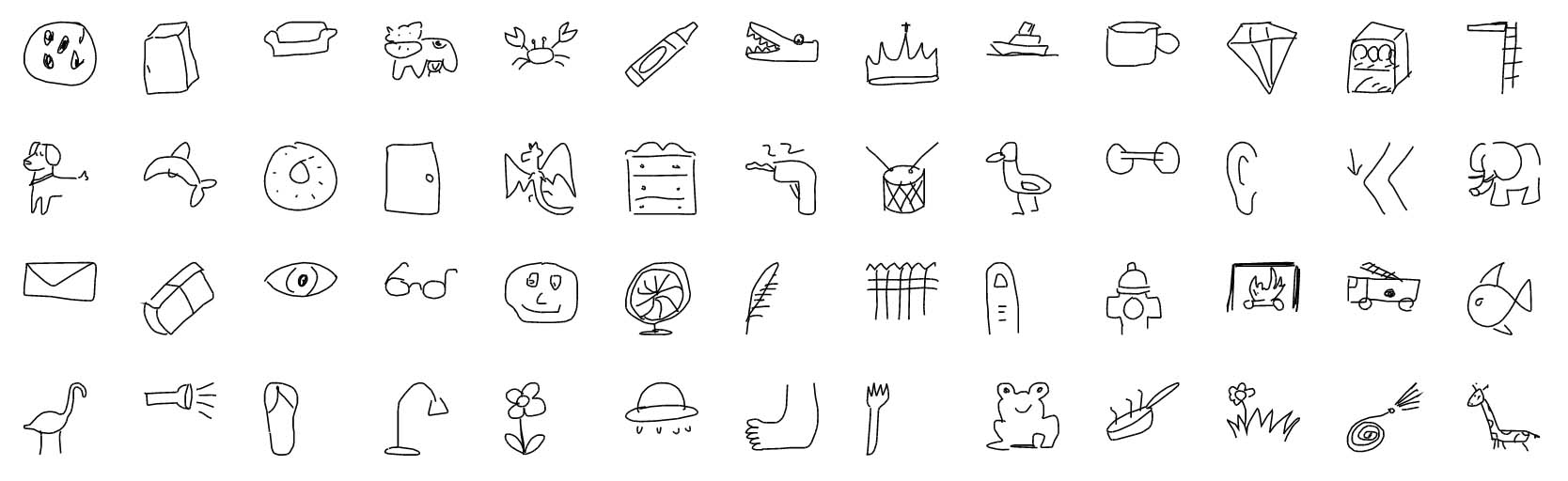
Repository: googlecreativelab/quickdraw-dataset Branch: master Commit: 5fe6c0a910b3 Files: 9 Total size: 29.1 KB Directory structure: gitextract_0rv1hnhi/ ├── LICENSE ├── README.md ├── categories.txt └── examples/ ├── binary_file_parser.py └── nodejs/ ├── .gitignore ├── binary-parser.js ├── ndjson.md ├── package.json └── simplified-parser.js ================================================ FILE CONTENTS ================================================ ================================================ FILE: LICENSE ================================================ This data made available by Google, Inc. under the Creative Commons Attribution 4.0 International license. https://creativecommons.org/licenses/by/4.0/ ================================================ FILE: README.md ================================================ # The Quick, Draw! Dataset ![preview](preview.jpg) The Quick Draw Dataset is a collection of 50 million drawings across [345 categories](categories.txt), contributed by players of the game [Quick, Draw!](https://quickdraw.withgoogle.com). The drawings were captured as timestamped vectors, tagged with metadata including what the player was asked to draw and in which country the player was located. You can browse the recognized drawings on [quickdraw.withgoogle.com/data](https://quickdraw.withgoogle.com/data). We're sharing them here for developers, researchers, and artists to explore, study, and learn from. If you create something with this dataset, please let us know [by e-mail](mailto:quickdraw-support@google.com) or at [A.I. Experiments](https://aiexperiments.withgoogle.com/submit). We have also released a tutorial and model for training your own drawing classifier on [tensorflow.org](https://github.com/tensorflow/docs/blob/master/site/en/r1/tutorials/sequences/recurrent_quickdraw.md). Please keep in mind that while this collection of drawings was individually moderated, it may still contain inappropriate content. ## Content - [The raw moderated dataset](#the-raw-moderated-dataset) - [Preprocessed dataset](#preprocessed-dataset) - [Get the data](#get-the-data) - [Projects using the dataset](#projects-using-the-dataset) - [Changes](#changes) - [License](#license) ## The raw moderated dataset The raw data is available as [`ndjson`](https://github.com/ndjson) files seperated by category, in the following format: | Key | Type | Description | | ------------ | -----------------------| -------------------------------------------- | | key_id | 64-bit unsigned integer| A unique identifier across all drawings. | | word | string | Category the player was prompted to draw. | | recognized | boolean | Whether the word was recognized by the game. | | timestamp | datetime | When the drawing was created. | | countrycode | string | A two letter country code ([ISO 3166-1 alpha-2](https://en.wikipedia.org/wiki/ISO_3166-1_alpha-2)) of where the player was located. | | drawing | string | A JSON array representing the vector drawing | Each line contains one drawing. Here's an example of a single drawing: ```javascript  { "key_id":"5891796615823360", "word":"nose", "countrycode":"AE", "timestamp":"2017-03-01 20:41:36.70725 UTC", "recognized":true, "drawing":[[[129,128,129,129,130,130,131,132,132,133,133,133,133,...]]] } ``` The format of the drawing array is as following: ```javascript [ [ // First stroke [x0, x1, x2, x3, ...], [y0, y1, y2, y3, ...], [t0, t1, t2, t3, ...] ], [ // Second stroke [x0, x1, x2, x3, ...], [y0, y1, y2, y3, ...], [t0, t1, t2, t3, ...] ], ... // Additional strokes ] ``` Where `x` and `y` are the pixel coordinates, and `t` is the time in milliseconds since the first point. `x` and `y` are real-valued while `t` is an integer. The raw drawings can have vastly different bounding boxes and number of points due to the different devices used for display and input. ## Preprocessed dataset We've preprocessed and split the dataset into different files and formats to make it faster and easier to download and explore. #### Simplified Drawing files (`.`) We've simplified the vectors, removed the timing information, and positioned and scaled the data into a 256x256 region. The data is exported in [`ndjson`](https://github.com/ndjson) format with the same metadata as the raw format. The simplification process was: 1. Align the drawing to the top-left corner, to have minimum values of 0. 2. Uniformly scale the drawing, to have a maximum value of 255. 3. Resample all strokes with a 1 pixel spacing. 4. Simplify all strokes using the [Ramer–Douglas–Peucker algorithm](https://en.wikipedia.org/wiki/Ramer%E2%80%93Douglas%E2%80%93Peucker_algorithm) with an epsilon value of 2.0. There is an example in [examples/nodejs/simplified-parser.js](examples/nodejs/simplified-parser.js) showing how to read ndjson files in NodeJS. Additionally, the [examples/nodejs/ndjson.md](examples/nodejs/ndjson.md) document details a set of command-line tools that can help explore subsets of these quite large files. #### Binary files (`.bin`) The simplified drawings and metadata are also available in a custom binary format for efficient compression and loading. There is an example in [examples/binary_file_parser.py](examples/binary_file_parser.py) showing how to load the binary files in Python. There is also an example in [examples/nodejs/binary-parser.js](examples/nodejs/binary-parser.js) showing how to read the binary files in NodeJS. #### Numpy bitmaps (`.npy`) All the simplified drawings have been rendered into a 28x28 grayscale bitmap in numpy `.npy` format. The files can be loaded with [`np.load()`](https://docs.scipy.org/doc/numpy-1.12.0/reference/generated/numpy.load.html). These images were generated from the simplified data, but are aligned to the center of the drawing's bounding box rather than the top-left corner. [See here for code snippet used for generation](https://github.com/googlecreativelab/quickdraw-dataset/issues/19#issuecomment-402247262). ## Get the data The dataset is available on Google Cloud Storage as [`ndjson`](https://github.com/ndjson) files seperated by category. See the list of files in [Cloud ](https://console.cloud.google.com/storage/browser/quickdraw_dataset/), or read more about [accessing public datasets](https://cloud.google.com/storage/docs/access-public-data) using other methods. As an example, to easily download all simplified drawings, one way is to run the command `gsutil -m cp 'gs://quickdraw_dataset/full/simplified/*.ndjson' .` #### Full dataset seperated by categories - [Raw files](https://console.cloud.google.com/storage/browser/quickdraw_dataset/full/raw) (`.ndjson`) - [Simplified drawings files](https://console.cloud.google.com/storage/browser/quickdraw_dataset/full/simplified) (`.ndjson`) - [Binary files](https://console.cloud.google.com/storage/browser/quickdraw_dataset/full/binary) (`.bin`) - [Numpy bitmap files](https://console.cloud.google.com/storage/browser/quickdraw_dataset/full/numpy_bitmap) (`.npy`) #### Sketch-RNN QuickDraw Dataset This data is also used for training the [Sketch-RNN](https://arxiv.org/abs/1704.03477) model. An open source, TensorFlow implementation of this model is available in the [Magenta Project](https://magenta.tensorflow.org/sketch_rnn), (link to GitHub [repo](https://github.com/tensorflow/magenta/tree/master/magenta/models/sketch_rnn)). You can also read more about this model in this Google Research [blog post](https://research.googleblog.com/2017/04/teaching-machines-to-draw.html). The data is stored in compressed `.npz` files, in a format suitable for inputs into a recurrent neural network. In this dataset, 75K samples (70K Training, 2.5K Validation, 2.5K Test) has been randomly selected from each category, processed with [RDP](https://en.wikipedia.org/wiki/Ramer%E2%80%93Douglas%E2%80%93Peucker_algorithm) line simplification with an `epsilon` parameter of 2.0. Each category will be stored in its own `.npz` file, for example, `cat.npz`. We have also provided the full data for each category, if you want to use more than 70K training examples. These are stored with the `.full.npz` extensions. - [Numpy .npz files](https://console.cloud.google.com/storage/browser/quickdraw_dataset/sketchrnn) *Note:* For Python3, loading the `npz` files using `np.load(data_filepath, encoding='latin1', allow_pickle=True)` Instructions for converting Raw `ndjson` files to this `npz` format is available in this [notebook](https://github.com/hardmaru/quickdraw-ndjson-to-npz). ## Projects using the dataset Here are some projects and experiments that are using or featuring the dataset in interesting ways. Got something to add? [Let us know!](mailto:quickdraw-support@google.com) *Creative and artistic projects* - [Letter collages](http://frauzufall.de/en/2017/google-quick-draw/) by [Deborah Schmidt](http://frauzufall.de/) - [Face tracking experiment](https://www.instagram.com/p/BUU8TuQD6_v/) by [Neil Mendoza](http://www.neilmendoza.com/) - [Faces of Humanity](http://project.laboiteatortue.com/facesofhumanity/) by [Tortue](www.laboiteatortue.com) - [Infinite QuickDraw](https://kynd.github.io/infinite_quickdraw/) by [kynd.info](http://kynd.info) - [Misfire.io](http://misfire.io/) by Matthew Collyer - [Draw This](http://danmacnish.com/2018/07/01/draw-this/) by [Dan Macnish](http://danmacnish.com/) - [Scribbling Speech](http://xinyue.de/scribbling-speech.html) by [Xinyue Yang](http://xinyue.de/) - illustrAItion by [Ling Chen](https://github.com/lingchen42/illustrAItion) - [Dreaming of Electric Sheep](https://medium.com/@libreai/dreaming-of-electric-sheep-d1aca32545dc) by [ Dr. Ernesto Diaz-Aviles](http://ernesto.diazaviles.com/) *Data analyses* - [How do you draw a circle?](https://qz.com/994486/the-way-you-draw-circles-says-a-lot-about-you/) by [Quartz](https://qz.com/) - [Forma Fluens](http://formafluens.io/) by [Mauro Martino](http://www.mamartino.com/), [Hendrik Strobelt](http://hendrik.strobelt.com/) and [Owen Cornec](http://www.byowen.com/) - [How Long Does it Take to (Quick) Draw a Dog?](http://vallandingham.me/quickdraw/) by [Jim Vallandingham](http://vallandingham.me/) - [Finding bad flamingo drawings with recurrent neural networks](http://colinmorris.github.io/blog/bad_flamingos) by [Colin Morris](http://colinmorris.github.io/) - [Facets Dive x Quick, Draw!](https://pair-code.github.io/facets/quickdraw.html) by [People + AI Research Initiative (PAIR), Google](https://ai.google/pair) - [Exploring and Visualizing an Open Global Dataset](https://research.googleblog.com/2017/08/exploring-and-visualizing-open-global.html) by Google Research - [Machine Learning for Visualization](https://medium.com/@enjalot/machine-learning-for-visualization-927a9dff1cab) - Talk / article by Ian Johnson *Papers* - [A Neural Representation of Sketch Drawings](https://arxiv.org/pdf/1704.03477.pdf) by [David Ha](https://scholar.google.com/citations?user=J1j92GsxVUMC&hl=en), [Douglas Eck](https://scholar.google.com/citations?user=bLb3VdIAAAAJ&hl=en), ICLR 2018. [code](https://github.com/tensorflow/magenta/tree/master/magenta/models/sketch_rnn) - [Sketchmate: Deep hashing for million-scale human sketch retrieval](http://openaccess.thecvf.com/content_cvpr_2018/papers/Xu_SketchMate_Deep_Hashing_CVPR_2018_paper.pdf) by [Peng Xu](http://www.pengxu.net/) et al., CVPR 2018. - [Multi-graph transformer for free-hand sketch recognition](https://arxiv.org/pdf/1912.11258.pdf) by [Peng Xu](http://www.pengxu.net/), [Chaitanya K Joshi](https://chaitjo.github.io/), [Xavier Bresson](https://www.ntu.edu.sg/home/xbresson/), ArXiv 2019. [code](https://github.com/PengBoXiangShang/multigraph_transformer) - [Deep Self-Supervised Representation Learning for Free-Hand Sketch](https://arxiv.org/pdf/2002.00867.pdf) by [Peng Xu](http://www.pengxu.net/) et al., ArXiv 2020. [code](https://github.com/zzz1515151/self-supervised_learning_sketch) - [SketchTransfer: A Challenging New Task for Exploring Detail-Invariance and the Abstractions Learned by Deep Networks](https://arxiv.org/pdf/1912.11570.pdf) by [Alex Lamb](https://sites.google.com/view/alexmlamb), [Sherjil Ozair](https://sherjilozair.github.io/), [Vikas Verma](https://scholar.google.com/citations?user=wo_M4uQAAAAJ&hl=en), [David Ha](https://scholar.google.com/citations?user=J1j92GsxVUMC&hl=en), WACV 2020. - [Deep Learning for Free-Hand Sketch: A Survey](https://arxiv.org/pdf/2001.02600.pdf) by [Peng Xu](http://www.pengxu.net/), ArXiv 2020. - [A Novel Sketch Recognition Model based on Convolutional Neural Networks](https://ieeexplore.ieee.org/document/9152911) by [Abdullah Talha Kabakus](https://www.linkedin.com/in/talhakabakus), 2nd International Congress on Human-Computer Interaction, Optimization and Robotic Applications, pp. 101-106, 2020. *Guides & Tutorials* - [TensorFlow tutorial for drawing classification](https://github.com/tensorflow/docs/blob/master/site/en/r1/tutorials/sequences/recurrent_quickdraw.md) - [Train a model in tf.keras with Colab, and run it in the browser with TensorFlow.js](https://medium.com/tensorflow/train-on-google-colab-and-run-on-the-browser-a-case-study-8a45f9b1474e) by Zaid Alyafeai *Code and tools* - [Quick, Draw! Polymer Component & Data API](https://github.com/googlecreativelab/quickdraw-component) by Nick Jonas - [Quick, Draw for Processing](https://github.com/codybenlewis/Quick-Draw-for-Processing) by [Cody Ben Lewis](https://twitter.com/CodyBenLewis) - [Quick, Draw! prediction model](https://github.com/keisukeirie/quickdraw_prediction_model) by Keisuke Irie - [Random sample tool](http://learning.statistics-is-awesome.org/draw/) by [Learning statistics is awesome](http://learning.statistics-is-awesome.org/) - [SVG rendering in d3.js example](https://bl.ocks.org/enjalot/a2b28f0ed18b891f9fb70910f1b8886d) by [Ian Johnson](http://enja.org/) (read more about the process [here](https://gist.github.com/enjalot/54c4342eb7527ea523884dbfa52d174b)) - [Sketch-RNN Classification](https://github.com/payalbajaj/sketch_rnn_classification) by Payal Bajaj - [quickdraw.js](https://github.com/wagenaartje/quickdraw.js) by Thomas Wagenaar - [~ Doodler ~](https://github.com/krishnasriSomepalli/cs50-project/) by [ Krishna Sri Somepalli](https://krishnasrisomepalli.github.io/) - [quickdraw Python API](http://quickdraw.readthedocs.io) by [Martin O'Hanlon](https://github.com/martinohanlon) - [RealTime QuickDraw](https://github.com/akshaybahadur21/QuickDraw) by [Akshay Bahadur](http://akshaybahadur.com/) - [DataFlow processing](https://github.com/gxercavins/dataflow-samples/tree/master/quick-draw) by Guillem Xercavins - [QuickDrawGH Rhino Plugin](https://www.food4rhino.com/app/quickdrawgh) by [James Dalessandro](https://github.com/DalessandroJ) - [QuickDrawBattle](https://andri.io/quickdrawbattle/) by [Andri Soone](https://github.com/ndri) ## Changes May 25, 2017: Updated Sketch-RNN QuickDraw dataset, created `.full.npz` complementary sets. ## License This data made available by Google, Inc. under the [Creative Commons Attribution 4.0 International license.](https://creativecommons.org/licenses/by/4.0/) ## Dataset Metadata The following table is necessary for this dataset to be indexed by search engines such as Google Dataset Search.
property value
name The Quick, Draw! Dataset
alternateName Quick Draw Dataset
alternateName quickdraw-dataset
url
sameAs https://github.com/googlecreativelab/quickdraw-dataset
description The Quick Draw Dataset is a collection of 50 million drawings across 345 categories, contributed by players of the game "Quick, Draw!". The drawings were captured as timestamped vectors, tagged with metadata including what the player was asked to draw and in which country the player was located.\n \n Example drawings: ![preview](https://raw.githubusercontent.com/googlecreativelab/quickdraw-dataset/master/preview.jpg)
provider
property value
name Google
sameAs https://en.wikipedia.org/wiki/Google
license
property value
name CC BY 4.0
url
================================================ FILE: categories.txt ================================================ aircraft carrier airplane alarm clock ambulance angel animal migration ant anvil apple arm asparagus axe backpack banana bandage barn baseball baseball bat basket basketball bat bathtub beach bear beard bed bee belt bench bicycle binoculars bird birthday cake blackberry blueberry book boomerang bottlecap bowtie bracelet brain bread bridge broccoli broom bucket bulldozer bus bush butterfly cactus cake calculator calendar camel camera camouflage campfire candle cannon canoe car carrot castle cat ceiling fan cello cell phone chair chandelier church circle clarinet clock cloud coffee cup compass computer cookie cooler couch cow crab crayon crocodile crown cruise ship cup diamond dishwasher diving board dog dolphin donut door dragon dresser drill drums duck dumbbell ear elbow elephant envelope eraser eye eyeglasses face fan feather fence finger fire hydrant fireplace firetruck fish flamingo flashlight flip flops floor lamp flower flying saucer foot fork frog frying pan garden garden hose giraffe goatee golf club grapes grass guitar hamburger hammer hand harp hat headphones hedgehog helicopter helmet hexagon hockey puck hockey stick horse hospital hot air balloon hot dog hot tub hourglass house house plant hurricane ice cream jacket jail kangaroo key keyboard knee knife ladder lantern laptop leaf leg light bulb lighter lighthouse lightning line lion lipstick lobster lollipop mailbox map marker matches megaphone mermaid microphone microwave monkey moon mosquito motorbike mountain mouse moustache mouth mug mushroom nail necklace nose ocean octagon octopus onion oven owl paintbrush paint can palm tree panda pants paper clip parachute parrot passport peanut pear peas pencil penguin piano pickup truck picture frame pig pillow pineapple pizza pliers police car pond pool popsicle postcard potato power outlet purse rabbit raccoon radio rain rainbow rake remote control rhinoceros rifle river roller coaster rollerskates sailboat sandwich saw saxophone school bus scissors scorpion screwdriver sea turtle see saw shark sheep shoe shorts shovel sink skateboard skull skyscraper sleeping bag smiley face snail snake snorkel snowflake snowman soccer ball sock speedboat spider spoon spreadsheet square squiggle squirrel stairs star steak stereo stethoscope stitches stop sign stove strawberry streetlight string bean submarine suitcase sun swan sweater swing set sword syringe table teapot teddy-bear telephone television tennis racquet tent The Eiffel Tower The Great Wall of China The Mona Lisa tiger toaster toe toilet tooth toothbrush toothpaste tornado tractor traffic light train tree triangle trombone truck trumpet t-shirt umbrella underwear van vase violin washing machine watermelon waterslide whale wheel windmill wine bottle wine glass wristwatch yoga zebra zigzag ================================================ FILE: examples/binary_file_parser.py ================================================ # Copyright 2017 Google Inc. # # Licensed under the Apache License, Version 2.0 (the "License"); # you may not use this file except in compliance with the License. # You may obtain a copy of the License at # # https://www.apache.org/licenses/LICENSE-2.0 # # Unless required by applicable law or agreed to in writing, software # distributed under the License is distributed on an "AS IS" BASIS, # WITHOUT WARRANTIES OR CONDITIONS OF ANY KIND, either express or implied. # See the License for the specific language governing permissions and # limitations under the License. import struct from struct import unpack def unpack_drawing(file_handle): key_id, = unpack('Q', file_handle.read(8)) country_code, = unpack('2s', file_handle.read(2)) recognized, = unpack('b', file_handle.read(1)) timestamp, = unpack('I', file_handle.read(4)) n_strokes, = unpack('H', file_handle.read(2)) image = [] for i in range(n_strokes): n_points, = unpack('H', file_handle.read(2)) fmt = str(n_points) + 'B' x = unpack(fmt, file_handle.read(n_points)) y = unpack(fmt, file_handle.read(n_points)) image.append((x, y)) return { 'key_id': key_id, 'country_code': country_code, 'recognized': recognized, 'timestamp': timestamp, 'image': image } def unpack_drawings(filename): with open(filename, 'rb') as f: while True: try: yield unpack_drawing(f) except struct.error: break for drawing in unpack_drawings('nose.bin'): # do something with the drawing print(drawing['country_code']) ================================================ FILE: examples/nodejs/.gitignore ================================================ node_modules ================================================ FILE: examples/nodejs/binary-parser.js ================================================ /* Copyright 2017 Google Inc. Licensed under the Apache License, Version 2.0 (the "License"); you may not use this file except in compliance with the License. You may obtain a copy of the License at https://www.apache.org/licenses/LICENSE-2.0 Unless required by applicable law or agreed to in writing, software distributed under the License is distributed on an "AS IS" BASIS, WITHOUT WARRANTIES OR CONDITIONS OF ANY KIND, either express or implied. See the License for the specific language governing permissions and limitations under the License. */ /* Demonstration of parsing binary files from Quick, Draw! dataset with NodeJS. https://github.com/googlecreativelab/quickdraw-dataset https://quickdraw.withgoogle.com/data This demo assumes you've put the file "face.bin" into a folder called "data" in the same directory as this script. */ var fs = require('fs'); var Parser = require('binary-parser').Parser; var BigInteger = require('javascript-biginteger').BigInteger; var Drawing = Parser.start() .endianess('little') .array('key_id', { type: 'uint8', length: 8 }) .string('countrycode', { length: 2, encoding: 'ascii' }) // .uint8('recognized') .bit1('recognized') .uint32le('timestamp') // unix timestamp in seconds .uint16le('n_strokes') .array('strokes', { type: Parser.start() .uint16le('n_points') .array('x', { type: 'uint8', length: 'n_points' }) .array('y', { type: 'uint8', length: 'n_points' }), length: 'n_strokes' }); function parseBinaryDrawings(fileName, callback) { fs.readFile(fileName, function(err, buffer) { var unpacked = Parser.start() .array('drawings', { type: Drawing, // length: 2 readUntil: 'eof' }).parse(buffer); // console.log("unpacked", unpacked) var drawings = unpacked.drawings.map(function(d) { var ka = d.key_id; // the key is a long integer so we have to parse it specially var key = BigInteger(0); for (var i = 7; i >= 0; i--) { key = key.multiply(256); key = key.add(ka[i]); } var strokes = d.strokes.map(function(d,i) { return [ d.x, d.y ] }); return { 'key_id': key.toString(), 'countrycode': d.countrycode, 'recognized': !!d.recognized, //convert to boolean 'timestamp': d.timestamp * 1000, // turn it into milliseconds 'drawing': strokes } }) callback(null, drawings); }) } parseBinaryDrawings("data/face.bin", function(err, drawings) { if(err) return console.error(err); drawings.forEach(function(d) { // Do something with the drawing console.log(d.key_id, d.countrycode) }) console.log("# of drawings:", drawings.length) }) ================================================ FILE: examples/nodejs/ndjson.md ================================================ # Quick, Draw! ndjson data The [Quick, Draw! dataset](https://github.com/googlecreativelab/quickdraw-dataset) uses [ndjson](https://github.com/maxogden/ndjson) as one of the formats to store its millions of drawings. We can use the [ndjson-cli](https://github.com/mbostock/ndjson-cli) utility to quickly create interesting subsets of this dataset. The drawings (stroke data and associated metadata) are stored as one JSON object per line. e.g.: ```js { "key_id":"5891796615823360", "word":"nose", "countrycode":"AE", "timestamp":"2017-03-01 20:41:36.70725 UTC", "recognized":true, "drawing":[[[129,128,129,129,130,130,131,132,132,133,133,133,133,...]]] } ``` Each file represents all of the drawings for a given word. So, you can download the one you want. For this exploration we will focus on the [simplified drawings](https://pantheon.corp.google.com/storage/browser/quickdraw_dataset/full/simplified) because the files are about 10x smaller and the drawings look just as good. We do lose timing information available in the raw data, so feel free to explore that when you are comfortable navigating the data (the format is pretty much exactly the same besides the added timing array and more points in the stroke data.) # Let's explore the `face` collection! One nice thing that you can do with `.ndjson` files are to quickly peek at the data using some simple Unix commands: ```bash # look at the first 5 lines cat face.ndjson | head -n 5 # look at the last 5 lines cat face.ndjson | tail -n 5 ``` ## Filtering Now let's take our first subset of the data by filtering: ```bash # let's filter down to only the recognized drawings cat face.ndjson | ndjson-filter 'd.recognized == true' | head -n 5 # How many recognized drawings are there? cat face.ndjson | ndjson-filter 'd.recognized == true' | wc -l # How about unrecognized? cat face.ndjson | ndjson-filter 'd.recognized == false' | wc -l # We can also filter down to a country we are interested in cat face.ndjson | ndjson-filter 'd.recognized == true && d.countrycode == "CA"' | wc -l ``` ## Sorting For sorting, you can make things easier by including d3. This means you'll need to `npm install d3` in the directory from which you are calling these commands. ```bash # sort by when the drawing was created cat face.ndjson | ndjson-sort -r d3 'd3.ascending(a.timestamp, b.timestamp)' | head -n 5 # sort from the most complex drawings to the simplest (judged by how many strokes they use to draw) cat face.ndjson | ndjson-sort -r d3 'd3.descending(a.drawing.length, b.drawing.length)' | head -n 5 ``` ## Saving to JSON If you want to save out a subset as a regular JSON file, you can use `ndjson-reduce`: ```bash # save to the file "canadian-faces.json" cat face.ndjson | ndjson-filter 'd.recognized == true && d.countrycode == "CA"' | ndjson-reduce > canadian-faces.json # You can combine these utilities to further filter down your data cat face.ndjson | ndjson-filter 'd.recognized == true && d.countrycode == "CA"' | head -n 1000 | ndjson-reduce > canadian-faces.json cat face.ndjson | ndjson-filter 'd.recognized == true && d.countrycode == "CA"' | ndjson-sort -r d3 'd3.descending(a.drawing.length, b.drawing.length)' | head -n 100 | ndjson-reduce > complex-faces.json ``` ================================================ FILE: examples/nodejs/package.json ================================================ { "name": "quickdraw-node-demos", "version": "0.0.1", "description": "Sample code for parsing Quick, Draw! dataset in NodeJS", "main": "simplified-parser.js", "scripts": { "test": "echo \"Error: no test specified\" && exit 1" }, "author": "Ian Johnson (enjalot@google.com)", "license": "Apache-2.0", "dependencies": { "binary-parser": "^1.1.5", "javascript-biginteger": "^0.9.2", "ndjson": "^1.5.0" }, "devDependencies": { "d3": "^4.9.1", "ndjson-cli": "^0.3.0" } } ================================================ FILE: examples/nodejs/simplified-parser.js ================================================ /* Copyright 2017 Google Inc. Licensed under the Apache License, Version 2.0 (the "License"); you may not use this file except in compliance with the License. You may obtain a copy of the License at https://www.apache.org/licenses/LICENSE-2.0 Unless required by applicable law or agreed to in writing, software distributed under the License is distributed on an "AS IS" BASIS, WITHOUT WARRANTIES OR CONDITIONS OF ANY KIND, either express or implied. See the License for the specific language governing permissions and limitations under the License. */ /* Demonstration of parsing simplified ndjson files from Quick, Draw! dataset with node.js. Read in all of the simplified drawings into memory and log out some properties. https://github.com/googlecreativelab/quickdraw-dataset https://quickdraw.withgoogle.com/data This demo assumes you've put the file "face-simple.ndjson" into a folder called "data" in the same directory as this script. */ var fs = require('fs'); var ndjson = require('ndjson'); // npm install ndjson function parseSimplifiedDrawings(fileName, callback) { var drawings = []; var fileStream = fs.createReadStream(fileName) fileStream .pipe(ndjson.parse()) .on('data', function(obj) { drawings.push(obj) }) .on("error", callback) .on("end", function() { callback(null, drawings) }); } parseSimplifiedDrawings("data/face-simple.ndjson", function(err, drawings) { if(err) return console.error(err); drawings.forEach(function(d) { // Do something with the drawing console.log(d.key_id, d.countrycode); }) console.log("# of drawings:", drawings.length); })