Repository: heartexlabs/label-studio-transformers
Branch: master
Commit: de267cbd903e
Files: 8
Total size: 51.2 KB
Directory structure:
gitextract_m_a1r8n7/
├── .gitignore
├── LICENSE
├── README.md
├── models/
│ ├── __init__.py
│ ├── bert_classifier.py
│ ├── ner.py
│ └── utils.py
└── requirements.txt
================================================
FILE CONTENTS
================================================
================================================
FILE: .gitignore
================================================
# Byte-compiled / optimized / DLL files
__pycache__/
*.py[cod]
*$py.class
# C extensions
*.so
# Distribution / packaging
.Python
build/
develop-eggs/
dist/
downloads/
eggs/
.eggs/
lib/
lib64/
parts/
sdist/
var/
wheels/
*.egg-info/
.installed.cfg
*.egg
MANIFEST
# PyInstaller
# Usually these files are written by a python script from a template
# before PyInstaller builds the exe, so as to inject date/other infos into it.
*.manifest
*.spec
# Installer logs
pip-log.txt
pip-delete-this-directory.txt
# Unit test / coverage reports
htmlcov/
.tox/
.coverage
.coverage.*
.cache
nosetests.xml
coverage.xml
*.cover
.hypothesis/
.pytest_cache/
# Translations
*.mo
*.pot
# Django stuff:
*.log
local_settings.py
db.sqlite3
# Flask stuff:
instance/
.webassets-cache
# Scrapy stuff:
.scrapy
# Sphinx documentation
docs/_build/
# PyBuilder
target/
# Jupyter Notebook
.ipynb_checkpoints
# pyenv
.python-version
# celery beat schedule file
celerybeat-schedule
# SageMath parsed files
*.sage.py
# Environments
.venv
env/
venv/
ENV/
env.bak/
venv.bak/
# Spyder project settings
.spyderproject
.spyproject
# Rope project settings
.ropeproject
# mkdocs documentation
/site
# mypy
.mypy_cache/
================================================
FILE: LICENSE
================================================
Apache License
Version 2.0, January 2004
http://www.apache.org/licenses/
TERMS AND CONDITIONS FOR USE, REPRODUCTION, AND DISTRIBUTION
1. Definitions.
"License" shall mean the terms and conditions for use, reproduction,
and distribution as defined by Sections 1 through 9 of this document.
"Licensor" shall mean the copyright owner or entity authorized by
the copyright owner that is granting the License.
"Legal Entity" shall mean the union of the acting entity and all
other entities that control, are controlled by, or are under common
control with that entity. For the purposes of this definition,
"control" means (i) the power, direct or indirect, to cause the
direction or management of such entity, whether by contract or
otherwise, or (ii) ownership of fifty percent (50%) or more of the
outstanding shares, or (iii) beneficial ownership of such entity.
"You" (or "Your") shall mean an individual or Legal Entity
exercising permissions granted by this License.
"Source" form shall mean the preferred form for making modifications,
including but not limited to software source code, documentation
source, and configuration files.
"Object" form shall mean any form resulting from mechanical
transformation or translation of a Source form, including but
not limited to compiled object code, generated documentation,
and conversions to other media types.
"Work" shall mean the work of authorship, whether in Source or
Object form, made available under the License, as indicated by a
copyright notice that is included in or attached to the work
(an example is provided in the Appendix below).
"Derivative Works" shall mean any work, whether in Source or Object
form, that is based on (or derived from) the Work and for which the
editorial revisions, annotations, elaborations, or other modifications
represent, as a whole, an original work of authorship. For the purposes
of this License, Derivative Works shall not include works that remain
separable from, or merely link (or bind by name) to the interfaces of,
the Work and Derivative Works thereof.
"Contribution" shall mean any work of authorship, including
the original version of the Work and any modifications or additions
to that Work or Derivative Works thereof, that is intentionally
submitted to Licensor for inclusion in the Work by the copyright owner
or by an individual or Legal Entity authorized to submit on behalf of
the copyright owner. For the purposes of this definition, "submitted"
means any form of electronic, verbal, or written communication sent
to the Licensor or its representatives, including but not limited to
communication on electronic mailing lists, source code control systems,
and issue tracking systems that are managed by, or on behalf of, the
Licensor for the purpose of discussing and improving the Work, but
excluding communication that is conspicuously marked or otherwise
designated in writing by the copyright owner as "Not a Contribution."
"Contributor" shall mean Licensor and any individual or Legal Entity
on behalf of whom a Contribution has been received by Licensor and
subsequently incorporated within the Work.
2. Grant of Copyright License. Subject to the terms and conditions of
this License, each Contributor hereby grants to You a perpetual,
worldwide, non-exclusive, no-charge, royalty-free, irrevocable
copyright license to reproduce, prepare Derivative Works of,
publicly display, publicly perform, sublicense, and distribute the
Work and such Derivative Works in Source or Object form.
3. Grant of Patent License. Subject to the terms and conditions of
this License, each Contributor hereby grants to You a perpetual,
worldwide, non-exclusive, no-charge, royalty-free, irrevocable
(except as stated in this section) patent license to make, have made,
use, offer to sell, sell, import, and otherwise transfer the Work,
where such license applies only to those patent claims licensable
by such Contributor that are necessarily infringed by their
Contribution(s) alone or by combination of their Contribution(s)
with the Work to which such Contribution(s) was submitted. If You
institute patent litigation against any entity (including a
cross-claim or counterclaim in a lawsuit) alleging that the Work
or a Contribution incorporated within the Work constitutes direct
or contributory patent infringement, then any patent licenses
granted to You under this License for that Work shall terminate
as of the date such litigation is filed.
4. Redistribution. You may reproduce and distribute copies of the
Work or Derivative Works thereof in any medium, with or without
modifications, and in Source or Object form, provided that You
meet the following conditions:
(a) You must give any other recipients of the Work or
Derivative Works a copy of this License; and
(b) You must cause any modified files to carry prominent notices
stating that You changed the files; and
(c) You must retain, in the Source form of any Derivative Works
that You distribute, all copyright, patent, trademark, and
attribution notices from the Source form of the Work,
excluding those notices that do not pertain to any part of
the Derivative Works; and
(d) If the Work includes a "NOTICE" text file as part of its
distribution, then any Derivative Works that You distribute must
include a readable copy of the attribution notices contained
within such NOTICE file, excluding those notices that do not
pertain to any part of the Derivative Works, in at least one
of the following places: within a NOTICE text file distributed
as part of the Derivative Works; within the Source form or
documentation, if provided along with the Derivative Works; or,
within a display generated by the Derivative Works, if and
wherever such third-party notices normally appear. The contents
of the NOTICE file are for informational purposes only and
do not modify the License. You may add Your own attribution
notices within Derivative Works that You distribute, alongside
or as an addendum to the NOTICE text from the Work, provided
that such additional attribution notices cannot be construed
as modifying the License.
You may add Your own copyright statement to Your modifications and
may provide additional or different license terms and conditions
for use, reproduction, or distribution of Your modifications, or
for any such Derivative Works as a whole, provided Your use,
reproduction, and distribution of the Work otherwise complies with
the conditions stated in this License.
5. Submission of Contributions. Unless You explicitly state otherwise,
any Contribution intentionally submitted for inclusion in the Work
by You to the Licensor shall be under the terms and conditions of
this License, without any additional terms or conditions.
Notwithstanding the above, nothing herein shall supersede or modify
the terms of any separate license agreement you may have executed
with Licensor regarding such Contributions.
6. Trademarks. This License does not grant permission to use the trade
names, trademarks, service marks, or product names of the Licensor,
except as required for reasonable and customary use in describing the
origin of the Work and reproducing the content of the NOTICE file.
7. Disclaimer of Warranty. Unless required by applicable law or
agreed to in writing, Licensor provides the Work (and each
Contributor provides its Contributions) on an "AS IS" BASIS,
WITHOUT WARRANTIES OR CONDITIONS OF ANY KIND, either express or
implied, including, without limitation, any warranties or conditions
of TITLE, NON-INFRINGEMENT, MERCHANTABILITY, or FITNESS FOR A
PARTICULAR PURPOSE. You are solely responsible for determining the
appropriateness of using or redistributing the Work and assume any
risks associated with Your exercise of permissions under this License.
8. Limitation of Liability. In no event and under no legal theory,
whether in tort (including negligence), contract, or otherwise,
unless required by applicable law (such as deliberate and grossly
negligent acts) or agreed to in writing, shall any Contributor be
liable to You for damages, including any direct, indirect, special,
incidental, or consequential damages of any character arising as a
result of this License or out of the use or inability to use the
Work (including but not limited to damages for loss of goodwill,
work stoppage, computer failure or malfunction, or any and all
other commercial damages or losses), even if such Contributor
has been advised of the possibility of such damages.
9. Accepting Warranty or Additional Liability. While redistributing
the Work or Derivative Works thereof, You may choose to offer,
and charge a fee for, acceptance of support, warranty, indemnity,
or other liability obligations and/or rights consistent with this
License. However, in accepting such obligations, You may act only
on Your own behalf and on Your sole responsibility, not on behalf
of any other Contributor, and only if You agree to indemnify,
defend, and hold each Contributor harmless for any liability
incurred by, or claims asserted against, such Contributor by reason
of your accepting any such warranty or additional liability.
END OF TERMS AND CONDITIONS
APPENDIX: How to apply the Apache License to your work.
To apply the Apache License to your work, attach the following
boilerplate notice, with the fields enclosed by brackets "[]"
replaced with your own identifying information. (Don't include
the brackets!) The text should be enclosed in the appropriate
comment syntax for the file format. We also recommend that a
file or class name and description of purpose be included on the
same "printed page" as the copyright notice for easier
identification within third-party archives.
Copyright [yyyy] [name of copyright owner]
Licensed under the Apache License, Version 2.0 (the "License");
you may not use this file except in compliance with the License.
You may obtain a copy of the License at
http://www.apache.org/licenses/LICENSE-2.0
Unless required by applicable law or agreed to in writing, software
distributed under the License is distributed on an "AS IS" BASIS,
WITHOUT WARRANTIES OR CONDITIONS OF ANY KIND, either express or implied.
See the License for the specific language governing permissions and
limitations under the License.
================================================
FILE: README.md
================================================
# Label Studio for Hugging Face's Transformers
[Website](https://labelstud.io/) • [Docs](https://labelstud.io/guide) • [Twitter](https://twitter.com/heartexlabs) • [Join Slack Community  ](https://slack.labelstud.io/?source=github-1)
**Transfer learning for NLP models by annotating your textual data without any additional coding.**
This package provides a ready-to-use container that links together:
- [Label Studio](https://github.com/heartexlabs/label-studio) as annotation frontend
- [Hugging Face's transformers](https://github.com/huggingface/transformers) as machine learning backend for NLP
[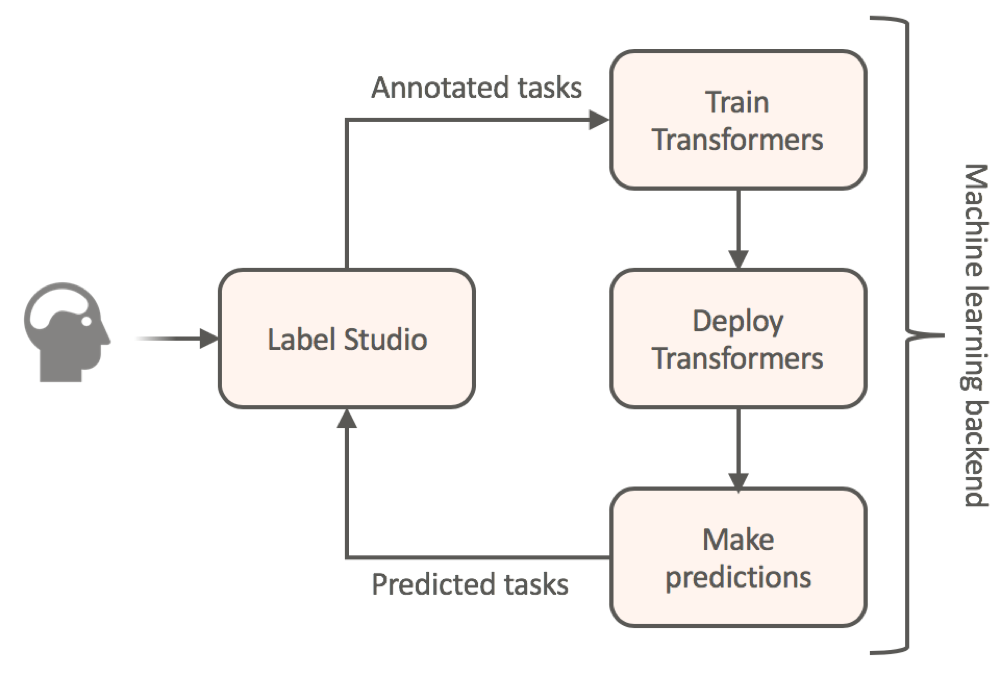 ](https://github.com/heartexlabs/label-studio-transformers)
### Quick Usage
#### Install Label Studio and other dependencies
```bash
pip install -r requirements.txt
```
##### Create ML backend with BERT classifier
```bash
label-studio-ml init my-ml-backend --script models/bert_classifier.py
cp models/utils.py my-ml-backend/utils.py
# Start ML backend at http://localhost:9090
label-studio-ml start my-ml-backend
# Start Label Studio in the new terminal with the same python environment
label-studio start
```
1. Create a project with `Choices` and `Text` tags in the labeling config.
2. Connect the ML backend in the Project settings with `http://localhost:9090`
##### Create ML backend with BERT named entity recognizer
```bash
label-studio-ml init my-ml-backend --script models/ner.py
cp models/utils.py my-ml-backend/utils.py
# Start ML backend at http://localhost:9090
label-studio-ml start my-ml-backend
# Start Label Studio in the new terminal with the same python environment
label-studio start
```
1. Create a project with `Labels` and `Text` tags in the labeling config.
2. Connect the ML backend in the Project settings with `http://localhost:9090`
#### Training and inference
The browser opens at `http://localhost:8080`. Upload your data on **Import** page then annotate by selecting **Labeling** page.
Once you've annotate sufficient amount of data, go to **Model** page and press **Start Training** button. Once training is finished, model automatically starts serving for inference from Label Studio, and you'll find all model checkpoints inside `my-ml-backend//` directory.
[Click here](https://labelstud.io/guide/ml.html) to read more about how to use Machine Learning backend and build Human-in-the-Loop pipelines with Label Studio
## License
This software is licensed under the [Apache 2.0 LICENSE](/LICENSE) © [Heartex](https://www.heartex.com/). 2020
](https://github.com/heartexlabs/label-studio-transformers)
### Quick Usage
#### Install Label Studio and other dependencies
```bash
pip install -r requirements.txt
```
##### Create ML backend with BERT classifier
```bash
label-studio-ml init my-ml-backend --script models/bert_classifier.py
cp models/utils.py my-ml-backend/utils.py
# Start ML backend at http://localhost:9090
label-studio-ml start my-ml-backend
# Start Label Studio in the new terminal with the same python environment
label-studio start
```
1. Create a project with `Choices` and `Text` tags in the labeling config.
2. Connect the ML backend in the Project settings with `http://localhost:9090`
##### Create ML backend with BERT named entity recognizer
```bash
label-studio-ml init my-ml-backend --script models/ner.py
cp models/utils.py my-ml-backend/utils.py
# Start ML backend at http://localhost:9090
label-studio-ml start my-ml-backend
# Start Label Studio in the new terminal with the same python environment
label-studio start
```
1. Create a project with `Labels` and `Text` tags in the labeling config.
2. Connect the ML backend in the Project settings with `http://localhost:9090`
#### Training and inference
The browser opens at `http://localhost:8080`. Upload your data on **Import** page then annotate by selecting **Labeling** page.
Once you've annotate sufficient amount of data, go to **Model** page and press **Start Training** button. Once training is finished, model automatically starts serving for inference from Label Studio, and you'll find all model checkpoints inside `my-ml-backend//` directory.
[Click here](https://labelstud.io/guide/ml.html) to read more about how to use Machine Learning backend and build Human-in-the-Loop pipelines with Label Studio
## License
This software is licensed under the [Apache 2.0 LICENSE](/LICENSE) © [Heartex](https://www.heartex.com/). 2020
 ================================================
FILE: models/__init__.py
================================================
================================================
FILE: models/bert_classifier.py
================================================
import torch
import numpy as np
import os
from torch.utils.data import SequentialSampler
from tqdm import tqdm, trange
from collections import deque
from tensorboardX import SummaryWriter
from transformers import BertTokenizer, BertForSequenceClassification
from transformers import AdamW, get_linear_schedule_with_warmup
from torch.utils.data import TensorDataset, DataLoader, RandomSampler
from label_studio_ml.model import LabelStudioMLBase
from utils import prepare_texts, calc_slope
if torch.cuda.is_available():
device = torch.device("cuda")
print('There are %d GPU(s) available.' % torch.cuda.device_count())
print('We will use the GPU:', torch.cuda.get_device_name(0))
else:
print('No GPU available, using the CPU instead.')
device = torch.device("cpu")
class BertClassifier(LabelStudioMLBase):
def __init__(
self, pretrained_model='bert-base-multilingual-cased', maxlen=64,
batch_size=32, num_epochs=100, logging_steps=1, train_logs=None, **kwargs
):
super(BertClassifier, self).__init__(**kwargs)
self.pretrained_model = pretrained_model
self.maxlen = maxlen
self.batch_size = batch_size
self.num_epochs = num_epochs
self.logging_steps = logging_steps
self.train_logs = train_logs
# then collect all keys from config which will be used to extract data from task and to form prediction
# Parsed label config contains only one output of type
assert len(self.parsed_label_config) == 1
self.from_name, self.info = list(self.parsed_label_config.items())[0]
assert self.info['type'] == 'Choices'
# the model has only one textual input
assert len(self.info['to_name']) == 1
assert len(self.info['inputs']) == 1
assert self.info['inputs'][0]['type'] == 'Text'
self.to_name = self.info['to_name'][0]
self.value = self.info['inputs'][0]['value']
if not self.train_output:
self.labels = self.info['labels']
self.reset_model('bert-base-multilingual-cased', cache_dir=None, device='cpu')
print('Initialized with from_name={from_name}, to_name={to_name}, labels={labels}'.format(
from_name=self.from_name, to_name=self.to_name, labels=str(self.labels)
))
else:
self.load(self.train_output)
print('Loaded from train output with from_name={from_name}, to_name={to_name}, labels={labels}'.format(
from_name=self.from_name, to_name=self.to_name, labels=str(self.labels)
))
def reset_model(self, pretrained_model, cache_dir, device):
model = BertForSequenceClassification.from_pretrained(
pretrained_model,
num_labels=len(self.labels),
output_attentions=False,
output_hidden_states=False,
cache_dir=cache_dir
)
model.to(device)
return model
def load(self, train_output):
pretrained_model = train_output['model_path']
self.tokenizer = BertTokenizer.from_pretrained(pretrained_model)
self.model = BertForSequenceClassification.from_pretrained(pretrained_model)
self.model.to(device)
self.model.eval()
self.batch_size = train_output['batch_size']
self.labels = train_output['labels']
self.maxlen = train_output['maxlen']
@property
def not_trained(self):
return not hasattr(self, 'tokenizer')
def predict(self, tasks, **kwargs):
if self.not_trained:
print('Can\'t get prediction because model is not trained yet.')
return []
texts = [task['data'][self.value] for task in tasks]
predict_dataloader = prepare_texts(texts, self.tokenizer, self.maxlen, SequentialSampler, self.batch_size)
pred_labels, pred_scores = [], []
for batch in predict_dataloader:
batch = tuple(t.to(device) for t in batch)
inputs = {
'input_ids': batch[0],
'attention_mask': batch[1]
}
with torch.no_grad():
outputs = self.model(**inputs)
logits = outputs[0]
batch_preds = logits.detach().cpu().numpy()
argmax_batch_preds = np.argmax(batch_preds, axis=-1)
pred_labels.extend(str(self.labels[i]) for i in argmax_batch_preds)
max_batch_preds = np.max(batch_preds, axis=-1)
pred_scores.extend(float(s) for s in max_batch_preds)
predictions = []
for predicted_label, score in zip(pred_labels, pred_scores):
result = [{
'from_name': self.from_name,
'to_name': self.to_name,
'type': 'choices',
'value': {'choices': [predicted_label]}
}]
predictions.append({'result': result, 'score': score})
return predictions
def fit(self, completions, workdir=None, cache_dir=None, **kwargs):
input_texts = []
output_labels, output_labels_idx = [], []
label2idx = {l: i for i, l in enumerate(self.labels)}
for completion in completions:
# get input text from task data
if completion['annotations'][0].get('skipped'):
continue
input_text = completion['data'][self.value]
input_texts.append(input_text)
# get an annotation
output_label = completion['annotations'][0]['result'][0]['value']['choices'][0]
output_labels.append(output_label)
output_label_idx = label2idx[output_label]
output_labels_idx.append(output_label_idx)
new_labels = set(output_labels)
added_labels = new_labels - set(self.labels)
if len(added_labels) > 0:
print('Label set has been changed. Added ones: ' + str(list(added_labels)))
self.labels = list(sorted(new_labels))
label2idx = {l: i for i, l in enumerate(self.labels)}
output_labels_idx = [label2idx[label] for label in output_labels]
tokenizer = BertTokenizer.from_pretrained(self.pretrained_model, cache_dir=cache_dir)
train_dataloader = prepare_texts(input_texts, tokenizer, self.maxlen, RandomSampler, self.batch_size, output_labels_idx)
model = self.reset_model(self.pretrained_model, cache_dir, device)
total_steps = len(train_dataloader) * self.num_epochs
optimizer = AdamW(model.parameters(), lr=2e-5, eps=1e-8)
scheduler = get_linear_schedule_with_warmup(optimizer, num_warmup_steps=0, num_training_steps=total_steps)
global_step = 0
total_loss, logging_loss = 0.0, 0.0
model.zero_grad()
train_iterator = trange(self.num_epochs, desc='Epoch')
if self.train_logs:
tb_writer = SummaryWriter(logdir=os.path.join(self.train_logs, os.path.basename(self.output_dir)))
else:
tb_writer = None
loss_queue = deque(maxlen=10)
for epoch in train_iterator:
epoch_iterator = tqdm(train_dataloader, desc='Iteration')
for step, batch in enumerate(epoch_iterator):
model.train()
batch = tuple(t.to(device) for t in batch)
inputs = {'input_ids': batch[0],
'attention_mask': batch[1],
'labels': batch[2]}
outputs = model(**inputs)
loss = outputs[0]
loss.backward()
total_loss += loss.item()
torch.nn.utils.clip_grad_norm_(model.parameters(), 1.0)
optimizer.step()
scheduler.step()
model.zero_grad()
global_step += 1
if global_step % self.logging_steps == 0:
last_loss = (total_loss - logging_loss) / self.logging_steps
loss_queue.append(last_loss)
if tb_writer:
tb_writer.add_scalar('lr', scheduler.get_lr()[0], global_step)
tb_writer.add_scalar('loss', last_loss, global_step)
logging_loss = total_loss
# slope-based early stopping
if len(loss_queue) == loss_queue.maxlen:
slope = calc_slope(loss_queue)
if tb_writer:
tb_writer.add_scalar('slope', slope, global_step)
if abs(slope) < 1e-2:
break
if tb_writer:
tb_writer.close()
model_to_save = model.module if hasattr(model, 'module') else model # Take care of distributed/parallel training # noqa
model_to_save.save_pretrained(workdir)
tokenizer.save_pretrained(workdir)
return {
'model_path': workdir,
'batch_size': self.batch_size,
'maxlen': self.maxlen,
'pretrained_model': self.pretrained_model,
'labels': self.labels
}
================================================
FILE: models/ner.py
================================================
import torch
import numpy as np
import re
import os
import io
import logging
from functools import partial
from itertools import groupby
from operator import itemgetter
from torch.nn import CrossEntropyLoss
from torch.utils.data import Dataset, DataLoader
from tqdm import tqdm, trange
from tensorboardX import SummaryWriter
from collections import deque
from transformers import (
BertTokenizer, BertForTokenClassification, BertConfig,
RobertaConfig, RobertaForTokenClassification, RobertaTokenizer,
DistilBertConfig, DistilBertForTokenClassification, DistilBertTokenizer,
CamembertConfig, CamembertForTokenClassification, CamembertTokenizer,
AutoConfig, AutoModelForTokenClassification, AutoTokenizer
)
from transformers import AdamW, get_linear_schedule_with_warmup
from label_studio_ml.model import LabelStudioMLBase
from utils import calc_slope
logger = logging.getLogger(__name__)
ALL_MODELS = sum(
[list(conf.pretrained_config_archive_map.keys()) for conf in (BertConfig, RobertaConfig, DistilBertConfig)],
[])
MODEL_CLASSES = {
'bert': (BertConfig, BertForTokenClassification, BertTokenizer),
'roberta': (RobertaConfig, RobertaForTokenClassification, RobertaTokenizer),
'distilbert': (DistilBertConfig, DistilBertForTokenClassification, DistilBertTokenizer),
'camembert': (CamembertConfig, CamembertForTokenClassification, CamembertTokenizer),
}
class SpanLabeledTextDataset(Dataset):
def __init__(
self, list_of_strings, list_of_spans=None, tokenizer=None, tag_idx_map=None,
cls_token='[CLS]', sep_token='[SEP]', pad_token_label_id=-1, max_seq_length=128, sep_token_extra=False,
cls_token_at_end=False, sequence_a_segment_id=0, cls_token_segment_id=1, mask_padding_with_zero=True
):
self.list_of_strings = list_of_strings
self.list_of_spans = list_of_spans or [[] * len(list_of_strings)]
self.tokenizer = tokenizer
self.cls_token = cls_token
self.sep_token = sep_token
self.pad_token_label_id = pad_token_label_id
self.max_seq_length = max_seq_length
self.sep_token_extra = sep_token_extra
self.cls_token_at_end = cls_token_at_end
self.sequence_a_segment_id = sequence_a_segment_id
self.cls_token_segment_id = cls_token_segment_id
self.mask_padding_with_zero = mask_padding_with_zero
(self.original_list_of_tokens, self.original_list_of_tags, tag_idx_map_,
original_list_of_tokens_start_map) = self._prepare_data()
if tag_idx_map is None:
self.tag_idx_map = tag_idx_map_
else:
self.tag_idx_map = tag_idx_map
(self.list_of_tokens, self.list_of_token_ids, self.list_of_labels, self.list_of_label_ids,
self.list_of_segment_ids, self.list_of_token_start_map) = [], [], [], [], [], []
for original_tokens, original_tags, original_token_start_map in zip(
self.original_list_of_tokens,
self.original_list_of_tags,
original_list_of_tokens_start_map
):
tokens, token_ids, labels, label_ids, segment_ids, token_start_map = self._convert_to_features(
original_tokens, original_tags, self.tag_idx_map, original_token_start_map)
self.list_of_token_ids.append(token_ids)
self.list_of_tokens.append(tokens)
self.list_of_labels.append(labels)
self.list_of_segment_ids.append(segment_ids)
self.list_of_label_ids.append(label_ids)
self.list_of_token_start_map.append(token_start_map)
def get_params_dict(self):
return {
'cls_token': self.cls_token,
'sep_token': self.sep_token,
'pad_token_label_id': self.pad_token_label_id,
'max_seq_length': self.max_seq_length,
'sep_token_extra': self.sep_token_extra,
'cls_token_at_end': self.cls_token_at_end,
'sequence_a_segment_id': self.sequence_a_segment_id,
'cls_token_segment_id': self.cls_token_segment_id,
'mask_padding_with_zero': self.mask_padding_with_zero
}
def dump(self, output_file):
with io.open(output_file, mode='w') as f:
for tokens, labels in zip(self.list_of_tokens, self.list_of_labels):
for token, label in zip(tokens, labels):
f.write(f'{token} {label}\n')
f.write('\n')
def _convert_to_features(self, words, labels, label_map, list_token_start_map):
tokens, out_labels, label_ids, tokens_idx_map = [], [], [], []
for i, (word, label, token_start) in enumerate(zip(words, labels, list_token_start_map)):
word_tokens = self.tokenizer.tokenize(word)
tokens.extend(word_tokens)
tokens_idx_map.extend([token_start] * len(word_tokens))
# Use the real label id for the first token of the word, and padding ids for the remaining tokens
label_ids.extend([label_map[label]] + [self.pad_token_label_id] * (len(word_tokens) - 1))
out_labels.extend([label] + ['X'] * (len(word_tokens) - 1))
# Account for [CLS] and [SEP] with "- 2" and with "- 3" for RoBERTa.
special_tokens_count = 3 if self.sep_token_extra else 2
if len(tokens) > self.max_seq_length - special_tokens_count:
tokens = tokens[:(self.max_seq_length - special_tokens_count)]
label_ids = label_ids[:(self.max_seq_length - special_tokens_count)]
out_labels = out_labels[:(self.max_seq_length - special_tokens_count)]
tokens_idx_map = tokens_idx_map[:(self.max_seq_length - special_tokens_count)]
# The convention in BERT is:
# (a) For sequence pairs:
# tokens: [CLS] is this jack ##son ##ville ? [SEP] no it is not . [SEP]
# type_ids: 0 0 0 0 0 0 0 0 1 1 1 1 1 1
# (b) For single sequences:
# tokens: [CLS] the dog is hairy . [SEP]
# type_ids: 0 0 0 0 0 0 0
#
# Where "type_ids" are used to indicate whether this is the first
# sequence or the second sequence. The embedding vectors for `type=0` and
# `type=1` were learned during pre-training and are added to the wordpiece
# embedding vector (and position vector). This is not *strictly* necessary
# since the [SEP] token unambiguously separates the sequences, but it makes
# it easier for the model to learn the concept of sequences.
#
# For classification tasks, the first vector (corresponding to [CLS]) is
# used as as the "sentence vector". Note that this only makes sense because
# the entire model is fine-tuned.
tokens += [self.sep_token]
label_ids += [self.pad_token_label_id]
out_labels += ['X']
tokens_idx_map += [-1]
if self.sep_token_extra:
# roberta uses an extra separator b/w pairs of sentences
tokens += [self.sep_token]
label_ids += [self.pad_token_label_id]
out_labels += ['X']
tokens_idx_map += [-1]
segment_ids = [self.sequence_a_segment_id] * len(tokens)
if self.cls_token_at_end:
tokens += [self.cls_token]
label_ids += [self.pad_token_label_id]
out_labels += ['X']
segment_ids += [self.cls_token_segment_id]
tokens_idx_map += [-1]
else:
tokens = [self.cls_token] + tokens
label_ids = [self.pad_token_label_id] + label_ids
out_labels = ['X'] + out_labels
segment_ids = [self.cls_token_segment_id] + segment_ids
tokens_idx_map = [-1] + tokens_idx_map
token_ids = self.tokenizer.convert_tokens_to_ids(tokens)
return tokens, token_ids, out_labels, label_ids, segment_ids, tokens_idx_map
def _apply_tokenizer(self, original_tokens, original_tags):
out_tokens, out_tags, out_maps = [], [], []
for i, (original_token, original_tag) in enumerate(zip(original_tokens, original_tags)):
tokens = self.tokenizer.tokenize(original_token)
out_tokens.extend(tokens)
out_maps.extend([i] * len(tokens))
start_tag = original_tag.startswith('B-')
for j in range(len(tokens)):
if (j == 0 and start_tag) or original_tag == 'O':
out_tags.append(original_tag)
else:
out_tags.append(f'I-{original_tag[2:]}')
return out_tokens, out_tags, out_maps
def _prepare_data(self):
list_of_tokens, list_of_tags, list_of_token_idx_maps = [], [], []
tag_idx_map = {'O': 0}
for text, spans in zip(self.list_of_strings, self.list_of_spans):
if not text:
continue
tokens = []
start = 0
for t in text.split():
tokens.append((t, start))
start += len(t) + 1
if spans:
spans = list(sorted(spans, key=itemgetter('start')))
span = spans.pop(0)
prefix = 'B-'
tags = []
for token, token_start in tokens:
token_end = token_start + len(token) - 1
# token precedes current span
if not span or token_end < span['start']:
tags.append('O')
continue
# token jumps over the span (it could happens
# when prev label ends with whitespaces, e.g. "cat " "too" or span created for whitespace)
if token_start > span['end']:
prefix = 'B-'
no_more_spans = False
while token_start > span['end']:
if not len(spans):
no_more_spans = True
break
span = spans.pop(0)
if no_more_spans:
tags.append('O')
span = None
continue
if token_end < span['start']:
tags.append('O')
continue
label = span['label']
if label.startswith(prefix):
tag = label
else:
tag = f'{prefix}{label}'
tags.append(tag)
if tag not in tag_idx_map:
tag_idx_map[tag] = len(tag_idx_map)
if span['end'] > token_end:
prefix = 'I-'
elif len(spans):
span = spans.pop(0)
prefix = 'B-'
else:
span = None
else:
tags = ['O'] * len(tokens)
list_of_tokens.append([t[0] for t in tokens])
list_of_token_idx_maps.append([t[1] for t in tokens])
list_of_tags.append(tags)
return list_of_tokens, list_of_tags, tag_idx_map, list_of_token_idx_maps
def __len__(self):
return len(self.list_of_token_ids)
def __getitem__(self, idx):
return {
'tokens': self.list_of_token_ids[idx],
'labels': self.list_of_label_ids[idx],
'segments': self.list_of_segment_ids[idx],
'token_start_map': self.list_of_token_start_map[idx],
'string': self.list_of_strings[idx]
}
@property
def num_labels(self):
return len(self.tag_idx_map)
@classmethod
def pad_sequences(cls, batch, mask_padding_with_zero, pad_on_left, pad_token, pad_token_segment_id, pad_token_label_id):
# The mask has 1 for real tokens and 0 for padding tokens. Only real
# tokens are attended to.
max_seq_length = max(map(len, (sample['tokens'] for sample in batch)))
batch_input_ids, batch_label_ids, batch_segment_ids, batch_input_mask, batch_token_start_map = [], [], [], [], []
batch_strings = []
for sample in batch:
input_ids = sample['tokens']
label_ids = sample['labels']
segment_ids = sample['segments']
# The mask has 1 for real tokens and 0 for padding tokens. Only real
# tokens are attended to.
input_mask = [1 if mask_padding_with_zero else 0] * len(input_ids)
padding_length = max_seq_length - len(input_ids)
if pad_on_left:
input_ids = ([pad_token] * padding_length) + input_ids
input_mask = ([0 if mask_padding_with_zero else 1] * padding_length) + input_mask
segment_ids = ([pad_token_segment_id] * padding_length) + segment_ids
label_ids = ([pad_token_label_id] * padding_length) + label_ids
else:
input_ids += ([pad_token] * padding_length)
input_mask += ([0 if mask_padding_with_zero else 1] * padding_length)
segment_ids += ([pad_token_segment_id] * padding_length)
label_ids += ([pad_token_label_id] * padding_length)
batch_input_ids.append(input_ids)
batch_label_ids.append(label_ids)
batch_segment_ids.append(segment_ids)
batch_input_mask.append(input_mask)
batch_token_start_map.append(sample['token_start_map'])
batch_strings.append(sample['string'])
return {
'input_ids': torch.tensor(batch_input_ids, dtype=torch.long),
'label_ids': torch.tensor(batch_label_ids, dtype=torch.long),
'segment_ids': torch.tensor(batch_segment_ids, dtype=torch.long),
'input_mask': torch.tensor(batch_input_mask, dtype=torch.long),
'token_start_map': batch_token_start_map,
'strings': batch_strings
}
@classmethod
def get_padding_function(cls, model_type, tokenizer, pad_token_label_id):
return partial(
cls.pad_sequences,
mask_padding_with_zero=True,
pad_on_left=model_type in ['xlnet'],
pad_token=tokenizer.convert_tokens_to_ids([tokenizer.pad_token])[0],
pad_token_segment_id=4 if model_type in ['xlnet'] else 0,
pad_token_label_id=pad_token_label_id
)
class TransformersBasedTagger(LabelStudioMLBase):
def __init__(self, **kwargs):
super(TransformersBasedTagger, self).__init__(**kwargs)
assert len(self.parsed_label_config) == 1
self.from_name, self.info = list(self.parsed_label_config.items())[0]
assert self.info['type'] == 'Labels'
# the model has only one textual input
assert len(self.info['to_name']) == 1
assert len(self.info['inputs']) == 1
assert self.info['inputs'][0]['type'] == 'Text'
self.to_name = self.info['to_name'][0]
self.value = self.info['inputs'][0]['value']
if not self.train_output:
self.labels = self.info['labels']
else:
self.load(self.train_output)
def load(self, train_output):
pretrained_model = train_output['model_path']
self._model_type = train_output['model_type']
_, model_class, tokenizer_class = MODEL_CLASSES[train_output['model_type']]
self._tokenizer = AutoTokenizer.from_pretrained(pretrained_model)
self._model = AutoModelForTokenClassification.from_pretrained(pretrained_model)
self._batch_size = train_output['batch_size']
self._pad_token = self._tokenizer.convert_tokens_to_ids([self._tokenizer.pad_token])[0]
self._pad_token_label_id = train_output['pad_token_label_id']
self._label_map = train_output['label_map']
self._mask_padding_with_zero = True
self._dataset_params_dict = train_output['dataset_params_dict']
self._batch_padding = SpanLabeledTextDataset.get_padding_function(
self._model_type, self._tokenizer, self._pad_token_label_id)
def predict(self, tasks, **kwargs):
texts = [task['data'][self.value] for task in tasks]
predict_set = SpanLabeledTextDataset(texts, tokenizer=self._tokenizer, **self._dataset_params_dict)
from_name = self.from_name
to_name = self.to_name
predict_loader = DataLoader(
dataset=predict_set,
batch_size=self._batch_size,
collate_fn=self._batch_padding
)
results = []
for batch in tqdm(predict_loader, desc='Prediction'):
inputs = {
'input_ids': batch['input_ids'],
'attention_mask': batch['input_mask'],
'token_type_ids': batch['segment_ids']
}
if self._model_type == 'distilbert':
inputs.pop('token_type_ids')
with torch.no_grad():
model_output = self._model(**inputs)
logits = model_output[0]
batch_preds = logits.detach().cpu().numpy()
argmax_batch_preds = np.argmax(batch_preds, axis=-1)
max_batch_preds = np.max(batch_preds, axis=-1)
input_mask = batch['input_mask'].detach().cpu().numpy()
batch_token_start_map = batch['token_start_map']
batch_strings = batch['strings']
for max_preds, argmax_preds, mask_tokens, token_start_map, string in zip(
max_batch_preds, argmax_batch_preds, input_mask, batch_token_start_map, batch_strings
):
preds, scores, starts = [], [], []
for max_pred, argmax_pred, mask_token, token_start in zip(max_preds, argmax_preds, mask_tokens, token_start_map):
if token_start != -1:
preds.append(self._label_map[str(argmax_pred)])
scores.append(max_pred)
starts.append(token_start)
mean_score = np.mean(scores) if len(scores) > 0 else 0
result = []
for label, group in groupby(zip(preds, starts, scores), key=lambda i: re.sub('^(B-|I-)', '', i[0])):
_, group_start, _ = list(group)[0]
if len(result) > 0:
if group_start == 0:
result.pop(-1)
else:
result[-1]['value']['end'] = group_start - 1
if label != 'O':
result.append({
'from_name': from_name,
'to_name': to_name,
'type': 'labels',
'value': {
'labels': [label],
'start': group_start,
'end': None,
'text': '...'
}
})
if result and result[-1]['value']['end'] is None:
result[-1]['value']['end'] = len(string)
results.append({
'result': result,
'score': float(mean_score),
'cluster': None
})
return results
def get_spans(self, completion):
spans = []
for r in completion['result']:
if r['from_name'] == self.from_name and r['to_name'] == self.to_name:
labels = r['value'].get('labels')
if not isinstance(labels, list) or len(labels) == 0:
logger.warning(f'Error while parsing {r}: list type expected for "labels"')
continue
label = labels[0]
start, end = r['value'].get('start'), r['value'].get('end')
if start is None or end is None:
logger.warning(f'Error while parsing {r}: "labels" should contain "start" and "end" fields')
spans.append({
'label': label,
'start': start,
'end': end
})
return spans
def fit(
self, completions, workdir=None, model_type='bert', pretrained_model='bert-base-uncased',
batch_size=32, learning_rate=5e-5, adam_epsilon=1e-8, num_train_epochs=100, weight_decay=0.0, logging_steps=1,
warmup_steps=0, save_steps=50, dump_dataset=True, cache_dir='~/.heartex/cache', train_logs=None,
**kwargs
):
train_logs = train_logs or os.path.join(workdir, 'train_logs')
os.makedirs(train_logs, exist_ok=True)
logger.debug('Prepare models')
cache_dir = os.path.expanduser(cache_dir)
os.makedirs(cache_dir, exist_ok=True)
model_type = model_type.lower()
# assert model_type in MODEL_CLASSES.keys(), f'Input model type {model_type} not in {MODEL_CLASSES.keys()}'
# assert pretrained_model in ALL_MODELS, f'Pretrained model {pretrained_model} not in {ALL_MODELS}'
tokenizer = AutoTokenizer.from_pretrained(pretrained_model, cache_dir=cache_dir)
logger.debug('Read data')
# read input data stream
texts, list_of_spans = [], []
for item in completions:
texts.append(item['data'][self.value])
list_of_spans.append(self.get_spans(item['annotations'][0]))
logger.debug('Prepare dataset')
pad_token_label_id = CrossEntropyLoss().ignore_index
train_set = SpanLabeledTextDataset(
texts, list_of_spans, tokenizer,
cls_token_at_end=model_type in ['xlnet'],
cls_token_segment_id=2 if model_type in ['xlnet'] else 0,
sep_token_extra=model_type in ['roberta'],
pad_token_label_id=pad_token_label_id
)
if dump_dataset:
dataset_file = os.path.join(workdir, 'train_set.txt')
train_set.dump(dataset_file)
# config = config_class.from_pretrained(pretrained_model, num_labels=train_set.num_labels, cache_dir=cache_dir)
config = AutoConfig.from_pretrained(pretrained_model, num_labels=train_set.num_labels, cache_dir=cache_dir)
# model = model_class.from_pretrained(pretrained_model, config=config, cache_dir=cache_dir)
model = AutoModelForTokenClassification.from_pretrained(pretrained_model, config=config, cache_dir=cache_dir)
batch_padding = SpanLabeledTextDataset.get_padding_function(model_type, tokenizer, pad_token_label_id)
train_loader = DataLoader(
dataset=train_set,
batch_size=batch_size,
shuffle=True,
collate_fn=batch_padding
)
no_decay = ['bias', 'LayerNorm.weight']
optimizer_grouped_parameters = [
{'params': [p for n, p in model.named_parameters() if not any(nd in n for nd in no_decay)],
'weight_decay': weight_decay},
{'params': [p for n, p in model.named_parameters() if any(nd in n for nd in no_decay)], 'weight_decay': 0.0}
]
num_training_steps = len(train_loader) * num_train_epochs
optimizer = AdamW(optimizer_grouped_parameters, lr=learning_rate, eps=adam_epsilon)
scheduler = get_linear_schedule_with_warmup(
optimizer, num_warmup_steps=warmup_steps, num_training_steps=num_training_steps)
tr_loss, logging_loss = 0, 0
global_step = 0
if train_logs:
tb_writer = SummaryWriter(logdir=os.path.join(train_logs, os.path.basename(workdir)))
epoch_iterator = trange(num_train_epochs, desc='Epoch')
loss_queue = deque(maxlen=10)
for _ in epoch_iterator:
batch_iterator = tqdm(train_loader, desc='Batch')
for step, batch in enumerate(batch_iterator):
model.train()
inputs = {
'input_ids': batch['input_ids'],
'attention_mask': batch['input_mask'],
'labels': batch['label_ids'],
'token_type_ids': batch['segment_ids']
}
if model_type == 'distilbert':
inputs.pop('token_type_ids')
model_output = model(**inputs)
loss = model_output[0]
loss.backward()
tr_loss += loss.item()
optimizer.step()
scheduler.step()
model.zero_grad()
global_step += 1
if global_step % logging_steps == 0:
last_loss = (tr_loss - logging_loss) / logging_steps
loss_queue.append(last_loss)
if train_logs:
tb_writer.add_scalar('lr', scheduler.get_lr()[0], global_step)
tb_writer.add_scalar('loss', last_loss, global_step)
logging_loss = tr_loss
# slope-based early stopping
if len(loss_queue) == loss_queue.maxlen:
slope = calc_slope(loss_queue)
if train_logs:
tb_writer.add_scalar('slope', slope, global_step)
if abs(slope) < 1e-2:
break
if train_logs:
tb_writer.close()
model_to_save = model.module if hasattr(model, "module") else model # Take care of distributed/parallel training
model_to_save.save_pretrained(workdir)
tokenizer.save_pretrained(workdir)
label_map = {i: t for t, i in train_set.tag_idx_map.items()}
return {
'model_path': workdir,
'batch_size': batch_size,
'pad_token_label_id': pad_token_label_id,
'dataset_params_dict': train_set.get_params_dict(),
'model_type': model_type,
'pretrained_model': pretrained_model,
'label_map': label_map
}
================================================
FILE: models/utils.py
================================================
import torch
import numpy as np
from torch.utils.data import TensorDataset, DataLoader
def pad_sequences(input_ids, maxlen):
padded_ids = []
for ids in input_ids:
nonpad = min(len(ids), maxlen)
pids = [ids[i] for i in range(nonpad)]
for i in range(nonpad, maxlen):
pids.append(0)
padded_ids.append(pids)
return padded_ids
def prepare_texts(texts, tokenizer, maxlen, sampler_class, batch_size, choices_ids=None):
# create input token indices
input_ids = []
for text in texts:
input_ids.append(tokenizer.encode(text, add_special_tokens=True))
# input_ids = pad_sequences(input_ids, maxlen=maxlen, dtype='long', value=0, truncating='post', padding='post')
input_ids = pad_sequences(input_ids, maxlen)
# Create attention masks
attention_masks = []
for sent in input_ids:
attention_masks.append([int(token_id > 0) for token_id in sent])
if choices_ids is not None:
dataset = TensorDataset(torch.tensor(input_ids, dtype=torch.long), torch.tensor(attention_masks, dtype=torch.long), torch.tensor(choices_ids, dtype=torch.long))
else:
dataset = TensorDataset(torch.tensor(input_ids, dtype=torch.long), torch.tensor(attention_masks, dtype=torch.long))
sampler = sampler_class(dataset)
dataloader = DataLoader(dataset, sampler=sampler, batch_size=batch_size)
return dataloader
def calc_slope(y):
n = len(y)
if n == 1:
raise ValueError('Can\'t compute slope for array of length=1')
x_mean = (n + 1) / 2
x2_mean = (n + 1) * (2 * n + 1) / 6
xy_mean = np.average(y, weights=np.arange(1, n + 1))
y_mean = np.mean(y)
slope = (xy_mean - x_mean * y_mean) / (x2_mean - x_mean * x_mean)
return slope
================================================
FILE: requirements.txt
================================================
torch==1.13.1
transformers==4.4.2
tensorboardX==1.9
label-studio>=1.0.0
git+git://github.com/heartexlabs/label-studio-ml-backend@master#egg=label-studio-ml
================================================
FILE: models/__init__.py
================================================
================================================
FILE: models/bert_classifier.py
================================================
import torch
import numpy as np
import os
from torch.utils.data import SequentialSampler
from tqdm import tqdm, trange
from collections import deque
from tensorboardX import SummaryWriter
from transformers import BertTokenizer, BertForSequenceClassification
from transformers import AdamW, get_linear_schedule_with_warmup
from torch.utils.data import TensorDataset, DataLoader, RandomSampler
from label_studio_ml.model import LabelStudioMLBase
from utils import prepare_texts, calc_slope
if torch.cuda.is_available():
device = torch.device("cuda")
print('There are %d GPU(s) available.' % torch.cuda.device_count())
print('We will use the GPU:', torch.cuda.get_device_name(0))
else:
print('No GPU available, using the CPU instead.')
device = torch.device("cpu")
class BertClassifier(LabelStudioMLBase):
def __init__(
self, pretrained_model='bert-base-multilingual-cased', maxlen=64,
batch_size=32, num_epochs=100, logging_steps=1, train_logs=None, **kwargs
):
super(BertClassifier, self).__init__(**kwargs)
self.pretrained_model = pretrained_model
self.maxlen = maxlen
self.batch_size = batch_size
self.num_epochs = num_epochs
self.logging_steps = logging_steps
self.train_logs = train_logs
# then collect all keys from config which will be used to extract data from task and to form prediction
# Parsed label config contains only one output of type
assert len(self.parsed_label_config) == 1
self.from_name, self.info = list(self.parsed_label_config.items())[0]
assert self.info['type'] == 'Choices'
# the model has only one textual input
assert len(self.info['to_name']) == 1
assert len(self.info['inputs']) == 1
assert self.info['inputs'][0]['type'] == 'Text'
self.to_name = self.info['to_name'][0]
self.value = self.info['inputs'][0]['value']
if not self.train_output:
self.labels = self.info['labels']
self.reset_model('bert-base-multilingual-cased', cache_dir=None, device='cpu')
print('Initialized with from_name={from_name}, to_name={to_name}, labels={labels}'.format(
from_name=self.from_name, to_name=self.to_name, labels=str(self.labels)
))
else:
self.load(self.train_output)
print('Loaded from train output with from_name={from_name}, to_name={to_name}, labels={labels}'.format(
from_name=self.from_name, to_name=self.to_name, labels=str(self.labels)
))
def reset_model(self, pretrained_model, cache_dir, device):
model = BertForSequenceClassification.from_pretrained(
pretrained_model,
num_labels=len(self.labels),
output_attentions=False,
output_hidden_states=False,
cache_dir=cache_dir
)
model.to(device)
return model
def load(self, train_output):
pretrained_model = train_output['model_path']
self.tokenizer = BertTokenizer.from_pretrained(pretrained_model)
self.model = BertForSequenceClassification.from_pretrained(pretrained_model)
self.model.to(device)
self.model.eval()
self.batch_size = train_output['batch_size']
self.labels = train_output['labels']
self.maxlen = train_output['maxlen']
@property
def not_trained(self):
return not hasattr(self, 'tokenizer')
def predict(self, tasks, **kwargs):
if self.not_trained:
print('Can\'t get prediction because model is not trained yet.')
return []
texts = [task['data'][self.value] for task in tasks]
predict_dataloader = prepare_texts(texts, self.tokenizer, self.maxlen, SequentialSampler, self.batch_size)
pred_labels, pred_scores = [], []
for batch in predict_dataloader:
batch = tuple(t.to(device) for t in batch)
inputs = {
'input_ids': batch[0],
'attention_mask': batch[1]
}
with torch.no_grad():
outputs = self.model(**inputs)
logits = outputs[0]
batch_preds = logits.detach().cpu().numpy()
argmax_batch_preds = np.argmax(batch_preds, axis=-1)
pred_labels.extend(str(self.labels[i]) for i in argmax_batch_preds)
max_batch_preds = np.max(batch_preds, axis=-1)
pred_scores.extend(float(s) for s in max_batch_preds)
predictions = []
for predicted_label, score in zip(pred_labels, pred_scores):
result = [{
'from_name': self.from_name,
'to_name': self.to_name,
'type': 'choices',
'value': {'choices': [predicted_label]}
}]
predictions.append({'result': result, 'score': score})
return predictions
def fit(self, completions, workdir=None, cache_dir=None, **kwargs):
input_texts = []
output_labels, output_labels_idx = [], []
label2idx = {l: i for i, l in enumerate(self.labels)}
for completion in completions:
# get input text from task data
if completion['annotations'][0].get('skipped'):
continue
input_text = completion['data'][self.value]
input_texts.append(input_text)
# get an annotation
output_label = completion['annotations'][0]['result'][0]['value']['choices'][0]
output_labels.append(output_label)
output_label_idx = label2idx[output_label]
output_labels_idx.append(output_label_idx)
new_labels = set(output_labels)
added_labels = new_labels - set(self.labels)
if len(added_labels) > 0:
print('Label set has been changed. Added ones: ' + str(list(added_labels)))
self.labels = list(sorted(new_labels))
label2idx = {l: i for i, l in enumerate(self.labels)}
output_labels_idx = [label2idx[label] for label in output_labels]
tokenizer = BertTokenizer.from_pretrained(self.pretrained_model, cache_dir=cache_dir)
train_dataloader = prepare_texts(input_texts, tokenizer, self.maxlen, RandomSampler, self.batch_size, output_labels_idx)
model = self.reset_model(self.pretrained_model, cache_dir, device)
total_steps = len(train_dataloader) * self.num_epochs
optimizer = AdamW(model.parameters(), lr=2e-5, eps=1e-8)
scheduler = get_linear_schedule_with_warmup(optimizer, num_warmup_steps=0, num_training_steps=total_steps)
global_step = 0
total_loss, logging_loss = 0.0, 0.0
model.zero_grad()
train_iterator = trange(self.num_epochs, desc='Epoch')
if self.train_logs:
tb_writer = SummaryWriter(logdir=os.path.join(self.train_logs, os.path.basename(self.output_dir)))
else:
tb_writer = None
loss_queue = deque(maxlen=10)
for epoch in train_iterator:
epoch_iterator = tqdm(train_dataloader, desc='Iteration')
for step, batch in enumerate(epoch_iterator):
model.train()
batch = tuple(t.to(device) for t in batch)
inputs = {'input_ids': batch[0],
'attention_mask': batch[1],
'labels': batch[2]}
outputs = model(**inputs)
loss = outputs[0]
loss.backward()
total_loss += loss.item()
torch.nn.utils.clip_grad_norm_(model.parameters(), 1.0)
optimizer.step()
scheduler.step()
model.zero_grad()
global_step += 1
if global_step % self.logging_steps == 0:
last_loss = (total_loss - logging_loss) / self.logging_steps
loss_queue.append(last_loss)
if tb_writer:
tb_writer.add_scalar('lr', scheduler.get_lr()[0], global_step)
tb_writer.add_scalar('loss', last_loss, global_step)
logging_loss = total_loss
# slope-based early stopping
if len(loss_queue) == loss_queue.maxlen:
slope = calc_slope(loss_queue)
if tb_writer:
tb_writer.add_scalar('slope', slope, global_step)
if abs(slope) < 1e-2:
break
if tb_writer:
tb_writer.close()
model_to_save = model.module if hasattr(model, 'module') else model # Take care of distributed/parallel training # noqa
model_to_save.save_pretrained(workdir)
tokenizer.save_pretrained(workdir)
return {
'model_path': workdir,
'batch_size': self.batch_size,
'maxlen': self.maxlen,
'pretrained_model': self.pretrained_model,
'labels': self.labels
}
================================================
FILE: models/ner.py
================================================
import torch
import numpy as np
import re
import os
import io
import logging
from functools import partial
from itertools import groupby
from operator import itemgetter
from torch.nn import CrossEntropyLoss
from torch.utils.data import Dataset, DataLoader
from tqdm import tqdm, trange
from tensorboardX import SummaryWriter
from collections import deque
from transformers import (
BertTokenizer, BertForTokenClassification, BertConfig,
RobertaConfig, RobertaForTokenClassification, RobertaTokenizer,
DistilBertConfig, DistilBertForTokenClassification, DistilBertTokenizer,
CamembertConfig, CamembertForTokenClassification, CamembertTokenizer,
AutoConfig, AutoModelForTokenClassification, AutoTokenizer
)
from transformers import AdamW, get_linear_schedule_with_warmup
from label_studio_ml.model import LabelStudioMLBase
from utils import calc_slope
logger = logging.getLogger(__name__)
ALL_MODELS = sum(
[list(conf.pretrained_config_archive_map.keys()) for conf in (BertConfig, RobertaConfig, DistilBertConfig)],
[])
MODEL_CLASSES = {
'bert': (BertConfig, BertForTokenClassification, BertTokenizer),
'roberta': (RobertaConfig, RobertaForTokenClassification, RobertaTokenizer),
'distilbert': (DistilBertConfig, DistilBertForTokenClassification, DistilBertTokenizer),
'camembert': (CamembertConfig, CamembertForTokenClassification, CamembertTokenizer),
}
class SpanLabeledTextDataset(Dataset):
def __init__(
self, list_of_strings, list_of_spans=None, tokenizer=None, tag_idx_map=None,
cls_token='[CLS]', sep_token='[SEP]', pad_token_label_id=-1, max_seq_length=128, sep_token_extra=False,
cls_token_at_end=False, sequence_a_segment_id=0, cls_token_segment_id=1, mask_padding_with_zero=True
):
self.list_of_strings = list_of_strings
self.list_of_spans = list_of_spans or [[] * len(list_of_strings)]
self.tokenizer = tokenizer
self.cls_token = cls_token
self.sep_token = sep_token
self.pad_token_label_id = pad_token_label_id
self.max_seq_length = max_seq_length
self.sep_token_extra = sep_token_extra
self.cls_token_at_end = cls_token_at_end
self.sequence_a_segment_id = sequence_a_segment_id
self.cls_token_segment_id = cls_token_segment_id
self.mask_padding_with_zero = mask_padding_with_zero
(self.original_list_of_tokens, self.original_list_of_tags, tag_idx_map_,
original_list_of_tokens_start_map) = self._prepare_data()
if tag_idx_map is None:
self.tag_idx_map = tag_idx_map_
else:
self.tag_idx_map = tag_idx_map
(self.list_of_tokens, self.list_of_token_ids, self.list_of_labels, self.list_of_label_ids,
self.list_of_segment_ids, self.list_of_token_start_map) = [], [], [], [], [], []
for original_tokens, original_tags, original_token_start_map in zip(
self.original_list_of_tokens,
self.original_list_of_tags,
original_list_of_tokens_start_map
):
tokens, token_ids, labels, label_ids, segment_ids, token_start_map = self._convert_to_features(
original_tokens, original_tags, self.tag_idx_map, original_token_start_map)
self.list_of_token_ids.append(token_ids)
self.list_of_tokens.append(tokens)
self.list_of_labels.append(labels)
self.list_of_segment_ids.append(segment_ids)
self.list_of_label_ids.append(label_ids)
self.list_of_token_start_map.append(token_start_map)
def get_params_dict(self):
return {
'cls_token': self.cls_token,
'sep_token': self.sep_token,
'pad_token_label_id': self.pad_token_label_id,
'max_seq_length': self.max_seq_length,
'sep_token_extra': self.sep_token_extra,
'cls_token_at_end': self.cls_token_at_end,
'sequence_a_segment_id': self.sequence_a_segment_id,
'cls_token_segment_id': self.cls_token_segment_id,
'mask_padding_with_zero': self.mask_padding_with_zero
}
def dump(self, output_file):
with io.open(output_file, mode='w') as f:
for tokens, labels in zip(self.list_of_tokens, self.list_of_labels):
for token, label in zip(tokens, labels):
f.write(f'{token} {label}\n')
f.write('\n')
def _convert_to_features(self, words, labels, label_map, list_token_start_map):
tokens, out_labels, label_ids, tokens_idx_map = [], [], [], []
for i, (word, label, token_start) in enumerate(zip(words, labels, list_token_start_map)):
word_tokens = self.tokenizer.tokenize(word)
tokens.extend(word_tokens)
tokens_idx_map.extend([token_start] * len(word_tokens))
# Use the real label id for the first token of the word, and padding ids for the remaining tokens
label_ids.extend([label_map[label]] + [self.pad_token_label_id] * (len(word_tokens) - 1))
out_labels.extend([label] + ['X'] * (len(word_tokens) - 1))
# Account for [CLS] and [SEP] with "- 2" and with "- 3" for RoBERTa.
special_tokens_count = 3 if self.sep_token_extra else 2
if len(tokens) > self.max_seq_length - special_tokens_count:
tokens = tokens[:(self.max_seq_length - special_tokens_count)]
label_ids = label_ids[:(self.max_seq_length - special_tokens_count)]
out_labels = out_labels[:(self.max_seq_length - special_tokens_count)]
tokens_idx_map = tokens_idx_map[:(self.max_seq_length - special_tokens_count)]
# The convention in BERT is:
# (a) For sequence pairs:
# tokens: [CLS] is this jack ##son ##ville ? [SEP] no it is not . [SEP]
# type_ids: 0 0 0 0 0 0 0 0 1 1 1 1 1 1
# (b) For single sequences:
# tokens: [CLS] the dog is hairy . [SEP]
# type_ids: 0 0 0 0 0 0 0
#
# Where "type_ids" are used to indicate whether this is the first
# sequence or the second sequence. The embedding vectors for `type=0` and
# `type=1` were learned during pre-training and are added to the wordpiece
# embedding vector (and position vector). This is not *strictly* necessary
# since the [SEP] token unambiguously separates the sequences, but it makes
# it easier for the model to learn the concept of sequences.
#
# For classification tasks, the first vector (corresponding to [CLS]) is
# used as as the "sentence vector". Note that this only makes sense because
# the entire model is fine-tuned.
tokens += [self.sep_token]
label_ids += [self.pad_token_label_id]
out_labels += ['X']
tokens_idx_map += [-1]
if self.sep_token_extra:
# roberta uses an extra separator b/w pairs of sentences
tokens += [self.sep_token]
label_ids += [self.pad_token_label_id]
out_labels += ['X']
tokens_idx_map += [-1]
segment_ids = [self.sequence_a_segment_id] * len(tokens)
if self.cls_token_at_end:
tokens += [self.cls_token]
label_ids += [self.pad_token_label_id]
out_labels += ['X']
segment_ids += [self.cls_token_segment_id]
tokens_idx_map += [-1]
else:
tokens = [self.cls_token] + tokens
label_ids = [self.pad_token_label_id] + label_ids
out_labels = ['X'] + out_labels
segment_ids = [self.cls_token_segment_id] + segment_ids
tokens_idx_map = [-1] + tokens_idx_map
token_ids = self.tokenizer.convert_tokens_to_ids(tokens)
return tokens, token_ids, out_labels, label_ids, segment_ids, tokens_idx_map
def _apply_tokenizer(self, original_tokens, original_tags):
out_tokens, out_tags, out_maps = [], [], []
for i, (original_token, original_tag) in enumerate(zip(original_tokens, original_tags)):
tokens = self.tokenizer.tokenize(original_token)
out_tokens.extend(tokens)
out_maps.extend([i] * len(tokens))
start_tag = original_tag.startswith('B-')
for j in range(len(tokens)):
if (j == 0 and start_tag) or original_tag == 'O':
out_tags.append(original_tag)
else:
out_tags.append(f'I-{original_tag[2:]}')
return out_tokens, out_tags, out_maps
def _prepare_data(self):
list_of_tokens, list_of_tags, list_of_token_idx_maps = [], [], []
tag_idx_map = {'O': 0}
for text, spans in zip(self.list_of_strings, self.list_of_spans):
if not text:
continue
tokens = []
start = 0
for t in text.split():
tokens.append((t, start))
start += len(t) + 1
if spans:
spans = list(sorted(spans, key=itemgetter('start')))
span = spans.pop(0)
prefix = 'B-'
tags = []
for token, token_start in tokens:
token_end = token_start + len(token) - 1
# token precedes current span
if not span or token_end < span['start']:
tags.append('O')
continue
# token jumps over the span (it could happens
# when prev label ends with whitespaces, e.g. "cat " "too" or span created for whitespace)
if token_start > span['end']:
prefix = 'B-'
no_more_spans = False
while token_start > span['end']:
if not len(spans):
no_more_spans = True
break
span = spans.pop(0)
if no_more_spans:
tags.append('O')
span = None
continue
if token_end < span['start']:
tags.append('O')
continue
label = span['label']
if label.startswith(prefix):
tag = label
else:
tag = f'{prefix}{label}'
tags.append(tag)
if tag not in tag_idx_map:
tag_idx_map[tag] = len(tag_idx_map)
if span['end'] > token_end:
prefix = 'I-'
elif len(spans):
span = spans.pop(0)
prefix = 'B-'
else:
span = None
else:
tags = ['O'] * len(tokens)
list_of_tokens.append([t[0] for t in tokens])
list_of_token_idx_maps.append([t[1] for t in tokens])
list_of_tags.append(tags)
return list_of_tokens, list_of_tags, tag_idx_map, list_of_token_idx_maps
def __len__(self):
return len(self.list_of_token_ids)
def __getitem__(self, idx):
return {
'tokens': self.list_of_token_ids[idx],
'labels': self.list_of_label_ids[idx],
'segments': self.list_of_segment_ids[idx],
'token_start_map': self.list_of_token_start_map[idx],
'string': self.list_of_strings[idx]
}
@property
def num_labels(self):
return len(self.tag_idx_map)
@classmethod
def pad_sequences(cls, batch, mask_padding_with_zero, pad_on_left, pad_token, pad_token_segment_id, pad_token_label_id):
# The mask has 1 for real tokens and 0 for padding tokens. Only real
# tokens are attended to.
max_seq_length = max(map(len, (sample['tokens'] for sample in batch)))
batch_input_ids, batch_label_ids, batch_segment_ids, batch_input_mask, batch_token_start_map = [], [], [], [], []
batch_strings = []
for sample in batch:
input_ids = sample['tokens']
label_ids = sample['labels']
segment_ids = sample['segments']
# The mask has 1 for real tokens and 0 for padding tokens. Only real
# tokens are attended to.
input_mask = [1 if mask_padding_with_zero else 0] * len(input_ids)
padding_length = max_seq_length - len(input_ids)
if pad_on_left:
input_ids = ([pad_token] * padding_length) + input_ids
input_mask = ([0 if mask_padding_with_zero else 1] * padding_length) + input_mask
segment_ids = ([pad_token_segment_id] * padding_length) + segment_ids
label_ids = ([pad_token_label_id] * padding_length) + label_ids
else:
input_ids += ([pad_token] * padding_length)
input_mask += ([0 if mask_padding_with_zero else 1] * padding_length)
segment_ids += ([pad_token_segment_id] * padding_length)
label_ids += ([pad_token_label_id] * padding_length)
batch_input_ids.append(input_ids)
batch_label_ids.append(label_ids)
batch_segment_ids.append(segment_ids)
batch_input_mask.append(input_mask)
batch_token_start_map.append(sample['token_start_map'])
batch_strings.append(sample['string'])
return {
'input_ids': torch.tensor(batch_input_ids, dtype=torch.long),
'label_ids': torch.tensor(batch_label_ids, dtype=torch.long),
'segment_ids': torch.tensor(batch_segment_ids, dtype=torch.long),
'input_mask': torch.tensor(batch_input_mask, dtype=torch.long),
'token_start_map': batch_token_start_map,
'strings': batch_strings
}
@classmethod
def get_padding_function(cls, model_type, tokenizer, pad_token_label_id):
return partial(
cls.pad_sequences,
mask_padding_with_zero=True,
pad_on_left=model_type in ['xlnet'],
pad_token=tokenizer.convert_tokens_to_ids([tokenizer.pad_token])[0],
pad_token_segment_id=4 if model_type in ['xlnet'] else 0,
pad_token_label_id=pad_token_label_id
)
class TransformersBasedTagger(LabelStudioMLBase):
def __init__(self, **kwargs):
super(TransformersBasedTagger, self).__init__(**kwargs)
assert len(self.parsed_label_config) == 1
self.from_name, self.info = list(self.parsed_label_config.items())[0]
assert self.info['type'] == 'Labels'
# the model has only one textual input
assert len(self.info['to_name']) == 1
assert len(self.info['inputs']) == 1
assert self.info['inputs'][0]['type'] == 'Text'
self.to_name = self.info['to_name'][0]
self.value = self.info['inputs'][0]['value']
if not self.train_output:
self.labels = self.info['labels']
else:
self.load(self.train_output)
def load(self, train_output):
pretrained_model = train_output['model_path']
self._model_type = train_output['model_type']
_, model_class, tokenizer_class = MODEL_CLASSES[train_output['model_type']]
self._tokenizer = AutoTokenizer.from_pretrained(pretrained_model)
self._model = AutoModelForTokenClassification.from_pretrained(pretrained_model)
self._batch_size = train_output['batch_size']
self._pad_token = self._tokenizer.convert_tokens_to_ids([self._tokenizer.pad_token])[0]
self._pad_token_label_id = train_output['pad_token_label_id']
self._label_map = train_output['label_map']
self._mask_padding_with_zero = True
self._dataset_params_dict = train_output['dataset_params_dict']
self._batch_padding = SpanLabeledTextDataset.get_padding_function(
self._model_type, self._tokenizer, self._pad_token_label_id)
def predict(self, tasks, **kwargs):
texts = [task['data'][self.value] for task in tasks]
predict_set = SpanLabeledTextDataset(texts, tokenizer=self._tokenizer, **self._dataset_params_dict)
from_name = self.from_name
to_name = self.to_name
predict_loader = DataLoader(
dataset=predict_set,
batch_size=self._batch_size,
collate_fn=self._batch_padding
)
results = []
for batch in tqdm(predict_loader, desc='Prediction'):
inputs = {
'input_ids': batch['input_ids'],
'attention_mask': batch['input_mask'],
'token_type_ids': batch['segment_ids']
}
if self._model_type == 'distilbert':
inputs.pop('token_type_ids')
with torch.no_grad():
model_output = self._model(**inputs)
logits = model_output[0]
batch_preds = logits.detach().cpu().numpy()
argmax_batch_preds = np.argmax(batch_preds, axis=-1)
max_batch_preds = np.max(batch_preds, axis=-1)
input_mask = batch['input_mask'].detach().cpu().numpy()
batch_token_start_map = batch['token_start_map']
batch_strings = batch['strings']
for max_preds, argmax_preds, mask_tokens, token_start_map, string in zip(
max_batch_preds, argmax_batch_preds, input_mask, batch_token_start_map, batch_strings
):
preds, scores, starts = [], [], []
for max_pred, argmax_pred, mask_token, token_start in zip(max_preds, argmax_preds, mask_tokens, token_start_map):
if token_start != -1:
preds.append(self._label_map[str(argmax_pred)])
scores.append(max_pred)
starts.append(token_start)
mean_score = np.mean(scores) if len(scores) > 0 else 0
result = []
for label, group in groupby(zip(preds, starts, scores), key=lambda i: re.sub('^(B-|I-)', '', i[0])):
_, group_start, _ = list(group)[0]
if len(result) > 0:
if group_start == 0:
result.pop(-1)
else:
result[-1]['value']['end'] = group_start - 1
if label != 'O':
result.append({
'from_name': from_name,
'to_name': to_name,
'type': 'labels',
'value': {
'labels': [label],
'start': group_start,
'end': None,
'text': '...'
}
})
if result and result[-1]['value']['end'] is None:
result[-1]['value']['end'] = len(string)
results.append({
'result': result,
'score': float(mean_score),
'cluster': None
})
return results
def get_spans(self, completion):
spans = []
for r in completion['result']:
if r['from_name'] == self.from_name and r['to_name'] == self.to_name:
labels = r['value'].get('labels')
if not isinstance(labels, list) or len(labels) == 0:
logger.warning(f'Error while parsing {r}: list type expected for "labels"')
continue
label = labels[0]
start, end = r['value'].get('start'), r['value'].get('end')
if start is None or end is None:
logger.warning(f'Error while parsing {r}: "labels" should contain "start" and "end" fields')
spans.append({
'label': label,
'start': start,
'end': end
})
return spans
def fit(
self, completions, workdir=None, model_type='bert', pretrained_model='bert-base-uncased',
batch_size=32, learning_rate=5e-5, adam_epsilon=1e-8, num_train_epochs=100, weight_decay=0.0, logging_steps=1,
warmup_steps=0, save_steps=50, dump_dataset=True, cache_dir='~/.heartex/cache', train_logs=None,
**kwargs
):
train_logs = train_logs or os.path.join(workdir, 'train_logs')
os.makedirs(train_logs, exist_ok=True)
logger.debug('Prepare models')
cache_dir = os.path.expanduser(cache_dir)
os.makedirs(cache_dir, exist_ok=True)
model_type = model_type.lower()
# assert model_type in MODEL_CLASSES.keys(), f'Input model type {model_type} not in {MODEL_CLASSES.keys()}'
# assert pretrained_model in ALL_MODELS, f'Pretrained model {pretrained_model} not in {ALL_MODELS}'
tokenizer = AutoTokenizer.from_pretrained(pretrained_model, cache_dir=cache_dir)
logger.debug('Read data')
# read input data stream
texts, list_of_spans = [], []
for item in completions:
texts.append(item['data'][self.value])
list_of_spans.append(self.get_spans(item['annotations'][0]))
logger.debug('Prepare dataset')
pad_token_label_id = CrossEntropyLoss().ignore_index
train_set = SpanLabeledTextDataset(
texts, list_of_spans, tokenizer,
cls_token_at_end=model_type in ['xlnet'],
cls_token_segment_id=2 if model_type in ['xlnet'] else 0,
sep_token_extra=model_type in ['roberta'],
pad_token_label_id=pad_token_label_id
)
if dump_dataset:
dataset_file = os.path.join(workdir, 'train_set.txt')
train_set.dump(dataset_file)
# config = config_class.from_pretrained(pretrained_model, num_labels=train_set.num_labels, cache_dir=cache_dir)
config = AutoConfig.from_pretrained(pretrained_model, num_labels=train_set.num_labels, cache_dir=cache_dir)
# model = model_class.from_pretrained(pretrained_model, config=config, cache_dir=cache_dir)
model = AutoModelForTokenClassification.from_pretrained(pretrained_model, config=config, cache_dir=cache_dir)
batch_padding = SpanLabeledTextDataset.get_padding_function(model_type, tokenizer, pad_token_label_id)
train_loader = DataLoader(
dataset=train_set,
batch_size=batch_size,
shuffle=True,
collate_fn=batch_padding
)
no_decay = ['bias', 'LayerNorm.weight']
optimizer_grouped_parameters = [
{'params': [p for n, p in model.named_parameters() if not any(nd in n for nd in no_decay)],
'weight_decay': weight_decay},
{'params': [p for n, p in model.named_parameters() if any(nd in n for nd in no_decay)], 'weight_decay': 0.0}
]
num_training_steps = len(train_loader) * num_train_epochs
optimizer = AdamW(optimizer_grouped_parameters, lr=learning_rate, eps=adam_epsilon)
scheduler = get_linear_schedule_with_warmup(
optimizer, num_warmup_steps=warmup_steps, num_training_steps=num_training_steps)
tr_loss, logging_loss = 0, 0
global_step = 0
if train_logs:
tb_writer = SummaryWriter(logdir=os.path.join(train_logs, os.path.basename(workdir)))
epoch_iterator = trange(num_train_epochs, desc='Epoch')
loss_queue = deque(maxlen=10)
for _ in epoch_iterator:
batch_iterator = tqdm(train_loader, desc='Batch')
for step, batch in enumerate(batch_iterator):
model.train()
inputs = {
'input_ids': batch['input_ids'],
'attention_mask': batch['input_mask'],
'labels': batch['label_ids'],
'token_type_ids': batch['segment_ids']
}
if model_type == 'distilbert':
inputs.pop('token_type_ids')
model_output = model(**inputs)
loss = model_output[0]
loss.backward()
tr_loss += loss.item()
optimizer.step()
scheduler.step()
model.zero_grad()
global_step += 1
if global_step % logging_steps == 0:
last_loss = (tr_loss - logging_loss) / logging_steps
loss_queue.append(last_loss)
if train_logs:
tb_writer.add_scalar('lr', scheduler.get_lr()[0], global_step)
tb_writer.add_scalar('loss', last_loss, global_step)
logging_loss = tr_loss
# slope-based early stopping
if len(loss_queue) == loss_queue.maxlen:
slope = calc_slope(loss_queue)
if train_logs:
tb_writer.add_scalar('slope', slope, global_step)
if abs(slope) < 1e-2:
break
if train_logs:
tb_writer.close()
model_to_save = model.module if hasattr(model, "module") else model # Take care of distributed/parallel training
model_to_save.save_pretrained(workdir)
tokenizer.save_pretrained(workdir)
label_map = {i: t for t, i in train_set.tag_idx_map.items()}
return {
'model_path': workdir,
'batch_size': batch_size,
'pad_token_label_id': pad_token_label_id,
'dataset_params_dict': train_set.get_params_dict(),
'model_type': model_type,
'pretrained_model': pretrained_model,
'label_map': label_map
}
================================================
FILE: models/utils.py
================================================
import torch
import numpy as np
from torch.utils.data import TensorDataset, DataLoader
def pad_sequences(input_ids, maxlen):
padded_ids = []
for ids in input_ids:
nonpad = min(len(ids), maxlen)
pids = [ids[i] for i in range(nonpad)]
for i in range(nonpad, maxlen):
pids.append(0)
padded_ids.append(pids)
return padded_ids
def prepare_texts(texts, tokenizer, maxlen, sampler_class, batch_size, choices_ids=None):
# create input token indices
input_ids = []
for text in texts:
input_ids.append(tokenizer.encode(text, add_special_tokens=True))
# input_ids = pad_sequences(input_ids, maxlen=maxlen, dtype='long', value=0, truncating='post', padding='post')
input_ids = pad_sequences(input_ids, maxlen)
# Create attention masks
attention_masks = []
for sent in input_ids:
attention_masks.append([int(token_id > 0) for token_id in sent])
if choices_ids is not None:
dataset = TensorDataset(torch.tensor(input_ids, dtype=torch.long), torch.tensor(attention_masks, dtype=torch.long), torch.tensor(choices_ids, dtype=torch.long))
else:
dataset = TensorDataset(torch.tensor(input_ids, dtype=torch.long), torch.tensor(attention_masks, dtype=torch.long))
sampler = sampler_class(dataset)
dataloader = DataLoader(dataset, sampler=sampler, batch_size=batch_size)
return dataloader
def calc_slope(y):
n = len(y)
if n == 1:
raise ValueError('Can\'t compute slope for array of length=1')
x_mean = (n + 1) / 2
x2_mean = (n + 1) * (2 * n + 1) / 6
xy_mean = np.average(y, weights=np.arange(1, n + 1))
y_mean = np.mean(y)
slope = (xy_mean - x_mean * y_mean) / (x2_mean - x_mean * x_mean)
return slope
================================================
FILE: requirements.txt
================================================
torch==1.13.1
transformers==4.4.2
tensorboardX==1.9
label-studio>=1.0.0
git+git://github.com/heartexlabs/label-studio-ml-backend@master#egg=label-studio-ml