Repository: krahets/LeetCode-Book
Branch: main
Commit: c1dd432e9167
Files: 983
Total size: 1.8 MB
Directory structure:
gitextract_y7isvm8k/
├── .gitignore
├── LICENSE
├── README.md
├── leetbook_ioa/
│ └── docs/
│ ├── # 0 引言.md
│ ├── # 0.1 刷题建议.md
│ ├── # 0.2 题目分类.md
│ ├── # 1.1 数据结构简介.md
│ ├── # 1.2 算法复杂度.md
│ ├── # 1.3 时间复杂度.md
│ ├── # 1.4 空间复杂度.md
│ ├── # 11.1 动态规划解题框架.md
│ ├── # 7.1 排序算法简介.md
│ ├── # 7.2 冒泡排序.md
│ ├── # 7.3 快速排序.md
│ ├── # 7.4 归并排序.md
│ ├── LCR 120. 寻找文件副本.md
│ ├── LCR 121. 寻找目标值 - 二维数组.md
│ ├── LCR 122. 路径加密.md
│ ├── LCR 123. 图书整理 I.md
│ ├── LCR 124. 推理二叉树.md
│ ├── LCR 125. 图书整理 II.md
│ ├── LCR 126. 斐波那契数.md
│ ├── LCR 127. 跳跃训练.md
│ ├── LCR 128. 库存管理 I.md
│ ├── LCR 129. 字母迷宫.md
│ ├── LCR 130. 衣橱整理.md
│ ├── LCR 131. 砍竹子 I.md
│ ├── LCR 132. 砍竹子 II.md
│ ├── LCR 133. 位 1 的个数.md
│ ├── LCR 134. Pow(x, n).md
│ ├── LCR 135. 报数.md
│ ├── LCR 136. 删除链表节点.md
│ ├── LCR 137. 模糊搜索验证.md
│ ├── LCR 138. 有效数字.md
│ ├── LCR 139. 训练计划 I.md
│ ├── LCR 140. 训练计划 II.md
│ ├── LCR 141. 训练计划 III.md
│ ├── LCR 142. 训练计划 IV.md
│ ├── LCR 143. 子结构判断.md
│ ├── LCR 144. 翻转二叉树.md
│ ├── LCR 145. 判断对称二叉树.md
│ ├── LCR 146. 螺旋遍历二维数组.md
│ ├── LCR 147. 最小栈.md
│ ├── LCR 148. 验证图书取出顺序.md
│ ├── LCR 149. 彩灯装饰记录 I.md
│ ├── LCR 150. 彩灯装饰记录 II.md
│ ├── LCR 151. 彩灯装饰记录 III.md
│ ├── LCR 152. 验证二叉搜索树的后序遍历序列.md
│ ├── LCR 153. 二叉树中和为目标值的路径.md
│ ├── LCR 154. 随机链表的复制.md
│ ├── LCR 155. 将二叉搜索树转化为排序的双向链表.md
│ ├── LCR 156. 序列化与反序列化二叉树.md
│ ├── LCR 157. 套餐内商品的排列顺序.md
│ ├── LCR 158. 库存管理 II.md
│ ├── LCR 159. 库存管理 III.md
│ ├── LCR 160. 数据流中的中位数.md
│ ├── LCR 161. 连续天数的最高销售额.md
│ ├── LCR 162. 数字 1 的个数.md
│ ├── LCR 163. 找到第 k 位数字.md
│ ├── LCR 164. 破解闯关密码.md
│ ├── LCR 165. 解密数字.md
│ ├── LCR 166. 珠宝的最高价值.md
│ ├── LCR 167. 招式拆解 I.md
│ ├── LCR 168. 丑数.md
│ ├── LCR 169. 招式拆解 II.md
│ ├── LCR 170. 交易逆序对的总数.md
│ ├── LCR 171. 训练计划 V.md
│ ├── LCR 172. 统计目标成绩的出现次数.md
│ ├── LCR 173. 点名.md
│ ├── LCR 174. 寻找二叉搜索树中的目标节点.md
│ ├── LCR 175. 计算二叉树的深度.md
│ ├── LCR 176. 判断是否为平衡二叉树.md
│ ├── LCR 177. 撞色搭配.md
│ ├── LCR 178. 训练计划 VI.md
│ ├── LCR 179. 查找总价格为目标值的两个商品.md
│ ├── LCR 180. 文件组合.md
│ ├── LCR 181. 字符串中的单词反转.md
│ ├── LCR 182. 动态口令.md
│ ├── LCR 183. 望远镜中最高的海拔.md
│ ├── LCR 184. 设计自助结算系统.md
│ ├── LCR 185. 统计结果概率.md
│ ├── LCR 186. 文物朝代判断.md
│ ├── LCR 187. 破冰游戏.md
│ ├── LCR 188. 买卖芯片的最佳时机.md
│ ├── LCR 189. 设计机械累加器.md
│ ├── LCR 190. 加密运算.md
│ ├── LCR 191. 按规则计算统计结果.md
│ ├── LCR 192. 把字符串转换成整数 (atoi).md
│ ├── LCR 193. 求二叉搜索树的最近公共祖先.md
│ └── LCR 194. 寻找二叉树的最近公共祖先.md
├── selected_coding_interview/
│ ├── codes/
│ │ ├── cpp/
│ │ │ ├── include/
│ │ │ │ ├── ListNode.hpp
│ │ │ │ ├── PrintUtil.hpp
│ │ │ │ ├── TreeNode.hpp
│ │ │ │ └── include.hpp
│ │ │ ├── lc_101_symmetric_tree/
│ │ │ │ └── lc_101_symmetric_tree_s1.cpp
│ │ │ ├── lc_102_binary_tree_level_order_traversal/
│ │ │ │ └── lc_102_binary_tree_level_order_traversal_s1.cpp
│ │ │ ├── lc_103_binary_tree_zigzag_level_order_traversal/
│ │ │ │ ├── lc_103_binary_tree_zigzag_level_order_traversal_s1.cpp
│ │ │ │ └── lc_103_binary_tree_zigzag_level_order_traversal_s2.cpp
│ │ │ ├── lc_104_maximum_depth_of_binary_tree/
│ │ │ │ ├── lc_104_maximum_depth_of_binary_tree_s1.cpp
│ │ │ │ └── lc_104_maximum_depth_of_binary_tree_s2.cpp
│ │ │ ├── lc_105_construct_binary_tree_from_preorder_and_inorder_traversal/
│ │ │ │ └── lc_105_construct_binary_tree_from_preorder_and_inorder_traversal_s1.cpp
│ │ │ ├── lc_10_regular_expression_matching/
│ │ │ │ ├── lc_10_regular_expression_matching_s1.cpp
│ │ │ │ └── lc_10_regular_expression_matching_s2.cpp
│ │ │ ├── lc_110_balanced_binary_tree/
│ │ │ │ ├── lc_110_balanced_binary_tree_s1.cpp
│ │ │ │ └── lc_110_balanced_binary_tree_s2.cpp
│ │ │ ├── lc_113_path_sum_ii/
│ │ │ │ └── lc_113_path_sum_ii_s1.cpp
│ │ │ ├── lc_11_container_with_most_water/
│ │ │ │ └── lc_11_container_with_most_water_s1.cpp
│ │ │ ├── lc_121_best_time_to_buy_and_sell_stock/
│ │ │ │ └── lc_121_best_time_to_buy_and_sell_stock_s1.cpp
│ │ │ ├── lc_136_single_number/
│ │ │ │ └── lc_136_single_number_s1.cpp
│ │ │ ├── lc_138_copy_list_with_random_pointer/
│ │ │ │ ├── lc_138_copy_list_with_random_pointer_s1.cpp
│ │ │ │ ├── lc_138_copy_list_with_random_pointer_s2.cpp
│ │ │ │ ├── lc_138_copy_list_with_random_pointer_s3.cpp
│ │ │ │ ├── lc_138_copy_list_with_random_pointer_s4.cpp
│ │ │ │ └── lc_138_copy_list_with_random_pointer_s5.cpp
│ │ │ ├── lc_1480_running_sum_of_1d_array/
│ │ │ │ └── lc_1480_running_sum_of_1d_array_s1.cpp
│ │ │ ├── lc_154_find_minimum_in_rotated_sorted_array_ii/
│ │ │ │ ├── lc_154_find_minimum_in_rotated_sorted_array_ii_s1.cpp
│ │ │ │ └── lc_154_find_minimum_in_rotated_sorted_array_ii_s2.cpp
│ │ │ ├── lc_160_intersection_of_two_linked_lists/
│ │ │ │ └── lc_160_intersection_of_two_linked_lists_s1.cpp
│ │ │ ├── lc_167_two_sum_ii_input_array_is_sorted/
│ │ │ │ └── lc_167_two_sum_ii_input_array_is_sorted_s1.cpp
│ │ │ ├── lc_169_majority_element/
│ │ │ │ ├── lc_169_majority_element_s1.cpp
│ │ │ │ └── lc_169_majority_element_s2.cpp
│ │ │ ├── lc_179_largest_number/
│ │ │ │ ├── lc_179_largest_number_s1.cpp
│ │ │ │ └── lc_179_largest_number_s2.cpp
│ │ │ ├── lc_1823_find_the_winner_of_the_circular_game/
│ │ │ │ └── lc_1823_find_the_winner_of_the_circular_game_s1.cpp
│ │ │ ├── lc_191_number_of_1_bits/
│ │ │ │ ├── lc_191_number_of_1_bits_s1.cpp
│ │ │ │ └── lc_191_number_of_1_bits_s2.cpp
│ │ │ ├── lc_205_isomorphic_strings/
│ │ │ │ └── lc_205_isomorphic_strings_s1.cpp
│ │ │ ├── lc_206_reverse_linked_list/
│ │ │ │ ├── lc_206_reverse_linked_list_s1.cpp
│ │ │ │ └── lc_206_reverse_linked_list_s2.cpp
│ │ │ ├── lc_215_kth_largest_element_in_an_array/
│ │ │ │ ├── lc_215_kth_largest_element_in_an_array_s1.cpp
│ │ │ │ └── lc_215_kth_largest_element_in_an_array_s2.cpp
│ │ │ ├── lc_21_merge_two_sorted_lists/
│ │ │ │ └── lc_21_merge_two_sorted_lists_s1.cpp
│ │ │ ├── lc_226_invert_binary_tree/
│ │ │ │ ├── lc_226_invert_binary_tree_s1.cpp
│ │ │ │ └── lc_226_invert_binary_tree_s2.cpp
│ │ │ ├── lc_230_kth_smallest_element_in_a_bst/
│ │ │ │ └── lc_230_kth_smallest_element_in_a_bst_s1.cpp
│ │ │ ├── lc_232_implement_queue_using_stacks/
│ │ │ │ └── lc_232_implement_queue_using_stacks_s1.cpp
│ │ │ ├── lc_233_number_of_digit_one/
│ │ │ │ ├── lc_233_number_of_digit_one_s1.cpp
│ │ │ │ ├── lc_233_number_of_digit_one_s2.cpp
│ │ │ │ └── lc_233_number_of_digit_one_s3.cpp
│ │ │ ├── lc_235_lowest_common_ancestor_of_a_binary_search_tree/
│ │ │ │ ├── lc_235_lowest_common_ancestor_of_a_binary_search_tree_s1.cpp
│ │ │ │ ├── lc_235_lowest_common_ancestor_of_a_binary_search_tree_s2.cpp
│ │ │ │ └── lc_235_lowest_common_ancestor_of_a_binary_search_tree_s3.cpp
│ │ │ ├── lc_236_lowest_common_ancestor_of_a_binary_tree/
│ │ │ │ ├── lc_236_lowest_common_ancestor_of_a_binary_tree_s1.cpp
│ │ │ │ └── lc_236_lowest_common_ancestor_of_a_binary_tree_s2.cpp
│ │ │ ├── lc_237_delete_node_in_a_linked_list/
│ │ │ │ ├── lc_237_delete_node_in_a_linked_list_s1.cpp
│ │ │ │ └── lc_237_delete_node_in_a_linked_list_s2.cpp
│ │ │ ├── lc_238_product_of_array_except_self/
│ │ │ │ └── lc_238_product_of_array_except_self_s1.cpp
│ │ │ ├── lc_239_sliding_window_maximum/
│ │ │ │ ├── lc_239_sliding_window_maximum_s1.cpp
│ │ │ │ └── lc_239_sliding_window_maximum_s2.cpp
│ │ │ ├── lc_240_search_a_2d_matrix_ii/
│ │ │ │ └── lc_240_search_a_2d_matrix_ii_s1.cpp
│ │ │ ├── lc_242_valid_anagram/
│ │ │ │ ├── lc_242_valid_anagram_s1.cpp
│ │ │ │ └── lc_242_valid_anagram_s2.cpp
│ │ │ ├── lc_264_ugly_number_ii/
│ │ │ │ └── lc_264_ugly_number_ii_s1.cpp
│ │ │ ├── lc_266_palindrome_permutation/
│ │ │ │ ├── lc_266_palindrome_permutation_s1.cpp
│ │ │ │ └── lc_266_palindrome_permutation_s2.cpp
│ │ │ ├── lc_278_first_bad_version/
│ │ │ │ └── lc_278_first_bad_version_s1.cpp
│ │ │ ├── lc_287_find_the_duplicate_number/
│ │ │ │ ├── lc_287_find_the_duplicate_number_s1.cpp
│ │ │ │ ├── lc_287_find_the_duplicate_number_s2.cpp
│ │ │ │ └── lc_287_find_the_duplicate_number_s3.cpp
│ │ │ ├── lc_295_find_median_from_data_stream/
│ │ │ │ └── lc_295_find_median_from_data_stream_s1.cpp
│ │ │ ├── lc_371_sum_of_two_integers/
│ │ │ │ └── lc_371_sum_of_two_integers_s1.cpp
│ │ │ ├── lc_387_first_unique_character_in_a_string/
│ │ │ │ └── lc_387_first_unique_character_in_a_string_s1.cpp
│ │ │ ├── lc_392_is_subsequence/
│ │ │ │ └── lc_392_is_subsequence_s1.cpp
│ │ │ ├── lc_3_longest_substring_without_repeating_characters/
│ │ │ │ ├── lc_3_longest_substring_without_repeating_characters_s1.cpp
│ │ │ │ └── lc_3_longest_substring_without_repeating_characters_s2.cpp
│ │ │ ├── lc_400_nth_digit/
│ │ │ │ ├── lc_400_nth_digit_s1.cpp
│ │ │ │ ├── lc_400_nth_digit_s2.cpp
│ │ │ │ ├── lc_400_nth_digit_s3.cpp
│ │ │ │ └── lc_400_nth_digit_s4.cpp
│ │ │ ├── lc_409_longest_palindrome/
│ │ │ │ └── lc_409_longest_palindrome_s1.cpp
│ │ │ ├── lc_426_convert_binary_search_tree_to_sorted_doubly_linked_list/
│ │ │ │ ├── lc_426_convert_binary_search_tree_to_sorted_doubly_linked_list_s1.cpp
│ │ │ │ └── lc_426_convert_binary_search_tree_to_sorted_doubly_linked_list_s2.cpp
│ │ │ ├── lc_46_permutations/
│ │ │ │ └── lc_46_permutations_s1.cpp
│ │ │ ├── lc_47_permutations_ii/
│ │ │ │ └── lc_47_permutations_ii_s1.cpp
│ │ │ ├── lc_48_rotate_image/
│ │ │ │ ├── lc_48_rotate_image_s1.cpp
│ │ │ │ ├── lc_48_rotate_image_s2.cpp
│ │ │ │ └── lc_48_rotate_image_s3.cpp
│ │ │ ├── lc_509_fibonacci_number/
│ │ │ │ └── lc_509_fibonacci_number_s1.cpp
│ │ │ ├── lc_53_maximum_subarray/
│ │ │ │ └── lc_53_maximum_subarray_s1.cpp
│ │ │ ├── lc_54_spiral_matrix/
│ │ │ │ └── lc_54_spiral_matrix_s1.cpp
│ │ │ ├── lc_65_valid_number/
│ │ │ │ └── lc_65_valid_number_s1.cpp
│ │ │ ├── lc_6_zigzag_conversion/
│ │ │ │ └── lc_6_zigzag_conversion_s1.cpp
│ │ │ ├── lc_704_binary_search/
│ │ │ │ └── lc_704_binary_search_s1.cpp
│ │ │ ├── lc_70_climbing_stairs/
│ │ │ │ └── lc_70_climbing_stairs_s1.cpp
│ │ │ ├── lc_724_find_pivot_index/
│ │ │ │ └── lc_724_find_pivot_index_s1.cpp
│ │ │ ├── lc_796_rotate_string/
│ │ │ │ └── lc_796_rotate_string_s1.cpp
│ │ │ ├── lc_79_word_search/
│ │ │ │ └── lc_79_word_search_s1.cpp
│ │ │ ├── lc_86_partition_list/
│ │ │ │ ├── lc_86_partition_list_s1.cpp
│ │ │ │ └── lc_86_partition_list_s2.cpp
│ │ │ ├── lc_876_middle_of_the_linked_list/
│ │ │ │ └── lc_876_middle_of_the_linked_list_s1.cpp
│ │ │ ├── lc_8_string_to_integer_atoi/
│ │ │ │ └── lc_8_string_to_integer_atoi_s1.cpp
│ │ │ └── lc_946_validate_stack_sequences/
│ │ │ └── lc_946_validate_stack_sequences_s1.cpp
│ │ ├── java/
│ │ │ ├── include/
│ │ │ │ ├── ListNode.java
│ │ │ │ ├── PrintUtil.java
│ │ │ │ └── TreeNode.java
│ │ │ ├── lc_101_symmetric_tree/
│ │ │ │ └── lc_101_symmetric_tree.java
│ │ │ ├── lc_102_binary_tree_level_order_traversal/
│ │ │ │ └── lc_102_binary_tree_level_order_traversal.java
│ │ │ ├── lc_103_binary_tree_zigzag_level_order_traversal/
│ │ │ │ ├── lc_103_binary_tree_zigzag_level_order_traversal_s1.java
│ │ │ │ ├── lc_103_binary_tree_zigzag_level_order_traversal_s2.java
│ │ │ │ └── lc_103_binary_tree_zigzag_level_order_traversal_s3.java
│ │ │ ├── lc_104_maximum_depth_of_binary_tree/
│ │ │ │ ├── lc_104_maximum_depth_of_binary_tree_s1.java
│ │ │ │ └── lc_104_maximum_depth_of_binary_tree_s2.java
│ │ │ ├── lc_105_construct_binary_tree_from_preorder_and_inorder_traversal/
│ │ │ │ └── lc_105_construct_binary_tree_from_preorder_and_inorder_traversal.java
│ │ │ ├── lc_10_regular_expression_matching/
│ │ │ │ ├── lc_10_regular_expression_matching_s1.java
│ │ │ │ └── lc_10_regular_expression_matching_s2.java
│ │ │ ├── lc_110_balanced_binary_tree/
│ │ │ │ ├── lc_110_balanced_binary_tree_s1.java
│ │ │ │ └── lc_110_balanced_binary_tree_s2.java
│ │ │ ├── lc_113_path_sum/
│ │ │ │ └── lc_113_path_sum.java
│ │ │ ├── lc_11_container_with_most_water/
│ │ │ │ └── lc_11_container_with_most_water.java
│ │ │ ├── lc_121_best_time_to_buy_and_sell_stock/
│ │ │ │ └── lc_121_best_time_to_buy_and_sell_stock.java
│ │ │ ├── lc_122_best_time_to_buy_and_sell_stock/
│ │ │ │ └── lc_122_best_time_to_buy_and_sell_stock.java
│ │ │ ├── lc_135_candy/
│ │ │ │ └── lc_135_candy.java
│ │ │ ├── lc_136_single_number/
│ │ │ │ └── lc_136_single_number.java
│ │ │ ├── lc_137_single_number/
│ │ │ │ ├── lc_137_single_number_s1.java
│ │ │ │ └── lc_137_single_number_s2.java
│ │ │ ├── lc_138_copy_list_with_random_pointer/
│ │ │ │ ├── lc_138_copy_list_with_random_pointer_s1.java
│ │ │ │ ├── lc_138_copy_list_with_random_pointer_s2.java
│ │ │ │ ├── lc_138_copy_list_with_random_pointer_s3.java
│ │ │ │ ├── lc_138_copy_list_with_random_pointer_s4.java
│ │ │ │ └── lc_138_copy_list_with_random_pointer_s5.java
│ │ │ ├── lc_142_linked_list_cycle/
│ │ │ │ └── lc_142_linked_list_cycle.java
│ │ │ ├── lc_1480_running_sum_of_1d_array/
│ │ │ │ └── lc_1480_running_sum_of_1d_array.java
│ │ │ ├── lc_151_reverse_words_in_a_string/
│ │ │ │ ├── lc_151_reverse_words_in_a_string_s1.java
│ │ │ │ └── lc_151_reverse_words_in_a_string_s2.java
│ │ │ ├── lc_154_find_minimum_in_rotated_sorted_array/
│ │ │ │ ├── lc_154_find_minimum_in_rotated_sorted_array_s1.java
│ │ │ │ └── lc_154_find_minimum_in_rotated_sorted_array_s2.java
│ │ │ ├── lc_155_min_stack/
│ │ │ │ └── lc_155_min_stack.java
│ │ │ ├── lc_15_three_sum/
│ │ │ │ └── lc_15_three_sum.java
│ │ │ ├── lc_160_intersection_of_two_linked_lists/
│ │ │ │ └── lc_160_intersection_of_two_linked_lists.java
│ │ │ ├── lc_167_two_sum/
│ │ │ │ └── lc_167_two_sum.java
│ │ │ ├── lc_169_majority_element/
│ │ │ │ ├── lc_169_majority_element_s1.java
│ │ │ │ └── lc_169_majority_element_s2.java
│ │ │ ├── lc_179_largest_number/
│ │ │ │ ├── lc_179_largest_number_s1.java
│ │ │ │ └── lc_179_largest_number_s2.java
│ │ │ ├── lc_1823_find_the_winner_of_the_circular_game/
│ │ │ │ └── lc_1823_find_the_winner_of_the_circular_game.java
│ │ │ ├── lc_191_number_of_1_bits/
│ │ │ │ ├── lc_191_number_of_1_bits_s1.java
│ │ │ │ └── lc_191_number_of_1_bits_s2.java
│ │ │ ├── lc_198_house_robber/
│ │ │ │ └── lc_198_house_robber.java
│ │ │ ├── lc_205_isomorphic_strings/
│ │ │ │ └── lc_205_isomorphic_strings.java
│ │ │ ├── lc_206_reverse_linked_list/
│ │ │ │ ├── lc_206_reverse_linked_list_s1.java
│ │ │ │ └── lc_206_reverse_linked_list_s2.java
│ │ │ ├── lc_207_course_schedule/
│ │ │ │ ├── lc_207_course_schedule_s1.java
│ │ │ │ └── lc_207_course_schedule_s2.java
│ │ │ ├── lc_20_valid_parentheses/
│ │ │ │ └── lc_20_valid_parentheses.java
│ │ │ ├── lc_213_house_robber/
│ │ │ │ └── lc_213_house_robber.java
│ │ │ ├── lc_215_kth_largest_element_in_an_array/
│ │ │ │ ├── lc_215_kth_largest_element_in_an_array_s1.java
│ │ │ │ └── lc_215_kth_largest_element_in_an_array_s2.java
│ │ │ ├── lc_21_merge_two_sorted_lists/
│ │ │ │ └── lc_21_merge_two_sorted_lists.java
│ │ │ ├── lc_226_invert_binary_tree/
│ │ │ │ ├── lc_226_invert_binary_tree_s1.java
│ │ │ │ └── lc_226_invert_binary_tree_s2.java
│ │ │ ├── lc_230_kth_smallest_element_in_a_bst/
│ │ │ │ └── lc_230_kth_smallest_element_in_a_bst.java
│ │ │ ├── lc_231_power_of_two/
│ │ │ │ └── lc_231_power_of_two.java
│ │ │ ├── lc_232_implement_queue_using_stacks/
│ │ │ │ └── lc_232_implement_queue_using_stacks.java
│ │ │ ├── lc_233_number_of_digit_one/
│ │ │ │ ├── lc_233_number_of_digit_one_s1.java
│ │ │ │ ├── lc_233_number_of_digit_one_s2.java
│ │ │ │ └── lc_233_number_of_digit_one_s3.java
│ │ │ ├── lc_235_lowest_common_ancestor_of_bst/
│ │ │ │ ├── lc_235_lowest_common_ancestor_of_bst_s1.java
│ │ │ │ ├── lc_235_lowest_common_ancestor_of_bst_s2.java
│ │ │ │ └── lc_235_lowest_common_ancestor_of_bst_s3.java
│ │ │ ├── lc_236_lowest_common_ancestor_of_binary_tree/
│ │ │ │ ├── lc_236_lowest_common_ancestor_of_binary_tree_s1.java
│ │ │ │ └── lc_236_lowest_common_ancestor_of_binary_tree_s2.java
│ │ │ ├── lc_237_delete_node_in_linked_list/
│ │ │ │ ├── lc_237_delete_node_in_linked_list_s1.java
│ │ │ │ └── lc_237_delete_node_in_linked_list_s2.java
│ │ │ ├── lc_238_product_of_array_except_self/
│ │ │ │ └── lc_238_product_of_array_except_self.java
│ │ │ ├── lc_239_sliding_window_maximum/
│ │ │ │ ├── lc_239_sliding_window_maximum_s1.java
│ │ │ │ └── lc_239_sliding_window_maximum_s2.java
│ │ │ ├── lc_240_search_a_2d_matrix/
│ │ │ │ └── lc_240_search_a_2d_matrix.java
│ │ │ ├── lc_242_valid_anagram/
│ │ │ │ ├── lc_242_valid_anagram_s1.java
│ │ │ │ └── lc_242_valid_anagram_s2.java
│ │ │ ├── lc_264_ugly_number/
│ │ │ │ └── lc_264_ugly_number.java
│ │ │ ├── lc_266_palindrome_permutation/
│ │ │ │ ├── lc_266_palindrome_permutation_s1.java
│ │ │ │ └── lc_266_palindrome_permutation_s2.java
│ │ │ ├── lc_278_first_bad_version/
│ │ │ │ └── lc_278_first_bad_version.java
│ │ │ ├── lc_287_find_the_duplicate_number/
│ │ │ │ ├── lc_287_find_the_duplicate_number_s1.java
│ │ │ │ ├── lc_287_find_the_duplicate_number_s2.java
│ │ │ │ └── lc_287_find_the_duplicate_number_s3.java
│ │ │ ├── lc_295_find_median_from_data_stream/
│ │ │ │ └── lc_295_find_median_from_data_stream.java
│ │ │ ├── lc_297_serialize_and_deserialize_binary_tree/
│ │ │ │ └── lc_297_serialize_and_deserialize_binary_tree.java
│ │ │ ├── lc_300_longest_increasing_subsequence/
│ │ │ │ ├── lc_300_longest_increasing_subsequence_s1.java
│ │ │ │ └── lc_300_longest_increasing_subsequence_s2.java
│ │ │ ├── lc_343_integer_break/
│ │ │ │ └── lc_343_integer_break.java
│ │ │ ├── lc_371_sum_of_two_integers/
│ │ │ │ └── lc_371_sum_of_two_integers.java
│ │ │ ├── lc_387_first_unique_character_in_a_string/
│ │ │ │ └── lc_387_first_unique_character_in_a_string.java
│ │ │ ├── lc_392_is_subsequence/
│ │ │ │ └── lc_392_is_subsequence.java
│ │ │ ├── lc_394_decode_string/
│ │ │ │ ├── lc_394_decode_string_s1.java
│ │ │ │ └── lc_394_decode_string_s2.java
│ │ │ ├── lc_3_longest_substring_without_repeating_characters/
│ │ │ │ ├── lc_3_longest_substring_without_repeating_characters_s1.java
│ │ │ │ └── lc_3_longest_substring_without_repeating_characters_s2.java
│ │ │ ├── lc_400_nth_digit/
│ │ │ │ ├── lc_400_nth_digit_s1.java
│ │ │ │ ├── lc_400_nth_digit_s2.java
│ │ │ │ ├── lc_400_nth_digit_s3.java
│ │ │ │ └── lc_400_nth_digit_s4.java
│ │ │ ├── lc_409_longest_palindrome/
│ │ │ │ └── lc_409_longest_palindrome.java
│ │ │ ├── lc_415_add_strings/
│ │ │ │ └── lc_415_add_strings.java
│ │ │ ├── lc_426_convert_binary_search_tree_to_sorted_doubly_linked_list/
│ │ │ │ ├── lc_426_convert_binary_search_tree_to_sorted_doubly_linked_list_s1.java
│ │ │ │ └── lc_426_convert_binary_search_tree_to_sorted_doubly_linked_list_s2.java
│ │ │ ├── lc_46_permutations/
│ │ │ │ └── lc_46_permutations.java
│ │ │ ├── lc_47_permutations/
│ │ │ │ └── lc_47_permutations.java
│ │ │ ├── lc_48_rotate_image/
│ │ │ │ ├── lc_48_rotate_image_s1.java
│ │ │ │ ├── lc_48_rotate_image_s2.java
│ │ │ │ └── lc_48_rotate_image_s3.java
│ │ │ ├── lc_509_fibonacci_number/
│ │ │ │ └── lc_509_fibonacci_number.java
│ │ │ ├── lc_50_powx_n/
│ │ │ │ └── lc_50_powx_n.java
│ │ │ ├── lc_53_maximum_subarray/
│ │ │ │ └── lc_53_maximum_subarray.java
│ │ │ ├── lc_54_spiral_matrix/
│ │ │ │ └── lc_54_spiral_matrix.java
│ │ │ ├── lc_59_spiral_matrix/
│ │ │ │ └── lc_59_spiral_matrix.java
│ │ │ ├── lc_64_minimum_path_sum/
│ │ │ │ └── lc_64_minimum_path_sum.java
│ │ │ ├── lc_65_valid_number/
│ │ │ │ └── lc_65_valid_number.java
│ │ │ ├── lc_6_zigzag_conversion/
│ │ │ │ └── lc_6_zigzag_conversion.java
│ │ │ ├── lc_704_binary_search/
│ │ │ │ └── lc_704_binary_search.java
│ │ │ ├── lc_70_climbing_stairs/
│ │ │ │ └── lc_70_climbing_stairs.java
│ │ │ ├── lc_724_find_pivot_index/
│ │ │ │ └── lc_724_find_pivot_index.java
│ │ │ ├── lc_796_rotate_string/
│ │ │ │ └── lc_796_rotate_string.java
│ │ │ ├── lc_79_word_search/
│ │ │ │ └── lc_79_word_search.java
│ │ │ ├── lc_86_partition_list/
│ │ │ │ ├── lc_86_partition_list_s1.java
│ │ │ │ └── lc_86_partition_list_s2.java
│ │ │ ├── lc_876_middle_of_the_linked_list/
│ │ │ │ └── lc_876_middle_of_the_linked_list.java
│ │ │ ├── lc_89_gray_code/
│ │ │ │ └── lc_89_gray_code.java
│ │ │ ├── lc_8_string_to_integer_atoi/
│ │ │ │ ├── lc_8_string_to_integer_atoi_s1.java
│ │ │ │ └── lc_8_string_to_integer_atoi_s2.java
│ │ │ └── lc_946_validate_stack_sequences/
│ │ │ └── lc_946_validate_stack_sequences.java
│ │ └── python/
│ │ ├── fix_tests.py
│ │ ├── include/
│ │ │ ├── __init__.py
│ │ │ ├── binary_tree.py
│ │ │ ├── linked_list.py
│ │ │ └── print_util.py
│ │ ├── lc_101_symmetric_tree.py
│ │ ├── lc_102_binary_tree_level_order_traversal.py
│ │ ├── lc_103_binary_tree_zigzag_level_order_traversal_s1.py
│ │ ├── lc_103_binary_tree_zigzag_level_order_traversal_s2.py
│ │ ├── lc_103_binary_tree_zigzag_level_order_traversal_s3.py
│ │ ├── lc_104_maximum_depth_of_binary_tree_s1.py
│ │ ├── lc_104_maximum_depth_of_binary_tree_s2.py
│ │ ├── lc_105_construct_binary_tree_from_preorder_and_inorder_traversal.py
│ │ ├── lc_10_regular_expression_matching_s1.py
│ │ ├── lc_10_regular_expression_matching_s2.py
│ │ ├── lc_110_balanced_binary_tree_s1.py
│ │ ├── lc_110_balanced_binary_tree_s2.py
│ │ ├── lc_113_path_sum_ii.py
│ │ ├── lc_11_container_with_most_water.py
│ │ ├── lc_121_best_time_to_buy_and_sell_stock.py
│ │ ├── lc_122_best_time_to_buy_and_sell_stock_ii.py
│ │ ├── lc_135_candy.py
│ │ ├── lc_136_single_number.py
│ │ ├── lc_137_single_number_ii_s1.py
│ │ ├── lc_137_single_number_ii_s2.py
│ │ ├── lc_138_copy_list_with_random_pointer_s1.py
│ │ ├── lc_138_copy_list_with_random_pointer_s2.py
│ │ ├── lc_138_copy_list_with_random_pointer_s3.py
│ │ ├── lc_138_copy_list_with_random_pointer_s4.py
│ │ ├── lc_138_copy_list_with_random_pointer_s5.py
│ │ ├── lc_142_linked_list_cycle_ii.py
│ │ ├── lc_1480_running_sum_of_1d_array.py
│ │ ├── lc_151_reverse_words_in_a_string_s1.py
│ │ ├── lc_151_reverse_words_in_a_string_s2.py
│ │ ├── lc_151_reverse_words_in_a_string_s3.py
│ │ ├── lc_154_find_minimum_in_rotated_sorted_array_ii_s1.py
│ │ ├── lc_154_find_minimum_in_rotated_sorted_array_ii_s2.py
│ │ ├── lc_155_min_stack.py
│ │ ├── lc_15_three_sum.py
│ │ ├── lc_160_intersection_of_two_linked_lists.py
│ │ ├── lc_167_two_sum_ii.py
│ │ ├── lc_169_majority_element_s1.py
│ │ ├── lc_169_majority_element_s2.py
│ │ ├── lc_179_largest_number_s1.py
│ │ ├── lc_179_largest_number_s2.py
│ │ ├── lc_1823_find_the_winner_of_the_circular_game.py
│ │ ├── lc_191_number_of_1_bits_s1.py
│ │ ├── lc_191_number_of_1_bits_s2.py
│ │ ├── lc_198_house_robber.py
│ │ ├── lc_205_isomorphic_strings.py
│ │ ├── lc_206_reverse_linked_list_s1.py
│ │ ├── lc_206_reverse_linked_list_s2.py
│ │ ├── lc_206_reverse_linked_list_s3.py
│ │ ├── lc_207_course_schedule_s1.py
│ │ ├── lc_207_course_schedule_s2.py
│ │ ├── lc_20_valid_parentheses.py
│ │ ├── lc_213_house_robber_ii.py
│ │ ├── lc_215_kth_largest_element_in_an_array_s1.py
│ │ ├── lc_215_kth_largest_element_in_an_array_s2.py
│ │ ├── lc_21_merge_two_sorted_lists.py
│ │ ├── lc_226_invert_binary_tree_s1.py
│ │ ├── lc_226_invert_binary_tree_s2.py
│ │ ├── lc_226_invert_binary_tree_s3.py
│ │ ├── lc_230_kth_smallest_element_in_a_bst.py
│ │ ├── lc_231_power_of_two.py
│ │ ├── lc_232_implement_queue_using_stacks.py
│ │ ├── lc_233_number_of_digit_one_s1.py
│ │ ├── lc_233_number_of_digit_one_s2.py
│ │ ├── lc_233_number_of_digit_one_s3.py
│ │ ├── lc_235_lowest_common_ancestor_of_a_binary_search_tree_s1.py
│ │ ├── lc_235_lowest_common_ancestor_of_a_binary_search_tree_s2.py
│ │ ├── lc_235_lowest_common_ancestor_of_a_binary_search_tree_s3.py
│ │ ├── lc_236_lowest_common_ancestor_of_a_binary_tree_s1.py
│ │ ├── lc_236_lowest_common_ancestor_of_a_binary_tree_s2.py
│ │ ├── lc_237_delete_node_in_a_linked_list_s1.py
│ │ ├── lc_237_delete_node_in_a_linked_list_s2.py
│ │ ├── lc_238_product_of_array_except_self.py
│ │ ├── lc_239_sliding_window_maximum_s1.py
│ │ ├── lc_239_sliding_window_maximum_s2.py
│ │ ├── lc_240_search_a_2d_matrix_ii.py
│ │ ├── lc_242_valid_anagram_s1.py
│ │ ├── lc_242_valid_anagram_s2.py
│ │ ├── lc_264_ugly_number_ii.py
│ │ ├── lc_266_palindrome_permutation_s1.py
│ │ ├── lc_266_palindrome_permutation_s2.py
│ │ ├── lc_278_first_bad_version.py
│ │ ├── lc_287_find_the_duplicate_number_s1.py
│ │ ├── lc_287_find_the_duplicate_number_s2.py
│ │ ├── lc_287_find_the_duplicate_number_s3.py
│ │ ├── lc_295_find_median_from_data_stream_s1.py
│ │ ├── lc_295_find_median_from_data_stream_s2.py
│ │ ├── lc_297_serialize_and_deserialize_binary_tree.py
│ │ ├── lc_300_longest_increasing_subsequence_s1.py
│ │ ├── lc_300_longest_increasing_subsequence_s2.py
│ │ ├── lc_343_integer_break.py
│ │ ├── lc_371_sum_of_two_integers.py
│ │ ├── lc_387_first_unique_character_in_a_string.py
│ │ ├── lc_392_is_subsequence.py
│ │ ├── lc_394_decode_string_s1.py
│ │ ├── lc_394_decode_string_s2.py
│ │ ├── lc_39_combination_sum_s1.py
│ │ ├── lc_39_combination_sum_s2.py
│ │ ├── lc_3_longest_substring_without_repeating_characters_s1.py
│ │ ├── lc_3_longest_substring_without_repeating_characters_s2.py
│ │ ├── lc_400_nth_digit_s1.py
│ │ ├── lc_400_nth_digit_s2.py
│ │ ├── lc_400_nth_digit_s3.py
│ │ ├── lc_400_nth_digit_s4.py
│ │ ├── lc_409_longest_palindrome.py
│ │ ├── lc_40_combination_sum_ii_s1.py
│ │ ├── lc_40_combination_sum_ii_s2.py
│ │ ├── lc_415_add_strings.py
│ │ ├── lc_426_convert_binary_search_tree_to_sorted_doubly_linked_list_s1.py
│ │ ├── lc_426_convert_binary_search_tree_to_sorted_doubly_linked_list_s2.py
│ │ ├── lc_46_permutations.py
│ │ ├── lc_47_permutations_ii.py
│ │ ├── lc_48_rotate_image_s1.py
│ │ ├── lc_48_rotate_image_s2.py
│ │ ├── lc_48_rotate_image_s3.py
│ │ ├── lc_509_fibonacci_number.py
│ │ ├── lc_50_powx_n.py
│ │ ├── lc_53_maximum_subarray.py
│ │ ├── lc_54_spiral_matrix.py
│ │ ├── lc_59_spiral_matrix_ii.py
│ │ ├── lc_64_minimum_path_sum.py
│ │ ├── lc_65_valid_number.py
│ │ ├── lc_6_zigzag_conversion.py
│ │ ├── lc_704_binary_search.py
│ │ ├── lc_70_climbing_stairs.py
│ │ ├── lc_724_find_pivot_index.py
│ │ ├── lc_768_max_chunks_to_make_sorted_ii.py
│ │ ├── lc_796_rotate_string.py
│ │ ├── lc_79_word_search.py
│ │ ├── lc_86_partition_list_s1.py
│ │ ├── lc_86_partition_list_s2.py
│ │ ├── lc_876_middle_of_the_linked_list.py
│ │ ├── lc_89_gray_code.py
│ │ ├── lc_8_string_to_integer_atoi_s1.py
│ │ ├── lc_8_string_to_integer_atoi_s2.py
│ │ └── lc_946_validate_stack_sequences.py
│ └── docs/
│ ├── 10. 正则表达式匹配.md
│ ├── 101. 对称二叉树.md
│ ├── 102. 二叉树的层序遍历.md
│ ├── 103. 二叉树的锯齿形层序遍历.md
│ ├── 104. 二叉树的最大深度.md
│ ├── 105. 从前序与中序遍历序列构造二叉树.md
│ ├── 11. 盛最多水的容器.md
│ ├── 110. 平衡二叉树.md
│ ├── 113. 路径总和 II.md
│ ├── 121. 买卖股票的最佳时机.md
│ ├── 122. 买卖股票的最佳时机 II .md
│ ├── 135. 分发糖果.md
│ ├── 136. 只出现一次的数字.md
│ ├── 137. 只出现一次的数字 II.md
│ ├── 138. 复制带随机指针的链表.md
│ ├── 142. 环形链表 II.md
│ ├── 1480. 一维数组的动态和.md
│ ├── 15. 三数之和.md
│ ├── 151. 反转字符串中的单词.md
│ ├── 154. 寻找旋转排序数组中的最小值 II.md
│ ├── 155. 最小栈 .md
│ ├── 160. 相交链表.md
│ ├── 167. 两数之和 II.md
│ ├── 169. 多数元素.md
│ ├── 179. 最大数.md
│ ├── 1823. 找出游戏的获胜者.md
│ ├── 191. 位1的个数.md
│ ├── 198. 打家劫舍.md
│ ├── 20. 有效的括号.md
│ ├── 205. 同构字符串.md
│ ├── 206. 反转链表.md
│ ├── 207. 课程表.md
│ ├── 21. 合并两个有序链表.md
│ ├── 213. 打家劫舍 II.md
│ ├── 215. 数组中的第K个最大元素.md
│ ├── 226. 翻转二叉树.md
│ ├── 230. 二叉搜索树中第K小的元素.md
│ ├── 231. 2 的幂.md
│ ├── 232. 用栈实现队列.md
│ ├── 233. 数字 1 的个数.md
│ ├── 235. 二叉搜索树的最近公共祖先.md
│ ├── 236. 二叉树的最近公共祖先.md
│ ├── 237. 删除链表中的节点.md
│ ├── 238. 除自身以外数组的乘积.md
│ ├── 239. 滑动窗口最大值.md
│ ├── 240. 搜索二维矩阵 II.md
│ ├── 242. 有效的字母异位词.md
│ ├── 264. 丑数 II .md
│ ├── 266. 回文排列.md
│ ├── 278. 第一个错误的版本.md
│ ├── 287. 寻找重复数.md
│ ├── 295. 数据流的中位数.md
│ ├── 297. 二叉树的序列化与反序列化.md
│ ├── 3. 无重复字符的最长子串.md
│ ├── 300. 最长递增子序列.md
│ ├── 343. 整数拆分.md
│ ├── 371. 两整数之和.md
│ ├── 387. 字符串中的第一个唯一字符.md
│ ├── 39. 组合总和.md
│ ├── 392. 判断子序列.md
│ ├── 394. 字符串解码.md
│ ├── 40. 组合总和 II.md
│ ├── 400. 第 N 位数字.md
│ ├── 409. 最长回文串.md
│ ├── 415. 字符串相加.md
│ ├── 426. 将二叉搜索树转化为排序的双向链表.md
│ ├── 46. 全排列.md
│ ├── 47. 全排列 II.md
│ ├── 48. 旋转图像.md
│ ├── 50. Pow(x, n).md
│ ├── 509. 斐波那契数.md
│ ├── 53. 最大子数组和.md
│ ├── 54. 螺旋矩阵.md
│ ├── 59. 螺旋矩阵 II.md
│ ├── 6. N 字形变换.md
│ ├── 64. 最小路径和.md
│ ├── 65. 有效数字.md
│ ├── 70. 爬楼梯.md
│ ├── 704. 二分查找.md
│ ├── 724. 寻找数组的中心下标.md
│ ├── 768. 最多能完成排序的块 II.md
│ ├── 79. 单词搜索.md
│ ├── 796. 旋转字符串.md
│ ├── 8. 字符串转换整数 (atoi).md
│ ├── 86. 分隔链表.md
│ ├── 876. 链表的中间结点.md
│ ├── 89. 格雷编码.md
│ └── 946. 验证栈序列.md
└── sword_for_offer/
├── codes/
│ ├── cpp/
│ │ ├── include/
│ │ │ ├── ListNode.hpp
│ │ │ ├── PrintUtil.hpp
│ │ │ ├── TreeNode.hpp
│ │ │ └── include.hpp
│ │ ├── sfo_03_find_duplicate_numbers_in_an_array_s1/
│ │ │ └── sfo_03_find_duplicate_numbers_in_an_array_s1.cpp
│ │ ├── sfo_03_find_duplicate_numbers_in_an_array_s2/
│ │ │ └── sfo_03_find_duplicate_numbers_in_an_array_s2.cpp
│ │ ├── sfo_04_find_a_number_in_2d_matrix_s1/
│ │ │ └── sfo_04_find_a_number_in_2d_matrix_s1.cpp
│ │ ├── sfo_05_replace_spaces_s1/
│ │ │ └── sfo_05_replace_spaces_s1.cpp
│ │ ├── sfo_06_print_a_linked_list_in_reverse_order_s1/
│ │ │ └── sfo_06_print_a_linked_list_in_reverse_order_s1.cpp
│ │ ├── sfo_06_print_a_linked_list_in_reverse_order_s2/
│ │ │ └── sfo_06_print_a_linked_list_in_reverse_order_s2.cpp
│ │ ├── sfo_07_reconstruct_binary_tree_s1/
│ │ │ └── sfo_07_reconstruct_binary_tree_s1.cpp
│ │ ├── sfo_09_implement_a_queue_using_two_stacks_s1/
│ │ │ └── sfo_09_implement_a_queue_using_two_stacks_s1.cpp
│ │ ├── sfo_10i_fibonacci_numbers_s1/
│ │ │ └── sfo_10i_fibonacci_numbers_s1.cpp
│ │ ├── sfo_10ii_frog_jump_s1/
│ │ │ └── sfo_10ii_frog_jump_s1.cpp
│ │ ├── sfo_11_find_minimum_in_rotated_sorted_array_s1/
│ │ │ └── sfo_11_find_minimum_in_rotated_sorted_array_s1.cpp
│ │ ├── sfo_11_find_minimum_in_rotated_sorted_array_s2/
│ │ │ └── sfo_11_find_minimum_in_rotated_sorted_array_s2.cpp
│ │ ├── sfo_12_word_search_s1/
│ │ │ └── sfo_12_word_search_s1.cpp
│ │ ├── sfo_13_range_of_motion_of_a_robot_s1/
│ │ │ └── sfo_13_range_of_motion_of_a_robot_s1.cpp
│ │ ├── sfo_13_range_of_motion_of_a_robot_s2/
│ │ │ └── sfo_13_range_of_motion_of_a_robot_s2.cpp
│ │ ├── sfo_14i_cut_the_rope_i_s1/
│ │ │ └── sfo_14i_cut_the_rope_i_s1.cpp
│ │ ├── sfo_14ii_cut_the_rope_ii_s1/
│ │ │ └── sfo_14ii_cut_the_rope_ii_s1.cpp
│ │ ├── sfo_15_number_of_1_bits_s1/
│ │ │ └── sfo_15_number_of_1_bits_s1.cpp
│ │ ├── sfo_15_number_of_1_bits_s2/
│ │ │ └── sfo_15_number_of_1_bits_s2.cpp
│ │ ├── sfo_16_powers_of_integers_s1/
│ │ │ └── sfo_16_powers_of_integers_s1.cpp
│ │ ├── sfo_18_delete_a_node_from_a_linked_list_s1/
│ │ │ └── sfo_18_delete_a_node_from_a_linked_list_s1.cpp
│ │ ├── sfo_19_regular_expression_matching_s1/
│ │ │ └── sfo_19_regular_expression_matching_s1.cpp
│ │ ├── sfo_19_regular_expression_matching_s2/
│ │ │ └── sfo_19_regular_expression_matching_s2.cpp
│ │ ├── sfo_21_adjust_the_order_of_numbers_in_an_array_s1/
│ │ │ └── sfo_21_adjust_the_order_of_numbers_in_an_array_s1.cpp
│ │ ├── sfo_22_the_kth_node_from_the_end_of_a_linked_list_s1/
│ │ │ └── sfo_22_the_kth_node_from_the_end_of_a_linked_list_s1.cpp
│ │ ├── sfo_22_the_kth_node_from_the_end_of_a_linked_list_s2/
│ │ │ └── sfo_22_the_kth_node_from_the_end_of_a_linked_list_s2.cpp
│ │ ├── sfo_24_reverse_a_linked_list_s1/
│ │ │ └── sfo_24_reverse_a_linked_list_s1.cpp
│ │ ├── sfo_24_reverse_a_linked_list_s2/
│ │ │ └── sfo_24_reverse_a_linked_list_s2.cpp
│ │ ├── sfo_25_combine_two_sorted_linked_lists_s1/
│ │ │ └── sfo_25_combine_two_sorted_linked_lists_s1.cpp
│ │ ├── sfo_26_substructure_of_a_binary_tree_s1/
│ │ │ └── sfo_26_substructure_of_a_binary_tree_s1.cpp
│ │ ├── sfo_27_mirror_of_a_binary_tree_s1/
│ │ │ └── sfo_27_mirror_of_a_binary_tree_s1.cpp
│ │ ├── sfo_27_mirror_of_a_binary_tree_s2/
│ │ │ └── sfo_27_mirror_of_a_binary_tree_s2.cpp
│ │ ├── sfo_28_symmetric_binary_tree_s1/
│ │ │ └── sfo_28_symmetric_binary_tree_s1.cpp
│ │ ├── sfo_29_print_a_given_matrix_in_spiral_form_s1/
│ │ │ └── sfo_29_print_a_given_matrix_in_spiral_form_s1.cpp
│ │ ├── sfo_30_min_stack_s1/
│ │ │ └── sfo_30_min_stack_s1.cpp
│ │ ├── sfo_31_validate_stack_sequences_s1/
│ │ │ └── sfo_31_validate_stack_sequences_s1.cpp
│ │ ├── sfo_32i_print_a_binary_tree_topbottom_i_s1/
│ │ │ └── sfo_32i_print_a_binary_tree_topbottom_i_s1.cpp
│ │ ├── sfo_32ii_print_a_binary_tree_topbottom_ii_s1/
│ │ │ └── sfo_32ii_print_a_binary_tree_topbottom_ii_s1.cpp
│ │ ├── sfo_32iii_print_a_binary_tree_topbottom_iii_s1/
│ │ │ └── sfo_32iii_print_a_binary_tree_topbottom_iii_s1.cpp
│ │ ├── sfo_32iii_print_a_binary_tree_topbottom_iii_s2/
│ │ │ └── sfo_32iii_print_a_binary_tree_topbottom_iii_s2.cpp
│ │ ├── sfo_33_postorder_traversal_of_a_binary_search_tree_s1/
│ │ │ └── sfo_33_postorder_traversal_of_a_binary_search_tree_s1.cpp
│ │ ├── sfo_33_postorder_traversal_of_a_binary_search_tree_s2/
│ │ │ └── sfo_33_postorder_traversal_of_a_binary_search_tree_s2.cpp
│ │ ├── sfo_34_all_xsum_paths_in_a_binary_tree_s1/
│ │ │ └── sfo_34_all_xsum_paths_in_a_binary_tree_s1.cpp
│ │ ├── sfo_35_clone_a_linked_list_with_next_and_random_pointer_s1/
│ │ │ └── sfo_35_clone_a_linked_list_with_next_and_random_pointer_s1.cpp
│ │ ├── sfo_35_clone_a_linked_list_with_next_and_random_pointer_s2/
│ │ │ └── sfo_35_clone_a_linked_list_with_next_and_random_pointer_s2.cpp
│ │ ├── sfo_36_binary_search_tree_and_doubly_linked_list_s1/
│ │ │ └── sfo_36_binary_search_tree_and_doubly_linked_list_s1.cpp
│ │ ├── sfo_37_serialize_and_deserialize_a_binary_tree_s1/
│ │ │ └── sfo_37_serialize_and_deserialize_a_binary_tree_s1.cpp
│ │ ├── sfo_38_all_permutations_of_a_string_s1/
│ │ │ └── sfo_38_all_permutations_of_a_string_s1.cpp
│ │ ├── sfo_39_the_majority_element_in_an_array_s1/
│ │ │ └── sfo_39_the_majority_element_in_an_array_s1.cpp
│ │ ├── sfo_39_the_majority_element_in_an_array_s2/
│ │ │ └── sfo_39_the_majority_element_in_an_array_s2.cpp
│ │ ├── sfo_40_the_smallest_k_numbers_s1/
│ │ │ └── sfo_40_the_smallest_k_numbers_s1.cpp
│ │ ├── sfo_40_the_smallest_k_numbers_s2/
│ │ │ └── sfo_40_the_smallest_k_numbers_s2.cpp
│ │ ├── sfo_41_find_median_from_data_stream_s1/
│ │ │ └── sfo_41_find_median_from_data_stream_s1.cpp
│ │ ├── sfo_42_largest_sum_contiguous_subarray_s1/
│ │ │ └── sfo_42_largest_sum_contiguous_subarray_s1.cpp
│ │ ├── sfo_43_total_number_of_1_in_integers_from_1_to_n_s1/
│ │ │ └── sfo_43_total_number_of_1_in_integers_from_1_to_n_s1.cpp
│ │ ├── sfo_44_nth_digit_s1/
│ │ │ └── sfo_44_nth_digit_s1.cpp
│ │ ├── sfo_45_arrange_an_array_into_the_smallest_number_s1/
│ │ │ └── sfo_45_arrange_an_array_into_the_smallest_number_s1.cpp
│ │ ├── sfo_45_arrange_an_array_into_the_smallest_number_s2/
│ │ │ └── sfo_45_arrange_an_array_into_the_smallest_number_s2.cpp
│ │ ├── sfo_46_translate_numbers_into_strings_s1/
│ │ │ └── sfo_46_translate_numbers_into_strings_s1.cpp
│ │ ├── sfo_46_translate_numbers_into_strings_s2/
│ │ │ └── sfo_46_translate_numbers_into_strings_s2.cpp
│ │ ├── sfo_46_translate_numbers_into_strings_s3/
│ │ │ └── sfo_46_translate_numbers_into_strings_s3.cpp
│ │ ├── sfo_47_the_maximum_value_of_gifts_s1/
│ │ │ └── sfo_47_the_maximum_value_of_gifts_s1.cpp
│ │ ├── sfo_47_the_maximum_value_of_gifts_s2/
│ │ │ └── sfo_47_the_maximum_value_of_gifts_s2.cpp
│ │ ├── sfo_48_the_longest_substring_without_repeated_characters_s1/
│ │ │ └── sfo_48_the_longest_substring_without_repeated_characters_s1.cpp
│ │ ├── sfo_48_the_longest_substring_without_repeated_characters_s2/
│ │ │ └── sfo_48_the_longest_substring_without_repeated_characters_s2.cpp
│ │ ├── sfo_48_the_longest_substring_without_repeated_characters_s3/
│ │ │ └── sfo_48_the_longest_substring_without_repeated_characters_s3.cpp
│ │ ├── sfo_49_ugly_numbers_s1/
│ │ │ └── sfo_49_ugly_numbers_s1.cpp
│ │ ├── sfo_50_find_the_first_nonrepeating_character_in_a_string_s1/
│ │ │ └── sfo_50_find_the_first_nonrepeating_character_in_a_string_s1.cpp
│ │ ├── sfo_50_find_the_first_nonrepeating_character_in_a_string_s2/
│ │ │ └── sfo_50_find_the_first_nonrepeating_character_in_a_string_s2.cpp
│ │ ├── sfo_51_reversed_pairs_in_an_array_s1/
│ │ │ └── sfo_51_reversed_pairs_in_an_array_s1.cpp
│ │ ├── sfo_52_the_first_common_node_in_two_linked_lists_s1/
│ │ │ └── sfo_52_the_first_common_node_in_two_linked_lists_s1.cpp
│ │ ├── sfo_53i_find_a_number_in_a_sorted_array_s1/
│ │ │ └── sfo_53i_find_a_number_in_a_sorted_array_s1.cpp
│ │ ├── sfo_53i_find_a_number_in_a_sorted_array_s2/
│ │ │ └── sfo_53i_find_a_number_in_a_sorted_array_s2.cpp
│ │ ├── sfo_53ii_the_missing_number_from_0_to_n1_s1/
│ │ │ └── sfo_53ii_the_missing_number_from_0_to_n1_s1.cpp
│ │ ├── sfo_54_the_kth_largest_node_of_a_binary_search_tree_s1/
│ │ │ └── sfo_54_the_kth_largest_node_of_a_binary_search_tree_s1.cpp
│ │ ├── sfo_55i_depth_of_a_binary_tree_s1/
│ │ │ └── sfo_55i_depth_of_a_binary_tree_s1.cpp
│ │ ├── sfo_55i_depth_of_a_binary_tree_s2/
│ │ │ └── sfo_55i_depth_of_a_binary_tree_s2.cpp
│ │ ├── sfo_55ii_balanced_binary_tree_s1/
│ │ │ └── sfo_55ii_balanced_binary_tree_s1.cpp
│ │ ├── sfo_55ii_balanced_binary_tree_s2/
│ │ │ └── sfo_55ii_balanced_binary_tree_s2.cpp
│ │ ├── sfo_56i_single_number_i_s1/
│ │ │ └── sfo_56i_single_number_i_s1.cpp
│ │ ├── sfo_56ii_single_number_ii_s1/
│ │ │ └── sfo_56ii_single_number_ii_s1.cpp
│ │ ├── sfo_56ii_single_number_ii_s2/
│ │ │ └── sfo_56ii_single_number_ii_s2.cpp
│ │ ├── sfo_57_two_numbers_with_sum_s_s1/
│ │ │ └── sfo_57_two_numbers_with_sum_s_s1.cpp
│ │ ├── sfo_57ii_consecutive_numbers_with_sum_s_s1/
│ │ │ └── sfo_57ii_consecutive_numbers_with_sum_s_s1.cpp
│ │ ├── sfo_57ii_consecutive_numbers_with_sum_s_s2/
│ │ │ └── sfo_57ii_consecutive_numbers_with_sum_s_s2.cpp
│ │ ├── sfo_58ii_left_rotation_of_a_string_s1/
│ │ │ └── sfo_58ii_left_rotation_of_a_string_s1.cpp
│ │ ├── sfo_58ii_left_rotation_of_a_string_s2/
│ │ │ └── sfo_58ii_left_rotation_of_a_string_s2.cpp
│ │ ├── sfo_58ii_left_rotation_of_a_string_s3/
│ │ │ └── sfo_58ii_left_rotation_of_a_string_s3.cpp
│ │ ├── sfo_59ii_max_queue_s1/
│ │ │ └── sfo_59ii_max_queue_s1.cpp
│ │ ├── sfo_60_probabilities_for_rolling_n_dices_s1/
│ │ │ └── sfo_60_probabilities_for_rolling_n_dices_s1.cpp
│ │ ├── sfo_61_straight_in_poker_s1/
│ │ │ └── sfo_61_straight_in_poker_s1.cpp
│ │ ├── sfo_61_straight_in_poker_s2/
│ │ │ └── sfo_61_straight_in_poker_s2.cpp
│ │ ├── sfo_62_josephus_problem_s1/
│ │ │ └── sfo_62_josephus_problem_s1.cpp
│ │ ├── sfo_63_the_maximum_profit_of_stocks_s1/
│ │ │ └── sfo_63_the_maximum_profit_of_stocks_s1.cpp
│ │ ├── sfo_64_solve_1_2___n_s1/
│ │ │ └── sfo_64_solve_1_2___n_s1.cpp
│ │ ├── sfo_65_implement_addition_operation_without_arithmetic_operators_s1/
│ │ │ └── sfo_65_implement_addition_operation_without_arithmetic_operators_s1.cpp
│ │ ├── sfo_66_a_product_array_puzzle_s1/
│ │ │ └── sfo_66_a_product_array_puzzle_s1.cpp
│ │ ├── sfo_67_convert_string_to_int_s1/
│ │ │ └── sfo_67_convert_string_to_int_s1.cpp
│ │ ├── sfo_68i_the_nearest_common_ancestor_of_a_binary_search_tree_s1/
│ │ │ └── sfo_68i_the_nearest_common_ancestor_of_a_binary_search_tree_s1.cpp
│ │ ├── sfo_68i_the_nearest_common_ancestor_of_a_binary_search_tree_s2/
│ │ │ └── sfo_68i_the_nearest_common_ancestor_of_a_binary_search_tree_s2.cpp
│ │ ├── sfo_68i_the_nearest_common_ancestor_of_a_binary_search_tree_s3/
│ │ │ └── sfo_68i_the_nearest_common_ancestor_of_a_binary_search_tree_s3.cpp
│ │ ├── sfo_68ii_the_nearest_common_ancestor_of_a_binary_tree_s1/
│ │ │ └── sfo_68ii_the_nearest_common_ancestor_of_a_binary_tree_s1.cpp
│ │ └── sfo_68ii_the_nearest_common_ancestor_of_a_binary_tree_s2/
│ │ └── sfo_68ii_the_nearest_common_ancestor_of_a_binary_tree_s2.cpp
│ ├── java/
│ │ ├── include/
│ │ │ ├── ListNode.java
│ │ │ ├── PrintUtil.java
│ │ │ └── TreeNode.java
│ │ ├── sfo_03_find_duplicate_numbers_in_an_array_s1/
│ │ │ └── sfo_03_find_duplicate_numbers_in_an_array_s1.java
│ │ ├── sfo_03_find_duplicate_numbers_in_an_array_s2/
│ │ │ └── sfo_03_find_duplicate_numbers_in_an_array_s2.java
│ │ ├── sfo_04_find_a_number_in_2d_matrix_s1/
│ │ │ └── sfo_04_find_a_number_in_2d_matrix_s1.java
│ │ ├── sfo_05_replace_spaces_s1/
│ │ │ └── sfo_05_replace_spaces_s1.java
│ │ ├── sfo_06_print_a_linked_list_in_reverse_order_s1/
│ │ │ └── sfo_06_print_a_linked_list_in_reverse_order_s1.java
│ │ ├── sfo_06_print_a_linked_list_in_reverse_order_s2/
│ │ │ └── sfo_06_print_a_linked_list_in_reverse_order_s2.java
│ │ ├── sfo_07_reconstruct_binary_tree_s1/
│ │ │ └── sfo_07_reconstruct_binary_tree_s1.java
│ │ ├── sfo_09_implement_a_queue_using_two_stacks_s1/
│ │ │ └── sfo_09_implement_a_queue_using_two_stacks_s1.java
│ │ ├── sfo_10i_fibonacci_numbers_s1/
│ │ │ └── sfo_10i_fibonacci_numbers_s1.java
│ │ ├── sfo_10ii_frog_jump_s1/
│ │ │ └── sfo_10ii_frog_jump_s1.java
│ │ ├── sfo_11_find_minimum_in_rotated_sorted_array_s1/
│ │ │ └── sfo_11_find_minimum_in_rotated_sorted_array_s1.java
│ │ ├── sfo_11_find_minimum_in_rotated_sorted_array_s2/
│ │ │ └── sfo_11_find_minimum_in_rotated_sorted_array_s2.java
│ │ ├── sfo_12_word_search_s1/
│ │ │ └── sfo_12_word_search_s1.java
│ │ ├── sfo_13_range_of_motion_of_a_robot_s1/
│ │ │ └── sfo_13_range_of_motion_of_a_robot_s1.java
│ │ ├── sfo_13_range_of_motion_of_a_robot_s2/
│ │ │ └── sfo_13_range_of_motion_of_a_robot_s2.java
│ │ ├── sfo_14i_cut_the_rope_i_s1/
│ │ │ └── sfo_14i_cut_the_rope_i_s1.java
│ │ ├── sfo_14ii_cut_the_rope_ii_s1/
│ │ │ └── sfo_14ii_cut_the_rope_ii_s1.java
│ │ ├── sfo_15_number_of_1_bits_s1/
│ │ │ └── sfo_15_number_of_1_bits_s1.java
│ │ ├── sfo_15_number_of_1_bits_s2/
│ │ │ └── sfo_15_number_of_1_bits_s2.java
│ │ ├── sfo_16_powers_of_integers_s1/
│ │ │ └── sfo_16_powers_of_integers_s1.java
│ │ ├── sfo_17_print_from_1_to_the_largest_n_digits_s1/
│ │ │ └── sfo_17_print_from_1_to_the_largest_n_digits_s1.java
│ │ ├── sfo_17_print_from_1_to_the_largest_n_digits_s2/
│ │ │ └── sfo_17_print_from_1_to_the_largest_n_digits_s2.java
│ │ ├── sfo_17_print_from_1_to_the_largest_n_digits_s3/
│ │ │ └── sfo_17_print_from_1_to_the_largest_n_digits_s3.java
│ │ ├── sfo_17_print_from_1_to_the_largest_n_digits_s4/
│ │ │ └── sfo_17_print_from_1_to_the_largest_n_digits_s4.java
│ │ ├── sfo_18_delete_a_node_from_a_linked_list_s1/
│ │ │ └── sfo_18_delete_a_node_from_a_linked_list_s1.java
│ │ ├── sfo_19_regular_expression_matching_s1/
│ │ │ └── sfo_19_regular_expression_matching_s1.java
│ │ ├── sfo_19_regular_expression_matching_s2/
│ │ │ └── sfo_19_regular_expression_matching_s2.java
│ │ ├── sfo_20_a_string_representing_a_numeric_value_s1/
│ │ │ └── sfo_20_a_string_representing_a_numeric_value_s1.java
│ │ ├── sfo_21_adjust_the_order_of_numbers_in_an_array_s1/
│ │ │ └── sfo_21_adjust_the_order_of_numbers_in_an_array_s1.java
│ │ ├── sfo_22_the_kth_node_from_the_end_of_a_linked_list_s1/
│ │ │ └── sfo_22_the_kth_node_from_the_end_of_a_linked_list_s1.java
│ │ ├── sfo_22_the_kth_node_from_the_end_of_a_linked_list_s2/
│ │ │ └── sfo_22_the_kth_node_from_the_end_of_a_linked_list_s2.java
│ │ ├── sfo_24_reverse_a_linked_list_s1/
│ │ │ └── sfo_24_reverse_a_linked_list_s1.java
│ │ ├── sfo_24_reverse_a_linked_list_s2/
│ │ │ └── sfo_24_reverse_a_linked_list_s2.java
│ │ ├── sfo_25_combine_two_sorted_linked_lists_s1/
│ │ │ └── sfo_25_combine_two_sorted_linked_lists_s1.java
│ │ ├── sfo_26_substructure_of_a_binary_tree_s1/
│ │ │ └── sfo_26_substructure_of_a_binary_tree_s1.java
│ │ ├── sfo_27_mirror_of_a_binary_tree_s1/
│ │ │ └── sfo_27_mirror_of_a_binary_tree_s1.java
│ │ ├── sfo_27_mirror_of_a_binary_tree_s2/
│ │ │ └── sfo_27_mirror_of_a_binary_tree_s2.java
│ │ ├── sfo_28_symmetric_binary_tree_s1/
│ │ │ └── sfo_28_symmetric_binary_tree_s1.java
│ │ ├── sfo_29_print_a_given_matrix_in_spiral_form_s1/
│ │ │ └── sfo_29_print_a_given_matrix_in_spiral_form_s1.java
│ │ ├── sfo_30_min_stack_s1/
│ │ │ └── sfo_30_min_stack_s1.java
│ │ ├── sfo_31_validate_stack_sequences_s1/
│ │ │ └── sfo_31_validate_stack_sequences_s1.java
│ │ ├── sfo_32i_print_a_binary_tree_topbottom_i_s1/
│ │ │ └── sfo_32i_print_a_binary_tree_topbottom_i_s1.java
│ │ ├── sfo_32ii_print_a_binary_tree_topbottom_ii_s1/
│ │ │ └── sfo_32ii_print_a_binary_tree_topbottom_ii_s1.java
│ │ ├── sfo_32iii_print_a_binary_tree_topbottom_iii_s1/
│ │ │ └── sfo_32iii_print_a_binary_tree_topbottom_iii_s1.java
│ │ ├── sfo_32iii_print_a_binary_tree_topbottom_iii_s2/
│ │ │ └── sfo_32iii_print_a_binary_tree_topbottom_iii_s2.java
│ │ ├── sfo_32iii_print_a_binary_tree_topbottom_iii_s3/
│ │ │ └── sfo_32iii_print_a_binary_tree_topbottom_iii_s3.java
│ │ ├── sfo_33_postorder_traversal_of_a_binary_search_tree_s1/
│ │ │ └── sfo_33_postorder_traversal_of_a_binary_search_tree_s1.java
│ │ ├── sfo_33_postorder_traversal_of_a_binary_search_tree_s2/
│ │ │ └── sfo_33_postorder_traversal_of_a_binary_search_tree_s2.java
│ │ ├── sfo_34_all_xsum_paths_in_a_binary_tree_s1/
│ │ │ └── sfo_34_all_xsum_paths_in_a_binary_tree_s1.java
│ │ ├── sfo_35_clone_a_linked_list_with_next_and_random_pointer_s1/
│ │ │ └── sfo_35_clone_a_linked_list_with_next_and_random_pointer_s1.java
│ │ ├── sfo_35_clone_a_linked_list_with_next_and_random_pointer_s2/
│ │ │ └── sfo_35_clone_a_linked_list_with_next_and_random_pointer_s2.java
│ │ ├── sfo_36_binary_search_tree_and_doubly_linked_list_s1/
│ │ │ └── sfo_36_binary_search_tree_and_doubly_linked_list_s1.java
│ │ ├── sfo_37_serialize_and_deserialize_a_binary_tree_s1/
│ │ │ └── sfo_37_serialize_and_deserialize_a_binary_tree_s1.java
│ │ ├── sfo_38_all_permutations_of_a_string_s1/
│ │ │ └── sfo_38_all_permutations_of_a_string_s1.java
│ │ ├── sfo_39_the_majority_element_in_an_array_s1/
│ │ │ └── sfo_39_the_majority_element_in_an_array_s1.java
│ │ ├── sfo_39_the_majority_element_in_an_array_s2/
│ │ │ └── sfo_39_the_majority_element_in_an_array_s2.java
│ │ ├── sfo_40_the_smallest_k_numbers_s1/
│ │ │ └── sfo_40_the_smallest_k_numbers_s1.java
│ │ ├── sfo_40_the_smallest_k_numbers_s2/
│ │ │ └── sfo_40_the_smallest_k_numbers_s2.java
│ │ ├── sfo_41_find_median_from_data_stream_s1/
│ │ │ └── sfo_41_find_median_from_data_stream_s1.java
│ │ ├── sfo_42_largest_sum_contiguous_subarray_s1/
│ │ │ └── sfo_42_largest_sum_contiguous_subarray_s1.java
│ │ ├── sfo_43_total_number_of_1_in_integers_from_1_to_n_s1/
│ │ │ └── sfo_43_total_number_of_1_in_integers_from_1_to_n_s1.java
│ │ ├── sfo_44_nth_digit_s1/
│ │ │ └── sfo_44_nth_digit_s1.java
│ │ ├── sfo_45_arrange_an_array_into_the_smallest_number_s1/
│ │ │ └── sfo_45_arrange_an_array_into_the_smallest_number_s1.java
│ │ ├── sfo_45_arrange_an_array_into_the_smallest_number_s2/
│ │ │ └── sfo_45_arrange_an_array_into_the_smallest_number_s2.java
│ │ ├── sfo_46_translate_numbers_into_strings_s1/
│ │ │ └── sfo_46_translate_numbers_into_strings_s1.java
│ │ ├── sfo_46_translate_numbers_into_strings_s2/
│ │ │ └── sfo_46_translate_numbers_into_strings_s2.java
│ │ ├── sfo_46_translate_numbers_into_strings_s3/
│ │ │ └── sfo_46_translate_numbers_into_strings_s3.java
│ │ ├── sfo_47_the_maximum_value_of_gifts_s1/
│ │ │ └── sfo_47_the_maximum_value_of_gifts_s1.java
│ │ ├── sfo_47_the_maximum_value_of_gifts_s2/
│ │ │ └── sfo_47_the_maximum_value_of_gifts_s2.java
│ │ ├── sfo_48_the_longest_substring_without_repeated_characters_s1/
│ │ │ └── sfo_48_the_longest_substring_without_repeated_characters_s1.java
│ │ ├── sfo_48_the_longest_substring_without_repeated_characters_s2/
│ │ │ └── sfo_48_the_longest_substring_without_repeated_characters_s2.java
│ │ ├── sfo_48_the_longest_substring_without_repeated_characters_s3/
│ │ │ └── sfo_48_the_longest_substring_without_repeated_characters_s3.java
│ │ ├── sfo_49_ugly_numbers_s1/
│ │ │ └── sfo_49_ugly_numbers_s1.java
│ │ ├── sfo_50_find_the_first_nonrepeating_character_in_a_string_s1/
│ │ │ └── sfo_50_find_the_first_nonrepeating_character_in_a_string_s1.java
│ │ ├── sfo_50_find_the_first_nonrepeating_character_in_a_string_s2/
│ │ │ └── sfo_50_find_the_first_nonrepeating_character_in_a_string_s2.java
│ │ ├── sfo_51_reversed_pairs_in_an_array_s1/
│ │ │ └── sfo_51_reversed_pairs_in_an_array_s1.java
│ │ ├── sfo_52_the_first_common_node_in_two_linked_lists_s1/
│ │ │ └── sfo_52_the_first_common_node_in_two_linked_lists_s1.java
│ │ ├── sfo_53i_find_a_number_in_a_sorted_array_s1/
│ │ │ └── sfo_53i_find_a_number_in_a_sorted_array_s1.java
│ │ ├── sfo_53i_find_a_number_in_a_sorted_array_s2/
│ │ │ └── sfo_53i_find_a_number_in_a_sorted_array_s2.java
│ │ ├── sfo_53ii_the_missing_number_from_0_to_n1_s1/
│ │ │ └── sfo_53ii_the_missing_number_from_0_to_n1_s1.java
│ │ ├── sfo_54_the_kth_largest_node_of_a_binary_search_tree_s1/
│ │ │ └── sfo_54_the_kth_largest_node_of_a_binary_search_tree_s1.java
│ │ ├── sfo_55i_depth_of_a_binary_tree_s1/
│ │ │ └── sfo_55i_depth_of_a_binary_tree_s1.java
│ │ ├── sfo_55i_depth_of_a_binary_tree_s2/
│ │ │ └── sfo_55i_depth_of_a_binary_tree_s2.java
│ │ ├── sfo_55ii_balanced_binary_tree_s1/
│ │ │ └── sfo_55ii_balanced_binary_tree_s1.java
│ │ ├── sfo_55ii_balanced_binary_tree_s2/
│ │ │ └── sfo_55ii_balanced_binary_tree_s2.java
│ │ ├── sfo_56i_single_number_i_s1/
│ │ │ └── sfo_56i_single_number_i_s1.java
│ │ ├── sfo_56ii_single_number_ii_s1/
│ │ │ └── sfo_56ii_single_number_ii_s1.java
│ │ ├── sfo_56ii_single_number_ii_s2/
│ │ │ └── sfo_56ii_single_number_ii_s2.java
│ │ ├── sfo_57_two_numbers_with_sum_s_s1/
│ │ │ └── sfo_57_two_numbers_with_sum_s_s1.java
│ │ ├── sfo_57ii_consecutive_numbers_with_sum_s_s1/
│ │ │ └── sfo_57ii_consecutive_numbers_with_sum_s_s1.java
│ │ ├── sfo_57ii_consecutive_numbers_with_sum_s_s2/
│ │ │ └── sfo_57ii_consecutive_numbers_with_sum_s_s2.java
│ │ ├── sfo_58i_reverse_order_of_words_s1/
│ │ │ └── sfo_58i_reverse_order_of_words_s1.java
│ │ ├── sfo_58i_reverse_order_of_words_s2/
│ │ │ └── sfo_58i_reverse_order_of_words_s2.java
│ │ ├── sfo_58ii_left_rotation_of_a_string_s1/
│ │ │ └── sfo_58ii_left_rotation_of_a_string_s1.java
│ │ ├── sfo_58ii_left_rotation_of_a_string_s2/
│ │ │ └── sfo_58ii_left_rotation_of_a_string_s2.java
│ │ ├── sfo_58ii_left_rotation_of_a_string_s3/
│ │ │ └── sfo_58ii_left_rotation_of_a_string_s3.java
│ │ ├── sfo_58ii_left_rotation_of_a_string_s4/
│ │ │ └── sfo_58ii_left_rotation_of_a_string_s4.java
│ │ ├── sfo_58ii_left_rotation_of_a_string_s5/
│ │ │ └── sfo_58ii_left_rotation_of_a_string_s5.java
│ │ ├── sfo_59i_sliding_window_maximum_s1/
│ │ │ └── sfo_59i_sliding_window_maximum_s1.java
│ │ ├── sfo_59i_sliding_window_maximum_s2/
│ │ │ └── sfo_59i_sliding_window_maximum_s2.java
│ │ ├── sfo_59ii_max_queue_s1/
│ │ │ └── sfo_59ii_max_queue_s1.java
│ │ ├── sfo_60_probabilities_for_rolling_n_dices_s1/
│ │ │ └── sfo_60_probabilities_for_rolling_n_dices_s1.java
│ │ ├── sfo_61_straight_in_poker_s1/
│ │ │ └── sfo_61_straight_in_poker_s1.java
│ │ ├── sfo_61_straight_in_poker_s2/
│ │ │ └── sfo_61_straight_in_poker_s2.java
│ │ ├── sfo_62_josephus_problem_s1/
│ │ │ └── sfo_62_josephus_problem_s1.java
│ │ ├── sfo_63_the_maximum_profit_of_stocks_s1/
│ │ │ └── sfo_63_the_maximum_profit_of_stocks_s1.java
│ │ ├── sfo_64_solve_1_2___n_s1/
│ │ │ └── sfo_64_solve_1_2___n_s1.java
│ │ ├── sfo_64_solve_1_2___n_s2/
│ │ │ └── sfo_64_solve_1_2___n_s2.java
│ │ ├── sfo_65_implement_addition_operation_without_arithmetic_operators_s1/
│ │ │ └── sfo_65_implement_addition_operation_without_arithmetic_operators_s1.java
│ │ ├── sfo_66_a_product_array_puzzle_s1/
│ │ │ └── sfo_66_a_product_array_puzzle_s1.java
│ │ ├── sfo_67_convert_string_to_int_s1/
│ │ │ └── sfo_67_convert_string_to_int_s1.java
│ │ ├── sfo_67_convert_string_to_int_s2/
│ │ │ └── sfo_67_convert_string_to_int_s2.java
│ │ ├── sfo_68i_the_nearest_common_ancestor_of_a_binary_search_tree_s1/
│ │ │ └── sfo_68i_the_nearest_common_ancestor_of_a_binary_search_tree_s1.java
│ │ ├── sfo_68i_the_nearest_common_ancestor_of_a_binary_search_tree_s2/
│ │ │ └── sfo_68i_the_nearest_common_ancestor_of_a_binary_search_tree_s2.java
│ │ ├── sfo_68i_the_nearest_common_ancestor_of_a_binary_search_tree_s3/
│ │ │ └── sfo_68i_the_nearest_common_ancestor_of_a_binary_search_tree_s3.java
│ │ ├── sfo_68ii_the_nearest_common_ancestor_of_a_binary_tree_s1/
│ │ │ └── sfo_68ii_the_nearest_common_ancestor_of_a_binary_tree_s1.java
│ │ └── sfo_68ii_the_nearest_common_ancestor_of_a_binary_tree_s2/
│ │ └── sfo_68ii_the_nearest_common_ancestor_of_a_binary_tree_s2.java
│ └── python/
│ ├── include/
│ │ ├── __init__.py
│ │ ├── binary_tree.py
│ │ ├── linked_list.py
│ │ └── print_util.py
│ ├── sfo_03_find_duplicate_numbers_in_an_array_s1.py
│ ├── sfo_03_find_duplicate_numbers_in_an_array_s2.py
│ ├── sfo_04_find_a_number_in_2d_matrix_s1.py
│ ├── sfo_05_replace_spaces_s1.py
│ ├── sfo_06_print_a_linked_list_in_reverse_order_s1.py
│ ├── sfo_06_print_a_linked_list_in_reverse_order_s2.py
│ ├── sfo_07_reconstruct_binary_tree_s1.py
│ ├── sfo_09_implement_a_queue_using_two_stacks_s1.py
│ ├── sfo_10i_fibonacci_numbers_s1.py
│ ├── sfo_10i_fibonacci_numbers_s2.py
│ ├── sfo_10ii_frog_jump_s1.py
│ ├── sfo_10ii_frog_jump_s2.py
│ ├── sfo_11_find_minimum_in_rotated_sorted_array_s1.py
│ ├── sfo_11_find_minimum_in_rotated_sorted_array_s2.py
│ ├── sfo_12_word_search_s1.py
│ ├── sfo_13_range_of_motion_of_a_robot_s1.py
│ ├── sfo_13_range_of_motion_of_a_robot_s2.py
│ ├── sfo_14i_cut_the_rope_i_s1.py
│ ├── sfo_14ii_cut_the_rope_ii_s1.py
│ ├── sfo_14ii_cut_the_rope_ii_s2.py
│ ├── sfo_15_number_of_1_bits_s1.py
│ ├── sfo_15_number_of_1_bits_s2.py
│ ├── sfo_16_powers_of_integers_s1.py
│ ├── sfo_17_print_from_1_to_the_largest_n_digits_s1.py
│ ├── sfo_17_print_from_1_to_the_largest_n_digits_s2.py
│ ├── sfo_17_print_from_1_to_the_largest_n_digits_s3.py
│ ├── sfo_17_print_from_1_to_the_largest_n_digits_s4.py
│ ├── sfo_18_delete_a_node_from_a_linked_list_s1.py
│ ├── sfo_19_regular_expression_matching_s1.py
│ ├── sfo_19_regular_expression_matching_s2.py
│ ├── sfo_20_a_string_representing_a_numeric_value_s1.py
│ ├── sfo_21_adjust_the_order_of_numbers_in_an_array_s1.py
│ ├── sfo_22_the_kth_node_from_the_end_of_a_linked_list_s1.py
│ ├── sfo_22_the_kth_node_from_the_end_of_a_linked_list_s2.py
│ ├── sfo_24_reverse_a_linked_list_s1.py
│ ├── sfo_24_reverse_a_linked_list_s2.py
│ ├── sfo_24_reverse_a_linked_list_s3.py
│ ├── sfo_25_combine_two_sorted_linked_lists_s1.py
│ ├── sfo_26_substructure_of_a_binary_tree_s1.py
│ ├── sfo_27_mirror_of_a_binary_tree_s1.py
│ ├── sfo_27_mirror_of_a_binary_tree_s2.py
│ ├── sfo_27_mirror_of_a_binary_tree_s3.py
│ ├── sfo_28_symmetric_binary_tree_s1.py
│ ├── sfo_29_print_a_given_matrix_in_spiral_form_s1.py
│ ├── sfo_30_min_stack_s1.py
│ ├── sfo_31_validate_stack_sequences_s1.py
│ ├── sfo_32i_print_a_binary_tree_topbottom_i_s1.py
│ ├── sfo_32ii_print_a_binary_tree_topbottom_ii_s1.py
│ ├── sfo_32iii_print_a_binary_tree_topbottom_iii_s1.py
│ ├── sfo_32iii_print_a_binary_tree_topbottom_iii_s2.py
│ ├── sfo_32iii_print_a_binary_tree_topbottom_iii_s3.py
│ ├── sfo_33_postorder_traversal_of_a_binary_search_tree_s1.py
│ ├── sfo_33_postorder_traversal_of_a_binary_search_tree_s2.py
│ ├── sfo_34_all_xsum_paths_in_a_binary_tree_s1.py
│ ├── sfo_35_clone_a_linked_list_with_next_and_random_pointer_s1.py
│ ├── sfo_35_clone_a_linked_list_with_next_and_random_pointer_s2.py
│ ├── sfo_36_binary_search_tree_and_doubly_linked_list_s1.py
│ ├── sfo_37_serialize_and_deserialize_a_binary_tree_s1.py
│ ├── sfo_38_all_permutations_of_a_string_s1.py
│ ├── sfo_39_the_majority_element_in_an_array_s1.py
│ ├── sfo_39_the_majority_element_in_an_array_s2.py
│ ├── sfo_40_the_smallest_k_numbers_s1.py
│ ├── sfo_40_the_smallest_k_numbers_s2.py
│ ├── sfo_41_find_median_from_data_stream_s1.py
│ ├── sfo_41_find_median_from_data_stream_s2.py
│ ├── sfo_42_largest_sum_contiguous_subarray_s1.py
│ ├── sfo_43_total_number_of_1_in_integers_from_1_to_n_s1.py
│ ├── sfo_44_nth_digit_s1.py
│ ├── sfo_45_arrange_an_array_into_the_smallest_number_s1.py
│ ├── sfo_45_arrange_an_array_into_the_smallest_number_s2.py
│ ├── sfo_46_translate_numbers_into_strings_s1.py
│ ├── sfo_46_translate_numbers_into_strings_s2.py
│ ├── sfo_46_translate_numbers_into_strings_s3.py
│ ├── sfo_46_translate_numbers_into_strings_s4.py
│ ├── sfo_46_translate_numbers_into_strings_s5.py
│ ├── sfo_47_the_maximum_value_of_gifts_s1.py
│ ├── sfo_47_the_maximum_value_of_gifts_s2.py
│ ├── sfo_48_the_longest_substring_without_repeated_characters_s1.py
│ ├── sfo_48_the_longest_substring_without_repeated_characters_s2.py
│ ├── sfo_48_the_longest_substring_without_repeated_characters_s3.py
│ ├── sfo_49_ugly_numbers_s1.py
│ ├── sfo_50_find_the_first_nonrepeating_character_in_a_string_s1.py
│ ├── sfo_50_find_the_first_nonrepeating_character_in_a_string_s2.py
│ ├── sfo_50_find_the_first_nonrepeating_character_in_a_string_s3.py
│ ├── sfo_51_reversed_pairs_in_an_array_s1.py
│ ├── sfo_52_the_first_common_node_in_two_linked_lists_s1.py
│ ├── sfo_53i_find_a_number_in_a_sorted_array_s1.py
│ ├── sfo_53i_find_a_number_in_a_sorted_array_s2.py
│ ├── sfo_53ii_the_missing_number_from_0_to_n1_s1.py
│ ├── sfo_54_the_kth_largest_node_of_a_binary_search_tree_s1.py
│ ├── sfo_55i_depth_of_a_binary_tree_s1.py
│ ├── sfo_55i_depth_of_a_binary_tree_s2.py
│ ├── sfo_55ii_balanced_binary_tree_s1.py
│ ├── sfo_55ii_balanced_binary_tree_s2.py
│ ├── sfo_56i_single_number_i_s1.py
│ ├── sfo_56ii_single_number_ii_s1.py
│ ├── sfo_56ii_single_number_ii_s2.py
│ ├── sfo_57_two_numbers_with_sum_s_s1.py
│ ├── sfo_57ii_consecutive_numbers_with_sum_s_s1.py
│ ├── sfo_57ii_consecutive_numbers_with_sum_s_s2.py
│ ├── sfo_58i_reverse_order_of_words_s1.py
│ ├── sfo_58i_reverse_order_of_words_s2.py
│ ├── sfo_58i_reverse_order_of_words_s3.py
│ ├── sfo_58ii_left_rotation_of_a_string_s1.py
│ ├── sfo_58ii_left_rotation_of_a_string_s2.py
│ ├── sfo_58ii_left_rotation_of_a_string_s3.py
│ ├── sfo_58ii_left_rotation_of_a_string_s4.py
│ ├── sfo_58ii_left_rotation_of_a_string_s5.py
│ ├── sfo_59i_sliding_window_maximum_s1.py
│ ├── sfo_59i_sliding_window_maximum_s2.py
│ ├── sfo_59ii_max_queue_s1.py
│ ├── sfo_60_probabilities_for_rolling_n_dices_s1.py
│ ├── sfo_61_straight_in_poker_s1.py
│ ├── sfo_61_straight_in_poker_s2.py
│ ├── sfo_62_josephus_problem_s1.py
│ ├── sfo_63_the_maximum_profit_of_stocks_s1.py
│ ├── sfo_64_solve_1_2___n_s1.py
│ ├── sfo_65_implement_addition_operation_without_arithmetic_operators_s1.py
│ ├── sfo_66_a_product_array_puzzle_s1.py
│ ├── sfo_67_convert_string_to_int_s1.py
│ ├── sfo_67_convert_string_to_int_s2.py
│ ├── sfo_68i_the_nearest_common_ancestor_of_a_binary_search_tree_s1.py
│ ├── sfo_68i_the_nearest_common_ancestor_of_a_binary_search_tree_s2.py
│ ├── sfo_68i_the_nearest_common_ancestor_of_a_binary_search_tree_s3.py
│ ├── sfo_68ii_the_nearest_common_ancestor_of_a_binary_tree_s1.py
│ └── sfo_68ii_the_nearest_common_ancestor_of_a_binary_tree_s2.py
├── docs/
│ ├── 剑指 Offer 03. 数组中重复的数字.md
│ ├── 剑指 Offer 04. 二维数组中的查找.md
│ ├── 剑指 Offer 05. 替换空格.md
│ ├── 剑指 Offer 06. 从尾到头打印链表.md
│ ├── 剑指 Offer 07. 重建二叉树.md
│ ├── 剑指 Offer 09. 用两个栈实现队列.md
│ ├── 剑指 Offer 10- I. 斐波那契数列.md
│ ├── 剑指 Offer 10- II. 青蛙跳台阶问题.md
│ ├── 剑指 Offer 11. 旋转数组的最小数字.md
│ ├── 剑指 Offer 12. 矩阵中的路径.md
│ ├── 剑指 Offer 13. 机器人的运动范围.md
│ ├── 剑指 Offer 14- I. 剪绳子.md
│ ├── 剑指 Offer 14- II. 剪绳子 II.md
│ ├── 剑指 Offer 15. 二进制中 1 的个数.md
│ ├── 剑指 Offer 16. 数值的整数次方.md
│ ├── 剑指 Offer 17. 打印从 1 到最大的 n 位数.md
│ ├── 剑指 Offer 18. 删除链表的节点.md
│ ├── 剑指 Offer 19. 正则表达式匹配.md
│ ├── 剑指 Offer 20. 表示数值的字符串.md
│ ├── 剑指 Offer 21. 调整数组顺序使奇数位于偶数前面.md
│ ├── 剑指 Offer 22. 链表中倒数第 k 个节点.md
│ ├── 剑指 Offer 24. 反转链表.md
│ ├── 剑指 Offer 25. 合并两个排序的链表.md
│ ├── 剑指 Offer 26. 树的子结构.md
│ ├── 剑指 Offer 27. 二叉树的镜像.md
│ ├── 剑指 Offer 28. 对称的二叉树.md
│ ├── 剑指 Offer 29. 顺时针打印矩阵.md
│ ├── 剑指 Offer 30. 包含 min 函数的栈.md
│ ├── 剑指 Offer 31. 栈的压入、弹出序列.md
│ ├── 剑指 Offer 32 - I. 从上到下打印二叉树.md
│ ├── 剑指 Offer 32 - II. 从上到下打印二叉树 II.md
│ ├── 剑指 Offer 32 - III. 从上到下打印二叉树 III.md
│ ├── 剑指 Offer 33. 二叉搜索树的后序遍历序列.md
│ ├── 剑指 Offer 34. 二叉树中和为某一值的路径.md
│ ├── 剑指 Offer 35. 复杂链表的复制.md
│ ├── 剑指 Offer 36. 二叉搜索树与双向链表.md
│ ├── 剑指 Offer 37. 序列化二叉树.md
│ ├── 剑指 Offer 38. 字符串的排列.md
│ ├── 剑指 Offer 39. 数组中出现次数超过一半的数字.md
│ ├── 剑指 Offer 40. 最小的 k 个数.md
│ ├── 剑指 Offer 41. 数据流中的中位数.md
│ ├── 剑指 Offer 42. 连续子数组的最大和.md
│ ├── 剑指 Offer 43. 1~n 整数中 1 出现的次数.md
│ ├── 剑指 Offer 44. 数字序列中某一位的数字.md
│ ├── 剑指 Offer 45. 把数组排成最小的数.md
│ ├── 剑指 Offer 46. 把数字翻译成字符串.md
│ ├── 剑指 Offer 47. 礼物的最大价值.md
│ ├── 剑指 Offer 48. 最长不含重复字符的子字符串.md
│ ├── 剑指 Offer 49. 丑数.md
│ ├── 剑指 Offer 50. 第一个只出现一次的字符.md
│ ├── 剑指 Offer 51. 数组中的逆序对.md
│ ├── 剑指 Offer 52. 两个链表的第一个公共节点.md
│ ├── 剑指 Offer 53 - I. 在排序数组中查找数字 I.md
│ ├── 剑指 Offer 53 - II. 0~n-1 中缺失的数字.md
│ ├── 剑指 Offer 54. 二叉搜索树的第 k 大节点.md
│ ├── 剑指 Offer 55 - I. 二叉树的深度.md
│ ├── 剑指 Offer 55 - II. 平衡二叉树.md
│ ├── 剑指 Offer 56 - I. 数组中数字出现的次数.md
│ ├── 剑指 Offer 56 - II. 数组中数字出现的次数 II.md
│ ├── 剑指 Offer 57 - II. 和为 s 的连续正数序列.md
│ ├── 剑指 Offer 57. 和为 s 的两个数字.md
│ ├── 剑指 Offer 58 - I. 翻转单词顺序.md
│ ├── 剑指 Offer 58 - II. 左旋转字符串.md
│ ├── 剑指 Offer 59 - I. 滑动窗口的最大值.md
│ ├── 剑指 Offer 59 - II. 队列的最大值.md
│ ├── 剑指 Offer 60. n 个骰子的点数.md
│ ├── 剑指 Offer 61. 扑克牌中的顺子.md
│ ├── 剑指 Offer 62. 圆圈中最后剩下的数字.md
│ ├── 剑指 Offer 63. 股票的最大利润.md
│ ├── 剑指 Offer 64. 求 1 + 2 + … + n.md
│ ├── 剑指 Offer 65. 不用加减乘除做加法.md
│ ├── 剑指 Offer 66. 构建乘积数组.md
│ ├── 剑指 Offer 67. 把字符串转换成整数.md
│ ├── 剑指 Offer 68 - I. 二叉搜索树的最近公共祖先.md
│ └── 剑指 Offer 68 - II. 二叉树的最近公共祖先.md
├── 剑指 Offer 刷题计划.md
└── 剑指 Offer 题目分类.md
================================================
FILE CONTENTS
================================================
================================================
FILE: .gitignore
================================================
__pycache__
.DS_Store
.vscode
*.xlsx
================================================
FILE: LICENSE
================================================
Attribution-NonCommercial-ShareAlike 4.0 International
=======================================================================
Creative Commons Corporation ("Creative Commons") is not a law firm and
does not provide legal services or legal advice. Distribution of
Creative Commons public licenses does not create a lawyer-client or
other relationship. Creative Commons makes its licenses and related
information available on an "as-is" basis. Creative Commons gives no
warranties regarding its licenses, any material licensed under their
terms and conditions, or any related information. Creative Commons
disclaims all liability for damages resulting from their use to the
fullest extent possible.
Using Creative Commons Public Licenses
Creative Commons public licenses provide a standard set of terms and
conditions that creators and other rights holders may use to share
original works of authorship and other material subject to copyright
and certain other rights specified in the public license below. The
following considerations are for informational purposes only, are not
exhaustive, and do not form part of our licenses.
Considerations for licensors: Our public licenses are
intended for use by those authorized to give the public
permission to use material in ways otherwise restricted by
copyright and certain other rights. Our licenses are
irrevocable. Licensors should read and understand the terms
and conditions of the license they choose before applying it.
Licensors should also secure all rights necessary before
applying our licenses so that the public can reuse the
material as expected. Licensors should clearly mark any
material not subject to the license. This includes other CC-
licensed material, or material used under an exception or
limitation to copyright. More considerations for licensors:
wiki.creativecommons.org/Considerations_for_licensors
Considerations for the public: By using one of our public
licenses, a licensor grants the public permission to use the
licensed material under specified terms and conditions. If
the licensor's permission is not necessary for any reason--for
example, because of any applicable exception or limitation to
copyright--then that use is not regulated by the license. Our
licenses grant only permissions under copyright and certain
other rights that a licensor has authority to grant. Use of
the licensed material may still be restricted for other
reasons, including because others have copyright or other
rights in the material. A licensor may make special requests,
such as asking that all changes be marked or described.
Although not required by our licenses, you are encouraged to
respect those requests where reasonable. More considerations
for the public:
wiki.creativecommons.org/Considerations_for_licensees
=======================================================================
Creative Commons Attribution-NonCommercial-ShareAlike 4.0 International
Public License
By exercising the Licensed Rights (defined below), You accept and agree
to be bound by the terms and conditions of this Creative Commons
Attribution-NonCommercial-ShareAlike 4.0 International Public License
("Public License"). To the extent this Public License may be
interpreted as a contract, You are granted the Licensed Rights in
consideration of Your acceptance of these terms and conditions, and the
Licensor grants You such rights in consideration of benefits the
Licensor receives from making the Licensed Material available under
these terms and conditions.
Section 1 -- Definitions.
a. Adapted Material means material subject to Copyright and Similar
Rights that is derived from or based upon the Licensed Material
and in which the Licensed Material is translated, altered,
arranged, transformed, or otherwise modified in a manner requiring
permission under the Copyright and Similar Rights held by the
Licensor. For purposes of this Public License, where the Licensed
Material is a musical work, performance, or sound recording,
Adapted Material is always produced where the Licensed Material is
synched in timed relation with a moving image.
b. Adapter's License means the license You apply to Your Copyright
and Similar Rights in Your contributions to Adapted Material in
accordance with the terms and conditions of this Public License.
c. BY-NC-SA Compatible License means a license listed at
creativecommons.org/compatiblelicenses, approved by Creative
Commons as essentially the equivalent of this Public License.
d. Copyright and Similar Rights means copyright and/or similar rights
closely related to copyright including, without limitation,
performance, broadcast, sound recording, and Sui Generis Database
Rights, without regard to how the rights are labeled or
categorized. For purposes of this Public License, the rights
specified in Section 2(b)(1)-(2) are not Copyright and Similar
Rights.
e. Effective Technological Measures means those measures that, in the
absence of proper authority, may not be circumvented under laws
fulfilling obligations under Article 11 of the WIPO Copyright
Treaty adopted on December 20, 1996, and/or similar international
agreements.
f. Exceptions and Limitations means fair use, fair dealing, and/or
any other exception or limitation to Copyright and Similar Rights
that applies to Your use of the Licensed Material.
g. License Elements means the license attributes listed in the name
of a Creative Commons Public License. The License Elements of this
Public License are Attribution, NonCommercial, and ShareAlike.
h. Licensed Material means the artistic or literary work, database,
or other material to which the Licensor applied this Public
License.
i. Licensed Rights means the rights granted to You subject to the
terms and conditions of this Public License, which are limited to
all Copyright and Similar Rights that apply to Your use of the
Licensed Material and that the Licensor has authority to license.
j. Licensor means the individual(s) or entity(ies) granting rights
under this Public License.
k. NonCommercial means not primarily intended for or directed towards
commercial advantage or monetary compensation. For purposes of
this Public License, the exchange of the Licensed Material for
other material subject to Copyright and Similar Rights by digital
file-sharing or similar means is NonCommercial provided there is
no payment of monetary compensation in connection with the
exchange.
l. Share means to provide material to the public by any means or
process that requires permission under the Licensed Rights, such
as reproduction, public display, public performance, distribution,
dissemination, communication, or importation, and to make material
available to the public including in ways that members of the
public may access the material from a place and at a time
individually chosen by them.
m. Sui Generis Database Rights means rights other than copyright
resulting from Directive 96/9/EC of the European Parliament and of
the Council of 11 March 1996 on the legal protection of databases,
as amended and/or succeeded, as well as other essentially
equivalent rights anywhere in the world.
n. You means the individual or entity exercising the Licensed Rights
under this Public License. Your has a corresponding meaning.
Section 2 -- Scope.
a. License grant.
1. Subject to the terms and conditions of this Public License,
the Licensor hereby grants You a worldwide, royalty-free,
non-sublicensable, non-exclusive, irrevocable license to
exercise the Licensed Rights in the Licensed Material to:
a. reproduce and Share the Licensed Material, in whole or
in part, for NonCommercial purposes only; and
b. produce, reproduce, and Share Adapted Material for
NonCommercial purposes only.
2. Exceptions and Limitations. For the avoidance of doubt, where
Exceptions and Limitations apply to Your use, this Public
License does not apply, and You do not need to comply with
its terms and conditions.
3. Term. The term of this Public License is specified in Section
6(a).
4. Media and formats; technical modifications allowed. The
Licensor authorizes You to exercise the Licensed Rights in
all media and formats whether now known or hereafter created,
and to make technical modifications necessary to do so. The
Licensor waives and/or agrees not to assert any right or
authority to forbid You from making technical modifications
necessary to exercise the Licensed Rights, including
technical modifications necessary to circumvent Effective
Technological Measures. For purposes of this Public License,
simply making modifications authorized by this Section 2(a)
(4) never produces Adapted Material.
5. Downstream recipients.
a. Offer from the Licensor -- Licensed Material. Every
recipient of the Licensed Material automatically
receives an offer from the Licensor to exercise the
Licensed Rights under the terms and conditions of this
Public License.
b. Additional offer from the Licensor -- Adapted Material.
Every recipient of Adapted Material from You
automatically receives an offer from the Licensor to
exercise the Licensed Rights in the Adapted Material
under the conditions of the Adapter's License You apply.
c. No downstream restrictions. You may not offer or impose
any additional or different terms or conditions on, or
apply any Effective Technological Measures to, the
Licensed Material if doing so restricts exercise of the
Licensed Rights by any recipient of the Licensed
Material.
6. No endorsement. Nothing in this Public License constitutes or
may be construed as permission to assert or imply that You
are, or that Your use of the Licensed Material is, connected
with, or sponsored, endorsed, or granted official status by,
the Licensor or others designated to receive attribution as
provided in Section 3(a)(1)(A)(i).
b. Other rights.
1. Moral rights, such as the right of integrity, are not
licensed under this Public License, nor are publicity,
privacy, and/or other similar personality rights; however, to
the extent possible, the Licensor waives and/or agrees not to
assert any such rights held by the Licensor to the limited
extent necessary to allow You to exercise the Licensed
Rights, but not otherwise.
2. Patent and trademark rights are not licensed under this
Public License.
3. To the extent possible, the Licensor waives any right to
collect royalties from You for the exercise of the Licensed
Rights, whether directly or through a collecting society
under any voluntary or waivable statutory or compulsory
licensing scheme. In all other cases the Licensor expressly
reserves any right to collect such royalties, including when
the Licensed Material is used other than for NonCommercial
purposes.
Section 3 -- License Conditions.
Your exercise of the Licensed Rights is expressly made subject to the
following conditions.
a. Attribution.
1. If You Share the Licensed Material (including in modified
form), You must:
a. retain the following if it is supplied by the Licensor
with the Licensed Material:
i. identification of the creator(s) of the Licensed
Material and any others designated to receive
attribution, in any reasonable manner requested by
the Licensor (including by pseudonym if
designated);
ii. a copyright notice;
iii. a notice that refers to this Public License;
iv. a notice that refers to the disclaimer of
warranties;
v. a URI or hyperlink to the Licensed Material to the
extent reasonably practicable;
b. indicate if You modified the Licensed Material and
retain an indication of any previous modifications; and
c. indicate the Licensed Material is licensed under this
Public License, and include the text of, or the URI or
hyperlink to, this Public License.
2. You may satisfy the conditions in Section 3(a)(1) in any
reasonable manner based on the medium, means, and context in
which You Share the Licensed Material. For example, it may be
reasonable to satisfy the conditions by providing a URI or
hyperlink to a resource that includes the required
information.
3. If requested by the Licensor, You must remove any of the
information required by Section 3(a)(1)(A) to the extent
reasonably practicable.
b. ShareAlike.
In addition to the conditions in Section 3(a), if You Share
Adapted Material You produce, the following conditions also apply.
1. The Adapter's License You apply must be a Creative Commons
license with the same License Elements, this version or
later, or a BY-NC-SA Compatible License.
2. You must include the text of, or the URI or hyperlink to, the
Adapter's License You apply. You may satisfy this condition
in any reasonable manner based on the medium, means, and
context in which You Share Adapted Material.
3. You may not offer or impose any additional or different terms
or conditions on, or apply any Effective Technological
Measures to, Adapted Material that restrict exercise of the
rights granted under the Adapter's License You apply.
Section 4 -- Sui Generis Database Rights.
Where the Licensed Rights include Sui Generis Database Rights that
apply to Your use of the Licensed Material:
a. for the avoidance of doubt, Section 2(a)(1) grants You the right
to extract, reuse, reproduce, and Share all or a substantial
portion of the contents of the database for NonCommercial purposes
only;
b. if You include all or a substantial portion of the database
contents in a database in which You have Sui Generis Database
Rights, then the database in which You have Sui Generis Database
Rights (but not its individual contents) is Adapted Material,
including for purposes of Section 3(b); and
c. You must comply with the conditions in Section 3(a) if You Share
all or a substantial portion of the contents of the database.
For the avoidance of doubt, this Section 4 supplements and does not
replace Your obligations under this Public License where the Licensed
Rights include other Copyright and Similar Rights.
Section 5 -- Disclaimer of Warranties and Limitation of Liability.
a. UNLESS OTHERWISE SEPARATELY UNDERTAKEN BY THE LICENSOR, TO THE
EXTENT POSSIBLE, THE LICENSOR OFFERS THE LICENSED MATERIAL AS-IS
AND AS-AVAILABLE, AND MAKES NO REPRESENTATIONS OR WARRANTIES OF
ANY KIND CONCERNING THE LICENSED MATERIAL, WHETHER EXPRESS,
IMPLIED, STATUTORY, OR OTHER. THIS INCLUDES, WITHOUT LIMITATION,
WARRANTIES OF TITLE, MERCHANTABILITY, FITNESS FOR A PARTICULAR
PURPOSE, NON-INFRINGEMENT, ABSENCE OF LATENT OR OTHER DEFECTS,
ACCURACY, OR THE PRESENCE OR ABSENCE OF ERRORS, WHETHER OR NOT
KNOWN OR DISCOVERABLE. WHERE DISCLAIMERS OF WARRANTIES ARE NOT
ALLOWED IN FULL OR IN PART, THIS DISCLAIMER MAY NOT APPLY TO YOU.
b. TO THE EXTENT POSSIBLE, IN NO EVENT WILL THE LICENSOR BE LIABLE
TO YOU ON ANY LEGAL THEORY (INCLUDING, WITHOUT LIMITATION,
NEGLIGENCE) OR OTHERWISE FOR ANY DIRECT, SPECIAL, INDIRECT,
INCIDENTAL, CONSEQUENTIAL, PUNITIVE, EXEMPLARY, OR OTHER LOSSES,
COSTS, EXPENSES, OR DAMAGES ARISING OUT OF THIS PUBLIC LICENSE OR
USE OF THE LICENSED MATERIAL, EVEN IF THE LICENSOR HAS BEEN
ADVISED OF THE POSSIBILITY OF SUCH LOSSES, COSTS, EXPENSES, OR
DAMAGES. WHERE A LIMITATION OF LIABILITY IS NOT ALLOWED IN FULL OR
IN PART, THIS LIMITATION MAY NOT APPLY TO YOU.
c. The disclaimer of warranties and limitation of liability provided
above shall be interpreted in a manner that, to the extent
possible, most closely approximates an absolute disclaimer and
waiver of all liability.
Section 6 -- Term and Termination.
a. This Public License applies for the term of the Copyright and
Similar Rights licensed here. However, if You fail to comply with
this Public License, then Your rights under this Public License
terminate automatically.
b. Where Your right to use the Licensed Material has terminated under
Section 6(a), it reinstates:
1. automatically as of the date the violation is cured, provided
it is cured within 30 days of Your discovery of the
violation; or
2. upon express reinstatement by the Licensor.
For the avoidance of doubt, this Section 6(b) does not affect any
right the Licensor may have to seek remedies for Your violations
of this Public License.
c. For the avoidance of doubt, the Licensor may also offer the
Licensed Material under separate terms or conditions or stop
distributing the Licensed Material at any time; however, doing so
will not terminate this Public License.
d. Sections 1, 5, 6, 7, and 8 survive termination of this Public
License.
Section 7 -- Other Terms and Conditions.
a. The Licensor shall not be bound by any additional or different
terms or conditions communicated by You unless expressly agreed.
b. Any arrangements, understandings, or agreements regarding the
Licensed Material not stated herein are separate from and
independent of the terms and conditions of this Public License.
Section 8 -- Interpretation.
a. For the avoidance of doubt, this Public License does not, and
shall not be interpreted to, reduce, limit, restrict, or impose
conditions on any use of the Licensed Material that could lawfully
be made without permission under this Public License.
b. To the extent possible, if any provision of this Public License is
deemed unenforceable, it shall be automatically reformed to the
minimum extent necessary to make it enforceable. If the provision
cannot be reformed, it shall be severed from this Public License
without affecting the enforceability of the remaining terms and
conditions.
c. No term or condition of this Public License will be waived and no
failure to comply consented to unless expressly agreed to by the
Licensor.
d. Nothing in this Public License constitutes or may be interpreted
as a limitation upon, or waiver of, any privileges and immunities
that apply to the Licensor or You, including from the legal
processes of any jurisdiction or authority.
=======================================================================
Creative Commons is not a party to its public
licenses. Notwithstanding, Creative Commons may elect to apply one of
its public licenses to material it publishes and in those instances
will be considered the “Licensor.” The text of the Creative Commons
public licenses is dedicated to the public domain under the CC0 Public
Domain Dedication. Except for the limited purpose of indicating that
material is shared under a Creative Commons public license or as
otherwise permitted by the Creative Commons policies published at
creativecommons.org/policies, Creative Commons does not authorize the
use of the trademark "Creative Commons" or any other trademark or logo
of Creative Commons without its prior written consent including,
without limitation, in connection with any unauthorized modifications
to any of its public licenses or any other arrangements,
understandings, or agreements concerning use of licensed material. For
the avoidance of doubt, this paragraph does not form part of the
public licenses.
Creative Commons may be contacted at creativecommons.org.
================================================
FILE: README.md
================================================





[《图解算法数据结构》](https://leetcode-cn.com/leetbook/detail/illustration-of-algorithm/)是一本面向算法初学者和互联网求职者编写的 LeetBook 手册。
- 图文详解 75 道题目,覆盖主要算法知识点。
- 题目活跃于各大互联网公司招聘中,可使笔面试准备事半功倍。
- 致力于行文深入浅出、图文搭配,提供简洁的 Python, Java, C++ 解题代码。
> [!NOTE]
>
> 本仓库包含:
>
> ```python
> LeetCode-Book
> ├── sword_for_offer # 《剑指 Offer》题目解析、配套代码、刷题计划
> ├── selected_coding_interview # 《Krahets 笔面试精选 88 题》题目解析、配套代码
> └── leetbook_ioa # 《图解算法数据结构》题目解析
> ```
> 若本仓库对您有所帮助,请在页面右上角点个 **Star** :star: 支持一下,谢谢!
## 如何学习算法
### 第一步:看入门书
《Hello 算法》 —— 动画图解、一键运行的数据结构与算法教程
此书旨在引导初学者探索数据结构与算法的知识地图,掌握刷题需要的前置知识与工具库。
> [!TIP]
> 建议先读完这本书(概括且全面地了解数据结构与算法),再开始刷题(深入探索各类算法和数据结构)。
### 第二步:刷算法题
推荐以下 LeetCode 题单:
1. [Krahets 笔面试精选 88 题](https://leetcode.cn/studyplan/selected-coding-interview/):从“剑指 Offer”和“热题 100”精选出的 88 道高频算法笔试题,适合初学者入门。
2. [LeetCode 热题 100](https://leetcode.cn/studyplan/top-100-liked/):力扣用户最喜爱的 100 道题。
3. [面试经典 150 题](https://leetcode.cn/studyplan/top-interview-150/):150 道经典面试力扣题。
4. [LeetCode-75](https://leetcode.cn/studyplan/leetcode-75/):精选 75 道面试核心题目。
对初学者刷题的一些建议:
1. 建议每日刷 2~3 题。若能轻松完成,可以尝试增加至 5~8 题。
2. 刷题的质量比数量更加重要。请确保你真正理解了每个题目的解法及背后的算法原理。
3. 建议你按照题单目录的顺序做题。如果感觉一道题很难,可以先跳过,后续再攻克。
4. 题目通常有不止一种解法,请你注意比较和探讨各种方法的特点和适用情况。
5. 如果你发现自己遗忘了题目解法,不必灰心;我们通常需要复习三次以上,才能真正掌握一个知识点。
6. 行百里者半九十。坚持至关重要,加油!
## License
The texts, code, and images in this repository are licensed under [CC BY-NC-SA-4.0](https://creativecommons.org/licenses/by-nc-sa/4.0/).
================================================
FILE: leetbook_ioa/docs/# 0 引言.md
================================================
# 引言
《图解算法数据结构》面向算法初学者、互联网求职者设计,主要内容包括:
### 精选面试题图文解析
- 图文详解 75 道题目,覆盖主要算法知识点,非常适合作为算法学习的 **第一份题库**。
- 题库活跃于各大互联网公司招聘中,可使笔面试准备事半功倍。
- 致力于行文深入浅出、图文搭配,提供简洁的 **Python, Java, C++** 解题代码。
- 笔者整理了 **题目分类** 和 **刷题计划** ,让刷题有迹可循。
### 数据结构与算法专栏
- **基础知识:** 时间复杂度、空间复杂度等算法知识。
- **数据结构:** 数组、链表、字符串、栈、队列、哈希表、树、图、堆。
- **算法专题:** 搜索与回溯、分治、动态规划、贪心、排序、位运算、模拟、数学。
## 配套代码
为方便各位 Debug 算法题目,笔者整理了本 LeetBook 的配套代码,包括:
- 「题解代码」提供 Python, Java, C++ 语言。
- 「测试样例」与运行调用代码。
- 「数据结构」封装,提升 LeetCode 刷题效率。
与本 LeetBook 配合食用更佳,仓库链接:https://github.com/krahets/LeetCode-Book
================================================
FILE: leetbook_ioa/docs/# 0.1 刷题建议.md
================================================
# 刷题建议
本书专为算法初学者设计,特别针对有意进入互联网行业的求职者。内容覆盖如下主题:
- **算法**:搜索、查找、排序、双指针、回溯、分治、动态规划、贪心、位运算、数学等。
- **数据结构**:数组、栈、队列、字符串、链表、树、图、堆、哈希表等。
所有题目已经进行分类,并按照难易程度排序。对于初学者,这里提供几条刷题建议:
1. 建议每日刷 2~3 题。若能轻松完成,可以尝试增加至 5~8 题,但请记住:刷题的质量远重要于数量。务必确保你真正理解了每个题目的解法及背后的算法原理。
2. 建议你按照目录顺序逐题解答。如果碰到某些难以解决的题目,可以先跳过,稍后回顾时再挑战。
3. 很多题目都有不止一种解法,请你注意比较和探讨各种方法的特点和适用情况。
4. 如果你发现自己忘记了某个题目的解法,不必灰心。艾宾浩斯遗忘曲线指出,为了真正掌握一个知识点,通常需要复习至少3次。
5. 行百里者半九十。坚持至关重要,加油,相信你可以做到!
================================================
FILE: leetbook_ioa/docs/# 0.2 题目分类.md
================================================
# 题目分类
题目可能存在多种解法,下表仅列举最优解法(时间与空间复杂度最低)的算法和数据结构分类。
| 题目 | 算法分类 | 数据结构分类 |
| -------------------------------- | ---------------- | -------------- |
| 寻找文件副本 | 查找 | 数组 |
| 寻找目标值 - 二维数组 | 查找 | 数组 |
| 路径加密 | | 字符串 |
| 图书整理 I | | 栈与队列,链表 |
| 推理二叉树 | 分治 | 树,哈希表 |
| 图书整理 II | | 栈与队列 |
| 斐波那契数 | 动态规划 | 数组 |
| 跳跃训练 | 动态规划 | 数组 |
| 库存管理 I | 查找 | 数组 |
| 字母迷宫 | 回溯,搜索 | 数组,图 |
| 衣橱整理 | 回溯,搜索 | 数组,图 |
| 砍竹子 I | 贪心,数学 | |
| 砍竹子 II | 贪心,分治,数学 | |
| 位 1 的个数 | 位运算 | |
| Pow(x, n) | 分治,位运算 | |
| 报数 | | 数组 |
| 删除链表节点 | 双指针 | 链表 |
| 模糊搜索验证 | 动态规划 | 字符串 |
| 有效数字 | | 字符串 |
| 训练计划 I | 双指针 | 数组 |
| 训练计划 II | 双指针 | 链表 |
| 训练计划 III | 双指针 | 链表 |
| 训练计划 IV | 双指针 | 链表 |
| 子结构判断 | 搜索 | 树 |
| 翻转二叉树 | 搜索 | 栈与队列,树 |
| 判断对称二叉树 | 搜索 | 树 |
| 螺旋遍历二维数组 | 模拟 | 数组 |
| 最小栈 | 排序 | 栈与队列 |
| 验证图书取出顺序 | 模拟 | 栈与队列 |
| 彩灯装饰记录 I | 搜索 | 栈与队列,树 |
| 彩灯装饰记录 II | 搜索 | 栈与队列,树 |
| 彩灯装饰记录 III | 搜索 | 栈与队列,树 |
| 验证二叉搜索树的后序遍历序列 | 分治 | 栈与队列,树 |
| 二叉树中和为目标值的路径 | 回溯,搜索 | 树 |
| 随机链表的复制 | | 链表 |
| 将二叉搜索树转化为排序的双向链表 | 搜索,双指针 | 树 |
| 序列化与反序列化二叉树 | 搜索 | 树 |
| 套餐内商品的排列顺序 | 回溯 | 字符串,哈希表 |
| 库存管理 II | | 数组 |
| 库存管理 III | 排序 | 数组,堆 |
| 数据流中的中位数 | 排序 | 堆 |
| 连续天数的最高销售额 | 动态规划 | 数组 |
| 数字 1 的个数 | 数学 | |
| 找到第 k 位数字 | 数学 | |
| 破解闯关密码 | 排序 | 字符串 |
| 解密数字 | 动态规划 | 字符串 |
| 珠宝的最高价值 | 动态规划 | 数组 |
| 招式拆解 I | 动态规划,双指针 | 哈希表 |
| 丑数 | 动态规划 | |
| 招式拆解 II | | 哈希表 |
| 交易逆序对的总数 | 分治 | 数组 |
| 训练计划 V | 双指针 | 链表 |
| 统计目标成绩的出现次数 | 查找 | 数组 |
| 点名 | 查找 | 数组 |
| 寻找二叉搜索树中的目标节点 | 搜索 | 树 |
| 计算二叉树的深度 | 搜索 | 树 |
| 判断是否为平衡二叉树 | 搜索 | 树 |
| 撞色搭配 | 位运算 | 数组 |
| 训练计划 VI | 位运算 | 数组 |
| 查找总价格为目标值的两个商品 | 双指针 | 数组 |
| 文件组合 | 双指针 | 数组 |
| 字符串中的单词反转 | 双指针 | 字符串 |
| 动态口令 | | 字符串 |
| 望远镜中最高的海拔 | 排序 | 数组,栈与队列 |
| 设计自助结算系统 | 排序 | 数组,栈与队列 |
| 统计结果概率 | 动态规划 | |
| 文物朝代判断 | 排序 | 数组,哈希表 |
| 破冰游戏 | 数学 | |
| 买卖芯片的最佳时机 | 动态规划 | 数组 |
| 设计机械累加器 | | |
| 加密运算 | 位运算 | |
| 按规则计算统计结果 | 数学 | 数组 |
| 不使用库函数的字符串转整数 | | 字符串 |
| 求二叉搜索树的最近公共祖先 | 搜索 | 树 |
| 寻找二叉树的最近公共祖先 | 搜索 | 树 |
================================================
FILE: leetbook_ioa/docs/# 1.1 数据结构简介.md
================================================
# 数据结构简介
数据结构是为实现对计算机数据有效使用的各种数据组织形式,服务于各类计算机操作。不同的数据结构具有各自对应的适用场景,旨在降低各种算法计算的时间与空间复杂度,达到最佳的任务执行效率。
如下图所示,常见的数据结构可分为「线性数据结构」与「非线性数据结构」,具体为:「数组」、「链表」、「栈」、「队列」、「树」、「图」、「散列表」、「堆」。
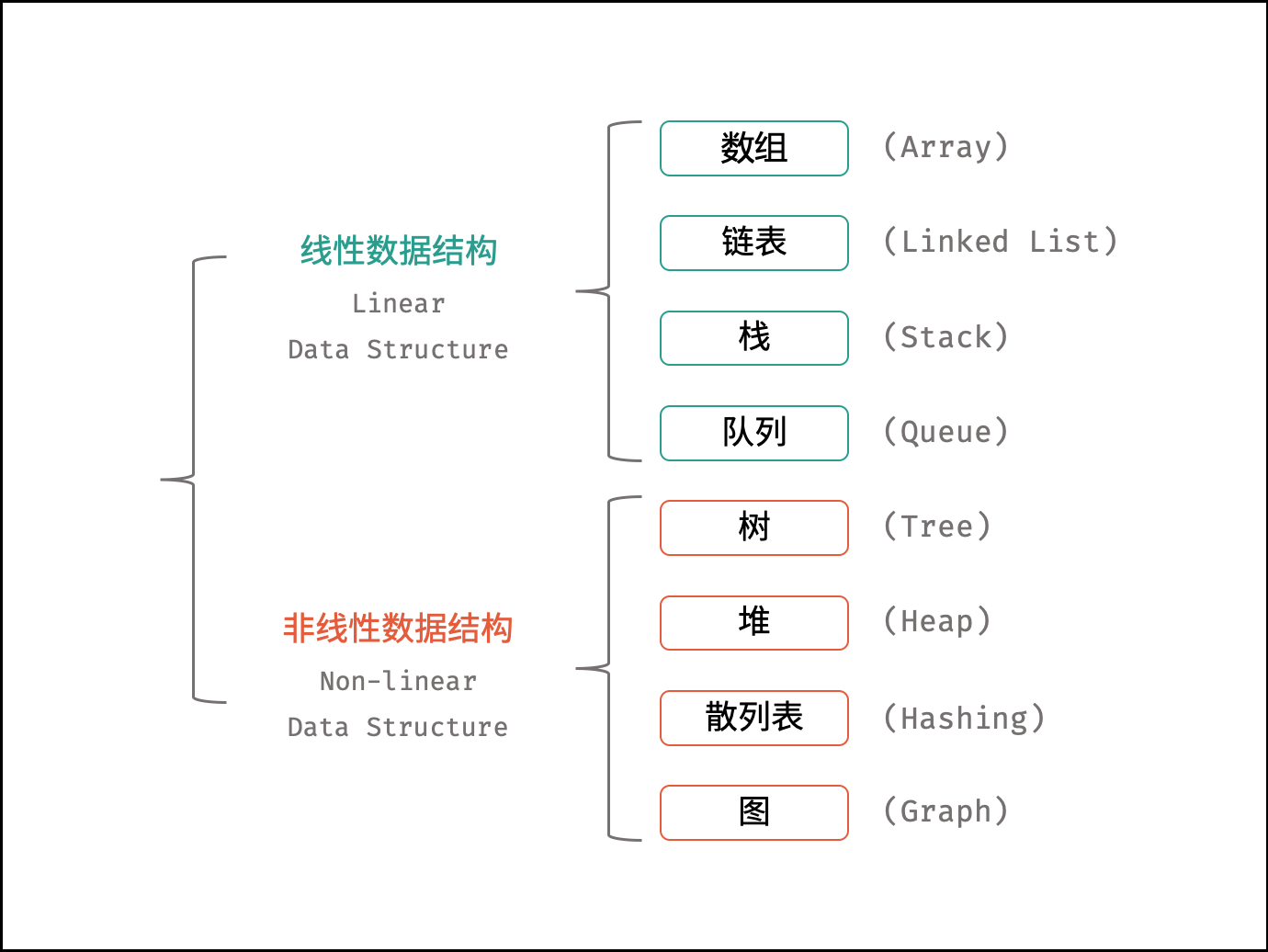{:width=500}
从零开始学习算法的同学对数据结构的使用方法可能尚不熟悉,本节将初步介绍各数据结构的基本特点,与 Python3 , Java , C++ 语言中各数据结构的初始化与构建方法。
> 代码运行可使用本地 IDE 或 [力扣 PlayGround](https://leetcode-cn.com/playground/) 。
---
## 数组
数组是将相同类型的元素存储于连续内存空间的数据结构,其长度不可变。
如下图所示,构建此数组需要在初始化时给定长度,并对数组每个索引元素赋值,代码如下:
```Java []
// 初始化一个长度为 5 的数组 array
int[] array = new int[5];
// 元素赋值
array[0] = 2;
array[1] = 3;
array[2] = 1;
array[3] = 0;
array[4] = 2;
```
```C++ []
// 初始化一个长度为 5 的数组 array
int array[5];
// 元素赋值
array[0] = 2;
array[1] = 3;
array[2] = 1;
array[3] = 0;
array[4] = 2;
```
或者可以使用直接赋值的初始化方式,代码如下:
```Java []
int[] array = {2, 3, 1, 0, 2};
```
```C++ []
int array[] = {2, 3, 1, 0, 2};
```
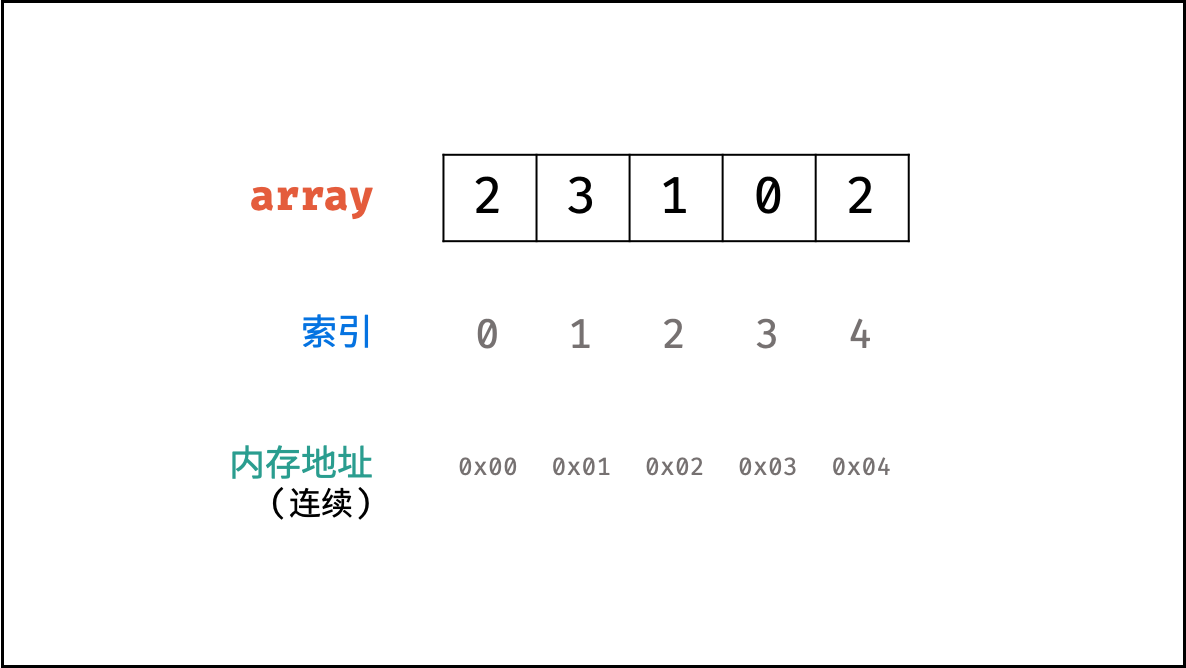{:width=500}
「可变数组」是经常使用的数据结构,其基于数组和扩容机制实现,相比普通数组更加灵活。常用操作有:访问元素、添加元素、删除元素。
```Java []
// 初始化可变数组
List array = new ArrayList<>();
// 向尾部添加元素
array.add(2);
array.add(3);
array.add(1);
array.add(0);
array.add(2);
```
```Python []
# 初始化可变数组
array = []
# 向尾部添加元素
array.append(2)
array.append(3)
array.append(1)
array.append(0)
array.append(2)
```
```C++ []
// 初始化可变数组
vector array;
// 向尾部添加元素
array.push_back(2);
array.push_back(3);
array.push_back(1);
array.push_back(0);
array.push_back(2);
```
---
## 链表
链表以节点为单位,每个元素都是一个独立对象,在内存空间的存储是非连续的。链表的节点对象具有两个成员变量:「值 `val`」,「后继节点引用 `next`」 。
```Java []
class ListNode {
int val; // 节点值
ListNode next; // 后继节点引用
ListNode(int x) { val = x; }
}
```
```Python []
class ListNode:
def __init__(self, x):
self.val = x # 节点值
self.next = None # 后继节点引用
```
```C++ []
struct ListNode {
int val; // 节点值
ListNode *next; // 后继节点引用
ListNode(int x) : val(x), next(NULL) {}
};
```
如下图所示,建立此链表需要实例化每个节点,并构建各节点的引用指向。
```Java []
// 实例化节点
ListNode n1 = new ListNode(4); // 节点 head
ListNode n2 = new ListNode(5);
ListNode n3 = new ListNode(1);
// 构建引用指向
n1.next = n2;
n2.next = n3;
```
```Python []
# 实例化节点
n1 = ListNode(4) # 节点 head
n2 = ListNode(5)
n3 = ListNode(1)
# 构建引用指向
n1.next = n2
n2.next = n3
```
```C++ []
// 实例化节点
ListNode *n1 = new ListNode(4); // 节点 head
ListNode *n2 = new ListNode(5);
ListNode *n3 = new ListNode(1);
// 构建引用指向
n1->next = n2;
n2->next = n3;
```
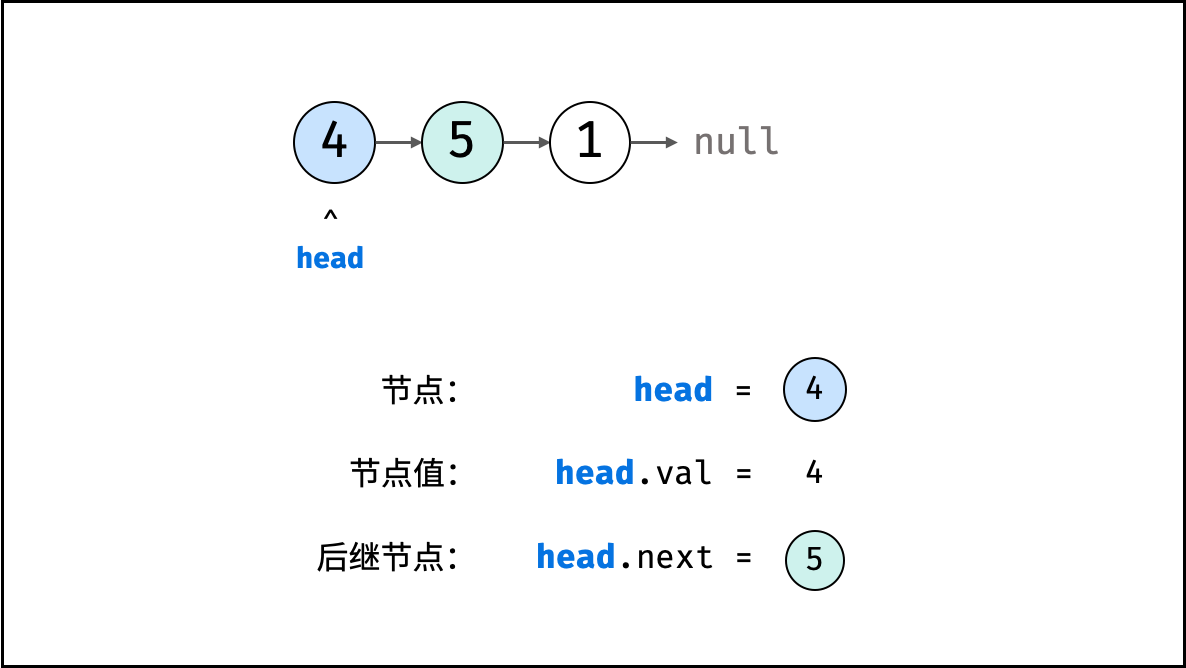{:width=500}
---
## 栈
栈是一种具有 「先入后出」 特点的抽象数据结构,可使用数组或链表实现。
```Java []
Stack stack = new Stack<>();
```
```Python []
stack = [] # Python 可将列表作为栈使用
```
```C++ []
stack stk;
```
如下图所示,通过常用操作「入栈 `push()`」,「出栈 `pop()`」,展示了栈的先入后出特性。
```Java []
stack.push(1); // 元素 1 入栈
stack.push(2); // 元素 2 入栈
stack.pop(); // 出栈 -> 元素 2
stack.pop(); // 出栈 -> 元素 1
```
```Python []
stack.append(1) # 元素 1 入栈
stack.append(2) # 元素 2 入栈
stack.pop() # 出栈 -> 元素 2
stack.pop() # 出栈 -> 元素 1
```
```C++ []
stk.push(1); // 元素 1 入栈
stk.push(2); // 元素 2 入栈
stk.pop(); // 出栈 -> 元素 2
stk.pop(); // 出栈 -> 元素 1
```
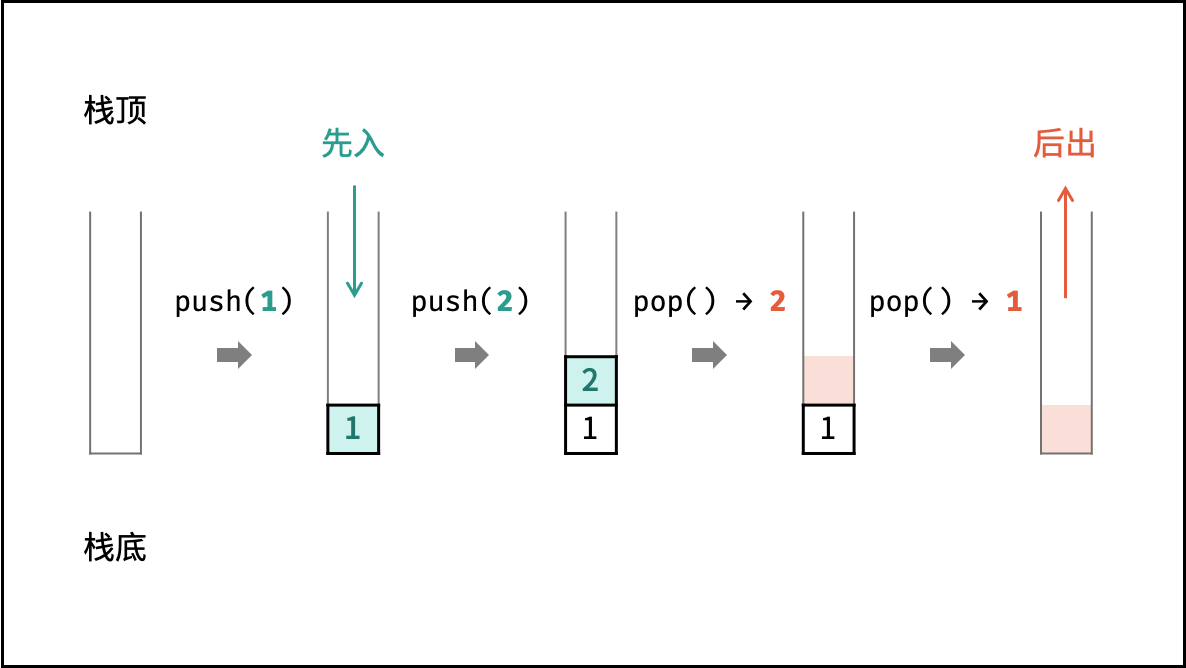{:width=500}
> 注意:通常情况下,不推荐使用 Java 的 `Vector` 以及其子类 `Stack` ,而一般将 `LinkedList` 作为栈来使用。详细说明请见:[Stack,ArrayDeque,LinkedList 的区别](https://blog.csdn.net/cartoon_/article/details/87992743) 。
```Java []
LinkedList stack = new LinkedList<>();
stack.addLast(1); // 元素 1 入栈
stack.addLast(2); // 元素 2 入栈
stack.removeLast(); // 出栈 -> 元素 2
stack.removeLast(); // 出栈 -> 元素 1
```
---
## 队列
队列是一种具有 「先入先出」 特点的抽象数据结构,可使用链表实现。
```Java []
Queue queue = new LinkedList<>();
```
```Python []
# Python 通常使用双端队列 collections.deque
from collections import deque
queue = deque()
```
```C++ []
queue que;
```
如下图所示,通过常用操作「入队 `push()`」,「出队 `pop()`」,展示了队列的先入先出特性。
```Java []
queue.offer(1); // 元素 1 入队
queue.offer(2); // 元素 2 入队
queue.poll(); // 出队 -> 元素 1
queue.poll(); // 出队 -> 元素 2
```
```Python []
queue.append(1) # 元素 1 入队
queue.append(2) # 元素 2 入队
queue.popleft() # 出队 -> 元素 1
queue.popleft() # 出队 -> 元素 2
```
```C++ []
que.push(1); // 元素 1 入队
que.push(2); // 元素 2 入队
que.pop(); // 出队 -> 元素 1
que.pop(); // 出队 -> 元素 2
```
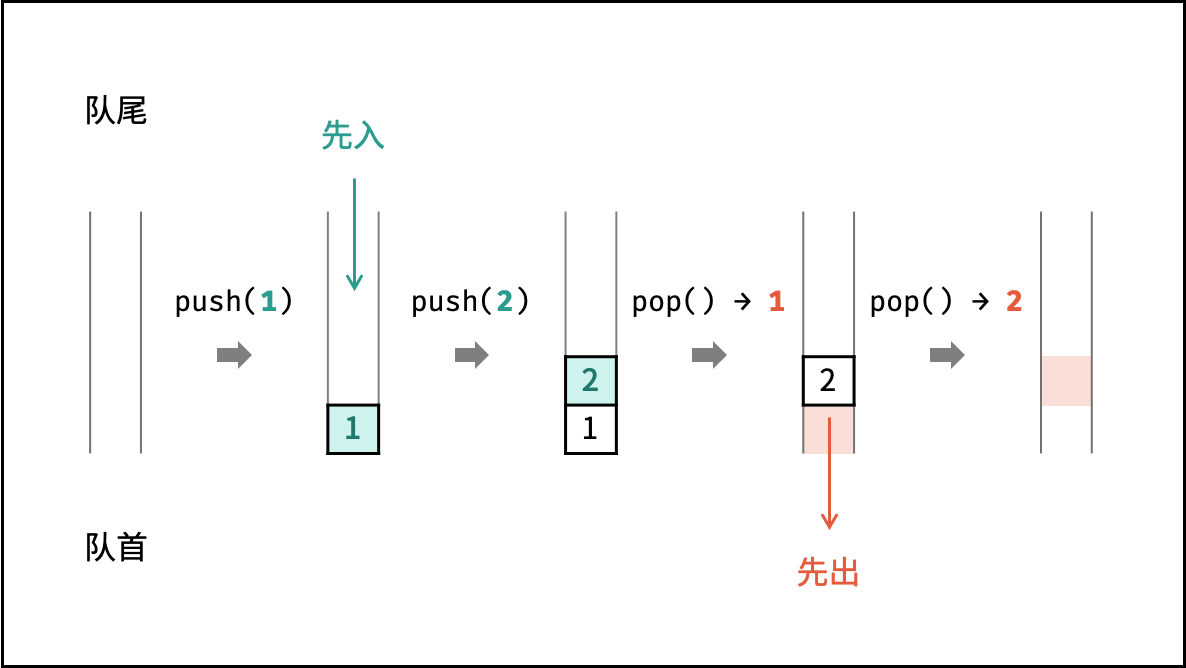{:width=500}
---
## 树
树是一种非线性数据结构,根据子节点数量可分为 「二叉树」 和 「多叉树」,最顶层的节点称为「根节点 `root`」。以二叉树为例,每个节点包含三个成员变量:「值 `val`」、「左子节点 `left`」、「右子节点 `right`」 。
```Java []
class TreeNode {
int val; // 节点值
TreeNode left; // 左子节点
TreeNode right; // 右子节点
TreeNode(int x) { val = x; }
}
```
```Python []
class TreeNode:
def __init__(self, x):
self.val = x # 节点值
self.left = None # 左子节点
self.right = None # 右子节点
```
```C++ []
struct TreeNode {
int val; // 节点值
TreeNode *left; // 左子节点
TreeNode *right; // 右子节点
TreeNode(int x) : val(x), left(NULL), right(NULL) {}
};
```
如下图所示,建立此二叉树需要实例化每个节点,并构建各节点的引用指向。
```Java []
// 初始化节点
TreeNode n1 = new TreeNode(3); // 根节点 root
TreeNode n2 = new TreeNode(4);
TreeNode n3 = new TreeNode(5);
TreeNode n4 = new TreeNode(1);
TreeNode n5 = new TreeNode(2);
// 构建引用指向
n1.left = n2;
n1.right = n3;
n2.left = n4;
n2.right = n5;
```
```Python []
# 初始化节点
n1 = TreeNode(3) # 根节点 root
n2 = TreeNode(4)
n3 = TreeNode(5)
n4 = TreeNode(1)
n5 = TreeNode(2)
# 构建引用指向
n1.left = n2
n1.right = n3
n2.left = n4
n2.right = n5
```
```C++ []
// 初始化节点
TreeNode *n1 = new TreeNode(3); // 根节点 root
TreeNode *n2 = new TreeNode(4);
TreeNode *n3 = new TreeNode(5);
TreeNode *n4 = new TreeNode(1);
TreeNode *n5 = new TreeNode(2);
// 构建引用指向
n1->left = n2;
n1->right = n3;
n2->left = n4;
n2->right = n5;
```
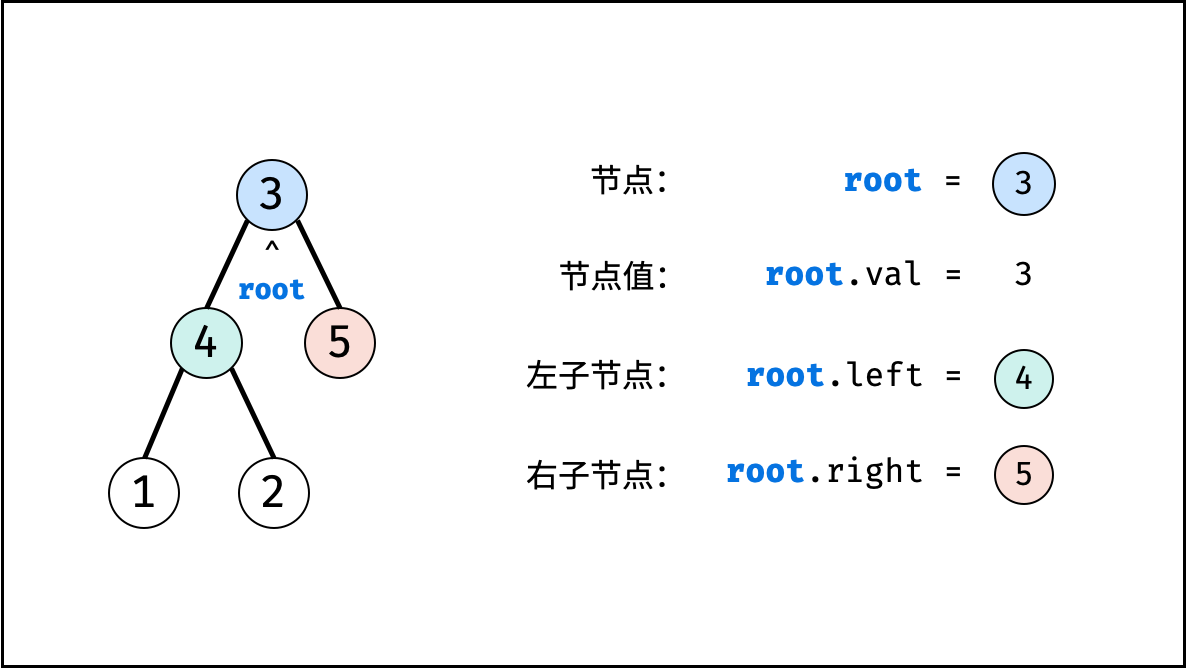{:width=500}
---
## 图
图是一种非线性数据结构,由「节点(顶点)`vertex`」和「边 `edge`」组成,每条边连接一对顶点。根据边的方向有无,图可分为「有向图」和「无向图」。本文 **以无向图为例** 开展介绍。
如下图所示,此无向图的 **顶点** 和 **边** 集合分别为:
- 顶点集合: `vertices = {1, 2, 3, 4, 5}`
- 边集合: `edges = {(1, 2), (1, 3), (1, 4), (1, 5), (2, 4), (3, 5), (4, 5)}`
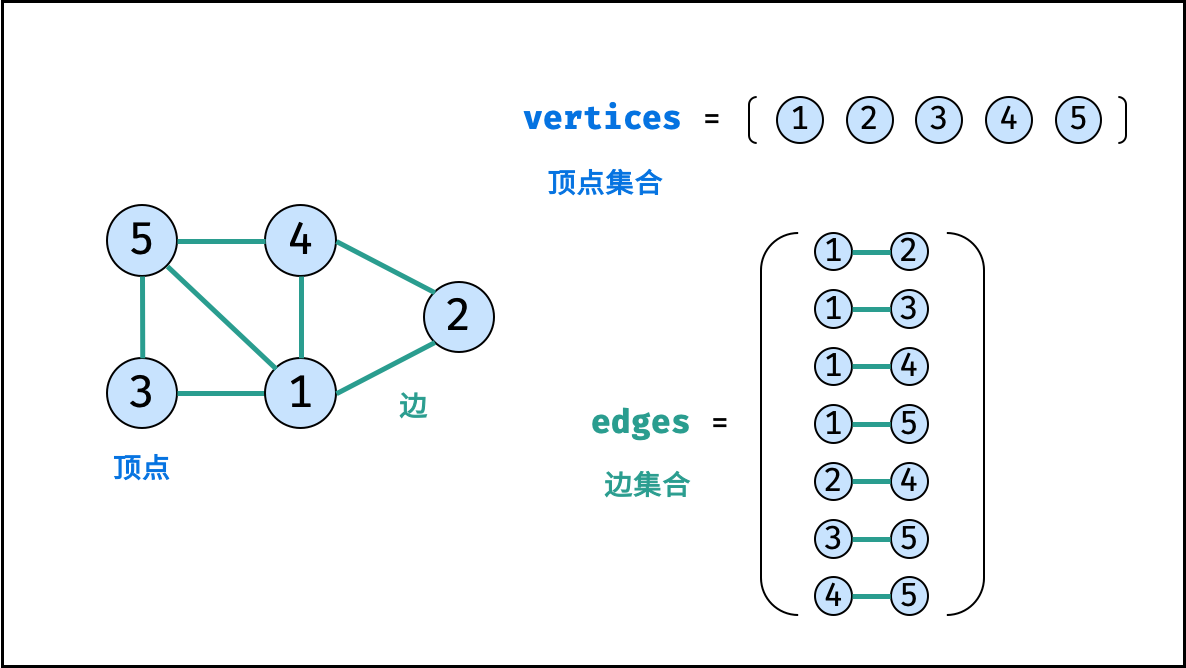{:width=500}
表示图的方法通常有两种:
1. **邻接矩阵:** 使用数组 $vertices$ 存储顶点,邻接矩阵 $edges$ 存储边; $edges[i][j]$ 代表节点 $i + 1$ 和 节点 $j + 1$ 之间是否有边。
$$
vertices = [1, 2, 3, 4, 5] \\
edges = \left[ \begin{matrix} 0 & 1 & 1 & 1 & 1 \\ 1 & 0 & 0 & 1 & 0 \\ 1 & 0 & 0 & 0 & 1 \\ 1 & 1 & 0 & 0 & 1 \\ 1 & 0 & 1 & 1 & 0 \\ \end{matrix} \right]
$$
```Python []
vertices = [1, 2, 3, 4, 5]
edges = [[0, 1, 1, 1, 1],
[1, 0, 0, 1, 0],
[1, 0, 0, 0, 1],
[1, 1, 0, 0, 1],
[1, 0, 1, 1, 0]]
```
```Java []
int[] vertices = {1, 2, 3, 4, 5};
int[][] edges = {{0, 1, 1, 1, 1},
{1, 0, 0, 1, 0},
{1, 0, 0, 0, 1},
{1, 1, 0, 0, 1},
{1, 0, 1, 1, 0}};
```
```C++ []
int vertices[5] = {1, 2, 3, 4, 5};
int edges[5][5] = {{0, 1, 1, 1, 1},
{1, 0, 0, 1, 0},
{1, 0, 0, 0, 1},
{1, 1, 0, 0, 1},
{1, 0, 1, 1, 0}};
```
2. **邻接表:** 使用数组 $vertices$ 存储顶点,邻接表 $edges$ 存储边。 $edges$ 为一个二维容器,第一维 $i$ 代表顶点索引,第二维 $edges[i]$ 存储此顶点对应的边集和;例如 $edges[0] = [1, 2, 3, 4]$ 代表 $vertices[0]$ 的边集合为 $[1, 2, 3, 4]$ 。
$$
vertices = [1, 2, 3, 4, 5] \\
edges = \left[ \begin{matrix} [ & 1 & 2 & 3 & 4 & ] \\ [ & 0 & 3 & ] \\ [ & 0 & 4 & ] \\ [ & 0 & 1 & 4 & ] \\ [ & 0 & 2 & 3 & ] \end{matrix} \right]
$$
```Python []
vertices = [1, 2, 3, 4, 5]
edges = [[1, 2, 3, 4],
[0, 3],
[0, 4],
[0, 1, 4],
[0, 2, 3]]
```
```Java []
int[] vertices = {1, 2, 3, 4, 5};
List> edges = new ArrayList<>();
List edge_1 = new ArrayList<>(Arrays.asList(1, 2, 3, 4));
List edge_2 = new ArrayList<>(Arrays.asList(0, 3));
List edge_3 = new ArrayList<>(Arrays.asList(0, 4));
List edge_4 = new ArrayList<>(Arrays.asList(0, 1, 4));
List edge_5 = new ArrayList<>(Arrays.asList(0, 2, 3));
edges.add(edge_1);
edges.add(edge_2);
edges.add(edge_3);
edges.add(edge_4);
edges.add(edge_5);
```
```C++ []
int vertices[5] = {1, 2, 3, 4, 5};
vector> edges;
vector edge_1 = {1, 2, 3, 4};
vector edge_2 = {0, 3};
vector edge_3 = {0, 4};
vector edge_4 = {0, 1, 4};
vector edge_5 = {0, 2, 3};
edges.push_back(edge_1);
edges.push_back(edge_2);
edges.push_back(edge_3);
edges.push_back(edge_4);
edges.push_back(edge_5);
```
> **邻接矩阵 VS 邻接表 :**
>
> 邻接矩阵的大小只与节点数量有关,即 $N^2$ ,其中 $N$ 为节点数量。因此,当边数量明显少于节点数量时,使用邻接矩阵存储图会造成较大的内存浪费。
> 因此,**邻接表** 适合存储稀疏图(顶点较多、边较少); **邻接矩阵** 适合存储稠密图(顶点较少、边较多)。
---
## 散列表
散列表是一种非线性数据结构,通过利用 Hash 函数将指定的「键 `key`」映射至对应的「值 `value`」,以实现高效的元素查找。
> 设想一个简单场景:小力、小特、小扣的学号分别为 10001, 10002, 10003 。
> 现需求从「姓名」查找「学号」。
则可通过建立姓名为 `key` ,学号为 `value` 的散列表实现此需求,代码如下:
```Java []
// 初始化散列表
Map dic = new HashMap<>();
// 添加 key -> value 键值对
dic.put("小力", 10001);
dic.put("小特", 10002);
dic.put("小扣", 10003);
// 从姓名查找学号
dic.get("小力"); // -> 10001
dic.get("小特"); // -> 10002
dic.get("小扣"); // -> 10003
```
```Python []
# 初始化散列表
dic = {}
# 添加 key -> value 键值对
dic["小力"] = 10001
dic["小特"] = 10002
dic["小扣"] = 10003
# 从姓名查找学号
dic["小力"] # -> 10001
dic["小特"] # -> 10002
dic["小扣"] # -> 10003
```
```C++ []
// 初始化散列表
unordered_map dic;
// 添加 key -> value 键值对
dic["小力"] = 10001;
dic["小特"] = 10002;
dic["小扣"] = 10003;
// 从姓名查找学号
dic.find("小力")->second; // -> 10001
dic.find("小特")->second; // -> 10002
dic.find("小扣")->second; // -> 10003
```
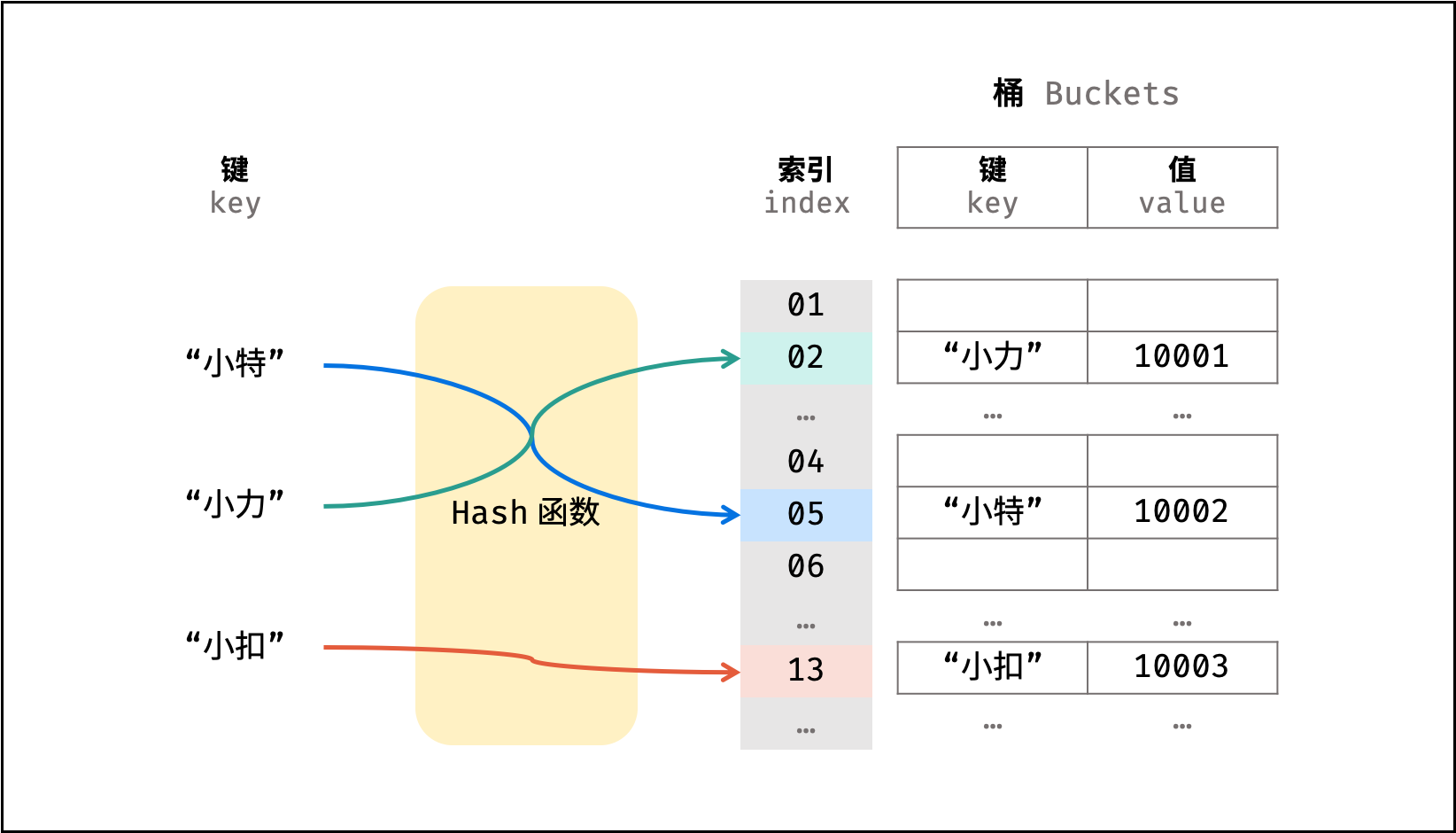{:width=550}
### Hash 函数设计示例 :
> 假设需求:从「学号」查找「姓名」。
将三人的姓名存储至以下数组中,则各姓名在数组中的索引分别为 0, 1, 2 。
```Java []
String[] names = { "小力", "小特", "小扣" };
```
```Python []
names = [ "小力", "小特", "小扣" ]
```
```C++ []
string names[] = { "小力", "小特", "小扣" };
```
此时,我们构造一个简单的 Hash 函数( $\%$ 为取余符号 ),公式和封装函数如下所示:
$$
hash(key) = (key - 1) \% 10000
$$
```Java []
int hash(int id) {
int index = (id - 1) % 10000;
return index;
}
```
```Python []
def hash(id):
index = (id - 1) % 10000
return index
```
```C++ []
int hash(int id) {
int index = (id - 1) % 10000;
return index;
}
```
则我们构建了以学号为 `key` 、姓名对应的数组索引为 `value` 的散列表。利用此 Hash 函数,则可在 $O(1)$ 时间复杂度下通过学号查找到对应姓名,即:
```Java
names[hash(10001)] // 小力
names[hash(10002)] // 小特
names[hash(10003)] // 小扣
```
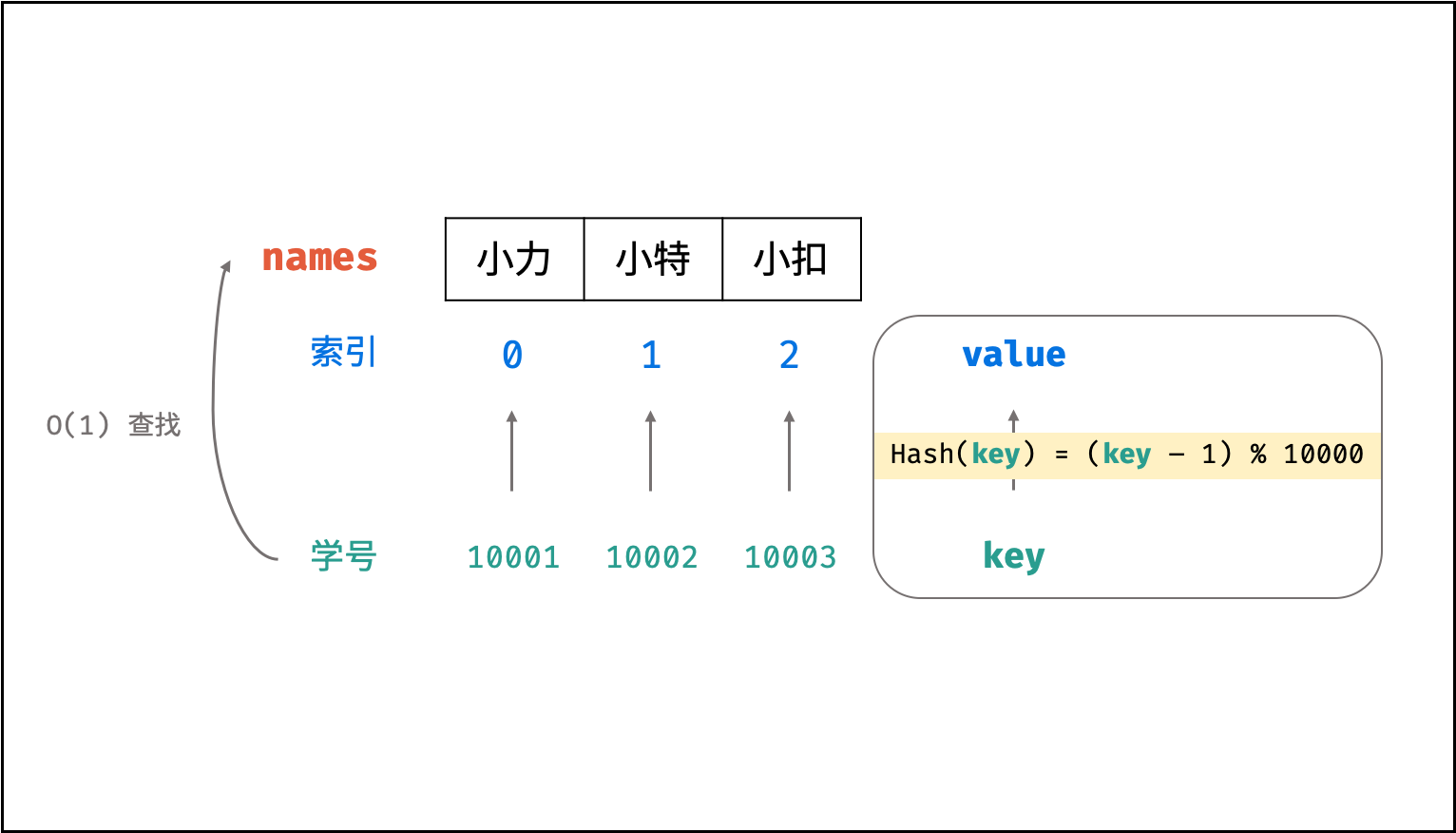{:width=550}
以上设计只适用于此示例,实际的 Hash 函数需保证低碰撞率、 高鲁棒性等,以适用于各类数据和场景。
---
## 堆:
堆是一种基于「完全二叉树」的数据结构,可使用数组实现。以堆为原理的排序算法称为「堆排序」,基于堆实现的数据结构为「优先队列」。堆分为「大顶堆」和「小顶堆」,大(小)顶堆:任意节点的值不大于(小于)其父节点的值。
> **完全二叉树定义:** 设二叉树深度为 $k$ ,若二叉树除第 $k$ 层外的其它各层(第 $1$ 至 $k-1$ 层)的节点达到最大个数,且处于第 $k$ 层的节点都连续集中在最左边,则称此二叉树为完全二叉树。
如下图所示,为包含 `1, 4, 2, 6, 8` 元素的小顶堆。将堆(完全二叉树)中的结点按层编号,即可映射到右边的数组存储形式。
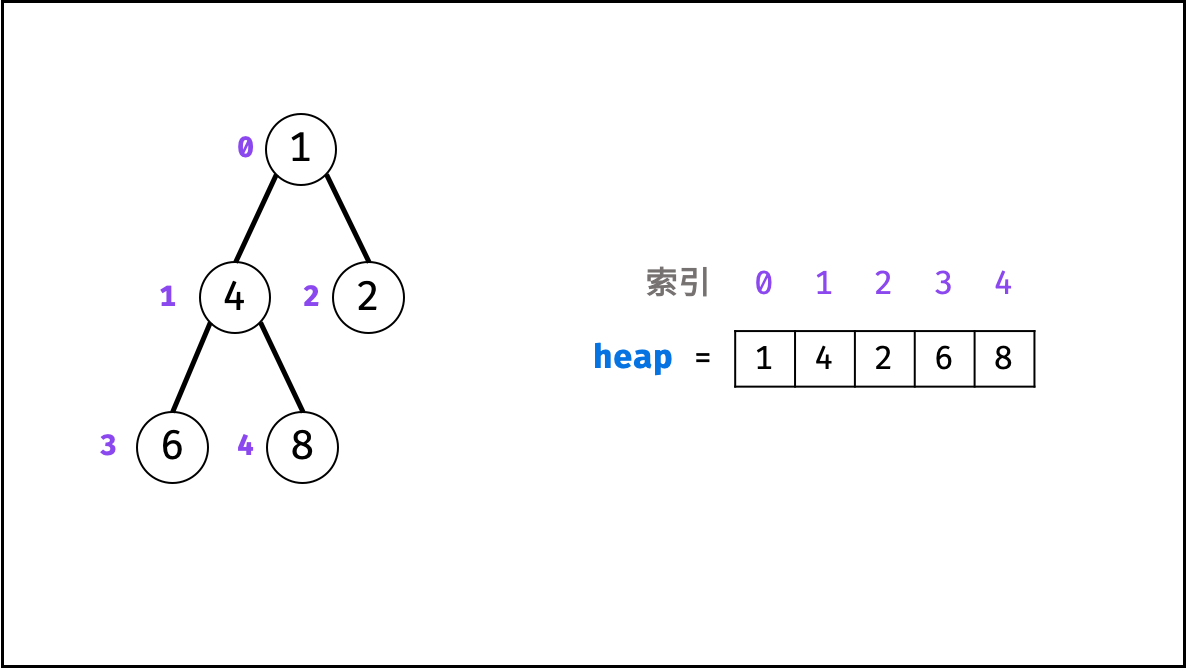{:width=550}
通过使用「优先队列」的「压入 `push()`」和「弹出 `pop()`」操作,即可完成堆排序,实现代码如下:
```Java []
// 初始化小顶堆
Queue heap = new PriorityQueue<>();
// 元素入堆
heap.add(1);
heap.add(4);
heap.add(2);
heap.add(6);
heap.add(8);
// 元素出堆(从小到大)
heap.poll(); // -> 1
heap.poll(); // -> 2
heap.poll(); // -> 4
heap.poll(); // -> 6
heap.poll(); // -> 8
```
```Python []
from heapq import heappush, heappop
# 初始化小顶堆
heap = []
# 元素入堆
heappush(heap, 1)
heappush(heap, 4)
heappush(heap, 2)
heappush(heap, 6)
heappush(heap, 8)
# 元素出堆(从小到大)
heappop(heap) # -> 1
heappop(heap) # -> 2
heappop(heap) # -> 4
heappop(heap) # -> 6
heappop(heap) # -> 8
```
```C++ []
// 初始化小顶堆
priority_queue, greater> heap;
// 元素入堆
heap.push(1);
heap.push(4);
heap.push(2);
heap.push(6);
heap.push(8);
// 元素出堆(从小到大)
heap.pop(); // -> 1
heap.pop(); // -> 2
heap.pop(); // -> 4
heap.pop(); // -> 6
heap.pop(); // -> 8
```
================================================
FILE: leetbook_ioa/docs/# 1.2 算法复杂度.md
================================================
# 算法复杂度
算法复杂度旨在计算在输入数据量 $N$ 的情况下,算法的「时间使用」和「空间使用」情况;体现算法运行使用的时间和空间随「数据大小 $N$ 」而增大的速度。
算法复杂度主要可从 **时间** 、**空间** 两个角度评价:
- **时间:** 假设各操作的运行时间为固定常数,统计算法运行的「计算操作的数量」 ,以代表算法运行所需时间;
- **空间:** 统计在最差情况下,算法运行所需使用的「最大空间」;
「输入数据大小 $N$ 」指算法处理的输入数据量;根据不同算法,具有不同定义,例如:
- **排序算法:** $N$ 代表需要排序的元素数量;
- **搜索算法:** $N$ 代表搜索范围的元素总数,例如数组大小、矩阵大小、二叉树节点数、图节点和边数等;
接下来,我们将分别从概念定义、符号表示、常见种类、时空权衡、示例解析、示例题目等角度入手,学习「时间复杂度」和「空间复杂度」。
================================================
FILE: leetbook_ioa/docs/# 1.3 时间复杂度.md
================================================
# 时间复杂度
根据定义,时间复杂度指输入数据大小为 $N$ 时,算法运行所需花费的时间。需要注意:
- 统计的是算法的「计算操作数量」,而不是「运行的绝对时间」。计算操作数量和运行绝对时间呈正相关关系,并不相等。算法运行时间受到「编程语言 、计算机处理器速度、运行环境」等多种因素影响。例如,同样的算法使用 Python 或 C++ 实现、使用 CPU 或 GPU 、使用本地 IDE 或力扣平台提交,运行时间都不同。
- 体现的是计算操作随数据大小 $N$ 变化时的变化情况。假设算法运行总共需要「 $1$ 次操作」、「 $100$ 次操作」,此两情况的时间复杂度都为常数级 $O(1)$ ;需要「 $N$ 次操作」、「 $100N$ 次操作」的时间复杂度都为 $O(N)$ 。
---
## 符号表示
根据输入数据的特点,时间复杂度具有「最差」、「平均」、「最佳」三种情况,分别使用 $O$ , $\Theta$ , $\Omega$ 三种符号表示。以下借助一个查找算法的示例题目帮助理解。
> **题目:** 输入长度为 $N$ 的整数数组 `nums` ,判断此数组中是否有数字 $7$ ,若有则返回 `true` ,否则返回 $\text{false}$ 。
>
> **解题算法:** 线性查找,即遍历整个数组,遇到 $7$ 则返回 `true` 。
>
> **代码:**
>
> ```Python []
> def find_seven(nums):
> for num in nums:
> if num == 7:
> return True
> return False
> ```
>
> ```Java []
> boolean findSeven(int[] nums) {
> for (int num : nums) {
> if (num == 7)
> return true;
> }
> return false;
> }
> ```
>
> ```C++ []
> bool findSeven(vector& nums) {
> for (int num : nums) {
> if (num == 7)
> return true;
> }
> return false;
> }
> ```
- **最佳情况 $\Omega(1)$ :** `nums = [7, a, b, c, ...]` ,即当数组首个数字为 $7$ 时,无论 `nums` 有多少元素,线性查找的循环次数都为 $1$ 次;
- **最差情况 $O(N)$ :** `nums = [a, b, c, ...]` 且 `nums` 中所有数字都不为 $7$ ,此时线性查找会遍历整个数组,循环 $N$ 次;
- **平均情况 $\Theta$ :** 需要考虑输入数据的分布情况,计算所有数据情况下的平均时间复杂度;例如本题目,需要考虑数组长度、数组元素的取值范围等;
> 大 $O$ 是最常使用的时间复杂度评价渐进符号,下文示例与本 LeetBook 题目解析皆使用 $O$ 。
---
## 常见种类
根据从小到大排列,常见的算法时间复杂度主要有:
$$
O(1) < O(\log N) < O(N) < O(N\log N) < O(N^2) < O(2^N) < O(N!)
$$
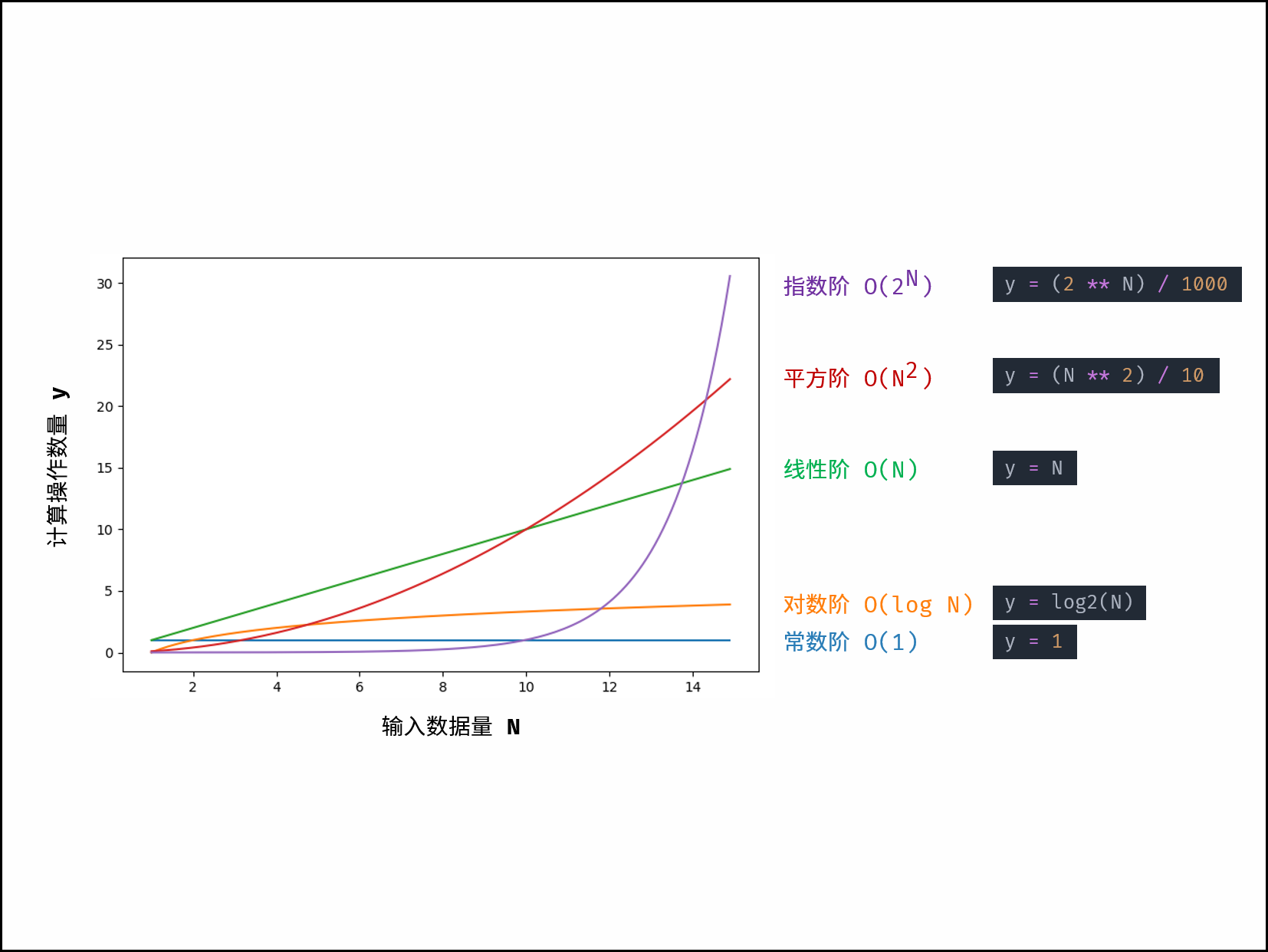
对于以下所有示例,设输入数据大小为 $N$ ,计算操作数量为 $count$ 。图中每个「**蓝色方块**」代表一个单元计算操作。
### 常数 $O(1)$ :
运行次数与 $N$ 大小呈常数关系,即不随输入数据大小 $N$ 的变化而变化。
```Python []
def algorithm(N):
a = 1
b = 2
x = a * b + N
return 1
```
```Java []
int algorithm(int N) {
int a = 1;
int b = 2;
int x = a * b + N;
return 1;
}
```
```C++ []
int algorithm(int N) {
int a = 1;
int b = 2;
int x = a * b + N;
return 1;
}
```
对于以下代码,无论 $a$ 取多大,都与输入数据大小 $N$ 无关,因此时间复杂度仍为 $O(1)$ 。
```Python []
def algorithm(N):
count = 0
a = 10000
for i in range(a):
count += 1
return count
```
```Java []
int algorithm(int N) {
int count = 0;
int a = 10000;
for (int i = 0; i < a; i++) {
count++;
}
return count;
}
```
```C++ []
int algorithm(int N) {
int count = 0;
int a = 10000;
for (int i = 0; i < a; i++) {
count++;
}
return count;
}
```
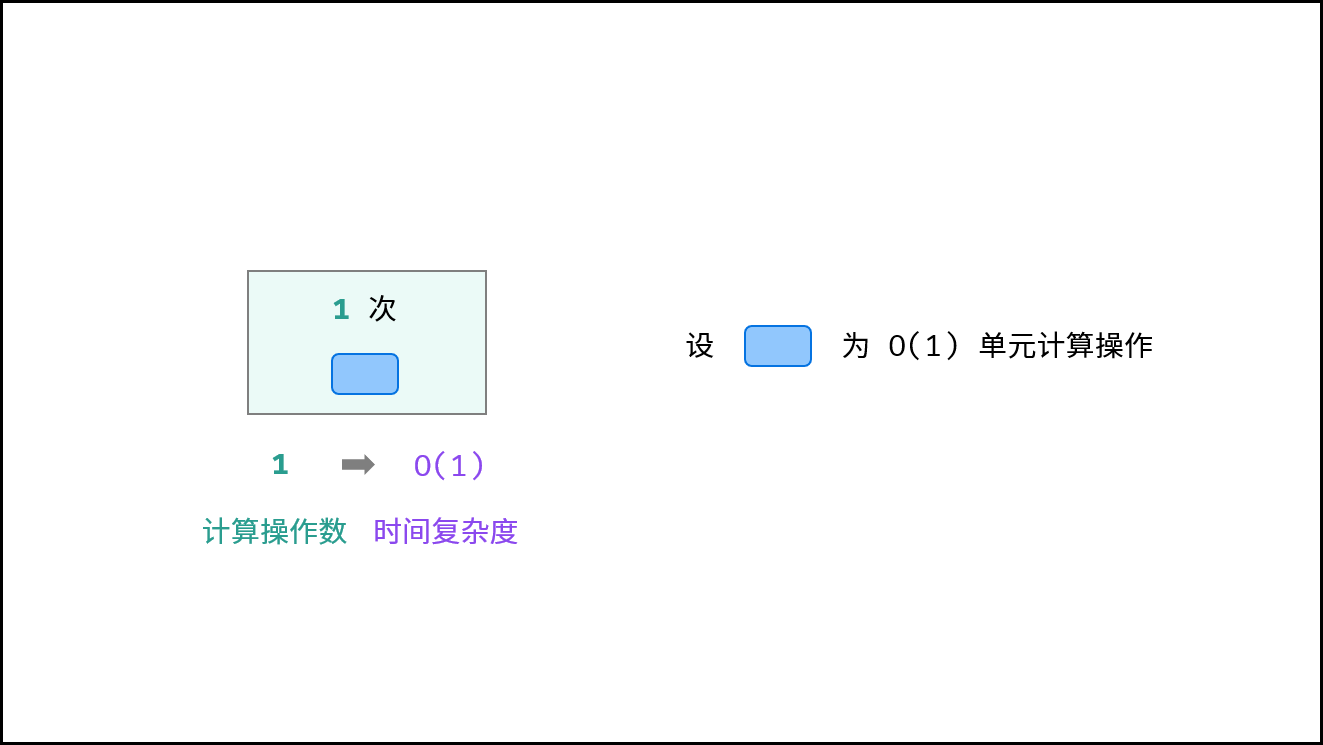{:width=500}
### 线性 $O(N)$ :
循环运行次数与 $N$ 大小呈线性关系,时间复杂度为 $O(N)$ 。
```Python []
def algorithm(N):
count = 0
for i in range(N):
count += 1
return count
```
```Java []
int algorithm(int N) {
int count = 0;
for (int i = 0; i < N; i++)
count++;
return count;
}
```
```C++ []
int algorithm(int N) {
int count = 0;
for (int i = 0; i < N; i++)
count++;
return count;
}
```
对于以下代码,虽然是两层循环,但第二层与 $N$ 大小无关,因此整体仍与 $N$ 呈线性关系。
```Python []
def algorithm(N):
count = 0
a = 10000
for i in range(N):
for j in range(a):
count += 1
return count
```
```Java []
int algorithm(int N) {
int count = 0;
int a = 10000;
for (int i = 0; i < N; i++) {
for (int j = 0; j < a; j++) {
count++;
}
}
return count;
}
```
```C++ []
int algorithm(int N) {
int count = 0;
int a = 10000;
for (int i = 0; i < N; i++) {
for (int j = 0; j < a; j++) {
count++;
}
}
return count;
}
```
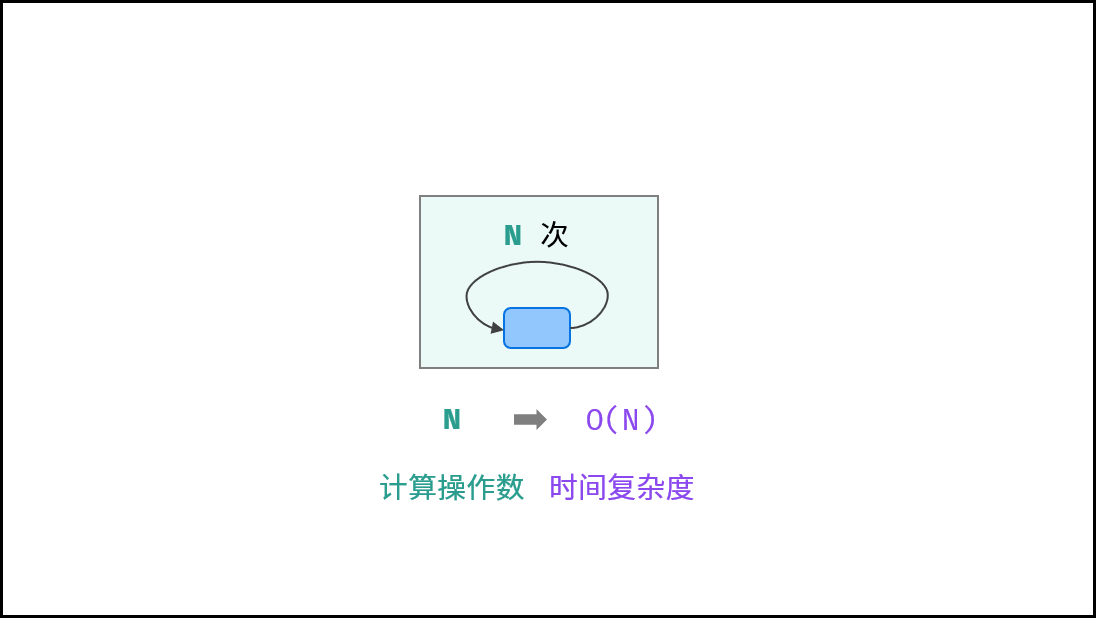{:width=500}
### 平方 $O(N^2)$ :
两层循环相互独立,都与 $N$ 呈线性关系,因此总体与 $N$ 呈平方关系,时间复杂度为 $O(N^2)$ 。
```Python []
def algorithm(N):
count = 0
for i in range(N):
for j in range(N):
count += 1
return count
```
```Java []
int algorithm(int N) {
int count = 0;
for (int i = 0; i < N; i++) {
for (int j = 0; j < N; j++) {
count++;
}
}
return count;
}
```
```C++ []
int algorithm(int N) {
int count = 0;
for (int i = 0; i < N; i++) {
for (int j = 0; j < N; j++) {
count++;
}
}
return count;
}
```
以「冒泡排序」为例,其包含两层独立循环:
1. 第一层复杂度为 $O(N)$ ;
2. 第二层平均循环次数为 $\frac{N}{2}$ ,复杂度为 $O(N)$ ,推导过程如下:
$$
O(\frac{N}{2}) = O(\frac{1}{2})O(N) = O(1)O(N) = O(N)
$$
因此,冒泡排序的总体时间复杂度为 $O(N^2)$ ,代码如下所示。
```Python []
def bubble_sort(nums):
N = len(nums)
for i in range(N - 1):
for j in range(N - 1 - i):
if nums[j] > nums[j + 1]:
nums[j], nums[j + 1] = nums[j + 1], nums[j]
return nums
```
```Java []
int[] bubbleSort(int[] nums) {
int N = nums.length;
for (int i = 0; i < N - 1; i++) {
for (int j = 0; j < N - 1 - i; j++) {
if (nums[j] > nums[j + 1]) {
int tmp = nums[j];
nums[j] = nums[j + 1];
nums[j + 1] = tmp;
}
}
}
return nums;
}
```
```C++ []
vector bubbleSort(vector& nums) {
int N = nums.size();
for (int i = 0; i < N - 1; i++) {
for (int j = 0; j < N - 1 - i; j++) {
if (nums[j] > nums[j + 1]) {
swap(nums[j], nums[j + 1]);
}
}
}
return nums;
}
```
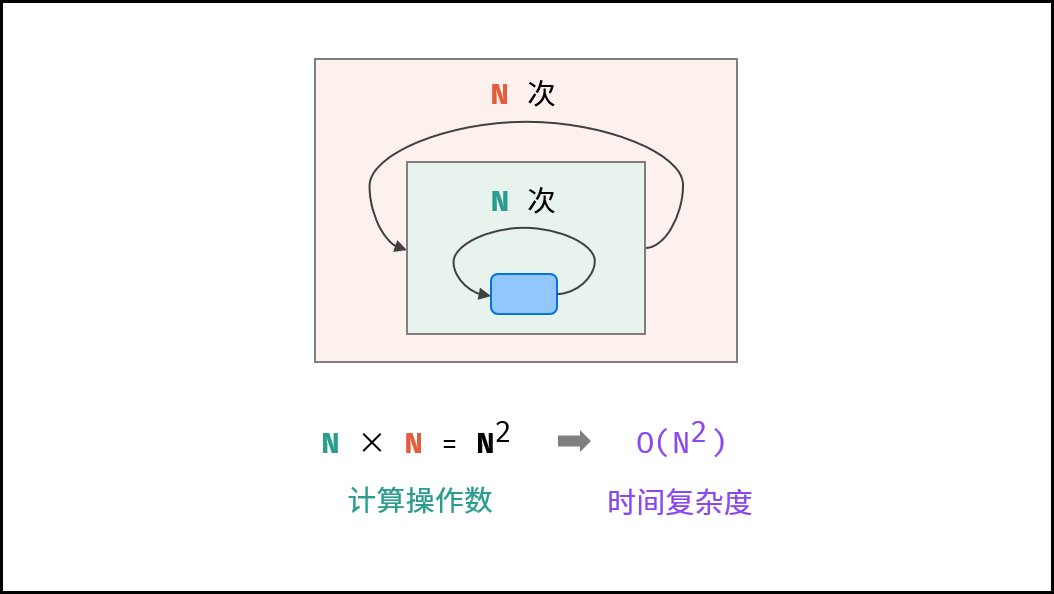{:width=450}
### 指数 $O(2^N)$ :
生物学科中的 “细胞分裂” 即是指数级增长。初始状态为 $1$ 个细胞,分裂一轮后为 $2$ 个,分裂两轮后为 $4$ 个,……,分裂 $N$ 轮后有 $2^N$ 个细胞。
算法中,指数阶常出现于递归,算法原理图与代码如下所示。
```Python []
def algorithm(N):
if N <= 0: return 1
count_1 = algorithm(N - 1)
count_2 = algorithm(N - 1)
return count_1 + count_2
```
```Java []
int algorithm(int N) {
if (N <= 0) return 1;
int count_1 = algorithm(N - 1);
int count_2 = algorithm(N - 1);
return count_1 + count_2;
}
```
```C++ []
int algorithm(int N) {
if (N <= 0) return 1;
int count_1 = algorithm(N - 1);
int count_2 = algorithm(N - 1);
return count_1 + count_2;
}
```
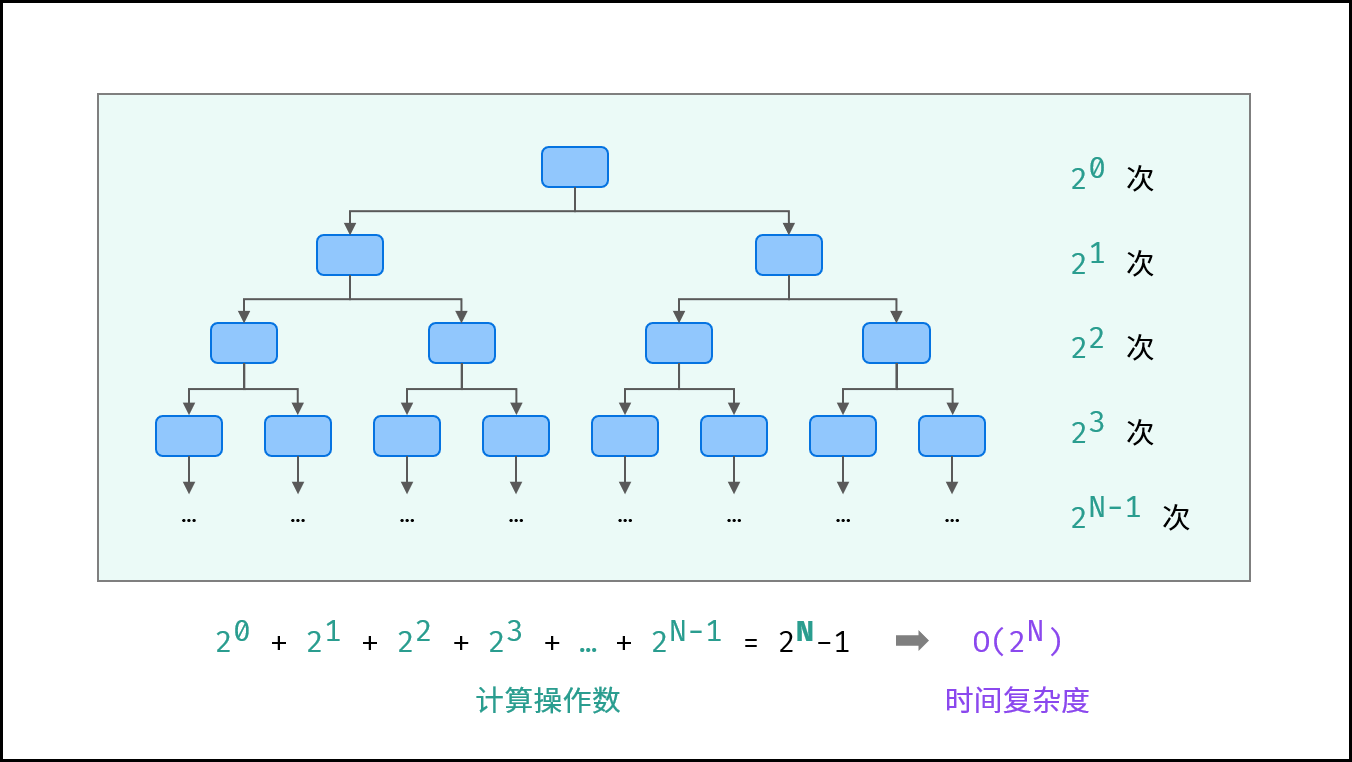{:width=600}
### 阶乘 $O(N!)$ :
阶乘阶对应数学上常见的 “全排列” 。即给定 $N$ 个互不重复的元素,求其所有可能的排列方案,则方案数量为:
$$
N \times (N - 1) \times (N - 2) \times \cdots \times 2 \times 1 = N!
$$
如下图与代码所示,阶乘常使用递归实现,算法原理:第一层分裂出 $N$ 个,第二层分裂出 $N - 1$ 个,…… ,直至到第 $N$ 层时终止并回溯。
```Python []
def algorithm(N):
if N <= 0: return 1
count = 0
for _ in range(N):
count += algorithm(N - 1)
return count
```
```Java []
int algorithm(int N) {
if (N <= 0) return 1;
int count = 0;
for (int i = 0; i < N; i++) {
count += algorithm(N - 1);
}
return count;
}
```
```C++ []
int algorithm(int N) {
if (N <= 0) return 1;
int count = 0;
for (int i = 0; i < N; i++) {
count += algorithm(N - 1);
}
return count;
}
```
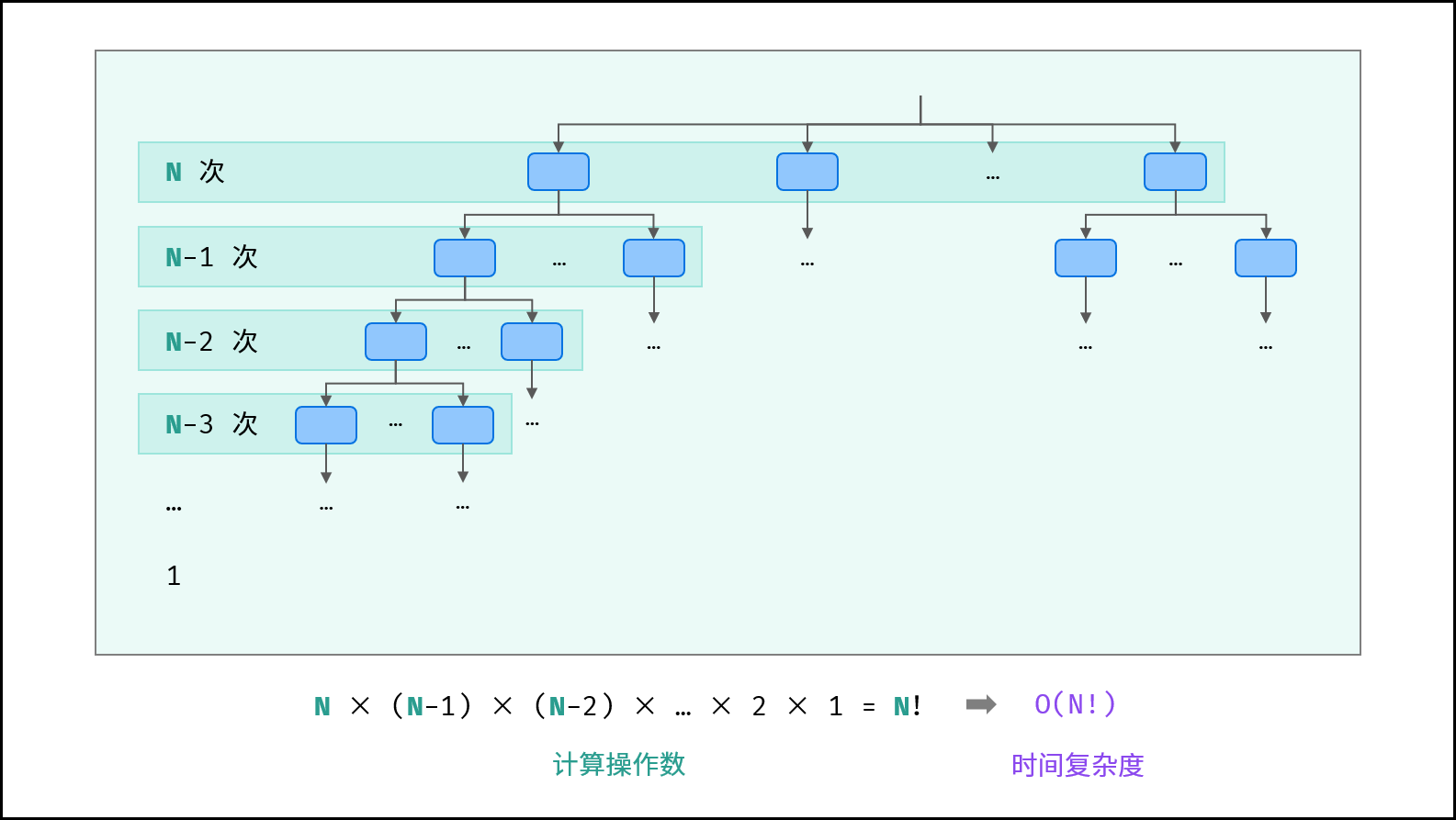{:width=600}
### 对数 $O(\log N)$ :
对数阶与指数阶相反,指数阶为 “每轮分裂出两倍的情况” ,而对数阶是 “每轮排除一半的情况” 。对数阶常出现于「二分法」、「分治」等算法中,体现着 “一分为二” 或 “一分为多” 的算法思想。
设循环次数为 $m$ ,则输入数据大小 $N$ 与 $2 ^ m$ 呈线性关系,两边同时取 $log_2$ 对数,则得到循环次数 $m$ 与 $\log_2 N$ 呈线性关系,即时间复杂度为 $O(\log N)$ 。
```Python []
def algorithm(N):
count = 0
i = N
while i > 1:
i = i / 2
count += 1
return count
```
```Java []
int algorithm(int N) {
int count = 0;
float i = N;
while (i > 1) {
i = i / 2;
count++;
}
return count;
}
```
```C++ []
int algorithm(int N) {
int count = 0;
float i = N;
while (i > 1) {
i = i / 2;
count++;
}
return count;
}
```
如以下代码所示,对于不同 $a$ 的取值,循环次数 $m$ 与 $\log_a N$ 呈线性关系 ,时间复杂度为 $O(\log_a N)$ 。而无论底数 $a$ 取值,时间复杂度都可记作 $O(\log N)$ ,根据对数换底公式的推导如下:
$$
O(\log_a N) = \frac{O(\log_2 N)}{O(\log_2 a)} = O(\log N)
$$
```Python []
def algorithm(N):
count = 0
i = N
a = 3
while i > 1:
i = i / a
count += 1
return count
```
```Java []
int algorithm(int N) {
int count = 0;
float i = N;
int a = 3;
while (i > 1) {
i = i / a;
count++;
}
return count;
}
```
```C++ []
int algorithm(int N) {
int count = 0;
float i = N;
int a = 3;
while (i > 1) {
i = i / a;
count++;
}
return count;
}
```
> 如下图所示,为二分查找的时间复杂度示意图,每次二分将搜索区间缩小一半。
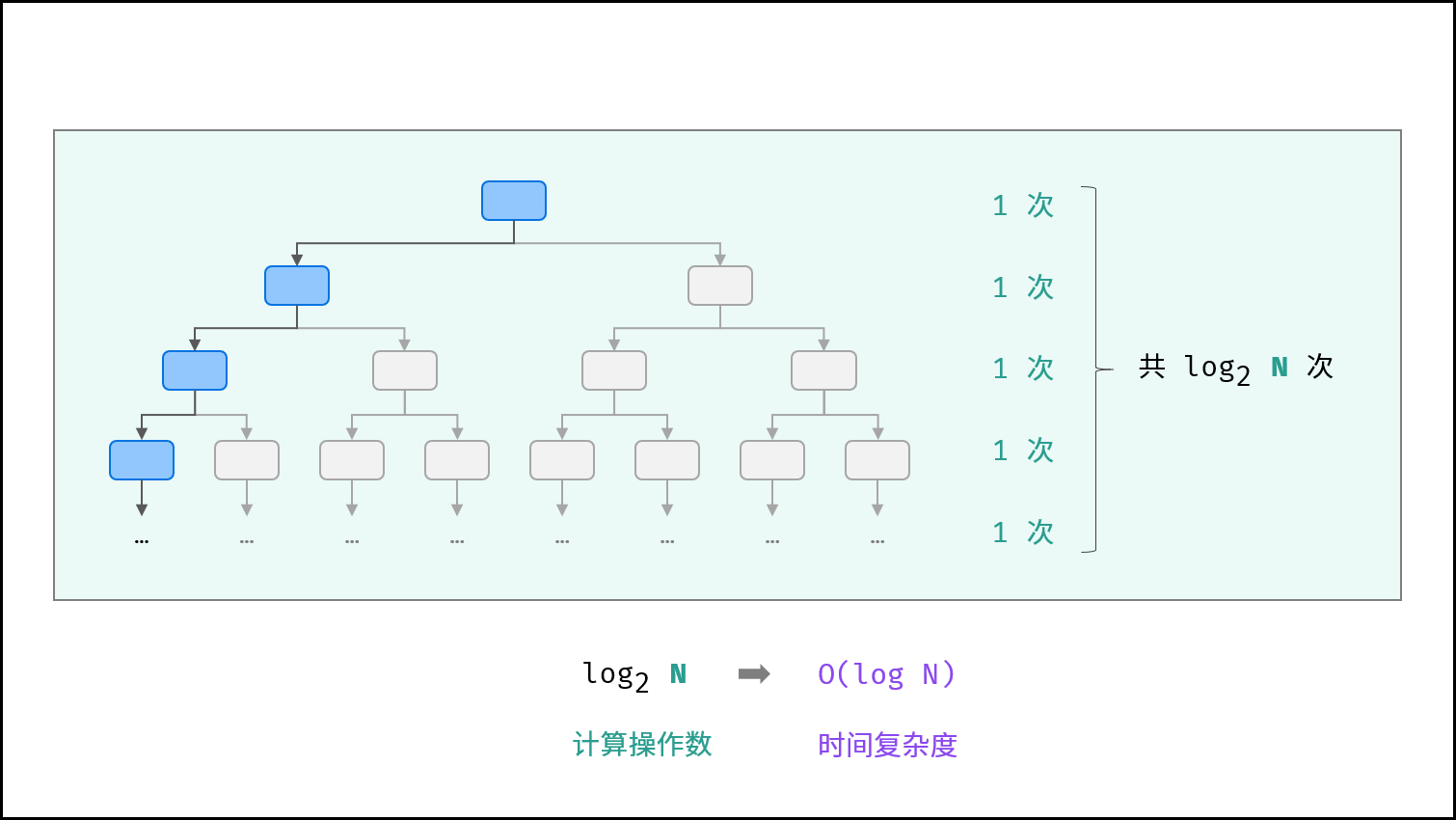{:width=600}
### 线性对数 $O(N \log N)$ :
两层循环相互独立,第一层和第二层时间复杂度分别为 $O(\log N)$ 和 $O(N)$ ,则总体时间复杂度为 $O(N \log N)$ ;
```Python []
def algorithm(N):
count = 0
i = N
while i > 1:
i = i / 2
for j in range(N):
count += 1
```
```Java []
int algorithm(int N) {
int count = 0;
float i = N;
while (i > 1) {
i = i / 2;
for (int j = 0; j < N; j++)
count++;
}
return count;
}
```
```C++ []
int algorithm(int N) {
int count = 0;
float i = N;
while (i > 1) {
i = i / 2;
for (int j = 0; j < N; j++)
count++;
}
return count;
}
```
线性对数阶常出现于排序算法,例如「快速排序」、「归并排序」、「堆排序」等,其时间复杂度原理如下图所示。
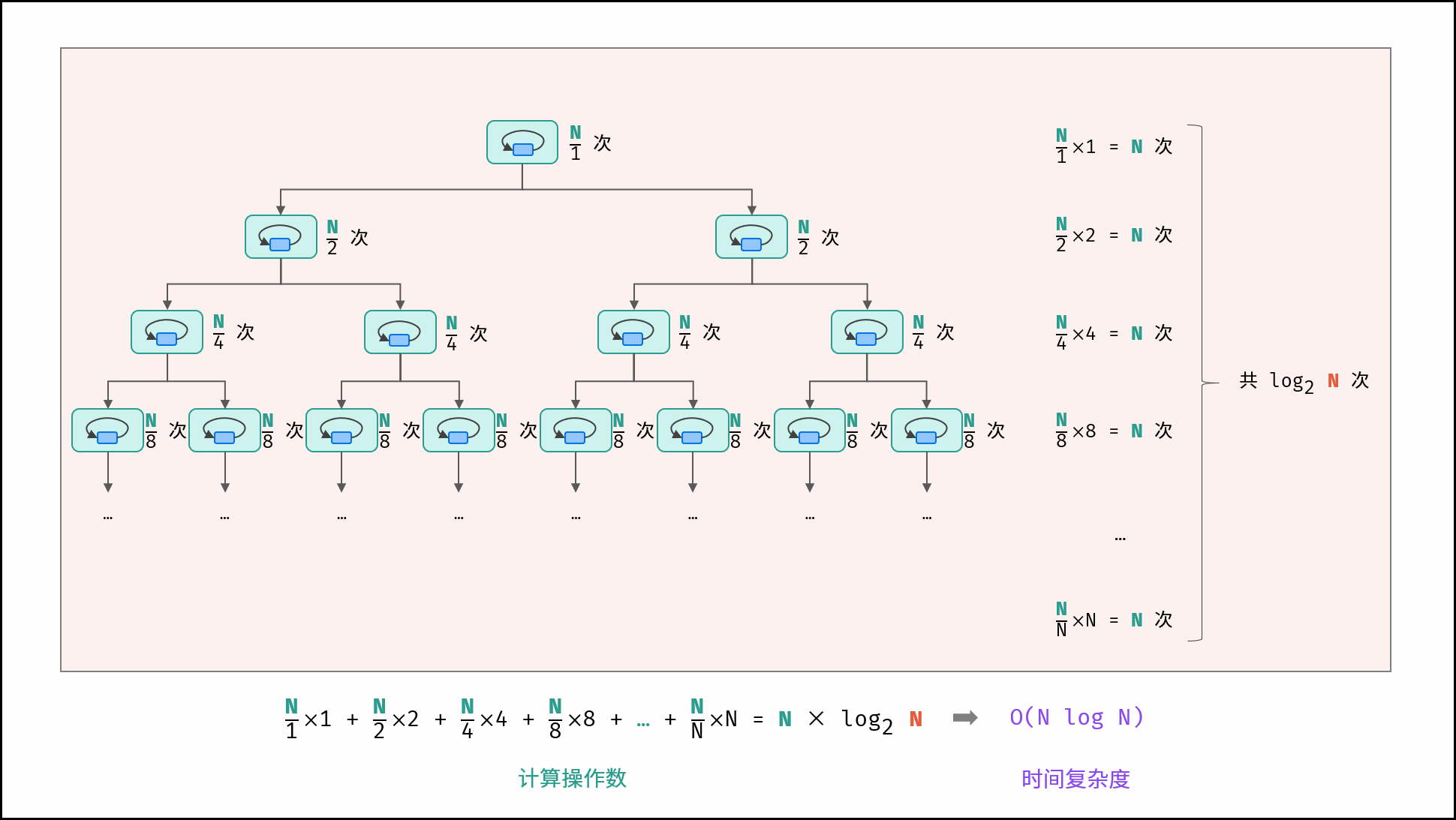
---
## 示例题目
以下列举本 LeetBook 中各时间复杂度的对应示例题解,以帮助加深理解。
| 时间复杂度 | 示例题解 |
| ------------- | ---------------------------------------------------------------------------------------------------------------------------------------------------------------------------------------------- |
| $O(1)$ | [砍竹子 I](https://leetcode-cn.com/leetbook/read/illustration-of-algorithm/5vyva2/)、[文物朝代判断](https://leetcode-cn.com/leetbook/read/illustration-of-algorithm/572x9r/) |
| $O(\log N)$ | [Pow(x, n)](https://leetcode-cn.com/leetbook/read/illustration-of-algorithm/57p2pv/)、[统计目标成绩的出现次数](https://leetcode-cn.com/leetbook/read/illustration-of-algorithm/58lgr7/) |
| $O(N)$ | [训练计划 III](https://leetcode-cn.com/leetbook/read/illustration-of-algorithm/9p7s17/)、[斐波那契数](https://leetcode-cn.com/leetbook/read/illustration-of-algorithm/50fji7/) |
| $O(N \log N)$ | [破解闯关密码](https://leetcode-cn.com/leetbook/read/illustration-of-algorithm/59ceyt/)、[交易逆序对的总数](https://leetcode-cn.com/leetbook/read/illustration-of-algorithm/o53yjd/) |
| $O(N^2)$ | [验证二叉搜索树的后序遍历序列](https://leetcode-cn.com/leetbook/read/illustration-of-algorithm/5vwbf6/)、[招式拆解 I](https://leetcode-cn.com/leetbook/read/illustration-of-algorithm/5dz9di/) |
| $O(N!)$ | [套餐内商品的排列顺序](https://leetcode-cn.com/leetbook/read/illustration-of-algorithm/50hah3/) |
================================================
FILE: leetbook_ioa/docs/# 1.4 空间复杂度.md
================================================
# 空间复杂度
空间复杂度涉及的空间类型有:
- **输入空间:** 存储输入数据所需的空间大小;
- **暂存空间:** 算法运行过程中,存储所有中间变量和对象等数据所需的空间大小;
- **输出空间:** 算法运行返回时,存储输出数据所需的空间大小;
通常情况下,空间复杂度指在输入数据大小为 $N$ 时,算法运行所使用的「暂存空间」+「输出空间」的总体大小。
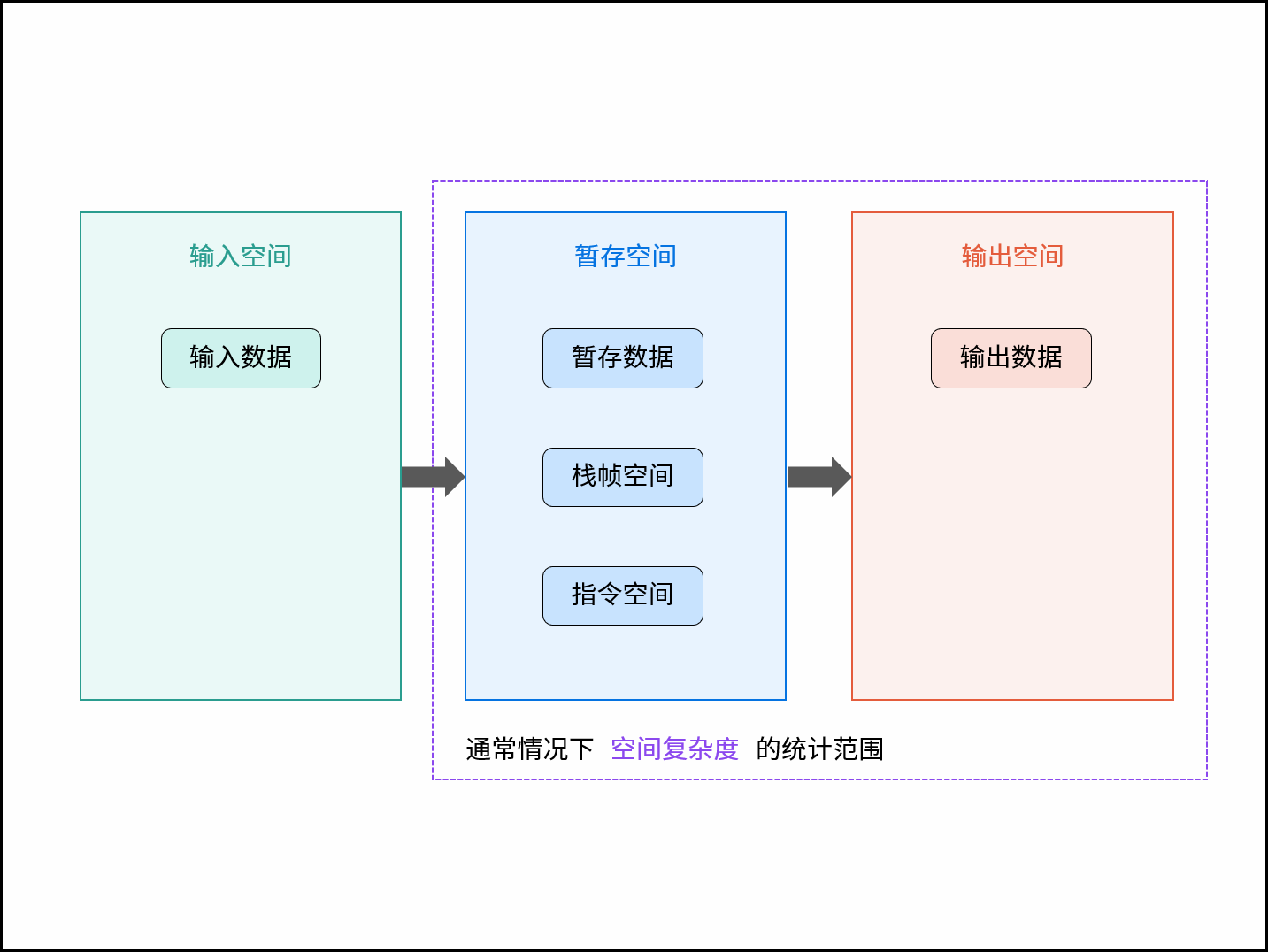{:width=500}
而根据不同来源,算法使用的内存空间分为三类:
**指令空间:**
编译后,程序指令所使用的内存空间。
**数据空间:**
算法中的各项变量使用的空间,包括:声明的常量、变量、动态数组、动态对象等使用的内存空间。
```Python []
class Node:
def __init__(self, val):
self.val = val
self.next = None
def algorithm(N):
num = N # 变量
nums = [0] * N # 动态数组
node = Node(N) # 动态对象
```
```Java []
class Node {
int val;
Node next;
Node(int x) { val = x; }
}
void algorithm(int N) {
int num = N; // 变量
int[] nums = new int[N]; // 动态数组
Node node = new Node(N); // 动态对象
}
```
```C++ []
struct Node {
int val;
Node *next;
Node(int x) : val(x), next(NULL) {}
};
void algorithm(int N) {
int num = N; // 变量
int nums[N]; // 动态数组
Node* node = new Node(N); // 动态对象
}
```
**栈帧空间:**
程序调用函数是基于栈实现的,函数在调用期间,占用常量大小的栈帧空间,直至返回后释放。如以下代码所示,在循环中调用函数,每轮调用 `test()` 返回后,栈帧空间已被释放,因此空间复杂度仍为 $O(1)$ 。
```Python []
def test():
return 0
def algorithm(N):
for _ in range(N):
test()
```
```Java []
int test() {
return 0;
}
void algorithm(int N) {
for (int i = 0; i < N; i++) {
test();
}
}
```
```C++ []
int test() {
return 0;
}
void algorithm(int N) {
for (int i = 0; i < N; i++) {
test();
}
}
```
算法中,栈帧空间的累计常出现于递归调用。如以下代码所示,通过递归调用,会同时存在 $N$ 个未返回的函数 `algorithm()` ,此时累计使用 $O(N)$ 大小的栈帧空间。
```Python []
def algorithm(N):
if N <= 1: return 1
return algorithm(N - 1) + 1
```
```Java []
int algorithm(int N) {
if (N <= 1) return 1;
return algorithm(N - 1) + 1;
}
```
```C++ []
int algorithm(int N) {
if (N <= 1) return 1;
return algorithm(N - 1) + 1;
}
```
---
## 符号表示
通常情况下,空间复杂度统计算法在 “最差情况” 下使用的空间大小,以体现算法运行所需预留的空间量,使用符号 $O$ 表示。
最差情况有两层含义,分别为「最差输入数据」、算法运行中的「最差运行点」。例如以下代码:
> 输入整数 $N$ ,取值范围 $N \geq 1$ ;
- **最差输入数据:** 当 $N \leq 10$ 时,数组 `nums` 的长度恒定为 10 ,空间复杂度为 $O(10) = O(1)$ ;当 $N > 10$ 时,数组 $nums$ 长度为 $N$ ,空间复杂度为 $O(N)$ ;因此,空间复杂度应为最差输入数据情况下的 $O(N)$ 。
- **最差运行点:** 在执行 `nums = [0] * 10` 时,算法仅使用 $O(1)$ 大小的空间;而当执行 `nums = [0] * N` 时,算法使用 $O(N)$ 的空间;因此,空间复杂度应为最差运行点的 $O(N)$ 。
```Python []
def algorithm(N):
num = 5 # O(1)
nums = [0] * 10 # O(1)
if N > 10:
nums = [0] * N # O(N)
```
```Java []
void algorithm(int N) {
int num = 5; // O(1)
int[] nums = new int[10]; // O(1)
if (N > 10) {
nums = new int[N]; // O(N)
}
}
```
```C++ []
void algorithm(int N) {
int num = 5; // O(1)
vector nums(10); // O(1)
if (N > 10) {
nums.resize(N); // O(N)
}
}
```
---
## 常见种类
根据从小到大排列,常见的算法空间复杂度有:
$$
O(1) < O(\log N) < O(N) < O(N^2) < O(2^N)
$$
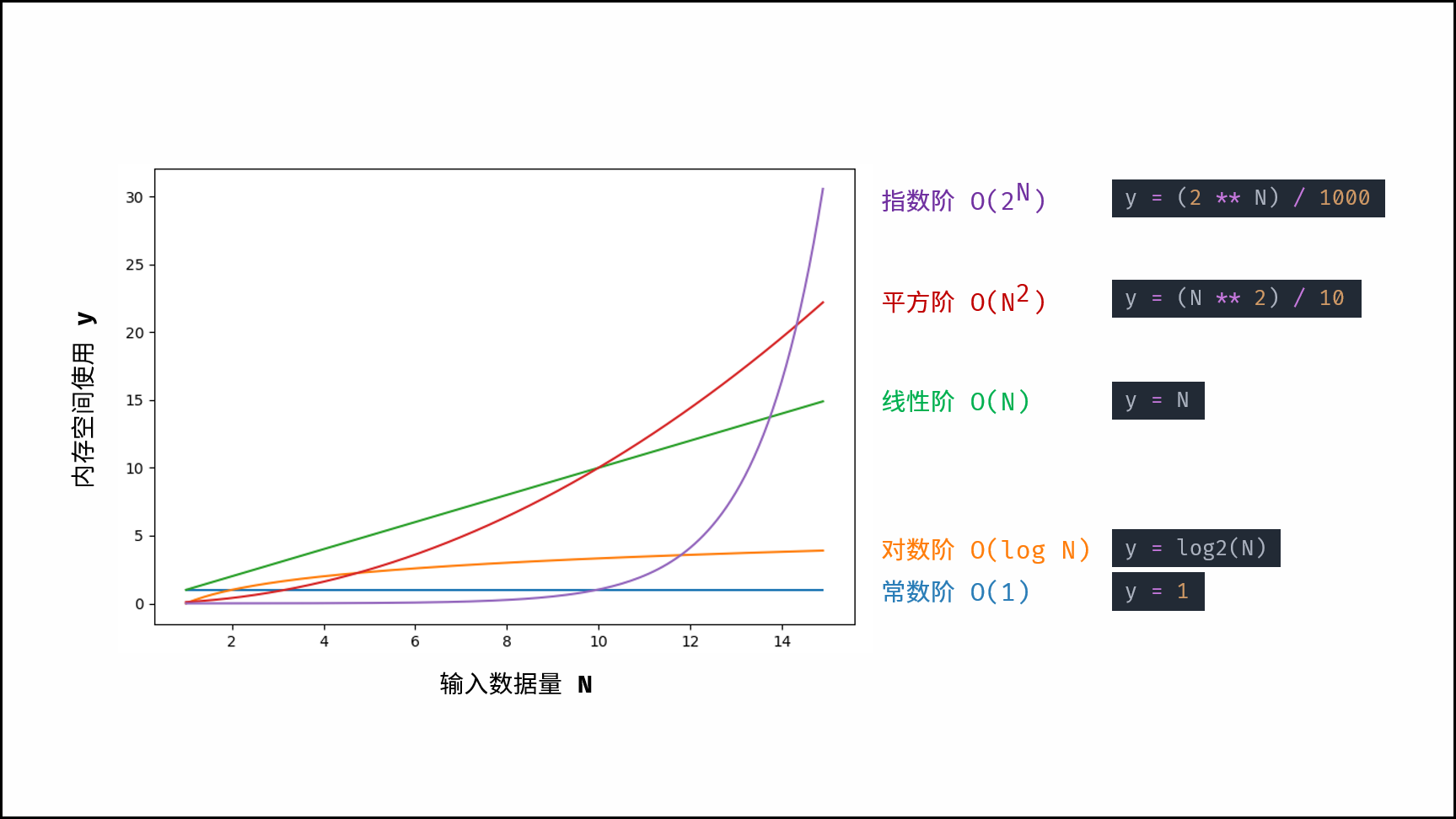
对于以下所有示例,设输入数据大小为正整数 $N$ ,节点类 `Node` 、函数 `test()` 如以下代码所示。
```Python []
# 节点类 Node
class Node:
def __init__(self, val):
self.val = val
self.next = None
# 函数 test()
def test():
return 0
```
```Java []
// 节点类 Node
class Node {
int val; // 变量
Node next; // 动态数组
Node(int x) { val = x; } // 动态对象
}
// 函数 test()
int test() {
return 0;
}
```
```C++ []
// 节点类 Node
struct Node {
int val;
Node *next;
Node(int x) : val(x), next(NULL) {}
};
// 函数 test()
int test() {
return 0;
}
```
### 常数 $O(1)$ :
普通常量、变量、对象、元素数量与输入数据大小 $N$ 无关的集合,皆使用常数大小的空间。
```Python []
def algorithm(N):
num = 0
nums = [0] * 10000
node = Node(0)
dic = { 0: '0' }
```
```Java []
void algorithm(int N) {
int num = 0;
int[] nums = new int[10000];
Node node = new Node(0);
Map dic = new HashMap<>() {{ put(0, "0"); }};
}
```
```C++ []
void algorithm(int N) {
int num = 0;
int nums[10000];
Node* node = new Node(0);
unordered_map dic;
dic.emplace(0, "0");
}
```
如以下代码所示,虽然函数 `test()` 调用了 $N$ 次,但每轮调用后 `test()` 已返回,无累计栈帧空间使用,因此空间复杂度仍为 $O(1)$ 。
```Python []
def algorithm(N):
for _ in range(N):
test()
```
```Java []
void algorithm(int N) {
for (int i = 0; i < N; i++) {
test();
}
}
```
```C++ []
void algorithm(int N) {
for (int i = 0; i < N; i++) {
test();
}
}
```
### 线性 $O(N)$ :
元素数量与 $N$ 呈线性关系的任意类型集合(常见于一维数组、链表、哈希表等),皆使用线性大小的空间。
```Python []
def algorithm(N):
nums_1 = [0] * N
nums_2 = [0] * (N // 2)
nodes = [Node(i) for i in range(N)]
dic = {}
for i in range(N):
dic[i] = str(i)
```
```Java []
void algorithm(int N) {
int[] nums_1 = new int[N];
int[] nums_2 = new int[N / 2];
List nodes = new ArrayList<>();
for (int i = 0; i < N; i++) {
nodes.add(new Node(i));
}
Map dic = new HashMap<>();
for (int i = 0; i < N; i++) {
dic.put(i, String.valueOf(i));
}
}
```
```C++ []
void algorithm(int N) {
int nums_1[N];
int nums_2[N / 2 + 1];
vector nodes;
for (int i = 0; i < N; i++) {
nodes.push_back(new Node(i));
}
unordered_map dic;
for (int i = 0; i < N; i++) {
dic.emplace(i, to_string(i));
}
}
```
如下图与代码所示,此递归调用期间,会同时存在 $N$ 个未返回的 `algorithm()` 函数,因此使用 $O(N)$ 大小的栈帧空间。
```Python []
def algorithm(N):
if N <= 1: return 1
return algorithm(N - 1) + 1
```
```Java []
int algorithm(int N) {
if (N <= 1) return 1;
return algorithm(N - 1) + 1;
}
```
```C++ []
int algorithm(int N) {
if (N <= 1) return 1;
return algorithm(N - 1) + 1;
}
```
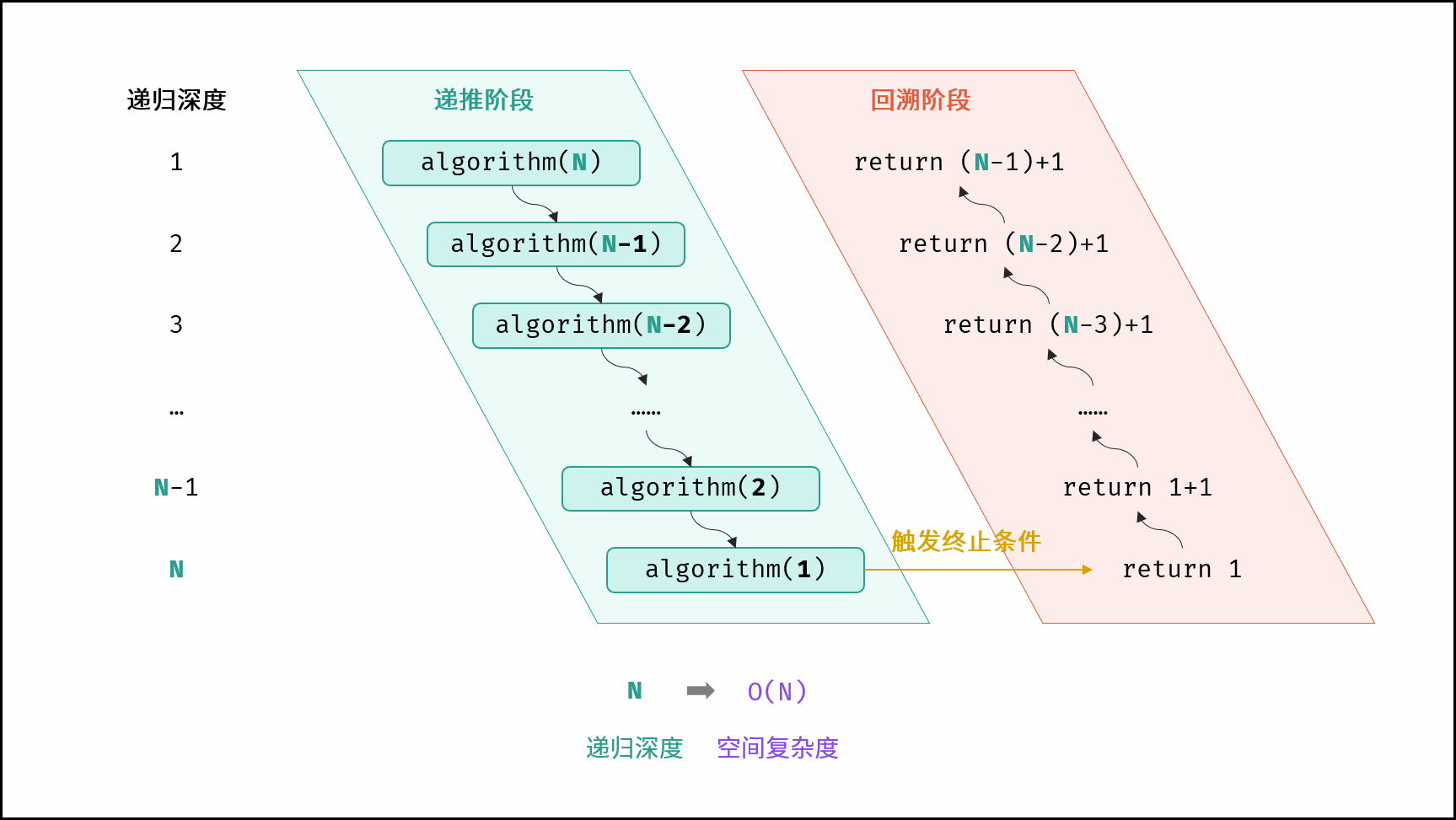
### 平方 $O(N^2)$ :
元素数量与 $N$ 呈平方关系的任意类型集合(常见于矩阵),皆使用平方大小的空间。
```Python []
def algorithm(N):
num_matrix = [[0 for j in range(N)] for i in range(N)]
node_matrix = [[Node(j) for j in range(N)] for i in range(N)]
```
```Java []
void algorithm(int N) {
int num_matrix[][] = new int[N][N];
List> node_matrix = new ArrayList<>();
for (int i = 0; i < N; i++) {
List nodes = new ArrayList<>();
for (int j = 0; j < N; j++) {
nodes.add(new Node(j));
}
node_matrix.add(nodes);
}
}
```
```C++ []
void algorithm(int N) {
vector> num_matrix;
for (int i = 0; i < N; i++) {
vector nums;
for (int j = 0; j < N; j++) {
nums.push_back(0);
}
num_matrix.push_back(nums);
}
vector> node_matrix;
for (int i = 0; i < N; i++) {
vector nodes;
for (int j = 0; j < N; j++) {
nodes.push_back(new Node(j));
}
node_matrix.push_back(nodes);
}
}
```
如下图与代码所示,递归调用时同时存在 $N$ 个未返回的 `algorithm()` 函数,使用 $O(N)$ 栈帧空间;每层递归函数中声明了数组,平均长度为 $\frac{N}{2}$ ,使用 $O(N)$ 空间;因此总体空间复杂度为 $O(N^2)$ 。
```Python []
def algorithm(N):
if N <= 0: return 0
nums = [0] * N
return algorithm(N - 1)
```
```Java []
int algorithm(int N) {
if (N <= 0) return 0;
int[] nums = new int[N];
return algorithm(N - 1);
}
```
```C++ []
int algorithm(int N) {
if (N <= 0) return 0;
int nums[N];
return algorithm(N - 1);
}
```
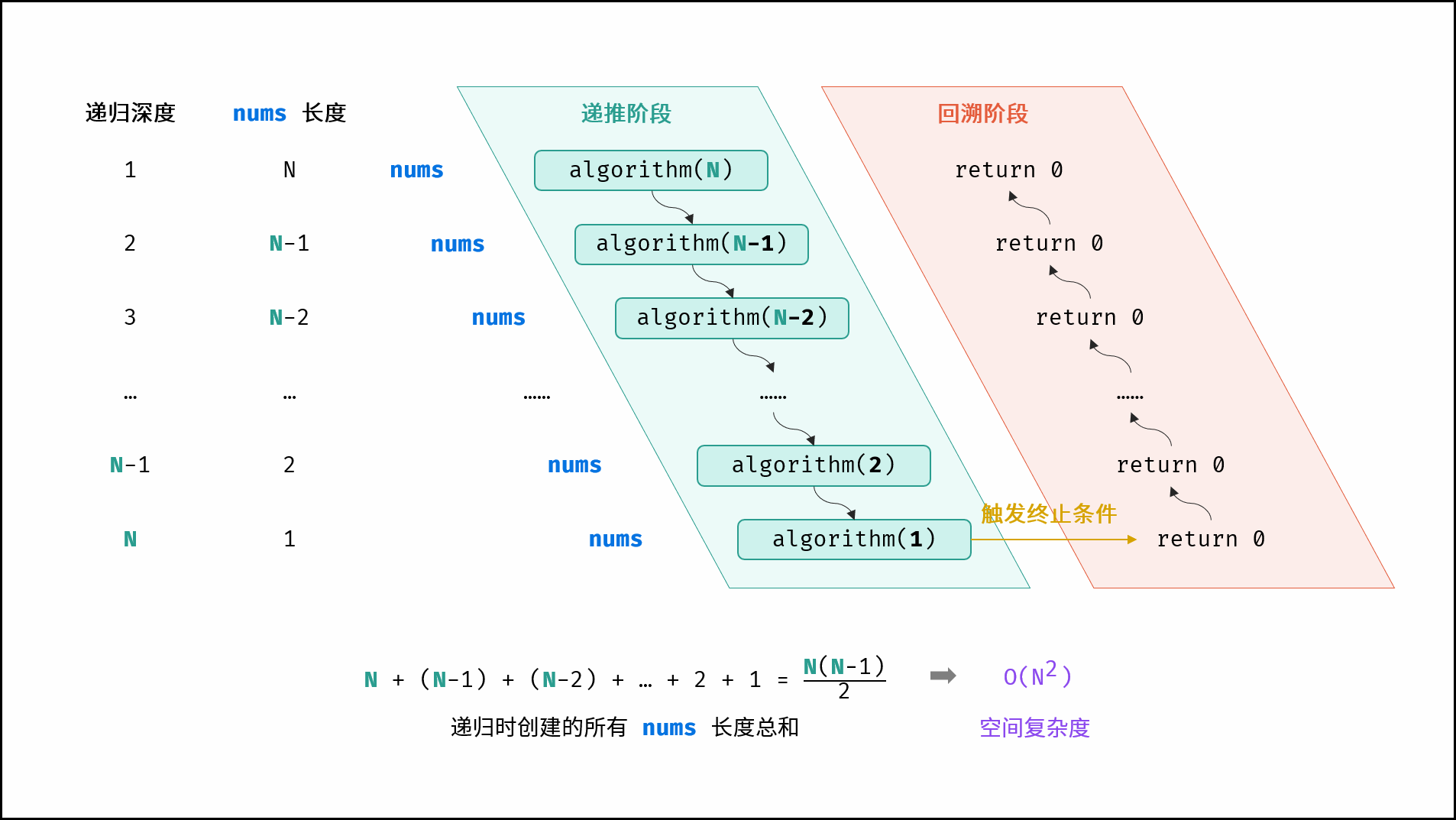
### 指数 $O(2^N)$ :
指数阶常见于二叉树、多叉树。例如,高度为 $N$ 的「满二叉树」的节点数量为 $2^N$ ,占用 $O(2^N)$ 大小的空间;同理,高度为 $N$ 的「满 $m$ 叉树」的节点数量为 $m^N$ ,占用 $O(m^N) = O(2^N)$ 大小的空间。
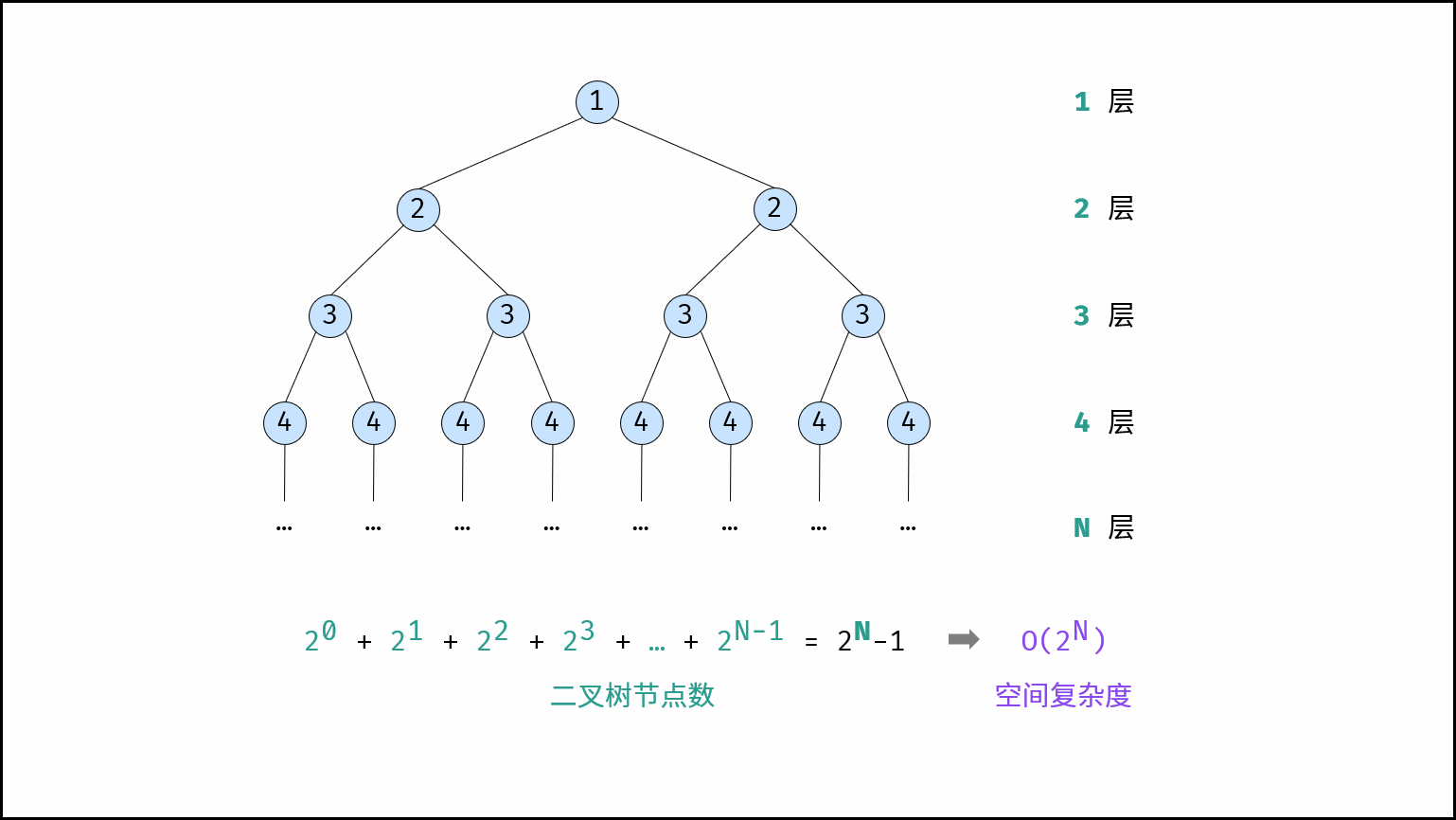{:width=600}
### 对数 $O(\log N)$ :
对数阶常出现于分治算法的栈帧空间累计、数据类型转换等,例如:
- **快速排序** ,平均空间复杂度为 $\Theta(\log N)$ ,最差空间复杂度为 $O(N)$ 。拓展知识:通过应用 [尾递归优化](https://stackoverflow.com/questions/310974/what-is-tail-call-optimization) ,可以将快速排序的最差空间复杂度限定至 $O(N)$ 。
- **数字转化为字符串** ,设某正整数为 $N$ ,则字符串的空间复杂度为 $O(\log N)$ 。推导如下:正整数 $N$ 的位数为 $log_{10} N$ ,即转化的字符串长度为 $\log_{10} N$ ,因此空间复杂度为 $O(\log N)$ 。
---
## 时空权衡
对于算法的性能,需要从时间和空间的使用情况来综合评价。优良的算法应具备两个特性,即时间和空间复杂度皆较低。而实际上,对于某个算法问题,同时优化时间复杂度和空间复杂度是非常困难的。降低时间复杂度,往往是以提升空间复杂度为代价的,反之亦然。
> 由于当代计算机的内存充足,通常情况下,算法设计中一般会采取「空间换时间」的做法,即牺牲部分计算机存储空间,来提升算法的运行速度。
以 LeetCode 全站第一题 [两数之和](https://leetcode-cn.com/problems/two-sum/) 为例,「暴力枚举」和「辅助哈希表」分别为「空间最优」和「时间最优」的两种算法。
### 方法一:暴力枚举
时间复杂度 $O(N^2)$ ,空间复杂度 $O(1)$ ;属于「时间换空间」,虽然仅使用常数大小的额外空间,但运行速度过慢。
```Python []
class Solution:
def twoSum(self, nums: List[int], target: int) -> List[int]:
for i in range(len(nums) - 1):
for j in range(i + 1, len(nums)):
if nums[i] + nums[j] == target:
return i, j
return
```
```Java []
class Solution {
public int[] twoSum(int[] nums, int target) {
int size = nums.length;
for (int i = 0; i < size - 1; i++) {
for (int j = i + 1; j < size; j++) {
if (nums[i] + nums[j] == target)
return new int[] { i, j };
}
}
return new int[0];
}
}
```
```C++ []
class Solution {
public:
vector twoSum(vector& nums, int target) {
int size = nums.size();
for (int i = 0; i < size - 1; i++) {
for (int j = i + 1; j < size; j++) {
if (nums[i] + nums[j] == target)
return { i, j };
}
}
return {};
}
};
```
### 方法二:辅助哈希表
时间复杂度 $O(N)$ ,空间复杂度 $O(N)$ ;属于「空间换时间」,借助辅助哈希表 `dic` ,通过保存数组元素值与索引的映射来提升算法运行效率,是本题的最佳解法。
```Python []
class Solution:
def twoSum(self, nums: List[int], target: int) -> List[int]:
dic = {}
for i in range(len(nums)):
if target - nums[i] in dic:
return dic[target - nums[i]], i
dic[nums[i]] = i
return []
```
```Java []
class Solution {
public int[] twoSum(int[] nums, int target) {
int size = nums.length;
Map dic = new HashMap<>();
for (int i = 0; i < size; i++) {
if (dic.containsKey(target - nums[i])) {
return new int[] { dic.get(target - nums[i]), i };
}
dic.put(nums[i], i);
}
return new int[0];
}
}
```
```C++ []
class Solution {
public:
vector twoSum(vector& nums, int target) {
int size = nums.size();
unordered_map dic;
for (int i = 0; i < size; i++) {
if (dic.find(target - nums[i]) != dic.end()) {
return { dic[target - nums[i]], i };
}
dic.emplace(nums[i], i);
}
return {};
}
};
```
---
## 示例题目
在 LeetCode 题目中,「输入空间」和「输出空间」往往是固定的,是必须使用的内存空间。因希望专注于算法性能对比,本 LeetBook 的题目解析的空间复杂度仅统计「暂存空间」大小。
| 空间复杂度 | 示例题解 |
| ----------- | ------------------------------------------------------------------------------------------------------------------------------------------------------------------------------------ |
| $O(1)$ | [斐波那契数](https://leetcode-cn.com/leetbook/read/illustration-of-algorithm/50fji7/)、[训练计划 III](https://leetcode-cn.com/leetbook/read/illustration-of-algorithm/9p7s17/) |
| $O(\log N)$ | [库存管理 III](https://leetcode-cn.com/leetbook/read/illustration-of-algorithm/ohwddh/)、[找到第 k 位数字](https://leetcode-cn.com/leetbook/read/illustration-of-algorithm/57w6b3/) |
| $O(N)$ | [图书整理 I](https://leetcode-cn.com/leetbook/read/illustration-of-algorithm/5d8831/)、[动态口令](https://leetcode-cn.com/leetbook/read/illustration-of-algorithm/58eckc/) |
| $O(N^2)$ | [衣橱整理](https://leetcode-cn.com/leetbook/read/illustration-of-algorithm/9hka9c/)、[套餐内商品的排列顺序](https://leetcode-cn.com/leetbook/read/illustration-of-algorithm/50hah3/) |
================================================
FILE: leetbook_ioa/docs/# 11.1 动态规划解题框架.md
================================================
# 动态规划解题框架
动态规划是算法与数据结构的重难点之一,其包含了「分治思想」、「空间换时间」、「最优解」等多种基石算法思想,常作为笔面试中的中等困难题出现。为帮助读者全面理解动态规划,知晓其来龙去脉,本文将从以下几个角度切入介绍:
1. 动态规划问题特点,**动态规划**和**分治算法**的联系与区别;
2. 借助例题介绍**重叠子问题**和**最优子结构**分别是什么,以及动态规划是如何解决它们的;
3. 动态规划的**解题框架**总结;
4. 动态规划的**练习例题**,从易到难排序;
---
## 动态规划特点
「分治」是算法中的一种基本思想,其通过**将原问题分解为子问题**,不断递归地将子问题分解为更小的子问题,并通过**组合子问题的解**来得到原问题的解。
类似于分治算法,「动态规划」也通过组合子问题的解得到原问题的解。不同的是,适合用动态规划解决的问题具有「重叠子问题」和「最优子结构」两大特性。
### 重叠子问题
动态规划的子问题是有**重叠的**,即各个子问题中包含**重复的更小子问题**。若使用暴力法穷举,求解这些相同子问题会产生大量的重复计算,效率低下。
动态规划在第一次求解某子问题时,会将子问题的解保存;后续遇到重叠子问题时,则直接通过查表获取解,保证每个**独立子问题只被计算一次**,从而降低算法的时间复杂度。
### 最优子结构
如果一个问题的最优解可以由其子问题的最优解组合构成,并且这些子问题可以独立求解,那么称此问题具有最优子结构。
动态规划从基础问题的解开始,不断迭代**组合、选择子问题的最优解**,最终得到原问题最优解。
---
## 重叠子问题示例:斐波那契数列
> 斐波那契数形成的数列为 $[0, 1, 1, 2, 3, 5, 8, 13, \cdots]$ ,数学定义如下:
> $$
> \begin{aligned}
> & F_0 = 0 \\
> & F_1 = 1 \\
> & F_n = F_{n-1} + F_{n-2}
> \end{aligned}
> $$
> **题目:** 求取第 $n$ 个斐波那契数(从第 0 个斐波那契数开始)。
以下,本文从「暴力递归」$\rightarrow$「记忆化递归」$\rightarrow$「动态规划」三种解法,介绍**重叠子问题**的概念与解决方案。
### 方法一:暴力递归
设斐波那契数列第 $n$ 个数字为 $f(n)$ 。根据数列定义,可得 $f(n) = f(n - 1) + f(n - 2)$ ,且第 0 , 1 个斐波那契数分别为 $f(0) = 0$ , $f(1) = 1$ 。
我们很容易联想到使用分治思想来求取 $f(n)$ ,即将求原问题 $f(n)$ 分解为求子问题 $f(n-1)$ 和 $f(n-2)$ ,向下递归直至已知的 $f(0)$ 和 $f(1)$ ,最终组合这些子问题求取原问题 $f(n)$ 。
```Python []
# 求第 n 个斐波那契数
def fibonacci(n):
if n == 0: return 0 # 返回 f(0)
if n == 1: return 1 # 返回 f(1)
return fibonacci(n - 1) + fibonacci(n - 2) # 分解为两个子问题求解
```
```Java []
// 求第 n 个斐波那契数
int fibonacci(int n) {
if (n == 0) return 0; // 返回 f(0)
if (n == 1) return 1; // 返回 f(1)
return fibonacci(n - 1) + fibonacci(n - 2); // 分解为两个子问题求解
}
```
```C++ []
int fibonacci(int n) {
if (n == 0) return 0; // 返回 f(0)
if (n == 1) return 1; // 返回 f(1)
return fibonacci(n - 1) + fibonacci(n - 2); // 分解为两个子问题求解
}
```
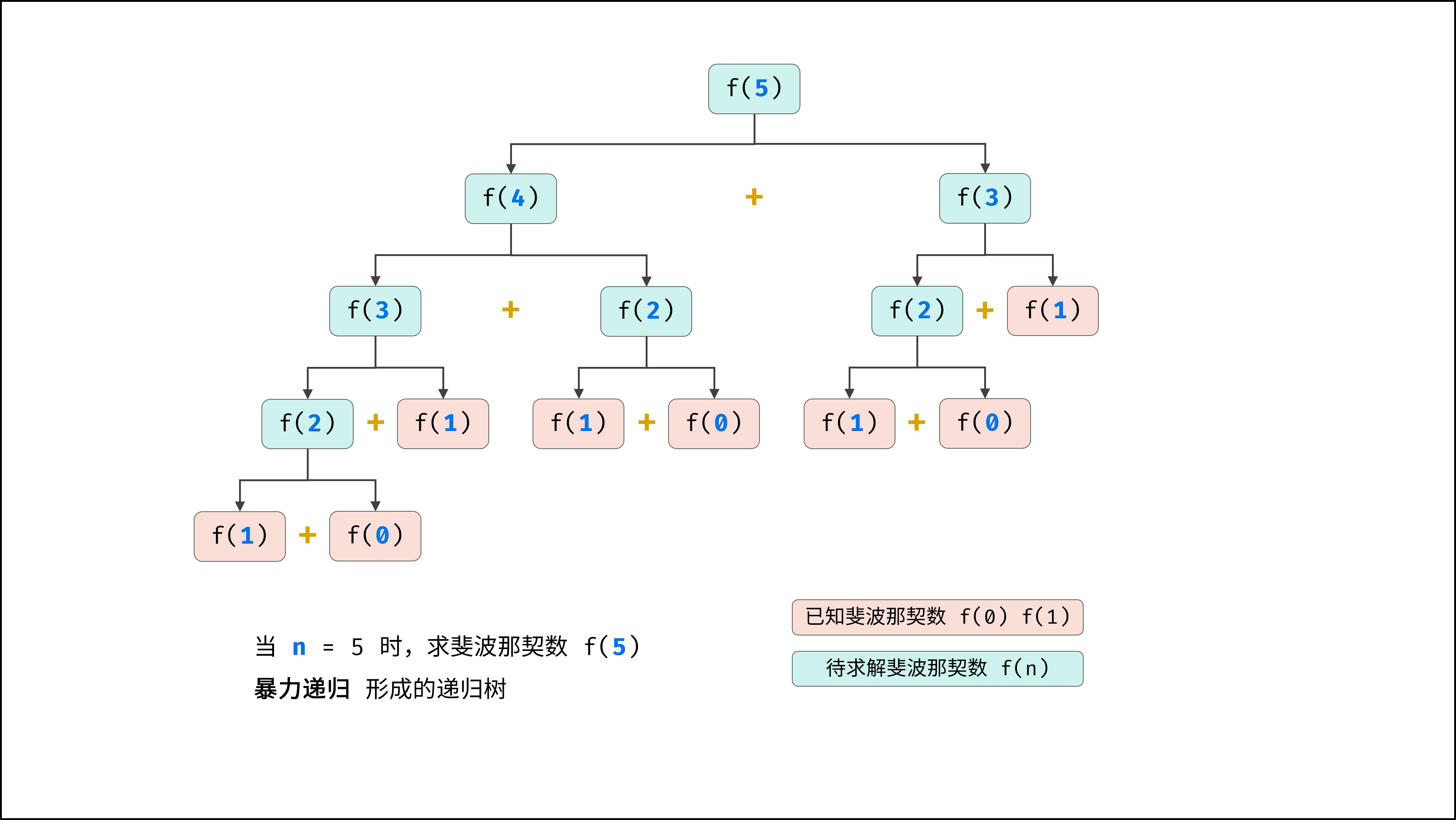
如上图所示,为暴力递归求斐波那契数 $f(5)$ 形成的二叉树,树中的每个节点代表着执行了一次 `fibonacci()` 函数,且有:
- 执行一次 `fibonacci()` 函数的时间复杂度为 $O(1)$ ;
- 二叉树节点数为指数级 $O(2^n)$ ;
因此,暴力递归的总体时间复杂度为 $O(2^n)$ 。此方法效率低下,随着 $n$ 的增长产生指数级爆炸。
### 方法二:记忆化递归
观察发现,暴力递归中的子问题多数都是**重叠子问题**,即:
$$
\begin{aligned}
& f(n) = f(n - 1) + f(n - 2) & 包含 f(n - 2) \\
& f(n - 1) = f(n - 2) + f(n - 3) & 重复 f(n - 2) \\
& f(n - 2) = f(n - 3) + f(n - 4) & 重复 f(n - 3) \\
& \cdots &以此类推
\end{aligned}
$$
这些重叠子问题产生了大量的递归树节点,其**不应被重复计算**。实际上,可以在递归中**第一次求解子问题**时,就将它们**保存**;后续递归中再次遇到相同子问题时,直接访问内存赋值即可。记忆化递归的代码如下所示。
```Python []
def fibonacci(n, dp):
if n == 0: return 0 # 返回 f(0)
if n == 1: return 1 # 返回 f(1)
if dp[n] != 0: return dp[n] # 若 f(n) 以前已经计算过,则直接返回记录的解
dp[n] = fibonacci(n - 1, dp) + fibonacci(n - 2, dp) # 将 f(n) 则记录至 dp
return dp[n]
# 求第 n 个斐波那契数
def fibonacci_memorized(n):
dp = [0] * (n + 1) # 用于保存 f(0) 至 f(n) 问题的解
return fibonacci(n, dp)
```
```Java []
int fibonacci(int n, int[] dp) {
if (n == 0) return 0; // 返回 f(0)
if (n == 1) return 1; // 返回 f(1)
if (dp[n] != 0) return dp[n]; // 若 f(n) 以前已经计算过,则直接返回记录的解
dp[n] = fibonacci(n - 1, dp) + fibonacci(n - 2, dp); // 将 f(n) 则记录至 dp
return dp[n];
}
// 求第 n 个斐波那契数
int fibonacciMemorized(int n) {
int[] dp = new int[n + 1]; // 用于保存 f(0) 至 f(n) 问题的解
return fibonacci(n, dp);
}
```
```C++ []
int fibonacci(int n, vector dp) {
if (n == 0) return 0; // 返回 f(0)
if (n == 1) return 1; // 返回 f(1)
if (dp[n] != 0) return dp[n]; // 若 f(n) 以前已经计算过,则直接返回记录的解
dp[n] = fibonacci(n - 1, dp) + fibonacci(n - 2, dp); // 将 f(n) 则记录至 dp
return dp[n];
}
// 求第 n 个斐波那契数
int fibonacciMemorized(int n) {
vector dp(n + 1, 0); // 用于保存 f(0) 至 f(n) 问题的解
return fibonacci(n, dp);
}
```
如下图所示,应用记忆化递归方法后,递归树中绝大部分节点被**剪枝**。此时,`fibonacci()` 函数的调用次数从 $O(2^n)$ 指数级别降低至 $O(n)$ 线性级别,时间复杂度大大降低。
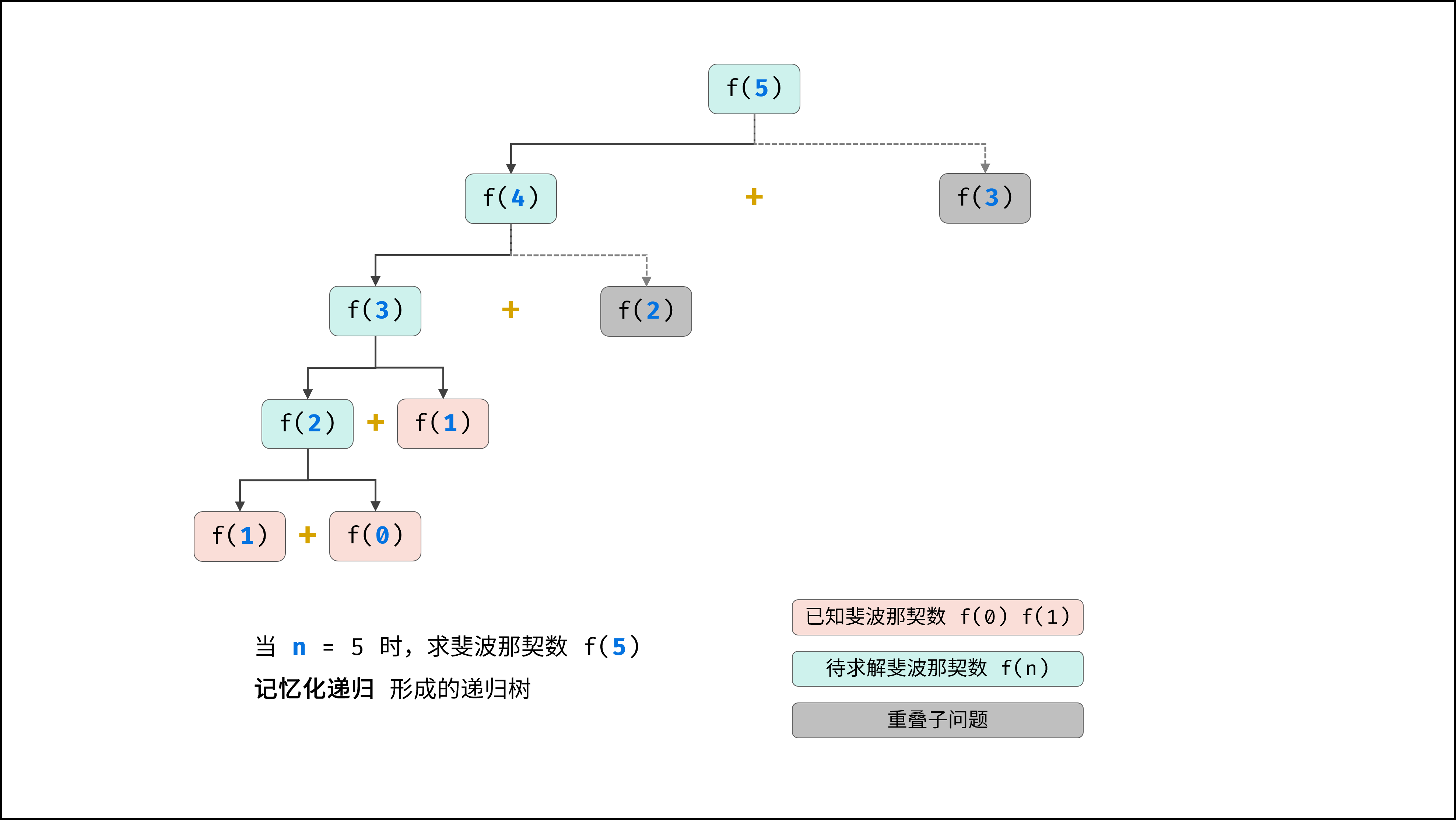
### 方法三:动态规划
递归本质上是基于分治思想的从顶至底的解法。借助记忆化递归思想,可应用动态规划从底至顶求取 $f(n)$ ,代码如下所示。
```Python []
# 求第 n 个斐波那契数
def fibonacci(n):
if n == 0: return 0 # 若求 f(0) 则直接返回 0
dp = [0] * (n + 1) # 初始化 dp 列表
dp[0], dp[1] = 0, 1 # 初始化 f(0), f(1)
for i in range(2, n + 1): # 状态转移求取 f(2), f(3), ..., f(n)
dp[i] = dp[i - 1] + dp[i - 2]
return dp[n] # 返回 f(n)
```
```Java []
// 求第 n 个斐波那契数
int fibonacci(int n) {
if (n == 0) return 0; // 若求 f(0) 则直接返回 0
int[] dp = new int[n + 1]; // 初始化 dp 列表
dp[1] = 1; // 初始化 f(0), f(1)
for (int i = 2; i <= n; i++) { // 状态转移求取 f(2), f(3), ..., f(n)
dp[i] = dp[i - 1] + dp[i - 2];
}
return dp[n]; // 返回 f(n)
}
```
```C++ []
// 求第 n 个斐波那契数
int fibonacci(int n) {
if (n == 0) return 0; // 若求 f(0) 则直接返回 0
vector dp(n + 1, 0); // 初始化 dp 列表
dp[1] = 1; // 初始化 f(0), f(1)
for (int i = 2; i <= n; i++) { // 状态转移求取 f(2), f(3), ..., f(n)
dp[i] = dp[i - 1] + dp[i - 2];
}
return dp[n]; // 返回 f(n)
}
```
如下图所示,为动态规划求解 $f(5)$ 的迭代流程,其是转移方程 $f(n) = f(n - 1) + f(n - 2)$ 的体现。
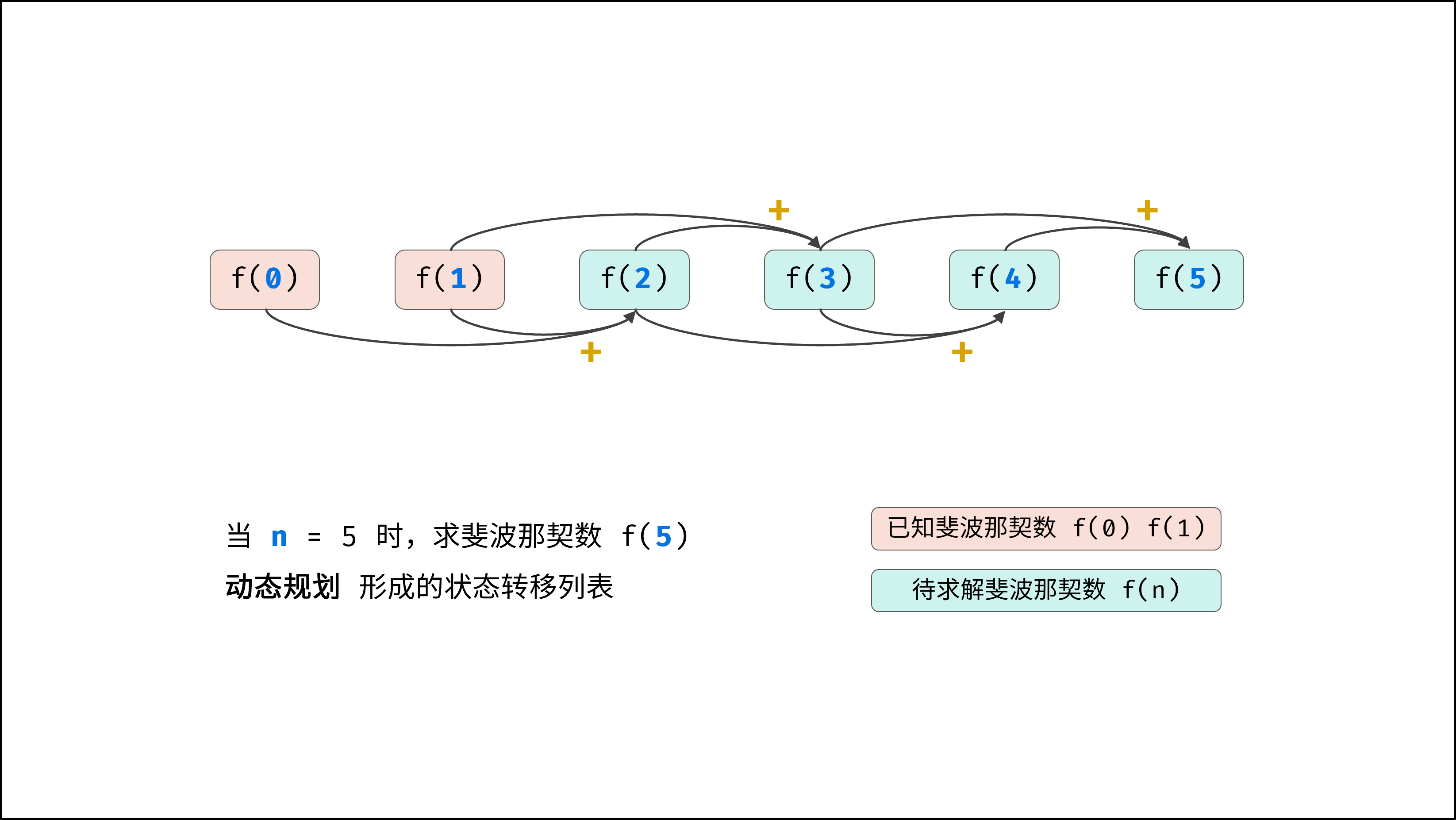
上述动态规划解法借助了一个 `dp` 数组保存子问题的解,其空间复杂度为 $O(N)$ 。而由于 $f(n)$ 只与 $f(n - 1)$ 和 $f(n - 2)$ 有关,因此我们可以仅使用两个变量 $a$ , $b$ 交替前进计算即可。此时动态规划的空间复杂度降低至 $O(1)$ ,代码如下所示。
```Python []
# 求第 n 个斐波那契数
def fibonacci(n):
if n == 0: return 0 # 若求 f(0) 则直接返回 0
a, b = 0, 1 # 初始化 f(0), f(1)
for i in range(2, n + 1): # 状态转移求取 f(2), f(3), ..., f(n)
a, b = b, a + b
return b # 返回 f(n)
```
```Java []
// 求第 n 个斐波那契数
int fibonacci(int n) {
if (n == 0) return 0; // 若求 f(0) 则直接返回 0
int a = 0, b = 1; // 初始化 f(0), f(1)
for (int i = 2; i <= n; i++) { // 状态转移求取 f(2), f(3), ..., f(n)
int tmp = a;
a = b;
b = tmp + b;
}
return b; // 返回 f(n)
}
```
```C++ []
// 求第 n 个斐波那契数
int fibonacci(int n) {
if (n == 0) return 0; // 若求 f(0) 则直接返回 0
int a = 0, b = 1; // 初始化 f(0), f(1)
for (int i = 2; i <= n; i++) { // 状态转移求取 f(2), f(3), ..., f(n)
int tmp = a;
a = b;
b = tmp + b;
}
return b; // 返回 f(n)
}
```
### 示例小结
记忆化递归和动态规划的本质思想是一致的,是对斐波那契数列定义的不同表现形式:
- **记忆化递归 — 从顶至低:** 求 $f(n)$ 需要 $f(n - 1)$ 和 $f(n - 2)$ ; $\cdots$ ;求 $f(2)$ 需要 $f(1)$ 和 $f(0)$ ;而 $f(1)$ 和 $f(0)$ 已知;
- **动态规划 — 从底至顶:** 将已知 $f(0)$ 和 $f(1)$ 组合得到 $f(2)$ ;$\cdots$ ;将 $f(n - 2)$ 和 $f(n - 1)$ 组合得到 $f(n)$ ;
斐波那契数列问题不包含「最优子结构」,只需计算每个子问题的解,避免重复计算即可,并不需要从子问题组合中**选择最优组合**。接下来,本文借助「最高蛋糕售价方案」,介绍动态规划的**最优子结构**概念。
---
## 最优子结构示例:蛋糕最高售价
> 小力开了一家蛋糕店,并针对不同重量的蛋糕设定了不同售价,分别为:
>
> | 蛋糕重量 | 0 | 1 | 2 | 3 | 4 | 5 | 6 |
> | :------: | :--: | :--: | :--: | :--: | :--: | :--: | :--: |
> | 售价 | 0 | 2 | 3 | 6 | 7 | 11 | 15 |
>
> **问题:** 现给定一个重量为 $n$ 的蛋糕,问小力应该如何切分蛋糕,达到最高的蛋糕总售价。
设重量为 $n$ 蛋糕的售价为 $p(n)$ ,切分的最高总售价为 $f(n)$ 。
- **子问题:** $f(n)$ 的子问题包括 $f(0), f(1), f(2), \cdots, f(n - 1)$ ,分别代表重量为 $0, 1, 2, \cdots, n - 1$ 蛋糕的最高售价。 已知无蛋糕时 $f(0) = 0$ ,蛋糕重量为 1 时不可切分 $f(1) = p(1)$ ;
- **最优子结构:**
- **定义:** 如果一个问题最优解可以由其子问题最优解组合构成,那么称此问题具有最优子结构。
- **对于本题:** 重量为 $n$ 的蛋糕的总售价可切分为 $n$ 种组合,即重量为 $0, 1, 2, ..., n - 1$ 蛋糕**最高售价**加上 $n, n - 1, n - 2, \cdots, 1$ 剩余重量蛋糕的**售价**;从这些组合中,售价最高的组合便是原问题的解 $f(n)$ ,这便是本题的最优子结构。
- **状态转移方程:** 找出最优子结构后,易构建出如下的状态转移方程。
$$
f(n) = \max_{0 \leq i < n} (f(i) + p(n - i))
$$
根据以上推导,本题也能使用「暴力递归」$\rightarrow$「记忆化递归」$\rightarrow$「动态规划」三种方法解决。
### 方法一:暴力递归
暴力递归解法的代码如下,其时间复杂度为指数级 $O(2^n)$ 。
```Python []
# 输入蛋糕价格列表 price_list ,求重量为 n 蛋糕的最高售价
def max_cake_price(n, price_list):
if n <= 1: return price_list[n] # 蛋糕重量 <= 1 时直接返回
f_n = 0
for i in range(n): # 从 n 种组合种选择最高售价的组合作为 f(n)
f_n = max(f_n, max_cake_price(i, price_list) + price_list[n - i])
return f_n # 返回 f(n)
max_cake_price(4, [0, 2, 3, 6, 7, 11, 15])
```
```Java []
// 输入蛋糕价格列表 priceList ,求重量为 n 蛋糕的最高售价
int maxCakePrice(int n, int[] priceList) {
if (n <= 1) return priceList[n]; // 蛋糕重量 <= 1 时直接返回
int f_n = 0;
for (int i = 0; i < n; i++) // 从 n 种组合种选择最高售价的组合作为 f(n)
f_n = Math.max(f_n, maxCakePrice(i, priceList) + priceList[n - i]);
return f_n; // 返回 f(n)
}
```
```C++ []
// 输入蛋糕价格列表 priceList ,求重量为 n 蛋糕的最高售价
int maxCakePrice(int n, vector priceList) {
if (n <= 1) return priceList[n]; // 蛋糕重量 <= 1 时直接返回
int f_n = 0;
for (int i = 0; i < n; i++) // 从 n 种组合种选择最高售价的组合作为 f(n)
f_n = max(f_n, maxCakePrice(i, priceList) + priceList[n - i]);
return f_n; // 返回 f(n)
}
```
如下图所示,为暴力递归求解 $f(4)$ 形成的多叉树。
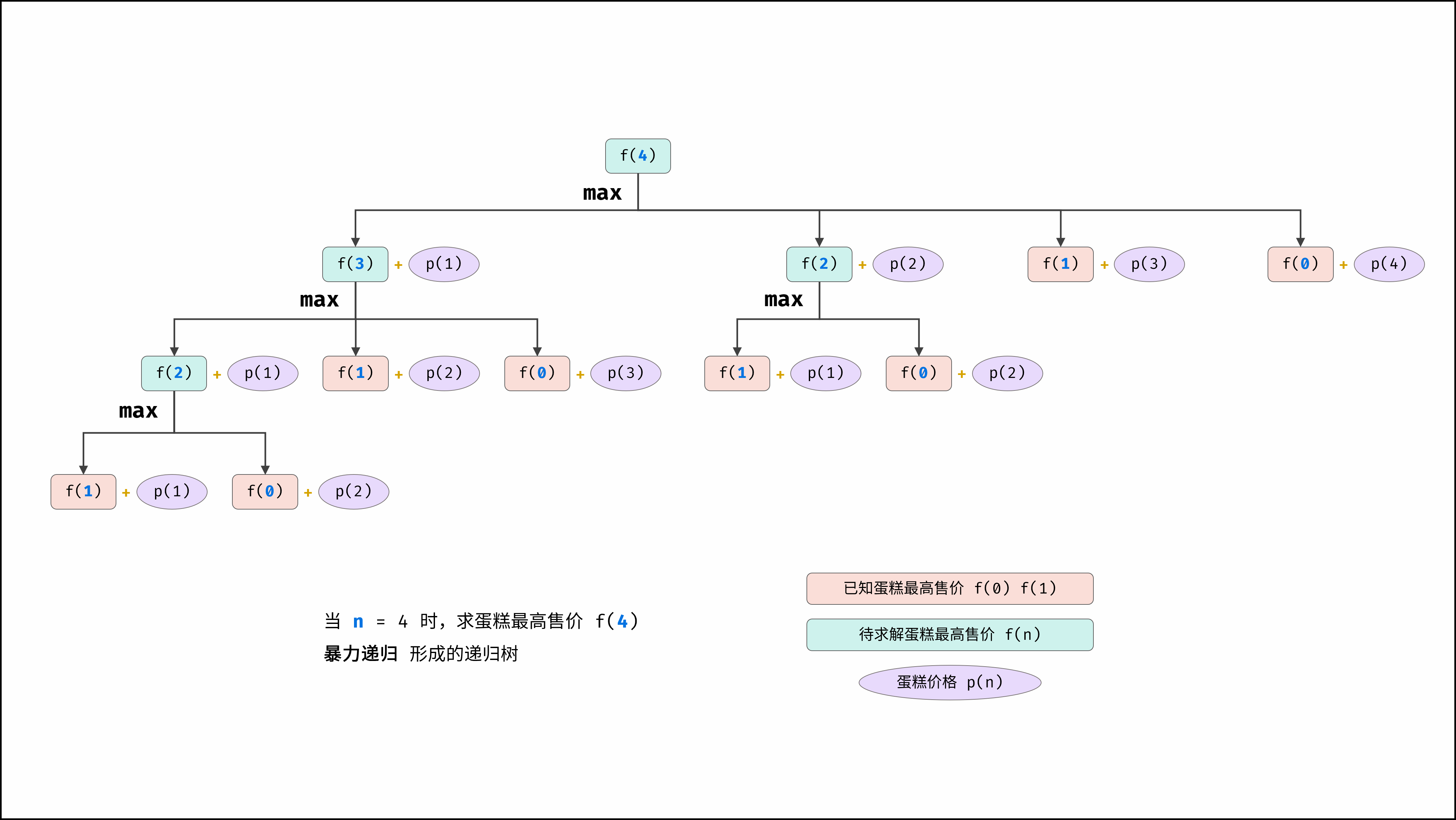
### 方法二:记忆化递归
观察发现,递归树中存在大量**重叠子问题**,可通过记忆化处理避免重复计算。记忆化递归的算法的时间复杂度为 $O(n^2)$ ,包括:
- $f(2)$ 至 $f(n)$ 共 $n - 1$ 个待计算子问题,使用 $O(n)$ 时间;
- 计算某 $f(i)$ 需遍历 $i - 1$ 种子问题组合,使用 $O(n)$ 时间;
```Python []
# 输入蛋糕价格列表 price_list ,求重量为 n 蛋糕的最高售价
def max_cake_price(n, price_list, dp):
if n <= 1: return price_list[n] # 蛋糕重量 <= 1 时直接返回
f_n = 0
for i in range(n): # 从 n 种组合种选择最高售价的组合作为 f(n)
# 若 f(i) 以前已经计算过,则调取记录的解;否则,递归计算 f(i)
f_i = dp[i] if dp[i] != 0 else max_cake_price(i, price_list, dp)
f_n = max(f_n, f_i + price_list[n - i])
dp[n] = f_n # 记录 f(n) 至 dp 数组
return f_n # 返回 f(n)
def max_cake_price_memorized(n, price_list):
dp = [0] * (n + 1)
return max_cake_price(n, price_list, dp)
```
```Java []
// 输入蛋糕价格列表 priceList ,求重量为 n 蛋糕的最高售价
int maxCakePrice(int n, int[] priceList, int[] dp) {
if (n <= 1) return priceList[n]; // 蛋糕重量 <= 1 时直接返回
int f_n = 0;
for (int i = 0; i < n; i++) { // 从 n 种组合种选择最高售价的组合作为 f(n)
int f_i = dp[i] != 0 ? dp[i] : maxCakePrice(i, priceList, dp);
f_n = Math.max(f_n, f_i + priceList[n - i]);
}
dp[n] = f_n; // 记录 f(n) 至 dp 数组
return f_n; // 返回 f(n)
}
int maxCakePriceMemorized(int n, int[] priceList) {
int[] dp = new int[n + 1];
return maxCakePrice(n, priceList, dp);
}
```
```C++ []
// 输入蛋糕价格列表 priceList ,求重量为 n 蛋糕的最高售价
int maxCakePrice(int n, vector &priceList, vector dp) {
if (n <= 1) return priceList[n]; // 蛋糕重量 <= 1 时直接返回
int f_n = 0;
for (int i = 0; i < n; i++) { // 从 n 种组合种选择最高售价的组合作为 f(n)
int f_i = dp[i] != 0 ? dp[i] : maxCakePrice(i, priceList, dp);
f_n = max(f_n, f_i + priceList[n - i]);
}
dp[n] = f_n; // 记录 f(n) 至 dp 数组
return f_n; // 返回 f(n)
}
int maxCakePriceMemorized(int n, vector priceList) {
vector dp(n + 1, 0);
return maxCakePrice(n, priceList, dp);
}
```
如下图所示,为记忆化递归求解 $f(4)$ 形成的多叉树。观察得知,重叠子问题皆被**剪枝**。
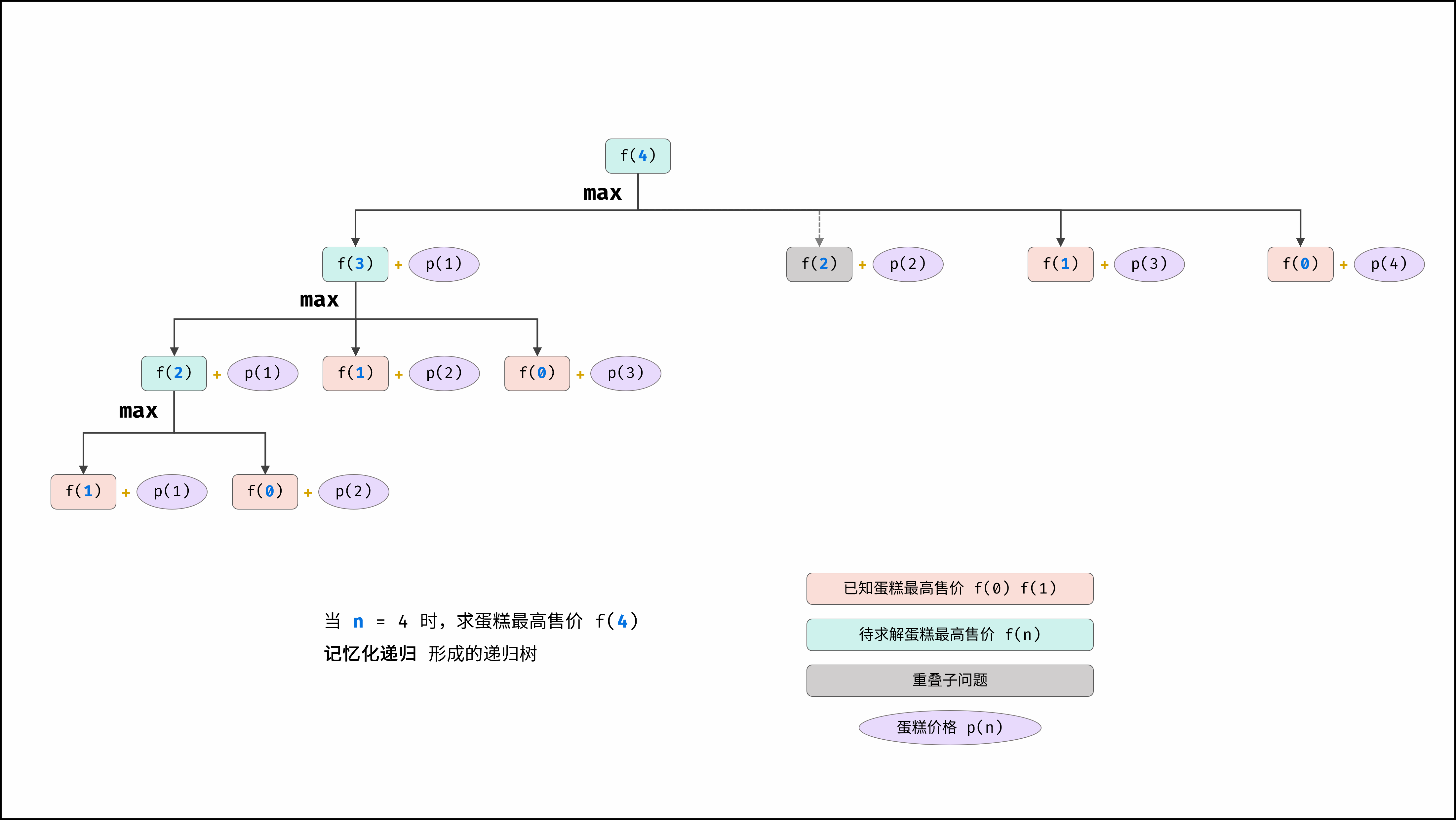
### 方法三:动态规划
相较于记忆化递归的从顶至底方法,易得动态规划的从底至顶方法,代码如下所示。
```Python []
# 输入蛋糕价格列表 price_list ,求重量为 n 蛋糕的最高售价
def max_cake_price(n, price_list):
if n <= 1: return price_list[n] # 蛋糕重量 <= 1 时直接返回
dp = [0] * (n + 1) # 初始化 dp 列表
for j in range(1, n + 1): # 按顺序计算 f(1), f(2), ..., f(n)
for i in range(j): # 从 j 种组合种选择最高售价的组合作为 f(j)
dp[j] = max(dp[j], dp[i] + price_list[j - i])
return dp[n]
```
```Java []
// 输入蛋糕价格列表 priceList ,求重量为 n 蛋糕的最高售价
int maxCakePrice(int n, int[] priceList) {
if (n <= 1) return priceList[n]; // 蛋糕重量 <= 1 时直接返回
int[] dp = new int[n + 1]; // 初始化 dp 列表
for (int j = 1; j <= n; j++) { // 按顺序计算 f(1), f(2), ..., f(n)
for (int i = 0; i < j; i++) // 从 j 种组合种选择最高售价的组合作为 f(j)
dp[j] = Math.max(dp[j], dp[i] + priceList[j - i]);
}
return dp[n];
}
```
```C++ []
// 输入蛋糕价格列表 priceList ,求重量为 n 蛋糕的最高售价
int maxCakePrice(int n, vector priceList) {
if (n <= 1) return priceList[n]; // 蛋糕重量 <= 1 时直接返回
vector dp(n + 1, 0); // 初始化 dp 列表
for (int j = 1; j <= n; j++) { // 按顺序计算 f(1), f(2), ..., f(n)
for (int i = 0; i < j; i++) // 从 j 种组合种选择最高售价的组合作为 f(j)
dp[j] = max(dp[j], dp[i] + priceList[j - i]);
}
return dp[n];
}
```
如下图所示,为动态规划求解 $f(4)$ 的迭代流程,其是转移方程 $f(n) = \max_{0 \leq i < n} (f(i) + p(n - i))$ 的体现。
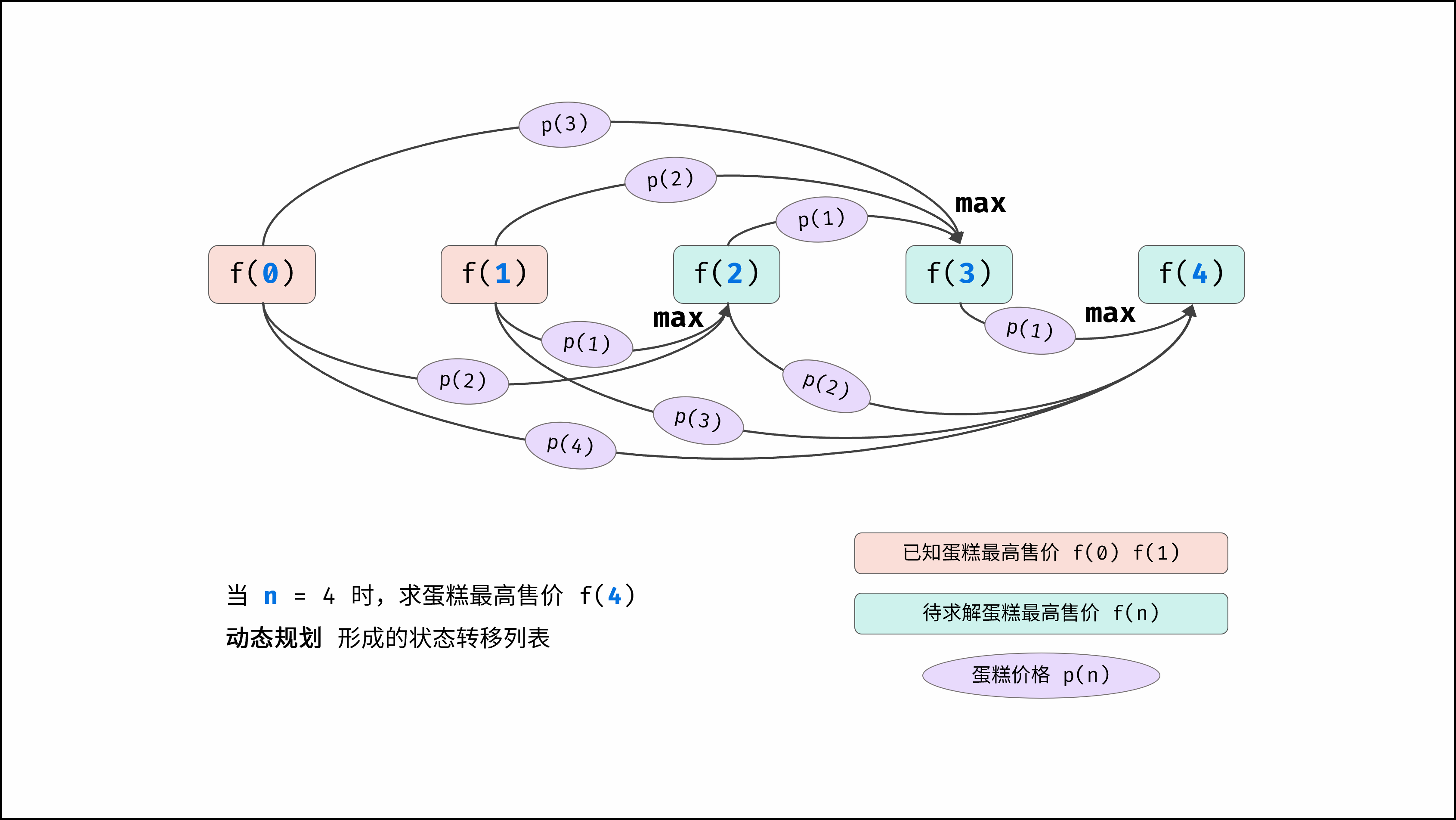
### 示例小结
本题同时包含「重叠子问题」和「最优子结构」,为动态规划的典型问题。动态规划通过填表避免了重复计算问题,并通过状态转移方程、初始状态实现对问题的迭代求解。
普遍来看,**求最值** 的问题一般都具有「重叠子问题」和「最优子结构」特点,因此此类问题往往适合用动态规划解决。
---
## 动态规划解题框架
若确定给定问题具有重叠子问题和最优子结构,那么就可以使用动态规划求解。总体上看,求解可分为四步:
1. **状态定义:** 构建问题最优解模型,包括问题**最优解的定义**、有哪些**计算解的自变量**;
2. **初始状态:** 确定**基础子问题的解**(即已知解),原问题和子问题的解都是以基础子问题的解为起始点,在迭代计算中得到的;
3. **转移方程:** 确定原问题的解与子问题的解之间的关系是什么,以及使用何种**选择规则**从子问题最优解组合中选出原问题最优解;
4. **返回值:** 确定应返回的问题的解是什么,即动态规划**在何处停止迭代**;
完成以上步骤后,便容易写出对应的解题代码。
### 示例:斐波那契数列
- 状态定义:一维 $dp$ 列表,设第 $i$ 个斐波那契数为 $dp[i]$ ;
- 初始状态:已知第 $0$ , $1$ 个斐波那契数分别为 $dp[0] = 0$ , $dp[1] = 1$ ;
- 转移方程:后一个数字等于前两个数字之和,即
$$
dp[i] = dp[i - 1] + dp[i - 2]
$$
- 返回值:需求取的第 $n$ 个斐波那契数 $dp[n]$ ;
### 示例:蛋糕最高售价
- 状态定义:一维 $dp$ 列表,设重量为 $i$ 蛋糕的售价为 $p(i)$ ,重量为 $i$ 蛋糕切分后的最高售价为 $dp[i]$ ;
- 初始状态:已知重量为 0 蛋糕的最高售价为 0 ,重量为 1 的蛋糕最高售价为 $p(1)$ ;
- 转移方程:$dp[n]$ 为 $n$ 种切分组合中的最高售价组合,即
$$
dp[n] = \max_{0 \leq i < n} (dp[i] + p(n - i))
$$
- 返回值:需求取的重量为 $n$ 的蛋糕最高售价 $dp[n]$ ;
---
## 例题练习
动态规划的问题种类多,难度跨度较大,需要充足练习、熟能生巧。以下给出若干典型例题,供读者巩固理解本文内容。
| 题目 | 难度 | 描述 |
| ----------------------------------------------------------------------------------------------- | ---- | ----------------------------------------------------------------------- |
| [跳跃训练](https://leetcode-cn.com/leetbook/read/illustration-of-algorithm/57hyl5/) | 简单 | 与本文的斐波那契数列例题等价 |
| [连续天数的最高销售额](https://leetcode-cn.com/leetbook/read/illustration-of-algorithm/59gq9c/) | 简单 | 求最大值问题,关键点在于状态定义 |
| [珠宝的最高价值](https://leetcode-cn.com/leetbook/read/illustration-of-algorithm/5vokvr/) | 简单 | 求最大值问题,特点是其 $dp$ 列表是二维的 |
| [统计结果概率](https://leetcode-cn.com/leetbook/read/illustration-of-algorithm/ozzl1r/) | 中等 | 容易想到暴力枚举方法,难点为列出状态转移方程,且正向递推方法比较 tricky |
| [模糊搜索验证](https://leetcode-cn.com/leetbook/read/illustration-of-algorithm/9a1ypc/) | 困难 | 状态定义容易得出,但状态转移方程复杂、选择规则分支多 |
================================================
FILE: leetbook_ioa/docs/# 7.1 排序算法简介.md
================================================
# 排序算法简介
排序算法用作实现列表的排序,列表元素可以是整数,也可以是浮点数、字符串等其他数据类型。生活中有许多需要排序算法的场景,例如:
- **整数排序:** 对于一个整数数组,我们希望将所有数字从小到大排序;
- **字符串排序:** 对于一个姓名列表,我们希望将所有单词按照字符先后排序;
- **自定义排序:** 对于任意一个 **已定义比较规则** 的集合,我们希望将其按规则排序;
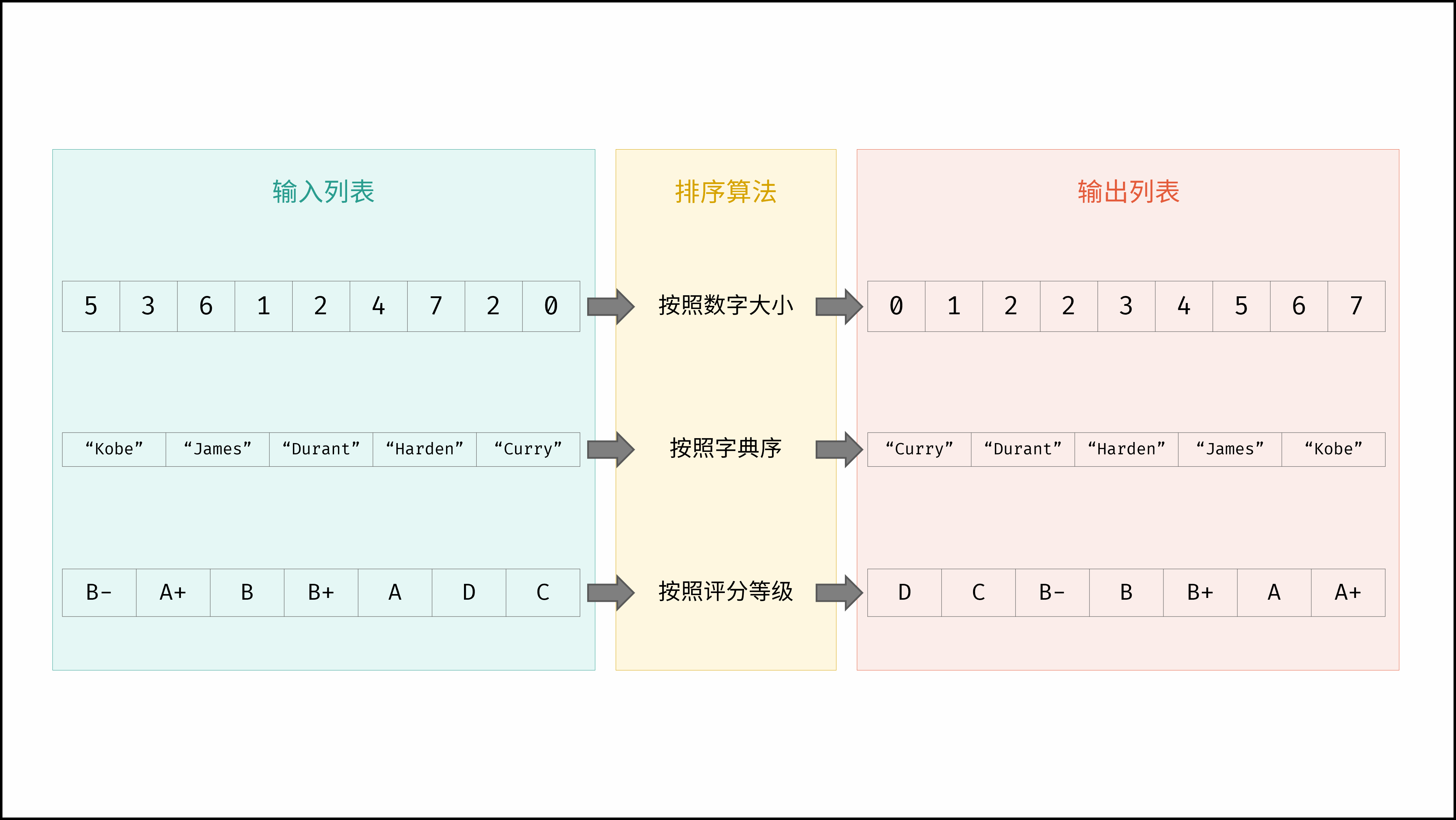
同时,某些算法需要在排序算法的基础上使用(即在排序数组上运行),例如:
- **二分查找:** 根据数组已排序的特性,才能每轮确定排除两部分中的哪一部分;
- **双指针:** 例如合并两个排序链表,根据已排序特性,才能通过双指针移动在线性时间内将其合并为一个排序链表。
> 接下来,本文将从「常见排序算法」、「分类方法」、「时间与空间复杂度」三方面入手,简要介绍排序算法。「各排序算法详细介绍」请见后续专栏文章。
---
## 常见算法
常见排序算法包括「冒泡排序」、「插入排序」、「选择排序」、「快速排序」、「归并排序」、「堆排序」、「基数排序」、「桶排ss序」。如下图所示,为各排序算法的核心特性与时空复杂度总结。
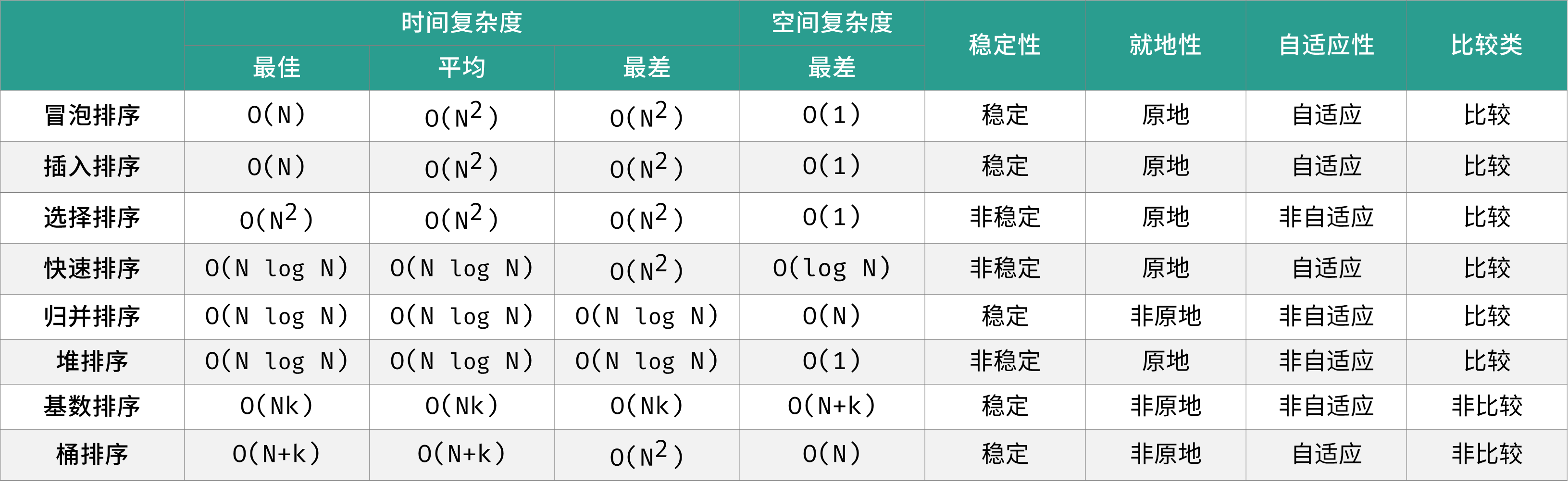
如下图所示,为在 「随机乱序」、「接近有序」、「完全倒序」、「少数独特」四类输入数据下,各常见排序算法的排序过程。
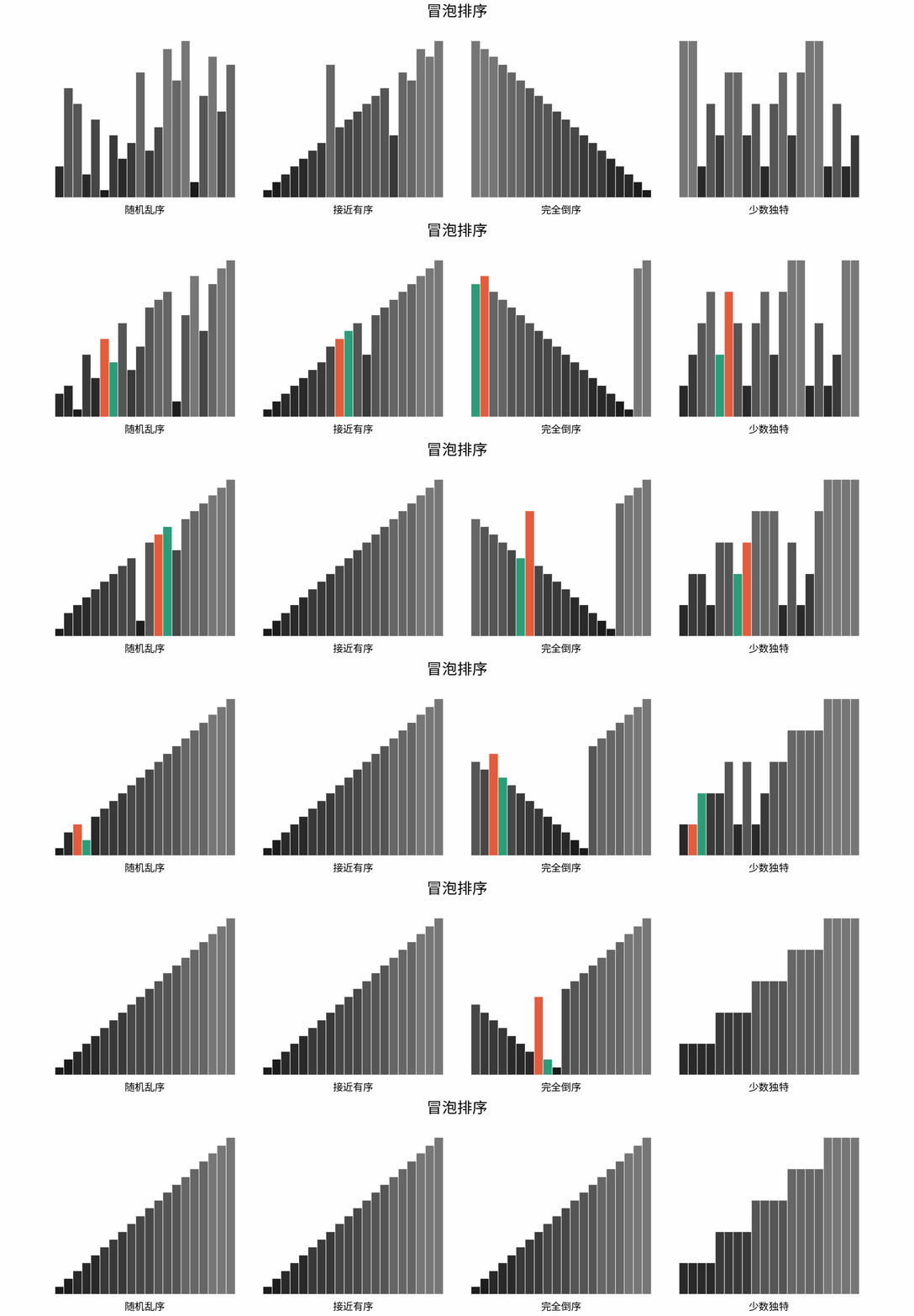
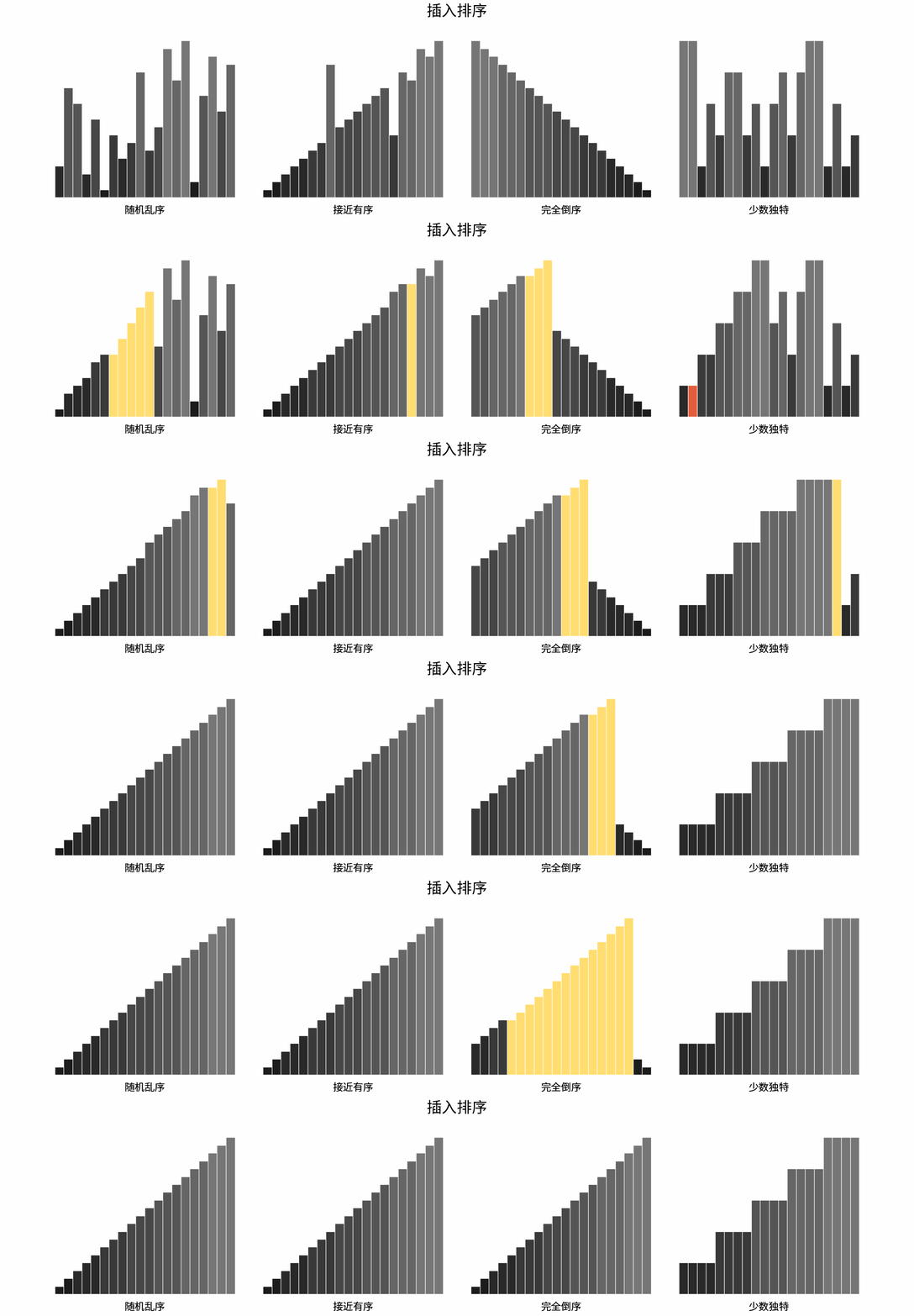
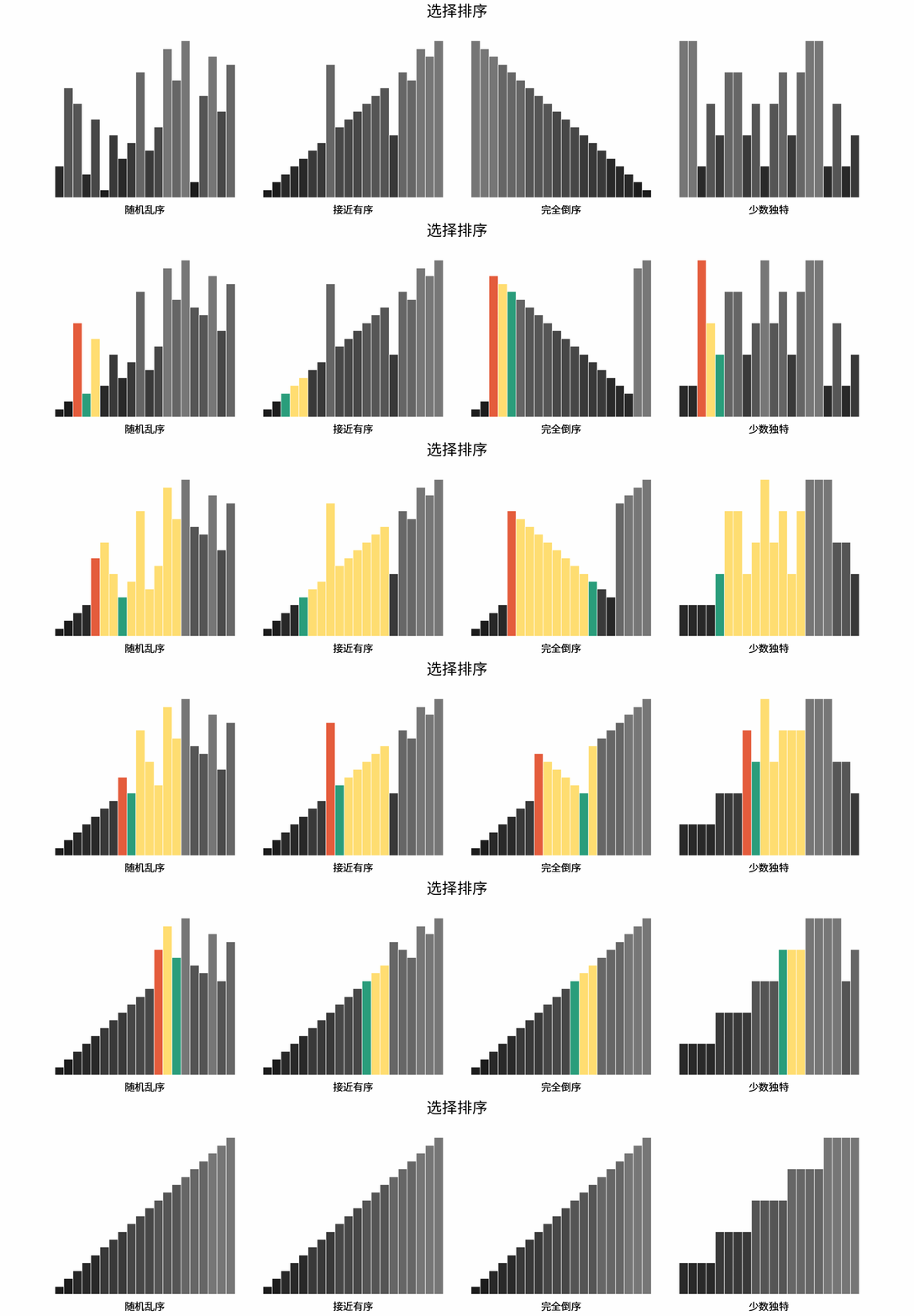
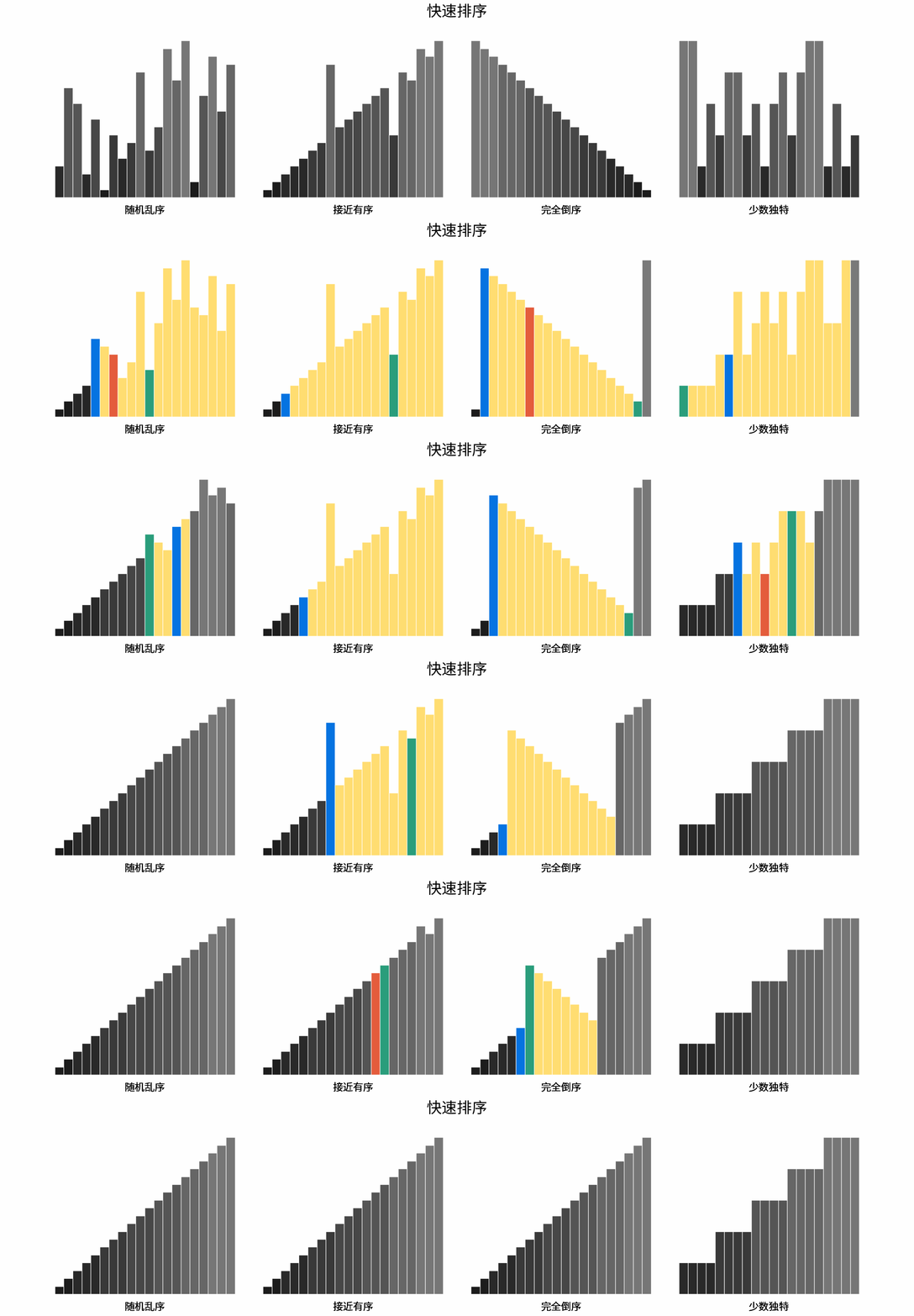
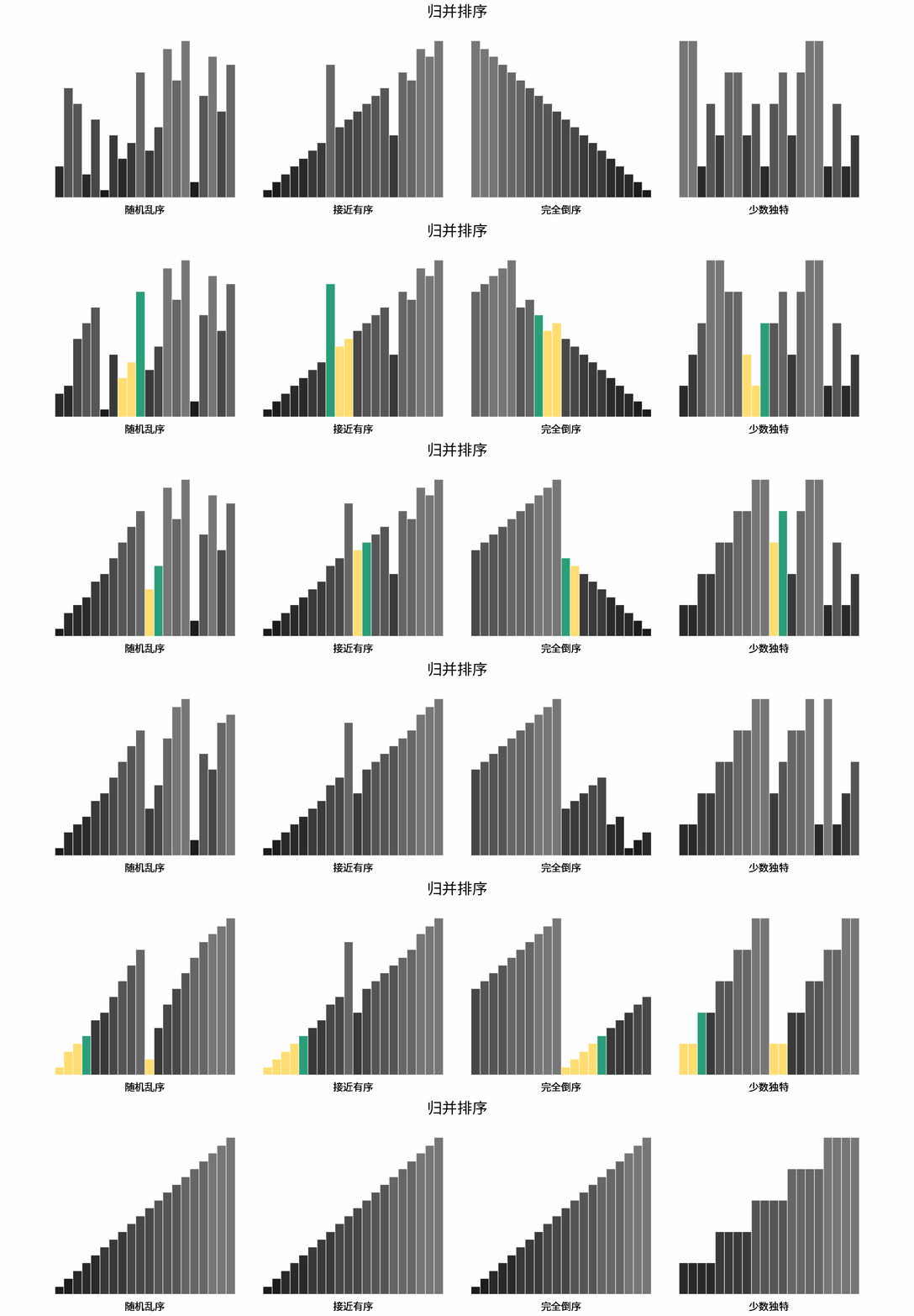
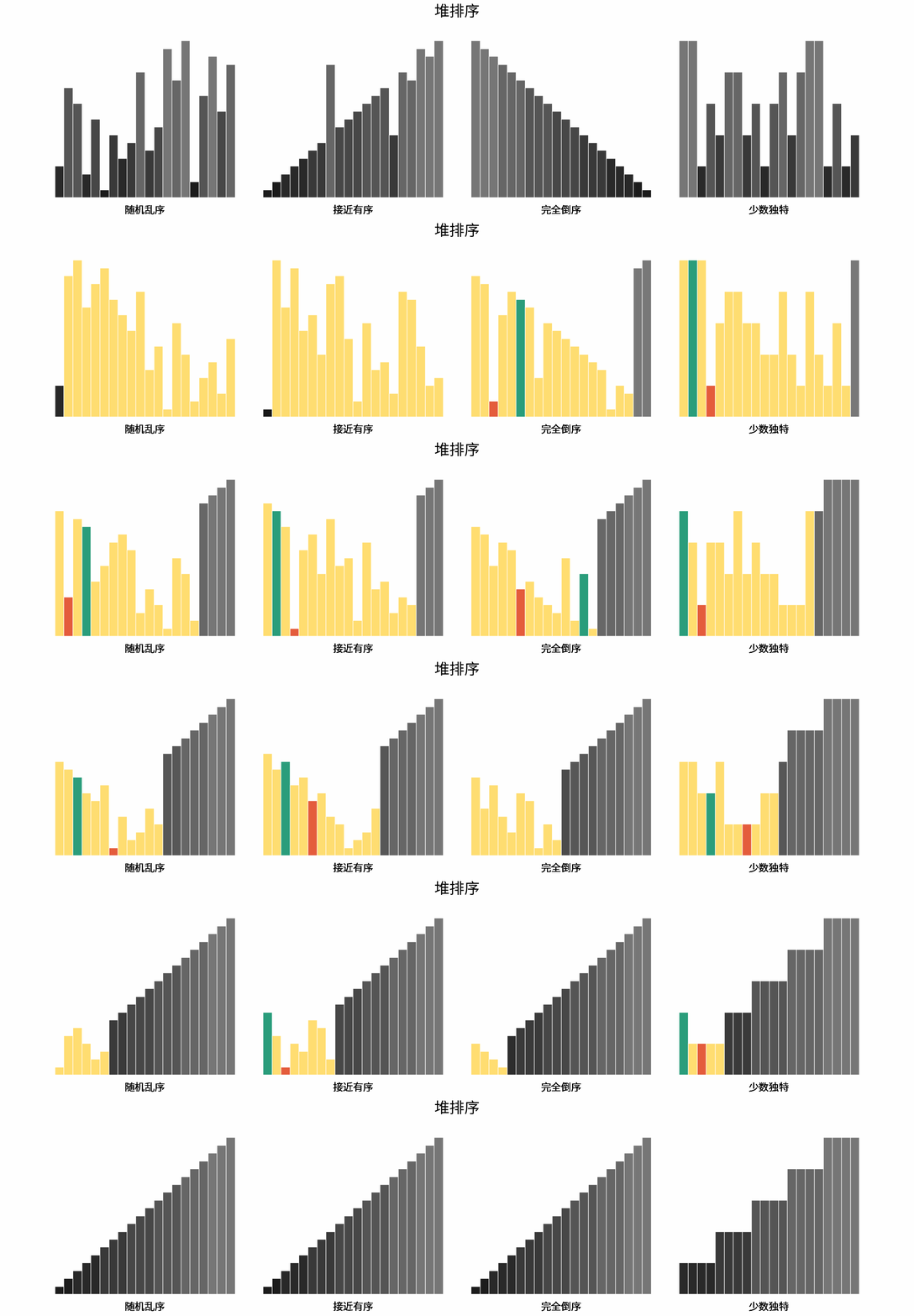
---
## 分类方法
排序算法主要可根据 **稳定性** 、**就地性** 、**自适应性** 分类。理想的排序算法具有以下特性:
- 具有稳定性,即相等元素的相对位置不变化;
- 具有就地性,即不使用额外的辅助空间;
- 具有自适应性,即时间复杂度受元素分布影响;
特别地,任意排序算法都 **不同时具有以上所有特性** 。因此,排序算法的选型使用取决于具体的列表类型、元素数量、元素分布情况等应用场景特点。
### 稳定性:
根据 **相等元素** 在数组中的 **相对顺序** 是否被改变,排序算法可分为「稳定排序」和「非稳定排序」两类。
- 「稳定排序」在完成排序后,**不改变** 相等元素在数组中的相对顺序。例如:冒泡排序、插入排序、归并排序、基数排序、桶排序。
- 「非稳定排序」在完成排序后,相等素在数组中的相对位置 **可能被改变**。例如:选择排序、快速排序、堆排序。
> **何时需考虑排序算法的稳定性?**
>
> 数组排序中,由于元素皆为数字,因此稳定和非稳定排序皆可输出相同结果,此时无需考虑排序算法的稳定性。
>
> 非稳定排序会改变相等元素的相对次序,这在实际应用场景中可能是不能接受的。如以下代码所示,非稳定排序破坏了输入列表 `people` 按姓名排序的性质。
>
> ```Python
> # 人 = (姓名, 年龄) ,按姓名排序
> people = [
> ('A', 19),
> ('B', 18),
> ('C', 21),
> ('D', 19),
> ('E', 23)
> ]
>
> # 非稳定排序(按年龄)
> sort_by_age(people)
>
> # 人 = (姓名, 年龄) ,按年龄排序
> people = [
> ('B', 18),
> ('D', 19), # ('D', 19) 和 ('A', 19) 的相对位置改变,输入时按姓名排序的性质丢失
> ('A', 19),
> ('C', 21),
> ('E', 23)
> ]
> ```
### 就地性:
根据排序过程中 **是否使用额外内存(辅助数组)**,排序算法可分为「原地排序」和「异地排序」两类。一般地,由于不使用外部内存,原地排序相比非原地排序的执行效率更高。
- 「原地排序」不使用额外辅助数组,例如:冒泡排序、插入排序、选择排序、快速排序、堆排序。
- 「非原地排序」使用额外辅助数组,例如:归并排序、基数排序、桶排序。
### 自适应性:
根据算法 **时间复杂度** 是否 **受待排序数组的元素分布影响** ,排序算法可分为「自适应排序」和「非自适应排序」两类。
- 「自适应排序」的时间复杂度受元素分布影响;例如:冒泡排序、插入排序、快速排序、桶排序。
- 「非自适应排序」的时间复杂度恒定;例如:选择排序、归并排序、堆排序、基数排序。
### 是否基于比较:
比较类排序基于元素之间的 **比较算子**(小于、相等、大于)来决定元素的相对顺序;相对的,非比较排序则不基于比较算子实现。
- 「基于比较排序」基于元素之间的比较完成排序,例如:冒泡排序、插入排序、选择排序、快速排序、归并排序、堆排序。
- 「非基于比较排序」不基于元素之间的比较完成排序,例如:基数排序、桶排序。
> 基于比较的排序算法的平均时间复杂度最优为 $O(N \log N)$ ,而非比较排序算法可以达到线性级别的时间复杂度。
---
## 时空复杂度
总体上看,排序算法追求时间与空间复杂度最低。而即使某些排序算法的时间复杂度相等,但实际性能还受 **输入列表性质、元素数量、元素分布等** 等因素影响。
> 设输入列表元素数量为 $N$ ,常见排序算法的「时间复杂度」和「空间复杂度」如下图所示。
| 算法 | 最佳时间 | 平均时间 | 最差时间 | 最差空间 |
| :------: | :-----------------: | :----------------: | :-----------: | :---------: |
| 冒泡排序 | $\Omega(N)$ | $\Theta(N^2)$ | $O(N^2)$ | $O(1)$ |
| 插入排序 | $\Omega(N)$ | $\Theta(N^2)$ | $O(N^2)$ | $O(1)$ |
| 选择排序 | $\Omega(N^2)$ | $\Theta(N^2)$ | $O(N^2)$ | $O(1)$ |
| 快速排序 | $\Omega(N \log N )$ | $\Theta(N \log N)$ | $O(N^2)$ | $O(\log N)$ |
| 归并排序 | $\Omega(N \log N)$ | $\Theta(N \log N)$ | $O(N \log N)$ | $O(N)$ |
| 堆排序 | $\Omega(N \log N)$ | $\Theta(N \log N)$ | $O(N \log N)$ | $O(1)$ |
| 基数排序 | $\Omega(Nk)$ | $\Theta(Nk)$ | $O(Nk)$ | $O(N + k)$ |
| 桶排序 | $\Omega(N + k)$ | $\Theta(N + k)$ | $O(N^2)$ | $O(N)$ |
对于上表,需要特别注意:
- 「基数排序」适用于正整数、字符串、特定格式的浮点数排序,$k$ 为最大数字的位数;「桶排序」中 $k$ 为桶的数量。
- 普通「冒泡排序」的最佳时间复杂度为 $O(N^2)$ ,通过增加标志位实现 **提前返回** ,可以将最佳时间复杂度降低至 $O(N)$ 。
- 在输入列表完全倒序下,普通「快速排序」的空间复杂度劣化至 $O(N)$ ,通过代码优化 **尾递归优化** 保持算法递归较短子数组,可以将最差递归深度降低至 $\log N$ 。
- 普通「快速排序」总以最左或最右元素为基准数,因此在输入列表有序或倒序下,时间复杂度劣化至 $O(N^2)$ ;通过 **随机选择基准数** ,可极大减少此类最差情况发生,尽可能地保持 $O(N \log N)$ 的时间复杂度。
- 若输入列表是数组,则归并排序的空间复杂度为 $O(N)$ ;而若排序 **链表** ,则「归并排序」不需要借助额外辅助空间,空间复杂度可以降低至 $O(1)$ 。
================================================
FILE: leetbook_ioa/docs/# 7.2 冒泡排序.md
================================================
# 冒泡排序
冒泡排序是最基础的排序算法,由于其直观性,经常作为首个介绍的排序算法。其原理为:
- **内循环:** 使用相邻双指针 `j` , `j + 1` 从左至右遍历,依次比较相邻元素大小,若左元素大于右元素则将它们交换;遍历完成时,**最大元素会被交换至数组最右边** 。
- **外循环:** 不断重复「内循环」,每轮将当前最大元素交换至 **剩余未排序数组最右边** ,直至所有元素都被交换至正确位置时结束。
如下图所示,首轮「内循环」后,数组最大元素已被交换至数组最右边;接下来,只需要完成数组剩余 $N - 1$ 个元素的排序即可(设数组元素数量为 $N$ )。同理,对剩余 $N - 1$ 个元素执行「内循环」,可将第二大元素交换至剩余数组最右端,以此类推……
如下图所示,冒泡排序的「外循环」共 $N - 1$ 轮,每轮「内循环」都将当前最大元素交换至数组最右边,从而完成对整个数组的排序。
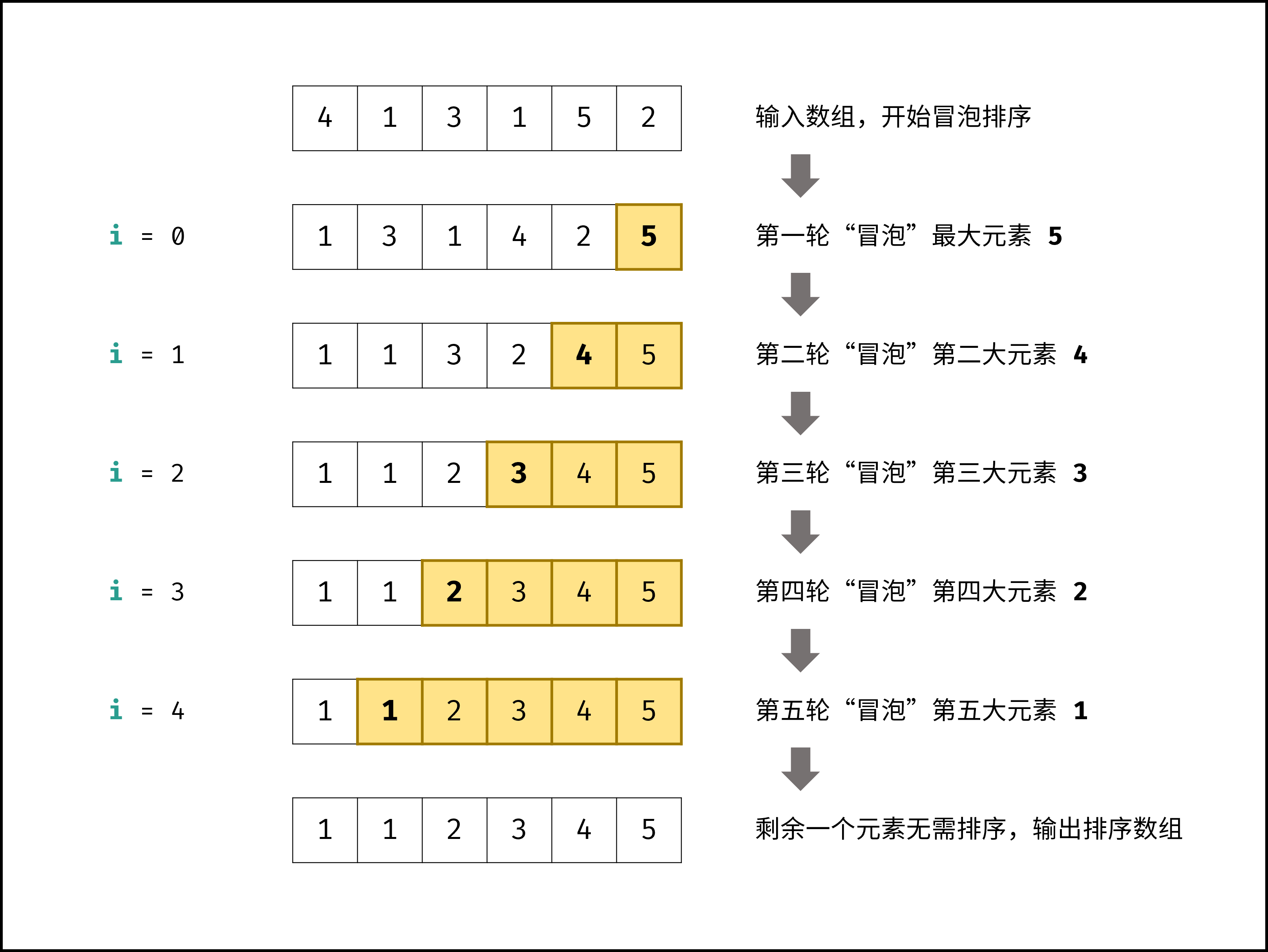{:width=550}
如下图所示,为示例数组 `nums = [4, 1, 3, 1, 5, 2]` 的冒泡排序算法运行过程。
## 代码
```Python []
def bubble_sort(nums):
N = len(nums)
for i in range(N - 1): # 外循环
for j in range(N - i - 1): # 内循环
if nums[j] > nums[j + 1]:
# 交换 nums[j], nums[j + 1]
nums[j], nums[j + 1] = nums[j + 1], nums[j]
```
```Java []
void bubbleSort(int[] nums) {
int N = nums.length;
for (int i = 0; i < N - 1; i++) { // 外循环
for (int j = 0; j < N - i - 1; j++) { // 内循环
if (nums[j] > nums[j + 1]) {
// 交换 nums[j], nums[j + 1]
int tmp = nums[j];
nums[j] = nums[j + 1];
nums[j + 1] = tmp;
}
}
}
}
```
```C++ []
void bubbleSort(vector &nums) {
int N = nums.size();
for (int i = 0; i < N - 1; i++) { // 外循环
for (int j = 0; j < N - i - 1; j++) { // 内循环
if (nums[j] > nums[j + 1]) {
// 交换 nums[j], nums[j + 1]
swap(nums[j], nums[j + 1]);
}
}
}
}
```
## 算法特性
- **时间复杂度 $O(N^2)$ :**
- **最佳 $\Omega(N)$ :** 普通冒泡排序的时间复杂度恒为 $O(N^2)$ ,对于近似排序数组,通过加入标志位可实现提前返回(详情请见下文)。
- **平均与最差 $O(N^2)$ :**「外循环」共 $N - 1$ 轮,使用 $O(N)$ 时间;每轮「内循环」分别遍历 $N - 1$ , $N - 2$ , $\cdots$ , $2$ , $1$ 次,平均 $\frac{N}{2}$ 次,使用 $O(\frac{N}{2}) = O(N)$ 时间;因此,总体时间复杂度为 $O(N^2)$ 。
- **空间复杂度 $O(1)$ :** 只需原地交换元素,使用常数大小的额外空间。
- 冒泡排序是通过不断 **交换元素** 实现排序(交换 2 个元素需要 3 次赋值操作),因此速度较慢;
- **原地:** 指针变量仅使用常数大小额外空间,空间复杂度为 $O(1)$ ;
- **稳定:** 元素值相同时不交换,因此不会改变相同元素的相对位置;
- **自适应:** 通过增加一个标志位 `flag` ,若某轮内循环未执行任何交换操作时,说明已经完成排序,因此直接返回。此优化使冒泡排序的最优时间复杂度达到 $O(N)$(当输入数组已排序时);
## 标志位优化
> 普通冒泡排序的时间复杂度恒为 $O(N^2)$ ,与输入数组的元素分布无关。
通过增加一个标志位 `flag` ,若在某轮「内循环」中未执行任何交换操作,则说明数组已经完成排序,直接返回结果即可。
优化后的冒泡排序的最差和平均时间复杂度仍为 $O(N^2)$ ;在输入数组 **已排序** 时,达到 **最佳时间复杂度** $\Omega(N)$ 。
```Python []
def bubble_sort(nums):
N = len(nums)
for i in range(N - 1):
flag = False # 初始化标志位
for j in range(N - i - 1):
if nums[j] > nums[j + 1]:
nums[j], nums[j + 1] = nums[j + 1], nums[j]
flag = True # 记录交换元素
if not flag: break # 内循环未交换任何元素,则跳出
```
```Java []
void bubbleSort(int[] nums) {
int N = nums.length;
for (int i = 0; i < N - 1; i++) {
boolean flag = false; // 初始化标志位
for (int j = 0; j < N - i - 1; j++) {
if (nums[j] > nums[j + 1]) {
int tmp = nums[j];
nums[j] = nums[j + 1];
nums[j + 1] = tmp;
flag = true; // 记录交换元素
}
}
if (!flag) break; // 内循环未交换任何元素,则跳出
}
}
```
```C++ []
void bubbleSort(vector &nums) {
int N = nums.size();
for (int i = 0; i < N - 1; i++) {
bool flag = false; // 初始化标志位
for (int j = 0; j < N - i - 1; j++) {
if (nums[j] > nums[j + 1]) {
swap(nums[j], nums[j + 1]);
flag = true; // 记录交换元素
}
}
if (!flag) break; // 内循环未交换任何元素,则跳出
}
}
```
================================================
FILE: leetbook_ioa/docs/# 7.3 快速排序.md
================================================
# 快速排序
快速排序算法有两个核心点,分别为 **哨兵划分** 和 **递归** 。
**哨兵划分**:以数组某个元素(一般选取首元素)为 **基准数** ,将所有小于基准数的元素移动至其左边,大于基准数的元素移动至其右边。
> 下图展示了哨兵划分操作流程。经过一轮 **哨兵划分** ,可将数组排序问题拆分为 **两个较短数组的排序问题** (本文称之为左(右)子数组)。
**递归**:对 **左子数组** 和 **右子数组** 分别递归执行 **哨兵划分**,直至子数组长度为 1 时终止递归,即可完成对整个数组的排序。
> 下图展示了数组 `[2,4,1,0,3,5]` 的快速排序流程。观察发现,快速排序和 **二分法** 的原理类似,都是以 $\log$ 时间复杂度实现搜索区间缩小。
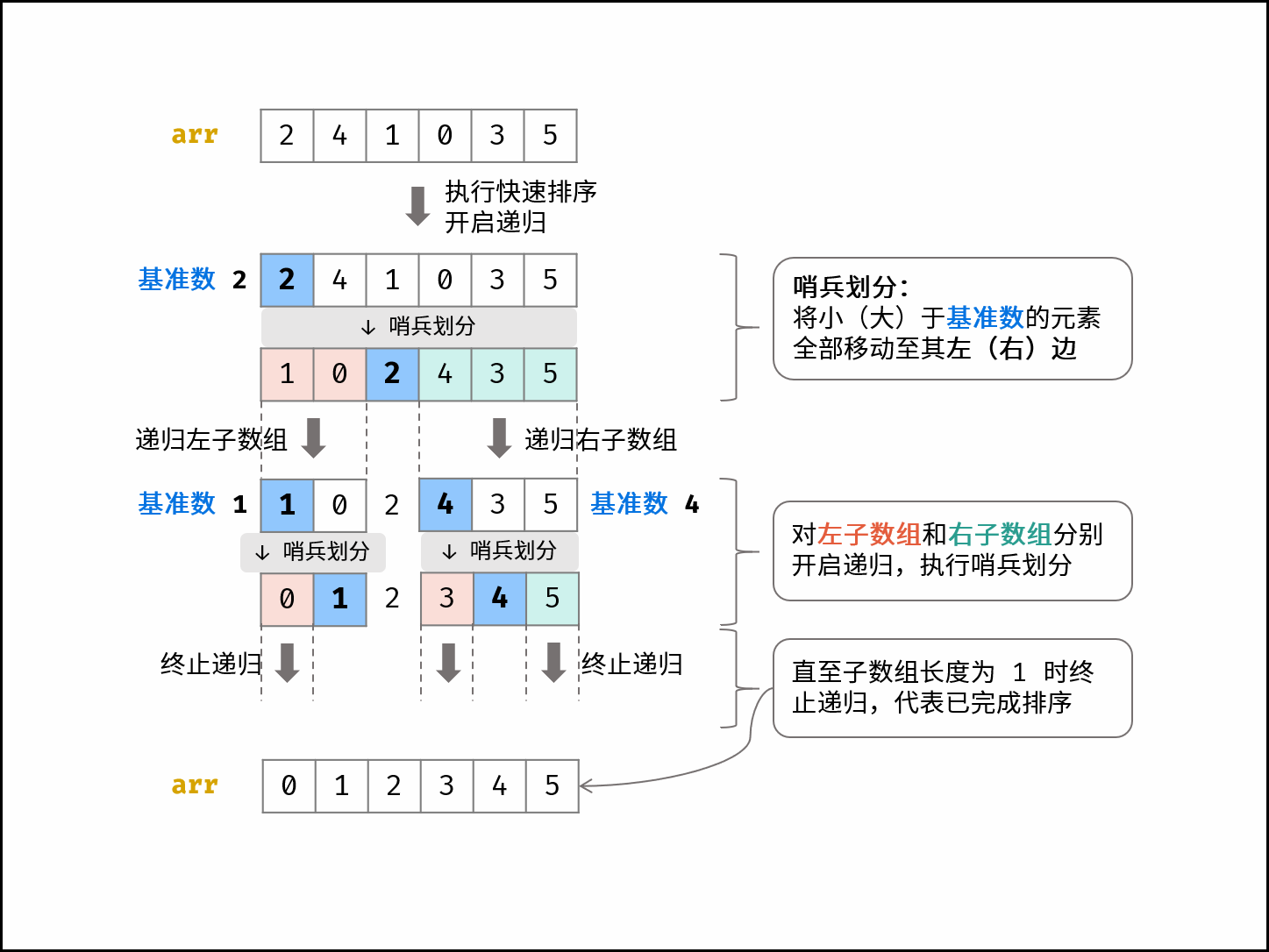{:width=550}
## 代码
```Python []
def quick_sort(nums, l, r):
# 子数组长度为 1 时终止递归
if l >= r: return
# 哨兵划分操作
i = partition(nums, l, r)
# 递归左(右)子数组执行哨兵划分
quick_sort(nums, l, i - 1)
quick_sort(nums, i + 1, r)
def partition(nums, l, r):
# 以 nums[l] 作为基准数
i, j = l, r
while i < j:
while i < j and nums[j] >= nums[l]: j -= 1
while i < j and nums[i] <= nums[l]: i += 1
nums[i], nums[j] = nums[j], nums[i]
nums[l], nums[i] = nums[i], nums[l]
return i
# 调用
nums = [3, 4, 1, 5, 2]
quick_sort(nums, 0, len(nums) - 1)
```
```Java []
void quickSort(int[] nums, int l, int r) {
// 子数组长度为 1 时终止递归
if (l >= r) return;
// 哨兵划分操作
int i = partition(nums, l, r);
// 递归左(右)子数组执行哨兵划分
quickSort(nums, l, i - 1);
quickSort(nums, i + 1, r);
}
int partition(int[] nums, int l, int r) {
// 以 nums[l] 作为基准数
int i = l, j = r;
while (i < j) {
while (i < j && nums[j] >= nums[l]) j--;
while (i < j && nums[i] <= nums[l]) i++;
swap(nums, i, j);
}
swap(nums, i, l);
return i;
}
void swap(int[] nums, int i, int j) {
// 交换 nums[i] 和 nums[j]
int tmp = nums[i];
nums[i] = nums[j];
nums[j] = tmp;
}
// 调用
int[] nums = { 4, 1, 3, 2, 5 };
quickSort(nums, 0, nums.length - 1);
```
```C++ []
int partition(vector& nums, int l, int r) {
// 以 nums[l] 作为基准数
int i = l, j = r;
while (i < j) {
while (i < j && nums[j] >= nums[l]) j--;
while (i < j && nums[i] <= nums[l]) i++;
swap(nums[i], nums[j]);
}
swap(nums[i], nums[l]);
return i;
}
void quickSort(vector& nums, int l, int r) {
// 子数组长度为 1 时终止递归
if (l >= r) return;
// 哨兵划分操作
int i = partition(nums, l, r);
// 递归左(右)子数组执行哨兵划分
quickSort(nums, l, i - 1);
quickSort(nums, i + 1, r);
}
// 调用
vector nums = { 4, 1, 3, 2, 5, 1 };
quickSort(nums, 0, nums.size() - 1);
```
## 算法特性
- **时间复杂度:**
- **最佳 $\Omega(N \log N )$ :** 最佳情况下, 每轮哨兵划分操作将数组划分为等长度的两个子数组;哨兵划分操作为线性时间复杂度 $O(N)$ ;递归轮数共 $O(\log N)$ 。
- **平均 $\Theta(N \log N)$ :** 对于随机输入数组,哨兵划分操作的递归轮数也为 $O(\log N)$ 。
- **最差 $O(N^2)$ :** 对于某些特殊输入数组,每轮哨兵划分操作都将长度为 $N$ 的数组划分为长度为 $1$ 和 $N - 1$ 的两个子数组,此时递归轮数达到 $N$ 。
> 通过 「随机选择基准数」优化,可尽可能避免出现最差情况,详情请见下文。
- **空间复杂度 $O(N)$ :** 快速排序的递归深度最好与平均皆为 $\log N$ ;输入数组完全倒序下,达到最差递归深度 $N$ 。
> 通过「尾递归」优化,可将最差空间复杂度降低至 $O(\log N)$ ,详情请见下文。
- 虽然平均时间复杂度与「归并排序」和「堆排序」一致,但在实际使用中快速排序 **效率更高** ,这是因为:
- **最差情况稀疏性:** 虽然快速排序的最差时间复杂度为 $O(N^2)$ ,差于归并排序和堆排序,但统计意义上看,这种情况出现的机率很低。大部分情况下,快速排序以 $O(N \log N)$ 复杂度运行。
- **缓存使用效率高:** 哨兵划分操作时,将整个子数组加载入缓存中,访问元素效率很高;堆排序需要跳跃式访问元素,因此不具有此特性。
- **常数系数低:** 在提及的三种算法中,快速排序的 **比较**、**赋值**、**交换** 三种操作的综合耗时最低(类似于插入排序快于冒泡排序的原理)。
- **原地:** 不用借助辅助数组的额外空间,递归仅使用 $O(\log N)$ 大小的栈帧空间。
- **非稳定:** 哨兵划分操作可能改变相等元素的相对顺序。
- **自适应:** 对于极少输入数据,每轮哨兵划分操作都将长度为 $N$ 的数组划分为长度 $1$ 和 $N - 1$ 两个子数组,此时时间复杂度劣化至 $O(N^2)$ 。
## 算法优化
快速排序的常见优化手段有「尾递归」和「随机基准数」两种。
### 尾递归:
由于普通快速排序每轮选取「子数组最左元素」作为「基准数」,因此在输入数组 **完全倒序** 时, `partition()` 的递归深度会达到 $N$ ,即 **最差空间复杂度** 为 $O(N)$ 。
每轮递归时,仅对 **较短的子数组** 执行哨兵划分 `partition()` ,就可将最差的递归深度控制在 $O(\log N)$ (每轮递归的子数组长度都 $\leq$ 当前数组长度 $/ 2$ ),即实现最差空间复杂度 $O(\log N)$ 。
> 代码仅需修改 `quick_sort()` 方法,其余方法不变,在此省略。
```Python []
def quick_sort(nums, l, r):
# 子数组长度为 1 时终止递归
while l < r:
# 哨兵划分操作
i = partition(nums, l, r)
# 仅递归至较短子数组,控制递归深度
if i - l < r - i:
quick_sort(nums, l, i - 1)
l = i + 1
else:
quick_sort(nums, i + 1, r)
r = i - 1
```
```Java []
void quickSort(int[] nums, int l, int r) {
// 子数组长度为 1 时终止递归
while (l < r) {
// 哨兵划分操作
int i = partition(nums, l, r);
// 仅递归至较短子数组,控制递归深度
if (i - l < r - i) {
quickSort(nums, l, i - 1);
l = i + 1;
} else {
quickSort(nums, i + 1, r);
r = i - 1;
}
}
}
```
```C++ []
void quickSort(vector& nums, int l, int r) {
// 子数组长度为 1 时终止递归
while (l < r) {
// 哨兵划分操作
int i = partition(nums, l, r);
// 仅递归至较短子数组,控制递归深度
if (i - l < r - i) {
quickSort(nums, l, i - 1);
l = i + 1;
} else {
quickSort(nums, i + 1, r);
r = i - 1;
}
}
}
```
### 随机基准数:
同样地,由于快速排序每轮选取「子数组最左元素」作为「基准数」,因此在输入数组 **完全有序** 或 **完全倒序** 时, `partition()` 每轮只划分一个元素,达到最差时间复杂度 $O(N^2)$ 。
因此,可使用 **随机函数** ,每轮在子数组中随机选择一个元素作为基准数,这样就可以极大概率避免以上劣化情况。
值得注意的是,由于仍然可能出现最差情况,因此快速排序的最差时间复杂度仍为 $O(N^2)$ 。
> 代码仅需修改 `partition()` 方法,其余方法不变,在此省略。
```Python []
def partition(nums, l, r):
# 在闭区间 [l, r] 随机选取任意索引,并与 nums[l] 交换
ra = random.randrange(l, r + 1)
nums[l], nums[ra] = nums[ra], nums[l]
# 以 nums[l] 作为基准数
i, j = l, r
while i < j:
while i < j and nums[j] >= nums[l]: j -= 1
while i < j and nums[i] <= nums[l]: i += 1
nums[i], nums[j] = nums[j], nums[i]
nums[l], nums[i] = nums[i], nums[l]
return i
```
```Java []
int partition(int[] nums, int l, int r) {
// 在闭区间 [l, r] 随机选取任意索引,并与 nums[l] 交换
int ra = (int)(l + Math.random() * (r - l + 1));
swap(nums, l, ra);
// 以 nums[l] 作为基准数
int i = l, j = r;
while (i < j) {
while (i < j && nums[j] >= nums[l]) j--;
while (i < j && nums[i] <= nums[l]) i++;
swap(nums, i, j);
}
swap(nums, i, l);
return i;
}
```
```C++ []
int partition(vector& nums, int l, int r) {
// 在闭区间 [l, r] 随机选取任意索引,并与 nums[l] 交换
int ra = l + rand() % (r - l + 1);
swap(nums[l], nums[ra]);
// 以 nums[l] 作为基准数
int i = l, j = r;
while (i < j) {
while (i < j && nums[j] >= nums[l]) j--;
while (i < j && nums[i] <= nums[l]) i++;
swap(nums[i], nums[j]);
}
swap(nums[i], nums[l]);
return i;
}
```
================================================
FILE: leetbook_ioa/docs/# 7.4 归并排序.md
================================================
# 归并排序
归并排序体现了 “分而治之” 的算法思想,具体为:
- **「分」:** 不断将数组从 **中点位置** 划分开,将原数组的排序问题转化为子数组的排序问题;
- **「治」:** 划分到子数组长度为 1 时,开始向上合并,不断将 **左右两个较短排序数组** 合并为 **一个较长排序数组**,直至合并至原数组时完成排序;
> 如下图所示,为数组 `[7,3,2,6,0,1,5,4]` 的归并排序过程。
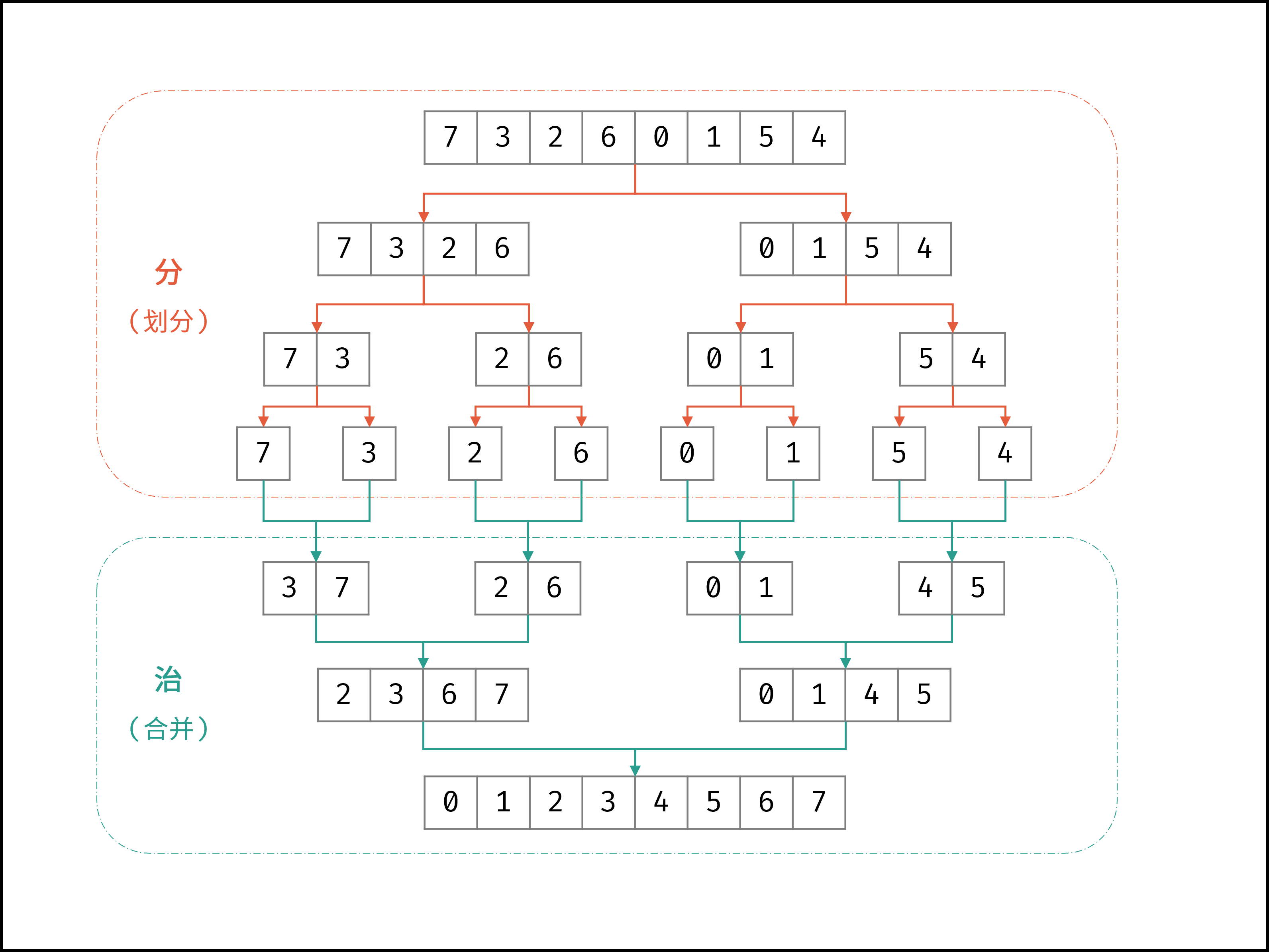{:width=500}
## 算法流程
1. **递归划分:**
1. 计算数组中点 $m$ ,递归划分左子数组 `merge_sort(l, m)` 和右子数组 `merge_sort(m + 1, r)` ;
2. 当 $l \geq r$ 时,代表子数组长度为 1 或 0 ,此时 **终止划分** ,开始合并;
2. **合并子数组:**
1. 暂存数组 $nums$ 闭区间 $[l, r]$ 内的元素至辅助数组 $tmp$ ;
2. **循环合并:** 设置双指针 $i$ , $j$ 分别指向 $tmp$ 的左 / 右子数组的首元素;
> **注意:** $nums$ 子数组的左边界、中点、右边界分别为 $l$ , $m$ , $r$ ,而辅助数组 $tmp$ 中的对应索引为 $0$ , $m - l$ , $r - l$ ;
- **当 $i == m - l + 1$ 时:** 代表左子数组已合并完,因此添加右子数组元素 $tmp[j]$ ,并执行 $j = j + 1$ ;
- **否则,当 $j == r - l + 1$ 时:** 代表右子数组已合并完,因此添加左子数组元素 $tmp[i]$ ,并执行 $i = i + 1$ ;
- **否则,当 $tmp[i] \leq tmp[j]$ 时:** 添加左子数组元素 $tmp[i]$ ,并执行 $i = i + 1$ ;
- **否则(即当 $tmp[i] > tmp[j]$ 时):** 添加右子数组元素 $tmp[j]$ ,并执行 $j = j + 1$ ;
> 如下动图所示,为数组 `[7,3,2,6]` 的归并排序过程。
## 代码
为简化代码,「当 $j = r + 1$ 时」 与 「当 $tmp[i] \leq tmp[j]$ 时」 两判断项可合并。
```Python []
def merge_sort(nums, l, r):
# 终止条件
if l >= r: return
# 递归划分数组
m = (l + r) // 2
merge_sort(nums, l, m)
merge_sort(nums, m + 1, r)
# 合并子数组
tmp = nums[l:r + 1] # 暂存需合并区间元素
i, j = 0, m - l + 1 # 两指针分别指向左/右子数组的首个元素
for k in range(l, r + 1): # 遍历合并左/右子数组
if i == m - l + 1:
nums[k] = tmp[j]
j += 1
elif j == r - l + 1 or tmp[i] <= tmp[j]:
nums[k] = tmp[i]
i += 1
else:
nums[k] = tmp[j]
j += 1
# 调用
nums = [3, 4, 1, 5, 2, 1]
merge_sort(0, len(nums) - 1)
```
```Java []
void mergeSort(int[] nums, int l, int r) {
// 终止条件
if (l >= r) return;
// 递归划分
int m = (l + r) / 2;
mergeSort(nums, l, m);
mergeSort(nums, m + 1, r);
// 合并子数组
int[] tmp = new int[r - l + 1]; // 暂存需合并区间元素
for (int k = l; k <= r; k++)
tmp[k - l] = nums[k];
int i = 0, j = m - l + 1; // 两指针分别指向左/右子数组的首个元素
for (int k = l; k <= r; k++) { // 遍历合并左/右子数组
if (i == m - l + 1)
nums[k] = tmp[j++];
else if (j == r - l + 1 || tmp[i] <= tmp[j])
nums[k] = tmp[i++];
else {
nums[k] = tmp[j++];
}
}
}
// 调用
int[] nums = { 3, 4, 1, 5, 2, 1 };
mergeSort(nums, 0, len(nums) - 1);
```
```C++ []
void mergeSort(vector& nums, int l, int r) {
// 终止条件
if (l >= r) return;
// 递归划分
int m = (l + r) / 2;
mergeSort(nums, l, m);
mergeSort(nums, m + 1, r);
// 合并阶段
int tmp[r - l + 1]; // 暂存需合并区间元素
for (int k = l; k <= r; k++)
tmp[k - l] = nums[k];
int i = 0, j = m - l + 1; // 两指针分别指向左/右子数组的首个元素
for (int k = l; k <= r; k++) { // 遍历合并左/右子数组
if (i == m - l + 1)
nums[k] = tmp[j++];
else if (j == r - l + 1 || tmp[i] <= tmp[j])
nums[k] = tmp[i++];
else {
nums[k] = tmp[j++];
}
}
}
// 调用
vector nums = { 4, 1, 3, 2, 5, 1 };
mergeSort(nums, 0, nums.size() - 1);
```
## 算法特性
- **时间复杂度:** 最佳 $\Omega(N \log N )$ ,平均 $\Theta(N \log N)$ ,最差 $O(N \log N)$ 。
- **空间复杂度 $O(N)$ :** 合并过程中需要借助辅助数组 $tmp$ ,使用 $O(N)$ 大小的额外空间;划分的递归深度为 $\log N$ ,使用 $O(\log N)$ 大小的栈帧空间。
- 若输入数据是 **链表** ,则归并排序的空间复杂度可被优化至 $O(1)$ ,这是因为:
- 通过应用「双指针法」,可在 $O(1)$ 空间下完成两个排序链表的合并,省去辅助数组 $tmp$ 使用的额外空间;
- 通过使用「迭代」代替「递归划分」,可省去递归使用的栈帧空间;
> 详情请参考:[148. 排序链表](https://leetcode-cn.com/problems/sort-list/solution/sort-list-gui-bing-pai-xu-lian-biao-by-jyd/)
- **非原地:** 辅助数组 $tmp$ 需要使用额外空间。
- **稳定:** 归并排序不改变相等元素的相对顺序。
- **非自适应:** 对于任意输入数据,归并排序的时间复杂度皆相同。
================================================
FILE: leetbook_ioa/docs/LCR 120. 寻找文件副本.md
================================================
## 方法一:哈希表
利用数据结构特点,容易想到使用哈希表(Set)记录数组的各个数字,当查找到重复数字则直接返回。
### 算法流程:
1. 初始化: 新建 HashSet ,记为 $hmap$ ;
2. 遍历数组 $documents$ 中的每个数字 $doc$ :
1. 当 $doc$ 在 $hmap$ 中,说明重复,直接返回 $doc$ ;
2. 将 $doc$ 添加至 $hmap$ 中;
3. 返回 $-1$ 。本题中一定有重复数字,因此这里返回多少都可以。
> 下图中的 `nums` 对应本题的 `documents` 。
### 代码:
```Python []
class Solution:
def findRepeatDocument(self, documents: List[int]) -> int:
hmap = set()
for doc in documents:
if doc in hmap: return doc
hmap.add(doc)
return -1
```
```Java []
class Solution {
public int findRepeatDocument(int[] documents) {
Set hmap = new HashSet<>();
for(int doc : documents) {
if(hmap.contains(doc)) return doc;
hmap.add(doc);
}
return -1;
}
}
```
```C++ []
class Solution {
public:
int findRepeatDocument(vector& documents) {
unordered_map map;
for(int doc : documents) {
if(map[doc]) return doc;
map[doc] = true;
}
return -1;
}
};
```
### 复杂度分析:
- **时间复杂度 $O(N)$ :** 遍历数组使用 $O(N)$ ,HashSet 添加与查找元素皆为 $O(1)$ 。
- **空间复杂度 $O(N)$ :** HashSet 占用 $O(N)$ 大小的额外空间。
## 方法二:原地交换
题目说明尚未被充分使用,即 `在一个长度为 n 的数组 documents 里的所有数字都在 0 ~ n-1 的范围内` 。 此说明含义:数组元素的 **索引** 和 **值** 是 **一对多** 的关系。
因此,可遍历数组并通过交换操作,使元素的 **索引** 与 **值** 一一对应(即 $documents[i] = i$ )。因而,就能通过索引映射对应的值,起到与字典等价的作用。
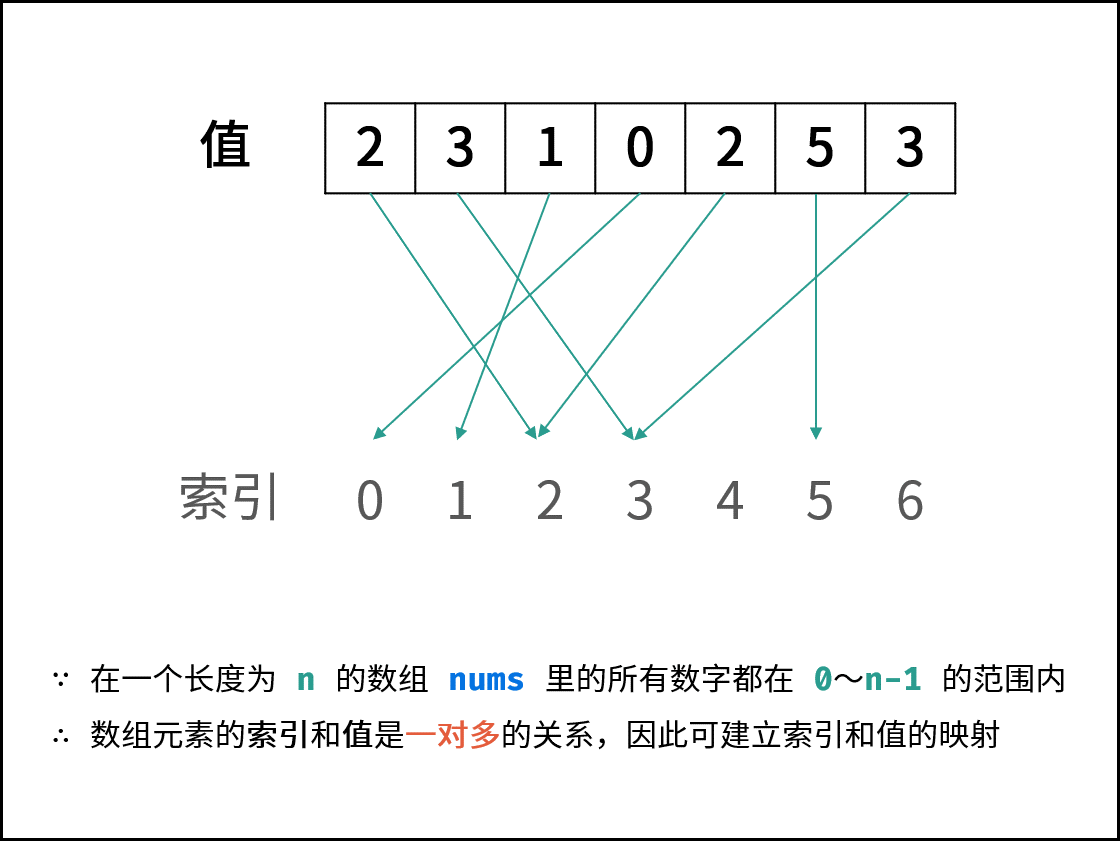{:align=center width=500}
遍历中,第一次遇到数字 $x$ 时,将其交换至索引 $x$ 处;而当第二次遇到数字 $x$ 时,一定有 $documents[x] = x$ ,此时即可得到一组重复数字。
### 算法流程:
1. 遍历数组 $documents$ ,设索引初始值为 $i = 0$ :
1. **若 $documents[i] = i$ :** 说明此数字已在对应索引位置,无需交换,因此跳过;
2. **若 $documents[documents[i]] = documents[i]$ :** 代表索引 $documents[i]$ 处和索引 $i$ 处的元素值都为 $documents[i]$ ,即找到一组重复值,返回此值 $documents[i]$ ;
3. **否则:** 交换索引为 $i$ 和 $documents[i]$ 的元素值,将此数字交换至对应索引位置。
2. 若遍历完毕尚未返回,则返回 $-1$ 。
### 代码:
Python 中,$a, b = c, d$ 操作的原理是先暂存元组 $(c, d)$ ,然后 “按左右顺序” 赋值给 a 和 b 。
因此,若写为 $documents[i], documents[documents[i]] = documents[documents[i]], documents[i]$ ,则 $documents[i]$ 会先被赋值,之后 $documents[documents[i]]$ 指向的元素则会出错。
```Python []
class Solution:
def findRepeatDocument(self, documents: List[int]) -> int:
i = 0
while i < len(documents):
if documents[i] == i:
i += 1
continue
if documents[documents[i]] == documents[i]: return documents[i]
documents[documents[i]], documents[i] = documents[i], documents[documents[i]]
return -1
```
```Java []
class Solution {
public int findRepeatDocument(int[] documents) {
int i = 0;
while(i < documents.length) {
if(documents[i] == i) {
i++;
continue;
}
if(documents[documents[i]] == documents[i]) return documents[i];
int tmp = documents[i];
documents[i] = documents[tmp];
documents[tmp] = tmp;
}
return -1;
}
}
```
```C++ []
class Solution {
public:
int findRepeatDocument(vector& documents) {
int i = 0;
while(i < documents.size()) {
if(documents[i] == i) {
i++;
continue;
}
if(documents[documents[i]] == documents[i])
return documents[i];
swap(documents[i],documents[documents[i]]);
}
return -1;
}
};
```
### 复杂度分析:
- **时间复杂度 $O(N)$ :** 遍历数组使用 $O(N)$ ,每轮遍历的判断和交换操作使用 $O(1)$ 。
- **空间复杂度 $O(1)$ :** 使用常数复杂度的额外空间。
================================================
FILE: leetbook_ioa/docs/LCR 121. 寻找目标值 - 二维数组.md
================================================
## 解题思路:
> 若使用暴力法遍历矩阵 `plants` ,则时间复杂度为 $O(NM)$ 。暴力法未利用矩阵 **“从上到下递增、从左到右递增”** 的特点,显然不是最优解法。
如下图所示,我们将矩阵逆时针旋转 45° ,并将其转化为图形式,发现其类似于 **二叉搜索树** ,即对于每个元素,其左分支元素更小、右分支元素更大。
因此,考虑从 “根节点” 开始搜索,遇到比 `target` 大的元素就向左,反之向右,即可找到目标值 `target` 。
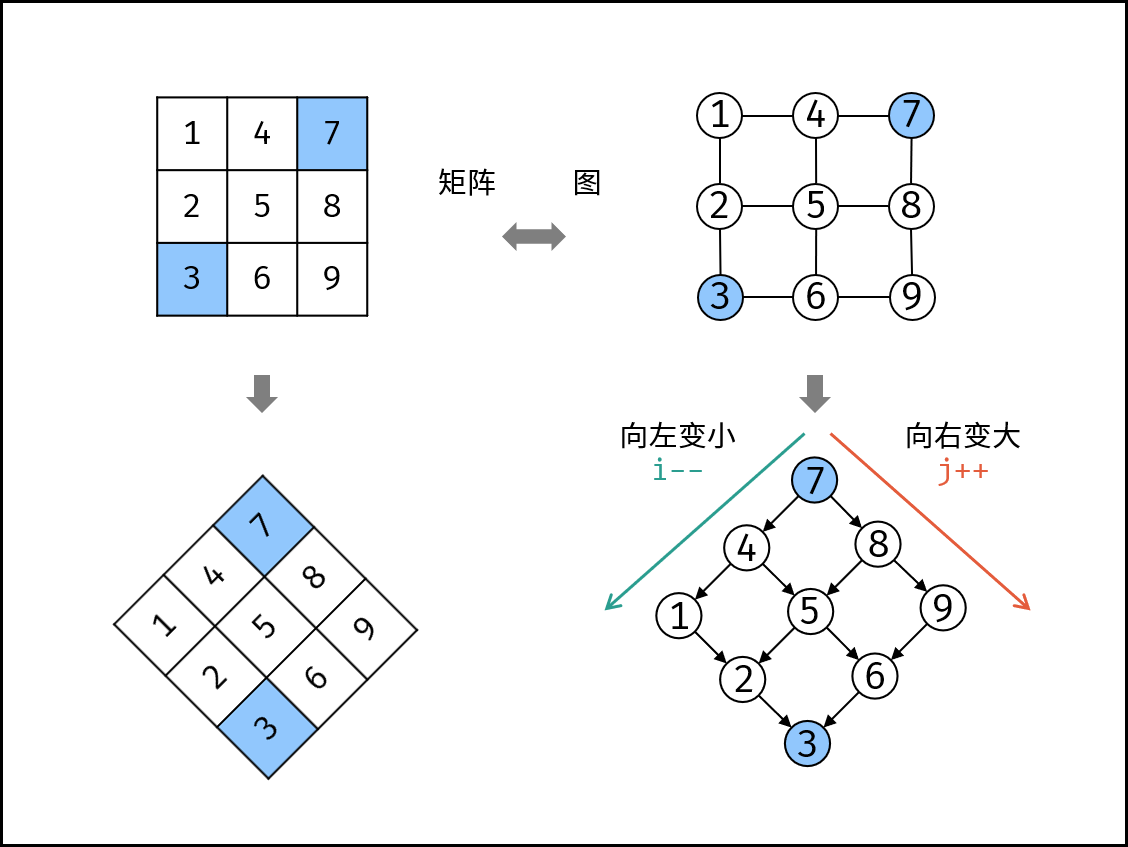{:align=center width=450}
### 算法流程:
“根节点” 对应的是矩阵的 “左下角” 和 “右上角” 元素。以 `plants` 中的 **左下角元素** 为起始点,则有:
1. 从矩阵 `plants` 左下角元素(索引设为 `(i, j)` )开始遍历,并与目标值对比:
- 当 `plants[i][j] > target` 时,执行 `i--` ,即消去第 `i` 行元素;
- 当 `plants[i][j] < target` 时,执行 `j++` ,即消去第 `j` 列元素;
- 当 `plants[i][j] = target` 时,返回 $\text{true}$ ,代表找到目标值。
2. 若行索引或列索引越界,则代表矩阵中无目标值,返回 $\text{false}$ 。
> 每轮 `i` 或 `j` 移动后,相当于生成了“消去一行(列)的新矩阵”, 索引`(i,j)` 指向新矩阵的左下角元素,因此可重复使用以上性质消去行(列)。
## 代码:
```Python []
class Solution:
def findTargetIn2DPlants(self, plants: List[List[int]], target: int) -> bool:
i, j = len(plants) - 1, 0
while i >= 0 and j < len(plants[0]):
if plants[i][j] > target: i -= 1
elif plants[i][j] < target: j += 1
else: return True
return False
```
```Java []
class Solution {
public boolean findTargetIn2DPlants(int[][] plants, int target) {
int i = plants.length - 1, j = 0;
while(i >= 0 && j < plants[0].length)
{
if(plants[i][j] > target) i--;
else if(plants[i][j] < target) j++;
else return true;
}
return false;
}
}
```
```C++ []
class Solution {
public:
bool findTargetIn2DPlants(vector>& plants, int target) {
int i = plants.size() - 1, j = 0;
while(i >= 0 && j < plants[0].size())
{
if(plants[i][j] > target) i--;
else if(plants[i][j] < target) j++;
else return true;
}
return false;
}
};
```
### 复杂度分析:
- 时间复杂度 $O(M+N)$ :其中,$N$ 和 $M$ 分别为矩阵行数和列数,此算法最多循环 $M+N$ 次。
- 空间复杂度 $O(1)$ : `i`, `j` 指针使用常数大小额外空间。
================================================
FILE: leetbook_ioa/docs/LCR 122. 路径加密.md
================================================
## 方法一:遍历添加
在 Python 和 Java 等语言中,字符串都被设计成「不可变」的类型,即无法直接修改字符串的某一位字符,需要新建一个字符串实现。
### 算法流程:
1. 初始化一个 `list` (Python) 或 `StringBuilder` (Java) ,记为 `res` ;
2. 遍历列表 `path` 中的每个字符 `c` :
- 当 `c` 为空格时:向 `res` 后添加空格 " " ;
- 当 `c` 不为空格时:向 `res` 后添加字符 `c` ;
3. 将列表 `res` 转化为字符串并返回。
> 下图中的 `s` 对应本题的 `path` 。
## 代码:
```Python []
class Solution:
def pathEncryption(self, path: str) -> str:
res = []
for c in path:
if c == '.': res.append(' ')
else: res.append(c)
return "".join(res)
```
```Java []
class Solution {
public String pathEncryption(String path) {
StringBuilder res = new StringBuilder();
for(Character c : path.toCharArray())
{
if(c == '.') res.append(' ');
else res.append(c);
}
return res.toString();
}
}
```
### 复杂度分析:
- **时间复杂度 $O(N)$ :** 遍历使用 $O(N)$ ,每轮添加(修改)字符操作使用 $O(1)$ ;
- **空间复杂度 $O(N)$ :** Python 新建的 list 和 Java 新建的 StringBuilder 都使用了线性大小的额外空间。
================================================
FILE: leetbook_ioa/docs/LCR 123. 图书整理 I.md
================================================
## 方法一:递归
利用递归,先递推至链表末端;回溯时,依次将节点值加入列表,即可实现链表值的倒序输出。
1. **终止条件:** 当 `head == None` 时,代表越过了链表尾节点,则返回空列表;
2. **递推工作:** 访问下一节点 `head.next` ;
3. **回溯阶段:**
- **Python:** 返回 `当前 list + 当前节点值 [head.val]` ;
- **Java / C++:** 将当前节点值 `head.val` 加入列表 `tmp` ;
### 代码:
```Python []
class Solution:
def reverseBookList(self, head: Optional[ListNode]) -> List[int]:
return self.reverseBookList(head.next) + [head.val] if head else []
```
```Java []
class Solution {
ArrayList tmp = new ArrayList();
public int[] reverseBookList(ListNode head) {
recur(head);
int[] res = new int[tmp.size()];
for(int i = 0; i < res.length; i++)
res[i] = tmp.get(i);
return res;
}
void recur(ListNode head) {
if(head == null) return;
recur(head.next);
tmp.add(head.val);
}
}
```
```C++ []
class Solution {
public:
vector reverseBookList(ListNode* head) {
recur(head);
return res;
}
private:
vector res;
void recur(ListNode* head) {
if(head == nullptr) return;
recur(head->next);
res.push_back(head->val);
}
};
```
### 复杂度分析:
- **时间复杂度 $O(N)$:** 遍历链表,递归 $N$ 次。
- **空间复杂度 $O(N)$:** 系统递归需要使用 $O(N)$ 的栈空间。
## 方法二:辅助栈法
链表只能 **从前至后** 访问每个节点,而题目要求 **倒序输出** 各节点值,这种 **先入后出** 的需求可以借助 **栈** 来实现。
### 算法流程:
1. **入栈:** 遍历链表,将各节点值 `push` 入栈。
2. **出栈:** 将各节点值 `pop` 出栈,存储于数组并返回。
> 图解以 Java 代码为例,Python 无需将 `stack` 转移至 `res`,而是直接返回倒序数组。
### 代码:
Java 数组长度不可变,因此使用 List 先存储,再转为数组并返回。
```Python []
class Solution:
def reverseBookList(self, head: ListNode) -> List[int]:
stack = []
while head:
stack.append(head.val)
head = head.next
return stack[::-1]
```
```Java []
class Solution {
public int[] reverseBookList(ListNode head) {
LinkedList stack = new LinkedList();
while(head != null) {
stack.addLast(head.val);
head = head.next;
}
int[] res = new int[stack.size()];
for(int i = 0; i < res.length; i++)
res[i] = stack.removeLast();
return res;
}
}
```
```C++ []
class Solution {
public:
vector reverseBookList(ListNode* head) {
stack stk;
while(head != nullptr) {
stk.push(head->val);
head = head->next;
}
vector res;
while(!stk.empty()) {
res.push_back(stk.top());
stk.pop();
}
return res;
}
};
```
### 复杂度分析:
- **时间复杂度 $O(N)$:** 入栈和出栈共使用 $O(N)$ 时间。
- **空间复杂度 $O(N)$:** 辅助栈 `stack` 和数组 `res` 共使用 $O(N)$ 的额外空间。
================================================
FILE: leetbook_ioa/docs/LCR 124. 推理二叉树.md
================================================
## 解题思路:
前序遍历性质: 节点按照 `[ 根节点 | 左子树 | 右子树 ]` 排序。
中序遍历性质: 节点按照 `[ 左子树 | 根节点 | 右子树 ]` 排序。
> 以题目示例为例:
>
> - 前序遍历划分 `[ 3 | 9 | 20 15 7 ]`
> - 中序遍历划分 `[ 9 | 3 | 15 20 7 ]`
根据以上性质,可得出以下推论:
1. 前序遍历的首元素 为 树的根节点 `node` 的值。
2. 在中序遍历中搜索根节点 `node` 的索引 ,可将 中序遍历 划分为 `[ 左子树 | 根节点 | 右子树 ]` 。
3. 根据中序遍历中的左(右)子树的节点数量,可将 前序遍历 划分为 `[ 根节点 | 左子树 | 右子树 ] ` 。
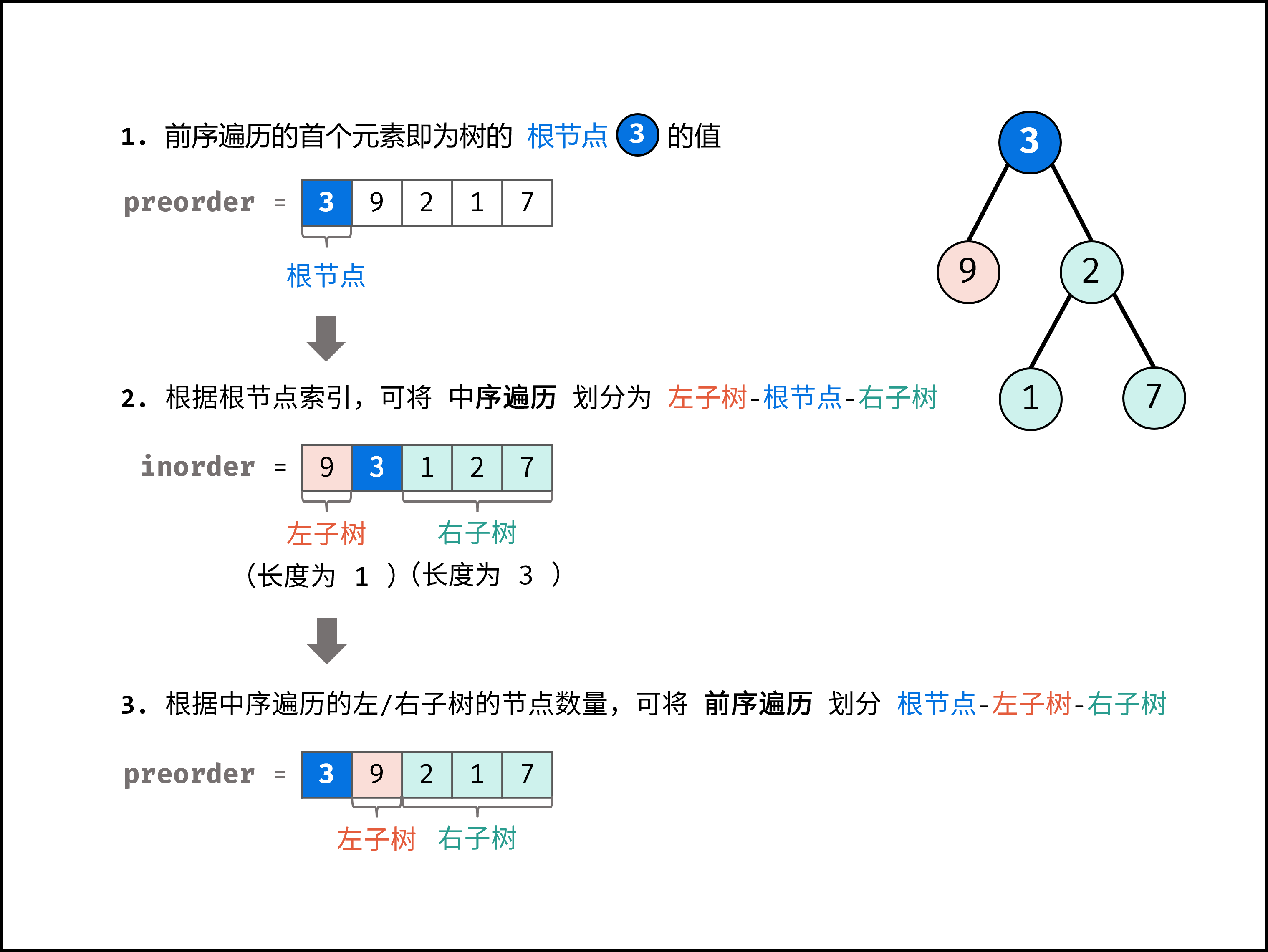{:align=center width=550}
通过以上三步,可确定 **三个节点** :1.树的根节点、2.左子树根节点、3.右子树根节点。
根据「分治算法」思想,对于树的左、右子树,仍可复用以上方法划分子树的左右子树。
### 分治解析:
**递推参数:** 根节点在前序遍历的索引 `root` 、子树在中序遍历的左边界 `left` 、子树在中序遍历的右边界 `right` ;
**终止条件:** 当 `left > right` ,代表已经越过叶节点,此时返回 $\text{null}$ ;
**递推工作:**
1. **建立根节点 `node` :** 节点值为 `preorder[root]` ;
2. **划分左右子树:** 查找根节点在中序遍历 `inorder` 中的索引 `i` ;
> 为了提升效率,本文使用哈希表 `hmap` 存储中序遍历的值与索引的映射,查找操作的时间复杂度为 $O(1)$ ;
3. **构建左右子树:** 开启左右子树递归;
| | 根节点索引 | 中序遍历左边界 | 中序遍历右边界 |
| ---------- | --------------------- | -------------- | -------------- |
| **左子树** | `root + 1` | `left` | `i - 1` |
| **右子树** | `i - left + root + 1` | `i + 1` | `right` |
> **TIPS:** `i - left + root + 1`含义为 `根节点索引 + 左子树长度 + 1`
**返回值:** 回溯返回 `node` ,作为上一层递归中根节点的左 / 右子节点;
## 代码:
> 注意:本文方法只适用于 “无重复节点值” 的二叉树。
```Python []
class Solution:
def deduceTree(self, preorder: List[int], inorder: List[int]) -> TreeNode:
def recur(root, left, right):
if left > right: return # 递归终止
node = TreeNode(preorder[root]) # 建立根节点
i = hmap[preorder[root]] # 划分根节点、左子树、右子树
node.left = recur(root + 1, left, i - 1) # 开启左子树递归
node.right = recur(i - left + root + 1, i + 1, right) # 开启右子树递归
return node # 回溯返回根节点
hmap, preorder = {}, preorder
for i in range(len(inorder)):
hmap[inorder[i]] = i
return recur(0, 0, len(inorder) - 1)
```
```Java []
class Solution {
int[] preorder;
HashMap hmap = new HashMap<>();
public TreeNode deduceTree(int[] preorder, int[] inorder) {
this.preorder = preorder;
for(int i = 0; i < inorder.length; i++)
hmap.put(inorder[i], i);
return recur(0, 0, inorder.length - 1);
}
TreeNode recur(int root, int left, int right) {
if(left > right) return null; // 递归终止
TreeNode node = new TreeNode(preorder[root]); // 建立根节点
int i = hmap.get(preorder[root]); // 划分根节点、左子树、右子树
node.left = recur(root + 1, left, i - 1); // 开启左子树递归
node.right = recur(root + i - left + 1, i + 1, right); // 开启右子树递归
return node; // 回溯返回根节点
}
}
```
```C++ []
class Solution {
public:
TreeNode* deduceTree(vector& preorder, vector& inorder) {
this->preorder = preorder;
for(int i = 0; i < inorder.size(); i++)
hmap[inorder[i]] = i;
return recur(0, 0, inorder.size() - 1);
}
private:
vector preorder;
unordered_map hmap;
TreeNode* recur(int root, int left, int right) {
if(left > right) return nullptr; // 递归终止
TreeNode* node = new TreeNode(preorder[root]); // 建立根节点
int i = hmap[preorder[root]]; // 划分根节点、左子树、右子树
node->left = recur(root + 1, left, i - 1); // 开启左子树递归
node->right = recur(root + i - left + 1, i + 1, right); // 开启右子树递归
return node; // 回溯返回根节点
}
};
```
### 复杂度分析:
- **时间复杂度 $O(N)$ :** 其中 $N$ 为树的节点数量。初始化 HashMap 需遍历 `inorder` ,占用 $O(N)$ 。递归共建立 $N$ 个节点,每层递归中的节点建立、搜索操作占用 $O(1)$ ,因此使用 $O(N)$ 时间。
- **空间复杂度 $O(N)$ :** HashMap 使用 $O(N)$ 额外空间;最差情况下(输入二叉树为链表时),递归深度达到 $N$ ,占用 $O(N)$ 的栈帧空间;因此总共使用 $O(N)$ 空间。
================================================
FILE: leetbook_ioa/docs/LCR 125. 图书整理 II.md
================================================
## 解题思路:
> 我们可将两个书车看作两个“栈”,本题可被转化为“用两个栈实现一个队列”。
栈实现队列的出队操作效率低下:栈底元素(对应队首元素)无法直接删除,需要将上方所有元素出栈。
列表倒序操作可使用双栈实现:设有含三个元素的栈 `A = [1,2,3]` 和空栈 `B = []` 。若循环执行 `A` 元素出栈并添加入栈 `B` ,直到栈 `A` 为空,则 `A = []` , `B = [3,2,1]` ,即栈 `B` 元素为栈 `A` 元素倒序。
利用栈 `B` 删除队首元素:倒序后,`B` 执行出栈则相当于删除了 `A` 的栈底元素,即对应队首元素。
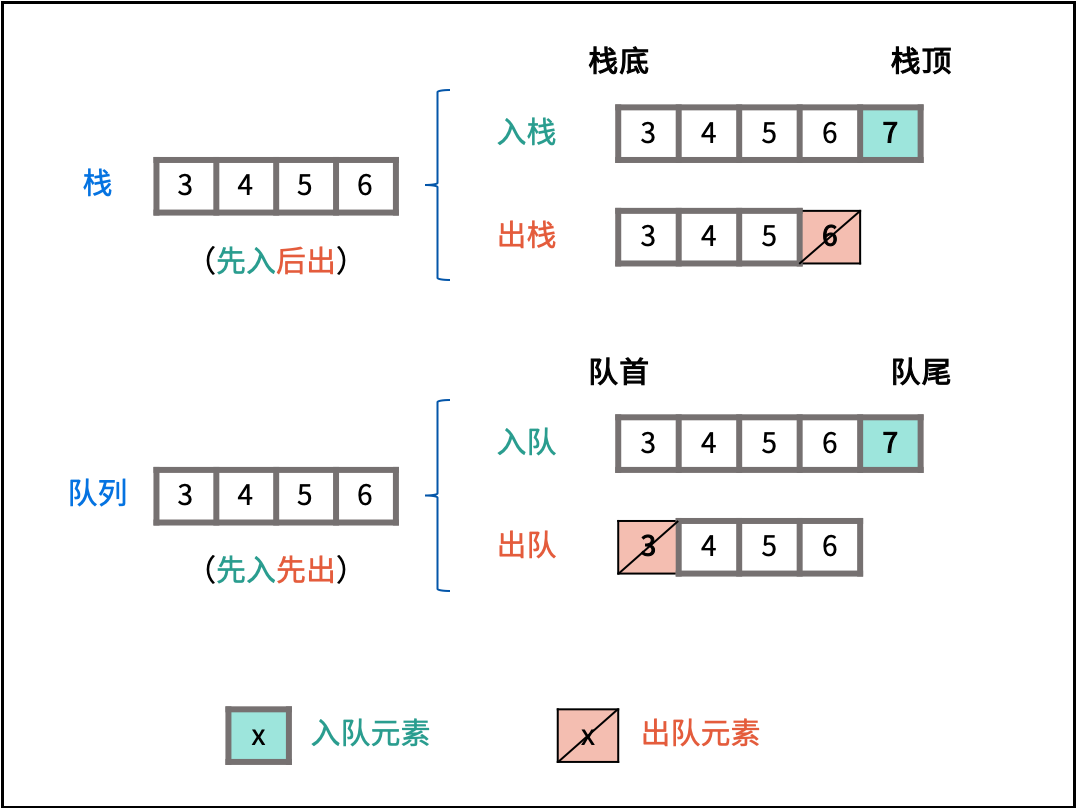{:align=center width=500}
题目要求实现 **加入队尾**`appendTail()` 和 **删除队首**`deleteHead()` 两个函数的正常工作。因此,可以设计栈 `A` 用于加入队尾操作,栈 `B` 用于将元素倒序,从而实现删除队首元素。
### 函数设计:
1. **加入队尾 `appendTail()` :** 将数字 `val` 加入栈 `A` 即可。
2. **删除队首`deleteHead()` :** 有以下三种情况。
1. **当栈 `B` 不为空:** `B`中仍有已完成倒序的元素,因此直接返回 `B` 的栈顶元素。
2. **否则,当 `A` 为空:** 即两个栈都为空,无元素,因此返回 -1 。
3. **否则:** 将栈 `A` 元素全部转移至栈 `B` 中,实现元素倒序,并返回栈 `B` 的栈顶元素。
## 代码:
Python 和 Java 的栈的 `pop()` 函数返回栈顶元素,而 C++ 不返回;因此对于 C++ ,需要先使用 `top()` 方法暂存栈顶元素,再执行 `pop()` 出栈操作。
```Python []
class CQueue:
def __init__(self):
self.A, self.B = [], []
def appendTail(self, value: int) -> None:
self.A.append(value)
def deleteHead(self) -> int:
if self.B: return self.B.pop()
if not self.A: return -1
while self.A:
self.B.append(self.A.pop())
return self.B.pop()
```
```Java []
class CQueue {
LinkedList A, B;
public CQueue() {
A = new LinkedList();
B = new LinkedList();
}
public void appendTail(int value) {
A.addLast(value);
}
public int deleteHead() {
if(!B.isEmpty()) return B.removeLast();
if(A.isEmpty()) return -1;
while(!A.isEmpty())
B.addLast(A.removeLast());
return B.removeLast();
}
}
```
```C++ []
class CQueue {
public:
stack A, B;
CQueue() {}
void appendTail(int value) {
A.push(value);
}
int deleteHead() {
if(!B.empty()) {
int tmp = B.top();
B.pop();
return tmp;
}
if(A.empty()) return -1;
while(!A.empty()) {
int tmp = A.top();
A.pop();
B.push(tmp);
}
int tmp = B.top();
B.pop();
return tmp;
}
};
```
### 复杂度分析:
> 以下分析仅满足添加 $N$ 个元素并删除 $N$ 个元素,即栈初始和结束状态下都为空的情况。
- **时间复杂度:** `appendTail()`函数为 $O(1)$ ;`deleteHead()` 函数在 $N$ 次队首元素删除操作中总共需完成 $N$ 个元素的倒序。
- **空间复杂度 $O(N)$ :** 最差情况下,栈 `A` 和 `B` 共保存 $N$ 个元素。
================================================
FILE: leetbook_ioa/docs/LCR 126. 斐波那契数.md
================================================
## 解题思路:
斐波那契数列的定义是 $f(n + 1) = f(n) + f(n - 1)$ ,生成第 $n$ 项的做法有以下几种:
1. **递归:**
- **原理:** 把 $f(n)$ 问题的计算拆分成 $f(n-1)$ 和 $f(n-2)$ 两个子问题的计算,并递归,以 $f(0)$ 和 $f(1)$ 为终止条件。
- **缺点:** 大量重复的递归计算,例如 $f(n)$ 和 $f(n - 1)$ 两者向下递归需要 **各自计算** $f(n - 2)$ 的值。
2. **记忆化递归:**
- **原理:** 在递归的基础上,新建一个长度为 $n$ 的数组,用于在递归时存储 $f(0)$ 至 $f(n)$ 的数字值,重复遇到某数字则直接从数组取用,避免了重复的递归计算。
- **缺点:** 记忆化存储需要使用 $O(N)$ 的额外空间。
3. **动态规划:**
- **原理:** 以斐波那契数列性质 $f(n + 1) = f(n) + f(n - 1)$ 为转移方程。
- 从计算效率、空间复杂度上看,动态规划是本题的最佳解法。
> 下图帮助理解递归的 “重复计算” 概念。
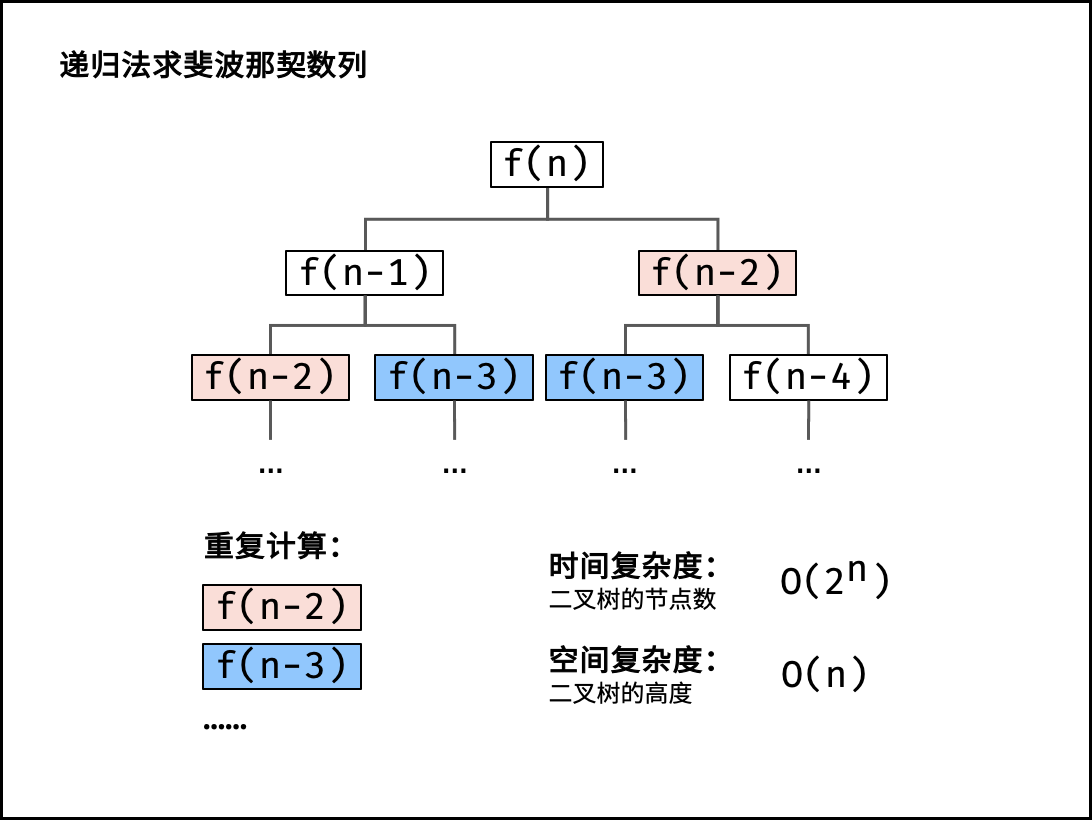{:align=center width=500}
### 动态规划解析:
- **状态定义:** 设 $dp$ 为一维数组,其中 $dp[i]$ 的值代表 斐波那契数列第 $i$ 个数字 。
- **转移方程:** $dp[i + 1] = dp[i] + dp[i - 1]$ ,即对应数列定义 $f(n + 1) = f(n) + f(n - 1)$ ;
- **初始状态:** $dp[0] = 0$, $dp[1] = 1$ ,即初始化前两个数字;
- **返回值:** $dp[n]$ ,即斐波那契数列的第 $n$ 个数字。
### 空间优化:
> 若新建长度为 $n$ 的 $dp$ 列表,则空间复杂度为 $O(N)$ 。
- 由于 $dp$ 列表第 $i$ 项只与第 $i-1$ 和第 $i-2$ 项有关,因此只需要初始化三个整形变量 `sum`, `a`, `b` ,利用辅助变量 $sum$ 使 $a, b$ 两数字交替前进即可 *(具体实现见代码)* 。
- 节省了 $dp$ 列表空间,因此空间复杂度降至 $O(1)$ 。
### 循环求余法:
> **大数越界:** 随着 $n$ 增大, $f(n)$ 会超过 `Int32` 甚至 `Int64` 的取值范围,导致最终的返回值错误。
- **求余运算规则:** 设正整数 $x, y, p$ ,求余符号为 $\odot$ ,则有 $(x + y) \odot p = (x \odot p + y \odot p) \odot p$ 。
- **解析:** 根据以上规则,可推出 $f(n) \odot p = [f(n-1) \odot p + f(n-2) \odot p] \odot p$ ,从而可以在循环过程中每次计算 $sum = (a + b) \odot 1000000007$ ,此操作与最终返回前取余等价。
## 代码:
```Python []
class Solution:
def fib(self, n: int) -> int:
a, b = 0, 1
for _ in range(n):
a, b = b, (a + b) % 1000000007
return a
```
```Java []
class Solution {
public int fib(int n) {
int a = 0, b = 1, sum;
for(int i = 0; i < n; i++){
sum = (a + b) % 1000000007;
a = b;
b = sum;
}
return a;
}
}
```
```C++ []
class Solution {
public:
int fib(int n) {
int a = 0, b = 1, sum;
for(int i = 0; i < n; i++){
sum = (a + b) % 1000000007;
a = b;
b = sum;
}
return a;
}
};
```
由于 Python 中整形数字的大小限制取决计算机的内存(可理解为无限大),因此也可不考虑大数越界问题;但当数字很大时,加法运算的效率也会降低,因此不推荐此方法。
```Python []
# 不考虑大数越界问题
class Solution:
def fib(self, n: int) -> int:
a, b = 0, 1
for _ in range(n):
a, b = b, a + b
return a % 1000000007
```
### 复杂度分析:
- **时间复杂度 $O(n)$ :** 计算 $f(n)$ 需循环 $n$ 次,每轮循环内计算操作使用 $O(1)$ 。
- **空间复杂度 $O(1)$ :** 几个标志变量使用常数大小的额外空间。
================================================
FILE: leetbook_ioa/docs/LCR 127. 跳跃训练.md
================================================
## 解题思路:
设跳上 $n$ 级平台有 $f(n)$ 种跳法。在所有跳法中,青蛙的最后一步只有两种情况: **跳上 $1$ 级或 $2$ 级平台**。
1. **当为 $1$ 级平台:** 剩 $n-1$ 个平台,此情况共有 $f(n-1)$ 种跳法;
2. **当为 $2$ 级平台:** 剩 $n-2$ 个平台,此情况共有 $f(n-2)$ 种跳法。
即 $f(n)$ 为以上两种情况之和,即 $f(n)=f(n-1)+f(n-2)$ ,以上递推性质为斐波那契数列。因此,本题可转化为 **求斐波那契数列第 $n$ 项的值** ,唯一的不同在于起始数字不同。
- 跳跃训练问题: $f(0)=1$ , $f(1)=1$ , $f(2)=2$ ;
- 斐波那契数列问题: $f(0)=0$ , $f(1)=1$ , $f(2)=1$ 。
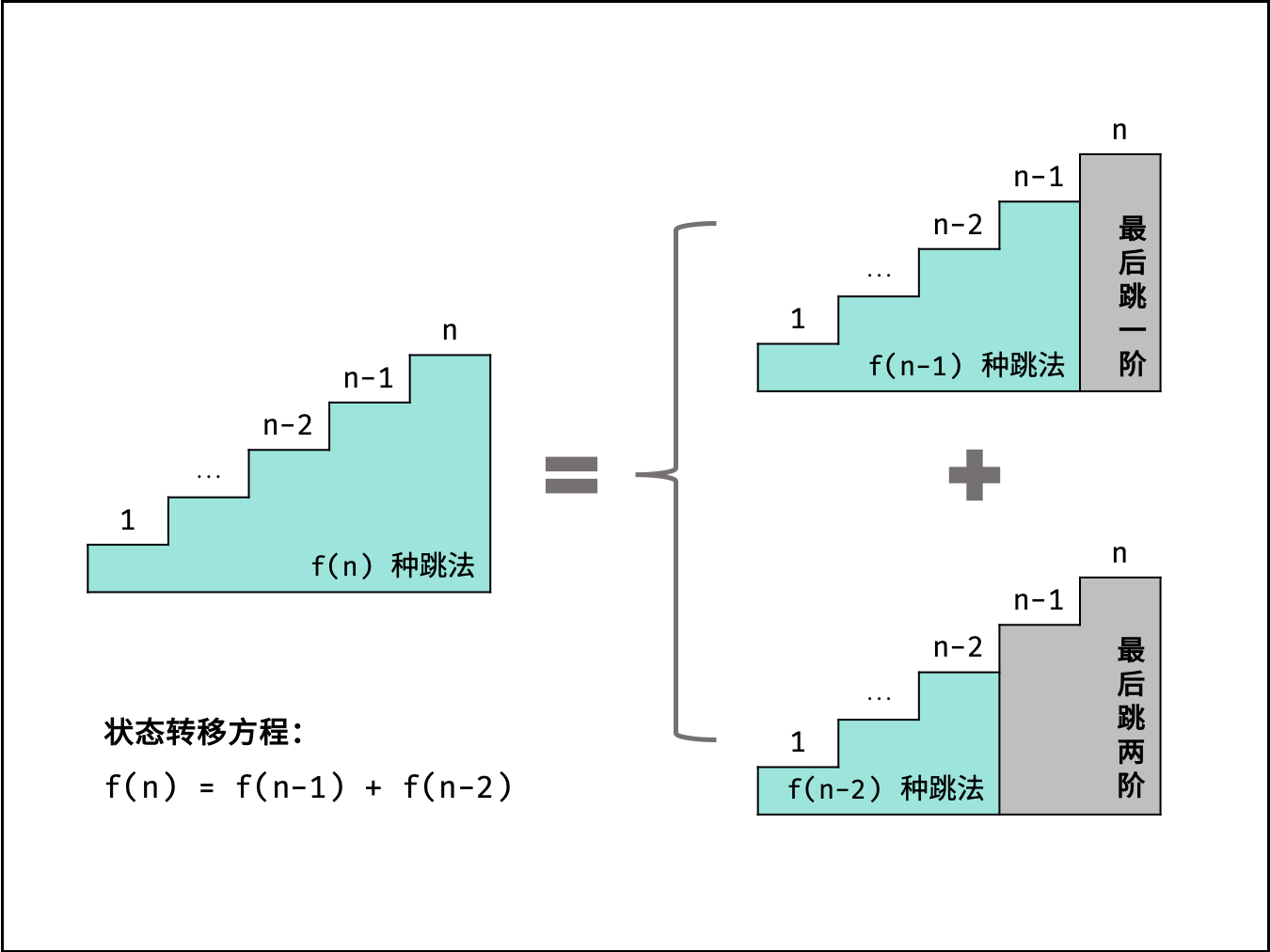{:align=center width=500}
### 动态规划解析:
- **状态定义:** 设 $dp$ 为一维数组,其中 $dp[i]$ 的值代表斐波那契数列的第 $i$ 个数字。
- **转移方程:** $dp[i + 1] = dp[i] + dp[i - 1]$ ,即对应数列定义 $f(n + 1) = f(n) + f(n - 1)$ ;
- **初始状态:** $dp[0] = 1$, $dp[1] = 1$ ,即初始化前两个数字;
- **返回值:** $dp[n]$ ,即斐波那契数列的第 $n$ 个数字。
### 空间优化:
> 若新建长度为 $n$ 的 $dp$ 列表,则空间复杂度为 $O(N)$ 。
- 由于 $dp$ 列表第 $i$ 项只与第 $i-1$ 和第 $i-2$ 项有关,因此只需要初始化三个整形变量 `sum`, `a`, `b` ,利用辅助变量 $sum$ 使 $a, b$ 两数字交替前进即可 *(具体实现见代码)* 。
- 因为节省了 $dp$ 列表空间,因此空间复杂度降至 $O(1)$ 。
### 循环求余法:
> **大数越界:** 随着 $n$ 增大, $f(n)$ 会超过 `Int32` 甚至 `Int64` 的取值范围,导致最终的返回值错误。
- **求余运算规则:** 设正整数 $x, y, p$ ,求余符号为 $\odot$ ,则有 $(x + y) \odot p = (x \odot p + y \odot p) \odot p$ 。
- **解析:** 根据以上规则,可推出 $f(n) \odot p = [f(n-1) \odot p + f(n-2) \odot p] \odot p$ ,从而可以在循环过程中每次计算 $sum = a + b \odot 1000000007$ ,此操作与最终返回前取余等价。
## 代码:
```Python []
class Solution:
def trainWays(self, num: int) -> int:
a, b = 1, 1
for _ in range(num):
a, b = b, (a + b) % 1000000007
return a
```
```Java []
class Solution {
public int trainWays(int num) {
int a = 1, b = 1, sum;
for(int i = 0; i < num; i++){
sum = (a + b) % 1000000007;
a = b;
b = sum;
}
return a;
}
}
```
```C++ []
class Solution {
public:
int trainWays(int num) {
int a = 1, b = 1, sum;
for(int i = 0; i < num; i++){
sum = (a + b) % 1000000007;
a = b;
b = sum;
}
return a;
}
};
```
由于 Python 中整形数字的大小限制取决计算机的内存(可理解为无限大),因此也可不考虑大数越界问题;但当数字很大时,加法运算的效率也会降低,因此不推荐此方法。
```Python []
# 不考虑大数越界问题
class Solution:
def trainWays(self, num: int) -> int:
a, b = 1, 1
for _ in range(num):
a, b = b, a + b
return a % 1000000007
```
### 复杂度分析:
- **时间复杂度 $O(n)$ :** 计算 $f(n)$ 需循环 $n$ 次,每轮循环内计算操作使用 $O(1)$ 。
- **空间复杂度 $O(1)$ :** 几个标志变量使用常数大小的额外空间。
================================================
FILE: leetbook_ioa/docs/LCR 128. 库存管理 I.md
================================================
## 解题思路:
如下图所示,寻找旋转数组的最小元素即为寻找 **右排序数组** 的首个元素 $stock[x]$ ,称 $x$ 为 **旋转点** 。
> 下图中的 `numbers` 对应本题的 `stock` 。
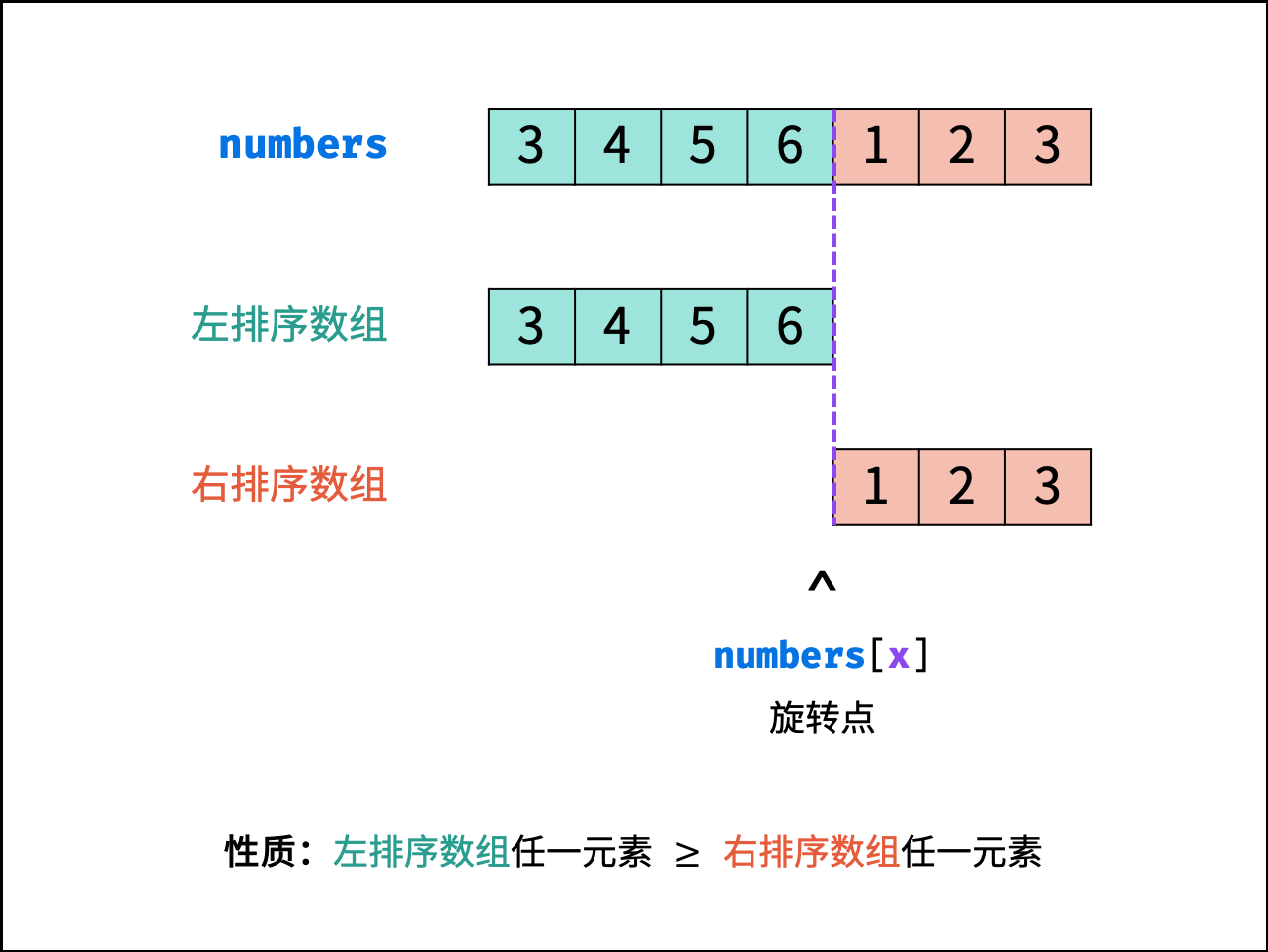{:align=center width=450}
排序数组的查找问题首先考虑使用 **二分法** 解决,其可将 **遍历法** 的 **线性级别** 时间复杂度降低至 **对数级别** 。
### 算法流程:
1. **初始化:** 声明 $i$, $j$ 双指针分别指向 $stock$ 数组左右两端;
2. **循环二分:** 设 $m = (i + j) / 2$ 为每次二分的中点( "`/`" 代表向下取整除法,因此恒有 $i \leq m < j$ ),可分为以下三种情况:
1. **当 $stock[m] > stock[j]$ 时:** $m$ 一定在 左排序数组 中,即旋转点 $x$ 一定在 $[m + 1, j]$ 闭区间内,因此执行 $i = m + 1$;
2. **当 $stock[m] < stock[j]$ 时:** $m$ 一定在 右排序数组 中,即旋转点 $x$ 一定在$[i, m]$ 闭区间内,因此执行 $j = m$;
3. **当 $stock[m] = stock[j]$ 时:** 无法判断 $m$ 在哪个排序数组中,即无法判断旋转点 $x$ 在 $[i, m]$ 还是 $[m + 1, j]$ 区间中。**解决方案:** 执行 $j = j - 1$ 缩小判断范围,分析见下文。
3. **返回值:** 当 $i = j$ 时跳出二分循环,并返回 **旋转点的值** $stock[i]$ 即可。
### 正确性证明:
当 $stock[m] = stock[j]$ 时,无法判定 $m$ 在左(右)排序数组,自然也无法通过二分法安全地缩小区间,因为其会导致旋转点 $x$ 不在区间 $[i, j]$ 内。举例如下:
> 设以下两个旋转点值为 $0$ 的示例数组,则当 $i = 0$, $j = 4$ 时 $m = 2$ ,两示例结果不同。
> 示例一 $[1, 0, 1, 1, 1]$ :旋转点 $x = 1$ ,因此 $m = 2$ 在 **右排序数组** 中。
> 示例二 $[1, 1, 1, 0, 1]$ :旋转点 $x = 3$ ,因此 $m = 2$ 在 **左排序数组** 中。
而证明 $j = j - 1$ 正确(缩小区间安全性),需分为两种情况:
1. **当 $x < j$ 时:** 易得执行 $j = j - 1$ 后,旋转点 $x$ 仍在区间 $[i, j]$ 内。
2. **当 $x = j$ 时:** 执行 $j = j - 1$ 后越过(丢失)了旋转点 $x$ ,但最终返回的元素值 $stock[i]$ 仍等于旋转点值 $stock[x]$ 。
1. 由于 $x = j$ ,因此 $stock[x] = stock[j] = stock[m] \leq number[i]$ ;
2. 又由于 $i \leq m 综上所述,此方法可以保证返回值 $stock[i]$ 等于旋转点值 $stock[x]$ ,但在少数特例下 $i \ne x$ ;而本题目只要求返回 “旋转点的值” ,因此本方法正确。
**补充思考:** 为什么本题二分法不用 $stock[m]$ 和 $stock[i]$ 作比较?
二分目的是判断 $m$ 在哪个排序数组中,从而缩小区间。而在 $stock[m] > stock[i]$情况下,无法判断 $m$ 在哪个排序数组中。本质上是由于 $j$ 初始值肯定在右排序数组中;$i$ 初始值无法确定在哪个排序数组中。举例如下:
> 对于以下两示例,当 $i = 0, j = 4, m = 2$ 时,有 `stock[m] > stock[i]` ,而结果不同。
> $[1, 2, 3, 4 ,5]$ 旋转点 $x = 0$ : $m$ 在右排序数组(此示例只有右排序数组);
> $[3, 4, 5, 1 ,2]$ 旋转点 $x = 3$ : $m$ 在左排序数组。
### 复杂度分析:
- **时间复杂度 $O(\log N)$ :** 在特例情况下(例如 $[1, 1, 1, 1]$),会退化到 $O(N)$。
- **空间复杂度 $O(1)$ :** $i$ , $j$ , $m$ 变量使用常数大小的额外空间。
## 代码:
```Python []
class Solution:
def stockManagement(self, stock: List[int]) -> int:
i, j = 0, len(stock) - 1
while i < j:
m = (i + j) // 2
if stock[m] > stock[j]: i = m + 1
elif stock[m] < stock[j]: j = m
else: j -= 1
return stock[i]
```
```Java []
class Solution {
public int stockManagement(int[] stock) {
int i = 0, j = stock.length - 1;
while (i < j) {
int m = (i + j) / 2;
if (stock[m] > stock[j]) i = m + 1;
else if (stock[m] < stock[j]) j = m;
else j--;
}
return stock[i];
}
}
```
```C++ []
class Solution {
public:
int stockManagement(vector& stock) {
int i = 0, j = stock.size() - 1;
while (i < j) {
int m = (i + j) / 2;
if (stock[m] > stock[j]) i = m + 1;
else if (stock[m] < stock[j]) j = m;
else j--;
}
return stock[i];
}
};
```
实际上,当出现 $stock[m] = stock[j]$ 时,一定有区间 $[i, m]$ 内所有元素相等 或 区间 $[m, j]$ 内所有元素相等(或两者皆满足)。对于寻找此类数组的最小值问题,可直接放弃二分查找,而使用线性查找替代。
```Python []
class Solution:
def stockManagement(self, stock: List[int]) -> int:
i, j = 0, len(stock) - 1
while i < j:
m = (i + j) // 2
if stock[m] > stock[j]: i = m + 1
elif stock[m] < stock[j]: j = m
else: return min(stock[i:j])
return stock[i]
```
```Java []
class Solution {
public int stockManagement(int[] stock) {
int i = 0, j = stock.length - 1;
while (i < j) {
int m = (i + j) / 2;
if (stock[m] > stock[j]) i = m + 1;
else if (stock[m] < stock[j]) j = m;
else {
int x = i;
for(int k = i + 1; k < j; k++) {
if(stock[k] < stock[x]) x = k;
}
return stock[x];
}
}
return stock[i];
}
}
```
```C++ []
class Solution {
public:
int stockManagement(vector& stock) {
int i = 0, j = stock.size() - 1;
while (i < j) {
int m = (i + j) / 2;
if (stock[m] > stock[j]) i = m + 1;
else if (stock[m] < stock[j]) j = m;
else {
int x = i;
for(int k = i + 1; k < j; k++) {
if(stock[k] < stock[x]) x = k;
}
return stock[x];
}
}
return stock[i];
}
};
```
================================================
FILE: leetbook_ioa/docs/LCR 129. 字母迷宫.md
================================================
## 解题思路:
本问题是典型的回溯问题,可使用 **深度优先搜索(DFS)+ 剪枝** 解决。
- **深度优先搜索:** 可以理解为暴力法遍历矩阵中所有字符串可能性。DFS 通过递归,先朝一个方向搜到底,再回溯至上个节点,沿另一个方向搜索,以此类推。
- **剪枝:** 在搜索中,遇到 `这条路不可能和目标字符串匹配成功` 的情况(*例如:此矩阵元素和目标字符不同、此元素已被访问)*,则应立即返回,称之为 `可行性剪枝` 。
> 下图中的 `word` 对应本题的 `target` 。
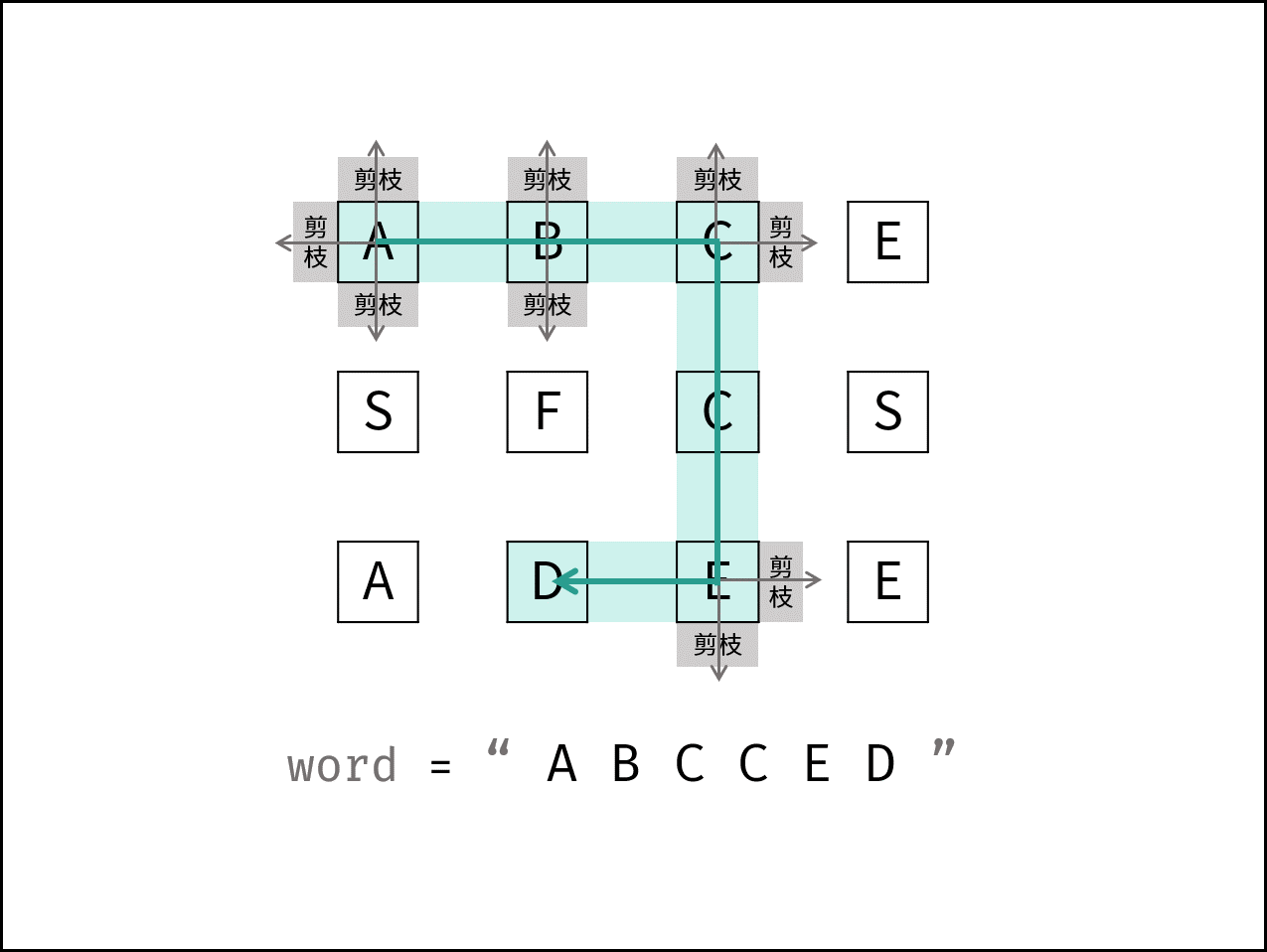{:align=center width=500}
### DFS 解析:
- **递归参数:** 当前元素在矩阵 `grid` 中的行列索引 `i` 和 `j` ,当前目标字符在 `target` 中的索引 `k` 。
- **终止条件:**
1. 返回 $\text{false}$ : (1) 行或列索引越界 **或** (2) 当前矩阵元素与目标字符不同 **或** (3) 当前矩阵元素已访问过 ( (3) 可合并至 (2) ) 。
2. 返回 $\text{true}$ : `k = len(target) - 1` ,即字符串 `target` 已全部匹配。
- **递推工作:**
1. 标记当前矩阵元素: 将 `grid[i][j]` 修改为 **空字符** `''` ,代表此元素已访问过,防止之后搜索时重复访问。
2. 搜索下一单元格: 朝当前元素的 **上、下、左、右** 四个方向开启下层递归,使用 `或` 连接 (代表只需找到一条可行路径就直接返回,不再做后续 DFS ),并记录结果至 `res` 。
3. 还原当前矩阵元素: 将 `grid[i][j]` 元素还原至初始值,即 `target[k]` 。
- **返回值:** 返回布尔量 `res` ,代表是否搜索到目标字符串。
> 使用空字符(Python: `''` , Java/C++: `'\0'` )做标记是为了防止标记字符与矩阵原有字符重复。当存在重复时,此算法会将矩阵原有字符认作标记字符,从而出现错误。
## 代码:
```Python []
class Solution:
def wordPuzzle(self, grid: List[List[str]], target: str) -> bool:
def dfs(i, j, k):
if not 0 <= i < len(grid) or not 0 <= j < len(grid[0]) or grid[i][j] != target[k]: return False
if k == len(target) - 1: return True
grid[i][j] = ''
res = dfs(i + 1, j, k + 1) or dfs(i - 1, j, k + 1) or dfs(i, j + 1, k + 1) or dfs(i, j - 1, k + 1)
grid[i][j] = target[k]
return res
for i in range(len(grid)):
for j in range(len(grid[0])):
if dfs(i, j, 0): return True
return False
```
```Java []
class Solution {
public boolean wordPuzzle(char[][] grid, String target) {
char[] words = target.toCharArray();
for(int i = 0; i < grid.length; i++) {
for(int j = 0; j < grid[0].length; j++) {
if(dfs(grid, words, i, j, 0)) return true;
}
}
return false;
}
boolean dfs(char[][] grid, char[] target, int i, int j, int k) {
if(i >= grid.length || i < 0 || j >= grid[0].length || j < 0 || grid[i][j] != target[k]) return false;
if(k == target.length - 1) return true;
grid[i][j] = '\0';
boolean res = dfs(grid, target, i + 1, j, k + 1) || dfs(grid, target, i - 1, j, k + 1) ||
dfs(grid, target, i, j + 1, k + 1) || dfs(grid, target, i , j - 1, k + 1);
grid[i][j] = target[k];
return res;
}
}
```
```C++ []
class Solution {
public:
bool wordPuzzle(vector>& grid, string target) {
rows = grid.size();
cols = grid[0].size();
for(int i = 0; i < rows; i++) {
for(int j = 0; j < cols; j++) {
if(dfs(grid, target, i, j, 0)) return true;
}
}
return false;
}
private:
int rows, cols;
bool dfs(vector>& grid, string target, int i, int j, int k) {
if(i >= rows || i < 0 || j >= cols || j < 0 || grid[i][j] != target[k]) return false;
if(k == target.size() - 1) return true;
grid[i][j] = '\0';
bool res = dfs(grid, target, i + 1, j, k + 1) || dfs(grid, target, i - 1, j, k + 1) ||
dfs(grid, target, i, j + 1, k + 1) || dfs(grid, target, i , j - 1, k + 1);
grid[i][j] = target[k];
return res;
}
};
```
### 复杂度分析:
> $M, N$ 分别为矩阵行列大小,$K$ 为字符串 `target` 长度。
- **时间复杂度 $O(3^KMN)$ :** 最差情况下,需要遍历矩阵中长度为 $K$ 字符串的所有方案,时间复杂度为 $O(3^K)$;矩阵中共有 $MN$ 个起点,时间复杂度为 $O(MN)$ 。
- **方案数计算:** 设字符串长度为 $K$ ,搜索中每个字符有上、下、左、右四个方向可以选择,舍弃回头(上个字符)的方向,剩下 $3$ 种选择,因此方案数的复杂度为 $O(3^K)$ 。
- **空间复杂度 $O(K)$ :** 搜索过程中的递归深度不超过 $K$ ,因此系统因函数调用累计使用的栈空间占用 $O(K)$ (因为函数返回后,系统调用的[栈空间会释放](https://leetcode-cn.com/explore/orignial/card/recursion-i/259/complexity-analysis/1223/))。最坏情况下 $K = MN$ ,递归深度为 $MN$ ,此时系统栈使用 $O(MN)$ 的额外空间。
================================================
FILE: leetbook_ioa/docs/LCR 130. 衣橱整理.md
================================================
## 解题思路:
为提升回溯的计算效率,首先讲述两项前置工作: **数位之和计算** 、 **可达解分析** 。
### 数位之和计算:
设一数字 $x$ ,向下取整除法符号 $//$ ,求余符号 $\odot$ ,则有:
- $x \odot 10$ :得到 $x$ 的个位数字;
- $x // 10$ : 令 $x$ 的十进制数向右移动一位,即删除个位数字。
因此,可通过循环求得数位和 $s$ ,数位和计算的封装函数如下所示:
```Python []
def sums(x):
s = 0
while x != 0:
s += x % 10
x = x // 10
return s
```
```Java []
int sums(int x)
int s = 0;
while(x != 0) {
s += x % 10;
x = x / 10;
}
return s;
```
```C++ []
int sums(int x)
int s = 0;
while(x != 0) {
s += x % 10;
x = x / 10;
}
return s;
```
由于机器人每次只能移动一格(即只能从 $x$ 运动至 $x \pm 1$),因此每次只需计算 $x$ 到 $x \pm 1$ 的**数位和增量**。本题说明 $1 \leq n,m \leq 100$ ,以下公式仅在此范围适用。
**数位和增量公式:** 设 $x$ 的数位和为 $s_x$ ,$x+1$ 的数位和为 $s_{x+1}$ ;
1. **当 $(x + 1) \odot 10 = 0$ 时:** $s_{x+1} = s_x - 8$ ,例如 $19, 20$ 的数位和分别为 $10, 2$ ;
2. **当 $(x + 1) \odot 10 \neq 0$ 时:** $s_{x+1} = s_x + 1$ ,例如 $1, 2$ 的数位和分别为 $1, 2$ 。
> 以下代码为增量公式的三元表达式写法,将整合入最终代码中。
```Python []
s_x + 1 if (x + 1) % 10 else s_x - 8
```
```Java []
(x + 1) % 10 != 0 ? s_x + 1 : s_x - 8;
```
```C++ []
(x + 1) % 10 != 0 ? s_x + 1 : s_x - 8;
```
### 可达解分析:
根据数位和增量公式得知,数位和每逢 **进位** 突变一次。根据此特点,矩阵中 **满足数位和的解** 构成的几何形状形如多个 **等腰直角三角形** ,每个三角形的直角顶点位于 $0, 10, 20, ...$ 等数位和突变的矩阵索引处 。
三角形内的解虽然都满足数位和要求,但由于机器人每步只能走一个单元格,而三角形间不一定是连通的,因此机器人不一定能到达,称之为 **不可达解** ;同理,可到达的解称为 **可达解** *(本题求此解)* 。
> 下图展示了 $n,m = 20$ ,$cnt \in [6, 19]$ 的可达解、不可达解、非解,以及连通性的变化。其中 $k$ 对应本题的 $cnt$ 。
根据可达解的结构和连通性,易推出机器人可 **仅通过向右和向下移动,访问所有可达解** 。
- **三角形内部:** 全部连通,易证;
- **两三角形连通处:** 若某三角形内的解为可达解,则必与其左边或上边的三角形连通(即相交),即机器人必可从左边或上边走进此三角形。
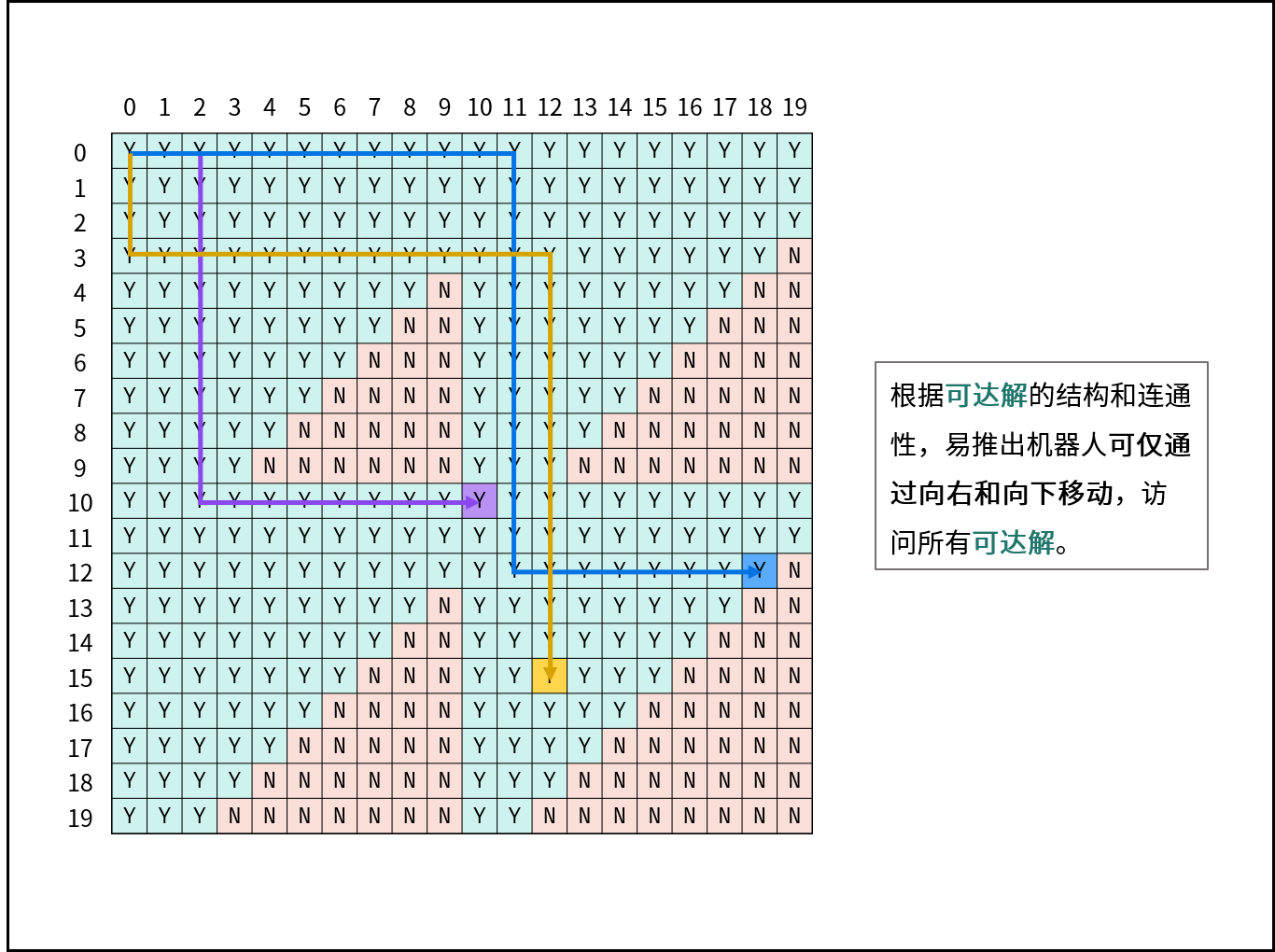{:align=center width=500}
## 方法一:深度优先遍历(DFS)
**深度优先搜索:** 可以理解为暴力法模拟机器人在矩阵中的所有路径。DFS 通过递归,先朝一个方向搜到底,再回溯至上个节点,沿另一个方向搜索,以此类推。
**剪枝:** 在搜索中,遇到数位和超出目标值、此元素已访问,则应立即返回,称之为 `可行性剪枝` 。
### 算法解析:
- **递归参数:** 当前元素在矩阵中的行列索引 `i` 和 `j` ,两者的数位和 `si`, `sj` 。
- **终止条件:** 当 (1) 行列索引越界 **或** (2) 数位和超出目标值 `cnt` **或** (3) 当前元素已访问过 时,返回 $0$ ,代表不计入可达解。
- **递推工作:**
1. **标记当前单元格** :将索引 `(i, j)` 存入 Set `visited` 中,代表此单元格已被访问过。
2. **搜索下一单元格:** 计算当前元素的 **下、右** 两个方向元素的数位和,并开启下层递归 。
- **回溯返回值:** 返回 `1 + 右方搜索的可达解总数 + 下方搜索的可达解总数`,代表从本单元格递归搜索的可达解总数。
### 代码:
> Java/C++ 代码中 `visited` 为辅助矩阵,Python 中为 Set 。
```Python []
class Solution:
def wardrobeFinishing(self, m: int, n: int, cnt: int) -> int:
def dfs(i, j, si, sj):
if i >= m or j >= n or cnt < si + sj or (i, j) in visited: return 0
visited.add((i,j))
return 1 + dfs(i + 1, j, si + 1 if (i + 1) % 10 else si - 8, sj) + dfs(i, j + 1, si, sj + 1 if (j + 1) % 10 else sj - 8)
visited = set()
return dfs(0, 0, 0, 0)
```
```Java []
class Solution {
int m, n, cnt;
boolean[][] visited;
public int wardrobeFinishing(int m, int n, int cnt) {
this.m = m; this.n = n; this.cnt = cnt;
this.visited = new boolean[m][n];
return dfs(0, 0, 0, 0);
}
public int dfs(int i, int j, int si, int sj) {
if(i >= m || j >= n || cnt < si + sj || visited[i][j]) return 0;
visited[i][j] = true;
return 1 + dfs(i + 1, j, (i + 1) % 10 != 0 ? si + 1 : si - 8, sj) + dfs(i, j + 1, si, (j + 1) % 10 != 0 ? sj + 1 : sj - 8);
}
}
```
```C++ []
class Solution {
public:
int wardrobeFinishing(int m, int n, int cnt) {
vector> visited(m, vector(n, 0));
return dfs(0, 0, 0, 0, visited, m, n, cnt);
}
private:
int dfs(int i, int j, int si, int sj, vector> &visited, int m, int n, int cnt) {
if(i >= m || j >= n || cnt < si + sj || visited[i][j]) return 0;
visited[i][j] = true;
return 1 + dfs(i + 1, j, (i + 1) % 10 != 0 ? si + 1 : si - 8, sj, visited, m, n, cnt) +
dfs(i, j + 1, si, (j + 1) % 10 != 0 ? sj + 1 : sj - 8, visited, m, n, cnt);
}
};
```
### 复杂度分析:
> 设矩阵行列数分别为 $M, N$ 。
- **时间复杂度 $O(MN)$ :** 最差情况下,机器人遍历矩阵所有单元格,此时时间复杂度为 $O(MN)$ 。
- **空间复杂度 $O(MN)$ :** 最差情况下,Set `visited` 内存储矩阵所有单元格的索引,使用 $O(MN)$ 的额外空间。
## 方法二:广度优先遍历(BFS)
BFS 和 DFS 的目标都是遍历整个矩阵,不同点在于搜索顺序不同。DFS 是朝一个方向走到底,再回退,以此类推;BFS 则是按照“平推”的方式向前搜索。
**BFS 实现:** 通常利用队列实现广度优先遍历。
### 算法解析:
- **初始化:** 将机器人初始点 $(0, 0)$ 加入队列 `queue` ;
- **迭代终止条件:** `queue` 为空。代表已遍历完所有可达解。
- **迭代工作:**
1. **单元格出队:** 将队首单元格的 索引、数位和 弹出,作为当前搜索单元格。
2. **判断是否跳过:** 若 (1) 行列索引越界 **或** (2) 数位和超出目标值 `cnt` **或** (3) 当前元素已访问过 时,执行 `continue` 。
3. **标记当前单元格** :将单元格索引 `(i, j)` 存入 Set `visited` 中,代表此单元格 **已被访问过** 。
4. **单元格入队:** 将当前元素的 **下方、右方** 单元格的 **索引、数位和** 加入 `queue` 。
- **返回值:** Set `visited` 的长度 `len(visited)` ,即可达解的数量。
> Java/C++ 使用了辅助变量 `res` 统计可达解数量; Python 直接返回 Set 的元素数 `len(visited)` 即可。
### 代码:
> Java/C++ 代码中 `visited` 为辅助矩阵,Python 中为 Set 。
```Python []
class Solution:
def wardrobeFinishing(self, m: int, n: int, cnt: int) -> int:
queue, visited = [(0, 0, 0, 0)], set()
while queue:
i, j, si, sj = queue.pop(0)
if i >= m or j >= n or cnt < si + sj or (i, j) in visited: continue
visited.add((i,j))
queue.append((i + 1, j, si + 1 if (i + 1) % 10 else si - 8, sj))
queue.append((i, j + 1, si, sj + 1 if (j + 1) % 10 else sj - 8))
return len(visited)
```
```Java []
class Solution {
public int wardrobeFinishing(int m, int n, int cnt) {
boolean[][] visited = new boolean[m][n];
int res = 0;
Queue queue= new LinkedList();
queue.add(new int[] { 0, 0, 0, 0 });
while(queue.size() > 0) {
int[] x = queue.poll();
int i = x[0], j = x[1], si = x[2], sj = x[3];
if(i >= m || j >= n || cnt < si + sj || visited[i][j]) continue;
visited[i][j] = true;
res ++;
queue.add(new int[] { i + 1, j, (i + 1) % 10 != 0 ? si + 1 : si - 8, sj });
queue.add(new int[] { i, j + 1, si, (j + 1) % 10 != 0 ? sj + 1 : sj - 8 });
}
return res;
}
}
```
```C++ []
class Solution {
public:
int wardrobeFinishing(int m, int n, int cnt) {
vector> visited(m, vector(n, 0));
int res = 0;
queue> que;
que.push({ 0, 0, 0, 0 });
while(que.size() > 0) {
vector x = que.front();
que.pop();
int i = x[0], j = x[1], si = x[2], sj = x[3];
if(i >= m || j >= n || cnt < si + sj || visited[i][j]) continue;
visited[i][j] = true;
res++;
que.push({ i + 1, j, (i + 1) % 10 != 0 ? si + 1 : si - 8, sj });
que.push({ i, j + 1, si, (j + 1) % 10 != 0 ? sj + 1 : sj - 8 });
}
return res;
}
};
```
### 复杂度分析:
> 设矩阵行列数分别为 $M, N$ 。
- **时间复杂度 $O(MN)$ :** 最差情况下,机器人遍历矩阵所有单元格,此时时间复杂度为 $O(MN)$ 。
- **空间复杂度 $O(MN)$ :** 最差情况下,Set `visited` 内存储矩阵所有单元格的索引,使用 $O(MN)$ 的额外空间。
================================================
FILE: leetbook_ioa/docs/LCR 131. 砍竹子 I.md
================================================
## 解题思路:
设将长度为 $n$ 的竹子切为 $a$ 段:
$$
n = n_1 + n_2 + ... + n_a
$$
本题等价于求解:
$$
\max(n_1 \times n_2 \times ... \times n_a)
$$
> 以下数学推导总体分为两步:(1) 当所有绳段长度相等时,乘积最大。(2) 最优的绳段长度为 $3$ 。
### 数学推导:
以下公式为“算术几何均值不等式” ,等号当且仅当 $n_1 = n_2 = ... = n_a$ 时成立。
$$
\frac{n_1 + n_2 + ... + n_a}{a} \geq \sqrt[a]{n_1 n_2 ... n_a}
$$
> **推论一:** 将竹子 **以相等的长度等分为多段** ,得到的乘积最大。
设将竹子按照 $x$ 长度等分为 $a$ 段,即 $n = ax$ ,则乘积为 $x^a$ 。观察以下公式,由于 $n$ 为常数,因此当 $x^{\frac{1}{x}}$ 取最大值时, 乘积达到最大值。
$$
x^a = x^{\frac{n}{x}} = (x^{\frac{1}{x}})^n
$$
根据分析,可将问题转化为求 $y = x^{\frac{1}{x}}$ 的极大值,因此对 $x$ 求导数。
$$
\begin{aligned}
\ln y & = \frac{1}{x} \ln x & \text{取对数} \\
\frac{1}{y} \dot {y} & = \frac{1}{x^2} - \frac{1}{x^2} \ln x & \text{对 $x$ 求导} \\
& = \frac{1 - \ln x}{x^2} \\
\dot {y} & = \frac{1 - \ln x}{x^2} x^{\frac{1}{x}} & \text{整理得}
\end{aligned}
$$
令 $\dot {y} = 0$ ,则 $1 - \ln x = 0$ ,易得驻点为 $x_0 = e \approx 2.7$ ;根据以下公式,可知 $x_0$ 为极大值点。
$$
\dot {y}
\begin{cases}
> 0 & , x \in [- \infty, e) \\
< 0 & , x \in (e, \infty] \\
\end{cases}
$$
由于切分长度 $x$ 必须为整数,最接近 $e$ 的整数为 $2$ 或 $3$ 。如下式所示,代入 $x = 2$ 和 $x = 3$ ,得出 $x = 3$ 时,乘积达到最大。
$$
y(3) = 3^{1/3} \approx 1.44 \\
y(2) = 2^{1/2} \approx 1.41
$$
口算对比方法:给两数字同时取 $6$ 次方,再对比。
$$
y(3)^6 = (3^{1/3})^6 = 9 \\
y(2)^6 = (2^{1/2})^6 = 8
$$
> **推论二:** 尽可能将竹子以长度 $3$ 等分为多段时,乘积最大。
### 切分规则:
1. **最优:** $3$ 。把竹子尽可能切为多个长度为 $3$ 的片段,留下的最后一段竹子的长度可能为 $0,1,2$ 三种情况。
2. **次优:** $2$ 。若最后一段竹子长度为 $2$ ;则保留,不再拆为 $1+1$ 。
3. **最差:** $1$ 。若最后一段竹子长度为 $1$ ;则应把一份 $3 + 1$ 替换为 $2 + 2$,因为 $2 \times 2 > 3 \times 1$。
### 算法流程:
1. 当 $n \leq 3$ 时,按照规则应不切分,但由于题目要求必须剪成 $m>1$ 段,因此必须剪出一段长度为 $1$ 的竹子,即返回 $n - 1$ 。
2. 当 $n>3$ 时,求 $n$ 除以 $3$ 的 整数部分 $a$ 和 余数部分 $b$ (即 $n = 3a + b$ ),并分为以下三种情况:
- 当 $b = 0$ 时,直接返回 $3^a$;
- 当 $b = 1$ 时,要将一个 $1 + 3$ 转换为 $2+2$,因此返回 $3^{a-1} \times 4$;
- 当 $b = 2$ 时,返回 $3^a \times 2$。
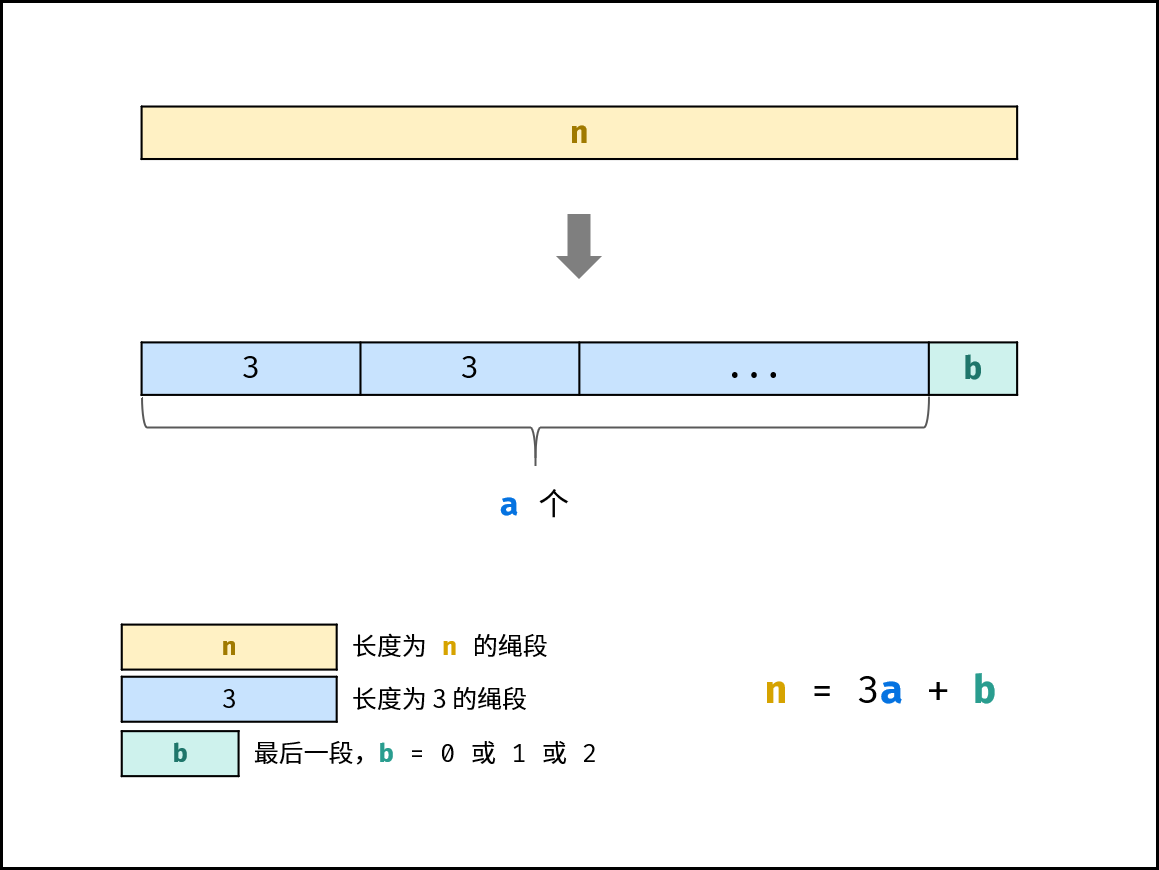{:align=center width=600}
## 代码:
> Python 中常见有三种幂计算函数: **`*`** 和 **`pow()`** 的时间复杂度均为 $O(\log a)$ ;而 **`math.pow()`** 始终调用 C 库的 `pow()` 函数,其执行浮点取幂,时间复杂度为 $O(1)$ 。
```Python []
class Solution:
def cuttingBamboo(self, bamboo_len: int) -> int:
if bamboo_len <= 3: return bamboo_len - 1
a, b = bamboo_len // 3, bamboo_len % 3
if b == 0: return int(math.pow(3, a))
if b == 1: return int(math.pow(3, a - 1) * 4)
return int(math.pow(3, a) * 2)
```
```Java []
class Solution {
public int cuttingBamboo(int bamboo_len) {
if(bamboo_len <= 3) return bamboo_len - 1;
int a = bamboo_len / 3, b = bamboo_len % 3;
if(b == 0) return (int)Math.pow(3, a);
if(b == 1) return (int)Math.pow(3, a - 1) * 4;
return (int)Math.pow(3, a) * 2;
}
}
```
```C++ []
class Solution {
public:
int cuttingBamboo(int bamboo_len) {
if(bamboo_len <= 3) return bamboo_len - 1;
int a = bamboo_len / 3, b = bamboo_len % 3;
if(b == 0) return pow(3, a);
if(b == 1) return pow(3, a - 1) * 4;
return pow(3, a) * 2;
}
};
```
### 复杂度分析:
- **时间复杂度 $O(1)$ :** 仅有求整、求余、次方运算。
- [求整和求余运算](https://stackoverflow.com/questions/35189851/time-complexity-of-modulo-operator-in-python):资料提到不超过机器数的整数可以看作是 $O(1)$ ;
- [幂运算](https://stackoverflow.com/questions/32418731/java-math-powa-b-time-complexity):查阅资料,提到浮点取幂为 $O(1)$ 。
- **空间复杂度 $O(1)$ :** 变量 `a` 和 `b` 使用常数大小额外空间。
## 贪心思路:
数学推导需要一定的知识基础,贪心算法的思路更加适合快速解题。
> 设一竹子长度为 $n$ ( $n>1$ ),则其必可被切分为两段 $n=n_1+n_2$ 。
> 根据经验推测,切分的两数字乘积往往原数字更大,即往往有 $n_1 \times n_2 > n_1 + n_2 = n$ 。
>
> - **例如竹子长度为 $6$ :** $6 = 3 + 3 < 3 \times 3 = 9$ ;
> - **也有少数反例,例如 $2$ :** $2 = 1 + 1 > 1 \times 1 = 1$ 。
- **推论一:** 合理的切分方案可以带来更大的乘积。
> 设一竹子长度为 $n$ ( $n>1$ ),**切分为两段** $n=n_1+n_2$ ,**切分为三段** $n=n_1+n_2+n_3$ 。
> 根据经验推测,**三段** 的乘积往往更大,即往往有 $n_1 n_2 n_3 > n_1 n_2$ 。
>
> - **例如竹子长度为 $9$ :** 两段 $9=4+5$ 和 三段 $9=3+3+3$,则有 $4 \times 5 < 3 \times 3 \times 3$ 。
> - **也有少数反例,例如 $6$ :** 两段 $6=3+3$ 和 三段 $6=2+2+2$,则有 $3 \times 3 > 2 \times 2 \times 2$ 。
- **推论二:** 若切分方案合理,竹子段切分的越多,乘积越大。
> 总体上看,貌似长竹子切分为越多段乘积越大,但其实到某个长度分界点后,乘积到达最大值,就不应再切分了。
> **问题转化:** 是否有**优先级最高的长度** $x$ 存在?若有,则应该尽可能把竹子以 $x$ 长度切为多段,以获取最大乘积。
- **推论三:** 为使乘积最大,只有长度为 $2$ 和 $3$ 的竹子不应再切分,且 $3$ 比 $2$ 更优 *(详情见下表)* 。
| 竹子切分方案 | 乘积 | 结论 |
| ------------- | ------------------------------------------ | ----------------------------------------------------------------- |
| $2 = 1 + 1$ | $1 \times 1 = 1$ | $2$ 不应切分 |
| $3=1+2$ | $1 \times 2 = 2$ | $3$ 不应切分 |
| $4=2+2=1+3$ | $2 \times 2 = 4 > 1 \times 3 = 3$ | $4$ 和 $2$ 等价,且 $2+2$ 比 $1+3$ 更优 |
| $5=2+3=1+4$ | $2 \times 3 = 6 > 1 \times 4 = 4$ | $5$ 应切分为 $2+3$ |
| $6=3+3=2+2+2$ | $3 \times 3 = 9 > 2 \times 2 \times 2 = 8$ | $6$ 应切分为 $3+3$ ,进而**推出 $3$ 比 $2$ 更优** |
| $>7$ | ... | **长绳**(长度>7)可转化为多个**短绳**(长度1~6),因此肯定应切分 |
================================================
FILE: leetbook_ioa/docs/LCR 132. 砍竹子 II.md
================================================
## 解题思路:
> 切分规则的推导流程请见上一题「砍竹子 I」。
### 切分规则:
1. **最优:** $3$ 。把竹子尽可能切为多个长度为 $3$ 的片段,留下的最后一段竹子的长度可能为 $0,1,2$ 三种情况。
2. **次优:** $2$ 。若最后一段竹子长度为 $2$ ;则保留,不再拆为 $1+1$ 。
3. **最差:** $1$ 。若最后一段竹子长度为 $1$ ;则应把一份 $3 + 1$ 替换为 $2 + 2$,因为 $2 \times 2 > 3 \times 1$。
### 算法流程:
1. 当 $n \leq 3$ 时,按照规则应不切分,但由于题目要求必须剪成 $m>1$ 段,因此必须剪出一段长度为 $1$ 的竹子,即返回 $n - 1$ 。
2. 当 $n>3$ 时,求 $n$ 除以 $3$ 的 整数部分 $a$ 和 余数部分 $b$ (即 $n = 3a + b$ ),并分为以下三种情况(设求余操作符号为 "$\odot$" ):
- 当 $b = 0$ 时,直接返回 $3^a \odot 1000000007$;
- 当 $b = 1$ 时,要将一个 $1 + 3$ 转换为 $2+2$,因此返回 $(3^{a-1} \times 4)\odot 1000000007$;
- 当 $b = 2$ 时,返回 $(3^a \times 2) \odot 1000000007$。
{:align=center width=600}
### 大数求余解法:
**大数越界:** 当 $a$ 增大时,最后返回的 $3^a$ 大小以指数级别增长,可能超出 `int32` 甚至 `int64` 的取值范围,导致返回值错误。
**大数求余问题:** 在仅使用 `int32` 类型存储的前提下,正确计算 $x^a$ 对 $p$ 求余(即 $x^a \odot p$ )的值。
**解决方案:** *循环求余* 、 *快速幂求余* ,其中后者的时间复杂度更低,两种方法均基于以下求余运算规则推出:
$$
(xy) \odot p = [(x \odot p)(y \odot p)] \odot p
$$
### 1. 循环求余:
根据求余运算性质推出(∵ 本题中 $x 0:
if a % 2: rem = (rem * x) % p
x = x ** 2 % p
a //= 2
return rem
```
**帮助理解:** 根据下表, 初始状态 $rem=1$, $x=3$, $a=19$, $p=1000000007$ ,最后会将 $rem \times (x^a \odot p)$ 化为 $rem \times (x^0 \odot p) = rem \times 1$ 的形式,即 $rem$ 为余数答案。
| $n$ | $rem \times (x^a \odot p)$ | $rem_n=rem_{n-1} \times x_{n-1} \odot p$ | $x_n=x_{n-1}^2 \odot p$ | $a_n=a_{n-1}//2$ |
| --- | -----------------------------------------: | ---------------------------------------: | -----------------------------: | :--------------: |
| $1$ | $1 \times (3^{19} \odot p)$ | $1$ | $3$ | $19$ |
| $2$ | $3 \times (9^{9} \odot p)$ | $3=1\times3\odot p$ | $9=3^2 \odot p$ | $9=19//2$ |
| $3$ | $27 \times (81^{4} \odot p)$ | $27 = 3 \times 9 \odot p$ | $81=9^2\odot p$ | $4=9//2$ |
| $4$ | $27 \times (6561^{2} \odot p)$ | $27$ | $6561=81^2 \odot p$ | $2=4//2$ |
| $5$ | $27 \times (43046721^{1} \odot p)$ | $27$ | $43046721=6561^2 \odot p$ | $1=2//2$ |
| $6$ | $162261460 \times (175880701^{0} \odot p)$ | $162261460=27 \times 43046721 \odot p$ | $175880701=43046721^2 \odot p$ | $0=1//2$ |
## 代码:
**Python 代码:** 由于语言特性,理论上 Python 中的变量取值范围由系统内存大小决定(无限大),因此在 Python 中其实不用考虑大数越界问题。
**Java/C++ 代码:** 根据二分法计算原理,至少要保证变量 `x` 和 `rem` 可以正确存储 $1000000007^2$ ,而 $2^{64} > 1000000007^2 > 2^{32}$ ,因此我们选取 `long` 类型。
```Python []
class Solution:
def cuttingBamboo(self, bamboo_len: int) -> int:
if bamboo_len <= 3: return bamboo_len - 1
a, b, p, x, rem = bamboo_len // 3 - 1, bamboo_len % 3, 1000000007, 3 , 1
while a > 0:
if a % 2: rem = (rem * x) % p
x = x ** 2 % p
a //= 2
if b == 0: return (rem * 3) % p # = 3^(a+1) % p
if b == 1: return (rem * 4) % p # = 3^a * 4 % p
return (rem * 6) % p # = 3^(a+1) * 2 % p
```
```Java []
class Solution {
public int cuttingBamboo(int bamboo_len) {
if(bamboo_len <= 3) return bamboo_len - 1;
int b = bamboo_len % 3, p = 1000000007;
long rem = 1, x = 3;
for(int a = bamboo_len / 3 - 1; a > 0; a /= 2) {
if(a % 2 == 1) rem = (rem * x) % p;
x = (x * x) % p;
}
if(b == 0) return (int)(rem * 3 % p);
if(b == 1) return (int)(rem * 4 % p);
return (int)(rem * 6 % p);
}
}
```
```C++ []
class Solution {
public:
int cuttingBamboo(int bamboo_len) {
if(bamboo_len <= 3) return bamboo_len - 1;
int b = bamboo_len % 3, p = 1000000007;
long rem = 1, x = 3;
for(int a = bamboo_len / 3 - 1; a > 0; a /= 2) {
if(a % 2 == 1) rem = (rem * x) % p;
x = (x * x) % p;
}
if(b == 0) return (int)(rem * 3 % p);
if(b == 1) return (int)(rem * 4 % p);
return (int)(rem * 6 % p);
}
};
```
```Python []
# 由于语言特性,Python 可以不考虑大数越界问题
class Solution:
def cuttingBamboo(self, bamboo_len: int) -> int:
if bamboo_len <= 3: return bamboo_len - 1
a, b, p = bamboo_len // 3, bamboo_len % 3, 1000000007
if b == 0: return 3 ** a % p
if b == 1: return 3 ** (a - 1) * 4 % p
return 3 ** a * 2 % p
```
### 复杂度分析:
> 以下为 **二分求余法** 的复杂度。
- **时间复杂度 $O(\log N)$ :** 其中 $N=a$ ,二分法为对数级别复杂度,每轮仅有求整、求余、次方运算。
- [求整和求余运算](https://stackoverflow.com/questions/35189851/time-complexity-of-modulo-operator-in-python):资料提到不超过机器数的整数可以看作是 $O(1)$ ;
- [幂运算](https://stackoverflow.com/questions/32418731/java-math-powa-b-time-complexity):查阅资料,提到浮点取幂为 $O(1)$ 。
- **空间复杂度 $O(1)$ :** 变量 `a, b, p, x, rem` 使用常数大小额外空间。
================================================
FILE: leetbook_ioa/docs/LCR 133. 位 1 的个数.md
================================================
## 方法一:逐位判断
根据 **与运算** 定义,设二进制数字 $n$ ,则有:
- 若 $n \& 1 = 0$ ,则 $n$ 二进制 **最右一位** 为 $0$ ;
- 若 $n \& 1 = 1$ ,则 $n$ 二进制 **最右一位** 为 $1$ 。
根据以上特点,考虑以下 **循环判断** :
1. 判断 $n$ 最右一位是否为 $1$ ,根据结果计数。
2. 将 $n$ 右移一位(本题要求把数字 $n$ 看作无符号数,因此使用 **无符号右移** 操作)。
### 算法流程:
1. 初始化数量统计变量 $res = 0$ 。
2. 循环逐位判断: 当 $n = 0$ 时跳出。
1. **`res += n & 1` :** 若 $n \& 1 = 1$ ,则统计数 $res$ 加一。
2. **`n >>= 1` :** 将二进制数字 $n$ 无符号右移一位( Java 中无符号右移为 "$>>>$" ) 。
3. 返回统计数量 $res$ 。
### 代码:
```Python []
class Solution:
def hammingWeight(self, n: int) -> int:
res = 0
while n:
res += n & 1
n >>= 1
return res
```
```Java []
public class Solution {
public int hammingWeight(int n) {
int res = 0;
while(n != 0) {
res += n & 1;
n >>>= 1;
}
return res;
}
}
```
```C++ []
class Solution {
public:
int hammingWeight(uint32_t n) {
unsigned int res = 0; // c++ 使用无符号数
while(n != 0) {
res += n & 1;
n >>= 1;
}
return res;
}
};
```
### 复杂度分析:
- **时间复杂度 $O(\log_2 n)$ :** 此算法循环内部仅有 **移位、与、加** 等基本运算,占用 $O(1)$ ;逐位判断需循环 $log_2 n$ 次,其中 $\log_2 n$ 代表数字 $n$ 最高位 $1$ 的所在位数(例如 $\log_2 4 = 2$, $\log_2 16 = 4$)。
- **空间复杂度 $O(1)$ :** 变量 $res$ 使用常数大小额外空间。
## 方法二:巧用 $n \& (n - 1)$
- **$(n - 1)$ 解析:** 二进制数字 $n$ 最右边的 $1$ 变成 $0$ ,此 $1$ 右边的 $0$ 都变成 $1$ 。
- **$n \& (n - 1)$ 解析:** 二进制数字 $n$ 最右边的 $1$ 变成 $0$ ,其余不变。
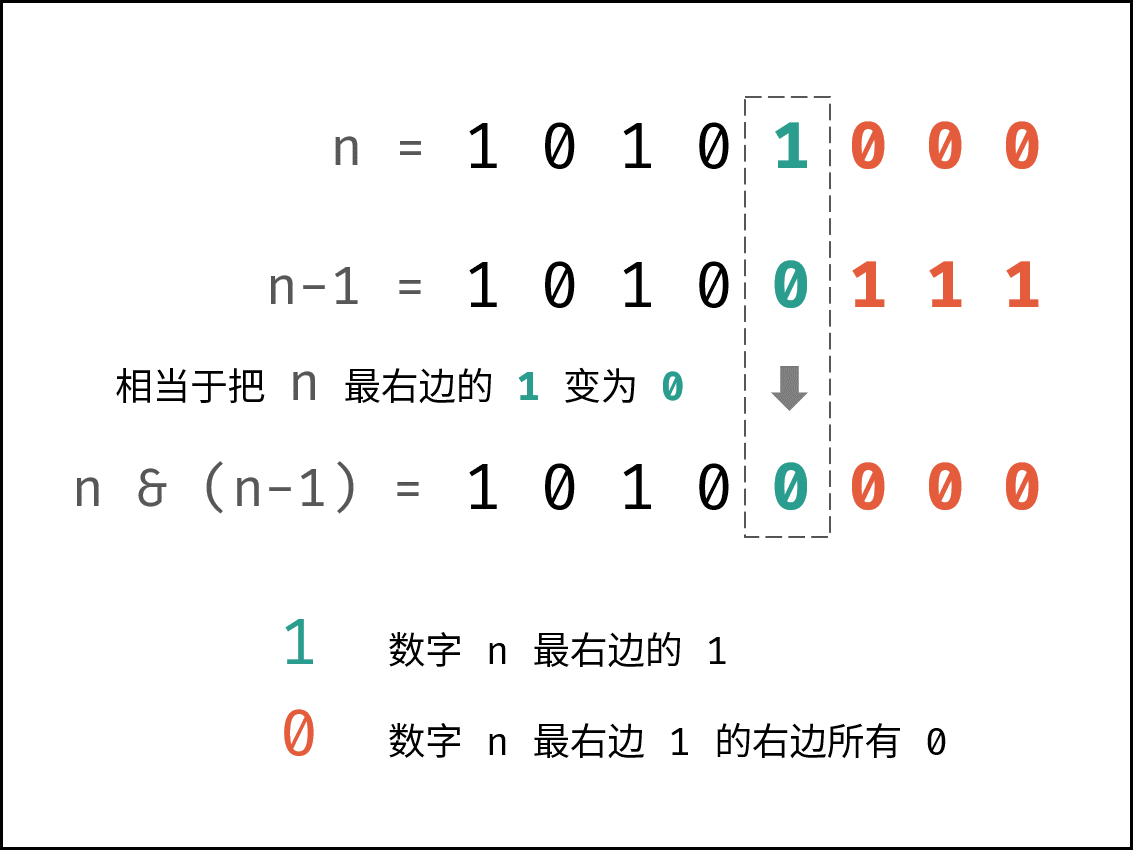{:align=center width=450}
### 算法流程:
1. 初始化数量统计变量 $res$ 。
2. 循环消去最右边的 $1$ :当 $n = 0$ 时跳出。
1. **`res += 1` :** 统计变量加 $1$ ;
2. **`n &= n - 1` :** 消去数字 $n$ 最右边的 $1$ 。
3. 返回统计数量 $res$ 。
### 代码:
```Python []
class Solution:
def hammingWeight(self, n: int) -> int:
res = 0
while n:
res += 1
n &= n - 1
return res
```
```Java []
public class Solution {
public int hammingWeight(int n) {
int res = 0;
while(n != 0) {
res++;
n &= n - 1;
}
return res;
}
}
```
```C++ []
class Solution {
public:
int hammingWeight(uint32_t n) {
int res = 0;
while(n != 0) {
res++;
n &= n - 1;
}
return res;
}
};
```
### 复杂度分析:
- **时间复杂度 $O(M)$ :** $n \& (n - 1)$ 操作仅有减法和与运算,占用 $O(1)$ ;设 $M$ 为二进制数字 $n$ 中 $1$ 的个数,则需循环 $M$ 次(每轮消去一个 $1$ ),占用 $O(M)$ 。
- **空间复杂度 $O(1)$ :** 变量 $res$ 使用常数大小额外空间。
================================================
FILE: leetbook_ioa/docs/LCR 134. Pow(x, n).md
================================================
## 解题思路:
求 $x^n$ 最简单的方法是通过循环将 $n$ 个 $x$ 乘起来,依次求 $x^1, x^2, ..., x^{n-1}, x^n$ ,时间复杂度为 $O(n)$ 。
**快速幂法** 可将时间复杂度降低至 $O(\log n)$ ,以下从 「分治法」 和 「二进制」 两个角度解析快速幂法。
### 快速幂解析(分治法角度):
> 快速幂实际上是分治思想的一种应用。
**二分推导:** $x^n = x^{n/2} \times x^{n/2} = (x^2)^{n/2}$ ,令 $n/2$ 为整数,则需要分为奇偶两种情况(设向下取整除法符号为 "$//$" ):
$$
x^n =
\begin{cases}
(x^2)^{n//2} & , n 为偶数 \\
x(x^2)^{n//2} & , n 为奇数 \\
\end{cases}
$$
> 观察发现,当 $n$ 为奇数时,二分后会多出一项 $x$ 。
**幂结果获取:**
- 根据推导,可通过循环 $x = x^2$ 操作,每次把幂从 $n$ 降至 $n//2$ ,直至将幂降为 $0$ ;
- 设 $res=1$ ,则初始状态 $x^n = x^n \times res$ 。在循环二分时,每当 $n$ 为奇数时,将多出的一项 $x$ 乘入 $res$ ,则最终可化至 $x^n = x^0 \times res = res$ ,返回 $res$ 即可。
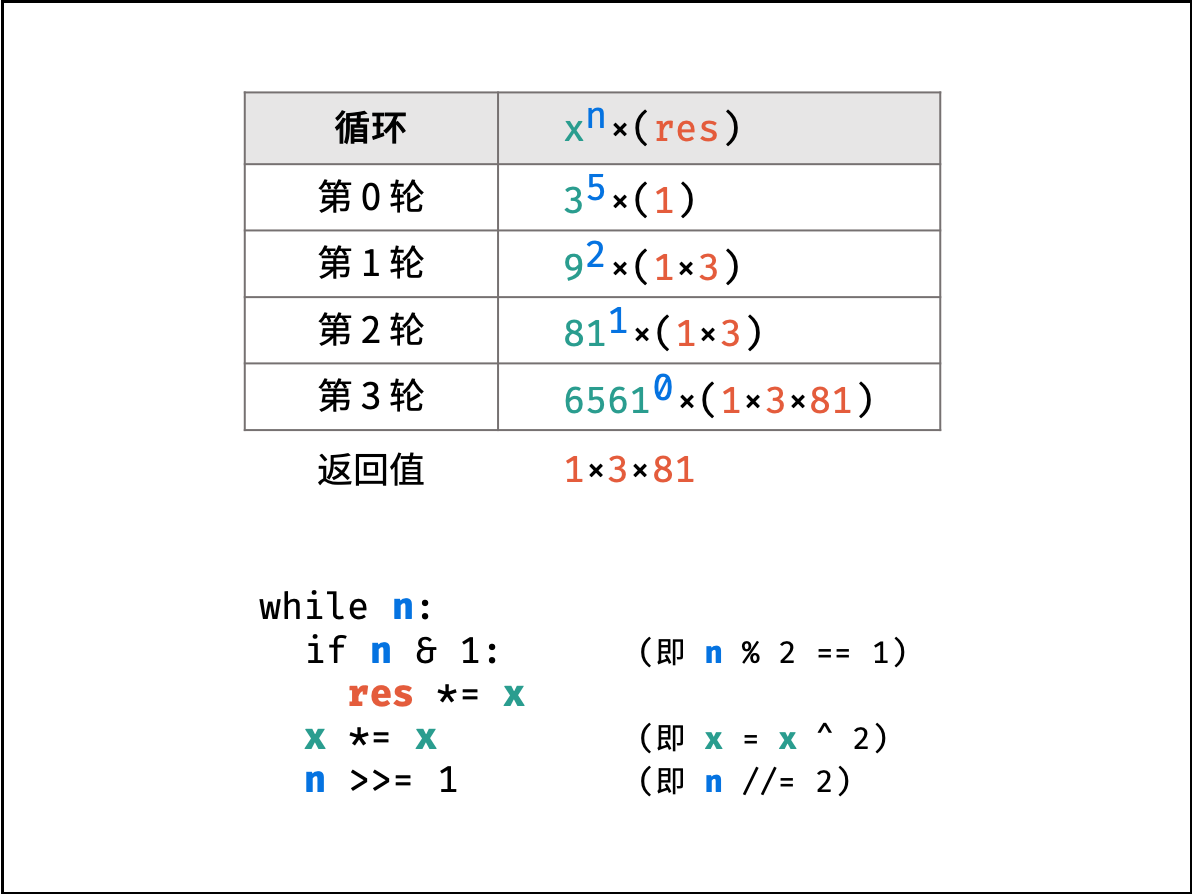{:align=center width=500}
**转化为位运算:**
- 向下整除 $n // 2$ **等价于** 右移一位 $n >> 1$ ;
- 取余数 $n \mod 2$ **等价于** 判断二进制最右位 $n \& 1$ ;
### 快速幂解析(二进制角度):
> 利用十进制数字 $n$ 的二进制表示,可对快速幂进行数学化解释。
对于任何十进制正整数 $n$ ,设其二进制为 "$b_m...b_3b_2b_1$"( $b_i$ 为二进制某位值,$i \in [1,m]$ ),则有:
- **二进制转十进制:** $n = 1b_1 + 2b_2 + 4b_3 + ... + 2^{m-1}b_m$ *(即二进制转十进制公式)* ;
- **幂的二进制展开:** $x^n = x^{1b_1 + 2b_2 + 4b_3 + ... + 2^{m-1}b_m} = x^{1b_1}x^{2b_2}x^{4b_3}...x^{2^{m-1}b_m}$ ;
根据以上推导,可把计算 $x^n$ 转化为解决以下两个问题:
- **计算 $x^1, x^2, x^4, ..., x^{2^{m-1}}$ 的值:** 循环赋值操作 $x = x^2$ 即可;
- **获取二进制各位 $b_1, b_2, b_3, ..., b_m$ 的值:** 循环执行以下操作即可。
1. **$n \& 1$ (与操作):** 判断 $n$ 二进制最右一位是否为 $1$ ;
2. **$n>>1$ (移位操作):** $n$ 右移一位(可理解为删除最后一位)。
因此,应用以上操作,可在循环中依次计算 $x^{2^{0}b_1}, x^{2^{1}b_2}, ..., x^{2^{m-1}b_m}$ 的值,并将所有 $x^{2^{i-1}b_i}$ 累计相乘即可,其中:
$$
x^{2^{i-1}b_i}=
\begin{cases}
1 & , b_i = 0 \\
x^{2^{i-1}} & , b_i = 1 \\
\end{cases}
$$
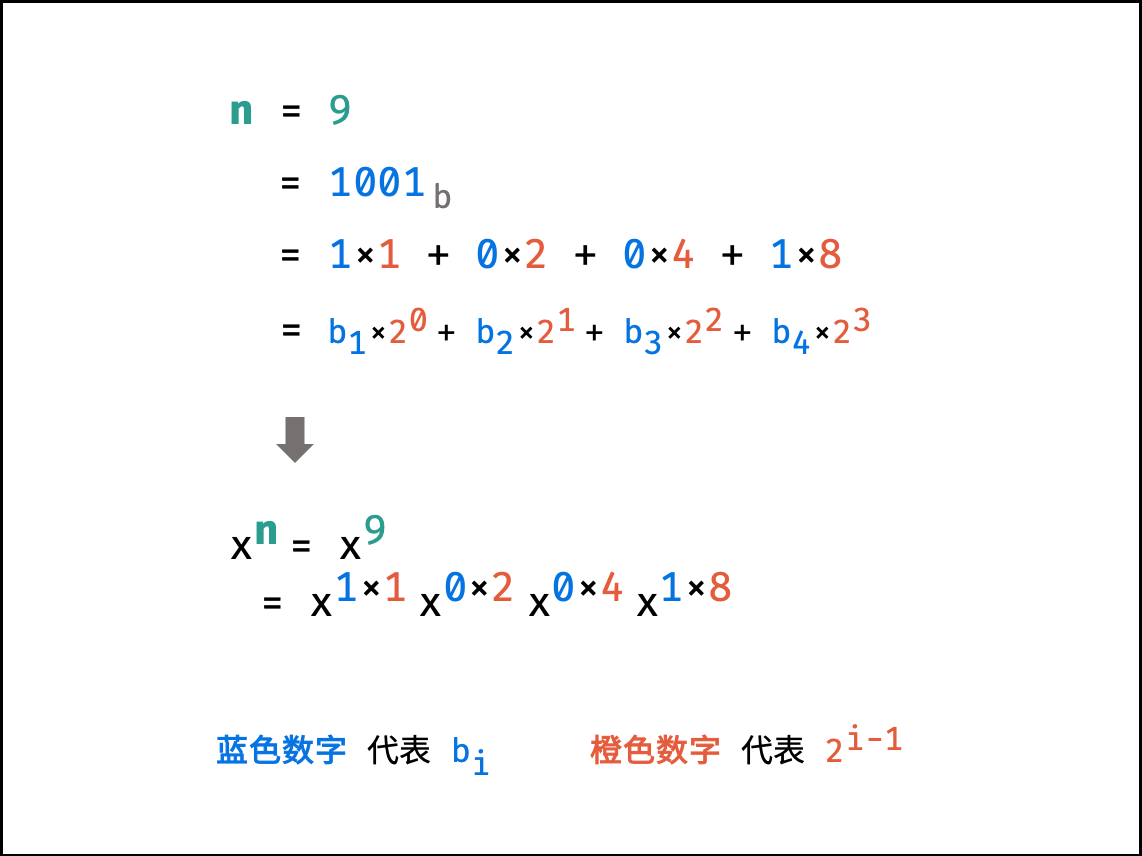{:align=center width=500}
### 算法流程:
1. 当 $x = 0.0$ 时:直接返回 $0.0$ ,以避免后续 $1$ 除以 $0$ 操作报错。**分析:** 数字 $0$ 的正数次幂恒为 $0$ ;$0$ 的 $0$ 次幂和负数次幂没有意义,因此直接返回 $0.0$ 即可。
2. 初始化 $res = 1$ 。
3. 当 $n < 0$ 时:把问题转化至 $n \geq 0$ 的范围内,即执行 $x = 1/x$ ,$n = - n$ 。
4. 循环计算:当 $n = 0$ 时跳出。
1. 当 $n \& 1 = 1$ 时:将当前 $x$ 乘入 $res$ (即 $res *= x$ )。
2. 执行 $x = x^2$ (即 $x *= x$ )。
3. 执行 $n$ 右移一位(即 $n >>= 1$)。
5. 返回 $res$ 。
## 代码:
Java 中 int32 变量区间 $n \in [-2147483648, 2147483647]$ ,因此当 $n = -2147483648$ 时执行 $n = -n$ 会因越界而赋值出错。解决方法是先将 $n$ 存入 long 变量 $b$ ,后面用 $b$ 操作即可。
```Python []
class Solution:
def myPow(self, x: float, n: int) -> float:
if x == 0.0: return 0.0
res = 1
if n < 0: x, n = 1 / x, -n
while n:
if n & 1: res *= x
x *= x
n >>= 1
return res
```
```Java []
class Solution {
public double myPow(double x, int n) {
if(x == 0.0f) return 0.0d;
long b = n;
double res = 1.0;
if(b < 0) {
x = 1 / x;
b = -b;
}
while(b > 0) {
if((b & 1) == 1) res *= x;
x *= x;
b >>= 1;
}
return res;
}
}
```
```C++ []
class Solution {
public:
double myPow(double x, int n) {
if(x == 0.0f) return 0.0;
long b = n;
double res = 1.0;
if(b < 0) {
x = 1 / x;
b = -b;
}
while(b > 0) {
if((b & 1) == 1) res *= x;
x *= x;
b >>= 1;
}
return res;
}
};
```
### 复杂度分析:
- **时间复杂度 $O(\log n)$ :** 二分的时间复杂度为对数级别。
- **空间复杂度 $O(1)$ :** $res$, $b$ 等变量占用常数大小额外空间。
================================================
FILE: leetbook_ioa/docs/LCR 135. 报数.md
================================================
## 解题思路:
题目要求打印 “从 $1$ 至 $cnt$ 的数字” ,因此需考虑以下两个问题:
1. **最大的 $cnt$ 位数(记为 $end$ )和位数 $cnt$ 的关系:** 例如最大的 $1$ 位数是 $9$ ,最大的 $2$ 位数是 $99$ ,最大的 $3$ 位数是 $999$ 。则可推出公式:
$$
end = 10^{cnt} - 1
$$
2. **大数越界问题:** 当 $cnt$ 较大时,$end$ 会超出 $int32$ 整型的取值范围,超出取值范围的数字无法正常存储。但由于本题要求返回 int 类型数组,相当于默认所有数字都在 int32 整型取值范围内,因此不考虑大数越界问题。
因此,只需定义区间 $[1, 10^{cnt} - 1]$ 和步长 $1$ ,通过 $for$ 循环生成结果列表 $res$ 并返回即可。
### 代码:
```Python []
class Solution:
def countNumbers(self, cnt: int) -> List[int]:
res = []
for i in range(1, 10 ** cnt):
res.append(i)
return res
```
```Java []
class Solution {
public int[] countNumbers(int cnt) {
int end = (int)Math.pow(10, cnt) - 1;
int[] res = new int[end];
for(int i = 0; i < end; i++)
res[i] = i + 1;
return res;
}
}
```
利用 Python 的语言特性,可以简化代码:先使用 `range()` 方法生成可迭代对象,再使用 `list()` 方法转化为列表并返回即可。
```Python
class Solution:
def countNumbers(self, cnt: int) -> List[int]:
return list(range(1, 10 ** cnt))
```
### 复杂度分析:
- **时间复杂度 $O(10^{cnt})$ :** 生成长度为 $10^{cnt}$ 的列表需使用 $O(10^{cnt})$ 时间。
- **空间复杂度 $O(1)$ :** 建立列表需使用 $O(1)$ 大小的额外空间( 列表作为返回结果,不计入额外空间 )。
## 大数打印拓展:
实际上,本题的主要考点是大数越界情况下的打印。需要解决以下三个问题:
**1. 表示大数的变量类型:**
- 无论是 short / int / long ... 任意变量类型,数字的取值范围都是有限的。因此,大数的表示应用字符串 String 类型。
**2. 生成数字的字符串集:**
- 使用 int 类型时,每轮可通过 $+1$ 生成下个数字,而此方法无法应用至 String 类型。并且, String 类型的数字的进位操作效率较低,例如 `"9999"` 至 `"10000"` 需要从个位到千位循环判断,进位 4 次。
- 观察可知,生成的列表实际上是 $cnt$ 位 $0$ - $9$ 的 **全排列** ,因此可避开进位操作,通过递归生成数字的 String 列表。
**3. 递归生成全排列:**
- 基于分治算法的思想,先固定高位,向低位递归,当个位已被固定时,添加数字的字符串。例如当 $cnt = 2$ 时(数字范围 $1 - 99$ ),固定十位为 $0$ - $9$ ,按顺序依次开启递归,固定个位 $0$ - $9$ ,终止递归并添加数字字符串。
> 下图中的 `n` 对应本题中的 `cnt` 。
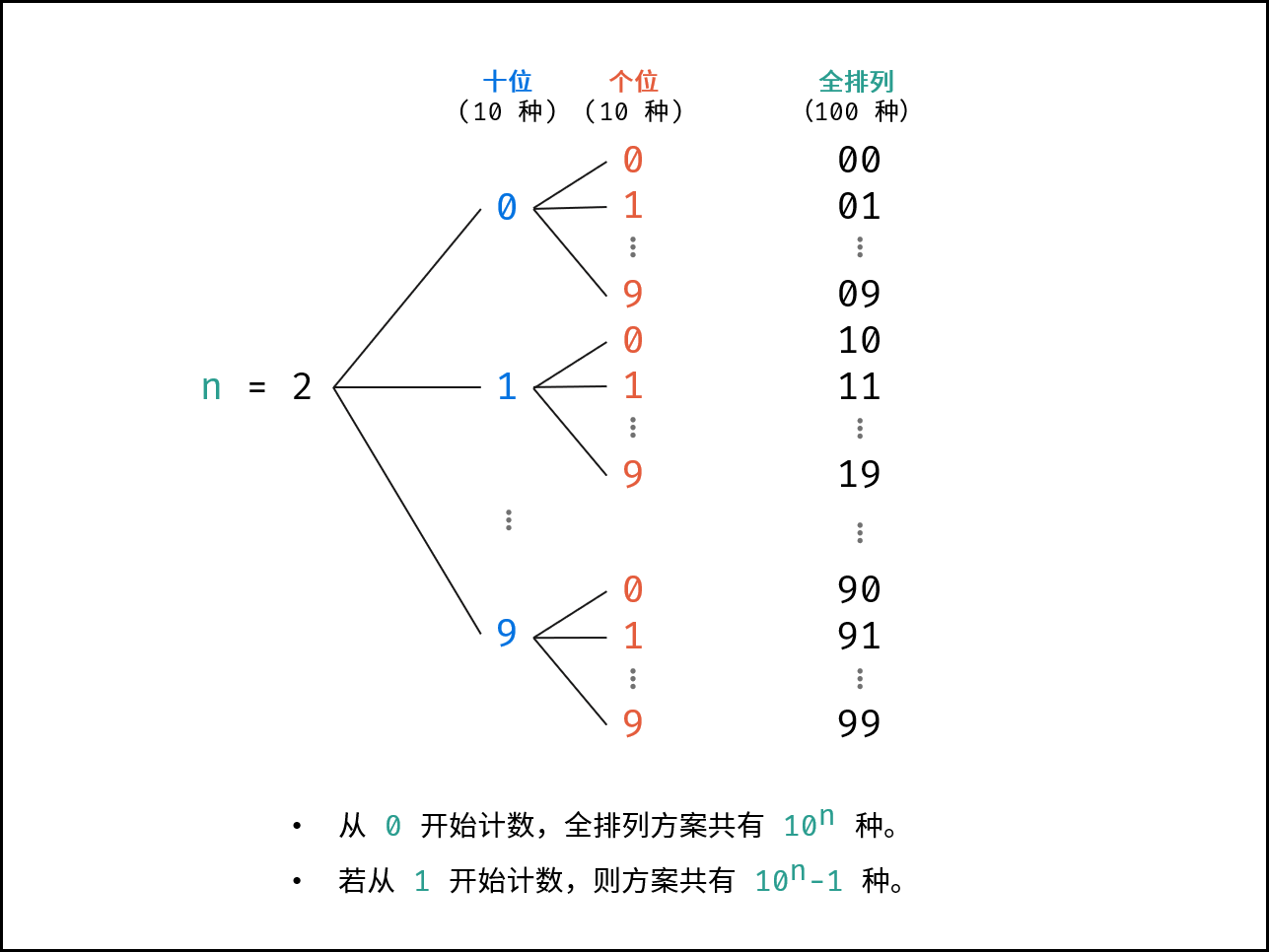{:align=center width=500}
根据以上方法,可初步编写全排列代码:
```Python []
class Solution:
def countNumbers(self, cnt: int) -> [int]:
def dfs(x):
if x == cnt: # 终止条件:已固定完所有位
res.append(''.join(num)) # 拼接 num 并添加至 res 尾部
return
for i in range(10): # 遍历 0 - 9
num[x] = str(i) # 固定第 x 位为 i
dfs(x + 1) # 开启固定第 x + 1 位
num = ['0'] * cnt # 起始数字定义为 cnt 个 0 组成的字符列表
res = [] # 数字字符串列表
dfs(0) # 开启全排列递归
return ','.join(res) # 拼接所有数字字符串,使用逗号隔开,并返回
```
```Java []
class Solution {
StringBuilder res;
int count = 0, cnt;
char[] num, loop = {'0', '1', '2', '3', '4', '5', '6', '7', '8', '9'};
public String countNumbers(int cnt) {
this.cnt = cnt;
res = new StringBuilder(); // 数字字符串集
num = new char[cnt]; // 定义长度为 cnt 的字符列表
dfs(0); // 开启全排列递归
res.deleteCharAt(res.length() - 1); // 删除最后多余的逗号
return res.toString(); // 转化为字符串并返回
}
void dfs(int x) {
if(x == cnt) { // 终止条件:已固定完所有位
res.append(String.valueOf(num) + ","); // 拼接 num 并添加至 res 尾部,使用逗号隔开
return;
}
for(char i : loop) { // 遍历 ‘0‘ - ’9‘
num[x] = i; // 固定第 x 位为 i
dfs(x + 1); // 开启固定第 x + 1 位
}
}
}
```
在此方法下,各数字字符串被逗号隔开,共同组成长字符串。返回的数字集字符串如下所示:
```yaml
输入:n = 1
输出:"0,1,2,3,4,5,6,7,8,9"
输入:n = 2
输出:"00,01,02,...,10,11,12,...,97,98,99"
输入:n = 3
输出:"000,001,002,...,100,101,102,...,997,998,999"
```
观察可知,当前的生成方法仍有以下问题:
1. 诸如 $00, 01, 02, \cdots$ 应显示为 $0, 1, 2, \cdots$ ,即应 **删除高位多余的 $0$** ;
2. 此方法从 $0$ 开始生成,而题目要求 **列表从 $1$ 开始** ;
以上两个问题的解决方法如下:
**1. 删除高位多余的 $0$ :**
- **字符串左边界定义:** 声明变量 $start$ 规定字符串的左边界,以保证添加的数字字符串 `num[start:]` 中无高位多余的 $0$ 。例如当 $cnt = 2$ 时,$1 - 9$ 时 $start = 1$ ,$10 - 99$ 时 $start = 0$ 。
- **左边界 $start$ 变化规律:** 观察可知,当输出数字的所有位都是 $9$ 时,则下个数字需要向更高位进 $1$ ,此时左边界 $start$ 需要减 $1$ (即高位多余的 $0$ 减少一个)。例如当 $cnt = 3$ (数字范围 $1 - 999$ )时,左边界 $start$ 需要减 $1$ 的情况有: "009" 进位至 "010" , "099" 进位至 "100" 。设数字各位中 $9$ 的数量为 $nine$ ,所有位都为 $9$ 的判断条件可用以下公式表示:
$$
cnt - start = nine
$$
- **统计 $nine$ 的方法:** 固定第 $x$ 位时,当 $i = 9$ 则执行 $nine = nine + 1$ ,并在回溯前恢复 $nine = nine - 1$ 。
**2. 列表从 $1$ 开始:**
- 在以上方法的基础上,添加数字字符串前判断其是否为 `"0"` ,若为 `"0"` 则直接跳过。
### 代码:
为 **正确表示大数** ,以下代码的返回值为数字字符串集拼接而成的长字符串。
```Python []
class Solution:
def countNumbers(self, cnt: int) -> [int]:
def dfs(x):
if x == cnt:
s = ''.join(num[self.start:])
if s != '0': res.append(s)
if cnt - self.start == self.nine: self.start -= 1
return
for i in range(10):
if i == 9: self.nine += 1
num[x] = str(i)
dfs(x + 1)
self.nine -= 1
num, res = ['0'] * cnt, []
self.nine = 0
self.start = cnt - 1
dfs(0)
return ','.join(res)
```
```Java []
class Solution {
StringBuilder res;
int nine = 0, count = 0, start, cnt;
char[] num, loop = {'0', '1', '2', '3', '4', '5', '6', '7', '8', '9'};
public String countNumbers(int cnt) {
this.cnt = cnt;
res = new StringBuilder();
num = new char[cnt];
start = cnt - 1;
dfs(0);
res.deleteCharAt(res.length() - 1);
return res.toString();
}
void dfs(int x) {
if(x == cnt) {
String s = String.valueOf(num).substring(start);
if(!s.equals("0")) res.append(s + ",");
if(cnt - start == nine) start--;
return;
}
for(char i : loop) {
if(i == '9') nine++;
num[x] = i;
dfs(x + 1);
}
nine--;
}
}
```
本题要求输出 int 类型数组。为 **运行通过** ,可在添加数字字符串 $s$ 前,将其转化为 int 类型。代码如下所示:
```Python []
class Solution:
def countNumbers(self, cnt: int) -> [int]:
def dfs(x):
if x == cnt:
s = ''.join(num[self.start:])
if s != '0': res.append(int(s))
if cnt - self.start == self.nine: self.start -= 1
return
for i in range(10):
if i == 9: self.nine += 1
num[x] = str(i)
dfs(x + 1)
self.nine -= 1
num, res = ['0'] * cnt, []
self.nine = 0
self.start = cnt - 1
dfs(0)
return res
```
```Java []
class Solution {
int[] res;
int nine = 0, count = 0, start, cnt;
char[] num, loop = {'0', '1', '2', '3', '4', '5', '6', '7', '8', '9'};
public int[] countNumbers(int cnt) {
this.cnt = cnt;
res = new int[(int)Math.pow(10, cnt) - 1];
num = new char[cnt];
start = cnt - 1;
dfs(0);
return res;
}
void dfs(int x) {
if(x == cnt) {
String s = String.valueOf(num).substring(start);
if(!s.equals("0")) res[count++] = Integer.parseInt(s);
if(cnt - start == nine) start--;
return;
}
for(char i : loop) {
if(i == '9') nine++;
num[x] = i;
dfs(x + 1);
}
nine--;
}
}
```
### 复杂度分析:
- **时间复杂度 $O(10^{cnt})$ :** 递归的生成的排列的数量为 $10^{cnt}$ 。
- **空间复杂度 $O(10^{cnt})$ :** 结果列表 $res$ 的长度为 $10^{cnt} - 1$ ,各数字字符串的长度区间为 $1, 2, ..., cnt$ ,因此占用 $O(10^{cnt})$ 大小的额外空间。
================================================
FILE: leetbook_ioa/docs/LCR 136. 删除链表节点.md
================================================
## 解题思路:
本题删除值为 `val` 的节点分需为两步:定位节点、修改引用。
1. **定位节点:** 遍历链表,直到 `head.val == val` 时跳出,即可定位目标节点。
2. **修改引用:** 设节点 `cur` 的前驱节点为 `pre` ,后继节点为 `cur.next` ;则执行 `pre.next = cur.next` ,即可实现删除 `cur` 节点。
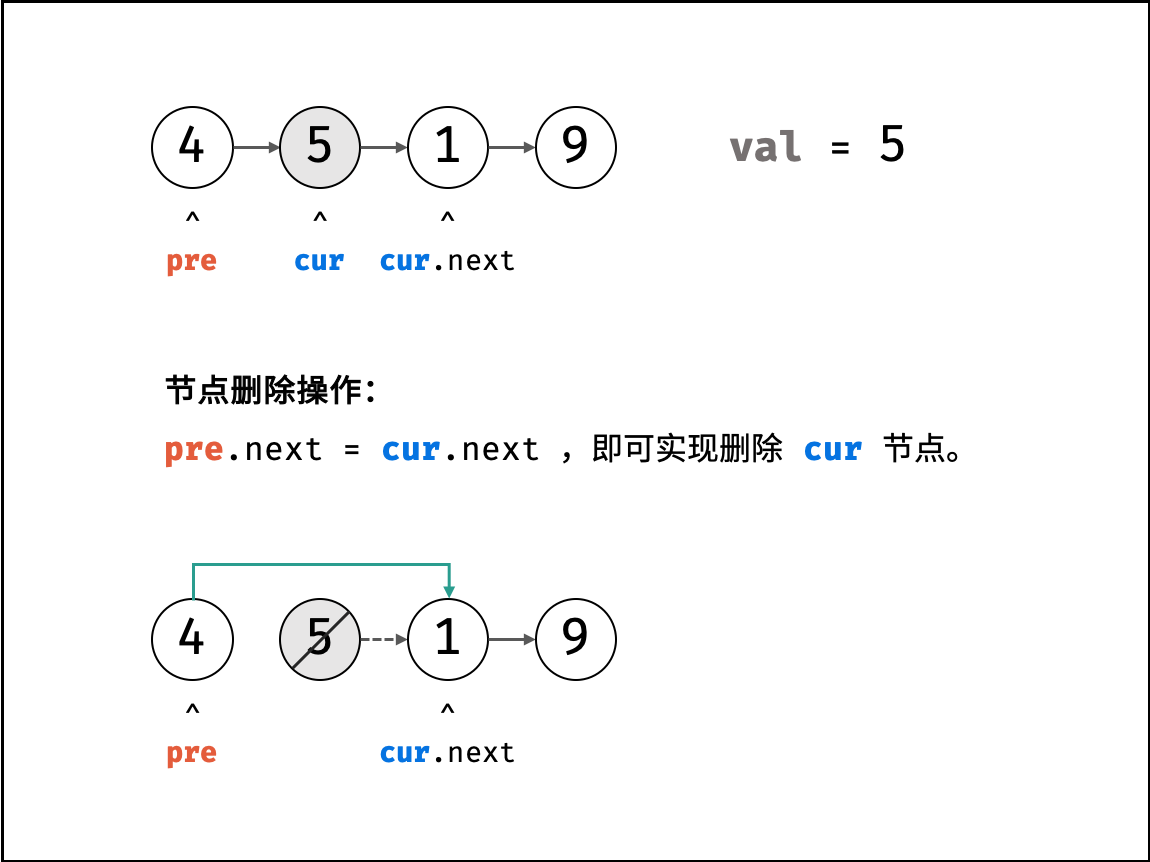{:align=center width=450}
### 算法流程:
1. **特例处理:** 当应删除头节点 `head` 时,直接返回 `head.next` 即可。
2. **初始化:** `pre = head` , `cur = head.next` 。
3. **定位节点:** 当 `cur` 为空 **或** `cur` 节点值等于 `val` 时跳出。
1. 保存当前节点索引,即 `pre = cur` 。
2. 遍历下一节点,即 `cur = cur.next` 。
4. **删除节点:** 若 `cur` 指向某节点,则执行 `pre.next = cur.next` ;若 `cur` 指向 $\text{null}$ ,代表链表中不包含值为 `val` 的节点。
5. **返回值:** 返回链表头部节点 `head` 即可。
## 代码:
```Python []
class Solution:
def deleteNode(self, head: ListNode, val: int) -> ListNode:
if head.val == val: return head.next
pre, cur = head, head.next
while cur and cur.val != val:
pre, cur = cur, cur.next
if cur: pre.next = cur.next
return head
```
```Java []
class Solution {
public ListNode deleteNode(ListNode head, int val) {
if(head.val == val) return head.next;
ListNode pre = head, cur = head.next;
while(cur != null && cur.val != val) {
pre = cur;
cur = cur.next;
}
if(cur != null) pre.next = cur.next;
return head;
}
}
```
```C++ []
class Solution {
public:
ListNode* deleteNode(ListNode* head, int val) {
if(head->val == val) return head->next;
ListNode *pre = head, *cur = head->next;
while(cur != nullptr && cur->val != val) {
pre = cur;
cur = cur->next;
}
if(cur != nullptr) pre->next = cur->next;
return head;
}
};
```
### 复杂度分析:
- **时间复杂度 $O(N)$ :** $N$ 为链表长度,删除操作平均需循环 $N/2$ 次,最差 $N$ 次。
- **空间复杂度 $O(1)$ :** `cur`, `pre` 占用常数大小额外空间。
================================================
FILE: leetbook_ioa/docs/LCR 137. 模糊搜索验证.md
================================================
## 解题思路:
> 设 $s$ 的长度为 $n$ ,$p$ 的长度为 $m$ ;将 $s$ 的第 $i$ 个字符记为 $s_i$ ,$p$ 的第 $j$ 个字符记为 $p_j$ ,将 $s$ 的前 $i$ 个字符组成的子字符串记为 $s[:i]$ , 同理将 $p$ 的前 $j$ 个字符组成的子字符串记为 $p[:j]$ 。
>
> 因此,本题可转化为求 $s[:n]$ 是否能和 $p[:m]$ 匹配。
总体思路是从 $s[:1]$ 和 $p[:1]$ 是否能匹配开始判断,每轮添加一个字符并判断是否能匹配,直至添加完整个字符串 $s$ 和 $p$ 。展开来看,假设 $s[:i]$ 与 $p[:j]$ 可以匹配,那么下一状态有两种:
1. 添加一个字符 $s_{i+1}$ 后是否能匹配?
2. 添加字符 $p_{j+1}$ 后是否能匹配?
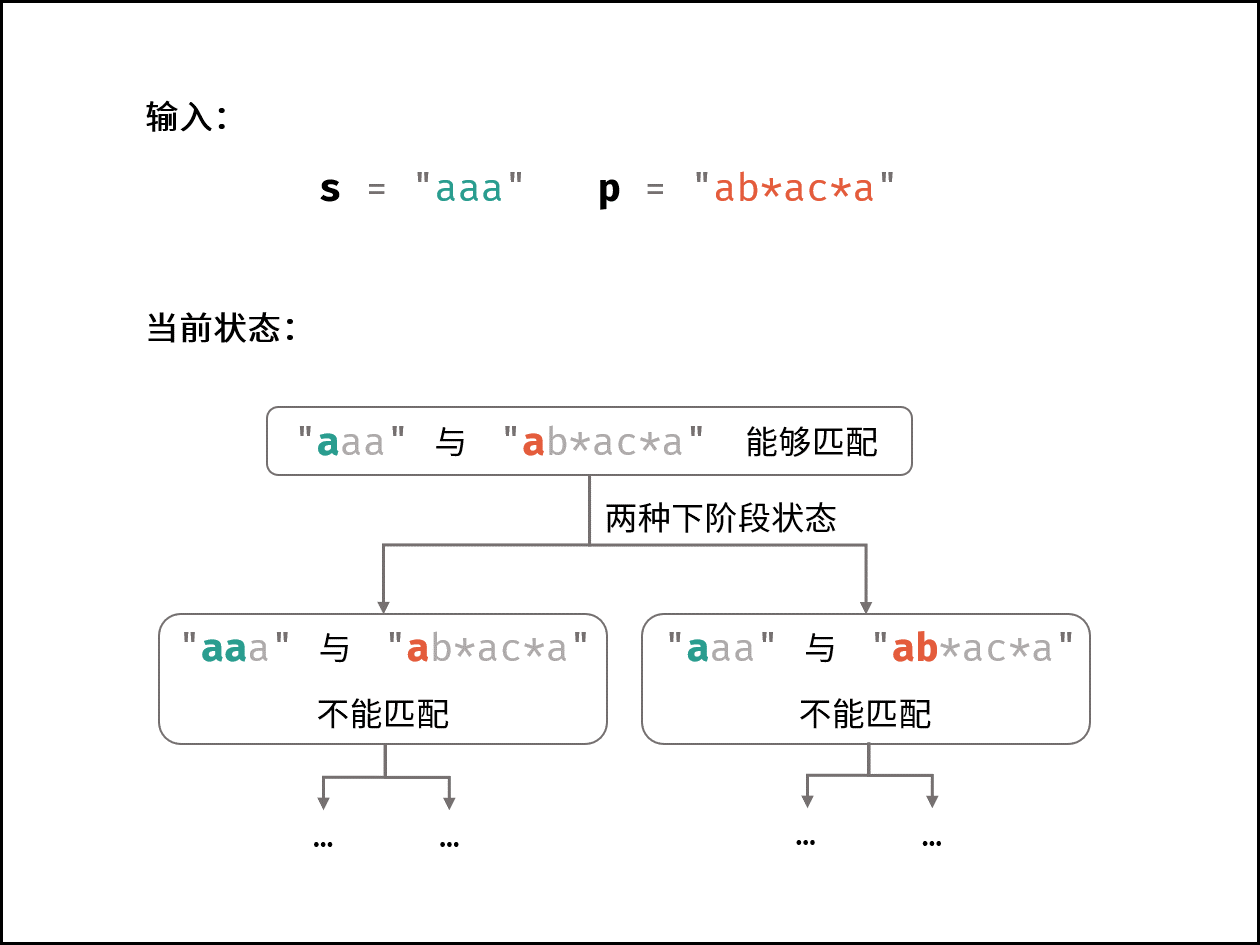{:align=center width=500}
因此,本题的状态共有 $m \times n$ 种,应定义状态矩阵 $dp$ ,$dp[i][j]$ 代表 $s[:i]$ 与 $p[:j]$ 是否可以匹配。
做好状态定义,接下来就是根据 「`普通字符`」 , 「`.`」 , 「`*`」三种字符的功能定义,分析出动态规划的转移方程。
### 动态规划解析:
**状态定义:** 设动态规划矩阵 `dp` ,`dp[i][j]` 代表字符串 `s` 的前 `i` 个字符和 `p` 的前 `j` 个字符能否匹配。
**转移方程:** 需要注意,由于 `dp[0][0]` 代表的是空字符的状态, 因此 `dp[i][j]` 对应的添加字符是 `s[i - 1]` 和 `p[j - 1]` 。
- 当 `p[j - 1] = '*'` 时,`dp[i][j]` 在当以下任一情况为 $\text{true}$ 时等于 $\text{true}$ :
1. **`dp[i][j - 2]`:** 即将字符组合 `p[j - 2] *` 看作出现 0 次时,能否匹配;
2. **`dp[i - 1][j]` 且 `s[i - 1] = p[j - 2]`:** 即让字符 `p[j - 2]` 多出现 1 次时,能否匹配;
3. **`dp[i - 1][j]` 且 `p[j - 2] = '.'`:** 即让字符 `'.'` 多出现 1 次时,能否匹配;
- 当 `p[j - 1] != '*'` 时,`dp[i][j]` 在当以下任一情况为 $\text{true}$ 时等于 $\text{true}$ :
1. **`dp[i - 1][j - 1]` 且 `s[i - 1] = p[j - 1]`:** 即让字符 `p[j - 1]` 多出现一次时,能否匹配;
2. **`dp[i - 1][j - 1]` 且 `p[j - 1] = '.'`:** 即将字符 `.` 看作字符 `s[i - 1]` 时,能否匹配;
**初始化:** 需要先初始化 `dp` 矩阵首行,以避免状态转移时索引越界。
- **`dp[0][0] = true`:** 代表两个空字符串能够匹配。
- **`dp[0][j] = dp[0][j - 2]` 且 `p[j - 1] = '*'`:** 首行 `s` 为空字符串,因此当 `p` 的偶数位为 `*` 时才能够匹配(即让 `p` 的奇数位出现 0 次,保持 `p` 是空字符串)。因此,循环遍历字符串 `p` ,步长为 2(即只看偶数位)。
**返回值:** `dp` 矩阵右下角字符,代表字符串 `s` 和 `p` 能否匹配。
## 代码:
```Python []
class Solution:
def articleMatch(self, s: str, p: str) -> bool:
m, n = len(s) + 1, len(p) + 1
dp = [[False] * n for _ in range(m)]
dp[0][0] = True
for j in range(2, n, 2):
dp[0][j] = dp[0][j - 2] and p[j - 1] == '*'
for i in range(1, m):
for j in range(1, n):
dp[i][j] = dp[i][j - 2] or dp[i - 1][j] and (s[i - 1] == p[j - 2] or p[j - 2] == '.') \
if p[j - 1] == '*' else \
dp[i - 1][j - 1] and (p[j - 1] == '.' or s[i - 1] == p[j - 1])
return dp[-1][-1]
```
```Java []
class Solution {
public boolean articleMatch(String s, String p) {
int m = s.length() + 1, n = p.length() + 1;
boolean[][] dp = new boolean[m][n];
dp[0][0] = true;
for(int j = 2; j < n; j += 2)
dp[0][j] = dp[0][j - 2] && p.charAt(j - 1) == '*';
for(int i = 1; i < m; i++) {
for(int j = 1; j < n; j++) {
dp[i][j] = p.charAt(j - 1) == '*' ?
dp[i][j - 2] || dp[i - 1][j] && (s.charAt(i - 1) == p.charAt(j - 2) || p.charAt(j - 2) == '.') :
dp[i - 1][j - 1] && (p.charAt(j - 1) == '.' || s.charAt(i - 1) == p.charAt(j - 1));
}
}
return dp[m - 1][n - 1];
}
}
```
```C++ []
class Solution {
public:
bool articleMatch(string s, string p) {
int m = s.size() + 1, n = p.size() + 1;
vector> dp(m, vector(n, false));
dp[0][0] = true;
for(int j = 2; j < n; j += 2)
dp[0][j] = dp[0][j - 2] && p[j - 1] == '*';
for(int i = 1; i < m; i++) {
for(int j = 1; j < n; j++) {
dp[i][j] = p[j - 1] == '*' ?
dp[i][j - 2] || dp[i - 1][j] && (s[i - 1] == p[j - 2] || p[j - 2] == '.'):
dp[i - 1][j - 1] && (p[j - 1] == '.' || s[i - 1] == p[j - 1]);
}
}
return dp[m - 1][n - 1];
}
};
```
以上代码利用布尔运算实现简短长度,若阅读不畅,可先理解以下代码,与文中内容一一对应:
```Python []
class Solution:
def articleMatch(self, s: str, p: str) -> bool:
m, n = len(s) + 1, len(p) + 1
dp = [[False] * n for _ in range(m)]
dp[0][0] = True
# 初始化首行
for j in range(2, n, 2):
dp[0][j] = dp[0][j - 2] and p[j - 1] == '*'
# 状态转移
for i in range(1, m):
for j in range(1, n):
if p[j - 1] == '*':
if dp[i][j - 2]: dp[i][j] = True # 1.
elif dp[i - 1][j] and s[i - 1] == p[j - 2]: dp[i][j] = True # 2.
elif dp[i - 1][j] and p[j - 2] == '.': dp[i][j] = True # 3.
else:
if dp[i - 1][j - 1] and s[i - 1] == p[j - 1]: dp[i][j] = True # 1.
elif dp[i - 1][j - 1] and p[j - 1] == '.': dp[i][j] = True # 2.
return dp[-1][-1]
```
```Java []
class Solution {
public boolean articleMatch(String s, String p) {
int m = s.length() + 1, n = p.length() + 1;
boolean[][] dp = new boolean[m][n];
dp[0][0] = true;
// 初始化首行
for(int j = 2; j < n; j += 2)
dp[0][j] = dp[0][j - 2] && p.charAt(j - 1) == '*';
// 状态转移
for(int i = 1; i < m; i++) {
for(int j = 1; j < n; j++) {
if(p.charAt(j - 1) == '*') {
if(dp[i][j - 2]) dp[i][j] = true; // 1.
else if(dp[i - 1][j] && s.charAt(i - 1) == p.charAt(j - 2)) dp[i][j] = true; // 2.
else if(dp[i - 1][j] && p.charAt(j - 2) == '.') dp[i][j] = true; // 3.
} else {
if(dp[i - 1][j - 1] && s.charAt(i - 1) == p.charAt(j - 1)) dp[i][j] = true; // 1.
else if(dp[i - 1][j - 1] && p.charAt(j - 1) == '.') dp[i][j] = true; // 2.
}
}
}
return dp[m - 1][n - 1];
}
}
```
```C++ []
class Solution {
public:
bool articleMatch(string s, string p) {
int m = s.size() + 1, n = p.size() + 1;
vector> dp(m, vector(n, false));
dp[0][0] = true;
// 初始化首行
for(int j = 2; j < n; j += 2)
dp[0][j] = dp[0][j - 2] && p[j - 1] == '*';
// 状态转移
for(int i = 1; i < m; i++) {
for(int j = 1; j < n; j++) {
if(p[j - 1] == '*') {
if(dp[i][j - 2]) dp[i][j] = true; // 1.
else if(dp[i - 1][j] && s[i - 1] == p[j - 2]) dp[i][j] = true; // 2.
else if(dp[i - 1][j] && p[j - 2] == '.') dp[i][j] = true; // 3.
} else {
if(dp[i - 1][j - 1] && s[i - 1] == p[j - 1]) dp[i][j] = true; // 1.
else if(dp[i - 1][j - 1] && p[j - 1] == '.') dp[i][j] = true; // 2.
}
}
}
return dp[m - 1][n - 1];
}
};
```
### 复杂度分析:
- **时间复杂度 $O(MN)$ :** 其中 $M, N$ 分别为 `s` 和 `p` 的长度,状态转移需遍历整个 `dp` 矩阵。
- **空间复杂度 $O(MN)$ :** 状态矩阵 `dp` 使用 $O(MN)$ 的额外空间。
================================================
FILE: leetbook_ioa/docs/LCR 138. 有效数字.md
================================================
## 解题思路:
本题使用有限状态自动机。根据字符类型和合法数值的特点,先定义状态,再画出状态转移图,最后编写代码即可。
**字符类型:**
空格 「 」、数字「 $0—9$ 」 、正负号 「 $+$, $-$ 」 、小数点 「 $.$ 」 、幂符号 「 $e$, $E$ 」 。
**状态定义:**
按照字符串从左到右的顺序,定义以下 9 种状态。
0. 开始的空格
1. 幂符号前的正负号
2. 小数点前的数字
3. 小数点、小数点后的数字
4. 当小数点前为空格时,小数点、小数点后的数字
5. 幂符号
6. 幂符号后的正负号
7. 幂符号后的数字
8. 结尾的空格
**结束状态:**
合法的结束状态有 2, 3, 7, 8 。
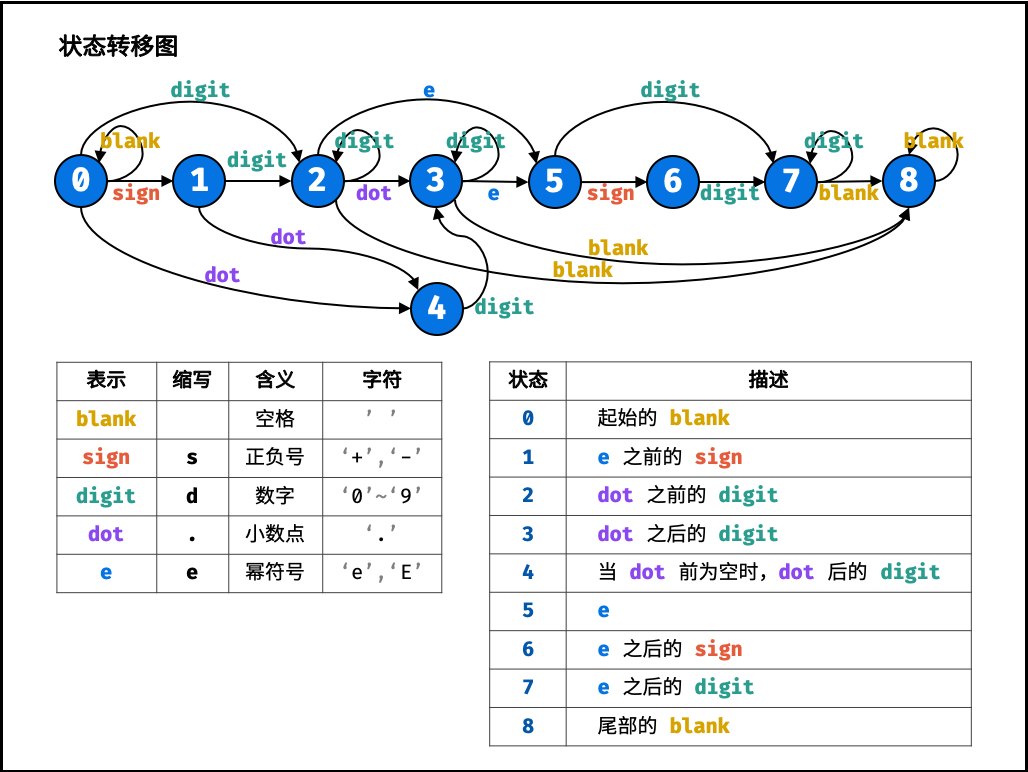{:align=center width=650}
### 算法流程:
1. **初始化:**
1. **状态转移表 `states` :** 设 `states[i]` ,其中 `i` 为所处状态,`states[i]` 使用哈希表存储可转移至的状态。键值对 `(key, value)` 含义:输入字符 `key` ,则从状态 `i` 转移至状态 `value` 。
2. **当前状态 `p` :** 起始状态初始化为 `p = 0` 。
2. **状态转移循环:** 遍历字符串 `s` 的每个字符 `c` 。
1. **记录字符类型 `t` :** 分为四种情况。
- 当 `c` 为正负号时,执行 `t = 's'` ;
- 当 `c` 为数字时,执行 `t = 'd'` ;
- 当 `c` 为 `e` 或 `E` 时,执行 `t = 'e'` ;
- 当 `c` 为 `.` 或 `空格` 时,执行 `t = c` (即用字符本身表示字符类型);
- 否则,执行 `t = '?'` ,代表为不属于判断范围的非法字符,后续直接返回 $\text{false}$ 。
2. **终止条件:** 若字符类型 `t` 不在哈希表 `states[p]` 中,说明无法转移至下一状态,因此直接返回 $\text{false}$ 。
3. **状态转移:** 状态 `p` 转移至 `states[p][t]` 。
3. **返回值:** 跳出循环后,若状态 `p` $\in {2, 3, 7, 8}$ ,说明结尾合法,返回 $\text{true}$ ,否则返回 $\text{false}$ 。
## 代码:
Java 的状态转移表 `states` 使用 Map[] 数组存储。
```Python []
class Solution:
def validNumber(self, s: str) -> bool:
states = [
{ ' ': 0, 's': 1, 'd': 2, '.': 4 }, # 0. start with 'blank'
{ 'd': 2, '.': 4 } , # 1. 'sign' before 'e'
{ 'd': 2, '.': 3, 'e': 5, ' ': 8 }, # 2. 'digit' before 'dot'
{ 'd': 3, 'e': 5, ' ': 8 }, # 3. 'digit' after 'dot'
{ 'd': 3 }, # 4. 'digit' after 'dot' (‘blank’ before 'dot')
{ 's': 6, 'd': 7 }, # 5. 'e'
{ 'd': 7 }, # 6. 'sign' after 'e'
{ 'd': 7, ' ': 8 }, # 7. 'digit' after 'e'
{ ' ': 8 } # 8. end with 'blank'
]
p = 0 # start with state 0
for c in s:
if '0' <= c <= '9': t = 'd' # digit
elif c in "+-": t = 's' # sign
elif c in "eE": t = 'e' # e or E
elif c in ". ": t = c # dot, blank
else: t = '?' # unknown
if t not in states[p]: return False
p = states[p][t]
return p in (2, 3, 7, 8)
```
```Java []
class Solution {
public boolean validNumber(String s) {
Map[] states = {
new HashMap<>() {{ put(' ', 0); put('s', 1); put('d', 2); put('.', 4); }}, // 0.
new HashMap<>() {{ put('d', 2); put('.', 4); }}, // 1.
new HashMap<>() {{ put('d', 2); put('.', 3); put('e', 5); put(' ', 8); }}, // 2.
new HashMap<>() {{ put('d', 3); put('e', 5); put(' ', 8); }}, // 3.
new HashMap<>() {{ put('d', 3); }}, // 4.
new HashMap<>() {{ put('s', 6); put('d', 7); }}, // 5.
new HashMap<>() {{ put('d', 7); }}, // 6.
new HashMap<>() {{ put('d', 7); put(' ', 8); }}, // 7.
new HashMap<>() {{ put(' ', 8); }} // 8.
};
int p = 0;
char t;
for(char c : s.toCharArray()) {
if(c >= '0' && c <= '9') t = 'd';
else if(c == '+' || c == '-') t = 's';
else if(c == 'e' || c == 'E') t = 'e';
else if(c == '.' || c == ' ') t = c;
else t = '?';
if(!states[p].containsKey(t)) return false;
p = (int)states[p].get(t);
}
return p == 2 || p == 3 || p == 7 || p == 8;
}
}
```
### 复杂度分析:
- **时间复杂度 $O(N)$ :** 其中 $N$ 为字符串 `s` 的长度,判断需遍历字符串,每轮状态转移的使用 $O(1)$ 时间。
- **空间复杂度 $O(1)$ :** `states` 和 `p` 使用常数大小的额外空间。
================================================
FILE: leetbook_ioa/docs/LCR 139. 训练计划 I.md
================================================
## 解题思路:
考虑定义双指针 $i$ , $j$ 分列数组左右两端,循环执行:
1. 指针 $i$ 从左向右寻找偶数;
2. 指针 $j$ 从右向左寻找奇数;
3. 将 偶数 $actions[i]$ 和 奇数 $actions[j]$ 交换。
可始终保证: 指针 $i$ 左边都是奇数,指针 $j$ 右边都是偶数 。
> 下图中的 `nums` 对应本题的 `actions` 。
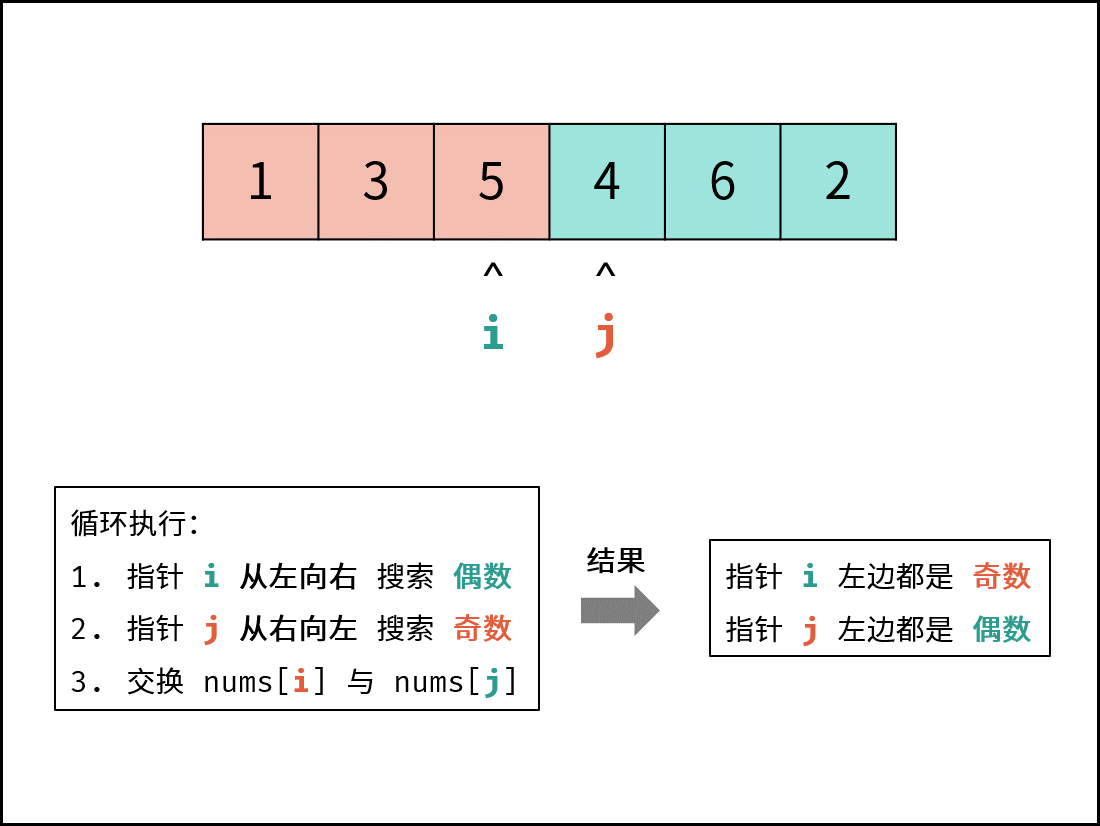{:align=center width=450}
### 算法流程:
1. **初始化:** $i$ , $j$ 双指针,分别指向数组 $actions$ 左右两端;
2. **循环交换:** 当 $i = j$ 时跳出;
1. 指针 $i$ 遇到奇数则执行 $i = i + 1$ 跳过,直到找到偶数;
2. 指针 $j$ 遇到偶数则执行 $j = j - 1$ 跳过,直到找到奇数;
3. 交换 $actions[i]$ 和 $actions[j]$ 值;
3. **返回值:** 返回已修改的 $actions$ 数组。
## 代码:
$x \& 1$ 位运算 等价于 $x \mod 2$ 取余运算,即皆可用于判断数字奇偶性。
```Python []
class Solution:
def trainingPlan(self, actions: List[int]) -> List[int]:
i, j = 0, len(actions) - 1
while i < j:
while i < j and actions[i] & 1 == 1: i += 1
while i < j and actions[j] & 1 == 0: j -= 1
actions[i], actions[j] = actions[j], actions[i]
return actions
```
```Java []
class Solution {
public int[] trainingPlan(int[] actions) {
int i = 0, j = actions.length - 1, tmp;
while(i < j) {
while(i < j && (actions[i] & 1) == 1) i++;
while(i < j && (actions[j] & 1) == 0) j--;
tmp = actions[i];
actions[i] = actions[j];
actions[j] = tmp;
}
return actions;
}
}
```
```C++ []
class Solution {
public:
vector trainingPlan(vector& actions)
{
int i = 0, j = actions.size() - 1;
while (i < j)
{
while(i < j && (actions[i] & 1) == 1) i++;
while(i < j && (actions[j] & 1) == 0) j--;
swap(actions[i], actions[j]);
}
return actions;
}
};
```
### 复杂度分析:
- **时间复杂度 $O(N)$ :** $N$ 为数组 $actions$ 长度,双指针 $i$, $j$ 共同遍历整个数组。
- **空间复杂度 $O(1)$ :** 双指针 $i$, $j$ 使用常数大小的额外空间。
================================================
FILE: leetbook_ioa/docs/LCR 140. 训练计划 II.md
================================================
## 解题思路:
第一时间想到的解法:
1. 先遍历统计链表长度,记为 $n$ ;
2. 设置一个指针走 $(n-cnt)$ 步,即可找到链表倒数第 $cnt$ 个节点;
使用双指针则可以不用统计链表长度。
> 下图中的 `k` 对应本题的 `cnt` 。
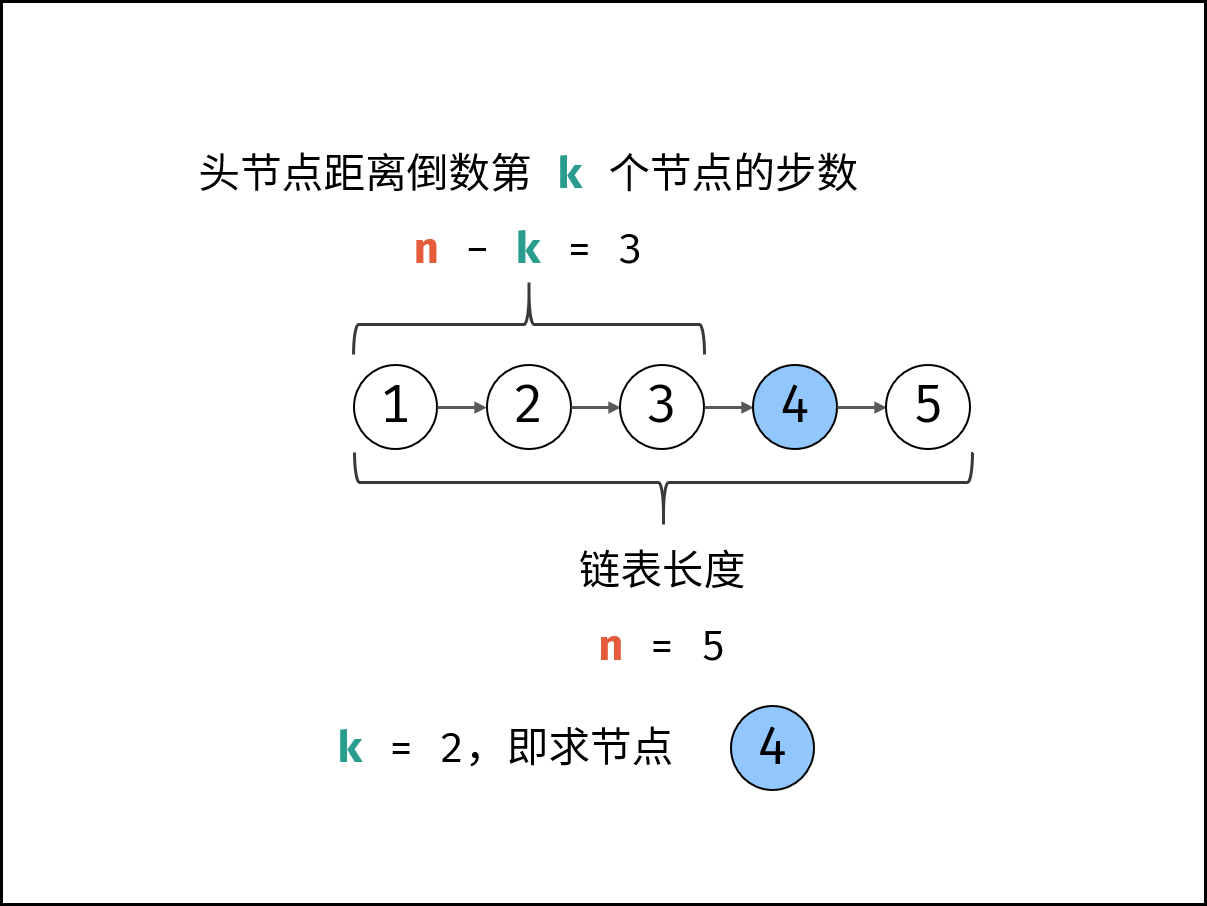{:align=center width=450}
### 算法流程:
1. **初始化:** 前指针 `former` 、后指针 `latter` ,双指针都指向头节点 `head` 。
2. **构建双指针距离:** 前指针 `former` 先向前走 $cnt$ 步(结束后,双指针 `former` 和 `latter` 间相距 $cnt$ 步)。
3. **双指针共同移动:** 循环中,双指针 `former` 和 `latter` 每轮都向前走一步,直至 `former` 走过链表 **尾节点** 时跳出(跳出后,`latter` 与尾节点距离为 $cnt-1$,即 `latter` 指向倒数第 $cnt$ 个节点)。
4. **返回值:** 返回 `latter` 即可。
## 代码:
```Python []
class Solution:
def trainingPlan(self, head: ListNode, cnt: int) -> ListNode:
former, latter = head, head
for _ in range(cnt):
former = former.next
while former:
former, latter = former.next, latter.next
return latter
```
```Java []
class Solution {
public ListNode trainingPlan(ListNode head, int cnt) {
ListNode former = head, latter = head;
for(int i = 0; i < cnt; i++)
former = former.next;
while(former != null) {
former = former.next;
latter = latter.next;
}
return latter;
}
}
```
```C++ []
class Solution {
public:
ListNode* trainingPlan(ListNode* head, int cnt) {
ListNode *former = head, *latter = head;
for(int i = 0; i < cnt; i++)
former = former->next;
while(former != nullptr) {
former = former->next;
latter = latter->next;
}
return latter;
}
};
```
本题没有 $cnt>$ 链表长度的测试样例 ,因此不用考虑越界。考虑越界问题的代码如下:
```Python []
class Solution:
def trainingPlan(self, head: ListNode, cnt: int) -> ListNode:
former, latter = head, head
for _ in range(cnt):
if not former: return
former = former.next
while former:
former, latter = former.next, latter.next
return latter
```
```Java []
class Solution {
public ListNode trainingPlan(ListNode head, int cnt) {
ListNode former = head, latter = head;
for(int i = 0; i < cnt; i++) {
if(former == null) return null;
former = former.next;
}
while(former != null) {
former = former.next;
latter = latter.next;
}
return latter;
}
}
```
```C++ []
class Solution {
public:
ListNode* trainingPlan(ListNode* head, int cnt) {
ListNode *former = head, *latter = head;
for(int i = 0; i < cnt; i++) {
if(former == nullptr) return nullptr;
former = former->next;
}
while(former != nullptr) {
former = former->next;
latter = latter->next;
}
return latter;
}
};
```
### 复杂度分析:
- **时间复杂度 $O(n)$ :** $n$ 为链表长度;总体看,`former` 走了 $n$ 步,`latter` 走了 $(-cnt)$ 步。
- **空间复杂度 $O(1)$ :** 双指针 `former` , `latter` 使用常数大小的额外空间。
================================================
FILE: leetbook_ioa/docs/LCR 141. 训练计划 III.md
================================================
## 解题思路:
如下图所示,题目要求将链表反转。本文介绍迭代(双指针)、递归两种实现方法。
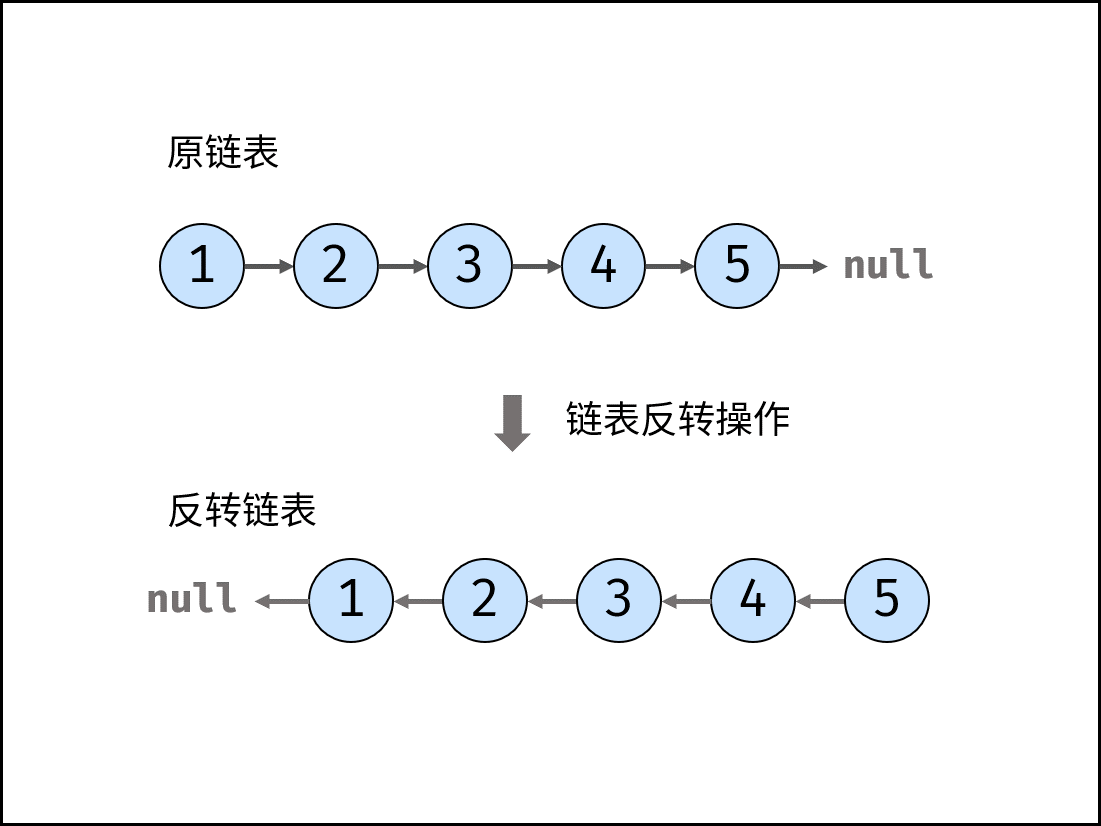{:align=center width=450}
## 方法一:迭代(双指针)
考虑遍历链表,并在访问各节点时修改 `next` 引用指向,算法流程见注释。
### 代码:
```Python []
class Solution:
def trainningPlan(self, head: ListNode) -> ListNode:
cur, pre = head, None
while cur:
tmp = cur.next # 暂存后继节点 cur.next
cur.next = pre # 修改 next 引用指向
pre = cur # pre 暂存 cur
cur = tmp # cur 访问下一节点
return pre
```
```Java []
class Solution {
public ListNode trainningPlan(ListNode head) {
ListNode cur = head, pre = null;
while(cur != null) {
ListNode tmp = cur.next; // 暂存后继节点 cur.next
cur.next = pre; // 修改 next 引用指向
pre = cur; // pre 暂存 cur
cur = tmp; // cur 访问下一节点
}
return pre;
}
}
```
```C++ []
class Solution {
public:
ListNode* trainningPlan(ListNode* head) {
ListNode *cur = head, *pre = nullptr;
while(cur != nullptr) {
ListNode* tmp = cur->next; // 暂存后继节点 cur.next
cur->next = pre; // 修改 next 引用指向
pre = cur; // pre 暂存 cur
cur = tmp; // cur 访问下一节点
}
return pre;
}
};
```
### 复杂度分析:
- **时间复杂度 $O(N)$ :** 遍历链表使用线性大小时间。
- **空间复杂度 $O(1)$ :** 变量 `pre` 和 `cur` 使用常数大小额外空间。
## 方法二:递归
考虑使用递归遍历链表,当越过尾节点后终止递归,在回溯时修改各节点的 `next` 引用指向。
### `recur(cur, pre)` 递归函数:
1. 终止条件:当 `cur` 为空,则返回尾节点 `pre` (即反转链表的头节点);
2. 递归后继节点,记录返回值(即反转链表的头节点)为 `res` ;
3. 修改当前节点 `cur` 引用指向前驱节点 `pre` ;
4. 返回反转链表的头节点 `res` ;
### `trainningPlan(head)` 函数:
调用并返回 `recur(head, null)` 。传入 `null` 是因为反转链表后,`head` 节点指向 `null` ;
### 代码:
```Python []
class Solution:
def trainningPlan(self, head: ListNode) -> ListNode:
def recur(cur, pre):
if not cur: return pre # 终止条件
res = recur(cur.next, cur) # 递归后继节点
cur.next = pre # 修改节点引用指向
return res # 返回反转链表的头节点
return recur(head, None) # 调用递归并返回
```
```Java []
class Solution {
public ListNode trainningPlan(ListNode head) {
return recur(head, null); // 调用递归并返回
}
private ListNode recur(ListNode cur, ListNode pre) {
if (cur == null) return pre; // 终止条件
ListNode res = recur(cur.next, cur); // 递归后继节点
cur.next = pre; // 修改节点引用指向
return res; // 返回反转链表的头节点
}
}
```
```C++ []
class Solution {
public:
ListNode* trainningPlan(ListNode* head) {
return recur(head, nullptr); // 调用递归并返回
}
private:
ListNode* recur(ListNode* cur, ListNode* pre) {
if (cur == nullptr) return pre; // 终止条件
ListNode* res = recur(cur->next, cur); // 递归后继节点
cur->next = pre; // 修改节点引用指向
return res; // 返回反转链表的头节点
}
};
```
### 复杂度分析:
- **时间复杂度 $O(N)$ :** 遍历链表使用线性大小时间。
- **空间复杂度 $O(N)$ :** 遍历链表的递归深度达到 $N$ ,系统使用 $O(N)$ 大小额外空间。
================================================
FILE: leetbook_ioa/docs/LCR 142. 训练计划 IV.md
================================================
## 解题思路:
根据题目描述, 链表 `l1` , `l2` 是 **递增** 的,因此容易想到使用双指针 `l1` 和 `l2` 遍历两链表,根据 `l1.val` 和 `l2.val` 的大小关系确定节点添加顺序,两节点指针交替前进,直至遍历完毕。
**引入伪头节点:** 由于初始状态合并链表中无节点,因此循环第一轮时无法将节点添加到合并链表中。解决方案:初始化一个辅助节点 `dum` 作为合并链表的伪头节点,将各节点添加至 `dum` 之后。
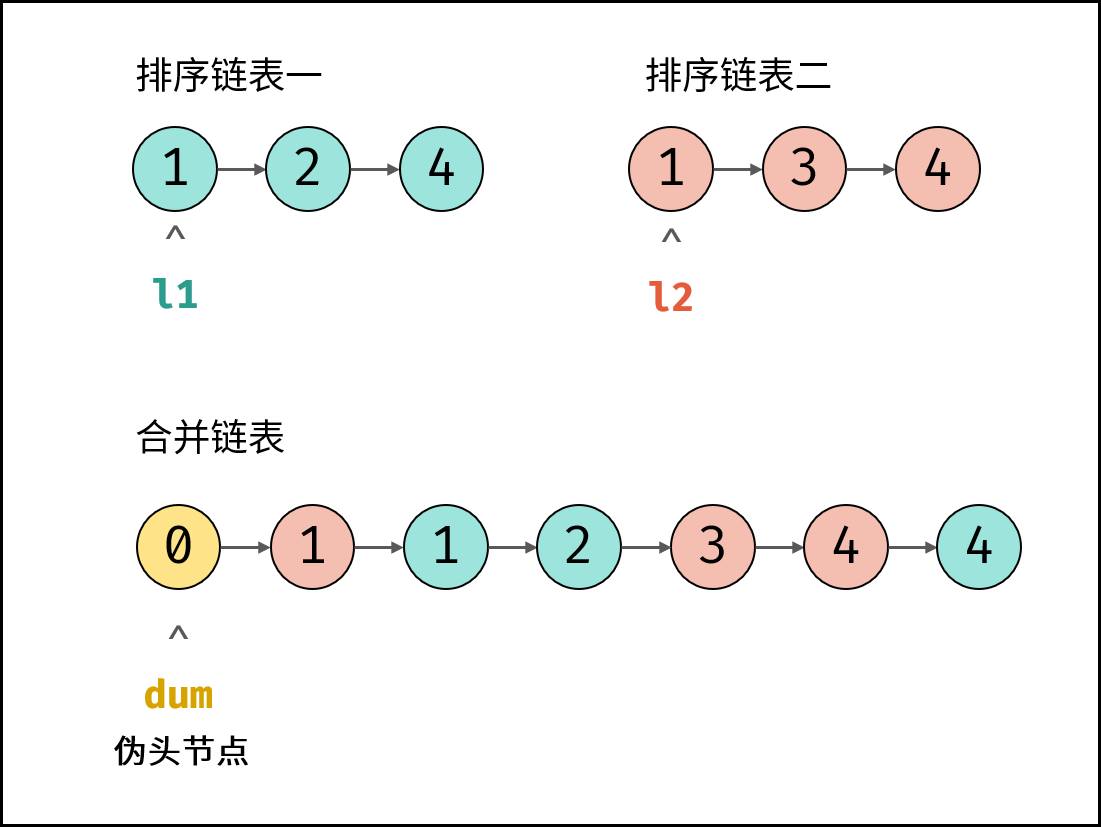{:align=center width=450}
### 算法流程:
1. **初始化:** 伪头节点 `dum` ,节点 `cur` 指向 `dum` 。
2. **循环合并:** 当 `l1` 或 `l2` 为空时跳出;
1. 当 `l1.val < l2.val` 时: `cur` 的后继节点指定为 `l1` ,并 `l1` 向前走一步;
2. 当 `l1.val >= l2.val` 时: `cur` 的后继节点指定为 `l2` ,并 `l2` 向前走一步 ;
3. 节点 `cur` 向前走一步,即 `cur = cur.next` 。
3. **合并剩余尾部:** 跳出时有两种情况,即 `l1` 为空 **或** `l2` 为空。
1. 若 `l1 != null` : 将 `l1` 添加至节点 `cur` 之后;
2. 否则: 将 `l2` 添加至节点 `cur` 之后。
4. **返回值:** 合并链表在伪头节点 `dum` 之后,因此返回 `dum.next` 即可。
## 代码:
Python 三元表达式写法 `A if x else B` ,代表当 `x = True` 时执行 `A` ,否则执行 `B` 。
```Python []
class Solution:
def trainningPlan(self, l1: ListNode, l2: ListNode) -> ListNode:
cur = dum = ListNode(0)
while l1 and l2:
if l1.val < l2.val:
cur.next, l1 = l1, l1.next
else:
cur.next, l2 = l2, l2.next
cur = cur.next
cur.next = l1 if l1 else l2
return dum.next
```
```Java []
class Solution {
public ListNode trainningPlan(ListNode l1, ListNode l2) {
ListNode dum = new ListNode(0), cur = dum;
while(l1 != null && l2 != null) {
if(l1.val < l2.val) {
cur.next = l1;
l1 = l1.next;
}
else {
cur.next = l2;
l2 = l2.next;
}
cur = cur.next;
}
cur.next = l1 != null ? l1 : l2;
return dum.next;
}
}
```
```C++ []
class Solution {
public:
ListNode* trainningPlan(ListNode* l1, ListNode* l2) {
ListNode* dum = new ListNode(0);
ListNode* cur = dum;
while(l1 != nullptr && l2 != nullptr) {
if(l1->val < l2->val) {
cur->next = l1;
l1 = l1->next;
}
else {
cur->next = l2;
l2 = l2->next;
}
cur = cur->next;
}
cur->next = l1 != nullptr ? l1 : l2;
return dum->next;
}
};
```
### 复杂度分析:
- **时间复杂度 $O(M+N)$ :** $M$ , $N$ 分别为链表 `l1`, `l2` 的长度,合并操作需遍历两链表。
- **空间复杂度 $O(1)$ :** 节点引用 `dum` , `cur` 使用常数大小的额外空间。
================================================
FILE: leetbook_ioa/docs/LCR 143. 子结构判断.md
================================================
## 解题思路:
若树 `B` 是树 `A` 的子结构,则子结构的根节点可能为树 `A` 的任意一个节点。因此,判断树 `B` 是否是树 `A` 的子结构,需完成以下两步工作:
1. 先序遍历树 `A` 中的每个节点 `node` ;(对应函数 `isSubStructure(A, B)`)
2. 判断树 `A` 中以 `node` 为根节点的子树是否包含树 `B` 。(对应函数 `recur(A, B)`)
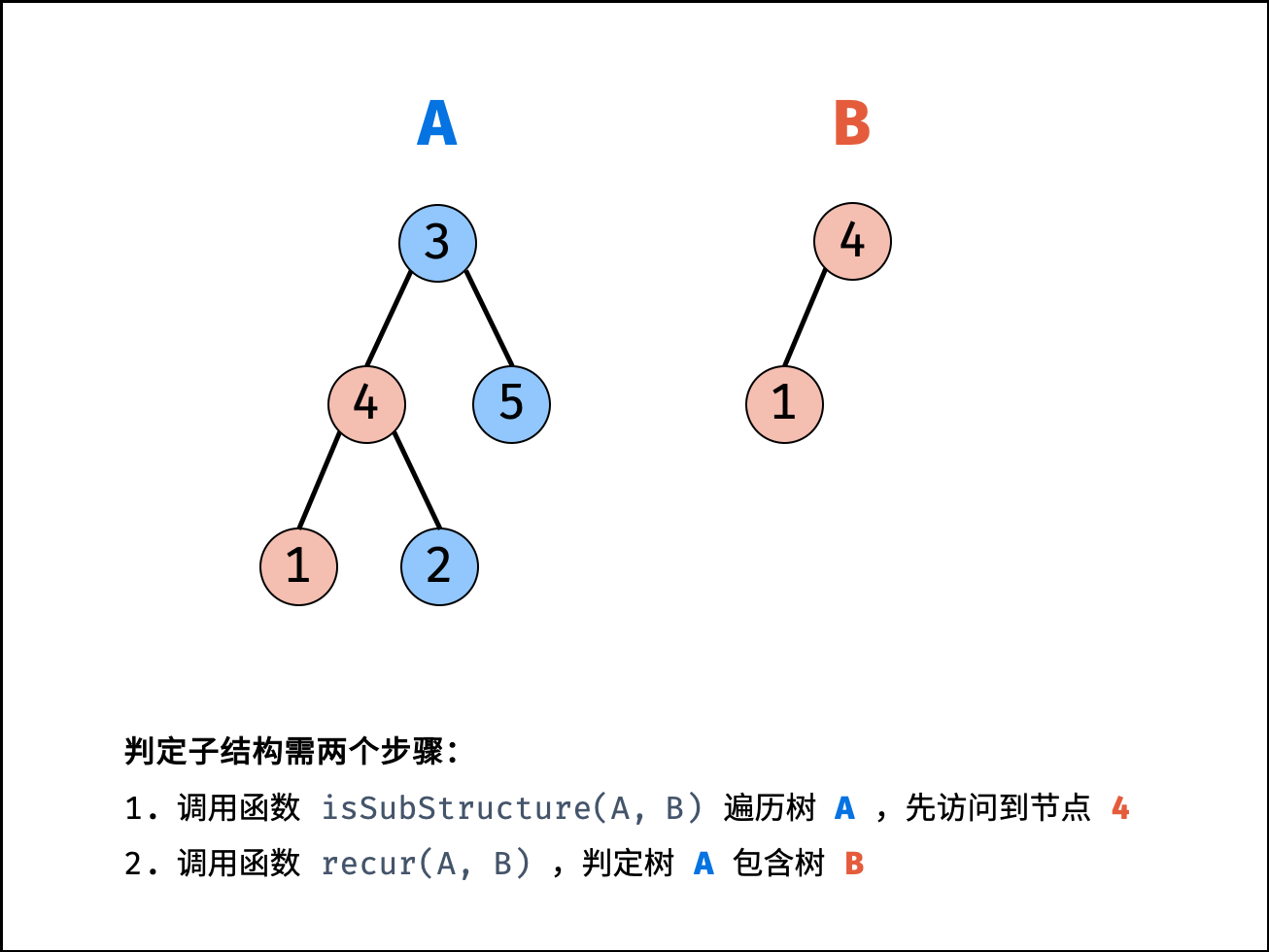{:align=center width=500}
### 算法流程:
本文名词规定:**树 `A`** 的根节点记作 **节点 `A`** ,**树 `B`** 的根节点称为 **节点 `B`** 。
**`recur(A, B)` 函数:**
1. **终止条件:**
1. 当节点 `B` 为空:说明树 `B` 已匹配完成(越过叶子节点),因此返回 $\text{true}$ ;
2. 当节点 `A` 为空:说明已经越过树 `A` 的叶节点,即匹配失败,返回 $\text{false}$ ;
3. 当节点 `A` 和 `B` 的值不同:说明匹配失败,返回 $\text{false}$ ;
2. **返回值:**
1. 判断 `A` 和 `B` 的 **左子节点** 是否相等,即 `recur(A.left, B.left)` ;
2. 判断 `A` 和 `B` 的 **右子节点** 是否相等,即 `recur(A.right, B.right)` ;
**`isSubStructure(A, B)` 函数:**
1. **特例处理:** 当 树 `A` 为空 **或** 树 `B` 为空 时,直接返回 $\text{false}$ ;
2. **返回值:** 若树 `B` 是树 `A` 的子结构,则必满足以下三种情况之一,因此用或 `||` 连接;
1. 以 **节点 `A` 为根节点的子树** 包含树 `B` ,对应 `recur(A, B)`;
2. 树 `B` 是 **树 `A` 左子树** 的子结构,对应 `isSubStructure(A.left, B)`;
3. 树 `B` 是 **树 `A` 右子树** 的子结构,对应 `isSubStructure(A.right, B)`;
## 代码:
```Python []
class Solution:
def isSubStructure(self, A: TreeNode, B: TreeNode) -> bool:
def recur(A, B):
if not B: return True
if not A or A.val != B.val: return False
return recur(A.left, B.left) and recur(A.right, B.right)
return bool(A and B) and (recur(A, B) or self.isSubStructure(A.left, B) or self.isSubStructure(A.right, B))
```
```Java []
class Solution {
public boolean isSubStructure(TreeNode A, TreeNode B) {
return (A != null && B != null) && (recur(A, B) || isSubStructure(A.left, B) || isSubStructure(A.right, B));
}
boolean recur(TreeNode A, TreeNode B) {
if(B == null) return true;
if(A == null || A.val != B.val) return false;
return recur(A.left, B.left) && recur(A.right, B.right);
}
}
```
```C++ []
class Solution {
public:
bool isSubStructure(TreeNode* A, TreeNode* B) {
return (A != nullptr && B != nullptr) && (recur(A, B) || isSubStructure(A->left, B) || isSubStructure(A->right, B));
}
private:
bool recur(TreeNode* A, TreeNode* B) {
if(B == nullptr) return true;
if(A == nullptr || A->val != B->val) return false;
return recur(A->left, B->left) && recur(A->right, B->right);
}
};
```
### 复杂度分析:
- **时间复杂度 $O(MN)$ :** 其中 $M, N$ 分别为树 `A` 和 树 `B` 的节点数量;先序遍历树 `A` 占用 $O(M)$ ,每次调用 `recur(A, B)` 判断占用 $O(N)$ 。
- **空间复杂度 $O(M)$ :** 当树 `A` 和树 `B` 都退化为链表时,递归调用深度最大。当 $M \leq N$ 时,遍历树 `A` 与递归判断的总递归深度为 $M$ ;当 $M>N$ 时,最差情况为遍历至树 `A` 的叶节点,此时总递归深度为 $M$。
================================================
FILE: leetbook_ioa/docs/LCR 144. 翻转二叉树.md
================================================
## 解题思路:
**二叉树镜像定义:** 对于二叉树中任意节点 `root` ,设其左 / 右子节点分别为 `left` , `right` ;则在二叉树的镜像中的对应 `root` 节点,其左 / 右子节点分别为 `right` , `left` 。
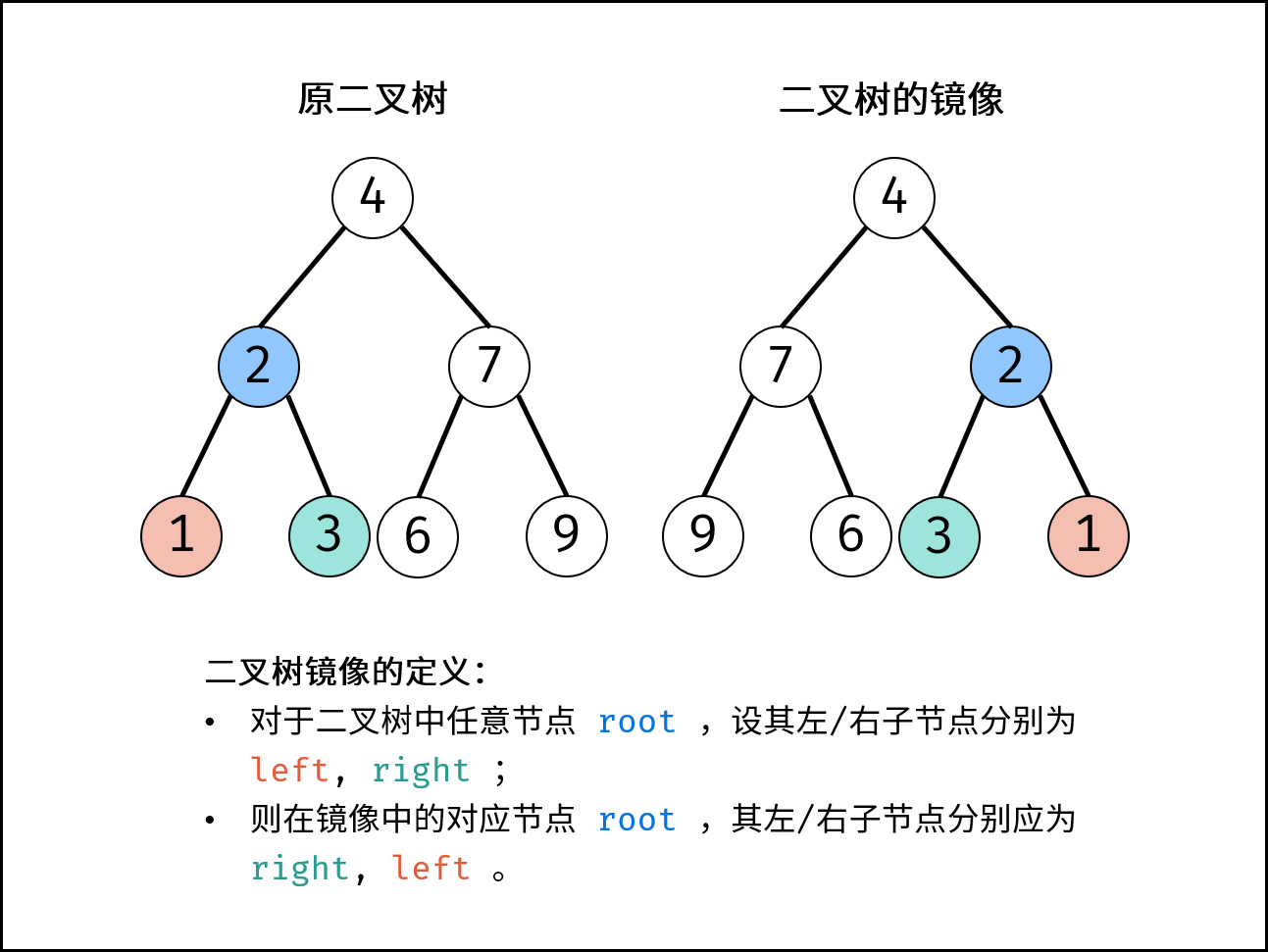{:align=center width=450}
## 方法一:递归
根据二叉树镜像的定义,考虑递归遍历(dfs)二叉树,交换每个节点的左 / 右子节点,即可生成二叉树的镜像。
### 递归解析:
1. **终止条件:** 当节点 `root` 为空时(即越过叶节点),则返回 $\text{null}$ ;
2. **递推工作:**
1. 初始化节点 `tmp` ,用于暂存 `root` 的左子节点;
2. 开启递归 **右子节点** `mirrorTree(root.right)` ,并将返回值作为 `root` 的 **左子节点** 。
3. 开启递归 **左子节点** `mirrorTree(tmp)` ,并将返回值作为 `root` 的 **右子节点** 。
3. **返回值:** 返回当前节点 `root` ;
> **Q:** 为何需要暂存 `root` 的左子节点?
> **A:** 在递归右子节点 “`root.left = mirrorTree(root.right)`” 执行完毕后,`root.left` 的值已经发生改变,此时递归左子节点 `mirrorTree(root.left)` 则会出问题。
## 代码:
```Python []
class Solution:
def mirrorTree(self, root: TreeNode) -> TreeNode:
if not root: return
tmp = root.left
root.left = self.mirrorTree(root.right)
root.right = self.mirrorTree(tmp)
return root
```
```Java []
class Solution {
public TreeNode mirrorTree(TreeNode root) {
if(root == null) return null;
TreeNode tmp = root.left;
root.left = mirrorTree(root.right);
root.right = mirrorTree(tmp);
return root;
}
}
```
```C++ []
class Solution {
public:
TreeNode* mirrorTree(TreeNode* root) {
if (root == nullptr) return nullptr;
TreeNode* tmp = root->left;
root->left = mirrorTree(root->right);
root->right = mirrorTree(tmp);
return root;
}
};
```
Python 利用平行赋值的写法(即 `a, b = b, a` ),可省略暂存操作。其原理是先将等号右侧打包成元组 `(b,a)` ,再序列地分给等号左侧的 `a, b` 序列。
```Python []
class Solution:
def mirrorTree(self, root: TreeNode) -> TreeNode:
if not root: return
root.left, root.right = self.mirrorTree(root.right), self.mirrorTree(root.left)
return root
```
### 复杂度分析:
- **时间复杂度 $O(N)$ :** 其中 $N$ 为二叉树的节点数量,建立二叉树镜像需要遍历树的所有节点,占用 $O(N)$ 时间。
- **空间复杂度 $O(N)$ :** 最差情况下(当二叉树退化为链表),递归时系统需使用 $O(N)$ 大小的栈空间。
## 方法二:辅助栈(或队列)
利用栈(或队列)遍历树的所有节点 `node` ,并交换每个 `node` 的左 / 右子节点。
### 算法流程:
1. **特例处理:** 当 `root` 为空时,直接返回 $null$ ;
2. **初始化:** 栈(或队列),本文用栈,并加入根节点 `root` 。
3. **循环交换:** 当栈 `stack` 为空时跳出;
1. **出栈:** 记为 `node` ;
2. **添加子节点:** 将 `node` 左和右子节点入栈;
3. **交换:** 交换 `node` 的左 / 右子节点。
4. **返回值:** 返回根节点 `root` 。
### 代码:
```Python []
class Solution:
def mirrorTree(self, root: TreeNode) -> TreeNode:
if not root: return
stack = [root]
while stack:
node = stack.pop()
if node.left: stack.append(node.left)
if node.right: stack.append(node.right)
node.left, node.right = node.right, node.left
return root
```
```Java []
class Solution {
public TreeNode mirrorTree(TreeNode root) {
if(root == null) return null;
Stack stack = new Stack<>() {{ add(root); }};
while(!stack.isEmpty()) {
TreeNode node = stack.pop();
if(node.left != null) stack.add(node.left);
if(node.right != null) stack.add(node.right);
TreeNode tmp = node.left;
node.left = node.right;
node.right = tmp;
}
return root;
}
}
```
```C++ []
class Solution {
public:
TreeNode* mirrorTree(TreeNode* root) {
if(root == nullptr) return nullptr;
stack stack;
stack.push(root);
while (!stack.empty())
{
TreeNode* node = stack.top();
stack.pop();
if (node->left != nullptr) stack.push(node->left);
if (node->right != nullptr) stack.push(node->right);
TreeNode* tmp = node->left;
node->left = node->right;
node->right = tmp;
}
return root;
}
};
```
### 复杂度分析:
- **时间复杂度 $O(N)$ :** 其中 $N$ 为二叉树的节点数量,建立二叉树镜像需要遍历树的所有节点,占用 $O(N)$ 时间。
- **空间复杂度 $O(N)$ :** 如下图所示,最差情况下,栈 `stack` 最多同时存储 $\frac{N + 1}{2}$ 个节点,占用 $O(N)$ 额外空间。
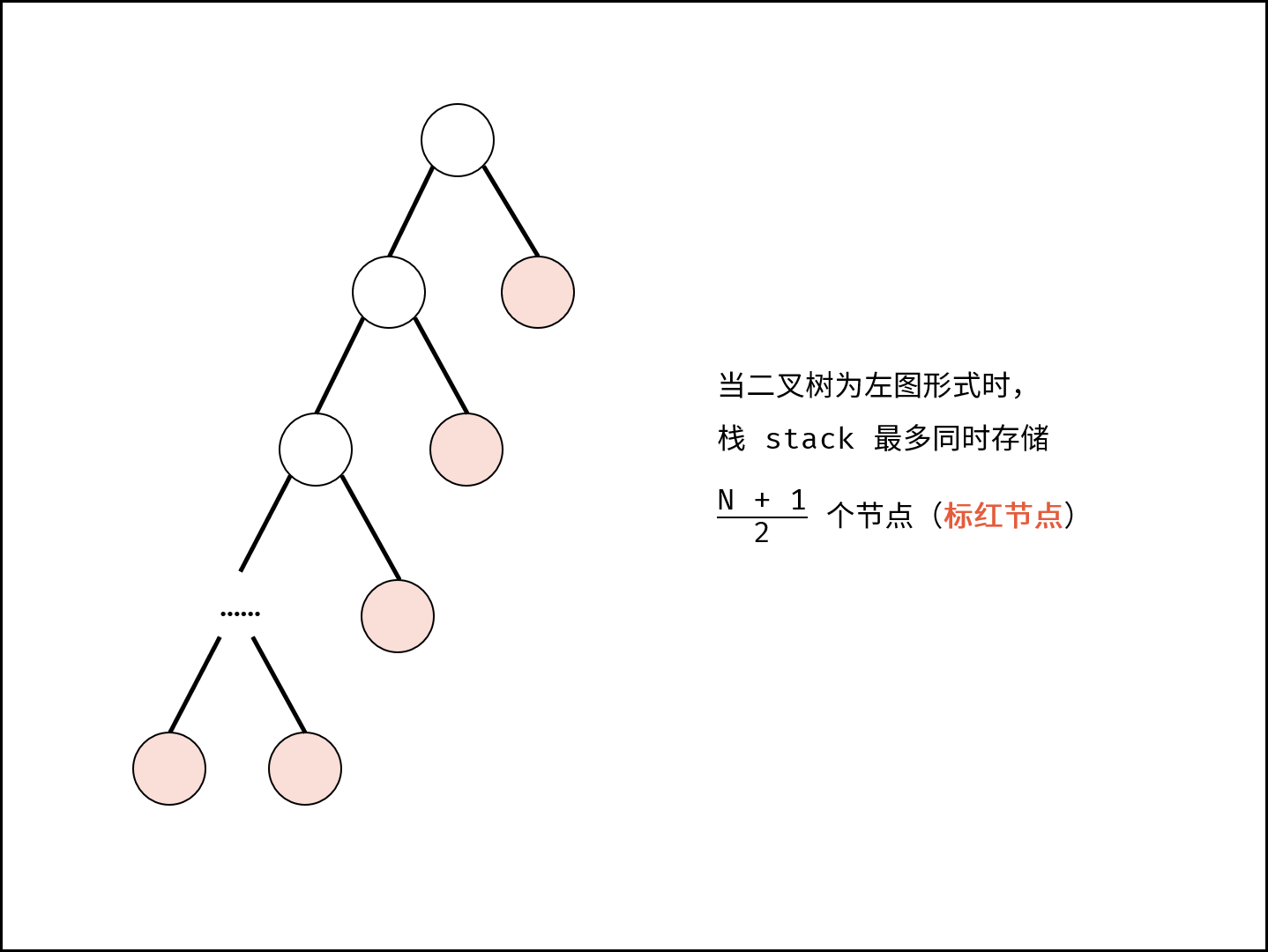{:align=center width=450}
================================================
FILE: leetbook_ioa/docs/LCR 145. 判断对称二叉树.md
================================================
## 解题思路:
**对称二叉树定义:** 对于树中 **任意两个对称节点** `L` 和 `R `,一定有:
- `L.val = R.val` :即此两对称节点值相等。
- `L.left.val = R.right.val` :即 $L$ 的 左子节点 和 $R$ 的 右子节点 对称;
- `L.right.val = R.left.val` :即 $L$ 的 右子节点 和 $R$ 的 左子节点 对称。
根据以上规律,考虑从顶至底递归,判断每对左右节点是否对称,从而判断树是否为对称二叉树。
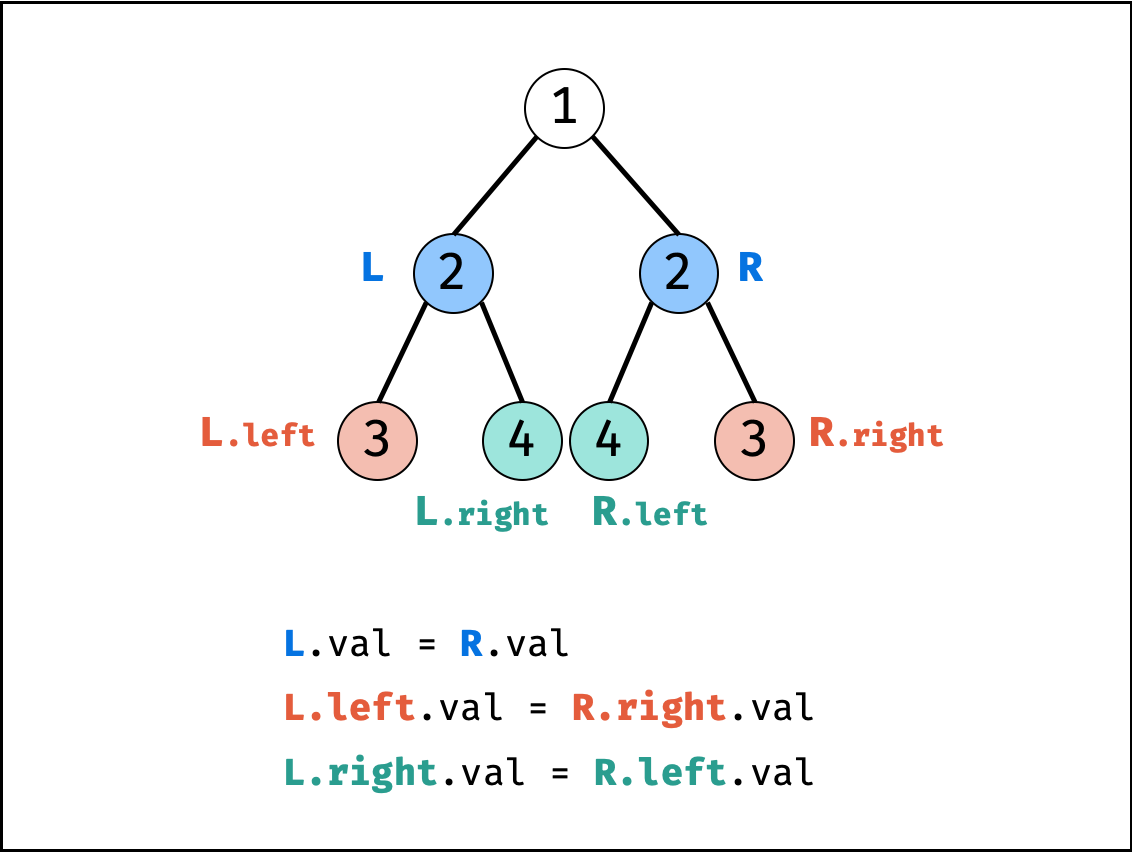{:align=center width=450}
### 算法流程:
**`checkSymmetricTree(root)` :**
- **特例处理:** 若根节点 `root` 为空,则直接返回 $\text{true}$ 。
- **返回值:** 即 `recur(root.left, root.right)` ;
**`recur(L, R)` :**
- **终止条件:**
- 当 `L` 和 `R` 同时越过叶节点: 此树从顶至底的节点都对称,因此返回 $\text{true}$ ;
- 当 `L` 或 `R` 中只有一个越过叶节点: 此树不对称,因此返回 $\text{false}$ ;
- 当节点 `L` 值 $\ne$ 节点 `R` 值: 此树不对称,因此返回 $\text{false}$ ;
- **递推工作:**
- 判断两节点 `L.left` 和 `R.right` 是否对称,即 `recur(L.left, R.right)` ;
- 判断两节点 `L.right` 和 `R.left` 是否对称,即 `recur(L.right, R.left)` ;
- **返回值:** 两对节点都对称时,才是对称树,因此用与逻辑符 `&&` 连接。
## 代码:
```Python []
class Solution:
def checkSymmetricTree(self, root: TreeNode) -> bool:
def recur(L, R):
if not L and not R: return True
if not L or not R or L.val != R.val: return False
return recur(L.left, R.right) and recur(L.right, R.left)
return not root or recur(root.left, root.right)
```
```Java []
class Solution {
public boolean checkSymmetricTree(TreeNode root) {
return root == null || recur(root.left, root.right);
}
boolean recur(TreeNode L, TreeNode R) {
if(L == null && R == null) return true;
if(L == null || R == null || L.val != R.val) return false;
return recur(L.left, R.right) && recur(L.right, R.left);
}
}
```
```C++ []
class Solution {
public:
bool checkSymmetricTree(TreeNode* root) {
return root == nullptr || recur(root->left, root->right);
}
private:
bool recur(TreeNode* L, TreeNode* R) {
if(L == nullptr && R == nullptr) return true;
if(L == nullptr || R == nullptr || L->val != R->val) return false;
return recur(L->left, R->right) && recur(L->right, R->left);
}
};
```
### 复杂度分析:
- **时间复杂度 $O(N)$ :** 其中 $N$ 为二叉树的节点数量,每次执行 `recur()` 可以判断一对节点是否对称,因此最多调用 $N/2$ 次 `recur()` 方法。
- **空间复杂度 $O(N)$ :** 如下图所示,最差情况下(二叉树退化为链表),系统使用 $O(N)$ 大小的空间。
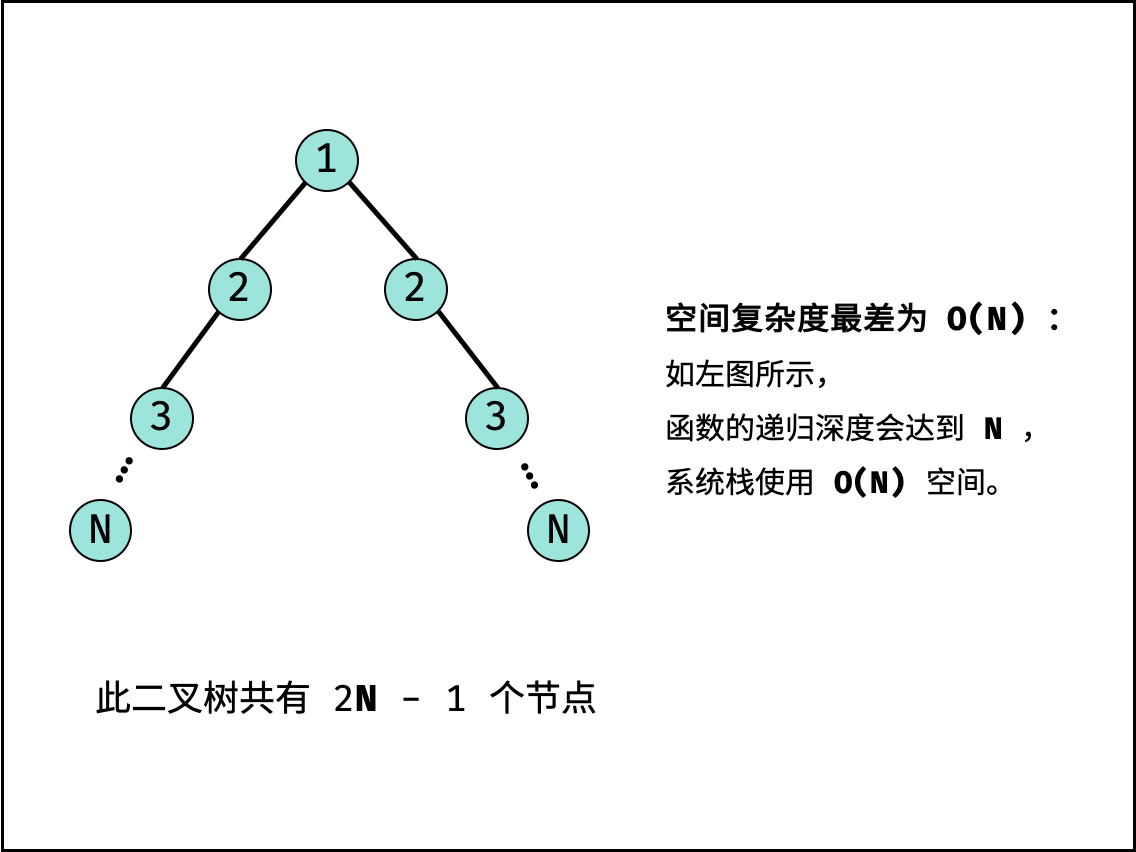{:align=center width=450}
================================================
FILE: leetbook_ioa/docs/LCR 146. 螺旋遍历二维数组.md
================================================
## 解题思路:
根据题目示例 `array = [[1,2,3],[4,5,6],[7,8,9]]` 的对应输出 `[1,2,3,6,9,8,7,4,5]` 可以发现,顺时针打印矩阵的顺序是 **“从左向右、从上向下、从右向左、从下向上”** 循环。
因此,考虑设定矩阵的 “左、上、右、下” 四个边界,模拟以上矩阵遍历顺序。
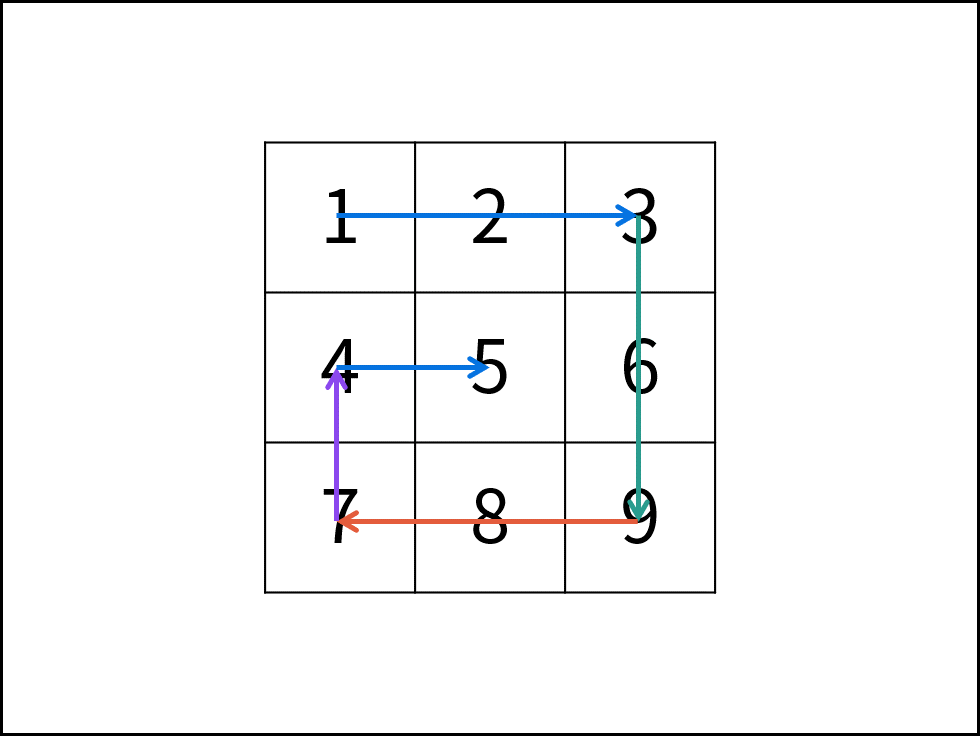{:align=center width=450}
### 算法流程:
1. **空值处理:** 当 `array` 为空时,直接返回空列表 `[]` 即可。
2. **初始化:** 矩阵 左、右、上、下 四个边界 `l` , `r` , `t` , `b` ,用于打印的结果列表 `res` 。
3. **循环打印:** “从左向右、从上向下、从右向左、从下向上” 四个方向循环打印;
1. 根据边界打印,即将元素按顺序添加至列表 `res` 尾部;
2. 边界向内收缩 1 (代表已被打印);
3. 判断边界是否相遇(是否打印完毕),若打印完毕则跳出。
4. **返回值:** 返回 `res` 即可。
| 打印方向 | 1. 根据边界打印 | 2. 边界向内收缩 | 3. 是否打印完毕 |
| -------- | ---------------------- | ----------------- | --------------- |
| 从左向右 | 左边界`l` ,右边界 `r` | 上边界 `t` 加 $1$ | 是否 `t > b` |
| 从上向下 | 上边界 `t` ,下边界`b` | 右边界 `r` 减 $1$ | 是否 `l > r` |
| 从右向左 | 右边界 `r` ,左边界`l` | 下边界 `b` 减 $1$ | 是否 `t > b` |
| 从下向上 | 下边界 `b` ,上边界`t` | 左边界 `l` 加 $1$ | 是否 `l > r` |
## 代码:
Java/C++ 代码利用了 `++` 操作的便利性,详情可见 [++i 和 i++ 的区别](https://www.jianshu.com/p/b62eac216499) ;
- `res[x++]` 等价于先给 `res[x]` 赋值,再给 `x` 自增 $1$ ;
- `++t > b` 等价于先给 `t` 自增 $1$ ,再判断 `t > b` 逻辑表达式。
> TIPS: 请注意区分数字 `1` 和变量 `l` 。
```Python []
class Solution:
def spiralArray(self, array: List[List[int]]) -> List[int]:
if not array: return []
l, r, t, b, res = 0, len(array[0]) - 1, 0, len(array) - 1, []
while True:
for i in range(l, r + 1): res.append(array[t][i]) # left to right
t += 1
if t > b: break
for i in range(t, b + 1): res.append(array[i][r]) # top to bottom
r -= 1
if l > r: break
for i in range(r, l - 1, -1): res.append(array[b][i]) # right to left
b -= 1
if t > b: break
for i in range(b, t - 1, -1): res.append(array[i][l]) # bottom to top
l += 1
if l > r: break
return res
```
```Java []
class Solution {
public int[] spiralArray(int[][] array) {
if(array.length == 0) return new int[0];
int l = 0, r = array[0].length - 1, t = 0, b = array.length - 1, x = 0;
int[] res = new int[(r + 1) * (b + 1)];
while(true) {
for(int i = l; i <= r; i++) res[x++] = array[t][i]; // left to right
if(++t > b) break;
for(int i = t; i <= b; i++) res[x++] = array[i][r]; // top to bottom
if(l > --r) break;
for(int i = r; i >= l; i--) res[x++] = array[b][i]; // right to left
if(t > --b) break;
for(int i = b; i >= t; i--) res[x++] = array[i][l]; // bottom to top
if(++l > r) break;
}
return res;
}
}
```
```C++ []
class Solution {
public:
vector spiralArray(vector>& array)
{
if (array.empty()) return {};
int l = 0, r = array[0].size() - 1, t = 0, b = array.size() - 1;
vector res;
while(true)
{
for (int i = l; i <= r; i++) res.push_back(array[t][i]); // left to right
if (++t > b) break;
for (int i = t; i <= b; i++) res.push_back(array[i][r]); // top to bottom
if (l > --r) break;
for (int i = r; i >= l; i--) res.push_back(array[b][i]); // right to left
if (t > --b) break;
for (int i = b; i >= t; i--) res.push_back(array[i][l]); // bottom to top
if (++l > r) break;
}
return res;
}
};
```
### 复杂度分析:
- **时间复杂度 $O(MN)$ :** $M, N$ 分别为矩阵行数和列数。
- **空间复杂度 $O(1)$ :** 四个边界 `l` , `r` , `t` , `b` 使用常数大小的额外空间。
================================================
FILE: leetbook_ioa/docs/LCR 147. 最小栈.md
================================================
## 解题思路:
普通栈的 `push()` 和 `pop()` 函数的复杂度为 $O(1)$ ;而获取栈最小值 `getMin()` 函数需要遍历整个栈,复杂度为 $O(N)$ 。
**本题难点:** 将 `getMin()` 函数复杂度降为 $O(1)$ 。可借助辅助栈实现:
- **数据栈 `A` :** 栈 `A` 用于存储所有元素,保证入栈 `push()` 函数、出栈 `pop()` 函数、获取栈顶 `top()` 函数的正常逻辑。
- **辅助栈 `B` :** 栈 `B` 中存储栈 `A` 中所有 **非严格降序** 元素的子序列,则栈 `A` 中的最小元素始终对应栈 `B` 的栈顶元素。此时,`getMin()` 函数只需返回栈 `B` 的栈顶元素即可。
因此,只需设法维护好 栈 `B` 的元素,使其保持是栈 `A` 的非严格降序元素的子序列,即可实现 `getMin()` 函数的 $O(1)$ 复杂度。
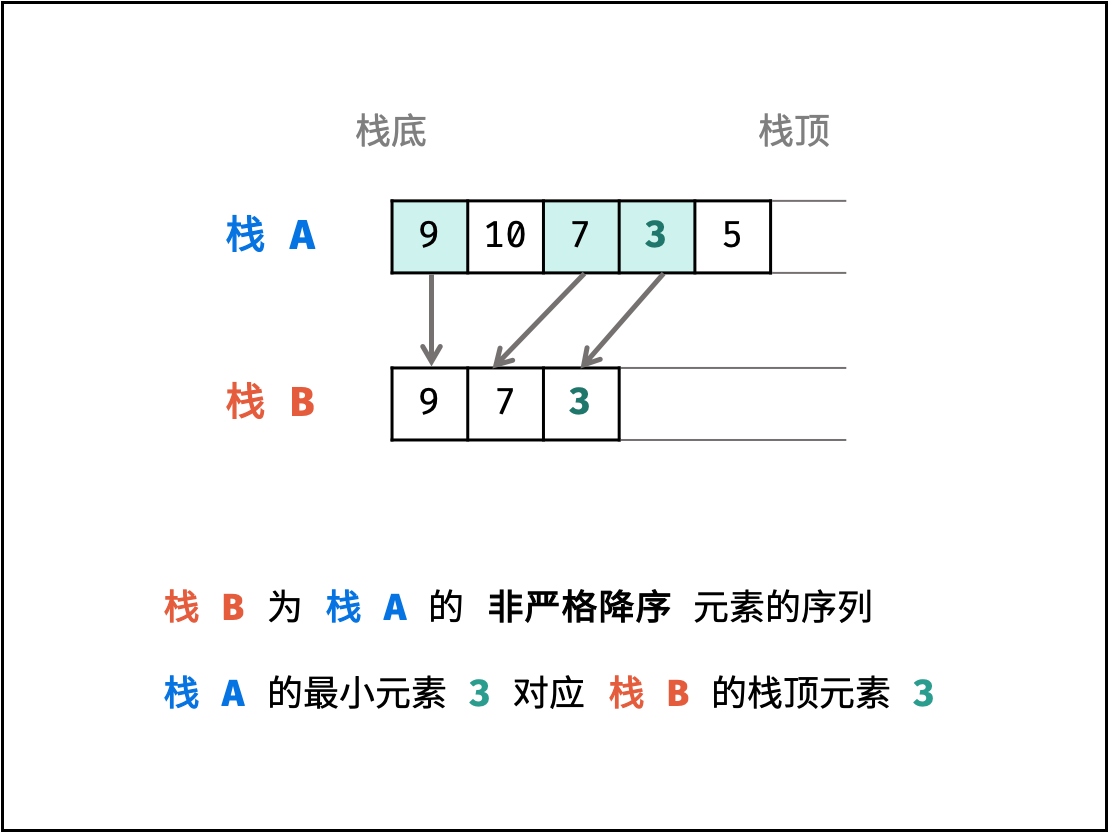{:align=center width=450}
### 函数设计:
**`push(x)` 函数:** 重点为保持栈 `B` 的元素是 **非严格降序** 的;
1. 执行「元素 `x` 压入栈 `A`」 ;
2. 若「栈 `B` 为空」**或**「`x` $\leq$ 栈 `B` 的栈顶元素」,则执行「元素 `x` 压入栈 `B`」 ;
**`pop()` 函数:** 重点为保持栈 `A` , `B` 的 **元素一致性** ;
1. 执行「栈 `A` 元素出栈」,将出栈元素记为 `y` ;
2. 若 「`y` 等于栈 `B` 的栈顶元素」,则执行「栈 `B` 元素出栈」;
**`top()` 函数:** 直接返回栈 `A` 的栈顶元素,即返回 `A.peek()` ;
**`getMin()` 函数:** 直接返回栈 `B` 的栈顶元素,即返回 `B.peek()` ;
> 下图中的 `min()` 对应本题的 `getMin()` 。
### 采用 “非严格” 降序原因:
在栈 `A` 具有 **重复** 最小值元素时,非严格降序可防止栈 `B` 提前弹出最小值元素,示例如下:
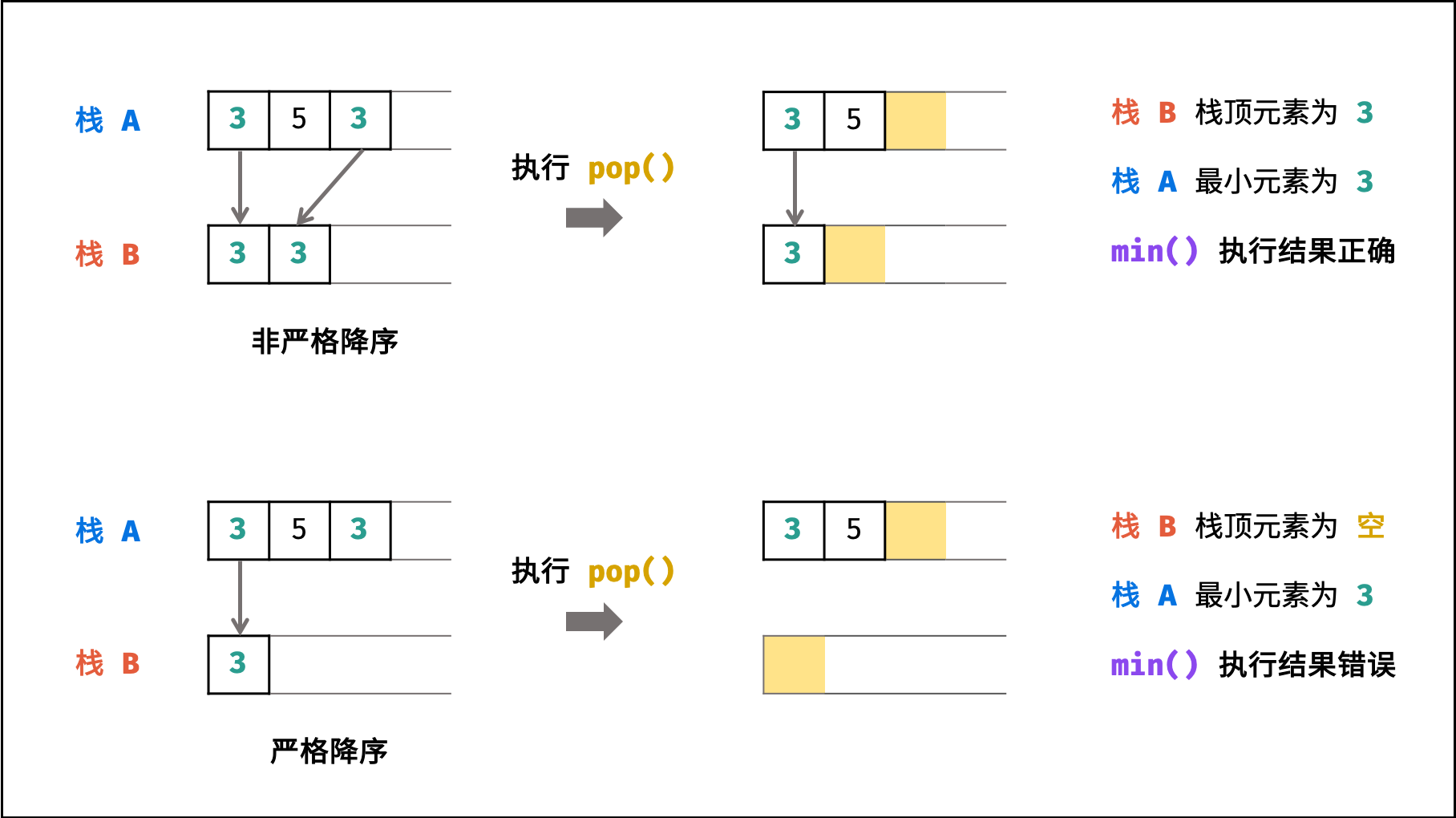{:align=center width=550}
## 代码:
Java 代码中,由于 Stack 中存储的是 int 的包装类 Integer ,因此需要使用 `equals()` 代替 `==` ,以比较对象的值。
```Python []
class MinStack:
def __init__(self):
self.A, self.B = [], []
def push(self, x: int) -> None:
self.A.append(x)
if not self.B or self.B[-1] >= x:
self.B.append(x)
def pop(self) -> None:
if self.A.pop() == self.B[-1]:
self.B.pop()
def top(self) -> int:
return self.A[-1]
def getMin(self) -> int:
return self.B[-1]
```
```Java []
class MinStack {
Stack A, B;
public MinStack() {
A = new Stack<>();
B = new Stack<>();
}
public void push(int x) {
A.add(x);
if(B.empty() || B.peek() >= x)
B.add(x);
}
public void pop() {
if(A.pop().equals(B.peek()))
B.pop();
}
public int top() {
return A.peek();
}
public int getMin() {
return B.peek();
}
}
```
```C++ []
class MinStack {
public:
stack A, B;
MinStack() {}
void push(int x) {
A.push(x);
if(B.empty() || B.top() >= x)
B.push(x);
}
void pop() {
if(A.top() == B.top())
B.pop();
A.pop();
}
int top() {
return A.top();
}
int getMin() {
return B.top();
}
};
```
### 复杂度分析:
- **时间复杂度 $O(1)$ :** `push()`, `pop()`, `top()`, `getMin()` 四个函数的时间复杂度均为常数级别。
- **空间复杂度 $O(N)$ :** 当共有 $N$ 个待入栈元素时,辅助栈 `B` 最差情况下存储 $N$ 个元素,使用 $O(N)$ 额外空间。
================================================
FILE: leetbook_ioa/docs/LCR 148. 验证图书取出顺序.md
================================================
## 解题思路:
如下图所示,给定一个放入序列 `putIn` 和拿取序列 `takeOut` ,则放入(压栈)和拿取(弹出)操作的顺序是 **唯一确定** 的。
> 下图中 `pushed` 和 `popped` 分别对应本题的 `putIn` 和 `takeOut` 。
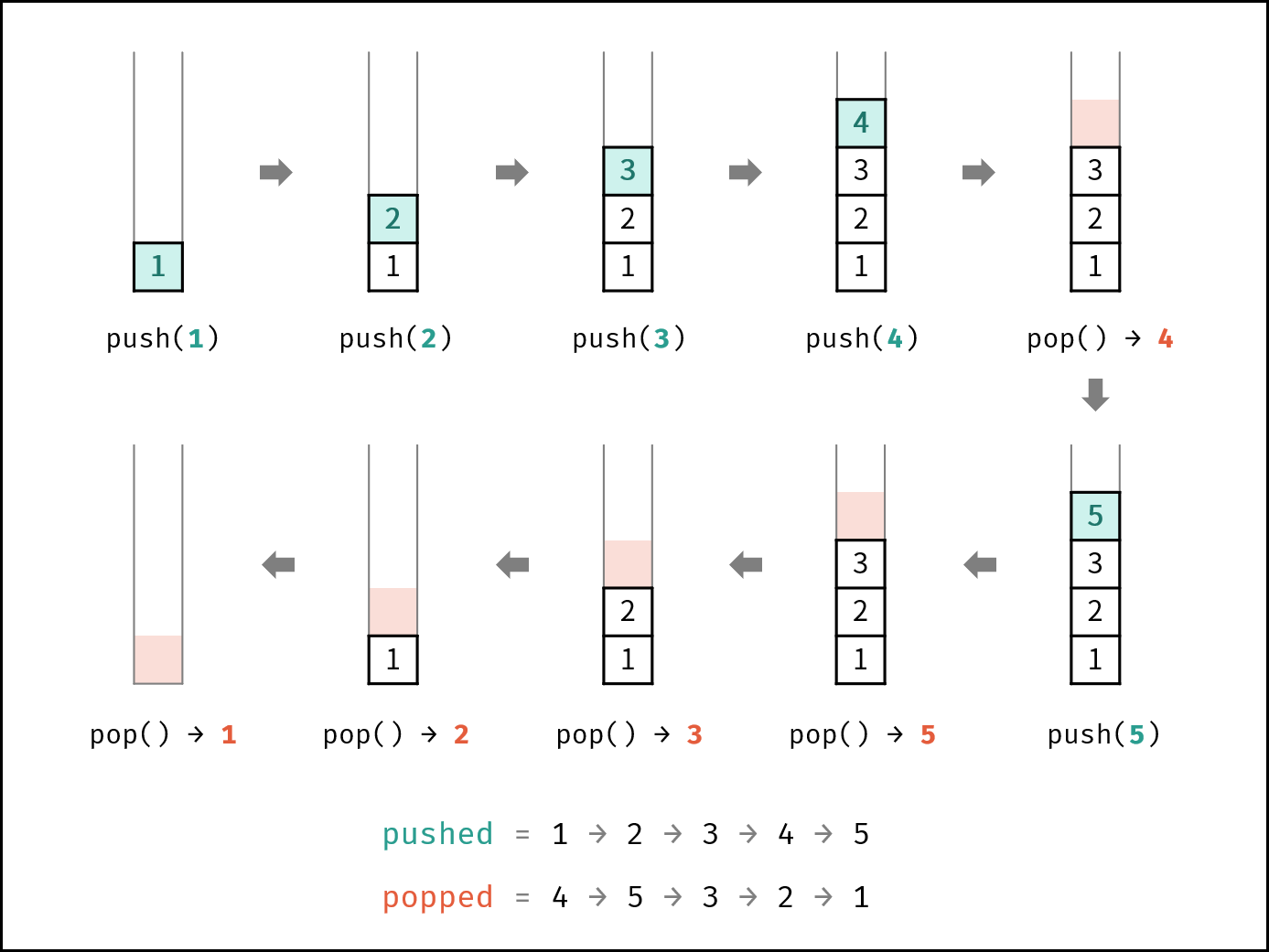{:align=center width=500}
如下图所示,栈的数据操作具有 **先入后出** 的特性,因此某些拿取序列是无法实现的。
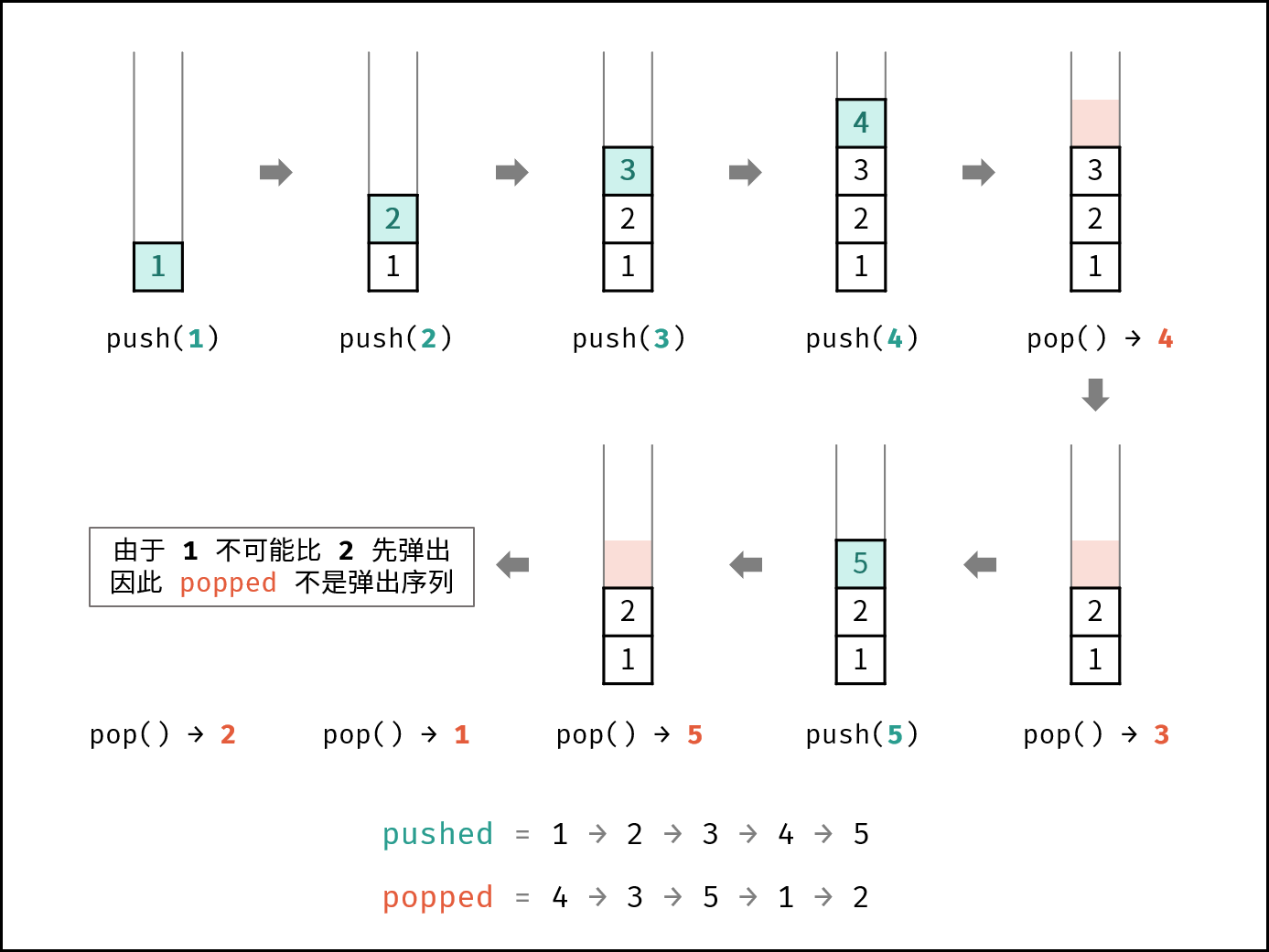{:align=center width=500}
考虑借用一个辅助栈 `stack` ,**模拟** 放入 / 拿取操作的排列。根据是否模拟成功,即可得到结果。
- **入栈操作:** 按照压栈序列的顺序执行。
- **出栈操作:** 每次入栈后,循环判断 “栈顶元素 $=$ 拿取序列的当前元素” 是否成立,将符合拿取序列顺序的栈顶元素全部拿取。
> 由于题目规定 “栈的所有数字均不相等” ,因此在循环入栈中,每个元素出栈的位置的可能性是唯一的(若有重复数字,则具有多个可出栈的位置)。因而,在遇到 “栈顶元素 $=$ 拿取序列的当前元素” 就应立即执行出栈。
### 算法流程:
1. **初始化:** 辅助栈 `stack` ,拿取序列的索引 `i` ;
2. **遍历压栈序列:** 各元素记为 `num` ;
1. 元素 `num` 入栈;
2. 循环出栈:若 `stack` 的栈顶元素 $=$ 拿取序列元素 `takeOut[i]` ,则执行出栈与 `i++` ;
3. **返回值:** 若 `stack` 为空,则此拿取序列合法。
## 代码:
题目指出 “putIn 是 takeOut 的排列” 。因此,无需考虑 `putIn` 和 `takeOut` **长度不同** 或 **包含元素不同** 的情况。
```Python []
class Solution:
def validateBookSequences(self, putIn: List[int], takeOut: List[int]) -> bool:
stack, i = [], 0
for num in putIn:
stack.append(num) # num 入栈
while stack and stack[-1] == takeOut[i]: # 循环判断与出栈
stack.pop()
i += 1
return not stack
```
```Java []
class Solution {
public boolean validateBookSequences(int[] putIn, int[] takeOut) {
Stack stack = new Stack<>();
int i = 0;
for(int num : putIn) {
stack.push(num); // num 入栈
while(!stack.isEmpty() && stack.peek() == takeOut[i]) { // 循环判断与出栈
stack.pop();
i++;
}
}
return stack.isEmpty();
}
}
```
```C++ []
class Solution {
public:
bool validateBookSequences(vector& putIn, vector& takeOut) {
stack stk;
int i = 0;
for(int num : putIn) {
stk.push(num); // num 入栈
while(!stk.empty() && stk.top() == takeOut[i]) { // 循环判断与出栈
stk.pop();
i++;
}
}
return stk.empty();
}
};
```
### 复杂度分析:
- **时间复杂度 $O(N)$ :** 其中 $N$ 为列表 `putIn` 的长度;每个元素最多入栈与出栈一次,即最多共 $2N$ 次出入栈操作。
- **空间复杂度 $O(N)$ :** 辅助栈 `stack` 最多同时存储 $N$ 个元素。
================================================
FILE: leetbook_ioa/docs/LCR 149. 彩灯装饰记录 I.md
================================================
## 解题思路:
题目要求按层打印二叉树,即二叉树的 **广度优先遍历** ,其通常借助 **队列** 的先入先出特性来实现。
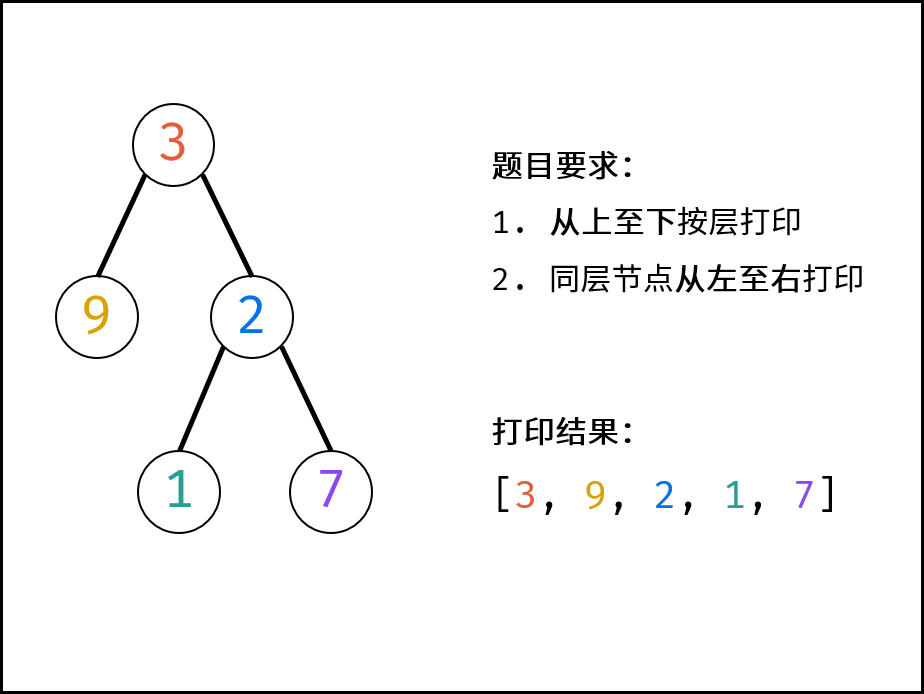{:align=center width=450}
### 算法流程:
1. **特例处理:** 当树的根节点为空,则直接返回空列表 `[]` ;
2. **初始化:** 打印结果列表 `res = []` ,包含根节点的队列 `queue = [root]` ;
3. **BFS 循环:** 当队列 `queue` 为空时跳出;
1. **出队:** 队首元素出队,记为 `node`;
2. **打印:** 将 `node.val` 添加至列表 `tmp` 尾部;
3. **添加子节点:** 若 `node` 的左(右)子节点不为空,则将左(右)子节点加入队列 `queue` ;
4. **返回值:** 返回打印结果列表 `res` 即可。
## 代码:
Python 中使用 collections 中的双端队列 `deque()` ,其 `popleft()` 方法可达到 $O(1)$ 时间复杂度;列表 list 的 `pop(0)` 方法时间复杂度为 $O(N)$ 。
```Python []
class Solution:
def decorateRecord(self, root: TreeNode) -> List[int]:
if not root: return []
res, queue = [], collections.deque()
queue.append(root)
while queue:
node = queue.popleft()
res.append(node.val)
if node.left: queue.append(node.left)
if node.right: queue.append(node.right)
return res
```
```Java []
class Solution {
public int[] decorateRecord(TreeNode root) {
if(root == null) return new int[0];
Queue queue = new LinkedList<>(){{ add(root); }};
ArrayList ans = new ArrayList<>();
while(!queue.isEmpty()) {
TreeNode node = queue.poll();
ans.add(node.val);
if(node.left != null) queue.add(node.left);
if(node.right != null) queue.add(node.right);
}
int[] res = new int[ans.size()];
for(int i = 0; i < ans.size(); i++)
res[i] = ans.get(i);
return res;
}
}
```
```C++ []
class Solution {
public:
vector decorateRecord(TreeNode* root) {
vector res;
if(!root) return res;
queue que;
que.push(root);
while(!que.empty()){
TreeNode* node = que.front();
que.pop();
res.push_back(node->val);
if(node->left) que.push(node->left);
if(node->right) que.push(node->right);
}
return res;
}
};
```
### 复杂度分析:
- **时间复杂度 $O(N)$ :** $N$ 为二叉树的节点数量,即 BFS 需循环 $N$ 次。
- **空间复杂度 $O(N)$ :** 最差情况下,即当树为平衡二叉树时,最多有 $N/2$ 个树节点**同时**在 `queue` 中,使用 $O(N)$ 大小的额外空间。
================================================
FILE: leetbook_ioa/docs/LCR 150. 彩灯装饰记录 II.md
================================================
## 解题思路:
在上一题层序遍历的基础上,本题要求将 **每层打印到一行**。考虑将当前全部节点打印到一行,并将下一层全部节点加入队列,以此类推,即可分为多行打印。
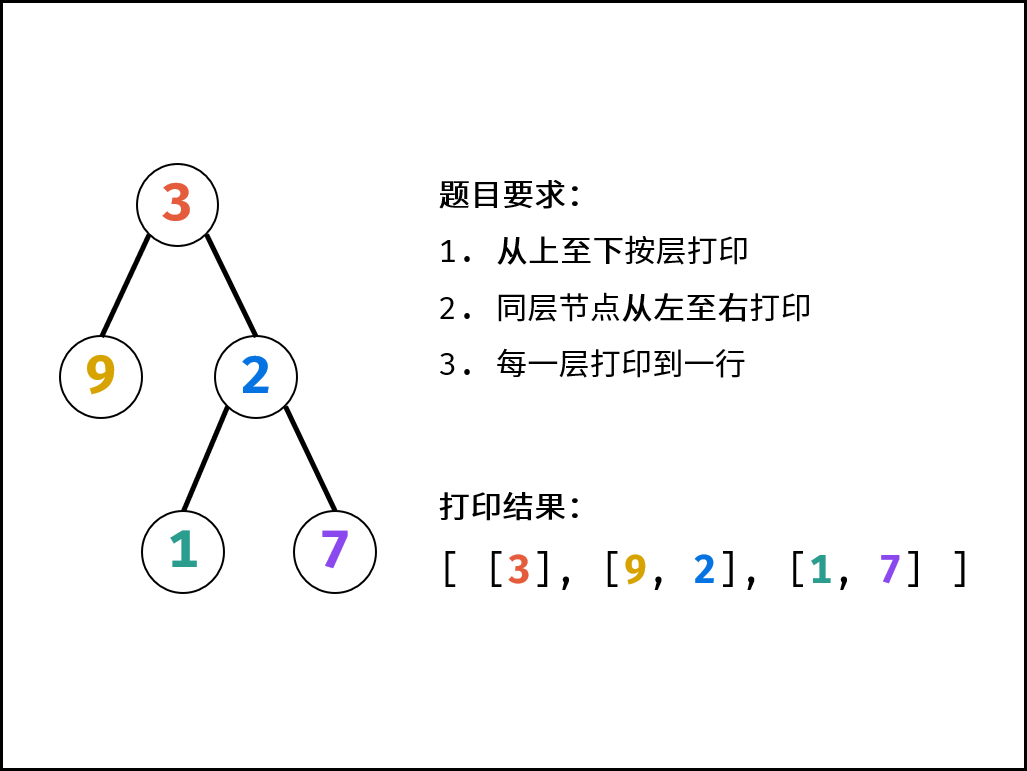{:align=center width=450}
### 算法流程:
1. **特例处理:** 当根节点为空,则返回空列表 `[]` ;
2. **初始化:** 打印结果列表 `res = []` ,包含根节点的队列 `queue = [root]` ;
3. **BFS 循环:** 当队列 `queue` 为空时跳出;
1. 新建一个临时列表 `tmp` ,用于存储当前层打印结果;
2. **当前层打印循环:** 循环次数为当前层节点数(即队列 `queue` 长度);
1. **出队:** 队首元素出队,记为 `node`;
2. **打印:** 将 `node.val` 添加至 `tmp` 尾部;
3. **添加子节点:** 若 `node` 的左(右)子节点不为空,则将左(右)子节点加入队列 `queue` ;
3. 将当前层结果 `tmp` 添加入 `res` 。
4. **返回值:** 返回打印结果列表 `res` 即可。
## 代码:
Python 中使用 collections 中的双端队列 `deque()` ,其 `popleft()` 方法可达到 $O(1)$ 时间复杂度;列表 list 的 `pop(0)` 方法时间复杂度为 $O(N)$ 。
```Python []
class Solution:
def decorateRecord(self, root: TreeNode) -> List[List[int]]:
if not root: return []
res, queue = [], collections.deque()
queue.append(root)
while queue:
tmp = []
for _ in range(len(queue)):
node = queue.popleft()
tmp.append(node.val)
if node.left: queue.append(node.left)
if node.right: queue.append(node.right)
res.append(tmp)
return res
```
```Java []
class Solution {
public List> decorateRecord(TreeNode root) {
Queue queue = new LinkedList<>();
List> res = new ArrayList<>();
if(root != null) queue.add(root);
while(!queue.isEmpty()) {
List tmp = new ArrayList<>();
for(int i = queue.size(); i > 0; i--) {
TreeNode node = queue.poll();
tmp.add(node.val);
if(node.left != null) queue.add(node.left);
if(node.right != null) queue.add(node.right);
}
res.add(tmp);
}
return res;
}
}
```
```C++ []
class Solution {
public:
vector> decorateRecord(TreeNode* root) {
queue que;
vector> res;
if(root != NULL) que.push(root);
while(!que.empty()) {
vector tmp;
for(int i = que.size(); i > 0; --i) {
root = que.front();
que.pop();
tmp.push_back(root->val);
if(root->left != NULL) que.push(root->left);
if(root->right != NULL) que.push(root->right);
}
res.push_back(tmp);
}
return res;
}
};
```
### 复杂度分析:
- **时间复杂度 $O(N)$ :** $N$ 为二叉树的节点数量,即 BFS 需循环 $N$ 次。
- **空间复杂度 $O(N)$ :** 最差情况下,即当树为平衡二叉树时,最多有 $N/2$ 个树节点**同时**在 `queue` 中,使用 $O(N)$ 大小的额外空间。
================================================
FILE: leetbook_ioa/docs/LCR 151. 彩灯装饰记录 III.md
================================================
## 方法一:层序遍历 + 双端队列
利用双端队列的两端皆可添加元素的特性,设打印列表(双端队列) `tmp` ,并规定:
- 奇数层 则添加至 `tmp` **尾部** 。
- 偶数层 则添加至 `tmp` **头部** 。
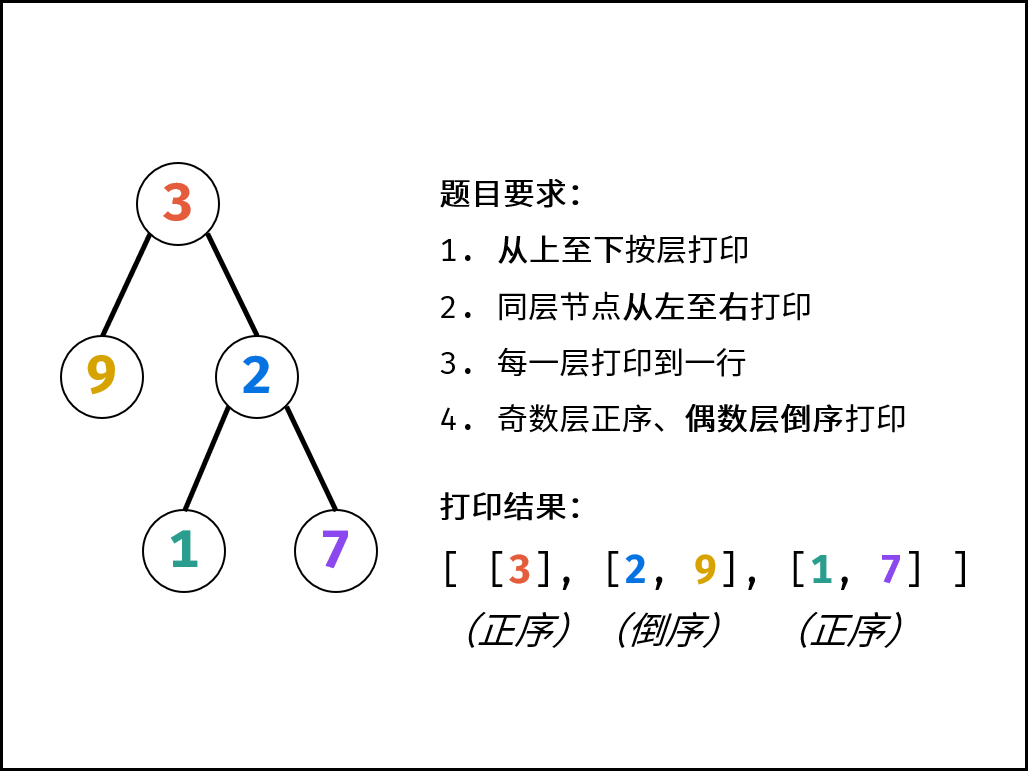{:align=center width=450}
### 算法流程:
1. **特例处理:** 当树的根节点为空,则直接返回空列表 `[]` ;
2. **初始化:** 打印结果空列表 `res` ,包含根节点的双端队列 `deque` ;
3. **BFS 循环:** 当 `deque` 为空时跳出;
1. 新建列表 `tmp` ,用于临时存储当前层打印结果;
2. **当前层打印循环:** 循环次数为当前层节点数(即 `deque` 长度);
1. **出队:** 队首元素出队,记为 `node`;
2. **打印:** 若为奇数层,将 `node.val` 添加至 `tmp` 尾部;否则,添加至 `tmp` 头部;
3. **添加子节点:** 若 `node` 的左(右)子节点不为空,则加入 `deque` ;
3. 将当前层结果 `tmp` 转化为 list 并添加入 `res` ;
4. **返回值:** 返回打印结果列表 `res` 即可;
### 代码:
- Python 中使用 collections 中的双端队列 `deque()` ,其 `popleft()` 方法可达到 $O(1)$ 时间复杂度;列表 list 的 `pop(0)` 方法时间复杂度为 $O(N)$ 。
- Java 中将链表 LinkedList 作为双端队列使用。
```Python []
class Solution:
def decorateRecord(self, root: TreeNode) -> List[List[int]]:
if not root: return []
res, deque = [], collections.deque([root])
while deque:
tmp = collections.deque()
for _ in range(len(deque)):
node = deque.popleft()
if len(res) % 2 == 0: tmp.append(node.val) # 奇数层 -> 插入队列尾部
else: tmp.appendleft(node.val) # 偶数层 -> 插入队列头部
if node.left: deque.append(node.left)
if node.right: deque.append(node.right)
res.append(list(tmp))
return res
```
```Java []
class Solution {
public List> decorateRecord(TreeNode root) {
Queue queue = new LinkedList<>();
List> res = new ArrayList<>();
if(root != null) queue.add(root);
while(!queue.isEmpty()) {
LinkedList tmp = new LinkedList<>();
for(int i = queue.size(); i > 0; i--) {
TreeNode node = queue.poll();
if(res.size() % 2 == 0) tmp.addLast(node.val);
else tmp.addFirst(node.val);
if(node.left != null) queue.add(node.left);
if(node.right != null) queue.add(node.right);
}
res.add(tmp);
}
return res;
}
}
```
### 复杂度分析:
- **时间复杂度 $O(N)$ :** $N$ 为二叉树的节点数量,即 BFS 需循环 $N$ 次,占用 $O(N)$ ;双端队列的队首和队尾的添加和删除操作的时间复杂度均为 $O(1)$ 。
- **空间复杂度 $O(N)$ :** 最差情况下,即当树为满二叉树时,最多有 $N/2$ 个树节点 **同时** 在 `deque` 中,使用 $O(N)$ 大小的额外空间。
## 方法二:层序遍历 + 双端队列(奇偶层逻辑分离)
- 方法一代码简短、容易实现;但需要判断每个节点的所在层奇偶性,即冗余了 $N$ 次判断。
- 通过将奇偶层逻辑拆分,可以消除冗余的判断。
### 算法流程:
> 与方法一对比,仅 BFS 循环不同。
**BFS 循环:** 循环打印奇 / 偶数层,当 `deque` 为空时跳出;
1. **打印奇数层:** **从左向右** 打印,**先左后右** 加入下层节点;
2. 若 `deque` 为空,说明向下无偶数层,则跳出;
3. **打印偶数层:** **从右向左** 打印,**先右后左** 加入下层节点;
### 代码:
```Python []
class Solution:
def decorateRecord(self, root: TreeNode) -> List[List[int]]:
if not root: return []
res, deque = [], collections.deque()
deque.append(root)
while deque:
tmp = []
# 打印奇数层
for _ in range(len(deque)):
# 从左向右打印
node = deque.popleft()
tmp.append(node.val)
# 先左后右加入下层节点
if node.left: deque.append(node.left)
if node.right: deque.append(node.right)
res.append(tmp)
if not deque: break # 若为空则提前跳出
# 打印偶数层
tmp = []
for _ in range(len(deque)):
# 从右向左打印
node = deque.pop()
tmp.append(node.val)
# 先右后左加入下层节点
if node.right: deque.appendleft(node.right)
if node.left: deque.appendleft(node.left)
res.append(tmp)
return res
```
```Java []
class Solution {
public List> decorateRecord(TreeNode root) {
Deque deque = new LinkedList<>();
List> res = new ArrayList<>();
if(root != null) deque.add(root);
while(!deque.isEmpty()) {
// 打印奇数层
List tmp = new ArrayList<>();
for(int i = deque.size(); i > 0; i--) {
// 从左向右打印
TreeNode node = deque.removeFirst();
tmp.add(node.val);
// 先左后右加入下层节点
if(node.left != null) deque.addLast(node.left);
if(node.right != null) deque.addLast(node.right);
}
res.add(tmp);
if(deque.isEmpty()) break; // 若为空则提前跳出
// 打印偶数层
tmp = new ArrayList<>();
for(int i = deque.size(); i > 0; i--) {
// 从右向左打印
TreeNode node = deque.removeLast();
tmp.add(node.val);
// 先右后左加入下层节点
if(node.right != null) deque.addFirst(node.right);
if(node.left != null) deque.addFirst(node.left);
}
res.add(tmp);
}
return res;
}
}
```
```C++ []
class Solution {
public:
vector> decorateRecord(TreeNode* root) {
deque deque;
vector> res;
if(root != NULL) deque.push_back(root);
while(!deque.empty()) {
// 打印奇数层
vector tmp;
for(int i = deque.size(); i > 0; i--) {
// 从左向右打印
TreeNode* node = deque.front();
deque.pop_front();
tmp.push_back(node->val);
// 先左后右加入下层节点
if(node->left != NULL) deque.push_back(node->left);
if(node->right != NULL) deque.push_back(node->right);
}
res.push_back(tmp);
if(deque.empty()) break; // 若为空则提前跳出
// 打印偶数层
tmp.clear();
for(int i = deque.size(); i > 0; i--) {
// 从右向左打印
TreeNode* node = deque.back();
deque.pop_back();
tmp.push_back(node->val);
// 先右后左加入下层节点
if(node->right != NULL) deque.push_front(node->right);
if(node->left != NULL) deque.push_front(node->left);
}
res.push_back(tmp);
}
return res;
}
};
```
### 复杂度分析:
- **时间复杂度 $O(N)$ :** 同方法一。
- **空间复杂度 $O(N)$ :** 同方法一。
## 方法三:层序遍历 + 倒序
- 此方法的优点是只用列表即可,无需其他数据结构。
- **偶数层倒序:** 若 `res` 的长度为 **奇数** ,说明当前是偶数层,则对 `tmp` 执行 **倒序** 操作。
### 代码:
```Python []
class Solution:
def decorateRecord(self, root: TreeNode) -> List[List[int]]:
if not root: return []
res, queue = [], collections.deque()
queue.append(root)
while queue:
tmp = []
for _ in range(len(queue)):
node = queue.popleft()
tmp.append(node.val)
if node.left: queue.append(node.left)
if node.right: queue.append(node.right)
res.append(tmp[::-1] if len(res) % 2 else tmp)
return res
```
```Java []
class Solution {
public List> decorateRecord(TreeNode root) {
Queue queue = new LinkedList<>();
List> res = new ArrayList<>();
if(root != null) queue.add(root);
while(!queue.isEmpty()) {
List tmp = new ArrayList<>();
for(int i = queue.size(); i > 0; i--) {
TreeNode node = queue.poll();
tmp.add(node.val);
if(node.left != null) queue.add(node.left);
if(node.right != null) queue.add(node.right);
}
if(res.size() % 2 == 1) Collections.reverse(tmp);
res.add(tmp);
}
return res;
}
}
```
```C++ []
class Solution {
public:
vector> decorateRecord(TreeNode* root) {
queue que;
vector> res;
if(root != NULL) que.push(root);
while(!que.empty()) {
vector tmp;
for(int i = que.size(); i > 0; i--) {
TreeNode* node = que.front();
que.pop();
tmp.push_back(node->val);
if(node->left != NULL) que.push(node->left);
if(node->right != NULL) que.push(node->right);
}
if(res.size() % 2 == 1) reverse(tmp.begin(),tmp.end());
res.push_back(tmp);
}
return res;
}
};
```
### 复杂度分析:
- **时间复杂度 $O(N)$ :** $N$ 为二叉树的节点数量,即 BFS 需循环 $N$ 次,占用 $O(N)$ 。**共完成** 少于 $N$ 个节点的倒序操作,占用 $O(N)$ 。
- **空间复杂度 $O(N)$ :** 最差情况下,即当树为满二叉树时,最多有 $N/2$ 个树节点**同时**在 `queue` 中,使用 $O(N)$ 大小的额外空间。
================================================
FILE: leetbook_ioa/docs/LCR 152. 验证二叉搜索树的后序遍历序列.md
================================================
## 解题思路:
**后序遍历定义:** `[ 左子树 | 右子树 | 根节点 ]` ,即遍历顺序为 “左、右、根” 。
**二叉搜索树定义:** 左子树中所有节点的值 $<$ 根节点的值;右子树中所有节点的值 $>$ 根节点的值;其左、右子树也分别为二叉搜索树。
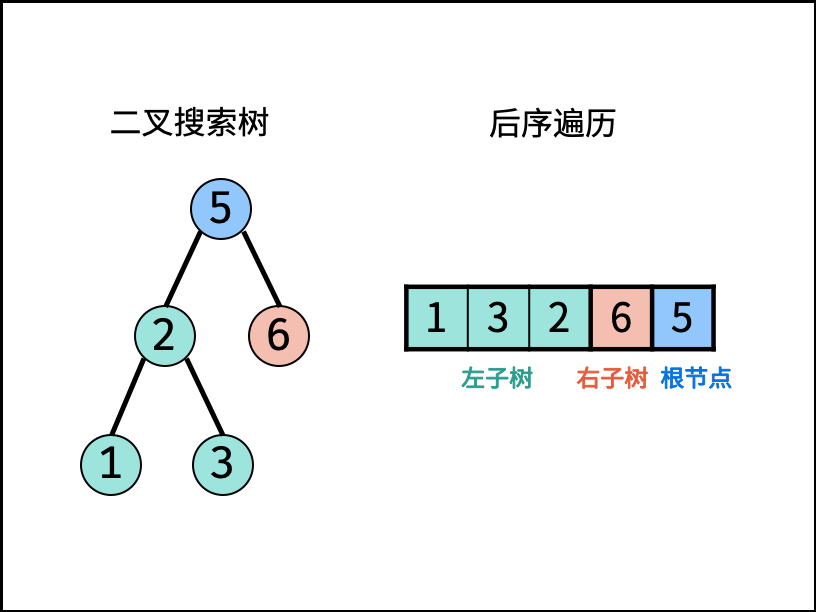{:align=center width=500}
## 方法一:递归分治
根据二叉搜索树的定义,可以通过递归,判断所有子树的 **正确性** (即其后序遍历是否满足二叉搜索树的定义) ,若所有子树都正确,则此序列为二叉搜索树的后序遍历。
### 递归解析:
**终止条件:** 当 $i \geq j$ ,说明此子树节点数量 $\leq 1$ ,无需判别正确性,因此直接返回 $\text{true}$ ;
**递推工作:**
1. **划分左右子树:** 遍历后序遍历的 $[i, j]$ 区间元素,寻找 **第一个大于根节点** 的节点,索引记为 $m$ 。此时,可划分出左子树区间 $[i,m-1]$ 、右子树区间 $[m, j - 1]$ 、根节点索引 $j$ 。
2. **判断是否为二叉搜索树:**
- **左子树区间** $[i, m - 1]$ 内的所有节点都应 $<$ $postorder[j]$ 。而第 `1.划分左右子树` 步骤已经保证左子树区间的正确性,因此只需要判断右子树区间即可。
- **右子树区间** $[m, j-1]$ 内的所有节点都应 $>$ $postorder[j]$ 。实现方式为遍历,当遇到 $\leq postorder[j]$ 的节点则跳出;则可通过 $p = j$ 判断是否为二叉搜索树。
**返回值:** 所有子树都需正确才可判定正确,因此使用 **与逻辑符** $\&\&$ 连接。
1. **$p = j$ :** 判断 **此树** 是否正确。
2. **$recur(i, m - 1)$ :** 判断 **此树的左子树** 是否正确。
3. **$recur(m, j - 1)$ :** 判断 **此树的右子树** 是否正确。
### 代码:
```Python []
class Solution:
def verifyTreeOrder(self, postorder: List[int]) -> bool:
def recur(i, j):
if i >= j: return True
p = i
while postorder[p] < postorder[j]: p += 1
m = p
while postorder[p] > postorder[j]: p += 1
return p == j and recur(i, m - 1) and recur(m, j - 1)
return recur(0, len(postorder) - 1)
```
```Java []
class Solution {
public boolean verifyTreeOrder(int[] postorder) {
return recur(postorder, 0, postorder.length - 1);
}
boolean recur(int[] postorder, int i, int j) {
if(i >= j) return true;
int p = i;
while(postorder[p] < postorder[j]) p++;
int m = p;
while(postorder[p] > postorder[j]) p++;
return p == j && recur(postorder, i, m - 1) && recur(postorder, m, j - 1);
}
}
```
```C++ []
class Solution {
public:
bool verifyTreeOrder(vector& postorder) {
return recur(postorder, 0, postorder.size() - 1);
}
private:
bool recur(vector& postorder, int i, int j) {
if(i >= j) return true;
int p = i;
while(postorder[p] < postorder[j]) p++;
int m = p;
while(postorder[p] > postorder[j]) p++;
return p == j && recur(postorder, i, m - 1) && recur(postorder, m, j - 1);
}
};
```
### 复杂度分析:
- **时间复杂度 $O(N^2)$ :** 每次调用 $recur(i,j)$ 减去一个根节点,因此递归占用 $O(N)$ ;最差情况下(即当树退化为链表),每轮递归都需遍历树所有节点,占用 $O(N)$ 。
- **空间复杂度 $O(N)$ :** 最差情况下(即当树退化为链表),递归深度将达到 $N$ 。
## 方法二:辅助单调栈
**后序遍历倒序:** `[ 根节点 | 右子树 | 左子树 ]` 。类似 **先序遍历的镜像** ,即先序遍历为 “根、左、右” 的顺序,而后序遍历的倒序为 “根、右、左” 顺序。
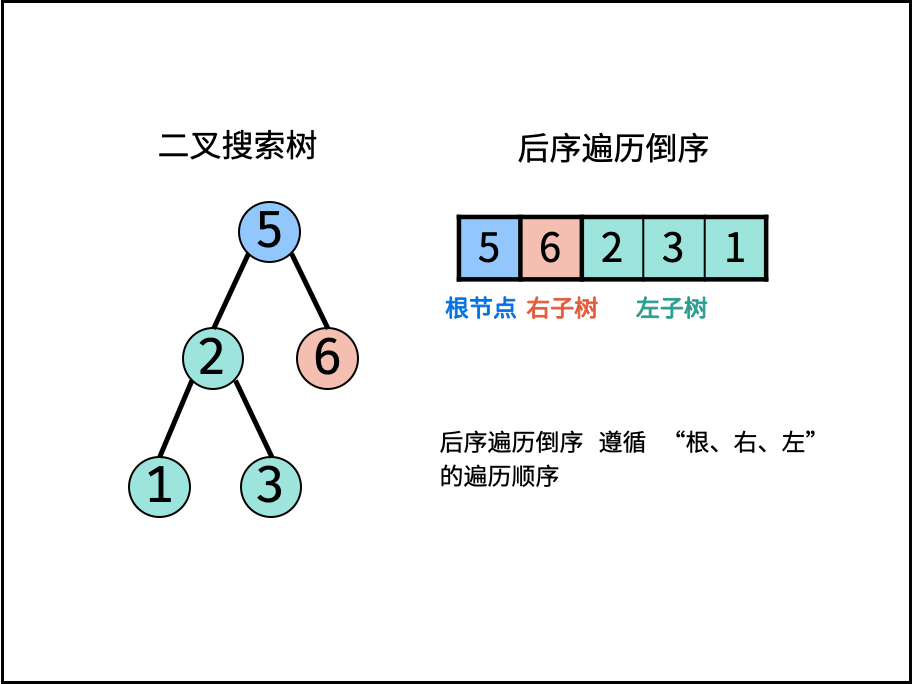{:align=center width=500}
设后序遍历倒序列表为 $[r_{n}, r_{n-1},...,r_1]$,遍历此列表,设索引为 $i$ ,若为 **二叉搜索树** ,则有:
- **当节点值 $r_i > r_{i+1}$ 时:** 节点 $r_i$ 一定是节点 $r_{i+1}$ 的右子节点。
- **当节点值 $r_i < r_{i+1}$ 时:** 节点 $r_i$ 一定是某节点 $root$ 的左子节点,且 $root$ 为节点 $r_{i+1}, r_{i+2},..., r_{n}$ 中值大于且最接近 $r_i$ 的节点(∵ $root$ **直接连接** 左子节点 $r_i$ )。
当遍历时遇到递减节点 $r_i < r_{i+1}$ ,若为二叉搜索树,则对于后序遍历中节点 $r_i$ 右边的任意节点 $r_x \in [r_{i-1}, r_{i-2}, ..., r_1]$ ,必有节点值 $r_x < root$ 。
> 节点 $r_x$ 只可能为以下两种情况:(1) $r_x$ 为 $r_i$ 的左、右子树的各节点;(2) $r_x$ 为 $root$ 的父节点或更高层父节点的左子树的各节点。在二叉搜索树中,以上节点都应小于 $root$ 。
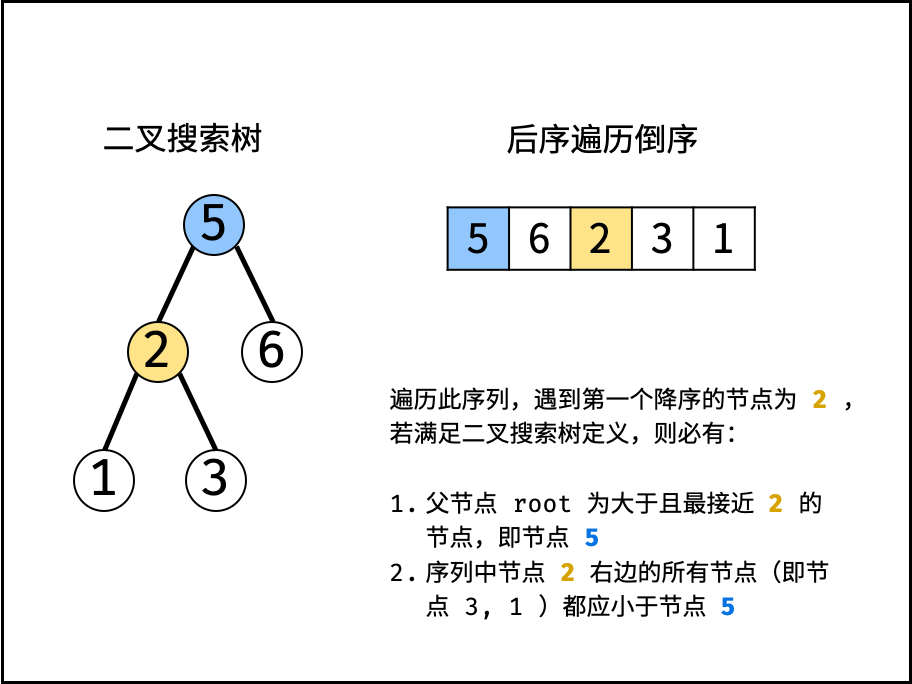{:align=center width=500}
遍历 “后序遍历的倒序” 会多次遇到递减节点 $r_i$ ,若所有的递减节点 $r_i$ 对应的父节点 $root$ 都满足以上条件,则可判定为二叉搜索树。根据以上特点,考虑借助 **单调栈** 实现:
1. 借助一个单调栈 $stack$ 存储值递增的节点;
2. 每当遇到值递减的节点 $r_i$ ,则通过出栈来更新节点 $r_i$ 的父节点 $root$ ;
3. 每轮判断 $r_i$ 和 $root$ 的值关系:
1. 若 $r_i > root$ 则说明不满足二叉搜索树定义,直接返回 $\text{false}$ 。
2. 若 $r_i < root$ 则说明满足二叉搜索树定义,则继续遍历。
### 算法流程:
1. **初始化:** 单调栈 $stack$ ,父节点值 $root = +\infin$ (初始值为正无穷大,可把树的根节点看为此无穷大节点的左孩子);
2. **倒序遍历 $postorder$** :记每个节点为 $r_i$;
1. **判断:** 若 $r_i>root$ ,说明此后序遍历序列不满足二叉搜索树定义,直接返回 $\text{false}$ ;
2. **更新父节点 $root$ :** 当栈不为空 **且** $r_i
### 代码:
```Python []
class Solution:
def verifyTreeOrder(self, postorder: List[int]) -> bool:
stack, root = [], float("+inf")
for i in range(len(postorder) - 1, -1, -1):
if postorder[i] > root: return False
while(stack and postorder[i] < stack[-1]):
root = stack.pop()
stack.append(postorder[i])
return True
```
```Java []
class Solution {
public boolean verifyTreeOrder(int[] postorder) {
Stack stack = new Stack<>();
int root = Integer.MAX_VALUE;
for(int i = postorder.length - 1; i >= 0; i--) {
if(postorder[i] > root) return false;
while(!stack.isEmpty() && stack.peek() > postorder[i])
root = stack.pop();
stack.add(postorder[i]);
}
return true;
}
}
```
```C++ []
class Solution {
public:
bool verifyTreeOrder(vector& postorder) {
stack stk;
int root = INT_MAX;
for(int i = postorder.size() - 1; i >= 0; i--) {
if(postorder[i] > root) return false;
while(!stk.empty() && stk.top() > postorder[i]) {
root = stk.top();
stk.pop();
}
stk.push(postorder[i]);
}
return true;
}
};
```
### 复杂度分析:
- **时间复杂度 $O(N)$ :** 遍历 $postorder$ 所有节点,各节点均入栈 / 出栈一次,使用 $O(N)$ 时间。
- **空间复杂度 $O(N)$ :** 最差情况下,单调栈 $stack$ 存储所有节点,使用 $O(N)$ 额外空间。
================================================
FILE: leetbook_ioa/docs/LCR 153. 二叉树中和为目标值的路径.md
================================================
## 解题思路:
本题是典型的二叉树方案搜索问题,使用回溯法解决,其包含 **先序遍历 + 路径记录** 两部分。
- **先序遍历:** 按照 “根、左、右” 的顺序,遍历树的所有节点。
- **路径记录:** 在先序遍历中,记录从根节点到当前节点的路径。当路径满足 (1) 根节点到叶节点形成的路径 **且** (2) 各节点值的和等于目标值 `target` 时,将此路径加入结果列表。
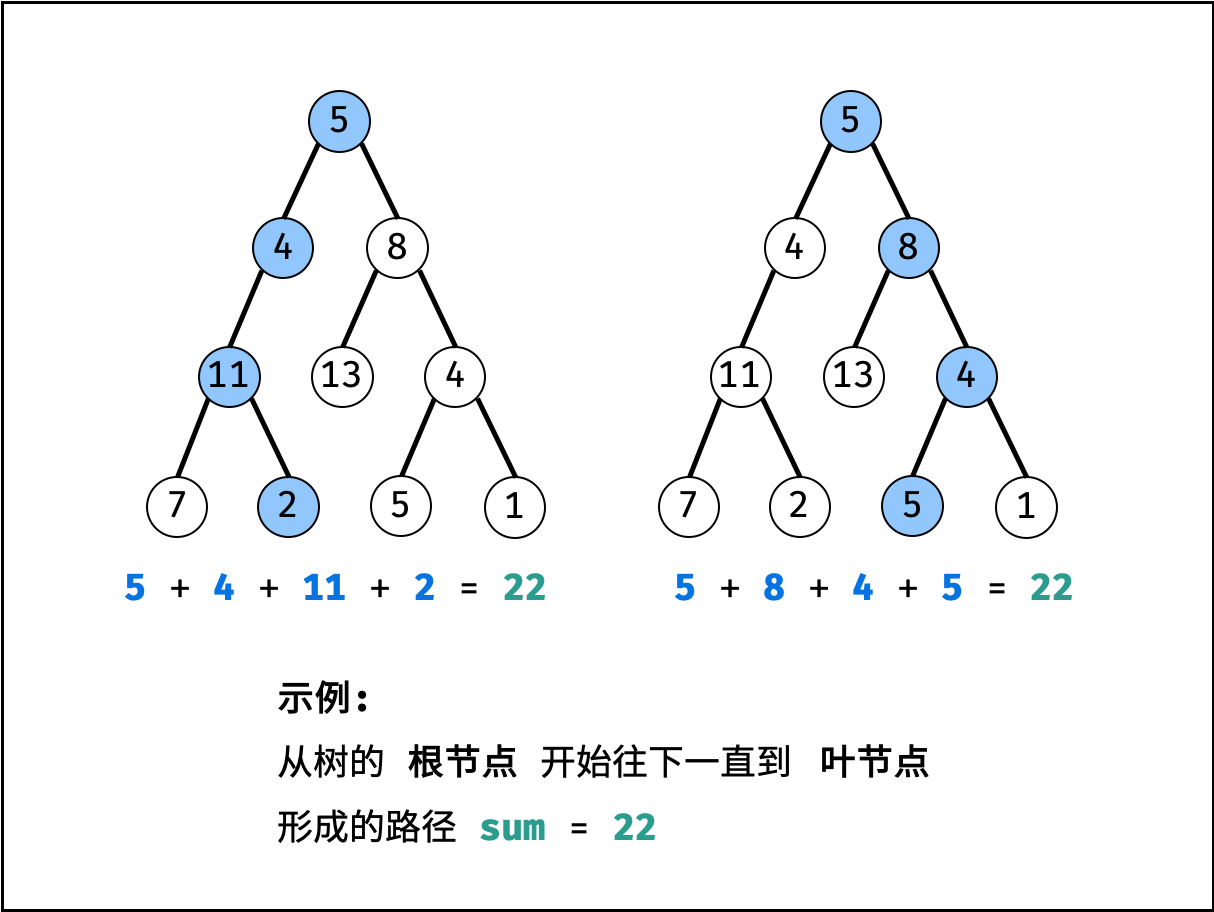{:align=center width=500}
### 算法流程:
**`pathTarget(root, target)` 函数:**
- **初始化:** 结果列表 `res` ,路径列表 `path` 。
- **返回值:** 返回 `res` 即可。
**`recur(root, tar) 函数:`**
- **递推参数:** 当前节点 `root` ,当前目标值 `tar` 。
- **终止条件:** 若节点 `root` 为空,则直接返回。
- **递推工作:**
1. 路径更新: 将当前节点值 `root.val` 加入路径 `path` 。
2. 目标值更新: `tar = tar - root.val`(即目标值 `tar` 从 `target` 减至 $0$ )。
3. 路径记录: 当 “`root` 为叶节点” **且** “路径和等于目标值” ,则将此路径 `path` 加入 `res` 。
4. 先序遍历: 递归左 / 右子节点。
5. 路径恢复: 向上回溯前,需要将当前节点从路径 `path` 中删除,即执行 `path.pop()` 。
## 代码:
以 Python 语言为例,记录路径时若直接执行 `res.append(path)` ,则是将此 `path` 对象加入了 `res` ;后续 `path` 改变时,`res` 中的 `path` 对象也会随之改变,因此无法实现结果记录。正确做法为:
- Python: `res.append(list(path))` ;
- Java: `res.add(new LinkedList(path))` ;
- C++: `res.push_back(path)` ;
> 三者的原理都是避免直接添加 `path` 对象,而是 **拷贝** 了一个 `path` 对象并加入到 `res` 。
```Python []
class Solution:
def pathTarget(self, root: TreeNode, target: int) -> List[List[int]]:
res, path = [], []
def recur(root, tar):
if not root: return
path.append(root.val)
tar -= root.val
if tar == 0 and not root.left and not root.right:
res.append(list(path))
recur(root.left, tar)
recur(root.right, tar)
path.pop()
recur(root, target)
return res
```
```Java []
class Solution {
LinkedList> res = new LinkedList<>();
LinkedList path = new LinkedList<>();
public List> pathTarget(TreeNode root, int target) {
recur(root, target);
return res;
}
void recur(TreeNode root, int tar) {
if(root == null) return;
path.add(root.val);
tar -= root.val;
if(tar == 0 && root.left == null && root.right == null)
res.add(new LinkedList(path));
recur(root.left, tar);
recur(root.right, tar);
path.removeLast();
}
}
```
```C++ []
class Solution {
public:
vector> pathTarget(TreeNode* root, int target) {
recur(root, target);
return res;
}
private:
vector> res;
vector path;
void recur(TreeNode* root, int tar) {
if(root == nullptr) return;
path.push_back(root->val);
tar -= root->val;
if(tar == 0 && root->left == nullptr && root->right == nullptr)
res.push_back(path);
recur(root->left, tar);
recur(root->right, tar);
path.pop_back();
}
};
```
### 复杂度分析:
- **时间复杂度 $O(N)$ :** $N$ 为二叉树的节点数,先序遍历需要遍历所有节点。
- **空间复杂度 $O(N)$ :** 最差情况下,即树退化为链表时,`path` 存储所有树节点,使用 $O(N)$ 额外空间。
================================================
FILE: leetbook_ioa/docs/LCR 154. 随机链表的复制.md
================================================
## 解题思路:
普通链表的节点定义如下:
```Python []
# Definition for a Node.
class Node:
def __init__(self, x: int, next: 'Node' = None):
self.val = int(x)
self.next = next
```
```Java []
// Definition for a Node.
class Node {
int val;
Node next;
public Node(int val) {
this.val = val;
this.next = null;
}
}
```
```C++ []
// Definition for a Node.
class Node {
public:
int val;
Node* next;
Node(int _val) {
val = _val;
next = NULL;
}
};
```
本题链表的节点定义如下:
```Python []
# Definition for a Node.
class Node:
def __init__(self, x: int, next: 'Node' = None, random: 'Node' = None):
self.val = int(x)
self.next = next
self.random = random
```
```Java []
// Definition for a Node.
class Node {
int val;
Node next, random;
public Node(int val) {
this.val = val;
this.next = null;
this.random = null;
}
}
```
```C++ []
// Definition for a Node.
class Node {
public:
int val;
Node* next;
Node* random;
Node(int _val) {
val = _val;
next = NULL;
random = NULL;
}
};
```
给定链表的头节点 `head` ,复制普通链表很简单,只需遍历链表,每轮建立新节点 + 构建前驱节点 `pre` 和当前节点 `node` 的引用指向即可。
本题链表的节点新增了 `random` 指针,指向链表中的 **任意节点** 或者 $\text{null}$ 。这个 `random` 指针意味着在复制过程中,除了构建前驱节点和当前节点的引用指向 `pre.next` ,还要构建前驱节点和其随机节点的引用指向 `pre.random` 。
**本题难点:** 在复制链表的过程中构建新链表各节点的 `random` 引用指向。
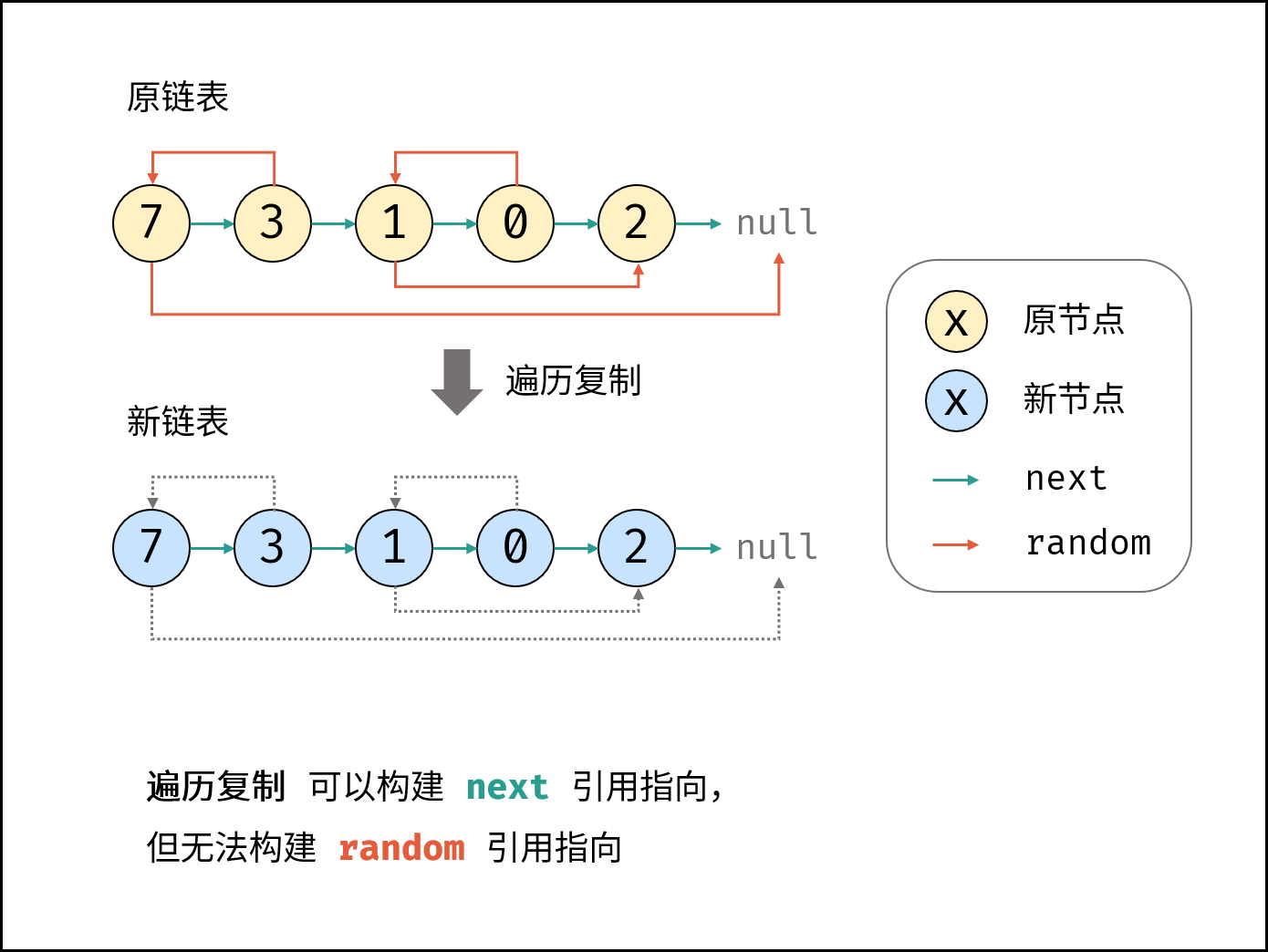{:align=center width=450}
```Python []
class Solution:
def copyRandomList(self, head: 'Node') -> 'Node':
cur = head
dum = pre = Node(0)
while cur:
node = Node(cur.val) # 复制节点 cur
pre.next = node # 新链表的 前驱节点 -> 当前节点
# pre.random = '???' # 新链表的 「 前驱节点 -> 当前节点 」 无法确定
cur = cur.next # 遍历下一节点
pre = node # 保存当前新节点
return dum.next
```
```Java []
class Solution {
public Node copyRandomList(Node head) {
Node cur = head;
Node dum = new Node(0), pre = dum;
while(cur != null) {
Node node = new Node(cur.val); // 复制节点 cur
pre.next = node; // 新链表的 前驱节点 -> 当前节点
// pre.random = "???"; // 新链表的 「 前驱节点 -> 当前节点 」 无法确定
cur = cur.next; // 遍历下一节点
pre = node; // 保存当前新节点
}
return dum.next;
}
}
```
```C++ []
class Solution {
public:
Node* copyRandomList(Node* head) {
Node* cur = head;
Node* dum = new Node(0), *pre = dum;
while(cur != nullptr) {
Node* node = new Node(cur->val); // 复制节点 cur
pre->next = node; // 新链表的 前驱节点 -> 当前节点
// pre->random = "???"; // 新链表的 「 前驱节点 -> 当前节点 」 无法确定
cur = cur->next; // 遍历下一节点
pre = node; // 保存当前新节点
}
return dum->next;
}
};
```
> 本文介绍「哈希表」和「拼接 + 拆分」两种方法。哈希表方法比较直观;拼接 + 拆分方法的空间复杂度更低。
## 方法一:哈希表
利用哈希表的查询特点,考虑构建 **原链表节点** 和 **新链表对应节点** 的键值对映射关系,再遍历构建新链表各节点的 `next` 和 `random` 引用指向即可。
### 算法流程:
1. 若头节点 `head` 为空节点,直接返回 $\text{null}$ ;
2. **初始化:** 哈希表 `hmap` , 节点 `cur` 指向头节点;
3. **复制链表:**
1. 建立新节点,并向 `hmap` 添加键值对 `(原 cur 节点, 新 cur 节点)` ;
2. `cur` 遍历至原链表下一节点;
4. **构建新链表的引用指向:**
1. 构建新节点的 `next` 和 `random` 引用指向;
2. `cur` 遍历至原链表下一节点;
5. **返回值:** 新链表的头节点 `hmap[cur]` ;
### 代码:
```Python []
class Solution:
def copyRandomList(self, head: 'Node') -> 'Node':
if not head: return
hmap = {}
# 3. 复制各节点,并建立 “原节点 -> 新节点” 的 Map 映射
cur = head
while cur:
hmap[cur] = Node(cur.val)
cur = cur.next
cur = head
# 4. 构建新节点的 next 和 random 指向
while cur:
hmap[cur].next = hmap.get(cur.next)
hmap[cur].random = hmap.get(cur.random)
cur = cur.next
# 5. 返回新链表的头节点
return hmap[head]
```
```Java []
class Solution {
public Node copyRandomList(Node head) {
if(head == null) return null;
Node cur = head;
Map map = new HashMap<>();
// 3. 复制各节点,并建立 “原节点 -> 新节点” 的 Map 映射
while(cur != null) {
map.put(cur, new Node(cur.val));
cur = cur.next;
}
cur = head;
// 4. 构建新链表的 next 和 random 指向
while(cur != null) {
map.get(cur).next = map.get(cur.next);
map.get(cur).random = map.get(cur.random);
cur = cur.next;
}
// 5. 返回新链表的头节点
return map.get(head);
}
}
```
```C++ []
class Solution {
public:
Node* copyRandomList(Node* head) {
if(head == nullptr) return nullptr;
Node* cur = head;
unordered_map map;
// 3. 复制各节点,并建立 “原节点 -> 新节点” 的 Map 映射
while(cur != nullptr) {
map[cur] = new Node(cur->val);
cur = cur->next;
}
cur = head;
// 4. 构建新链表的 next 和 random 指向
while(cur != nullptr) {
map[cur]->next = map[cur->next];
map[cur]->random = map[cur->random];
cur = cur->next;
}
// 5. 返回新链表的头节点
return map[head];
}
};
```
### 复杂度分析:
- **时间复杂度 $O(N)$ :** 两轮遍历链表,使用 $O(N)$ 时间。
- **空间复杂度 $O(N)$ :** 哈希表 `hmap` 使用线性大小的额外空间。
## 方法二:拼接 + 拆分
考虑构建 `原节点 1 -> 新节点 1 -> 原节点 2 -> 新节点 2 -> ……` 的拼接链表,如此便可在访问原节点的 `random` 指向节点的同时找到新对应新节点的 `random` 指向节点。
### 算法流程:
1. **复制各节点,构建拼接链表:**
- 设原链表为 $node1 \rightarrow node2 \rightarrow \cdots$ ,构建的拼接链表如下所示:
$$
node1 \rightarrow node1_{new} \rightarrow node2 \rightarrow node2_{new} \rightarrow \cdots
$$
2. **构建新链表各节点的 `random` 指向:**
- 当访问原节点 `cur` 的随机指向节点 `cur.random` 时,对应新节点 `cur.next` 的随机指向节点为 `cur.random.next` 。
3. **拆分原 / 新链表:**
- 设置 `pre` / `cur` 分别指向原 / 新链表头节点,遍历执行 `pre.next = pre.next.next` 和 `cur.next = cur.next.next` 将两链表拆分开。
4. 返回新链表的头节点 `res` 即可。
## 代码:
```Python []
class Solution:
def copyRandomList(self, head: 'Node') -> 'Node':
if not head: return
cur = head
# 1. 复制各节点,并构建拼接链表
while cur:
tmp = Node(cur.val)
tmp.next = cur.next
cur.next = tmp
cur = tmp.next
# 2. 构建各新节点的 random 指向
cur = head
while cur:
if cur.random:
cur.next.random = cur.random.next
cur = cur.next.next
# 3. 拆分两链表
cur = res = head.next
pre = head
while cur.next:
pre.next = pre.next.next
cur.next = cur.next.next
pre = pre.next
cur = cur.next
pre.next = None # 单独处理原链表尾节点
return res # 返回新链表头节点
```
```Java []
class Solution {
public Node copyRandomList(Node head) {
if(head == null) return null;
Node cur = head;
// 1. 复制各节点,并构建拼接链表
while(cur != null) {
Node tmp = new Node(cur.val);
tmp.next = cur.next;
cur.next = tmp;
cur = tmp.next;
}
// 2. 构建各新节点的 random 指向
cur = head;
while(cur != null) {
if(cur.random != null)
cur.next.random = cur.random.next;
cur = cur.next.next;
}
// 3. 拆分两链表
cur = head.next;
Node pre = head, res = head.next;
while(cur.next != null) {
pre.next = pre.next.next;
cur.next = cur.next.next;
pre = pre.next;
cur = cur.next;
}
pre.next = null; // 单独处理原链表尾节点
return res; // 返回新链表头节点
}
}
```
```C++ []
class Solution {
public:
Node* copyRandomList(Node* head) {
if(head == nullptr) return nullptr;
Node* cur = head;
// 1. 复制各节点,并构建拼接链表
while(cur != nullptr) {
Node* tmp = new Node(cur->val);
tmp->next = cur->next;
cur->next = tmp;
cur = tmp->next;
}
// 2. 构建各新节点的 random 指向
cur = head;
while(cur != nullptr) {
if(cur->random != nullptr)
cur->next->random = cur->random->next;
cur = cur->next->next;
}
// 3. 拆分两链表
cur = head->next;
Node* pre = head, *res = head->next;
while(cur->next != nullptr) {
pre->next = pre->next->next;
cur->next = cur->next->next;
pre = pre->next;
cur = cur->next;
}
pre->next = nullptr; // 单独处理原链表尾节点
return res; // 返回新链表头节点
}
};
```
### 复杂度分析:
- **时间复杂度 $O(N)$ :** 三轮遍历链表,使用 $O(N)$ 时间。
- **空间复杂度 $O(1)$ :** 节点引用变量使用常数大小的额外空间。
================================================
FILE: leetbook_ioa/docs/LCR 155. 将二叉搜索树转化为排序的双向链表.md
================================================
## 解题思路:
本文解法基于性质:二叉搜索树的中序遍历为 **递增序列** 。
将 二叉搜索树 转换成一个 “排序的循环双向链表” ,其中包含三个要素:
1. **排序链表:** 节点应从小到大排序,因此应使用 **中序遍历** “从小到大”访问树的节点。
2. **双向链表:** 在构建相邻节点的引用关系时,设前驱节点 `pre` 和当前节点 `cur` ,不仅应构建 `pre.right = cur` ,也应构建 `cur.left = pre` 。
3. **循环链表:** 设链表头节点 `head` 和尾节点 `tail` ,则应构建 `head.left = tail` 和 `tail.right = head` 。
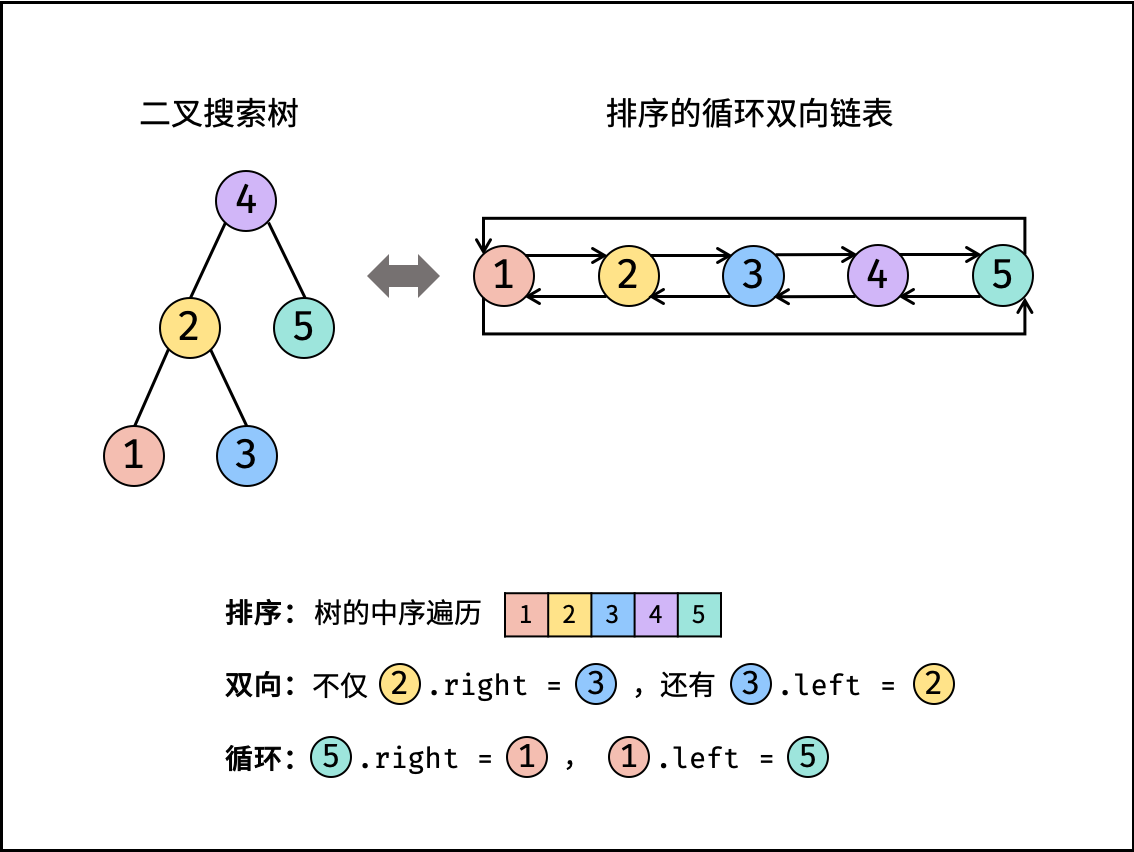{:align=center width=500}
**中序遍历** 为对二叉树作 “左、根、右” 顺序遍历,递归实现如下:
```Python []
# 打印中序遍历
def dfs(root):
if not root: return
dfs(root.left) # 左
print(root.val) # 根
dfs(root.right) # 右
```
```Java []
// 打印中序遍历
void dfs(Node root) {
if(root == null) return;
dfs(root.left); // 左
System.out.println(root.val); // 根
dfs(root.right); // 右
}
```
```C++ []
// 打印中序遍历
void dfs(Node* root) {
if(root == nullptr) return;
dfs(root->left); // 左
cout << root->val << endl; // 根
dfs(root->right); // 右
}
```
根据以上分析,考虑使用中序遍历访问树的各节点 `cur` ;并在访问每个节点时构建 `cur` 和前驱节点 `pre` 的引用指向;中序遍历完成后,最后构建头节点和尾节点的引用指向即可。
### 算法流程:
**`dfs(cur):`** 递归中序遍历;
1. **终止条件:** 当节点 `cur` 为空,代表越过叶节点,直接返回;
2. 递归左子树,即 `dfs(cur.left)` ;
3. **构建链表:**
1. **当 `pre` 为空时:** 代表正在访问链表头节点,记为 `head` ;
2. **当 `pre` 不为空时:** 修改双向节点引用,即 `pre.right = cur` ,`cur.left = pre` ;
3. **保存 `cur` :** 更新 `pre = cur` ,即节点 `cur` 是后继节点的 `pre` ;
4. 递归右子树,即 `dfs(cur.right)` ;
**`treeToDoublyList(root):`**
1. **特例处理:** 若节点 `root` 为空,则直接返回;
2. **初始化:** 空节点 `pre` ;
3. **转化为双向链表:** 调用 `dfs(root)` ;
4. **构建循环链表:** 中序遍历完成后,`head` 指向头节点,`pre` 指向尾节点,因此修改 `head` 和 `pre` 的双向节点引用即可;
5. **返回值:** 返回链表的头节点 `head` 即可;
## 代码:
```Python []
class Solution:
def treeToDoublyList(self, root: 'Node') -> 'Node':
def dfs(cur):
if not cur: return
dfs(cur.left) # 递归左子树
if self.pre: # 修改节点引用
self.pre.right, cur.left = cur, self.pre
else: # 记录头节点
self.head = cur
self.pre = cur # 保存 cur
dfs(cur.right) # 递归右子树
if not root: return
self.pre = None
dfs(root)
self.head.left, self.pre.right = self.pre, self.head
return self.head
```
```Java []
class Solution {
Node pre, head;
public Node treeToDoublyList(Node root) {
if(root == null) return null;
dfs(root);
head.left = pre;
pre.right = head;
return head;
}
void dfs(Node cur) {
if(cur == null) return;
dfs(cur.left);
if(pre != null) pre.right = cur;
else head = cur;
cur.left = pre;
pre = cur;
dfs(cur.right);
}
}
```
```C++ []
class Solution {
public:
Node* treeToDoublyList(Node* root) {
if(root == nullptr) return nullptr;
dfs(root);
head->left = pre;
pre->right = head;
return head;
}
private:
Node *pre, *head;
void dfs(Node* cur) {
if(cur == nullptr) return;
dfs(cur->left);
if(pre != nullptr) pre->right = cur;
else head = cur;
cur->left = pre;
pre = cur;
dfs(cur->right);
}
};
```
### 复杂度分析:
- **时间复杂度 $O(N)$ :** $N$ 为二叉树的节点数,中序遍历需要访问所有节点。
- **空间复杂度 $O(N)$ :** 最差情况下,即树退化为链表时,递归深度达到 $N$,系统使用 $O(N)$ 栈空间。
================================================
FILE: leetbook_ioa/docs/LCR 156. 序列化与反序列化二叉树.md
================================================
## 解题思路:
通常使用的前序、中序、后序、层序遍历记录的二叉树的信息不完整,即唯一的输出序列可能对应着多种二叉树可能性。题目要求的 序列化 和 反序列化 是 **可逆操作** 。因此,序列化的字符串应携带 **完整的二叉树信息** 。
> 观察题目示例,序列化的字符串实际上是二叉树的 “层序遍历”(BFS)结果,本文也采用层序遍历。
为完整表示二叉树,考虑将叶节点下的 $\text{null}$ 也记录。在此基础上,对于列表中任意某节点 `node` ,其左子节点 `node.left` 和右子节点 `node.right` 在序列中的位置都是 **唯一确定** 的。如下图所示:
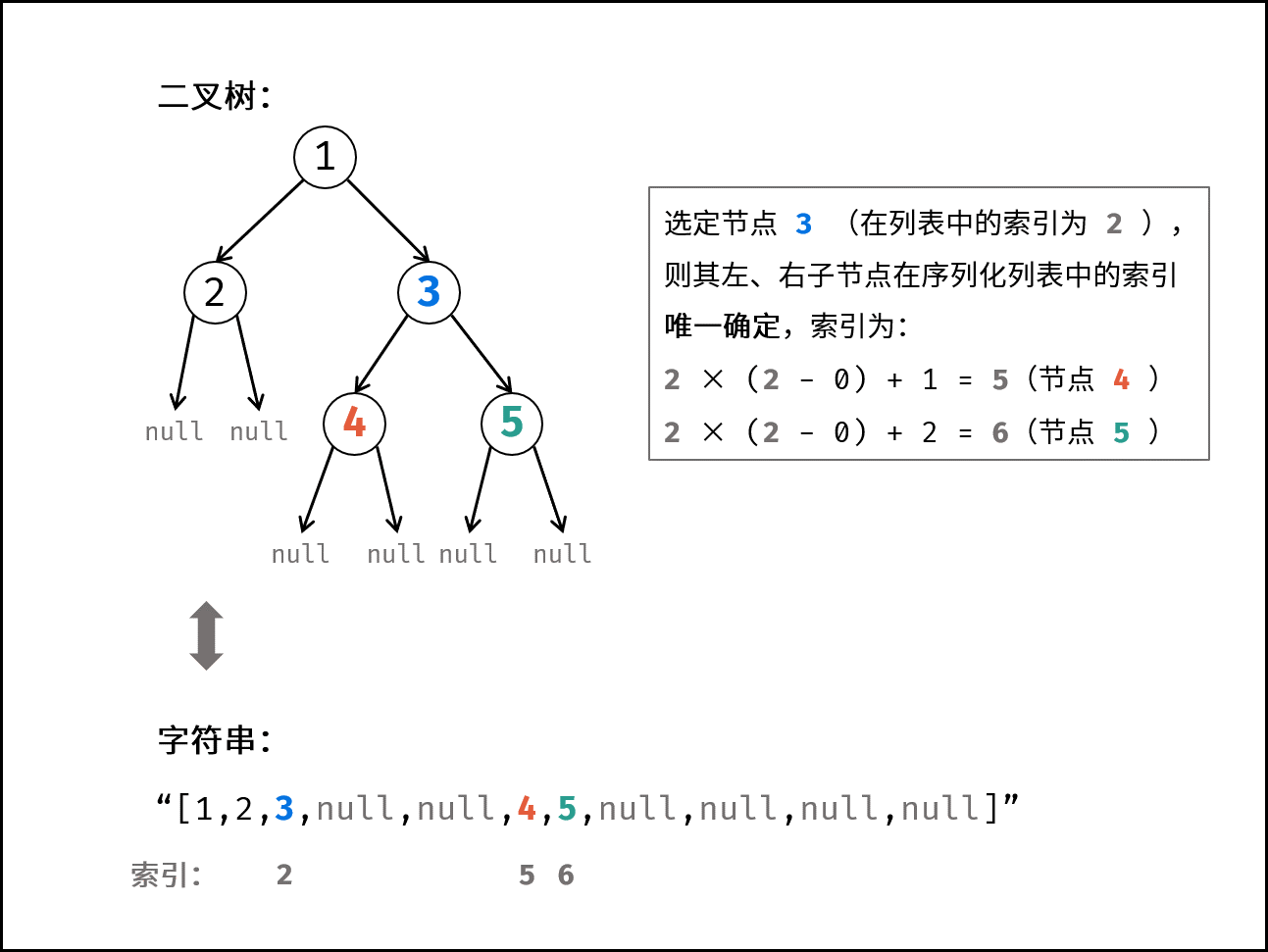{:align=center width=550}
上图规律可总结为下表:
| `node.val` | `node` 的索引 | `node.left` 的索引 | `node.right` 的索引 |
| :--------: | :-----------: | :----------------: | :-----------------: |
| $1$ | $0$ | $1$ | $2$ |
| $2$ | $1$ | $3$ | $4$ |
| $3$ | $2$ | $5$ | $6$ |
| $4$ | $5$ | $7$ | $8$ |
| $5$ | $6$ | $9$ | $10$ |
设 $m$ 为列表区间 $[0, n]$ 中的 $\text{null}$ 节点个数,则可总结出根节点、左子节点、右子节点的列表索引的递推公式:
| `node.val` | `node` 的列表索引 | `node.left` 的列表索引 | `node.right` 的列表索引 |
| :-----------------: | :---------------: | :--------------------: | :---------------------: |
| $\ne$ $\text{null}$ | $n$ | $2(n-m) + 1$ | $2(n-m) + 2$ |
| $=$ $\text{null}$ | $n$ | 无 | 无 |
**序列化** 使用层序遍历实现。**反序列化** 通过以上递推公式反推各节点在序列中的索引,进而实现。
## 序列化 Serialize :
借助队列,对二叉树做层序遍历,并将越过叶节点的 $\text{null}$ 也打印出来。
### 算法流程:
1. **特例处理:** 若 `root` 为空,则直接返回空列表 `"[]"` ;
2. **初始化:** 队列 `queue` (包含根节点 `root` );序列化列表 `res` ;
3. **层序遍历:** 当 `queue` 为空时跳出;
1. 节点出队,记为 `node` ;
2. 若 `node` 不为空:(1) 打印字符串 `node.val` ,(2) 将左、右子节点加入 `queue` ;
3. 否则(若 `node` 为空):打印字符串 `"null"` ;
4. **返回值:** 拼接列表,用 `','` 隔开,首尾添加中括号;
### 复杂度分析:
- **时间复杂度 $O(N)$ :** $N$ 为二叉树的节点数,层序遍历需要访问所有节点,最差情况下需要访问 $N + 1$ 个 $\text{null}$ ,总体复杂度为 $O(2N + 1) = O(N)$ 。
- **空间复杂度 $O(N)$ :** 最差情况下,队列 `queue` 同时存储 $\frac{N + 1}{2}$ 个节点(或 $N+1$ 个 $\text{null}$ ),使用 $O(N)$ ;列表 `res` 使用 $O(N)$ 。
## 反序列化 Deserialize :
基于本文开始推出的 `node` , `node.left` , `node.right` 在序列化列表中的位置关系,可实现反序列化。
利用队列按层构建二叉树,借助一个指针 `i` 指向节点 `node` 的左、右子节点,每构建一个 `node` 的左、右子节点,指针 `i` 就向右移动 $1$ 位。
### 算法流程:
1. **特例处理:** 若 `data` 为空,直接返回 $\text{null}$ ;
2. **初始化:** 序列化列表 `vals` (先去掉首尾中括号,再用逗号隔开),指针 `i = 1` ,根节点 `root` (值为 `vals[0]` ),队列 `queue`(包含 `root` );
3. **按层构建:** 当 `queue` 为空时跳出;
1. 节点出队,记为 `node` ;
2. 构建 `node` 的左子节点:`node.left` 的值为 `vals[i]` ,并将 `node.left` 入队;
3. 执行 `i += 1` ;
4. 构建 `node` 的右子节点:`node.right` 的值为 `vals[i]` ,并将 `node.right` 入队;
5. 执行 `i += 1` ;
4. **返回值:** 返回根节点 `root` 即可;
### 复杂度分析:
- **时间复杂度 $O(N)$ :** $N$ 为二叉树的节点数,按层构建二叉树需要遍历整个 $vals$ ,其长度最大为 $2N+1$ 。
- **空间复杂度 $O(N)$ :** 最差情况下,队列 `queue` 同时存储 $\frac{N + 1}{2}$ 个节点,因此使用 $O(N)$ 额外空间。
## 代码:
```Python []
class Codec:
def serialize(self, root):
if not root: return "[]"
queue = collections.deque()
queue.append(root)
res = []
while queue:
node = queue.popleft()
if node:
res.append(str(node.val))
queue.append(node.left)
queue.append(node.right)
else: res.append("null")
return '[' + ','.join(res) + ']'
def deserialize(self, data):
if data == "[]": return
vals, i = data[1:-1].split(','), 1
root = TreeNode(int(vals[0]))
queue = collections.deque()
queue.append(root)
while queue:
node = queue.popleft()
if vals[i] != "null":
node.left = TreeNode(int(vals[i]))
queue.append(node.left)
i += 1
if vals[i] != "null":
node.right = TreeNode(int(vals[i]))
queue.append(node.right)
i += 1
return root
```
```Java []
public class Codec {
public String serialize(TreeNode root) {
if(root == null) return "[]";
StringBuilder res = new StringBuilder("[");
Queue queue = new LinkedList<>() {{ add(root); }};
while(!queue.isEmpty()) {
TreeNode node = queue.poll();
if(node != null) {
res.append(node.val + ",");
queue.add(node.left);
queue.add(node.right);
}
else res.append("null,");
}
res.deleteCharAt(res.length() - 1);
res.append("]");
return res.toString();
}
public TreeNode deserialize(String data) {
if(data.equals("[]")) return null;
String[] vals = data.substring(1, data.length() - 1).split(",");
TreeNode root = new TreeNode(Integer.parseInt(vals[0]));
Queue queue = new LinkedList<>() {{ add(root); }};
int i = 1;
while(!queue.isEmpty()) {
TreeNode node = queue.poll();
if(!vals[i].equals("null")) {
node.left = new TreeNode(Integer.parseInt(vals[i]));
queue.add(node.left);
}
i++;
if(!vals[i].equals("null")) {
node.right = new TreeNode(Integer.parseInt(vals[i]));
queue.add(node.right);
}
i++;
}
return root;
}
}
```
================================================
FILE: leetbook_ioa/docs/LCR 157. 套餐内商品的排列顺序.md
================================================
## 解题思路:
对于一个长度为 $n$ 的字符串(假设字符互不重复),其排列方案数共有:
$$
n \times (n-1) \times (n-2) … \times 2 \times 1
$$
**排列方案的生成:**
根据字符串排列的特点,考虑深度优先搜索所有排列方案。即通过字符交换,先固定第 $1$ 位字符( $n$ 种情况)、再固定第 $2$ 位字符( $n-1$ 种情况)、... 、最后固定第 $n$ 位字符( $1$ 种情况)。
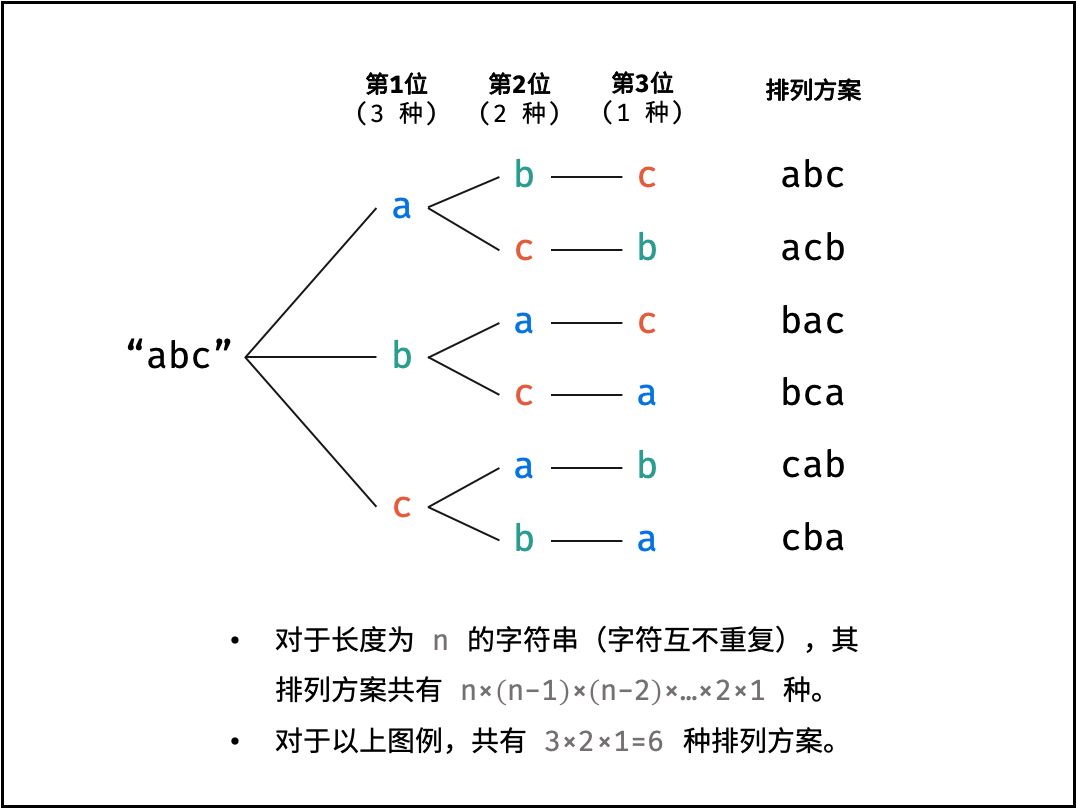{:align=center width=500}
**重复排列方案与剪枝:**
当字符串存在重复字符时,排列方案中也存在重复的排列方案。为排除重复方案,需在固定某位字符时,保证 “每种字符只在此位固定一次” ,即遇到重复字符时不交换,直接跳过。从 DFS 角度看,此操作称为 “剪枝” 。
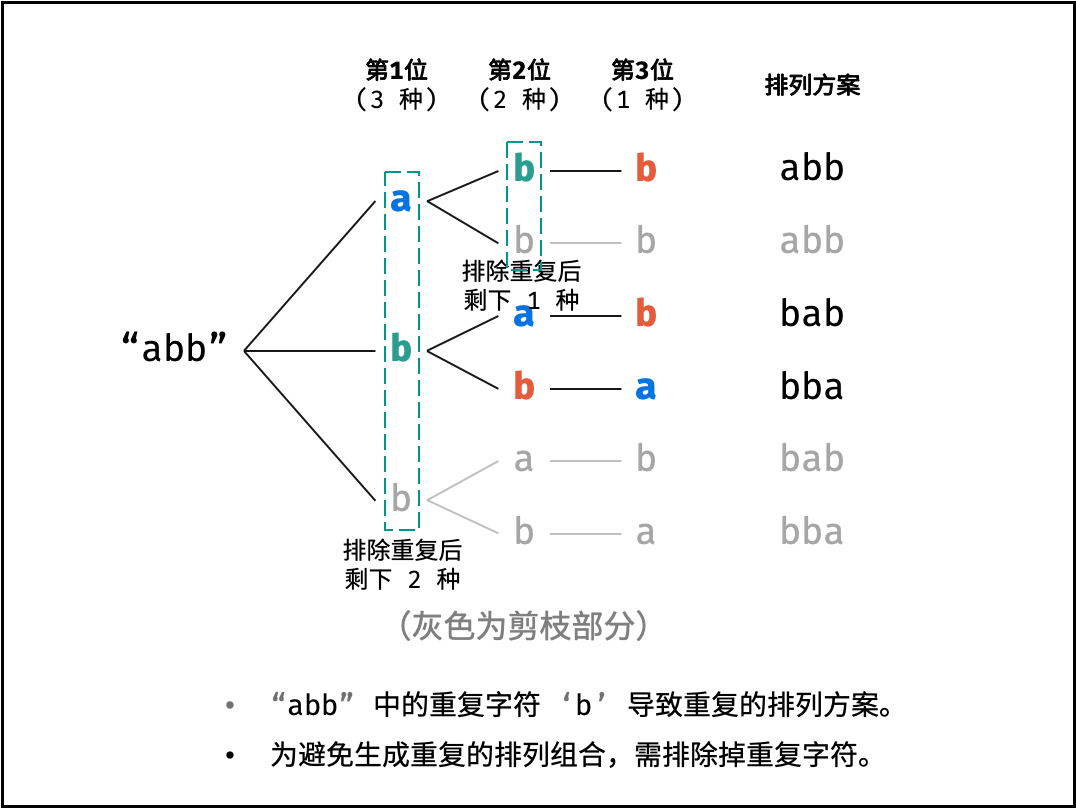{:align=center width=500}
### 递归解析:
1. **终止条件:** 当 `x = len(arr) - 1` 时,代表所有位已固定(最后一位只有 $1$ 种情况),则将当前组合 `arr` 转化为字符串并加入 `res` ,并返回;
2. **递推参数:** 当前固定位 `x` ;
3. **递推工作:** 初始化一个 Set ,用于排除重复的字符;将第 `x` 位字符与 `i` $\in$ `[x, len(arr)]` 字符分别交换,并进入下层递归;
1. **剪枝:** 若 `arr[i]` 在 Set 中,代表其是重复字符,因此 “剪枝” ;
2. 将 `arr[i]` 加入 Set ,以便之后遇到重复字符时剪枝;
3. **固定字符:** 将字符 `arr[i]` 和 `arr[x]` 交换,即固定 `arr[i]` 为当前位字符;
4. **开启下层递归:** 调用 `dfs(x + 1)` ,即开始固定第 `x + 1` 个字符;
5. **还原交换:** 将字符 `arr[i]` 和 `arr[x]` 交换(还原之前的交换);
> 下图的测试样例为 `goods = "abc"` 。
## 代码:
```Python []
class Solution:
def goodsOrder(self, goods: str) -> List[str]:
arr, res = list(goods), []
def dfs(x):
if x == len(arr) - 1:
res.append(''.join(arr)) # 添加排列方案
return
hmap = set()
for i in range(x, len(arr)):
if arr[i] in hmap: continue # 重复,因此剪枝
hmap.add(arr[i])
arr[i], arr[x] = arr[x], arr[i] # 交换,将 arr[i] 固定在第 x 位
dfs(x + 1) # 开启固定第 x + 1 位字符
arr[i], arr[x] = arr[x], arr[i] # 恢复交换
dfs(0)
return res
```
```Java []
class Solution {
List res = new LinkedList<>();
char[] arr;
public String[] goodsOrder(String goods) {
arr = goods.toCharArray();
dfs(0);
return res.toArray(new String[res.size()]);
}
void dfs(int x) {
if(x == arr.length - 1) {
res.add(String.valueOf(arr)); // 添加排列方案
return;
}
HashSet set = new HashSet<>();
for(int i = x; i < arr.length; i++) {
if(set.contains(arr[i])) continue; // 重复,因此剪枝
set.add(arr[i]);
swap(i, x); // 交换,将 arr[i] 固定在第 x 位
dfs(x + 1); // 开启固定第 x + 1 位字符
swap(i, x); // 恢复交换
}
}
void swap(int a, int b) {
char tmp = arr[a];
arr[a] = arr[b];
arr[b] = tmp;
}
}
```
```C++ []
class Solution {
public:
vector goodsOrder(string goods) {
dfs(goods, 0);
return res;
}
private:
vector res;
void dfs(string goods, int x) {
if(x == goods.size() - 1) {
res.push_back(goods); // 添加排列方案
return;
}
set st;
for(int i = x; i < goods.size(); i++) {
if(st.find(goods[i]) != st.end()) continue; // 重复,因此剪枝
st.insert(goods[i]);
swap(goods[i], goods[x]); // 交换,将 goods[i] 固定在第 x 位
dfs(goods, x + 1); // 开启固定第 x + 1 位字符
swap(goods[i], goods[x]); // 恢复交换
}
}
};
```
### 复杂度分析:
- **时间复杂度 $O(N!N)$ :** $N$ 为字符串 `goods` 的长度;时间复杂度和字符串排列的方案数成线性关系,方案数为 $N \times (N-1) \times (N-2) … \times 2 \times 1$ ,即复杂度为 $O(N!)$ ;字符串拼接操作 `join()` 使用 $O(N)$ ;因此总体时间复杂度为 $O(N!N)$ 。
- **空间复杂度 $O(N^2)$ :** 全排列的递归深度为 $N$ ,系统累计使用栈空间大小为 $O(N)$ ;递归中辅助 Set 累计存储的字符数量最多为 $N + (N-1) + ... + 2 + 1 = (N+1)N/2$ ,即占用 $O(N^2)$ 的额外空间。
================================================
FILE: leetbook_ioa/docs/LCR 158. 库存管理 II.md
================================================
## 解题思路:
> 请注意,数学中众数的定义为 “数组中出现次数最多的数字” ,与本文定义不同。本文将 “数组中出现次数超过一半的数字” 称为 **“众数”**。
本题常见的三种解法:
1. **哈希表统计法:** 遍历数组 `stock` ,用 HashMap 统计各数字的数量,即可找出 众数 。此方法时间和空间复杂度均为 $O(N)$ 。
2. **数组排序法:** 将数组 `stock` 排序,**数组中点的元素** 一定为众数。
3. **摩尔投票法:** 核心理念为 **票数正负抵消** 。此方法时间和空间复杂度分别为 $O(N)$ 和 $O(1)$ ,为本题的最佳解法。
### 摩尔投票法:
> 设输入数组 `stock` 的众数为 $x$ ,数组长度为 $n$ 。
**推论一:** 若记 **众数** 的票数为 $+1$ ,**非众数** 的票数为 $-1$ ,则一定有所有数字的 **票数和 $> 0$** 。
**推论二:** 若数组的前 $a$ 个数字的 **票数和 $= 0$** ,则 数组剩余 $(n-a)$ 个数字的 **票数和一定仍 $>0$** ,即后 $(n-a)$ 个数字的 **众数仍为 $x$** 。
> 下图中的 `nums` 对应本题的 `stock` 。
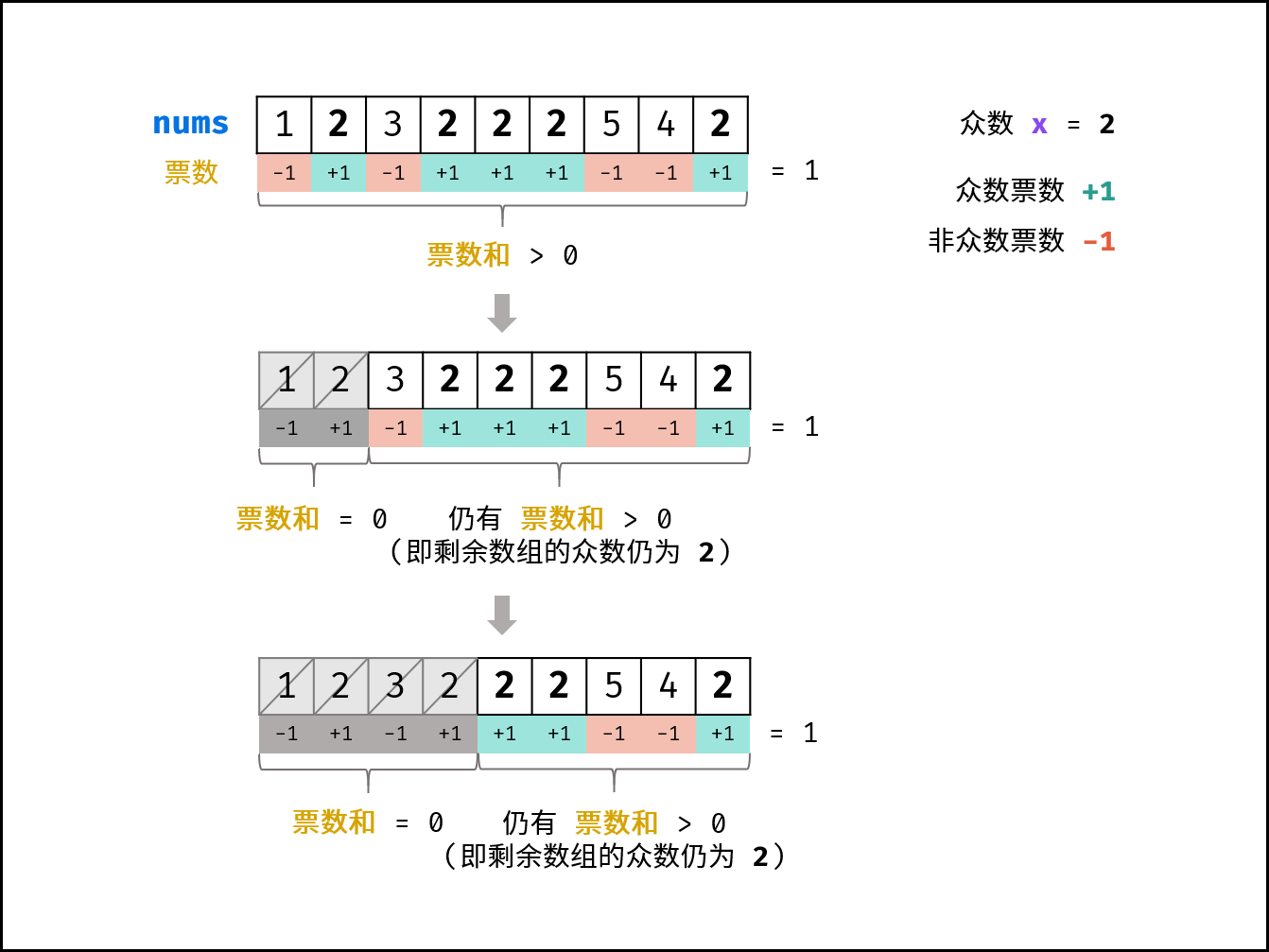{:align=center width=500}
根据以上推论,记数组首个元素为 $n_1$ ,众数为 $x$ ,遍历并统计票数。当发生 **票数和 $= 0$** 时,**剩余数组的众数一定不变** ,这是由于:
- **当 $n_1 = x$ :** 抵消的所有数字中,有一半是众数 $x$ 。
- **当 $n_1 \neq x$ :** 抵消的所有数字中,众数 $x$ 的数量最少为 0 个,最多为一半。
利用此特性,每轮假设发生 **票数和 $= 0$** 都可以 **缩小剩余数组区间** 。当遍历完成时,最后一轮假设的数字即为众数。
### 算法流程:
1. **初始化:** 票数统计 `votes = 0` , 众数 `x`;
2. **循环:** 遍历数组 `stock` 中的每个数字 `num` ;
1. 当 票数 `votes` 等于 0 ,则假设当前数字 `num` 是众数;
2. 当 `num = x` 时,票数 `votes` 自增 1 ;当 `num != x` 时,票数 `votes` 自减 1 ;
3. **返回值:** 返回 `x` 即可;
## 代码:
```Python []
class Solution:
def inventoryManagement(self, stock: List[int]) -> int:
votes = 0
for num in stock:
if votes == 0: x = num
votes += 1 if num == x else -1
return x
```
```Java []
class Solution {
public int inventoryManagement(int[] stock) {
int x = 0, votes = 0;
for(int num : stock){
if(votes == 0) x = num;
votes += num == x ? 1 : -1;
}
return x;
}
}
```
```C++ []
class Solution {
public:
int inventoryManagement(vector& stock) {
int x = 0, votes = 0;
for(int num : stock){
if(votes == 0) x = num;
votes += num == x ? 1 : -1;
}
return x;
}
};
```
**拓展:** 由于题目说明 “给定的数组总是存在多数元素” ,因此本题不用考虑 **数组不存在众数** 的情况。若考虑,需要加入一个 “验证环节” ,遍历数组 `stock` 统计 `x` 的数量。
- 若 `x` 的数量超过数组长度一半,则返回 `x` ;
- 否则,返回未找到众数;
时间和空间复杂度不变,仍为 $O(N)$ 和 $O(1)$ 。
```Python []
class Solution:
def inventoryManagement(self, stock: List[int]) -> int:
votes, count = 0, 0
for num in stock:
if votes == 0: x = num
votes += 1 if num == x else -1
# 验证 x 是否为众数
for num in stock:
if num == x: count += 1
return x if count > len(stock) // 2 else 0 # 当无众数时返回 0
```
```Java []
class Solution {
public int inventoryManagement(int[] stock) {
int x = 0, votes = 0, count = 0;
for(int num : stock){
if(votes == 0) x = num;
votes += num == x ? 1 : -1;
}
// 验证 x 是否为众数
for(int num : stock)
if(num == x) count++;
return count > stock.length / 2 ? x : 0; // 当无众数时返回 0
}
}
```
```C++ []
class Solution {
public:
int inventoryManagement(vector& stock) {
int x = 0, votes = 0, count = 0;
for(int num : stock){
if(votes == 0) x = num;
votes += num == x ? 1 : -1;
}
// 验证 x 是否为众数
for(int num : stock)
if(num == x) count++;
return count > stock.size() / 2 ? x : 0; // 当无众数时返回 0
}
};
```
### 复杂度分析:
- **时间复杂度 $O(N)$ :** $N$ 为数组 `stock` 长度。
- **空间复杂度 $O(1)$ :** `votes` 变量使用常数大小的额外空间。
================================================
FILE: leetbook_ioa/docs/LCR 159. 库存管理 III.md
================================================
## 方法一:快速排序
本题使用排序算法解决最直观,对数组 `stock` 执行排序,再返回前 $cnt$ 个元素即可。使用任意排序算法皆可,本文采用并介绍 **快速排序** ,为下文 **方法二** 做铺垫。
### 快速排序原理:
快速排序算法有两个核心点,分别为 “哨兵划分” 和 “递归” 。
**哨兵划分操作:** 以数组某个元素(一般选取首元素)为 **基准数** ,将所有小于基准数的元素移动至其左边,大于基准数的元素移动至其右边。
> 如下图所示,为哨兵划分操作流程。通过一轮 **哨兵划分** ,可将数组排序问题拆分为 **两个较短数组的排序问题** (本文称之为左(右)子数组)。
**递归:** 对 **左子数组** 和 **右子数组** 递归执行 **哨兵划分**,直至子数组长度为 1 时终止递归,即可完成对整个数组的排序。
> 如下图所示,为示例数组 `[2,4,1,0,3,5]` 的快速排序流程。观察发现,快速排序和 **二分法** 的原理类似,都是以 $\log$ 时间复杂度实现搜索区间缩小。
{:width=550}
### 代码:
```Python []
class Solution:
def inventoryManagement(self, stock: List[int], cnt: int) -> List[int]:
def quick_sort(stock, l, r):
# 子数组长度为 1 时终止递归
if l >= r: return
# 哨兵划分操作(以 stock[l] 作为基准数)
i, j = l, r
while i < j:
while i < j and stock[j] >= stock[l]: j -= 1
while i < j and stock[i] <= stock[l]: i += 1
stock[i], stock[j] = stock[j], stock[i]
stock[l], stock[i] = stock[i], stock[l]
# 递归左(右)子数组执行哨兵划分
quick_sort(stock, l, i - 1)
quick_sort(stock, i + 1, r)
quick_sort(stock, 0, len(stock) - 1)
return stock[:cnt]
```
```Java []
class Solution {
public int[] inventoryManagement(int[] stock, int cnt) {
quickSort(stock, 0, stock.length - 1);
return Arrays.copyOf(stock, cnt);
}
private void quickSort(int[] stock, int l, int r) {
// 子数组长度为 1 时终止递归
if (l >= r) return;
// 哨兵划分操作(以 stock[l] 作为基准数)
int i = l, j = r;
while (i < j) {
while (i < j && stock[j] >= stock[l]) j--;
while (i < j && stock[i] <= stock[l]) i++;
swap(stock, i, j);
}
swap(stock, i, l);
// 递归左(右)子数组执行哨兵划分
quickSort(stock, l, i - 1);
quickSort(stock, i + 1, r);
}
private void swap(int[] stock, int i, int j) {
int tmp = stock[i];
stock[i] = stock[j];
stock[j] = tmp;
}
}
```
```C++ []
class Solution {
public:
vector inventoryManagement(vector& stock, int cnt) {
quickSort(stock, 0, stock.size() - 1);
vector res;
res.assign(stock.begin(), stock.begin() + cnt);
return res;
}
private:
void quickSort(vector& stock, int l, int r) {
// 子数组长度为 1 时终止递归
if (l >= r) return;
// 哨兵划分操作(以 stock[l] 作为基准数)
int i = l, j = r;
while (i < j) {
while (i < j && stock[j] >= stock[l]) j--;
while (i < j && stock[i] <= stock[l]) i++;
swap(stock[i], stock[j]);
}
swap(stock[i], stock[l]);
// 递归左(右)子数组执行哨兵划分
quickSort(stock, l, i - 1);
quickSort(stock, i + 1, r);
}
};
```
### 复杂度分析:
- **时间复杂度 $O(N \log N)$ :** 库函数、快排等排序算法的平均时间复杂度为 $O(N \log N)$ 。
- **空间复杂度 $O(N)$ :** 快速排序的递归深度最好(平均)为 $O(\log N)$ ,最差情况(即输入数组完全倒序)为 $O(N)$。
## 方法二:快速选择
题目只要求返回最小的 cnt 个数,对这 cnt 个数的顺序并没有要求。因此,只需要将数组划分为 **最小的 $cnt$ 个数** 和 **其他数字** 两部分即可,而快速排序的哨兵划分可完成此目标。
根据快速排序原理,如果某次哨兵划分后 **基准数正好是第 $cnt+1$ 小的数字** ,那么此时基准数左边的所有数字便是题目所求的 **最小的 cnt 个数** 。
根据此思路,考虑在每次哨兵划分后,判断基准数在数组中的索引是否等于 $cnt$ ,若 $\text{true}$ 则直接返回此时数组的前 $cnt$ 个数字即可。
### 算法流程:
**`inventoryManagement() 函数:`**
1. 若 $cnt$ 大于数组长度,则直接返回整个数组;
2. 执行并返回 `quick_sort()` 即可;
**`quick_sort() 函数:`**
> 注意,此时 `quick_sort()` 的功能不是排序整个数组,而是搜索并返回最小的 $cnt$ 个数。
1. **哨兵划分**:
- 划分完毕后,基准数为 `stock[i]` ,左 / 右子数组区间分别为 $[l, i - 1]$ , $[i + 1, r]$ ;
2. **递归或返回:**
- 若 $cnt < i$ ,代表第 $cnt + 1$ 小的数字在 **左子数组** 中,则递归左子数组;
- 若 $cnt > i$ ,代表第 $cnt + 1$ 小的数字在 **右子数组** 中,则递归右子数组;
- 若 $cnt = i$ ,代表此时 `stock[cnt]` 即为第 $cnt + 1$ 小的数字,则直接返回数组前 $cnt$ 个数字即可;
## 代码:
```Python []
class Solution:
def inventoryManagement(self, stock: List[int], cnt: int) -> List[int]:
if cnt >= len(stock): return stock
def quick_sort(l, r):
i, j = l, r
while i < j:
while i < j and stock[j] >= stock[l]: j -= 1
while i < j and stock[i] <= stock[l]: i += 1
stock[i], stock[j] = stock[j], stock[i]
stock[l], stock[i] = stock[i], stock[l]
if cnt < i: return quick_sort(l, i - 1)
if cnt > i: return quick_sort(i + 1, r)
return stock[:cnt]
return quick_sort(0, len(stock) - 1)
```
```Java []
class Solution {
public int[] inventoryManagement(int[] stock, int cnt) {
if (cnt >= stock.length) return stock;
return quickSort(stock, cnt, 0, stock.length - 1);
}
private int[] quickSort(int[] stock, int cnt, int l, int r) {
int i = l, j = r;
while (i < j) {
while (i < j && stock[j] >= stock[l]) j--;
while (i < j && stock[i] <= stock[l]) i++;
swap(stock, i, j);
}
swap(stock, i, l);
if (i > cnt) return quickSort(stock, cnt, l, i - 1);
if (i < cnt) return quickSort(stock, cnt, i + 1, r);
return Arrays.copyOf(stock, cnt);
}
private void swap(int[] stock, int i, int j) {
int tmp = stock[i];
stock[i] = stock[j];
stock[j] = tmp;
}
}
```
```C++ []
class Solution {
public:
vector inventoryManagement(vector& stock, int cnt) {
if (cnt >= stock.size()) return stock;
return quickSort(stock, cnt, 0, stock.size() - 1);
}
private:
vector quickSort(vector& stock, int cnt, int l, int r) {
int i = l, j = r;
while (i < j) {
while (i < j && stock[j] >= stock[l]) j--;
while (i < j && stock[i] <= stock[l]) i++;
swap(stock[i], stock[j]);
}
swap(stock[i], stock[l]);
if (i > cnt) return quickSort(stock, cnt, l, i - 1);
if (i < cnt) return quickSort(stock, cnt, i + 1, r);
vector res;
res.assign(stock.begin(), stock.begin() + cnt);
return res;
}
};
```
### 复杂度分析:
本方法优化时间复杂度的本质是通过判断舍去了不必要的递归(哨兵划分)。
- **时间复杂度 $O(N)$ :** 其中 $N$ 为数组元素数量;对于长度为 $N$ 的数组执行哨兵划分操作的时间复杂度为 $O(N)$ ;每轮哨兵划分后根据 $cnt$ 和 $i$ 的大小关系选择递归,由于 $i$ 分布的随机性,则向下递归子数组的平均长度为 $\frac{N}{2}$ ;因此平均情况下,哨兵划分操作一共有 $N + \frac{N}{2} + \frac{N}{4} + ... + \frac{N}{N} = \frac{N - \frac{1}{2}}{1 - \frac{1}{2}} = 2N - 1$ (等比数列求和),即总体时间复杂度为 $O(N)$ 。
- **空间复杂度 $O(\log N)$ :** 划分函数的平均递归深度为 $O(\log N)$ 。
================================================
FILE: leetbook_ioa/docs/LCR 160. 数据流中的中位数.md
================================================
## 解题思路:
> 给定一长度为 $N$ 的无序数组,其中位数的计算方法:首先对数组执行排序(使用 $O(N \log N)$ 时间),然后返回中间元素即可(使用 $O(1)$ 时间)。
针对本题,根据以上思路,可以将数据流保存在一个列表中,并在添加元素时 **保持数组有序** 。此方法的时间复杂度为 $O(N)$ ,其中包括: 查找元素插入位置 $O(\log N)$ (二分查找)、向数组某位置插入元素 $O(N)$ (插入位置之后的元素都需要向后移动一位)。
> 借助 **堆** 可进一步优化时间复杂度。
建立一个 **小顶堆** $A$ 和 **大顶堆** $B$ ,各保存列表的一半元素,且规定:
- $A$ 保存 **较大** 的一半,长度为 $\frac{N}{2}$( $N$ 为偶数)或 $\frac{N+1}{2}$( $N$ 为奇数);
- $B$ 保存 **较小** 的一半,长度为 $\frac{N}{2}$( $N$ 为偶数)或 $\frac{N-1}{2}$( $N$ 为奇数);
随后,中位数可仅根据 $A, B$ 的堆顶元素计算得到。
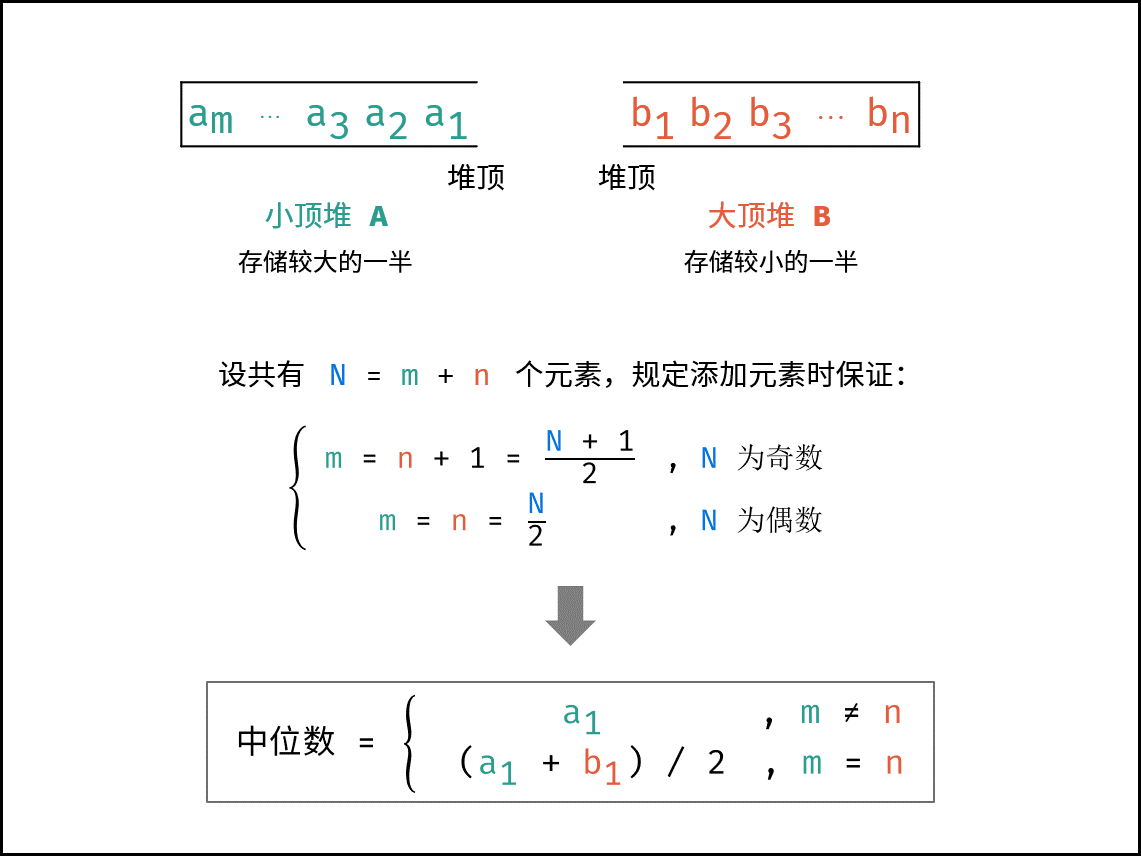{:align=center width=500}
### 算法流程:
> 设元素总数为 $N = m + n$ ,其中 $m$ 和 $n$ 分别为 $A$ 和 $B$ 中的元素个数。
**`addNum(num)` 函数:**
1. 当 $m = n$(即 $N$ 为 **偶数**):需向 $A$ 添加一个元素。实现方法:将新元素 $num$ 插入至 $B$ ,再将 $B$ 堆顶元素插入至 $A$ ;
2. 当 $m \ne n$(即 $N$ 为 **奇数**):需向 $B$ 添加一个元素。实现方法:将新元素 $num$ 插入至 $A$ ,再将 $A$ 堆顶元素插入至 $B$ ;
> 假设插入数字 $num$ 遇到情况 `1.` 。由于 $num$ 可能属于 “较小的一半” (即属于 $B$ ),因此不能将 $nums$ 直接插入至 $A$ 。而应先将 $num$ 插入至 $B$ ,再将 $B$ 堆顶元素插入至 $A$ 。这样就可以始终保持 $A$ 保存较大一半、 $B$ 保存较小一半。
**`findMedian()` 函数:**
1. 当 $m = n$( $N$ 为 **偶数**):则中位数为 $($ $A$ 的堆顶元素 + $B$ 的堆顶元素 $)/2$。
2. 当 $m \ne n$( $N$ 为 **奇数**):则中位数为 $A$ 的堆顶元素。
## 代码:
Python 中 heapq 模块是小顶堆。实现 **大顶堆** 方法: 小顶堆的插入和弹出操作均将元素 **取反** 即可。
Java 使用 `PriorityQueue<>((x, y) -> (y - x))` 可方便实现大顶堆。
C++ 中 `greater` 为小顶堆,`less` 为大顶堆。
```Python []
from heapq import *
class MedianFinder:
def __init__(self):
self.A = [] # 小顶堆,保存较大的一半
self.B = [] # 大顶堆,保存较小的一半
def addNum(self, num: int) -> None:
if len(self.A) != len(self.B):
heappush(self.A, num)
heappush(self.B, -heappop(self.A))
else:
heappush(self.B, -num)
heappush(self.A, -heappop(self.B))
def findMedian(self) -> float:
return self.A[0] if len(self.A) != len(self.B) else (self.A[0] - self.B[0]) / 2.0
```
```Java []
class MedianFinder {
Queue A, B;
public MedianFinder() {
A = new PriorityQueue<>(); // 小顶堆,保存较大的一半
B = new PriorityQueue<>((x, y) -> (y - x)); // 大顶堆,保存较小的一半
}
public void addNum(int num) {
if(A.size() != B.size()) {
A.add(num);
B.add(A.poll());
} else {
B.add(num);
A.add(B.poll());
}
}
public double findMedian() {
return A.size() != B.size() ? A.peek() : (A.peek() + B.peek()) / 2.0;
}
}
```
```C++ []
class MedianFinder {
public:
priority_queue, greater> A; // 小顶堆,保存较大的一半
priority_queue, less> B; // 大顶堆,保存较小的一半
MedianFinder() { }
void addNum(int num) {
if(A.size() != B.size()) {
A.push(num);
B.push(A.top());
A.pop();
} else {
B.push(num);
A.push(B.top());
B.pop();
}
}
double findMedian() {
return A.size() != B.size() ? A.top() : (A.top() + B.top()) / 2.0;
}
};
```
> Push item on the heap, then pop and return the smallest item from the heap. The combined action runs more efficiently than heappush() followed by a separate call to heappop().
根据以上文档说明,可将 Python 代码优化为:
```Python []
from heapq import *
class MedianFinder:
def __init__(self):
self.A = [] # 小顶堆,保存较大的一半
self.B = [] # 大顶堆,保存较小的一半
def addNum(self, num: int) -> None:
if len(self.A) != len(self.B):
heappush(self.B, -heappushpop(self.A, num))
else:
heappush(self.A, -heappushpop(self.B, -num))
def findMedian(self) -> float:
return self.A[0] if len(self.A) != len(self.B) else (self.A[0] - self.B[0]) / 2.0
```
### 复杂度分析:
- **时间复杂度:**
- **查找中位数 $O(1)$ :** 获取堆顶元素使用 $O(1)$ 时间;
- **添加数字 $O(\log N)$ :** 堆的插入和弹出操作使用 $O(\log N)$ 时间。
- **空间复杂度 $O(N)$ :** 其中 $N$ 为数据流中的元素数量,小顶堆 $A$ 和大顶堆 $B$ 最多同时保存 $N$ 个元素。
================================================
FILE: leetbook_ioa/docs/LCR 161. 连续天数的最高销售额.md
================================================
## 解题思路:
观察不同解法的复杂度,可知动态规划是本题的最优解法。
| 常见解法 | 时间复杂度 | 空间复杂度 |
| -------- | ------------- | ----------- |
| 暴力搜索 | $O(N^2)$ | $O(1)$ |
| 分治思想 | $O(N \log N)$ | $O(\log N)$ |
| 动态规划 | $O(N)$ | $O(1)$ |
### 动态规划解析:
**状态定义:** 设动态规划列表 $dp$ ,$dp[i]$ 代表以元素 $sales[i]$ 为结尾的连续子数组最大和。
**转移方程:** 若 $dp[i-1] \leq 0$ ,说明 $dp[i - 1]$ 对 $dp[i]$ 产生负贡献,即 $dp[i-1] + sales[i]$ 还不如 $sales[i]$ 本身大。
$$
dp[i] =
\begin{cases}
dp[i-1] + sales[i] & , dp[i - 1] > 0 \\
sales[i] & , dp[i - 1] \leq 0 \\
\end{cases}
$$
**初始状态:** $dp[0] = sales[0]$,即以 $sales[0]$ 结尾的连续子数组最大和为 $sales[0]$ 。
**返回值:** 返回 $dp$ 列表中的最大值,代表全局最大值。
> 下图中的 `nums` 对应本题的 `sales` 。
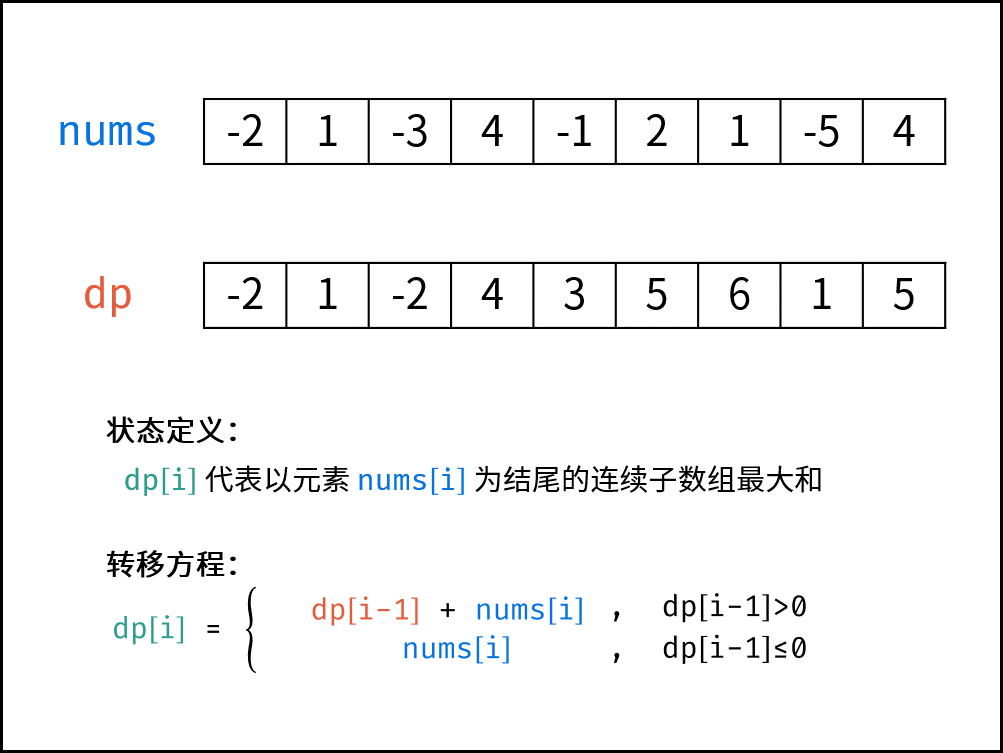{:align=center width=500}
### 空间优化:
由于 $dp[i]$ 只与 $dp[i-1]$ 和 $sales[i]$ 有关系,因此可以将原数组 $sales$ 用作 $dp$ 列表,即直接在 $sales$ 上修改即可。
由于省去 $dp$ 列表使用的额外空间,因此空间复杂度从 $O(N)$ 降至 $O(1)$ 。
## 代码:
```Python []
class Solution:
def maxSales(self, sales: List[int]) -> int:
for i in range(1, len(sales)):
sales[i] += max(sales[i - 1], 0)
return max(sales)
```
```Java []
class Solution {
public int maxSales(int[] sales) {
int res = sales[0];
for(int i = 1; i < sales.length; i++) {
sales[i] += Math.max(sales[i - 1], 0);
res = Math.max(res, sales[i]);
}
return res;
}
}
```
```C++ []
class Solution {
public:
int maxSales(vector& sales) {
int res = sales[0];
for(int i = 1; i < sales.size(); i++) {
if(sales[i - 1] > 0) sales[i] += sales[i - 1];
if(sales[i] > res) res = sales[i];
}
return res;
}
};
```
### 复杂度分析:
- **时间复杂度 $O(N)$ :** 线性遍历数组 $sales$ 即可获得结果,使用 $O(N)$ 时间。
- **空间复杂度 $O(1)$ :** 使用常数大小的额外空间。
================================================
FILE: leetbook_ioa/docs/LCR 162. 数字 1 的个数.md
================================================
## 解题思路:
> 为简化篇幅,本文将 $num$ 记为 $n$ 。
将 $1$ ~ $n$ 的个位、十位、百位、...的 $1$ 出现次数相加,即为 $1$ 出现的总次数。
设数字 $n$ 是个 $x$ 位数,记 $n$ 的第 $i$ 位为 $n_i$ ,则可将 $n$ 写为 $n_{x} n_{x-1} \cdots n_{2} n_{1}$ ;本文名词规定如下:
- 称 「 $n_i$ 」称为 **当前位** ,记为 $cur$ ;
- 将 「 $n_{i-1} n_{i-2} \cdots n_{2} n_{1}$ 」称为 **低位** ,记为 $low$ ;
- 将 「 $n_{x} n_{x-1} \cdots n_{i+2} n_{i+1}$ 」称为 **高位** ,记为 $high$ ;
- 将 「 $10^i$ 」称为 **位因子** ,记为 $digit$ ;
### 某位中 $1$ 出现次数的计算方法:
根据当前位 $cur$ 值的不同,分为以下三种情况:
1. 当 **$cur = 0$ 时:** 此位 $1$ 的出现次数只由高位 $high$ 决定,计算公式为:
$$
high \times digit
$$
> 如下图所示,以 $n = 2304$ 为例,求 $digit = 10$ (即十位)的 $1$ 出现次数。
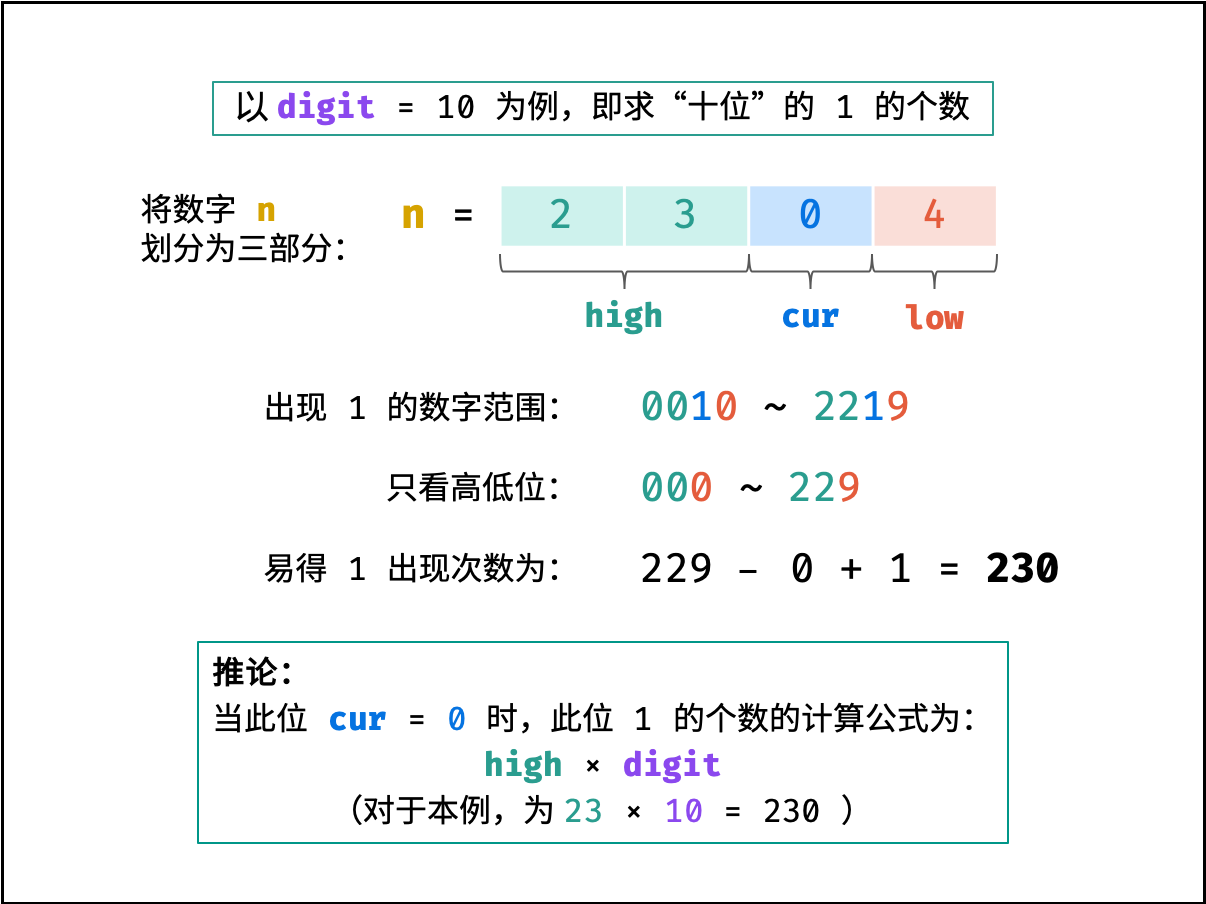{:align=center width=450}
2. 当 **$cur = 1$ 时:** 此位 $1$ 的出现次数由高位 $high$ 和低位 $low$ 决定,计算公式为:
$$
high \times digit + low + 1
$$
> 如下图所示,以 $n = 2314$ 为例,求 $digit = 10$ (即十位)的 $1$ 出现次数。
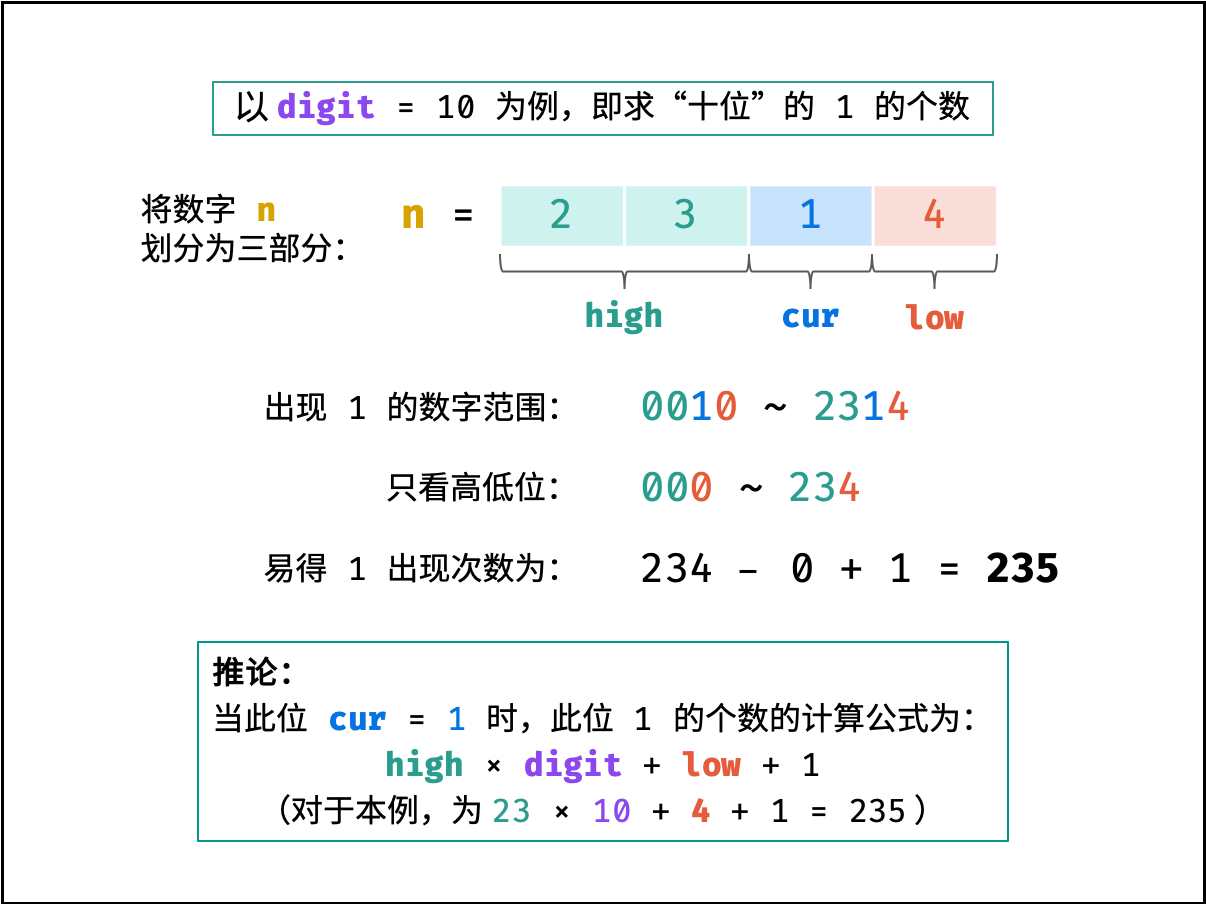{:align=center width=450}
3. 当 **$cur = 2, 3, \cdots, 9$ 时:** 此位 $1$ 的出现次数只由高位 $high$ 决定,计算公式为:
$$
(high + 1) \times digit
$$
> 如下图所示,以 $n = 2324$ 为例,求 $digit = 10$ (即十位)的 $1$ 出现次数。
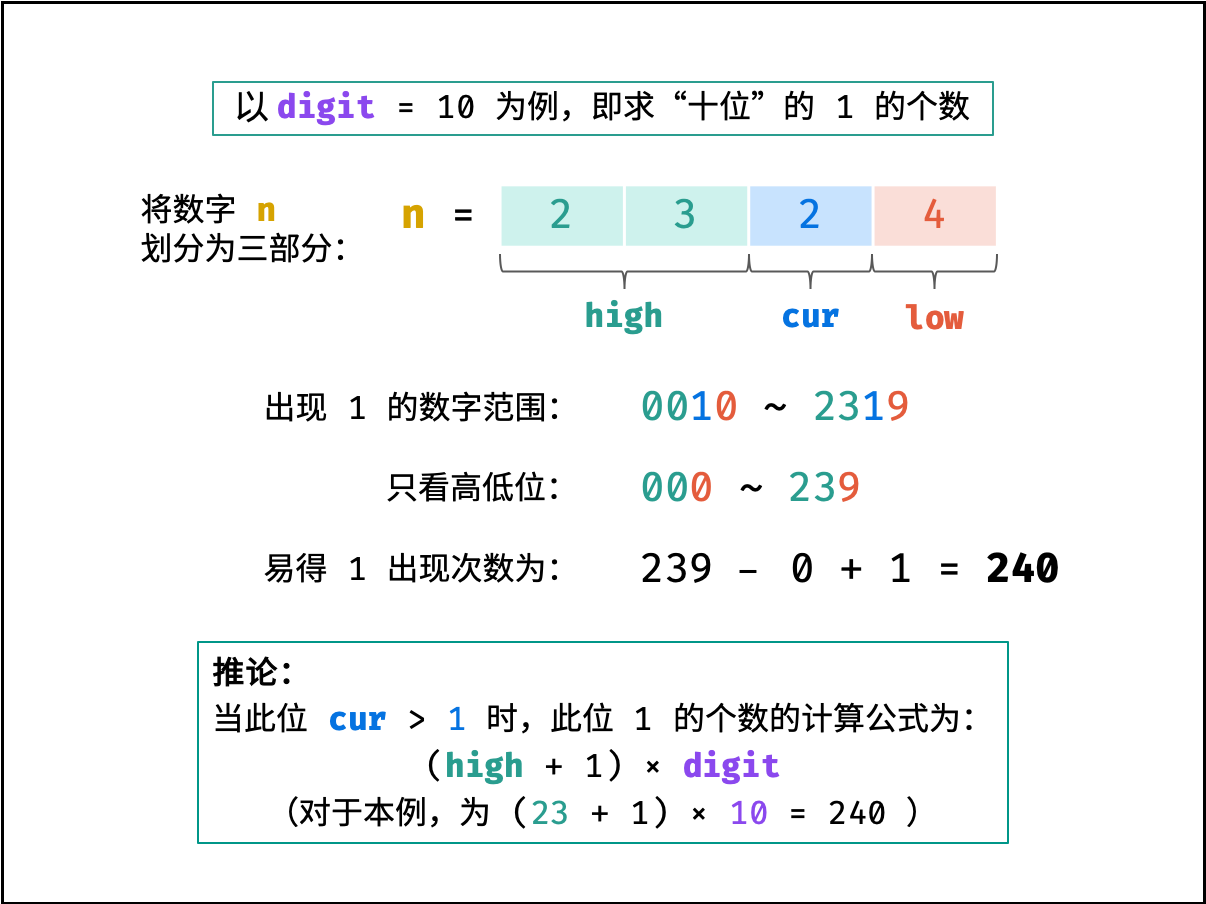{:align=center width=450}
### 变量递推公式:
设计按照 “个位、十位、...” 的顺序计算,则 $high / cur / low / digit$ 应初始化为:
```Python []
high = n // 10
cur = n % 10
low = 0
digit = 1 # 个位
```
```Java []
int high = n / 10;
int cur = n % 10;
int low = 0;
int digit = 1; // 个位
```
```C++ []
int high = n / 10;
int cur = n % 10;
int low = 0;
int digit = 1; // 个位
```
因此,从个位到最高位的变量递推公式为:
```Python []
while high != 0 or cur != 0: # 当 high 和 cur 同时为 0 时,说明已经越过最高位,因此跳出
low += cur * digit # 将 cur 加入 low ,组成下轮 low
cur = high % 10 # 下轮 cur 是本轮 high 的最低位
high //= 10 # 将本轮 high 最低位删除,得到下轮 high
digit *= 10 # 位因子每轮 × 10
```
```Java []
while(high != 0 || cur != 0) { // 当 high 和 cur 同时为 0 时,说明已经越过最高位,因此跳出
low += cur * digit; // 将 cur 加入 low ,组成下轮 low
cur = high % 10; // 下轮 cur 是本轮 high 的最低位
high /= 10; // 将本轮 high 最低位删除,得到下轮 high
digit *= 10; // 位因子每轮 × 10
}
```
```C++ []
while(high != 0 || cur != 0) { // 当 high 和 cur 同时为 0 时,说明已经越过最高位,因此跳出
low += cur * digit; // 将 cur 加入 low ,组成下轮 low
cur = high % 10; // 下轮 cur 是本轮 high 的最低位
high /= 10; // 将本轮 high 最低位删除,得到下轮 high
digit *= 10; // 位因子每轮 × 10
}
```
## 代码:
```Python []
class Solution:
def digitOneInNumber(self, n: int) -> int:
digit, res = 1, 0
high, cur, low = n // 10, n % 10, 0
while high != 0 or cur != 0:
if cur == 0: res += high * digit
elif cur == 1: res += high * digit + low + 1
else: res += (high + 1) * digit
low += cur * digit
cur = high % 10
high //= 10
digit *= 10
return res
```
```Java []
class Solution {
public int digitOneInNumber(int n) {
int digit = 1, res = 0;
int high = n / 10, cur = n % 10, low = 0;
while(high != 0 || cur != 0) {
if(cur == 0) res += high * digit;
else if(cur == 1) res += high * digit + low + 1;
else res += (high + 1) * digit;
low += cur * digit;
cur = high % 10;
high /= 10;
digit *= 10;
}
return res;
}
}
```
```C++ []
class Solution {
public:
int digitOneInNumber(int n) {
long digit = 1;
int high = n / 10, cur = n % 10, low = 0, res = 0;
while(high != 0 || cur != 0) {
if(cur == 0) res += high * digit;
else if(cur == 1) res += high * digit + low + 1;
else res += (high + 1) * digit;
low += cur * digit;
cur = high % 10;
high /= 10;
digit *= 10;
}
return res;
}
};
```
### 复杂度分析:
- **时间复杂度 $O(\log n)$ :** 循环内的计算操作使用 $O(1)$ 时间;循环次数为数字 $n$ 的位数,即 $\log_{10}{n}$ ,因此循环使用 $O(\log n)$ 时间。
- **空间复杂度 $O(1)$ :** 几个变量使用常数大小的额外空间。
================================================
FILE: leetbook_ioa/docs/LCR 163. 找到第 k 位数字.md
================================================
## 解题思路:
文名词规定如下:
1. 将 $101112 \cdots$ 中的每一位称为 **数位** ,记为 $k$ ;
2. 将 $10, 11, 12, \cdots$ 称为 **数字** ,记为 $num$ ;
3. 数字 $10$ 是一个两位数,称此数字的 **位数** 为 $2$ ,记为 $digit$ ;
4. 每 $digit$ 位数的起始数字(即:$1, 10, 100, \cdots$),记为 $start$ ;
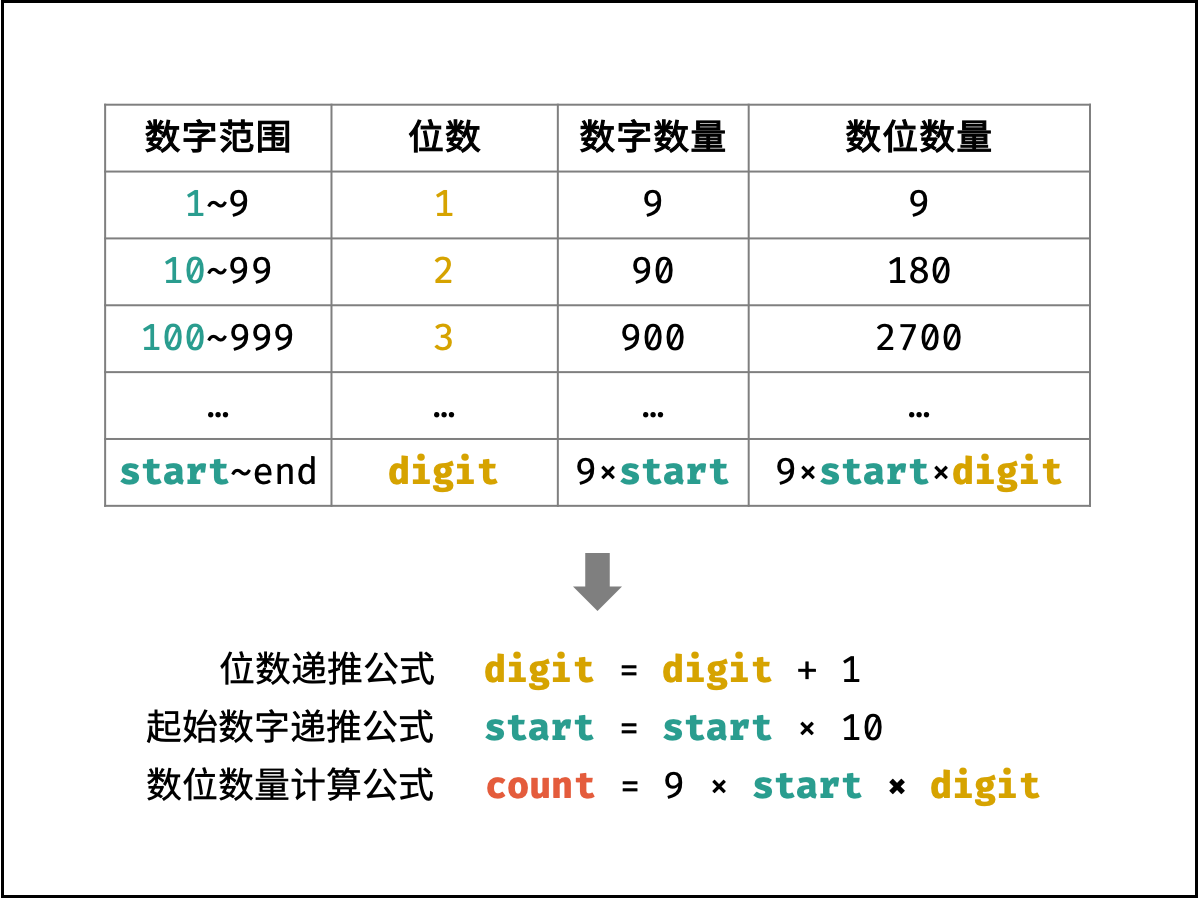{:align=center width=450}
观察上表,可推出各 $digit$ 下的数位数量 $count$ 的计算公式:
$$
count = 9 \times start \times digit
$$
根据以上分析,可将求解分为三步:
1. 确定 $k$ 所在 **数字** 的 **位数** ,记为 $digit$ ;
2. 确定 $k$ 所在的 **数字** ,记为 $num$ ;
3. 确定 $k$ 是 $num$ 中的哪一数位,并返回结果;
### 1. 确定所求数位的所在数字的位数
如下图所示,循环执行 $k$ 减去 一位数、两位数、... 的数位数量 $count$ ,直至 $k \leq count$ 时跳出。
由于 $k$ 已经减去了一位数、两位数、...、$(digit-1)$ 位数的 **数位数量** $count$ ,因而此时的 $k$ 是从起始数字 $start$ 开始计数的。
```Python []
digit, start, count = 1, 1, 9
while k > count:
k -= count
start *= 10 # 1, 10, 100, ...
digit += 1 # 1, 2, 3, ...
count = 9 * start * digit # 9, 180, 2700, ...
```
```Java []
int digit = 1;
long start = 1;
long count = 9;
while (k > count) {
k -= count;
start *= 10; // 1, 10, 100, ...
digit += 1; // 1, 2, 3, ...
count = digit * start * 9; // 9, 180, 2700, ...
}
```
```C++ []
int digit = 1;
long start = 1;
long count = 9;
while (k > count) { // 1.
k -= count;
start *= 10; // 1, 10, 100, ...
digit += 1; // 1, 2, 3, ...
count = digit * start * 9; // 9, 180, 2700, ...
}
```
**结论:** 所求数位 (1) 在某个 $digit$ 位数中; (2) 为从数字 $start$ 开始的第 $k$ 个数位。
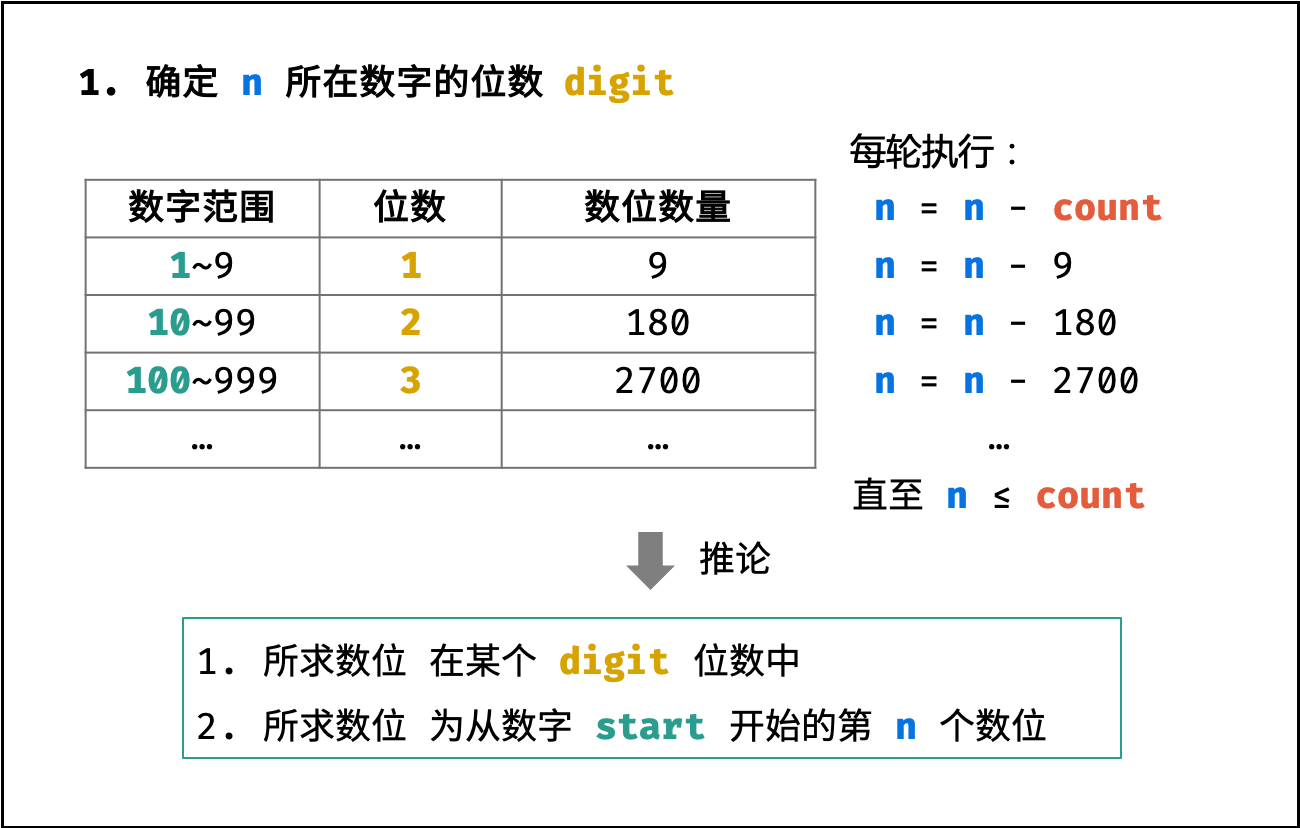{:align=center width=500}
### 2. 确定所求数位所在的数字
如下图所示,所求数位 在从数字 $start$ 开始的第 $[(k - 1) / digit]$ 个 **数字** 中( $start$ 为第 0 个数字)。
```Python []
num = start + (k - 1) // digit
```
```Java []
long num = start + (k - 1) / digit;
```
```C++ []
long num = start + (k - 1) / digit;
```
**结论:** 所求数位在数字 $num$ 中。
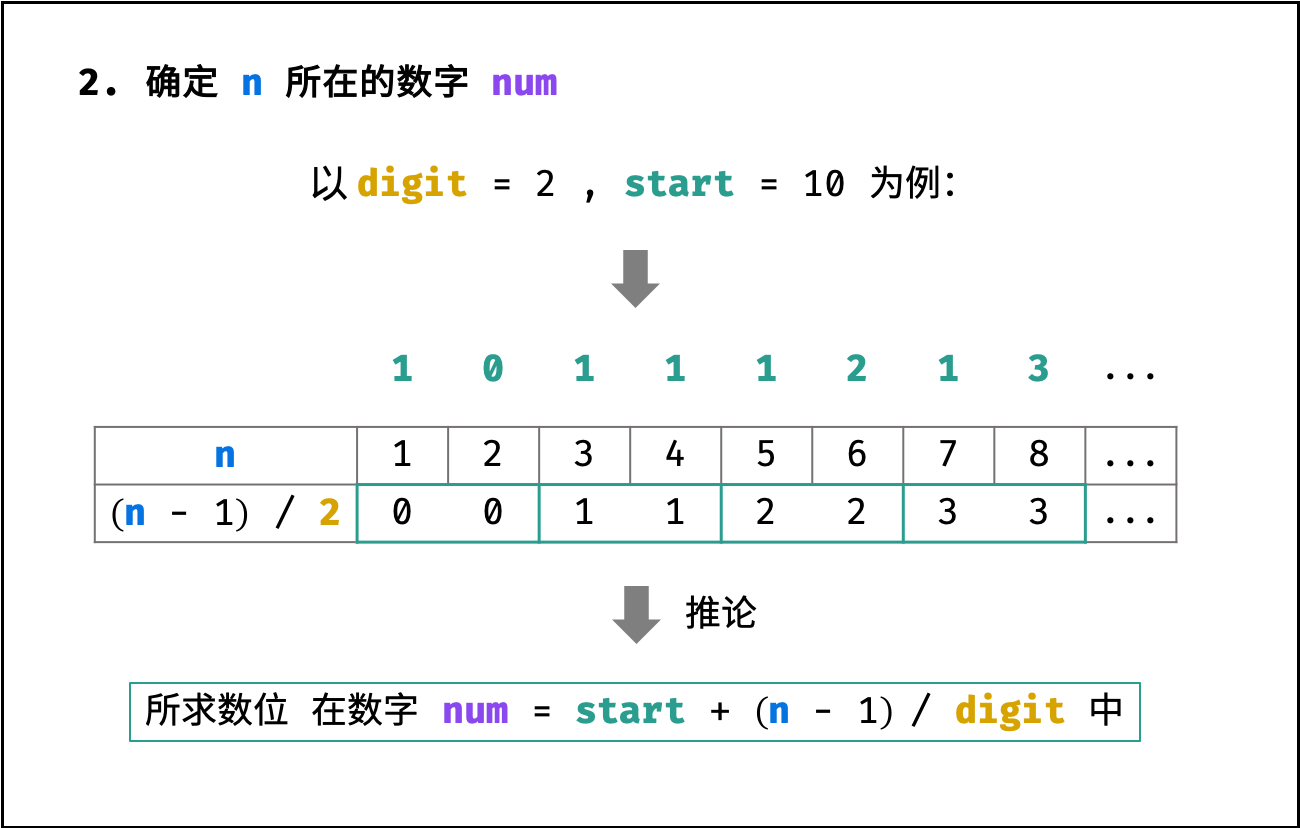{:align=center width=500}
### 3. 确定所求数位在 $num$ 的哪一数位
如下图所示,所求数位为数字 $num$ 的第 $(k - 1) \mod digit$ 位( 数字的首个数位为第 0 位)。
```Python []
s = str(num) # 转化为 string
res = int(s[(k - 1) % digit]) # 获得 num 的 第 (k - 1) % digit 个数位,并转化为 int
```
```Java []
String s = Long.toString(num); // 转化为 string
int res = s.charAt((k - 1) % digit) - '0'; // 获得 num 的 第 (k - 1) % digit 个数位,并转化为 int
```
```C++ []
string s = to_string(num); // 转化为 string
int res = s[(k - 1) % digit] - '0'; // 获得 num 的 第 (k - 1) % digit 个数位,并转化为 int
```
**结论:** 所求数位是 $res$ 。
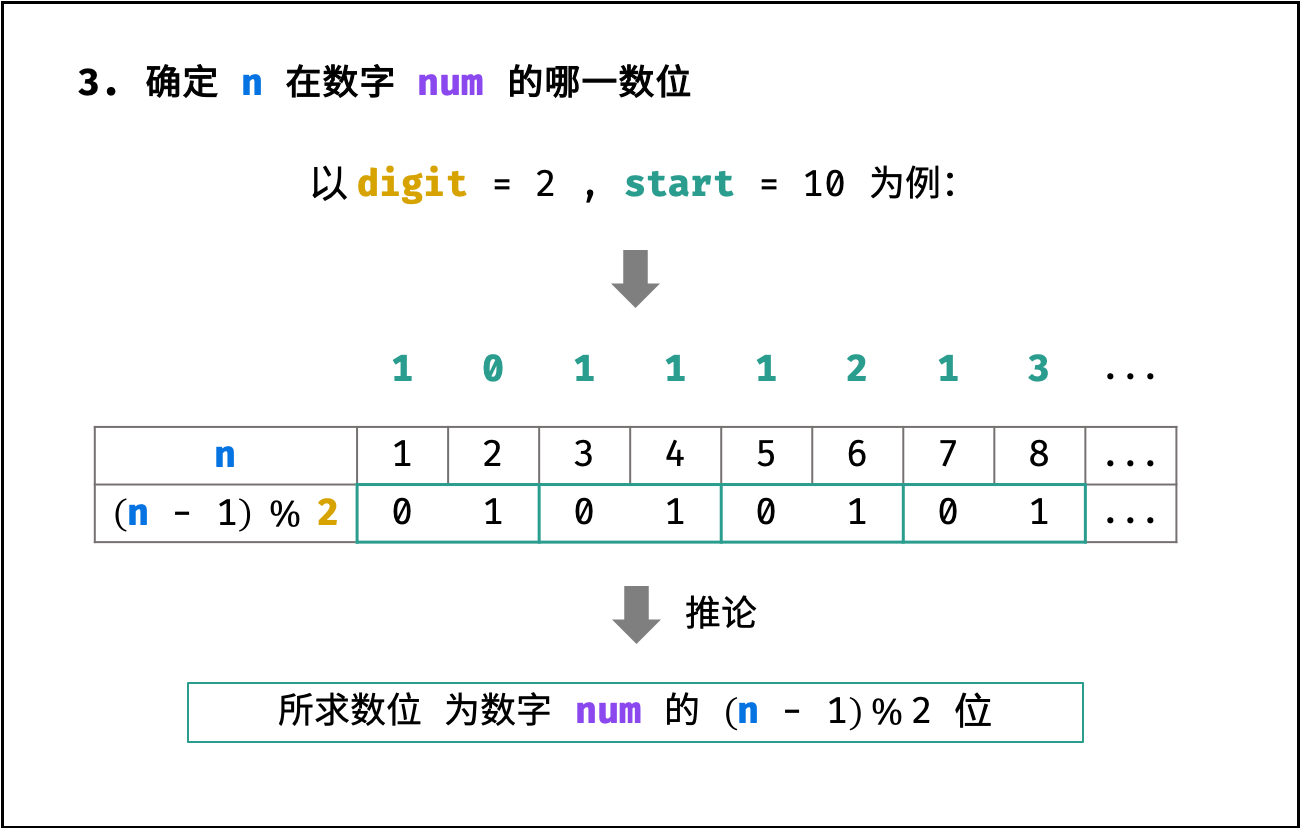{:align=center width=500}
整体流程如下图所示。
## 代码:
```Python []
class Solution:
def findKthNumber(self, k: int) -> int:
digit, start, count = 1, 1, 9
while k > count: # 1.
k -= count
start *= 10
digit += 1
count = 9 * start * digit
num = start + (k - 1) // digit # 2.
return int(str(num)[(k - 1) % digit]) # 3.
```
```Java []
class Solution {
public int findKthNumber(int k) {
int digit = 1;
long start = 1;
long count = 9;
while (k > count) { // 1.
k -= count;
start *= 10;
digit += 1;
count = digit * start * 9;
}
long num = start + (k - 1) / digit; // 2.
return Long.toString(num).charAt((k - 1) % digit) - '0'; // 3.
}
}
```
```C++ []
class Solution {
public:
int findKthNumber(int k) {
int digit = 1;
long start = 1;
long count = 9;
while (k > count) { // 1.
k -= count;
start *= 10;
digit += 1;
count = digit * start * 9;
}
long num = start + (k - 1) / digit; // 2.
return to_string(num)[(k - 1) % digit] - '0'; // 3.
}
};
```
### 复杂度分析:
- **时间复杂度 $O(\log k)$ :** 所求数位 $k$ 对应数字 $num$ 的位数 $digit$ 最大为 $O(\log k)$ ;第一步最多循环 $O(\log k)$ 次;第三步中将 $num$ 转化为字符串使用 $O(\log k)$ 时间;因此总体为 $O(\log k)$ 。
- **空间复杂度 $O(\log k)$ :** 将数字 $num$ 转化为字符串 `str(num)` ,占用 $O(\log k)$ 的额外空间。
================================================
FILE: leetbook_ioa/docs/LCR 164. 破解闯关密码.md
================================================
## 解题思路:
此题求拼接起来的最小数字,本质上是一个排序问题。设数组 $password$ 中任意两数字的字符串为 $x$ 和 $y$ ,则规定 **排序判断规则** 为:
- 若拼接字符串 $x + y > y + x$ ,则 $x$ “大于” $y$ ;
- 反之,若 $x + y < y + x$ ,则 $x$ “小于” $y$ ;
> $x$ “小于” $y$ 代表:排序完成后,数组中 $x$ 应在 $y$ 左边;“大于” 则反之。
根据以上规则,套用任何排序方法对 $password$ 执行排序即可。
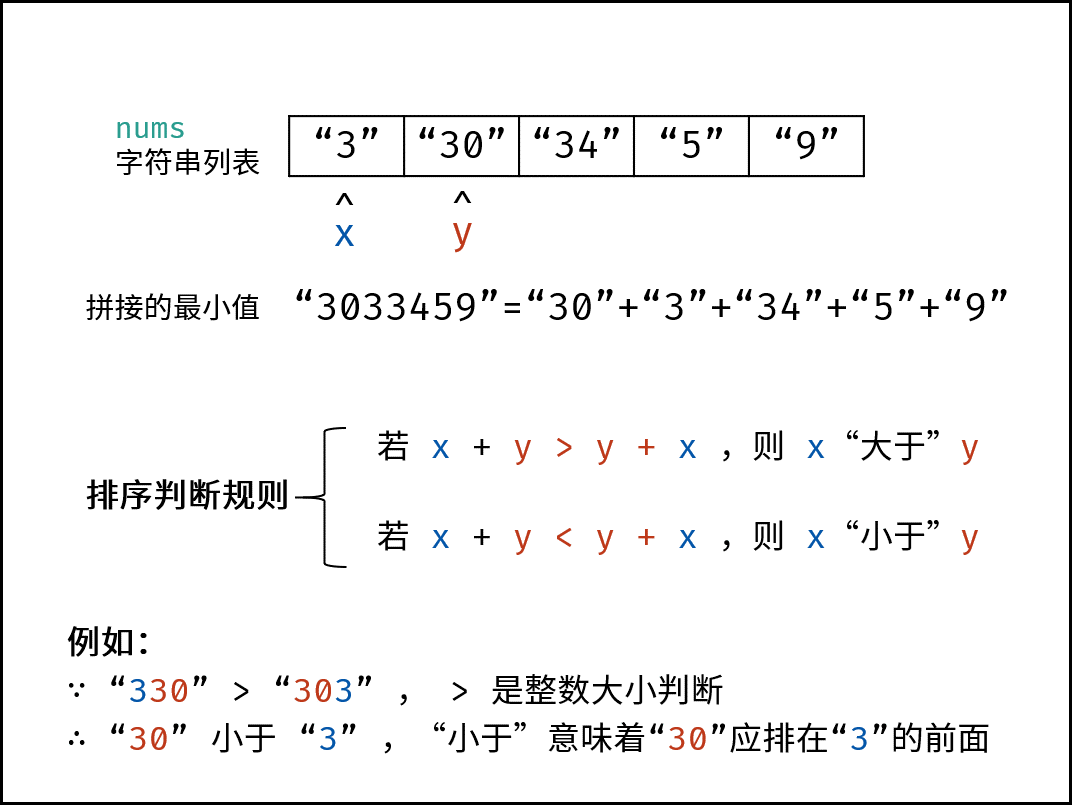{:align=center width=450}
### 算法流程:
1. **初始化:** 字符串列表 $strs$ ,保存各数字的字符串格式;
2. **列表排序:** 应用以上 “排序判断规则” ,对 $strs$ 执行排序;
3. **返回值:** 拼接 $strs$ 中的所有字符串,并返回。
> 下图中 `nums` 对应本题的 `password` 。
## 代码:
本文列举 **快速排序** 和 **内置函数** 两种排序方法,其他排序方法也可实现。
### 快速排序:
需修改快速排序函数中的排序判断规则。字符串大小(字典序)对比的实现方法:
- Python/C++ 中可直接用 `<` , `>`;
- Java 中使用函数 `A.compareTo(B)`;
```Python []
class Solution:
def crackPassword(self, password: List[int]) -> str:
def quick_sort(l , r):
if l >= r: return
i, j = l, r
while i < j:
while strs[j] + strs[l] >= strs[l] + strs[j] and i < j: j -= 1
while strs[i] + strs[l] <= strs[l] + strs[i] and i < j: i += 1
strs[i], strs[j] = strs[j], strs[i]
strs[i], strs[l] = strs[l], strs[i]
quick_sort(l, i - 1)
quick_sort(i + 1, r)
strs = [str(num) for num in password]
quick_sort(0, len(strs) - 1)
return ''.join(strs)
```
```Java []
class Solution {
public String crackPassword(int[] password) {
String[] strs = new String[password.length];
for(int i = 0; i < password.length; i++)
strs[i] = String.valueOf(password[i]);
quickSort(strs, 0, strs.length - 1);
StringBuilder res = new StringBuilder();
for(String s : strs)
res.append(s);
return res.toString();
}
void quickSort(String[] strs, int l, int r) {
if(l >= r) return;
int i = l, j = r;
String tmp = strs[i];
while(i < j) {
while((strs[j] + strs[l]).compareTo(strs[l] + strs[j]) >= 0 && i < j) j--;
while((strs[i] + strs[l]).compareTo(strs[l] + strs[i]) <= 0 && i < j) i++;
tmp = strs[i];
strs[i] = strs[j];
strs[j] = tmp;
}
strs[i] = strs[l];
strs[l] = tmp;
quickSort(strs, l, i - 1);
quickSort(strs, i + 1, r);
}
}
```
```C++ []
class Solution {
public:
string crackPassword(vector& password) {
vector strs;
for(int i = 0; i < password.size(); i++)
strs.push_back(to_string(password[i]));
quickSort(strs, 0, strs.size() - 1);
string res;
for(string s : strs)
res.append(s);
return res;
}
private:
void quickSort(vector& strs, int l, int r) {
if(l >= r) return;
int i = l, j = r;
while(i < j) {
while(strs[j] + strs[l] >= strs[l] + strs[j] && i < j) j--;
while(strs[i] + strs[l] <= strs[l] + strs[i] && i < j) i++;
swap(strs[i], strs[j]);
}
swap(strs[i], strs[l]);
quickSort(strs, l, i - 1);
quickSort(strs, i + 1, r);
}
};
```
### 内置函数:
需定义排序规则:
- Python 定义在函数 `sort_rule(x, y)` 中;
- Java 定义为 `(x, y) -> (x + y).compareTo(y + x)` ;
- C++ 定义为 `(string& x, string& y){ return x + y < y + x; }` ;
```Python []
class Solution:
def crackPassword(self, password: List[int]) -> str:
def sort_rule(x, y):
a, b = x + y, y + x
if a > b: return 1
elif a < b: return -1
else: return 0
strs = [str(num) for num in password]
strs.sort(key = functools.cmp_to_key(sort_rule))
return ''.join(strs)
```
```Java []
class Solution {
public String crackPassword(int[] password) {
String[] strs = new String[password.length];
for(int i = 0; i < password.length; i++)
strs[i] = String.valueOf(password[i]);
Arrays.sort(strs, (x, y) -> (x + y).compareTo(y + x));
StringBuilder res = new StringBuilder();
for(String s : strs)
res.append(s);
return res.toString();
}
}
```
```C++ []
class Solution {
public:
string crackPassword(vector& password) {
vector strs;
string res;
for(int i = 0; i < password.size(); i++)
strs.push_back(to_string(password[i]));
sort(strs.begin(), strs.end(), [](string& x, string& y){ return x + y < y + x; });
for(int i = 0; i < strs.size(); i++)
res.append(strs[i]);
return res;
}
};
```
### 复杂度分析:
- **时间复杂度 $O(N \log N)$ :** $N$ 为最终返回值的字符数量( $strs$ 列表的长度 $\leq N$ );使用快排或内置函数的平均时间复杂度为 $O(N \log N)$ ,最差为 $O(N^2)$ 。
- **空间复杂度 $O(N)$ :** 字符串列表 $strs$ 占用线性大小的额外空间。
================================================
FILE: leetbook_ioa/docs/LCR 165. 解密数字.md
================================================
## 解题思路:
根据题意,可按照下图的思路,总结出 “递推公式” (即转移方程)。
> 下图中的 `num` 对应本题的 `ciphertext` 。
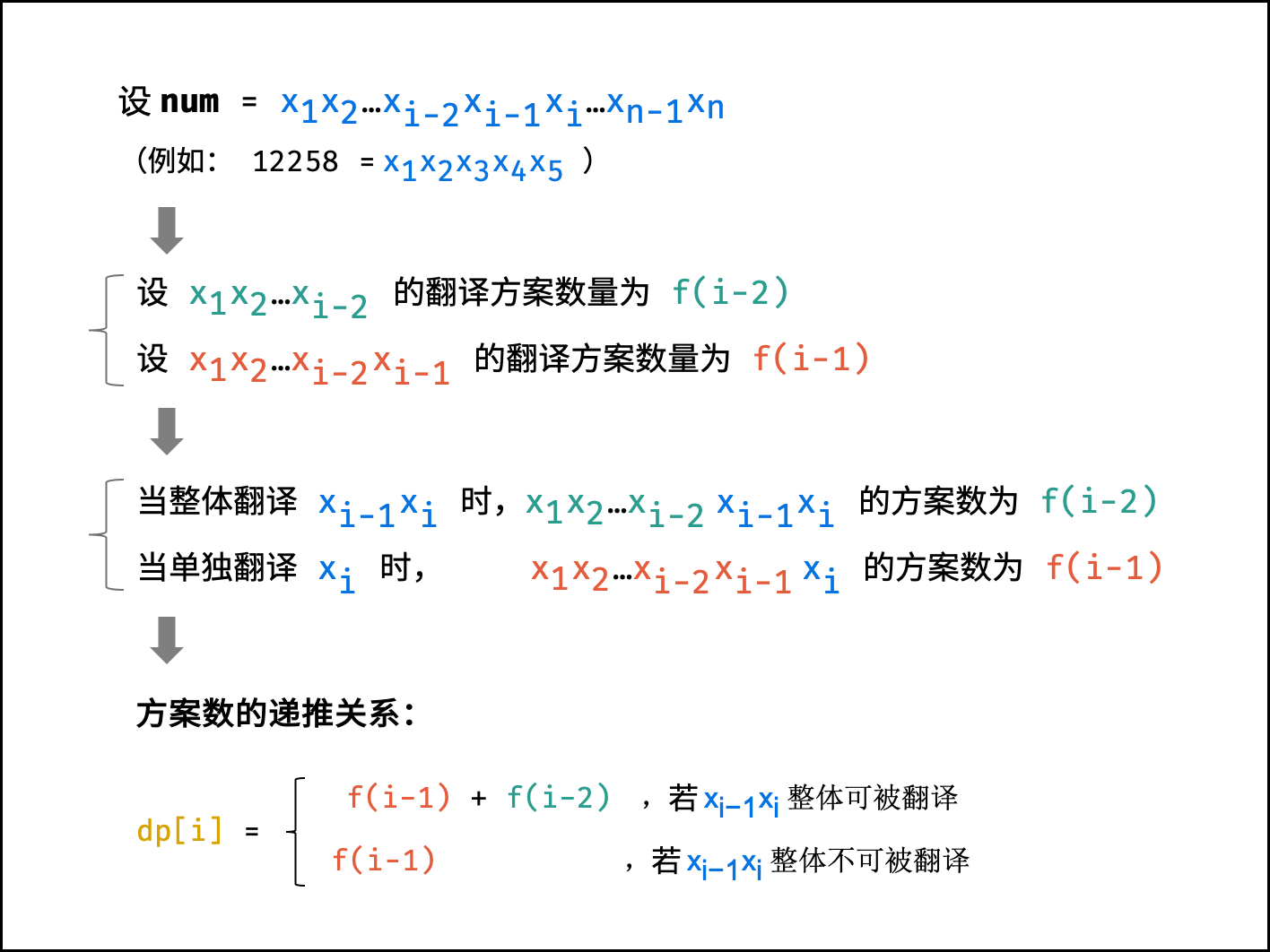{:align=center width=600}
因此,此题可用动态规划解决,以下按照流程解题。
### 动态规划解析:
> 记数字 $ciphertext$ 第 $i$ 位数字为 $x_i$ ,数字 $ciphertext$ 的位数为 $n$ ;
> 例如: $ciphertext = 12258$ 的 $n = 5$ , $x_1 = 1$ 。
- **状态定义:** 设动态规划列表 $dp$ ,$dp[i]$ 代表以 $x_i$ 为结尾的数字的翻译方案数量。
- **转移方程:** 若 $x_i$ 和 $x_{i-1}$ 组成的两位数字可被整体翻译,则 $dp[i] = dp[i - 1] + dp[i - 2]$ ,否则 $dp[i] = dp[i - 1]$ 。
$$
dp[i] =
\begin{cases}
dp[i - 1] + dp[i - 2] & {, (10 x_{i-1} + x_i) \in [10,25]} \\
dp[i - 1] & {, (10 x_{i-1} + x_i) \in [0, 10) \cup (25, 99]}
\end{cases}
$$
> **可被整体翻译的两位数区间分析:** 当 $x_{i-1} = 0$ 时,组成的两位数无法被整体翻译(例如 $00, 01, 02, \cdots$ ),大于 $25$ 的两位数也无法被整体翻译(例如 $26, 27, \cdots$ ),因此区间为 $[10, 25]$ 。
- **初始状态:** $dp[0] = dp[1] = 1$ ,即 “无数字” 和 “第 $1$ 位数字” 的翻译方法数量均为 $1$ ;
- **返回值:** $dp[n]$ ,即此数字的翻译方案数量;
> **Q:** 无数字情况 $dp[0] = 1$ 从何而来?
> **A:** 当 $ciphertext$ 第 $1, 2$ 位的组成的数字 $\in [10,25]$ 时,显然应有 $2$ 种翻译方法,即 $dp[2] = dp[1] + dp[0] = 2$ ,而显然 $dp[1] = 1$ ,因此推出 $dp[0] = 1$ 。
## 方法一:字符串遍历
- 为方便获取数字的各位 $x_i$ ,考虑先将数字 $ciphertext$ 转化为字符串 $s$ ,通过遍历 $s$ 实现动态规划。
- 通过字符串切片 $s[i - 2:i]$ 获取数字组合 $10 x_{i-1} + x_i$ ,通过对比字符串 ASCII 码判断字符串对应的数字区间。
- **空间使用优化:** 由于 $dp[i]$ 只与 $dp[i - 1]$ 有关,因此可使用两个变量 $a, b$ 分别记录 $dp[i]$ , $dp[i - 1]$ ,两变量交替前进即可。此方法可省去 $dp$ 列表使用的 $O(N)$ 的额外空间。
### 代码:
```Python []
class Solution:
def crackNumber(self, ciphertext: int) -> int:
s = str(ciphertext)
a = b = 1
for i in range(2, len(s) + 1):
tmp = s[i - 2:i]
c = a + b if "10" <= tmp <= "25" else a
b = a
a = c
return a
```
```Java []
class Solution {
public int crackNumber(int ciphertext) {
String s = String.valueOf(ciphertext);
int a = 1, b = 1;
for(int i = 2; i <= s.length(); i++) {
String tmp = s.substring(i - 2, i);
int c = tmp.compareTo("10") >= 0 && tmp.compareTo("25") <= 0 ? a + b : a;
b = a;
a = c;
}
return a;
}
}
```
```C++ []
class Solution {
public:
int crackNumber(int ciphertext) {
string s = to_string(ciphertext);
int a = 1, b = 1, len = s.size();
for(int i = 2; i <= len; i++) {
string tmp = s.substr(i - 2, 2);
int c = tmp.compare("10") >= 0 && tmp.compare("25") <= 0 ? a + b : a;
b = a;
a = c;
}
return a;
}
};
```
此题的动态规划计算是 **对称的** ,即 **从左向右** 遍历(从第 $dp[2]$ 计算至 $dp[n]$ )和 **从右向左** 遍历(从第 $dp[n - 2]$ 计算至 $dp[0]$ )所得方案数一致。从右向左遍历的代码如下所示。
```Python []
class Solution:
def crackNumber(self, ciphertext: int) -> int:
s = str(ciphertext)
a = b = 1
for i in range(len(s) - 2, -1, -1):
a, b = (a + b if "10" <= s[i:i + 2] <= "25" else a), a
return a
```
```Java []
class Solution {
public int crackNumber(int ciphertext) {
String s = String.valueOf(ciphertext);
int a = 1, b = 1;
for(int i = s.length() - 2; i > -1; i--) {
String tmp = s.substring(i, i + 2);
int c = tmp.compareTo("10") >= 0 && tmp.compareTo("25") <= 0 ? a + b : a;
b = a;
a = c;
}
return a;
}
}
```
```C++ []
class Solution {
public:
int crackNumber(int ciphertext) {
string s = to_string(ciphertext);
int a = 1, b = 1, len = s.size();
for(int i = len - 2; i > -1; i--) {
string tmp = s.substr(i, 2);
int c = tmp.compare("10") >= 0 && tmp.compare("25") <= 0 ? a + b : a;
b = a;
a = c;
}
return a;
}
};
```
### 复杂度分析:
- **时间复杂度 $O(N)$ :** $N$ 为字符串 $s$ 的长度(即数字 $ciphertext$ 的位数 $\log(ciphertext)$ ),其决定了循环次数。
- **空间复杂度 $O(N)$ :** 字符串 $s$ 使用 $O(N)$ 大小的额外空间。
## 方法二:数字求余
上述方法虽然已经节省了 $dp$ 列表的空间占用,但字符串 $s$ 仍使用了 $O(N)$ 大小的额外空间。
### 空间优化:
- 利用求余运算 $ciphertext \mod 10$ 和求整运算 $ciphertext // 10$ ,可获取数字 $ciphertext$ 的各位数字(获取顺序为个位、十位、百位…)。
- 运用 **求余** 和 **求整** 运算实现,可实现 **从右向左** 的动态规划计算。而根据上述动态规划 “对称性” ,可知从右向左计算是正确的。
- 自此,字符串 $s$ 的空间占用也被省去,空间复杂度从 $O(N)$ 降至 $O(1)$ 。
### 代码:
```Python []
class Solution:
def crackNumber(self, ciphertext: int) -> int:
a = b = 1
y = ciphertext % 10
while ciphertext > 9:
ciphertext //= 10
x = ciphertext % 10
tmp = 10 * x + y
c = a + b if 10 <= tmp <= 25 else a
a, b = c, a
y = x
return a
```
```Java []
class Solution {
public int crackNumber(int ciphertext) {
int a = 1, b = 1, x, y = ciphertext % 10;
while(ciphertext > 9) {
ciphertext /= 10;
x = ciphertext % 10;
int tmp = 10 * x + y;
int c = (tmp >= 10 && tmp <= 25) ? a + b : a;
b = a;
a = c;
y = x;
}
return a;
}
}
```
```C++ []
class Solution {
public:
int crackNumber(int ciphertext) {
int a = 1, b = 1, x, y = ciphertext % 10;
while(ciphertext > 9) {
ciphertext /= 10;
x = ciphertext % 10;
int tmp = 10 * x + y;
int c = (tmp >= 10 && tmp <= 25) ? a + b : a;
b = a;
a = c;
y = x;
}
return a;
}
};
```
### 复杂度分析:
- **时间复杂度 $O(N)$ :** $N$ 为字符串 $s$ 的长度,即数字 $ciphertext$ 的位数 $\log(ciphertext)$ ,其决定了循环次数。
- **空间复杂度 $O(1)$ :** 几个变量使用常数大小的额外空间。
================================================
FILE: leetbook_ioa/docs/LCR 166. 珠宝的最高价值.md
================================================
## 解题思路:
题目说明:从棋盘的左上角开始拿格子里的珠宝,并每次 **向右** 或者 **向下** 移动一格、直到到达棋盘的右下角。
根据题目说明,易得某单元格只可能从上边单元格或左边单元格到达。
设 $f(i, j)$ 为从棋盘左上角走至单元格 $(i ,j)$ 的珠宝最大累计价值,易得到以下递推关系:$f(i,j)$ 等于 $f(i,j-1)$ 和 $f(i-1,j)$ 中的较大值加上当前单元格珠宝价值 $frame(i,j)$ 。
$$
f(i,j) = \max[f(i,j-1), f(i-1,j)] + frame(i,j)
$$
因此,可用动态规划解决此问题,以上公式便为转移方程。
> 下图中的 `grid` 对应本题的 `frame` 。
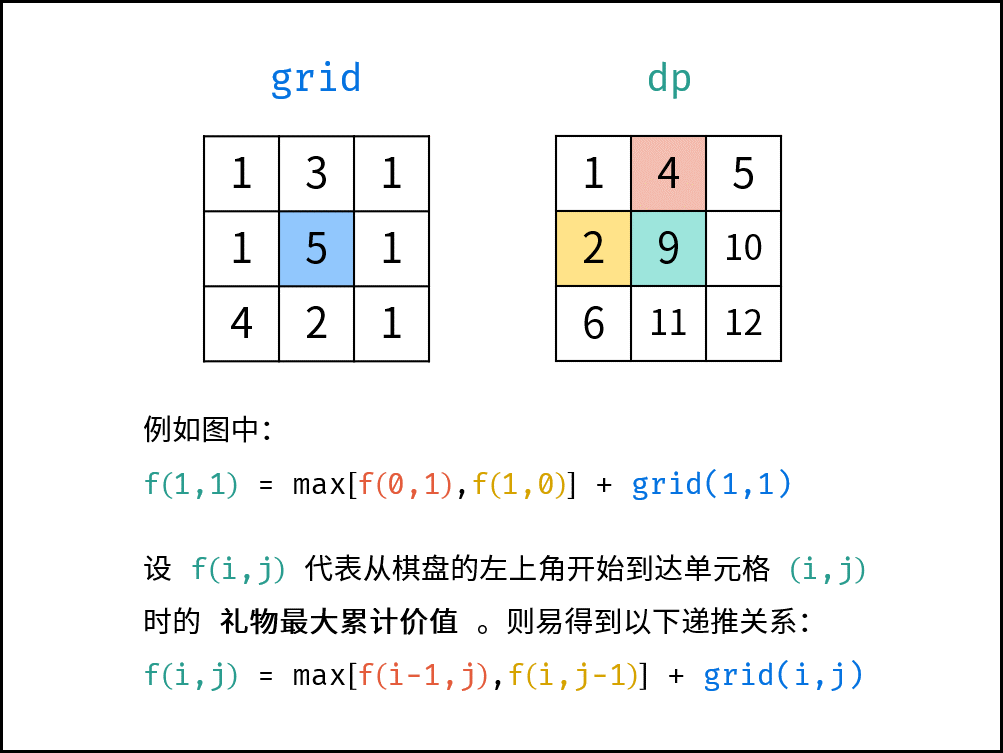{:align=center width=450}
### 动态规划解析:
**状态定义:** 设动态规划矩阵 $dp$ ,$dp(i,j)$ 代表从棋盘的左上角开始,到达单元格 $(i,j)$ 时能拿到珠宝的最大累计价值。
**转移方程:**
1. 当 $i = 0$ 且 $j = 0$ 时,为起始元素;
2. 当 $i = 0$ 且 $j \ne 0$ 时,为矩阵第一行元素,只可从左边到达;
3. 当 $i \ne 0$ 且 $j = 0$ 时,为矩阵第一列元素,只可从上边到达;
4. 当 $i \ne 0$ 且 $j \ne 0$ 时,可从左边或上边到达;
$$
dp(i,j)=
\begin{cases}
frame(i,j) & {,i=0, j=0}\\
frame(i,j) + dp(i,j-1) & {,i=0, j \ne 0}\\
frame(i,j) + dp(i-1,j) & {,i \ne 0, j=0}\\
frame(i,j) + \max[dp(i-1,j),dp(i,j-1)]& ,{i \ne 0, j \ne 0}
\end{cases}
$$
**初始状态:** $dp[0][0] = frame[0][0]$ ,即到达单元格 $(0,0)$ 时能拿到珠宝的最大累计价值为 $frame[0][0]$ ;
**返回值:** $dp[m-1][n-1]$ ,$m, n$ 分别为矩阵的行高和列宽,即返回 $dp$ 矩阵右下角元素。
### 空间优化:
由于 $dp[i][j]$ 只与 $dp[i-1][j]$ , $dp[i][j-1]$ , $frame[i][j]$ 有关系,因此可以将原矩阵 $frame$ 用作 $dp$ 矩阵,即直接在 $frame$ 上修改即可。
应用此方法可省去 $dp$ 矩阵使用的额外空间,因此空间复杂度从 $O(MN)$ 降至 $O(1)$ 。
## 代码:
```Python []
class Solution:
def jewelleryValue(self, frame: List[List[int]]) -> int:
for i in range(len(frame)):
for j in range(len(frame[0])):
if i == 0 and j == 0: continue
if i == 0: frame[i][j] += frame[i][j - 1]
elif j == 0: frame[i][j] += frame[i - 1][j]
else: frame[i][j] += max(frame[i][j - 1], frame[i - 1][j])
return frame[-1][-1]
```
```Java []
class Solution {
public int jewelleryValue(int[][] frame) {
int m = frame.length, n = frame[0].length;
for(int i = 0; i < m; i++) {
for(int j = 0; j < n; j++) {
if(i == 0 && j == 0) continue;
if(i == 0) frame[i][j] += frame[i][j - 1] ;
else if(j == 0) frame[i][j] += frame[i - 1][j];
else frame[i][j] += Math.max(frame[i][j - 1], frame[i - 1][j]);
}
}
return frame[m - 1][n - 1];
}
}
```
```C++ []
class Solution {
public:
int jewelleryValue(vector>& frame) {
int m = frame.size(), n = frame[0].size();
for(int i = 0; i < m; i++) {
for(int j = 0; j < n; j++) {
if(i == 0 && j == 0) continue;
if(i == 0) frame[i][j] += frame[i][j - 1] ;
else if(j == 0) frame[i][j] += frame[i - 1][j];
else frame[i][j] += max(frame[i][j - 1], frame[i - 1][j]);
}
}
return frame[m - 1][n - 1];
}
};
```
以上代码逻辑清晰,和转移方程直接对应,但仍可提升效率,这是因为:当 $frame$ 矩阵很大时,$i = 0$ 或 $j = 0$ 的情况仅占极少数,相当循环每轮都冗余了一次判断。因此,可先初始化矩阵第一行和第一列,再开始遍历递推。
```Python []
class Solution:
def jewelleryValue(self, frame: List[List[int]]) -> int:
m, n = len(frame), len(frame[0])
for j in range(1, n): # 初始化第一行
frame[0][j] += frame[0][j - 1]
for i in range(1, m): # 初始化第一列
frame[i][0] += frame[i - 1][0]
for i in range(1, m):
for j in range(1, n):
frame[i][j] += max(frame[i][j - 1], frame[i - 1][j])
return frame[-1][-1]
```
```Java []
class Solution {
public int jewelleryValue(int[][] frame) {
int m = frame.length, n = frame[0].length;
for(int j = 1; j < n; j++) // 初始化第一行
frame[0][j] += frame[0][j - 1];
for(int i = 1; i < m; i++) // 初始化第一列
frame[i][0] += frame[i - 1][0];
for(int i = 1; i < m; i++)
for(int j = 1; j < n; j++)
frame[i][j] += Math.max(frame[i][j - 1], frame[i - 1][j]);
return frame[m - 1][n - 1];
}
}
```
```C++ []
class Solution {
public:
int jewelleryValue(vector>& frame) {
int m = frame.size(), n = frame[0].size();
for(int j = 1; j < n; j++) // 初始化第一行
frame[0][j] += frame[0][j - 1];
for(int i = 1; i < m; i++) // 初始化第一列
frame[i][0] += frame[i - 1][0];
for(int i = 1; i < m; i++)
for(int j = 1; j < n; j++)
frame[i][j] += max(frame[i][j - 1], frame[i - 1][j]);
return frame[m - 1][n - 1];
}
};
```
### 复杂度分析:
- **时间复杂度 $O(MN)$ :** $M, N$ 分别为矩阵行高、列宽;动态规划需遍历整个 $frame$ 矩阵,使用 $O(MN)$ 时间。
- **空间复杂度 $O(1)$ :** 原地修改使用常数大小的额外空间。
================================================
FILE: leetbook_ioa/docs/LCR 167. 招式拆解 I.md
================================================
## 解题思路:
长度为 $N$ 的字符串共有 $\frac{(1 + N)N}{2}$ 个子字符串(复杂度为 $O(N^2)$ ),判断长度为 $N$ 的字符串是否有重复字符的复杂度为 $O(N)$ ,因此本题使用暴力法解决的复杂度为 $O(N^3)$ 。
本题有滑动窗口和动态规划两种解法。
## 方法一:滑动窗口 + 哈希表
**哈希表 $dic$ 统计:** 指针 $j$ 遍历字符 $arr$ ,哈希表统计字符 $arr[j]$ **最后一次出现的索引** 。
**更新左指针 $i$ :** 根据上轮左指针 $i$ 和 $dic[arr[j]]$ ,每轮更新左边界 $i$ ,保证区间 $[i + 1, j]$ 内无重复字符且最大。
$$
i = \max(dic[arr[j]], i)
$$
**更新结果 $res$ :** 取上轮 $res$ 和本轮双指针区间 $[i + 1,j]$ 的宽度(即 $j - i$ )中的最大值。
$$
res = \max(res, j - i)
$$
> 下图中的 `s` 对应本题中的 `arr` 。
### 代码:
```Python []
class Solution:
def dismantlingAction(self, arr: str) -> int:
dic, res, i = {}, 0, -1
for j in range(len(arr)):
if arr[j] in dic:
i = max(dic[arr[j]], i) # 更新左指针 i
dic[arr[j]] = j # 哈希表记录
res = max(res, j - i) # 更新结果
return res
```
```Java []
class Solution {
public int dismantlingAction(String arr) {
Map dic = new HashMap<>();
int i = -1, res = 0, len = arr.length();
for(int j = 0; j < len; j++) {
if (dic.containsKey(arr.charAt(j)))
i = Math.max(i, dic.get(arr.charAt(j))); // 更新左指针 i
dic.put(arr.charAt(j), j); // 哈希表记录
res = Math.max(res, j - i); // 更新结果
}
return res;
}
}
```
```C++ []
class Solution {
public:
int dismantlingAction(string arr) {
unordered_map dic;
int i = -1, res = 0, len = arr.size();
for(int j = 0; j < len; j++) {
if (dic.find(arr[j]) != dic.end())
i = max(i, dic.find(arr[j])->second); // 更新左指针
dic[arr[j]] = j; // 哈希表记录
res = max(res, j - i); // 更新结果
}
return res;
}
};
```
### 复杂度分析:
- **时间复杂度 $O(N)$ :** 其中 $N$ 为字符串长度,动态规划需遍历计算 $dp$ 列表。
- **空间复杂度 $O(1)$ :** 字符的 ASCII 码范围为 $0$ ~ $127$ ,哈希表 $dic$ 最多使用 $O(128) = O(1)$ 大小的额外空间。
## 方法二:动态规划 + 哈希表
- **状态定义:** 设动态规划列表 $dp$ ,$dp[j]$ 代表以字符 $arr[j]$ 为结尾的 “最长不重复子字符串” 的长度。
- **转移方程:** 固定右边界 $j$ ,设字符 $arr[j]$ 左边距离最近的相同字符为 $arr[i]$ ,即 $arr[i] = arr[j]$ 。
1. 当 $i < 0$ ,即 $arr[j]$ 左边无相同字符,则 $dp[j] = dp[j-1] + 1$ 。
2. 当 $dp[j - 1] < j - i$ ,说明字符 $arr[i]$ 在子字符串 $dp[j-1]$ **区间之外** ,则 $dp[j] = dp[j - 1] + 1$ 。
3. 当 $dp[j - 1] \geq j - i$ ,说明字符 $arr[i]$ 在子字符串 $dp[j-1]$ **区间之中** ,则 $dp[j]$ 的左边界由 $arr[i]$ 决定,即 $dp[j] = j - i$ 。
> 当 $i < 0$ 时,由于 $dp[j - 1] \leq j$ 恒成立,因而 $dp[j - 1] < j - i$ 恒成立,因此分支 `1.` 和 `2.` 可被合并。
$$
dp[j] =
\begin{cases}
dp[j - 1] + 1 & , dp[j-1] < j - i \\
j - i & , dp[j-1] \geq j - i
\end{cases}
$$
- **返回值:** $\max(dp)$ ,即全局的 “最长不重复子字符串” 的长度。
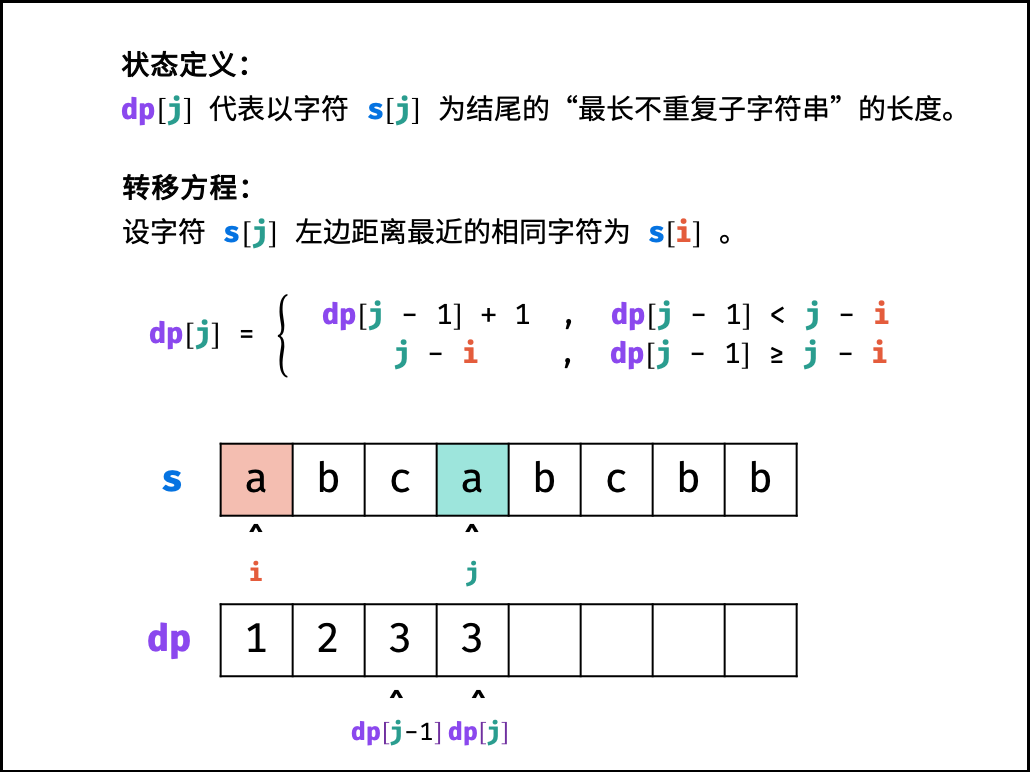{:align=center width=500}
### 状态压缩:
- 由于返回值是取 $dp$ 列表最大值,因此可借助变量 $tmp$ 存储 $dp[j]$ ,变量 $res$ 每轮更新最大值即可。
- 此优化可节省 $dp$ 列表使用的 $O(N)$ 大小的额外空间。
### 哈希表记录:
观察转移方程,可知关键问题:每轮遍历字符 $arr[j]$ 时,如何计算索引 $i$ ?
- **哈希表统计:** 遍历字符串 $arr$ 时,使用哈希表(记为 $dic$ )统计 **各字符最后一次出现的索引位置** 。
- **左边界 $i$ 获取方式:** 遍历到 $arr[j]$ 时,可通过访问哈希表 $dic[arr[j]]$ 获取最近的相同字符的索引 $i$ 。
### 代码:
Python 的 `get(key, default)` 方法和 Java 的 `getOrDefault(key, default)` ,代表当哈希表包含键 `key` 时返回对应 `value` ,不包含时返回默认值 `default` 。
```Python []
class Solution:
def dismantlingAction(self, arr: str) -> int:
dic = {}
res = tmp = 0
for j in range(len(arr)):
i = dic.get(arr[j], -1) # 获取索引 i
dic[arr[j]] = j # 更新哈希表
tmp = tmp + 1 if tmp < j - i else j - i # dp[j - 1] -> dp[j]
res = max(res, tmp) # max(dp[j - 1], dp[j])
return res
```
```Java []
class Solution {
public int dismantlingAction(String arr) {
Map dic = new HashMap<>();
int res = 0, tmp = 0, len = arr.length();
for(int j = 0; j < len; j++) {
int i = dic.getOrDefault(arr.charAt(j), -1); // 获取索引 i
dic.put(arr.charAt(j), j); // 更新哈希表
tmp = tmp < j - i ? tmp + 1 : j - i; // dp[j - 1] -> dp[j]
res = Math.max(res, tmp); // max(dp[j - 1], dp[j])
}
return res;
}
}
```
```C++ []
class Solution {
public:
int dismantlingAction(string arr) {
unordered_map dic;
int res = 0, tmp = 0, len = arr.size(), i;
for(int j = 0; j < len; j++) {
if (dic.find(arr[j]) == dic.end()) i = - 1;
else i = dic.find(arr[j])->second; // 获取索引 i
dic[arr[j]] = j; // 更新哈希表
tmp = tmp < j - i ? tmp + 1 : j - i; // dp[j - 1] -> dp[j]
res = max(res, tmp); // max(dp[j - 1], dp[j])
}
return res;
}
};
```
### 复杂度分析:
- **时间复杂度 $O(N)$ :** 其中 $N$ 为字符串长度,动态规划需遍历计算 $dp$ 列表。
- **空间复杂度 $O(1)$ :** 字符的 ASCII 码范围为 $0$ ~ $127$ ,哈希表 $dic$ 最多使用 $O(128) = O(1)$ 大小的额外空间。
================================================
FILE: leetbook_ioa/docs/LCR 168. 丑数.md
================================================
## 解题思路:
根据题意,每个丑数都可以由其他较小的丑数通过乘以 $2$ 或 $3$ 或 $5$ 得到。
所以,可以考虑使用一个优先队列保存所有的丑数,每次取出最小的那个,然后乘以 $2$ , $3$ , $5$ 后放回队列。然而,**这样做会出现重复的丑数**。例如:
```shell
初始化丑数列表 [1]
第一轮: 1 -> 2, 3, 5 ,丑数列表变为 [1, 2, 3, 5]
第二轮: 2 -> 4, 6, 10 ,丑数列表变为 [1, 2, 3, 4, 6, 10]
第三轮: 3 -> 6, 9, 15 ,出现重复的丑数 6
```
为了避免重复,我们可以用三个指针 $a$ , $b$, $c$ ,分别表示下一个丑数是当前指针指向的丑数乘以 $2$ , $3$ , $5$ 。
利用三个指针生成丑数的算法流程:
1. 初始化丑数列表 $res$ ,首个丑数为 $1$ ,三个指针 $a$ , $b$, $c$ 都指向首个丑数。
2. 开启循环生成丑数:
1. 计算下一个丑数的候选集 $res[a] \cdot 2$ , $res[b] \cdot 3$ , $res[c] \cdot 5$ 。
2. 选择丑数候选集中最小的那个作为下一个丑数,填入 $res$ 。
3. 将被选中的丑数对应的指针向右移动一格。
3. 返回 $res$ 的最后一个元素即可。
## 代码:
```Python []
class Solution:
def nthUglyNumber(self, n: int) -> int:
res, a, b, c = [1] * n, 0, 0, 0
for i in range(1, n):
n2, n3, n5 = res[a] * 2, res[b] * 3, res[c] * 5
res[i] = min(n2, n3, n5)
if res[i] == n2: a += 1
if res[i] == n3: b += 1
if res[i] == n5: c += 1
return res[-1]
```
```Java []
class Solution {
public int nthUglyNumber(int n) {
int a = 0, b = 0, c = 0;
int[] res = new int[n];
res[0] = 1;
for(int i = 1; i < n; i++) {
int n2 = res[a] * 2, n3 = res[b] * 3, n5 = res[c] * 5;
res[i] = Math.min(Math.min(n2, n3), n5);
if (res[i] == n2) a++;
if (res[i] == n3) b++;
if (res[i] == n5) c++;
}
return res[n - 1];
}
}
```
```C++ []
class Solution {
public:
int nthUglyNumber(int n) {
int a = 0, b = 0, c = 0;
int res[n];
res[0] = 1;
for(int i = 1; i < n; i++) {
int n2 = res[a] * 2, n3 = res[b] * 3, n5 = res[c] * 5;
res[i] = min(min(n2, n3), n5);
if (res[i] == n2) a++;
if (res[i] == n3) b++;
if (res[i] == n5) c++;
}
return res[n - 1];
}
};
```
### 复杂度分析:
- **时间复杂度 $O(n)$ :** 计算 $res$ 列表需遍历 $n-1$ 轮。
- **空间复杂度 $O(n)$ :** 长度为 $n$ 的 $res$ 列表使用 $O(n)$ 的额外空间。
================================================
FILE: leetbook_ioa/docs/LCR 169. 招式拆解 II.md
================================================
## 解题思路:
本题考察 **哈希表** 的使用,本文介绍 **哈希表** 和 **有序哈希表** 两种解法。其中,在字符串长度较大、重复字符很多时,“有序哈希表” 解法理论上效率更高。
## 方法一:哈希表
1. 遍历字符串 `arr` ,使用哈希表统计 “各字符数量是否 $> 1$ ”。
2. 再遍历字符串 `arr` ,在哈希表中找到首个 “数量为 $1$ 的字符”,并返回。
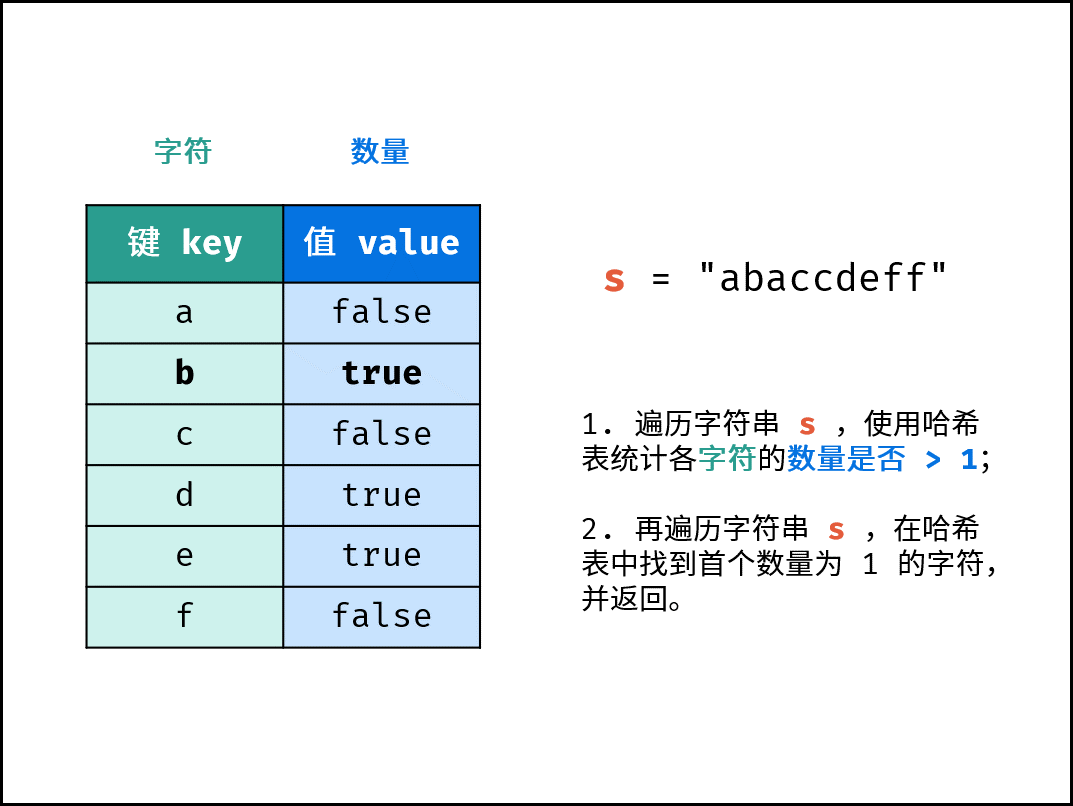{:align=center width=450}
### 算法流程:
1. **初始化:** 字典 (Python)、HashMap(Java)、map(C++),记为 `hmap` ;
2. **字符统计:** 遍历字符串 `arr` 中的每个字符 `c` ;
1. 若 `hmap` 中 **不包含** 键(key) `c` :则向 `hmap` 中添加键值对 `(c, True)` ,代表字符 `c` 的数量为 $1$ ;
2. 若 `hmap` 中 **包含** 键(key) `c` :则修改键 `c` 的键值对为 `(c, False)` ,代表字符 `c` 的数量 $> 1$ 。
3. **查找数量为 $1$ 的字符:** 遍历字符串 `arr` 中的每个字符 `c` ;
1. 若 `hmap`中键 `c` 对应的值为 `True` :,则返回 `c` 。
4. 返回 `' '` ,代表字符串无数量为 $1$ 的字符。
> 下图中的 `s` 对应本题的 `arr` 。
### 代码:
Python 代码中的 `not c in hmap` 整体为一个布尔值;`c in hmap` 为判断字典中是否含有键 `c` 。
```Python []
class Solution:
def dismantlingAction(self, arr: str) -> str:
hmap = {}
for c in arr:
hmap[c] = not c in hmap
for c in arr:
if hmap[c]: return c
return ' '
```
```Java []
class Solution {
public char dismantlingAction(String arr) {
HashMap hmap = new HashMap<>();
char[] sc = arr.toCharArray();
for(char c : sc)
hmap.put(c, !hmap.containsKey(c));
for(char c : sc)
if(hmap.get(c)) return c;
return ' ';
}
}
```
```C++ []
class Solution {
public:
char dismantlingAction(string arr) {
unordered_map hmap;
for(char c : arr)
hmap[c] = hmap.find(c) == hmap.end();
for(char c : arr)
if(hmap[c]) return c;
return ' ';
}
};
```
### 复杂度分析:
- **时间复杂度 $O(N)$ :** $N$ 为字符串 `arr` 的长度;需遍历 `arr` 两轮,使用 $O(N)$ ;HashMap 查找操作的复杂度为 $O(1)$ ;
- **空间复杂度 $O(1)$ :** 由于题目指出 `arr` 只包含小写字母,因此最多有 26 个不同字符,HashMap 存储需占用 $O(26) = O(1)$ 的额外空间。
## 方法二:有序哈希表
在哈希表的基础上,有序哈希表中的键值对是 **按照插入顺序排序** 的。基于此,可通过遍历有序哈希表,实现搜索首个 “数量为 $1$ 的字符”。
哈希表是 **去重** 的,即哈希表中键值对数量 $\leq$ 字符串 `arr` 的长度。因此,相比于方法一,方法二减少了第二轮遍历的循环次数。当字符串很长(重复字符很多)时,方法二则效率更高。
### 代码:
Python 3.6 后,默认字典就是有序的,因此无需使用 `OrderedDict()` ,详情可见:[为什么Python 3.6以后字典有序并且效率更高?](https://www.cnblogs.com/xieqiankun/p/python_dict.html)
Java 使用 `LinkedHashMap` 实现有序哈希表。
由于 C++ 未提供自带的链式哈希表,因此借助一个 vector 按序存储哈希表 hmap 中的 key ,第二轮遍历此 vector 即可。
```Python []
class Solution:
def dismantlingAction(self, arr: str) -> str:
hmap = collections.OrderedDict()
for c in arr:
hmap[c] = not c in hmap
for k, v in hmap.items():
if v: return k
return ' '
```
```Python []
class Solution:
def dismantlingAction(self, arr: str) -> str:
hmap = {}
for c in arr:
hmap[c] = not c in hmap
for k, v in hmap.items():
if v: return k
return ' '
```
```Java []
class Solution {
public char dismantlingAction(String arr) {
Map hmap = new LinkedHashMap<>();
char[] sc = arr.toCharArray();
for(char c : sc)
hmap.put(c, !hmap.containsKey(c));
for(Map.Entry d : hmap.entrySet()){
if(d.getValue()) return d.getKey();
}
return ' ';
}
}
```
```C++ []
class Solution {
public:
char dismantlingAction(string arr) {
vector keys;
unordered_map hmap;
for(char c : arr) {
if(hmap.find(c) == hmap.end())
keys.push_back(c);
hmap[c] = hmap.find(c) == hmap.end();
}
for(char c : keys) {
if(hmap[c]) return c;
}
return ' ';
}
};
```
### 复杂度分析:
时间和空间复杂度均与 “方法一” 相同,而具体分析:方法一 需遍历 `arr` 两轮;方法二 遍历 `arr` 一轮,遍历 `hmap` 一轮( `hmap` 的长度不大于 26 )。
================================================
FILE: leetbook_ioa/docs/LCR 170. 交易逆序对的总数.md
================================================
## 解题思路:
直观来看,使用暴力统计法即可,即遍历数组的所有数字对并统计逆序对数量。此方法时间复杂度为 $O(N^2)$ ,观察题目给定的数组长度范围 $0 \leq N \leq 50000$ ,可知此复杂度是不能接受的。
「归并排序」与「逆序对」是息息相关的。归并排序体现了 “分而治之” 的算法思想,具体为:
- **分:** 不断将数组从中点位置划分开(即二分法),将整个数组的排序问题转化为子数组的排序问题;
- **治:** 划分到子数组长度为 1 时,开始向上合并,不断将 **较短排序数组** 合并为 **较长排序数组**,直至合并至原数组时完成排序;
> 如下图所示,为数组 $[7, 3, 2, 6, 0, 1, 5, 4]$ 的归并排序过程。
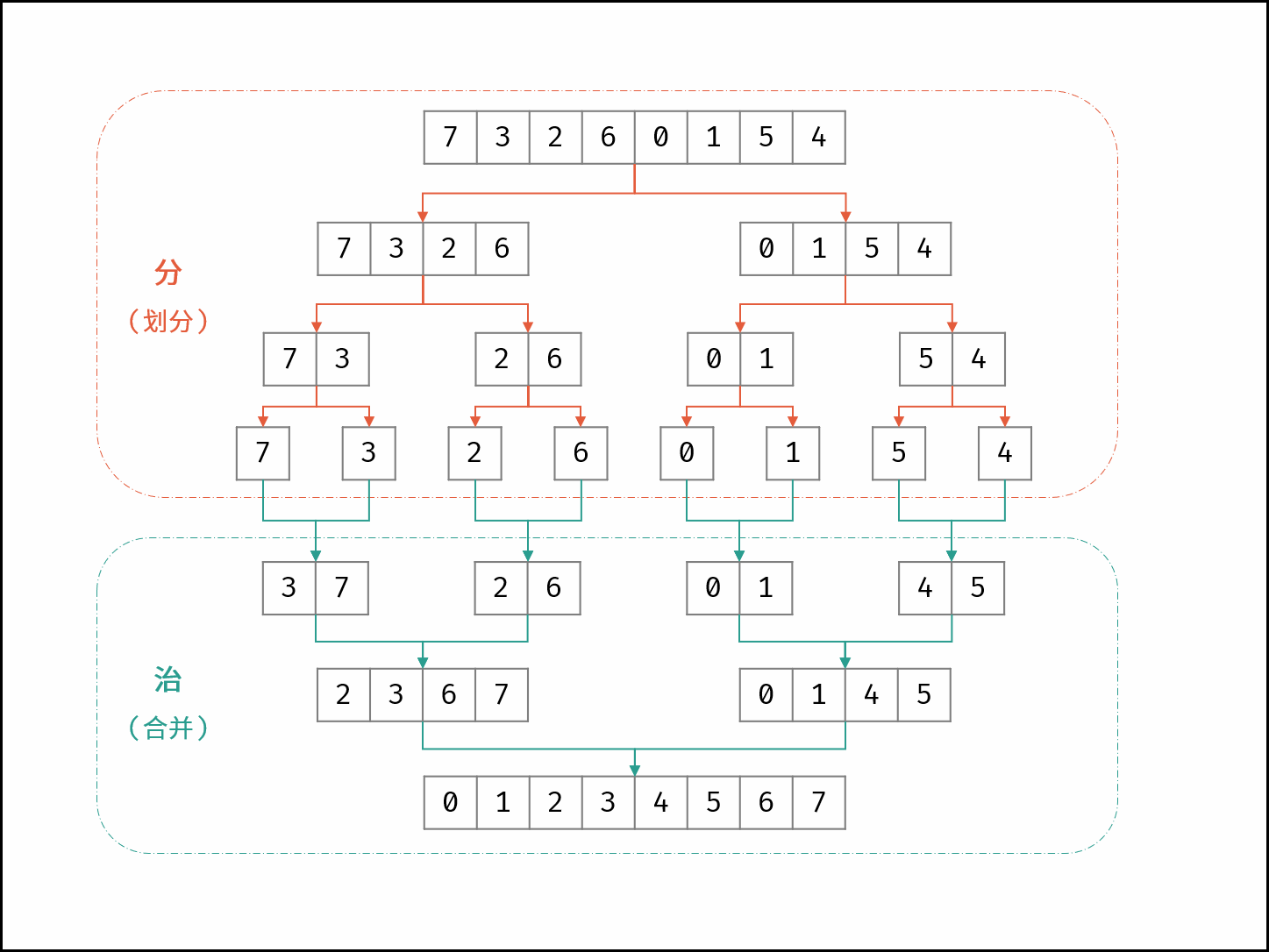{:align=center width=500}
**合并阶段** 本质上是 **合并两个排序数组** 的过程,而每当遇到 左子数组当前元素 > 右子数组当前元素 时,意味着 「左子数组当前元素 至 末尾元素」 与 「右子数组当前元素」 构成了若干 「逆序对」 。
> 如下图所示,为左子数组 $[2, 3, 6, 7]$ 与 右子数组 $[0, 1, 4, 5]$ 的合并与逆序对统计过程。
因此,考虑在归并排序的合并阶段统计「逆序对」数量,完成归并排序时,也随之完成所有逆序对的统计。
### 算法流程:
**`merge_sort()` 归并排序与逆序对统计:**
1. **终止条件:** 当 $l \geq r$ 时,代表子数组长度为 1 ,此时终止划分;
2. **递归划分:** 计算数组中点 $m$ ,递归划分左子数组 `merge_sort(l, m)` 和右子数组 `merge_sort(m + 1, r)` ;
3. **合并与逆序对统计:**
1. 暂存数组 $record$ 闭区间 $[l, r]$ 内的元素至辅助数组 $tmp$ ;
2. **循环合并:** 设置双指针 $i$ , $j$ 分别指向左 / 右子数组的首元素;
- **当 $i = m + 1$ 时:** 代表左子数组已合并完,因此添加右子数组当前元素 $tmp[j]$ ,并执行 $j = j + 1$ ;
- **否则,当 $j = r + 1$ 时:** 代表右子数组已合并完,因此添加左子数组当前元素 $tmp[i]$ ,并执行 $i = i + 1$ ;
- **否则,当 $tmp[i] \leq tmp[j]$ 时:** 添加左子数组当前元素 $tmp[i]$ ,并执行 $i = i + 1$;
- **否则(即 $tmp[i] > tmp[j]$)时:** 添加右子数组当前元素 $tmp[j]$ ,并执行 $j = j + 1$ ;此时构成 $m - i + 1$ 个「逆序对」,统计添加至 $res$ ;
4. **返回值:** 返回直至目前的逆序对总数 $res$ ;
**`reversePairs()` 主函数:**
1. **初始化:** 辅助数组 $tmp$ ,用于合并阶段暂存元素;
2. **返回值:** 执行归并排序 `merge_sort()` ,并返回逆序对总数即可;
> 如下图所示,为数组 $[7, 3, 2, 6, 0, 1, 5, 4]$ 的归并排序与逆序对统计过程。
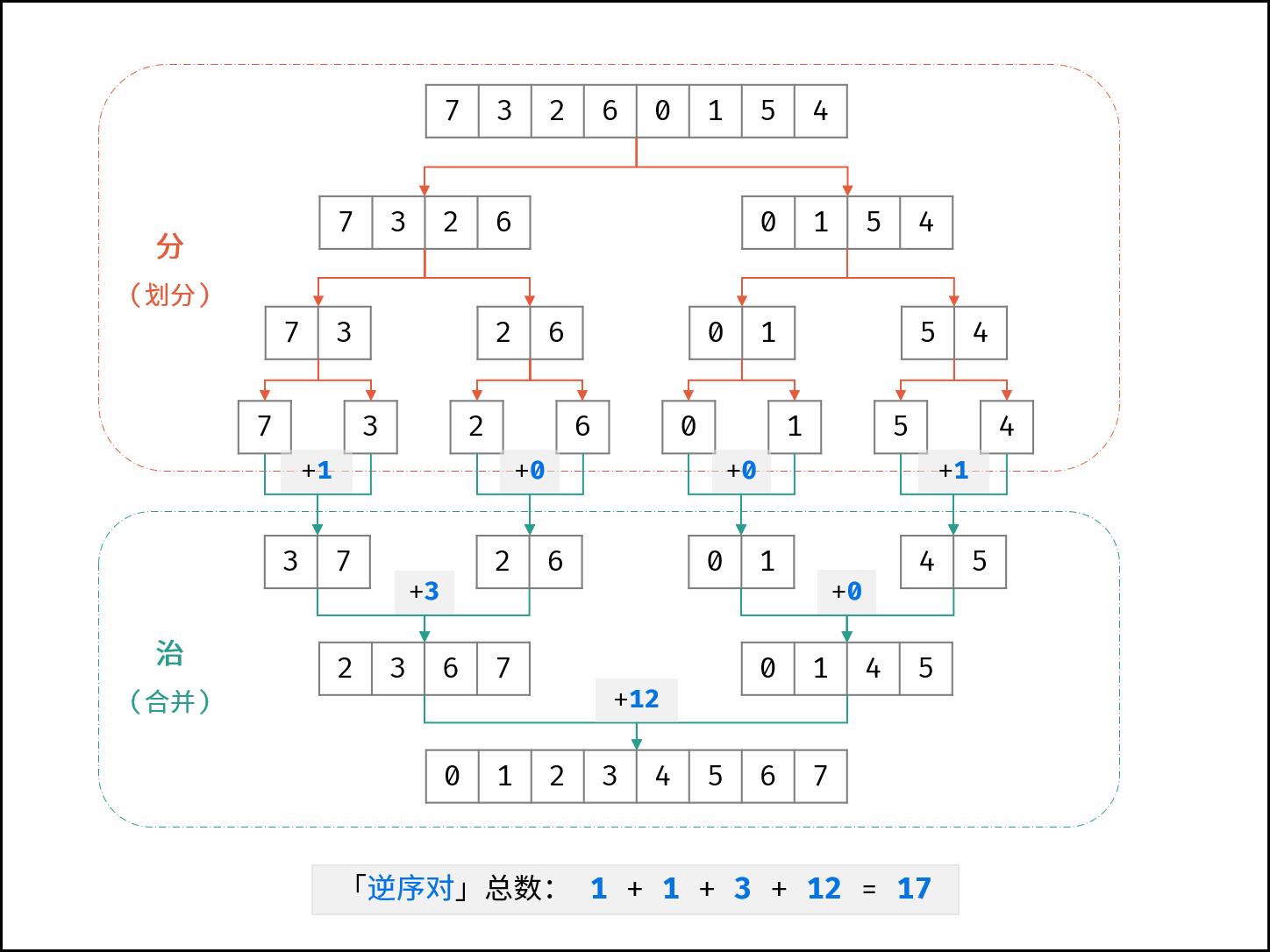{:align=center width=500}
## 代码:
为简化代码,可将“当 $j = r + 1$ 时”与“当 $tmp[i] \leq tmp[j]$ 时”两判断项合并。
```Python []
class Solution:
def reversePairs(self, record: List[int]) -> int:
def merge_sort(l, r):
# 终止条件
if l >= r: return 0
# 递归划分
m = (l + r) // 2
res = merge_sort(l, m) + merge_sort(m + 1, r)
# 合并阶段
i, j = l, m + 1
tmp[l:r + 1] = record[l:r + 1]
for k in range(l, r + 1):
if i == m + 1:
record[k] = tmp[j]
j += 1
elif j == r + 1 or tmp[i] <= tmp[j]:
record[k] = tmp[i]
i += 1
else:
record[k] = tmp[j]
j += 1
res += m - i + 1 # 统计逆序对
return res
tmp = [0] * len(record)
return merge_sort(0, len(record) - 1)
```
```Java []
class Solution {
int[] record, tmp;
public int reversePairs(int[] record) {
this.record = record;
tmp = new int[record.length];
return mergeSort(0, record.length - 1);
}
private int mergeSort(int l, int r) {
// 终止条件
if (l >= r) return 0;
// 递归划分
int m = (l + r) / 2;
int res = mergeSort(l, m) + mergeSort(m + 1, r);
// 合并阶段
int i = l, j = m + 1;
for (int k = l; k <= r; k++)
tmp[k] = record[k];
for (int k = l; k <= r; k++) {
if (i == m + 1)
record[k] = tmp[j++];
else if (j == r + 1 || tmp[i] <= tmp[j])
record[k] = tmp[i++];
else {
record[k] = tmp[j++];
res += m - i + 1; // 统计逆序对
}
}
return res;
}
}
```
```C++ []
class Solution {
public:
int reversePairs(vector& record) {
vector tmp(record.size());
return mergeSort(0, record.size() - 1, record, tmp);
}
private:
int mergeSort(int l, int r, vector& record, vector& tmp) {
// 终止条件
if (l >= r) return 0;
// 递归划分
int m = (l + r) / 2;
int res = mergeSort(l, m, record, tmp) + mergeSort(m + 1, r, record, tmp);
// 合并阶段
int i = l, j = m + 1;
for (int k = l; k <= r; k++)
tmp[k] = record[k];
for (int k = l; k <= r; k++) {
if (i == m + 1)
record[k] = tmp[j++];
else if (j == r + 1 || tmp[i] <= tmp[j])
record[k] = tmp[i++];
else {
record[k] = tmp[j++];
res += m - i + 1; // 统计逆序对
}
}
return res;
}
};
```
### 复杂度分析:
- **时间复杂度 $O(N \log N)$ :** 其中 $N$ 为数组长度;归并排序使用 $O(N \log N)$ 时间;
- **空间复杂度 $O(N)$ :** 辅助数组 $tmp$ 占用 $O(N)$ 大小的额外空间;
================================================
FILE: leetbook_ioa/docs/LCR 171. 训练计划 V.md
================================================
## 解题思路:
设第一个公共节点为 `node` ,链表 `headA` 的节点数量为 $a$ ,链表 `headB` 的节点数量为 $b$ ,两链表的公共尾部的节点数量为 $c$ ,则有:
- 头节点 `headA` 到 `node` 前,共有 $a - c$ 个节点;
- 头节点 `headB` 到 `node` 前,共有 $b - c$ 个节点;
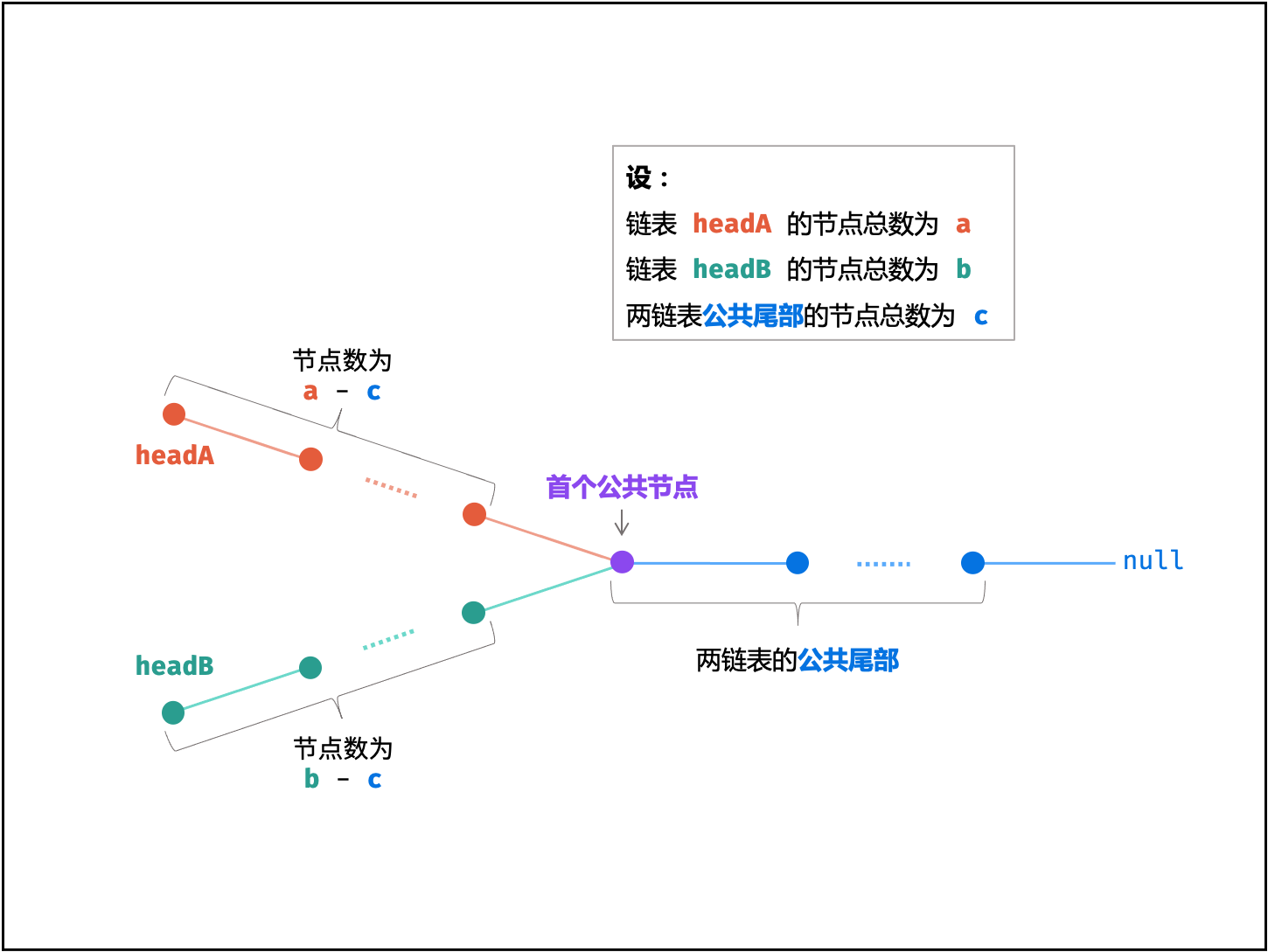{:align=center width=500}
考虑构建两个节点指针 `A` , `B` 分别指向两链表头节点 `headA` , `headB` ,做如下操作:
- 指针 `A` 先遍历完链表 `headA` ,再开始遍历链表 `headB` ,当走到 `node` 时,共走步数为:
$$
a + (b - c)
$$
- 指针 `B` 先遍历完链表 `headB` ,再开始遍历链表 `headA` ,当走到 `node` 时,共走步数为:
$$
b + (a - c)
$$
如下式所示,此时指针 `A` , `B` 重合,并有两种情况:
$$
a + (b - c) = b + (a - c)
$$
1. 若两链表 **有** 公共尾部 (即 $c > 0$ ) :指针 `A` , `B` 同时指向「第一个公共节点」`node` 。
2. 若两链表 **无** 公共尾部 (即 $c = 0$ ) :指针 `A` , `B` 同时指向 $\text{null}$ 。
因此返回 `A` 即可。
> 下图展示了 $a = 5$ , $b = 3$ , $c = 2$ 示例的算法执行过程。
## 代码:
```Python []
class Solution:
def getIntersectionNode(self, headA: ListNode, headB: ListNode) -> ListNode:
A, B = headA, headB
while A != B:
A = A.next if A else headB
B = B.next if B else headA
return A
```
```Java []
public class Solution {
public ListNode getIntersectionNode(ListNode headA, ListNode headB) {
ListNode A = headA, B = headB;
while (A != B) {
A = A != null ? A.next : headB;
B = B != null ? B.next : headA;
}
return A;
}
}
```
```C++ []
class Solution {
public:
ListNode *getIntersectionNode(ListNode *headA, ListNode *headB) {
ListNode *A = headA, *B = headB;
while (A != B) {
A = A != nullptr ? A->next : headB;
B = B != nullptr ? B->next : headA;
}
return A;
}
};
```
### 复杂度分析:
- **时间复杂度 $O(a + b)$ :** 最差情况下(即 $|a - b| = 1$ , $c = 0$ ),此时需遍历 $a + b$ 个节点。
- **空间复杂度 $O(1)$ :** 节点指针 `A` , `B` 使用常数大小的额外空间。
================================================
FILE: leetbook_ioa/docs/LCR 172. 统计目标成绩的出现次数.md
================================================
## 解题思路:
> 排序数组中的搜索问题,首先想到 **二分法** 解决。
排序数组 $scores$ 中的所有数字 $target$ 形成一个窗口,记窗口的 **左 / 右边界** 索引分别为 $left$ 和 $right$ ,分别对应窗口左边 / 右边的首个元素。
本题要求统计数字 $target$ 的出现次数,可转化为:使用二分法分别找到 **左边界 $left$** 和 **右边界 $right$** ,易得数字 $target$ 的数量为 $right - left - 1$ 。
> 下图中的 `nums` 对应本题的 `scores` 。
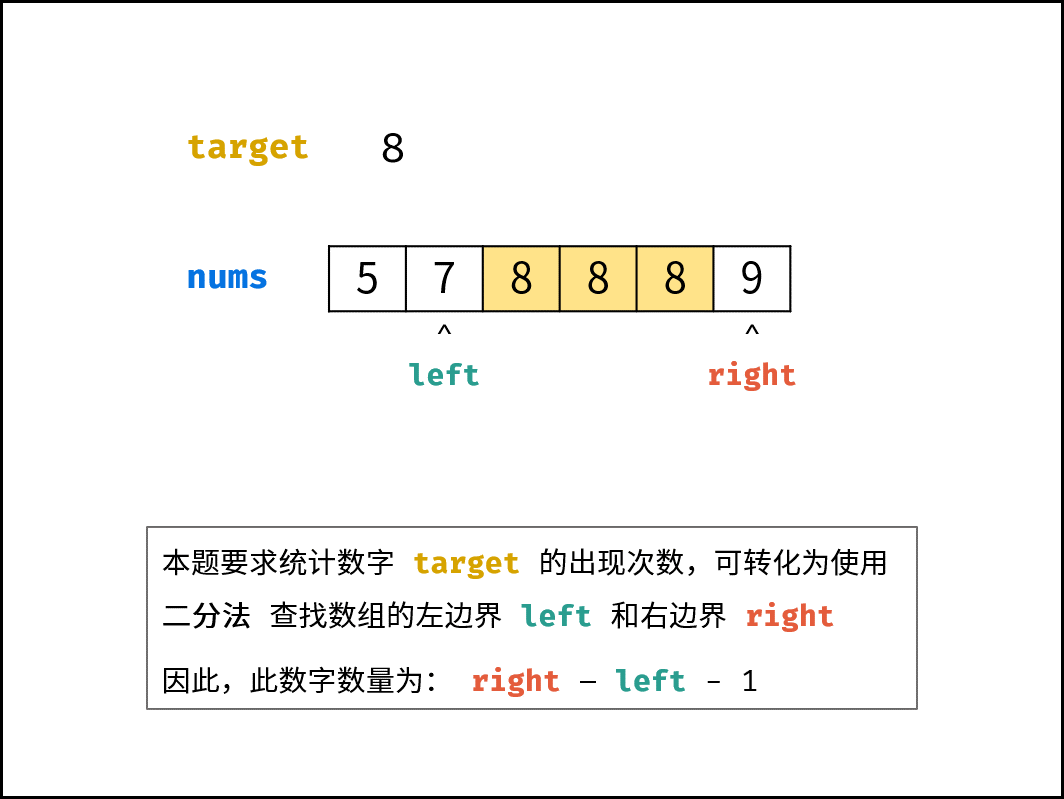{:align=center width=500}
### 算法解析:
1. **初始化:** 左边界 $i = 0$ ,右边界 $j = len(scores) - 1$ 。
2. **循环二分:** 当闭区间 $[i, j]$ 无元素时跳出;
1. 计算中点 $m = (i + j) / 2$ (向下取整);
2. 若 $scores[m] < target$ ,则 $target$ 在闭区间 $[m + 1, j]$ 中,因此执行 $i = m + 1$;
3. 若 $scores[m] > target$ ,则 $target$ 在闭区间 $[i, m - 1]$ 中,因此执行 $j = m - 1$;
4. 若 $scores[m] = target$ ,则右边界 $right$ 在闭区间 $[m+1, j]$ 中;左边界 $left$ 在闭区间 $[i, m-1]$ 中。因此分为以下两种情况:
1. 若查找 **右边界 $right$** ,则执行 $i = m + 1$ ;(跳出时 $i$ 指向右边界)
2. 若查找 **左边界 $left$** ,则执行 $j = m - 1$ ;(跳出时 $j$ 指向左边界)
3. **返回值:** 应用两次二分,分别查找 $right$ 和 $left$ ,最终返回 $right - left - 1$ 即可。
### 效率优化:
> 以下优化基于:查找完右边界 $right = i$ 后,则 $scores[j]$ 指向最右边的 $target$ (若存在)。
1. 查找完右边界后,可用 $scores[j] = target$ 判断数组中是否包含 $target$ ,若不包含则直接提前返回 $0$ ,无需后续查找左边界。
2. 查找完右边界后,左边界 $left$ 一定在闭区间 $[0, j]$ 中,因此直接从此区间开始二分查找即可。
## 代码:
可将 $scores[m] = target$ 情况合并至其他两种情况中。
```Python []
class Solution:
def countTarget(self, scores: List[int], target: int) -> int:
# 搜索右边界 right
i, j = 0, len(scores) - 1
while i <= j:
m = (i + j) // 2
if scores[m] <= target: i = m + 1
else: j = m - 1
right = i
# 若数组中无 target ,则提前返回
if j >= 0 and scores[j] != target: return 0
# 搜索左边界 left
i = 0
while i <= j:
m = (i + j) // 2
if scores[m] < target: i = m + 1
else: j = m - 1
left = j
return right - left - 1
```
```Java []
class Solution {
public int countTarget(int[] scores, int target) {
// 搜索右边界 right
int i = 0, j = scores.length - 1;
while(i <= j) {
int m = (i + j) / 2;
if(scores[m] <= target) i = m + 1;
else j = m - 1;
}
int right = i;
// 若数组中无 target ,则提前返回
if(j >= 0 && scores[j] != target) return 0;
// 搜索左边界 right
i = 0; j = scores.length - 1;
while(i <= j) {
int m = (i + j) / 2;
if(scores[m] < target) i = m + 1;
else j = m - 1;
}
int left = j;
return right - left - 1;
}
}
```
```C++ []
class Solution {
public:
int countTarget(vector& scores, int target) {
// 搜索右边界 right
int i = 0, j = scores.size() - 1;
while(i <= j) {
int m = (i + j) / 2;
if(scores[m] <= target) i = m + 1;
else j = m - 1;
}
int right = i;
// 若数组中无 target ,则提前返回
if(j >= 0 && scores[j] != target) return 0;
// 搜索左边界 right
i = 0; j = scores.size() - 1;
while(i <= j) {
int m = (i + j) / 2;
if(scores[m] < target) i = m + 1;
else j = m - 1;
}
int left = j;
return right - left - 1;
}
};
```
以上代码显得比较臃肿(两轮二分查找代码冗余)。为简化代码,可将**二分查找右边界 $right$ 的代码** 封装至函数 `helper()` 。
如下图所示,由于数组 $scores$ 中元素都为整数,因此可以分别二分查找 $target$ 和 $target - 1$ 的右边界,将两结果相减并返回即可。
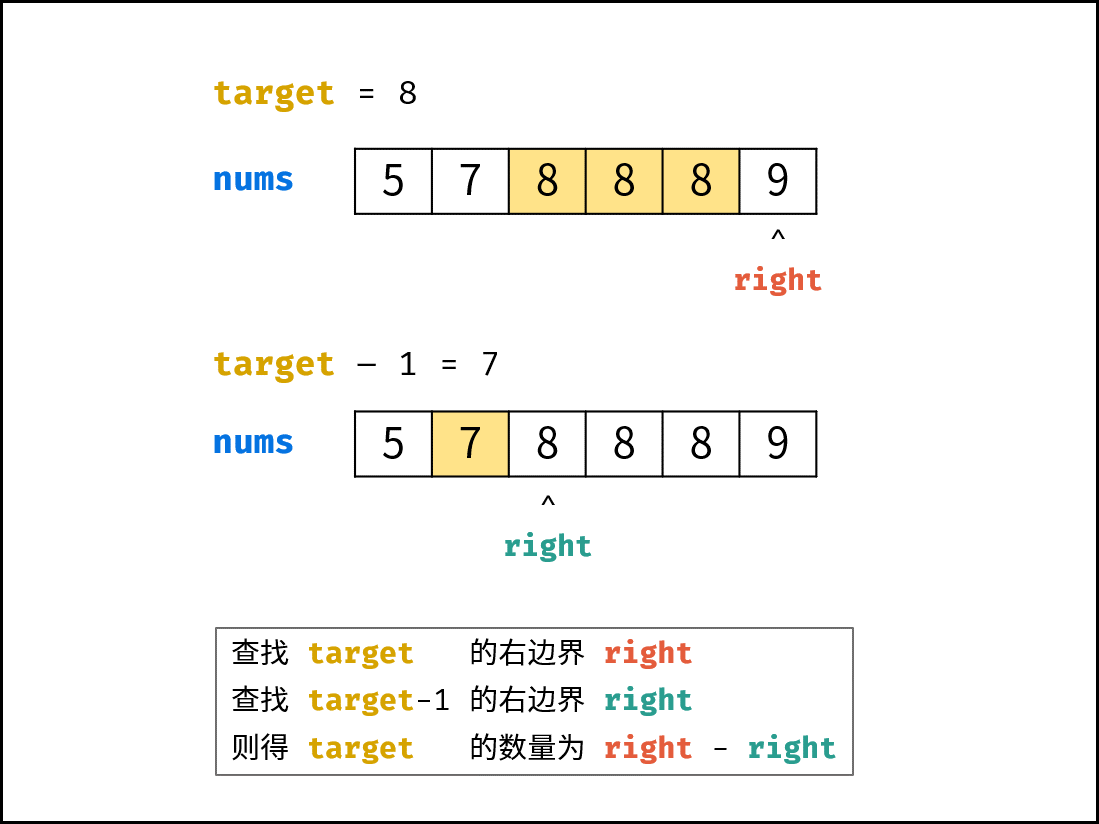{:align=center width=450}
本质上看,`helper()` 函数旨在查找数字 $tar$ 在数组 $scores$ 中的 **插入点** ,且若数组中存在值相同的元素,则插入到这些元素的右边。
```Python []
class Solution:
def countTarget(self, scores: List[int], target: int) -> int:
def helper(tar):
i, j = 0, len(scores) - 1
while i <= j:
m = (i + j) // 2
if scores[m] <= tar: i = m + 1
else: j = m - 1
return i
return helper(target) - helper(target - 1)
```
```Java []
class Solution {
public int countTarget(int[] scores, int target) {
return helper(scores, target) - helper(scores, target - 1);
}
int helper(int[] scores, int tar) {
int i = 0, j = scores.length - 1;
while(i <= j) {
int m = (i + j) / 2;
if(scores[m] <= tar) i = m + 1;
else j = m - 1;
}
return i;
}
}
```
```C++ []
class Solution {
public:
int countTarget(vector& scores, int target) {
return helper(scores, target) - helper(scores, target - 1);
}
private:
int helper(vector& scores, int tar) {
int i = 0, j = scores.size() - 1;
while(i <= j) {
int m = (i + j) / 2;
if(scores[m] <= tar) i = m + 1;
else j = m - 1;
}
return i;
}
};
```
### 复杂度分析:
- **时间复杂度 $O(\log N)$ :** 二分法为对数级别复杂度。
- **空间复杂度 $O(1)$ :** 几个变量使用常数大小的额外空间。
================================================
FILE: leetbook_ioa/docs/LCR 173. 点名.md
================================================
## 解题思路:
排序数组中的搜索问题,首先想到 **二分法** 解决。根据题意,数组可以按照以下规则划分为两部分。
- **左子数组:** $records[i] = i$ ;
- **右子数组:** $records[i] \ne i$ ;
缺失的数字等于 **“右子数组的首位元素”** 对应的索引;因此考虑使用二分法查找 “右子数组的首位元素” 。
> 下图中的 `nums` 对应本题的 `records` 。
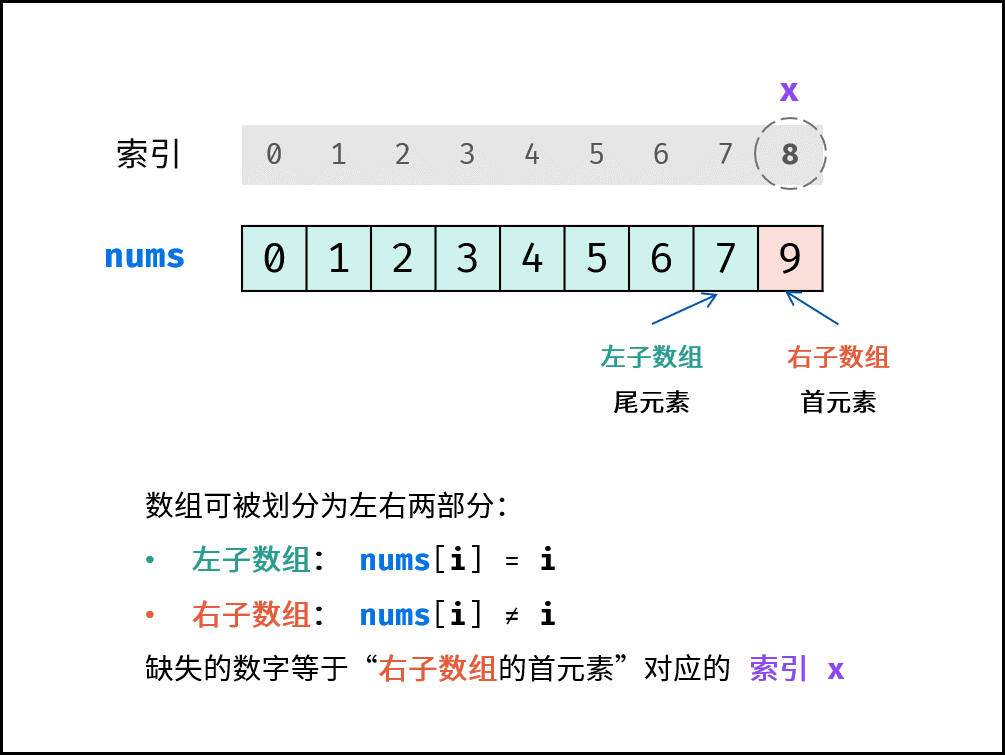{:align=center width=500}
### 算法解析:
1. **初始化:** 左边界 $i = 0$ ,右边界 $j = len(records) - 1$ ;代表闭区间 $[i, j]$ 。
2. **循环二分:** 当 $i \leq j$ 时循环 *(即当闭区间 $[i, j]$ 为空时跳出)* ;
1. 计算中点 $m = (i + j) // 2$ ,其中 "$//$" 为向下取整除法;
2. 若 $records[m] = m$ ,则 “右子数组的首位元素” 一定在闭区间 $[m + 1, j]$ 中,因此执行 $i = m + 1$;
3. 若 $records[m] \ne m$ ,则 “左子数组的末位元素” 一定在闭区间 $[i, m - 1]$ 中,因此执行 $j = m - 1$;
3. **返回值:** 跳出时,变量 $i$ 和 $j$ 分别指向 “右子数组的首位元素” 和 “左子数组的末位元素” 。因此返回 $i$ 即可。
## 代码:
```Python []
class Solution:
def takeAttendance(self, records: List[int]) -> int:
i, j = 0, len(records) - 1
while i <= j:
m = (i + j) // 2
if records[m] == m: i = m + 1
else: j = m - 1
return i
```
```Java []
class Solution {
public int takeAttendance(int[] records) {
int i = 0, j = records.length - 1;
while(i <= j) {
int m = (i + j) / 2;
if(records[m] == m) i = m + 1;
else j = m - 1;
}
return i;
}
}
```
```C++ []
class Solution {
public:
int takeAttendance(vector& records) {
int i = 0, j = records.size() - 1;
while(i <= j) {
int m = (i + j) / 2;
if(records[m] == m) i = m + 1;
else j = m - 1;
}
return i;
}
};
```
### 复杂度分析:
- **时间复杂度 $O(\log N)$:** 二分法为对数级别复杂度。
- **空间复杂度 $O(1)$:** 几个变量使用常数大小的额外空间。
================================================
FILE: leetbook_ioa/docs/LCR 174. 寻找二叉搜索树中的目标节点.md
================================================
## 解题思路:
本文解法基于性质:二叉搜索树的中序遍历为递增序列。根据此性质,易得二叉搜索树的 **中序遍历倒序** 为 **递减序列** 。
因此,我们可将求 “二叉搜索树第 $cnt$ 大的节点” 可转化为求 “此树的中序遍历倒序的第 $cnt$ 个节点”。
> 下图中的 `k` 对应本题的 `cnt` 。
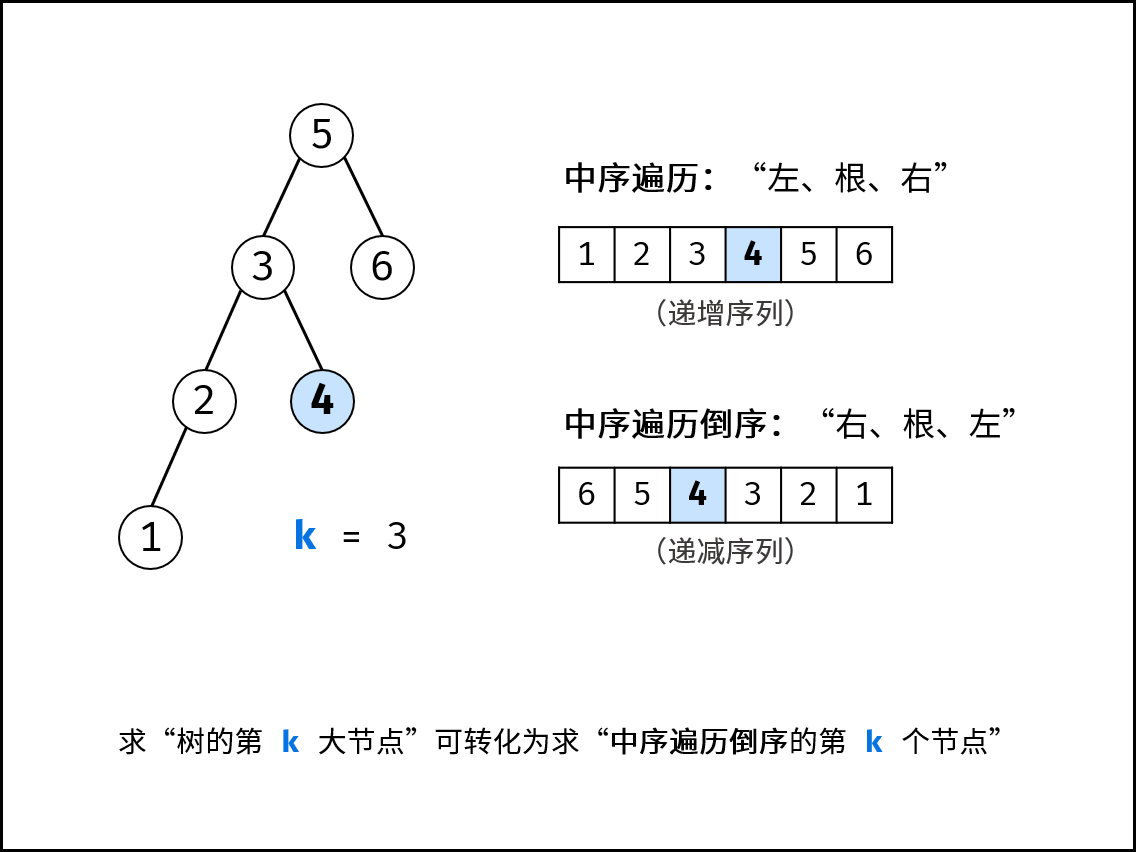{:align=center width=450}
**中序遍历** 为 “左、根、右” 顺序,递归代码如下:
```Python []
# 打印中序遍历
def dfs(root):
if not root: return
dfs(root.left) # 左
print(root.val) # 根
dfs(root.right) # 右
```
```Java []
// 打印中序遍历
void dfs(TreeNode root) {
if(root == null) return;
dfs(root.left); // 左
System.out.println(root.val); // 根
dfs(root.right); // 右
}
```
```C++ []
void dfs(TreeNode* root) {
if(root == nullptr) return;
dfs(root->left);
cout << root->val;
dfs(root->right);
}
```
**中序遍历的倒序** 为 “右、根、左” 顺序,递归法代码如下:
```Python []
# 打印中序遍历倒序
def dfs(root):
if not root: return
dfs(root.right) # 右
print(root.val) # 根
dfs(root.left) # 左
```
```Java []
// 打印中序遍历倒序
void dfs(TreeNode root) {
if(root == null) return;
dfs(root.right); // 右
System.out.println(root.val); // 根
dfs(root.left); // 左
}
```
```C++ []
void dfs(TreeNode* root) {
if(root == nullptr) return;
dfs(root->right);
cout << root->val;
dfs(root->left);
}
```
为求第 $cnt$ 个节点,需要实现以下三项工作:
1. 递归遍历时计数,统计当前节点的序号;
2. 递归到第 $cnt$ 个节点时,应记录结果 $res$ ;
3. 记录结果后,后续的遍历即失去意义,应提前终止(即返回);
### 递归解析:
1. **终止条件:** 当节点 $root$ 为空(越过叶节点),则直接返回;
2. **递归右子树:** 即 $dfs(root.right)$ ;
3. **递推工作:**
1. 提前返回: 若 $cnt = 0$ ,代表已找到目标节点,无需继续遍历,因此直接返回;
2. 统计序号: 执行 $cnt = cnt - 1$ (即从 $cnt$ 减至 $0$ );
3. 记录结果: 若 $cnt = 0$ ,代表当前节点为第 $cnt$ 大的节点,因此记录 $res = root.val$ ;
4. **递归左子树:** 即 $dfs(root.left)$ ;
## 代码:
题目指出:$1 \leq cnt \leq N$ (二叉搜索树节点个数);因此无需考虑 $cnt > N$ 的情况。
若考虑,可以在中序遍历完成后判断 $cnt > 0$ 是否成立,若成立则说明 $cnt > N$ 。
```Python []
class Solution:
def findTargetNode(self, root: TreeNode, cnt: int) -> int:
def dfs(root):
if not root: return
dfs(root.right)
if self.cnt == 0: return
self.cnt -= 1
if self.cnt == 0: self.res = root.val
dfs(root.left)
self.cnt = cnt
dfs(root)
return self.res
```
```Java []
class Solution {
int res, cnt;
public int findTargetNode(TreeNode root, int cnt) {
this.cnt = cnt;
dfs(root);
return res;
}
void dfs(TreeNode root) {
if(root == null) return;
dfs(root.right);
if(cnt == 0) return;
if(--cnt == 0) res = root.val;
dfs(root.left);
}
}
```
```C++ []
class Solution {
public:
int findTargetNode(TreeNode* root, int cnt) {
this->cnt = cnt;
dfs(root);
return res;
}
private:
int res, cnt;
void dfs(TreeNode* root) {
if(root == nullptr) return;
dfs(root->right);
if(cnt == 0) return;
if(--cnt == 0) res = root->val;
dfs(root->left);
}
};
```
### 复杂度分析:
- **时间复杂度 $O(N)$ :** 当树退化为链表时(全部为右子节点),无论 $cnt$ 的值大小,递归深度都为 $N$ ,占用 $O(N)$ 时间。
- **空间复杂度 $O(N)$ :** 当树退化为链表时(全部为右子节点),系统使用 $O(N)$ 大小的栈空间。
================================================
FILE: leetbook_ioa/docs/LCR 175. 计算二叉树的深度.md
================================================
## 解题思路:
树的遍历方式总体分为两类:
- **深度优先搜索(DFS):** 先序遍历、中序遍历、后序遍历;
- **广度优先搜索(BFS):** 层序遍历;
求树的深度需要遍历树的所有节点,本文将介绍基于 **后序遍历(DFS)** 和 **层序遍历(BFS)** 的两种解法。
## 方法一:后序遍历(DFS)
树的后序遍历 / 深度优先搜索往往利用 **递归** 或 **栈** 实现,本文使用递归实现。
**关键点:** 此树的深度和其左(右)子树的深度之间的关系。显然,**此树的深度** 等于 **左子树的深度** 与 **右子树的深度** 中的 **最大值** $+1$ 。
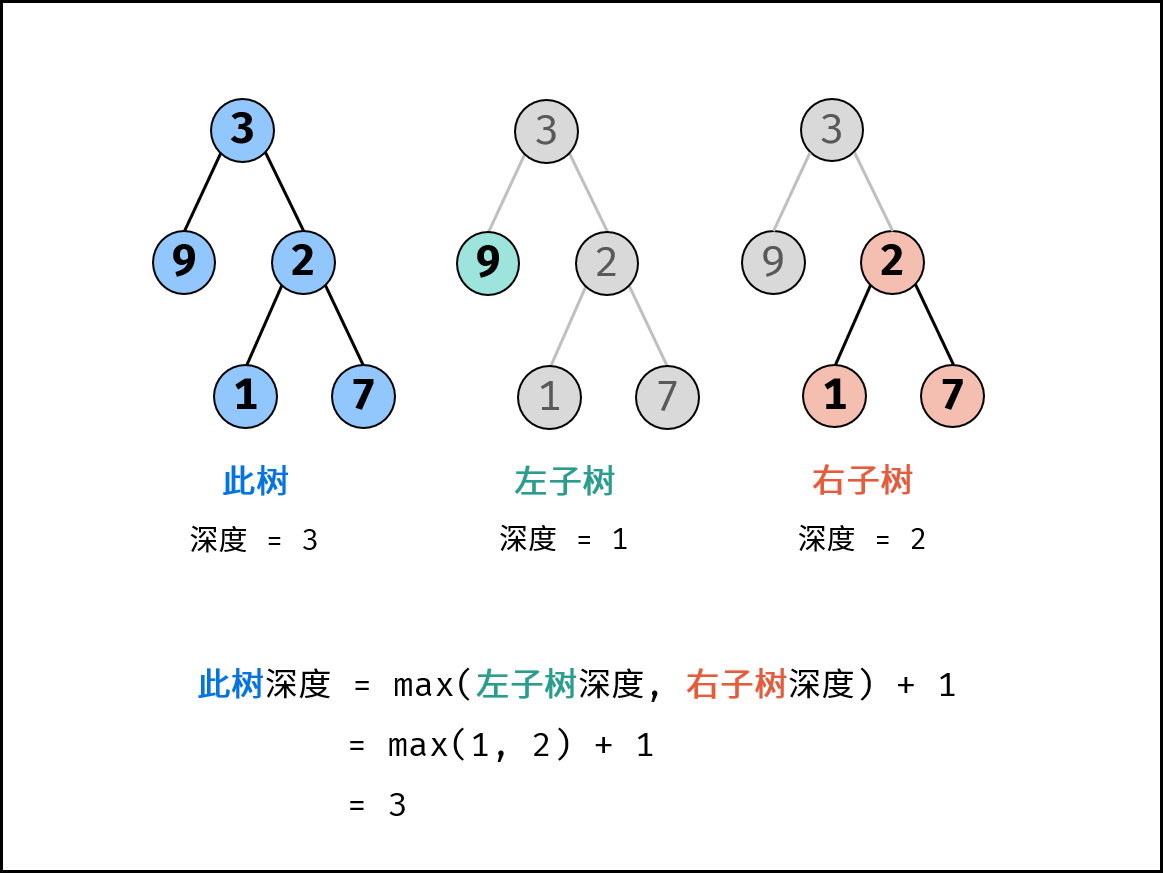{:align=center width=450}
### 算法解析:
1. **终止条件:** 当 `root` 为空,说明已越过叶节点,因此返回 深度 $0$ 。
2. **递推工作:** 本质上是对树做后序遍历。
1. 计算节点 `root` 的 **左子树的深度** ,即调用 `calculateDepth(root.left)`;
2. 计算节点 `root` 的 **右子树的深度** ,即调用 `calculateDepth(root.right)`;
3. **返回值:** 返回 **此树的深度** ,即 `max(calculateDepth(root.left), calculateDepth(root.right)) + 1`。
### 代码:
```Python []
class Solution:
def calculateDepth(self, root: TreeNode) -> int:
if not root: return 0
return max(self.calculateDepth(root.left), self.calculateDepth(root.right)) + 1
```
```Java []
class Solution {
public int calculateDepth(TreeNode root) {
if(root == null) return 0;
return Math.max(calculateDepth(root.left), calculateDepth(root.right)) + 1;
}
}
```
```C++ []
class Solution {
public:
int calculateDepth(TreeNode* root) {
if(root == nullptr) return 0;
return max(calculateDepth(root->left), calculateDepth(root->right)) + 1;
}
};
```
### 复杂度分析:
- **时间复杂度 $O(N)$ :** $N$ 为树的节点数量,计算树的深度需要遍历所有节点。
- **空间复杂度 $O(N)$ :** 最差情况下(当树退化为链表时),递归深度可达到 $N$ 。
## 方法二:层序遍历(BFS)
树的层序遍历 / 广度优先搜索往往利用 **队列** 实现。
**关键点:** 每遍历一层,则计数器 $+1$ ,直到遍历完成,则可得到树的深度。
### 算法解析:
1. **特例处理:** 当 `root` 为空,直接返回 深度 $0$ 。
2. **初始化:** 队列 `queue` (加入根节点 `root` ),计数器 `res = 0`。
3. **循环遍历:** 当 `queue` 为空时跳出。
1. 初始化一个空列表 `tmp` ,用于临时存储下一层节点;
2. 遍历队列: 遍历 `queue` 中的各节点 `node` ,并将其左子节点和右子节点加入 `tmp`;
3. 更新队列: 执行 `queue = tmp` ,将下一层节点赋值给 `queue`;
4. 统计层数: 执行 `res += 1` ,代表层数加 $1$;
4. **返回值:** 返回 `res` 即可。
### 代码:
```Python []
class Solution:
def calculateDepth(self, root: TreeNode) -> int:
if not root: return 0
queue, res = [root], 0
while queue:
tmp = []
for node in queue:
if node.left: tmp.append(node.left)
if node.right: tmp.append(node.right)
queue = tmp
res += 1
return res
```
```Java []
class Solution {
public int calculateDepth(TreeNode root) {
if(root == null) return 0;
List queue = new LinkedList<>() {{ add(root); }}, tmp;
int res = 0;
while(!queue.isEmpty()) {
tmp = new LinkedList<>();
for(TreeNode node : queue) {
if(node.left != null) tmp.add(node.left);
if(node.right != null) tmp.add(node.right);
}
queue = tmp;
res++;
}
return res;
}
}
```
```C++ []
class Solution {
public:
int calculateDepth(TreeNode* root) {
if(root == nullptr) return 0;
vector que;
que.push_back(root);
int res = 0;
while(!que.empty()) {
vector tmp;
for(TreeNode* node : que) {
if(node->left != nullptr) tmp.push_back(node->left);
if(node->right != nullptr) tmp.push_back(node->right);
}
que = tmp;
res++;
}
return res;
}
};
```
### 复杂度分析:
- **时间复杂度 $O(N)$ :** $N$ 为树的节点数量,计算树的深度需要遍历所有节点。
- **空间复杂度 $O(N)$ :** 最差情况下(当树平衡时),队列 `queue` 同时存储 $N/2$ 个节点。
================================================
FILE: leetbook_ioa/docs/LCR 176. 判断是否为平衡二叉树.md
================================================
## 解题思路:
以下两种方法均基于以下性质推出: **此树的深度** 等于 **左子树的深度** 与 **右子树的深度** 中的 **最大值** $+1$ 。
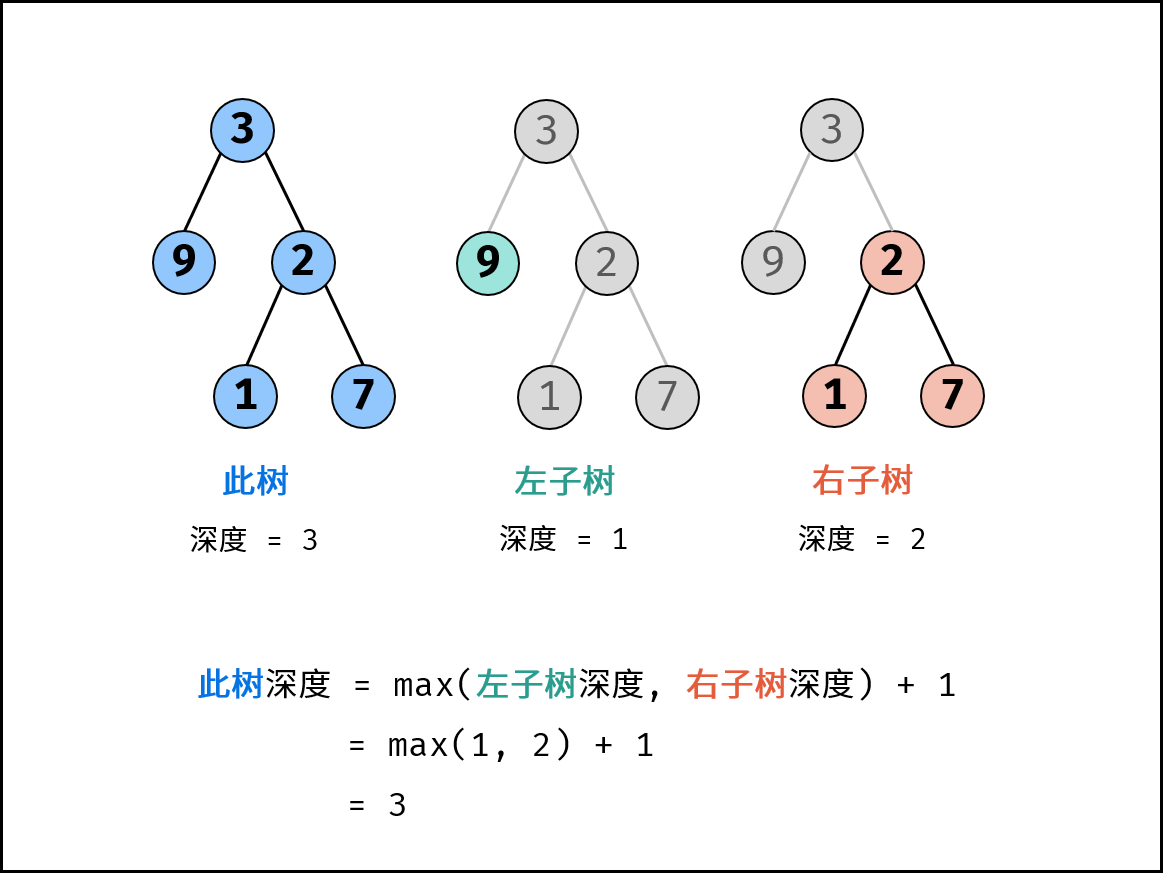{:align=center width=450}
## 方法一:后序遍历 + 剪枝 (从底至顶)
> 此方法为本题的最优解法,但剪枝的方法不易第一时间想到。
思路是对二叉树做后序遍历,从底至顶返回子树深度,若判定某子树不是平衡树则 “剪枝” ,直接向上返回。
### 算法流程:
**`recur(root)` 函数:**
- **返回值:**
1. 当节点`root` 左 / 右子树的深度差 $\leq 1$ :则返回当前子树的深度,即节点 `root` 的左 / 右子树的深度最大值 $+1$ ( `max(left, right) + 1` );
2. 当节点`root` 左 / 右子树的深度差 $> 1$ :则返回 $-1$ ,代表 **此子树不是平衡树** 。
- **终止条件:**
1. 当 `root` 为空:说明越过叶节点,因此返回高度 $0$ ;
2. 当左(右)子树深度为 $-1$ :代表此树的 **左(右)子树** 不是平衡树,因此剪枝,直接返回 $-1$ ;
**`isBalanced(root)` 函数:**
- **返回值:** 若 `recur(root) != -1` ,则说明此树平衡,返回 $\text{true}$ ; 否则返回 $\text{false}$ 。
### 代码:
```Python []
class Solution:
def isBalanced(self, root: Optional[TreeNode]) -> bool:
def recur(root):
if not root: return 0
left = recur(root.left)
if left == -1: return -1
right = recur(root.right)
if right == -1: return -1
return max(left, right) + 1 if abs(left - right) <= 1 else -1
return recur(root) != -1
```
```Java []
class Solution {
public boolean isBalanced(TreeNode root) {
return recur(root) != -1;
}
private int recur(TreeNode root) {
if (root == null) return 0;
int left = recur(root.left);
if(left == -1) return -1;
int right = recur(root.right);
if(right == -1) return -1;
return Math.abs(left - right) < 2 ? Math.max(left, right) + 1 : -1;
}
}
```
```C++ []
class Solution {
public:
bool isBalanced(TreeNode* root) {
return recur(root) != -1;
}
private:
int recur(TreeNode* root) {
if (root == nullptr) return 0;
int left = recur(root->left);
if(left == -1) return -1;
int right = recur(root->right);
if(right == -1) return -1;
return abs(left - right) < 2 ? max(left, right) + 1 : -1;
}
};
```
### 复杂度分析:
- **时间复杂度 $O(N)$:** $N$ 为树的节点数;最差情况下,需要递归遍历树的所有节点。
- **空间复杂度 $O(N)$:** 最差情况下(树退化为链表时),系统递归需要使用 $O(N)$ 的栈空间。
## 方法二:先序遍历 + 判断深度 (从顶至底)
> 此方法容易想到,但会产生大量重复计算,时间复杂度较高。
思路是构造一个获取当前子树的深度的函数 `depth(root)` (即 [面试题55 - I. 二叉树的深度](https://leetcode-cn.com/problems/er-cha-shu-de-shen-du-lcof/solution/mian-shi-ti-55-i-er-cha-shu-de-shen-du-xian-xu-bia/) ),通过比较某子树的左右子树的深度差 `abs(depth(root.left) - depth(root.right)) <= 1` 是否成立,来判断某子树是否是二叉平衡树。若所有子树都平衡,则此树平衡。
### 算法流程:
**`isBalanced(root)` 函数:** 判断树 `root` 是否平衡
- **特例处理:** 若树根节点 `root` 为空,则直接返回 $\text{true}$ ;
- **返回值:** 所有子树都需要满足平衡树性质,因此以下三者使用与逻辑 $\&\&$ 连接;
1. `abs(self.depth(root.left) - self.depth(root.right)) <= 1` :判断 **当前子树** 是否是平衡树;
2. `self.isBalanced(root.left)` : 先序遍历递归,判断 **当前子树的左子树** 是否是平衡树;
3. `self.isBalanced(root.right)` : 先序遍历递归,判断 **当前子树的右子树** 是否是平衡树;
**`depth(root)` 函数:** 计算树 `root` 的深度
- **终止条件:** 当 `root` 为空,即越过叶子节点,则返回高度 $0$ ;
- **返回值:** 返回左 / 右子树的深度的最大值 $+1$ 。
### 代码:
```Python []
class Solution:
def isBalanced(self, root: Optional[TreeNode]) -> bool:
if not root: return True
return abs(self.depth(root.left) - self.depth(root.right)) <= 1 and \
self.isBalanced(root.left) and self.isBalanced(root.right)
def depth(self, root):
if not root: return 0
return max(self.depth(root.left), self.depth(root.right)) + 1
```
```Java []
class Solution {
public boolean isBalanced(TreeNode root) {
if (root == null) return true;
return Math.abs(depth(root.left) - depth(root.right)) <= 1 && isBalanced(root.left) && isBalanced(root.right);
}
private int depth(TreeNode root) {
if (root == null) return 0;
return Math.max(depth(root.left), depth(root.right)) + 1;
}
}
```
```C++ []
class Solution {
public:
bool isBalanced(TreeNode* root) {
if (root == nullptr) return true;
return abs(depth(root->left) - depth(root->right)) <= 1 && isBalanced(root->left) && isBalanced(root->right);
}
private:
int depth(TreeNode* root) {
if (root == nullptr) return 0;
return max(depth(root->left), depth(root->right)) + 1;
}
};
```
### 复杂度分析:
- **时间复杂度 $O(N \log N)$:** 最差情况下(为 “满二叉树” 时),`isBalanced(root)` 遍历树所有节点,判断每个节点的深度 `depth(root)` 需要遍历 **各子树的所有节点** 。
- 满二叉树高度的复杂度 $O(log N)$ ,将满二叉树按层分为 $log (N+1)$ 层;
- 通过调用 `depth(root)` ,判断二叉树各层的节点的对应子树的深度,需遍历节点数量为 $N \times 1, \frac{N-1}{2} \times 2, \frac{N-3}{4} \times 4, \frac{N-7}{8} \times 8, ..., 1 \times \frac{N+1}{2}$ 。因此各层执行 `depth(root)` 的时间复杂度为 $O(N)$ (每层开始,最多遍历 $N$ 个节点,最少遍历 $\frac{N+1}{2}$ 个节点)。
> 其中,$\frac{N-3}{4} \times 4$ 代表从此层开始总共需遍历 $N-3$ 个节点,此层共有 $4$ 个节点,因此每个子树需遍历 $\frac{N-3}{4}$ 个节点。
- 因此,总体时间复杂度 $=$ 每层执行复杂度 $\times$ 层数复杂度 = $O(N \times \log N)$ 。
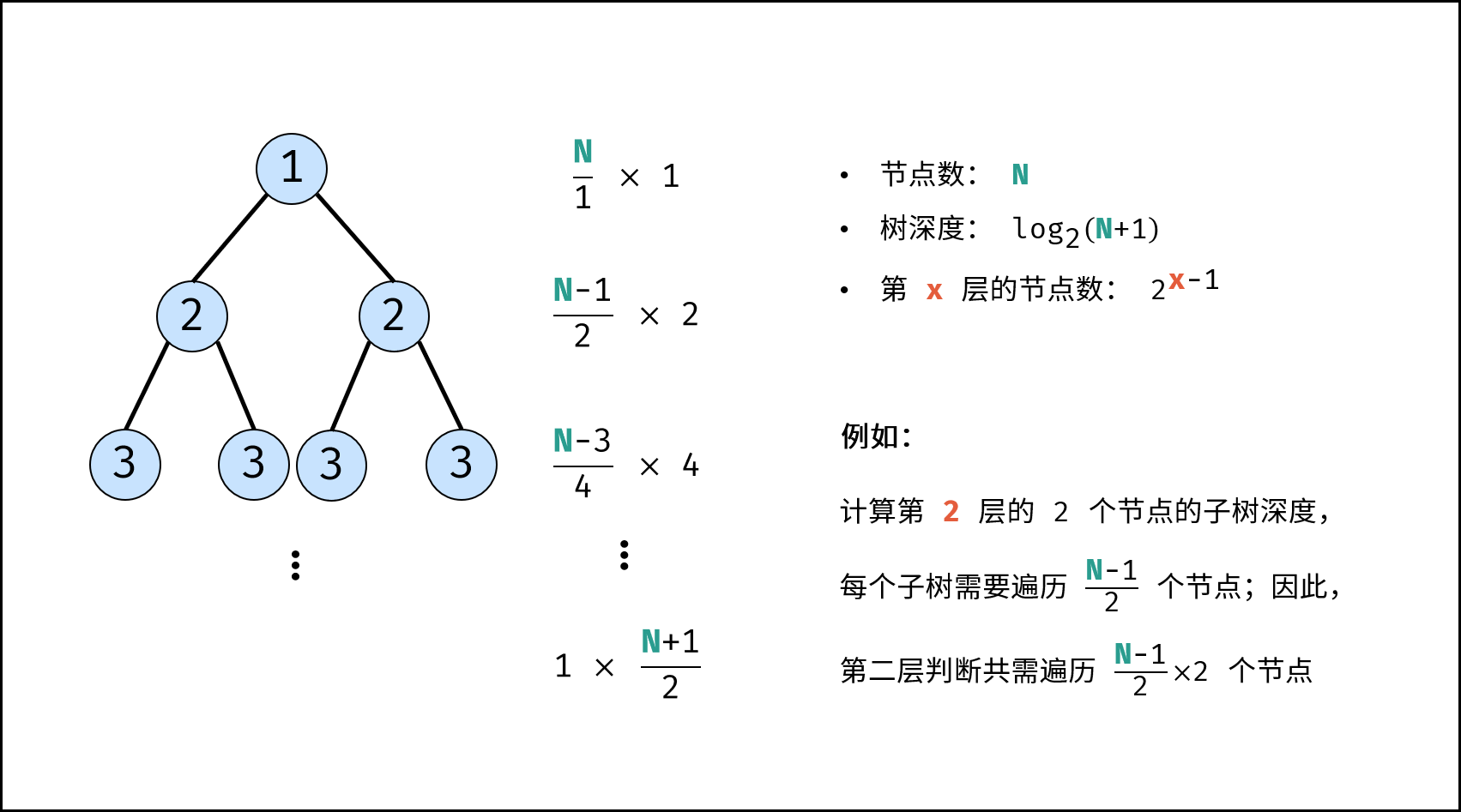{:align=center width=550}
- **空间复杂度 $O(N)$:** 最差情况下(树退化为链表时),系统递归需要使用 $O(N)$ 的栈空间。
================================================
FILE: leetbook_ioa/docs/LCR 177. 撞色搭配.md
================================================
## 解题思路:
题目要求时间复杂度 $O(N)$ ,空间复杂度 $O(1)$ ,因此首先排除 **暴力法** 和 **哈希表统计法** 。
> **简化问题:** 一个整型数组 `sockets` 里除 **一个** 数字之外,其他数字都出现了两次。
设整型数组 $sockets$ 中出现一次的数字为 $x$ ,出现两次的数字为 $a, a, b, b, ...$ ,即:
$$
sockets = [a, a, b, b, ..., x]
$$
异或运算有个重要的性质,两个相同数字异或为 $0$ ,即对于任意整数 $a$ 有 $a \oplus a = 0$ 。因此,若将 $sockets$ 中所有数字执行异或运算,留下的结果则为 **出现一次的数字 $x$** ,即:
$$
\begin{aligned}
& \ \ a \oplus a \oplus b \oplus b \oplus ... \oplus x \\
= & \ \ 0 \oplus 0 \oplus ... \oplus x \\
= & \ \ x
\end{aligned}
$$
异或运算满足交换律 $a \oplus b = b \oplus a$ ,即以上运算结果与 $sockets$ 的元素顺序无关。代码如下:
```Python []
def singleNumber(self, sockets: List[int]) -> List[int]:
x = 0
for num in sockets: # 1. 遍历 sockets 执行异或运算
x ^= num
return x; # 2. 返回出现一次的数字 x
```
```Java []
public int[] singleNumber(int[] sockets) {
int x = 0;
for(int num : sockets) // 1. 遍历 sockets 执行异或运算
x ^= num;
return x; // 2. 返回出现一次的数字 x
}
```
```C++ []
vector singleNumber(vector& sockets) {
int x = 0;
for(int num : sockets) // 1. 遍历 sockets 执行异或运算
x ^= num;
return x; // 2. 返回出现一次的数字 x
}
```
> 下图中的 `nums` 对应本题的 `sockets` 。
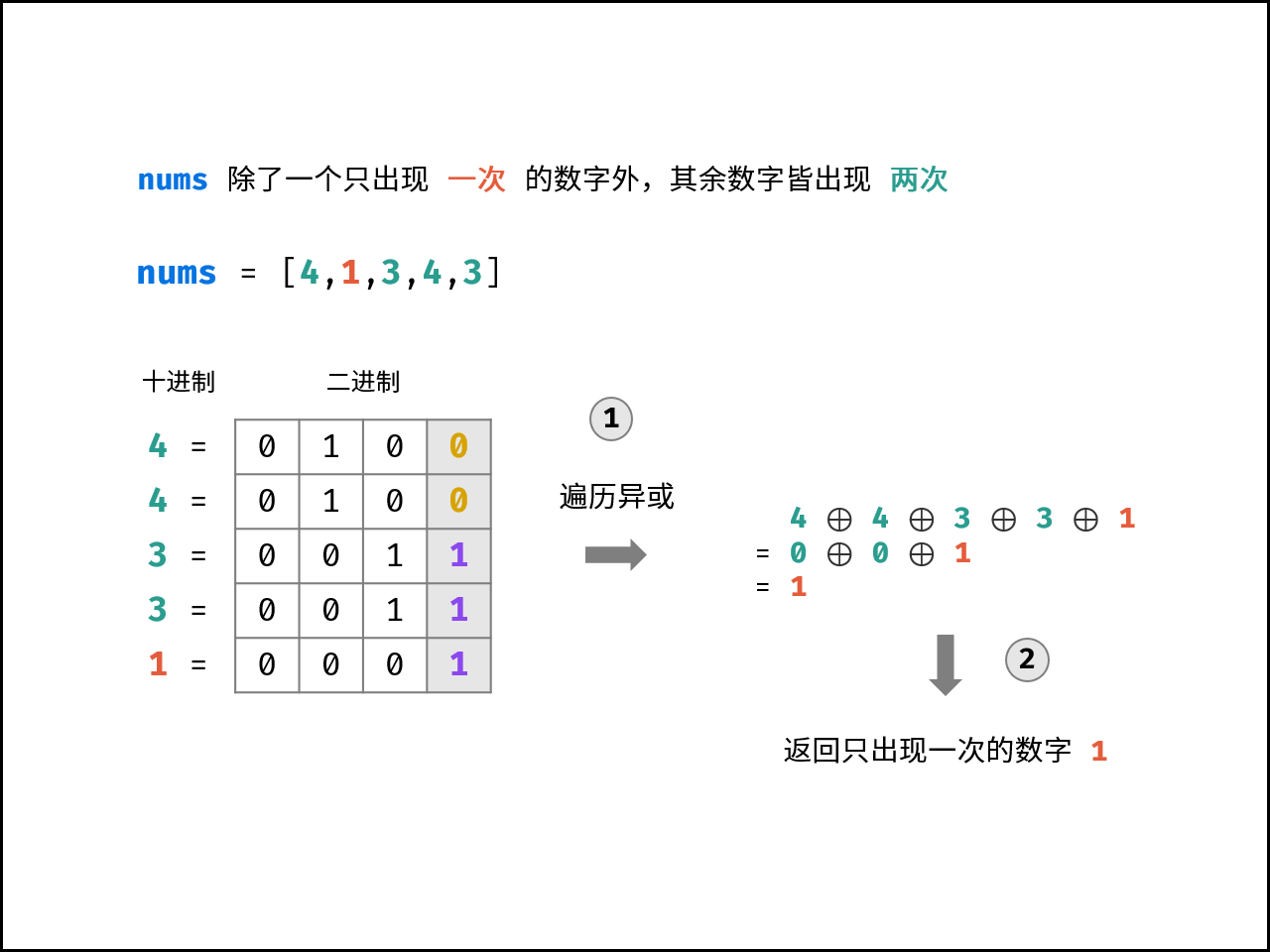{:align=center width=500}
> **本题难点:** 数组 $sockets$ 有 **两个** 只出现一次的数字,因此无法通过异或直接得到这两个数字。
设两个只出现一次的数字为 $x$ , $y$ ,由于 $x \ne y$ ,则 $x$ 和 $y$ 二进制至少有一位不同(即分别为 $0$ 和 $1$ ),根据此位可以将 $sockets$ 拆分为分别包含 $x$ 和 $y$ 的两个子数组。
易知两子数组都满足 「除一个数字之外,其他数字都出现了两次」。因此,仿照以上简化问题的思路,分别对两子数组遍历执行异或操作,即可得到两个只出现一次的数字 $x$, $y$ 。
### 算法流程:
1. **遍历 $sockets$ 执行异或:**
- 设整型数组 $sockets = [a, a, b, b, ..., x, y]$ ,对 $sockets$ 中所有数字执行异或,得到的结果为 $x \oplus y$ ,即:
$$
\begin{aligned}
& \ \ a \oplus a \oplus b \oplus b \oplus ... \oplus x \oplus y \\
= & \ \ 0 \oplus 0 \oplus ... \oplus x \oplus y \\
= & \ \ x \oplus y
\end{aligned}
$$
2. **循环左移计算 $m$ :**
- 根据异或运算定义,若整数 $x \oplus y$ 某二进制位为 $1$ ,则 $x$ 和 $y$ 的此二进制位一定不同。换言之,找到 $x \oplus y$ 某为 $1$ 的二进制位,即可将数组 $sockets$ 拆分为上述的两个子数组。根据与运算特点,可知对于任意整数 $a$ 有:
- 若 $a \& 0001 \ne 0$ ,则 $a$ 的第一位为 $1$ ;
- 若 $a \& 0010 \ne 0$ ,则 $a$ 的第二位为 $1$ ;
- 以此类推……
- 因此,初始化一个辅助变量 $m = 1$ ,通过与运算从右向左循环判断,可 **获取整数 $x \oplus y$ 首位 $1$** ,记录于 $m$ 中,代码如下:
```Python []
while z & m == 0: # m 循环左移一位,直到 z & m != 0
m <<= 1
```
```Java []
while(z & m == 0) // m 循环左移一位,直到 z & m != 0
m <<= 1
```
```C++ []
while(z & m == 0) // m 循环左移一位,直到 z & m != 0
m <<= 1
```
3. **拆分 $sockets$ 为两个子数组:**
4. **分别遍历两个子数组执行异或:**
- 通过遍历判断 $sockets$ 中各数字和 $m$ 做与运算的结果,可将数组拆分为两个子数组,并分别对两个子数组遍历求异或,则可得到两个只出现一次的数字,代码如下:
```Python []
for num in sockets:
if num & m: x ^= num # 若 num & m != 0 , 划分至子数组 1 ,执行遍历异或
else: y ^= num # 若 num & m == 0 , 划分至子数组 2 ,执行遍历异或
return x, y # 遍历异或完毕,返回只出现一次的数字 x 和 y
```
```Java []
for(int num: sockets) {
if((num & m) != 0) x ^= num; // 若 num & m != 0 , 划分至子数组 1 ,执行遍历异或
else y ^= num; // 若 num & m == 0 , 划分至子数组 2 ,执行遍历异或
}
return new int[] {x, y}; // 遍历异或完毕,返回只出现一次的数字 x 和 y
```
```C++ []
for(int num : sockets) {
if(num & m) x ^= num; // 若 num & m != 0 , 划分至子数组 1 ,执行遍历异或
else y ^= num; // 若 num & m == 0 , 划分至子数组 2 ,执行遍历异或
}
return vector {x, y}; // 遍历异或完毕,返回只出现一次的数字 x 和 y
```
5. **返回值**:
- 返回只出现一次的数字 x, y 即可。
> 下图中的 `nums` 对应本题的 `sockets` 。
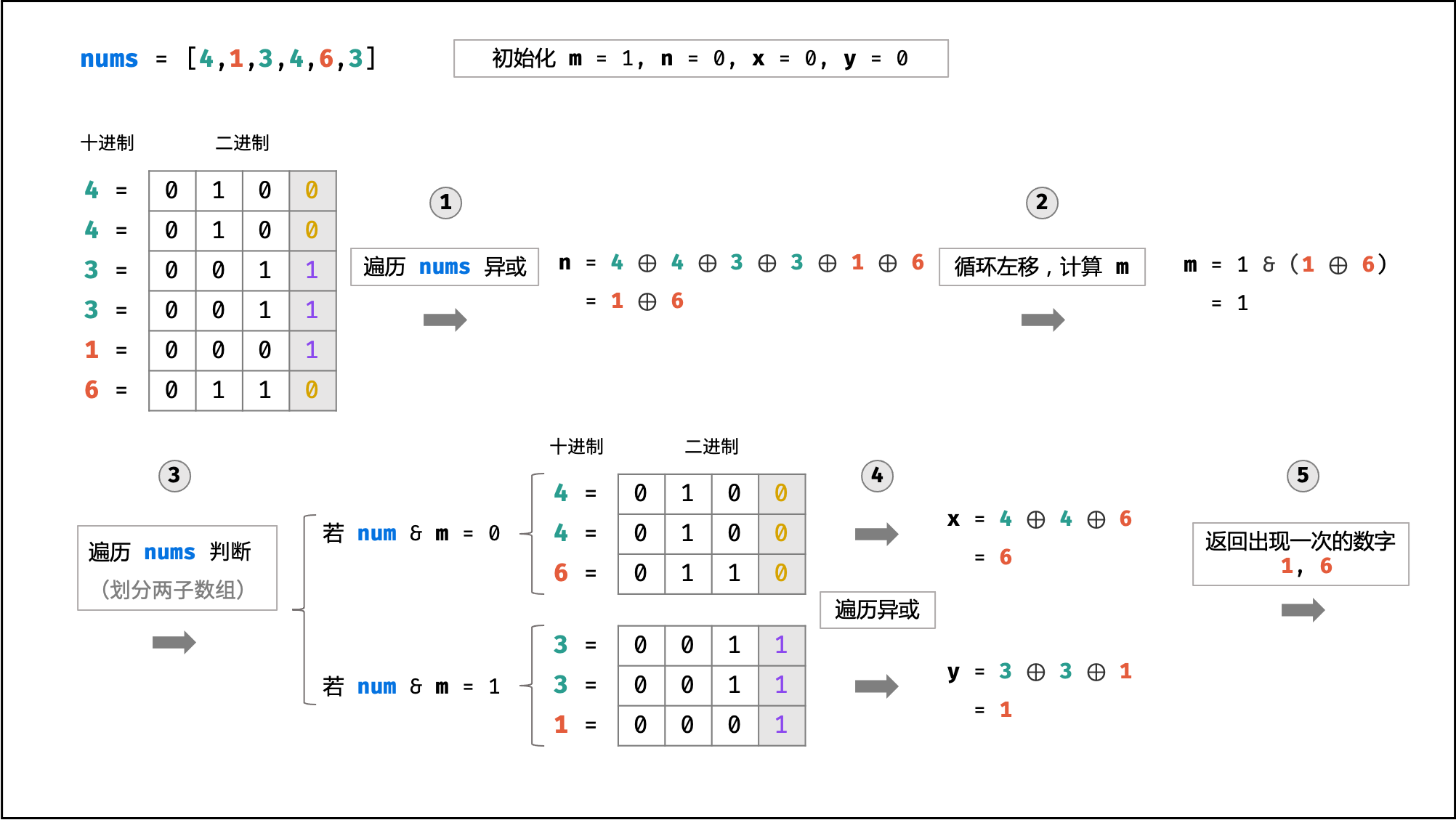
### 复杂度分析:
- **时间复杂度 $O(N)$ :** 线性遍历 $sockets$ 使用 $O(N)$ 时间,遍历 $x \oplus y$ 二进制位使用 $O(32) = O(1)$ 时间。
- **空间复杂度 $O(1)$ :** 辅助变量 $a$ , $b$ , $x$ , $y$ 使用常数大小额外空间。
## 代码:
```Python []
class Solution:
def sockCollocation(self, sockets: List[int]) -> List[int]:
x, y, n, m = 0, 0, 0, 1
for num in sockets: # 1. 遍历异或
n ^= num
while n & m == 0: # 2. 循环左移,计算 m
m <<= 1
for num in sockets: # 3. 遍历 sockets 分组
if num & m: x ^= num # 4. 当 num & m != 0
else: y ^= num # 4. 当 num & m == 0
return x, y # 5. 返回出现一次的数字
```
```Java []
class Solution {
public int[] sockCollocation(int[] sockets) {
int x = 0, y = 0, n = 0, m = 1;
for(int num : sockets) // 1. 遍历异或
n ^= num;
while((n & m) == 0) // 2. 循环左移,计算 m
m <<= 1;
for(int num: sockets) { // 3. 遍历 sockets 分组
if((num & m) != 0) x ^= num; // 4. 当 num & m != 0
else y ^= num; // 4. 当 num & m == 0
}
return new int[] {x, y}; // 5. 返回出现一次的数字
}
}
```
```C++ []
class Solution {
public:
vector sockCollocation(vector& sockets) {
int x = 0, y = 0, n = 0, m = 1;
for(int num : sockets) // 1. 遍历异或
n ^= num;
while((n & m) == 0) // 2. 循环左移,计算 m
m <<= 1;
for(int num : sockets) { // 3. 遍历 sockets 分组
if(num & m) x ^= num; // 4. 当 num & m != 0
else y ^= num; // 4. 当 num & m == 0
}
return vector {x, y}; // 5. 返回出现一次的数字
}
};
```
================================================
FILE: leetbook_ioa/docs/LCR 178. 训练计划 VI.md
================================================
## 解题思路:
如下图所示,考虑数字的二进制形式,对于出现三次的数字,各 **二进制位** 出现的次数都是 $3$ 的倍数。
因此,统计所有数字的各二进制位中 $1$ 的出现次数,并对 $3$ 求余,结果则为只出现一次的数字。
> 下图中的 `nums` 对应本题的 `actions` 。
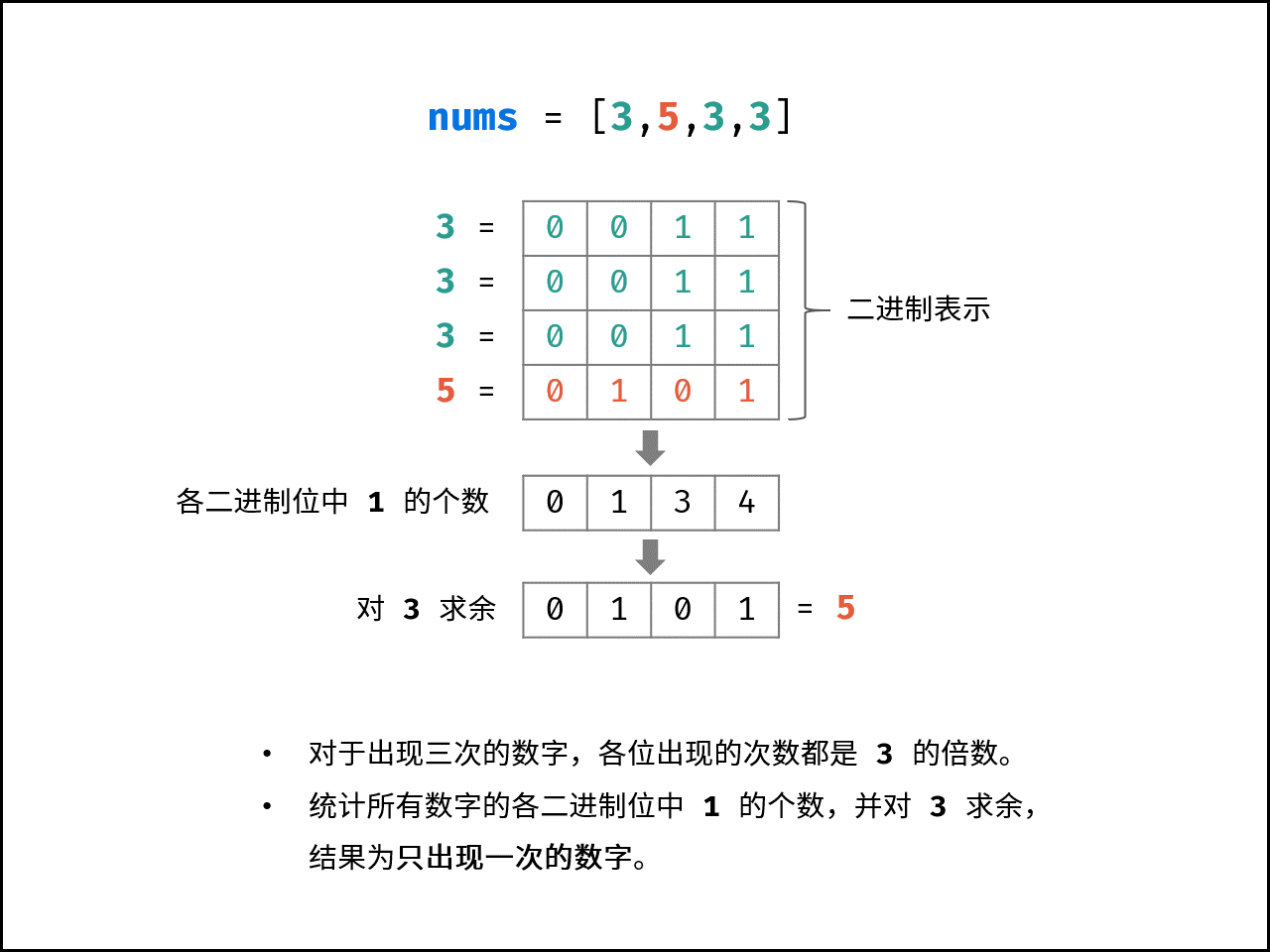{:align=center width=450}
## 方法一:有限状态自动机
各二进制位的 **位运算规则相同** ,因此只需考虑一位即可。如下图所示,对于所有数字中的某二进制位 $1$ 的个数,存在 3 种状态,即对 3 余数为 $0, 1, 2$ 。
- 若输入二进制位 $1$ ,则状态按照以下顺序转换;
- 若输入二进制位 $0$ ,则状态不变。
$$
0 \rightarrow 1 \rightarrow 2 \rightarrow 0 \rightarrow \cdots
$$
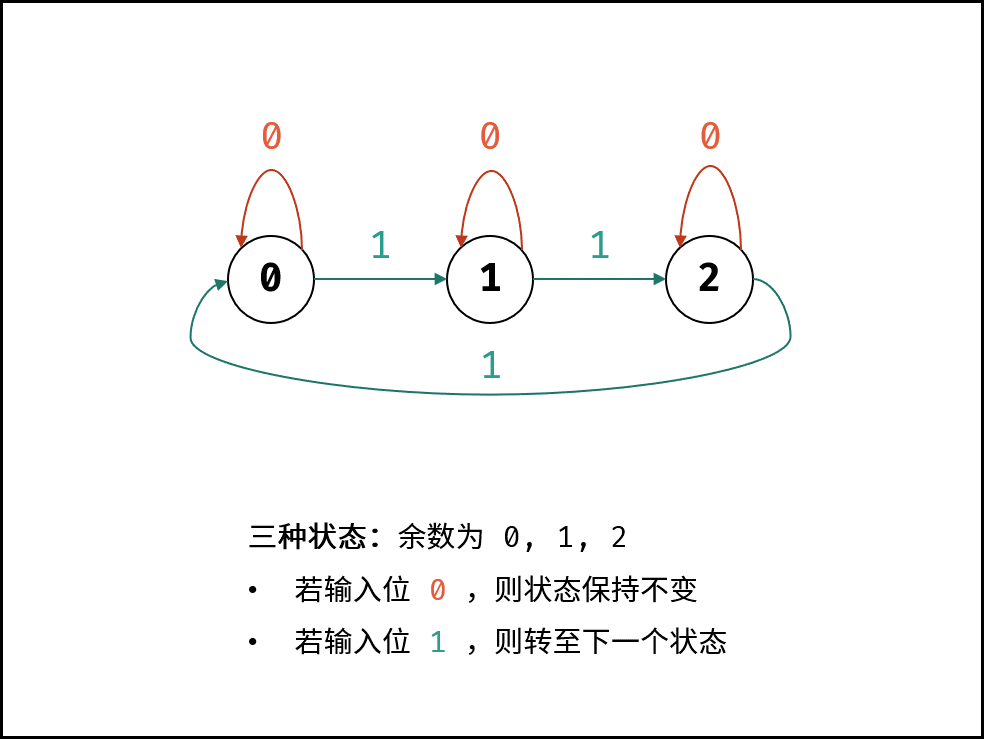{:align=center width=450}
如下图所示,由于二进制只能表示 $0, 1$ ,因此需要使用两个二进制位来表示 $3$ 个状态。设此两位分别为 $two$ , $one$ ,则状态转换变为:
$$
00 \rightarrow 01 \rightarrow 10 \rightarrow 00 \rightarrow \cdots
$$
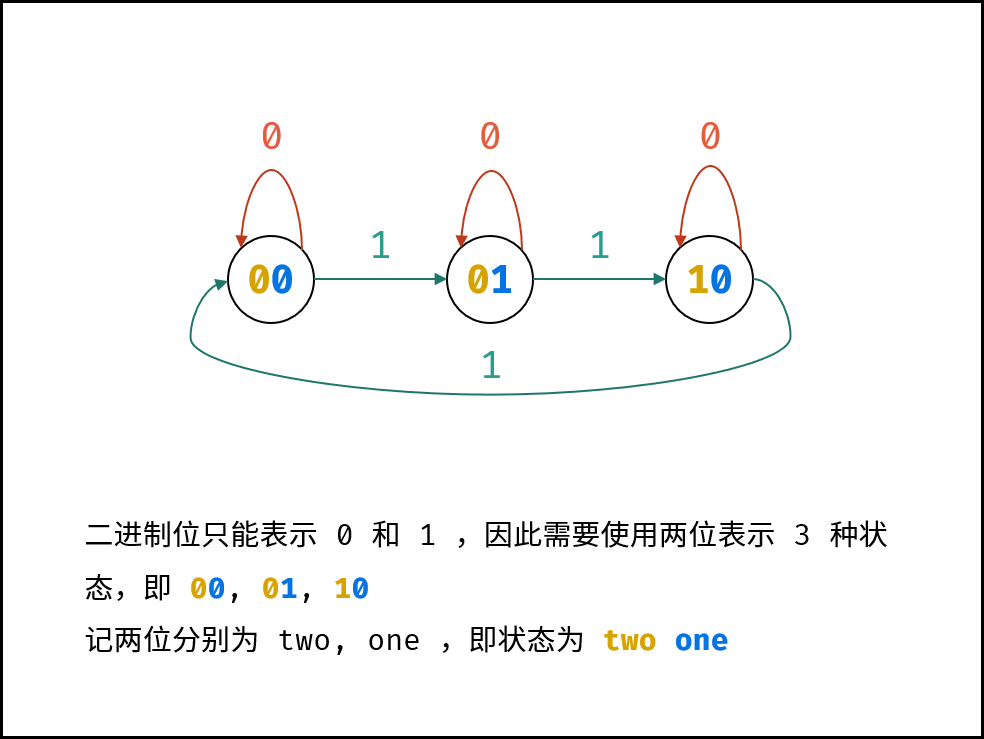{:align=center width=450}
接下来,需要通过 **状态转换表** 导出 **状态转换的计算公式** 。首先回忆一下位运算特点,对于任意二进制位 $x$ ,有:
- 异或运算:`x ^ 0 = x` ,`x ^ 1 = ~x`
- 与运算:`x & 0 = 0` ,`x & 1 = x`
**计算 $one$ 方法:**
设当前状态为 $two$ $one$ ,此时输入二进制位 $n$ 。如下图所示,通过对状态表的情况拆分,可推出 $one$ 的计算方法为:
```Python
if two == 0:
if n == 0:
one = one
if n == 1:
one = ~one
if two == 1:
one = 0
```
引入 **异或运算** ,可将以上拆分简化为:
```Python
if two == 0:
one = one ^ n
if two == 1:
one = 0
```
引入 **与运算** ,可继续简化为:
```Python
one = one ^ n & ~two
```
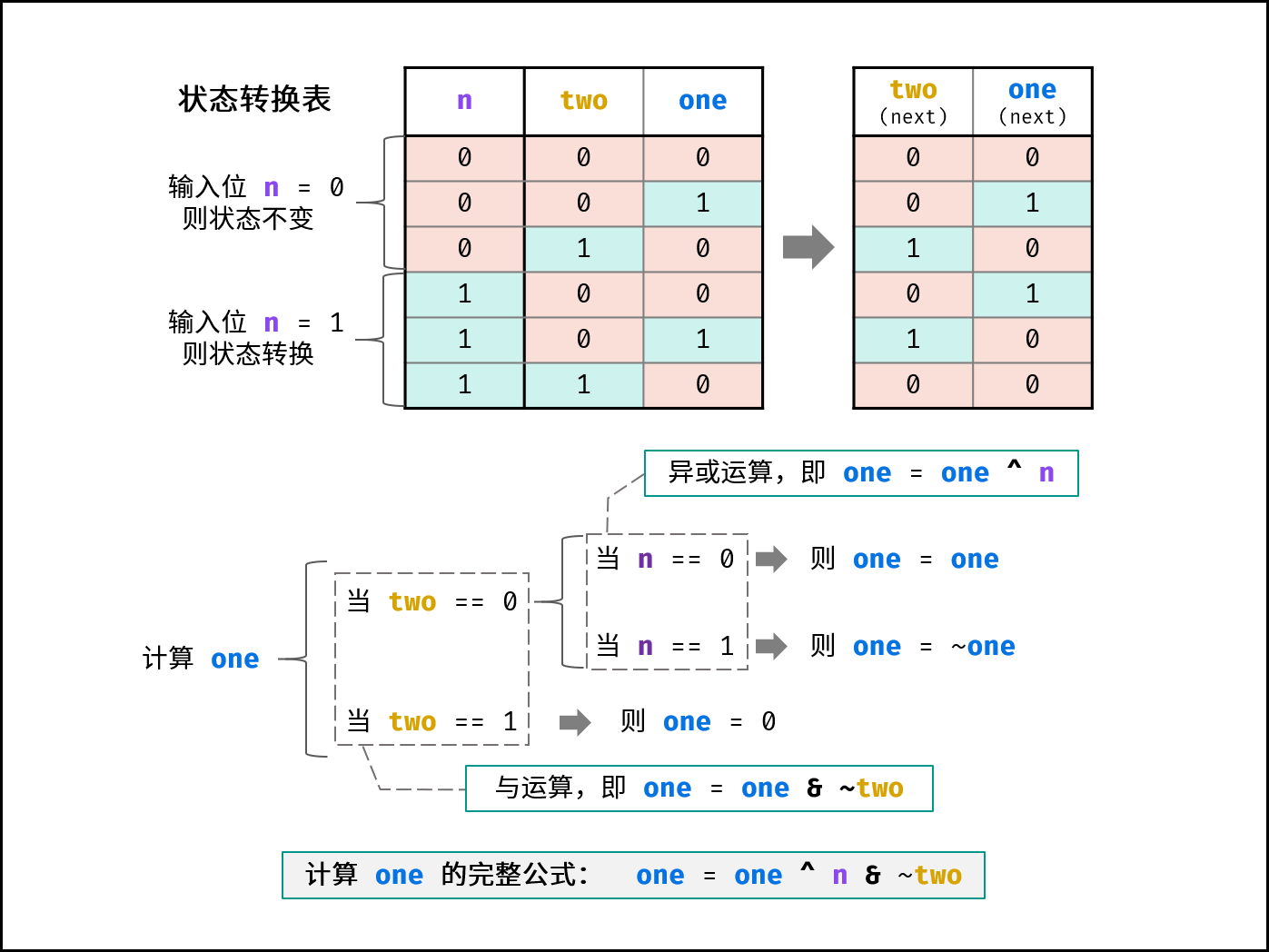{:align=center width=550}
**计算 $two$ 方法:**
由于是先计算 $one$ ,因此应在新 $one$ 的基础上计算 $two$ 。
如下图所示,修改为新 $one$ 后,得到了新的状态图。观察发现,可以使用同样的方法计算 $two$ ,即:
```Python
two = two ^ n & ~one
```
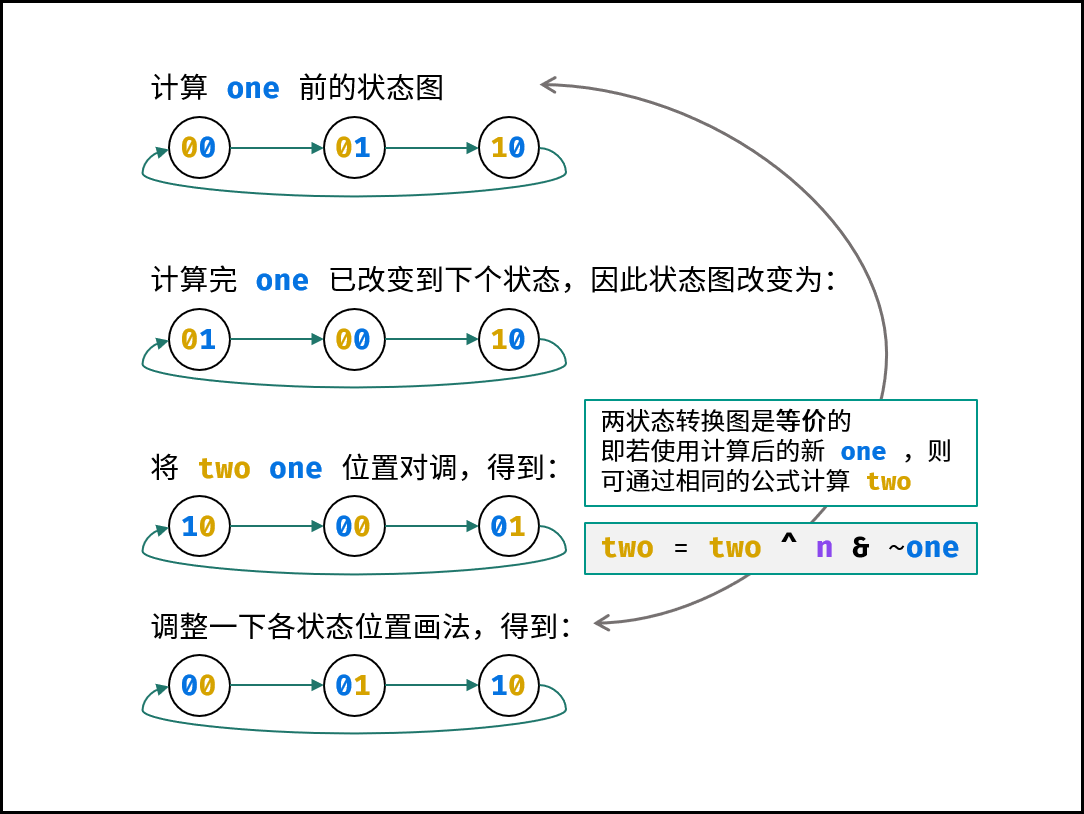{:align=center width=450}
**返回值:**
以上是对数字的二进制中 “一位” 的分析,而 `int` 类型的其他 31 位具有相同的运算规则,因此可将以上公式直接套用在 32 位数上。
遍历完所有数字后,各二进制位都处于状态 $00$ 和状态 $01$ (取决于 “只出现一次的数字” 的各二进制位是 $1$ 还是 $0$ ),而此两状态是由 $one$ 来记录的(此两状态下 $twos$ 恒为 $0$ ),因此返回 $ones$ 即可。
### 代码:
```Python []
class Solution:
def trainingPlan(self, actions: List[int]) -> int:
ones, twos = 0, 0
for action in actions:
ones = ones ^ action & ~twos
twos = twos ^ action & ~ones
return ones
```
```Java []
class Solution {
public int trainingPlan(int[] actions) {
int ones = 0, twos = 0;
for(int action : actions){
ones = ones ^ action & ~twos;
twos = twos ^ action & ~ones;
}
return ones;
}
}
```
```C++ []
class Solution {
public:
int trainingPlan(vector& actions) {
int ones = 0, twos = 0;
for(int action : actions){
ones = ones ^ action & ~twos;
twos = twos ^ action & ~ones;
}
return ones;
}
};
```
### 复杂度分析:
- **时间复杂度 $O(N)$ :** 其中 $N$ 位数组 $actions$ 的长度;遍历数组占用 $O(N)$ ,每轮中的常数个位运算操作占用 $O(32 \times3 \times 2) = O(1)$ 。
- **空间复杂度 $O(1)$ :** 变量 $ones$ , $twos$ 使用常数大小的额外空间。
## 方法二:遍历统计
> 此方法相对容易理解,但效率较低,总体推荐方法一。
使用 **与运算** ,可获取二进制数字 $action$ 的最右一位 $n_1$ :
$$
n_1 = action \& i
$$
配合 **右移操作** ,可从低位至高位,获取 $action$ 所有位的值(设 int 类型从低至高的位数为第 0 位 至第 31 位,即 $n_0$ ~ $n_{31}$ ):
$$
action = action >> 1
$$
建立一个长度为 32 的数组 $counts$ ,通过以上方法可记录所有数字的各二进制位的 $1$ 的出现次数之和。
```Python []
counts = [0] * 32
for action in actions:
for i in range(32):
counts[i] += action & 1 # 更新第 i 位 1 的个数之和
action >>= 1 # 第 i 位 --> 第 i + 1 位
```
```Java []
int[] counts = new int[32];
for(int action : actions) {
for(int i = 0; i < 32; i++) {
counts[i] += action & 1; // 更新第 i 位 1 的个数之和
action >>= 1; // 第 i 位 --> 第 i + 1 位
}
}
```
```C++ []
int counts[32] = {0}; // C++ 初始化数组需要写明初始值 0
for(int action : actions) {
for(int i = 0; i < 32; i++) {
counts[i] += action & 1; // 更新第 i 位 1 的个数之和
action >>= 1; // 第 i 位 --> 第 i + 1 位
}
}
```
将 $counts$ 各元素对 $3$ 求余,则结果为 “只出现一次的数字” 的各二进制位。
```Python []
for i in range(31, -1, -1):
x = counts[i] %= 3 # 得到 “只出现一次的数字” 的第 i 位
```
```Java []
for(int i = 31; i >= 0; i--) {
int x = counts[i] %= 3; // 得到 “只出现一次的数字” 的第 i 位
}
```
```C++ []
for(int i = 31; i >= 0; i--) {
int x = counts[i] % 3; // 得到 “只出现一次的数字” 的第 i 位
}
```
利用 **左移操作** 和 **或运算** ,可将 $counts$ 数组中各二进位的值恢复到数字 $res$ 上。
```Python []
for i in range(31, -1, -1):
res <<= 1
res |= counts[i] % 3 # 恢复第 i 位
```
```Java []
for(int i = 31; i >= 0; i--) {
res <<= 1;
res |= counts[i] % 3; // 恢复第 i 位
}
```
```C++ []
for(int i = 31; i >= 0; i--) {
res <<= 1;
res |= counts[i] % 3; // 恢复第 i 位
}
```
最终返回 $res$ 即可。
> 由于 Python 的存储负数的特殊性,需要先将 $0$ - $31$ 位取反(即 `res ^ 0xffffffff` ),再将所有位取反(即 `~` )。
> **此组合操作含义:** 将数字 $31$ 以上位取反,$0$ - $31$ 位不变。
### 代码:
实际上,只需要修改求余数值 $m$ ,即可实现解决 **除了一个数字以外,其余数字都出现 $m$ 次** 的通用问题。
> 设 int 类型从低至高的位数为第 0 位 至第 31 位。
```Python []
class Solution:
def trainingPlan(self, actions: List[int]) -> int:
counts = [0] * 32
for action in actions:
for i in range(32):
counts[i] += action & 1 # 更新第 i 位 1 的个数之和
action >>= 1 # 第 i 位 --> 第 i 位
res, m = 0, 3
for i in range(31, -1, -1):
res <<= 1
res |= counts[i] % m # 恢复第 i 位
return res if counts[31] % m == 0 else ~(res ^ 0xffffffff)
```
```Java []
class Solution {
public int trainingPlan(int[] actions) {
int[] counts = new int[32];
for(int action : actions) {
for(int i = 0; i < 32; i++) {
counts[i] += action & 1; // 更新第 i 位 1 的个数之和
action >>= 1; // 第 i 位 --> 第 i 位
}
}
int res = 0, m = 3;
for(int i = 31; i >= 0; i--) {
res <<= 1;
res |= counts[i] % m; // 恢复第 i 位
}
return res;
}
}
```
```C++ []
class Solution {
public:
int trainingPlan(vector& actions) {
int counts[32] = {0}; // C++ 初始化数组需要写明初始值 0
for(int action : actions) {
for(int i = 0; i < 32; i++) {
counts[i] += action & 1; // 更新第 i 位 1 的个数之和
action >>= 1; // 第 i 位 --> 第 i 位
}
}
int res = 0, m = 3;
for(int i = 31; i >= 0; i--) {
res <<= 1;
res |= counts[i] % m; // 恢复第 i 位
}
return res;
}
};
```
### 复杂度分析:
- **时间复杂度 $O(N)$ :** 其中 $N$ 位数组 $actions$ 的长度;遍历数组占用 $O(N)$ ,每轮中的常数个位运算操作占用 $O(1)$ 。
- **空间复杂度 $O(1)$ :** 数组 $counts$ 长度恒为 $32$ ,占用常数大小的额外空间。
================================================
FILE: leetbook_ioa/docs/LCR 179. 查找总价格为目标值的两个商品.md
================================================
## 解题思路:
利用 HashMap 可以通过遍历数组找到数字组合,时间和空间复杂度均为 $O(N)$ 。
注意本题的 $price$ 是 **排序数组** ,因此可使用 **双指针法** 将空间优化至 $O(1)$ 。
### 算法流程:
1. **初始化:** 双指针 $i$ , $j$ 分别指向数组 $price$ 的左右两端。
2. **循环搜索:** 当双指针相遇时跳出;
1. 计算和 $s = price[i] + price[j]$ ;
2. 若 $s > target$ ,则指针 $j$ 向左移动,即执行 $j = j - 1$ ;
3. 若 $s < target$ ,则指针 $i$ 向右移动,即执行 $i = i + 1$ ;
4. 若 $s = target$ ,立即返回数组 $[price[i], price[j]]$ ;
3. 若循环结束,则返回空数组,代表无和为 $target$ 的数字组合。
> 下图中的 `nums` 对应本题的 `price` 。
### 正确性证明:
> 记每个状态为 $S(i, j)$ ,即 $S(i, j) = price[i] + price[j]$ 。假设 $S(i, j) < target$ ,则执行 $i = i + 1$ ,即状态切换至 $S(i + 1, j)$ 。
状态 $S(i, j)$ 切换至 $S(i + 1, j)$ ,则会消去一行元素,相当于 **消去了状态集合** {$S(i, i + 1), S(i, i + 2), ..., S(i, j - 2), S(i, j - 1), S(i, j)$ } 。(由于双指针都是向中间收缩,因此这些状态之后不可能再遇到)。
由于 $price$ 是排序数组,因此这些 **消去的状态** 都一定满足 $S(i, j) < target$ ,即这些状态都 **不是解** 。
**结论:** 以上分析已证明 “每次指针 $i$ 的移动操作,都不会导致解的丢失” ,即指针 $i$ 的移动操作是安全的;同理,对于指针 $j$ 可得出同样推论;因此,此双指针法是正确的。
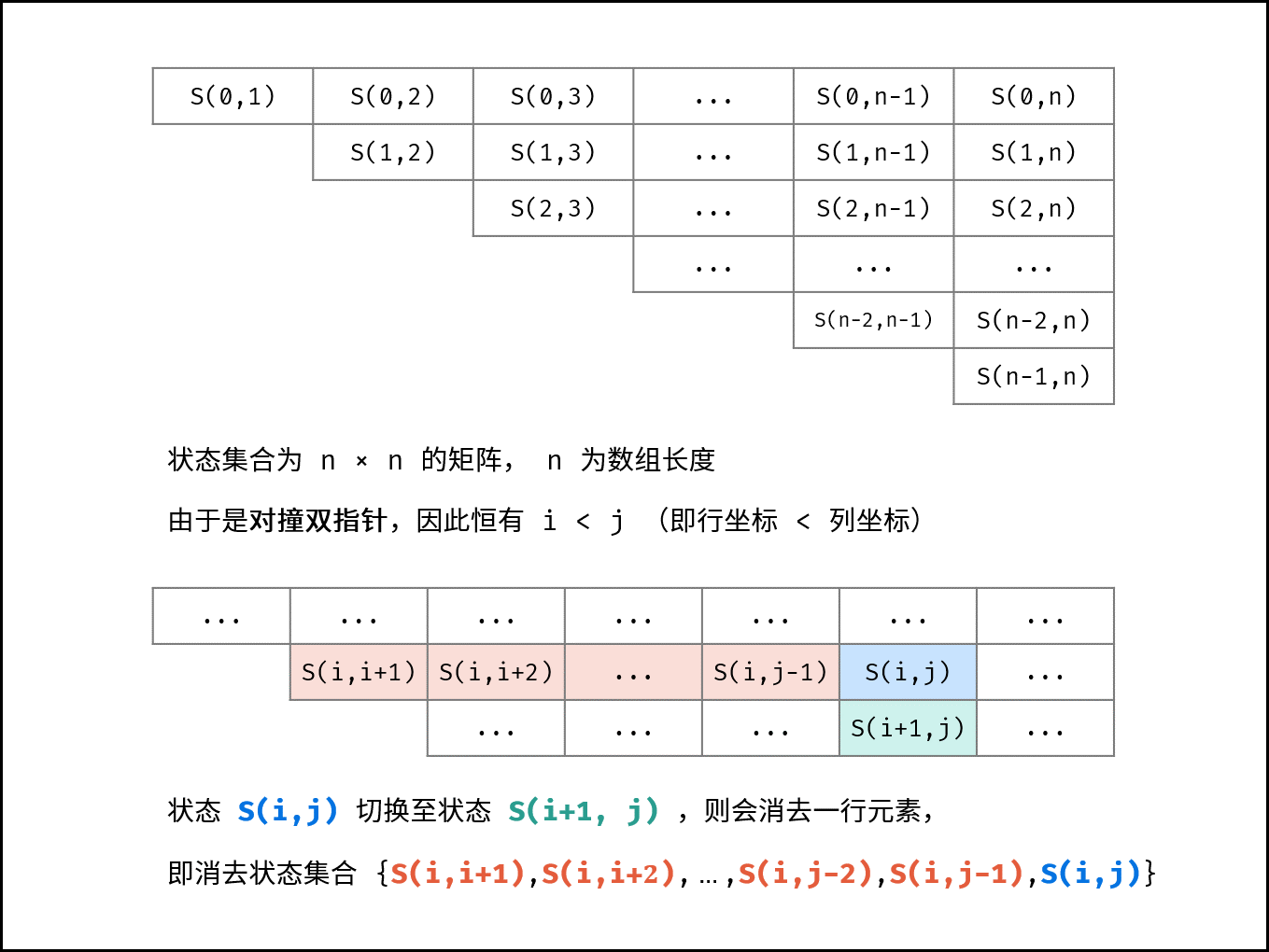{:align=center width=550}
## 代码:
```Python []
class Solution:
def twoSum(self, price: List[int], target: int) -> List[int]:
i, j = 0, len(price) - 1
while i < j:
s = price[i] + price[j]
if s > target: j -= 1
elif s < target: i += 1
else: return price[i], price[j]
return []
```
```Java []
class Solution {
public int[] twoSum(int[] price, int target) {
int i = 0, j = price.length - 1;
while(i < j) {
int s = price[i] + price[j];
if(s < target) i++;
else if(s > target) j--;
else return new int[] { price[i], price[j] };
}
return new int[0];
}
}
```
```C++ []
class Solution {
public:
vector twoSum(vector& price, int target) {
int i = 0, j = price.size() - 1;
while(i < j) {
int s = price[i] + price[j];
if(s < target) i++;
else if(s > target) j--;
else return { price[i], price[j] };
}
return {};
}
};
```
### 复杂度分析:
- **时间复杂度 $O(N)$ :** $N$ 为数组 $price$ 的长度;双指针共同线性遍历整个数组。
- **空间复杂度 $O(1)$ :** 变量 $i$, $j$ 使用常数大小的额外空间。
================================================
FILE: leetbook_ioa/docs/LCR 180. 文件组合.md
================================================
## 方法一:求和公式
设连续正整数序列的左边界 $i$ 和右边界 $j$ ,则此序列的 **元素和** $target$ 等于 **元素平均值 $\frac{i + j}{2}$** 乘以 **元素数量 $(j - i + 1)$** ,即:
$$
target = \frac{(i + j) \times (j - i + 1)}{2}
$$
观察发现,当确定 元素和 $target$ 与 左边界 $i$ 时,可通过 **解一元二次方程** ,直接计算出右边界 $j$ ,公式推导如下:
$$
\begin{aligned}
target & = \frac{(i + j) \times (j - i + 1)}{2} \\
& = \frac{j^2 + j - i^2 + i}{2} \\
\end{aligned}
$$
整理上式得:
$$
0 = j^2 + j - (2 \times target + i^2 - i)
$$
根据一元二次方程求根公式得:
$$
j = \frac{-1 \pm \sqrt{1 + 4(2 \times target + i^2 - i)}}{2}
$$
由于 $j > i$ 恒成立,因此直接 **舍去必为负数的解** ,即 $j$ 的唯一解求取公式为:
$$
\begin{aligned}
j & = \frac{-1 + \sqrt{1 + 4(2 \times target + i^2 - i)}}{2}
\end{aligned}
$$
因此,通过从小到大遍历左边界 $i$ 来计算 **以 $i$ 为起始数字的连续正整数序列** 。每轮中,由以上公式计算得到右边界 $j$ ,当 $j$ 满足以下两个条件时记录结果:
1. $j$ 为 **整数** :符合题目所求「连续正整数序列」;
2. $i < j$ :满足题目要求「至少含有两个数」;
> 当 $target = 9$ 时,以上求解流程如下图所示。
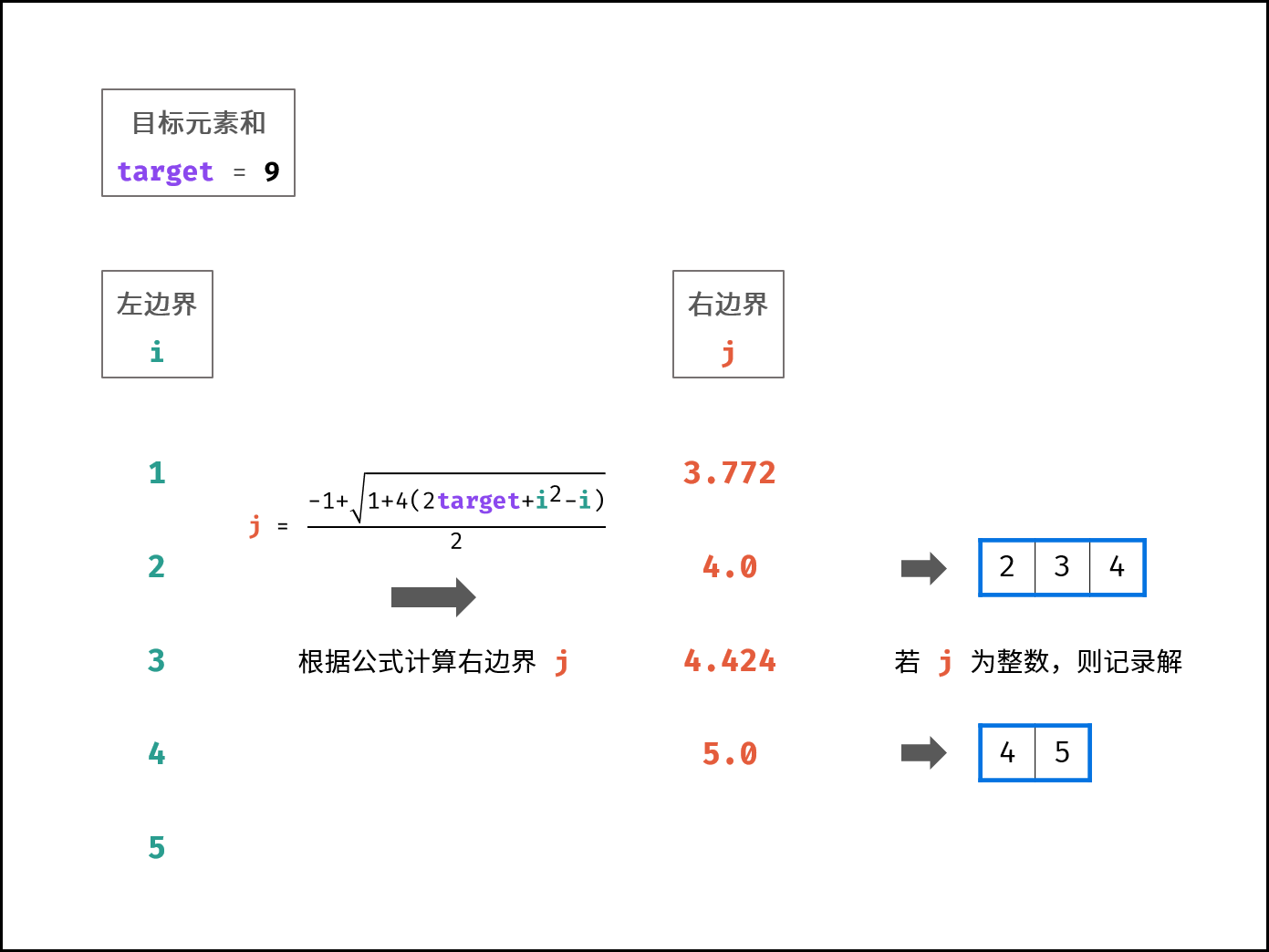{:align=center width=550xl}
### 代码:
计算公式中 $i^2$ 项可能超过 int 类型取值范围,因此在 Java, C++ 中需要转化成 long 类型。
```Python []
class Solution:
def fileCombination(self, target: int):
i, j, res = 1, 2, []
while i < j:
j = (-1 + (1 + 4 * (2 * target + i * i - i)) ** 0.5) / 2
if i < j and j == int(j):
res.append(list(range(i, int(j) + 1)))
i += 1
return res
```
```Java []
class Solution {
public int[][] fileCombination(int target) {
int i = 1;
double j = 2.0;
List res = new ArrayList<>();
while(i < j) {
j = (-1 + Math.sqrt(1 + 4 * (2 * target + (long) i * i - i))) / 2;
if(i < j && j == (int)j) {
int[] ans = new int[(int)j - i + 1];
for(int k = i; k <= (int)j; k++)
ans[k - i] = k;
res.add(ans);
}
i++;
}
return res.toArray(new int[0][]);
}
}
```
```C++ []
class Solution {
public:
vector> fileCombination(int target) {
int i = 1;
double j = 2.0;
vector> res;
while(i < j) {
j = (-1 + sqrt(1 + 4 * (2 * target + (long) i * i - i))) / 2;
if(i < j && j == (int)j) {
vector ans;
for(int k = i; k <= (int)j; k++)
ans.push_back(k);
res.push_back(ans);
}
i++;
}
return res;
}
};
```
### 复杂度分析:
- **时间复杂度 $O(N)$ :** 其中 $N = target$ ;连续整数序列至少有两个数字,而 $i < j$ 恒成立,因此至多循环 $\frac{target}{2}$ 次,使用 $O(N)$ 时间;循环内,计算 $j$ 使用 $O(1)$ 时间;当 $i = 1$ 时,达到最大序列长度 $\frac{-1 + \sqrt{1 + 8s}}{2}$ ,考虑到解的稀疏性,将列表构建时间简化考虑为 $O(1)$ ;
- **空间复杂度 $O(1)$ :** 变量 $i$ , $j$ 使用常数大小的额外空间。
## 方法二:滑动窗口
设连续正整数序列的左边界 $i$ 和右边界 $j$ ,则可构建滑动窗口从左向右滑动。循环中,每轮判断滑动窗口内元素和与目标值 $target$ 的大小关系,若相等则记录结果,若大于 $target$ 则移动左边界 $i$ (以减小窗口内的元素和),若小于 $target$ 则移动右边界 $j$ (以增大窗口内的元素和)。
### 算法流程:
1. **初始化:** 左边界 $i = 1$ ,右边界 $j = 2$ ,元素和 $s = 3$ ,结果列表 $res$ ;
2. **循环:** 当 $i \geq j$ 时跳出;
- 当 $s > target$ 时: 向右移动左边界 $i = i + 1$ ,并更新元素和 $s$ ;
- 当 $s < target$ 时: 向右移动右边界 $j = j + 1$ ,并更新元素和 $s$ ;
- 当 $s = target$ 时: 记录连续整数序列,并向右移动左边界 $i = i + 1$ ;
3. **返回值:** 返回结果列表 $res$ ;
> 当 $target = 9$ 时,以上求解流程如下图所示:
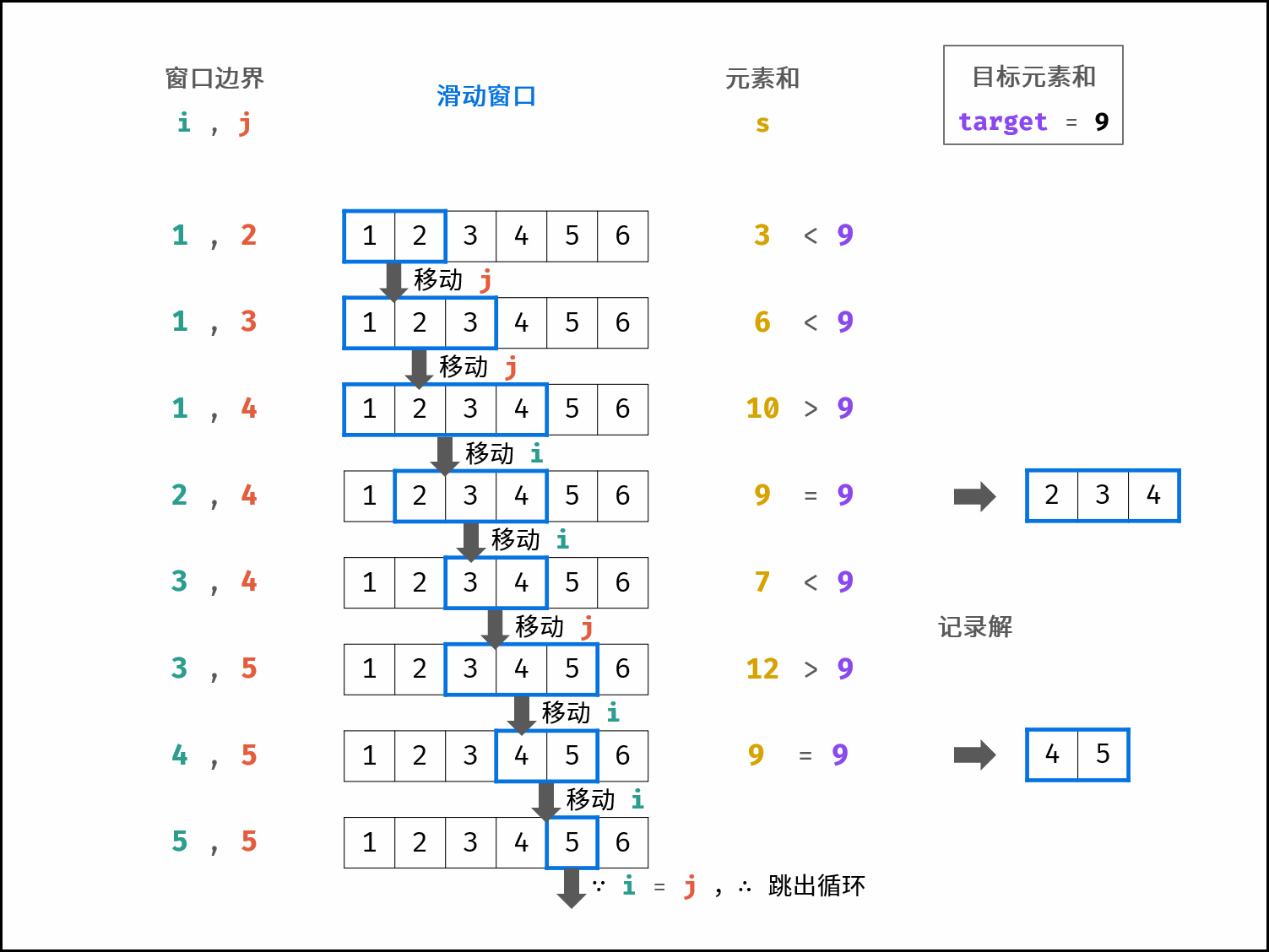{:align=center width=600}
### 代码:
观察本文的算法流程发现,当 $s = target$ 和 $s > target$ 的移动边界操作相同,因此可以合并,代码如下所示。
```Python []
class Solution:
def fileCombination(self, target: int) -> List[List[int]]:
i, j, s, res = 1, 2, 3, []
while i < j:
if s == target:
res.append(list(range(i, j + 1)))
if s >= target:
s -= i
i += 1
else:
j += 1
s += j
return res
```
```Java []
class Solution {
public int[][] fileCombination(int target) {
int i = 1, j = 2, s = 3;
List res = new ArrayList<>();
while(i < j) {
if(s == target) {
int[] ans = new int[j - i + 1];
for(int k = i; k <= j; k++)
ans[k - i] = k;
res.add(ans);
}
if(s >= target) {
s -= i;
i++;
} else {
j++;
s += j;
}
}
return res.toArray(new int[0][]);
}
}
```
```C++ []
class Solution {
public:
vector> fileCombination(int target) {
int i = 1, j = 2, s = 3;
vector> res;
while(i < j) {
if(s == target) {
vector ans;
for(int k = i; k <= j; k++)
ans.push_back(k);
res.push_back(ans);
}
if(s >= target) {
s -= i;
i++;
} else {
j++;
s += j;
}
}
return res;
}
};
```
### 复杂度分析:
- **时间复杂度 $O(N)$ :** 其中 $N = target$ ;连续整数序列至少有两个数字,而 $i < j$ 恒成立,因此至多循环 $target$ 次( $i$ , $j$ 都移动到 $\frac{target}{2}$ ),使用 $O(N)$ 时间;当 $i = 1$ 时,达到最大序列长度 $\frac{-1 + \sqrt{1 + 8s}}{2}$ ,考虑到解的稀疏性,将列表构建时间简化考虑为 $O(1)$ ;
- **空间复杂度 $O(1)$ :** 变量 $i$ , $j$ , $s$ 使用常数大小的额外空间。
================================================
FILE: leetbook_ioa/docs/LCR 181. 字符串中的单词反转.md
================================================
## 方法一:双指针
### 算法解析:
- 倒序遍历字符串 $message$ ,记录单词左右索引边界 $i$ , $j$ ;
- 每确定一个单词的边界,则将其添加至单词列表 $res$ ;
- 最终,将单词列表拼接为字符串,并返回即可。
> 下图中的 `s` 对应本题的 `message` 。
### 代码:
```Python []
class Solution:
def reverseMessage(self, message: str) -> str:
message = message.strip() # 删除首尾空格
i = j = len(message) - 1
res = []
while i >= 0:
while i >= 0 and message[i] != ' ': i -= 1 # 搜索首个空格
res.append(message[i + 1: j + 1]) # 添加单词
while i >= 0 and message[i] == ' ': i -= 1 # 跳过单词间空格
j = i # j 指向下个单词的尾字符
return ' '.join(res) # 拼接并返回
```
```Java []
class Solution {
public String reverseMessage(String message) {
message = message.trim(); // 删除首尾空格
int j = message.length() - 1, i = j;
StringBuilder res = new StringBuilder();
while (i >= 0) {
while (i >= 0 && message.charAt(i) != ' ') i--; // 搜索首个空格
res.append(message.substring(i + 1, j + 1) + " "); // 添加单词
while (i >= 0 && message.charAt(i) == ' ') i--; // 跳过单词间空格
j = i; // j 指向下个单词的尾字符
}
return res.toString().trim(); // 转化为字符串并返回
}
}
```
### 复杂度分析:
- **时间复杂度 $O(N)$ :** 其中 $N$ 为字符串 $message$ 的长度,线性遍历字符串。
- **空间复杂度 $O(N)$ :** 新建的 list(Python) 或 StringBuilder(Java) 中的字符串总长度 $\leq N$ ,占用 $O(N)$ 大小的额外空间。
## 方法二:分割 + 倒序
利用 “字符串分割”、“列表倒序” 的内置函数 *(面试时不建议使用)* ,可简便地实现本题的字符串翻转要求。
### 算法解析:
- **Python :** 由于 $split()$ 方法将单词间的 “多个空格看作一个空格” (参考自 [split()和split(' ')的区别](https://www.cnblogs.com/python-coder/p/10073329.html) ),因此不会出现多余的 “空单词” 。因此,直接利用 $reverse()$ 方法翻转单词列表 $strs$ ,拼接为字符串并返回即可。
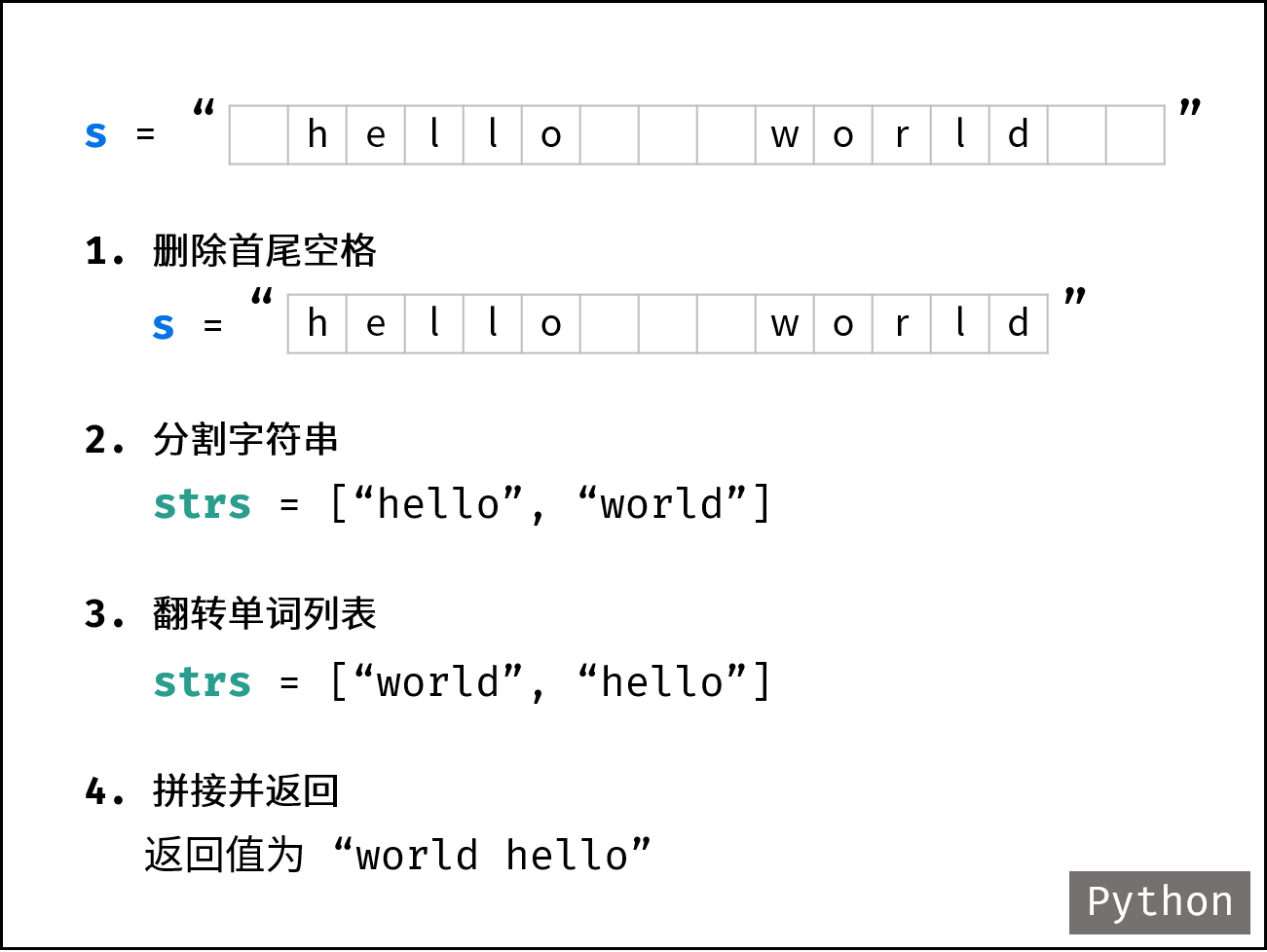{:align=center width=500}
- **Java :** 以空格为分割符完成字符串分割后,若两单词间有 $x > 1$ 个空格,则在单词列表 $strs$ 中,此两单词间会多出 $x - 1$ 个 “空单词” (即 `""` )。解决方法:倒序遍历单词列表,并将单词逐个添加至 StringBuilder ,遇到空单词时跳过。
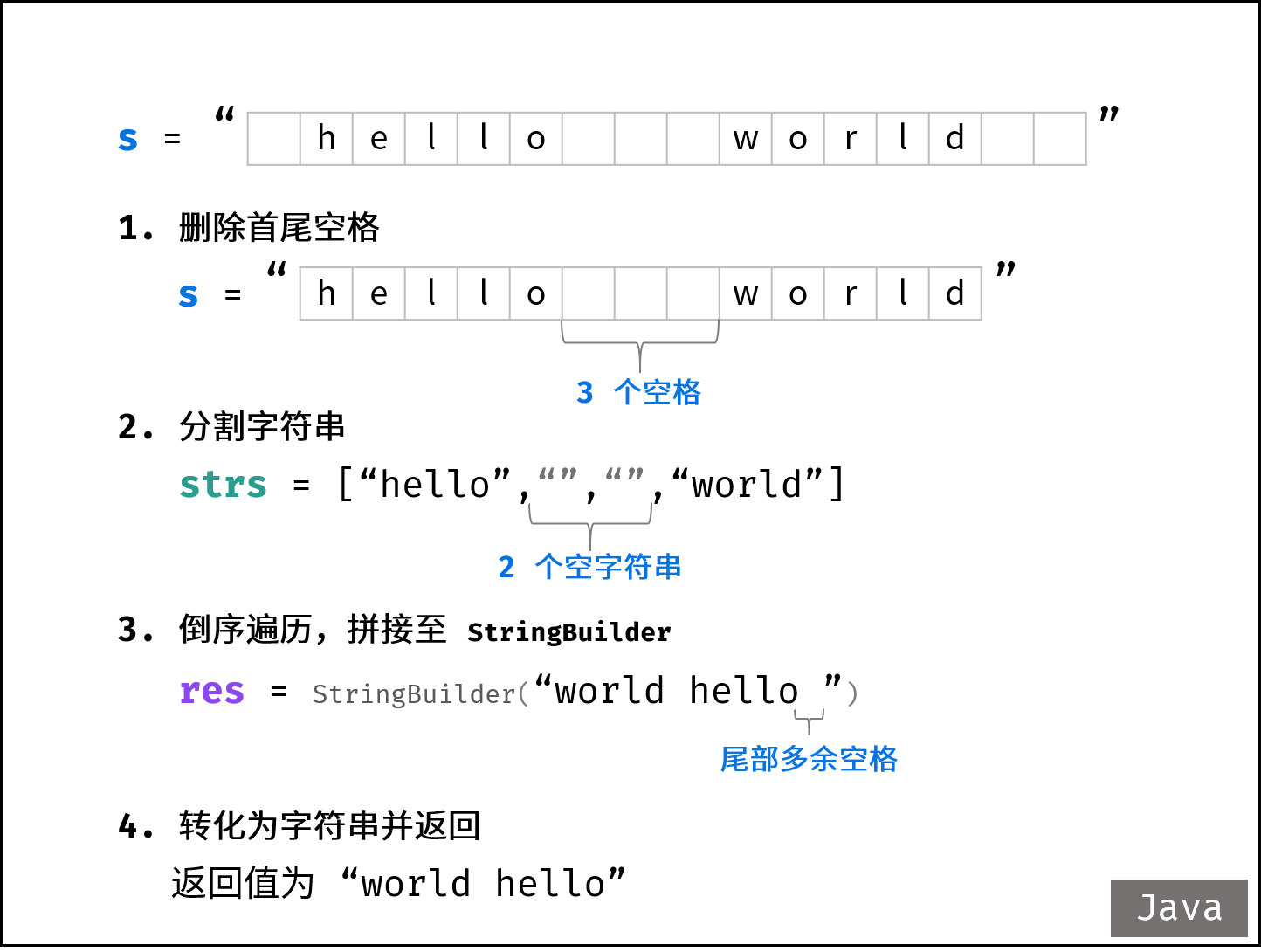{:align=center width=500}
### 代码:
```Python []
class Solution:
def reverseMessage(self, message: str) -> str:
message = message.strip() # 删除首尾空格
strs = message.split() # 分割字符串
strs.reverse() # 翻转单词列表
return ' '.join(strs) # 拼接为字符串并返回
```
```Java []
class Solution {
public String reverseMessage(String message) {
String[] strs = message.trim().split(" "); // 删除首尾空格,分割字符串
StringBuilder res = new StringBuilder();
for (int i = strs.length - 1; i >= 0; i--) { // 倒序遍历单词列表
if(strs[i].equals("")) continue; // 遇到空单词则跳过
res.append(strs[i] + " "); // 将单词拼接至 StringBuilder
}
return res.toString().trim(); // 转化为字符串,删除尾部空格,并返回
}
}
```
Python 可一行实现:
```Python []
class Solution:
def reverseMessage(self, message: str) -> str:
return ' '.join(message.strip().split()[::-1])
```
### 复杂度分析:
- **时间复杂度 $O(N)$ :** 总体为线性时间复杂度,各函数时间复杂度和参考资料链接如下。
- [`split()` 方法:](https://softwareengineering.stackexchange.com/questions/331909/whats-the-complexity-of-javas-string-split-function) 为 $O(N)$ ;
- [`trim()` 和 `strip()` 方法:](https://stackoverflow.com/questions/51110114/is-string-trim-faster-than-string-replace) 最差情况下(当字符串全为空格时),为 $O(N)$ ;
- [`join()` 方法:](https://stackoverflow.com/questions/37133547/time-complexity-of-string-concatenation-in-python) 为 $O(N)$ ;
- [`reverse()` 方法:](https://stackoverflow.com/questions/37606159/what-is-the-time-complexity-of-python-list-reverse) 为 $O(N)$ ;
- **空间复杂度 $O(N)$ :** 单词列表 $strs$ 占用线性大小的额外空间。
================================================
FILE: leetbook_ioa/docs/LCR 182. 动态口令.md
================================================
## 解题思路:
本题解法较多,本文主要介绍 **字符串切片** , **列表遍历拼接** , **字符串遍历拼接** 三种方法,适用于 Python 和 Java 语言。同时,介绍了 **三次翻转法** ,适用于 C++ 语言。
## 方法一:字符串切片
获取字符串 `password[target:]` 切片和 `password[:target]` 切片,使用 "$+$" 运算符拼接并返回即可。
> 下图中的 `s` 对应本题的 `password` 。
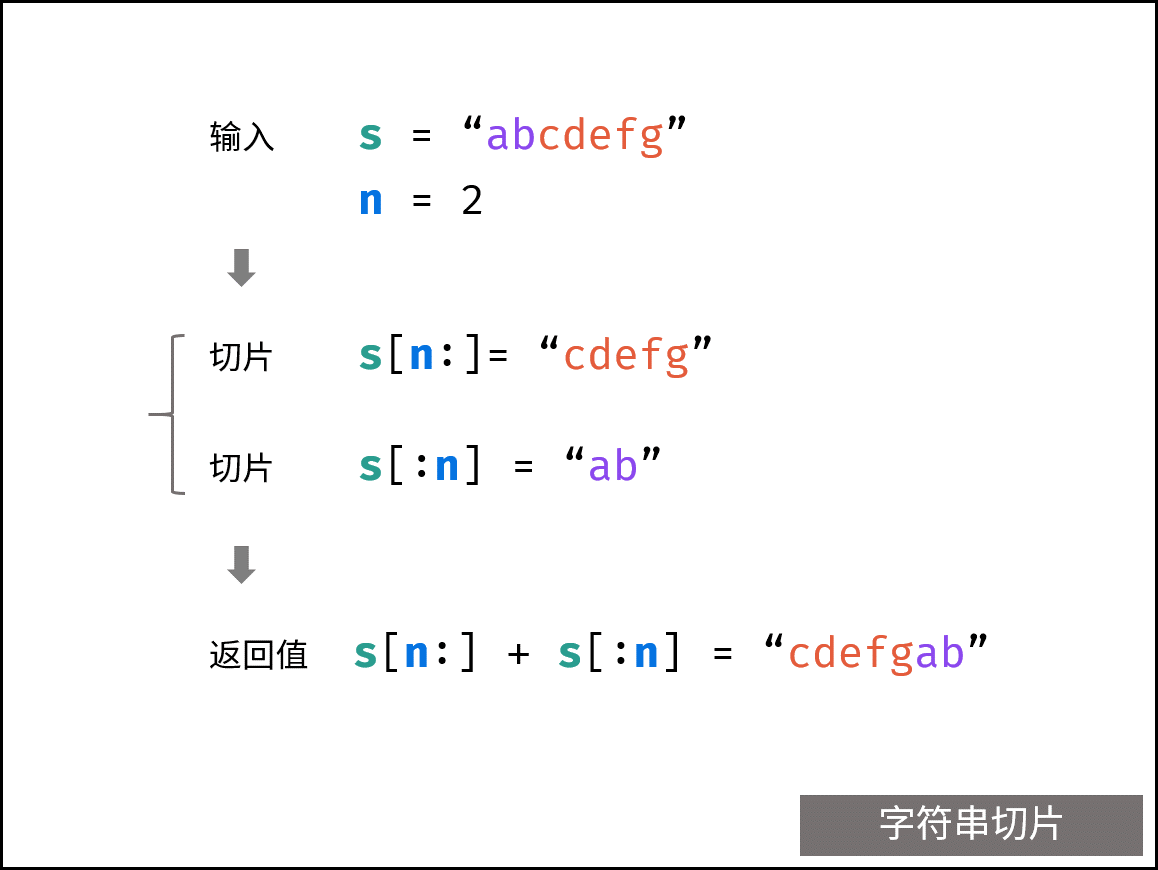{:align=center width=500}
### 代码:
```Python []
class Solution:
def dynamicPassword(self, password: str, target: int) -> str:
return password[target:] + password[:target]
```
```Java []
class Solution {
public String dynamicPassword(String password, int target) {
return password.substring(target, password.length()) + password.substring(0, target);
}
}
```
```C++ []
class Solution {
public:
string dynamicPassword(string password, int target) {
return password.substr(target, password.size()) + password.substr(0, target);
}
};
```
### 复杂度分析:
- **时间复杂度 $O(N)$ :** 其中 $N$ 为字符串 `password` 的长度,字符串切片函数为线性时间复杂度([参考资料](https://stackoverflow.com/questions/4679746/time-complexity-of-javas-substring))。
- **空间复杂度 $O(N)$ :** 两个字符串切片的总长度为 $N$ 。
## 方法二:列表遍历拼接
> 若面试规定不允许使用 **切片函数** ,则使用此方法。
### 算法流程:
1. 新建一个 list (Python) 、StringBuilder (Java) ,记为 `res` ;
2. 先向 `res` 添加 “第 $target + 1$ 位至末位的字符” ;
3. 再向 `res` 添加 “首位至第 $target$ 位的字符” ;
4. 将 `res` 转化为字符串并返回;
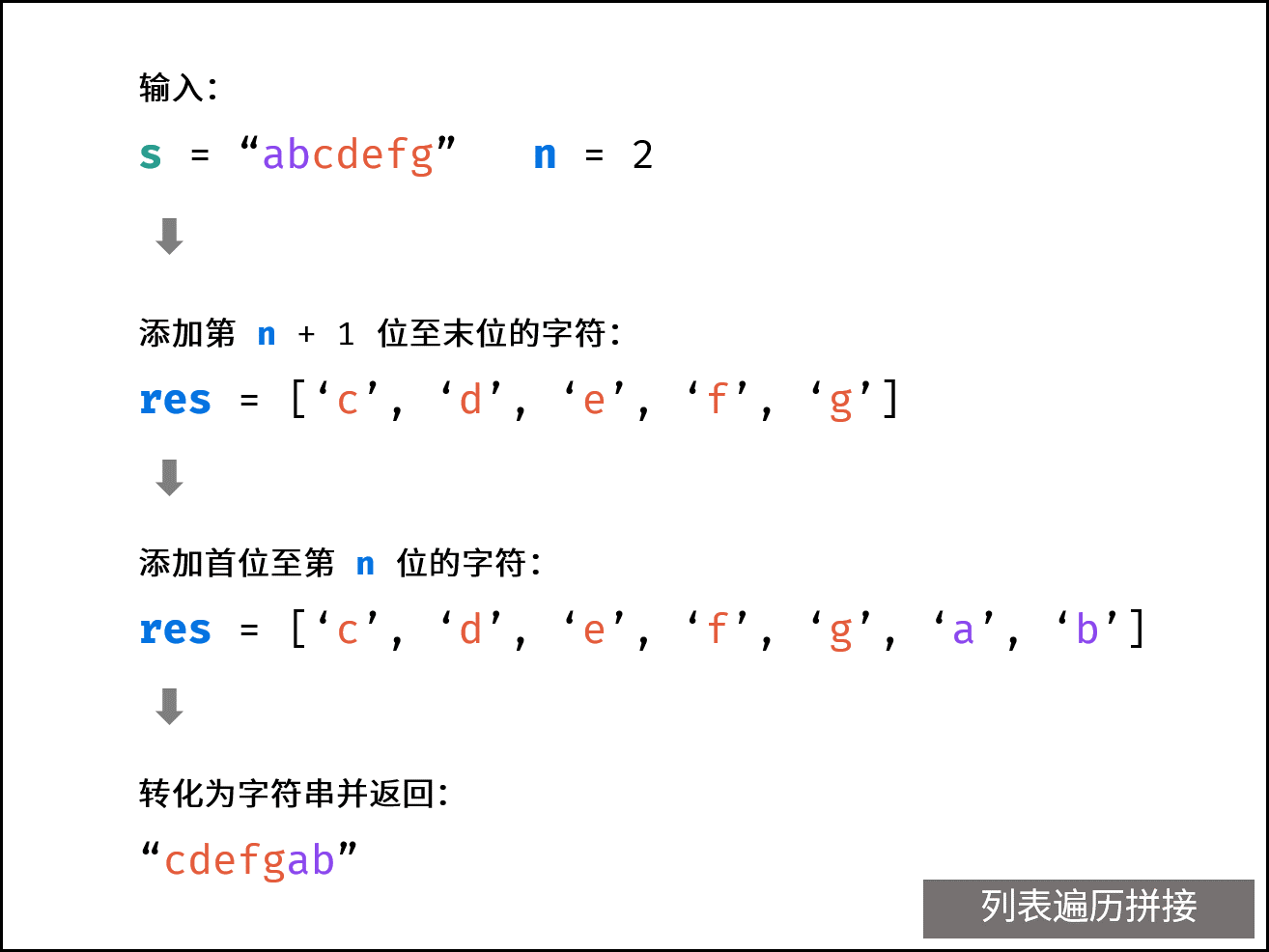{:align=center width=550}
### 代码:
```Python []
class Solution:
def dynamicPassword(self, password: str, target: int) -> str:
res = []
for i in range(target, len(password)):
res.append(password[i])
for i in range(target):
res.append(password[i])
return ''.join(res)
```
```Java []
class Solution {
public String dynamicPassword(String password, int target) {
StringBuilder res = new StringBuilder();
for(int i = target; i < password.length(); i++)
res.append(password.charAt(i));
for(int i = 0; i < target; i++)
res.append(password.charAt(i));
return res.toString();
}
}
```
利用求余运算,可以简化代码。
```Python []
class Solution:
def dynamicPassword(self, password: str, target: int) -> str:
res = []
for i in range(target, target + len(password)):
res.append(password[i % len(password)])
return ''.join(res)
```
```Java []
class Solution {
public String dynamicPassword(String password, int target) {
StringBuilder res = new StringBuilder();
for(int i = target; i < target + password.length(); i++)
res.append(password.charAt(i % password.length()));
return res.toString();
}
}
```
### 复杂度分析:
- **时间复杂度 $O(N)$ :** 线性遍历 `password` 并添加,使用线性时间。
- **空间复杂度 $O(N)$ :** 新建的辅助 `res` 使用 $O(N)$ 大小的额外空间。
## 方法三:字符串遍历拼接
> 若规定 Python 不能使用 `join()` 函数,或规定 Java 只能用 String ,则使用此方法。
此方法与 **方法二** 思路一致,区别是使用字符串代替列表。
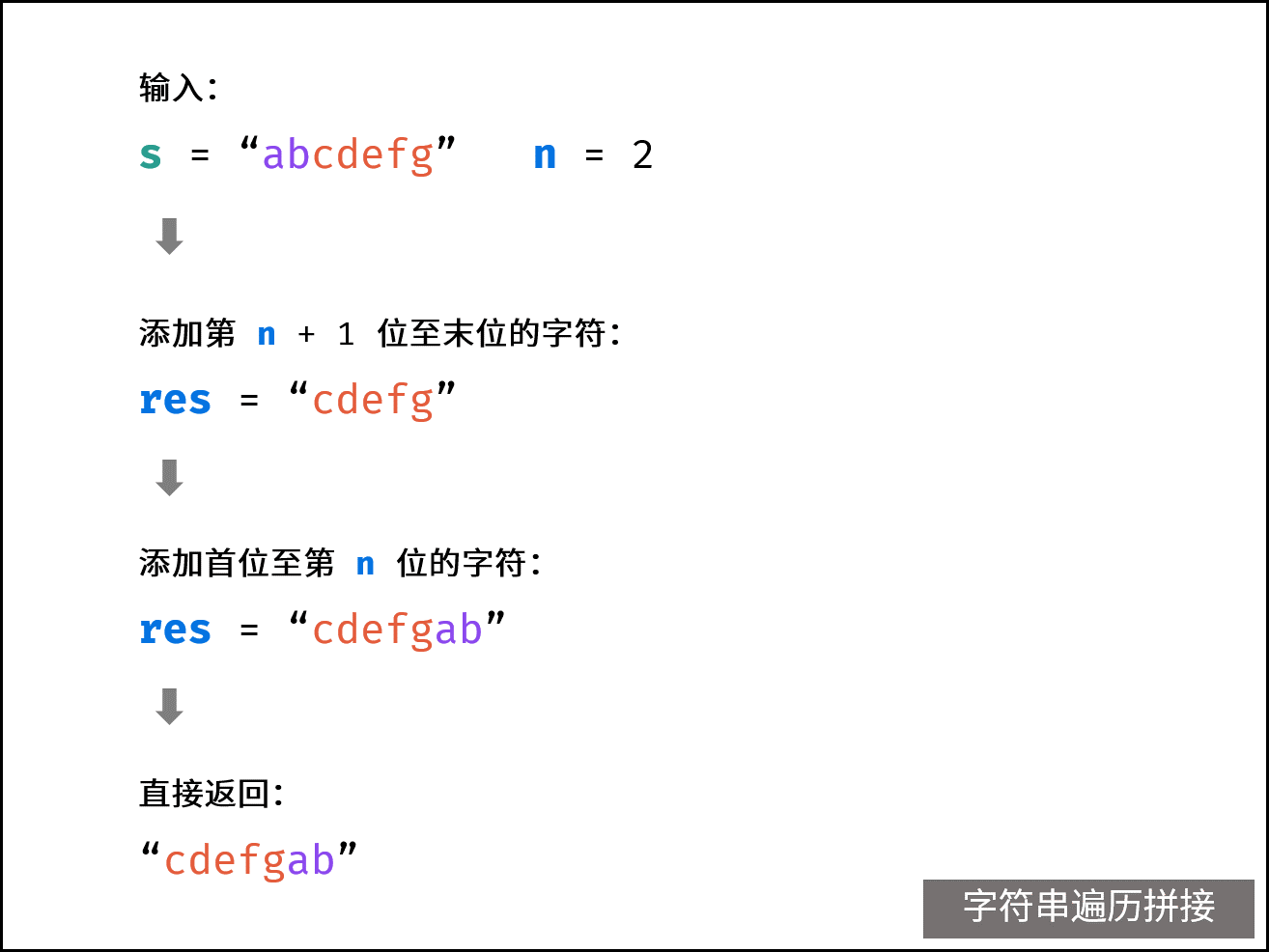{:align=center width=550}
```Python []
class Solution:
def dynamicPassword(self, password: str, target: int) -> str:
res = ""
for i in range(target, len(password)):
res += password[i]
for i in range(target):
res += password[i]
return res
```
```Java []
class Solution {
public String dynamicPassword(String password, int target) {
String res = "";
for(int i = target; i < password.length(); i++)
res += password.charAt(i);
for(int i = 0; i < target; i++)
res += password.charAt(i);
return res;
}
}
```
同理,利用求余运算,可以简化代码。
```Python []
class Solution:
def dynamicPassword(self, password: str, target: int) -> str:
res = ""
for i in range(target, target + len(password)):
res += password[i % len(password)]
return res
```
```Java []
class Solution {
public String dynamicPassword(String password, int target) {
String res = "";
for(int i = target; i < target + password.length(); i++)
res += password.charAt(i % password.length());
return res;
}
}
```
### 复杂度分析:
- **时间复杂度 $O(N)$ :** 线性遍历 `password` 并添加,使用线性时间。
- **空间复杂度 $O(N)$ :** 假设循环过程中内存会被及时回收,内存中至少同时存在长度为 $N$ 和 $N-1$ 的两个字符串(新建长度为 $N$ 的 `res` 需要使用前一个长度 $N-1$ 的 `res` ),因此至少使用 $O(N)$ 的额外空间。
## 效率对比:
由于本题的多解法涉及到了 **字符串为不可变对象** 的相关概念,导致效率区别较大。以上三种方法的空间使用如下图所示。
> 详细分析请参考 [Efficient String Concatenation in Python](https://waymoot.org/home/python_string/) 。
以 Python 为例开展三种方法的效率测试,结论同样适用于 Java 语言。
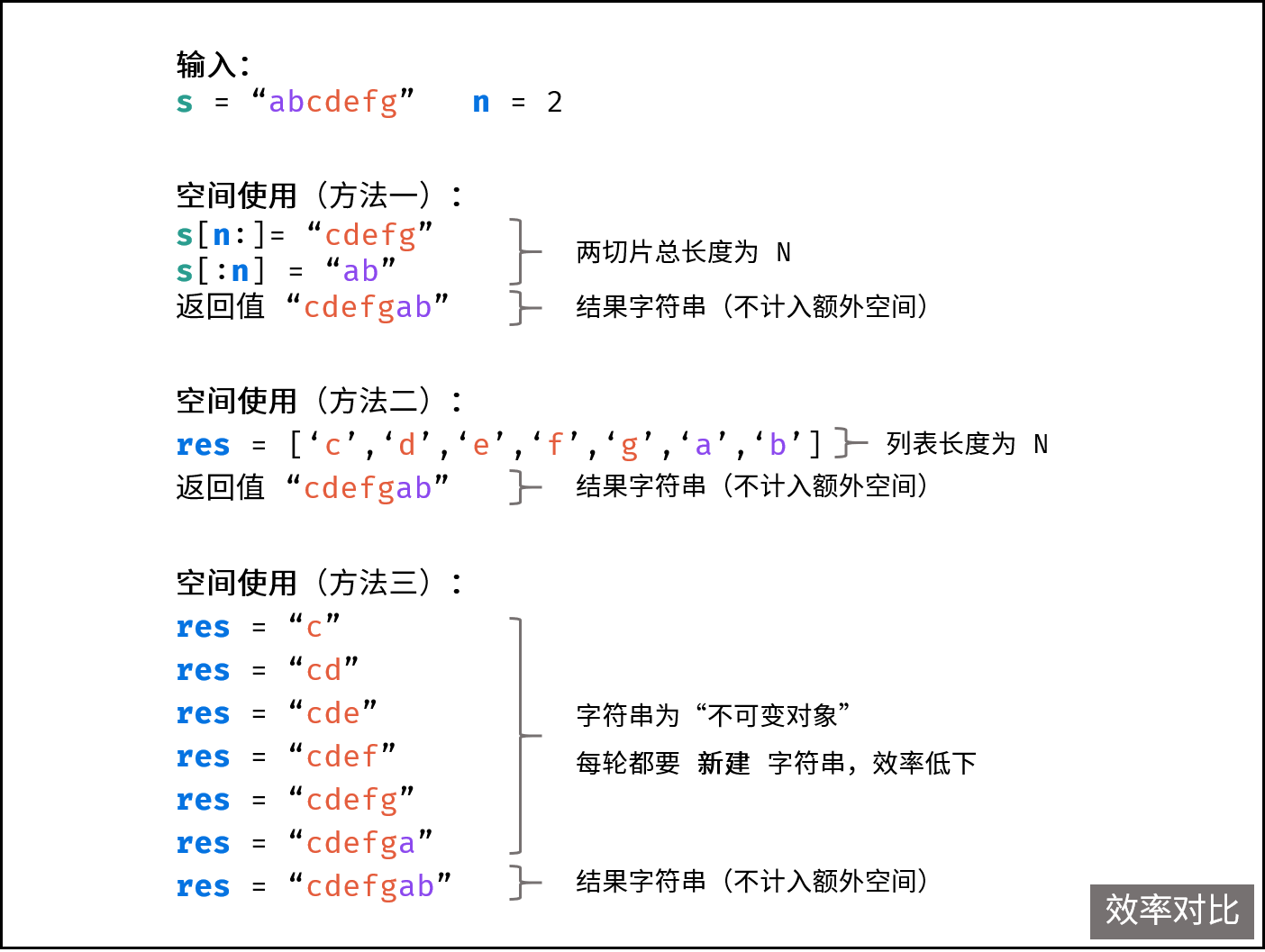{:align=center width=650}
### 测试数据:
长度为 $10000000$ 的全为 `'1'` 的字符串。
```Python
password = "1" * 10000000
```
**方法一测试:**
新建两切片字符串,并将两切片拼接为结果字符串,无冗余操作,效率最高。
```Python []
# 运行时间: 0.01 秒
def func1(password):
cut = len(password) // 3
return password[:cut] + password[cut:]
```
**方法二测试:**
列表(Python) 和 StringBuilder(Java) 都是可变对象,每轮遍历拼接字符时,只是向列表尾部添加一个新的字符元素。最终拼接转化为字符串时,系统 **仅申请一次内存** 。
```Python []
# 运行时间: 1.86 秒
def func2(password):
res = []
for i in range(len(password)):
res.append(password[i]) # 仅需在列表尾部添加元素
return ''.join(res)
```
**方法三测试:**
在 Python 和 Java 中,字符串是 “不可变对象” 。因此,每轮遍历拼接字符时,都需要新建一个字符串;因此,系统 **需申请 $N$ 次内存** ,数据量较大时效率低下。
```Python []
# 运行时间: 6.31 秒
def func3(password):
res = ""
for i in range(len(password)):
res += password[i] # 每次拼接都需要新建一个字符串
return res
```
## 方法四:三次翻转(C++)
由于 C++ 中的字符串是 **可变类型** ,因此可在原字符串上直接操作实现字符串旋转,实现 $O(1)$ 的空间复杂度。
设字符串 $password = s_1 s_2$ ,字符串 $password$ 的反转字符串为 $\hat password$ ,则左旋转字符串 $s_2 s_1$ 计算方法为:
$$
s_2 s_1 = \hat{\hat{s_1} \hat{s_2}}
$$
> 例如,$password = "abcdefg"$ , $s_1 = "ab"$ , $s_2 = "cdefg"$ ,则有:
> $$
> \hat{s_1} = "ba" \\
> \hat{s_2} = "gfedc" \\
> \hat{\hat{s_1} \hat{s_2}} = \hat{"bagfedc"} = "cdefgba"
> $$
> 即 $"cdefgba"$ 为所求字符串 $password$ 的左旋转结果。
### 代码:
自行实现字符串翻转函数 `reverseString()` ,代码如下:
```C++ []
class Solution {
public:
string dynamicPassword(string password, int target) {
reverseString(password, 0, target - 1);
reverseString(password, target, password.size() - 1);
reverseString(password, 0, password.size() - 1);
return password;
}
private:
void reverseString(string& password, int i, int j) {
while(i < j) swap(password[i++], password[j--]);
}
};
```
也可使用库函数实现,代码如下:
```C++ []
class Solution {
public:
string dynamicPassword(string password, int target) {
reverse(password.begin(), password.begin() + target);
reverse(password.begin() + target, password.end());
reverse(password.begin(), password.end());
return password;
}
};
```
### 复杂度分析:
- **时间复杂度 $O(N)$ :** 共线性遍历两轮 `password` 。
- **空间复杂度 $O(1)$ :** C++ 原地字符串操作,使用常数大小额外空间。
================================================
FILE: leetbook_ioa/docs/LCR 183. 望远镜中最高的海拔.md
================================================
## 解题思路:
设窗口区间为 $[i, j]$ ,最大值为 $x_j$ 。当窗口向前移动一格,则区间变为 $[i+1,j+1]$ ,即添加了 $heights[j + 1]$ ,删除了 $heights[i]$ 。
若只向窗口 $[i, j]$ 右边添加数字 $heights[j + 1]$ ,则新窗口最大值可以 **通过一次对比** 使用 $O(1)$ 时间得到,即:
$$
x_{j+1} = \max(x_{j}, heights[j + 1])
$$
而由于删除的 $heights[i]$ 可能恰好是窗口内唯一的最大值 $x_j$ ,因此不能通过以上方法计算 $x_{j+1}$ ,而必须使用 $O(j-i)$ 时间, **遍历整个窗口区间** 获取最大值,即:
$$
x_{j+1} = \max(heights(i+1), \cdots , heights(j+1))
$$
根据以上分析,可得 **暴力法** 的时间复杂度为 $O((n-limit+1)limit) \approx O(nk)$ 。
- 设数组 $heights$ 的长度为 $n$ ,则共有 $(n-limit+1)$ 个窗口;
- 获取每个窗口最大值需线性遍历,时间复杂度为 $O(limit)$ 。
> 下图中的 `nums` 对应本题的 `heights` 。
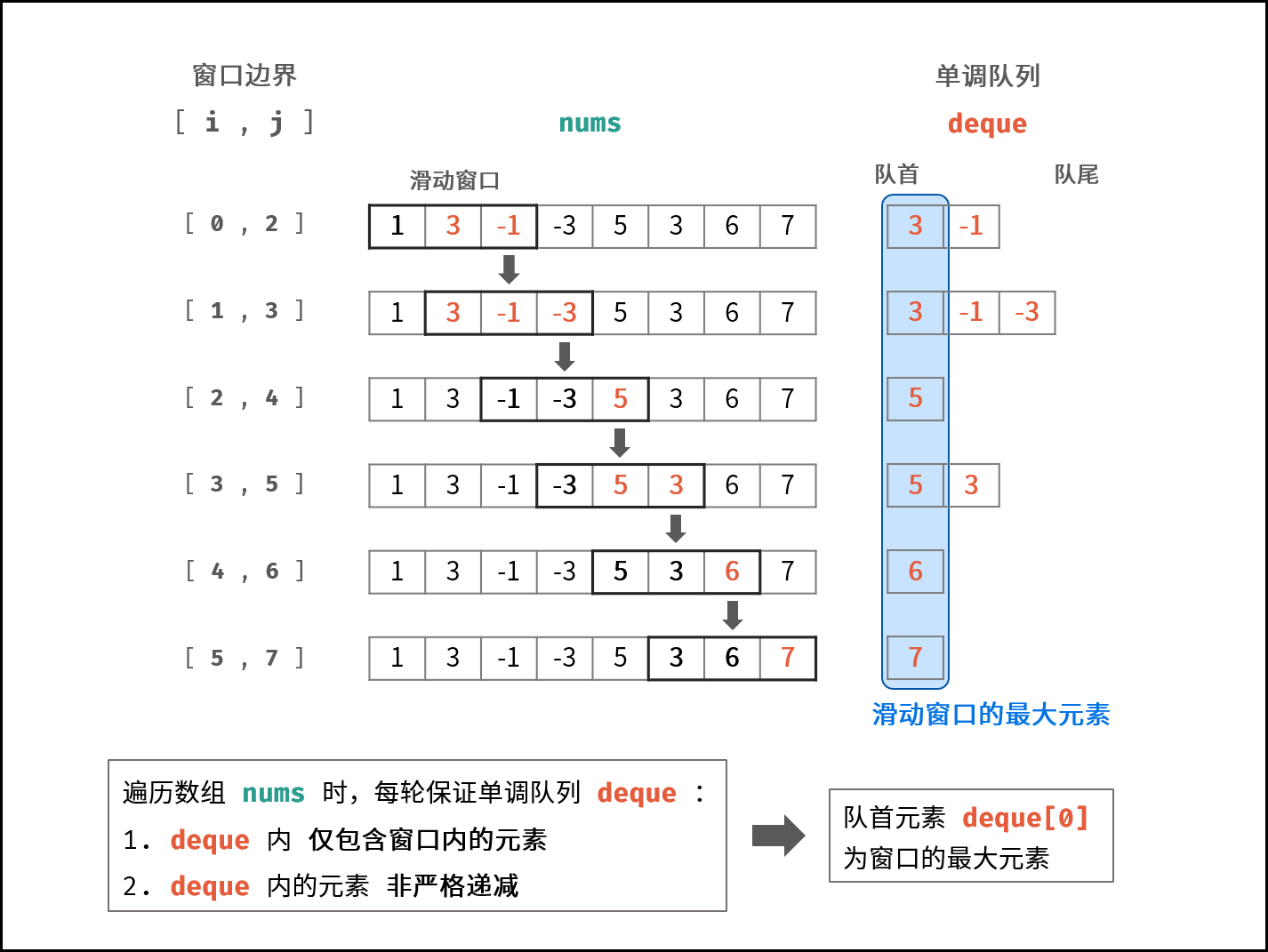{:align=center width=650}
> **本题难点:** 如何在每次窗口滑动后,将 “获取窗口内最大值” 的时间复杂度从 $O(limit)$ 降低至 $O(1)$ 。
回忆“最小栈”问题,其使用 **单调栈** 实现了随意入栈、出栈情况下的 $O(1)$ 时间获取 “栈内最小值” 。本题同理,不同点在于 “出栈操作” 删除的是 “列表尾部元素” ,而 “窗口滑动” 删除的是 “列表首部元素” 。
窗口对应的数据结构为 **双端队列** ,本题使用 **单调队列** 即可解决以上问题。遍历数组时,每轮保证单调队列 $deque$ :
1. $deque$ 内 **仅包含窗口内的元素** $\Rightarrow$ 每轮窗口滑动移除了元素 $heights[i - 1]$ ,需将 $deque$ 内的对应元素一起删除。
2. $deque$ 内的元素 **非严格递减** $\Rightarrow$ 每轮窗口滑动添加了元素 $heights[j + 1]$ ,需将 $deque$ 内所有 $< heights[j + 1]$ 的元素删除。
### 算法流程:
1. **初始化:** 双端队列 $deque$ ,结果列表 $res$ ,数组长度 $n$ ;
2. **滑动窗口:** 左边界范围 $i \in [1 - limit, n - limit]$ ,右边界范围 $j \in [0, n - 1]$ ;
1. 若 $i > 0$ 且 队首元素 $deque[0]$ $=$ 被删除元素 $heights[i - 1]$ :则队首元素出队;
2. 删除 $deque$ 内所有 $< heights[j]$ 的元素,以保持 $deque$ 递减;
3. 将 $heights[j]$ 添加至 $deque$ 尾部;
4. 若已形成窗口(即 $i \geq 0$ ):将窗口最大值(即队首元素 $deque[0]$ )添加至列表 $res$ ;
3. **返回值:** 返回结果列表 $res$ ;
## 代码:
Python 通过 `zip(range(), range())` 可实现滑动窗口的左右边界 `i, j` 同时遍历。
```Python []
class Solution:
def maxAltitude(self, heights: List[int], limit: int) -> List[int]:
deque = collections.deque()
res, n = [], len(heights)
for i, j in zip(range(1 - limit, n + 1 - limit), range(n)):
# 删除 deque 中对应的 heights[i-1]
if i > 0 and deque[0] == heights[i - 1]:
deque.popleft()
# 保持 deque 递减
while deque and deque[-1] < heights[j]:
deque.pop()
deque.append(heights[j])
# 记录窗口最大值
if i >= 0:
res.append(deque[0])
return res
```
```Java []
class Solution {
public int[] maxAltitude(int[] heights, int limit) {
if(heights.length == 0 || limit == 0) return new int[0];
Deque deque = new LinkedList<>();
int[] res = new int[heights.length - limit + 1];
for(int j = 0, i = 1 - limit; j < heights.length; i++, j++) {
// 删除 deque 中对应的 heights[i-1]
if(i > 0 && deque.peekFirst() == heights[i - 1])
deque.removeFirst();
// 保持 deque 递减
while(!deque.isEmpty() && deque.peekLast() < heights[j])
deque.removeLast();
deque.addLast(heights[j]);
// 记录窗口最大值
if(i >= 0)
res[i] = deque.peekFirst();
}
return res;
}
}
```
可以将 “未形成窗口” 和 “形成窗口后” 两个阶段拆分到两个循环里实现。代码虽变长,但减少了冗余的判断操作。
```Python []
class Solution:
def maxAltitude(self, heights: List[int], limit: int) -> List[int]:
if not heights or limit == 0: return []
deque = collections.deque()
# 未形成窗口
for i in range(limit):
while deque and deque[-1] < heights[i]:
deque.pop()
deque.append(heights[i])
res = [deque[0]]
# 形成窗口后
for i in range(limit, len(heights)):
if deque[0] == heights[i - limit]:
deque.popleft()
while deque and deque[-1] < heights[i]:
deque.pop()
deque.append(heights[i])
res.append(deque[0])
return res
```
```Java []
class Solution {
public int[] maxAltitude(int[] heights, int limit) {
if(heights.length == 0 || limit == 0) return new int[0];
Deque deque = new LinkedList<>();
int[] res = new int[heights.length - limit + 1];
// 未形成窗口
for(int i = 0; i < limit; i++) {
while(!deque.isEmpty() && deque.peekLast() < heights[i])
deque.removeLast();
deque.addLast(heights[i]);
}
res[0] = deque.peekFirst();
// 形成窗口后
for(int i = limit; i < heights.length; i++) {
if(deque.peekFirst() == heights[i - limit])
deque.removeFirst();
while(!deque.isEmpty() && deque.peekLast() < heights[i])
deque.removeLast();
deque.addLast(heights[i]);
res[i - limit + 1] = deque.peekFirst();
}
return res;
}
}
```
### 复杂度分析:
- **时间复杂度 $O(n)$ :** 其中 $n$ 为数组 $heights$ 长度;线性遍历 $heights$ 占用 $O(n)$ ;每个元素最多仅入队和出队一次,因此单调队列 $deque$ 占用 $O(2n)$ 。
- **空间复杂度 $O(limit)$ :** 双端队列 $deque$ 中最多同时存储 $limit$ 个元素(即窗口大小)。
================================================
FILE: leetbook_ioa/docs/LCR 184. 设计自助结算系统.md
================================================
## 解题思路:
> 对于普通队列,入队 `add()` 和出队 `remove()` 的时间复杂度均为 $O(1)$ ;本题难点为实现查找最大值 `get_max()` 的 $O(1)$ 时间复杂度。
> 假设队列中存储 $N$ 个元素,从中获取最大值需要遍历队列,时间复杂度为 $O(N)$ ,单从算法上无优化空间。
如下图所示,最直观的想法是 **维护一个最大值变量** ,在元素入队时更新此变量即可;但当最大值出队后,并无法确定下一个 **次最大值** ,因此不可行。
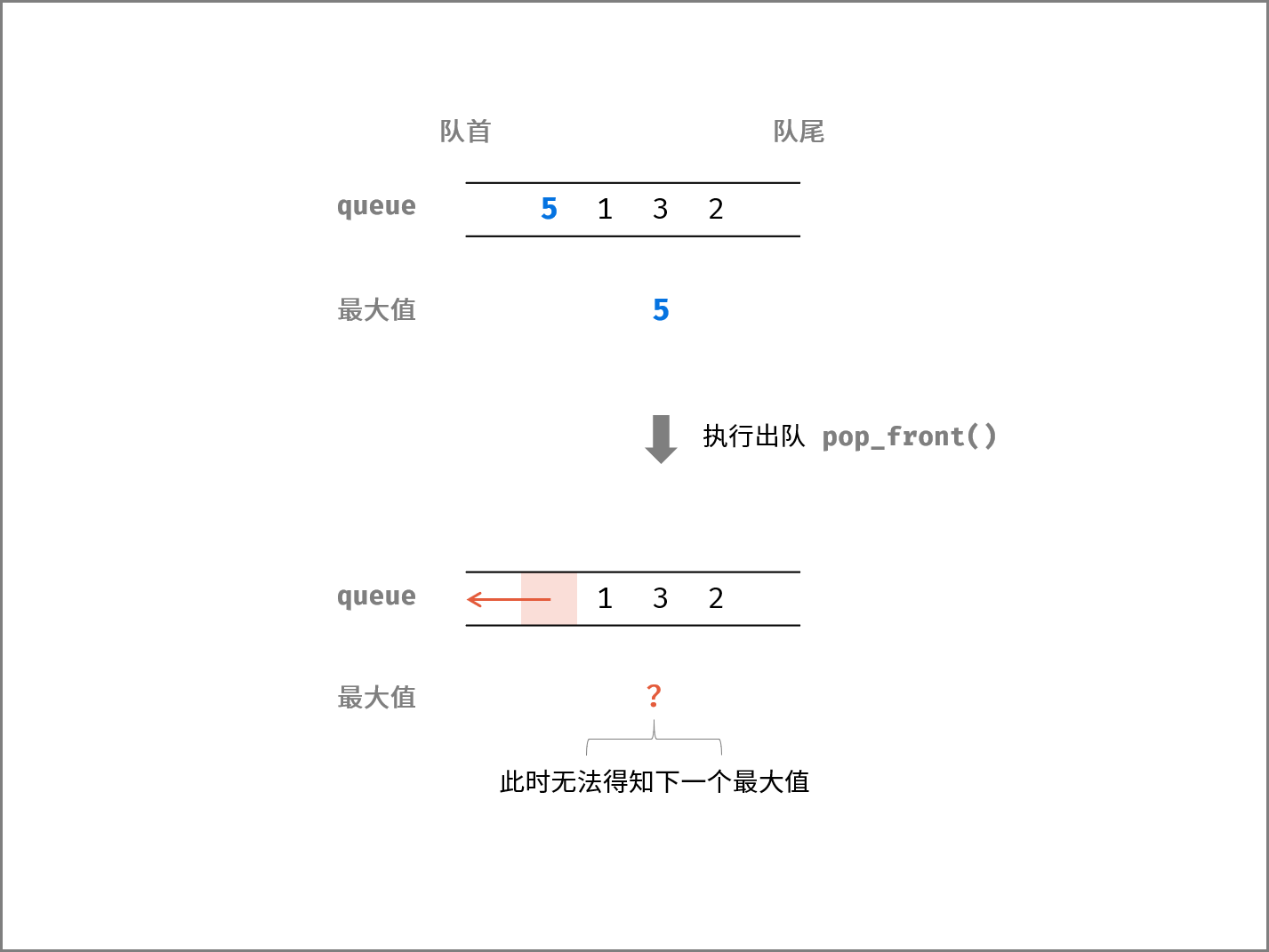{:align=center width=500}
考虑利用 **数据结构** 来实现,即经常使用的 “空间换时间” 。如下图所示,考虑构建一个递减列表来保存队列 **所有递减的元素** ,递减链表随着入队和出队操作实时更新,这样队列最大元素就始终对应递减列表的首元素,实现了获取最大值 $O(1)$ 时间复杂度。
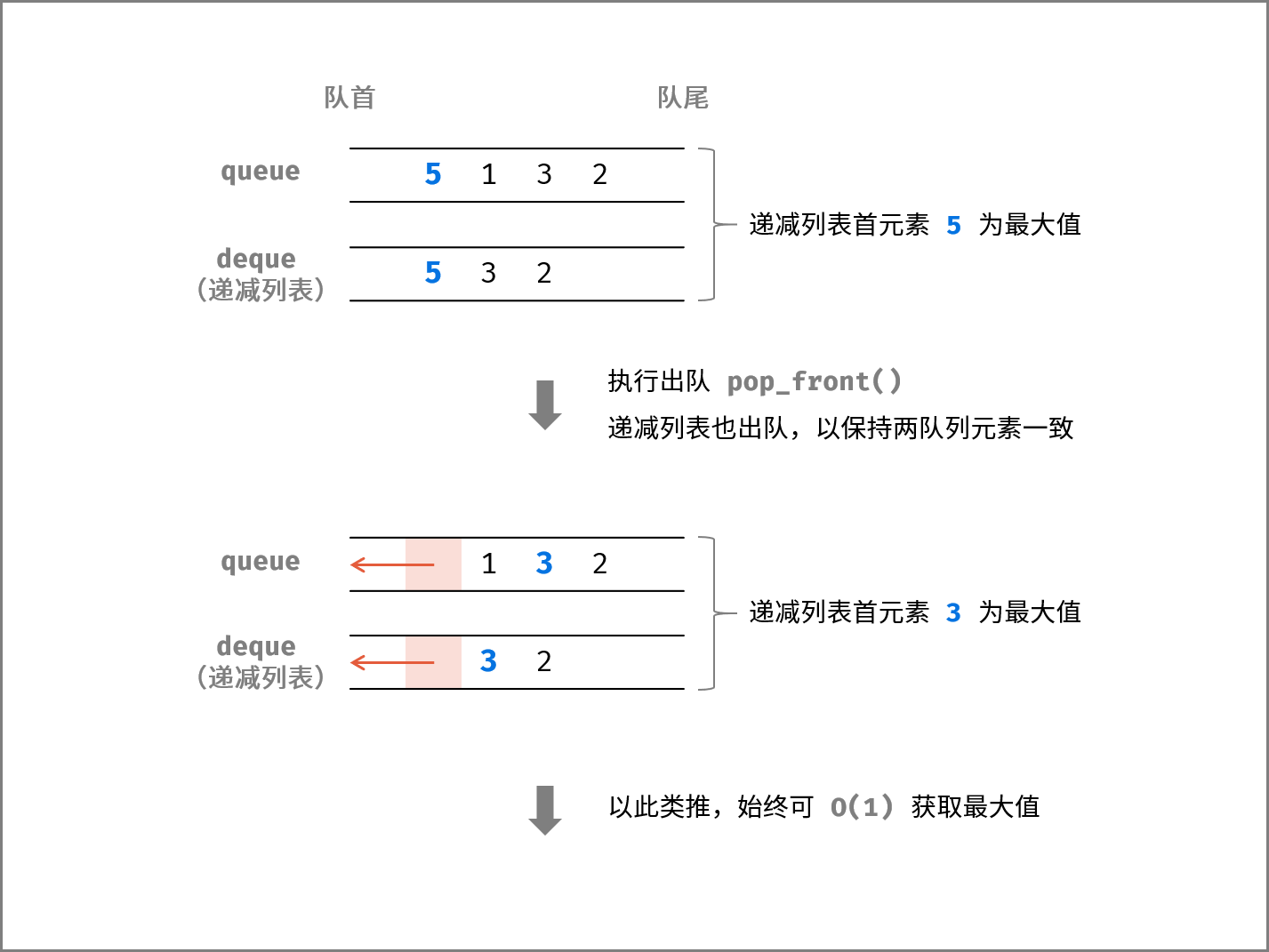{:align=center width=500}
为了实现此递减列表,需要使用 **双向队列** ,假设队列已经有若干元素:
1. 当执行入队 `add()` 时: 若入队一个比队列某些元素更大的数字 $x$ ,则为了保持此列表递减,需要将双向队列 **尾部所有小于 $x$ 的元素** 弹出。
2. 当执行出队 `remove()` 时: 若出队的元素是最大元素,则 双向队列 需要同时 **将首元素出队** ,以保持队列和双向队列的元素一致性。
> 使用双向队列原因:维护递减列表需要元素队首弹出、队尾插入、队尾弹出操作皆为 $O(1)$ 时间复杂度。
### 函数设计:
初始化队列 `queue` ,双向队列 `deque` ;
**最大值 `get_max()` :**
- 当双向队列 `deque` 为空,则返回 $-1$ ;
- 否则,返回 `deque` 首元素;
**入队 `add()` :**
1. 将元素 `value` 入队 `queue` ;
2. 将双向队列中队尾 **所有** 小于 `value` 的元素弹出(以保持 `deque` 非单调递减),并将元素 `value` 入队 `deque` ;
**出队 `remove()` :**
1. 若队列 `queue` 为空,则直接返回 $-1$ ;
2. 否则,将 `queue` 首元素出队;
3. 若 `deque` 首元素和 `queue` 首元素 **相等** ,则将 `deque` 首元素出队(以保持两队列 **元素一致** ) ;
> 设计双向队列为 **单调不增** 的原因:若队列 `queue` 中存在两个 **值相同的最大元素** ,此时 `queue` 和 `deque` 同时弹出一个最大元素,而 `queue` 中还有一个此最大元素;即采用单调递减将导致两队列中的元素不一致。
> 下图中的 `push_back()` , `pop_front()` , `max_value()` 分别对应本题的 `add()` , `remove()` , `get_max()` 。
## 代码:
```Python []
import queue
class Checkout:
def __init__(self):
self.queue = queue.Queue()
self.deque = queue.deque()
def get_max(self) -> int:
return self.deque[0] if self.deque else -1
def add(self, value: int) -> None:
self.queue.put(value)
while self.deque and self.deque[-1] < value:
self.deque.pop()
self.deque.append(value)
def remove(self) -> int:
if self.queue.empty(): return -1
val = self.queue.get()
if val == self.deque[0]:
self.deque.popleft()
return val
```
```Java []
class Checkout {
Queue queue;
Deque deque;
public Checkout() {
queue = new LinkedList<>();
deque = new LinkedList<>();
}
public int get_max() {
return deque.isEmpty() ? -1 : deque.peekFirst();
}
public void add(int value) {
queue.offer(value);
while(!deque.isEmpty() && deque.peekLast() < value)
deque.pollLast();
deque.offerLast(value);
}
public int remove() {
if(queue.isEmpty()) return -1;
if(queue.peek().equals(deque.peekFirst()))
deque.pollFirst();
return queue.poll();
}
}
```
```C++ []
class Checkout {
queue que;
deque deq;
public:
Checkout() { }
int get_max() {
return deq.empty() ? -1 : deq.front();
}
void add(int value) {
que.push(value);
while(!deq.empty() && deq.back() < value)
deq.pop_back();
deq.push_back(value);
}
int remove() {
if(que.empty()) return -1;
int val = que.front();
if(val == deq.front())
deq.pop_front();
que.pop();
return val;
}
};
```
### 复杂度分析:
- **时间复杂度 $O(1)$ :** `get_max()`, `add()`, `remove()` 方法的均摊时间复杂度均为 $O(1)$ ;
- **空间复杂度 $O(N)$ :** 当元素个数为 $N$ 时,最差情况下`deque` 中保存 $N$ 个元素,使用 $O(N)$ 的额外空间;
================================================
FILE: leetbook_ioa/docs/LCR 185. 统计结果概率.md
================================================
## 方法一:暴力法
> 此方法超时,但为便于理解「方法二」,建议先理解此方法。
>
> 为简化篇幅,本文使用 $n$ 代替题目中的 $num$ 。
给定 $n$ 个骰子,可得:
- 每个骰子摇到 $1$ 至 $6$ 的概率相等,都为 $\frac{1}{6}$ 。
- 将每个骰子的点数看作独立情况,共有 $6^n$ 种「**点数组合**」。例如 $n = 2$ 时的点数组合为:
$$
(1,1), (1,2), \cdots, (2, 1), (2, 2), \cdots, (6,1), \cdots, (6, 6)
$$
- $n$ 个骰子「**点数和**」的范围为 $[n, 6n]$ ,数量为 $6n - n + 1 = 5n + 1$ 种。
**暴力统计:** 每个「点数组合」都对应一个「点数和」,考虑遍历所有点数组合,统计每个点数和的出现次数,最后除以点数组合的总数(即除以 $6^n$ ),即可得到每个点数和的出现概率。
> 如下图所示,为输入 $n = 2$ 时,点数组合、点数和、各点数概率的计算过程。
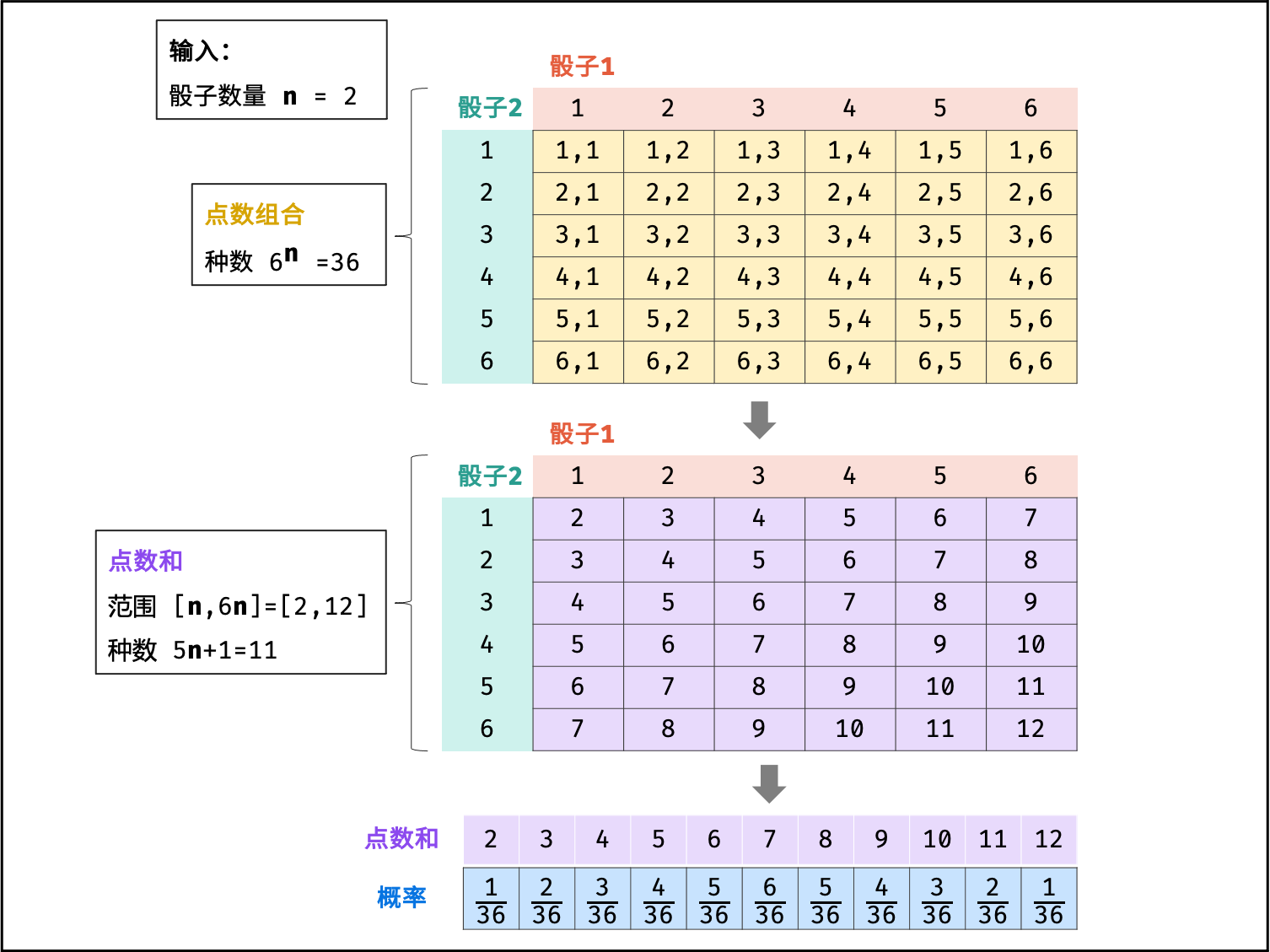{:align=center width=550}
暴力法需要遍历所有点数组合,因此时间复杂度为 $O(6^n)$ ,观察本题输入取值范围 $1 \leq n \leq 11$ ,可知此复杂度是无法接受的。
## 方法二:动态规划
> 设输入 $n$ 个骰子的解(即概率列表)为 $f(n)$ ,其中「点数和」 $x$ 的概率为 $f(n, x)$ 。
假设已知 $n - 1$ 个骰子的解 $f(n - 1)$ ,此时**添加**一枚骰子,求 $n$ 个骰子的点数和为 $x$ 的概率 $f(n, x)$ 。
当添加骰子的点数为 $1$ 时,前 $n - 1$ 个骰子的点数和应为 $x - 1$ ,方可组成点数和 $x$ ;同理,当此骰子为 $2$ 时,前 $n - 1$ 个骰子应为 $x - 2$ ;以此类推,直至此骰子点数为 $6$ 。将这 $6$ 种情况的概率相加,即可得到概率 $f(n, x)$ 。递推公式如下所示:
$$
f(n, x) = \sum_{i=1}^6 f(n - 1, x - i) \times \frac{1}{6}
$$
根据以上分析,得知通过子问题的解 $f(n - 1)$ 可递推计算出 $f(n)$ ,而输入一个骰子的解 $f(1)$ 已知,因此可通过解 $f(1)$ 依次递推出任意解 $f(n)$ 。
> 如下图所示,为 $n = 2$ , $x = 7$ 的递推计算示例。
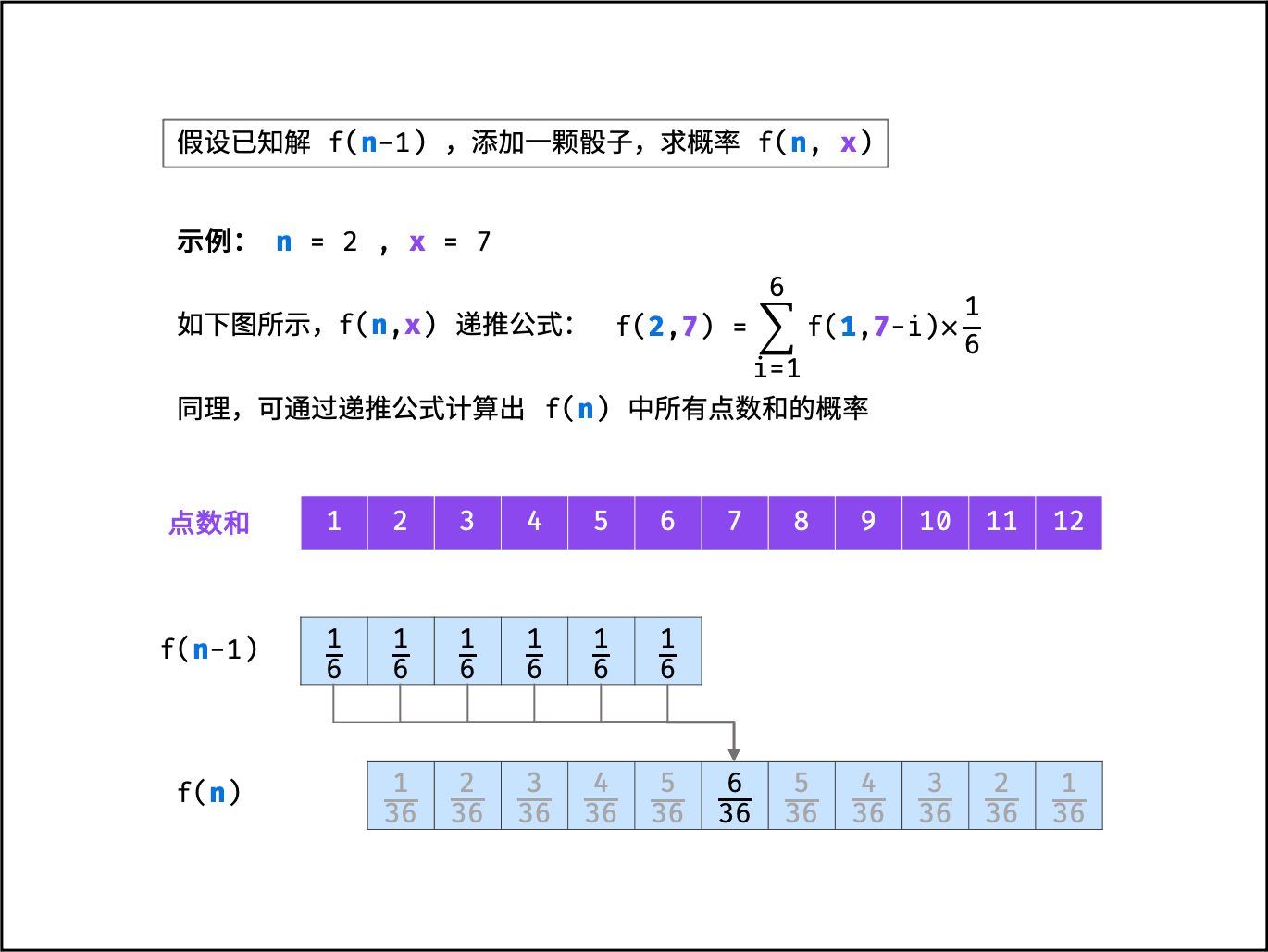{:align=center width=550}
观察发现,以上递推公式虽然可行,但 $f(n - 1, x - i)$ 中的 $x - i$ 会有越界问题。例如,若希望递推计算 $f(2, 2)$ ,由于一个骰子的点数和范围为 $[1, 6]$ ,因此只应求和 $f(1, 1)$ ,即 $f(1, 0)$ , $f(1, -1)$ , ... , $f(1, -4)$ 皆无意义。此越界问题导致代码编写的难度提升。
> 如下图所示,以上递推公式是 “逆向” 的,即为了计算 $f(n, x)$ ,将所有与之有关的情况求和;而倘若改换为 “正向” 的递推公式,便可解决越界问题。
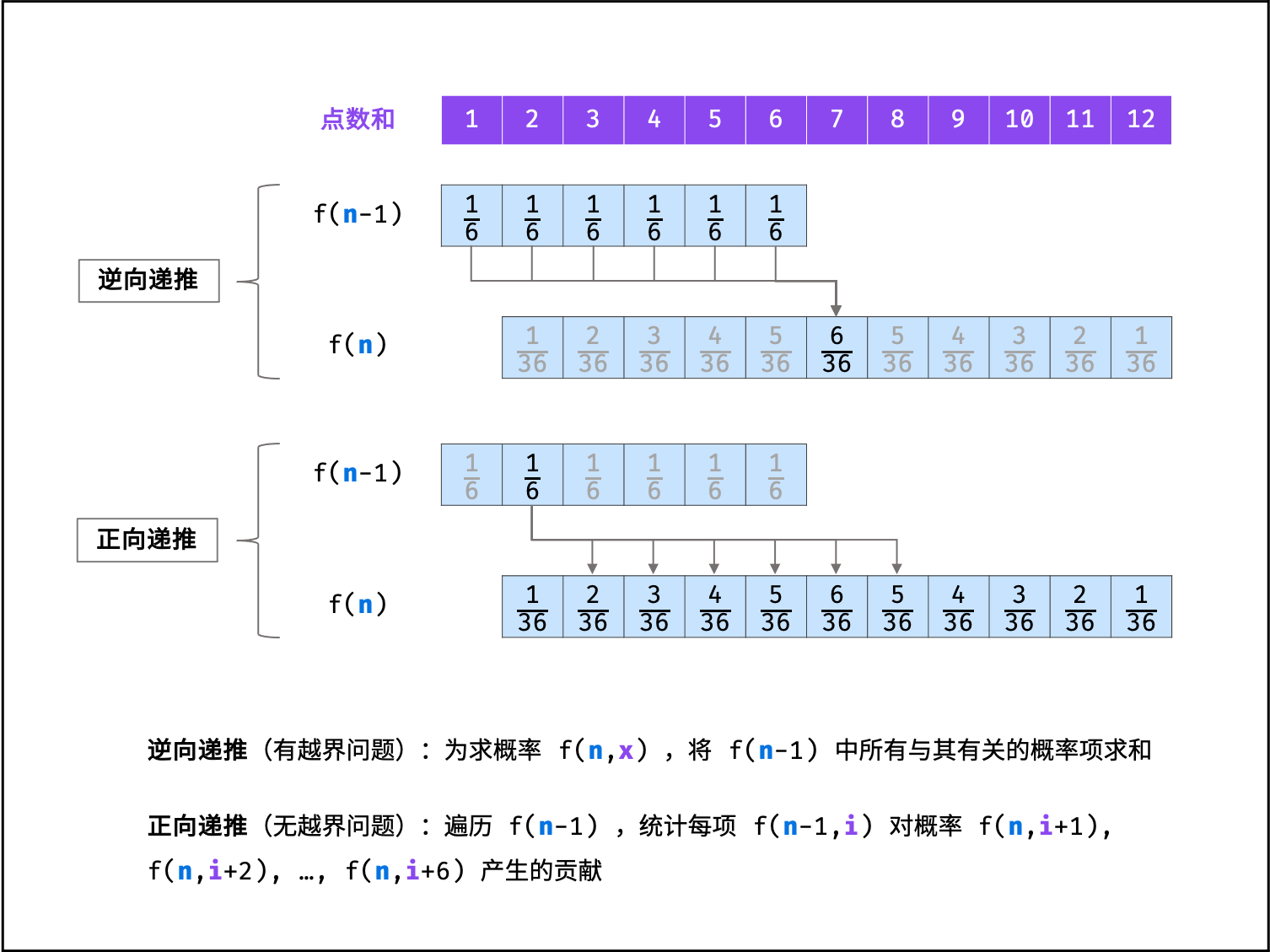{:align=center width=550}
具体来看,由于新增骰子的点数只可能为 $1$ 至 $6$ ,因此概率 $f(n - 1, x)$ 仅与 $f(n, x + 1)$ , $f(n, x + 2)$, ... , $f(n, x + 6)$ 相关。因而,遍历 $f(n - 1)$ 中各点数和的概率,并将其相加至 $f(n)$ 中所有相关项,即可完成 $f(n - 1)$ 至 $f(n)$ 的递推。
> 将 $f(i)$ 记为动态规划列表形式 $dp[i]$ ,则 $i = 1, 2, ..., n$ 的状态转移过程如下图所示。
## 代码:
通常做法是声明一个二维数组 $dp$ ,$dp[i][j]$ 代表前 $i$ 个骰子的点数和 $j$ 的概率,并执行状态转移。而由于 $dp[i]$ 仅由 $dp[i-1]$ 递推得出,为降低空间复杂度,只建立两个一维数组 $dp$ , $tmp$ 交替前进即可。
```Python []
class Solution:
def statisticsProbability(self, n: int) -> List[float]:
dp = [1 / 6] * 6
for i in range(2, n + 1):
tmp = [0] * (5 * i + 1)
for j in range(len(dp)):
for k in range(6):
tmp[j + k] += dp[j] / 6
dp = tmp
return dp
```
```Java []
class Solution {
public double[] statisticsProbability(int n) {
double[] dp = new double[6];
Arrays.fill(dp, 1.0 / 6.0);
for (int i = 2; i <= n; i++) {
double[] tmp = new double[5 * i + 1];
for (int j = 0; j < dp.length; j++) {
for (int k = 0; k < 6; k++) {
tmp[j + k] += dp[j] / 6.0;
}
}
dp = tmp;
}
return dp;
}
}
```
```C++ []
class Solution {
public:
vector statisticsProbability(int n) {
vector dp(6, 1.0 / 6.0);
for (int i = 2; i <= n; i++) {
vector tmp(5 * i + 1, 0);
for (int j = 0; j < dp.size(); j++) {
for (int k = 0; k < 6; k++) {
tmp[j + k] += dp[j] / 6.0;
}
}
dp = tmp;
}
return dp;
}
};
```
### 复杂度分析:
- **时间复杂度 $O(n ^ 2)$ :** 状态转移循环 $n - 1$ 轮;每轮中,当 $i = 2, 3, ..., n$ 时,对应循环数量分别为 $6 \times 6, 11 \times 6, ..., [5(n - 1) + 1] \times 6$ ;因此总体复杂度为 $O((n - 1) \times \frac{6 + [5(n - 1) + 1]}{2} \times 6)$ ,即等价于 $O(n^2)$ 。
- **空间复杂度 $O(n)$ :** 状态转移过程中,辅助数组 `tmp` 最大长度为 $6(n-1) - [(n-1) - 1] = 5n - 4$ ,因此使用 $O(5n - 4) = O(n)$ 大小的额外空间。
================================================
FILE: leetbook_ioa/docs/LCR 186. 文物朝代判断.md
================================================
## 解题思路:
根据题意,此 $5$ 个朝代连续的 **充分条件** 如下:
1. 除未知朝代外,所有朝代 **无重复** ;
2. 设此 $5$ 个朝代中最大的朝代为 $ma$ ,最小的朝代为 $mi$ (未知朝代除外),则需满足:
$$
ma - mi < 5
$$
因此可将问题转化为:此 $5$ 个朝代是否满足以上两个条件?
> 下图中的“牌”对应本题的“朝代”。
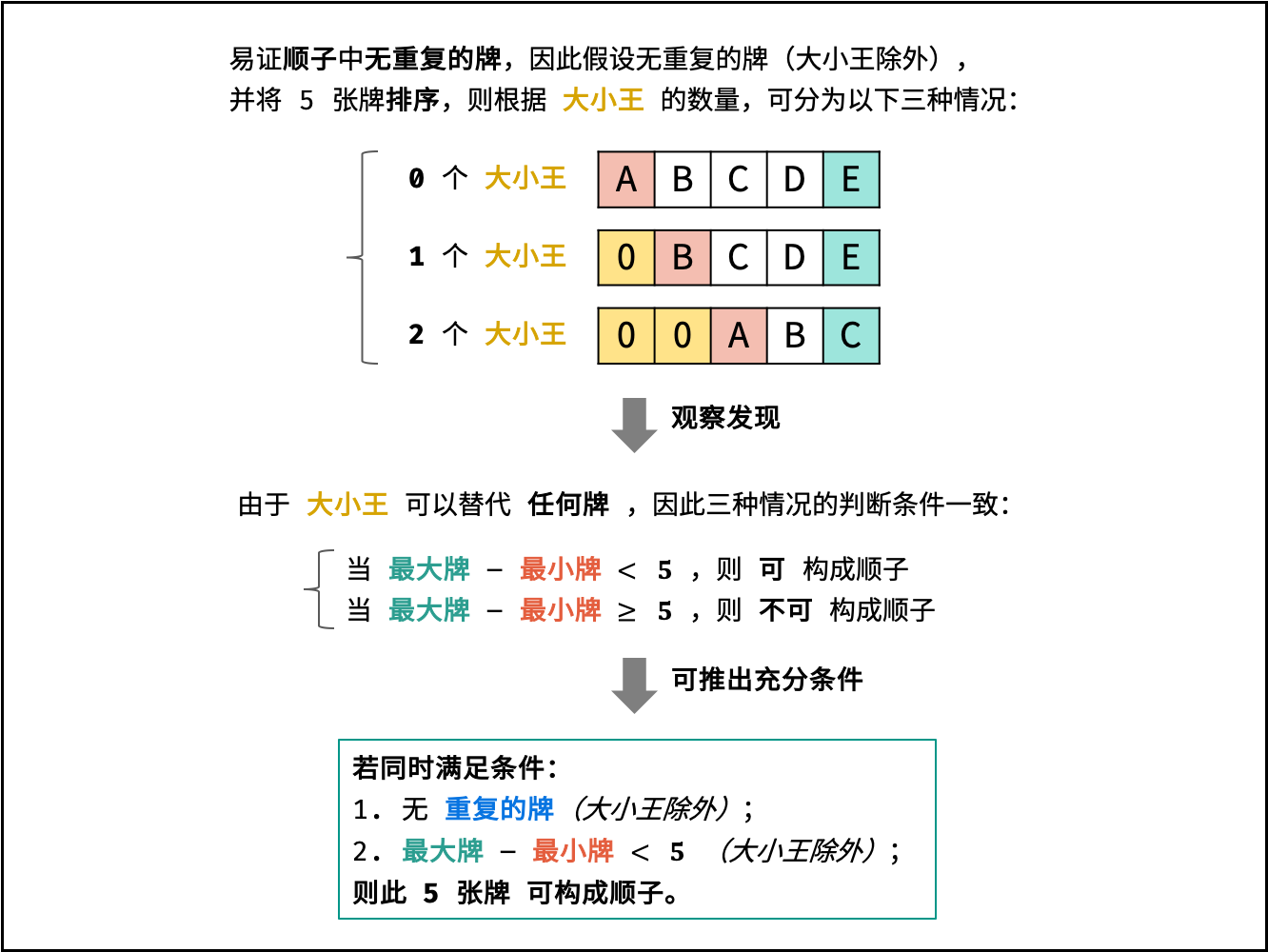{:align=center width=650}
## 方法一: 辅助哈希表
- 遍历五个朝代,遇到未知朝代(即 $0$ )直接跳过。
- **判别重复:** 利用 Set 实现遍历判重, Set 的查找方法的时间复杂度为 $O(1)$ ;
- **获取最大 / 最小的朝代:** 借助辅助变量 $ma$ 和 $mi$ ,遍历统计即可。
### 代码:
```Python []
class Solution:
def checkDynasty(self, places: List[int]) -> bool:
repeat = set()
ma, mi = 0, 14
for place in places:
if place == 0: continue # 跳过未知朝代
ma = max(ma, place) # 最大编号朝代
mi = min(mi, place) # 最小编号朝代
if place in repeat: return False # 若有重复,提前返回 false
repeat.add(place) # 添加朝代至 Set
return ma - mi < 5 # 最大编号朝代 - 最小编号朝代 < 5 则连续
```
```Java []
class Solution {
public boolean checkDynasty(int[] places) {
Set repeat = new HashSet<>();
int max = 0, min = 14;
for(int place : places) {
if(place == 0) continue; // 跳过未知朝代
max = Math.max(max, place); // 最大编号朝代
min = Math.min(min, place); // 最小编号朝代
if(repeat.contains(place)) return false; // 若有重复,提前返回 false
repeat.add(place); // 添加此朝代至 Set
}
return max - min < 5; // 最大编号朝代 - 最小编号朝代 < 5 则连续
}
}
```
```C++ []
class Solution {
public:
bool checkDynasty(vector& places) {
unordered_set repeat;
int ma = 0, mi = 14;
for(int place : places) {
if(place == 0) continue; // 跳过未知朝代
ma = max(ma, place); // 最大编号朝代
mi = min(mi, place); // 最小编号朝代
if(repeat.find(place) != repeat.end()) return false; // 若有重复,提前返回 false
repeat.insert(place); // 添加此朝代至 Set
}
return ma - mi < 5; // 最大编号朝代 - 最小编号朝代 < 5 则连续
}
};
```
### 复杂度分析:
- **时间复杂度 $O(1)$ :** 本题中给定朝代数量 $N \equiv 5$ ;遍历数组使用 $O(N) = O(5) = O(1)$ 时间。
- **空间复杂度 $O(1)$ :** 用于判重的辅助 Set 使用 $O(N) = O(1)$ 额外空间。
## 方法二:排序 + 遍历
- 先对数组执行排序。
- **判别重复:** 排序数组中的相同元素位置相邻,因此可通过遍历数组,判断 $places[i] = places[i + 1]$ 是否成立来判重。
- **获取最大 / 最小的朝代:** 排序后,数组末位元素 $places[4]$ 为最大编号朝代;元素 $places[unknown]$ 为最小编号朝代,其中 $unknown$ 为未知朝代的数量。
### 代码:
```Python []
class Solution:
def checkDynasty(self, places: List[int]) -> bool:
unknown = 0
places.sort() # 数组排序
for i in range(4):
if places[i] == 0: unknown += 1 # 统计未知朝代数量
elif places[i] == places[i + 1]: return False # 若有重复,提前返回 false
return places[4] - places[unknown] < 5 # 最大编号朝代 - 最小编号朝代 < 5 则连续
```
```Java []
class Solution {
public boolean checkDynasty(int[] places) {
int unknown = 0;
Arrays.sort(places); // 数组排序
for(int i = 0; i < 4; i++) {
if(places[i] == 0) unknown++; // 统计未知朝代数量
else if(places[i] == places[i + 1]) return false; // 若有重复,提前返回 false
}
return places[4] - places[unknown] < 5; // 最大编号朝代 - 最小编号朝代 < 5 则连续
}
}
```
```C++ []
class Solution {
public:
bool checkDynasty(vector& places) {
int unknown = 0;
sort(places.begin(), places.end()); // 数组排序
for(int i = 0; i < 4; i++) {
if(places[i] == 0) unknown++; // 统计未知朝代数量
else if(places[i] == places[i + 1]) return false; // 若有重复,提前返回 false
}
return places[4] - places[unknown] < 5; // 最大编号朝代 - 最小编号朝代 < 5 则连续
}
};
```
### 复杂度分析:
- **时间复杂度 $O(1)$ :** 本题中给定朝代数量 $N \equiv 5$ ;数组排序使用 $O(N \log N) = O(5 \log 5) = O(1)$ 时间。
- **空间复杂度 $O(1)$ :** 变量 $unknown$ 使用 $O(1)$ 大小的额外空间。
================================================
FILE: leetbook_ioa/docs/LCR 187. 破冰游戏.md
================================================
## 解题思路:
> 为简化篇幅,本文将 $num$ 和 $target$ 分别记为 $n$ 和 $m$ 。
模拟整个删除过程最直观,即构建一个长度为 $n$ 的链表,各节点值为对应的顺序索引;每轮删除第 $m$ 个节点,直至链表长度为 1 时结束,返回最后剩余节点的值即可。
模拟法需要循环删除 $n - 1$ 轮,每轮在链表中寻找删除节点需要 $m$ 次访问操作(链表线性遍历),因此总体时间复杂度为 $O(nm)$ 。题目给定的 $m, n$ 取值范围如下所示,观察可知此时间复杂度是不可接受的。
$$
1 \leq n \leq 10^5 \\
1 \leq m \leq 10^6
$$
> 实际上,本题是著名的 “约瑟夫环” 问题,可使用 **动态规划** 解决。
输入 $n, m$ ,记此约瑟夫环问题为 「$n, m$ 问题」 ,设解(即最后留下的数字)为 $f(n)$ ,则有:
- 「$n, m$ 问题」:数字环为 $0, 1, 2, ..., n - 1$ ,解为 $f(n)$ ;
- 「$n-1, m$ 问题」:数字环为 $0, 1, 2, ..., n - 2$ ,解为 $f(n-1)$ ;
- 以此类推……
> 请注意,数字环是 **首尾相接** 的,为方便行文,本文使用列表形式表示。
对于「$n, m$ 问题」,首轮删除环中第 $m$ 个数字后,得到一个长度为 $n - 1$ 的数字环。由于有可能 $m > n$ ,因此删除的数字为 $(m - 1) \mod n$ ,删除后的数字环从下个数字(即 $m \mod n$ )开始,设 $t = m \mod n$ ,可得数字环:
$$
t, t + 1, t + 2, ..., 0, 1, ..., t - 3, t - 2
$$
删除一轮后的数字环也变为一个「$n-1, m$ 问题」,观察以下数字编号对应关系:
$$
\begin{aligned}
「n-1, m 问题」 && \rightarrow && 「n, m 问题」删除后 \\
0 && \rightarrow && t + 0 \\
1 && \rightarrow && t + 1 \\
... && \rightarrow && ... \\
n - 2 && \rightarrow && t - 2 \\
\end{aligned}
$$
设「$n-1, m$ 问题」某数字为 $x$ ,则可得递推关系:
$$
x \rightarrow (x + t) \mod n \\
$$
换而言之,若已知「$n-1, m$ 问题」的解 $f(n - 1)$ ,则可通过以上公式计算得到「$n, m$ 问题」的解 $f(n)$ ,即:
$$
\begin{aligned}
f(n) & = (f(n - 1) + t) \mod n \\
& = (f(n - 1) + m \mod n) \mod n \\
& = (f(n - 1) + m) \mod n
\end{aligned}
$$
> 下图中 `n` , `m` 分别对应本题的 `n` , `m` 。
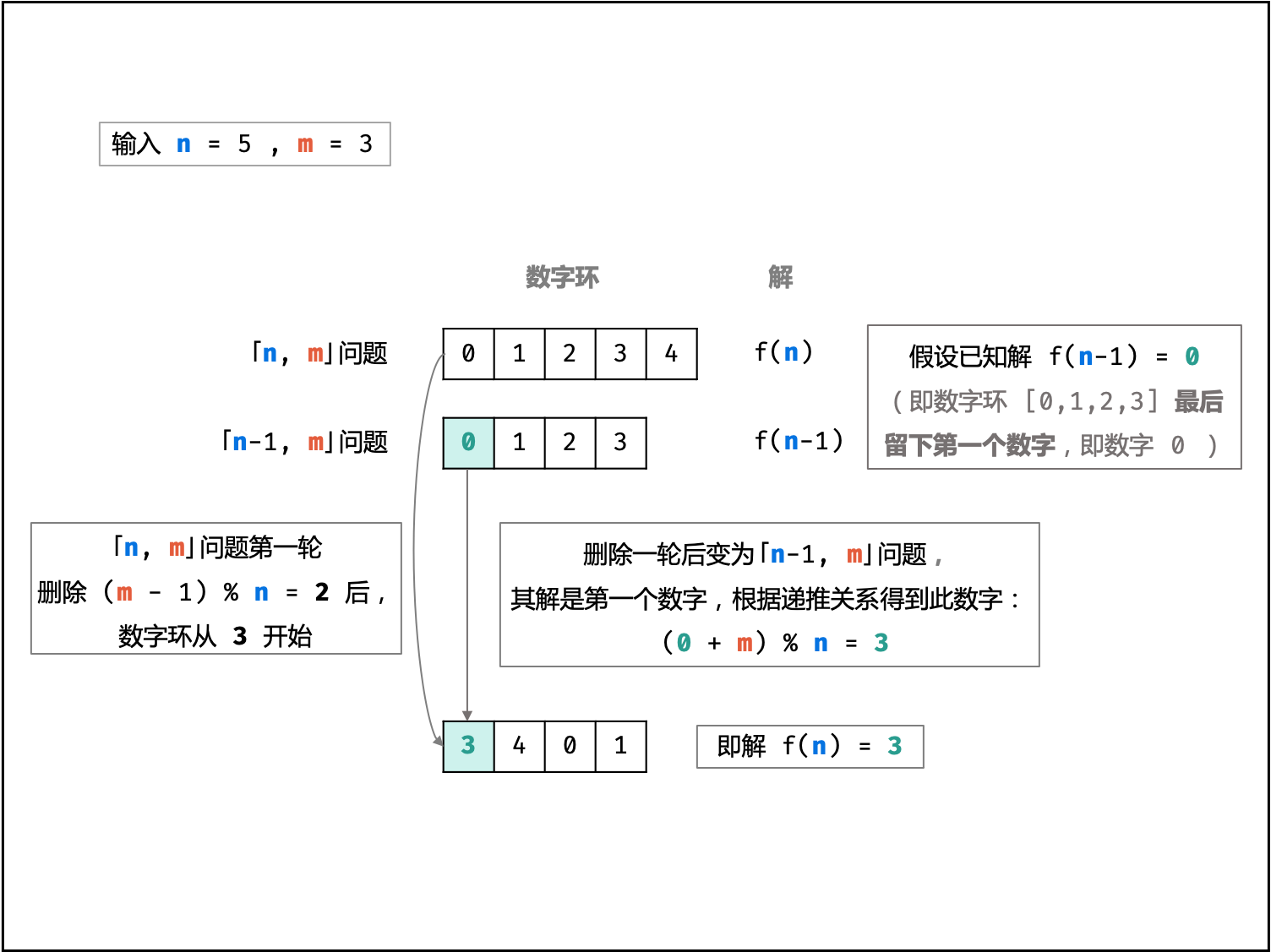{:align=center width=550}
$f(n)$ 可由 $f(n - 1)$ 得到,$f(n - 1)$ 可由 $f(n - 2)$ 得到,……,$f(2)$ 可由 $f(1)$ 得到;因此,若给定 $f(1)$ 的值,就可以递推至任意 $f(n)$ 。而「$1, m$ 问题」的解 $f(1) = 0$ 恒成立,即无论 $m$ 为何值,长度为 1 的数字环留下的是一定是数字 $0$ 。
> 以上数学推导本质是得出动态规划的 转移方程 和 初始状态 。
### 动态规划解析:
1. **状态定义:** 设「$i, m$ 问题」的解为 $dp[i]$ ;
2. **转移方程:** 通过以下公式可从 $dp[i - 1]$ 递推得到 $dp[i]$ ;
$$
dp[i] = (dp[i - 1] + m) \mod i
$$
3. **初始状态:**「$1, m$ 问题」的解恒为 $0$ ,即 $dp[1] = 0$ ;
4. **返回值:** 返回「$n, m$ 问题」的解 $dp[n]$ ;
> 如下图所示,为 $n = 5$ , $m = 3$ 时的状态转移和对应的模拟删除过程。
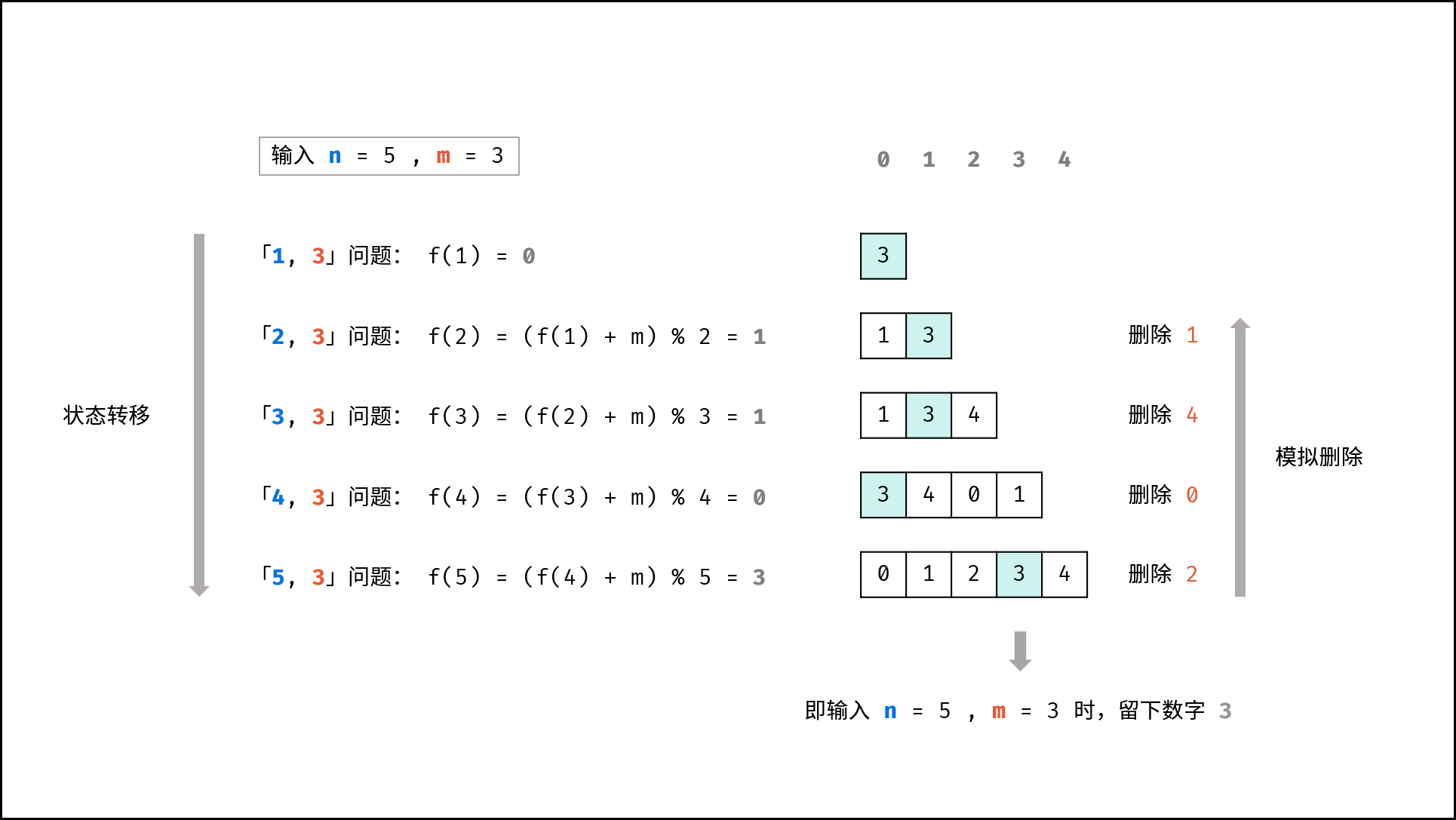
## 代码:
根据状态转移方程的递推特性,无需建立状态列表 $dp$ ,而使用一个变量 $x$ 执行状态转移即可。
```Python []
class Solution:
def iceBreakingGame(self, num: int, target: int) -> int:
x = 0
for i in range(2, num + 1):
x = (x + target) % i
return x
```
```Java []
class Solution {
public int iceBreakingGame(int num, int target) {
int x = 0;
for (int i = 2; i <= num; i++) {
x = (x + target) % i;
}
return x;
}
}
```
```C++ []
class Solution {
public:
int iceBreakingGame(int num, int target) {
int x = 0;
for (int i = 2; i <= num; i++) {
x = (x + target) % i;
}
return x;
}
};
```
### 复杂度分析:
- **时间复杂度 $O(n)$ :** 状态转移循环 $n - 1$ 次使用 $O(n)$ 时间,状态转移方程计算使用 $O(1)$ 时间;
- **空间复杂度 $O(1)$ :** 使用常数大小的额外空间;
================================================
FILE: leetbook_ioa/docs/LCR 188. 买卖芯片的最佳时机.md
================================================
## 解题思路:
设共有 $n$ 天,第 $a$ 天买,第 $b$ 天卖,则需保证 $a < b$ ;可推出交易方案数共有:
$$
(n - 1) + (n - 2) + \cdots + 2 + 1 = n(n - 1) / 2
$$
因此,暴力法的时间复杂度为 $O(n^2)$ 。考虑使用动态规划降低时间复杂度。
### 动态规划解析:
- **状态定义:** 设动态规划列表 $dp$ ,$dp[i]$ 代表以 $prices[i]$ 为结尾的子数组的最大利润(以下简称为 **前 $i$ 日的最大利润** )。
- **转移方程:** 由于题目限定 “买卖该芯片一次” ,因此前 $i$ 日最大利润 $dp[i]$ 等于前 $i - 1$ 日最大利润 $dp[i-1]$ 和第 $i$ 日卖出的最大利润中的最大值。
$$
dp[i] = \max(dp[i - 1], prices[i] - \min(prices[0:i])) \\
\uparrow \\
前 i 日最大利润 = \max(前 (i-1) 日最大利润, 第 i 日价格 - 前 i 日最低价格)
$$
- **初始状态:** $dp[0] = 0$ ,即首日利润为 $0$ ;
- **返回值:** $dp[n - 1]$ ,其中 $n$ 为 $dp$ 列表长度。
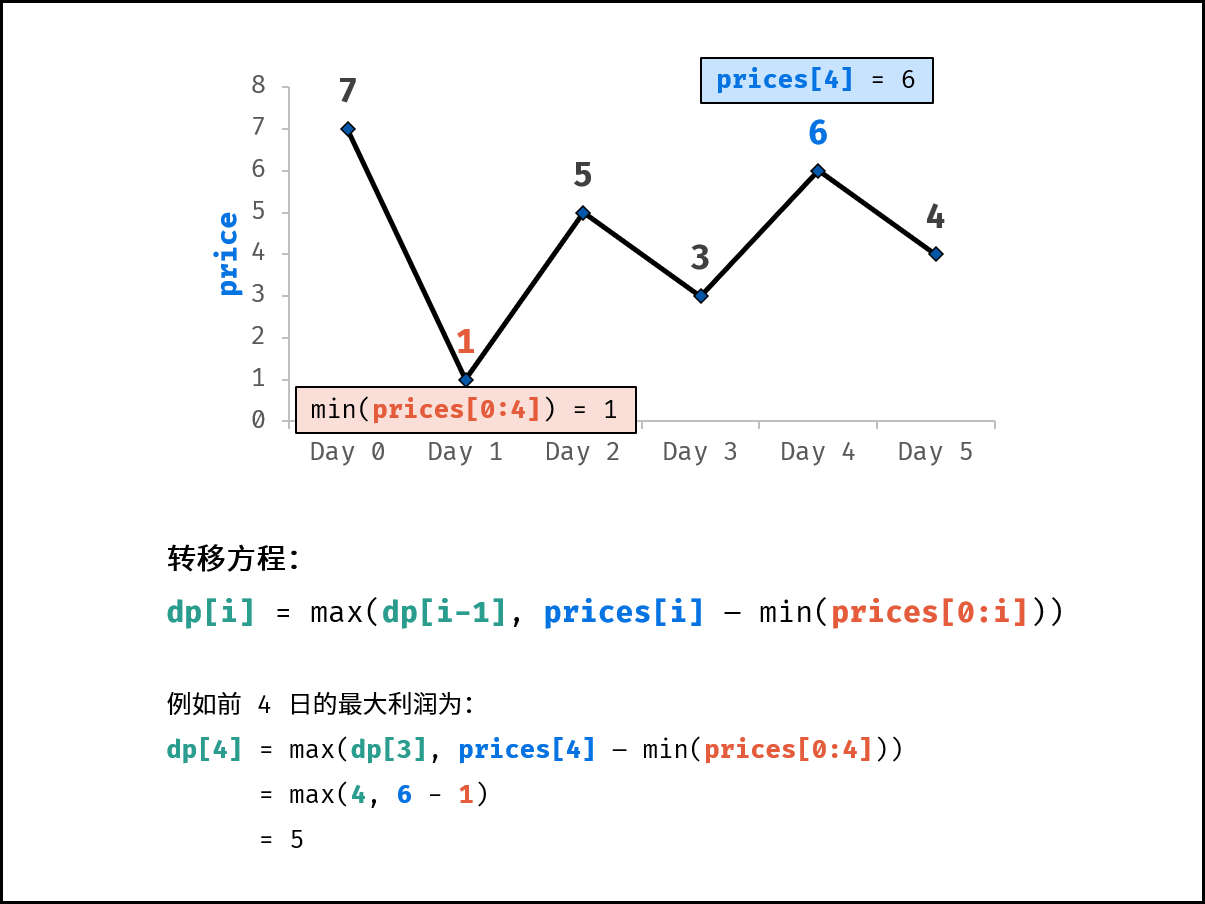{:align=center width=550}
### 时间优化:
前 $i$ 日的最低价格 $\min(prices[0:i])$ 时间复杂度为 $O(i)$ 。而在遍历 $prices$ 时,可以借助一个变量(记为成本 $cost$ )每日更新最低价格。优化后的转移方程为:
$$
dp[i] = \max(dp[i - 1], prices[i] - \min(cost, prices[i])
$$
### 空间优化:
由于 $dp[i]$ 只与 $dp[i - 1]$ , $prices[i]$ , $cost$ 相关,因此可使用一个变量(记为利润 $profit$ )代替 $dp$ 列表。优化后的转移方程为:
$$
profit = \max(profit, prices[i] - \min(cost, prices[i])
$$
## 代码:
```Python []
class Solution:
def bestTiming(self, prices: List[int]) -> int:
cost, profit = float("+inf"), 0
for price in prices:
cost = min(cost, price)
profit = max(profit, price - cost)
return profit
```
```Java []
class Solution {
public int bestTiming(int[] prices) {
int cost = Integer.MAX_VALUE, profit = 0;
for(int price : prices) {
cost = Math.min(cost, price);
profit = Math.max(profit, price - cost);
}
return profit;
}
}
```
```C++ []
class Solution {
public:
int bestTiming(vector& prices) {
int cost = INT_MAX, profit = 0;
for(int price : prices) {
cost = min(cost, price);
profit = max(profit, price - cost);
}
return profit;
}
};
```
### 复杂度分析:
- **时间复杂度 $O(N)$ :** 其中 $N$ 为 $prices$ 列表长度,动态规划需遍历 $prices$ 。
- **空间复杂度 $O(1)$ :** 变量 $cost$ 和 $profit$ 使用常数大小的额外空间。
================================================
FILE: leetbook_ioa/docs/LCR 189. 设计机械累加器.md
================================================
## 解题思路:
本题在简单问题上做了许多限制,需要使用排除法一步步导向答案。
$1+2+...+(target-1)+target$ 的计算方法主要有三种:平均计算、迭代、递归。
**方法一:** 平均计算
**问题:** 此计算必须使用 **乘除法** ,因此本方法不可取,直接排除。
```Java []
public int mechanicalAccumulator(int target) {
return (1 + target) * target / 2;
}
```
```Python []
def mechanicalAccumulator(target):
return (1 + target) * target // 2
```
```C++ []
int mechanicalAccumulator(int target) {
return (1 + target) * target / 2;
}
```
**方法二:** 迭代
**问题:** 循环必须使用 $while$ 或 $for$ ,因此本方法不可取,直接排除。
```Java []
public int mechanicalAccumulator(int target) {
int res = 0;
for(int i = 1; i <= target; i++)
res += i;
return res;
}
```
```Python []
def mechanicalAccumulator(target):
res = 0
for i in range(1, target + 1):
res += i
return res
```
```C++ []
int mechanicalAccumulator(int target) {
int res = 0;
for(int i = 1; i <= target; i++)
res += i;
return res;
}
```
**方法三:** 递归
**问题:** 终止条件需要使用 $if$ ,因此本方法不可取。
**思考:** 除了 $if$ 和 $switch$ 等判断语句外,是否有其他方法可用来终止递归?
```Java []
public int mechanicalAccumulator(int target) {
if(target == 1) return 1;
target += mechanicalAccumulator(target - 1);
return target;
}
```
```Python []
def mechanicalAccumulator(target):
if target == 1: return 1
target += mechanicalAccumulator(target - 1)
return target
```
```C++ []
int mechanicalAccumulator(int target) {
if(target == 1) return 1;
target += mechanicalAccumulator(target - 1);
return target;
}
```
> 下图中的 `sumNums()` 对应本题的 `mechanicalAccumulator` 。
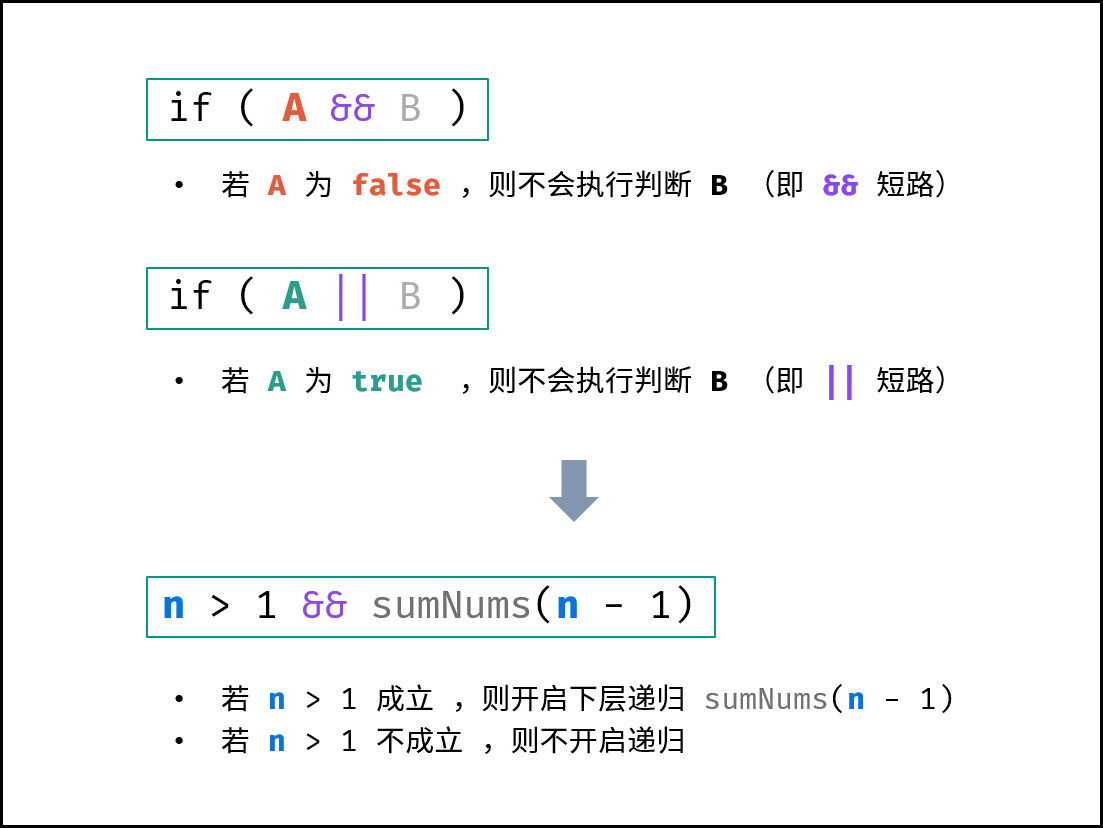{:align=center width=500}
### 逻辑运算符的短路效应:
常见的逻辑运算符有三种,即 “与 $\&\&$ ”,“或 $||$ ”,“非 $!$ ” ;而其有重要的短路效应,如下所示:
```Java
if(A && B) // 若 A 为 false ,则 B 的判断不会执行(即短路),直接判定 A && B 为 false
if(A || B) // 若 A 为 true ,则 B 的判断不会执行(即短路),直接判定 A || B 为 true
```
本题需要实现 “当 $target = 1$ 时终止递归” 的需求,可通过短路效应实现。
```Java
target > 1 && mechanicalAccumulator(target - 1) // 当 target = 1 时 target > 1 不成立 ,此时 “短路” ,终止后续递归
```
## 代码:
1. Java 中,为构成语句,需加一个辅助布尔量 $x$ ,否则会报错;
2. Java 中,开启递归函数需改写为 `mechanicalAccumulator(target - 1) > 0` ,此整体作为一个布尔量输出,否则会报错;
3. 初始化变量 $res$ 记录结果。( Java 可使用第二栏的简洁写法,不用借助变量 $res$ )。
```Java []
class Solution {
int res = 0;
public int mechanicalAccumulator(int target) {
boolean x = target > 1 && mechanicalAccumulator(target - 1) > 0;
res += target;
return res;
}
}
```
```Java []
class Solution {
public int mechanicalAccumulator(int target) {
boolean x = target > 1 && (target += mechanicalAccumulator(target - 1)) > 0;
return target;
}
}
```
```Python []
class Solution:
def __init__(self):
self.res = 0
def mechanicalAccumulator(self, target: int) -> int:
target > 1 and self.mechanicalAccumulator(target - 1)
self.res += target
return self.res
```
```C++ []
class Solution {
public:
int mechanicalAccumulator(int target) {
target > 1 && (target += mechanicalAccumulator(target - 1));
return target;
}
};
```
### 复杂度分析:
- **时间复杂度 $O(target)$ :** 计算 $target + (target-1) + ... + 2 + 1$ 需要开启 $target$ 个递归函数。
- **空间复杂度 $O(target)$ :** 递归深度达到 $target$ ,系统使用 $O(target)$ 大小的额外空间。
================================================
FILE: leetbook_ioa/docs/LCR 190. 加密运算.md
================================================
## 解题思路:
本题考察对位运算的灵活使用,即使用位运算实现加法。
设两数字的二进制形式 $dataA, dataB$ ,其求和 $s = dataA + dataB$ ,$dataA(i)$ 代表 $dataA$ 的二进制第 $i$ 位,则分为以下四种情况:
| $dataA(i)$ | $dataB(i)$ | 无进位和 $n(i)$ | 进位 $c(i+1)$ |
| :--------: | :--------: | :-------------: | :-----------: |
| $0$ | $0$ | $0$ | $0$ |
| $0$ | $1$ | $1$ | $0$ |
| $1$ | $0$ | $1$ | $0$ |
| $1$ | $1$ | $0$ | $1$ |
观察发现,**无进位和** 与 **异或运算** 规律相同,**进位** 和 **与运算** 规律相同(并需左移一位)。因此,无进位和 $n$ 与进位 $c$ 的计算公式如下;
$$
\begin{cases}
n = dataA \oplus dataB & 非进位和:异或运算 \\
c = dataA \space \& \space dataB << 1 & 进位:与运算 + 左移一位
\end{cases}
$$
(和 $s$ )$=$(非进位和 $n$ )$+$(进位 $c$ )。即可将 $s = dataA + dataB$ 转化为:
$$
s = dataA + dataB \Rightarrow s = n + c
$$
循环求 $n$ 和 $c$ ,直至进位 $c = 0$ ;此时 $s = n$ ,返回 $n$ 即可。
> 下图中的 `a` 和 `b` 对应本题的 `dataA` 和 `dataB` 。
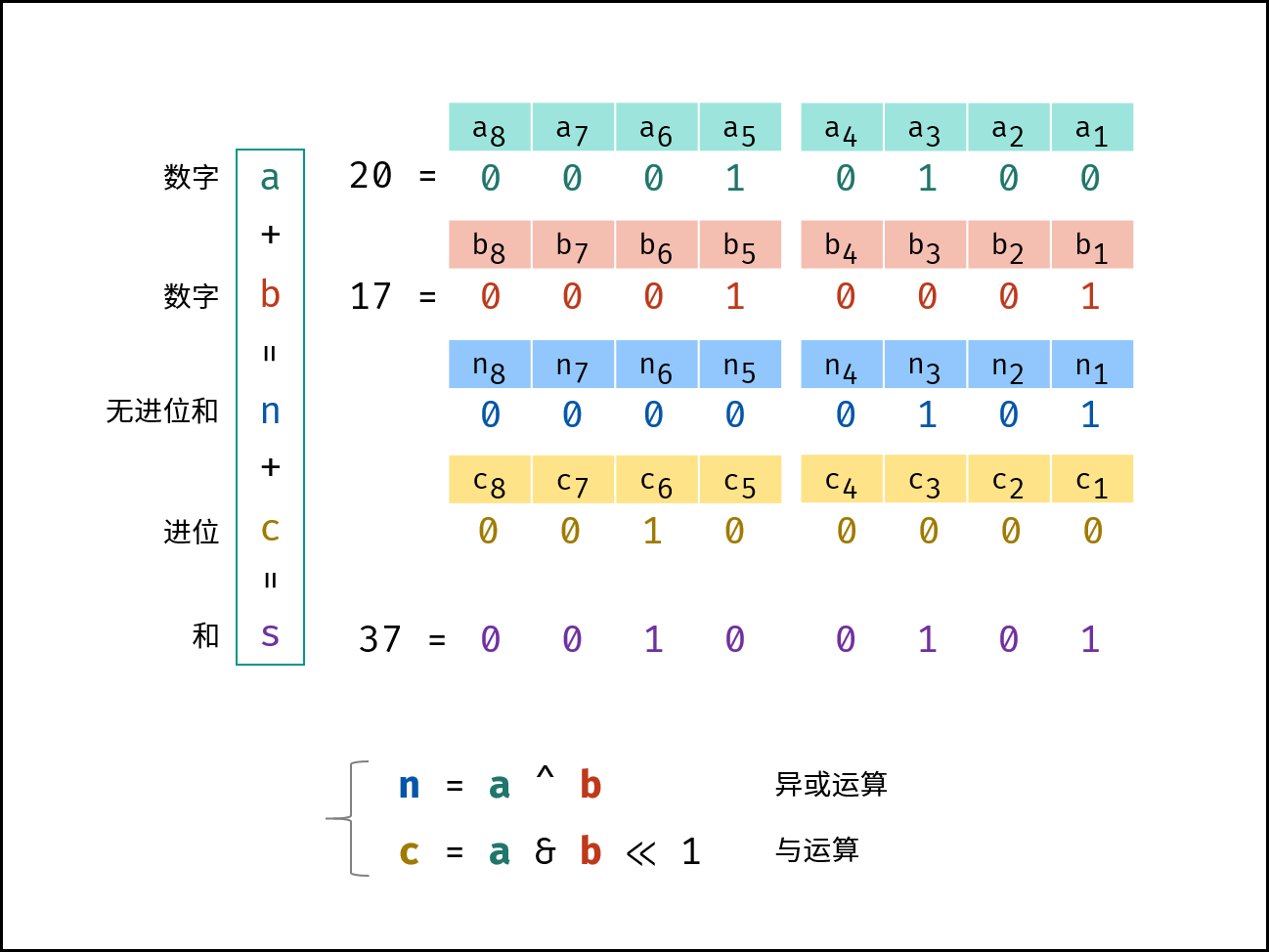{:align=center width=500}
> **Q :** 若数字 $dataA$ 和 $dataB$ 中有负数,则变成了减法,如何处理?
> **A :** 在计算机系统中,数值一律用 **补码** 来表示和存储。**补码的优势:** 加法、减法可以统一处理(CPU只有加法器)。因此,以上方法 **同时适用于正数和负数的加法** 。
## 代码:
```Java []
class Solution {
public int encryptionCalculate(int dataA, int dataB) {
while(dataB != 0) { // 当进位为 0 时跳出
int c = (dataA & dataB) << 1; // c = 进位
dataA ^= dataB; // dataA = 非进位和
dataB = c; // dataB = 进位
}
return dataA;
}
}
```
```C++ []
class Solution {
public:
int encryptionCalculate(int dataA, int dataB) {
while(dataB != 0)
{
int c = (unsigned int)(dataA & dataB) << 1;
dataA ^= dataB;
dataB = c;
}
return dataA;
}
};
```
```Python []
class Solution:
def encryptionCalculate(self, dataA: int, dataB: int) -> int:
x = 0xffffffff
dataA, dataB = dataA & x, dataB & x
while dataB != 0:
dataA, dataB = (dataA ^ dataB), (dataA & dataB) << 1 & x
return dataA if dataA <= 0x7fffffff else ~(dataA ^ x)
```
### 复杂度分析:
- **时间复杂度 $O(1)$ :** 最差情况下(例如 $dataA =$ $\text{0x7fffffff}$ , $dataB = 1$ 时),需循环 32 次,使用 $O(1)$ 时间;每轮中的常数次位操作使用 $O(1)$ 时间。
- **空间复杂度 $O(1)$ :** 使用常数大小的额外空间。
### Python 负数的存储:
Python,Java, C++ 等语言中的数字都是以 **补码** 形式存储的。但 Python 没有 `int` , `long` 等不同长度变量,即在编程时无变量位数的概念。
**获取负数的补码:** 需要将数字与十六进制数 `0xffffffff` 相与。可理解为舍去此数字 32 位以上的数字(将 32 位以上都变为 $0$ ),从无限长度变为一个 32 位整数。
**返回前数字还原:** 若补码 $dataA$ 为负数( `0x7fffffff` 是最大的正数的补码 ),需执行 `~(dataA ^ x)` 操作,将补码还原至 Python 的存储格式。`dataA ^ x` 运算将 1 至 32 位按位取反;`~` 运算是将整个数字取反;因此,`~(dataA ^ x)` 是将 32 位以上的位取反,1 至 32 位不变。
```Python
print(hex(1)) # = 0x1 补码
print(hex(-1)) # = -0x1 负号 + 原码 ( Python 特色,Java 会直接输出补码)
print(hex(1 & 0xffffffff)) # = 0x1 正数补码
print(hex(-1 & 0xffffffff)) # = 0xffffffff 负数补码
print(-1 & 0xffffffff) # = 4294967295 ( Python 将其认为正数)
```
================================================
FILE: leetbook_ioa/docs/LCR 191. 按规则计算统计结果.md
================================================
## 解题思路:
> 本文将 `arrayA` , `arrayB` 简写为 `A` , `B` 。
本题的难点在于 **不能使用除法** ,即需要 **只用乘法** 生成数组 $B$ 。根据题目对 $B[i]$ 的定义,可列如下图所示的表格。
根据表格的主对角线(全为 $1$ ),可将表格分为 **上三角** 和 **下三角** 两部分。分别迭代计算下三角和上三角两部分的乘积,即可 **不使用除法** 就获得结果。
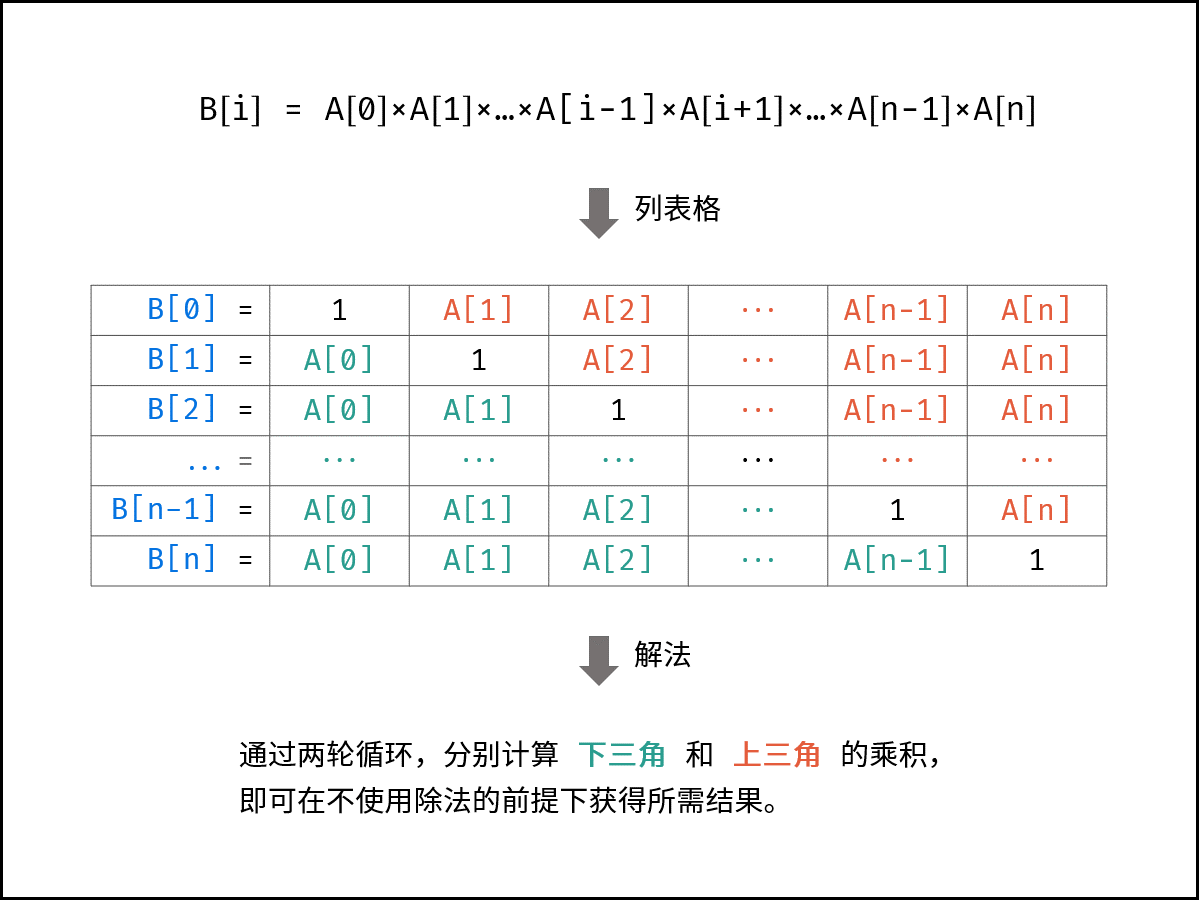{:align=center width=500}
### 算法流程:
1. 初始化:数组 $B$ ,其中 $B[0] = 1$ ;辅助变量 $tmp = 1$ ;
2. 计算 $B[i]$ 的 **下三角** 各元素的乘积,直接乘入 $B[i]$ ;
3. 计算 $B[i]$ 的 **上三角** 各元素的乘积,记为 $tmp$ ,并乘入 $B[i]$ ;
4. 返回 $B$ 。
## 代码:
```Python []
class Solution:
def statisticalResult(self, arrayA: List[int]) -> List[int]:
arrayB, tmp = [1] * len(arrayA), 1
for i in range(1, len(arrayA)):
arrayB[i] = arrayB[i - 1] * arrayA[i - 1]
for i in range(len(arrayA) - 2, -1, -1):
tmp *= arrayA[i + 1]
arrayB[i] *= tmp
return arrayB
```
```Java []
class Solution {
public int[] statisticalResult(int[] arrayA) {
int len = arrayA.length;
if(len == 0) return new int[0];
int[] arrayB = new int[len];
arrayB[0] = 1;
int tmp = 1;
for(int i = 1; i < len; i++) {
arrayB[i] = arrayB[i - 1] * arrayA[i - 1];
}
for(int i = len - 2; i >= 0; i--) {
tmp *= arrayA[i + 1];
arrayB[i] *= tmp;
}
return arrayB;
}
}
```
```C++ []
class Solution {
public:
vector statisticalResult(vector