[
{
"path": "README.md",
"content": "\n \n
Awesome-RAG
\n\n\n\n \n \n \n
\n \n\n\n💡 List of recent developments in Retrieval-Augmented Generation (RAG) for large language models (LLM). \n🤗 We welcome and encourage researchers to submit pull requests to update information in their papers! \n📫 _Repo under active development. Collaborations welcome on **Framework** & **Survey**. Contact: jiangyijcx@163.com._\n\n## 📕 Overview\n### [📌 Accepted papers](#Accept)\n\n\n\n| | | | | | \n|---------------------------|----------------------------|------------------------------|--------------------------|---------------------------|\n| NIPS 2025 | EMNLP 2025 | [ACL 2025](#ACL-2025) | [ICML 2025](#ICML-2025) | [ICLR 2025](#ICLR-2025) |\n| [NIPS 2024](#NIPS-2024) | [EMNLP 2024](#EMNLP-2024) | [ACL 2024](#ACL-2024) | [ICML 2024](#ICML-2024) | [ICLR 2024](#ICLR-2024) |\n\n\n\n\n### [🗓️ 2026 papers](#2026)\n\n| | | | | | |\n|---------------------------------|---------------------------------|---------------------------------|---------------------------------|---------------------------------|---------------------------------|\n| 2026.06 | 2026.05 | 2026.04 | [2026.03](#2026-March) | [2026.02](#2026-February) | [2026.01](#2026-January) |\n\n\n### [🗓️ 2025 papers](#2025)\n\n| | | | | | | \n|---------------------------------|---------------------------------|---------------------------------|---------------------------------|---------------------------------|---------------------------------|\n| [2025.12](#2025-December) | [2025.11](#2025-November) | [2025.10](#2025-October) | [2025.09](#2025-September) | [2025.08](#2025-August) |[2025.07](#2025-July) |\n| [2025.06](#2025-June) | [2025.05](#2025-May) | [2025.04](#2025-April) | [2025.03](#2025-March) | [2025.02](#2025-February) | [2025.01](#2025-January) |\n\n\n### [🗓️ 2024 papers](#2024)\n\n| | | | | | |\n|---------------------------------|---------------------------------|---------------------------------|-----------------------------------|-----------------------------------|-----------------------------------|\n| [2024.12](#2024-December) | [2024.11](#2024-November) | [2024.10](#2024-October) | [2024.09](#2024-September) | [2024.08](#2024-August) |[2024.07](#2024-July) |\n| [2024.06](#2024-June) | [2024 .05](#2024-May) | [2024.04](#2024-Apri) | [2024.03](#2024-March) | [2024.02](#2024-February) | [2024.01](#2024-January) | \n\n### 🗃️ Evaluation Datasets\n\n| | | | | | |\n|---------------------------------|---------------------------------|---------------------------------|-----------------------------------|-----------------------------------|-----------------------------------|\n| [HotpotQA](https://hotpotqa.github.io/) | [2WikiMultiHopQA](https://github.com/Alab-NII/2wikimultihop) | [WebQuestions](https://nlp.stanford.edu/software/sempre/) | [TriviaQA](http://nlp.cs.washington.edu/triviaqa/) | [MuSiQue](https://github.com/stonybrooknlp/musique) |[NaturalQA](https://ai.google.com/research/NaturalQuestions) |\n| [SQuAD](https://rajpurkar.github.io/SQuAD-explorer/) | [PopQA](https://github.com/AlexTMallen/adaptive-retrieval) | [ASQA](https://github.com/google-research/language/tree/master/language/asqa) | [Bamboogle](https://huggingface.co/datasets/chiayewken/bamboogle) | [ARC_Challenge](http://data.allenai.org/arc) | [PubHealth](https://github.com/luohongyin/unilc) | \n\n\n## 📢 Latest News\n- **[26.04]:** Our **CoCoA** accepted at ***ACL2026 Main***! 🎉 [[Paper]](https://arxiv.org/pdf/2508.01696)[[Code]](https://github.com/liunian-Jay/CoCoA)\n- **[26.1]:** Our [ArcAligner](https://arxiv.org/pdf/2601.05038) released — designed for long memory!🚀 [[Code]](https://github.com/liunian-Jay/ArcAligner)\n- **[26.1]:** Our [OptiSet](https://arxiv.org/pdf/2601.05027) released — unified selection and ranking!🚀 [[Code]](https://github.com/liunian-Jay/OptiSet)\n- **[25.10]:** Updated the recent papers from September and October!📅\n- **[25.10]:** Our [QAgent](https://arxiv.org/pdf/2510.08383) released — an agentic RAG framework!🚀 [[Code]](https://github.com/LivingFutureLab/QAgent)\n- **[25.08]:** Our [CoCoA](https://arxiv.org/pdf/2508.01696) released — studying knowledge synergy!🚀 [[Code]](https://github.com/liunian-Jay/CoCoA)\n- **[25.06]:** We built [AgenticRAG-RL](https://github.com/liunian-Jay/AgenticRAG-RL) — a minimal RL-RAG! Feel free to contribute!🤝\n- **[25.05]:** Our [GainRAG](https://arxiv.org/pdf/2505.18710) released — studying preference alignment!🚀 [[Code]](https://github.com/liunian-Jay/GainRAG)\n- **[25.05]:** Our **GainRAG** accepted at ***ACL2025 Main***! 🎉 [[Paper]](https://arxiv.org/pdf/2505.18710)[[Code]](https://github.com/liunian-Jay/GainRAG)\n- **[25.01-05]:** Updated the papers from 2025! 📄\n- **[24.10]:** We built [MU-GOT](https://github.com/liunian-Jay/MU-GOT) — a PDF parsing tool! Feel free to contribute!🤝\n- **[24.06-12]:** Updated the papers from 2024! 📄\n\n\n### 🎁 Resources\n#### 💡Survey\n- [2025.05] A Survey on Knowledge-Oriented Retrieval-Augmented Generation [[Link]](https://arxiv.org/pdf/2503.10677)\n- [2025.01] Agentic Retrieval-Augmented Generation: A Survey on Agentic RAG [[Link]](https://arxiv.org/pdf/2501.09136)\n- [2024.09] Trustworthiness in Retrieval-Augmented Generation Systems: A Survey [[Link]](https://arxiv.org/pdf/2409.10102?)\n- [2024.09] Retrieval Augmented Generation (RAG) and Beyond: A Comprehensive Survey on How to Make your LLMs use External Data More Wisely [[Link]](https://arxiv.org/pdf/2409.14924?)\n- [2024.07] Retrieval-Augmented Generation for Natural Language Processing: A Survey [[Link]](https://arxiv.org/pdf/2407.13193?)\n- [2024.05] A Survey on RAG Meeting LLMs: Towards Retrieval-Augmented Large Language Models [[Link]](https://arxiv.org/pdf/2405.06211)\n- [2024.02] Retrieval-Augmented Generation for AI-Generated Content: A Survey [[Link]](https://arxiv.org/pdf/2402.19473)\n- [2023.12] Retrieval-Augmented Generation for Large Language Models: A Survey [[Link]](https://arxiv.org/pdf/2312.10997)\n\n#### 💡Project\n- [LightRAG](https://github.com/HKUDS/LightRAG)\n- [RAGFlow](https://github.com/infiniflow/ragflow)\n- [RAG-Anything](https://github.com/HKUDS/RAG-Anything)\n- [Awesome-LLM-RAG](https://github.com/jxzhangjhu/Awesome-LLM-RAG)\n\n\n## 🔥Latest Papers\n### 🔥2026 March\n- Mar 30 [PAR2-RAG: Planned Active Retrieval and Reasoning for Multi-Hop Question Answering](https://arxiv.org/pdf/2603.29085)\n- Mar 30 [Courtroom-Style Multi-Agent Debate with Progressive RAG and Role-Switching for Controversial Claim Verification](https://arxiv.org/pdf/2603.28488)\n- Mar 27 [Not All Entities are Created Equal: A Dynamic Anonymization Framework for Privacy-Preserving Retrieval-Augmented Generation](https://arxiv.org/pdf/2603.26074)\n- Mar 27 [Insider Knowledge: How Much Can RAG Systems Gain from Evaluation Secrets?](https://arxiv.org/pdf/2601.13227)\n- Mar 26 [Adaptive Chunking: Optimizing Chunking-Method Selection for RAG](https://arxiv.org/pdf/2603.25333)\n- March 26 [UniAI-GraphRAG: Synergizing Ontology-Guided Extraction, Multi-Dimensional Clustering, and Dual-Channel Fusion for Robust Multi-Hop Reasoning](https://arxiv.org/pdf/2603.25152)\n- Mar 26 [GroupRAG: Cognitively Inspired Group-Aware Retrieval and Reasoning via Knowledge-Driven Problem Structuring](https://arxiv.org/pdf/2603.26807)\n- Mar 25 [Retrieval Improvements Do Not Guarantee Better Answers: A Study of RAG for AI Policy QA](https://arxiv.org/pdf/2603.24580)\n- Mar 25 [CoCR-RAG: Enhancing Retrieval-Augmented Generation in Web Q&A via Concept-oriented Context Reconstruction](https://arxiv.org/pdf/2603.23989)\n- Mar 24 [From Conflict to Consensus: Boosting Medical Reasoning via Multi-Round Agentic RAG](https://arxiv.org/pdf/2603.03292)\n- Mar 23 [CatRAG: Functor-Guided Structural Debiasing with Retrieval Augmentation for Fair LLMs](https://arxiv.org/pdf/2603.21524)\n- Mar 21 [Graphs RAG at Scale: Beyond Retrieval-Augmented Generation With Labeled Property Graphs and Resource Description Framework for Complex and Unknown Search Spaces](https://arxiv.org/pdf/2603.22340)\n- Mar 19 [GIP-RAG: An Evidence-Grounded Retrieval-Augmented Framework for Interpretable Gene Interaction and Pathway Impact Analysis](https://arxiv.org/pdf/2603.20321)\n- Mar 19 [BubbleRAG: Evidence-Driven Retrieval-Augmented Generation for Black-Box Knowledge Graphs](https://arxiv.org/pdf/2603.20309)\n- Mar 19 [DaPT: A Dual-Path Framework for Multilingual Multi-hop Question Answering](https://arxiv.org/pdf/2603.19097)\n- Mar 18 [PACE-RAG: Patient-Aware Contextual and Evidence-based Policy RAG for Clinical Drug Recommendation](https://arxiv.org/pdf/2603.17356)\n- Mar 18 [SF-RAG: Structure-Fidelity Retrieval-Augmented Generation for Academic Question Answering](https://arxiv.org/pdf/2602.13647)\n- Mar 17 [Is Conformal Factuality for RAG-based LLMs Robust? Novel Metrics and Systematic Insights](https://arxiv.org/abs/2603.16817)\n- Mar 17 [IndexRAG: Bridging Facts for Cross-Document Reasoning at Index Time](https://arxiv.org/pdf/2603.16415)\n- Mar 16 [Cross-RAG: Zero-Shot Retrieval-Augmented Time Series Forecasting via Cross-Attention](https://arxiv.org/pdf/2603.14709)\n- Mar 14 [The Reasoning Bottleneck in Graph-RAG: Structured Prompting and Context Compression for Multi-Hop QA](https://arxiv.org/pdf/2603.14045)\n- Mar 12 [Test-Time Strategies for More Efficient and Accurate Agentic RAG](https://arxiv.org/pdf/2603.12396)\n- Mar 11 [RAGPerf: An End-to-End Benchmarking Framework for Retrieval-Augmented Generation Systems](https://arxiv.org/pdf/2603.10765)\n- Mar 10 [TaSR-RAG: Taxonomy-guided Structured Reasoning for Retrieval-Augmented Generation](https://arxiv.org/pdf/2603.09341)\n- Mar 9 [SPD-RAG: Sub-Agent Per Document Retrieval-Augmented Generation](https://arxiv.org/pdf/2603.08329)\n- Mar 8 [KohakuRAG: A simple RAG framework with hierarchical document indexing](https://arxiv.org/pdf/2603.07612)\n- Mar 7 [Hit-RAG: Learning to Reason with Long Contexts via Preference Alignment](https://arxiv.org/pdf/2603.07023)\n- Mar 6 [LIT-RAGBench: Benchmarking Generator Capabilities of Large Language Models in Retrieval-Augmented Generation](https://arxiv.org/pdf/2603.06198)\n- Mar 5 [Towards Robust Retrieval-Augmented Generation Based on Knowledge Graph: A Comparative Analysis](https://arxiv.org/pdf/2603.05698)\n- Mar 5 [MedCoRAG: Interpretable Hepatology Diagnosis via Hybrid Evidence Retrieval and Multispecialty Consensus](https://arxiv.org/pdf/2603.05129)\n- Mar 5 [S-Path-RAG: Semantic-Aware Shortest-Path Retrieval Augmented Generation for Multi-Hop Knowledge Graph Question Answering](https://arxiv.org/pdf/2603.23512)\n- Mar 3 [RAG-X: Systematic Diagnosis of Retrieval-Augmented Generation for Medical Question Answering](https://arxiv.org/pdf/2603.03541)\n- Mar 2 [URAG: A Benchmark for Uncertainty Quantification in Retrieval-Augmented Large Language Models\n](https://arxiv.org/pdf/2603.19281)\n- Mar 2 [GAM-RAG: Gain-Adaptive Memory for Evolving Retrieval in Retrieval-Augmented Generation](https://arxiv.org/pdf/2603.01783)\n- Mar 1 [Tiny-Critic RAG: Empowering Agentic Fallback with Parameter-Efficient Small Language Models](https://arxiv.org/pdf/2603.00846)\n\n \n### 🔥2026 February\n- Feb 28 [From Flat to Structural: Enhancing Automated Short Answer Grading with GraphRAG](https://arxiv.org/pdf/2603.19276)\n- Feb 26 [TCM-DiffRAG: Personalized Syndrome Differentiation Reasoning Method for Traditional Chinese Medicine based on Knowledge Graph and Chain of Thought](https://arxiv.org/pdf/2602.22828)\n- Feb 26 [Search-P1: Path-Centric Reward Shaping for Stable and Efficient Agentic RAG Training](https://arxiv.org/pdf/2602.22576)\n- Feb 25 [Revisiting RAG Retrievers: An Information Theoretic Benchmark](https://arxiv.org/pdf/2602.21553)\n- Feb 24 [HELP: HyperNode Expansion and Logical Path-Guided Evidence Localization for Accurate and Efficient GraphRAG](https://arxiv.org/pdf/2602.20926)\n- Feb 24 [RMIT-ADM+S at the MMU-RAG NeurIPS 2025 Competition](https://arxiv.org/pdf/2602.20735)\n- Feb 24 [DynaRAG: Bridging Static and Dynamic Knowledge in Retrieval-Augmented Generation](https://arxiv.org/pdf/2603.18012)\n- Feb 23 [How Retrieved Context Shapes Internal Representations in RAG](https://arxiv.org/pdf/2602.20091)\n- Feb 23 [Controllable Evidence Selection in Retrieval-Augmented Question Answering via Deterministic Utility Gating](https://arxiv.org/pdf/2603.18011)\n- Feb 22 [AgenticRAGTracer: A Hop-Aware Benchmark for Diagnosing Multi-Step Retrieval Reasoning in Agentic RAG](https://arxiv.org/pdf/2602.19127)\n- Feb 21 [Rethinking Retrieval-Augmented Generation as a Cooperative Decision-Making Problem](https://arxiv.org/pdf/2602.18734)\n- Feb 20 [GraphSkill: Documentation-Guided Hierarchical Retrieval-Augmented Coding for Complex Graph Reasoning](https://arxiv.org/pdf/2603.06620)\n- Feb 19 [NTLRAG: Narrative Topic Labels derived with Retrieval Augmented Generation](https://arxiv.org/pdf/2602.17216)\n- Feb 19 [NotebookRAG: Retrieving Multiple Notebooks to Augment the Generation of EDA Notebooks for Crowd-Wisdom](https://arxiv.org/pdf/2602.17215)\n- Feb 17 [Concept-Enhanced Multimodal RAG: Towards Interpretable and Accurate Radiology Report Generation](https://arxiv.org/pdf/2602.15650)\n- Feb 16 [AIC CTU@AVerImaTeC: dual-retriever RAG for image-text fact checking](https://arxiv.org/pdf/2602.15190)\n- Feb 16 [HyperRAG: Reasoning N-ary Facts over Hypergraphs for Retrieval Augmented Generation](https://arxiv.org/pdf/2602.14470)\n- Feb 16 [Differentially Private Retrieval-Augmented Generation](https://arxiv.org/pdf/2602.14374)\n- Feb 14 [Evaluating Prompt Engineering Techniques for RAG in Small Language Models: A Multi-Hop QA Approach](https://arxiv.org/pdf/2602.13890)\n- Feb 13 [LIR^3AG: A Lightweight Rerank Reasoning Strategy Framework for Retrieval-Augmented Generation](https://arxiv.org/abs/2512.18329)\n- Feb 11 [MultiCube-RAG for Multi-hop Question Answering](https://arxiv.org/pdf/2602.15898)\n- Feb 11 [AudioRAG: A Challenging Benchmark for Audio Reasoning and Information Retrieval](https://arxiv.org/pdf/2602.10656)\n- Feb 10 [MLDocRAG: Multimodal Long-Context Document Retrieval Augmented Generation](https://arxiv.org/pdf/2602.10271)\n- Feb 10 [Comprehensive Comparison of RAG Methods Across Multi-Domain Conversational QA](https://arxiv.org/pdf/2602.09552)\n- Feb 10 [Evaluating Social Bias in RAG Systems: When External Context Helps and Reasoning Hurts](https://arxiv.org/pdf/2602.09442)\n- Feb 9 [DA-RAG: Dynamic Attributed Community Search for Retrieval-Augmented Generation](https://arxiv.org/pdf/2602.08545)\n- Feb 9 [SCOUT-RAG: Scalable and Cost-Efficient Unifying Traversal for Agentic Graph-RAG over Distributed Domains](https://arxiv.org/pdf/2602.08400)\n- Feb 8 [HypRAG: Hyperbolic Dense Retrieval for Retrieval Augmented Generation](https://arxiv.org/pdf/2602.07739)\n- Feb 7 [IGMiRAG: Intuition-Guided Retrieval-Augmented Generation with Adaptive Mining of In-Depth Memor](https://arxiv.org/pdf/2602.07525)\n- Feb 7 [Progressive Searching for Retrieval in RAG](https://arxiv.org/pdf/2602.07297)\n- Feb 7 [Benchmarking Legal RAG: The Promise and Limits of AI Statutory Surveys](https://arxiv.org/pdf/2603.03300)\n- Feb 6 [SE-Search: Self-Evolving Search Agent via Memory and Dense Reward](https://arxiv.org/pdf/2603.03293)\n- Feb 5 [CompactRAG: Reducing LLM Calls and Token Overhead in Multi-Hop Question Answering](https://arxiv.org/pdf/2602.05728)\n- Feb 5 [Cost-Efficient RAG for Entity Matching with LLMs: A Blocking-based Exploration](https://arxiv.org/pdf/2602.05708)\n- Feb 5 [When Iterative RAG Beats Ideal Evidence: A Diagnostic Study in Scientific Multi-hop Question Answering](https://arxiv.org/pdf/2601.19827)\n- Feb 4[HugRAG: Hierarchical Causal Knowledge Graph Design for RAG](https://arxiv.org/pdf/2602.05143)\n- Feb 4 [Pruning Minimal Reasoning Graphs for Efficient Retrieval-Augmented Generation](https://arxiv.org/pdf/2602.04926)\n- Feb 4 [Atomic Information Flow: A Network Flow Model for Tool Attributions in RAG Systems](https://arxiv.org/pdf/2602.04912)\n- Feb 3 [LUMINA: Detecting Hallucinations in RAG System with Context-Knowledge Signals](https://arxiv.org/pdf/2509.21875)\n- Feb 3 [Rethinking the Reranker: Boundary-Aware Evidence Selection for Robust Retrieval-Augmented Generation](https://arxiv.org/pdf/2602.03689)\n- Feb 3 [Reinforcement Fine-Tuning for History-Aware Dense Retriever in RAG](https://arxiv.org/pdf/2602.03645)\n- Feb 3 [Use Graph When It Needs: Efficiently and Adaptively Integrating Retrieval-Augmented Generation with Graphs](https://arxiv.org/pdf/2602.03578)\n- Feb 3 [A-RAG: Scaling Agentic Retrieval-Augmented Generation via Hierarchical Retrieval Interfaces](https://arxiv.org/pdf/2602.03442)\n- Feb 3 [Pursuing Best Industrial Practices for Retrieval-Augmented Generation in the Medical Domain](https://arxiv.org/pdf/2602.03368)\n- Feb 2 [Breaking the Static Graph: Context-Aware Traversal for Robust Retrieval-Augmented Generation](https://arxiv.org/pdf/2602.01965)\n- Feb 2 [CTRL-RAG: Contrastive Likelihood Reward Based Reinforcement Learning for Context-Faithful RAG Models](https://arxiv.org/pdf/2603.04406)\n- Feb 2 [P-RAG: Prompt-Enhanced Parametric RAG with LoRA and Selective CoT for Biomedical and Multi-Hop QA](https://arxiv.org/pdf/2602.15874)\n\n### 🔥2026 January\n- Jan 30 [Bounding Hallucinations: Information-Theoretic Guarantees for RAG Systems via Merlin-Arthur Protocols](https://arxiv.org/pdf/2512.11614)\n- Jan 30 [DIVERGE: Diversity-Enhanced RAG for Open-Ended Information Seeking](https://arxiv.org/pdf/2602.00238)\n- Jan 30 [RAGRouter-Bench: A Dataset and Benchmark for Adaptive RAG Routing](https://arxiv.org/pdf/2602.00296)\n- Jan 29 [ProRAG: Process-Supervised Reinforcement Learning for Retrieval-Augmented Generation](https://arxiv.org/pdf/2601.21912)\n- Jan 29 [EHR-RAG: Bridging Long-Horizon Structured Electronic Health Records and Large Language Models via Enhanced Retrieval-Augmented Generation](https://arxiv.org/pdf/2601.21340)\n- Jan 27 [LURE-RAG: Lightweight Utility-driven Reranking for Efficient RAG](https://arxiv.org/pdf/2601.19535)\n- Jan 27 [RPO-RAG: Aligning Small LLMs with Relation-aware Preference Optimization for Knowledge Graph Question Answering](https://arxiv.org/pdf/2601.19225)\n- Jan 24 [Less is More for RAG: Information Gain Pruning for Generator-Aligned Reranking and Evidence Selection](https://arxiv.org/pdf/2601.17532)\n- Jan 23 [DeepEra: A Deep Evidence Reranking Agent for Scientific Retrieval-Augmented Generated Question Answering](https://arxiv.org/pdf/2601.16478)\n- Jan 23 [DF-RAG: Query-Aware Diversity for Retrieval-Augmented Generation](https://arxiv.org/pdf/2601.17212)\n- Jan 22 [SPARC-RAG: Adaptive Sequential-Parallel Scaling with Context Management for Retrieval-Augmented Generation](https://arxiv.org/pdf/2602.00083)\n- Jan 21 [ManuRAG: Multi-modal Retrieval Augmented Generation for Manufacturing Question Answering (Early Version)](https://arxiv.org/pdf/2601.15434)\n- Jan 21 [MiRAGE: A Multiagent Framework for Generating Multimodal Multihop Question-Answer Dataset for RAG Evaluation](https://arxiv.org/pdf/2601.15487)\n- Jan 20 [Predicting Retrieval Utility and Answer Quality in Retrieval-Augmented Generation](https://arxiv.org/pdf/2601.14546)\n- Jan 19 [RAGExplorer: A Visual Analytics System for the Comparative Diagnosis of RAG Systems](https://arxiv.org/pdf/2601.12991)\n- Jan 19 [Augmenting Question Answering with A Hybrid RAG Approach](https://arxiv.org/pdf/2601.12658)\n- Jan 16 [NAACL: Noise-AwAre Verbal Confidence Calibration for LLMs in RAG Systems](https://arxiv.org/pdf/2601.11004)\n- Jan 16 [PruneRAG: Confidence-Guided Query Decomposition Trees for Efficient Retrieval-Augmented Generation](https://arxiv.org/pdf/2601.11024)\n- Jan 16 [Reasoning in Trees: Improving Retrieval-Augmented Generation for Multi-Hop Question Answering](https://arxiv.org/pdf/2601.11255)\n- Jan 16 [Unlocking the Potentials of Retrieval-Augmented Generation for Diffusion Language Models](https://arxiv.org/pdf/2601.11342)\n- Jan 16 [Deep GraphRAG: A Balanced Approach to Hierarchical Retrieval and Adaptive Integration](https://arxiv.org/pdf/2601.11144)\n- Jan 16 [Predict the Retrieval! Test time adaptation for Retrieval Augmented Generation](https://arxiv.org/pdf/2601.11443)\n- Jan 15 [RoutIR: Fast Serving of Retrieval Pipelines for Retrieval-Augmented Generation](https://arxiv.org/pdf/2601.10644)\n- Jan 13 [RAGShaper: Eliciting Sophisticated Agentic RAG Skills via Automated Data Synthesis](https://arxiv.org/pdf/2601.08699)\n- Jan 12 [Relink: Constructing Query-Driven Evidence Graph On-the-Fly for GraphRAG](https://arxiv.org/pdf/2601.07192)\n- Jan 12 [BayesRAG: Probabilistic Mutual Evidence Corroboration for Multimodal Retrieval-Augmented Generation](https://arxiv.org/pdf/2601.07329)\n- Jan 12 [FROAV: A Framework for RAG Observation and Agent Verification - Lowering the Barrier to LLM Agent Research](https://arxiv.org/pdf/2601.07504)\n- Jan 12 [Is Agentic RAG worth it? An experimental comparison of RAG approaches](https://arxiv.org/pdf/2601.07711)\n- Jan 11 [TreePS-RAG: Tree-based Process Supervision for Reinforcement Learning in Agentic RAG](https://arxiv.org/pdf/2601.06922)\n- Jan 11 [Seeing through the Conflict: Transparent Knowledge Conflict Handling in Retrieval-Augmented Generation](https://arxiv.org/pdf/2601.06842)\n- Jan 11 [Fine-Tuning vs. RAG for Multi-Hop Question Answering with Novel Knowledge](https://arxiv.org/pdf/2601.07054)\n- Jan 10 [Attribution Techniques for Mitigating Hallucinated Information in RAG Systems: A Survey](https://arxiv.org/pdf/2601.19927)\n- Jan 10 [MedRAGChecker: Claim-Level Verification for Biomedical Retrieval-Augmented Generation](https://arxiv.org/pdf/2601.06519)\n- Jan 10 [L-RAG: Balancing Context and Retrieval with Entropy-Based Lazy Loading](https://arxiv.org/pdf/2601.06551)\n- Jan 8 [Self-MedRAG: a Self-Reflective Hybrid Retrieval-Augmented Generation Framework for Reliable Medical Question Answering](https://arxiv.org/pdf/2601.04531)\n- Jan 8 [Orion-RAG: Path-Aligned Hybrid Retrieval for Graphless Data](https://arxiv.org/pdf/2601.04764)\n- Jan 8 [OptiSet: Unified Optimizing Set Selection and Ranking for Retrieval-Augmented Generation](https://arxiv.org/pdf/2601.05027)\n- Jan 8 [ArcAligner: Adaptive Recursive Aligner for Compressed Context Embeddings in RAG](https://arxiv.org/pdf/2601.05038)\n- Jan 6 [Enhancing Multilingual RAG Systems with Debiased Language Preference-Guided Query Fusion](https://arxiv.org/pdf/2601.02956)\n- Jan 6 [Stable-RAG: Mitigating Retrieval-Permutation-Induced Hallucinations in Retrieval-Augmented Generation](https://arxiv.org/pdf/2601.02993)\n- Jan 6 [Detecting Hallucinations in Retrieval-Augmented Generation via Semantic-level Internal Reasoning Graph](https://arxiv.org/pdf/2601.03052)\n- Jan 6 [Tackling the Inherent Difficulty of Noise Filtering in RAG](https://arxiv.org/pdf/2601.01896)\n- Jan 7 [Disco-RAG: Discourse-Aware Retrieval-Augmented Generation](https://arxiv.org/pdf/2601.04377)\n- Jan 5 [Clinical Knowledge Graph Construction and Evaluation with Multi-LLMs via Retrieval-Augmented Generation](https://arxiv.org/pdf/2601.01844)\n- Jan 4 [A Dynamic Retrieval-Augmented Generation System with Selective Memory and Remembrance](https://arxiv.org/pdf/2601.02428)\n- Jan 2 [Improving Multi-step RAG with Hypergraph-based Memory for Long-Context Complex Relational Modeling](https://arxiv.org/pdf/2512.23959)\n- Jan 2 [RAG-BioQA: A Retrieval-Augmented Generation Framework for Long-Form Biomedical Question Answering](https://arxiv.org/pdf/2510.01612)\n\n### 🔥2025 December\n- Dec 31 [Enhancing Retrieval-Augmented Generation with Topic-Enriched Embeddings: A Hybrid Approach Integrating Traditional NLP Techniques](https://arxiv.org/pdf/2601.00891)\n- Dec 29 [Retrieval Augmented Question Answering: When Should LLMs Admit Ignorance?](https://arxiv.org/pdf/2512.23836)\n- Dec 27 [DICE: Discrete Interpretable Comparative Evaluation with Probabilistic Scoring for Retrieval-Augmented Generation](https://arxiv.org/pdf/2512.22629)\n- Dec 27 [HiFi-RAG: Hierarchical Content Filtering and Two-Pass Generation for Open-Domain RAG](https://arxiv.org/pdf/2512.22442)\n- Dec 25 [FVA-RAG: Falsification-Verification Alignment for Mitigating Sycophantic Hallucinations](https://arxiv.org/pdf/2512.07015)\n- Dec 22 [QuCo-RAG: Quantifying Uncertainty from the Pre-training Corpus for Dynamic Retrieval-Augmented Generation](https://arxiv.org/pdf/2512.19134)\n- Dec 20 [Bidirectional RAG: Safe Self-Improving Retrieval-Augmented Generation Through Multi-Stage Validation](https://arxiv.org/pdf/2512.22199)\n- Dec 19 [MMRAG-RFT: Two-stage Reinforcement Fine-tuning for Explainable Multi-modal Retrieval-augmented Generation](https://arxiv.org/pdf/2512.17194)\n- Dec 17 [The Semantic Illusion: Certified Limits of Embedding-Based Hallucination Detection in RAG Systems](https://arxiv.org/pdf/2512.15068)\n- Dec 16 [DrugRAG: Enhancing Pharmacy LLM Performance Through A Novel Retrieval-Augmented Generation Pipeline](https://arxiv.org/pdf/2512.14896)\n- Dec 16 [Dynamic Context Selection for Retrieval-Augmented Generation: Mitigating Distractors and Positional Bias](https://arxiv.org/pdf/2512.14313)\n- Dec 16 [Cog-RAG: Cognitive-Inspired Dual-Hypergraph with Theme Alignment Retrieval-Augmented Generation](https://arxiv.org/pdf/2511.13201)\n- Dec 15 [Semantic Grounding Index: Geometric Bounds on Context Engagement in RAG Systems](https://arxiv.org/pdf/2512.13771)\n- Dec 12 [LOOPRAG: Enhancing Loop Transformation Optimization with Retrieval-Augmented Large Language Models](https://arxiv.org/pdf/2512.15766)\n- Dec 11 [Cooperative Retrieval-Augmented Generation for Question Answering: Mutual Information Exchange and Ranking by Contrasting Layers](https://arxiv.org/pdf/2512.10422)\n- Dec 10 [MedBioRAG: Semantic Search and Retrieval-Augmented Generation with Large Language Models for Medical and Biological QA](https://arxiv.org/pdf/2512.10996)\n- Dec 10 [RouteRAG: Efficient Retrieval-Augmented Generation from Text and Graph via Reinforcement Learning](https://arxiv.org/pdf/2512.09487)\n- Dec 10 [Leveraging Language Models and RAG for Efficient Knowledge Discovery in Clinical Environments](https://arxiv.org/pdf/2601.04209)\n- Dec 9 [Detecting Hallucinations in Graph Retrieval-Augmented Generation via Attention Patterns and Semantic Alignment](https://arxiv.org/pdf/2512.09148)\n- Dec 9 [Toward Faithful Retrieval-Augmented Generation with Sparse Autoencoders](https://arxiv.org/pdf/2512.08892)\n- Dec 5 [Optimizing Medical Question-Answering Systems: A Comparative Study of Fine-Tuned and Zero-Shot Large Language Models with RAG Framework](https://arxiv.org/pdf/2512.05863)\n- Dec 3 [RAGVUE: A Diagnostic View for Explainable and Automated Evaluation of Retrieval-Augmented Generation](https://arxiv.org/pdf/2601.04196)\n- Dec 3 [BookRAG: A Hierarchical Structure-aware Index-based Approach for Retrieval-Augmented Generation on Complex Documents](https://arxiv.org/pdf/2512.03413)\n\n### 🔥2025 November\n- Nov 29 [Breaking It Down: Domain-Aware Semantic Segmentation for Retrieval Augmented Generation](https://arxiv.org/pdf/2512.00367)\n- Nov 28 [Autonomous QA Agent: A Retrieval-Augmented Framework for Reliable Selenium Script Generation](https://arxiv.org/pdf/2601.06034)\n- Nov 27 [Unlocking Electronic Health Records: A Hybrid Graph RAG Approach to Safe Clinical AI for Patient QA](https://arxiv.org/pdf/2602.00009)\n- Nov 26 [MegaRAG: Multimodal Knowledge Graph-Based Retrieval Augmented Generation](https://arxiv.org/pdf/2512.20626)\n- Nov 25 [HKRAG: Holistic Knowledge Retrieval-Augmented Generation Over Visually-Rich Documents](https://arxiv.org/pdf/2511.20227)\n- Nov 24 [HyperbolicRAG: Enhancing Retrieval-Augmented Generation with Hyperbolic Representations](https://arxiv.org/pdf/2511.18808)\n- Nov 22 [Agent-as-a-Graph: Knowledge Graph-Based Tool and Agent Retrieval for LLM Multi-Agent Systems](https://arxiv.org/pdf/2511.18194)\n- Nov 22 [Rethinking Retrieval: From Traditional Retrieval Augmented Generation to Agentic and Non-Vector Reasoning Systems in the Financial Domain for Large Language Models](https://arxiv.org/pdf/2511.18177)\n- Nov 21 [Beyond Component Strength: Synergistic Integration and Adaptive Calibration in Multi-Agent RAG Systems](https://arxiv.org/pdf/2511.21729)\n- Nov 20 [Comparison of Text-Based and Image-Based Retrieval in Multimodal Retrieval Augmented Generation Large Language Model Systems](https://arxiv.org/pdf/2511.16654)\n- Nov 19 [CARE-RAG - Clinical Assessment and Reasoning in RAG](https://arxiv.org/pdf/2511.15994)\n- Nov 19 [ItemRAG: Item-Based Retrieval-Augmented Generation for LLM-Based Recommendation](https://arxiv.org/pdf/2511.15141)\n- Nov 19 [Noise-Robust Abstractive Compression in Retrieval-Augmented Language Models](https://arxiv.org/pdf/2512.08943)\n- Nov 18 [LiveRAG: A diverse Q&A dataset with varying difficulty level for RAG evaluation](https://arxiv.org/pdf/2511.14531)\n- Nov 17 [TelcoAI: Advancing 3GPP Technical Specification Search through Agentic Multi-Modal Retrieval-Augmented Generation](https://arxiv.org/pdf/2601.16984)\n- Nov 16 [TAdaRAG: Task Adaptive Retrieval-Augmented Generation via On-the-Fly Knowledge Graph Construction](https://arxiv.org/pdf/2511.12520)\n- Nov 15 [MME-RAG: Multi-Manager-Expert Retrieval-Augmented Generation for Fine-Grained Entity Recognition in Task-Oriented Dialogues](https://arxiv.org/pdf/2511.12213)\n- Nov 13 [Modeling Uncertainty Trends for Timely Retrieval in Dynamic RAG](https://arxiv.org/pdf/2511.09980)\n- Nov 13 [TruthfulRAG: Resolving Factual-level Conflicts in Retrieval-Augmented Generation with Knowledge Graphs](https://arxiv.org/pdf/2511.10375)\n- Nov 13 [RAGFort: Dual-Path Defense Against Proprietary Knowledge Base Extraction in Retrieval-Augmented Generation](https://arxiv.org/pdf/2511.10128)\n- Nov 12 [BarrierBench : Evaluating Large Language Models for Safety Verification in Dynamical Systems](https://arxiv.org/pdf/2511.09363)\n- Nov 10 [Q-RAG: Long Context Multi-step Retrieval via Value-based Embedder Training](https://arxiv.org/pdf/2511.07328)\n- Nov 10 [A survey: Information search time optimization based on RAG (Retrieval Augmentation Generation) chatbot](https://arxiv.org/pdf/2601.07838)\n- Nov 8 [Cross-Document Topic-Aligned Chunking for Retrieval-Augmented Generation](https://arxiv.org/pdf/2601.05265)\n- Nov 8 [Retrieval-Augmented Generation in Medicine: A Scoping Review of Technical Implementations, Clinical Applications, and Ethical Considerations](https://arxiv.org/pdf/2511.05901)\n- Nov 7 [TeaRAG: A Token-Efficient Agentic Retrieval-Augmented Generation Framework](https://arxiv.org/pdf/2511.05385)\n- Nov 6 [RAGalyst: Automated Human-Aligned Agentic Evaluation for Domain-Specific RAG](https://arxiv.org/pdf/2511.04502)\n- Nov 5 [RAGBoost: Efficient Retrieval-Augmented Generation with Accuracy-Preserving Context Reuse](https://arxiv.org/pdf/2511.03475)\n- Nov 1 [Zero-RAG: Towards Retrieval-Augmented Generation with Zero Redundant Knowledge](https://arxiv.org/pdf/2511.00505)\n\n### 🔥2025 October\n- Oct 29 [DIRC-RAG: Accelerating Edge RAG with Robust High-Density and High-Loading-Bandwidth Digital In-ReRAM Computation](https://arxiv.org/pdf/2510.25278)\n- Oct 28 [Mitigating Hallucination in Large Language Models (LLMs): An Application-Oriented Survey on RAG, Reasoning, and Agentic Systems](https://arxiv.org/pdf/2510.24476)\n- Oct 28 [META-RAG: Meta-Analysis-Inspired Evidence-Re-Ranking Method for Retrieval-Augmented Generation in Evidence-Based Medicine](https://arxiv.org/pdf/2510.24003)\n- Oct 28 [PICOs-RAG: PICO-supported Query Rewriting for Retrieval-Augmented Generation in Evidence-Based Medicine](https://arxiv.org/pdf/2510.23998)\n- Oct 25 [FAIR-RAG: Faithful Adaptive Iterative Refinement for Retrieval-Augmented Generation](https://arxiv.org/pdf/2510.22344)\n- Oct 24 [InterpDetect: Interpretable Signals for Detecting Hallucinations in Retrieval-Augmented Generation](https://arxiv.org/pdf/2510.21538)\n- Oct 24 [SUBQRAG: Sub-Question Driven Dynamic Graph RAG](https://arxiv.org/pdf/2510.07718)\n- Oct 21 [Is Implicit Knowledge Enough for LLMs? A RAG Approach for Tree-based Structures](https://arxiv.org/pdf/2510.10806)\n- Oct 21 [Query Decomposition for RAG: Balancing Exploration-Exploitation](https://arxiv.org/pdf/2510.18633)\n- Oct 17 [RAG vs. GraphRAG: A Systematic Evaluation and Key Insights](https://arxiv.org/pdf/2502.11371)\n- Oct 17 [Stop-RAG: Value-Based Retrieval Control for Iterative RAG](https://arxiv.org/pdf/2510.14337)\n- Oct 16 [Multimodal RAG for Unstructured Data:Leveraging Modality-Aware Knowledge Graphs with Hybrid Retrieval](https://arxiv.org/pdf/2510.14592)\n- Oct 16 [MoM: Mixtures of Scenario-Aware Document Memories for Retrieval-Augmented Generation Systems](https://arxiv.org/pdf/2510.14252)\n- Oct 15 [ReMindRAG: Low-Cost LLM-Guided Knowledge Graph Traversal for Efficient RAG](https://arxiv.org/pdf/2510.13193)\n- Oct 15 [RAG Meets Temporal Graphs: Time-Sensitive Modeling and Retrieval for Evolving Knowledge](https://arxiv.org/pdf/2510.13590)\n- Oct 15 [SeCon-RAG: A Two-Stage Semantic Filtering and Conflict-Free Framework for Trustworthy RAG](https://arxiv.org/pdf/2510.09710)\n- Oct 14 [PRoH: Dynamic Planning and Reasoning over Knowledge Hypergraphs for Retrieval-Augmented Generation](https://arxiv.org/pdf/2510.12434)\n- Oct 14 [RAG-Anything: All-in-One RAG Framework](https://arxiv.org/pdf/2510.12323)\n- Oct 13 [Domain-Specific Data Generation Framework for RAG Adaptation](https://arxiv.org/pdf/2510.11217)\n- Oct 12 [RECON: Reasoning with Condensation for Efficient Retrieval-Augmented Generation](https://arxiv.org/pdf/2510.10448)\n- Oct 12 [Multimodal Retrieval-Augmented Generation with Large Language Models for Medical VQA](https://arxiv.org/pdf/2510.13856)\n- Oct 11 [LinearRAG: Linear Graph Retrieval Augmented Generation on Large-scale Corpora](https://arxiv.org/pdf/2510.10114)\n- Oct 11 [RAG-IGBench: Innovative Evaluation for RAG-based Interleaved Generation in Open-domain Question Answering](https://arxiv.org/pdf/2512.05119)\n- Oct 10 [Use of Retrieval-Augmented Large Language Model Agent for Long-Form COVID-19 Fact-Checking](https://arxiv.org/pdf/2512.00007)\n- Oct 10 [Chain-of-Retrieval Augmented Generation](https://arxiv.org/pdf/2501.14342)\n- Oct 10 [When Retrieval Succeeds and Fails: Rethinking Retrieval-Augmented Generation for LLMs](https://arxiv.org/pdf/2510.09106)\n- Oct 9 [QAgent: A modular Search Agent with Interactive Query Understanding](https://arxiv.org/pdf/2510.08383)\n- Oct 9 [STEPER: Step-wise Knowledge Distillation for Enhancing Reasoning Ability in Multi-Step Retrieval-Augmented Language Models](https://arxiv.org/pdf/2510.07923)\n- Oct 7 [HiPRAG: Hierarchical Process Rewards for Efficient Agentic Retrieval Augmented Generation](https://arxiv.org/pdf/2510.07794)\n- Oct 6 [MHA-RAG: Improving Efficiency, Accuracy, and Consistency by Encoding Exemplars as Soft Prompts](https://arxiv.org/pdf/2510.05363)\n- Oct 4 [Beyond Outcome Reward: Decoupling Search and Answering Improves LLM Agents](https://arxiv.org/pdf/2510.04695)\n- Oct 4 [Equipping Retrieval-Augmented Large Language Models with Document Structure Awareness](https://arxiv.org/pdf/2510.04293)\n- Oct 2 [Less LLM, More Documents: Searching for Improved RAG](https://arxiv.org/pdf/2510.02657)\n- Oct 2 [Learning to Route: A Rule-Driven Agent Framework for Hybrid-Source Retrieval-Augmented Generation](https://arxiv.org/pdf/2510.02388)\n- Oct 2 [Training Dynamics of Parametric and In-Context Knowledge Utilization in Language Models](https://arxiv.org/pdf/2510.02370)\n- Oct 2 [AccurateRAG: A Framework for Building Accurate Retrieval-Augmented Question-Answering Applications](https://arxiv.org/pdf/2510.02243)\n- Oct 1 [A Comparison of Independent and Joint Fine-tuning Strategies for Retrieval-Augmented Generation](https://arxiv.org/pdf/2510.01600)\n- Oct 1 [Fine-tuning with RAG for Improving LLM Learning of New Skills](https://arxiv.org/pdf/2510.01375)\n- Oct 1 [GRAD: Generative Retrieval-Aligned Demonstration Sampler for Efficient Few-Shot Reasoning](https://arxiv.org/pdf/2510.01165)\n- Oct 1 [HalluGuard: Evidence-Grounded Small Reasoning Models to Mitigate Hallucinations in Retrieval-Augmented Generation](https://arxiv.org/pdf/2510.00880)\n \n### 🍭2025 September\n- Sep 30 [RAGferee: Building Contextual Reward Models for Retrieval-Augmented Generation](https://arxiv.org/pdf/2509.26011)\n- Sep 27 [From Evidence to Trajectory: Abductive Reasoning Path Synthesis for Training Retrieval-Augmented Generation Agents](https://arxiv.org/pdf/2509.23071)\n- Sep 26 [Beyond RAG vs. Long-Context: Learning Distraction-Aware Retrieval for Efficient Knowledge Grounding](https://arxiv.org/pdf/2509.21865)\n- Sep 26 [Can Synthetic Query Rewrites Capture User Intent Better than Humans in Retrieval-Augmented Generation?](https://arxiv.org/pdf/2509.22325)\n- Sep 25 [Concise and Sufficient Sub-Sentence Citations for Retrieval-Augmented Generation](https://arxiv.org/pdf/2509.20859)\n- Sep 24 [RAR2: Retrieval-Augmented Medical Reasoning via Thought-Driven Retrieval](https://arxiv.org/pdf/2509.22713)\n- Sep 22 [AttnComp: Attention-Guided Adaptive Context Compression for Retrieval-Augmented Generation](https://arxiv.org/pdf/2509.17486)\n- Sep 21 [Influence Guided Context Selection for Effective Retrieval-Augmented Generation](https://arxiv.org/pdf/2509.21359)\n- Sep 20 [SKILL-RAG: Self-Knowledge Induced Learning and Filtering for Retrieval-Augmented Generation](https://arxiv.org/pdf/2509.20377)\n- Sep 19 [Relevance to Utility: Process-Supervised Rewrite for RAG](https://arxiv.org/pdf/2509.15577)\n- Sep 17 [Improving Context Fidelity via Native Retrieval-Augmented Reasoning](https://arxiv.org/pdf/2509.13683)\n- Sep 9 [Rethinking LLM Parametric Knowledge as Post-retrieval Confidence for Dynamic Retrieval and Reranking](https://arxiv.org/pdf/2509.06472)\n- Sep 8 [HANRAG: Heuristic Accurate Noise-resistant Retrieval-Augmented Generation for Multi-hop Question Answering](https://arxiv.org/pdf/2509.09713)\n- Sep 8 [Domain-Aware RAG: MoL-Enhanced RL for Efficient Training and Scalable Retrieval](https://arxiv.org/pdf/2509.06650)\n- Sep 8 [HAVE: Head-Adaptive Gating and ValuE Calibration for Hallucination Mitigation in Large Language Models](https://arxiv.org/pdf/2509.06596)\n- Sep 5 [Fishing for Answers: Exploring One-shot vs. Iterative Retrieval Strategies for Retrieval Augmented Generation](https://arxiv.org/pdf/2509.04820)\n- Sep 5 [KERAG: Knowledge-Enhanced Retrieval-Augmented Generation for Advanced Question Answering](https://arxiv.org/pdf/2509.04716)\n- Sep 4 [SelfAug: Mitigating Catastrophic Forgetting in Retrieval-Augmented Generation via Distribution Self-Alignment](https://arxiv.org/pdf/2509.03934)\n- Sep 4 [MobileRAG: Enhancing Mobile Agent with Retrieval-Augmented Generation](https://arxiv.org/pdf/2509.03891)\n- Sep 2 [Better by Comparison: Retrieval-Augmented Contrastive Reasoning for Automatic Prompt Optimization](https://arxiv.org/pdf/2509.02093)\n- Sep 1 [REFRAG: Rethinking RAG based Decoding](https://arxiv.org/pdf/2509.01092)\n- Sep 1 [Towards Open-World Retrieval-Augmented Generation on Knowledge Graph: A Multi-Agent Collaboration Framework](https://arxiv.org/pdf/2509.01238)\n\n### 🍭2025 August\n- Aug 29 [Atom-Searcher: Enhancing Agentic Deep Research via Fine-Grained Atomic Thought Reward](https://arxiv.org/pdf/2508.12800)\n- Aug 27 [Understanding and Leveraging the Expert Specialization of Context Faithfulness in Mixture-of-Experts LLMs](https://arxiv.org/pdf/2508.19594)\n- Aug 27 [Can Compact Language Models Search Like Agents? Distillation-Guided Policy Optimization for Preserving Agentic RAG Capabilities](https://arxiv.org/pdf/2508.20324)\n- Aug 27 [LFD: Layer Fused Decoding to Exploit External Knowledge in Retrieval-Augmented Generation](https://arxiv.org/pdf/2508.19614)\n- Aug 26 [Context-Adaptive Synthesis and Compression for Enhanced Retrieval-Augmented Generation in Complex Domains](https://arxiv.org/pdf/2508.19357)\n- Aug 25 [Improving End-to-End Training of Retrieval-Augmented Generation Models via Joint Stochastic Approximation](https://arxiv.org/pdf/2508.18168)\n- Aug 24 [CORE: Lossless Compression for Retrieval-Augmented LLMs via Reinforcement Learning](https://arxiv.org/pdf/2508.19282)\n- Aug 24 [SEFRQO: A Self-Evolving Fine-Tuned RAG-Based Query Optimizer](https://arxiv.org/pdf/2508.17556)\n- Aug 24 [SSFO: Self-Supervised Faithfulness Optimization for Retrieval-Augmented Generation](https://arxiv.org/pdf/2508.17225)\n- Aug 21 [Conflict-Aware Soft Prompting for Retrieval-Augmented Generation](https://arxiv.org/pdf/2508.15253)\n- Aug 21 [Select to Know: An Internal-External Knowledge Self-SelectionFramework for Domain-Specific Question Answering](https://arxiv.org/pdf/2508.15213)\n- Aug 18 [LeanRAG: Knowledge-Graph-Based Generation with Semantic Aggregation and Hierarchical Retrieval](https://arxiv.org/pdf/2508.10391)\n- Aug 15 [Cross-Granularity Hypergraph Retrieval-Augmented Generation for Multi-hop Question Answering](https://arxiv.org/pdf/2508.11247)\n- Aug 14 [SSRL: Self-Search Reinforcement Learning](https://arxiv.org/pdf/2508.10874)\n- Aug 14 [ComoRAG: A Cognitive-Inspired Memory-Organized RAG for Stateful Long Narrative Reasoning](https://arxiv.org/pdf/2508.10419)\n- Aug 13 [Towards Self-cognitive Exploration: Metacognitive Knowledge Graph Retrieval Augmented Generation](https://arxiv.org/pdf/2508.09460v1)\n- Aug 13 [Transforming Questions and Documents for Semantically Aligned Retrieval-Augmented Generation](https://arxiv.org/pdf/2508.09755)\n- Aug 12 [READER: Retrieval-Assisted Drafter for Efficient LLM Inference](https://arxiv.org/abs/2508.09072)\n- Aug 12 [REX-RAG: Reasoning Exploration with Policy Correction in Retrieval-Augmented Generation](https://arxiv.org/pdf/2508.08149)\n- Aug 11 [LAG: Logic-Augmented Generation from a Cartesian Perspective](https://arxiv.org/pdf/2508.05509)\n- Aug 11 [Careful Queries, Credible Results: Teaching RAG Models Advanced Web Search Tools with Reinforcement Learning](https://arxiv.org/pdf/2508.07956)\n- Aug 10 [PrLM: Learning Explicit Reasoning for Personalized RAG via Contrastive Reward Optimization](https://arxiv.org/pdf/2508.07342)\n- Aug 8 [Guided Decoding and Its Critical Role in Retrieval-Augmented Generation](https://arxiv.org/pdf/2509.06631)\n- Aug 8 [UR2: Unify RAG and Reasoning through Reinforcement Learning](https://arxiv.org/pdf/2508.06165)\n- Aug 8 [Spectrum Projection Score: Aligning Retrieved Summaries with Reader Models in Retrieval-Augmented Generation](https://arxiv.org/pdf/2508.05909v1)\n- Aug 7 [BEE-RAG: Balanced Entropy Engineering for Retrieval-Augmented Generation](https://www.arxiv.org/pdf/2508.05100)\n- Aug 6 [PAIRS: Parametric–Verified Adaptive Information Retrieval and Selection for Efficient RAG](https://arxiv.org/pdf/2508.04057)\n- Aug 5 [Collaborative Chain-of-Agents for Parametric-Retrieved Knowledge Synergy](https://arxiv.org/pdf/2508.01696)\n- Aug 1 [MAO-ARAG: Multi-Agent Orchestration for Adaptive Retrieval-Augmented Generation](https://arxiv.org/pdf/2508.01005)\n\n \n### 🍭2025 July\n- Jul 29 [FrugalRAG: Learning to retrieve and reason for multi-hop QA](https://arxiv.org/pdf/2507.07634)\n- Jul 25 [Injecting External Knowledge into the Reasoning Process Enhances Retrieval-Augmented Generation](https://arxiv.org/pdf/2507.19333)\n- Jul 25 [Distilling a Small Utility-Based Passage Selector to Enhance Retrieval-Augmented Generation](https://arxiv.org/pdf/2507.19102v1)\n- Jul 25 [Query-Aware Graph Neural Networks for Enhanced Retrieval-Augmented Generation](https://www.arxiv.org/pdf/2508.05647)\n- Jul 23 [HiRAG: Retrieval-Augmented Generation with Hierarchical Knowledge](https://arxiv.org/pdf/2503.10150)\n- Jul 15 [RAG-R1 : Incentivize the Search and Reasoning Capabilities of LLMs through Multi-query Parallelism](https://arxiv.org/pdf/2507.02962)\n\n\n### 🍭2025 June\n- Jun 20 [PreQRAG -- Classify and Rewrite for Enhanced RAG](https://arxiv.org/pdf/2506.17493)\n- Jun 15 [Intra-Trajectory Consistency for Reward Modeling](https://www.arxiv.org/pdf/2506.09096)\n- Jun 5 [Knowledgeable-r1: Policy Optimization for Knowledge Exploration in Retrieval-Augmented Generation](https://arxiv.org/pdf/2506.05154v1)\n- Jun 4 [R-Search: Empowering LLM Reasoning with Search via Multi-Reward Reinforcement Learning](https://arxiv.org/pdf/2506.04185v1)\n- Jun 2 [ImpRAG: Retrieval-Augmented Generation with Implicit Queries](https://arxiv.org/pdf/2506.02279)\n\n\n### 🥇ACL 2025\n$main$ \n\nMethods & Pipeline & Framework\n- [GainRAG: Preference Alignment in Retrieval-Augmented Generation through Gain Signal Synthesis](https://arxiv.org/pdf/2505.18710) [\\[Code\\]](https://github.com/liunian-Jay/GainRAG)\n- [FaithfulRAG: Fact-Level Conflict Modeling for Context-Faithful Retrieval-Augmented Generation](https://arxiv.org/pdf/2506.08938) [\\[Code\\]](https://github.com/XMUDeepLIT/Faithful-RAG)\n- [RPO: Retrieval Preference Optimization for Robust Retrieval-Augmented Generation](https://arxiv.org/pdf/2501.13726v1)\n- [RankCoT: Refining Knowledge for Retrieval-Augmented Generation through Ranking Chain-of-Thoughts](https://arxiv.org/pdf/2502.17888)\n- [Parenting: Optimizing Knowledge Selection of Retrieval-Augmented Language Models with Parameter Decoupling and Tailored Tuning](https://arxiv.org/pdf/2410.10360)\n- [RARE: Retrieval-Augmented Reasoning Enhancement for Large Language Models](https://arxiv.org/pdf/2412.02830)\n- [Divide-Then-Align: Honest Alignment based on the Knowledge Boundary of RAG](https://arxiv.org/pdf/2505.20871)\n- [MAIN-RAG: Multi-Agent Filtering Retrieval-Augmented Generation](https://arxiv.org/pdf/2501.00332)\n- [DualRAG: A Dual-Process Approach to Integrate Reasoning and Retrieval for Multi-Hop Question Answering](https://arxiv.org/pdf/2504.18243)\n- [DioR: Adaptive Cognitive Detection and Contextual Retrieval Optimization for Dynamic Retrieval-Augmented Generation](https://arxiv.org/pdf/2504.10198)\n- [Hierarchical Document Refinement for Long-context Retrieval-augmented Generation](https://arxiv.org/pdf/2505.10413)\n- [KiRAG: Knowledge-Driven Iterative Retriever for Enhancing Retrieval-Augmented Generation](https://arxiv.org/pdf/2502.18397)\n- [Enhancing Retrieval-Augmented Generation via Evidence Tree Search](https://arxiv.org/pdf/2503.20757)\n- [Mitigating Lost-in-Retrieval Problems in Retrieval Augmented Multi-Hop Question Answering](https://arxiv.org/pdf/2502.14245)\n- [SeaKR: Self-aware Knowledge Retrieval for Adaptive Retrieval Augmented Generation](https://arxiv.org/pdf/2406.19215)\n- [TC–RAG: Turing–Complete RAG’s Case study on Medical LLM Systems](https://arxiv.org/pdf/2408.09199)\n- [Removal of Hallucination on Hallucination: Debate-Augmented RAG](https://arxiv.org/pdf/2505.18581)\n- [Can We Further Elicit Reasoning in LLMs? Critic-Guided Planning with Retrieval-Augmentation for Solving Challenging Tasks](https://arxiv.org/pdf/2410.01428)\n- [Optimizing Question Semantic Space for Dynamic Retrieval-Augmented Multi-hop Question Answering](https://arxiv.org/pdf/2506.00491)\n- [UniRAG: Unified Query Understanding Method for Retrieval Augmented Generation](https://openreview.net/attachment?id=h68SaHDtal&name=pdf)\n- [DRAG: Distilling RAG for SLMs from LLMs to Transfer Knowledge and Mitigate Hallucination via Evidence and Graph-based Distillation](https://arxiv.org/pdf/2506.01954)\n- [Lexical Diversity-aware Relevance Assessment for Retrieval-Augmented Generation](https://openreview.net/pdf?id=omv3VfVIQt)\n- [RAG-Critic: Leveraging Automated Critic-Guided Agentic Workflow for Retrieval Augmented Generation](https://aclanthology.org/2025.acl-long.179.pdf)\n- [Sparse Latents Steer Retrieval-Augmented Generation](https://aclanthology.org/2025.acl-long.228.pdf)\n- [GRAT: Guiding Retrieval-Augmented Reasoning through Process Rewards Tree Search](https://aclanthology.org/2025.acl-long.1352.pdf)\n- [LLMs Trust Humans More, That’s a Problem! Unveiling and Mitigating the Authority Bias in Retrieval-Augmented Generation](https://aclanthology.org/2025.acl-long.1400.pdf)\n- [Shifting from Ranking to Set Selection for Retrieval Augmented Generation](https://aclanthology.org/2025.acl-long.861.pdf)\n- [Dialogue-RAG: Enhancing Retrieval for LLMs via Node-Linking Utterance Rewriting](https://aclanthology.org/2025.acl-long.1191.pdf)\n- [SGIC: A Self-Guided Iterative Calibration Framework for RAG](https://aclanthology.org/2025.acl-long.1376.pdf)\n\nBenchmark & Evaluation & Analysis\n- [SafeRAG: Benchmarking Security in Retrieval-Augmented Generation of Large Language Model](https://arxiv.org/pdf/2501.18636)\n- [HybGRAG: Hybrid Retrieval-Augmented Generation on Textual and Relational Knowledge Bases](https://arxiv.org/pdf/2412.16311)\n- [RAGEval: Scenario Specific RAG Evaluation Dataset Generation Framework](https://arxiv.org/pdf/2408.01262)\n- [Unanswerability Evaluation for Retrieval Augmented Generation](https://arxiv.org/pdf/2412.12300)\n- [MEMERAG: A Multilingual End-to-End Meta-Evaluation Benchmark for Retrieval Augmented Generation](https://arxiv.org/pdf/2502.17163)\n- [Astute RAG: Overcoming Imperfect Retrieval Augmentation and Knowledge Conflicts for Large Language Models](https://arxiv.org/pdf/2410.07176)\n- [The Distracting Effect: Understanding Irrelevant Passages in RAG](https://arxiv.org/pdf/2505.06914)\n- [Pandora’s Box or Aladdin’s Lamp: A Comprehensive Analysis Revealing the Role of RAG Noise in Large Language Models](https://arxiv.org/pdf/2408.13533)\n- [A Reality Check on Context Utilisation for Retrieval-Augmented Generation](https://arxiv.org/pdf/2412.17031)\n- [MT-RAIG: Novel Benchmark and Evaluation Framework for Retrieval-Augmented Insight Generation over Multiple Tables](https://arxiv.org/pdf/2502.11735)\n- [On the Robustness of RAG Systems in Educational Question Answering under Knowledge Discrepancies](https://aclanthology.org/2025.acl-short.16.pdf)\n \nChunk & Database\n- [MoC: Mixtures of Text Chunking Learners for Retrieval-Augmented Generation System](https://arxiv.org/pdf/2503.09600)\n- [HoH: A Dynamic Benchmark for Evaluating the Impact of Outdated Information on Retrieval-Augmented Generation](https://arxiv.org/pdf/2503.04800)\n- [Graph of Records: Boosting Retrieval Augmented Generation for Long-context Summarization with Graphs](https://arxiv.org/pdf/2410.11001)\n\n\nApplication\n- [Towards Omni-RAG: Comprehensive Retrieval-Augmented Generation for Large Language Models in Medical Applications](https://arxiv.org/pdf/2501.02460)\n- [Knowledge Graph Retrieval-Augmented Generation for LLM-based Recommendation](https://arxiv.org/pdf/2501.02226)\n- [Medical Graph RAG: Evidence-based Medical Large Language Model via Graph Retrieval-Augmented Generation](https://arxiv.org/pdf/2408.04187)\n- [VISA: Retrieval Augmented Generation with Visual Source Attribution](https://arxiv.org/pdf/2412.14457)\n- [The Efficiency vs. Accuracy Trade-off: Optimizing RAG-Enhanced LLM Recommender Systems Using Multi-Head Early Exit](https://arxiv.org/pdf/2501.02173)\n- [HyKGE: A Hypothesis Knowledge Graph Enhanced RAG Framework for Accurate and Reliable Medical LLMs Responses](https://arxiv.org/pdf/2312.15883)\n- [NeuSym-RAG: Hybrid Neural Symbolic Retrieval with Multiview Structuring for PDF Question Answering](https://arxiv.org/abs/2505.19754)\n- [CoRe-MMRAG: Cross-Source Knowledge Reconciliation for Multimodal RAG](https://arxiv.org/pdf/2506.02544)\n- [Retrieval-Augmented Fine-Tuning With Preference Optimization For Visual Program Generation](https://arxiv.org/pdf/2502.16529)\n\n\n\n\n$fingdings$ \n\n- [Bridging Relevance and Reasoning: Rationale Distillation in Retrieval-Augmented Generation](https://arxiv.org/pdf/2412.08519)\n- [SimGRAG: Leveraging Similar Subgraphs for Knowledge Graphs Driven Retrieval-Augmented Generation](https://arxiv.org/pdf/2412.15272)\n- [EXIT: Context-Aware Extractive Compression for Enhancing Retrieval-Augmented Generation](https://arxiv.org/pdf/2412.12559)\n- [Judge as A Judge: Improving the Evaluation of Retrieval-Augmented Generation through the Judge-Consistency of Large Language Models](https://arxiv.org/pdf/2502.18817)\n- [RASD: Retrieval-Augmented Speculative Decoding](https://arxiv.org/pdf/2503.03434)\n- [FRAG: A Flexible Modular Framework for Retrieval-Augmented Generation based on Knowledge Graphs](https://arxiv.org/pdf/2501.09957)\n- [Towards Adaptive Memory-Based Optimization for Enhanced Retrieval-Augmented Generation](https://arxiv.org/pdf/2504.05312)\n- [Retrieval-Augmented Process Reward Model for Generalizable Mathematical Reasoning](https://arxiv.org/pdf/2502.14361)\n- [Fine-grained Knowledge Enhancement for Retrieval-Augmented Generation](https://arxiv.org/pdf/2502.20964)\n- [GeAR: Graph-enhanced Agent for Retrieval-augmented Generation](https://arxiv.org/pdf/2412.18431)\n- [CtrlA: Adaptive Retrieval-Augmented Generation via Inherent Control](https://arxiv.org/pdf/2405.18727)\n- [RoseRAG: Robust Retrieval-augmented Generation with Small-scale LLMs via Margin-aware Preference Optimization](https://arxiv.org/pdf/2502.10993)\n- [The Silent Saboteur: Imperceptible Adversarial Attacks against Black-Box Retrieval-Augmented Generation Systems](https://www.arxiv.org/pdf/2505.18583)\n- [PISCO: Pretty Simple Compression for Retrieval-Augmented Generation](https://arxiv.org/pdf/2501.16075)\n- [RAPID: Efficient Retrieval-Augmented Long Text Generation with Writing Planning and Information Discovery](https://arxiv.org/pdf/2503.00751)\n- [Ask in Any Modality: A Comprehensive Survey on Multimodal Retrieval-Augmented Generation](https://arxiv.org/pdf/2502.08826)\n- [CausalRAG: Integrating Causal Graphs into Retrieval-Augmented Generation](https://arxiv.org/pdf/2503.19878)\n- [Mitigating Bias in RAG: Controlling the Embedder](https://arxiv.org/pdf/2502.17390)\n- [HopRAG: Multi-Hop Reasoning for Logic-Aware Retrieval Augmented Generation](https://arxiv.org/pdf/2502.12442)\n- [SynapticRAG: Enhancing Temporal Memory Retrieval in Large Language Models through Synaptic Mechanisms](https://arxiv.org/pdf/2410.13553v2)\n- [HASH-RAG: Bridging Deep Hashing with Retriever for Efficient, Fine Retrieval and Augmented Generation](https://arxiv.org/pdf/2505.16133v3)\n- [RAG-RewardBench: Benchmarking Reward Models in Retrieval Augmented Generation for Preference Alignment](https://arxiv.org/pdf/2412.13746)\n- [LLMs are Biased Evaluators But Not Biased for Retrieval Augmented Generation](https://arxiv.org/pdf/2410.20833)\n- [Accelerating Adaptive Retrieval Augmented Generation via Instruction-Driven Representation Reduction of Retrieval Overlaps](https://arxiv.org/pdf/2505.12731)\n- [Evaluation of Attribution Bias in Generator-Informed Retrieval-Augmented Large Language Models](https://arxiv.org/pdf/2410.12380)\n- [Axiomatic Analysis of Uncertainty Estimation For Retrieval Augmented Generation](https://openreview.net/pdf?id=kaPcDVLZEm)\n- [ECoRAG: Evidentiality-guided Compression for Long Context RAG](https://arxiv.org/pdf/2506.05167)\n- [GNN-RAG: Graph Neural Retrieval for Efficient Large Language Model Reasoning on Knowledge Graphs](https://arxiv.org/pdf/2405.20139)\n- [LTRAG: Enhancing autoformalization and self-refinement for logical reasoning with Thought-Guided RAG](https://openreview.net/pdf?id=6WQZCc9qQ1)\n- [Toward Structured Knowledge Reasoning: Contrastive Retrieval-Augmented Generation on Experience](https://arxiv.org/pdf/2506.00842)\n- [Document Segmentation Matters for Retrieval-Augmented Generation](https://openreview.net/pdf?id=yToEot3imW)\n- [Exploring Knowledge Filtering for Retrieval-Augmented Discriminative Tasks](https://aclanthology.org/2025.findings-acl.86.pdf)\n- [TreeRAG: Unleashing the Power of Hierarchical Storage for Enhanced Knowledge Retrieval in Long Documents](https://aclanthology.org/2025.findings-acl.20.pdf)\n- [EC-RAFT: Automated Generation of Clinical Trial Eligibility Criteria through Retrieval-Augmented Fine-Tuning](https://aclanthology.org/2025.findings-acl.491.pdf)\n- [RASPberry: Retrieval-Augmented Monte Carlo Tree Self-Play with Reasoning Consistency for Multi-Hop Question Answering](https://aclanthology.org/2025.findings-acl.587.pdf)\n- [Safeguarding RAG Pipelines with GMTP: A Gradient-based Masked Token Probability Method for Poisoned Document Detection](https://aclanthology.org/2025.findings-acl.1263.pdf)\n- [All That Glitters is Not Gold: Improving Robust Retrieval-Augmented Language Models with Fact-Centric Preference Alignment](https://aclanthology.org/2025.findings-acl.588.pdf)\n\n\n### 🍭2025 May\n- May 30 [ComposeRAG: A Modular and Composable RAG for Corpus-Grounded Multi-Hop Question Answering](https://arxiv.org/pdf/2506.00232)\n- May 30 [Pangu DeepDiver: Adaptive Search Intensity Scaling via Open-Web Reinforcement Learning](https://arxiv.org/pdf/2505.24332)\n- May 30 [ClueAnchor: Clue-Anchored Knowledge Reasoning Exploration and Optimization for Retrieval-Augmented Generation](https://arxiv.org/pdf/2505.24388)\n- May 26 [R3-RAG: Learning Step-by-Step Reasoning and Retrieval for LLMs via Reinforcement Learning](https://arxiv.org/pdf/2505.23794)\n- May 26 [Iterative Self-Incentivization Empowers Large Language Models as Agentic Searchers](https://arxiv.org/pdf/2505.20128)\n- May 24 [GainRAG: Preference Alignment in Retrieval-Augmented Generation through Gain Signal Synthesis](https://arxiv.org/pdf/2505.18710) [\\[Code\\]](https://github.com/liunian-Jay/GainRAG)\n- May 23 [Curriculum Guided Reinforcement Learning for Efficient Multi Hop Retrieval Augmented Generation](http://export.arxiv.org/pdf/2505.17391)\n- May 22 [C-3PO: Compact Plug-and-Play Proxy Optimization to Achieve Human-like Retrieval-Augmented Generation](https://arxiv.org/pdf/2502.06205)\n- May 22 [R1-Searcher++: Incentivizing the Dynamic Knowledge Acquisition of LLMsvia Reinforcement Learning](https://arxiv.org/pdf/2505.17005)\n- May 22 [SimpleDeepSearcher: Deep Information Seeking via Web-Powered Reasoning Trajectory Synthesis](https://arxiv.org/pdf/2505.16834)\n- May 22 [O2-Searcher: A Searching-based Agent Model for Open-Domain Open-Ended Question Answering](https://arxiv.org/pdf/2505.16582)\n- May 22 [Attributing Response to Context: A Jensen–Shannon Divergence Driven Mechanistic Study of Context Attribution in Retrieval-Augmented Generation](https://arxiv.org/pdf/2505.16415)\n- May 21 [Ranking Free RAG: Replacing Re-ranking with Selection in RAG for Sensitive Domains](https://arxiv.org/pdf/2505.16014)\n- May 20 [s3: You Don’t Need That Much Data to Train a Search Agent via RL](https://arxiv.org/pdf/2505.14146)\n- May 19 [Finetune-RAG: Fine-Tuning Language Models to Resist Hallucination in Retrieval-Augmented Generation](https://arxiv.org/pdf/2505.10792)\n- May 15 [CL-RAG: Bridging the Gap in Retrieval-Augmented Generation with Curriculum Learning](https://arxiv.org/pdf/2505.10493)\n- May 8 [Rank-R1: Enhancing Reasoning in LLM-based Document Rerankers via Reinforcement Learning](https://arxiv.org/pdf/2503.06034)\n- May 6 [An Analysis of Hyper-Parameter Optimization Methods for Retrieval Augmented Generation](https://arxiv.org/pdf/2505.03452)\n- May 5 [Direct Retrieval-augmented Optimization: Synergizing Knowledge Selection and Language Models](https://arxiv.org/pdf/2505.03075)\n- May 2 [Retrieval Augmented Learning: A Retrial-based Large Language Model Self-Supervised Learning and Autonomous Knowledge Generation](https://arxiv.org/pdf/2505.01073)\n\n### 🍭2025 April\n- Apri 25 [DualRAG: A Dual-Process Approach to Integrate Reasoning and Retrieval for Multi-Hop Question Answering](https://arxiv.org/pdf/2504.18243)\n- Apri 23 [Credible plan-driven RAG method for Multi-hop Question Answering](https://arxiv.org/pdf/2504.16787)\n- Apri 22 [Exploiting Contextual Knowledge in LLMs through V-usable Information based Layer Enhancement](https://arxiv.org/pdf/2504.15630)\n- Apri 21 [AlignRAG: An Adaptable Framework for Resolving Misalignments in Retrieval-Aware Reasoning of RAG](https://arxiv.org/pdf/2504.14858)\n- Apri 17 [DeepResearcher: Scaling Deep Research via Reinforcement Learning in Real-world Environments](https://arxiv.org/pdf/2504.03160)\n- Apri 17 [CDF-RAG: Causal Dynamic Feedback for Adaptive Retrieval-Augmented Generation](https://arxiv.org/pdf/2504.12560)\n- Apri 17 [Accommodate Knowledge Conflicts in Retrieval-augmented LLMs: Towards Reliable Response Generation in the Wild](https://arxiv.org/pdf/2504.12982)\n- Apri 17 [ACoRN: Noise-Robust Abstractive Compression in Retrieval-Augmented Language Models](https://arxiv.org/pdf/2504.12673)\n- Apri 15 [Preference-based Learning with Retrieval Augmented Generation for Conversational Question Answering](https://arxiv.org/pdf/2503.22303)\n- Apri 10 [Plan-and-Refine: Diverse and Comprehensive Retrieval-Augmented Generation](https://arxiv.org/pdf/2504.07794)\n- Apri 8 [Search-R1: Training LLMs to Reason and Leverage Search Engines with Reinforcement Learning](https://arxiv.org/pdf/2503.09516)\n- Apri 7 [Collab-RAG: Boosting Retrieval-Augmented Generation for Complex Question Answering via White-Box and Black-Box LLM Collaboration](https://arxiv.org/pdf/2504.04915)\n- Apri 4 [Efficient Dynamic Clustering-Based Document Compression for Retrieval-Augmented-Generation](https://arxiv.org/pdf/2504.03165)\n- Apri 3 [HyperRAG: Enhancing Quality-Efficiency Tradeoffs in Retrieval-Augmented Generation with Reranker KV-Cache Reuse](https://arxiv.org/pdf/2504.02921)\n- Apri 3 [Scaling Test-Time Inference with Policy-Optimized, Dynamic Retrieval-Augmented Generation via KV Caching and Decoding](https://arxiv.org/pdf/2504.01281)\n- Apri 1 [CoRanking: Collaborative Ranking with Small and Large Ranking Agents](https://arxiv.org/pdf/2503.23427)\n\n### 🍭2025 March\n- Mar 31 [Insight-RAG: Enhancing LLMs with Insight-Driven Augmentation](https://arxiv.org/pdf/2504.00187)\n- Mar 31 [UltraRAG: A Modular and Automated Toolkit for Adaptive Retrieval-Augmented Generation](https://arxiv.org/pdf/2504.08761)\n- Mar 31 [Better wit than wealth: Dynamic Parametric Retrieval Augmented Generation for Test-time Knowledge Enhancement](https://arxiv.org/pdf/2503.23895)\n- Mar 30 [RARE: Retrieval-Augmented Reasoning Modeling](https://arxiv.org/pdf/2503.23513)\n- Mar 28 [Preference-based Learning with Retrieval Augmented Generation for Conversational Question Answering](https://arxiv.org/pdf/2503.22303)\n- Mar 27 [ReaRAG: Knowledge-guided Reasoning Enhances Factuality of Large Reasoning Models with Iterative Retrieval Augmented Generation](https://arxiv.org/pdf/2503.21729v1)\n- Mar 23 [ExpertRAG: Efficient RAG with Mixture of Experts -- Optimizing Context Retrieval for Adaptive LLM Responses](https://arxiv.org/pdf/2504.08744)\n- Mar 20 [Parameters vs. Context: Fine-Grained Control of Knowledge Reliance in Language Models](https://arxiv.org/abs/2503.15888)\n- Mar 11 [OpenRAG: Optimizing RAG End-to-End via In-Context Retrieval Learning](https://arxiv.org/abs/2503.08398)\n\n### 🍭2025 February\n- Feb 26 [Judge as A Judge: Improving the Evaluation of Retrieval-Augmented Generation through the Judge-Consistency of Large Language Models](https://arxiv.org/pdf/2502.18817)\n- Feb 25 [RankCoT: Refining Knowledge for Retrieval-Augmented Generation through Ranking Chain-of-Thoughts](https://arxiv.org/pdf/2502.17888)\n- Feb 25 [Say Less, Mean More: Leveraging Pragmatics in Retrieval-Augmented Generation](https://arxiv.org/pdf/2502.17839)\n- Feb 25 [DRAMA: Diverse Augmentation from Large Language Models to Smaller Dense Retrievers](https://arxiv.org/pdf/2502.18460)\n- Feb 20 [Mitigating Lost-in-Retrieval Problems in Retrieval Augmented Multi-Hop Question Answering](https://arxiv.org/pdf/2502.14245)\n- Feb 19 [RAG-Gym: Optimizing Reasoning and Search Agents with Process Supervision](https://arxiv.org/pdf/2502.13957)\n- Feb 19 [Towards Context-Robust LLMs: A Gated Representation Fine-tuning Approach](https://arxiv.org/abs/2502.14100)\n- Feb 19 [Towards Adaptive Memory-Based Optimization for Enhanced Retrieval-Augmented Generation](https://arxiv.org/pdf/2504.05312)\n- Feb 18 [RAG-Reward: Optimizing RAG with Reward Modeling and RLHF](https://arxiv.org/pdf/2501.13264)\n- Feb 17 [Revisiting Robust RAG: Do We Still Need Complex Robust Training in the Era of Powerful LLMs?](https://www.arxiv.org/pdf/2502.11400)\n- Feb 16 [RoseRAG: Robust Retrieval-augmented Generation with Small-scale LLMs via Margin-aware Preference Optimization](https://arxiv.org/pdf/2502.10993)\n- Feb 14 [Post-training an LLM for RAG? Train on Self-Generated Demonstrations](https://arxiv.org/pdf/2502.10596)\n- Feb 3 [DeepRAG: Thinking to Retrieval Step by Step for Large Language Models](https://arxiv.org/pdf/2502.01142)\n \n### 🍭2025 January\n- Jan 30 [Can we Retrieve Everything All at Once? ARM: An Alignment-Oriented LLM-based Retrieval Method](https://arxiv.org/pdf/2501.18539)\n- Jan 30 [RbFT: Robust Fine-tuning for Retrieval-Augmented Generation against Retrieval Defects](https://arxiv.org/pdf/2501.18365)\n- Jan 27 [Parametric Retrieval Augmented Generation](https://arxiv.org/pdf/2501.15915)\n- Jan 14 [ReARTeR: Retrieval-Augmented Reasoning with Trustworthy Process Rewarding](https://arxiv.org/pdf/2501.07861)\n- Jan 9 [SUGAR: Leveraging Contextual Confidence for Smarter Retrieval](https://arxiv.org/pdf/2501.04899)\n- Jan 7 [Retrieval-Augmented Generation by Evidence Retroactivity in LLMs](https://arxiv.org/pdf/2501.05475)\n- Jan 2 [Synergistic Multi-Agent Framework with Trajectory Learning for Knowledge-Intensive Tasks](https://arxiv.org/pdf/2407.09893)\n\n## 🥇ICML 2025\n- [From RAG to Memory: Non-Parametric Continual Learning for Large Language Models](https://arxiv.org/pdf/2502.14802)\n- [LaRA: Benchmarking Retrieval-Augmented Generation and Long-Context LLMs -- No Silver Bullet for LC or RAG Routing](https://arxiv.org/pdf/2502.09977)\n- [RAGGED: Towards Informed Design of Retrieval Augmented Generation Systems](https://arxiv.org/pdf/2403.09040)\n- [DocKS-RAG: Optimizing Document-Level Relation Extraction through LLM-Enhanced Hybrid Prompt Tuning](https://openreview.net/pdf?id=SVl9tIADWV)\n- [Hierarchical Planning for Complex Tasks with Knowledge Graph-RAG and Symbolic Verification](https://arxiv.org/pdf/2504.04578)\n- [On the Vulnerability of Applying Retrieval-Augmented Generation within Knowledge-Intensive Application Domains](https://arxiv.org/pdf/2409.17275)\n- [C-3PO: Compact Plug-and-Play Proxy Optimization to Achieve Human-like Retrieval-Augmented Generation](https://arxiv.org/pdf/2502.06205)\n- [Long-Context Inference with Retrieval-Augmented Speculative Decoding](https://arxiv.org/pdf/2502.20330)\n- [Position: Retrieval-augmented systems are currently dangerous medical communicators](https://arxiv.org/pdf/2502.14898v1)\n \n## 🥇ICLR 2025\n- [SePer: Measure Retrieval Utility Through The Lens Of Semantic Perplexity Reduction](https://openreview.net/pdf?id=ixMBnOhFGd)\n- [Inference Scaling for Long-Context Retrieval Augmented Generation](https://arxiv.org/pdf/2410.04343)\n- [Measuring and Enhancing Trustworthiness of LLMs in RAG through Grounded Attributions and Learning to Refuse](https://arxiv.org/pdf/2409.11242)\n- [Sufficient Context: A New Lens on Retrieval Augmented Generation Systems](https://arxiv.org/pdf/2411.06037)\n- [Enhancing Large Language Models' Situated Faithfulness to External Contexts](https://arxiv.org/pdf/2410.14675)\n- [RAG-SR: Retrieval-Augmented Generation for Neural Symbolic Regression](https://openreview.net/pdf?id=NdHka08uWn)\n- [SmartRAG: Jointly Learn RAG-Related Tasks From the Environment Feedback](https://arxiv.org/pdf/2410.18141)\n- [InstructRAG: Instructing Retrieval-Augmented Generation via Self-Synthesized Rationales](https://arxiv.org/pdf/2406.13629)\n- [RAG-DDR: Optimizing Retrieval-Augmented Generation Using Differentiable Data Rewards](https://arxiv.org/pdf/2410.13509)\n- [TrojanRAG: Retrieval-Augmented Generation Can Be Backdoor Driver in Large Language Models](https://arxiv.org/pdf/2405.13401)\n- [Provence: efficient and robust context pruning for retrieval-augmented generation](https://arxiv.org/pdf/2501.16214)\n- [Long-Context LLMs Meet RAG: Overcoming Challenges for Long Inputs in RAG](https://arxiv.org/pdf/2410.05983)\n- [LongMemEval: Benchmarking Chat Assistants on Long-Term Interactive Memory](https://arxiv.org/pdf/2410.10813)\n- [MMed-RAG: Versatile Multimodal RAG System for Medical Vision Language Models](https://arxiv.org/pdf/2410.13085v1)\n- [A Theory for Token-Level Harmonization in Retrieval-Augmented Generation](https://arxiv.org/pdf/2406.00944v2)\n- [SiReRAG: Indexing Similar and Related Information for Multihop Reasoning](https://arxiv.org/pdf/2412.06206)\n- [VisRAG: Vision-based Retrieval-augmented Generation on Multi-modality Documents](https://arxiv.org/pdf/2410.10594)\n- [ReDeEP: Detecting Hallucination in Retrieval-Augmented Generation via Mechanistic Interpretability](https://arxiv.org/pdf/2410.11414)\n- [ChatQA 2: Bridging the Gap to Proprietary LLMs in Long Context and RAG Capabilities](https://arxiv.org/pdf/2407.14482)\n- [Accelerating Inference of Retrieval-Augmented Generation via Sparse Context Selection](https://arxiv.org/pdf/2405.16178)\n- [Retrieval or Reasoning: The Roles of Graphs and Large Language Models in Efficient Knowledge-Graph-Based Retrieval-Augmented Generation](https://arxiv.org/pdf/2410.20724)\n- [Think-on-Graph 2.0: Deep and Faithful Large Language Model Reasoning with Knowledge-guided Retrieval Augmented Generation](https://arxiv.org/pdf/2407.10805)\n- [DRoC: Elevating Large Language Models for Complex Vehicle Routing via Decomposed Retrieval of Constraints](https://openreview.net/pdf?id=s9zoyICZ4k)\n- [RAPID: Retrieval Augmented Training of Differentially Private Diffusion Models](https://openreview.net/pdf?id=txZVQRc2ab)\n- [Auto-GDA: Automatic Domain Adaptation for Efficient Grounding Verification in Retrieval Augmented Generation](https://arxiv.org/pdf/2410.03461)\n- [Speculative RAG: Enhancing Retrieval Augmented Generation through Drafting](https://arxiv.org/pdf/2407.08223)\n- [Follow My Instruction and Spill the Beans: Scalable Data Extraction from Retrieval-Augmented Generation Systems](https://arxiv.org/pdf/2402.17840)\n- [Chunk-Distilled Language Modeling](https://arxiv.org/pdf/2501.00343)\n- [Benchmarking Multimodal Retrieval Augmented Generation with Dynamic VQA Dataset and Self-adaptive Planning Agent](https://arxiv.org/pdf/2411.02937)\n \n## 🥇NIPS 2024\n- [RAGraph: A General Retrieval-Augmented Graph Learning Framework](https://arxiv.org/pdf/2410.23855)\n- [RAGChecker: A Fine-grained Framework for Diagnosing Retrieval-Augmented Generation](https://arxiv.org/pdf/2408.08067)\n- [G-Retriever: Retrieval-Augmented Generation for Textual Graph Understanding and Question Answering](https://arxiv.org/abs/2402.07630)\n- [RankRAG: Unifying Context Ranking with Retrieval-Augmented Generation in LLMs](https://arxiv.org/pdf/2407.02485)\n- [ChatQA: Surpassing GPT-4 on Conversational QA and RAG](https://arxiv.org/pdf/2401.10225)\n- [HippoRAG: Neurobiologically Inspired Long-Term Memory for Large Language Models](https://arxiv.org/pdf/2405.14831)\n- [BABILong: Testing the Limits of LLMs with Long Context Reasoning-in-a-Haystack](https://arxiv.org/pdf/2406.10149)\n- [Self-Retrieval: End-to-End Information Retrieval with One Large Language Model](https://arxiv.org/abs/2403.00801)\n- [UDA: A Benchmark Suite for Retrieval Augmented Generation in Real-World Document Analysis](https://arxiv.org/pdf/2406.15187)\n- [Ad Auctions for LLMs via Retrieval Augmented Generation](https://arxiv.org/pdf/2406.09459)\n- [ReFIR: Grounding Large Restoration Models with Retrieval Augmentation](https://arxiv.org/pdf/2410.05601)\n- [TableRAG: Million-Token Table Understanding with Language Models](https://arxiv.org/pdf/2410.04739)\n- [xRAG: Extreme Context Compression for Retrieval-augmented Generation with One Token](https://arxiv.org/pdf/2405.13792)\n- [Scaling Retrieval-Based Language Models with a Trillion-Token Datastore](https://arxiv.org/pdf/2407.12854)\n- [Fine-grained Analysis of In-context Linear Estimation: Data, Architecture, and Beyond](https://arxiv.org/pdf/2407.10005)\n- [Molecule Generation with Fragment Retrieval Augmentation](https://arxiv.org/pdf/2411.12078)\n- [WikiContradict: A Benchmark for Evaluating LLMs on Real-World Knowledge Conflicts from Wikipedia](https://arxiv.org/pdf/2406.13805)\n- [Beyond Prompts: Dynamic Conversational Benchmarking of Large Language Models](https://arxiv.org/pdf/2409.20222)\n- [ConflictBank: A Benchmark for Evaluating the Influence of Knowledge Conflicts in LLMs](https://arxiv.org/pdf/2408.12076)\n- [CRAG - Comprehensive RAG Benchmark](https://arxiv.org/pdf/2406.04744)\n\n### 🍭2024 December\n- Dec 19 [PA-RAG: RAG Alignment via Multi-Perspective Preference Optimization](https://arxiv.org/pdf/2412.14510)\n- Dec 11 [DADIO: Bridging Relevance and Reasoning: Rationale Distillation in Retrieval-Augmented Generation](https://arxiv.org/pdf/2412.08519)\n- Dec 3 [RARE: Retrieval-Augmented Reasoning Enhancement for Large Language Models](https://arxiv.org/pdf/2412.02830)\n \n### 🍭2024 November\n- Nov 1 [CORAG: A Cost-Constrained Retrieval Optimization System for Retrieval-Augmented Generation](https://arxiv.org/pdf/2411.00744)\n\n### 🍭2024 October\n- Oct 12 [Toward General Instruction-Following Alignment for Retrieval-Augmented Generation](https://arxiv.org/pdf/2410.09584)\n- Oct 11 [STRUCTRAG: BOOSTING KNOWLEDGE INTENSIVE REASONING OF LLMS VIA INFERENCE-TIME HYBRID INFORMATION STRUCTURIZATION](https://arxiv.org/pdf/2410.08815)\n- Oct 11 [Retriever-and-Memory: Towards Adaptive Note-Enhanced Retrieval-Augmented Generation](https://arxiv.org/pdf/2410.08821)\n- Oct 9 [Astute RAG: Overcoming Imperfect Retrieval Augmentation and Knowledge Conflicts for Large Language Models](https://arxiv.org/pdf/2410.07176v1)\n- Oct 7 [TableRAG: Million-Token Table Understanding with Language Models](https://arxiv.org/pdf/2410.04739)\n- Oct 6 [Inference Scaling for Long-Context Retrieval Augmented Generation](https://arxiv.org/pdf/2410.04343)\n- Oct 4 [How Much Can RAG Help the Reasoning of LLM?](https://arxiv.org/pdf/2410.02338)\n- Oct 2[OneGen: Efficient One-Pass Unified Generation and Retrieval for LLMs](https://arxiv.org/pdf/2409.05152)\n- Oct 2 [OPEN-RAG: Enhanced Retrieval-Augmented Reasoning with Open-Source Large Language Models](https://arxiv.org/pdf/2410.01782)\n\n### 🍭2024 September\n- Sep 23 [Retrieval Augmented Generation (RAG) and Beyond: A Comprehensive Survey on How to Make your LLMs use External Data More Wisely](https://arxiv.org/pdf/2409.14924)\n- Sep 4 [Diversify-verify-adapt: Efficient and Robust Retrieval-Augmented Ambiguous Question Answering](https://arxiv.org/pdf/2409.02361)\n\n### 🍭2024 August\n- Aug 30 [MaFeRw: Query Rewriting with Multi-Aspect Feedbacks for Retrieval-Augmented Large Language Models](https://arxiv.org/pdf/2408.17072v1)\n- Aug 29 [LRP4RAG: Detecting Hallucinations in Retrieval-Augmented Generation via Layer-wise Relevance Propagation](https://arxiv.org/pdf/2408.15533v2)\n- Aug 21 [RAGLAB: A Modular and Research-Oriented Unified Framework for Retrieval-Augmented Generation](https://arxiv.org/pdf/2408.11381)\n- Aug 21 [Evidence-backed Fact Checking using RAG and Few-Shot In-Context Learning with LLMs](https://arxiv.org/abs/2408.12060)\n- Aug 20 [Analysis of Plan-based Retrieval for Grounded Text Generation](https://arxiv.org/pdf/2408.10490)\n- Aug 20 [Hierarchical Retrieval-Augmented Generation Model with Rethink for Multi-hop Question Answering](https://arxiv.org/abs/2408.11875)\n- Aug 19 [KaPO: Knowledge-aware Preference Optimization for Controllable Knowledge Selection in Retrieval-Augmented Language Models](https://arxiv.org/pdf/2408.03297)\n- Aug 17 [TC-RAG:Turing-Complete RAG's Case study on Medical LLM Systems](https://arxiv.org/abs/2408.09199)\n- Aug 16 [Meta Knowledge for Retrieval Augmented Large Language Models](https://arxiv.org/abs/2408.09017)\n- Aug 7 [EfficientRAG: Efficient Retriever for Multi-Hop Question Answering](https://arxiv.org/pdf/2408.04259)\n- Aug 7 [Medical Graph RAG: Towards Safe Medical Large Language Model via Graph Retrieval-Augmented Generation](https://arxiv.org/pdf/2408.04187)\n- Aug 7 [Exploring RAG-based Vulnerability Augmentation with LLMs](https://arxiv.org/pdf/2408.04125)\n- Aug 7 [Wiping out the limitations of Large Language Models -- A Taxonomy for Retrieval Augmented Generation](https://arxiv.org/pdf/2408.02854)\n- Aug 2 [BioRAG: A RAG-LLM Framework for Biological Question Reasoning](https://arxiv.org/pdf/2408.01107)\n- Aug 2 [Adaptive Contrastive Decoding in Retrieval-Augmented Generation for Handling Noisy Contexts](https://arxiv.org/pdf/2408.01084)\n\n### 🍭2024 July\n- Jul 29 [Improving Retrieval Augmented Language Model with Self-Reasoning](https://arxiv.org/pdf/2407.19813)\n- Jul 29 [Enhancing Code Translation in Language Models with Few-Shot Learning via Retrieval-Augmented Generation](https://arxiv.org/pdf/2407.19619)\n- Jul 28 [Enhancing Code Translation in Language Models with Few-Shot Learning via Retrieval-Augmented Generation](https://arxiv.org/pdf/2407.19619)\n- Jul 25 [Modular RAG: Transforming RAG Systems into LEGO-like Reconfigurable Frameworks](https://arxiv.org/pdf/2407.21059)\n- Jul 20 [Golden-Retriever: High-Fidelity Agentic Retrieval Augmented Generation for Industrial Knowledge Base](https://arxiv.org/pdf/2408.00798)\n- Jul 19 [RAG-QA Arena: Evaluating Domain Robustness for Long-form Retrieval Augmented Question Answering](https://arxiv.org/pdf/2407.13998)\n- Jul 17 [Optimizing Query Generation for Enhanced Document Retrieval in RAG](https://arxiv.org/pdf/2407.12325)\n- Jul 11 [Speculative RAG: Enhancing Retrieval Augmented Generation through Drafting](https://arxiv.org/pdf/2407.08223?trk=public_post_comment-text)\n- jul 2 [RankRAG: Unifying Context Ranking with Retrieval-Augmented Generation in LLMs](https://arxiv.org/pdf/2407.02485)\n- Jul 1 [Searching for Best Practices in Retrieval-Augmented Generation](https://arxiv.org/pdf/2407.01219?trk=public_post_comment-text)\n\n### 🍭2024 June\n- Jun 29 [From RAG to RICHES:Retrieval Interlaced with Sequence Generation](https://arxiv.org/pdf/2407.00361)\n- Jun 27 [SEAKR: Self-aware Knowledge Retrieval for Adaptive Retrieval Augmented Genaration](https://arxiv.org/pdf/2406.19215)\n- Jun 27 [Unified Active Retrieval for Retrieval Augmented Generation](https://arxiv.org/pdf/2406.12534)\n- Jun 27 [CrAM: Credibility-Aware Attention Modification in LLMs for Combating Misinformation in RAG](https://arxiv.org/pdf/2406.11497)\n- Jun 25 [Entropy-Based Decoding for Retrieval-Augmented Large Language Models](https://arxiv.org/pdf/2406.17519)\n- Jun 21 [RichRAG: Crafting Rich Responses for Multi-faceted Queries in Retrieval-Augmented Generation](https://arxiv.org/pdf/2406.12566)\n- Jun 21 [LongRAG: Enhancing Retrieval-Augmented Generation with Long-context LLMs](https://arxiv.org/pdf/2406.15319?fbclid=IwZXh0bgNhZW0CMTAAAR0kiZE83xw45pTDrykhxRUoIkFJJecrR09nDIFd_M96h9_RCCqp04mvx44_aem_vvI_bJ5zlcSTvbdAcAUPZA)\n- Jun 19 [R2AG: Incorporating Retrieval Information into Retrieval Augmented Generation](https://arxiv.org/pdf/2406.13249)\n- Jun 19 [INSTRUCTRAG: Instructing Retrieval-Augmented Generation with Explicit Denoising](https://arxiv.org/pdf/2406.13629)\n- Jun 18 [Retrieve, Summarize, Plan: Advancing Multi-hop Question Answering with an Iterative Approach](https://arxiv.org/pdf/2407.13101)\n- Jun 18 [PlanRAG: A Plan-then-Retrieval Augmented Generation for Generative Large Language Models as Decision Makers](https://arxiv.org/pdf/2406.12430)\n- Jun 18 [Retrieval Meets Reasoning: Dynamic In-Context Editing for Long-Text Understanding](https://arxiv.org/pdf/2406.12331)\n- Jun 12 [Unsupervised Information Refinement Training of Large Language Models for Retrieval-Augmented Generation](https://arxiv.org/pdf/2402.18150)\n- Jun 7 [Multi-Head RAG: Solving Multi-Aspect Problems with LLMs](https://arxiv.org/pdf/2406.05085?trk=public_post_comment-text)\n- Jun 7 [CRAG - Comprehensive RAG Benchmark](https://arxiv.org/pdf/2406.04744)\n- Jun 1 [Mix-of-Granularity: Optimize the Chunking Granularity for Retrieval-Augmented Generation](https://arxiv.org/pdf/2406.00456)\n\n### 🍭2024 May\n- May 30 [GNN-RAG: Graph Neural Retrieval for Large Language Model Reasoning](https://arxiv.org/pdf/2405.20139)\n- May 26 [Cocktail: A Comprehensive Information Retrieval Benchmark with LLM-Generated Documents Integration](https://arxiv.org/pdf/2405.16546)\n- May 23 [HippoRAG: Neurobiologically Inspired Long-Term Memory for Large Language Models](https://arxiv.org/pdf/2405.14831)\n- May 22 [xRAG: Extreme Context Compression for Retrieval-augmented Generation with One Token](https://arxiv.org/pdf/2405.13792)\n- May 14 [ERATTA: Extreme RAG for Table To Answers with Large Language Models](https://arxiv.org/pdf/2405.03963)\n- May 13 [Evaluation of Retrieval-Augmented Generation: A Survey](https://arxiv.org/pdf/2405.07437)\n- May 12 [DUETRAG: COLLABORATIVE RETRIEVAL-AUGMENTEDGENERATION](https://arxiv.org/pdf/2405.13002)\n- May 6 [ERAGent: Enhancing Retrieval-Augmented Language Models with Improved Accuracy, Efficiency, and Personalization](https://arxiv.org/pdf/2405.06683)\n\n### 🍭2024 April\n- Apr 26 [Better Synthetic Data by Retrieving and Transforming Existing Datasets](https://arxiv.org/pdf/2404.14361)\n- Apr 22 [LLMs Know What They Need: Leveraging a Missing Information Guided Framework to Empower Retrieval-Augmented Generation](https://arxiv.org/pdf/2404.14043)\n- Apr 16 [How faithful are RAG models? Quantifying the tug-of-war between RAG and LLMs' internal prior](https://arxiv.org/pdf/2404.10198?trk=public_post_comment-text)\n- Apr 12 [Reducing hallucination in structured outputs via Retrieval-Augmented Generation](https://arxiv.org/pdf/2404.08189)\n- Apr 1 [ARAGOG: Advanced RAG Output Grading](https://arxiv.org/pdf/2404.01037.pdf?trk=public_post_comment-text)\n\n### 🍭2024 March\n- Mar 21 [FIT-RAG: Black-Box RAG with Factual Information and Token Reduction](https://arxiv.org/pdf/2403.14374)\n- Mar 15 [RAFT: Adapting Language Model to Domain Specific RAG](https://arxiv.org/pdf/2403.10131?trk=public_post_comment-text)\n- Mar 14 [G-Retriever: Retrieval-AugmeAprnted Generation for Textual Graph Understanding and Question Answering](https://arxiv.org/pdf/2402.07630)\n- Mar 8 [RAT: Retrieval Augmented Thoughts Elicit Context-Aware Reasoning in Long-Horizon Generation](https://arxiv.org/pdf/2403.05313v1?trk=public_post_comment-text)\n\n### 🍭2024 February\n- Feb 27 [REAR: A Relevance-Aware Retrieval-Augmented Framework for Open-Domain Question Answering](https://arxiv.org/pdf/2402.17497)\n- Feb 22 [Tug-of-War Between Knowledge: Exploring and Resolving Knowledge Conflicts in Retrieval-Augmented Language Models](https://arxiv.org/pdf/2402.14409)\n- Feb 21 [ACTIVERAG: Revealing the Treasures of Knowledge via Active Learning](https://arxiv.org/pdf/2402.13547)\n- Feb 16 [Retrieve Only When It Needs: Adaptive Retrieval Augmentation for Hallucination Mitigation in Large Language Models](https://arxiv.org/pdf/2402.10612)\n- Feb 16 [Corrective Retrieval Augmented Generation](https://arxiv.org/pdf/2401.15884)\n\n### 🍭2024 January\n- Jan 27 [Enhancing Large Language Model Performance To Answer Questions and Extract Information More Accurately](https://arxiv.org/pdf/2402.01722)\n- Jan 24 [UniMS-RAG: A Unified Multi-source Retrieval-Augmented Generation for Personalized Dialogue Systems](https://arxiv.org/pdf/2401.13256)\n\n\n\n### 🥇EMNLP 2024\n$main$ \n\n- [BlendFilter: Advancing Retrieval-Augmented Large Language Models via Query Generation Blending and Knowledge Filtering](https://aclanthology.org/2024.emnlp-main.58.pdf)\n- [“Glue pizza and eat rocks” - Exploiting Vulnerabilities in Retrieval-Augmented Generative Models](https://aclanthology.org/2024.emnlp-main.96.pdf)\n- [SEER: Self-Aligned Evidence Extraction for Retrieval-Augmented Generation](https://aclanthology.org/2024.emnlp-main.178.pdf)\n- [Crafting Personalized Agents through Retrieval-Augmented Generation on Editable Memory Graphs](https://aclanthology.org/2024.emnlp-main.281.pdf)\n- [REAR: A Relevance-Aware Retrieval-Augmented Framework for Open-Domain Question Answering](https://aclanthology.org/2024.emnlp-main.321.pdf)\n- [Model Internals-based Answer Attribution for Trustworthy Retrieval-Augmented Generation](https://aclanthology.org/2024.emnlp-main.347.pdf)\n- [TimeR4 : Time-aware Retrieval-Augmented Large Language Models for Temporal Knowledge Graph Question Answering](https://aclanthology.org/2024.emnlp-main.394.pdf)\n- [Synchronous Faithfulness Monitoring for Trustworthy Retrieval-Augmented Generation](https://aclanthology.org/2024.emnlp-main.527.pdf)\n- [ATM: Adversarial Tuning Multi-agent System Makes a Robust Retrieval-Augmented Generator](https://aclanthology.org/2024.emnlp-main.610.pdf)\n- [Lifelong Knowledge Editing for LLMs with Retrieval-Augmented Continuous Prompt Learning](https://aclanthology.org/2024.emnlp-main.751.pdf)\n- [Chain-of-Note: Enhancing Robustness in Retrieval-Augmented Language Models](https://aclanthology.org/2024.emnlp-main.813.pdf)\n- [Searching for Best Practices in Retrieval-Augmented Generation](https://aclanthology.org/2024.emnlp-main.981.pdf)\n- [Unveiling and Consulting Core Experts in Retrieval-Augmented MoE-based LLMs](https://aclanthology.org/2024.emnlp-main.993.pdf)\n- [RE-RAG: Improving Open-Domain QA Performance and Interpretability with Relevance Estimator in Retrieval-Augmented Generation](https://aclanthology.org/2024.emnlp-main.1236.pdf)\n- [LongRAG: A Dual-perspective Retrieval-Augmented Generation Paradigm for Long-Context Question Answering](https://aclanthology.org/2024.emnlp-main.1259.pdf)\n- [ZEBRA: Zero-Shot Example-Based Retrieval Augmentation for Commonsense Question Answering](https://aclanthology.org/2024.emnlp-main.1251.pdf)\n- [RULE: Reliable Multimodal RAG for Factuality in Medical Vision Language Models](https://aclanthology.org/2024.emnlp-main.62.pdf)\n- [From RAG to Riches: Retrieval Interlaced with Sequence Generation](https://aclanthology.org/2024.emnlp-main.502.pdf)\n- [Summary of a Haystack: A Challenge to Long-Context LLMs and RAG Systems](https://aclanthology.org/2024.emnlp-main.552.pdf)\n- [Deciphering the Interplay of Parametric and Non-Parametric Memory in RAG Models](https://aclanthology.org/2024.emnlp-main.943.pdf)\n- [DynamicER: Resolving Emerging Mentions to Dynamic Entities for RAG](https://aclanthology.org/2024.emnlp-main.762.pdf) \n- [RAG-QA Arena: Evaluating Domain Robustness for Long-form Retrieval Augmented Question Answering](https://aclanthology.org/2024.emnlp-main.249.pdf) \n- [Do You Know What You Are Talking About? Characterizing Query-Knowledge Relevance For Reliable Retrieval Augmented Generation](https://aclanthology.org/2024.emnlp-main.353.pdf)\n\n$fingdings$ \n\n- [RaFe: Ranking Feedback Improves Query Rewriting for RAG](https://aclanthology.org/2024.findings-emnlp.49.pdf)\n- [Adaptive Contrastive Decoding in Retrieval-Augmented Generation for Handling Noisy Contexts](https://aclanthology.org/2024.findings-emnlp.136.pdf)\n- [BSharedRAG: Backbone Shared Retrieval-Augmented Generation for the E-commerce Domain](https://aclanthology.org/2024.findings-emnlp.62.pdf)\n- [LONG2RAG: Evaluating Long-Context & Long-Form Retrieval-Augmented Generation with Key Point Recall](https://aclanthology.org/2024.findings-emnlp.279.pdf)\n- [Open-RAG: Enhanced Retrieval Augmented Reasoning with Open-Source Large Language Models](https://aclanthology.org/2024.findings-emnlp.831.pdf)\n- [TRACE the Evidence: Constructing Knowledge-Grounded Reasoning Chains for Retrieval-Augmented Generation](https://aclanthology.org/2024.findings-emnlp.496.pdf)\n- [BERGEN: A Benchmarking Library for Retrieval-Augmented Generation](https://aclanthology.org/2024.findings-emnlp.449.pdf)\n- [Learning to Plan for Retrieval-Augmented Large Language Models from Knowledge Graphs](https://aclanthology.org/2024.findings-emnlp.459.pdf)\n- [Retrieval-Augmented Code Generation for Situated Action Generation: A Case Study on Minecraft](https://aclanthology.org/2024.findings-emnlp.652.pdf)\n- [“Knowing When You Don’t Know”: A Multilingual Relevance Assessment Dataset for Robust Retrieval-Augmented Generation](https://aclanthology.org/2024.findings-emnlp.730.pdf)\n- [LLMs as Collaborator: Demands-Guided Collaborative Retrieval-Augmented Generation for Commonsense Knowledge-Grounded Open-Domain Dialogue Systems](https://aclanthology.org/2024.findings-emnlp.794.pdf)\n- [Retrieving, Rethinking and Revising: The Chain-of-Verification Can Improve Retrieval Augmented Generation](https://aclanthology.org/2024.findings-emnlp.607.pdf)\n- [R2AG: Incorporating Retrieval Information into Retrieval Augmented Generation](https://aclanthology.org/2024.findings-emnlp.678.pdf)\n- [RAG-Studio: Towards In-Domain Adaptation Of Retrieval Augmented Generation Through Self-Alignment](https://aclanthology.org/2024.findings-emnlp.41.pdf)\n- [Unified Active Retrieval for Retrieval Augmented Generation](https://aclanthology.org/2024.findings-emnlp.999.pdf)\n- [SeRTS: Self-Rewarding Tree Search for Biomedical Retrieval-Augmented Generation](https://aclanthology.org/2024.findings-emnlp.71.pdf)\n- [Controlling Risk of Retrieval-augmented Generation: A Counterfactual Prompting Framework](https://aclanthology.org/2024.findings-emnlp.133.pdf)\n- [AutoRAG-HP: Automatic Online Hyper-Parameter Tuning for Retrieval-Augmented Generation](https://aclanthology.org/2024.findings-emnlp.223.pdf)\n- [Typos that Broke the RAG’s Back: Genetic Attack on RAG Pipeline by Simulating Documents in the Wild via Low-level Perturbations](https://aclanthology.org/2024.findings-emnlp.161.pdf)\n\n\n\n### 🥇ACL 2024\n$main$ \n\n- [Unsupervised Information Refinement Training of Large Language Models for Retrieval-Augmented Generation](https://arxiv.org/pdf/2402.18150)\n- [An Information Bottleneck Perspective for Effective Noise Filtering on Retrieval-Augmented Generation](https://arxiv.org/pdf/2406.01549)\n- [Bridging the Preference Gap between Retrievers and LLMs](https://arxiv.org/pdf/2401.06954)\n- [ARL2: Aligning Retrievers with Black-box Large Language Models via Self-guided Adaptive Relevance Labeling](https://arxiv.org/pdf/2402.13542)\n- [M-RAG: Reinforcing Large Language Model Performance through Retrieval-Augmented Generation with Multiple Partitions](https://arxiv.org/pdf/2405.16420)\n- [Generate-then-Ground in Retrieval-Augmented Generation for Multi-hop Question Answering](https://arxiv.org/pdf/2406.14891)\n- [Enhancing Noise Robustness of Retrieval-Augmented Language Models with Adaptive Adversarial Training](https://arxiv.org/pdf/2405.20978)\n- [RAGTruth: A Hallucination Corpus for Developing Trustworthy Retrieval-Augmented Language Models](https://arxiv.org/pdf/2401.00396)\n- [Grounding Language Model with Chunking-Free In-Context Retrieval](https://arxiv.org/pdf/2402.09760)\n- [On the Role of Long-tail Knowledge in Retrieval Augmented Large Language Models](https://arxiv.org/pdf/2406.16367)\n- [Landmark Embedding: A Chunking-Free Embedding Method For Retrieval Augmented Long-Context Large Language Models](https://arxiv.org/pdf/2402.11573)\n- [A Multi-Task Embedder For Retrieval Augmented LLM](https://aclanthology.org/2024.acl-long.194.pdf)\n- [To Generate or to Retrieve? On the Effectiveness of Artificial Contexts for Medical Open-Domain Question Answering](https://arxiv.org/pdf/2403.01924)\n- [Blinded by Generated Contexts: How Language Models Merge Generated and Retrieved Contexts When Knowledge Conflicts?](https://arxiv.org/pdf/2401.11911)\n- [Small Models, Big Insights: Leveraging Slim Proxy Models To Decide When and What to Retrieve for LLMs](https://arxiv.org/pdf/2402.12052)\n- [RAM-EHR: Retrieval Augmentation Meets Clinical Predictions on Electronic Health Records](https://arxiv.org/pdf/2403.00815)\n- [DRAGIN: Dynamic Retrieval Augmented Generation based on the Real-time Information Needs of Large Language Models](https://arxiv.org/pdf/2403.10081)\n- [Retrieval Augmented Fact Verification by Synthesizing Contrastive Arguments](https://arxiv.org/pdf/2406.09815)\n- [Dataflow-Guided Retrieval Augmentation for Repository-Level Code Completion](https://arxiv.org/pdf/2405.19782)\n- [Understanding Retrieval Robustness for Retrieval-augmented Image Captioning](https://arxiv.org/pdf/2406.02265)\n- [Spiral of Silence: How is Large Language Model Killing Information Retrieval?—A Case Study on Open Domain Question Answering](https://arxiv.org/pdf/2404.10496)\n- [REANO: Optimising Retrieval-Augmented Reader Models through Knowledge Graph Generation](https://aclanthology.org/2024.acl-long.115.pdf)\n- [Synergistic Interplay between Search and Large Language Models for Information Retrieval](https://arxiv.org/pdf/2305.07402) \n\n$findings$ \n\n- [MORE: Multi-mOdal REtrieval Augmented Generative Commonsense Reasoning](https://aclanthology.org/2024.findings-acl.69.pdf)\n- [RA-ISF: Learning to Answer and Understand from Retrieval Augmentation via Iterative Self-Feedback](https://aclanthology.org/2024.findings-acl.281.pdf)\n- [Improving Retrieval Augmented Open-Domain Question-Answering with Vectorized Contexts](https://aclanthology.org/2024.findings-acl.458.pdf)\n- [When Do LLMs Need Retrieval Augmentation? Mitigating LLMs’ Overconfidence Helps Retrieval Augmentation](https://aclanthology.org/2024.findings-acl.675.pdf)\n- [RetrievalQA: Assessing Adaptive Retrieval-Augmented Generation for Short-form Open-Domain Question Answering](https://aclanthology.org/2024.findings-acl.415.pdf)\n- [Retrieval-Augmented Retrieval: Large Language Models are Strong Zero-Shot Retriever](https://aclanthology.org/2024.findings-acl.943.pdf)\n- [Benchmarking Retrieval-Augmented Generation for Medicine](https://aclanthology.org/2024.findings-acl.372.pdf)\n- [Unraveling and Mitigating Retriever Inconsistencies in Retrieval-Augmented Large Language Models](https://aclanthology.org/2024.findings-acl.288.pdf)\n- [ChatKBQA: A Generate-then-Retrieve Framework for Knowledge Base Question Answering with Fine-tuned Large Language Models](https://aclanthology.org/2024.findings-acl.122.pdf)\n- [The Good and The Bad: Exploring Privacy Issues in Retrieval-Augmented Generation (RAG)](https://aclanthology.org/2024.findings-acl.267.pdf)\n\n\n### 🥇ICML 2024\n- [C-RAG: Certified Generation Risks for Retrieval-Augmented Language Models](https://arxiv.org/pdf/2402.03181)\n- [DFA-RAG: Conversational Semantic Router for Large Language Model with Definite Finite Automaton](https://openreview.net/pdf?id=LpAzlcGzJ6)\n- [InstructRetro: Instruction Tuning post Retrieval-Augmented Pretraining](https://arxiv.org/pdf/2310.07713)\n- [A Statistical Framework for Data-dependent Retrieval-Augmented Models](https://arxiv.org/pdf/2408.15399)\n- [Superposition Prompting: Improving and Accelerating Retrieval-Augmented Generation](https://arxiv.org/pdf/2404.06910)\n- [Trustworthy Alignment of Retrieval-Augmented Large Language Models via Reinforcement Learning](https://openreview.net/pdf?id=XwnABAdH5y)\n- [Understanding Retrieval-Augmented Task Adaptation for Vision-Language Models](https://arxiv.org/pdf/2405.01468)\n- [Bottleneck-Minimal Indexing for Generative Document Retrieval](https://arxiv.org/pdf/2405.10974)\n- [PinNet: Pinpoint Instructive Information for Retrieval Augmented Code-to-Text Generation](https://openreview.net/pdf?id=TqcZfMZjgM)\n- [Retrieval-Augmented Score Distillation for Text-to-3D Generation](https://arxiv.org/pdf/2402.02972)\n- [Automated Evaluation of Retrieval-Augmented Language Models with Task-Specific Exam Generation](https://arxiv.org/pdf/2405.13622)\n- [Accelerating Iterative Retrieval-augmented Language Model Serving with Speculation](https://openreview.net/pdf?id=CDnv4vg02f)\n\n### 🥇ICLR 2024\n- [Self-RAG: Learning to Retrieve, Generate, and Critique through Self-Reflection](https://arxiv.org/pdf/2310.11511)\n- [BTR: Binary Token Representations for Efficient Retrieval Augmented Language Models](https://arxiv.org/pdf/2310.01329)\n- [Making Retrieval-Augmented Language Models Robust to Irrelevant Context](https://arxiv.org/pdf/2310.01558)\n- [RA-DIT: Retrieval-Augmented Dual Instruction Tuning](https://arxiv.org/pdf/2310.01352?trk=public_post_comment-text)\n- [RAPTOR: Recursive Abstractive Processing for Tree-Organized Retrieval](https://arxiv.org/pdf/2401.18059.pdf?utm_referrer=https%3A%2F%2Fdzen.ru%2Fmedia%2Fid%2F5e048b1b2b616900b081f1d9%2F66110fe915ffb223365956df)\n- [RECOMP: Improving Retrieval-Augmented LMs with Context Compression and Selective Augmentation](https://openreview.net/pdf?id=mlJLVigNHp)\n- [Retrieval meets Long Context Large Language Models](https://arxiv.org/pdf/2310.03025)\n- [SuRe: Summarizing Retrievals using Answer Candidates for Open-domain QA of LLMs](https://arxiv.org/pdf/2404.13081)\n\n## Star History\n\n[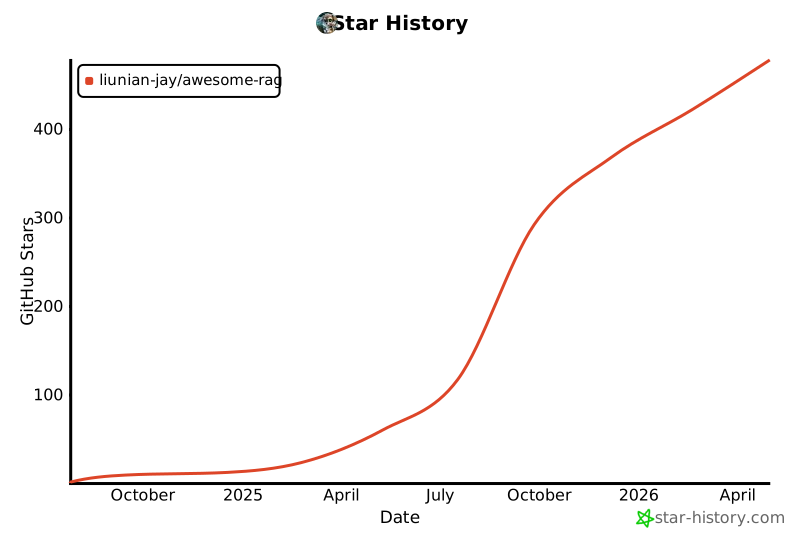](https://www.star-history.com/#liunian-Jay/Awesome-RAG&Date)\n\nWelcome to communicate with us by email at jiangyijcx@163.com\n"
}
]