Showing preview only (220K chars total). Download the full file or copy to clipboard to get everything.
Repository: newsnowlabs/runcvm
Branch: main
Commit: 1ec8d38f6596
Files: 46
Total size: 206.9 KB
Directory structure:
gitextract_f_pznfpt/

├── .dockerignore
├── .gitignore
├── Dockerfile
├── LICENSE
├── README.md
├── build/
│   └── build.sh
├── build-utils/
│   ├── entrypoint-install.sh
│   └── make-bundelf-bundle.sh
├── kernels/
│   └── oraclelinux/
│       ├── 95virtiofs/
│       │   ├── module-setup.sh
│       │   ├── mount-virtiofs.sh
│       │   └── parse-virtiofs.sh
│       └── addvirtiofs.conf
├── patches/
│   ├── dnsmasq/
│   │   └── remove-passwd-requirement.patch
│   ├── dropbear/
│   │   └── runcvm.patch
│   ├── mkinitfs/
│   │   └── nlplug-findfs.patch
│   └── seabios/
│       └── qemu-fw-cfg-fix.patch
├── qemu-exit/
│   └── qemu-exit.c
├── runcvm-init/
│   ├── VERSION.h
│   └── dumb-init.c
├── runcvm-scripts/
│   ├── functions/
│   │   └── cgroupfs
│   ├── runcvm-ctr-defaults
│   ├── runcvm-ctr-entrypoint
│   ├── runcvm-ctr-exec
│   ├── runcvm-ctr-exit
│   ├── runcvm-ctr-qemu
│   ├── runcvm-ctr-qemu-ifdown
│   ├── runcvm-ctr-qemu-ifup
│   ├── runcvm-ctr-qemu-poweroff
│   ├── runcvm-ctr-shutdown
│   ├── runcvm-ctr-virtiofsd
│   ├── runcvm-install-runtime.sh
│   ├── runcvm-ip-functions
│   ├── runcvm-runtime
│   ├── runcvm-vm-exec
│   ├── runcvm-vm-init
│   ├── runcvm-vm-qemu-ga
│   ├── runcvm-vm-start
│   └── runcvm-vm-start-wrapper
└── tests/
    ├── 00-http-docker-swarm/
    │   ├── node/
    │   │   ├── Dockerfile
    │   │   └── docker.sh
    │   └── test
    ├── 01-mariadb/
    │   └── test
    ├── 02-user-workdir/
    │   └── test
    ├── 03-env/
    │   └── test
    ├── framework.sh
    └── run
================================================
FILE CONTENTS
================================================
================================================
FILE: .dockerignore
================================================
# Ignore files matching the following patterns within docker build
**/*~
depot.json
================================================
FILE: .gitignore
================================================
.#*
*~
*.bak
*.o
*.version
*.orig
*.tdy
TAGS
\#*\#
.packlist
perllocal.pod
.c9
.Trash-1000
.vscode
depot.json
================================================
FILE: Dockerfile
================================================
# syntax=docker/dockerfile:1.3-labs
# Alpine version to build with
ARG ALPINE_VERSION=3.19
# --- BUILD STAGE ---
# Build base alpine-sdk image for later build stages
FROM alpine:$ALPINE_VERSION as alpine-sdk
RUN apk update && apk add --no-cache alpine-sdk coreutils && \
abuild-keygen -an && \
# Copy the public keys to the system keys
cp -a /root/.abuild/*.pub /etc/apk/keys && \
git clone --depth 1 --single-branch --filter=blob:none --sparse https://gitlab.alpinelinux.org/alpine/aports.git ~/aports && \
cd ~/aports/ && \
git sparse-checkout set main/seabios main/
# --- BUILD STAGE ---
# Build patched SeaBIOS packages
# to allow disabling of BIOS output by QEMU
# (without triggering QEMU warnings)
FROM alpine-sdk as alpine-seabios
ADD patches/seabios/qemu-fw-cfg-fix.patch /root/aports/main/seabios/0003-qemu-fw-cfg-fix.patch
RUN <<EOF
set -e
cd /root/aports/main/seabios
echo 'sha512sums="${sha512sums}$(sha512sum 0003-qemu-fw-cfg-fix.patch)"' >>APKBUILD
echo 'source="${source}0003-qemu-fw-cfg-fix.patch"' >>APKBUILD
abuild -rFf
EOF
# --- BUILD STAGE ---
# Build patched dnsmasq
# that does not require /etc/passwd file to run
# (needed for images such as hello-world)
FROM alpine-sdk as alpine-dnsmasq
ADD patches/dnsmasq/remove-passwd-requirement.patch /root/aports/main/dnsmasq/remove-passwd-requirement.patch
RUN <<EOF
set -e
cd /root/aports/main/dnsmasq
echo 'sha512sums="${sha512sums}$(sha512sum remove-passwd-requirement.patch)"' >>APKBUILD
echo 'source="${source}remove-passwd-requirement.patch"' >>APKBUILD
abuild -rFf
EOF
# --- BUILD STAGE ---
# Build patched dropbear with epka plugin
# that does not require /etc/passwd or PAM to run
FROM alpine-sdk as alpine-dropbear
ADD patches/dropbear/runcvm.patch /root/aports/main/dropbear/runcvm.patch
RUN <<EOF
set -e
cd /root/aports/main/dropbear
sed -ri '/--disable-pututline/a --enable-plugin \\' APKBUILD
echo 'sha512sums="${sha512sums}$(sha512sum runcvm.patch)"' >>APKBUILD
echo 'source="${source}runcvm.patch"' >>APKBUILD
abuild -rFf
cd /root
git clone https://github.com/fabriziobertocci/dropbear-epka.git
cd dropbear-epka
apk add --no-cache automake autoconf libtool
libtoolize --force
aclocal
autoheader || true
automake --force-missing --add-missing
autoconf
./configure
make install
EOF
# --- BUILD STAGE ---
# Build patched mkinitfs/nlplug-findfs
# with shorter timeout for speedier boot (saving ~4s)
FROM alpine-sdk as alpine-mkinitfs
ADD patches/mkinitfs/nlplug-findfs.patch /root/aports/main/mkinitfs/nlplug-findfs.patch
RUN <<EOF
set -e
cd /root/aports/main/mkinitfs
echo 'sha512sums="${sha512sums}$(sha512sum nlplug-findfs.patch)"' >>APKBUILD
echo 'source="${source} nlplug-findfs.patch"' >>APKBUILD
abuild -rFf
EOF
# --- BUILD STAGE ---
# Build dist-independent dynamic binaries and libraries
FROM alpine:$ALPINE_VERSION as binaries
RUN apk update && \
apk add --no-cache file bash qemu-system-x86_64 qemu-virtiofsd qemu-ui-curses qemu-guest-agent \
qemu-hw-display-virtio-vga \
ovmf \
jq iproute2 netcat-openbsd e2fsprogs blkid util-linux \
s6 dnsmasq iptables nftables \
ncurses coreutils \
patchelf
# Install patched SeaBIOS
COPY --from=alpine-seabios /root/packages/main/x86_64 /tmp/seabios/
RUN apk add --allow-untrusted /tmp/seabios/*.apk && cp -a /usr/share/seabios/bios*.bin /usr/share/qemu/
# Install patched dnsmasq
COPY --from=alpine-dnsmasq /root/packages/main/x86_64 /tmp/dnsmasq/
RUN apk add --allow-untrusted /tmp/dnsmasq/dnsmasq-2*.apk /tmp/dnsmasq/dnsmasq-common*.apk
# Install patched dropbear
COPY --from=alpine-dropbear /root/packages/main/x86_64 /usr/local/lib/libepka_file.so /tmp/dropbear/
RUN apk add --allow-untrusted /tmp/dropbear/dropbear-ssh*.apk /tmp/dropbear/dropbear-dbclient*.apk /tmp/dropbear/dropbear-2*.apk
# Patch the binaries and set up symlinks
COPY build-utils/make-bundelf-bundle.sh /usr/local/bin/make-bundelf-bundle.sh
ENV BUNDELF_BINARIES="busybox bash jq ip nc mke2fs blkid findmnt dnsmasq xtables-legacy-multi nft xtables-nft-multi nft mount s6-applyuidgid qemu-system-x86_64 qemu-ga /usr/lib/qemu/virtiofsd tput coreutils getent dropbear dbclient dropbearkey"
ENV BUNDELF_EXTRA_LIBS="/usr/lib/xtables /usr/libexec/coreutils /tmp/dropbear/libepka_file.so /usr/lib/qemu/*.so"
ENV BUNDELF_EXTRA_SYSTEM_LIB_PATHS="/usr/lib/xtables"
ENV BUNDELF_CODE_PATH="/opt/runcvm"
ENV BUNDELF_EXEC_PATH="/.runcvm/guest"
RUN /usr/local/bin/make-bundelf-bundle.sh --bundle && \
mkdir -p $BUNDELF_CODE_PATH/bin && \
cd $BUNDELF_CODE_PATH/bin && \
for cmd in \
awk base64 cat chgrp chmod cut grep head hostname init ln ls \
mkdir poweroff ps rm rmdir route sh sysctl tr touch; \
do \
ln -s busybox $cmd; \
done && \
mkdir -p $BUNDELF_CODE_PATH/usr/share && \
cp -a /usr/share/qemu $BUNDELF_CODE_PATH/usr/share && \
cp -a /etc/terminfo $BUNDELF_CODE_PATH/usr/share && \
cp -a /usr/share/OVMF $BUNDELF_CODE_PATH/usr/share && \
# Remove setuid/setgid bits from any/all binaries
chmod -R -s $BUNDELF_CODE_PATH/
# --- BUILD STAGE ---
# Build static runcvm-init
FROM alpine:$ALPINE_VERSION as runcvm-init
RUN apk update && \
apk add --no-cache gcc musl-dev
ADD runcvm-init /root/runcvm-init
RUN cd /root/runcvm-init && cc -o /root/runcvm-init/runcvm-init -std=gnu99 -static -s -Wall -Werror -O3 dumb-init.c
# --- BUILD STAGE ---
# Build static qemu-exit
FROM alpine:$ALPINE_VERSION as qemu-exit
RUN apk update && \
apk add --no-cache gcc musl-dev
ADD qemu-exit /root/qemu-exit
RUN cd /root/qemu-exit && cc -o /root/qemu-exit/qemu-exit -std=gnu99 -static -s -Wall -Werror -O3 qemu-exit.c
# --- BUILD STAGE ---
# Build alpine kernel and initramfs with virtiofs module
FROM alpine:$ALPINE_VERSION as alpine-kernel
# Install patched mkinitfs
COPY --from=alpine-mkinitfs /root/packages/main/x86_64 /tmp/mkinitfs/
RUN apk add --allow-untrusted /tmp/mkinitfs/*.apk
RUN apk add --no-cache linux-virt
RUN echo 'kernel/fs/fuse/virtiofs*' >>/etc/mkinitfs/features.d/virtio.modules && \
sed -ri 's/\b(ata|nvme|raid|scsi|usb|cdrom|kms|mmc)\b//g; s/[ ]+/ /g' /etc/mkinitfs/mkinitfs.conf && \
sed -ri 's/(nlplug-findfs)/\1 --timeout=1000/' /usr/share/mkinitfs/initramfs-init && \
mkinitfs $(basename $(ls -d /lib/modules/*))
RUN BASENAME=$(basename $(ls -d /lib/modules/*)) && \
mkdir -p /opt/runcvm/kernels/alpine/$BASENAME && \
cp -a /boot/vmlinuz-virt /opt/runcvm/kernels/alpine/$BASENAME/vmlinuz && \
cp -a /boot/initramfs-virt /opt/runcvm/kernels/alpine/$BASENAME/initrd && \
cp -a /lib/modules/ /opt/runcvm/kernels/alpine/$BASENAME/ && \
cp -a /boot/config-virt /opt/runcvm/kernels/alpine/$BASENAME/modules/$BASENAME/config && \
chmod -R u+rwX,g+rX,o+rX /opt/runcvm/kernels/alpine
FROM alpine-kernel as openwrt-kernel
RUN mkdir -p /opt/runcvm/kernels/openwrt/$(basename $(ls -d /lib/modules/*))/modules/$(basename $(ls -d /lib/modules/*)) && \
cd /opt/runcvm/kernels/openwrt/$(basename $(ls -d /lib/modules/*)) && \
cp -a /boot/vmlinuz-virt vmlinuz && \
cp -a /boot/initramfs-virt initrd && \
find /lib/modules/ -type f -name '*.ko*' -exec cp -a {} modules/$(basename $(ls -d /lib/modules/*)) \; && \
gunzip modules/$(basename $(ls -d /lib/modules/*))/*.gz && \
chmod -R u+rwX,g+rX,o+rX /opt/runcvm/kernels/openwrt
# --- BUILD STAGE ---
# Build Debian bookworm kernel and initramfs with virtiofs module
FROM amd64/debian:bookworm as debian-kernel
ARG DEBIAN_FRONTEND=noninteractive
RUN apt update && apt install -y linux-image-amd64:amd64 && \
echo 'virtiofs' >>/etc/initramfs-tools/modules && \
echo 'virtio_console' >>/etc/initramfs-tools/modules && \
echo "RESUME=none" >/etc/initramfs-tools/conf.d/resume && \
update-initramfs -u
RUN BASENAME=$(basename $(ls -d /lib/modules/*)) && \
mkdir -p /opt/runcvm/kernels/debian/$BASENAME && \
cp -aL /vmlinuz /opt/runcvm/kernels/debian/$BASENAME/vmlinuz && \
cp -aL /initrd.img /opt/runcvm/kernels/debian/$BASENAME/initrd && \
cp -a /lib/modules/ /opt/runcvm/kernels/debian/$BASENAME/ && \
cp -a /boot/config-$BASENAME /opt/runcvm/kernels/debian/$BASENAME/modules/$BASENAME/config && \
chmod -R u+rwX,g+rX,o+rX /opt/runcvm/kernels/debian
# --- BUILD STAGE ---
# Build Ubuntu bullseye kernel and initramfs with virtiofs module
FROM amd64/ubuntu:jammy as ubuntu-kernel
ARG DEBIAN_FRONTEND=noninteractive
RUN apt update && apt install -y linux-generic:amd64 && \
echo 'virtiofs' >>/etc/initramfs-tools/modules && \
echo 'virtio_console' >>/etc/initramfs-tools/modules && \
echo "RESUME=none" >/etc/initramfs-tools/conf.d/resume && \
update-initramfs -u
RUN BASENAME=$(basename $(ls -d /lib/modules/*)) && \
mkdir -p /opt/runcvm/kernels/ubuntu/$BASENAME && \
cp -aL /boot/vmlinuz /opt/runcvm/kernels/ubuntu/$BASENAME/vmlinuz && \
cp -aL /boot/initrd.img /opt/runcvm/kernels/ubuntu/$BASENAME/initrd && \
cp -a /lib/modules/ /opt/runcvm/kernels/ubuntu/$BASENAME/ && \
cp -a /boot/config-$BASENAME /opt/runcvm/kernels/ubuntu/$BASENAME/modules/$BASENAME/config && \
chmod -R u+rwX,g+rX,o+rX /opt/runcvm/kernels/ubuntu
# --- BUILD STAGE ---
# Build Oracle Linux kernel and initramfs with virtiofs module
FROM oraclelinux:9 as oracle-kernel
RUN dnf install -y kernel
ADD ./kernels/oraclelinux/addvirtiofs.conf /etc/dracut.conf.d/addvirtiofs.conf
ADD ./kernels/oraclelinux/95virtiofs /usr/lib/dracut/modules.d/95virtiofs
RUN dracut --force --kver $(basename /lib/modules/*) --kmoddir /lib/modules/*
RUN mkdir -p /opt/runcvm/kernels/ol/$(basename $(ls -d /lib/modules/*)) && \
mv /lib/modules/*/vmlinuz /opt/runcvm/kernels/ol/$(basename $(ls -d /lib/modules/*))/vmlinuz && \
cp -aL /boot/initramfs* /opt/runcvm/kernels/ol/$(basename $(ls -d /lib/modules/*))/initrd && \
cp -a /lib/modules/ /opt/runcvm/kernels/ol/$(basename $(ls -d /lib/modules/*))/ && \
chmod -R u+rwX,g+rX,o+rX /opt/runcvm/kernels/ol
# --- BUILD STAGE ---
# Build RunCVM installer
FROM alpine:$ALPINE_VERSION as installer
COPY --from=binaries /opt/runcvm /opt/runcvm
COPY --from=runcvm-init /root/runcvm-init/runcvm-init /opt/runcvm/sbin/
COPY --from=qemu-exit /root/qemu-exit/qemu-exit /opt/runcvm/sbin/
RUN apk update && apk add --no-cache rsync
ADD runcvm-scripts /opt/runcvm/scripts/
ADD build-utils/entrypoint-install.sh /
ENTRYPOINT ["/entrypoint-install.sh"]
# Install needed kernels.
# Comment out any kernels that are unneeded.
COPY --from=alpine-kernel /opt/runcvm/kernels/alpine /opt/runcvm/kernels/alpine
COPY --from=debian-kernel /opt/runcvm/kernels/debian /opt/runcvm/kernels/debian
COPY --from=openwrt-kernel /opt/runcvm/kernels/openwrt /opt/runcvm/kernels/openwrt
COPY --from=ubuntu-kernel /opt/runcvm/kernels/ubuntu /opt/runcvm/kernels/ubuntu
COPY --from=oracle-kernel /opt/runcvm/kernels/ol /opt/runcvm/kernels/ol
# Add 'latest' symlinks for available kernels
RUN for d in /opt/runcvm/kernels/*; do \
cd "$d" && \
tgt="$(ls -d */ 2>/dev/null | sed 's:/$::' | grep -v '^latest$' | sort -Vr | head -n 1)"; \
[ -n "$tgt" ] && ln -sfn "$tgt" latest; \
done
================================================
FILE: LICENSE
================================================
Apache License
Version 2.0, January 2004
http://www.apache.org/licenses/
TERMS AND CONDITIONS FOR USE, REPRODUCTION, AND DISTRIBUTION
1. Definitions.
"License" shall mean the terms and conditions for use, reproduction,
and distribution as defined by Sections 1 through 9 of this document.
"Licensor" shall mean the copyright owner or entity authorized by
the copyright owner that is granting the License.
"Legal Entity" shall mean the union of the acting entity and all
other entities that control, are controlled by, or are under common
control with that entity. For the purposes of this definition,
"control" means (i) the power, direct or indirect, to cause the
direction or management of such entity, whether by contract or
otherwise, or (ii) ownership of fifty percent (50%) or more of the
outstanding shares, or (iii) beneficial ownership of such entity.
"You" (or "Your") shall mean an individual or Legal Entity
exercising permissions granted by this License.
"Source" form shall mean the preferred form for making modifications,
including but not limited to software source code, documentation
source, and configuration files.
"Object" form shall mean any form resulting from mechanical
transformation or translation of a Source form, including but
not limited to compiled object code, generated documentation,
and conversions to other media types.
"Work" shall mean the work of authorship, whether in Source or
Object form, made available under the License, as indicated by a
copyright notice that is included in or attached to the work
(an example is provided in the Appendix below).
"Derivative Works" shall mean any work, whether in Source or Object
form, that is based on (or derived from) the Work and for which the
editorial revisions, annotations, elaborations, or other modifications
represent, as a whole, an original work of authorship. For the purposes
of this License, Derivative Works shall not include works that remain
separable from, or merely link (or bind by name) to the interfaces of,
the Work and Derivative Works thereof.
"Contribution" shall mean any work of authorship, including
the original version of the Work and any modifications or additions
to that Work or Derivative Works thereof, that is intentionally
submitted to Licensor for inclusion in the Work by the copyright owner
or by an individual or Legal Entity authorized to submit on behalf of
the copyright owner. For the purposes of this definition, "submitted"
means any form of electronic, verbal, or written communication sent
to the Licensor or its representatives, including but not limited to
communication on electronic mailing lists, source code control systems,
and issue tracking systems that are managed by, or on behalf of, the
Licensor for the purpose of discussing and improving the Work, but
excluding communication that is conspicuously marked or otherwise
designated in writing by the copyright owner as "Not a Contribution."
"Contributor" shall mean Licensor and any individual or Legal Entity
on behalf of whom a Contribution has been received by Licensor and
subsequently incorporated within the Work.
2. Grant of Copyright License. Subject to the terms and conditions of
this License, each Contributor hereby grants to You a perpetual,
worldwide, non-exclusive, no-charge, royalty-free, irrevocable
copyright license to reproduce, prepare Derivative Works of,
publicly display, publicly perform, sublicense, and distribute the
Work and such Derivative Works in Source or Object form.
3. Grant of Patent License. Subject to the terms and conditions of
this License, each Contributor hereby grants to You a perpetual,
worldwide, non-exclusive, no-charge, royalty-free, irrevocable
(except as stated in this section) patent license to make, have made,
use, offer to sell, sell, import, and otherwise transfer the Work,
where such license applies only to those patent claims licensable
by such Contributor that are necessarily infringed by their
Contribution(s) alone or by combination of their Contribution(s)
with the Work to which such Contribution(s) was submitted. If You
institute patent litigation against any entity (including a
cross-claim or counterclaim in a lawsuit) alleging that the Work
or a Contribution incorporated within the Work constitutes direct
or contributory patent infringement, then any patent licenses
granted to You under this License for that Work shall terminate
as of the date such litigation is filed.
4. Redistribution. You may reproduce and distribute copies of the
Work or Derivative Works thereof in any medium, with or without
modifications, and in Source or Object form, provided that You
meet the following conditions:
(a) You must give any other recipients of the Work or
Derivative Works a copy of this License; and
(b) You must cause any modified files to carry prominent notices
stating that You changed the files; and
(c) You must retain, in the Source form of any Derivative Works
that You distribute, all copyright, patent, trademark, and
attribution notices from the Source form of the Work,
excluding those notices that do not pertain to any part of
the Derivative Works; and
(d) If the Work includes a "NOTICE" text file as part of its
distribution, then any Derivative Works that You distribute must
include a readable copy of the attribution notices contained
within such NOTICE file, excluding those notices that do not
pertain to any part of the Derivative Works, in at least one
of the following places: within a NOTICE text file distributed
as part of the Derivative Works; within the Source form or
documentation, if provided along with the Derivative Works; or,
within a display generated by the Derivative Works, if and
wherever such third-party notices normally appear. The contents
of the NOTICE file are for informational purposes only and
do not modify the License. You may add Your own attribution
notices within Derivative Works that You distribute, alongside
or as an addendum to the NOTICE text from the Work, provided
that such additional attribution notices cannot be construed
as modifying the License.
You may add Your own copyright statement to Your modifications and
may provide additional or different license terms and conditions
for use, reproduction, or distribution of Your modifications, or
for any such Derivative Works as a whole, provided Your use,
reproduction, and distribution of the Work otherwise complies with
the conditions stated in this License.
5. Submission of Contributions. Unless You explicitly state otherwise,
any Contribution intentionally submitted for inclusion in the Work
by You to the Licensor shall be under the terms and conditions of
this License, without any additional terms or conditions.
Notwithstanding the above, nothing herein shall supersede or modify
the terms of any separate license agreement you may have executed
with Licensor regarding such Contributions.
6. Trademarks. This License does not grant permission to use the trade
names, trademarks, service marks, or product names of the Licensor,
except as required for reasonable and customary use in describing the
origin of the Work and reproducing the content of the NOTICE file.
7. Disclaimer of Warranty. Unless required by applicable law or
agreed to in writing, Licensor provides the Work (and each
Contributor provides its Contributions) on an "AS IS" BASIS,
WITHOUT WARRANTIES OR CONDITIONS OF ANY KIND, either express or
implied, including, without limitation, any warranties or conditions
of TITLE, NON-INFRINGEMENT, MERCHANTABILITY, or FITNESS FOR A
PARTICULAR PURPOSE. You are solely responsible for determining the
appropriateness of using or redistributing the Work and assume any
risks associated with Your exercise of permissions under this License.
8. Limitation of Liability. In no event and under no legal theory,
whether in tort (including negligence), contract, or otherwise,
unless required by applicable law (such as deliberate and grossly
negligent acts) or agreed to in writing, shall any Contributor be
liable to You for damages, including any direct, indirect, special,
incidental, or consequential damages of any character arising as a
result of this License or out of the use or inability to use the
Work (including but not limited to damages for loss of goodwill,
work stoppage, computer failure or malfunction, or any and all
other commercial damages or losses), even if such Contributor
has been advised of the possibility of such damages.
9. Accepting Warranty or Additional Liability. While redistributing
the Work or Derivative Works thereof, You may choose to offer,
and charge a fee for, acceptance of support, warranty, indemnity,
or other liability obligations and/or rights consistent with this
License. However, in accepting such obligations, You may act only
on Your own behalf and on Your sole responsibility, not on behalf
of any other Contributor, and only if You agree to indemnify,
defend, and hold each Contributor harmless for any liability
incurred by, or claims asserted against, such Contributor by reason
of your accepting any such warranty or additional liability.
END OF TERMS AND CONDITIONS
APPENDIX: How to apply the Apache License to your work.
To apply the Apache License to your work, attach the following
boilerplate notice, with the fields enclosed by brackets "[]"
replaced with your own identifying information. (Don't include
the brackets!) The text should be enclosed in the appropriate
comment syntax for the file format. We also recommend that a
file or class name and description of purpose be included on the
same "printed page" as the copyright notice for easier
identification within third-party archives.
Copyright [yyyy] [name of copyright owner]
Licensed under the Apache License, Version 2.0 (the "License");
you may not use this file except in compliance with the License.
You may obtain a copy of the License at
http://www.apache.org/licenses/LICENSE-2.0
Unless required by applicable law or agreed to in writing, software
distributed under the License is distributed on an "AS IS" BASIS,
WITHOUT WARRANTIES OR CONDITIONS OF ANY KIND, either express or implied.
See the License for the specific language governing permissions and
limitations under the License.
================================================
FILE: README.md
================================================
# RunCVM Container Runtime
## Introduction
RunCVM (Run Container Virtual Machine) is an experimental open-source Docker container runtime for Linux, created by Struan Bartlett at NewsNow Labs, that makes launching standard containerised workloads and system workloads (e.g. Systemd, Docker, even OpenWrt) in VMs as easy as launching a container.
<p align="center">
<a title="Click to view on Asciinema" href="https://asciinema.org/a/630469" target="_blank"><img src="https://github.com/newsnowlabs/runcvm/assets/354555/7b1a7c87-5444-4a7e-bac6-75607382571e" alt="Install RunCVM and then launch an Alpine Container/VM" width="900"></a>
<br clear="all" />
<a title="Click to view on Asciinema" href="https://asciinema.org/a/630469" target="_blank">View on Asciinema</a>
</p>
## Quick start
Install:
```sh
curl -s -o - https://raw.githubusercontent.com/newsnowlabs/runcvm/main/runcvm-scripts/runcvm-install-runtime.sh | sudo sh
```
Now launch an nginx VM listening on port 8080:
```console
docker run --runtime=runcvm --name nginx1 --rm -p 8080:80 nginx
```
Launch a MariaDB VM, with 2 cpus and 2G memory, listening on port 3306:
```console
docker run --runtime=runcvm --name mariadb1 --rm -p 3306:3306 --cpus 2 --memory 2G --env=MARIADB_ALLOW_EMPTY_ROOT_PASSWORD=1 mariadb
```
Launch a vanilla ubuntu VM, with interactive terminal:
```console
docker run --runtime=runcvm --name ubuntu1 --rm -it ubuntu
```
Gain another interactive console on `ubuntu1`:
```console
docker exec -it ubuntu1 bash
```
Launch with VNC:
```console
docker run --runtime=runcvm --name ubuntu2 --env=RUNCVM_DISPLAY_MODE=vnc -p 5900:5900 ubuntu
```
Launch a VM with 1G memory and a 1G ext4-formatted backing file mounted at `/var/lib/docker` and stored in the underlying container's filesystem:
```console
docker run -it --runtime=runcvm --memory=1G --env=RUNCVM_DISKS=/disks/docker,/var/lib/docker,ext4,1G <docker-image>
```
Launch a VM with 2G memory and a 5G ext4-formatted backing file mounted at `/var/lib/docker` and stored in a dedicated Docker volume on the host:
```console
docker run -it --runtime=runcvm --memory=2G --mount=type=volume,src=runcvm-disks,dst=/disks --env=RUNCVM_DISKS=/disks/docker,/var/lib/docker,ext4,5G <docker-image>
```
Launch a 3-node Docker Swarm on a network with 9000 MTU and, on the swarm, an http global service:
```console
git clone https://github.com/newsnowlabs/runcvm.git && \
cd runcvm/tests/00-http-docker-swarm && \
NODES=3 MTU=9000 ./test
```
### Graphical workloads with VNC
Launch Ubuntu:
```console
cat <<EOF | docker build --tag=ubuntu-x -
FROM ubuntu:jammy
ENV DEBIAN_FRONTEND=noninteractive
RUN apt update && apt -y install --install-recommends apt-utils kmod wget iproute2 systemd ca-certificates curl gnupg udev dbus lightdm
ENTRYPOINT ["/lib/systemd/systemd"]
ENV RUNCVM_DISPLAY_MODE=vnc
EOF
docker run -d --runtime=runcvm -m 2g --name=vnc -p 5900:5900 ubuntu-x
```
### System workloads
**Docker+Sysbox runtime demo** - Launch Ubuntu running Systemd and Docker with [Sysbox](https://github.com/nestybox/sysbox) runtime; then within it run an Alpine _Sysbox_ container; and, _within that_ install dockerd and run a container from the 'hello-world' image:
```console
cat <<EOF | docker build --tag=ubuntu-docker-sysbox -
FROM ubuntu:jammy
RUN apt update && apt -y install apt-utils kmod wget iproute2 systemd \
ca-certificates curl gnupg udev dbus && \
curl -fsSL https://get.docker.com | bash
RUN wget -O /tmp/sysbox.deb \
https://downloads.nestybox.com/sysbox/releases/v0.6.2/sysbox-ce_0.6.2-0.linux_amd64.deb && \
apt -y install /tmp/sysbox.deb
ENTRYPOINT ["/lib/systemd/systemd"]
ENV RUNCVM_DISKS='/disks/docker,/var/lib/docker,ext4,1G;/disks/sysbox,/var/lib/sysbox,ext4,1G'
VOLUME /disks
EOF
docker run -d --runtime=runcvm -m 2g --name=ubuntu-docker-sysbox ubuntu-docker-sysbox
docker exec ubuntu-docker-sysbox bash -c "docker run --rm --runtime=sysbox-runc alpine ash -x -c 'apk add docker; dockerd &>/dev/null & sleep 5; docker run --rm hello-world'"
docker rm -fv ubuntu-docker-sysbox
```
- [Watch on Asciinema](https://asciinema.org/a/630032)
**Nested RunCVM demo** - Launch Ubuntu running Systemd and Docker with RunCVM runtime installed; then within it run an Alpine _RunCVM_ Container/VM; and, within that install dockerd and, _within that_, run a container from the 'hello-world' image:
```console
cat <<EOF | docker build --tag=ubuntu-docker-runcvm -
FROM ubuntu:jammy
RUN apt update && apt -y install apt-utils kmod wget iproute2 systemd \
ca-certificates curl gnupg udev dbus && \
curl -fsSL https://get.docker.com | bash
COPY --from=newsnowlabs/runcvm:latest /opt /opt/
RUN rm -f /etc/init.d/docker && \
bash /opt/runcvm/scripts/runcvm-install-runtime.sh --no-dockerd && \
echo kvm_intel >>/etc/modules
ENTRYPOINT ["/lib/systemd/systemd"]
ENV RUNCVM_DISKS='/disks/docker,/var/lib/docker,ext4,1G'
VOLUME /disks
EOF
docker run -d --runtime=runcvm -m 2g --name=ubuntu-docker-runcvm ubuntu-docker-runcvm
docker exec ubuntu-docker-runcvm bash -c "docker run --rm --runtime=runcvm alpine ash -x -c 'apk add docker; dockerd &>/dev/null & sleep 5; docker run --rm hello-world'"
docker rm -fv ubuntu-docker-runcvm
```
**Docker+GVisor runtime demo** - Launch Ubuntu running Systemd and Docker with GVisor runtime; then within it run the 'hello-world' image in a _GVisor_ container:
```console
cat <<EOF | docker build --tag=ubuntu-docker-gvisor -
FROM ubuntu:jammy
RUN apt update && apt -y install apt-utils kmod wget iproute2 systemd \
ca-certificates curl gnupg udev dbus jq && \
curl -fsSL https://get.docker.com | bash
RUN curl -fsSL https://gvisor.dev/archive.key | gpg --dearmor -o /usr/share/keyrings/gvisor-archive-keyring.gpg
RUN echo "deb [arch=amd64 signed-by=/usr/share/keyrings/gvisor-archive-keyring.gpg] https://storage.googleapis.com/gvisor/releases release main" >/etc/apt/sources.list.d/gvisor.list && \
apt update && \
apt-get install -y runsc
RUN [ ! -f /etc/docker/daemon.json ] && echo '{}' > /etc/docker/daemon.json; cat /etc/docker/daemon.json | jq '.runtimes.runsc.path="/usr/bin/runsc"' | tee /etc/docker/daemon.json
ENTRYPOINT ["/lib/systemd/systemd"]
ENV RUNCVM_DISKS='/disks/docker,/var/lib/docker,ext4,1G'
VOLUME /disks
EOF
docker run -d --runtime=runsc -m 2g --name=ubuntu-docker-gvisor ubuntu-docker-gvisor
docker exec ubuntu-docker-gvisor bash -c "docker run --rm --runtime=runsc hello-world"
docker rm -fv ubuntu-docker-gvisor
```
**Launch [OpenWrt](https://openwrt.org/)** - with port forward to LuCI web UI on port 10080:
```console
docker import --change='ENTRYPOINT ["/sbin/init"]' https://archive.openwrt.org/releases/23.05.2/targets/x86/generic/openwrt-23.05.2-x86-generic-rootfs.tar.gz openwrt-23.05.2 && \
docker network create --subnet 172.128.0.0/24 runcvm-openwrt && \
echo -e "config interface 'loopback'\n\toption device 'lo'\n\toption proto 'static'\n\toption ipaddr '127.0.0.1'\n\toption netmask '255.0.0.0'\n\nconfig device\n\toption name 'br-lan'\n\toption type 'bridge'\n\tlist ports 'eth0'\n\nconfig interface 'lan'\n\toption device 'br-lan'\n\toption proto 'static'\n\toption ipaddr '172.128.0.5'\n\toption netmask '255.255.255.0'\n\toption gateway '172.128.0.1'\n" >/tmp/runcvm-openwrt-network && \
docker run -it --rm --runtime=runcvm --name=openwrt --network=runcvm-openwrt --ip=172.128.0.5 -v /tmp/runcvm-openwrt-network:/etc/config/network -p 10080:80 openwrt-23.05.2
```
- [Watch on Asciinema](https://asciinema.org/a/631857)
## RunCVM-in-Portainer walk-through
[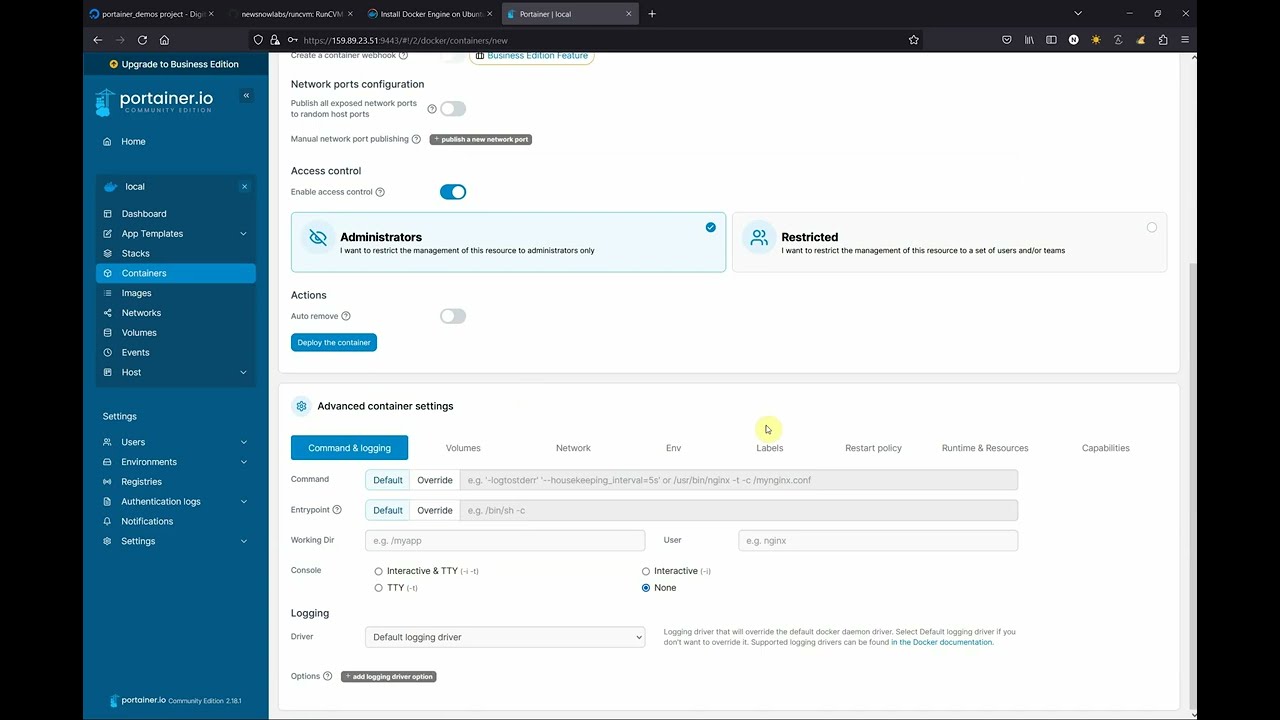](https://www.youtube.com/watch?v=OENaWDlCWKg "Playing around with RunCVM, a docker runtime plugin")
## Motivation
RunCVM was born out of difficulties experienced using the Docker and Podman CLIs to launch [Kata Containers v2](https://katacontainers.io/), and a belief that launching containerised workloads in VMs using Docker needn't be so complicated.
> Motivations included: efforts to [re-add OCI CLI commands for docker/podman](https://github.com/kata-containers/kata-containers/issues/722) to Kata v2 to support Docker & Podman; other Kata issues [#3358](https://github.com/kata-containers/kata-containers/issues/3358), [#1123](https://github.com/kata-containers/kata-containers/issues/1123), [#1133](https://github.com/kata-containers/kata-containers/issues/1133), [#3038](https://github.com/kata-containers/runtime/issues/3038); [#5321](https://github.com/kata-containers/runtime/issues/5321); [#6861](https://github.com/kata-containers/runtime/issues/6861); Podman issues [#8579](https://github.com/containers/podman/issues/8579) and [#17070](https://github.com/containers/podman/issues/17070); and Kubernetes issue [#40114](https://github.com/kubernetes/website/issues/40114); though please note, since authoring RunCVM some of these issues may have been resolved.
Like Kata, RunCVM aims to be a secure container runtime with lightweight virtual machines that feel and perform like containers, but provide stronger workload isolation using hardware virtualisation technology.
However, while Kata aims to launch standard container images inside a restricted-privileges namespace inside a VM running a single fixed and heavily customised kernel and Linux distribution optimised for this purpose, RunCVM intentionally aims to launch container _or VM_ images as the _VM's root filesystem_ using stock or bespoke Linux kernels, the upshot being RunCVM's can run VM workloads that Kata's security and kernel model would explicitly prevent.
For example:
- RunCVM can launch system images expecting to interface directly with hardware, like [OpenWRT](https://openwrt.org/)
- RunCVM can launch VMs nested inside a RunCVM VM - i.e. an 'inner' RunCVM Container/VM guest can be launched by Docker running within an 'outer' RunCVM Container/VM guest (assuming the host supports nested VMs) - in this sense, RunCVM is 'reentrant'.
RunCVM features:
- Compatible with `docker run` (with experimental support for `podman run`).
- Uses a lightweight 'wrapper-runtime' technology that subverts the behaviour of the standard container runtime `runc` to cause a VM to be launched within the container (making its code footprint and external dependencies extremely small, and its internals extremely simple and easy to understand and tailor for specific purposes).
- Highly portable among Linux distributions and development platforms providing KVM. Can even be installed on [GitHub Codespaces](https://github.com/features/codespaces)!
- Written, using off-the-shelf open-source components, almost entirely in shell script for simplicity, portability and ease of development.
> RunCVM makes some trade-offs in return for this simplicity. See the full list of [features and limitations](#features-and-limitations).
## Contents
- [Introduction](#introduction)
- [Quick start](#quick-start)
- [Motivation](#motivation)
- [Licence](#licence)
- [Project aims](#project-aims)
- [Project ambitions](#project-ambitions)
- [Applications for RunCVM](#applications-for-runcvm)
- [How RunCVM works](#how-runcvm-works)
- [System requirements](#system-requirements)
- [Installation](#installation)
- [Upgrading](#upgrading)
- [Features and Limitations](#features-and-limitations)
- [RunCVM vs Kata comparison](#runcvm-vs-kata-comparison)
- [Kernel selection](#kernel-selection)
- [Option reference](#option-reference)
- [Advanced usage](#advanced-usage)
- [Developing](#developing)
- [Building](#building)
- [Testing](#testing)
- [Contributing](#contributing)
- [Support](#support)
- [Uninstallation](#uninstallation)
- [Legals](#Legals)
## Licence
RunCVM is free and open-source, licensed under the Apache Licence, Version 2.0. See the [LICENSE](LICENSE) file for details.
## Project aims
- Run any standard container workload in a VM using `docker run` with no need to customise images or the command line (except adding `--runtime=runcvm`)
- Run unusual container workloads, like `dockerd` and `systemd` that will not run in standard container runtimes
- Maintain a similar experience within a RunCVM VM as within a container: process table, network interfaces, stdio, exit code handling should be broadly similar to maximise compatibility
- Container start/stop/kill semantics respected, where possible providing clean VM shutdown on stop
- VM console accessible as one would expect using `docker run -it`, `docker start -ai` and `docker attach` (and so on), generally good support for other `docker container` subcommands
- Efficient container startup, by using virtiofs to serve a container's filesystem directly to a VM (instead of unpacking an image into a backing file)
- Improved security compared to the standard container runtime, and as much security as possible without compromising the simplicity of the implementation
- Command-line and image-embedded options for customising the a container's VM specifications, devices, kernel
- Intelligent kernel selection, according to the distribution used in the image being launched
- No external dependencies, except for Docker/Podman and relevant Linux kernel modules (`kvm` and `tun`)
- Support multiple Docker network interfaces attached to a created (but not yet running) container using `docker run --network=<network>` and `docker network connect` (excluding IPv6)
## Project ambitions
- Support for booting VM with a file-backed disk root fs generated from the container image, instead of only virtiofs root
- Support running foreign-architecture VMs by using QEMU dynamic CPU emulation for the entire VM (instead of the approach used by [https://github.com/multiarch/qemu-user-static](https://github.com/multiarch/qemu-user-static) which uses dynamic CPU emulation for each individual binary)
- Support for QEMU [microvm](https://qemu.readthedocs.io/en/latest/system/i386/microvm.html) or potentially Amazon Firecracker
- More natural console support with independent stdout and stderr channels for `docker run -it`
- Improve VM boot time and other behaviours using custom kernel
- Support for specific hardware e.g. graphics display served via VNC
## Applications for RunCVM
The main applications for RunCVM are:
1. Running and testing applications that:
- don't work with (or require enhanced privileges to work with) standard container runtimes (e.g. `systemd`, `dockerd`, Docker swarm services, [Kubernetes](https://kubernetes.io/))
- require a running kernel, or a kernel version or modules not available on the host
- require specific hardware that can be emulated e.g. disks, graphics displays
2. Running existing container workloads with increased security
3. Testing container workloads that are already intended to launch in VM environments, such as on [fly.io](https://fly.io)
4. Developing any of the above applications in [Dockside](https://dockside.io/) (see [RunCVM and Dockside](#runcvm-and-dockside))
## How RunCVM works
RunCVM's 'wrapper' runtime, `runcvm-runtime`, receives container create commands triggered by `docker` `run`/`create` commands, modifies the configuration of the requested container in such a way that the created container will launch a VM that boots from the container's filesystem, and then passes the request on to the standard container runtime (`runc`) to actually create and start the container.
For a deep dive into RunCVM's internals, see the section on [Developing RunCVM](#developing).
## System requirements
RunCVM should run on any amd64 (x86_64) hardware (or VM) running Linux Kernel >= 5.10, and that supports [KVM](https://www.linux-kvm.org/page/Main_Page) and [Docker](https://docker.com). So if your host can already run [KVM](https://www.linux-kvm.org/page/Main_Page) VMs and [Docker](https://docker.com) then it should run RunCVM.
RunCVM has no other host dependencies, apart from Docker (or experimentally, Podman) and the `kvm` and `tun` kernel modules. RunCVM comes packaged with all binaries and libraries it needs to run (including its own QEMU binary).
RunCVM is tested on Debian Bullseye and [GitHub Codespaces](https://github.com/codespaces/new?hide_repo_select=true&ref=main&repo=514606231).
### rp_filter sysctl settings
For RunCVM to support Docker DNS within Container/VMs, the following condition on `/proc/sys/net/ipv4/conf/` must be met:
- the max of `all/rp_filter` and `<bridge>/rp_filter` should be 0 ('No Source Validation') or 2 (Loose mode as defined in RFC3704 Loose Reverse Path)
(where `<bridge>` is any bridge underpinning a Docker network to which RunCVM Container/VMs will be attached)
This means that:
- if `all/rp_filter` will be set to 0, then `<bridge>/rp_filter` must be set to 0 or 2
(or, if `<bridge>` is not yet or might not yet have been created, then `default/rp_filter` must be set to 0 or 2)
- if `all/rp_filter` will be set to 1, then `<bridge>/rp_filter` must be set to 2
(or, if `<bridge>` is not yet or might not yet have been created, then `default/rp_filter` must be set to 2)
- if `all/rp_filter` will be set to 2, then no further action is needed
At time of writing:
- the Debian default is `0`;
- the Ubuntu default is `2`;
- the Google Cloud Debian image has default `1` and `rp_filter` settings in `/etc/sysctl.d/60-gce-network-security.conf` must be modified or overridden to support RunCVM.
We recommend `all/rp_filter` be set to 2, as this is the simplest change and provides a good balance of security.
## Installation
Run:
```sh
curl -s -o - https://raw.githubusercontent.com/newsnowlabs/runcvm/main/runcvm-scripts/runcvm-install-runtime.sh | sudo sh
```
This will:
- Install the RunCVM software package to `/opt/runcvm` (installation elsewhere is currently unsupported)
- For Docker support:
- Enable the RunCVM runtime, by patching `/etc/docker/daemon.json` to add `runcvm` to the `runtimes` property
- Restart `dockerd`, if it can be detected how for your system (e.g. `systemctl restart docker`)
- Verify that RunCVM is recognised via `docker info`
- For Podman support (experimental)
- Display instructions on patching `/etc/containers/containers.conf`
- Check your system network device `rp_filter` settings, and amend them if necessary
Following installation, launch a basic test RunCVM Container/VM:
```console
docker run --runtime=runcvm --rm -it hello-world
```
### Install on Google Cloud
Create an image that will allow instances to have VMX capability:
```console
gcloud compute images create debian-12-vmx --source-image-project=debian-cloud --source-image-family=debian-12 --licenses="https://compute.googleapis.com/compute/v1/projects/vm-options/global/licenses/enable-vmx"
```
Now launch a VM, install Docker and RunCVM:
```console
cat >/tmp/startup-script.sh <<EOF
#!/bin/bash
apt update && apt -y install apt-utils kmod wget iproute2 systemd \
ca-certificates curl gnupg udev dbus jq && \
mkdir -p /etc/docker && echo '{"userland-proxy": false}' >/etc/docker/daemon.json && \
curl -fsSL https://get.docker.com | bash && \
curl -s -o - https://raw.githubusercontent.com/newsnowlabs/runcvm/main/runcvm-scripts/runcvm-install-runtime.sh | sudo REPO=newsnowlabs/runcvm:latest sh
EOF
gcloud compute instances create runcvm-vmx-test --zone=us-central1-a --machine-type=n2-highmem-2 --network-interface=network-tier=PREMIUM,stack-type=IPV4_ONLY,subnet=default --metadata-from-file=startup-script=/tmp/startup-script.sh --no-restart-on-failure --maintenance-policy=TERMINATE --provisioning-model=SPOT --instance-termination-action=STOP --no-service-account --no-scopes --create-disk=auto-delete=yes,boot=yes,image=debian-12-vmx,mode=rw,size=50,type=pd-ssd --no-shielded-secure-boot --shielded-vtpm --shielded-integrity-monitoring --labels=goog-ec-src=vm_add-gcloud --reservation-affinity=any
```
## Upgrading
To upgrade, follow this procedure:
1. Stop all RunCVM containers.
2. Run `/opt/runcvm/scripts/runcvm-install-runtime.sh` (or rerun the installation command - which runs the same script)
3. Start any RunCVM containers.
## Features and limitations
In the below summary of RunCVM's current main features and limitations, [+] is used to indicate an area of compatibility with standard container runtimes and [-] is used indicate a feature of standard container runtimes that is unsupported.
> N.B. `docker run` and `docker exec` options not listed below are unsupported and their effect, if used, is unspecified.
- `docker run`
- Mounts
- [+] `--mount` (or `-v`) is supported for volume mounts, tmpfs mounts, and host file and directory bind-mounts (the `dst` mount path `/disks` is reserved)
- [-] Bind-mounting host sockets or devices, and `--device` is unsupported
- Networking
- [+] The default bridge network is supported
- [+] Custom/user-defined networks specified using `--network` are supported, including Docker DNS resolution of container names and respect for custom network MTU
- [+] Multiple network interfaces - when attached via `docker run --network` or `docker network connect` (but only to a created and not yet running container) - are supported (including `scope=overlay` networks and those with multiple subnets)
- [+] `--publish` (or `-p`) is supported
- [+] `--dns`, `--dns-option`, `--dns-search` are supported
- [+] `--ip` is supported
- [+] `--hostname` (or `-h`) is supported
- [-] `docker network connect` on a running container is not supported
- [-] `--network=host` and `--network=container:name|id` are not supported
- [-] IPv6 is not supported
- Execution environment
- [+] `--user` (or `-u`) is supported
- [?] `--workdir` (or `-w`) is supported
- [+] `--env` (or `-e`), `--env-file` is supported
- [+] `--entrypoint` is supported
- [+] `--init` - is supported (but runs RunCVM's own VM init process rather than Docker's default, `tini`)
- stdio/Terminals
- [+] `--detach` (or `-d`) is supported
- [+] `--interactive` (or `-i`) is supported
- [+] `--tty` (or `-t`) is supported (but to enter CTRL-T one must press CTRL-T twice)
- [+] `--attach` (or `-a`) is supported
- [+] Stdout and Stderr output should be broadly similar to running the same workload in a standard `runc` container
- [-] Stdout and Stderr are not independently multiplexed so `docker run --runtime=runcvm debian bash -c 'echo stdout; echo stderr >&2' >/tmp/stdout 2>/tmp/stderr` does not produce the expected result
- [-] Stdout and Stderr sent very soon after VM launch might be corrupted due to serial console issues
- [-] Stdout and Stderr sent immediately before VM shutdown might not always be fully flushed
- Resource allocation and limits
- [+] `--cpus` is supported to specify number of VM CPUs
- [+] `--memory` (or `-m`) is supported to specify VM memory (and limit container memory to this value plus a 256Mb contingency)
- [-] Other container resource limit options such as (`--cpu-*`), block IO (`--blkio-*`), kernel memory (`--kernel-memory`) are unsupported or untested
- Exit code
- [+] Returning an exit code is supported, but it currently requires application support, which must either write the exit code to `/.runcvm/exitcode` (supported exit codes 0-255) or call `/opt/runcvm/sbin/qemu-exit <code>` (supported exit codes 0-127). Automatic handling of exit codes from the entrypoint may be provided in a later release.
- Disk performance
- [+] No mountpoints are required for basic operation for most applications. Volume or disk mountpoints may be needed for running `dockerd` or to improve disk performance
- [-] `dockerd` mileage will vary unless a volume or disk is mounted over `/var/lib/docker`
- `docker exec`
- [+] `--user` (or `-u`), `--workdir` (or `-w`), `--env` (or `-e`), `--env-file`, `--detach` (or `-d`), `--interactive` (or `-i`) and `--tty` (or `-t`) are all supported
- [+] Stdout and Stderr _are_ independently multiplexed so `docker exec <container> bash -c 'echo stdout; echo stderr >&2' >/tmp/stdout 2>/tmp/stderr` _does_ produce the expected result
- Security
- The RunCVM software package at `/opt/runcvm` is mounted read-only within RunCVM containers. Container applications cannot compromise RunCVM, but they can execute binaries from within the RunCVM package. The set of binaries available to the VM may be reduced to a minimum in a later version.
- Kernels
- [+] Use any kernel, either one pre-packaged with RunCVM or roll your own
- [+] RunCVM will try to select an appropriate kernel to use based on examination of `/etc/os-release` within the image being launched.
- Firmware
- [+] [SeaBIOS](https://github.com/qemu/seabios)
- [+] [OVMF EFI](https://github.com/tianocore/tianocore.github.io/wiki/OVMF)
## RunCVM vs Kata comparison
This table provides a high-level comparison of RunCVM and Kata across various features like kernels, networking/DNS, memory allocation, namespace handling, method of operation, and performance characteristics:
| Feature | RunCVM | Kata |
|---------|--------|------|
| **Methodology** | Boots VM from distribution kernels with container's filesystem directly mounted as root filesystem, using virtiofs. VM setup code and kernel modules are bind-mounted into the container. VM's PID1 runs setup code to reproduce the container's networking environment within the VM before executing the container's original entrypoint. | Boots VM from custom kernel with custom root disk image, mounts the virtiofsd-shared host container filesystem to a target folder and executes the container's entrypoint within a restricted namespace having chrooted to that folder. |
| **Privileges/restrictions** | Container code has full root access to VM and its devices. It may run anything that runs in a VM, mounting filesystems, installing kernel modules, accessing devices. RunCVM helper processes are visible to `ps` etc. | Runs container code inside a VM namespace with restricted privileges. Use of mounts, kernel modules is restricted. Kata helper processes (like kata-agent and chronyd) are invisible to `ps`.|
| **Kernels** | Launches stock Alpine, Debian, Ubuntu kernels. Kernel `/lib/modules` automatically mounted within VM. Install any needed modules without host reconfiguration. | Launches custom kernels. Kernel modules aren't mounted and need host reconfiguration to be installed. |
| **Networking/DNS** | Docker container networking + internal/external DNS out-of-the-box. No support for `docker network connect/disconnect` | DNS issues presented: with custom network, external ping works, but DNS lookups fail both for internal docker hosts and external hosts.[^1] |
| **Memory** | VM assigned and reports total memory as per `--memory <mem>` | VM total memory reported by `free` appears unrelated to `--memory <mem>` specified [^2] |
| **CPUs** | VM assigned and reports CPUs as per `--cpus <cpus>` | CPUs must be hardcoded in Kata host config |
| **Performance** | | Custom kernel optimisations may deliver improved startup (~3.2s) or operational performance (~15%) |
| **virtiofsd** | Runs `virtiofsd` in container namespace | Unknown |
[^1]: `docker network create --scope=local testnet >/dev/null && docker run --name=test --rm --runtime=kata --network=testnet --entrypoint=/bin/ash alpine -c 'for n in test google.com 8.8.8.8; do echo "ping $n ..."; ping -q -c 8 -i 0.5 $n; done'; docker network rm testnet >/dev/null` succeeds on `runc` and `runcvm` but at time of writing (2023-12-31) the DNS lookups needed fail on `kata`.
```
$ docker network create --scope=local testnet >/dev/null && docker run --name=test --rm -it --runtime=kata --network=testnet --entrypoint=/bin/ash alpine -c 'for n in test google.com 8.8.8.8; do echo "ping $n ..."; ping -q -c 8 -i 0.5 $n; done'; docker network rm testnet >/dev/null
ping test ...
ping: bad address 'test'
ping google.com ...
ping: bad address 'google.com'
ping 8.8.8.8 ...
PING 8.8.8.8 (8.8.8.8): 56 data bytes
--- 8.8.8.8 ping statistics ---
8 packets transmitted, 8 packets received, 0% packet loss
round-trip min/avg/max = 0.911/1.716/3.123 ms
$ docker network create --scope=local testnet >/dev/null && docker run --name=test --rm -it --runtime=runcvm --network=testnet --entrypoint=/bin/ash alpine -c 'for n in test google.com 8.8.8.8; do echo "ping $n ..."; ping -q -c 8 -i 0.5 $n; done'; docker network rm testnet >/dev/null
ping test ...
PING test (172.25.8.2): 56 data bytes
--- test ping statistics ---
8 packets transmitted, 8 packets received, 0% packet loss
round-trip min/avg/max = 0.033/0.085/0.137 ms
ping google.com ...
PING google.com (172.217.16.238): 56 data bytes
--- google.com ping statistics ---
8 packets transmitted, 8 packets received, 0% packet loss
round-trip min/avg/max = 8.221/8.398/9.017 ms
ping 8.8.8.8 ...
PING 8.8.8.8 (8.8.8.8): 56 data bytes
--- 8.8.8.8 ping statistics ---
8 packets transmitted, 8 packets received, 0% packet loss
round-trip min/avg/max = 1.074/1.491/1.801 ms
```
[^2]: `docker run --rm -it --runtime=kata --entrypoint=/bin/ash -m 500m alpine -c 'free -h; df -h /dev/shm'`
```
$ docker run --rm --runtime=kata --name=test -m 2g --env=RUNCVM_KERNEL_DEBUG=1 -it alpine ash -c 'free -h'
total used free shared buff/cache available
Mem: 3.9G 94.4M 3.8G 0 3.7M 3.8G
Swap: 0 0 0
$ docker run --rm --runtime=kata --name=test -m 3g --env=RUNCVM_KERNEL_DEBUG=1 -it alpine ash -c 'free -h'
total used free shared buff/cache available
Mem: 4.9G 107.0M 4.8G 0 3.9M 4.8G
Swap: 0 0 0
$ docker run --rm --runtime=kata --name=test -m 0g --env=RUNCVM_KERNEL_DEBUG=1 -it alpine ash -c 'free -h'
total used free shared buff/cache available
Mem: 1.9G 58.8M 1.9G 0 3.4M 1.9G
Swap: 0 0 0
```
## Kernel auto-detection
When creating a container, RunCVM will examine the image being launched to try to determine a suitable kernel to boot the VM with. Its process is as follows:
1. If `--env=RUNCVM_KERNEL=<dist>[/<version>]` specified, use the indicated kernel
2. Otherwise, identify distro from `/etc/os-release`
1. If one is found in the appropriate distro-specific location in the image, select an in-image kernel. The locations are:
- Debian: `/vmlinuz` and `/initrd.img`
- Ubuntu: `/boot/vmlinuz` and `/boot/initrd.img`
- Alpine: `/boot/vmlinuz-virt` `/boot/initramfs-virt`
2. Otherwise, if found in the RunCVM package, select the latest kernel compatible with the distro
3. Finally, use the Debian kernel from the RunCVM package
## Option reference
RunCVM options are specified either via standard `docker run` options or via `--env=<RUNCVM_KEY>=<VALUE>` options on the `docker run`
command line. The following env options are user-configurable:
### `--env=RUNCVM_KERNEL=<dist>[/<version>]`
Specify with which RunCVM kernel (from `/opt/runcvm/kernels`) to boot the VM. Values must be of the form `<dist>/<version>`, where `<dist>` is a directory under `/opt/runcvm/kernels` and `<version>` is a subdirectory (or symlink to a subdirectory) under that. If `<version>` is omitted, `latest` will be assumed. Here is an example command that will list available values of `<dist>/<version>` on your installation.
```console
$ find /opt/runcvm/kernels/ -maxdepth 2 | sed 's!^/opt/runcvm/kernels/!!; /^$/d'
debian
debian/latest
debian/5.10.0-16-amd64
alpine
alpine/latest
alpine/5.15.59-0-virt
ubuntu
ubuntu/latest
ubuntu/5.15.0-43-generic
ol
ol/5.14.0-70.22.1.0.1.el9_0.x86_64
ol/latest
```
Example:
```console
docker run --rm --runtime=runcvm --env=RUNCVM_KERNEL=ol hello-world
```
### `--env=RUNCVM_KERNEL_APPEND=1`
Any custom kernel command line options e.g. `apparmor=0` or `systemd.unified_cgroup_hierarchy=0`.
### `--env='RUNCVM_DISKS=<disk1>[;<disk2>;...]'`
Automatically create, format, prepopulate and mount backing files as virtual disks on the VM.
Each `<diskN>` should be a comma-separated list of values of the form: `<src>,<dst>,<filesystem>[,<size>]`.
- `<src>` is the path _within the container_ where the virtual disk backing file should be located. This may be in the container's overlayfs or within a volume (mounted using `--mount=type=volume`).
- `<dst>` is both (a) the path within the VM where the virtual disk should be mounted; and (b) the location of the directory with which contents the disk should be prepopulated.
- `<filesystem>` is the filesystem with which the backing disk should be formatted when first created.
- `<size>` is the size of the backing file (in `truncate` format), and must be specified if `<src>` does not exist.
When first created, the backing file will be created as a sparse file to the specified `<size>` and formatted with the specified `<filesystem>` using `mke2fs` and prepopulated with any files preexisting at `<dst>`.
When RunCVM creates a Container/VM, fstab entries will be drafted. After the VM boots, the fstab entries will be mounted. Typically, the first disk will be mounted as `/dev/vda`, the second as `/dev/vdb`, and so on.
#### Example #1
```console
docker run -it --runtime=runcvm --env=RUNCVM_DISKS=/disk1,/home,ext4,5G <docker-image>
```
In this example, RunCVM will check for existence of a file at `/disk1` within `<docker-image>`, and if not found create a 5G backing file (in the container's filesystem, typically overlay2) with an ext4 filesystem prepopulated with any preexisting contents of `/home`, then add the disk to `/etc/fstab` and mount it within the VM at `/home`.
#### Example #2
```console
docker run -it --runtime=runcvm --mount=type=volume,src=runcvm-disks,dst=/disks --env='RUNCVM_DISKS=/disks/disk1,/home,ext4,5G;/disks/disk2,/opt,ext4,2G' <docker-image>
```
This example behaves similarly, except that the `runcvm-disks` persistent Docker volume is first mounted at `/disks` within the container's filesystem, and therefore the backing files at `/disks/disk1` and `/disks/disk2` (mounted in the VM at `/home` and `/opt` respectively) are stored in the _persistent volume_ (typically stored in `/var/lib/docker` on the host, bypassing overlay2).
> N.B. `/disks` and any paths below it are _reserved mountpoints_. Unlike other mountpoints, these are *NOT* mounted into the VM but only into the container, and are therefore suitable for use for mounting VM disks from bscking files that cannot be accessed within the VM's filesystem.
### `--env=RUNCVM_DISPLAY_MODE=<value>`
Shortcut to select a display mode:
- `headless` is traditional headless runc-like behaviour over hvc0;
- `serial` is similar over `ttyS0`;
- `vnc`, enables launches a VNC server over a VGA device (`virtio`, the default; or `std`) on VNC display `RUNCVM_QEMU_VNC_DISPLAY` (default display is `0` aka `:0`) with virtual tablet and audio device.
> N.B. Use `--env=RUNCVM_DISPLAY_MODE=vnc` always with `-p <hostport>:<guestport>` where `<guestport> = <display> + 5900` and `<display>` is 0 (unless, optionally, `--env=RUNCVM_QEMU_VNC_DISPLAY=<display>` is used to specify a different `<display>` >= 0) to initiate a VNC server to which a VNC client can connect on host port `<hostport>`.
>
> e.g. `docker run --runtime=runcvm --env=RUNCVM_DISPLAY_MODE=vnc -p 5900:5900 ubuntu`
### `--env=RUNCVM_QEMU_VGA=<value>`
Selects a QEMU guest VGA adaptor: `none`, `virtio`, `std`, `cirrus`. Can be used with `--env=RUNCVM_DISPLAY_MODE=vnc` to override default `virtio` VGA device.
### `--env=RUNCVM_QEMU_VNC_DISPLAY=<display>`
With `--env=RUNCVM_DISPLAY_MODE=vnc`, overrides the VNC display number (and hence `<guestport>`).
With `--env=RUNCVM_DISPLAY_MODE=headless`, specifies also that a VNC server should also be launched with the given display number.
### `--env=RUNCVM_QEMU_DISPLAY=<value>` [experimental]
Specify a QEMU frontend display. Normally RunCVM runs headless, without any frontend display, so the default is `none`. Currently only `curses` is supported.
### `--env=RUNCVM_QEMU_USB=<value>`
Enable USB interface.
### `--env=RUNCVM_BIOS=EFI`
By default SeaBIOS is used to boot the VM. Enable OVMF EFI boot with this option.
### `--env=RUNCVM_QEMU_NET_VHOST=1`
Enable use of [virtio vhost-net](https://www.redhat.com/en/blog/introduction-virtio-networking-and-vhost-net) (reliant on host `vhost_net` module and `/dev/vhost-net` device) to accelerate networking.
### `--env=RUNCVM_SYS_ADMIN=1`
By default, `virtiofsd` is not launched with `-o modcaps=+sys_admin` (and containers are not granted `CAP_SYS_ADMIN`). Use this option if you need to change this.
### `--env=RUNCVM_KERNEL_MOUNT_LIB_MODULES=1`
If a RunCVM kernel (as opposed to an in-image kernel) is chosen to launch a VM, by default that kernel's modules will be mounted at `/lib/modules/<version>` in the VM. If this variables is set, that kernel's modules will instead be mounted over `/lib/modules`.
### `--env=RUNCVM_KERNEL_DEBUG=1`
Enable kernel logging (sets kernel `console=ttyS0`).
### `--env=RUNCVM_BIOS_DEBUG=1`
By default BIOS console output is hidden. Enable it with this option. With `--env=RUNCVM_BIOS=EFI`, this option has no effect.
### `--env=RUNCVM_RUNTIME_DEBUG=1`
Enable debug logging for the runtime (the portion of RunCVM directly invoked by `docker run`, `docker exec` etc).
Debug logs are written to files in `/tmp`.
### `--env=RUNCVM_QEMU_DEBUG=1`
Enable logging the exit code from QEMU and OOM statistics.
### `--env=RUNCVM_BREAK=<values>`
Enable breakpoints (falling to bash shell) during the RunCVM Container/VM boot process.
`<values>` must be a comma-separated list of: `prenet`, `postnet`, `preqemu`.
### `--env=RUNCVM_HUGETLB=1`
**[EXPERIMENTAL]** Enable use of preallocated hugetlb memory backend, which can improve performance in some scenarios.
### `--env=RUNCVM_QEMU_MEM_PREALLOC=<on|off>`
Specify whether QEMU VM memory should be preallocated, or allocated on the host only as required by the guest.
Default is `off`, but `on` may deliver improved performance in some scenarios at expense of ability to overcommit.
### `--env=RUNCVM_VIRTIOFSD_CACHE=<auto|none|always>`
Specifies the cache policy passed to `virtiofsd` via `-o cache=<value>`. The default policy is `auto`. Use `none` to avoid caching issues when multiple RunCVM instances need to share access to a volume or bind-mount on the host.
### `--env=RUNCVM_CGROUPFS=<value>`
Configures cgroupfs mountpoints in the VM, which may be needed to run applications like Docker if systemd is not running. Acceptable values are:
- `none`/`systemd` - do nothing; leave to the application or to systemd (if running)
- `1`/`cgroup1` - mount only cgroup v1 filesystems supported by the running kernel to subdirectories of `/sys/fs/cgroup`
- `2`/`cgroup2` - mount only cgroup v2 filesystem to `/sys/fs/cgroup`
- `hybrid`/`mixed` - mount cgroup v1 filesystems and mount cgroup v2 filesystem to `/sys/fs/cgroup/unified`
Please note that if `RUNCVM_CGROUPFS` is left undefined or set to an empty string, then RunCVM selects an appropriate
default behaviour according to these rules:
- If specified entrypoint (or, if a symlink, its target) matches the regex `/systemd$` then assume a default value of `none`;
- Else, assume a default value of `hybrid`.
These rules work well in the cases of running Docker in (a) stock Alpine/Debian/Ubuntu distributions in which Docker has been installed but Systemd is not running; and (b) distributions in which Systemd is running. Of course you should set `RUNCVM_CGROUPFS` if you need to override the default behaviour.
Please also note that in the case your distribution is running Systemd you may instead set `--env=RUNCVM_KERNEL_APPEND='systemd.unified_cgroup_hierarchy=<boolean>'` (where `<boolean>` is `0` or `1`) to request Systemd to create either hybrid or cgroup2-only cgroup filesystem(s) itself.
## Advanced usage
### Running Docker in a RunCVM Container/VM
#### ext4 disk backing file mounted at `/var/lib/docker`
If running Docker within a VM, it is recommended that you mount a disk backing file at `/var/lib/docker` to allow `dockerd` to use the preferred overlay filesystem and avoid it opting to use the extremely sub-performant `vfs` storage driver.
e.g. To launch a VM with a 1G ext4-formatted backing file, stored in the underlying container's overlay filesystem, and mounted at `/var/lib/docker`, run:
```sh
docker run -it --runtime=runcvm --env=RUNCVM_DISKS=/disks/docker,/var/lib/docker,ext4,1G <docker-image>
```
To launch a VM with a 5G ext4-formatted backing file, stored in a dedicated Docker volume on the host, and mounted at `/var/lib/docker`, run:
```sh
docker run -it --runtime=runcvm --mount=type=volume,src=runcvm-disks,dst=/disks --env=RUNCVM_DISKS=/disks/docker,/var/lib/docker,ext4,5G <docker-image>
```
In both cases, RunCVM will check for existence of a file `/disks/docker` and, if not found, will create the disk backing file of the given size and format as an ext4 filesystem. It will add the disk to `/etc/fstab`.
For full documentation of `RUNCVM_DISKS`, see above.
#### Docker volume mounted at `/var/lib/docker` (NOT RECOMMENDED)
Doing this is _not recommended_, but if running Docker within a VM, you can enable `dockerd` to use the overlay filesystem (at the cost of security) by launching with `--env=RUNCVM_SYS_ADMIN=1`. e.g.
```sh
docker run --runtime=runcvm --mount=type=volume,src=mydocker1,dst=/var/lib/docker --env=RUNCVM_SYS_ADMIN=1 <docker-image>
```
> N.B. This option adds `CAP_SYS_ADMIN` capabilities to the container and then launches `virtiofsd` with `-o modcaps=+sys_admin`.
## Developing
The following deep dive should help explain the inner workings of RunCVM, and which files to modify to implement fixes, improvements and extensions.
### runcvm-runtime
RunCVM's 'wrapper' runtime, `runcvm-runtime`, intercepts container `create` and `exec` commands and their specifications in JSON format (`config.json` and `process.json` respectively) that are normally provided (by `docker` `run`/`create` and `docker exec` respectively) to a standard container runtime like `runc`.
The JSON file is parsed to retrieve properties of the command, and is modified to allow RunCVM to piggyback by overriding the originally intended behaviour with new behaviour.
The modifications to `create` are designed to make the created container launch a VM that boots off the container's filesystem, served using `virtiofsd`.
The modifications to `exec` are designed to run commands within the VM instead of the container.
#### `runcvm-runtime` - `create` command
In more detail, the RunCVM runtime `create` process:
- Modifies the `config.json` file to:
- Modify the container's entrypoint, to prepend `runcvm-ctr-entrypoint` to the container's original entrypoint and if an `--init` argument was detected, remove any init process and set the container env var `RUNCVM_INIT` to `1`
- Set the container env var `RUNCVM_UIDGID` to `<uid>:<gid>:<additionalGids>` as intended for the container, then resets both the `<uid>` and `<gid>` to `0`.
- Set the container env var `RUNCVM_CPUS` to the intended `--cpus` count so it can be passed to the VM
- Extract and delete all requested tmpfs mounts (these will be independently mounted by the VM).
- Add a bind mount from `/` to `/vm` that will recursively mount the following preceding mounts:
- A bind mount from `/opt/runcvm` on the host to `/opt/runcvm` in the container.
- A tmpfs mounted at `/.runcvm`
- Add a tmpfs at `/run` in the container only.
- Map all requested bind mounts from their original mountpoint `<mnt>` to `/vm/<mnt>` (except where `<mnt>` is at or below `/disks`).
- Determine a suitable VM launch kernel by looking for one inside the container's image, choosing a stock RunCVM kernel matching the image, or according to an env var argument.
- Add a bind mount to `/vm/lib/modules/<version>` for the kernel's modules
- Set container env vars `RUNCVM_KERNEL_PATH`, `RUNCVM_KERNEL_INITRAMFS_PATH` and `RUNCVM_KERNEL_ROOT`
- Add device mounts for `/dev/kvm` and `/dev/net/tun`.
- Set the seccomp profile to 'unconfined'.
- Set `/dev/shm` to the size desired for the VM's memory, set `RUNCVM_MEM_SIZE` env var accordingly, and set the container memory limit to the size plus 256Mb (a contingency for QEMU itself, along with virtiofsd, dnsmasq and other container contents)
- Add necessary capabilities, if not already present (`NET_ADMIN`, `NET_RAW`, `MKNOD`, `AUDIT_WRITE`).
- Only if requested by `--env=SYS_ADMIN=1`, add the `SYS_ADMIN` capability.
- Executes the standard container runtime `runc` with the modified `config.json`.
The `runcvm-ctr-entrypoint`:
- Is always launched as PID1 within the standard Docker container.
- Saves the container's originally-intended entrypoint and command line, environment variables and network configuration to files inside `/.runcvm`.
- Creates a bridge (acting as a hub) for each container network interface, to join that interface to a VM tap network interface.
- Launches `virtiofsd` to serve the container's root filesystem.
- Configures `/etc/resolv.conf` in the container.
- Adds container firewall rules, launches `dnsmasq` and modifies `/vm/etc/resolv.conf` to proxy DNS requests from the VM to Docker's DNS.
- Execs RunCVM's own `runcvm-init` init process to supervise `runcvm-ctr-qemu` to launch the VM.
The `runcvm-init` process:
- Is RunCVM's custom init process, that takes over as PID1 within the container, supervising `runcvm-ctr-qemu` to launch the VM.
- Waits for a TERM signal. On receiving one, it spawns `runcvm-ctr-shutdown`, which cycles through a number of methods to try to shut down the VM cleanly.
- Waits for its child (QEMU) to exit. When it does, execs `runcvm-ctr-exit` to retrieve any saved exit code (written by the application to `/.runcvm/exitcode`) and exit with this code.
The `runcvm-ctr-qemu` script:
- Prepares disk backing files as specified by `--env=RUNCVM_DISKS=<disks>`
- Prepares network configuration as saved from the container (modifying the MAC address of each container interface)
- Launches [QEMU](https://www.qemu.org/) with the required kernel, network interfaces, disks, display, and with a root filesystem mounted via virtiofs from the container and with `runcvm-vm-init` as the VM's init process.
The `runcvm-vm-init` process:
- Runs as PID1 within the VM.
- Retrieves the container configuration - network, environment, disk and tmpfs mounts - saved by `runcvm-ctr-entrypoint` to `/.runcvm`, and reproduces it within the VM
- Launches the container's pre-existing entrypoint, in one of two ways.
1. If `RUNCVM_INIT` is `1` (i.e. the container was originally intended to be launched with Docker's own init process) then it configures and execs busybox `init`, which becomes the VM's PID1, to supervise `dropbear`, run `runcvm-vm-start` and `poweroff` the VM if signalled to do so.
2. Else, it backgrounds `dropbear`, then execs (via `runcvm-init`, purely to create a controlling tty) `runcvm-vm-start`, which runs as the VM's PID1.
The `runcvm-vm-start` script:
- Restores the container's originally-intended environment variables, `<uid>`, `<gid>`, `<additionalGids>` and `<cwd>`, and execs that entrypoint.
#### `runcvm-runtime` - `exec` command
The RunCVM runtime `exec` process:
- Modifies the `process.json` file to:
- Retrieve the intended `<uid>`, `<gid>`, `<additionalGids>`, `<terminal>` and `<cwd>` for the command, as well as <hasHome> indicating the existence of a HOME environment variable.
- Resets both the `<uid>` and `<gid>` to `0` and the `<cwd>` to `/`.
- Prepend `runcvm-ctr-exec '<uid>:<gid>:<additionalGids>' '<cwd>' '<hasHome>' '<terminal>'` to the originally intended command.
- Executes the standard container runtime `runc` with the modified `process.json`.
The `runcvm-ctr-exec` script:
- Uses the Dropbear `dbclient` SSH client to execute the intended command, with the intended arguments within the VM, via the `runcvm-vm-exec` process, propagate the returned stdout and stderr and return the command's exit code.
## Building
Building RunCVM requires Docker. To build RunCVM, first clone the repo, then run the build script, as follows:
```console
cd runcvm
./build/build.sh
```
The build script creates a Docker image named `newsnowlabs/runcvm:latest`.
Now follow the main [installation instructions](#installation) to install your built RunCVM from the Docker image.
## Testing
Test RunCVM using nested RunCVM. You can do this using a Docker image capable of installing RunCVM, or an image built with a version of RunCVM preinstalled.
Build a suitable image as follows:
```sh
cat <<EOF | docker build --tag=ubuntu-docker-runcvm -
FROM ubuntu:jammy
# Install needed packages and create and configure 'runcvm' user account
RUN apt update && \
apt -y install \
apt-utils kmod wget iproute2 systemd \
ca-certificates curl gnupg udev dbus sudo psmisc && \
curl -fsSL https://get.docker.com | bash && \
echo kvm_intel >>/etc/modules && \
useradd --create-home --shell /bin/bash --groups sudo,docker runcvm && \
echo runcvm:runcvm | chpasswd && \
echo 'runcvm ALL=(ALL) NOPASSWD: ALL' >/etc/sudoers.d/runcvm
WORKDIR /home/runcvm
ENTRYPOINT ["/lib/systemd/systemd"]
VOLUME /disks
# Mount formatted backing files at:
# - /var/lib/docker for speed and overlay2 support
# - /opt/runcvm to avoid nested virtiofs, which works, but can't be great for speed
ENV RUNCVM_DISKS='/disks/docker,/var/lib/docker,ext4,2G;/disks/runcvm,/opt/runcvm,ext4,2G'
# # Uncomment this block to preinstall RunCVM from the specified image
#
# COPY --from=newsnowlabs/runcvm:latest /opt /opt/
# RUN rm -f /etc/init.d/docker && \
# bash /opt/runcvm/scripts/runcvm-install-runtime.sh --no-dockerd
EOF
```
(Uncomment the final block to build an image with RunCVM preinstalled, or leave the block commented to test RunCVM installation).
To launch, run:
```sh
docker run -d --runtime=runcvm -m 2g --name=ubuntu-docker-runcvm ubuntu-docker-runcvm
```
> Optionally modify this `docker run` command by:
> - adding `--rm` - to automatically remove the container after systemd shutdown
> - removing `-d` and adding `--env=RUNCVM_KERNEL_DEBUG=1` - to see kernel and systemd boot logs
> - removing `-d` and adding `-it` - to provide a console
Then `docker exec -it -u runcvm ubuntu-docker-runcvm bash` to obtain a command prompt and perform testing.
Run `docker rm -fv ubuntu-docker-runcvm` to clean up after testing.
## Support
**Support launching images:** If you encounter any Docker image that launches in a standard container runtime that does not launch in RunCVM, or launches but with unexpected behaviour, please [raise an issue](https://github.com/newsnowlabs/runcvm/issues) titled _Launch failure for image `<image>`_ or _Unexpected behaviour for image `<image>`_ and include log excerpts and an explanation of the failure, or expected and unexpected behaviour.
**For all other issues:** please still [raise an issue](https://github.com/newsnowlabs/runcvm/issues)
You can also reach out to us on the [NewsNow Labs Slack Workspace](https://join.slack.com/t/newsnowlabs/shared_invite/zt-wp54l05w-0DTxuc_n8uISJRtks3Xw3A).
We are typically available to respond to queries Monday-Friday, 9am-5pm UK time, and will be happy to help.
## Contributing
If you would like to contribute a feature suggestion or code, please raise an issue or submit a pull request.
## Uninstallation
Shut down any RunCVM containers.
Then run `sudo rm -f /opt/runcvm`.
## RunCVM and Dockside
RunCVM and [Dockside](https://dockside.io/) are designed to work together in two alternative ways.
1. Dockside can be used to launch devtainers (development environments) in RunCVM VMs, allowing you to provision containerised online IDEs for developing applications like `dockerd`, Docker swarm, `systemd`, applications that require a running kernel, or kernel modules not available on the host, or specific hardware e.g. a graphics display. Follow the instructions for adding a runtime to your [Dockside profiles](https://github.com/newsnowlabs/dockside/blob/main/docs/setup.md#profiles).
2. Dockside can itself be launched inside a RunCVM VM with its own `dockerd` to provide increased security and compartmentalisation from a host. e.g.
```
docker run --rm -it --runtime=runcvm --memory=2g --name=docksidevm -p 443:443 -p 80:80 --mount=type=volume,src=dockside-data,dst=/data --mount=type=volume,src=dockside-disks,dst=/disks --env=RUNCVM_DISKS=/disks/disk1,/var/lib/docker,ext4,5G newsnowlabs/dockside --run-dockerd --ssl-builtin
```
## Legals
This project (known as "RunCVM"), comprising the files in this Git repository
(but excluding files containing a conflicting copyright notice and licence),
is copyright 2023 NewsNow Publishing Limited, Struan Bartlett, and contributors.
RunCVM is an open-source project licensed under the Apache License, Version 2.0
(the "License"); you may not use RunCVM or its constituent files except in
compliance with the License.
You may obtain a copy of the License at [http://www.apache.org/licenses/LICENSE-2.0](http://www.apache.org/licenses/LICENSE-2.0).
Unless required by applicable law or agreed to in writing, software
distributed under the License is distributed on an "AS IS" BASIS,
WITHOUT WARRANTIES OR CONDITIONS OF ANY KIND, either express or implied.
See the License for the specific language governing permissions and
limitations under the License.
> N.B. In order to run, RunCVM relies upon other third-party open-source software dependencies that are separate to and independent from RunCVM and published under their own independent licences.
>
> RunCVM Docker images made available at [https://hub.docker.com/repository/docker/newsnowlabs/runcvm](https://hub.docker.com/repository/docker/newsnowlabs/runcvm) are distributions
> designed to run RunCVM that comprise: (a) the RunCVM project source and/or object code; and
> (b) third-party dependencies that RunCVM needs to run; and which are each distributed under the terms
> of their respective licences.
================================================
FILE: build/build.sh
================================================
#!/bin/sh -e
REPO=newsnowlabs/runcvm
DOCKER_BUILDKIT=1 docker build -t $REPO .
cat <<_EOE_
RunCVM build successful
=======================
To install or upgrade, now run:
sudo ./runcvm-scripts/runcvm-install-runtime.sh
_EOE_
echo
================================================
FILE: build-utils/entrypoint-install.sh
================================================
#!/bin/sh
MNT=/runcvm
REPO=newsnowlabs/runcvm
while [ -n "$1" ];
do
case "$1" in
--quiet) QUIET=1; shift; continue; ;;
--sleep|--wait|--pause) SLEEP=1; shift; continue; ;;
*) echo "$0: Unknown argument '$1'; aborting!"; exit 2; ;;
esac
done
if ! mountpoint $MNT >/dev/null 2>&1; then
cat <<_EOE_ >&2
ERROR: Host bind-mount not specified, see below for correct usage.
Usage: docker run --rm -v /opt/runcvm:$MNT $REPO [--quiet] [--sleep]
- Installs runcvm package to the host at /opt/runcvm
(installation elsewhere is currently unsupported)
N.B. This image should normally only be used by the install script.
See README.md for installation instructions.
_EOE_
exit 1
fi
rsync -aR --delete /opt/runcvm/./ $MNT/ || exit 1
if [ -z "$QUIET" ]; then
cat <<"_EOE_" >&2
RunCVM install/upgrade successful
=================================
If this is your first time installing RunCVM on this server/VM, then:
1. Run the following to update /etc/docker/daemon.conf and restart docker:
sudo /opt/runcvm/scripts/runcvm-install-runtime.sh
2. Optionally, run the integration tests:
./tests/run
_EOE_
fi
# For installing across a docker swarm:
# - Run: docker service create --name=runcvm --mode=global --mount=type=bind,src=/opt/runcvm,dst=/runcvm newsnowlabs/runcvm:latest --sleep
# - Wait: until the service is created everywhere
# - Run: docker service rm runcvm
if [ -n "$SLEEP" ]; then
echo "$(hostname): RunCVM package installed."
sleep infinity
else
exit 0
fi
================================================
FILE: build-utils/make-bundelf-bundle.sh
================================================
#!/bin/bash
# BundELF - ELF binary and dynamic library patcher/bundler for making portable/relocatable executables
# ----------------------------------------------------------------------------------------------------
#
# Licence: Apache 2.0
# Authors: Struan Bartlett, NewsNow Labs, NewsNow Publishing Ltd
# Version: 1.1.3
# Git: https://github.com/newsnowlabs/bundelf
# make-bundelf-bundle.sh is used to prepare and package ELF binaries and their
# dynamic library dependencies for relocation to (and execution from) a new
# location, making them completely portable and independent of the original
# distribution.
#
# It can be used to package Linux binaries sourced from one distribution,
# so that they run within, but completely independently of, any other
# distribution.
#
# Example BundELF use cases:
# - Bundling Alpine binaries for running within, but completely independently
# of, any arbitrary distribution (including GLIBC-based distributions)
# - Bundling GLIBC-based applications for running within Alpine (or indeed any
# other distribution)
#
# BundELF is a core technology component of:
# - https://github.com/newsnowlabs/dockside
# - to allow running complex Node-based IDE applications and container-setup
# processes inside containers running an unknown arbitrary Linux
# distribution
# - https://github.com/newsnowlabs/runcvm
# - to allow running QEMU, virtiofsd, dnsmasq and other tools inside a
# container (and indeed a VM) running an unknown arbitrary Linux
# distribution
#
# Environment variable inputs:
# - BUNDELF_BINARIES - list required binaries to be scanned and copied
# - BUNDELF_DYNAMIC_PATHS - list optional paths to be scanned and copied
# - BUNDELF_EXTRA_LIBS - list extra libraries to be scanned and copied
# - BUNDELF_CODE_PATH - path where binaries and libraries will be copied to
# - BUNDELF_EXEC_PATH - path where binaries and libraries will be executed from
# = BUNDELF_MERGE_BINDIRS - non-empty if all specified binaries should be copied to $BUNDELF_CODE_PATH/bin
# - BUNDELF_LIBPATH_TYPE - whether to use absolute or relative paths (the default) for RPATH
# - BUNDELF_NODE_PATH - [optional] path to the node binary, if required to ensure ldd can resolve all library paths in .node files
# - BUNDELF_EXTRA_SYSTEM_LIB_PATHS - [optional] list of extra system library paths to be added to the RPATH
#
# See README.md for full details.
# BUNDELF_EXEC_PATH defaults to BUNDELF_CODE_PATH
BUNDELF_EXEC_PATH="${BUNDELF_EXEC_PATH:-$BUNDELF_CODE_PATH}"
# Whether to use absolute or relative paths for RPATH
BUNDELF_LIBPATH_TYPE="${BUNDELF_LIBPATH_TYPE:-relative}"
# Determine LD filepath, which is architecture-dependent:
# e.g. ld-musl-aarch64.so.1 (linux/arm64), ld-musl-armhf.so.1 (linux/arm/v7), ld-musl-x86_64.so.1 (linux/amd64)
# or ld-linux-aarch64.so.1 (linux/arm64), ld-linux-armhf.so.3 (linux/arm/v7), ld-linux-x86-64.so.2 (linux/amd64)
LD_PATH=$(ls -1 /lib/ld-musl-* /lib/*-linux-*/ld-linux-*.so.* 2>/dev/null | head -n 1)
LD_BIN=$(basename $LD_PATH)
TMP=/tmp/bundelf.$$
append() {
while read line; do echo "${line}${1}"; done
}
_verify_interpreter_paths() {
# Verify interpreter path is correctly set in all ELF binaries
# Returns 0 if all OK, 1 if any problems found
local status=0
echo "Verifying interpreter paths..." >&2
while IFS= read -r bin; do
echo -n "- interp: $bin ... " >&2
local interpreter=$(patchelf --print-interpreter "$bin" 2>/dev/null)
if [ "$interpreter" != "$BUNDELF_EXEC_PATH$LD_PATH" ]; then
echo "BAD (interpreter: $interpreter)" >&2
status=1
else
echo "GOOD" >&2
fi
done < "$BUNDELF_CODE_PATH/.binelfs"
return $status
}
_verify_rpath_settings() {
# Verify RPATH settings match expected patterns for relative/absolute mode
# Returns 0 if all OK, 1 if any problems found
local BUNDELF_CODE_PATH_REGEX=$(escape_regex "$BUNDELF_CODE_PATH")
local status=0
echo "Verifying RPATH settings..." >&2
while IFS= read -r file; do
echo -n "- RPATH: $file ... " >&2
local rpath=$(patchelf --print-rpath "$file" 2>/dev/null)
if [ "$BUNDELF_LIBPATH_TYPE" = "absolute" ]; then
# For absolute mode, all RPATHs should start with BUNDELF_CODE_PATH (or be empty, should no dynamic libraries be referenced by any bundled binaries)
if ! echo "$rpath" | grep -qE "^($BUNDELF_CODE_PATH_REGEX|$)"; then
echo "BAD (expected absolute path)" >&2
status=1
else
echo "GOOD" >&2
fi
else
# For relative mode, all RPATHs should use $ORIGIN (or be empty, should no dynamic libraries be referenced by any bundled binaries)
if ! echo "$rpath" | grep -qE '^(\$ORIGIN|$)'; then
echo "BAD (expected \$ORIGIN)" >&2
status=1
else
echo "GOOD" >&2
fi
fi
done < <(cat "$BUNDELF_CODE_PATH/.binelfs" "$BUNDELF_CODE_PATH/.libelfs")
return $status
}
_verify_symlinks() {
# Check for broken symlinks within the bundle
# Returns 0 if all OK, 1 if any problems found
local status=0
echo "Verifying symlinks..." >&2
while IFS= read -r link; do
echo -n "- symlink: $link ... " >&2
if ! [ -e "$link" ]; then
echo "BAD (broken link)" >&2
status=1
else
echo "GOOD" >&2
fi
done < <(find "$BUNDELF_CODE_PATH" -type l)
return $status
}
_verify_library_resolution() {
# Check that all dynamic library dependencies are correctly being resolved to versions stored within BUNDELF_CODE_PATH.
# Returns 0 if all OK, 1 if any problems found
local status=0
echo "Verifying library resolution..." >&2
local BUNDELF_CODE_PATH_REGEX=$(escape_regex "$BUNDELF_CODE_PATH")
local BUNDELF_EXEC_PATH_REGEX=$(escape_regex "$BUNDELF_EXEC_PATH")
local LD_BIN_REGEX=$(escape_regex "$LD_BIN")
while IFS= read -r lib; do
echo -n "- lib: $lib ... " >&2
$BUNDELF_CODE_PATH$LD_PATH --list $lib 2>/dev/null | sed -nr '/=>/!d; s/^\s*(\S+)\s*=>\s*(.*?)(\s*\(0x[0-9a-f]+\))?$/- \2 \1/;/^.+$/p;' | egrep -v -- "^- ($BUNDELF_CODE_PATH_REGEX/|$BUNDELF_EXEC_PATH_REGEX/.*/$LD_BIN_REGEX)"
if [ $? -eq 0 ]; then
status=1
echo "BAD" >&2
else
echo "GOOD" >&2
fi
sleep 0.01
done < <(cat "$BUNDELF_CODE_PATH/.binelfs" "$BUNDELF_CODE_PATH/.libelfs")
return $status
}
verify() {
local final_status=0
# Deduce BUNDELF_CODE_PATH from this script's execution path, when needed (useful when called with --verify within an alternative environment).
[ -z $BUNDELF_CODE_PATH ] && BUNDELF_CODE_PATH=$(realpath $(dirname $0)/..)
# Fast verifications
_verify_interpreter_paths || final_status=1
_verify_symlinks || final_status=1
_verify_rpath_settings || final_status=1
_verify_library_resolution || final_status=1
if [ $final_status -eq 0 ]; then
echo "All verifications passed successfully." >&2
fi
exit $final_status
}
copy_binaries() {
# Copy any binaries we require to the install location, outputing their new paths.
if [ -n "$BUNDELF_MERGE_BINDIRS" ]; then
mkdir -p $BUNDELF_CODE_PATH/bin
else
mkdir -p $BUNDELF_CODE_PATH
fi
for bin in "$@"
do
local file="$(which "$bin")"
local basename="$(basename "$file")"
if [ -n "$file" ]; then
if [ -z "$BUNDELF_MERGE_BINDIRS" ]; then
cp -a --dereference --parents $file $BUNDELF_CODE_PATH
echo "$BUNDELF_CODE_PATH$file"
else
cp -p --dereference $file $BUNDELF_CODE_PATH/bin/
echo "$BUNDELF_CODE_PATH/bin/$basename"
fi
fi
done
}
scan_extra_libs() {
for p in "$@"
do
find "$p" ! -type d
done
}
# Using ldd, generate list of resolved library filepaths for each ELF binary and library, e.g.
# /usr/lib/libaio.so.1
# /lib/libblkid.so.1
find_lib_deps() {
cat "$@" | sort -u | xargs -P $(nproc) -I '{}' ldd '{}' 2>/dev/null | sed -nr 's/^\s*(.*)=>\s*(.*?)\s.*$/\2/p' | sort -u
}
copy_libs() {
mkdir -p $BUNDELF_CODE_PATH
local BUNDELF_CODE_PATH_REGEX=$(escape_regex "$BUNDELF_CODE_PATH")
# For each resolved library filepath, copy $file to the install location.
#
# N.B. These steps are all needed to ensure the Alpine dynamic linker can resolve library filepaths as required.
# For more, see https://www.musl-libc.org/doc/1.0.0/manual.html
#
grep -v "^$BUNDELF_CODE_PATH_REGEX" "$@" | sort -u | while read file
do
# Copy $file; and if $file is a symlink, also copy its target.
# This could result in duplicate copy operations if multiple symlinks point to the same target,
# but has the advantage of simplicity.
cp -a --parents $file $BUNDELF_CODE_PATH
# If $file is a symlink, then copy its target too, as the target might not otherwise be copied.
if [ -L "$file" ]; then
# local target=$(realpath -m "$(dirname "$file")/$(readlink "$file")")
local target=$(dirname "$file")/$(readlink "$file")
cp -a --parents $target $BUNDELF_CODE_PATH
fi
if [ "$file" != "$LD_PATH" ]; then
echo "$BUNDELF_CODE_PATH$file"
fi
done
}
patch_binary() {
local bin="$1"
if patchelf --set-interpreter $BUNDELF_EXEC_PATH$LD_PATH $bin 2>/dev/null; then
echo patchelf --set-interpreter $BUNDELF_EXEC_PATH$LD_PATH $bin >>$TMP/patchelf.log
return 0
fi
return 1
}
# Function to replace links with direct copies when using relative RPATHs.
# Only replaces links when source and target are in different directories,
# and thus need different RPATHs.
replace_link_new() {
local file="$1"
local tmp_file
[ "$BUNDELF_LIBPATH_TYPE" = "relative" ] || return 0
# Handle symlinks - only replace if target is in a different directory
if [ -L "$file" ]; then
local link_target=$(readlink "$file")
local file_dir=$(dirname "$(realpath "$file")")
if [ "${link_target#/}" = "$link_target" ]; then
# Relative symlink: Resolve target relative to symlink location
local target_full="$(cd "$(dirname "$file")" && realpath -m "$link_target")"
local target_dir=$(dirname "$target_full")
else
# Absolute symlink: Already have full path
local target_dir=$(dirname "$(realpath "$link_target")")
fi
if [ "$file_dir" != "$target_dir" ]; then
tmp_file=$(mktemp)
cp -L "$file" "$tmp_file" && mv "$tmp_file" "$file"
fi
return 0
fi
# Handle hard links - only replace if any hard link is in a different directory
local link_count=$(stat -c %h "$file")
if [ "$link_count" -gt 1 ]; then
local file_dir=$(dirname "$file")
local needs_replacement=0
# Find all hard links to this inode and check their directories
local inode=$(stat -c %i "$file")
while IFS= read -r linked_file; do
local linked_dir=$(dirname "$linked_file")
if [ "$linked_dir" != "$file_dir" ]; then
needs_replacement=1
break
fi
done < <(find "$BUNDELF_CODE_PATH" -samefile "$file")
if [ "$needs_replacement" -eq 1 ]; then
tmp_file=$(mktemp)
cp -dp "$file" "$tmp_file" && mv "$tmp_file" "$file"
fi
fi
return 0
}
# Function to replace links with direct copies when using relative RPATHs
replace_link() {
local file="$1"
local tmp_file
[ "$BUNDELF_LIBPATH_TYPE" = "relative" ] || return 0
# Handle symlinks
if [ -L "$file" ]; then
tmp_file=$(mktemp)
cp -L "$file" "$tmp_file" && mv "$tmp_file" "$file"
return 0
fi
# Handle hard links
# If the link count is greater than 1, the file is a hard link
local link_count=$(stat -c %h "$file")
if [ "$link_count" -gt 1 ]; then
# Create a temporary copy of the file, and overwrite the original file with the non-hard-linked copy
local tmp_file=$(mktemp)
cp -dp "$file" "$tmp_file" && mv "$tmp_file" "$file"
fi
return 0
}
patch_binaries_interpreter() {
# For all ELF binaries, set the interpreter to our own.
for bin in $(sort -u "$@")
do
patch_binary "$bin" || exit 1
done
}
generate_extra_system_lib_paths() {
for p in "$@"
do
echo $p
done
}
escape_regex() {
local s=$1 d=${2:-/}
printf '%s' "$s" | sed -e "s/[][(){}.^\$*+?|\\\\$d]/\\\\&/g"
}
generate_system_lib_paths() {
# Generate a list of system library paths
# - This will be used to set the RPATH for all binaries and libraries to an absolute or relative path.
# This list is generated by:
# - Extracting the path to each library, relative to $BUNDELF_CODE_PATH; add leading '/' if missing.
local BUNDELF_CODE_PATH_REGEX=$(escape_regex "$BUNDELF_CODE_PATH")
cat "$@" | \
grep -E '\.so(\.[0-9]+)*$' | \
sed -r "s|^$BUNDELF_CODE_PATH_REGEX||; s|/[^/]+$||; s|^[^/]|/|;" | \
grep -E '^(/usr|/lib)(/|$)' | \
sort -u
}
generate_unique_rpath() {
local prefix="$1"; shift
local abs_syspaths
for s in $(sort -u "$@")
do
# Append each system path, prefixed with $prefix, and suffixed with a colon
abs_syspaths="$abs_syspaths$(echo "$prefix${s}:")"
done
# Remove trailing colon
echo $abs_syspaths | sed 's/:$//'
}
patch_binaries_and_libs_rpath() {
# For all ELF libs, set the RPATH to our own, and force RPATH use.
local p
local rpath
local rpath_template
if [ "$BUNDELF_LIBPATH_TYPE" = "absolute" ]; then
rpath_template=$(generate_unique_rpath "$BUNDELF_CODE_PATH" "$TMP/system-lib-paths")
else
rpath_template=$(generate_unique_rpath "\$ORIGIN" "$TMP/system-lib-paths")
fi
echo "BUNDELF_CODE_PATH: $BUNDELF_CODE_PATH" >>$TMP/patchelf.log
echo "RPATH template: ${rpath_template@Q}" >>$TMP/patchelf.log
local BUNDELF_CODE_PATH_REGEX=$(escape_regex "$BUNDELF_CODE_PATH")
for lib in $(sort -u "$@")
do
if [ "$BUNDELF_LIBPATH_TYPE" = "absolute" ]; then
rpath="$rpath_template"
# Add node as a needed library to '.node' files, to avoid misleading ldd errors in verify()
if [ -n "$BUNDELF_NODE_PATH" ] && echo "$lib" | grep -qE "\.node$"; then
echo patchelf --add-needed "$BUNDELF_CODE_PATH$BUNDELF_NODE_PATH" $lib >>$TMP/patchelf.log
patchelf --add-needed "$BUNDELF_CODE_PATH$BUNDELF_NODE_PATH" $lib >>$TMP/patchelf.log 2>&1 || exit 1
fi
else
# If $lib is linked in different parts of the file hierarchy, then setting a relative RPATH on one file would break the correct RPATH set on another.
# To prevent this, we un-hardlink any hardlinked files before we patch them.
replace_link "$lib"
p=$(dirname "$lib" | sed -r "s|^$BUNDELF_CODE_PATH_REGEX[/]+||; s|[^/]+|..|g")
# rpath="\$ORIGIN/$p/lib:\$ORIGIN/$p/usr/lib:\$ORIGIN/$p/usr/lib/xtables"
rpath="$(echo "$rpath_template" | sed "s|\$ORIGIN|\$ORIGIN/$p|g")"
# Add node as a needed library to '.node' files, to avoid misleading ldd errors in verify()
if [ -n "$BUNDELF_NODE_PATH" ] && echo "$lib" | grep -qE "\.node$"; then
local NODE_DIR=$(dirname $BUNDELF_NODE_PATH)
local NODE_BASENAME=$(basename $BUNDELF_NODE_PATH)
# Augment rpath with relative path to the NODE_DIR
rpath="$rpath:\$ORIGIN/$p$NODE_DIR"
# Add a needed dynamic library dependency for NODE_BASENAME (will be searched for within the augmented rpath)
echo patchelf --add-needed "$NODE_BASENAME" "$lib" >>$TMP/patchelf.log
patchelf --add-needed "$NODE_BASENAME" "$lib" >>$TMP/patchelf.log 2>&1 || exit 1
fi
fi
echo patchelf --force-rpath --set-rpath ${rpath@Q} "$lib" >>$TMP/patchelf.log
patchelf --force-rpath --set-rpath \
"$rpath" \
"$lib" >>$TMP/patchelf.log 2>&1 || exit 1
# Fail silently if patchelf fails to set the interpreter: this is a catch-all for libraries like /usr/lib/libcap.so.2
# which strangely have an interpreter set.
patch_binary "$lib"
done
}
copy_and_scan_for_dynamics() {
# Find all ELF files that are dynamically linked.
# - This should includes all Theia .node files and spawn-helper, but not statically-linked binaries like 'rg'
# - The only way to tell if a file is an ELF binary (or library) is to check the first 4 bytes for the magic byte sequence.
mkdir -p $BUNDELF_CODE_PATH
for q in "$@"
do
# Skip non-existent paths
[ -d "$q" ] || continue
tar cv "$q" 2>/dev/null | tar x -C $BUNDELF_CODE_PATH/
find "$q" -type f ! -name '*.o' -print0 | xargs -0 -P $(nproc) -I '{}' hexdump -n 4 -e '4/1 "%2x" " {}\n"' {} | sed '/^7f454c46/!d; s/^7f454c46 //' | xargs -P $(nproc) file | grep dynamically
done
}
get_dynamics_interpretable() {
grep interpreter "$@" | cut -d':' -f1 | sed -r "s!^!$BUNDELF_CODE_PATH!"
}
get_dynamics_noninterpretable() {
grep -v interpreter "$@" | cut -d':' -f1 | sed -r "s!^!$BUNDELF_CODE_PATH!"
}
write_digest() {
# Prepare full and unique list of ELF binaries and libs for reference purposes and for checking
sort -u $TMP/bins-copied >$BUNDELF_CODE_PATH/.binelfs
sort -u $TMP/libs-copied >$BUNDELF_CODE_PATH/.libelfs
}
init() {
for dep in file hexdump xargs patchelf
do
if ! [ -x "$(which $dep)" ]; then
depsmissing=1
echo "ERROR: Command '$dep' not found in PATH '$PATH'" >&2
fi
done
[ -n "$depsmissing" ] && return 1
# Initialise
mkdir -p "$TMP"
>$TMP/bins-copied
>$TMP/libs-copied
>$TMP/libs
>$TMP/libs-extra
>$TMP/libs-deps
>$TMP/libs-new
>$TMP/scanned-dynamics
>$TMP/system-lib-paths
}
all() {
# Copy elf binaries to BUNDELF_CODE_PATH and generate 'bins-copied' list of ELF binaries
copy_binaries $BUNDELF_BINARIES >>$TMP/bins-copied
# Scan for additional dynamic binaries and libs
copy_and_scan_for_dynamics $BUNDELF_DYNAMIC_PATHS >>$TMP/scanned-dynamics
# Add the intepretable dynamics to 'bins-copied'
get_dynamics_interpretable $TMP/scanned-dynamics >>$TMP/bins-copied
# Add the non-intepretable dynamics to 'libs'
get_dynamics_noninterpretable $TMP/scanned-dynamics >>$TMP/libs-copied
# Scan for extra libraries not formally declared as dependencies
scan_extra_libs $BUNDELF_EXTRA_LIBS >>$TMP/libs-extra
# Generate unique list of dynamic binaries and libs
sort -u $TMP/bins-copied $TMP/libs-copied $TMP/libs-extra >>$TMP/libs
# Iteratively find all library dependencies of libraries in 'libs', until no new libraries are found
while true
do
# Find library dependencies of libraries in 'libs'; write to 'libs-new'
find_lib_deps $TMP/libs >>$TMP/libs-deps
sort -u $TMP/libs $TMP/libs-deps >$TMP/libs-new
if diff -q $TMP/libs $TMP/libs-new >/dev/null 2>&1; then
break
fi
mv $TMP/libs-new $TMP/libs
done
# Copy libraries from 'libs' to BUNDELF_CODE_PATH and itemise new copied paths (overwriting previous incomplete 'libs-copied')
copy_libs $TMP/libs >$TMP/libs-copied
# Patch interpreter on all ELF binaries in 'bins-copied'
patch_binaries_interpreter $TMP/bins-copied
# Generate non-unique list of system library paths:
generate_system_lib_paths $TMP/libs-copied >>$TMP/system-lib-paths
generate_extra_system_lib_paths $BUNDELF_EXTRA_SYSTEM_LIB_PATHS >>$TMP/system-lib-paths
# Patch RPATH on all binaries in 'bins-copied' and libs in 'libs-copied'
patch_binaries_and_libs_rpath $TMP/bins-copied $TMP/libs-copied
# Write a summary of binaries and libraries to BUNDELF_CODE_PATH
write_digest
# Copy LD and and create copnvenience symlink it to ld
cp --parents $LD_PATH $BUNDELF_CODE_PATH
ln -sf $(echo $LD_PATH | sed -r 's|^/lib/|./|') $BUNDELF_CODE_PATH/lib/ld
}
# Run with --verify from within any distribution, to check that all dynamic library dependencies
# are correctly being resolved to versions stored within BUNDELF_CODE_PATH.
if [ "$1" = "--verify" ]; then
# Check the full list for any library dependencies being inadvertently resolved outside the install location.
# Returns true if OK, false on any problems.
init || exit 1
verify
elif [ "$1" = "--bundle" ]; then
init || exit 1
all
verify
fi
================================================
FILE: kernels/oraclelinux/95virtiofs/module-setup.sh
================================================
#!/usr/bin/bash
# called by dracut
check() {
[[ $hostonly ]] || [[ $mount_needs ]] && {
for fs in "${host_fs_types[@]}"; do
[[ "$fs" == "virtiofs" ]] && return 0
done
return 255
}
is_qemu_virtualized && return 0
return 255
}
# called by dracut
depends() {
return 0
}
# called by dracut
installkernel() {
instmods virtiofs
# qemu specific modules
hostonly='' instmods \
ata_piix ata_generic pata_acpi cdrom sr_mod ahci \
virtio_blk virtio virtio_ring virtio_pci \
virtio_scsi virtio_console virtio_rng virtio_mem \
virtio_net \
spapr-vscsi \
qemu_fw_cfg
}
# called by dracut
install() {
inst_hook cmdline 95 "$moddir/parse-virtiofs.sh"
inst_hook pre-mount 99 "$moddir/mount-virtiofs.sh"
}
================================================
FILE: kernels/oraclelinux/95virtiofs/mount-virtiofs.sh
================================================
#!/usr/bin/sh
type getarg >/dev/null 2>&1 || . /lib/dracut-lib.sh
filter_rootopts() {
rootopts=$1
# strip ro and rw options
local OLDIFS="$IFS"
IFS=,
set -- $rootopts
IFS="$OLDIFS"
local v
while [ $# -gt 0 ]; do
case $1 in
rw|ro);;
defaults);;
*)
v="$v,${1}";;
esac
shift
done
rootopts=${v#,}
echo $rootopts
}
mount_root() {
local _ret
rootfs="virtiofs"
rflags="rw"
modprobe virtiofs
mount -t ${rootfs} -o "$rflags",ro "${root#virtiofs:}" "$NEWROOT"
rootopts=
if getargbool 1 rd.fstab -n rd_NO_FSTAB \
&& ! getarg rootflags \
&& [ -f "$NEWROOT/etc/fstab" ] \
&& ! [ -L "$NEWROOT/etc/fstab" ]; then
# if $NEWROOT/etc/fstab contains special mount options for
# the root filesystem,
# remount it with the proper options
rootopts="defaults"
while read dev mp fs opts rest || [ -n "$dev" ]; do
# skip comments
[ "${dev%%#*}" != "$dev" ] && continue
if [ "$mp" = "/" ]; then
rootopts=$opts
break
fi
done < "$NEWROOT/etc/fstab"
rootopts=$(filter_rootopts $rootopts)
fi
# we want rootflags (rflags) to take precedence so prepend rootopts to
# them; rflags is guaranteed to not be empty
rflags="${rootopts:+${rootopts},}${rflags}"
umount "$NEWROOT"
info "Remounting ${root#virtiofs:} with -o ${rflags}"
mount -t ${rootfs} -o "$rflags" "${root#virtiofs:}" "$NEWROOT" 2>&1 |
vinfo
[ -f "$NEWROOT"/forcefsck ] && rm -f -- "$NEWROOT"/forcefsck 2>/dev/null
[ -f "$NEWROOT"/.autofsck ] && rm -f -- "$NEWROOT"/.autofsck 2>/dev/null
}
if [ -n "$root" -a -z "${root%%virtiofs:*}" ]; then
mount_root
fi
:
================================================
FILE: kernels/oraclelinux/95virtiofs/parse-virtiofs.sh
================================================
#!/usr/bin/sh
if [ "${root%%:*}" = "virtiofs" ] ; then
modprobe virtiofs
rootok=1
fi
================================================
FILE: kernels/oraclelinux/addvirtiofs.conf
================================================
add_dracutmodules+=" virtiofs "
filesystems+=" virtiofs "
================================================
FILE: patches/dnsmasq/remove-passwd-requirement.patch
================================================
--- a/src/dnsmasq.c.orig
+++ b/src/dnsmasq.c
@@ -481,6 +481,7 @@
}
#endif
+#if 0
if (daemon->username && !(ent_pw = getpwnam(daemon->username)))
baduser = daemon->username;
else if (daemon->groupname && !(gp = getgrnam(daemon->groupname)))
@@ -488,6 +489,7 @@
if (baduser)
die(_("unknown user or group: %s"), baduser, EC_BADCONF);
+#endif
/* implement group defaults, "dip" if available, or group associated with uid */
if (!daemon->group_set && !gp)
================================================
FILE: patches/dropbear/runcvm.patch
================================================
--- a/src/cli-kex.c
+++ b/src/cli-kex.c
@@ -312,7 +312,7 @@
int ret;
if (cli_opts.no_hostkey_check) {
- dropbear_log(LOG_INFO, "Caution, skipping hostkey check for %s\n", cli_opts.remotehost);
+ // dropbear_log(LOG_INFO, "Caution, skipping hostkey check for %s\n", cli_opts.remotehost);
return;
}
--- a/src/dbutil.c
+++ b/src/dbutil.c
@@ -140,7 +140,9 @@
vsnprintf(printbuf, sizeof(printbuf), format, param);
+#if 0
fprintf(stderr, "%s\n", printbuf);
+#endif
}
--- a/src/default_options.h
+++ b/src/default_options.h
@@ -21,10 +21,10 @@
/* Default hostkey paths - these can be specified on the command line.
* Homedir is prepended if path begins with ~/
*/
-#define DSS_PRIV_FILENAME "/etc/dropbear/dropbear_dss_host_key"
-#define RSA_PRIV_FILENAME "/etc/dropbear/dropbear_rsa_host_key"
-#define ECDSA_PRIV_FILENAME "/etc/dropbear/dropbear_ecdsa_host_key"
-#define ED25519_PRIV_FILENAME "/etc/dropbear/dropbear_ed25519_host_key"
+#define DSS_PRIV_FILENAME "/.runcvm/dropbear/dropbear_dss_host_key"
+#define RSA_PRIV_FILENAME "/.runcvm/dropbear/dropbear_rsa_host_key"
+#define ECDSA_PRIV_FILENAME "/.runcvm/dropbear/dropbear_ecdsa_host_key"
+#define ED25519_PRIV_FILENAME "/.runcvm/dropbear/dropbear_ed25519_host_key"
/* Set NON_INETD_MODE if you require daemon functionality (ie Dropbear listens
* on chosen ports and keeps accepting connections. This is the default.
@@ -218,7 +218,7 @@
#define DO_HOST_LOOKUP 0
/* Whether to print the message of the day (MOTD). */
-#define DO_MOTD 1
+#define DO_MOTD 0
#define MOTD_FILENAME "/etc/motd"
/* Authentication Types - at least one required.
================================================
FILE: patches/mkinitfs/nlplug-findfs.patch
================================================
--- mkinitfs-3.8.1.orig/nlplug-findfs/nlplug-findfs.c
+++ mkinitfs-3.8.1/nlplug-findfs/nlplug-findfs.c
@@ -41,7 +41,7 @@
#include <blkid.h>
#include <libcryptsetup.h>
-#define MAX_EVENT_TIMEOUT 5000
+#define MAX_EVENT_TIMEOUT 1000
#define DEFAULT_EVENT_TIMEOUT 250
/* usb mass storage needs 1 sec to settle */
#define USB_STORAGE_TIMEOUT 1000
================================================
FILE: patches/seabios/qemu-fw-cfg-fix.patch
================================================
diff --git a/src/sercon.c b/src/sercon.c
index 3019d9b..988c2a2 100644
--- a/src/sercon.c
+++ b/src/sercon.c
@@ -516,7 +516,7 @@ void sercon_setup(void)
struct segoff_s seabios, vgabios;
u16 addr;
- addr = romfile_loadint("etc/sercon-port", 0);
+ addr = romfile_loadint("opt/org.seabios/etc/sercon-port", 0);
if (!addr)
return;
dprintf(1, "sercon: using ioport 0x%x\n", addr);
diff --git a/src/fw/paravirt.c b/src/fw/paravirt.c
index fba4e52..9a346d9 100644
--- a/src/fw/paravirt.c
+++ b/src/fw/paravirt.c
diff --git a/src/fw/paravirt.c b/src/fw/paravirt.c
index fba4e52..9a346d9 100644
--- a/src/fw/paravirt.c
+++ b/src/fw/paravirt.c
@@ -652,9 +652,9 @@ void qemu_cfg_init(void)
// serial console
u16 nogfx = 0;
qemu_cfg_read_entry(&nogfx, QEMU_CFG_NOGRAPHIC, sizeof(nogfx));
- if (nogfx && !romfile_find("etc/sercon-port")
+ if (nogfx && !romfile_find("opt/org.seabios/etc/sercon-port")
&& !romfile_find("vgaroms/sgabios.bin"))
- const_romfile_add_int("etc/sercon-port", PORT_SERIAL1);
+ const_romfile_add_int("opt/org.seabios/etc/sercon-port", PORT_SERIAL1);
}
/*
================================================
FILE: qemu-exit/qemu-exit.c
================================================
#include <stdio.h>
#include <stdlib.h>
#include <sys/io.h>
#include <unistd.h>
#define SHUTDOWN_PORT 0x604
#define EXIT_PORT 0x501
static void clean_exit(void) {
ioperm(SHUTDOWN_PORT, 16, 1);
outw(0x2000, SHUTDOWN_PORT);
}
int main(int argc, char **argv) {
int status;
if (argc != 2) {
clean_exit();
}
status = atoi(argv[1]);
if (!status) {
clean_exit();
}
ioperm(EXIT_PORT, 8, 1);
// status returned is 1+(2*orig_status)
outb(status-1, EXIT_PORT);
// Didn't exit. Perhaps QEMU was not launched with -device isa-debug-exit
exit(255);
}
================================================
FILE: runcvm-init/VERSION.h
================================================
// THIS FILE IS AUTOMATICALLY GENERATED
// Run `make VERSION.h` to update it after modifying VERSION.
unsigned char VERSION[] = {
0x31, 0x2e, 0x32, 0x2e, 0x35, 0x0a
};
unsigned int VERSION_len = 6;
================================================
FILE: runcvm-init/dumb-init.c
================================================
// For the purposes of the following license, the "Software" is this file, dumb-init.c.
//
// The MIT License (MIT)
//
// Copyright (c) 2015 Yelp, Inc.
//
// Permission is hereby granted, free of charge, to any person obtaining a copy
// of this software and associated documentation files (the "Software"), to deal
// in the Software without restriction, including without limitation the rights
// to use, copy, modify, merge, publish, distribute, sublicense, and/or sell
// copies of the Software, and to permit persons to whom the Software is
// furnished to do so, subject to the following conditions:
// The above copyright notice and this permission notice shall be included in
// all copies or substantial portions of the Software.
// THE SOFTWARE IS PROVIDED "AS IS", WITHOUT WARRANTY OF ANY KIND, EXPRESS OR
// IMPLIED, INCLUDING BUT NOT LIMITED TO THE WARRANTIES OF MERCHANTABILITY,
// FITNESS FOR A PARTICULAR PURPOSE AND NONINFRINGEMENT. IN NO EVENT SHALL THE
// AUTHORS OR COPYRIGHT HOLDERS BE LIABLE FOR ANY CLAIM, DAMAGES OR OTHER
// LIABILITY, WHETHER IN AN ACTION OF CONTRACT, TORT OR OTHERWISE, ARISING FROM,
// OUT OF OR IN CONNECTION WITH THE SOFTWARE OR THE USE OR OTHER DEALINGS IN
// THE SOFTWARE.
// dumb-init.c modifications (c) 2022 NewsNow Publishing Limited
/*
* dumb-init is a simple wrapper program designed to run as PID 1 and pass
* signals to its children.
*
* Usage:
* ./dumb-init python -c 'while True: pass'
*
* To get debug output on stderr, run with '-v'.
*/
#include <assert.h>
#include <errno.h>
#include <getopt.h>
#include <signal.h>
#include <stdio.h>
#include <stdlib.h>
#include <string.h>
#include <sys/ioctl.h>
#include <sys/types.h>
#include <sys/wait.h>
#include <unistd.h>
#include "VERSION.h"
#define PRINTERR(...) do { \
fprintf(stderr, "[runcvm-init] " __VA_ARGS__); \
} while (0)
#define DEBUG(...) do { \
if (debug) { \
PRINTERR(__VA_ARGS__); \
} \
} while (0)
// Signals we care about are numbered from 1 to 31, inclusive.
// (32 and above are real-time signals.)
// TODO: this is likely not portable outside of Linux, or on strange architectures
#define MAXSIG 31
// Indices are one-indexed (signal 1 is at index 1). Index zero is unused.
// User-specified signal rewriting.
int signal_rewrite[MAXSIG + 1] = {[0 ... MAXSIG] = -1};
// One-time ignores due to TTY quirks. 0 = no skip, 1 = skip the next-received signal.
char signal_temporary_ignores[MAXSIG + 1] = {[0 ... MAXSIG] = 0};
pid_t child_pid = -1;
char debug = 0;
char use_setsid = 1;
char no_fork = 0;
int translate_signal(int signum) {
if (signum <= 0 || signum > MAXSIG) {
return signum;
} else {
int translated = signal_rewrite[signum];
if (translated == -1) {
return signum;
} else {
DEBUG("Translating signal %d to %d.\n", signum, translated);
return translated;
}
}
}
void forward_signal(int signum) {
signum = translate_signal(signum);
if (signum != 0) {
kill(use_setsid ? -child_pid : child_pid, signum);
DEBUG("Forwarded signal %d to children.\n", signum);
} else {
DEBUG("Not forwarding signal %d to children (ignored).\n", signum);
}
}
pid_t shutdown() {
pid_t my_child_pid;
char *shutdown_cmd[] = {"/.runcvm/guest/scripts/runcvm-ctr-shutdown", NULL};
my_child_pid = fork();
if (my_child_pid < 0) {
PRINTERR("Unable to fork. Exiting.\n");
return 1;
} else if (my_child_pid == 0) {
/* child */
DEBUG("Requesting child to shut down by spawning %s\n", shutdown_cmd[0]);
execvp(shutdown_cmd[0], &shutdown_cmd[0]);
// if this point is reached, exec failed, so we should exit nonzero
PRINTERR("Shutdown child spawn failed: %s\n", strerror(errno));
return 2;
} else {
/* parent */
DEBUG("Shutdown child spawned with PID %d.\n", child_pid);
}
return my_child_pid;
}
void quit(int exit_status) {
char exit_status_string[4];
char *exit_cmd[] = {"/.runcvm/guest/scripts/runcvm-ctr-exit", exit_status_string, NULL};
sprintf(exit_status_string, "%d", exit_status & 0xFF);
DEBUG("Exiting by execing: %s %s\n", exit_cmd[0], exit_cmd[1]);
execvp(exit_cmd[0], &exit_cmd[0]);
DEBUG("Failed to exec %s, so exiting now with status %d\n", exit_cmd[0], exit_status);
exit(exit_status);
}
/*
* The dumb-init signal handler.
*
* The main job of this signal handler is to forward signals along to our child
* process(es). In setsid mode, this means signaling the entire process group
* rooted at our child. In non-setsid mode, this is just signaling the primary
* child.
*
* In most cases, simply proxying the received signal is sufficient. If we
* receive a job control signal, however, we should not only forward it, but
* also sleep dumb-init itself.
*
* This allows users to run foreground processes using dumb-init and to
* control them using normal shell job control features (e.g. Ctrl-Z to
* generate a SIGTSTP and suspend the process).
*
* The libc manual is useful:
* https://www.gnu.org/software/libc/manual/html_node/Job-Control-Signals.html
*
*/
void handle_signal(int signum) {
DEBUG("Received signal %d.\n", signum);
if (signal_temporary_ignores[signum] == 1) {
DEBUG("Ignoring tty hand-off signal %d.\n", signum);
signal_temporary_ignores[signum] = 0;
} else if (signum == SIGTERM) {
shutdown();
} else if (signum == SIGCHLD) {
int status, exit_status;
pid_t killed_pid;
while ((killed_pid = waitpid(-1, &status, WNOHANG)) > 0) {
if (WIFEXITED(status)) {
exit_status = WEXITSTATUS(status);
DEBUG("A child with PID %d exited with exit status %d.\n", killed_pid, exit_status);
} else {
assert(WIFSIGNALED(status));
exit_status = 128 + WTERMSIG(status);
DEBUG("A child with PID %d was terminated by signal %d.\n", killed_pid, exit_status - 128);
}
if (killed_pid == child_pid) {
forward_signal(SIGTERM); // send SIGTERM to any remaining children
DEBUG("Child exited with status %d. Goodbye.\n", exit_status);
quit(exit_status);
// exit(exit_status);
}
}
} else {
forward_signal(signum);
if (signum == SIGTSTP || signum == SIGTTOU || signum == SIGTTIN) {
DEBUG("Suspending self due to TTY signal.\n");
kill(getpid(), SIGSTOP);
}
}
}
void print_help(char *argv[]) {
fprintf(stderr,
"runcvm-init v%.*s"
"Usage: %s [option] command [[arg] ...]\n"
"\n"
"runcvm-init is a simple process supervisor that forwards signals to children.\n"
"It is designed to run as PID1 in minimal container environments.\n"
"\n"
"Optional arguments:\n"
" -c, --single-child Run in single-child mode.\n"
" In this mode, signals are only proxied to the\n"
" direct child and not any of its descendants.\n"
" -r, --rewrite s:r Rewrite received signal s to new signal r before proxying.\n"
" To ignore (not proxy) a signal, rewrite it to 0.\n"
" This option can be specified multiple times.\n"
" -v, --verbose Print debugging information to stderr.\n"
" -h, --help Print this help message and exit.\n"
" -V, --version Print the current version and exit.\n"
" -F, --no-fork Don't fork, just set up signals and tty\n"
"\n",
VERSION_len, VERSION,
argv[0]
);
}
void print_rewrite_signum_help() {
fprintf(
stderr,
"Usage: -r option takes <signum>:<signum>, where <signum> "
"is between 1 and %d.\n"
"This option can be specified multiple times.\n"
"Use --help for full usage.\n",
MAXSIG
);
exit(1);
}
void parse_rewrite_signum(char *arg) {
int signum, replacement;
if (
sscanf(arg, "%d:%d", &signum, &replacement) == 2 &&
(signum >= 1 && signum <= MAXSIG) &&
(replacement >= 0 && replacement <= MAXSIG)
) {
signal_rewrite[signum] = replacement;
} else {
print_rewrite_signum_help();
}
}
void set_rewrite_to_sigstop_if_not_defined(int signum) {
if (signal_rewrite[signum] == -1) {
signal_rewrite[signum] = SIGSTOP;
}
}
char **parse_command(int argc, char *argv[]) {
int opt;
struct option long_options[] = {
{"help", no_argument, NULL, 'h'},
{"single-child", no_argument, NULL, 'c'},
{"rewrite", required_argument, NULL, 'r'},
{"verbose", no_argument, NULL, 'v'},
{"version", no_argument, NULL, 'V'},
{"no-fork", no_argument, NULL, 'F'},
{NULL, 0, NULL, 0},
};
while ((opt = getopt_long(argc, argv, "+hvVcFr:", long_options, NULL)) != -1) {
switch (opt) {
case 'h':
print_help(argv);
exit(0);
case 'v':
debug = 1;
break;
case 'V':
fprintf(stderr, "dumb-init v%.*s", VERSION_len, VERSION);
exit(0);
case 'c':
use_setsid = 0;
break;
case 'r':
parse_rewrite_signum(optarg);
break;
case 'F':
no_fork = 1;
break;
default:
exit(1);
}
}
if (optind >= argc) {
fprintf(
stderr,
"Usage: %s [option] program [args]\n"
"Try %s --help for full usage.\n",
argv[0], argv[0]
);
exit(1);
}
char *debug_env = getenv("DUMB_INIT_DEBUG");
if (debug_env && strcmp(debug_env, "1") == 0) {
debug = 1;
DEBUG("Running in debug mode.\n");
}
char *setsid_env = getenv("DUMB_INIT_SETSID");
if (setsid_env && strcmp(setsid_env, "0") == 0) {
use_setsid = 0;
DEBUG("Not running in setsid mode.\n");
}
if (use_setsid) {
set_rewrite_to_sigstop_if_not_defined(SIGTSTP);
set_rewrite_to_sigstop_if_not_defined(SIGTTOU);
set_rewrite_to_sigstop_if_not_defined(SIGTTIN);
}
return &argv[optind];
}
// A dummy signal handler used for signals we care about.
// On the FreeBSD kernel, ignored signals cannot be waited on by `sigwait` (but
// they can be on Linux). We must provide a dummy handler.
// https://lists.freebsd.org/pipermail/freebsd-ports/2009-October/057340.html
void dummy(int signum) {}
int main(int argc, char *argv[]) {
char **cmd = parse_command(argc, argv);
sigset_t all_signals;
sigfillset(&all_signals);
sigprocmask(SIG_BLOCK, &all_signals, NULL);
int i = 0;
for (i = 1; i <= MAXSIG; i++) {
signal(i, dummy);
}
/*
* Detach dumb-init from controlling tty, so that the child's session can
* attach to it instead.
*
* We want the child to be able to be the session leader of the TTY so that
* it can do normal job control.
*/
if (use_setsid) {
if (ioctl(STDIN_FILENO, TIOCNOTTY) == -1) {
DEBUG(
"Unable to detach from controlling tty (errno=%d %s).\n",
errno,
strerror(errno)
);
} else {
/*
* When the session leader detaches from its controlling tty via
* TIOCNOTTY, the kernel sends SIGHUP and SIGCONT to the process
* group. We need to be careful not to forward these on to the
* dumb-init child so that it doesn't receive a SIGHUP and
* terminate itself (#136).
*/
if (getsid(0) == getpid()) {
DEBUG("Detached from controlling tty, ignoring the first SIGHUP and SIGCONT we receive.\n");
signal_temporary_ignores[SIGHUP] = 1;
signal_temporary_ignores[SIGCONT] = 1;
} else {
DEBUG("Detached from controlling tty, but was not session leader.\n");
}
}
}
if(no_fork) {
child_pid = 0;
}
else {
child_pid = fork();
}
if (child_pid < 0) {
PRINTERR("Unable to fork. Exiting.\n");
return 1;
} else if (child_pid == 0) {
/* child */
sigprocmask(SIG_UNBLOCK, &all_signals, NULL);
if (use_setsid) {
// Don't throw error if setsid() fails in no_fork mode;
// we don't want this to prevent startup.
if (setsid() == -1 && !no_fork) {
PRINTERR(
"Unable to setsid (errno=%d %s). Exiting.\n",
errno,
strerror(errno)
);
exit(1);
}
if (ioctl(STDIN_FILENO, TIOCSCTTY, 0) == -1) {
DEBUG(
"Unable to attach to controlling tty (errno=%d %s).\n",
errno,
strerror(errno)
);
}
DEBUG("setsid complete.\n");
}
execvp(cmd[0], &cmd[0]);
// if this point is reached, exec failed, so we should exit nonzero
PRINTERR("%s: %s\n", cmd[0], strerror(errno));
return 2;
} else {
/* parent */
DEBUG("Child spawned with PID %d.\n", child_pid);
if (chdir("/") == -1) {
DEBUG("Unable to chdir(\"/\") (errno=%d %s)\n",
errno,
strerror(errno));
}
for (;;) {
int signum;
sigwait(&all_signals, &signum);
handle_signal(signum);
}
}
}
================================================
FILE: runcvm-scripts/functions/cgroupfs
================================================
cgroupfs_mount() {
local cgroupfs="$1"
# We want no cgroupfs at all, or we will leave it to the distribution.
if [[ "$cgroupfs" = "none" || "$cgroupfs" = "systemd" ]]; then
return
fi
# If defined in fstab, or there's no kernel support, skip.
# see also https://github.com/tianon/cgroupfs-mount/blob/master/cgroupfs-mount
if grep -v '^#' /etc/fstab | grep -q cgroup \
|| [ ! -e /proc/cgroups ] \
|| [ ! -d /sys/fs/cgroup ]; then
return
fi
# If hybrid, mixed, or cgroup1 cgroup support is requested...
if [[ "$cgroupfs" = "hybrid" || "$cgroupfs" = "mixed" || "$cgroupfs" = "1" || "$cgroupfs" = "cgroup1" ]]; then
if ! findmnt -rnu -M /sys/fs/cgroup; then
mount -t tmpfs -o uid=0,gid=0,mode=0755 cgroup /sys/fs/cgroup
fi
for subtype in $(awk '!/^#/ { if ($4 == 1) print $1 }' /proc/cgroups); do
local sys="/sys/fs/cgroup/$subtype"
mkdir -p $sys
if ! findmnt -rnu -M $sys; then
if ! mount -n -t cgroup -o $subtype cgroup $sys; then
rmdir $sys || true
fi
fi
done
fi
# If hybrid or mixed cgroup support is requested...
if [[ "$cgroupfs" = "hybrid" || "$cgroupfs" = "mixed" ]]; then
if ! findmnt -rnu -M /sys/fs/cgroup/unified; then
mkdir -p /sys/fs/cgroup/unified
mount -t cgroup2 -o rw,nosuid,nodev,noexec,relatime cgroup2 /sys/fs/cgroup/unified
fi
fi
# If purely cgroup2 cgroup support is requested...
if [[ "$cgroupfs" = "2" || "$cgroupfs" = "cgroup2" ]]; then
if ! findmnt -rnu -M /sys/fs/cgroup; then
mkdir -p /sys/fs/cgroup
mount -t cgroup2 -o rw,nosuid,nodev,noexec,relatime cgroup2 /sys/fs/cgroup
fi
fi
}
================================================
FILE: runcvm-scripts/runcvm-ctr-defaults
================================================
#!/bin/bash
RUNCVM_GUEST=${RUNCVM_GUEST:-/.runcvm/guest}
RUNCVM_PATH=$RUNCVM_GUEST/usr/sbin:$RUNCVM_GUEST/usr/bin:$RUNCVM_GUEST/sbin:$RUNCVM_GUEST/bin:$RUNCVM_GUEST/usr/lib/qemu
QEMU_VIRTIOFSD_SOCKET=/run/.virtiofs.sock
QEMU_GUEST_AGENT=/run/.qemu-guest-agent
QEMU_MONITOR_SOCKET=/run/.qemu-monitor-socket
SSHD_PORT=22222
clean_env() {
export -n \
RUNCVM_BREAK RUNCVM_INIT \
RUNCVM_GUEST \
RUNCVM_RUNTIME_DEBUG \
RUNCVM_BIOS_DEBUG RUNCVM_BIOS \
RUNCVM_DISPLAY_MODE \
RUNCVM_QEMU_DEBUG RUNCVM_QEMU_ARCH RUNCVM_QEMU_DISPLAY RUNCVM_QEMU_VGA RUNCVM_QEMU_VNC_DISPLAY RUNCVM_QEMU_USB RUNCVM_QEMU_NET_VHOST RUNCVM_QEMU_MEM_PREALLOC \
RUNCVM_KERNEL RUNCVM_KERNEL_ROOT RUNCVM_KERNEL_APPEND RUNCVM_KERNEL_INITRAMFS_PATH RUNCVM_KERNEL_DEBUG RUNCVM_KERNEL_PATH \
RUNCVM_DISKS \
RUNCVM_UIDGID RUNCVM_VM_MOUNTPOINT RUNCVM_TMPFS \
RUNCVM_CPUS RUNCVM_MEM_SIZE RUNCVM_HUGETLB \
RUNCVM_HAS_HOME \
RUNCVM_VIRTIOFSD_CACHE \
RUNCVM_CGROUPFS
# May be set in VM by busybox init process
export -n USER
}
load_network() {
local if="${1:-default}"
[ -d /.runcvm/network/devices ] && [ -s /.runcvm/network/devices/$if ] || return 1
read -r DOCKER_IF DOCKER_IF_MAC DOCKER_IF_MTU DOCKER_IF_IP DOCKER_IF_IP_NETPREFIX DOCKER_IF_IP_GW </.runcvm/network/devices/$if
return 0
}
which() {
local cmd="$1"
local WHICH_PATH="${RUNCVM_PATH//:/ }" # Replace ':' with ' '
for p in $WHICH_PATH; do [ -x "$p/$cmd" ] && echo "$p/$cmd" && return 0; done
return 1
}
create_aliases() {
for cmd in \
bash \
busybox awk cat chgrp chmod cut grep head hostname init ln ls mkdir mountpoint poweroff ps rm rmdir sh sysctl touch tr \
ip jq \
dnsmasq \
blkid findmnt getent mke2fs mount nc \
xtables-nft-multi xtables-legacy-multi \
qemu-system-x86_64 qemu-ga \
dbclient dropbear dropbearkey \
s6-applyuidgid \
tput
do
eval "$cmd() { $(which $cmd) \"\$@\"; }"
done
}
create_aliases
================================================
FILE: runcvm-scripts/runcvm-ctr-entrypoint
================================================
#!/.runcvm/guest/bin/bash -e
# DEBUG
if [[ "$RUNCVM_BREAK" =~ (prenet|postnet) ]]; then set -x; fi
# SAVE ENTRYPOINT
args=("$@")
printf "%s\n" "${args[@]}" >/.runcvm/entrypoint
# SET HOME ENV VAR IF NEEDED
# - See https://github.com/moby/moby/issues/2968#issuecomment-35822318
# for details of how Docker sets HOME.
#
# - What this means is that:
# 1. if HOME is defined in the image and
# docker run:
# a. does not define HOME
# - config.json process.env[] will show the image-defined value and this value will be used
# - docker exec
# - does not define HOME, then process.json env[] will show the image-defined value and this value will be used
# - does define HOME, then process.json env[] will show the exec-defined value and this value will be used
# b. does define HOME, config.json process.env[] will show the docker run-defined value and this value will be used
# - docker exec
# - does not define HOME, then process.json env[] will show the docker run-defined value and this value will be used
# - does define HOME, then process.json env[] will show the exec-defined value and this value will be used
# (the above is irrespective of -u setting)
#
# 2. if HOME is not defined in the image and
# docker run:
# a. does not define HOME
# - config.json process.env[] will show no HOME value and the user's default homedir will be used
# - docker exec
# - does not define HOME, then process.json env[] will show no HOME value and the user's default homedir will be used
# - does define HOME, then process.json env[] will show the exec-defined value and this value will be used
# b. does define HOME, config.json process.env[] will show the docker run-defined value and this value will be used
# - docker exec
# - does not define HOME, then process.json env[] will show the docker run-defined value and this value will be used
# - does define HOME, then process.json env[] will show the exec-defined value and this value will be used
# Problem in 2a for us with docker run and docker exec is that while we save the requested uid:gid, we set the actual uid:gid to 0:0
# to allow us to run virtiofsd (and, today, qemu) (in the docker run case) and access the qemu guest agent socket (in the docker exec case - though use of the agent is deprecated in favour of ssh).
#
# Where HOME is not explicitly defined, this leads to docker setting HOME to root's default homedir (typically /root),
# for the calls to runcvm-ctr-entrypoint and runcvm-ctr-exec (respectively).
#
# How then do we distinguish this case from the case where HOME is explicitly set to /root?
# The answer is that runcvm-runtime must check for HOME in env[] and indicate its presence in the calls to runcvm-ctr-entrypoint and runcvm-ctr-exec.
#
# runcvm-runtime does this:
# - in the docker run case, via the RUNCVM_HAS_HOME env var
# - in the docker exec case, via an argument to runcvm-ctr-exec
# Here we check RUNCVM_HAS_HOME to determine whether the HOME env var was set either in the image, or via docker run.
# If not, then we set HOME to the requested user's default homedir in accordance with https://github.com/moby/moby/issues/2968.
if [ "$RUNCVM_HAS_HOME" == "0" ]; then
HOME=$($RUNCVM_GUEST/usr/bin/getent passwd "${RUNCVM_UIDGID%%:*}" | $RUNCVM_GUEST/bin/cut -d':' -f6)
fi
if [ -z "$RUNCVM_CPUS" ] || [ "$RUNCVM_CPUS" -le 0 ]; then
RUNCVM_CPUS=$($RUNCVM_GUEST/bin/busybox nproc)
fi
# SAVE ENVIRONMENT
export -n SHLVL OLDPWD
export >/.runcvm/config
# NOW LOAD DEFAULT ENV AND PATH
. $RUNCVM_GUEST/scripts/runcvm-ctr-defaults
# LOAD IP MANIPULATION FUNCTIONS
. $RUNCVM_GUEST/scripts/runcvm-ip-functions
# SAVE PWD
busybox pwd >/.runcvm/pwd
# DEBUG
if [[ "$RUNCVM_BREAK" =~ prenet ]]; then bash; fi
# SAVE NETWORKING CONFIG AND CONFIGURE BRIDGES
# Identify default gateway device and IP address
read -r DOCKER_GW_IF DOCKER_GW_IF_IP < \
<(ip -json route show | jq -r '.[] | (select(.dst == "default") | [.dev, .gateway]) | @tsv')
# e.g. eth0 172.25.10.1
QEMU_BRIDGE_IP=169.254.1.1
RUNCVM_DNS_IP=169.254.169.254
mkdir -p /.runcvm/network/devices
# Save non-link-scope non-default routes for later restoration in the running VM.
ip -json route show | jq -r '.[] | select(.scope != "link" and .dst != "default") | "\(.dst) \(.gateway) \(.dev) \(.prefsrc)"' >/.runcvm/network/routes
for if in $(ip -json link show | jq -r '.[] | .ifname')
do
[ "$if" = "lo" ] && continue
read -r DOCKER_IF_IP DOCKER_IF_IP_NETPREFIX DOCKER_IF_MAC DOCKER_IF_MTU < \
<(ip -json addr show "$if" | jq -r '.[0] | [.addr_info[0].local, .addr_info[0].prefixlen, .address, .mtu] | @tsv')
# e.g. 172.25.10.2 24 52:54:00:b7:0b:b6 1500
# Save container network parameters
if [ "$if" = "$DOCKER_GW_IF" ]; then
printf "%s %s %s %s %s %s\n" \
"$if" "$DOCKER_IF_MAC" "$DOCKER_IF_MTU" "$DOCKER_IF_IP" "$DOCKER_IF_IP_NETPREFIX" "$DOCKER_GW_IF_IP" \
>/.runcvm/network/devices/$if
ln -s "$if" /.runcvm/network/devices/default
else
printf "%s %s %s %s %s %s\n" \
"$if" "$DOCKER_IF_MAC" "$DOCKER_IF_MTU" "$DOCKER_IF_IP" "$DOCKER_IF_IP_NETPREFIX" "-" \
>/.runcvm/network/devices/$if
fi
# RECONFIGURE CONTAINER NETWORK
ip addr flush dev "$if"
QEMU_BRIDGE="br-$if"
# Create the container bridge
# See https://bugs.launchpad.net/neutron/+bug/1738659
ip link add "$QEMU_BRIDGE" type bridge forward_delay 0 ageing 0
# Add the original container interface to the bridge and bring it up.
ip link set dev "$if" master "$QEMU_BRIDGE"
ip link set dev "$if" up
# Bring the bridge up.
ip link set dev "$QEMU_BRIDGE" up
# Restore network route via this bridge
DOCKER_NET=$(ip_prefix_to_network "$DOCKER_IF_IP" "$DOCKER_IF_IP_NETPREFIX")/"$DOCKER_IF_IP_NETPREFIX"
ip route add "$DOCKER_NET" dev "$QEMU_BRIDGE"
# If this interface is the default gateway interface, perform additional special steps.
if [ "$if" = "$DOCKER_GW_IF" ]; then
# Add a private IP to this bridge.
# We need it so the bridge can receive traffic, but the IP won't ever see the light of day.
ip addr add "$QEMU_BRIDGE_IP" dev "$QEMU_BRIDGE"
# Restore default gateway route via this bridge.
ip route add default via "$DOCKER_GW_IF_IP" dev "$QEMU_BRIDGE"
# Accept DNS requests for $RUNCVM_DNS_IP; these will be passed to dnsmasq
XTABLES_LIBDIR=$RUNCVM_GUEST/usr/lib/xtables xtables-nft-multi iptables -t nat -A PREROUTING -d "$RUNCVM_DNS_IP/32" -p udp -m udp --dport 53 -j REDIRECT
# Accept VNC requests on published port (5900 + display number)
if [[ "$RUNCVM_DISPLAY_MODE" = "vnc" ]] || is_natural_int "$RUNCVM_QEMU_VNC_DISPLAY"; then
XTABLES_LIBDIR=$RUNCVM_GUEST/usr/lib/xtables xtables-nft-multi iptables -t nat -A PREROUTING -p tcp -m tcp --dport $((RUNCVM_QEMU_VNC_DISPLAY+5900)) -j REDIRECT
fi
# Match UDP port 53 traffic, outgoing via the QEMU bridge, from the bridge's own IP:
# -> Masquerade as if from the VM's IP.
# This allows outgoing DNS requests from the VM to be received by dnsmasq running in the container.
XTABLES_LIBDIR=$RUNCVM_GUEST/usr/lib/xtables xtables-nft-multi iptables -t nat -A POSTROUTING -o "$QEMU_BRIDGE" -s "$QEMU_BRIDGE_IP/32" -p udp -m udp --sport 53 -j SNAT --to-source "$DOCKER_IF_IP"
XTABLES_LIBDIR=$RUNCVM_GUEST/usr/lib/xtables xtables-nft-multi iptables -t nat -A POSTROUTING -o "$QEMU_BRIDGE" -s "$QEMU_BRIDGE_IP/32" -p udp -m udp --dport 53 -j SNAT --to-source "$DOCKER_IF_IP"
# Match traffic on TCP port $SSHD_PORT, outgoing via the QEMU bridge, from the bridge's own IP:
# -> Masquerade it as if from the DNS_IP.
# This is necessary to allow SSH from within the container to the VM.
XTABLES_LIBDIR=$RUNCVM_GUEST/usr/lib/xtables xtables-nft-multi iptables -t nat -A POSTROUTING -o "$QEMU_BRIDGE" -s "$QEMU_BRIDGE_IP/32" -p tcp -m tcp --dport "$SSHD_PORT" -j SNAT --to-source "$RUNCVM_DNS_IP"
fi
done
# FIXME: Bind-mount /etc/resolv.conf as well as /vm/etc/resolv.conf to prevent them showing in 'docker diff'
cat /vm/etc/resolv.conf >/etc/resolv.conf
RESOLV_CONF_NEW=$(busybox sed -r "s/127.0.0.11/$RUNCVM_DNS_IP/" /vm/etc/resolv.conf)
echo "$RESOLV_CONF_NEW" >/vm/etc/resolv.conf
# LAUNCH DNSMASQ
# It will receive local DNS requests (within the container, on 127.0.0.1)
# and requests redirected locally (via the iptables PREROUTING REDIRECT rule) for $RUNCVM_DNS_IP.
dnsmasq -u root --no-hosts
# LAUNCH VIRTIOFSD
$RUNCVM_GUEST/scripts/runcvm-ctr-virtiofsd &
# DEBUG
if [[ "$RUNCVM_BREAK" =~ postnet ]]; then bash; fi
# LAUNCH INIT SUPERVISING QEMU
# FIXME: Add -v to debug
exec $RUNCVM_GUEST/sbin/runcvm-init -c $RUNCVM_GUEST/scripts/runcvm-ctr-qemu
================================================
FILE: runcvm-scripts/runcvm-ctr-exec
================================================
#!/.runcvm/guest/bin/bash -e
# See https://qemu-project.gitlab.io/qemu/interop/qemu-ga-ref.html
# Load original environment
. /.runcvm/config
# Load defaults and aliases
. $RUNCVM_GUEST/scripts/runcvm-ctr-defaults
env() {
busybox env "$@"
}
to_bin() {
# tab, LF, space, ', ", \
tr "\011\012\040\047\042\134" '\200\201\202\203\204\205'
}
# Expects:
# - To be run as root
# - To be given env vars
# - To be given arguments
# $1 <uid>:<gid>:<additionalGids>
# $2 <cwd>
# $3 <ENV-HOME-boolean>
# $4 <wantsTerminal-boolean>
# $(5...) <command> <args>
command="$RUNCVM_GUEST/scripts/runcvm-vm-exec"
uidgid="$1"
cwd="$2"
hasHome="$3"
wantsTerminal="$4"
shift 4
# Parse uidgid and construct args array for the call to $command within the VM:
# $1 <uid>
# $2 <gid>
# $3 <cwd>
# $(4...) <command> <args>
IFS=':' read -r uid gid additionalGids <<< "$uidgid"
args=("$@")
if [ ${#args[@]} -gt 0 ]; then
args_bin=$(printf '%s\n' "${args[@]}" | to_bin)
fi
# If the HOME env var was not set either in the image, or via docker run, or via docker exec,
# then set HOME to the requested user's default homedir.
#
# - See runcvm-ctr-entrypoint for full details of how/why hasHome is needed and HOME gets set.
if [ "$hasHome" != "1" ]; then
# Either this script needs to look up uid's HOME or else runcvm-vm-exec does; for now, we do it here.
HOME=$(getent passwd "$uid" | cut -d':' -f6)
fi
# Clean RUNCVM env vars
clean_env
# N.B. Only exported env vars will be returned and sent
mapfile -t env < <(env -u _ -u SHLVL -u PWD)
if [ ${#env[@]} -gt 0 ]; then
env_bin=$(printf '%s\n' "${env[@]}" | to_bin)
fi
if [ "$wantsTerminal" = "true" ]; then
opts=(-t)
fi
retries=30 # 15 seconds
delay=0 # Signal that extra time should be allowed for RunCVM VM, its init and its dropbear sshd to start after the above conditions are satisfied
while ! [ -s /.runcvm/dropbear/key ] || ! load_network
do
if [ $retries -gt 0 ]; then
retries=$((retries-1))
delay=1
sleep 0.5
continue
fi
echo "Error: RunCVM container not yet started" >&2
exit 1
done
# If startup was detected, wait a few extra seconds for dropbear sshd to be ready
if [ "$delay" -ne 0 ]; then
sleep 2
fi
exec $RUNCVM_GUEST/usr/bin/dbclient "${opts[@]}" -p $SSHD_PORT -y -y -i /.runcvm/dropbear/key root@$DOCKER_IF_IP "$command '$uidgid' '$(echo -n $cwd | to_bin)' '$args_bin' '$env_bin'"
================================================
FILE: runcvm-scripts/runcvm-ctr-exit
================================================
#!/.runcvm/guest/bin/bash
# Load original environment
. /.runcvm/config
# Load defaults and aliases
. $RUNCVM_GUEST/scripts/runcvm-ctr-defaults
# runcvm-init execs this script when it exits.
# It:
# - performs any post-VM tests.
# - retrieves any saved exit code.
# - resets terminal readline horizontal scroll
# - exits with exit code
if [ -f /.runcvm/exitcode ]; then
read CODE </.runcvm/exitcode
# Convert negative codes to positive and ensure in acceptable range (0-255)
CODE=$(( $CODE & 255 ))
elif [ -n "$1" ]; then
CODE=$(( ($1+1)/2 ))
fi
# Workaround for https://github.com/cirosantilli/linux-kernel-module-cheat/issues/110
tput smam 2>/dev/null
exit ${CODE:-0}
================================================
FILE: runcvm-scripts/runcvm-ctr-qemu
================================================
#!/.runcvm/guest/bin/bash
# Exit on errors
set -o errexit -o pipefail
# Load original environment
. /.runcvm/config
# Load defaults
. $RUNCVM_GUEST/scripts/runcvm-ctr-defaults && unset PATH
QEMU_IFUP="$RUNCVM_GUEST/scripts/runcvm-ctr-qemu-ifup"
QEMU_IFDOWN="$RUNCVM_GUEST/scripts/runcvm-ctr-qemu-ifdown"
INIT="init=$RUNCVM_GUEST/scripts/runcvm-vm-init"
# Must export TERMINFO so curses library can find terminfo database.
export TERMINFO="$RUNCVM_GUEST/usr/share/terminfo"
error() {
echo "$1" >&2
exit 1
}
# Argument e.g. /volume/disk1,/var/lib/docker,ext4,5G
do_disk() {
local spec="$1"
local id="$2"
local src dst fs size dir UUID queues
local IFS=','
read src dst fs size <<< $(echo "$spec")
if [[ -z "$src" || -z "$dst" || -z "$fs" ]]; then
error "Error: disk spec '$spec' invalid: src, dst and fs must all be specified"
fi
if [[ "$src" = "$dst" ]]; then
error "Error: disk spec '$spec' invalid: src '$src' cannot be same as dst"
fi
if [[ -e "$src" && ! -f "$src" ]]; then
error "Error: disk spec '$spec' invalid: src '$src' must be a plain file if it exists"
fi
if [[ -e "$dst" && ! -d "$dst" ]]; then
error "Error: disk spec '$spec' invalid: dst '$dst' must be a directory if it exists"
fi
if [[ ! -f "$src" ]]; then
if [[ -z "$size" ]]; then
error "Error: disk spec '$spec' invalid: size must be specified if src '$src' does not exist"
fi
# Create directory for disk backing file, if needed.
dir="$(busybox dirname "$src")"
if ! [ -d "$dir" ]; then
mkdir -p $(busybox dirname "$src")
fi
# Create disk backing file.
busybox truncate -s "$size" "$src" >&2 || error "Error: disk spec '$spec' invalid: truncate on '$src' with size '$size' failed"
# Create filesystem on disk backing file, populated with any pre-existing files from dst.
[ -d "$RUNCVM_VM_MOUNTPOINT/$dst" ]|| mkdir -p "$RUNCVM_VM_MOUNTPOINT/$dst" >&2
mke2fs -q -F -t "$fs" -d "$RUNCVM_VM_MOUNTPOINT/$dst" "$src" >&2 || error "Error: disk spec '$spec' invalid: mke2fs on '$src' with fs '$fs' failed"
fi
# Create the mountpoint, if we haven't already/it didn't already exist.
[ -d "$RUNCVM_VM_MOUNTPOINT/$dst" ]|| mkdir -p "$RUNCVM_VM_MOUNTPOINT/$dst" >&2
# Obtain a UUID for the filesystem and add to fstab.
read -r UUID <<< $(blkid -o value "$src")
echo "UUID=$UUID $dst $fs defaults,noatime 0 0" >>/.runcvm/fstab
# Add disk to QEMU command line.
if [ "${RUNCVM_CPUS:-1}" -gt 8 ]; then
queues=8
else
queues="${RUNCVM_CPUS:-1}"
fi
DISKS+=(
# Create a block backend (no implicit frontend device attached)
# -drive id=drv$id : give this backend a unique identifier
# file=$src : source image file
# if=none : do not attach directly, will be bound later with -device
# format=raw : treat the file as raw block device
# media=disk : marks this as a disk, not a CD-ROM
# cache=none : use O_DIRECT, bypass host page cache, rely on guest flushes for durability
# aio=io_uring : use Linux io_uring for asynchronous I/O (lower overhead than libaio)
# discard=unmap : propagate guest TRIM/UNMAP to host (space reclamation)
# detect-zeroes=unmap : convert guest zero writes into UNMAPs for efficiency
-drive id=drv$id,file=$src,if=none,format=raw,media=disk,cache=none,aio=io_uring,discard=unmap,detect-zeroes=unmap
# Create a dedicated I/O thread (dataplane) to offload block I/O
# -object iothread,id=ioth$id : defines an iothread with a unique identifier
-object iothread,id=ioth$id
# Attach a virtio-blk PCI frontend to the backend and iothread
# -device virtio-blk-pci : create a virtio block device on PCI bus
# drive=drv$id : connect to backend created above
# iothread=ioth$id : process requests in dedicated I/O thread
# queue-size=1024 : set depth of each virtqueue
# num-queues=4 : create 4 queues, allowing parallel I/O across vCPUs
-device virtio-blk-pci,drive=drv$id,iothread=ioth$id,queue-size=1024,num-queues=$queues
)
}
# Argument e.g. /disk1,/home,ext4,5G;/disk2,/var,ext4,1G
do_disks() {
local IFS=';'
local disk
local id=0
for disk in $1
do
do_disk "$disk" "$id"
id=$((id+1))
done
}
do_networks() {
local id=0 ifpath if mac vhost
local DOCKER_IF DOCKER_IF_MAC DOCKER_IF_MTU DOCKER_IF_IP DOCKER_IF_IP_NETPREFIX DOCKER_IF_IP_GW
for ifpath in /.runcvm/network/devices/*
do
if=$(busybox basename "$ifpath")
[ "$if" = "default" ] && continue
load_network "$if"
mac=$(busybox sed -r 's/^..:..:../52:54:00/' <<<$DOCKER_IF_MAC)
if [ "$RUNCVM_QEMU_NET_VHOST" = "1" ]; then
vhost="on"
else
vhost="off"
fi
IFACES+=(
-netdev tap,id=qemu$id,ifname=tap-$DOCKER_IF,script=$QEMU_IFUP,downscript=$QEMU_IFDOWN,vhost=$vhost
-device virtio-net-pci,netdev=qemu$id,mac=$mac,rombar=$id
)
id=$((id+1))
done
}
DISKS=()
if [ -n "$RUNCVM_DISKS" ]; then
do_disks "$RUNCVM_DISKS"
fi
IFACES=()
do_networks
if [ -n "$RUNCVM_TMPFS" ]; then
echo "$RUNCVM_TMPFS" >>/.runcvm/fstab
fi
if [[ -z "$RUNCVM_CPUS" || "$RUNCVM_CPUS" -le 0 ]]; then
RUNCVM_CPUS=$(busybox nproc)
fi
# TODO:
# - Consider using '-device pvpanic'
if [ "$RUNCVM_QEMU_ARCH" = "arm64" ]; then
CMD="$(which qemu-system-aarch64)"
MACHINE+=(-cpu max -machine virt,gic-version=max,usb=off)
else
CMD="$(which qemu-system-x86_64)"
MACHINE+=(-enable-kvm)
MACHINE+=(-cpu host,pmu=off)
# QEMU machine configuration:
# - q35: modern Intel chipset with PCIe and UEFI support
# - accel=kvm: enable KVM for near-native performance (requires hardware virtualization)
# - usb=on: enable USB support (e.g., for peripherals or boot devices)
# - sata=off: disable SATA controller if using virtio/NVMe instead
# - vmport=off: disable VMware backdoor port for improved security/stealth
# - smm=on: enable System Management Mode (required for UEFI Secure Boot)
# - dump-guest-core=off: disable saving core dumps on guest crash (saves disk space)
# - hpet=off: disable High Precision Event Timer to avoid timing issues in some guests
# - kernel_irqchip=on: enable kernel-based interrupt controller for better performance
# - usb=on: enable USB support when requested
if [ "$RUNCVM_QEMU_USB" = "on" ]; then
USB="on"
else
USB="off"
fi
MACHINE+=(-machine q35,accel=kvm,sata=off,vmport=off,smm=on,dump-guest-core=off,hpet=off,usb=$USB,kernel_irqchip=on)
# Enable the QEMU debug exit device for debugging purposes.
# This device allows the guest to trigger a debug exit, which can be useful for debugging
MACHINE+=(-device isa-debug-exit)
# Set the virtual hardware clock to UTC time and enable drift correction using slewing.
# This ensures the VM clock starts in UTC and gradually adjusts for time drift,
# providing smooth and accurate timekeeping without sudden changes.
MACHINE+=(-rtc base=utc,driftfix=slew)
fi
# RUNCVM_QEMU_DISPLAY -- the display frontend: none, curses
# RUNCVM_QEMU_VGA -- the backend VGA video device: none, std, virtio, cirrus
# RUNCVM_QEMU_VNC_DISPLAY -- the VNC display number (where enabled): 0, 1, ...
CONSOLE=()
DISPLAY=()
case "${RUNCVM_DISPLAY_MODE:-headless}" in
headless) # virtconsole / hvc0
RUNCVM_QEMU_DISPLAY="${RUNCVM_QEMU_DISPLAY:-none}"
RUNCVM_QEMU_VGA="${RUNCVM_QEMU_VGA:-none}"
# Creates a stdio backend connected to the virtual console.
# Use with /dev/hvc0
CONSOLE+=(
-chardev stdio,id=char0,mux=off,signal=off
-device virtconsole,chardev=char0,id=console0
)
CONSOLE_DEV="hvc0"
NOMODESET="1"
;;
serial) # stdio + monitor / ttyS0
RUNCVM_QEMU_DISPLAY="${RUNCVM_QEMU_DISPLAY:-none}"
RUNCVM_QEMU_VGA="${RUNCVM_QEMU_VGA:-none}"
# Creates a multiplexed stdio backend connected to the serial port (and the QEMU monitor).
# Use with /dev/ttyS0
CONSOLE+=(
-chardev stdio,id=char0,mux=on,signal=off
-serial chardev:char0 -mon chardev=char0
)
# Set monitor escape key to CTRL-T to reduce risk of conflict (as default, CTRL-A, is commonly used)
CONSOLE+=(-echr 20)
CONSOLE_DEV="ttyS0"
NOMODESET="1"
;;
vnc) # VNC + tty0
RUNCVM_QEMU_DISPLAY="${RUNCVM_QEMU_DISPLAY:-none}"
RUNCVM_QEMU_VGA="${RUNCVM_QEMU_VGA:-virtio}"
RUNCVM_QEMU_VNC_DISPLAY="${RUNCVM_QEMU_VNC_DISPLAY:-0}"
CONSOLE_DEV="tty0"
NOMODESET="0"
;;
*)
error "Error: RUNCVM_DISPLAY_MODE '$RUNCVM_DISPLAY_MODE' invalid, must be one of: default|headless, serial, vnc" ;;
esac
# Save choice of console device
echo "$CONSOLE_DEV" >/.runcvm/console
# Generate QEMU display options
if [ -n "$RUNCVM_QEMU_DISPLAY" ]; then
DISPLAY+=(-display $RUNCVM_QEMU_DISPLAY)
fi
if [ -n "$RUNCVM_QEMU_VGA" ]; then
# i.e. virtio, std, none
DISPLAY+=(-vga $RUNCVM_QEMU_VGA)
if [ "$RUNCVM_QEMU_VGA" != "none" ]; then
NOMODESET="0" # Disable nomodeset if using a graphical console
DISPLAY+=(-device virtio-tablet-pci)
DISPLAY+=(-audiodev none,id=snd0 -device intel-hda -device hda-output,audiodev=snd0)
# For now, unless/until `-device virtio-gpu-pci` support is provided,
# the VNC display is only relevant if VGA is not 'none'
if [ -n "$RUNCVM_QEMU_VNC_DISPLAY" ]; then
DISPLAY+=(-vnc :$RUNCVM_QEMU_VNC_DISPLAY,password=off)
fi
fi
fi
# Append nomodeset unless using a graphical console (i.e. not serial or virtconsole)
# PROBABLY ONLY NEEDED FOR `-display curses` (RUNCVM_QEMU_DISPLAY=curses) CASE
if [ "$NOMODESET" = "1" ]; then
APPEND+=(nomodeset)
fi
if [ "$RUNCVM_BIOS_DEBUG" != "1" ]; then
# Disable SeaBIOS serial console.
# This -cfw_cfg path is modified from the SeaBIOS default (to avoid an otherwise-inevitable QEMU
# warning being emitted) and so requires patched bios.bin file(s) (see Dockerfile)
OPTS+=(-fw_cfg opt/org.seabios/etc/sercon-port,string=0)
fi
if [ "$RUNCVM_BIOS" = "EFI" ]; then
# UEFI firmware
OPTS+=(
# -drive if=pflash,format=raw,unit=0,readonly=on,file=$RUNCVM_GUEST/usr/share/OVMF/OVMF_CODE.fd
# -drive if=pflash,format=raw,unit=1,readonly=on,file=$RUNCVM_GUEST/usr/share/OVMF/OVMF_VARS.fd
-bios $RUNCVM_GUEST/usr/share/OVMF/OVMF.fd
)
fi
MEM_BACKEND=(-numa node,memdev=mem)
if [ "$RUNCVM_HUGETLB" != "1" ]; then
# Tests suggests prealloc=on slows down mem-path=/dev/shm
MEM_PATH="/dev/shm"
MEM_BACKEND+=(-object memory-backend-file,id=mem,size=$RUNCVM_MEM_SIZE,mem-path=$MEM_PATH,share=on,prealloc=${RUNCVM_QEMU_MEM_PREALLOC:-off})
else
# Fastest performance: +15% CPU/net intensive; 3.5x disk intensive.
MEM_BACKEND+=(-object memory-backend-memfd,id=mem,size=$RUNCVM_MEM_SIZE,share=on,prealloc=${RUNCVM_QEMU_MEM_PREALLOC:-off},hugetlb=on)
fi
# 16-64 works well and is more performant than 1024 in some scenarios.
# For now, stick with original figure.
VIRTIOFS_QUEUE_SIZE=1024
VIRTIOFS+=(
-chardev socket,id=virtiofs,path=$QEMU_VIRTIOFSD_SOCKET
-device vhost-user-fs-pci,queue-size=$VIRTIOFS_QUEUE_SIZE,chardev=virtiofs,tag=runcvmfs,ats=off
)
# Experimental: Enable to specify a dedicated PCI bridge
# OPTS+=(-device pci-bridge,bus=pcie.0,id=pci-bridge-0,chassis_nr=1,shpc=off,addr=2,io-reserve=4k,mem-reserve=1m,pref64-reserve=1m)
# Experimental: Enable for a SCSI bus
# OPTS+=(-device virtio-scsi-pci,id=scsi0,disable-modern=true)
# Disable IPv6, which is currently unsupported, at kernel boot time
APPEND+=(ipv6.disable=1 panic=-1)
# Disable unneeded functionality
APPEND+=(scsi_mod.scan=none tsc=reliable no_timer_check rcupdate.rcu_expedited=1 i8042.direct=1 i8042.dumbkbd=1 i8042.nopnp=1 i8042.noaux=1 noreplace-smp reboot=k cryptomgr.notests pci=lastbus=0 selinux=0)
# Enable systemd startup logging by default:
# - Only effective when --env=RUNCVM_KERNEL_DEBUG=1
# - Override this by launching with --env='RUNCVM_KERNEL_APPEND=systemd.show_status=0'
APPEND+=(systemd.show_status=1)
if [ "$RUNCVM_KERNEL_DEBUG" = "1" ]; then
APPEND+=(console=$CONSOLE_DEV)
else
APPEND+=(quiet)
fi
ARGS=(
-no-user-config
-nodefaults
-no-reboot
-action panic=none
-action reboot=shutdown
"${MACHINE[@]}"
"${DISPLAY[@]}"
"${OPTS[@]}"
# N.B. There is a counterintuitive relationship between cpus and memory, and performance:
# - more cpus needs more memory to maintain the same virtiofs disk I/O performance.
-m "$RUNCVM_MEM_SIZE"
-smp $RUNCVM_CPUS,cores=1,threads=1,sockets=$RUNCVM_CPUS,maxcpus=$RUNCVM_CPUS
# Creates a virtio-serial bus on the PCI bus; this is used for the guest agent and virtiofs
-device virtio-serial-pci,id=serial0
# Creates an RNG on the PCI bus
-object rng-random,id=rng0,filename=/dev/urandom -device virtio-rng-pci,rng=rng0
# Memory backend
"${MEM_BACKEND[@]}"
# virtiofs socket and interface
"${VIRTIOFS[@]}"
# Configure host/container tap device with PXE roms disabled
"${IFACES[@]}"
"${DISKS[@]}"
# Configure console
"${CONSOLE[@]}"
# Support for guest agent
-chardev socket,id=qemuguest0,path=$QEMU_GUEST_AGENT,server=on,wait=off
-device virtserialport,chardev=qemuguest0,name=org.qemu.guest_agent.0
# Creates a unix socket for the QEMU monitor
-monitor unix:$QEMU_MONITOR_SOCKET,server,nowait
# Kernel and initrd and kernel cmdline
-kernel $RUNCVM_KERNEL_PATH
-initrd $RUNCVM_KERNEL_INITRAMFS_PATH
-L $RUNCVM_GUEST/usr/share/qemu
-append "$RUNCVM_KERNEL_ROOT $INIT rw ${APPEND[*]} $RUNCVM_KERNEL_APPEND"
)
if [[ "$RUNCVM_BREAK" =~ preqemu ]]; then echo "Preparing to run: '$CMD' ${ARGS[@]@Q}"; bash; fi
if [ "$RUNCVM_QEMU_DEBUG" = "1" ]; then
"$CMD" "${ARGS[@]}" || echo "QEMU exited with code: $?" >&2
echo "QEMU memory cgroup events:" >&2
cat /sys/fs/cgroup/memory.events >&2
else
exec "$CMD" "${ARGS[@]}"
fi
================================================
FILE: runcvm-scripts/runcvm-ctr-qemu-ifdown
================================================
#!/.runcvm/guest/bin/bash
# Load original environment
. /.runcvm/config
# Load defaults and aliases
. $RUNCVM_GUEST/scripts/runcvm-ctr-defaults
ip link set dev "$1" down || true
exit 0
================================================
FILE: runcvm-scripts/runcvm-ctr-qemu-ifup
================================================
#!/.runcvm/guest/bin/bash
# Load original environment
. /.runcvm/config
# Load defaults and aliases
. $RUNCVM_GUEST/scripts/runcvm-ctr-defaults
tap="$1"
if="$(busybox sed 's/tap-//' <<<$tap)"
bri="$(busybox sed 's/tap-/br-/' <<<$tap)"
load_network "$if"
ip link set dev "$tap" up mtu "${DOCKER_IF_MTU:=1500}" master "$bri"
exit 0
================================================
FILE: runcvm-scripts/runcvm-ctr-qemu-poweroff
================================================
#!/.runcvm/guest/bin/bash
# Load original environment
. /.runcvm/config
# Load defaults and aliases
. $RUNCVM_GUEST/scripts/runcvm-ctr-defaults
echo "system_powerdown" | nc -w 1 -U $QEMU_MONITOR_SOCKET
================================================
FILE: runcvm-scripts/runcvm-ctr-shutdown
================================================
#!/.runcvm/guest/bin/bash
# runcvm-init forks and execs this script when it receives a SIGTERM
# Load original environment
. /.runcvm/config
poweroff() {
# Try ACPI poweroff
$RUNCVM_GUEST/scripts/runcvm-ctr-qemu-poweroff
# Try running busybox poweroff
$RUNCVM_GUEST/scripts/runcvm-ctr-exec 0:0 / 0 0 $RUNCVM_GUEST/bin/poweroff &>/dev/null
# Try killing the VM's PID 1
$RUNCVM_GUEST/scripts/runcvm-ctr-exec 0:0 / 0 0 $RUNCVM_GUEST/bin/busybox kill 1 &>/dev/null
}
poweroff
exit 0
================================================
FILE: runcvm-scripts/runcvm-ctr-virtiofsd
================================================
#!/.runcvm/guest/bin/bash
# Load defaults and aliases
. /.runcvm/guest/scripts/runcvm-ctr-defaults
if [ "$RUNCVM_SYS_ADMIN" = "1" ]; then
OPTS+=(-o modcaps=+sys_admin)
fi
VIRTIOFSD_CACHE=${RUNCVM_VIRTIOFSD_CACHE:-auto}
OPTS+=(-o "cache=$VIRTIOFSD_CACHE")
# Send logs to /run in container (not in VM)
exec "$(which virtiofsd)" "${OPTS[@]}" -o announce_submounts -o xattr --socket-path=$QEMU_VIRTIOFSD_SOCKET -o source=$RUNCVM_VM_MOUNTPOINT -o sandbox=chroot >/run/.virtiofsd.log 2>&1
================================================
FILE: runcvm-scripts/runcvm-install-runtime.sh
================================================
#!/bin/sh
RUNCVM=/opt/runcvm
RUNCVM_LD=$RUNCVM/lib/ld
RUNCVM_JQ=$RUNCVM/usr/bin/jq
MNT=/runcvm
REPO=${REPO:-newsnowlabs/runcvm}
log() {
echo "$@"
}
jq() {
$RUNCVM_LD $RUNCVM_JQ "$@"
}
jq_set() {
local file="$1"
shift
local tmp="/tmp/$$.json"
if jq "$@" $file >$tmp; then
mv $tmp $file
else
echo "Failed to update $(basename $file); aborting!" 2>&1
exit 1
fi
}
jq_get() {
local file="$1"
shift
jq -r "$@" $file
}
usage() {
cat <<_EOE_ >&2
Usage: sudo $0
_EOE_
exit 1
}
check_rp_filter() {
# For RunCVM to work, the following condition on /proc/sys/net/ipv4/conf/ must be met:
# - the max of all/rp_filter and <bridge>/rp_filter should be 0 or 2
# (where <bridge> is the bridge underpinning the Docker network to which RunCVM instances will be attached)
#
# This means that:
# - if all/rp_filter is set to 0, then <bridge>/rp_filter must be set to 0 or 2
# (or, if <bridge> is not yet or might not yet have been created, then default/rp_filter must be set to 0 or 2)
# - if all/rp_filter is set to 1, then <bridge>/rp_filter must be set to 2
# (or, if <bridge> is not yet or might not yet have been created, then default/rp_filter must be set to 2)
# - if all/rp_filter is set to 2, then no further action is needed
local rp_filter_all rp_filter_default
log "- Checking rp_filter ..."
if [ -f "/proc/sys/net/ipv4/conf/all/rp_filter" ]; then
rp_filter_all=$(cat /proc/sys/net/ipv4/conf/all/rp_filter)
else
log " - Warning: could not find /proc/sys/net/ipv4/conf/all/rp_filter"
fi
if [ -f "/proc/sys/net/ipv4/conf/default/rp_filter" ]; then
rp_filter_default=$(cat /proc/sys/net/ipv4/conf/default/rp_filter)
else
log " - Warning: could not find /proc/sys/net/ipv4/conf/default/rp_filter"
fi
if [ -z "$rp_filter_all" ] || [ -z "$rp_filter_default" ]; then
return
fi
if [ "$rp_filter_all" = "2" ]; then
log " - sys.net.ipv4.conf.all.rp_filter is set to 2; assuming no further action needed"
return
elif [ "$rp_filter_all" = "0" ] && [ "$rp_filter_default" = "0" ]; then
log " - sys.net.ipv4.conf.all.rp_filter AND sys.net.ipv4.conf.default.rp_filter are set to 0; assuming no further action needed"
return
fi
log " - sys.net.ipv4.conf.all.rp_filter is set to $rp_filter_all; fixing ..."
log " - Setting sys.net.ipv4.conf.all.rp_filter and Setting sys.net.ipv4.conf.default.rp_filter to 2 ..."
echo 2 >/proc/sys/net/ipv4/conf/all/rp_filter
echo 2 >/proc/sys/net/ipv4/conf/default/rp_filter
log " - Patching /etc/sysctl.conf, /etc/sysctl.d/* to make these settings persist after reboot ..."
find /etc/sysctl.conf /etc/sysctl.d -type f -exec sed -r -i 's/^([ ]*net.ipv4.conf.(all|default).rp_filter)=(1)$/# DISABLED BY RUNCVM\n# \1=\3\n# ADDED BY RUNCVM\n\1=2/' {} \;
}
docker_restart() {
# docker_restart
# - With systemd, run: systemctl restart docker
# - On GitHub Codespaces, run: sudo killall dockerd && sudo /usr/local/share/docker-init.sh
local cmd init
init=$(ps -o comm,pid 1 | grep ' 1$' | awk '{print $1}')
log " - Preparing to restart dockerd ..."
if [ "$init" = "systemd" ]; then
log " - Detected systemd"
cmd="systemctl restart docker"
elif [ -x "/etc/init.d/docker" ]; then
log " - Detected sysvinit"
cmd="/etc/init.d/docker restart"
elif [ "$init" = "docker-init" ]; then
if [ -x "/usr/local/share/docker-init.sh" ]; then
log " - Detected docker-init on GitHub Codespaces"
cmd="killall dockerd && /usr/local/share/docker-init.sh"
fi
fi
if [ -n "$cmd" ]; then
log " - Preparing to run: $cmd"
read -p " - Run this? (Y/n): " yesno
if [ "$yesno" != "${yesno#[Yy]}" ] || [ -z "$yesno" ]; then
log " - Restarting dockerd with: $cmd"
sh -c "$cmd" 2>&1 | sed 's/^/ - /'
# Wait for dockerd to restart
log " - Waiting for dockerd to restart ..."
while ! docker ps >/dev/null 2>&1; do
sleep 0.5
done
log " - Restarted dockerd successfully"
else
log " - Please restart dockerd manually in the usual manner for your system"
fi
else
log " - Couldn't detect restart mechanism for dockerd, please restart manually in the usual manner for your system"
fi
}
log
log "RunCVM Runtime Installer"
log "========================"
log
if [ $(id -u) -ne 0 ]; then
log "- Error: $0 must be run as root. Please relaunch using sudo."
usage
fi
for app in docker dockerd
do
if [ -z $(which docker) ]; then
log "- Error: $0 currently requires the '$app' binary; please install it and try again"
usage
fi
done
if [ "$1" = "--no-dockerd" ]; then
NO_DOCKERD="1"
log "- Skipping dockerd check and docker-based package install due to '--no-dockerd'"
shift
else
log "- Checking dockerd ..."
if docker info >/dev/null 2>&1; then
log " - Detected running dockerd"
else
log " - Error: dockerd not running; please start dockerd; aborting!"
exit 1
fi
fi
# Install RunCVM package to $MNT
if [ -z "$NO_DOCKERD" ]; then
log "- Installing RunCVM package to $MNT ..."
if docker run --rm -v /opt/runcvm:$MNT $REPO --quiet; then
log "- Installed RunCVM package to /opt/runcvm"
else
log "- Failed to install RunCVM package to /opt/runcvm; aborting!"
exit 1
fi
fi
if [ -d "/etc/docker" ]; then
log "- Detected /etc/docker"
if ! [ -f "/etc/docker/daemon.json" ]; then
log " - Creating empty daemon.json"
echo '{}' >/etc/docker/daemon.json
fi
if [ $(jq_get "/etc/docker/daemon.json" ".runtimes.runcvm.path") != "/opt/runcvm/scripts/runcvm-runtime" ]; then
log " - Adding runcvm to daemon.json runtimes property ..."
if jq_set "/etc/docker/daemon.json" '.runtimes.runcvm.path |= "/opt/runcvm/scripts/runcvm-runtime"'; then
log " - Done"
else
log " - Failed: $!"
exit 1
fi
# Attempt restart of dockerd
# (if dockerd not found, we'll just continue)
docker_restart
else
log " - Valid runcvm property already found in daemon.json"
fi
if docker info 2>/dev/null | grep -q runcvm; then
# if [ $(docker info --format '{{ json .Runtimes.runcvm }}') = "{"path":"/opt/runcvm/scripts/runcvm-runtime"}" ]; then
log " - Verification of RunCVM runtime in Docker completed"
else
log " - Warning: could not verify RunCVM runtime in Docker; perhaps you need to restart Docker manually"
fi
else
log "- No /etc/docker detected; your mileage with RunCVM without Docker may vary!"
fi
if [ -n "$(which podman)" ]; then
log "- Detected podman binary"
cat <<_EOE_ >&2
- To enable experimental RunCVM support for Podman, add the following
to /etc/containers/containers.conf in the [engine.runtimes] section:
runcvm = [ "/opt/runcvm/scripts/runcvm-runtime" ]
_EOE_
fi
# Check, correct and make persistent required rp_filter settings
check_rp_filter
log "- RunCVM installation/upgrade complete."
log
================================================
FILE: runcvm-scripts/runcvm-ip-functions
================================================
#!/bin/bash
cidr_to_int() {
echo "$(( 0xffffffff ^ ((1 << (32 - $1)) - 1) ))"
}
int_to_ip() {
local value="$1"
echo "$(( ($1 >> 24) & 0xff )).$(( ($1 >> 16) & 0xff )).$(( ($1 >> 8) & 0xff )).$(( $1 & 0xff ))"
}
cidr_to_netmask() {
local value=$(cidr_to_int "$1")
int_to_ip "$value"
}
ip_prefix_to_network() {
local IFS i1 i2 i3 i4 m1 m2 m3 m4
IFS=. read -r i1 i2 i3 i4 <<< "$1"
local mask=$(cidr_to_netmask "$2")
IFS=. read -r m1 m2 m3 m4 <<< "$mask"
printf "%d.%d.%d.%d\n" "$((i1 & m1))" "$((i2 & m2))" "$((i3 & m3))" "$((i4 & m4))"
}
cidr_to_bcastmask() {
local value=$(( (1 << 32) - $(cidr_to_int "$1") - 1 ))
int_to_ip "$value"
}
ip_prefix_to_bcast() {
local IFS i1 i2 i3 i4 m1 m2 m3 m4
IFS=. read -r i1 i2 i3 i4 <<< "$1"
local mask=$(cidr_to_bcastmask "$2")
IFS=. read -r m1 m2 m3 m4 <<< "$mask"
printf "%d.%d.%d.%d\n" "$((i1 | m1))" "$((i2 | m2))" "$((i3 | m3))" "$((i4 | m4))"
}
is_natural_int() {
case $1 in
''|*[!0-9]*) return 1 ;; # not numeric
*) return 0 ;; # numeric and > 0
esac
}
================================================
FILE: runcvm-scripts/runcvm-runtime
================================================
#!/opt/runcvm/lib/ld-musl-x86_64.so.1 /opt/runcvm/bin/bash
# REFERENCES
# Qemu:
# - https://github.com/joshkunz/qemu-docker
# - https://mergeboard.com/blog/2-qemu-microvm-docker/
# - https://github.com/BBVA/kvm
# Virtiofs
# - https://vmsplice.net/~stefan/virtio-fs_%20A%20Shared%20File%20System%20for%20Virtual%20Machines.pdf
# - https://virtio-fs.gitlab.io/howto-qemu.html
# - https://www.tauceti.blog/posts/qemu-kvm-share-host-directory-with-vm-with-virtio/
# Container config.json spec
# - https://github.com/opencontainers/runtime-spec/
# - https://github.com/opencontainers/runtime-spec/blob/main/config.md
# Mount namespaces
# - https://www.kernel.org/doc/Documentation/filesystems/sharedsubtree.txt
# - https://www.redhat.com/sysadmin/mount-namespaces
RUNCVM=/opt/runcvm
RUNCVM_LD=$RUNCVM/lib/ld
RUNCVM_JQ=$RUNCVM/usr/bin/jq
RUNCVM_VM_MOUNTPOINT="/vm"
RUNCVM_GUEST=/.runcvm/guest
RUNCVM_ENTRYPOINT=$RUNCVM_GUEST/scripts/runcvm-ctr-entrypoint
RUNCVM_EXEC="$RUNCVM_GUEST/scripts/runcvm-ctr-exec"
RUNCVM_KERNELS=$RUNCVM/kernels
RUNCVM_GUEST_KERNELS=$RUNCVM_GUEST/kernels
RUNCVM_KERNEL_DEFAULT=debian
RUNCVM_MEM_SIZE_DEFAULT="512" # Default VM memory size (Mb) if not specified in container config
RUNCVM_CONTAINER_MEM_OVERHEAD="256" # Memory (Mb) overhead to allow for QEMU, virtiofsd, dnsmasq and other container memory footprint: 128Mb minimum, 256Mb recommended
RUNCVM_DEBUG=""
debug() {
[ -n "$RUNCVM_DEBUG" ] && true || false
}
log() {
debug && echo "$(date '+%Y-%m-%d %H:%M:%S.%6N'): $$: $@" >>/tmp/runcvm-$$.log
}
error() {
# Skip past any docker error ending in CR
(echo; echo) >&2
# Dump message to stderr
echo "RunCVM: Error: $1" >&2
# Dump error also to the logfile
log "RunCVM: Error: $1"
exit -1
}
load_env_from_file() {
local file="$1"
local var="$2"
# Return gracefully if no $file exists
if ! [ -f "$file" ]; then
return 0
fi
while read LINE
do
local name="${LINE%%=*}"
local value="${LINE#*=}"
if [ "$name" != "$LINE" ] && [ "$value" != "$LINE" ] && [ "$name" = "$var" ]; then
# We found variable $name: return it, removing any leading/trailing double quotes
echo "$value" | sed 's/^"//;s/"$//'
return 0
fi
done <"$file"
return 1
}
jq() {
$RUNCVM_LD $RUNCVM_JQ "$@"
}
jq_set() {
local file="$1"
shift
local tmp="/tmp/config.json.$$"
if jq "$@" $file >$tmp; then
mv $tmp $file
else
echo "Failed to update $(basename $file); aborting!" 2>&1
exit 1
fi
}
jq_get() {
local file="$1"
shift
jq -r "$@" $file
}
get_process_env() {
local file="$1"
local var="$2"
local default="$3"
local value
value=$(jq_get "$file" --arg env "$var" '.env[] | select(match("^" + $env + "=")) | match("^" + $env + "=(.*)") | .captures[] | .string')
[ -n "$value" ] && echo -n "$value" || echo -n "$default"
}
get_process_env_boolean() {
local file="$1"
local var="$2"
local value
value=$(jq_get "$file" --arg env "$var" '.env[] | select(match("^" + $env + "=")) | match("^" + $env + "=(.*)") | .captures[] | .string')
[ -n "$value" ] && echo "1" || echo "0"
}
get_config_env() {
local var="$1"
local default="$2"
local value
value=$(jq_get "$CFG" --arg env "$var" '.process.env[] | select(match("^" + $env + "=")) | match("^" + $env + "=(.*)") | .captures[] | .string')
[ -n "$value" ] && echo -n "$value" || echo -n "$default"
}
set_config_env() {
local var="$1"
local value="$2"
jq_set "$CFG" --arg env "$var=$value" '.process.env |= (.+ [$env] | unique)'
}
# PARSE RUNC GLOBAL OPTIONS:
# --debug enable debug logging
# --log value set the log file to write runc logs to (default is '/dev/stderr')
# --log-format value set the log format ('text' (default), or 'json') (default: "text")
# --root value root directory for storage of container state (this should be located in tmpfs) (default: "/run/user/1000/runc")
# --criu value path to the criu binary used for checkpoint and restore (default: "criu")
# --systemd-cgroup enable systemd cgroup support, expects cgroupsPath to be of form "slice:prefix:name" for e.g. "system.slice:runc:434234"
# --rootless value ignore cgroup permission errors ('true', 'false', or 'auto') (default: "auto")
COMMAND_LINE=("$@")
if debug; then
log "Command line: $0 ${COMMAND_LINE[@]@Q}"
fi
while true
do
case "$1" in
--debug|--systemd-cgroup) shift; continue; ;;
--log|--log-format|--root|--criu|--rootless) shift; shift; continue; ;;
--log=*|--log-format=*|--root=*|--criu=*|--rootless=*) shift; continue; ;;
*) break; ;;
esac
done
COMMAND="$1"
shift
if [ "$COMMAND" = "create" ]; then
debug && log "Command: create"
# USAGE:
# runc create [command options] <container-id>
#
# PARSE 'create' COMMAND OPTIONS
# --bundle value, -b value path to the root of the bundle directory, defaults to the current directory
# --console-socket value path to an AF_UNIX socket which will receive a file descriptor referencing the master end of the console's pseudoterminal
# --pid-file value specify the file to write the process id to
# --no-pivot do not use pivot root to jail process inside rootfs. This should be used whenever the rootfs is on top of a ramdisk
# --no-new-keyring do not create a new session keyring for the container. This will cause the container to inherit the calling processes session key
# --preserve-fds value Pass N additional file descriptors to the container (stdio + $LISTEN_FDS + N in total) (default: 0)
while true
do
case "$1" in
--bundle|-b) shift; BUNDLE="$1"; shift; continue; ;;
--console-socket|--pid-file|--preserve-fds) shift; shift; continue; ;;
--no-pivot|--no-new-keyring) shift; continue; ;;
*) break; ;;
esac
done
ID="$1"
CFG="$BUNDLE/config.json"
ROOT=$(jq -r .root.path $CFG)
# Allow user to enable debug logging
if [ "$(get_config_env RUNCVM_RUNTIME_DEBUG)" = "1" ]; then
RUNCVM_DEBUG="1"
fi
if debug; then
log "Command line: $0 ${COMMAND_LINE[@]@Q}"
log "Command: create bundle=$BUNDLE id=$ID root=$ROOT"
# Save formatted config.json
jq -r . <$CFG >/tmp/config.json-$$-1
fi
# Pending support for user-specified mountpoint for the guest (VM) binaries and scripts
set_config_env "RUNCVM_GUEST" "$RUNCVM_GUEST"
ARG0=$(jq_get "$CFG" '.process.args[0]')
# Now look in mounts for destination == $ARG0 (this works for Docker and Podman)
if [ "$ARG0" = "/sbin/docker-init" ] || [ "$ARG0" = "/dev/init" ]; then
# User intended an init process to be run in the container,
# so arrange to run our own instead, that will launch the original entrypoint
# Look for and remove a mountpoint for this process.
jq_set "$CFG" --arg init "$ARG0" '(.mounts[] | select(.destination == $init)) |= empty'
# Replace the first argument with our own entrypoint; and remove the second, '--' (for now, #TODO)
jq_set "$CFG" --arg entrypoint "$RUNCVM_ENTRYPOINT" '.process.args[0] = $entrypoint | del(.process.args[1])'
# We know the user intended an init process to be run in the container.
# TODO: We might want to indicate this, so that our entrypoint does not skip doing this
# if the original entrypoint also looks like an init process.
set_config_env "RUNCVM_INIT" "1"
else
# We don't know if the original entrypoint is an init process or not.
# Run our entrypoint first to work this out and do the right thing.
jq_set "$CFG" --arg entrypoint "$RUNCVM_ENTRYPOINT" '.process.args |= [$entrypoint] + .'
fi
# SET RUNCVM_HAS_HOME
#
# If the HOME env var was not set either in the image, or via docker run,
# then it will be missing in the config env. Detect this case for communication to runcvm-ctr-entrypoint
# so that HOME can be set to the requested user's default homedir.
#
# - See runcvm-ctr-entrypoint for full details of how/why hasHome is needed and HOME gets set.
if [ -n "$(get_config_env HOME)" ]; then
set_config_env "RUNCVM_HAS_HOME" "1"
else
set_config_env "RUNCVM_HAS_HOME" "0"
fi
# CONFIGURE USER
# - Must be root to run container
RUNCVM_UIDGID=$(jq_get "$CFG" '(.process.user.uid | tostring) + ":" + (.process.user.gid | tostring) + ":" + ((.process.user.additionalGids // []) | join(","))')
set_config_env "RUNCVM_UIDGID" "$RUNCVM_UIDGID"
jq_set "$CFG" '.process.user = {"uid":0, "gid":0}'
log "RUNCVM_UIDGID=$RUNCVM_UIDGID"
# CONFIGURE CPUS
RUNCVM_CPUS=$(( $(jq_get "$CFG" '.linux.resources.cpu.quota') / 100000))
set_config_env "RUNCVM_CPUS" "$RUNCVM_CPUS"
log "RUNCVM_CPUS=$RUNCVM_CPUS"
# CONFIGURE MOUNTS
set_config_env "RUNCVM_VM_MOUNTPOINT" "$RUNCVM_VM_MOUNTPOINT"
# First extract list of tmpfs mounts in fstab form, then delete them from the config
RUNCVM_TMPFS=$(jq_get "$CFG" '( .mounts[] | select(.type == "tmpfs" and (.destination | test("^/dev(/|$)") | not) ) ) | [.source + " " + .destination + " tmpfs " + (.options | map(select(. != "rprivate" and . != "private")) | join(",")) + " 0 0"] | .[0]')
jq_set "$CFG" -r 'del( .mounts[] | select(.type == "tmpfs" and (.destination | test("^/dev(/|$)") | not) ) )'
set_config_env "RUNCVM_TMPFS" "$RUNCVM_TMPFS"
# Rewrite all pre-existing bind/volume mounts (except those at or below /disks) to mount
# below $RUNCVM_VM_MOUNTPOINT instead of below /.
#
# TODO TO CONSIDER:
# If we excluded /etc/(resolv.conf,hosts,hostname), and moved these to top of the array
# (by promoting them at the end of the below statements), they would be present in both
# container and VM.
#
# N.B. A mount at or underneath /disks will NOT be mapped to /vm/disks - this path is reserved for mounting disk files to the container
jq_set "$CFG" --arg vm "$RUNCVM_VM_MOUNTPOINT" '( .mounts[] | select(.type == "bind" and (.destination | test("^/disks(/|$)") | not) ) ).destination |= $vm + .'
# Mount / from container to $RUNCVM_VM_MOUNTPOINT, recursively binding all pre-existing mount points
# (these being only the ones defined ahead of this item in the mounts[] array - so order matters!)
jq_set "$CFG" --arg root "$ROOT" --arg vm "$RUNCVM_VM_MOUNTPOINT" '.mounts |= [{"destination":$vm,"type":"bind","source":$root,"options":["rbind","private","rw"]}] + .'
# Mount /opt/runcvm from host to container
# Define this at top of mounts[] so it is recursively mounted
# and before (but after in the mounts[] array) /.runcvm so it can be mounted inside it
jq_set "$CFG" --arg runcvm "$RUNCVM" --arg runcvm_guest "$RUNCVM_GUEST" '.mounts |= [{"destination":$runcvm_guest,"type":"bind","source":$runcvm,"options":["bind","private","ro"]}] + .'
# Mount a tmpfs at /.runcvm in container
# Define this at top of mounts[] so it is recursively mounted
jq_set "$CFG" '.mounts |= [{"destination":"/.runcvm","type":"tmpfs","source":"runcvm","options":["nosuid","noexec","nodev","size=1M","mode=700"]}] + .'
# Mount a tmpfs at /run in container
# Define this at bottom of mounts[] so it is not recursively mounted to /vm
jq_set "$CFG" '.mounts += [{"destination":"/run","type":"tmpfs","source":"run","options":["nosuid","noexec","nodev","size=1M","mode=700"]}]'
# DETERMINE LAUNCH KERNEL:
#
# 1. If RUNCVM_KERNEL specified:
# - <dist> or <dist>/latest - use latest RUNCVM kernel available for this dist *and* ARGS
# - <dist>/<version> - use specific RUNCVM kernel version for this dist *and* ARGS
# 2. Else, check /etc/os-release and:
# a. Use builtin kernel for this dist (if present in the expected location) *and* ARGS
# b. Use latest RUNCVM kernel available for the dist:
# - ID=alpine, VERSION_ID=3.16.0 => alpine/latest
# - ID=debian, VERSION_ID=11 => debian/latest
# - ID=ubuntu, VERSION_ID=22.04 => ubuntu/latest
# Look for RUNCVM_KERNEL env var
RUNCVM_KERNEL=$(get_config_env 'RUNCVM_KERNEL')
log "RUNCVM_KERNEL='$RUNCVM_KERNEL' (1)"
# Generate:
# - RUNCVM_KERNEL_ID: the distro name (e.g. alpine, debian, ubuntu)
# - RUNCVM_KERNEL_IDVER: the distro name and kernel version (e.g. alpine/5.15.59-0-virt, debian/5.10.0-16-amd64)
if [ -n "$RUNCVM_KERNEL" ]; then
# If found, validate
if [[ "$RUNCVM_KERNEL" =~ \.\. ]]; then
error "Kernel '$RUNCVM_KERNEL' invalid (contains '..')"
fi
if ! [[ "$RUNCVM_KERNEL" =~ ^[a-z]+(/[^/]+)?$ ]]; then
error "Kernel '$RUNCVM_KERNEL' invalid (should match ^[a-z]+(/[^/]+)?$)"
fi
if ! [ -d "$RUNCVM_KERNELS/$RUNCVM_KERNEL" ]; then
error "Kernel '$RUNCVM_KERNEL' not found (check $RUNCVM_KERNELS)"
fi
# If RUNCVM_KERNEL is a distro name only, append /latest
if [[ "$RUNCVM_KERNEL" =~ ^[a-z]+$ ]]; then
RUNCVM_KERNEL_IDVER="$RUNCVM_KERNEL/latest"
else
RUNCVM_KERNEL_IDVER="$RUNCVM_KERNEL"
fi
RUNCVM_KERNEL_ID=$(dirname "$RUNCVM_KERNEL_IDVER") # Returns e.g. alpine, debian, ubuntu
else
# If not found, look for value from /etc/os-release in the container image
RUNCVM_KERNEL_ID=$(load_env_from_file "$ROOT/etc/os-release" "ID")
# Currently unused
# RUNCVM_KERNEL_OS_VERSION_ID=$(load_var_from_env "$ROOT/etc/os-release" "VERSION_ID")
# If still not found, assign a default
if [ -z "$RUNCVM_KERNEL_ID" ]; then
RUNCVM_KERNEL_ID="${RUNCVM_KERNEL_DEFAULT:-debian}"
fi
RUNCVM_KERNEL_IDVER="$RUNCVM_KERNEL_ID/latest"
fi
log "RUNCVM_KERNEL='$RUNCVM_KERNEL' (2)"
log "RUNCVM_KERNEL_ID='$RUNCVM_KERNEL_ID'"
log "RUNCVM_KERNEL_IDVER='$RUNCVM_KERNEL_IDVER'"
# Now look up the default kernel and initramfs paths and args for this kernel
case "$RUNCVM_KERNEL_ID" in
debian) RUNCVM_KERNEL_OS_KERNEL_PATH="/vmlinuz"
RUNCVM_KERNEL_OS_INITRAMFS_PATH="/initrd.img"
RUNCVM_KERNEL_ROOT="rootfstype=virtiofs root=runcvmfs noresume net.ifnames=1"
;;
ubuntu) RUNCVM_KERNEL_OS_KERNEL_PATH="/boot/vmlinuz"
RUNCVM_KERNEL_OS_INITRAMFS_PATH="/boot/initrd.img"
RUNCVM_KERNEL_ROOT="rootfstype=virtiofs root=runcvmfs noresume net.ifnames=1"
;;
ol) RUNCVM_KERNEL_OS_KERNEL_PATH="/boot/vmlinuz"
RUNCVM_KERNEL_OS_INITRAMFS_PATH="/boot/initramfs"
RUNCVM_KERNEL_ROOT="root=virtiofs:runcvmfs noresume net.ifnames=1"
;;
alpine|openwrt) RUNCVM_KERNEL_OS_KERNEL_PATH="/boot/vmlinuz-virt"
RUNCVM_KERNEL_OS_INITRAMFS_PATH="/boot/initramfs-virt"
RUNCVM_KERNEL_ROOT="rootfstype=virtiofs root=runcvmfs resume="
;;
*) error "Unrecognised image O/S '$RUNCVM_KERNEL'; specify --env=RUNCVM_KERNEL=<dist> or --env=RUNCVM_KERNEL=<dist>/<version>"; ;;
esac
# If no RUNCVM_KERNEL specified, look for a kernel and initramfs at the expected paths in the container image.
if [[ -z "$RUNCVM_KERNEL" && -f "$ROOT/$RUNCVM_KERNEL_OS_KERNEL_PATH" && -f "$ROOT/$RUNCVM_KERNEL_OS_INITRAMFS_PATH" ]]; then
RUNCVM_KERNEL_PATH="$RUNCVM_KERNEL_OS_KERNEL_PATH"
RUNCVM_KERNEL_INITRAMFS_PATH="$RUNCVM_KERNEL_OS_INITRAMFS_PATH"
else
# If RUNCVM_KERNEL was specified, or we didn't find a kernel and initramfs at the expected paths in the container image,
# select the latest RUNCVM kernel version and arrange to mount it.
RUNCVM_KERNEL_VERSION=$(basename $(readlink -f "$RUNCVM_KERNELS/$RUNCVM_KERNEL_IDVER")) # Returns e.g. 5.15.53-0-virt
RUNCVM_KERNEL_MOUNT_LIB_MODULES=$(get_config_env 'RUNCVM_KERNEL_MOUNT_LIB_MODULES')
if [ -n "$RUNCVM_KERNEL_MOUNT_LIB_MODULES" ]; then
RUNCVM_KERNEL_MODULES_SRC="$RUNCVM_KERNELS/$RUNCVM_KERNEL_ID/$RUNCVM_KERNEL_VERSION/modules"
RUNCVM_KERNEL_MODULES_DST="/lib/modules"
else
RUNCVM_KERNEL_MODULES_SRC="$RUNCVM_KERNELS/$RUNCVM_KERNEL_ID/$RUNCVM_KERNEL_VERSION/modules/$RUNCVM_KERNEL_VERSION"
RUNCVM_KERNEL_MODULES_DST="/lib/modules/$RUNCVM_KERNEL_VERSION"
fi
RUNCVM_KERNEL_PATH="$RUNCVM_GUEST_KERNELS/$RUNCVM_KERNEL_ID/$RUNCVM_KERNEL_VERSION/vmlinuz"
RUNCVM_KERNEL_INITRAMFS_PATH="$RUNCVM_GUEST_KERNELS/$RUNCVM_KERNEL_ID/$RUNCVM_KERNEL_VERSION/initrd"
jq_set "$CFG" --arg modules_dst "$RUNCVM_VM_MOUNTPOINT$RUNCVM_KERNEL_MODULES_DST" --arg modules_src "$RUNCVM_KERNEL_MODULES_SRC" '.mounts += [{"destination":$modules_dst,"type":"bind","source":$modules_src,"options":["bind","private","ro"]}]'
fi
log "RUNCVM_KERNEL='$RUNCVM_KERNEL'"
log "RUNCVM_KERNEL_ID='$RUNCVM_KERNEL_ID'"
log "RUNCVM_KERNEL_VERSION='$RUNCVM_KERNEL_VERSION'"
log "RUNCVM_KERNEL_OS_KERNEL_PATH='$RUNCVM_KERNEL_OS_KERNEL_PATH'"
log "RUNCVM_KERNEL_OS_INITRAMFS_PATH='$RUNCVM_KERNEL_OS_INITRAMFS_PATH'"
log "RUNCVM_KERNEL_PATH='$RUNCVM_KERNEL_PATH'"
log "RUNCVM_KERNEL_INITRAMFS_PATH='$RUNCVM_KERNEL_INITRAMFS_PATH'"
log "RUNCVM_KERNEL_ROOT='$RUNCVM_KERNEL_ROOT'"
log "RUNCVM_KERNEL_MODULES_SRC='$RUNCVM_KERNEL_MODULES_SRC'"
log "RUNCVM_KERNEL_MODULES_DST='$RUNCVM_KERNEL_MODULES_DST'"
set_config_env "RUNCVM_KERNEL_PATH" "$RUNCVM_KERNEL_PATH"
set_config_env "RUNCVM_KERNEL_INITRAMFS_PATH" "$RUNCVM_KERNEL_INITRAMFS_PATH"
set_config_env "RUNCVM_KERNEL_ROOT" "$RUNCVM_KERNEL_ROOT"
# Configure devices
if [ "$(get_config_env 'RUNCVM_QEMU_NET_VHOST')" = "1" ]; then
jq_set "$CFG" '.linux.resources.devices += [{"allow":true,"type":"c","major":10,"minor":232,"access":"rwm"},{"allow":true,"type":"c","major":10,"minor":200,"access":"rwm"},{"allow":true,"type":"c","major":10,"minor":238,"access":"rwm"}]'
jq_set "$CFG" '.linux.devices+=[{"path":"/dev/net/tun","type":"c","major":10,"minor":200,"fileMode":8630,"uid":0,"gid":0},{"path":"/dev/kvm","type":"c","major":10,"minor":232,"fileMode":8630,"uid":0,"gid":0},{"path":"/dev/vhost-net","type":"c","major":10,"minor":238,"fileMode":8630,"uid":0,"gid":0}]'
else
jq_set "$CFG" '.linux.resources.devices += [{"allow":true,"type":"c","major":10,"minor":232,"access":"rwm"},{"allow":true,"type":"c","major":10,"minor":200,"access":"rwm"}]'
jq_set "$CFG" '.linux.devices+=[{"path":"/dev/net/tun","type":"c","major":10,"minor":200,"fileMode":8630,"uid":0,"gid":0},{"path":"/dev/kvm","type":"c","major":10,"minor":232,"fileMode":8630,"uid":0,"gid":0}]'
fi
# For now, hardcode --security-opt=seccomp=unconfined;
# later, we can work out the minimal seccomp permissions required.
jq_set "$CFG" '.linux.seccomp |= empty'
# CONFIGURE MEMORY
# Set /dev/shm to RUNCVM_MEM_SIZE env var, or to default
# - it should be large enough to support VM memory
RUNCVM_MEM_LIMIT=$(jq_get "$CFG" '.linux.resources.memory.limit')
log "RUNCVM_MEM_LIMIT=$RUNCVM_MEM_LIMIT"
if [ "$RUNCVM_MEM_LIMIT" != "null" ]; then
RUNCVM_MEM_SIZE="$(( $RUNCVM_MEM_LIMIT/1024/1024 ))"
else
RUNCVM_MEM_SIZE="$RUNCVM_MEM_SIZE_DEFAULT"
fi
log "RUNCVM_MEM_SIZE=${RUNCVM_MEM_SIZE}M"
set_config_env "RUNCVM_MEM_SIZE" "${RUNCVM_MEM_SIZE}M"
RUNCVM_HUGETLB=$(get_config_env "RUNCVM_HUGETLB")
if [ "$RUNCVM_HUGETLB" != "1" ]; then
jq_set "$CFG" --arg size "${RUNCVM_MEM_SIZE}M" '( .mounts[] | select(.destination == "/dev/shm") ) = {"destination": "/dev/shm","type": "tmpfs","source": "shm","options": ["nosuid","noexec","nodev","mode=1777","size=" + $size]}'
# else
# --shm-size applies; default 64m.
fi
# Set the container memory limit with a reasonable additionak reserve to allow for
# QEMU, virtiofsd, dnsmasq and other container memory footprint.
jq_set "$CFG" --arg size "$((($RUNCVM_MEM_SIZE + $RUNCVM_CONTAINER_MEM_OVERHEAD)*1024*1024))" '.linux.resources.memory.limit = ($size | tonumber)'
# Add non-default capabilities needed by:
# - Docker: CAP_NET_ADMIN
# - Podman: CAP_NET_ADMIN, CAP_NET_RAW, CAP_MKNOD, CAP_AUDIT_WRITE
for field in bounding effective permitted
do
jq_set "$CFG" --arg field "bounding" '.process.capabilities[$field] |= (.+ ["CAP_NET_ADMIN","CAP_NET_RAW","CAP_MKNOD","CAP_AUDIT_WRITE"] | unique)'
done
# Filter for RUNCVM_SYS_ADMIN=1
RUNCVM_SYS_ADMIN=$(get_config_env "RUNCVM_SYS_ADMIN")
if [ "$RUNCVM_SYS_ADMIN" = "1" ]; then
# TODO use 'unique'
jq_set "$CFG" '.process.capabilities.bounding += ["CAP_SYS_ADMIN"] | .process.capabilities.effective += ["CAP_SYS_ADMIN"] | .process.capabilities.permitted += ["CAP_SYS_ADMIN"]'
fi
debug && cp -a $CFG /tmp/config.json-$$-2
elif [ "$COMMAND" = "exec" ]; then
debug && log "Command: exec"
# USAGE:
# runc exec [command options] <container-id> <command> [command options] || -p process.json <container-id>
#
# PARSE 'exec' COMMAND OPTIONS
# --console-socket value path to an AF_UNIX socket which will receive a file descriptor referencing the master end of the console's pseudoterminal
# --cwd value current working directory in the container
# --env value, -e value set environment variables
# --tty, -t allocate a pseudo-TTY
# --user value, -u value UID (format: <uid>[:<gid>])
# --additional-gids value, -g value additional gids
# --process value, -p value path to the process.json
# --detach, -d detach from the container's process
# --pid-file value specify the file to write the process id to
# --process-label value set the asm process label for the process commonly used with selinux
# --apparmor value set the apparmor profile for the process
# --no-new-privs set the no new privileges value for the process
# --cap value, -c value add a capability to the bounding set for the process
# --preserve-fds value Pass N additional file descriptors to the container (stdio + $LISTEN_FDS + N in total) (default: 0)
# --cgroup value run the process in an (existing) sub-cgroup(s). Format is [<controller>:]<cgroup>.
# --ignore-paused allow exec in a paused container
while true
do
case "$1" in
--console-socket|--cwd|--env|-e|--user|-u|--additional-gids|-g|--pid-file|--process-label|--apparmor|--cap|-c|--preserve-fds|--cgroup) shift; shift; continue; ;;
--tty|-t|--detach|-d|--no-new-privs|--ignore-paused) shift; continue; ;;
--process|-p) shift; PROCESS="$1"; continue; ;;
*) break; ;;
esac
done
# Allow user to enable debug logging
if [ "$(get_process_env "$PROCESS" 'RUNCVM_RUNTIME_DEBUG' '0')" = "1" ]; then
RUNCVM_DEBUG="1"
fi
if debug; then
log "Command line: $0 ${COMMAND_LINE[@]@Q}"
log "Command: exec process=$PROCESS"
# Save formatted process.json
jq -r . <$PROCESS >/tmp/process.json-$$-1
fi
ARG1=$(jq_get "$PROCESS" '.args[0]')
if [ "$ARG1" = "---" ]; then
jq_set "$PROCESS" 'del(.args[0])'
else
uidgid=$(jq_get "$PROCESS" '(.user.uid | tostring) + ":" + (.user.gid | tostring) + ":" + ((.user.additionalGids // []) | join(","))')
cwd=$(jq_get "$PROCESS" '.cwd')
hasHome=$(get_process_env_boolean "$PROCESS" 'HOME')
wantsTerminal=$(jq_get "$PROCESS" '.terminal')
jq_set "$PROCESS" \
--arg exec "$RUNCVM_EXEC" \
--arg uidgid "$uidgid" \
--arg cwd "$cwd" \
--arg hasHome "$hasHome" \
--arg wantsTerminal "$wantsTerminal" \
'.args |= [$exec, $uidgid, $cwd, $hasHome, $wantsTerminal] + .'
# Force root (or whatever user qemu runs as)
# Force cwd in the container to /
jq_set "$PROCESS" '.user = {"uid":0, "gid":0} | .cwd="/"'
fi
debug && cp -a $PROCESS /tmp/process.json-$$-2
fi
debug && log "--- LOG ENDS ---"
exec /usr/bin/runc "${COMMAND_LINE[@]}"
================================================
FILE: runcvm-scripts/runcvm-vm-exec
================================================
#!/.runcvm/guest/bin/bash
from_bin() {
tr '\200\201\202\203\204\205' "\011\012\040\047\042\134"
}
error() {
echo "OCI runtime exec failed: exec failed: unable to start container process: chdir to cwd (\"$cwd\") set in config.json failed: no such file or directory: unknown"
exit 126
}
uidgid="$1"
cwd_bin="$2"
shift 2
IFS=':' read -r uid gid additionalGids <<< "$uidgid"
args_bin="$1"
env_bin="$2"
mapfile -t args < <(echo -n "$args_bin" | from_bin)
mapfile -t env < <(echo -n "$env_bin" | from_bin)
cwd=$(echo -n "$cwd_bin" | from_bin)
cd "$cwd" 2>/dev/null && unset OLDPWD || error
# Load original environment
. /.runcvm/config
# Load defaults and aliases
. $RUNCVM_GUEST/scripts/runcvm-ctr-defaults
exec -c $RUNCVM_GUEST/bin/busybox env -i "${env[@]}" $RUNCVM_GUEST/bin/s6-applyuidgid -u $uid -g $gid -G "$additionalGids" "${args[@]}"
================================================
FILE: runcvm-scripts/runcvm-vm-init
================================================
#!/.runcvm/guest/bin/bash -e
# Load original environment
. /.runcvm/config
# Load defaults and aliases
. $RUNCVM_GUEST/scripts/runcvm-ctr-defaults
# Alpine initrd doesn't honour command-line rw flag
mount -o remount,rw /
# FIXME: Something is making /.runcvm ro, so remount it rw
# until such time as exit code handling and dropbear key creation
# obviate the need for this.
mount -o remount,rw /.runcvm
# Alpine initrd doesn't configure /dev device permissions and ownership
# to support non-root users.
if [ "$(findmnt -rnu -o FSTYPE /dev)" = "devtmpfs" ]; then
[ -e /dev/stdin ] || ln -snf /proc/self/fd/0 /dev/stdin
[ -e /dev/stdout ] || ln -snf /proc/self/fd/1 /dev/stdout
[ -e /dev/stderr ] || ln -snf /proc/self/fd/2 /dev/stderr
[ -e /proc/kcore ] && ln -snf /proc/kcore /dev/core
[ -h /dev/ptmx ] || ln -snf pts/ptmx /dev/ptmx
chmod 666 /dev/null /dev/random /dev/urandom /dev/zero /dev/tty /dev/pts/ptmx
chmod 620 /dev/tty[0-9]*
chgrp tty /dev/tty*
fi
# Unmount /run if it is a tmpfs (not a virtiofs) mounted by the initramfs
# /run may be populated in the underlying image, and may also be a volume or be bind-mounted,
# and its contents should be accessible in these cases.
if [ "$(findmnt -rnu -o FSTYPE /run)" = "tmpfs" ]; then
busybox umount -fl /run
fi
# FIXME: virtiofs mounts aren't always made rw. Remount them all rw (if allowed)
# $RUNCVM_GUEST/bin/mount -t virtiofs | awk '{print $3}' | xargs -n 1 mount -o remount,rw
# Some systems do not set up /dev/fd. If needed, add it.
if ! [ -h /dev/fd ]; then
ln -s /proc/self/fd /dev/fd
fi
# FIXME: This must be run early enough, otherwise other interfaces like docker0 might have started
IF=$(ls /sys/class/net/ | grep -vE '^(lo|docker)' | head -n 1)
# https://bugzilla.redhat.com/show_bug.cgi?id=501934
for i in all $IF
do
# /sbin/sysctl -q -w -e net.ipv6.conf.$i.disable_ipv6=1 net.ipv6.conf.$i.autoconf=0 net.ipv6.conf.$i.accept_ra=0
sysctl -q -w -e net.ipv6.conf.$i.disable_ipv6=1 net.ipv6.conf.$i.autoconf=0 || true
done
# Bring up local interface
ip link set lo up
# Identify each interface by MAC address, then give each a temporary name
# (as we might ultimately need to rename e.g. eth0->eth1 and eth1->eth0).
for ifpath in /.runcvm/network/devices/*
do
if=$(busybox basename "$ifpath")
[ "$if" = "default" ] && continue
load_network "$if"
# Locate the actual network device by its MAC address.
mac=$(busybox sed -r 's/^..:..:../52:54:00/' <<<$DOCKER_IF_MAC)
device=$(ip -json link show | jq -r --arg mac "$mac" '.[] | select(.address == $mac) | .ifname')
ip link set $device name $DOCKER_IF-tmp
done
# Configure, rename and bring up all interfaces.
for ifpath in /.runcvm/network/devices/*
do
if=$(busybox basename "$ifpath")
[ "$if" = "default" ] && continue
load_network "$if"
ip link set $DOCKER_IF-tmp name $DOCKER_IF
ip addr add $DOCKER_IF_IP/$DOCKER_IF_IP_NETPREFIX broadcast + dev $DOCKER_IF
ip link set $DOCKER_IF up mtu "${DOCKER_IF_MTU:=1500}"
# If this is the default gateway interface, establish the default gateway
[ -n "$DOCKER_IF_IP_GW" ] && ip route add default via $DOCKER_IF_IP_GW
done
# Read and install any supplementary routes.
while read -r DOCKER_RT_NET DOCKER_RT_GW DOCKER_RT_DEV DOCKER_RT_PREFSRC
do
[ -n "$DOCKER_RT_NET" ] && [ -n "$DOCKER_RT_GW" ] && [ -n "$DOCKER_RT_DEV" ] && \
ip route add "$DOCKER_RT_NET" via "$DOCKER_RT_GW" dev "$DOCKER_RT_DEV" || true
done </.runcvm/network/routes
# TODO
# - bind-mount or overwrite /etc/resolv.conf, /etc/hosts and /etc/hostname?
# Setup hostname
hostname -F /etc/hostname
# Mount filesystems defined in /etc/fstab OR as defined in RUNCVM_DISKS
if [ -f /.runcvm/fstab ]; then
busybox modprobe ext4
mount -a --fstab /.runcvm/fstab -o X-mount.mkdir
# Now mount our fstab over /etc/fstab
mount --bind /.runcvm/fstab /etc/fstab
fi
# Load cgroupfs (if needed/requested):
# - If entrypoint is systemd-like () then call cgroupfs_mount "${RUNCVM_CGROUPFS:-none}"
# - Else call cgroupfs_mount "${RUNCVM_CGROUPFS:-hybrid}"
# Load cgroupfs functions first.
. $RUNCVM_GUEST/scripts/functions/cgroupfs
# Load original entrypoint
mapfile -t ARGS </.runcvm/entrypoint
ARGS_INIT="${ARGS[0]}"
# Check if ARGS_INIT is a symlink and follow it if it is
if [ -L "$ARGS_INIT" ]; then
ARGS_INIT=$(readlink -f "$ARGS_INIT")
fi
if [[ "$ARGS_INIT" =~ /systemd$ ]]; then
cgroupfs_mount "${RUNCVM_CGROUPFS:-none}"
else
cgroupfs_mount "${RUNCVM_CGROUPFS:-hybrid}"
fi
# Make directory for dropbear host keys and public/private keypair
mkdir -p /.runcvm/dropbear
# Create dropbear RSA public/private key pair
KEY_PUBLIC=$(dropbearkey -t rsa -s 2048 -f /.runcvm/dropbear/key 2>/dev/null | grep ^ssh | cut -d' ' -f2)
# Create json for dropbear EPKA module
cat <<_EOE_ >/.runcvm/dropbear/epka.json && chmod 400 /.runcvm/dropbear/epka.json
[
{
"user": "root",
"keytype": "ssh-rsa",
"key": "$KEY_PUBLIC",
"options":"no-X11-forwarding",
"comments": ""
}
]
_EOE_
# Load choice of console device
read -r CONSOLE_DEVICE </.runcvm/console
# Rename /.dockerenv, because presence of this file leads to systemd-detect-virt detecting presence of a container,
# which in-turn prevents loading certain units (like systemd-modules-load.service), that
# specify 'ConditionVirtualization=!container'
[ -f "/.dockerenv" ] && mv /.dockerenv /.dockerenv.runcvm
if [ "$RUNCVM_INIT" = "1" ]; then
# If launched with '--init' (or --env=RUNCVM_INIT=1) then run our own init in place of Docker's/Podman's.
cat >/etc/inittab <<_EOE_
$CONSOLE_DEVICE::respawn:-$RUNCVM_GUEST/scripts/runcvm-vm-start-wrapper
null::respawn:$RUNCVM_GUEST/scripts/runcvm-vm-qemu-ga
null::respawn:$RUNCVM_GUEST/usr/sbin/dropbear -REF -p $SSHD_PORT -A $RUNCVM_GUEST/tmp/dropbear/libepka_file.so,/.runcvm/dropbear/epka.json -P /.runcvm/dropbear/dropbear.pid
null::ctrlaltdel:$RUNCVM_GUEST/bin/poweroff
null::restart:$RUNCVM_GUEST/bin/poweroff
null::shutdown:$RUNCVM_GUEST/bin/poweroff
_EOE_
# Allow runcvm-vm-start to run once (and only once)
rm -f /.runcvm/once
# Clear the environment, and run our own init, disconnecting stdout and stderr from terminal
exec -c $RUNCVM_GUEST/bin/init &>/dev/null
else
# If not, assume the user knows what they're doing: launch qemu-ga and just run their entrypoint.
# Clean RUNCVM env vars
clean_env
# Run the qemu guest agent, needed to support future functionality
$RUNCVM/scripts/runcvm-vm-qemu-ga &>/dev/null &
# Run dropbear SSH server, needed to support 'docker exec'
dropbear -REF -p $SSHD_PORT -A $RUNCVM_GUEST/tmp/dropbear/libepka_file.so,/.runcvm/dropbear/epka.json -P /.runcvm/dropbear/dropbear.pid &>/dev/null &
# Run init from the image
# Pipe input/output from/to console device
exec </dev/$CONSOLE_DEVICE &>/dev/$CONSOLE_DEVICE
# Invoke runcvm-init with --no-fork purely to create controlling tty,
# then exec runcvm-vm-start
exec -c $RUNCVM_GUEST/sbin/runcvm-init --no-fork $RUNCVM_GUEST/scripts/runcvm-vm-start
fi
================================================
FILE: runcvm-scripts/runcvm-vm-qemu-ga
================================================
#!/.runcvm/guest/bin/bash
# Load config
. /.runcvm/config
# Load defaults and aliases
. $RUNCVM_GUEST/scripts/runcvm-ctr-defaults
OPTS=(--retry-path --statedir /.runcvm)
if [ -f "/dev/virtio-ports/org.qemu.guest_agent.0" ]; then
DEV="/dev/virtio-ports/org.qemu.guest_agent.0"
else
DEV=$(ls /dev/vport* | head -n 1)
if [ -n "$DEV" ] && [ -c "$DEV" ]; then
OPTS+=(-p "$DEV")
fi
fi
if [ -z "$DEV" ]; then
exit 0
fi
exec -c "$(which qemu-ga)" "${OPTS[@]}"
================================================
FILE: runcvm-scripts/runcvm-vm-start
================================================
#!/.runcvm/guest/bin/bash
# Load original environment
. /.runcvm/config
# Load defaults and aliases
. $RUNCVM_GUEST/scripts/runcvm-ctr-defaults
if [ -f /.runcvm/once ]; then
poweroff
exit 0
else
touch /.runcvm/once
fi
# Change to saved PWD
cd $(cat /.runcvm/pwd) && unset OLDPWD
# Reload original environment
. /.runcvm/config
# Load original entrypoint
mapfile -t ARGS </.runcvm/entrypoint
# Clean RUNCVM env vars
clean_env
IFS=':' read -r uid gid additionalGids <<< "$RUNCVM_UIDGID"
exec $RUNCVM_GUEST/bin/s6-applyuidgid -u $uid -g $gid -G "$additionalGids" "${ARGS[@]}"
================================================
FILE: runcvm-scripts/runcvm-vm-start-wrapper
================================================
#!/.runcvm/guest/bin/bash
# Load original environment
. /.runcvm/config
# Load defaults and aliases
. $RUNCVM_GUEST/scripts/runcvm-ctr-defaults
# Clear all environment (set by busybox init)
exec -c $RUNCVM_GUEST/scripts/runcvm-vm-start
================================================
FILE: tests/00-http-docker-swarm/node/Dockerfile
================================================
FROM alpine:3.22
RUN apk add --update --no-cache docker bash curl jq iproute2
ADD docker.sh https://raw.githubusercontent.com/newsnowlabs/docker-ingress-routing-daemon/main/docker-ingress-routing-daemon /usr/local/bin/
RUN chmod 755 /usr/local/bin/docker-ingress-routing-daemon
ENTRYPOINT ["docker.sh"]
================================================
FILE: tests/00-http-docker-swarm/node/docker.sh
================================================
#!/bin/bash
log() {
echo "$1"
}
node_state() {
NodeState=$(docker info --format '{{.Swarm.LocalNodeState}}')
IsManager=$(docker info --format '{{.Swarm.ControlAvailable}}')
}
cgroupfs_mount() {
# see also https://github.com/tianon/cgroupfs-mount/blob/master/cgroupfs-mount
if grep -v '^#' /etc/fstab | grep -q cgroup \
|| [ ! -e /proc/cgroups ] \
|| [ ! -d /sys/fs/cgroup ]; then
return
fi
if ! mountpoint -q /sys/fs/cgroup; then
mount -t tmpfs -o uid=0,gid=0,mode=0755 cgroup /sys/fs/cgroup
fi
cd /sys/fs/cgroup
for sys in $(awk '!/^#/ { if ($4 == 1) print $1 }' /proc/cgroups); do
mkdir -p $sys
if ! mountpoint -q $sys; then
if ! mount -n -t cgroup -o $sys cgroup $sys; then
rmdir $sys || true
fi
fi
done
if ! mountpoint -q /sys/fs/cgroup/unified; then
mkdir -p /sys/fs/cgroup/unified
mount -t cgroup2 cgroup2 /sys/fs/cgroup/unified
fi
true
}
detect_ingress_ip() {
local FILE="$1"
local IP
for i in $(seq 1 30 | sort -nr)
do
IP=$(docker network inspect ingress --format '{{index (split (index .Containers "ingress-sbox").IPv4Address "/") 0}}' 2>/dev/null)
[ -n "$IP" ] && break
[ $i -eq 1 ] && log "Ingress IP detection for this node failed!" && exit 1
sleep 0.5
done
echo -n "$IP" >$FILE
}
cgroupfs_mount
ulimit -u unlimited
modprobe ip_vs
h=$(hostname)
log "Checking network ..."
read -r DOCKER_IF DOCKER_IF_GW \
<<< $(ip -json route show | jq -j '.[] | select(.dst == "default") | .dev, " ", .gateway')
read -r DOCKER_IF_IP DOCKER_IF_MTU <<< \
$(ip -json addr show eth0 | jq -j '.[0] | .addr_info[0].local, " ", .mtu')
log "- DOCKER_IF=$DOCKER_IF DOCKER_IF_IP=$DOCKER_IF_IP DOCKER_IF_GW=$DOCKER_IF_GW DOCKER_IF_MTU=$DOCKER_IF_MTU"
# Start dockerd and keep it running
DOCKER_OPTS=(--mtu=$DOCKER_IF_MTU)
DOCKER_OPTS+=(--add-runtime runcvm=/opt/runcvm/scripts/runcvm-runtime)
if [ -n "$REGISTRY_MIRROR" ]; then
# Replace localhost with custom network gateway, if desired to reach registry running on host network
DOCKER_OPTS+=(--registry-mirror=$(sed "s|/localhost\b|/$DOCKER_IF_GW|" <<< $REGISTRY_MIRROR))
fi
log "Lau
gitextract_f_pznfpt/
├── .dockerignore
├── .gitignore
├── Dockerfile
├── LICENSE
├── README.md
├── build/
│ └── build.sh
├── build-utils/
│ ├── entrypoint-install.sh
│ └── make-bundelf-bundle.sh
├── kernels/
│ └── oraclelinux/
│ ├── 95virtiofs/
│ │ ├── module-setup.sh
│ │ ├── mount-virtiofs.sh
│ │ └── parse-virtiofs.sh
│ └── addvirtiofs.conf
├── patches/
│ ├── dnsmasq/
│ │ └── remove-passwd-requirement.patch
│ ├── dropbear/
│ │ └── runcvm.patch
│ ├── mkinitfs/
│ │ └── nlplug-findfs.patch
│ └── seabios/
│ └── qemu-fw-cfg-fix.patch
├── qemu-exit/
│ └── qemu-exit.c
├── runcvm-init/
│ ├── VERSION.h
│ └── dumb-init.c
├── runcvm-scripts/
│ ├── functions/
│ │ └── cgroupfs
│ ├── runcvm-ctr-defaults
│ ├── runcvm-ctr-entrypoint
│ ├── runcvm-ctr-exec
│ ├── runcvm-ctr-exit
│ ├── runcvm-ctr-qemu
│ ├── runcvm-ctr-qemu-ifdown
│ ├── runcvm-ctr-qemu-ifup
│ ├── runcvm-ctr-qemu-poweroff
│ ├── runcvm-ctr-shutdown
│ ├── runcvm-ctr-virtiofsd
│ ├── runcvm-install-runtime.sh
│ ├── runcvm-ip-functions
│ ├── runcvm-runtime
│ ├── runcvm-vm-exec
│ ├── runcvm-vm-init
│ ├── runcvm-vm-qemu-ga
│ ├── runcvm-vm-start
│ └── runcvm-vm-start-wrapper
└── tests/
├── 00-http-docker-swarm/
│ ├── node/
│ │ ├── Dockerfile
│ │ └── docker.sh
│ └── test
├── 01-mariadb/
│ └── test
├── 02-user-workdir/
│ └── test
├── 03-env/
│ └── test
├── framework.sh
└── run
SYMBOL INDEX (14 symbols across 2 files)

FILE: qemu-exit/qemu-exit.c
  function clean_exit (line 9) | static void clean_exit(void) {
  function main (line 14) | int main(int argc, char **argv) {

FILE: runcvm-init/dumb-init.c
  function translate_signal (line 76) | int translate_signal(int signum) {
  function forward_signal (line 90) | void forward_signal(int signum) {
  function pid_t (line 100) | pid_t shutdown() {
  function quit (line 124) | void quit(int exit_status) {
  function handle_signal (line 156) | void handle_signal(int signum) {
  function print_help (line 193) | void print_help(char *argv[]) {
  function print_rewrite_signum_help (line 218) | void print_rewrite_signum_help() {
  function parse_rewrite_signum (line 230) | void parse_rewrite_signum(char *arg) {
  function set_rewrite_to_sigstop_if_not_defined (line 243) | void set_rewrite_to_sigstop_if_not_defined(int signum) {
  type option (line 251) | struct option
  function dummy (line 320) | void dummy(int signum) {}
  function main (line 322) | int main(int argc, char *argv[]) {
Condensed preview — 46 files, each showing path, character count, and a content snippet. Download the .json file or copy for the full structured content (223K chars).
[
  {
    "path": ".dockerignore",
    "chars": 84,
    "preview": "# Ignore files matching the following patterns within docker build\n**/*~\ndepot.json\n"
  },
  {
    "path": ".gitignore",
    "chars": 110,
    "preview": ".#*\n*~\n*.bak\n*.o\n*.version\n*.orig\n*.tdy\nTAGS\n\\#*\\#\n.packlist\nperllocal.pod\n.c9\n.Trash-1000\n.vscode\ndepot.json\n"
  },
  {
    "path": "Dockerfile",
    "chars": 11144,
    "preview": "# syntax=docker/dockerfile:1.3-labs\n\n# Alpine version to build with\nARG ALPINE_VERSION=3.19\n\n# --- BUILD STAGE ---\n# Bui"
  },
  {
    "path": "LICENSE",
    "chars": 11356,
    "preview": "                                 Apache License\n                           Version 2.0, January 2004\n                   "
  },
  {
    "path": "README.md",
    "chars": 54441,
    "preview": "# RunCVM Container Runtime\n\n## Introduction\n\nRunCVM (Run Container Virtual Machine) is an experimental open-source Docke"
  },
  {
    "path": "build/build.sh",
    "chars": 239,
    "preview": "#!/bin/sh -e\n\nREPO=newsnowlabs/runcvm\n\nDOCKER_BUILDKIT=1 docker build -t $REPO .\n\ncat <<_EOE_\n\nRunCVM build successful\n="
  },
  {
    "path": "build-utils/entrypoint-install.sh",
    "chars": 1517,
    "preview": "#!/bin/sh\n\nMNT=/runcvm\nREPO=newsnowlabs/runcvm\n\nwhile [ -n \"$1\" ];\ndo\n  case \"$1\" in\n    --quiet) QUIET=1; shift; contin"
  },
  {
    "path": "build-utils/make-bundelf-bundle.sh",
    "chars": 19850,
    "preview": "#!/bin/bash\n\n# BundELF - ELF binary and dynamic library patcher/bundler for making portable/relocatable executables\n# --"
  },
  {
    "path": "kernels/oraclelinux/95virtiofs/module-setup.sh",
    "chars": 808,
    "preview": "#!/usr/bin/bash\n\n# called by dracut\ncheck() {\n   [[ $hostonly ]] || [[ $mount_needs ]] && {\n       for fs in \"${host_fs_"
  },
  {
    "path": "kernels/oraclelinux/95virtiofs/mount-virtiofs.sh",
    "chars": 1797,
    "preview": "#!/usr/bin/sh\n\ntype getarg >/dev/null 2>&1 || . /lib/dracut-lib.sh\n\nfilter_rootopts() {\n   rootopts=$1\n   # strip ro and"
  },
  {
    "path": "kernels/oraclelinux/95virtiofs/parse-virtiofs.sh",
    "chars": 93,
    "preview": "#!/usr/bin/sh\n\nif [ \"${root%%:*}\" = \"virtiofs\" ] ; then\n   modprobe virtiofs\n\n   rootok=1\nfi\n"
  },
  {
    "path": "kernels/oraclelinux/addvirtiofs.conf",
    "chars": 58,
    "preview": "add_dracutmodules+=\" virtiofs \"\nfilesystems+=\" virtiofs \"\n"
  },
  {
    "path": "patches/dnsmasq/remove-passwd-requirement.patch",
    "chars": 490,
    "preview": "--- a/src/dnsmasq.c.orig\n+++ b/src/dnsmasq.c\n@@ -481,6 +481,7 @@\n     }\n #endif\n   \n+#if 0\n   if (daemon->username && !("
  },
  {
    "path": "patches/dropbear/runcvm.patch",
    "chars": 1634,
    "preview": "--- a/src/cli-kex.c\n+++ b/src/cli-kex.c\n@@ -312,7 +312,7 @@\n \tint ret;\n \n \tif (cli_opts.no_hostkey_check) {\n-\t\tdropbear_"
  },
  {
    "path": "patches/mkinitfs/nlplug-findfs.patch",
    "chars": 350,
    "preview": "--- mkinitfs-3.8.1.orig/nlplug-findfs/nlplug-findfs.c\n+++ mkinitfs-3.8.1/nlplug-findfs/nlplug-findfs.c\n@@ -41,7 +41,7 @@"
  },
  {
    "path": "patches/seabios/qemu-fw-cfg-fix.patch",
    "chars": 1152,
    "preview": "diff --git a/src/sercon.c b/src/sercon.c\nindex 3019d9b..988c2a2 100644\n--- a/src/sercon.c\n+++ b/src/sercon.c\n@@ -516,7 +"
  },
  {
    "path": "qemu-exit/qemu-exit.c",
    "chars": 612,
    "preview": "#include <stdio.h>\n#include <stdlib.h>\n#include <sys/io.h>\n#include <unistd.h>\n\n#define SHUTDOWN_PORT 0x604\n#define EXIT"
  },
  {
    "path": "runcvm-init/VERSION.h",
    "chars": 200,
    "preview": "// THIS FILE IS AUTOMATICALLY GENERATED\n// Run `make VERSION.h` to update it after modifying VERSION.\nunsigned char VERS"
  },
  {
    "path": "runcvm-init/dumb-init.c",
    "chars": 14040,
    "preview": "// For the purposes of the following license, the \"Software\" is this file, dumb-init.c.\n//\n// The MIT License (MIT)\n//\n/"
  },
  {
    "path": "runcvm-scripts/functions/cgroupfs",
    "chars": 1682,
    "preview": "cgroupfs_mount() {\n  local cgroupfs=\"$1\"\n\n  # We want no cgroupfs at all, or we will leave it to the distribution.\n  if "
  },
  {
    "path": "runcvm-scripts/runcvm-ctr-defaults",
    "chars": 1953,
    "preview": "#!/bin/bash\n\nRUNCVM_GUEST=${RUNCVM_GUEST:-/.runcvm/guest}\nRUNCVM_PATH=$RUNCVM_GUEST/usr/sbin:$RUNCVM_GUEST/usr/bin:$RUNC"
  },
  {
    "path": "runcvm-scripts/runcvm-ctr-entrypoint",
    "chars": 8773,
    "preview": "#!/.runcvm/guest/bin/bash -e\n\n# DEBUG\nif [[ \"$RUNCVM_BREAK\" =~ (prenet|postnet) ]]; then set -x; fi\n\n# SAVE ENTRYPOINT\na"
  },
  {
    "path": "runcvm-scripts/runcvm-ctr-exec",
    "chars": 2386,
    "preview": "#!/.runcvm/guest/bin/bash -e\n\n# See https://qemu-project.gitlab.io/qemu/interop/qemu-ga-ref.html\n\n# Load original enviro"
  },
  {
    "path": "runcvm-scripts/runcvm-ctr-exit",
    "chars": 684,
    "preview": "#!/.runcvm/guest/bin/bash\n\n# Load original environment\n. /.runcvm/config\n\n# Load defaults and aliases\n. $RUNCVM_GUEST/sc"
  },
  {
    "path": "runcvm-scripts/runcvm-ctr-qemu",
    "chars": 13842,
    "preview": "#!/.runcvm/guest/bin/bash\n\n# Exit on errors\nset -o errexit -o pipefail\n\n# Load original environment\n. /.runcvm/config\n\n#"
  },
  {
    "path": "runcvm-scripts/runcvm-ctr-qemu-ifdown",
    "chars": 188,
    "preview": "#!/.runcvm/guest/bin/bash\n\n# Load original environment\n. /.runcvm/config\n\n# Load defaults and aliases\n. $RUNCVM_GUEST/sc"
  },
  {
    "path": "runcvm-scripts/runcvm-ctr-qemu-ifup",
    "chars": 335,
    "preview": "#!/.runcvm/guest/bin/bash\n\n# Load original environment\n. /.runcvm/config\n\n# Load defaults and aliases\n. $RUNCVM_GUEST/sc"
  },
  {
    "path": "runcvm-scripts/runcvm-ctr-qemu-poweroff",
    "chars": 204,
    "preview": "#!/.runcvm/guest/bin/bash\n\n# Load original environment\n. /.runcvm/config\n\n# Load defaults and aliases\n. $RUNCVM_GUEST/sc"
  },
  {
    "path": "runcvm-scripts/runcvm-ctr-shutdown",
    "chars": 500,
    "preview": "#!/.runcvm/guest/bin/bash\n\n# runcvm-init forks and execs this script when it receives a SIGTERM\n\n# Load original environ"
  },
  {
    "path": "runcvm-scripts/runcvm-ctr-virtiofsd",
    "chars": 489,
    "preview": "#!/.runcvm/guest/bin/bash\n\n# Load defaults and aliases\n. /.runcvm/guest/scripts/runcvm-ctr-defaults\n\nif [ \"$RUNCVM_SYS_A"
  },
  {
    "path": "runcvm-scripts/runcvm-install-runtime.sh",
    "chars": 6986,
    "preview": "#!/bin/sh\n\nRUNCVM=/opt/runcvm\nRUNCVM_LD=$RUNCVM/lib/ld\nRUNCVM_JQ=$RUNCVM/usr/bin/jq\nMNT=/runcvm\nREPO=${REPO:-newsnowlabs"
  },
  {
    "path": "runcvm-scripts/runcvm-ip-functions",
    "chars": 1075,
    "preview": "#!/bin/bash\n\ncidr_to_int() {\n  echo \"$(( 0xffffffff ^ ((1 << (32 - $1)) - 1) ))\"\n}\n\nint_to_ip() {\n  local value=\"$1\"\n  e"
  },
  {
    "path": "runcvm-scripts/runcvm-runtime",
    "chars": 23742,
    "preview": "#!/opt/runcvm/lib/ld-musl-x86_64.so.1 /opt/runcvm/bin/bash\n\n# REFERENCES\n\n# Qemu:\n# - https://github.com/joshkunz/qemu-d"
  },
  {
    "path": "runcvm-scripts/runcvm-vm-exec",
    "chars": 853,
    "preview": "#!/.runcvm/guest/bin/bash\n\nfrom_bin() {\n  tr '\\200\\201\\202\\203\\204\\205' \"\\011\\012\\040\\047\\042\\134\"\n}\n\nerror() {\n  echo \""
  },
  {
    "path": "runcvm-scripts/runcvm-vm-init",
    "chars": 7035,
    "preview": "#!/.runcvm/guest/bin/bash -e\n\n# Load original environment\n. /.runcvm/config\n\n# Load defaults and aliases\n. $RUNCVM_GUEST"
  },
  {
    "path": "runcvm-scripts/runcvm-vm-qemu-ga",
    "chars": 477,
    "preview": "#!/.runcvm/guest/bin/bash\n\n# Load config\n. /.runcvm/config\n\n# Load defaults and aliases\n. $RUNCVM_GUEST/scripts/runcvm-c"
  },
  {
    "path": "runcvm-scripts/runcvm-vm-start",
    "chars": 586,
    "preview": "#!/.runcvm/guest/bin/bash\n\n# Load original environment\n. /.runcvm/config\n\n# Load defaults and aliases\n. $RUNCVM_GUEST/sc"
  },
  {
    "path": "runcvm-scripts/runcvm-vm-start-wrapper",
    "chars": 238,
    "preview": "#!/.runcvm/guest/bin/bash\n\n# Load original environment\n. /.runcvm/config\n\n# Load defaults and aliases\n. $RUNCVM_GUEST/sc"
  },
  {
    "path": "tests/00-http-docker-swarm/node/Dockerfile",
    "chars": 307,
    "preview": "FROM alpine:3.22\n\nRUN apk add --update --no-cache docker bash curl jq iproute2\n\nADD docker.sh https://raw.githubusercont"
  },
  {
    "path": "tests/00-http-docker-swarm/node/docker.sh",
    "chars": 6400,
    "preview": "#!/bin/bash\n\nlog() {\n  echo \"$1\"\n}\n\nnode_state() {\n  NodeState=$(docker info --format '{{.Swarm.LocalNodeState}}')\n  IsM"
  },
  {
    "path": "tests/00-http-docker-swarm/test",
    "chars": 5075,
    "preview": "#!/bin/bash -e\n\n# Load framework functions\n. ../framework.sh\n\n# TEST VARIABLES\nNODE=00-http-docker-swarm-node\n\n# Number "
  },
  {
    "path": "tests/01-mariadb/test",
    "chars": 2201,
    "preview": "#!/bin/bash -e\n\nNODE=01-mariadb\n\nnodes() {\n  echo $NODE-mysqld $NODE-mysql\n}\n\nvolumes() {\n  echo ''\n}\n\nnetworks() {\n  ec"
  },
  {
    "path": "tests/02-user-workdir/test",
    "chars": 2084,
    "preview": "#!/bin/bash -e\n\n# Load framework functions\n. ../framework.sh\n\n# TEST VARIABLES\nNODE=runcvm-01-test\nNETWORK=\"$NODE-networ"
  },
  {
    "path": "tests/03-env/test",
    "chars": 2149,
    "preview": "#!/bin/bash -e\n\n# Load framework functions\n. ../framework.sh\n\n# TEST VARIABLES\nNODE=runcvm-01-test\nNETWORK=\"$NODE-networ"
  },
  {
    "path": "tests/framework.sh",
    "chars": 1090,
    "preview": "images() { echo; }\nnodes() { echo; }\nvolumes() { echo; }\nnetworks() { echo; }\n\nlog() {\n  local opts\n  if [ \"$1\" = \"-n\" ]"
  },
  {
    "path": "tests/run",
    "chars": 536,
    "preview": "#!/bin/bash -e\n\nERRORS=0\n\nDIR=$(dirname $0)\n\nif [ -d \"$DIR\" ]; then\n  echo \"Running RunCVM integration tests in '$DIR' ."
  }
]
About this extraction
This page contains the full source code of the newsnowlabs/runcvm GitHub repository, extracted and formatted as plain text for AI agents and large language models (LLMs). The extraction includes 46 files (206.9 KB), approximately 63.0k tokens, and a symbol index with 14 extracted functions, classes, methods, constants, and types. Use this with OpenClaw, Claude, ChatGPT, Cursor, Windsurf, or any other AI tool that accepts text input. You can copy the full output to your clipboard or download it as a .txt file.
Extracted by GitExtract — free GitHub repo to text converter for AI. Built by Nikandr Surkov.