Showing preview only (237K chars total). Download the full file or copy to clipboard to get everything.
Repository: pimoroni/blinkt
Branch: master
Commit: 27a7dfcd2672
Files: 92
Total size: 217.1 KB
Directory structure:
gitextract_952ablw2/

├── .github/
│   └── workflows/
│       └── test.yml
├── .gitignore
├── Dockerfile
├── LICENSE
├── README.md
├── documentation/
│   └── REFERENCE.md
├── examples/
│   ├── 1d_tetris.py
│   ├── README.md
│   ├── anvil-colour-control.py
│   ├── binary_clock.py
│   ├── binary_clock_meld.py
│   ├── blinkt_thermo.py
│   ├── candle.py
│   ├── cheerlights.py
│   ├── cpu_load.py
│   ├── cpu_temp.py
│   ├── extra_examples/
│   │   ├── README.md
│   │   ├── drum_hits.py
│   │   ├── pov_rainbow.py
│   │   └── spirit_level.py
│   ├── eyedropper.py
│   ├── gradient_graph.py
│   ├── graph.py
│   ├── half.py
│   ├── kitt.py
│   ├── larson.py
│   ├── larson_hue.py
│   ├── max.py
│   ├── mem_load.py
│   ├── morse_code.py
│   ├── mqtt.py
│   ├── off.py
│   ├── pulse.py
│   ├── rainbow.py
│   ├── random_blink.py
│   ├── random_blink_colours.py
│   ├── resistor_clock.py
│   ├── rgb.py
│   ├── setall.py
│   ├── setup.cfg
│   ├── solid_colours.py
│   ├── solid_colours2.py
│   ├── solid_colours3.py
│   ├── twitter_monitor.py
│   ├── unionjack.py
│   └── white.py
├── library/
│   ├── .coveragerc
│   ├── CHANGELOG.txt
│   ├── LICENSE.txt
│   ├── MANIFEST.in
│   ├── Makefile
│   ├── README.md
│   ├── README.rst
│   ├── blinkt.py
│   ├── setup.cfg
│   ├── setup.py
│   ├── tests/
│   │   ├── test_setup.py
│   │   └── tools.py
│   └── tox.ini
├── library_c/
│   ├── CHANGELOG.txt
│   ├── MANIFEST.in
│   ├── Makefile
│   ├── README.md
│   ├── README.txt
│   ├── blinkt
│   ├── blinkt.i
│   ├── blinkt.py
│   ├── blinkt_wrap.c
│   ├── lib/
│   │   ├── blinkt.c
│   │   └── blinkt.h
│   └── setup.py
├── packaging/
│   ├── CHANGELOG
│   ├── debian/
│   │   ├── README
│   │   ├── changelog
│   │   ├── clean
│   │   ├── compat
│   │   ├── control
│   │   ├── copyright
│   │   ├── docs
│   │   ├── rules
│   │   └── source/
│   │       ├── format
│   │       └── options
│   ├── makeall.sh
│   ├── makedeb.sh
│   ├── makedoc.sh
│   └── makelog.sh
├── projects/
│   └── mqtt/
│       └── mqtt.py
└── sphinx/
    ├── _static/
    │   └── custom.css
    ├── _templates/
    │   ├── breadcrumbs.html
    │   └── layout.html
    ├── conf.py
    └── index.rst
================================================
FILE CONTENTS
================================================
================================================
FILE: .github/workflows/test.yml
================================================
name: Python Tests
on:
pull_request:
push:
branches:
- master
jobs:
test:
runs-on: ubuntu-latest
strategy:
matrix:
python: [2.7, 3.5, 3.7, 3.9]
steps:
- uses: actions/checkout@v2
- name: Set up Python ${{ matrix.python }}
uses: actions/setup-python@v2
with:
python-version: ${{ matrix.python }}
- name: Install Dependencies
run: |
python -m pip install --upgrade setuptools tox
- name: Run Tests
working-directory: library
run: |
tox -e py
- name: Coverage
env:
GITHUB_TOKEN: ${{ secrets.GITHUB_TOKEN }}
working-directory: library
run: |
python -m pip install coveralls
coveralls --service=github
if: ${{ matrix.python == '3.9' }}
================================================
FILE: .gitignore
================================================
build/
_build/
*.o
*.so
*.a
*.py[cod]
*.egg-info
dist/
__pycache__
.DS_Store
*.deb
*.dsc
*.build
*.changes
*.orig.*
packaging/*tar.xz
library/debian/
library/blinkt
.coverage
.tox/
.vscode/
.pytest_cache/
================================================
FILE: Dockerfile
================================================
FROM resin/rpi-raspbian:jessie
RUN apt-get update -qy && apt-get install -qy \
python \
python-rpi.gpio
# Cancel out any Entrypoint already set in the base image.
ENTRYPOINT []
WORKDIR /root/
COPY library library
WORKDIR /root/library
RUN python setup.py install
WORKDIR /root/
COPY examples examples
WORKDIR /root/examples/
CMD ["python", "larson.py"]
================================================
FILE: LICENSE
================================================
MIT License
Copyright (c) 2017 Pimoroni Ltd.
Permission is hereby granted, free of charge, to any person obtaining a copy
of this software and associated documentation files (the "Software"), to deal
in the Software without restriction, including without limitation the rights
to use, copy, modify, merge, publish, distribute, sublicense, and/or sell
copies of the Software, and to permit persons to whom the Software is
furnished to do so, subject to the following conditions:
The above copyright notice and this permission notice shall be included in all
copies or substantial portions of the Software.
THE SOFTWARE IS PROVIDED "AS IS", WITHOUT WARRANTY OF ANY KIND, EXPRESS OR
IMPLIED, INCLUDING BUT NOT LIMITED TO THE WARRANTIES OF MERCHANTABILITY,
FITNESS FOR A PARTICULAR PURPOSE AND NONINFRINGEMENT. IN NO EVENT SHALL THE
AUTHORS OR COPYRIGHT HOLDERS BE LIABLE FOR ANY CLAIM, DAMAGES OR OTHER
LIABILITY, WHETHER IN AN ACTION OF CONTRACT, TORT OR OTHERWISE, ARISING FROM,
OUT OF OR IN CONNECTION WITH THE SOFTWARE OR THE USE OR OTHER DEALINGS IN THE
SOFTWARE.
================================================
FILE: README.md
================================================

[](https://travis-ci.com/pimoroni/blinkt)
[](https://coveralls.io/github/pimoroni/blinkt?branch=master)
[](https://pypi.python.org/pypi/blinkt)
[](https://pypi.python.org/pypi/blinkt)
https://shop.pimoroni.com/products/blinkt
Eight super-bright RGB LED indicators, ideal for adding visual notifications to your Raspberry Pi on their own or on a pHAT stacking header.
## Installing
### Full install (recommended):
We've created an easy installation script that will install all pre-requisites and get your Blinkt!
up and running with minimal efforts. To run it, fire up Terminal which you'll find in Menu -> Accessories -> Terminal
on your Raspberry Pi desktop, as illustrated below:
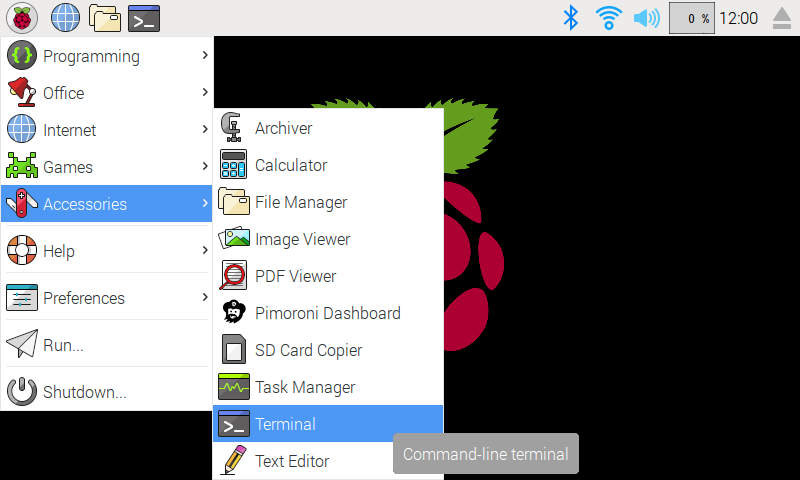
In the new terminal window type the command exactly as it appears below (check for typos) and follow the on-screen instructions:
```bash
curl https://get.pimoroni.com/blinkt | bash
```
Alternatively, on Raspbian, you can download the `pimoroni-dashboard` and install your product by browsing to the relevant entry:
```bash
sudo apt-get install pimoroni
```
(you will find the Dashboard under 'Accessories' too, in the Pi menu - or just run `pimoroni-dashboard` at the command line)
If you choose to download examples you'll find them in `/home/pi/Pimoroni/blinkt/`.
### Manual install:
#### Library install for Python 3:
on Raspbian:
```bash
sudo apt-get install python3-blinkt
```
other environments:
```bash
sudo pip3 install blinkt
```
#### Library install for Python 2:
on Raspbian:
```bash
sudo apt-get install python-blinkt
```
other environments:
```bash
sudo pip2 install blinkt
```
### Development:
If you want to contribute, or like living on the edge of your seat by having the latest code, you should clone this repository, `cd` to the library directory, and run:
```bash
sudo python3 setup.py install
```
(or `sudo python setup.py install` whichever your primary Python environment may be)
## Documentation & Support
* Guides and tutorials - https://learn.pimoroni.com/blinkt
* Function reference - http://docs.pimoroni.com/blinkt/
* GPIO Pinout - https://pinout.xyz/pinout/blinkt
* Get help - http://forums.pimoroni.com/c/support
## Unofficial / Third-party libraries
* Golang library & examples by [Alex Ellis](https://www.alexellis.io) - https://github.com/alexellis/blinkt_go, https://github.com/alexellis/blinkt_go_examples
* Java library by Jim Darby - https://github.com/hackerjimbo/PiJava
* Java library by @HoldYourWaffle - https://github.com/HoldYourWaffle/blinkt4j
* Node.js library by @irrelon - https://github.com/irrelon/node-blinkt
* Rust library by @golemparts - https://github.com/golemparts/blinkt
================================================
FILE: documentation/REFERENCE.md
================================================
# Blinkt Function Reference
The two Blinkt methods you'll most commonly use are `set_pixel` and `show`. Here's a simple example:
```
from blinkt import set_pixel, show
set_pixel(0,255,0,0)
show()
```
`set_pixel` takes an optional fifth parameter; the brightness from 0.0 to 1.0.
`set_pixel(pixel_no, red, green, blue, brightness)`
You can also change the brightness with `set_brightness` from 0.0 to 1.0, for example:
```
from blinkt import set_brightness
set_brightness(0.5)
show()
```
Additionally, there exists a helper function `set_all` which allows you to set all pixels to the same color and brightness. The `brightness` parameter is just like the one in `set_pixel`: it's optional and ranges from 0.0 to 1.0.
`set_all(red, green, blue, brightness)`
================================================
FILE: examples/1d_tetris.py
================================================
#!/usr/bin/env python
import time
from random import randint
import blinkt
MAX_SIZE = 4
MAX_GRID = blinkt.NUM_PIXELS + MAX_SIZE - 1
OFF = (0, 0, 0)
grid = [OFF] * (MAX_GRID + 1)
blinkt.set_clear_on_exit()
# The tetris algorithm fail when random_color was 0,0,0 now avoided
def random_color():
return (randint(0, 255), randint(0, 255), randint(1, 50))
def random_tile(max_size, min_size=1):
return (randint(min_size, max_size), random_color())
def place(tile):
for i in range(0, tile[0]):
grid[MAX_GRID - i - len(tile)] = tile[1]
def update():
for i in range(blinkt.NUM_PIXELS):
blinkt.set_pixel(i, grid[i][0], grid[i][1], grid[i][2])
blinkt.show()
def has_lines():
return grid[0] != OFF
def get_lines():
lines = []
for i, color in enumerate(grid):
if color == OFF:
return lines
else:
lines.append(i)
return lines
def blink_lines():
def hide():
for line in get_lines():
blinkt.set_pixel(line, 0, 0, 0)
blinkt.show()
hide()
time.sleep(0.5)
update()
time.sleep(0.5)
hide()
time.sleep(0.5)
def remove_lines():
for line in get_lines():
grid[line] = OFF
def gravity():
grid.append(OFF)
grid.pop(0)
def main():
blinkt.set_brightness(0.1)
place(random_tile(MAX_SIZE))
update()
while True:
time.sleep(0.5)
if has_lines():
blink_lines()
remove_lines()
place(random_tile(MAX_SIZE))
else:
gravity()
update()
if __name__ == '__main__':
main()
================================================
FILE: examples/README.md
================================================
## Examples
The examples in this directory should just work with Blinkt!, although you'll need to add Twitter developer access tokens and secrets in the `twitter_monitor.py` example. You can get these at [https://dev.twitter.com/](https://dev.twitter.com/), after setting up a new application. Where noted, the instructions for adding keys / installing modules are in the code itself.
The examples in the `extra_examples` folder are designed to work with other pHATs and HATs, so be aware of that before trying them.
## List of examples with basic instructions
- 1d_tetris - shows randomly coloured lights falling into place and clearing occasionally. No input needed. Offline.
- binary_clock - shows time in hours, minutes, and seconds using the local time from your Pi. No input needed. Offline.
- binary_clock_meld - shows time in hours (red), minutes (green) and seconds (blue) using local time from your Pi. No input needed. Offline.
- blinkt_thermo - draws a graph of the temperature based on the openweather data for whatever city you set it to. Needs keys and ID from openweathermap.org. Online.
- candle - flickers the pixels in a candle effect. May require a numpy install. Offline.
- cheerlights - reads twitter for any tweets with the hashtag "cheerlights" and a colour. Changes all the pixels to that colour. Online.
- cpu_load - shows a graph of cpu usage as a percentage. May require a psutil install. Offline.
- cpu_temp - shows a graph of the cpu temperature as a percentage. Offline.
- eyedropper - shows the rgb value at cursor location real time. Offline.
- gradient_graph - pulses a rainbow across the blinkt and back again. Offline.
- graph - pulses a magenta graph across the blinkt and back again. Offline.
- larson - remember Knight Rider? Offline.
- larson_hue - same as larson, but in rainbow colours! Offline.
- mem_load - shows a graph of the memory load on the Pi as a percentage. Offline.
- morse_code - shows a message in [warning: flashing] morse code. Change line 40 if you want a different message. Offline.
- mqtt - send controls remotely to your Blinkt. May require a paho-mqtt install. Requires setup on another machine as per instructions in the code. Online.
- pulse - pulses cyan light from the centre pixels to outer edges. Offline.
- rainbow - shows a gently moving rainbow along the blinkt. Yay, rainbows! Offline.
- random_blink - blinks yellow lights at random, like paparazzi in a crowd. Change colour on line 14 if you like. Offline.
- random_blink_colours - imagine if the paparazzi were carrying pastel unicorns. Offline.
- resistor_clock - shows the time in pairs of pixels, using resistor codes. Brown light (representing a 1) is a bit hard to see. Offline.
- rgb - Run this one a bit differently. Type python rgb.py and then three values, eg python rgb.py 10 90 80 will make it turn on cyan, python rgb.py 100 0 0 will make it turn on red. Offline.
- setup.cfg is NOT an example.
- solid_colours - Flashes red, green, blue on repeat. You can change the colours on lines 14, 17 and 20. Offline.
- twitter_monitor - Will show a notification when the hashtag of your choice (line 48) is mentioned on Twitter. You need to add consumer key, consumer secret, access token and access secret (see instructions at top of this document). Online.
================================================
FILE: examples/anvil-colour-control.py
================================================
# Basic example for controlling the Blinkt LED colours via Anvil
# Learn more at: https://anvil.works/
#
# Dependencies:
#
# python3 -m pip install blinkt colour anvil-uplink
#
# Run this example with:
#
# python3 anvil-colour-control.py
#
# You'll be prompted for an email address to set up the web control
# portion of this example.
#
# Check your email, click the link and- when the app has loads -
# hit the "Run" button at the top to start remote-controlling
# your Blinkt!
import blinkt
from colour import Color
from anvil.app_creator import create_app
import anvil.server
# Create the Blinkt demo app in your Anvil account
app = create_app("blinkt")
# Define functions that can be called from your Anvil app on the web
anvil.server.connect(app.uplink_key)
@anvil.server.callable
def set_color(color_string):
print("Setting LEDs to {}".format(color_string))
c = Color(color_string)
blinkt.set_all(c.red * 255, c.green * 255, c.blue * 255, 1.0)
blinkt.show()
@anvil.server.callable
def clear():
print("Clearing LEDs")
blinkt.clear()
blinkt.show()
# Display the URL where you can control the Blinkt LEDS
print("Control your Blinkt LEDs at {}".format(app.origin))
print("Press Ctrl-C to exit")
# Keep the script running until the user exits with Ctrl-C
anvil.server.wait_forever()
================================================
FILE: examples/binary_clock.py
================================================
#!/usr/bin/env python
from time import localtime, sleep
import blinkt
blinkt.set_clear_on_exit()
MODE_HOUR = 0
MODE_MIN = 1
MODE_SEC = 2
MODE_NAMES = {MODE_HOUR: 'Hour mode',
MODE_MIN: 'Minute mode',
MODE_SEC: 'Seconds mode'}
time_to_stay_in_mode = 3
time_in_mode = 0
mode = 0
lh = 0
lm = 0
while True:
t = localtime()
h, m, s = t.tm_hour, t.tm_min, t.tm_sec
if h != lh:
mode = MODE_HOUR
time_in_mode = 0
elif m != lm:
mode = MODE_MIN
time_in_mode = 0
lm = m
lh = h
blinkt.clear()
if (s % 2) == 0:
blinkt.set_pixel(1, 64, 64, 64)
if mode == MODE_HOUR:
blinkt.set_pixel(0, 255, 0, 0)
for x in range(6):
bit = (h & (1 << x)) > 0
r, g, b = [128 * bit] * 3
blinkt.set_pixel(7 - x, r, g, b)
if mode == MODE_MIN:
blinkt.set_pixel(0, 0, 255, 0)
for x in range(6):
bit = (m & (1 << x)) > 0
r, g, b = [128 * bit] * 3
blinkt.set_pixel(7 - x, r, g, b)
if mode == MODE_SEC:
blinkt.set_pixel(0, 0, 0, 255)
for x in range(6):
bit = (s & (1 << x)) > 0
r, g, b = [128 * bit] * 3
blinkt.set_pixel(7 - x, r, g, b)
blinkt.show()
print('{h:2d}:{m:02d}:{s:02d}; mode: {mode}; time in mode: {tim}'.format(h=h,
m=m,
s=s,
mode=MODE_NAMES[mode],
tim=time_in_mode))
time_in_mode += 1
if time_in_mode == time_to_stay_in_mode:
mode += 1
mode %= 3
time_in_mode = 0
sleep(1)
================================================
FILE: examples/binary_clock_meld.py
================================================
#!/usr/bin/env python
from time import localtime, sleep
import blinkt
print('Hour = Red, Minute = Green, Second = Blue')
blinkt.set_clear_on_exit()
blinkt.set_brightness(0.2)
on_value = 64
while True:
t = localtime()
h, m, s = t.tm_hour, t.tm_min, t.tm_sec
print('{h:2d}:{m:02d}:{s:02d}'.format(h=h, m=m, s=s))
blinkt.clear()
# Blink LED 0
v = on_value * (s % 2)
blinkt.set_pixel(0, v, v, v)
for n in range(6):
# Grab the n'th bit from hour, min and second
bit_h = (h & (1 << n)) > 0
bit_m = (m & (1 << n)) > 0
bit_s = (s & (1 << n)) > 0
r, g, b = [int(c * on_value) for c in (bit_h, bit_m, bit_s)]
blinkt.set_pixel(7 - n, r, g, b)
blinkt.show()
sleep(1)
================================================
FILE: examples/blinkt_thermo.py
================================================
#!/usr/bin/env python
# Data from OpenWeatherMap
# show_graph function adapted from cpu_temp.py
from time import sleep
from sys import exit
try:
import requests
except ImportError:
exit('This script requires the requests module\nInstall with: sudo pip install requests')
import blinkt
# Grab your API key here: http://openweathermap.org
# List of city ID city.list.json.gz can be downloaded here http://bulk.openweathermap.org/sample/
API_KEY = ''
CITY_ID = ''
url = 'http://api.openweathermap.org/data/2.5/weather'
temp = 0
def update_weather():
global temp
payload = {
'id': CITY_ID,
'units': 'metric',
'appid': API_KEY
}
try:
r = requests.get(url=url, params=payload)
temp = r.json().get('main').get('temp')
print('Temperture = ' + str(temp) + ' C')
except requests.exceptions.ConnectionError:
print('Connection Error')
def show_graph(v, r, g, b):
v *= blinkt.NUM_PIXELS
for x in range(blinkt.NUM_PIXELS):
if v < 0:
r, g, b = 0, 0, 0
else:
r, g, b = [int(min(v, 1.0) * c) for c in [r, g, b]]
blinkt.set_pixel(x, r, g, b)
v -= 1
blinkt.show()
def draw_thermo(temp):
v = temp
v /= 40
v += (1 / 8)
show_graph(v, 255, 0, 0)
blinkt.set_brightness(0.1)
while 1:
update_weather()
draw_thermo(temp)
sleep(120)
================================================
FILE: examples/candle.py
================================================
#!/usr/bin/env python
import colorsys
import time
from sys import exit
try:
import numpy as np
except ImportError:
exit('This script requires the numpy module\nInstall with: sudo apt install python3-numpy')
import blinkt
blinkt.clear()
start = 0
end = 60
while True:
wait = np.random.choice(np.random.noncentral_chisquare(5, 1, 1000), 1)[0] / 50
n = np.random.choice(np.random.noncentral_chisquare(5, 0.1, 1000), 1)
limit = int(n[0])
if limit > blinkt.NUM_PIXELS:
limit = blinkt.NUM_PIXELS
for pixel in range(limit):
hue = start + (((end - start) / float(blinkt.NUM_PIXELS)) * pixel)
r, g, b = [int(c * 255) for c in colorsys.hsv_to_rgb(hue / 360.0, 1.0, 1.0)]
blinkt.set_pixel(pixel, r, g, b)
blinkt.show()
time.sleep(0.05 / (pixel + 1))
time.sleep(wait)
blinkt.clear()
================================================
FILE: examples/cheerlights.py
================================================
#!/usr/bin/env python
import time
from sys import exit
try:
import requests
except ImportError:
exit('This script requires the requests module\nInstall with: sudo pip install requests')
import blinkt
blinkt.set_clear_on_exit()
def hex_to_rgb(col_hex):
"""Convert a hex colour to an RGB tuple."""
col_hex = col_hex.lstrip('#')
return bytearray.fromhex(col_hex)
while True:
r = requests.get('http://api.thingspeak.com/channels/1417/field/2/last.json', timeout=2)
json = r.json()
if 'field2' not in json:
print('Error {status}: {error}'.format(status=json['status'], error=json['error']))
time.sleep(5)
continue
r, g, b = hex_to_rgb(json['field2'])
for i in range(blinkt.NUM_PIXELS):
blinkt.set_pixel(i, r, g, b)
blinkt.show()
time.sleep(5) # Be friendly to the API
================================================
FILE: examples/cpu_load.py
================================================
#!/usr/bin/env python
import time
from sys import exit
try:
import psutil
except ImportError:
exit('This script requires the psutil module\nInstall with: sudo apt install python3-psutil')
import blinkt
blinkt.set_clear_on_exit()
def show_graph(v, r, g, b):
v *= blinkt.NUM_PIXELS
for x in range(blinkt.NUM_PIXELS):
if v < 0:
r, g, b = 0, 0, 0
else:
r, g, b = [int(min(v, 1.0) * c) for c in [r, g, b]]
blinkt.set_pixel(x, r, g, b)
v -= 1
blinkt.show()
blinkt.set_brightness(0.1)
while True:
v = psutil.cpu_percent() / 100.0
show_graph(v, 255, 255, 255)
time.sleep(0.01)
================================================
FILE: examples/cpu_temp.py
================================================
#!/usr/bin/env python
import time
from subprocess import PIPE, Popen
import blinkt
blinkt.set_clear_on_exit()
def get_cpu_temperature():
process = Popen(['vcgencmd', 'measure_temp'], stdout=PIPE)
output, _error = process.communicate()
output = output.decode()
pos_start = output.index('=') + 1
pos_end = output.rindex("'")
temp = float(output[pos_start:pos_end])
return temp
def show_graph(v, r, g, b):
v *= blinkt.NUM_PIXELS
for x in range(blinkt.NUM_PIXELS):
if v < 0:
r, g, b = 0, 0, 0
else:
r, g, b = [int(min(v, 1.0) * c) for c in [r, g, b]]
blinkt.set_pixel(x, r, g, b)
v -= 1
blinkt.show()
blinkt.set_brightness(0.1)
while True:
v = get_cpu_temperature() / 100.0
show_graph(v, 255, 255, 255)
time.sleep(0.01)
================================================
FILE: examples/extra_examples/README.md
================================================
#Extra Examples
The examples in this folder are designed to work with other pHATs and HATs:
* drum_hits.py expects a Drum HAT to be available and the relevant Python library installed
* pov_rainbow.py and spirit_level.py expects an Enviro pHAT to be available and the relevant Python library installed
================================================
FILE: examples/extra_examples/drum_hits.py
================================================
#!/usr/bin/env python
import glob
import os
import time
from sys import exit
try:
import drumhat
except ImportError:
exit('This script requires the drumhat module\nInstall with: sudo pip install drumhat')
try:
import pygame
except ImportError:
exit('This script requires the pygame module\nInstall with: sudo pip install pygame')
import blinkt
DRUM_FOLDER = 'drums2'
BANK = os.path.join(os.path.dirname(__file__), DRUM_FOLDER)
pygame.mixer.init(44100, -16, 1, 512)
pygame.mixer.set_num_channels(16)
files = glob.glob(os.path.join(BANK, '*.wav'))
files.sort()
samples = [pygame.mixer.Sound(f) for f in files]
def show_all(state):
for i in range(8):
val = state * 255
blinkt.set_pixel(i, val, val, val)
blinkt.show()
def handle_hit(event):
samples[event.channel].play(loops=0)
show_all(1)
print('You hit pad {}, playing: {}'.format(event.pad, files[event.channel]))
def handle_release():
show_all(0)
drumhat.on_hit(drumhat.PADS, handle_hit)
drumhat.on_release(drumhat.PADS, handle_release)
while True:
time.sleep(1)
================================================
FILE: examples/extra_examples/pov_rainbow.py
================================================
#!/usr/bin/env python
import time
from colorsys import hsv_to_rgb
from sys import exit
try:
from envirophat import motion
except ImportError:
exit('This script requires the envirophat module\nInstall with: sudo pip install envirophat')
import blinkt
offset = 0
direction = 0
t = []
t_start = 0
total_time = 1000
def millis():
return int(round(time.time() * 1000))
while True:
x, y, z = motion.accelerometer()
print(y)
if y < -1.9 and not direction == -1:
direction = -1
t.append(millis() - t_start)
t_start = millis()
t = t[-5:]
if y > 1.9 and not direction == 1:
direction = 1
t.append(millis() - t_start)
t_start = millis()
t = t[-5:]
if len(t) > 0:
total_time = float(sum(t)) / len(t)
offset = ((millis() - t_start) / total_time)
# offset += direction * 10
offset = min(1.0, offset)
offset = max(0.0, offset)
hue = offset
if direction == -1:
hue = 1.0 - offset
r, g, b = [int(c * 255.0) for c in hsv_to_rgb(hue, 1.0, 1.0)]
for x in range(8):
blinkt.set_pixel(x, r, g, b)
blinkt.show()
time.sleep(0.0001)
================================================
FILE: examples/extra_examples/spirit_level.py
================================================
#!/usr/bin/env python
import time
from sys import exit
try:
from envirophat import motion
except ImportError:
exit('This script requires the envirophat module\nInstall with: sudo pip install envirophat')
import blinkt
x_avg = []
while True:
x, y, z = motion.accelerometer()
x_avg.append(x)
x_avg = x_avg[-5:]
x = float(sum(x_avg)) / len(x_avg)
x = max(-1, x)
x = min(1, x)
blinkt.clear()
if abs(x) < 0.05:
blinkt.set_pixel(3, 0, 255, 0)
blinkt.set_pixel(4, 0, 255, 0)
elif x > 0:
val = abs(x) * 4.0
for x in range(4):
if val < 0:
break
blinkt.set_pixel(3 - x, int(255.0 * min(val, 1.0)), 0, 0)
val -= 1
elif x < 0:
val = abs(x) * 4.0
for x in range(4):
if val < 0:
break
blinkt.set_pixel(4 + x, int(255.0 * min(val, 1.0)), 0, 0)
val -= 1
blinkt.show()
time.sleep(0.01)
================================================
FILE: examples/eyedropper.py
================================================
#!/usr/bin/env python3
from PIL import ImageGrab
import pyautogui
import blinkt
import time
print('Press Ctrl-C to quit.')
try:
while True:
x, y = pyautogui.position()
im = ImageGrab.grab(bbox=(x - 1, y, x, y + 1))
rawrgb = list(im.getdata())
rgb = str(rawrgb)[2:-2]
r, g, b = rgb.split(', ')
blinkt.set_all(r, g, b)
blinkt.set_brightness(1)
blinkt.show()
time.sleep(0.01)
except KeyboardInterrupt:
print('\n')
================================================
FILE: examples/gradient_graph.py
================================================
#!/usr/bin/env python
import colorsys
import math
import time
import blinkt
blinkt.set_clear_on_exit()
hue_range = 120
hue_start = 0
max_brightness = 0.2
def show_graph(v, r, g, b):
v *= blinkt.NUM_PIXELS
for x in range(blinkt.NUM_PIXELS):
hue = ((hue_start + ((x / float(blinkt.NUM_PIXELS)) * hue_range)) % 360) / 360.0
r, g, b = [int(c * 255) for c in colorsys.hsv_to_rgb(hue, 1.0, 1.0)]
if v < 0:
brightness = 0
else:
brightness = min(v, 1.0) * max_brightness
blinkt.set_pixel(x, r, g, b, brightness)
v -= 1
blinkt.show()
blinkt.set_brightness(0.1)
try:
while True:
t = time.time() * 2
v = (math.sin(t) + 1) / 2 # Get a value between 0 and 1
show_graph(v, 255, 0, 255)
time.sleep(0.01)
except KeyboardInterrupt:
pass
================================================
FILE: examples/graph.py
================================================
#!/usr/bin/env python
import math
import time
import blinkt
blinkt.set_clear_on_exit()
def show_graph(v, r, g, b):
v *= blinkt.NUM_PIXELS
for x in range(blinkt.NUM_PIXELS):
if v < 0:
r, g, b = 0, 0, 0
else:
r, g, b = [int(min(v, 1.0) * c) for c in [r, g, b]]
blinkt.set_pixel(x, r, g, b)
v -= 1
blinkt.show()
blinkt.set_brightness(0.1)
try:
while True:
t = time.time()
v = (math.sin(t) + 1) / 2 # Get a value between 0 and 1
show_graph(v, 255, 0, 255)
time.sleep(0.01)
except KeyboardInterrupt:
pass
================================================
FILE: examples/half.py
================================================
#!/usr/bin/env python
import blinkt
blinkt.set_clear_on_exit(False)
blinkt.set_all(255, 255, 255, 0.5)
blinkt.show()
================================================
FILE: examples/kitt.py
================================================
#!/usr/bin/env python
import time # so we can wait between frames
import blinkt # so we can talk to our blinkt lights!
BRIGHTNESS = 0.2 # range is 0.0 to 1.0
MAX_COLOUR = 255 # range is 0 to 255
DECAY_FACTOR = 1.5 # how quickly should MAX_COLOUR fade? (1.5 works well)
TIME_SLEEP = 0.04 # seconds (0.04 works well)
PIXELS = blinkt.NUM_PIXELS # usually 8, can use fewer if you like!
blinkt.clear # make all pixels blank / black
blinkt.set_brightness(BRIGHTNESS)
brightpixel = -1
direction = 1
print('Hello Michael.\nHow are you today?')
while True:
# decay all pixels
for x in range(PIXELS):
pixel = blinkt.get_pixel(x) # format is [ r, g, b, brightness? ]
blinkt.set_pixel(x, pixel[0] / DECAY_FACTOR, 0, 0)
# brightpixel should move back and forth all the pixels,
# in a ping-pong, triangle wave. Not (co)sine.
brightpixel += direction
if brightpixel >= PIXELS - 1:
brightpixel = PIXELS - 1
direction = - abs(direction)
if brightpixel <= 0:
brightpixel = 0
direction = abs(direction)
blinkt.set_pixel(brightpixel, MAX_COLOUR, 0, 0)
blinkt.show() # draw the lights!
time.sleep(TIME_SLEEP) # wait a bit before working on next frame
================================================
FILE: examples/larson.py
================================================
#!/usr/bin/env python
import time
import blinkt
blinkt.set_clear_on_exit()
REDS = [0, 0, 0, 0, 0, 16, 64, 255, 64, 16, 0, 0, 0, 0, 0, 0]
start_time = time.time()
while True:
# Sine wave, spends a little longer at min/max
# delta = (time.time() - start_time) * 8
# offset = int(round(((math.sin(delta) + 1) / 2) * (blinkt.NUM_PIXELS - 1)))
# Triangle wave, a snappy ping-pong effect
delta = (time.time() - start_time) * 16
offset = int(abs((delta % len(REDS)) - blinkt.NUM_PIXELS))
for i in range(blinkt.NUM_PIXELS):
blinkt.set_pixel(i, REDS[offset + i], 0, 0)
blinkt.show()
time.sleep(0.1)
================================================
FILE: examples/larson_hue.py
================================================
#!/usr/bin/env python
import math
import time
import colorsys
import blinkt
FALLOFF = 1.9
SCAN_SPEED = 4
blinkt.set_clear_on_exit()
start_time = time.time()
while True:
delta = (time.time() - start_time)
# Offset is a sine wave derived from the time delta
# we use this to animate both the hue and larson scan
# so they are kept in sync with each other
offset = (math.sin(delta * SCAN_SPEED) + 1) / 2
# Use offset to pick the right colour from the hue wheel
hue = int(round(offset * 360))
# Maximum number basex on NUM_PIXELS
max_val = blinkt.NUM_PIXELS - 1
# Now we generate a value from 0 to max_val
offset = int(round(offset * max_val))
for x in range(blinkt.NUM_PIXELS):
sat = 1.0
val = max_val - (abs(offset - x) * FALLOFF)
val /= float(max_val) # Convert to 0.0 to 1.0
val = max(val, 0.0) # Ditch negative values
xhue = hue # Grab hue for this pixel
xhue += (1 - val) * 10 # Use the val offset to give a slight colour trail variation
xhue %= 360 # Clamp to 0-359
xhue /= 360.0 # Convert to 0.0 to 1.0
r, g, b = [int(c * 255) for c in colorsys.hsv_to_rgb(xhue, sat, val)]
blinkt.set_pixel(x, r, g, b, val / 4)
blinkt.show()
time.sleep(0.001)
================================================
FILE: examples/max.py
================================================
#!/usr/bin/env python
import blinkt
blinkt.set_clear_on_exit(False)
blinkt.set_all(255, 255, 255, 1.0)
blinkt.show()
================================================
FILE: examples/mem_load.py
================================================
#!/usr/bin/env python
import time
from sys import exit
try:
import psutil
except ImportError:
exit('This script requires the psutil module\nInstall with: sudo apt install python3-psutil')
import blinkt
blinkt.set_clear_on_exit()
def show_graph(v, r, g, b):
v *= blinkt.NUM_PIXELS
for x in range(blinkt.NUM_PIXELS):
if v < 0:
r, g, b = 0, 0, 0
else:
r, g, b = [int(min(v, 1.0) * c) for c in [r, g, b]]
blinkt.set_pixel(x, r, g, b)
v -= 1
blinkt.show()
blinkt.set_brightness(0.1)
while True:
v = psutil.virtual_memory().percent / 100.0
show_graph(v, 255, 0, 255)
time.sleep(0.01)
================================================
FILE: examples/morse_code.py
================================================
#!/usr/bin/env python
import time
import blinkt
blinkt.set_clear_on_exit()
def show_all(state):
"""Set all LEDs."""
for i in range(blinkt.NUM_PIXELS):
val = state * 255
blinkt.set_pixel(i, val, val, val)
blinkt.show()
def dot():
"""Blink LEDs for 0.05 seconds."""
show_all(1)
time.sleep(0.05)
show_all(0)
time.sleep(0.2)
def dash():
"""Blink LEDs for 0.2 seconds."""
show_all(1)
time.sleep(0.2)
show_all(0)
time.sleep(0.2)
def space():
"""Delay for 0.02 seconds."""
time.sleep(0.2)
# 0 is a space, 1 is a dot and 2 is a dash
MORSE = ' -... .. . -.. - -. . - . - -. -. - '
while True:
for m in MORSE:
if m == ' ':
space()
elif m == '.':
dot()
elif m == '-':
dash()
================================================
FILE: examples/mqtt.py
================================================
#!/usr/bin/env python
from sys import exit
try:
import paho.mqtt.client as mqtt
except ImportError:
exit('This example requires the paho-mqtt module\nInstall with: sudo pip install paho-mqtt')
import blinkt
MQTT_SERVER = 'iot.eclipse.org'
MQTT_PORT = 1883
MQTT_TOPIC = 'pimoroni/blinkt'
# Set these to use authorisation
MQTT_USER = None
MQTT_PASS = None
print("""
MQTT Blinkt! Control
This example uses public MQTT messages from {server} on port {port} to control Blinkt!
It will monitor the {topic} topic by default, and understands the following messages:
rgb,<pixel>,<r>,<g>,<b> - Set a single pixel to an RGB colour. Example: rgb,1,255,0,255
clr - Clear Blinkt!
You can use the online MQTT tester at http://www.hivemq.com/demos/websocket-client/ to send messages.
Use {server} as the host, and port 80 (Eclipse's websocket port). Set the topic to topic: {topic}
""".format(
server=MQTT_SERVER,
port=MQTT_PORT,
topic=MQTT_TOPIC
))
def on_connect(client, userdata, flags, rc):
print('Connected with result code ' + str(rc))
client.subscribe(MQTT_TOPIC)
def on_message(client, userdata, msg):
data = msg.payload
if type(data) is bytes:
data = data.decode('utf-8')
data = data.split(',')
command = data.pop(0)
if command == 'clr' and len(data) == 0:
blinkt.clear()
blinkt.show()
return
if command == 'rgb' and len(data) == 4:
try:
pixel = data.pop(0)
if pixel == '*':
pixel = None
else:
pixel = int(pixel)
if pixel > 7:
print('Pixel out of range: ' + str(pixel))
return
r, g, b = [int(x) & 0xff for x in data]
print(command, pixel, r, g, b)
except ValueError:
print('Malformed command: ' + str(msg.payload))
return
if pixel is None:
for x in range(blinkt.NUM_PIXELS):
blinkt.set_pixel(x, r, g, b)
else:
blinkt.set_pixel(pixel, r, g, b)
blinkt.show()
return
blinkt.set_clear_on_exit()
client = mqtt.Client()
client.on_connect = on_connect
client.on_message = on_message
if MQTT_USER is not None and MQTT_PASS is not None:
print('Using username: {un} and password: {pw}'.format(un=MQTT_USER, pw='*' * len(MQTT_PASS)))
client.username_pw_set(username=MQTT_USER, password=MQTT_PASS)
client.connect(MQTT_SERVER, MQTT_PORT, 60)
client.loop_forever()
================================================
FILE: examples/off.py
================================================
#!/usr/bin/env python
import blinkt
blinkt.clear()
blinkt.show()
================================================
FILE: examples/pulse.py
================================================
#!/usr/bin/env python
import colorsys
import time
from sys import exit
try:
import numpy as np
except ImportError:
exit('This script requires the numpy module\nInstall with: sudo pip install numpy')
import blinkt
blinkt.set_clear_on_exit()
def make_gaussian(fwhm):
x = np.arange(0, blinkt.NUM_PIXELS, 1, float)
y = x[:, np.newaxis]
x0, y0 = 3.5, 3.5
fwhm = fwhm
gauss = np.exp(-4 * np.log(2) * ((x - x0) ** 2 + (y - y0) ** 2) / fwhm ** 2)
return gauss
while True:
for z in list(range(1, 10)[::-1]) + list(range(1, 10)):
fwhm = 5.0 / z
gauss = make_gaussian(fwhm)
start = time.time()
y = 4
for x in range(blinkt.NUM_PIXELS):
h = 0.5
s = 1.0
v = gauss[x, y]
rgb = colorsys.hsv_to_rgb(h, s, v)
r, g, b = [int(255.0 * i) for i in rgb]
blinkt.set_pixel(x, r, g, b)
blinkt.show()
end = time.time()
t = end - start
if t < 0.04:
time.sleep(0.04 - t)
================================================
FILE: examples/rainbow.py
================================================
#!/usr/bin/env python
import colorsys
import time
import blinkt
spacing = 360.0 / 16.0
hue = 0
blinkt.set_clear_on_exit()
blinkt.set_brightness(0.1)
while True:
hue = int(time.time() * 100) % 360
for x in range(blinkt.NUM_PIXELS):
offset = x * spacing
h = ((hue + offset) % 360) / 360.0
r, g, b = [int(c * 255) for c in colorsys.hsv_to_rgb(h, 1.0, 1.0)]
blinkt.set_pixel(x, r, g, b)
blinkt.show()
time.sleep(0.001)
================================================
FILE: examples/random_blink.py
================================================
#!/usr/bin/env python
import random
import time
import blinkt
blinkt.set_clear_on_exit()
while True:
pixels = random.sample(range(blinkt.NUM_PIXELS), random.randint(1, 5))
for i in range(blinkt.NUM_PIXELS):
if i in pixels:
blinkt.set_pixel(i, 255, 150, 0)
else:
blinkt.set_pixel(i, 0, 0, 0)
blinkt.show()
time.sleep(0.05)
================================================
FILE: examples/random_blink_colours.py
================================================
#!/usr/bin/env python
import random
import time
import blinkt
blinkt.set_clear_on_exit()
blinkt.set_brightness(0.1)
while True:
for i in range(blinkt.NUM_PIXELS):
blinkt.set_pixel(i, random.randint(0, 255), random.randint(0, 255), random.randint(0, 255))
blinkt.show()
time.sleep(0.05)
================================================
FILE: examples/resistor_clock.py
================================================
#!/usr/bin/env python
import time
import blinkt
colours = [
[0, 0, 0], # 0 black
[139, 69, 19], # 1 brown
[255, 0, 0], # 2 red
[255, 69, 0], # 3 orange
[255, 255, 0], # 4 yellow
[0, 255, 0], # 5 green
[0, 0, 255], # 6 blue
[128, 0, 128], # 7 violet
[255, 255, 100], # 8 grey
[255, 255, 255], # 9 white
]
blinkt.set_clear_on_exit()
while True:
hour = time.localtime().tm_hour
minute = time.localtime().tm_min
hourten = int(hour / 10)
hourunit = int(hour % 10)
minuteten = int(minute / 10)
minuteunit = int(minute % 10)
r, g, b = colours[hourten]
blinkt.set_pixel(0, r, g, b)
blinkt.set_pixel(1, r, g, b)
r, g, b = colours[hourunit]
blinkt.set_pixel(2, r, g, b)
blinkt.set_pixel(3, r, g, b)
r, g, b = colours[minuteten]
blinkt.set_pixel(4, r, g, b)
blinkt.set_pixel(5, r, g, b)
r, g, b = colours[minuteunit]
blinkt.set_pixel(6, r, g, b)
blinkt.set_pixel(7, r, g, b)
blinkt.show()
time.sleep(0.5)
blinkt.set_pixel(7, 0, 0, 0)
blinkt.show()
time.sleep(0.5)
================================================
FILE: examples/rgb.py
================================================
#!/usr/bin/env python
import sys
import blinkt
def usage():
print('Usage: {} <r> <g> <b>'.format(sys.argv[0]))
sys.exit(1)
if len(sys.argv) != 4:
usage()
# Exit if non integer value. int() will raise a ValueError
try:
r, g, b = [int(x) for x in sys.argv[1:]]
except ValueError:
usage()
# Exit if any of r, g, b are greater than 255
if max(r, g, b) > 255:
usage()
print('Setting Blinkt to {r},{g},{b}'.format(r=r, g=g, b=b))
blinkt.set_clear_on_exit(False)
blinkt.set_all(r, g, b)
blinkt.show()
================================================
FILE: examples/setall.py
================================================
#!/usr/bin/env python
import sys
from sys import argv
import blinkt
if len(argv) < 4 or len(argv) > 5:
sys.stderr.write("Syntax: {0} <red> <green> <blue> [brightness]\n".format(argv[0]))
exit(1)
red = int(argv[1])
green = int(argv[2])
blue = int(argv[3])
bright = float(argv[4]) if len(argv) > 4 else None
blinkt.set_clear_on_exit(False)
blinkt.set_all(red, green, blue, bright)
blinkt.show()
================================================
FILE: examples/setup.cfg
================================================
[flake8]
ignore=
D100 # Ignore various docstring reqs
D101
D102
D103
E501 # Ignore long lines
================================================
FILE: examples/solid_colours.py
================================================
#!/usr/bin/env python
import time
import blinkt
blinkt.set_clear_on_exit()
step = 0
while True:
if step == 0:
blinkt.set_all(128, 0, 0)
if step == 1:
blinkt.set_all(0, 128, 0)
if step == 2:
blinkt.set_all(0, 0, 128)
step += 1
step %= 3
blinkt.show()
time.sleep(0.5)
================================================
FILE: examples/solid_colours2.py
================================================
#!/usr/bin/env python
import time
import blinkt
blinkt.set_clear_on_exit()
step = 0
while True:
if step == 0:
blinkt.set_all(128, 0, 0)
elif step == 1:
blinkt.set_all(0, 128, 0)
elif step == 2:
blinkt.set_all(128, 128, 0)
elif step == 3:
blinkt.set_all(0, 0, 128)
elif step == 4:
blinkt.set_all(128, 0, 128)
elif step == 5:
blinkt.set_all(0, 128, 128)
elif step == 6:
blinkt.set_all(128, 128, 128)
step += 1
step %= 7
blinkt.show()
time.sleep(0.5)
================================================
FILE: examples/solid_colours3.py
================================================
#!/usr/bin/env python
import time
import blinkt
blinkt.set_clear_on_exit()
step = 0
while True:
for i in range(0, 128):
j = 128 - i
if step == 0:
blinkt.set_all(128, j, j)
elif step == 1:
blinkt.set_all(j, i, 0)
elif step == 2:
blinkt.set_all(i, 128, 0)
elif step == 3:
blinkt.set_all(j, j, i)
elif step == 4:
blinkt.set_all(i, 0, 128)
elif step == 5:
blinkt.set_all(j, i, 128)
elif step == 6:
blinkt.set_all(i, 128, 128)
blinkt.show()
time.sleep(0.01)
step += 1
step %= 7
time.sleep(0.5)
================================================
FILE: examples/twitter_monitor.py
================================================
#!/usr/bin/env python
import time
from sys import exit
try:
from tweepy import Stream, OAuthHandler
from tweepy.streaming import StreamListener
except ImportError:
exit('This script requires the tweepy module\nInstall with: sudo pip install tweepy')
import blinkt
ckey = '' # Consumer key
csecret = '' # Consumer secret
atoken = '' # Access token
asecret = '' # Access secret
class listener(StreamListener):
def on_data(self, data):
blink_blinkt()
return True
def on_error(self, status):
print(status)
def blink_blinkt():
for i in range(3):
for j in range(blinkt.NUM_PIXELS):
blinkt.set_pixel(j, 255, 0, 0)
blinkt.show()
time.sleep(0.1)
for j in range(blinkt.NUM_PIXELS):
blinkt.set_pixel(j, 0, 0, 0)
blinkt.show()
time.sleep(0.2)
auth = OAuthHandler(ckey, csecret)
auth.set_access_token(atoken, asecret)
twitterstream = Stream(auth, listener())
twitterstream.filter(track=['#INSERTHASHTAGHERE'])
================================================
FILE: examples/unionjack.py
================================================
#!/usr/bin/env python
import time
import blinkt
RED__ = (255, 0, 0)
WHITE = (127, 127, 127)
BLUE_ = (0, 0, 255)
pattern = [
[RED__, BLUE_, WHITE, RED__, RED__, WHITE, BLUE_, RED__],
[BLUE_, RED__, WHITE, RED__, RED__, WHITE, RED__, BLUE_],
[WHITE, WHITE, WHITE, RED__, RED__, WHITE, WHITE, WHITE],
[RED__, RED__, RED__, RED__, RED__, RED__, RED__, RED__],
[RED__, RED__, RED__, RED__, RED__, RED__, RED__, RED__],
[WHITE, WHITE, WHITE, RED__, RED__, WHITE, WHITE, WHITE],
[BLUE_, RED__, WHITE, RED__, RED__, WHITE, RED__, BLUE_],
[RED__, BLUE_, WHITE, RED__, RED__, WHITE, BLUE_, RED__],
]
blinkt.set_clear_on_exit()
blinkt.set_brightness(0.1)
while 1:
for line in pattern:
for i, pixel in enumerate(line):
r, g, b = pixel
blinkt.set_pixel(i, r, g, b)
blinkt.show()
time.sleep(0.25)
================================================
FILE: examples/white.py
================================================
#!/usr/bin/env python
import blinkt
blinkt.set_clear_on_exit(False)
blinkt.set_all(255, 255, 255, 1.0)
blinkt.show()
================================================
FILE: library/.coveragerc
================================================
[run]
source = blinkt
omit =
.tox/*
================================================
FILE: library/CHANGELOG.txt
================================================
0.1.2
-----
* BugFix: Added sleep to data output, see: https://github.com/pimoroni/blinkt/issues/62
0.1.1
-----
* New: Added `get_pixel` to return colour and brightness of a single pixel
0.1.0
-----
* Removed try/except from RPi.GPIO import, output was misleading at best
* Reverted default behaviour of clear on exit
0.0.9
-----
* Added set_all method to set all pixels
* Changed default behaviour of clear on exit to reduce module side-effects
* Move GPIO initialisation to show() to reduce module side-effects
0.0.8
-----
* Tweaked some methods to show intent as implementation detail only
* Added docstrings detailing public methods
0.0.7
-----
* Fixed bug with APA102 pixels that have a small, black die (vs the larger, paler one)
0.0.6
-----
* set_clear_on_exit now method
0.0.5
-----
* Range clamping and coercion to integers
0.0.4
-----
* Various bug fixes
0.0.3
-----
* Switch to Python
0.0.2
-----
* Bug fixes for C Library
0.0.1
-----
* Original C Library
================================================
FILE: library/LICENSE.txt
================================================
The MIT License (MIT)
Copyright (c) 2016 Pimoroni Ltd
Permission is hereby granted, free of charge, to any person obtaining a copy
of this software and associated documentation files (the "Software"), to deal
in the Software without restriction, including without limitation the rights
to use, copy, modify, merge, publish, distribute, sublicense, and/or sell
copies of the Software, and to permit persons to whom the Software is
furnished to do so, subject to the following conditions:
The above copyright notice and this permission notice shall be included in
all copies or substantial portions of the Software.
THE SOFTWARE IS PROVIDED "AS IS", WITHOUT WARRANTY OF ANY KIND, EXPRESS OR
IMPLIED, INCLUDING BUT NOT LIMITED TO THE WARRANTIES OF MERCHANTABILITY,
FITNESS FOR A PARTICULAR PURPOSE AND NONINFRINGEMENT. IN NO EVENT SHALL THE
AUTHORS OR COPYRIGHT HOLDERS BE LIABLE FOR ANY CLAIM, DAMAGES OR OTHER
LIABILITY, WHETHER IN AN ACTION OF CONTRACT, TORT OR OTHERWISE, ARISING FROM,
OUT OF OR IN CONNECTION WITH THE SOFTWARE OR THE USE OR OTHER DEALINGS IN
THE SOFTWARE.
================================================
FILE: library/MANIFEST.in
================================================
include CHANGELOG.txt
include LICENSE.txt
include README.rst
include setup.py
include blinkt.py
================================================
FILE: library/Makefile
================================================
all:
gcc -Wall -DTEST lib/blinkt.c -l bcm2835 -o blinkt
devel:
-rm -r build
python setup.py build
sudo python setup.py develop
================================================
FILE: library/README.md
================================================
#Blinkt Pure Python Library
================================================
FILE: library/README.rst
================================================
.. figure:: blinkt-logo.png
:alt: Blinkt!
Blinkt!
|Build Status| |Coverage Status| |PyPi Package| |Python Versions|
https://shop.pimoroni.com/products/blinkt
Eight super-bright RGB LED indicators, ideal for adding visual
notifications to your Raspberry Pi on their own or on a pHAT stacking
header.
Installing
----------
Full install (recommended):
~~~~~~~~~~~~~~~~~~~~~~~~~~~
We've created an easy installation script that will install all
pre-requisites and get your Blinkt! up and running with minimal efforts.
To run it, fire up Terminal which you'll find in Menu -> Accessories ->
Terminal on your Raspberry Pi desktop, as illustrated below:
.. figure:: http://get.pimoroni.com/resources/github-repo-terminal.png
:alt: Finding the terminal
Finding the terminal
In the new terminal window type the command exactly as it appears below
(check for typos) and follow the on-screen instructions:
.. code:: bash
curl https://get.pimoroni.com/blinkt | bash
Alternatively, on Raspbian, you can download the ``pimoroni-dashboard``
and install your product by browsing to the relevant entry:
.. code:: bash
sudo apt-get install pimoroni
(you will find the Dashboard under 'Accessories' too, in the Pi menu -
or just run ``pimoroni-dashboard`` at the command line)
If you choose to download examples you'll find them in
``/home/pi/Pimoroni/blinkt/``.
Manual install:
~~~~~~~~~~~~~~~
Library install for Python 3:
^^^^^^^^^^^^^^^^^^^^^^^^^^^^^
on Raspbian:
.. code:: bash
sudo apt-get install python3-blinkt
other environments:
.. code:: bash
sudo pip3 install blinkt
Library install for Python 2:
^^^^^^^^^^^^^^^^^^^^^^^^^^^^^
on Raspbian:
.. code:: bash
sudo apt-get install python-blinkt
other environments:
.. code:: bash
sudo pip2 install blinkt
Development:
~~~~~~~~~~~~
If you want to contribute, or like living on the edge of your seat by
having the latest code, you should clone this repository, ``cd`` to the
library directory, and run:
.. code:: bash
sudo python3 setup.py install
(or ``sudo python setup.py install`` whichever your primary Python
environment may be)
Documentation & Support
-----------------------
- Guides and tutorials - https://learn.pimoroni.com/blinkt
- Function reference - http://docs.pimoroni.com/blinkt/
- GPIO Pinout - https://pinout.xyz/pinout/blinkt
- Get help - http://forums.pimoroni.com/c/support
Unofficial / Third-party libraries
----------------------------------
- Golang library & examples by `Alex
Ellis <https://www.alexellis.io>`__ -
https://github.com/alexellis/blinkt\_go\_examples
- Java library by Jim Darby - https://github.com/hackerjimbo/PiJava
.. |Build Status| image:: https://travis-ci.com/pimoroni/blinkt.svg?branch=master
:target: https://travis-ci.com/pimoroni/blinkt
.. |Coverage Status| image:: https://coveralls.io/repos/github/pimoroni/blinkt/badge.svg?branch=master
:target: https://coveralls.io/github/pimoroni/blinkt?branch=master
.. |PyPi Package| image:: https://img.shields.io/pypi/v/blinkt.svg
:target: https://pypi.python.org/pypi/blinkt
.. |Python Versions| image:: https://img.shields.io/pypi/pyversions/blinkt.svg
:target: https://pypi.python.org/pypi/blinkt
================================================
FILE: library/blinkt.py
================================================
"""Library for the Pimoroni Blinkt! - 8-pixel APA102 LED display."""
import atexit
import time
import RPi.GPIO as GPIO
__version__ = '0.1.2'
DAT = 23
CLK = 24
NUM_PIXELS = 8
BRIGHTNESS = 7
pixels = [[0, 0, 0, BRIGHTNESS]] * NUM_PIXELS
sleep_time = 0
_gpio_setup = False
_clear_on_exit = True
def _exit():
if _clear_on_exit:
clear()
show()
GPIO.cleanup()
def set_brightness(brightness):
"""Set the brightness of all pixels.
:param brightness: Brightness: 0.0 to 1.0
"""
if brightness < 0 or brightness > 1:
raise ValueError('Brightness should be between 0.0 and 1.0')
for x in range(NUM_PIXELS):
pixels[x][3] = int(31.0 * brightness) & 0b11111
def clear():
"""Clear the pixel buffer."""
for x in range(NUM_PIXELS):
pixels[x][0:3] = [0, 0, 0]
def _write_byte(byte):
for x in range(8):
GPIO.output(DAT, byte & 0b10000000)
GPIO.output(CLK, 1)
time.sleep(sleep_time)
byte <<= 1
GPIO.output(CLK, 0)
time.sleep(sleep_time)
# Emit exactly enough clock pulses to latch the small dark die APA102s which are weird
# for some reason it takes 36 clocks, the other IC takes just 4 (number of pixels/2)
def _eof():
GPIO.output(DAT, 0)
for x in range(36):
GPIO.output(CLK, 1)
time.sleep(sleep_time)
GPIO.output(CLK, 0)
time.sleep(sleep_time)
def _sof():
GPIO.output(DAT, 0)
for x in range(32):
GPIO.output(CLK, 1)
time.sleep(sleep_time)
GPIO.output(CLK, 0)
time.sleep(sleep_time)
def show():
"""Output the buffer to Blinkt!."""
global _gpio_setup
if not _gpio_setup:
GPIO.setmode(GPIO.BCM)
GPIO.setwarnings(False)
GPIO.setup(DAT, GPIO.OUT)
GPIO.setup(CLK, GPIO.OUT)
atexit.register(_exit)
_gpio_setup = True
_sof()
for pixel in pixels:
r, g, b, brightness = pixel
_write_byte(0b11100000 | brightness)
_write_byte(b)
_write_byte(g)
_write_byte(r)
_eof()
def set_all(r, g, b, brightness=None):
"""Set the RGB value and optionally brightness of all pixels.
If you don't supply a brightness value, the last value set for each pixel be kept.
:param r: Amount of red: 0 to 255
:param g: Amount of green: 0 to 255
:param b: Amount of blue: 0 to 255
:param brightness: Brightness: 0.0 to 1.0 (default around 0.2)
"""
for x in range(NUM_PIXELS):
set_pixel(x, r, g, b, brightness)
def get_pixel(x):
"""Get the RGB and brightness value of a specific pixel.
:param x: The horizontal position of the pixel: 0 to 7
"""
r, g, b, brightness = pixels[x]
brightness /= 31.0
return r, g, b, round(brightness, 3)
def set_pixel(x, r, g, b, brightness=None):
"""Set the RGB value, and optionally brightness, of a single pixel.
If you don't supply a brightness value, the last value will be kept.
:param x: The horizontal position of the pixel: 0 to 7
:param r: Amount of red: 0 to 255
:param g: Amount of green: 0 to 255
:param b: Amount of blue: 0 to 255
:param brightness: Brightness: 0.0 to 1.0 (default around 0.2)
"""
if brightness is None:
brightness = pixels[x][3]
else:
brightness = int(31.0 * brightness) & 0b11111
pixels[x] = [int(r) & 0xff, int(g) & 0xff, int(b) & 0xff, brightness]
def set_clear_on_exit(value=True):
"""Set whether Blinkt! should be cleared upon exit.
By default Blinkt! will turn off the pixels on exit, but calling::
blinkt.set_clear_on_exit(False)
Will ensure that it does not.
:param value: True or False (default True)
"""
global _clear_on_exit
_clear_on_exit = value
================================================
FILE: library/setup.cfg
================================================
[flake8]
exclude =
test.py
.tox,
.eggs,
.git,
__pycache__,
build,
dist
ignore =
E501
================================================
FILE: library/setup.py
================================================
#!/usr/bin/env python
"""
Copyright (c) 2016 Pimoroni.
Permission is hereby granted, free of charge, to any person obtaining a copy of
this software and associated documentation files (the "Software"), to deal in
the Software without restriction, including without limitation the rights to
use, copy, modify, merge, publish, distribute, sublicense, and/or sell copies
of the Software, and to permit persons to whom the Software is furnished to do
so, subject to the following conditions:
The above copyright notice and this permission notice shall be included in all
copies or substantial portions of the Software.
THE SOFTWARE IS PROVIDED "AS IS", WITHOUT WARRANTY OF ANY KIND, EXPRESS OR
IMPLIED, INCLUDING BUT NOT LIMITED TO THE WARRANTIES OF MERCHANTABILITY,
FITNESS FOR A PARTICULAR PURPOSE AND NONINFRINGEMENT. IN NO EVENT SHALL THE
AUTHORS OR COPYRIGHT HOLDERS BE LIABLE FOR ANY CLAIM, DAMAGES OR OTHER
LIABILITY, WHETHER IN AN ACTION OF CONTRACT, TORT OR OTHERWISE, ARISING FROM,
OUT OF OR IN CONNECTION WITH THE SOFTWARE OR THE USE OR OTHER DEALINGS IN THE
SOFTWARE.
"""
try:
from setuptools import setup
except ImportError:
from distutils.core import setup
classifiers = ['Development Status :: 5 - Production/Stable',
'Operating System :: POSIX :: Linux',
'License :: OSI Approved :: MIT License',
'Intended Audience :: Developers',
'Programming Language :: Python :: 2.6',
'Programming Language :: Python :: 2.7',
'Programming Language :: Python :: 3',
'Topic :: Software Development',
'Topic :: System :: Hardware']
setup(
name='blinkt',
version='0.1.2',
author='Philip Howard',
author_email='phil@pimoroni.com',
description="""Python library for driving Pimoroni Blinkt!""",
long_description=open('README.rst').read() + '\n' + open('CHANGELOG.txt').read(),
license='MIT',
keywords='Raspberry Pi LED',
url='http://www.pimoroni.com',
classifiers=classifiers,
py_modules=['blinkt'],
install_requires=['RPi.GPIO']
)
================================================
FILE: library/tests/test_setup.py
================================================
"""Test Blinkt! basis initialisation."""
import mock
import sys
from tools import GPIO
def test_setup():
"""Test init succeeds and GPIO pins are setup."""
gpio = GPIO()
sys.modules['RPi'] = mock.Mock()
sys.modules['RPi'].GPIO = gpio
sys.modules['RPi.GPIO'] = gpio
import blinkt
blinkt.show()
assert gpio.pin_modes[blinkt.DAT] == gpio.OUT
assert gpio.pin_modes[blinkt.CLK] == gpio.OUT
================================================
FILE: library/tests/tools.py
================================================
# noqa D100
class GPIO:
"""Mock RPi.GPIO class.
Stubs out enough of RPi.GPIO to validate pin states are set correctly.
"""
BCM = 1
OUT = 1
IN = 1
def __init__(self): # noqa D100
self.pin_modes = {}
self.pin_states = {}
def output(self, pin, value): # noqa D100
self.pin_states[pin] = value
def setmode(self, mode): # noqa D100
pass
def setwarnings(self, mode): # noqa D100
pass
def setup(self, pin, mode): # noqa D100
self.pin_modes[pin] = mode
def cleanup(self): # noqa D100
pass
================================================
FILE: library/tox.ini
================================================
[tox]
envlist = py{27,35,37,39},qa
skip_missing_interpreters = True
[testenv]
commands =
python setup.py install
coverage run -m py.test -v -r wsx
coverage report
deps =
mock
pytest>=3.1
pytest-cov
[testenv:qa]
commands =
flake8
flake8 ../examples/
rstcheck README.rst
deps =
flake8
flake8-docstrings
flake8-quotes
rstcheck
================================================
FILE: library_c/CHANGELOG.txt
================================================
================================================
FILE: library_c/MANIFEST.in
================================================
include README.md
include README.txt
include CHANGELOG.txt
include setup.py
include blinkt_wrap.c
include blinkt.py
include lib/*
================================================
FILE: library_c/Makefile
================================================
all:
gcc -Wall -DTEST lib/blinkt.c -l bcm2835 -o blinkt
devel:
-rm -r build
python setup.py build
sudo python setup.py develop
================================================
FILE: library_c/README.md
================================================
================================================
FILE: library_c/README.txt
================================================
================================================
FILE: library_c/blinkt.i
================================================
%module blinkt
%include "stdint.i"
%include "carrays.i"
%{
#include "lib/blinkt.h"
%}
%include "lib/blinkt.h"
%pythoncode %{
import atexit
def clean_exit():
stop()
if start() > 0:
raise ImportError("Blinkt requires root.")
atexit.register(clean_exit)
%}
================================================
FILE: library_c/blinkt.py
================================================
# This file was automatically generated by SWIG (http://www.swig.org).
# Version 3.0.2
#
# Do not make changes to this file unless you know what you are doing--modify
# the SWIG interface file instead.
from sys import version_info
if version_info >= (2,6,0):
def swig_import_helper():
from os.path import dirname
import imp
fp = None
try:
fp, pathname, description = imp.find_module('_blinkt', [dirname(__file__)])
except ImportError:
import _blinkt
return _blinkt
if fp is not None:
try:
_mod = imp.load_module('_blinkt', fp, pathname, description)
finally:
fp.close()
return _mod
_blinkt = swig_import_helper()
del swig_import_helper
else:
import _blinkt
del version_info
try:
_swig_property = property
except NameError:
pass # Python < 2.2 doesn't have 'property'.
def _swig_setattr_nondynamic(self,class_type,name,value,static=1):
if (name == "thisown"): return self.this.own(value)
if (name == "this"):
if type(value).__name__ == 'SwigPyObject':
self.__dict__[name] = value
return
method = class_type.__swig_setmethods__.get(name,None)
if method: return method(self,value)
if (not static):
self.__dict__[name] = value
else:
raise AttributeError("You cannot add attributes to %s" % self)
def _swig_setattr(self,class_type,name,value):
return _swig_setattr_nondynamic(self,class_type,name,value,0)
def _swig_getattr(self,class_type,name):
if (name == "thisown"): return self.this.own()
method = class_type.__swig_getmethods__.get(name,None)
if method: return method(self)
raise AttributeError(name)
def _swig_repr(self):
try: strthis = "proxy of " + self.this.__repr__()
except: strthis = ""
return "<%s.%s; %s >" % (self.__class__.__module__, self.__class__.__name__, strthis,)
try:
_object = object
_newclass = 1
except AttributeError:
class _object : pass
_newclass = 0
def clear():
return _blinkt.clear()
clear = _blinkt.clear
def set_pixel_uint32(*args):
return _blinkt.set_pixel_uint32(*args)
set_pixel_uint32 = _blinkt.set_pixel_uint32
def set_pixel(*args):
return _blinkt.set_pixel(*args)
set_pixel = _blinkt.set_pixel
def set_pixel_brightness(*args):
return _blinkt.set_pixel_brightness(*args)
set_pixel_brightness = _blinkt.set_pixel_brightness
def rgbb(*args):
return _blinkt.rgbb(*args)
rgbb = _blinkt.rgbb
def rgb(*args):
return _blinkt.rgb(*args)
rgb = _blinkt.rgb
def stop():
return _blinkt.stop()
stop = _blinkt.stop
def start():
return _blinkt.start()
start = _blinkt.start
def show():
return _blinkt.show()
show = _blinkt.show
import atexit
def clean_exit():
stop()
if start() > 0:
raise ImportError("Blinkt requires root.")
atexit.register(clean_exit)
# This file is compatible with both classic and new-style classes.
================================================
FILE: library_c/blinkt_wrap.c
================================================
/* ----------------------------------------------------------------------------
* This file was automatically generated by SWIG (http://www.swig.org).
* Version 3.0.2
*
* This file is not intended to be easily readable and contains a number of
* coding conventions designed to improve portability and efficiency. Do not make
* changes to this file unless you know what you are doing--modify the SWIG
* interface file instead.
* ----------------------------------------------------------------------------- */
#define SWIGPYTHON
#define SWIG_PYTHON_DIRECTOR_NO_VTABLE
/* -----------------------------------------------------------------------------
* This section contains generic SWIG labels for method/variable
* declarations/attributes, and other compiler dependent labels.
* ----------------------------------------------------------------------------- */
/* template workaround for compilers that cannot correctly implement the C++ standard */
#ifndef SWIGTEMPLATEDISAMBIGUATOR
# if defined(__SUNPRO_CC) && (__SUNPRO_CC <= 0x560)
# define SWIGTEMPLATEDISAMBIGUATOR template
# elif defined(__HP_aCC)
/* Needed even with `aCC -AA' when `aCC -V' reports HP ANSI C++ B3910B A.03.55 */
/* If we find a maximum version that requires this, the test would be __HP_aCC <= 35500 for A.03.55 */
# define SWIGTEMPLATEDISAMBIGUATOR template
# else
# define SWIGTEMPLATEDISAMBIGUATOR
# endif
#endif
/* inline attribute */
#ifndef SWIGINLINE
# if defined(__cplusplus) || (defined(__GNUC__) && !defined(__STRICT_ANSI__))
# define SWIGINLINE inline
# else
# define SWIGINLINE
# endif
#endif
/* attribute recognised by some compilers to avoid 'unused' warnings */
#ifndef SWIGUNUSED
# if defined(__GNUC__)
# if !(defined(__cplusplus)) || (__GNUC__ > 3 || (__GNUC__ == 3 && __GNUC_MINOR__ >= 4))
# define SWIGUNUSED __attribute__ ((__unused__))
# else
# define SWIGUNUSED
# endif
# elif defined(__ICC)
# define SWIGUNUSED __attribute__ ((__unused__))
# else
# define SWIGUNUSED
# endif
#endif
#ifndef SWIG_MSC_UNSUPPRESS_4505
# if defined(_MSC_VER)
# pragma warning(disable : 4505) /* unreferenced local function has been removed */
# endif
#endif
#ifndef SWIGUNUSEDPARM
# ifdef __cplusplus
# define SWIGUNUSEDPARM(p)
# else
# define SWIGUNUSEDPARM(p) p SWIGUNUSED
# endif
#endif
/* internal SWIG method */
#ifndef SWIGINTERN
# define SWIGINTERN static SWIGUNUSED
#endif
/* internal inline SWIG method */
#ifndef SWIGINTERNINLINE
# define SWIGINTERNINLINE SWIGINTERN SWIGINLINE
#endif
/* exporting methods */
#if (__GNUC__ >= 4) || (__GNUC__ == 3 && __GNUC_MINOR__ >= 4)
# ifndef GCC_HASCLASSVISIBILITY
# define GCC_HASCLASSVISIBILITY
# endif
#endif
#ifndef SWIGEXPORT
# if defined(_WIN32) || defined(__WIN32__) || defined(__CYGWIN__)
# if defined(STATIC_LINKED)
# define SWIGEXPORT
# else
# define SWIGEXPORT __declspec(dllexport)
# endif
# else
# if defined(__GNUC__) && defined(GCC_HASCLASSVISIBILITY)
# define SWIGEXPORT __attribute__ ((visibility("default")))
# else
# define SWIGEXPORT
# endif
# endif
#endif
/* calling conventions for Windows */
#ifndef SWIGSTDCALL
# if defined(_WIN32) || defined(__WIN32__) || defined(__CYGWIN__)
# define SWIGSTDCALL __stdcall
# else
# define SWIGSTDCALL
# endif
#endif
/* Deal with Microsoft's attempt at deprecating C standard runtime functions */
#if !defined(SWIG_NO_CRT_SECURE_NO_DEPRECATE) && defined(_MSC_VER) && !defined(_CRT_SECURE_NO_DEPRECATE)
# define _CRT_SECURE_NO_DEPRECATE
#endif
/* Deal with Microsoft's attempt at deprecating methods in the standard C++ library */
#if !defined(SWIG_NO_SCL_SECURE_NO_DEPRECATE) && defined(_MSC_VER) && !defined(_SCL_SECURE_NO_DEPRECATE)
# define _SCL_SECURE_NO_DEPRECATE
#endif
#if defined(_DEBUG) && defined(SWIG_PYTHON_INTERPRETER_NO_DEBUG)
/* Use debug wrappers with the Python release dll */
# undef _DEBUG
# include <Python.h>
# define _DEBUG
#else
# include <Python.h>
#endif
/* -----------------------------------------------------------------------------
* swigrun.swg
*
* This file contains generic C API SWIG runtime support for pointer
* type checking.
* ----------------------------------------------------------------------------- */
/* This should only be incremented when either the layout of swig_type_info changes,
or for whatever reason, the runtime changes incompatibly */
#define SWIG_RUNTIME_VERSION "4"
/* define SWIG_TYPE_TABLE_NAME as "SWIG_TYPE_TABLE" */
#ifdef SWIG_TYPE_TABLE
# define SWIG_QUOTE_STRING(x) #x
# define SWIG_EXPAND_AND_QUOTE_STRING(x) SWIG_QUOTE_STRING(x)
# define SWIG_TYPE_TABLE_NAME SWIG_EXPAND_AND_QUOTE_STRING(SWIG_TYPE_TABLE)
#else
# define SWIG_TYPE_TABLE_NAME
#endif
/*
You can use the SWIGRUNTIME and SWIGRUNTIMEINLINE macros for
creating a static or dynamic library from the SWIG runtime code.
In 99.9% of the cases, SWIG just needs to declare them as 'static'.
But only do this if strictly necessary, ie, if you have problems
with your compiler or suchlike.
*/
#ifndef SWIGRUNTIME
# define SWIGRUNTIME SWIGINTERN
#endif
#ifndef SWIGRUNTIMEINLINE
# define SWIGRUNTIMEINLINE SWIGRUNTIME SWIGINLINE
#endif
/* Generic buffer size */
#ifndef SWIG_BUFFER_SIZE
# define SWIG_BUFFER_SIZE 1024
#endif
/* Flags for pointer conversions */
#define SWIG_POINTER_DISOWN 0x1
#define SWIG_CAST_NEW_MEMORY 0x2
/* Flags for new pointer objects */
#define SWIG_POINTER_OWN 0x1
/*
Flags/methods for returning states.
The SWIG conversion methods, as ConvertPtr, return an integer
that tells if the conversion was successful or not. And if not,
an error code can be returned (see swigerrors.swg for the codes).
Use the following macros/flags to set or process the returning
states.
In old versions of SWIG, code such as the following was usually written:
if (SWIG_ConvertPtr(obj,vptr,ty.flags) != -1) {
// success code
} else {
//fail code
}
Now you can be more explicit:
int res = SWIG_ConvertPtr(obj,vptr,ty.flags);
if (SWIG_IsOK(res)) {
// success code
} else {
// fail code
}
which is the same really, but now you can also do
Type *ptr;
int res = SWIG_ConvertPtr(obj,(void **)(&ptr),ty.flags);
if (SWIG_IsOK(res)) {
// success code
if (SWIG_IsNewObj(res) {
...
delete *ptr;
} else {
...
}
} else {
// fail code
}
I.e., now SWIG_ConvertPtr can return new objects and you can
identify the case and take care of the deallocation. Of course that
also requires SWIG_ConvertPtr to return new result values, such as
int SWIG_ConvertPtr(obj, ptr,...) {
if (<obj is ok>) {
if (<need new object>) {
*ptr = <ptr to new allocated object>;
return SWIG_NEWOBJ;
} else {
*ptr = <ptr to old object>;
return SWIG_OLDOBJ;
}
} else {
return SWIG_BADOBJ;
}
}
Of course, returning the plain '0(success)/-1(fail)' still works, but you can be
more explicit by returning SWIG_BADOBJ, SWIG_ERROR or any of the
SWIG errors code.
Finally, if the SWIG_CASTRANK_MODE is enabled, the result code
allows to return the 'cast rank', for example, if you have this
int food(double)
int fooi(int);
and you call
food(1) // cast rank '1' (1 -> 1.0)
fooi(1) // cast rank '0'
just use the SWIG_AddCast()/SWIG_CheckState()
*/
#define SWIG_OK (0)
#define SWIG_ERROR (-1)
#define SWIG_IsOK(r) (r >= 0)
#define SWIG_ArgError(r) ((r != SWIG_ERROR) ? r : SWIG_TypeError)
/* The CastRankLimit says how many bits are used for the cast rank */
#define SWIG_CASTRANKLIMIT (1 << 8)
/* The NewMask denotes the object was created (using new/malloc) */
#define SWIG_NEWOBJMASK (SWIG_CASTRANKLIMIT << 1)
/* The TmpMask is for in/out typemaps that use temporal objects */
#define SWIG_TMPOBJMASK (SWIG_NEWOBJMASK << 1)
/* Simple returning values */
#define SWIG_BADOBJ (SWIG_ERROR)
#define SWIG_OLDOBJ (SWIG_OK)
#define SWIG_NEWOBJ (SWIG_OK | SWIG_NEWOBJMASK)
#define SWIG_TMPOBJ (SWIG_OK | SWIG_TMPOBJMASK)
/* Check, add and del mask methods */
#define SWIG_AddNewMask(r) (SWIG_IsOK(r) ? (r | SWIG_NEWOBJMASK) : r)
#define SWIG_DelNewMask(r) (SWIG_IsOK(r) ? (r & ~SWIG_NEWOBJMASK) : r)
#define SWIG_IsNewObj(r) (SWIG_IsOK(r) && (r & SWIG_NEWOBJMASK))
#define SWIG_AddTmpMask(r) (SWIG_IsOK(r) ? (r | SWIG_TMPOBJMASK) : r)
#define SWIG_DelTmpMask(r) (SWIG_IsOK(r) ? (r & ~SWIG_TMPOBJMASK) : r)
#define SWIG_IsTmpObj(r) (SWIG_IsOK(r) && (r & SWIG_TMPOBJMASK))
/* Cast-Rank Mode */
#if defined(SWIG_CASTRANK_MODE)
# ifndef SWIG_TypeRank
# define SWIG_TypeRank unsigned long
# endif
# ifndef SWIG_MAXCASTRANK /* Default cast allowed */
# define SWIG_MAXCASTRANK (2)
# endif
# define SWIG_CASTRANKMASK ((SWIG_CASTRANKLIMIT) -1)
# define SWIG_CastRank(r) (r & SWIG_CASTRANKMASK)
SWIGINTERNINLINE int SWIG_AddCast(int r) {
return SWIG_IsOK(r) ? ((SWIG_CastRank(r) < SWIG_MAXCASTRANK) ? (r + 1) : SWIG_ERROR) : r;
}
SWIGINTERNINLINE int SWIG_CheckState(int r) {
return SWIG_IsOK(r) ? SWIG_CastRank(r) + 1 : 0;
}
#else /* no cast-rank mode */
# define SWIG_AddCast(r) (r)
# define SWIG_CheckState(r) (SWIG_IsOK(r) ? 1 : 0)
#endif
#include <string.h>
#ifdef __cplusplus
extern "C" {
#endif
typedef void *(*swig_converter_func)(void *, int *);
typedef struct swig_type_info *(*swig_dycast_func)(void **);
/* Structure to store information on one type */
typedef struct swig_type_info {
const char *name; /* mangled name of this type */
const char *str; /* human readable name of this type */
swig_dycast_func dcast; /* dynamic cast function down a hierarchy */
struct swig_cast_info *cast; /* linked list of types that can cast into this type */
void *clientdata; /* language specific type data */
int owndata; /* flag if the structure owns the clientdata */
} swig_type_info;
/* Structure to store a type and conversion function used for casting */
typedef struct swig_cast_info {
swig_type_info *type; /* pointer to type that is equivalent to this type */
swig_converter_func converter; /* function to cast the void pointers */
struct swig_cast_info *next; /* pointer to next cast in linked list */
struct swig_cast_info *prev; /* pointer to the previous cast */
} swig_cast_info;
/* Structure used to store module information
* Each module generates one structure like this, and the runtime collects
* all of these structures and stores them in a circularly linked list.*/
typedef struct swig_module_info {
swig_type_info **types; /* Array of pointers to swig_type_info structures that are in this module */
size_t size; /* Number of types in this module */
struct swig_module_info *next; /* Pointer to next element in circularly linked list */
swig_type_info **type_initial; /* Array of initially generated type structures */
swig_cast_info **cast_initial; /* Array of initially generated casting structures */
void *clientdata; /* Language specific module data */
} swig_module_info;
/*
Compare two type names skipping the space characters, therefore
"char*" == "char *" and "Class<int>" == "Class<int >", etc.
Return 0 when the two name types are equivalent, as in
strncmp, but skipping ' '.
*/
SWIGRUNTIME int
SWIG_TypeNameComp(const char *f1, const char *l1,
const char *f2, const char *l2) {
for (;(f1 != l1) && (f2 != l2); ++f1, ++f2) {
while ((*f1 == ' ') && (f1 != l1)) ++f1;
while ((*f2 == ' ') && (f2 != l2)) ++f2;
if (*f1 != *f2) return (*f1 > *f2) ? 1 : -1;
}
return (int)((l1 - f1) - (l2 - f2));
}
/*
Check type equivalence in a name list like <name1>|<name2>|...
Return 0 if equal, -1 if nb < tb, 1 if nb > tb
*/
SWIGRUNTIME int
SWIG_TypeCmp(const char *nb, const char *tb) {
int equiv = 1;
const char* te = tb + strlen(tb);
const char* ne = nb;
while (equiv != 0 && *ne) {
for (nb = ne; *ne; ++ne) {
if (*ne == '|') break;
}
equiv = SWIG_TypeNameComp(nb, ne, tb, te);
if (*ne) ++ne;
}
return equiv;
}
/*
Check type equivalence in a name list like <name1>|<name2>|...
Return 0 if not equal, 1 if equal
*/
SWIGRUNTIME int
SWIG_TypeEquiv(const char *nb, const char *tb) {
return SWIG_TypeCmp(nb, tb) == 0 ? 1 : 0;
}
/*
Check the typename
*/
SWIGRUNTIME swig_cast_info *
SWIG_TypeCheck(const char *c, swig_type_info *ty) {
if (ty) {
swig_cast_info *iter = ty->cast;
while (iter) {
if (strcmp(iter->type->name, c) == 0) {
if (iter == ty->cast)
return iter;
/* Move iter to the top of the linked list */
iter->prev->next = iter->next;
if (iter->next)
iter->next->prev = iter->prev;
iter->next = ty->cast;
iter->prev = 0;
if (ty->cast) ty->cast->prev = iter;
ty->cast = iter;
return iter;
}
iter = iter->next;
}
}
return 0;
}
/*
Identical to SWIG_TypeCheck, except strcmp is replaced with a pointer comparison
*/
SWIGRUNTIME swig_cast_info *
SWIG_TypeCheckStruct(swig_type_info *from, swig_type_info *ty) {
if (ty) {
swig_cast_info *iter = ty->cast;
while (iter) {
if (iter->type == from) {
if (iter == ty->cast)
return iter;
/* Move iter to the top of the linked list */
iter->prev->next = iter->next;
if (iter->next)
iter->next->prev = iter->prev;
iter->next = ty->cast;
iter->prev = 0;
if (ty->cast) ty->cast->prev = iter;
ty->cast = iter;
return iter;
}
iter = iter->next;
}
}
return 0;
}
/*
Cast a pointer up an inheritance hierarchy
*/
SWIGRUNTIMEINLINE void *
SWIG_TypeCast(swig_cast_info *ty, void *ptr, int *newmemory) {
return ((!ty) || (!ty->converter)) ? ptr : (*ty->converter)(ptr, newmemory);
}
/*
Dynamic pointer casting. Down an inheritance hierarchy
*/
SWIGRUNTIME swig_type_info *
SWIG_TypeDynamicCast(swig_type_info *ty, void **ptr) {
swig_type_info *lastty = ty;
if (!ty || !ty->dcast) return ty;
while (ty && (ty->dcast)) {
ty = (*ty->dcast)(ptr);
if (ty) lastty = ty;
}
return lastty;
}
/*
Return the name associated with this type
*/
SWIGRUNTIMEINLINE const char *
SWIG_TypeName(const swig_type_info *ty) {
return ty->name;
}
/*
Return the pretty name associated with this type,
that is an unmangled type name in a form presentable to the user.
*/
SWIGRUNTIME const char *
SWIG_TypePrettyName(const swig_type_info *type) {
/* The "str" field contains the equivalent pretty names of the
type, separated by vertical-bar characters. We choose
to print the last name, as it is often (?) the most
specific. */
if (!type) return NULL;
if (type->str != NULL) {
const char *last_name = type->str;
const char *s;
for (s = type->str; *s; s++)
if (*s == '|') last_name = s+1;
return last_name;
}
else
return type->name;
}
/*
Set the clientdata field for a type
*/
SWIGRUNTIME void
SWIG_TypeClientData(swig_type_info *ti, void *clientdata) {
swig_cast_info *cast = ti->cast;
/* if (ti->clientdata == clientdata) return; */
ti->clientdata = clientdata;
while (cast) {
if (!cast->converter) {
swig_type_info *tc = cast->type;
if (!tc->clientdata) {
SWIG_TypeClientData(tc, clientdata);
}
}
cast = cast->next;
}
}
SWIGRUNTIME void
SWIG_TypeNewClientData(swig_type_info *ti, void *clientdata) {
SWIG_TypeClientData(ti, clientdata);
ti->owndata = 1;
}
/*
Search for a swig_type_info structure only by mangled name
Search is a O(log #types)
We start searching at module start, and finish searching when start == end.
Note: if start == end at the beginning of the function, we go all the way around
the circular list.
*/
SWIGRUNTIME swig_type_info *
SWIG_MangledTypeQueryModule(swig_module_info *start,
swig_module_info *end,
const char *name) {
swig_module_info *iter = start;
do {
if (iter->size) {
size_t l = 0;
size_t r = iter->size - 1;
do {
/* since l+r >= 0, we can (>> 1) instead (/ 2) */
size_t i = (l + r) >> 1;
const char *iname = iter->types[i]->name;
if (iname) {
int compare = strcmp(name, iname);
if (compare == 0) {
return iter->types[i];
} else if (compare < 0) {
if (i) {
r = i - 1;
} else {
break;
}
} else if (compare > 0) {
l = i + 1;
}
} else {
break; /* should never happen */
}
} while (l <= r);
}
iter = iter->next;
} while (iter != end);
return 0;
}
/*
Search for a swig_type_info structure for either a mangled name or a human readable name.
It first searches the mangled names of the types, which is a O(log #types)
If a type is not found it then searches the human readable names, which is O(#types).
We start searching at module start, and finish searching when start == end.
Note: if start == end at the beginning of the function, we go all the way around
the circular list.
*/
SWIGRUNTIME swig_type_info *
SWIG_TypeQueryModule(swig_module_info *start,
swig_module_info *end,
const char *name) {
/* STEP 1: Search the name field using binary search */
swig_type_info *ret = SWIG_MangledTypeQueryModule(start, end, name);
if (ret) {
return ret;
} else {
/* STEP 2: If the type hasn't been found, do a complete search
of the str field (the human readable name) */
swig_module_info *iter = start;
do {
size_t i = 0;
for (; i < iter->size; ++i) {
if (iter->types[i]->str && (SWIG_TypeEquiv(iter->types[i]->str, name)))
return iter->types[i];
}
iter = iter->next;
} while (iter != end);
}
/* neither found a match */
return 0;
}
/*
Pack binary data into a string
*/
SWIGRUNTIME char *
SWIG_PackData(char *c, void *ptr, size_t sz) {
static const char hex[17] = "0123456789abcdef";
const unsigned char *u = (unsigned char *) ptr;
const unsigned char *eu = u + sz;
for (; u != eu; ++u) {
unsigned char uu = *u;
*(c++) = hex[(uu & 0xf0) >> 4];
*(c++) = hex[uu & 0xf];
}
return c;
}
/*
Unpack binary data from a string
*/
SWIGRUNTIME const char *
SWIG_UnpackData(const char *c, void *ptr, size_t sz) {
unsigned char *u = (unsigned char *) ptr;
const unsigned char *eu = u + sz;
for (; u != eu; ++u) {
char d = *(c++);
unsigned char uu;
if ((d >= '0') && (d <= '9'))
uu = ((d - '0') << 4);
else if ((d >= 'a') && (d <= 'f'))
uu = ((d - ('a'-10)) << 4);
else
return (char *) 0;
d = *(c++);
if ((d >= '0') && (d <= '9'))
uu |= (d - '0');
else if ((d >= 'a') && (d <= 'f'))
uu |= (d - ('a'-10));
else
return (char *) 0;
*u = uu;
}
return c;
}
/*
Pack 'void *' into a string buffer.
*/
SWIGRUNTIME char *
SWIG_PackVoidPtr(char *buff, void *ptr, const char *name, size_t bsz) {
char *r = buff;
if ((2*sizeof(void *) + 2) > bsz) return 0;
*(r++) = '_';
r = SWIG_PackData(r,&ptr,sizeof(void *));
if (strlen(name) + 1 > (bsz - (r - buff))) return 0;
strcpy(r,name);
return buff;
}
SWIGRUNTIME const char *
SWIG_UnpackVoidPtr(const char *c, void **ptr, const char *name) {
if (*c != '_') {
if (strcmp(c,"NULL") == 0) {
*ptr = (void *) 0;
return name;
} else {
return 0;
}
}
return SWIG_UnpackData(++c,ptr,sizeof(void *));
}
SWIGRUNTIME char *
SWIG_PackDataName(char *buff, void *ptr, size_t sz, const char *name, size_t bsz) {
char *r = buff;
size_t lname = (name ? strlen(name) : 0);
if ((2*sz + 2 + lname) > bsz) return 0;
*(r++) = '_';
r = SWIG_PackData(r,ptr,sz);
if (lname) {
strncpy(r,name,lname+1);
} else {
*r = 0;
}
return buff;
}
SWIGRUNTIME const char *
SWIG_UnpackDataName(const char *c, void *ptr, size_t sz, const char *name) {
if (*c != '_') {
if (strcmp(c,"NULL") == 0) {
memset(ptr,0,sz);
return name;
} else {
return 0;
}
}
return SWIG_UnpackData(++c,ptr,sz);
}
#ifdef __cplusplus
}
#endif
/* Errors in SWIG */
#define SWIG_UnknownError -1
#define SWIG_IOError -2
#define SWIG_RuntimeError -3
#define SWIG_IndexError -4
#define SWIG_TypeError -5
#define SWIG_DivisionByZero -6
#define SWIG_OverflowError -7
#define SWIG_SyntaxError -8
#define SWIG_ValueError -9
#define SWIG_SystemError -10
#define SWIG_AttributeError -11
#define SWIG_MemoryError -12
#define SWIG_NullReferenceError -13
/* Compatibility macros for Python 3 */
#if PY_VERSION_HEX >= 0x03000000
#define PyClass_Check(obj) PyObject_IsInstance(obj, (PyObject *)&PyType_Type)
#define PyInt_Check(x) PyLong_Check(x)
#define PyInt_AsLong(x) PyLong_AsLong(x)
#define PyInt_FromLong(x) PyLong_FromLong(x)
#define PyInt_FromSize_t(x) PyLong_FromSize_t(x)
#define PyString_Check(name) PyBytes_Check(name)
#define PyString_FromString(x) PyUnicode_FromString(x)
#define PyString_Format(fmt, args) PyUnicode_Format(fmt, args)
#define PyString_AsString(str) PyBytes_AsString(str)
#define PyString_Size(str) PyBytes_Size(str)
#define PyString_InternFromString(key) PyUnicode_InternFromString(key)
#define Py_TPFLAGS_HAVE_CLASS Py_TPFLAGS_BASETYPE
#define PyString_AS_STRING(x) PyUnicode_AS_STRING(x)
#define _PyLong_FromSsize_t(x) PyLong_FromSsize_t(x)
#endif
#ifndef Py_TYPE
# define Py_TYPE(op) ((op)->ob_type)
#endif
/* SWIG APIs for compatibility of both Python 2 & 3 */
#if PY_VERSION_HEX >= 0x03000000
# define SWIG_Python_str_FromFormat PyUnicode_FromFormat
#else
# define SWIG_Python_str_FromFormat PyString_FromFormat
#endif
/* Warning: This function will allocate a new string in Python 3,
* so please call SWIG_Python_str_DelForPy3(x) to free the space.
*/
SWIGINTERN char*
SWIG_Python_str_AsChar(PyObject *str)
{
#if PY_VERSION_HEX >= 0x03000000
char *cstr;
char *newstr;
Py_ssize_t len;
str = PyUnicode_AsUTF8String(str);
PyBytes_AsStringAndSize(str, &cstr, &len);
newstr = (char *) malloc(len+1);
memcpy(newstr, cstr, len+1);
Py_XDECREF(str);
return newstr;
#else
return PyString_AsString(str);
#endif
}
#if PY_VERSION_HEX >= 0x03000000
# define SWIG_Python_str_DelForPy3(x) free( (void*) (x) )
#else
# define SWIG_Python_str_DelForPy3(x)
#endif
SWIGINTERN PyObject*
SWIG_Python_str_FromChar(const char *c)
{
#if PY_VERSION_HEX >= 0x03000000
return PyUnicode_FromString(c);
#else
return PyString_FromString(c);
#endif
}
/* Add PyOS_snprintf for old Pythons */
#if PY_VERSION_HEX < 0x02020000
# if defined(_MSC_VER) || defined(__BORLANDC__) || defined(_WATCOM)
# define PyOS_snprintf _snprintf
# else
# define PyOS_snprintf snprintf
# endif
#endif
/* A crude PyString_FromFormat implementation for old Pythons */
#if PY_VERSION_HEX < 0x02020000
#ifndef SWIG_PYBUFFER_SIZE
# define SWIG_PYBUFFER_SIZE 1024
#endif
static PyObject *
PyString_FromFormat(const char *fmt, ...) {
va_list ap;
char buf[SWIG_PYBUFFER_SIZE * 2];
int res;
va_start(ap, fmt);
res = vsnprintf(buf, sizeof(buf), fmt, ap);
va_end(ap);
return (res < 0 || res >= (int)sizeof(buf)) ? 0 : PyString_FromString(buf);
}
#endif
/* Add PyObject_Del for old Pythons */
#if PY_VERSION_HEX < 0x01060000
# define PyObject_Del(op) PyMem_DEL((op))
#endif
#ifndef PyObject_DEL
# define PyObject_DEL PyObject_Del
#endif
/* A crude PyExc_StopIteration exception for old Pythons */
#if PY_VERSION_HEX < 0x02020000
# ifndef PyExc_StopIteration
# define PyExc_StopIteration PyExc_RuntimeError
# endif
# ifndef PyObject_GenericGetAttr
# define PyObject_GenericGetAttr 0
# endif
#endif
/* Py_NotImplemented is defined in 2.1 and up. */
#if PY_VERSION_HEX < 0x02010000
# ifndef Py_NotImplemented
# define Py_NotImplemented PyExc_RuntimeError
# endif
#endif
/* A crude PyString_AsStringAndSize implementation for old Pythons */
#if PY_VERSION_HEX < 0x02010000
# ifndef PyString_AsStringAndSize
# define PyString_AsStringAndSize(obj, s, len) {*s = PyString_AsString(obj); *len = *s ? strlen(*s) : 0;}
# endif
#endif
/* PySequence_Size for old Pythons */
#if PY_VERSION_HEX < 0x02000000
# ifndef PySequence_Size
# define PySequence_Size PySequence_Length
# endif
#endif
/* PyBool_FromLong for old Pythons */
#if PY_VERSION_HEX < 0x02030000
static
PyObject *PyBool_FromLong(long ok)
{
PyObject *result = ok ? Py_True : Py_False;
Py_INCREF(result);
return result;
}
#endif
/* Py_ssize_t for old Pythons */
/* This code is as recommended by: */
/* http://www.python.org/dev/peps/pep-0353/#conversion-guidelines */
#if PY_VERSION_HEX < 0x02050000 && !defined(PY_SSIZE_T_MIN)
typedef int Py_ssize_t;
# define PY_SSIZE_T_MAX INT_MAX
# define PY_SSIZE_T_MIN INT_MIN
typedef inquiry lenfunc;
typedef intargfunc ssizeargfunc;
typedef intintargfunc ssizessizeargfunc;
typedef intobjargproc ssizeobjargproc;
typedef intintobjargproc ssizessizeobjargproc;
typedef getreadbufferproc readbufferproc;
typedef getwritebufferproc writebufferproc;
typedef getsegcountproc segcountproc;
typedef getcharbufferproc charbufferproc;
static long PyNumber_AsSsize_t (PyObject *x, void *SWIGUNUSEDPARM(exc))
{
long result = 0;
PyObject *i = PyNumber_Int(x);
if (i) {
result = PyInt_AsLong(i);
Py_DECREF(i);
}
return result;
}
#endif
#if PY_VERSION_HEX < 0x02050000
#define PyInt_FromSize_t(x) PyInt_FromLong((long)x)
#endif
#if PY_VERSION_HEX < 0x02040000
#define Py_VISIT(op) \
do { \
if (op) { \
int vret = visit((op), arg); \
if (vret) \
return vret; \
} \
} while (0)
#endif
#if PY_VERSION_HEX < 0x02030000
typedef struct {
PyTypeObject type;
PyNumberMethods as_number;
PyMappingMethods as_mapping;
PySequenceMethods as_sequence;
PyBufferProcs as_buffer;
PyObject *name, *slots;
} PyHeapTypeObject;
#endif
#if PY_VERSION_HEX < 0x02030000
typedef destructor freefunc;
#endif
#if ((PY_MAJOR_VERSION == 2 && PY_MINOR_VERSION > 6) || \
(PY_MAJOR_VERSION == 3 && PY_MINOR_VERSION > 0) || \
(PY_MAJOR_VERSION > 3))
# define SWIGPY_USE_CAPSULE
# define SWIGPY_CAPSULE_NAME ((char*)"swig_runtime_data" SWIG_RUNTIME_VERSION ".type_pointer_capsule" SWIG_TYPE_TABLE_NAME)
#endif
#if PY_VERSION_HEX < 0x03020000
#define PyDescr_TYPE(x) (((PyDescrObject *)(x))->d_type)
#define PyDescr_NAME(x) (((PyDescrObject *)(x))->d_name)
#endif
/* -----------------------------------------------------------------------------
* error manipulation
* ----------------------------------------------------------------------------- */
SWIGRUNTIME PyObject*
SWIG_Python_ErrorType(int code) {
PyObject* type = 0;
switch(code) {
case SWIG_MemoryError:
type = PyExc_MemoryError;
break;
case SWIG_IOError:
type = PyExc_IOError;
break;
case SWIG_RuntimeError:
type = PyExc_RuntimeError;
break;
case SWIG_IndexError:
type = PyExc_IndexError;
break;
case SWIG_TypeError:
type = PyExc_TypeError;
break;
case SWIG_DivisionByZero:
type = PyExc_ZeroDivisionError;
break;
case SWIG_OverflowError:
type = PyExc_OverflowError;
break;
case SWIG_SyntaxError:
type = PyExc_SyntaxError;
break;
case SWIG_ValueError:
type = PyExc_ValueError;
break;
case SWIG_SystemError:
type = PyExc_SystemError;
break;
case SWIG_AttributeError:
type = PyExc_AttributeError;
break;
default:
type = PyExc_RuntimeError;
}
return type;
}
SWIGRUNTIME void
SWIG_Python_AddErrorMsg(const char* mesg)
{
PyObject *type = 0;
PyObject *value = 0;
PyObject *traceback = 0;
if (PyErr_Occurred()) PyErr_Fetch(&type, &value, &traceback);
if (value) {
char *tmp;
PyObject *old_str = PyObject_Str(value);
PyErr_Clear();
Py_XINCREF(type);
PyErr_Format(type, "%s %s", tmp = SWIG_Python_str_AsChar(old_str), mesg);
SWIG_Python_str_DelForPy3(tmp);
Py_DECREF(old_str);
Py_DECREF(value);
} else {
PyErr_SetString(PyExc_RuntimeError, mesg);
}
}
#if defined(SWIG_PYTHON_NO_THREADS)
# if defined(SWIG_PYTHON_THREADS)
# undef SWIG_PYTHON_THREADS
# endif
#endif
#if defined(SWIG_PYTHON_THREADS) /* Threading support is enabled */
# if !defined(SWIG_PYTHON_USE_GIL) && !defined(SWIG_PYTHON_NO_USE_GIL)
# if (PY_VERSION_HEX >= 0x02030000) /* For 2.3 or later, use the PyGILState calls */
# define SWIG_PYTHON_USE_GIL
# endif
# endif
# if defined(SWIG_PYTHON_USE_GIL) /* Use PyGILState threads calls */
# ifndef SWIG_PYTHON_INITIALIZE_THREADS
# define SWIG_PYTHON_INITIALIZE_THREADS PyEval_InitThreads()
# endif
# ifdef __cplusplus /* C++ code */
class SWIG_Python_Thread_Block {
bool status;
PyGILState_STATE state;
public:
void end() { if (status) { PyGILState_Release(state); status = false;} }
SWIG_Python_Thread_Block() : status(true), state(PyGILState_Ensure()) {}
~SWIG_Python_Thread_Block() { end(); }
};
class SWIG_Python_Thread_Allow {
bool status;
PyThreadState *save;
public:
void end() { if (status) { PyEval_RestoreThread(save); status = false; }}
SWIG_Python_Thread_Allow() : status(true), save(PyEval_SaveThread()) {}
~SWIG_Python_Thread_Allow() { end(); }
};
# define SWIG_PYTHON_THREAD_BEGIN_BLOCK SWIG_Python_Thread_Block _swig_thread_block
# define SWIG_PYTHON_THREAD_END_BLOCK _swig_thread_block.end()
# define SWIG_PYTHON_THREAD_BEGIN_ALLOW SWIG_Python_Thread_Allow _swig_thread_allow
# define SWIG_PYTHON_THREAD_END_ALLOW _swig_thread_allow.end()
# else /* C code */
# define SWIG_PYTHON_THREAD_BEGIN_BLOCK PyGILState_STATE _swig_thread_block = PyGILState_Ensure()
# define SWIG_PYTHON_THREAD_END_BLOCK PyGILState_Release(_swig_thread_block)
# define SWIG_PYTHON_THREAD_BEGIN_ALLOW PyThreadState *_swig_thread_allow = PyEval_SaveThread()
# define SWIG_PYTHON_THREAD_END_ALLOW PyEval_RestoreThread(_swig_thread_allow)
# endif
# else /* Old thread way, not implemented, user must provide it */
# if !defined(SWIG_PYTHON_INITIALIZE_THREADS)
# define SWIG_PYTHON_INITIALIZE_THREADS
# endif
# if !defined(SWIG_PYTHON_THREAD_BEGIN_BLOCK)
# define SWIG_PYTHON_THREAD_BEGIN_BLOCK
# endif
# if !defined(SWIG_PYTHON_THREAD_END_BLOCK)
# define SWIG_PYTHON_THREAD_END_BLOCK
# endif
# if !defined(SWIG_PYTHON_THREAD_BEGIN_ALLOW)
# define SWIG_PYTHON_THREAD_BEGIN_ALLOW
# endif
# if !defined(SWIG_PYTHON_THREAD_END_ALLOW)
# define SWIG_PYTHON_THREAD_END_ALLOW
# endif
# endif
#else /* No thread support */
# define SWIG_PYTHON_INITIALIZE_THREADS
# define SWIG_PYTHON_THREAD_BEGIN_BLOCK
# define SWIG_PYTHON_THREAD_END_BLOCK
# define SWIG_PYTHON_THREAD_BEGIN_ALLOW
# define SWIG_PYTHON_THREAD_END_ALLOW
#endif
/* -----------------------------------------------------------------------------
* Python API portion that goes into the runtime
* ----------------------------------------------------------------------------- */
#ifdef __cplusplus
extern "C" {
#endif
/* -----------------------------------------------------------------------------
* Constant declarations
* ----------------------------------------------------------------------------- */
/* Constant Types */
#define SWIG_PY_POINTER 4
#define SWIG_PY_BINARY 5
/* Constant information structure */
typedef struct swig_const_info {
int type;
char *name;
long lvalue;
double dvalue;
void *pvalue;
swig_type_info **ptype;
} swig_const_info;
/* -----------------------------------------------------------------------------
* Wrapper of PyInstanceMethod_New() used in Python 3
* It is exported to the generated module, used for -fastproxy
* ----------------------------------------------------------------------------- */
#if PY_VERSION_HEX >= 0x03000000
SWIGRUNTIME PyObject* SWIG_PyInstanceMethod_New(PyObject *SWIGUNUSEDPARM(self), PyObject *func)
{
return PyInstanceMethod_New(func);
}
#else
SWIGRUNTIME PyObject* SWIG_PyInstanceMethod_New(PyObject *SWIGUNUSEDPARM(self), PyObject *SWIGUNUSEDPARM(func))
{
return NULL;
}
#endif
#ifdef __cplusplus
}
#endif
/* -----------------------------------------------------------------------------
* pyrun.swg
*
* This file contains the runtime support for Python modules
* and includes code for managing global variables and pointer
* type checking.
*
* ----------------------------------------------------------------------------- */
/* Common SWIG API */
/* for raw pointers */
#define SWIG_Python_ConvertPtr(obj, pptr, type, flags) SWIG_Python_ConvertPtrAndOwn(obj, pptr, type, flags, 0)
#define SWIG_ConvertPtr(obj, pptr, type, flags) SWIG_Python_ConvertPtr(obj, pptr, type, flags)
#define SWIG_ConvertPtrAndOwn(obj,pptr,type,flags,own) SWIG_Python_ConvertPtrAndOwn(obj, pptr, type, flags, own)
#ifdef SWIGPYTHON_BUILTIN
#define SWIG_NewPointerObj(ptr, type, flags) SWIG_Python_NewPointerObj(self, ptr, type, flags)
#else
#define SWIG_NewPointerObj(ptr, type, flags) SWIG_Python_NewPointerObj(NULL, ptr, type, flags)
#endif
#define SWIG_InternalNewPointerObj(ptr, type, flags) SWIG_Python_NewPointerObj(NULL, ptr, type, flags)
#define SWIG_CheckImplicit(ty) SWIG_Python_CheckImplicit(ty)
#define SWIG_AcquirePtr(ptr, src) SWIG_Python_AcquirePtr(ptr, src)
#define swig_owntype int
/* for raw packed data */
#define SWIG_ConvertPacked(obj, ptr, sz, ty) SWIG_Python_ConvertPacked(obj, ptr, sz, ty)
#define SWIG_NewPackedObj(ptr, sz, type) SWIG_Python_NewPackedObj(ptr, sz, type)
/* for class or struct pointers */
#define SWIG_ConvertInstance(obj, pptr, type, flags) SWIG_ConvertPtr(obj, pptr, type, flags)
#define SWIG_NewInstanceObj(ptr, type, flags) SWIG_NewPointerObj(ptr, type, flags)
/* for C or C++ function pointers */
#define SWIG_ConvertFunctionPtr(obj, pptr, type) SWIG_Python_ConvertFunctionPtr(obj, pptr, type)
#define SWIG_NewFunctionPtrObj(ptr, type) SWIG_Python_NewPointerObj(NULL, ptr, type, 0)
/* for C++ member pointers, ie, member methods */
#define SWIG_ConvertMember(obj, ptr, sz, ty) SWIG_Python_ConvertPacked(obj, ptr, sz, ty)
#define SWIG_NewMemberObj(ptr, sz, type) SWIG_Python_NewPackedObj(ptr, sz, type)
/* Runtime API */
#define SWIG_GetModule(clientdata) SWIG_Python_GetModule(clientdata)
#define SWIG_SetModule(clientdata, pointer) SWIG_Python_SetModule(pointer)
#define SWIG_NewClientData(obj) SwigPyClientData_New(obj)
#define SWIG_SetErrorObj SWIG_Python_SetErrorObj
#define SWIG_SetErrorMsg SWIG_Python_SetErrorMsg
#define SWIG_ErrorType(code) SWIG_Python_ErrorType(code)
#define SWIG_Error(code, msg) SWIG_Python_SetErrorMsg(SWIG_ErrorType(code), msg)
#define SWIG_fail goto fail
/* Runtime API implementation */
/* Error manipulation */
SWIGINTERN void
SWIG_Python_SetErrorObj(PyObject *errtype, PyObject *obj) {
SWIG_PYTHON_THREAD_BEGIN_BLOCK;
PyErr_SetObject(errtype, obj);
Py_DECREF(obj);
SWIG_PYTHON_THREAD_END_BLOCK;
}
SWIGINTERN void
SWIG_Python_SetErrorMsg(PyObject *errtype, const char *msg) {
SWIG_PYTHON_THREAD_BEGIN_BLOCK;
PyErr_SetString(errtype, msg);
SWIG_PYTHON_THREAD_END_BLOCK;
}
#define SWIG_Python_Raise(obj, type, desc) SWIG_Python_SetErrorObj(SWIG_Python_ExceptionType(desc), obj)
/* Set a constant value */
#if defined(SWIGPYTHON_BUILTIN)
SWIGINTERN void
SwigPyBuiltin_AddPublicSymbol(PyObject *seq, const char *key) {
PyObject *s = PyString_InternFromString(key);
PyList_Append(seq, s);
Py_DECREF(s);
}
SWIGINTERN void
SWIG_Python_SetConstant(PyObject *d, PyObject *public_interface, const char *name, PyObject *obj) {
#if PY_VERSION_HEX < 0x02030000
PyDict_SetItemString(d, (char *)name, obj);
#else
PyDict_SetItemString(d, name, obj);
#endif
Py_DECREF(obj);
if (public_interface)
SwigPyBuiltin_AddPublicSymbol(public_interface, name);
}
#else
SWIGINTERN void
SWIG_Python_SetConstant(PyObject *d, const char *name, PyObject *obj) {
#if PY_VERSION_HEX < 0x02030000
PyDict_SetItemString(d, (char *)name, obj);
#else
PyDict_SetItemString(d, name, obj);
#endif
Py_DECREF(obj);
}
#endif
/* Append a value to the result obj */
SWIGINTERN PyObject*
SWIG_Python_AppendOutput(PyObject* result, PyObject* obj) {
#if !defined(SWIG_PYTHON_OUTPUT_TUPLE)
if (!result) {
result = obj;
} else if (result == Py_None) {
Py_DECREF(result);
result = obj;
} else {
if (!PyList_Check(result)) {
PyObject *o2 = result;
result = PyList_New(1);
PyList_SetItem(result, 0, o2);
}
PyList_Append(result,obj);
Py_DECREF(obj);
}
return result;
#else
PyObject* o2;
PyObject* o3;
if (!result) {
result = obj;
} else if (result == Py_None) {
Py_DECREF(result);
result = obj;
} else {
if (!PyTuple_Check(result)) {
o2 = result;
result = PyTuple_New(1);
PyTuple_SET_ITEM(result, 0, o2);
}
o3 = PyTuple_New(1);
PyTuple_SET_ITEM(o3, 0, obj);
o2 = result;
result = PySequence_Concat(o2, o3);
Py_DECREF(o2);
Py_DECREF(o3);
}
return result;
#endif
}
/* Unpack the argument tuple */
SWIGINTERN int
SWIG_Python_UnpackTuple(PyObject *args, const char *name, Py_ssize_t min, Py_ssize_t max, PyObject **objs)
{
if (!args) {
if (!min && !max) {
return 1;
} else {
PyErr_Format(PyExc_TypeError, "%s expected %s%d arguments, got none",
name, (min == max ? "" : "at least "), (int)min);
return 0;
}
}
if (!PyTuple_Check(args)) {
if (min <= 1 && max >= 1) {
int i;
objs[0] = args;
for (i = 1; i < max; ++i) {
objs[i] = 0;
}
return 2;
}
PyErr_SetString(PyExc_SystemError, "UnpackTuple() argument list is not a tuple");
return 0;
} else {
Py_ssize_t l = PyTuple_GET_SIZE(args);
if (l < min) {
PyErr_Format(PyExc_TypeError, "%s expected %s%d arguments, got %d",
name, (min == max ? "" : "at least "), (int)min, (int)l);
return 0;
} else if (l > max) {
PyErr_Format(PyExc_TypeError, "%s expected %s%d arguments, got %d",
name, (min == max ? "" : "at most "), (int)max, (int)l);
return 0;
} else {
int i;
for (i = 0; i < l; ++i) {
objs[i] = PyTuple_GET_ITEM(args, i);
}
for (; l < max; ++l) {
objs[l] = 0;
}
return i + 1;
}
}
}
/* A functor is a function object with one single object argument */
#if PY_VERSION_HEX >= 0x02020000
#define SWIG_Python_CallFunctor(functor, obj) PyObject_CallFunctionObjArgs(functor, obj, NULL);
#else
#define SWIG_Python_CallFunctor(functor, obj) PyObject_CallFunction(functor, "O", obj);
#endif
/*
Helper for static pointer initialization for both C and C++ code, for example
static PyObject *SWIG_STATIC_POINTER(MyVar) = NewSomething(...);
*/
#ifdef __cplusplus
#define SWIG_STATIC_POINTER(var) var
#else
#define SWIG_STATIC_POINTER(var) var = 0; if (!var) var
#endif
/* -----------------------------------------------------------------------------
* Pointer declarations
* ----------------------------------------------------------------------------- */
/* Flags for new pointer objects */
#define SWIG_POINTER_NOSHADOW (SWIG_POINTER_OWN << 1)
#define SWIG_POINTER_NEW (SWIG_POINTER_NOSHADOW | SWIG_POINTER_OWN)
#define SWIG_POINTER_IMPLICIT_CONV (SWIG_POINTER_DISOWN << 1)
#define SWIG_BUILTIN_TP_INIT (SWIG_POINTER_OWN << 2)
#define SWIG_BUILTIN_INIT (SWIG_BUILTIN_TP_INIT | SWIG_POINTER_OWN)
#ifdef __cplusplus
extern "C" {
#endif
/* How to access Py_None */
#if defined(_WIN32) || defined(__WIN32__) || defined(__CYGWIN__)
# ifndef SWIG_PYTHON_NO_BUILD_NONE
# ifndef SWIG_PYTHON_BUILD_NONE
# define SWIG_PYTHON_BUILD_NONE
# endif
# endif
#endif
#ifdef SWIG_PYTHON_BUILD_NONE
# ifdef Py_None
# undef Py_None
# define Py_None SWIG_Py_None()
# endif
SWIGRUNTIMEINLINE PyObject *
_SWIG_Py_None(void)
{
PyObject *none = Py_BuildValue((char*)"");
Py_DECREF(none);
return none;
}
SWIGRUNTIME PyObject *
SWIG_Py_None(void)
{
static PyObject *SWIG_STATIC_POINTER(none) = _SWIG_Py_None();
return none;
}
#endif
/* The python void return value */
SWIGRUNTIMEINLINE PyObject *
SWIG_Py_Void(void)
{
PyObject *none = Py_None;
Py_INCREF(none);
return none;
}
/* SwigPyClientData */
typedef struct {
PyObject *klass;
PyObject *newraw;
PyObject *newargs;
PyObject *destroy;
int delargs;
int implicitconv;
PyTypeObject *pytype;
} SwigPyClientData;
SWIGRUNTIMEINLINE int
SWIG_Python_CheckImplicit(swig_type_info *ty)
{
SwigPyClientData *data = (SwigPyClientData *)ty->clientdata;
return data ? data->implicitconv : 0;
}
SWIGRUNTIMEINLINE PyObject *
SWIG_Python_ExceptionType(swig_type_info *desc) {
SwigPyClientData *data = desc ? (SwigPyClientData *) desc->clientdata : 0;
PyObject *klass = data ? data->klass : 0;
return (klass ? klass : PyExc_RuntimeError);
}
SWIGRUNTIME SwigPyClientData *
SwigPyClientData_New(PyObject* obj)
{
if (!obj) {
return 0;
} else {
SwigPyClientData *data = (SwigPyClientData *)malloc(sizeof(SwigPyClientData));
/* the klass element */
data->klass = obj;
Py_INCREF(data->klass);
/* the newraw method and newargs arguments used to create a new raw instance */
if (PyClass_Check(obj)) {
data->newraw = 0;
data->newargs = obj;
Py_INCREF(obj);
} else {
#if (PY_VERSION_HEX < 0x02020000)
data->newraw = 0;
#else
data->newraw = PyObject_GetAttrString(data->klass, (char *)"__new__");
#endif
if (data->newraw) {
Py_INCREF(data->newraw);
data->newargs = PyTuple_New(1);
PyTuple_SetItem(data->newargs, 0, obj);
} else {
data->newargs = obj;
}
Py_INCREF(data->newargs);
}
/* the destroy method, aka as the C++ delete method */
data->destroy = PyObject_GetAttrString(data->klass, (char *)"__swig_destroy__");
if (PyErr_Occurred()) {
PyErr_Clear();
data->destroy = 0;
}
if (data->destroy) {
int flags;
Py_INCREF(data->destroy);
flags = PyCFunction_GET_FLAGS(data->destroy);
#ifdef METH_O
data->delargs = !(flags & (METH_O));
#else
data->delargs = 0;
#endif
} else {
data->delargs = 0;
}
data->implicitconv = 0;
data->pytype = 0;
return data;
}
}
SWIGRUNTIME void
SwigPyClientData_Del(SwigPyClientData *data) {
Py_XDECREF(data->newraw);
Py_XDECREF(data->newargs);
Py_XDECREF(data->destroy);
}
/* =============== SwigPyObject =====================*/
typedef struct {
PyObject_HEAD
void *ptr;
swig_type_info *ty;
int own;
PyObject *next;
#ifdef SWIGPYTHON_BUILTIN
PyObject *dict;
#endif
} SwigPyObject;
SWIGRUNTIME PyObject *
SwigPyObject_long(SwigPyObject *v)
{
return PyLong_FromVoidPtr(v->ptr);
}
SWIGRUNTIME PyObject *
SwigPyObject_format(const char* fmt, SwigPyObject *v)
{
PyObject *res = NULL;
PyObject *args = PyTuple_New(1);
if (args) {
if (PyTuple_SetItem(args, 0, SwigPyObject_long(v)) == 0) {
PyObject *ofmt = SWIG_Python_str_FromChar(fmt);
if (ofmt) {
#if PY_VERSION_HEX >= 0x03000000
res = PyUnicode_Format(ofmt,args);
#else
res = PyString_Format(ofmt,args);
#endif
Py_DECREF(ofmt);
}
Py_DECREF(args);
}
}
return res;
}
SWIGRUNTIME PyObject *
SwigPyObject_oct(SwigPyObject *v)
{
return SwigPyObject_format("%o",v);
}
SWIGRUNTIME PyObject *
SwigPyObject_hex(SwigPyObject *v)
{
return SwigPyObject_format("%x",v);
}
SWIGRUNTIME PyObject *
#ifdef METH_NOARGS
SwigPyObject_repr(SwigPyObject *v)
#else
SwigPyObject_repr(SwigPyObject *v, PyObject *args)
#endif
{
const char *name = SWIG_TypePrettyName(v->ty);
PyObject *repr = SWIG_Python_str_FromFormat("<Swig Object of type '%s' at %p>", (name ? name : "unknown"), (void *)v);
if (v->next) {
# ifdef METH_NOARGS
PyObject *nrep = SwigPyObject_repr((SwigPyObject *)v->next);
# else
PyObject *nrep = SwigPyObject_repr((SwigPyObject *)v->next, args);
# endif
# if PY_VERSION_HEX >= 0x03000000
PyObject *joined = PyUnicode_Concat(repr, nrep);
Py_DecRef(repr);
Py_DecRef(nrep);
repr = joined;
# else
PyString_ConcatAndDel(&repr,nrep);
# endif
}
return repr;
}
SWIGRUNTIME int
SwigPyObject_compare(SwigPyObject *v, SwigPyObject *w)
{
void *i = v->ptr;
void *j = w->ptr;
return (i < j) ? -1 : ((i > j) ? 1 : 0);
}
/* Added for Python 3.x, would it also be useful for Python 2.x? */
SWIGRUNTIME PyObject*
SwigPyObject_richcompare(SwigPyObject *v, SwigPyObject *w, int op)
{
PyObject* res;
if( op != Py_EQ && op != Py_NE ) {
Py_INCREF(Py_NotImplemented);
return Py_NotImplemented;
}
res = PyBool_FromLong( (SwigPyObject_compare(v, w)==0) == (op == Py_EQ) ? 1 : 0);
return res;
}
SWIGRUNTIME PyTypeObject* SwigPyObject_TypeOnce(void);
#ifdef SWIGPYTHON_BUILTIN
static swig_type_info *SwigPyObject_stype = 0;
SWIGRUNTIME PyTypeObject*
SwigPyObject_type(void) {
SwigPyClientData *cd;
assert(SwigPyObject_stype);
cd = (SwigPyClientData*) SwigPyObject_stype->clientdata;
assert(cd);
assert(cd->pytype);
return cd->pytype;
}
#else
SWIGRUNTIME PyTypeObject*
SwigPyObject_type(void) {
static PyTypeObject *SWIG_STATIC_POINTER(type) = SwigPyObject_TypeOnce();
return type;
}
#endif
SWIGRUNTIMEINLINE int
SwigPyObject_Check(PyObject *op) {
#ifdef SWIGPYTHON_BUILTIN
PyTypeObject *target_tp = SwigPyObject_type();
if (PyType_IsSubtype(op->ob_type, target_tp))
return 1;
return (strcmp(op->ob_type->tp_name, "SwigPyObject") == 0);
#else
return (Py_TYPE(op) == SwigPyObject_type())
|| (strcmp(Py_TYPE(op)->tp_name,"SwigPyObject") == 0);
#endif
}
SWIGRUNTIME PyObject *
SwigPyObject_New(void *ptr, swig_type_info *ty, int own);
SWIGRUNTIME void
SwigPyObject_dealloc(PyObject *v)
{
SwigPyObject *sobj = (SwigPyObject *) v;
PyObject *next = sobj->next;
if (sobj->own == SWIG_POINTER_OWN) {
swig_type_info *ty = sobj->ty;
SwigPyClientData *data = ty ? (SwigPyClientData *) ty->clientdata : 0;
PyObject *destroy = data ? data->destroy : 0;
if (destroy) {
/* destroy is always a VARARGS method */
PyObject *res;
if (data->delargs) {
/* we need to create a temporary object to carry the destroy operation */
PyObject *tmp = SwigPyObject_New(sobj->ptr, ty, 0);
res = SWIG_Python_CallFunctor(destroy, tmp);
Py_DECREF(tmp);
} else {
PyCFunction meth = PyCFunction_GET_FUNCTION(destroy);
PyObject *mself = PyCFunction_GET_SELF(destroy);
res = ((*meth)(mself, v));
}
Py_XDECREF(res);
}
#if !defined(SWIG_PYTHON_SILENT_MEMLEAK)
else {
const char *name = SWIG_TypePrettyName(ty);
printf("swig/python detected a memory leak of type '%s', no destructor found.\n", (name ? name : "unknown"));
}
#endif
}
Py_XDECREF(next);
PyObject_DEL(v);
}
SWIGRUNTIME PyObject*
SwigPyObject_append(PyObject* v, PyObject* next)
{
SwigPyObject *sobj = (SwigPyObject *) v;
#ifndef METH_O
PyObject *tmp = 0;
if (!PyArg_ParseTuple(next,(char *)"O:append", &tmp)) return NULL;
next = tmp;
#endif
if (!SwigPyObject_Check(next)) {
return NULL;
}
sobj->next = next;
Py_INCREF(next);
return SWIG_Py_Void();
}
SWIGRUNTIME PyObject*
#ifdef METH_NOARGS
SwigPyObject_next(PyObject* v)
#else
SwigPyObject_next(PyObject* v, PyObject *SWIGUNUSEDPARM(args))
#endif
{
SwigPyObject *sobj = (SwigPyObject *) v;
if (sobj->next) {
Py_INCREF(sobj->next);
return sobj->next;
} else {
return SWIG_Py_Void();
}
}
SWIGINTERN PyObject*
#ifdef METH_NOARGS
SwigPyObject_disown(PyObject *v)
#else
SwigPyObject_disown(PyObject* v, PyObject *SWIGUNUSEDPARM(args))
#endif
{
SwigPyObject *sobj = (SwigPyObject *)v;
sobj->own = 0;
return SWIG_Py_Void();
}
SWIGINTERN PyObject*
#ifdef METH_NOARGS
SwigPyObject_acquire(PyObject *v)
#else
SwigPyObject_acquire(PyObject* v, PyObject *SWIGUNUSEDPARM(args))
#endif
{
SwigPyObject *sobj = (SwigPyObject *)v;
sobj->own = SWIG_POINTER_OWN;
return SWIG_Py_Void();
}
SWIGINTERN PyObject*
SwigPyObject_own(PyObject *v, PyObject *args)
{
PyObject *val = 0;
#if (PY_VERSION_HEX < 0x02020000)
if (!PyArg_ParseTuple(args,(char *)"|O:own",&val))
#elif (PY_VERSION_HEX < 0x02050000)
if (!PyArg_UnpackTuple(args, (char *)"own", 0, 1, &val))
#else
if (!PyArg_UnpackTuple(args, "own", 0, 1, &val))
#endif
{
return NULL;
}
else
{
SwigPyObject *sobj = (SwigPyObject *)v;
PyObject *obj = PyBool_FromLong(sobj->own);
if (val) {
#ifdef METH_NOARGS
if (PyObject_IsTrue(val)) {
SwigPyObject_acquire(v);
} else {
SwigPyObject_disown(v);
}
#else
if (PyObject_IsTrue(val)) {
SwigPyObject_acquire(v,args);
} else {
SwigPyObject_disown(v,args);
}
#endif
}
return obj;
}
}
#ifdef METH_O
static PyMethodDef
swigobject_methods[] = {
{(char *)"disown", (PyCFunction)SwigPyObject_disown, METH_NOARGS, (char *)"releases ownership of the pointer"},
{(char *)"acquire", (PyCFunction)SwigPyObject_acquire, METH_NOARGS, (char *)"acquires ownership of the pointer"},
{(char *)"own", (PyCFunction)SwigPyObject_own, METH_VARARGS, (char *)"returns/sets ownership of the pointer"},
{(char *)"append", (PyCFunction)SwigPyObject_append, METH_O, (char *)"appends another 'this' object"},
{(char *)"next", (PyCFunction)SwigPyObject_next, METH_NOARGS, (char *)"returns the next 'this' object"},
{(char *)"__repr__",(PyCFunction)SwigPyObject_repr, METH_NOARGS, (char *)"returns object representation"},
{0, 0, 0, 0}
};
#else
static PyMethodDef
swigobject_methods[] = {
{(char *)"disown", (PyCFunction)SwigPyObject_disown, METH_VARARGS, (char *)"releases ownership of the pointer"},
{(char *)"acquire", (PyCFunction)SwigPyObject_acquire, METH_VARARGS, (char *)"aquires ownership of the pointer"},
{(char *)"own", (PyCFunction)SwigPyObject_own, METH_VARARGS, (char *)"returns/sets ownership of the pointer"},
{(char *)"append", (PyCFunction)SwigPyObject_append, METH_VARARGS, (char *)"appends another 'this' object"},
{(char *)"next", (PyCFunction)SwigPyObject_next, METH_VARARGS, (char *)"returns the next 'this' object"},
{(char *)"__repr__",(PyCFunction)SwigPyObject_repr, METH_VARARGS, (char *)"returns object representation"},
{0, 0, 0, 0}
};
#endif
#if PY_VERSION_HEX < 0x02020000
SWIGINTERN PyObject *
SwigPyObject_getattr(SwigPyObject *sobj,char *name)
{
return Py_FindMethod(swigobject_methods, (PyObject *)sobj, name);
}
#endif
SWIGRUNTIME PyTypeObject*
SwigPyObject_TypeOnce(void) {
static char swigobject_doc[] = "Swig object carries a C/C++ instance pointer";
static PyNumberMethods SwigPyObject_as_number = {
(binaryfunc)0, /*nb_add*/
(binaryfunc)0, /*nb_subtract*/
(binaryfunc)0, /*nb_multiply*/
/* nb_divide removed in Python 3 */
#if PY_VERSION_HEX < 0x03000000
(binaryfunc)0, /*nb_divide*/
#endif
(binaryfunc)0, /*nb_remainder*/
(binaryfunc)0, /*nb_divmod*/
(ternaryfunc)0,/*nb_power*/
(unaryfunc)0, /*nb_negative*/
(unaryfunc)0, /*nb_positive*/
(unaryfunc)0, /*nb_absolute*/
(inquiry)0, /*nb_nonzero*/
0, /*nb_invert*/
0, /*nb_lshift*/
0, /*nb_rshift*/
0, /*nb_and*/
0, /*nb_xor*/
0, /*nb_or*/
#if PY_VERSION_HEX < 0x03000000
0, /*nb_coerce*/
#endif
(unaryfunc)SwigPyObject_long, /*nb_int*/
#if PY_VERSION_HEX < 0x03000000
(unaryfunc)SwigPyObject_long, /*nb_long*/
#else
0, /*nb_reserved*/
#endif
(unaryfunc)0, /*nb_float*/
#if PY_VERSION_HEX < 0x03000000
(unaryfunc)SwigPyObject_oct, /*nb_oct*/
(unaryfunc)SwigPyObject_hex, /*nb_hex*/
#endif
#if PY_VERSION_HEX >= 0x03000000 /* 3.0 */
0,0,0,0,0,0,0,0,0,0,0,0,0,0,0 /* nb_inplace_add -> nb_index, nb_inplace_divide removed */
#elif PY_VERSION_HEX >= 0x02050000 /* 2.5.0 */
0,0,0,0,0,0,0,0,0,0,0,0,0,0,0,0 /* nb_inplace_add -> nb_index */
#elif PY_VERSION_HEX >= 0x02020000 /* 2.2.0 */
0,0,0,0,0,0,0,0,0,0,0,0,0,0,0 /* nb_inplace_add -> nb_inplace_true_divide */
#elif PY_VERSION_HEX >= 0x02000000 /* 2.0.0 */
0,0,0,0,0,0,0,0,0,0,0 /* nb_inplace_add -> nb_inplace_or */
#endif
};
static PyTypeObject swigpyobject_type;
static int type_init = 0;
if (!type_init) {
const PyTypeObject tmp = {
/* PyObject header changed in Python 3 */
#if PY_VERSION_HEX >= 0x03000000
PyVarObject_HEAD_INIT(NULL, 0)
#else
PyObject_HEAD_INIT(NULL)
0, /* ob_size */
#endif
(char *)"SwigPyObject", /* tp_name */
sizeof(SwigPyObject), /* tp_basicsize */
0, /* tp_itemsize */
(destructor)SwigPyObject_dealloc, /* tp_dealloc */
0, /* tp_print */
#if PY_VERSION_HEX < 0x02020000
(getattrfunc)SwigPyObject_getattr, /* tp_getattr */
#else
(getattrfunc)0, /* tp_getattr */
#endif
(setattrfunc)0, /* tp_setattr */
#if PY_VERSION_HEX >= 0x03000000
0, /* tp_reserved in 3.0.1, tp_compare in 3.0.0 but not used */
#else
(cmpfunc)SwigPyObject_compare, /* tp_compare */
#endif
(reprfunc)SwigPyObject_repr, /* tp_repr */
&SwigPyObject_as_number, /* tp_as_number */
0, /* tp_as_sequence */
0, /* tp_as_mapping */
(hashfunc)0, /* tp_hash */
(ternaryfunc)0, /* tp_call */
0, /* tp_str */
PyObject_GenericGetAttr, /* tp_getattro */
0, /* tp_setattro */
0, /* tp_as_buffer */
Py_TPFLAGS_DEFAULT, /* tp_flags */
swigobject_doc, /* tp_doc */
0, /* tp_traverse */
0, /* tp_clear */
(richcmpfunc)SwigPyObject_richcompare,/* tp_richcompare */
0, /* tp_weaklistoffset */
#if PY_VERSION_HEX >= 0x02020000
0, /* tp_iter */
0, /* tp_iternext */
swigobject_methods, /* tp_methods */
0, /* tp_members */
0, /* tp_getset */
0, /* tp_base */
0, /* tp_dict */
0, /* tp_descr_get */
0, /* tp_descr_set */
0, /* tp_dictoffset */
0, /* tp_init */
0, /* tp_alloc */
0, /* tp_new */
0, /* tp_free */
0, /* tp_is_gc */
0, /* tp_bases */
0, /* tp_mro */
0, /* tp_cache */
0, /* tp_subclasses */
0, /* tp_weaklist */
#endif
#if PY_VERSION_HEX >= 0x02030000
0, /* tp_del */
#endif
#if PY_VERSION_HEX >= 0x02060000
0, /* tp_version */
#endif
#ifdef COUNT_ALLOCS
0,0,0,0 /* tp_alloc -> tp_next */
#endif
};
swigpyobject_type = tmp;
type_init = 1;
#if PY_VERSION_HEX < 0x02020000
swigpyobject_type.ob_type = &PyType_Type;
#else
if (PyType_Ready(&swigpyobject_type) < 0)
return NULL;
#endif
}
return &swigpyobject_type;
}
SWIGRUNTIME PyObject *
SwigPyObject_New(void *ptr, swig_type_info *ty, int own)
{
SwigPyObject *sobj = PyObject_NEW(SwigPyObject, SwigPyObject_type());
if (sobj) {
sobj->ptr = ptr;
sobj->ty = ty;
sobj->own = own;
sobj->next = 0;
}
return (PyObject *)sobj;
}
/* -----------------------------------------------------------------------------
* Implements a simple Swig Packed type, and use it instead of string
* ----------------------------------------------------------------------------- */
typedef struct {
PyObject_HEAD
void *pack;
swig_type_info *ty;
size_t size;
} SwigPyPacked;
SWIGRUNTIME int
SwigPyPacked_print(SwigPyPacked *v, FILE *fp, int SWIGUNUSEDPARM(flags))
{
char result[SWIG_BUFFER_SIZE];
fputs("<Swig Packed ", fp);
if (SWIG_PackDataName(result, v->pack, v->size, 0, sizeof(result))) {
fputs("at ", fp);
fputs(result, fp);
}
fputs(v->ty->name,fp);
fputs(">", fp);
return 0;
}
SWIGRUNTIME PyObject *
SwigPyPacked_repr(SwigPyPacked *v)
{
char result[SWIG_BUFFER_SIZE];
if (SWIG_PackDataName(result, v->pack, v->size, 0, sizeof(result))) {
return SWIG_Python_str_FromFormat("<Swig Packed at %s%s>", result, v->ty->name);
} else {
return SWIG_Python_str_FromFormat("<Swig Packed %s>", v->ty->name);
}
}
SWIGRUNTIME PyObject *
SwigPyPacked_str(SwigPyPacked *v)
{
char result[SWIG_BUFFER_SIZE];
if (SWIG_PackDataName(result, v->pack, v->size, 0, sizeof(result))){
return SWIG_Python_str_FromFormat("%s%s", result, v->ty->name);
} else {
return SWIG_Python_str_FromChar(v->ty->name);
}
}
SWIGRUNTIME int
SwigPyPacked_compare(SwigPyPacked *v, SwigPyPacked *w)
{
size_t i = v->size;
size_t j = w->size;
int s = (i < j) ? -1 : ((i > j) ? 1 : 0);
return s ? s : strncmp((char *)v->pack, (char *)w->pack, 2*v->size);
}
SWIGRUNTIME PyTypeObject* SwigPyPacked_TypeOnce(void);
SWIGRUNTIME PyTypeObject*
SwigPyPacked_type(void) {
static PyTypeObject *SWIG_STATIC_POINTER(type) = SwigPyPacked_TypeOnce();
return type;
}
SWIGRUNTIMEINLINE int
SwigPyPacked_Check(PyObject *op) {
return ((op)->ob_type == SwigPyPacked_TypeOnce())
|| (strcmp((op)->ob_type->tp_name,"SwigPyPacked") == 0);
}
SWIGRUNTIME void
SwigPyPacked_dealloc(PyObject *v)
{
if (SwigPyPacked_Check(v)) {
SwigPyPacked *sobj = (SwigPyPacked *) v;
free(sobj->pack);
}
PyObject_DEL(v);
}
SWIGRUNTIME PyTypeObject*
SwigPyPacked_TypeOnce(void) {
static char swigpacked_doc[] = "Swig object carries a C/C++ instance pointer";
static PyTypeObject swigpypacked_type;
static int type_init = 0;
if (!type_init) {
const PyTypeObject tmp = {
/* PyObject header changed in Python 3 */
#if PY_VERSION_HEX>=0x03000000
PyVarObject_HEAD_INIT(NULL, 0)
#else
PyObject_HEAD_INIT(NULL)
0, /* ob_size */
#endif
(char *)"SwigPyPacked", /* tp_name */
sizeof(SwigPyPacked), /* tp_basicsize */
0, /* tp_itemsize */
(destructor)SwigPyPacked_dealloc, /* tp_dealloc */
(printfunc)SwigPyPacked_print, /* tp_print */
(getattrfunc)0, /* tp_getattr */
(setattrfunc)0, /* tp_setattr */
#if PY_VERSION_HEX>=0x03000000
0, /* tp_reserved in 3.0.1 */
#else
(cmpfunc)SwigPyPacked_compare, /* tp_compare */
#endif
(reprfunc)SwigPyPacked_repr, /* tp_repr */
0, /* tp_as_number */
0, /* tp_as_sequence */
0, /* tp_as_mapping */
(hashfunc)0, /* tp_hash */
(ternaryfunc)0, /* tp_call */
(reprfunc)SwigPyPacked_str, /* tp_str */
PyObject_GenericGetAttr, /* tp_getattro */
0, /* tp_setattro */
0, /* tp_as_buffer */
Py_TPFLAGS_DEFAULT, /* tp_flags */
swigpacked_doc, /* tp_doc */
0, /* tp_traverse */
0, /* tp_clear */
0, /* tp_richcompare */
0, /* tp_weaklistoffset */
#if PY_VERSION_HEX >= 0x02020000
0, /* tp_iter */
0, /* tp_iternext */
0, /* tp_methods */
0, /* tp_members */
0, /* tp_getset */
0, /* tp_base */
0, /* tp_dict */
0, /* tp_descr_get */
0, /* tp_descr_set */
0, /* tp_dictoffset */
0, /* tp_init */
0, /* tp_alloc */
0, /* tp_new */
0, /* tp_free */
0, /* tp_is_gc */
0, /* tp_bases */
0, /* tp_mro */
0, /* tp_cache */
0, /* tp_subclasses */
0, /* tp_weaklist */
#endif
#if PY_VERSION_HEX >= 0x02030000
0, /* tp_del */
#endif
#if PY_VERSION_HEX >= 0x02060000
0, /* tp_version */
#endif
#ifdef COUNT_ALLOCS
0,0,0,0 /* tp_alloc -> tp_next */
#endif
};
swigpypacked_type = tmp;
type_init = 1;
#if PY_VERSION_HEX < 0x02020000
swigpypacked_type.ob_type = &PyType_Type;
#else
if (PyType_Ready(&swigpypacked_type) < 0)
return NULL;
#endif
}
return &swigpypacked_type;
}
SWIGRUNTIME PyObject *
SwigPyPacked_New(void *ptr, size_t size, swig_type_info *ty)
{
SwigPyPacked *sobj = PyObject_NEW(SwigPyPacked, SwigPyPacked_type());
if (sobj) {
void *pack = malloc(size);
if (pack) {
memcpy(pack, ptr, size);
sobj->pack = pack;
sobj->ty = ty;
sobj->size = size;
} else {
PyObject_DEL((PyObject *) sobj);
sobj = 0;
}
}
return (PyObject *) sobj;
}
SWIGRUNTIME swig_type_info *
SwigPyPacked_UnpackData(PyObject *obj, void *ptr, size_t size)
{
if (SwigPyPacked_Check(obj)) {
SwigPyPacked *sobj = (SwigPyPacked *)obj;
if (sobj->size != size) return 0;
memcpy(ptr, sobj->pack, size);
return sobj->ty;
} else {
return 0;
}
}
/* -----------------------------------------------------------------------------
* pointers/data manipulation
* ----------------------------------------------------------------------------- */
SWIGRUNTIMEINLINE PyObject *
_SWIG_This(void)
{
return SWIG_Python_str_FromChar("this");
}
static PyObject *swig_this = NULL;
SWIGRUNTIME PyObject *
SWIG_This(void)
{
if (swig_this == NULL)
swig_this = _SWIG_This();
return swig_this;
}
/* #define SWIG_PYTHON_SLOW_GETSET_THIS */
/* TODO: I don't know how to implement the fast getset in Python 3 right now */
#if PY_VERSION_HEX>=0x03000000
#define SWIG_PYTHON_SLOW_GETSET_THIS
#endif
SWIGRUNTIME SwigPyObject *
SWIG_Python_GetSwigThis(PyObject *pyobj)
{
PyObject *obj;
if (SwigPyObject_Check(pyobj))
return (SwigPyObject *) pyobj;
#ifdef SWIGPYTHON_BUILTIN
(void)obj;
# ifdef PyWeakref_CheckProxy
if (PyWeakref_CheckProxy(pyobj)) {
pyobj = PyWeakref_GET_OBJECT(pyobj);
if (pyobj && SwigPyObject_Check(pyobj))
return (SwigPyObject*) pyobj;
}
# endif
return NULL;
#else
obj = 0;
#if (!defined(SWIG_PYTHON_SLOW_GETSET_THIS) && (PY_VERSION_HEX >= 0x02030000))
if (PyInstance_Check(pyobj)) {
obj = _PyInstance_Lookup(pyobj, SWIG_This());
} else {
PyObject **dictptr = _PyObject_GetDictPtr(pyobj);
if (dictptr != NULL) {
PyObject *dict = *dictptr;
obj = dict ? PyDict_GetItem(dict, SWIG_This()) : 0;
} else {
#ifdef PyWeakref_CheckProxy
if (PyWeakref_CheckProxy(pyobj)) {
PyObject *wobj = PyWeakref_GET_OBJECT(pyobj);
return wobj ? SWIG_Python_GetSwigThis(wobj) : 0;
}
#endif
obj = PyObject_GetAttr(pyobj,SWIG_This());
if (obj) {
Py_DECREF(obj);
} else {
if (PyErr_Occurred()) PyErr_Clear();
return 0;
}
}
}
#else
obj = PyObject_GetAttr(pyobj,SWIG_This());
if (obj) {
Py_DECREF(obj);
} else {
if (PyErr_Occurred()) PyErr_Clear();
return 0;
}
#endif
if (obj && !SwigPyObject_Check(obj)) {
/* a PyObject is called 'this', try to get the 'real this'
SwigPyObject from it */
return SWIG_Python_GetSwigThis(obj);
}
return (SwigPyObject *)obj;
#endif
}
/* Acquire a pointer value */
SWIGRUNTIME int
SWIG_Python_AcquirePtr(PyObject *obj, int own) {
if (own == SWIG_POINTER_OWN) {
SwigPyObject *sobj = SWIG_Python_GetSwigThis(obj);
if (sobj) {
int oldown = sobj->own;
sobj->own = own;
return oldown;
}
}
return 0;
}
/* Convert a pointer value */
SWIGRUNTIME int
SWIG_Python_ConvertPtrAndOwn(PyObject *obj, void **ptr, swig_type_info *ty, int flags, int *own) {
int res;
SwigPyObject *sobj;
int implicit_conv = (flags & SWIG_POINTER_IMPLICIT_CONV) != 0;
if (!obj)
return SWIG_ERROR;
if (obj == Py_None && !implicit_conv) {
if (ptr)
*ptr = 0;
return SWIG_OK;
}
res = SWIG_ERROR;
sobj = SWIG_Python_GetSwigThis(obj);
if (own)
*own = 0;
while (sobj) {
void *vptr = sobj->ptr;
if (ty) {
swig_type_info *to = sobj->ty;
if (to == ty) {
/* no type cast needed */
if (ptr) *ptr = vptr;
break;
} else {
swig_cast_info *tc = SWIG_TypeCheck(to->name,ty);
if (!tc) {
sobj = (SwigPyObject *)sobj->next;
} else {
if (ptr) {
int newmemory = 0;
*ptr = SWIG_TypeCast(tc,vptr,&newmemory);
if (newmemory == SWIG_CAST_NEW_MEMORY) {
assert(own); /* badly formed typemap which will lead to a memory leak - it must set and use own to delete *ptr */
if (own)
*own = *own | SWIG_CAST_NEW_MEMORY;
}
}
break;
}
}
} else {
if (ptr) *ptr = vptr;
break;
}
}
if (sobj) {
if (own)
*own = *own | sobj->own;
if (flags & SWIG_POINTER_DISOWN) {
sobj->own = 0;
}
res = SWIG_OK;
} else {
if (implicit_conv) {
SwigPyClientData *data = ty ? (SwigPyClientData *) ty->clientdata : 0;
if (data && !data->implicitconv) {
PyObject *klass = data->klass;
if (klass) {
PyObject *impconv;
data->implicitconv = 1; /* avoid recursion and call 'explicit' constructors*/
impconv = SWIG_Python_CallFunctor(klass, obj);
data->implicitconv = 0;
if (PyErr_Occurred()) {
PyErr_Clear();
impconv = 0;
}
if (impconv) {
SwigPyObject *iobj = SWIG_Python_GetSwigThis(impconv);
if (iobj) {
void *vptr;
res = SWIG_Python_ConvertPtrAndOwn((PyObject*)iobj, &vptr, ty, 0, 0);
if (SWIG_IsOK(res)) {
if (ptr) {
*ptr = vptr;
/* transfer the ownership to 'ptr' */
iobj->own = 0;
res = SWIG_AddCast(res);
res = SWIG_AddNewMask(res);
} else {
res = SWIG_AddCast(res);
}
}
}
Py_DECREF(impconv);
}
}
}
}
if (!SWIG_IsOK(res) && obj == Py_None) {
if (ptr)
*ptr = 0;
if (PyErr_Occurred())
PyErr_Clear();
res = SWIG_OK;
}
}
return res;
}
/* Convert a function ptr value */
SWIGRUNTIME int
SWIG_Python_ConvertFunctionPtr(PyObject *obj, void **ptr, swig_type_info *ty) {
if (!PyCFunction_Check(obj)) {
return SWIG_ConvertPtr(obj, ptr, ty, 0);
} else {
void *vptr = 0;
/* here we get the method pointer for callbacks */
const char *doc = (((PyCFunctionObject *)obj) -> m_ml -> ml_doc);
const char *desc = doc ? strstr(doc, "swig_ptr: ") : 0;
if (desc)
desc = ty ? SWIG_UnpackVoidPtr(desc + 10, &vptr, ty->name) : 0;
if (!desc)
return SWIG_ERROR;
if (ty) {
swig_cast_info *tc = SWIG_TypeCheck(desc,ty);
if (tc) {
int newmemory = 0;
*ptr = SWIG_TypeCast(tc,vptr,&newmemory);
assert(!newmemory); /* newmemory handling not yet implemented */
} else {
return SWIG_ERROR;
}
} else {
*ptr = vptr;
}
return SWIG_OK;
}
}
/* Convert a packed value value */
SWIGRUNTIME int
SWIG_Python_ConvertPacked(PyObject *obj, void *ptr, size_t sz, swig_type_info *ty) {
swig_type_info *to = SwigPyPacked_UnpackData(obj, ptr, sz);
if (!to) return SWIG_ERROR;
if (ty) {
if (to != ty) {
/* check type cast? */
swig_cast_info *tc = SWIG_TypeCheck(to->name,ty);
if (!tc) return SWIG_ERROR;
}
}
return SWIG_OK;
}
/* -----------------------------------------------------------------------------
* Create a new pointer object
* ----------------------------------------------------------------------------- */
/*
Create a new instance object, without calling __init__, and set the
'this' attribute.
*/
SWIGRUNTIME PyObject*
SWIG_Python_NewShadowInstance(SwigPyClientData *data, PyObject *swig_this)
{
#if (PY_VERSION_HEX >= 0x02020000)
PyObject *inst = 0;
PyObject *newraw = data->newraw;
if (newraw) {
inst = PyObject_Call(newraw, data->newargs, NULL);
if (inst) {
#if !defined(SWIG_PYTHON_SLOW_GETSET_THIS)
PyObject **dictptr = _PyObject_GetDictPtr(inst);
if (dictptr != NULL) {
PyObject *dict = *dictptr;
if (dict == NULL) {
dict = PyDict_New();
*dictptr = dict;
PyDict_SetItem(dict, SWIG_This(), swig_this);
}
}
#else
PyObject *key = SWIG_This();
PyObject_SetAttr(inst, key, swig_this);
#endif
}
} else {
#if PY_VERSION_HEX >= 0x03000000
inst = ((PyTypeObject*) data->newargs)->tp_new((PyTypeObject*) data->newargs, Py_None, Py_None);
if (inst) {
PyObject_SetAttr(inst, SWIG_This(), swig_this);
Py_TYPE(inst)->tp_flags &= ~Py_TPFLAGS_VALID_VERSION_TAG;
}
#else
PyObject *dict = PyDict_New();
if (dict) {
PyDict_SetItem(dict, SWIG_This(), swig_this);
inst = PyInstance_NewRaw(data->newargs, dict);
Py_DECREF(dict);
}
#endif
}
return inst;
#else
#if (PY_VERSION_HEX >= 0x02010000)
PyObject *inst = 0;
PyObject *dict = PyDict_New();
if (dict) {
PyDict_SetItem(dict, SWIG_This(), swig_this);
inst = PyInstance_NewRaw(data->newargs, dict);
Py_DECREF(dict);
}
return (PyObject *) inst;
#else
PyInstanceObject *inst = PyObject_NEW(PyInstanceObject, &PyInstance_Type);
if (inst == NULL) {
return NULL;
}
inst->in_class = (PyClassObject *)data->newargs;
Py_INCREF(inst->in_class);
inst->in_dict = PyDict_New();
if (inst->in_dict == NULL) {
Py_DECREF(inst);
return NULL;
}
#ifdef Py_TPFLAGS_HAVE_WEAKREFS
inst->in_weakreflist = NULL;
#endif
#ifdef Py_TPFLAGS_GC
PyObject_GC_Init(inst);
#endif
PyDict_SetItem(inst->in_dict, SWIG_This(), swig_this);
return (PyObject *) inst;
#endif
#endif
}
SWIGRUNTIME void
SWIG_Python_SetSwigThis(PyObject *inst, PyObject *swig_this)
{
PyObject *dict;
#if (PY_VERSION_HEX >= 0x02020000) && !defined(SWIG_PYTHON_SLOW_GETSET_THIS)
PyObject **dictptr = _PyObject_GetDictPtr(inst);
if (dictptr != NULL) {
dict = *dictptr;
if (dict == NULL) {
dict = PyDict_New();
*dictptr = dict;
}
PyDict_SetItem(dict, SWIG_This(), swig_this);
return;
}
#endif
dict = PyObject_GetAttrString(inst, (char*)"__dict__");
PyDict_SetItem(dict, SWIG_This(), swig_this);
Py_DECREF(dict);
}
SWIGINTERN PyObject *
SWIG_Python_InitShadowInstance(PyObject *args) {
PyObject *obj[2];
if (!SWIG_Python_UnpackTuple(args, "swiginit", 2, 2, obj)) {
return NULL;
} else {
SwigPyObject *sthis = SWIG_Python_GetSwigThis(obj[0]);
if (sthis) {
SwigPyObject_append((PyObject*) sthis, obj[1]);
} else {
SWIG_Python_SetSwigThis(obj[0], obj[1]);
}
return SWIG_Py_Void();
}
}
/* Create a new pointer object */
SWIGRUNTIME PyObject *
SWIG_Python_NewPointerObj(PyObject *self, void *ptr, swig_type_info *type, int flags) {
SwigPyClientData *clientdata;
PyObject * robj;
int own;
if (!ptr)
return SWIG_Py_Void();
clientdata = type ? (SwigPyClientData *)(type->clientdata) : 0;
own = (flags & SWIG_POINTER_OWN) ? SWIG_POINTER_OWN : 0;
if (clientdata && clientdata->pytype) {
SwigPyObject *newobj;
if (flags & SWIG_BUILTIN_TP_INIT) {
newobj = (SwigPyObject*) self;
if (newobj->ptr) {
PyObject *next_self = clientdata->pytype->tp_alloc(clientdata->pytype, 0);
while (newobj->next)
newobj = (SwigPyObject *) newobj->next;
newobj->next = next_self;
newobj = (SwigPyObject *)next_self;
}
} else {
newobj = PyObject_New(SwigPyObject, clientdata->pytype);
}
if (newobj) {
newobj->ptr = ptr;
newobj->ty = type;
newobj->own = own;
newobj->next = 0;
#ifdef SWIGPYTHON_BUILTIN
newobj->dict = 0;
#endif
return (PyObject*) newobj;
}
return SWIG_Py_Void();
}
assert(!(flags & SWIG_BUILTIN_TP_INIT));
robj = SwigPyObject_New(ptr, type, own);
if (robj && clientdata && !(flags & SWIG_POINTER_NOSHADOW)) {
PyObject *inst = SWIG_Python_NewShadowInstance(clientdata, robj);
Py_DECREF(robj);
robj = inst;
}
return robj;
}
/* Create a new packed object */
SWIGRUNTIMEINLINE PyObject *
SWIG_Python_NewPackedObj(void *ptr, size_t sz, swig_type_info *type) {
return ptr ? SwigPyPacked_New((void *) ptr, sz, type) : SWIG_Py_Void();
}
/* -----------------------------------------------------------------------------*
* Get type list
* -----------------------------------------------------------------------------*/
#ifdef SWIG_LINK_RUNTIME
void *SWIG_ReturnGlobalTypeList(void *);
#endif
SWIGRUNTIME swig_module_info *
SWIG_Python_GetModule(void *SWIGUNUSEDPARM(clientdata)) {
static void *type_pointer = (void *)0;
/* first check if module already created */
if (!type_pointer) {
#ifdef SWIG_LINK_RUNTIME
type_pointer = SWIG_ReturnGlobalTypeList((void *)0);
#else
# ifdef SWIGPY_USE_CAPSULE
type_pointer = PyCapsule_Import(SWIGPY_CAPSULE_NAME, 0);
# else
type_pointer = PyCObject_Import((char*)"swig_runtime_data" SWIG_RUNTIME_VERSION,
(char*)"type_pointer" SWIG_TYPE_TABLE_NAME);
# endif
if (PyErr_Occurred()) {
PyErr_Clear();
type_pointer = (void *)0;
}
#endif
}
return (swig_module_info *) type_pointer;
}
#if PY_MAJOR_VERSION < 2
/* PyModule_AddObject function was introduced in Python 2.0. The following function
is copied out of Python/modsupport.c in python version 2.3.4 */
SWIGINTERN int
PyModule_AddObject(PyObject *m, char *name, PyObject *o)
{
PyObject *dict;
if (!PyModule_Check(m)) {
PyErr_SetString(PyExc_TypeError,
"PyModule_AddObject() needs module as first arg");
return SWIG_ERROR;
}
if (!o) {
PyErr_SetString(PyExc_TypeError,
"PyModule_AddObject() needs non-NULL value");
return SWIG_ERROR;
}
dict = PyModule_GetDict(m);
if (dict == NULL) {
/* Internal error -- modules must have a dict! */
PyErr_Format(PyExc_SystemError, "module '%s' has no __dict__",
PyModule_GetName(m));
return SWIG_ERROR;
}
if (PyDict_SetItemString(dict, name, o))
return SWIG_ERROR;
Py_DECREF(o);
return SWIG_OK;
}
#endif
SWIGRUNTIME void
#ifdef SWIGPY_USE_CAPSULE
SWIG_Python_DestroyModule(PyObject *obj)
#else
SWIG_Python_DestroyModule(void *vptr)
#endif
{
#ifdef SWIGPY_USE_CAPSULE
swig_module_info *swig_module = (swig_module_info *) PyCapsule_GetPointer(obj, SWIGPY_CAPSULE_NAME);
#else
swig_module_info *swig_module = (swig_module_info *) vptr;
#endif
swig_type_info **types = swig_module->types;
size_t i;
for (i =0; i < swig_module->size; ++i) {
swig_type_info *ty = types[i];
if (ty->owndata) {
SwigPyClientData *data = (SwigPyClientData *) ty->clientdata;
if (data) SwigPyClientData_Del(data);
}
}
Py_DECREF(SWIG_This());
swig_this = NULL;
}
SWIGRUNTIME void
SWIG_Python_SetModule(swig_module_info *swig_module) {
#if PY_VERSION_HEX >= 0x03000000
/* Add a dummy module object into sys.modules */
PyObject *module = PyImport_AddModule((char*)"swig_runtime_data" SWIG_RUNTIME_VERSION);
#else
static PyMethodDef swig_empty_runtime_method_table[] = { {NULL, NULL, 0, NULL} }; /* Sentinel */
PyObject *module = Py_InitModule((char*)"swig_runtime_data" SWIG_RUNTIME_VERSION, swig_empty_runtime_method_table);
#endif
#ifdef SWIGPY_USE_CAPSULE
PyObject *pointer = PyCapsule_New((void *) swig_module, SWIGPY_CAPSULE_NAME, SWIG_Python_DestroyModule);
if (pointer && module) {
PyModule_AddObject(module, (char*)"type_pointer_capsule" SWIG_TYPE_TABLE_NAME, pointer);
} else {
Py_XDECREF(pointer);
}
#else
PyObject *pointer = PyCObject_FromVoidPtr((void *) swig_module, SWIG_Python_DestroyModule);
if (pointer && module) {
PyModule_AddObject(module, (char*)"type_pointer" SWIG_TYPE_TABLE_NAME, pointer);
} else {
Py_XDECREF(pointer);
}
#endif
}
/* The python cached type query */
SWIGRUNTIME PyObject *
SWIG_Python_TypeCache(void) {
static PyObject *SWIG_STATIC_POINTER(cache) = PyDict_New();
return cache;
}
SWIGRUNTIME swig_type_info *
SWIG_Python_TypeQuery(const char *type)
{
PyObject *cache = SWIG_Python_TypeCache();
PyObject *key = SWIG_Python_str_FromChar(type);
PyObject *obj = PyDict_GetItem(cache, key);
swig_type_info *descriptor;
if (obj) {
#ifdef SWIGPY_USE_CAPSULE
descriptor = (swig_type_info *) PyCapsule_GetPointer(obj, NULL);
#else
descriptor = (swig_type_info *) PyCObject_AsVoidPtr(obj);
#endif
} else {
swig_module_info *swig_module = SWIG_GetModule(0);
descriptor = SWIG_TypeQueryModule(swig_module, swig_module, type);
if (descriptor) {
#ifdef SWIGPY_USE_CAPSULE
obj = PyCapsule_New((void*) descriptor, NULL, NULL);
#else
obj = PyCObject_FromVoidPtr(descriptor, NULL);
#endif
PyDict_SetItem(cache, key, obj);
Py_DECREF(obj);
}
}
Py_DECREF(key);
return descriptor;
}
/*
For backward compatibility only
*/
#define SWIG_POINTER_EXCEPTION 0
#define SWIG_arg_fail(arg) SWIG_Python_ArgFail(arg)
#define SWIG_MustGetPtr(p, type, argnum, flags) SWIG_Python_MustGetPtr(p, type, argnum, flags)
SWIGRUNTIME int
SWIG_Python_AddErrMesg(const char* mesg, int infront)
{
if (PyErr_Occurred()) {
PyObject *type = 0;
PyObject *value = 0;
PyObject *traceback = 0;
PyErr_Fetch(&type, &value, &traceback);
if (value) {
char *tmp;
PyObject *old_str = PyObject_Str(value);
Py_XINCREF(type);
PyErr_Clear();
if (infront) {
PyErr_Format(type, "%s %s", mesg, tmp = SWIG_Python_str_AsChar(old_str));
} else {
PyErr_Format(type, "%s %s", tmp = SWIG_Python_str_AsChar(old_str), mesg);
}
SWIG_Python_str_DelForPy3(tmp);
Py_DECREF(old_str);
}
return 1;
} else {
return 0;
}
}
SWIGRUNTIME int
SWIG_Python_ArgFail(int argnum)
{
if (PyErr_Occurred()) {
/* add information about failing argument */
char mesg[256];
PyOS_snprintf(mesg, sizeof(mesg), "argument number %d:", argnum);
return SWIG_Python_AddErrMesg(mesg, 1);
} else {
return 0;
}
}
SWIGRUNTIMEINLINE const char *
SwigPyObject_GetDesc(PyObject *self)
{
SwigPyObject *v = (SwigPyObject *)self;
swig_type_info *ty = v ? v->ty : 0;
return ty ? ty->str : "";
}
SWIGRUNTIME void
SWIG_Python_TypeError(const char *type, PyObject *obj)
{
if (type) {
#if defined(SWIG_COBJECT_TYPES)
if (obj && SwigPyObject_Check(obj)) {
const char *otype = (const char *) SwigPyObject_GetDesc(obj);
if (otype) {
PyErr_Format(PyExc_TypeError, "a '%s' is expected, 'SwigPyObject(%s)' is received",
type, otype);
return;
}
} else
#endif
{
const char *otype = (obj ? obj->ob_type->tp_name : 0);
if (otype) {
PyObject *str = PyObject_Str(obj);
const char *cstr = str ? SWIG_Python_str_AsChar(str) : 0;
if (cstr) {
PyErr_Format(PyExc_TypeError, "a '%s' is expected, '%s(%s)' is received",
type, otype, cstr);
SWIG_Python_str_DelForPy3(cstr);
} else {
PyErr_Format(PyExc_TypeError, "a '%s' is expected, '%s' is received",
type, otype);
}
Py_XDECREF(str);
return;
}
}
PyErr_Format(PyExc_TypeError, "a '%s' is expected", type);
} else {
PyErr_Format(PyExc_TypeError, "unexpected type is received");
}
}
/* Convert a pointer value, signal an exception on a type mismatch */
SWIGRUNTIME void *
SWIG_Python_MustGetPtr(PyObject *obj, swig_type_info *ty, int SWIGUNUSEDPARM(argnum), int flags) {
void *result;
if (SWIG_Python_ConvertPtr(obj, &result, ty, flags) == -1) {
PyErr_Clear();
#if SWIG_POINTER_EXCEPTION
if (flags) {
SWIG_Python_TypeError(SWIG_TypePrettyName(ty), obj);
SWIG_Python_ArgFail(argnum);
}
#endif
}
return result;
}
#ifdef SWIGPYTHON_BUILTIN
SWIGRUNTIME int
SWIG_Python_NonDynamicSetAttr(PyObject *obj, PyObject *name, PyObject *value) {
PyTypeObject *tp = obj->ob_type;
PyObject *descr;
PyObject *encoded_name;
descrsetfunc f;
int res = -1;
# ifdef Py_USING_UNICODE
if (PyString_Check(name)) {
name = PyUnicode_Decode(PyString_AsString(name), PyString_Size(name), NULL, NULL);
if (!name)
return -1;
} else if (!PyUnicode_Check(name))
# else
if (!PyString_Check(name))
# endif
{
PyErr_Format(PyExc_TypeError, "attribute name must be string, not '%.200s'", name->ob_type->tp_name);
return -1;
} else {
Py_INCREF(name);
}
if (!tp->tp_dict) {
if (PyType_Ready(tp) < 0)
goto done;
}
descr = _PyType_Lookup(tp, name);
f = NULL;
if (descr != NULL)
f = descr->ob_type->tp_descr_set;
if (!f) {
if (PyString_Check(name)) {
encoded_name = name;
Py_INCREF(name);
} else {
encoded_name = PyUnicode_AsUTF8String(name);
}
PyErr_Format(PyExc_AttributeError, "'%.100s' object has no attribute '%.200s'", tp->tp_name, PyString_AsString(encoded_name));
Py_DECREF(encoded_name);
} else {
res = f(descr, obj, value);
}
done:
Py_DECREF(name);
return res;
}
#endif
#ifdef __cplusplus
}
#endif
#define SWIG_exception_fail(code, msg) do { SWIG_Error(code, msg); SWIG_fail; } while(0)
#define SWIG_contract_assert(expr, msg) if (!(expr)) { SWIG_Error(SWIG_RuntimeError, msg); SWIG_fail; } else
/* -------- TYPES TABLE (BEGIN) -------- */
#define SWIGTYPE_p_char swig_types[0]
#define SWIGTYPE_p_int swig_types[1]
#define SWIGTYPE_p_long_long swig_types[2]
#define SWIGTYPE_p_short swig_types[3]
#define SWIGTYPE_p_signed_char swig_types[4]
#define SWIGTYPE_p_unsigned_char swig_types[5]
#define SWIGTYPE_p_unsigned_int swig_types[6]
#define SWIGTYPE_p_unsigned_long_long swig_types[7]
#define SWIGTYPE_p_unsigned_short swig_types[8]
static swig_type_info *swig_types[10];
static swig_module_info swig_module = {swig_types, 9, 0, 0, 0, 0};
#define SWIG_TypeQuery(name) SWIG_TypeQueryModule(&swig_module, &swig_module, name)
#define SWIG_MangledTypeQuery(name) SWIG_MangledTypeQueryModule(&swig_module, &swig_module, name)
/* -------- TYPES TABLE (END) -------- */
#if (PY_VERSION_HEX <= 0x02000000)
# if !defined(SWIG_PYTHON_CLASSIC)
# error "This python version requires swig to be run with the '-classic' option"
# endif
#endif
/*-----------------------------------------------
@(target):= _blinkt.so
------------------------------------------------*/
#if PY_VERSION_HEX >= 0x03000000
# define SWIG_init PyInit__blinkt
#else
# define SWIG_init init_blinkt
#endif
#define SWIG_name "_blinkt"
#define SWIGVERSION 0x030002
#define SWIG_VERSION SWIGVERSION
#define SWIG_as_voidptr(a) (void *)((const void *)(a))
#define SWIG_as_voidptrptr(a) ((void)SWIG_as_voidptr(*a),(void**)(a))
#include <stdint.h> // Use the C99 official header
#include "lib/blinkt.h"
#include <limits.h>
#if !defined(SWIG_NO_LLONG_MAX)
# if !defined(LLONG_MAX) && defined(__GNUC__) && defined (__LONG_LONG_MAX__)
# define LLONG_MAX __LONG_LONG_MAX__
# define LLONG_MIN (-LLONG_MAX - 1LL)
# define ULLONG_MAX (LLONG_MAX * 2ULL + 1ULL)
# endif
#endif
SWIGINTERN int
SWIG_AsVal_double (PyObject *obj, double *val)
{
int res = SWIG_TypeError;
if (PyFloat_Check(obj)) {
if (val) *val = PyFloat_AsDouble(obj);
return SWIG_OK;
} else if (PyInt_Check(obj)) {
if (val) *val = PyInt_AsLong(obj);
return SWIG_OK;
} else if (PyLong_Check(obj)) {
double v = PyLong_AsDouble(obj);
if (!PyErr_Occurred()) {
if (val) *val = v;
return SWIG_OK;
} else {
PyErr_Clear();
}
}
#ifdef SWIG_PYTHON_CAST_MODE
{
int dispatch = 0;
double d = PyFloat_AsDouble(obj);
if (!PyErr_Occurred()) {
if (val) *val = d;
return SWIG_AddCast(SWIG_OK);
} else {
PyErr_Clear();
}
if (!dispatch) {
long v = PyLong_AsLong(obj);
if (!PyErr_Occurred()) {
if (val) *val = v;
return SWIG_AddCast(SWIG_AddCast(SWIG_OK));
} else {
PyErr_Clear();
}
}
}
#endif
return res;
}
#include <float.h>
#include <math.h>
SWIGINTERNINLINE int
SWIG_CanCastAsInteger(double *d, double min, double max) {
double x = *d;
if ((min <= x && x <= max)) {
double fx = floor(x);
double cx = ceil(x);
double rd = ((x - fx) < 0.5) ? fx : cx; /* simple rint */
if ((errno == EDOM) || (errno == ERANGE)) {
errno = 0;
} else {
double summ, reps, diff;
if (rd < x) {
diff = x - rd;
} else if (rd > x) {
diff = rd - x;
} else {
return 1;
}
summ = rd + x;
reps = diff/summ;
if (reps < 8*DBL_EPSILON) {
*d = rd;
return 1;
}
}
}
return 0;
}
SWIGINTERN int
SWIG_AsVal_unsigned_SS_long (PyObject *obj, unsigned long *val)
{
#if PY_VERSION_HEX < 0x03000000
if (PyInt_Check(obj)) {
long v = PyInt_AsLong(obj);
if (v >= 0) {
if (val) *val = v;
return SWIG_OK;
} else {
return SWIG_OverflowError;
}
} else
#endif
if (PyLong_Check(obj)) {
unsigned long v = PyLong_AsUnsignedLong(obj);
if (!PyErr_Occurred()) {
if (val) *val = v;
return SWIG_OK;
} else {
PyErr_Clear();
#if PY_VERSION_HEX >= 0x03000000
{
long v = PyLong_AsLong(obj);
if (!PyErr_Occurred()) {
if (v < 0) {
return SWIG_OverflowError;
}
} else {
PyErr_Clear();
}
}
#endif
}
}
#ifdef SWIG_PYTHON_CAST_MODE
{
int dispatch = 0;
unsigned long v = PyLong_AsUnsignedLong(obj);
if (!PyErr_Occurred()) {
if (val) *val = v;
return SWIG_AddCast(SWIG_OK);
} else {
PyErr_Clear();
}
if (!dispatch) {
double d;
int res = SWIG_AddCast(SWIG_AsVal_double (obj,&d));
if (SWIG_IsOK(res) && SWIG_CanCastAsInteger(&d, 0, ULONG_MAX)) {
if (val) *val = (unsigned long)(d);
return res;
}
}
}
#endif
return SWIG_TypeError;
}
SWIGINTERN int
SWIG_AsVal_unsigned_SS_char (PyObject * obj, unsigned char *val)
{
unsigned long v;
int res = SWIG_AsVal_unsigned_SS_long (obj, &v);
if (SWIG_IsOK(res)) {
if ((v > UCHAR_MAX)) {
return SWIG_OverflowError;
} else {
if (val) *val = (unsigned char)(v);
}
}
return res;
}
SWIGINTERN int
SWIG_AsVal_unsigned_SS_int (PyObject * obj, unsigned int *val)
{
unsigned long v;
int res = SWIG_AsVal_unsigned_SS_long (obj, &v);
if (SWIG_IsOK(res)) {
if ((v > UINT_MAX)) {
return SWIG_OverflowError;
} else {
if (val) *val = (unsigned int)(v);
}
}
return res;
}
SWIGINTERNINLINE PyObject*
SWIG_From_unsigned_SS_int (unsigned int value)
{
return PyInt_FromSize_t((size_t) value);
}
SWIGINTERNINLINE PyObject*
SWIG_From_int (int value)
{
return PyInt_FromLong((long) value);
}
#ifdef __cplusplus
extern "C" {
#endif
SWIGINTERN PyObject *_wrap_clear(PyObject *SWIGUNUSEDPARM(self), PyObject *args) {
PyObject *resultobj = 0;
if (!PyArg_ParseTuple(args,(char *)":clear")) SWIG_fail;
clear();
resultobj = SWIG_Py_Void();
return resultobj;
fail:
return NULL;
}
SWIGINTERN PyObject *_wrap_set_pixel_uint32(PyObject *SWIGUNUSEDPARM(self), PyObject *args) {
PyObject *resultobj = 0;
uint8_t arg1 ;
uint32_t arg2 ;
unsigned char val1 ;
int ecode1 = 0 ;
unsigned int val2 ;
int ecode2 = 0 ;
PyObject * obj0 = 0 ;
PyObject * obj1 = 0 ;
if (!PyArg_ParseTuple(args,(char *)"OO:set_pixel_uint32",&obj0,&obj1)) SWIG_fail;
ecode1 = SWIG_AsVal_unsigned_SS_char(obj0, &val1);
if (!SWIG_IsOK(ecode1)) {
SWIG_exception_fail(SWIG_ArgError(ecode1), "in method '" "set_pixel_uint32" "', argument " "1"" of type '" "uint8_t""'");
}
arg1 = (uint8_t)(val1);
ecode2 = SWIG_AsVal_unsigned_SS_int(obj1, &val2);
if (!SWIG_IsOK(ecode2)) {
SWIG_exception_fail(SWIG_ArgError(ecode2), "in method '" "set_pixel_uint32" "', argument " "2"" of type '" "uint32_t""'");
}
arg2 = (uint32_t)(val2);
set_pixel_uint32(arg1,arg2);
resultobj = SWIG_Py_Void();
return resultobj;
fail:
return NULL;
}
SWIGINTERN PyObject *_wrap_set_pixel(PyObject *SWIGUNUSEDPARM(self), PyObject *args) {
PyObject *resultobj = 0;
uint8_t arg1 ;
uint8_t arg2 ;
uint8_t arg3 ;
uint8_t arg4 ;
unsigned char val1 ;
int ecode1 = 0 ;
unsigned char val2 ;
int ecode2 = 0 ;
unsigned char val3 ;
int ecode3 = 0 ;
unsigned char val4 ;
int ecode4 = 0 ;
PyObject * obj0 = 0 ;
PyObject * obj1 = 0 ;
PyObject * obj2 = 0 ;
PyObject * obj3 = 0 ;
if (!PyArg_ParseTuple(args,(char *)"OOOO:set_pixel",&obj0,&obj1,&obj2,&obj3)) SWIG_fail;
ecode1 = SWIG_AsVal_unsigned_SS_char(obj0, &val1);
if (!SWIG_IsOK(ecode1)) {
SWIG_exception_fail(SWIG_ArgError(ecode1), "in method '" "set_pixel" "', argument " "1"" of type '" "uint8_t""'");
}
arg1 = (uint8_t)(val1);
ecode2 = SWIG_AsVal_unsigned_SS_char(obj1, &val2);
if (!SWIG_IsOK(ecode2)) {
SWIG_exception_fail(SWIG_ArgError(ecode2), "in method '" "set_pixel" "', argument " "2"" of type '" "uint8_t""'");
}
arg2 = (uint8_t)(val2);
ecode3 = SWIG_AsVal_unsigned_SS_char(obj2, &val3);
if (!SWIG_IsOK(ecode3)) {
SWIG_exception_fail(SWIG_ArgError(ecode3), "in method '" "set_pixel" "', argument " "3"" of type '" "uint8_t""'");
}
arg3 = (uint8_t)(val3);
ecode4 = SWIG_AsVal_unsigned_SS_char(obj3, &val4);
if (!SWIG_IsOK(ecode4)) {
SWIG_exception_fail(SWIG_ArgError(ecode4), "in method '" "set_pixel" "', argument " "4"" of type '" "uint8_t""'");
}
arg4 = (uint8_t)(val4);
set_pixel(arg1,arg2,arg3,arg4);
resultobj = SWIG_Py_Void();
return resultobj;
fail:
return NULL;
}
SWIGINTERN PyObject *_wrap_set_pixel_brightness(PyObject *SWIGUNUSEDPARM(self), PyObject *args) {
PyObject *resultobj = 0;
uint8_t arg1 ;
uint8_t arg2 ;
unsigned char val1 ;
int ecode1 = 0 ;
unsigned char val2 ;
int ecode2 = 0 ;
PyObject * obj0 = 0 ;
PyObject * obj1 = 0 ;
if (!PyArg_ParseTuple(args,(char *)"OO:set_pixel_brightness",&obj0,&obj1)) SWIG_fail;
ecode1 = SWIG_AsVal_unsigned_SS_char(obj0, &val1);
if (!SWIG_IsOK(ecode1)) {
SWIG_exception_fail(SWIG_ArgError(ecode1), "in method '" "set_pixel_brightness" "', argument " "1"" of type '" "uint8_t""'");
}
arg1 = (uint8_t)(val1);
ecode2 = SWIG_AsVal_unsigned_SS_char(obj1, &val2);
if (!SWIG_IsOK(ecode2)) {
SWIG_exception_fail(SWIG_ArgError(ecode2), "in method '" "set_pixel_brightness" "', argument " "2"" of type '" "uint8_t""'");
}
arg2 = (uint8_t)(val2);
set_pixel_brightness(arg1,arg2);
resultobj = SWIG_Py_Void();
return resultobj;
fail:
return NULL;
}
SWIGINTERN PyObject *_wrap_rgbb(PyObject *SWIGUNUSEDPARM(self), PyObject *args) {
PyObject *resultobj = 0;
uint8_t arg1 ;
uint8_t arg2 ;
uint8_t arg3 ;
uint8_t arg4 ;
unsigned char val1 ;
int ecode1 = 0 ;
unsigned char val2 ;
int ecode2 = 0 ;
unsigned char val3 ;
int ecode3 = 0 ;
unsigned char val4 ;
int ecode4 = 0 ;
PyObject * obj0 = 0 ;
PyObject * obj1 = 0 ;
PyObject * obj2 = 0 ;
PyObject * obj3 = 0 ;
uint32_t result;
if (!PyArg_ParseTuple(args,(char *)"OOOO:rgbb",&obj0,&obj1,&obj2,&obj3)) SWIG_fail;
ecode1 = SWIG_AsVal_unsigned_SS_char(obj0, &val1);
if (!SWIG_IsOK(ecode1)) {
SWIG_exception_fail(SWIG_ArgError(ecode1), "in method '" "rgbb" "', argument " "1"" of type '" "uint8_t""'");
}
arg1 = (uint8_t)(val1);
ecode2 = SWIG_AsVal_unsigned_SS_char(obj1, &val2);
if (!SWIG_IsOK(ecode2)) {
SWIG_exception_fail(SWIG_ArgError(ecode2), "in method '" "rgbb" "', argument " "2"" of type '" "uint8_t""'");
}
arg2 = (uint8_t)(val2);
ecode3 = SWIG_AsVal_unsigned_SS_char(obj2, &val3);
if (!SWIG_IsOK(ecode3)) {
SWIG_exception_fail(SWIG_ArgError(ecode3), "in method '" "rgbb" "', argument " "3"" of type '" "uint8_t""'");
}
arg3 = (uint8_t)(val3);
ecode4 = SWIG_AsVal_unsigned_SS_char(obj3, &val4);
if (!SWIG_IsOK(ecode4)) {
SWIG_exception_fail(SWIG_ArgError(ecode4), "in method '" "rgbb" "', argument " "4"" of type '" "uint8_t""'");
}
arg4 = (uint8_t)(val4);
result = (uint32_t)rgbb(arg1,arg2,arg3,arg4);
resultobj = SWIG_From_unsigned_SS_int((unsigned int)(result));
return resultobj;
fail:
return NULL;
}
SWIGINTERN PyObject *_wrap_rgb(PyObject *SWIGUNUSEDPARM(self), PyObject *args) {
PyObject *resultobj = 0;
uint8_t arg1 ;
uint8_t arg2 ;
uint8_t arg3 ;
unsigned char val1 ;
int ecode1 = 0 ;
unsigned char val2 ;
int ecode2 = 0 ;
unsigned char val3 ;
int ecode3 = 0 ;
PyObject * obj0 = 0 ;
PyObject * obj1 = 0 ;
PyObject * obj2 = 0 ;
uint32_t result;
if (!PyArg_ParseTuple(args,(char *)"OOO:rgb",&obj0,&obj1,&obj2)) SWIG_fail;
ecode1 = SWIG_AsVal_unsigned_SS_char(obj0, &val1);
if (!SWIG_IsOK(ecode1)) {
SWIG_exception_fail(SWIG_ArgError(ecode1), "in method '" "rgb" "', argument " "1"" of type '" "uint8_t""'");
}
arg1 = (uint8_t)(val1);
ecode2 = SWIG_AsVal_unsigned_SS_char(obj1, &val2);
if (!SWIG_IsOK(ecode2)) {
SWIG_exception_fail(SWIG_ArgError(ecode2), "in method '" "rgb" "', argument " "2"" of type '" "uint8_t""'");
}
arg2 = (uint8_t)(val2);
ecode3 = SWIG_AsVal_unsigned_SS_char(obj2, &val3);
if (!SWIG_IsOK(ecode3)) {
SWIG_exception_fail(SWIG_ArgError(ecode3), "in method '" "rgb" "', argument " "3"" of type '" "uint8_t""'");
}
arg3 = (uint8_t)(val3);
result = (uint32_t)rgb(arg1,arg2,arg3);
resultobj = SWIG_From_unsigned_SS_int((unsigned int)(result));
return resultobj;
fail:
return NULL;
}
SWIGINTERN PyObject *_wrap_stop(PyObject *SWIGUNUSEDPARM(self), PyObject *args) {
PyObject *resultobj = 0;
if (!PyArg_ParseTuple(args,(char *)":stop")) SWIG_fail;
stop();
resultobj = SWIG_Py_Void();
return resultobj;
fail:
return NULL;
}
SWIGINTERN PyObject *_wrap_start(PyObject *SWIGUNUSEDPARM(self), PyObject *args) {
PyObject *resultobj = 0;
int result;
if (!PyArg_ParseTuple(args,(char *)":start")) SWIG_fail;
result = (int)start();
resultobj = SWIG_From_int((int)(result));
return resultobj;
fail:
return NULL;
}
SWIGINTERN PyObject *_wrap_show(PyObject *SWIGUNUSEDPARM(self), PyObject *args) {
PyObject *resultobj = 0;
if (!PyArg_ParseTuple(args,(char *)":show")) SWIG_fail;
show();
resultobj = SWIG_Py_Void();
return resultobj;
fail:
return NULL;
}
static PyMethodDef SwigMethods[] = {
{ (char *)"SWIG_PyInstanceMethod_New", (PyCFunction)SWIG_PyInstanceMethod_New, METH_O, NULL},
{ (char *)"clear", _wrap_clear, METH_VARARGS, NULL},
{ (char *)"set_pixel_uint32", _wrap_set_pixel_uint32, METH_VARARGS, NULL},
{ (char *)"set_pixel", _wrap_set_pixel, METH_VARARGS, NULL},
{ (char *)"set_pixel_brightness", _wrap_set_pixel_brightness, METH_VARARGS, NULL},
{ (char *)"rgbb", _wrap_rgbb, METH_VARARGS, NULL},
{ (char *)"rgb", _wrap_rgb, METH_VARARGS, NULL},
{ (char *)"stop", _wrap_stop, METH_VARARGS, NULL},
{ (char *)"start", _wrap_start, METH_VARARGS, NULL},
{ (char *)"show", _wrap_show, METH_VARARGS, NULL},
{ NULL, NULL, 0, NULL }
};
/* -------- TYPE CONVERSION AND EQUIVALENCE RULES (BEGIN) -------- */
static swig_type_info _swigt__p_char = {"_p_char", "char *", 0, 0, (void*)0, 0};
static swig_type_info _swigt__p_int = {"_p_int", "intptr_t *|int *|int_least32_t *|int_fast32_t *|int32_t *|int_fast16_t *", 0, 0, (void*)0, 0};
static swig_type_info _swigt__p_long_long = {"_p_long_long", "int_least64_t *|int_fast64_t *|int64_t *|long long *|intmax_t *", 0, 0, (void*)0, 0};
static swig_type_info _swigt__p_short = {"_p_short", "short *|int_least16_t *|int16_t *", 0, 0, (void*)0, 0};
static swig_type_info _swigt__p_signed_char = {"_p_signed_char", "signed char *|int_least8_t *|int_fast8_t *|int8_t *", 0, 0, (void*)0, 0};
static swig_type_info _swigt__p_unsigned_char = {"_p_unsigned_char", "unsigned char *|uint_least8_t *|uint_fast8_t *|uint8_t *", 0, 0, (void*)0, 0};
static swig_type_info _swigt__p_unsigned_int = {"_p_unsigned_int", "uintptr_t *|uint_least32_t *|uint_fast32_t *|uint32_t *|unsigned int *|uint_fast16_t *", 0, 0, (void*)0, 0};
static swig_type_info _swigt__p_unsigned_long_long = {"_p_unsigned_long_long", "uint_least64_t *|uint_fast64_t *|uint64_t *|unsigned long long *|uintmax_t *", 0, 0, (void*)0, 0};
static swig_type_info _swigt__p_unsigned_short = {"_p_unsigned_short", "unsigned short *|uint_least16_t *|uint16_t *", 0, 0, (void*)0, 0};
static swig_type_info *swig_type_initial[] = {
&_swigt__p_char,
&_swigt__p_int,
&_swigt__p_long_long,
&_swigt__p_short,
&_swigt__p_signed_char,
&_swigt__p_unsigned_char,
&_swigt__p_unsigned_int,
&_swigt__p_unsigned_long_long,
&_swigt__p_unsigned_short,
};
static swig_cast_info _swigc__p_char[] = { {&_swigt__p_char, 0, 0, 0},{0, 0, 0, 0}};
static swig_cast_info _swigc__p_int[] = { {&_swigt__p_int, 0, 0, 0},{0, 0, 0, 0}};
static swig_cast_info _swigc__p_long_long[] = { {&_swigt__p_long_long, 0, 0, 0},{0, 0, 0, 0}};
static swig_cast_info _swigc__p_short[] = { {&_swigt__p_short, 0, 0, 0},{0, 0, 0, 0}};
static swig_cast_info _swigc__p_signed_char[] = { {&_swigt__p_signed_char, 0, 0, 0},{0, 0, 0, 0}};
static swig_cast_info _swigc__p_unsigned_char[] = { {&_swigt__p_unsigned_char, 0, 0, 0},{0, 0, 0, 0}};
static swig_cast_info _swigc__p_unsigned_int[] = { {&_swigt__p_unsigned_int, 0, 0, 0},{0, 0, 0, 0}};
static swig_cast_info _swigc__p_unsigned_long_long[] = { {&_swigt__p_unsigned_long_long, 0, 0, 0},{0, 0, 0, 0}};
static swig_cast_info _swigc__p_unsigned_short[] = { {&_swigt__p_unsigned_short, 0, 0, 0},{0, 0, 0, 0}};
static swig_cast_info *swig_cast_initial[] = {
_swigc__p_char,
_swigc__p_int,
_swigc__p_long_long,
_swigc__p_short,
_swigc__p_signed_char,
_swigc__p_unsigned_char,
_swigc__p_unsigned_int,
_swigc__p_unsigned_long_long,
_swigc__p_unsigned_short,
};
/* -------- TYPE CONVERSION AND EQUIVALENCE RULES (END) -------- */
static swig_const_info swig_const_table[] = {
{0, 0, 0, 0.0, 0, 0}};
#ifdef __cplusplus
}
#endif
/* -----------------------------------------------------------------------------
* Type initialization:
* This problem is tough by the requirement that no dynamic
* memory is used. Also, since swig_type_info structures store pointers to
* swig_cast_info structures and swig_cast_info structures store pointers back
* to swig_type_info structures, we need some lookup code at initialization.
* The idea is that swig generates all the structures that are needed.
* The runtime then collects these partially filled structures.
* The SWIG_InitializeModule function takes these initial arrays out of
* swig_module, and does all the lookup, filling in the swig_module.types
* array with the correct data and linking the correct swig_cast_info
* structures together.
*
* The generated swig_type_info structures are assigned statically to an initial
* array. We just loop through that array, and handle each type individually.
* First we lookup if this type has been already loaded, and if so, use the
* loaded structure instead of the generated one. Then we have to fill in the
* cast linked list. The cast data is initially stored in something like a
* two-dimensional array. Each row corresponds to a type (there are the same
* number of rows as there are in the swig_type_initial array). Each entry in
* a column is one of the swig_cast_info structures for that type.
* The cast_initial array is actually an array of arrays, because each row has
* a variable number of columns. So to actually build the cast linked list,
* we find the array of casts associated with the type, and loop through it
* adding the casts to the list. The one last trick we need to do is making
* sure the type pointer in the swig_cast_info struct is correct.
*
* First off, we lookup the cast->type name to see if it is already loaded.
* There are three cases to handle:
* 1) If the cast->type has already been loaded AND the type we are adding
* casting info to has not been loaded (it is in this module), THEN we
* replace the cast->type pointer with the type pointer that has already
* been loaded.
* 2) If BOTH types (the one we are adding casting info to, and the
* cast->type) are loaded, THEN the cast info has already been loaded by
* the previous module so we just ignore it.
* 3) Finally, if cast->type has not already been loaded, then we add that
* swig_cast_info to the linked list (because the cast->type) pointer will
* be correct.
* ----------------------------------------------------------------------------- */
#ifdef __cplusplus
extern "C" {
#if 0
} /* c-mode */
#endif
#endif
#if 0
#define SWIGRUNTIME_DEBUG
#endif
SWIGRUNTIME void
SWIG_InitializeModule(void *clientdata) {
size_t i;
swig_module_info *module_head, *iter;
int found, init;
/* check to see if the circular list has been setup, if not, set it up */
if (swig_module.next==0) {
/* Initialize the swig_module */
swig_module.type_initial = swig_type_initial;
swig_module.cast_initial = swig_cast_initial;
swig_module.next = &swig_module;
init = 1;
} else {
init = 0;
}
/* Try and load any already created modules */
module_head = SWIG_GetModule(clientdata);
if (!module_head) {
/* This is the first module loaded for this interpreter */
/* so set the swig module into the interpreter */
SWIG_SetModule(clientdata, &swig_module);
module_head = &swig_module;
} else {
/* the interpreter has loaded a SWIG module, but has it loaded this one? */
found=0;
iter=module_head;
do {
if (iter==&swig_module) {
found=1;
break;
}
iter=iter->next;
} while (iter!= module_head);
/* if the is found in the list, then all is done and we may leave */
if (found) return;
/* otherwise we must add out module into the list */
swig_module.next = module_head->next;
module_head->next = &swig_module;
}
/* When multiple interpreters are used, a module could have already been initialized in
a different interpreter, but not yet have a pointer in this interpreter.
In this case, we do not want to continue adding types... everything should be
set up already */
if (init == 0) return;
/* Now work on filling in swig_module.types */
#ifdef SWIGRUNTIME_DEBUG
printf("SWIG_InitializeModule: size %d\n", swig_module.size);
#endif
for (i = 0; i < swig_module.size; ++i) {
swig_type_info *type = 0;
swig_type_info *ret;
swig_cast_info *cast;
#ifdef SWIGRUNTIME_DEBUG
printf("SWIG_InitializeModule: type %d %s\n", i, swig_module.type_initial[i]->name);
#endif
/* if there is another module already loaded */
if (swig_module.next != &swig_module) {
type = SWIG_MangledTypeQueryModule(swig_module.next, &swig_module, swig_module.type_initial[i]->name);
}
if (type) {
/* Overwrite clientdata field */
#ifdef SWIGRUNTIME_DEBUG
printf("SWIG_InitializeModule: found type %s\n", type->name);
#endif
if (swig_module.type_initial[i]->clientdata) {
type->clientdata = swig_module.type_initial[i]->clientdata;
#ifdef SWIGRUNTIME_DEBUG
printf("SWIG_InitializeModule: found and overwrite type %s \n", type->name);
#endif
}
} else {
type = swig_module.type_initial[i];
}
/* Insert casting types */
cast = swig_module.cast_initial[i];
while (cast->type) {
/* Don't need to add information already in the list */
ret = 0;
#ifdef SWIGRUNTIME_DEBUG
printf("SWIG_InitializeModule: look cast %s\n", cast->type->name);
#endif
if (swig_module.next != &swig_module) {
ret = SWIG_MangledTypeQueryModule(swig_module.next, &swig_module, cast->type->name);
#ifdef SWIGRUNTIME_DEBUG
if (ret) printf("SWIG_InitializeModule: found cast %s\n", ret->name);
#endif
}
if (ret) {
if (type == swig_module.type_initial[i]) {
#ifdef SWIGRUNTIME_DEBUG
printf("SWIG_InitializeModule: skip old type %s\n", ret->name);
#endif
cast->type = ret;
ret = 0;
} else {
/* Check for casting already in the list */
swig_cast_info *ocast = SWIG_TypeCheck(ret->name, type);
#ifdef SWIGRUNTIME_DEBUG
if (ocast) printf("SWIG_InitializeModule: skip old cast %s\n", ret->name);
#endif
if (!ocast) ret = 0;
}
}
if (!ret) {
#ifdef SWIGRUNTIME_DEBUG
printf("SWIG_InitializeModule: adding cast %s\n", cast->type->name);
#endif
if (type->cast) {
type->cast->prev = cast;
cast->next = type->cast;
}
type->cast = cast;
}
cast++;
}
/* Set entry in modules->types array equal to the type */
swig_module.types[i] = type;
}
swig_module.types[i] = 0;
#ifdef SWIGRUNTIME_DEBUG
printf("**** SWIG_InitializeModule: Cast List ******\n");
for (i = 0; i < swig_module.size; ++i) {
int j = 0;
swig_cast_info *cast = swig_module.cast_initial[i];
printf("SWIG_InitializeModule: type %d %s\n", i, swig_module.type_initial[i]->name);
while (cast->type) {
printf("SWIG_InitializeModule: cast type %s\n", cast->type->name);
cast++;
++j;
}
printf("---- Total casts: %d\n",j);
}
printf("**** SWIG_InitializeModule: Cast List ******\n");
#endif
}
/* This function will propagate the clientdata field of type to
* any new swig_type_info structures that have been added into the list
* of equivalent types. It is like calling
* SWIG_TypeClientData(type, clientdata) a second time.
*/
SWIGRUNTIME void
SWIG_PropagateClientData(void) {
size_t i;
swig_cast_info *equiv;
static int init_run = 0;
if (init_run) return;
init_run = 1;
for (i = 0; i < swig_module.size; i++) {
if (swig_module.types[i]->clientdata) {
equiv = swig_module.types[i]->cast;
while (equiv) {
if (!equiv->converter) {
if (equiv->type && !equiv->type->clientdata)
SWIG_TypeClientData(equiv->type, swig_module.types[i]->clientdata);
}
equiv = equiv->next;
}
}
}
}
#ifdef __cplusplus
#if 0
{
/* c-mode */
#endif
}
#endif
#ifdef __cplusplus
extern "C" {
#endif
/* Python-specific SWIG API */
#define SWIG_newvarlink() SWIG_Python_newvarlink()
#define SWIG_addvarlink(p, name, get_attr, set_attr) SWIG_Python_addvarlink(p, name, get_attr, set_attr)
#define SWIG_InstallConstants(d, constants) SWIG_Python_InstallConstants(d, constants)
/* -----------------------------------------------------------------------------
* global variable support code.
* ----------------------------------------------------------------------------- */
typedef struct swig_globalvar {
char *name; /* Name of global variable */
PyObject *(*get_attr)(void); /* Return the current value */
int (*set_attr)(PyObject *); /* Set the value */
struct swig_globalvar *next;
} swig_globalvar;
typedef struct swig_varlinkobject {
PyObject_HEAD
swig_globalvar *vars;
} swig_varlinkobject;
SWIGINTERN PyObject *
swig_varlink_repr(swig_varlinkobject *SWIGUNUSEDPARM(v)) {
#if PY_VERSION_HEX >= 0x03000000
return PyUnicode_InternFromString("<Swig global variables>");
#else
return PyString_FromString("<Swig global variables>");
#endif
}
SWIGINTERN PyObject *
swig_varlink_str(swig_varlinkobject *v) {
#if PY_VERSION_HEX >= 0x03000000
PyObject *str = PyUnicode_InternFromString("(");
PyObject *tail;
PyObject *joined;
swig_globalvar *var;
for (var = v->vars; var; var=var->next) {
tail = PyUnicode_FromString(var->name);
joined = PyUnicode_Concat(str, tail);
Py_DecRef(str);
Py_DecRef(tail);
str = joined;
if (var->next) {
tail = PyUnicode_InternFromString(", ");
joined = PyUnicode_Concat(str, tail);
Py_DecRef(str);
Py_DecRef(tail);
str = joined;
}
}
tail = PyUnicode_InternFromString(")");
joined = PyUnicode_Concat(str, tail);
Py_DecRef(str);
Py_DecRef(tail);
str = joined;
#else
PyObject *str = PyString_FromString("(");
swig_globalvar *var;
for (var = v->vars; var; var=var->next) {
PyString_ConcatAndDel(&str,PyString_FromString(var->name));
if (var->next) PyString_ConcatAndDel(&str,PyString_FromString(", "));
}
PyString_ConcatAndDel(&str,PyString_FromString(")"));
#endif
return str;
}
SWIGINTERN int
swig_varlink_print(swig_varlinkobject *v, FILE *fp, int SWIGUNUSEDPARM(flags)) {
char *tmp;
PyObject *str = swig_varlink_str(v);
fprintf(fp,"Swig global variables ");
fprintf(fp,"%s\n", tmp = SWIG_Python_str_AsChar(str));
SWIG_Python_str_DelForPy3(tmp);
Py_DECREF(str);
return 0;
}
SWIGINTERN void
swig_varlink_dealloc(swig_varlinkobject *v) {
swig_globalvar *var = v->vars;
while (var) {
swig_globalvar *n = var->next;
free(var->name);
free(var);
var = n;
}
}
SWIGINTERN PyObject *
swig_varlink_getattr(swig_varlinkobject *v, char *n) {
PyObject *res = NULL;
swig_globalvar *var = v->vars;
while (var) {
if (strcmp(var->name,n) == 0) {
res = (*var->get_attr)();
break;
}
var = var->next;
}
if (res == NULL && !PyErr_Occurred()) {
PyErr_Format(PyExc_AttributeError, "Unknown C global variable '%s'", n);
}
return res;
}
SWIGINTERN int
swig_varlink_setattr(swig_varlinkobject *v, char *n, PyObject *p) {
int res = 1;
swig_globalvar *var = v->vars;
while (var) {
if (strcmp(var->name,n) == 0) {
res = (*var->set_attr)(p);
break;
}
var = var->next;
}
if (res == 1 && !PyErr_Occurred()) {
PyErr_Format(PyExc_AttributeError, "Unknown C global variable '%s'", n);
}
return res;
}
SWIGINTERN PyTypeObject*
swig_varlink_type(void) {
static char varlink__doc__[] = "Swig var link object";
static PyTypeObject varlink_type;
static int type_init = 0;
if (!type_init) {
const PyTypeObject tmp = {
/* PyObject header changed in Python 3 */
#if PY_VERSION_HEX >= 0x03000000
PyVarObject_HEAD_INIT(NULL, 0)
#else
PyObject_HEAD_INIT(NULL)
0, /* ob_size */
#endif
(char *)"swigvarlink", /* tp_name */
sizeof(swig_varlinkobject), /* tp_basicsize */
0, /* tp_itemsize */
(destructor) swig_varlink_dealloc, /* tp_dealloc */
(printfunc) swig_varlink_print, /* tp_print */
(getattrfunc) swig_varlink_getattr, /* tp_getattr */
(setattrfunc) swig_varlink_setattr, /* tp_setattr */
0, /* tp_compare */
(reprfunc) swig_varlink_repr, /* tp_repr */
0, /* tp_as_number */
0, /* tp_as_sequence */
0, /* tp_as_mapping */
0, /* tp_hash */
0, /* tp_call */
(reprfunc) swig_varlink_str, /* tp_str */
0, /* tp_getattro */
0, /* tp_setattro */
0, /* tp_as_buffer */
0, /* tp_flags */
varlink__doc__, /* tp_doc */
0, /* tp_traverse */
0, /* tp_clear */
0, /* tp_richcompare */
0, /* tp_weaklistoffset */
#if PY_VERSION_HEX >= 0x02020000
0,0,0,0,0,0,0,0,0,0,0,0,0,0,0,0,0,0,0,0, /* tp_iter -> tp_weaklist */
#endif
#if PY_VERSION_HEX >= 0x02030000
0, /* tp_del */
#endif
#if PY_VERSION_HEX >= 0x02060000
0, /* tp_version */
#endif
#ifdef COUNT_ALLOCS
0,0,0,0 /* tp_alloc -> tp_next */
#endif
};
varlink_type = tmp;
type_init = 1;
#if PY_VERSION_HEX < 0x02020000
varlink_type.ob_type = &PyType_Type;
#else
if (PyType_Ready(&varlink_type) < 0)
return NULL;
#endif
}
return &varlink_type;
}
/* Create a variable linking object for use later */
SWIGINTERN PyObject *
SWIG_Python_newvarlink(void) {
swig_varlinkobject *result = PyObject_NEW(swig_varlinkobject, swig_varlink_type());
if (result) {
result->vars = 0;
}
return ((PyObject*) result);
}
SWIGINTERN void
SWIG_Python_addvarlink(PyObject *p, char *name, PyObject *(*get_attr)(void), int (*set_attr)(PyObject *p)) {
swig_varlinkobject *v = (swig_varlinkobject *) p;
swig_globalvar *gv = (swig_globalvar *) malloc(sizeof(swig_globalvar));
if (gv) {
size_t size = strlen(name)+1;
gv->name = (char *)malloc(size);
if (gv->name) {
strncpy(gv->name,name,size);
gv->get_attr = get_attr;
gv->set_attr = set_attr;
gv->next = v->vars;
}
}
v->vars = gv;
}
SWIGINTERN PyObject *
SWIG_globals(void) {
static PyObject *_SWIG_globals = 0;
if (!_SWIG_globals) _SWIG_globals = SWIG_newvarlink();
return _SWIG_globals;
}
/* -----------------------------------------------------------------------------
* constants/methods manipulation
* ----------------------------------------------------------------------------- */
/* Install Constants */
SWIGINTERN void
SWIG_Python_InstallConstants(PyObject *d, swig_const_info constants[]) {
PyObject *obj = 0;
size_t i;
for (i = 0; constants[i].type; ++i) {
switch(constants[i].type) {
case SWIG_PY_POINTER:
obj = SWIG_InternalNewPointerObj(constants[i].pvalue, *(constants[i]).ptype,0);
break;
case SWIG_PY_BINARY:
obj = SWIG_NewPackedObj(constants[i].pvalue, constants[i].lvalue, *(constants[i].ptype));
break;
default:
obj = 0;
break;
}
if (obj) {
PyDict_SetItemString(d, constants[i].name, obj);
Py_DECREF(obj);
}
}
}
/* -----------------------------------------------------------------------------*/
/* Fix SwigMethods to carry the callback ptrs when needed */
/* -----------------------------------------------------------------------------*/
SWIGINTERN void
SWIG_Python_FixMethods(PyMethodDef *methods,
swig_const_info *const_table,
swig_type_info **types,
swig_type_info **types_initial) {
size_t i;
for (i = 0; methods[i].ml_name; ++i) {
const char *c = methods[i].ml_doc;
if (c && (c = strstr(c, "swig_ptr: "))) {
int j;
swig_const_info *ci = 0;
const char *name = c + 10;
for (j = 0; const_table[j].type; ++j) {
if (strncmp(const_table[j].name, name,
strlen(const_table[j].name)) == 0) {
ci = &(const_table[j]);
break;
}
}
if (ci) {
void *ptr = (ci->type == SWIG_PY_POINTER) ? ci->pvalue : 0;
if (ptr) {
size_t shift = (ci->ptype) - types;
swig_type_info *ty = types_initial[shift];
size_t ldoc = (c - methods[i].ml_doc);
size_t lptr = strlen(ty->name)+2*sizeof(void*)+2;
char *ndoc = (char*)malloc(ldoc + lptr + 10);
if (ndoc) {
char *buff = ndoc;
strncpy(buff, methods[i].ml_doc, ldoc);
buff += ldoc;
strncpy(buff, "swig_ptr: ", 10);
buff += 10;
SWIG_PackVoidPtr(buff, ptr, ty->name, lptr);
methods[i].ml_doc = ndoc;
}
}
}
}
}
}
#ifdef __cplusplus
}
#endif
/* -----------------------------------------------------------------------------*
* Partial Init method
* -----------------------------------------------------------------------------*/
#ifdef __cplusplus
extern "C"
#endif
SWIGEXPORT
#if PY_VERSION_HEX >= 0x03000000
PyObject*
#else
void
#endif
SWIG_init(void) {
PyObject *m, *d, *md;
#if PY_VERSION_HEX >= 0x03000000
static struct PyModuleDef SWIG_module = {
# if PY_VERSION_HEX >= 0x03020000
PyModuleDef_HEAD_INIT,
# else
{
PyObject_HEAD_INIT(NULL)
NULL, /* m_init */
0, /* m_index */
NULL, /* m_copy */
},
# endif
(char *) SWIG_name,
NULL,
-1,
SwigMethods,
NULL,
NULL,
NULL,
NULL
};
#endif
#if defined(SWIGPYTHON_BUILTIN)
static SwigPyClientData SwigPyObject_clientdata = {
0, 0, 0, 0, 0, 0, 0
};
static PyGetSetDef this_getset_def = {
(char *)"this", &SwigPyBuiltin_ThisClosure, NULL, NULL, NULL
};
static SwigPyGetSet thisown_getset_closure = {
(PyCFunction) SwigPyObject_own,
(PyCFunction) SwigPyObject_own
};
static PyGetSetDef thisown_getset_def = {
(char *)"thisown", SwigPyBuiltin_GetterClosure, SwigPyBuiltin_SetterClosure, NULL, &thisown_getset_closure
};
PyObject *metatype_args;
PyTypeObject *builtin_pytype;
int builtin_base_count;
swig_type_info *builtin_basetype;
PyObject *tuple;
PyGetSetDescrObject *static_getset;
PyTypeObject *metatype;
SwigPyClientData *cd;
PyObject *public_interface, *public_symbol;
PyObject *this_descr;
PyObject *thisown_descr;
int i;
(void)builtin_pytype;
(void)builtin_base_count;
(void)builtin_basetype;
(void)tuple;
(void)static_getset;
/* metatype is used to implement static member variables. */
metatype_args = Py_BuildValue("(s(O){})", "SwigPyObjectType", &PyType_Type);
assert(metatype_args);
metatype = (PyTypeObject *) PyType_Type.tp_call((PyObject *) &PyType_Type, metatype_args, NULL);
assert(metatype);
Py_DECREF(metatype_args);
metatype->tp_setattro = (setattrofunc) &SwigPyObjectType_setattro;
assert(PyType_Ready(metatype) >= 0);
#endif
/* Fix SwigMethods to carry the callback ptrs when needed */
SWIG_Python_FixMethods(SwigMethods, swig_const_table, swig_types, swig_type_initial);
#if PY_VERSION_HEX >= 0x03000000
m = PyModule_Create(&SWIG_module);
#else
m = Py_InitModule((char *) SWIG_name, SwigMethods);
#endif
md = d = PyModule_GetDict(m);
(void)md;
SWIG_InitializeModule(0);
#ifdef SWIGPYTHON_BUILTIN
SwigPyObject_stype = SWIG_MangledTypeQuery("_p_SwigPyObject");
assert(SwigPyObject_stype);
cd = (SwigPyClientData*) SwigPyObject_stype->clientdata;
if (!cd) {
SwigPyObject_stype->clientdata = &SwigPyObject_clientdata;
SwigPyObject_clientdata.pytype = SwigPyObject_TypeOnce();
} else if (SwigPyObject_TypeOnce()->tp_basicsize != cd->pytype->tp_basicsize) {
PyErr_SetString(PyExc_RuntimeError, "Import error: attempted to load two incompatible swig-generated modules.");
# if PY_VERSION_HEX >= 0x03000000
return NULL;
# else
return;
# endif
}
/* All objects have a 'this' attribute */
this_descr = PyDescr_NewGetSet(SwigPyObject_type(), &this_getset_def);
(void)this_descr;
/* All objects have a 'thisown' attribute */
thisown_descr = PyDescr_NewGetSet(SwigPyObject_type(), &thisown_getset_def);
(void)thisown_descr;
public_interface = PyList_New(0);
public_symbol = 0;
(void)public_symbol;
PyDict_SetItemString(md, "__all__", public_interface);
Py_DECREF(public_interface);
for (i = 0; SwigMethods[i].ml_name != NULL; ++i)
SwigPyBuiltin_AddPublicSymbol(public_interface, SwigMethods[i].ml_name);
for (i = 0; swig_const_table[i].name != 0; ++i)
SwigPyBuiltin_AddPublicSymbol(public_interface, swig_const_table[i].name);
#endif
SWIG_InstallConstants(d,swig_const_table);
#if PY_VERSION_HEX >= 0x03000000
return m;
#else
return;
#endif
}
================================================
FILE: library_c/lib/blinkt.c
================================================
#include <bcm2835.h>
#include <stdint.h>
#include <stdio.h>
#include <string.h>
#include <linux/types.h>
#include <signal.h>
#include <unistd.h>
#include "blinkt.h"
#define APA_SOF 0b11100000
#define DEFAULT_BRIGHTNESS 7
#define NUM_LEDS 8
#define MOSI 23
#define SCLK 24
#ifdef TEST
volatile int running = 0;
#endif
int x;
uint32_t leds[NUM_LEDS] = {};
#ifdef TEST
void sigint_handler(int dummy){
running = 0;
return;
}
#endif
void clear(){
for(x = 0; x < NUM_LEDS; x++){
leds[x] = DEFAULT_BRIGHTNESS;
}
}
void set_pixel(uint8_t led, uint8_t r, uint8_t g, uint8_t b){
if(led >= NUM_LEDS) return;
leds[led] = rgbb(r,g,b,leds[led] & 0b11111);
}
void set_pixel_brightness(uint8_t led, uint8_t brightness){
if(led >= NUM_LEDS) return;
leds[led] = (leds[led] & 0xFFFFFF00) | (brightness & 0b11111);
}
void set_pixel_uint32(uint8_t led, uint32_t color){
if(led >= NUM_LEDS) return;
leds[led] = color;
}
uint32_t rgbb(uint8_t r, uint8_t g, uint8_t b, uint8_t brightness){
uint32_t result = 0;
result = (brightness & 0b11111);
result |= ((uint32_t)r << 24);
result |= ((uint32_t)g << 16);
result |= ((uint16_t)b << 8);
return result;
}
uint32_t rgb(uint8_t r, uint8_t g, uint8_t b){
return rgbb(r, g, b, DEFAULT_BRIGHTNESS);
}
inline static void write_byte(uint8_t byte){
int n;
for(n = 0; n < 8; n++){
bcm2835_gpio_write(MOSI, (byte & (1 << (7-n))) > 0);
bcm2835_gpio_write(SCLK, HIGH);
bcm2835_gpio_write(SCLK, LOW);
}
}
void show(void){
write_byte(0);
write_byte(0);
write_byte(0);
write_byte(0);
for(x = 0; x < NUM_LEDS; x++){
write_byte(APA_SOF | (leds[x] & 0b11111));
write_byte((leds[x] >> 8 ) & 0xFF);
write_byte((leds[x] >> 16) & 0xFF);
write_byte((leds[x] >> 24) & 0xFF);
}
write_byte(0xff);
//write_byte(0xff);
//write_byte(0xff);
//write_byte(0xff);
}
void stop(void){
bcm2835_spi_end();
bcm2835_close();
}
int start(void){
if(!bcm2835_init()) return 1;
#ifdef TEST
printf("GPIO Initialized\n");
#endif
bcm2835_gpio_fsel(MOSI, BCM2835_GPIO_FSEL_OUTP);
bcm2835_gpio_write(MOSI, LOW);
bcm2835_gpio_fsel(SCLK, BCM2835_GPIO_FSEL_OUTP);
bcm2835_gpio_write(SCLK, LOW);
clear();
return 0;
}
#ifdef TEST
int main(){
int z;
int y = 0;
running = 1;
signal(SIGINT, sigint_handler);
if (start()){
printf("Unable to start apa102\n");
return 1;
}
printf("Running test cycle\n");
int col = 0;
while(running){
for(z = 0; z < NUM_LEDS; z++){
switch(col){
case 0: set_pixel_uint32(z, rgb(y,0,0)); break;
case 1: set_pixel_uint32(z, rgb(0,y,0)); break;
case 2: set_pixel_uint32(z, rgb(0,0,y)); break;
}
}
show();
usleep(1000);
y+=1;
if(y>254) col++;
col%=3;
y%=255;
}
clear();
usleep(1000);
stop();
return 0;
}
#endif
================================================
FILE: library_c/lib/blinkt.h
================================================
void clear(void);
void set_pixel_uint32(uint8_t led, uint32_t color);
void set_pixel(uint8_t led, uint8_t r, uint8_t g, uint8_t b);
void set_pixel_brightness(uint8_t led, uint8_t brightness);
uint32_t rgbb(uint8_t r, uint8_t g, uint8_t b, uint8_t brightness);
uint32_t rgb(uint8_t r, uint8_t g, uint8_t b);
void stop(void);
int start(void);
void show(void);
================================================
FILE: library_c/setup.py
================================================
#!/usr/bin/env python
from setuptools import setup, find_packages, Extension
_blinkt = Extension(
'_blinkt',
include_dirs=['lib'],
libraries=['bcm2835'],
sources=['lib/blinkt.c','blinkt_wrap.c']
)
setup(
name = 'blinkt_c',
version = '0.0.1',
author = "Philip Howard",
author_email = "phil@pimoroni.com",
url = "",
description = "",
long_description = "",
ext_modules = [ _blinkt ],
py_modules = ["blinkt"],
install_requires = [],
headers=['lib/blinkt.h']
)
================================================
FILE: packaging/CHANGELOG
================================================
blinkt (0.1.2) STABLE; urgency=low
* BugFix: Added sleep to data output, see: https://github.com/pimoroni/blinkt/issues/62
-- Phil Howard <phil@pimoroni.com> Wed, 23 May 2018 00:00:00 +0000
blinkt (0.1.1) STABLE; urgency=low
* New: Added `get_pixel` to return colour and brightness of a single pixel
-- Phil Howard <phil@pimoroni.com> Tue, 20 Feb 2018 00:00:00 +0000
blinkt (0.1.0) STABLE; urgency=low
* Removed try/except from RPi.GPIO import, output was misleading at best
* Reverted default behaviour of clear on exit
-- Phil Howard <phil@pimoroni.com> Tue, 06 Sep 2016 00:00:00 +0000
blinkt (0.0.9) UNRELEASED; urgency=low
* Added set_all method to set all pixels
* Changed default behaviour of clear on exit to reduce module side-effects
* Move GPIO initialisation to show() to reduce module side-effects
-- Phil Howard <phil@pimoroni.com> Tue, 06 Sep 2016 00:00:00 +0000
blinkt (0.0.8) UNRELEASED; urgency=low
* Tweaked some methods to show intent as implementation detail only
* Added docstrings detailing public methods
-- Phil Howard <phil@pimoroni.com> Tue, 06 Sep 2016 00:00:00 +0000
blinkt (0.0.7) UNRELEASED; urgency=low
* Fixed bug with APA102 pixels that have a small, black die (vs the larger, paler one)
-- Phil Howard <phil@pimoroni.com> Wed, 24 Aug 2016 00:00:00 +0000
blinkt (0.0.6) UNRELEASED; urgency=low
* set_clear_on_exit now method
-- Phil Howard <phil@pimoroni.com> Thu, 11 Aug 2016 00:00:00 +0000
blinkt (0.0.5) UNRELEASED; urgency=low
* Range clamping and coercion to integers
-- Phil Howard <phil@pimoroni.com> Wed, 22 Jun 2016 00:00:00 +0000
blinkt (0.0.4) UNRELEASED; urgency=low
* Various bug fixes
-- Phil Howard <phil@pimoroni.com> Tue, 21 Jun 2016 18:00:00 +0000
blinkt (0.0.3) UNRELEASED; urgency=low
* Switch to Python
-- Phil Howard <phil@pimoroni.com> Tue, 21 Jun 2016 12:00:00 +0000
blinkt (0.0.2) UNRELEASED; urgency=low
* Bug fixes for C Library
-- Phil Howard <phil@pimoroni.com> Tue, 21 Jun 2016 06:00:00 +0000
blinkt (0.0.1) UNRELEASED; urgency=low
* Original C Library
-- Phil Howard <phil@pimoroni.com> Tue, 21 Jun 2016 00:00:00 +0000
================================================
FILE: packaging/debian/README
================================================
README
Blinkt! provides eight super-bright RGB LED indicators. Ideal for adding visual notifications to your Raspberry Pi.
Learn more: https://shop.pimoroni.com/products/blinkt
For examples run: `curl -sS get.pimoroni.com/blinkt | bash`
================================================
FILE: packaging/debian/changelog
================================================
blinkt (0.1.2) STABLE; urgency=low
* BugFix: Added sleep to data output, see: https://github.com/pimoroni/blinkt/issues/62
-- Phil Howard <phil@pimoroni.com> Wed, 23 May 2018 00:00:00 +0000
blinkt (0.1.1) STABLE; urgency=low
* New: Added `get_pixel` to return colour and brightness of a single pixel
-- Phil Howard <phil@pimoroni.com> Tue, 20 Feb 2018 00:00:00 +0000
blinkt (0.1.0) STABLE; urgency=low
* Removed try/except from RPi.GPIO import, output was misleading at best
* Reverted default behaviour of clear on exit
-- Phil Howard <phil@pimoroni.com> Tue, 06 Sep 2016 00:00:00 +0000
blinkt (0.0.9) UNRELEASED; urgency=low
* Added set_all method to set all pixels
* Changed default behaviour of clear on exit to reduce module side-effects
* Move GPIO initialisation to show() to reduce module side-effects
-- Phil Howard <phil@pimoroni.com> Tue, 06 Sep 2016 00:00:00 +0000
blinkt (0.0.8) UNRELEASED; urgency=low
* Tweaked some methods to show intent as implementation detail only
* Added docstrings detailing public methods
-- Phil Howard <phil@pimoroni.com> Tue, 06 Sep 2016 00:00:00 +0000
blinkt (0.0.7) UNRELEASED; urgency=low
* Fixed bug with APA102 pixels that have a small, black die (vs the larger, paler one)
-- Phil Howard <phil@pimoroni.com> Wed, 24 Aug 2016 00:00:00 +0000
blinkt (0.0.6) UNRELEASED; urgency=low
* set_clear_on_exit now method
-- Phil Howard <phil@pimoroni.com> Thu, 11 Aug 2016 00:00:00 +0000
blinkt (0.0.5) UNRELEASED; urgency=low
* Range clamping and coercion to integers
-- Phil Howard <phil@pimoroni.com> Wed, 22 Jun 2016 00:00:00 +0000
blinkt (0.0.4) UNRELEASED; urgency=low
* Various bug fixes
-- Phil Howard <phil@pimoroni.com> Tue, 21 Jun 2016 18:00:00 +0000
blinkt (0.0.3) UNRELEASED; urgency=low
* Switch to Python
-- Phil Howard <phil@pimoroni.com> Tue, 21 Jun 2016 12:00:00 +0000
blinkt (0.0.2) UNRELEASED; urgency=low
* Bug fixes for C Library
-- Phil Howard <phil@pimoroni.com> Tue, 21 Jun 2016 06:00:00 +0000
blinkt (0.0.1) UNRELEASED; urgency=low
* Original C Library
-- Phil Howard <phil@pimoroni.com> Tue, 21 Jun 2016 00:00:00 +0000
================================================
FILE: packaging/debian/clean
================================================
*.egg-info/*
================================================
FILE: packaging/debian/compat
================================================
9
================================================
FILE: packaging/debian/control
================================================
Source: blinkt
Maintainer: Phil Howard <phil@pimoroni.com>
Homepage: https://github.com/pimoroni/blinkt
Section: python
Priority: extra
Build-Depends: debhelper (>= 9.0.0), dh-python, python-all (>= 2.7), python-setuptools, python3-all (>= 3.4), python3-setuptools
Standards-Version: 3.9.6
X-Python-Version: >= 2.7
X-Python3-Version: >= 3.4
Package: python-blinkt
Architecture: all
Section: python
Depends: ${misc:Depends}, ${python:Depends}, python-rpi.gpio
Suggests: python-psutil, python-requests
Description: Python library for the Pimoroni Blinkt!
Blinkt! provides eight super-bright RGB LED indicators.
Ideal for adding visual notifications to your Raspberry Pi.
.
This is the Python 2 version of the package.
Package: python3-blinkt
Architecture: all
Section: python
Depends: ${misc:Depends}, ${python3:Depends}, python3-rpi.gpio
Suggests: python3-psutil, python3-requests
Description: Python library for the Pimoroni Blinkt!
Blinkt! provides eight super-bright RGB LED indicators.
Ideal for adding visual notifications to your Raspberry Pi.
.
This is the Python 3 version of the package.
================================================
FILE: packaging/debian/copyright
================================================
Format: http://www.debian.org/doc/packaging-manuals/copyright-format/1.0/
Upstream-Name: blinkt
Source: https://github.com/pimoroni/blinkt
Files: *
Copyright: 2016 Pimoroni Ltd <phil@pimoroni.com>
License: MIT
License: MIT
Permission is hereby granted, free of charge, to any person obtaining a copy
of this software and associated documentation files (the "Software"), to deal
in the Software without restr
gitextract_952ablw2/
├── .github/
│ └── workflows/
│ └── test.yml
├── .gitignore
├── Dockerfile
├── LICENSE
├── README.md
├── documentation/
│ └── REFERENCE.md
├── examples/
│ ├── 1d_tetris.py
│ ├── README.md
│ ├── anvil-colour-control.py
│ ├── binary_clock.py
│ ├── binary_clock_meld.py
│ ├── blinkt_thermo.py
│ ├── candle.py
│ ├── cheerlights.py
│ ├── cpu_load.py
│ ├── cpu_temp.py
│ ├── extra_examples/
│ │ ├── README.md
│ │ ├── drum_hits.py
│ │ ├── pov_rainbow.py
│ │ └── spirit_level.py
│ ├── eyedropper.py
│ ├── gradient_graph.py
│ ├── graph.py
│ ├── half.py
│ ├── kitt.py
│ ├── larson.py
│ ├── larson_hue.py
│ ├── max.py
│ ├── mem_load.py
│ ├── morse_code.py
│ ├── mqtt.py
│ ├── off.py
│ ├── pulse.py
│ ├── rainbow.py
│ ├── random_blink.py
│ ├── random_blink_colours.py
│ ├── resistor_clock.py
│ ├── rgb.py
│ ├── setall.py
│ ├── setup.cfg
│ ├── solid_colours.py
│ ├── solid_colours2.py
│ ├── solid_colours3.py
│ ├── twitter_monitor.py
│ ├── unionjack.py
│ └── white.py
├── library/
│ ├── .coveragerc
│ ├── CHANGELOG.txt
│ ├── LICENSE.txt
│ ├── MANIFEST.in
│ ├── Makefile
│ ├── README.md
│ ├── README.rst
│ ├── blinkt.py
│ ├── setup.cfg
│ ├── setup.py
│ ├── tests/
│ │ ├── test_setup.py
│ │ └── tools.py
│ └── tox.ini
├── library_c/
│ ├── CHANGELOG.txt
│ ├── MANIFEST.in
│ ├── Makefile
│ ├── README.md
│ ├── README.txt
│ ├── blinkt
│ ├── blinkt.i
│ ├── blinkt.py
│ ├── blinkt_wrap.c
│ ├── lib/
│ │ ├── blinkt.c
│ │ └── blinkt.h
│ └── setup.py
├── packaging/
│ ├── CHANGELOG
│ ├── debian/
│ │ ├── README
│ │ ├── changelog
│ │ ├── clean
│ │ ├── compat
│ │ ├── control
│ │ ├── copyright
│ │ ├── docs
│ │ ├── rules
│ │ └── source/
│ │ ├── format
│ │ └── options
│ ├── makeall.sh
│ ├── makedeb.sh
│ ├── makedoc.sh
│ └── makelog.sh
├── projects/
│ └── mqtt/
│ └── mqtt.py
└── sphinx/
├── _static/
│ └── custom.css
├── _templates/
│ ├── breadcrumbs.html
│ └── layout.html
├── conf.py
└── index.rst
SYMBOL INDEX (248 symbols across 24 files)

FILE: examples/1d_tetris.py
  function random_color (line 18) | def random_color():
  function random_tile (line 22) | def random_tile(max_size, min_size=1):
  function place (line 26) | def place(tile):
  function update (line 31) | def update():
  function has_lines (line 37) | def has_lines():
  function get_lines (line 41) | def get_lines():
  function blink_lines (line 51) | def blink_lines():
  function remove_lines (line 65) | def remove_lines():
  function gravity (line 70) | def gravity():
  function main (line 75) | def main():

FILE: examples/anvil-colour-control.py
  function set_color (line 33) | def set_color(color_string):
  function clear (line 41) | def clear():

FILE: examples/blinkt_thermo.py
  function update_weather (line 27) | def update_weather():
  function show_graph (line 43) | def show_graph(v, r, g, b):
  function draw_thermo (line 55) | def draw_thermo(temp):

FILE: examples/cheerlights.py
  function hex_to_rgb (line 15) | def hex_to_rgb(col_hex):

FILE: examples/cpu_load.py
  function show_graph (line 15) | def show_graph(v, r, g, b):

FILE: examples/cpu_temp.py
  function get_cpu_temperature (line 11) | def get_cpu_temperature():
  function show_graph (line 24) | def show_graph(v, r, g, b):

FILE: examples/extra_examples/drum_hits.py
  function show_all (line 34) | def show_all(state):
  function handle_hit (line 41) | def handle_hit(event):
  function handle_release (line 47) | def handle_release():

FILE: examples/extra_examples/pov_rainbow.py
  function millis (line 22) | def millis():

FILE: examples/gradient_graph.py
  function show_graph (line 16) | def show_graph(v, r, g, b):

FILE: examples/graph.py
  function show_graph (line 12) | def show_graph(v, r, g, b):

FILE: examples/mem_load.py
  function show_graph (line 16) | def show_graph(v, r, g, b):

FILE: examples/morse_code.py
  function show_all (line 10) | def show_all(state):
  function dot (line 18) | def dot():
  function dash (line 26) | def dash():
  function space (line 34) | def space():

FILE: examples/mqtt.py
  function on_connect (line 40) | def on_connect(client, userdata, flags, rc):
  function on_message (line 46) | def on_message(client, userdata, msg):

FILE: examples/pulse.py
  function make_gaussian (line 17) | def make_gaussian(fwhm):

FILE: examples/rgb.py
  function usage (line 8) | def usage():

FILE: examples/twitter_monitor.py
  class listener (line 21) | class listener(StreamListener):
    method on_data (line 22) | def on_data(self, data):
    method on_error (line 26) | def on_error(self, status):
  function blink_blinkt (line 30) | def blink_blinkt():

FILE: library/blinkt.py
  function _exit (line 23) | def _exit():
  function set_brightness (line 30) | def set_brightness(brightness):
  function clear (line 43) | def clear():
  function _write_byte (line 49) | def _write_byte(byte):
  function _eof (line 61) | def _eof():
  function _sof (line 70) | def _sof():
  function show (line 79) | def show():
  function set_all (line 103) | def set_all(r, g, b, brightness=None):
  function get_pixel (line 118) | def get_pixel(x):
  function set_pixel (line 130) | def set_pixel(x, r, g, b, brightness=None):
  function set_clear_on_exit (line 150) | def set_clear_on_exit(value=True):

FILE: library/tests/test_setup.py
  function test_setup (line 7) | def test_setup():

FILE: library/tests/tools.py
  class GPIO (line 2) | class GPIO:
    method __init__ (line 13) | def __init__(self):              # noqa D100
    method output (line 17) | def output(self, pin, value):    # noqa D100
    method setmode (line 20) | def setmode(self, mode):         # noqa D100
    method setwarnings (line 23) | def setwarnings(self, mode):     # noqa D100
    method setup (line 26) | def setup(self, pin, mode):      # noqa D100
    method cleanup (line 29) | def cleanup(self):               # noqa D100

FILE: library_c/blinkt.py
  function swig_import_helper (line 13) | def swig_import_helper():
  function _swig_setattr_nondynamic (line 37) | def _swig_setattr_nondynamic(self,class_type,name,value,static=1):
  function _swig_setattr (line 50) | def _swig_setattr(self,class_type,name,value):
  function _swig_getattr (line 53) | def _swig_getattr(self,class_type,name):
  function _swig_repr (line 59) | def _swig_repr(self):
  class _object (line 68) | class _object : pass
  function clear (line 73) | def clear():
  function set_pixel_uint32 (line 77) | def set_pixel_uint32(*args):
  function set_pixel (line 81) | def set_pixel(*args):
  function set_pixel_brightness (line 85) | def set_pixel_brightness(*args):
  function rgbb (line 89) | def rgbb(*args):
  function rgb (line 93) | def rgb(*args):
  function stop (line 97) | def stop():
  function start (line 101) | def start():
  function show (line 105) | def show():
  function clean_exit (line 110) | def clean_exit():

FILE: library_c/blinkt_wrap.c
  function SWIGINTERNINLINE (line 296) | SWIGINTERNINLINE int SWIG_AddCast(int r) {
  function SWIGINTERNINLINE (line 299) | SWIGINTERNINLINE int SWIG_CheckState(int r) {
  type swig_type_info (line 315) | struct swig_type_info
  type swig_type_info (line 318) | typedef struct swig_type_info {
  type swig_cast_info (line 328) | typedef struct swig_cast_info {
  type swig_module_info (line 338) | typedef struct swig_module_info {
  function SWIGRUNTIME (line 354) | SWIGRUNTIME int
  function SWIGRUNTIME (line 369) | SWIGRUNTIME int
  function SWIGRUNTIME (line 388) | SWIGRUNTIME int
  function SWIGRUNTIME (line 396) | SWIGRUNTIME swig_cast_info *
  function SWIGRUNTIME (line 423) | SWIGRUNTIME swig_cast_info *
  function SWIGRUNTIMEINLINE (line 450) | SWIGRUNTIMEINLINE void *
  function SWIGRUNTIME (line 458) | SWIGRUNTIME swig_type_info *
  function SWIGRUNTIMEINLINE (line 472) | SWIGRUNTIMEINLINE const char *
  function SWIGRUNTIME (line 481) | SWIGRUNTIME const char *
  function SWIGRUNTIME (line 502) | SWIGRUNTIME void
  function SWIGRUNTIME (line 518) | SWIGRUNTIME void
  function SWIGRUNTIME (line 532) | SWIGRUNTIME swig_type_info *
  function SWIGRUNTIME (line 577) | SWIGRUNTIME swig_type_info *
  function SWIGRUNTIME (line 606) | SWIGRUNTIME char *
  function SWIGRUNTIME (line 622) | SWIGRUNTIME const char *
  function SWIGRUNTIME (line 650) | SWIGRUNTIME char *
  function SWIGRUNTIME (line 661) | SWIGRUNTIME const char *
  function SWIGRUNTIME (line 674) | SWIGRUNTIME char *
  function SWIGRUNTIME (line 689) | SWIGRUNTIME const char *
  function SWIGINTERN (line 759) | SWIGINTERN char*
  function SWIGINTERN (line 784) | SWIGINTERN PyObject*
  function PyObject (line 810) | static PyObject *
  function PyObject (line 863) | static
  type Py_ssize_t (line 876) | typedef int Py_ssize_t;
  type inquiry (line 879) | typedef inquiry lenfunc;
  type intargfunc (line 880) | typedef intargfunc ssizeargfunc;
  type intintargfunc (line 881) | typedef intintargfunc ssizessizeargfunc;
  type intobjargproc (line 882) | typedef intobjargproc ssizeobjargproc;
  type intintobjargproc (line 883) | typedef intintobjargproc ssizessizeobjargproc;
  type getreadbufferproc (line 884) | typedef getreadbufferproc readbufferproc;
  type getwritebufferproc (line 885) | typedef getwritebufferproc writebufferproc;
  type getsegcountproc (line 886) | typedef getsegcountproc segcountproc;
  type getcharbufferproc (line 887) | typedef getcharbufferproc charbufferproc;
  function PyNumber_AsSsize_t (line 888) | static long PyNumber_AsSsize_t (PyObject *x, void *SWIGUNUSEDPARM(exc))
  type PyHeapTypeObject (line 916) | typedef struct {
  type destructor (line 927) | typedef destructor freefunc;
  function SWIGRUNTIME (line 946) | SWIGRUNTIME PyObject*
  function SWIGRUNTIME (line 990) | SWIGRUNTIME void
  function class (line 1029) | class SWIG_Python_Thread_Block {
  function class (line 1037) | class SWIG_Python_Thread_Allow {
  type swig_const_info (line 1097) | typedef struct swig_const_info {
  function SWIGRUNTIME (line 1112) | SWIGRUNTIME PyObject* SWIG_PyInstanceMethod_New(PyObject *SWIGUNUSEDPARM...
  function SWIGRUNTIME (line 1117) | SWIGRUNTIME PyObject* SWIG_PyInstanceMethod_New(PyObject *SWIGUNUSEDPARM...
  function SWIGINTERN (line 1190) | SWIGINTERN void
  function SWIGINTERN (line 1198) | SWIGINTERN void
  function SWIGINTERN (line 1211) | SWIGINTERN void
  function SWIGINTERN (line 1218) | SWIGINTERN void
  function SWIGINTERN (line 1232) | SWIGINTERN void
  function SWIGINTERN (line 1246) | SWIGINTERN PyObject*
  function SWIGINTERN (line 1291) | SWIGINTERN int
  function SWIGRUNTIMEINLINE (line 1385) | SWIGRUNTIMEINLINE PyObject *
  function SWIGRUNTIME (line 1392) | SWIGRUNTIME PyObject *
  function SWIGRUNTIMEINLINE (line 1402) | SWIGRUNTIMEINLINE PyObject *
  type SwigPyClientData (line 1412) | typedef struct {
  function SWIGRUNTIMEINLINE (line 1422) | SWIGRUNTIMEINLINE int
  function SWIGRUNTIMEINLINE (line 1429) | SWIGRUNTIMEINLINE PyObject *
  function SWIGRUNTIME (line 1437) | SWIGRUNTIME SwigPyClientData *
  function SWIGRUNTIME (line 1491) | SWIGRUNTIME void
  type SwigPyObject (line 1500) | typedef struct {
  function SWIGRUNTIME (line 1511) | SWIGRUNTIME PyObject *
  function SWIGRUNTIME (line 1517) | SWIGRUNTIME PyObject *
  function SWIGRUNTIME (line 1539) | SWIGRUNTIME PyObject *
  function SWIGRUNTIME (line 1545) | SWIGRUNTIME PyObject *
  function SWIGRUNTIME (line 1578) | SWIGRUNTIME int
  function SWIGRUNTIME (line 1587) | SWIGRUNTIME PyObject*
  function SWIGRUNTIME (line 1604) | SWIGRUNTIME PyTypeObject*
  function SWIGRUNTIME (line 1614) | SWIGRUNTIME PyTypeObject*
  function SWIGRUNTIMEINLINE (line 1621) | SWIGRUNTIMEINLINE int
  function SWIGRUNTIME (line 1637) | SWIGRUNTIME void
  function SWIGRUNTIME (line 1672) | SWIGRUNTIME PyObject*
  function SWIGINTERN (line 1791) | SWIGINTERN PyObject *
  function SWIGRUNTIME (line 1798) | SWIGRUNTIME PyTypeObject*
  function SWIGRUNTIME (line 1935) | SWIGRUNTIME PyObject *
  type SwigPyPacked (line 1952) | typedef struct {
  function SWIGRUNTIME (line 1959) | SWIGRUNTIME int
  function SWIGRUNTIME (line 1973) | SWIGRUNTIME PyObject *
  function SWIGRUNTIME (line 1984) | SWIGRUNTIME PyObject *
  function SWIGRUNTIME (line 1995) | SWIGRUNTIME int
  function SWIGRUNTIME (line 2006) | SWIGRUNTIME PyTypeObject*
  function SWIGRUNTIMEINLINE (line 2012) | SWIGRUNTIMEINLINE int
  function SWIGRUNTIME (line 2018) | SWIGRUNTIME void
  function SWIGRUNTIME (line 2028) | SWIGRUNTIME PyTypeObject*
  function SWIGRUNTIME (line 2114) | SWIGRUNTIME PyObject *
  function SWIGRUNTIME (line 2133) | SWIGRUNTIME swig_type_info *
  function SWIGRUNTIMEINLINE (line 2150) | SWIGRUNTIMEINLINE PyObject *
  function SWIGRUNTIME (line 2158) | SWIGRUNTIME PyObject *
  function SWIGRUNTIME (line 2173) | SWIGRUNTIME SwigPyObject *
  function SWIGRUNTIME (line 2239) | SWIGRUNTIME int
  function SWIGRUNTIME (line 2254) | SWIGRUNTIME int
  function SWIGRUNTIME (line 2359) | SWIGRUNTIME int
  function SWIGRUNTIME (line 2391) | SWIGRUNTIME int
  function SWIGRUNTIME (line 2414) | SWIGRUNTIME PyObject*
  function SWIGRUNTIME (line 2489) | SWIGRUNTIME void
  function SWIGINTERN (line 2511) | SWIGINTERN PyObject *
  function SWIGRUNTIME (line 2529) | SWIGRUNTIME PyObject *
  function SWIGRUNTIMEINLINE (line 2580) | SWIGRUNTIMEINLINE PyObject *
  function SWIGRUNTIME (line 2593) | SWIGRUNTIME swig_module_info *
  function SWIGINTERN (line 2619) | SWIGINTERN int
  function SWIGRUNTIME (line 2673) | SWIGRUNTIME void
  function SWIGRUNTIME (line 2700) | SWIGRUNTIME PyObject *
  function SWIGRUNTIME (line 2706) | SWIGRUNTIME swig_type_info *
  function SWIGRUNTIME (line 2743) | SWIGRUNTIME int
  function SWIGRUNTIME (line 2770) | SWIGRUNTIME int
  function SWIGRUNTIMEINLINE (line 2783) | SWIGRUNTIMEINLINE const char *
  function SWIGRUNTIME (line 2791) | SWIGRUNTIME void
  function SWIGRUNTIME (line 2830) | SWIGRUNTIME void *
  function SWIGINTERN (line 2971) | SWIGINTERN int
  function SWIGINTERNINLINE (line 3021) | SWIGINTERNINLINE int
  function SWIGINTERN (line 3051) | SWIGINTERN int
  function SWIGINTERN (line 3110) | SWIGINTERN int
  function SWIGINTERN (line 3126) | SWIGINTERN int
  function SWIGINTERNINLINE (line 3142) | SWIGINTERNINLINE PyObject*
  function SWIGINTERNINLINE (line 3149) | SWIGINTERNINLINE PyObject*
  function SWIGINTERN (line 3158) | SWIGINTERN PyObject *_wrap_clear(PyObject *SWIGUNUSEDPARM(self), PyObjec...
  function SWIGINTERN (line 3170) | SWIGINTERN PyObject *_wrap_set_pixel_uint32(PyObject *SWIGUNUSEDPARM(sel...
  function SWIGINTERN (line 3200) | SWIGINTERN PyObject *_wrap_set_pixel(PyObject *SWIGUNUSEDPARM(self), PyO...
  function SWIGINTERN (line 3248) | SWIGINTERN PyObject *_wrap_set_pixel_brightness(PyObject *SWIGUNUSEDPARM...
  function SWIGINTERN (line 3278) | SWIGINTERN PyObject *_wrap_rgbb(PyObject *SWIGUNUSEDPARM(self), PyObject...
  function SWIGINTERN (line 3327) | SWIGINTERN PyObject *_wrap_rgb(PyObject *SWIGUNUSEDPARM(self), PyObject ...
  function SWIGINTERN (line 3367) | SWIGINTERN PyObject *_wrap_stop(PyObject *SWIGUNUSEDPARM(self), PyObject...
  function SWIGINTERN (line 3379) | SWIGINTERN PyObject *_wrap_start(PyObject *SWIGUNUSEDPARM(self), PyObjec...
  function SWIGINTERN (line 3392) | SWIGINTERN PyObject *_wrap_show(PyObject *SWIGUNUSEDPARM(self), PyObject...
  function SWIGRUNTIME (line 3527) | SWIGRUNTIME void
  function SWIGRUNTIME (line 3678) | SWIGRUNTIME void
  type swig_globalvar (line 3724) | typedef struct swig_globalvar {
  type swig_varlinkobject (line 3731) | typedef struct swig_varlinkobject {
  function SWIGINTERN (line 3736) | SWIGINTERN PyObject *
  function SWIGINTERN (line 3745) | SWIGINTERN PyObject *
  function SWIGINTERN (line 3783) | SWIGINTERN int
  function SWIGINTERN (line 3794) | SWIGINTERN void
  function SWIGINTERN (line 3805) | SWIGINTERN PyObject *
  function SWIGINTERN (line 3822) | SWIGINTERN int
  function SWIGINTERN (line 3839) | SWIGINTERN PyTypeObject*
  function SWIGINTERN (line 3903) | SWIGINTERN PyObject *
  function SWIGINTERN (line 3912) | SWIGINTERN void
  function SWIGINTERN (line 3929) | SWIGINTERN PyObject *
  function SWIGINTERN (line 3941) | SWIGINTERN void
  function SWIGINTERN (line 3968) | SWIGINTERN void
  function SWIG_init (line 4028) | SWIG_init(void) {

FILE: library_c/lib/blinkt.c
  function sigint_handler (line 27) | void sigint_handler(int dummy){
  function clear (line 33) | void clear(){
  function set_pixel (line 39) | void set_pixel(uint8_t led, uint8_t r, uint8_t g, uint8_t b){
  function set_pixel_brightness (line 45) | void set_pixel_brightness(uint8_t led, uint8_t brightness){
  function set_pixel_uint32 (line 51) | void set_pixel_uint32(uint8_t led, uint32_t color){
  function rgbb (line 57) | uint32_t rgbb(uint8_t r, uint8_t g, uint8_t b, uint8_t brightness){
  function rgb (line 66) | uint32_t rgb(uint8_t r, uint8_t g, uint8_t b){
  function write_byte (line 70) | inline static void write_byte(uint8_t byte){
  function show (line 80) | void show(void){
  function stop (line 97) | void stop(void){
  function start (line 104) | int start(void){
  function main (line 124) | int main(){

FILE: projects/mqtt/mqtt.py
  class PixelClient (line 97) | class PixelClient(mqtt.Client):
    method __init__ (line 98) | def __init__(self, prog_args, *args, **kwargs):
    method cmd_clear (line 113) | def cmd_clear(self):
    method cmd_brightness (line 117) | def cmd_brightness(self, bri):
    method cmd_rgb (line 126) | def cmd_rgb(self, pixel, data):
    method on_connect (line 167) | def on_connect(self, client, userdata, flags, rc):
    method on_message (line 180) | def on_message(self, client, userdata, msg):
    method blank_timed_out_pixels (line 198) | def blank_timed_out_pixels(self):
    method loop (line 207) | def loop(self, timeout=1.0, max_packets=1):
  function sigterm (line 212) | def sigterm(signum, frame):

FILE: sphinx/conf.py
  class OutlineMethodDocumenter (line 29) | class OutlineMethodDocumenter(autodoc.MethodDocumenter):
    method add_content (line 32) | def add_content(self, more_content, no_docstring=False):
  class OutlineFunctionDocumenter (line 35) | class OutlineFunctionDocumenter(autodoc.FunctionDocumenter):
    method add_content (line 38) | def add_content(self, more_content, no_docstring=False):
  class ModuleOutlineDocumenter (line 41) | class ModuleOutlineDocumenter(autodoc.ModuleDocumenter):
    method __init__ (line 44) | def __init__(self, directive, name, indent=u''):
    method __del__ (line 50) | def __del__(self):
  function setup (line 56) | def setup(app):
Condensed preview — 92 files, each showing path, character count, and a content snippet. Download the .json file or copy for the full structured content (237K chars).
[
{
"path": ".github/workflows/test.yml",
"chars": 839,
"preview": "name: Python Tests\n\non:\n pull_request:\n push:\n branches:\n - master\n\njobs:\n test:\n runs-on: ubuntu-latest\n "
},
{
"path": ".gitignore",
"chars": 205,
"preview": "build/\n_build/\n*.o\n*.so\n*.a\n*.py[cod]\n*.egg-info\ndist/\n__pycache__\n.DS_Store\n*.deb\n*.dsc\n*.build\n*.changes\n*.orig.*\npack"
},
{
"path": "Dockerfile",
"chars": 368,
"preview": "FROM resin/rpi-raspbian:jessie\n\nRUN apt-get update -qy && apt-get install -qy \\\n python \\\n python-rpi.gpio\n\n# Canc"
},
{
"path": "LICENSE",
"chars": 1070,
"preview": "MIT License\n\nCopyright (c) 2017 Pimoroni Ltd.\n\nPermission is hereby granted, free of charge, to any person obtaining a c"
},
{
"path": "README.md",
"chars": 3136,
"preview": "\r\n\r\n[](https://travis"
},
{
"path": "documentation/REFERENCE.md",
"chars": 794,
"preview": "# Blinkt Function Reference\r\n\r\nThe two Blinkt methods you'll most commonly use are `set_pixel` and `show`. Here's a simp"
},
{
"path": "examples/1d_tetris.py",
"chars": 1629,
"preview": "#!/usr/bin/env python\n\nimport time\nfrom random import randint\n\nimport blinkt\n\nMAX_SIZE = 4\nMAX_GRID = blinkt.NUM_PIXELS "
},
{
"path": "examples/README.md",
"chars": 3293,
"preview": "## Examples\n\nThe examples in this directory should just work with Blinkt!, although you'll need to add Twitter developer"
},
{
"path": "examples/anvil-colour-control.py",
"chars": 1323,
"preview": "# Basic example for controlling the Blinkt LED colours via Anvil\n# Learn more at: https://anvil.works/\n#\n# Dependencies:"
},
{
"path": "examples/binary_clock.py",
"chars": 1883,
"preview": "#!/usr/bin/env python\n\nfrom time import localtime, sleep\n\nimport blinkt\n\nblinkt.set_clear_on_exit()\n\nMODE_HOUR = 0\nMODE_"
},
{
"path": "examples/binary_clock_meld.py",
"chars": 759,
"preview": "#!/usr/bin/env python\n\nfrom time import localtime, sleep\n\nimport blinkt\n\n\nprint('Hour = Red, Minute = Green, Second = Bl"
},
{
"path": "examples/blinkt_thermo.py",
"chars": 1403,
"preview": "#!/usr/bin/env python\n\n# Data from OpenWeatherMap\n# show_graph function adapted from cpu_temp.py\n\nfrom time import sleep"
},
{
"path": "examples/candle.py",
"chars": 864,
"preview": "#!/usr/bin/env python\n\nimport colorsys\nimport time\nfrom sys import exit\n\ntry:\n import numpy as np\nexcept ImportError:"
},
{
"path": "examples/cheerlights.py",
"chars": 856,
"preview": "#!/usr/bin/env python\nimport time\nfrom sys import exit\n\ntry:\n import requests\nexcept ImportError:\n exit('This scri"
},
{
"path": "examples/cpu_load.py",
"chars": 666,
"preview": "#!/usr/bin/env python\nimport time\nfrom sys import exit\n\ntry:\n import psutil\nexcept ImportError:\n exit('This script"
},
{
"path": "examples/cpu_temp.py",
"chars": 839,
"preview": "#!/usr/bin/env python\n\nimport time\nfrom subprocess import PIPE, Popen\n\nimport blinkt\n\nblinkt.set_clear_on_exit()\n\n\ndef g"
},
{
"path": "examples/extra_examples/README.md",
"chars": 306,
"preview": "#Extra Examples\n\nThe examples in this folder are designed to work with other pHATs and HATs:\n\n* drum_hits.py expects a D"
},
{
"path": "examples/extra_examples/drum_hits.py",
"chars": 1093,
"preview": "#!/usr/bin/env python\n\nimport glob\nimport os\nimport time\nfrom sys import exit\n\ntry:\n import drumhat\nexcept ImportErro"
},
{
"path": "examples/extra_examples/pov_rainbow.py",
"chars": 1188,
"preview": "#!/usr/bin/env python\n\nimport time\nfrom colorsys import hsv_to_rgb\nfrom sys import exit\n\ntry:\n from envirophat import"
},
{
"path": "examples/extra_examples/spirit_level.py",
"chars": 990,
"preview": "#!/usr/bin/env python\n\nimport time\nfrom sys import exit\n\ntry:\n from envirophat import motion\nexcept ImportError:\n "
},
{
"path": "examples/eyedropper.py",
"chars": 494,
"preview": "#!/usr/bin/env python3\n\nfrom PIL import ImageGrab\nimport pyautogui\nimport blinkt\nimport time\n\nprint('Press Ctrl-C to qui"
},
{
"path": "examples/gradient_graph.py",
"chars": 857,
"preview": "#!/usr/bin/env python\n\nimport colorsys\nimport math\nimport time\n\nimport blinkt\n\nblinkt.set_clear_on_exit()\n\nhue_range = 1"
},
{
"path": "examples/graph.py",
"chars": 620,
"preview": "#!/usr/bin/env python\n\nimport math\nimport time\n\nimport blinkt\n\n\nblinkt.set_clear_on_exit()\n\n\ndef show_graph(v, r, g, b):"
},
{
"path": "examples/half.py",
"chars": 119,
"preview": "#!/usr/bin/env python\n\nimport blinkt\n\nblinkt.set_clear_on_exit(False)\nblinkt.set_all(255, 255, 255, 0.5)\nblinkt.show()\n"
},
{
"path": "examples/kitt.py",
"chars": 1279,
"preview": "#!/usr/bin/env python\n\nimport time # so we can wait between frames\nimport blinkt # so we can talk to our"
},
{
"path": "examples/larson.py",
"chars": 644,
"preview": "#!/usr/bin/env python\n\nimport time\n\nimport blinkt\n\nblinkt.set_clear_on_exit()\n\nREDS = [0, 0, 0, 0, 0, 16, 64, 255, 64, 1"
},
{
"path": "examples/larson_hue.py",
"chars": 1342,
"preview": "#!/usr/bin/env python\n\nimport math\nimport time\nimport colorsys\n\nimport blinkt\n\nFALLOFF = 1.9\nSCAN_SPEED = 4\n\nblinkt.set_"
},
{
"path": "examples/max.py",
"chars": 119,
"preview": "#!/usr/bin/env python\n\nimport blinkt\n\nblinkt.set_clear_on_exit(False)\nblinkt.set_all(255, 255, 255, 1.0)\nblinkt.show()\n"
},
{
"path": "examples/mem_load.py",
"chars": 677,
"preview": "#!/usr/bin/env python\n\nimport time\nfrom sys import exit\n\ntry:\n import psutil\nexcept ImportError:\n exit('This scrip"
},
{
"path": "examples/morse_code.py",
"chars": 824,
"preview": "#!/usr/bin/env python\n\nimport time\n\nimport blinkt\n\nblinkt.set_clear_on_exit()\n\n\ndef show_all(state):\n \"\"\"Set all LEDs"
},
{
"path": "examples/mqtt.py",
"chars": 2527,
"preview": "#!/usr/bin/env python\nfrom sys import exit\n\ntry:\n import paho.mqtt.client as mqtt\nexcept ImportError:\n exit('This "
},
{
"path": "examples/off.py",
"chars": 67,
"preview": "#!/usr/bin/env python\n\nimport blinkt\n\nblinkt.clear()\nblinkt.show()\n"
},
{
"path": "examples/pulse.py",
"chars": 1045,
"preview": "#!/usr/bin/env python\n\nimport colorsys\nimport time\nfrom sys import exit\n\ntry:\n import numpy as np\nexcept ImportError:"
},
{
"path": "examples/rainbow.py",
"chars": 469,
"preview": "#!/usr/bin/env python\n\nimport colorsys\nimport time\n\nimport blinkt\n\nspacing = 360.0 / 16.0\nhue = 0\n\nblinkt.set_clear_on_e"
},
{
"path": "examples/random_blink.py",
"chars": 382,
"preview": "#!/usr/bin/env python\n\nimport random\nimport time\n\nimport blinkt\n\nblinkt.set_clear_on_exit()\n\nwhile True:\n pixels = ra"
},
{
"path": "examples/random_blink_colours.py",
"chars": 311,
"preview": "#!/usr/bin/env python\n\nimport random\nimport time\n\nimport blinkt\n\nblinkt.set_clear_on_exit()\nblinkt.set_brightness(0.1)\n\n"
},
{
"path": "examples/resistor_clock.py",
"chars": 1138,
"preview": "#!/usr/bin/env python\n\nimport time\n\nimport blinkt\n\n\ncolours = [\n [0, 0, 0], # 0 black\n [139, 69, 19], # "
},
{
"path": "examples/rgb.py",
"chars": 530,
"preview": "#!/usr/bin/env python\n\nimport sys\n\nimport blinkt\n\n\ndef usage():\n print('Usage: {} <r> <g> <b>'.format(sys.argv[0]))\n "
},
{
"path": "examples/setall.py",
"chars": 405,
"preview": "#!/usr/bin/env python\n\nimport sys\nfrom sys import argv\nimport blinkt\n\nif len(argv) < 4 or len(argv) > 5:\n sys.stderr."
},
{
"path": "examples/setup.cfg",
"chars": 115,
"preview": "[flake8]\nignore=\n D100 # Ignore various docstring reqs\n D101\n D102\n D103\n E501 # Ignore long lines"
},
{
"path": "examples/solid_colours.py",
"chars": 327,
"preview": "#!/usr/bin/env python\n\nimport time\n\nimport blinkt\n\n\nblinkt.set_clear_on_exit()\n\nstep = 0\n\nwhile True:\n if step == 0:\n"
},
{
"path": "examples/solid_colours2.py",
"chars": 555,
"preview": "#!/usr/bin/env python\n\nimport time\n\nimport blinkt\n\n\nblinkt.set_clear_on_exit()\n\nstep = 0\n\nwhile True:\n if step == 0:\n"
},
{
"path": "examples/solid_colours3.py",
"chars": 676,
"preview": "#!/usr/bin/env python\n\nimport time\n\nimport blinkt\n\n\nblinkt.set_clear_on_exit()\n\nstep = 0\n\nwhile True:\n for i in range"
},
{
"path": "examples/twitter_monitor.py",
"chars": 1040,
"preview": "#!/usr/bin/env python\n\nimport time\nfrom sys import exit\n\ntry:\n from tweepy import Stream, OAuthHandler\n from tweep"
},
{
"path": "examples/unionjack.py",
"chars": 872,
"preview": "#!/usr/bin/env python\n\nimport time\nimport blinkt\n\nRED__ = (255, 0, 0)\nWHITE = (127, 127, 127)\nBLUE_ = (0, 0, 255)\n\npatte"
},
{
"path": "examples/white.py",
"chars": 119,
"preview": "#!/usr/bin/env python\n\nimport blinkt\n\nblinkt.set_clear_on_exit(False)\nblinkt.set_all(255, 255, 255, 1.0)\nblinkt.show()\n"
},
{
"path": "library/.coveragerc",
"chars": 40,
"preview": "[run]\nsource = blinkt\nomit =\n .tox/*\n"
},
{
"path": "library/CHANGELOG.txt",
"chars": 991,
"preview": "0.1.2\n-----\n\n* BugFix: Added sleep to data output, see: https://github.com/pimoroni/blinkt/issues/62\n\n0.1.1\n-----\n\n* New"
},
{
"path": "library/LICENSE.txt",
"chars": 1079,
"preview": "The MIT License (MIT)\n\nCopyright (c) 2016 Pimoroni Ltd\n\nPermission is hereby granted, free of charge, to any person obta"
},
{
"path": "library/MANIFEST.in",
"chars": 96,
"preview": "include CHANGELOG.txt\ninclude LICENSE.txt\ninclude README.rst\ninclude setup.py\ninclude blinkt.py\n"
},
{
"path": "library/Makefile",
"chars": 132,
"preview": "all:\n\tgcc -Wall -DTEST lib/blinkt.c -l bcm2835 -o blinkt\n\ndevel:\n\t-rm -r build\n\tpython setup.py build\n\tsudo python setup"
},
{
"path": "library/README.md",
"chars": 28,
"preview": "#Blinkt Pure Python Library\n"
},
{
"path": "library/README.rst",
"chars": 3237,
"preview": ".. figure:: blinkt-logo.png\n :alt: Blinkt!\n\n Blinkt!\n\n|Build Status| |Coverage Status| |PyPi Package| |Python Versio"
},
{
"path": "library/blinkt.py",
"chars": 3795,
"preview": "\"\"\"Library for the Pimoroni Blinkt! - 8-pixel APA102 LED display.\"\"\"\nimport atexit\nimport time\n\nimport RPi.GPIO as GPIO\n"
},
{
"path": "library/setup.cfg",
"chars": 93,
"preview": "[flake8]\nexclude =\n\ttest.py\n\t.tox,\n\t.eggs,\n\t.git,\n\t__pycache__,\n\tbuild,\n\tdist\nignore =\n\tE501\n"
},
{
"path": "library/setup.py",
"chars": 2109,
"preview": "#!/usr/bin/env python\n\n\"\"\"\nCopyright (c) 2016 Pimoroni.\n\nPermission is hereby granted, free of charge, to any person obt"
},
{
"path": "library/tests/test_setup.py",
"chars": 423,
"preview": "\"\"\"Test Blinkt! basis initialisation.\"\"\"\nimport mock\nimport sys\nfrom tools import GPIO\n\n\ndef test_setup():\n \"\"\"Test i"
},
{
"path": "library/tests/tools.py",
"chars": 641,
"preview": "# noqa D100\nclass GPIO:\n \"\"\"Mock RPi.GPIO class.\n\n Stubs out enough of RPi.GPIO to validate pin states are set cor"
},
{
"path": "library/tox.ini",
"chars": 340,
"preview": "[tox]\nenvlist = py{27,35,37,39},qa\nskip_missing_interpreters = True\n\n[testenv]\ncommands =\n\tpython setup.py install\n\tcove"
},
{
"path": "library_c/CHANGELOG.txt",
"chars": 0,
"preview": ""
},
{
"path": "library_c/MANIFEST.in",
"chars": 131,
"preview": "include README.md\ninclude README.txt\ninclude CHANGELOG.txt\ninclude setup.py\ninclude blinkt_wrap.c \ninclude blinkt.py\ninc"
},
{
"path": "library_c/Makefile",
"chars": 132,
"preview": "all:\n\tgcc -Wall -DTEST lib/blinkt.c -l bcm2835 -o blinkt\n\ndevel:\n\t-rm -r build\n\tpython setup.py build\n\tsudo python setup"
},
{
"path": "library_c/README.md",
"chars": 0,
"preview": ""
},
{
"path": "library_c/README.txt",
"chars": 0,
"preview": ""
},
{
"path": "library_c/blinkt.i",
"chars": 269,
"preview": "%module blinkt\n\n%include \"stdint.i\"\n%include \"carrays.i\"\n\n%{\n#include \"lib/blinkt.h\"\n%}\n\n%include \"lib/blinkt.h\"\n\n%pytho"
},
{
"path": "library_c/blinkt.py",
"chars": 2989,
"preview": "# This file was automatically generated by SWIG (http://www.swig.org).\n# Version 3.0.2\n#\n# Do not make changes to this f"
},
{
"path": "library_c/blinkt_wrap.c",
"chars": 122807,
"preview": "/* ----------------------------------------------------------------------------\n * This file was automatically generated"
},
{
"path": "library_c/lib/blinkt.c",
"chars": 2792,
"preview": "#include <bcm2835.h>\n#include <stdint.h>\n#include <stdio.h>\n#include <string.h>\n#include <linux/types.h>\n#include <signa"
},
{
"path": "library_c/lib/blinkt.h",
"chars": 358,
"preview": "void clear(void);\nvoid set_pixel_uint32(uint8_t led, uint32_t color);\nvoid set_pixel(uint8_t led, uint8_t r, uint8_t g, "
},
{
"path": "library_c/setup.py",
"chars": 475,
"preview": "#!/usr/bin/env python\n\nfrom setuptools import setup, find_packages, Extension\n\n_blinkt = Extension(\n\t'_blinkt',\n\tinclude"
},
{
"path": "packaging/CHANGELOG",
"chars": 2174,
"preview": "blinkt (0.1.2) STABLE; urgency=low\n\n * BugFix: Added sleep to data output, see: https://github.com/pimoroni/blinkt/issu"
},
{
"path": "packaging/debian/README",
"chars": 239,
"preview": "README\n\nBlinkt! provides eight super-bright RGB LED indicators. Ideal for adding visual notifications to your Raspberry "
},
{
"path": "packaging/debian/changelog",
"chars": 2174,
"preview": "blinkt (0.1.2) STABLE; urgency=low\n\n * BugFix: Added sleep to data output, see: https://github.com/pimoroni/blinkt/issu"
},
{
"path": "packaging/debian/clean",
"chars": 13,
"preview": "*.egg-info/*\n"
},
{
"path": "packaging/debian/compat",
"chars": 2,
"preview": "9\n"
},
{
"path": "packaging/debian/control",
"chars": 1106,
"preview": "Source: blinkt\nMaintainer: Phil Howard <phil@pimoroni.com>\nHomepage: https://github.com/pimoroni/blinkt\nSection: python\n"
},
{
"path": "packaging/debian/copyright",
"chars": 1267,
"preview": "Format: http://www.debian.org/doc/packaging-manuals/copyright-format/1.0/\nUpstream-Name: blinkt\nSource: https://github.c"
},
{
"path": "packaging/debian/docs",
"chars": 0,
"preview": ""
},
{
"path": "packaging/debian/rules",
"chars": 320,
"preview": "#!/usr/bin/make -f\n# -*- makefile -*-\n\n#export DH_VERBOSE=1\nexport DH_OPTIONS\n\n%:\n\tdh $@ --with python2,python3 --builds"
},
{
"path": "packaging/debian/source/format",
"chars": 13,
"preview": "3.0 (native)\n"
},
{
"path": "packaging/debian/source/options",
"chars": 41,
"preview": "extend-diff-ignore = \"^[^/]+\\.egg-info/\"\n"
},
{
"path": "packaging/makeall.sh",
"chars": 4175,
"preview": "#!/bin/bash\n\n# script control variables\n\nreponame=\"\" # leave this blank for auto-detection\nlibname=\"\" # leave this blank"
},
{
"path": "packaging/makedeb.sh",
"chars": 1224,
"preview": "#!/bin/bash\n\ngettools=\"no\" # if set to yes downloads the tools required\nsetup=\"yes\" # if set to yes populates library fo"
},
{
"path": "packaging/makedoc.sh",
"chars": 1160,
"preview": "#!/bin/bash\n\ngettools=\"no\" # if set to yes downloads the tools required\nsetup=\"yes\" # if set to yes populates library fo"
},
{
"path": "packaging/makelog.sh",
"chars": 2175,
"preview": "#!/bin/bash\n\n# script control variables\n\nlibname=\"\" # leave this blank for auto-detection\nsibname=() # name of sibling i"
},
{
"path": "projects/mqtt/mqtt.py",
"chars": 7923,
"preview": "#!/usr/bin/env python\n\nfrom sys import exit\nimport argparse\nimport time\n\ntry:\n import paho.mqtt.client as mqtt\nexcept"
},
{
"path": "sphinx/_static/custom.css",
"chars": 963,
"preview": ".rst-content a, .rst-content a:focus {\n color:#13c0d7;\n}\n.rst-content a:visited, .rst-content a:active {\n color:#8"
},
{
"path": "sphinx/_templates/breadcrumbs.html",
"chars": 0,
"preview": ""
},
{
"path": "sphinx/_templates/layout.html",
"chars": 154,
"preview": "{% extends \"!layout.html\" %}\n{% block extrahead %}\n\t<link rel=\"stylesheet\" href=\"{{ pathto(\"_static/custom.css\", True) }"
},
{
"path": "sphinx/conf.py",
"chars": 10927,
"preview": "#-*- coding: utf-8 -*-\n\nimport sys\nimport site\n\nimport mock\n\n\nPACKAGE_NAME = u\"Blinkt!\"\nPACKAGE_HANDLE = \"Blinkt\"\nPACKAG"
},
{
"path": "sphinx/index.rst",
"chars": 2199,
"preview": ".. role:: python(code)\n :language: python\n\n.. toctree::\n :titlesonly:\n :maxdepth: 0\n\nWelcome\n-------\n\nThis documen"
}
]
// ... and 1 more files (download for full content)
About this extraction
This page contains the full source code of the pimoroni/blinkt GitHub repository, extracted and formatted as plain text for AI agents and large language models (LLMs). The extraction includes 92 files (217.1 KB), approximately 66.3k tokens, and a symbol index with 248 extracted functions, classes, methods, constants, and types. Use this with OpenClaw, Claude, ChatGPT, Cursor, Windsurf, or any other AI tool that accepts text input. You can copy the full output to your clipboard or download it as a .txt file.
Extracted by GitExtract — free GitHub repo to text converter for AI. Built by Nikandr Surkov.