Repository: ryotarai/waker
Branch: master
Commit: 24b15020a036
Files: 270
Total size: 156.8 KB
Directory structure:
gitextract_ao1b4jon/
├── .dockerignore
├── .github/
│ └── workflows/
│ └── rails.yml
├── .gitignore
├── .rspec
├── .rubocop.yml
├── Dockerfile
├── Gemfile
├── LICENSE.txt
├── Procfile
├── Procfile.docker
├── README.md
├── Rakefile
├── app/
│ ├── assets/
│ │ ├── images/
│ │ │ └── .keep
│ │ ├── javascripts/
│ │ │ ├── application.js
│ │ │ ├── comments.coffee
│ │ │ ├── escalation_series.coffee
│ │ │ ├── escalations.coffee
│ │ │ ├── home.coffee
│ │ │ ├── incident_events.coffee
│ │ │ ├── incidents.coffee
│ │ │ ├── maintenances.coffee
│ │ │ ├── notifier_providers.coffee
│ │ │ ├── notifiers.coffee
│ │ │ ├── sessions.coffee
│ │ │ ├── slack.coffee
│ │ │ ├── topics.coffee
│ │ │ └── users.coffee
│ │ └── stylesheets/
│ │ ├── application.css
│ │ ├── comments.scss
│ │ ├── escalation_series.scss
│ │ ├── escalations.scss
│ │ ├── home.scss
│ │ ├── incident_events.scss
│ │ ├── incidents.scss
│ │ ├── maintenances.scss
│ │ ├── notifier_providers.scss
│ │ ├── notifiers.scss
│ │ ├── scaffolds.scss
│ │ ├── sessions.scss
│ │ ├── slack.scss
│ │ ├── topics.scss
│ │ └── users.scss
│ ├── controllers/
│ │ ├── application_controller.rb
│ │ ├── comments_controller.rb
│ │ ├── concerns/
│ │ │ └── .keep
│ │ ├── escalation_series_controller.rb
│ │ ├── escalations_controller.rb
│ │ ├── home_controller.rb
│ │ ├── incident_events_controller.rb
│ │ ├── incidents_controller.rb
│ │ ├── maintenances_controller.rb
│ │ ├── notifier_providers_controller.rb
│ │ ├── notifiers_controller.rb
│ │ ├── sessions_controller.rb
│ │ ├── slack_controller.rb
│ │ ├── topics_controller.rb
│ │ └── users_controller.rb
│ ├── helpers/
│ │ ├── application_helper.rb
│ │ ├── comments_helper.rb
│ │ ├── escalation_series_helper.rb
│ │ ├── escalations_helper.rb
│ │ ├── home_helper.rb
│ │ ├── incident_events_helper.rb
│ │ ├── incidents_helper.rb
│ │ ├── maintenances_helper.rb
│ │ ├── notifier_providers_helper.rb
│ │ ├── notifiers_helper.rb
│ │ ├── sessions_helper.rb
│ │ ├── slack_helper.rb
│ │ ├── topics_helper.rb
│ │ └── users_helper.rb
│ ├── mailers/
│ │ └── .keep
│ ├── models/
│ │ ├── .keep
│ │ ├── application_record.rb
│ │ ├── comment.rb
│ │ ├── concerns/
│ │ │ └── .keep
│ │ ├── escalation.rb
│ │ ├── escalation_series.rb
│ │ ├── escalation_update_worker.rb
│ │ ├── escalation_worker.rb
│ │ ├── incident.rb
│ │ ├── incident_event.rb
│ │ ├── maintenance.rb
│ │ ├── notification_worker.rb
│ │ ├── notifier.rb
│ │ ├── notifier_provider.rb
│ │ ├── topic.rb
│ │ └── user.rb
│ └── views/
│ ├── comments/
│ │ ├── _form.html.erb
│ │ ├── edit.html.erb
│ │ ├── index.html.erb
│ │ ├── index.json.jbuilder
│ │ ├── new.html.erb
│ │ ├── show.html.erb
│ │ └── show.json.jbuilder
│ ├── escalation_series/
│ │ ├── _form.html.erb
│ │ ├── edit.html.erb
│ │ ├── index.html.erb
│ │ ├── index.json.jbuilder
│ │ ├── new.html.erb
│ │ ├── show.html.erb
│ │ └── show.json.jbuilder
│ ├── escalations/
│ │ ├── _form.html.erb
│ │ ├── edit.html.erb
│ │ ├── index.html.erb
│ │ ├── index.json.jbuilder
│ │ ├── new.html.erb
│ │ ├── show.html.erb
│ │ └── show.json.jbuilder
│ ├── home/
│ │ └── index.html.erb
│ ├── incident_events/
│ │ └── twilio.html.erb
│ ├── incidents/
│ │ ├── _form.html.erb
│ │ ├── edit.html.erb
│ │ ├── index.html.erb
│ │ ├── index.json.jbuilder
│ │ ├── new.html.erb
│ │ ├── show.html.erb
│ │ └── show.json.jbuilder
│ ├── layouts/
│ │ └── application.html.erb
│ ├── maintenances/
│ │ ├── _form.html.erb
│ │ ├── edit.html.erb
│ │ ├── index.html.erb
│ │ ├── index.json.jbuilder
│ │ ├── new.html.erb
│ │ ├── show.html.erb
│ │ └── show.json.jbuilder
│ ├── notifier_providers/
│ │ ├── _form.html.erb
│ │ ├── edit.html.erb
│ │ ├── hipchat/
│ │ │ ├── acknowledged.text.erb
│ │ │ ├── escalated.text.erb
│ │ │ ├── opened.text.erb
│ │ │ └── resolved.text.erb
│ │ ├── index.html.erb
│ │ ├── index.json.jbuilder
│ │ ├── mailgun/
│ │ │ ├── default.html.erb
│ │ │ └── default.text.erb
│ │ ├── new.html.erb
│ │ ├── rails_logger/
│ │ │ └── default.text.erb
│ │ ├── show.html.erb
│ │ └── show.json.jbuilder
│ ├── notifiers/
│ │ ├── _form.html.erb
│ │ ├── edit.html.erb
│ │ ├── index.html.erb
│ │ ├── index.json.jbuilder
│ │ ├── new.html.erb
│ │ ├── show.html.erb
│ │ └── show.json.jbuilder
│ ├── sessions/
│ │ └── create.html.erb
│ ├── slack/
│ │ └── interactive.html.erb
│ ├── topics/
│ │ ├── _form.html.erb
│ │ ├── edit.html.erb
│ │ ├── index.html.erb
│ │ ├── index.json.jbuilder
│ │ ├── new.html.erb
│ │ ├── show.html.erb
│ │ └── show.json.jbuilder
│ └── users/
│ ├── _form.html.erb
│ ├── edit.html.erb
│ ├── index.html.erb
│ ├── index.json.jbuilder
│ ├── new.html.erb
│ ├── show.html.erb
│ └── show.json.jbuilder
├── bin/
│ ├── bundle
│ ├── rails
│ ├── rake
│ ├── setup
│ └── spring
├── config/
│ ├── application.rb
│ ├── boot.rb
│ ├── database.yml
│ ├── environment.rb
│ ├── environments/
│ │ ├── development.rb
│ │ ├── production.rb
│ │ └── test.rb
│ ├── initializers/
│ │ ├── assets.rb
│ │ ├── backtrace_silencers.rb
│ │ ├── cookies_serializer.rb
│ │ ├── field_with_errors.rb
│ │ ├── filter_parameter_logging.rb
│ │ ├── inflections.rb
│ │ ├── mime_types.rb
│ │ ├── omniauth.rb
│ │ ├── session_store.rb
│ │ ├── sidekiq.rb
│ │ ├── url_options.rb
│ │ └── wrap_parameters.rb
│ ├── locales/
│ │ └── en.yml
│ ├── routes.rb
│ └── secrets.yml
├── config.ru
├── db/
│ ├── migrate/
│ │ ├── 20150120134616_create_topics.rb
│ │ ├── 20150120134747_create_users.rb
│ │ ├── 20150120134905_create_notifiers.rb
│ │ ├── 20150120135017_create_shifts.rb
│ │ ├── 20150120135123_create_escalations.rb
│ │ ├── 20150120135244_create_escalation_series.rb
│ │ ├── 20150120135351_add_escalation_series_to_escalation.rb
│ │ ├── 20150120141627_rename_type_with_kind_of_topic.rb
│ │ ├── 20150120142452_create_incidents.rb
│ │ ├── 20150120151642_add_escalation_series_to_topic.rb
│ │ ├── 20150120154438_add_name_to_shift.rb
│ │ ├── 20150121150043_add_user_to_notifier.rb
│ │ ├── 20150121150857_rename_type_with_kind_of_notifier.rb
│ │ ├── 20150123132415_remove_shift.rb
│ │ ├── 20150123150518_add_status_to_incident.rb
│ │ ├── 20150123150947_create_incident_events.rb
│ │ ├── 20150125050529_create_notifier_providers.rb
│ │ ├── 20150125050556_add_provider_to_notifier.rb
│ │ ├── 20150125101901_remove_kind_from_notifier.rb
│ │ ├── 20150127142530_remove_user_by_from_incident_event.rb
│ │ ├── 20150127152127_add_info_to_incident_event.rb
│ │ ├── 20150128064248_add_email_to_user.rb
│ │ ├── 20150131120557_add_enable_to_topic.rb
│ │ ├── 20150131121143_set_default_of_enable_of_topic_true.rb
│ │ ├── 20150131122151_rename_enable_with_enabled_of_topic.rb
│ │ ├── 20150201033946_add_login_token_to_user.rb
│ │ ├── 20150202144538_add_token_to_user.rb
│ │ ├── 20150202151740_add_refresh_token_to_user.rb
│ │ ├── 20150202152015_add_settings_to_escalation_series.rb
│ │ ├── 20150202155726_add_token_expires_at_to_user.rb
│ │ ├── 20150203010332_remove_escalation_series_from_escalation_series.rb
│ │ ├── 20150203010417_add_settings_to_escalation_series_again.rb
│ │ ├── 20150207164010_add_topic_to_notifier.rb
│ │ ├── 20150218071007_add_enable_to_notifier.rb
│ │ ├── 20151117011141_add_active_to_user.rb
│ │ ├── 20151117013824_add_provider_and_uid_to_user.rb
│ │ ├── 20151118061253_add_credentials_to_user.rb
│ │ ├── 20151118061938_delete_token_from_user.rb
│ │ ├── 20160210010310_create_maintenances.rb
│ │ ├── 20160907123728_create_comments.rb
│ │ ├── 20160914063913_add_comment_index.rb
│ │ └── 20161207045554_add_filter_to_maintenance.rb
│ ├── schema.rb
│ └── seeds.rb
├── docker/
│ └── puma.rb
├── docker-compose.yml
├── lib/
│ ├── assets/
│ │ └── .keep
│ └── tasks/
│ └── .keep
├── log/
│ └── .keep
├── public/
│ ├── 404.html
│ ├── 422.html
│ ├── 500.html
│ └── robots.txt
├── script/
│ └── update-escalations-from-google-calendar
├── spec/
│ ├── controllers/
│ │ └── slack_controller_spec.rb
│ ├── factories/
│ │ ├── escalation.rb
│ │ ├── escalation_series.rb
│ │ ├── incident.rb
│ │ ├── incident_events.rb
│ │ ├── maintenances.rb
│ │ ├── notifier.rb
│ │ ├── notifier_provider.rb
│ │ ├── topic.rb
│ │ └── user.rb
│ ├── helpers/
│ │ └── slack_helper_spec.rb
│ ├── models/
│ │ ├── comment_spec.rb
│ │ ├── escalation_series_spec.rb
│ │ ├── incident_spec.rb
│ │ └── maintenance_spec.rb
│ ├── rails_helper.rb
│ ├── requests/
│ │ ├── incident_envets_spec.rb
│ │ ├── maintenances_spec.rb
│ │ └── topics_spec.rb
│ ├── spec_helper.rb
│ ├── support/
│ │ ├── factory_girl.rb
│ │ └── sidekiq.rb
│ └── views/
│ └── slack/
│ └── interactive.html.erb_spec.rb
└── vendor/
└── assets/
├── javascripts/
│ └── .keep
└── stylesheets/
└── .keep
================================================
FILE CONTENTS
================================================
================================================
FILE: .dockerignore
================================================
logs/*
doc/*
vendor/*
coverage/*
tmp/*
================================================
FILE: .github/workflows/rails.yml
================================================
name: Rails
on: [push]
jobs:
build:
runs-on: ubuntu-latest
services:
mysql:
image: mysql:5.7
env:
MYSQL_ALLOW_EMPTY_PASSWORD: "yes"
container:
image: ruby:2.6.5
env:
MYSQL_HOST: mysql
steps:
- uses: actions/checkout@v1
- name: Setup YARN and NodeJS
run: |
curl -sS https://dl.yarnpkg.com/debian/pubkey.gpg | apt-key add -
echo "deb https://dl.yarnpkg.com/debian/ stable main" | tee /etc/apt/sources.list.d/yarn.list
curl -sL https://deb.nodesource.com/setup_12.x | bash -
apt-get install -y yarn nodejs
- name: Build and setup
run: |
gem install bundler --no-document
bundle install --jobs 4 --retry 3 --deployment
bundle exec rails yarn:install db:setup assets:precompile
bundle exec rake
env:
RAILS_ENV: "test"
================================================
FILE: .gitignore
================================================
# See https://help.github.com/articles/ignoring-files for more about ignoring files.
#
# If you find yourself ignoring temporary files generated by your text editor
# or operating system, you probably want to add a global ignore instead:
# git config --global core.excludesfile '~/.gitignore_global'
# Ignore bundler config.
/.bundle
# Ignore the default SQLite database.
/db/*.sqlite3
/db/*.sqlite3-journal
# Ignore all logfiles and tempfiles.
/log/*
!/log/.keep
/tmp
*.rdb
.env
coverage
================================================
FILE: .rspec
================================================
--color
--require spec_helper
================================================
FILE: .rubocop.yml
================================================
AllCops:
TargetRubyVersion: 2.4
DisplayCopNames: true
DisabledByDefault: true
Exclude:
- 'db/**/*'
- 'vendor/**/*'
Rails:
Enabled: true
Rails/ActionFilter:
EnforcedStyle: action
Enabled: true
Style/HashSyntax:
Enabled: true
Style/MethodDefParentheses:
Enabled: true
Style/Encoding:
Enabled: true
Style/For:
EnforcedStyle: each
Enabled: true
Style/FrozenStringLiteralComment:
EnforcedStyle: never
Enabled: true
Style/NumericLiteralPrefix:
EnforcedOctalStyle: zero_only
Enabled: true
Style/StabbyLambdaParentheses:
EnforcedStyle: require_parentheses
Enabled: true
Layout/EmptyLines:
Enabled: true
Layout/TrailingBlankLines:
Enabled: true
Layout/TrailingWhitespace:
Enabled: true
Layout/AccessModifierIndentation:
EnforcedStyle: indent
Enabled: true
Layout/CaseIndentation:
EnforcedStyle: end
Enabled: true
Layout/MultilineHashBraceLayout:
EnforcedStyle: symmetrical
Enabled: true
================================================
FILE: Dockerfile
================================================
FROM ruby:2.6.5
RUN apt update -qqy && apt -qqy install nodejs
WORKDIR /tmp
ADD Gemfile* /tmp/
RUN gem install bundler:2.1.4
RUN bundle install --deployment -j4 --without development test
ADD . /app
WORKDIR /app
RUN cp -a /tmp/vendor/bundle /app/vendor/bundle && \
bundle exec rake assets:precompile
CMD ["bundle", "exec", "foreman", "start", "-f", "Procfile.docker"]
================================================
FILE: Gemfile
================================================
source 'https://rubygems.org'
# Bundle edge Rails instead: gem 'rails', github: 'rails/rails'
gem 'rails', '5.2.4.1'
# Use SCSS for stylesheets
gem 'sass-rails', '~> 5.0'
# Use Uglifier as compressor for JavaScript assets
gem 'uglifier', '>= 1.3.0'
# Use CoffeeScript for .coffee assets and views
gem 'coffee-rails'
# See https://github.com/sstephenson/execjs#readme for more supported runtimes
# gem 'therubyracer', platforms: :ruby
# Use jquery as the JavaScript library
gem 'jquery-rails'
# Build JSON APIs with ease. Read more: https://github.com/rails/jbuilder
gem 'jbuilder', '~> 2.0'
# bundle exec rake doc:rails generates the API under doc/api.
gem 'sdoc'
# Use ActiveModel has_secure_password
# gem 'bcrypt', '~> 3.1.7'
# Use Unicorn as the app server
# gem 'unicorn'
# Use Capistrano for deployment
# gem 'capistrano-rails', group: :development
gem 'sidekiq', '~> 3.3.0'
gem 'sinatra'
gem 'faraday', '~> 0.15.4'
gem 'holiday_jp'
gem 'hipchat'
gem 'kaminari'
gem 'puma'
gem 'rack-health'
gem 'omniauth-google-oauth2', '~> 0.6'
gem 'retriable', '3.0.1'
gem 'twilio-ruby'
gem 'mysql2'
gem 'google-api-client', '~> 0.7.1'
gem 'foreman'
group :development do
gem 'web-console'
end
group :development, :test do
# Call 'byebug' anywhere in the code to stop execution and get a debugger console
gem 'byebug'
# Access an IRB console on exception pages or by using <%= console %> in views
# Spring speeds up development by keeping your application running in the background. Read more: https://github.com/rails/spring
gem 'spring'
gem 'rspec-rails'
gem 'database_rewinder'
gem 'pry-byebug'
gem 'dotenv-rails'
gem 'factory_bot_rails'
gem 'rubocop', require: false
end
group :test do
gem 'simplecov', require: false
end
gem 'dogapi'
gem 'aws-sdk'
gem 'rails_autolink'
================================================
FILE: LICENSE.txt
================================================
The MIT License (MIT)
Copyright (c) 2014-2015 Ryota Arai
Permission is hereby granted, free of charge, to any person obtaining a copy
of this software and associated documentation files (the "Software"), to deal
in the Software without restriction, including without limitation the rights
to use, copy, modify, merge, publish, distribute, sublicense, and/or sell
copies of the Software, and to permit persons to whom the Software is
furnished to do so, subject to the following conditions:
The above copyright notice and this permission notice shall be included in all
copies or substantial portions of the Software.
THE SOFTWARE IS PROVIDED "AS IS", WITHOUT WARRANTY OF ANY KIND, EXPRESS OR
IMPLIED, INCLUDING BUT NOT LIMITED TO THE WARRANTIES OF MERCHANTABILITY,
FITNESS FOR A PARTICULAR PURPOSE AND NONINFRINGEMENT. IN NO EVENT SHALL THE
AUTHORS OR COPYRIGHT HOLDERS BE LIABLE FOR ANY CLAIM, DAMAGES OR OTHER
LIABILITY, WHETHER IN AN ACTION OF CONTRACT, TORT OR OTHERWISE, ARISING FROM,
OUT OF OR IN CONNECTION WITH THE SOFTWARE OR THE USE OR OTHER DEALINGS IN THE
SOFTWARE.
================================================
FILE: Procfile
================================================
web: bin/rails s
worker: bundle exec sidekiq
update_escalations: while true; do bundle exec rails runner 'EscalationUpdateWorker.perform_async()'; sleep 60; done
================================================
FILE: Procfile.docker
================================================
web: puma -C docker/puma.rb
worker: bundle exec sidekiq
update_escalations: while true; do bundle exec rails runner 'EscalationUpdateWorker.perform_async()'; sleep 60; done
================================================
FILE: README.md
================================================
# Waker [](https://travis-ci.org/ryotarai/waker)
Alert Escalation System
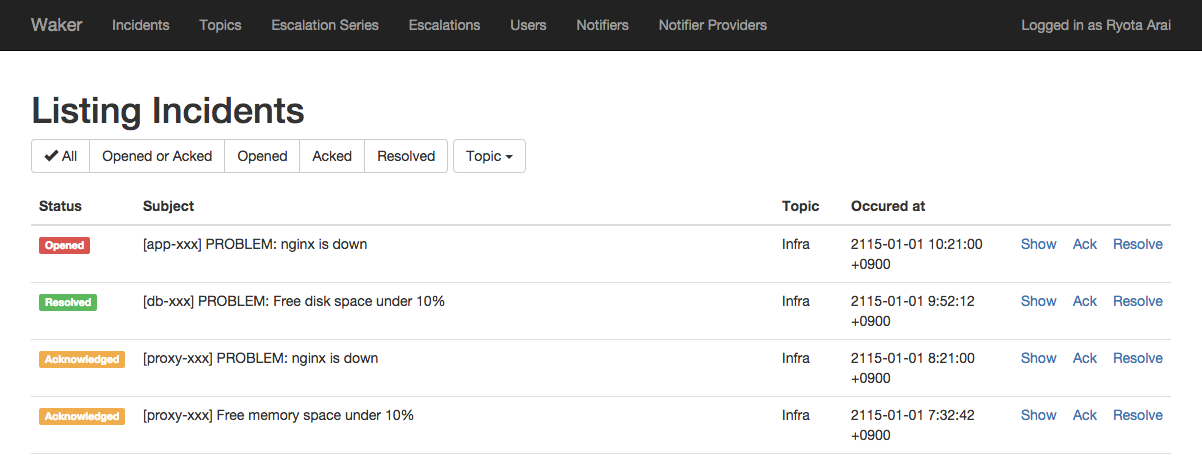
## Overview

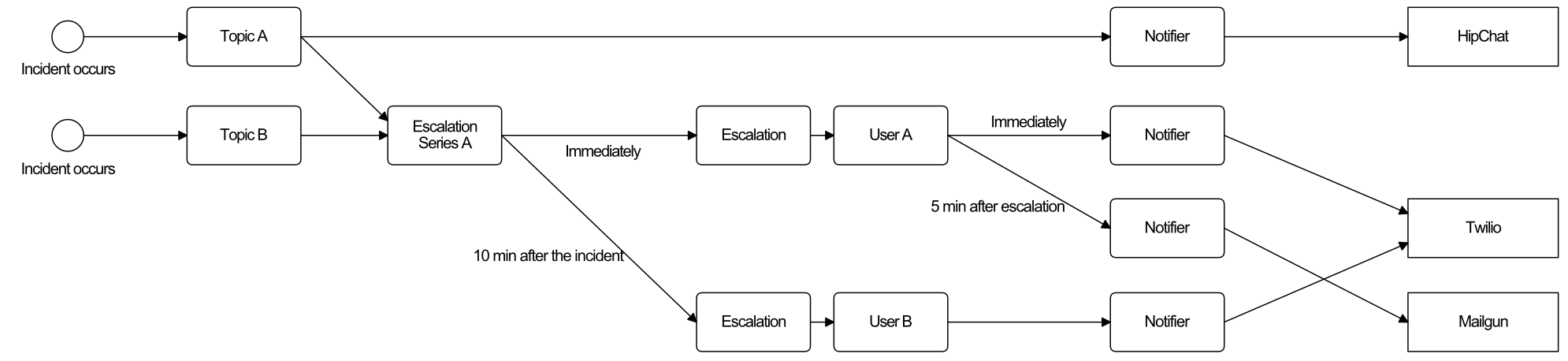
## Tutorial
### 1. (Optional) Configure auth provider
You can use external auth provider **optionally**. Currently, Google Auth is only supported (Patches are welcome :) )
```
$ echo 'GOOGLE_CLIENT_ID=...' >> .env
$ echo 'GOOGLE_CLIENT_SECRET=...' >> .env
$ echo 'GOOGLE_DOMAIN=...' >> .env # If you restrict to use Google Apps domain
```
### 2. Start the server
```
$ bundle install
$ foreman start
```
It starts an application server and a Sidekiq worker.
### 3. (If you uses auth provider) Log in
Visit [http://localhost:3000](http://localhost:3000) and log in with your credentials.
A new user account is automatically created and suspended by default. You can activate a user from [http://localhost:3000/users](http://localhost:3000/users) but you have to activate it from `rails console` because you are the first user:
```
$ bundle exec rails c
> User.first.update!(active: true)
```
### 4. Create users
Visit [http://localhost:3000/users/new](http://localhost:3000/users/new) and create new users.
### 5. Create a notifier provider
Visit [http://localhost:3000/notifier_providers/new](http://localhost:3000/notifier_providers/new) and create a notifier provider. See [Notifier Providers](https://github.com/ryotarai/waker#notifier-providers) section for detailed information.
### 6. Create a notifier
Visit [http://localhost:3000/notifiers/new](http://localhost:3000/notifiers/new) and create a notifier. See [Notifier](https://github.com/ryotarai/waker#notifiers) section for detailed information.
### 7. Create an escalation series
Visit [http://localhost:3000/escalation_series/new](http://localhost:3000/escalation_series/new) and create a escalation series. Escalation series is a series of escalations.
### 8. Create escalations
Visit [http://localhost:3000/escalations/new](http://localhost:3000/escalations/new) and create escalations.
- `Escalate to`: Who gets escalated incidents
- `Escalate after sec`: Seconds to escalate incidents since the incidents created
### 9. Create a topic
Visit [http://localhost:3000/topics/new](http://localhost:3000/topics/new) and create topics.
### 10. Send alerts to the topic
Suppoted alerts generaters are below:
- Mailgun ( `http://localhost:3000/topics/1/mailgun` )
- Mackerel ( `http://localhost:3000/topics/1/mackerel` )
- Alertmanager ( `http://localhost:3000/topics/1/alertmanager` )
- Slack( `http://localhost:3000/topics/1/slack` )
If you want to use Mailgun, you can configure Mailgun route setting with Mailgun endpoint you can see in [http://localhost:3000/topics/1/mailgun](http://localhost:3000/topics/1/mailgun)
## Configuration
### Notifier Providers
#### HipChat
- `api_token`
- `api_version`: `v1` or `v2`
#### Twilio
- `account_sid`
- `auth_token`
- `from`: Phone number
#### Mailgun
- `api_key`
- `from`: Email address
### Notifiers
#### Common fields
These are supported by all notifier provider
```
or_conditions:
- japanese_weekday: true
not_between: 9:30+0900-18:30+0900
- not_japanese_weekday: true
```
#### HipChat
- `room`: Room name or ID
#### Twilio
- `to`: Phone number
#### Mailgun
- `to`: Email address
================================================
FILE: Rakefile
================================================
# Add your own tasks in files placed in lib/tasks ending in .rake,
# for example lib/tasks/capistrano.rake, and they will automatically be available to Rake.
require File.expand_path('../config/application', __FILE__)
Rails.application.load_tasks
================================================
FILE: app/assets/images/.keep
================================================
================================================
FILE: app/assets/javascripts/application.js
================================================
// This is a manifest file that'll be compiled into application.js, which will include all the files
// listed below.
//
// Any JavaScript/Coffee file within this directory, lib/assets/javascripts, vendor/assets/javascripts,
// or any plugin's vendor/assets/javascripts directory can be referenced here using a relative path.
//
// It's not advisable to add code directly here, but if you do, it'll appear at the bottom of the
// compiled file.
//
// Read Sprockets README (https://github.com/sstephenson/sprockets#sprockets-directives) for details
// about supported directives.
//
//= require jquery
//= require jquery_ujs
//= require_tree .
================================================
FILE: app/assets/javascripts/comments.coffee
================================================
# Place all the behaviors and hooks related to the matching controller here.
# All this logic will automatically be available in application.js.
# You can use CoffeeScript in this file: http://coffeescript.org/
================================================
FILE: app/assets/javascripts/escalation_series.coffee
================================================
# Place all the behaviors and hooks related to the matching controller here.
# All this logic will automatically be available in application.js.
# You can use CoffeeScript in this file: http://coffeescript.org/
================================================
FILE: app/assets/javascripts/escalations.coffee
================================================
# Place all the behaviors and hooks related to the matching controller here.
# All this logic will automatically be available in application.js.
# You can use CoffeeScript in this file: http://coffeescript.org/
================================================
FILE: app/assets/javascripts/home.coffee
================================================
# Place all the behaviors and hooks related to the matching controller here.
# All this logic will automatically be available in application.js.
# You can use CoffeeScript in this file: http://coffeescript.org/
================================================
FILE: app/assets/javascripts/incident_events.coffee
================================================
# Place all the behaviors and hooks related to the matching controller here.
# All this logic will automatically be available in application.js.
# You can use CoffeeScript in this file: http://coffeescript.org/
================================================
FILE: app/assets/javascripts/incidents.coffee
================================================
# Place all the behaviors and hooks related to the matching controller here.
# All this logic will automatically be available in application.js.
# You can use CoffeeScript in this file: http://coffeescript.org/
================================================
FILE: app/assets/javascripts/maintenances.coffee
================================================
# Place all the behaviors and hooks related to the matching controller here.
# All this logic will automatically be available in application.js.
# You can use CoffeeScript in this file: http://coffeescript.org/
================================================
FILE: app/assets/javascripts/notifier_providers.coffee
================================================
# Place all the behaviors and hooks related to the matching controller here.
# All this logic will automatically be available in application.js.
# You can use CoffeeScript in this file: http://coffeescript.org/
================================================
FILE: app/assets/javascripts/notifiers.coffee
================================================
# Place all the behaviors and hooks related to the matching controller here.
# All this logic will automatically be available in application.js.
# You can use CoffeeScript in this file: http://coffeescript.org/
================================================
FILE: app/assets/javascripts/sessions.coffee
================================================
# Place all the behaviors and hooks related to the matching controller here.
# All this logic will automatically be available in application.js.
# You can use CoffeeScript in this file: http://coffeescript.org/
================================================
FILE: app/assets/javascripts/slack.coffee
================================================
# Place all the behaviors and hooks related to the matching controller here.
# All this logic will automatically be available in application.js.
# You can use CoffeeScript in this file: http://coffeescript.org/
================================================
FILE: app/assets/javascripts/topics.coffee
================================================
# Place all the behaviors and hooks related to the matching controller here.
# All this logic will automatically be available in application.js.
# You can use CoffeeScript in this file: http://coffeescript.org/
================================================
FILE: app/assets/javascripts/users.coffee
================================================
# Place all the behaviors and hooks related to the matching controller here.
# All this logic will automatically be available in application.js.
# You can use CoffeeScript in this file: http://coffeescript.org/
================================================
FILE: app/assets/stylesheets/application.css
================================================
/*
* This is a manifest file that'll be compiled into application.css, which will include all the files
* listed below.
*
* Any CSS and SCSS file within this directory, lib/assets/stylesheets, vendor/assets/stylesheets,
* or any plugin's vendor/assets/stylesheets directory can be referenced here using a relative path.
*
* You're free to add application-wide styles to this file and they'll appear at the bottom of the
* compiled file so the styles you add here take precedence over styles defined in any styles
* defined in the other CSS/SCSS files in this directory. It is generally better to create a new
* file per style scope.
*
*= require_tree .
*= require_self
*/
================================================
FILE: app/assets/stylesheets/comments.scss
================================================
// Place all the styles related to the comments controller here.
// They will automatically be included in application.css.
// You can use Sass (SCSS) here: http://sass-lang.com/
================================================
FILE: app/assets/stylesheets/escalation_series.scss
================================================
// Place all the styles related to the EscalationSeries controller here.
// They will automatically be included in application.css.
// You can use Sass (SCSS) here: http://sass-lang.com/
================================================
FILE: app/assets/stylesheets/escalations.scss
================================================
// Place all the styles related to the escalations controller here.
// They will automatically be included in application.css.
// You can use Sass (SCSS) here: http://sass-lang.com/
================================================
FILE: app/assets/stylesheets/home.scss
================================================
// Place all the styles related to the home controller here.
// They will automatically be included in application.css.
// You can use Sass (SCSS) here: http://sass-lang.com/
================================================
FILE: app/assets/stylesheets/incident_events.scss
================================================
// Place all the styles related to the incident_events controller here.
// They will automatically be included in application.css.
// You can use Sass (SCSS) here: http://sass-lang.com/
================================================
FILE: app/assets/stylesheets/incidents.scss
================================================
// Place all the styles related to the incidents controller here.
// They will automatically be included in application.css.
// You can use Sass (SCSS) here: http://sass-lang.com/
================================================
FILE: app/assets/stylesheets/maintenances.scss
================================================
// Place all the styles related to the maintenances controller here.
// They will automatically be included in application.css.
// You can use Sass (SCSS) here: http://sass-lang.com/
================================================
FILE: app/assets/stylesheets/notifier_providers.scss
================================================
// Place all the styles related to the NotifierProviders controller here.
// They will automatically be included in application.css.
// You can use Sass (SCSS) here: http://sass-lang.com/
================================================
FILE: app/assets/stylesheets/notifiers.scss
================================================
// Place all the styles related to the notifiers controller here.
// They will automatically be included in application.css.
// You can use Sass (SCSS) here: http://sass-lang.com/
================================================
FILE: app/assets/stylesheets/scaffolds.scss
================================================
body {
background-color: #fff;
color: #333;
font-family: verdana, arial, helvetica, sans-serif;
font-size: 13px;
line-height: 18px;
}
p, ol, ul, td {
font-family: verdana, arial, helvetica, sans-serif;
font-size: 13px;
line-height: 18px;
}
pre {
background-color: #eee;
padding: 10px;
font-size: 11px;
}
a {
color: #000;
&:visited {
color: #666;
}
&:hover {
color: #fff;
background-color: #000;
}
}
div {
&.field, &.actions {
margin-bottom: 10px;
}
}
#notice {
color: green;
}
.field_with_errors {
padding: 2px;
background-color: red;
display: table;
}
#error_explanation {
width: 450px;
border: 2px solid red;
padding: 7px;
padding-bottom: 0;
margin-bottom: 20px;
background-color: #f0f0f0;
h2 {
text-align: left;
font-weight: bold;
padding: 5px 5px 5px 15px;
font-size: 12px;
margin: -7px;
margin-bottom: 0px;
background-color: #c00;
color: #fff;
}
ul li {
font-size: 12px;
list-style: square;
}
}
================================================
FILE: app/assets/stylesheets/sessions.scss
================================================
// Place all the styles related to the sessions controller here.
// They will automatically be included in application.css.
// You can use Sass (SCSS) here: http://sass-lang.com/
================================================
FILE: app/assets/stylesheets/slack.scss
================================================
// Place all the styles related to the slack controller here.
// They will automatically be included in application.css.
// You can use Sass (SCSS) here: http://sass-lang.com/
================================================
FILE: app/assets/stylesheets/topics.scss
================================================
// Place all the styles related to the topics controller here.
// They will automatically be included in application.css.
// You can use Sass (SCSS) here: http://sass-lang.com/
================================================
FILE: app/assets/stylesheets/users.scss
================================================
// Place all the styles related to the users controller here.
// They will automatically be included in application.css.
// You can use Sass (SCSS) here: http://sass-lang.com/
================================================
FILE: app/controllers/application_controller.rb
================================================
class ApplicationController < ActionController::Base
# Prevent CSRF attacks by raising an exception.
# For APIs, you may want to use :null_session instead.
protect_from_forgery with: :null_session
helper_method :current_user
if ENV["GOOGLE_CLIENT_ID"]
before_action :login_required
end
def login_required
unless current_user
session[:user_id] = nil
redirect_to '/auth/google_oauth2_with_calendar'
return
end
unless current_user.active
render text: "You are not activated yet. Please ask administrator to activate you"
return
end
end
private
def current_user=(user)
session[:user_id] = user.id
end
def current_user
if user_id = session[:user_id]
User.find(user_id)
elsif login_token = request.headers['X-Login-Token']
User.find_by(login_token: login_token)
end
end
end
================================================
FILE: app/controllers/comments_controller.rb
================================================
class CommentsController < ApplicationController
before_action :set_comment, only: [:show, :edit, :update, :destroy]
before_action :set_incident
# GET /comments
# GET /comments.json
def index
@comments = Comment.where(incident: @incident)
end
# GET /comments/1
# GET /comments/1.json
def show
end
# GET /comments/new
def new
@comment = Comment.new
end
# GET /comments/1/edit
def edit
end
# POST /comments
# POST /comments.json
def create
p comment_params
@comment = Comment.new(comment_params)
respond_to do |format|
if @comment.save
format.html { redirect_to [@incident, @comment], notice: 'Comment was successfully created.' }
format.json { render :show, status: :created, location: [@incident, @comment] }
else
format.html { render :new }
format.json { render json: @comment.errors, status: :unprocessable_entity }
end
end
end
# PATCH/PUT /comments/1
# PATCH/PUT /comments/1.json
def update
respond_to do |format|
if @comment.update(comment_params)
format.html { redirect_to [@incident, @comment], notice: 'Comment was successfully updated.' }
format.json { render :show, status: :ok, location: [@incident, @comment] }
else
format.html { render :edit }
format.json { render json: @comment.errors, status: :unprocessable_entity }
end
end
end
# DELETE /comments/1
# DELETE /comments/1.json
def destroy
@comment.destroy
respond_to do |format|
format.html { redirect_to incident_comments_url, notice: 'Comment was successfully destroyed.' }
format.json { head :no_content }
end
end
private
# Use callbacks to share common setup or constraints between actions.
def set_comment
@comment = Comment.find(params[:id])
end
# Never trust parameters from the scary internet, only allow the white list through.
def comment_params
params.require(:comment).permit(:incident_id, :user_id, :comment)
end
def set_incident
@incident = Incident.find(params[:incident_id])
end
end
================================================
FILE: app/controllers/concerns/.keep
================================================
================================================
FILE: app/controllers/escalation_series_controller.rb
================================================
class EscalationSeriesController < ApplicationController
before_action :set_escalation_series, only: [:show, :edit, :update, :destroy, :update_escalations]
# GET /escalation_series
# GET /escalation_series.json
def index
@escalation_series = EscalationSeries.all
end
# GET /escalation_series/1
# GET /escalation_series/1.json
def show
end
# GET /escalation_series/new
def new
@escalation_series = EscalationSeries.new
end
# GET /escalation_series/1/edit
def edit
end
# POST /escalation_series
# POST /escalation_series.json
def create
@escalation_series = EscalationSeries.new(escalation_series_params)
respond_to do |format|
if @escalation_series.save
format.html { redirect_to @escalation_series, notice: 'Escalation series was successfully created.' }
format.json { render :show, status: :created, location: @escalation_series }
else
format.html { render :new }
format.json { render json: @escalation_series.errors, status: :unprocessable_entity }
end
end
end
# PATCH/PUT /escalation_series/1
# PATCH/PUT /escalation_series/1.json
def update
respond_to do |format|
if @escalation_series.update(escalation_series_params)
format.html { redirect_to @escalation_series, notice: 'Escalation series was successfully updated.' }
format.json { render :show, status: :ok, location: @escalation_series }
else
format.html { render :edit }
format.json { render json: @escalation_series.errors, status: :unprocessable_entity }
end
end
end
# DELETE /escalation_series/1
# DELETE /escalation_series/1.json
def destroy
@escalation_series.destroy
respond_to do |format|
format.html { redirect_to escalation_series_index_url, notice: 'Escalation series was successfully destroyed.' }
format.json { head :no_content }
end
end
def update_escalations
@escalation_series.update_escalations!
end
private
# Use callbacks to share common setup or constraints between actions.
def set_escalation_series
@escalation_series = EscalationSeries.find(params[:id])
end
# Never trust parameters from the scary internet, only allow the white list through.
def escalation_series_params
params.require(:escalation_series).permit(:name, :settings).tap do |v|
v[:settings] = YAML.load(v[:settings])
end
end
end
================================================
FILE: app/controllers/escalations_controller.rb
================================================
class EscalationsController < ApplicationController
before_action :set_escalation, only: [:show, :edit, :update, :destroy]
# GET /escalations
# GET /escalations.json
def index
@escalations = Escalation.all.order('escalate_after_sec')
end
# GET /escalations/1
# GET /escalations/1.json
def show
end
# GET /escalations/new
def new
@escalation = Escalation.new
end
# GET /escalations/1/edit
def edit
end
# POST /escalations
# POST /escalations.json
def create
@escalation = Escalation.new(escalation_params)
respond_to do |format|
if @escalation.save
format.html { redirect_to @escalation, notice: 'Escalation was successfully created.' }
format.json { render :show, status: :created, location: @escalation }
else
format.html { render :new }
format.json { render json: @escalation.errors, status: :unprocessable_entity }
end
end
end
# PATCH/PUT /escalations/1
# PATCH/PUT /escalations/1.json
def update
respond_to do |format|
if @escalation.update(escalation_params)
format.html { redirect_to @escalation, notice: 'Escalation was successfully updated.' }
format.json { render :show, status: :ok, location: @escalation }
else
format.html { render :edit }
format.json { render json: @escalation.errors, status: :unprocessable_entity }
end
end
end
# DELETE /escalations/1
# DELETE /escalations/1.json
def destroy
@escalation.destroy
respond_to do |format|
format.html { redirect_to escalations_url, notice: 'Escalation was successfully destroyed.' }
format.json { head :no_content }
end
end
private
# Use callbacks to share common setup or constraints between actions.
def set_escalation
@escalation = Escalation.find(params[:id])
end
# Never trust parameters from the scary internet, only allow the white list through.
def escalation_params
params.require(:escalation).permit(:escalate_to_id, :escalate_after_sec, :escalation_series_id)
end
end
================================================
FILE: app/controllers/home_controller.rb
================================================
class HomeController < ApplicationController
def index
redirect_to incidents_path
end
end
================================================
FILE: app/controllers/incident_events_controller.rb
================================================
require 'securerandom'
class IncidentEventsController < ApplicationController
skip_before_action :login_required, only: [:twilio], raise: false
def twilio
@event = IncidentEvent.find(params[:id])
language = ENV['TWILIO_LANGUAGE'] || 'en-US'
resp = nil
if params[:Digits]
case params[:Digits]
when '1'
@event.incident.acknowledge! rescue nil
when '2'
@event.incident.resolve! rescue nil
end
resp = Twilio::TwiML::VoiceResponse.new do |r|
r.say message: @event.incident.status, voice: 'alice', language: language
r.hangup
end
else
resp = Twilio::TwiML::VoiceResponse.new do |r|
r.gather timeout: 10, numDigits: 1 do |g|
g.say message: "This is Waker alert.", voice: 'alice', language: language
g.say message: @event.incident.subject, voice: 'alice', language: language
g.say message: "To acknowledge, press 1.", voice: 'alice', language: language
g.say message: "To resolve, press 2.", voice: 'alice', language: language
end
end
end
render xml: resp.to_s
end
end
================================================
FILE: app/controllers/incidents_controller.rb
================================================
class IncidentsController < ApplicationController
before_action :set_incidents, only: [:index, :bulk_acknowledge, :bulk_resolve]
before_action :set_incident, only: [:show, :edit, :update, :destroy, :acknowledge, :resolve]
before_action :ensure_hash, only: [:acknowledge, :resolve]
skip_before_action :login_required, only: [:acknowledge, :resolve], raise: false
# GET /incidents
# GET /incidents.json
def index
@page = (params[:page] || 1).to_i
@incidents = @incidents.order('id DESC').page(@page).per(25)
end
# GET /incidents/1
# GET /incidents/1.json
def show
end
# GET /incidents/new
def new
@incident = Incident.new
end
# GET /incidents/1/edit
def edit
end
# POST /incidents
# POST /incidents.json
def create
@incident = Incident.new(incident_params)
respond_to do |format|
if @incident.save
format.html { redirect_to @incident, notice: 'Incident was successfully created.' }
format.json { render :show, status: :created, location: @incident }
else
format.html { render :new }
format.json { render json: @incident.errors, status: :unprocessable_entity }
end
end
end
# PATCH/PUT /incidents/1
# PATCH/PUT /incidents/1.json
def update
respond_to do |format|
if @incident.update(incident_params)
format.html { redirect_to @incident, notice: 'Incident was successfully updated.' }
format.json { render :show, status: :ok, location: @incident }
else
format.html { render :edit }
format.json { render json: @incident.errors, status: :unprocessable_entity }
end
end
end
def bulk_acknowledge
@incidents.opened.update_all(status: Incident.statuses[:acknowledged])
respond_to do |format|
format.html { redirect_to incidents_url, notice: 'Incidents were successfully acknowledged.' }
format.json { head :no_content }
end
end
def bulk_resolve
@incidents.update_all(status: Incident.statuses[:resolved])
respond_to do |format|
format.html { redirect_to incidents_url, notice: 'Incidents were successfully resolved.' }
format.json { head :no_content }
end
end
# DELETE /incidents/1
# DELETE /incidents/1.json
def destroy
@incident.destroy
respond_to do |format|
format.html { redirect_to incidents_url, notice: 'Incident was successfully destroyed.' }
format.json { head :no_content }
end
end
def acknowledge
@incident.acknowledge!
respond_to do |format|
if current_user
format.html { redirect_to incidents_url, notice: 'Incident was successfully acknowledged.' }
else
format.html { render text: "Acknowledged" }
end
format.json { render json: {status: 'ok'} }
end
end
def resolve
@incident.resolve!
respond_to do |format|
if current_user
format.html { redirect_to incidents_url, notice: 'Incident was successfully resolved.' }
else
format.html { render text: "Resolved" }
end
format.json { render json: {status: 'ok'} }
end
end
private
# Use callbacks to share common setup or constraints between actions.
def set_incident
@incident = Incident.find(params[:id])
end
def set_incidents
set_visible_statuses
set_visible_topic
@incidents = Incident.all
if @visible_statuses
@incidents = @incidents.where(status: @visible_statuses)
end
if @visible_topic
@incidents = @incidents.where(topic: @visible_topic)
end
end
def set_visible_statuses
@visible_statuses = session[:incidents_statuses]
# for transition from rev 0a2dd42 or earlier
@visible_statuses = nil if @visible_statuses.try(:empty?)
if params[:statuses]
if params[:statuses] == ''
@visible_statuses = nil # all
else
@visible_statuses = params[:statuses].split(',').map(&:to_i)
end
session[:incidents_statuses] = @visible_statuses
end
end
def set_visible_topic
@visible_topic = session[:incidents_topic]
# for transition from rev 0a2dd42 or earlier
@visible_topic = nil if @visible_topic == 'all'
if params[:topic]
if params[:topic] == 'all'
@visible_topic = nil # all
else
@visible_topic = params[:topic].to_i
end
session[:incidents_topic] = @visible_topic
end
end
# Never trust parameters from the scary internet, only allow the white list through.
def incident_params
params.require(:incident).permit(:subject, :description, :topic_id, :occured_at)
end
def ensure_hash
unless params[:hash] == @incident.confirmation_hash
render text: "Wrong hash", status: 403
end
end
end
================================================
FILE: app/controllers/maintenances_controller.rb
================================================
class MaintenancesController < ApplicationController
before_action :set_maintenance, only: [:show, :edit, :update, :destroy]
# GET /maintenances
# GET /maintenances.json
def index
@maintenances = Maintenance.not_expired
end
# GET /maintenances/1
# GET /maintenances/1.json
def show
end
# GET /maintenances/new
def new
now = Time.now
@maintenance = Maintenance.new(
start_time: now,
end_time: now + 60*60
)
end
# GET /maintenances/1/edit
def edit
end
# POST /maintenances
# POST /maintenances.json
def create
@maintenance = Maintenance.new(maintenance_params)
respond_to do |format|
if @maintenance.save
format.html { redirect_to @maintenance, notice: 'Maintenance was successfully created.' }
format.json { render :show, status: :created, location: @maintenance }
else
format.html { render :new }
format.json { render json: @maintenance.errors, status: :unprocessable_entity }
end
end
end
# PATCH/PUT /maintenances/1
# PATCH/PUT /maintenances/1.json
def update
respond_to do |format|
if @maintenance.update(maintenance_params)
format.html { redirect_to @maintenance, notice: 'Maintenance was successfully updated.' }
format.json { render :show, status: :ok, location: @maintenance }
else
format.html { render :edit }
format.json { render json: @maintenance.errors, status: :unprocessable_entity }
end
end
end
# DELETE /maintenances/1
# DELETE /maintenances/1.json
def destroy
@maintenance.destroy
respond_to do |format|
format.html { redirect_to maintenances_url, notice: 'Maintenance was successfully destroyed.' }
format.json { head :no_content }
end
end
private
# Use callbacks to share common setup or constraints between actions.
def set_maintenance
@maintenance = Maintenance.find(params[:id])
end
# Never trust parameters from the scary internet, only allow the white list through.
def maintenance_params
params.require(:maintenance).permit(:topic_id, :start_time, :end_time, :filter)
end
end
================================================
FILE: app/controllers/notifier_providers_controller.rb
================================================
class NotifierProvidersController < ApplicationController
before_action :set_notifier_provider, only: [:show, :edit, :update, :destroy]
# GET /notifier_providers
# GET /notifier_providers.json
def index
@notifier_providers = NotifierProvider.all
end
# GET /notifier_providers/1
# GET /notifier_providers/1.json
def show
end
# GET /notifier_providers/new
def new
@notifier_provider = NotifierProvider.new
end
# GET /notifier_providers/1/edit
def edit
end
# POST /notifier_providers
# POST /notifier_providers.json
def create
@notifier_provider = NotifierProvider.new(notifier_provider_params)
respond_to do |format|
if @notifier_provider.save
format.html { redirect_to @notifier_provider, notice: 'Notifier provider was successfully created.' }
format.json { render :show, status: :created, location: @notifier_provider }
else
format.html { render :new }
format.json { render json: @notifier_provider.errors, status: :unprocessable_entity }
end
end
end
# PATCH/PUT /notifier_providers/1
# PATCH/PUT /notifier_providers/1.json
def update
respond_to do |format|
if @notifier_provider.update(notifier_provider_params)
format.html { redirect_to @notifier_provider, notice: 'Notifier provider was successfully updated.' }
format.json { render :show, status: :ok, location: @notifier_provider }
else
format.html { render :edit }
format.json { render json: @notifier_provider.errors, status: :unprocessable_entity }
end
end
end
# DELETE /notifier_providers/1
# DELETE /notifier_providers/1.json
def destroy
@notifier_provider.destroy
respond_to do |format|
format.html { redirect_to notifier_providers_url, notice: 'Notifier provider was successfully destroyed.' }
format.json { head :no_content }
end
end
private
# Use callbacks to share common setup or constraints between actions.
def set_notifier_provider
@notifier_provider = NotifierProvider.find(params[:id])
end
# Never trust parameters from the scary internet, only allow the white list through.
def notifier_provider_params
params.require(:notifier_provider).permit(:name, :kind, :settings).tap do |v|
v[:settings] = YAML.load(v[:settings])
end
end
end
================================================
FILE: app/controllers/notifiers_controller.rb
================================================
class NotifiersController < ApplicationController
before_action :set_notifier, only: [:show, :edit, :update, :destroy]
# GET /notifiers
# GET /notifiers.json
def index
@notifiers = Notifier.all
end
# GET /notifiers/1
# GET /notifiers/1.json
def show
end
# GET /notifiers/new
def new
@notifier = Notifier.new
end
# GET /notifiers/1/edit
def edit
end
# POST /notifiers
# POST /notifiers.json
def create
@notifier = Notifier.new(notifier_params)
respond_to do |format|
if @notifier.save
format.html { redirect_to @notifier, notice: 'Notifier was successfully created.' }
format.json { render :show, status: :created, location: @notifier }
else
format.html { render :new }
format.json { render json: @notifier.errors, status: :unprocessable_entity }
end
end
end
# PATCH/PUT /notifiers/1
# PATCH/PUT /notifiers/1.json
def update
respond_to do |format|
if @notifier.update(notifier_params)
format.html { redirect_to @notifier, notice: 'Notifier was successfully updated.' }
format.json { render :show, status: :ok, location: @notifier }
else
format.html { render :edit }
format.json { render json: @notifier.errors, status: :unprocessable_entity }
end
end
end
# DELETE /notifiers/1
# DELETE /notifiers/1.json
def destroy
@notifier.destroy
respond_to do |format|
format.html { redirect_to notifiers_url, notice: 'Notifier was successfully destroyed.' }
format.json { head :no_content }
end
end
private
# Use callbacks to share common setup or constraints between actions.
def set_notifier
@notifier = Notifier.find(params[:id])
end
# Never trust parameters from the scary internet, only allow the white list through.
def notifier_params
params.require(:notifier).permit(:user_id, :kind, :settings, :notify_after_sec, :provider_id, :topic_id, :enabled).tap do |v|
v[:settings] = YAML.load(v[:settings])
end
end
end
================================================
FILE: app/controllers/sessions_controller.rb
================================================
class SessionsController < ApplicationController
skip_before_action :login_required, only: [:create]
def create
@user = User.find_or_create_from_auth_hash(auth_hash)
@user.update_credentials_from_auth_hash(auth_hash)
self.current_user = @user
redirect_to '/'
end
private
def auth_hash
request.env['omniauth.auth']
end
end
================================================
FILE: app/controllers/slack_controller.rb
================================================
class SlackController < ApplicationController
skip_before_action :login_required, only: [:interactive], raise: false
def interactive
verify!
message = payload['original_message']
message['attachments'][0].delete('actions')
user = payload['user']['name']
text = ''
payload['actions'].each do |a|
case a['value']
when 'acknowledge'
incident.acknowledge!
text = ":white_check_mark: @#{user} acknowledged"
when 'resolve'
incident.resolve!
text = ":white_check_mark: @#{user} resolved"
end
end
message['attachments'][0]['fields'] = [{
'title' => text,
'value' => '',
'short' => false,
}]
render json: message
end
private def payload
JSON.parse(params[:payload])
end
private def verify!
verified = false
Notifier.preload(:provider).find_each do |n|
settings = n.provider.settings.merge(n.settings)
token = settings['verification_token']
if n.provider.slack? && settings['enable_buttons'] && payload['token'] == token
verified = true
break
end
end
unless verified
raise 'token verification failed'
end
end
private def incident_id
payload['callback_id'].match(/\Aincident\.(\d+)\z/)[1].to_i
end
private def incident
Incident.find(incident_id)
end
end
================================================
FILE: app/controllers/topics_controller.rb
================================================
class TopicsController < ApplicationController
before_action :set_topic, only: [:show, :edit, :update, :destroy, :mailgun, :mackerel, :alertmanager, :slack]
skip_before_action :login_required, only: [:mailgun, :mackerel, :alertmanager, :slack], raise: false
# GET /topics
# GET /topics.json
def index
@topics = Topic.all
end
# GET /topics/1
# GET /topics/1.json
def show
end
# GET /topics/new
def new
@topic = Topic.new
end
# GET /topics/1/edit
def edit
end
# POST /topics
# POST /topics.json
def create
@topic = Topic.new(topic_params)
respond_to do |format|
if @topic.save
format.html { redirect_to @topic, notice: 'Topic was successfully created.' }
format.json { render :show, status: :created, location: @topic }
else
format.html { render :new }
format.json { render json: @topic.errors, status: :unprocessable_entity }
end
end
end
# PATCH/PUT /topics/1
# PATCH/PUT /topics/1.json
def update
respond_to do |format|
if @topic.update(topic_params)
format.html { redirect_to @topic, notice: 'Topic was successfully updated.' }
format.json { render :show, status: :ok, location: @topic }
else
format.html { render :edit }
format.json { render json: @topic.errors, status: :unprocessable_entity }
end
end
end
# DELETE /topics/1
# DELETE /topics/1.json
def destroy
@topic.destroy
respond_to do |format|
format.html { redirect_to topics_url, notice: 'Topic was successfully destroyed.' }
format.json { head :no_content }
end
end
# POST /topics/1/mailgun
def mailgun
unless @topic.enabled
Rails.logger.info "Incident creation is skipped because the topic is disabled."
render json: {}, status: 200
return
end
# http://documentation.mailgun.com/user_manual.html#routes
subject = params[:subject]
description = params['body-plain']
if @topic.in_maintenance?(subject, description)
Rails.logger.info "Incident creation is skipped because the topic is in maintenance."
render json: {}, status: 200
return
end
@topic.incidents.create!(
subject: subject,
description: description,
)
render json: {}, status: 200
end
# POST /topics/1/mackerel
def mackerel
data = JSON.parse(request.body.read)
return render json: {}, status: 200 if data.dig('alert', 'status') == 'ok' || data.dig('alertGroup', 'status') == 'OK'
unless @topic.enabled
Rails.logger.info "Incident creation is skipped because the topic is disabled."
render json: {}, status: 200
return
end
if data['event'] == 'alertGroup' then
subject = "[#{data['alertGroup']['status']}] #{data['alertGroupSetting']['name']}"
else
name = data.key?('host') ? data['host']['name'] : data['alert']['monitorName']
subject = "[#{data['alert']['status']}] #{name}"
end
description = JSON.pretty_generate(data)
if @topic.in_maintenance?(subject, description)
Rails.logger.info "Incident creation is skipped because the topic is in maintenance"
render json: {}, status: 200
return
end
@topic.incidents.create!(
subject: subject,
description: description,
)
render json: {}, status: 200
end
# POST /topics/1/alertmanager
def alertmanager
data = JSON.parse(request.body.read)
unless @topic.enabled
Rails.logger.info "Incident creation is skipped because the topic is disabled."
render json: {}, status: 200
return
end
subject = "[#{data['commonLabels']['severity']}] #{data['commonLabels']['alertname']}: #{data['commonAnnotations']['summary']}"
description = JSON.pretty_generate(data)
if @topic.in_maintenance?(subject, description)
Rails.logger.info "Incident creation is skipped because the topic is in maintenance"
render json: {}, status: 200
return
end
@topic.incidents.create!(
subject: subject,
description: description,
)
render json: {}, status: 200
end
def slack
unless @topic.enabled
Rails.logger.info "Incident creation is skipped because the topic is disabled."
render json: {}, status: 200
return
end
subject = "escalation from slack,channel name:#{params['channel_name']} #{params['text']}"
description = "channel:#{params['channel_name']} user:#{params['user_name']} #{params['text']}"
if @topic.in_maintenance?(subject, description)
Rails.logger.info "Incident creation is skipped because the topic is in maintenance."
render json: {}, status: 200
return
end
@topic.incidents.create!(
subject: subject,
description: description,
)
render json: {text: 'accept your page'}, status: 200
end
private
# Use callbacks to share common setup or constraints between actions.
def set_topic
@topic = Topic.find(params[:id])
end
# Never trust parameters from the scary internet, only allow the white list through.
def topic_params
params.require(:topic).permit(:name, :kind, :escalation_series_id, :enabled)
end
end
================================================
FILE: app/controllers/users_controller.rb
================================================
class UsersController < ApplicationController
before_action :set_user, only: [:show, :edit, :update, :destroy, :activation, :deactivation]
# GET /users
# GET /users.json
def index
@users = User.all
end
# GET /users/1
# GET /users/1.json
def show
end
# GET /users/new
def new
@user = User.new
end
# GET /users/1/edit
def edit
end
# POST /users
# POST /users.json
def create
@user = User.new(user_params)
respond_to do |format|
if @user.save
format.html { redirect_to @user, notice: 'User was successfully created.' }
format.json { render :show, status: :created, location: @user }
else
format.html { render :new }
format.json { render json: @user.errors, status: :unprocessable_entity }
end
end
end
# PATCH/PUT /users/1
# PATCH/PUT /users/1.json
def update
respond_to do |format|
if @user.update(user_params)
format.html { redirect_to @user, notice: 'User was successfully updated.' }
format.json { render :show, status: :ok, location: @user }
else
format.html { render :edit }
format.json { render json: @user.errors, status: :unprocessable_entity }
end
end
end
# DELETE /users/1
# DELETE /users/1.json
def destroy
@user.destroy
respond_to do |format|
format.html { redirect_to users_url, notice: 'User was successfully destroyed.' }
format.json { head :no_content }
end
end
# PATCH/PUT /users/1/activation
def activation
@user.update!(active: true)
respond_to do |format|
format.html { redirect_to users_url, notice: 'User was successfully activated.' }
end
end
# PATCH/PUT /users/1/deactivation
def deactivation
@user.update!(active: false)
respond_to do |format|
format.html { redirect_to users_url, notice: 'User was successfully deactivated.' }
end
end
private
# Use callbacks to share common setup or constraints between actions.
def set_user
@user = User.find(params[:id])
end
# Never trust parameters from the scary internet, only allow the white list through.
def user_params
params.require(:user).permit(:name)
end
end
================================================
FILE: app/helpers/application_helper.rb
================================================
module ApplicationHelper
end
================================================
FILE: app/helpers/comments_helper.rb
================================================
module CommentsHelper
end
================================================
FILE: app/helpers/escalation_series_helper.rb
================================================
module EscalationSeriesHelper
end
================================================
FILE: app/helpers/escalations_helper.rb
================================================
module EscalationsHelper
end
================================================
FILE: app/helpers/home_helper.rb
================================================
module HomeHelper
end
================================================
FILE: app/helpers/incident_events_helper.rb
================================================
module IncidentEventsHelper
end
================================================
FILE: app/helpers/incidents_helper.rb
================================================
module IncidentsHelper
end
================================================
FILE: app/helpers/maintenances_helper.rb
================================================
module MaintenancesHelper
end
================================================
FILE: app/helpers/notifier_providers_helper.rb
================================================
module NotifierProvidersHelper
end
================================================
FILE: app/helpers/notifiers_helper.rb
================================================
module NotifiersHelper
end
================================================
FILE: app/helpers/sessions_helper.rb
================================================
module SessionsHelper
end
================================================
FILE: app/helpers/slack_helper.rb
================================================
module SlackHelper
end
================================================
FILE: app/helpers/topics_helper.rb
================================================
module TopicsHelper
end
================================================
FILE: app/helpers/users_helper.rb
================================================
module UsersHelper
end
================================================
FILE: app/mailers/.keep
================================================
================================================
FILE: app/models/.keep
================================================
================================================
FILE: app/models/application_record.rb
================================================
# Base ApplicationRecord Class
class ApplicationRecord < ActiveRecord::Base
self.abstract_class = true
end
================================================
FILE: app/models/comment.rb
================================================
class Comment < ApplicationRecord
belongs_to :incident
belongs_to :user
validates :incident, presence: true
validates :user, presence: true
validates :comment, presence: true
end
================================================
FILE: app/models/concerns/.keep
================================================
================================================
FILE: app/models/escalation.rb
================================================
class Escalation < ApplicationRecord
belongs_to :escalation_series
belongs_to :escalate_to, class_name: 'User'
validates :escalation_series, presence: true
validates :escalate_to, presence: true
validates :escalate_after_sec, numericality: {greater_than_or_equal_to: 5}
end
================================================
FILE: app/models/escalation_series.rb
================================================
class EscalationSeries < ApplicationRecord
has_many :escalations, dependent: :destroy
has_many :topics, dependent: :destroy
validates :name, presence: true
serialize :settings, JSON
after_initialize :set_defaults
def set_defaults
self.settings ||= {}
end
def update_escalations!
updater_class = case self.settings['update_by']
when 'google_calendar'
GoogleCalendarEscalationUpdater
else
nil
end
if updater_class
updater = updater_class.new(self)
updater.update!
end
end
class EscalationUpdater
def initialize(series)
@series = series
end
def update!
raise NotImplementedError
end
private
def settings
@series.settings
end
end
class GoogleCalendarEscalationUpdater < EscalationUpdater
def initialize(*)
super
require 'google/api_client'
end
def update!
Rails.logger.info "Update #{@series.inspect} by Google Calendar"
if user_as.provider && user_as.provider != 'google_oauth2_with_calendar'
raise "User ##{user_as.id} is not authenticated by 'google_oauth2_with_calendar' provider"
end
client = Google::APIClient.new(
application_name: "Waker",
application_version: "2.0.0",
user_agent: "Waker/2.0.0 google-api-client"
)
auth = client.authorization
expired = Time.at(user_as.credentials.fetch('expires_at')) < Time.now
if user_as.credentials.fetch('expires') && expired
Rails.logger.info "Refreshing access token..."
auth.client_id = ENV["GOOGLE_CLIENT_ID"]
auth.client_secret = ENV["GOOGLE_CLIENT_SECRET"]
auth.refresh_token = user_as.credentials.fetch('refresh_token')
auth.grant_type = "refresh_token"
auth.refresh!
user_as.update!(
credentials: user_as.credentials.merge(
'token' => auth.access_token,
'expires_at' => auth.expires_at.to_i,
)
)
else
auth.access_token = user_as.credentials.fetch('token')
end
calendar_api = client.discovered_api('calendar', 'v3')
calendar = client.execute(
api_method: calendar_api.calendar_list.list,
parameters: {},
).data.items.find do |cal|
cal['summary'] == calendar_name
end
events = client.execute(
api_method: calendar_api.events.list,
parameters: {
'calendarId' => calendar['id'],
'timeMax' => (Time.now + 1).iso8601,
'timeMin' => (Time.now).iso8601,
'singleEvents' => true,
},
).data.items
events.each do |event|
unless event['end']['dateTime'] && event['start']['dateTime']
raise "dateTime field is not found (The event may be all-day event)\n#{event}"
end
end
events.sort! do |a, b|
a['end']['dateTime'] - a['start']['dateTime'] <=>
b['end']['dateTime'] - b['start']['dateTime']
end
# shortest event
event = events.first
persons = event['summary'].split(event_delimiter).map(&:strip)
escalations = @series.escalations.order('escalate_after_sec')
persons.each_with_index do |name, i|
user = User.find_by(name: name)
raise "User '#{name}' is not found." unless user
escalation = escalations[i]
escalation.update!(escalate_to: user)
end
end
private
def user_as
User.find(settings.fetch('user_as_id'))
end
def calendar_name
settings.fetch('calendar')
end
def event_delimiter
settings.fetch('event_delimiter')
end
end
end
================================================
FILE: app/models/escalation_update_worker.rb
================================================
class EscalationUpdateWorker
include Sidekiq::Worker
def perform
EscalationSeries.all.each do |series|
handle_series(series)
end
rescue => err
Rails.logger.error "#{err.class}: #{err}\n#{err.backtrace.join("\n")}"
end
private
def handle_series(series)
series.update_escalations!
end
end
================================================
FILE: app/models/escalation_worker.rb
================================================
class EscalationWorker
include Sidekiq::Worker
def self.enqueue(incident, escalation)
Rails.logger.info "Enqueue EscalaionWorker job"
self.perform_in(escalation.escalate_after_sec, incident.id, escalation.id)
end
def perform(incident_id, escalation_id)
incident = Incident.find(incident_id)
escalation = Escalation.find(escalation_id)
if incident.opened?
incident.events.create(
kind: :escalated,
info: {
escalation: escalation,
escalated_to: escalation.escalate_to,
},
)
end
end
end
================================================
FILE: app/models/incident.rb
================================================
require 'digest/sha1'
class Incident < ApplicationRecord
STATUSES = [:opened, :acknowledged, :resolved]
belongs_to :topic
has_many :events, class_name: 'IncidentEvent', dependent: :destroy
enum status: STATUSES
has_many :comments
validates :topic, presence: true
validates :subject, presence: true
validates :description, presence: true
validates :occured_at, presence: true
after_initialize :set_defaults
after_create :enqueue
def acknowledge!
return if self.acknowledged? || self.resolved?
self.acknowledged!
events.create(kind: :acknowledged)
end
def resolve!
return if self.resolved?
self.resolved!
events.create(kind: :resolved)
end
def confirmation_hash
Digest::SHA1.hexdigest("#{Rails.application.secrets.secret_key_base}#{self.id}")
end
private
def set_defaults
self.status ||= :opened
self.occured_at ||= Time.now
end
def enqueue
topic.escalation_series.escalations.each do |escalation|
EscalationWorker.enqueue(self, escalation)
end
events.create(kind: :opened)
end
end
================================================
FILE: app/models/incident_event.rb
================================================
class IncidentEvent < ApplicationRecord
belongs_to :incident
enum kind: [:opened, :acknowledged, :resolved, :escalated, :commented, :notified]
validates :incident, presence: true
validates :kind, presence: true
serialize :info, JSON
after_create :notify
after_initialize :set_defaults
def set_defaults
self.info ||= {}
end
def notify
return if self.notified?
Notifier.all.each do |notifier|
next if notifier.topic && self.incident.topic != notifier.topic
notifier.notify(self)
end
end
def escalated_to
self.info['escalated_to'] && User.find(self.info['escalated_to']['id'])
end
def escalation
self.info['escalation'] && Escalation.find(self.info['escalation']['id'])
end
def notifier
self.info['notifier'] && Notifier.find(self.info['notifier']['id'])
end
def event
self.info['event'] && IncidentEvent.find(self.info['event']['id'])
end
end
================================================
FILE: app/models/maintenance.rb
================================================
class Maintenance < ApplicationRecord
scope :active, -> { t = Time.now; where('start_time <= ? AND ? <= end_time', t, t) }
scope :not_expired, -> { where('? <= end_time', Time.now) }
scope :expired, -> { where('end_time < ?', Time.now) }
belongs_to :topic
def filter_regexp
Regexp.new(filter)
end
end
================================================
FILE: app/models/notification_worker.rb
================================================
class NotificationWorker
include Sidekiq::Worker
def self.enqueue(event:, notifier:)
Rails.logger.info "Enqueue NotificationWorker job"
self.perform_in(notifier.notify_after_sec, event.id, notifier.id)
end
def perform(event_id, notifier_id)
event = IncidentEvent.find(event_id)
notifier = Notifier.find(notifier_id)
if notifier.enabled
notifier.notify_immediately(event)
end
end
end
================================================
FILE: app/models/notifier.rb
================================================
class Notifier < ApplicationRecord
belongs_to :provider, class_name: 'NotifierProvider'
belongs_to :user
belongs_to :topic
validates :provider, presence: true
validates :notify_after_sec, numericality: {greater_than_or_equal_to: 5}
serialize :settings, JSON
after_initialize :set_defaults
def set_defaults
self.settings ||= {}
end
def notify(event)
NotificationWorker.enqueue(event: event, notifier: self)
end
def notify_immediately(event)
provider.notify(event: event, notifier: self)
end
end
================================================
FILE: app/models/notifier_provider.rb
================================================
class NotifierProvider < ApplicationRecord
serialize :settings, JSON
enum kind: [:mailgun, :file, :rails_logger, :hipchat, :twilio, :slack, :datadog, :sns]
validates :name, presence: true
after_initialize :set_defaults
def set_defaults
self.settings ||= {}
end
def concrete_class
self.class.const_get("#{kind.to_s.camelize}ConcreteProvider")
end
def notify(event:, notifier:)
concrete_class.new(provider: self, notifier: notifier, event: event).notify
end
class ConcreteProvider
def initialize(provider:, notifier:, event:)
@provider = provider
@notifier = notifier
@event = event
end
def notify
if skip?
Rails.logger.info "Notification skipped."
else
if target_events.include?(kind_of_event)
_notify
@event.incident.events.create(
kind: :notified,
info: {notifier: @notifier, event: @event}
)
else
Rails.logger.info "Notification skipped due to target events (#{target_events} doesn't include #{kind_of_event})"
end
end
end
def _notify
raise NotImplementedError
end
def settings
@provider.settings.merge(@notifier.settings)
end
def skip?
# or_conditions = [
# {
# 'only_japanese_weekday' => true,
# 'not_between' => '9:30-18:30',
# },
# {
# 'not_japanese_weekday' => true,
# }
# ]
return skip_due_to_or_conditions? ||
skip_due_to_status_of_incident?
end
def skip_due_to_status_of_incident?
if !@event.incident.opened? && !([:acknowledged, :resolved].include?(kind_of_event))
return true
end
false
end
def skip_due_to_or_conditions?
or_conditions = settings['or_conditions']
return false unless or_conditions
matched = or_conditions.any? do |condition|
# japanese_weekday
holiday = HolidayJp.holiday?(Date.today) || Time.now.saturday? || Time.now.sunday?
if holiday && condition['japanese_weekday']
next false
end
if !holiday && condition['not_japanese_weekday']
next false
end
# between
skip_due_to_between_condition = %w!between not_between!.any? do |k|
if s = condition[k]
start_time, end_time = s.split('-')
start_time = Time.parse(start_time)
end_time = Time.parse(end_time)
between = start_time < Time.now && Time.now < end_time
if (between && k == 'not_between') || (!between && k == 'between')
next true
end
end
false
end
next false if skip_due_to_between_condition
true
end
return !matched
end
def all_events
[:escalated, :escalated_to_me, :opened, :acknowledged, :resolved, :commented]
end
def target_events
settings['events'] &&
settings['events'].map {|v| v.to_sym }
end
def body(formats: [:text])
template_names = [kind_of_event, 'default']
template_names.each_with_index do |template_name, i|
begin
rendered = ApplicationController.new.render_to_string(
template: "notifier_providers/#{@provider.kind}/#{template_name}",
formats: formats,
layout: nil,
locals: {event: @event},
)
return rendered.strip
rescue ActionView::MissingTemplate
raise if template_names.size - 1 == i
end
end
end
def kind_of_event
if @event.escalated? && @event.escalated_to == @notifier.user
:escalated_to_me
else
@event.kind.to_sym
end
end
end
class FileConcreteProvider < ConcreteProvider
def _notify
end
end
class RailsLoggerConcreteProvider < ConcreteProvider
def _notify
Rails.logger.info(body)
end
def target_events
all_events
end
end
class HipchatConcreteProvider < ConcreteProvider
def _notify
case kind_of_event
when :opened
color = 'red'
when :acknowledged, :escalated
color = 'yellow'
when :resolved
color = 'green'
else
return
end
client = HipChat::Client.new(api_token, api_version: api_version)
client[room].send('Waker', body, color: color, notify: notify?)
end
private
def api_token
settings.fetch('api_token')
end
def room
settings.fetch('room')
end
def api_version
case settings.fetch('api_version')
when '2', 'v2'
'v2'
when '1', 'v1'
'v1'
else
'v2'
end
end
def notify?
!!settings['notify']
end
def target_events
super || [:escalated, :opened, :acknowledged, :resolved]
end
end
class MailgunConcreteProvider < ConcreteProvider
def _notify
conn = Faraday.new(url: 'https://api.mailgun.net') do |faraday|
faraday.request :url_encoded
faraday.response :logger
faraday.adapter Faraday.default_adapter
end
conn.basic_auth('api', api_key)
response = conn.post "/v2/#{domain}/messages", {
from: from,
to: to,
subject: "[Waker] #{@event.incident.subject}",
text: body,
html: body(formats: [:html]),
}
Rails.logger.info "response status: #{response.status}"
Rails.logger.info JSON.parse(response.body)
end
private
def api_key
settings.fetch('api_key')
end
def domain
from.split('@').last
end
def from
settings.fetch('from')
end
def to
settings.fetch('to')
end
def target_events
super || [:escalated_to_me]
end
end
class TwilioConcreteProvider < ConcreteProvider
def _notify
options = {}
options[:user] = basic_auth_user if basic_auth_user
options[:password] = basic_auth_password if basic_auth_password
url = Rails.application.routes.url_helpers.twilio_incident_event_url(
@event, options
)
Twilio::REST::Client.new(account_sid, auth_token).calls.create(
from: from,
to: to,
url: url,
)
end
def account_sid
settings.fetch('account_sid')
end
def auth_token
settings.fetch('auth_token')
end
def from
settings.fetch('from')
end
def to
settings.fetch('to')
end
def target_events
super || [:escalated_to_me]
end
def basic_auth_user
ENV['BASIC_AUTH_USER']
end
def basic_auth_password
ENV['BASIC_AUTH_PASSWORD']
end
end
class SlackConcreteProvider < ConcreteProvider
def _notify
fields = []
acknowledge_url = Rails.application.routes.url_helpers.acknowledge_incident_url(@event.incident, hash: @event.incident.confirmation_hash)
resolve_url = Rails.application.routes.url_helpers.resolve_incident_url(@event.incident, hash: @event.incident.confirmation_hash)
comment_url = Rails.application.routes.url_helpers.new_incident_comment_url(@event.incident)
actions = []
case kind_of_event
when :opened
color = 'danger'
title = 'New incident opened'
if buttons_enabled?
action_links = "<#{comment_url}|Comment>"
actions = [:acknowledge, :resolve]
else
action_links = "<#{acknowledge_url}|Acknowledge> or <#{resolve_url}|Resolve> | <#{comment_url}|Comment>"
end
when :acknowledged
color = 'warning'
title = 'Incident acknowledged'
if buttons_enabled?
action_links = "<#{comment_url}|Comment>"
actions = [:resolve]
else
action_links = "<#{resolve_url}|Resolve> | <#{comment_url}|Comment>"
end
when :escalated
color = 'warning'
title = "Incident escalated to #{@event.escalated_to.name}"
if buttons_enabled?
action_links = "<#{comment_url}|Comment>"
actions = [:acknowledge, :resolve]
else
action_links = "<#{acknowledge_url}|Acknowledge> or <#{resolve_url}|Resolve> | <#{comment_url}|Comment>"
end
when :resolved
color = 'good'
title = 'Incident resolved'
action_links = "<#{comment_url}|Comment>"
end
text = @event.incident.subject
if action_links
text += " (#{action_links})"
end
action_types = {
acknowledge: {
"name" => "response",
"text" => "Acknowledge",
"type" => "button",
"value" => "acknowledge",
},
resolve: {
"name" => "response",
"text" => "Resolve",
"type" => "button",
"value" => "resolve",
"style" => "primary",
},
}
attachments = [{
"fallback" => "[#{kind_of_event.to_s.capitalize}] #{@event.incident.subject}",
"color" => color,
"title" => title,
"text" => text,
"fields" => fields,
"callback_id" => "incident.#{@event.incident.id}",
"actions" => actions.map {|t| action_types[t] },
}]
payload = {'attachments' => attachments}
if channel
payload['channel'] = channel
end
url = URI.parse(webhook_url)
conn = Faraday.new(url: "#{url.scheme}://#{url.host}") do |faraday|
faraday.adapter Faraday.default_adapter
end
conn.post do |req|
req.url url.path
req.headers['Content-Type'] = 'application/json'
req.body = payload.to_json
end
end
private
def webhook_url
settings.fetch('webhook_url')
end
def channel
settings['channel']
end
def buttons_enabled?
settings['enable_buttons']
end
def target_events
[:escalated, :opened, :acknowledged, :resolved]
end
end
class DatadogConcreteProvider < ConcreteProvider
def _notify
dog = Dogapi::Client.new(api_key, app_key)
res = dog.emit_event(Dogapi::Event.new(
@event.incident.description, {
msg_title: @event.incident.subject,
alert_type: alert_type,
tags: tags,
source_type_name: source_type_name,
}
))
Rails.logger.info res
end
private
def api_key
settings.fetch('api_key')
end
def app_key
settings.fetch('app_key')
end
def alert_type
settings['alert_type'] || 'error'
end
def tags
settings['tags'] || 'waker'
end
def source_type_name
settings['source_type_name'] || 'waker'
end
def target_events
[:opened]
end
end
class SnsConcreteProvider < ConcreteProvider
def _notify
aws_config = {}
aws_config[:region] = region if region
aws_config[:access_key_id] = access_key_id if access_key_id
aws_config[:secret_access_key] = secret_access_key if secret_access_key
sns = Aws::SNS::Client.new(aws_config)
res = sns.publish(
topic_arn: topic_arn,
message: @event.incident.description,
subject: @event.incident.subject,
message_attributes: {
'kind_of_event' => {
data_type: 'String',
string_value: kind_of_event.to_s,
}
}
)
Rails.logger.info res
end
private
def topic_arn
settings.fetch('topic_arn')
end
def region
settings['region']
end
def access_key_id
settings['access_key_id']
end
def secret_access_key
settings['secret_access_key']
end
def target_events
all_events
end
end
end
================================================
FILE: app/models/topic.rb
================================================
class Topic < ApplicationRecord
enum kind: [:api]
belongs_to :escalation_series
has_many :incidents
validates :name, presence: true
validates :kind, presence: true
validates :escalation_series, presence: true
def in_maintenance?(*bodies)
maints = Maintenance.active.where(topic: self)
maints.any? do |m|
if m.filter.blank?
true
else
r = m.filter_regexp
bodies.any? do |body|
!!r.match(body)
end
end
end
end
end
================================================
FILE: app/models/user.rb
================================================
require 'securerandom'
class User < ApplicationRecord
scope :active, -> { where(active: true) }
has_many :notifiers
serialize :credentials, JSON
validates :name, presence: true
before_save :set_defaults
def self.find_or_create_from_auth_hash(auth_hash)
user = self.find_by(provider: auth_hash[:provider], uid: auth_hash[:uid])
return user if user
user = self.find_by(email: auth_hash[:info][:email])
if user
# email is deprecated
user.update!(provider: auth_hash[:provider], uid: auth_hash[:uid], email: nil)
return user
end
self.create!(provider: auth_hash[:provider], uid: auth_hash[:uid], name: auth_hash[:info][:name])
end
def update_credentials_from_auth_hash(auth_hash)
self.update!(credentials: auth_hash.fetch(:credentials))
end
private
def set_defaults
self.login_token ||= SecureRandom.hex
end
end
================================================
FILE: app/views/comments/_form.html.erb
================================================
<%= form_for([@incident, @comment]) do |f| %>
<% if @comment.errors.any? %>
<%= pluralize(@comment.errors.count, "error") %> prohibited this comment from being saved:
<% @comment.errors.full_messages.each do |message| %>
<%= link_to 'Back', users_path %>
================================================
FILE: app/views/users/show.json.jbuilder
================================================
json.extract! @user, :id, :name, :created_at, :updated_at
================================================
FILE: bin/bundle
================================================
#!/usr/bin/env ruby
ENV['BUNDLE_GEMFILE'] ||= File.expand_path('../../Gemfile', __FILE__)
load Gem.bin_path('bundler', 'bundle')
================================================
FILE: bin/rails
================================================
#!/usr/bin/env ruby
begin
load File.expand_path("../spring", __FILE__)
rescue LoadError
end
APP_PATH = File.expand_path('../../config/application', __FILE__)
require_relative '../config/boot'
require 'rails/commands'
================================================
FILE: bin/rake
================================================
#!/usr/bin/env ruby
begin
load File.expand_path("../spring", __FILE__)
rescue LoadError
end
require_relative '../config/boot'
require 'rake'
Rake.application.run
================================================
FILE: bin/setup
================================================
#!/usr/bin/env ruby
require 'pathname'
# path to your application root.
APP_ROOT = Pathname.new File.expand_path('../../', __FILE__)
Dir.chdir APP_ROOT do
# This script is a starting point to setup your application.
# Add necessary setup steps to this file:
puts "== Installing dependencies =="
system "gem install bundler --conservative"
system "bundle check || bundle install"
# puts "\n== Copying sample files =="
# unless File.exist?("config/database.yml")
# system "cp config/database.yml.sample config/database.yml"
# end
puts "\n== Preparing database =="
system "bin/rake db:setup"
puts "\n== Removing old logs and tempfiles =="
system "rm -f log/*"
system "rm -rf tmp/cache"
puts "\n== Restarting application server =="
system "touch tmp/restart.txt"
end
================================================
FILE: bin/spring
================================================
#!/usr/bin/env ruby
# This file loads spring without using Bundler, in order to be fast
# It gets overwritten when you run the `spring binstub` command
unless defined?(Spring)
require "rubygems"
require "bundler"
if match = Bundler.default_lockfile.read.match(/^GEM$.*?^ (?: )*spring \((.*?)\)$.*?^$/m)
ENV["GEM_PATH"] = ([Bundler.bundle_path.to_s] + Gem.path).join(File::PATH_SEPARATOR)
ENV["GEM_HOME"] = ""
Gem.paths = ENV
gem "spring", match[1]
require "spring/binstub"
end
end
================================================
FILE: config/application.rb
================================================
require File.expand_path('../boot', __FILE__)
# Pick the frameworks you want:
require "active_model/railtie"
require "active_job/railtie"
require "active_record/railtie"
require "action_controller/railtie"
require "action_mailer/railtie"
require "action_view/railtie"
require "sprockets/railtie"
# require "rails/test_unit/railtie"
# Require the gems listed in Gemfile, including any gems
# you've limited to :test, :development, or :production.
Bundler.require(*Rails.groups)
module Waker
class Application < Rails::Application
# Settings in config/environments/* take precedence over those specified here.
# Application configuration should go into files in config/initializers
# -- all .rb files in that directory are automatically loaded.
# Set Time.zone default to the specified zone and make Active Record auto-convert to this zone.
# Run "rake -D time" for a list of tasks for finding time zone names. Default is UTC.
if time_zone = ENV['TIME_ZONE']
config.time_zone = time_zone
end
# The default locale is :en and all translations from config/locales/*.rb,yml are auto loaded.
# config.i18n.load_path += Dir[Rails.root.join('my', 'locales', '*.{rb,yml}').to_s]
# config.i18n.default_locale = :de
# Do not swallow errors in after_commit/after_rollback callbacks.
config.middleware.use Rack::Health
config.middleware.use OmniAuth::Builder do
config = {}
config[:hd] = ENV['GOOGLE_DOMAIN'] if ENV['GOOGLE_DOMAIN']
provider :google_oauth2, ENV["GOOGLE_CLIENT_ID"], ENV["GOOGLE_CLIENT_SECRET"],
config.merge(scope: 'userinfo.profile,userinfo.email,calendar',
name: 'google_oauth2_with_calendar',
access_type: 'offline', approval_prompt: 'force', prompt: 'consent')
end
end
end
================================================
FILE: config/boot.rb
================================================
ENV['BUNDLE_GEMFILE'] ||= File.expand_path('../../Gemfile', __FILE__)
require 'bundler/setup' # Set up gems listed in the Gemfile.
================================================
FILE: config/database.yml
================================================
production:
adapter: mysql2
database: waker
encoding: utf8mb4
username : <%= ENV['MYSQL_USER'] || 'root' %>
password: <%= ENV['MYSQL_PASSWORD'] %>
host: <%= ENV['MYSQL_HOST'] || 'localhost' %>
development:
adapter: mysql2
database: waker_development
encoding: utf8mb4
username : <%= ENV['MYSQL_USER'] || 'root' %>
password: <%= ENV['MYSQL_PASSWORD'] %>
host: <%= ENV['MYSQL_HOST'] || 'localhost' %>
test:
adapter: mysql2
database: waker_test
encoding: utf8mb4
username : <%= ENV['MYSQL_USER'] || 'root' %>
password: <%= ENV['MYSQL_PASSWORD'] %>
host: <%= ENV['MYSQL_HOST'] || 'localhost' %>
================================================
FILE: config/environment.rb
================================================
# Load the Rails application.
require File.expand_path('../application', __FILE__)
# Initialize the Rails application.
Rails.application.initialize!
================================================
FILE: config/environments/development.rb
================================================
Rails.application.configure do
# Settings specified here will take precedence over those in config/application.rb.
# In the development environment your application's code is reloaded on
# every request. This slows down response time but is perfect for development
# since you don't have to restart the web server when you make code changes.
config.cache_classes = false
# Do not eager load code on boot.
config.eager_load = false
# Show full error reports and disable caching.
config.consider_all_requests_local = true
config.action_controller.perform_caching = false
# Don't care if the mailer can't send.
config.action_mailer.raise_delivery_errors = false
# Print deprecation notices to the Rails logger.
config.active_support.deprecation = :log
# Raise an error on page load if there are pending migrations.
config.active_record.migration_error = :page_load
# Debug mode disables concatenation and preprocessing of assets.
# This option may cause significant delays in view rendering with a large
# number of complex assets.
config.assets.debug = true
# Asset digests allow you to set far-future HTTP expiration dates on all assets,
# yet still be able to expire them through the digest params.
config.assets.digest = true
# Adds additional error checking when serving assets at runtime.
# Checks for improperly declared sprockets dependencies.
# Raises helpful error messages.
config.assets.raise_runtime_errors = true
# Raises error for missing translations
# config.action_view.raise_on_missing_translations = true
end
Rails.application.routes.default_url_options[:host] = 'localhost:3000'
================================================
FILE: config/environments/production.rb
================================================
Rails.application.configure do
# Settings specified here will take precedence over those in config/application.rb.
# Code is not reloaded between requests.
config.cache_classes = true
# Eager load code on boot. This eager loads most of Rails and
# your application in memory, allowing both threaded web servers
# and those relying on copy on write to perform better.
# Rake tasks automatically ignore this option for performance.
config.eager_load = true
# Full error reports are disabled and caching is turned on.
config.consider_all_requests_local = false
config.action_controller.perform_caching = true
# Enable Rack::Cache to put a simple HTTP cache in front of your application
# Add `rack-cache` to your Gemfile before enabling this.
# For large-scale production use, consider using a caching reverse proxy like
# NGINX, varnish or squid.
# config.action_dispatch.rack_cache = true
# Disable serving static files from the `/public` folder by default since
# Apache or NGINX already handles this.
config.serve_static_files = ENV['RAILS_SERVE_STATIC_FILES'].present?
# Compress JavaScripts and CSS.
config.assets.js_compressor = :uglifier
# config.assets.css_compressor = :sass
# Do not fallback to assets pipeline if a precompiled asset is missed.
config.assets.compile = false
# Asset digests allow you to set far-future HTTP expiration dates on all assets,
# yet still be able to expire them through the digest params.
config.assets.digest = true
# `config.assets.precompile` and `config.assets.version` have moved to config/initializers/assets.rb
# Specifies the header that your server uses for sending files.
# config.action_dispatch.x_sendfile_header = 'X-Sendfile' # for Apache
# config.action_dispatch.x_sendfile_header = 'X-Accel-Redirect' # for NGINX
# Force all access to the app over SSL, use Strict-Transport-Security, and use secure cookies.
# config.force_ssl = true
# Use the lowest log level to ensure availability of diagnostic information
# when problems arise.
config.log_level = :debug
# Prepend all log lines with the following tags.
# config.log_tags = [ :subdomain, :uuid ]
# Use a different logger for distributed setups.
# config.logger = ActiveSupport::TaggedLogging.new(SyslogLogger.new)
if log_dir = ENV['LOG_DIR']
config.logger = ::Logger.new(File.expand_path('production.log', log_dir))
end
# Use a different cache store in production.
# config.cache_store = :mem_cache_store
# Enable serving of images, stylesheets, and JavaScripts from an asset server.
# config.action_controller.asset_host = 'http://assets.example.com'
# Ignore bad email addresses and do not raise email delivery errors.
# Set this to true and configure the email server for immediate delivery to raise delivery errors.
# config.action_mailer.raise_delivery_errors = false
# Enable locale fallbacks for I18n (makes lookups for any locale fall back to
# the I18n.default_locale when a translation cannot be found).
config.i18n.fallbacks = true
# Send deprecation notices to registered listeners.
config.active_support.deprecation = :notify
# Use default logging formatter so that PID and timestamp are not suppressed.
config.log_formatter = ::Logger::Formatter.new
if ENV["RAILS_LOG_TO_STDOUT"].present?
logger = ActiveSupport::Logger.new(STDOUT)
logger.formatter = config.log_formatter
config.logger = ActiveSupport::TaggedLogging.new(logger)
end
# Do not dump schema after migrations.
config.active_record.dump_schema_after_migration = false
end
================================================
FILE: config/environments/test.rb
================================================
Rails.application.configure do
# Settings specified here will take precedence over those in config/application.rb.
# The test environment is used exclusively to run your application's
# test suite. You never need to work with it otherwise. Remember that
# your test database is "scratch space" for the test suite and is wiped
# and recreated between test runs. Don't rely on the data there!
config.cache_classes = true
# Do not eager load code on boot. This avoids loading your whole application
# just for the purpose of running a single test. If you are using a tool that
# preloads Rails for running tests, you may have to set it to true.
config.eager_load = false
# Configure static file server for tests with Cache-Control for performance.
config.serve_static_files = true
config.static_cache_control = 'public, max-age=3600'
# Show full error reports and disable caching.
config.consider_all_requests_local = true
config.action_controller.perform_caching = false
# Raise exceptions instead of rendering exception templates.
config.action_dispatch.show_exceptions = false
# Disable request forgery protection in test environment.
config.action_controller.allow_forgery_protection = false
# Tell Action Mailer not to deliver emails to the real world.
# The :test delivery method accumulates sent emails in the
# ActionMailer::Base.deliveries array.
config.action_mailer.delivery_method = :test
# Randomize the order test cases are executed.
config.active_support.test_order = :random
# Print deprecation notices to the stderr.
config.active_support.deprecation = :stderr
# Raises error for missing translations
# config.action_view.raise_on_missing_translations = true
end
================================================
FILE: config/initializers/assets.rb
================================================
# Be sure to restart your server when you modify this file.
# Version of your assets, change this if you want to expire all your assets.
Rails.application.config.assets.version = '1.0'
# Add additional assets to the asset load path
# Rails.application.config.assets.paths << Emoji.images_path
# Precompile additional assets.
# application.js, application.css, and all non-JS/CSS in app/assets folder are already added.
# Rails.application.config.assets.precompile += %w( search.js )
================================================
FILE: config/initializers/backtrace_silencers.rb
================================================
# Be sure to restart your server when you modify this file.
# You can add backtrace silencers for libraries that you're using but don't wish to see in your backtraces.
# Rails.backtrace_cleaner.add_silencer { |line| line =~ /my_noisy_library/ }
# You can also remove all the silencers if you're trying to debug a problem that might stem from framework code.
# Rails.backtrace_cleaner.remove_silencers!
================================================
FILE: config/initializers/cookies_serializer.rb
================================================
# Be sure to restart your server when you modify this file.
Rails.application.config.action_dispatch.cookies_serializer = :json
================================================
FILE: config/initializers/field_with_errors.rb
================================================
Rails.application.configure do
config.action_view.field_error_proc = lambda do |html_tag, instance|
%Q{
#{html_tag}
}.html_safe
end
end
================================================
FILE: config/initializers/filter_parameter_logging.rb
================================================
# Be sure to restart your server when you modify this file.
# Configure sensitive parameters which will be filtered from the log file.
Rails.application.config.filter_parameters += [:password]
================================================
FILE: config/initializers/inflections.rb
================================================
# Be sure to restart your server when you modify this file.
# Add new inflection rules using the following format. Inflections
# are locale specific, and you may define rules for as many different
# locales as you wish. All of these examples are active by default:
# ActiveSupport::Inflector.inflections(:en) do |inflect|
# inflect.plural /^(ox)$/i, '\1en'
# inflect.singular /^(ox)en/i, '\1'
# inflect.irregular 'person', 'people'
# inflect.uncountable %w( fish sheep )
# end
# These inflection rules are supported but not enabled by default:
# ActiveSupport::Inflector.inflections(:en) do |inflect|
# inflect.acronym 'RESTful'
# end
================================================
FILE: config/initializers/mime_types.rb
================================================
# Be sure to restart your server when you modify this file.
# Add new mime types for use in respond_to blocks:
# Mime::Type.register "text/richtext", :rtf
================================================
FILE: config/initializers/omniauth.rb
================================================
OmniAuth.config.logger = Rails.logger
================================================
FILE: config/initializers/session_store.rb
================================================
# Be sure to restart your server when you modify this file.
Rails.application.config.session_store :cookie_store, key: '_waker_session'
================================================
FILE: config/initializers/sidekiq.rb
================================================
namespace = ENV['REDIS_NAMESPACE'] || "waker-#{Rails.env}"
host = ENV['REDIS_HOST'] || 'localhost'
port = ENV['REDIS_PORT'] || 6379
Sidekiq.configure_server do |config|
config.poll_interval = 5
config.redis = {url: "redis://#{host}:#{port}", namespace: namespace}
end
Sidekiq.configure_client do |config|
config.redis = {url: "redis://#{host}:#{port}", namespace: namespace}
end
Sidekiq::Logging.logger = Rails.logger
================================================
FILE: config/initializers/url_options.rb
================================================
if default_host = ENV['DEFAULT_HOST']
Rails.application.routes.default_url_options[:host] = default_host
end
if default_protocol = ENV['DEFAULT_PROTOCOL']
Rails.application.routes.default_url_options[:protocol] = default_protocol
end
================================================
FILE: config/initializers/wrap_parameters.rb
================================================
# Be sure to restart your server when you modify this file.
# This file contains settings for ActionController::ParamsWrapper which
# is enabled by default.
# Enable parameter wrapping for JSON. You can disable this by setting :format to an empty array.
ActiveSupport.on_load(:action_controller) do
wrap_parameters format: [:json] if respond_to?(:wrap_parameters)
end
# To enable root element in JSON for ActiveRecord objects.
# ActiveSupport.on_load(:active_record) do
# self.include_root_in_json = true
# end
================================================
FILE: config/locales/en.yml
================================================
# Files in the config/locales directory are used for internationalization
# and are automatically loaded by Rails. If you want to use locales other
# than English, add the necessary files in this directory.
#
# To use the locales, use `I18n.t`:
#
# I18n.t 'hello'
#
# In views, this is aliased to just `t`:
#
# <%= t('hello') %>
#
# To use a different locale, set it with `I18n.locale`:
#
# I18n.locale = :es
#
# This would use the information in config/locales/es.yml.
#
# To learn more, please read the Rails Internationalization guide
# available at http://guides.rubyonrails.org/i18n.html.
en:
hello: "Hello world"
================================================
FILE: config/routes.rb
================================================
Rails.application.routes.draw do
post 'slack/interactive'
get '/auth/:provider/callback', to: 'sessions#create'
resources :incident_events, only: [] do
member do
post 'twilio'
get 'twilio'
end
end
resources :incidents do
member do
get 'acknowledge'
get 'resolve'
end
collection do
patch 'acknowledge', to: "incidents#bulk_acknowledge"
patch 'resolve', to: "incidents#bulk_resolve"
end
resources :comments
end
resources :escalation_series do
member do
get 'update_escalations'
end
end
resources :escalations
resources :shifts
resources :notifiers
resources :notifier_providers
resources :maintenances
resources :users, only: [:index, :show, :destroy] do
member do
patch 'activation'
patch 'deactivation'
end
end
resources :topics do
member do
post 'mailgun'
post 'mackerel'
post 'alertmanager'
post 'slack'
end
end
require 'sidekiq/web'
mount Sidekiq::Web => '/sidekiq'
root 'home#index'
# The priority is based upon order of creation: first created -> highest priority.
# See how all your routes lay out with "rake routes".
# You can have the root of your site routed with "root"
# root 'welcome#index'
# Example of regular route:
# get 'products/:id' => 'catalog#view'
# Example of named route that can be invoked with purchase_url(id: product.id)
# get 'products/:id/purchase' => 'catalog#purchase', as: :purchase
# Example resource route (maps HTTP verbs to controller actions automatically):
# resources :products
# Example resource route with options:
# resources :products do
# member do
# get 'short'
# post 'toggle'
# end
#
# collection do
# get 'sold'
# end
# end
# Example resource route with sub-resources:
# resources :products do
# resources :comments, :sales
# resource :seller
# end
# Example resource route with more complex sub-resources:
# resources :products do
# resources :comments
# resources :sales do
# get 'recent', on: :collection
# end
# end
# Example resource route with concerns:
# concern :toggleable do
# post 'toggle'
# end
# resources :posts, concerns: :toggleable
# resources :photos, concerns: :toggleable
# Example resource route within a namespace:
# namespace :admin do
# # Directs /admin/products/* to Admin::ProductsController
# # (app/controllers/admin/products_controller.rb)
# resources :products
# end
end
================================================
FILE: config/secrets.yml
================================================
# Be sure to restart your server when you modify this file.
# Your secret key is used for verifying the integrity of signed cookies.
# If you change this key, all old signed cookies will become invalid!
# Make sure the secret is at least 30 characters and all random,
# no regular words or you'll be exposed to dictionary attacks.
# You can use `rake secret` to generate a secure secret key.
# Make sure the secrets in this file are kept private
# if you're sharing your code publicly.
development:
secret_key_base: d50e30eb49152fcfff420c795f7d0f559934a6497808d4c8a34e83f1ec4807f7c36b4ca47af41bdb4d5a757e9a756f4425c748defb4054f89e63cea1788eb2d3
test:
secret_key_base: 5206b6e3c7cd04a83e4743c3f0d631e025f196223d8d13742f0bd71c6e1c5d0b0a443398a4536f503d8399c8c7e58e20dadc3553e64bcdb1f4cb7dbc95a7fe0c
# Do not keep production secrets in the repository,
# instead read values from the environment.
production:
secret_key_base: <%= ENV["SECRET_KEY_BASE"] %>
================================================
FILE: config.ru
================================================
# This file is used by Rack-based servers to start the application.
require ::File.expand_path('../config/environment', __FILE__)
run Rails.application
================================================
FILE: db/migrate/20150120134616_create_topics.rb
================================================
class CreateTopics < ActiveRecord::Migration
def change
create_table :topics do |t|
t.string :name
t.integer :type
t.timestamps null: false
end
end
end
================================================
FILE: db/migrate/20150120134747_create_users.rb
================================================
class CreateUsers < ActiveRecord::Migration
def change
create_table :users do |t|
t.string :name
t.timestamps null: false
end
end
end
================================================
FILE: db/migrate/20150120134905_create_notifiers.rb
================================================
class CreateNotifiers < ActiveRecord::Migration
def change
create_table :notifiers do |t|
t.integer :type
t.text :settings
t.integer :notify_after_sec
t.timestamps null: false
end
end
end
================================================
FILE: db/migrate/20150120135017_create_shifts.rb
================================================
class CreateShifts < ActiveRecord::Migration
def change
create_table :shifts do |t|
t.references :user, index: true
t.timestamps null: false
end
add_foreign_key :shifts, :users
end
end
================================================
FILE: db/migrate/20150120135123_create_escalations.rb
================================================
class CreateEscalations < ActiveRecord::Migration
def change
create_table :escalations do |t|
t.references :escalate_to, index: true
t.integer :escalate_after_sec
t.timestamps null: false
end
add_foreign_key :escalations, :users, column: 'escalate_to_id'
end
end
================================================
FILE: db/migrate/20150120135244_create_escalation_series.rb
================================================
class CreateEscalationSeries < ActiveRecord::Migration
def change
create_table :escalation_series do |t|
t.string :name
t.timestamps null: false
end
end
end
================================================
FILE: db/migrate/20150120135351_add_escalation_series_to_escalation.rb
================================================
class AddEscalationSeriesToEscalation < ActiveRecord::Migration
def change
add_reference :escalations, :escalation_series, index: true
add_foreign_key :escalations, :escalation_series
end
end
================================================
FILE: db/migrate/20150120141627_rename_type_with_kind_of_topic.rb
================================================
class RenameTypeWithKindOfTopic < ActiveRecord::Migration
def change
rename_column :topics, :type, :kind
end
end
================================================
FILE: db/migrate/20150120142452_create_incidents.rb
================================================
class CreateIncidents < ActiveRecord::Migration
def change
create_table :incidents do |t|
t.string :subject
t.text :description
t.references :topic, index: true
t.datetime :occured_at
t.timestamps null: false
end
add_foreign_key :incidents, :topics
end
end
================================================
FILE: db/migrate/20150120151642_add_escalation_series_to_topic.rb
================================================
class AddEscalationSeriesToTopic < ActiveRecord::Migration
def change
add_reference :topics, :escalation_series, index: true
add_foreign_key :topics, :escalation_series
end
end
================================================
FILE: db/migrate/20150120154438_add_name_to_shift.rb
================================================
class AddNameToShift < ActiveRecord::Migration
def change
add_column :shifts, :name, :string
end
end
================================================
FILE: db/migrate/20150121150043_add_user_to_notifier.rb
================================================
class AddUserToNotifier < ActiveRecord::Migration
def change
add_reference :notifiers, :user, index: true
add_foreign_key :notifiers, :users
end
end
================================================
FILE: db/migrate/20150121150857_rename_type_with_kind_of_notifier.rb
================================================
class RenameTypeWithKindOfNotifier < ActiveRecord::Migration
def change
rename_column :notifiers, :type, :kind
end
end
================================================
FILE: db/migrate/20150123132415_remove_shift.rb
================================================
class RemoveShift < ActiveRecord::Migration
def change
drop_table :shifts
end
end
================================================
FILE: db/migrate/20150123150518_add_status_to_incident.rb
================================================
class AddStatusToIncident < ActiveRecord::Migration
def change
add_column :incidents, :status, :integer
end
end
================================================
FILE: db/migrate/20150123150947_create_incident_events.rb
================================================
class CreateIncidentEvents < ActiveRecord::Migration
def change
create_table :incident_events do |t|
t.references :incident, index: true
t.integer :kind
t.text :text
t.references :user_by, index: true
t.timestamps null: false
end
add_foreign_key :incident_events, :incidents
add_foreign_key :incident_events, :users, column: 'user_by_id'
end
end
================================================
FILE: db/migrate/20150125050529_create_notifier_providers.rb
================================================
class CreateNotifierProviders < ActiveRecord::Migration
def change
create_table :notifier_providers do |t|
t.string :name
t.integer :kind
t.text :settings
t.timestamps null: false
end
end
end
================================================
FILE: db/migrate/20150125050556_add_provider_to_notifier.rb
================================================
class AddProviderToNotifier < ActiveRecord::Migration
def change
add_reference :notifiers, :provider, index: true
add_foreign_key :notifiers, :notifier_providers, column: 'provider_id'
end
end
================================================
FILE: db/migrate/20150125101901_remove_kind_from_notifier.rb
================================================
class RemoveKindFromNotifier < ActiveRecord::Migration
def change
remove_column :notifiers, :kind
end
end
================================================
FILE: db/migrate/20150127142530_remove_user_by_from_incident_event.rb
================================================
class RemoveUserByFromIncidentEvent < ActiveRecord::Migration
def change
remove_foreign_key :incident_events, column: "user_by_id"
remove_index :incident_events, :user_by_id
remove_column :incident_events, :user_by_id
end
end
================================================
FILE: db/migrate/20150127152127_add_info_to_incident_event.rb
================================================
class AddInfoToIncidentEvent < ActiveRecord::Migration
def change
add_column :incident_events, :info, :text
end
end
================================================
FILE: db/migrate/20150128064248_add_email_to_user.rb
================================================
class AddEmailToUser < ActiveRecord::Migration
def change
add_column :users, :email, :string
end
end
================================================
FILE: db/migrate/20150131120557_add_enable_to_topic.rb
================================================
class AddEnableToTopic < ActiveRecord::Migration
def change
add_column :topics, :enable, :boolean
end
end
================================================
FILE: db/migrate/20150131121143_set_default_of_enable_of_topic_true.rb
================================================
class SetDefaultOfEnableOfTopicTrue < ActiveRecord::Migration
def change
change_column :topics, :enable, :boolean, default: true
end
end
================================================
FILE: db/migrate/20150131122151_rename_enable_with_enabled_of_topic.rb
================================================
class RenameEnableWithEnabledOfTopic < ActiveRecord::Migration
def change
rename_column :topics, :enable, :enabled
end
end
================================================
FILE: db/migrate/20150201033946_add_login_token_to_user.rb
================================================
class AddLoginTokenToUser < ActiveRecord::Migration
def change
add_column :users, :login_token, :string
end
end
================================================
FILE: db/migrate/20150202144538_add_token_to_user.rb
================================================
class AddTokenToUser < ActiveRecord::Migration
def change
add_column :users, :token, :string
end
end
================================================
FILE: db/migrate/20150202151740_add_refresh_token_to_user.rb
================================================
class AddRefreshTokenToUser < ActiveRecord::Migration
def change
add_column :users, :refresh_token, :string
end
end
================================================
FILE: db/migrate/20150202152015_add_settings_to_escalation_series.rb
================================================
class AddSettingsToEscalationSeries < ActiveRecord::Migration
def change
add_column :escalation_series, :escalation_series, :text
end
end
================================================
FILE: db/migrate/20150202155726_add_token_expires_at_to_user.rb
================================================
class AddTokenExpiresAtToUser < ActiveRecord::Migration
def change
add_column :users, :token_expires_at, :datetime
end
end
================================================
FILE: db/migrate/20150203010332_remove_escalation_series_from_escalation_series.rb
================================================
class RemoveEscalationSeriesFromEscalationSeries < ActiveRecord::Migration
def change
remove_column :escalation_series, :escalation_series
end
end
================================================
FILE: db/migrate/20150203010417_add_settings_to_escalation_series_again.rb
================================================
class AddSettingsToEscalationSeriesAgain < ActiveRecord::Migration
def change
add_column :escalation_series, :settings, :text
end
end
================================================
FILE: db/migrate/20150207164010_add_topic_to_notifier.rb
================================================
class AddTopicToNotifier < ActiveRecord::Migration
def change
add_reference :notifiers, :topic, index: true
add_foreign_key :notifiers, :topics
end
end
================================================
FILE: db/migrate/20150218071007_add_enable_to_notifier.rb
================================================
class AddEnableToNotifier < ActiveRecord::Migration
def change
add_column :notifiers, :enabled, :boolean, default: true
end
end
================================================
FILE: db/migrate/20151117011141_add_active_to_user.rb
================================================
class AddActiveToUser < ActiveRecord::Migration
def change
add_column :users, :active, :boolean, default: false
end
end
================================================
FILE: db/migrate/20151117013824_add_provider_and_uid_to_user.rb
================================================
class AddProviderAndUidToUser < ActiveRecord::Migration
def change
add_column :users, :provider, :string
add_column :users, :uid, :string
end
end
================================================
FILE: db/migrate/20151118061253_add_credentials_to_user.rb
================================================
class AddCredentialsToUser < ActiveRecord::Migration
def change
add_column :users, :credentials, :text
end
end
================================================
FILE: db/migrate/20151118061938_delete_token_from_user.rb
================================================
class DeleteTokenFromUser < ActiveRecord::Migration
def change
User.all.each do |u|
if u.token
u.update!(credentials: {
token: u.token,
refresh_token: u.refresh_token,
expires_at: u.token_expires_at.to_i,
expires: true,
})
end
end
remove_column :users, :token
remove_column :users, :token_expires_at
remove_column :users, :refresh_token
end
end
================================================
FILE: db/migrate/20160210010310_create_maintenances.rb
================================================
class CreateMaintenances < ActiveRecord::Migration
def change
create_table :maintenances do |t|
t.references :topic, index: true
t.datetime :start_time
t.datetime :end_time
t.timestamps null: false
end
add_foreign_key :maintenances, :topics
end
end
================================================
FILE: db/migrate/20160907123728_create_comments.rb
================================================
class CreateComments < ActiveRecord::Migration
def change
create_table "comments", force: :cascade do |t|
t.integer "incident_id", limit: 4, null: false
t.integer "user_id", limit: 4, null: false
t.text "comment", null: false
t.datetime "created_at", null: false
t.datetime "updated_at", null: false
end
end
end
================================================
FILE: db/migrate/20160914063913_add_comment_index.rb
================================================
class AddCommentIndex < ActiveRecord::Migration
def change
add_index :comments, :incident_id
end
end
================================================
FILE: db/migrate/20161207045554_add_filter_to_maintenance.rb
================================================
class AddFilterToMaintenance < ActiveRecord::Migration
def change
add_column :maintenances, :filter, :string
end
end
================================================
FILE: db/schema.rb
================================================
# encoding: UTF-8
# This file is auto-generated from the current state of the database. Instead
# of editing this file, please use the migrations feature of Active Record to
# incrementally modify your database, and then regenerate this schema definition.
#
# Note that this schema.rb definition is the authoritative source for your
# database schema. If you need to create the application database on another
# system, you should be using db:schema:load, not running all the migrations
# from scratch. The latter is a flawed and unsustainable approach (the more migrations
# you'll amass, the slower it'll run and the greater likelihood for issues).
#
# It's strongly recommended that you check this file into your version control system.
ActiveRecord::Schema.define(version: 20161207045554) do
create_table "comments", force: :cascade do |t|
t.integer "incident_id", limit: 4, null: false
t.integer "user_id", limit: 4, null: false
t.text "comment", limit: 65535, null: false
t.datetime "created_at", null: false
t.datetime "updated_at", null: false
end
add_index "comments", ["incident_id"], name: "index_comments_on_incident_id", using: :btree
create_table "escalation_series", force: :cascade do |t|
t.string "name", limit: 255
t.datetime "created_at", null: false
t.datetime "updated_at", null: false
t.text "settings", limit: 65535
end
create_table "escalations", force: :cascade do |t|
t.bigint "escalate_to_id", limit: 4
t.integer "escalate_after_sec", limit: 4
t.datetime "created_at", null: false
t.datetime "updated_at", null: false
t.bigint "escalation_series_id", limit: 4
end
add_index "escalations", ["escalate_to_id"], name: "index_escalations_on_escalate_to_id", using: :btree
add_index "escalations", ["escalation_series_id"], name: "index_escalations_on_escalation_series_id", using: :btree
create_table "incident_events", force: :cascade do |t|
t.bigint "incident_id", limit: 4
t.integer "kind", limit: 4
t.text "text", limit: 65535
t.datetime "created_at", null: false
t.datetime "updated_at", null: false
t.text "info", limit: 65535
end
add_index "incident_events", ["incident_id"], name: "index_incident_events_on_incident_id", using: :btree
create_table "incidents", force: :cascade do |t|
t.string "subject", limit: 255
t.text "description", limit: 65535
t.bigint "topic_id", limit: 4
t.datetime "occured_at"
t.datetime "created_at", null: false
t.datetime "updated_at", null: false
t.integer "status", limit: 4
end
add_index "incidents", ["topic_id"], name: "index_incidents_on_topic_id", using: :btree
create_table "maintenances", force: :cascade do |t|
t.bigint "topic_id", limit: 4
t.datetime "start_time"
t.datetime "end_time"
t.datetime "created_at", null: false
t.datetime "updated_at", null: false
t.string "filter", limit: 255
end
add_index "maintenances", ["topic_id"], name: "index_maintenances_on_topic_id", using: :btree
create_table "notifier_providers", force: :cascade do |t|
t.string "name", limit: 255
t.integer "kind", limit: 4
t.text "settings", limit: 65535
t.datetime "created_at", null: false
t.datetime "updated_at", null: false
end
create_table "notifiers", force: :cascade do |t|
t.text "settings", limit: 65535
t.integer "notify_after_sec", limit: 4
t.datetime "created_at", null: false
t.datetime "updated_at", null: false
t.bigint "user_id", limit: 4
t.bigint "provider_id", limit: 4
t.bigint "topic_id", limit: 4
t.boolean "enabled", default: true
end
add_index "notifiers", ["provider_id"], name: "index_notifiers_on_provider_id", using: :btree
add_index "notifiers", ["topic_id"], name: "index_notifiers_on_topic_id", using: :btree
add_index "notifiers", ["user_id"], name: "index_notifiers_on_user_id", using: :btree
create_table "topics", force: :cascade do |t|
t.string "name", limit: 255
t.integer "kind", limit: 4
t.datetime "created_at", null: false
t.datetime "updated_at", null: false
t.bigint "escalation_series_id", limit: 4
t.boolean "enabled", default: true
end
add_index "topics", ["escalation_series_id"], name: "index_topics_on_escalation_series_id", using: :btree
create_table "users", force: :cascade do |t|
t.string "name", limit: 255
t.datetime "created_at", null: false
t.datetime "updated_at", null: false
t.string "email", limit: 255
t.string "login_token", limit: 255
t.boolean "active", default: false
t.string "provider", limit: 255
t.string "uid", limit: 255
t.text "credentials", limit: 65535
end
add_foreign_key "escalations", "escalation_series"
add_foreign_key "escalations", "users", column: "escalate_to_id"
add_foreign_key "incident_events", "incidents"
add_foreign_key "incidents", "topics"
add_foreign_key "maintenances", "topics"
add_foreign_key "notifiers", "notifier_providers", column: "provider_id"
add_foreign_key "notifiers", "topics"
add_foreign_key "notifiers", "users"
add_foreign_key "topics", "escalation_series"
end
================================================
FILE: db/seeds.rb
================================================
# This file should contain all the record creation needed to seed the database with its default values.
# The data can then be loaded with the rake db:seed (or created alongside the db with db:setup).
#
# Examples:
#
# cities = City.create([{ name: 'Chicago' }, { name: 'Copenhagen' }])
# Mayor.create(name: 'Emanuel', city: cities.first)
================================================
FILE: docker/puma.rb
================================================
require 'fileutils'
listen_unix = ENV['LISTEN_UNIX']
if listen_unix
bind "unix://#{listen_unix}"
end
environment ENV['RAILS_ENV']
port = ENV['PORT'] || 8080
bind "tcp://0.0.0.0:#{port}"
================================================
FILE: docker-compose.yml
================================================
version: '3'
services:
app:
build: .
ports:
- 5000:5000
environment:
DATABASE_URL: 'mysql2://database/waker_development?encoding=utf8mb4&collation=utf8mb4_unicode_ci'
REDIS_HOST: cache
depends_on:
- database
- cache
database:
image: mysql:5
environment:
MYSQL_ALLOW_EMPTY_PASSWORD: 'yes'
MYSQL_DATABASE: waker_development
cache:
image: redis
================================================
FILE: lib/assets/.keep
================================================
================================================
FILE: lib/tasks/.keep
================================================
================================================
FILE: log/.keep
================================================
================================================
FILE: public/404.html
================================================
The page you were looking for doesn't exist (404)
The page you were looking for doesn't exist.
You may have mistyped the address or the page may have moved.
If you are the application owner check the logs for more information.
================================================
FILE: public/422.html
================================================
The change you wanted was rejected (422)
The change you wanted was rejected.
Maybe you tried to change something you didn't have access to.
If you are the application owner check the logs for more information.
================================================
FILE: public/500.html
================================================
We're sorry, but something went wrong (500)
We're sorry, but something went wrong.
If you are the application owner check the logs for more information.
================================================
FILE: public/robots.txt
================================================
# See http://www.robotstxt.org/robotstxt.html for documentation on how to use the robots.txt file
#
# To ban all spiders from the entire site uncomment the next two lines:
User-agent: *
Disallow: /
================================================
FILE: script/update-escalations-from-google-calendar
================================================
#!/usr/bin/env ruby
require 'optparse'
require 'json'
require 'faraday'
require 'google/api_client'
require 'google/api_client/client_secrets'
require 'google/api_client/auth/file_storage'
require 'google/api_client/auth/installed_app'
class Configuration < Struct.new(:client_secret_file, :credential_store_file, :calendar_name, :delimiter, :url, :escalation_series, :login_token)
def self.from_command_line_options
self.new.tap do |config|
opt = OptionParser.new
opt.on('--client-secret-file VAL') {|v| config.client_secret_file = v }
opt.on('--credential-store-file VAL') {|v| config.credential_store_file = v }
opt.on('--calendar-name VAL') {|v| config.calendar_name = v }
opt.on('--delimiter VAL') {|v| config.delimiter = v }
opt.on('--url VAL') {|v| config.url = v }
opt.on('--escalation-series VAL') {|v| config.escalation_series = v }
opt.on('--login-token VAL') {|v| config.login_token = v }
opt.parse!(ARGV)
config.validate!
end
end
def validate!
members.each do |member|
unless self[member]
raise "#{member} is required."
end
end
end
end
class WakerClient
InvalidResponseError = Class.new(StandardError)
def initialize(url:, token:)
@url = url
@token = token
end
def users
get('/users.json')
end
def escalation_series
get('/escalation_series.json')
end
def escalations
get('/escalations.json')
end
def update_escalation(escalation, escalate_to: nil)
params = {}
params['escalation[escalate_to_id]'] = escalate_to.id if escalate_to
update("/escalations/#{escalation.id}.json", params)
end
private
def conn
@conn ||= Faraday.new(url: @url) do |faraday|
faraday.request :url_encoded
faraday.response :logger if ENV['DEBUG']
faraday.adapter Faraday.default_adapter
end
end
def get(path)
res = conn.get do |req|
req.url path
req.headers['X-Login-Token'] = @token
end
parse_response(res)
end
def update(path, params = {})
res = conn.put do |req|
req.url path
req.params = params
req.headers['X-Login-Token'] = @token
end
parse_response(res)
end
def parse_response(res)
unless 200 <= res.status && res.status < 300
raise InvalidResponseError, "status #{res.status}\nbody: #{res.body}"
end
body = JSON.parse(res.body)
if body.is_a?(Array)
body.map {|v| OpenStruct.new(v) }
elsif body.is_a?(Hash)
OpenStruct.new(body)
end
end
end
def setup_google_client
client = Google::APIClient.new(application_name: 'Waker',
application_version: '1.0.0')
file_storage = Google::APIClient::FileStorage.new($config.credential_store_file)
if file_storage.authorization.nil?
client_secrets = Google::APIClient::ClientSecrets.load($config.client_secret_file)
flow = Google::APIClient::InstalledAppFlow.new(
client_id: client_secrets.client_id,
client_secret: client_secrets.client_secret,
scope: ['https://www.googleapis.com/auth/calendar.readonly']
)
client.authorization = flow.authorize(file_storage)
else
client.authorization = file_storage.authorization
end
return client
end
$config = Configuration.from_command_line_options
client = setup_google_client
calendar_api = client.discovered_api('calendar', 'v3')
calendar = client.execute(
api_method: calendar_api.calendar_list.list,
parameters: {},
).data.items.find do |cal|
cal['summary'] == $config.calendar_name
end
events = client.execute(
api_method: calendar_api.events.list,
parameters: {
'calendarId' => calendar['id'],
'timeMax' => (Time.now + 1).strftime('%FT%T%:z'),
'timeMin' => (Time.now).strftime('%FT%T%:z'),
'singleEvents' => true,
},
).data.items
events.each do |event|
unless event['end']['dateTime'] && event['start']['dateTime']
raise "dateTime field is not found (The event may be all-day event)\n#{event}"
end
end
events.sort! do |a, b|
a['end']['dateTime'] - a['start']['dateTime'] <=>
b['end']['dateTime'] - b['start']['dateTime']
end
# shortest event
event = events.first
persons = event['summary'].split($config.delimiter).map(&:strip)
client = WakerClient.new(url: $config.url, token: $config.login_token)
escalation_series = client.escalation_series.find do |series|
[series.id, series.name].include?($config.escalation_series)
end
escalations = client.escalations.select do |escalation|
escalation.escalation_series_id == escalation_series.id
end.sort_by do |escalation|
escalation.escalate_after_sec
end
users = client.users
persons.each_with_index do |name, i|
user = users.find {|u| u.name == name }
raise "#{name} user is not found." unless user
escalation = escalations[i]
client.update_escalation(escalation, escalate_to: user)
end
================================================
FILE: spec/controllers/slack_controller_spec.rb
================================================
require 'rails_helper'
RSpec.describe SlackController, type: :controller do
describe "GET interactive" do
it "raises token verification failed error" do
expect(get: 'slack/interactive').not_to be_routable
expect{get :interactive}.to raise_error(RuntimeError, /token verification failed/)
end
end
end
================================================
FILE: spec/factories/escalation.rb
================================================
FactoryBot.define do
factory :escalation do
association :escalate_to, factory: :user
escalate_after_sec { 60 }
escalation_series
end
end
================================================
FILE: spec/factories/escalation_series.rb
================================================
FactoryBot.define do
factory :escalation_series do
name { "Infra" }
end
end
================================================
FILE: spec/factories/incident.rb
================================================
FactoryBot.define do
factory :incident do
id { 1 }
topic
subject { "mysql-01 is down" }
description { "alert" }
end
end
================================================
FILE: spec/factories/incident_events.rb
================================================
FactoryBot.define do
factory :incident_event do
incident_id { 1 }
kind { :opened }
end
end
================================================
FILE: spec/factories/maintenances.rb
================================================
FactoryBot.define do
factory :maintenance do
topic nil
start_time { "2016-02-10 10:03:10" }
end_time { "2016-02-10 10:03:10" }
end
end
================================================
FILE: spec/factories/notifier.rb
================================================
FactoryBot.define do
factory :notifier do
user
association :provider, factory: :notifier_provider
notify_after_sec { 60 }
end
end
================================================
FILE: spec/factories/notifier_provider.rb
================================================
FactoryBot.define do
factory :notifier_provider do
name { "Logger" }
kind { :rails_logger }
end
end
================================================
FILE: spec/factories/topic.rb
================================================
FactoryBot.define do
factory :topic do
name { "Infra" }
kind { "api" }
escalation_series
end
end
================================================
FILE: spec/factories/user.rb
================================================
FactoryBot.define do
factory :user do
name { "Ryota Arai" }
end
end
================================================
FILE: spec/helpers/slack_helper_spec.rb
================================================
require 'rails_helper'
# Specs in this file have access to a helper object that includes
# the SlackHelper. For example:
#
# describe SlackHelper do
# describe "string concat" do
# it "concats two strings with spaces" do
# expect(helper.concat_strings("this","that")).to eq("this that")
# end
# end
# end
RSpec.describe SlackHelper, type: :helper do
pending "add some examples to (or delete) #{__FILE__}"
end
================================================
FILE: spec/models/comment_spec.rb
================================================
require 'rails_helper'
RSpec.describe Comment, type: :model do
let(:incident) { create(:incident) }
let(:user) { create(:user) }
it 'should be valid' do
comment = Comment.new(
incident: incident,
user: user,
comment: 'Help Me',
)
expect(comment).to be_valid
end
it 'should be invalid without incident' do
comment = Comment.new(
incident: nil,
user: user,
comment: 'Help Me',
)
expect(comment).not_to be_valid
end
it 'should be invalid without user' do
comment = Comment.new(
incident: incident,
user: nil,
comment: 'Help Me',
)
expect(comment).not_to be_valid
end
it 'should be invalid without comment' do
comment = Comment.new(
incident: incident,
user: user,
comment: '',
)
expect(comment).not_to be_valid
end
end
================================================
FILE: spec/models/escalation_series_spec.rb
================================================
require 'rails_helper'
require 'ostruct'
require 'google/api_client'
require 'json'
RSpec.describe EscalationSeries, type: :model do
describe "after_create enqueue" do
before do
# I understand that this is not the recommended method, but it is enough.
allow_any_instance_of(Google::APIClient).to receive(:execute).and_return(
OpenStruct.new(
{
data: OpenStruct.new({
items: [{
'id' => 1,
'summary' => 'test_calendar'
}]
})
}
),
OpenStruct.new(
{
data: OpenStruct.new({
items: [{
'summary' => 'c,b,a',
'start' => { 'dateTime' => Time.now },
'end' => { 'dateTime' => Time.now + 300 },
}]
})
}
),
)
end
it "#update_escalations" do
users = %w(a b c).map { |n| create(:user, name: n, credentials: { expires_at: Time.now.to_i + 300, token: "dummy", expires: nil, }) }
series = create(:escalation_series, settings: {
update_by: 'google_calendar',
user_as_id: users.first.id,
calendar: 'test_calendar',
event_delimiter: ',',
})
escalations = users.map { |u| create(:escalation, escalation_series: series, escalate_to: u ) }
expect(series.update_escalations!).to be_truthy
users.reverse.each_with_index do |u,i|
expect(Escalation.find(escalations[i].id).escalate_to.id).to eq(u.id)
end
end
end
end
================================================
FILE: spec/models/incident_spec.rb
================================================
require 'rails_helper'
RSpec.describe Incident, type: :model do
describe "after_create enqueue" do
it "creates escalation jobs" do
series = create(:escalation_series)
escalation = create(:escalation, escalation_series: series)
notifier = create(:notifier, user: escalation.escalate_to)
topic = create(:topic, escalation_series: series)
incident = nil
expect {
incident = create(:incident, topic: topic)
}.to change(EscalationWorker.jobs, :size).by(1).and change(NotificationWorker.jobs, :size).by(1)
expect {
EscalationWorker.drain
}.to change(incident.events, :count).by(1)
event = incident.events.last
expect(event.kind).to eq('escalated')
expect(event.escalation).to eq(escalation)
expect(NotificationWorker.jobs.size).to eq(2)
end
end
end
================================================
FILE: spec/models/maintenance_spec.rb
================================================
require 'rails_helper'
RSpec.describe Maintenance, type: :model do
pending "add some examples to (or delete) #{__FILE__}"
end
================================================
FILE: spec/rails_helper.rb
================================================
# This file is copied to spec/ when you run 'rails generate rspec:install'
ENV["RAILS_ENV"] ||= 'test'
require 'spec_helper'
require File.expand_path("../../config/environment", __FILE__)
require 'rspec/rails'
# Add additional requires below this line. Rails is not loaded until this point!
# Requires supporting ruby files with custom matchers and macros, etc, in
# spec/support/ and its subdirectories. Files matching `spec/**/*_spec.rb` are
# run as spec files by default. This means that files in spec/support that end
# in _spec.rb will both be required and run as specs, causing the specs to be
# run twice. It is recommended that you do not name files matching this glob to
# end with _spec.rb. You can configure this pattern with the --pattern
# option on the command line or in ~/.rspec, .rspec or `.rspec-local`.
#
# The following line is provided for convenience purposes. It has the downside
# of increasing the boot-up time by auto-requiring all files in the support
# directory. Alternatively, in the individual `*_spec.rb` files, manually
# require only the support files necessary.
#
Dir[Rails.root.join("spec/support/**/*.rb")].each { |f| require f }
# Checks for pending migrations before tests are run.
# If you are not using ActiveRecord, you can remove this line.
ActiveRecord::Migration.maintain_test_schema!
RSpec.configure do |config|
# Remove this line if you're not using ActiveRecord or ActiveRecord fixtures
config.fixture_path = "#{::Rails.root}/spec/fixtures"
# If you're not using ActiveRecord, or you'd prefer not to run each of your
# examples within a transaction, remove the following line or assign false
# instead of true.
config.use_transactional_fixtures = true
# RSpec Rails can automatically mix in different behaviours to your tests
# based on their file location, for example enabling you to call `get` and
# `post` in specs under `spec/controllers`.
#
# You can disable this behaviour by removing the line below, and instead
# explicitly tag your specs with their type, e.g.:
#
# RSpec.describe UsersController, :type => :controller do
# # ...
# end
#
# The different available types are documented in the features, such as in
# https://relishapp.com/rspec/rspec-rails/docs
config.infer_spec_type_from_file_location!
end
================================================
FILE: spec/requests/incident_envets_spec.rb
================================================
require 'rails_helper'
RSpec.describe "IncidentEvent", type: :request do
describe "POST /incident_events/:id/twilio" do
let(:incident) { create(:incident) }
let(:event) { create(:incident_event, incident_id: incident.id) }
describe 'without params[:Digits]' do
it "works!" do
post "/incident_events/#{event.id}/twilio"
expect(response).to have_http_status(200)
end
end
describe 'with params[:Digits]' do
before do
post "/incident_events/#{event.id}/twilio", params: { Digits: digit}
incident.reload
end
context '1' do
let(:digit) { 1 }
it "acknowledged" do
expect(response).to have_http_status(200)
expect(incident.status).to eq 'acknowledged'
end
end
context '2' do
let(:digit) { 2 }
it "resolved" do
expect(response).to have_http_status(200)
expect(incident.status).to eq 'resolved'
end
end
end
end
end
================================================
FILE: spec/requests/maintenances_spec.rb
================================================
require 'rails_helper'
RSpec.describe "Maintenances", type: :request do
describe "GET /maintenances" do
it "works! (now write some real specs)" do
get maintenances_path
expect(response).to have_http_status(200)
end
end
end
================================================
FILE: spec/requests/topics_spec.rb
================================================
require "rails_helper"
RSpec.describe "Topics", type: :request do
describe "POST /topics/1/mailgun" do
let(:subject) { 'New Alert' }
let(:body) { "Your server is on fire" }
it "creates a new incident" do
topic = create(:topic)
post mailgun_topic_path(topic, format: :json), params: {
'subject' => subject,
'body-plain' => body,
}
expect(response).to have_http_status(200)
incident = Incident.last
expect(incident.subject).to eq(subject)
expect(incident.description).to eq(body)
end
end
describe "POST /topics/1/slack" do
it "creates a new incident" do
topic = create(:topic)
post slack_topic_path(topic, format: :json), params: {
'channel_name' => 'test_channel',
'user_name' => 'test_user',
'text' => 'help me',
}
expect(response).to have_http_status(200)
incident = Incident.last
expect(incident.subject).to eq("escalation from slack,channel name:test_channel help me")
expect(incident.description).to eq("channel:test_channel user:test_user help me")
end
end
end
================================================
FILE: spec/spec_helper.rb
================================================
require 'simplecov'
SimpleCov.start 'rails' do
add_filter '/vendor/'
add_filter '/.bundle/'
end
# This file was generated by the `rails generate rspec:install` command. Conventionally, all
# specs live under a `spec` directory, which RSpec adds to the `$LOAD_PATH`.
# The generated `.rspec` file contains `--require spec_helper` which will cause this
# file to always be loaded, without a need to explicitly require it in any files.
#
# Given that it is always loaded, you are encouraged to keep this file as
# light-weight as possible. Requiring heavyweight dependencies from this file
# will add to the boot time of your test suite on EVERY test run, even for an
# individual file that may not need all of that loaded. Instead, consider making
# a separate helper file that requires the additional dependencies and performs
# the additional setup, and require it from the spec files that actually need it.
#
# The `.rspec` file also contains a few flags that are not defaults but that
# users commonly want.
#
# See http://rubydoc.info/gems/rspec-core/RSpec/Core/Configuration
RSpec.configure do |config|
config.before :suite do
DatabaseRewinder.clean_all
end
config.after :each do
DatabaseRewinder.clean
end
# rspec-expectations config goes here. You can use an alternate
# assertion/expectation library such as wrong or the stdlib/minitest
# assertions if you prefer.
config.expect_with :rspec do |expectations|
# This option will default to `true` in RSpec 4. It makes the `description`
# and `failure_message` of custom matchers include text for helper methods
# defined using `chain`, e.g.:
# be_bigger_than(2).and_smaller_than(4).description
# # => "be bigger than 2 and smaller than 4"
# ...rather than:
# # => "be bigger than 2"
expectations.include_chain_clauses_in_custom_matcher_descriptions = true
end
# rspec-mocks config goes here. You can use an alternate test double
# library (such as bogus or mocha) by changing the `mock_with` option here.
config.mock_with :rspec do |mocks|
# Prevents you from mocking or stubbing a method that does not exist on
# a real object. This is generally recommended, and will default to
# `true` in RSpec 4.
mocks.verify_partial_doubles = true
end
# Run specs in random order to surface order dependencies. If you find an
# order dependency and want to debug it, you can fix the order by providing
# the seed, which is printed after each run.
# --seed 1234
config.order = :random
# Seed global randomization in this process using the `--seed` CLI option.
# Setting this allows you to use `--seed` to deterministically reproduce
# test failures related to randomization by passing the same `--seed` value
# as the one that triggered the failure.
Kernel.srand config.seed
# The settings below are suggested to provide a good initial experience
# with RSpec, but feel free to customize to your heart's content.
=begin
# These two settings work together to allow you to limit a spec run
# to individual examples or groups you care about by tagging them with
# `:focus` metadata. When nothing is tagged with `:focus`, all examples
# get run.
config.filter_run :focus
config.run_all_when_everything_filtered = true
# Limits the available syntax to the non-monkey patched syntax that is recommended.
# For more details, see:
# - http://myronmars.to/n/dev-blog/2012/06/rspecs-new-expectation-syntax
# - http://teaisaweso.me/blog/2013/05/27/rspecs-new-message-expectation-syntax/
# - http://myronmars.to/n/dev-blog/2014/05/notable-changes-in-rspec-3#new__config_option_to_disable_rspeccore_monkey_patching
config.disable_monkey_patching!
# Many RSpec users commonly either run the entire suite or an individual
# file, and it's useful to allow more verbose output when running an
# individual spec file.
if config.files_to_run.one?
# Use the documentation formatter for detailed output,
# unless a formatter has already been configured
# (e.g. via a command-line flag).
config.default_formatter = 'doc'
end
# Print the 10 slowest examples and example groups at the
# end of the spec run, to help surface which specs are running
# particularly slow.
config.profile_examples = 10
=end
end
================================================
FILE: spec/support/factory_girl.rb
================================================
RSpec.configure do |config|
config.include FactoryBot::Syntax::Methods
config.before(:suite) do
begin
FactoryBot.lint
ensure
DatabaseRewinder.clean_all
end
end
end
================================================
FILE: spec/support/sidekiq.rb
================================================
require 'sidekiq/testing'
RSpec.configure do |config|
config.before(:each) do
Sidekiq::Worker.clear_all
end
end
================================================
FILE: spec/views/slack/interactive.html.erb_spec.rb
================================================
require 'rails_helper'
RSpec.describe "slack/interactive.html.erb", type: :view do
pending "add some examples to (or delete) #{__FILE__}"
end
================================================
FILE: vendor/assets/javascripts/.keep
================================================
================================================
FILE: vendor/assets/stylesheets/.keep
================================================