Showing preview only (206K chars total). Download the full file or copy to clipboard to get everything.
Repository: ryran/xsos
Branch: master
Commit: 22be70d9da29
Files: 5
Total size: 198.8 KB
Directory structure:
gitextract_fjwgkcgi/

├── .github/
│   └── workflows/
│       └── ci.yml
├── CONTRIB.md
├── README.md
├── xsos
└── xsos-bash-completion.bash
================================================
FILE CONTENTS
================================================
================================================
FILE: .github/workflows/ci.yml
================================================
name: CI
on:
push:
pull_request:
jobs:
lint:
runs-on: ubuntu-latest
steps:
- name: Checkout
uses: actions/checkout@v4
- name: Install ShellCheck
run: |
sudo apt-get update
sudo apt-get install -y shellcheck
- name: Bash syntax check
run: |
bash -n xsos
bash -n xsos-bash-completion.bash
- name: ShellCheck (errors only)
run: |
shellcheck -S error -x xsos xsos-bash-completion.bash
================================================
FILE: CONTRIB.md
================================================
# Contributing to xsos
Some suggestions for contributors.
The upstream sos guidelines provide good git practice with branches and commits:
https://github.com/sosreport/sos/wiki/Contribution-Guidelines
## Style
Try to keep roughly within the established bash/awk style.
## Testing
### Lint / static checks
The CI runs the following checks locally; please run them before opening a PR:
```bash
bash -n xsos
bash -n xsos-bash-completion.bash
# ShellCheck is optional locally but strongly recommended.
# CI runs ShellCheck in "errors only" mode to catch real breakage while avoiding
# a huge amount of warning-only churn.
shellcheck -S error -x xsos xsos-bash-completion.bash
```
### Targets - what xsos is run against
Where possible, test against sosreports from the in-support versions of RHEL and Ubuntu LTS.
sosreport 3.9 onwards needs to be run with `sosreport --allow-system-changes`
Fedora would also be nice.
### Clients - what xsos is actually run on
Test execution of the script on latest RHEL and Ubuntu LTS.
Fedora would also be nice.
================================================
FILE: README.md
================================================
xsos - Summarize system info from sosreports
===================================================
**Jump to ...**
* [I'M LOOKING FOR RSAR](https://github.com/ryran/rsar)
* [SCREEN SHOTS](#screen-shots)
* [INTRO](#intro)
* [INSTALLATION](#installation)
* [EXAMPLES IN ACTION](#examples-in-action)
* [REQUIREMENTS](#requirements)
* [THINGS THAT MIGHT SURPRISE YOU](#things-that-might-surprise-you)
* [AUTHORS](#authors)
* [LICENSE](#license)
SCREEN SHOTS
-------
**`xsos -om` OR `xsos --os --mem` would show something like the following:**
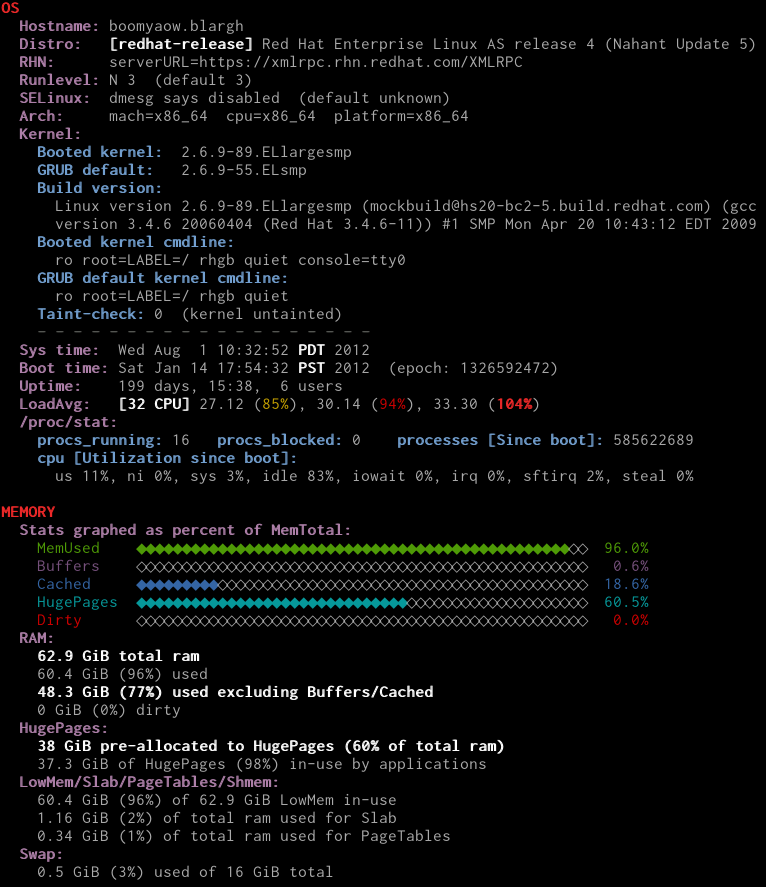
**`xsos -cln` OR `xsos --cpu --lspci --net` could show this:**

**`xsos -e` OR `xsos --ethtool` output looks like this:**

INTRO
-------
The goal of `xsos` is to make it easy to instantaneously gather information about a system together in an easy-to-read-summary, whether that system is the localhost on which xsos is being run or a system for which you have an unpacked sosreport.
There is tons of useful amazing instructive data available to normal users (not to mention root) on a Linux system, but by design, this information is spread out across myriad files. Some of it even requires commands to parse through.
`xsos` will attempt to make it easy, parsing and calculating and formatting data from dozens of files (and commands) to give you a detailed overview about a system, or -- if requested -- `xsos` will only parse one file (e.g. with `--mem` or `--cpu`) or output from one command (e.g. with `--ip` or `--ps`).
New features are being added all the time -- see [the tracker](https://github.com/ryran/xsos/issues) to have a look at some of the things that are already in line to be worked on.
**[Why another tool? Why not add stuff to `sxconsole`?](https://github.com/ryran/xsos/issues/9)**
INSTALLATION
-------
*"I'm sold! How do I install xsos?"*
Get the latest version directly by downloading the main xsos file from [bit.ly/xsos-direct](http://bit.ly/xsos-direct) (which points to [raw.github.com/ryran/xsos/master/xsos](https://raw.github.com/ryran/xsos/master/xsos)). Updating will need to be done manually by re-downloading.
For a personal non-root install, run the following as your normal user:
```
mkdir -p ~/bin/
curl -Lo ~/bin/xsos bit.ly/xsos-direct
```
Then open a new terminal (your `~/.profile` should add `~/bin/` into `%PATH`).
For a system-wide install, run the following as root:
```
curl -Lo /usr/local/bin/xsos bit.ly/xsos-direct
chmod +x /usr/local/bin/xsos
```
Once xsos is installed, run `xsos -h` as a normal user to see the help page and get started.
EXAMPLES IN ACTION
-------
The lovely thing that isn't going to be captured here is all the coloring done to make things easier to read. There's actually quite a bit of color-logic to warn of various conditions...
**Run on a sosreport with no options:**
```
[rsaw]$ xsos aczx998pinkle/
OS
Hostname: aczx998pinkle
Distro: [redhat-release] Red Hat Enterprise Linux Server release 5.5 (Carthage)
[enterprise-release] Enterprise Linux Enterprise Linux Server release 5.5 (Carthage)
RHN: serverURL=https://linux-update.oracle.com/XMLRPC
Runlevel: N 3 (default 3)
SELinux: permissive (default enforcing)
Arch: mach=x86_64 cpu=x86_64 platform=x86_64
Kernel:
Booted kernel: 2.6.18-238.12.2.0.2.el5
GRUB default: 2.6.18-238.12.2.0.2.el5
Build version:
Linux version 2.6.18-238.12.2.0.2.el5 (mockbuild@ca-build9.us.oracle.com) (gcc version 4.1.2
20080704 (Red Hat 4.1.2-50)) #1 SMP Tue Jun 28 05:21:19 EDT 2011
Booted kernel cmdline:
root=/dev/md6 ro bootarea=c0d0 loglevel=7 panic=60 debug rhgb numa=off console=ttyS0,115200n8
console=tty1 crashkernel=128M@16M bootfrom=CELLBOOT audit=1 processor.max_cstate=1 nomce
GRUB default kernel cmdline:
root=/dev/md6 ro bootarea=c0d0 loglevel=7 panic=60 debug rhgb numa=off console=ttyS0,115200n8
console=tty1 crashkernel=128M@16M bootfrom=BOOT audit=1 processor.max_cstate=1 nomce
Kernel taint-check: 536870912 512 64 16 1
Technology Preview code is loaded
Taint on warning
Userspace-defined naughtiness
System experienced a machine check exception
Proprietary module has been loaded
- - - - - - - - - - - - - - - - - - -
Sys time: Mon Oct 29 10:55:02 CDT 2012
Boot time: Sat Apr 28 03:29:56 CDT 2012 (1335583796)
Uptime: 184 days, 12:25, 1 user
LoadAvg: [24 CPU] 2.34 (10%), 1.27 (5%), 0.95 (4%)
/proc/stat:
procs_running: 4 procs_blocked: 1 processes: 248052571
cpu: [Break-down of CPU time since boot]
us 1%, ni 0%, sys 1%, idle 96%, iowait 2%, irq 0%, sftirq 0%, steal 0%
```
**While xsos is always being improved, here's the current minimal help page (run `xsos -h`):**
```
Usage: xsos [DISPLAY OPTIONS] [-6abokcfmdtlerngispSFIN] [SOSREPORT ROOT]
or: xsos [DISPLAY OPTIONS] {--B|--C|--F|--M|--D|--T|--L|--R|--N|--G|--I|--P FILE}...
or: xsos [-?|-h|--help]
Display system info from localhost or extracted sosreport
Content options:
-a, --all show everything
-b, --bios show info from dmidecode
-o, --os show hostname, distro, SELinux, kernel info, uptime, etc
-k, --kdump inspect kdump configuration
-c, --cpu show info from /proc/cpuinfo
-f, --intrupt show info from /proc/interrupts
-m, --mem show info from /proc/meminfo
-d, --disks show info from /proc/partitions, dm-multipath, lsblk, df
-t, --mpath show info from dm-multipath
-l, --lspci show info from lspci
-e, --ethtool show info from ethtool
-r, --softirq show info from /proc/net/softnet_stat
-n, --netdev show info from /proc/net/dev
-g, --bonding show bonding and teaming info
-i, --ip show info from ip addr (BASH v4+ required)
--net alias for: --lspci --ethtool --softirq --netdev --bonding --ip
-s, --sysctl show important kernel sysctls
-p, --ps inspect running processes via ps
-S, --ss inspect running processes via ss
-F, --firewall show firewall status
-I, --ifcfg show ifcfg files summary
-N, --netstat show info from /proc/net/netstat
Display options:
--scrub remove from output: IP/MAC addrs, hostnames, serial numbers,
proxy user & passwords
-6, --ipv6 parse ip addr output for IPv6 addresses instead of IPv4
-q, --wwid=ID restrict dm-multipath output to a particular mpath device,
where ID is a wwid, friendly name, or LUN identifier
-u, --unit=P change byte display for /proc/meminfo & /proc/net/dev,
where P is "b" for byte, or else "k", "m", "g", or "t"
--threads make ps take threads into account (via `ps auxm`)
-v, --verbose=NUM specify ps verbosity level (0-4, default: 1)
-w, --width=NUM change fold-width, in columns (positive number, e.g., 80)
"0" disables wrapping, "w" autodetects width (default)
-x, --nocolor disable output colorization
-y, --less send output to `less -SR`
-z, --more send output to `more`
Special options (BASH v4+ required):
--B=FILE read from FILE containing `dmidecode` dump
--C=FILE read from FILE containing /proc/cpuinfo dump
--F=FILE read from FILE containing /proc/interrupts dump
--M=FILE read from FILE containing /proc/meminfo dump
--D=FILE read from FILE containing /proc/partitions dump
--T=FILE read from FILE containing `multipath -v4 -ll` dump
--L=FILE read from FILE containing `lspci` dump
--R=FILE read from FILE containing /proc/net/softnet_stat dump
--N=FILE read from FILE containing /proc/net/dev dump
--G=FILE read from FILE containing /proc/net/bonding/xxx dump
--I=FILE read from FILE containing `ip addr` dump
--P=FILE read from FILE containing `ps aux` dump
Run with "--help" to see full help page
Version info: xsos v0.7.40 last mod 2025-12-01
See <github.com/ryran/xsos> to report bugs or suggestions
```
**Here it is run on my laptop as root, with specific options:**
```
[rsaw]$ sudo xsos --bios --ip --lspci --ethtool --net --ps # would be same as 'xsos -bilenp'
DMIDECODE
BIOS:
LENOVO, version 8CET50WW (1.30 ), 11/01/2011
System:
Mfr: LENOVO
Prod: 4174AQ5
Vers: ThinkPad T420s
Ser: R9XXXXXXXX
UUID: 56EABD01-XXXX-11CB-9DE6-XXXXXXXXXX
CPU:
1 of 1 CPU sockets populated, 2 cores/4 threads per CPU
2 total cores, 4 total threads
Mfr: Intel(R) Corporation
Fam: Core i5
Freq: 2600 MHz
Vers: Intel(R) Core(TM) i5-2540M CPU @ 2.60GHz
Memory:
8192 MB (8 GB) total
2 of 4 DIMMs populated (system max capacity 16 GB)
LSPCI
Net/Storage:
(1) Intel Corporation Centrino Ultimate-N 6300 (rev 3e)
(1) Intel Corporation 82579LM Gigabit Network Connection (rev 04)
VGA:
Intel Corporation 2nd Generation Core Processor Family Integrated Graphics Controller (rev 09)
ETHTOOL
Interface Status:
em1 link=up 1000Mb/s full (autoneg=Y) drv e1000e v2.2.14-k / fw 0.13-3
tun0 link=up 10Mb/s full (autoneg=N) drv tun v1.6
virbr0 link=DOWN drv bridge v2.3 / fw N/A
virbr0-nic link=DOWN drv tun v1.6
wlan0 link=up drv iwlwifi v3.9.6-200.fc18.x86_64 / fw 9.221.4.1
Interface Errors:
em1 dropped_smbus: 267
IP
Interface Slave Of IPv4 Address State MAC Address
========= ======== ================== ===== =================
lo - 127.0.0.1/8 up -
em1 - 192.168.0.20/24 up f0:de:f1:ba:cf:c4
wlan0 - 10.7.7.111/24 up 24:77:03:41:41:18
192.168.17.17/32
virbr0 - 192.168.122.1/24 up 52:54:00:97:e3:ee
virbr0-nic - - DOWN 52:54:00:97:e3:ee
tun0 - 10.10.49.81/32 up -
NETDEV
Interface RxMiBytes RxPackets RxErrs RxDrop TxMiBytes TxPackets TxErrs TxDrop TxColls
========= ========= ========= ====== ====== ========= ========= ====== ====== =======
em1 6715 6940 k 0 0 6715 1972 k 0 0 0
tun0 0 0 k 0 0 0 0 k 0 0 0
virbr0 8 41 k 0 0 8 37 k 0 0 0
virbr0-nic 0 0 k 0 0 0 0 k 0 0 0
wlan0 1902 1761 k 0 0 1902 1139 k 0 0 0
PS CHECK
Total number of processes:
291
Top users of CPU & MEM:
USER %CPU %MEM RSS
rsaw 34.1% 46.0% 3.81 GiB
qemu 27.4% 4.9% 0.38 GiB
root 2.7% 1.0% 0.20 GiB
Uninteruptible sleep & Defunct processes:
USER PID %CPU %MEM VSZ-MiB RSS-MiB TTY STAT START TIME COMMAND
rsaw 5287 0.0 0.0 0 0 pts/0 D+ 17:19 0:00 [cat]
rsaw 5125 0.0 0.0 0 0 ? Z Dec16 0:48 [chromium-browse] <defunct>
rsaw 8307 0.2 0.0 0 0 ? Z Dec17 3:07 [chromium-browse] <defunct>
rsaw 8867 0.0 0.0 0 0 ? Z Dec17 1:20 [xchat] <defunct>
rsaw 9533 0.0 0.0 0 0 ? Z Dec17 0:32 [gedit] <defunct>
Top CPU-using processes:
USER PID %CPU %MEM VSZ-MiB RSS-MiB TTY STAT START TIME COMMAND
qemu 613 27.4 4.9 3094 393 ? Sl 00:38 0:29 /usr/bin/qemu-kvm -S -M
rsaw 23059 13.7 2.3 1091 185 ? Sl Dec26 21:34 /proc/self/exe --type=plugin --plugin-path=/usr/lib64/flash-plugin/libflashplayer.so
rsaw 621 5.9 0.8 964 65 ? Ss 00:38 0:06 python /usr/share/virt-manager/virt-manager.py
rsaw 2137 5.3 18.7 2705 1472 ? Sl Dec24 204:37 /usr/lib64/firefox/firefox
root 1226 2.2 0.5 135 42 tty1 Ss+ Dec24 87:57 /usr/bin/Xorg :0 -background
rsaw 11901 2.1 4.2 2319 335 ? SLl Dec24 74:54 /usr/bin/gnome-shell
rsaw 22866 2.0 1.6 898 128 ? Sl Dec26 3:11 /usr/lib64/chromium-browser/chromium-browser --enable-plugins --enable-extensions
rsaw 29408 1.3 0.5 1218 39 ? Sl Dec26 0:37 gedit
rsaw 23084 0.8 1.2 1140 99 ? Sl Dec26 1:18 /usr/lib64/chromium-browser/chromium-browser --type=renderer --lang=en-US
rsaw 22952 0.8 1.7 1168 141 ? Sl Dec26 1:22 /usr/lib64/chromium-browser/chromium-browser --type=renderer --lang=en-US
Top MEM-using processes:
USER PID %CPU %MEM VSZ-MiB RSS-MiB TTY STAT START TIME COMMAND
rsaw 2137 5.3 18.7 2705 1472 ? Sl Dec24 204:37 /usr/lib64/firefox/firefox
qemu 613 27.4 4.9 3094 393 ? Sl 00:38 0:29 /usr/bin/qemu-kvm -S -M
rsaw 11901 2.1 4.2 2319 335 ? SLl Dec24 74:54 /usr/bin/gnome-shell
rsaw 23059 13.7 2.3 1091 185 ? Sl Dec26 21:34 /proc/self/exe --type=plugin --plugin-path=/usr/lib64/flash-plugin/libflashplayer.so
rsaw 22952 0.8 1.7 1168 141 ? Sl Dec26 1:22 /usr/lib64/chromium-browser/chromium-browser --type=renderer --lang=en-US
rsaw 22866 2.0 1.6 898 128 ? Sl Dec26 3:11 /usr/lib64/chromium-browser/chromium-browser --enable-plugins --enable-extensions
rsaw 23214 0.6 1.5 1141 121 ? Sl Dec26 0:59 /usr/lib64/chromium-browser/chromium-browser --type=renderer --lang=en-US
rsaw 23004 0.0 1.2 1130 100 ? Sl Dec26 0:06 /usr/lib64/chromium-browser/chromium-browser --type=renderer --lang=en-US
rsaw 22959 0.0 1.2 1127 100 ? Sl Dec26 0:05 /usr/lib64/chromium-browser/chromium-browser --type=renderer --lang=en-US
rsaw 23084 0.8 1.2 1140 99 ? Sl Dec26 1:18 /usr/lib64/chromium-browser/chromium-browser --type=renderer --lang=en-US
```
**Run on another sosreport with some options:**
```
[rsaw]$ xsos 8308201prodserv --disks --mem --unit=m
MEMORY
Stats graphed as percent of MemTotal:
MemUsed ◆◆◆◆◆◆◆◆◆◆◆◆◆◆◆◆◆◆◆◆◆◆◆◆◆◆◆◆◆◆◆◆◆◆◆◆◆◆◆◆◆◆◆◆◆◆◆◆◇◇ 96.0%
HugePages ◆◆◆◆◆◆◆◆◆◆◆◆◆◆◆◆◆◆◆◆◆◆◆◆◆◆◆◆◆◆◇◇◇◇◇◇◇◇◇◇◇◇◇◇◇◇◇◇◇◇ 60.5%
Buffers ◇◇◇◇◇◇◇◇◇◇◇◇◇◇◇◇◇◇◇◇◇◇◇◇◇◇◇◇◇◇◇◇◇◇◇◇◇◇◇◇◇◇◇◇◇◇◇◇◇◇ 0.6%
Cached ◆◆◆◆◆◆◆◆◆◇◇◇◇◇◇◇◇◇◇◇◇◇◇◇◇◇◇◇◇◇◇◇◇◇◇◇◇◇◇◇◇◇◇◇◇◇◇◇◇◇ 18.6%
Dirty ◇◇◇◇◇◇◇◇◇◇◇◇◇◇◇◇◇◇◇◇◇◇◇◇◇◇◇◇◇◇◇◇◇◇◇◇◇◇◇◇◇◇◇◇◇◇◇◇◇◇ 0.0%
RAM:
64363 MiB total ram
61815 MiB (96%) used
49451 MiB (76.8%) used excluding Buffers/Cached
5 MiB (0%) dirty
HugePages:
38912 MiB pre-allocated to HugePages (60.5% of total ram)
38146 MiB of HugePages (98%) in-use by applications
LowMem/Slab/PageTables/Shmem:
61815 MiB (96%) of 64363 MiB LowMem in-use
1192 MiB (1.9%) of total ram used for Slab
349 MiB (0.5%) of total ram used for PageTables
Swap:
464 MiB (2.8%) used of 16381 MiB total
STORAGE
Multipath:
archive 2.0 T
dbbackup 850 G
dgspool 20 G
miscspool 100 G
proddb 200 G
prodstage 100 G
produpgdb 150 G
reportdb 30 G
tsttrndev 150 G
Disks:
(Multipath and/or software raid components hidden)
1 disks, totaling 272 GiB (0.27 TiB)
sda 271.9 G
[rsaw]$ xsos --net --unit k 8308201prodserv
NETDEV
Interface RxKiBytes RxPackets RxErrs RxDrop TxKiBytes TxPackets TxErrs TxDrop
========= ========= ========= ====== ====== ========= ========= ====== ======
eth0 23569277 300080406 0 0 23569277 480926218 0 0
eth1 144484269105 342207919183 0 4494 (0%) 144484269105 357978804158 0 0
eth2 428438229206 392560553366 0 373 (0%) 428438229206 330736051661 0 0
eth4 37184228554 55232280858 0 2350 (0%) 37184228554 35535848225 0 0
[rsaw]$ xsos -nug 8308201prodserv
NETDEV
Interface RxGiBytes RxPackets RxErrs RxDrop TxGiBytes TxPackets TxErrs TxDrop
========= ========= ========= ====== ====== ========= ========= ====== ======
eth0 22.5 300 M 0 0 22.5 481 M 0 0
eth1 137791 342208 M 0 4494 (0%) 137791 357979 M 0 0
eth2 408590 392561 M 0 373 (0%) 408590 330736 M 0 0
eth4 35461.6 55232 M 0 2350 (0%) 35461.6 35536 M 0 0
```
**Run on a sosreport again, showing sysctls:**
```
[rsaw]$ xsos --sysctl boomyaow/
SYSCTLS
kernel.
hostname = boomyaow03
osrelease = 2.6.32-220.13.1.el6.x86_64
tainted = 0 (kernel untainted)
random.boot_id = defb55c5-c2bb-4e4e-86c3-745d80a6585d
random.entropy_avail [bits] = 154
hung_task_panic [bool] = 0
hung_task_timeout_secs = 120 (secs task must be D-state to trigger)
msgmax [bytes] = 65536
msgmnb [bytes] = 65536
msgmni [msg queues] = 32768
panic [secs] = 0 (no autoreboot on panic)
panic_on_oops [bool] = 1
panic_on_unrecovered_nmi [bool] = 0
pid_max = 32768
threads-max = 1029998
sem [array] = 250 32000 32 4096
SEMMSL (max semaphores per array) = 250
SEMMNS (max sems system-wide) = 32000
SEMOPM (max ops per semop call) = 32
SEMMNI (max number of sem arrays) = 4096
shmall [4-KiB pages] = 4294967296 (16384.0 GiB max total shared memory)
shmmax [bytes] = 68719476736 (64.00 GiB max segment size)
shmmni [segments] = 4096 (max number of segs)
sysrq [bitmask] = 0 (disallowed)
fs.
file-max [fds] = 6512672 (system-wide limit on nr open file descriptors)
file-nr [fds] = 2496 0 6512672 (nr allocated fds, N/A, nr free fds)
inode-nr [inodes] = 78574 1 (nr_inodes allocated, nr_free_inodes)
net.
core.rmem_max [bytes] = 131071 (127 KiB)
core.wmem_max [bytes] = 131071 (127 KiB)
core.rmem_default [bytes] = 124928 (122 KiB)
core.wmem_default [bytes] = 124928 (122 KiB)
ipv4.icmp_echo_ignore_all [bool] = 0
ipv4.ip_forward [bool] = 0
ipv4.tcp_max_orphans [sockets] = 65536 (4096 MiB @ max 64 KiB per orphan)
ipv4.tcp_mem [4-KiB pages] = 6179904 8239872 12359808 (23.57 GiB, 31.43 GiB, 47.15 GiB)
ipv4.udp_mem [4-KiB pages] = 6179904 8239872 12359808 (23.57 GiB, 31.43 GiB, 47.15 GiB)
ipv4.tcp_window_scaling [bool] = 1
ipv4.tcp_rmem [bytes] = 4096 87380 4194304 (4 KiB, 85 KiB, 4096 KiB)
ipv4.tcp_wmem [bytes] = 4096 16384 4194304 (4 KiB, 16 KiB, 4096 KiB)
ipv4.udp_rmem_min [bytes] = 4096 (4 KiB)
ipv4.udp_wmem_min [bytes] = 4096 (4 KiB)
vm.
dirty_ratio = 20 (% of total system memory)
dirty_bytes = 0 (disabled -- check dirty_ratio)
dirty_background_ratio = 10 (% of total system memory)
dirty_background_bytes = 0 (disabled -- check dirty_background_ratio)
dirty_expire_centisecs = 3000
dirty_writeback_centisecs = 500
nr_hugepages [2-MiB pages] = 0
overcommit_memory [0-2] = 0 (heuristic overcommit)
overcommit_ratio = 50
oom_kill_allocating_task [bool] = 0 (scan tasklist)
panic_on_oom [0-2] = 0 (no panic)
swappiness [0-100] = 60
```
**Finally, here's example of using some of the Special options, which allow you to specify a specific file instead of a full sosreport or having `xsos` run on your local system:**
```
[rsaw]$ xsos -v0 --B /tmp/dmidecode.txt --I=/tmp/ipaddr.dump --P /tmp/psaux.txt
DMIDECODE
BIOS:
HP, version P66, 06/24/2011
System:
Mfr: HP
Prod: ProLiant DL980 G7
Vers: Not Specified
Ser: CZ3XXXXXXXX
UUID: 35344D41-XXXXXX-5A43-3331-XXXXXXXXXXX
CPU:
8 of 8 CPU sockets populated, 8 cores/16 threads per CPU
64 total cores, 128 total threads
Mfr: Intel
Fam: Xeon
Freq: 2133 MHz
Vers: Intel(R) Xeon(R) CPU E7- 2830 @ 2.13GHz
Memory:
262144 MB (256 GB) total
32 of 128 DIMMs populated (system max capacity 512 GB)
IP
Interface Slave Of MAC Address State IPv4 Address
========= ======== ================= ===== ==================
lo - - up 127.0.0.1/8
lo:0 - - up 192.168.160.20/32
eth0 - ZZ:xy:56:01:12:qr up 192.168.160.11/24
eth1 - ZZ:xy:9a:1a:19:qr up 10.79.4.68/23
eth1:1 - ZZ:xy:9a:1a:19:qr up 10.79.4.70/23
eth2 - ZZ:xy:28:fd:19:qr up 10.10.10.8/28
eth4 - ZZ:xy:9e:0b:19:qr up 192.168.254.8/28
eth5 bond0 ZZ:xy:b5:0b:19:qq up -
eth6 bond0 ZZ:xy:b5:0b:1a:qq up -
eth7 - ZZ:xy:35:00:99:qq DOWN -
bond0 - ZZ:zz:ZZ:zz:ZZ:zz up 10.180.162.22/24
PS CHECK
Total number of processes:
1393
Top users of CPU & MEM:
USER %CPU %MEM RSS
oracle 909.8% 60649.2% 38137.57 GiB
root 130.8% 2.7% 1.93 GiB
Uninteruptible sleep & Defunct processes:
USER PID %CPU %MEM VSZ-MiB RSS-MiB TTY STAT START TIME COMMAND
oracle 7883 0.3 59.3 141 38177 ? Ds Jul31 2:33 oracleCRELSP4
oracle 11028 0.1 59.3 154 38170 ? Ds Jun30 49:08 ora_arc8_CRELSP4
oracle 13816 0.0 59.3 140 38171 ? Ds Jul31 0:12 oracleCRELSP4
oracle 15184 0.4 59.3 141 38176 ? Ds Jul31 3:01 oracleCRELSP4
oracle 15423 0.5 59.3 143 38179 ? Ds Jul31 3:32 oracleCRELSP4
oracle 17334 0.0 59.3 143 38176 ? Ds Jul31 0:14 oracleCRELSP4
oracle 18502 0.3 59.3 141 38176 ? Ds Jul31 2:39 oracleCRELSP4
root 18514 2.0 0.0 0 0 ? D< 10:33 0:00 /bin/grep
oracle 20751 0.8 59.3 143 38178 ? Ds Jul31 5:21 oracleCRELSP4
oracle 24385 0.6 59.3 142 38175 ? Ds Jul31 4:05 oracleCRELSP4
oracle 24557 0.4 59.3 140 38173 ? Ds 10:22 0:02 oracleCRELSP4
oracle 24718 1.3 59.3 143 38178 ? Ds Jul31 8:57 oracleCRELSP4
oracle 29008 2.8 59.3 143 38176 ? Ds 09:38 1:34 oracleCRELSP4
Top CPU-using processes:
USER PID %CPU %MEM VSZ-MiB RSS-MiB TTY STAT START TIME COMMAND
root 18329 104 0.0 50 2 pts/6 R+ 10:33 0:03 /bin/netstat
oracle 11160 19.7 59.3 146 38174 ? Ss Jun30 9012:36 oracleCRELSP4
oracle 14014 10.6 59.3 140 38173 ? Ss 10:32 0:05 oracleCRELSP4
root 6455 5.9 0.1 415 83 ? Sl Jan25 16265:29 /space/java/jdk1.5.0_20/bin/java
root 6515 5.3 0.0 0 0 ? R Jan14 15483:17 [rpciod]
Top MEM-using processes:
USER PID %CPU %MEM VSZ-MiB RSS-MiB TTY STAT START TIME COMMAND
oracle 7847 0.0 59.4 249 38257 ? Ss Jun30 0:52 ora_diag_CRELSP4
oracle 1912 0.0 59.3 160 38185 ? Ss Jul22 12:29 ora_j001_CRELSP4
oracle 10937 0.1 59.3 167 38185 ? Ss Jun30 53:14 ora_arc3_CRELSP4
oracle 10920 0.1 59.3 167 38185 ? Ss Jun30 58:05 ora_arc1_CRELSP4
oracle 11037 0.1 59.3 167 38184 ? Ss Jun30 53:33 ora_arc9_CRELSP4
```
REQUIREMENTS
-------
* As detailed in the help page, BASH version 4 (rhel 6+) is required for -i/--ip and for any of the "Special options" like `--C` or `--B`. Colorization is also not done unless BASH v4+ is detected.
* Other than that, nothing special for command requirements -- `xsos` uses standard coreutils & util-linux commands, along with, of course ... `gawk` and `sed`.
* No absolute paths used for commands.
* When running on localhost (i.e. not a sosreport), `xsos` gracefully reports as much of what's requested as possible when running as non-root (`--bios` and `--ethtool` require root privileges; `--disks` won't be able to print dm-multipath output without root privs).
THINGS THAT MIGHT SURPRISE YOU
-------
* xsos does some pretty intensive color-formatting to make the output more easily-readable (can be disabled with `-x` or `--nocolor` and colors can be modified via environment variables).
* If you like the color but need to use a pager, use the `--less` (`-y`) or `--more` (`-z`) options to auto-pipe output to `less -SR` or `more`.
* There are a bunch of environment variables that you can use to tweak behavior. See [the original commit comment](https://github.com/ryran/xsos/commit/0c05168d3729d44f4ddf07269b33105f85a306de#commitcomment-2133859) for documentation.
* There's a bash autocompletion function defition available for xsos. Use it.
* When printing disk info with `-d/--disks`, xsos automatically detects linux software raid (md) devices and hides their components. The `multipath` command is also consulted to print info about native multipathd devices. All LUNs that are part of a dm-multipath map are also hidden from the disk output.
* You can use the `--unit` (`-u`) option to change how `/proc/meminfo` and `/proc/net/dev` are parsed -- displaying units in anything from bytes up to tebibytes. Note that this option does *not* affect display of the `VSZ` & `RSS` fields in the ps output. (For that, manually set the `XSOS_PS_UNIT` variable to `k`, `m`, or `g`.)
AUTHORS
-------
As far as direct contributions go, so far it's just me, [ryran](/ryran), aka rsaw, aka [Ryan Sawhill Aroha](http://people.redhat.com/rsawhill). That said, many folks have reported bugs and given suggestions for new features:
- Patrick Talbert especially deserves a huge shout-out! Using xsos on sosreports while diagnosing networking issues, he's uncovered many an odd corner case and discussions with him have led to implementing new features and refining what the networking modules show.
- Jamie Bainbridge has been so consistently kind and effusive in expressing his appreciation of xsos. The RFEs he has suggested (at least the ones we've implemented) have surely made xsos a more powerful tool.
- Joe Wright was the first person to request a kdump module. Turned out to be a great idea!
When I was clueless in how to further my awk career early on, two prolific users over on StackOverflow -- [Dennis Williamson](http://stackoverflow.com/users/26428/dennis-williamson) and [ghostdog74](http://stackoverflow.com/users/131527/ghostdog74) -- each provided answers (to two separate questions) with code that was brilliantly instructive. My awk skills have since evolved far beyond what I was trying to do back then, but thanks definitely goes to both of them for that early inspiration.
Please contact me if you have ideas, suggestions, questions, or want to collaborate on this or something similar. For specific bugs and feature-requests, you can [post a new issue on the tracker](/ryran/xsos/issues).
LICENSE
-------
Copyright (C) 2012-2015 [Ryan Sawhill Aroha](http://people.redhat.com/rsawhill)
This program is free software: you can redistribute it and/or modify
it under the terms of the GNU General Public License as published by
the Free Software Foundation, either version 3 of the License, or
(at your option) any later version.
This program is distributed in the hope that it will be useful,
but WITHOUT ANY WARRANTY; without even the implied warranty of
MERCHANTABILITY or FITNESS FOR A PARTICULAR PURPOSE. See the GNU
General Public License @[gnu.org/licenses/gpl.html](http://gnu.org/licenses/gpl.html>) for more details.
================================================
FILE: xsos
================================================
#!/bin/bash
# xsos v0.7.40 last mod 2025-12-01
# Latest version at <http://github.com/ryran/xsos>
# Copyright 2012-2026 Ryan Sawhill Aroha <rsaw@redhat.com> and contributors
#
# This program is free software: you can redistribute it and/or modify
# it under the terms of the GNU General Public License as published by
# the Free Software Foundation, either version 3 of the License, or
# (at your option) any later version.
#
# This program is distributed in the hope that it will be useful,
# but WITHOUT ANY WARRANTY; without even the implied warranty of
# MERCHANTABILITY or FITNESS FOR A PARTICULAR PURPOSE. See the GNU
# General Public License <gnu.org/licenses/gpl.html> for more details.
#-------------------------------------------------------------------------------
# See https://github.com/ryran/xsos/issues/208
export LC_ALL=en_US.UTF-8
# Get version from line #2
version=$(sed '2q;d' $0)
# Colors and colors and colors oh my (but only for bash v4)
if [[ $BASH_VERSINFO -ge 4 ]]; then
declare -A c
c[reset]='\033[0;0m' c[BOLD]='\033[0;0m\033[1;1m'
c[dgrey]='\033[0;30m' c[DGREY]='\033[1;30m' c[bg_DGREY]='\033[40m'
c[red]='\033[0;31m' c[RED]='\033[1;31m' c[bg_RED]='\033[41m'
c[green]='\033[0;32m' c[GREEN]='\033[1;32m' c[bg_GREEN]='\033[42m'
c[orange]='\033[0;33m' c[ORANGE]='\033[1;33m' c[bg_ORANGE]='\033[43m'
c[blue]='\033[0;34m' c[BLUE]='\033[1;34m' c[bg_BLUE]='\033[44m'
c[purple]='\033[0;35m' c[PURPLE]='\033[1;35m' c[bg_PURPLE]='\033[45m'
c[cyan]='\033[0;36m' c[CYAN]='\033[1;36m' c[bg_CYAN]='\033[46m'
c[lgrey]='\033[0;37m' c[LGREY]='\033[1;37m' c[bg_LGREY]='\033[47m'
fi
# ==============================================================================
# ENVIRONMENT VARIABLES -- Modify these by setting them in your shell
# environment, e.g. ~/.bash_profile or /etc/profile.d/xsos.sh
# COLORS
# The following configure defaults for various colors to enhance output
# XSOS_COLORS (bool: y/n)
# Controls whether color is enabled or disabled by default
# Can also be controlled by cmdline arg
: ${XSOS_COLORS:="y"}
# XSOS_COLOR_RESET -- color to reset terminal to after using other colors
: ${XSOS_COLOR_RESET:="reset"}
# XSOS_COLOR_H1 -- color for content modules' primary header
: ${XSOS_COLOR_H1:="RED"}
# XSOS_COLOR_H2 -- color for content modules' secondary header
: ${XSOS_COLOR_H2:="PURPLE"}
# XSOS_COLOR_H3 -- color for content modules' tertiary header
: ${XSOS_COLOR_H3:="BLUE"}
# XSOS_COLOR_H4 -- color used only for SYSCTL() module
: ${XSOS_COLOR_H4:="reset"}
# XSOS_COLOR_IMPORTANT -- color for drawing attention to important data
: ${XSOS_COLOR_IMPORTANT:="BOLD"}
# XSOS_COLOR_WARN1 -- color for level-1 warnings
: ${XSOS_COLOR_WARN1:="orange"}
# XSOS_COLOR_WARN2 -- color for level-2 warnings
: ${XSOS_COLOR_WARN2:="ORANGE"}
# XSOS_COLOR_MEMGRAPH_MEMUSED -- color for MemUsed in MEMINFO() graph
: ${XSOS_COLOR_MEMGRAPH_MEMUSED:="green"}
# XSOS_COLOR_MEMGRAPH_HUGEPAGES -- color for HugePages in MEMINFO() graph
: ${XSOS_COLOR_MEMGRAPH_HUGEPAGES:="cyan"}
# XSOS_COLOR_MEMGRAPH_BUFFERS -- color for Buffers in MEMINFO() graph
: ${XSOS_COLOR_MEMGRAPH_BUFFERS:="purple"}
# XSOS_COLOR_MEMGRAPH_CACHED -- color for Cached in MEMINFO() graph
: ${XSOS_COLOR_MEMGRAPH_CACHED:="blue"}
# XSOS_COLOR_MEMGRAPH_DIRTY -- color for Dirty in MEMINFO() graph
: ${XSOS_COLOR_MEMGRAPH_DIRTY:="red"}
# XSOS_COLOR_IFUP -- color for ethtool InterFace "up"
: ${XSOS_COLOR_IFUP:="green"}
# XSOS_COLOR_IFDOWN -- color for ethtool InterFace "down"
: ${XSOS_COLOR_IFDOWN:="lgrey"}
# INDENTATION
# The following variables are not used universally and that might not change
# XSOS_INDENT_H1 -- 1st level of indentation
: ${XSOS_INDENT_H1:=" "}
# XSOS_INDENT_H2 -- 2nd level of indentation
: ${XSOS_INDENT_H2:=" "}
# XSOS_INDENT_H3 -- 3rd level of indentation
: ${XSOS_INDENT_H3:=" "}
# XSOS_FOLD_WIDTH (w, 0, or positive number)
# Some content modules print line of unpredictable length
# This setting controls the wrapping width for commands that use it
# Changing to w causes width of terminal to be used
# Changing to 0 causes 99999 to be used
: ${XSOS_FOLD_WIDTH:="w"}
# XSOS_HEADING_SEPARATOR (str)
# Acts as a separator between content modules
# Should include at least 1 trailing new-line
: ${XSOS_HEADING_SEPARATOR:="\n"}
# XSOS_ALL_VIEW (str of variables, space-separated)
# Controls what content modules to run when -a/--all switch is used
: ${XSOS_ALL_VIEW:="bios os kdump cpu intrupt mem disks mpath lspci ethtool softirq bonding ip netdev sysctl ps ss firewall"}
# XSOS_DEFAULT_VIEW (str of variables, space-separated)
# Controls default content modules, i.e. what to run when none are specififed
: ${XSOS_DEFAULT_VIEW:="os"}
# XSOS_PS_THREADS (bool: y/n)
# Controls whether PSCHECK() function parses `ps aux` or `ps auxm` output
: ${XSOS_PS_THREADS:="n"}
# XSOS_PS_LEVEL (int: 0-4)
# Controls verbosity level (4 being highest) in PSCHECK() function
: ${XSOS_PS_LEVEL:="1"}
# XSOS_MULTIPATH_QUERY (string: arbitrary regex)
# Only a tenuous case can be made for statically setting this
# It's used by the MULTIPATH() function to restrict display to a particular mpath device
# Traditionally controled by -q/--wwid option
: ${XSOS_MULTIPATH_QUERY:=""}
# XSOS_MEM_UNIT (str: b, k, m, g, t)
# Sets unit used by MEMINFO() function for printing
# Can also be controlled by cmdline opt -u/--unit
: ${XSOS_MEM_UNIT:="g"}
# XSOS_NET_UNIT (str: b, k, m, g, t)
# Sets unit used by NETDEV() function for printing Rx & Tx Bytes
# Can also be controlled by cmdline opt -u/--unit
: ${XSOS_NET_UNIT:="m"}
# XSOS_PS_UNIT (str: k, m, g)
# Sets unit used by PSCHECK() function for printing VSZ & RSS
# Not affected by cmdline opt -u/--unit option
: ${XSOS_PS_UNIT:="m"}
# XSOS_OUTPUT_HANDLER (str: application name)
# Sets name of application to handle output
: ${XSOS_OUTPUT_HANDLER:="cat"}
# XSOS_OS_RHT_CENTRIC (bool: y/n)
# Configures whether OSINFO() focuses on Red Hat support issues
: ${XSOS_OS_RHT_CENTRIC:="n"}
# XSOS_IP_VERSION (int: 4/6)
# Configures whether IPADDR() shows ipv4 or ipv6 addresses
: ${XSOS_IP_VERSION:="4"}
# XSOS_SCRUB_IP_HN (bool: y/n)
# Configures whether IP addrs & hostnames should be removed from output
: ${XSOS_SCRUB_IP_HN:="n"}
# XSOS_SCRUB_MACADDR (bool: y/n)
# Configures whether HW MAC addresses should be removed from output
: ${XSOS_SCRUB_MACADDR:="n"}
# XSOS_SCRUB_SERIAL (bool: y/n)
# Configures whether serial numbers should be removed from output
: ${XSOS_SCRUB_SERIAL:="n"}
# XSOS_SCRUB_PROXYUSERPASS (bool: y/n)
# Configures whether RHN/RHSM proxy user/pass should be removed from output
: ${XSOS_SCRUB_PROXYUSERPASS:="n"}
# XSOS_ETHTOOL_ERR_REGEX (str: awk-syntax regular expression)
# Configures what ETHTOOL() uses to generate the data under the "Interface Errors" heading
: ${XSOS_ETHTOOL_ERR_REGEX:='/Missing ethtool_-S file|(drop|disc|err|fifo|buf|fail|miss|OOB|fcs|full|frags|hdr|tso|pause|lost|csum).*: [^0]/ && !/(cache_full|csum_(complete|none|partial|unchecked|unnecessary)|fdir_|steer_missed|tso_(bytes|packets)|veb\.)/'}
# XSOS_LSPCI_NET_REGEX (str: regular expression)
# Configures what LSPCI() uses to search for peripherals under the "Net" heading
: ${XSOS_LSPCI_NET_REGEX:="(Ethernet controller|Network controller|InfiniBand)( \[[0-9]{4}\])?:"}
# XSOS_LSPCI_STORAGE_REGEX (str: regular expression)
# Configures what LSPCI() uses to search for peripherals under the "Storage" heading
: ${XSOS_LSPCI_STORAGE_REGEX:="(Fibre Channel|RAID bus controller|Mass storage controller|SCSI storage controller|SATA controller|Serial Attached SCSI controller)( \[[0-9]{4}\])?:"}
# XSOS_SS_CHECK_FIELDS (str: pipe separated field names)
# Configures what SSCHECK() uses to filter fields whose value is > 0.
: ${XSOS_SS_CHECK_FIELDS:="sock_drop|app_limited|dsack_dups|lost|reord_seen|back_log|retrans_total|rq|tq"}
# XSOS_NETSTAT_FILTER_REGEX (str: bash-syntax regular expression)
# Configures what NETSTAT() keys will be printed if their value is > 0
: ${XSOS_NETSTAT_FILTER_REGEX:="drop|err|reset|rst|delay|bad|fail|pause|time|miss|loss|listen|PAWS"}
# XSOS_NETSTAT_HIGHLIGHT_REGEX (str: bash-syntax regular expression)
# Configures what NETSTAT() keys will be highlighted.
#: ${XSOS_NETSTAT_HIGHLIGHT_REGEX:="drop|err|reset|rst|delay|bad|fail|pause|time|miss|loss"}
: ${XSOS_NETSTAT_HIGHLIGHT_REGEX:=""}
# XSOS_NETSTAT_IGNORE_ZERO (bool: y/n)
# Configures whether or not NETSTAT() will ignore fields whose value is 0
: ${XSOS_NETSTAT_IGNORE_ZERO:="y"}
# ==============================================================================
VERSINFO() {
echo "Version info: ${version:2}
See <github.com/ryran/xsos> to report bugs or suggestions"
exit
}
HELP_USAGE() {
echo "Usage: xsos [DISPLAY OPTIONS] [-6abokcfmdtlerngispSFIN] [SOSREPORT ROOT]
or: xsos [DISPLAY OPTIONS] {--B|--C|--F|--M|--D|--T|--L|--R|--N|--G|--I|--P FILE}...
or: xsos [-?|-h|--help]
Display system info from localhost or extracted sosreport"
}
HELP_OPTS_CONTENT() {
echo "
Content options:"
echo "
-a, --all❚show everything
-b, --bios❚show info from dmidecode
-o, --os❚show hostname, distro, SELinux, kernel info, uptime, etc
-k, --kdump❚inspect kdump configuration
-c, --cpu❚show info from /proc/cpuinfo
-f, --intrupt❚show info from /proc/interrupts
-m, --mem❚show info from /proc/meminfo
-d, --disks❚show info from /proc/partitions, dm-multipath, lsblk, df
-t, --mpath❚show info from dm-multipath
-l, --lspci❚show info from lspci
-e, --ethtool❚show info from ethtool
-r, --softirq❚show info from /proc/net/softnet_stat
-n, --netdev❚show info from /proc/net/dev
-g, --bonding❚show bonding and teaming info
-i, --ip❚show info from ip addr (BASH v4+ required)
--net❚alias for: --lspci --ethtool --softirq --netdev --bonding --ip
-s, --sysctl❚show important kernel sysctls
-p, --ps❚inspect running processes via ps
-S, --ss❚inspect running processes via ss
-F, --firewall❚show firewall status
-I, --ifcfg❚show ifcfg files summary
-N, --netstat❚show info from /proc/net/netstat" | column -ts❚
}
HELP_OPTS_DISPLAY() {
echo "
Display options:"
# --rhsupport❚tweak os output to focus on RHEL-centric support issues
echo "
--scrub❚remove from output: IP/MAC addrs, hostnames, serial numbers,
❚proxy user & passwords
-6, --ipv6❚parse ip addr output for IPv6 addresses instead of IPv4
-q, --wwid=ID❚restrict dm-multipath output to a particular mpath device,
❚where ID is a wwid, friendly name, or LUN identifier
-u, --unit=P❚change byte display for /proc/meminfo & /proc/net/dev,
❚where P is \"b\" for byte, or else \"k\", \"m\", \"g\", or \"t\"
--threads❚make ps take threads into account (via \`ps auxm\`)
-v, --verbose=NUM❚specify ps verbosity level (0-4, default: 1)
-w, --width=NUM❚change fold-width, in columns (positive number, e.g., 80)
❚\"0\" disables wrapping, \"w\" autodetects width (default)
-x, --nocolor❚disable output colorization
-y, --less❚send output to \`less -SR\`
-z, --more❚send output to \`more\`" | column -ts❚
}
HELP_OPTS_SPECIAL() {
echo "
Special options (BASH v4+ required):"
echo "
--B=FILE❚read from FILE containing \`dmidecode\` dump
--C=FILE❚read from FILE containing /proc/cpuinfo dump
--F=FILE❚read from FILE containing /proc/interrupts dump
--M=FILE❚read from FILE containing /proc/meminfo dump
--D=FILE❚read from FILE containing /proc/partitions dump
--T=FILE❚read from FILE containing \`multipath -v4 -ll\` dump
--L=FILE❚read from FILE containing \`lspci\` dump
--R=FILE❚read from FILE containing /proc/net/softnet_stat dump
--N=FILE❚read from FILE containing /proc/net/dev dump
--G=FILE❚read from FILE containing /proc/net/bonding/xxx dump
--I=FILE❚read from FILE containing \`ip addr\` dump
--P=FILE❚read from FILE containing \`ps aux\` dump
--S=FILE❚read from FILE containing \`ss -peaonmi\` dump
--F=FILE❚read from FILE containing \`systemctl_status_--all\` dump" | column -ts❚
}
HELP_SHORT() {
HELP_USAGE
HELP_OPTS_CONTENT
HELP_OPTS_DISPLAY
HELP_OPTS_SPECIAL
echo -e "\nRun with \"--help\" to see full help page\n"
VERSINFO
}
HELP_EXTENDED() {
HELP_USAGE
echo "Run with \"-h\" to see simplified help page"
HELP_OPTS_CONTENT
HELP_OPTS_DISPLAY
echo "
If no content options are specified, xsos parses the environment variable
XSOS_DEFAULT_VIEW to figure out what information to display. If this variable
is unset at runtime, it is initialized internally as follows:
XSOS_DEFAULT_VIEW='os'
Tweak it to preference by adding additional space-separated MODULE statements,
where MODULE is the same as the long option (e.g. mem, ethtool, netdev). Note
that the --net alias option cannot be used for this purpose. Also note that the
-a / --all option has it's own environment variable: XSOS_ALL_VIEW
If SOSREPORT ROOT isn't provided, the data will be gathered from the localhost;
however, bios, multipath, and ethtool output will only be displayed if running
as root (UID 0). When executing in this manner as non-root, those modules will
be skipped, and a warning printed to stderr.
Sometimes a full sosreport isn't available; sometimes you simply have a
dmidecode-dump or the contents of /proc/meminfo and you'd like a summary..."
HELP_OPTS_SPECIAL
echo "
As is hopefully clear, each of these options requires a filename as an
argument. These options can be used together, but cannot be used in concert
with regular \"Content options\" -- Content opts are ignored if Special options
are detected. Also note: the \"=\" can be replaced with a space if desired.
Re BASH v4+:
BASH associative arrays are used for various things. In short, if running
xsos on earlier BASH versions (e.g. RHEL5), you get ...
* No output colorization
* No -i/--ip
* No parsing of \"Special options\"
Environment variables:
For details of all configurable env variables, view first page of xsos
source. There are vars to change default colors as well as other settings.
Each variable name is prefixed with \"XSOS_\" and the important ones follow.
COLORS FOLD_WIDTH ALL_VIEW DEFAULT_VIEW HEADING_SEPARATOR IP_VERSION
MEM_UNIT NET_UNIT PS_UNIT PS_LEVEL PS_THREADS OUTPUT_HANDLER
SCRUB_IP_HN SCRUB_MACADDR ETHTOOL_ERR_REGEX
"
VERSINFO
}
WARN_NO_UPDATE() {
echo "Warning: v0.6.0 dropped the built-in update feature triggered by -U/--update"
echo "Future v1.x versions might repurpose the -U option"
echo "See https://github.com/ryran/xsos/issues/155 for more info"
exit 64
}
# Help? Version?
case $1 in
-V|--vers|--version) echo "Version info: ${version:2}"; exit ;;
-\?|-h) HELP_SHORT ;;
--help|help) HELP_EXTENDED ;;
-U|--update) WARN_NO_UPDATE >&2 ;;
esac
# GNU getopt short and long options:
sopts='6q:u:v:w:xyzabokcfmdtlerngispSFIN'
lopts='scrub,ipv6,rhsupport,wwid:,unit:,threads,verbose:,width:,nocolor,less,more,all,bios,os,kdump,cpu,intrupt,mem,disks,mpath,lspci,ethtool,softirq,netdev,bonding,ip,net,sysctl,ps,ss,firewall,ifcfg,netstat,B:,C:,F:,M:,D:,T:,L:,R:,N:,G:,I:,P:'
# Check for bad switches
getopt -Q --name=xsos -o $sopts -l $lopts -- "$@" || { HELP_USAGE; exit 64; }
# Setup assoc array for single-file options
unset sfile
[[ $BASH_VERSINFO -ge 4 ]] && declare -A sfile
# Checker for cmdline options
_OPT_CHECK() {
local option chosen_opt check_type valid_opts n s
option=$1
chosen_opt=$(tr '[:upper:]' '[:lower:]' <<<"$2")
check_type=$3
valid_opts=$4
if [[ $check_type == regex ]]; then
grep -E -qs "$valid_opts" <<<"$chosen_opt" && return
case $option in
width)
echo "xsos: option '$option' expects a positive number or 'w' (auto-detect width) or '0' (disable wrapping)"
;;
*)
echo "xsos: option '$option' expects other input, i.e., matching regex '$valid_opts'"=
esac
elif [[ $check_type == range ]]; then
for n in $(seq $valid_opts); do
[[ $n == $chosen_opt ]] && return
done
echo "xsos: option '$option' expects number from range: { ${valid_opts// /-} }"
elif [[ $check_type == naturalnumber ]]; then
grep -E -qs '^[0-9]+$' <<<"$chosen_opt" && return
echo "xsos: option '$option' expects any natural number, including zero"
elif [[ $check_type == string ]]; then
for s in $valid_opts; do
[[ $s == $chosen_opt ]] && return
done
echo "xsos: option '$option' expects one of: { $valid_opts } "
elif [[ $check_type == anystring ]]; then
[[ -n $2 ]] && return
echo "xsos: option '$option' expects a non-null string value"
fi
exit 64
}
# Parse command-line arguments
PARSE() {
unset opts all bios os kdump cpu intrupt mem disks mpath lspci ethtool softirq netdev bonding ip net sysctl ps
until [[ $1 == -- ]]; do
case $1 in
--scrub) XSOS_SCRUB_IP_HN=y XSOS_SCRUB_MACADDR=y XSOS_SCRUB_SERIAL=y XSOS_SCRUB_PROXYUSERPASS=y ;;
-6|--ipv6) XSOS_IP_VERSION=6 ;;
-q|--wwid) _OPT_CHECK "wwid" "$2" anystring
XSOS_MULTIPATH_QUERY=$2; shift
;;
-u|--unit) _OPT_CHECK "unit" "$2" string "b k m g t"
XSOS_MEM_UNIT=$2; XSOS_NET_UNIT=$2; shift
;;
--threads) XSOS_PS_THREADS=y ;;
-v|--verbose) _OPT_CHECK "verbose" "$2" range "0 4"
XSOS_PS_LEVEL=$2; shift
;;
-w|--width) _OPT_CHECK "width" "$2" regex '^[0-9]*$|^w$'
XSOS_FOLD_WIDTH=$2; shift
;;
-x|--nocolor) XSOS_COLORS=n ;;
-y|--less) XSOS_OUTPUT_HANDLER='less -SR' ;;
-z|--more) XSOS_OUTPUT_HANDLER='more' ;;
--rhsupport) XSOS_OS_RHT_CENTRIC=y ;;
-a|--all) opts=y all=y ;;
-b|--bios) opts=y bios=y ;;
-o|--os) opts=y os=y ;;
-k|--kdump) opts=y kdump=y ;;
-c|--cpu) opts=y cpu=y ;;
-f|--intrupt) opts=y intrupt=y ;;
-m|--mem) opts=y mem=y ;;
-d|--disks) opts=y disks=y ;;
-t|--mpath) opts=y mpath=y ;;
-l|--lspci) opts=y lspci=y ;;
-e|--ethtool) opts=y ethtool=y ;;
-r|--softirq) opts=y softirq=y ;;
-n|--netdev) opts=y netdev=y ;;
-g|--bonding) opts=y bonding=y teaming=y ;;
-i|--ip) opts=y ip=y ;;
-s|--sysctl) opts=y sysctl=y ;;
-p|--ps) opts=y ps=y ;;
-S|--ss) opts=y ss=y ;;
-F|--firewall)opts=y firewall=y ;;
-I|--ifcfg) opts=y ifcfg=y ;;
-N|--netstat) opts=y netstat=y ;;
--net) opts=y lspci=y ethtool=y softirq=y netdev=y ip=y firewall=y bonding=y teaming=y ss=y ifcfg=y netstat=y ;;
--B) sfile[B]=$2; shift ;;
--F) sfile[F]=$2; shift ;;
--C) sfile[C]=$2; shift ;;
--M) sfile[M]=$2; shift ;;
--D) sfile[D]=$2; shift ;;
--T) sfile[T]=$2; shift ;;
--L) sfile[L]=$2; shift ;;
--R) sfile[R]=$2; shift ;;
--N) sfile[N]=$2; shift ;;
--G) sfile[G]=$2; shift ;;
--I) sfile[I]=$2; shift ;;
--P) sfile[P]=$2; shift ;;
--S) sfile[S]=$2; shift ;;
esac
shift
done
shift #(to get rid of the '--')
# Set sosroot
sosroot="$@"
}
# Call the parser
PARSE $(getopt -u --name=xsos -o $sopts -l $lopts -- "$@")
# If any special option was used appropriately with a file, do that instead of other opts
if [[ $BASH_VERSINFO -ge 4 && -n ${sfile[*]} ]]; then
:
# If BASH is not v4+ and special options were used, fail
elif [[ $BASH_VERSINFO -lt 4 && -n $sfile ]]; then
echo "Special options require use of BASH associative arrays" >&2
echo "i.e., BASH v4.0 or higher (RHEL6/Fedora11 and above)" >&2
exit 32
# Use default view if no content options specified
elif [[ -z $opts ]]; then
for module in $XSOS_DEFAULT_VIEW; do eval $module=y; done
# Else, if "all" option specified, set full view
elif [[ -n $all ]]; then
for module in $XSOS_ALL_VIEW; do eval $module=y; done
fi
# If color should be enabled, taste the rainbow
if [[ $XSOS_COLORS == y && $BASH_VERSINFO -ge 4 ]]; then
c[0]=${c[$XSOS_COLOR_RESET]}
c[H1]=${c[$XSOS_COLOR_H1]}
c[H2]=${c[$XSOS_COLOR_H2]}
c[H3]=${c[$XSOS_COLOR_H3]}
c[H4]=${c[$XSOS_COLOR_H4]}
c[Imp]=${c[$XSOS_COLOR_IMPORTANT]}
c[Warn1]=${c[$XSOS_COLOR_WARN1]}
c[Warn2]=${c[$XSOS_COLOR_WARN2]}
c[Up]=${c[$XSOS_COLOR_IFUP]}
c[Down]=${c[$XSOS_COLOR_IFDOWN]}
c[MemUsed]=${c[$XSOS_COLOR_MEMGRAPH_MEMUSED]}
c[HugePages]=${c[$XSOS_COLOR_MEMGRAPH_HUGEPAGES]}
c[Buffers]=${c[$XSOS_COLOR_MEMGRAPH_BUFFERS]}
c[Cached]=${c[$XSOS_COLOR_MEMGRAPH_CACHED]}
c[Dirty]=${c[$XSOS_COLOR_MEMGRAPH_DIRTY]}
else
unset c
fi
# Properly setup fold setting
if [[ $XSOS_FOLD_WIDTH == w ]]; then
if tty &>/dev/null; then
XSOS_FOLD_WIDTH=$(( $(tput cols) - 8 ))
else
XSOS_FOLD_WIDTH=80
fi
elif [[ $XSOS_FOLD_WIDTH == 0 ]]; then
XSOS_FOLD_WIDTH=99999
fi
# ON TO THE CONTENT MODULE FUNCTIONS!
# -----------------------------------
# ===================================
DMIDECODE() {
# Local vars:
local dmidecode_input
if [[ -z $1 ]]; then
dmidecode_input=$(dmidecode 2>/dev/null)
elif [[ -f $1 ]]; then
dmidecode_input=$(<"$1")
elif [[ -r $1/dmidecode ]]; then
dmidecode_input=$(<"$1/dmidecode")
elif [[ -r $1/sos_commands/kernel.dmidecode ]]; then
dmidecode_input=$(<"$1/sos_commands/kernel.dmidecode")
elif [[ -r $1/sos_commands/hardware/dmidecode ]]; then
dmidecode_input=$(<"$1/sos_commands/hardware/dmidecode")
fi
# If bad dmidecode input, return
if head -n3 <<<"$dmidecode_input" | grep -E -qs 'No such file or directory|No SMBIOS nor DMI entry point found'; then
echo -e "${c[Warn2]}Warning:${c[Warn1]} dmidecode input invalid; skipping bios check${c[0]}" >&2
echo -en $XSOS_HEADING_SEPARATOR >&2
return 1
fi
if [[ $XSOS_SCRUB_SERIAL == y ]]; then
dmidecode_input=$(
gawk -F: '
BEGIN { OFS = ":" }
/^\s+(UUID|Serial Number):/ {
gsub(/[^- ]/, "⣿", $2)
}
{print}
' <<<"$dmidecode_input")
fi
echo -e "${c[H1]}DMIDECODE${c[0]}"
# Prints "<BIOS Vendor>, <BIOS Version>, <BIOS Release Date>"
echo -e "${c[H2]} BIOS:${c[0]}"
gawk 'BEGIN { RS="\nHandle" } /BIOS Information/' <<<"$dmidecode_input" |
gawk -F: -vH3="${c[H3]}" -vH2="${c[H2]}" -vH0="${c[0]}" -vH_IMP="${c[Imp]}" '
/Vendor:/ { Vendor = $2; gsub(/ */, " ", Vendor) }
/Version:/ { Version = $2; gsub(/ */, " ", Version) }
/Release Date:/ { RelDate = $2; gsub(/ */, " ", RelDate) }
/BIOS Revision:/ { BiosRev = $2; gsub(/ */, " ", BiosRev) }
/Firmware Revision:/ { FirmRev = $2; gsub(/ */, " ", FirmRev) }
END {
printf " %sVend:%s%s\n", H3, H0, Vendor
printf " %sVers:%s%s\n", H3, H0, Version
printf " %sDate:%s%s\n", H3, H0, RelDate
printf " %sBIOS Rev:%s%s\n", H3, H0, BiosRev
printf " %sFW Rev:%s %s\n", H3, H0, FirmRev
}
'
# Prints <SYSTEM Manufacturer>, <SYSTEM Product Name>, <SYSTEM Version>, <SYSTEM Serial Number>, <SYSTEM UUID>
echo -e "${c[H2]} System:${c[0]}"
gawk 'BEGIN { RS="\nHandle" } /System Information/' <<<"$dmidecode_input" |
gawk -F: -vH3="${c[H3]}" -vH2="${c[H2]}" -vH0="${c[0]}" -vH_IMP="${c[Imp]}" '
/Manufacturer:/ { Mfr = $2; gsub(/ */, " ", Mfr) }
/Product Name:/ { Product = $2; gsub(/ */, " ", Product) }
/Version:/ { Version = $2; gsub(/ */, " ", Version) }
/Serial Number:/{ Serial = $2 }
/UUID:/ { UUID = $2 }
END {
printf " %sMfr:%s %s\n", H3, H0, Mfr
printf " %sProd:%s%s\n", H3, H0, Product
printf " %sVers:%s%s\n", H3, H0, Version
printf " %sSer:%s %s\n", H3, H0, Serial
printf " %sUUID:%s%s\n", H3, H0, UUID
}
'
# Prints <CPU Manufacturer>, <CPU Family>, <CPU Current Speed>, <CPU Version>
# Prints "<N> of <N> CPU sockets populated, <N> cores/<N> threads per CPU"
# Prints "<N> total cores, <N> total threads"
echo -e "${c[H2]} CPU:${c[0]}"
gawk 'BEGIN { RS="\nHandle" } /Processor Information/' <<<"$dmidecode_input" |
gawk -F: -vH3="${c[H3]}" -vH2="${c[H2]}" -vH0="${c[0]}" -vH_IMP="${c[Imp]}" '
/Status:/ { SumSockets ++; if ($2 ~ /Populated/) PopulatedSockets ++ }
/Core Count:/ { SumCores += $2; CoresPerCpu = $2 }
/Thread Count:/ { SumThreads += $2; ThreadsPerCpu = $2 }
/Manufacturer:/ { if ($2 ~ /^ *$/) next; Mfr = $2; gsub(/ */, " ", Mfr) }
/Family:/ { if ($2 ~ /^ *$|Other/) next; Family = $2; gsub(/ */, " ", Family) }
/Current Speed:/{ if ($2 ~ /^ *$|Unknown/) next; CpuFreq = $2; gsub(/ */, " ", CpuFreq) }
/Version:/ { if ($2 ~ /^ *$/) next; Version = $2; gsub(/ */, " ", Version) }
END {
printf " %s%d of %d CPU sockets populated, %d cores/%d threads per CPU\n",
H_IMP, PopulatedSockets, SumSockets, CoresPerCpu, ThreadsPerCpu
printf " %d total cores, %d total threads\n", SumCores, SumThreads, H0
printf " %sMfr:%s %s\n", H3, H0, Mfr
printf " %sFam:%s %s\n", H3, H0, Family
printf " %sFreq:%s%s\n", H3, H0, CpuFreq
printf " %sVers:%s%s\n", H3, H0, Version
}
'
# Prints "<N> MB (<N> GB) total"
# Prints "<N> of <N> DIMMs populated (max capacity <N>)"
echo -e "${c[H2]} Memory:${c[0]}"
gawk 'BEGIN { RS="\nHandle" } /Physical Memory Array|Memory Device/' <<<"$dmidecode_input" |
gawk -vH3="${c[H3]}" -vH2="${c[H2]}" -vH0="${c[0]}" -vH_IMP="${c[Imp]}" '
/Size:/ {
NumDimmSlots ++
if ($2 ~ /^[0-9]/) {
NumDimms ++
if ($3 ~ /^P/)
SumRam += $2 * 1024 * 1024 * 1024
else if ($3 ~ /^T/)
SumRam += $2 * 1024 * 1024
else if ($3 ~ /^G/)
SumRam += $2 * 1024
else if ($3 ~/^[kK]/)
SumRam += $2 / 1024
else if ($3 ~/^[bB]/)
SumRam += $2 / 1024 / 1024
else
SumRam += $2
}
}
/Maximum Capacity:/ {
if ($3 ~ /^[0-9]/) {
if ($4 ~ /^P/)
SumMaxRam += $3 * 1024 * 1024 * 1024
else if ($4 ~ /^T/)
SumMaxRam += $3 * 1024 * 1024
else if ($4 ~ /^G/)
SumMaxRam += $3 * 1024
else if ($4 ~/^[kK]/)
SumMaxRam += $3 / 1024
else if ($4 ~/^[bB]/)
SumMaxRam += $3 / 1024 / 1024
else
SumMaxRam += $3
}
}
END {
printf " %sTotal:%s %d MiB (%.0f GiB)\n", H3, H0, SumRam, SumRam/1024
printf " %sDIMMs:%s %d of %d populated\n", H3, H0, NumDimms, NumDimmSlots
printf " %sMaxCapacity:%s %d MiB (%.0f GiB / %.2f TiB)\n", H3, H0, SumMaxRam, SumMaxRam/1024, SumMaxRam/1024/1024
}
'
echo -en $XSOS_HEADING_SEPARATOR
}
_CHECK_DISTRO() {
# Local vars:
local OS_INDENT files file
OS_INDENT=" "
# Parse redhat-release if we have it
if [[ ! -r $1/etc/redhat-release ]]; then
distro_release="${c[Imp]}[redhat-release]${c[0]} ${c[RED]}(missing)${c[0]}"
else
# If release is RHEL 4,5,6,7,8 in standard expected format ...
if grep -E -e 'Red Hat Enterprise Linux (AS|ES|Desktop|WS) release 4 \((Nahant|Nahant Update [1-9])\)' \
-e 'Red Hat Enterprise Linux (Client|Server) release 5\.?[0-9]* \(Tikanga\)' \
-e 'Red Hat Enterprise Linux (Client|Workstation|Server) release 6\.?[0-9]* \(Santiago\)' \
-e 'Red Hat Enterprise Linux (Client|Workstation|Server) release 7\.[0-9] \(Maipo\)' \
-e 'Red Hat Enterprise Linux release 8\.[0-9] \(Ootpa\)' \
-qs "$1/etc/redhat-release"; then
# ... And if redhat-release file has more than 1 line ...
[[ $(wc -l <"$1/etc/redhat-release") -gt 1 ]] &&
# ... Then print it in orange
distro_release=${c[ORANGE]}$(sed "1!s/^/$OS_INDENT/" <"$1/etc/redhat-release") ||
# Otherwise, if only 1 line, all is well -- print it normally
distro_release=$(sed "1!s/^/$OS_INDENT/" <"$1/etc/redhat-release")
# If release is not RHEL 4,5,6,7 in standard expected format, freak out
else
distro_release=$(sed "1!s/^/$OS_INDENT/" "$1/etc/redhat-release" 2>/dev/null)
if grep -qi fedora <<<"$distro_release"; then
distro_release=${c[bg_BLUE]}$distro_release
elif grep -E -qi 'alpha|beta' <<<"$distro_release"; then
distro_release=${c[bg_RED]}${c[ORANGE]}$distro_release
else
distro_release=${c[bg_DGREY]}${c[RED]}$distro_release
fi
fi
# Prepend the distro information with "[redhat-release] " and do a little color fun
distro_release="${c[Imp]}[redhat-release]${c[0]} $distro_release${c[0]}"
fi
# Check for any /etc/*-release or /etc/*_version files and add their content to the distro_release variable
files=$(ls "$1"/etc/*{-release,_version} 2>/dev/null | grep -E -sv '/etc/(os|redhat|system|lsb)-release')
if [[ -n $files ]]; then
for file in $files; do
if [[ -r $file ]]; then
distro_release="$distro_release\n$OS_INDENT${c[Imp]}[${file##*/}]${c[0]} $(sed "1!s/^/$OS_INDENT/" <"$file")"
elif [[ -L $file ]]; then
distro_release="$distro_release\n$OS_INDENT${c[Imp]}[${file##*/}]${c[0]} ${c[RED]}(error: broken link)${c[0]}"
else
distro_release="$distro_release\n$OS_INDENT${c[Imp]}[${file##*/}]${c[0]} ${c[RED]}(error: file exists, but cannot read it)${c[0]}"
fi
done
fi
# I don't like blindly sourcing a file -- that provides a vector to screw with this script...
# But in modern Linux boxen this file is standard
# If able to source the new standard /etc/os-release, list it out
if source "$1/etc/os-release" 2>/dev/null; then
distro_release="$distro_release\n$OS_INDENT${c[Imp]}[os-release]${c[0]} $PRETTY_NAME $VERSION"
fi
}
_CHECK_KERNELBUILD() {
# Get kernel build version somehow or another, making sure not to use build offered by rescue mode kernel
# if localhost: get it from the best place, yay
if [[ $1 == / ]]; then
kernel_build=$(</proc/version)
# sosreport: sosreports don't normally contain this.. yet
elif [[ -r "$1/proc/version" ]] && ! grep -qsw rescue "$1/proc/cmdline"; then
kernel_build=$(<"$1/proc/version")
# sosreport: if find it via `dmesg` output file, great
elif ! grep -qsw rescue "$1/proc/cmdline" && kernel_build=$(cat "$1/sos_commands/general/dmesg" "$1/sos_commands/kernel/dmesg" 2>/dev/null | grep -as 'Linux version'); then
:
# sosreport: if find it in var/log/dmesg, woo hoo
elif grep -qs 'Linux version' "$1/var/log/dmesg"; then
kernel_build=$(grep -a 'Linux version' "$1/var/log/dmesg" | tail -n1)
# sosreport: if find it in var/log/messages, lovely
elif grep -qs 'kernel: Linux version' "$1/var/log/messages"; then
kernel_build=$(grep 'kernel: Linux version' "$1/var/log/messages" | tail -n1)
# sosreport: final option: search in all old messages files -- this might be a bad idea
else
# To explain this last one: The goal is to find the most recent instance of "Linux version"
# So this reverse-sorts by filename, searches through all files ending with the most recent file
# This is obviously not very efficient, but it's the only way I've thought of to do it so far
kernel_build=$(find "$1/var/log" -name 'messages?*' 2>/dev/null | sort -r | xargs zgrep -sh 'kernel: Linux version' 2>/dev/null | tail -n1)
fi
# Fix format if necessary
if [[ -n $kernel_build ]]; then
kernel_build=$(sed -e 's,^\[.*\] Linux,Linux,' -e 's,^.*kernel: Linux,Linux,' <<<"$kernel_build")
kernel_buildhost=$(gawk '{print $4}' <<<"$kernel_build")
fi
}
_CHECK_SELINUX() {
# Local vars:
local input_sestatus have_dmesg input_seconfig selinux enforcing selinux_dmesg sestatus_status sestatus_mode sestatus_cfgmode sestatus_policy seconfig_cfgmode seconfig_policy
__cond_print_cfgmode() {
[[ -n $seconfig_cfgmode ]] &&
printf " (default $seconfig_cfgmode)" || printf " (default unknown)"
}
# Grab input from sestatus command if localhost
if [[ $1 == / ]]; then
input_sestatus=$(sestatus 2>/dev/null)
# Else, from $sosroot/sestatus or $sosroot/sos_commands/selinux/sestatus_-b & dmesg
else
input_sestatus=$(gawk '!/\/.*bin/ && NF!=0' "$1/sestatus" 2>/dev/null; gawk '!/\/.*bin/ && NF!=0' "$1/sos_commands/selinux/sestatus_-b" 2>/dev/null)
cat "$1"/var/log/dmesg "$1"/sos_commands/general/dmesg* "$1"/sos_commands/kernel/dmesg 2>/dev/null | grep -E -qis '^SELinux: *Disabled at (boot|runtime)' && selinux_dmesg=disabled
# Could also check /var/log/messages, but it would be too expensive and complicated
# to ensure any hits were for the current boot-cycle
fi
# Read in /etc/selinux/config from sosroot or localhost
input_seconfig=$(cat "$1"/etc/selinux/config 2>/dev/null)
# Set "selinux" and "enforcing" variables per kernel args
eval $(grep -E -ios 'selinux=.|enforcing=.' "$1"/proc/cmdline | tr '[:upper:]' '[:lower:]')
# Check /etc/selinux/config input
if [[ -n $input_seconfig ]]; then
eval $(gawk -F= '
/^SELINUX=/ { cfgmode = $2 }
/^SELINUXTYPE=/ { policy = $2 }
END {
printf "seconfig_cfgmode=%s; seconfig_policy=%s", cfgmode, policy
}
' <<<"$input_seconfig")
fi
# Check sestatus input
if [[ -n $input_sestatus ]]; then
eval $(gawk '
/SELinux status/ { status = $NF }
/Current mode/ { mode = $NF }
/Mode from config file/ { cfgmode = $NF }
/Loaded policy|Policy from config/ { policy = $NF }
END {
printf "sestatus_status=%s; sestatus_mode=%s; sestatus_cfgmode=%s; sestatus_policy=%s",
status, mode, cfgmode, policy
}
' <<<"$input_sestatus")
# Since we have sestatus input, primarily rely on that
if [[ $sestatus_status == disabled ]]; then
# If sestatus says disabled, need to rely on config file for default mode
printf "disabled"; __cond_print_cfgmode
else
# Otherwise, just use sestatus output
printf "$sestatus_mode (default $sestatus_cfgmode)"
fi
# If we don't have sestatus input, things are more complicated...
else
# If we have selinux/enforcing kernel args, use those for current status
if [[ -n $selinux || -n $enforcing ]]; then
case $selinux in
0) printf "disabled" ;;
1) printf "enforcing" ;;
esac
case $enforcing in
0) printf "permissive" ;;
1) printf "enforcing" ;;
esac
__cond_print_cfgmode
# If dmesg from sosreport says disabled, print it out
elif [[ $selinux_dmesg == disabled ]]; then
printf "dmesg says disabled"; __cond_print_cfgmode
# If we only have stuff from /etc/selinux/config
elif [[ -n $seconfig_cfgmode ]]; then
printf "${c[Warn1]}status unknown${c[0]} (default $seconfig_cfgmode)"
# Otherwise, we have no clue ... :(
else
printf "${c[Warn1]}status unknown (default unknown)${c[0]}"
fi
fi
}
_CHECK_GRUB() {
# Local vars:
local grubcfg default
# Other vars that we want to be global, so no local here and no local in modules that call them:
## bad_grubcfg default_missing grub_kernel grub_cmdline
# Find the grub config file
if [[ -f $1/boot/grub/grub.conf ]]; then
# Set grubcfg for grub1
grubcfg=$1/boot/grub/grub.conf
elif [[ -f $1/boot/efi/EFI/redhat/grub.conf ]]; then
# Set grubcfg for rhel UEFI grub1
grubcfg=$1/boot/efi/EFI/redhat/grub.conf
elif [[ -f $1/boot/grub2/grub.cfg ]]; then
# Set grubcfg for rhel grub2
grubcfg=$1/boot/grub2/grub.cfg
elif [[ -f $1/boot/efi/EFI/redhat/grub.cfg ]]; then
# Set grubcfg for rhel UEFI grub2
grubcfg=$1/boot/efi/EFI/redhat/grub.cfg
elif [[ -f $1/boot/grub/grub.cfg ]]; then
# Set grubcfg for debian grub2
grubcfg=$1/boot/grub/grub.cfg
else
# Else, we have nothing
bad_grubcfg="${c[Warn1]}unknown (no grub config file)${c[0]}"
return 1
fi
# Check for read permission
if [[ ! -r $grubcfg ]]; then
# Set a message for later and stop here
bad_grubcfg="${c[Warn1]}unknown (no read permission on ${grubcfg##*/})${c[0]}"
return 1
fi
case "${grubcfg##*/}" in
grub.conf)
# If we have grub.conf, use that
default=$(gawk -F= '/^default=/{print$2}' "$grubcfg" 2>/dev/null)
[[ -z $default ]] && {
default=0; default_missing="${c[Warn1]}(Warning: grub.conf lacks \"default=\"; showing title 0)${c[0]}"
}
# Get the full kernel line for the default title statement
grub_cmdline=$(gawk /^title/,G "$grubcfg" | grep -E -v '^#|^ *#' | sed '1!s/^title.*/\n&/' | gawk -vDEFAULT=$((default+1)) -vRS="\n\n" 'NR==DEFAULT' | grep -o '/vmlinuz-.*')
;;
grub.cfg)
# Otherwise, if we have a grub2 config (grub.cfg), use that
default=$(gawk -F\" '/^set default=/{print$2}' "$grubcfg")
grub_cmdline=$(gawk '/^menuentry.*{/,/^}/' "$grubcfg" | gawk -vRS="\n}\n" -vDEFAULT="$((default+1))" 'NR==DEFAULT' | grep -o '/vmlinuz-.*')
esac
grub_kernel=$(gawk {print\$1} <<<"${grub_cmdline#/vmlinuz-}" 2>/dev/null)
grub_cmdline=$(cut -d' ' -f2- <<<"$grub_cmdline")
}
OSINFO() {
# Local vars:
local distro_release kernel_build kernel_buildhost num_cpu btime hostname hntmp kernel total_plugins yum_plugins num_enabled f rhn_serverURL sURLtmp a rhn_enableProxy rhn_httpProxy rhn_enableProxyAuth rhn_proxyUser rhn_proxyPassword rhnProxyStuff rhsm_hostname rhsm_proxy_hostname rhsm_proxy_port rhsm_proxy_user rhsm_proxy_password rhsmProxyStuff uname systime boottime uptime_input runlevel initdefault timezone
# These functions populate variables for later use
_CHECK_DISTRO "$1"
_CHECK_KERNELBUILD "$1"
_CHECK_GRUB "$1"
# Grab number of cpus from proc/stat
num_cpu=$(gawk '/^cpu[[:graph:]]+/{n++} END{print n}' "$1/proc/stat" 2>/dev/null)
# Grab btime (in seconds since U.Epoch) from proc/stat
btime=$(gawk '/^btime/{print $2}' "$1/proc/stat" 2>/dev/null)
# Grab system hostname & kernel version from /proc first
hostname=$(cat "$1/proc/sys/kernel/hostname" 2>/dev/null)
kernel=$(cat "$1/proc/sys/kernel/osrelease" 2>/dev/null)
# Grab yum plugin stuff
if total_plugins=$(ls "$1"/etc/yum/pluginconf.d/*.conf 2>/dev/null); then
total_plugins=$(wc -l <<<"$total_plugins")
yum_plugins=$(
cd "$1"/etc/yum/pluginconf.d/
gawk -F= '
/^enabled *= */ {
sub(" ", "")
if ($2==1) printf FILENAME" "
}
' *.conf
)
if [[ -n $yum_plugins ]]; then
num_enabled=$(wc -w <<<"$yum_plugins")
yum_plugins=$(sed 's/\.conf /, /g' <<<"$yum_plugins")
yum_plugins=${yum_plugins%, }
yum_plugins="$num_enabled enabled plugins: $yum_plugins"
else
yum_plugins="0 enabled plugins"
fi
else
yum_plugins="${c[Warn1]}No yum plugin info (missing etc/yum/pluginconf.d/*.conf)${c[0]}"
fi
# Grab RHN settings
_get_rhn_cfg() {
local directive=$1 file="$2/etc/sysconfig/rhn/up2date" result=
result=$(gawk -F= "/^$directive *=/{print\$2}" "$file" 2>/dev/null)
result=${result/ /}
if [[ -n $result ]]; then
echo "$directive = $result"
else
return 1
fi
}
a="\n "
if rhn_serverURL=$(_get_rhn_cfg serverURL "$1"); then
sURLtmp=$(grep -E --color=always -si 'oracle' <<<"$serverURL") && rhn_serverURL=$sURLtmp
[[ $XSOS_SCRUB_IP_HN == y ]] && rhn_serverURL="serverURL = ${c[Warn2]}SCRUBBED${c[0]}"
if rhn_enableProxy=$(_get_rhn_cfg enableProxy "$1") && [[ $rhn_enableProxy -eq 1 ]]; then
rhnProxyStuff="${a}$rhn_enableProxy"
if rhn_httpProxy=$(_get_rhn_cfg httpProxy "$1"); then
[[ $XSOS_SCRUB_IP_HN == y ]] && rhnProxyStuff+="${a}httpProxy = ${c[Warn2]}SCRUBBED${c[0]}" || rhnProxyStuff+="${a}$rhn_httpProxy"
if rhn_enableProxyAuth=$(_get_rhn_cfg enableProxyAuth "$1") && [[ $rhn_enableProxyAuth -eq 1 ]]; then
rhnProxyStuff+="${a}$rhn_enableProxyAuth"
if rhn_proxyUser=$(_get_rhn_cfg proxyUser "$1"); then
[[ $XSOS_SCRUB_PROXYUSERPASS == y ]] && rhnProxyStuff+="${a}proxyUser = ${c[Warn2]}SCRUBBED${c[0]}" || rhnProxyStuff+="${a}$rhn_proxyUser"
fi
if rhn_proxyPassword=$(_get_rhn_cfg proxyPassword "$1"); then
[[ $XSOS_SCRUB_PROXYUSERPASS == y ]] && rhnProxyStuff+="${a}proxyPassword = ${c[Warn2]}SCRUBBED${c[0]}" || rhnProxyStuff+="${a}$rhn_proxyPassword"
fi
else
rhnProxyStuff+="${a}$rhn_enableProxyAuth"
fi
else
rhnProxyStuff+="${a}httpProxy ="
fi
else
rhnProxyStuff="${a}$rhn_enableProxy"
fi
else
rhn_serverURL="${c[red]}(missing)${c[0]}"
fi
# Grab RHSM settings
_get_rhsm_cfg() {
local directive=$1 file="$2/etc/rhsm/rhsm.conf" result=
result=$(gawk -F= "/^$directive *=/{print\$2}" "$file" 2>/dev/null)
result=${result/ /}
if [[ -n $result ]]; then
echo "$directive = $result"
else
return 1
fi
}
a="\n "
if rhsm_hostname=$(_get_rhsm_cfg hostname "$1"); then
[[ $XSOS_SCRUB_IP_HN == y ]] && rhsm_hostname="hostname = ${c[Warn2]}SCRUBBED${c[0]}"
if rhsm_proxy_hostname=$(_get_rhsm_cfg proxy_hostname "$1"); then
[[ $XSOS_SCRUB_IP_HN == y ]] && rhsmProxyStuff+="${a}proxy_hostname = ${c[Warn2]}SCRUBBED${c[0]}" || rhsmProxyStuff="${a}$rhsm_proxy_hostname"
if rhsm_proxy_port=$(_get_rhsm_cfg proxy_port "$1"); then
[[ $XSOS_SCRUB_IP_HN == y ]] && rhsmProxyStuff+="${a}proxy_port = ${c[Warn2]}SCRUBBED${c[0]}" || rhsmProxyStuff+="${a}$rhsm_proxy_port"
fi
if rhsm_proxy_user=$(_get_rhsm_cfg proxy_user "$1"); then
[[ $XSOS_SCRUB_PROXYUSERPASS == y ]] && rhsmProxyStuff+="${a}proxy_user = ${c[Warn2]}SCRUBBED${c[0]}" || rhsmProxyStuff+="${a}$rhsm_proxy_user"
fi
if rhsm_proxy_password=$(_get_rhsm_cfg proxy_password "$1"); then
[[ $XSOS_SCRUB_PROXYUSERPASS == y ]] && rhsmProxyStuff+="${a}proxy_password = ${c[Warn2]}SCRUBBED${c[0]}" || rhsmProxyStuff+="${a}$rhsm_proxy_password"
fi
else
rhsmProxyStuff="${a}proxy_hostname ="
fi
else
rhsm_hostname="${c[red]}(missing)${c[0]}"
fi
# If running on localhost
if [[ $1 == / ]]; then
uname=$(uname -a | gawk '{printf "mach=%s cpu=%s platform=%s\n", $(NF-3), $(NF-2), $(NF-1)}')
systime=$(date)
[[ $(wc -w <<<"$systime") == 6 ]] &&
systime=$(gawk -vH0="${c[0]}" -vH_IMP="${c[Imp]}" '{if ($3 < 10) space=" "; printf "%s %s %s%s %s %s%s%s %s\n", $1,$2,space,$3,$4,H_IMP,$5,H0,$6}' <<<"$systime")
boottime=$(date --date=@$btime 2>/dev/null)
[[ $(wc -w <<<"$boottime") == 6 ]] &&
boottime=$(gawk -vH0="${c[0]}" -vH_IMP="${c[Imp]}" -vbtime=$btime '{if ($3 < 10) space=" "; printf "%s %s %s%s %s %s%s%s %s (epoch: %s)\n", $1,$2,space,$3,$4,H_IMP,$5,H0,$6,btime}' <<<"$boottime")
[[ -r /etc/sysconfig/clock ]] &&
timezone=$(gawk -F= '/^ZONE=/{print $2}' "/etc/sysconfig/clock" 2>/dev/null | tr -d \")
[[ -x $(which timedatectl 2>/dev/null) ]] &&
timezone=$(timedatectl | gawk '/Time zone/ {print $3}' 2>/dev/null)
uptime_input=$(uptime)
runlevel=$(runlevel)
initdefault=$(basename $(readlink -q /etc/systemd/system/default.target) 2>/dev/null) &&
initdefault=${initdefault%.target} ||
[[ -r /etc/inittab ]] && initdefault=$(gawk -F: '/^id.*initdefault/ {print $2}' </etc/inittab)
# Otherwise, running on sosreport
else
# If sosreport ran in rescue mode, try to get good hostname
if grep -qsw rescue "$1/proc/cmdline"; then
hostname=$(gawk -F= /^HOSTNAME=/{print\$2} "$1/etc/sysconfig/network" 2>/dev/null) ||
hostname="${c[Warn1]}unknown${c[0]} (sosreport collected from rescue mode)"
# Otherwise, if no hostname from proc/, try to get from sosroot/hostname or sosroot/uname
else
[[ -z $hostname ]] && {
hostname=$(gawk '!/\/.*bin/ && NF!=0' "$1/hostname" 2>/dev/null) ||
hostname=$(gawk '!/\/.*bin/ && NF!=0 {print $2}' "$1/uname" 2>/dev/null) ||
hostname="${c[Warn1]}unknown${c[0]}"
}
fi
# If sosreport ran in rescue mode, leave it to the kernel-build funness
if grep -qsw rescue "$1/proc/cmdline"; then
kernel="$kernel ${c[Warn1]}(Rescue mode kernel version)${c[0]}"
# Otherwise, if no kernel version from proc/, try to get from sosroot/uname
else
[[ -z $kernel ]] && {
kernel=$(gawk '!/\/.*bin/ && NF!=0 {print $3}' "$1/uname" 2>/dev/null) ||
kernel="${c[Warn1]}unknown${c[0]}"
}
fi
uname=$(gawk '!/\/.*bin/ && NF!=0 {printf "mach=%s cpu=%s platform=%s\n", $(NF-3), $(NF-2), $(NF-1)}' "$1/uname" 2>/dev/null) ||
uname="${c[Warn1]}unknown${c[0]}"
# Check kernel for uek
grep -qsi uek <<<"$kernel" && kernel=$(grep --color=always -i uek <<<"$kernel")
grep -qsi uek <<<"$grub_kernel" && grub_kernel=$(grep --color=always -i uek <<<"$grub_kernel")
systime=$(gawk '!/\/.*bin/ && NF!=0' "$1/date" 2>/dev/null)
[[ $(wc -w <<<"$systime") == 6 ]] &&
systime=$(gawk -vH0="${c[0]}" -vH_IMP="${c[Imp]}" '{if ($3 < 10) space=" "; printf "%s %s %s%s %s %s%s%s %s\n", $1,$2,space,$3,$4,H_IMP,$5,H0,$6}' <<<"$systime")
[[ -r "$1/etc/sysconfig/clock" ]] &&
timezone=$(gawk -F= '/^ZONE=/{print $2}' "$1/etc/sysconfig/clock" 2>/dev/null | tr -d \")
[[ -r "$1/sos_commands/systemd/timedatectl" ]] &&
timezone=$(gawk '/Time zone/ {print $3}' "$1/sos_commands/systemd/timedatectl" 2>/dev/null)
[[ -n $timezone && -f /usr/share/zoneinfo/$timezone ]] &&
boottime=$(echo -n $(TZ=$timezone date --date=@$btime 2>/dev/null)) ||
boottime=$(echo -n $(TZ= date --date=@$btime 2>/dev/null))
[[ $(wc -w <<<"$boottime") == 6 ]] &&
boottime=$(gawk -vH0="${c[0]}" -vH_IMP="${c[Imp]}" -vbtime=$btime '{if ($3 < 10) space=" "; printf "%s %s %s%s %s %s%s%s %s (epoch: %s)\n", $1,$2,space,$3,$4,H_IMP,$5,H0,$6,btime}' <<<"$boottime")
uptime_input=$(gawk '!/\/.*bin/ && NF!=0' "$1/uptime" 2>/dev/null) ||
uptime_input=$(gawk '!/\/.*bin/ && NF!=0' "$1/sos_commands/general/uptime" 2>/dev/null) ||
uptime_input=$(gawk '!/\/.*bin/ && NF!=0' "$1/sos_commands/host/uptime" 2>/dev/null)
[[ -r $1/sos_commands/startup/runlevel ]] && runlevel=$(<"$1/sos_commands/startup/runlevel")
[[ -r $1/etc/inittab ]] &&
initdefault=$(gawk -F: '/^id.*initdefault/ {print $2}' <"$1/etc/inittab") ||
initdefault=unknown
fi
[[ $XSOS_SCRUB_IP_HN == y ]] && hostname="${c[Warn2]}SCRUBBED${c[0]}"
# Start printing stuff
echo -e "${c[H1]}OS${c[0]}"
echo -e " ${c[H2]}Hostname:${c[0]} $hostname"
echo -e " ${c[H2]}Distro:${c[0]} $distro_release"
echo -e " ${c[H2]}RHN:${c[0]} $rhn_serverURL$rhnProxyStuff"
echo -e " ${c[H2]}RHSM:${c[0]} $rhsm_hostname$rhsmProxyStuff"
echo -e " ${c[H2]}YUM:${c[0]} $yum_plugins"
[[ -n $runlevel ]] &&
echo -e " ${c[H2]}Runlevel:${c[0]} $runlevel (default $initdefault)"
echo -e " ${c[H2]}SELinux:${c[0]} $(_CHECK_SELINUX "$1")"
echo -e " ${c[H2]}Arch:${c[0]} $uname"
echo -e " ${c[H2]}Kernel:${c[0]}"
echo -e " ${c[H3]}Booted kernel:${c[0]} $kernel"
echo -e " ${c[H3]}GRUB default:${c[0]} $bad_grubcfg$grub_kernel $default_missing"
# Print and format kernel version
echo -e " ${c[H3]}Build version:${c[0]}"
# If kernel build was detected ...
if [[ -n $kernel_build ]]; then
# Print a notice if rescue mode
grep -qsw rescue "$1/proc/cmdline" &&
echo -e "${c[Warn1]} (Rescue mode detected; build info captured from logs of last boot)${c[0]}"
# Format it to fit properly
kernel_build=$(fold -sw$XSOS_FOLD_WIDTH <<<"$kernel_build" | sed 's,^, ,')
# Change color to warning color (orange) if can't find "build.redhat.com"
grep -qe '\.z900\.redhat\.com' -e '\.build\.redhat\.com' -e '\.bos\.redhat\.com' -e '\.perf\.redhat\.com' <<<"$kernel_buildhost" ||
kernel_build="${c[Warn1]}$kernel_build${c[0]}"
echo -e "$kernel_build"
else
echo -e "$XSOS_INDENT_H3${c[Warn1]}unknown${c[0]}"
fi
# Print kernel cmdline from proc/cmdline
echo -e " ${c[H3]}Booted kernel cmdline:${c[0]}"
# If rescue mode detected, print a warning
grep -qsw rescue "$1/proc/cmdline" &&
echo -e " ${c[Warn1]}(Rescue mode detected)${c[0]}"
if [[ -r $1/proc/cmdline ]]; then
proc_cmdline=$(sed -r 's,^BOOT_IMAGE=/[[:graph:]]+ ,,' "$1"/proc/cmdline)
[[ $XSOS_SCRUB_IP_HN == y ]] && proc_cmdline=$(sed "s/${hostname%%.*}/HOSTNAME/g" <<<"$proc_cmdline")
fold -sw$XSOS_FOLD_WIDTH <<<"$proc_cmdline" 2>/dev/null | sed -e "s,^,$XSOS_INDENT_H3,"
else
echo -e "$XSOS_INDENT_H3${c[Warn1]}unknown${c[0]}"
fi
echo -e " ${c[H3]}GRUB default kernel cmdline:${c[0]} $default_missing"
if [[ -n $bad_grubcfg ]]; then
echo -e " $bad_grubcfg"
else
if grep -qs 'unknown.*rescue mode' <<<"$grub_cmdline"; then
echo -e "$XSOS_INDENT_H3$grub_cmdline"
else
[[ $XSOS_SCRUB_IP_HN == y ]] && grub_cmdline=${grub_cmdline//${hostname%%.*}/HOSTNAME}
fold -sw$XSOS_FOLD_WIDTH <<<"$grub_cmdline" 2>/dev/null | sed -e "s,^,$XSOS_INDENT_H3,"
fi
fi
# Print kernel tainted-status
echo -e " ${c[H3]}Taint-check:${c[0]} $(CHECK_TAINTED --noquote "$1" H3)"
# End the kernel section
echo -e " ${c[lgrey]}- - - - - - - - - - - - - - - - - - -${c[0]}"
##echo -e " ${c[H2]}Supportability:${c[0]}"
[[ -n $systime ]] &&
echo -e " ${c[H2]}Sys time:${c[0]} $systime"
# Assuming have uptime input and detected num of cpus, print uptime, loadavg, etc
[[ -n $uptime_input && -n $num_cpu ]] &&
gawk -vSYSTIME="$systime" -vTIMEZONE="$timezone" -vBTIME="$boottime" -vNUM_CPU="$num_cpu" -vREDBOLD="${c[RED]}" -vRED="${c[red]}" -vORANGE="${c[orange]}" -vGREEN="${c[green]}" -vH2="${c[H2]}" -vH0="${c[0]}" -vH_IMP="${c[Imp]}" '
!/load average/ { next }
{
Time = $1
Uptime = gensub(/^ *[[:graph:]]+ up +(.+users?),.+/, "\\1", 1)
Load[15] = $(NF)
Load[5] = $(NF-1)
Load[1] = $(NF-2)
for (i in Load) {
sub(/,/, "", Load[i])
LP[i] = Load[i] * 100 / NUM_CPU
}
for (i in LP) {
if (LP[i] < 70) Color[i] = GREEN
if (LP[i] > 69) Color[i] = ORANGE
if (LP[i] > 89) Color[i] = RED
if (LP[i] > 99) Color[i] = REDBOLD
}
if (SYSTIME == "")
printf " %sSys time:%s %s\n", H2, H0, Time
printf " %sBoot time:%s %s\n", H2, H0, BTIME
if (TIMEZONE != "")
printf " %sTime Zone:%s %s\n", H2, H0, TIMEZONE
printf " %sUptime:%s %s\n", H2, H0, Uptime
printf " %sLoadAvg:%s %s[%d CPU]%s %s (%s%.0f%%%s), %s (%s%.0f%%%s), %s (%s%.0f%%%s)\n",
H2, H0, H_IMP, NUM_CPU, H0, Load[1], Color[1], LP[1], H0, Load[5], Color[5], LP[5], H0, Load[15], Color[15], LP[15], H0
}' <<<"$uptime_input"
# Print info from proc/stat
[[ -n $btime ]] &&
gawk -vH3="${c[H3]}" -vH2="${c[H2]}" -vH0="${c[0]}" -vH_IMP="${c[Imp]}" '
/^cpu / {
TotalTime = $2 + $3 + $4 + $5 + $6 + $7 + $8 + $9 + $10 + $11
user = $2 * 100 / TotalTime
nice = $3 * 100 / TotalTime
sys = $4 * 100 / TotalTime
idle = $5 * 100 / TotalTime
iowait = $6 * 100 / TotalTime
irq = $7 * 100 / TotalTime
softirq = $8 * 100 / TotalTime
steal = $9 * 100 / TotalTime
#guest = $10
#guest_nice = $11
}
/^cpu[[:graph:]]+/ { num_cpu++ }
/procs_running/ { procs_running = $2 }
/procs_blocked/ { procs_blocked = $2 }
/processes/ { processes = $2 }
END {
printf " %s/proc/stat:%s\n",
H2, H0
printf " %sprocs_running:%s %d %sprocs_blocked:%s %d", H3, H0, procs_running, H3, H0, procs_blocked
printf " %sprocesses [Since boot]:%s %d\n", H3, H0, processes
printf " %scpu [Utilization since boot]:%s\n us %.0f%%, ni %.0f%%, sys %.0f%%, idle %.0f%%, iowait %.0f%%, irq %.0f%%, sftirq %.0f%%, steal %.0f%%\n",
H3, H0, user, nice, sys, idle, iowait, irq, softirq, steal
}
' <"$1/proc/stat"
echo -en $XSOS_HEADING_SEPARATOR
}
KDUMP() {
# Local vars
local kexec_tools_vers kdump_initrd path kdump_cfg target MemTotal PathAvailableSpace ColorAvailable lsbootfile dfalfile
# If the os module was called, grub config was already inspected; otherwise, we need to do it
[[ -n $os ]] || _CHECK_GRUB "$1"
# If running on localhost ....
if [[ $1 == / ]]; then
__rpm_check_kexec() {
kexec_tools_vers=$(rpm -q kexec-tools) \
&& echo $kexec_tools_vers \
|| echo -e "${c[Warn1]}$kexec_tools_vers${c[0]}"
}
__svc_check_kdump() {
if command -v systemctl >/dev/null; then
if systemctl list-unit-files | grep -qs kdump.service; then
systemctl list-unit-files | gawk '/kdump.service/ { printf "UNIT STATE\n" $0 }' | column -t | gawk -vH0="${c[0]}" -vgreen="${c[green]}" -vwarn="${c[Warn1]}" '
{ gsub(".*disabled", warn "&" H0)
gsub(".*enabled", green "&" H0)
print
}'
else
echo -e "${c[Warn1]}Unit kdump.service not-found (Reason: No such file or directory)${c[0]}"
fi
else
if chkconfig --list kdump &>/dev/null; then
chkconfig --list kdump | column -t | gawk -vH0="${c[0]}" -vgreen="${c[green]}" -vwarn="${c[Warn1]}" '
{ for (i=3; i<6; i++) {
gsub(i ":on", i ":" green "on" H0)
gsub(i ":off", i ":" warn "off" H0)
}
print
}'
else
echo -e "${c[Warn1]}$(chkconfig --list kdump 2>&1)${c[0]}"
fi
fi
}
__initrd_file_check() {
ls /boot/initr*kdump.img &>/dev/null \
&& ls -l /boot/initr*kdump.img | sed -r 's@^........... +[0-9]+ \w+ *\w+ *([0-9]+ .*)@\1@' | sed -r 's,/+boot/,,' \
|| echo -e "${c[Warn1]}missing '/boot/initr*kdump.img'${c[0]}"
}
__get_df_for_parent_fs_of_path() {
df_output=$(df "$path" | gawk '{if (NF==1) {dev=$1; getline; print dev $0} else if (NR==2) print}')
}
# If running on sosreport ....
else
__rpm_check_kexec() {
if [[ -r "$sosroot"/installed-rpms ]]; then
grep -q kexec-tools "$sosroot"/installed-rpms \
&& gawk '/kexec-tools/{print$1}' "$sosroot"/installed-rpms \
|| echo -e "${c[Warn1]}package kexec-tools is not installed${c[0]}"
else
echo -e "${c[Warn1]}missing '$sosroot/installed-rpms'${c[0]}"
fi
}
__svc_check_kdump() {
if [[ -r "$sosroot"/sos_commands/systemd/systemctl_list-unit-files ]]; then
if grep -qs kdump.service "$sosroot"/sos_commands/systemd/systemctl_list-unit-files; then
gawk '/kdump.service/ { printf "UNIT STATE\n" $0 }' "$sosroot"/sos_commands/systemd/systemctl_list-unit-files | column -t | gawk -vH0="${c[0]}" -vgreen="${c[green]}" -vwarn="${c[Warn1]}" '
{ gsub(".*disabled", warn "&" H0)
gsub(".*enabled", green "&" H0)
print
}'
else
echo -e "${c[Warn1]}Unit kdump.service not-found (Reason: No such file or directory)${c[0]}"
fi
else
if [[ -r "$sosroot"/chkconfig ]]; then
if grep -q ^kdump "$sosroot"/chkconfig; then
grep ^kdump "$sosroot"/chkconfig | column -t | gawk -vH0="${c[0]}" -vgreen="${c[green]}" -vwarn="${c[Warn1]}" '
{ for (i=3; i<6; i++) {
gsub(i ":on", i ":" green "on" H0)
gsub(i ":off", i ":" warn "off" H0)
}
print
}'
else
echo -e "${c[Warn1]}kdump not present in chkconfig output${c[0]}"
fi
else
echo -e "${c[Warn1]}missing '$sosroot/chkconfig'${c[0]}"
fi
fi
}
__initrd_file_check() {
[[ -r "$sosroot"/sos_commands/bootloader/ls_-laR_.boot ]] && lsbootfile="$sosroot"/sos_commands/bootloader/ls_-laR_.boot
[[ -r "$sosroot"/sos_commands/boot/ls_-lanR_.boot ]] && lsbootfile="$sosroot"/sos_commands/boot/ls_-lanR_.boot
[[ -r "$sosroot"/sos_commands/grub2/ls_-lanR_.boot ]] && lsbootfile="$sosroot"/sos_commands/grub2/ls_-lanR_.boot
if [[ -z $lsbootfile ]]; then
echo -e "${c[Warn1]}missing '$sosroot/sos_commands/bootloader/ls_-laR_.boot' & '$sosroot/sos_commands/boot/ls_-lanR_.boot' & '$sosroot/sos_commands/grub2/ls_-lanR_.boot'${c[0]}"
else
kdump_initrd=$(grep 'initr.*kdump.img$' "$lsbootfile") \
&& sed -r 's@^........... +[0-9]+ \w+ *\w+ *([0-9]+ .*)@\1@' <<<"$kdump_initrd" | sed -r 's,/+boot/,,' \
|| echo -e "${c[Warn1]}missing '/boot/initr*kdump.img' according to '$lsbootfile'${c[0]}"
fi
}
__get_df_for_parent_fs_of_path() {
local dfpath lastloop
dfpath=$path
[[ -r "$sosroot"/sos_commands/filesys/df_-al ]] && dfalfile="$sosroot"/sos_commands/filesys/df_-al
[[ -r "$sosroot"/sos_commands/filesys/df_-al_-x_autofs ]] && dfalfile="$sosroot"/sos_commands/filesys/df_-al_-x_autofs
while [[ $(grep -v ^rootfs "$dfalfile" 2>/dev/null | gawk -vP=$dfpath '{if ($6==P || $5==P) n+=1} END{if (n>0) print 0; else print 255}') -eq 255 ]]; do
if [[ $lastloop == y ]]; then
echo "DEBUG: This should never happen unless the df_-al file is missing an entry for '/'"
return 2
fi
dfpath=${dfpath%/*}
if [[ -z $dfpath ]]; then
dfpath=/
lastloop=y
fi
done
df_output=$(grep -v ^rootfs "$dfalfile" | gawk -vP=$dfpath '{if (NF==6 && $6==P) print; else if (NF==1) {dev=$1; getline; if ($5==P) print dev $0} }')
}
fi
# A couple functions that work regardless of localhost/sosreport
__get_crashkernel_proc_cmdline() {
local out
if [[ -r "$sosroot"/proc/cmdline ]]; then
out=$(grep -E -o 'crashkernel=[[:graph:]]+' "$sosroot"/proc/cmdline)
else
out="${c[Warn1]}file missing${c[0]}"
fi
[[ -n $out ]] && echo -e "$out" || echo -e "${c[Warn1]}crashkernel param not present${c[0]}"
}
__get_crashkernel_grub_cmdline() {
local out
if [[ -n $bad_grubcfg ]]; then
out="$bad_grubcfg"
else
out=$(grep -E -o 'crashkernel=[[:graph:]]+' <<<"$grub_cmdline")
fi
[[ -n $out ]] && echo -e "$out" || echo -e "${c[Warn1]}crashkernel param not present${c[0]}"
}
__P() {
echo -e "$XSOS_INDENT_H2${c[H3]}${1} = $(gawk -vW="${c[Warn1]}" -vG="${c[green]}" '{ if ($1==0) print W 0; else print G $1 }' "$sosroot"/proc/sys/${1//.//} 2>/dev/null)${c[0]}"
}
__Pa() {
echo -e "$XSOS_INDENT_H2${c[H3]}${1} ${c[H4]}$2${c[H3]}= $(gawk -vW="${c[Warn1]}" -vG="${c[green]}" -vH0="${c[0]}" "$3" "$4" "$sosroot"/proc/sys/${1//.//} 2>/dev/null)${c[0]}"
}
__get_proc_iomem() {
local out
if [[ ! -r "$sosroot"/proc/iomem ]]; then
echo -e "$XSOS_INDENT_H2${c[Warn1]}Missing $sosroot/proc/iomem${c[0]}"
return
fi
if out=$(grep Crash.kernel "$sosroot"/proc/iomem); then
echo -e "$XSOS_INDENT_H2${c[green]}${out}${c[0]}"
else
echo -e "$XSOS_INDENT_H2${c[Warn1]}Memory IS NOT reserved, according to $sosroot/proc/iomem${c[0]}"
fi
}
echo -e "${c[H1]}KDUMP CONFIG${c[0]}"
echo -e "$XSOS_INDENT_H1${c[H2]}kexec-tools rpm version:${c[0]}"
__rpm_check_kexec | sed "s,^,$XSOS_INDENT_H2,"
echo -e "$XSOS_INDENT_H1${c[H2]}Service enablement:${c[0]}"
__svc_check_kdump | sed "s,^,$XSOS_INDENT_H2,"
echo -e "$XSOS_INDENT_H1${c[H2]}kdump initrd/initramfs:${c[0]}"
__initrd_file_check | gawk '{ print gensub(/^([0-9]+) *([[:upper:]][[:lower:]]+) *([0-9]{1,2}) *([0-9]{4}) *(initrd.*)$/, "\\1 \\2 \\3 \\4 \\5", 1) }' | sed "s,^,$XSOS_INDENT_H2,"
# The extra gawk command above reformats spacing in the ls -l output
echo -e "$XSOS_INDENT_H1${c[H2]}Memory reservation config:${c[0]}"
grep -qsw rescue "$1/proc/cmdline" && echo -e "$XSOS_INDENT_H1 ${c[Warn2]}(Rescue mode detected)${c[0]}"
echo -e "$XSOS_INDENT_H2${c[H3]}/proc/cmdline {${c[0]} $(__get_crashkernel_proc_cmdline) ${c[H3]}}${c[0]}"
echo -e "$XSOS_INDENT_H2${c[H3]}GRUB default {${c[0]} $(__get_crashkernel_grub_cmdline) ${c[H3]}}${c[0]}"
echo -e "$XSOS_INDENT_H1${c[H2]}Actual memory reservation per /proc/iomem:${c[0]}"
__get_proc_iomem
echo -e "$XSOS_INDENT_H1${c[H2]}kdump.conf:${c[0]}"
if [[ -r "$sosroot"/etc/kdump.conf ]]; then
kdump_cfg=$(grep -E -v '^[[:space:]]*$|^#' "$sosroot"/etc/kdump.conf)
if [[ -n $kdump_cfg ]]; then
sed "s,^,$XSOS_INDENT_H2," <<<"$kdump_cfg"
path=$(gawk '/^path / {print$2}' <<<"$kdump_cfg" | tail -n1)
[[ -z $path ]] && path=/var/crash
for target in raw net nfs nfs4 ssh minix ext2 ext3 ext4 btrfs xfs; do
if grep -q ^$target <<<"$kdump_cfg"; then
path=
break
fi
done
else
echo -e "$XSOS_INDENT_H2${c[lgrey]}[All commented]${c[0]}"
path=/var/crash
fi
if [[ -n $path ]]; then
__get_df_for_parent_fs_of_path
if [[ -n $df_output ]]; then
echo -e "$XSOS_INDENT_H1${c[H2]}kdump.conf \"path\" available space:${c[0]}"
MemTotal=$(gawk '/^MemTotal/{printf "%.2f\n", $2/1024/1024}' "$sosroot"/proc/meminfo)
PathAvailableSpace=$(gawk '{printf "%.2f\n", $4/1024/1024}' <<<"$df_output")
ColorAvailable=$(gawk -vP=$path -vMemtotal=$(gawk /MemTotal/{print\$2} "$sosroot"/proc/meminfo) '
{ if ($4 > Memtotal) print "green"; else print "orange" }
' <<<"$df_output")
echo -e "$XSOS_INDENT_H2${c[H3]}System MemTotal (uncompressed core size) {${c[0]} $MemTotal GiB ${c[H3]}}${c[0]}"
echo -e "$XSOS_INDENT_H2${c[H3]}Available free space on target path's fs {${c[0]} ${c[$ColorAvailable]}$PathAvailableSpace GiB ${c[H3]}}${c[0]} (fs=$(gawk '{print$6}' <<<"$df_output"))"
else
echo "DEBUG: no df_output .. shouldn't happen"
fi
fi
else
echo -e "$XSOS_INDENT_H2${c[Warn1]}missing '$1/etc/kdump.conf'${c[0]}"
fi
echo -e "$XSOS_INDENT_H1${c[H2]}Panic sysctls:${c[0]}"
if grep -qsw rescue "$sosroot/proc/cmdline"; then
echo -e "$XSOS_INDENT_H1${c[Warn2]} WARNING: RESCUE MODE DETECTED${c[0]}"
echo -e "$XSOS_INDENT_H1${c[Warn1]} sysctls below reflect rescue env; inspect sysctl.conf manually${c[0]}"
fi
__Pa kernel.sysrq "[bitmask] " '{if ($1==0) printf "\"0\"%s (disallowed)", H0; else if ($1==1) printf "\"1\"%s (all SysRqs allowed)", H0; else printf "\"%s\"%s (see proc man page)", $1, H0}'
__Pa kernel.panic "[secs] " '{if ($1>0) printf "%s%s%s (secs til autoreboot after panic)", W, $1, H0; else printf "%s0%s (no autoreboot on panic)", G, H0}'
__P kernel.hung_task_panic
__P kernel.panic_on_oops
__P kernel.panic_on_io_nmi
__P kernel.panic_on_unrecovered_nmi
__P kernel.panic_on_stackoverflow
__P kernel.panic_on_warn
__P kernel.softlockup_panic
__P kernel.unknown_nmi_panic
__P kernel.nmi_watchdog
__Pa vm.panic_on_oom "[0-2] " '{if ($1==0) printf "%s0%s (no panic)", W, H0; else if ($1==1) printf "%s1%s (no panic if OOM-triggering task limited by mbind/cpuset)", G, H0; else if ($1==2) printf "%s2%s (always panic)", G, H0}'
echo -en $XSOS_HEADING_SEPARATOR
}
CPUINFO() {
# Local vars:
local cpuinfo_input model_cpu vendor family num_cpu num_cpu_phys num_threads_per_cpu cpu_cores core_id num_cores_per_cpu cores1 cores2 coresNthreads cpu_flags
[[ -f $1 ]] && cpuinfo_input=$1 || cpuinfo_input=$1/proc/cpuinfo
# Get model of cpu
model_cpu=$(gawk -F: '/^model name/{print $2; exit}' <"$cpuinfo_input")
# If no model detected (e.g. on Itanium), try to use vendor+family
[[ -z $model_cpu ]] && {
vendor=$(gawk -F: '/^vendor /{print $2; exit}' <"$cpuinfo_input")
family=$(gawk -F: '/^family /{print $2; exit}' <"$cpuinfo_input")
model_cpu="$vendor$family"
}
# Clean up cpu model string
model_cpu=$(sed -e 's,(R),,g' -e 's,(TM),,g' -e 's, *, ,g' -e 's,^ ,,' <<<"$model_cpu")
# Get number of logical processors
num_cpu=$(gawk '/^processor/{n++} END{print n}' <"$cpuinfo_input")
# Get number of physical processors
num_cpu_phys=$(grep '^physical id' <"$cpuinfo_input" | sort -u | wc -l)
# If "physical id" not found, we cannot make any assumptions (Virtualization--)
# But still, multiplying by 0 in some crazy corner case is bad, so set it to 1
# If num of physical *was* detected, add it to the beginning of the model string
[[ $num_cpu_phys == 0 ]] && num_cpu_phys=1 || model_cpu="$num_cpu_phys $model_cpu"
# If number of logical != number of physical, try to get info on cores & threads
if [[ $num_cpu != $num_cpu_phys ]]; then
# Detect number of threads (logical) per cpu
num_threads_per_cpu=$(gawk '/^siblings/{print $3; exit}' <"$cpuinfo_input")
# Two possibile ways to detect number of cores
cpu_cores=$(gawk '/^cpu cores/{print $4; exit}' <"$cpuinfo_input")
core_id=$(grep '^core id' <"$cpuinfo_input" | sort -u | wc -l)
# The first is the most accurate, if it works
if [[ -n $cpu_cores ]]; then
num_cores_per_cpu=$cpu_cores
# If "cpu cores" doesn't work, "core id" method might (e.g. Itanium)
elif [[ $core_id -gt 0 ]]; then
num_cores_per_cpu=$core_id
fi
# If found info on cores, setup core variables for printing
if [[ -n $num_cores_per_cpu ]]; then
cores1="($((num_cpu_phys*num_cores_per_cpu)) CPU cores)"
cores2=" / $num_cores_per_cpu cores"
# If didn't find info on cores, assume single-core cpu(s)
else
cores2=" / 1 core"
fi
# If found siblings (threads), setup the variable for the final line
[[ -n $num_threads_per_cpu ]] &&
coresNthreads="\n └─$num_threads_per_cpu threads${cores2} each"
fi
# Check important cpu flags
# pae=physical address extensions * lm=64-bit * vmx=Intel hw-virt * svm=AMD hw-virt
# ht=hyper-threading * aes=AES-NI * constant_tsc=Constant Time Stamp Counter
cpu_flags=$(grep -E -o "pae|lm|vmx|svm|ht|aes|constant_tsc|rdrand|nx" <"$cpuinfo_input" | sort -u | sed ':a;N;$!ba;s/\n/,/g')
[[ -n $cpu_flags ]] && cpu_flags="(flags: $cpu_flags)"
# Print it all out
echo -e "${c[H1]}CPU${c[0]}"
echo -e " ${c[Imp]}${num_cpu} logical processors${c[0]} ${cores1}"
echo -e " ${model_cpu} ${cpu_flags} ${coresNthreads}"
echo -en $XSOS_HEADING_SEPARATOR
}
INTERRUPT() {
# Local vars:
local interrupts_input longest_len_interupt_field_one indent
[[ -f $1 ]] && interrupts_input=$1 || interrupts_input=$1/proc/interrupts
longest_len_interupt_field_one=$(gawk 'NR > 1 {print length($1)}' $interrupts_input | sort -nr | head -1)
indent=$(( longest_len_interupt_field_one + $(printf "$XSOS_INDENT_H1" | wc -m) ))
echo -e "${c[H1]}INTERRUPTS${c[0]}"
gawk '
NR > 1 {
printf "%'$indent's ", $1
for (i=2; i <= NF; i++) {
if ($i ~ "[^0-9]")
printf " %s", $i
else if($i > 0)
printf "▊"
else
printf "."
}
printf "\n"
}
' <"$interrupts_input"
echo -en $XSOS_HEADING_SEPARATOR
}
MEMINFO() {
# Local vars:
local meminfo_input
[[ -f $1 ]] && meminfo_input=$1 || meminfo_input=$1/proc/meminfo
echo -e "${c[H1]}MEMORY${c[0]}"
if grep -qsw rescue "$1/proc/cmdline"; then
echo -e "${c[Warn2]} WARNING: RESCUE MODE DETECTED${c[0]}"
echo -e "${c[Warn1]} meminfo reflects rescue env; inspect sysctl.conf manually for HugePages${c[0]}"
fi
gawk -vu=$(tr '[:lower:]' '[:upper:]' <<<$XSOS_MEM_UNIT) -vcolor_MemUsed="${c[MemUsed]}" -vcolor_HugePages="${c[HugePages]}" -vcolor_Buffers="${c[Buffers]}" -vcolor_Cached="${c[Cached]}" -vcolor_Dirty="${c[Dirty]}" -vcolor_warn="${c[Warn1]}" -vH_IMP="${c[Imp]}" -vH3="${c[H3]}" -vH2="${c[H2]}" -vH0="${c[0]}" '
# These will come in handy
function round(num, places) {
places = 10 ^ places
return int(num * places + .5) / places
}
function memgraph_special(PercentA, PercentB, Color, PrettyName) {
PercentTotal = PercentA + PercentB
printf " %s%s ", Color, PrettyName
for (i=0; i < round(PercentA/2, 0); i++) printf "▊"
for (i=0; i < round(PercentB/2, 0); i++) printf "."
printf H0
for (i=0; i < 50-round(PercentTotal/2, 0); i++) printf "."
if (round(PercentTotal,1) > 99.9) j=" "
else if (round(PercentTotal,1) > 9) j=" "
else j=" "
printf "%s%s%.1f%%%s\n", j, Color, PercentTotal, H0
}
function memgraph(Percent, Color, PrettyName) {
printf " %s%s ", Color, PrettyName
for (i=0; i < round(Percent/2, 0); i++) printf "▊"
printf H0
for (i=0; i < 50-round(Percent/2, 0); i++) printf "."
if (round(Percent,1) > 99.9) j=" "
else if (round(Percent,1) > 9) j=" "
else j=" "
printf "%s%s%.1f%%%s\n", j, Color, Percent, H0
}
# Grab variables from meminfo
/^MemTotal:/ { MemTotal = $2 }
/^MemFree:/ { MemFree = $2 }
/^Buffers:/ { Buffers = $2 }
/^Cached:/ { Cached += $2 }
/^SwapCached:/ { Cached += $2 }
/^LowTotal:/ { LowTotal = $2 }
/^LowFree:/ { LowFree = $2 }
/^SwapTotal:/ { SwapTotal = $2 }
/^SwapFree:/ { SwapFree = $2 }
/^Dirty:/ { Dirty = $2 }
/^Shmem:/ { Shmem = $2 }
/^Slab:/ { Slab = $2 }
/^PageTables:/ { PageTables = $2 }
/^Hugepagesize:/ { Hugepagesize = $2 }
/^HugePages_Total:/ { HugepagesTotal = $2 }
/^HugePages_Free:/ { HugepagesFree = $2 }
/^HugePages_Rsvd:/ { HugepagesRsvd = $2 }
/^AnonHugePages:/ { THP_Used = $2 }
/^Percpu:/ { Percpu = $2 }
END {
# Compute additional variables
MemUsed = MemTotal - MemFree
Mem_Percent = MemUsed * 100 / MemTotal
Buffers_Percent = Buffers * 100 / MemTotal
Cached_Percent = Cached * 100 / MemTotal
MemUsedNoBC = MemUsed - Buffers - Cached
MemNoBC_Percent = MemUsedNoBC * 100 / MemTotal
Dirty_Percent = Dirty * 100 / MemTotal
Shmem_Percent = Shmem * 100 / MemTotal
Percpu_Percent = Percpu * 100 / MemTotal
Slab_Percent = Slab * 100 / MemTotal
PT_Percent = PageTables * 100 / MemTotal
HP = Hugepagesize * HugepagesTotal
HP_PercentRam = HP * 100 / MemTotal
# If have hugepages, calculate in-use
if (HugepagesTotal > 0) {
HP_Used = (HugepagesTotal - HugepagesFree - HugepagesRsvd) * Hugepagesize
HP_Used_Percent = (HugepagesTotal - HugepagesFree - HugepagesRsvd) * 100 / HugepagesTotal
HP_Rsvd = (HugepagesRsvd) * Hugepagesize
HP_Rsvd_Percent = (HugepagesRsvd) * 100 / HugepagesTotal
HP_Free = (HugepagesFree) * Hugepagesize
HP_Free_Percent = (HugepagesFree) * 100 / HugepagesTotal
}
# Else, need to avoid divide-by-zero errors
else {
HP_Used = 0
HP_Used_Percent = 0
HP_Rsvd = 0
HP_Rsvd_Percent = 0
HP_Free = 0
HP_Free_Percent = 0
}
# If meminfo has LowTotal (modern x86_64 boxes do not)...
if (LowTotal ~ /[0-9]+/) {
SHOW_Lowmem=1
LowUsed = LowTotal - LowFree
LowUsed_Percent = LowUsed * 100 / LowTotal
}
# Else, avoid divide-by-zero and hide it
else {
SHOW_Lowmem=0
LowTotal = 0
LowUsed = 0
LowUsed_Percent = 0
}
# If have swap-space...
if (SwapTotal > 0) {
SwapUsed = SwapTotal - SwapFree
Swap_Percent = SwapUsed * 100 / SwapTotal
}
# Else, avoid divide-by-zero errors
else {
SwapUsed = 0
Swap_Percent = 0
}
# If meminfo has Shmem, we show it; otherwise not
if (Shmem ~ /[0-9]+/)
SHOW_Shmem=1
else
SHOW_Shmem=0
# If unit is set to B, convert native KiB to bytes
if (u == "B") {
MemUsed *= 1024
MemTotal *= 1024
MemUsedNoBC *= 1024
Dirty *= 1024
Shmem *= 1024
Slab *= 1024
PageTables *= 1024
HP *= 1024
THP_Used *= 1024
Percpu *= 1024
if (HugepagesTotal > 0) { HP_Used *= 1024; HP_Rsvd *= 1024; HP_Free *= 1024 }
if (LowTotal > 0) { LowUsed *= 1024; LowTotal *= 1024 }
if (SwapTotal > 0) { SwapUsed *= 1024; SwapTotal *= 1024 }
}
# Figure out what number to divide by to end up with MiB, GiB, or TiB
if (u == "M") divisor = 1024
else if (u == "G") divisor = 1024 ** 2
else if (u == "T") divisor = 1024 ** 3
# If unit is set to M or G or T, do the division to convert from native KiB
if (u == "M" || u == "G" || u == "T") {
MemUsed /= divisor
MemTotal /= divisor
MemUsedNoBC /= divisor
Dirty /= divisor
Shmem /= divisor
Slab /= divisor
PageTables /= divisor
HP /= divisor
THP_Used /= divisor
Percpu /= divisor
if (HugepagesTotal > 0) { HP_Used /= divisor; HP_Rsvd /= divisor ; HP_Free /=divisor }
if (LowTotal > 0) { LowUsed /= divisor; LowTotal /= divisor }
if (SwapTotal > 0) { SwapUsed /= divisor; SwapTotal /= divisor }
}
# The unit string used just for printing
if (u == "B")
Unit = " "u
else
Unit = " "u"iB"
# ASCII-ART fun
printf " %sStats graphed as percent of MemTotal:%s\n", H2, H0
# The following line is disabled because it would kinda suck for people that run with NOCOLOR
# Or people that run with color and then copy the output to text -- uncomment it to see what I mean
#memgraph_special(MemNoBC_Percent, Buffers_Percent+Cached_Percent, color_MemUsed, "MemUsed ")
memgraph(Mem_Percent, color_MemUsed, "MemUsed ")
memgraph(Buffers_Percent, color_Buffers, "Buffers ")
memgraph(Cached_Percent, color_Cached, "Cached ")
memgraph(HP_PercentRam, color_HugePages, "HugePages ")
memgraph(Dirty_Percent, color_Dirty, "Dirty ")
# If unit is T, print percentages with no decimal & byteunits with 2-3 decimal-points of precision
if (u == "T") {
Prec_Percent = 0
Prec_BytesLo = 2
Prec_BytesHi = 3
}
# If unit is G, print percentages with no decimal & byteunits with 1-2 decimal-points of precision
else if (u == "G") {
Prec_Percent = 0
Prec_BytesLo = 1
Prec_BytesHi = 2
}
# If unit is B or K or M, print percentages with 1 decimal-point of precision & byteunits with no decimal
else {
Prec_Percent = 1
Prec_BytesLo = 0
Prec_BytesHi = 0
}
# Now time to round off the numbers
Mem_Percent = round(Mem_Percent, Prec_Percent)
MemNoBC_Percent = round(MemNoBC_Percent, Prec_Percent)
Dirty_Percent = round(Dirty_Percent, Prec_Percent)
HP_PercentRam = round(HP_PercentRam, Prec_Percent)
HP_Used_Percent = round(HP_Used_Percent, Prec_Percent)
HP_Rsvd_Percent = round(HP_Rsvd_Percent, Prec_Percent)
HP_Free_Percent = round(HP_Free_Percent, Prec_Percent)
LowUsed_Percent = round(LowUsed_Percent, Prec_Percent)
Slab_Percent = round(Slab_Percent, Prec_Percent)
PT_Percent = round(PT_Percent, Prec_Percent)
Shmem_Percent = round(Shmem_Percent, Prec_Percent)
Percpu_Percent = round(Percpu_Percent, Prec_Percent)
Swap_Percent = round(Swap_Percent, Prec_Percent)
MemTotal = round(MemTotal, Prec_BytesLo)
MemUsed = round(MemUsed, Prec_BytesLo)
MemUsedNoBC = round(MemUsedNoBC, Prec_BytesLo)
Dirty = round(Dirty, Prec_BytesHi)
HP = round(HP, Prec_BytesLo)
HP_Used = round(HP_Used, Prec_BytesLo)
HP_Rsvd = round(HP_Rsvd, Prec_BytesLo)
HP_Free = round(HP_Free, Prec_BytesLo)
LowUsed = round(LowUsed, Prec_BytesLo)
LowTotal = round(LowTotal, Prec_BytesLo)
Slab = round(Slab, Prec_BytesHi)
PageTables = round(PageTables, Prec_BytesHi)
Shmem = round(Shmem, Prec_BytesHi)
SwapUsed = round(SwapUsed, Prec_BytesLo)
SwapTotal = round(SwapTotal, Prec_BytesLo)
THP_Used = round(THP_Used, Prec_BytesHi)
Percpu = round(Percpu, Prec_BytesHi)
printf " %sRAM:%s\n", H2, H0
printf " %s%s%s total ram%s\n", H_IMP, MemTotal, Unit, H0
printf " %s%s (%s%%) used\n", MemUsed, Unit, Mem_Percent
printf " %s%s%s (%s%%) used excluding Buffers/Cached%s\n", H_IMP, MemUsedNoBC, Unit, MemNoBC_Percent, H0
if (Dirty_Percent > 10)
printf " %s%s%s (%s%%) dirty%s\n", color_warn, Dirty, Unit, Dirty_Percent, H0
else
printf " %s%s (%s%%) dirty\n", Dirty, Unit, Dirty_Percent
printf " %sHugePages:%s\n", H2, H0
if (HugepagesTotal == 0)
printf " No ram pre-allocated to HugePages\n"
else {
printf " %s%s%s pre-allocated to HugePages (%s%% of total ram)%s\n", H_IMP, HP, Unit, HP_PercentRam, H0
printf " In-use: %s%s (%s%%) / Reserved: %s%s (%s%%) / Free: %s%s (%s%%)\n", HP_Used, Unit, HP_Used_Percent, HP_Rsvd, Unit, HP_Rsvd_Percent, HP_Free, Unit, HP_Free_Percent
}
printf " %sTHP:%s\n", H2, H0
if (THP_Used == 0)
printf " No ram allocated to THP\n"
else {
printf " %s%s allocated to THP %s\n", THP_Used, Unit, H0
}
printf " %sLowMem/Slab/PageTables/Shmem/Percpu:%s\n", H2, H0
if (SHOW_Lowmem == 1)
printf " %s%s (%s%%) of %s%s LowMem in-use\n", LowUsed, Unit, LowUsed_Percent, LowTotal, Unit
printf " %s%s (%s%%) of total ram used for Slab\n", Slab, Unit, Slab_Percent
printf " %s%s (%s%%) of total ram used for PageTables\n", PageTables, Unit, PT_Percent
if (SHOW_Shmem == 1)
printf " %s%s (%s%%) of total ram used for Shmem\n", Shmem, Unit, Shmem_Percent
printf " %s%s (%s%%) of total ram used for Percpu\n", Percpu, Unit, Percpu_Percent
printf " %sSwap:%s\n", H2, H0
if (SwapTotal == 0)
printf " %sNo system swap space configured%s\n", color_warn, H0
else
printf " %s%s (%s%%) used of %s%s total\n", SwapUsed, Unit, Swap_Percent, SwapTotal, Unit
}
' <"$meminfo_input"
echo -en $XSOS_HEADING_SEPARATOR
}
STORAGE() {
# Local vars:
local mpath_input scsi_blacklist bl partitions_input lsblk_input df_input
echo -e "${c[H1]}STORAGE${c[0]}"
# Get mpath input if necessary
if [[ $2 != --no-mpath ]]; then
if [[ $1 == / && $UID -eq 0 ]]; then
# Get multipath input from command, because $1 is system
mpath_input=$(multipath -v4 -ll 2>/dev/null)
elif [[ -r $1/sos_commands/devicemapper/multipath_-v4_-ll || -r $1/sos_commands/multipath/multipath_-v4_-ll ]]; then
# Get multipath input from sosreport file, if present
mpath_input=$(cat "$1"/sos_commands/{devicemapper,multipath}/multipath_-v4_-ll 2>/dev/null)
fi
fi
# If have good mpath data ..
if [[ -n $mpath_input ]] && ! grep -E -q 'no.paths|multipath.conf.*not.exist' <<<"$mpath_input"; then
echo -e "${c[H2]} Multipath:${c[0]}"
# Print out names & sizes of each multipath map
grep -E -B1 '^\[?size=' <<<"$mpath_input" |
gawk -vRS="--" '
{
printf " %s;%s\n",
$1, gensub(/.*size=([0-9]+\.?[0-9]*) ?([MGT]).*/, "\\1 \\2iB", 1)
}
' | sort | column -ts\;
# Also, create a blacklist containing all paths to LUNS used for multipath
# This will be used to hide certain devices in the plain "whole disk" output
scsi_blacklist=$(gawk '
# The beginning of this regex is quite odd .. we are matching lines starting with:
# \_ OR |- OR `-
/(\\_|\|-|`-) [0-9]+:[0-9]+:[0-9]+:[0-9]+ +[[:graph:]]+ +[0-9]+:/ {
printf gensub(/.*:[0-9]+ +([[:graph:]]+) +[0-9].*/, "\\1|", 1)
}
' <<<"$mpath_input")
fi
# If we have linux swraid info, let's use it to expand our blacklist
if [[ -r $1/proc/mdstat ]]; then
# Append software raid component disks to the blacklist
scsi_blacklist=$scsi_blacklist$(grep -s ^md "$1/proc/mdstat" | cut -d\ -f5- | grep -E -o '[[:alpha:]]+' | sort -u | gawk '{printf "%s|", $1}')
fi
# If localhost, grab output from lsblk
if [[ $1 == / ]]; then
lsblk_input=$(lsblk 2>/dev/null)
# If directory, assume sosreport and look for lsblk output
elif [[ -d $1 ]]; then
lsblk_input=$(cat "$1"/sos_commands/block/lsblk 2>/dev/null)
fi
# If localhost, grab output from df, exclude autofs as sos does
if [[ $1 == / ]]; then
df_input=$(df -al -x autofs 2>/dev/null)
# If directory, assume sosreport and look for df output
elif [[ -d $1 ]]; then
df_input=$(cat "$1"/sos_commands/filesys/df_-al{,_-x_autofs} 2>/dev/null)
fi
# Yay, let's go.
[[ -n $scsi_blacklist ]] && bl=y || { bl=n; scsi_blacklist=NULL; }
[[ -f $1 ]] && partitions_input=$1 || partitions_input=$1/proc/partitions
echo -e " ${c[H2]}Whole Disks from /proc/partitions:${c[0]}"
grep -E -v "${scsi_blacklist%?}" "$partitions_input" |
gawk -vblacklisted=$bl -vblacklist_devcount=$(wc -w <<<"${scsi_blacklist//|/ }") -vcolor_grey="${c[lgrey]}" -vH_IMP="${c[Imp]}" -vH3="${c[H3]}" -vH2="${c[H2]}" -vH0="${c[0]}" '
# For starters, we search /proc/partitions for certain types of devices
# These block types are from devices.txt in the linux kernel documentation
# Updated 2015/08/18 from kernel-doc-3.10.0-229.7.2.el7
BEGIN {
blkdevs = "^(" \
"(vd|hd|sd|mfm|ad|ftl|pd|i2o/hd|nftl|dasd|inftl|ubd|cbd/|iseries/vd|ub|xvd|rfd|ssfdc)[[:alpha:]]+" \
"|" \
"(ramdisk|ram|loop|md|rr?om|r?flash|nb|ppdd|amiraid/ar|ataraid/d|nwfs/v|umem/d|drbd|etherd/|emd/|carmel/|mmcblk|blockrom)[0-9]+" \
"|" \
"(rd|ida|cciss)/c[0-9]+d[0-9]+" \
"|" \
"vx/dsk/.*/.*|vx/dmp/.*" \
")$"
}
$4 ~ blkdevs {
# For each thing found, increment the total number of disks
numdisks ++
# Name a key in the array after the disk and then store its size in GiB there
disk[$4] = $3/1024/1024
# Also, add to the total sum of disk-storage
sum_gb += disk[$4]
}
END {
# All done with the data-gathering; so print out a summary
printf " %s%d disks, totaling %.0f GiB (%.2f TiB)%s\n", H_IMP, numdisks, sum_gb, sum_gb/1024, H0
# Print a notice if devices were hidden due to blacklist
if (blacklisted == "y")
printf " %s(%d multipath/mdraid components hidden)%s\n", H_IMP, blacklist_devcount, H0
# Some pretty header-fun
printf " %s- - - - - - - - - - - - - - - - - - - - -%s\n", color_grey, H0
printf " %sDisk \tSize in GiB\n", H3
printf " ----\t-----------%s\n", H0
# Finally, print all the disks & their sizes
n = asorti(disk, disk_sorted)
for (i = 1; i <= n; i++)
printf " %s \t%.0f\n", disk_sorted[i], disk[disk_sorted[i]]
}
'
if [[ -n $lsblk_input ]]; then
echo -e "\n ${c[H2]}Disk layout from lsblk:${c[0]}"
echo -en "$lsblk_input" | gawk -vH_IMP="${c[Imp]}" -vH0="${c[0]}" '
# for lines after the first, print normal output
(NR > 1) {print}
# print bold header on the first line
(NR == 1) {printf "%s%s%s\n", H_IMP, $0, H0}
' | sed "s,^,$XSOS_INDENT_H2,"
fi
if [[ -n $df_input ]]; then
echo -e "\n ${c[H2]}Filesystem usage from df:${c[0]}"
echo -en "$df_input" | gawk -vH_IMP="${c[Imp]}" -vH0="${c[0]}" '
# for lines after the first, print normal output
# match filesystems with a "/" in the name to avoid noise like tmpfs, cgroup, proc, sysfs, etc
(NR > 1) && ($1 ~ /\//) {print}
# print bold header on the first line
(NR == 1) {printf "%s%s%s\n", H_IMP, $0, H0}
' | sed "s,^,$XSOS_INDENT_H2,"
fi
echo -en $XSOS_HEADING_SEPARATOR
}
MULTIPATH() {
# Local vars:
local mpath_input search_cmd mpath_output
# If localhost, grab output from multipath
if [[ -z $1 ]]; then
mpath_input=$(multipath -v4 -ll 2>/dev/null)
# If directory, assume sosreport and look for multipath output
elif [[ -d $1 ]]; then
mpath_input=$(cat "$1"/sos_commands/{devicemapper,multipath}/multipath_-v4_-ll 2>/dev/null)
# Otherwise grab file
elif [[ -f $1 ]]; then
mpath_input=$(<$1)
fi
echo -e "${c[H1]}DM-MULTIPATH${c[0]}"
# If we have a specific query, we'll use gawk for post-processing
# Otherwise simply use cat
if [[ -n $XSOS_MULTIPATH_QUERY ]]; then
search_cmd="gawk -vRS=\n\n /$XSOS_MULTIPATH_QUERY/"
else
search_cmd=cat
fi
# Need to parse through `multipath -v4 -ll` output from multiple version of rhel
mpath_output=$(gawk '
/^[[:graph:]]+ \([[:alnum:][:punct:]]+\) *dm-/
/^[[:graph:]]+ *dm-/
/^\[?size=/
/(\\_|\|-|`-)/
' <<<"$mpath_input")
if [[ -n $mpath_output ]]; then
sed '1!s,^[[:alnum:]].*dm-,\n&,' <<<"$mpath_output" | $search_cmd | sed "s/^/$XSOS_INDENT_H1/"
else
echo -e "${XSOS_INDENT_H1}${c[lgrey]}[No paths detected]${c[0]}"
fi
echo -en $XSOS_HEADING_SEPARATOR
}
LSPCI() {
# Local vars:
local lspci_input
if [[ -z $1 ]]; then
lspci_input=$(lspci)
elif [[ -f $1 ]]; then
lspci_input=$(gawk '{print} /^lspci -n/{exit}' "$1" 2>/dev/null)
else
lspci_input=$(gawk '{print} /^lspci -n/{exit}' "$1/lspci" 2>/dev/null)
fi
_parse_periphs() {
local regex=${1}
gawk -vH_IMP="${c[Imp]}" -vH2="${c[H2]}" -vH0="${c[0]}" "
/${regex}/"'{
# Save
split($1, slot, ":")
$1 = ""
sub(" ", "")
split($0, type, ": ")
dev[type[2]] ++
if (!(slot[1] SUBSEP type[2] in slots)) {
slots[slot[1], type[2]]
slotcount[type[2]] ++
}
}
END {
for (devtype in dev) {
slotc = slotcount[devtype]
typec = dev[devtype]
ports = ""
if (typec > 1) {
numports = typec/slotc
if (numports == 1) numports = "single"
else if (numports == 2) numports = "dual"
else if (numports == 3) numports = "triple"
else if (numports == 4) numports = "quad"
ports = " "slotc " " numports "-port"
}
printf " %s%s (%s) %s%s\n", H_IMP, ports, typec, H0, devtype
}
}
' <<<"$lspci_input"
}
echo -e "${c[H1]}LSPCI${c[0]}"
echo -e "${c[H2]} Net:${c[0]}"
_parse_periphs "${XSOS_LSPCI_NET_REGEX}"
echo -e "${c[H2]} Storage:${c[0]}"
_parse_periphs "${XSOS_LSPCI_STORAGE_REGEX}"
echo -e "${c[H2]} VGA:${c[0]}"
gawk '/VGA compatible controller( \[[0-9]{4}\])?:/ {$1=$2=$3=$4=""; gsub(/ \[[0-9]{4}\]:/,""); print}' <<<"$lspci_input"
echo -en $XSOS_HEADING_SEPARATOR
}
TEAMING() {
# Local vars:
local files netscriptsdir teamdevs team_input team_config runner mode active master ports port f s
# If localhost, find team interfaces...
if [[ -z $1 ]]; then
teamdevs=$(ip link show type team 2>/dev/null | awk -F ': ' '($1 ~ "^[0-9]") {print $2}')
# If an sosreport, look for sos_commands/teamd/ output...
else
files=("$1"/sos_commands/teamd/teamdctl_*_state_dump)
if [[ ! -r "${files[0]}" ]]; then
echo -e "${c[Warn2]}Warning:${c[Warn1]} '/sos_commands/teamd/teamdctl_*_state_dump' files unreadable; skipping teaming check${c[0]}" >&2
echo -en $XSOS_HEADING_SEPARATOR >&2
return
fi
[[ -d "$1"/etc/sysconfig/network-scripts ]] && netscriptsdir="$1"/etc/sysconfig/network-scripts
fi
if [[ $XSOS_SCRUB_MACADDR == y ]]; then
__scrub_mac() { sed -r 's/[0-9abcdef]/⣿/g' ; }
else
__scrub_mac() { cat ; }
fi
echo -e "${c[H1]}TEAMING${c[0]}"
# The bracket here is like using parens to make a subshell -- allows to capture all stdout
{
# Header info ("❚" is used later by `column` to columnize the output)
echo " Device❚Runner (mode) ❚ifcfg-File TEAM_CONFIG❚Partner MAC Addr❚Ports (*=active; [n]=AggID)"
echo " ========❚=================❚========================❚==================❚==============================="
f=0; for team_input in "${files[@]}"; do
team_name=$(gawk -F '"' '/team_device/,/^$/ {if ($2 == "ifname") {print $4}}' $team_input)
echo -n " $team_name❚"
runner=$(gawk -F '"' '($2 ~ "runner_name") {print $4}' $team_input)
mode=$(gawk -F '"' '($2 ~ "kernel_team_mode_name") {print $4}' $team_input)
echo -n "$runner ($mode)❚"
team_config=$(gawk '/^TEAM_CONFIG=/' "$netscriptsdir/ifcfg-${team_name}" 2>/dev/null | tail -n1 | sed s/TEAM_INPUT=// | tr -d \"\')
# Remove backslashes to make the string human-readable
team_config=${team_config//\\/}
[[ -z $team_config ]] && team_config=-
echo -n "$team_config❚"
if [[ ${runner} == "lacp" ]]; then
# The agg id of the first 'selected' port should be the id of the active aggregation
active=$(gawk '/aggregator/,/\}/ {gsub(/,$/, "", $0); if ($0 ~ "id" ) {getline selected; if (selected ~ "true") {print $NF; exit}}}' $team_input)
# The partner mac of the first selected port is the switch mac for the active aggregation
partner_mac=$(gawk '/aggregator/,/system/' $team_input | gawk '/"selected": true/,/system/' | gawk -F '"' '($2 ~ "system") {print $4; exit}' | __scrub_mac)
echo -n "${partner_mac:--}❚"
else
echo -n "-❚"
active=$(gawk -F '"' '($2 ~ "active_port") {print $4}' $team_input)
fi
ports=( $(gawk -F '"' '/ports/,/team_device/ {if ($2 == "ifname") {print $4}}' $team_input) )
[[ ${#ports[@]} -eq 0 ]] && echo "[None]"
s=0; until [[ $s -eq ${#ports[@]} ]]; do
if [[ ${runner} == "lacp" ]]; then
agg_id=$(gawk '/'"${ports[s]}"'/,/selected}/ {gsub(/,$/, "", $0); if ($0 ~ "id" ) {print $NF; exit}}' $team_input)
fi
# First line
if [[ $s -eq 0 ]]; then
if [[ ${runner} == "lacp" ]]; then
if [[ $active == $agg_id ]]; then
echo -n "* [$agg_id] ${ports[s]}"
else
echo -n " [$agg_id] ${ports[s]}"
fi
elif [[ $active == ${ports[s]} ]]; then
echo -n "* ${ports[s]}"
else
echo -n " ${ports[s]}"
fi
# Not first line
else
if [[ ${runner} == "lacp" ]]; then
if [[ $active == $agg_id ]]; then
echo -n " ❚ ❚ ❚ ❚* [$agg_id] ${ports[s]}"
else
echo -n " ❚ ❚ ❚ ❚ [$agg_id] ${ports[s]}"
fi
elif [[ $active == ${ports[s]} ]]; then
echo -n " ❚ ❚ ❚ ❚* ${ports[s]}"
else
echo -n " ❚ ❚ ❚ ❚ ${ports[s]}"
fi
fi
# There is nothing in an SOS Report which shows the original MAC of a team port :(. But if it did it could go here...
# echo " ($port_mac)"
s=$((s+1))
echo
done
f=$((f+1))
[[ $f -lt ${#files[@]} ]] && echo " ❚ ❚ ❚ ❚- - - - - - - - - - - - - - - -"
done
} |
column -ts❚ |
# And then we need to do some color funness!
# This colorizes the first 2 lines with the H2 color and the interfaces with H3
gawk -vH0="${c[0]}" -vH2="${c[H2]}" -vH3="${c[H3]}" '
{
if (NR <= 2) print H2 $0 H0
else printf gensub(/(^ [[:graph:]]+ )/, H3"\\1"H0, 1)"\n"
}' |
gawk -vU="${c[Up]}" -vH0="${c[0]}" -vgrey="${c[DGREY]}" '
{
if (NR <= 2) print
else if ($1 == "-") print grey $0 H0
else printf gensub(/( \*.*)/, U"\\1"H0, 1)"\n"
}'
echo -en $XSOS_HEADING_SEPARATOR
}
BONDING() {
# Local vars:
local files netscriptsdir bond_input f mode bonding_opts active slaves slave s
# If passed a file (i.e. xsos --G <file>), use that
if [[ -f $1 ]]; then
files=($1)
# If localhost or sosreport, use that
else
files=("$1"/proc/net/bonding/*)
if [[ ! -r "${files[0]}" ]]; then
echo -e "${c[Warn2]}Warning:${c[Warn1]} '/proc/net/bonding/' files unreadable; skipping bonding check${c[0]}" >&2
echo -en $XSOS_HEADING_SEPARATOR >&2
return
fi
[[ -d "$1"/etc/sysconfig/network-scripts ]] && netscriptsdir="$1"/etc/sysconfig/network-scripts
fi
__transform_mode() {
# Could be vastly improved by using bashV4 associative array, but KISS for rhel5 peeps
if grep -q "load balancing (round-robin)" <<<"$1"; then
mode="0 (balance-rr)"
elif grep -q "fault-tolerance (active-backup)" <<<"$1"; then
mode="1 (active-backup)"
elif grep -q "load balancing (xor)" <<<"$1"; then
mode="2 (balance-xor)"
elif grep -q "fault-tolerance (broadcast)" <<<"$1"; then
mode="3 (broadcast)"
elif grep -q "IEEE 802.3ad Dynamic link aggregation" <<<"$1"; then
mode="4 (802.3ad)"
elif grep -q "transmit load balancing" <<<"$1"; then
mode="5 (balance-tlb)"
elif grep -q "adaptive load balancing" <<<"$1"; then
mode="6 (balance-alb)"
else
mode="unrecognized: $1"
fi
}
if [[ $XSOS_SCRUB_MACADDR == y ]]; then
__scrub_mac() { sed -r 's/[0-9abcdef]/⣿/g' ; }
else
__scrub_mac() { cat ; }
fi
echo -e "${c[H1]}BONDING${c[0]}"
# The bracket here is like using parens to make a subshell -- allows to capture all stdout
{
# Header info ("❚" is used later by `column` to columnize the output)
echo " Device❚Mode❚ifcfg-File BONDING_OPTS❚Partner MAC Addr❚Slaves (*=active; [n]=AggID)"
echo " ========❚=================❚========================❚==================❚==============================="
f=0; for bond_input in "${files[@]}"; do
echo -n " ${bond_input##*/}❚"
__transform_mode "$(gawk -F: '/Bonding Mode/ {printf $2}' $bond_input | sed -e 's/^ //')"
echo -n "$mode❚"
bonding_opts=$(gawk '/^BONDING_OPTS=/' "$netscriptsdir/ifcfg-${bond_input##*/}" 2>/dev/null | tail -n1 | sed s/BONDING_OPTS=// | tr -d \"\')
[[ -z $bonding_opts ]] && bonding_opts=-
echo -n "$bonding_opts❚"
if [[ ${mode::1} == 4 ]]; then
active_agg_info=$(gawk 'BEGIN{RS="\n\n"} /Active Aggregator Info:/ {print}' $bond_input)
partner_mac=$(gawk '/Partner Mac Address:/ {print $4}' <<<"$active_agg_info" | __scrub_mac)
echo -n "${partner_mac:--}❚"
active=$(gawk '/Aggregator ID:/ {print $3}' <<<"$active_agg_info")
else
echo -n "-❚"
active=$(gawk '/Active Slave/ {printf $4}' $bond_input)
fi
slaves=( $(gawk '/^Slave Interface:/ {print $3}' $bond_input) )
[[ ${#slaves[@]} -eq 0 ]] && echo "[None]"
s=0; until [[ $s -eq ${#slaves[@]} ]]; do
if [[ ${mode::1} == 4 ]]; then
agg_id=$(gawk 'BEGIN{RS="\n\n"} /Slave Interface: '"${slaves[s]}/" $bond_input | gawk '/Aggregator ID:/ {print $3}')
fi
# First line
if [[ $s -eq 0 ]]; then
if [[ ${mode::1} == 4 ]]; then
if [[ $active == $agg_id ]]; then
echo -n "* [$agg_id] ${slaves[s]}"
else
echo -n " [$agg_id] ${slaves[s]}"
fi
elif [[ $active == ${slaves[s]} ]]; then
echo -n "* ${slaves[s]}"
else
echo -n " ${slaves[s]}"
fi
# Not first line
else
if [[ ${mode::1} == 4 ]]; then
if [[ $active == $agg_id ]]; then
echo -n " ❚ ❚ ❚ ❚* [$agg_id] ${slaves[s]}"
else
echo -n " ❚ ❚ ❚ ❚ [$agg_id] ${slaves[s]}"
fi
elif [[ $active == ${slaves[s]} ]]; then
echo -n " ❚ ❚ ❚ ❚* ${slaves[s]}"
else
echo -n " ❚ ❚ ❚ ❚ ${slaves[s]}"
fi
fi
gawk 'BEGIN { RS="\n\n" } /Slave Interface: '${slaves[s]}'\>/' $bond_input |
gawk '/Permanent HW addr/ {printf " (%s)", $4}' | __scrub_mac
s=$((s+1))
echo
done
f=$((f+1))
[[ $f -lt ${#files[@]} ]] && echo " ❚ ❚ ❚ ❚- - - - - - - - - - - - - - - -"
done
} |
column -ts❚ |
# And then we need to do some color funness!
# This colorizes the first 2 lines with the H2 color and the interfaces with H3
gawk -vH0="${c[0]}" -vH2="${c[H2]}" -vH3="${c[H3]}" '
{
if (NR <= 2) print H2 $0 H0
else printf gensub(/(^ [[:graph:]]+ )/, H3"\\1"H0, 1)"\n"
}' |
gawk -vU="${c[Up]}" -vH0="${c[0]}" -vgrey="${c[lgrey]}" '
{
if (NR <= 2) print
else if ($1 == "-") print grey $0 H0
else printf gensub(/( \*.*)/, U"\\1"H0, 1)"\n"
}'
echo -en $XSOS_HEADING_SEPARATOR
}
IPADDR() {
# I spent a long time wondering how I would end up implementing ip-addr functionality
# I couldn't think of a lovely elegant gawk-way and in the end I wrote this in 2 hours
# (And later added brctl, ipv6, scrubbing, MTU)
# This is probably one of the most expensive of the functions and the one most ripe for
# being rewritten in Python
# Require BASH v4
if [[ -z ${BASH_VERSINFO} || ${BASH_VERSINFO} -lt 4 ]]; then
echo "The -i/--ip option requires use of BASH associative arrays" >&2
echo "i.e., BASH v4.0 or higher (RHEL6/Fedora11 and above)" >&2
echo -en ${XSOS_HEADING_SEPARATOR} >&2
return
fi
# Local vars:
local ip_a_input brctl_show_input bridge_link_show bridge_list ipdevs bridge interface i i_substr n ipaddr scope alias
# Declare our 7 associative arrays:
local -A lookup_bridge iface_input slaveof state ipv4 ipv4_alias mtu mac
# If localhost, use ip addr
if [[ -z $1 ]]; then
ip_a_input=$(ip a)
bridge_link_show=$(bridge -s -s -d link show 2>/dev/null)
brctl_show_input=$(brctl show 2>/dev/null)
# If passed a file (i.e. xsos --I <file>), use that
elif [[ -f $1 ]]; then
ip_a_input=$(<"${1}")
# Otherwise, use file from $sosroot
else
ip_a_input=$(cat "${1}/sos_commands/networking/ip_address" 2>/dev/null || cat "${1}/sos_commands/networking/ip_-d_address" 2>/dev/null)
bridge_link_show=$(cat "${1}/sos_commands/networking/bridge_-s_-s_d_link_show" 2>/dev/null)
brctl_show_input=$(cat "${1}/sos_commands/networking/brctl_show" 2>/dev/null)
fi
# Prepare ip addr input for gawk by separating each interface block
ip_a_input=$(sed -e 's,^[0-9]*: ,\n&,' -e '1s,^,\n,' <<<"${ip_a_input}")
# Grab a list of the interface names
ipdevs=$(gawk -F: 'BEGIN {RS="\n\n"} {print $2}' <<<"${ip_a_input}" | grep -E -v 'sit0')
# Prepare the list of bridges, using either bridge, or brctl input for gawk by separating each bridge block & filling in empty columns
if [[ -n $bridge_link_show ]]; then
bridge_list=$(awk '($9 == "master") {print $10}' <<<"${bridge_link_show}" | sort -u)
else
brctl_show_input=$(sed -e 1d -e 's,^[[:graph:]],\n&,' <<<"${brctl_show_input}" | sed -r 's,^[[:space:]]+[[:graph:]]+,1 2 3&,')
bridge_list=$(gawk 'BEGIN {RS="\n\n"} {print $1}' <<<"${brctl_show_input}")
fi
# Populate a dict where each slave interface is key & value is the controlling bridge
for bridge in $bridge_list; do
if [[ -n $bridge_link_show ]]; then
for interface in $(awk '($1 ~ "^[0-9]") {print $2}' <<<"${bridge_link_show}"); do
lookup_bridge[$interface]=${bridge}
done
else
for interface in $(gawk 'BEGIN {RS="\n\n"} $1=="'${bridge}'"' <<<"${brctl_show_input}" | gawk '{print $4}'); do
lookup_bridge[$interface]=${bridge}
done
fi
done
# Begin ...
echo -e "${c[H1]}IP$XSOS_IP_VERSION${c[0]}"
# The bracket here is like using parens to make a subshell -- allows to capture all stdout
{
# Header info ("❚" is used later by `column` to columnize the output)
if [[ $XSOS_IP_VERSION -eq 6 ]]; then
echo " Interface❚Master IF❚MAC Address❚MTU❚State❚IPv6 Address❚Scope"
echo " =========❚=========❚=================❚======❚=====❚===========================================❚====="
else
echo " Interface❚Master IF❚MAC Address❚MTU❚State❚IPv4 Address"
echo " =========❚=========❚=================❚======❚=====❚=================="
fi
# For each interface ($i) found in ip addr output
for i in ${ipdevs}; do
# Pull out input for specific interface and save to interface key in array
iface_input[$i]=$(gawk "BEGIN {RS=\"\n\n\"} /^[0-9]+: ${i}:/" <<<"${ip_a_input}")
# Store a substr of $i with any @<master> removed
i_substr=$(expr match "$i" '\([^@]*\)')
# Figure out if $i_substr is a slave of some bond / bridge device
slaveof[$i]=$(
if grep -E -q 'SLAVE|master' <<<"${iface_input[$i]}"; then
grep -E -o 'master [[:graph:]]+' <<<"${iface_input[$i]}" | gawk '{print $2}'
elif [[ -n ${lookup_bridge[$i_substr]} ]]; then
echo ${lookup_bridge[$i_substr]}
else
echo "-"
fi
)
# Get MTU for $i
mtu[$i]=$(grep -E -o ' mtu [0-9]+' <<<"${iface_input[$i]}" | gawk '{print $2}')
# Get up/down state for $i
state[$i]=$(grep -q "${i}: <.*,UP.*>" <<<"${iface_input[$i]}" && echo up || echo DOWN)
# Get macaddr for $i (don't show if all zeros)
mac[$i]=$(grep -E -q 'link/[[:graph:]]+ ..:..:..:..:..:..' <<<"${iface_input[$i]}" &&
gawk -v scrub="${XSOS_SCRUB_MACADDR}" '
/link\/[[:graph:]]+ ..:..:..:..:..:../ {
if ($2 == "00:00:00:00:00:00") print "-"
else if (scrub == "y") print "⣿⣿:⣿⣿:⣿⣿:⣿⣿:⣿⣿:⣿⣿"
else print $2
}
' <<<"${iface_input[$i]}" || echo "-")
if [[ ${XSOS_IP_VERSION} -eq 6 ]]; then
# If $i has an ipv6 address, time to figure out what it is
if grep -q "inet6" <<<"${iface_input[$i]}"; then
# We could have more than one ipv6addr...
# So we need to set up a counter and do a loop
n=0; while read ipaddr scope; do
if [[ $n -eq 0 ]]; then
echo " ${i}❚${slaveof[$i]}❚${mac[$i]}❚${mtu[$i]}❚${state[$i]}❚${ipaddr}❚${scope}"
else
echo " ❚ ❚ ❚ ❚ ❚${ipaddr}❚${scope}"
fi
((n++))
done < <(gawk -v scrub="${XSOS_SCRUB_IP_HN}" '
/inet6/ {
if (scrub == "y") print "⣿⣿⣿⣿:⣿⣿⣿⣿:⣿⣿⣿⣿:⣿⣿⣿⣿:⣿⣿⣿⣿:⣿⣿⣿⣿:⣿⣿⣿⣿:⣿⣿⣿⣿/⣿⣿⣿ " $4
else print $2,$4
}
' <<<"${iface_input[$i]}")
# Otherwise, print out all info with ipaddr set to "-"
else
echo " ${i}❚${slaveof[$i]}❚${mac[$i]}❚${mtu[$i]}❚${state[$i]}❚-❚-"
fi
else
# If $i has an ipv4 address, time to figure out what it is
if grep -q "inet .* ${i%@*}\$" <<<"${iface_input[$i]}"; then
# We could have more than one non-alias ip4addr...
# So we need to set up a counter and do a loop
n=0; while read ipaddr; do
if [[ ${n} -eq 0 ]]; then
echo " ${i}❚${slaveof[$i]}❚${mac[$i]}❚${mtu[$i]}❚${state[$i]}❚${ipaddr}"
else
echo " ❚ ❚ ❚ ❚ ❚${ipaddr}"
fi
((n++))
done < <(gawk -v scrub="${XSOS_SCRUB_IP_HN}" "
/inet .* ${i%@*}\$/ {
if (scrub == \"y\") print \"⣿⣿⣿.⣿⣿⣿.⣿⣿⣿.⣿⣿⣿/⣿⣿\"
else print \$2
}
" <<<"${iface_input[$i]}")
# Otherwise, print out all info with ipaddr set to "-"
else
echo " ${i}❚${slaveof[$i]}❚${mac[$i]}❚${mtu[$i]}❚${state[$i]}❚-"
# ... And Continue on to the next interface, i.e., skip looking for aliases
continue
fi
# If $i had an ipv4 addr, it's ALIAS time!
if grep -q "inet .* ${i}:" <<<"${iface_input[$i]}"; then
# For each "alias" (additional address) found ...
for alias in $(gawk "/inet .* ${i}:/ {print \$NF}" <<<"${iface_input[$i]}" | sort -u); do
ipv4_alias[$alias]=$(gawk -v scrub="${XSOS_SCRUB_IP_HN}" "
/inet .* ${alias}\$/ {
if (scrub == \"y\") print \"⣿⣿⣿.⣿⣿⣿.⣿⣿⣿.⣿⣿⣿/⣿⣿\"
else print \$2
}
" <<<"${iface_input[$i]}" | sed -e '1!s/.*/ ❚ ❚ ❚ ❚ ❚&/')
# The sed nonsense at the end of the above line allows for multiple new-style global addresses on top of an old-style alias (https://github.com/ryran/xsos/issues/103)
# Thankfully we don't need to do a while loop like above because in the case of aliases we don't need to display mtu, state, mac
# ... Print out a new line with its ipv4 addr
# No extra columns at the end needed because they're added by sed in above line
echo " ${alias}❚ ❚ ❚ ❚ ❚${ipv4_alias[$alias]}"
done
fi
fi
done
} |
# All output from above needs to be columnized
column -ts❚ |
# And then we need to do some color funness!
# This colorizes the first 2 lines with the H2 color and the interfaces with H3
# Plus DOWN interfaces with Down color and up interfaces with Up color
gawk -vH0="${c[0]}" -vH2="${c[H2]}" -vH3="${c[H3]}" -vU="${c[Up]}" -vD="${c[Down]}" '
{
if (NR <= 2) printf H2 $0
else {
if ($5 == "DOWN") printf D $0
else if ($0 ~ /^ [[:graph:]]/) printf gensub(/(^ [[:graph:]]+ )/, H3"\\1"U, 1)
else printf U $0
}
print H0
}'
echo -en ${XSOS_HEADING_SEPARATOR}
}
ETHTOOL() {
# Local vars:
local changedir ethdevs i errsfound count ethindent multiqueue_header
# If localhost, grab interfaces from /sys
if [[ -z $1 ]]; then
ethdevs=$(ls /sys/class/net | grep -E -v 'lo|sit0|bonding_masters')
# Setup local functions for ethtool & ethtool -i & ethtool -S
__ethtool() { ethtool $1; }
__ethtool_i() { ethtool -i $1; }
__ethtool_S() { ethtool -S $1 2>&1; }
__ethtool_g() { ethtool -g $1 2>&1; }
# If sosreport, determine interfaces from ethtool_<iface> files
else
changedir=1
pushd "$1"/sos_commands/networking &>/dev/null
ethdevs=$(ls ethtool_[[:alpha:]]* | cut -d_ -f2-)
# Setup local functions for ethtool & ethtool -i & ethtool -S
__ethtool() { cat ethtool_$1; }
__ethtool_i() { [[ -r ethtool_-i_$1 ]] && cat ethtool_-i_$1; }
__ethtool_S() { [[ -r ethtool_-S_$1 ]] && cat ethtool_-S_$1 || echo " Missing ethtool_-S file"; }
__ethtool_g() { [[ -r ethtool_-g_$1 ]] && cat ethtool_-g_$1; }
fi
# If have ethdevs to work on ...
if [[ -n $ethdevs ]]; then
echo -e "${c[H1]}ETHTOOL${c[0]}"
echo -e "${c[H2]}${XSOS_INDENT_H1}Interface Status:${c[0]}"
for i in $ethdevs; do
echo -e "${XSOS_INDENT_H2}$i❚$(__ethtool_i $i |
gawk '
BEGIN { pci = "PCI UNKNOWN" }
/^bus-info:/ { pci = $2 }
END { printf pci }
'
)❚$(__ethtool $i |
gawk '
/Link detected:/ { link = $3; sub(/yes/, "up", link); sub(/no/, "DOWN", link) }
/Speed:/ { spd = $2 }
/Duplex:/ { dup = tolower($2) }
/Auto-negotiation:/ { aneg = $2; sub(/on/, "Y", aneg); sub(/off/, "N", aneg) }
END {
if (link == "up" && spd != "")
linkdetails = " "spd" "dup" (autoneg="aneg")"
else if (link == "")
link = "UNKNOWN"
printf "link=%s%s", link, linkdetails
}
'
)❚$(__ethtool_g $i |
gawk '
/Pre-set maximums:/ { getline; if ($1 == "RX:") rx_max=$2 }
/Current hardware settings:/ { getline; if ($1 == "RX:") rx_now=$2 }
END {
if (rx_now == "" && rx_max == "") {
print "rx ring UNKNOWN"
exit
}
else if (rx_now == "")
rx_now = "?"
else if (rx_max == "")
rx_max = "?"
printf "rx ring %s/%s\n", rx_now, rx_max
}
'
)❚$(__ethtool_i $i |
gawk -F: '
BEGIN { driver="UNKNOWN"; drv_vers=""; fw_vers="UNKNOWN" }
/^driver:/ { if ($2 !~ /^ *$/) driver=$2; sub(/^ /, "", driver) }
/^version:/ { if ($2 !~ /^ *$/) drv_vers=$2; sub(/^ /, " v", drv_vers) }
/^firmware-version:/ { if ($2 !~ /^ *$/) fw_vers=$2; sub(/^ /, "", fw_vers) }
END { printf "drv %s%s / fw %s", driver, drv_vers, fw_vers }
'
)"
done | column -ts❚ |
gawk -vH0="${c[0]}" -vU="${c[Up]}" -vD="${c[Down]}" -vE="${c[Warn1]}" '
/link=DOWN/ { print D $0 H0 }
/link=up/ { print U $0 H0 }
/link=UNKNOWN/ { print E $0 H0 }
'
echo -e "${c[H2]}${XSOS_INDENT_H1}Interface Errors:${c[0]}"
echo -en "${c[Warn1]}"
multiqueue_header='^[[:space:]]+[RT]x.Queue#:'
for i in $ethdevs; do
errsfound=
ethindent=$(tr '[[:graph:]]' ' ' <<<"$i ")
if __ethtool_S $i | [[ $(gawk "$XSOS_ETHTOOL_ERR_REGEX" | wc -l) -gt 0 ]]; then
[[ -n $count ]] && echo -e "${XSOS_INDENT_H2}${c[lgrey]}- - - - - - - - - - - - - - - - - - -"
echo -en "${c[Warn1]}"
errsfound=$(__ethtool_S $i |
tac |
gawk "
BEGIN { found = 0 }
$XSOS_ETHTOOL_ERR_REGEX {
print ; found = 1
}
/$multiqueue_header/ {
if (found == 1) {
print ; found = 0
}
}
" |
tac
)
sed -e "1s/[[:space:]][[:graph:]]/$i &/" -e "1!s/^/$ethindent/" <<<"$errsfound"
count+=1
fi
done
[[ -z $count ]] && echo -e "${XSOS_INDENT_H2}${c[lgrey]}[None]"
echo -en "${c[0]}"
[[ -n $changedir ]] && popd &>/dev/null
fi
echo -en $XSOS_HEADING_SEPARATOR
}
SOFTIRQ() {
# Local vars:
local softirq_input_file suffix= backlog= budget=
if [[ -f $1 ]]; then
softirq_input_file=$1
else
softirq_input_file=$1/proc/net/softnet_stat
if [[ ! -r $softirq_input_file ]]; then
echo -e "${c[Warn2]}Warning:${c[Warn1]} '/proc/net/softnet_stat' unreadable; skipping softirq check${c[0]}" >&2
echo -en $XSOS_HEADING_SEPARATOR >&2
return
fi
backlog=$(cat "$1"/proc/sys/net/core/netdev_max_backlog 2>/dev/null) \
&& backlog=" (Current value: net.core.netdev_max_backlog = $backlog)" \
|| backlog=" (However, proc/sys/net/core/netdev_max_backlog is missing)"
budget=$(cat "$1"/proc/sys/net/core/netdev_budget 2>/dev/null) \
&& budget=" (Current value: net.core.netdev_budget = $budget)" \
|| budget=" (However, proc/sys/net/core/netdev_budget is missing)"
fi
echo -e "${c[H1]}SOFTIRQ${c[0]}"
gawk '{if (strtonum("0x" $2) > 0) exit 177}' "$softirq_input_file"
if [[ $? -eq 177 ]]; then
echo -e "${XSOS_INDENT_H1}${c[Warn1]}Backlog max has been reached, consider reviewing backlog tunable.${c[0]}$backlog"
else
echo -e "${XSOS_INDENT_H1}Backlog max is sufficient${c[0]}$backlog"
fi
gawk '{if (strtonum("0x" $3) > 0) exit 177}' "$softirq_input_file"
if [[ $? -eq 177 ]]; then
echo -e "${XSOS_INDENT_H1}${c[Warn1]}Budget is not sufficient, consider reviewing budget tunable.${c[0]}$budget"
else
echo -e "${XSOS_INDENT_H1}Budget is sufficient${c[0]}$budget"
fi
echo "${XSOS_INDENT_H1}(see https://access.redhat.com/solutions/1241943)"
echo -en $XSOS_HEADING_SEPARATOR
}
NETDEV() {
# Local vars:
local netdev_input_file
[[ -f $1 ]] && netdev_input_file=$1 || netdev_input_file=$1/proc/net/dev
echo -e "${c[H1]}NETDEV${c[0]}"
tail -n+3 "$netdev_input_file" | grep -E -v 'lo:|sit0:' | sed 's,:, ,' |
gawk -vu=$(tr '[:lower:]' '[:upper:]' <<<$XSOS_NET_UNIT) '
function round(num, places) {
places = 10 ^ places
return int(num * places + .5) / places
}
{
# Set variables based on fields
Interface[$1] = $1
RxBytes[$1] = $2
RxPackets[$1] = $3
RxErrs[$1] = $4
RxDrop[$1] = $5
RxFifo[$1] = $6
RxFram[$1] = $7
RxComp[$1] = $8
RxMult[$1] = $9
RxTotal[$1] = $3 + $4 + $5 + $6 + $7 + $8 + $9
TxBytes[$1] = $10
TxPackets[$1] = $11
TxErrs[$1] = $12
TxDrop[$1] = $13
TxFifo[$1] = $14
TxCols[$1] = $15
TxCarr[$1] = $16
TxComp[$1] = $17
TxTotal[$1] = $11 + $12 + $13 + $14 + $15 + $16 + $17
# Calculate percentages only if rx/tx packets gt 0
if (RxTotal[$1] > 0) {
if ($4 > 0) RxErrsPercent[$1] = "(" round($4 * 100 / RxTotal[$1], 0) "%)"
if ($5 > 0) RxDropPercent[$1] = "(" round($5 * 100 / RxTotal[$1], 0) "%)"
if ($6 > 0) RxFifoPercent[$1] = "(" round($6 * 100 / RxTotal[$1], 0) "%)"
if ($7 > 0) RxFramPercent[$1] = "(" round($7 * 100 / RxTotal[$1], 0) "%)"
if ($8 > 0) RxCompPercent[$1] = "(" round($8 * 100 / RxTotal[$1], 0) "%)"
if ($9 > 0) RxMultPercent[$1] = "(" round($9 * 100 / RxTotal[$1], 0) "%)"
}
if (TxTotal[$1] > 0) {
if ($12 > 0) TxErrsPercent[$1] = "(" round($12 * 100 / TxTotal[$1], 0) "%)"
if ($13 > 0) TxDropPercent[$1] = "(" round($13 * 100 / TxTotal[$1], 0) "%)"
if ($14 > 0) TxFifoPercent[$1] = "(" round($14 * 100 / TxTotal[$1], 0) "%)"
if ($15 > 0) TxColsPercent[$1] = "(" round($15 * 100 / TxTotal[$1], 0) "%)"
if ($16 > 0) TxCarrPercent[$1] = "(" round($16 * 100 / TxTotal[$1], 0) "%)"
if ($17 > 0) TxCompPercent[$1] = "(" round($17 * 100 / TxTotal[$1], 0) "%)"
}
# Figure out what number to divide by to end up with KiB, MiB, GiB, or TiB
if (u == "K") { bytes_divisor = 1024 }
else if (u == "M") { bytes_divisor = 1024 ** 2 ; packets_divisor = 1000 ; Packets_Unit = " k" }
else if (u == "G") { bytes_divisor = 1024 ** 3 ; packets_divisor = 1000 ** 2 ; Packets_Unit = " M" }
else if (u == "T") { bytes_divisor = 1024 ** 4 ; packets_divisor = 1000 ** 2 ; Packets_Unit = " M" }
# Figure out decimal precision
if (u == "T")
# For T, round Bytes field to nearest hundredth (.nn)
Precision_Bytes = 2
else if (u == "G")
# For G, round Bytes field to nearest tenth (.n)
Precision_Bytes = 1
else
# For K/M, keep Bytes as whole numbers
Precision_Bytes = 0
# Never show decimal for Packets
Precision_Pckts = 0
# If unit is anything but bytes, perform the necessary division
if (u == "K" || u == "M" || u == "G" || u == "T") {
U = u"iB"
RxBytes[$1] /= bytes_divisor
TxBytes[$1] /= bytes_divisor
}
# If unit is MiB, GiB, or TiB, perform division on packets as well
if (u == "M" || u == "G" || u == "T") {
RxPackets[$1] /= packets_divisor
TxPackets[$1] /= packets_divisor
}
# Now that we have our numbers, time to do rounding
RxBytes[$1] = round(RxBytes[$1], Precision_Bytes)
TxBytes[$1] = round(TxBytes[$1], Precision_Bytes)
RxPackets[$1] = round(RxPackets[$1], Precision_Pckts)
TxPackets[$1] = round(TxPackets[$1], Precision_Pckts)
# If U (pretty printing unit) was never set, it should be bytes
if (U == "")
U = "B"
}
END {
print " Interface❚Rx"U"ytes❚RxPackets❚RxErrs❚RxDrop❚RxFifo❚RxComp❚RxFrame❚RxMultCast"
print " =========❚=========❚=========❚======❚======❚======❚======❚=======❚=========="
n = asorti(Interface, IF)
for (i = 1; i <= n; i++) {
printf " %s❚", IF[i]
printf "%s❚", RxBytes[IF[i]]
printf "%s%s❚", RxPackets[IF[i]], Packets_Unit
printf "%s %s❚", RxErrs[IF[i]], RxErrsPercent[IF[i]]
printf "%s %s❚", RxDrop[IF[i]], RxDropPercent[IF[i]]
printf "%s %s❚", RxFifo[IF[i]], RxFifoPercent[IF[i]]
printf "%s %s❚", RxComp[IF[i]], RxCompPercent[IF[i]]
printf "%s %s❚", RxFram[IF[i]], RxFramPercent[IF[i]]
printf "%s %s", RxMult[IF[i]], RxMultPercent[IF[i]]
printf "\n"
}
print " Interface❚Tx"U"ytes❚TxPackets❚TxErrs❚TxDrop❚TxFifo❚TxComp❚TxColls❚TxCarrier "
print " =========❚=========❚=========❚======❚======❚======❚======❚=======❚=========="
n = asorti(Interface, IF)
for (i = 1; i <= n; i++) {
printf " %s❚", IF[i]
printf "%s❚", TxBytes[IF[i]]
printf "%s%s❚", TxPackets[IF[i]], Packets_Unit
printf "%s %s❚", TxErrs[IF[i]], TxErrsPercent[IF[i]]
printf "%s %s❚", TxDrop[IF[i]], TxDropPercent[IF[i]]
printf "%s %s❚", TxFifo[IF[i]], TxFifoPercent[IF[i]]
printf "%s %s❚", TxComp[IF[i]], TxCompPercent[IF[i]]
printf "%s %s❚", TxCols[IF[i]], TxColsPercent[IF[i]]
printf "%s %s", TxCarr[IF[i]], TxCarrPercent[IF[i]]
printf "\n"
}
}
' | column -ts❚ |
gawk -vH0="${c[0]}" -vH2="${c[H2]}" -vH3="${c[H3]}" -vGREY="${c[lgrey]}" '
{
if (NR <= 2)
print H2 $0 H0
else if ($1 == "Interface") {
print GREY " - - - - - - - - - - - - - - - - -" H0
print H2 $0 H0
}
else if ($1 == "=========")
print H2 $0 H0
else
printf gensub(/(^ [[:graph:]]+ )/, H3"\\1"H0, 1)"\n"
}'
# Disabled this cuz ... well, it took up space and I had no evidence that anyone uses it
if [[ -d $1 ]]; then
echo -en $XSOS_HEADING_SEPARATOR
echo -e "${c[H1]}SOCKSTAT${c[0]}"
gawk -vS=" " -vH3="${c[H3]}" -vH0="${c[0]}" '
{ printf gensub(/^(.*:)/, S H3"\\1"H0, 1)"\n" }' <"$1/proc/net/sockstat"
fi
echo -en $XSOS_HEADING_SEPARATOR
}
CHECK_TAINTED() {
# Local vars:
local quote sys_tainted_status sys_kernel_version taint_states taintbit taintval indent t
[[ $1 == --quote ]] && quote=1 || quote=
sys_tainted_status=$(<"$2/proc/sys/kernel/tainted")
sys_kernel_version=$(<"$2/proc/sys/kernel/osrelease")
if [[ -n $quote ]]; then
echo -en "\"$sys_tainted_status\"${c[0]}"
else
echo -en "$sys_tainted_status${c[0]}"
fi
if [[ $sys_tainted_status == 0 ]]; then
echo " (kernel untainted)"
return
else
echo " (see https://access.redhat.com/solutions/40594)"
fi
case $3 in
H0) indent= ;;
H1) indent=$XSOS_INDENT_H1 ;;
H2) indent=$XSOS_INDENT_H2 ;;
H3) indent=$XSOS_INDENT_H3
esac
# See /usr/share/doc/kernel-doc*/Documentation/sysctl/kernel.txt
# kernel source: linux/kernel/panic.c
# kernel source: include/linux/kernel.h
# https://access.redhat.com/solutions/40594
t[0]="PROPRIETARY_MODULE: Proprietary module has been loaded"
t[1]="FORCED_MODULE: Module has been forcibly loaded"
t[2]="UNSAFE_SMP: SMP with CPUs not designed for SMP"
t[3]="FORCED_RMMOD: User forced a module unload"
t[4]="MACHINE_CHECK: System experienced a machine check exception"
t[5]="BAD_PAGE: System has hit bad_page"
if grep -qs '^2\.6\.18-.*el5' <<<"$sys_kernel_version"; then
t[6]="UNSIGNED_MODULE: Unsigned module has been loaded (RHEL5-specific)"
else
t[6]="USER: Userspace-defined naughtiness (RHEL6+)"
fi
t[7]="DIE: Kernel has oopsed before"
t[8]="OVERRIDDEN_ACPI_TABLE: ACPI table overridden"
t[9]="WARN: Taint on warning"
t[10]="CRAP: Modules from drivers/staging are loaded"
t[11]="FIRMWARE_WORKAROUND: Working around severe firmware bug"
t[12]="OOT_MODULE: Out-of-tree module has been loaded"
t[13]="UNSIGNED_MODULE: Unsigned module has been loaded"
t[14]="SOFTLOCKUP: A soft lockup has previously occurred"
t[15]="LIVEPATCH: Kernel has been live patched"
t[16]="16: undefined"
t[17]="17: undefined"
t[18]="18: undefined"
t[19]="19: undefined"
t[20]="20: undefined"
t[21]="21: undefined"
t[22]="22: undefined"
t[23]="23: undefined"
t[24]="24: undefined"
t[25]="25: undefined"
t[26]="26: undefined"
t[27]="BIT_BY_ZOMBIE: Kernel booted with OMGZOMBIES param"
t[28]="HARDWARE_UNSUPPORTED: Hardware is unsupported"
t[29]="TECH_PREVIEW: Technology Preview code is loaded"
t[30]="RESERVED30: undefined"
t[31]="RESERVED31: undefined"
taint_states=$(
for taintbit in $(sed 's, ,\n,g' <<<"${!t[@]}" | tac); do
taintval=$((2**taintbit))
if [[ $sys_tainted_status -gt $taintval ]]; then
echo $taintbit
sys_tainted_status=$((sys_tainted_status-taintval))
elif [[ $sys_tainted_status == $taintval ]]; then
echo $taintbit
break
fi
done
)
for taintbit in $(tac <<<"$taint_states"); do
printf "$indent%2s ${t[$taintbit]}\n" $taintbit
done
}
SYSCTL() {
# Local vars:
local pgsz hpgsz
# VM PageSize (don't know how to find this from a sosreport, but I doubt that will often be a problem)
[[ $1 == / ]] && pgsz=$(($(getconf PAGESIZE)/1024)) || pgsz=4 # Saved as KiB
# HugePage size
hpgsz=$(gawk '/Hugepagesize:/{print $2/1024}' <"$1/proc/meminfo") # Saved as MiB
__P() {
echo -e "$XSOS_INDENT_H2${c[H3]}${1#*.} ${c[H4]}$2${c[H3]}=${c[Imp]} $( [[ ! -f "$sosroot"/proc/sys/${1//.//} ]] && echo -e "${c[Warn1]}{sysctl not present}" || echo \"$(<"$sosroot"/proc/sys/${1//.//})\" )${c[0]}"
}
__Pa() {
echo -e "$XSOS_INDENT_H2${c[H3]}${1#*.} ${c[H4]}$2${c[H3]}=${c[Imp]} $( [[ ! -f "$sosroot"/proc/sys/${1//.//} ]] && echo -e "${c[Warn1]}{sysctl not present}" || gawk -vH0="${c[0]}" "$3" "$4" <"$sosroot"/proc/sys/${1//.//} )${c[0]}"
}
echo -e "${c[H1]}SYSCTLS${c[0]}"
if grep -qsw rescue "$1/proc/cmdline"; then
echo -e "${c[Warn2]} WARNING: RESCUE MODE DETECTED${c[0]}"
echo -e "${c[Warn1]} sysctls below reflect rescue env; inspect sysctl.conf manually${c[0]}"
fi
echo -e "$XSOS_INDENT_H1${c[H2]}kernel.${c[0]}"
[[ $XSOS_SCRUB_IP_HN == y ]] \
&& echo -e "$XSOS_INDENT_H2${c[H3]}hostname = ${c[Warn2]}HOSTNAME SCRUBBED${c[0]}" \
|| __P kernel.hostname
__P kernel.osrelease
echo -e "$XSOS_INDENT_H2${c[H3]}tainted =${c[Imp]} $(CHECK_TAINTED --quote "$1" H3)"
__P kernel.random.boot_id
__P kernel.random.entropy_avail "[bits] "
__P kernel.hung_task_panic "[bool] "
__Pa kernel.hung_task_timeout_secs "" '{if ($1>0) printf "\"%s\"%s (secs task must be D-state to trigger)", $1, H0; else printf "\"0\"%s (khungtaskd disabled)", H0}'
__Pa kernel.hung_task_warnings "[num_warnings] " '{if ($1==-1) printf "\"-1\"%s (will report infinite number of warnings)", H0; else if ($1==0) printf "\"0\"%s (warnings disabled, either intentionally or after original num_warnings reached)", H0; else printf "\"%s\"%s (will report %s [more] warnings)", $1, H0, $1}'
__P kernel.msgmax "[bytes] "
__P kernel.msgmnb "[bytes] "
__P kernel.msgmni "[msg queues] "
__Pa kernel.panic "[secs] " '{if ($1>0) printf "\"%s\"%s (secs til autoreboot after panic)", $1, H0; else printf "\"0\"%s (no autoreboot on panic)", H0}'
__P kernel.panic_on_oops "[bool] "
__P kernel.nmi_watchdog "[bool] "
__P kernel.panic_on_io_nmi "[bool] "
__P kernel.panic_on_unrecovered_nmi "[bool] "
__P kernel.unknown_nmi_panic "[bool] "
__P kernel.panic_on_stackoverflow "[bool] "
__P kernel.panic_on_warn "[bool] "
__P kernel.softlockup_panic "[bool] "
__P kernel.softlockup_thresh "[secs] "
__P kernel.pid_max
__P kernel.threads-max
__Pa kernel.sem "[array] " "-vS=$XSOS_INDENT_H3" '{printf "\"%s %s %s %s\"%s\n", $1,$2,$3,$4,H0; printf "%sSEMMSL (max semaphores per array) = %d\n%sSEMMNS (max sems system-wide) = %d\n%sSEMOPM (max ops per semop call) = %d\n%sSEMMNI (max number of sem arrays) = %d\n", S,$1, S,$2, S,$3, S,$4}'
__Pa kernel.shmall "[$pgsz-KiB pages] " "-vPGSZ=$pgsz" '{printf "\"%s\"%s (%.1f GiB max total shared memory)", $1, H0, $1*PGSZ/1024/1024}'
__Pa kernel.shmmax "[bytes] " '{printf "\"%s\"%s (%.2f GiB max segment size)", $1, H0, $1/1024/1024/1024}'
__Pa kernel.shmmni "[segments] " '{printf "\"%s\"%s (max number of segs)", $1, H0}'
__Pa kernel.sysrq "[bitmask] " '{if ($1==0) printf "\"0\"%s (disallowed)", H0; else if ($1==1) printf "\"1\"%s (all SysRqs allowed)", H0; else printf "\"%s\"%s (see proc man page)", $1, H0}'
__Pa kernel.sched_min_granularity_ns "[nanosecs] " '{printf "\"%s\"%s (%.5f sec)\n", $1, H0, $1*10^-9}'
__Pa kernel.sched_latency_ns "[nanosecs] " '{printf "\"%s\"%s (%.5f sec)", $1, H0, $1*10^-9}'
echo -e "$XSOS_INDENT_H1${c[H2]}fs.${c[0]}"
__Pa fs.file-max "[fds] " '{printf "\"%s\"%s (system-wide limit for num open files [file descriptors])", $1,H0}'
__Pa fs.nr_open "[fds] " '{printf "\"%s\"%s (per-process limit for num open files [see also RLIMIT_NOFILE])", $1,H0}'
__Pa fs.file-nr "[fds] " '{printf "\"%s %s %s\"%s (num allocated fds, N/A, num free fds)", $1,$2,$3,H0 }'
__Pa fs.inode-nr "[inodes] " '{printf "\"%s %s\"%s (nr_inodes allocated, nr_free_inodes)", $1,$2,H0}'
__Pa fs.dentry-state "[dentries] " '{printf "\"%s %s %s %s %s %s\"%s (nr_dentry, nr_unused, age_limit, want_pages, nr_negative, dummy)", $1,$2,$3,$4,$5,$6,H0}'
echo -e "$XSOS_INDENT_H1${c[H2]}net.${c[0]}"
__Pa net.core.busy_read "[microsec] " '{printf "\"%s\"%s ", $1, H0; if ($1==0) printf "(off)"}'
__Pa net.core.busy_poll "[microsec] " '{printf "\"%s\"%s ", $1, H0; if ($1==0) printf "(off)"}'
__P net.core.netdev_budget "[packets] "
__P net.core.netdev_max_backlog "[packets] "
__Pa net.core.rmem_default "[bytes] " '{printf "\"%s\"%s (%d KiB)", $1, H0, $1/1024}'
__Pa net.core.wmem_default "[bytes] " '{printf "\"%s\"%s (%d KiB)", $1, H0, $1/1024}'
__Pa net.core.rmem_max "[bytes] " '{printf "\"%s\"%s (%d KiB)", $1, H0, $1/1024}'
__Pa net.core.wmem_max "[bytes] " '{printf "\"%s\"%s (%d KiB)", $1, H0, $1/1024}'
__P net.ipv4.icmp_echo_ignore_all "[bool] "
__P net.ipv4.ip_forward "[bool] "
__Pa net.ipv4.ip_local_port_range "[ports] " '{printf "\"%s %s\"%s (defines ephemeral port range used by TCP/UDP)", $1,$2,H0}'
__Pa net.ipv4.ip_local_reserved_ports "[ports] " '{printf "\"%s\"%s (comma-separated ports/ranges to exclude from automatic port assignments)", $0,H0}'
__Pa net.ipv4.tcp_max_orphans "[sockets] " '{printf "\"%s\"%s (%d MiB @ max 64 KiB per orphan)", $1, H0, $1*64/1024}'
__Pa net.ipv4.tcp_mem "[$pgsz-KiB pages] " "-vPGSZ=$pgsz" '{printf "\"%s %s %s\"%s (%.2f GiB, %.2f GiB, %.2f GiB)", $1, $2, $3, H0, $1*PGSZ/1024/1024, $2*PGSZ/1024/1024, $3*PGSZ/1024/1024}'
__Pa net.ipv4.udp_mem "[$pgsz-KiB pages] " "-vPGSZ=$pgsz" '{printf "\"%s %s %s\"%s (%.2f GiB, %.2f GiB, %.2f GiB)", $1, $2, $3, H0, $1*PGSZ/1024/1024, $2*PGSZ/1024/1024, $3*PGSZ/1024/1024}'
__P net.ipv4.tcp_window_scaling "[bool] "
__Pa net.ipv4.tcp_rmem "[bytes] " '{printf "\"%s %s %s\"%s (%d KiB, %d KiB, %d KiB)", $1, $2, $3, H0, $1/1024, $2/1024, $3/1024}'
__Pa net.ipv4.tcp_wmem "[bytes] " '{printf "\"%s %s %s\"%s (%d KiB, %d KiB, %d KiB)", $1, $2, $3, H0, $1/1024, $2/1024, $3/1024}'
__Pa net.ipv4.udp_rmem_min "[bytes] " '{printf "\"%s\"%s (%d KiB)", $1, H0, $1/1024}'
__Pa net.ipv4.udp_wmem_min "[bytes] " '{printf "\"%s\"%s (%d KiB)", $1, H0, $1/1024}'
__P net.ipv4.tcp_sack "[bool] "
__P net.ipv4.tcp_timestamps "[bool] "
__Pa net.ipv4.tcp_fastopen "[bitmap] " '{printf "\"%s\"%s (", $1, H0; if ($1==0) printf "disabled"; else if ($1==1) printf "enable send"; else if ($1==2) printf "enable receive"; else if ($1==3 || $1==7) printf "enable send/receive"; else if ($1==4) printf "invalid value"; else printf "no logic for higher values"; if ($1==7) printf " + send regardless of cookies"; printf "; see ip-sysctl.txt)"}'
__Pa net.ipv4.ipfrag_high_thresh "[bytes] " '{printf "\"%s\"%s (%d KiB)", $1, H0, $1/1024}'
__Pa net.ipv4.ipfrag_low_thresh "[bytes] " '{printf "\"%s\"%s (%d KiB)", $1, H0, $1/1024}'
__Pa net.ipv6.ip6frag_high_thresh "[bytes] " '{printf "\"%s\"%s (%d KiB)", $1, H0, $1/1024}'
__Pa net.ipv6.ip6frag_low_thresh "[bytes] " '{printf "\"%s\"%s (%d KiB)", $1, H0, $1/1024}'
echo -e "$XSOS_INDENT_H1${c[H2]}vm.${c[0]}"
__Pa vm.dirty_ratio "" '{if ($1>0) printf "\"%s\"%s (%% of total system memory)", $1, H0; else printf "\"0\"%s (disabled -- check dirty_bytes)", H0}'
__Pa vm.dirty_bytes "" '{if ($1>0) printf "\"%s\"%s (%.1f MiB)", $1, H0, $1/1024/1024; else printf "\"0\"%s (disabled -- check dirty_ratio)", H0}'
__Pa vm.dirty_background_ratio "" '{if ($1>0) printf "\"%s\"%s (%% of total system memory)", $1, H0; else printf "\"0\"%s (disabled -- check dirty_background_bytes)", H0}'
__Pa vm.dirty_background_bytes "" '{if ($1>0) printf "\"%s\"%s (%.1f MiB)", $1, H0, $1/1024/1024; else printf "\"0\"%s (disabled -- check dirty_background_ratio)", H0}'
__P vm.dirty_expire_centisecs
__P vm.dirty_writeback_centisecs
__P vm.max_map_count
__P vm.min_free_kbytes
__Pa vm.nr_hugepages "[$hpgsz-MiB pages] " "-vHPGSZ=$hpgsz" '{if ($1>0) printf "\"%s\"%s (%.1f GiB total)", $1, H0, $1*HPGSZ/1024; else printf "\"%s\"%s", $1, H0}'
__Pa vm.nr_overcommit_hugepages "[$hpgsz-MiB pages] " "-vHPGSZ=$hpgsz" '{if ($1>0) printf "\"%s\"%s (%.1f GiB total)", $1, H0, $1*HPGSZ/1024; else printf "\"%s\"%s", $1, H0}'
__Pa vm.overcommit_memory "[0-2] " '{if ($1==0) printf "\"0\"%s (heuristic overcommit)", H0; else if ($1==1) printf "\"1\"%s (always overcommit, never check)", H0; else if ($1==2) printf "\"2\"%s (always check, never overcommit)", H0}'
__P vm.overcommit_ratio
__Pa vm.oom_kill_allocating_task "[bool] " '{if ($1==0) printf "\"0\"%s (scan tasklist)", H0; else printf "\"1\"%s (kill OOM-triggering task)", H0}'
__Pa vm.panic_on_oom "[0-2] " '{if ($1==0) printf "\"0\"%s (no panic)", H0; else if ($1==1) printf "\"1\"%s (no panic if OOM-triggering task limited by mbind/cpuset)", H0; else if ($1==2) printf "\"2\"%s (always panic)", H0}'
__P vm.swappiness "[0-100] "
__P vm.force_cgroup_v2_swappiness "[bool] "
__P vm.vfs_cache_pressure "[0-100] "
__Pa vm.zone_reclaim_mode "[bitmask] " '{if ($1==0) printf "\"0\"%s (zone reclaim disabled)", H0; else if ($1==1) printf "\"1\"%s (zone reclaim on)", H0; else if ($1==3) printf "\"3\"%s (zone reclaim writes dirty pages out)", H0; else if ($1==5) printf "\"5\"%s (zone reclaim swaps pages)", H0; else if ($1==7) printf "\"7\"%s (zone reclaim writes dirty pages out and swaps pages)", H0; else printf "\"%s\"%s (sysctl set to invalid value; it should be 0, 1, 3, 5, or 7)", $1, H0}'
echo -en $XSOS_HEADING_SEPARATOR
}
PSCHECK() {
# Local vars:
local ps_input_procs ps_input_thrds_raw ps_input_thrds num_sleepers_procs=? num_zombies_procs=? num_sleepers_thrds=? num_zombies_thrds=? ps_input noun top_threads_ps_header top_threads ps_header num_top_users num_comm_args num_process_lines process_line_length Dsleepers Zombies msg_sleepers_thrds msg_zombies_thrds top_users top_users_header
# Get input from proper place dependent on what was passed
if [[ -z $1 ]]; then
ps_input_thrds_raw=$(ps auxm)
ps_input_procs=$(ps aux)
elif [[ -f $1 ]]; then
# If passed a single file
if [[ $XSOS_PS_THREADS == y ]]; then
ps_input_thrds_raw=$(gawk '$1!="/bin/ps"{print}' <"$1")
else
ps_input_procs=$(gawk '$1!="/bin/ps"{print}' <"$1")
fi
else
ps_input_thrds_raw=$(gawk '$1!="/bin/ps"{print}' <"$1/sos_commands/process/ps_auxwwwm")
ps_input_procs=$(gawk '$1!="/bin/ps"{print}' <"$1/ps")
fi
# Need to protect any percent signs by doubling them up
if [[ -n $ps_input_procs ]]; then
ps_input_procs=$(sed '1!s/%/%%/g' <<<"$ps_input_procs")
num_sleepers_procs=$(gawk 'BEGIN{n=0} $8~/D/{n++} END{print n}' <<<"$ps_input_procs")
num_zombies_procs=$(gawk 'BEGIN{n=0} $8~/Z/{n++} END{print n}' <<<"$ps_input_procs")
fi
if [[ -n $ps_input_thrds_raw ]]; then
ps_input_thrds_raw=$(sed '1!s/%/%%/g' <<<"$ps_input_thrds_raw")
num_sleepers_thrds=$(gawk 'BEGIN{n=0} $8~/D/{n++} END{print n}' <<<"$ps_input_thrds_raw")
num_zombies_thrds=$(gawk 'BEGIN{n=0} $8~/Z/{n++} END{print n}' <<<"$ps_input_thrds_raw")
if [[ $XSOS_PS_THREADS != y ]]; then
[[ $num_sleepers_thrds -gt $num_sleepers_procs ]] && msg_sleepers_thrds="\n$XSOS_INDENT_H2${c[Warn1]}Blocked threads detected; run with --threads option for full detail${c[0]}"
[[ $num_zombies_thrds -gt $num_zombies_procs ]] && msg_zombies_thrds="\n$XSOS_INDENT_H2${c[Warn1]}Defunct threads detected; run with --threads option for full detail${c[0]}"
fi
# Threads in ps m output show with "-" for PID ($2) and COMMAND ($11), so let's fix that
ps_input_thrds=$(
gawk '
{
if ($2=="-") {
$2 = pid; $11 = "[thread of] " cmd
}
else {
pid = $2; cmd = $11
for (i=12; i<=NF; i++) cmd = cmd FS $i
}
print
}
' <<<"$ps_input_thrds_raw"
)
fi
if [[ $XSOS_PS_THREADS == y ]]; then
noun="threads"
ps_input=$ps_input_thrds
else
noun="processes"
ps_input=$ps_input_procs
fi
# Verbosity? We den need no stinkin' verbosity!
if [[ $XSOS_PS_LEVEL == 0 ]]; then
# V-level 0: Less than default
num_top_users=3
num_comm_args=0
num_process_lines=5
process_line_length=100
elif [[ -z $XSOS_PS_LEVEL || $XSOS_PS_LEVEL == 1 ]]; then
# V-level 1: Default
num_top_users=10
num_comm_args=2
num_process_lines=10
process_line_length=150
elif [[ $XSOS_PS_LEVEL == 2 ]]; then
# V-level 2: Verbose
num_top_users=30
num_comm_args=10
num_process_lines=30
process_line_length=512
elif [[ $XSOS_PS_LEVEL == 3 ]]; then
# V-level 3: MOOOAAAARR
num_top_users=60
num_comm_args=1023
num_process_lines=60
process_line_length=2047 # This is the max that `column` can handle
elif [[ $XSOS_PS_LEVEL == 4 ]]; then
# V-level 4: Eerrryting
num_top_users=
num_comm_args=1023
num_process_lines=
process_line_length=2047 # This is the max that `column` can handle
fi
__conditional_head() {
[[ -n $1 ]] &&
echo head -n$1 ||
echo cat
}
# First, we need to convert VSZ & RSS in the ps input to MiB or GiB (if necessary)
# We also need to perfectly columnize the input and chop off extra command args based on above options
_convert_and_columize() {
gawk -vMAX_fields=$((num_comm_args+12)) -vu=$(tr '[:lower:]' '[:upper:]' <<<"$XSOS_PS_UNIT") '
BEGIN {
# Not going to worry about down-converting to bytes or up-converting to TiB
if (u == "B") u = "K"
else if (u == "T") u = "G"
else if (u == "K" || u == "G") u = u
else u = "M"
# Figure out what number to divide by to end up with KiB or MiB or GiB
if (u == "K") divisor = 1
else if (u == "M") divisor = 1024
else if (u == "G") divisor = 1024 ** 2
# Set pretty printing unit
U = u"iB"
}
NR==1 {
if ($1=="USER")
j = 0
else if ($1=="#") {
j = 1
MAX_fields ++
}
fieldvsz = j + 5
fieldrss = j + 6
fieldtty = j + 7
fieldcmd = j + 11
}
{
# Print fields up through %MEM
for (i=1; i<fieldvsz; i++)
printf "%s❚",$i
# Print fields VSZ & RSS
for (i=fieldvsz; i<fieldtty; i++) {
if (NR == 1) printf "%s-%s❚", $i, U
else if (u == "G") printf "%.1f❚", $i/divisor
else printf "%.0f❚", $i/divisor
}
# Print fields up through TIME
for (i=fieldtty; i<fieldcmd; i++)
printf $i"❚"
# For the last field (command) we need to chop things up
for (i=fieldcmd; i<=NF && i<MAX_fields; i++)
printf $i" "
printf "\n"
}
' <<<"$1" | cut -c-$process_line_length | column -ts❚ | sed "s,^,$XSOS_INDENT_H2,"
}
ps_input=$(_convert_and_columize "$ps_input")
# Deal with header
ps_header=$(head -n1 <<<"$ps_input")
ps_input=$(tail -n+2 <<<"$ps_input")
if [[ -n $ps_input_thrds_raw ]]; then
# Let's get a count of how many threads each PID has
top_threads=$(
gawk '
NR==1 {
printf "# %s\n", $0
}
NR>1 {
if ($2 ~ /^[0-9]+$/) {
pid = $2
line[pid] = $0
}
else if ($2 == "-") {
nthreads[pid] ++
}
else
pid = "NULL"
}
END {
for (pid in line)
printf ("%d %s\n", nthreads[pid], line[pid]) | "sort -rn"
}
' <<<"$ps_input_thrds_raw"
)
top_threads=$(_convert_and_columize "$top_threads")
top_threads_ps_header=$(head -n1 <<<"$top_threads")
top_threads="${c[H3]}$top_threads_ps_header${c[0]}\n$(tail -n+2 <<<"$top_threads" | $(__conditional_head $num_process_lines))"
else
top_threads="$XSOS_INDENT_H2${c[lgrey]}[No thread info]${c[0]}"
fi
# Format and prepare sleeping/zombie processes
Dsleepers=$(gawk -vcolor_warn="${c[Warn1]}" -vc_0="${c[0]}" '$8~/D/ {print color_warn $0 c_0}' <<<"$ps_input")
Zombies=$(gawk -vc_grey="${c[lgrey]}" -vc_0="${c[0]}" '$8~/Z/ {print c_grey $0 c_0}' <<<"$ps_input")
if [[ -n $Dsleepers ]]; then
Dsleepers="${c[H3]}$ps_header${c[0]}\n$Dsleepers$msg_sleepers_thrds"
else
Dsleepers="$XSOS_INDENT_H2${c[lgrey]}[None]${c[0]}$msg_sleepers_thrds"
fi
if [[ -n $Zombies ]]; then
Zombies="${c[H3]}$ps_header${c[0]}\n$Zombies$msg_zombies_thrds"
else
Zombies="$XSOS_INDENT_H2${c[lgrey]}[None]${c[0]}$msg_zombies_thrds"
fi
# Calculate top cpu-using & mem-using users
if [[ $XSOS_PS_LEVEL -lt 3 ]]; then # If verbosity level 0-2, restrict number of users shown
# Process ps input to generate summary user-list of top-users
top_users=$(
gawk -vu=$(tr '[:lower:]' '[:upper:]' <<<"$XSOS_PS_UNIT") '
BEGIN { print "USER❚%CPU❚%MEM❚RSS" }
{ pCPU[$1]+=$3; pMEM[$1]+=$4; sRSS[$1]+=$6 }
END {
# Figure out what number to divide by to end up with GiB
if (u == "K") divisor = 1024 ** 2
else if (u == "M") divisor = 1024
else if (u == "G") divisor = 1
for (user in pCPU)
# Only show if greater than 0% CPU and 0.1% MEM
if (pCPU[user]>0 || pMEM[user]>0.1)
printf "%s❚%.1f%%❚%.1f%%❚%.2f GiB\n", user, pCPU[user], pMEM[user], sRSS[user]/divisor
}
' <<<"$ps_input" | column -ts❚ | sed "s,^,$XSOS_INDENT_H2,")
# Grab header from the top
top_users_header=$(head -n1 <<<"$top_users")
else # If verbosity level 3-4, show all users
# Process ps input to generate summary user-list of top-users
top_users=$(
gawk -vu=$(tr '[:lower:]' '[:upper:]' <<<"$XSOS_PS_UNIT") '
BEGIN { print "USER❚%CPU❚%MEM❚RSS" }
{ pCPU[$1]+=$3; pMEM[$1]+=$4; sRSS[$1]+=$6 }
END {
# Figure out what number to divide by to end up with GiB
if (u == "K") divisor = 1024 ** 2
else if (u == "M") divisor = 1024
else if (u == "G") divisor = 1
for (user in pCPU)
printf "%s❚%.1f%%❚%.1f%%❚%.2f GiB\n", user, pCPU[user], pMEM[user], sRSS[user]/divisor
}
' <<<"$ps_input" | column -ts❚ | sed "s,^,$XSOS_INDENT_H2,")
# Grab header from the top
top_users_header=$(head -n1 <<<"$top_users")
fi
# Remove header from the top and sort everything else by %CPU, potentially trimming down list
top_users=$(tail -n+2 <<<"$top_users" | sort -rnk2 | $(__conditional_head $num_top_users))
ps_input=$(tail -n+2 <<<"$ps_input")
# Print!
echo -e "${c[H1]}PS CHECK${c[0]}
$XSOS_INDENT_H1${c[H2]}Total number of threads/processes:${c[0]} \n$XSOS_INDENT_H2${c[Imp]}$(tail -n+2 <<<"$ps_input_thrds" | wc -l) / $(tail -n+2 <<<"$ps_input_procs" | wc -l)${c[0]}
$XSOS_INDENT_H1${c[H2]}Top users of CPU & MEM:${c[0]} \n${c[H3]}$top_users_header${c[0]} \n$top_users
$XSOS_INDENT_H1${c[H2]}Uninteruptible sleep threads/processes ($num_sleepers_thrds/$num_sleepers_procs):${c[0]} \n$Dsleepers
$XSOS_INDENT_H1${c[H2]}Defunct zombie threads/processes ($num_zombies_thrds/$num_zombies_procs):${c[0]} \n$Zombies
$XSOS_INDENT_H1${c[H2]}Top CPU-using ${noun}:${c[0]} \n${c[H3]}$ps_header${c[0]} \n$(sort -rnk3 <<<"$ps_input" | $(__conditional_head $num_process_lines))
$XSOS_INDENT_H1${c[H2]}Top MEM-using ${noun}:${c[0]} \n${c[H3]}$ps_header${c[0]} \n$(sort -rnk6 <<<"$ps_input" | $(__conditional_head $num_process_lines))
$XSOS_INDENT_H1${c[H2]}Top thread-spawning processes:${c[0]} \n$top_threads"
echo -en $XSOS_HEADING_SEPARATOR
}
SSCHECK(){
# These are used later to print the name, cpu and mem of the process owner of the socket.
pids=$(cat $1/ps | tr -d '()[]' | tr -s ' ' | cut -d' ' -f2)
cmds=$(cat $1/ps | tr -d '()[]' | tr -s ' ' | cut -d' ' -f11)
cpus=$(cat $1/ps | tr -d '()[]' | tr -s ' ' | cut -d' ' -f3)
mems=$(cat $1/ps | tr -d '()[]' | tr -s ' ' | cut -d' ' -f4)
# These fields have format "name value". Add them a ":" so they have the same format as the other fields (name: value)
cat "$1/sos_commands/networking/ss_-peaonmi" | sed \
-e 's/ send / send:/' \
-e 's/ pacing_rate / pacing_rate:/' \
-e 's/ delivered / delivered:/' \
-e 's/ delivery_rate / delivery_rate:/' |
gawk -vpid_list="$pids" -vcmd_list="$cmds" -vmem_list="$mems" -vcpu_list="$cpus" \
-vcheck_fields_str="${XSOS_SS_CHECK_FIELDS}" \
-vI="$XSOS_INDENT_H1" -vcH1="${c[H1]}" -vcH2="${c[H2]}" -vcH3="${c[H3]}" -vc0="${c[0]}" '
BEGIN{
split(pid_list, pids, " ")
split(cmd_list, cmds, " ")
split(mem_list, mems, " ")
split(cpu_list, cpus, " ")
for(i in pids){
pid = pids[i]
pidcmd[pid]["cmd"] = cmds[i]
pidcmd[pid]["mem"] = mems[i]
pidcmd[pid]["cpu"] = cpus[i]
}
split(check_fields_str, check_fields, "|")
}
# Returns the value part of a key-value pair with format "key: value"
function valueof(keyvalue){
split(keyvalue, splitted, ":")
return splitted[2]
}
function print_stream_summary(params){
for (key in params){
print "KEY "key, params[key]
}
}
{
#if (/^[^\t].*/){
if (/^(tcp|udp|sctp)/){
# New session starts. Clear everything
delete params
params["proto"] = $1
params["state"] = $2
params["rq"] = $3
params["tq"] = $4
params["local"] = $5
params["peer"] = $6
# Initialize bools
params["ts"] = 0
params["sack"] = 0
params["htcp"] = 0
params["app_limited"] = 0
params["v6only"] = 0
# Index for everything related to this stream, Used later when printing
params["string"] = sprintf("%s❚%s❚%s" , params["proto"], params["local"], params["peer"])
# Figure out what the other info provided is and parse it.
for (i=7; i<NF; i++){
switch($i){
case /^users/:
# Format: users:(("user1",pid=PID,fd=FD),"user2",pid=PID2,fd=FD2, ...)
# First we extract all the definitions
match($i, /^users:\(\((.*)\)$/, users0);
user_list_n = split(users0[1], user_list, /\),?\(?/)
# split each user definition and add it
for (j=1; j<user_list_n; j++){
userdef_n = split(user_list[j], userdef ,",")
gsub(/"/, "", userdef[1])
gsub(/pid=/, "", userdef[2])
gsub(/fd=/, "", userdef[3])
params["users"][j]["name"] = userdef[1]
params["users"][j]["pid"] = userdef[2]
params["users"][j]["fd"] = userdef[3]
}
break
case /^"timer"/:
# Format: timer:(<timer_name>,<expire_time>,<retrans>)
match($i, /^timer:\(\)$/, timer)
split(timer, ",", timer_params)
params["timer_name"] = timer_params[1]
params["timer_expire"] = timer_params[2]
params["timer_retrans"] = timer_params[3]; break
case /^ino:/: params["ino"] = valueof($i); break
case /^sk:/: params["cookie"] = valueof($i); break
case /^uid:/: params["uid"] = valueof($i); break
case /^v6only:/: params["v6only"] = valueof($i); break
}
}
}
else if (/^\t/ && params["proto"]){
# The second line provides more fields. We keep parsing them and adding them to "params"
for (i=1; i<=NF; i++){
switch($i){
# Boolean fields. We only check for the presence of these ones.
case /^cubic$/: params["congestion"] = "cubic"; break
case /^vegas$/: params["congestion"] = "vegas"; break
case /^ts$/: params["ts"] = 1; break
case /^sack$/: params["sack"] = 1; break
case /^htcp$/: params["htcp"] = 1; break
case /^app_limited$/: params["app_limited"] = 1; break
# Most of the other fields have format "name: value"
case /^send:/: params["send"] = valueof($i); break
case /^delivered:/: params["delivered"] = valueof($i); break
case /^pacing_rate:/: params["pacing_rate"] = valueof($i); break
case /^delivery_rate:/: params["delivery_rate"] = valueof($i); break
case /^rto:/: params["rto"] = valueof($i); break
case /^ato:/: params["ato"] = valueof($i); break
case /^mss:/: params["mss"] = valueof($i); break
case /^pmtu:/: params["pmtu"] = valueof($i); break
case /^rcvmss/: params["rcvmss"] = valueof($i); break
case /^advmss:/: params["advmss"] = valueof($i); break
case /^cwnd:/: params["cwnd"] = valueof($i); break
case /^ssthresh:/: params["ssthresh"] = valueof($i); break
case /^bytes_sent:/: params["bytes_sent"] = valueof($i); break
case /^bytes_retrans:/: params["bytes_retrans"] = valueof($i); break
case /^bytes_acked:/: params["bytes_acked"] = valueof($i); break
case /^bytes_received:/: params["bytes_received"] =valueof($i); break
case /^segs_out:/: params["segs_out"] = valueof($i); break
case /^segs_in:/: params["segs_in"] = valueof($i); break
case /^data_segs_out:/: params["data_segs_out"] = valueof($i); break
case /^data_segs_in:/: params["data_segs_in"] = valueof($i); break
case /^delivered:/: params["delivered"] = valueof($i); break
case /^rwnd_limited:/: params["rwnd_limited"] = valueof($i); break
case /^dsack_dups:/: params["dsack_dups"] = valueof($i); break
case /^rcv_rtt:/: params["rcv_rtt"] = valueof($i); break
case /^rcv_space:/: params["rcv_space"] = valueof($i); break
case /^rcv_ssthresh:/: params["rcv_sshthresh"] = valueof($i); break
case /^rcv_notsent:/: params["rcv_notsent"] = valueof($i); break
case /^minrtt:/: params["minrtt"] = valueof($i); break
case /^lastsnd:/: params["lastsnd"] = valueof($i); break
case /^lastrcv:/: params["lastrcv"] = valueof($i); break
case /^lastack:/: params["lastack"] = valueof($i); break
case /^reordering:/: params["reordering"] = valueof($i); break
case /^unacked:/: params["unacked"] = valueof($i); break
case /^lost:/: params["lost"] = valueof($i); break
case /^backoff:/: params["backoff"] = valueof($i); break
case /^reord_seen:/: params["reord_seen"] = valueof($i); break
case /^notsent:/: params["notsent"] = valueof($i); break
# Some exceptions with a completely different format:
#skmem:(r<rmem_alloc>,rb<rcv_buf>,t<wmem_alloc>,tb<snd_buf>,
# f<fwd_alloc>,w<wmem_queued>,o<opt_mem>,
# bl<back_log>,d<sock_drop>)
case /^skmem:/:
match($i, /^skmem:\(r([0-9]+),rb([0-9]+),t([0-9]+),tb([0-9]+),f([0-9]+),w([0-9]+),o([0-9]+),bl([0-9]+),d([0-9]+)/, skmem)
params["rmem_alloc"] = skmem[1]
params["rmem_buf"] = skmem[2]
params["wmem_alloc"] = skmem[3]
params["snd_buf"] = skmem[4]
params["fwd_alloc"] = skmem[5]
params["wmem_queued"] = skmem[6]
params["ropt_mem"] = skmem[7]
params["back_log"] = skmem[8]
params["sock_drop"] = skmem[9]; break
# busy:NNN.NNms
case /^busy:/: match($i, /^busy:([0-9]+)ms/, busyms)
params["busyms"] = busyms[1]; break
# wscale:<snd_wscale>:<rcv_wscale>
case /^wscale:/: #split ($i, wscale, ",")
match($i, /^wscale:([0-9]+),([0-9]+)/, wscale)
params["snd_wscale"] = wscale[1]
params["rcv_wscale"] = wscale[2]; break
# rtt:<rtt>/<rttvar>
case /^rtt:/: split ($i, rtt, "/")
params["rtt"] = rtt[1]
params["rttvar"] = rtt[2]; break
# retrans:<retrans_current>/<retrans_total>
case /^retrans:/: split ($i, retrans, "/")
params["retrans_current"] = retrans[1]
params["retrans_total"] = retrans[2]; break
} # end switch
} # end for
# Next line will be a new session, so here we save the interesting fields of the session
# Increment global counters for the protocol and the state
counters["proto"][ params["proto"] ] += 1
counters["state"][ params["state"] ] += 1
# Check fields provided via XSOS_SS_CHECK_FIELDS. If any of them is >0, then we add this session to be printed later
added = 0
for(x in check_fields){
key = check_fields[x]
if(params[key] > 0){
string = params["string"]
sessions[string][key]["val"] = params[key]
added = 1
}
}
# If this session will be printed, then we want to have some extra info
if (added == 1){
if(typeof(params["users"]) == "array"){
for (user_n in params["users"]){
sessions[string]["cmd"][user_n]["pid"] = params["users"][user_n]["pid"]
sessions[string]["cmd"][user_n]["name"] = params["users"][user_n]["name"]
}
}else{
#print("NOT AN ARRAY", string)
}
sessions[string]["proto"] = params["proto"]
sessions[string]["local"] = params["local"]
sessions[string]["peer"] = params["peer"]
}
} # else if (^\t /)
}
function print_table(){
# Prepare column names
_col_names[1] = "Proto"
_col_names[2] = "Local"
_col_names[3] = "Peer"
for (x in check_fields){
_col_names[length(_col_names)+1] = check_fields[x]
}
_col_names[length(_col_names)+1] = "%CPU"
_col_names[length(_col_names)+1] = "%MEM"
_col_names[length(_col_names)+1] = "User"
_col_names[length(_col_names)+1] = "Command"
# Prepare values
i = 1
for (string in sessions){
_values[i][1] = sessions[string]["proto"]
_values[i][2] = sessions[string]["local"]
_values[i][3] = sessions[string]["peer"]
for (j in check_fields){
key = check_fields[j]
_values[i][length(_values[i])+1] = sessions[string][key]["val"]
}
_pid = sessions[string]["cmd"][1]["pid"]
_values[i][length(_values[i])+1] = pidcmd[_pid]["cpu"]
_values[i][length(_values[i])+1] = pidcmd[_pid]["mem"]
_values[i][length(_values[i])+1] = sessions[string]["cmd"][1]["name"]
_values[i][length(_values[i])+1] = pidcmd[_pid]["cmd"]
i++
}
# Compute initial widths based on the column names
for (i in _col_names){
_col_widths[i] = length(_col_names[i])
}
# Compute final widths based on the actual row values
for (i in _values){
for (j in _values[i]){
__value_len = length(_values[i][j])
if(__value_len > _col_widths[j]){ _col_widths[j] = __value_len }
}
}
# Print headers + underscores
# Columns containing numbers are right aligned for clarity
printf(I""I""cH3)
for (i in _col_names){
if (_values[1][i] + 0 == _values[1][i]){
# First row has a number, we assume the same col in all rows are numbers.
printf("%*s ", _col_widths[i], _col_names[i])
}else{
printf("%*-s ", _col_widths[i], _col_names[i])
}
}
printf("\n"I""I)
for (i in _col_widths){
for(j=1; j<= _col_widths[i]; j++){
printf("-")
}
printf(" ")
}
printf(c0)
# Finally, print the values
for (i in _values){
printf("\n"I""I)
for(j in _values[i]){
if (_values[i][j] + 0 == _values[i][j]){
# its a number, align: right
printf("%*s ", _col_widths[j], _values[i][j])
}else{
printf("%*-s ", _col_widths[j], _values[i][j])
}
}
}
printf("\n")
}
function print_totals(){
for (by in session_c){
for (key in counters[by]){
printf("%s=%s: %d \n", by, key, counters[by][key])
}
}
}
END{
printf(cH1"%s"c0"\n", "SS CHECK")
printf(I""cH2"Sessions:\n"c0)
print_table()
}'
}
FIREWALL(){
iptables_vnxL="$1/sos_commands/networking/iptables_-vnxL"
firewallcmd_state="$1/sos_commands/firewalld/firewall-cmd_--state"
nft_list_ruleset="$(echo $1/sos_commands/*/nft_list_ruleset)"
nft_list_ruleset=${nft_list_ruleset%% *}
systemctl_list_unit_files="$1/sos_commands/systemd/systemctl_list-unit-files"
systemctl_status_all="$1/sos_commands/systemd/systemctl_status_--all"
__retrieve_service_status(){
grep -E -A 2 "^\* $1.service" <$systemctl_status_all | xargs echo |
sed 's,\* .*Loaded: \([^ ]*\)[^;]*; \?\([^;]*\);.*Active: \([^ ]*\) (\([^)]*\)).*,([loaded]=\1 [enabled]=\2 [active]=\3 [running]=\4),g'
}
declare -A iptables=$(__retrieve_service_status iptables)
declare -A nftables=$(__retrieve_service_status nftables)
declare -A firewalld=$(__retrieve_service_status firewalld)
iptables[rules]=$(cat $iptables_vnxL 2>/dev/null | grep -E -v '^$|^Chain|pkts *bytes' | wc -l)
nftables[rules]=$(cat $nft_list_ruleset 2>/dev/null | grep -E -v '^table|^$|\t*chain.*{$|\t*}$' | wc -l)
echo -e "${c[H1]}FIREWALL${c[0]}"
echo -e "$XSOS_INDENT_H1${c[H2]}Services enabled:${c[0]}"
if echo ${iptables[enabled]} ${nftables[enabled]} ${firewalld[enabled]} | grep enabled >/dev/null; then
if [ "${iptables[enabled]}" = "enabled" ]; then echo -e "${XSOS_INDENT_H2}iptables (${iptables[active]}, ${iptables[running]})"; fi
if [ "${firewalld[enabled]}" = "enabled" ]; then echo -e "${XSOS_INDENT_H2}firewalld (${firewalld[active]}, ${firewalld[running]})"; fi
if [ "${nftables[enabled]}" = "enabled" ]; then echo -e "${XSOS_INDENT_H2}nftables (${nftables[active]}, ${nftables[running]})"; fi
else
echo "${XSOS_INDENT_H2}No firewall services enabled."
fi
echo -e "\n$XSOS_INDENT_H1${c[H2]}Rules loaded:${c[0]}"
if [ "${iptables[rules]}${nftables[rules]}" -gt 0 ]; then
if [ "${iptables[rules]}" -gt 0 ]; then echo -e "${XSOS_INDENT_H2}iptables: ${iptables[rules]}"; fi
if [ "${nftables[rules]}" -gt 0 ]; then echo -e "${XSOS_INDENT_H2}nftables: ${nftables[rules]}"; fi
else
echo -e "${XSOS_INDENT_H2}No rules loaded."
fi
}
IFCFG(){
files=$(echo $1/etc/sysconfig/network-scripts/ifcfg-*)
echo -e "${c[H1]}IFCFG${c[0]}"
echo -e "$XSOS_INDENT_H1${c[H2]}Services enabled:${c[0]}"
(
echo -e "FILE❚TYPE❚DEVICE❚NAME❚HWADDR❚ONBOOT❚DEFROUTE❚GATEWAY❚NM_CONTROLLED❚BOND/TEAM❚MASTER❚BRIDGE❚ETHTOOL❚PHYSDEV❚PEERDNS❚ZONE❚MTU"
for f in $files; do
fname="$(basename $f)"
name=${fname//ifcfg-/}
# Just fill the array ifcfg with all key=value entries found
declare -A ifcfg="("$(grep -v '^[check_link_down|return 1|^}|#|$]' <$f | sed 's/^\([^=]\+\)=\(.*\)$/[\1]=\2/g' )")"
master=${ifcfg[BONDING_MASTER]}${ifcfg[TEAM_MASTER]}${ifcfg[MASTER]}
bond_team_cfg=${ifcfg[BONDING_OPTS]}${ifcfg[TEAM_CONFIG]}
echo -n $fname❚
echo -n ${ifcfg[TYPE]:--}❚
echo -n ${ifcfg[DEVICE]:--}❚
echo -n ${ifcfg[NAME]:--}❚
echo -n ${ifcfg[HWADDR]:--}❚
echo -n ${ifcfg[ONBOOT]:--}❚
echo -n ${ifcfg[DEFROUTE]:--}❚
echo -n ${ifcfg[GATEWAY]:--}❚
echo -n ${ifcfg[NM_CONTROLLED]:--}❚
echo -n ${bonding_team_cfg:--}❚
echo -n ${master:--}❚
echo -n ${ifcfg[BRIDGE]:--}❚
echo -n ${ifcfg[ETHTOOL_OPTS]:--}❚
echo -n ${ifcfg[PHYSDEV]:--}❚
echo -n ${ifcfg[PEERDNS]:--}❚
echo -n ${ifcfg[ZONE]:--}❚
echo -n ${ifcfg[MTU]:--}❚
echo
done
) | column -ts"❚" | sed -e "s,^\(FILE.*\)$,$(printf ${c[H3]})&$(printf ${c[0]})," -e "s,^,${XSOS_INDENT_H2},"
}
NETSTAT(){
_parse_proc_net_file(){
__path="$1"; __hdrs=""; __vals=""; __prefix="";
while read line; do
if [ -z "${__hdrs}" ];then
__prefix="${line%:*}"; __hdrs=(${line#*: });
else
__vals=(${line#*: })
__hdr_count=${#__hdrs[@]}
__val_count=${#__vals[@]}
if [ "$__hdr_count" != "$__val_count" ]; then
echo -e "${c[Warn1]} WARNING: Number of headers and values in ${__path} file don\'t match"
fi
for i in $(seq 1 $__hdr_count); do
hdr=${__hdrs[$i]}
test -z "$hdr" && continue
val=${__vals[$i]}
echo -n "[${__prefix}.${hdr}]=${val} "
done
__hdrs=""
fi
done < "$1"
}
_print_proc_net_array(){
declare -A __array="$*"
for hdr in "${!__array[@]}"; do
val="${__array[$hdr]}"
[ "${XSOS_NETSTAT_IGNORE_ZERO}" == "y" ] && [ "$val" -eq "0" ] && continue
[ "${XSOS_NETSTAT_FILTER_REGEX}" != "" ] && [[ ! ${hdr,,} =~ ${XSOS_NETSTAT_FILTER_REGEX,,} ]] && continue
[ "${XSOS_NETSTAT_HIGHLIGHT_REGEX}" != "" ] && [[ "${hdr,,}" =~ ${XSOS_NETSTAT_HIGHLIGHT_REGEX,,} ]] && __color="${c[red]}" || __color="\033[0;00m" #hdr=${c[red]}${hdr}${c[0]}
printf "${__color}%-34s % 10d%b\n" $hdr: $val ${c[0]}
done
}
echo -e "${c[H1]}NET STATS${c[0]}"
(
# Print all key:value pairs where the value is > 0
# LC_ALL=C is set for `sort` to make sure it uses natural sorting
[ -f "$1/proc/net/netstat" ] && _print_proc_net_array "($(_parse_proc_net_file $1/proc/net/netstat))"
[ -f "$1/proc/net/snmp" ] && _print_proc_net_array "($(_parse_proc_net_file $1/proc/net/snmp))"
[ -f "$1/proc/net/snmp6" ] && _print_proc_net_array "($(cat $1/proc/net/snmp6 | awk '{ printf "[%s]=%d ", $1, $2}'))"
) | LC_ALL=C sort -k 1.9 | sed "s/^/$XSOS_INDENT_H1/g"
}
#-------------------------------------------------------------------------------
# BLEH
# Eventually I'll probably replace all of this with a python loader.
# Python's argparse is so much better than dealing with all this crap.
# Used to check for existence of files on a sosreport and print errors to stderr
SOS_CHECKFILE() {
local module firstfile
# $1: module name, e.g. bios, os, cpu, mem
# $2+: file names, i.e. potential files to be found in sosreport root
module=$1; shift; firstfile=$1
# If module needs to be called, check for files
if [[ $(eval echo \$$module) == y ]]; then
while [[ $# -gt 0 ]]; do
# If ethtool or teaming module being called, do something specific
if [[ $module == ethtool || $module == teaming ]] && ls "$sosroot"/$1 &>/dev/null; then
return # Return successfully if ethtool files found
# If file ends in slash, look for dir
elif [[ $1 =~ /$ ]]; then
[[ -d $sosroot/$1 ]] && return # Return successfully if dir found
else
[[ -r $sosroot/$1 ]] && return # Return successfully if file readable
fi
shift
done
else
return # If module doesn't need to be called, return success
fi
# If we're still here, a module for which we don't have files was requested -- warn
echo -e "${c[Warn2]}Warning:${c[Warn1]} '$sosroot/$firstfile' file unreadable; skipping $module check${c[0]}" >&2
echo -en $XSOS_HEADING_SEPARATOR >&2
return 1
}
# Used to conditionally run certain functions when running on localhost
COND_RUN() {
if [[ $2 == --require_root && $UID != 0 ]]; then
echo -e "${c[Warn2]}Warning:${c[Warn1]} Need root access to run $1 command on localhost${c[0]}" >&2
echo -en $XSOS_HEADING_SEPARATOR >&2
elif command -v $1 &>/dev/null; then
# The following tr command translates $1 to the uppercase function name, e.g. lspci --> LSPCI
# In a BASHv4-only world, this could be done with simply: ${1^^}
$(tr '[:lower:]' '[:upper:]' <<<"$1")
else
echo -e "${c[Warn2]}Warning:${c[Warn1]} $1 command not present in PATH${c[0]}" >&2
echo -en $XSOS_HEADING_SEPARATOR >&2
fi
}
# Create sub tempdir in /dev/shm (tons of bash constructs use TMPDIR)
[[ -d /dev/shm && -w /dev/shm ]] && parent=/dev/shm || parent=/tmp
export TMPDIR=$(mktemp -d -p $parent)
# Create tmp file for capturing stderr
stderr_file=$TMPDIR/stderr
# Remove temp dir when we're done
trap "rm -rf $TMPDIR 2>/dev/null" EXIT
{
# Redirect stderr to temp file
exec 7>&2 2>$stderr_file
# If special options and files were provided ....
if [[ $BASH_VERSINFO -ge 4 && -n ${sfile[*]} ]]; then
[[ -r ${sfile[B]} ]] && DMIDECODE "${sfile[B]}"
[[ -r ${sfile[C]} ]] && CPUINFO "${sfile[C]}"
[[ -r ${sfile[F]} ]] && INTERRUPT "${sfile[F]}"
[[ -r ${sfile[M]} ]] && MEMINFO "${sfile[M]}"
[[ -r ${sfile[D]} ]] && STORAGE "${sfile[D]}" --no-mpath
[[ -r ${sfile[T]} ]] && MULTIPATH "${sfile[T]}"
[[ -r ${sfile[L]} ]] && LSPCI "${sfile[L]}"
[[ -r ${sfile[R]} ]] && SOFTIRQ "${sfile[R]}"
[[ -r ${sfile[N]} ]] && NETDEV "${sfile[N]}"
[[ -r ${sfile[G]} ]] && BONDING "${sfile[G]}"
[[ -r ${sfile[I]} ]] && IPADDR "${sfile[I]}"
[[ -r ${sfile[P]} ]] && PSCHECK "${sfile[P]}"
[[ -r ${sfile[S]} ]] && SSCHECK "${sfile[S]}"
[[ -r ${sfile[F]} ]] && FIREWALL "${sfile[F]}"
# If SOSREPORT-ROOT provided, use that
elif [[ -n $sosroot ]]; then
SOS_CHECKFILE bios {,sos_commands/{kernel.,hardware/}}dmidecode \
&& DMIDECODE "$sosroot"
SOS_CHECKFILE os "proc/" && OSINFO "$sosroot"
SOS_CHECKFILE kdump "" && KDUMP "$sosroot"
SOS_CHECKFILE cpu "proc/cpuinfo" && CPUINFO "$sosroot"
SOS_CHECKFILE intrupt "proc/interrupts" && INTERRUPT "$sosroot"
SOS_CHECKFILE mem "proc/meminfo" && MEMINFO "$sosroot"
SOS_CHECKFILE disks "proc/partitions" && STORAGE "$sosroot"
SOS_CHECKFILE mpath sos_commands/{devicemapper,multipath}/multipath_-v4_-ll \
&& MULTIPATH "$sosroot"
SOS_CHECKFILE lspci "lspci" && LSPCI "$sosroot"
SOS_CHECKFILE ethtool "sos_commands/networking/ethtool*" && ETHTOOL "$sosroot"
SOS_CHECKFILE softirq "proc/net/softnet_stat" && SOFTIRQ "$sosroot"
SOS_CHECKFILE netdev "proc/net/dev" && NETDEV "$sosroot"
SOS_CHECKFILE bonding "proc/net/bonding/" && BONDING "$sosroot"
SOS_CHECKFILE teaming "sos_commands/teamd/teamdctl_*_state_dump" \
&& TEAMING "$sosroot"
SOS_CHECKFILE ip sos_commands/networking/ip_{,-d_}address \
&& {
IPADDR "$sosroot"
XSOS_IP_VERSION=6
IPADDR "$sosroot"; }
SOS_CHECKFILE sysctl "proc/sys/" && SYSCTL "$sosroot" 2>/dev/null
SOS_CHECKFILE ps "ps" && PSCHECK "$sosroot"
SOS_CHECKFILE ss "sos_commands/networking/ss_-peaonmi" && SSCHECK "$sosroot"
SOS_CHECKFILE firewall "sos_commands/systemd/systemctl_status_--all" && FIREWALL "$sosroot"
SOS_CHECKFILE ifcfg "etc/sysconfig/network-scripts" && IFCFG "$sosroot"
SOS_CHECKFILE netstat "/proc/net/netstat" && NETSTAT "$sosroot"
# If no SOSREPORT-ROOT provided, run checks against local system
else
[[ -n $bios ]] && COND_RUN dmidecode --require_root
[[ -n $os ]] && OSINFO /
[[ -n $kdump ]] && KDUMP /
[[ -n $cpu ]] && CPUINFO /
[[ -n $intrupt ]] && INTERRUPT /
[[ -n $mem ]] && MEMINFO /
[[ -n $disks ]] && STORAGE /
[[ -n $mpath ]] && COND_RUN multipath --require_root
[[ -n $lspci ]] && COND_RUN lspci
[[ -n $ethtool ]] && COND_RUN ethtool --require_root
[[ -n $softirq ]] && SOFTIRQ /
[[ -n $netdev ]] && NETDEV /
[[ -n $bonding ]] && BONDING /
[[ -n $teaming ]] && TEAMING /
[[
gitextract_fjwgkcgi/ ├── .github/ │ └── workflows/ │ └── ci.yml ├── CONTRIB.md ├── README.md ├── xsos └── xsos-bash-completion.bash
Condensed preview — 5 files, each showing path, character count, and a content snippet. Download the .json file or copy for the full structured content (214K chars).
[
  {
    "path": ".github/workflows/ci.yml",
    "chars": 506,
    "preview": "name: CI\n\non:\n  push:\n  pull_request:\n\njobs:\n  lint:\n    runs-on: ubuntu-latest\n    steps:\n      - name: Checkout\n      "
  },
  {
    "path": "CONTRIB.md",
    "chars": 1061,
    "preview": "# Contributing to xsos\n\nSome suggestions for contributors.\n\nThe upstream sos guidelines provide good git practice with b"
  },
  {
    "path": "README.md",
    "chars": 28357,
    "preview": "xsos - Summarize system info from sosreports\n===================================================\n\n**Jump to ...**\n\n* [I'"
  },
  {
    "path": "xsos",
    "chars": 170295,
    "preview": "#!/bin/bash\n# xsos v0.7.40 last mod 2025-12-01\n# Latest version at <http://github.com/ryran/xsos>\n# Copyright 2012-2026 "
  },
  {
    "path": "xsos-bash-completion.bash",
    "chars": 3351,
    "preview": "# This file is part of xsos, providing intelligent xsos tab-completion for BASH\n# Save it to: /etc/bash_completion.d/\n#\n"
  }
]
About this extraction
This page contains the full source code of the ryran/xsos GitHub repository, extracted and formatted as plain text for AI agents and large language models (LLMs). The extraction includes 5 files (198.8 KB), approximately 67.5k tokens. Use this with OpenClaw, Claude, ChatGPT, Cursor, Windsurf, or any other AI tool that accepts text input. You can copy the full output to your clipboard or download it as a .txt file.
Extracted by GitExtract — free GitHub repo to text converter for AI. Built by Nikandr Surkov.