Repository: ssloy/tinyraytracer
Branch: master
Commit: ce6b7852b7de
Files: 6
Total size: 8.4 KB
Directory structure:
gitextract__54hasrt/

├── .gitignore
├── .gitpod.yml
├── CMakeLists.txt
├── Dockerfile
├── Readme.md
└── tinyraytracer.cpp
================================================
FILE CONTENTS
================================================
================================================
FILE: .gitignore
================================================
# Ignore content built with CMake
build/
================================================
FILE: .gitpod.yml
================================================
image:
file: Dockerfile
tasks:
- command: >
mkdir --parents build &&
cd build &&
cmake .. &&
make &&
./tinyraytracer &&
pnmtopng out.ppm > out.png &&
open out.png &&
cd ..
================================================
FILE: CMakeLists.txt
================================================
cmake_minimum_required (VERSION 2.8)
project(tinyraytracer)
set(CMAKE_CXX_STANDARD 17)
set(CMAKE_CXX_STANDARD_REQUIRED ON)
find_package(OpenMP)
if(OPENMP_FOUND)
set(CMAKE_C_FLAGS "${CMAKE_C_FLAGS} ${OpenMP_C_FLAGS}")
set(CMAKE_CXX_FLAGS "${CMAKE_CXX_FLAGS} ${OpenMP_CXX_FLAGS}")
set(CMAKE_EXE_LINKER_FLAGS "${CMAKE_EXE_LINKER_FLAGS} ${OpenMP_EXE_LINKER_FLAGS}")
endif()
if(NOT CMAKE_BUILD_TYPE)
set(CMAKE_BUILD_TYPE Release)
endif()
file(GLOB SOURCES *.h *.cpp)
add_executable(${PROJECT_NAME} ${SOURCES})
================================================
FILE: Dockerfile
================================================
FROM gitpod/workspace-full
USER root
# add your tools here
RUN apt-get update && apt-get install -y \
netpbm
================================================
FILE: Readme.md
================================================
# Understandable RayTracing in 256 lines of bare C++
This repository is a support code for my computer graphics lectures. It is not meant to be the ultimate rendering code or even physically realistic. It is meant to be **simple**. This project is distributed under the [DO WHAT THE FUCK YOU WANT TO PUBLIC LICENSE](https://en.wikipedia.org/wiki/WTFPL).
**Check [the wiki](https://github.com/ssloy/tinyraytracer/wiki) that accompanies the source code. The second raytracing chapter is available [in the tinykaboom repository](https://github.com/ssloy/tinykaboom/wiki). If you are looking for a software rasterizer, check the [other part of the lectures](https://github.com/ssloy/tinyrenderer/wiki).**
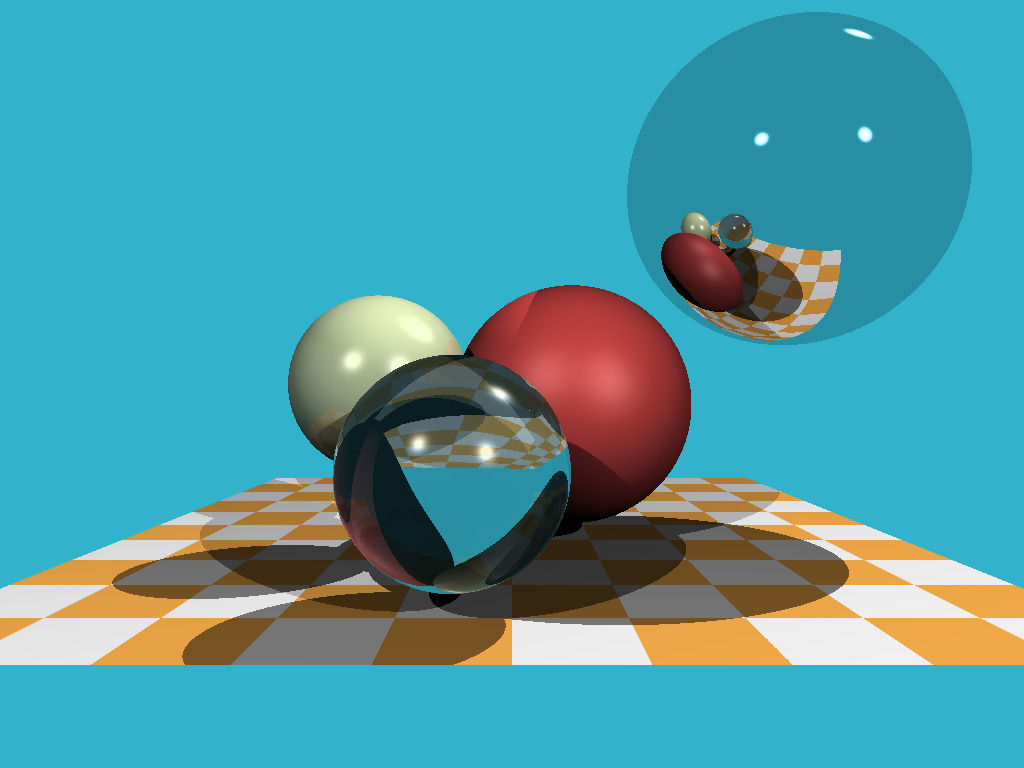
In my lectures I tend to avoid third party libraries as long as it is reasonable, because it forces to understand what is happening under the hood. So, the raytracing 256 lines of plain C++ give us this result:
## compilation
```sh
git clone https://github.com/ssloy/tinyraytracer.git
cd tinyraytracer
mkdir build
cd build
cmake ..
make
```
You can open the project in Gitpod, a free online dev evironment for GitHub:
[](https://gitpod.io/#https://github.com/ssloy/tinyraytracer)
On open, the editor will compile & run the program as well as open the resulting image in the editor's preview.
Just change the code in the editor and rerun the script (use the terminal's history) to see updated images.
================================================
FILE: tinyraytracer.cpp
================================================
#include <tuple>
#include <vector>
#include <fstream>
#include <algorithm>
#include <cmath>
struct vec3 {
float x=0, y=0, z=0;
float& operator[](const int i) { return i==0 ? x : (1==i ? y : z); }
const float& operator[](const int i) const { return i==0 ? x : (1==i ? y : z); }
vec3 operator*(const float v) const { return {x*v, y*v, z*v}; }
float operator*(const vec3& v) const { return x*v.x + y*v.y + z*v.z; }
vec3 operator+(const vec3& v) const { return {x+v.x, y+v.y, z+v.z}; }
vec3 operator-(const vec3& v) const { return {x-v.x, y-v.y, z-v.z}; }
vec3 operator-() const { return {-x, -y, -z}; }
float norm() const { return std::sqrt(x*x+y*y+z*z); }
vec3 normalized() const { return (*this)*(1.f/norm()); }
};
vec3 cross(const vec3 v1, const vec3 v2) {
return { v1.y*v2.z - v1.z*v2.y, v1.z*v2.x - v1.x*v2.z, v1.x*v2.y - v1.y*v2.x };
}
struct Material {
float refractive_index = 1;
float albedo[4] = {2,0,0,0};
vec3 diffuse_color = {0,0,0};
float specular_exponent = 0;
};
struct Sphere {
vec3 center;
float radius;
Material material;
};
constexpr Material ivory = {1.0, {0.9, 0.5, 0.1, 0.0}, {0.4, 0.4, 0.3}, 50.};
constexpr Material glass = {1.5, {0.0, 0.9, 0.1, 0.8}, {0.6, 0.7, 0.8}, 125.};
constexpr Material red_rubber = {1.0, {1.4, 0.3, 0.0, 0.0}, {0.3, 0.1, 0.1}, 10.};
constexpr Material mirror = {1.0, {0.0, 16.0, 0.8, 0.0}, {1.0, 1.0, 1.0}, 1425.};
constexpr Sphere spheres[] = {
{{-3, 0, -16}, 2, ivory},
{{-1.0, -1.5, -12}, 2, glass},
{{ 1.5, -0.5, -18}, 3, red_rubber},
{{ 7, 5, -18}, 4, mirror}
};
constexpr vec3 lights[] = {
{-20, 20, 20},
{ 30, 50, -25},
{ 30, 20, 30}
};
vec3 reflect(const vec3 &I, const vec3 &N) {
return I - N*2.f*(I*N);
}
vec3 refract(const vec3 &I, const vec3 &N, const float eta_t, const float eta_i=1.f) { // Snell's law
float cosi = - std::max(-1.f, std::min(1.f, I*N));
if (cosi<0) return refract(I, -N, eta_i, eta_t); // if the ray comes from the inside the object, swap the air and the media
float eta = eta_i / eta_t;
float k = 1 - eta*eta*(1 - cosi*cosi);
return k<0 ? vec3{1,0,0} : I*eta + N*(eta*cosi - std::sqrt(k)); // k<0 = total reflection, no ray to refract. I refract it anyways, this has no physical meaning
}
std::tuple<bool,float> ray_sphere_intersect(const vec3 &orig, const vec3 &dir, const Sphere &s) { // ret value is a pair [intersection found, distance]
vec3 L = s.center - orig;
float tca = L*dir;
float d2 = L*L - tca*tca;
if (d2 > s.radius*s.radius) return {false, 0};
float thc = std::sqrt(s.radius*s.radius - d2);
float t0 = tca-thc, t1 = tca+thc;
if (t0>.001) return {true, t0}; // offset the original point by .001 to avoid occlusion by the object itself
if (t1>.001) return {true, t1};
return {false, 0};
}
std::tuple<bool,vec3,vec3,Material> scene_intersect(const vec3 &orig, const vec3 &dir) {
vec3 pt, N;
Material material;
float nearest_dist = 1e10;
if (std::abs(dir.y)>.001) { // intersect the ray with the checkerboard, avoid division by zero
float d = -(orig.y+4)/dir.y; // the checkerboard plane has equation y = -4
vec3 p = orig + dir*d;
if (d>.001 && d<nearest_dist && std::abs(p.x)<10 && p.z<-10 && p.z>-30) {
nearest_dist = d;
pt = p;
N = {0,1,0};
material.diffuse_color = (int(.5*pt.x+1000) + int(.5*pt.z)) & 1 ? vec3{.3, .3, .3} : vec3{.3, .2, .1};
}
}
for (const Sphere &s : spheres) { // intersect the ray with all spheres
auto [intersection, d] = ray_sphere_intersect(orig, dir, s);
if (!intersection || d > nearest_dist) continue;
nearest_dist = d;
pt = orig + dir*nearest_dist;
N = (pt - s.center).normalized();
material = s.material;
}
return { nearest_dist<1000, pt, N, material };
}
vec3 cast_ray(const vec3 &orig, const vec3 &dir, const int depth=0) {
auto [hit, point, N, material] = scene_intersect(orig, dir);
if (depth>4 || !hit)
return {0.2, 0.7, 0.8}; // background color
vec3 reflect_dir = reflect(dir, N).normalized();
vec3 refract_dir = refract(dir, N, material.refractive_index).normalized();
vec3 reflect_color = cast_ray(point, reflect_dir, depth + 1);
vec3 refract_color = cast_ray(point, refract_dir, depth + 1);
float diffuse_light_intensity = 0, specular_light_intensity = 0;
for (const vec3 &light : lights) { // checking if the point lies in the shadow of the light
vec3 light_dir = (light - point).normalized();
auto [hit, shadow_pt, trashnrm, trashmat] = scene_intersect(point, light_dir);
if (hit && (shadow_pt-point).norm() < (light-point).norm()) continue;
diffuse_light_intensity += std::max(0.f, light_dir*N);
specular_light_intensity += std::pow(std::max(0.f, -reflect(-light_dir, N)*dir), material.specular_exponent);
}
return material.diffuse_color * diffuse_light_intensity * material.albedo[0] + vec3{1., 1., 1.}*specular_light_intensity * material.albedo[1] + reflect_color*material.albedo[2] + refract_color*material.albedo[3];
}
int main() {
constexpr int width = 1024;
constexpr int height = 768;
constexpr float fov = 1.05; // 60 degrees field of view in radians
std::vector<vec3> framebuffer(width*height);
#pragma omp parallel for
for (int pix = 0; pix<width*height; pix++) { // actual rendering loop
float dir_x = (pix%width + 0.5) - width/2.;
float dir_y = -(pix/width + 0.5) + height/2.; // this flips the image at the same time
float dir_z = -height/(2.*tan(fov/2.));
framebuffer[pix] = cast_ray(vec3{0,0,0}, vec3{dir_x, dir_y, dir_z}.normalized());
}
std::ofstream ofs("./out.ppm", std::ios::binary);
ofs << "P6\n" << width << " " << height << "\n255\n";
for (vec3 &color : framebuffer) {
float max = std::max(1.f, std::max(color[0], std::max(color[1], color[2])));
for (int chan : {0,1,2})
ofs << (char)(255 * color[chan]/max);
}
return 0;
}
gitextract__54hasrt/ ├── .gitignore ├── .gitpod.yml ├── CMakeLists.txt ├── Dockerfile ├── Readme.md └── tinyraytracer.cpp
SYMBOL INDEX (16 symbols across 1 files)

FILE: tinyraytracer.cpp
  type vec3 (line 7) | struct vec3 {
    method vec3 (line 11) | vec3  operator*(const float v) const { return {x*v, y*v, z*v};       }
    method vec3 (line 13) | vec3  operator+(const vec3& v) const { return {x+v.x, y+v.y, z+v.z}; }
    method vec3 (line 14) | vec3  operator-(const vec3& v) const { return {x-v.x, y-v.y, z-v.z}; }
    method vec3 (line 15) | vec3  operator-()              const { return {-x, -y, -z};          }
    method norm (line 16) | float norm() const { return std::sqrt(x*x+y*y+z*z); }
    method vec3 (line 17) | vec3 normalized() const { return (*this)*(1.f/norm()); }
  function vec3 (line 20) | vec3 cross(const vec3 v1, const vec3 v2) {
    method vec3 (line 11) | vec3  operator*(const float v) const { return {x*v, y*v, z*v};       }
    method vec3 (line 13) | vec3  operator+(const vec3& v) const { return {x+v.x, y+v.y, z+v.z}; }
    method vec3 (line 14) | vec3  operator-(const vec3& v) const { return {x-v.x, y-v.y, z-v.z}; }
    method vec3 (line 15) | vec3  operator-()              const { return {-x, -y, -z};          }
    method norm (line 16) | float norm() const { return std::sqrt(x*x+y*y+z*z); }
    method vec3 (line 17) | vec3 normalized() const { return (*this)*(1.f/norm()); }
  type Material (line 24) | struct Material {
  type Sphere (line 31) | struct Sphere {
  function vec3 (line 55) | vec3 reflect(const vec3 &I, const vec3 &N) {
    method vec3 (line 11) | vec3  operator*(const float v) const { return {x*v, y*v, z*v};       }
    method vec3 (line 13) | vec3  operator+(const vec3& v) const { return {x+v.x, y+v.y, z+v.z}; }
    method vec3 (line 14) | vec3  operator-(const vec3& v) const { return {x-v.x, y-v.y, z-v.z}; }
    method vec3 (line 15) | vec3  operator-()              const { return {-x, -y, -z};          }
    method norm (line 16) | float norm() const { return std::sqrt(x*x+y*y+z*z); }
    method vec3 (line 17) | vec3 normalized() const { return (*this)*(1.f/norm()); }
  function vec3 (line 59) | vec3 refract(const vec3 &I, const vec3 &N, const float eta_t, const floa...
    method vec3 (line 11) | vec3  operator*(const float v) const { return {x*v, y*v, z*v};       }
    method vec3 (line 13) | vec3  operator+(const vec3& v) const { return {x+v.x, y+v.y, z+v.z}; }
    method vec3 (line 14) | vec3  operator-(const vec3& v) const { return {x-v.x, y-v.y, z-v.z}; }
    method vec3 (line 15) | vec3  operator-()              const { return {-x, -y, -z};          }
    method norm (line 16) | float norm() const { return std::sqrt(x*x+y*y+z*z); }
    method vec3 (line 17) | vec3 normalized() const { return (*this)*(1.f/norm()); }
  function ray_sphere_intersect (line 67) | std::tuple<bool,float> ray_sphere_intersect(const vec3 &orig, const vec3...
  function scene_intersect (line 79) | std::tuple<bool,vec3,vec3,Material> scene_intersect(const vec3 &orig, co...
  function vec3 (line 106) | vec3 cast_ray(const vec3 &orig, const vec3 &dir, const int depth=0) {
    method vec3 (line 11) | vec3  operator*(const float v) const { return {x*v, y*v, z*v};       }
    method vec3 (line 13) | vec3  operator+(const vec3& v) const { return {x+v.x, y+v.y, z+v.z}; }
    method vec3 (line 14) | vec3  operator-(const vec3& v) const { return {x-v.x, y-v.y, z-v.z}; }
    method vec3 (line 15) | vec3  operator-()              const { return {-x, -y, -z};          }
    method norm (line 16) | float norm() const { return std::sqrt(x*x+y*y+z*z); }
    method vec3 (line 17) | vec3 normalized() const { return (*this)*(1.f/norm()); }
  function main (line 127) | int main() {
Condensed preview — 6 files, each showing path, character count, and a content snippet. Download the .json file or copy for the full structured content (9K chars).
[
  {
    "path": ".gitignore",
    "chars": 42,
    "preview": "# Ignore content built with CMake\nbuild/\n\n"
  },
  {
    "path": ".gitpod.yml",
    "chars": 206,
    "preview": "image:\n  file: Dockerfile\ntasks:\n- command: >\n    mkdir --parents build &&\n    cd build &&\n    cmake .. &&\n    make &&\n "
  },
  {
    "path": "CMakeLists.txt",
    "chars": 518,
    "preview": "cmake_minimum_required (VERSION 2.8)\nproject(tinyraytracer)\n\nset(CMAKE_CXX_STANDARD 17)\nset(CMAKE_CXX_STANDARD_REQUIRED "
  },
  {
    "path": "Dockerfile",
    "chars": 112,
    "preview": "FROM gitpod/workspace-full\n\nUSER root\n# add your tools here\nRUN apt-get update && apt-get install -y \\\n  netpbm\n"
  },
  {
    "path": "Readme.md",
    "chars": 1544,
    "preview": "# Understandable RayTracing in 256 lines of bare C++\n\nThis repository is a support code for my computer graphics lecture"
  },
  {
    "path": "tinyraytracer.cpp",
    "chars": 6219,
    "preview": "#include <tuple>\n#include <vector>\n#include <fstream>\n#include <algorithm>\n#include <cmath>\n\nstruct vec3 {\n    float x=0"
  }
]
About this extraction
This page contains the full source code of the ssloy/tinyraytracer GitHub repository, extracted and formatted as plain text for AI agents and large language models (LLMs). The extraction includes 6 files (8.4 KB), approximately 2.9k tokens, and a symbol index with 16 extracted functions, classes, methods, constants, and types. Use this with OpenClaw, Claude, ChatGPT, Cursor, Windsurf, or any other AI tool that accepts text input. You can copy the full output to your clipboard or download it as a .txt file.
Extracted by GitExtract — free GitHub repo to text converter for AI. Built by Nikandr Surkov.