[
{
"path": ".editorconfig",
"content": "root = true\n\n[*]\ncharset = utf-8\ninsert_final_newline = true\ntrim_trailing_whitespace = true\n\n[*.md]\nindent_size = 2\nindent_style = space\nmax_line_length = 100 # Please keep this in sync with bin/lesson_check.py!\ntrim_trailing_whitespace = false # keep trailing spaces in markdown - 2+ spaces are translated to a hard break (
)\n\n[*.r]\nmax_line_length = 80\n\n[*.py]\nindent_size = 4\nindent_style = space\nmax_line_length = 79\n\n[*.sh]\nend_of_line = lf\n\n[Makefile]\nindent_style = tab\n"
},
{
"path": ".github/workbench-docker-version.txt",
"content": "v0.2.4\n"
},
{
"path": ".github/workflows/README.md",
"content": "# Workflow Documentation\n\n## Managing Workflow Updates\n\nBy using prebuilt Docker containers that are managed by the Carpentries core Workbench maintainers, these workflows are designed to be rarely updated.\n\nHowever, is important to be able to keep them up-to-date when appropriate.\nYou can do this locally using your own R and Workbench installation, or via the \"04 Maintain: Update Workflow Files\" (`update-workflows.yaml`) GitHub Action.\n\n### Updating locally\n\nIn a terminal/git bash, navigate to the lesson folder where you want to update the workflows.\n\nThen, start an R session and:\n\n```r\n# Install/Update sandpaper\noptions(repos = c(carpentries = \"https://carpentries.r-universe.dev/\", CRAN = \"https://cloud.r-project.org\"))\ninstall.packages(\"sandpaper\")\n\n# update the workflows in your lesson\nlibrary(\"sandpaper\")\nsandpaper::update_github_workflows()\nquit()\n```\n\nAnd then in a bash prompt/git bash terminal:\n\n```bash\n$ git add .github/workflows\n$ git commit -m \"Manual update to docker workflows\"\n$ git push origin main\n```\n\n> [!NOTE]\n> For non-renv lessons, this is all the setup you need!\n> \n> For renv-enabled lessons:\n> - Cancel any \"01 Maintain: Build and Deploy Site\" workflow currently running\n> - Run the \"02 Maintain: Check for Updated Packages\" workflow and merge any PR opened to update the renv lockfile\n> - This should automatically run the \"03 Maintain: Apply Package Cache\" workflow to install packages and build the cache\n> - A successful cache buid should then trigger the \"01 Maintain: Build and Deploy Site\" workflow\n\n### Updating using GitHub\n\n#### Official lessons\n\n\"Official\" lessons are those in the lesson program repositories, Incubator, or Lab.\nThey need no extra setup as this is all managed for you as part of the Carpentries GitHub organisations.\n\nTo update the workflows, either:\n- wait for the scheduled run of the \"04 Maintain: Update Workflow Files\" at approximately midnight every Tuesday\n- go to the Actions tab on GitHub, click \"04 Maintain: Update Workflow Files\" on the left, then \"Run Workflow\" on the right\n\nOnce complete, this will raise a PR with any changes to the workflows that are needed.\nIf you are happy with the changes made, you can merge the PR into your lesson repository.\n\n#### Your own lessons\n\nThis presumes you:\n - already have a lesson repository available on GitHub\n - have enabled workflows in the lesson repo\n - have set up a SANDPAPER_WORKFLOW personal access token (PAT) in the lesson repo\n\nTo go through these steps, please follow the [Forking a Workbench Lesson](https://docs.carpentries.org/resources/curriculum/lesson-forks.html#forking-a-workbench-lesson-repository)\ndocumentation.\n\nOnce set up, run the \"04 Maintain: Update Workflow Files\" (`update-workflows.yaml`) action.\n\nThis will raise a PR with any changes to the workflows that are needed.\nIf you are happy with the changes made, you can merge the PR into your lesson repository.\n\n\n## Package Caches for RMarkdown Lessons\n\nIn summary, generating a reusable package cache is achieved by running the \"02 Maintain: Check for Updated Packages\" workflow, and then the \"03 Maintain: Apply Package Cache\" workflow.\n\n> [!NOTE]\n> Caching is only relevant for lessons that use Rmd files and renv to manage R packages.\n> If you are building basic markdown documents, caching will not apply to you, and the only\n> workflow that needs to be run is \"01 Maintain: Build and Deploy Site\".\n\n### Caching\n\nThe two cache management workflows are separated to ensure that once you have a successful build with a working renv cache, this cache is stored and will be reused by the Workbench Docker container.\nThis means that lesson builds will be faster once an renv cache is created and reused by the Docker container.\n\nAnother major bonus of this setup is that you can keep using this cache indefinitely to build your lesson.\nThis is important if you need very specific versions of R packages (\"pinning\").\n\nIf and when you want to perform an update to the cache, you can re-run the \"02 Maintain: Check for Updated Packages\" and verify that your lesson still builds with the new packages.\nIf all looks good, re-run the \"03 Maintain: Apply Package Cache\" workflow, and this will write a new renv cache file to GitHub.\n\nIn any case, the renv cache is invalidated by new versions of the `renv.lock` file.\nThis happens:\n - if you update your lockfile locally by using the `sandpaper::update_cache()` function, and then push it to the lesson repository\n - when you run the \"02 Maintain: Check for Updated Packages\" and there are new packages to install\n\nMore information on managing local renv caches for lessons can be found in the [Sandpaper packages vignettes](https://carpentries.github.io/sandpaper/articles/building-with-renv.html).\n\n#### Using different package cache versions\n\nThere are times when you may want to go back to a previous renv package cache file:\n - if you run \"02 Maintain: Check for Updated Packages\" and \"03 Maintain: Apply Package Cache\" and the cache generation fails for some reason\n - if there is a new R package that produces incorrect or broken lesson output\n\nCache files will have the following name format, where IMAGE is the workbench-docker image version, and HASHSUM is the `renv.lock` lockfile MD5 hash:\n\n```\nIMAGE HASHSUM\n[ | ] [ | ]\nv0.2.4_renv-2e499eb706112971b2cffceb49b55a6efe49f3ed75cd6579b10ff224489daca4\n```\n\nCopy the hashsum part of the desired cache file you want to use, e.g. `2e499eb706112971b2cffceb49b55a6efe49f3ed75cd6579b10ff224489daca4`.\n\nThen either:\n 1. Add a repository variable called CACHE_VERSION, and paste in the hash\n - Go to ...\n 2. Run the \"01 Maintain: Build and Deploy Site\" manually, supplying the CACHE_VERSION input\n - Go to ...\n\nIf you have no caches listed, make sure to run the \"02 Maintain: Check for Updated Packages\" and \"03 Maintain: Apply Package Cache\" to create a new renv cache file.\n\n> [!NOTE]\n> If you are maintaining an official lesson, caches are saved in an AWS S3 bucket owned by the Carpentries.\n> Once a successful cache has been saved, these will be listed in the outputs of the \"01 Maintain: Build and Deploy Site\" workflow.\n> \n> If you are developing a lesson in your own repository, caches are saved on GitHub.\n> You can see available caches by going to the Actions tab, and clicking Caches on the left hand side.\n\n\n## User Settings\n\nInput level variables are documented in the `carpentries/actions` repository READMEs for each composite action.\n\nSpecific repository level variables can be set that will force particular options across all workflow runs.\n\n### 01 Maintain: Build and Deploy Site (docker_build_deploy.yaml)\n\nRepository-level variables for this workflow are:\n- WORKBENCH_TAG\n - The workbench-docker release version to use for a given build\n - This can be set to a specific version number to force all builds to use a given container version\n - Default is unset or `latest`\n- BUILD_RESET\n - Force a reset of previously build markdown files\n - Setting this variable value to `true` will force sandpaper to delete any previously build markdown files\n - Default is unset or `false`\n- AUTO_MERGE_WORKBENCH_VERSION_UPDATE\n - Control merge behaviour of the workbench-docker version update PR\n - When a new workbench Docker image version is detected, usually after a sandpaper, varnish, or pegboard update, its version number will be incremented\n - If a newer version is available, a PR will be auto-generated that updates the `.github/workbench-docker-version.txt` file, and this PR will be auto-merged\n - To not auto-merge this PR and to choose when to update the Docker version used, set this to `false`.\n - Default is unset or `true`\n- LANG_CODE\n - Two-letter language code that triggers the use of Joel Nitta's {dovetail} package for lesson translation\n - This is used in the internationalisation repos of the main Carpentry lesson programs\n - Default is unset or `''`\n\n### 02 Maintain: Check for Updated Packages (update-cache.yaml)\n\nRepository-level variables for this workflow are:\n- LOCKFILE_CACHE_GEN\n - Passed to the `generate-cache` input of the [update-lockfile](https://github.com/carpentries/actions/tree/main/update-lockfile) action\n - A temporary renv cache is generated when this workflow runs\n - If this option is set to `false`, no temporary cache will be generated\n - Default is `true`\n- FORCE_RENV_INIT\n - Passed to the `force-renv-init` input of the [update-lockfile](https://github.com/carpentries/actions/tree/main/update-lockfile) action\n - renv initialises a cache based on a given lockfile\n - If this lockfile is particularly old or packages have broken/unresolvable dependencies, then builds will fail\n - If this option is set to `true`, a full renv reinitialisation will occur, \"wiping the slate clean\"\n - This option is useful if you're using Bioconductor packages which often break when new Bioconductor releases happen\n - Default is `false`\n- UPDATE_PACKAGES\n - Passed to the `update` input of the [update-lockfile](https://github.com/carpentries/actions/tree/main/update-lockfile) action\n - If set to `false` only package hydration will happen and no package update checks will occur\n - Default is `true`\n\n### 03 Maintain: Apply Package Cache (docker_apply_cache.yaml)\n\nRepository-level variables for this workflow are:\n- WORKBENCH_TAG\n - The workbench-docker release version to use for a given build\n - This can be set to a specific version number to force all builds to use a given container version\n - Default is unset or `latest`\n\n\n### 04 Maintain: Update Workflow Files (update-workflows.yaml)\n\nThere are no repository variables for this workflow.\n\n\n## Pull Request and Review Management\n\nBecause our lessons execute code, pull requests are a security risk for any lesson and thus have security measures associted with them.\n**Do not merge any pull requests that do not pass checks and do not have bots commented on them.**\n\nThis series of workflows all go together and are described in the following diagram and the below sections:\n\n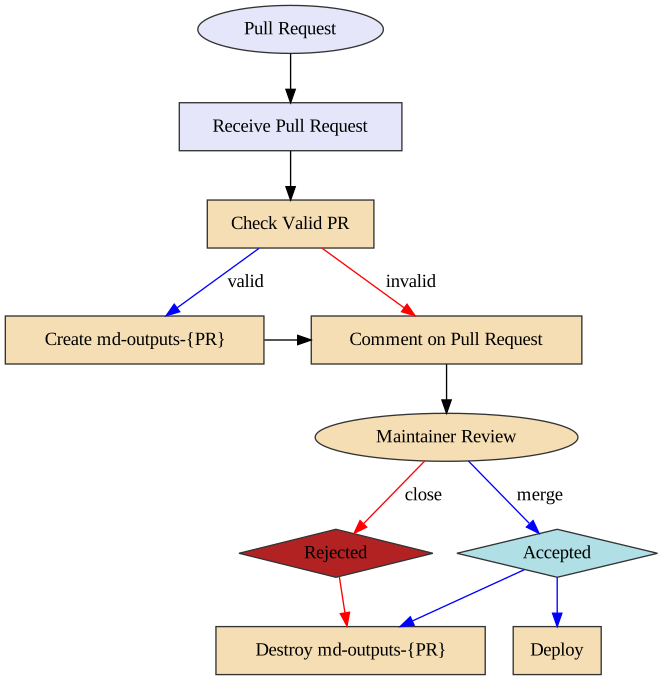\n\n### Pre Flight Pull Request Validation (pr-preflight.yaml)\n\nThis workflow runs every time a pull request is created and its purpose is to validate that the pull request is okay to run.\nThis means the following things:\n\n1. The pull request does not contain modified workflow files\n2. If the pull request contains modified workflow files, it does not contain modified content files\n (such as a situation where @carpentries-bot will make an automated pull request)\n3. The pull request does not contain an invalid commit hash\n (e.g. from a fork that was made before a lesson was transitioned from styles to use the Workbench).\n\nOnce the checks are finished, a comment is issued to the pull request, which will allow maintainers to determine if it is safe to run the \"Receive Pull Request\" workflow from new contributors.\n\n### Receive Pull Request (docker_pr_receive.yaml)\n\n**Note of caution:** This workflow runs arbitrary code by anyone who creates a pull request.\nGitHub has safeguarded the token used in this workflow to have no privileges in the repository, but we have taken precautions to protect against spoofing.\n\nThis workflow is triggered with every push to a pull request.\nIf this workflow is already running and a new push is sent to the pull request, the workflow running from the previous push will be cancelled and a new workflow run will be started.\n\nThe first step of this workflow is to check if it is valid (e.g. that no workflow files have been modified):\n- If there are workflow files that have been modified, a comment is made that indicates that the workflow will not continue.\n- If both a workflow file and lesson content is modified, an error will occur and the workflow will not continue.\n\nThe second step (if valid) is to build the generated content from the pull request.\nThis builds the content and uploads three artifacts:\n\n1. The pull request number (pr)\n2. A summary of changes after the rendering process (diff)\n3. The rendered files (build)\n\nThe artifacts produced are used by the \"Comment on Pull Request\" workflow.\n\n### Comment on Pull Request (pr-comment.yaml)\n\nThis workflow is triggered if the `docker_pr_receive.yaml` workflow is successful.\nThe steps in this workflow are:\n\n1. Test if the workflow is valid and comment the validity of the workflow to the pull request.\n2. If it is valid: create an orphan branch with two commits: the current state of the repository and the proposed changes.\n3. If it is valid: update the pull request comment with the summary of changes\n\nImportantly: if the pull request is invalid, the branch is not created so any malicious code is not published.\n\nFrom here, the maintainer can request changes from the author and eventually either merge or reject the PR.\nWhen this happens, if the PR was valid, the preview branch needs to be deleted. \n\n### Send Close PR Signal (pr-close-signal.yaml)\n\nTriggered any time a pull request is closed.\nThis emits an artifact that is the pull request number for the next action.\n\n### Remove Pull Request Branch (pr-post-remove-branch.yaml)\n\nTiggered by `pr-close-signal.yaml`.\nThis removes the temporary branch associated with the pull request (if it was created).\n"
},
{
"path": ".github/workflows/docker_apply_cache.yaml",
"content": "name: \"03 Maintain: Apply Package Cache\"\ndescription: \"Generate the package cache for the lesson after a pull request has been merged or via manual trigger, and cache in S3 or GitHub\"\non:\n workflow_dispatch:\n inputs:\n name:\n description: 'Who triggered this build?'\n required: true\n default: 'Maintainer (via GitHub)'\n pull_request:\n types:\n - closed\n branches:\n - main\n\n# queue cache runs\nconcurrency:\n group: docker-apply-cache\n cancel-in-progress: false\n\njobs:\n preflight:\n name: \"Preflight: PR or Manual Trigger?\"\n runs-on: ubuntu-latest\n outputs:\n do-apply: ${{ steps.check.outputs.merged_or_manual }}\n steps:\n - name: \"Should we run cache application?\"\n id: check\n run: |\n if [[ \"${{ github.event_name }}\" == \"workflow_dispatch\" ||\n (\"${{ github.ref }}\" == \"refs/heads/main\" && \"${{ github.event.action }}\" == \"closed\" && \"${{ github.event.pull_request.merged }}\" == \"true\") ]]; then\n echo \"merged_or_manual=true\" >> $GITHUB_OUTPUT\n else\n echo \"This was not a manual trigger and no PR was merged. No action taken.\"\n echo \"merged_or_manual=false\" >> $GITHUB_OUTPUT\n fi\n shell: bash\n\n check-renv:\n name: \"Check If We Need {renv}\"\n runs-on: ubuntu-latest\n needs: preflight\n if: needs.preflight.outputs.do-apply == 'true'\n permissions:\n id-token: write\n outputs:\n renv-needed: ${{ steps.check-for-renv.outputs.renv-needed }}\n renv-cache-hashsum: ${{ steps.check-for-renv.outputs.renv-cache-hashsum }}\n renv-cache-available: ${{ steps.check-for-renv.outputs.renv-cache-available }}\n steps:\n - name: \"Check for renv\"\n id: check-for-renv\n uses: carpentries/actions/renv-checks@main\n with:\n role-to-assume: ${{ secrets.AWS_GH_OIDC_ARN }}\n aws-region: ${{ secrets.AWS_GH_OIDC_REGION }}\n WORKBENCH_TAG: ${{ vars.WORKBENCH_TAG || 'latest' }}\n token: ${{ secrets.GITHUB_TOKEN }}\n\n no-renv-cache-used:\n name: \"No renv cache used\"\n runs-on: ubuntu-latest\n needs: check-renv\n if: needs.check-renv.outputs.renv-needed != 'true'\n steps:\n - name: \"No renv cache needed\"\n run: echo \"No renv cache needed for this lesson\"\n\n renv-cache-available:\n name: \"renv cache available\"\n runs-on: ubuntu-latest\n needs: check-renv\n if: needs.check-renv.outputs.renv-cache-available == 'true'\n steps:\n - name: \"renv cache available\"\n run: echo \"renv cache available for this lesson\"\n\n update-renv-cache:\n name: \"Update renv Cache\"\n runs-on: ubuntu-latest\n needs: check-renv\n if: |\n needs.check-renv.outputs.renv-needed == 'true' &&\n needs.check-renv.outputs.renv-cache-available != 'true' &&\n (\n github.event_name == 'workflow_dispatch' ||\n (\n github.event.pull_request.merged == true &&\n (\n (\n contains(\n join(github.event.pull_request.labels.*.name, ','),\n 'type: package cache'\n ) &&\n github.event.pull_request.head.ref == 'update/packages'\n )\n ||\n (\n contains(\n join(github.event.pull_request.labels.*.name, ','),\n 'type: workflows'\n ) &&\n github.event.pull_request.head.ref == 'update/workflows'\n )\n ||\n (\n contains(\n join(github.event.pull_request.labels.*.name, ','),\n 'type: docker version'\n ) &&\n github.event.pull_request.head.ref == 'update/workbench-docker-version'\n )\n )\n )\n )\n permissions:\n checks: write\n contents: write\n pages: write\n id-token: write\n container:\n image: ghcr.io/carpentries/workbench-docker:${{ vars.WORKBENCH_TAG || 'latest' }}\n env:\n WORKBENCH_PROFILE: \"ci\"\n GITHUB_PAT: ${{ secrets.GITHUB_TOKEN }}\n RENV_PATHS_ROOT: /home/rstudio/lesson/renv\n RENV_PROFILE: \"lesson-requirements\"\n RENV_VERSION: ${{ needs.check-renv.outputs.renv-cache-hashsum }}\n RENV_CONFIG_EXTERNAL_LIBRARIES: \"/usr/local/lib/R/site-library\"\n volumes:\n - ${{ github.workspace }}:/home/rstudio/lesson\n options: --cpus 2\n steps:\n - uses: actions/checkout@v6\n\n - name: \"Debugging Info\"\n run: |\n echo \"Current Directory: $(pwd)\"\n ls -lah /home/rstudio/.workbench\n ls -lah $(pwd)\n Rscript -e 'sessionInfo()'\n shell: bash\n\n - name: \"Mark Repository as Safe\"\n run: |\n git config --global --add safe.directory $(pwd)\n shell: bash\n\n - name: \"Ensure sandpaper is loadable\"\n run: |\n .libPaths()\n library(sandpaper)\n shell: Rscript {0}\n\n - name: \"Setup Lesson Dependencies\"\n run: |\n Rscript /home/rstudio/.workbench/setup_lesson_deps.R\n shell: bash\n\n - name: \"Fortify renv Cache\"\n run: |\n Rscript /home/rstudio/.workbench/fortify_renv_cache.R\n shell: bash\n\n - name: \"Get Container Version Used\"\n id: wb-vers\n uses: carpentries/actions/container-version@main\n with:\n WORKBENCH_TAG: ${{ vars.WORKBENCH_TAG }}\n renv-needed: ${{ needs.check-renv.outputs.renv-needed }}\n token: ${{ secrets.GITHUB_TOKEN }}\n\n - name: \"Validate Current Org and Workflow\"\n id: validate-org-workflow\n uses: carpentries/actions/validate-org-workflow@main\n with:\n repo: ${{ github.repository }}\n workflow: ${{ github.workflow }}\n\n - name: \"Configure AWS credentials via OIDC\"\n id: aws-creds\n env:\n role-to-assume: ${{ secrets.AWS_GH_OIDC_ARN }}\n aws-region: ${{ secrets.AWS_GH_OIDC_REGION }}\n if: |\n steps.validate-org-workflow.outputs.is_valid == 'true' &&\n env.role-to-assume != '' &&\n env.aws-region != ''\n uses: aws-actions/configure-aws-credentials@v6\n with:\n role-to-assume: ${{ env.role-to-assume }}\n aws-region: ${{ env.aws-region }}\n output-credentials: true\n\n - name: \"Upload cache object to S3\"\n id: upload-cache\n uses: tespkg/actions-cache@v1.10.0\n with:\n accessKey: ${{ steps.aws-creds.outputs.aws-access-key-id }}\n secretKey: ${{ steps.aws-creds.outputs.aws-secret-access-key }}\n sessionToken: ${{ steps.aws-creds.outputs.aws-session-token }}\n bucket: workbench-docker-caches\n path: |\n /home/rstudio/lesson/renv\n /usr/local/lib/R/site-library\n key: ${{ github.repository }}/${{ steps.wb-vers.outputs.container-version }}_renv-${{ needs.check-renv.outputs.renv-cache-hashsum }}\n restore-keys:\n ${{ github.repository }}/${{ steps.wb-vers.outputs.container-version }}_renv-\n\n record-cache-result:\n name: \"Record Caching Status\"\n runs-on: ubuntu-latest\n needs: [check-renv, update-renv-cache]\n if: always()\n env:\n GITHUB_TOKEN: ${{ secrets.GITHUB_TOKEN }}\n steps:\n - name: \"Record cache result\"\n\n run: |\n echo \"${{ needs.update-renv-cache.result == 'success' || needs.check-renv.outputs.renv-cache-available == 'true' || 'false' }}\" > ${{ github.workspace }}/apply-cache-result\n shell: bash\n\n - name: \"Upload cache result\"\n uses: actions/upload-artifact@v7\n with:\n name: apply-cache-result\n path: ${{ github.workspace }}/apply-cache-result\n"
},
{
"path": ".github/workflows/docker_build_deploy.yaml",
"content": "name: \"01 Maintain: Build and Deploy Site\"\ndescription: \"Build and deploy the lesson site using the carpentries/workbench-docker container\"\non:\n push:\n branches:\n - 'main'\n - 'l10n_main'\n paths-ignore:\n - '.github/workflows/**.yaml'\n - '.github/workbench-docker-version.txt'\n schedule:\n - cron: '0 0 * * 2'\n workflow_run:\n workflows: [\"03 Maintain: Apply Package Cache\"]\n types:\n - completed\n workflow_dispatch:\n inputs:\n name:\n description: 'Who triggered this build?'\n required: true\n default: 'Maintainer (via GitHub)'\n CACHE_VERSION:\n description: 'Optional renv cache version override'\n required: false\n default: ''\n reset:\n description: 'Reset cached markdown files'\n required: true\n default: false\n type: boolean\n force-skip-manage-deps:\n description: 'Skip build-time dependency management'\n required: true\n default: false\n type: boolean\n\n# only one build/deploy at a time\nconcurrency:\n group: docker-build-deploy\n cancel-in-progress: true\n\njobs:\n preflight:\n name: \"Preflight: Schedule, Push, or PR?\"\n runs-on: ubuntu-latest\n outputs:\n do-build: ${{ steps.build-check.outputs.do-build }}\n renv-needed: ${{ steps.build-check.outputs.renv-needed }}\n renv-cache-hashsum: ${{ steps.build-check.outputs.renv-cache-hashsum }}\n workbench-container-file-exists: ${{ steps.wb-vers.outputs.workbench-container-file-exists }}\n wb-vers: ${{ steps.wb-vers.outputs.container-version }}\n last-wb-vers: ${{ steps.wb-vers.outputs.last-container-version }}\n workbench-update: ${{ steps.wb-vers.outputs.workbench-update }}\n env:\n GITHUB_TOKEN: ${{ secrets.GITHUB_TOKEN }}\n steps:\n - name: \"Should we run build and deploy?\"\n id: build-check\n uses: carpentries/actions/build-preflight@main\n\n - name: \"Checkout Lesson\"\n if: steps.build-check.outputs.do-build == 'true'\n uses: actions/checkout@v6\n\n - name: \"Get container version info\"\n id: wb-vers\n if: steps.build-check.outputs.do-build == 'true'\n uses: carpentries/actions/container-version@main\n with:\n WORKBENCH_TAG: ${{ vars.WORKBENCH_TAG }}\n renv-needed: ${{ steps.build-check.outputs.renv-needed }}\n token: ${{ secrets.GITHUB_TOKEN }}\n\n full-build:\n name: \"Build Full Site\"\n runs-on: ubuntu-latest\n needs: preflight\n if: |\n needs.preflight.outputs.do-build == 'true' &&\n needs.preflight.outputs.workbench-update != 'true'\n env:\n RENV_EXISTS: ${{ needs.preflight.outputs.renv-needed }}\n RENV_HASH: ${{ needs.preflight.outputs.renv-cache-hashsum }}\n permissions:\n checks: write\n contents: write\n pages: write\n id-token: write\n container:\n image: ghcr.io/carpentries/workbench-docker:${{ vars.WORKBENCH_TAG || 'latest' }}\n env:\n WORKBENCH_PROFILE: \"ci\"\n GITHUB_PAT: ${{ secrets.GITHUB_TOKEN }}\n RENV_PATHS_ROOT: /home/rstudio/lesson/renv\n RENV_PROFILE: \"lesson-requirements\"\n RENV_CONFIG_EXTERNAL_LIBRARIES: \"/usr/local/lib/R/site-library\"\n volumes:\n - ${{ github.workspace }}:/home/rstudio/lesson\n options: --cpus 1\n steps:\n - uses: actions/checkout@v6\n\n - name: \"Debugging Info\"\n run: |\n cd /home/rstudio/lesson\n echo \"Current Directory: $(pwd)\"\n echo \"RENV_HASH is $RENV_HASH\"\n ls -lah /home/rstudio/.workbench\n ls -lah $(pwd)\n Rscript -e 'sessionInfo()'\n shell: bash\n\n - name: \"Mark Repository as Safe\"\n run: |\n git config --global --add safe.directory $(pwd)\n shell: bash\n\n - name: \"Setup Lesson Dependencies\"\n id: build-container-deps\n uses: carpentries/actions/build-container-deps@main\n with:\n CACHE_VERSION: ${{ vars.CACHE_VERSION || github.event.inputs.CACHE_VERSION || '' }}\n WORKBENCH_TAG: ${{ vars.WORKBENCH_TAG || 'latest' }}\n LESSON_PATH: ${{ vars.LESSON_PATH || '/home/rstudio/lesson' }}\n role-to-assume: ${{ secrets.AWS_GH_OIDC_ARN }}\n aws-region: ${{ secrets.AWS_GH_OIDC_REGION }}\n token: ${{ secrets.GITHUB_TOKEN }}\n\n - name: \"Run Container and Build Site\"\n id: build-and-deploy\n uses: carpentries/actions/build-and-deploy@main\n with:\n reset: ${{ vars.BUILD_RESET || github.event.inputs.reset || 'false' }}\n skip-manage-deps: ${{ github.event.inputs.force-skip-manage-deps == 'true' || steps.build-container-deps.outputs.renv-cache-available || steps.build-container-deps.outputs.backup-cache-used || 'false' }}\n lang-code: ${{ vars.LANG_CODE || '' }}\n\n update-container-version:\n name: \"Update container version used\"\n runs-on: ubuntu-latest\n needs: [preflight]\n permissions:\n actions: write\n contents: write\n pull-requests: write\n id-token: write\n if: |\n needs.preflight.outputs.do-build == 'true' &&\n (\n needs.preflight.outputs.workbench-container-file-exists == 'false' ||\n needs.preflight.outputs.workbench-update == 'true'\n )\n steps:\n - name: \"Record container version used\"\n uses: carpentries/actions/record-container-version@main\n with:\n CONTAINER_VER: ${{ needs.preflight.outputs.wb-vers }}\n AUTO_MERGE: ${{ vars.AUTO_MERGE_CONTAINER_VERSION_UPDATE || 'true' }}\n token: ${{ secrets.GITHUB_TOKEN }}\n role-to-assume: ${{ secrets.AWS_GH_OIDC_ARN }}\n aws-region: ${{ secrets.AWS_GH_OIDC_REGION }}\n"
},
{
"path": ".github/workflows/docker_pr_receive.yaml",
"content": "name: \"Bot: Receive Pull Request\"\ndescription: \"Receive a pull request and build the markdown source files\"\non:\n pull_request:\n types:\n [opened, synchronize, reopened]\n workflow_dispatch:\n inputs:\n pr_number:\n type: number\n required: true\n\nconcurrency:\n group: ${{ github.ref }}\n cancel-in-progress: true\n\npermissions:\n contents: read\n pull-requests: write\n\njobs:\n preflight:\n name: \"Preflight: md-outputs exists?\"\n runs-on: ubuntu-latest\n outputs:\n branch-exists: ${{ steps.check.outputs.exists }}\n steps:\n - name: \"Checkout Lesson\"\n uses: actions/checkout@v6\n\n - name: \"Check if md-outputs branch exists\"\n id: check\n run: |\n # 💡 Checking for md-outputs branch #\n if [[ -n $(git ls-remote --exit-code --heads origin md-outputs) ]]; then\n echo \"exists=true\" >> $GITHUB_OUTPUT\n else\n echo \"exists=false\" >> $GITHUB_OUTPUT\n echo \"::error::md-outputs branch required but does not exist.\"\n echo \"::error::Please merge any open package update PRs to trigger the '03 Maintain: Apply Package Cache' and '01: Maintain: Build and Deploy Site' workflows.\"\n\n echo \"## ❌ ERROR: md-outputs branch required\" >> $GITHUB_STEP_SUMMARY\n echo \"Please merge any open package update PRs to trigger the '03 Maintain: Apply Package Cache' and '01: Maintain: Build and Deploy Site' workflows.\" >> $GITHUB_STEP_SUMMARY\n\n exit 1\n fi\n shell: bash\n\n test-pr:\n name: \"Record PR number\"\n if: |\n github.event.action != 'closed' &&\n needs.preflight.outputs.branch-exists == 'true'\n runs-on: ubuntu-latest\n needs: preflight\n outputs:\n is_valid: ${{ steps.check-pr.outputs.VALID }}\n pr_number: ${{ env.NR }}\n pr_branch: ${{ env.PR_BRANCH }}\n steps:\n - name: \"Grab PR\"\n env:\n GITHUB_TOKEN: ${{ secrets.GITHUB_TOKEN }}\n run: |\n if [[ \"${{ github.event_name }}\" == \"pull_request\" ]] ; then\n PR_NUMBER=${{ github.event.number }}\n elif [[ \"${{ github.event_name }}\" == \"workflow_dispatch\" ]] ; then\n PR_NUMBER=${{ inputs.pr_number }}\n fi\n\n echo $PR_NUMBER > ${{ github.workspace }}/NR\n echo \"NR=$PR_NUMBER\" >> $GITHUB_ENV\n echo \"PR_BRANCH=$(gh -R ${{ github.repository }} pr view $PR_NUMBER --json headRefName --jq '.headRefName')\" >> $GITHUB_ENV\n shell: bash\n\n - name: \"Upload PR number\"\n id: upload\n if: always()\n uses: actions/upload-artifact@v7\n with:\n name: pr\n path: ${{ github.workspace }}/NR\n\n - name: \"Get Invalid Hashes File\"\n id: hash\n run: |\n echo \"json<> $GITHUB_OUTPUT\n shell: bash\n\n - name: \"Debug Hashes Output\"\n run: |\n echo \"${{ steps.hash.outputs.json }}\"\n shell: bash\n\n - name: \"Check PR\"\n id: check-pr\n uses: carpentries/actions/check-valid-pr@main\n with:\n pr: ${{ env.NR }}\n invalid: ${{ fromJSON(steps.hash.outputs.json)[github.repository] }}\n\n check-renv:\n name: \"Check If We Need {renv}\"\n runs-on: ubuntu-latest\n outputs:\n renv-needed: ${{ steps.renv-check.outputs.renv-needed }}\n renv-cache-hashsum: ${{ steps.renv-check.outputs.renv-cache-hashsum }}\n steps:\n - name: \"Checkout Lesson\"\n uses: actions/checkout@v6\n\n - name: \"Is renv required?\"\n id: renv-check\n uses: carpentries/actions/renv-checks@main\n with:\n CACHE_VERSION: ${{ inputs.CACHE_VERSION || '' }}\n skip-cache-check: true\n\n build-md-source:\n name: \"Build markdown source files if valid\"\n needs:\n - test-pr\n - check-renv\n runs-on: ubuntu-latest\n if: needs.test-pr.outputs.is_valid == 'true'\n env:\n CHIVE: ${{ github.workspace }}/site/chive\n PR: ${{ github.workspace }}/site/pr\n GHWMD: ${{ github.workspace }}/site/built\n PR_BRANCH: ${{ needs.test-pr.outputs.pr_branch }}\n PR_NUMBER: ${{ needs.test-pr.outputs.pr_number }}\n GITHUB_TOKEN: ${{ secrets.GITHUB_TOKEN }}\n permissions:\n checks: write\n contents: write\n pages: write\n id-token: write\n container:\n image: ghcr.io/carpentries/workbench-docker:${{ vars.WORKBENCH_TAG || 'latest' }}\n env:\n WORKBENCH_PROFILE: \"ci\"\n GITHUB_PAT: ${{ secrets.GITHUB_TOKEN }}\n GITHUB_TOKEN: ${{ secrets.GITHUB_TOKEN }}\n RENV_PATHS_ROOT: /home/rstudio/lesson/renv\n RENV_PROFILE: \"lesson-requirements\"\n RENV_CONFIG_EXTERNAL_LIBRARIES: \"/usr/local/lib/R/site-library\"\n volumes:\n - ${{ github.workspace }}:/home/rstudio/lesson\n options: --cpus 2\n outputs:\n workbench-update: ${{ steps.wb-vers.outputs.workbench-update }}\n build-site: ${{ steps.build-site.outcome }}\n steps:\n - uses: actions/checkout@v6\n\n - name: \"Check Out Staging Branch\"\n uses: actions/checkout@v6\n with:\n ref: md-outputs\n path: ${{ env.GHWMD }}\n\n - name: Mark Repository as Safe\n run: |\n git config --global --add safe.directory $(pwd)\n git config --global --add safe.directory /home/rstudio/lesson\n shell: bash\n\n - name: \"Ensure sandpaper is loadable\"\n run: |\n .libPaths()\n library(sandpaper)\n shell: Rscript {0}\n\n - name: Setup Lesson Dependencies\n run: |\n Rscript /home/rstudio/.workbench/setup_lesson_deps.R\n shell: bash\n\n - name: Get Container Version Used\n id: wb-vers\n if: needs.check-renv.outputs.renv-needed == 'true'\n uses: carpentries/actions/container-version@main\n with:\n WORKBENCH_TAG: ${{ vars.WORKBENCH_TAG }}\n renv-needed: ${{ needs.check-renv.outputs.renv-needed }}\n token: ${{ secrets.GITHUB_TOKEN }}\n\n - name: \"Validate Current Org and Workflow\"\n id: validate-org-workflow\n if: needs.check-renv.outputs.renv-needed == 'true'\n uses: carpentries/actions/validate-org-workflow@main\n with:\n repo: ${{ github.repository }}\n workflow: ${{ github.workflow }}\n\n - name: Configure AWS credentials via OIDC\n id: aws-creds\n env:\n role-to-assume: ${{ secrets.AWS_GH_OIDC_ARN }}\n aws-region: ${{ secrets.AWS_GH_OIDC_REGION }}\n if: |\n steps.validate-org-workflow.outputs.is_valid == 'true' &&\n needs.check-renv.outputs.renv-needed == 'true' &&\n env.role-to-assume != '' &&\n env.aws-region != ''\n uses: aws-actions/configure-aws-credentials@v6\n with:\n role-to-assume: ${{ env.role-to-assume }}\n aws-region: ${{ env.aws-region }}\n output-credentials: true\n\n - name: Get cache object from S3\n id: s3-cache\n uses: tespkg/actions-cache/restore@v1.10.0\n if: needs.check-renv.outputs.renv-needed == 'true'\n with:\n # insecure: false # optional, use http instead of https. default false\n accessKey: ${{ steps.aws-creds.outputs.aws-access-key-id }}\n secretKey: ${{ steps.aws-creds.outputs.aws-secret-access-key }}\n sessionToken: ${{ steps.aws-creds.outputs.aws-session-token }}\n bucket: workbench-docker-caches\n path: |\n /home/rstudio/lesson/renv\n /usr/local/lib/R/site-library\n key: ${{ github.repository }}/${{ steps.wb-vers.outputs.container-version }}_renv-${{ needs.check-renv.outputs.renv-cache-hashsum }}\n restore-keys:\n ${{ github.repository }}/${{ steps.wb-vers.outputs.container-version }}_renv-\n\n - name: \"Fortify renv Cache\"\n if: |\n needs.check-renv.outputs.renv-needed == 'true' &&\n steps.s3-cache.outputs.cache-hit != 'true'\n run: |\n Rscript /home/rstudio/.workbench/fortify_renv_cache.R\n shell: bash\n\n - name: \"Validate and Build Markdown\"\n id: build-site\n run: |\n sandpaper::package_cache_trigger(TRUE)\n sandpaper::validate_lesson(path = '/home/rstudio/lesson')\n sandpaper:::build_markdown(path = '/home/rstudio/lesson', quiet = FALSE)\n shell: Rscript {0}\n\n - name: \"Generate Artifacts\"\n id: generate-artifacts\n run: |\n sandpaper:::ci_bundle_pr_artifacts(\n repo = '${{ github.repository }}',\n pr_number = '${{ env.PR_NUMBER }}',\n path_md = '/home/rstudio/lesson/site/built',\n path_pr = '/home/rstudio/lesson/site/pr',\n path_archive = '/home/rstudio/lesson/site/chive',\n branch = 'md-outputs'\n )\n shell: Rscript {0}\n\n - name: \"Upload PR\"\n uses: actions/upload-artifact@v7\n with:\n name: pr\n path: ${{ env.PR }}\n overwrite: true\n\n - name: \"Upload Diff\"\n uses: actions/upload-artifact@v7\n with:\n name: diff\n path: ${{ env.CHIVE }}\n retention-days: 1\n\n - name: \"Upload Build\"\n uses: actions/upload-artifact@v7\n with:\n name: built\n path: ${{ env.GHWMD }}\n retention-days: 1\n\n - name: \"Teardown\"\n run: sandpaper::reset_site()\n shell: Rscript {0}\n"
},
{
"path": ".github/workflows/pr-close-signal.yaml",
"content": "name: \"Bot: Send Close Pull Request Signal\"\n\non:\n pull_request:\n types:\n [closed]\n\njobs:\n send-close-signal:\n name: \"Send closing signal\"\n runs-on: ubuntu-22.04\n if: ${{ github.event.action == 'closed' }}\n steps:\n - name: \"Create PRtifact\"\n run: |\n mkdir -p ./pr\n printf ${{ github.event.number }} > ./pr/NUM\n - name: Upload Diff\n uses: actions/upload-artifact@v7\n with:\n name: pr\n path: ./pr\n"
},
{
"path": ".github/workflows/pr-comment.yaml",
"content": "name: \"Bot: Comment on the Pull Request\"\ndescription: \"Comment on the pull request with the results of the markdown generation\"\non:\n workflow_run:\n workflows: [\"Bot: Receive Pull Request\"]\n types:\n - completed\n\njobs:\n # Pull requests are valid if:\n # - they match the sha of the workflow run head commit\n # - they are open\n # - no .github files were committed, except for .github/workbench-docker-version.txt\n test-pr:\n name: \"Test if pull request is valid\"\n runs-on: ubuntu-latest\n outputs:\n is_valid: ${{ steps.check-pr.outputs.VALID }}\n payload: ${{ steps.check-pr.outputs.payload }}\n number: ${{ steps.get-pr.outputs.NUM }}\n msg: ${{ steps.check-pr.outputs.MSG }}\n steps:\n - name: \"Download PR artifact\"\n id: dl\n uses: carpentries/actions/download-workflow-artifact@main\n with:\n run: ${{ github.event.workflow_run.id }}\n name: 'pr'\n\n - name: \"Get PR Number\"\n if: ${{ steps.dl.outputs.success == 'true' }}\n id: get-pr\n run: |\n unzip pr.zip\n echo \"NUM=$(<./NR)\" >> $GITHUB_OUTPUT\n\n - name: \"Fail if PR number was not present\"\n id: bad-pr\n if: ${{ steps.dl.outputs.success != 'true' }}\n run: |\n echo '::error::A pull request number was not recorded. The pull request that triggered this workflow is likely malicious.'\n exit 1\n\n - name: \"Checkout Lesson\"\n uses: actions/checkout@v6\n\n - name: \"Verify committed files\"\n id: changed-files\n env:\n GITHUB_TOKEN: ${{ secrets.GITHUB_TOKEN }}\n run: |\n ## Get list of changed files in the PR ##\n ONLY_VERSION=$(gh pr view ${{ steps.get-pr.outputs.NUM }} --json files --jq '\n .files |\n length == 1 and\n .[0].path == \".github/workbench-docker-version.txt\"\n ')\n\n if [[ \"$ONLY_VERSION\" == \"true\" ]]; then\n echo \"only_version_file=true\" >> $GITHUB_OUTPUT\n else\n echo \"only_version_file=false\" >> $GITHUB_OUTPUT\n fi\n shell: bash\n\n - name: \"Skip checks for Workbench version file updates\"\n if: steps.changed-files.outputs.only_version_file == 'true'\n run: |\n echo \"# 🔧 Wait for Next Cache Update #\"\n echo \"Only workbench-docker-version.txt changed.\"\n exit 0\n shell: bash\n\n - name: \"Get Invalid Hashes File\"\n id: hash\n run: |\n echo \"json<> $GITHUB_OUTPUT\n\n - name: \"Check PR\"\n id: check-pr\n if: ${{ steps.dl.outputs.success == 'true' }}\n uses: carpentries/actions/check-valid-pr@main\n with:\n pr: ${{ steps.get-pr.outputs.NUM }}\n sha: ${{ github.event.workflow_run.head_sha }}\n headroom: 3 # if it's within the last three commits, we can keep going, because it's likely rapid-fire\n invalid: ${{ fromJSON(steps.hash.outputs.json)[github.repository] }}\n fail_on_error: true\n\n - name: \"Comment result of validation\"\n id: comment-diff\n if: always()\n uses: carpentries/actions/comment-diff@main\n with:\n pr: ${{ steps.get-pr.outputs.NUM }}\n body: ${{ steps.check-pr.outputs.MSG }}\n\n # Create an orphan branch on this repository with two commits\n # - the current HEAD of the md-outputs branch\n # - the output from running the current HEAD of the pull request through\n # the md generator\n create-branch:\n name: \"Create Git Branch\"\n needs: test-pr\n runs-on: ubuntu-latest\n if: needs.test-pr.outputs.is_valid == 'true'\n env:\n NR: ${{ needs.test-pr.outputs.number }}\n permissions:\n contents: write\n steps:\n - name: \"Checkout md outputs\"\n uses: actions/checkout@v6\n with:\n ref: md-outputs\n path: built\n fetch-depth: 1\n\n - name: \"Download built markdown\"\n id: dl\n uses: carpentries/actions/download-workflow-artifact@main\n with:\n run: ${{ github.event.workflow_run.id }}\n name: 'built'\n\n - if: steps.dl.outputs.success == 'true'\n run: unzip built.zip\n\n - name: \"Create orphan and push\"\n if: steps.dl.outputs.success == 'true'\n run: |\n cd built/\n git config --local user.email \"actions@github.com\"\n git config --local user.name \"GitHub Actions\"\n CURR_HEAD=$(git rev-parse HEAD)\n git checkout --orphan md-outputs-PR-${NR}\n git add -A\n git commit -m \"source commit: ${CURR_HEAD}\"\n ls -A | grep -v '^.git$' | xargs -I _ rm -r '_'\n cd ..\n unzip -o -d built built.zip\n cd built\n git add -A\n git commit --allow-empty -m \"differences for PR #${NR}\"\n git push -u --force --set-upstream origin md-outputs-PR-${NR}\n\n # Comment on the Pull Request with a link to the branch and the diff\n comment-pr:\n name: \"Comment on Pull Request\"\n needs: [test-pr, create-branch]\n runs-on: ubuntu-latest\n if: needs.test-pr.outputs.is_valid == 'true'\n env:\n NR: ${{ needs.test-pr.outputs.number }}\n permissions:\n pull-requests: write\n steps:\n - name: \"Download comment artifact\"\n id: dl\n uses: carpentries/actions/download-workflow-artifact@main\n with:\n run: ${{ github.event.workflow_run.id }}\n name: 'diff'\n\n - if: steps.dl.outputs.success == 'true'\n run: unzip ${{ github.workspace }}/diff.zip\n\n - name: \"Comment on PR\"\n id: comment-diff\n if: steps.dl.outputs.success == 'true'\n uses: carpentries/actions/comment-diff@main\n with:\n pr: ${{ env.NR }}\n path: ${{ github.workspace }}/diff.md\n\n # Comment if the PR is open and matches the SHA, but the workflow files have\n # changed\n comment-changed-workflow:\n name: \"Comment if workflow files have changed\"\n needs: test-pr\n runs-on: ubuntu-latest\n if: |\n always() &&\n needs.test-pr.outputs.is_valid == 'false'\n env:\n NR: ${{ needs.test-pr.outputs.number }}\n body: ${{ needs.test-pr.outputs.msg }}\n permissions:\n pull-requests: write\n steps:\n - name: \"Check for spoofing\"\n id: dl\n uses: carpentries/actions/download-workflow-artifact@main\n with:\n run: ${{ github.event.workflow_run.id }}\n name: 'built'\n\n - name: \"Alert if spoofed\"\n id: spoof\n if: steps.dl.outputs.success == 'true'\n run: |\n echo 'body<> $GITHUB_ENV\n echo '' >> $GITHUB_ENV\n echo '## :x: DANGER :x:' >> $GITHUB_ENV\n echo 'This pull request has modified workflows that created output. Close this now.' >> $GITHUB_ENV\n echo '' >> $GITHUB_ENV\n echo 'EOF' >> $GITHUB_ENV\n\n - name: \"Comment on PR\"\n id: comment-diff\n uses: carpentries/actions/comment-diff@main\n with:\n pr: ${{ env.NR }}\n body: ${{ env.body }}\n"
},
{
"path": ".github/workflows/pr-post-remove-branch.yaml",
"content": "name: \"Bot: Remove Temporary PR Branch\"\n\non:\n workflow_run:\n workflows: [\"Bot: Send Close Pull Request Signal\"]\n types:\n - completed\n\njobs:\n delete:\n name: \"Delete branch from Pull Request\"\n runs-on: ubuntu-22.04\n if: >\n github.event.workflow_run.event == 'pull_request' &&\n github.event.workflow_run.conclusion == 'success'\n permissions:\n contents: write\n steps:\n - name: 'Download artifact'\n uses: carpentries/actions/download-workflow-artifact@main\n with:\n run: ${{ github.event.workflow_run.id }}\n name: pr\n - name: \"Get PR Number\"\n id: get-pr\n run: |\n unzip pr.zip\n echo \"NUM=$(<./NUM)\" >> $GITHUB_OUTPUT\n - name: 'Remove branch'\n uses: carpentries/actions/remove-branch@main\n with:\n pr: ${{ steps.get-pr.outputs.NUM }}\n"
},
{
"path": ".github/workflows/pr-preflight.yaml",
"content": "name: \"Pull Request Preflight Check\"\n\non:\n pull_request_target:\n branches:\n [\"main\"]\n types:\n [\"opened\", \"synchronize\", \"reopened\"]\n\njobs:\n test-pr:\n name: \"Test if pull request is valid\"\n if: ${{ github.event.action != 'closed' }}\n runs-on: ubuntu-latest\n outputs:\n is_valid: ${{ steps.check-pr.outputs.VALID }}\n permissions:\n pull-requests: write\n steps:\n - name: \"Get Invalid Hashes File\"\n id: hash\n run: |\n echo \"json<> $GITHUB_OUTPUT\n - name: \"Check PR\"\n id: check-pr\n uses: carpentries/actions/check-valid-pr@main\n with:\n pr: ${{ github.event.number }}\n invalid: ${{ fromJSON(steps.hash.outputs.json)[github.repository] }}\n fail_on_error: true\n - name: \"Comment result of validation\"\n id: comment-diff\n if: ${{ always() }}\n uses: carpentries/actions/comment-diff@main\n with:\n pr: ${{ github.event.number }}\n body: ${{ steps.check-pr.outputs.MSG }}\n"
},
{
"path": ".github/workflows/update-cache.yaml",
"content": "name: \"02 Maintain: Check for Updated Packages\"\ndescription: \"Check for updated R packages and create a pull request to update the lesson's renv lockfile and package cache\"\non:\n schedule:\n - cron: '0 0 * * 2'\n workflow_dispatch:\n inputs:\n name:\n description: 'Who triggered this build?'\n required: true\n default: 'Maintainer (via GitHub)'\n force-renv-init:\n description: 'Force full lockfile update?'\n required: false\n default: false\n type: boolean\n update-packages:\n description: 'Install any package updates?'\n required: false\n default: true\n type: boolean\n generate-cache:\n description: 'Generate separate package cache?'\n required: false\n default: false\n type: boolean\n\nenv:\n LOCKFILE_CACHE_GEN: ${{ vars.LOCKFILE_CACHE_GEN || github.event.inputs.generate-cache || 'false' }}\n FORCE_RENV_INIT: ${{ vars.FORCE_RENV_INIT || github.event.inputs.force-renv-init || 'false' }}\n UPDATE_PACKAGES: ${{ vars.UPDATE_PACKAGES || github.event.inputs.update-packages || 'true' }}\n\njobs:\n preflight:\n name: \"Preflight: Manual or Scheduled Trigger?\"\n runs-on: ubuntu-latest\n outputs:\n ok: ${{ steps.check.outputs.ok }}\n steps:\n - id: check\n run: |\n if [[ \"${{ github.event_name }}\" == 'workflow_dispatch' ]]; then\n echo \"ok=true\" >> $GITHUB_OUTPUT\n echo \"Running on request\"\n # using single brackets here to avoid 08 being interpreted as octal\n # https://github.com/carpentries/sandpaper/issues/250\n elif [ `date +%d` -le 7 ]; then\n # If the Tuesday lands in the first week of the month, run it\n echo \"ok=true\" >> $GITHUB_OUTPUT\n echo \"Running on schedule\"\n else\n echo \"ok=false\" >> $GITHUB_OUTPUT\n echo \"Not Running Today\"\n fi\n shell: bash\n\n check-renv:\n name: \"Check If We Need {renv}\"\n runs-on: ubuntu-latest\n needs: preflight\n if: ${{ needs.preflight.outputs.ok == 'true' }}\n outputs:\n renv-needed: ${{ steps.renv-check.outputs.renv-needed }}\n steps:\n - name: \"Checkout Lesson\"\n uses: actions/checkout@v6\n\n - name: \"Is renv required?\"\n id: renv-check\n uses: carpentries/actions/renv-checks@main\n with:\n CACHE_VERSION: ${{ inputs.CACHE_VERSION || '' }}\n skip-cache-check: true\n\n update_cache:\n name: \"Create Package Update Pull Request\"\n runs-on: ubuntu-22.04\n needs: check-renv\n permissions:\n contents: write\n pull-requests: write\n actions: write\n issues: write\n id-token: write\n if: needs.check-renv.outputs.renv-needed == 'true'\n env:\n GITHUB_PAT: ${{ secrets.GITHUB_TOKEN }}\n GITHUB_TOKEN: ${{ secrets.GITHUB_TOKEN }}\n RENV_PATHS_ROOT: ~/.local/share/renv/\n steps:\n - name: \"Checkout Lesson\"\n uses: actions/checkout@v6\n\n - name: \"Set up R\"\n uses: r-lib/actions/setup-r@v2\n with:\n use-public-rspm: true\n install-r: false\n\n - name: \"Update {renv} deps and determine if a PR is needed\"\n id: update\n uses: carpentries/actions/update-lockfile@main\n with:\n update: ${{ env.UPDATE_PACKAGES }}\n force-renv-init: ${{ env.FORCE_RENV_INIT }}\n generate-cache: ${{ env.LOCKFILE_CACHE_GEN }}\n cache-version: ${{ secrets.CACHE_VERSION }}\n\n - name: \"Validate Current Org and Workflow\"\n id: validate-org-workflow\n uses: carpentries/actions/validate-org-workflow@main\n with:\n repo: ${{ github.repository }}\n workflow: ${{ github.workflow }}\n\n - name: \"Configure AWS credentials via OIDC\"\n env:\n role-to-assume: ${{ secrets.AWS_GH_OIDC_ARN }}\n aws-region: ${{ secrets.AWS_GH_OIDC_REGION }}\n if: |\n steps.validate-org-workflow.outputs.is_valid == 'true' &&\n env.role-to-assume != '' &&\n env.aws-region != ''\n uses: aws-actions/configure-aws-credentials@v6\n with:\n role-to-assume: ${{ env.role-to-assume }}\n aws-region: ${{ env.aws-region }}\n\n - name: \"Set PAT from AWS Secrets Manager\"\n env:\n role-to-assume: ${{ secrets.AWS_GH_OIDC_ARN }}\n aws-region: ${{ secrets.AWS_GH_OIDC_REGION }}\n if: |\n steps.validate-org-workflow.outputs.is_valid == 'true' &&\n env.role-to-assume != '' &&\n env.aws-region != ''\n id: set-pat\n run: |\n SECRET=$(aws secretsmanager get-secret-value \\\n --secret-id carpentries-bot/github-pat \\\n --query SecretString --output text)\n PAT=$(echo \"$SECRET\" | jq -r .[])\n echo \"::add-mask::$PAT\"\n echo \"pat=$PAT\" >> \"$GITHUB_OUTPUT\"\n shell: bash\n\n # Create the PR with the following roles in order of preference:\n # - Carpentries Bot classic PAT fetched from AWS (will only work in official Carpentries repos)\n # - repo-scoped SANDPAPER_WORKFLOW classic PAT (will work in all scenarios)\n # - default GITHUB_TOKEN (will work suitably, but workflows need to be triggered)\n - name: \"Create Pull Request\"\n id: cpr\n if: |\n steps.update.outputs.n > 0\n uses: carpentries/create-pull-request@main\n with:\n token: ${{ steps.set-pat.outputs.pat || secrets.SANDPAPER_WORKFLOW }}\n delete-branch: true\n branch: \"update/packages\"\n commit-message: \"[actions] update ${{ steps.update.outputs.n }} packages\"\n title: \"Update ${{ steps.update.outputs.n }} packages\"\n body: |\n :robot: This is an automated build\n\n This will update ${{ steps.update.outputs.n }} packages in your lesson with the following versions:\n\n ```\n ${{ steps.update.outputs.report }}\n ```\n\n :stopwatch: In a few minutes, a comment will appear that will show you how the output has changed based on these updates.\n\n If you want to inspect these changes locally, you can use the following code to check out a new branch:\n\n ```bash\n git fetch origin update/packages\n git checkout update/packages\n ```\n\n - Auto-generated by [create-pull-request][1] on ${{ steps.update.outputs.date }}\n\n [1]: https://github.com/carpentries/create-pull-request/tree/main\n labels: \"type: package cache\"\n draft: false\n\n - name: \"Skip PR creation\"\n if: steps.update.outputs.n == 0\n run: |\n echo \"No updates needed, skipping PR creation\"\n shell: bash\n"
},
{
"path": ".github/workflows/update-workflows.yaml",
"content": "name: \"04 Maintain: Update Workflow Files\"\ndescription: \"Update workflow files from the carpentries/sandpaper repository\"\n\non:\n schedule:\n - cron: '0 0 * * 2'\n workflow_dispatch:\n inputs:\n name:\n description: 'Who triggered this build (enter github username to tag yourself)?'\n required: true\n default: 'weekly run'\n version:\n description: 'Workflows version number (e.g. 0.0.1), branch name (e.g. main), or \"latest\"'\n required: false\n default: 'latest'\n clean:\n description: 'Workflow files/file extensions to clean (no wildcards, enter \"\" for none)'\n required: false\n default: '.yaml'\n\njobs:\n update_workflow:\n name: \"Update Workflow\"\n runs-on: ubuntu-latest\n permissions:\n contents: write\n pull-requests: write\n id-token: write\n steps:\n - name: \"Checkout Repository\"\n uses: actions/checkout@v6\n\n - name: \"Validate Current Org and Workflow\"\n id: validate-org-workflow\n uses: carpentries/actions/validate-org-workflow@main\n with:\n repo: ${{ github.repository }}\n workflow: ${{ github.workflow }}\n\n - name: Configure AWS credentials via OIDC\n env:\n role-to-assume: ${{ secrets.AWS_GH_OIDC_ARN }}\n aws-region: ${{ secrets.AWS_GH_OIDC_REGION }}\n if: |\n steps.validate-org-workflow.outputs.is_valid == 'true' &&\n env.role-to-assume != '' &&\n env.aws-region != ''\n uses: aws-actions/configure-aws-credentials@v6\n with:\n role-to-assume: ${{ env.role-to-assume }}\n aws-region: ${{ env.aws-region }}\n\n - name: Set PAT from AWS Secrets Manager\n id: set-pat\n env:\n role-to-assume: ${{ secrets.AWS_GH_OIDC_ARN }}\n aws-region: ${{ secrets.AWS_GH_OIDC_REGION }}\n if: |\n steps.validate-org-workflow.outputs.is_valid == 'true' &&\n env.role-to-assume != '' &&\n env.aws-region != ''\n run: |\n SECRET=$(aws secretsmanager get-secret-value \\\n --secret-id carpentries-bot/github-pat \\\n --query SecretString --output text)\n PAT=$(echo \"$SECRET\" | jq -r .[])\n echo \"::add-mask::$PAT\"\n echo \"pat=$PAT\" >> \"$GITHUB_OUTPUT\"\n shell: bash\n\n - name: \"Validate token\"\n id: validate-token\n uses: carpentries/actions/check-valid-credentials@main\n with:\n token: ${{ steps.set-pat.outputs.pat || secrets.SANDPAPER_WORKFLOW }}\n\n - name: \"No Token Found: Skipping Workflow Update\"\n if: ${{ steps.validate-token.outputs.wf == 'false' }}\n run: |\n echo \"❗No valid SANDPAPER_WORKFLOW token or PAT from AWS found, cannot update workflows.\"\n\n echo \"## ❌ Workflow Update Failed\" >> $GITHUB_STEP_SUMMARY\n echo \"No valid SANDPAPER_WORKFLOW token or PAT from AWS found, cannot update workflows.\" >> $GITHUB_STEP_SUMMARY\n shell: bash\n\n - name: Update Workflows\n id: update\n if: ${{ steps.validate-token.outputs.wf == 'true' }}\n uses: carpentries/actions/update-workflows@main\n with:\n version: ${{ github.event.inputs.version || 'latest' }}\n clean: ${{ github.event.inputs.clean || '.yaml' }}\n\n - name: Create Pull Request\n id: cpr\n if: |\n steps.update.outputs.new &&\n steps.validate-token.outputs.wf == 'true'\n uses: carpentries/create-pull-request@main\n with:\n token: ${{ steps.set-pat.outputs.pat || secrets.SANDPAPER_WORKFLOW }}\n delete-branch: true\n branch: \"update/workflows\"\n commit-message: \"[actions] update sandpaper workflow to version ${{ steps.update.outputs.new }}\"\n title: \"Update Workflows to Version ${{ steps.update.outputs.new }}\"\n body: |\n :robot: This is an automated build\n\n Update Workflows from sandpaper version ${{ steps.update.outputs.old }} -> ${{ steps.update.outputs.new }}\n\n - Auto-generated by [create-pull-request][1] on ${{ steps.update.outputs.date }}\n\n [1]: https://github.com/carpentries/create-pull-request/tree/main\n labels: \"type: workflows\"\n draft: false\n"
},
{
"path": ".github/workflows/workflows-version.txt",
"content": "1.0.1\n"
},
{
"path": ".gitignore",
"content": "# sandpaper files\nepisodes/*html\nsite/*\n!site/README.md\n\n# History files\n.Rhistory\n.Rapp.history\n# Session Data files\n.RData\n# User-specific files\n.Ruserdata\n# Example code in package build process\n*-Ex.R\n# Output files from R CMD build\n/*.tar.gz\n# Output files from R CMD check\n/*.Rcheck/\n# RStudio files\n.Rproj.user/\n# produced vignettes\nvignettes/*.html\nvignettes/*.pdf\n# OAuth2 token, see https://github.com/hadley/httr/releases/tag/v0.3\n.httr-oauth\n# knitr and R markdown default cache directories\n*_cache/\n/cache/\n# Temporary files created by R markdown\n*.utf8.md\n*.knit.md\n# R Environment Variables\n.Renviron\n# pkgdown site\ndocs/\n# translation temp files\npo/*~\n# renv detritus\nrenv/sandbox/\n*.pyc\n*~\n.DS_Store\n.ipynb_checkpoints\n.sass-cache\n.jekyll-cache/\n.jekyll-metadata\n__pycache__\n_site\n.Rproj.user\n.bundle/\n.vendor/\nvendor/\n.docker-vendor/\nGemfile.lock\n.*history\n"
},
{
"path": ".mailmap",
"content": "Abigail Cabunoc Mayes \nAbigail Cabunoc Mayes \nDeborah Digges \nErin Becker \nEvan P. Williamson \nFrançois Michonneau \nGreg Wilson \nJames Allen \nJason Sherman \nLex Nederbragt \nMaxim Belkin \nMike Jackson \nPier-Luc St-Onge \nRaniere Silva \nRaniere Silva \nRémi Emonet \nRémi Emonet \nTimothée Poisot \n"
},
{
"path": ".update-copyright.conf",
"content": "[project]\nvcs: Git\n\n[files]\nauthors: yes\nfiles: no\n"
},
{
"path": ".zenodo.json",
"content": "{\n \"contributors\": [\n {\n \"type\": \"Editor\",\n \"name\": \"Gerard Capes\"\n }\n ],\n \"creators\": [\n {\n \"name\": \"Gerard Capes\"\n },\n {\n \"name\": \"Matthias Rüster\"\n },\n {\n \"name\": \"Maciej Cytowski\"\n },\n {\n \"name\": \"Manuel Haussmann\"\n },\n {\n \"name\": \"Nicolas Quiniou-Briand\"\n },\n {\n \"name\": \"Tomas Stary\"\n }\n ],\n \"license\": {\n \"id\": \"CC-BY-4.0\"\n }\n}"
},
{
"path": "AUTHORS",
"content": "Pete Bachant\nMaxime Boissonneault\nGerard Capes\nDeborah Digges\nAndrew Fraser\nLuiz Irber\nMike Jackson\nGang Liu\nLex Nederbragt\nAdam Richie-Halford\nJason Sherman\nRaniere Silva\nByron Smith\nPier-Luc St-Onge\nAndy Teucher\nGreg Wilson\nDavid E. Bernholdt\nJuan Fung\nRadovan Bast\n"
},
{
"path": "CITATION",
"content": "Please cite as:\n\nMike Jackson (ed.): \"Software Carpentry: Automation and Make.\"\nVersion 2016.06, June 2016,\nhttps://github.com/swcarpentry/make-novice, 10.5281/zenodo.57473.\n"
},
{
"path": "CODE_OF_CONDUCT.md",
"content": "---\ntitle: \"Contributor Code of Conduct\"\n---\n\nAs contributors and maintainers of this project,\nwe pledge to follow the [The Carpentries Code of Conduct][coc].\n\nInstances of abusive, harassing, or otherwise unacceptable behavior\nmay be reported by following our [reporting guidelines][coc-reporting].\n\n\n[coc-reporting]: https://docs.carpentries.org/topic_folders/policies/incident-reporting.html\n[coc]: https://docs.carpentries.org/topic_folders/policies/code-of-conduct.html\n"
},
{
"path": "CONTRIBUTING.md",
"content": "## Contributing\n\n[The Carpentries][cp-site] ([Software Carpentry][swc-site], [Data\nCarpentry][dc-site], and [Library Carpentry][lc-site]) are open source\nprojects, and we welcome contributions of all kinds: new lessons, fixes to\nexisting material, bug reports, and reviews of proposed changes are all\nwelcome.\n\n### Contributor Agreement\n\nBy contributing, you agree that we may redistribute your work under [our\nlicense](LICENSE.md). In exchange, we will address your issues and/or assess\nyour change proposal as promptly as we can, and help you become a member of our\ncommunity. Everyone involved in [The Carpentries][cp-site] agrees to abide by\nour [code of conduct](CODE_OF_CONDUCT.md).\n\n### How to Contribute\n\nThe easiest way to get started is to file an issue to tell us about a spelling\nmistake, some awkward wording, or a factual error. This is a good way to\nintroduce yourself and to meet some of our community members.\n\n1. If you do not have a [GitHub][github] account, you can [send us comments by\n email][contact]. However, we will be able to respond more quickly if you use\n one of the other methods described below.\n\n2. If you have a [GitHub][github] account, or are willing to [create\n one][github-join], but do not know how to use Git, you can report problems\n or suggest improvements by [creating an issue][repo-issues]. This allows us\n to assign the item to someone and to respond to it in a threaded discussion.\n\n3. If you are comfortable with Git, and would like to add or change material,\n you can submit a pull request (PR). Instructions for doing this are\n [included below](#using-github). For inspiration about changes that need to\n be made, check out the [list of open issues][issues] across the Carpentries.\n\nNote: if you want to build the website locally, please refer to [The Workbench\ndocumentation][template-doc].\n\n### Where to Contribute\n\n1. If you wish to change this lesson, add issues and pull requests here.\n2. If you wish to change the template used for workshop websites, please refer\n to [The Workbench documentation][template-doc].\n\n\n### What to Contribute\n\nThere are many ways to contribute, from writing new exercises and improving\nexisting ones to updating or filling in the documentation and submitting [bug\nreports][issues] about things that do not work, are not clear, or are missing.\nIf you are looking for ideas, please see [the list of issues for this\nrepository][repo-issues], or the issues for [Data Carpentry][dc-issues],\n[Library Carpentry][lc-issues], and [Software Carpentry][swc-issues] projects.\n\nComments on issues and reviews of pull requests are just as welcome: we are\nsmarter together than we are on our own. **Reviews from novices and newcomers\nare particularly valuable**: it's easy for people who have been using these\nlessons for a while to forget how impenetrable some of this material can be, so\nfresh eyes are always welcome.\n\n### What *Not* to Contribute\n\nOur lessons already contain more material than we can cover in a typical\nworkshop, so we are usually *not* looking for more concepts or tools to add to\nthem. As a rule, if you want to introduce a new idea, you must (a) estimate how\nlong it will take to teach and (b) explain what you would take out to make room\nfor it. The first encourages contributors to be honest about requirements; the\nsecond, to think hard about priorities.\n\nWe are also not looking for exercises or other material that only run on one\nplatform. Our workshops typically contain a mixture of Windows, macOS, and\nLinux users; in order to be usable, our lessons must run equally well on all\nthree.\n\n### Using GitHub\n\nIf you choose to contribute via GitHub, you may want to look at [How to\nContribute to an Open Source Project on GitHub][how-contribute]. In brief, we\nuse [GitHub flow][github-flow] to manage changes:\n\n1. Create a new branch in your desktop copy of this repository for each\n significant change.\n2. Commit the change in that branch.\n3. Push that branch to your fork of this repository on GitHub.\n4. Submit a pull request from that branch to the [upstream repository][repo].\n5. If you receive feedback, make changes on your desktop and push to your\n branch on GitHub: the pull request will update automatically.\n\nNB: The published copy of the lesson is usually in the `main` branch.\n\nEach lesson has a team of maintainers who review issues and pull requests or\nencourage others to do so. The maintainers are community volunteers, and have\nfinal say over what gets merged into the lesson.\n\n### Other Resources\n\nThe Carpentries is a global organisation with volunteers and learners all over\nthe world. We share values of inclusivity and a passion for sharing knowledge,\nteaching and learning. There are several ways to connect with The Carpentries\ncommunity listed at including via social\nmedia, slack, newsletters, and email lists. You can also [reach us by\nemail][contact].\n\n[repo]: https://example.com/FIXME\n[repo-issues]: https://example.com/FIXME/issues\n[contact]: mailto:team@carpentries.org\n[cp-site]: https://carpentries.org/\n[dc-issues]: https://github.com/issues?q=user%3Adatacarpentry\n[dc-lessons]: https://datacarpentry.org/lessons/\n[dc-site]: https://datacarpentry.org/\n[discuss-list]: https://lists.software-carpentry.org/listinfo/discuss\n[github]: https://github.com\n[github-flow]: https://guides.github.com/introduction/flow/\n[github-join]: https://github.com/join\n[how-contribute]: https://egghead.io/courses/how-to-contribute-to-an-open-source-project-on-github\n[issues]: https://carpentries.org/help-wanted-issues/\n[lc-issues]: https://github.com/issues?q=user%3ALibraryCarpentry\n[swc-issues]: https://github.com/issues?q=user%3Aswcarpentry\n[swc-lessons]: https://software-carpentry.org/lessons/\n[swc-site]: https://software-carpentry.org/\n[lc-site]: https://librarycarpentry.org/\n[template-doc]: https://carpentries.github.io/workbench/\n"
},
{
"path": "LICENSE.md",
"content": "---\ntitle: \"Licenses\"\n---\n\n## Instructional Material\n\nAll Carpentries (Software Carpentry, Data Carpentry, and Library Carpentry)\ninstructional material is made available under the [Creative Commons\nAttribution license][cc-by-human]. The following is a human-readable summary of\n(and not a substitute for) the [full legal text of the CC BY 4.0\nlicense][cc-by-legal].\n\nYou are free:\n\n- to **Share**---copy and redistribute the material in any medium or format\n- to **Adapt**---remix, transform, and build upon the material\n\nfor any purpose, even commercially.\n\nThe licensor cannot revoke these freedoms as long as you follow the license\nterms.\n\nUnder the following terms:\n\n- **Attribution**---You must give appropriate credit (mentioning that your work\n is derived from work that is Copyright (c) The Carpentries and, where\n practical, linking to ), provide a [link to the\n license][cc-by-human], and indicate if changes were made. You may do so in\n any reasonable manner, but not in any way that suggests the licensor endorses\n you or your use.\n\n- **No additional restrictions**---You may not apply legal terms or\n technological measures that legally restrict others from doing anything the\n license permits. With the understanding that:\n\nNotices:\n\n* You do not have to comply with the license for elements of the material in\n the public domain or where your use is permitted by an applicable exception\n or limitation.\n* No warranties are given. The license may not give you all of the permissions\n necessary for your intended use. For example, other rights such as publicity,\n privacy, or moral rights may limit how you use the material.\n\n## Software\n\nExcept where otherwise noted, the example programs and other software provided\nby The Carpentries are made available under the [OSI][osi]-approved [MIT\nlicense][mit-license].\n\nPermission is hereby granted, free of charge, to any person obtaining a copy of\nthis software and associated documentation files (the \"Software\"), to deal in\nthe Software without restriction, including without limitation the rights to\nuse, copy, modify, merge, publish, distribute, sublicense, and/or sell copies\nof the Software, and to permit persons to whom the Software is furnished to do\nso, subject to the following conditions:\n\nThe above copyright notice and this permission notice shall be included in all\ncopies or substantial portions of the Software.\n\nTHE SOFTWARE IS PROVIDED \"AS IS\", WITHOUT WARRANTY OF ANY KIND, EXPRESS OR\nIMPLIED, INCLUDING BUT NOT LIMITED TO THE WARRANTIES OF MERCHANTABILITY,\nFITNESS FOR A PARTICULAR PURPOSE AND NONINFRINGEMENT. IN NO EVENT SHALL THE\nAUTHORS OR COPYRIGHT HOLDERS BE LIABLE FOR ANY CLAIM, DAMAGES OR OTHER\nLIABILITY, WHETHER IN AN ACTION OF CONTRACT, TORT OR OTHERWISE, ARISING FROM,\nOUT OF OR IN CONNECTION WITH THE SOFTWARE OR THE USE OR OTHER DEALINGS IN THE\nSOFTWARE.\n\n## Trademark\n\n\"The Carpentries\", \"Software Carpentry\", \"Data Carpentry\", and \"Library\nCarpentry\" and their respective logos are registered trademarks of\n[The Carpentries, Inc.][carpentries].\n\n[cc-by-human]: https://creativecommons.org/licenses/by/4.0/\n[cc-by-legal]: https://creativecommons.org/licenses/by/4.0/legalcode\n[mit-license]: https://opensource.org/licenses/mit-license.html\n[carpentries]: https://carpentries.org\n[osi]: https://opensource.org\n"
},
{
"path": "README.md",
"content": "[](https://doi.org/10.5281/zenodo.3265286)\n[](https://slack-invite.carpentries.org/)\n[](https://carpentries.slack.com/messages/C9X2YCPT5)\n\n# make-novice\n\nAn introduction to Make using reproducible papers as a motivating example.\nPlease see [https://swcarpentry.github.io/make-novice/](https://swcarpentry.github.io/make-novice/) for a rendered version\nof this material, [the lesson template documentation][lesson-example]\nfor instructions on formatting, building, and submitting material,\nor run `make` in this directory for a list of helpful commands.\n\nMaintainer(s):\n\n- [Gerard Capes][capes-gerard]\n\n[lesson-example]: https://swcarpentry.github.com/lesson-example/\n[capes-gerard]: https://carpentries.org/instructors/#gcapes\n\n\n\n"
},
{
"path": "commands.mk",
"content": "## ----------------------------------------\nMAKE2PNG = make2graph | grep -v Makefile | grep -v config.mk | grep -v commands.mk | dot -Tpng -o\nFIGS = 02-makefile 02-makefile-challenge 04-dependencies 07-functions 09-conclusion-challenge-1\nPNGS = $(patsubst %,fig/%.png,$(FIGS))\n\n.PHONY: $(PNGS)\n\n## diagrams : rebuild diagrams of Makefiles.\ndiagrams: $(PNGS)\n\nfig/02-makefile.png: build\n\tcp code/02-makefile/* $<\n\tcd build && make -Bnd dats | $(MAKE2PNG) \"$(CURDIR)/$@\"\n\nfig/02-makefile-challenge.png: build\n\tcp code/02-makefile-challenge/* $<\n\tcd build && make dats && make -Bnd results.txt | $(MAKE2PNG) \"$(CURDIR)/$@\"\n\nfig/04-dependencies.png: build\n\tcp code/04-dependencies/* $<\n\tcd build && make dats && make -Bnd results.txt | $(MAKE2PNG) \"$(CURDIR)/$@\"\n\nfig/07-functions.png: build\n\tcp code/07-functions/* $<\n\tcd build && make -Bnd results.txt | $(MAKE2PNG) \"$(CURDIR)/$@\"\n\nfig/09-conclusion-challenge-1.png: build\n\tcp code/09-conclusion-challenge-1/* $<\n\tcd build && make -Bnd | $(MAKE2PNG) \"$(CURDIR)/$@\" \n\nbuild:\n\tmkdir -p $@\n\tcp code/*.py $@\n\tcp -r data/books $@\n"
},
{
"path": "config.yaml",
"content": "#------------------------------------------------------------\n# Values for this lesson.\n#------------------------------------------------------------\n\n# Which carpentry is this (swc, dc, lc, or cp)?\n# swc: Software Carpentry\n# dc: Data Carpentry\n# lc: Library Carpentry\n# cp: Carpentries (to use for instructor training for instance)\n# incubator: The Carpentries Incubator\ncarpentry: 'swc'\n\n# Overall title for pages.\ntitle: 'Automation and Make'\n\n# Date the lesson was created (YYYY-MM-DD, this is empty by default)\ncreated: '2015-06-18'\n\n# Comma-separated list of keywords for the lesson\nkeywords: 'software, data, lesson, The Carpentries'\n\n# Life cycle stage of the lesson\n# possible values: pre-alpha, alpha, beta, stable\nlife_cycle: 'stable'\n\n# License of the lesson materials (recommended CC-BY 4.0)\nlicense: 'CC-BY 4.0'\n\n# Link to the source repository for this lesson\nsource: 'https://github.com/swcarpentry/make-novice'\n\n# Default branch of your lesson\nbranch: 'main'\n\n# Who to contact if there are any issues\ncontact: 'team@carpentries.org'\n\n# Navigation ------------------------------------------------\n#\n# Use the following menu items to specify the order of\n# individual pages in each dropdown section. Leave blank to\n# include all pages in the folder.\n#\n# Example -------------\n#\n# episodes:\n# - introduction.md\n# - first-steps.md\n#\n# learners:\n# - setup.md\n#\n# instructors:\n# - instructor-notes.md\n#\n# profiles:\n# - one-learner.md\n# - another-learner.md\n\n# Order of episodes in your lesson\nepisodes: \n- 01-intro.md\n- 02-makefiles.md\n- 03-variables.md\n- 04-dependencies.md\n- 05-patterns.md\n- 06-variables.md\n- 07-functions.md\n- 08-self-doc.md\n- 09-conclusion.md\n\n# Information for Learners\nlearners: \n\n# Information for Instructors\ninstructors: \n\n# Learner Profiles\nprofiles: \n\n# Customisation ---------------------------------------------\n#\n# This space below is where custom yaml items (e.g. pinning\n# sandpaper and varnish versions) should live\n\n\nurl: 'https://swcarpentry.github.io/make-novice'\nanalytics: carpentries\nlang: en\n"
},
{
"path": "episodes/01-intro.md",
"content": "---\ntitle: Introduction\nteaching: 25\nexercises: 0\n---\n\n::::::::::::::::::::::::::::::::::::::: objectives\n\n- Explain what Make is for.\n- Explain why Make differs from shell scripts.\n- Name other popular build tools.\n\n::::::::::::::::::::::::::::::::::::::::::::::::::\n\n:::::::::::::::::::::::::::::::::::::::: questions\n\n- How can I make my results easier to reproduce?\n\n::::::::::::::::::::::::::::::::::::::::::::::::::\n\nLet's imagine that we're interested in\ntesting Zipf's Law in some of our favorite books.\n\n::::::::::::::::::::::::::::::::::::::::: callout\n\n## Zipf's Law\n\nThe most frequently-occurring word occurs approximately twice as\noften as the second most frequent word. This is [Zipf's Law][zipfs-law].\n\n\n::::::::::::::::::::::::::::::::::::::::::::::::::\n\nWe've compiled our raw data i.e. the books we want to analyze\nand have prepared several Python scripts that together make up our\nanalysis pipeline.\n\nLet's take quick look at one of the books using the command\n`head books/isles.txt`.\n\nOur directory has the Python scripts and data files we will be working with:\n\n```output\n|- books\n| |- abyss.txt\n| |- isles.txt\n| |- last.txt\n| |- LICENSE_TEXTS.md\n| |- sierra.txt\n|- plotcounts.py\n|- countwords.py\n|- testzipf.py\n```\n\nThe first step is to count the frequency of each word in a book.\nFor this purpose we will use a python script `countwords.py` which takes two command line arguments.\nThe first argument is the input file (`books/isles.txt`) and the second is the output file that is generated (here `isles.dat`) by processing the input.\n\n```bash\n$ python countwords.py books/isles.txt isles.dat\n```\n\nLet's take a quick peek at the result.\n\n```bash\n$ head -5 isles.dat\n```\n\nThis shows us the top 5 lines in the output file:\n\n```output\nthe 3822 6.7371760973\nof 2460 4.33632998414\nand 1723 3.03719372466\nto 1479 2.60708619778\na 1308 2.30565838181\n```\n\nWe can see that the file consists of one row per word.\nEach row shows the word itself, the number of occurrences of that\nword, and the number of occurrences as a percentage of the total\nnumber of words in the text file.\n\nWe can do the same thing for a different book:\n\n```bash\n$ python countwords.py books/abyss.txt abyss.dat\n$ head -5 abyss.dat\n```\n\n```output\nthe 4044 6.35449402891\nand 2807 4.41074795726\nof 1907 2.99654305468\na 1594 2.50471401634\nto 1515 2.38057825267\n```\n\nLet's visualize the results.\nThe script `plotcounts.py` reads in a data file and plots the 10 most\nfrequently occurring words as a text-based bar plot:\n\n```bash\n$ python plotcounts.py isles.dat ascii\n```\n\n```output\nthe ########################################################################\nof ##############################################\nand ################################\nto ############################\na #########################\nin ###################\nis #################\nthat ############\nby ###########\nit ###########\n```\n\n`plotcounts.py` can also show the plot graphically:\n\n```bash\n$ python plotcounts.py isles.dat show\n```\n\nClose the window to exit the plot.\n\n`plotcounts.py` can also create the plot as an image file (e.g. a PNG file):\n\n```bash\n$ python plotcounts.py isles.dat isles.png\n```\n\nFinally, let's test Zipf's law for these books:\n\n```bash\n$ python testzipf.py abyss.dat isles.dat\n```\n\n```output\nBook\tFirst\tSecond\tRatio\nabyss\t4044\t2807\t1.44\nisles\t3822\t2460\t1.55\n```\n\nSo we're not too far off from Zipf's law.\n\nTogether these scripts implement a common workflow:\n\n1. Read a data file.\n2. Perform an analysis on this data file.\n3. Write the analysis results to a new file.\n4. Plot a graph of the analysis results.\n5. Save the graph as an image, so we can put it in a paper.\n6. Make a summary table of the analyses\n\nRunning `countwords.py` and `plotcounts.py` at the shell prompt, as we\nhave been doing, is fine for one or two files. If, however, we had 5\nor 10 or 20 text files,\nor if the number of steps in the pipeline were to expand, this could turn into\na lot of work.\nPlus, no one wants to sit and wait for a command to finish, even just for 30\nseconds.\n\nThe most common solution to the tedium of data processing is to write\na shell script that runs the whole pipeline from start to finish.\n\nSo to reproduce the tasks that we have just done we create a new file\nnamed `run_pipeline.sh` in which we place the commands one by one.\nUsing a text editor of your choice (e.g. for nano use the command `nano run_pipeline.sh`) copy and paste the following text and save it.\n\n```bash\n# USAGE: bash run_pipeline.sh\n# to produce plots for isles and abyss\n# and the summary table for the Zipf's law tests\n\npython countwords.py books/isles.txt isles.dat\npython countwords.py books/abyss.txt abyss.dat\n\npython plotcounts.py isles.dat isles.png\npython plotcounts.py abyss.dat abyss.png\n\n# Generate summary table\npython testzipf.py abyss.dat isles.dat > results.txt\n```\n\nRun the script and check that the output is the same as before:\n\n```bash\n$ bash run_pipeline.sh\n$ cat results.txt\n```\n\nThis shell script solves several problems in computational reproducibility:\n\n1. It explicitly documents our pipeline,\n making communication with colleagues (and our future selves) more efficient.\n2. It allows us to type a single command, `bash run_pipeline.sh`, to\n reproduce the full analysis.\n3. It prevents us from *repeating* typos or mistakes.\n You might not get it right the first time, but once you fix something\n it'll stay fixed.\n\nDespite these benefits it has a few shortcomings.\n\nLet's adjust the width of the bars in our plot produced by `plotcounts.py`.\n\nEdit `plotcounts.py` so that the bars are 0.8 units wide instead of 1 unit.\n(Hint: replace `width = 1.0` with `width = 0.8` in the definition of\n`plot_word_counts`.)\n\nNow we want to recreate our figures.\nWe *could* just `bash run_pipeline.sh` again.\nThat would work, but it could also be a big pain if counting words takes\nmore than a few seconds.\nThe word counting routine hasn't changed; we shouldn't need to recreate\nthose files.\n\nAlternatively, we could manually rerun the plotting for each word-count file.\n(Experienced shell scripters can make this easier on themselves using a\nfor-loop.)\n\n```bash\nfor book in abyss isles; do\n python plotcounts.py $book.dat $book.png\ndone\n```\n\nWith this approach, however,\nwe don't get many of the benefits of having a shell script in the first place.\n\nAnother popular option is to comment out a subset of the lines in\n`run_pipeline.sh`:\n\n```bash\n# USAGE: bash run_pipeline.sh\n# to produce plots for isles and abyss\n# and the summary table for the Zipf's law tests.\n\n# These lines are commented out because they don't need to be rerun.\n#python countwords.py books/isles.txt isles.dat\n#python countwords.py books/abyss.txt abyss.dat\n\npython plotcounts.py isles.dat isles.png\npython plotcounts.py abyss.dat abyss.png\n\n# Generate summary table\n# This line is also commented out because it doesn't need to be rerun.\n#python testzipf.py abyss.dat isles.dat > results.txt\n```\n\nThen, we would run our modified shell script using `bash run_pipeline.sh`.\n\nBut commenting out these lines, and subsequently uncommenting them,\ncan be a hassle and source of errors in complicated pipelines.\n\nWhat we really want is an executable *description* of our pipeline that\nallows software to do the tricky part for us:\nfiguring out what steps need to be rerun.\n\nFor our pipeline Make can execute the commands needed to run our\nanalysis and plot our results. Like shell scripts it allows us to\nexecute complex sequences of commands via a single shell\ncommand. Unlike shell scripts it explicitly records the dependencies\nbetween files - what files are needed to create what other files -\nand so can determine when to recreate our data files or\nimage files, if our text files change. Make can be used for any\ncommands that follow the general pattern of processing files to create\nnew files, for example:\n\n- Run analysis scripts on raw data files to get data files that\n summarize the raw data (e.g. creating files with word counts from book text).\n- Run visualization scripts on data files to produce plots\n (e.g. creating images of word counts).\n- Parse and combine text files and plots to create papers.\n- Compile source code into executable programs or libraries.\n\nThere are now many build tools available, for example [Apache\nANT][apache-ant], [doit], and [nmake] for Windows.\nWhich is best for you depends on your requirements,\nintended usage, and operating system. However, they all share the same\nfundamental concepts as Make.\n\nAlso, you might come across build generation scripts e.g. [GNU\nAutoconf][autoconf] and [CMake][cmake]. Those tools do not run the\npipelines directly, but rather generate files for use with the build\ntools.\n\n::::::::::::::::::::::::::::::::::::::::: callout\n\n## Why Use Make if it is Almost 40 Years Old?\n\nMake development was started by Stuart Feldman in 1977 as a Bell\nLabs summer intern. Since then it has been undergoing an active\ndevelopment and several implementations are available. Since it\nsolves a common issue of workflow management, it remains in\nwidespread use even today.\n\nResearchers working with legacy codes in C or FORTRAN, which are\nvery common in high-performance computing, will, very likely\nencounter Make.\n\nResearchers can use Make for implementing reproducible\nresearch workflows, automating data analysis and visualisation\n(using Python or R) and combining tables and plots with text to\nproduce reports and papers for publication.\n\nMake's fundamental concepts are common across build tools.\n\n\n::::::::::::::::::::::::::::::::::::::::::::::::::\n\n[GNU Make][gnu-make] is a free-libre, fast, [well-documented][gnu-make-documentation],\nand very popular Make implementation. From now on, we will focus on it, and when we say\nMake, we mean GNU Make.\n\n[zipfs-law]: https://en.wikipedia.org/wiki/Zipf%27s_law\n[apache-ant]: https://ant.apache.org/\n[doit]: https://pydoit.org/\n[nmake]: https://docs.microsoft.com/en-us/cpp/build/reference/nmake-reference\n[autoconf]: https://www.gnu.org/software/autoconf/autoconf.html\n[cmake]: https://www.cmake.org/\n[gnu-make]: https://www.gnu.org/software/make/\n[gnu-make-documentation]: https://www.gnu.org/software/make/#documentation\n\n\n:::::::::::::::::::::::::::::::::::::::: keypoints\n\n- Make allows us to specify what depends on what and how to update things that are out of date.\n\n::::::::::::::::::::::::::::::::::::::::::::::::::\n\n\n"
},
{
"path": "episodes/02-makefiles.md",
"content": "---\ntitle: Makefiles\nteaching: 30\nexercises: 10\n---\n\n::::::::::::::::::::::::::::::::::::::: objectives\n\n- Recognize the key parts of a Makefile, rules, targets, dependencies and actions.\n- Write a simple Makefile.\n- Run Make from the shell.\n- Explain when and why to mark targets as `.PHONY`.\n- Explain constraints on dependencies.\n\n::::::::::::::::::::::::::::::::::::::::::::::::::\n\n:::::::::::::::::::::::::::::::::::::::: questions\n\n- How do I write a simple Makefile?\n\n::::::::::::::::::::::::::::::::::::::::::::::::::\n\nCreate a file, called `Makefile`, with the following content:\n\n```make\n# Count words.\nisles.dat : books/isles.txt\n\tpython countwords.py books/isles.txt isles.dat\n```\n\nThis is a [build file](../learners/reference.md#build-file), which for\nMake is called a [Makefile](../learners/reference.md#makefile) - a file\nexecuted by Make. Note how it resembles one of the lines from our shell script.\n\nLet us go through each line in turn:\n\n- `#` denotes a *comment*. Any text from `#` to the end of the line is\n ignored by Make but could be very helpful for anyone reading your Makefile.\n- `isles.dat` is a [target](../learners/reference.md#target), a file to be\n created, or built.\n- `books/isles.txt` is a [dependency](../learners/reference.md#dependency), a\n file that is needed to build or update the target. Targets can have\n zero or more dependencies.\n- A colon, `:`, separates targets from dependencies.\n- `python countwords.py books/isles.txt isles.dat` is an\n [action](../learners/reference.md#action), a command to run to build or\n update the target using the dependencies. Targets can have zero or more\n actions. These actions form a recipe to build the target\n from its dependencies and are executed similarly to a shell script.\n- Actions are indented using a single TAB character, *not* 8 spaces. This\n is a legacy of Make's 1970's origins. If the difference between\n spaces and a TAB character isn't obvious in your editor, try moving\n your cursor from one side of the TAB to the other. It should jump\n four or more spaces.\n- Together, the target, dependencies, and actions form a\n [rule](../learners/reference.md#rule).\n\nOur rule above describes how to build the target `isles.dat` using the\naction `python countwords.py` and the dependency `books/isles.txt`.\n\nInformation that was implicit in our shell script - that we are\ngenerating a file called `isles.dat` and that creating this file\nrequires `books/isles.txt` - is now made explicit by Make's syntax.\n\nLet's first ensure we start from scratch and delete the `.dat` and `.png`\nfiles we created earlier:\n\n```bash\n$ rm *.dat *.png\n```\n\nBy default, Make looks for a Makefile, called `Makefile`, and we can\nrun Make as follows:\n\n```bash\n$ make\n```\n\nBy default, Make prints out the actions it executes:\n\n```output\npython countwords.py books/isles.txt isles.dat\n```\n\nIf we see,\n\n```error\nMakefile:3: *** missing separator. Stop.\n```\n\nthen we have used a space instead of a TAB characters to indent one of\nour actions.\n\nLet's see if we got what we expected.\n\n```bash\nhead -5 isles.dat\n```\n\nThe first 5 lines of `isles.dat` should look exactly like before.\n\n::::::::::::::::::::::::::::::::::::::::: callout\n\n## Makefiles Do Not Have to be Called `Makefile`\n\nWe don't have to call our Makefile `Makefile`. However, if we call it\nsomething else we need to tell Make where to find it. This we can do\nusing `-f` flag. For example, if our Makefile is named `MyOtherMakefile`:\n\n```bash\n$ make -f MyOtherMakefile\n```\n\nSometimes, the suffix `.mk` will be used to identify Makefiles that\nare not called `Makefile` e.g. `install.mk`, `common.mk` etc.\n\n\n::::::::::::::::::::::::::::::::::::::::::::::::::\n\nWhen we re-run our Makefile, Make now informs us that:\n\n```output\nmake: `isles.dat' is up to date.\n```\n\nThis is because our target, `isles.dat`, has now been created, and\nMake will not create it again. To see how this works, let's pretend to\nupdate one of the text files. Rather than opening the file in an\neditor, we can use the shell `touch` command to update its timestamp\n(which would happen if we did edit the file):\n\n```bash\n$ touch books/isles.txt\n```\n\nIf we compare the timestamps of `books/isles.txt` and `isles.dat`,\n\n```bash\n$ ls -l books/isles.txt isles.dat\n```\n\nthen we see that `isles.dat`, the target, is now older\nthan `books/isles.txt`, its dependency:\n\n```output\n-rw-r--r-- 1 mjj Administ 323972 Jun 12 10:35 books/isles.txt\n-rw-r--r-- 1 mjj Administ 182273 Jun 12 09:58 isles.dat\n```\n\nIf we run Make again,\n\n```bash\n$ make\n```\n\nthen it recreates `isles.dat`:\n\n```output\npython countwords.py books/isles.txt isles.dat\n```\n\nWhen it is asked to build a target, Make checks the 'last modification\ntime' of both the target and its dependencies. If any dependency has\nbeen updated since the target, then the actions are re-run to update\nthe target. Using this approach, Make knows to only rebuild the files\nthat, either directly or indirectly, depend on the file that\nchanged. This is called an [incremental\nbuild](../learners/reference.md#incremental-build).\n\n::::::::::::::::::::::::::::::::::::::::: callout\n\n## Makefiles as Documentation\n\nBy explicitly recording the inputs to and outputs from steps in our\nanalysis and the dependencies between files, Makefiles act as a type\nof documentation, reducing the number of things we have to remember.\n\n\n::::::::::::::::::::::::::::::::::::::::::::::::::\n\nLet's add another rule to the end of `Makefile`:\n\n```make\nabyss.dat : books/abyss.txt\n\tpython countwords.py books/abyss.txt abyss.dat\n```\n\nIf we run Make,\n\n```bash\n$ make\n```\n\nthen we get:\n\n```output\nmake: `isles.dat' is up to date.\n```\n\nNothing happens because Make attempts to build the first target it\nfinds in the Makefile, the\n[default target](../learners/reference.md#default-target), which is\n`isles.dat` which is already up-to-date. We need to explicitly tell Make we want\nto build `abyss.dat`:\n\n```bash\n$ make abyss.dat\n```\n\nNow, we get:\n\n```output\npython countwords.py books/abyss.txt abyss.dat\n```\n\n::::::::::::::::::::::::::::::::::::::::: callout\n\n## \"Up to Date\" Versus \"Nothing to be Done\"\n\nIf we ask Make to build a file that already exists and is up to\ndate, then Make informs us that:\n\n```output\nmake: `isles.dat' is up to date.\n```\n\nIf we ask Make to build a file that exists but for which there is\nno rule in our Makefile, then we get message like:\n\n```bash\n$ make countwords.py\n```\n\n```output\nmake: Nothing to be done for `countwords.py'.\n```\n\n`up to date` means that the Makefile has a rule with one or more actions\nwhose target is the name of a file (or directory) and the file is up to date.\n\n`Nothing to be done` means that\nthe file exists but either :\n\n- the Makefile has no rule for it, or\n- the Makefile has a rule for it, but that rule has no actions\n \n\n::::::::::::::::::::::::::::::::::::::::::::::::::\n\nWe may want to remove all our data files so we can explicitly recreate\nthem all. We can introduce a new target, and associated rule, to do\nthis. We will call it `clean`, as this is a common name for rules that\ndelete auto-generated files, like our `.dat` files:\n\n```make\nclean :\n\trm -f *.dat\n```\n\nThis is an example of a rule that has no dependencies. `clean` has no\ndependencies on any `.dat` file as it makes no sense to create these\njust to remove them. We just want to remove the data files whether or\nnot they exist. If we run Make and specify this target,\n\n```bash\n$ make clean\n```\n\nthen we get:\n\n```output\nrm -f *.dat\n```\n\nThere is no actual thing built called `clean`. Rather, it is a\nshort-hand that we can use to execute a useful sequence of\nactions. Such targets, though very useful, can lead to problems. For\nexample, let us recreate our data files, create a directory called\n`clean`, then run Make:\n\n```bash\n$ make isles.dat abyss.dat\n$ mkdir clean\n$ make clean\n```\n\nWe get:\n\n```output\nmake: `clean' is up to date.\n```\n\nMake finds a file (or directory) called `clean` and, as its `clean`\nrule has no dependencies, assumes that `clean` has been built and is\nup-to-date and so does not execute the rule's actions. As we are using\n`clean` as a short-hand, we need to tell Make to always execute this\nrule if we run `make clean`, by telling Make that this is a\n[phony target](../learners/reference.md#phony-target), that it does not build\nanything. This we do by marking the target as `.PHONY`:\n\n```make\n.PHONY : clean\nclean :\n\trm -f *.dat\n```\n\nIf we run Make,\n\n```bash\n$ make clean\n```\n\nthen we get:\n\n```output\nrm -f *.dat\n```\n\nWe can add a similar command to create all the data files. We can put\nthis at the top of our Makefile so that it is the [default\ntarget](../learners/reference.md#default-target), which is executed by default\nif no target is given to the `make` command:\n\n```make\n.PHONY : dats\ndats : isles.dat abyss.dat\n```\n\nThis is an example of a rule that has dependencies that are targets of\nother rules. When Make runs, it will check to see if the dependencies\nexist and, if not, will see if rules are available that will create\nthese. If such rules exist it will invoke these first, otherwise\nMake will raise an error.\n\n::::::::::::::::::::::::::::::::::::::::: callout\n\n## Dependencies\n\nThe order of rebuilding dependencies is arbitrary. You should not\nassume that they will be built in the order in which they are\nlisted.\n\nDependencies must form a directed acyclic graph. A target cannot\ndepend on a dependency which itself, or one of its dependencies,\ndepends on that target.\n\n\n::::::::::::::::::::::::::::::::::::::::::::::::::\n\nThis rule (`dats`) is also an example of a rule that has no actions. It is used\npurely to trigger the build of its dependencies, if needed.\n\nIf we run,\n\n```bash\n$ make dats\n```\n\nthen Make creates the data files:\n\n```output\npython countwords.py books/isles.txt isles.dat\npython countwords.py books/abyss.txt abyss.dat\n```\n\nIf we run `make dats` again, then Make will see that the dependencies (`isles.dat`\nand `abyss.dat`) are already up to date.\nGiven the target `dats` has no actions, there is `nothing to be done`:\n\n```bash\n$ make dats\n```\n\n```output\nmake: Nothing to be done for `dats'.\n```\n\nOur Makefile now looks like this:\n\n```make\n# Count words.\n.PHONY : dats\ndats : isles.dat abyss.dat\n\nisles.dat : books/isles.txt\n\tpython countwords.py books/isles.txt isles.dat\n\nabyss.dat : books/abyss.txt\n\tpython countwords.py books/abyss.txt abyss.dat\n\n.PHONY : clean\nclean :\n\trm -f *.dat\n```\n\nThe following figure shows a graph of the dependencies embodied within\nour Makefile, involved in building the `dats` target:\n\n{alt='Dependencies represented within the Makefile'}\n\n::::::::::::::::::::::::::::::::::::::: challenge\n\n## Write Two New Rules\n\n1. Write a new rule for `last.dat`, created from `books/last.txt`.\n2. Update the `dats` rule with this target.\n3. Write a new rule for `results.txt`, which creates the summary\n table. The rule needs to:\n - Depend upon each of the three `.dat` files.\n - Invoke the action `python testzipf.py abyss.dat isles.dat last.dat > results.txt`.\n4. Put this rule at the top of the Makefile so that it is the default target.\n5. Update `clean` so that it removes `results.txt`.\n\nThe starting Makefile is [here](files/code/02-makefile/Makefile).\n\n::::::::::::::: solution\n\n## Solution\n\nSee [this file](files/code/02-makefile-challenge/Makefile) for a solution.\n\n\n\n:::::::::::::::::::::::::\n\n::::::::::::::::::::::::::::::::::::::::::::::::::\n\nThe following figure shows the dependencies embodied within our\nMakefile, involved in building the `results.txt` target:\n\n{alt='results.txt dependencies represented within the Makefile'}\n\n:::::::::::::::::::::::::::::::::::::::: keypoints\n\n- Use `#` for comments in Makefiles.\n- Write rules as `target: dependencies`.\n- Specify update actions in a tab-indented block under the rule.\n- Use `.PHONY` to mark targets that don't correspond to files.\n\n::::::::::::::::::::::::::::::::::::::::::::::::::\n\n\n"
},
{
"path": "episodes/03-variables.md",
"content": "---\ntitle: Automatic Variables\nteaching: 10\nexercises: 5\n---\n\n::::::::::::::::::::::::::::::::::::::: objectives\n\n- Use Make automatic variables to remove duplication in a Makefile.\n- Explain why shell wildcards in dependencies can cause problems.\n\n::::::::::::::::::::::::::::::::::::::::::::::::::\n\n:::::::::::::::::::::::::::::::::::::::: questions\n\n- How can I abbreviate the rules in my Makefiles?\n\n::::::::::::::::::::::::::::::::::::::::::::::::::\n\nAfter the exercise at the end of the previous episode, our Makefile looked like\nthis:\n\n```make\n# Generate summary table.\nresults.txt : isles.dat abyss.dat last.dat\n\tpython testzipf.py abyss.dat isles.dat last.dat > results.txt\n\n# Count words.\n.PHONY : dats\ndats : isles.dat abyss.dat last.dat\n\nisles.dat : books/isles.txt\n\tpython countwords.py books/isles.txt isles.dat\n\nabyss.dat : books/abyss.txt\n\tpython countwords.py books/abyss.txt abyss.dat\n\nlast.dat : books/last.txt\n\tpython countwords.py books/last.txt last.dat\n\n.PHONY : clean\nclean :\n\trm -f *.dat\n\trm -f results.txt\n```\n\nOur Makefile has a lot of duplication. For example, the names of text\nfiles and data files are repeated in many places throughout the\nMakefile. Makefiles are a form of code and, in any code, repeated code\ncan lead to problems e.g. we rename a data file in one part of the\nMakefile but forget to rename it elsewhere.\n\n::::::::::::::::::::::::::::::::::::::::: callout\n\n## D.R.Y. (Don't Repeat Yourself)\n\nIn many programming languages, the bulk of the language features are\nthere to allow the programmer to describe long-winded computational\nroutines as short, expressive, beautiful code. Features in Python\nor R or Java, such as user-defined variables and functions are useful in\npart because they mean we don't have to write out (or think about)\nall of the details over and over again. This good habit of writing\nthings out only once is known as the \"Don't Repeat Yourself\"\nprinciple or D.R.Y.\n\n\n::::::::::::::::::::::::::::::::::::::::::::::::::\n\nLet us set about removing some of the repetition from our Makefile.\n\nIn our `results.txt` rule we duplicate the data file names and the\nname of the results file name:\n\n```make\nresults.txt : isles.dat abyss.dat last.dat\n\tpython testzipf.py abyss.dat isles.dat last.dat > results.txt\n```\n\nLooking at the results file name first, we can replace it in the action\nwith `$@`:\n\n```make\nresults.txt : isles.dat abyss.dat last.dat\n\tpython testzipf.py abyss.dat isles.dat last.dat > $@\n```\n\n`$@` is a Make\n[automatic variable](../learners/reference.md#automatic-variable)\nwhich means 'the target of the current rule'. When Make is run it will\nreplace this variable with the target name.\n\nWe can replace the dependencies in the action with `$^`:\n\n```make\nresults.txt : isles.dat abyss.dat last.dat\n\tpython testzipf.py $^ > $@\n```\n\n`$^` is another automatic variable which means 'all the dependencies\nof the current rule'. Again, when Make is run it will replace this\nvariable with the dependencies.\n\nLet's update our text files and re-run our rule:\n\n```bash\n$ touch books/*.txt\n$ make results.txt\n```\n\nWe get:\n\n```output\npython countwords.py books/isles.txt isles.dat\npython countwords.py books/abyss.txt abyss.dat\npython countwords.py books/last.txt last.dat\npython testzipf.py isles.dat abyss.dat last.dat > results.txt\n```\n\n::::::::::::::::::::::::::::::::::::::: challenge\n\n## Update Dependencies\n\nWhat will happen if you now execute:\n\n```bash\n$ touch *.dat\n$ make results.txt\n```\n\n1. nothing\n2. all files recreated\n3. only `.dat` files recreated\n4. only `results.txt` recreated\n\n::::::::::::::: solution\n\n## Solution\n\n`4.` Only `results.txt` recreated.\n\nThe rules for `*.dat` are not executed because their corresponding `.txt` files\nhaven't been modified.\n\nIf you run:\n\n```bash\n$ touch books/*.txt\n$ make results.txt\n```\n\nyou will find that the `.dat` files as well as `results.txt` are recreated.\n\n\n\n:::::::::::::::::::::::::\n\n::::::::::::::::::::::::::::::::::::::::::::::::::\n\nAs we saw, `$^` means 'all the dependencies of the current rule'. This\nworks well for `results.txt` as its action treats all the dependencies\nthe same - as the input for the `testzipf.py` script.\n\nHowever, for some rules, we may want to treat the first dependency\ndifferently. For example, our rules for `.dat` use their first (and\nonly) dependency specifically as the input file to `countwords.py`. If\nwe add additional dependencies (as we will soon do) then we don't want\nthese being passed as input files to `countwords.py` as it expects only\none input file to be named when it is invoked.\n\nMake provides an automatic variable for this, `$<` which means 'the\nfirst dependency of the current rule'.\n\n::::::::::::::::::::::::::::::::::::::: challenge\n\n## Rewrite `.dat` Rules to Use Automatic Variables\n\nRewrite each `.dat` rule to use the automatic variables `$@` ('the\ntarget of the current rule') and `$<` ('the first dependency of the\ncurrent rule').\n[This file](files/code/03-variables/Makefile) contains\nthe Makefile immediately before the challenge.\n\n::::::::::::::: solution\n\n## Solution\n\nSee [this file](files/code/03-variables-challenge/Makefile)\nfor a solution to this challenge.\n\n\n\n:::::::::::::::::::::::::\n\n::::::::::::::::::::::::::::::::::::::::::::::::::\n\n:::::::::::::::::::::::::::::::::::::::: keypoints\n\n- Use `$@` to refer to the target of the current rule.\n- Use `$^` to refer to the dependencies of the current rule.\n- Use `$<` to refer to the first dependency of the current rule.\n\n::::::::::::::::::::::::::::::::::::::::::::::::::\n\n\n"
},
{
"path": "episodes/04-dependencies.md",
"content": "---\ntitle: Dependencies on Data and Code\nteaching: 15\nexercises: 5\n---\n\n::::::::::::::::::::::::::::::::::::::: objectives\n\n- Output files are a product not only of input files but of the scripts or code that created the output files.\n- Recognize and avoid false dependencies.\n\n::::::::::::::::::::::::::::::::::::::::::::::::::\n\n:::::::::::::::::::::::::::::::::::::::: questions\n\n- How can I write a Makefile to update things when my scripts have changed rather than my input files?\n\n::::::::::::::::::::::::::::::::::::::::::::::::::\n\nOur Makefile now looks like this:\n\n```make\n# Generate summary table.\nresults.txt : isles.dat abyss.dat last.dat\n\tpython testzipf.py $^ > $@\n\n# Count words.\n.PHONY : dats\ndats : isles.dat abyss.dat last.dat\n\nisles.dat : books/isles.txt\n\tpython countwords.py $< $@\n\nabyss.dat : books/abyss.txt\n\tpython countwords.py $< $@\n\nlast.dat : books/last.txt\n\tpython countwords.py $< $@\n\n.PHONY : clean\nclean :\n\trm -f *.dat\n\trm -f results.txt\n```\n\nOur data files are produced using not only the input text files but also the\nscript `countwords.py` that processes the text files and creates the\ndata files. A change to `countwords.py` (e.g. adding a new column of\nsummary data or removing an existing one) results in changes to the\n`.dat` files it outputs. So, let's pretend to edit `countwords.py`,\nusing `touch`, and re-run Make:\n\n```bash\n$ make dats\n$ touch countwords.py\n$ make dats\n```\n\nNothing happens! Though we've updated `countwords.py` our data files\nare not updated because our rules for creating `.dat` files don't\nrecord any dependencies on `countwords.py`.\n\nWe need to add `countwords.py` as a dependency of each of our\ndata files also:\n\n```make\nisles.dat : books/isles.txt countwords.py\n\tpython countwords.py $< $@\n\nabyss.dat : books/abyss.txt countwords.py\n\tpython countwords.py $< $@\n\nlast.dat : books/last.txt countwords.py\n\tpython countwords.py $< $@\n```\n\nIf we pretend to edit `countwords.py` and re-run Make,\n\n```bash\n$ touch countwords.py\n$ make dats\n```\n\nthen we get:\n\n```output\npython countwords.py books/isles.txt isles.dat\npython countwords.py books/abyss.txt abyss.dat\npython countwords.py books/last.txt last.dat\n```\n\n::::::::::::::::::::::::::::::::::::::::: callout\n\n## Dry run\n\n`make` can show the commands it will execute without actually running them if we pass the `-n` flag:\n\n```bash\n$ touch countwords.py\n$ make -n dats\n```\n\nThis gives the same output to the screen as without the `-n` flag, but the commands are not actually run. Using this 'dry-run' mode is a good way to check that you have set up your Makefile properly before actually running the commands in it.\n\n::::::::::::::::::::::::::::::::::::::::::::::::::\n\nThe following figure shows a graph of the dependencies, that are\ninvolved in building the target `results.txt`. Notice the recently\nadded dependencies `countwords.py` and `testzipf.py`. This is how the\nMakefile should look after completing the rest of the exercises\nin this episode.\n\n{alt='results.txt dependencies after adding countwords.py and testzipf.py as dependencies'}\n\n::::::::::::::::::::::::::::::::::::::::: callout\n\n## Why Don't the `.txt` Files Depend on `countwords.py`?\n\n`.txt` files are input files and as such have no dependencies. To make these\ndepend on `countwords.py` would introduce a [false\ndependency](../learners/reference.md#false-dependency) which is not desirable.\n\n\n::::::::::::::::::::::::::::::::::::::::::::::::::\n\nIntuitively, we should also add `countwords.py` as a dependency for\n`results.txt`, because the final table should be rebuilt if we remake the\n`.dat` files. However, it turns out we don't have to do that! Let's see what\nhappens to `results.txt` when we update `countwords.py`:\n\n```bash\n$ touch countwords.py\n$ make results.txt\n```\n\nthen we get:\n\n```output\npython countwords.py books/abyss.txt abyss.dat\npython countwords.py books/isles.txt isles.dat\npython countwords.py books/last.txt last.dat\npython testzipf.py abyss.dat isles.dat last.dat > results.txt\n```\n\nThe whole pipeline is triggered, even the creation of the\n`results.txt` file! To understand this, note that according to the\ndependency figure, `results.txt` depends on the `.dat` files. The\nupdate of `countwords.py` triggers an update of the `*.dat`\nfiles. Thus, `make` sees that the dependencies (the `.dat` files) are\nnewer than the target file (`results.txt`) and thus it recreates\n`results.txt`. This is an example of the power of `make`: updating a\nsubset of the files in the pipeline triggers rerunning the appropriate\ndownstream steps.\n\n::::::::::::::::::::::::::::::::::::::: challenge\n\n## Updating One Input File\n\nWhat will happen if you now execute:\n\n```bash\n$ touch books/last.txt\n$ make results.txt\n```\n\n1. only `last.dat` is recreated\n2. all `.dat` files are recreated\n3. only `last.dat` and `results.txt` are recreated\n4. all `.dat` and `results.txt` are recreated\n\n::::::::::::::: solution\n\n## Solution\n\n`3.` only `last.dat` and `results.txt` are recreated.\n\nFollow the dependency tree to understand the answer(s).\n\n\n\n:::::::::::::::::::::::::\n\n::::::::::::::::::::::::::::::::::::::::::::::::::\n\n::::::::::::::::::::::::::::::::::::::: challenge\n\n## `testzipf.py` as a Dependency of `results.txt`.\n\nWhat would happen if you added `testzipf.py` as dependency of `results.txt`, and why?\n\n::::::::::::::: solution\n\n## Solution\n\nIf you change the rule for the `results.txt` file like this:\n\n```make\nresults.txt : isles.dat abyss.dat last.dat testzipf.py\n python testzipf.py $^ > $@\n```\n\n`testzipf.py` becomes a part of `$^`, thus the command becomes\n\n```bash\npython testzipf.py abyss.dat isles.dat last.dat testzipf.py > results.txt\n```\n\nThis results in an error from `testzipf.py` as it tries to parse the\nscript as if it were a `.dat` file. Try this by running:\n\n```bash\n$ make results.txt\n```\n\nYou'll get\n\n```error\npython testzipf.py abyss.dat isles.dat last.dat testzipf.py > results.txt\nTraceback (most recent call last):\n File \"testzipf.py\", line 19, in \n counts = load_word_counts(input_file)\n File \"path/to/testzipf.py\", line 39, in load_word_counts\n counts.append((fields[0], int(fields[1]), float(fields[2])))\nIndexError: list index out of range\nmake: *** [results.txt] Error 1\n```\n\n:::::::::::::::::::::::::\n\n::::::::::::::::::::::::::::::::::::::::::::::::::\n\nWe still have to add the `testzipf.py` script as dependency to\n`results.txt`.\nGiven the answer to the challenge above,\nwe need to make a couple of small changes so that we can still use automatic variables.\n\nWe'll move `testzipf.py` to be the first dependency and then edit the action\nso that we pass all the dependencies as arguments to python using `$^`.\n\n```make\nresults.txt : testzipf.py isles.dat abyss.dat last.dat\n\tpython $^ > $@\n```\n\n::::::::::::::::::::::::::::::::::::::::: callout\n\n## Where We Are\n\n[This Makefile](files/code/04-dependencies/Makefile)\ncontains everything done so far in this topic.\n\n\n::::::::::::::::::::::::::::::::::::::::::::::::::\n\n:::::::::::::::::::::::::::::::::::::::: keypoints\n\n- Make results depend on processing scripts as well as data files.\n- Dependencies are transitive: if A depends on B and B depends on C, a change to C will indirectly trigger an update to A.\n\n::::::::::::::::::::::::::::::::::::::::::::::::::\n\n\n"
},
{
"path": "episodes/05-patterns.md",
"content": "---\ntitle: Pattern Rules\nteaching: 10\nexercises: 0\n---\n\n::::::::::::::::::::::::::::::::::::::: objectives\n\n- Write Make pattern rules.\n\n::::::::::::::::::::::::::::::::::::::::::::::::::\n\n:::::::::::::::::::::::::::::::::::::::: questions\n\n- How can I define rules to operate on similar files?\n\n::::::::::::::::::::::::::::::::::::::::::::::::::\n\nOur Makefile still has repeated content. The rules for each `.dat`\nfile are identical apart from the text and data file names. We can\nreplace these rules with a single [pattern\nrule](../learners/reference.md#pattern-rule) which can be used to build any\n`.dat` file from a `.txt` file in `books/`:\n\n```make\n%.dat : countwords.py books/%.txt\n\tpython $^ $@\n```\n\n`%` is a Make [wildcard](../learners/reference.md#wildcard),\nmatching any number of any characters.\n\nThis rule can be interpreted as:\n\"In order to build a file named `[something].dat` (the target)\nfind a file named `books/[that same something].txt` (one of the dependencies)\nand run `python [the dependencies] [the target]`.\"\n\nIf we re-run Make,\n\n```bash\n$ make clean\n$ make dats\n```\n\nthen we get:\n\n```output\npython countwords.py books/isles.txt isles.dat\npython countwords.py books/abyss.txt abyss.dat\npython countwords.py books/last.txt last.dat\n```\n\nNote that we can still use Make to build individual `.dat` targets as before,\nand that our new rule will work no matter what stem is being matched.\n\n```bash\n$ make sierra.dat\n```\n\nwhich gives the output below:\n\n```output\npython countwords.py books/sierra.txt sierra.dat\n```\n\n::::::::::::::::::::::::::::::::::::::::: callout\n\n## Using Make Wildcards\n\nThe Make `%` wildcard can only be used in a target and in its\ndependencies. It cannot be used in actions. In actions, you may\nhowever use `$*`, which will be replaced by the stem with which\nthe rule matched.\n\n\n::::::::::::::::::::::::::::::::::::::::::::::::::\n\nOur Makefile is now much shorter and cleaner:\n\n```make\n# Generate summary table.\nresults.txt : testzipf.py isles.dat abyss.dat last.dat\n\tpython $^ > $@\n\n# Count words.\n.PHONY : dats\ndats : isles.dat abyss.dat last.dat\n\n%.dat : countwords.py books/%.txt\n\tpython $^ $@\n\n.PHONY : clean\nclean :\n\trm -f *.dat\n\trm -f results.txt\n```\n\n::::::::::::::::::::::::::::::::::::::::: callout\n\n## Where We Are\n\n[This Makefile](files/code/05-patterns/Makefile)\ncontains all of our work so far.\n\n\n::::::::::::::::::::::::::::::::::::::::::::::::::\n\n:::::::::::::::::::::::::::::::::::::::: keypoints\n\n- Use the wildcard `%` as a placeholder in targets and dependencies.\n- Use the special variable `$*` to refer to matching sets of files in actions.\n\n::::::::::::::::::::::::::::::::::::::::::::::::::\n\n\n"
},
{
"path": "episodes/06-variables.md",
"content": "---\ntitle: Variables\nteaching: 15\nexercises: 5\n---\n\n::::::::::::::::::::::::::::::::::::::: objectives\n\n- Use variables in a Makefile.\n- Explain the benefits of decoupling configuration from computation.\n\n::::::::::::::::::::::::::::::::::::::::::::::::::\n\n:::::::::::::::::::::::::::::::::::::::: questions\n\n- How can I eliminate redundancy in my Makefiles?\n\n::::::::::::::::::::::::::::::::::::::::::::::::::\n\nDespite our efforts, our Makefile still has repeated content, i.e.\nthe name of our script -- `countwords.py`, and the program we use to run it --\n`python`. If we renamed our script we'd have to update our Makefile in multiple\nplaces.\n\nWe can introduce a Make [variable](../learners/reference.md#variable) (called a\n[macro](../learners/reference.md#macro) in some versions of Make) to hold our\nscript name:\n\n```make\nCOUNT_SRC=countwords.py\n```\n\nThis is a variable [assignment](../learners/reference.md#assignment) -\n`COUNT_SRC` is assigned the value `countwords.py`.\n\nWe can do the same thing with the interpreter language used to run the script:\n\n```make\nLANGUAGE=python\n```\n\n`$(...)` tells Make to replace a variable with its value when Make\nis run. This is a variable [reference](../learners/reference.md#reference). At\nany place where we want to use the value of a variable we have to\nwrite it, or reference it, in this way.\n\nHere we reference the variables `LANGUAGE` and `COUNT_SRC`. This tells Make to\nreplace the variable `LANGUAGE` with its value `python`,\nand to replace the variable `COUNT_SRC` with its value `countwords.py`.\n\nDefining the variable `LANGUAGE` in this way avoids repeating `python` in our\nMakefile, and allows us to easily\nchange how our script is run (e.g. we might want to use a different\nversion of Python and need to change `python` to `python2` -- or we might want\nto rewrite the script using another language (e.g. switch from Python to R)).\n\n::::::::::::::::::::::::::::::::::::::: challenge\n\n## Use Variables\n\nUpdate `Makefile` so that the `%.dat` rule\nreferences the variable `COUNT_SRC`.\nThen do the same for the `testzipf.py` script\nand the `results.txt` rule,\nusing `ZIPF_SRC` as the variable name.\n\n::::::::::::::: solution\n\n## Solution\n\n[This Makefile](files/code/06-variables-challenge/Makefile)\ncontains a solution to this challenge.\n\n\n\n:::::::::::::::::::::::::\n\n::::::::::::::::::::::::::::::::::::::::::::::::::\n\nWe place variables at the top of a Makefile so they are easy to\nfind and modify. Alternatively, we can pull them out into a new\nfile that just holds variable definitions (i.e. delete them from\nthe original Makefile). Let us create `config.mk`:\n\n```make\n# Count words script.\nLANGUAGE=python\nCOUNT_SRC=countwords.py\n\n# Test Zipf's rule\nZIPF_SRC=testzipf.py\n```\n\nWe can then import `config.mk` into `Makefile` using:\n\n```make\ninclude config.mk\n```\n\nWe can re-run Make to see that everything still works:\n\n```bash\n$ make clean\n$ make dats\n$ make results.txt\n```\n\nWe have separated the configuration of our Makefile from its rules --\nthe parts that do all the work. If we want to change our script name\nor how it is executed we just need to edit our configuration file, not\nour source code in `Makefile`. Decoupling code from configuration in\nthis way is good programming practice, as it promotes more modular,\nflexible and reusable code.\n\n::::::::::::::::::::::::::::::::::::::::: callout\n\n## Where We Are\n\n[This Makefile](files/code/06-variables/Makefile)\nand [its accompanying `config.mk`](files/code/06-variables/config.mk)\ncontain all of our work so far.\n\n\n::::::::::::::::::::::::::::::::::::::::::::::::::\n\n:::::::::::::::::::::::::::::::::::::::: keypoints\n\n- Define variables by assigning values to names.\n- Reference variables using `$(...)`.\n\n::::::::::::::::::::::::::::::::::::::::::::::::::\n\n\n"
},
{
"path": "episodes/07-functions.md",
"content": "---\ntitle: Functions\nteaching: 20\nexercises: 5\n---\n\n::::::::::::::::::::::::::::::::::::::: objectives\n\n- Write Makefiles that use functions to match and transform sets of files.\n\n::::::::::::::::::::::::::::::::::::::::::::::::::\n\n:::::::::::::::::::::::::::::::::::::::: questions\n\n- How *else* can I eliminate redundancy in my Makefiles?\n\n::::::::::::::::::::::::::::::::::::::::::::::::::\n\nAt this point, we have the following Makefile:\n\n```make\ninclude config.mk\n\n# Generate summary table.\nresults.txt : $(ZIPF_SRC) isles.dat abyss.dat last.dat\n\t$(LANGUAGE) $^ > $@\n\n# Count words.\n.PHONY : dats\ndats : isles.dat abyss.dat last.dat\n\n%.dat : $(COUNT_SRC) books/%.txt\n\t$(LANGUAGE) $^ $@\n\n.PHONY : clean\nclean :\n\trm -f *.dat\n\trm -f results.txt\n```\n\nMake has many [functions](../learners/reference.md#function) which can be used\nto write more complex rules. One example is `wildcard`. `wildcard` gets a\nlist of files matching some pattern, which we can then save in a\nvariable. So, for example, we can get a list of all our text files\n(files ending in `.txt`) and save these in a variable by adding this at\nthe beginning of our makefile:\n\n```make\nTXT_FILES=$(wildcard books/*.txt)\n```\n\nWe can add a `.PHONY` target and rule to show the variable's value:\n\n```make\n.PHONY : variables\nvariables:\n\t@echo TXT_FILES: $(TXT_FILES)\n```\n\n::::::::::::::::::::::::::::::::::::::::: callout\n\n## @echo\n\nMake prints actions as it executes them. Using `@` at the start of\nan action tells Make not to print this action. So, by using `@echo`\ninstead of `echo`, we can see the result of `echo` (the variable's\nvalue being printed) but not the `echo` command itself.\n\n\n::::::::::::::::::::::::::::::::::::::::::::::::::\n\nIf we run Make:\n\n```bash\n$ make variables\n```\n\nWe get:\n\n```output\nTXT_FILES: books/abyss.txt books/isles.txt books/last.txt books/sierra.txt\n```\n\nNote how `sierra.txt` is now included too.\n\n`patsubst` ('pattern substitution') takes a pattern, a replacement string and a\nlist of names in that order; each name in the list that matches the pattern is\nreplaced by the replacement string. Again, we can save the result in a\nvariable. So, for example, we can rewrite our list of text files into\na list of data files (files ending in `.dat`) and save these in a\nvariable:\n\n```make\nDAT_FILES=$(patsubst books/%.txt, %.dat, $(TXT_FILES))\n```\n\nWe can extend `variables` to show the value of `DAT_FILES` too:\n\n```make\n.PHONY : variables\nvariables:\n\t@echo TXT_FILES: $(TXT_FILES)\n\t@echo DAT_FILES: $(DAT_FILES)\n```\n\nIf we run Make,\n\n```bash\n$ make variables\n```\n\nthen we get:\n\n```output\nTXT_FILES: books/abyss.txt books/isles.txt books/last.txt books/sierra.txt\nDAT_FILES: abyss.dat isles.dat last.dat sierra.dat\n```\n\nNow, `sierra.txt` is processed too.\n\nWith these we can rewrite `clean` and `dats`:\n\n```make\n.PHONY : dats\ndats : $(DAT_FILES)\n\n.PHONY : clean\nclean :\n\trm -f $(DAT_FILES)\n\trm -f results.txt\n```\n\nLet's check:\n\n```bash\n$ make clean\n$ make dats\n```\n\nWe get:\n\n```output\npython countwords.py books/abyss.txt abyss.dat\npython countwords.py books/isles.txt isles.dat\npython countwords.py books/last.txt last.dat\npython countwords.py books/sierra.txt sierra.dat\n```\n\nWe can also rewrite `results.txt`:\n\n```make\nresults.txt : $(ZIPF_SRC) $(DAT_FILES)\n\t$(LANGUAGE) $^ > $@\n```\n\nIf we re-run Make:\n\n```bash\n$ make clean\n$ make results.txt\n```\n\nWe get:\n\n```output\npython countwords.py books/abyss.txt abyss.dat\npython countwords.py books/isles.txt isles.dat\npython countwords.py books/last.txt last.dat\npython countwords.py books/sierra.txt sierra.dat\npython testzipf.py last.dat isles.dat abyss.dat sierra.dat > results.txt\n```\n\nLet's check the `results.txt` file:\n\n```bash\n$ cat results.txt\n```\n\n```output\nBook\tFirst\tSecond\tRatio\nabyss\t4044\t2807\t1.44\nisles\t3822\t2460\t1.55\nlast\t12244\t5566\t2.20\nsierra\t4242\t2469\t1.72\n```\n\nSo the range of the ratios of occurrences of the two most frequent\nwords in our books is indeed around 2, as predicted by Zipf's Law,\ni.e., the most frequently-occurring word occurs approximately twice as\noften as the second most frequent word. Here is our final Makefile:\n\n```make\ninclude config.mk\n\nTXT_FILES=$(wildcard books/*.txt)\nDAT_FILES=$(patsubst books/%.txt, %.dat, $(TXT_FILES))\n\n# Generate summary table.\nresults.txt : $(ZIPF_SRC) $(DAT_FILES)\n\t$(LANGUAGE) $^ > $@\n\n# Count words.\n.PHONY : dats\ndats : $(DAT_FILES)\n\n%.dat : $(COUNT_SRC) books/%.txt\n\t$(LANGUAGE) $^ $@\n\n.PHONY : clean\nclean :\n\trm -f $(DAT_FILES)\n\trm -f results.txt\n\n.PHONY : variables\nvariables:\n\t@echo TXT_FILES: $(TXT_FILES)\n\t@echo DAT_FILES: $(DAT_FILES)\n```\n\nRemember, the `config.mk` file contains:\n\n```make\n# Count words script.\nLANGUAGE=python\nCOUNT_SRC=countwords.py\n\n# Test Zipf's rule\nZIPF_SRC=testzipf.py\n```\n\nThe following figure shows the dependencies embodied within our Makefile,\ninvolved in building the `results.txt` target,\nnow we have introduced our function:\n\n{alt='results.txt dependencies after introducing a function'}\n\n::::::::::::::::::::::::::::::::::::::::: callout\n\n## Where We Are\n\n[This Makefile](files/code/07-functions/Makefile)\nand [its accompanying `config.mk`](files/code/07-functions/config.mk)\ncontain all of our work so far.\n\n\n::::::::::::::::::::::::::::::::::::::::::::::::::\n\n::::::::::::::::::::::::::::::::::::::: challenge\n\n## Adding more books\n\nWe can now do a better job at testing Zipf's rule by adding more books.\nThe books we have used come from the [Project Gutenberg](https://www.gutenberg.org/) website.\nProject Gutenberg offers thousands of free ebooks to download.\n\n**Exercise instructions:**\n\n- go to [Project Gutenberg](https://www.gutenberg.org/) and use the search box to find another book,\n for example ['The Picture of Dorian Gray'](https://www.gutenberg.org/ebooks/174) from Oscar Wilde.\n- download the 'Plain Text UTF-8' version and save it to the `books` folder;\n choose a short name for the file (**that doesn't include spaces**) e.g. \"dorian\\_gray.txt\"\n because the filename is going to be used in the `results.txt` file\n- optionally, open the file in a text editor and remove extraneous text at the beginning and end\n (look for the phrase `END OF THE PROJECT GUTENBERG EBOOK [title]`)\n- run `make` and check that the correct commands are run, given the dependency tree\n- check the results.txt file to see how this book compares to the others\n \n\n::::::::::::::::::::::::::::::::::::::::::::::::::\n\n:::::::::::::::::::::::::::::::::::::::: keypoints\n\n- Make is actually a small programming language with many built-in functions.\n- Use `wildcard` function to get lists of files matching a pattern.\n- Use `patsubst` function to rewrite file names.\n\n::::::::::::::::::::::::::::::::::::::::::::::::::\n\n\n"
},
{
"path": "episodes/08-self-doc.md",
"content": "---\ntitle: Self-Documenting Makefiles\nteaching: 10\nexercises: 0\n---\n\n::::::::::::::::::::::::::::::::::::::: objectives\n\n- Write self-documenting Makefiles with built-in help.\n\n::::::::::::::::::::::::::::::::::::::::::::::::::\n\n:::::::::::::::::::::::::::::::::::::::: questions\n\n- How should I document a Makefile?\n\n::::::::::::::::::::::::::::::::::::::::::::::::::\n\nMany bash commands, and programs that people have written that can be\nrun from within bash, support a `--help` flag to display more\ninformation on how to use the commands or programs. In this spirit, it\ncan be useful, both for ourselves and for others, to provide a `help`\ntarget in our Makefiles. This can provide a summary of the names of\nthe key targets and what they do, so we don't need to look at the\nMakefile itself unless we want to. For our Makefile, running a `help`\ntarget might print:\n\n```bash\n$ make help\n```\n\n```output\nresults.txt : Generate Zipf summary table.\ndats : Count words in text files.\nclean : Remove auto-generated files.\n```\n\nSo, how would we implement this? We could write a rule like:\n\n```make\n.PHONY : help\nhelp :\n\t@echo \"results.txt : Generate Zipf summary table.\"\n\t@echo \"dats : Count words in text files.\"\n\t@echo \"clean : Remove auto-generated files.\"\n```\n\nBut every time we add or remove a rule, or change the description of a\nrule, we would have to update this rule too. It would be better if we\ncould keep the descriptions of the rules by the rules themselves and\nextract these descriptions automatically.\n\nThe bash shell can help us here. It provides a command called\n[sed][sed-docs] which stands for 'stream editor'. `sed` reads in some\ntext, does some filtering, and writes out the filtered text.\n\nSo, we could write comments for our rules, and mark them up in a way\nwhich `sed` can detect. Since Make uses `#` for comments, we can use\n`##` for comments that describe what a rule does and that we want\n`sed` to detect. For example:\n\n```make\n## results.txt : Generate Zipf summary table.\nresults.txt : $(ZIPF_SRC) $(DAT_FILES)\n\t$(LANGUAGE) $^ > $@\n\n## dats : Count words in text files.\n.PHONY : dats\ndats : $(DAT_FILES)\n\n%.dat : $(COUNT_SRC) books/%.txt\n\t$(LANGUAGE) $^ $@\n\n## clean : Remove auto-generated files.\n.PHONY : clean\nclean :\n\trm -f $(DAT_FILES)\n\trm -f results.txt\n\n## variables : Print variables.\n.PHONY : variables\nvariables:\n\t@echo TXT_FILES: $(TXT_FILES)\n\t@echo DAT_FILES: $(DAT_FILES)\n```\n\nWe use `##` so we can distinguish between comments that we want `sed`\nto automatically filter, and other comments that may describe what\nother rules do, or that describe variables.\n\nWe can then write a `help` target that applies `sed` to our `Makefile`:\n\n```make\n.PHONY : help\nhelp : Makefile\n\t@sed -n 's/^##//p' $<\n```\n\nThis rule depends upon the Makefile itself. It runs `sed` on the first\ndependency of the rule, which is our Makefile, and tells `sed` to get\nall the lines that begin with `##`, which `sed` then prints for us.\n\nIf we now run\n\n```bash\n$ make help\n```\n\nwe get:\n\n```output\n results.txt : Generate Zipf summary table.\n dats : Count words in text files.\n clean : Remove auto-generated files.\n variables : Print variables.\n```\n\nIf we add, change or remove a target or rule, we now only need to\nremember to add, update or remove a comment next to the rule. So long\nas we respect our convention of using `##` for such comments, then our\n`help` rule will take care of detecting these comments and printing\nthem for us.\n\n::::::::::::::::::::::::::::::::::::::::: callout\n\n## Where We Are\n\n[This Makefile](files/code/08-self-doc/Makefile)\nand [its accompanying `config.mk`](files/code/08-self-doc/config.mk)\ncontain all of our work so far.\n\n\n::::::::::::::::::::::::::::::::::::::::::::::::::\n\n[sed-docs]: https://www.gnu.org/software/sed/\n\n\n:::::::::::::::::::::::::::::::::::::::: keypoints\n\n- Document Makefiles by adding specially-formatted comments and a target to extract and format them.\n\n::::::::::::::::::::::::::::::::::::::::::::::::::\n\n\n"
},
{
"path": "episodes/09-conclusion.md",
"content": "---\ntitle: Conclusion\nteaching: 5\nexercises: 30\n---\n\n::::::::::::::::::::::::::::::::::::::: objectives\n\n- Understand advantages of automated build tools such as Make.\n\n::::::::::::::::::::::::::::::::::::::::::::::::::\n\n:::::::::::::::::::::::::::::::::::::::: questions\n\n- What are the advantages and disadvantages of using tools like Make?\n\n::::::::::::::::::::::::::::::::::::::::::::::::::\n\nAutomated build tools such as Make can help us in a number of\nways. They help us to automate repetitive commands, hence saving us\ntime and reducing the likelihood of errors compared with running\nthese commands manually.\n\nThey can also save time by ensuring that automatically-generated\nartifacts (such as data files or plots) are only recreated when the\nfiles that were used to create these have changed in some way.\n\nThrough their notion of targets, dependencies, and actions, they serve\nas a form of documentation, recording dependencies between code,\nscripts, tools, configurations, raw data, derived data, plots, and\npapers.\n\n::::::::::::::::::::::::::::::::::::::: challenge\n\n## Creating PNGs\n\nAdd new rules, update existing rules, and add new variables to:\n\n- Create `.png` files from `.dat` files using `plotcounts.py`.\n- Remove all auto-generated files (`.dat`, `.png`,\n `results.txt`).\n\nFinally, many Makefiles define a default [phony\ntarget](../learners/reference.md#phony-target) called `all` as first target,\nthat will build what the Makefile has been written to build (e.g. in\nour case, the `.png` files and the `results.txt` file). As others\nmay assume your Makefile conforms to convention and supports an\n`all` target, add an `all` target to your Makefile (Hint: this rule\nhas the `results.txt` file and the `.png` files as dependencies, but\nno actions). With that in place, instead of running `make results.txt`, you should now run `make all`, or just simply\n`make`. By default, `make` runs the first target it finds in the\nMakefile, in this case your new `all` target.\n\n::::::::::::::: solution\n\n## Solution\n\n[This Makefile](files/code/09-conclusion-challenge-1/Makefile)\nand [this `config.mk`](files/code/09-conclusion-challenge-1/config.mk)\ncontain a solution to this challenge.\n\n\n\n:::::::::::::::::::::::::\n\n::::::::::::::::::::::::::::::::::::::::::::::::::\n\nThe following figure shows the dependencies involved in building the `all`\ntarget, once we've added support for images:\n\n{alt='results.txt dependencies once images have been added'}\n\n::::::::::::::::::::::::::::::::::::::: challenge\n\n## Creating an Archive\n\nOften it is useful to create an archive file of your project that includes all data, code\nand results. An archive file can package many files into a single file that can easily be\ndownloaded and shared with collaborators. We can add steps to create the archive file inside\nthe Makefile itself so it's easy to update our archive file as the project changes.\n\nEdit the Makefile to create an archive file of your project. Add new rules, update existing\nrules and add new variables to:\n\n- Create a new directory called `zipf_analysis` in the project directory.\n\n- Copy all our code, data, plots, the Zipf summary table, the Makefile and config.mk\n to this directory.\n The `cp -r` command can be used to copy files and directories\n into the new `zipf_analysis` directory:\n \n ```bash\n $ cp -r [files and directories to copy] zipf_analysis/\n ```\n\n- Hint: create a new variable for the `books` directory so that it can be\n copied to the new `zipf_analysis` directory\n\n- Create an archive, `zipf_analysis.tar.gz`, of this directory. The\n bash command `tar` can be used, as follows:\n \n ```bash\n $ tar -czf zipf_analysis.tar.gz zipf_analysis\n ```\n\n- Update the target `all` so that it creates `zipf_analysis.tar.gz`.\n\n- Remove `zipf_analysis.tar.gz` when `make clean` is called.\n\n- Print the values of any additional variables you have defined when\n `make variables` is called.\n\n::::::::::::::: solution\n\n## Solution\n\n[This Makefile](files/code/09-conclusion-challenge-2/Makefile)\nand [this `config.mk`](files/code/09-conclusion-challenge-2/config.mk)\ncontain a solution to this challenge.\n\n\n\n:::::::::::::::::::::::::\n\n::::::::::::::::::::::::::::::::::::::::::::::::::\n\n::::::::::::::::::::::::::::::::::::::: challenge\n\n## Archiving the Makefile\n\nWhy does the Makefile rule for the archive directory add the Makefile to our archive of code,\ndata, plots and Zipf summary table?\n\n::::::::::::::: solution\n\n## Solution\n\nOur code files (`countwords.py`, `plotcounts.py`, `testzipf.py`) implement\nthe individual parts of our workflow. They allow us to create `.dat`\nfiles from `.txt` files, and `results.txt` and `.png` files from `.dat` files.\nOur Makefile, however, documents dependencies between\nour code, raw data, derived data, and plots, as well as implementing\nour workflow as a whole. `config.mk` contains configuration information\nfor our Makefile, so it must be archived too.\n\n\n\n:::::::::::::::::::::::::\n\n::::::::::::::::::::::::::::::::::::::::::::::::::\n\n::::::::::::::::::::::::::::::::::::::: challenge\n\n## `touch` the Archive Directory\n\nWhy does the Makefile rule for the archive directory `touch` the archive directory after moving our code, data, plots and summary table into it?\n\n::::::::::::::: solution\n\n## Solution\n\nA directory's timestamp is not automatically updated when files are copied into it.\nIf the code, data, plots, and summary table are updated and copied into the\narchive directory, the archive directory's timestamp must be updated with `touch`\nso that the rule that makes `zipf_analysis.tar.gz` knows to run again;\nwithout this `touch`, `zipf_analysis.tar.gz` will only be created the first time\nthe rule is run and will not be updated on subsequent runs even if the contents\nof the archive directory have changed.\n\n\n\n:::::::::::::::::::::::::\n\n::::::::::::::::::::::::::::::::::::::::::::::::::\n\n:::::::::::::::::::::::::::::::::::::::: keypoints\n\n- Makefiles save time by automating repetitive work, and save thinking by documenting how to reproduce results.\n\n::::::::::::::::::::::::::::::::::::::::::::::::::\n\n\n"
},
{
"path": "episodes/data/books/LICENSE_TEXTS.md",
"content": "A Note on the Texts' Licensing\n==============================\n\nEach text is from [Project Gutenberg](http://www.gutenberg.org/).\n\nHeaders and footers have been removed for the purposes of this\nexercise. All the texts are governed by The Full Project Gutenberg\nLicense reproduced below.\n\nThe texts and originating URLs are:\n\n* [A Journey to the Western Islands of Scotland by Samuel Johnson](http://www.gutenberg.org/cache/epub/2064/pg2064.txt)\n* [The People of the Abyss by Jack London](http://www.gutenberg.org/ebooks/1688)\n* [My First Summer in the Sierra by John Muir](http://www.gutenberg.org/cache/epub/32540/pg32540.txt)\n* [Scott's Last Expedition Volume I by Robert Falcon Scott](http://www.gutenberg.org/ebooks/11579)\n\n*** START: FULL LICENSE ***\n\nTHE FULL PROJECT GUTENBERG LICENSE\nPLEASE READ THIS BEFORE YOU DISTRIBUTE OR USE THIS WORK\n\nTo protect the Project Gutenberg-tm mission of promoting the free\ndistribution of electronic works, by using or distributing this work\n(or any other work associated in any way with the phrase \"Project\nGutenberg\"), you agree to comply with all the terms of the Full Project\nGutenberg-tm License (available with this file or online at\nhttp://gutenberg.net/license).\n\nSection 1. General Terms of Use and Redistributing Project Gutenberg-tm\nelectronic works\n\n1.A. By reading or using any part of this Project Gutenberg-tm\nelectronic work, you indicate that you have read, understand, agree to\nand accept all the terms of this license and intellectual property\n(trademark/copyright) agreement. If you do not agree to abide by all\nthe terms of this agreement, you must cease using and return or destroy\nall copies of Project Gutenberg-tm electronic works in your possession.\nIf you paid a fee for obtaining a copy of or access to a Project\nGutenberg-tm electronic work and you do not agree to be bound by the\nterms of this agreement, you may obtain a refund from the person or\nentity to whom you paid the fee as set forth in paragraph 1.E.8.\n\n1.B. \"Project Gutenberg\" is a registered trademark. It may only be\nused on or associated in any way with an electronic work by people who\nagree to be bound by the terms of this agreement. There are a few\nthings that you can do with most Project Gutenberg-tm electronic works\neven without complying with the full terms of this agreement. See\nparagraph 1.C below. There are a lot of things you can do with Project\nGutenberg-tm electronic works if you follow the terms of this agreement\nand help preserve free future access to Project Gutenberg-tm electronic\nworks. See paragraph 1.E below.\n\n1.C. The Project Gutenberg Literary Archive Foundation (\"the Foundation\"\nor PGLAF), owns a compilation copyright in the collection of Project\nGutenberg-tm electronic works. Nearly all the individual works in the\ncollection are in the public domain in the United States. If an\nindividual work is in the public domain in the United States and you are\nlocated in the United States, we do not claim a right to prevent you from\ncopying, distributing, performing, displaying or creating derivative\nworks based on the work as long as all references to Project Gutenberg\nare removed. Of course, we hope that you will support the Project\nGutenberg-tm mission of promoting free access to electronic works by\nfreely sharing Project Gutenberg-tm works in compliance with the terms of\nthis agreement for keeping the Project Gutenberg-tm name associated with\nthe work. You can easily comply with the terms of this agreement by\nkeeping this work in the same format with its attached full Project\nGutenberg-tm License when you share it without charge with others.\n\n1.D. The copyright laws of the place where you are located also govern\nwhat you can do with this work. Copyright laws in most countries are in\na constant state of change. If you are outside the United States, check\nthe laws of your country in addition to the terms of this agreement\nbefore downloading, copying, displaying, performing, distributing or\ncreating derivative works based on this work or any other Project\nGutenberg-tm work. The Foundation makes no representations concerning\nthe copyright status of any work in any country outside the United\nStates.\n\n1.E. Unless you have removed all references to Project Gutenberg:\n\n1.E.1. The following sentence, with active links to, or other immediate\naccess to, the full Project Gutenberg-tm License must appear prominently\nwhenever any copy of a Project Gutenberg-tm work (any work on which the\nphrase \"Project Gutenberg\" appears, or with which the phrase \"Project\nGutenberg\" is associated) is accessed, displayed, performed, viewed,\ncopied or distributed:\n\nThis eBook is for the use of anyone anywhere at no cost and with\nalmost no restrictions whatsoever. You may copy it, give it away or\nre-use it under the terms of the Project Gutenberg License included\nwith this eBook or online at www.gutenberg.net\n\n1.E.2. If an individual Project Gutenberg-tm electronic work is derived\nfrom the public domain (does not contain a notice indicating that it is\nposted with permission of the copyright holder), the work can be copied\nand distributed to anyone in the United States without paying any fees\nor charges. If you are redistributing or providing access to a work\nwith the phrase \"Project Gutenberg\" associated with or appearing on the\nwork, you must comply either with the requirements of paragraphs 1.E.1\nthrough 1.E.7 or obtain permission for the use of the work and the\nProject Gutenberg-tm trademark as set forth in paragraphs 1.E.8 or\n1.E.9.\n\n1.E.3. If an individual Project Gutenberg-tm electronic work is posted\nwith the permission of the copyright holder, your use and distribution\nmust comply with both paragraphs 1.E.1 through 1.E.7 and any additional\nterms imposed by the copyright holder. Additional terms will be linked\nto the Project Gutenberg-tm License for all works posted with the\npermission of the copyright holder found at the beginning of this work.\n\n1.E.4. Do not unlink or detach or remove the full Project Gutenberg-tm\nLicense terms from this work, or any files containing a part of this\nwork or any other work associated with Project Gutenberg-tm.\n\n1.E.5. Do not copy, display, perform, distribute or redistribute this\nelectronic work, or any part of this electronic work, without\nprominently displaying the sentence set forth in paragraph 1.E.1 with\nactive links or immediate access to the full terms of the Project\nGutenberg-tm License.\n\n1.E.6. You may convert to and distribute this work in any binary,\ncompressed, marked up, nonproprietary or proprietary form, including any\nword processing or hypertext form. However, if you provide access to or\ndistribute copies of a Project Gutenberg-tm work in a format other than\n\"Plain Vanilla ASCII\" or other format used in the official version\nposted on the official Project Gutenberg-tm web site (www.gutenberg.net),\nyou must, at no additional cost, fee or expense to the user, provide a\ncopy, a means of exporting a copy, or a means of obtaining a copy upon\nrequest, of the work in its original \"Plain Vanilla ASCII\" or other\nform. Any alternate format must include the full Project Gutenberg-tm\nLicense as specified in paragraph 1.E.1.\n\n1.E.7. Do not charge a fee for access to, viewing, displaying,\nperforming, copying or distributing any Project Gutenberg-tm works\nunless you comply with paragraph 1.E.8 or 1.E.9.\n\n1.E.8. You may charge a reasonable fee for copies of or providing\naccess to or distributing Project Gutenberg-tm electronic works provided\nthat\n\n- You pay a royalty fee of 20% of the gross profits you derive from\n the use of Project Gutenberg-tm works calculated using the method\n you already use to calculate your applicable taxes. The fee is\n owed to the owner of the Project Gutenberg-tm trademark, but he\n has agreed to donate royalties under this paragraph to the\n Project Gutenberg Literary Archive Foundation. Royalty payments\n must be paid within 60 days following each date on which you\n prepare (or are legally required to prepare) your periodic tax\n returns. Royalty payments should be clearly marked as such and\n sent to the Project Gutenberg Literary Archive Foundation at the\n address specified in Section 4, \"Information about donations to\n the Project Gutenberg Literary Archive Foundation.\"\n\n- You provide a full refund of any money paid by a user who notifies\n you in writing (or by e-mail) within 30 days of receipt that s/he\n does not agree to the terms of the full Project Gutenberg-tm\n License. You must require such a user to return or\n destroy all copies of the works possessed in a physical medium\n and discontinue all use of and all access to other copies of\n Project Gutenberg-tm works.\n\n- You provide, in accordance with paragraph 1.F.3, a full refund of any\n money paid for a work or a replacement copy, if a defect in the\n electronic work is discovered and reported to you within 90 days\n of receipt of the work.\n\n- You comply with all other terms of this agreement for free\n distribution of Project Gutenberg-tm works.\n\n1.E.9. If you wish to charge a fee or distribute a Project Gutenberg-tm\nelectronic work or group of works on different terms than are set\nforth in this agreement, you must obtain permission in writing from\nboth the Project Gutenberg Literary Archive Foundation and Michael\nHart, the owner of the Project Gutenberg-tm trademark. Contact the\nFoundation as set forth in Section 3 below.\n\n1.F.\n\n1.F.1. Project Gutenberg volunteers and employees expend considerable\neffort to identify, do copyright research on, transcribe and proofread\npublic domain works in creating the Project Gutenberg-tm\ncollection. Despite these efforts, Project Gutenberg-tm electronic\nworks, and the medium on which they may be stored, may contain\n\"Defects,\" such as, but not limited to, incomplete, inaccurate or\ncorrupt data, transcription errors, a copyright or other intellectual\nproperty infringement, a defective or damaged disk or other medium, a\ncomputer virus, or computer codes that damage or cannot be read by\nyour equipment.\n\n1.F.2. LIMITED WARRANTY, DISCLAIMER OF DAMAGES - Except for the \"Right\nof Replacement or Refund\" described in paragraph 1.F.3, the Project\nGutenberg Literary Archive Foundation, the owner of the Project\nGutenberg-tm trademark, and any other party distributing a Project\nGutenberg-tm electronic work under this agreement, disclaim all\nliability to you for damages, costs and expenses, including legal\nfees. YOU AGREE THAT YOU HAVE NO REMEDIES FOR NEGLIGENCE, STRICT\nLIABILITY, BREACH OF WARRANTY OR BREACH OF CONTRACT EXCEPT THOSE\nPROVIDED IN PARAGRAPH F3. YOU AGREE THAT THE FOUNDATION, THE\nTRADEMARK OWNER, AND ANY DISTRIBUTOR UNDER THIS AGREEMENT WILL NOT BE\nLIABLE TO YOU FOR ACTUAL, DIRECT, INDIRECT, CONSEQUENTIAL, PUNITIVE OR\nINCIDENTAL DAMAGES EVEN IF YOU GIVE NOTICE OF THE POSSIBILITY OF SUCH\nDAMAGE.\n\n1.F.3. LIMITED RIGHT OF REPLACEMENT OR REFUND - If you discover a\ndefect in this electronic work within 90 days of receiving it, you can\nreceive a refund of the money (if any) you paid for it by sending a\nwritten explanation to the person you received the work from. If you\nreceived the work on a physical medium, you must return the medium with\nyour written explanation. The person or entity that provided you with\nthe defective work may elect to provide a replacement copy in lieu of a\nrefund. If you received the work electronically, the person or entity\nproviding it to you may choose to give you a second opportunity to\nreceive the work electronically in lieu of a refund. If the second copy\nis also defective, you may demand a refund in writing without further\nopportunities to fix the problem.\n\n1.F.4. Except for the limited right of replacement or refund set forth\nin paragraph 1.F.3, this work is provided to you 'AS-IS' WITH NO OTHER\nWARRANTIES OF ANY KIND, EXPRESS OR IMPLIED, INCLUDING BUT NOT LIMITED TO\nWARRANTIES OF MERCHANTIBILITY OR FITNESS FOR ANY PURPOSE.\n\n1.F.5. Some states do not allow disclaimers of certain implied\nwarranties or the exclusion or limitation of certain types of damages.\nIf any disclaimer or limitation set forth in this agreement violates the\nlaw of the state applicable to this agreement, the agreement shall be\ninterpreted to make the maximum disclaimer or limitation permitted by\nthe applicable state law. The invalidity or unenforceability of any\nprovision of this agreement shall not void the remaining provisions.\n\n1.F.6. INDEMNITY - You agree to indemnify and hold the Foundation, the\ntrademark owner, any agent or employee of the Foundation, anyone\nproviding copies of Project Gutenberg-tm electronic works in accordance\nwith this agreement, and any volunteers associated with the production,\npromotion and distribution of Project Gutenberg-tm electronic works,\nharmless from all liability, costs and expenses, including legal fees,\nthat arise directly or indirectly from any of the following which you do\nor cause to occur: (a) distribution of this or any Project Gutenberg-tm\nwork, (b) alteration, modification, or additions or deletions to any\nProject Gutenberg-tm work, and (c) any Defect you cause.\n\nSection 2. Information about the Mission of Project Gutenberg-tm\n\nProject Gutenberg-tm is synonymous with the free distribution of\nelectronic works in formats readable by the widest variety of computers\nincluding obsolete, old, middle-aged and new computers. It exists\nbecause of the efforts of hundreds of volunteers and donations from\npeople in all walks of life.\n\nVolunteers and financial support to provide volunteers with the\nassistance they need, is critical to reaching Project Gutenberg-tm's\ngoals and ensuring that the Project Gutenberg-tm collection will\nremain freely available for generations to come. In 2001, the Project\nGutenberg Literary Archive Foundation was created to provide a secure\nand permanent future for Project Gutenberg-tm and future generations.\nTo learn more about the Project Gutenberg Literary Archive Foundation\nand how your efforts and donations can help, see Sections 3 and 4\nand the Foundation web page at http://www.pglaf.org.\n\nSection 3. Information about the Project Gutenberg Literary Archive\nFoundation\n\nThe Project Gutenberg Literary Archive Foundation is a non profit\n501(c)(3) educational corporation organized under the laws of the\nstate of Mississippi and granted tax exempt status by the Internal\nRevenue Service. The Foundation's EIN or federal tax identification\nnumber is 64-6221541. Its 501(c)(3) letter is posted at\nhttp://pglaf.org/fundraising. Contributions to the Project Gutenberg\nLiterary Archive Foundation are tax deductible to the full extent\npermitted by U.S. federal laws and your state's laws.\n\nThe Foundation's principal office is located at 4557 Melan Dr. S.\nFairbanks, AK, 99712., but its volunteers and employees are scattered\nthroughout numerous locations. Its business office is located at\n809 North 1500 West, Salt Lake City, UT 84116, (801) 596-1887, email\nbusiness@pglaf.org. Email contact links and up to date contact\ninformation can be found at the Foundation's web site and official\npage at http://pglaf.org\n\nFor additional contact information:\n Dr. Gregory B. Newby\n Chief Executive and Director\n gbnewby@pglaf.org\n\nSection 4. Information about Donations to the Project Gutenberg\nLiterary Archive Foundation\n\nProject Gutenberg-tm depends upon and cannot survive without wide\nspread public support and donations to carry out its mission of\nincreasing the number of public domain and licensed works that can be\nfreely distributed in machine readable form accessible by the widest\narray of equipment including outdated equipment. Many small donations\n($1 to $5,000) are particularly important to maintaining tax exempt\nstatus with the IRS.\n\nThe Foundation is committed to complying with the laws regulating\ncharities and charitable donations in all 50 states of the United\nStates. Compliance requirements are not uniform and it takes a\nconsiderable effort, much paperwork and many fees to meet and keep up\nwith these requirements. We do not solicit donations in locations\nwhere we have not received written confirmation of compliance. To\nSEND DONATIONS or determine the status of compliance for any\nparticular state visit http://pglaf.org\n\nWhile we cannot and do not solicit contributions from states where we\nhave not met the solicitation requirements, we know of no prohibition\nagainst accepting unsolicited donations from donors in such states who\napproach us with offers to donate.\n\nInternational donations are gratefully accepted, but we cannot make\nany statements concerning tax treatment of donations received from\noutside the United States. U.S. laws alone swamp our small staff.\n\nPlease check the Project Gutenberg Web pages for current donation\nmethods and addresses. Donations are accepted in a number of other\nways including including checks, online payments and credit card\ndonations. To donate, please visit: http://pglaf.org/donate\n\nSection 5. General Information About Project Gutenberg-tm electronic\nworks.\n\nProfessor Michael S. Hart is the originator of the Project Gutenberg-tm\nconcept of a library of electronic works that could be freely shared\nwith anyone. For thirty years, he produced and distributed Project\nGutenberg-tm eBooks with only a loose network of volunteer support.\n\nProject Gutenberg-tm eBooks are often created from several printed\neditions, all of which are confirmed as Public Domain in the U.S.\nunless a copyright notice is included. Thus, we do not necessarily\nkeep eBooks in compliance with any particular paper edition.\n\nMost people start at our Web site which has the main PG search facility:\n\n http://www.gutenberg.net\n\nThis Web site includes information about Project Gutenberg-tm,\nincluding how to make donations to the Project Gutenberg Literary\nArchive Foundation, how to help produce our new eBooks, and how to\nsubscribe to our email newsletter to hear about new eBooks\n"
},
{
"path": "episodes/data/books/abyss.txt",
"content": "THE PEOPLE OF THE ABYSS\n\n\nThe chief priests and rulers cry:-\n\n \"O Lord and Master, not ours the guilt,\n We build but as our fathers built;\n Behold thine images how they stand\n Sovereign and sole through all our land.\n\n \"Our task is hard--with sword and flame,\n To hold thine earth forever the same,\n And with sharp crooks of steel to keep,\n Still as thou leftest them, thy sheep.\"\n\n Then Christ sought out an artisan,\n A low-browed, stunted, haggard man,\n And a motherless girl whose fingers thin\n Crushed from her faintly want and sin.\n\n These set he in the midst of them,\n And as they drew back their garment hem\n For fear of defilement, \"Lo, here,\" said he,\n \"The images ye have made of me.\"\n\n JAMES RUSSELL LOWELL.\n\n\n\n\nPREFACE\n\n\nThe experiences related in this volume fell to me in the summer of 1902.\nI went down into the under-world of London with an attitude of mind which\nI may best liken to that of the explorer. I was open to be convinced by\nthe evidence of my eyes, rather than by the teachings of those who had\nnot seen, or by the words of those who had seen and gone before. Further,\nI took with me certain simple criteria with which to measure the life of\nthe under-world. That which made for more life, for physical and\nspiritual health, was good; that which made for less life, which hurt,\nand dwarfed, and distorted life, was bad.\n\nIt will be readily apparent to the reader that I saw much that was bad.\nYet it must not be forgotten that the time of which I write was\nconsidered \"good times\" in England. The starvation and lack of shelter I\nencountered constituted a chronic condition of misery which is never\nwiped out, even in the periods of greatest prosperity.\n\nFollowing the summer in question came a hard winter. Great numbers of\nthe unemployed formed into processions, as many as a dozen at a time, and\ndaily marched through the streets of London crying for bread. Mr. Justin\nMcCarthy, writing in the month of January 1903, to the New York\n_Independent_, briefly epitomises the situation as follows:-\n\n \"The workhouses have no space left in which to pack the starving\n crowds who are craving every day and night at their doors for food and\n shelter. All the charitable institutions have exhausted their means\n in trying to raise supplies of food for the famishing residents of the\n garrets and cellars of London lanes and alleys. The quarters of the\n Salvation Army in various parts of London are nightly besieged by\n hosts of the unemployed and the hungry for whom neither shelter nor\n the means of sustenance can be provided.\"\n\nIt has been urged that the criticism I have passed on things as they are\nin England is too pessimistic. I must say, in extenuation, that of\noptimists I am the most optimistic. But I measure manhood less by\npolitical aggregations than by individuals. Society grows, while\npolitical machines rack to pieces and become \"scrap.\" For the English,\nso far as manhood and womanhood and health and happiness go, I see a\nbroad and smiling future. But for a great deal of the political\nmachinery, which at present mismanages for them, I see nothing else than\nthe scrap heap.\n\nJACK LONDON.\nPIEDMONT, CALIFORNIA.\n\n\n\n\nCHAPTER I--THE DESCENT\n\n\n\"But you can't do it, you know,\" friends said, to whom I applied for\nassistance in the matter of sinking myself down into the East End of\nLondon. \"You had better see the police for a guide,\" they added, on\nsecond thought, painfully endeavouring to adjust themselves to the\npsychological processes of a madman who had come to them with better\ncredentials than brains.\n\n\"But I don't want to see the police,\" I protested. \"What I wish to do is\nto go down into the East End and see things for myself. I wish to know\nhow those people are living there, and why they are living there, and\nwhat they are living for. In short, I am going to live there myself.\"\n\n\"You don't want to _live_ down there!\" everybody said, with\ndisapprobation writ large upon their faces. \"Why, it is said there are\nplaces where a man's life isn't worth tu'pence.\"\n\n\"The very places I wish to see,\" I broke in.\n\n\"But you can't, you know,\" was the unfailing rejoinder.\n\n\"Which is not what I came to see you about,\" I answered brusquely,\nsomewhat nettled by their incomprehension. \"I am a stranger here, and I\nwant you to tell me what you know of the East End, in order that I may\nhave something to start on.\"\n\n\"But we know nothing of the East End. It is over there, somewhere.\" And\nthey waved their hands vaguely in the direction where the sun on rare\noccasions may be seen to rise.\n\n\"Then I shall go to Cook's,\" I announced.\n\n\"Oh yes,\" they said, with relief. \"Cook's will be sure to know.\"\n\nBut O Cook, O Thomas Cook & Son, path-finders and trail-clearers, living\nsign-posts to all the world, and bestowers of first aid to bewildered\ntravellers--unhesitatingly and instantly, with ease and celerity, could\nyou send me to Darkest Africa or Innermost Thibet, but to the East End of\nLondon, barely a stone's throw distant from Ludgate Circus, you know not\nthe way!\n\n\"You can't do it, you know,\" said the human emporium of routes and fares\nat Cook's Cheapside branch. \"It is so--hem--so unusual.\"\n\n\"Consult the police,\" he concluded authoritatively, when I had persisted.\n\"We are not accustomed to taking travellers to the East End; we receive\nno call to take them there, and we know nothing whatsoever about the\nplace at all.\"\n\n\"Never mind that,\" I interposed, to save myself from being swept out of\nthe office by his flood of negations. \"Here's something you can do for\nme. I wish you to understand in advance what I intend doing, so that in\ncase of trouble you may be able to identify me.\"\n\n\"Ah, I see! should you be murdered, we would be in position to identify\nthe corpse.\"\n\nHe said it so cheerfully and cold-bloodedly that on the instant I saw my\nstark and mutilated cadaver stretched upon a slab where cool waters\ntrickle ceaselessly, and him I saw bending over and sadly and patiently\nidentifying it as the body of the insane American who _would_ see the\nEast End.\n\n\"No, no,\" I answered; \"merely to identify me in case I get into a scrape\nwith the 'bobbies.'\" This last I said with a thrill; truly, I was\ngripping hold of the vernacular.\n\n\"That,\" he said, \"is a matter for the consideration of the Chief Office.\"\n\n\"It is so unprecedented, you know,\" he added apologetically.\n\nThe man at the Chief Office hemmed and hawed. \"We make it a rule,\" he\nexplained, \"to give no information concerning our clients.\"\n\n\"But in this case,\" I urged, \"it is the client who requests you to give\nthe information concerning himself.\"\n\nAgain he hemmed and hawed.\n\n\"Of course,\" I hastily anticipated, \"I know it is unprecedented, but--\"\n\n\"As I was about to remark,\" he went on steadily, \"it is unprecedented,\nand I don't think we can do anything for you.\"\n\nHowever, I departed with the address of a detective who lived in the East\nEnd, and took my way to the American consul-general. And here, at last,\nI found a man with whom I could \"do business.\" There was no hemming and\nhawing, no lifted brows, open incredulity, or blank amazement. In one\nminute I explained myself and my project, which he accepted as a matter\nof course. In the second minute he asked my age, height, and weight, and\nlooked me over. And in the third minute, as we shook hands at parting,\nhe said: \"All right, Jack. I'll remember you and keep track.\"\n\nI breathed a sigh of relief. Having burnt my ships behind me, I was now\nfree to plunge into that human wilderness of which nobody seemed to know\nanything. But at once I encountered a new difficulty in the shape of my\ncabby, a grey-whiskered and eminently decorous personage who had\nimperturbably driven me for several hours about the \"City.\"\n\n\"Drive me down to the East End,\" I ordered, taking my seat.\n\n\"Where, sir?\" he demanded with frank surprise.\n\n\"To the East End, anywhere. Go on.\"\n\nThe hansom pursued an aimless way for several minutes, then came to a\npuzzled stop. The aperture above my head was uncovered, and the cabman\npeered down perplexedly at me.\n\n\"I say,\" he said, \"wot plyce yer wanter go?\"\n\n\"East End,\" I repeated. \"Nowhere in particular. Just drive me around\nanywhere.\"\n\n\"But wot's the haddress, sir?\"\n\n\"See here!\" I thundered. \"Drive me down to the East End, and at once!\"\n\nIt was evident that he did not understand, but he withdrew his head, and\ngrumblingly started his horse.\n\nNowhere in the streets of London may one escape the sight of abject\npoverty, while five minutes' walk from almost any point will bring one to\na slum; but the region my hansom was now penetrating was one unending\nslum. The streets were filled with a new and different race of people,\nshort of stature, and of wretched or beer-sodden appearance. We rolled\nalong through miles of bricks and squalor, and from each cross street and\nalley flashed long vistas of bricks and misery. Here and there lurched a\ndrunken man or woman, and the air was obscene with sounds of jangling and\nsquabbling. At a market, tottery old men and women were searching in the\ngarbage thrown in the mud for rotten potatoes, beans, and vegetables,\nwhile little children clustered like flies around a festering mass of\nfruit, thrusting their arms to the shoulders into the liquid corruption,\nand drawing forth morsels but partially decayed, which they devoured on\nthe spot.\n\nNot a hansom did I meet with in all my drive, while mine was like an\napparition from another and better world, the way the children ran after\nit and alongside. And as far as I could see were the solid walls of\nbrick, the slimy pavements, and the screaming streets; and for the first\ntime in my life the fear of the crowd smote me. It was like the fear of\nthe sea; and the miserable multitudes, street upon street, seemed so many\nwaves of a vast and malodorous sea, lapping about me and threatening to\nwell up and over me.\n\n\"Stepney, sir; Stepney Station,\" the cabby called down.\n\nI looked about. It was really a railroad station, and he had driven\ndesperately to it as the one familiar spot he had ever heard of in all\nthat wilderness.\n\n\"Well,\" I said.\n\nHe spluttered unintelligibly, shook his head, and looked very miserable.\n\"I'm a strynger 'ere,\" he managed to articulate. \"An' if yer don't want\nStepney Station, I'm blessed if I know wotcher do want.\"\n\n\"I'll tell you what I want,\" I said. \"You drive along and keep your eye\nout for a shop where old clothes are sold. Now, when you see such a\nshop, drive right on till you turn the corner, then stop and let me out.\"\n\nI could see that he was growing dubious of his fare, but not long\nafterwards he pulled up to the curb and informed me that an old-clothes\nshop was to be found a bit of the way back.\n\n\"Won'tcher py me?\" he pleaded. \"There's seven an' six owin' me.\"\n\n\"Yes,\" I laughed, \"and it would be the last I'd see of you.\"\n\n\"Lord lumme, but it'll be the last I see of you if yer don't py me,\" he\nretorted.\n\nBut a crowd of ragged onlookers had already gathered around the cab, and\nI laughed again and walked back to the old-clothes shop.\n\nHere the chief difficulty was in making the shopman understand that I\nreally and truly wanted old clothes. But after fruitless attempts to\npress upon me new and impossible coats and trousers, he began to bring to\nlight heaps of old ones, looking mysterious the while and hinting darkly.\nThis he did with the palpable intention of letting me know that he had\n\"piped my lay,\" in order to bulldose me, through fear of exposure, into\npaying heavily for my purchases. A man in trouble, or a high-class\ncriminal from across the water, was what he took my measure for--in\neither case, a person anxious to avoid the police.\n\nBut I disputed with him over the outrageous difference between prices and\nvalues, till I quite disabused him of the notion, and he settled down to\ndrive a hard bargain with a hard customer. In the end I selected a pair\nof stout though well-worn trousers, a frayed jacket with one remaining\nbutton, a pair of brogans which had plainly seen service where coal was\nshovelled, a thin leather belt, and a very dirty cloth cap. My\nunderclothing and socks, however, were new and warm, but of the sort that\nany American waif, down in his luck, could acquire in the ordinary course\nof events.\n\n\"I must sy yer a sharp 'un,\" he said, with counterfeit admiration, as I\nhanded over the ten shillings finally agreed upon for the outfit.\n\"Blimey, if you ain't ben up an' down Petticut Lane afore now. Yer\ntrouseys is wuth five bob to hany man, an' a docker 'ud give two an' six\nfor the shoes, to sy nothin' of the coat an' cap an' new stoker's singlet\nan' hother things.\"\n\n\"How much will you give me for them?\" I demanded suddenly. \"I paid you\nten bob for the lot, and I'll sell them back to you, right now, for\neight! Come, it's a go!\"\n\nBut he grinned and shook his head, and though I had made a good bargain,\nI was unpleasantly aware that he had made a better one.\n\nI found the cabby and a policeman with their heads together, but the\nlatter, after looking me over sharply, and particularly scrutinizing the\nbundle under my arm, turned away and left the cabby to wax mutinous by\nhimself. And not a step would he budge till I paid him the seven\nshillings and sixpence owing him. Whereupon he was willing to drive me\nto the ends of the earth, apologising profusely for his insistence, and\nexplaining that one ran across queer customers in London Town.\n\nBut he drove me only to Highbury Vale, in North London, where my luggage\nwas waiting for me. Here, next day, I took off my shoes (not without\nregret for their lightness and comfort), and my soft, grey travelling\nsuit, and, in fact, all my clothing; and proceeded to array myself in the\nclothes of the other and unimaginable men, who must have been indeed\nunfortunate to have had to part with such rags for the pitiable sums\nobtainable from a dealer.\n\nInside my stoker's singlet, in the armpit, I sewed a gold sovereign (an\nemergency sum certainly of modest proportions); and inside my stoker's\nsinglet I put myself. And then I sat down and moralised upon the fair\nyears and fat, which had made my skin soft and brought the nerves close\nto the surface; for the singlet was rough and raspy as a hair shirt, and\nI am confident that the most rigorous of ascetics suffer no more than I\ndid in the ensuing twenty-four hours.\n\nThe remainder of my costume was fairly easy to put on, though the\nbrogans, or brogues, were quite a problem. As stiff and hard as if made\nof wood, it was only after a prolonged pounding of the uppers with my\nfists that I was able to get my feet into them at all. Then, with a few\nshillings, a knife, a handkerchief, and some brown papers and flake\ntobacco stowed away in my pockets, I thumped down the stairs and said\ngood-bye to my foreboding friends. As I paused out of the door, the\n\"help,\" a comely middle-aged woman, could not conquer a grin that twisted\nher lips and separated them till the throat, out of involuntary sympathy,\nmade the uncouth animal noises we are wont to designate as \"laughter.\"\n\nNo sooner was I out on the streets than I was impressed by the difference\nin status effected by my clothes. All servility vanished from the\ndemeanour of the common people with whom I came in contact. Presto! in\nthe twinkling of an eye, so to say, I had become one of them. My frayed\nand out-at-elbows jacket was the badge and advertisement of my class,\nwhich was their class. It made me of like kind, and in place of the\nfawning and too respectful attention I had hitherto received, I now\nshared with them a comradeship. The man in corduroy and dirty\nneckerchief no longer addressed me as \"sir\" or \"governor.\" It was \"mate\"\nnow--and a fine and hearty word, with a tingle to it, and a warmth and\ngladness, which the other term does not possess. Governor! It smacks of\nmastery, and power, and high authority--the tribute of the man who is\nunder to the man on top, delivered in the hope that he will let up a bit\nand ease his weight, which is another way of saying that it is an appeal\nfor alms.\n\nThis brings me to a delight I experienced in my rags and tatters which is\ndenied the average American abroad. The European traveller from the\nStates, who is not a Croesus, speedily finds himself reduced to a chronic\nstate of self-conscious sordidness by the hordes of cringing robbers who\nclutter his steps from dawn till dark, and deplete his pocket-book in a\nway that puts compound interest to the blush.\n\nIn my rags and tatters I escaped the pestilence of tipping, and\nencountered men on a basis of equality. Nay, before the day was out I\nturned the tables, and said, most gratefully, \"Thank you, sir,\" to a\ngentleman whose horse I held, and who dropped a penny into my eager palm.\n\nOther changes I discovered were wrought in my condition by my new garb.\nIn crossing crowded thoroughfares I found I had to be, if anything, more\nlively in avoiding vehicles, and it was strikingly impressed upon me that\nmy life had cheapened in direct ratio with my clothes. When before I\ninquired the way of a policeman, I was usually asked, \"Bus or 'ansom,\nsir?\" But now the query became, \"Walk or ride?\" Also, at the railway\nstations, a third-class ticket was now shoved out to me as a matter of\ncourse.\n\nBut there was compensation for it all. For the first time I met the\nEnglish lower classes face to face, and knew them for what they were.\nWhen loungers and workmen, at street corners and in public-houses, talked\nwith me, they talked as one man to another, and they talked as natural\nmen should talk, without the least idea of getting anything out of me for\nwhat they talked or the way they talked.\n\nAnd when at last I made into the East End, I was gratified to find that\nthe fear of the crowd no longer haunted me. I had become a part of it.\nThe vast and malodorous sea had welled up and over me, or I had slipped\ngently into it, and there was nothing fearsome about it--with the one\nexception of the stoker's singlet.\n\n\n\n\nCHAPTER II--JOHNNY UPRIGHT\n\n\nI shall not give you the address of Johnny Upright. Let it suffice that\nhe lives in the most respectable street in the East End--a street that\nwould be considered very mean in America, but a veritable oasis in the\ndesert of East London. It is surrounded on every side by close-packed\nsqualor and streets jammed by a young and vile and dirty generation; but\nits own pavements are comparatively bare of the children who have no\nother place to play, while it has an air of desertion, so few are the\npeople that come and go.\n\nEach house in this street, as in all the streets, is shoulder to shoulder\nwith its neighbours. To each house there is but one entrance, the front\ndoor; and each house is about eighteen feet wide, with a bit of a brick-\nwalled yard behind, where, when it is not raining, one may look at a\nslate-coloured sky. But it must be understood that this is East End\nopulence we are now considering. Some of the people in this street are\neven so well-to-do as to keep a \"slavey.\" Johnny Upright keeps one, as I\nwell know, she being my first acquaintance in this particular portion of\nthe world.\n\nTo Johnny Upright's house I came, and to the door came the \"slavey.\" Now,\nmark you, her position in life was pitiable and contemptible, but it was\nwith pity and contempt that she looked at me. She evinced a plain desire\nthat our conversation should be short. It was Sunday, and Johnny Upright\nwas not at home, and that was all there was to it. But I lingered,\ndiscussing whether or not it was all there was to it, till Mrs. Johnny\nUpright was attracted to the door, where she scolded the girl for not\nhaving closed it before turning her attention to me.\n\nNo, Mr. Johnny Upright was not at home, and further, he saw nobody on\nSunday. It is too bad, said I. Was I looking for work? No, quite the\ncontrary; in fact, I had come to see Johnny Upright on business which\nmight be profitable to him.\n\nA change came over the face of things at once. The gentleman in question\nwas at church, but would be home in an hour or thereabouts, when no doubt\nhe could be seen.\n\nWould I kindly step in?--no, the lady did not ask me, though I fished for\nan invitation by stating that I would go down to the corner and wait in a\npublic-house. And down to the corner I went, but, it being church time,\nthe \"pub\" was closed. A miserable drizzle was falling, and, in lieu of\nbetter, I took a seat on a neighbourly doorstep and waited.\n\nAnd here to the doorstep came the \"slavey,\" very frowzy and very\nperplexed, to tell me that the missus would let me come back and wait in\nthe kitchen.\n\n\"So many people come 'ere lookin' for work,\" Mrs. Johnny Upright\napologetically explained. \"So I 'ope you won't feel bad the way I\nspoke.\"\n\n\"Not at all, not at all,\" I replied in my grandest manner, for the nonce\ninvesting my rags with dignity. \"I quite understand, I assure you. I\nsuppose people looking for work almost worry you to death?\"\n\n\"That they do,\" she answered, with an eloquent and expressive glance; and\nthereupon ushered me into, not the kitchen, but the dining room--a\nfavour, I took it, in recompense for my grand manner.\n\nThis dining-room, on the same floor as the kitchen, was about four feet\nbelow the level of the ground, and so dark (it was midday) that I had to\nwait a space for my eyes to adjust themselves to the gloom. Dirty light\nfiltered in through a window, the top of which was on a level with a\nsidewalk, and in this light I found that I was able to read newspaper\nprint.\n\nAnd here, while waiting the coming of Johnny Upright, let me explain my\nerrand. While living, eating, and sleeping with the people of the East\nEnd, it was my intention to have a port of refuge, not too far distant,\ninto which could run now and again to assure myself that good clothes and\ncleanliness still existed. Also in such port I could receive my mail,\nwork up my notes, and sally forth occasionally in changed garb to\ncivilisation.\n\nBut this involved a dilemma. A lodging where my property would be safe\nimplied a landlady apt to be suspicious of a gentleman leading a double\nlife; while a landlady who would not bother her head over the double life\nof her lodgers would imply lodgings where property was unsafe. To avoid\nthe dilemma was what had brought me to Johnny Upright. A detective of\nthirty-odd years' continuous service in the East End, known far and wide\nby a name given him by a convicted felon in the dock, he was just the man\nto find me an honest landlady, and make her rest easy concerning the\nstrange comings and goings of which I might be guilty.\n\nHis two daughters beat him home from church--and pretty girls they were\nin their Sunday dresses; withal it was the certain weak and delicate\nprettiness which characterises the Cockney lasses, a prettiness which is\nno more than a promise with no grip on time, and doomed to fade quickly\naway like the colour from a sunset sky.\n\nThey looked me over with frank curiosity, as though I were some sort of a\nstrange animal, and then ignored me utterly for the rest of my wait. Then\nJohnny Upright himself arrived, and I was summoned upstairs to confer\nwith him.\n\n\"Speak loud,\" he interrupted my opening words. \"I've got a bad cold, and\nI can't hear well.\"\n\nShades of Old Sleuth and Sherlock Holmes! I wondered as to where the\nassistant was located whose duty it was to take down whatever information\nI might loudly vouchsafe. And to this day, much as I have seen of Johnny\nUpright and much as I have puzzled over the incident, I have never been\nquite able to make up my mind as to whether or not he had a cold, or had\nan assistant planted in the other room. But of one thing I am sure:\nthough I gave Johnny Upright the facts concerning myself and project, he\nwithheld judgment till next day, when I dodged into his street\nconventionally garbed and in a hansom. Then his greeting was cordial\nenough, and I went down into the dining-room to join the family at tea.\n\n\"We are humble here,\" he said, \"not given to the flesh, and you must take\nus for what we are, in our humble way.\"\n\nThe girls were flushed and embarrassed at greeting me, while he did not\nmake it any the easier for them.\n\n\"Ha! ha!\" he roared heartily, slapping the table with his open hand till\nthe dishes rang. \"The girls thought yesterday you had come to ask for a\npiece of bread! Ha! ha! ho! ho! ho!\"\n\nThis they indignantly denied, with snapping eyes and guilty red cheeks,\nas though it were an essential of true refinement to be able to discern\nunder his rags a man who had no need to go ragged.\n\nAnd then, while I ate bread and marmalade, proceeded a play at cross\npurposes, the daughters deeming it an insult to me that I should have\nbeen mistaken for a beggar, and the father considering it as the highest\ncompliment to my cleverness to succeed in being so mistaken. All of\nwhich I enjoyed, and the bread, the marmalade, and the tea, till the time\ncame for Johnny Upright to find me a lodging, which he did, not half-a-\ndozen doors away, in his own respectable and opulent street, in a house\nas like to his own as a pea to its mate.\n\n\n\n\nCHAPTER III--MY LODGING AND SOME OTHERS\n\n\nFrom an East London standpoint, the room I rented for six shillings, or a\ndollar and a half, per week, was a most comfortable affair. From the\nAmerican standpoint, on the other hand, it was rudely furnished,\nuncomfortable, and small. By the time I had added an ordinary typewriter\ntable to its scanty furnishing, I was hard put to turn around; at the\nbest, I managed to navigate it by a sort of vermicular progression\nrequiring great dexterity and presence of mind.\n\nHaving settled myself, or my property rather, I put on my knockabout\nclothes and went out for a walk. Lodgings being fresh in my mind, I\nbegan to look them up, bearing in mind the hypothesis that I was a poor\nyoung man with a wife and large family.\n\nMy first discovery was that empty houses were few and far between--so far\nbetween, in fact, that though I walked miles in irregular circles over a\nlarge area, I still remained between. Not one empty house could I find--a\nconclusive proof that the district was \"saturated.\"\n\nIt being plain that as a poor young man with a family I could rent no\nhouses at all in this most undesirable region, I next looked for rooms,\nunfurnished rooms, in which I could store my wife and babies and\nchattels. There were not many, but I found them, usually in the\nsingular, for one appears to be considered sufficient for a poor man's\nfamily in which to cook and eat and sleep. When I asked for two rooms,\nthe sublettees looked at me very much in the manner, I imagine, that a\ncertain personage looked at Oliver Twist when he asked for more.\n\nNot only was one room deemed sufficient for a poor man and his family,\nbut I learned that many families, occupying single rooms, had so much\nspace to spare as to be able to take in a lodger or two. When such rooms\ncan be rented for from three to six shillings per week, it is a fair\nconclusion that a lodger with references should obtain floor space for,\nsay, from eightpence to a shilling. He may even be able to board with\nthe sublettees for a few shillings more. This, however, I failed to\ninquire into--a reprehensible error on my part, considering that I was\nworking on the basis of a hypothetical family.\n\nNot only did the houses I investigated have no bath-tubs, but I learned\nthat there were no bath-tubs in all the thousands of houses I had seen.\nUnder the circumstances, with my wife and babies and a couple of lodgers\nsuffering from the too great spaciousness of one room, taking a bath in a\ntin wash-basin would be an unfeasible undertaking. But, it seems, the\ncompensation comes in with the saving of soap, so all's well, and God's\nstill in heaven.\n\nHowever, I rented no rooms, but returned to my own Johnny Upright's\nstreet. What with my wife, and babies, and lodgers, and the various\ncubby-holes into which I had fitted them, my mind's eye had become narrow-\nangled, and I could not quite take in all of my own room at once. The\nimmensity of it was awe-inspiring. Could this be the room I had rented\nfor six shillings a week? Impossible! But my landlady, knocking at the\ndoor to learn if I were comfortable, dispelled my doubts.\n\n\"Oh yes, sir,\" she said, in reply to a question. \"This street is the\nvery last. All the other streets were like this eight or ten years ago,\nand all the people were very respectable. But the others have driven our\nkind out. Those in this street are the only ones left. It's shocking,\nsir!\"\n\nAnd then she explained the process of saturation, by which the rental\nvalue of a neighbourhood went up, while its tone went down.\n\n\"You see, sir, our kind are not used to crowding in the way the others\ndo. We need more room. The others, the foreigners and lower-class\npeople, can get five and six families into this house, where we only get\none. So they can pay more rent for the house than we can afford. It\n_is_ shocking, sir; and just to think, only a few years ago all this\nneighbourhood was just as nice as it could be.\"\n\nI looked at her. Here was a woman, of the finest grade of the English\nworking-class, with numerous evidences of refinement, being slowly\nengulfed by that noisome and rotten tide of humanity which the powers\nthat be are pouring eastward out of London Town. Bank, factory, hotel,\nand office building must go up, and the city poor folk are a nomadic\nbreed; so they migrate eastward, wave upon wave, saturating and degrading\nneighbourhood by neighbourhood, driving the better class of workers\nbefore them to pioneer, on the rim of the city, or dragging them down, if\nnot in the first generation, surely in the second and third.\n\nIt is only a question of months when Johnny Upright's street must go. He\nrealises it himself.\n\n\"In a couple of years,\" he says, \"my lease expires. My landlord is one\nof our kind. He has not put up the rent on any of his houses here, and\nthis has enabled us to stay. But any day he may sell, or any day he may\ndie, which is the same thing so far as we are concerned. The house is\nbought by a money breeder, who builds a sweat shop on the patch of ground\nat the rear where my grapevine is, adds to the house, and rents it a room\nto a family. There you are, and Johnny Upright's gone!\"\n\nAnd truly I saw Johnny Upright, and his good wife and fair daughters, and\nfrowzy slavey, like so many ghosts flitting eastward through the gloom,\nthe monster city roaring at their heels.\n\nBut Johnny Upright is not alone in his flitting. Far, far out, on the\nfringe of the city, live the small business men, little managers, and\nsuccessful clerks. They dwell in cottages and semi-detached villas, with\nbits of flower garden, and elbow room, and breathing space. They inflate\nthemselves with pride, and throw out their chests when they contemplate\nthe Abyss from which they have escaped, and they thank God that they are\nnot as other men. And lo! down upon them comes Johnny Upright and the\nmonster city at his heels. Tenements spring up like magic, gardens are\nbuilt upon, villas are divided and subdivided into many dwellings, and\nthe black night of London settles down in a greasy pall.\n\n\n\n\nCHAPTER IV--A MAN AND THE ABYSS\n\n\n\"I say, can you let a lodging?\"\n\nThese words I discharged carelessly over my shoulder at a stout and\nelderly woman, of whose fare I was partaking in a greasy coffee-house\ndown near the Pool and not very far from Limehouse.\n\n\"Oh yus,\" she answered shortly, my appearance possibly not approximating\nthe standard of affluence required by her house.\n\nI said no more, consuming my rasher of bacon and pint of sickly tea in\nsilence. Nor did she take further interest in me till I came to pay my\nreckoning (fourpence), when I pulled all of ten shillings out of my\npocket. The expected result was produced.\n\n\"Yus, sir,\" she at once volunteered; \"I 'ave nice lodgin's you'd likely\ntyke a fancy to. Back from a voyage, sir?\"\n\n\"How much for a room?\" I inquired, ignoring her curiosity.\n\nShe looked me up and down with frank surprise. \"I don't let rooms, not\nto my reg'lar lodgers, much less casuals.\"\n\n\"Then I'll have to look along a bit,\" I said, with marked disappointment.\n\nBut the sight of my ten shillings had made her keen. \"I can let you have\na nice bed in with two hother men,\" she urged. \"Good, respectable men,\nan' steady.\"\n\n\"But I don't want to sleep with two other men,\" I objected.\n\n\"You don't 'ave to. There's three beds in the room, an' hit's not a very\nsmall room.\"\n\n\"How much?\" I demanded.\n\n\"'Arf a crown a week, two an' six, to a regular lodger. You'll fancy the\nmen, I'm sure. One works in the ware'ouse, an' 'e's been with me two\nyears now. An' the hother's bin with me six--six years, sir, an' two\nmonths comin' nex' Saturday. 'E's a scene-shifter,\" she went on. \"A\nsteady, respectable man, never missin' a night's work in the time 'e's\nbin with me. An' 'e likes the 'ouse; 'e says as it's the best 'e can do\nin the w'y of lodgin's. I board 'im, an' the hother lodgers too.\"\n\n\"I suppose he's saving money right along,\" I insinuated innocently.\n\n\"Bless you, no! Nor can 'e do as well helsewhere with 'is money.\"\n\nAnd I thought of my own spacious West, with room under its sky and\nunlimited air for a thousand Londons; and here was this man, a steady and\nreliable man, never missing a night's work, frugal and honest, lodging in\none room with two other men, paying two dollars and a half per month for\nit, and out of his experience adjudging it to be the best he could do!\nAnd here was I, on the strength of the ten shillings in my pocket, able\nto enter in with my rags and take up my bed with him. The human soul is\na lonely thing, but it must be very lonely sometimes when there are three\nbeds to a room, and casuals with ten shillings are admitted.\n\n\"How long have you been here?\" I asked.\n\n\"Thirteen years, sir; an' don't you think you'll fancy the lodgin'?\"\n\nThe while she talked she was shuffling ponderously about the small\nkitchen in which she cooked the food for her lodgers who were also\nboarders. When I first entered, she had been hard at work, nor had she\nlet up once throughout the conversation. Undoubtedly she was a busy\nwoman. \"Up at half-past five,\" \"to bed the last thing at night,\"\n\"workin' fit ter drop,\" thirteen years of it, and for reward, grey hairs,\nfrowzy clothes, stooped shoulders, slatternly figure, unending toil in a\nfoul and noisome coffee-house that faced on an alley ten feet between the\nwalls, and a waterside environment that was ugly and sickening, to say\nthe least.\n\n\"You'll be hin hagain to 'ave a look?\" she questioned wistfully, as I\nwent out of the door.\n\nAnd as I turned and looked at her, I realized to the full the deeper\ntruth underlying that very wise old maxim: \"Virtue is its own reward.\"\n\nI went back to her. \"Have you ever taken a vacation?\" I asked.\n\n\"Vycytion!\"\n\n\"A trip to the country for a couple of days, fresh air, a day off, you\nknow, a rest.\"\n\n\"Lor' lumme!\" she laughed, for the first time stopping from her work. \"A\nvycytion, eh? for the likes o' me? Just fancy, now!--Mind yer\nfeet!\"--this last sharply, and to me, as I stumbled over the rotten\nthreshold.\n\nDown near the West India Dock I came upon a young fellow staring\ndisconsolately at the muddy water. A fireman's cap was pulled down\nacross his eyes, and the fit and sag of his clothes whispered\nunmistakably of the sea.\n\n\"Hello, mate,\" I greeted him, sparring for a beginning. \"Can you tell me\nthe way to Wapping?\"\n\n\"Worked yer way over on a cattle boat?\" he countered, fixing my\nnationality on the instant.\n\nAnd thereupon we entered upon a talk that extended itself to a public-\nhouse and a couple of pints of \"arf an' arf.\" This led to closer\nintimacy, so that when I brought to light all of a shilling's worth of\ncoppers (ostensibly my all), and put aside sixpence for a bed, and\nsixpence for more arf an' arf, he generously proposed that we drink up\nthe whole shilling.\n\n\"My mate, 'e cut up rough las' night,\" he explained. \"An' the bobbies\ngot 'm, so you can bunk in wi' me. Wotcher say?\"\n\nI said yes, and by the time we had soaked ourselves in a whole shilling's\nworth of beer, and slept the night on a miserable bed in a miserable den,\nI knew him pretty fairly for what he was. And that in one respect he was\nrepresentative of a large body of the lower-class London workman, my\nlater experience substantiates.\n\nHe was London-born, his father a fireman and a drinker before him. As a\nchild, his home was the streets and the docks. He had never learned to\nread, and had never felt the need for it--a vain and useless\naccomplishment, he held, at least for a man of his station in life.\n\nHe had had a mother and numerous squalling brothers and sisters, all\ncrammed into a couple of rooms and living on poorer and less regular food\nthan he could ordinarily rustle for himself. In fact, he never went home\nexcept at periods when he was unfortunate in procuring his own food.\nPetty pilfering and begging along the streets and docks, a trip or two to\nsea as mess-boy, a few trips more as coal-trimmer, and then a\nfull-fledged fireman, he had reached the top of his life.\n\nAnd in the course of this he had also hammered out a philosophy of life,\nan ugly and repulsive philosophy, but withal a very logical and sensible\none from his point of view. When I asked him what he lived for, he\nimmediately answered, \"Booze.\" A voyage to sea (for a man must live and\nget the wherewithal), and then the paying off and the big drunk at the\nend. After that, haphazard little drunks, sponged in the \"pubs\" from\nmates with a few coppers left, like myself, and when sponging was played\nout another trip to sea and a repetition of the beastly cycle.\n\n\"But women,\" I suggested, when he had finished proclaiming booze the sole\nend of existence.\n\n\"Wimmen!\" He thumped his pot upon the bar and orated eloquently. \"Wimmen\nis a thing my edication 'as learnt me t' let alone. It don't pay, matey;\nit don't pay. Wot's a man like me want o' wimmen, eh? jest you tell me.\nThere was my mar, she was enough, a-bangin' the kids about an' makin' the\nole man mis'rable when 'e come 'ome, w'ich was seldom, I grant. An' fer\nw'y? Becos o' mar! She didn't make 'is 'ome 'appy, that was w'y. Then,\nthere's the other wimmen, 'ow do they treat a pore stoker with a few\nshillin's in 'is trouseys? A good drunk is wot 'e's got in 'is pockits,\na good long drunk, an' the wimmen skin 'im out of his money so quick 'e\nain't 'ad 'ardly a glass. I know. I've 'ad my fling, an' I know wot's\nwot. An' I tell you, where's wimmen is trouble--screechin' an' carryin'\non, fightin', cuttin', bobbies, magistrates, an' a month's 'ard labour\nback of it all, an' no pay-day when you come out.\"\n\n\"But a wife and children,\" I insisted. \"A home of your own, and all\nthat. Think of it, back from a voyage, little children climbing on your\nknee, and the wife happy and smiling, and a kiss for you when she lays\nthe table, and a kiss all round from the babies when they go to bed, and\nthe kettle singing and the long talk afterwards of where you've been and\nwhat you've seen, and of her and all the little happenings at home while\nyou've been away, and--\"\n\n\"Garn!\" he cried, with a playful shove of his fist on my shoulder. \"Wot's\nyer game, eh? A missus kissin' an' kids clim'in', an' kettle singin',\nall on four poun' ten a month w'en you 'ave a ship, an' four nothin' w'en\nyou 'aven't. I'll tell you wot I'd get on four poun' ten--a missus\nrowin', kids squallin', no coal t' make the kettle sing, an' the kettle\nup the spout, that's wot I'd get. Enough t' make a bloke bloomin' well\nglad to be back t' sea. A missus! Wot for? T' make you mis'rable?\nKids? Jest take my counsel, matey, an' don't 'ave 'em. Look at me! I\ncan 'ave my beer w'en I like, an' no blessed missus an' kids a-crying for\nbread. I'm 'appy, I am, with my beer an' mates like you, an' a good ship\ncomin', an' another trip to sea. So I say, let's 'ave another pint. Arf\nan' arf's good enough for me.\"\n\nWithout going further with the speech of this young fellow of two-and-\ntwenty, I think I have sufficiently indicated his philosophy of life and\nthe underlying economic reason for it. Home life he had never known. The\nword \"home\" aroused nothing but unpleasant associations. In the low\nwages of his father, and of other men in the same walk in life, he found\nsufficient reason for branding wife and children as encumbrances and\ncauses of masculine misery. An unconscious hedonist, utterly unmoral and\nmaterialistic, he sought the greatest possible happiness for himself, and\nfound it in drink.\n\nA young sot; a premature wreck; physical inability to do a stoker's work;\nthe gutter or the workhouse; and the end--he saw it all as clearly as I,\nbut it held no terrors for him. From the moment of his birth, all the\nforces of his environment had tended to harden him, and he viewed his\nwretched, inevitable future with a callousness and unconcern I could not\nshake.\n\nAnd yet he was not a bad man. He was not inherently vicious and brutal.\nHe had normal mentality, and a more than average physique. His eyes were\nblue and round, shaded by long lashes, and wide apart. And there was a\nlaugh in them, and a fund of humour behind. The brow and general\nfeatures were good, the mouth and lips sweet, though already developing a\nharsh twist. The chin was weak, but not too weak; I have seen men\nsitting in the high places with weaker.\n\nHis head was shapely, and so gracefully was it poised upon a perfect neck\nthat I was not surprised by his body that night when he stripped for bed.\nI have seen many men strip, in gymnasium and training quarters, men of\ngood blood and upbringing, but I have never seen one who stripped to\nbetter advantage than this young sot of two-and-twenty, this young god\ndoomed to rack and ruin in four or five short years, and to pass hence\nwithout posterity to receive the splendid heritage it was his to\nbequeath.\n\nIt seemed sacrilege to waste such life, and yet I was forced to confess\nthat he was right in not marrying on four pounds ten in London Town. Just\nas the scene-shifter was happier in making both ends meet in a room\nshared with two other men, than he would have been had he packed a feeble\nfamily along with a couple of men into a cheaper room, and failed in\nmaking both ends meet.\n\nAnd day by day I became convinced that not only is it unwise, but it is\ncriminal for the people of the Abyss to marry. They are the stones by\nthe builder rejected. There is no place for them, in the social fabric,\nwhile all the forces of society drive them downward till they perish. At\nthe bottom of the Abyss they are feeble, besotted, and imbecile. If they\nreproduce, the life is so cheap that perforce it perishes of itself. The\nwork of the world goes on above them, and they do not care to take part\nin it, nor are they able. Moreover, the work of the world does not need\nthem. There are plenty, far fitter than they, clinging to the steep\nslope above, and struggling frantically to slide no more.\n\nIn short, the London Abyss is a vast shambles. Year by year, and decade\nafter decade, rural England pours in a flood of vigorous strong life,\nthat not only does not renew itself, but perishes by the third\ngeneration. Competent authorities aver that the London workman whose\nparents and grand-parents were born in London is so remarkable a specimen\nthat he is rarely found.\n\nMr. A. C. Pigou has said that the aged poor, and the residuum which\ncompose the \"submerged tenth,\" constitute 71 per cent, of the population\nof London. Which is to say that last year, and yesterday, and to-day, at\nthis very moment, 450,000 of these creatures are dying miserably at the\nbottom of the social pit called \"London.\" As to how they die, I shall\ntake an instance from this morning's paper.\n\n SELF-NEGLECT\n\n Yesterday Dr. Wynn Westcott held an inquest at Shoreditch, respecting\n the death of Elizabeth Crews, aged 77 years, of 32 East Street,\n Holborn, who died on Wednesday last. Alice Mathieson stated that she\n was landlady of the house where deceased lived. Witness last saw her\n alive on the previous Monday. She lived quite alone. Mr. Francis\n Birch, relieving officer for the Holborn district, stated that\n deceased had occupied the room in question for thirty-five years. When\n witness was called, on the 1st, he found the old woman in a terrible\n state, and the ambulance and coachman had to be disinfected after the\n removal. Dr. Chase Fennell said death was due to blood-poisoning from\n bed-sores, due to self-neglect and filthy surroundings, and the jury\n returned a verdict to that effect.\n\nThe most startling thing about this little incident of a woman's death is\nthe smug complacency with which the officials looked upon it and rendered\njudgment. That an old woman of seventy-seven years of age should die of\nSELF-NEGLECT is the most optimistic way possible of looking at it. It\nwas the old dead woman's fault that she died, and having located the\nresponsibility, society goes contentedly on about its own affairs.\n\nOf the \"submerged tenth\" Mr. Pigou has said: \"Either through lack of\nbodily strength, or of intelligence, or of fibre, or of all three, they\nare inefficient or unwilling workers, and consequently unable to support\nthemselves . . . They are often so degraded in intellect as to be\nincapable of distinguishing their right from their left hand, or of\nrecognising the numbers of their own houses; their bodies are feeble and\nwithout stamina, their affections are warped, and they scarcely know what\nfamily life means.\"\n\nFour hundred and fifty thousand is a whole lot of people. The young\nfireman was only one, and it took him some time to say his little say. I\nshould not like to hear them all talk at once. I wonder if God hears\nthem?\n\n\n\n\nCHAPTER V--THOSE ON THE EDGE\n\n\nMy first impression of East London was naturally a general one. Later\nthe details began to appear, and here and there in the chaos of misery I\nfound little spots where a fair measure of happiness reigned--sometimes\nwhole rows of houses in little out-of-the-way streets, where artisans\ndwell and where a rude sort of family life obtains. In the evenings the\nmen can be seen at the doors, pipes in their mouths and children on their\nknees, wives gossiping, and laughter and fun going on. The content of\nthese people is manifestly great, for, relative to the wretchedness that\nencompasses them, they are well off.\n\nBut at the best, it is a dull, animal happiness, the content of the full\nbelly. The dominant note of their lives is materialistic. They are\nstupid and heavy, without imagination. The Abyss seems to exude a\nstupefying atmosphere of torpor, which wraps about them and deadens them.\nReligion passes them by. The Unseen holds for them neither terror nor\ndelight. They are unaware of the Unseen; and the full belly and the\nevening pipe, with their regular \"arf an' arf,\" is all they demand, or\ndream of demanding, from existence.\n\nThis would not be so bad if it were all; but it is not all. The\nsatisfied torpor in which they are sunk is the deadly inertia that\nprecedes dissolution. There is no progress, and with them not to\nprogress is to fall back and into the Abyss. In their own lives they may\nonly start to fall, leaving the fall to be completed by their children\nand their children's children. Man always gets less than he demands from\nlife; and so little do they demand, that the less than little they get\ncannot save them.\n\nAt the best, city life is an unnatural life for the human; but the city\nlife of London is so utterly unnatural that the average workman or\nworkwoman cannot stand it. Mind and body are sapped by the undermining\ninfluences ceaselessly at work. Moral and physical stamina are broken,\nand the good workman, fresh from the soil, becomes in the first city\ngeneration a poor workman; and by the second city generation, devoid of\npush and go and initiative, and actually unable physically to perform the\nlabour his father did, he is well on the way to the shambles at the\nbottom of the Abyss.\n\nIf nothing else, the air he breathes, and from which he never escapes, is\nsufficient to weaken him mentally and physically, so that he becomes\nunable to compete with the fresh virile life from the country hastening\non to London Town to destroy and be destroyed.\n\nLeaving out the disease germs that fill the air of the East End, consider\nbut the one item of smoke. Sir William Thiselton-Dyer, curator of Kew\nGardens, has been studying smoke deposits on vegetation, and, according\nto his calculations, no less than six tons of solid matter, consisting of\nsoot and tarry hydrocarbons, are deposited every week on every quarter of\na square mile in and about London. This is equivalent to twenty-four\ntons per week to the square mile, or 1248 tons per year to the square\nmile. From the cornice below the dome of St. Paul's Cathedral was\nrecently taken a solid deposit of crystallised sulphate of lime. This\ndeposit had been formed by the action of the sulphuric acid in the\natmosphere upon the carbonate of lime in the stone. And this sulphuric\nacid in the atmosphere is constantly being breathed by the London workmen\nthrough all the days and nights of their lives.\n\nIt is incontrovertible that the children grow up into rotten adults,\nwithout virility or stamina, a weak-kneed, narrow-chested, listless\nbreed, that crumples up and goes down in the brute struggle for life with\nthe invading hordes from the country. The railway men, carriers, omnibus\ndrivers, corn and timber porters, and all those who require physical\nstamina, are largely drawn from the country; while in the Metropolitan\nPolice there are, roughly, 12,000 country-born as against 3000 London-\nborn.\n\nSo one is forced to conclude that the Abyss is literally a huge\nman-killing machine, and when I pass along the little out-of-the-way\nstreets with the full-bellied artisans at the doors, I am aware of a\ngreater sorrow for them than for the 450,000 lost and hopeless wretches\ndying at the bottom of the pit. They, at least, are dying, that is the\npoint; while these have yet to go through the slow and preliminary pangs\nextending through two and even three generations.\n\nAnd yet the quality of the life is good. All human potentialities are in\nit. Given proper conditions, it could live through the centuries, and\ngreat men, heroes and masters, spring from it and make the world better\nby having lived.\n\nI talked with a woman who was representative of that type which has been\njerked out of its little out-of-the-way streets and has started on the\nfatal fall to the bottom. Her husband was a fitter and a member of the\nEngineers' Union. That he was a poor engineer was evidenced by his\ninability to get regular employment. He did not have the energy and\nenterprise necessary to obtain or hold a steady position.\n\nThe pair had two daughters, and the four of them lived in a couple of\nholes, called \"rooms\" by courtesy, for which they paid seven shillings\nper week. They possessed no stove, managing their cooking on a single\ngas-ring in the fireplace. Not being persons of property, they were\nunable to obtain an unlimited supply of gas; but a clever machine had\nbeen installed for their benefit. By dropping a penny in the slot, the\ngas was forthcoming, and when a penny's worth had forthcome the supply\nwas automatically shut off. \"A penny gawn in no time,\" she explained,\n\"an' the cookin' not arf done!\"\n\nIncipient starvation had been their portion for years. Month in and\nmonth out, they had arisen from the table able and willing to eat more.\nAnd when once on the downward slope, chronic innutrition is an important\nfactor in sapping vitality and hastening the descent.\n\nYet this woman was a hard worker. From 4.30 in the morning till the last\nlight at night, she said, she had toiled at making cloth dress-skirts,\nlined up and with two flounces, for seven shillings a dozen. Cloth dress-\nskirts, mark you, lined up with two flounces, for seven shillings a\ndozen! This is equal to $1.75 per dozen, or 14.75 cents per skirt.\n\nThe husband, in order to obtain employment, had to belong to the union,\nwhich collected one shilling and sixpence from him each week. Also, when\nstrikes were afoot and he chanced to be working, he had at times been\ncompelled to pay as high as seventeen shillings into the union's coffers\nfor the relief fund.\n\nOne daughter, the elder, had worked as green hand for a dressmaker, for\none shilling and sixpence per week--37.5 cents per week, or a fraction\nover 5 cents per day. However, when the slack season came she was\ndischarged, though she had been taken on at such low pay with the\nunderstanding that she was to learn the trade and work up. After that\nshe had been employed in a bicycle store for three years, for which she\nreceived five shillings per week, walking two miles to her work, and two\nback, and being fined for tardiness.\n\nAs far as the man and woman were concerned, the game was played. They\nhad lost handhold and foothold, and were falling into the pit. But what\nof the daughters? Living like swine, enfeebled by chronic innutrition,\nbeing sapped mentally, morally, and physically, what chance have they to\ncrawl up and out of the Abyss into which they were born falling?\n\nAs I write this, and for an hour past, the air has been made hideous by a\nfree-for-all, rough-and-tumble fight going on in the yard that is back to\nback with my yard. When the first sounds reached me I took it for the\nbarking and snarling of dogs, and some minutes were required to convince\nme that human beings, and women at that, could produce such a fearful\nclamour.\n\nDrunken women fighting! It is not nice to think of; it is far worse to\nlisten to. Something like this it runs--\n\nIncoherent babble, shrieked at the top of the lungs of several women; a\nlull, in which is heard a child crying and a young girl's voice pleading\ntearfully; a woman's voice rises, harsh and grating, \"You 'it me! Jest\nyou 'it me!\" then, swat! challenge accepted and fight rages afresh.\n\nThe back windows of the houses commanding the scene are lined with\nenthusiastic spectators, and the sound of blows, and of oaths that make\none's blood run cold, are borne to my ears. Happily, I cannot see the\ncombatants.\n\nA lull; \"You let that child alone!\" child, evidently of few years,\nscreaming in downright terror. \"Awright,\" repeated insistently and at\ntop pitch twenty times straight running; \"you'll git this rock on the\n'ead!\" and then rock evidently on the head from the shriek that goes up.\n\nA lull; apparently one combatant temporarily disabled and being\nresuscitated; child's voice audible again, but now sunk to a lower note\nof terror and growing exhaustion.\n\nVoices begin to go up the scale, something like this:-\n\n\"Yes?\"\n\n\"Yes!\"\n\n\"Yes?\"\n\n\"Yes!\"\n\n\"Yes?\"\n\n\"Yes!\"\n\n\"Yes?\"\n\n\"Yes!\"\n\nSufficient affirmation on both sides, conflict again precipitated. One\ncombatant gets overwhelming advantage, and follows it up from the way the\nother combatant screams bloody murder. Bloody murder gurgles and dies\nout, undoubtedly throttled by a strangle hold.\n\nEntrance of new voices; a flank attack; strangle hold suddenly broken\nfrom the way bloody murder goes up half an octave higher than before;\ngeneral hullaballoo, everybody fighting.\n\nLull; new voice, young girl's, \"I'm goin' ter tyke my mother's part;\"\ndialogue, repeated about five times, \"I'll do as I like, blankety, blank,\nblank!\" \"I'd like ter see yer, blankety, blank, blank!\" renewed\nconflict, mothers, daughters, everybody, during which my landlady calls\nher young daughter in from the back steps, while I wonder what will be\nthe effect of all that she has heard upon her moral fibre.\n\n\n\n\nCHAPTER VI--FRYING-PAN ALLEY AND A GLIMPSE OF INFERNO\n\n\nThree of us walked down Mile End Road, and one was a hero. He was a\nslender lad of nineteen, so slight and frail, in fact, that, like Fra\nLippo Lippi, a puff of wind might double him up and turn him over. He\nwas a burning young socialist, in the first throes of enthusiasm and ripe\nfor martyrdom. As platform speaker or chairman he had taken an active\nand dangerous part in the many indoor and outdoor pro-Boer meetings which\nhave vexed the serenity of Merry England these several years back. Little\nitems he had been imparting to me as he walked along; of being mobbed in\nparks and on tram-cars; of climbing on the platform to lead the forlorn\nhope, when brother speaker after brother speaker had been dragged down by\nthe angry crowd and cruelly beaten; of a siege in a church, where he and\nthree others had taken sanctuary, and where, amid flying missiles and the\ncrashing of stained glass, they had fought off the mob till rescued by\nplatoons of constables; of pitched and giddy battles on stairways,\ngalleries, and balconies; of smashed windows, collapsed stairways,\nwrecked lecture halls, and broken heads and bones--and then, with a\nregretful sigh, he looked at me and said: \"How I envy you big, strong\nmen! I'm such a little mite I can't do much when it comes to fighting.\"\n\nAnd I, walking head and shoulders above my two companions, remembered my\nown husky West, and the stalwart men it had been my custom, in turn, to\nenvy there. Also, as I looked at the mite of a youth with the heart of a\nlion, I thought, this is the type that on occasion rears barricades and\nshows the world that men have not forgotten how to die.\n\nBut up spoke my other companion, a man of twenty-eight, who eked out a\nprecarious existence in a sweating den.\n\n\"I'm a 'earty man, I am,\" he announced. \"Not like the other chaps at my\nshop, I ain't. They consider me a fine specimen of manhood. W'y, d' ye\nknow, I weigh ten stone!\"\n\nI was ashamed to tell him that I weighed one hundred and seventy pounds,\nor over twelve stone, so I contented myself with taking his measure.\nPoor, misshapen little man! His skin an unhealthy colour, body gnarled\nand twisted out of all decency, contracted chest, shoulders bent\nprodigiously from long hours of toil, and head hanging heavily forward\nand out of place! A \"'earty man,' 'e was!\"\n\n\"How tall are you?\"\n\n\"Five foot two,\" he answered proudly; \"an' the chaps at the shop . . . \"\n\n\"Let me see that shop,\" I said.\n\nThe shop was idle just then, but I still desired to see it. Passing\nLeman Street, we cut off to the left into Spitalfields, and dived into\nFrying-pan Alley. A spawn of children cluttered the slimy pavement, for\nall the world like tadpoles just turned frogs on the bottom of a dry\npond. In a narrow doorway, so narrow that perforce we stepped over her,\nsat a woman with a young babe, nursing at breasts grossly naked and\nlibelling all the sacredness of motherhood. In the black and narrow hall\nbehind her we waded through a mess of young life, and essayed an even\nnarrower and fouler stairway. Up we went, three flights, each landing\ntwo feet by three in area, and heaped with filth and refuse.\n\nThere were seven rooms in this abomination called a house. In six of the\nrooms, twenty-odd people, of both sexes and all ages, cooked, ate, slept,\nand worked. In size the rooms averaged eight feet by eight, or possibly\nnine. The seventh room we entered. It was the den in which five men\n\"sweated.\" It was seven feet wide by eight long, and the table at which\nthe work was performed took up the major portion of the space. On this\ntable were five lasts, and there was barely room for the men to stand to\ntheir work, for the rest of the space was heaped with cardboard, leather,\nbundles of shoe uppers, and a miscellaneous assortment of materials used\nin attaching the uppers of shoes to their soles.\n\nIn the adjoining room lived a woman and six children. In another vile\nhole lived a widow, with an only son of sixteen who was dying of\nconsumption. The woman hawked sweetmeats on the street, I was told, and\nmore often failed than not to supply her son with the three quarts of\nmilk he daily required. Further, this son, weak and dying, did not taste\nmeat oftener than once a week; and the kind and quality of this meat\ncannot possibly be imagined by people who have never watched human swine\neat.\n\n\"The w'y 'e coughs is somethin' terrible,\" volunteered my sweated friend,\nreferring to the dying boy. \"We 'ear 'im 'ere, w'ile we're workin', an'\nit's terrible, I say, terrible!\"\n\nAnd, what of the coughing and the sweetmeats, I found another menace\nadded to the hostile environment of the children of the slum.\n\nMy sweated friend, when work was to be had, toiled with four other men in\nhis eight-by-seven room. In the winter a lamp burned nearly all the day\nand added its fumes to the over-loaded air, which was breathed, and\nbreathed, and breathed again.\n\nIn good times, when there was a rush of work, this man told me that he\ncould earn as high as \"thirty bob a week.\"--Thirty shillings! Seven\ndollars and a half!\n\n\"But it's only the best of us can do it,\" he qualified. \"An' then we\nwork twelve, thirteen, and fourteen hours a day, just as fast as we can.\nAn' you should see us sweat! Just running from us! If you could see us,\nit'd dazzle your eyes--tacks flyin' out of mouth like from a machine.\nLook at my mouth.\"\n\nI looked. The teeth were worn down by the constant friction of the\nmetallic brads, while they were coal-black and rotten.\n\n\"I clean my teeth,\" he added, \"else they'd be worse.\"\n\nAfter he had told me that the workers had to furnish their own tools,\nbrads, \"grindery,\" cardboard, rent, light, and what not, it was plain\nthat his thirty bob was a diminishing quantity.\n\n\"But how long does the rush season last, in which you receive this high\nwage of thirty bob?\" I asked.\n\n\"Four months,\" was the answer; and for the rest of the year, he informed\nme, they average from \"half a quid\" to a \"quid\" a week, which is\nequivalent to from two dollars and a half to five dollars. The present\nweek was half gone, and he had earned four bob, or one dollar. And yet I\nwas given to understand that this was one of the better grades of\nsweating.\n\nI looked out of the window, which should have commanded the back yards of\nthe neighbouring buildings. But there were no back yards, or, rather,\nthey were covered with one-storey hovels, cowsheds, in which people\nlived. The roofs of these hovels were covered with deposits of filth, in\nsome places a couple of feet deep--the contributions from the back\nwindows of the second and third storeys. I could make out fish and meat\nbones, garbage, pestilential rags, old boots, broken earthenware, and all\nthe general refuse of a human sty.\n\n\"This is the last year of this trade; they're getting machines to do away\nwith us,\" said the sweated one mournfully, as we stepped over the woman\nwith the breasts grossly naked and waded anew through the cheap young\nlife.\n\nWe next visited the municipal dwellings erected by the London County\nCouncil on the site of the slums where lived Arthur Morrison's \"Child of\nthe Jago.\" While the buildings housed more people than before, it was\nmuch healthier. But the dwellings were inhabited by the better-class\nworkmen and artisans. The slum people had simply drifted on to crowd\nother slums or to form new slums.\n\n\"An' now,\" said the sweated one, the 'earty man who worked so fast as to\ndazzle one's eyes, \"I'll show you one of London's lungs. This is\nSpitalfields Garden.\" And he mouthed the word \"garden\" with scorn.\n\nThe shadow of Christ's Church falls across Spitalfields Garden, and in\nthe shadow of Christ's Church, at three o'clock in the afternoon, I saw a\nsight I never wish to see again. There are no flowers in this garden,\nwhich is smaller than my own rose garden at home. Grass only grows here,\nand it is surrounded by a sharp-spiked iron fencing, as are all the parks\nof London Town, so that homeless men and women may not come in at night\nand sleep upon it.\n\nAs we entered the garden, an old woman, between fifty and sixty, passed\nus, striding with sturdy intention if somewhat rickety action, with two\nbulky bundles, covered with sacking, slung fore and aft upon her. She\nwas a woman tramp, a houseless soul, too independent to drag her failing\ncarcass through the workhouse door. Like the snail, she carried her home\nwith her. In the two sacking-covered bundles were her household goods,\nher wardrobe, linen, and dear feminine possessions.\n\nWe went up the narrow gravelled walk. On the benches on either side\narrayed a mass of miserable and distorted humanity, the sight of which\nwould have impelled Dore to more diabolical flights of fancy than he ever\nsucceeded in achieving. It was a welter of rags and filth, of all manner\nof loathsome skin diseases, open sores, bruises, grossness, indecency,\nleering monstrosities, and bestial faces. A chill, raw wind was blowing,\nand these creatures huddled there in their rags, sleeping for the most\npart, or trying to sleep. Here were a dozen women, ranging in age from\ntwenty years to seventy. Next a babe, possibly of nine months, lying\nasleep, flat on the hard bench, with neither pillow nor covering, nor\nwith any one looking after it. Next half-a-dozen men, sleeping bolt\nupright or leaning against one another in their sleep. In one place a\nfamily group, a child asleep in its sleeping mother's arms, and the\nhusband (or male mate) clumsily mending a dilapidated shoe. On another\nbench a woman trimming the frayed strips of her rags with a knife, and\nanother woman, with thread and needle, sewing up rents. Adjoining, a man\nholding a sleeping woman in his arms. Farther on, a man, his clothing\ncaked with gutter mud, asleep, with head in the lap of a woman, not more\nthan twenty-five years old, and also asleep.\n\nIt was this sleeping that puzzled me. Why were nine out of ten of them\nasleep or trying to sleep? But it was not till afterwards that I\nlearned. _It is a law of the powers that be that the homeless shall not\nsleep by night_. On the pavement, by the portico of Christ's Church,\nwhere the stone pillars rise toward the sky in a stately row, were whole\nrows of men lying asleep or drowsing, and all too deep sunk in torpor to\nrouse or be made curious by our intrusion.\n\n\"A lung of London,\" I said; \"nay, an abscess, a great putrescent sore.\"\n\n\"Oh, why did you bring me here?\" demanded the burning young socialist,\nhis delicate face white with sickness of soul and stomach sickness.\n\n\"Those women there,\" said our guide, \"will sell themselves for\nthru'pence, or tu'pence, or a loaf of stale bread.\"\n\nHe said it with a cheerful sneer.\n\nBut what more he might have said I do not know, for the sick man cried,\n\"For heaven's sake let us get out of this.\"\n\n\n\n\nCHAPTER VII--A WINNER OF THE VICTORIA CROSS\n\n\nI have found that it is not easy to get into the casual ward of the\nworkhouse. I have made two attempts now, and I shall shortly make a\nthird. The first time I started out at seven o'clock in the evening with\nfour shillings in my pocket. Herein I committed two errors. In the\nfirst place, the applicant for admission to the casual ward must be\ndestitute, and as he is subjected to a rigorous search, he must really be\ndestitute; and fourpence, much less four shillings, is sufficient\naffluence to disqualify him. In the second place, I made the mistake of\ntardiness. Seven o'clock in the evening is too late in the day for a\npauper to get a pauper's bed.\n\nFor the benefit of gently nurtured and innocent folk, let me explain what\na ward is. It is a building where the homeless, bedless, penniless man,\nif he be lucky, may _casually_ rest his weary bones, and then work like a\nnavvy next day to pay for it.\n\nMy second attempt to break into the casual ward began more auspiciously.\nI started in the middle of the afternoon, accompanied by the burning\nyoung socialist and another friend, and all I had in my pocket was\nthru'pence. They piloted me to the Whitechapel Workhouse, at which I\npeered from around a friendly corner. It was a few minutes past five in\nthe afternoon but already a long and melancholy line was formed, which\nstrung out around the corner of the building and out of sight.\n\nIt was a most woeful picture, men and women waiting in the cold grey end\nof the day for a pauper's shelter from the night, and I confess it almost\nunnerved me. Like the boy before the dentist's door, I suddenly\ndiscovered a multitude of reasons for being elsewhere. Some hints of the\nstruggle going on within must have shown in my face, for one of my\ncompanions said, \"Don't funk; you can do it.\"\n\nOf course I could do it, but I became aware that even thru'pence in my\npocket was too lordly a treasure for such a throng; and, in order that\nall invidious distinctions might be removed, I emptied out the coppers.\nThen I bade good-bye to my friends, and with my heart going pit-a-pat,\nslouched down the street and took my place at the end of the line. Woeful\nit looked, this line of poor folk tottering on the steep pitch to death;\nhow woeful it was I did not dream.\n\nNext to me stood a short, stout man. Hale and hearty, though aged,\nstrong-featured, with the tough and leathery skin produced by long years\nof sunbeat and weatherbeat, his was the unmistakable sea face and eyes;\nand at once there came to me a bit of Kipling's \"Galley Slave\":-\n\n \"By the brand upon my shoulder, by the gall of clinging steel;\n By the welt the whips have left me, by the scars that never heal;\n By eyes grown old with staring through the sun-wash on the brine,\n I am paid in full for service . . . \"\n\nHow correct I was in my surmise, and how peculiarly appropriate the verse\nwas, you shall learn.\n\n\"I won't stand it much longer, I won't,\" he was complaining to the man on\nthe other side of him. \"I'll smash a windy, a big 'un, an' get run in\nfor fourteen days. Then I'll have a good place to sleep, never fear, an'\nbetter grub than you get here. Though I'd miss my bit of bacey\"--this as\nan after-thought, and said regretfully and resignedly.\n\n\"I've been out two nights now,\" he went on; \"wet to the skin night before\nlast, an' I can't stand it much longer. I'm gettin' old, an' some\nmornin' they'll pick me up dead.\"\n\nHe whirled with fierce passion on me: \"Don't you ever let yourself grow\nold, lad. Die when you're young, or you'll come to this. I'm tellin'\nyou sure. Seven an' eighty years am I, an' served my country like a man.\nThree good-conduct stripes and the Victoria Cross, an' this is what I get\nfor it. I wish I was dead, I wish I was dead. Can't come any too quick\nfor me, I tell you.\"\n\nThe moisture rushed into his eyes, but, before the other man could\ncomfort him, he began to hum a lilting sea song as though there was no\nsuch thing as heartbreak in the world.\n\nGiven encouragement, this is the story he told while waiting in line at\nthe workhouse after two nights of exposure in the streets.\n\nAs a boy he had enlisted in the British navy, and for two score years and\nmore served faithfully and well. Names, dates, commanders, ports, ships,\nengagements, and battles, rolled from his lips in a steady stream, but it\nis beyond me to remember them all, for it is not quite in keeping to take\nnotes at the poorhouse door. He had been through the \"First War in\nChina,\" as he termed it; had enlisted with the East India Company and\nserved ten years in India; was back in India again, in the English navy,\nat the time of the Mutiny; had served in the Burmese War and in the\nCrimea; and all this in addition to having fought and toiled for the\nEnglish flag pretty well over the rest of the globe.\n\nThen the thing happened. A little thing, it could only be traced back to\nfirst causes: perhaps the lieutenant's breakfast had not agreed with him;\nor he had been up late the night before; or his debts were pressing; or\nthe commander had spoken brusquely to him. The point is, that on this\nparticular day the lieutenant was irritable. The sailor, with others,\nwas \"setting up\" the fore rigging.\n\nNow, mark you, the sailor had been over forty years in the navy, had\nthree good-conduct stripes, and possessed the Victoria Cross for\ndistinguished service in battle; so he could not have been such an\naltogether bad sort of a sailorman. The lieutenant was irritable; the\nlieutenant called him a name--well, not a nice sort of name. It referred\nto his mother. When I was a boy it was our boys' code to fight like\nlittle demons should such an insult be given our mothers; and many men\nhave died in my part of the world for calling other men this name.\n\nHowever, the lieutenant called the sailor this name. At that moment it\nchanced the sailor had an iron lever or bar in his hands. He promptly\nstruck the lieutenant over the head with it, knocking him out of the\nrigging and overboard.\n\nAnd then, in the man's own words: \"I saw what I had done. I knew the\nRegulations, and I said to myself, 'It's all up with you, Jack, my boy;\nso here goes.' An' I jumped over after him, my mind made up to drown us\nboth. An' I'd ha' done it, too, only the pinnace from the flagship was\njust comin' alongside. Up we came to the top, me a hold of him an'\npunchin' him. This was what settled for me. If I hadn't ben strikin'\nhim, I could have claimed that, seein' what I had done, I jumped over to\nsave him.\"\n\nThen came the court-martial, or whatever name a sea trial goes by. He\nrecited his sentence, word for word, as though memorised and gone over in\nbitterness many times. And here it is, for the sake of discipline and\nrespect to officers not always gentlemen, the punishment of a man who was\nguilty of manhood. To be reduced to the rank of ordinary seaman; to be\ndebarred all prize-money due him; to forfeit all rights to pension; to\nresign the Victoria Cross; to be discharged from the navy with a good\ncharacter (this being his first offence); to receive fifty lashes; and to\nserve two years in prison.\n\n\"I wish I had drowned that day, I wish to God I had,\" he concluded, as\nthe line moved up and we passed around the corner.\n\nAt last the door came in sight, through which the paupers were being\nadmitted in bunches. And here I learned a surprising thing: _this being\nWednesday, none of us would be released till Friday morning_.\nFurthermore, and oh, you tobacco users, take heed: _we would not be\npermitted to take in any tobacco_. This we would have to surrender as we\nentered. Sometimes, I was told, it was returned on leaving and sometimes\nit was destroyed.\n\nThe old man-of-war's man gave me a lesson. Opening his pouch, he emptied\nthe tobacco (a pitiful quantity) into a piece of paper. This, snugly and\nflatly wrapped, went down his sock inside his shoe. Down went my piece\nof tobacco inside my sock, for forty hours without tobacco is a hardship\nall tobacco users will understand.\n\nAgain and again the line moved up, and we were slowly but surely\napproaching the wicket. At the moment we happened to be standing on an\niron grating, and a man appearing underneath, the old sailor called down\nto him,--\n\n\"How many more do they want?\"\n\n\"Twenty-four,\" came the answer.\n\nWe looked ahead anxiously and counted. Thirty-four were ahead of us.\nDisappointment and consternation dawned upon the faces about me. It is\nnot a nice thing, hungry and penniless, to face a sleepless night in the\nstreets. But we hoped against hope, till, when ten stood outside the\nwicket, the porter turned us away.\n\n\"Full up,\" was what he said, as he banged the door.\n\nLike a flash, for all his eighty-seven years, the old sailor was speeding\naway on the desperate chance of finding shelter elsewhere. I stood and\ndebated with two other men, wise in the knowledge of casual wards, as to\nwhere we should go. They decided on the Poplar Workhouse, three miles\naway, and we started off.\n\nAs we rounded the corner, one of them said, \"I could a' got in 'ere to-\nday. I come by at one o'clock, an' the line was beginnin' to form\nthen--pets, that's what they are. They let 'm in, the same ones, night\nupon night.\"\n\n\n\n\nCHAPTER VIII--THE CARTER AND THE CARPENTER\n\n\nThe Carter, with his clean-cut face, chin beard, and shaved upper lip, I\nshould have taken in the United States for anything from a master workman\nto a well-to-do farmer. The Carpenter--well, I should have taken him for\na carpenter. He looked it, lean and wiry, with shrewd, observant eyes,\nand hands that had grown twisted to the handles of tools through forty-\nseven years' work at the trade. The chief difficulty with these men was\nthat they were old, and that their children, instead of growing up to\ntake care of them, had died. Their years had told on them, and they had\nbeen forced out of the whirl of industry by the younger and stronger\ncompetitors who had taken their places.\n\nThese two men, turned away from the casual ward of Whitechapel Workhouse,\nwere bound with me for Poplar Workhouse. Not much of a show, they\nthought, but to chance it was all that remained to us. It was Poplar, or\nthe streets and night. Both men were anxious for a bed, for they were\n\"about gone,\" as they phrased it. The Carter, fifty-eight years of age,\nhad spent the last three nights without shelter or sleep, while the\nCarpenter, sixty-five years of age, had been out five nights.\n\nBut, O dear, soft people, full of meat and blood, with white beds and\nairy rooms waiting you each night, how can I make you know what it is to\nsuffer as you would suffer if you spent a weary night on London's\nstreets! Believe me, you would think a thousand centuries had come and\ngone before the east paled into dawn; you would shiver till you were\nready to cry aloud with the pain of each aching muscle; and you would\nmarvel that you could endure so much and live. Should you rest upon a\nbench, and your tired eyes close, depend upon it the policeman would\nrouse you and gruffly order you to \"move on.\" You may rest upon the\nbench, and benches are few and far between; but if rest means sleep, on\nyou must go, dragging your tired body through the endless streets. Should\nyou, in desperate slyness, seek some forlorn alley or dark passageway and\nlie down, the omnipresent policeman will rout you out just the same. It\nis his business to rout you out. It is a law of the powers that be that\nyou shall be routed out.\n\nBut when the dawn came, the nightmare over, you would hale you home to\nrefresh yourself, and until you died you would tell the story of your\nadventure to groups of admiring friends. It would grow into a mighty\nstory. Your little eight-hour night would become an Odyssey and you a\nHomer.\n\nNot so with these homeless ones who walked to Poplar Workhouse with me.\nAnd there are thirty-five thousand of them, men and women, in London Town\nthis night. Please don't remember it as you go to bed; if you are as\nsoft as you ought to be you may not rest so well as usual. But for old\nmen of sixty, seventy, and eighty, ill-fed, with neither meat nor blood,\nto greet the dawn unrefreshed, and to stagger through the day in mad\nsearch for crusts, with relentless night rushing down upon them again,\nand to do this five nights and days--O dear, soft people, full of meat\nand blood, how can you ever understand?\n\nI walked up Mile End Road between the Carter and the Carpenter. Mile End\nRoad is a wide thoroughfare, cutting the heart of East London, and there\nwere tens of thousands of people abroad on it. I tell you this so that\nyou may fully appreciate what I shall describe in the next paragraph. As\nI say, we walked along, and when they grew bitter and cursed the land, I\ncursed with them, cursed as an American waif would curse, stranded in a\nstrange and terrible land. And, as I tried to lead them to believe, and\nsucceeded in making them believe, they took me for a \"seafaring man,\" who\nhad spent his money in riotous living, lost his clothes (no unusual\noccurrence with seafaring men ashore), and was temporarily broke while\nlooking for a ship. This accounted for my ignorance of English ways in\ngeneral and casual wards in particular, and my curiosity concerning the\nsame.\n\nThe Carter was hard put to keep the pace at which we walked (he told me\nthat he had eaten nothing that day), but the Carpenter, lean and hungry,\nhis grey and ragged overcoat flapping mournfully in the breeze, swung on\nin a long and tireless stride which reminded me strongly of the plains\nwolf or coyote. Both kept their eyes upon the pavement as they walked\nand talked, and every now and then one or the other would stoop and pick\nsomething up, never missing the stride the while. I thought it was cigar\nand cigarette stumps they were collecting, and for some time took no\nnotice. Then I did notice.\n\n_From the slimy, spittle-drenched, sidewalk, they were picking up bits of\norange peel, apple skin, and grape stems, and, they were eating them. The\npits of greengage plums they cracked between their teeth for the kernels\ninside. They picked up stray bits of bread the size of peas, apple cores\nso black and dirty one would not take them to be apple cores, and these\nthings these two men took into their mouths, and chewed them, and\nswallowed them; and this, between six and seven o'clock in the evening of\nAugust 20, year of our Lord 1902, in the heart of the greatest,\nwealthiest, and most powerful empire the world has ever seen_.\n\nThese two men talked. They were not fools, they were merely old. And,\nnaturally, their guts a-reek with pavement offal, they talked of bloody\nrevolution. They talked as anarchists, fanatics, and madmen would talk.\nAnd who shall blame them? In spite of my three good meals that day, and\nthe snug bed I could occupy if I wished, and my social philosophy, and my\nevolutionary belief in the slow development and metamorphosis of\nthings--in spite of all this, I say, I felt impelled to talk rot with\nthem or hold my tongue. Poor fools! Not of their sort are revolutions\nbred. And when they are dead and dust, which will be shortly, other\nfools will talk bloody revolution as they gather offal from the spittle-\ndrenched sidewalk along Mile End Road to Poplar Workhouse.\n\nBeing a foreigner, and a young man, the Carter and the Carpenter\nexplained things to me and advised me. Their advice, by the way, was\nbrief, and to the point; it was to get out of the country. \"As fast as\nGod'll let me,\" I assured them; \"I'll hit only the high places, till you\nwon't be able to see my trail for smoke.\" They felt the force of my\nfigures, rather than understood them, and they nodded their heads\napprovingly.\n\n\"Actually make a man a criminal against 'is will,\" said the Carpenter.\n\"'Ere I am, old, younger men takin' my place, my clothes gettin' shabbier\nan' shabbier, an' makin' it 'arder every day to get a job. I go to the\ncasual ward for a bed. Must be there by two or three in the afternoon or\nI won't get in. You saw what happened to-day. What chance does that\ngive me to look for work? S'pose I do get into the casual ward? Keep me\nin all day to-morrow, let me out mornin' o' next day. What then? The\nlaw sez I can't get in another casual ward that night less'n ten miles\ndistant. Have to hurry an' walk to be there in time that day. What\nchance does that give me to look for a job? S'pose I don't walk. S'pose\nI look for a job? In no time there's night come, an' no bed. No sleep\nall night, nothin' to eat, what shape am I in the mornin' to look for\nwork? Got to make up my sleep in the park somehow\" (the vision of\nChrist's Church, Spitalfield, was strong on me) \"an' get something to\neat. An' there I am! Old, down, an' no chance to get up.\"\n\n\"Used to be a toll-gate 'ere,\" said the Carter. \"Many's the time I've\npaid my toll 'ere in my cartin' days.\"\n\n\"I've 'ad three 'a'penny rolls in two days,\" the Carpenter announced,\nafter a long pause in the conversation. \"Two of them I ate yesterday,\nan' the third to-day,\" he concluded, after another long pause.\n\n\"I ain't 'ad anything to-day,\" said the Carter. \"An' I'm fagged out. My\nlegs is hurtin' me something fearful.\"\n\n\"The roll you get in the 'spike' is that 'ard you can't eat it nicely\nwith less'n a pint of water,\" said the Carpenter, for my benefit. And,\non asking him what the \"spike\" was, he answered, \"The casual ward. It's\na cant word, you know.\"\n\nBut what surprised me was that he should have the word \"cant\" in his\nvocabulary, a vocabulary that I found was no mean one before we parted.\n\nI asked them what I might expect in the way of treatment, if we succeeded\nin getting into the Poplar Workhouse, and between them I was supplied\nwith much information. Having taken a cold bath on entering, I would be\ngiven for supper six ounces of bread and \"three parts of skilly.\" \"Three\nparts\" means three-quarters of a pint, and \"skilly\" is a fluid concoction\nof three quarts of oatmeal stirred into three buckets and a half of hot\nwater.\n\n\"Milk and sugar, I suppose, and a silver spoon?\" I queried.\n\n\"No fear. Salt's what you'll get, an' I've seen some places where you'd\nnot get any spoon. 'Old 'er up an' let 'er run down, that's 'ow they do\nit.\"\n\n\"You do get good skilly at 'Ackney,\" said the Carter.\n\n\"Oh, wonderful skilly, that,\" praised the Carpenter, and each looked\neloquently at the other.\n\n\"Flour an' water at St. George's in the East,\" said the Carter.\n\nThe Carpenter nodded. He had tried them all.\n\n\"Then what?\" I demanded\n\nAnd I was informed that I was sent directly to bed. \"Call you at half\nafter five in the mornin', an' you get up an' take a 'sluice'--if there's\nany soap. Then breakfast, same as supper, three parts o' skilly an' a\nsix-ounce loaf.\"\n\n\"'Tisn't always six ounces,\" corrected the Carter.\n\n\"'Tisn't, no; an' often that sour you can 'ardly eat it. When first I\nstarted I couldn't eat the skilly nor the bread, but now I can eat my own\nan' another man's portion.\"\n\n\"I could eat three other men's portions,\" said the Carter. \"I 'aven't\n'ad a bit this blessed day.\"\n\n\"Then what?\"\n\n\"Then you've got to do your task, pick four pounds of oakum, or clean an'\nscrub, or break ten to eleven hundredweight o' stones. I don't 'ave to\nbreak stones; I'm past sixty, you see. They'll make you do it, though.\nYou're young an' strong.\"\n\n\"What I don't like,\" grumbled the Carter, \"is to be locked up in a cell\nto pick oakum. It's too much like prison.\"\n\n\"But suppose, after you've had your night's sleep, you refuse to pick\noakum, or break stones, or do any work at all?\" I asked.\n\n\"No fear you'll refuse the second time; they'll run you in,\" answered the\nCarpenter. \"Wouldn't advise you to try it on, my lad.\"\n\n\"Then comes dinner,\" he went on. \"Eight ounces of bread, one and a arf\nounces of cheese, an' cold water. Then you finish your task an' 'ave\nsupper, same as before, three parts o' skilly any six ounces o' bread.\nThen to bed, six o'clock, an' next mornin' you're turned loose, provided\nyou've finished your task.\"\n\nWe had long since left Mile End Road, and after traversing a gloomy maze\nof narrow, winding streets, we came to Poplar Workhouse. On a low stone\nwall we spread our handkerchiefs, and each in his handkerchief put all\nhis worldly possessions, with the exception of the \"bit o' baccy\" down\nhis sock. And then, as the last light was fading from the drab-coloured\nsky, the wind blowing cheerless and cold, we stood, with our pitiful\nlittle bundles in our hands, a forlorn group at the workhouse door.\n\nThree working girls came along, and one looked pityingly at me; as she\npassed I followed her with my eyes, and she still looked pityingly back\nat me. The old men she did not notice. Dear Christ, she pitied me,\nyoung and vigorous and strong, but she had no pity for the two old men\nwho stood by my side! She was a young woman, and I was a young man, and\nwhat vague sex promptings impelled her to pity me put her sentiment on\nthe lowest plane. Pity for old men is an altruistic feeling, and\nbesides, the workhouse door is the accustomed place for old men. So she\nshowed no pity for them, only for me, who deserved it least or not at\nall. Not in honour do grey hairs go down to the grave in London Town.\n\nOn one side the door was a bell handle, on the other side a press button.\n\n\"Ring the bell,\" said the Carter to me.\n\nAnd just as I ordinarily would at anybody's door, I pulled out the handle\nand rang a peal.\n\n\"Oh! Oh!\" they cried in one terrified voice. \"Not so 'ard!\"\n\nI let go, and they looked reproachfully at me, as though I had imperilled\ntheir chance for a bed and three parts of skilly. Nobody came. Luckily\nit was the wrong bell, and I felt better.\n\n\"Press the button,\" I said to the Carpenter.\n\n\"No, no, wait a bit,\" the Carter hurriedly interposed.\n\nFrom all of which I drew the conclusion that a poorhouse porter, who\ncommonly draws a yearly salary of from seven to nine pounds, is a very\nfinicky and important personage, and cannot be treated too fastidiously\nby--paupers.\n\nSo we waited, ten times a decent interval, when the Carter stealthily\nadvanced a timid forefinger to the button, and gave it the faintest,\nshortest possible push. I have looked at waiting men where life or death\nwas in the issue; but anxious suspense showed less plainly on their faces\nthan it showed on the faces of these two men as they waited on the coming\nof the porter.\n\nHe came. He barely looked at us. \"Full up,\" he said and shut the door.\n\n\"Another night of it,\" groaned the Carpenter. In the dim light the\nCarter looked wan and grey.\n\nIndiscriminate charity is vicious, say the professional philanthropists.\nWell, I resolved to be vicious.\n\n\"Come on; get your knife out and come here,\" I said to the Carter,\ndrawing him into a dark alley.\n\nHe glared at me in a frightened manner, and tried to draw back. Possibly\nhe took me for a latter-day Jack-the-Ripper, with a penchant for elderly\nmale paupers. Or he may have thought I was inveigling him into the\ncommission of some desperate crime. Anyway, he was frightened.\n\nIt will be remembered, at the outset, that I sewed a pound inside my\nstoker's singlet under the armpit. This was my emergency fund, and I was\nnow called upon to use it for the first time.\n\nNot until I had gone through the acts of a contortionist, and shown the\nround coin sewed in, did I succeed in getting the Carter's help. Even\nthen his hand was trembling so that I was afraid he would cut me instead\nof the stitches, and I was forced to take the knife away and do it\nmyself. Out rolled the gold piece, a fortune in their hungry eyes; and\naway we stampeded for the nearest coffee-house.\n\nOf course I had to explain to them that I was merely an investigator, a\nsocial student, seeking to find out how the other half lived. And at\nonce they shut up like clams. I was not of their kind; my speech had\nchanged, the tones of my voice were different, in short, I was a\nsuperior, and they were superbly class conscious.\n\n\"What will you have?\" I asked, as the waiter came for the order.\n\n\"Two slices an' a cup of tea,\" meekly said the Carter.\n\n\"Two slices an' a cup of tea,\" meekly said the Carpenter.\n\nStop a moment, and consider the situation. Here were two men, invited by\nme into the coffee-house. They had seen my gold piece, and they could\nunderstand that I was no pauper. One had eaten a ha'penny roll that day,\nthe other had eaten nothing. And they called for \"two slices an' a cup\nof tea!\" Each man had given a tu'penny order. \"Two slices,\" by the way,\nmeans two slices of bread and butter.\n\nThis was the same degraded humility that had characterised their attitude\ntoward the poorhouse porter. But I wouldn't have it. Step by step I\nincreased their order--eggs, rashers of bacon, more eggs, more bacon,\nmore tea, more slices and so forth--they denying wistfully all the while\nthat they cared for anything more, and devouring it ravenously as fast as\nit arrived.\n\n\"First cup o' tea I've 'ad in a fortnight,\" said the Carter.\n\n\"Wonderful tea, that,\" said the Carpenter.\n\nThey each drank two pints of it, and I assure you that it was slops. It\nresembled tea less than lager beer resembles champagne. Nay, it was\n\"water-bewitched,\" and did not resemble tea at all.\n\nIt was curious, after the first shock, to notice the effect the food had\non them. At first they were melancholy, and talked of the divers times\nthey had contemplated suicide. The Carter, not a week before, had stood\non the bridge and looked at the water, and pondered the question. Water,\nthe Carpenter insisted with heat, was a bad route. He, for one, he knew,\nwould struggle. A bullet was \"'andier,\" but how under the sun was he to\nget hold of a revolver? That was the rub.\n\nThey grew more cheerful as the hot \"tea\" soaked in, and talked more about\nthemselves. The Carter had buried his wife and children, with the\nexception of one son, who grew to manhood and helped him in his little\nbusiness. Then the thing happened. The son, a man of thirty-one, died\nof the smallpox. No sooner was this over than the father came down with\nfever and went to the hospital for three months. Then he was done for.\nHe came out weak, debilitated, no strong young son to stand by him, his\nlittle business gone glimmering, and not a farthing. The thing had\nhappened, and the game was up. No chance for an old man to start again.\nFriends all poor and unable to help. He had tried for work when they\nwere putting up the stands for the first Coronation parade. \"An' I got\nfair sick of the answer: 'No! no! no!' It rang in my ears at night when\nI tried to sleep, always the same, 'No! no! no!'\" Only the past week he\nhad answered an advertisement in Hackney, and on giving his age was told,\n\"Oh, too old, too old by far.\"\n\nThe Carpenter had been born in the army, where his father had served\ntwenty-two years. Likewise, his two brothers had gone into the army;\none, troop sergeant-major of the Seventh Hussars, dying in India after\nthe Mutiny; the other, after nine years under Roberts in the East, had\nbeen lost in Egypt. The Carpenter had not gone into the army, so here he\nwas, still on the planet.\n\n\"But 'ere, give me your 'and,\" he said, ripping open his ragged shirt.\n\"I'm fit for the anatomist, that's all. I'm wastin' away, sir, actually\nwastin' away for want of food. Feel my ribs an' you'll see.\"\n\nI put my hand under his shirt and felt. The skin was stretched like\nparchment over the bones, and the sensation produced was for all the\nworld like running one's hand over a washboard.\n\n\"Seven years o' bliss I 'ad,\" he said. \"A good missus and three bonnie\nlassies. But they all died. Scarlet fever took the girls inside a\nfortnight.\"\n\n\"After this, sir,\" said the Carter, indicating the spread, and desiring\nto turn the conversation into more cheerful channels; \"after this, I\nwouldn't be able to eat a workhouse breakfast in the morning.\"\n\n\"Nor I,\" agreed the Carpenter, and they fell to discussing belly delights\nand the fine dishes their respective wives had cooked in the old days.\n\n\"I've gone three days and never broke my fast,\" said the Carter.\n\n\"And I, five,\" his companion added, turning gloomy with the memory of it.\n\"Five days once, with nothing on my stomach but a bit of orange peel, an'\noutraged nature wouldn't stand it, sir, an' I near died. Sometimes,\nwalkin' the streets at night, I've ben that desperate I've made up my\nmind to win the horse or lose the saddle. You know what I mean, sir--to\ncommit some big robbery. But when mornin' come, there was I, too weak\nfrom 'unger an' cold to 'arm a mouse.\"\n\nAs their poor vitals warmed to the food, they began to expand and wax\nboastful, and to talk politics. I can only say that they talked politics\nas well as the average middle-class man, and a great deal better than\nsome of the middle-class men I have heard. What surprised me was the\nhold they had on the world, its geography and peoples, and on recent and\ncontemporaneous history. As I say, they were not fools, these two men.\nThey were merely old, and their children had undutifully failed to grow\nup and give them a place by the fire.\n\nOne last incident, as I bade them good-bye on the corner, happy with a\ncouple of shillings in their pockets and the certain prospect of a bed\nfor the night. Lighting a cigarette, I was about to throw away the\nburning match when the Carter reached for it. I proffered him the box,\nbut he said, \"Never mind, won't waste it, sir.\" And while he lighted the\ncigarette I had given him, the Carpenter hurried with the filling of his\npipe in order to have a go at the same match.\n\n\"It's wrong to waste,\" said he.\n\n\"Yes,\" I said, but I was thinking of the wash-board ribs over which I had\nrun my hand.\n\n\n\n\nCHAPTER IX--THE SPIKE\n\n\nFirst of all, I must beg forgiveness of my body for the vileness through\nwhich I have dragged it, and forgiveness of my stomach for the vileness\nwhich I have thrust into it. I have been to the spike, and slept in the\nspike, and eaten in the spike; also, I have run away from the spike.\n\nAfter my two unsuccessful attempts to penetrate the Whitechapel casual\nward, I started early, and joined the desolate line before three o'clock\nin the afternoon. They did not \"let in\" till six, but at that early hour\nI was number twenty, while the news had gone forth that only twenty-two\nwere to be admitted. By four o'clock there were thirty-four in line, the\nlast ten hanging on in the slender hope of getting in by some kind of a\nmiracle. Many more came, looked at the line, and went away, wise to the\nbitter fact that the spike would be \"full up.\"\n\nConversation was slack at first, standing there, till the man on one side\nof me and the man on the other side of me discovered that they had been\nin the smallpox hospital at the same time, though a full house of sixteen\nhundred patients had prevented their becoming acquainted. But they made\nup for it, discussing and comparing the more loathsome features of their\ndisease in the most cold-blooded, matter-of-fact way. I learned that the\naverage mortality was one in six, that one of them had been in three\nmonths and the other three months and a half, and that they had been\n\"rotten wi' it.\" Whereat my flesh began to creep and crawl, and I asked\nthem how long they had been out. One had been out two weeks, and the\nother three weeks. Their faces were badly pitted (though each assured\nthe other that this was not so), and further, they showed me in their\nhands and under the nails the smallpox \"seeds\" still working out. Nay,\none of them worked a seed out for my edification, and pop it went, right\nout of his flesh into the air. I tried to shrink up smaller inside my\nclothes, and I registered a fervent though silent hope that it had not\npopped on me.\n\nIn both instances, I found that the smallpox was the cause of their being\n\"on the doss,\" which means on the tramp. Both had been working when\nsmitten by the disease, and both had emerged from the hospital \"broke,\"\nwith the gloomy task before them of hunting for work. So far, they had\nnot found any, and they had come to the spike for a \"rest up\" after three\ndays and nights on the street.\n\nIt seems that not only the man who becomes old is punished for his\ninvoluntary misfortune, but likewise the man who is struck by disease or\naccident. Later on, I talked with another man--\"Ginger\" we called\nhim--who stood at the head of the line--a sure indication that he had\nbeen waiting since one o'clock. A year before, one day, while in the\nemploy of a fish dealer, he was carrying a heavy box of fish which was\ntoo much for him. Result: \"something broke,\" and there was the box on\nthe ground, and he on the ground beside it.\n\nAt the first hospital, whither he was immediately carried, they said it\nwas a rupture, reduced the swelling, gave him some vaseline to rub on it,\nkept him four hours, and told him to get along. But he was not on the\nstreets more than two or three hours when he was down on his back again.\nThis time he went to another hospital and was patched up. But the point\nis, the employer did nothing, positively nothing, for the man injured in\nhis employment, and even refused him \"a light job now and again,\" when he\ncame out. As far as Ginger is concerned, he is a broken man. His only\nchance to earn a living was by heavy work. He is now incapable of\nperforming heavy work, and from now until he dies, the spike, the peg,\nand the streets are all he can look forward to in the way of food and\nshelter. The thing happened--that is all. He put his back under too\ngreat a load of fish, and his chance for happiness in life was crossed\noff the books.\n\nSeveral men in the line had been to the United States, and they were\nwishing that they had remained there, and were cursing themselves for\ntheir folly in ever having left. England had become a prison to them, a\nprison from which there was no hope of escape. It was impossible for\nthem to get away. They could neither scrape together the passage money,\nnor get a chance to work their passage. The country was too overrun by\npoor devils on that \"lay.\"\n\nI was on the seafaring-man-who-had-lost-his-clothes-and-money tack, and\nthey all condoled with me and gave me much sound advice. To sum it up,\nthe advice was something like this: To keep out of all places like the\nspike. There was nothing good in it for me. To head for the coast and\nbend every effort to get away on a ship. To go to work, if possible, and\nscrape together a pound or so, with which I might bribe some steward or\nunderling to give me chance to work my passage. They envied me my youth\nand strength, which would sooner or later get me out of the country.\nThese they no longer possessed. Age and English hardship had broken\nthem, and for them the game was played and up.\n\nThere was one, however, who was still young, and who, I am sure, will in\nthe end make it out. He had gone to the United States as a young fellow,\nand in fourteen years' residence the longest period he had been out of\nwork was twelve hours. He had saved his money, grown too prosperous, and\nreturned to the mother-country. Now he was standing in line at the\nspike.\n\nFor the past two years, he told me, he had been working as a cook. His\nhours had been from 7 a.m. to 10.30 p.m., and on Saturday to 12.30\np.m.--ninety-five hours per week, for which he had received twenty\nshillings, or five dollars.\n\n\"But the work and the long hours was killing me,\" he said, \"and I had to\nchuck the job. I had a little money saved, but I spent it living and\nlooking for another place.\"\n\nThis was his first night in the spike, and he had come in only to get\nrested. As soon as he emerged, he intended to start for Bristol, a one-\nhundred-and-ten-mile walk, where he thought he would eventually get a\nship for the States.\n\nBut the men in the line were not all of this calibre. Some were poor,\nwretched beasts, inarticulate and callous, but for all of that, in many\nways very human. I remember a carter, evidently returning home after the\nday's work, stopping his cart before us so that his young hopeful, who\nhad run to meet him, could climb in. But the cart was big, the young\nhopeful little, and he failed in his several attempts to swarm up.\nWhereupon one of the most degraded-looking men stepped out of the line\nand hoisted him in. Now the virtue and the joy of this act lies in that\nit was service of love, not hire. The carter was poor, and the man knew\nit; and the man was standing in the spike line, and the carter knew it;\nand the man had done the little act, and the carter had thanked him, even\nas you and I would have done and thanked.\n\nAnother beautiful touch was that displayed by the \"Hopper\" and his \"ole\nwoman.\" He had been in line about half-an-hour when the \"ole woman\" (his\nmate) came up to him. She was fairly clad, for her class, with a weather-\nworn bonnet on her grey head and a sacking-covered bundle in her arms. As\nshe talked to him, he reached forward, caught the one stray wisp of the\nwhite hair that was flying wild, deftly twirled it between his fingers,\nand tucked it back properly behind her ear. From all of which one may\nconclude many things. He certainly liked her well enough to wish her to\nbe neat and tidy. He was proud of her, standing there in the spike line,\nand it was his desire that she should look well in the eyes of the other\nunfortunates who stood in the spike line. But last and best, and\nunderlying all these motives, it was a sturdy affection he bore her; for\nman is not prone to bother his head over neatness and tidiness in a woman\nfor whom he does not care, nor is he likely to be proud of such a woman.\n\nAnd I found myself questioning why this man and his mate, hard workers I\nknew from their talk, should have to seek a pauper lodging. He had\npride, pride in his old woman and pride in himself. When I asked him\nwhat he thought I, a greenhorn, might expect to earn at \"hopping,\" he\nsized me up, and said that it all depended. Plenty of people were too\nslow to pick hops and made a failure of it. A man, to succeed, must use\nhis head and be quick with his fingers, must be exceeding quick with his\nfingers. Now he and his old woman could do very well at it, working the\none bin between them and not going to sleep over it; but then, they had\nbeen at it for years.\n\n\"I 'ad a mate as went down last year,\" spoke up a man. \"It was 'is fust\ntime, but 'e come back wi' two poun' ten in 'is pockit, an' 'e was only\ngone a month.\"\n\n\"There you are,\" said the Hopper, a wealth of admiration in his voice.\n\"'E was quick. 'E was jest nat'rally born to it, 'e was.\"\n\nTwo pound ten--twelve dollars and a half--for a month's work when one is\n\"jest nat'rally born to it!\" And in addition, sleeping out without\nblankets and living the Lord knows how. There are moments when I am\nthankful that I was not \"jest nat'rally born\" a genius for anything, not\neven hop-picking,\n\nIn the matter of getting an outfit for \"the hops,\" the Hopper gave me\nsome sterling advice, to which same give heed, you soft and tender\npeople, in case you should ever be stranded in London Town.\n\n\"If you ain't got tins an' cookin' things, all as you can get'll be bread\nand cheese. No bloomin' good that! You must 'ave 'ot tea, an'\nwegetables, an' a bit o' meat, now an' again, if you're goin' to do work\nas is work. Cawn't do it on cold wittles. Tell you wot you do, lad. Run\naround in the mornin' an' look in the dust pans. You'll find plenty o'\ntins to cook in. Fine tins, wonderful good some o' them. Me an' the ole\nwoman got ours that way.\" (He pointed at the bundle she held, while she\nnodded proudly, beaming on me with good-nature and consciousness of\nsuccess and prosperity.) \"This overcoat is as good as a blanket,\" he\nwent on, advancing the skirt of it that I might feel its thickness. \"An'\n'oo knows, I may find a blanket before long.\"\n\nAgain the old woman nodded and beamed, this time with the dead certainty\nthat he _would_ find a blanket before long.\n\n\"I call it a 'oliday, 'oppin',\" he concluded rapturously. \"A tidy way o'\ngettin' two or three pounds together an' fixin' up for winter. The only\nthing I don't like\"--and here was the rift within the lute--\"is paddin'\nthe 'oof down there.\"\n\nIt was plain the years were telling on this energetic pair, and while\nthey enjoyed the quick work with the fingers, \"paddin' the 'oof,\" which\nis walking, was beginning to bear heavily upon them. And I looked at\ntheir grey hairs, and ahead into the future ten years, and wondered how\nit would be with them.\n\nI noticed another man and his old woman join the line, both of them past\nfifty. The woman, because she was a woman, was admitted into the spike;\nbut he was too late, and, separated from his mate, was turned away to\ntramp the streets all night.\n\nThe street on which we stood, from wall to wall, was barely twenty feet\nwide. The sidewalks were three feet wide. It was a residence street. At\nleast workmen and their families existed in some sort of fashion in the\nhouses across from us. And each day and every day, from one in the\nafternoon till six, our ragged spike line is the principal feature of the\nview commanded by their front doors and windows. One workman sat in his\ndoor directly opposite us, taking his rest and a breath of air after the\ntoil of the day. His wife came to chat with him. The doorway was too\nsmall for two, so she stood up. Their babes sprawled before them. And\nhere was the spike line, less than a score of feet away--neither privacy\nfor the workman, nor privacy for the pauper. About our feet played the\nchildren of the neighbourhood. To them our presence was nothing unusual.\nWe were not an intrusion. We were as natural and ordinary as the brick\nwalls and stone curbs of their environment. They had been born to the\nsight of the spike line, and all their brief days they had seen it.\n\nAt six o'clock the line moved up, and we were admitted in groups of\nthree. Name, age, occupation, place of birth, condition of destitution,\nand the previous night's \"doss,\" were taken with lightning-like rapidity\nby the superintendent; and as I turned I was startled by a man's\nthrusting into my hand something that felt like a brick, and shouting\ninto my ear, \"any knives, matches, or tobacco?\" \"No, sir,\" I lied, as\nlied every man who entered. As I passed downstairs to the cellar, I\nlooked at the brick in my hand, and saw that by doing violence to the\nlanguage it might be called \"bread.\" By its weight and hardness it\ncertainly must have been unleavened.\n\nThe light was very dim down in the cellar, and before I knew it some\nother man had thrust a pannikin into my other hand. Then I stumbled on\nto a still darker room, where were benches and tables and men. The place\nsmelled vilely, and the sombre gloom, and the mumble of voices from out\nof the obscurity, made it seem more like some anteroom to the infernal\nregions.\n\nMost of the men were suffering from tired feet, and they prefaced the\nmeal by removing their shoes and unbinding the filthy rags with which\ntheir feet were wrapped. This added to the general noisomeness, while it\ntook away from my appetite.\n\nIn fact, I found that I had made a mistake. I had eaten a hearty dinner\nfive hours before, and to have done justice to the fare before me I\nshould have fasted for a couple of days. The pannikin contained skilly,\nthree-quarters of a pint, a mixture of Indian corn and hot water. The\nmen were dipping their bread into heaps of salt scattered over the dirty\ntables. I attempted the same, but the bread seemed to stick in my mouth,\nand I remembered the words of the Carpenter, \"You need a pint of water to\neat the bread nicely.\"\n\nI went over into a dark corner where I had observed other men going and\nfound the water. Then I returned and attacked the skilly. It was coarse\nof texture, unseasoned, gross, and bitter. This bitterness which\nlingered persistently in the mouth after the skilly had passed on, I\nfound especially repulsive. I struggled manfully, but was mastered by my\nqualms, and half-a-dozen mouthfuls of skilly and bread was the measure of\nmy success. The man beside me ate his own share, and mine to boot,\nscraped the pannikins, and looked hungrily for more.\n\n\"I met a 'towny,' and he stood me too good a dinner,\" I explained.\n\n\"An' I 'aven't 'ad a bite since yesterday mornin',\" he replied.\n\n\"How about tobacco?\" I asked. \"Will the bloke bother with a fellow now?\"\n\n\"Oh no,\" he answered me. \"No bloomin' fear. This is the easiest spike\ngoin'. Y'oughto see some of them. Search you to the skin.\"\n\nThe pannikins scraped clean, conversation began to spring up. \"This\nsuper'tendent 'ere is always writin' to the papers 'bout us mugs,\" said\nthe man on the other side of me.\n\n\"What does he say?\" I asked.\n\n\"Oh, 'e sez we're no good, a lot o' blackguards an' scoundrels as won't\nwork. Tells all the ole tricks I've bin 'earin' for twenty years an'\nw'ich I never seen a mug ever do. Las' thing of 'is I see, 'e was\ntellin' 'ow a mug gets out o' the spike, wi' a crust in 'is pockit. An'\nw'en 'e sees a nice ole gentleman comin' along the street 'e chucks the\ncrust into the drain, an' borrows the old gent's stick to poke it out.\nAn' then the ole gent gi'es 'im a tanner.\"\n\nA roar of applause greeted the time-honoured yarn, and from somewhere\nover in the deeper darkness came another voice, orating angrily:\n\n\"Talk o' the country bein' good for tommy [food]; I'd like to see it. I\njest came up from Dover, an' blessed little tommy I got. They won't gi'\nye a drink o' water, they won't, much less tommy.\"\n\n\"There's mugs never go out of Kent,\" spoke a second voice, \"they live\nbloomin' fat all along.\"\n\n\"I come through Kent,\" went on the first voice, still more angrily, \"an'\nGawd blimey if I see any tommy. An' I always notices as the blokes as\ntalks about 'ow much they can get, w'en they're in the spike can eat my\nshare o' skilly as well as their bleedin' own.\"\n\n\"There's chaps in London,\" said a man across the table from me, \"that get\nall the tommy they want, an' they never think o' goin' to the country.\nStay in London the year 'round. Nor do they think of lookin' for a kip\n[place to sleep], till nine or ten o'clock at night.\"\n\nA general chorus verified this statement\n\n\"But they're bloomin' clever, them chaps,\" said an admiring voice.\n\n\"Course they are,\" said another voice. \"But it's not the likes of me an'\nyou can do it. You got to be born to it, I say. Them chaps 'ave ben\nopenin' cabs an' sellin' papers since the day they was born, an' their\nfathers an' mothers before 'em. It's all in the trainin', I say, an' the\nlikes of me an' you 'ud starve at it.\"\n\nThis also was verified by the general chorus, and likewise the statement\nthat there were \"mugs as lives the twelvemonth 'round in the spike an'\nnever get a blessed bit o' tommy other than spike skilly an' bread.\"\n\n\"I once got arf a crown in the Stratford spike,\" said a new voice.\nSilence fell on the instant, and all listened to the wonderful tale.\n\"There was three of us breakin' stones. Winter-time, an' the cold was\ncruel. T'other two said they'd be blessed if they do it, an' they\ndidn't; but I kept wearin' into mine to warm up, you know. An' then the\nguardians come, an' t'other chaps got run in for fourteen days, an' the\nguardians, w'en they see wot I'd been doin', gives me a tanner each, five\no' them, an' turns me up.\"\n\nThe majority of these men, nay, all of them, I found, do not like the\nspike, and only come to it when driven in. After the \"rest up\" they are\ngood for two or three days and nights on the streets, when they are\ndriven in again for another rest. Of course, this continuous hardship\nquickly breaks their constitutions, and they realise it, though only in a\nvague way; while it is so much the common run of things that they do not\nworry about it.\n\n\"On the doss,\" they call vagabondage here, which corresponds to \"on the\nroad\" in the United States. The agreement is that kipping, or dossing,\nor sleeping, is the hardest problem they have to face, harder even than\nthat of food. The inclement weather and the harsh laws are mainly\nresponsible for this, while the men themselves ascribe their homelessness\nto foreign immigration, especially of Polish and Russian Jews, who take\ntheir places at lower wages and establish the sweating system.\n\nBy seven o'clock we were called away to bathe and go to bed. We stripped\nour clothes, wrapping them up in our coats and buckling our belts about\nthem, and deposited them in a heaped rack and on the floor--a beautiful\nscheme for the spread of vermin. Then, two by two, we entered the\nbathroom. There were two ordinary tubs, and this I know: the two men\npreceding had washed in that water, we washed in the same water, and it\nwas not changed for the two men that followed us. This I know; but I am\nalso certain that the twenty-two of us washed in the same water.\n\nI did no more than make a show of splashing some of this dubious liquid\nat myself, while I hastily brushed it off with a towel wet from the\nbodies of other men. My equanimity was not restored by seeing the back\nof one poor wretch a mass of blood from attacks of vermin and retaliatory\nscratching.\n\nA shirt was handed me--which I could not help but wonder how many other\nmen had worn; and with a couple of blankets under my arm I trudged off to\nthe sleeping apartment. This was a long, narrow room, traversed by two\nlow iron rails. Between these rails were stretched, not hammocks, but\npieces of canvas, six feet long and less than two feet wide. These were\nthe beds, and they were six inches apart and about eight inches above the\nfloor. The chief difficulty was that the head was somewhat higher than\nthe feet, which caused the body constantly to slip down. Being slung to\nthe same rails, when one man moved, no matter how slightly, the rest were\nset rocking; and whenever I dozed somebody was sure to struggle back to\nthe position from which he had slipped, and arouse me again.\n\nMany hours passed before I won to sleep. It was only seven in the\nevening, and the voices of children, in shrill outcry, playing in the\nstreet, continued till nearly midnight. The smell was frightful and\nsickening, while my imagination broke loose, and my skin crept and\ncrawled till I was nearly frantic. Grunting, groaning, and snoring arose\nlike the sounds emitted by some sea monster, and several times, afflicted\nby nightmare, one or another, by his shrieks and yells, aroused the lot\nof us. Toward morning I was awakened by a rat or some similar animal on\nmy breast. In the quick transition from sleep to waking, before I was\ncompletely myself, I raised a shout to wake the dead. At any rate, I\nwoke the living, and they cursed me roundly for my lack of manners.\n\nBut morning came, with a six o'clock breakfast of bread and skilly, which\nI gave away, and we were told off to our various tasks. Some were set to\nscrubbing and cleaning, others to picking oakum, and eight of us were\nconvoyed across the street to the Whitechapel Infirmary where we were set\nat scavenger work. This was the method by which we paid for our skilly\nand canvas, and I, for one, know that I paid in full many times over.\n\nThough we had most revolting tasks to perform, our allotment was\nconsidered the best and the other men deemed themselves lucky in being\nchosen to perform it.\n\n\"Don't touch it, mate, the nurse sez it's deadly,\" warned my working\npartner, as I held open a sack into which he was emptying a garbage can.\n\nIt came from the sick wards, and I told him that I purposed neither to\ntouch it, nor to allow it to touch me. Nevertheless, I had to carry the\nsack, and other sacks, down five flights of stairs and empty them in a\nreceptacle where the corruption was speedily sprinkled with strong\ndisinfectant.\n\nPerhaps there is a wise mercy in all this. These men of the spike, the\npeg, and the street, are encumbrances. They are of no good or use to any\none, nor to themselves. They clutter the earth with their presence, and\nare better out of the way. Broken by hardship, ill fed, and worse\nnourished, they are always the first to be struck down by disease, as\nthey are likewise the quickest to die.\n\nThey feel, themselves, that the forces of society tend to hurl them out\nof existence. We were sprinkling disinfectant by the mortuary, when the\ndead waggon drove up and five bodies were packed into it. The\nconversation turned to the \"white potion\" and \"black jack,\" and I found\nthey were all agreed that the poor person, man or woman, who in the\nInfirmary gave too much trouble or was in a bad way, was \"polished off.\"\nThat is to say, the incurables and the obstreperous were given a dose of\n\"black jack\" or the \"white potion,\" and sent over the divide. It does\nnot matter in the least whether this be actually so or not. The point\nis, they have the feeling that it is so, and they have created the\nlanguage with which to express that feeling--\"black jack\" \"white potion,\"\n\"polishing off.\"\n\nAt eight o'clock we went down into a cellar under the infirmary, where\ntea was brought to us, and the hospital scraps. These were heaped high\non a huge platter in an indescribable mess--pieces of bread, chunks of\ngrease and fat pork, the burnt skin from the outside of roasted joints,\nbones, in short, all the leavings from the fingers and mouths of the sick\nones suffering from all manner of diseases. Into this mess the men\nplunged their hands, digging, pawing, turning over, examining, rejecting,\nand scrambling for. It wasn't pretty. Pigs couldn't have done worse.\nBut the poor devils were hungry, and they ate ravenously of the swill,\nand when they could eat no more they bundled what was left into their\nhandkerchiefs and thrust it inside their shirts.\n\n\"Once, w'en I was 'ere before, wot did I find out there but a 'ole lot of\npork-ribs,\" said Ginger to me. By \"out there\" he meant the place where\nthe corruption was dumped and sprinkled with strong disinfectant. \"They\nwas a prime lot, no end o' meat on 'em, an' I 'ad 'em into my arms an'\nwas out the gate an' down the street, a-lookin' for some 'un to gi' 'em\nto. Couldn't see a soul, an' I was runnin' 'round clean crazy, the bloke\nrunnin' after me an' thinkin' I was 'slingin' my 'ook' [running away].\nBut jest before 'e got me, I got a ole woman an' poked 'em into 'er\napron.\"\n\nO Charity, O Philanthropy, descend to the spike and take a lesson from\nGinger. At the bottom of the Abyss he performed as purely an altruistic\nact as was ever performed outside the Abyss. It was fine of Ginger, and\nif the old woman caught some contagion from the \"no end o' meat\" on the\npork-ribs, it was still fine, though not so fine. But the most salient\nthing in this incident, it seems to me, is poor Ginger, \"clean crazy\" at\nsight of so much food going to waste.\n\nIt is the rule of the casual ward that a man who enters must stay two\nnights and a day; but I had seen sufficient for my purpose, had paid for\nmy skilly and canvas, and was preparing to run for it.\n\n\"Come on, let's sling it,\" I said to one of my mates, pointing toward the\nopen gate through which the dead waggon had come.\n\n\"An' get fourteen days?\"\n\n\"No; get away.\"\n\n\"Aw, I come 'ere for a rest,\" he said complacently. \"An' another night's\nkip won't 'urt me none.\"\n\nThey were all of this opinion, so I was forced to \"sling it\" alone.\n\n\"You cawn't ever come back 'ere again for a doss,\" they warned me.\n\n\"No fear,\" said I, with an enthusiasm they could not comprehend; and,\ndodging out the gate, I sped down the street.\n\nStraight to my room I hurried, changed my clothes, and less than an hour\nfrom my escape, in a Turkish bath, I was sweating out whatever germs and\nother things had penetrated my epidermis, and wishing that I could stand\na temperature of three hundred and twenty rather than two hundred and\ntwenty.\n\n\n\n\nCHAPTER X--CARRYING THE BANNER\n\n\n\"To carry the banner\" means to walk the streets all night; and I, with\nthe figurative emblem hoisted, went out to see what I could see. Men and\nwomen walk the streets at night all over this great city, but I selected\nthe West End, making Leicester Square my base, and scouting about from\nthe Thames Embankment to Hyde Park.\n\nThe rain was falling heavily when the theatres let out, and the brilliant\nthrong which poured from the places of amusement was hard put to find\ncabs. The streets were so many wild rivers of cabs, most of which were\nengaged, however; and here I saw the desperate attempts of ragged men and\nboys to get a shelter from the night by procuring cabs for the cabless\nladies and gentlemen. I use the word \"desperate\" advisedly, for these\nwretched, homeless ones were gambling a soaking against a bed; and most\nof them, I took notice, got the soaking and missed the bed. Now, to go\nthrough a stormy night with wet clothes, and, in addition, to be ill\nnourished and not to have tasted meat for a week or a month, is about as\nsevere a hardship as a man can undergo. Well fed and well clad, I have\ntravelled all day with the spirit thermometer down to seventy-four\ndegrees below zero--one hundred and six degrees of frost {1}; and though\nI suffered, it was a mere nothing compared with carrying the banner for a\nnight, ill fed, ill clad, and soaking wet.\n\nThe streets grew very quiet and lonely after the theatre crowd had gone\nhome. Only were to be seen the ubiquitous policemen, flashing their dark\nlanterns into doorways and alleys, and men and women and boys taking\nshelter in the lee of buildings from the wind and rain. Piccadilly,\nhowever, was not quite so deserted. Its pavements were brightened by\nwell-dressed women without escort, and there was more life and action\nthere than elsewhere, due to the process of finding escort. But by three\no'clock the last of them had vanished, and it was then indeed lonely.\n\nAt half-past one the steady downpour ceased, and only showers fell\nthereafter. The homeless folk came away from the protection of the\nbuildings, and slouched up and down and everywhere, in order to rush up\nthe circulation and keep warm.\n\nOne old woman, between fifty and sixty, a sheer wreck, I had noticed\nearlier in the night standing in Piccadilly, not far from Leicester\nSquare. She seemed to have neither the sense nor the strength to get out\nof the rain or keep walking, but stood stupidly, whenever she got the\nchance, meditating on past days, I imagine, when life was young and blood\nwas warm. But she did not get the chance often. She was moved on by\nevery policeman, and it required an average of six moves to send her\ndoddering off one man's beat and on to another's. By three o'clock, she\nhad progressed as far as St. James Street, and as the clocks were\nstriking four I saw her sleeping soundly against the iron railings of\nGreen Park. A brisk shower was falling at the time, and she must have\nbeen drenched to the skin.\n\nNow, said I, at one o'clock, to myself; consider that you are a poor\nyoung man, penniless, in London Town, and that to-morrow you must look\nfor work. It is necessary, therefore, that you get some sleep in order\nthat you may have strength to look for work and to do work in case you\nfind it.\n\nSo I sat down on the stone steps of a building. Five minutes later a\npoliceman was looking at me. My eyes were wide open, so he only grunted\nand passed on. Ten minutes later my head was on my knees, I was dozing,\nand the same policeman was saying gruffly, \"'Ere, you, get outa that!\"\n\nI got. And, like the old woman, I continued to get; for every time I\ndozed, a policeman was there to rout me along again. Not long after,\nwhen I had given this up, I was walking with a young Londoner (who had\nbeen out to the colonies and wished he were out to them again), when I\nnoticed an open passage leading under a building and disappearing in\ndarkness. A low iron gate barred the entrance.\n\n\"Come on,\" I said. \"Let's climb over and get a good sleep.\"\n\n\"Wot?\" he answered, recoiling from me. \"An' get run in fer three months!\nBlimey if I do!\"\n\nLater on I was passing Hyde Park with a young boy of fourteen or fifteen,\na most wretched-looking youth, gaunt and hollow-eyed and sick.\n\n\"Let's go over the fence,\" I proposed, \"and crawl into the shrubbery for\na sleep. The bobbies couldn't find us there.\"\n\n\"No fear,\" he answered. \"There's the park guardians, and they'd run you\nin for six months.\"\n\nTimes have changed, alas! When I was a youngster I used to read of\nhomeless boys sleeping in doorways. Already the thing has become a\ntradition. As a stock situation it will doubtless linger in literature\nfor a century to come, but as a cold fact it has ceased to be. Here are\nthe doorways, and here are the boys, but happy conjunctions are no longer\neffected. The doorways remain empty, and the boys keep awake and carry\nthe banner.\n\n\"I was down under the arches,\" grumbled another young fellow. By\n\"arches\" he meant the shore arches where begin the bridges that span the\nThames. \"I was down under the arches wen it was ryning its 'ardest, an'\na bobby comes in an' chyses me out. But I come back, an' 'e come too.\n''Ere,' sez 'e, 'wot you doin' 'ere?' An' out I goes, but I sez, 'Think\nI want ter pinch [steal] the bleedin' bridge?'\"\n\nAmong those who carry the banner, Green Park has the reputation of\nopening its gates earlier than the other parks, and at quarter-past four\nin the morning, I, and many more, entered Green Park. It was raining\nagain, but they were worn out with the night's walking, and they were\ndown on the benches and asleep at once. Many of the men stretched out\nfull length on the dripping wet grass, and, with the rain falling\nsteadily upon them, were sleeping the sleep of exhaustion.\n\nAnd now I wish to criticise the powers that be. They _are_ the powers,\ntherefore they may decree whatever they please; so I make bold only to\ncriticise the ridiculousness of their decrees. All night long they make\nthe homeless ones walk up and down. They drive them out of doors and\npassages, and lock them out of the parks. The evident intention of all\nthis is to deprive them of sleep. Well and good, the powers have the\npower to deprive them of sleep, or of anything else for that matter; but\nwhy under the sun do they open the gates of the parks at five o'clock in\nthe morning and let the homeless ones go inside and sleep? If it is\ntheir intention to deprive them of sleep, why do they let them sleep\nafter five in the morning? And if it is not their intention to deprive\nthem of sleep, why don't they let them sleep earlier in the night?\n\nIn this connection, I will say that I came by Green Park that same day,\nat one in the afternoon, and that I counted scores of the ragged wretches\nasleep in the grass. It was Sunday afternoon, the sun was fitfully\nappearing, and the well-dressed West Enders, with their wives and\nprogeny, were out by thousands, taking the air. It was not a pleasant\nsight for them, those horrible, unkempt, sleeping vagabonds; while the\nvagabonds themselves, I know, would rather have done their sleeping the\nnight before.\n\nAnd so, dear soft people, should you ever visit London Town, and see\nthese men asleep on the benches and in the grass, please do not think\nthey are lazy creatures, preferring sleep to work. Know that the powers\nthat be have kept them walking all the night long, and that in the day\nthey have nowhere else to sleep.\n\n\n\n\nCHAPTER XI--THE PEG\n\n\nBut, after carrying the banner all night, I did not sleep in Green Park\nwhen morning dawned. I was wet to the skin, it is true, and I had had no\nsleep for twenty-four hours; but, still adventuring as a penniless man\nlooking for work, I had to look about me, first for a breakfast, and next\nfor the work.\n\nDuring the night I had heard of a place over on the Surrey side of the\nThames, where the Salvation Army every Sunday morning gave away a\nbreakfast to the unwashed. (And, by the way, the men who carry the\nbanner are unwashed in the morning, and unless it is raining they do not\nhave much show for a wash, either.) This, thought I, is the very\nthing--breakfast in the morning, and then the whole day in which to look\nfor work.\n\nIt was a weary walk. Down St. James Street I dragged my tired legs,\nalong Pall Mall, past Trafalgar Square, to the Strand. I crossed the\nWaterloo Bridge to the Surrey side, cut across to Blackfriars Road,\ncoming out near the Surrey Theatre, and arrived at the Salvation Army\nbarracks before seven o'clock. This was \"the peg.\" And by \"the peg,\" in\nthe argot, is meant the place where a free meal may be obtained.\n\nHere was a motley crowd of woebegone wretches who had spent the night in\nthe rain. Such prodigious misery! and so much of it! Old men, young\nmen, all manner of men, and boys to boot, and all manner of boys. Some\nwere drowsing standing up; half a score of them were stretched out on the\nstone steps in most painful postures, all of them sound asleep, the skin\nof their bodies showing red through the holes, and rents in their rags.\nAnd up and down the street and across the street for a block either way,\neach doorstep had from two to three occupants, all asleep, their heads\nbent forward on their knees. And, it must be remembered, these are not\nhard times in England. Things are going on very much as they ordinarily\ndo, and times are neither hard nor easy.\n\nAnd then came the policeman. \"Get outa that, you bloomin' swine! Eigh!\neigh! Get out now!\" And like swine he drove them from the doorways and\nscattered them to the four winds of Surrey. But when he encountered the\ncrowd asleep on the steps he was astounded. \"Shocking!\" he exclaimed.\n\"Shocking! And of a Sunday morning! A pretty sight! Eigh! eigh! Get\nouta that, you bleeding nuisances!\"\n\nOf course it was a shocking sight, I was shocked myself. And I should\nnot care to have my own daughter pollute her eyes with such a sight, or\ncome within half a mile of it; but--and there we were, and there you are,\nand \"but\" is all that can be said.\n\nThe policeman passed on, and back we clustered, like flies around a honey\njar. For was there not that wonderful thing, a breakfast, awaiting us?\nWe could not have clustered more persistently and desperately had they\nbeen giving away million-dollar bank-notes. Some were already off to\nsleep, when back came the policeman and away we scattered only to return\nagain as soon as the coast was clear.\n\nAt half-past seven a little door opened, and a Salvation Army soldier\nstuck out his head. \"Ayn't no sense blockin' the wy up that wy,\" he\nsaid. \"Those as 'as tickets cawn come hin now, an' those as 'asn't\ncawn't come hin till nine.\"\n\nOh, that breakfast! Nine o'clock! An hour and a half longer! The men\nwho held tickets were greatly envied. They were permitted to go inside,\nhave a wash, and sit down and rest until breakfast, while we waited for\nthe same breakfast on the street. The tickets had been distributed the\nprevious night on the streets and along the Embankment, and the\npossession of them was not a matter of merit, but of chance.\n\nAt eight-thirty, more men with tickets were admitted, and by nine the\nlittle gate was opened to us. We crushed through somehow, and found\nourselves packed in a courtyard like sardines. On more occasions than\none, as a Yankee tramp in Yankeeland, I have had to work for my\nbreakfast; but for no breakfast did I ever work so hard as for this one.\nFor over two hours I had waited outside, and for over another hour I\nwaited in this packed courtyard. I had had nothing to eat all night, and\nI was weak and faint, while the smell of the soiled clothes and unwashed\nbodies, steaming from pent animal heat, and blocked solidly about me,\nnearly turned my stomach. So tightly were we packed, that a number of\nthe men took advantage of the opportunity and went soundly asleep\nstanding up.\n\nNow, about the Salvation Army in general I know nothing, and whatever\ncriticism I shall make here is of that particular portion of the\nSalvation Army which does business on Blackfriars Road near the Surrey\nTheatre. In the first place, this forcing of men who have been up all\nnight to stand on their feet for hours longer, is as cruel as it is\nneedless. We were weak, famished, and exhausted from our night's\nhardship and lack of sleep, and yet there we stood, and stood, and stood,\nwithout rhyme or reason.\n\nSailors were very plentiful in this crowd. It seemed to me that one man\nin four was looking for a ship, and I found at least a dozen of them to\nbe American sailors. In accounting for their being \"on the beach,\" I\nreceived the same story from each and all, and from my knowledge of sea\naffairs this story rang true. English ships sign their sailors for the\nvoyage, which means the round trip, sometimes lasting as long as three\nyears; and they cannot sign off and receive their discharges until they\nreach the home port, which is England. Their wages are low, their food\nis bad, and their treatment worse. Very often they are really forced by\ntheir captains to desert in the New World or the colonies, leaving a\nhandsome sum of wages behind them--a distinct gain, either to the captain\nor the owners, or to both. But whether for this reason alone or not, it\nis a fact that large numbers of them desert. Then, for the home voyage,\nthe ship engages whatever sailors it can find on the beach. These men\nare engaged at the somewhat higher wages that obtain in other portions of\nthe world, under the agreement that they shall sign off on reaching\nEngland. The reason for this is obvious; for it would be poor business\npolicy to sign them for any longer time, since seamen's wages are low in\nEngland, and England is always crowded with sailormen on the beach. So\nthis fully accounted for the American seamen at the Salvation Army\nbarracks. To get off the beach in other outlandish places they had come\nto England, and gone on the beach in the most outlandish place of all.\n\nThere were fully a score of Americans in the crowd, the non-sailors being\n\"tramps royal,\" the men whose \"mate is the wind that tramps the world.\"\nThey were all cheerful, facing things with the pluck which is their chief\ncharacteristic and which seems never to desert them, withal they were\ncursing the country with lurid metaphors quite refreshing after a month\nof unimaginative, monotonous Cockney swearing. The Cockney has one oath,\nand one oath only, the most indecent in the language, which he uses on\nany and every occasion. Far different is the luminous and varied Western\nswearing, which runs to blasphemy rather than indecency. And after all,\nsince men will swear, I think I prefer blasphemy to indecency; there is\nan audacity about it, an adventurousness and defiance that is better than\nsheer filthiness.\n\nThere was one American tramp royal whom I found particularly enjoyable. I\nfirst noticed him on the street, asleep in a doorway, his head on his\nknees, but a hat on his head that one does not meet this side of the\nWestern Ocean. When the policeman routed him out, he got up slowly and\ndeliberately, looked at the policeman, yawned and stretched himself,\nlooked at the policeman again as much as to say he didn't know whether he\nwould or wouldn't, and then sauntered leisurely down the sidewalk. At\nthe outset I was sure of the hat, but this made me sure of the wearer of\nthe hat.\n\nIn the jam inside I found myself alongside of him, and we had quite a\nchat. He had been through Spain, Italy, Switzerland, and France, and had\naccomplished the practically impossible feat of beating his way three\nhundred miles on a French railway without being caught at the finish.\nWhere was I hanging out? he asked. And how did I manage for\n\"kipping\"?--which means sleeping. Did I know the rounds yet? He was\ngetting on, though the country was \"horstyl\" and the cities were \"bum.\"\nFierce, wasn't it? Couldn't \"batter\" (beg) anywhere without being\n\"pinched.\" But he wasn't going to quit it. Buffalo Bill's Show was\ncoming over soon, and a man who could drive eight horses was sure of a\njob any time. These mugs over here didn't know beans about driving\nanything more than a span. What was the matter with me hanging on and\nwaiting for Buffalo Bill? He was sure I could ring in somehow.\n\nAnd so, after all, blood is thicker than water. We were\nfellow-countrymen and strangers in a strange land. I had warmed to his\nbattered old hat at sight of it, and he was as solicitous for my welfare\nas if we were blood brothers. We swapped all manner of useful\ninformation concerning the country and the ways of its people, methods by\nwhich to obtain food and shelter and what not, and we parted genuinely\nsorry at having to say good-bye.\n\nOne thing particularly conspicuous in this crowd was the shortness of\nstature. I, who am but of medium height, looked over the heads of nine\nout of ten. The natives were all short, as were the foreign sailors.\nThere were only five or six in the crowd who could be called fairly tall,\nand they were Scandinavians and Americans. The tallest man there,\nhowever, was an exception. He was an Englishman, though not a Londoner.\n\"Candidate for the Life Guards,\" I remarked to him. \"You've hit it,\nmate,\" was his reply; \"I've served my bit in that same, and the way\nthings are I'll be back at it before long.\"\n\nFor an hour we stood quietly in this packed courtyard. Then the men\nbegan to grow restless. There was pushing and shoving forward, and a\nmild hubbub of voices. Nothing rough, however, nor violent; merely the\nrestlessness of weary and hungry men. At this juncture forth came the\nadjutant. I did not like him. His eyes were not good. There was\nnothing of the lowly Galilean about him, but a great deal of the\ncenturion who said: \"For I am a man in authority, having soldiers under\nme; and I say to this man, Go, and he goeth; and to another, Come, and he\ncometh; and to my servant, Do this, and he doeth it.\"\n\nWell, he looked at us in just that way, and those nearest to him quailed.\nThen he lifted his voice.\n\n\"Stop this 'ere, now, or I'll turn you the other wy an' march you out,\nan' you'll get no breakfast.\"\n\nI cannot convey by printed speech the insufferable way in which he said\nthis. He seemed to me to revel in that he was a man in authority, able\nto say to half a thousand ragged wretches, \"you may eat or go hungry, as\nI elect.\"\n\nTo deny us our breakfast after standing for hours! It was an awful\nthreat, and the pitiful, abject silence which instantly fell attested its\nawfulness. And it was a cowardly threat. We could not strike back, for\nwe were starving; and it is the way of the world that when one man feeds\nanother he is that man's master. But the centurion--I mean the\nadjutant--was not satisfied. In the dead silence he raised his voice\nagain, and repeated the threat, and amplified it.\n\nAt last we were permitted to enter the feasting hall, where we found the\n\"ticket men\" washed but unfed. All told, there must have been nearly\nseven hundred of us who sat down--not to meat or bread, but to speech,\nsong, and prayer. From all of which I am convinced that Tantalus suffers\nin many guises this side of the infernal regions. The adjutant made the\nprayer, but I did not take note of it, being too engrossed with the\nmassed picture of misery before me. But the speech ran something like\nthis: \"You will feast in Paradise. No matter how you starve and suffer\nhere, you will feast in Paradise, that is, if you will follow the\ndirections.\" And so forth and so forth. A clever bit of propaganda, I\ntook it, but rendered of no avail for two reasons. First, the men who\nreceived it were unimaginative and materialistic, unaware of the\nexistence of any Unseen, and too inured to hell on earth to be frightened\nby hell to come. And second, weary and exhausted from the night's\nsleeplessness and hardship, suffering from the long wait upon their feet,\nand faint from hunger, they were yearning, not for salvation, but for\ngrub. The \"soul-snatchers\" (as these men call all religious\npropagandists), should study the physiological basis of psychology a\nlittle, if they wish to make their efforts more effective.\n\nAll in good time, about eleven o'clock, breakfast arrived. It arrived,\nnot on plates, but in paper parcels. I did not have all I wanted, and I\nam sure that no man there had all he wanted, or half of what he wanted or\nneeded. I gave part of my bread to the tramp royal who was waiting for\nBuffalo Bill, and he was as ravenous at the end as he was in the\nbeginning. This is the breakfast: two slices of bread, one small piece\nof bread with raisins in it and called \"cake,\" a wafer of cheese, and a\nmug of \"water bewitched.\" Numbers of the men had been waiting since five\no'clock for it, while all of us had waited at least four hours; and in\naddition, we had been herded like swine, packed like sardines, and\ntreated like curs, and been preached at, and sung to, and prayed for. Nor\nwas that all.\n\nNo sooner was breakfast over (and it was over almost as quickly as it\ntakes to tell), than the tired heads began to nod and droop, and in five\nminutes half of us were sound asleep. There were no signs of our being\ndismissed, while there were unmistakable signs of preparation for a\nmeeting. I looked at a small clock hanging on the wall. It indicated\ntwenty-five minutes to twelve. Heigh-ho, thought I, time is flying, and\nI have yet to look for work.\n\n\"I want to go,\" I said to a couple of waking men near me.\n\n\"Got ter sty fer the service,\" was the answer.\n\n\"Do you want to stay?\" I asked.\n\nThey shook their heads.\n\n\"Then let us go and tell them we want to get out,\" I continued. \"Come\non.\"\n\nBut the poor creatures were aghast. So I left them to their fate, and\nwent up to the nearest Salvation Army man.\n\n\"I want to go,\" I said. \"I came here for breakfast in order that I might\nbe in shape to look for work. I didn't think it would take so long to\nget breakfast. I think I have a chance for work in Stepney, and the\nsooner I start, the better chance I'll have of getting it.\"\n\nHe was really a good fellow, though he was startled by my request. \"Wy,\"\nhe said, \"we're goin' to 'old services, and you'd better sty.\"\n\n\"But that will spoil my chances for work,\" I urged. \"And work is the\nmost important thing for me just now.\"\n\nAs he was only a private, he referred me to the adjutant, and to the\nadjutant I repeated my reasons for wishing to go, and politely requested\nthat he let me go.\n\n\"But it cawn't be done,\" he said, waxing virtuously indignant at such\ningratitude. \"The idea!\" he snorted. \"The idea!\"\n\n\"Do you mean to say that I can't get out of here?\" I demanded. \"That you\nwill keep me here against my will?\"\n\n\"Yes,\" he snorted.\n\nI do not know what might have happened, for I was waxing indignant\nmyself; but the \"congregation\" had \"piped\" the situation, and he drew me\nover to a corner of the room, and then into another room. Here he again\ndemanded my reasons for wishing to go.\n\n\"I want to go,\" I said, \"because I wish to look for work over in Stepney,\nand every hour lessens my chance of finding work. It is now twenty-five\nminutes to twelve. I did not think when I came in that it would take so\nlong to get a breakfast.\"\n\n\"You 'ave business, eh?\" he sneered. \"A man of business you are, eh?\nThen wot did you come 'ere for?\"\n\n\"I was out all night, and I needed a breakfast in order to strengthen me\nto find work. That is why I came here.\"\n\n\"A nice thing to do,\" he went on in the same sneering manner. \"A man\nwith business shouldn't come 'ere. You've tyken some poor man's\nbreakfast 'ere this morning, that's wot you've done.\"\n\nWhich was a lie, for every mother's son of us had come in.\n\nNow I submit, was this Christian-like, or even honest?--after I had\nplainly stated that I was homeless and hungry, and that I wished to look\nfor work, for him to call my looking for work \"business,\" to call me\ntherefore a business man, and to draw the corollary that a man of\nbusiness, and well off, did not require a charity breakfast, and that by\ntaking a charity breakfast I had robbed some hungry waif who was not a\nman of business.\n\nI kept my temper, but I went over the facts again, and clearly and\nconcisely demonstrated to him how unjust he was and how he had perverted\nthe facts. As I manifested no signs of backing down (and I am sure my\neyes were beginning to snap), he led me to the rear of the building\nwhere, in an open court, stood a tent. In the same sneering tone he\ninformed a couple of privates standing there that \"'ere is a fellow that\n'as business an' 'e wants to go before services.\"\n\nThey were duly shocked, of course, and they looked unutterable horror\nwhile he went into the tent and brought out the major. Still in the same\nsneering manner, laying particular stress on the \"business,\" he brought\nmy case before the commanding officer. The major was of a different\nstamp of man. I liked him as soon as I saw him, and to him I stated my\ncase in the same fashion as before.\n\n\"Didn't you know you had to stay for services?\" he asked.\n\n\"Certainly not,\" I answered, \"or I should have gone without my breakfast.\nYou have no placards posted to that effect, nor was I so informed when I\nentered the place.\"\n\nHe meditated a moment. \"You can go,\" he said.\n\nIt was twelve o'clock when I gained the street, and I couldn't quite make\nup my mind whether I had been in the army or in prison. The day was half\ngone, and it was a far fetch to Stepney. And besides, it was Sunday, and\nwhy should even a starving man look for work on Sunday? Furthermore, it\nwas my judgment that I had done a hard night's work walking the streets,\nand a hard day's work getting my breakfast; so I disconnected myself from\nmy working hypothesis of a starving young man in search of employment,\nhailed a bus, and climbed aboard.\n\nAfter a shave and a bath, with my clothes all off, I got in between clean\nwhite sheets and went to sleep. It was six in the evening when I closed\nmy eyes. When they opened again, the clocks were striking nine next\nmorning. I had slept fifteen straight hours. And as I lay there\ndrowsily, my mind went back to the seven hundred unfortunates I had left\nwaiting for services. No bath, no shave for them, no clean white sheets\nand all clothes off, and fifteen hours' straight sleep. Services over,\nit was the weary streets again, the problem of a crust of bread ere\nnight, and the long sleepless night in the streets, and the pondering of\nthe problem of how to obtain a crust at dawn.\n\n\n\n\nCHAPTER XII--CORONATION DAY\n\n\n O thou that sea-walls sever\n From lands unwalled by seas!\n Wilt thou endure forever,\n O Milton's England, these?\n Thou that wast his Republic,\n Wilt thou clasp their knees?\n These royalties rust-eaten,\n These worm-corroded lies\n That keep thy head storm-beaten,\n And sun-like strength of eyes\n From the open air and heaven\n Of intercepted skies!\n\n SWINBURNE.\n\nVivat Rex Eduardus! They crowned a king this day, and there has been\ngreat rejoicing and elaborate tomfoolery, and I am perplexed and\nsaddened. I never saw anything to compare with the pageant, except\nYankee circuses and Alhambra ballets; nor did I ever see anything so\nhopeless and so tragic.\n\nTo have enjoyed the Coronation procession, I should have come straight\nfrom America to the Hotel Cecil, and straight from the Hotel Cecil to a\nfive-guinea seat among the washed. My mistake was in coming from the\nunwashed of the East End. There were not many who came from that\nquarter. The East End, as a whole, remained in the East End and got\ndrunk. The Socialists, Democrats, and Republicans went off to the\ncountry for a breath of fresh air, quite unaffected by the fact that four\nhundred millions of people were taking to themselves a crowned and\nanointed ruler. Six thousand five hundred prelates, priests, statesmen,\nprinces, and warriors beheld the crowning and anointing, and the rest of\nus the pageant as it passed.\n\nI saw it at Trafalgar Square, \"the most splendid site in Europe,\" and the\nvery innermost heart of the empire. There were many thousands of us, all\nchecked and held in order by a superb display of armed power. The line\nof march was double-walled with soldiers. The base of the Nelson Column\nwas triple-fringed with bluejackets. Eastward, at the entrance to the\nsquare, stood the Royal Marine Artillery. In the triangle of Pall Mall\nand Cockspur Street, the statue of George III. was buttressed on either\nside by the Lancers and Hussars. To the west were the red-coats of the\nRoyal Marines, and from the Union Club to the embouchure of Whitehall\nswept the glittering, massive curve of the 1st Life Guards--gigantic men\nmounted on gigantic chargers, steel-breastplated, steel-helmeted, steel-\ncaparisoned, a great war-sword of steel ready to the hand of the powers\nthat be. And further, throughout the crowd, were flung long lines of the\nMetropolitan Constabulary, while in the rear were the reserves--tall,\nwell-fed men, with weapons to wield and muscles to wield them in ease of\nneed.\n\nAnd as it was thus at Trafalgar Square, so was it along the whole line of\nmarch--force, overpowering force; myriads of men, splendid men, the pick\nof the people, whose sole function in life is blindly to obey, and\nblindly to kill and destroy and stamp out life. And that they should be\nwell fed, well clothed, and well armed, and have ships to hurl them to\nthe ends of the earth, the East End of London, and the \"East End\" of all\nEngland, toils and rots and dies.\n\nThere is a Chinese proverb that if one man lives in laziness another will\ndie of hunger; and Montesquieu has said, \"The fact that many men are\noccupied in making clothes for one individual is the cause of there being\nmany people without clothes.\" So one explains the other. We cannot\nunderstand the starved and runty {2} toiler of the East End (living with\nhis family in a one-room den, and letting out the floor space for\nlodgings to other starved and runty toilers) till we look at the\nstrapping Life Guardsmen of the West End, and come to know that the one\nmust feed and clothe and groom the other.\n\nAnd while in Westminster Abbey the people were taking unto themselves a\nking, I, jammed between the Life Guards and Constabulary of Trafalgar\nSquare, was dwelling upon the time when the people of Israel first took\nunto themselves a king. You all know how it runs. The elders came to\nthe prophet Samuel, and said: \"Make us a king to judge us like all the\nnations.\"\n\n And the Lord said unto Samuel: Now therefore hearken unto their voice;\n howbeit thou shalt show them the manner of the king that shall reign\n over them.\n\n And Samuel told all the words of the Lord unto the people that asked\n of him a king, and he said:\n\n This will be the manner of the king that shall reign over you; he will\n take your sons, and appoint them unto him, for his chariots, and to be\n his horsemen, and they shall run before his chariots.\n\n And he will appoint them unto him for captains of thousands, and\n captains of fifties; and he will set some to plough his ground, and to\n reap his harvest, and to make his instruments of war, and the\n instruments of his chariots.\n\n And he will take your daughters to be confectionaries, and to be\n cooks, and to be bakers.\n\n And he will take your fields and your vineyards, and your oliveyards,\n even the best of them, and give them to his servants.\n\n And he will take a tenth of your seed, and of your vineyards, and give\n to his officers, and to his servants.\n\n And he will take your menservants, and your maidservants, and your\n goodliest young men, and your asses, and put them to his work.\n\n He will take a tenth of your flocks; and ye shall be his servants.\n\n And ye shall call out in that day because of your king which ye shall\n have chosen you; and the Lord will not answer you in that day.\n\nAll of which came to pass in that ancient day, and they did cry out to\nSamuel, saying: \"Pray for thy servants unto the Lord thy God, that we die\nnot; for we have added unto all our sins this evil, to ask us a king.\"\nAnd after Saul, David, and Solomon, came Rehoboam, who \"answered the\npeople roughly, saying: My father made your yoke heavy, but I will add to\nyour yoke; my father chastised you with whips, but I will chastise you\nwith scorpions.\"\n\nAnd in these latter days, five hundred hereditary peers own one-fifth of\nEngland; and they, and the officers and servants under the King, and\nthose who go to compose the powers that be, yearly spend in wasteful\nluxury $1,850,000,000, or 370,000,000 pounds, which is thirty-two per\ncent. of the total wealth produced by all the toilers of the country.\n\nAt the Abbey, clad in wonderful golden raiment, amid fanfare of trumpets\nand throbbing of music, surrounded by a brilliant throng of masters,\nlords, and rulers, the King was being invested with the insignia of his\nsovereignty. The spurs were placed to his heels by the Lord Great\nChamberlain, and a sword of state, in purple scabbard, was presented him\nby the Archbishop of Canterbury, with these words:-\n\n Receive this kingly sword brought now from the altar of God, and\n delivered to you by the hands of the bishops and servants of God,\n though unworthy.\n\nWhereupon, being girded, he gave heed to the Archbishop's exhortation:-\n\n With this sword do justice, stop the growth of iniquity, protect the\n Holy Church of God, help and defend widows and orphans, restore the\n things that are gone to decay, maintain the things that are restored,\n punish and reform what is amiss, and confirm what is in good order.\n\nBut hark! There is cheering down Whitehall; the crowd sways, the double\nwalls of soldiers come to attention, and into view swing the King's\nwatermen, in fantastic mediaeval garbs of red, for all the world like the\nvan of a circus parade. Then a royal carriage, filled with ladies and\ngentlemen of the household, with powdered footmen and coachmen most\ngorgeously arrayed. More carriages, lords, and chamberlains, viscounts,\nmistresses of the robes--lackeys all. Then the warriors, a kingly\nescort, generals, bronzed and worn, from the ends of the earth come up to\nLondon Town, volunteer officers, officers of the militia and regular\nforces; Spens and Plumer, Broadwood and Cooper who relieved Ookiep,\nMathias of Dargai, Dixon of Vlakfontein; General Gaselee and Admiral\nSeymour of China; Kitchener of Khartoum; Lord Roberts of India and all\nthe world--the fighting men of England, masters of destruction, engineers\nof death! Another race of men from those of the shops and slums, a\ntotally different race of men.\n\nBut here they come, in all the pomp and certitude of power, and still\nthey come, these men of steel, these war lords and world harnessers. Pell-\nmell, peers and commoners, princes and maharajahs, Equerries to the King\nand Yeomen of the Guard. And here the colonials, lithe and hardy men;\nand here all the breeds of all the world-soldiers from Canada, Australia,\nNew Zealand; from Bermuda, Borneo, Fiji, and the Gold Coast; from\nRhodesia, Cape Colony, Natal, Sierra Leone and Gambia, Nigeria, and\nUganda; from Ceylon, Cyprus, Hong-Kong, Jamaica, and Wei-Hai-Wei; from\nLagos, Malta, St. Lucia, Singapore, Trinidad. And here the conquered men\nof Ind, swarthy horsemen and sword wielders, fiercely barbaric, blazing\nin crimson and scarlet, Sikhs, Rajputs, Burmese, province by province,\nand caste by caste.\n\nAnd now the Horse Guards, a glimpse of beautiful cream ponies, and a\ngolden panoply, a hurricane of cheers, the crashing of bands--\"The King!\nthe King! God save the King!\" Everybody has gone mad. The contagion is\nsweeping me off my feet--I, too, want to shout, \"The King! God save the\nKing!\" Ragged men about me, tears in their eyes, are tossing up their\nhats and crying ecstatically, \"Bless 'em! Bless 'em! Bless 'em!\" See,\nthere he is, in that wondrous golden coach, the great crown flashing on\nhis head, the woman in white beside him likewise crowned.\n\nAnd I check myself with a rush, striving to convince myself that it is\nall real and rational, and not some glimpse of fairyland. This I cannot\nsucceed in doing, and it is better so. I much prefer to believe that all\nthis pomp, and vanity, and show, and mumbo-jumbo foolery has come from\nfairyland, than to believe it the performance of sane and sensible people\nwho have mastered matter and solved the secrets of the stars.\n\nPrinces and princelings, dukes, duchesses, and all manner of coroneted\nfolk of the royal train are flashing past; more warriors, and lackeys,\nand conquered peoples, and the pagent is over. I drift with the crowd\nout of the square into a tangle of narrow streets, where the\npublic-houses are a-roar with drunkenness, men, women, and children mixed\ntogether in colossal debauch. And on every side is rising the favourite\nsong of the Coronation:-\n\n \"Oh! on Coronation Day, on Coronation Day,\n We'll have a spree, a jubilee, and shout, Hip, hip, hooray,\n For we'll all be marry, drinking whisky, wine, and sherry,\n We'll all be merry on Coronation Day.\"\n\nThe rain is pouring down. Up the street come troops of the auxiliaries,\nblack Africans and yellow Asiatics, beturbaned and befezed, and coolies\nswinging along with machine guns and mountain batteries on their heads,\nand the bare feet of all, in quick rhythm, going _slish, slish, slish_\nthrough the pavement mud. The public-houses empty by magic, and the\nswarthy allegiants are cheered by their British brothers, who return at\nonce to the carouse.\n\n\"And how did you like the procession, mate?\" I asked an old man on a\nbench in Green Park.\n\n\"'Ow did I like it? A bloomin' good chawnce, sez I to myself, for a\nsleep, wi' all the coppers aw'y, so I turned into the corner there, along\nwi' fifty others. But I couldn't sleep, a-lyin' there an' thinkin' 'ow\nI'd worked all the years o' my life an' now 'ad no plyce to rest my 'ead;\nan' the music comin' to me, an' the cheers an' cannon, till I got almost\na hanarchist an' wanted to blow out the brains o' the Lord Chamberlain.\"\n\nWhy the Lord Chamberlain I could not precisely see, nor could he, but\nthat was the way he felt, he said conclusively, and them was no more\ndiscussion.\n\nAs night drew on, the city became a blaze of light. Splashes of colour,\ngreen, amber, and ruby, caught the eye at every point, and \"E. R.,\" in\ngreat crystal letters and backed by flaming gas, was everywhere. The\ncrowds in the streets increased by hundreds of thousands, and though the\npolice sternly put down mafficking, drunkenness and rough play abounded.\nThe tired workers seemed to have gone mad with the relaxation and\nexcitement, and they surged and danced down the streets, men and women,\nold and young, with linked arms and in long rows, singing, \"I may be\ncrazy, but I love you,\" \"Dolly Gray,\" and \"The Honeysuckle and the\nBee\"--the last rendered something like this:-\n\n \"Yew aw the enny, ennyseckle, Oi em ther bee,\n Oi'd like ter sip ther enny from those red lips, yew see.\"\n\nI sat on a bench on the Thames Embankment, looking across the illuminated\nwater. It was approaching midnight, and before me poured the better\nclass of merrymakers, shunning the more riotous streets and returning\nhome. On the bench beside me sat two ragged creatures, a man and a\nwoman, nodding and dozing. The woman sat with her arms clasped across\nthe breast, holding tightly, her body in constant play--now dropping\nforward till it seemed its balance would be overcome and she would fall\nto the pavement; now inclining to the left, sideways, till her head\nrested on the man's shoulder; and now to the right, stretched and\nstrained, till the pain of it awoke her and she sat bolt upright.\nWhereupon the dropping forward would begin again and go through its cycle\ntill she was aroused by the strain and stretch.\n\nEvery little while boys and young men stopped long enough to go behind\nthe bench and give vent to sudden and fiendish shouts. This always\njerked the man and woman abruptly from their sleep; and at sight of the\nstartled woe upon their faces the crowd would roar with laughter as it\nflooded past.\n\nThis was the most striking thing, the general heartlessness exhibited on\nevery hand. It is a commonplace, the homeless on the benches, the poor\nmiserable folk who may be teased and are harmless. Fifty thousand people\nmust have passed the bench while I sat upon it, and not one, on such a\njubilee occasion as the crowning of the King, felt his heart-strings\ntouched sufficiently to come up and say to the woman: \"Here's sixpence;\ngo and get a bed.\" But the women, especially the young women, made witty\nremarks upon the woman nodding, and invariably set their companions\nlaughing.\n\nTo use a Briticism, it was \"cruel\"; the corresponding Americanism was\nmore appropriate--it was \"fierce.\" I confess I began to grow incensed at\nthis happy crowd streaming by, and to extract a sort of satisfaction from\nthe London statistics which demonstrate that one in every four adults is\ndestined to die on public charity, either in the workhouse, the\ninfirmary, or the asylum.\n\nI talked with the man. He was fifty-four and a broken-down docker. He\ncould only find odd work when there was a large demand for labour, for\nthe younger and stronger men were preferred when times were slack. He\nhad spent a week, now, on the benches of the Embankment; but things\nlooked brighter for next week, and he might possibly get in a few days'\nwork and have a bed in some doss-house. He had lived all his life in\nLondon, save for five years, when, in 1878, he saw foreign service in\nIndia.\n\nOf course he would eat; so would the girl. Days like this were uncommon\nhard on such as they, though the coppers were so busy poor folk could get\nin more sleep. I awoke the girl, or woman, rather, for she was \"Eyght\nan' twenty, sir,\" and we started for a coffee-house.\n\n\"Wot a lot o' work puttin' up the lights,\" said the man at sight of some\nbuilding superbly illuminated. This was the keynote of his being. All\nhis life he had worked, and the whole objective universe, as well as his\nown soul, he could express in terms only of work. \"Coronations is some\ngood,\" he went on. \"They give work to men.\"\n\n\"But your belly is empty,\" I said.\n\n\"Yes,\" he answered. \"I tried, but there wasn't any chawnce. My age is\nagainst me. Wot do you work at? Seafarin' chap, eh? I knew it from yer\nclothes.\"\n\n\"I know wot you are,\" said the girl, \"an Eyetalian.\"\n\n\"No 'e ayn't,\" the man cried heatedly. \"'E's a Yank, that's wot 'e is. I\nknow.\"\n\n\"Lord lumne, look a' that,\" she exclaimed, as we debauched upon the\nStrand, choked with the roaring, reeling Coronation crowd, the men\nbellowing and the girls singing in high throaty notes:-\n\n \"Oh! on Coronation D'y, on Coronation D'y,\n We'll 'ave a spree, a jubilee, an' shout 'Ip, 'ip, 'ooray;\n For we'll all be merry, drinkin' whisky, wine, and sherry,\n We'll all be merry on Coronation D'y.\"\n\n\"'Ow dirty I am, bein' around the w'y I 'ave,\" the woman said, as she sat\ndown in a coffee-house, wiping the sleep and grime from the corners of\nher eyes. \"An' the sights I 'ave seen this d'y, an' I enjoyed it, though\nit was lonesome by myself. An' the duchesses an' the lydies 'ad sich\ngran' w'ite dresses. They was jest bu'ful, bu'ful.\"\n\n\"I'm Irish,\" she said, in answer to a question. \"My nyme's Eyethorne.\"\n\n\"What?\" I asked.\n\n\"Eyethorne, sir; Eyethorne.\"\n\n\"Spell it.\"\n\n\"H-a-y-t-h-o-r-n-e, Eyethorne.'\n\n\"Oh,\" I said, \"Irish Cockney.\"\n\n\"Yes, sir, London-born.\"\n\nShe had lived happily at home till her father died, killed in an\naccident, when she had found herself on the world. One brother was in\nthe army, and the other brother, engaged in keeping a wife and eight\nchildren on twenty shillings a week and unsteady employment, could do\nnothing for her. She had been out of London once in her life, to a place\nin Essex, twelve miles away, where she had picked fruit for three weeks:\n\"An' I was as brown as a berry w'en I come back. You won't b'lieve it,\nbut I was.\"\n\nThe last place in which she had worked was a coffee-house, hours from\nseven in the morning till eleven at night, and for which she had received\nfive shillings a week and her food. Then she had fallen sick, and since\nemerging from the hospital had been unable to find anything to do. She\nwasn't feeling up to much, and the last two nights had been spent in the\nstreet.\n\nBetween them they stowed away a prodigious amount of food, this man and\nwoman, and it was not till I had duplicated and triplicated their\noriginal orders that they showed signs of easing down.\n\nOnce she reached across and felt the texture of my coat and shirt, and\nremarked upon the good clothes the Yanks wore. My rags good clothes! It\nput me to the blush; but, on inspecting them more closely and on\nexamining the clothes worn by the man and woman, I began to feel quite\nwell dressed and respectable.\n\n\"What do you expect to do in the end?\" I asked them. \"You know you're\ngrowing older every day.\"\n\n\"Work'ouse,\" said he.\n\n\"Gawd blimey if I do,\" said she. \"There's no 'ope for me, I know, but\nI'll die on the streets. No work'ouse for me, thank you. No, indeed,\"\nshe sniffed in the silence that fell.\n\n\"After you have been out all night in the streets,\" I asked, \"what do you\ndo in the morning for something to eat?\"\n\n\"Try to get a penny, if you 'aven't one saved over,\" the man explained.\n\"Then go to a coffee-'ouse an' get a mug o' tea.\"\n\n\"But I don't see how that is to feed you,\" I objected.\n\nThe pair smiled knowingly.\n\n\"You drink your tea in little sips,\" he went on, \"making it last its\nlongest. An' you look sharp, an' there's some as leaves a bit be'ind\n'em.\"\n\n\"It's s'prisin', the food wot some people leaves,\" the woman broke in.\n\n\"The thing,\" said the man judicially, as the trick dawned upon me, \"is to\nget 'old o' the penny.\"\n\nAs we started to leave, Miss Haythorne gathered up a couple of crusts\nfrom the neighbouring tables and thrust them somewhere into her rags.\n\n\"Cawn't wyste 'em, you know,\" said she; to which the docker nodded,\ntucking away a couple of crusts himself.\n\nAt three in the morning I strolled up the Embankment. It was a gala\nnight for the homeless, for the police were elsewhere; and each bench was\njammed with sleeping occupants. There were as many women as men, and the\ngreat majority of them, male and female, were old. Occasionally a boy\nwas to be seen. On one bench I noticed a family, a man sitting upright\nwith a sleeping babe in his arms, his wife asleep, her head on his\nshoulder, and in her lap the head of a sleeping youngster. The man's\neyes were wide open. He was staring out over the water and thinking,\nwhich is not a good thing for a shelterless man with a family to do. It\nwould not be a pleasant thing to speculate upon his thoughts; but this I\nknow, and all London knows, that the cases of out-of-works killing their\nwives and babies is not an uncommon happening.\n\nOne cannot walk along the Thames Embankment, in the small hours of\nmorning, from the Houses of Parliament, past Cleopatra's Needle, to\nWaterloo Bridge, without being reminded of the sufferings, seven and\ntwenty centuries old, recited by the author of \"Job\":-\n\n There are that remove the landmarks; they violently take away flocks\n and feed them.\n\n They drive away the ass of the fatherless, they take the widow's ox\n for a pledge.\n\n They turn the needy out of the way; the poor of the earth hide\n themselves together.\n\n Behold, as wild asses in the desert they go forth to their work,\n seeking diligently for meat; the wilderness yieldeth them food for\n their children.\n\n They cut their provender in the field, and they glean the vintage of\n the wicked.\n\n They lie all night naked without clothing, and have no covering in the\n cold.\n\n They are wet with the showers of the mountains, and embrace the rock\n for want of a shelter.\n\n There are that pluck the fatherless from the breast, and take a pledge\n of the poor.\n\n So that they go about naked without clothing, and being an hungered\n they carry the sheaves.--Job xxiv. 2-10.\n\nSeven and twenty centuries agone! And it is all as true and apposite to-\nday in the innermost centre of this Christian civilisation whereof Edward\nVII. is king.\n\n\n\n\nCHAPTER XIII--DAN CULLEN, DOCKER\n\n\nI stood, yesterday, in a room in one of the \"Municipal Dwellings,\" not\nfar from Leman Street. If I looked into a dreary future and saw that I\nwould have to live in such a room until I died, I should immediately go\ndown, plump into the Thames, and cut the tenancy short.\n\nIt was not a room. Courtesy to the language will no more permit it to be\ncalled a room than it will permit a hovel to be called a mansion. It was\na den, a lair. Seven feet by eight were its dimensions, and the ceiling\nwas so low as not to give the cubic air space required by a British\nsoldier in barracks. A crazy couch, with ragged coverlets, occupied\nnearly half the room. A rickety table, a chair, and a couple of boxes\nleft little space in which to turn around. Five dollars would have\npurchased everything in sight. The floor was bare, while the walls and\nceiling were literally covered with blood marks and splotches. Each mark\nrepresented a violent death--of an insect, for the place swarmed with\nvermin, a plague with which no person could cope single-handed.\n\nThe man who had occupied this hole, one Dan Cullen, docker, was dying in\nhospital. Yet he had impressed his personality on his miserable\nsurroundings sufficiently to give an inkling as to what sort of man he\nwas. On the walls were cheap pictures of Garibaldi, Engels, Dan Burns,\nand other labour leaders, while on the table lay one of Walter Besant's\nnovels. He knew his Shakespeare, I was told, and had read history,\nsociology, and economics. And he was self-educated.\n\nOn the table, amidst a wonderful disarray, lay a sheet of paper on which\nwas scrawled: _Mr. Cullen, please return the large white jug and\ncorkscrew I lent you_--articles loaned, during the first stages of his\nsickness, by a woman neighbour, and demanded back in anticipation of his\ndeath. A large white jug and a corkscrew are far too valuable to a\ncreature of the Abyss to permit another creature to die in peace. To the\nlast, Dan Cullen's soul must be harrowed by the sordidness out of which\nit strove vainly to rise.\n\nIt is a brief little story, the story of Dan Cullen, but there is much to\nread between the lines. He was born lowly, in a city and land where the\nlines of caste are tightly drawn. All his days he toiled hard with his\nbody; and because he had opened the books, and been caught up by the\nfires of the spirit, and could \"write a letter like a lawyer,\" he had\nbeen selected by his fellows to toil hard for them with his brain. He\nbecame a leader of the fruit-porters, represented the dockers on the\nLondon Trades Council, and wrote trenchant articles for the labour\njournals.\n\nHe did not cringe to other men, even though they were his economic\nmasters, and controlled the means whereby he lived, and he spoke his mind\nfreely, and fought the good fight. In the \"Great Dock Strike\" he was\nguilty of taking a leading part. And that was the end of Dan Cullen.\nFrom that day he was a marked man, and every day, for ten years and more,\nhe was \"paid off\" for what he had done.\n\nA docker is a casual labourer. Work ebbs and flows, and he works or does\nnot work according to the amount of goods on hand to be moved. Dan\nCullen was discriminated against. While he was not absolutely turned\naway (which would have caused trouble, and which would certainly have\nbeen more merciful), he was called in by the foreman to do not more than\ntwo or three days' work per week. This is what is called being\n\"disciplined,\" or \"drilled.\" It means being starved. There is no\npoliter word. Ten years of it broke his heart, and broken-hearted men\ncannot live.\n\nHe took to his bed in his terrible den, which grew more terrible with his\nhelplessness. He was without kith or kin, a lonely old man, embittered\nand pessimistic, fighting vermin the while and looking at Garibaldi,\nEngels, and Dan Burns gazing down at him from the blood-bespattered\nwalls. No one came to see him in that crowded municipal barracks (he had\nmade friends with none of them), and he was left to rot.\n\nBut from the far reaches of the East End came a cobbler and his son, his\nsole friends. They cleansed his room, brought fresh linen from home, and\ntook from off his limbs the sheets, greyish-black with dirt. And they\nbrought to him one of the Queen's Bounty nurses from Aldgate.\n\nShe washed his face, shook up his conch, and talked with him. It was\ninteresting to talk with him--until he learned her name. Oh, yes, Blank\nwas her name, she replied innocently, and Sir George Blank was her\nbrother. Sir George Blank, eh? thundered old Dan Cullen on his death-\nbed; Sir George Blank, solicitor to the docks at Cardiff, who, more than\nany other man, had broken up the Dockers' Union of Cardiff, and was\nknighted? And she was his sister? Thereupon Dan Cullen sat up on his\ncrazy couch and pronounced anathema upon her and all her breed; and she\nfled, to return no more, strongly impressed with the ungratefulness of\nthe poor.\n\nDan Cullen's feet became swollen with dropsy. He sat up all day on the\nside of the bed (to keep the water out of his body), no mat on the floor,\na thin blanket on his legs, and an old coat around his shoulders. A\nmissionary brought him a pair of paper slippers, worth fourpence (I saw\nthem), and proceeded to offer up fifty prayers or so for the good of Dan\nCullen's soul. But Dan Cullen was the sort of man that wanted his soul\nleft alone. He did not care to have Tom, Dick, or Harry, on the strength\nof fourpenny slippers, tampering with it. He asked the missionary kindly\nto open the window, so that he might toss the slippers out. And the\nmissionary went away, to return no more, likewise impressed with the\nungratefulness of the poor.\n\nThe cobbler, a brave old hero himself, though unaneled and unsung, went\nprivily to the head office of the big fruit brokers for whom Dan Cullen\nhad worked as a casual labourer for thirty years. Their system was such\nthat the work was almost entirely done by casual hands. The cobbler told\nthem the man's desperate plight, old, broken, dying, without help or\nmoney, reminded them that he had worked for them thirty years, and asked\nthem to do something for him.\n\n\"Oh,\" said the manager, remembering Dan Cullen without having to refer to\nthe books, \"you see, we make it a rule never to help casuals, and we can\ndo nothing.\"\n\nNor did they do anything, not even sign a letter asking for Dan Cullen's\nadmission to a hospital. And it is not so easy to get into a hospital in\nLondon Town. At Hampstead, if he passed the doctors, at least four\nmonths would elapse before he could get in, there were so many on the\nbooks ahead of him. The cobbler finally got him into the Whitechapel\nInfirmary, where he visited him frequently. Here he found that Dan\nCullen had succumbed to the prevalent feeling, that, being hopeless, they\nwere hurrying him out of the way. A fair and logical conclusion, one\nmust agree, for an old and broken man to arrive at, who has been\nresolutely \"disciplined\" and \"drilled\" for ten years. When they sweated\nhim for Bright's disease to remove the fat from the kidneys, Dan Cullen\ncontended that the sweating was hastening his death; while Bright's\ndisease, being a wasting away of the kidneys, there was therefore no fat\nto remove, and the doctor's excuse was a palpable lie. Whereupon the\ndoctor became wroth, and did not come near him for nine days.\n\nThen his bed was tilted up so that his feet and legs were elevated. At\nonce dropsy appeared in the body, and Dan Cullen contended that the thing\nwas done in order to run the water down into his body from his legs and\nkill him more quickly. He demanded his discharge, though they told him\nhe would die on the stairs, and dragged himself, more dead than alive, to\nthe cobbler's shop. At the moment of writing this, he is dying at the\nTemperance Hospital, into which place his staunch friend, the cobbler,\nmoved heaven and earth to have him admitted.\n\nPoor Dan Cullen! A Jude the Obscure, who reached out after knowledge;\nwho toiled with his body in the day and studied in the watches of the\nnight; who dreamed his dream and struck valiantly for the Cause; a\npatriot, a lover of human freedom, and a fighter unafraid; and in the\nend, not gigantic enough to beat down the conditions which baffled and\nstifled him, a cynic and a pessimist, gasping his final agony on a\npauper's couch in a charity ward,--\"For a man to die who might have been\nwise and was not, this I call a tragedy.\"\n\n\n\n\nCHAPTER XIV--HOPS AND HOPPERS\n\n\nSo far has the divorcement of the worker from the soil proceeded, that\nthe farming districts, the civilised world over, are dependent upon the\ncities for the gathering of the harvests. Then it is, when the land is\nspilling its ripe wealth to waste, that the street folk, who have been\ndriven away from the soil, are called back to it again. But in England\nthey return, not as prodigals, but as outcasts still, as vagrants and\npariahs, to be doubted and flouted by their country brethren, to sleep in\njails and casual wards, or under the hedges, and to live the Lord knows\nhow.\n\nIt is estimated that Kent alone requires eighty thousand of the street\npeople to pick her hops. And out they come, obedient to the call, which\nis the call of their bellies and of the lingering dregs of adventure-lust\nstill in them. Slum, stews, and ghetto pour them forth, and the\nfestering contents of slum, stews, and ghetto are undiminished. Yet they\noverrun the country like an army of ghouls, and the country does not want\nthem. They are out of place. As they drag their squat, misshapen bodies\nalong the highways and byways, they resemble some vile spawn from\nunderground. Their very presence, the fact of their existence, is an\noutrage to the fresh, bright sun and the green and growing things. The\nclean, upstanding trees cry shame upon them and their withered\ncrookedness, and their rottenness is a slimy desecration of the sweetness\nand purity of nature.\n\nIs the picture overdrawn? It all depends. For one who sees and thinks\nlife in terms of shares and coupons, it is certainly overdrawn. But for\none who sees and thinks life in terms of manhood and womanhood, it cannot\nbe overdrawn. Such hordes of beastly wretchedness and inarticulate\nmisery are no compensation for a millionaire brewer who lives in a West\nEnd palace, sates himself with the sensuous delights of London's golden\ntheatres, hobnobs with lordlings and princelings, and is knighted by the\nking. Wins his spurs--God forbid! In old time the great blonde beasts\nrode in the battle's van and won their spurs by cleaving men from pate to\nchine. And, after all, it is finer to kill a strong man with a clean-\nslicing blow of singing steel than to make a beast of him, and of his\nseed through the generations, by the artful and spidery manipulation of\nindustry and politics.\n\nBut to return to the hops. Here the divorcement from the soil is as\napparent as in every other agricultural line in England. While the\nmanufacture of beer steadily increases, the growth of hops steadily\ndecreases. In 1835 the acreage under hops was 71,327. To-day it stands\nat 48,024, a decrease of 3103 from the acreage of last year.\n\nSmall as the acreage is this year, a poor summer and terrible storms\nreduced the yield. This misfortune is divided between the people who own\nhops and the people who pick hops. The owners perforce must put up with\nless of the nicer things of life, the pickers with less grub, of which,\nin the best of times, they never get enough. For weary weeks headlines\nlike the following have appeared in the London papers.-\n\n TRAMPS PLENTIFUL, BUT THE HOPS ARE FEW AND NOT YET READY.\n\nThen there have been numberless paragraphs like this:-\n\n From the neighbourhood of the hop fields comes news of a distressing\n nature. The bright outburst of the last two days has sent many\n hundreds of hoppers into Kent, who will have to wait till the fields\n are ready for them. At Dover the number of vagrants in the workhouse\n is treble the number there last year at this time, and in other towns\n the lateness of the season is responsible for a large increase in the\n number of casuals.\n\nTo cap their wretchedness, when at last the picking had begun, hops and\nhoppers were well-nigh swept away by a frightful storm of wind, rain, and\nhail. The hops were stripped clean from the poles and pounded into the\nearth, while the hoppers, seeking shelter from the stinging hail, were\nclose to drowning in their huts and camps on the low-lying ground. Their\ncondition after the storm was pitiable, their state of vagrancy more\npronounced than ever; for, poor crop that it was, its destruction had\ntaken away the chance of earning a few pennies, and nothing remained for\nthousands of them but to \"pad the hoof\" back to London.\n\n\"We ayn't crossin'-sweepers,\" they said, turning away from the ground,\ncarpeted ankle-deep with hops.\n\nThose that remained grumbled savagely among the half-stripped poles at\nthe seven bushels for a shilling--a rate paid in good seasons when the\nhops are in prime condition, and a rate likewise paid in bad seasons by\nthe growers because they cannot afford more.\n\nI passed through Teston and East and West Farleigh shortly after the\nstorm, and listened to the grumbling of the hoppers and saw the hops\nrotting on the ground. At the hothouses of Barham Court, thirty thousand\npanes of glass had been broken by the hail, while peaches, plums, pears,\napples, rhubarb, cabbages, mangolds, everything, had been pounded to\npieces and torn to shreds.\n\nAll of which was too bad for the owners, certainly; but at the worst, not\none of them, for one meal, would have to go short of food or drink. Yet\nit was to them that the newspapers devoted columns of sympathy, their\npecuniary losses being detailed at harrowing length. \"Mr. Herbert L---\ncalculates his loss at 8000 pounds;\" \"Mr. F---, of brewery fame, who\nrents all the land in this parish, loses 10,000 pounds;\" and \"Mr. L---,\nthe Wateringbury brewer, brother to Mr. Herbert L---, is another heavy\nloser.\" As for the hoppers, they did not count. Yet I venture to assert\nthat the several almost-square meals lost by underfed William Buggles,\nand underfed Mrs. Buggles, and the underfed Buggles kiddies, was a\ngreater tragedy than the 10,000 pounds lost by Mr. F---. And in\naddition, underfed William Buggles' tragedy might be multiplied by\nthousands where Mr. F---'s could not be multiplied by five.\n\nTo see how William Buggles and his kind fared, I donned my seafaring togs\nand started out to get a job. With me was a young East London cobbler,\nBert, who had yielded to the lure of adventure and joined me for the\ntrip. Acting on my advice, he had brought his \"worst rags,\" and as we\nhiked up the London road out of Maidstone he was worrying greatly for\nfear we had come too ill-dressed for the business.\n\nNor was he to be blamed. When we stopped in a tavern the publican eyed\nus gingerly, nor did his demeanour brighten till we showed him the colour\nof our cash. The natives along the coast were all dubious; and \"bean-\nfeasters\" from London, dashing past in coaches, cheered and jeered and\nshouted insulting things after us. But before we were done with the\nMaidstone district my friend found that we were as well clad, if not\nbetter, than the average hopper. Some of the bunches of rags we chanced\nupon were marvellous.\n\n\"The tide is out,\" called a gypsy-looking woman to her mates, as we came\nup a long row of bins into which the pickers were stripping the hops.\n\n\"Do you twig?\" Bert whispered. \"She's on to you.\"\n\nI twigged. And it must be confessed the figure was an apt one. When the\ntide is out boats are left on the beach and do not sail, and a sailor,\nwhen the tide is out, does not sail either. My seafaring togs and my\npresence in the hop field proclaimed that I was a seaman without a ship,\na man on the beach, and very like a craft at low water.\n\n\"Can yer give us a job, governor?\" Bert asked the bailiff, a kindly faced\nand elderly man who was very busy.\n\nHis \"No\" was decisively uttered; but Bert clung on and followed him\nabout, and I followed after, pretty well all over the field. Whether our\npersistency struck the bailiff as anxiety to work, or whether he was\naffected by our hard-luck appearance and tale, neither Bert nor I\nsucceeded in making out; but in the end he softened his heart and found\nus the one unoccupied bin in the place--a bin deserted by two other men,\nfrom what I could learn, because of inability to make living wages.\n\n\"No bad conduct, mind ye,\" warned the bailiff, as he left us at work in\nthe midst of the women.\n\nIt was Saturday afternoon, and we knew quitting time would come early; so\nwe applied ourselves earnestly to the task, desiring to learn if we could\nat least make our salt. It was simple work, woman's work, in fact, and\nnot man's. We sat on the edge of the bin, between the standing hops,\nwhile a pole-puller supplied us with great fragrant branches. In an\nhour's time we became as expert as it is possible to become. As soon as\nthe fingers became accustomed automatically to differentiate between hops\nand leaves and to strip half-a-dozen blossoms at a time there was no more\nto learn.\n\nWe worked nimbly, and as fast as the women themselves, though their bins\nfilled more rapidly because of their swarming children, each of which\npicked with two hands almost as fast as we picked.\n\n\"Don'tcher pick too clean, it's against the rules,\" one of the women\ninformed us; and we took the tip and were grateful.\n\nAs the afternoon wore along, we realised that living wages could not be\nmade--by men. Women could pick as much as men, and children could do\nalmost as well as women; so it was impossible for a man to compete with a\nwoman and half-a-dozen children. For it is the woman and the half-dozen\nchildren who count as a unit, and by their combined capacity determine\nthe unit's pay.\n\n\"I say, matey, I'm beastly hungry,\" said I to Bert. We had not had any\ndinner.\n\n\"Blimey, but I could eat the 'ops,\" he replied.\n\nWhereupon we both lamented our negligence in not rearing up a numerous\nprogeny to help us in this day of need. And in such fashion we whiled\naway the time and talked for the edification of our neighbours. We quite\nwon the sympathy of the pole-puller, a young country yokel, who now and\nagain emptied a few picked blossoms into our bin, it being part of his\nbusiness to gather up the stray clusters torn off in the process of\npulling.\n\nWith him we discussed how much we could \"sub,\" and were informed that\nwhile we were being paid a shilling for seven bushels, we could only\n\"sub,\" or have advanced to us, a shilling for every twelve bushels. Which\nis to say that the pay for five out of every twelve bushels was\nwithheld--a method of the grower to hold the hopper to his work whether\nthe crop runs good or bad, and especially if it runs bad.\n\nAfter all, it was pleasant sitting there in the bright sunshine, the\ngolden pollen showering from our hands, the pungent aromatic odour of the\nhops biting our nostrils, and the while remembering dimly the sounding\ncities whence these people came. Poor street people! Poor gutter folk!\nEven they grow earth-hungry, and yearn vaguely for the soil from which\nthey have been driven, and for the free life in the open, and the wind\nand rain and sun all undefiled by city smirches. As the sea calls to the\nsailor, so calls the land to them; and, deep down in their aborted and\ndecaying carcasses, they are stirred strangely by the peasant memories of\ntheir forbears who lived before cities were. And in incomprehensible\nways they are made glad by the earth smells and sights and sounds which\ntheir blood has not forgotten though unremembered by them.\n\n\"No more 'ops, matey,\" Bert complained.\n\nIt was five o'clock, and the pole-pullers had knocked off, so that\neverything could be cleaned up, there being no work on Sunday. For an\nhour we were forced idly to wait the coming of the measurers, our feet\ntingling with the frost which came on the heels of the setting sun. In\nthe adjoining bin, two women and half-a-dozen children had picked nine\nbushels: so that the five bushels the measurers found in our bin\ndemonstrated that we had done equally well, for the half-dozen children\nhad ranged from nine to fourteen years of age.\n\nFive bushels! We worked it out to eight-pence ha'penny, or seventeen\ncents, for two men working three hours and a half. Fourpence farthing\napiece! a little over a penny an hour! But we were allowed only to \"sub\"\nfivepence of the total sum, though the tally-keeper, short of change,\ngave us sixpence. Entreaty was in vain. A hard-luck story could not\nmove him. He proclaimed loudly that we had received a penny more than\nour due, and went his way.\n\nGranting, for the sake of the argument, that we were what we represented\nourselves to be--namely, poor men and broke--then here was out position:\nnight was coming on; we had had no supper, much less dinner; and we\npossessed sixpence between us. I was hungry enough to eat three\nsixpenn'orths of food, and so was Bert. One thing was patent. By doing\n16.3 per cent. justice to our stomachs, we would expend the sixpence, and\nour stomachs would still be gnawing under 83.3 per cent. injustice. Being\nbroke again, we could sleep under a hedge, which was not so bad, though\nthe cold would sap an undue portion of what we had eaten. But the morrow\nwas Sunday, on which we could do no work, though our silly stomachs would\nnot knock off on that account. Here, then, was the problem: how to get\nthree meals on Sunday, and two on Monday (for we could not make another\n\"sub\" till Monday evening).\n\nWe knew that the casual wards were overcrowded; also, that if we begged\nfrom farmer or villager, there was a large likelihood of our going to\njail for fourteen days. What was to be done? We looked at each other in\ndespair--\n\n--Not a bit of it. We joyfully thanked God that we were not as other\nmen, especially hoppers, and went down the road to Maidstone, jingling in\nour pockets the half-crowns and florins we had brought from London.\n\n\n\n\nCHAPTER XV--THE SEA WIFE\n\n\nYou might not expect to find the Sea Wife in the heart of Kent, but that\nis where I found her, in a mean street, in the poor quarter of Maidstone.\nIn her window she had no sign of lodgings to let, and persuasion was\nnecessary before she could bring herself to let me sleep in her front\nroom. In the evening I descended to the semi-subterranean kitchen, and\ntalked with her and her old man, Thomas Mugridge by name.\n\nAnd as I talked to them, all the subtleties and complexities of this\ntremendous machine civilisation vanished away. It seemed that I went\ndown through the skin and the flesh to the naked soul of it, and in\nThomas Mugridge and his old woman gripped hold of the essence of this\nremarkable English breed. I found there the spirit of the wanderlust\nwhich has lured Albion's sons across the zones; and I found there the\ncolossal unreckoning which has tricked the English into foolish\nsquabblings and preposterous fights, and the doggedness and stubbornness\nwhich have brought them blindly through to empire and greatness; and\nlikewise I found that vast, incomprehensible patience which has enabled\nthe home population to endure under the burden of it all, to toil without\ncomplaint through the weary years, and docilely to yield the best of its\nsons to fight and colonise to the ends of the earth.\n\nThomas Mugridge was seventy-one years old and a little man. It was\nbecause he was little that he had not gone for a soldier. He had\nremained at home and worked. His first recollections were connected with\nwork. He knew nothing else but work. He had worked all his days, and at\nseventy-one he still worked. Each morning saw him up with the lark and\nafield, a day labourer, for as such he had been born. Mrs. Mugridge was\nseventy-three. From seven years of age she had worked in the fields,\ndoing a boy's work at first, and later a man's. She still worked,\nkeeping the house shining, washing, boiling, and baking, and, with my\nadvent, cooking for me and shaming me by making my bed. At the end of\nthreescore years and more of work they possessed nothing, had nothing to\nlook forward to save more work. And they were contented. They expected\nnothing else, desired nothing else.\n\nThey lived simply. Their wants were few--a pint of beer at the end of\nthe day, sipped in the semi-subterranean kitchen, a weekly paper to pore\nover for seven nights hand-running, and conversation as meditative and\nvacant as the chewing of a heifer's cud. From a wood engraving on the\nwall a slender, angelic girl looked down upon them, and underneath was\nthe legend: \"Our Future Queen.\" And from a highly coloured lithograph\nalongside looked down a stout and elderly lady, with underneath: \"Our\nQueen--Diamond Jubilee.\"\n\n\"What you earn is sweetest,\" quoth Mrs. Mugridge, when I suggested that\nit was about time they took a rest.\n\n\"No, an' we don't want help,\" said Thomas Mugridge, in reply to my\nquestion as to whether the children lent them a hand.\n\n\"We'll work till we dry up and blow away, mother an' me,\" he added; and\nMrs. Mugridge nodded her head in vigorous indorsement.\n\nFifteen children she had borne, and all were away and gone, or dead. The\n\"baby,\" however, lived in Maidstone, and she was twenty-seven. When the\nchildren married they had their hands full with their own families and\ntroubles, like their fathers and mothers before them.\n\nWhere were the children? Ah, where were they not? Lizzie was in\nAustralia; Mary was in Buenos Ayres; Poll was in New York; Joe had died\nin India--and so they called them up, the living and the dead, soldier\nand sailor, and colonist's wife, for the traveller's sake who sat in\ntheir kitchen.\n\nThey passed me a photograph. A trim young fellow, in soldier's garb\nlooked out at me.\n\n\"And which son is this?\" I asked.\n\nThey laughed a hearty chorus. Son! Nay, grandson, just back from Indian\nservice and a soldier-trumpeter to the King. His brother was in the same\nregiment with him. And so it ran, sons and daughters, and grand sons and\ndaughters, world-wanderers and empire-builders, all of them, while the\nold folks stayed at home and worked at building empire too.\n\n \"There dwells a wife by the Northern Gate,\n And a wealthy wife is she;\n She breeds a breed o' rovin' men\n And casts them over sea.\n\n \"And some are drowned in deep water,\n And some in sight of shore;\n And word goes back to the weary wife,\n And ever she sends more.\"\n\nBut the Sea Wife's child-bearing is about done. The stock is running\nout, and the planet is filling up. The wives of her sons may carry on\nthe breed, but her work is past. The erstwhile men of England are now\nthe men of Australia, of Africa, of America. England has sent forth \"the\nbest she breeds\" for so long, and has destroyed those that remained so\nfiercely, that little remains for her to do but to sit down through the\nlong nights and gaze at royalty on the wall.\n\nThe true British merchant seaman has passed away. The merchant service\nis no longer a recruiting ground for such sea dogs as fought with Nelson\nat Trafalgar and the Nile. Foreigners largely man the merchant ships,\nthough Englishmen still continue to officer them and to prefer foreigners\nfor'ard. In South Africa the colonial teaches the islander how to shoot,\nand the officers muddle and blunder; while at home the street people play\nhysterically at mafficking, and the War Office lowers the stature for\nenlistment.\n\nIt could not be otherwise. The most complacent Britisher cannot hope to\ndraw off the life-blood, and underfeed, and keep it up forever. The\naverage Mrs. Thomas Mugridge has been driven into the city, and she is\nnot breeding very much of anything save an anaemic and sickly progeny\nwhich cannot find enough to eat. The strength of the English-speaking\nrace to-day is not in the tight little island, but in the New World\noverseas, where are the sons and daughters of Mrs. Thomas Mugridge. The\nSea Wife by the Northern Gate has just about done her work in the world,\nthough she does not realize it. She must sit down and rest her tired\nloins for a space; and if the casual ward and the workhouse do not await\nher, it is because of the sons and daughters she has reared up against\nthe day of her feebleness and decay.\n\n\n\n\nCHAPTER XVI--PROPERTY VERSUS PERSON\n\n\nIn a civilisation frankly materialistic and based upon property, not\nsoul, it is inevitable that property shall be exalted over soul, that\ncrimes against property shall be considered far more serious than crimes\nagainst the person. To pound one's wife to a jelly and break a few of\nher ribs is a trivial offence compared with sleeping out under the naked\nstars because one has not the price of a doss. The lad who steals a few\npears from a wealthy railway corporation is a greater menace to society\nthan the young brute who commits an unprovoked assault upon an old man\nover seventy years of age. While the young girl who takes a lodging\nunder the pretence that she has work commits so dangerous an offence,\nthat, were she not severely punished, she and her kind might bring the\nwhole fabric of property clattering to the ground. Had she unholily\ntramped Piccadilly and the Strand after midnight, the police would not\nhave interfered with her, and she would have been able to pay for her\nlodging.\n\nThe following illustrative cases are culled from the police-court reports\nfor a single week:-\n\n Widnes Police Court. Before Aldermen Gossage and Neil. Thomas Lynch,\n charged with being drunk and disorderly and with assaulting a\n constable. Defendant rescued a woman from custody, kicked the\n constable, and threw stones at him. Fined 3s. 6d. for the first\n offence, and 10s. and costs for the assault.\n\n Glasgow Queen's Park Police Court. Before Baillie Norman Thompson.\n John Kane pleaded guilty to assaulting his wife. There were five\n previous convictions. Fined 2 pounds, 2s.\n\n Taunton County Petty Sessions. John Painter, a big, burly fellow,\n described as a labourer, charged with assaulting his wife. The woman\n received two severe black eyes, and her face was badly swollen. Fined\n 1 pound, 8s., including costs, and bound over to keep the peace.\n\n Widnes Police Court. Richard Bestwick and George Hunt, charged with\n trespassing in search of game. Hunt fined 1 pound and costs, Bestwick\n 2 pounds and costs; in default, one month.\n\n Shaftesbury Police Court. Before the Mayor (Mr. A. T. Carpenter).\n Thomas Baker, charged with sleeping out. Fourteen days.\n\n Glasgow Central Police Court. Before Bailie Dunlop. Edward Morrison,\n a lad, convicted of stealing fifteen pears from a lorry at the\n railroad station. Seven days.\n\n Doncaster Borough Police Court. Before Alderman Clark and other\n magistrates. James M'Gowan, charged under the Poaching Prevention Act\n with being found in possession of poaching implements and a number of\n rabbits. Fined 2 pounds and costs, or one month.\n\n Dunfermline Sheriff Court. Before Sheriff Gillespie. John Young, a\n pit-head worker, pleaded guilty to assaulting Alexander Storrar by\n beating him about the head and body with his fists, throwing him on\n the ground, and also striking him with a pit prop. Fined 1 pound.\n\n Kirkcaldy Police Court. Before Bailie Dishart. Simon Walker pleaded\n guilty to assaulting a man by striking and knocking him down. It was\n an unprovoked assault, and the magistrate described the accused as a\n perfect danger to the community. Fined 30s.\n\n Mansfield Police Court. Before the Mayor, Messrs. F. J. Turner, J.\n Whitaker, F. Tidsbury, E. Holmes, and Dr. R. Nesbitt. Joseph Jackson,\n charged with assaulting Charles Nunn. Without any provocation,\n defendant struck the complainant a violent blow in the face, knocking\n him down, and then kicked him on the side of the head. He was\n rendered unconscious, and he remained under medical treatment for a\n fortnight. Fined 21s.\n\n Perth Sheriff Court. Before Sheriff Sym. David Mitchell, charged\n with poaching. There were two previous convictions, the last being\n three years ago. The sheriff was asked to deal leniently with\n Mitchell, who was sixty-two years of age, and who offered no\n resistance to the gamekeeper. Four months.\n\n Dundee Sheriff Court. Before Hon. Sheriff-Substitute R. C. Walker.\n John Murray, Donald Craig, and James Parkes, charged with poaching.\n Craig and Parkes fined 1 pound each or fourteen days; Murray, 5 pounds\n or one month.\n\n Reading Borough Police Court. Before Messrs. W. B. Monck, F. B.\n Parfitt, H. M. Wallis, and G. Gillagan. Alfred Masters, aged sixteen,\n charged with sleeping out on a waste piece of ground and having no\n visible means of subsistence. Seven days.\n\n Salisbury City Petty Sessions. Before the Mayor, Messrs. C. Hoskins,\n G. Fullford, E. Alexander, and W. Marlow. James Moore, charged with\n stealing a pair of boots from outside a shop. Twenty-one days.\n\n Horncastle Police Court. Before the Rev. W. F. Massingberd, the Rev.\n J. Graham, and Mr. N. Lucas Calcraft. George Brackenbury, a young\n labourer, convicted of what the magistrates characterised as an\n altogether unprovoked and brutal assault upon James Sargeant Foster, a\n man over seventy years of age. Fined 1 pound and 5s. 6d. costs.\n\n Worksop Petty Sessions. Before Messrs. F. J. S. Foljambe, R. Eddison,\n and S. Smith. John Priestley, charged with assaulting the Rev. Leslie\n Graham. Defendant, who was drunk, was wheeling a perambulator and\n pushed it in front of a lorry, with the result that the perambulator\n was overturned and the baby in it thrown out. The lorry passed over\n the perambulator, but the baby was uninjured. Defendant then attacked\n the driver of the lorry, and afterwards assaulted the complainant, who\n remonstrated with him upon his conduct. In consequence of the\n injuries defendant inflicted, complainant had to consult a doctor.\n Fined 40s. and costs.\n\n Rotherham West Riding Police Court. Before Messrs. C. Wright and G.\n Pugh and Colonel Stoddart. Benjamin Storey, Thomas Brammer, and\n Samuel Wilcock, charged with poaching. One month each.\n\n Southampton County Police Court. Before Admiral J. C. Rowley, Mr. H.\n H. Culme-Seymour, and other magistrates. Henry Thorrington, charged\n with sleeping out. Seven days.\n\n Eckington Police Court. Before Major L. B. Bowden, Messrs. R. Eyre,\n and H. A. Fowler, and Dr. Court. Joseph Watts, charged with stealing\n nine ferns from a garden. One month.\n\n Ripley Petty Sessions. Before Messrs. J. B. Wheeler, W. D. Bembridge,\n and M. Hooper. Vincent Allen and George Hall, charged under the\n Poaching Prevention Act with being found in possession of a number of\n rabbits, and John Sparham, charged with aiding and abetting them. Hall\n and Sparham fined 1 pound, 17s. 4d., and Allen 2 pounds, 17s. 4d.,\n including costs; the former committed for fourteen days and the latter\n for one month in default of payment.\n\n South-western Police Court, London. Before Mr. Rose. John Probyn,\n charged with doing grievous bodily harm to a constable. Prisoner had\n been kicking his wife, and also assaulting another woman who protested\n against his brutality. The constable tried to persuade him to go\n inside his house, but prisoner suddenly turned upon him, knocking him\n down by a blow on the face, kicking him as he lay on the ground, and\n attempting to strangle him. Finally the prisoner deliberately kicked\n the officer in a dangerous part, inflicting an injury which will keep\n him off duty for a long time to come. Six weeks.\n\n Lambeth Police Court, London. Before Mr. Hopkins. \"Baby\" Stuart,\n aged nineteen, described as a chorus girl, charged with obtaining food\n and lodging to the value of 5s. by false pretences, and with intent to\n defraud Emma Brasier. Emma Brasier, complainant, lodging-house keeper\n of Atwell Road. Prisoner took apartments at her house on the\n representation that she was employed at the Crown Theatre. After\n prisoner had been in her house two or three days, Mrs. Brasier made\n inquiries, and, finding the girl's story untrue, gave her into\n custody. Prisoner told the magistrate that she would have worked had\n she not had such bad health. Six weeks' hard labour.\n\n\n\n\nCHAPTER XVII--INEFFICIENCY\n\n\nI stopped a moment to listen to an argument on the Mile End Waste. It\nwas night-time, and they were all workmen of the better class. They had\nsurrounded one of their number, a pleasant-faced man of thirty, and were\ngiving it to him rather heatedly.\n\n\"But 'ow about this 'ere cheap immigration?\" one of them demanded. \"The\nJews of Whitechapel, say, a-cutting our throats right along?\"\n\n\"You can't blame them,\" was the answer. \"They're just like us, and\nthey've got to live. Don't blame the man who offers to work cheaper than\nyou and gets your job.\"\n\n\"But 'ow about the wife an' kiddies?\" his interlocutor demanded.\n\n\"There you are,\" came the answer. \"How about the wife and kiddies of the\nman who works cheaper than you and gets your job? Eh? How about his\nwife and kiddies? He's more interested in them than in yours, and he\ncan't see them starve. So he cuts the price of labour and out you go.\nBut you mustn't blame him, poor devil. He can't help it. Wages always\ncome down when two men are after the same job. That's the fault of\ncompetition, not of the man who cuts the price.\"\n\n\"But wyges don't come down where there's a union,\" the objection was\nmade.\n\n\"And there you are again, right on the head. The union cheeks\ncompetition among the labourers, but makes it harder where there are no\nunions. There's where your cheap labour of Whitechapel comes in. They're\nunskilled, and have no unions, and cut each other's throats, and ours in\nthe bargain, if we don't belong to a strong union.\"\n\nWithout going further into the argument, this man on the Mile End Waste\npointed the moral that when two men were after the one job wages were\nbound to fall. Had he gone deeper into the matter, he would have found\nthat even the union, say twenty thousand strong, could not hold up wages\nif twenty thousand idle men were trying to displace the union men. This\nis admirably instanced, just now, by the return and disbandment of the\nsoldiers from South Africa. They find themselves, by tens of thousands,\nin desperate straits in the army of the unemployed. There is a general\ndecline in wages throughout the land, which, giving rise to labour\ndisputes and strikes, is taken advantage of by the unemployed, who gladly\npick up the tools thrown down by the strikers.\n\nSweating, starvation wages, armies of unemployed, and great numbers of\nthe homeless and shelterless are inevitable when there are more men to do\nwork than there is work for men to do. The men and women I have met upon\nthe streets, and in the spikes and pegs, are not there because as a mode\nof life it may be considered a \"soft snap.\" I have sufficiently outlined\nthe hardships they undergo to demonstrate that their existence is\nanything but \"soft.\"\n\nIt is a matter of sober calculation, here in England, that it is softer\nto work for twenty shillings a week, and have regular food, and a bed at\nnight, than it is to walk the streets. The man who walks the streets\nsuffers more, and works harder, for far less return. I have depicted the\nnights they spend, and how, driven in by physical exhaustion, they go to\nthe casual ward for a \"rest up.\" Nor is the casual ward a soft snap. To\npick four pounds of oakum, break twelve hundredweight of stones, or\nperform the most revolting tasks, in return for the miserable food and\nshelter they receive, is an unqualified extravagance on the part of the\nmen who are guilty of it. On the part of the authorities it is sheer\nrobbery. They give the men far less for their labour than do the\ncapitalistic employers. The wage for the same amount of labour,\nperformed for a private employer, would buy them better beds, better\nfood, more good cheer, and, above all, greater freedom.\n\nAs I say, it is an extravagance for a man to patronise a casual ward. And\nthat they know it themselves is shown by the way these men shun it till\ndriven in by physical exhaustion. Then why do they do it? Not because\nthey are discouraged workers. The very opposite is true; they are\ndiscouraged vagabonds. In the United States the tramp is almost\ninvariably a discouraged worker. He finds tramping a softer mode of life\nthan working. But this is not true in England. Here the powers that be\ndo their utmost to discourage the tramp and vagabond, and he is, in all\ntruth, a mightily discouraged creature. He knows that two shillings a\nday, which is only fifty cents, will buy him three fair meals, a bed at\nnight, and leave him a couple of pennies for pocket money. He would\nrather work for those two shillings than for the charity of the casual\nward; for he knows that he would not have to work so hard, and that he\nwould not be so abominably treated. He does not do so, however, because\nthere are more men to do work than there is work for men to do.\n\nWhen there are more men than there is work to be done, a sifting-out\nprocess must obtain. In every branch of industry the less efficient are\ncrowded out. Being crowded out because of inefficiency, they cannot go\nup, but must descend, and continue to descend, until they reach their\nproper level, a place in the industrial fabric where they are efficient.\nIt follows, therefore, and it is inexorable, that the least efficient\nmust descend to the very bottom, which is the shambles wherein they\nperish miserably.\n\nA glance at the confirmed inefficients at the bottom demonstrates that\nthey are, as a rule, mental, physical, and moral wrecks. The exceptions\nto the rule are the late arrivals, who are merely very inefficient, and\nupon whom the wrecking process is just beginning to operate. All the\nforces here, it must be remembered, are destructive. The good body\n(which is there because its brain is not quick and capable) is speedily\nwrenched and twisted out of shape; the clean mind (which is there because\nof its weak body) is speedily fouled and contaminated.\n\nThe mortality is excessive, but, even then, they die far too lingering\ndeaths.\n\nHere, then, we have the construction of the Abyss and the shambles.\nThroughout the whole industrial fabric a constant elimination is going\non. The inefficient are weeded out and flung downward. Various things\nconstitute inefficiency. The engineer who is irregular or irresponsible\nwill sink down until he finds his place, say as a casual labourer, an\noccupation irregular in its very nature and in which there is little or\nno responsibility. Those who are slow and clumsy, who suffer from\nweakness of body or mind, or who lack nervous, mental, and physical\nstamina, must sink down, sometimes rapidly, sometimes step by step, to\nthe bottom. Accident, by disabling an efficient worker, will make him\ninefficient, and down he must go. And the worker who becomes aged, with\nfailing energy and numbing brain, must begin the frightful descent which\nknows no stopping-place short of the bottom and death.\n\nIn this last instance, the statistics of London tell a terrible tale. The\npopulation of London is one-seventh of the total population of the United\nKingdom, and in London, year in and year out, one adult in every four\ndies on public charity, either in the workhouse, the hospital, or the\nasylum. When the fact that the well-to-do do not end thus is taken into\nconsideration, it becomes manifest that it is the fate of at least one in\nevery three adult workers to die on public charity.\n\nAs an illustration of how a good worker may suddenly become inefficient,\nand what then happens to him, I am tempted to give the case of M'Garry, a\nman thirty-two years of age, and an inmate of the workhouse. The\nextracts are quoted from the annual report of the trade union.\n\n I worked at Sullivan's place in Widnes, better known as the British\n Alkali Chemical Works. I was working in a shed, and I had to cross\n the yard. It was ten o'clock at night, and there was no light about.\n While crossing the yard I felt something take hold of my leg and screw\n it off. I became unconscious; I didn't know what became of me for a\n day or two. On the following Sunday night I came to my senses, and\n found myself in the hospital. I asked the nurse what was to do with\n my legs, and she told me both legs were off.\n\n There was a stationary crank in the yard, let into the ground; the\n hole was 18 inches long, 15 inches deep, and 15 inches wide. The\n crank revolved in the hole three revolutions a minute. There was no\n fence or covering over the hole. Since my accident they have stopped\n it altogether, and have covered the hole up with a piece of sheet\n iron. . . . They gave me 25 pounds. They didn't reckon that as\n compensation; they said it was only for charity's sake. Out of that I\n paid 9 pounds for a machine by which to wheel myself about.\n\n I was labouring at the time I got my legs off. I got twenty-four\n shillings a week, rather better pay than the other men, because I used\n to take shifts. When there was heavy work to be done I used to be\n picked out to do it. Mr. Manton, the manager, visited me at the\n hospital several times. When I was getting better, I asked him if he\n would be able to find me a job. He told me not to trouble myself, as\n the firm was not cold-hearted. I would be right enough in any case .\n . . Mr. Manton stopped coming to see me; and the last time, he said he\n thought of asking the directors to give me a fifty-pound note, so I\n could go home to my friends in Ireland.\n\nPoor M'Garry! He received rather better pay than the other men because\nhe was ambitious and took shifts, and when heavy work was to be done he\nwas the man picked out to do it. And then the thing happened, and he\nwent into the workhouse. The alternative to the workhouse is to go home\nto Ireland and burden his friends for the rest of his life. Comment is\nsuperfluous.\n\nIt must be understood that efficiency is not determined by the workers\nthemselves, but is determined by the demand for labour. If three men\nseek one position, the most efficient man will get it. The other two, no\nmatter how capable they may be, will none the less be inefficients. If\nGermany, Japan, and the United States should capture the entire world\nmarket for iron, coal, and textiles, at once the English workers would be\nthrown idle by hundreds of thousands. Some would emigrate, but the rest\nwould rush their labour into the remaining industries. A general shaking\nup of the workers from top to bottom would result; and when equilibrium\nhad been restored, the number of the inefficients at the bottom of the\nAbyss would have been increased by hundreds of thousands. On the other\nhand, conditions remaining constant and all the workers doubling their\nefficiency, there would still be as many inefficients, though each\ninefficient were twice as capable as he had been and more capable than\nmany of the efficients had previously been.\n\nWhen there are more men to work than there is work for men to do, just as\nmany men as are in excess of work will be inefficients, and as\ninefficients they are doomed to lingering and painful destruction. It\nshall be the aim of future chapters to show, by their work and manner of\nliving, not only how the inefficients are weeded out and destroyed, but\nto show how inefficients are being constantly and wantonly created by the\nforces of industrial society as it exists to-day.\n\n\n\n\nCHAPTER XVIII--WAGES\n\n\nWhen I learned that in Lesser London there were 1,292,737 people who\nreceived twenty-one shillings or less a week per family, I became\ninterested as to how the wages could best be spent in order to maintain\nthe physical efficiency of such families. Families of six, seven, eight\nor ten being beyond consideration, I have based the following table upon\na family of five--a father, mother, and three children; while I have made\ntwenty-one shillings equivalent to $5.25, though actually, twenty-one\nshillings are equivalent to about $5.11.\n\nRent $1.50 or 6/0\nBread 1.00 \" 4/0\nMeat O.87.5 \" 3/6\nVegetables O.62.5 \" 2/6\nCoals 0.25 \" 1/0\nTea 0.18 \" 0/9\nOil 0.16 \" 0/8\nSugar 0.18 \" 0/9\nMilk 0.12 \" 0/6\nSoap 0.08 \" 0/4\nButter 0.20 \" 0/10\nFirewood 0.08 \" 0/4\nTotal $5.25 21/2\n\nAn analysis of one item alone will show how little room there is for\nwaste. _Bread_, $1: for a family of five, for seven days, one dollar's\nworth of bread will give each a daily ration of 2.8 cents; and if they\neat three meals a day, each may consume per meal 9.5 mills' worth of\nbread, a little less than one halfpennyworth. Now bread is the heaviest\nitem. They will get less of meat per mouth each meal, and still less of\nvegetates; while the smaller items become too microscopic for\nconsideration. On the other hand, these food articles are all bought at\nsmall retail, the most expensive and wasteful method of purchasing.\n\nWhile the table given above will permit no extravagance, no overloading\nof stomachs, it will be noticed that there is no surplus. The whole\nguinea is spent for food and rent. There is no pocket-money left over.\nDoes the man buy a glass of beer, the family must eat that much less; and\nin so far as it eats less, just that far will it impair its physical\nefficiency. The members of this family cannot ride in busses or trams,\ncannot write letters, take outings, go to a \"tu'penny gaff\" for cheap\nvaudeville, join social or benefit clubs, nor can they buy sweetmeats,\ntobacco, books, or newspapers.\n\nAnd further, should one child (and there are three) require a pair of\nshoes, the family must strike meat for a week from its bill of fare. And\nsince there are five pairs of feet requiring shoes, and five heads\nrequiring hats, and five bodies requiring clothes, and since there are\nlaws regulating indecency, the family must constantly impair its physical\nefficiency in order to keep warm and out of jail. For notice, when rent,\ncoals, oil, soap, and firewood are extracted from the weekly income,\nthere remains a daily allowance for food of 4.5d. to each person; and\nthat 4.5d. cannot be lessened by buying clothes without impairing the\nphysical efficiency.\n\nAll of which is hard enough. But the thing happens; the husband and\nfather breaks his leg or his neck. No 4.5d. a day per mouth for food is\ncoming in; no halfpennyworth of bread per meal; and, at the end of the\nweek, no six shillings for rent. So out they must go, to the streets or\nthe workhouse, or to a miserable den, somewhere, in which the mother will\ndesperately endeavour to hold the family together on the ten shillings\nshe may possibly be able to earn.\n\nWhile in London there are 1,292,737 people who receive twenty-one\nshillings or less a week per family, it must be remembered that we have\ninvestigated a family of five living on a twenty-one shilling basis.\nThere are larger families, there are many families that live on less than\ntwenty-one shillings, and there is much irregular employment. The\nquestion naturally arises, How do _they_ live? The answer is that they\ndo not live. They do not know what life is. They drag out a\nsubterbestial existence until mercifully released by death.\n\nBefore descending to the fouler depths, let the case of the telephone\ngirls be cited. Here are clean, fresh English maids, for whom a higher\nstandard of living than that of the beasts is absolutely necessary.\nOtherwise they cannot remain clean, fresh English maids. On entering the\nservice, a telephone girl receives a weekly wage of eleven shillings. If\nshe be quick and clever, she may, at the end of five years, attain a\nminimum wage of one pound. Recently a table of such a girl's weekly\nexpenditure was furnished to Lord Londonderry. Here it is:-\n\n s. d.\nRent, fire, and light 7 6\nBoard at home 3 6\nBoard at the office 4 6\nStreet car fare 1 6\nLaundry 1 0\nTotal 18 0\n\nThis leaves nothing for clothes, recreation, or sickness. And yet many\nof the girls are receiving, not eighteen shillings, but eleven shillings,\ntwelve shillings, and fourteen shillings per week. They must have\nclothes and recreation, and--\n\n Man to Man so oft unjust,\n Is always so to Woman.\n\nAt the Trades Union Congress now being held in London, the Gasworkers'\nUnion moved that instructions be given the Parliamentary Committee to\nintroduce a Bill to prohibit the employment of children under fifteen\nyears of age. Mr. Shackleton, Member of Parliament and a representative\nof the Northern Counties Weavers, opposed the resolution on behalf of the\ntextile workers, who, he said, could not dispense with the earnings of\ntheir children and live on the scale of wages which obtained. The\nrepresentatives of 514,000 workers voted against the resolution, while\nthe representatives of 535,000 workers voted in favour of it. When\n514,000 workers oppose a resolution prohibiting child-labour under\nfifteen, it is evident that a less-than-living wage is being paid to an\nimmense number of the adult workers of the country.\n\nI have spoken with women in Whitechapel who receive right along less than\none shilling for a twelve-hour day in the coat-making sweat shops; and\nwith women trousers finishers who receive an average princely and weekly\nwage of three to four shillings.\n\nA case recently cropped up of men, in the employ of a wealthy business\nhouse, receiving their board and six shillings per week for six working\ndays of sixteen hours each. The sandwich men get fourteenpence per day\nand find themselves. The average weekly earnings of the hawkers and\ncostermongers are not more than ten to twelve shillings. The average of\nall common labourers, outside the dockers, is less than sixteen shillings\nper week, while the dockers average from eight to nine shillings. These\nfigures are taken from a royal commission report and are authentic.\n\nConceive of an old woman, broken and dying, supporting herself and four\nchildren, and paying three shillings per week rent, by making match boxes\nat 2.25d. per gross. Twelve dozen boxes for 2.25d., and, in addition,\nfinding her own paste and thread! She never knew a day off, either for\nsickness, rest, or recreation. Each day and every day, Sundays as well,\nshe toiled fourteen hours. Her day's stint was seven gross, for which\nshe received 1s. 3.75d. In the week of ninety-eight hours' work, she\nmade 7066 match boxes, and earned 4s. 10.25d., less per paste and thread.\n\nLast year, Mr. Thomas Holmes, a police-court missionary of note, after\nwriting about the condition of the women workers, received the following\nletter, dated April 18, 1901:-\n\n Sir,--Pardon the liberty I am taking, but, having read what you said\n about poor women working fourteen hours a day for ten shillings per\n week, I beg to state my case. I am a tie-maker, who, after working\n all the week, cannot earn more than five shillings, and I have a poor\n afflicted husband to keep who hasn't earned a penny for more than ten\n years.\n\nImagine a woman, capable of writing such a clear, sensible, grammatical\nletter, supporting her husband and self on five shillings per week! Mr.\nHolmes visited her. He had to squeeze to get into the room. There lay\nher sick husband; there she worked all day long; there she cooked, ate,\nwashed, and slept; and there her husband and she performed all the\nfunctions of living and dying. There was no space for the missionary to\nsit down, save on the bed, which was partially covered with ties and\nsilk. The sick man's lungs were in the last stages of decay. He coughed\nand expectorated constantly, the woman ceasing from her work to assist\nhim in his paroxysms. The silken fluff from the ties was not good for\nhis sickness; nor was his sickness good for the ties, and the handlers\nand wearers of the ties yet to come.\n\nAnother case Mr. Holmes visited was that of a young girl, twelve years of\nage, charged in the police court with stealing food. He found her the\ndeputy mother of a boy of nine, a crippled boy of seven, and a younger\nchild. Her mother was a widow and a blouse-maker. She paid five\nshillings a week rent. Here are the last items in her housekeeping\naccount: Tea. 0.5d.; sugar, 0.5d.; bread, 0.25d.; margarine, 1d.; oil,\n1.5d.; and firewood, 1d. Good housewives of the soft and tender folk,\nimagine yourselves marketing and keeping house on such a scale, setting a\ntable for five, and keeping an eye on your deputy mother of twelve to see\nthat she did not steal food for her little brothers and sisters, the\nwhile you stitched, stitched, stitched at a nightmare line of blouses,\nwhich stretched away into the gloom and down to the pauper's coffin a-\nyawn for you.\n\n\n\n\nCHAPTER XIX--THE GHETTO\n\n\n Is it well that while we range with Science, glorying in the time,\n City children soak and blacken soul and sense in city slime?\n There among the gloomy alleys Progress halts on palsied feet;\n Crime and hunger cast out maidens by the thousand on the street;\n\n There the master scrimps his haggard seamstress of her daily bread;\n There the single sordid attic holds the living and the dead;\n There the smouldering fire of fever creeps across the rotted floor,\n And the crowded couch of incest, in the warrens of the poor.\n\nAt one time the nations of Europe confined the undesirable Jews in city\nghettos. But to-day the dominant economic class, by less arbitrary but\nnone the less rigorous methods, has confined the undesirable yet\nnecessary workers into ghettos of remarkable meanness and vastness. East\nLondon is such a ghetto, where the rich and the powerful do not dwell,\nand the traveller cometh not, and where two million workers swarm,\nprocreate, and die.\n\nIt must not be supposed that all the workers of London are crowded into\nthe East End, but the tide is setting strongly in that direction. The\npoor quarters of the city proper are constantly being destroyed, and the\nmain stream of the unhoused is toward the east. In the last twelve\nyears, one district, \"London over the Border,\" as it is called, which\nlies well beyond Aldgate, Whitechapel, and Mile End, has increased\n260,000, or over sixty per cent. The churches in this district, by the\nway, can seat but one in every thirty-seven of the added population.\n\nThe City of Dreadful Monotony, the East End is often called, especially\nby well-fed, optimistic sightseers, who look over the surface of things\nand are merely shocked by the intolerable sameness and meanness of it\nall. If the East End is worthy of no worse title than The City of\nDreadful Monotony, and if working people are unworthy of variety and\nbeauty and surprise, it would not be such a bad place in which to live.\nBut the East End does merit a worse title. It should be called The City\nof Degradation.\n\nWhile it is not a city of slums, as some people imagine, it may well be\nsaid to be one gigantic slum. From the standpoint of simple decency and\nclean manhood and womanhood, any mean street, of all its mean streets, is\na slum. Where sights and sounds abound which neither you nor I would\ncare to have our children see and hear is a place where no man's children\nshould live, and see, and hear. Where you and I would not care to have\nour wives pass their lives is a place where no other man's wife should\nhave to pass her life. For here, in the East End, the obscenities and\nbrute vulgarities of life are rampant. There is no privacy. The bad\ncorrupts the good, and all fester together. Innocent childhood is sweet\nand beautiful: but in East London innocence is a fleeting thing, and you\nmust catch them before they crawl out of the cradle, or you will find the\nvery babes as unholily wise as you.\n\nThe application of the Golden Rule determines that East London is an\nunfit place in which to live. Where you would not have your own babe\nlive, and develop, and gather to itself knowledge of life and the things\nof life, is not a fit place for the babes of other men to live, and\ndevelop, and gather to themselves knowledge of life and the things of\nlife. It is a simple thing, this Golden Rule, and all that is required.\nPolitical economy and the survival of the fittest can go hang if they say\notherwise. What is not good enough for you is not good enough for other\nmen, and there's no more to be said.\n\nThere are 300,000 people in London, divided into families, that live in\none-room tenements. Far, far more live in two and three rooms and are as\nbadly crowded, regardless of sex, as those that live in one room. The\nlaw demands 400 cubic feet of space for each person. In army barracks\neach soldier is allowed 600 cubic feet. Professor Huxley, at one time\nhimself a medical officer in East London, always held that each person\nshould have 800 cubic feet of space, and that it should be well\nventilated with pure air. Yet in London there are 900,000 people living\nin less than the 400 cubic feet prescribed by the law.\n\nMr. Charles Booth, who engaged in a systematic work of years in charting\nand classifying the toiling city population, estimates that there are\n1,800,000 people in London who are _poor_ and _very poor_. It is of\ninterest to mark what he terms poor. By _poor_ he means families which\nhave a total weekly income of from eighteen to twenty-one shillings. The\n_very poor_ fall greatly below this standard.\n\nThe workers, as a class, are being more and more segregated by their\neconomic masters; and this process, with its jamming and overcrowding,\ntends not so much toward immorality as unmorality. Here is an extract\nfrom a recent meeting of the London County Council, terse and bald, but\nwith a wealth of horror to be read between the lines:-\n\n Mr. Bruce asked the Chairman of the Public Health Committee whether\n his attention had been called to a number of cases of serious\n overcrowding in the East End. In St. Georges-in-the-East a man and\n his wife and their family of eight occupied one small room. This\n family consisted of five daughters, aged twenty, seventeen, eight,\n four, and an infant; and three sons, aged fifteen, thirteen, and\n twelve. In Whitechapel a man and his wife and their three daughters,\n aged sixteen, eight, and four, and two sons, aged ten and twelve\n years, occupied a smaller room. In Bethnal Green a man and his wife,\n with four sons, aged twenty-three, twenty-one, nineteen, and sixteen,\n and two daughters, aged fourteen and seven, were also found in one\n room. He asked whether it was not the duty of the various local\n authorities to prevent such serious overcrowding.\n\nBut with 900,000 people actually living under illegal conditions, the\nauthorities have their hands full. When the overcrowded folk are ejected\nthey stray off into some other hole; and, as they move their belongings\nby night, on hand-barrows (one hand-barrow accommodating the entire\nhousehold goods and the sleeping children), it is next to impossible to\nkeep track of them. If the Public Health Act of 1891 were suddenly and\ncompletely enforced, 900,000 people would receive notice to clear out of\ntheir houses and go on to the streets, and 500,000 rooms would have to be\nbuilt before they were all legally housed again.\n\nThe mean streets merely look mean from the outside, but inside the walls\nare to be found squalor, misery, and tragedy. While the following\ntragedy may be revolting to read, it must not be forgotten that the\nexistence of it is far more revolting.\n\nIn Devonshire Place, Lisson Grove, a short while back died an old woman\nof seventy-five years of age. At the inquest the coroner's officer\nstated that \"all he found in the room was a lot of old rags covered with\nvermin. He had got himself smothered with the vermin. The room was in a\nshocking condition, and he had never seen anything like it. Everything\nwas absolutely covered with vermin.\"\n\nThe doctor said: \"He found deceased lying across the fender on her back.\nShe had one garment and her stockings on. The body was quite alive with\nvermin, and all the clothes in the room were absolutely grey with\ninsects. Deceased was very badly nourished and was very emaciated. She\nhad extensive sores on her legs, and her stockings were adherent to those\nsores. The sores were the result of vermin.\"\n\nA man present at the inquest wrote: \"I had the evil fortune to see the\nbody of the unfortunate woman as it lay in the mortuary; and even now the\nmemory of that gruesome sight makes me shudder. There she lay in the\nmortuary shell, so starved and emaciated that she was a mere bundle of\nskin and bones. Her hair, which was matted with filth, was simply a nest\nof vermin. Over her bony chest leaped and rolled hundreds, thousands,\nmyriads of vermin!\"\n\nIf it is not good for your mother and my mother so to die, then it is not\ngood for this woman, whosoever's mother she might be, so to die.\n\nBishop Wilkinson, who has lived in Zululand, recently said, \"No human of\nan African village would allow such a promiscuous mixing of young men and\nwomen, boys and girls.\" He had reference to the children of the\novercrowded folk, who at five have nothing to learn and much to unlearn\nwhich they will never unlearn.\n\nIt is notorious that here in the Ghetto the houses of the poor are\ngreater profit earners than the mansions of the rich. Not only does the\npoor worker have to live like a beast, but he pays proportionately more\nfor it than does the rich man for his spacious comfort. A class of house-\nsweaters has been made possible by the competition of the poor for\nhouses. There are more people than there is room, and numbers are in the\nworkhouse because they cannot find shelter elsewhere. Not only are\nhouses let, but they are sublet, and sub-sublet down to the very rooms.\n\n\"A part of a room to let.\" This notice was posted a short while ago in a\nwindow not five minutes' walk from St. James's Hall. The Rev. Hugh Price\nHughes is authority for the statement that beds are let on the\nthree-relay system--that is, three tenants to a bed, each occupying it\neight hours, so that it never grows cold; while the floor space\nunderneath the bed is likewise let on the three-relay system. Health\nofficers are not at all unused to finding such cases as the following: in\none room having a cubic capacity of 1000 feet, three adult females in the\nbed, and two adult females under the bed; and in one room of 1650 cubic\nfeet, one adult male and two children in the bed, and two adult females\nunder the bed.\n\nHere is a typical example of a room on the more respectable two-relay\nsystem. It is occupied in the daytime by a young woman employed all\nnight in a hotel. At seven o'clock in the evening she vacates the room,\nand a bricklayer's labourer comes in. At seven in the morning he\nvacates, and goes to his work, at which time she returns from hers.\n\nThe Rev. W. N. Davies, rector of Spitalfields, took a census of some of\nthe alleys in his parish. He says:-\n\n In one alley there are ten houses--fifty-one rooms, nearly all about 8\n feet by 9 feet--and 254 people. In six instances only do 2 people\n occupy one room; and in others the number varied from 3 to 9. In\n another court with six houses and twenty-two rooms were 84\n people--again 6, 7, 8, and 9 being the number living in one room, in\n several instances. In one house with eight rooms are 45 people--one\n room containing 9 persons, one 8, two 7, and another 6.\n\nThis Ghetto crowding is not through inclination, but compulsion. Nearly\nfifty per cent. of the workers pay from one-fourth to one-half of their\nearnings for rent. The average rent in the larger part of the East End\nis from four to six shillings per week for one room, while skilled\nmechanics, earning thirty-five shillings per week, are forced to part\nwith fifteen shillings of it for two or three pokey little dens, in which\nthey strive desperately to obtain some semblance of home life. And rents\nare going up all the time. In one street in Stepney the increase in only\ntwo years has been from thirteen to eighteen shillings; in another street\nfrom eleven to sixteen shillings; and in another street, from eleven to\nfifteen shillings; while in Whitechapel, two-room houses that recently\nrented for ten shillings are now costing twenty-one shillings. East,\nwest, north, and south the rents are going up. When land is worth from\n20,000 to 30,000 pounds an acre, some one must pay the landlord.\n\nMr. W. C. Steadman, in the House of Commons, in a speech concerning his\nconstituency in Stepney, related the following:-\n\n This morning, not a hundred yards from where I am myself living, a\n widow stopped me. She has six children to support, and the rent of\n her house was fourteen shillings per week. She gets her living by\n letting the house to lodgers and doing a day's washing or charring.\n That woman, with tears in her eyes, told me that the landlord had\n increased the rent from fourteen shillings to eighteen shillings. What\n could the woman do? There is no accommodation in Stepney. Every\n place is taken up and overcrowded.\n\nClass supremacy can rest only on class degradation; and when the workers\nare segregated in the Ghetto, they cannot escape the consequent\ndegradation. A short and stunted people is created--a breed strikingly\ndifferentiated from their masters' breed, a pavement folk, as it were\nlacking stamina and strength. The men become caricatures of what\nphysical men ought to be, and their women and children are pale and\nanaemic, with eyes ringed darkly, who stoop and slouch, and are early\ntwisted out of all shapeliness and beauty.\n\nTo make matters worse, the men of the Ghetto are the men who are left--a\ndeteriorated stock, left to undergo still further deterioration. For a\nhundred and fifty years, at least, they have been drained of their best.\nThe strong men, the men of pluck, initiative, and ambition, have been\nfaring forth to the fresher and freer portions of the globe, to make new\nlands and nations. Those who are lacking, the weak of heart and head and\nhand, as well as the rotten and hopeless, have remained to carry on the\nbreed. And year by year, in turn, the best they breed are taken from\nthem. Wherever a man of vigour and stature manages to grow up, he is\nhaled forthwith into the army. A soldier, as Bernard Shaw has said,\n\"ostensibly a heroic and patriotic defender of his country, is really an\nunfortunate man driven by destitution to offer himself as food for powder\nfor the sake of regular rations, shelter, and clothing.\"\n\nThis constant selection of the best from the workers has impoverished\nthose who are left, a sadly degraded remainder, for the great part,\nwhich, in the Ghetto, sinks to the deepest depths. The wine of life has\nbeen drawn off to spill itself in blood and progeny over the rest of the\nearth. Those that remain are the lees, and they are segregated and\nsteeped in themselves. They become indecent and bestial. When they\nkill, they kill with their hands, and then stupidly surrender themselves\nto the executioners. There is no splendid audacity about their\ntransgressions. They gouge a mate with a dull knife, or beat his head in\nwith an iron pot, and then sit down and wait for the police. Wife-beating\nis the masculine prerogative of matrimony. They wear remarkable boots of\nbrass and iron, and when they have polished off the mother of their\nchildren with a black eye or so, they knock her down and proceed to\ntrample her very much as a Western stallion tramples a rattlesnake.\n\nA woman of the lower Ghetto classes is as much the slave of her husband\nas is the Indian squaw. And I, for one, were I a woman and had but the\ntwo choices, should prefer being a squaw. The men are economically\ndependent on their masters, and the women are economically dependent on\nthe men. The result is, the woman gets the beating the man should give\nhis master, and she can do nothing. There are the kiddies, and he is the\nbread-winner, and she dare not send him to jail and leave herself and\nchildren to starve. Evidence to convict can rarely be obtained when such\ncases come into the courts; as a rule, the trampled wife and mother is\nweeping and hysterically beseeching the magistrate to let her husband off\nfor the kiddies' sakes.\n\nThe wives become screaming harridans or, broken-spirited and doglike,\nlose what little decency and self-respect they have remaining over from\ntheir maiden days, and all sink together, unheeding, in their degradation\nand dirt.\n\nSometimes I become afraid of my own generalizations upon the massed\nmisery of this Ghetto life, and feel that my impressions are exaggerated,\nthat I am too close to the picture and lack perspective. At such moments\nI find it well to turn to the testimony of other men to prove to myself\nthat I am not becoming over-wrought and addle-pated. Frederick Harrison\nhas always struck me as being a level-headed, well-controlled man, and he\nsays:-\n\n To me, at least, it would be enough to condemn modern society as\n hardly an advance on slavery or serfdom, if the permanent condition of\n industry were to be that which we behold, that ninety per cent. of the\n actual producers of wealth have no home that they can call their own\n beyond the end of the week; have no bit of soil, or so much as a room\n that belongs to them; have nothing of value of any kind, except as\n much old furniture as will go into a cart; have the precarious chance\n of weekly wages, which barely suffice to keep them in health; are\n housed, for the most part, in places that no man thinks fit for his\n horse; are separated by so narrow a margin from destitution that a\n month of bad trade, sickness, or unexpected loss brings them face to\n face with hunger and pauperism . . . But below this normal state of\n the average workman in town and country, there is found the great band\n of destitute outcasts--the camp followers of the army of industry--at\n least one-tenth the whole proletarian population, whose normal\n condition is one of sickening wretchedness. If this is to be the\n permanent arrangement of modern society, civilization must be held to\n bring a curse on the great majority of mankind.\n\nNinety per cent.! The figures are appalling, yet Mr. Stopford Brooke,\nafter drawing a frightful London picture, finds himself compelled to\nmultiply it by half a million. Here it is:-\n\n I often used to meet, when I was curate at Kensington, families\n drifting into London along the Hammersmith Road. One day there came\n along a labourer and his wife, his son and two daughters. Their\n family had lived for a long time on an estate in the country, and\n managed, with the help of the common-land and their labour, to get on.\n But the time came when the common was encroached upon, and their\n labour was not needed on the estate, and they were quietly turned out\n of their cottage. Where should they go? Of course to London, where\n work was thought to be plentiful. They had a little savings, and they\n thought they could get two decent rooms to live in. But the\n inexorable land question met them in London. They tried the decent\n courts for lodgings, and found that two rooms would cost ten shillings\n a week. Food was dear and bad, water was bad, and in a short time\n their health suffered. Work was hard to get, and its wage was so low\n that they were soon in debt. They became more ill and more despairing\n with the poisonous surroundings, the darkness, and the long hours of\n work; and they were driven forth to seek a cheaper lodging. They\n found it in a court I knew well--a hotbed of crime and nameless\n horrors. In this they got a single room at a cruel rent, and work was\n more difficult for them to get now, as they came from a place of such\n bad repute, and they fell into the hands of those who sweat the last\n drop out of man and woman and child, for wages which are the food only\n of despair. And the darkness and the dirt, the bad food and the\n sickness, and the want of water was worse than before; and the crowd\n and the companionship of the court robbed them of the last shreds of\n self-respect. The drink demon seized upon them. Of course there was\n a public-house at both ends of the court. There they fled, one and\n all, for shelter, and warmth, and society, and forgetfulness. And\n they came out in deeper debt, with inflamed senses and burning brains,\n and an unsatisfied craving for drink they would do anything to\n satiate. And in a few months the father was in prison, the wife\n dying, the son a criminal, and the daughters on the street. _Multiply\n this by half a million, and you will be beneath the truth_.\n\nNo more dreary spectacle can be found on this earth than the whole of the\n\"awful East,\" with its Whitechapel, Hoxton, Spitalfields, Bethnal Green,\nand Wapping to the East India Docks. The colour of life is grey and\ndrab. Everything is helpless, hopeless, unrelieved, and dirty. Bath\ntubs are a thing totally unknown, as mythical as the ambrosia of the\ngods. The people themselves are dirty, while any attempt at cleanliness\nbecomes howling farce, when it is not pitiful and tragic. Strange,\nvagrant odours come drifting along the greasy wind, and the rain, when it\nfalls, is more like grease than water from heaven. The very cobblestones\nare scummed with grease.\n\nHere lives a population as dull and unimaginative as its long grey miles\nof dingy brick. Religion has virtually passed it by, and a gross and\nstupid materialism reigns, fatal alike to the things of the spirit and\nthe finer instincts of life.\n\nIt used to be the proud boast that every Englishman's home was his\ncastle. But to-day it is an anachronism. The Ghetto folk have no homes.\nThey do not know the significance and the sacredness of home life. Even\nthe municipal dwellings, where live the better-class workers, are\novercrowded barracks. They have no home life. The very language proves\nit. The father returning from work asks his child in the street where\nher mother is; and back the answer comes, \"In the buildings.\"\n\nA new race has sprung up, a street people. They pass their lives at work\nand in the streets. They have dens and lairs into which to crawl for\nsleeping purposes, and that is all. One cannot travesty the word by\ncalling such dens and lairs \"homes.\" The traditional silent and reserved\nEnglishman has passed away. The pavement folk are noisy, voluble, high-\nstrung, excitable--when they are yet young. As they grow older they\nbecome steeped and stupefied in beer. When they have nothing else to do,\nthey ruminate as a cow ruminates. They are to be met with everywhere,\nstanding on curbs and corners, and staring into vacancy. Watch one of\nthem. He will stand there, motionless, for hours, and when you go away\nyou will leave him still staring into vacancy. It is most absorbing. He\nhas no money for beer, and his lair is only for sleeping purposes, so\nwhat else remains for him to do? He has already solved the mysteries of\ngirl's love, and wife's love, and child's love, and found them delusions\nand shams, vain and fleeting as dew-drops, quick-vanishing before the\nferocious facts of life.\n\nAs I say, the young are high-strung, nervous, excitable; the middle-aged\nare empty-headed, stolid, and stupid. It is absurd to think for an\ninstant that they can compete with the workers of the New World.\nBrutalised, degraded, and dull, the Ghetto folk will be unable to render\nefficient service to England in the world struggle for industrial\nsupremacy which economists declare has already begun. Neither as workers\nnor as soldiers can they come up to the mark when England, in her need,\ncalls upon them, her forgotten ones; and if England be flung out of the\nworld's industrial orbit, they will perish like flies at the end of\nsummer. Or, with England critically situated, and with them made\ndesperate as wild beasts are made desperate, they may become a menace and\ngo \"swelling\" down to the West End to return the \"slumming\" the West End\nhas done in the East. In which case, before rapid-fire guns and the\nmodern machinery of warfare, they will perish the more swiftly and\neasily.\n\n\n\n\nCHAPTER XX--COFFEE-HOUSES AND DOSS-HOUSES\n\n\nAnother phrase gone glimmering, shorn of romance and tradition and all\nthat goes to make phrases worth keeping! For me, henceforth, \"coffee-\nhouse\" will possess anything but an agreeable connotation. Over on the\nother side of the world, the mere mention of the word was sufficient to\nconjure up whole crowds of its historic frequenters, and to send trooping\nthrough my imagination endless groups of wits and dandies, pamphleteers\nand bravos, and bohemians of Grub Street.\n\nBut here, on this side of the world, alas and alack, the very name is a\nmisnomer. Coffee-house: a place where people drink coffee. Not at all.\nYou cannot obtain coffee in such a place for love or money. True, you\nmay call for coffee, and you will have brought you something in a cup\npurporting to be coffee, and you will taste it and be disillusioned, for\ncoffee it certainly is not.\n\nAnd what is true of the coffee is true of the coffee-house. Working-men,\nin the main, frequent these places, and greasy, dirty places they are,\nwithout one thing about them to cherish decency in a man or put\nself-respect into him. Table-cloths and napkins are unknown. A man eats\nin the midst of the debris left by his predecessor, and dribbles his own\nscraps about him and on the floor. In rush times, in such places, I have\npositively waded through the muck and mess that covered the floor, and I\nhave managed to eat because I was abominably hungry and capable of eating\nanything.\n\nThis seems to be the normal condition of the working-man, from the zest\nwith which he addresses himself to the board. Eating is a necessity, and\nthere are no frills about it. He brings in with him a primitive\nvoraciousness, and, I am confident, carries away with him a fairly\nhealthy appetite. When you see such a man, on his way to work in the\nmorning, order a pint of tea, which is no more tea than it is ambrosia,\npull a hunk of dry bread from his pocket, and wash the one down with the\nother, depend upon it, that man has not the right sort of stuff in his\nbelly, nor enough of the wrong sort of stuff, to fit him for big day's\nwork. And further, depend upon it, he and a thousand of his kind will\nnot turn out the quantity or quality of work that a thousand men will who\nhave eaten heartily of meat and potatoes, and drunk coffee that is\ncoffee.\n\nAs a vagrant in the \"Hobo\" of a California jail, I have been served\nbetter food and drink than the London workman receives in his\ncoffee-houses; while as an American labourer I have eaten a breakfast for\ntwelvepence such as the British labourer would not dream of eating. Of\ncourse, he will pay only three or four pence for his; which is, however,\nas much as I paid, for I would be earning six shillings to his two or two\nand a half. On the other hand, though, and in return, I would turn out\nan amount of work in the course of the day that would put to shame the\namount he turned out. So there are two sides to it. The man with the\nhigh standard of living will always do more work and better than the man\nwith the low standard of living.\n\nThere is a comparison which sailormen make between the English and\nAmerican merchant services. In an English ship, they say, it is poor\ngrub, poor pay, and easy work; in an American ship, good grub, good pay,\nand hard work. And this is applicable to the working populations of both\ncountries. The ocean greyhounds have to pay for speed and steam, and so\ndoes the workman. But if the workman is not able to pay for it, he will\nnot have the speed and steam, that is all. The proof of it is when the\nEnglish workman comes to America. He will lay more bricks in New York\nthan he will in London, still more bricks in St. Louis, and still more\nbricks when he gets to San Francisco. {3} His standard of living has\nbeen rising all the time.\n\nEarly in the morning, along the streets frequented by workmen on the way\nto work, many women sit on the sidewalk with sacks of bread beside them.\nNo end of workmen purchase these, and eat them as they walk along. They\ndo not even wash the dry bread down with the tea to be obtained for a\npenny in the coffee-houses. It is incontestable that a man is not fit to\nbegin his day's work on a meal like that; and it is equally incontestable\nthat the loss will fall upon his employer and upon the nation. For some\ntime, now, statesmen have been crying, \"Wake up, England!\" It would show\nmore hard-headed common sense if they changed the tune to \"Feed up,\nEngland!\"\n\nNot only is the worker poorly fed, but he is filthily fed. I have stood\noutside a butcher-shop and watched a horde of speculative housewives\nturning over the trimmings and scraps and shreds of beef and mutton--dog-\nmeat in the States. I would not vouch for the clean fingers of these\nhousewives, no more than I would vouch for the cleanliness of the single\nrooms in which many of them and their families lived; yet they raked, and\npawed, and scraped the mess about in their anxiety to get the worth of\ntheir coppers. I kept my eye on one particularly offensive-looking bit\nof meat, and followed it through the clutches of over twenty women, till\nit fell to the lot of a timid-appearing little woman whom the butcher\nbluffed into taking it. All day long this heap of scraps was added to\nand taken away from, the dust and dirt of the street falling upon it,\nflies settling on it, and the dirty fingers turning it over and over.\n\nThe costers wheel loads of specked and decaying fruit around in the\nbarrows all day, and very often store it in their one living and sleeping\nroom for the night. There it is exposed to the sickness and disease, the\neffluvia and vile exhalations of overcrowded and rotten life, and next\nday it is carted about again to be sold.\n\nThe poor worker of the East End never knows what it is to eat good,\nwholesome meat or fruit--in fact, he rarely eats meat or fruit at all;\nwhile the skilled workman has nothing to boast of in the way of what he\neats. Judging from the coffee-houses, which is a fair criterion, they\nnever know in all their lives what tea, coffee, or cocoa tastes like. The\nslops and water-witcheries of the coffee-houses, varying only in\nsloppiness and witchery, never even approximate or suggest what you and I\nare accustomed to drink as tea and coffee.\n\nA little incident comes to me, connected with a coffee-house not far from\nJubilee Street on the Mile End Road.\n\n\"Cawn yer let me 'ave somethin' for this, daughter? Anythin', Hi don't\nmind. Hi 'aven't 'ad a bite the blessed dy, an' Hi'm that fynt . . . \"\n\nShe was an old woman, clad in decent black rags, and in her hand she held\na penny. The one she had addressed as \"daughter\" was a careworn woman of\nforty, proprietress and waitress of the house.\n\nI waited, possibly as anxiously as the old woman, to see how the appeal\nwould be received. It was four in the afternoon, and she looked faint\nand sick. The woman hesitated an instant, then brought a large plate of\n\"stewed lamb and young peas.\" I was eating a plate of it myself, and it\nis my judgment that the lamb was mutton and that the peas might have been\nyounger without being youthful. However, the point is, the dish was sold\nat sixpence, and the proprietress gave it for a penny, demonstrating anew\nthe old truth that the poor are the most charitable.\n\nThe old woman, profuse in her gratitude, took a seat on the other side of\nthe narrow table and ravenously attacked the smoking stew. We ate\nsteadily and silently, the pair of us, when suddenly, explosively and\nmost gleefully, she cried out to me,--\n\n\"Hi sold a box o' matches! Yus,\" she confirmed, if anything with greater\nand more explosive glee. \"Hi sold a box o' matches! That's 'ow Hi got\nthe penny.\"\n\n\"You must be getting along in years,\" I suggested.\n\n\"Seventy-four yesterday,\" she replied, and returned with gusto to her\nplate.\n\n\"Blimey, I'd like to do something for the old girl, that I would, but\nthis is the first I've 'ad to-dy,\" the young fellow alongside volunteered\nto me. \"An' I only 'ave this because I 'appened to make an odd shilling\nwashin' out, Lord lumme! I don't know 'ow many pots.\"\n\n\"No work at my own tryde for six weeks,\" he said further, in reply to my\nquestions; \"nothin' but odd jobs a blessed long wy between.\"\n\n* * * * *\n\nOne meets with all sorts of adventures in coffee-house, and I shall not\nsoon forget a Cockney Amazon in a place near Trafalgar Square, to whom I\ntendered a sovereign when paying my score. (By the way, one is supposed\nto pay before he begins to eat, and if he be poorly dressed he is\ncompelled to pay before he eats).\n\nThe girl bit the gold piece between her teeth, rang it on the counter,\nand then looked me and my rags witheringly up and down.\n\n\"Where'd you find it?\" she at length demanded.\n\n\"Some mug left it on the table when he went out, eh, don't you think?\" I\nretorted.\n\n\"Wot's yer gyme?\" she queried, looking me calmly in the eyes.\n\n\"I makes 'em,\" quoth I.\n\nShe sniffed superciliously and gave me the change in small silver, and I\nhad my revenge by biting and ringing every piece of it.\n\n\"I'll give you a ha'penny for another lump of sugar in the tea,\" I said.\n\n\"I'll see you in 'ell first,\" came the retort courteous. Also, she\namplified the retort courteous in divers vivid and unprintable ways.\n\nI never had much talent for repartee, but she knocked silly what little I\nhad, and I gulped down my tea a beaten man, while she gloated after me\neven as I passed out to the street.\n\nWhile 300,000 people of London live in one-room tenements, and 900,000\nare illegally and viciously housed, 38,000 more are registered as living\nin common lodging-houses--known in the vernacular as \"doss-houses.\" There\nare many kinds of doss-houses, but in one thing they are all alike, from\nthe filthy little ones to the monster big ones paying five per cent. and\nblatantly lauded by smug middle-class men who know but one thing about\nthem, and that one thing is their uninhabitableness. By this I do not\nmean that the roofs leak or the walls are draughty; but what I do mean is\nthat life in them is degrading and unwholesome.\n\n\"The poor man's hotel,\" they are often called, but the phrase is\ncaricature. Not to possess a room to one's self, in which sometimes to\nsit alone; to be forced out of bed willy-nilly, the first thing in the\nmorning; to engage and pay anew for a bed each night; and never to have\nany privacy, surely is a mode of existence quite different from that of\nhotel life.\n\nThis must not be considered a sweeping condemnation of the big private\nand municipal lodging-houses and working-men's homes. Far from it. They\nhave remedied many of the atrocities attendant upon the irresponsible\nsmall doss-houses, and they give the workman more for his money than he\never received before; but that does not make them as habitable or\nwholesome as the dwelling-place of a man should be who does his work in\nthe world.\n\nThe little private doss-houses, as a rule, are unmitigated horrors. I\nhave slept in them, and I know; but let me pass them by and confine\nmyself to the bigger and better ones. Not far from Middlesex Street,\nWhitechapel, I entered such a house, a place inhabited almost entirely by\nworking men. The entrance was by way of a flight of steps descending\nfrom the sidewalk to what was properly the cellar of the building. Here\nwere two large and gloomily lighted rooms, in which men cooked and ate. I\nhad intended to do some cooking myself, but the smell of the place stole\naway my appetite, or, rather, wrested it from me; so I contented myself\nwith watching other men cook and eat.\n\nOne workman, home from work, sat down opposite me at the rough wooden\ntable, and began his meal. A handful of salt on the not over-clean table\nconstituted his butter. Into it he dipped his bread, mouthful by\nmouthful, and washed it down with tea from a big mug. A piece of fish\ncompleted his bill of fare. He ate silently, looking neither to right\nnor left nor across at me. Here and there, at the various tables, other\nmen were eating, just as silently. In the whole room there was hardly a\nnote of conversation. A feeling of gloom pervaded the ill-lighted place.\nMany of them sat and brooded over the crumbs of their repast, and made me\nwonder, as Childe Roland wondered, what evil they had done that they\nshould be punished so.\n\nFrom the kitchen came the sounds of more genial life, and I ventured into\nthe range where the men were cooking. But the smell I had noticed on\nentering was stronger here, and a rising nausea drove me into the street\nfor fresh air.\n\nOn my return I paid fivepence for a \"cabin,\" took my receipt for the same\nin the form of a huge brass check, and went upstairs to the smoking-room.\nHere, a couple of small billiard tables and several checkerboards were\nbeing used by young working-men, who waited in relays for their turn at\nthe games, while many men were sitting around, smoking, reading, and\nmending their clothes. The young men were hilarious, the old men were\ngloomy. In fact, there were two types of men, the cheerful and the\nsodden or blue, and age seemed to determine the classification.\n\nBut no more than the two cellar rooms did this room convey the remotest\nsuggestion of home. Certainly there could be nothing home-like about it\nto you and me, who know what home really is. On the walls were the most\npreposterous and insulting notices regulating the conduct of the guests,\nand at ten o'clock the lights were put out, and nothing remained but bed.\nThis was gained by descending again to the cellar, by surrendering the\nbrass check to a burly doorkeeper, and by climbing a long flight of\nstairs into the upper regions. I went to the top of the building and\ndown again, passing several floors filled with sleeping men. The\n\"cabins\" were the best accommodation, each cabin allowing space for a\ntiny bed and room alongside of it in which to undress. The bedding was\nclean, and with neither it nor the bed do I find any fault. But there\nwas no privacy about it, no being alone.\n\nTo get an adequate idea of a floor filled with cabins, you have merely to\nmagnify a layer of the pasteboard pigeon-holes of an egg-crate till each\npigeon-hole is seven feet in height and otherwise properly dimensioned,\nthen place the magnified layer on the floor of a large, barnlike room,\nand there you have it. There are no ceilings to the pigeon-holes, the\nwalls are thin, and the snores from all the sleepers and every move and\nturn of your nearer neighbours come plainly to your ears. And this cabin\nis yours only for a little while. In the morning out you go. You cannot\nput your trunk in it, or come and go when you like, or lock the door\nbehind you, or anything of the sort. In fact, there is no door at all,\nonly a doorway. If you care to remain a guest in this poor man's hotel,\nyou must put up with all this, and with prison regulations which impress\nupon you constantly that you are nobody, with little soul of your own and\nless to say about it.\n\nNow I contend that the least a man who does his day's work should have is\na room to himself, where he can lock the door and be safe in his\npossessions; where he can sit down and read by a window or look out;\nwhere he can come and go whenever he wishes; where he can accumulate a\nfew personal belongings other than those he carries about with him on his\nback and in his pockets; where he can hang up pictures of his mother,\nsister, sweet-heart, ballet dancers, or bulldogs, as his heart listeth--in\nshort, one place of his own on the earth of which he can say: \"This is\nmine, my castle; the world stops at the threshold; here am I lord and\nmaster.\" He will be a better citizen, this man; and he will do a better\nday's work.\n\nI stood on one floor of the poor man's hotel and listened. I went from\nbed to bed and looked at the sleepers. They were young men, from twenty\nto forty, most of them. Old men cannot afford the working-man's home.\nThey go to the workhouse. But I looked at the young men, scores of them,\nand they were not bad-looking fellows. Their faces were made for women's\nkisses, their necks for women's arms. They were lovable, as men are\nlovable. They were capable of love. A woman's touch redeems and\nsoftens, and they needed such redemption and softening instead of each\nday growing harsh and harsher. And I wondered where these women were,\nand heard a \"harlot's ginny laugh.\" Leman Street, Waterloo Road,\nPiccadilly, The Strand, answered me, and I knew where they were.\n\n\n\n\nCHAPTER XXI--THE PRECARIOUSNESS OF LIFE\n\n\nI was talking with a very vindictive man. In his opinion, his wife had\nwronged him and the law had wronged him. The merits and morals of the\ncase are immaterial. The meat of the matter is that she had obtained a\nseparation, and he was compelled to pay ten shillings each week for the\nsupport of her and the five children. \"But look you,\" said he to me,\n\"wot'll 'appen to 'er if I don't py up the ten shillings? S'posin', now,\njust s'posin' a accident 'appens to me, so I cawn't work. S'posin' I get\na rupture, or the rheumatics, or the cholera. Wot's she goin' to do, eh?\nWot's she goin' to do?\"\n\nHe shook his head sadly. \"No 'ope for 'er. The best she cawn do is the\nwork'ouse, an' that's 'ell. An' if she don't go to the work'ouse, it'll\nbe a worse 'ell. Come along 'ith me an' I'll show you women sleepin' in\na passage, a dozen of 'em. An' I'll show you worse, wot she'll come to\nif anythin' 'appens to me and the ten shillings.\"\n\nThe certitude of this man's forecast is worthy of consideration. He knew\nconditions sufficiently to know the precariousness of his wife's grasp on\nfood and shelter. For her game was up when his working capacity was\nimpaired or destroyed. And when this state of affairs is looked at in\nits larger aspect, the same will be found true of hundreds of thousands\nand even millions of men and women living amicably together and\nco-operating in the pursuit of food and shelter.\n\nThe figures are appalling: 1,800,000 people in London live on the poverty\nline and below it, and 1,000,000 live with one week's wages between them\nand pauperism. In all England and Wales, eighteen per cent. of the whole\npopulation are driven to the parish for relief, and in London, according\nto the statistics of the London County Council, twenty-one per cent. of\nthe whole population are driven to the parish for relief. Between being\ndriven to the parish for relief and being an out-and-out pauper there is\na great difference, yet London supports 123,000 paupers, quite a city of\nfolk in themselves. One in every four in London dies on public charity,\nwhile 939 out of every 1000 in the United Kingdom die in poverty;\n8,000,000 simply struggle on the ragged edge of starvation, and\n20,000,000 more are not comfortable in the simple and clean sense of the\nword.\n\nIt is interesting to go more into detail concerning the London people who\ndie on charity.\n\nIn 1886, and up to 1893, the percentage of pauperism to population was\nless in London than in all England; but since 1893, and for every\nsucceeding year, the percentage of pauperism to population has been\ngreater in London than in all England. Yet, from the Registrar-General's\nReport for 1886, the following figures are taken:-\n\nOut of 81,951 deaths in London (1884):-\n\nIn workhouses 9,909\nIn hospitals 6,559\nIn lunatic asylums 278\nTotal in public refuges 16,746\n\nCommenting on these figures, a Fabian writer says: \"Considering that\ncomparatively few of these are children, it is probable that one in every\nthree London adults will be driven into one of these refuges to die, and\nthe proportion in the case of the manual labour class must of course be\nstill larger.\"\n\nThese figures serve somewhat to indicate the proximity of the average\nworker to pauperism. Various things make pauperism. An advertisement,\nfor instance, such as this, appearing in yesterday morning's paper:-\n\n\"Clerk wanted, with knowledge of shorthand, typewriting, and invoicing:\nwages ten shillings ($2.50) a week. Apply by letter,\" &c.\n\nAnd in to-day's paper I read of a clerk, thirty-five years of age and an\ninmate of a London workhouse, brought before a magistrate for\nnon-performance of task. He claimed that he had done his various tasks\nsince he had been an inmate; but when the master set him to breaking\nstones, his hands blistered, and he could not finish the task. He had\nnever been used to an implement heavier than a pen, he said. The\nmagistrate sentenced him and his blistered hands to seven days' hard\nlabour.\n\nOld age, of course, makes pauperism. And then there is the accident, the\nthing happening, the death or disablement of the husband, father, and\nbread-winner. Here is a man, with a wife and three children, living on\nthe ticklish security of twenty shillings per week--and there are\nhundreds of thousands of such families in London. Perforce, to even half\nexist, they must live up to the last penny of it, so that a week's wages\n(one pound) is all that stands between this family and pauperism or\nstarvation. The thing happens, the father is struck down, and what then?\nA mother with three children can do little or nothing. Either she must\nhand her children over to society as juvenile paupers, in order to be\nfree to do something adequate for herself, or she must go to the sweat-\nshops for work which she can perform in the vile den possible to her\nreduced income. But with the sweat-shops, married women who eke out\ntheir husband's earnings, and single women who have but themselves\nmiserably to support, determine the scale of wages. And this scale of\nwages, so determined, is so low that the mother and her three children\ncan live only in positive beastliness and semi-starvation, till decay and\ndeath end their suffering.\n\nTo show that this mother, with her three children to support, cannot\ncompete in the sweating industries, I instance from the current\nnewspapers the two following cases:-\n\nA father indignantly writes that his daughter and a girl companion\nreceive 8.5d. per gross for making boxes. They made each day four gross.\nTheir expenses were 8d. for car fare, 2d. for stamps, 2.5d. for glue, and\n1d. for string, so that all they earned between them was 1s. 9d., or a\ndaily wage each of 10.5d.\n\nIn the second ewe, before the Luton Guardians a few days ago, an old\nwoman of seventy-two appeared, asking for relief. \"She was a straw-hat\nmaker, but had been compelled to give up the work owing to the price she\nobtained for them--namely, 2.25d. each. For that price she had to\nprovide plait trimmings and make and finish the hats.\"\n\nYet this mother and her three children we are considering have done no\nwrong that they should be so punished. They have not sinned. The thing\nhappened, that is all; the husband, father and bread-winner, was struck\ndown. There is no guarding against it. It is fortuitous. A family\nstands so many chances of escaping the bottom of the Abyss, and so many\nchances of falling plump down to it. The chance is reducible to cold,\npitiless figures, and a few of these figures will not be out of place.\n\nSir A. Forwood calculates that--\n\n1 of every 1400 workmen is killed annually.\n1 of every 2500 workmen is totally disabled.\n1 of every 300 workmen is permanently partially disabled.\n1 of every 8 workmen is temporarily disabled 3 or 4 weeks.\n\nBut these are only the accidents of industry. The high mortality of the\npeople who live in the Ghetto plays a terrible part. The average age at\ndeath among the people of the West End is fifty-five years; the average\nage at death among the people of the East End is thirty years. That is\nto say, the person in the West End has twice the chance for life that the\nperson has in the East End. Talk of war! The mortality in South Africa\nand the Philippines fades away to insignificance. Here, in the heart of\npeace, is where the blood is being shed; and here not even the civilised\nrules of warfare obtain, for the women and children and babes in the arms\nare killed just as ferociously as the men are killed. War! In England,\nevery year, 500,000 men, women, and children, engaged in the various\nindustries, are killed and disabled, or are injured to disablement by\ndisease.\n\nIn the West End eighteen per cent. of the children die before five years\nof age; in the East End fifty-five per cent. of the children die before\nfive years of age. And there are streets in London where out of every\none hundred children born in a year, fifty die during the next year; and\nof the fifty that remain, twenty-five die before they are five years old.\nSlaughter! Herod did not do quite so badly.\n\nThat industry causes greater havoc with human life than battle does no\nbetter substantiation can be given than the following extract from a\nrecent report of the Liverpool Medical Officer, which is not applicable\nto Liverpool alone:-\n\n In many instances little if any sunlight could get to the courts, and\n the atmosphere within the dwellings was always foul, owing largely to\n the saturated condition of the walls and ceilings, which for so many\n years had absorbed the exhalations of the occupants into their porous\n material. Singular testimony to the absence of sunlight in these\n courts was furnished by the action of the Parks and Gardens Committee,\n who desired to brighten the homes of the poorest class by gifts of\n growing flowers and window-boxes; but these gifts could not be made in\n courts such as these, _as flowers and plants were susceptible to the\n unwholesome surroundings, and would not live_.\n\nMr. George Haw has compiled the following table on the three St. George's\nparishes (London parishes):-\n\n Percentage of\n Population Death-rate\n Overcrowded per 1000\nSt. George's West 10 13.2\nSt. George's South 35 23.7\nSt. George's East 40 26.4\n\nThen there are the \"dangerous trades,\" in which countless workers are\nemployed. Their hold on life is indeed precarious--far, far more\nprecarious than the hold of the twentieth-century soldier on life. In\nthe linen trade, in the preparation of the flax, wet feet and wet clothes\ncause an unusual amount of bronchitis, pneumonia, and severe rheumatism;\nwhile in the carding and spinning departments the fine dust produces lung\ndisease in the majority of cases, and the woman who starts carding at\nseventeen or eighteen begins to break up and go to pieces at thirty. The\nchemical labourers, picked from the strongest and most splendidly-built\nmen to be found, live, on an average, less than forty-eight years.\n\nSays Dr. Arlidge, of the potter's trade: \"Potter's dust does not kill\nsuddenly, but settles, year after year, a little more firmly into the\nlungs, until at length a case of plaster is formed. Breathing becomes\nmore and more difficult and depressed, and finally ceases.\"\n\nSteel dust, stone dust, clay dust, alkali dust, fluff dust, fibre\ndust--all these things kill, and they are more deadly than machine-guns\nand pom-poms. Worst of all is the lead dust in the white-lead trades.\nHere is a description of the typical dissolution of a young, healthy,\nwell-developed girl who goes to work in a white-lead factory:-\n\n Here, after a varying degree of exposure, she becomes anaemic. It may\n be that her gums show a very faint blue line, or perchance her teeth\n and gums are perfectly sound, and no blue line is discernible.\n Coincidently with the anaemia she has been getting thinner, but so\n gradually as scarcely to impress itself upon her or her friends.\n Sickness, however, ensues, and headaches, growing in intensity, are\n developed. These are frequently attended by obscuration of vision or\n temporary blindness. Such a girl passes into what appears to her\n friends and medical adviser as ordinary hysteria. This gradually\n deepens without warning, until she is suddenly seized with a\n convulsion, beginning in one half of the face, then involving the arm,\n next the leg of the same side of the body, until the convulsion,\n violent and purely epileptic form in character, becomes universal.\n This is attended by loss of consciousness, out of which she passes\n into a series of convulsions, gradually increasing in severity, in one\n of which she dies--or consciousness, partial or perfect, is regained,\n either, it may be, for a few minutes, a few hours, or days, during\n which violent headache is complained of, or she is delirious and\n excited, as in acute mania, or dull and sullen as in melancholia, and\n requires to be roused, when she is found wandering, and her speech is\n somewhat imperfect. Without further warning, save that the pulse,\n which has become soft, with nearly the normal number of beats, all at\n once becomes low and hard; she is suddenly seized with another\n convulsion, in which she dies, or passes into a state of coma from\n which she never rallies. In another case the convulsions will\n gradually subside, the headache disappears and the patient recovers,\n only to find that she has completely lost her eyesight, a loss that\n may be temporary or permanent.\n\nAnd here are a few specific cases of white-lead poisoning:-\n\n Charlotte Rafferty, a fine, well-grown young woman with a splendid\n constitution--who had never had a day's illness in her life--became a\n white-lead worker. Convulsions seized her at the foot of the ladder\n in the works. Dr. Oliver examined her, found the blue line along her\n gums, which shows that the system is under the influence of the lead.\n He knew that the convulsions would shortly return. They did so, and\n she died.\n\n Mary Ann Toler--a girl of seventeen, who had never had a fit in her\n life--three times became ill, and had to leave off work in the\n factory. Before she was nineteen she showed symptoms of lead\n poisoning--had fits, frothed at the mouth, and died.\n\n Mary A., an unusually vigorous woman, was able to work in the lead\n factory for _twenty years_, having colic once only during that time.\n Her eight children all died in early infancy from convulsions. One\n morning, whilst brushing her hair, this woman suddenly lost all power\n in both her wrists.\n\n Eliza H., aged twenty-five, _after five months_ at lead works, was\n seized with colic. She entered another factory (after being refused\n by the first one) and worked on uninterruptedly for two years. Then\n the former symptoms returned, she was seized with convulsions, and\n died in two days of acute lead poisoning.\n\nMr. Vaughan Nash, speaking of the unborn generation, says: \"The children\nof the white-lead worker enter the world, as a rule, only to die from the\nconvulsions of lead poisoning--they are either born prematurely, or die\nwithin the first year.\"\n\nAnd, finally, let me instance the case of Harriet A. Walker, a young girl\nof seventeen, killed while leading a forlorn hope on the industrial\nbattlefield. She was employed as an enamelled ware brusher, wherein lead\npoisoning is encountered. Her father and brother were both out of\nemployment. She concealed her illness, walked six miles a day to and\nfrom work, earned her seven or eight shillings per week, and died, at\nseventeen.\n\nDepression in trade also plays an important part in hurling the workers\ninto the Abyss. With a week's wages between a family and pauperism, a\nmonth's enforced idleness means hardship and misery almost indescribable,\nand from the ravages of which the victims do not always recover when work\nis to be had again. Just now the daily papers contain the report of a\nmeeting of the Carlisle branch of the Dockers' Union, wherein it is\nstated that many of the men, for months past, have not averaged a weekly\nincome of more than from four to five shillings. The stagnated state of\nthe shipping industry in the port of London is held accountable for this\ncondition of affairs.\n\nTo the young working-man or working-woman, or married couple, there is no\nassurance of happy or healthy middle life, nor of solvent old age. Work\nas they will, they cannot make their future secure. It is all a matter\nof chance. Everything depends upon the thing happening, the thing with\nwhich they have nothing to do. Precaution cannot fend it off, nor can\nwiles evade it. If they remain on the industrial battlefield they must\nface it and take their chance against heavy odds. Of course, if they are\nfavourably made and are not tied by kinship duties, they may run away\nfrom the industrial battlefield. In which event the safest thing the man\ncan do is to join the army; and for the woman, possibly, to become a Red\nCross nurse or go into a nunnery. In either case they must forego home\nand children and all that makes life worth living and old age other than\na nightmare.\n\n\n\n\nCHAPTER XXII--SUICIDE\n\n\nWith life so precarious, and opportunity for the happiness of life so\nremote, it is inevitable that life shall be cheap and suicide common. So\ncommon is it, that one cannot pick up a daily paper without running\nacross it; while an attempt-at-suicide case in a police court excites no\nmore interest than an ordinary \"drunk,\" and is handled with the same\nrapidity and unconcern.\n\nI remember such a case in the Thames Police Court. I pride myself that I\nhave good eyes and ears, and a fair working knowledge of men and things;\nbut I confess, as I stood in that court-room, that I was half bewildered\nby the amazing despatch with which drunks, disorderlies, vagrants,\nbrawlers, wife-beaters, thieves, fences, gamblers, and women of the\nstreet went through the machine of justice. The dock stood in the centre\nof the court (where the light is best), and into it and out again stepped\nmen, women, and children, in a stream as steady as the stream of\nsentences which fell from the magistrate's lips.\n\nI was still pondering over a consumptive \"fence\" who had pleaded\ninability to work and necessity for supporting wife and children, and who\nhad received a year at hard labour, when a young boy of about twenty\nappeared in the dock. \"Alfred Freeman,\" I caught his name, but failed to\ncatch the charge. A stout and motherly-looking woman bobbed up in the\nwitness-box and began her testimony. Wife of the Britannia lock-keeper,\nI learned she was. Time, night; a splash; she ran to the lock and found\nthe prisoner in the water.\n\nI flashed my gaze from her to him. So that was the charge, self-murder.\nHe stood there dazed and unheeding, his bonny brown hair rumpled down his\nforehead, his face haggard and careworn and boyish still.\n\n\"Yes, sir,\" the lock-keeper's wife was saying. \"As fast as I pulled to\nget 'im out, 'e crawled back. Then I called for 'elp, and some workmen\n'appened along, and we got 'im out and turned 'im over to the constable.\"\n\nThe magistrate complimented the woman on her muscular powers, and the\ncourt-room laughed; but all I could see was a boy on the threshold of\nlife, passionately crawling to muddy death, and there was no laughter in\nit.\n\nA man was now in the witness-box, testifying to the boy's good character\nand giving extenuating evidence. He was the boy's foreman, or had been.\nAlfred was a good boy, but he had had lots of trouble at home, money\nmatters. And then his mother was sick. He was given to worrying, and he\nworried over it till he laid himself out and wasn't fit for work. He\n(the foreman), for the sake of his own reputation, the boy's work being\nbad, had been forced to ask him to resign.\n\n\"Anything to say?\" the magistrate demanded abruptly.\n\nThe boy in the dock mumbled something indistinctly. He was still dazed.\n\n\"What does he say, constable?\" the magistrate asked impatiently.\n\nThe stalwart man in blue bent his ear to the prisoner's lips, and then\nreplied loudly, \"He says he's very sorry, your Worship.\"\n\n\"Remanded,\" said his Worship; and the next case was under way, the first\nwitness already engaged in taking the oath. The boy, dazed and\nunheeding, passed out with the jailer. That was all, five minutes from\nstart to finish; and two hulking brutes in the dock were trying\nstrenuously to shift the responsibility of the possession of a stolen\nfishing-pole, worth probably ten cents.\n\nThe chief trouble with these poor folk is that they do not know how to\ncommit suicide, and usually have to make two or three attempts before\nthey succeed. This, very naturally, is a horrid nuisance to the\nconstables and magistrates, and gives them no end of trouble. Sometimes,\nhowever, the magistrates are frankly outspoken about the matter, and\ncensure the prisoners for the slackness of their attempts. For instance\nMr. R. S---, chairman of the S--- B--- magistrates, in the case the other\nday of Ann Wood, who tried to make away with herself in the canal: \"If\nyou wanted to do it, why didn't you do it and get it done with?\" demanded\nthe indignant Mr. R. S---. \"Why did you not get under the water and make\nan end of it, instead of giving us all this trouble and bother?\"\n\nPoverty, misery, and fear of the workhouse, are the principal causes of\nsuicide among the working classes. \"I'll drown myself before I go into\nthe workhouse,\" said Ellen Hughes Hunt, aged fifty-two. Last Wednesday\nthey held an inquest on her body at Shoreditch. Her husband came from\nthe Islington Workhouse to testify. He had been a cheesemonger, but\nfailure in business and poverty had driven him into the workhouse,\nwhither his wife had refused to accompany him.\n\nShe was last seen at one in the morning. Three hours later her hat and\njacket were found on the towing path by the Regent's Canal, and later her\nbody was fished from the water. _Verdict: Suicide during temporary\ninsanity_.\n\nSuch verdicts are crimes against truth. The Law is a lie, and through it\nmen lie most shamelessly. For instance, a disgraced woman, forsaken and\nspat upon by kith and kin, doses herself and her baby with laudanum. The\nbaby dies; but she pulls through after a few weeks in hospital, is\ncharged with murder, convicted, and sentenced to ten years' penal\nservitude. Recovering, the Law holds her responsible for her actions;\nyet, had she died, the same Law would have rendered a verdict of\ntemporary insanity.\n\nNow, considering the case of Ellen Hughes Hunt, it is as fair and logical\nto say that her husband was suffering from temporary insanity when he\nwent into the Islington Workhouse, as it is to say that she was suffering\nfrom temporary insanity when she went into the Regent's Canal. As to\nwhich is the preferable sojourning place is a matter of opinion, of\nintellectual judgment. I, for one, from what I know of canals and\nworkhouses, should choose the canal, were I in a similar position. And I\nmake bold to contend that I am no more insane than Ellen Hughes Hunt, her\nhusband, and the rest of the human herd.\n\nMan no longer follows instinct with the old natural fidelity. He has\ndeveloped into a reasoning creature, and can intellectually cling to life\nor discard life just as life happens to promise great pleasure or pain. I\ndare to assert that Ellen Hughes Hunt, defrauded and bilked of all the\njoys of life which fifty-two years' service in the world has earned, with\nnothing but the horrors of the workhouse before her, was very rational\nand level-headed when she elected to jump into the canal. And I dare to\nassert, further, that the jury had done a wiser thing to bring in a\nverdict charging society with temporary insanity for allowing Ellen\nHughes Hunt to be defrauded and bilked of all the joys of life which\nfifty-two years' service in the world had earned.\n\nTemporary insanity! Oh, these cursed phrases, these lies of language,\nunder which people with meat in their bellies and whole shirts on their\nbacks shelter themselves, and evade the responsibility of their brothers\nand sisters, empty of belly and without whole shirts on their backs.\n\nFrom one issue of the _Observer_, an East End paper, I quote the\nfollowing commonplace events:-\n\n A ship's fireman, named Johnny King, was charged with attempting to\n commit suicide. On Wednesday defendant went to Bow Police Station and\n stated that he had swallowed a quantity of phosphor paste, as he was\n hard up and unable to obtain work. King was taken inside and an\n emetic administered, when he vomited up a quantity of the poison.\n Defendant now said he was very sorry. Although he had sixteen years'\n good character, he was unable to obtain work of any kind. Mr.\n Dickinson had defendant put back for the court missionary to see him.\n\n Timothy Warner, thirty-two, was remanded for a similar offence. He\n jumped off Limehouse Pier, and when rescued, said, \"I intended to do\n it.\"\n\n A decent-looking young woman, named Ellen Gray, was remanded on a\n charge of attempting to commit suicide. About half-past eight on\n Sunday morning Constable 834 K found defendant lying in a doorway in\n Benworth Street, and she was in a very drowsy condition. She was\n holding an empty bottle in one hand, and stated that some two or three\n hours previously she had swallowed a quantity of laudanum. As she was\n evidently very ill, the divisional surgeon was sent for, and having\n administered some coffee, ordered that she was to be kept awake. When\n defendant was charged, she stated that the reason why she attempted to\n take her life was she had neither home nor friends.\n\nI do not say that all people who commit suicide are sane, no more than I\nsay that all people who do not commit suicide are sane. Insecurity of\nfood and shelter, by the way, is a great cause of insanity among the\nliving. Costermongers, hawkers, and pedlars, a class of workers who live\nfrom hand to mouth more than those of any other class, form the highest\npercentage of those in the lunatic asylums. Among the males each year,\n26.9 per 10,000 go insane, and among the women, 36.9. On the other hand,\nof soldiers, who are at least sure of food and shelter, 13 per 10,000 go\ninsane; and of farmers and graziers, only 5.1. So a coster is twice as\nlikely to lose his reason as a soldier, and five times as likely as a\nfarmer.\n\nMisfortune and misery are very potent in turning people's heads, and\ndrive one person to the lunatic asylum, and another to the morgue or the\ngallows. When the thing happens, and the father and husband, for all of\nhis love for wife and children and his willingness to work, can get no\nwork to do, it is a simple matter for his reason to totter and the light\nwithin his brain go out. And it is especially simple when it is taken\ninto consideration that his body is ravaged by innutrition and disease,\nin addition to his soul being torn by the sight of his suffering wife and\nlittle ones.\n\n\"He is a good-looking man, with a mass of black hair, dark, expressive\neyes, delicately chiselled nose and chin, and wavy, fair moustache.\" This\nis the reporter's description of Frank Cavilla as he stood in court, this\ndreary month of September, \"dressed in a much worn grey suit, and wearing\nno collar.\"\n\nFrank Cavilla lived and worked as a house decorator in London. He is\ndescribed as a good workman, a steady fellow, and not given to drink,\nwhile all his neighbours unite in testifying that he was a gentle and\naffectionate husband and father.\n\nHis wife, Hannah Cavilla, was a big, handsome, light-hearted woman. She\nsaw to it that his children were sent neat and clean (the neighbours all\nremarked the fact) to the Childeric Road Board School. And so, with such\na man, so blessed, working steadily and living temperately, all went\nwell, and the goose hung high.\n\nThen the thing happened. He worked for a Mr. Beck, builder, and lived in\none of his master's houses in Trundley Road. Mr. Beck was thrown from\nhis trap and killed. The thing was an unruly horse, and, as I say, it\nhappened. Cavilla had to seek fresh employment and find another house.\n\nThis occurred eighteen months ago. For eighteen months he fought the big\nfight. He got rooms in a little house in Batavia Road, but could not\nmake both ends meet. Steady work could not be obtained. He struggled\nmanfully at casual employment of all sorts, his wife and four children\nstarving before his eyes. He starved himself, and grew weak, and fell\nill. This was three months ago, and then there was absolutely no food at\nall. They made no complaint, spoke no word; but poor folk know. The\nhousewives of Batavia Road sent them food, but so respectable were the\nCavillas that the food was sent anonymously, mysteriously, so as not to\nhurt their pride.\n\nThe thing had happened. He had fought, and starved, and suffered for\neighteen months. He got up one September morning, early. He opened his\npocket-knife. He cut the throat of his wife, Hannah Cavilla, aged thirty-\nthree. He cut the throat of his first-born, Frank, aged twelve. He cut\nthe throat of his son, Walter, aged eight. He cut the throat of his\ndaughter, Nellie, aged four. He cut the throat of his youngest-born,\nErnest, aged sixteen months. Then he watched beside the dead all day\nuntil the evening, when the police came, and he told them to put a penny\nin the slot of the gas-meter in order that they might have light to see.\n\nFrank Cavilla stood in court, dressed in a much worn grey suit, and\nwearing no collar. He was a good-looking man, with a mass of black hair,\ndark, expressive eyes, delicately chiselled nose and chin, and wavy, fair\nmoustache.\n\n\n\n\nCHAPTER XXIII--THE CHILDREN\n\n\n \"Where home is a hovel, and dull we grovel,\n Forgetting the world is fair.\"\n\nThere is one beautiful sight in the East End, and only one, and it is the\nchildren dancing in the street when the organ-grinder goes his round. It\nis fascinating to watch them, the new-born, the next generation, swaying\nand stepping, with pretty little mimicries and graceful inventions all\ntheir own, with muscles that move swiftly and easily, and bodies that\nleap airily, weaving rhythms never taught in dancing school.\n\nI have talked with these children, here, there, and everywhere, and they\nstruck me as being bright as other children, and in many ways even\nbrighter. They have most active little imaginations. Their capacity for\nprojecting themselves into the realm of romance and fantasy is\nremarkable. A joyous life is romping in their blood. They delight in\nmusic, and motion, and colour, and very often they betray a startling\nbeauty of face and form under their filth and rags.\n\nBut there is a Pied Piper of London Town who steals them all away. They\ndisappear. One never sees them again, or anything that suggests them.\nYou may look for them in vain amongst the generation of grown-ups. Here\nyou will find stunted forms, ugly faces, and blunt and stolid minds.\nGrace, beauty, imagination, all the resiliency of mind and muscle, are\ngone. Sometimes, however, you may see a woman, not necessarily old, but\ntwisted and deformed out of all womanhood, bloated and drunken, lift her\ndraggled skirts and execute a few grotesque and lumbering steps upon the\npavement. It is a hint that she was once one of those children who\ndanced to the organ-grinder. Those grotesque and lumbering steps are all\nthat is left of the promise of childhood. In the befogged recesses of\nher brain has arisen a fleeting memory that she was once a girl. The\ncrowd closes in. Little girls are dancing beside her, about her, with\nall the pretty graces she dimly recollects, but can no more than parody\nwith her body. Then she pants for breath, exhausted, and stumbles out\nthrough the circle. But the little girls dance on.\n\nThe children of the Ghetto possess all the qualities which make for noble\nmanhood and womanhood; but the Ghetto itself, like an infuriated tigress\nturning on its young, turns upon and destroys all these qualities, blots\nout the light and laughter, and moulds those it does not kill into sodden\nand forlorn creatures, uncouth, degraded, and wretched below the beasts\nof the field.\n\nAs to the manner in which this is done, I have in previous chapters\ndescribed it at length; here let Professor Huxley describe it in brief:-\n\n\"Any one who is acquainted with the state of the population of all great\nindustrial centres, whether in this or other countries, is aware that\namidst a large and increasing body of that population there reigns\nsupreme . . . that condition which the French call _la misere_, a word\nfor which I do not think there is any exact English equivalent. It is a\ncondition in which the food, warmth, and clothing which are necessary for\nthe mere maintenance of the functions of the body in their normal state\ncannot be obtained; in which men, women, and children are forced to crowd\ninto dens wherein decency is abolished, and the most ordinary conditions\nof healthful existence are impossible of attainment; in which the\npleasures within reach are reduced to brutality and drunkenness; in which\nthe pains accumulate at compound interest in the shape of starvation,\ndisease, stunted development, and moral degradation; in which the\nprospect of even steady and honest industry is a life of unsuccessful\nbattling with hunger, rounded by a pauper's grave.\"\n\nIn such conditions, the outlook for children is hopeless. They die like\nflies, and those that survive, survive because they possess excessive\nvitality and a capacity of adaptation to the degradation with which they\nare surrounded. They have no home life. In the dens and lairs in which\nthey live they are exposed to all that is obscene and indecent. And as\ntheir minds are made rotten, so are their bodies made rotten by bad\nsanitation, overcrowding, and underfeeding. When a father and mother\nlive with three or four children in a room where the children take turn\nabout in sitting up to drive the rats away from the sleepers, when those\nchildren never have enough to eat and are preyed upon and made miserable\nand weak by swarming vermin, the sort of men and women the survivors will\nmake can readily be imagined.\n\n \"Dull despair and misery\n Lie about them from their birth;\n Ugly curses, uglier mirth,\n Are their earliest lullaby.\"\n\nA man and a woman marry and set up housekeeping in one room. Their\nincome does not increase with the years, though their family does, and\nthe man is exceedingly lucky if he can keep his health and his job. A\nbaby comes, and then another. This means that more room should be\nobtained; but these little mouths and bodies mean additional expense and\nmake it absolutely impossible to get more spacious quarters. More babies\ncome. There is not room in which to turn around. The youngsters run the\nstreets, and by the time they are twelve or fourteen the room-issue comes\nto a head, and out they go on the streets for good. The boy, if he be\nlucky, can manage to make the common lodging-houses, and he may have any\none of several ends. But the girl of fourteen or fifteen, forced in this\nmanner to leave the one room called home, and able to earn at the best a\npaltry five or six shillings per week, can have but one end. And the\nbitter end of that one end is such as that of the woman whose body the\npolice found this morning in a doorway in Dorset Street, Whitechapel.\nHomeless, shelterless, sick, with no one with her in her last hour, she\nhad died in the night of exposure. She was sixty-two years old and a\nmatch vendor. She died as a wild animal dies.\n\nFresh in my mind is the picture of a boy in the dock of an East End\npolice court. His head was barely visible above the railing. He was\nbeing proved guilty of stealing two shillings from a woman, which he had\nspent, not for candy and cakes and a good time, but for food.\n\n\"Why didn't you ask the woman for food?\" the magistrate demanded, in a\nhurt sort of tone. \"She would surely have given you something to eat.\"\n\n\"If I 'ad arsked 'er, I'd got locked up for beggin',\" was the boy's\nreply.\n\nThe magistrate knitted his brows and accepted the rebuke. Nobody knew\nthe boy, nor his father or mother. He was without beginning or\nantecedent, a waif, a stray, a young cub seeking his food in the jungle\nof empire, preying upon the weak and being preyed upon by the strong.\n\nThe people who try to help, who gather up the Ghetto children and send\nthem away on a day's outing to the country, believe that not very many\nchildren reach the age of ten without having had at least one day there.\nOf this, a writer says: \"The mental change caused by one day so spent\nmust not be undervalued. Whatever the circumstances, the children learn\nthe meaning of fields and woods, so that descriptions of country scenery\nin the books they read, which before conveyed no impression, become now\nintelligible.\"\n\nOne day in the fields and woods, if they are lucky enough to be picked up\nby the people who try to help! And they are being born faster every day\nthan they can be carted off to the fields and woods for the one day in\ntheir lives. One day! In all their lives, one day! And for the rest of\nthe days, as the boy told a certain bishop, \"At ten we 'ops the wag; at\nthirteen we nicks things; an' at sixteen we bashes the copper.\" Which is\nto say, at ten they play truant, at thirteen steal, and at sixteen are\nsufficiently developed hooligans to smash the policemen.\n\nThe Rev. J. Cartmel Robinson tells of a boy and girl of his parish who\nset out to walk to the forest. They walked and walked through the never-\nending streets, expecting always to see it by-and-by; until they sat down\nat last, faint and despairing, and were rescued by a kind woman who\nbrought them back. Evidently they had been overlooked by the people who\ntry to help.\n\nThe same gentleman is authority for the statement that in a street in\nHoxton (a district of the vast East End), over seven hundred children,\nbetween five and thirteen years, live in eighty small houses. And he\nadds: \"It is because London has largely shut her children in a maze of\nstreets and houses and robbed them of their rightful inheritance in sky\nand field and brook, that they grow up to be men and women physically\nunfit.\"\n\nHe tells of a member of his congregation who let a basement room to a\nmarried couple. \"They said they had two children; when they got\npossession it turned out that they had four. After a while a fifth\nappeared, and the landlord gave them notice to quit. They paid no\nattention to it. Then the sanitary inspector who has to wink at the law\nso often, came in and threatened my friend with legal proceedings. He\npleaded that he could not get them out. They pleaded that nobody would\nhave them with so many children at a rental within their means, which is\none of the commonest complaints of the poor, by-the-bye. What was to be\ndone? The landlord was between two millstones. Finally he applied to\nthe magistrate, who sent up an officer to inquire into the case. Since\nthat time about twenty days have elapsed, and nothing has yet been done.\nIs this a singular case? By no means; it is quite common.\"\n\nLast week the police raided a disorderly house. In one room were found\ntwo young children. They were arrested and charged with being inmates\nthe same as the women had been. Their father appeared at the trial. He\nstated that himself and wife and two older children, besides the two in\nthe dock, occupied that room; he stated also that he occupied it because\nhe could get no other room for the half-crown a week he paid for it. The\nmagistrate discharged the two juvenile offenders and warned the father\nthat he was bringing his children up unhealthily.\n\nBut there is no need further to multiply instances. In London the\nslaughter of the innocents goes on on a scale more stupendous than any\nbefore in the history of the world. And equally stupendous is the\ncallousness of the people who believe in Christ, acknowledge God, and go\nto church regularly on Sunday. For the rest of the week they riot about\non the rents and profits which come to them from the East End stained\nwith the blood of the children. Also, at times, so peculiarly are they\nmade, they will take half a million of these rents and profits and send\nit away to educate the black boys of the Soudan.\n\n\n\n\nCHAPTER XXIV--A VISION OF THE NIGHT\n\n\n All these were years ago little red-coloured, pulpy infants, capable\n of being kneaded, baked, into any social form you chose.--CARLYLE.\n\nLate last night I walked along Commercial Street from Spitalfields to\nWhitechapel, and still continuing south, down Leman Street to the docks.\nAnd as I walked I smiled at the East End papers, which, filled with civic\npride, boastfully proclaim that there is nothing the matter with the East\nEnd as a living place for men and women.\n\nIt is rather hard to tell a tithe of what I saw. Much of it is\nuntenable. But in a general way I may say that I saw a nightmare, a\nfearful slime that quickened the pavement with life, a mess of\nunmentionable obscenity that put into eclipse the \"nightly horror\" of\nPiccadilly and the Strand. It _was_ a menagerie of garmented bipeds that\nlooked something like humans and more like beasts, and to complete the\npicture, brass-buttoned keepers kept order among them when they snarled\ntoo fiercely.\n\nI was glad the keepers were there, for I did not have on my \"seafaring\"\nclothes, and I was what is called a \"mark\" for the creatures of prey that\nprowled up and down. At times, between keepers, these males looked at me\nsharply, hungrily, gutter-wolves that they were, and I was afraid of\ntheir hands, of their naked hands, as one may be afraid of the paws of a\ngorilla. They reminded me of gorillas. Their bodies were small, ill-\nshaped, and squat. There were no swelling muscles, no abundant thews and\nwide-spreading shoulders. They exhibited, rather, an elemental economy\nof nature, such as the cave-men must have exhibited. But there was\nstrength in those meagre bodies, the ferocious, primordial strength to\nclutch and gripe and tear and rend. When they spring upon their human\nprey they are known even to bend the victim backward and double its body\ntill the back is broken. They possess neither conscience nor sentiment,\nand they will kill for a half-sovereign, without fear or favour, if they\nare given but half a chance. They are a new species, a breed of city\nsavages. The streets and houses, alleys and courts, are their hunting\ngrounds. As valley and mountain are to the natural savage, street and\nbuilding are valley and mountain to them. The slum is their jungle, and\nthey live and prey in the jungle.\n\nThe dear soft people of the golden theatres and wonder-mansions of the\nWest End do not see these creatures, do not dream that they exist. But\nthey are here, alive, very much alive in their jungle. And woe the day,\nwhen England is fighting in her last trench, and her able-bodied men are\non the firing line! For on that day they will crawl out of their dens\nand lairs, and the people of the West End will see them, as the dear soft\naristocrats of Feudal France saw them and asked one another, \"Whence came\nthey?\" \"Are they men?\"\n\nBut they were not the only beasts that ranged the menagerie. They were\nonly here and there, lurking in dark courts and passing like grey shadows\nalong the walls; but the women from whose rotten loins they spring were\neverywhere. They whined insolently, and in maudlin tones begged me for\npennies, and worse. They held carouse in every boozing ken, slatternly,\nunkempt, bleary-eyed, and towsled, leering and gibbering, overspilling\nwith foulness and corruption, and, gone in debauch, sprawling across\nbenches and bars, unspeakably repulsive, fearful to look upon.\n\nAnd there were others, strange, weird faces and forms and twisted\nmonstrosities that shouldered me on every side, inconceivable types of\nsodden ugliness, the wrecks of society, the perambulating carcasses, the\nliving deaths--women, blasted by disease and drink till their shame\nbrought not tuppence in the open mart; and men, in fantastic rags,\nwrenched by hardship and exposure out of all semblance of men, their\nfaces in a perpetual writhe of pain, grinning idiotically, shambling like\napes, dying with every step they took and each breath they drew. And\nthere were young girls, of eighteen and twenty, with trim bodies and\nfaces yet untouched with twist and bloat, who had fetched the bottom of\nthe Abyss plump, in one swift fall. And I remember a lad of fourteen,\nand one of six or seven, white-faced and sickly, homeless, the pair of\nthem, who sat upon the pavement with their backs against a railing and\nwatched it all.\n\nThe unfit and the unneeded! Industry does not clamour for them. There\nare no jobs going begging through lack of men and women. The dockers\ncrowd at the entrance gate, and curse and turn away when the foreman does\nnot give them a call. The engineers who have work pay six shillings a\nweek to their brother engineers who can find nothing to do; 514,000\ntextile workers oppose a resolution condemning the employment of children\nunder fifteen. Women, and plenty to spare, are found to toil under the\nsweat-shop masters for tenpence a day of fourteen hours. Alfred Freeman\ncrawls to muddy death because he loses his job. Ellen Hughes Hunt\nprefers Regent's Canal to Islington Workhouse. Frank Cavilla cuts the\nthroats of his wife and children because he cannot find work enough to\ngive them food and shelter.\n\nThe unfit and the unneeded! The miserable and despised and forgotten,\ndying in the social shambles. The progeny of prostitution--of the\nprostitution of men and women and children, of flesh and blood, and\nsparkle and spirit; in brief, the prostitution of labour. If this is the\nbest that civilisation can do for the human, then give us howling and\nnaked savagery. Far better to be a people of the wilderness and desert,\nof the cave and the squatting-place, than to be a people of the machine\nand the Abyss.\n\n\n\n\nCHAPTER XXV--THE HUNGER WAIL\n\n\n\"My father has more stamina than I, for he is country-born.\"\n\nThe speaker, a bright young East Ender, was lamenting his poor physical\ndevelopment.\n\n\"Look at my scrawny arm, will you.\" He pulled up his sleeve. \"Not\nenough to eat, that's what's the matter with it. Oh, not now. I have\nwhat I want to eat these days. But it's too late. It can't make up for\nwhat I didn't have to eat when I was a kiddy. Dad came up to London from\nthe Fen Country. Mother died, and there were six of us kiddies and dad\nliving in two small rooms.\n\n\"He had hard times, dad did. He might have chucked us, but he didn't. He\nslaved all day, and at night he came home and cooked and cared for us. He\nwas father and mother, both. He did his best, but we didn't have enough\nto eat. We rarely saw meat, and then of the worst. And it is not good\nfor growing kiddies to sit down to a dinner of bread and a bit of cheese,\nand not enough of it.\n\n\"And what's the result? I am undersized, and I haven't the stamina of my\ndad. It was starved out of me. In a couple of generations there'll be\nno more of me here in London. Yet there's my younger brother; he's\nbigger and better developed. You see, dad and we children held together,\nand that accounts for it.\"\n\n\"But I don't see,\" I objected. \"I should think, under such conditions,\nthat the vitality should decrease and the younger children be born weaker\nand weaker.\"\n\n\"Not when they hold together,\" he replied. \"Whenever you come along in\nthe East End and see a child of from eight to twelve, good-sized, well-\ndeveloped, and healthy-looking, just you ask and you will find that it is\nthe youngest in the family, or at least is one of the younger. The way\nof it is this: the older children starve more than the younger ones. By\nthe time the younger ones come along, the older ones are starting to\nwork, and there is more money coming in, and more food to go around.\"\n\nHe pulled down his sleeve, a concrete instance of where chronic\nsemi-starvation kills not, but stunts. His voice was but one among the\nmyriads that raise the cry of the hunger wail in the greatest empire in\nthe world. On any one day, over 1,000,000 people are in receipt of poor-\nlaw relief in the United Kingdom. One in eleven of the whole working-\nclass receive poor-law relief in the course of the year; 37,500,000\npeople receive less than 12 pounds per month, per family; and a constant\narmy of 8,000,000 lives on the border of starvation.\n\nA committee of the London County school board makes this declaration: \"At\ntimes, _when there is no special distress_, 55,000 children in a state of\nhunger, which makes it useless to attempt to teach them, are in the\nschools of London alone.\" The italics are mine. \"When there is no\nspecial distress\" means good times in England; for the people of England\nhave come to look upon starvation and suffering, which they call\n\"distress,\" as part of the social order. Chronic starvation is looked\nupon as a matter of course. It is only when acute starvation makes its\nappearance on a large scale that they think something is unusual\n\nI shall never forget the bitter wail of a blind man in a little East End\nshop at the close of a murky day. He had been the eldest of five\nchildren, with a mother and no father. Being the eldest, he had starved\nand worked as a child to put bread into the mouths of his little brothers\nand sisters. Not once in three months did he ever taste meat. He never\nknew what it was to have his hunger thoroughly appeased. And he claimed\nthat this chronic starvation of his childhood had robbed him of his\nsight. To support the claim, he quoted from the report of the Royal\nCommission on the Blind, \"Blindness is more prevalent in poor districts,\nand poverty accelerates this dreadful affliction.\"\n\nBut he went further, this blind man, and in his voice was the bitterness\nof an afflicted man to whom society did not give enough to eat. He was\none of an enormous army of blind in London, and he said that in the blind\nhomes they did not receive half enough to eat. He gave the diet for a\nday:-\n\nBreakfast--0.75 pint of skilly and dry bread.\nDinner --3 oz. meat.\n 1 slice of bread.\n 0.5 lb. potatoes.\nSupper --0.75 pint of skilly and dry bread.\n\nOscar Wilde, God rest his soul, voices the cry of the prison child,\nwhich, in varying degree, is the cry of the prison man and woman:-\n\n\"The second thing from which a child suffers in prison is hunger. The\nfood that is given to it consists of a piece of usually bad-baked prison\nbread and a tin of water for breakfast at half-past seven. At twelve\no'clock it gets dinner, composed of a tin of coarse Indian meal stirabout\n(skilly), and at half-past five it gets a piece of dry bread and a tin of\nwater for its supper. This diet in the case of a strong grown man is\nalways productive of illness of some kind, chiefly of course diarrhoea,\nwith its attendant weakness. In fact, in a big prison astringent\nmedicines are served out regularly by the warders as a matter of course.\nIn the case of a child, the child is, as a rule, incapable of eating the\nfood at all. Any one who knows anything about children knows how easily\na child's digestion is upset by a fit of crying, or trouble and mental\ndistress of any kind. A child who has been crying all day long, and\nperhaps half the night, in a lonely dim-lit cell, and is preyed upon by\nterror, simply cannot eat food of this coarse, horrible kind. In the\ncase of the little child to whom Warder Martin gave the biscuits, the\nchild was crying with hunger on Tuesday morning, and utterly unable to\neat the bread and water served to it for its breakfast. Martin went out\nafter the breakfasts had been served and bought the few sweet biscuits\nfor the child rather than see it starving. It was a beautiful action on\nhis part, and was so recognised by the child, who, utterly unconscious of\nthe regulations of the Prison Board, told one of the senior wardens how\nkind this junior warden had been to him. The result was, of course, a\nreport and a dismissal.\"\n\nRobert Blatchford compares the workhouse pauper's daily diet with the\nsoldier's, which, when he was a soldier, was not considered liberal\nenough, and yet is twice as liberal as the pauper's.\n\nPAUPER DIET SOLDIER\n3.25 oz. Meat 12 oz.\n15.5 oz. Bread 24 oz.\n6 oz. Vegetables 8 oz.\n\nThe adult male pauper gets meat (outside of soup) but once a week, and\nthe paupers \"have nearly all that pallid, pasty complexion which is the\nsure mark of starvation.\"\n\nHere is a table, comparing the workhouse officer's weekly allowance:-\n\nOFFICER DIET PAUPER\n7 lb. Bread 6.75 lb.\n5 lb. Meat 1 lb. 2 oz.\n12 oz. Bacon 2.5 oz.\n8 oz. Cheese 2 oz.\n7 lb. Potatoes 1.5 lb.\n6 lb. Vegetables none.\n1 lb. Flour none.\n2 oz. Lard none.\n12 oz. Butter 7 oz.\nnone. Rice Pudding 1 lb.\n\nAnd as the same writer remarks: \"The officer's diet is still more liberal\nthan the pauper's; but evidently it is not considered liberal enough, for\na footnote is added to the officer's table saying that 'a cash payment of\ntwo shillings and sixpence a week is also made to each resident officer\nand servant.' If the pauper has ample food, why does the officer have\nmore? And if the officer has not too much, can the pauper be properly\nfed on less than half the amount?\"\n\nBut it is not alone the Ghetto-dweller, the prisoner, and the pauper that\nstarve. Hodge, of the country, does not know what it is always to have a\nfull belly. In truth, it is his empty belly which has driven him to the\ncity in such great numbers. Let us investigate the way of living of a\nlabourer from a parish in the Bradfield Poor Law Union, Berks. Supposing\nhim to have two children, steady work, a rent-free cottage, and an\naverage weekly wage of thirteen shillings, which is equivalent to $3.25,\nthen here is his weekly budget:-\n\n s. d.\nBread (5 quarterns) 1 10\nFlour (0.5 gallon) 0 4\nTea (0.25 lb.) 0 6\nButter (1 lb.) 1 3\nLard (1 lb.) 0 6\nSugar (6 lb.) 1 0\nBacon or other meat (about 0.25 lb.) 2 8\nCheese (1 lb.) 0 8\nMilk (half-tin condensed) 0 3.25\nCoal 1 6\nBeer none\nTobacco none\nInsurance (\"Prudential\") 0 3\nLabourers' Union 0 1\nWood, tools, dispensary, &c. 0 6\nInsurance (\"Foresters\") and margin 1 1.75\n for clothes\nTotal 13 0\n\nThe guardians of the workhouse in the above Union pride themselves on\ntheir rigid economy. It costs per pauper per week:-\n\n s. d.\nMen 6 1.5\nWomen 5 6.5\nChildren 5 1.25\n\nIf the labourer whose budget has been described should quit his toil and\ngo into the workhouse, he would cost the guardians for\n\n s. d.\nHimself 6 1.5\nWife 5 6.5\nTwo children 10 2.5\nTotal 21 10.5\nOr roughly, $5.46\n\nIt would require more than a guinea for the workhouse to care for him and\nhis family, which he, somehow, manages to do on thirteen shillings. And\nin addition, it is an understood fact that it is cheaper to cater for a\nlarge number of people--buying, cooking, and serving wholesale--than it\nis to cater for a small number of people, say a family.\n\nNevertheless, at the time this budget was compiled, there was in that\nparish another family, not of four, but eleven persons, who had to live\non an income, not of thirteen shillings, but of twelve shillings per week\n(eleven shillings in winter), and which had, not a rent-free cottage, but\na cottage for which it paid three shillings per week.\n\nThis must be understood, and understood clearly: _Whatever is true of\nLondon in the way of poverty and degradation, is true of all England_.\nWhile Paris is not by any means France, the city of London is England.\nThe frightful conditions which mark London an inferno likewise mark the\nUnited Kingdom an inferno. The argument that the decentralisation of\nLondon would ameliorate conditions is a vain thing and false. If the\n6,000,000 people of London were separated into one hundred cities each\nwith a population of 60,000, misery would be decentralised but not\ndiminished. The sum of it would remain as large.\n\nIn this instance, Mr. B. S. Rowntree, by an exhaustive analysis, has\nproved for the country town what Mr. Charles Booth has proved for the\nmetropolis, that fully one-fourth of the dwellers are condemned to a\npoverty which destroys them physically and spiritually; that fully one-\nfourth of the dwellers do not have enough to eat, are inadequately\nclothed, sheltered, and warmed in a rigorous climate, and are doomed to a\nmoral degeneracy which puts them lower than the savage in cleanliness and\ndecency.\n\nAfter listening to the wail of an old Irish peasant in Kerry, Robert\nBlatchford asked him what he wanted. \"The old man leaned upon his spade\nand looked out across the black peat fields at the lowering skies. 'What\nis it that I'm wantun?' he said; then in a deep plaintive tone he\ncontinued, more to himself than to me, 'All our brave bhoys and dear\ngurrls is away an' over the says, an' the agent has taken the pig off me,\nan' the wet has spiled the praties, an' I'm an owld man, _an' I want the\nDay av Judgment_.'\"\n\nThe Day of Judgment! More than he want it. From all the land rises the\nhunger wail, from Ghetto and countryside, from prison and casual ward,\nfrom asylum and workhouse--the cry of the people who have not enough to\neat. Millions of people, men, women, children, little babes, the blind,\nthe deaf, the halt, the sick, vagabonds and toilers, prisoners and\npaupers, the people of Ireland, England, Scotland, Wales, who have not\nenough to eat. And this, in face of the fact that five men can produce\nbread for a thousand; that one workman can produce cotton cloth for 250\npeople, woollens for 300, and boots and shoes for 1000. It would seem\nthat 40,000,000 people are keeping a big house, and that they are keeping\nit badly. The income is all right, but there is something criminally\nwrong with the management. And who dares to say that it is not\ncriminally mismanaged, this big house, when five men can produce bread\nfor a thousand, and yet millions have not enough to eat?\n\n\n\n\nCHAPTER XXVI--DRINK, TEMPERANCE, AND THRIFT\n\n\nThe English working classes may be said to be soaked in beer. They are\nmade dull and sodden by it. Their efficiency is sadly impaired, and they\nlose whatever imagination, invention, and quickness may be theirs by\nright of race. It may hardly be called an acquired habit, for they are\naccustomed to it from their earliest infancy. Children are begotten in\ndrunkenness, saturated in drink before they draw their first breath, born\nto the smell and taste of it, and brought up in the midst of it.\n\nThe public-house is ubiquitous. It flourishes on every corner and\nbetween corners, and it is frequented almost as much by women as by men.\nChildren are to be found in it as well, waiting till their fathers and\nmothers are ready to go home, sipping from the glasses of their elders,\nlistening to the coarse language and degrading conversation, catching the\ncontagion of it, familiarising themselves with licentiousness and\ndebauchery.\n\nMrs. Grundy rules as supremely over the workers as she does over the\nbourgeoisie; but in the case of the workers, the one thing she does not\nfrown upon is the public-house. No disgrace or shame attaches to it, nor\nto the young woman or girl who makes a practice of entering it.\n\nI remember a girl in a coffee-house saying, \"I never drink spirits when\nin a public-'ouse.\" She was a young and pretty waitress, and she was\nlaying down to another waitress her pre-eminent respectability and\ndiscretion. Mrs. Grundy drew the line at spirits, but allowed that it\nwas quite proper for a clean young girl to drink beer, and to go into a\npublic-house to drink it.\n\nNot only is this beer unfit for the people to drink, but too often the\nmen and women are unfit to drink it. On the other hand, it is their very\nunfitness that drives them to drink it. Ill-fed, suffering from\ninnutrition and the evil effects of overcrowding and squalor, their\nconstitutions develop a morbid craving for the drink, just as the sickly\nstomach of the overstrung Manchester factory operative hankers after\nexcessive quantities of pickles and similar weird foods. Unhealthy\nworking and living engenders unhealthy appetites and desires. Man cannot\nbe worked worse than a horse is worked, and be housed and fed as a pig is\nhoused and fed, and at the same time have clean and wholesome ideals and\naspirations.\n\nAs home-life vanishes, the public-house appears. Not only do men and\nwomen abnormally crave drink, who are overworked, exhausted, suffering\nfrom deranged stomachs and bad sanitation, and deadened by the ugliness\nand monotony of existence, but the gregarious men and women who have no\nhome-life flee to the bright and clattering public-house in a vain\nattempt to express their gregariousness. And when a family is housed in\none small room, home-life is impossible.\n\nA brief examination of such a dwelling will serve to bring to light one\nimportant cause of drunkenness. Here the family arises in the morning,\ndresses, and makes its toilet, father, mother, sons, and daughters, and\nin the same room, shoulder to shoulder (for the room is small), the wife\nand mother cooks the breakfast. And in the same room, heavy and\nsickening with the exhalations of their packed bodies throughout the\nnight, that breakfast is eaten. The father goes to work, the elder\nchildren go to school or into the street, and the mother remains with her\ncrawling, toddling youngsters to do her housework--still in the same\nroom. Here she washes the clothes, filling the pent space with soapsuds\nand the smell of dirty clothes, and overhead she hangs the wet linen to\ndry.\n\nHere, in the evening, amid the manifold smells of the day, the family\ngoes to its virtuous couch. That is to say, as many as possible pile\ninto the one bed (if bed they have), and the surplus turns in on the\nfloor. And this is the round of their existence, month after month, year\nafter year, for they never get a vacation save when they are evicted.\nWhen a child dies, and some are always bound to die, since fifty-five per\ncent. of the East End children die before they are five years old, the\nbody is laid out in the same room. And if they are very poor, it is kept\nfor some time until they can bury it. During the day it lies on the bed;\nduring the night, when the living take the bed, the dead occupies the\ntable, from which, in the morning, when the dead is put back into the\nbed, they eat their breakfast. Sometimes the body is placed on the shelf\nwhich serves as a pantry for their food. Only a couple of weeks ago, an\nEast End woman was in trouble, because, in this fashion, being unable to\nbury it, she had kept her dead child three weeks.\n\nNow such a room as I have described is not home but horror; and the men\nand women who flee away from it to the public-house are to be pitied, not\nblamed. There are 300,000 people, in London, divided into families that\nlive in single rooms, while there are 900,000 who are illegally housed\naccording to the Public Health Act of 1891--a respectable\nrecruiting-ground for the drink traffic.\n\nThen there are the insecurity of happiness, the precariousness of\nexistence, the well-founded fear of the future--potent factors in driving\npeople to drink. Wretchedness squirms for alleviation, and in the public-\nhouse its pain is eased and forgetfulness is obtained. It is unhealthy.\nCertainly it is, but everything else about their lives is unhealthy,\nwhile this brings the oblivion that nothing else in their lives can\nbring. It even exalts them, and makes them feel that they are finer and\nbetter, though at the same time it drags them down and makes them more\nbeastly than ever. For the unfortunate man or woman, it is a race\nbetween miseries that ends with death.\n\nIt is of no avail to preach temperance and teetotalism to these people.\nThe drink habit may be the cause of many miseries; but it is, in turn,\nthe effect of other and prior miseries. The temperance advocates may\npreach their hearts out over the evils of drink, but until the evils that\ncause people to drink are abolished, drink and its evils will remain.\n\nUntil the people who try to help realise this, their well-intentioned\nefforts will be futile, and they will present a spectacle fit only to set\nOlympus laughing. I have gone through an exhibition of Japanese art, got\nup for the poor of Whitechapel with the idea of elevating them, of\nbegetting in them yearnings for the Beautiful and True and Good. Granting\n(what is not so) that the poor folk are thus taught to know and yearn\nafter the Beautiful and True and Good, the foul facts of their existence\nand the social law that dooms one in three to a public-charity death,\ndemonstrate that this knowledge and yearning will be only so much of an\nadded curse to them. They will have so much more to forget than if they\nhad never known and yearned. Did Destiny to-day bind me down to the life\nof an East End slave for the rest of my years, and did Destiny grant me\nbut one wish, I should ask that I might forget all about the Beautiful\nand True and Good; that I might forget all I had learned from the open\nbooks, and forget the people I had known, the things I had heard, and the\nlands I had seen. And if Destiny didn't grant it, I am pretty confident\nthat I should get drunk and forget it as often as possible.\n\nThese people who try to help! Their college settlements, missions,\ncharities, and what not, are failures. In the nature of things they\ncannot but be failures. They are wrongly, though sincerely, conceived.\nThey approach life through a misunderstanding of life, these good folk.\nThey do not understand the West End, yet they come down to the East End\nas teachers and savants. They do not understand the simple sociology of\nChrist, yet they come to the miserable and the despised with the pomp of\nsocial redeemers. They have worked faithfully, but beyond relieving an\ninfinitesimal fraction of misery and collecting a certain amount of data\nwhich might otherwise have been more scientifically and less expensively\ncollected, they have achieved nothing.\n\nAs some one has said, they do everything for the poor except get off\ntheir backs. The very money they dribble out in their child's schemes\nhas been wrung from the poor. They come from a race of successful and\npredatory bipeds who stand between the worker and his wages, and they try\nto tell the worker what he shall do with the pitiful balance left to him.\nOf what use, in the name of God, is it to establish nurseries for women\nworkers, in which, for instance, a child is taken while the mother makes\nviolets in Islington at three farthings a gross, when more children and\nviolet-makers than they can cope with are being born right along? This\nviolet-maker handles each flower four times, 576 handlings for three\nfarthings, and in the day she handles the flowers 6912 times for a wage\nof ninepence. She is being robbed. Somebody is on her back, and a\nyearning for the Beautiful and True and Good will not lighten her burden.\nThey do nothing for her, these dabblers; and what they do not do for the\nmother, undoes at night, when the child comes home, all that they have\ndone for the child in the day.\n\nAnd one and all, they join in teaching a fundamental lie. They do not\nknow it is a lie, but their ignorance does not make it more of a truth.\nAnd the lie they preach is \"thrift.\" An instant will demonstrate it. In\novercrowded London, the struggle for a chance to work is keen, and\nbecause of this struggle wages sink to the lowest means of subsistence.\nTo be thrifty means for a worker to spend less than his income--in other\nwords, to live on less. This is equivalent to a lowering of the standard\nof living. In the competition for a chance to work, the man with a lower\nstandard of living will underbid the man with a higher standard. And a\nsmall group of such thrifty workers in any overcrowded industry will\npermanently lower the wages of that industry. And the thrifty ones will\nno longer be thrifty, for their income will have been reduced till it\nbalances their expenditure.\n\nIn short, thrift negates thrift. If every worker in England should heed\nthe preachers of thrift and cut expenditure in half, the condition of\nthere being more men to work than there is work to do would swiftly cut\nwages in half. And then none of the workers of England would be thrifty,\nfor they would be living up to their diminished incomes. The\nshort-sighted thrift-preachers would naturally be astounded at the\noutcome. The measure of their failure would be precisely the measure of\nthe success of their propaganda. And, anyway, it is sheer bosh and\nnonsense to preach thrift to the 1,800,000 London workers who are divided\ninto families which have a total income of less than 21s. per week, one\nquarter to one half of which must be paid for rent.\n\nConcerning the futility of the people who try to help, I wish to make one\nnotable, noble exception, namely, the Dr. Barnardo Homes. Dr. Barnardo\nis a child-catcher. First, he catches them when they are young, before\nthey are set, hardened, in the vicious social mould; and then he sends\nthem away to grow up and be formed in another and better social mould. Up\nto date he has sent out of the country 13,340 boys, most of them to\nCanada, and not one in fifty has failed. A splendid record, when it is\nconsidered that these lads are waifs and strays, homeless and parentless,\njerked out from the very bottom of the Abyss, and forty-nine out of fifty\nof them made into men.\n\nEvery twenty-four hours in the year Dr. Barnardo snatches nine waifs from\nthe streets; so the enormous field he has to work in may be comprehended.\nThe people who try to help have something to learn from him. He does not\nplay with palliatives. He traces social viciousness and misery to their\nsources. He removes the progeny of the gutter-folk from their\npestilential environment, and gives them a healthy, wholesome environment\nin which to be pressed and prodded and moulded into men.\n\nWhen the people who try to help cease their playing and dabbling with day\nnurseries and Japanese art exhibits and go back and learn their West End\nand the sociology of Christ, they will be in better shape to buckle down\nto the work they ought to be doing in the world. And if they do buckle\ndown to the work, they will follow Dr. Barnardo's lead, only on a scale\nas large as the nation is large. They won't cram yearnings for the\nBeautiful, and True, and Good down the throat of the woman making violets\nfor three farthings a gross, but they will make somebody get off her back\nand quit cramming himself till, like the Romans, he must go to a bath and\nsweat it out. And to their consternation, they will find that they will\nhave to get off that woman's back themselves, as well as the backs of a\nfew other women and children they did not dream they were riding upon.\n\n\n\n\nCHAPTER XXVII--THE MANAGEMENT\n\n\nIn this final chapter it were well to look at the Social Abyss in its\nwidest aspect, and to put certain questions to Civilisation, by the\nanswers to which Civilisation must stand or fall. For instance, has\nCivilisation bettered the lot of man? \"Man,\" I use in its democratic\nsense, meaning the average man. So the question re-shapes itself: _Has\nCivilisation bettered the lot of the average man_?\n\nLet us see. In Alaska, along the banks of the Yukon River, near its\nmouth, live the Innuit folk. They are a very primitive people,\nmanifesting but mere glimmering adumbrations of that tremendous artifice,\nCivilisation. Their capital amounts possibly to 2 pounds per head. They\nhunt and fish for their food with bone-headed spews and arrows. They\nnever suffer from lack of shelter. Their clothes, largely made from the\nskins of animals, are warm. They always have fuel for their fires,\nlikewise timber for their houses, which they build partly underground,\nand in which they lie snugly during the periods of intense cold. In the\nsummer they live in tents, open to every breeze and cool. They are\nhealthy, and strong, and happy. Their one problem is food. They have\ntheir times of plenty and times of famine. In good times they feast; in\nbad times they die of starvation. But starvation, as a chronic\ncondition, present with a large number of them all the time, is a thing\nunknown. Further, they have no debts.\n\nIn the United Kingdom, on the rim of the Western Ocean, live the English\nfolk. They are a consummately civilised people. Their capital amounts\nto at least 300 pounds per head. They gain their food, not by hunting\nand fishing, but by toil at colossal artifices. For the most part, they\nsuffer from lack of shelter. The greater number of them are vilely\nhoused, do not have enough fuel to keep them warm, and are insufficiently\nclothed. A constant number never have any houses at all, and sleep\nshelterless under the stars. Many are to be found, winter and summer,\nshivering on the streets in their rags. They have good times and bad. In\ngood times most of them manage to get enough to eat, in bad times they\ndie of starvation. They are dying now, they were dying yesterday and\nlast year, they will die to-morrow and next year, of starvation; for\nthey, unlike the Innuit, suffer from a chronic condition of starvation.\nThere are 40,000,000 of the English folk, and 939 out of every 1000 of\nthem die in poverty, while a constant army of 8,000,000 struggles on the\nragged edge of starvation. Further, each babe that is born, is born in\ndebt to the sum of 22 pounds. This is because of an artifice called the\nNational Debt.\n\nIn a fair comparison of the average Innuit and the average Englishman, it\nwill be seen that life is less rigorous for the Innuit; that while the\nInnuit suffers only during bad times from starvation, the Englishman\nsuffers during good times as well; that no Innuit lacks fuel, clothing,\nor housing, while the Englishman is in perpetual lack of these three\nessentials. In this connection it is well to instance the judgment of a\nman such as Huxley. From the knowledge gained as a medical officer in\nthe East End of London, and as a scientist pursuing investigations among\nthe most elemental savages, he concludes, \"Were the alternative presented\nto me, I would deliberately prefer the life of the savage to that of\nthose people of Christian London.\"\n\nThe creature comforts man enjoys are the products of man's labour. Since\nCivilisation has failed to give the average Englishman food and shelter\nequal to that enjoyed by the Innuit, the question arises: _Has\nCivilisation increased the producing power of the average man_? If it\nhas not increased man's producing power, then Civilisation cannot stand.\n\nBut, it will be instantly admitted, Civilisation has increased man's\nproducing power. Five men can produce bread for a thousand. One man can\nproduce cotton cloth for 250 people, woollens for 300, and boots and\nshoes for 1000. Yet it has been shown throughout the pages of this book\nthat English folk by the millions do not receive enough food, clothes,\nand boots. Then arises the third and inexorable question: _If\nCivilisation has increased the producing power of the average man, why\nhas it not bettered the lot of the average man_?\n\nThere can be one answer only--MISMANAGEMENT. Civilisation has made\npossible all manner of creature comforts and heart's delights. In these\nthe average Englishman does not participate. If he shall be forever\nunable to participate, then Civilisation falls. There is no reason for\nthe continued existence of an artifice so avowed a failure. But it is\nimpossible that men should have reared this tremendous artifice in vain.\nIt stuns the intellect. To acknowledge so crushing a defeat is to give\nthe death-blow to striving and progress.\n\nOne other alternative, and one other only, presents itself. _Civilisation\nmust be compelled to better the lot of the average men_. This accepted,\nit becomes at once a question of business management. Things profitable\nmust be continued; things unprofitable must be eliminated. Either the\nEmpire is a profit to England, or it is a loss. If it is a loss, it must\nbe done away with. If it is a profit, it must be managed so that the\naverage man comes in for a share of the profit.\n\nIf the struggle for commercial supremacy is profitable, continue it. If\nit is not, if it hurts the worker and makes his lot worse than the lot of\na savage, then fling foreign markets and industrial empire overboard. For\nit is a patent fact that if 40,000,000 people, aided by Civilisation,\npossess a greater individual producing power than the Innuit, then those\n40,000,000 people should enjoy more creature comforts and heart's\ndelights than the Innuits enjoy.\n\nIf the 400,000 English gentlemen, \"of no occupation,\" according to their\nown statement in the Census of 1881, are unprofitable, do away with them.\nSet them to work ploughing game preserves and planting potatoes. If they\nare profitable, continue them by all means, but let it be seen to that\nthe average Englishman shares somewhat in the profits they produce by\nworking at no occupation.\n\nIn short, society must be reorganised, and a capable management put at\nthe head. That the present management is incapable, there can be no\ndiscussion. It has drained the United Kingdom of its life-blood. It has\nenfeebled the stay-at-home folk till they are unable longer to struggle\nin the van of the competing nations. It has built up a West End and an\nEast End as large as the Kingdom is large, in which one end is riotous\nand rotten, the other end sickly and underfed.\n\nA vast empire is foundering on the hands of this incapable management.\nAnd by empire is meant the political machinery which holds together the\nEnglish-speaking people of the world outside of the United States. Nor\nis this charged in a pessimistic spirit. Blood empire is greater than\npolitical empire, and the English of the New World and the Antipodes are\nstrong and vigorous as ever. But the political empire under which they\nare nominally assembled is perishing. The political machine known as the\nBritish Empire is running down. In the hands of its management it is\nlosing momentum every day.\n\nIt is inevitable that this management, which has grossly and criminally\nmismanaged, shall be swept away. Not only has it been wasteful and\ninefficient, but it has misappropriated the funds. Every worn-out, pasty-\nfaced pauper, every blind man, every prison babe, every man, woman, and\nchild whose belly is gnawing with hunger pangs, is hungry because the\nfunds have been misappropriated by the management.\n\nNor can one member of this managing class plead not guilty before the\njudgment bar of Man. \"The living in their houses, and in their graves\nthe dead,\" are challenged by every babe that dies of innutrition, by\nevery girl that flees the sweater's den to the nightly promenade of\nPiccadilly, by every worked-out toiler that plunges into the canal. The\nfood this managing class eats, the wine it drinks, the shows it makes,\nand the fine clothes it wears, are challenged by eight million mouths\nwhich have never had enough to fill them, and by twice eight million\nbodies which have never been sufficiently clothed and housed.\n\nThere can be no mistake. Civilisation has increased man's producing\npower an hundred-fold, and through mismanagement the men of Civilisation\nlive worse than the beasts, and have less to eat and wear and protect\nthem from the elements than the savage Innuit in a frigid climate who\nlives to-day as he lived in the stone age ten thousand years ago.\n\n\n\n\nCHALLENGE\n\n\nI have a vague remembrance\n Of a story that is told\nIn some ancient Spanish legend\n Or chronicle of old.\n\nIt was when brave King Sanche\n Was before Zamora slain,\nAnd his great besieging army\n Lay encamped upon the plain.\n\nDon Diego de Ordenez\n Sallied forth in front of all,\nAnd shouted loud his challenge\n To the warders on the wall.\n\nAll the people of Zamora,\n Both the born and the unborn,\nAs traitors did he challenge\n With taunting words of scorn.\n\nThe living in their houses,\n And in their graves the dead,\nAnd the waters in their rivers,\n And their wine, and oil, and bread.\n\nThere is a greater army\n That besets us round with strife,\nA starving, numberless army\n At all the gates of life.\n\nThe poverty-stricken millions\n Who challenge our wine and bread,\nAnd impeach us all as traitors,\n Both the living and the dead.\n\nAnd whenever I sit at the banquet,\n Where the feast and song are high,\nAmid the mirth and music\n I can hear that fearful cry.\n\nAnd hollow and haggard faces\n Look into the lighted hall,\nAnd wasted hands are extended\n To catch the crumbs that fall\n\nAnd within there is light and plenty,\n And odours fill the air;\nBut without there is cold and darkness,\n And hunger and despair.\n\nAnd there in the camp of famine,\n In wind, and cold, and rain,\nChrist, the great Lord of the Army,\n Lies dead upon the plain.\n\nLONGFELLOW\n\n\n\n\nFootnotes:\n\n\n{1} This in the Klondike.--J. L.\n\n{2} \"Runt\" in America is the equivalent of the English \"crowl,\" the\ndwarf of a litter.\n\n{3} The San Francisco bricklayer receives twenty shillings per day, and\nat present is on strike for twenty-four shillings.\n"
},
{
"path": "episodes/data/books/isles.txt",
"content": "A JOURNEY TO THE WESTERN ISLANDS OF SCOTLAND\n\n\nINCH KEITH\n\n\nI had desired to visit the Hebrides, or Western Islands of Scotland, so\nlong, that I scarcely remember how the wish was originally excited; and\nwas in the Autumn of the year 1773 induced to undertake the journey, by\nfinding in Mr. Boswell a companion, whose acuteness would help my\ninquiry, and whose gaiety of conversation and civility of manners are\nsufficient to counteract the inconveniences of travel, in countries less\nhospitable than we have passed.\n\nOn the eighteenth of August we left Edinburgh, a city too well known to\nadmit description, and directed our course northward, along the eastern\ncoast of Scotland, accompanied the first day by another gentleman, who\ncould stay with us only long enough to shew us how much we lost at\nseparation.\n\nAs we crossed the Frith of Forth, our curiosity was attracted by Inch\nKeith, a small island, which neither of my companions had ever visited,\nthough, lying within their view, it had all their lives solicited their\nnotice. Here, by climbing with some difficulty over shattered crags, we\nmade the first experiment of unfrequented coasts. Inch Keith is nothing\nmore than a rock covered with a thin layer of earth, not wholly bare of\ngrass, and very fertile of thistles. A small herd of cows grazes\nannually upon it in the summer. It seems never to have afforded to man\nor beast a permanent habitation.\n\nWe found only the ruins of a small fort, not so injured by time but that\nit might be easily restored to its former state. It seems never to have\nbeen intended as a place of strength, nor was built to endure a siege,\nbut merely to afford cover to a few soldiers, who perhaps had the charge\nof a battery, or were stationed to give signals of approaching danger.\nThere is therefore no provision of water within the walls, though the\nspring is so near, that it might have been easily enclosed. One of the\nstones had this inscription: 'Maria Reg. 1564.' It has probably been\nneglected from the time that the whole island had the same king.\n\nWe left this little island with our thoughts employed awhile on the\ndifferent appearance that it would have made, if it had been placed at\nthe same distance from London, with the same facility of approach; with\nwhat emulation of price a few rocky acres would have been purchased, and\nwith what expensive industry they would have been cultivated and adorned.\n\nWhen we landed, we found our chaise ready, and passed through Kinghorn,\nKirkaldy, and Cowpar, places not unlike the small or straggling market-\ntowns in those parts of England where commerce and manufactures have not\nyet produced opulence.\n\nThough we were yet in the most populous part of Scotland, and at so small\na distance from the capital, we met few passengers.\n\nThe roads are neither rough nor dirty; and it affords a southern stranger\na new kind of pleasure to travel so commodiously without the interruption\nof toll-gates. Where the bottom is rocky, as it seems commonly to be in\nScotland, a smooth way is made indeed with great labour, but it never\nwants repairs; and in those parts where adventitious materials are\nnecessary, the ground once consolidated is rarely broken; for the inland\ncommerce is not great, nor are heavy commodities often transported\notherwise than by water. The carriages in common use are small carts,\ndrawn each by one little horse; and a man seems to derive some degree of\ndignity and importance from the reputation of possessing a two-horse\ncart.\n\n\n\n\nST. ANDREWS\n\n\nAt an hour somewhat late we came to St. Andrews, a city once\narchiepiscopal; where that university still subsists in which philosophy\nwas formerly taught by Buchanan, whose name has as fair a claim to\nimmortality as can be conferred by modern latinity, and perhaps a fairer\nthan the instability of vernacular languages admits.\n\nWe found, that by the interposition of some invisible friend, lodgings\nhad been provided for us at the house of one of the professors, whose\neasy civility quickly made us forget that we were strangers; and in the\nwhole time of our stay we were gratified by every mode of kindness, and\nentertained with all the elegance of lettered hospitality.\n\nIn the morning we rose to perambulate a city, which only history shews to\nhave once flourished, and surveyed the ruins of ancient magnificence, of\nwhich even the ruins cannot long be visible, unless some care be taken to\npreserve them; and where is the pleasure of preserving such mournful\nmemorials? They have been till very lately so much neglected, that every\nman carried away the stones who fancied that he wanted them.\n\nThe cathedral, of which the foundations may be still traced, and a small\npart of the wall is standing, appears to have been a spacious and\nmajestick building, not unsuitable to the primacy of the kingdom. Of the\narchitecture, the poor remains can hardly exhibit, even to an artist, a\nsufficient specimen. It was demolished, as is well known, in the tumult\nand violence of Knox's reformation.\n\nNot far from the cathedral, on the margin of the water, stands a fragment\nof the castle, in which the archbishop anciently resided. It was never\nvery large, and was built with more attention to security than pleasure.\nCardinal Beatoun is said to have had workmen employed in improving its\nfortifications at the time when he was murdered by the ruffians of\nreformation, in the manner of which Knox has given what he himself calls\na merry narrative.\n\nThe change of religion in Scotland, eager and vehement as it was, raised\nan epidemical enthusiasm, compounded of sullen scrupulousness and warlike\nferocity, which, in a people whom idleness resigned to their own\nthoughts, and who, conversing only with each other, suffered no dilution\nof their zeal from the gradual influx of new opinions, was long\ntransmitted in its full strength from the old to the young, but by trade\nand intercourse with England, is now visibly abating, and giving way too\nfast to that laxity of practice and indifference of opinion, in which\nmen, not sufficiently instructed to find the middle point, too easily\nshelter themselves from rigour and constraint.\n\nThe city of St. Andrews, when it had lost its archiepiscopal\npre-eminence, gradually decayed: One of its streets is now lost; and in\nthose that remain, there is silence and solitude of inactive indigence\nand gloomy depopulation.\n\nThe university, within a few years, consisted of three colleges, but is\nnow reduced to two; the college of St. Leonard being lately dissolved by\nthe sale of its buildings and the appropriation of its revenues to the\nprofessors of the two others. The chapel of the alienated college is yet\nstanding, a fabrick not inelegant of external structure; but I was\nalways, by some civil excuse, hindred from entering it. A decent\nattempt, as I was since told, has been made to convert it into a kind of\ngreen-house, by planting its area with shrubs. This new method of\ngardening is unsuccessful; the plants do not hitherto prosper. To what\nuse it will next be put I have no pleasure in conjecturing. It is\nsomething that its present state is at least not ostentatiously\ndisplayed. Where there is yet shame, there may in time be virtue.\n\nThe dissolution of St. Leonard's college was doubtless necessary; but of\nthat necessity there is reason to complain. It is surely not without\njust reproach, that a nation, of which the commerce is hourly extending,\nand the wealth encreasing, denies any participation of its prosperity to\nits literary societies; and while its merchants or its nobles are raising\npalaces, suffers its universities to moulder into dust.\n\nOf the two colleges yet standing, one is by the institution of its\nfounder appropriated to Divinity. It is said to be capable of containing\nfifty students; but more than one must occupy a chamber. The library,\nwhich is of late erection, is not very spacious, but elegant and\nluminous.\n\nThe doctor, by whom it was shewn, hoped to irritate or subdue my English\nvanity by telling me, that we had no such repository of books in England.\n\nSaint Andrews seems to be a place eminently adapted to study and\neducation, being situated in a populous, yet a cheap country, and\nexposing the minds and manners of young men neither to the levity and\ndissoluteness of a capital city, nor to the gross luxury of a town of\ncommerce, places naturally unpropitious to learning; in one the desire of\nknowledge easily gives way to the love of pleasure, and in the other, is\nin danger of yielding to the love of money.\n\nThe students however are represented as at this time not exceeding a\nhundred. Perhaps it may be some obstruction to their increase that there\nis no episcopal chapel in the place. I saw no reason for imputing their\npaucity to the present professors; nor can the expence of an academical\neducation be very reasonably objected. A student of the highest class\nmay keep his annual session, or as the English call it, his term, which\nlasts seven months, for about fifteen pounds, and one of lower rank for\nless than ten; in which board, lodging, and instruction are all included.\n\nThe chief magistrate resident in the university, answering to our vice-\nchancellor, and to the _rector magnificus_ on the continent, had commonly\nthe title of Lord Rector; but being addressed only as Mr. Rector in an\ninauguratory speech by the present chancellor, he has fallen from his\nformer dignity of style. Lordship was very liberally annexed by our\nancestors to any station or character of dignity: They said, the Lord\nGeneral, and Lord Ambassador; so we still say, my Lord, to the judge upon\nthe circuit, and yet retain in our Liturgy the Lords of the Council.\n\nIn walking among the ruins of religious buildings, we came to two vaults\nover which had formerly stood the house of the sub-prior. One of the\nvaults was inhabited by an old woman, who claimed the right of abode\nthere, as the widow of a man whose ancestors had possessed the same\ngloomy mansion for no less than four generations. The right, however it\nbegan, was considered as established by legal prescription, and the old\nwoman lives undisturbed. She thinks however that she has a claim to\nsomething more than sufferance; for as her husband's name was Bruce, she\nis allied to royalty, and told Mr. Boswell that when there were persons\nof quality in the place, she was distinguished by some notice; that\nindeed she is now neglected, but she spins a thread, has the company of\nher cat, and is troublesome to nobody.\n\nHaving now seen whatever this ancient city offered to our curiosity, we\nleft it with good wishes, having reason to be highly pleased with the\nattention that was paid us. But whoever surveys the world must see many\nthings that give him pain. The kindness of the professors did not\ncontribute to abate the uneasy remembrance of an university declining, a\ncollege alienated, and a church profaned and hastening to the ground.\n\nSt. Andrews indeed has formerly suffered more atrocious ravages and more\nextensive destruction, but recent evils affect with greater force. We\nwere reconciled to the sight of archiepiscopal ruins. The distance of a\ncalamity from the present time seems to preclude the mind from contact or\nsympathy. Events long past are barely known; they are not considered. We\nread with as little emotion the violence of Knox and his followers, as\nthe irruptions of Alaric and the Goths. Had the university been\ndestroyed two centuries ago, we should not have regretted it; but to see\nit pining in decay and struggling for life, fills the mind with mournful\nimages and ineffectual wishes.\n\n\n\n\nABERBROTHICK\n\n\nAs we knew sorrow and wishes to be vain, it was now our business to mind\nour way. The roads of Scotland afford little diversion to the traveller,\nwho seldom sees himself either encountered or overtaken, and who has\nnothing to contemplate but grounds that have no visible boundaries, or\nare separated by walls of loose stone. From the bank of the Tweed to St.\nAndrews I had never seen a single tree, which I did not believe to have\ngrown up far within the present century. Now and then about a\ngentleman's house stands a small plantation, which in Scotch is called a\npolicy, but of these there are few, and those few all very young. The\nvariety of sun and shade is here utterly unknown. There is no tree for\neither shelter or timber. The oak and the thorn is equally a stranger,\nand the whole country is extended in uniform nakedness, except that in\nthe road between Kirkaldy and Cowpar, I passed for a few yards between\ntwo hedges. A tree might be a show in Scotland as a horse in Venice. At\nSt. Andrews Mr. Boswell found only one, and recommended it to my notice;\nI told him that it was rough and low, or looked as if I thought so. This,\nsaid he, is nothing to another a few miles off. I was still less\ndelighted to hear that another tree was not to be seen nearer. Nay, said\na gentleman that stood by, I know but of this and that tree in the\ncounty.\n\nThe Lowlands of Scotland had once undoubtedly an equal portion of woods\nwith other countries. Forests are every where gradually diminished, as\narchitecture and cultivation prevail by the increase of people and the\nintroduction of arts. But I believe few regions have been denuded like\nthis, where many centuries must have passed in waste without the least\nthought of future supply. Davies observes in his account of Ireland,\nthat no Irishman had ever planted an orchard. For that negligence some\nexcuse might be drawn from an unsettled state of life, and the\ninstability of property; but in Scotland possession has long been secure,\nand inheritance regular, yet it may be doubted whether before the Union\nany man between Edinburgh and England had ever set a tree.\n\nOf this improvidence no other account can be given than that it probably\nbegan in times of tumult, and continued because it had begun. Established\ncustom is not easily broken, till some great event shakes the whole\nsystem of things, and life seems to recommence upon new principles. That\nbefore the Union the Scots had little trade and little money, is no valid\napology; for plantation is the least expensive of all methods of\nimprovement. To drop a seed into the ground can cost nothing, and the\ntrouble is not great of protecting the young plant, till it is out of\ndanger; though it must be allowed to have some difficulty in places like\nthese, where they have neither wood for palisades, nor thorns for hedges.\n\nOur way was over the Firth of Tay, where, though the water was not wide,\nwe paid four shillings for ferrying the chaise. In Scotland the\nnecessaries of life are easily procured, but superfluities and elegancies\nare of the same price at least as in England, and therefore may be\nconsidered as much dearer.\n\nWe stopped a while at Dundee, where I remember nothing remarkable, and\nmounting our chaise again, came about the close of the day to\nAberbrothick.\n\nThe monastery of Aberbrothick is of great renown in the history of\nScotland. Its ruins afford ample testimony of its ancient magnificence:\nIts extent might, I suppose, easily be found by following the walls among\nthe grass and weeds, and its height is known by some parts yet standing.\nThe arch of one of the gates is entire, and of another only so far\ndilapidated as to diversify the appearance. A square apartment of great\nloftiness is yet standing; its use I could not conjecture, as its\nelevation was very disproportionate to its area. Two corner towers,\nparticularly attracted our attention. Mr. Boswell, whose inquisitiveness\nis seconded by great activity, scrambled in at a high window, but found\nthe stairs within broken, and could not reach the top. Of the other\ntower we were told that the inhabitants sometimes climbed it, but we did\nnot immediately discern the entrance, and as the night was gathering upon\nus, thought proper to desist. Men skilled in architecture might do what\nwe did not attempt: They might probably form an exact ground-plot of this\nvenerable edifice. They may from some parts yet standing conjecture its\ngeneral form, and perhaps by comparing it with other buildings of the\nsame kind and the same age, attain an idea very near to truth. I should\nscarcely have regretted my journey, had it afforded nothing more than the\nsight of Aberbrothick.\n\n\n\n\nMONTROSE\n\n\nLeaving these fragments of magnificence, we travelled on to Montrose,\nwhich we surveyed in the morning, and found it well built, airy, and\nclean. The townhouse is a handsome fabrick with a portico. We then went\nto view the English chapel, and found a small church, clean to a degree\nunknown in any other part of Scotland, with commodious galleries, and\nwhat was yet less expected, with an organ.\n\nAt our inn we did not find a reception such as we thought proportionate\nto the commercial opulence of the place; but Mr. Boswell desired me to\nobserve that the innkeeper was an Englishman, and I then defended him as\nwell as I could.\n\nWhen I had proceeded thus far, I had opportunities of observing what I\nhad never heard, that there are many beggars in Scotland. In Edinburgh\nthe proportion is, I think, not less than in London, and in the smaller\nplaces it is far greater than in English towns of the same extent. It\nmust, however, be allowed that they are not importunate, nor clamorous.\nThey solicit silently, or very modestly, and therefore though their\nbehaviour may strike with more force the heart of a stranger, they are\ncertainly in danger of missing the attention of their countrymen. Novelty\nhas always some power, an unaccustomed mode of begging excites an\nunaccustomed degree of pity. But the force of novelty is by its own\nnature soon at an end; the efficacy of outcry and perseverance is\npermanent and certain.\n\nThe road from Montrose exhibited a continuation of the same appearances.\nThe country is still naked, the hedges are of stone, and the fields so\ngenerally plowed that it is hard to imagine where grass is found for the\nhorses that till them. The harvest, which was almost ripe, appeared very\nplentiful.\n\nEarly in the afternoon Mr. Boswell observed that we were at no great\ndistance from the house of lord Monboddo. The magnetism of his\nconversation easily drew us out of our way, and the entertainment which\nwe received would have been a sufficient recompense for a much greater\ndeviation.\n\nThe roads beyond Edinburgh, as they are less frequented, must be expected\nto grow gradually rougher; but they were hitherto by no means\nincommodious. We travelled on with the gentle pace of a Scotch driver,\nwho having no rivals in expedition, neither gives himself nor his horses\nunnecessary trouble. We did not affect the impatience we did not feel,\nbut were satisfied with the company of each other as well riding in the\nchaise, as sitting at an inn. The night and the day are equally solitary\nand equally safe; for where there are so few travellers, why should there\nbe robbers.\n\n\n\n\nABERDEEN\n\n\nWe came somewhat late to Aberdeen, and found the inn so full, that we had\nsome difficulty in obtaining admission, till Mr. Boswell made himself\nknown: His name overpowered all objection, and we found a very good house\nand civil treatment.\n\nI received the next day a very kind letter from Sir Alexander Gordon,\nwhom I had formerly known in London, and after a cessation of all\nintercourse for near twenty years met here professor of physic in the\nKing's College. Such unexpected renewals of acquaintance may be numbered\namong the most pleasing incidents of life.\n\nThe knowledge of one professor soon procured me the notice of the rest,\nand I did not want any token of regard, being conducted wherever there\nwas any thing which I desired to see, and entertained at once with the\nnovelty of the place, and the kindness of communication.\n\nTo write of the cities of our own island with the solemnity of\ngeographical description, as if we had been cast upon a newly discovered\ncoast, has the appearance of very frivolous ostentation; yet as Scotland\nis little known to the greater part of those who may read these\nobservations, it is not superfluous to relate, that under the name of\nAberdeen are comprised two towns standing about a mile distant from each\nother, but governed, I think, by the same magistrates.\n\nOld Aberdeen is the ancient episcopal city, in which are still to be seen\nthe remains of the cathedral. It has the appearance of a town in decay,\nhaving been situated in times when commerce was yet unstudied, with very\nlittle attention to the commodities of the harbour.\n\nNew Aberdeen has all the bustle of prosperous trade, and all the shew of\nincreasing opulence. It is built by the water-side. The houses are\nlarge and lofty, and the streets spacious and clean. They build almost\nwholly with the granite used in the new pavement of the streets of\nLondon, which is well known not to want hardness, yet they shape it\neasily. It is beautiful and must be very lasting.\n\nWhat particular parts of commerce are chiefly exercised by the merchants\nof Aberdeen, I have not inquired. The manufacture which forces itself\nupon a stranger's eye is that of knit-stockings, on which the women of\nthe lower class are visibly employed.\n\nIn each of these towns there is a college, or in stricter language, an\nuniversity; for in both there are professors of the same parts of\nlearning, and the colleges hold their sessions and confer degrees\nseparately, with total independence of one on the other.\n\nIn old Aberdeen stands the King's College, of which the first president\nwas Hector Boece, or Boethius, who may be justly reverenced as one of the\nrevivers of elegant learning. When he studied at Paris, he was\nacquainted with Erasmus, who afterwards gave him a public testimony of\nhis esteem, by inscribing to him a catalogue of his works. The stile of\nBoethius, though, perhaps, not always rigorously pure, is formed with\ngreat diligence upon ancient models, and wholly uninfected with monastic\nbarbarity. His history is written with elegance and vigour, but his\nfabulousness and credulity are justly blamed. His fabulousness, if he\nwas the author of the fictions, is a fault for which no apology can be\nmade; but his credulity may be excused in an age, when all men were\ncredulous. Learning was then rising on the world; but ages so long\naccustomed to darkness, were too much dazzled with its light to see any\nthing distinctly. The first race of scholars, in the fifteenth century,\nand some time after, were, for the most part, learning to speak, rather\nthan to think, and were therefore more studious of elegance than of\ntruth. The contemporaries of Boethius thought it sufficient to know what\nthe ancients had delivered. The examination of tenets and of facts was\nreserved for another generation.\n\n* * * * *\n\nBoethius, as president of the university, enjoyed a revenue of forty\nScottish marks, about two pounds four shillings and sixpence of sterling\nmoney. In the present age of trade and taxes, it is difficult even for\nthe imagination so to raise the value of money, or so to diminish the\ndemands of life, as to suppose four and forty shillings a year, an\nhonourable stipend; yet it was probably equal, not only to the needs, but\nto the rank of Boethius. The wealth of England was undoubtedly to that\nof Scotland more than five to one, and it is known that Henry the eighth,\namong whose faults avarice was never reckoned, granted to Roger Ascham,\nas a reward of his learning, a pension of ten pounds a year.\n\nThe other, called the Marischal College, is in the new town. The hall is\nlarge and well lighted. One of its ornaments is the picture of Arthur\nJohnston, who was principal of the college, and who holds among the Latin\npoets of Scotland the next place to the elegant Buchanan.\n\nIn the library I was shewn some curiosities; a Hebrew manuscript of\nexquisite penmanship, and a Latin translation of Aristotle's Politicks by\nLeonardus Aretinus, written in the Roman character with nicety and\nbeauty, which, as the art of printing has made them no longer necessary,\nare not now to be found. This was one of the latest performances of the\ntranscribers, for Aretinus died but about twenty years before typography\nwas invented. This version has been printed, and may be found in\nlibraries, but is little read; for the same books have been since\ntranslated both by Victorius and Lambinus, who lived in an age more\ncultivated, but perhaps owed in part to Aretinus that they were able to\nexcel him. Much is due to those who first broke the way to knowledge,\nand left only to their successors the task of smoothing it.\n\nIn both these colleges the methods of instruction are nearly the same;\nthe lectures differing only by the accidental difference of diligence, or\nability in the professors. The students wear scarlet gowns and the\nprofessors black, which is, I believe, the academical dress in all the\nScottish universities, except that of Edinburgh, where the scholars are\nnot distinguished by any particular habit. In the King's College there\nis kept a public table, but the scholars of the Marischal College are\nboarded in the town. The expence of living is here, according to the\ninformation that I could obtain, somewhat more than at St. Andrews.\n\nThe course of education is extended to four years, at the end of which\nthose who take a degree, who are not many, become masters of arts, and\nwhoever is a master may, if he pleases, immediately commence doctor. The\ntitle of doctor, however, was for a considerable time bestowed only on\nphysicians. The advocates are examined and approved by their own body;\nthe ministers were not ambitious of titles, or were afraid of being\ncensured for ambition; and the doctorate in every faculty was commonly\ngiven or sold into other countries. The ministers are now reconciled to\ndistinction, and as it must always happen that some will excel others,\nhave thought graduation a proper testimony of uncommon abilities or\nacquisitions.\n\nThe indiscriminate collation of degrees has justly taken away that\nrespect which they originally claimed as stamps, by which the literary\nvalue of men so distinguished was authoritatively denoted. That\nacademical honours, or any others should be conferred with exact\nproportion to merit, is more than human judgment or human integrity have\ngiven reason to expect. Perhaps degrees in universities cannot be better\nadjusted by any general rule than by the length of time passed in the\npublic profession of learning. An English or Irish doctorate cannot be\nobtained by a very young man, and it is reasonable to suppose, what is\nlikewise by experience commonly found true, that he who is by age\nqualified to be a doctor, has in so much time gained learning sufficient\nnot to disgrace the title, or wit sufficient not to desire it.\n\nThe Scotch universities hold but one term or session in the year. That\nof St. Andrews continues eight months, that of Aberdeen only five, from\nthe first of November to the first of April.\n\nIn Aberdeen there is an English Chapel, in which the congregation was\nnumerous and splendid. The form of public worship used by the church of\nEngland is in Scotland legally practised in licensed chapels served by\nclergymen of English or Irish ordination, and by tacit connivance quietly\npermitted in separate congregations supplied with ministers by the\nsuccessors of the bishops who were deprived at the Revolution.\n\nWe came to Aberdeen on Saturday August 21. On Monday we were invited\ninto the town-hall, where I had the freedom of the city given me by the\nLord Provost. The honour conferred had all the decorations that\npoliteness could add, and what I am afraid I should not have had to say\nof any city south of the Tweed, I found no petty officer bowing for a\nfee.\n\nThe parchment containing the record of admission is, with the seal\nappending, fastened to a riband and worn for one day by the new citizen\nin his hat.\n\nBy a lady who saw us at the chapel, the Earl of Errol was informed of our\narrival, and we had the honour of an invitation to his seat, called\nSlanes Castle, as I am told, improperly, from the castle of that name,\nwhich once stood at a place not far distant.\n\nThe road beyond Aberdeen grew more stony, and continued equally naked of\nall vegetable decoration. We travelled over a tract of ground near the\nsea, which, not long ago, suffered a very uncommon, and unexpected\ncalamity. The sand of the shore was raised by a tempest in such\nquantities, and carried to such a distance, that an estate was\noverwhelmed and lost. Such and so hopeless was the barrenness\nsuperinduced, that the owner, when he was required to pay the usual tax,\ndesired rather to resign the ground.\n\n\n\n\nSLANES CASTLE, THE BULLER OF BUCHAN\n\n\nWe came in the afternoon to Slanes Castle, built upon the margin of the\nsea, so that the walls of one of the towers seem only a continuation of a\nperpendicular rock, the foot of which is beaten by the waves. To walk\nround the house seemed impracticable. From the windows the eye wanders\nover the sea that separates Scotland from Norway, and when the winds beat\nwith violence must enjoy all the terrifick grandeur of the tempestuous\nocean. I would not for my amusement wish for a storm; but as storms,\nwhether wished or not, will sometimes happen, I may say, without\nviolation of humanity, that I should willingly look out upon them from\nSlanes Castle.\n\nWhen we were about to take our leave, our departure was prohibited by the\ncountess till we should have seen two places upon the coast, which she\nrightly considered as worthy of curiosity, Dun Buy, and the Buller of\nBuchan, to which Mr. Boyd very kindly conducted us.\n\nDun Buy, which in Erse is said to signify the Yellow Rock, is a double\nprotuberance of stone, open to the main sea on one side, and parted from\nthe land by a very narrow channel on the other. It has its name and its\ncolour from the dung of innumerable sea-fowls, which in the Spring chuse\nthis place as convenient for incubation, and have their eggs and their\nyoung taken in great abundance. One of the birds that frequent this rock\nhas, as we were told, its body not larger than a duck's, and yet lays\neggs as large as those of a goose. This bird is by the inhabitants named\na Coot. That which is called Coot in England, is here a Cooter.\n\nUpon these rocks there was nothing that could long detain attention, and\nwe soon turned our eyes to the Buller, or Bouilloir of Buchan, which no\nman can see with indifference, who has either sense of danger or delight\nin rarity. It is a rock perpendicularly tubulated, united on one side\nwith a high shore, and on the other rising steep to a great height, above\nthe main sea. The top is open, from which may be seen a dark gulf of\nwater which flows into the cavity, through a breach made in the lower\npart of the inclosing rock. It has the appearance of a vast well\nbordered with a wall. The edge of the Buller is not wide, and to those\nthat walk round, appears very narrow. He that ventures to look downward\nsees, that if his foot should slip, he must fall from his dreadful\nelevation upon stones on one side, or into water on the other. We\nhowever went round, and were glad when the circuit was completed.\n\nWhen we came down to the sea, we saw some boats, and rowers, and resolved\nto explore the Buller at the bottom. We entered the arch, which the\nwater had made, and found ourselves in a place, which, though we could\nnot think ourselves in danger, we could scarcely survey without some\nrecoil of the mind. The bason in which we floated was nearly circular,\nperhaps thirty yards in diameter. We were inclosed by a natural wall,\nrising steep on every side to a height which produced the idea of\ninsurmountable confinement. The interception of all lateral light caused\na dismal gloom. Round us was a perpendicular rock, above us the distant\nsky, and below an unknown profundity of water. If I had any malice\nagainst a walking spirit, instead of laying him in the Red-sea, I would\ncondemn him to reside in the Buller of Buchan.\n\nBut terrour without danger is only one of the sports of fancy, a\nvoluntary agitation of the mind that is permitted no longer than it\npleases. We were soon at leisure to examine the place with minute\ninspection, and found many cavities which, as the waterman told us, went\nbackward to a depth which they had never explored. Their extent we had\nnot time to try; they are said to serve different purposes. Ladies come\nhither sometimes in the summer with collations, and smugglers make them\nstorehouses for clandestine merchandise. It is hardly to be doubted but\nthe pirates of ancient times often used them as magazines of arms, or\nrepositories of plunder.\n\nTo the little vessels used by the northern rovers, the Buller may have\nserved as a shelter from storms, and perhaps as a retreat from enemies;\nthe entrance might have been stopped, or guarded with little difficulty,\nand though the vessels that were stationed within would have been\nbattered with stones showered on them from above, yet the crews would\nhave lain safe in the caverns.\n\nNext morning we continued our journey, pleased with our reception at\nSlanes Castle, of which we had now leisure to recount the grandeur and\nthe elegance; for our way afforded us few topics of conversation. The\nground was neither uncultivated nor unfruitful; but it was still all\narable. Of flocks or herds there was no appearance. I had now travelled\ntwo hundred miles in Scotland, and seen only one tree not younger than\nmyself.\n\n\n\n\nBAMFF\n\n\nWe dined this day at the house of Mr. Frazer of Streichton, who shewed us\nin his grounds some stones yet standing of a druidical circle, and what I\nbegan to think more worthy of notice, some forest trees of full growth.\n\nAt night we came to Bamff, where I remember nothing that particularly\nclaimed my attention. The ancient towns of Scotland have generally an\nappearance unusual to Englishmen. The houses, whether great or small,\nare for the most part built of stones. Their ends are now and then next\nthe streets, and the entrance into them is very often by a flight of\nsteps, which reaches up to the second story, the floor which is level\nwith the ground being entered only by stairs descending within the house.\n\nThe art of joining squares of glass with lead is little used in Scotland,\nand in some places is totally forgotten. The frames of their windows are\nall of wood. They are more frugal of their glass than the English, and\nwill often, in houses not otherwise mean, compose a square of two pieces,\nnot joining like cracked glass, but with one edge laid perhaps half an\ninch over the other. Their windows do not move upon hinges, but are\npushed up and drawn down in grooves, yet they are seldom accommodated\nwith weights and pullies. He that would have his window open must hold\nit with his hand, unless what may be sometimes found among good\ncontrivers, there be a nail which he may stick into a hole, to keep it\nfrom falling.\n\nWhat cannot be done without some uncommon trouble or particular\nexpedient, will not often be done at all. The incommodiousness of the\nScotch windows keeps them very closely shut. The necessity of\nventilating human habitations has not yet been found by our northern\nneighbours; and even in houses well built and elegantly furnished, a\nstranger may be sometimes forgiven, if he allows himself to wish for\nfresher air.\n\nThese diminutive observations seem to take away something from the\ndignity of writing, and therefore are never communicated but with\nhesitation, and a little fear of abasement and contempt. But it must be\nremembered, that life consists not of a series of illustrious actions, or\nelegant enjoyments; the greater part of our time passes in compliance\nwith necessities, in the performance of daily duties, in the removal of\nsmall inconveniences, in the procurement of petty pleasures; and we are\nwell or ill at ease, as the main stream of life glides on smoothly, or is\nruffled by small obstacles and frequent interruption. The true state of\nevery nation is the state of common life. The manners of a people are\nnot to be found in the schools of learning, or the palaces of greatness,\nwhere the national character is obscured or obliterated by travel or\ninstruction, by philosophy or vanity; nor is public happiness to be\nestimated by the assemblies of the gay, or the banquets of the rich. The\ngreat mass of nations is neither rich nor gay: they whose aggregate\nconstitutes the people, are found in the streets, and the villages, in\nthe shops and farms; and from them collectively considered, must the\nmeasure of general prosperity be taken. As they approach to delicacy a\nnation is refined, as their conveniences are multiplied, a nation, at\nleast a commercial nation, must be denominated wealthy.\n\n\n\n\nELGIN\n\n\nFinding nothing to detain us at Bamff, we set out in the morning, and\nhaving breakfasted at Cullen, about noon came to Elgin, where in the inn,\nthat we supposed the best, a dinner was set before us, which we could not\neat. This was the first time, and except one, the last, that I found any\nreason to complain of a Scotish table; and such disappointments, I\nsuppose, must be expected in every country, where there is no great\nfrequency of travellers.\n\nThe ruins of the cathedral of Elgin afforded us another proof of the\nwaste of reformation. There is enough yet remaining to shew, that it was\nonce magnificent. Its whole plot is easily traced. On the north side of\nthe choir, the chapter-house, which is roofed with an arch of stone,\nremains entire; and on the south side, another mass of building, which we\ncould not enter, is preserved by the care of the family of Gordon; but\nthe body of the church is a mass of fragments.\n\nA paper was here put into our hands, which deduced from sufficient\nauthorities the history of this venerable ruin. The church of Elgin had,\nin the intestine tumults of the barbarous ages, been laid waste by the\nirruption of a highland chief, whom the bishop had offended; but it was\ngradually restored to the state, of which the traces may be now\ndiscerned, and was at last not destroyed by the tumultuous violence of\nKnox, but more shamefully suffered to dilapidate by deliberate robbery\nand frigid indifference. There is still extant, in the books of the\ncouncil, an order, of which I cannot remember the date, but which was\ndoubtless issued after the Reformation, directing that the lead, which\ncovers the two cathedrals of Elgin and Aberdeen, shall be taken away, and\nconverted into money for the support of the army. A Scotch army was in\nthose times very cheaply kept; yet the lead of two churches must have\nborn so small a proportion to any military expence, that it is hard not\nto believe the reason alleged to be merely popular, and the money\nintended for some private purse. The order however was obeyed; the two\nchurches were stripped, and the lead was shipped to be sold in Holland. I\nhope every reader will rejoice that this cargo of sacrilege was lost at\nsea.\n\nLet us not however make too much haste to despise our neighbours. Our\nown cathedrals are mouldering by unregarded dilapidation. It seems to be\npart of the despicable philosophy of the time to despise monuments of\nsacred magnificence, and we are in danger of doing that deliberately,\nwhich the Scots did not do but in the unsettled state of an imperfect\nconstitution.\n\nThose who had once uncovered the cathedrals never wished to cover them\nagain; and being thus made useless, they were, first neglected, and\nperhaps, as the stone was wanted, afterwards demolished.\n\nElgin seems a place of little trade, and thinly inhabited. The episcopal\ncities of Scotland, I believe, generally fell with their churches, though\nsome of them have since recovered by a situation convenient for commerce.\nThus Glasgow, though it has no longer an archbishop, has risen beyond its\noriginal state by the opulence of its traders; and Aberdeen, though its\nancient stock had decayed, flourishes by a new shoot in another place.\n\nIn the chief street of Elgin, the houses jut over the lowest story, like\nthe old buildings of timber in London, but with greater prominence; so\nthat there is sometimes a walk for a considerable length under a\ncloister, or portico, which is now indeed frequently broken, because the\nnew houses have another form, but seems to have been uniformly continued\nin the old city.\n\n\n\n\nFORES. CALDER. FORT GEORGE\n\n\nWe went forwards the same day to Fores, the town to which Macbeth was\ntravelling, when he met the weird sisters in his way. This to an\nEnglishman is classic ground. Our imaginations were heated, and our\nthoughts recalled to their old amusements.\n\nWe had now a prelude to the Highlands. We began to leave fertility and\nculture behind us, and saw for a great length of road nothing but heath;\nyet at Fochabars, a seat belonging to the duke of Gordon, there is an\norchard, which in Scotland I had never seen before, with some timber\ntrees, and a plantation of oaks.\n\nAt Fores we found good accommodation, but nothing worthy of particular\nremark, and next morning entered upon the road, on which Macbeth heard\nthe fatal prediction; but we travelled on not interrupted by promises of\nkingdoms, and came to Nairn, a royal burgh, which, if once it flourished,\nis now in a state of miserable decay; but I know not whether its chief\nannual magistrate has not still the title of Lord Provost.\n\nAt Nairn we may fix the verge of the Highlands; for here I first saw peat\nfires, and first heard the Erse language. We had no motive to stay\nlonger than to breakfast, and went forward to the house of Mr. Macaulay,\nthe minister who published an account of St. Kilda, and by his direction\nvisited Calder Castle, from which Macbeth drew his second title. It has\nbeen formerly a place of strength. The drawbridge is still to be seen,\nbut the moat is now dry. The tower is very ancient: Its walls are of\ngreat thickness, arched on the top with stone, and surrounded with\nbattlements. The rest of the house is later, though far from modern.\n\nWe were favoured by a gentleman, who lives in the castle, with a letter\nto one of the officers at Fort George, which being the most regular\nfortification in the island, well deserves the notice of a traveller, who\nhas never travelled before. We went thither next day, found a very kind\nreception, were led round the works by a gentleman, who explained the use\nof every part, and entertained by Sir Eyre Coote, the governour, with\nsuch elegance of conversation as left us no attention to the delicacies\nof his table.\n\nOf Fort George I shall not attempt to give any account. I cannot\ndelineate it scientifically, and a loose and popular description is of\nuse only when the imagination is to be amused. There was every where an\nappearance of the utmost neatness and regularity. But my suffrage is of\nlittle value, because this and Fort Augustus are the only garrisons that\nI ever saw.\n\nWe did not regret the time spent at the fort, though in consequence of\nour delay we came somewhat late to Inverness, the town which may properly\nbe called the capital of the Highlands. Hither the inhabitants of the\ninland parts come to be supplied with what they cannot make for\nthemselves: Hither the young nymphs of the mountains and valleys are sent\nfor education, and as far as my observation has reached, are not sent in\nvain.\n\n\n\n\nINVERNESS\n\n\nInverness was the last place which had a regular communication by high\nroads with the southern counties. All the ways beyond it have, I\nbelieve, been made by the soldiers in this century. At Inverness\ntherefore Cromwell, when he subdued Scotland, stationed a garrison, as at\nthe boundary of the Highlands. The soldiers seem to have incorporated\nafterwards with the inhabitants, and to have peopled the place with an\nEnglish race; for the language of this town has been long considered as\npeculiarly elegant.\n\nHere is a castle, called the castle of Macbeth, the walls of which are\nyet standing. It was no very capacious edifice, but stands upon a rock\nso high and steep, that I think it was once not accessible, but by the\nhelp of ladders, or a bridge. Over against it, on another hill, was a\nfort built by Cromwell, now totally demolished; for no faction of\nScotland loved the name of Cromwell, or had any desire to continue his\nmemory.\n\nYet what the Romans did to other nations, was in a great degree done by\nCromwell to the Scots; he civilized them by conquest, and introduced by\nuseful violence the arts of peace. I was told at Aberdeen that the\npeople learned from Cromwell's soldiers to make shoes and to plant kail.\n\nHow they lived without kail, it is not easy to guess: They cultivate\nhardly any other plant for common tables, and when they had not kail they\nprobably had nothing. The numbers that go barefoot are still sufficient\nto shew that shoes may be spared: They are not yet considered as\nnecessaries of life; for tall boys, not otherwise meanly dressed, run\nwithout them in the streets; and in the islands the sons of gentlemen\npass several of their first years with naked feet.\n\nI know not whether it be not peculiar to the Scots to have attained the\nliberal, without the manual arts, to have excelled in ornamental\nknowledge, and to have wanted not only the elegancies, but the\nconveniences of common life. Literature soon after its revival found its\nway to Scotland, and from the middle of the sixteenth century, almost to\nthe middle of the seventeenth, the politer studies were very diligently\npursued. The Latin poetry of _Deliciae Poetarum Scotorum_ would have\ndone honour to any nation, at least till the publication of _May's\nSupplement_ the English had very little to oppose.\n\nYet men thus ingenious and inquisitive were content to live in total\nignorance of the trades by which human wants are supplied, and to supply\nthem by the grossest means. Till the Union made them acquainted with\nEnglish manners, the culture of their lands was unskilful, and their\ndomestick life unformed; their tables were coarse as the feasts of\nEskimeaux, and their houses filthy as the cottages of Hottentots.\n\nSince they have known that their condition was capable of improvement,\ntheir progress in useful knowledge has been rapid and uniform. What\nremains to be done they will quickly do, and then wonder, like me, why\nthat which was so necessary and so easy was so long delayed. But they\nmust be for ever content to owe to the English that elegance and culture,\nwhich, if they had been vigilant and active, perhaps the English might\nhave owed to them.\n\nHere the appearance of life began to alter. I had seen a few women with\nplaids at Aberdeen; but at Inverness the Highland manners are common.\nThere is I think a kirk, in which only the Erse language is used. There\nis likewise an English chapel, but meanly built, where on Sunday we saw a\nvery decent congregation.\n\nWe were now to bid farewel to the luxury of travelling, and to enter a\ncountry upon which perhaps no wheel has ever rolled. We could indeed\nhave used our post-chaise one day longer, along the military road to Fort\nAugustus, but we could have hired no horses beyond Inverness, and we were\nnot so sparing of ourselves, as to lead them, merely that we might have\none day longer the indulgence of a carriage.\n\nAt Inverness therefore we procured three horses for ourselves and a\nservant, and one more for our baggage, which was no very heavy load. We\nfound in the course of our journey the convenience of having\ndisencumbered ourselves, by laying aside whatever we could spare; for it\nis not to be imagined without experience, how in climbing crags, and\ntreading bogs, and winding through narrow and obstructed passages, a\nlittle bulk will hinder, and a little weight will burthen; or how often a\nman that has pleased himself at home with his own resolution, will, in\nthe hour of darkness and fatigue, be content to leave behind him every\nthing but himself.\n\n\n\n\nLOUGH NESS\n\n\nWe took two Highlanders to run beside us, partly to shew us the way, and\npartly to take back from the sea-side the horses, of which they were the\nowners. One of them was a man of great liveliness and activity, of whom\nhis companion said, that he would tire any horse in Inverness. Both of\nthem were civil and ready-handed. Civility seems part of the national\ncharacter of Highlanders. Every chieftain is a monarch, and politeness,\nthe natural product of royal government, is diffused from the laird\nthrough the whole clan. But they are not commonly dexterous: their\nnarrowness of life confines them to a few operations, and they are\naccustomed to endure little wants more than to remove them.\n\nWe mounted our steeds on the thirtieth of August, and directed our guides\nto conduct us to Fort Augustus. It is built at the head of Lough Ness,\nof which Inverness stands at the outlet. The way between them has been\ncut by the soldiers, and the greater part of it runs along a rock,\nlevelled with great labour and exactness, near the water-side.\n\nMost of this day's journey was very pleasant. The day, though bright,\nwas not hot; and the appearance of the country, if I had not seen the\nPeak, would have been wholly new. We went upon a surface so hard and\nlevel, that we had little care to hold the bridle, and were therefore at\nfull leisure for contemplation. On the left were high and steep rocks\nshaded with birch, the hardy native of the North, and covered with fern\nor heath. On the right the limpid waters of Lough Ness were beating\ntheir bank, and waving their surface by a gentle agitation. Beyond them\nwere rocks sometimes covered with verdure, and sometimes towering in\nhorrid nakedness. Now and then we espied a little cornfield, which\nserved to impress more strongly the general barrenness.\n\nLough Ness is about twenty-four miles long, and from one mile to two\nmiles broad. It is remarkable that Boethius, in his description of\nScotland, gives it twelve miles of breadth. When historians or\ngeographers exhibit false accounts of places far distant, they may be\nforgiven, because they can tell but what they are told; and that their\naccounts exceed the truth may be justly supposed, because most men\nexaggerate to others, if not to themselves: but Boethius lived at no\ngreat distance; if he never saw the lake, he must have been very\nincurious, and if he had seen it, his veracity yielded to very slight\ntemptations.\n\nLough Ness, though not twelve miles broad, is a very remarkable diffusion\nof water without islands. It fills a large hollow between two ridges of\nhigh rocks, being supplied partly by the torrents which fall into it on\neither side, and partly, as is supposed, by springs at the bottom. Its\nwater is remarkably clear and pleasant, and is imagined by the natives to\nbe medicinal. We were told, that it is in some places a hundred and\nforty fathoms deep, a profundity scarcely credible, and which probably\nthose that relate it have never sounded. Its fish are salmon, trout, and\npike.\n\nIt was said at fort Augustus, that Lough Ness is open in the hardest\nwinters, though a lake not far from it is covered with ice. In\ndiscussing these exceptions from the course of nature, the first question\nis, whether the fact be justly stated. That which is strange is\ndelightful, and a pleasing error is not willingly detected. Accuracy of\nnarration is not very common, and there are few so rigidly philosophical,\nas not to represent as perpetual, what is only frequent, or as constant,\nwhat is really casual. If it be true that Lough Ness never freezes, it\nis either sheltered by its high banks from the cold blasts, and exposed\nonly to those winds which have more power to agitate than congeal; or it\nis kept in perpetual motion by the rush of streams from the rocks that\ninclose it. Its profundity though it should be such as is represented\ncan have little part in this exemption; for though deep wells are not\nfrozen, because their water is secluded from the external air, yet where\na wide surface is exposed to the full influence of a freezing atmosphere,\nI know not why the depth should keep it open. Natural philosophy is now\none of the favourite studies of the Scottish nation, and Lough Ness well\ndeserves to be diligently examined.\n\nThe road on which we travelled, and which was itself a source of\nentertainment, is made along the rock, in the direction of the lough,\nsometimes by breaking off protuberances, and sometimes by cutting the\ngreat mass of stone to a considerable depth. The fragments are piled in\na loose wall on either side, with apertures left at very short spaces, to\ngive a passage to the wintry currents. Part of it is bordered with low\ntrees, from which our guides gathered nuts, and would have had the\nappearance of an English lane, except that an English lane is almost\nalways dirty. It has been made with great labour, but has this\nadvantage, that it cannot, without equal labour, be broken up.\n\nWithin our sight there were goats feeding or playing. The mountains have\nred deer, but they came not within view; and if what is said of their\nvigilance and subtlety be true, they have some claim to that palm of\nwisdom, which the eastern philosopher, whom Alexander interrogated, gave\nto those beasts which live furthest from men.\n\nNear the way, by the water side, we espied a cottage. This was the first\nHighland Hut that I had seen; and as our business was with life and\nmanners, we were willing to visit it. To enter a habitation without\nleave, seems to be not considered here as rudeness or intrusion. The old\nlaws of hospitality still give this licence to a stranger.\n\nA hut is constructed with loose stones, ranged for the most part with\nsome tendency to circularity. It must be placed where the wind cannot\nact upon it with violence, because it has no cement; and where the water\nwill run easily away, because it has no floor but the naked ground. The\nwall, which is commonly about six feet high, declines from the\nperpendicular a little inward. Such rafters as can be procured are then\nraised for a roof, and covered with heath, which makes a strong and warm\nthatch, kept from flying off by ropes of twisted heath, of which the\nends, reaching from the center of the thatch to the top of the wall, are\nheld firm by the weight of a large stone. No light is admitted but at\nthe entrance, and through a hole in the thatch, which gives vent to the\nsmoke. This hole is not directly over the fire, lest the rain should\nextinguish it; and the smoke therefore naturally fills the place before\nit escapes. Such is the general structure of the houses in which one of\nthe nations of this opulent and powerful island has been hitherto content\nto live. Huts however are not more uniform than palaces; and this which\nwe were inspecting was very far from one of the meanest, for it was\ndivided into several apartments; and its inhabitants possessed such\nproperty as a pastoral poet might exalt into riches.\n\nWhen we entered, we found an old woman boiling goats-flesh in a kettle.\nShe spoke little English, but we had interpreters at hand; and she was\nwilling enough to display her whole system of economy. She has five\nchildren, of which none are yet gone from her. The eldest, a boy of\nthirteen, and her husband, who is eighty years old, were at work in the\nwood. Her two next sons were gone to Inverness to buy meal, by which\noatmeal is always meant. Meal she considered as expensive food, and told\nus, that in Spring, when the goats gave milk, the children could live\nwithout it. She is mistress of sixty goats, and I saw many kids in an\nenclosure at the end of her house. She had also some poultry. By the\nlake we saw a potatoe-garden, and a small spot of ground on which stood\nfour shucks, containing each twelve sheaves of barley. She has all this\nfrom the labour of their own hands, and for what is necessary to be\nbought, her kids and her chickens are sent to market.\n\nWith the true pastoral hospitality, she asked us to sit down and drink\nwhisky. She is religious, and though the kirk is four miles off,\nprobably eight English miles, she goes thither every Sunday. We gave her\na shilling, and she begged snuff; for snuff is the luxury of a Highland\ncottage.\n\nSoon afterwards we came to the General's Hut, so called because it was\nthe temporary abode of Wade, while he superintended the works upon the\nroad. It is now a house of entertainment for passengers, and we found it\nnot ill stocked with provisions.\n\n\n\n\nFALL OF FIERS\n\n\nTowards evening we crossed, by a bridge, the river which makes the\ncelebrated fall of Fiers. The country at the bridge strikes the\nimagination with all the gloom and grandeur of Siberian solitude. The\nway makes a flexure, and the mountains, covered with trees, rise at once\non the left hand and in the front. We desired our guides to shew us the\nfall, and dismounting, clambered over very rugged crags, till I began to\nwish that our curiosity might have been gratified with less trouble and\ndanger. We came at last to a place where we could overlook the river,\nand saw a channel torn, as it seems, through black piles of stone, by\nwhich the stream is obstructed and broken, till it comes to a very steep\ndescent, of such dreadful depth, that we were naturally inclined to turn\naside our eyes.\n\nBut we visited the place at an unseasonable time, and found it divested\nof its dignity and terror. Nature never gives every thing at once. A\nlong continuance of dry weather, which made the rest of the way easy and\ndelightful, deprived us of the pleasure expected from the fall of Fiers.\nThe river having now no water but what the springs supply, showed us only\na swift current, clear and shallow, fretting over the asperities of the\nrocky bottom, and we were left to exercise our thoughts, by endeavouring\nto conceive the effect of a thousand streams poured from the mountains\ninto one channel, struggling for expansion in a narrow passage,\nexasperated by rocks rising in their way, and at last discharging all\ntheir violence of waters by a sudden fall through the horrid chasm.\n\nThe way now grew less easy, descending by an uneven declivity, but\nwithout either dirt or danger. We did not arrive at Fort Augustus till\nit was late. Mr. Boswell, who, between his father's merit and his own,\nis sure of reception wherever he comes, sent a servant before to beg\nadmission and entertainment for that night. Mr. Trapaud, the governor,\ntreated us with that courtesy which is so closely connected with the\nmilitary character. He came out to meet us beyond the gates, and\napologized that, at so late an hour, the rules of a garrison suffered him\nto give us entrance only at the postern.\n\n\n\n\nFORT AUGUSTUS\n\n\nIn the morning we viewed the fort, which is much less than that of St.\nGeorge, and is said to be commanded by the neighbouring hills. It was\nnot long ago taken by the Highlanders. But its situation seems well\nchosen for pleasure, if not for strength; it stands at the head of the\nlake, and, by a sloop of sixty tuns, is supplied from Inverness with\ngreat convenience.\n\nWe were now to cross the Highlands towards the western coast, and to\ncontent ourselves with such accommodations, as a way so little frequented\ncould afford. The journey was not formidable, for it was but of two\ndays, very unequally divided, because the only house, where we could be\nentertained, was not further off than a third of the way. We soon came\nto a high hill, which we mounted by a military road, cut in traverses, so\nthat as we went upon a higher stage, we saw the baggage following us\nbelow in a contrary direction. To make this way, the rock has been hewn\nto a level with labour that might have broken the perseverance of a Roman\nlegion.\n\nThe country is totally denuded of its wood, but the stumps both of oaks\nand firs, which are still found, shew that it has been once a forest of\nlarge timber. I do not remember that we saw any animals, but we were\ntold that, in the mountains, there are stags, roebucks, goats and\nrabbits.\n\nWe did not perceive that this tract was possessed by human beings, except\nthat once we saw a corn field, in which a lady was walking with some\ngentlemen. Their house was certainly at no great distance, but so\nsituated that we could not descry it.\n\nPassing on through the dreariness of solitude, we found a party of\nsoldiers from the fort, working on the road, under the superintendence of\na serjeant. We told them how kindly we had been treated at the garrison,\nand as we were enjoying the benefit of their labours, begged leave to\nshew our gratitude by a small present.\n\n\n\n\nANOCH\n\n\nEarly in the afternoon we came to Anoch, a village in Glenmollison of\nthree huts, one of which is distinguished by a chimney. Here we were to\ndine and lodge, and were conducted through the first room, that had the\nchimney, into another lighted by a small glass window. The landlord\nattended us with great civility, and told us what he could give us to eat\nand drink. I found some books on a shelf, among which were a volume or\nmore of Prideaux's Connection.\n\nThis I mentioned as something unexpected, and perceived that I did not\nplease him. I praised the propriety of his language, and was answered\nthat I need not wonder, for he had learned it by grammar.\n\nBy subsequent opportunities of observation, I found that my host's\ndiction had nothing peculiar. Those Highlanders that can speak English,\ncommonly speak it well, with few of the words, and little of the tone by\nwhich a Scotchman is distinguished. Their language seems to have been\nlearned in the army or the navy, or by some communication with those who\ncould give them good examples of accent and pronunciation. By their\nLowland neighbours they would not willingly be taught; for they have long\nconsidered them as a mean and degenerate race. These prejudices are\nwearing fast away; but so much of them still remains, that when I asked a\nvery learned minister in the islands, which they considered as their most\nsavage clans: 'Those,' said he, 'that live next the Lowlands.'\n\nAs we came hither early in the day, we had time sufficient to survey the\nplace. The house was built like other huts of loose stones, but the part\nin which we dined and slept was lined with turf and wattled with twigs,\nwhich kept the earth from falling. Near it was a garden of turnips and a\nfield of potatoes. It stands in a glen, or valley, pleasantly watered by\na winding river. But this country, however it may delight the gazer or\namuse the naturalist, is of no great advantage to its owners. Our\nlandlord told us of a gentleman, who possesses lands, eighteen Scotch\nmiles in length, and three in breadth; a space containing at least a\nhundred square English miles. He has raised his rents, to the danger of\ndepopulating his farms, and he fells his timber, and by exerting every\nart of augmentation, has obtained an yearly revenue of four hundred\npounds, which for a hundred square miles is three halfpence an acre.\n\nSome time after dinner we were surprised by the entrance of a young\nwoman, not inelegant either in mien or dress, who asked us whether we\nwould have tea. We found that she was the daughter of our host, and\ndesired her to make it. Her conversation, like her appearance, was\ngentle and pleasing. We knew that the girls of the Highlands are all\ngentlewomen, and treated her with great respect, which she received as\ncustomary and due, and was neither elated by it, nor confused, but repaid\nmy civilities without embarassment, and told me how much I honoured her\ncountry by coming to survey it.\n\nShe had been at Inverness to gain the common female qualifications, and\nhad, like her father, the English pronunciation. I presented her with a\nbook, which I happened to have about me, and should not be pleased to\nthink that she forgets me.\n\nIn the evening the soldiers, whom we had passed on the road, came to\nspend at our inn the little money that we had given them. They had the\ntrue military impatience of coin in their pockets, and had marched at\nleast six miles to find the first place where liquor could be bought.\nHaving never been before in a place so wild and unfrequented, I was glad\nof their arrival, because I knew that we had made them friends, and to\ngain still more of their good will, we went to them, where they were\ncarousing in the barn, and added something to our former gift. All that\nwe gave was not much, but it detained them in the barn, either merry or\nquarrelling, the whole night, and in the morning they went back to their\nwork, with great indignation at the bad qualities of whisky.\n\nWe had gained so much the favour of our host, that, when we left his\nhouse in the morning, he walked by us a great way, and entertained us\nwith conversation both on his own condition, and that of the country. His\nlife seemed to be merely pastoral, except that he differed from some of\nthe ancient Nomades in having a settled dwelling. His wealth consists of\none hundred sheep, as many goats, twelve milk-cows, and twenty-eight\nbeeves ready for the drover.\n\nFrom him we first heard of the general dissatisfaction, which is now\ndriving the Highlanders into the other hemisphere; and when I asked him\nwhether they would stay at home, if they were well treated, he answered\nwith indignation, that no man willingly left his native country. Of the\nfarm, which he himself occupied, the rent had, in twenty-five years, been\nadvanced from five to twenty pounds, which he found himself so little\nable to pay, that he would be glad to try his fortune in some other\nplace. Yet he owned the reasonableness of raising the Highland rents in\na certain degree, and declared himself willing to pay ten pounds for the\nground which he had formerly had for five.\n\nOur host having amused us for a time, resigned us to our guides. The\njourney of this day was long, not that the distance was great, but that\nthe way was difficult. We were now in the bosom of the Highlands, with\nfull leisure to contemplate the appearance and properties of mountainous\nregions, such as have been, in many countries, the last shelters of\nnational distress, and are every where the scenes of adventures,\nstratagems, surprises and escapes.\n\nMountainous countries are not passed but with difficulty, not merely from\nthe labour of climbing; for to climb is not always necessary: but because\nthat which is not mountain is commonly bog, through which the way must be\npicked with caution. Where there are hills, there is much rain, and the\ntorrents pouring down into the intermediate spaces, seldom find so ready\nan outlet, as not to stagnate, till they have broken the texture of the\nground.\n\nOf the hills, which our journey offered to the view on either side, we\ndid not take the height, nor did we see any that astonished us with their\nloftiness. Towards the summit of one, there was a white spot, which I\nshould have called a naked rock, but the guides, who had better eyes, and\nwere acquainted with the phenomena of the country, declared it to be\nsnow. It had already lasted to the end of August, and was likely to\nmaintain its contest with the sun, till it should be reinforced by\nwinter.\n\nThe height of mountains philosophically considered is properly computed\nfrom the surface of the next sea; but as it affects the eye or\nimagination of the passenger, as it makes either a spectacle or an\nobstruction, it must be reckoned from the place where the rise begins to\nmake a considerable angle with the plain. In extensive continents the\nland may, by gradual elevation, attain great height, without any other\nappearance than that of a plane gently inclined, and if a hill placed\nupon such raised ground be described, as having its altitude equal to the\nwhole space above the sea, the representation will be fallacious.\n\nThese mountains may be properly enough measured from the inland base; for\nit is not much above the sea. As we advanced at evening towards the\nwestern coast, I did not observe the declivity to be greater than is\nnecessary for the discharge of the inland waters.\n\nWe passed many rivers and rivulets, which commonly ran with a clear\nshallow stream over a hard pebbly bottom. These channels, which seem so\nmuch wider than the water that they convey would naturally require, are\nformed by the violence of wintry floods, produced by the accumulation of\ninnumerable streams that fall in rainy weather from the hills, and\nbursting away with resistless impetuosity, make themselves a passage\nproportionate to their mass.\n\nSuch capricious and temporary waters cannot be expected to produce many\nfish. The rapidity of the wintry deluge sweeps them away, and the\nscantiness of the summer stream would hardly sustain them above the\nground. This is the reason why in fording the northern rivers, no fishes\nare seen, as in England, wandering in the water.\n\nOf the hills many may be called with Homer's Ida 'abundant in springs',\nbut few can deserve the epithet which he bestows upon Pelion by 'waving\ntheir leaves.' They exhibit very little variety; being almost wholly\ncovered with dark heath, and even that seems to be checked in its growth.\nWhat is not heath is nakedness, a little diversified by now and then a\nstream rushing down the steep. An eye accustomed to flowery pastures and\nwaving harvests is astonished and repelled by this wide extent of\nhopeless sterility. The appearance is that of matter incapable of form\nor usefulness, dismissed by nature from her care and disinherited of her\nfavours, left in its original elemental state, or quickened only with one\nsullen power of useless vegetation.\n\nIt will very readily occur, that this uniformity of barrenness can afford\nvery little amusement to the traveller; that it is easy to sit at home\nand conceive rocks and heath, and waterfalls; and that these journeys are\nuseless labours, which neither impregnate the imagination, nor enlarge\nthe understanding. It is true that of far the greater part of things, we\nmust content ourselves with such knowledge as description may exhibit, or\nanalogy supply; but it is true likewise, that these ideas are always\nincomplete, and that at least, till we have compared them with realities,\nwe do not know them to be just. As we see more, we become possessed of\nmore certainties, and consequently gain more principles of reasoning, and\nfound a wider basis of analogy.\n\nRegions mountainous and wild, thinly inhabited, and little cultivated,\nmake a great part of the earth, and he that has never seen them, must\nlive unacquainted with much of the face of nature, and with one of the\ngreat scenes of human existence.\n\nAs the day advanced towards noon, we entered a narrow valley not very\nflowery, but sufficiently verdant. Our guides told us, that the horses\ncould not travel all day without rest or meat, and intreated us to stop\nhere, because no grass would be found in any other place. The request\nwas reasonable and the argument cogent. We therefore willingly\ndismounted and diverted ourselves as the place gave us opportunity.\n\nI sat down on a bank, such as a writer of Romance might have delighted to\nfeign. I had indeed no trees to whisper over my head, but a clear\nrivulet streamed at my feet. The day was calm, the air soft, and all was\nrudeness, silence, and solitude. Before me, and on either side, were\nhigh hills, which by hindering the eye from ranging, forced the mind to\nfind entertainment for itself. Whether I spent the hour well I know not;\nfor here I first conceived the thought of this narration.\n\nWe were in this place at ease and by choice, and had no evils to suffer\nor to fear; yet the imaginations excited by the view of an unknown and\nuntravelled wilderness are not such as arise in the artificial solitude\nof parks and gardens, a flattering notion of self-sufficiency, a placid\nindulgence of voluntary delusions, a secure expansion of the fancy, or a\ncool concentration of the mental powers. The phantoms which haunt a\ndesert are want, and misery, and danger; the evils of dereliction rush\nupon the thoughts; man is made unwillingly acquainted with his own\nweakness, and meditation shows him only how little he can sustain, and\nhow little he can perform. There were no traces of inhabitants, except\nperhaps a rude pile of clods called a summer hut, in which a herdsman had\nrested in the favourable seasons. Whoever had been in the place where I\nthen sat, unprovided with provisions and ignorant of the country, might,\nat least before the roads were made, have wandered among the rocks, till\nhe had perished with hardship, before he could have found either food or\nshelter. Yet what are these hillocks to the ridges of Taurus, or these\nspots of wildness to the desarts of America?\n\nIt was not long before we were invited to mount, and continued our\njourney along the side of a lough, kept full by many streams, which with\nmore or less rapidity and noise, crossed the road from the hills on the\nother hand. These currents, in their diminished state, after several dry\nmonths, afford, to one who has always lived in level countries, an\nunusual and delightful spectacle; but in the rainy season, such as every\nwinter may be expected to bring, must precipitate an impetuous and\ntremendous flood. I suppose the way by which we went, is at that time\nimpassable.\n\n\n\n\nGLENSHEALS\n\n\nThe lough at last ended in a river broad and shallow like the rest, but\nthat it may be passed when it is deeper, there is a bridge over it.\nBeyond it is a valley called Glensheals, inhabited by the clan of Macrae.\nHere we found a village called Auknasheals, consisting of many huts,\nperhaps twenty, built all of dry-stone, that is, stones piled up without\nmortar.\n\nWe had, by the direction of the officers at Fort Augustus, taken bread\nfor ourselves, and tobacco for those Highlanders who might show us any\nkindness. We were now at a place where we could obtain milk, but we must\nhave wanted bread if we had not brought it. The people of this valley\ndid not appear to know any English, and our guides now became doubly\nnecessary as interpreters. A woman, whose hut was distinguished by\ngreater spaciousness and better architecture, brought out some pails of\nmilk. The villagers gathered about us in considerable numbers, I believe\nwithout any evil intention, but with a very savage wildness of aspect and\nmanner. When our meal was over, Mr. Boswell sliced the bread, and\ndivided it amongst them, as he supposed them never to have tasted a\nwheaten loaf before. He then gave them little pieces of twisted tobacco,\nand among the children we distributed a small handful of halfpence, which\nthey received with great eagerness. Yet I have been since told, that the\npeople of that valley are not indigent; and when we mentioned them\nafterwards as needy and pitiable, a Highland lady let us know, that we\nmight spare our commiseration; for the dame whose milk we drank had\nprobably more than a dozen milk-cows. She seemed unwilling to take any\nprice, but being pressed to make a demand, at last named a shilling.\nHonesty is not greater where elegance is less. One of the bystanders, as\nwe were told afterwards, advised her to ask for more, but she said a\nshilling was enough. We gave her half a crown, and I hope got some\ncredit for our behaviour; for the company said, if our interpreters did\nnot flatter us, that they had not seen such a day since the old laird of\nMacleod passed through their country.\n\nThe Macraes, as we heard afterwards in the Hebrides, were originally an\nindigent and subordinate clan, and having no farms nor stock, were in\ngreat numbers servants to the Maclellans, who, in the war of Charles the\nFirst, took arms at the call of the heroic Montrose, and were, in one of\nhis battles, almost all destroyed. The women that were left at home,\nbeing thus deprived of their husbands, like the Scythian ladies of old,\nmarried their servants, and the Macraes became a considerable race.\n\n\n\n\nTHE HIGHLANDS\n\n\nAs we continued our journey, we were at leisure to extend our\nspeculations, and to investigate the reason of those peculiarities by\nwhich such rugged regions as these before us are generally distinguished.\n\nMountainous countries commonly contain the original, at least the oldest\nrace of inhabitants, for they are not easily conquered, because they must\nbe entered by narrow ways, exposed to every power of mischief from those\nthat occupy the heights; and every new ridge is a new fortress, where the\ndefendants have again the same advantages. If the assailants either\nforce the strait, or storm the summit, they gain only so much ground;\ntheir enemies are fled to take possession of the next rock, and the\npursuers stand at gaze, knowing neither where the ways of escape wind\namong the steeps, nor where the bog has firmness to sustain them: besides\nthat, mountaineers have an agility in climbing and descending distinct\nfrom strength or courage, and attainable only by use.\n\nIf the war be not soon concluded, the invaders are dislodged by hunger;\nfor in those anxious and toilsome marches, provisions cannot easily be\ncarried, and are never to be found. The wealth of mountains is cattle,\nwhich, while the men stand in the passes, the women drive away. Such\nlands at last cannot repay the expence of conquest, and therefore perhaps\nhave not been so often invaded by the mere ambition of dominion; as by\nresentment of robberies and insults, or the desire of enjoying in\nsecurity the more fruitful provinces.\n\nAs mountains are long before they are conquered, they are likewise long\nbefore they are civilized. Men are softened by intercourse mutually\nprofitable, and instructed by comparing their own notions with those of\nothers. Thus Caesar found the maritime parts of Britain made less\nbarbarous by their commerce with the Gauls. Into a barren and rough\ntract no stranger is brought either by the hope of gain or of pleasure.\nThe inhabitants having neither commodities for sale, nor money for\npurchase, seldom visit more polished places, or if they do visit them,\nseldom return.\n\nIt sometimes happens that by conquest, intermixture, or gradual\nrefinement, the cultivated parts of a country change their language. The\nmountaineers then become a distinct nation, cut off by dissimilitude of\nspeech from conversation with their neighbours. Thus in Biscay, the\noriginal Cantabrian, and in Dalecarlia, the old Swedish still subsists.\nThus Wales and the Highlands speak the tongue of the first inhabitants of\nBritain, while the other parts have received first the Saxon, and in some\ndegree afterwards the French, and then formed a third language between\nthem.\n\nThat the primitive manners are continued where the primitive language is\nspoken, no nation will desire me to suppose, for the manners of\nmountaineers are commonly savage, but they are rather produced by their\nsituation than derived from their ancestors.\n\nSuch seems to be the disposition of man, that whatever makes a\ndistinction produces rivalry. England, before other causes of enmity\nwere found, was disturbed for some centuries by the contests of the\nnorthern and southern counties; so that at Oxford, the peace of study\ncould for a long time be preserved only by chusing annually one of the\nProctors from each side of the Trent. A tract intersected by many ridges\nof mountains, naturally divides its inhabitants into petty nations, which\nare made by a thousand causes enemies to each other. Each will exalt its\nown chiefs, each will boast the valour of its men, or the beauty of its\nwomen, and every claim of superiority irritates competition; injuries\nwill sometimes be done, and be more injuriously defended; retaliation\nwill sometimes be attempted, and the debt exacted with too much interest.\n\nIn the Highlands it was a law, that if a robber was sheltered from\njustice, any man of the same clan might be taken in his place. This was\na kind of irregular justice, which, though necessary in savage times,\ncould hardly fail to end in a feud, and a feud once kindled among an idle\npeople with no variety of pursuits to divert their thoughts, burnt on for\nages either sullenly glowing in secret mischief, or openly blazing into\npublic violence. Of the effects of this violent judicature, there are\nnot wanting memorials. The cave is now to be seen to which one of the\nCampbells, who had injured the Macdonalds, retired with a body of his own\nclan. The Macdonalds required the offender, and being refused, made a\nfire at the mouth of the cave, by which he and his adherents were\nsuffocated together.\n\nMountaineers are warlike, because by their feuds and competitions they\nconsider themselves as surrounded with enemies, and are always prepared\nto repel incursions, or to make them. Like the Greeks in their\nunpolished state, described by Thucydides, the Highlanders, till lately,\nwent always armed, and carried their weapons to visits, and to church.\n\nMountaineers are thievish, because they are poor, and having neither\nmanufactures nor commerce, can grow richer only by robbery. They\nregularly plunder their neighbours, for their neighbours are commonly\ntheir enemies; and having lost that reverence for property, by which the\norder of civil life is preserved, soon consider all as enemies, whom they\ndo not reckon as friends, and think themselves licensed to invade\nwhatever they are not obliged to protect.\n\nBy a strict administration of the laws, since the laws have been\nintroduced into the Highlands, this disposition to thievery is very much\nreprest. Thirty years ago no herd had ever been conducted through the\nmountains, without paying tribute in the night, to some of the clans; but\ncattle are now driven, and passengers travel without danger, fear, or\nmolestation.\n\nAmong a warlike people, the quality of highest esteem is personal\ncourage, and with the ostentatious display of courage are closely\nconnected promptitude of offence and quickness of resentment. The\nHighlanders, before they were disarmed, were so addicted to quarrels,\nthat the boys used to follow any publick procession or ceremony, however\nfestive, or however solemn, in expectation of the battle, which was sure\nto happen before the company dispersed.\n\nMountainous regions are sometimes so remote from the seat of government,\nand so difficult of access, that they are very little under the influence\nof the sovereign, or within the reach of national justice. Law is\nnothing without power; and the sentence of a distant court could not be\neasily executed, nor perhaps very safely promulgated, among men\nignorantly proud and habitually violent, unconnected with the general\nsystem, and accustomed to reverence only their own lords. It has\ntherefore been necessary to erect many particular jurisdictions, and\ncommit the punishment of crimes, and the decision of right to the\nproprietors of the country who could enforce their own decrees. It\nimmediately appears that such judges will be often ignorant, and often\npartial; but in the immaturity of political establishments no better\nexpedient could be found. As government advances towards perfection,\nprovincial judicature is perhaps in every empire gradually abolished.\n\nThose who had thus the dispensation of law, were by consequence\nthemselves lawless. Their vassals had no shelter from outrages and\noppressions; but were condemned to endure, without resistance, the\ncaprices of wantonness, and the rage of cruelty.\n\nIn the Highlands, some great lords had an hereditary jurisdiction over\ncounties; and some chieftains over their own lands; till the final\nconquest of the Highlands afforded an opportunity of crushing all the\nlocal courts, and of extending the general benefits of equal law to the\nlow and the high, in the deepest recesses and obscurest corners.\n\nWhile the chiefs had this resemblance of royalty, they had little\ninclination to appeal, on any question, to superior judicatures. A claim\nof lands between two powerful lairds was decided like a contest for\ndominion between sovereign powers. They drew their forces into the\nfield, and right attended on the strongest. This was, in ruder times,\nthe common practice, which the kings of Scotland could seldom control.\n\nEven so lately as in the last years of King William, a battle was fought\nat Mull Roy, on a plain a few miles to the south of Inverness, between\nthe clans of Mackintosh and Macdonald of Keppoch. Col. Macdonald, the\nhead of a small clan, refused to pay the dues demanded from him by\nMackintosh, as his superior lord. They disdained the interposition of\njudges and laws, and calling each his followers to maintain the dignity\nof the clan, fought a formal battle, in which several considerable men\nfell on the side of Mackintosh, without a complete victory to either.\nThis is said to have been the last open war made between the clans by\ntheir own authority.\n\nThe Highland lords made treaties, and formed alliances, of which some\ntraces may still be found, and some consequences still remain as lasting\nevidences of petty regality. The terms of one of these confederacies\nwere, that each should support the other in the right, or in the wrong,\nexcept against the king.\n\nThe inhabitants of mountains form distinct races, and are careful to\npreserve their genealogies. Men in a small district necessarily mingle\nblood by intermarriages, and combine at last into one family, with a\ncommon interest in the honour and disgrace of every individual. Then\nbegins that union of affections, and co-operation of endeavours, that\nconstitute a clan. They who consider themselves as ennobled by their\nfamily, will think highly of their progenitors, and they who through\nsuccessive generations live always together in the same place, will\npreserve local stories and hereditary prejudices. Thus every Highlander\ncan talk of his ancestors, and recount the outrages which they suffered\nfrom the wicked inhabitants of the next valley.\n\nSuch are the effects of habitation among mountains, and such were the\nqualities of the Highlanders, while their rocks secluded them from the\nrest of mankind, and kept them an unaltered and discriminated race. They\nare now losing their distinction, and hastening to mingle with the\ngeneral community.\n\n\n\n\nGLENELG\n\n\nWe left Auknasheals and the Macraes its the afternoon, and in the evening\ncame to Ratiken, a high hill on which a road is cut, but so steep and\nnarrow, that it is very difficult. There is now a design of making\nanother way round the bottom. Upon one of the precipices, my horse,\nweary with the steepness of the rise, staggered a little, and I called in\nhaste to the Highlander to hold him. This was the only moment of my\njourney, in which I thought myself endangered.\n\nHaving surmounted the hill at last, we were told that at Glenelg, on the\nsea-side, we should come to a house of lime and slate and glass. This\nimage of magnificence raised our expectation. At last we came to our inn\nweary and peevish, and began to inquire for meat and beds.\n\nOf the provisions the negative catalogue was very copious. Here was no\nmeat, no milk, no bread, no eggs, no wine. We did not express much\nsatisfaction. Here however we were to stay. Whisky we might have, and I\nbelieve at last they caught a fowl and killed it. We had some bread, and\nwith that we prepared ourselves to be contented, when we had a very\neminent proof of Highland hospitality. Along some miles of the way, in\nthe evening, a gentleman's servant had kept us company on foot with very\nlittle notice on our part. He left us near Glenelg, and we thought on\nhim no more till he came to us again, in about two hours, with a present\nfrom his master of rum and sugar. The man had mentioned his company, and\nthe gentleman, whose name, I think, is Gordon, well knowing the penury of\nthe place, had this attention to two men, whose names perhaps he had not\nheard, by whom his kindness was not likely to be ever repaid, and who\ncould be recommended to him only by their necessities.\n\nWe were now to examine our lodging. Out of one of the beds, on which we\nwere to repose, started up, at our entrance, a man black as a Cyclops\nfrom the forge. Other circumstances of no elegant recital concurred to\ndisgust us. We had been frighted by a lady at Edinburgh, with\ndiscouraging representations of Highland lodgings. Sleep, however, was\nnecessary. Our Highlanders had at last found some hay, with which the\ninn could not supply them. I directed them to bring a bundle into the\nroom, and slept upon it in my riding coat. Mr. Boswell being more\ndelicate, laid himself sheets with hay over and under him, and lay in\nlinen like a gentleman.\n\n\n\n\nSKY. ARMIDEL\n\n\nIn the morning, September the second, we found ourselves on the edge of\nthe sea. Having procured a boat, we dismissed our Highlanders, whom I\nwould recommend to the service of any future travellers, and were ferried\nover to the Isle of Sky. We landed at Armidel, where we were met on the\nsands by Sir Alexander Macdonald, who was at that time there with his\nlady, preparing to leave the island and reside at Edinburgh.\n\nArmidel is a neat house, built where the Macdonalds had once a seat,\nwhich was burnt in the commotions that followed the Revolution. The\nwalled orchard, which belonged to the former house, still remains. It is\nwell shaded by tall ash trees, of a species, as Mr. Janes the fossilist\ninformed me, uncommonly valuable. This plantation is very properly\nmentioned by Dr. Campbell, in his new account of the state of Britain,\nand deserves attention; because it proves that the present nakedness of\nthe Hebrides is not wholly the fault of Nature.\n\nAs we sat at Sir Alexander's table, we were entertained, according to the\nancient usage of the North, with the melody of the bagpipe. Everything\nin those countries has its history. As the bagpiper was playing, an\nelderly Gentleman informed us, that in some remote time, the Macdonalds\nof Glengary having been injured, or offended by the inhabitants of\nCulloden, and resolving to have justice or vengeance, came to Culloden on\na Sunday, where finding their enemies at worship, they shut them up in\nthe church, which they set on fire; and this, said he, is the tune that\nthe piper played while they were burning.\n\nNarrations like this, however uncertain, deserve the notice of the\ntraveller, because they are the only records of a nation that has no\nhistorians, and afford the most genuine representation of the life and\ncharacter of the ancient Highlanders.\n\nUnder the denomination of Highlander are comprehended in Scotland all\nthat now speak the Erse language, or retain the primitive manners,\nwhether they live among the mountains or in the islands; and in that\nsense I use the name, when there is not some apparent reason for making a\ndistinction.\n\nIn Sky I first observed the use of Brogues, a kind of artless shoes,\nstitched with thongs so loosely, that though they defend the foot from\nstones, they do not exclude water. Brogues were formerly made of raw\nhides, with the hair inwards, and such are perhaps still used in rude and\nremote parts; but they are said not to last above two days. Where life\nis somewhat improved, they are now made of leather tanned with oak bark,\nas in other places, or with the bark of birch, or roots of tormentil, a\nsubstance recommended in defect of bark, about forty years ago, to the\nIrish tanners, by one to whom the parliament of that kingdom voted a\nreward. The leather of Sky is not completely penetrated by vegetable\nmatter, and therefore cannot be very durable.\n\nMy inquiries about brogues, gave me an early specimen of Highland\ninformation. One day I was told, that to make brogues was a domestick\nart, which every man practised for himself, and that a pair of brogues\nwas the work of an hour. I supposed that the husband made brogues as the\nwife made an apron, till next day it was told me, that a brogue-maker was\na trade, and that a pair would cost half a crown. It will easily occur\nthat these representations may both be true, and that, in some places,\nmen may buy them, and in others, make them for themselves; but I had both\nthe accounts in the same house within two days.\n\nMany of my subsequent inquiries upon more interesting topicks ended in\nthe like uncertainty. He that travels in the Highlands may easily\nsaturate his soul with intelligence, if he will acquiesce in the first\naccount. The Highlander gives to every question an answer so prompt and\nperemptory, that skepticism itself is dared into silence, and the mind\nsinks before the bold reporter in unresisting credulity; but, if a second\nquestion be ventured, it breaks the enchantment; for it is immediately\ndiscovered, that what was told so confidently was told at hazard, and\nthat such fearlessness of assertion was either the sport of negligence,\nor the refuge of ignorance.\n\nIf individuals are thus at variance with themselves, it can be no wonder\nthat the accounts of different men are contradictory. The traditions of\nan ignorant and savage people have been for ages negligently heard, and\nunskilfully related. Distant events must have been mingled together, and\nthe actions of one man given to another. These, however, are\ndeficiencies in story, for which no man is now to be censured. It were\nenough, if what there is yet opportunity of examining were accurately\ninspected, and justly represented; but such is the laxity of Highland\nconversation, that the inquirer is kept in continual suspense, and by a\nkind of intellectual retrogradation, knows less as he hears more.\n\nIn the islands the plaid is rarely worn. The law by which the\nHighlanders have been obliged to change the form of their dress, has, in\nall the places that we have visited, been universally obeyed. I have\nseen only one gentleman completely clothed in the ancient habit, and by\nhim it was worn only occasionally and wantonly. The common people do not\nthink themselves under any legal necessity of having coats; for they say\nthat the law against plaids was made by Lord Hardwicke, and was in force\nonly for his life: but the same poverty that made it then difficult for\nthem to change their clothing, hinders them now from changing it again.\n\nThe fillibeg, or lower garment, is still very common, and the bonnet\nalmost universal; but their attire is such as produces, in a sufficient\ndegree, the effect intended by the law, of abolishing the dissimilitude\nof appearance between the Highlanders and the other inhabitants of\nBritain; and, if dress be supposed to have much influence, facilitates\ntheir coalition with their fellow-subjects.\n\nWhat we have long used we naturally like, and therefore the Highlanders\nwere unwilling to lay aside their plaid, which yet to an unprejudiced\nspectator must appear an incommodious and cumbersome dress; for hanging\nloose upon the body, it must flutter in a quick motion, or require one of\nthe hands to keep it close. The Romans always laid aside the gown when\nthey had anything to do. It was a dress so unsuitable to war, that the\nsame word which signified a gown signified peace. The chief use of a\nplaid seems to be this, that they could commodiously wrap themselves in\nit, when they were obliged to sleep without a better cover.\n\nIn our passage from Scotland to Sky, we were wet for the first time with\na shower. This was the beginning of the Highland winter, after which we\nwere told that a succession of three dry days was not to be expected for\nmany months. The winter of the Hebrides consists of little more than\nrain and wind. As they are surrounded by an ocean never frozen, the\nblasts that come to them over the water are too much softened to have the\npower of congelation. The salt loughs, or inlets of the sea, which shoot\nvery far into the island, never have any ice upon them, and the pools of\nfresh water will never bear the walker. The snow that sometimes falls,\nis soon dissolved by the air, or the rain.\n\nThis is not the description of a cruel climate, yet the dark months are\nhere a time of great distress; because the summer can do little more than\nfeed itself, and winter comes with its cold and its scarcity upon\nfamilies very slenderly provided.\n\n\n\n\nCORIATACHAN IN SKY\n\n\nThe third or fourth day after our arrival at Armidel, brought us an\ninvitation to the isle of Raasay, which lies east of Sky. It is\nincredible how soon the account of any event is propagated in these\nnarrow countries by the love of talk, which much leisure produces, and\nthe relief given to the mind in the penury of insular conversation by a\nnew topick. The arrival of strangers at a place so rarely visited,\nexcites rumour, and quickens curiosity. I know not whether we touched at\nany corner, where Fame had not already prepared us a reception.\n\nTo gain a commodious passage to Raasay, it was necessary to pass over a\nlarge part of Sky. We were furnished therefore with horses and a guide.\nIn the Islands there are no roads, nor any marks by which a stranger may\nfind his way. The horseman has always at his side a native of the place,\nwho, by pursuing game, or tending cattle, or being often employed in\nmessages or conduct, has learned where the ridge of the hill has breadth\nsufficient to allow a horse and his rider a passage, and where the moss\nor bog is hard enough to bear them. The bogs are avoided as toilsome at\nleast, if not unsafe, and therefore the journey is made generally from\nprecipice to precipice; from which if the eye ventures to look down, it\nsees below a gloomy cavity, whence the rush of water is sometimes heard.\n\nBut there seems to be in all this more alarm than danger. The Highlander\nwalks carefully before, and the horse, accustomed to the ground, follows\nhim with little deviation. Sometimes the hill is too steep for the\nhorseman to keep his seat, and sometimes the moss is too tremulous to\nbear the double weight of horse and man. The rider then dismounts, and\nall shift as they can.\n\nJournies made in this manner are rather tedious than long. A very few\nmiles require several hours. From Armidel we came at night to\nCoriatachan, a house very pleasantly situated between two brooks, with\none of the highest hills of the island behind it. It is the residence of\nMr. Mackinnon, by whom we were treated with very liberal hospitality,\namong a more numerous and elegant company than it could have been\nsupposed easy to collect.\n\nThe hill behind the house we did not climb. The weather was rough, and\nthe height and steepness discouraged us. We were told that there is a\ncairne upon it. A cairne is a heap of stones thrown upon the grave of\none eminent for dignity of birth, or splendour of atchievements. It is\nsaid that by digging, an urn is always found under these cairnes: they\nmust therefore have been thus piled by a people whose custom was to burn\nthe dead. To pile stones is, I believe, a northern custom, and to burn\nthe body was the Roman practice; nor do I know when it was that these two\nacts of sepulture were united.\n\nThe weather was next day too violent for the continuation of our journey;\nbut we had no reason to complain of the interruption. We saw in every\nplace, what we chiefly desired to know, the manners of the people. We\nhad company, and, if we had chosen retirement, we might have had books.\n\nI never was in any house of the Islands, where I did not find books in\nmore languages than one, if I staid long enough to want them, except one\nfrom which the family was removed. Literature is not neglected by the\nhigher rank of the Hebridians.\n\nIt need not, I suppose, be mentioned, that in countries so little\nfrequented as the Islands, there are no houses where travellers are\nentertained for money. He that wanders about these wilds, either\nprocures recommendations to those whose habitations lie near his way, or,\nwhen night and weariness come upon him, takes the chance of general\nhospitality. If he finds only a cottage, he can expect little more than\nshelter; for the cottagers have little more for themselves: but if his\ngood fortune brings him to the residence of a gentleman, he will be glad\nof a storm to prolong his stay. There is, however, one inn by the sea-\nside at Sconsor, in Sky, where the post-office is kept.\n\nAt the tables where a stranger is received, neither plenty nor delicacy\nis wanting. A tract of land so thinly inhabited, must have much wild-\nfowl; and I scarcely remember to have seen a dinner without them. The\nmoorgame is every where to be had. That the sea abounds with fish, needs\nnot be told, for it supplies a great part of Europe. The Isle of Sky has\nstags and roebucks, but no hares. They sell very numerous droves of oxen\nyearly to England, and therefore cannot be supposed to want beef at home.\nSheep and goats are in great numbers, and they have the common domestick\nfowls.\n\nBut as here is nothing to be bought, every family must kill its own meat,\nand roast part of it somewhat sooner than Apicius would prescribe. Every\nkind of flesh is undoubtedly excelled by the variety and emulation of\nEnglish markets; but that which is not best may be yet very far from bad,\nand he that shall complain of his fare in the Hebrides, has improved his\ndelicacy more than his manhood.\n\nTheir fowls are not like those plumped for sale by the poulterers of\nLondon, but they are as good as other places commonly afford, except that\nthe geese, by feeding in the sea, have universally a fishy rankness.\n\nThese geese seem to be of a middle race, between the wild and domestick\nkinds. They are so tame as to own a home, and so wild as sometimes to\nfly quite away.\n\nTheir native bread is made of oats, or barley. Of oatmeal they spread\nvery thin cakes, coarse and hard, to which unaccustomed palates are not\neasily reconciled. The barley cakes are thicker and softer; I began to\neat them without unwillingness; the blackness of their colour raises some\ndislike, but the taste is not disagreeable. In most houses there is\nwheat flower, with which we were sure to be treated, if we staid long\nenough to have it kneaded and baked. As neither yeast nor leaven are\nused among them, their bread of every kind is unfermented. They make\nonly cakes, and never mould a loaf.\n\nA man of the Hebrides, for of the women's diet I can give no account, as\nsoon as he appears in the morning, swallows a glass of whisky; yet they\nare not a drunken race, at least I never was present at much\nintemperance; but no man is so abstemious as to refuse the morning dram,\nwhich they call a skalk.\n\nThe word whisky signifies water, and is applied by way of eminence to\nstrong water, or distilled liquor. The spirit drunk in the North is\ndrawn from barley. I never tasted it, except once for experiment at the\ninn in Inverary, when I thought it preferable to any English malt brandy.\nIt was strong, but not pungent, and was free from the empyreumatick taste\nor smell. What was the process I had no opportunity of inquiring, nor do\nI wish to improve the art of making poison pleasant.\n\nNot long after the dram, may be expected the breakfast, a meal in which\nthe Scots, whether of the lowlands or mountains, must be confessed to\nexcel us. The tea and coffee are accompanied not only with butter, but\nwith honey, conserves, and marmalades. If an epicure could remove by a\nwish, in quest of sensual gratifications, wherever he had supped he would\nbreakfast in Scotland.\n\nIn the islands however, they do what I found it not very easy to endure.\nThey pollute the tea-table by plates piled with large slices of cheshire\ncheese, which mingles its less grateful odours with the fragrance of the\ntea.\n\nWhere many questions are to be asked, some will be omitted. I forgot to\ninquire how they were supplied with so much exotic luxury. Perhaps the\nFrench may bring them wine for wool, and the Dutch give them tea and\ncoffee at the fishing season, in exchange for fresh provision. Their\ntrade is unconstrained; they pay no customs, for there is no officer to\ndemand them; whatever therefore is made dear only by impost, is obtained\nhere at an easy rate.\n\nA dinner in the Western Islands differs very little from a dinner in\nEngland, except that in the place of tarts, there are always set\ndifferent preparations of milk. This part of their diet will admit some\nimprovement. Though they have milk, and eggs, and sugar, few of them\nknow how to compound them in a custard. Their gardens afford them no\ngreat variety, but they have always some vegetables on the table.\nPotatoes at least are never wanting, which, though they have not known\nthem long, are now one of the principal parts of their food. They are\nnot of the mealy, but the viscous kind.\n\nTheir more elaborate cookery, or made dishes, an Englishman at the first\ntaste is not likely to approve, but the culinary compositions of every\ncountry are often such as become grateful to other nations only by\ndegrees; though I have read a French author, who, in the elation of his\nheart, says, that French cookery pleases all foreigners, but foreign\ncookery never satisfies a Frenchman.\n\nTheir suppers are, like their dinners, various and plentiful. The table\nis always covered with elegant linen. Their plates for common use are\noften of that kind of manufacture which is called cream coloured, or\nqueen's ware. They use silver on all occasions where it is common in\nEngland, nor did I ever find the spoon of horn, but in one house.\n\nThe knives are not often either very bright, or very sharp. They are\nindeed instruments of which the Highlanders have not been long acquainted\nwith the general use. They were not regularly laid on the table, before\nthe prohibition of arms, and the change of dress. Thirty years ago the\nHighlander wore his knife as a companion to his dirk or dagger, and when\nthe company sat down to meat, the men who had knives, cut the flesh into\nsmall pieces for the women, who with their fingers conveyed it to their\nmouths.\n\nThere was perhaps never any change of national manners so quick, so\ngreat, and so general, as that which has operated in the Highlands, by\nthe last conquest, and the subsequent laws. We came thither too late to\nsee what we expected, a people of peculiar appearance, and a system of\nantiquated life. The clans retain little now of their original\ncharacter, their ferocity of temper is softened, their military ardour is\nextinguished, their dignity of independence is depressed, their contempt\nof government subdued, and the reverence for their chiefs abated. Of\nwhat they had before the late conquest of their country, there remain\nonly their language and their poverty. Their language is attacked on\nevery side. Schools are erected, in which English only is taught, and\nthere were lately some who thought it reasonable to refuse them a version\nof the holy scriptures, that they might have no monument of their mother-\ntongue.\n\nThat their poverty is gradually abated, cannot be mentioned among the\nunpleasing consequences of subjection. They are now acquainted with\nmoney, and the possibility of gain will by degrees make them industrious.\nSuch is the effect of the late regulations, that a longer journey than to\nthe Highlands must be taken by him whose curiosity pants for savage\nvirtues and barbarous grandeur.\n\n\n\n\nRAASAY\n\n\nAt the first intermission of the stormy weather we were informed, that\nthe boat, which was to convey us to Raasay, attended us on the coast. We\nhad from this time our intelligence facilitated, and our conversation\nenlarged, by the company of Mr. Macqueen, minister of a parish in Sky,\nwhose knowledge and politeness give him a title equally to kindness and\nrespect, and who, from this time, never forsook us till we were preparing\nto leave Sky, and the adjacent places.\n\nThe boat was under the direction of Mr. Malcolm Macleod, a gentleman of\nRaasay. The water was calm, and the rowers were vigorous; so that our\npassage was quick and pleasant. When we came near the island, we saw the\nlaird's house, a neat modern fabrick, and found Mr. Macleod, the\nproprietor of the Island, with many gentlemen, expecting us on the beach.\nWe had, as at all other places, some difficulty in landing. The craggs\nwere irregularly broken, and a false step would have been very\nmischievous.\n\nIt seemed that the rocks might, with no great labour, have been hewn\nalmost into a regular flight of steps; and as there are no other landing\nplaces, I considered this rugged ascent as the consequence of a form of\nlife inured to hardships, and therefore not studious of nice\naccommodations. But I know not whether, for many ages, it was not\nconsidered as a part of military policy, to keep the country not easily\naccessible. The rocks are natural fortifications, and an enemy climbing\nwith difficulty, was easily destroyed by those who stood high above him.\n\nOur reception exceeded our expectations. We found nothing but civility,\nelegance, and plenty. After the usual refreshments, and the usual\nconversation, the evening came upon us. The carpet was then rolled off\nthe floor; the musician was called, and the whole company was invited to\ndance, nor did ever fairies trip with greater alacrity. The general air\nof festivity, which predominated in this place, so far remote from all\nthose regions which the mind has been used to contemplate as the mansions\nof pleasure, struck the imagination with a delightful surprise, analogous\nto that which is felt at an unexpected emersion from darkness into light.\n\nWhen it was time to sup, the dance ceased, and six and thirty persons sat\ndown to two tables in the same room. After supper the ladies sung Erse\nsongs, to which I listened as an English audience to an Italian opera,\ndelighted with the sound of words which I did not understand.\n\nI inquired the subjects of the songs, and was told of one, that it was a\nlove song, and of another, that it was a farewell composed by one of the\nIslanders that was going, in this epidemical fury of emigration, to seek\nhis fortune in America. What sentiments would arise, on such an\noccasion, in the heart of one who had not been taught to lament by\nprecedent, I should gladly have known; but the lady, by whom I sat,\nthought herself not equal to the work of translating.\n\nMr. Macleod is the proprietor of the islands of Raasay, Rona, and Fladda,\nand possesses an extensive district in Sky. The estate has not, during\nfour hundred years, gained or lost a single acre. He acknowledges\nMacleod of Dunvegan as his chief, though his ancestors have formerly\ndisputed the pre-eminence.\n\nOne of the old Highland alliances has continued for two hundred years,\nand is still subsisting between Macleod of Raasay and Macdonald of Sky,\nin consequence of which, the survivor always inherits the arms of the\ndeceased; a natural memorial of military friendship. At the death of the\nlate Sir James Macdonald, his sword was delivered to the present laird of\nRaasay.\n\nThe family of Raasay consists of the laird, the lady, three sons and ten\ndaughters. For the sons there is a tutor in the house, and the lady is\nsaid to be very skilful and diligent in the education of her girls. More\ngentleness of manners, or a more pleasing appearance of domestick\nsociety, is not found in the most polished countries.\n\nRaasay is the only inhabited island in Mr. Macleod's possession. Rona\nand Fladda afford only pasture for cattle, of which one hundred and sixty\nwinter in Rona, under the superintendence of a solitary herdsman.\n\nThe length of Raasay is, by computation, fifteen miles, and the breadth\ntwo. These countries have never been measured, and the computation by\nmiles is negligent and arbitrary. We observed in travelling, that the\nnominal and real distance of places had very little relation to each\nother. Raasay probably contains near a hundred square miles. It affords\nnot much ground, notwithstanding its extent, either for tillage, or\npasture; for it is rough, rocky, and barren. The cattle often perish by\nfalling from the precipices. It is like the other islands, I think,\ngenerally naked of shade, but it is naked by neglect; for the laird has\nan orchard, and very large forest trees grow about his house. Like other\nhilly countries it has many rivulets. One of the brooks turns a corn-\nmill, and at least one produces trouts.\n\nIn the streams or fresh lakes of the Islands, I have never heard of any\nother fish than trouts and eels. The trouts, which I have seen, are not\nlarge; the colour of their flesh is tinged as in England. Of their eels\nI can give no account, having never tasted them; for I believe they are\nnot considered as wholesome food.\n\nIt is not very easy to fix the principles upon which mankind have agreed\nto eat some animals, and reject others; and as the principle is not\nevident, it is not uniform. That which is selected as delicate in one\ncountry, is by its neighbours abhorred as loathsome. The Neapolitans\nlately refused to eat potatoes in a famine. An Englishman is not easily\npersuaded to dine on snails with an Italian, on frogs with a Frenchman,\nor on horseflesh with a Tartar. The vulgar inhabitants of Sky, I know\nnot whether of the other islands, have not only eels, but pork and bacon\nin abhorrence, and accordingly I never saw a hog in the Hebrides, except\none at Dunvegan.\n\nRaasay has wild fowl in abundance, but neither deer, hares, nor rabbits.\nWhy it has them not, might be asked, but that of such questions there is\nno end. Why does any nation want what it might have? Why are not spices\ntransplanted to America? Why does tea continue to be brought from China?\nLife improves but by slow degrees, and much in every place is yet to do.\nAttempts have been made to raise roebucks in Raasay, but without effect.\nThe young ones it is extremely difficult to rear, and the old can very\nseldom be taken alive.\n\nHares and rabbits might be more easily obtained. That they have few or\nnone of either in Sky, they impute to the ravage of the foxes, and have\ntherefore set, for some years past, a price upon their heads, which, as\nthe number was diminished, has been gradually raised, from three\nshillings and sixpence to a guinea, a sum so great in this part of the\nworld, that, in a short time, Sky may be as free from foxes, as England\nfrom wolves. The fund for these rewards is a tax of sixpence in the\npound, imposed by the farmers on themselves, and said to be paid with\ngreat willingness.\n\nThe beasts of prey in the Islands are foxes, otters, and weasels. The\nfoxes are bigger than those of England; but the otters exceed ours in a\nfar greater proportion. I saw one at Armidel, of a size much beyond that\nwhich I supposed them ever to attain; and Mr. Maclean, the heir of Col, a\nman of middle stature, informed me that he once shot an otter, of which\nthe tail reached the ground, when he held up the head to a level with his\nown. I expected the otter to have a foot particularly formed for the art\nof swimming; but upon examination, I did not find it differing much from\nthat of a spaniel. As he preys in the sea, he does little visible\nmischief, and is killed only for his fur. White otters are sometimes\nseen.\n\nIn Raasay they might have hares and rabbits, for they have no foxes. Some\ndepredations, such as were never made before, have caused a suspicion\nthat a fox has been lately landed in the Island by spite or wantonness.\nThis imaginary stranger has never yet been seen, and therefore, perhaps,\nthe mischief was done by some other animal. It is not likely that a\ncreature so ungentle, whose head could have been sold in Sky for a\nguinea, should be kept alive only to gratify the malice of sending him to\nprey upon a neighbour: and the passage from Sky is wider than a fox would\nventure to swim, unless he were chased by dogs into the sea, and perhaps\nthan his strength would enable him to cross. How beasts of prey came\ninto any islands is not easy to guess. In cold countries they take\nadvantage of hard winters, and travel over the ice: but this is a very\nscanty solution; for they are found where they have no discoverable means\nof coming.\n\nThe corn of this island is but little. I saw the harvest of a small\nfield. The women reaped the Corn, and the men bound up the sheaves. The\nstrokes of the sickle were timed by the modulation of the harvest song,\nin which all their voices were united. They accompany in the Highlands\nevery action, which can be done in equal time, with an appropriated\nstrain, which has, they say, not much meaning; but its effects are\nregularity and cheerfulness. The ancient proceleusmatick song, by which\nthe rowers of gallies were animated, may be supposed to have been of this\nkind. There is now an oar-song used by the Hebridians.\n\nThe ground of Raasay seems fitter for cattle than for corn, and of black\ncattle I suppose the number is very great. The Laird himself keeps a\nherd of four hundred, one hundred of which are annually sold. Of an\nextensive domain, which he holds in his own hands, he considers the sale\nof cattle as repaying him the rent, and supports the plenty of a very\nliberal table with the remaining product.\n\nRaasay is supposed to have been very long inhabited. On one side of it\nthey show caves, into which the rude nations of the first ages retreated\nfrom the weather. These dreary vaults might have had other uses. There\nis still a cavity near the house called the oar-cave, in which the\nseamen, after one of those piratical expeditions, which in rougher times\nwere very frequent, used, as tradition tells, to hide their oars. This\nhollow was near the sea, that nothing so necessary might be far to be\nfetched; and it was secret, that enemies, if they landed, could find\nnothing. Yet it is not very evident of what use it was to hide their\noars from those, who, if they were masters of the coast, could take away\ntheir boats.\n\nA proof much stronger of the distance at which the first possessors of\nthis island lived from the present time, is afforded by the stone heads\nof arrows which are very frequently picked up. The people call them Elf-\nbolts, and believe that the fairies shoot them at the cattle. They\nnearly resemble those which Mr. Banks has lately brought from the savage\ncountries in the Pacifick Ocean, and must have been made by a nation to\nwhich the use of metals was unknown.\n\nThe number of this little community has never been counted by its ruler,\nnor have I obtained any positive account, consistent with the result of\npolitical computation. Not many years ago, the late Laird led out one\nhundred men upon a military expedition. The sixth part of a people is\nsupposed capable of bearing arms: Raasay had therefore six hundred\ninhabitants. But because it is not likely, that every man able to serve\nin the field would follow the summons, or that the chief would leave his\nlands totally defenceless, or take away all the hands qualified for\nlabour, let it be supposed, that half as many might be permitted to stay\nat home. The whole number will then be nine hundred, or nine to a square\nmile; a degree of populousness greater than those tracts of desolation\ncan often show. They are content with their country, and faithful to\ntheir chiefs, and yet uninfected with the fever of migration.\n\nNear the house, at Raasay, is a chapel unroofed and ruinous, which has\nlong been used only as a place of burial. About the churches, in the\nIslands, are small squares inclosed with stone, which belong to\nparticular families, as repositories for the dead. At Raasay there is\none, I think, for the proprietor, and one for some collateral house.\n\nIt is told by Martin, that at the death of the Lady of the Island, it has\nbeen here the custom to erect a cross. This we found not to be true. The\nstones that stand about the chapel at a small distance, some of which\nperhaps have crosses cut upon them, are believed to have been not funeral\nmonuments, but the ancient boundaries of the sanctuary or consecrated\nground.\n\nMartin was a man not illiterate: he was an inhabitant of Sky, and\ntherefore was within reach of intelligence, and with no great difficulty\nmight have visited the places which he undertakes to describe; yet with\nall his opportunities, he has often suffered himself to be deceived. He\nlived in the last century, when the chiefs of the clans had lost little\nof their original influence. The mountains were yet unpenetrated, no\ninlet was opened to foreign novelties, and the feudal institution\noperated upon life with their full force. He might therefore have\ndisplayed a series of subordination and a form of government, which, in\nmore luminous and improved regions, have been long forgotten, and have\ndelighted his readers with many uncouth customs that are now disused, and\nwild opinions that prevail no longer. But he probably had not knowledge\nof the world sufficient to qualify him for judging what would deserve or\ngain the attention of mankind. The mode of life which was familiar to\nhimself, he did not suppose unknown to others, nor imagined that he could\ngive pleasure by telling that of which it was, in his little country,\nimpossible to be ignorant.\n\nWhat he has neglected cannot now be performed. In nations, where there\nis hardly the use of letters, what is once out of sight is lost for ever.\nThey think but little, and of their few thoughts, none are wasted on the\npast, in which they are neither interested by fear nor hope. Their only\nregisters are stated observances and practical representations. For this\nreason an age of ignorance is an age of ceremony. Pageants, and\nprocessions, and commemorations, gradually shrink away, as better methods\ncome into use of recording events, and preserving rights.\n\nIt is not only in Raasay that the chapel is unroofed and useless; through\nthe few islands which we visited, we neither saw nor heard of any house\nof prayer, except in Sky, that was not in ruins. The malignant influence\nof Calvinism has blasted ceremony and decency together; and if the\nremembrance of papal superstition is obliterated, the monuments of papal\npiety are likewise effaced.\n\nIt has been, for many years, popular to talk of the lazy devotion of the\nRomish clergy; over the sleepy laziness of men that erected churches, we\nmay indulge our superiority with a new triumph, by comparing it with the\nfervid activity of those who suffer them to fall.\n\nOf the destruction of churches, the decay of religion must in time be the\nconsequence; for while the publick acts of the ministry are now performed\nin houses, a very small number can be present; and as the greater part of\nthe Islanders make no use of books, all must necessarily live in total\nignorance who want the opportunity of vocal instruction.\n\nFrom these remains of ancient sanctity, which are every where to be\nfound, it has been conjectured, that, for the last two centuries, the\ninhabitants of the Islands have decreased in number. This argument,\nwhich supposes that the churches have been suffered to fall, only because\nthey were no longer necessary, would have some force, if the houses of\nworship still remaining were sufficient for the people. But since they\nhave now no churches at all, these venerable fragments do not prove the\npeople of former times to have been more numerous, but to have been more\ndevout. If the inhabitants were doubled with their present principles,\nit appears not that any provision for publick worship would be made.\nWhere the religion of a country enforces consecrated buildings, the\nnumber of those buildings may be supposed to afford some indication,\nhowever uncertain, of the populousness of the place; but where by a\nchange of manners a nation is contented to live without them, their decay\nimplies no diminution of inhabitants.\n\nSome of these dilapidations are said to be found in islands now\nuninhabited; but I doubt whether we can thence infer that they were ever\npeopled. The religion of the middle age, is well known to have placed\ntoo much hope in lonely austerities. Voluntary solitude was the great\nact of propitiation, by which crimes were effaced, and conscience was\nappeased; it is therefore not unlikely, that oratories were often built\nin places where retirement was sure to have no disturbance.\n\nRaasay has little that can detain a traveller, except the Laird and his\nfamily; but their power wants no auxiliaries. Such a seat of\nhospitality, amidst the winds and waters, fills the imagination with a\ndelightful contrariety of images. Without is the rough ocean and the\nrocky land, the beating billows and the howling storm: within is plenty\nand elegance, beauty and gaiety, the song and the dance. In Raasay, if I\ncould have found an Ulysses, I had fancied a Phoeacia.\n\n\n\n\nDUNVEGAN\n\n\nAt Raasay, by good fortune, Macleod, so the chief of the clan is called,\nwas paying a visit, and by him we were invited to his seat at Dunvegan.\nRaasay has a stout boat, built in Norway, in which, with six oars, he\nconveyed us back to Sky. We landed at Port Re, so called, because James\nthe Fifth of Scotland, who had curiosity to visit the Islands, came into\nit. The port is made by an inlet of the sea, deep and narrow, where a\nship lay waiting to dispeople Sky, by carrying the natives away to\nAmerica.\n\nIn coasting Sky, we passed by the cavern in which it was the custom, as\nMartin relates, to catch birds in the night, by making a fire at the\nentrance. This practice is disused; for the birds, as is known often to\nhappen, have changed their haunts.\n\nHere we dined at a publick house, I believe the only inn of the island,\nand having mounted our horses, travelled in the manner already described,\ntill we came to Kingsborough, a place distinguished by that name, because\nthe King lodged here when he landed at Port Re. We were entertained with\nthe usual hospitality by Mr. Macdonald and his lady, Flora Macdonald, a\nname that will be mentioned in history, and if courage and fidelity be\nvirtues, mentioned with honour. She is a woman of middle stature, soft\nfeatures, gentle manners, and elegant presence.\n\nIn the morning we sent our horses round a promontory to meet us, and\nspared ourselves part of the day's fatigue, by crossing an arm of the\nsea. We had at last some difficulty in coming to Dunvegan; for our way\nled over an extensive moor, where every step was to be taken with\ncaution, and we were often obliged to alight, because the ground could\nnot be trusted. In travelling this watery flat, I perceived that it had\na visible declivity, and might without much expence or difficulty be\ndrained. But difficulty and expence are relative terms, which have\ndifferent meanings in different places.\n\nTo Dunvegan we came, very willing to be at rest, and found our fatigue\namply recompensed by our reception. Lady Macleod, who had lived many\nyears in England, was newly come hither with her son and four daughters,\nwho knew all the arts of southern elegance, and all the modes of English\neconomy. Here therefore we settled, and did not spoil the present hour\nwith thoughts of departure.\n\nDunvegan is a rocky prominence, that juts out into a bay, on the west\nside of Sky. The house, which is the principal seat of Macleod, is\npartly old and partly modern; it is built upon the rock, and looks upon\nthe water. It forms two sides of a small square: on the third side is\nthe skeleton of a castle of unknown antiquity, supposed to have been a\nNorwegian fortress, when the Danes were masters of the Islands. It is so\nnearly entire, that it might have easily been made habitable, were there\nnot an ominous tradition in the family, that the owner shall not long\noutlive the reparation. The grandfather of the present Laird, in\ndefiance of prediction, began the work, but desisted in a little time,\nand applied his money to worse uses.\n\nAs the inhabitants of the Hebrides lived, for many ages, in continual\nexpectation of hostilities, the chief of every clan resided in a\nfortress. This house was accessible only from the water, till the last\npossessor opened an entrance by stairs upon the land.\n\nThey had formerly reason to be afraid, not only of declared wars and\nauthorized invaders, or of roving pirates, which, in the northern seas,\nmust have been very common; but of inroads and insults from rival clans,\nwho, in the plenitude of feudal independence, asked no leave of their\nSovereign to make war on one another. Sky has been ravaged by a feud\nbetween the two mighty powers of Macdonald and Macleod. Macdonald having\nmarried a Macleod upon some discontent dismissed her, perhaps because she\nhad brought him no children. Before the reign of James the Fifth, a\nHighland Laird made a trial of his wife for a certain time, and if she\ndid not please him, he was then at liberty to send her away. This\nhowever must always have offended, and Macleod resenting the injury,\nwhatever were its circumstances, declared, that the wedding had been\nsolemnized without a bonfire, but that the separation should be better\nilluminated; and raising a little army, set fire to the territories of\nMacdonald, who returned the visit, and prevailed.\n\nAnother story may show the disorderly state of insular neighbourhood. The\ninhabitants of the Isle of Egg, meeting a boat manned by Macleods, tied\nthe crew hand and foot, and set them a-drift. Macleod landed upon Egg,\nand demanded the offenders; but the inhabitants refusing to surrender\nthem, retreated to a cavern, into which they thought their enemies\nunlikely to follow them. Macleod choked them with smoke, and left them\nlying dead by families as they stood.\n\nHere the violence of the weather confined us for some time, not at all to\nour discontent or inconvenience. We would indeed very willingly have\nvisited the Islands, which might be seen from the house scattered in the\nsea, and I was particularly desirous to have viewed Isay; but the storms\ndid not permit us to launch a boat, and we were condemned to listen in\nidleness to the wind, except when we were better engaged by listening to\nthe ladies.\n\nWe had here more wind than waves, and suffered the severity of a tempest,\nwithout enjoying its magnificence. The sea being broken by the multitude\nof islands, does not roar with so much noise, nor beat the shore with\nsuch foamy violence, as I have remarked on the coast of Sussex. Though,\nwhile I was in the Hebrides, the wind was extremely turbulent, I never\nsaw very high billows.\n\nThe country about Dunvegan is rough and barren. There are no trees,\nexcept in the orchard, which is a low sheltered spot surrounded with a\nwall.\n\nWhen this house was intended to sustain a siege, a well was made in the\ncourt, by boring the rock downwards, till water was found, which though\nso near to the sea, I have not heard mentioned as brackish, though it has\nsome hardness, or other qualities, which make it less fit for use; and\nthe family is now better supplied from a stream, which runs by the rock,\nfrom two pleasing waterfalls.\n\nHere we saw some traces of former manners, and heard some standing\ntraditions. In the house is kept an ox's horn, hollowed so as to hold\nperhaps two quarts, which the heir of Macleod was expected to swallow at\none draught, as a test of his manhood, before he was permitted to bear\narms, or could claim a seat among the men. It is held that the return of\nthe Laird to Dunvegan, after any considerable absence, produces a\nplentiful capture of herrings; and that, if any woman crosses the water\nto the opposite Island, the herrings will desert the coast. Boetius\ntells the same of some other place. This tradition is not uniform. Some\nhold that no woman may pass, and others that none may pass but a Macleod.\n\nAmong other guests, which the hospitality of Dunvegan brought to the\ntable, a visit was paid by the Laird and Lady of a small island south of\nSky, of which the proper name is Muack, which signifies swine. It is\ncommonly called Muck, which the proprietor not liking, has endeavoured,\nwithout effect, to change to Monk. It is usual to call gentlemen in\nScotland by the name of their possessions, as Raasay, Bernera, Loch Buy,\na practice necessary in countries inhabited by clans, where all that live\nin the same territory have one name, and must be therefore discriminated\nby some addition. This gentleman, whose name, I think, is Maclean,\nshould be regularly called Muck; but the appellation, which he thinks too\ncoarse for his Island, he would like still less for himself, and he is\ntherefore addressed by the title of, Isle of Muck.\n\nThis little Island, however it be named, is of considerable value. It is\ntwo English miles long, and three quarters of a mile broad, and\nconsequently contains only nine hundred and sixty English acres. It is\nchiefly arable. Half of this little dominion the Laird retains in his\nown hand, and on the other half, live one hundred and sixty persons, who\npay their rent by exported corn. What rent they pay, we were not told,\nand could not decently inquire. The proportion of the people to the land\nis such, as the most fertile countries do not commonly maintain.\n\nThe Laird having all his people under his immediate view, seems to be\nvery attentive to their happiness. The devastation of the small-pox,\nwhen it visits places where it comes seldom, is well known. He has\ndisarmed it of its terrour at Muack, by inoculating eighty of his people.\nThe expence was two shillings and sixpence a head. Many trades they\ncannot have among them, but upon occasion, he fetches a smith from the\nIsle of Egg, and has a tailor from the main land, six times a year. This\nisland well deserved to be seen, but the Laird's absence left us no\nopportunity.\n\nEvery inhabited island has its appendant and subordinate islets. Muck,\nhowever small, has yet others smaller about it, one of which has only\nground sufficient to afford pasture for three wethers.\n\nAt Dunvegan I had tasted lotus, and was in danger of forgetting that I\nwas ever to depart, till Mr. Boswell sagely reproached me with my\nsluggishness and softness. I had no very forcible defence to make; and\nwe agreed to pursue our journey. Macleod accompanied us to Ulinish,\nwhere we were entertained by the sheriff of the Island.\n\n\n\n\nULINISH\n\n\nMr. Macqueen travelled with us, and directed our attention to all that\nwas worthy of observation. With him we went to see an ancient building,\ncalled a dun or borough. It was a circular inclosure, about forty-two\nfeet in diameter, walled round with loose stones, perhaps to the height\nof nine feet. The walls were very thick, diminishing a little toward the\ntop, and though in these countries, stone is not brought far, must have\nbeen raised with much labour. Within the great circle were several\nsmaller rounds of wall, which formed distinct apartments. Its date, and\nits use are unknown. Some suppose it the original seat of the chiefs of\nthe Macleods. Mr. Macqueen thought it a Danish fort.\n\nThe entrance is covered with flat stones, and is narrow, because it was\nnecessary that the stones which lie over it, should reach from one wall\nto the other; yet, strait as the passage is, they seem heavier than could\nhave been placed where they now lie, by the naked strength of as many men\nas might stand about them. They were probably raised by putting long\npieces of wood under them, to which the action of a long line of lifters\nmight be applied. Savages, in all countries, have patience proportionate\nto their unskilfulness, and are content to attain their end by very\ntedious methods.\n\nIf it was ever roofed, it might once have been a dwelling, but as there\nis no provision for water, it could not have been a fortress. In Sky, as\nin every other place, there is an ambition of exalting whatever has\nsurvived memory, to some important use, and referring it to very remote\nages. I am inclined to suspect, that in lawless times, when the\ninhabitants of every mountain stole the cattle of their neighbour, these\ninclosures were used to secure the herds and flocks in the night. When\nthey were driven within the wall, they might be easily watched, and\ndefended as long as could be needful; for the robbers durst not wait till\nthe injured clan should find them in the morning.\n\nThe interior inclosures, if the whole building were once a house, were\nthe chambers of the chief inhabitants. If it was a place of security for\ncattle, they were probably the shelters of the keepers.\n\nFrom the Dun we were conducted to another place of security, a cave\ncarried a great way under ground, which had been discovered by digging\nafter a fox. These caves, of which many have been found, and many\nprobably remain concealed, are formed, I believe, commonly by taking\nadvantage of a hollow, where banks or rocks rise on either side. If no\nsuch place can be found, the ground must be cut away. The walls are made\nby piling stones against the earth, on either side. It is then roofed by\nlarger stones laid across the cavern, which therefore cannot be wide.\nOver the roof, turfs were placed, and grass was suffered to grow; and the\nmouth was concealed by bushes, or some other cover.\n\nThese caves were represented to us as the cabins of the first rude\ninhabitants, of which, however, I am by no means persuaded. This was so\nlow, that no man could stand upright in it. By their construction they\nare all so narrow, that two can never pass along them together, and being\nsubterraneous, they must be always damp. They are not the work of an age\nmuch ruder than the present; for they are formed with as much art as the\nconstruction of a common hut requires. I imagine them to have been\nplaces only of occasional use, in which the Islander, upon a sudden\nalarm, hid his utensils, or his cloaths, and perhaps sometimes his wife\nand children.\n\nThis cave we entered, but could not proceed the whole length, and went\naway without knowing how far it was carried. For this omission we shall\nbe blamed, as we perhaps have blamed other travellers; but the day was\nrainy, and the ground was damp. We had with us neither spades nor\npickaxes, and if love of ease surmounted our desire of knowledge, the\noffence has not the invidiousness of singularity.\n\nEdifices, either standing or ruined, are the chief records of an\nilliterate nation. In some part of this journey, at no great distance\nfrom our way, stood a shattered fortress, of which the learned minister,\nto whose communication we are much indebted, gave us an account.\n\nThose, said he, are the walls of a place of refuge, built in the time of\nJames the Sixth, by Hugh Macdonald, who was next heir to the dignity and\nfortune of his chief. Hugh, being so near his wish, was impatient of\ndelay; and had art and influence sufficient to engage several gentlemen\nin a plot against the Laird's life. Something must be stipulated on both\nsides; for they would not dip their hands in blood merely for Hugh's\nadvancement. The compact was formerly written, signed by the\nconspirators, and placed in the hands of one Macleod.\n\nIt happened that Macleod had sold some cattle to a drover, who, not\nhaving ready money, gave him a bond for payment. The debt was\ndischarged, and the bond re-demanded; which Macleod, who could not read,\nintending to put into his hands, gave him the conspiracy. The drover,\nwhen he had read the paper, delivered it privately to Macdonald; who,\nbeing thus informed of his danger, called his friends together, and\nprovided for his safety. He made a public feast, and inviting Hugh\nMacdonald and his confederates, placed each of them at the table between\ntwo men of known fidelity. The compact of conspiracy was then shewn, and\nevery man confronted with his own name. Macdonald acted with great\nmoderation. He upbraided Hugh, both with disloyalty and ingratitude; but\ntold the rest, that he considered them as men deluded and misinformed.\nHugh was sworn to fidelity, and dismissed with his companions; but he was\nnot generous enough to be reclaimed by lenity; and finding no longer any\ncountenance among the gentlemen, endeavoured to execute the same design\nby meaner hands. In this practice he was detected, taken to Macdonald's\ncastle, and imprisoned in the dungeon. When he was hungry, they let down\na plentiful meal of salted meat; and when, after his repast, he called\nfor drink, conveyed to him a covered cup, which, when he lifted the lid,\nhe found empty. From that time they visited him no more, but left him to\nperish in solitude and darkness.\n\nWe were then told of a cavern by the sea-side, remarkable for the\npowerful reverberation of sounds. After dinner we took a boat, to\nexplore this curious cavity. The boatmen, who seemed to be of a rank\nabove that of common drudges, inquired who the strangers were, and being\ntold we came one from Scotland, and the other from England, asked if the\nEnglishman could recount a long genealogy. What answer was given them,\nthe conversation being in Erse, I was not much inclined to examine.\n\nThey expected no good event of the voyage; for one of them declared that\nhe heard the cry of an English ghost. This omen I was not told till\nafter our return, and therefore cannot claim the dignity of despising it.\n\nThe sea was smooth. We never left the shore, and came without any\ndisaster to the cavern, which we found rugged and misshapen, about one\nhundred and eighty feet long, thirty wide in the broadest part, and in\nthe loftiest, as we guessed, about thirty high. It was now dry, but at\nhigh water the sea rises in it near six feet. Here I saw what I had\nnever seen before, limpets and mussels in their natural state. But, as a\nnew testimony to the veracity of common fame, here was no echo to be\nheard.\n\nWe then walked through a natural arch in the rock, which might have\npleased us by its novelty, had the stones, which incumbered our feet,\ngiven us leisure to consider it. We were shown the gummy seed of the\nkelp, that fastens itself to a stone, from which it grows into a strong\nstalk.\n\nIn our return, we found a little boy upon the point of rock, catching\nwith his angle, a supper for the family. We rowed up to him, and\nborrowed his rod, with which Mr. Boswell caught a cuddy.\n\nThe cuddy is a fish of which I know not the philosophical name. It is\nnot much bigger than a gudgeon, but is of great use in these Islands, as\nit affords the lower people both food, and oil for their lamps. Cuddies\nare so abundant, at sometimes of the year, that they are caught like\nwhitebait in the Thames, only by dipping a basket and drawing it back.\n\nIf it were always practicable to fish, these Islands could never be in\nmuch danger from famine; but unhappily in the winter, when other\nprovision fails, the seas are commonly too rough for nets, or boats.\n\n\n\n\nTALISKER IN SKY\n\n\nFrom Ulinish, our next stage was to Talisker, the house of colonel\nMacleod, an officer in the Dutch service, who, in this time of universal\npeace, has for several years been permitted to be absent from his\nregiment. Having been bred to physick, he is consequently a scholar, and\nhis lady, by accompanying him in his different places of residence, is\nbecome skilful in several languages. Talisker is the place beyond all\nthat I have seen, from which the gay and the jovial seem utterly\nexcluded; and where the hermit might expect to grow old in meditation,\nwithout possibility of disturbance or interruption. It is situated very\nnear the sea, but upon a coast where no vessel lands but when it is\ndriven by a tempest on the rocks. Towards the land are lofty hills\nstreaming with waterfalls. The garden is sheltered by firs or pines,\nwhich grow there so prosperously, that some, which the present inhabitant\nplanted, are very high and thick.\n\nAt this place we very happily met Mr. Donald Maclean, a young gentleman,\nthe eldest son of the Laird of Col, heir to a very great extent of land,\nand so desirous of improving his inheritance, that he spent a\nconsiderable time among the farmers of Hertfordshire, and Hampshire, to\nlearn their practice. He worked with his own hands at the principal\noperations of agriculture, that he might not deceive himself by a false\nopinion of skill, which, if he should find it deficient at home, he had\nno means of completing. If the world has agreed to praise the travels\nand manual labours of the Czar of Muscovy, let Col have his share of the\nlike applause, in the proportion of his dominions to the empire of\nRussia.\n\nThis young gentleman was sporting in the mountains of Sky, and when he\nwas weary with following his game, repaired for lodging to Talisker. At\nnight he missed one of his dogs, and when he went to seek him in the\nmorning, found two eagles feeding on his carcass.\n\nCol, for he must be named by his possessions, hearing that our intention\nwas to visit Jona, offered to conduct us to his chief, Sir Allan Maclean,\nwho lived in the isle of Inch Kenneth, and would readily find us a\nconvenient passage. From this time was formed an acquaintance, which\nbeing begun by kindness, was accidentally continued by constraint; we\nderived much pleasure from it, and I hope have given him no reason to\nrepent it.\n\nThe weather was now almost one continued storm, and we were to snatch\nsome happy intermission to be conveyed to Mull, the third Island of the\nHebrides, lying about a degree south of Sky, whence we might easily find\nour way to Inch Kenneth, where Sir Allan Maclean resided, and afterward\nto Jona.\n\nFor this purpose, the most commodious station that we could take was\nArmidel, which Sir Alexander Macdonald had now left to a gentleman, who\nlived there as his factor or steward.\n\nIn our way to Armidel was Coriatachan, where we had already been, and to\nwhich therefore we were very willing to return. We staid however so long\nat Talisker, that a great part of our journey was performed in the gloom\nof the evening. In travelling even thus almost without light thro' naked\nsolitude, when there is a guide whose conduct may be trusted, a mind not\nnaturally too much disposed to fear, may preserve some degree of\ncheerfulness; but what must be the solicitude of him who should be\nwandering, among the craggs and hollows, benighted, ignorant, and alone?\n\nThe fictions of the Gothick romances were not so remote from credibility\nas they are now thought. In the full prevalence of the feudal\ninstitution, when violence desolated the world, and every baron lived in\na fortress, forests and castles were regularly succeeded by each other,\nand the adventurer might very suddenly pass from the gloom of woods, or\nthe ruggedness of moors, to seats of plenty, gaiety, and magnificence.\nWhatever is imaged in the wildest tale, if giants, dragons, and\nenchantment be excepted, would be felt by him, who, wandering in the\nmountains without a guide, or upon the sea without a pilot, should be\ncarried amidst his terror and uncertainty, to the hospitality and\nelegance of Raasay or Dunvegan.\n\nTo Coriatachan at last we came, and found ourselves welcomed as before.\nHere we staid two days, and made such inquiries as curiosity suggested.\nThe house was filled with company, among whom Mr. Macpherson and his\nsister distinguished themselves by their politeness and accomplishments.\nBy him we were invited to Ostig, a house not far from Armidel, where we\nmight easily hear of a boat, when the weather would suffer us to leave\nthe Island.\n\n\n\n\nOSTIG IN SKY\n\n\nAt Ostig, of which Mr. Macpherson is minister, we were entertained for\nsome days, then removed to Armidel, where we finished our observations on\nthe island of Sky.\n\nAs this Island lies in the fifty-seventh degree, the air cannot be\nsupposed to have much warmth. The long continuance of the sun above the\nhorizon, does indeed sometimes produce great heat in northern latitudes;\nbut this can only happen in sheltered places, where the atmosphere is to\na certain degree stagnant, and the same mass of air continues to receive\nfor many hours the rays of the sun, and the vapours of the earth. Sky\nlies open on the west and north to a vast extent of ocean, and is cooled\nin the summer by perpetual ventilation, but by the same blasts is kept\nwarm in winter. Their weather is not pleasing. Half the year is deluged\nwith rain. From the autumnal to the vernal equinox, a dry day is hardly\nknown, except when the showers are suspended by a tempest. Under such\nskies can be expected no great exuberance of vegetation. Their winter\novertakes their summer, and their harvest lies upon the ground drenched\nwith rain. The autumn struggles hard to produce some of our early\nfruits. I gathered gooseberries in September; but they were small, and\nthe husk was thick.\n\nTheir winter is seldom such as puts a full stop to the growth of plants,\nor reduces the cattle to live wholly on the surplusage of the summer. In\nthe year Seventy-one they had a severe season, remembered by the name of\nthe Black Spring, from which the island has not yet recovered. The snow\nlay long upon the ground, a calamity hardly known before. Part of their\ncattle died for want, part were unseasonably sold to buy sustenance for\nthe owners; and, what I have not read or heard of before, the kine that\nsurvived were so emaciated and dispirited, that they did not require the\nmale at the usual time. Many of the roebucks perished.\n\nThe soil, as in other countries, has its diversities. In some parts\nthere is only a thin layer of earth spread upon a rock, which bears\nnothing but short brown heath, and perhaps is not generally capable of\nany better product. There are many bogs or mosses of greater or less\nextent, where the soil cannot be supposed to want depth, though it is too\nwet for the plow. But we did not observe in these any aquatick plants.\nThe vallies and the mountains are alike darkened with heath. Some grass,\nhowever, grows here and there, and some happier spots of earth are\ncapable of tillage.\n\nTheir agriculture is laborious, and perhaps rather feeble than unskilful.\nTheir chief manure is seaweed, which, when they lay it to rot upon the\nfield, gives them a better crop than those of the Highlands. They heap\nsea shells upon the dunghill, which in time moulder into a fertilising\nsubstance. When they find a vein of earth where they cannot use it, they\ndig it up, and add it to the mould of a more commodious place.\n\nTheir corn grounds often lie in such intricacies among the craggs, that\nthere is no room for the action of a team and plow. The soil is then\nturned up by manual labour, with an instrument called a crooked spade, of\na form and weight which to me appeared very incommodious, and would\nperhaps be soon improved in a country where workmen could be easily found\nand easily paid. It has a narrow blade of iron fixed to a long and heavy\npiece of wood, which must have, about a foot and a half above the iron, a\nknee or flexure with the angle downwards. When the farmer encounters a\nstone which is the great impediment of his operations, he drives the\nblade under it, and bringing the knee or angle to the ground, has in the\nlong handle a very forcible lever.\n\nAccording to the different mode of tillage, farms are distinguished into\nlong land and short land. Long land is that which affords room for a\nplow, and short land is turned up by the spade.\n\nThe grain which they commit to the furrows thus tediously formed, is\neither oats or barley. They do not sow barley without very copious\nmanure, and then they expect from it ten for one, an increase equal to\nthat of better countries; but the culture is so operose that they content\nthemselves commonly with oats; and who can relate without compassion,\nthat after all their diligence they are to expect only a triple increase?\nIt is in vain to hope for plenty, when a third part of the harvest must\nbe reserved for seed.\n\nWhen their grain is arrived at the state which they must consider as\nripeness, they do not cut, but pull the barley: to the oats they apply\nthe sickle. Wheel carriages they have none, but make a frame of timber,\nwhich is drawn by one horse with the two points behind pressing on the\nground. On this they sometimes drag home their sheaves, but often convey\nthem home in a kind of open panier, or frame of sticks upon the horse's\nback.\n\nOf that which is obtained with so much difficulty, nothing surely ought\nto be wasted; yet their method of clearing their oats from the husk is by\nparching them in the straw. Thus with the genuine improvidence of\nsavages, they destroy that fodder for want of which their cattle may\nperish. From this practice they have two petty conveniences. They dry\nthe grain so that it is easily reduced to meal, and they escape the theft\nof the thresher. The taste contracted from the fire by the oats, as by\nevery other scorched substance, use must long ago have made grateful. The\noats that are not parched must be dried in a kiln.\n\nThe barns of Sky I never saw. That which Macleod of Raasay had erected\nnear his house was so contrived, because the harvest is seldom brought\nhome dry, as by perpetual perflation to prevent the mow from heating.\n\nOf their gardens I can judge only from their tables. I did not observe\nthat the common greens were wanting, and suppose, that by choosing an\nadvantageous exposition, they can raise all the more hardy esculent\nplants. Of vegetable fragrance or beauty they are not yet studious. Few\nvows are made to Flora in the Hebrides.\n\nThey gather a little hay, but the grass is mown late; and is so often\nalmost dry and again very wet, before it is housed, that it becomes a\ncollection of withered stalks without taste or fragrance; it must be\neaten by cattle that have nothing else, but by most English farmers would\nbe thrown away.\n\nIn the Islands I have not heard that any subterraneous treasures have\nbeen discovered, though where there are mountains, there are commonly\nminerals. One of the rocks in Col has a black vein, imagined to consist\nof the ore of lead; but it was never yet opened or essayed. In Sky a\nblack mass was accidentally picked up, and brought into the house of the\nowner of the land, who found himself strongly inclined to think it a\ncoal, but unhappily it did not burn in the chimney. Common ores would be\nhere of no great value; for what requires to be separated by fire, must,\nif it were found, be carried away in its mineral state, here being no\nfewel for the smelting-house or forge. Perhaps by diligent search in\nthis world of stone, some valuable species of marble might be discovered.\nBut neither philosophical curiosity, nor commercial industry, have yet\nfixed their abode here, where the importunity of immediate want supplied\nbut for the day, and craving on the morrow, has left little room for\nexcursive knowledge or the pleasing fancies of distant profit.\n\nThey have lately found a manufacture considerably lucrative. Their rocks\nabound with kelp, a sea-plant, of which the ashes are melted into glass.\nThey burn kelp in great quantities, and then send it away in ships, which\ncome regularly to purchase them. This new source of riches has raised\nthe rents of many maritime farms; but the tenants pay, like all other\ntenants, the additional rent with great unwillingness; because they\nconsider the profits of the kelp as the mere product of personal labour,\nto which the landlord contributes nothing. However, as any man may be\nsaid to give, what he gives the power of gaining, he has certainly as\nmuch right to profit from the price of kelp as of any thing else found or\nraised upon his ground.\n\nThis new trade has excited a long and eager litigation between Macdonald\nand Macleod, for a ledge of rocks, which, till the value of kelp was\nknown, neither of them desired the reputation of possessing.\n\nThe cattle of Sky are not so small as is commonly believed. Since they\nhave sent their beeves in great numbers to southern marts, they have\nprobably taken more care of their breed. At stated times the annual\ngrowth of cattle is driven to a fair, by a general drover, and with the\nmoney, which he returns to the farmer, the rents are paid.\n\nThe price regularly expected, is from two to three pounds a head: there\nwas once one sold for five pounds. They go from the Islands very lean,\nand are not offered to the butcher, till they have been long fatted in\nEnglish pastures.\n\nOf their black cattle, some are without horns, called by the Scots humble\ncows, as we call a bee an humble bee, that wants a sting. Whether this\ndifference be specifick, or accidental, though we inquired with great\ndiligence, we could not be informed. We are not very sure that the bull\nis ever without horns, though we have been told, that such bulls there\nare. What is produced by putting a horned and unhorned male and female\ntogether, no man has ever tried, that thought the result worthy of\nobservation.\n\nTheir horses are, like their cows, of a moderate size. I had no\ndifficulty to mount myself commodiously by the favour of the gentlemen. I\nheard of very little cows in Barra, and very little horses in Rum, where\nperhaps no care is taken to prevent that diminution of size, which must\nalways happen, where the greater and the less copulate promiscuously, and\nthe young animal is restrained from growth by penury of sustenance.\n\nThe goat is the general inhabitant of the earth, complying with every\ndifference of climate, and of soil. The goats of the Hebrides are like\nothers: nor did I hear any thing of their sheep, to be particularly\nremarked.\n\nIn the penury of these malignant regions, nothing is left that can be\nconverted to food. The goats and the sheep are milked like the cows. A\nsingle meal of a goat is a quart, and of a sheep a pint. Such at least\nwas the account, which I could extract from those of whom I am not sure\nthat they ever had inquired.\n\nThe milk of goats is much thinner than that of cows, and that of sheep is\nmuch thicker. Sheeps milk is never eaten before it is boiled: as it is\nthick, it must be very liberal of curd, and the people of St. Kilda form\nit into small cheeses.\n\nThe stags of the mountains are less than those of our parks, or forests,\nperhaps not bigger than our fallow deer. Their flesh has no rankness,\nnor is inferiour in flavour to our common venison. The roebuck I neither\nsaw nor tasted. These are not countries for a regular chase. The deer\nare not driven with horns and hounds. A sportsman, with his gun in his\nhand, watches the animal, and when he has wounded him, traces him by the\nblood.\n\nThey have a race of brinded greyhounds, larger and stronger than those\nwith which we course hares, and those are the only dogs used by them for\nthe chase.\n\nMan is by the use of fire-arms made so much an overmatch for other\nanimals, that in all countries, where they are in use, the wild part of\nthe creation sensibly diminishes. There will probably not be long,\neither stags or roebucks in the Islands. All the beasts of chase would\nhave been lost long ago in countries well inhabited, had they not been\npreserved by laws for the pleasure of the rich.\n\nThere are in Sky neither rats nor mice, but the weasel is so frequent,\nthat he is heard in houses rattling behind chests or beds, as rats in\nEngland. They probably owe to his predominance that they have no other\nvermin; for since the great rat took possession of this part of the\nworld, scarce a ship can touch at any port, but some of his race are left\nbehind. They have within these few years began to infest the isle of\nCol, where being left by some trading vessel, they have increased for\nwant of weasels to oppose them.\n\nThe inhabitants of Sky, and of the other Islands, which I have seen, are\ncommonly of the middle stature, with fewer among them very tall or very\nshort, than are seen in England, or perhaps, as their numbers are small,\nthe chances of any deviation from the common measure are necessarily few.\nThe tallest men that I saw are among those of higher rank. In regions of\nbarrenness and scarcity, the human race is hindered in its growth by the\nsame causes as other animals.\n\nThe ladies have as much beauty here as in other places, but bloom and\nsoftness are not to be expected among the lower classes, whose faces are\nexposed to the rudeness of the climate, and whose features are sometimes\ncontracted by want, and sometimes hardened by the blasts. Supreme beauty\nis seldom found in cottages or work-shops, even where no real hardships\nare suffered. To expand the human face to its full perfection, it seems\nnecessary that the mind should co-operate by placidness of content, or\nconsciousness of superiority.\n\nTheir strength is proportionate to their size, but they are accustomed to\nrun upon rough ground, and therefore can with great agility skip over the\nbog, or clamber the mountain. For a campaign in the wastes of America,\nsoldiers better qualified could not have been found. Having little work\nto do, they are not willing, nor perhaps able to endure a long\ncontinuance of manual labour, and are therefore considered as habitually\nidle.\n\nHaving never been supplied with those accommodations, which life\nextensively diversified with trades affords, they supply their wants by\nvery insufficient shifts, and endure many inconveniences, which a little\nattention would easily relieve. I have seen a horse carrying home the\nharvest on a crate. Under his tail was a stick for a crupper, held at\nthe two ends by twists of straw. Hemp will grow in their islands, and\ntherefore ropes may be had. If they wanted hemp, they might make better\ncordage of rushes, or perhaps of nettles, than of straw.\n\nTheir method of life neither secures them perpetual health, nor exposes\nthem to any particular diseases. There are physicians in the Islands,\nwho, I believe, all practise chirurgery, and all compound their own\nmedicines.\n\nIt is generally supposed, that life is longer in places where there are\nfew opportunities of luxury; but I found no instance here of\nextraordinary longevity. A cottager grows old over his oaten cakes, like\na citizen at a turtle feast. He is indeed seldom incommoded by\ncorpulence. Poverty preserves him from sinking under the burden of\nhimself, but he escapes no other injury of time. Instances of long life\nare often related, which those who hear them are more willing to credit\nthan examine. To be told that any man has attained a hundred years,\ngives hope and comfort to him who stands trembling on the brink of his\nown climacterick.\n\nLength of life is distributed impartially to very different modes of life\nin very different climates; and the mountains have no greater examples of\nage and health than the low lands, where I was introduced to two ladies\nof high quality; one of whom, in her ninety-fourth year, presided at her\ntable with the full exercise of all her powers; and the other has\nattained her eighty-fourth, without any diminution of her vivacity, and\nwith little reason to accuse time of depredations on her beauty.\n\nIn the Islands, as in most other places, the inhabitants are of different\nrank, and one does not encroach here upon another. Where there is no\ncommerce nor manufacture, he that is born poor can scarcely become rich;\nand if none are able to buy estates, he that is born to land cannot\nannihilate his family by selling it. This was once the state of these\ncountries. Perhaps there is no example, till within a century and half,\nof any family whose estate was alienated otherwise than by violence or\nforfeiture. Since money has been brought amongst them, they have found,\nlike others, the art of spending more than they receive; and I saw with\ngrief the chief of a very ancient clan, whose Island was condemned by law\nto be sold for the satisfaction of his creditors.\n\nThe name of highest dignity is Laird, of which there are in the extensive\nIsle of Sky only three, Macdonald, Macleod, and Mackinnon. The Laird is\nthe original owner of the land, whose natural power must be very great,\nwhere no man lives but by agriculture; and where the produce of the land\nis not conveyed through the labyrinths of traffick, but passes directly\nfrom the hand that gathers it to the mouth that eats it. The Laird has\nall those in his power that live upon his farms. Kings can, for the most\npart, only exalt or degrade. The Laird at pleasure can feed or starve,\ncan give bread, or withold it. This inherent power was yet strengthened\nby the kindness of consanguinity, and the reverence of patriarchal\nauthority. The Laird was the father of the Clan, and his tenants\ncommonly bore his name. And to these principles of original command was\nadded, for many ages, an exclusive right of legal jurisdiction.\n\nThis multifarious, and extensive obligation operated with force scarcely\ncredible. Every duty, moral or political, was absorbed in affection and\nadherence to the Chief. Not many years have passed since the clans knew\nno law but the Laird's will. He told them to whom they should be friends\nor enemies, what King they should obey, and what religion they should\nprofess.\n\nWhen the Scots first rose in arms against the succession of the house of\nHanover, Lovat, the Chief of the Frasers, was in exile for a rape. The\nFrasers were very numerous, and very zealous against the government. A\npardon was sent to Lovat. He came to the English camp, and the clan\nimmediately deserted to him.\n\nNext in dignity to the Laird is the Tacksman; a large taker or\nlease-holder of land, of which he keeps part, as a domain, in his own\nhand, and lets part to under tenants. The Tacksman is necessarily a man\ncapable of securing to the Laird the whole rent, and is commonly a\ncollateral relation. These tacks, or subordinate possessions, were long\nconsidered as hereditary, and the occupant was distinguished by the name\nof the place at which he resided. He held a middle station, by which the\nhighest and the lowest orders were connected. He paid rent and reverence\nto the Laird, and received them from the tenants. This tenure still\nsubsists, with its original operation, but not with the primitive\nstability. Since the islanders, no longer content to live, have learned\nthe desire of growing rich, an ancient dependent is in danger of giving\nway to a higher bidder, at the expense of domestick dignity and\nhereditary power. The stranger, whose money buys him preference,\nconsiders himself as paying for all that he has, and is indifferent about\nthe Laird's honour or safety. The commodiousness of money is indeed\ngreat; but there are some advantages which money cannot buy, and which\ntherefore no wise man will by the love of money be tempted to forego.\n\nI have found in the hither parts of Scotland, men not defective in\njudgment or general experience, who consider the Tacksman as a useless\nburden of the ground, as a drone who lives upon the product of an estate,\nwithout the right of property, or the merit of labour, and who\nimpoverishes at once the landlord and the tenant. The land, say they, is\nlet to the Tacksman at sixpence an acre, and by him to the tenant at ten-\npence. Let the owner be the immediate landlord to all the tenants; if he\nsets the ground at eight-pence, he will increase his revenue by a fourth\npart, and the tenant's burthen will be diminished by a fifth.\n\nThose who pursue this train of reasoning, seem not sufficiently to\ninquire whither it will lead them, nor to know that it will equally shew\nthe propriety of suppressing all wholesale trade, of shutting up the\nshops of every man who sells what he does not make, and of extruding all\nwhose agency and profit intervene between the manufacturer and the\nconsumer. They may, by stretching their understandings a little wider,\ncomprehend, that all those who by undertaking large quantities of\nmanufacture, and affording employment to many labourers, make themselves\nconsidered as benefactors to the publick, have only been robbing their\nworkmen with one hand, and their customers with the other. If Crowley\nhad sold only what he could make, and all his smiths had wrought their\nown iron with their own hammers, he would have lived on less, and they\nwould have sold their work for more. The salaries of superintendents and\nclerks would have been partly saved, and partly shared, and nails been\nsometimes cheaper by a farthing in a hundred. But then if the smith\ncould not have found an immediate purchaser, he must have deserted his\nanvil; if there had by accident at any time been more sellers than\nbuyers, the workmen must have reduced their profit to nothing, by\nunderselling one another; and as no great stock could have been in any\nhand, no sudden demand of large quantities could have been answered and\nthe builder must have stood still till the nailer could supply him.\n\nAccording to these schemes, universal plenty is to begin and end in\nuniversal misery. Hope and emulation will be utterly extinguished; and\nas all must obey the call of immediate necessity, nothing that requires\nextensive views, or provides for distant consequences will ever be\nperformed.\n\nTo the southern inhabitants of Scotland, the state of the mountains and\nthe islands is equally unknown with that of Borneo or Sumatra: Of both\nthey have only heard a little, and guess the rest. They are strangers to\nthe language and the manners, to the advantages and wants of the people,\nwhose life they would model, and whose evils they would remedy.\n\nNothing is less difficult than to procure one convenience by the\nforfeiture of another. A soldier may expedite his march by throwing away\nhis arms. To banish the Tacksman is easy, to make a country plentiful by\ndiminishing the people, is an expeditious mode of husbandry; but little\nabundance, which there is nobody to enjoy, contributes little to human\nhappiness.\n\nAs the mind must govern the hands, so in every society the man of\nintelligence must direct the man of labour. If the Tacksmen be taken\naway, the Hebrides must in their present state be given up to grossness\nand ignorance; the tenant, for want of instruction, will be unskilful,\nand for want of admonition will be negligent. The Laird in these wide\nestates, which often consist of islands remote from one another, cannot\nextend his personal influence to all his tenants; and the steward having\nno dignity annexed to his character, can have little authority among men\ntaught to pay reverence only to birth, and who regard the Tacksman as\ntheir hereditary superior; nor can the steward have equal zeal for the\nprosperity of an estate profitable only to the Laird, with the Tacksman,\nwho has the Laird's income involved in his own.\n\nThe only gentlemen in the Islands are the Lairds, the Tacksmen, and the\nMinisters, who frequently improve their livings by becoming farmers. If\nthe Tacksmen be banished, who will be left to impart knowledge, or\nimpress civility? The Laird must always be at a distance from the\ngreater part of his lands; and if he resides at all upon them, must drag\nhis days in solitude, having no longer either a friend or a companion; he\nwill therefore depart to some more comfortable residence, and leave the\ntenants to the wisdom and mercy of a factor.\n\nOf tenants there are different orders, as they have greater or less\nstock. Land is sometimes leased to a small fellowship, who live in a\ncluster of huts, called a Tenants Town, and are bound jointly and\nseparately for the payment of their rent. These, I believe, employ in\nthe care of their cattle, and the labour of tillage, a kind of tenants\nyet lower; who having a hut with grass for a certain number of cows and\nsheep, pay their rent by a stipulated quantity of labour.\n\nThe condition of domestick servants, or the price of occasional labour, I\ndo not know with certainty. I was told that the maids have sheep, and\nare allowed to spin for their own clothing; perhaps they have no\npecuniary wages, or none but in very wealthy families. The state of\nlife, which has hitherto been purely pastoral, begins now to be a little\nvariegated with commerce; but novelties enter by degrees, and till one\nmode has fully prevailed over the other, no settled notion can be formed.\n\nSuch is the system of insular subordination, which, having little\nvariety, cannot afford much delight in the view, nor long detain the mind\nin contemplation. The inhabitants were for a long time perhaps not\nunhappy; but their content was a muddy mixture of pride and ignorance, an\nindifference for pleasures which they did not know, a blind veneration\nfor their chiefs, and a strong conviction of their own importance.\n\nTheir pride has been crushed by the heavy hand of a vindictive conqueror,\nwhose seventies have been followed by laws, which, though they cannot be\ncalled cruel, have produced much discontent, because they operate upon\nthe surface of life, and make every eye bear witness to subjection. To\nbe compelled to a new dress has always been found painful.\n\nTheir Chiefs being now deprived of their jurisdiction, have already lost\nmuch of their influence; and as they gradually degenerate from\npatriarchal rulers to rapacious landlords, they will divest themselves of\nthe little that remains.\n\nThat dignity which they derived from an opinion of their military\nimportance, the law, which disarmed them, has abated. An old gentleman,\ndelighting himself with the recollection of better days, related, that\nforty years ago, a Chieftain walked out attended by ten or twelve\nfollowers, with their arms rattling. That animating rabble has now\nceased. The Chief has lost his formidable retinue; and the Highlander\nwalks his heath unarmed and defenceless, with the peaceable submission of\na French peasant or English cottager.\n\nTheir ignorance grows every day less, but their knowledge is yet of\nlittle other use than to shew them their wants. They are now in the\nperiod of education, and feel the uneasiness of discipline, without yet\nperceiving the benefit of instruction.\n\nThe last law, by which the Highlanders are deprived of their arms, has\noperated with efficacy beyond expectation. Of former statutes made with\nthe same design, the execution had been feeble, and the effect\ninconsiderable. Concealment was undoubtedly practised, and perhaps often\nwith connivance. There was tenderness, or partiality, on one side, and\nobstinacy on the other. But the law, which followed the victory of\nCulloden, found the whole nation dejected and intimidated; informations\nwere given without danger, and without fear, and the arms were collected\nwith such rigour, that every house was despoiled of its defence.\n\nTo disarm part of the Highlands, could give no reasonable occasion of\ncomplaint. Every government must be allowed the power of taking away the\nweapon that is lifted against it. But the loyal clans murmured, with\nsome appearance of justice, that after having defended the King, they\nwere forbidden for the future to defend themselves; and that the sword\nshould be forfeited, which had been legally employed. Their case is\nundoubtedly hard, but in political regulations, good cannot be complete,\nit can only be predominant.\n\nWhether by disarming a people thus broken into several tribes, and thus\nremote from the seat of power, more good than evil has been produced, may\ndeserve inquiry. The supreme power in every community has the right of\ndebarring every individual, and every subordinate society from\nself-defence, only because the supreme power is able to defend them; and\ntherefore where the governor cannot act, he must trust the subject to act\nfor himself. These Islands might be wasted with fire and sword before\ntheir sovereign would know their distress. A gang of robbers, such as\nhas been lately found confederating themselves in the Highlands, might\nlay a wide region under contribution. The crew of a petty privateer\nmight land on the largest and most wealthy of the Islands, and riot\nwithout control in cruelty and waste. It was observed by one of the\nChiefs of Sky, that fifty armed men might, without resistance ravage the\ncountry. Laws that place the subjects in such a state, contravene the\nfirst principles of the compact of authority: they exact obedience, and\nyield no protection.\n\nIt affords a generous and manly pleasure to conceive a little nation\ngathering its fruits and tending its herds with fearless confidence,\nthough it lies open on every side to invasion, where, in contempt of\nwalls and trenches, every man sleeps securely with his sword beside him;\nwhere all on the first approach of hostility came together at the call to\nbattle, as at a summons to a festal show; and committing their cattle to\nthe care of those whom age or nature has disabled, engage the enemy with\nthat competition for hazard and for glory, which operate in men that\nfight under the eye of those, whose dislike or kindness they have always\nconsidered as the greatest evil or the greatest good.\n\nThis was, in the beginning of the present century, the state of the\nHighlands. Every man was a soldier, who partook of national confidence,\nand interested himself in national honour. To lose this spirit, is to\nlose what no small advantage will compensate.\n\nIt may likewise deserve to be inquired, whether a great nation ought to\nbe totally commercial? whether amidst the uncertainty of human affairs,\ntoo much attention to one mode of happiness may not endanger others?\nwhether the pride of riches must not sometimes have recourse to the\nprotection of courage? and whether, if it be necessary to preserve in\nsome part of the empire the military spirit, it can subsist more\ncommodiously in any place, than in remote and unprofitable provinces,\nwhere it can commonly do little harm, and whence it may be called forth\nat any sudden exigence?\n\nIt must however be confessed, that a man, who places honour only in\nsuccessful violence, is a very troublesome and pernicious animal in time\nof peace; and that the martial character cannot prevail in a whole\npeople, but by the diminution of all other virtues. He that is\naccustomed to resolve all right into conquest, will have very little\ntenderness or equity. All the friendship in such a life can be only a\nconfederacy of invasion, or alliance of defence. The strong must\nflourish by force, and the weak subsist by stratagem.\n\nTill the Highlanders lost their ferocity, with their arms, they suffered\nfrom each other all that malignity could dictate, or precipitance could\nact. Every provocation was revenged with blood, and no man that ventured\ninto a numerous company, by whatever occasion brought together, was sure\nof returning without a wound. If they are now exposed to foreign\nhostilities, they may talk of the danger, but can seldom feel it. If\nthey are no longer martial, they are no longer quarrelsome. Misery is\ncaused for the most part, not by a heavy crush of disaster, but by the\ncorrosion of less visible evils, which canker enjoyment, and undermine\nsecurity. The visit of an invader is necessarily rare, but domestick\nanimosities allow no cessation.\n\nThe abolition of the local jurisdictions, which had for so many ages been\nexercised by the chiefs, has likewise its evil and its good. The feudal\nconstitution naturally diffused itself into long ramifications of\nsubordinate authority. To this general temper of the government was\nadded the peculiar form of the country, broken by mountains into many\nsubdivisions scarcely accessible but to the natives, and guarded by\npasses, or perplexed with intricacies, through which national justice\ncould not find its way.\n\nThe power of deciding controversies, and of punishing offences, as some\nsuch power there must always be, was intrusted to the Lairds of the\ncountry, to those whom the people considered as their natural judges. It\ncannot be supposed that a rugged proprietor of the rocks, unprincipled\nand unenlightened, was a nice resolver of entangled claims, or very exact\nin proportioning punishment to offences. But the more he indulged his\nown will, the more he held his vassals in dependence. Prudence and\ninnocence, without the favour of the Chief, conferred no security; and\ncrimes involved no danger, when the judge was resolute to acquit.\n\nWhen the chiefs were men of knowledge and virtue, the convenience of a\ndomestick judicature was great. No long journies were necessary, nor\nartificial delays could be practised; the character, the alliances, and\ninterests of the litigants were known to the court, and all false\npretences were easily detected. The sentence, when it was past, could\nnot be evaded; the power of the Laird superseded formalities, and justice\ncould not be defeated by interest or stratagem.\n\nI doubt not but that since the regular judges have made their circuits\nthrough the whole country, right has been every where more wisely, and\nmore equally distributed; the complaint is, that litigation is grown\ntroublesome, and that the magistrates are too few, and therefore often\ntoo remote for general convenience.\n\nMany of the smaller Islands have no legal officer within them. I once\nasked, If a crime should be committed, by what authority the offender\ncould be seized? and was told, that the Laird would exert his right; a\nright which he must now usurp, but which surely necessity must vindicate,\nand which is therefore yet exercised in lower degrees, by some of the\nproprietors, when legal processes cannot be obtained.\n\nIn all greater questions, however, there is now happily an end to all\nfear or hope from malice or from favour. The roads are secure in those\nplaces through which, forty years ago, no traveller could pass without a\nconvoy. All trials of right by the sword are forgotten, and the mean are\nin as little danger from the powerful as in other places. No scheme of\npolicy has, in any country, yet brought the rich and poor on equal terms\ninto courts of judicature. Perhaps experience, improving on experience,\nmay in time effect it.\n\nThose who have long enjoyed dignity and power, ought not to lose it\nwithout some equivalent. There was paid to the Chiefs by the publick, in\nexchange for their privileges, perhaps a sum greater than most of them\nhad ever possessed, which excited a thirst for riches, of which it shewed\nthem the use. When the power of birth and station ceases, no hope\nremains but from the prevalence of money. Power and wealth supply the\nplace of each other. Power confers the ability of gratifying our desire\nwithout the consent of others. Wealth enables us to obtain the consent\nof others to our gratification. Power, simply considered, whatever it\nconfers on one, must take from another. Wealth enables its owner to give\nto others, by taking only from himself. Power pleases the violent and\nproud: wealth delights the placid and the timorous. Youth therefore\nflies at power, and age grovels after riches.\n\nThe Chiefs, divested of their prerogatives, necessarily turned their\nthoughts to the improvement of their revenues, and expect more rent, as\nthey have less homage. The tenant, who is far from perceiving that his\ncondition is made better in the same proportion, as that of his landlord\nis made worse, does not immediately see why his industry is to be taxed\nmore heavily than before. He refuses to pay the demand, and is ejected;\nthe ground is then let to a stranger, who perhaps brings a larger stock,\nbut who, taking the land at its full price, treats with the Laird upon\nequal terms, and considers him not as a Chief, but as a trafficker in\nland. Thus the estate perhaps is improved, but the clan is broken.\n\nIt seems to be the general opinion, that the rents have been raised with\ntoo much eagerness. Some regard must be paid to prejudice. Those who\nhave hitherto paid but little, will not suddenly be persuaded to pay\nmuch, though they can afford it. As ground is gradually improved, and\nthe value of money decreases, the rent may be raised without any\ndiminution of the farmer's profits: yet it is necessary in these\ncountries, where the ejection of a tenant is a greater evil, than in more\npopulous places, to consider not merely what the land will produce, but\nwith what ability the inhabitant can cultivate it. A certain stock can\nallow but a certain payment; for if the land be doubled, and the stock\nremains the same, the tenant becomes no richer. The proprietors of the\nHighlands might perhaps often increase their income, by subdividing the\nfarms, and allotting to every occupier only so many acres as he can\nprofitably employ, but that they want people.\n\nThere seems now, whatever be the cause, to be through a great part of the\nHighlands a general discontent. That adherence, which was lately\nprofessed by every man to the chief of his name, has now little\nprevalence; and he that cannot live as he desires at home, listens to the\ntale of fortunate islands, and happy regions, where every man may have\nland of his own, and eat the product of his labour without a superior.\n\nThose who have obtained grants of American lands, have, as is well known,\ninvited settlers from all quarters of the globe; and among other places,\nwhere oppression might produce a wish for new habitations, their\nemissaries would not fail to try their persuasions in the Isles of\nScotland, where at the time when the clans were newly disunited from\ntheir Chiefs, and exasperated by unprecedented exactions, it is no wonder\nthat they prevailed.\n\nWhether the mischiefs of emigration were immediately perceived, may be\njustly questioned. They who went first, were probably such as could best\nbe spared; but the accounts sent by the earliest adventurers, whether\ntrue or false, inclined many to follow them; and whole neighbourhoods\nformed parties for removal; so that departure from their native country\nis no longer exile. He that goes thus accompanied, carries with him all\nthat makes life pleasant. He sits down in a better climate, surrounded\nby his kindred and his friends: they carry with them their language,\ntheir opinions, their popular songs, and hereditary merriment: they\nchange nothing but the place of their abode; and of that change they\nperceive the benefit.\n\nThis is the real effect of emigration, if those that go away together\nsettle on the same spot, and preserve their ancient union. But some\nrelate that these adventurous visitants of unknown regions, after a\nvoyage passed in dreams of plenty and felicity, are dispersed at last\nupon a Sylvan wilderness, where their first years must be spent in toil,\nto clear the ground which is afterwards to be tilled, and that the whole\neffect of their undertakings is only more fatigue and equal scarcity.\n\nBoth accounts may be suspected. Those who are gone will endeavour by\nevery art to draw others after them; for as their numbers are greater,\nthey will provide better for themselves. When Nova Scotia was first\npeopled, I remember a letter, published under the character of a New\nPlanter, who related how much the climate put him in mind of Italy. Such\nintelligence the Hebridians probably receive from their transmarine\ncorrespondents. But with equal temptations of interest, and perhaps with\nno greater niceness of veracity, the owners of the Islands spread stories\nof American hardships to keep their people content at home.\n\nSome method to stop this epidemick desire of wandering, which spreads its\ncontagion from valley to valley, deserves to be sought with great\ndiligence. In more fruitful countries, the removal of one only makes\nroom for the succession of another: but in the Hebrides, the loss of an\ninhabitant leaves a lasting vacuity; for nobody born in any other parts\nof the world will choose this country for his residence, and an Island\nonce depopulated will remain a desert, as long as the present facility of\ntravel gives every one, who is discontented and unsettled, the choice of\nhis abode.\n\nLet it be inquired, whether the first intention of those who are\nfluttering on the wing, and collecting a flock that they may take their\nflight, be to attain good, or to avoid evil. If they are dissatisfied\nwith that part of the globe, which their birth has allotted them, and\nresolve not to live without the pleasures of happier climates; if they\nlong for bright suns, and calm skies, and flowery fields, and fragrant\ngardens, I know not by what eloquence they can be persuaded, or by what\noffers they can be hired to stay.\n\nBut if they are driven from their native country by positive evils, and\ndisgusted by ill-treatment, real or imaginary, it were fit to remove\ntheir grievances, and quiet their resentment; since, if they have been\nhitherto undutiful subjects, they will not much mend their principles by\nAmerican conversation.\n\nTo allure them into the army, it was thought proper to indulge them in\nthe continuance of their national dress. If this concession could have\nany effect, it might easily be made. That dissimilitude of appearance,\nwhich was supposed to keep them distinct from the rest of the nation,\nmight disincline them from coalescing with the Pensylvanians, or people\nof Connecticut. If the restitution of their arms will reconcile them to\ntheir country, let them have again those weapons, which will not be more\nmischievous at home than in the Colonies. That they may not fly from the\nincrease of rent, I know not whether the general good does not require\nthat the landlords be, for a time, restrained in their demands, and kept\nquiet by pensions proportionate to their loss.\n\nTo hinder insurrection, by driving away the people, and to govern\npeaceably, by having no subjects, is an expedient that argues no great\nprofundity of politicks. To soften the obdurate, to convince the\nmistaken, to mollify the resentful, are worthy of a statesman; but it\naffords a legislator little self-applause to consider, that where there\nwas formerly an insurrection, there is now a wilderness.\n\nIt has been a question often agitated without solution, why those\nnorthern regions are now so thinly peopled, which formerly overwhelmed\nwith their armies the Roman empire. The question supposes what I believe\nis not true, that they had once more inhabitants than they could\nmaintain, and overflowed only because they were full.\n\nThis is to estimate the manners of all countries and ages by our own.\nMigration, while the state of life was unsettled, and there was little\ncommunication of intelligence between distant places, was among the\nwilder nations of Europe, capricious and casual. An adventurous\nprojector heard of a fertile coast unoccupied, and led out a colony; a\nchief of renown for bravery, called the young men together, and led them\nout to try what fortune would present. When Caesar was in Gaul, he found\nthe Helvetians preparing to go they knew not whither, and put a stop to\ntheir motions. They settled again in their own country, where they were\nso far from wanting room, that they had accumulated three years provision\nfor their march.\n\nThe religion of the North was military; if they could not find enemies,\nit was their duty to make them: they travelled in quest of danger, and\nwillingly took the chance of Empire or Death. If their troops were\nnumerous, the countries from which they were collected are of vast\nextent, and without much exuberance of people great armies may be raised\nwhere every man is a soldier. But their true numbers were never known.\nThose who were conquered by them are their historians, and shame may have\nexcited them to say, that they were overwhelmed with multitudes. To\ncount is a modern practice, the ancient method was to guess; and when\nnumbers are guessed they are always magnified.\n\nThus England has for several years been filled with the atchievements of\nseventy thousand Highlanders employed in America. I have heard from an\nEnglish officer, not much inclined to favour them, that their behaviour\ndeserved a very high degree of military praise; but their number has been\nmuch exaggerated. One of the ministers told me, that seventy thousand\nmen could not have been found in all the Highlands, and that more than\ntwelve thousand never took the field. Those that went to the American\nwar, went to destruction. Of the old Highland regiment, consisting of\ntwelve hundred, only seventy-six survived to see their country again.\n\nThe Gothick swarms have at least been multiplied with equal liberality.\nThat they bore no great proportion to the inhabitants, in whose countries\nthey settled, is plain from the paucity of northern words now found in\nthe provincial languages. Their country was not deserted for want of\nroom, because it was covered with forests of vast extent; and the first\neffect of plenitude of inhabitants is the destruction of wood. As the\nEuropeans spread over America the lands are gradually laid naked.\n\nI would not be understood to say, that necessity had never any part in\ntheir expeditions. A nation, whose agriculture is scanty or unskilful,\nmay be driven out by famine. A nation of hunters may have exhausted\ntheir game. I only affirm that the northern regions were not, when their\nirruptions subdued the Romans, overpeopled with regard to their real\nextent of territory, and power of fertility. In a country fully\ninhabited, however afterward laid waste, evident marks will remain of its\nformer populousness. But of Scandinavia and Germany, nothing is known\nbut that as we trace their state upwards into antiquity, their woods were\ngreater, and their cultivated ground was less.\n\nThat causes were different from want of room may produce a general\ndisposition to seek another country is apparent from the present conduct\nof the Highlanders, who are in some places ready to threaten a total\nsecession. The numbers which have already gone, though like other\nnumbers they may be magnified, are very great, and such as if they had\ngone together and agreed upon any certain settlement, might have founded\nan independent government in the depths of the western continent. Nor\nare they only the lowest and most indigent; many men of considerable\nwealth have taken with them their train of labourers and dependants; and\nif they continue the feudal scheme of polity, may establish new clans in\nthe other hemisphere.\n\nThat the immediate motives of their desertion must be imputed to their\nlandlords, may be reasonably concluded, because some Lairds of more\nprudence and less rapacity have kept their vassals undiminished. From\nRaasa only one man had been seduced, and at Col there was no wish to go\naway.\n\nThe traveller who comes hither from more opulent countries, to speculate\nupon the remains of pastoral life, will not much wonder that a common\nHighlander has no strong adherence to his native soil; for of animal\nenjoyments, or of physical good, he leaves nothing that he may not find\nagain wheresoever he may be thrown.\n\nThe habitations of men in the Hebrides may be distinguished into huts and\nhouses. By a house, I mean a building with one story over another; by a\nhut, a dwelling with only one floor. The Laird, who formerly lived in a\ncastle, now lives in a house; sometimes sufficiently neat, but seldom\nvery spacious or splendid. The Tacksmen and the Ministers have commonly\nhouses. Wherever there is a house, the stranger finds a welcome, and to\nthe other evils of exterminating Tacksmen may be added the unavoidable\ncessation of hospitality, or the devolution of too heavy a burden on the\nMinisters.\n\nOf the houses little can be said. They are small, and by the necessity\nof accumulating stores, where there are so few opportunities of purchase,\nthe rooms are very heterogeneously filled. With want of cleanliness it\nwere ingratitude to reproach them. The servants having been bred upon\nthe naked earth, think every floor clean, and the quick succession of\nguests, perhaps not always over-elegant, does not allow much time for\nadjusting their apartments.\n\nHuts are of many gradations; from murky dens, to commodious dwellings.\n\nThe wall of a common hut is always built without mortar, by a skilful\nadaptation of loose stones. Sometimes perhaps a double wall of stones is\nraised, and the intermediate space filled with earth. The air is thus\ncompletely excluded. Some walls are, I think, formed of turfs, held\ntogether by a wattle, or texture of twigs. Of the meanest huts, the\nfirst room is lighted by the entrance, and the second by the smoke hole.\nThe fire is usually made in the middle. But there are huts, or dwellings\nof only one story, inhabited by gentlemen, which have walls cemented with\nmortar, glass windows, and boarded floors. Of these all have chimneys,\nand some chimneys have grates.\n\nThe house and the furniture are not always nicely suited. We were driven\nonce, by missing a passage, to the hut of a gentleman, where, after a\nvery liberal supper, when I was conducted to my chamber, I found an\nelegant bed of Indian cotton, spread with fine sheets. The accommodation\nwas flattering; I undressed myself, and felt my feet in the mire. The\nbed stood upon the bare earth, which a long course of rain had softened\nto a puddle.\n\nIn pastoral countries the condition of the lowest rank of people is\nsufficiently wretched. Among manufacturers, men that have no property\nmay have art and industry, which make them necessary, and therefore\nvaluable. But where flocks and corn are the only wealth, there are\nalways more hands than work, and of that work there is little in which\nskill and dexterity can be much distinguished. He therefore who is born\npoor never can be rich. The son merely occupies the place of the father,\nand life knows nothing of progression or advancement.\n\nThe petty tenants, and labouring peasants, live in miserable cabins,\nwhich afford them little more than shelter from the storms. The Boor of\nNorway is said to make all his own utensils. In the Hebrides, whatever\nmight be their ingenuity, the want of wood leaves them no materials. They\nare probably content with such accommodations as stones of different\nforms and sizes can afford them.\n\nTheir food is not better than their lodging. They seldom taste the flesh\nof land animals; for here are no markets. What each man eats is from his\nown stock. The great effect of money is to break property into small\nparts. In towns, he that has a shilling may have a piece of meat; but\nwhere there is no commerce, no man can eat mutton but by killing a sheep.\n\nFish in fair weather they need not want; but, I believe, man never lives\nlong on fish, but by constraint; he will rather feed upon roots and\nberries.\n\nThe only fewel of the Islands is peat. Their wood is all consumed, and\ncoal they have not yet found. Peat is dug out of the marshes, from the\ndepth of one foot to that of six. That is accounted the best which is\nnearest the surface. It appears to be a mass of black earth held\ntogether by vegetable fibres. I know not whether the earth be\nbituminous, or whether the fibres be not the only combustible part;\nwhich, by heating the interposed earth red hot, make a burning mass. The\nheat is not very strong nor lasting. The ashes are yellowish, and in a\nlarge quantity. When they dig peat, they cut it into square pieces, and\npile it up to dry beside the house. In some places it has an offensive\nsmell. It is like wood charked for the smith. The common method of\nmaking peat fires, is by heaping it on the hearth; but it burns well in\ngrates, and in the best houses is so used.\n\nThe common opinion is, that peat grows again where it has been cut;\nwhich, as it seems to be chiefly a vegetable substance, is not unlikely\nto be true, whether known or not to those who relate it.\n\nThere are water mills in Sky and Raasa; but where they are too far\ndistant, the house-wives grind their oats with a quern, or hand-mill,\nwhich consists of two stones, about a foot and a half in diameter; the\nlower is a little convex, to which the concavity of the upper must be\nfitted. In the middle of the upper stone is a round hole, and on one\nside is a long handle. The grinder sheds the corn gradually into the\nhole with one hand, and works the handle round with the other. The corn\nslides down the convexity of the lower stone, and by the motion of the\nupper is ground in its passage. These stones are found in Lochabar.\n\nThe Islands afford few pleasures, except to the hardy sportsman, who can\ntread the moor and climb the mountain. The distance of one family from\nanother, in a country where travelling has so much difficulty, makes\nfrequent intercourse impracticable. Visits last several days, and are\ncommonly paid by water; yet I never saw a boat furnished with benches, or\nmade commodious by any addition to the first fabric. Conveniences are\nnot missed where they never were enjoyed.\n\nThe solace which the bagpipe can give, they have long enjoyed; but among\nother changes, which the last Revolution introduced, the use of the\nbagpipe begins to be forgotten. Some of the chief families still\nentertain a piper, whose office was anciently hereditary. Macrimmon was\npiper to Macleod, and Rankin to Maclean of Col.\n\nThe tunes of the bagpipe are traditional. There has been in Sky, beyond\nall time of memory, a college of pipers, under the direction of\nMacrimmon, which is not quite extinct. There was another in Mull,\nsuperintended by Rankin, which expired about sixteen years ago. To these\ncolleges, while the pipe retained its honour, the students of musick\nrepaired for education. I have had my dinner exhilarated by the bagpipe,\nat Armidale, at Dunvegan, and in Col.\n\nThe general conversation of the Islanders has nothing particular. I did\nnot meet with the inquisitiveness of which I have read, and suspect the\njudgment to have been rashly made. A stranger of curiosity comes into a\nplace where a stranger is seldom seen: he importunes the people with\nquestions, of which they cannot guess the motive, and gazes with surprise\non things which they, having had them always before their eyes, do not\nsuspect of any thing wonderful. He appears to them like some being of\nanother world, and then thinks it peculiar that they take their turn to\ninquire whence he comes, and whither he is going.\n\nThe Islands were long unfurnished with instruction for youth, and none\nbut the sons of gentlemen could have any literature. There are now\nparochial schools, to which the lord of every manor pays a certain\nstipend. Here the children are taught to read; but by the rule of their\ninstitution, they teach only English, so that the natives read a language\nwhich they may never use or understand. If a parish, which often\nhappens, contains several Islands, the school being but in one, cannot\nassist the rest. This is the state of Col, which, however, is more\nenlightened than some other places; for the deficiency is supplied by a\nyoung gentleman, who, for his own improvement, travels every year on foot\nover the Highlands to the session at Aberdeen; and at his return, during\nthe vacation, teaches to read and write in his native Island.\n\nIn Sky there are two grammar schools, where boarders are taken to be\nregularly educated. The price of board is from three pounds, to four\npounds ten shillings a year, and that of instruction is half a crown a\nquarter. But the scholars are birds of passage, who live at school only\nin the summer; for in winter provisions cannot be made for any\nconsiderable number in one place. This periodical dispersion impresses\nstrongly the scarcity of these countries.\n\nHaving heard of no boarding-school for ladies nearer than Inverness, I\nsuppose their education is generally domestick. The elder daughters of\nthe higher families are sent into the world, and may contribute by their\nacquisitions to the improvement of the rest.\n\nWomen must here study to be either pleasing or useful. Their\ndeficiencies are seldom supplied by very liberal fortunes. A hundred\npounds is a portion beyond the hope of any but the Laird's daughter. They\ndo not indeed often give money with their daughters; the question is, How\nmany cows a young lady will bring her husband. A rich maiden has from\nten to forty; but two cows are a decent fortune for one who pretends to\nno distinction.\n\nThe religion of the Islands is that of the Kirk of Scotland. The\ngentlemen with whom I conversed are all inclined to the English liturgy;\nbut they are obliged to maintain the established Minister, and the\ncountry is too poor to afford payment to another, who must live wholly on\nthe contribution of his audience.\n\nThey therefore all attend the worship of the Kirk, as often as a visit\nfrom their Minister, or the practicability of travelling gives them\nopportunity; nor have they any reason to complain of insufficient\npastors; for I saw not one in the Islands, whom I had reason to think\neither deficient in learning, or irregular in life: but found several\nwith whom I could not converse without wishing, as my respect increased,\nthat they had not been Presbyterians.\n\nThe ancient rigour of puritanism is now very much relaxed, though all are\nnot yet equally enlightened. I sometimes met with prejudices\nsufficiently malignant, but they were prejudices of ignorance. The\nMinisters in the Islands had attained such knowledge as may justly be\nadmired in men, who have no motive to study, but generous curiosity, or,\nwhat is still better, desire of usefulness; with such politeness as so\nnarrow a circle of converse could not have supplied, but to minds\nnaturally disposed to elegance.\n\nReason and truth will prevail at last. The most learned of the Scottish\nDoctors would now gladly admit a form of prayer, if the people would\nendure it. The zeal or rage of congregations has its different degrees.\nIn some parishes the Lord's Prayer is suffered: in others it is still\nrejected as a form; and he that should make it part of his supplication\nwould be suspected of heretical pravity.\n\nThe principle upon which extemporary prayer was originally introduced, is\nno longer admitted. The Minister formerly, in the effusion of his\nprayer, expected immediate, and perhaps perceptible inspiration, and\ntherefore thought it his duty not to think before what he should say. It\nis now universally confessed, that men pray as they speak on other\noccasions, according to the general measure of their abilities and\nattainments. Whatever each may think of a form prescribed by another, he\ncannot but believe that he can himself compose by study and meditation a\nbetter prayer than will rise in his mind at a sudden call; and if he has\nany hope of supernatural help, why may he not as well receive it when he\nwrites as when he speaks?\n\nIn the variety of mental powers, some must perform extemporary prayer\nwith much imperfection; and in the eagerness and rashness of\ncontradictory opinions, if publick liturgy be left to the private\njudgment of every Minister, the congregation may often be offended or\nmisled.\n\nThere is in Scotland, as among ourselves, a restless suspicion of popish\nmachinations, and a clamour of numerous converts to the Romish religion.\nThe report is, I believe, in both parts of the Island equally false. The\nRomish religion is professed only in Egg and Canna, two small islands,\ninto which the Reformation never made its way. If any missionaries are\nbusy in the Highlands, their zeal entitles them to respect, even from\nthose who cannot think favourably of their doctrine.\n\nThe political tenets of the Islanders I was not curious to investigate,\nand they were not eager to obtrude. Their conversation is decent and\ninoffensive. They disdain to drink for their principles, and there is no\ndisaffection at their tables. I never heard a health offered by a\nHighlander that might not have circulated with propriety within the\nprecincts of the King's palace.\n\nLegal government has yet something of novelty to which they cannot\nperfectly conform. The ancient spirit, that appealed only to the sword,\nis yet among them. The tenant of Scalpa, an island belonging to\nMacdonald, took no care to bring his rent; when the landlord talked of\nexacting payment, he declared his resolution to keep his ground, and\ndrive all intruders from the Island, and continued to feed his cattle as\non his own land, till it became necessary for the Sheriff to dislodge him\nby violence.\n\nThe various kinds of superstition which prevailed here, as in all other\nregions of ignorance, are by the diligence of the Ministers almost\nextirpated.\n\nOf Browny, mentioned by Martin, nothing has been heard for many years.\nBrowny was a sturdy Fairy; who, if he was fed, and kindly treated, would,\nas they said, do a great deal of work. They now pay him no wages, and\nare content to labour for themselves.\n\nIn Troda, within these three-and-thirty years, milk was put every\nSaturday for Greogach, or 'the Old Man with the Long Beard.' Whether\nGreogach was courted as kind, or dreaded as terrible, whether they meant,\nby giving him the milk, to obtain good, or avert evil, I was not\ninformed. The Minister is now living by whom the practice was abolished.\n\nThey have still among them a great number of charms for the cure of\ndifferent diseases; they are all invocations, perhaps transmitted to them\nfrom the times of popery, which increasing knowledge will bring into\ndisuse.\n\nThey have opinions, which cannot be ranked with superstition, because\nthey regard only natural effects. They expect better crops of grain, by\nsowing their seed in the moon's increase. The moon has great influence\nin vulgar philosophy. In my memory it was a precept annually given in\none of the English Almanacks, 'to kill hogs when the moon was increasing,\nand the bacon would prove the better in boiling.'\n\nWe should have had little claim to the praise of curiosity, if we had not\nendeavoured with particular attention to examine the question of the\nSecond Sight. Of an opinion received for centuries by a whole nation,\nand supposed to be confirmed through its whole descent, by a series of\nsuccessive facts, it is desirable that the truth should be established,\nor the fallacy detected.\n\nThe Second Sight is an impression made either by the mind upon the eye,\nor by the eye upon the mind, by which things distant or future are\nperceived, and seen as if they were present. A man on a journey far from\nhome falls from his horse, another, who is perhaps at work about the\nhouse, sees him bleeding on the ground, commonly with a landscape of the\nplace where the accident befalls him. Another seer, driving home his\ncattle, or wandering in idleness, or musing in the sunshine, is suddenly\nsurprised by the appearance of a bridal ceremony, or funeral procession,\nand counts the mourners or attendants, of whom, if he knows them, he\nrelates the names, if he knows them not, he can describe the dresses.\nThings distant are seen at the instant when they happen. Of things\nfuture I know not that there is any rule for determining the time between\nthe Sight and the event.\n\nThis receptive faculty, for power it cannot be called, is neither\nvoluntary nor constant. The appearances have no dependence upon choice:\nthey cannot be summoned, detained, or recalled. The impression is\nsudden, and the effect often painful.\n\nBy the term Second Sight, seems to be meant a mode of seeing, superadded\nto that which Nature generally bestows. In the Earse it is called\nTaisch; which signifies likewise a spectre, or a vision. I know not, nor\nis it likely that the Highlanders ever examined, whether by Taisch, used\nfor Second Sight, they mean the power of seeing, or the thing seen.\n\nI do not find it to be true, as it is reported, that to the Second Sight\nnothing is presented but phantoms of evil. Good seems to have the same\nproportions in those visionary scenes, as it obtains in real life: almost\nall remarkable events have evil for their basis; and are either miseries\nincurred, or miseries escaped. Our sense is so much stronger of what we\nsuffer, than of what we enjoy, that the ideas of pain predominate in\nalmost every mind. What is recollection but a revival of vexations, or\nhistory but a record of wars, treasons, and calamities? Death, which is\nconsidered as the greatest evil, happens to all. The greatest good, be\nit what it will, is the lot but of a part.\n\nThat they should often see death is to be expected; because death is an\nevent frequent and important. But they see likewise more pleasing\nincidents. A gentleman told me, that when he had once gone far from his\nown Island, one of his labouring servants predicted his return, and\ndescribed the livery of his attendant, which he had never worn at home;\nand which had been, without any previous design, occasionally given him.\n\nOur desire of information was keen, and our inquiry frequent. Mr.\nBoswell's frankness and gaiety made every body communicative; and we\nheard many tales of these airy shows, with more or less evidence and\ndistinctness.\n\nIt is the common talk of the Lowland Scots, that the notion of the Second\nSight is wearing away with other superstitions; and that its reality is\nno longer supposed, but by the grossest people. How far its prevalence\never extended, or what ground it has lost, I know not. The Islanders of\nall degrees, whether of rank or understanding, universally admit it,\nexcept the Ministers, who universally deny it, and are suspected to deny\nit, in consequence of a system, against conviction. One of them honestly\ntold me, that he came to Sky with a resolution not to believe it.\n\nStrong reasons for incredulity will readily occur. This faculty of\nseeing things out of sight is local, and commonly useless. It is a\nbreach of the common order of things, without any visible reason or\nperceptible benefit. It is ascribed only to a people very little\nenlightened; and among them, for the most part, to the mean and the\nignorant.\n\nTo the confidence of these objections it may be replied, that by\npresuming to determine what is fit, and what is beneficial, they\npresuppose more knowledge of the universal system than man has attained;\nand therefore depend upon principles too complicated and extensive for\nour comprehension; and that there can be no security in the consequence,\nwhen the premises are not understood; that the Second Sight is only\nwonderful because it is rare, for, considered in itself, it involves no\nmore difficulty than dreams, or perhaps than the regular exercise of the\ncogitative faculty; that a general opinion of communicative impulses, or\nvisionary representations, has prevailed in all ages and all nations;\nthat particular instances have been given, with such evidence, as neither\nBacon nor Bayle has been able to resist; that sudden impressions, which\nthe event has verified, have been felt by more than own or publish them;\nthat the Second Sight of the Hebrides implies only the local frequency of\na power, which is nowhere totally unknown; and that where we are unable\nto decide by antecedent reason, we must be content to yield to the force\nof testimony.\n\nBy pretension to Second Sight, no profit was ever sought or gained. It\nis an involuntary affection, in which neither hope nor fear are known to\nhave any part. Those who profess to feel it, do not boast of it as a\nprivilege, nor are considered by others as advantageously distinguished.\nThey have no temptation to feign; and their hearers have no motive to\nencourage the imposture.\n\nTo talk with any of these seers is not easy. There is one living in Sky,\nwith whom we would have gladly conversed; but he was very gross and\nignorant, and knew no English. The proportion in these countries of the\npoor to the rich is such, that if we suppose the quality to be\naccidental, it can very rarely happen to a man of education; and yet on\nsuch men it has sometimes fallen. There is now a Second Sighted\ngentleman in the Highlands, who complains of the terrors to which he is\nexposed.\n\nThe foresight of the Seers is not always prescience; they are impressed\nwith images, of which the event only shews them the meaning. They tell\nwhat they have seen to others, who are at that time not more knowing than\nthemselves, but may become at last very adequate witnesses, by comparing\nthe narrative with its verification.\n\nTo collect sufficient testimonies for the satisfaction of the publick, or\nof ourselves, would have required more time than we could bestow. There\nis, against it, the seeming analogy of things confusedly seen, and little\nunderstood, and for it, the indistinct cry of national persuasion, which\nmay be perhaps resolved at last into prejudice and tradition. I never\ncould advance my curiosity to conviction; but came away at last only\nwilling to believe.\n\nAs there subsists no longer in the Islands much of that peculiar and\ndiscriminative form of life, of which the idea had delighted our\nimagination, we were willing to listen to such accounts of past times as\nwould be given us. But we soon found what memorials were to be expected\nfrom an illiterate people, whose whole time is a series of distress;\nwhere every morning is labouring with expedients for the evening; and\nwhere all mental pains or pleasure arose from the dread of winter, the\nexpectation of spring, the caprices of their Chiefs, and the motions of\nthe neighbouring clans; where there was neither shame from ignorance, nor\npride in knowledge; neither curiosity to inquire, nor vanity to\ncommunicate.\n\nThe Chiefs indeed were exempt from urgent penury, and daily difficulties;\nand in their houses were preserved what accounts remained of past ages.\nBut the Chiefs were sometimes ignorant and careless, and sometimes kept\nbusy by turbulence and contention; and one generation of ignorance\neffaces the whole series of unwritten history. Books are faithful\nrepositories, which may be a while neglected or forgotten; but when they\nare opened again, will again impart their instruction: memory, once\ninterrupted, is not to be recalled. Written learning is a fixed\nluminary, which, after the cloud that had hidden it has past away, is\nagain bright in its proper station. Tradition is but a meteor, which, if\nonce it falls, cannot be rekindled.\n\nIt seems to be universally supposed, that much of the local history was\npreserved by the Bards, of whom one is said to have been retained by\nevery great family. After these Bards were some of my first inquiries;\nand I received such answers as, for a while, made me please myself with\nmy increase of knowledge; for I had not then learned how to estimate the\nnarration of a Highlander.\n\nThey said that a great family had a Bard and a Senachi, who were the poet\nand historian of the house; and an old gentleman told me that he\nremembered one of each. Here was a dawn of intelligence. Of men that\nhad lived within memory, some certain knowledge might be attained. Though\nthe office had ceased, its effects might continue; the poems might be\nfound, though there was no poet.\n\nAnother conversation indeed informed me, that the same man was both Bard\nand Senachi. This variation discouraged me; but as the practice might be\ndifferent in different times, or at the same time in different families,\nthere was yet no reason for supposing that I must necessarily sit down in\ntotal ignorance.\n\nSoon after I was told by a gentleman, who is generally acknowledged the\ngreatest master of Hebridian antiquities, that there had indeed once been\nboth Bards and Senachies; and that Senachi signified 'the man of talk,'\nor of conversation; but that neither Bard nor Senachi had existed for\nsome centuries. I have no reason to suppose it exactly known at what\ntime the custom ceased, nor did it probably cease in all houses at once.\nBut whenever the practice of recitation was disused, the works, whether\npoetical or historical, perished with the authors; for in those times\nnothing had been written in the Earse language.\n\nWhether the 'Man of talk' was a historian, whose office was to tell\ntruth, or a story-teller, like those which were in the last century, and\nperhaps are now among the Irish, whose trade was only to amuse, it now\nwould be vain to inquire.\n\nMost of the domestick offices were, I believe, hereditary; and probably\nthe laureat of a clan was always the son of the last laureat. The\nhistory of the race could no otherwise be communicated, or retained; but\nwhat genius could be expected in a poet by inheritance?\n\nThe nation was wholly illiterate. Neither bards nor Senachies could\nwrite or read; but if they were ignorant, there was no danger of\ndetection; they were believed by those whose vanity they flattered.\n\nThe recital of genealogies, which has been considered as very efficacious\nto the preservation of a true series of ancestry, was anciently made,\nwhen the heir of the family came to manly age. This practice has never\nsubsisted within time of memory, nor was much credit due to such\nrehearsers, who might obtrude fictitious pedigrees, either to please\ntheir masters, or to hide the deficiency of their own memories.\n\nWhere the Chiefs of the Highlands have found the histories of their\ndescent is difficult to tell; for no Earse genealogy was ever written. In\ngeneral this only is evident, that the principal house of a clan must be\nvery ancient, and that those must have lived long in a place, of whom it\nis not known when they came thither.\n\nThus hopeless are all attempts to find any traces of Highland learning.\nNor are their primitive customs and ancient manner of life otherwise than\nvery faintly and uncertainly remembered by the present race.\n\nThe peculiarities which strike the native of a commercial country,\nproceeded in a great measure from the want of money. To the servants and\ndependents that were not domesticks, and if an estimate be made from the\ncapacity of any of their old houses which I have seen, their domesticks\ncould have been but few, were appropriated certain portions of land for\ntheir support. Macdonald has a piece of ground yet, called the Bards or\nSenachies field. When a beef was killed for the house, particular parts\nwere claimed as fees by the several officers, or workmen. What was the\nright of each I have not learned. The head belonged to the smith, and\nthe udder of a cow to the piper: the weaver had likewise his particular\npart; and so many pieces followed these prescriptive claims, that the\nLaird's was at last but little.\n\nThe payment of rent in kind has been so long disused in England, that it\nis totally forgotten. It was practised very lately in the Hebrides, and\nprobably still continues, not only in St. Kilda, where money is not yet\nknown, but in others of the smaller and remoter Islands. It were perhaps\nto be desired, that no change in this particular should have been made.\nWhen the Laird could only eat the produce of his lands, he was under the\nnecessity of residing upon them; and when the tenant could not convert\nhis stock into more portable riches, he could never be tempted away from\nhis farm, from the only place where he could be wealthy. Money confounds\nsubordination, by overpowering the distinctions of rank and birth, and\nweakens authority by supplying power of resistance, or expedients for\nescape. The feudal system is formed for a nation employed in\nagriculture, and has never long kept its hold where gold and silver have\nbecome common.\n\nTheir arms were anciently the Glaymore, or great two-handed sword, and\nafterwards the two-edged sword and target, or buckler, which was\nsustained on the left arm. In the midst of the target, which was made of\nwood, covered with leather, and studded with nails, a slender lance,\nabout two feet long, was sometimes fixed; it was heavy and cumberous, and\naccordingly has for some time past been gradually laid aside. Very few\ntargets were at Culloden. The dirk, or broad dagger, I am afraid, was of\nmore use in private quarrels than in battles. The Lochaber-ax is only a\nslight alteration of the old English bill.\n\nAfter all that has been said of the force and terrour of the Highland\nsword, I could not find that the art of defence was any part of common\neducation. The gentlemen were perhaps sometimes skilful gladiators, but\nthe common men had no other powers than those of violence and courage.\nYet it is well known, that the onset of the Highlanders was very\nformidable. As an army cannot consist of philosophers, a panick is\neasily excited by any unwonted mode of annoyance. New dangers are\nnaturally magnified; and men accustomed only to exchange bullets at a\ndistance, and rather to hear their enemies than see them, are discouraged\nand amazed when they find themselves encountered hand to hand, and catch\nthe gleam of steel flashing in their faces.\n\nThe Highland weapons gave opportunity for many exertions of personal\ncourage, and sometimes for single combats in the field; like those which\noccur so frequently in fabulous wars. At Falkirk, a gentleman now\nliving, was, I suppose after the retreat of the King's troops, engaged at\na distance from the rest with an Irish dragoon. They were both skilful\nswordsmen, and the contest was not easily decided: the dragoon at last\nhad the advantage, and the Highlander called for quarter; but quarter was\nrefused him, and the fight continued till he was reduced to defend\nhimself upon his knee. At that instant one of the Macleods came to his\nrescue; who, as it is said, offered quarter to the dragoon, but he\nthought himself obliged to reject what he had before refused, and, as\nbattle gives little time to deliberate, was immediately killed.\n\nFunerals were formerly solemnized by calling multitudes together, and\nentertaining them at great expence. This emulation of useless cost has\nbeen for some time discouraged, and at last in the Isle of Sky is almost\nsuppressed.\n\nOf the Earse language, as I understand nothing, I cannot say more than I\nhave been told. It is the rude speech of a barbarous people, who had few\nthoughts to express, and were content, as they conceived grossly, to be\ngrossly understood. After what has been lately talked of Highland Bards,\nand Highland genius, many will startle when they are told, that the Earse\nnever was a written language; that there is not in the world an Earse\nmanuscript a hundred years old; and that the sounds of the Highlanders\nwere never expressed by letters, till some little books of piety were\ntranslated, and a metrical version of the Psalms was made by the Synod of\nArgyle. Whoever therefore now writes in this language, spells according\nto his own perception of the sound, and his own idea of the power of the\nletters. The Welsh and the Irish are cultivated tongues. The Welsh, two\nhundred years ago, insulted their English neighbours for the instability\nof their Orthography; while the Earse merely floated in the breath of the\npeople, and could therefore receive little improvement.\n\nWhen a language begins to teem with books, it is tending to refinement;\nas those who undertake to teach others must have undergone some labour in\nimproving themselves, they set a proportionate value on their own\nthoughts, and wish to enforce them by efficacious expressions; speech\nbecomes embodied and permanent; different modes and phrases are compared,\nand the best obtains an establishment. By degrees one age improves upon\nanother. Exactness is first obtained, and afterwards elegance. But\ndiction, merely vocal, is always in its childhood. As no man leaves his\neloquence behind him, the new generations have all to learn. There may\npossibly be books without a polished language, but there can be no\npolished language without books.\n\nThat the Bards could not read more than the rest of their countrymen, it\nis reasonable to suppose; because, if they had read, they could probably\nhave written; and how high their compositions may reasonably be rated, an\ninquirer may best judge by considering what stores of imagery, what\nprinciples of ratiocination, what comprehension of knowledge, and what\ndelicacy of elocution he has known any man attain who cannot read. The\nstate of the Bards was yet more hopeless. He that cannot read, may now\nconverse with those that can; but the Bard was a barbarian among\nbarbarians, who, knowing nothing himself, lived with others that knew no\nmore.\n\nThere has lately been in the Islands one of these illiterate poets, who\nhearing the Bible read at church, is said to have turned the sacred\nhistory into verse. I heard part of a dialogue, composed by him,\ntranslated by a young lady in Mull, and thought it had more meaning than\nI expected from a man totally uneducated; but he had some opportunities\nof knowledge; he lived among a learned people. After all that has been\ndone for the instruction of the Highlanders, the antipathy between their\nlanguage and literature still continues; and no man that has learned only\nEarse is, at this time, able to read.\n\nThe Earse has many dialects, and the words used in some Islands are not\nalways known in others. In literate nations, though the pronunciation,\nand sometimes the words of common speech may differ, as now in England,\ncompared with the South of Scotland, yet there is a written diction,\nwhich pervades all dialects, and is understood in every province. But\nwhere the whole language is colloquial, he that has only one part, never\ngets the rest, as he cannot get it but by change of residence.\n\nIn an unwritten speech, nothing that is not very short is transmitted\nfrom one generation to another. Few have opportunities of hearing a long\ncomposition often enough to learn it, or have inclination to repeat it so\noften as is necessary to retain it; and what is once forgotten is lost\nfor ever. I believe there cannot be recovered, in the whole Earse\nlanguage, five hundred lines of which there is any evidence to prove them\na hundred years old. Yet I hear that the father of Ossian boasts of two\nchests more of ancient poetry, which he suppresses, because they are too\ngood for the English.\n\nHe that goes into the Highlands with a mind naturally acquiescent, and a\ncredulity eager for wonders, may come back with an opinion very different\nfrom mine; for the inhabitants knowing the ignorance of all strangers in\ntheir language and antiquities, perhaps are not very scrupulous adherents\nto truth; yet I do not say that they deliberately speak studied\nfalsehood, or have a settled purpose to deceive. They have inquired and\nconsidered little, and do not always feel their own ignorance. They are\nnot much accustomed to be interrogated by others; and seem never to have\nthought upon interrogating themselves; so that if they do not know what\nthey tell to be true, they likewise do not distinctly perceive it to be\nfalse.\n\nMr. Boswell was very diligent in his inquiries; and the result of his\ninvestigations was, that the answer to the second question was commonly\nsuch as nullified the answer to the first.\n\nWe were a while told, that they had an old translation of the scriptures;\nand told it till it would appear obstinacy to inquire again. Yet by\ncontinued accumulation of questions we found, that the translation meant,\nif any meaning there were, was nothing else than the Irish Bible.\n\nWe heard of manuscripts that were, or that had been in the hands of\nsomebody's father, or grandfather; but at last we had no reason to\nbelieve they were other than Irish. Martin mentions Irish, but never any\nEarse manuscripts, to be found in the Islands in his time.\n\nI suppose my opinion of the poems of Ossian is already discovered. I\nbelieve they never existed in any other form than that which we have\nseen. The editor, or author, never could shew the original; nor can it\nbe shewn by any other; to revenge reasonable incredulity, by refusing\nevidence, is a degree of insolence, with which the world is not yet\nacquainted; and stubborn audacity is the last refuge of guilt. It would\nbe easy to shew it if he had it; but whence could it be had? It is too\nlong to be remembered, and the language formerly had nothing written. He\nhas doubtless inserted names that circulate in popular stories, and may\nhave translated some wandering ballads, if any can be found; and the\nnames, and some of the images being recollected, make an inaccurate\nauditor imagine, by the help of Caledonian bigotry, that he has formerly\nheard the whole.\n\nI asked a very learned Minister in Sky, who had used all arts to make me\nbelieve the genuineness of the book, whether at last he believed it\nhimself? but he would not answer. He wished me to be deceived, for the\nhonour of his country; but would not directly and formally deceive me.\nYet has this man's testimony been publickly produced, as of one that held\nFingal to be the work of Ossian.\n\nIt is said, that some men of integrity profess to have heard parts of it,\nbut they all heard them when they were boys; and it was never said that\nany of them could recite six lines. They remember names, and perhaps\nsome proverbial sentiments; and, having no distinct ideas, coin a\nresemblance without an original. The persuasion of the Scots, however,\nis far from universal; and in a question so capable of proof, why should\ndoubt be suffered to continue? The editor has been heard to say, that\npart of the poem was received by him, in the Saxon character. He has\nthen found, by some peculiar fortune, an unwritten language, written in a\ncharacter which the natives probably never beheld.\n\nI have yet supposed no imposture but in the publisher, yet I am far from\ncertainty, that some translations have not been lately made, that may now\nbe obtruded as parts of the original work. Credulity on one part is a\nstrong temptation to deceit on the other, especially to deceit of which\nno personal injury is the consequence, and which flatters the author with\nhis own ingenuity. The Scots have something to plead for their easy\nreception of an improbable fiction; they are seduced by their fondness\nfor their supposed ancestors. A Scotchman must be a very sturdy\nmoralist, who does not love Scotland better than truth: he will always\nlove it better than inquiry; and if falsehood flatters his vanity, will\nnot be very diligent to detect it. Neither ought the English to be much\ninfluenced by Scotch authority; for of the past and present state of the\nwhole Earse nation, the Lowlanders are at least as ignorant as ourselves.\nTo be ignorant is painful; but it is dangerous to quiet our uneasiness by\nthe delusive opiate of hasty persuasion.\n\nBut this is the age, in which those who could not read, have been\nsupposed to write; in which the giants of antiquated romance have been\nexhibited as realities. If we know little of the ancient Highlanders,\nlet us not fill the vacuity with Ossian. If we had not searched the\nMagellanick regions, let us however forbear to people them with Patagons.\n\nHaving waited some days at Armidel, we were flattered at last with a wind\nthat promised to convey us to Mull. We went on board a boat that was\ntaking in kelp, and left the Isle of Sky behind us. We were doomed to\nexperience, like others, the danger of trusting to the wind, which blew\nagainst us, in a short time, with such violence, that we, being no\nseasoned sailors, were willing to call it a tempest. I was sea-sick and\nlay down. Mr. Boswell kept the deck. The master knew not well whither\nto go; and our difficulties might perhaps have filled a very pathetick\npage, had not Mr. Maclean of Col, who, with every other qualification\nwhich insular life requires, is a very active and skilful mariner,\npiloted us safe into his own harbour.\n\n\n\n\nCOL\n\n\nIn the morning we found ourselves under the Isle of Col, where we landed;\nand passed the first day and night with Captain Maclean, a gentleman who\nhas lived some time in the East Indies; but having dethroned no Nabob, is\nnot too rich to settle in own country.\n\nNext day the wind was fair, and we might have had an easy passage to\nMull; but having, contrarily to our own intention, landed upon a new\nIsland, we would not leave it wholly unexamined. We therefore suffered\nthe vessel to depart without us, and trusted the skies for another wind.\n\nMr. Maclean of Col, having a very numerous family, has, for some time\npast, resided at Aberdeen, that he may superintend their education, and\nleaves the young gentleman, our friend, to govern his dominions, with the\nfull power of a Highland Chief. By the absence of the Laird's family,\nour entertainment was made more difficult, because the house was in a\ngreat degree disfurnished; but young Col's kindness and activity supplied\nall defects, and procured us more than sufficient accommodation.\n\nHere I first mounted a little Highland steed; and if there had been many\nspectators, should have been somewhat ashamed of my figure in the march.\nThe horses of the Islands, as of other barren countries, are very low:\nthey are indeed musculous and strong, beyond what their size gives reason\nfor expecting; but a bulky man upon one of their backs makes a very\ndisproportionate appearance.\n\nFrom the habitation of Captain Maclean, we went to Grissipol, but called\nby the way on Mr. Hector Maclean, the Minister of Col, whom we found in a\nhut, that is, a house of only one floor, but with windows and chimney,\nand not inelegantly furnished. Mr. Maclean has the reputation of great\nlearning: he is seventy-seven years old, but not infirm, with a look of\nvenerable dignity, excelling what I remember in any other man.\n\nHis conversation was not unsuitable to his appearance. I lost some of\nhis good-will, by treating a heretical writer with more regard than, in\nhis opinion, a heretick could deserve. I honoured his orthodoxy, and did\nnot much censure his asperity. A man who has settled his opinions, does\nnot love to have the tranquillity of his conviction disturbed; and at\nseventy-seven it is time to be in earnest.\n\nMention was made of the Earse translation of the New Testament, which has\nbeen lately published, and of which the learned Mr. Macqueen of Sky spoke\nwith commendation; but Mr. Maclean said he did not use it, because he\ncould make the text more intelligible to his auditors by an extemporary\nversion. From this I inferred, that the language of the translation was\nnot the language of the Isle of Col.\n\nHe has no publick edifice for the exercise of his ministry; and can\nofficiate to no greater number, than a room can contain; and the room of\na hut is not very large. This is all the opportunity of worship that is\nnow granted to the inhabitants of the Island, some of whom must travel\nthither perhaps ten miles. Two chapels were erected by their ancestors,\nof which I saw the skeletons, which now stand faithful witnesses of the\ntriumph of the Reformation.\n\nThe want of churches is not the only impediment to piety: there is\nlikewise a want of Ministers. A parish often contains more Islands than\none; and each Island can have the Minister only in its own turn. At\nRaasa they had, I think, a right to service only every third Sunday. All\nthe provision made by the present ecclesiastical constitution, for the\ninhabitants of about a hundred square miles, is a prayer and sermon in a\nlittle room, once in three weeks: and even this parsimonious distribution\nis at the mercy of the weather; and in those Islands where the Minister\ndoes not reside, it is impossible to tell how many weeks or months may\npass without any publick exercise of religion.\n\n\n\n\nGRISSIPOL IN COL\n\n\nAfter a short conversation with Mr. Maclean, we went on to Grissipol, a\nhouse and farm tenanted by Mr. Macsweyn, where I saw more of the ancient\nlife of a Highlander, than I had yet found. Mrs. Macsweyn could speak no\nEnglish, and had never seen any other places than the Islands of Sky,\nMull, and Col: but she was hospitable and good-humoured, and spread her\ntable with sufficient liberality. We found tea here, as in every other\nplace, but our spoons were of horn.\n\nThe house of Grissipol stands by a brook very clear and quick; which is,\nI suppose, one of the most copious streams in the Island. This place was\nthe scene of an action, much celebrated in the traditional history of\nCol, but which probably no two relaters will tell alike.\n\nSome time, in the obscure ages, Macneil of Barra married the Lady\nMaclean, who had the Isle of Col for her jointure. Whether Macneil\ndetained Col, when the widow was dead, or whether she lived so long as to\nmake her heirs impatient, is perhaps not now known. The younger son,\ncalled John Gerves, or John the Giant, a man of great strength who was\nthen in Ireland, either for safety, or for education, dreamed of\nrecovering his inheritance; and getting some adventurers together, which,\nin those unsettled times, was not hard to do, invaded Col. He was driven\naway, but was not discouraged, and collecting new followers, in three\nyears came again with fifty men. In his way he stopped at Artorinish in\nMorvern, where his uncle was prisoner to Macleod, and was then with his\nenemies in a tent. Maclean took with him only one servant, whom he\nordered to stay at the outside; and where he should see the tent pressed\noutwards, to strike with his dirk, it being the intention of Maclean, as\nany man provoked him, to lay hands upon him, and push him back. He\nentered the tent alone, with his Lochabar-axe in his hand, and struck\nsuch terror into the whole assembly, that they dismissed his uncle.\n\nWhen he landed at Col, he saw the sentinel, who kept watch towards the\nsea, running off to Grissipol, to give Macneil, who was there with a\nhundred and twenty men, an account of the invasion. He told Macgill, one\nof his followers, that if he intercepted that dangerous intelligence, by\ncatching the courier, he would give him certain lands in Mull. Upon this\npromise, Macgill pursued the messenger, and either killed, or stopped\nhim; and his posterity, till very lately, held the lands in Mull.\n\nThe alarm being thus prevented, he came unexpectedly upon Macneil. Chiefs\nwere in those days never wholly unprovided for an enemy. A fight ensued,\nin which one of their followers is said to have given an extraordinary\nproof of activity, by bounding backwards over the brook of Grissipol.\nMacneil being killed, and many of his clan destroyed, Maclean took\npossession of the Island, which the Macneils attempted to conquer by\nanother invasion, but were defeated and repulsed.\n\nMaclean, in his turn, invaded the estate of the Macneils, took the castle\nof Brecacig, and conquered the Isle of Barra, which he held for seven\nyears, and then restored it to the heirs.\n\n\n\n\nCASTLE OF COL\n\n\nFrom Grissipol, Mr. Maclean conducted us to his father's seat; a neat new\nhouse, erected near the old castle, I think, by the last proprietor. Here\nwe were allowed to take our station, and lived very commodiously, while\nwe waited for moderate weather and a fair wind, which we did not so soon\nobtain, but we had time to get some information of the present state of\nCol, partly by inquiry, and partly by occasional excursions.\n\nCol is computed to be thirteen miles in length, and three in breadth.\nBoth the ends are the property of the Duke of Argyle, but the middle\nbelongs to Maclean, who is called Col, as the only Laird.\n\nCol is not properly rocky; it is rather one continued rock, of a surface\nmuch diversified with protuberances, and covered with a thin layer of\nearth, which is often broken, and discovers the stone. Such a soil is\nnot for plants that strike deep roots; and perhaps in the whole Island\nnothing has ever yet grown to the height of a table. The uncultivated\nparts are clothed with heath, among which industry has interspersed spots\nof grass and corn; but no attempt has yet been made to raise a tree.\nYoung Col, who has a very laudable desire of improving his patrimony,\npurposes some time to plant an orchard; which, if it be sheltered by a\nwall, may perhaps succeed. He has introduced the culture of turnips, of\nwhich he has a field, where the whole work was performed by his own hand.\nHis intention is to provide food for his cattle in the winter. This\ninnovation was considered by Mr. Macsweyn as the idle project of a young\nhead, heated with English fancies; but he has now found that turnips will\nreally grow, and that hungry sheep and cows will really eat them.\n\nBy such acquisitions as these, the Hebrides may in time rise above their\nannual distress. Wherever heath will grow, there is reason to think\nsomething better may draw nourishment; and by trying the production of\nother places, plants will be found suitable to every soil.\n\nCol has many lochs, some of which have trouts and eels, and others have\nnever yet been stocked; another proof of the negligence of the Islanders,\nwho might take fish in the inland waters, when they cannot go to sea.\n\nTheir quadrupeds are horses, cows, sheep, and goats. They have neither\ndeer, hares, nor rabbits. They have no vermin, except rats, which have\nbeen lately brought thither by sea, as to other places; and are free from\nserpents, frogs, and toads.\n\nThe harvest in Col, and in Lewis, is ripe sooner than in Sky; and the\nwinter in Col is never cold, but very tempestuous. I know not that I\never heard the wind so loud in any other place; and Mr. Boswell observed,\nthat its noise was all its own, for there were no trees to increase it.\n\nNoise is not the worst effect of the tempests; for they have thrown the\nsand from the shore over a considerable part of the land; and it is said\nstill to encroach and destroy more and more pasture; but I am not of\nopinion, that by any surveys or landmarks, its limits have been ever\nfixed, or its progression ascertained. If one man has confidence enough\nto say, that it advances, nobody can bring any proof to support him in\ndenying it. The reason why it is not spread to a greater extent, seems\nto be, that the wind and rain come almost together, and that it is made\nclose and heavy by the wet before the storms can put it in motion. So\nthick is the bed, and so small the particles, that if a traveller should\nbe caught by a sudden gust in dry weather, he would find it very\ndifficult to escape with life.\n\nFor natural curiosities, I was shown only two great masses of stone,\nwhich lie loose upon the ground; one on the top of a hill, and the other\nat a small distance from the bottom. They certainly were never put into\ntheir present places by human strength or skill; and though an earthquake\nmight have broken off the lower stone, and rolled it into the valley, no\naccount can be given of the other, which lies on the hill, unless, which\nI forgot to examine, there be still near it some higher rock, from which\nit might be torn. All nations have a tradition, that their earliest\nancestors were giants, and these stones are said to have been thrown up\nand down by a giant and his mistress. There are so many more important\nthings, of which human knowledge can give no account, that it may be\nforgiven us, if we speculate no longer on two stones in Col.\n\nThis Island is very populous. About nine-and-twenty years ago, the\nfencible men of Col were reckoned one hundred and forty, which is the\nsixth of eight hundred and forty; and probably some contrived to be left\nout of the list. The Minister told us, that a few years ago the\ninhabitants were eight hundred, between the ages of seven and of seventy.\nRound numbers are seldom exact. But in this case the authority is good,\nand the errour likely to be little. If to the eight hundred be added\nwhat the laws of computation require, they will be increased to at least\na thousand; and if the dimensions of the country have been accurately\nrelated, every mile maintains more than twenty-five.\n\nThis proportion of habitation is greater than the appearance of the\ncountry seems to admit; for wherever the eye wanders, it sees much waste\nand little cultivation. I am more inclined to extend the land, of which\nno measure has ever been taken, than to diminish the people, who have\nbeen really numbered. Let it be supposed, that a computed mile contains\na mile and a half, as was commonly found true in the mensuration of the\nEnglish roads, and we shall then allot nearly twelve to a mile, which\nagrees much better with ocular observation.\n\nHere, as in Sky, and other Islands, are the Laird, the Tacksmen, and the\nunder tenants.\n\nMr. Maclean, the Laird, has very extensive possessions, being proprietor,\nnot only of far the greater part of Col, but of the extensive Island of\nRum, and a very considerable territory in Mull.\n\nRum is one of the larger Islands, almost square, and therefore of great\ncapacity in proportion to its sides. By the usual method of estimating\ncomputed extent, it may contain more than a hundred and twenty square\nmiles.\n\nIt originally belonged to Clanronald, and was purchased by Col; who, in\nsome dispute about the bargain, made Clanronald prisoner, and kept him\nnine months in confinement. Its owner represents it as mountainous,\nrugged, and barren. In the hills there are red deer. The horses are\nvery small, but of a breed eminent for beauty. Col, not long ago, bought\none of them from a tenant; who told him, that as he was of a shape\nuncommonly elegant, he could not sell him but at a high price; and that\nwhoever had him should pay a guinea and a half.\n\nThere are said to be in Barra a race of horses yet smaller, of which the\nhighest is not above thirty-six inches.\n\nThe rent of Rum is not great. Mr. Maclean declared, that he should be\nvery rich, if he could set his land at two-pence halfpenny an acre. The\ninhabitants are fifty-eight families, who continued Papists for some time\nafter the Laird became a Protestant. Their adherence to their old\nreligion was strengthened by the countenance of the Laird's sister, a\nzealous Romanist, till one Sunday, as they were going to mass under the\nconduct of their patroness, Maclean met them on the way, gave one of them\na blow on the head with a yellow stick, I suppose a cane, for which the\nEarse had no name, and drove them to the kirk, from which they have never\nsince departed. Since the use of this method of conversion, the\ninhabitants of Egg and Canna, who continue Papists, call the\nProtestantism of Rum, the religion of the Yellow Stick.\n\nThe only Popish Islands are Egg and Canna. Egg is the principal Island\nof a parish, in which, though he has no congregation, the Protestant\nMinister resides. I have heard of nothing curious in it, but the cave in\nwhich a former generation of the Islanders were smothered by Macleod.\n\nIf we had travelled with more leisure, it had not been fit to have\nneglected the Popish Islands. Popery is favourable to ceremony; and\namong ignorant nations, ceremony is the only preservative of tradition.\nSince protestantism was extended to the savage parts of Scotland, it has\nperhaps been one of the chief labours of the Ministers to abolish stated\nobservances, because they continued the remembrance of the former\nreligion. We therefore who came to hear old traditions, and see\nantiquated manners, should probably have found them amongst the Papists.\n\nCanna, the other Popish Island, belongs to Clanronald. It is said not to\ncomprise more than twelve miles of land, and yet maintains as many\ninhabitants as Rum.\n\nWe were at Col under the protection of the young Laird, without any of\nthe distresses, which Mr. Pennant, in a fit of simple credulity, seems to\nthink almost worthy of an elegy by Ossian. Wherever we roved, we were\npleased to see the reverence with which his subjects regarded him. He\ndid not endeavour to dazzle them by any magnificence of dress: his only\ndistinction was a feather in his bonnet; but as soon as he appeared, they\nforsook their work and clustered about him: he took them by the hand, and\nthey seemed mutually delighted. He has the proper disposition of a\nChieftain, and seems desirous to continue the customs of his house. The\nbagpiper played regularly, when dinner was served, whose person and dress\nmade a good appearance; and he brought no disgrace upon the family of\nRankin, which has long supplied the Lairds of Col with hereditary musick.\n\nThe Tacksmen of Col seem to live with less dignity and convenience than\nthose of Sky; where they had good houses, and tables not only plentiful,\nbut delicate. In Col only two houses pay the window tax; for only two\nhave six windows, which, I suppose, are the Laird's and Mr. Macsweyn's.\n\nThe rents have, till within seven years, been paid in kind, but the\ntenants finding that cattle and corn varied in their price, desired for\nthe future to give their landlord money; which, not having yet arrived at\nthe philosophy of commerce, they consider as being every year of the same\nvalue.\n\nWe were told of a particular mode of under-tenure. The Tacksman admits\nsome of his inferior neighbours to the cultivation of his grounds, on\ncondition that performing all the work, and giving a third part of the\nseed, they shall keep a certain number of cows, sheep, and goats, and\nreap a third part of the harvest. Thus by less than the tillage of two\nacres they pay the rent of one.\n\nThere are tenants below the rank of Tacksmen, that have got smaller\ntenants under them; for in every place, where money is not the general\nequivalent, there must be some whose labour is immediately paid by daily\nfood.\n\nA country that has no money, is by no means convenient for beggars, both\nbecause such countries are commonly poor, and because charity requires\nsome trouble and some thought. A penny is easily given upon the first\nimpulse of compassion, or impatience of importunity; but few will\ndeliberately search their cupboards or their granaries to find out\nsomething to give. A penny is likewise easily spent, but victuals, if\nthey are unprepared, require houseroom, and fire, and utensils, which the\nbeggar knows not where to find.\n\nYet beggars there sometimes are, who wander from Island to Island. We\nhad, in our passage to Mull, the company of a woman and her child, who\nhad exhausted the charity of Col. The arrival of a beggar on an Island\nis accounted a sinistrous event. Every body considers that he shall have\nthe less for what he gives away. Their alms, I believe, is generally\noatmeal.\n\nNear to Col is another Island called Tireye, eminent for its fertility.\nThough it has but half the extent of Rum, it is so well peopled, that\nthere have appeared, not long ago, nine hundred and fourteen at a\nfuneral. The plenty of this Island enticed beggars to it, who seemed so\nburdensome to the inhabitants, that a formal compact was drawn up, by\nwhich they obliged themselves to grant no more relief to casual\nwanderers, because they had among them an indigent woman of high birth,\nwhom they considered as entitled to all that they could spare. I have\nread the stipulation, which was indited with juridical formality, but was\nnever made valid by regular subscription.\n\nIf the inhabitants of Col have nothing to give, it is not that they are\noppressed by their landlord: their leases seem to be very profitable. One\nfarmer, who pays only seven pounds a year, has maintained seven daughters\nand three sons, of whom the eldest is educated at Aberdeen for the\nministry; and now, at every vacation, opens a school in Col.\n\nLife is here, in some respects, improved beyond the condition of some\nother Islands. In Sky what is wanted can only be bought, as the arrival\nof some wandering pedlar may afford an opportunity; but in Col there is a\nstanding shop, and in Mull there are two. A shop in the Islands, as in\nother places of little frequentation, is a repository of every thing\nrequisite for common use. Mr. Boswell's journal was filled, and he\nbought some paper in Col. To a man that ranges the streets of London,\nwhere he is tempted to contrive wants, for the pleasure of supplying\nthem, a shop affords no image worthy of attention; but in an Island, it\nturns the balance of existence between good and evil. To live in\nperpetual want of little things, is a state not indeed of torture, but of\nconstant vexation. I have in Sky had some difficulty to find ink for a\nletter; and if a woman breaks her needle, the work is at a stop.\n\nAs it is, the Islanders are obliged to content themselves with\nsuccedaneous means for many common purposes. I have seen the chief man\nof a very wide district riding with a halter for a bridle, and governing\nhis hobby with a wooden curb.\n\nThe people of Col, however, do not want dexterity to supply some of their\nnecessities. Several arts which make trades, and demand apprenticeships\nin great cities, are here the practices of daily economy. In every house\ncandles are made, both moulded and dipped. Their wicks are small shreds\nof linen cloth. They all know how to extract from the Cuddy, oil for\ntheir lamps. They all tan skins, and make brogues.\n\nAs we travelled through Sky, we saw many cottages, but they very\nfrequently stood single on the naked ground. In Col, where the hills\nopened a place convenient for habitation, we found a petty village, of\nwhich every hut had a little garden adjoining; thus they made an\nappearance of social commerce and mutual offices, and of some attention\nto convenience and future supply. There is not in the Western Islands\nany collection of buildings that can make pretensions to be called a\ntown, except in the Isle of Lewis, which I have not seen.\n\nIf Lewis is distinguished by a town, Col has also something peculiar. The\nyoung Laird has attempted what no Islander perhaps ever thought on. He\nhas begun a road capable of a wheel-carriage. He has carried it about a\nmile, and will continue it by annual elongation from his house to the\nharbour.\n\nOf taxes here is no reason for complaining; they are paid by a very easy\ncomposition. The malt-tax for Col is twenty shillings. Whisky is very\nplentiful: there are several stills in the Island, and more is made than\nthe inhabitants consume.\n\nThe great business of insular policy is now to keep the people in their\nown country. As the world has been let in upon them, they have heard of\nhappier climates, and less arbitrary government; and if they are\ndisgusted, have emissaries among them ready to offer them land and\nhouses, as a reward for deserting their Chief and clan. Many have\ndeparted both from the main of Scotland, and from the Islands; and all\nthat go may be considered as subjects lost to the British crown; for a\nnation scattered in the boundless regions of America resembles rays\ndiverging from a focus. All the rays remain, but the heat is gone. Their\npower consisted in their concentration: when they are dispersed, they\nhave no effect.\n\nIt may be thought that they are happier by the change; but they are not\nhappy as a nation, for they are a nation no longer. As they contribute\nnot to the prosperity of any community, they must want that security,\nthat dignity, that happiness, whatever it be, which a prosperous\ncommunity throws back upon individuals.\n\nThe inhabitants of Col have not yet learned to be weary of their heath\nand rocks, but attend their agriculture and their dairies, without\nlistening to American seducements.\n\nThere are some however who think that this emigration has raised terrour\ndisproportionate to its real evil; and that it is only a new mode of\ndoing what was always done. The Highlands, they say, never maintained\ntheir natural inhabitants; but the people, when they found themselves too\nnumerous, instead of extending cultivation, provided for themselves by a\nmore compendious method, and sought better fortune in other countries.\nThey did not indeed go away in collective bodies, but withdrew invisibly,\na few at a time; but the whole number of fugitives was not less, and the\ndifference between other times and this, is only the same as between\nevaporation and effusion.\n\nThis is plausible, but I am afraid it is not true. Those who went\nbefore, if they were not sensibly missed, as the argument supposes, must\nhave gone either in less number, or in a manner less detrimental, than at\npresent; because formerly there was no complaint. Those who then left\nthe country were generally the idle dependants on overburdened families,\nor men who had no property; and therefore carried away only themselves.\nIn the present eagerness of emigration, families, and almost communities,\ngo away together. Those who were considered as prosperous and wealthy\nsell their stock and carry away the money. Once none went away but the\nuseless and poor; in some parts there is now reason to fear, that none\nwill stay but those who are too poor to remove themselves, and too\nuseless to be removed at the cost of others.\n\nOf antiquity there is not more knowledge in Col than in other places; but\nevery where something may be gleaned.\n\nHow ladies were portioned, when there was no money, it would be difficult\nfor an Englishman to guess. In 1649, Maclean of Dronart in Mull married\nhis sister Fingala to Maclean of Coll, with a hundred and eighty kine;\nand stipulated, that if she became a widow, her jointure should be three\nhundred and sixty. I suppose some proportionate tract of land was\nappropriated to their pasturage.\n\nThe disposition to pompous and expensive funerals, which has at one time\nor other prevailed in most parts of the civilized world, is not yet\nsuppressed in the Islands, though some of the ancient solemnities are\nworn away, and singers are no longer hired to attend the procession.\nNineteen years ago, at the burial of the Laird of Col, were killed thirty\ncows, and about fifty sheep. The number of the cows is positively told,\nand we must suppose other victuals in like proportion.\n\nMr. Maclean informed us of an odd game, of which he did not tell the\noriginal, but which may perhaps be used in other places, where the reason\nof it is not yet forgot. At New-year's eve, in the hall or castle of the\nLaird, where, at festal seasons, there may be supposed a very numerous\ncompany, one man dresses himself in a cow's hide, upon which other men\nbeat with sticks. He runs with all this noise round the house, which all\nthe company quits in a counterfeited fright: the door is then shut. At\nNew-year's eve there is no great pleasure to be had out of doors in the\nHebrides. They are sure soon to recover from their terrour enough to\nsolicit for re-admission; which, for the honour of poetry, is not to be\nobtained but by repeating a verse, with which those that are knowing and\nprovident take care to be furnished.\n\nVery near the house of Maclean stands the castle of Col, which was the\nmansion of the Laird, till the house was built. It is built upon a rock,\nas Mr. Boswell remarked, that it might not be mined. It is very strong,\nand having been not long uninhabited, is yet in repair. On the wall was,\nnot long ago, a stone with an inscription, importing, that 'if any man of\nthe clan of Maclonich shall appear before this castle, though he come at\nmidnight, with a man's head in his hand, he shall there find safety and\nprotection against all but the King.'\n\nThis is an old Highland treaty made upon a very memorable occasion.\nMaclean, the son of John Gerves, who recovered Col, and conquered Barra,\nhad obtained, it is said, from James the Second, a grant of the lands of\nLochiel, forfeited, I suppose, by some offence against the state.\n\nForfeited estates were not in those days quietly resigned; Maclean,\ntherefore, went with an armed force to seize his new possessions, and, I\nknow not for what reason, took his wife with him. The Camerons rose in\ndefence of their Chief, and a battle was fought at the head of Loch Ness,\nnear the place where Fort Augustus now stands, in which Lochiel obtained\nthe victory, and Maclean, with his followers, was defeated and destroyed.\n\nThe lady fell into the hands of the conquerours, and being found pregnant\nwas placed in the custody of Maclonich, one of a tribe or family branched\nfrom Cameron, with orders, if she brought a boy, to destroy him, if a\ngirl, to spare her.\n\nMaclonich's wife, who was with child likewise, had a girl about the same\ntime at which lady Maclean brought a boy, and Maclonich with more\ngenerosity to his captive, than fidelity to his trust, contrived that the\nchildren should be changed.\n\nMaclean being thus preserved from death, in time recovered his original\npatrimony; and in gratitude to his friend, made his castle a place of\nrefuge to any of the clan that should think himself in danger; and, as a\nproof of reciprocal confidence, Maclean took upon himself and his\nposterity the care of educating the heir of Maclonich.\n\nThis story, like all other traditions of the Highlands, is variously\nrelated, but though some circumstances are uncertain, the principal fact\nis true. Maclean undoubtedly owed his preservation to Maclonich; for the\ntreaty between the two families has been strictly observed: it did not\nsink into disuse and oblivion, but continued in its full force while the\nchieftains retained their power. I have read a demand of protection,\nmade not more than thirty-seven years ago, for one of the Maclonichs,\nnamed Ewen Cameron, who had been accessory to the death of Macmartin, and\nhad been banished by Lochiel, his lord, for a certain term; at the\nexpiration of which he returned married from France, but the Macmartins,\nnot satisfied with the punishment, when he attempted to settle, still\nthreatened him with vengeance. He therefore asked, and obtained shelter\nin the Isle of Col.\n\nThe power of protection subsists no longer, but what the law permits is\nyet continued, and Maclean of Col now educates the heir of Maclonich.\n\nThere still remains in the Islands, though it is passing fast away, the\ncustom of fosterage. A Laird, a man of wealth and eminence, sends his\nchild, either male or female, to a tacksman, or tenant, to be fostered.\nIt is not always his own tenant, but some distant friend that obtains\nthis honour; for an honour such a trust is very reasonably thought. The\nterms of fosterage seem to vary in different islands. In Mull, the\nfather sends with his child a certain number of cows, to which the same\nnumber is added by the fosterer. The father appropriates a\nproportionable extent of ground, without rent, for their pasturage. If\nevery cow brings a calf, half belongs to the fosterer, and half to the\nchild; but if there be only one calf between two cows, it is the child's,\nand when the child returns to the parent, it is accompanied by all the\ncows given, both by the father and by the fosterer, with half of the\nincrease of the stock by propagation. These beasts are considered as a\nportion, and called Macalive cattle, of which the father has the produce,\nbut is supposed not to have the full property, but to owe the same number\nto the child, as a portion to the daughter, or a stock for the son.\n\nChildren continue with the fosterer perhaps six years, and cannot, where\nthis is the practice, be considered as burdensome. The fosterer, if he\ngives four cows, receives likewise four, and has, while the child\ncontinues with him, grass for eight without rent, with half the calves,\nand all the milk, for which he pays only four cows when he dismisses his\nDalt, for that is the name for a foster child.\n\nFosterage is, I believe, sometimes performed upon more liberal terms. Our\nfriend, the young Laird of Col, was fostered by Macsweyn of Grissipol.\nMacsweyn then lived a tenant to Sir James Macdonald in the Isle of Sky;\nand therefore Col, whether he sent him cattle or not, could grant him no\nland. The Dalt, however, at his return, brought back a considerable\nnumber of Macalive cattle, and of the friendship so formed there have\nbeen good effects. When Macdonald raised his rents, Macsweyn was, like\nother tenants, discontented, and, resigning his farm, removed from Sky to\nCol, and was established at Grissipol.\n\nThese observations we made by favour of the contrary wind that drove us\nto Col, an Island not often visited; for there is not much to amuse\ncuriosity, or to attract avarice.\n\nThe ground has been hitherto, I believe, used chiefly for pasturage. In\na district, such as the eye can command, there is a general herdsman, who\nknows all the cattle of the neighbourhood, and whose station is upon a\nhill, from which he surveys the lower grounds; and if one man's cattle\ninvade another's grass, drives them back to their own borders. But other\nmeans of profit begin to be found; kelp is gathered and burnt, and sloops\nare loaded with the concreted ashes. Cultivation is likely to be\nimproved by the skill and encouragement of the present heir, and the\ninhabitants of those obscure vallies will partake of the general progress\nof life.\n\nThe rents of the parts which belong to the Duke of Argyle, have been\nraised from fifty-five to one hundred and five pounds, whether from the\nland or the sea I cannot tell. The bounties of the sea have lately been\nso great, that a farm in Southuist has risen in ten years from a rent of\nthirty pounds to one hundred and eighty.\n\nHe who lives in Col, and finds himself condemned to solitary meals, and\nincommunicable reflection, will find the usefulness of that middle order\nof Tacksmen, which some who applaud their own wisdom are wishing to\ndestroy. Without intelligence man is not social, he is only gregarious;\nand little intelligence will there be, where all are constrained to daily\nlabour, and every mind must wait upon the hand.\n\nAfter having listened for some days to the tempest, and wandered about\nthe Island till our curiosity was satisfied, we began to think about our\ndeparture. To leave Col in October was not very easy. We however found\na sloop which lay on the coast to carry kelp; and for a price which we\nthought levied upon our necessities, the master agreed to carry us to\nMull, whence we might readily pass back to Scotland.\n\n\n\n\nMULL\n\n\nAs we were to catch the first favourable breath, we spent the night not\nvery elegantly nor pleasantly in the vessel, and were landed next day at\nTobor Morar, a port in Mull, which appears to an unexperienced eye formed\nfor the security of ships; for its mouth is closed by a small island,\nwhich admits them through narrow channels into a bason sufficiently\ncapacious. They are indeed safe from the sea, but there is a hollow\nbetween the mountains, through which the wind issues from the land with\nvery mischievous violence.\n\nThere was no danger while we were there, and we found several other\nvessels at anchor; so that the port had a very commercial appearance.\n\nThe young Laird of Col, who had determined not to let us lose his\ncompany, while there was any difficulty remaining, came over with us. His\ninfluence soon appeared; for he procured us horses, and conducted us to\nthe house of Doctor Maclean, where we found very kind entertainment, and\nvery pleasing conversation. Miss Maclean, who was born, and had been\nbred at Glasgow, having removed with her father to Mull, added to other\nqualifications, a great knowledge of the Earse language, which she had\nnot learned in her childhood, but gained by study, and was the only\ninterpreter of Earse poetry that I could ever find.\n\nThe Isle of Mull is perhaps in extent the third of the Hebrides. It is\nnot broken by waters, nor shot into promontories, but is a solid and\ncompact mass, of breadth nearly equal to its length. Of the dimensions\nof the larger Islands, there is no knowledge approaching to exactness. I\nam willing to estimate it as containing about three hundred square miles.\n\nMull had suffered like Sky by the black winter of seventy-one, in which,\ncontrary to all experience, a continued frost detained the snow eight\nweeks upon the ground. Against a calamity never known, no provision had\nbeen made, and the people could only pine in helpless misery. One tenant\nwas mentioned, whose cattle perished to the value of three hundred\npounds; a loss which probably more than the life of man is necessary to\nrepair. In countries like these, the descriptions of famine become\nintelligible. Where by vigorous and artful cultivation of a soil\nnaturally fertile, there is commonly a superfluous growth both of grain\nand grass; where the fields are crowded with cattle; and where every hand\nis able to attract wealth from a distance, by making something that\npromotes ease, or gratifies vanity, a dear year produces only a\ncomparative want, which is rather seen than felt, and which terminates\ncommonly in no worse effect, than that of condemning the lower orders of\nthe community to sacrifice a little luxury to convenience, or at most a\nlittle convenience to necessity.\n\nBut where the climate is unkind, and the ground penurious, so that the\nmost fruitful years will produce only enough to maintain themselves;\nwhere life unimproved, and unadorned, fades into something little more\nthan naked existence, and every one is busy for himself, without any arts\nby which the pleasure of others may be increased; if to the daily burden\nof distress any additional weight be added, nothing remains but to\ndespair and die. In Mull the disappointment of a harvest, or a murrain\namong the cattle, cuts off the regular provision; and they who have no\nmanufactures can purchase no part of the superfluities of other\ncountries. The consequence of a bad season is here not scarcity, but\nemptiness; and they whose plenty, was barely a supply of natural and\npresent need, when that slender stock fails, must perish with hunger.\n\nAll travel has its advantages. If the passenger visits better countries,\nhe may learn to improve his own, and if fortune carries him to worse, he\nmay learn to enjoy it.\n\nMr. Boswell's curiosity strongly impelled him to survey Iona, or\nIcolmkil, which was to the early ages the great school of Theology, and\nis supposed to have been the place of sepulture for the ancient kings. I,\nthough less eager, did not oppose him.\n\nThat we might perform this expedition, it was necessary to traverse a\ngreat part of Mull. We passed a day at Dr. Maclean's, and could have\nbeen well contented to stay longer. But Col provided us horses, and we\npursued our journey. This was a day of inconvenience, for the country is\nvery rough, and my horse was but little. We travelled many hours through\na tract, black and barren, in which, however, there were the reliques of\nhumanity; for we found a ruined chapel in our way.\n\nIt is natural, in traversing this gloom of desolation, to inquire,\nwhether something may not be done to give nature a more cheerful face,\nand whether those hills and moors that afford heath cannot with a little\ncare and labour bear something better? The first thought that occurs is\nto cover them with trees, for that in many of these naked regions trees\nwill grow, is evident, because stumps and roots are yet remaining; and\nthe speculatist hastily proceeds to censure that negligence and laziness\nthat has omitted for so long a time so easy an improvement.\n\nTo drop seeds into the ground, and attend their growth, requires little\nlabour and no skill. He who remembers that all the woods, by which the\nwants of man have been supplied from the Deluge till now, were self-sown,\nwill not easily be persuaded to think all the art and preparation\nnecessary, which the Georgick writers prescribe to planters. Trees\ncertainly have covered the earth with very little culture. They wave\ntheir tops among the rocks of Norway, and might thrive as well in the\nHighlands and Hebrides.\n\nBut there is a frightful interval between the seed and timber. He that\ncalculates the growth of trees, has the unwelcome remembrance of the\nshortness of life driven hard upon him. He knows that he is doing what\nwill never benefit himself; and when he rejoices to see the stem rise, is\ndisposed to repine that another shall cut it down.\n\nPlantation is naturally the employment of a mind unburdened with care,\nand vacant to futurity, saturated with present good, and at leisure to\nderive gratification from the prospect of posterity. He that pines with\nhunger, is in little care how others shall be fed. The poor man is\nseldom studious to make his grandson rich. It may be soon discovered,\nwhy in a place, which hardly supplies the cravings of necessity, there\nhas been little attention to the delights of fancy, and why distant\nconvenience is unregarded, where the thoughts are turned with incessant\nsolicitude upon every possibility of immediate advantage.\n\nNeither is it quite so easy to raise large woods, as may be conceived.\nTrees intended to produce timber must be sown where they are to grow; and\nground sown with trees must be kept useless for a long time, inclosed at\nan expence from which many will be discouraged by the remoteness of the\nprofit, and watched with that attention, which, in places where it is\nmost needed, will neither be given nor bought. That it cannot be plowed\nis evident; and if cattle be suffered to graze upon it, they will devour\nthe plants as fast as they rise. Even in coarser countries, where herds\nand flocks are not fed, not only the deer and the wild goats will browse\nupon them, but the hare and rabbit will nibble them. It is therefore\nreasonable to believe, what I do not remember any naturalist to have\nremarked, that there was a time when the world was very thinly inhabited\nby beasts, as well as men, and that the woods had leisure to rise high\nbefore animals had bred numbers sufficient to intercept them.\n\nSir James Macdonald, in part of the wastes of his territory, set or sowed\ntrees, to the number, as I have been told, of several millions,\nexpecting, doubtless, that they would grow up into future navies and\ncities; but for want of inclosure, and of that care which is always\nnecessary, and will hardly ever be taken, all his cost and labour have\nbeen lost, and the ground is likely to continue an useless heath.\n\nHaving not any experience of a journey in Mull, we had no doubt of\nreaching the sea by day-light, and therefore had not left Dr. Maclean's\nvery early. We travelled diligently enough, but found the country, for\nroad there was none, very difficult to pass. We were always struggling\nwith some obstruction or other, and our vexation was not balanced by any\ngratification of the eye or mind. We were now long enough acquainted\nwith hills and heath to have lost the emotion that they once raised,\nwhether pleasing or painful, and had our mind employed only on our own\nfatigue. We were however sure, under Col's protection, of escaping all\nreal evils. There was no house in Mull to which he could not introduce\nus. He had intended to lodge us, for that night, with a gentleman that\nlived upon the coast, but discovered on the way, that he then lay in bed\nwithout hope of life.\n\nWe resolved not to embarrass a family, in a time of so much sorrow, if\nany other expedient could he found; and as the Island of Ulva was over-\nagainst us, it was determined that we should pass the strait and have\nrecourse to the Laird, who, like the other gentlemen of the Islands, was\nknown to Col. We expected to find a ferry-boat, but when at last we came\nto the water, the boat was gone.\n\nWe were now again at a stop. It was the sixteenth of October, a time\nwhen it is not convenient to sleep in the Hebrides without a cover, and\nthere was no house within our reach, but that which we had already\ndeclined.\n\n\n\n\nULVA\n\n\nWhile we stood deliberating, we were happily espied from an Irish ship,\nthat lay at anchor in the strait. The master saw that we wanted a\npassage, and with great civility sent us his boat, which quickly conveyed\nus to Ulva, where we were very liberally entertained by Mr. Macquarry.\n\nTo Ulva we came in the dark, and left it before noon the next day. A\nvery exact description therefore will not be expected. We were told,\nthat it is an Island of no great extent, rough and barren, inhabited by\nthe Macquarrys; a clan not powerful nor numerous, but of antiquity, which\nmost other families are content to reverence. The name is supposed to be\na depravation of some other; for the Earse language does not afford it\nany etymology. Macquarry is proprietor both of Ulva and some adjacent\nIslands, among which is Staffa, so lately raised to renown by Mr. Banks.\n\nWhen the Islanders were reproached with their ignorance, or insensibility\nof the wonders of Staffa, they had not much to reply. They had indeed\nconsidered it little, because they had always seen it; and none but\nphilosophers, nor they always, are struck with wonder, otherwise than by\nnovelty. How would it surprise an unenlightened ploughman, to hear a\ncompany of sober men, inquiring by what power the hand tosses a stone, or\nwhy the stone, when it is tossed, falls to the ground!\n\nOf the ancestors of Macquarry, who thus lies hid in his unfrequented\nIsland, I have found memorials in all places where they could be\nexpected.\n\nInquiring after the reliques of former manners, I found that in Ulva,\nand, I think, no where else, is continued the payment of the Mercheta\nMulierum; a fine in old times due to the Laird at the marriage of a\nvirgin. The original of this claim, as of our tenure of Borough English,\nis variously delivered. It is pleasant to find ancient customs in old\nfamilies. This payment, like others, was, for want of money, made\nanciently in the produce of the land. Macquarry was used to demand a\nsheep, for which he now takes a crown, by that inattention to the\nuncertain proportion between the value and the denomination of money,\nwhich has brought much disorder into Europe. A sheep has always the same\npower of supplying human wants, but a crown will bring at one time more,\nat another less.\n\nUlva was not neglected by the piety of ardent times: it has still to show\nwhat was once a church.\n\n\n\n\nINCH KENNETH\n\n\nIn the morning we went again into the boat, and were landed on Inch\nKenneth, an Island about a mile long, and perhaps half a mile broad,\nremarkable for pleasantness and fertility. It is verdant and grassy, and\nfit both for pasture and tillage; but it has no trees. Its only\ninhabitants were Sir Allan Maclean and two young ladies, his daughters,\nwith their servants.\n\nRomance does not often exhibit a scene that strikes the imagination more\nthan this little desert in these depths of Western obscurity, occupied\nnot by a gross herdsman, or amphibious fisherman, but by a gentleman and\ntwo ladies, of high birth, polished manners and elegant conversation,\nwho, in a habitation raised not very far above the ground, but furnished\nwith unexpected neatness and convenience, practised all the kindness of\nhospitality, and refinement of courtesy.\n\nSir Allan is the Chieftain of the great clan of Maclean, which is said to\nclaim the second place among the Highland families, yielding only to\nMacdonald. Though by the misconduct of his ancestors, most of the\nextensive territory, which would have descended to him, has been\nalienated, he still retains much of the dignity and authority of his\nbirth. When soldiers were lately wanting for the American war,\napplication was made to Sir Allan, and he nominated a hundred men for the\nservice, who obeyed the summons, and bore arms under his command.\n\nHe had then, for some time, resided with the young ladies in Inch\nKenneth, where he lives not only with plenty, but with elegance, having\nconveyed to his cottage a collection of books, and what else is necessary\nto make his hours pleasant.\n\nWhen we landed, we were met by Sir Allan and the Ladies, accompanied by\nMiss Macquarry, who had passed some time with them, and now returned to\nUlva with her father.\n\nWe all walked together to the mansion, where we found one cottage for Sir\nAllan, and I think two more for the domesticks and the offices. We\nentered, and wanted little that palaces afford. Our room was neatly\nfloored, and well lighted; and our dinner, which was dressed in one of\nthe other huts, was plentiful and delicate.\n\nIn the afternoon Sir Allan reminded us, that the day was Sunday, which he\nnever suffered to pass without some religious distinction, and invited us\nto partake in his acts of domestick worship; which I hope neither Mr.\nBoswell nor myself will be suspected of a disposition to refuse. The\nelder of the Ladies read the English service.\n\nInch Kenneth was once a seminary of ecclesiasticks, subordinate, I\nsuppose, to Icolmkill. Sir Allan had a mind to trace the foundations of\nthe college, but neither I nor Mr. Boswell, who bends a keener eye on\nvacancy, were able to perceive them.\n\nOur attention, however, was sufficiently engaged by a venerable chapel,\nwhich stands yet entire, except that the roof is gone. It is about sixty\nfeet in length, and thirty in breadth. On one side of the altar is a bas\nrelief of the blessed Virgin, and by it lies a little bell; which, though\ncracked, and without a clapper, has remained there for ages, guarded only\nby the venerableness of the place. The ground round the chapel is\ncovered with gravestones of Chiefs and ladies; and still continues to be\na place of sepulture.\n\nInch Kenneth is a proper prelude to Icolmkill. It was not without some\nmournful emotion that we contemplated the ruins of religious structures\nand the monuments of the dead.\n\nOn the next day we took a more distinct view of the place, and went with\nthe boat to see oysters in the bed, out of which the boatmen forced up as\nmany as were wanted. Even Inch Kenneth has a subordinate Island, named\nSandiland, I suppose in contempt, where we landed, and found a rock, with\na surface of perhaps four acres, of which one is naked stone, another\nspread with sand and shells, some of which I picked up for their glossy\nbeauty, and two covered with a little earth and grass, on which Sir Allan\nhas a few sheep. I doubt not but when there was a college at Inch\nKenneth, there was a hermitage upon Sandiland.\n\nHaving wandered over those extensive plains, we committed ourselves again\nto the winds and waters; and after a voyage of about ten minutes, in\nwhich we met with nothing very observable, were again safe upon dry\nground.\n\nWe told Sir Allan our desire of visiting Icolmkill, and entreated him to\ngive us his protection, and his company. He thought proper to hesitate a\nlittle, but the Ladies hinted, that as they knew he would not finally\nrefuse, he would do better if he preserved the grace of ready compliance.\nHe took their advice, and promised to carry us on the morrow in his boat.\n\nWe passed the remaining part of the day in such amusements as were in our\npower. Sir Allan related the American campaign, and at evening one of\nthe Ladies played on her harpsichord, while Col and Mr. Boswell danced a\nScottish reel with the other.\n\nWe could have been easily persuaded to a longer stay upon Inch Kenneth,\nbut life will not be all passed in delight. The session at Edinburgh was\napproaching, from which Mr. Boswell could not be absent.\n\nIn the morning our boat was ready: it was high and strong. Sir Allan\nvictualled it for the day, and provided able rowers. We now parted from\nthe young Laird of Col, who had treated us with so much kindness, and\nconcluded his favours by consigning us to Sir Allan. Here we had the\nlast embrace of this amiable man, who, while these pages were preparing\nto attest his virtues, perished in the passage between Ulva and Inch\nKenneth.\n\nSir Allan, to whom the whole region was well known, told us of a very\nremarkable cave, to which he would show us the way. We had been\ndisappointed already by one cave, and were not much elevated by the\nexpectation of another.\n\nIt was yet better to see it, and we stopped at some rocks on the coast of\nMull. The mouth is fortified by vast fragments of stone, over which we\nmade our way, neither very nimbly, nor very securely. The place,\nhowever, well repaid our trouble. The bottom, as far as the flood rushes\nin, was encumbered with large pebbles, but as we advanced was spread over\nwith smooth sand. The breadth is about forty-five feet: the roof rises\nin an arch, almost regular, to a height which we could not measure; but I\nthink it about thirty feet.\n\nThis part of our curiosity was nearly frustrated; for though we went to\nsee a cave, and knew that caves are dark, we forgot to carry tapers, and\ndid not discover our omission till we were wakened by our wants. Sir\nAllan then sent one of the boatmen into the country, who soon returned\nwith one little candle. We were thus enabled to go forward, but could\nnot venture far. Having passed inward from the sea to a great depth, we\nfound on the right hand a narrow passage, perhaps not more than six feet\nwide, obstructed by great stones, over which we climbed and came into a\nsecond cave, in breadth twenty-five feet. The air in this apartment was\nvery warm, but not oppressive, nor loaded with vapours. Our light showed\nno tokens of a feculent or corrupted atmosphere. Here was a square\nstone, called, as we are told, Fingal's Table.\n\nIf we had been provided with torches, we should have proceeded in our\nsearch, though we had already gone as far as any former adventurer,\nexcept some who are reported never to have returned; and, measuring our\nway back, we found it more than a hundred and sixty yards, the eleventh\npart of a mile.\n\nOur measures were not critically exact, having been made with a walking\npole, such as it is convenient to carry in these rocky countries, of\nwhich I guessed the length by standing against it. In this there could\nbe no great errour, nor do I much doubt but the Highlander, whom we\nemployed, reported the number right. More nicety however is better, and\nno man should travel unprovided with instruments for taking heights and\ndistances.\n\nThere is yet another cause of errour not always easily surmounted, though\nmore dangerous to the veracity of itinerary narratives, than imperfect\nmensuration. An observer deeply impressed by any remarkable spectacle,\ndoes not suppose, that the traces will soon vanish from his mind, and\nhaving commonly no great convenience for writing, defers the description\nto a time of more leisure, and better accommodation.\n\nHe who has not made the experiment, or who is not accustomed to require\nrigorous accuracy from himself, will scarcely believe how much a few\nhours take from certainty of knowledge, and distinctness of imagery; how\nthe succession of objects will be broken, how separate parts will be\nconfused, and how many particular features and discriminations will be\ncompressed and conglobated into one gross and general idea.\n\nTo this dilatory notation must be imputed the false relations of\ntravellers, where there is no imaginable motive to deceive. They trusted\nto memory, what cannot be trusted safely but to the eye, and told by\nguess what a few hours before they had known with certainty. Thus it was\nthat Wheeler and Spon described with irreconcilable contrariety things\nwhich they surveyed together, and which both undoubtedly designed to show\nas they saw them.\n\nWhen we had satisfied our curiosity in the cave, so far as our penury of\nlight permitted us, we clambered again to our boat, and proceeded along\nthe coast of Mull to a headland, called Atun, remarkable for the columnar\nform of the rocks, which rise in a series of pilasters, with a degree of\nregularity, which Sir Allan thinks not less worthy of curiosity than the\nshore of Staffa.\n\nNot long after we came to another range of black rocks, which had the\nappearance of broken pilasters, set one behind another to a great depth.\nThis place was chosen by Sir Allan for our dinner. We were easily\naccommodated with seats, for the stones were of all heights, and\nrefreshed ourselves and our boatmen, who could have no other rest till we\nwere at Icolmkill.\n\nThe evening was now approaching, and we were yet at a considerable\ndistance from the end of our expedition. We could therefore stop no more\nto make remarks in the way, but set forward with some degree of\neagerness. The day soon failed us, and the moon presented a very solemn\nand pleasing scene. The sky was clear, so that the eye commanded a wide\ncircle: the sea was neither still nor turbulent: the wind neither silent\nnor loud. We were never far from one coast or another, on which, if the\nweather had become violent, we could have found shelter, and therefore\ncontemplated at ease the region through which we glided in the\ntranquillity of the night, and saw now a rock and now an island grow\ngradually conspicuous and gradually obscure. I committed the fault which\nI have just been censuring, in neglecting, as we passed, to note the\nseries of this placid navigation.\n\nWe were very near an Island, called Nun's Island, perhaps from an ancient\nconvent. Here is said to have been dug the stone that was used in the\nbuildings of Icolmkill. Whether it is now inhabited we could not stay to\ninquire.\n\nAt last we came to Icolmkill, but found no convenience for landing. Our\nboat could not be forced very near the dry ground, and our Highlanders\ncarried us over the water.\n\nWe were now treading that illustrious Island, which was once the luminary\nof the Caledonian regions, whence savage clans and roving barbarians\nderived the benefits of knowledge, and the blessings of religion. To\nabstract the mind from all local emotion would be impossible, if it were\nendeavoured, and would be foolish, if it were possible. Whatever\nwithdraws us from the power of our senses; whatever makes the past, the\ndistant, or the future predominate over the present, advances us in the\ndignity of thinking beings. Far from me and from my friends, be such\nfrigid philosophy as may conduct us indifferent and unmoved over any\nground which has been dignified by wisdom, bravery, or virtue. That man\nis little to be envied, whose patriotism would not gain force upon the\nplain of Marathon, or whose piety would not grow warmer among the ruins\nof Iona!\n\nWe came too late to visit monuments: some care was necessary for\nourselves. Whatever was in the Island, Sir Allan could command, for the\ninhabitants were Macleans; but having little they could not give us much.\nHe went to the headman of the Island, whom Fame, but Fame delights in\namplifying, represents as worth no less than fifty pounds. He was\nperhaps proud enough of his guests, but ill prepared for our\nentertainment; however, he soon produced more provision than men not\nluxurious require. Our lodging was next to be provided. We found a barn\nwell stocked with hay, and made our beds as soft as we could.\n\nIn the morning we rose and surveyed the place. The churches of the two\nconvents are both standing, though unroofed. They were built of unhewn\nstone, but solid, and not inelegant. I brought away rude measures of the\nbuildings, such as I cannot much trust myself, inaccurately taken, and\nobscurely noted. Mr. Pennant's delineations, which are doubtless exact,\nhave made my unskilful description less necessary.\n\nThe episcopal church consists of two parts, separated by the belfry, and\nbuilt at different times. The original church had, like others, the\naltar at one end, and tower at the other: but as it grew too small,\nanother building of equal dimension was added, and the tower then was\nnecessarily in the middle.\n\nThat these edifices are of different ages seems evident. The arch of the\nfirst church is Roman, being part of a circle; that of the additional\nbuilding is pointed, and therefore Gothick, or Saracenical; the tower is\nfirm, and wants only to be floored and covered.\n\nOf the chambers or cells belonging to the monks, there are some walls\nremaining, but nothing approaching to a complete apartment.\n\nThe bottom of the church is so incumbered with mud and rubbish, that we\ncould make no discoveries of curious inscriptions, and what there are\nhave been already published. The place is said to be known where the\nblack stones lie concealed, on which the old Highland Chiefs, when they\nmade contracts and alliances, used to take the oath, which was considered\nas more sacred than any other obligation, and which could not be violated\nwithout the blackest infamy. In those days of violence and rapine, it\nwas of great importance to impress upon savage minds the sanctity of an\noath, by some particular and extraordinary circumstances. They would not\nhave recourse to the black stones, upon small or common occasions, and\nwhen they had established their faith by this tremendous sanction,\ninconstancy and treachery were no longer feared.\n\nThe chapel of the nunnery is now used by the inhabitants as a kind of\ngeneral cow-house, and the bottom is consequently too miry for\nexamination. Some of the stones which covered the later abbesses have\ninscriptions, which might yet be read, if the chapel were cleansed. The\nroof of this, as of all the other buildings, is totally destroyed, not\nonly because timber quickly decays when it is neglected, but because in\nan island utterly destitute of wood, it was wanted for use, and was\nconsequently the first plunder of needy rapacity.\n\nThe chancel of the nuns' chapel is covered with an arch of stone, to\nwhich time has done no injury; and a small apartment communicating with\nthe choir, on the north side, like the chapter-house in cathedrals,\nroofed with stone in the same manner, is likewise entire.\n\nIn one of the churches was a marble altar, which the superstition of the\ninhabitants has destroyed. Their opinion was, that a fragment of this\nstone was a defence against shipwrecks, fire, and miscarriages. In one\ncorner of the church the bason for holy water is yet unbroken.\n\nThe cemetery of the nunnery was, till very lately, regarded with such\nreverence, that only women were buried in it. These reliques of\nveneration always produce some mournful pleasure. I could have forgiven\na great injury more easily than the violation of this imaginary sanctity.\n\nSouth of the chapel stand the walls of a large room, which was probably\nthe hall, or refectory of the nunnery. This apartment is capable of\nrepair. Of the rest of the convent there are only fragments.\n\nBesides the two principal churches, there are, I think, five chapels yet\nstanding, and three more remembered. There are also crosses, of which\ntwo bear the names of St. John and St. Matthew.\n\nA large space of ground about these consecrated edifices is covered with\ngravestones, few of which have any inscription. He that surveys it,\nattended by an insular antiquary, may be told where the Kings of many\nnations are buried, and if he loves to sooth his imagination with the\nthoughts that naturally rise in places where the great and the powerful\nlie mingled with the dust, let him listen in submissive silence; for if\nhe asks any questions, his delight is at an end.\n\nIona has long enjoyed, without any very credible attestation, the honour\nof being reputed the cemetery of the Scottish Kings. It is not unlikely,\nthat, when the opinion of local sanctity was prevalent, the Chieftains of\nthe Isles, and perhaps some of the Norwegian or Irish princes were\nreposited in this venerable enclosure. But by whom the subterraneous\nvaults are peopled is now utterly unknown. The graves are very numerous,\nand some of them undoubtedly contain the remains of men, who did not\nexpect to be so soon forgotten.\n\nNot far from this awful ground, may be traced the garden of the\nmonastery: the fishponds are yet discernible, and the aqueduct, which\nsupplied them, is still in use.\n\nThere remains a broken building, which is called the Bishop's house, I\nknow not by what authority. It was once the residence of some man above\nthe common rank, for it has two stories and a chimney. We were shewn a\nchimney at the other end, which was only a nich, without perforation, but\nso much does antiquarian credulity, or patriotick vanity prevail, that it\nwas not much more safe to trust the eye of our instructor than the\nmemory.\n\nThere is in the Island one house more, and only one, that has a chimney:\nwe entered it, and found it neither wanting repair nor inhabitants; but\nto the farmers, who now possess it, the chimney is of no great value; for\ntheir fire was made on the floor, in the middle of the room, and\nnotwithstanding the dignity of their mansion, they rejoiced, like their\nneighbours, in the comforts of smoke.\n\nIt is observed, that ecclesiastical colleges are always in the most\npleasant and fruitful places. While the world allowed the monks their\nchoice, it is surely no dishonour that they chose well. This Island is\nremarkably fruitful. The village near the churches is said to contain\nseventy families, which, at five in a family, is more than a hundred\ninhabitants to a mile. There are perhaps other villages: yet both corn\nand cattle are annually exported.\n\nBut the fruitfulness of Iona is now its whole prosperity. The\ninhabitants are remarkably gross, and remarkably neglected: I know not if\nthey are visited by any Minister. The Island, which was once the\nmetropolis of learning and piety, has now no school for education, nor\ntemple for worship, only two inhabitants that can speak English, and not\none that can write or read.\n\nThe people are of the clan of Maclean; and though Sir Allan had not been\nin the place for many years, he was received with all the reverence due\nto their Chieftain. One of them being sharply reprehended by him, for\nnot sending him some rum, declared after his departure, in Mr. Boswell's\npresence, that he had no design of disappointing him, 'for,' said he, 'I\nwould cut my bones for him; and if he had sent his dog for it, he should\nhave had it.'\n\nWhen we were to depart, our boat was left by the ebb at a great distance\nfrom the water, but no sooner did we wish it afloat, than the islanders\ngathered round it, and, by the union of many hands, pushed it down the\nbeach; every man who could contribute his help seemed to think himself\nhappy in the opportunity of being, for a moment, useful to his Chief.\n\nWe now left those illustrious ruins, by which Mr. Boswell was much\naffected, nor would I willingly be thought to have looked upon them\nwithout some emotion. Perhaps, in the revolutions of the world, Iona may\nbe sometime again the instructress of the Western Regions.\n\nIt was no long voyage to Mull, where, under Sir Allan's protection, we\nlanded in the evening, and were entertained for the night by Mr. Maclean,\na Minister that lives upon the coast, whose elegance of conversation, and\nstrength of judgment, would make him conspicuous in places of greater\ncelebrity. Next day we dined with Dr. Maclean, another physician, and\nthen travelled on to the house of a very powerful Laird, Maclean of\nLochbuy; for in this country every man's name is Maclean.\n\nWhere races are thus numerous, and thus combined, none but the Chief of a\nclan is addressed by his name. The Laird of Dunvegan is called Macleod,\nbut other gentlemen of the same family are denominated by the places\nwhere they reside, as Raasa, or Talisker. The distinction of the meaner\npeople is made by their Christian names. In consequence of this\npractice, the late Laird of Macfarlane, an eminent genealogist,\nconsidered himself as disrespectfully treated, if the common addition was\napplied to him. Mr. Macfarlane, said he, may with equal propriety be\nsaid to many; but I, and I only, am Macfarlane.\n\nOur afternoon journey was through a country of such gloomy desolation,\nthat Mr. Boswell thought no part of the Highlands equally terrifick, yet\nwe came without any difficulty, at evening, to Lochbuy, where we found a\ntrue Highland Laird, rough and haughty, and tenacious of his dignity;\nwho, hearing my name, inquired whether I was of the Johnstons of\nGlencroe, or of Ardnamurchan.\n\nLochbuy has, like the other insular Chieftains, quitted the castle that\nsheltered his ancestors, and lives near it, in a mansion not very\nspacious or splendid. I have seen no houses in the Islands much to be\nenvied for convenience or magnificence, yet they bare testimony to the\nprogress of arts and civility, as they shew that rapine and surprise are\nno longer dreaded, and are much more commodious than the ancient\nfortresses.\n\nThe castles of the Hebrides, many of which are standing, and many ruined,\nwere always built upon points of land, on the margin of the sea. For the\nchoice of this situation there must have been some general reason, which\nthe change of manners has left in obscurity. They were of no use in the\ndays of piracy, as defences of the coast; for it was equally accessible\nin other places. Had they been sea-marks or light-houses, they would\nhave been of more use to the invader than the natives, who could want no\nsuch directions of their own waters: for a watch-tower, a cottage on a\nhill would have been better, as it would have commanded a wider view.\n\nIf they be considered merely as places of retreat, the situation seems\nnot well chosen; for the Laird of an Island is safest from foreign\nenemies in the center; on the coast he might be more suddenly surprised\nthan in the inland parts; and the invaders, if their enterprise\nmiscarried, might more easily retreat. Some convenience, however,\nwhatever it was, their position on the shore afforded; for uniformity of\npractice seldom continues long without good reason.\n\nA castle in the Islands is only a single tower of three or four stories,\nof which the walls are sometimes eight or nine feet thick, with narrow\nwindows, and close winding stairs of stone. The top rises in a cone, or\npyramid of stone, encompassed by battlements. The intermediate floors\nare sometimes frames of timber, as in common houses, and sometimes arches\nof stone, or alternately stone and timber; so that there was very little\ndanger from fire. In the center of every floor, from top to bottom, is\nthe chief room, of no great extent, round which there are narrow\ncavities, or recesses, formed by small vacuities, or by a double wall. I\nknow not whether there be ever more than one fire-place. They had not\ncapacity to contain many people, or much provision; but their enemies\ncould seldom stay to blockade them; for if they failed in the first\nattack, their next care was to escape.\n\nThe walls were always too strong to be shaken by such desultory\nhostilities; the windows were too narrow to be entered, and the\nbattlements too high to be scaled. The only danger was at the gates,\nover which the wall was built with a square cavity, not unlike a chimney,\ncontinued to the top. Through this hollow the defendants let fall stones\nupon those who attempted to break the gate, and poured down water,\nperhaps scalding water, if the attack was made with fire. The castle of\nLochbuy was secured by double doors, of which the outer was an iron\ngrate.\n\nIn every castle is a well and a dungeon. The use of the well is evident.\nThe dungeon is a deep subterraneous cavity, walled on the sides, and\narched on the top, into which the descent is through a narrow door, by a\nladder or a rope, so that it seems impossible to escape, when the rope or\nladder is drawn up. The dungeon was, I suppose, in war, a prison for\nsuch captives as were treated with severity, and, in peace, for such\ndelinquents as had committed crimes within the Laird's jurisdiction; for\nthe mansions of many Lairds were, till the late privation of their\nprivileges, the halls of justice to their own tenants.\n\nAs these fortifications were the productions of mere necessity, they are\nbuilt only for safety, with little regard to convenience, and with none\nto elegance or pleasure. It was sufficient for a Laird of the Hebrides,\nif he had a strong house, in which he could hide his wife and children\nfrom the next clan. That they are not large nor splendid is no wonder.\nIt is not easy to find how they were raised, such as they are, by men who\nhad no money, in countries where the labourers and artificers could\nscarcely be fed. The buildings in different parts of the Island shew\ntheir degrees of wealth and power. I believe that for all the castles\nwhich I have seen beyond the Tweed, the ruins yet remaining of some one\nof those which the English built in Wales, would supply materials.\n\nThese castles afford another evidence that the fictions of romantick\nchivalry had for their basis the real manners of the feudal times, when\nevery Lord of a seignory lived in his hold lawless and unaccountable,\nwith all the licentiousness and insolence of uncontested superiority and\nunprincipled power. The traveller, whoever he might be, coming to the\nfortified habitation of a Chieftain, would, probably, have been\ninterrogated from the battlements, admitted with caution at the gate,\nintroduced to a petty Monarch, fierce with habitual hostility, and\nvigilant with ignorant suspicion; who, according to his general temper,\nor accidental humour, would have seated a stranger as his guest at the\ntable, or as a spy confined him in the dungeon.\n\nLochbuy means the Yellow Lake, which is the name given to an inlet of the\nsea, upon which the castle of Mr. Maclean stands. The reason of the\nappellation we did not learn.\n\nWe were now to leave the Hebrides, where we had spent some weeks with\nsufficient amusement, and where we had amplified our thoughts with new\nscenes of nature, and new modes of life. More time would have given us a\nmore distinct view, but it was necessary that Mr. Boswell should return\nbefore the courts of justice were opened; and it was not proper to live\ntoo long upon hospitality, however liberally imparted.\n\nOf these Islands it must be confessed, that they have not many\nallurements, but to the mere lover of naked nature. The inhabitants are\nthin, provisions are scarce, and desolation and penury give little\npleasure.\n\nThe people collectively considered are not few, though their numbers are\nsmall in proportion to the space which they occupy. Mull is said to\ncontain six thousand, and Sky fifteen thousand. Of the computation\nrespecting Mull, I can give no account; but when I doubted the truth of\nthe numbers attributed to Sky, one of the Ministers exhibited such facts\nas conquered my incredulity.\n\nOf the proportion, which the product of any region bears to the people,\nan estimate is commonly made according to the pecuniary price of the\nnecessaries of life; a principle of judgment which is never certain,\nbecause it supposes what is far from truth, that the value of money is\nalways the same, and so measures an unknown quantity by an uncertain\nstandard. It is competent enough when the markets of the same country,\nat different times, and those times not too distant, are to be compared;\nbut of very little use for the purpose of making one nation acquainted\nwith the state of another. Provisions, though plentiful, are sold in\nplaces of great pecuniary opulence for nominal prices, to which, however\nscarce, where gold and silver are yet scarcer, they can never be raised.\n\nIn the Western Islands there is so little internal commerce, that hardly\nany thing has a known or settled rate. The price of things brought in,\nor carried out, is to be considered as that of a foreign market; and even\nthis there is some difficulty in discovering, because their denominations\nof quantity are different from ours; and when there is ignorance on both\nsides, no appeal can be made to a common measure.\n\nThis, however, is not the only impediment. The Scots, with a vigilance\nof jealousy which never goes to sleep, always suspect that an Englishman\ndespises them for their poverty, and to convince him that they are not\nless rich than their neighbours, are sure to tell him a price higher than\nthe true. When Lesley, two hundred years ago, related so punctiliously,\nthat a hundred hen eggs, new laid, were sold in the Islands for a peny,\nhe supposed that no inference could possibly follow, but that eggs were\nin great abundance. Posterity has since grown wiser; and having learned,\nthat nominal and real value may differ, they now tell no such stories,\nlest the foreigner should happen to collect, not that eggs are many, but\nthat pence are few.\n\nMoney and wealth have by the use of commercial language been so long\nconfounded, that they are commonly supposed to be the same; and this\nprejudice has spread so widely in Scotland, that I know not whether I\nfound man or woman, whom I interrogated concerning payments of money,\nthat could surmount the illiberal desire of deceiving me, by representing\nevery thing as dearer than it is.\n\nFrom Lochbuy we rode a very few miles to the side of Mull, which faces\nScotland, where, having taken leave of our kind protector, Sir Allan, we\nembarked in a boat, in which the seat provided for our accommodation was\na heap of rough brushwood; and on the twenty-second of October reposed at\na tolerable inn on the main land.\n\nOn the next day we began our journey southwards. The weather was\ntempestuous. For half the day the ground was rough, and our horses were\nstill small. Had they required much restraint, we might have been\nreduced to difficulties; for I think we had amongst us but one bridle. We\nfed the poor animals liberally, and they performed their journey well. In\nthe latter part of the day, we came to a firm and smooth road, made by\nthe soldiers, on which we travelled with great security, busied with\ncontemplating the scene about us. The night came on while we had yet a\ngreat part of the way to go, though not so dark, but that we could\ndiscern the cataracts which poured down the hills, on one side, and fell\ninto one general channel that ran with great violence on the other. The\nwind was loud, the rain was heavy, and the whistling of the blast, the\nfall of the shower, the rush of the cataracts, and the roar of the\ntorrent, made a nobler chorus of the rough musick of nature than it had\never been my chance to hear before. The streams, which ran cross the way\nfrom the hills to the main current, were so frequent, that after a while\nI began to count them; and, in ten miles, reckoned fifty-five, probably\nmissing some, and having let some pass before they forced themselves upon\nmy notice. At last we came to Inverary, where we found an inn, not only\ncommodious, but magnificent.\n\nThe difficulties of peregrination were now at an end. Mr. Boswell had\nthe honour of being known to the Duke of Argyle, by whom we were very\nkindly entertained at his splendid seat, and supplied with conveniences\nfor surveying his spacious park and rising forests.\n\nAfter two days stay at Inverary we proceeded Southward over Glencroe, a\nblack and dreary region, now made easily passable by a military road,\nwhich rises from either end of the glen by an acclivity not dangerously\nsteep, but sufficiently laborious. In the middle, at the top of the\nhill, is a seat with this inscription, 'Rest, and be thankful.' Stones\nwere placed to mark the distances, which the inhabitants have taken away,\nresolved, they said, 'to have no new miles.'\n\nIn this rainy season the hills streamed with waterfalls, which, crossing\nthe way, formed currents on the other side, that ran in contrary\ndirections as they fell to the north or south of the summit. Being, by\nthe favour of the Duke, well mounted, I went up and down the hill with\ngreat convenience.\n\nFrom Glencroe we passed through a pleasant country to the banks of Loch\nLomond, and were received at the house of Sir James Colquhoun, who is\nowner of almost all the thirty islands of the Loch, which we went in a\nboat next morning to survey. The heaviness of the rain shortened our\nvoyage, but we landed on one island planted with yew, and stocked with\ndeer, and on another containing perhaps not more than half an acre,\nremarkable for the ruins of an old castle, on which the osprey builds her\nannual nest. Had Loch Lomond been in a happier climate, it would have\nbeen the boast of wealth and vanity to own one of the little spots which\nit incloses, and to have employed upon it all the arts of embellishment.\nBut as it is, the islets, which court the gazer at a distance, disgust\nhim at his approach, when he finds, instead of soft lawns; and shady\nthickets, nothing more than uncultivated ruggedness.\n\nWhere the Loch discharges itself into a river, called the Leven, we\npassed a night with Mr. Smollet, a relation of Doctor Smollet, to whose\nmemory he has raised an obelisk on the bank near the house in which he\nwas born. The civility and respect which we found at every place, it is\nungrateful to omit, and tedious to repeat. Here we were met by a post-\nchaise, that conveyed us to Glasgow.\n\nTo describe a city so much frequented as Glasgow, is unnecessary. The\nprosperity of its commerce appears by the greatness of many private\nhouses, and a general appearance of wealth. It is the only episcopal\ncity whose cathedral was left standing in the rage of Reformation. It is\nnow divided into many separate places of worship, which, taken all\ntogether, compose a great pile, that had been some centuries in building,\nbut was never finished; for the change of religion intercepted its\nprogress, before the cross isle was added, which seems essential to a\nGothick cathedral.\n\nThe college has not had a sufficient share of the increasing magnificence\nof the place. The session was begun; for it commences on the tenth of\nOctober and continues to the tenth of June, but the students appeared not\nnumerous, being, I suppose, not yet returned from their several homes.\nThe division of the academical year into one session, and one recess,\nseems to me better accommodated to the present state of life, than that\nvariegation of time by terms and vacations derived from distant\ncenturies, in which it was probably convenient, and still continued in\nthe English universities. So many solid months as the Scotch scheme of\neducation joins together, allow and encourage a plan for each part of the\nyear; but with us, he that has settled himself to study in the college is\nsoon tempted into the country, and he that has adjusted his life in the\ncountry, is summoned back to his college.\n\nYet when I have allowed to the universities of Scotland a more rational\ndistribution of time, I have given them, so far as my inquiries have\ninformed me, all that they can claim. The students, for the most part,\ngo thither boys, and depart before they are men; they carry with them\nlittle fundamental knowledge, and therefore the superstructure cannot be\nlofty. The grammar schools are not generally well supplied; for the\ncharacter of a school-master being there less honourable than in England,\nis seldom accepted by men who are capable to adorn it, and where the\nschool has been deficient, the college can effect little.\n\nMen bred in the universities of Scotland cannot be expected to be often\ndecorated with the splendours of ornamental erudition, but they obtain a\nmediocrity of knowledge, between learning and ignorance, not inadequate\nto the purposes of common life, which is, I believe, very widely diffused\namong them, and which countenanced in general by a national combination\nso invidious, that their friends cannot defend it, and actuated in\nparticulars by a spirit of enterprise, so vigorous, that their enemies\nare constrained to praise it, enables them to find, or to make their way\nto employment, riches, and distinction.\n\nFrom Glasgow we directed our course to Auchinleck, an estate devolved,\nthrough a long series of ancestors, to Mr. Boswell's father, the present\npossessor. In our way we found several places remarkable enough in\nthemselves, but already described by those who viewed them at more\nleisure, or with much more skill; and stopped two days at Mr. Campbell's,\na gentleman married to Mr. Boswell's sister.\n\nAuchinleck, which signifies a stony field, seems not now to have any\nparticular claim to its denomination. It is a district generally level,\nand sufficiently fertile, but like all the Western side of Scotland,\nincommoded by very frequent rain. It was, with the rest of the country,\ngenerally naked, till the present possessor finding, by the growth of\nsome stately trees near his old castle, that the ground was favourable\nenough to timber, adorned it very diligently with annual plantations.\n\nLord Auchinleck, who is one of the Judges of Scotland, and therefore not\nwholly at leisure for domestick business or pleasure, has yet found time\nto make improvements in his patrimony. He has built a house of hewn\nstone, very stately, and durable, and has advanced the value of his lands\nwith great tenderness to his tenants.\n\nI was, however, less delighted with the elegance of the modern mansion,\nthan with the sullen dignity of the old castle. I clambered with Mr.\nBoswell among the ruins, which afford striking images of ancient life. It\nis, like other castles, built upon a point of rock, and was, I believe,\nanciently surrounded with a moat. There is another rock near it, to\nwhich the drawbridge, when it was let down, is said to have reached.\nHere, in the ages of tumult and rapine, the Laird was surprised and\nkilled by the neighbouring Chief, who perhaps might have extinguished the\nfamily, had he not in a few days been seized and hanged, together with\nhis sons, by Douglas, who came with his forces to the relief of\nAuchinleck.\n\nAt no great distance from the house runs a pleasing brook, by a red rock,\nout of which has been hewn a very agreeable and commodious summer-house,\nat less expence, as Lord Auchinleck told me, than would have been\nrequired to build a room of the same dimensions. The rock seems to have\nno more dampness than any other wall. Such opportunities of variety it\nis judicious not to neglect.\n\nWe now returned to Edinburgh, where I passed some days with men of\nlearning, whose names want no advancement from my commemoration, or with\nwomen of elegance, which perhaps disclaims a pedant's praise.\n\nThe conversation of the Scots grows every day less unpleasing to the\nEnglish; their peculiarities wear fast away; their dialect is likely to\nbecome in half a century provincial and rustick, even to themselves. The\ngreat, the learned, the ambitious, and the vain, all cultivate the\nEnglish phrase, and the English pronunciation, and in splendid companies\nScotch is not much heard, except now and then from an old Lady.\n\nThere is one subject of philosophical curiosity to be found in Edinburgh,\nwhich no other city has to shew; a college of the deaf and dumb, who are\ntaught to speak, to read, to write, and to practice arithmetick, by a\ngentleman, whose name is Braidwood. The number which attends him is, I\nthink, about twelve, which he brings together into a little school, and\ninstructs according to their several degrees of proficiency.\n\nI do not mean to mention the instruction of the deaf as new. Having been\nfirst practised upon the son of a constable of Spain, it was afterwards\ncultivated with much emulation in England, by Wallis and Holder, and was\nlately professed by Mr. Baker, who once flattered me with hopes of seeing\nhis method published. How far any former teachers have succeeded, it is\nnot easy to know; the improvement of Mr. Braidwood's pupils is wonderful.\nThey not only speak, write, and understand what is written, but if he\nthat speaks looks towards them, and modifies his organs by distinct and\nfull utterance, they know so well what is spoken, that it is an\nexpression scarcely figurative to say, they hear with the eye. That any\nhave attained to the power mentioned by Burnet, of feeling sounds, by\nlaying a hand on the speaker's mouth, I know not; but I have seen so\nmuch, that I can believe more; a single word, or a short sentence, I\nthink, may possibly be so distinguished.\n\nIt will readily be supposed by those that consider this subject, that Mr.\nBraidwood's scholars spell accurately. Orthography is vitiated among\nsuch as learn first to speak, and then to write, by imperfect notions of\nthe relation between letters and vocal utterance; but to those students\nevery character is of equal importance; for letters are to them not\nsymbols of names, but of things; when they write they do not represent a\nsound, but delineate a form.\n\nThis school I visited, and found some of the scholars waiting for their\nmaster, whom they are said to receive at his entrance with smiling\ncountenances and sparkling eyes, delighted with the hope of new ideas.\nOne of the young Ladies had her slate before her, on which I wrote a\nquestion consisting of three figures, to be multiplied by two figures.\nShe looked upon it, and quivering her fingers in a manner which I thought\nvery pretty, but of which I know not whether it was art or play,\nmultiplied the sum regularly in two lines, observing the decimal place;\nbut did not add the two lines together, probably disdaining so easy an\noperation. I pointed at the place where the sum total should stand, and\nshe noted it with such expedition as seemed to shew that she had it only\nto write.\n\nIt was pleasing to see one of the most desperate of human calamities\ncapable of so much help; whatever enlarges hope, will exalt courage;\nafter having seen the deaf taught arithmetick, who would be afraid to\ncultivate the Hebrides?\n\nSuch are the things which this journey has given me an opportunity of\nseeing, and such are the reflections which that sight has raised. Having\npassed my time almost wholly in cities, I may have been surprised by\nmodes of life and appearances of nature, that are familiar to men of\nwider survey and more varied conversation. Novelty and ignorance must\nalways be reciprocal, and I cannot but be conscious that my thoughts on\nnational manners, are the thoughts of one who has seen but little.\n"
},
{
"path": "episodes/data/books/last.txt",
"content": " SCOTT'S LAST EXPEDITION\n\n IN TWO VOLUMES\n\n VOL. I. BEING THE JOURNALS OF\n\n CAPTAIN R. F. SCOTT, R.N., C.V.O.\n\n VOL. II. BEING THE REPORTS OF THE JOURNEYS AND THE SCIENTIFIC WORK\n UNDERTAKEN BY DR. E. A. WILSON AND THE SURVIVING MEMBERS OF THE\n EXPEDITION\n\n ARRANGED BY\n\n LEONARD HUXLEY\n\n WITH A PREFACE BY\n\n SIR CLEMENTS R. MARKHAM, K.C.B., F.R.S.\n\nWITH PHOTOGRAVURE FRONTISPIECES, 6 ORIGINAL SKETCHES IN PHOTOGRAVURE BY\n DR. E. A. WILSON, 18 COLOURED PLATES (10 FROM DRAWINGS BY DR. WILSON),\n 260 FULL PAGE AND SMALLER ILLUSTRATIONS FROM PHOTOGRAPHS TAKEN BY\n HERBERT G. PONTING AND OTHER MEMBERS OF THE EXPEDITION, PANORAMAS\n AND MAPS\n\n VOLUME I\n\n NEW YORK\n\n 1913\n\n\n\nPREFACE\n\nFourteen years ago Robert Falcon Scott was a rising naval officer,\nable, accomplished, popular, highly thought of by his superiors,\nand devoted to his noble profession. It was a serious responsibility\nto induce him to take up the work of an explorer; yet no man living\ncould be found who was so well fitted to command a great Antarctic\nExpedition. The undertaking was new and unprecedented. The object was\nto explore the unknown Antarctic Continent by land. Captain Scott\nentered upon the enterprise with enthusiasm tempered by prudence\nand sound sense. All had to be learnt by a thorough study of the\nhistory of Arctic travelling, combined with experience of different\nconditions in the Antarctic Regions. Scott was the initiator and\nfounder of Antarctic sledge travelling.\n\nHis discoveries were of great importance. The survey and soundings\nalong the barrier cliffs, the discovery of King Edward Land, the\ndiscovery of Ross Island and the other volcanic islets, the examination\nof the Barrier surface, the discovery of the Victoria Mountains--a\nrange of great height and many hundreds of miles in length, which had\nonly before been seen from a distance out at sea--and above all the\ndiscovery of the great ice cap on which the South Pole is situated,\nby one of the most remarkable polar journeys on record. His small but\nexcellent scientific staff worked hard and with trained intelligence,\ntheir results being recorded in twelve large quarto volumes.\n\nThe great discoverer had no intention of losing touch with his\nbeloved profession though resolved to complete his Antarctic\nwork. The exigencies of the naval service called him to the command\nof battleships and to confidential work of the Admiralty; so that\nfive years elapsed before he could resume his Antarctic labours.\n\nThe object of Captain Scott's second expedition was mainly scientific,\nto complete and extend his former work in all branches of science. It\nwas his ambition that in his ship there should be the most completely\nequipped expedition for scientific purposes connected with the polar\nregions, both as regards men and material, that ever left these\nshores. In this he succeeded. He had on board a fuller complement\nof geologists, one of them especially trained for the study of\nphysiography, biologists, physicists, and surveyors than ever before\ncomposed the staff of a polar expedition. Thus Captain Scott's objects\nwere strictly scientific, including the completion and extension\nof his former discoveries. The results will be explained in the\nsecond volume of this work. They will be found to be extensive and\nimportant. Never before, in the polar regions, have meteorological,\nmagnetic and tidal observations been taken, in one locality, during\nfive years. It was also part of Captain Scott's plan to reach the\nSouth Pole by a long and most arduous journey, but here again his\nintention was, if possible, to achieve scientific results on the\nway, especially hoping to discover fossils which would throw light\non the former history of the great range of mountains which he had\nmade known to science.\n\nThe principal aim of this great man, for he rightly has his niche\namong the polar Dii Majores, was the advancement of knowledge. From\nall aspects Scott was among the most remarkable men of our time, and\nthe vast number of readers of his journal will be deeply impressed\nwith the beauty of his character. The chief traits which shone forth\nthrough his life were conspicuous in the hour of death. There are few\nevents in history to be compared, for grandeur and pathos, with the\nlast closing scene in that silent wilderness of snow. The great leader,\nwith the bodies of his dearest friends beside him, wrote and wrote\nuntil the pencil dropped from his dying grasp. There was no thought\nof himself, only the earnest desire to give comfort and consolation\nto others in their sorrow. His very last lines were written lest he\nwho induced him to enter upon Antarctic work should now feel regret\nfor what he had done.\n\n'If I cannot write to Sir Clements, tell him I thought much of him,\nand never regretted his putting me in command of the _Discovery_.'\n\nCLEMENTS R. MARKHAM.\n\nSept. 1913.\n\n\n\nContents of the First Volume\n\n\n\nCONTENTS\n\n\nCHAPTER I\n\nTHROUGH STORMY SEAS\n\nGeneral Stowage--A Last Scene in New Zealand--Departure--On Deck with\nthe Dogs--The Storm--The Engine-room Flooded--Clearing the Pumps--Cape\nCrozier as a Station--Birds of the South--A Pony's Memory--Tabular\nBergs--An Incomparable Scene--Formation of the Pack--Movements of\nthe Floes ... 1\n\n\nCHAPTER II\n\nIN THE PACK\n\nA Reported Island--Incessant Changes--The Imprisoning Ice--Ski-ing\nand Sledging on the Floes--Movement of Bergs--Opening of the\nPack--A Damaged Rudder--To Stop or not to Stop--Nicknames--Ski\nExercise--Penguins and Music--Composite Floes--Banked Fires--Christmas\nin the Ice--The Penguins and the Skua--Ice Movements--State of the\nIce-house--Still in the Ice--Life in the Pack--Escape from the Pack--A\nCalm--The Pack far to the North--Science in the Ice ... 20\n\n\nCHAPTER III\n\nLAND\n\nLand at Last--Reach Cape Crozier--Cliffs of Cape Crozier--Landing\nImpossible--Penguins and Killers--Cape Evans as Winter Station--The\nPonies Landed--Penguins' Fatuous Conduct--Adventure with Killer\nWhales--Habits of the Killer Whale--Landing Stores--The Skuas\nNesting--Ponies and their Ways--Dangers of the Rotting Ice ... 53\n\n\nCHAPTER IV\n\nSETTLING IN\n\nLoss of a Motor--A Dog Dies--Result of Six Days' Work--Restive\nPonies--An Ice Cave--Loading Ballast--Pony Prospects--First Trip\nto Hut Point--Return: Prospects of Sea Ice--A Secure Berth--The\nHut--Home Fittings and Autumn Plans--The Pianola--Seal Rissoles--The\nShip Stranded--Ice begins to go. ... 73\n\n\nCHAPTER V\n\nDEPOT LAYING TO ONE TON CAMP\n\nDogs and Ponies at Work--Stores for Depots--Old Stores at Discovery\nHut--To Encourage the Pony--Depôt Plans--Pony Snowshoes--Impressions\non the March--Further Impressions--Sledging Necessities and\nLuxuries--A Better Surface--Chaos Without; Comfort Within--After the\nBlizzard--Marching Routine--The Weakest Ponies Return--Bowers and\nCherry-Garrard--Snow Crusts and Blizzards--A Resented Frostbite--One\nTon Camp. ... 96\n\n\nCHAPTER VI\n\nADVENTURE AND PERIL\n\nDogs' and Ponies' Ways--The Dogs in a Crevasse--Rescue Work--Chances\nof a Snow Bridge--The Dog Rations--A Startling Mail--Cross the Other\nParty--The End of Weary Willy--The Ice Breaks--The Ponies on the\nFloe--Safely Back. ... 122\n\n\nCHAPTER VII\n\nAT DISCOVERY HUT\n\nFitting up the Old Hut--A Possible Land Route--The Geological Party\nArrives--Clothing--Exceptional Gales--Geology at Hut Point--An Ice\nFoot Exposed--Stabling at Hut Point--Waiting for the Ice--A Clear\nDay--Pancake Ice--Life at Hut Point--From Hut Point to Cape Evans--A\nBlizzard on the Sea Ice--Dates of the Sea Freezing. ... 138\n\n\nCHAPTER VIII\n\nHOME IMPRESSIONS AND AN EXCURSION\n\nBaseless Fears about the Hut--The Death of 'Hackenschmidt'--The Dark\nRoom--The Biologists' Cubicle--An Artificer Cook--A Satisfactory\nOrganisation--Up an Ice Face--An Icy Run--On getting Hot ... 158\n\n\nCHAPTER IX\n\nTHE WORK AND THE WORKERS\n\nBalloons--Occupations--Many Talents--The Young Ice goes out--Football:\nInverted Temperatures--Of Rainbows--Football: New Ice--Individual\nScientific Work--Individuals at Work--Thermometers on the Floe--Floe\nTemperatures--A Bacterium in the Snow--Return of the Hut Point\nParty--Personal Harmony ... 171\n\n\nCHAPTER X\n\nIN WINTER QUARTERS: MODERN STYLE\n\nOn Penguins--The Electrical Instruments--On Horse Management--On\nIce Problems--The Aurora--The Nimrod Hut--Continued Winds--Modern\nInterests--The Sense of Cold--On the Floes--A Tribute to Wilson ... 190\n\n\nCHAPTER XI\n\nTO MIDWINTER DAY\n\nVentilation--On the Meteorological Instruments--Magnesium\nFlashlight--On the Beardmore Glacier--Lively Discussions--Action of\nSea Water on Ice--A Theory of Blizzards--On Arctic Surveying--Ice\nStructure--Ocean Life--On Volcanoes--Daily Routine--On Motor\nSledging--Crozier Party's Experiments--Midwinter Day Dinner--A\nChristmas Tree--An Ethereal Glory ... 205\n\n\nCHAPTER XII\n\nAWAITING THE CROZIER PARTY\n\nThreats of a Blizzard--Start of the Crozier Party--Strange Winds--A\nCurrent Vane--Pendulum Observations--Lost on the Floe--The Wanderer\nReturns--Pony Parasites--A Great Gale--The Ways of Storekeepers--A\nSick Pony--A Sudden Recovery--Effects of Lack of Light--Winds of\nHurricane Force--Unexpected Ice Conditions--Telephones at Work--The\nCold on the Winter Journey--Shelterless in a Blizzard--A Most Gallant\nStory--Winter Clothing Nearly Perfect. 228\n\n\nCHAPTER XIII\n\nTHE RETURN OF THE SUN\n\nThe Indomitable Bowers--A Theory of Blizzards--Ponies' Tricks--On\nHorse Management--The Two Esquimaux Dogs--Balloon Records--On\nScurvy--From Tent Island--On India--Storms and Acclimatisation--On\nPhysiography--Another Lost Dog Returns--The Debris Cones--On Chinese\nAdventures--Inverted Temperature. ... 255\n\n\nCHAPTER XIV\n\nPREPARATIONS: THE SPRING JOURNEY\n\nOn Polar Clothing--Prospects of the Motor Sledges--South Polar Times,\nII--The Spring Western Journey--The Broken Glacier Tongue--Marching\nAgainst a Blizzard--The Value of Experience--General Activity--Final\nInstructions ... 276\n\n\nCHAPTER XV\n\nTHE LAST WEEKS AT CAPE EVANS\n\nClissold's Accident--Various Invalids--Christopher's Capers--A Motor\nMishap--Dog Sickness--Some Personal Sketches--A Pony Accident--A\nFootball Knee--Value of the Motors--The Balance of Heat and Cold--The\nFirst Motor on the Barrier--Last Days at Cape Evans. ... 290\n\n\nCHAPTER XVI\n\nSOUTHERN JOURNEY: THE BARRIER STAGE\n\nMidnight Lunches--A Motor Breaks Down--The Second Motor Fails--Curious\nFeatures of the Blizzard--Ponies Suffer in a Blizzard--Ponies go\nWell--A Head Wind--Bad Conditions Continue--At One Ton Camp--Winter\nMinimum Temperature--Daily Rest in the Sun--Steady Plodding--The First\nPony Shot--A Trying March--The Second Pony Shot--Dogs, Ponies, and\nDriving--The Southern Mountains Appear--The Third Blizzard--A Fourth\nBlizzard--The Fifth and Long Blizzard--Patience and Resolution--Still\nHeld Up--The End of the Barrier Journey. ... 308\n\n\nCHAPTER XVII\n\nON THE BEARDMORE GLACIER\n\nDifficulties with Deep Snow--With Full Loads--After-Effects of the\nGreat Storm--A Fearful Struggle--Less Snow and Better Going--The Valley\nof the Beardmore--Wilson Snow Blind--The Upper Glacier Basin--Return\nof the First Party--Upper Glacier Depot. ... 340\n\n\nCHAPTER XVIII\n\nTHE SUMMIT JOURNEY TO THE POLE\n\nPressures Under Mount Darwin--A Change for the Better--Running of a\nSledge--Lost Time Made Up--Comfort of Double Tent--Last Supporting\nParty Returns--Hard Work on the Summit--Accident to Evans--The Members\nof the Party--Mishap to a Watch--A Chill in the Air--A Critical\nTime--Forestalled--At the Pole. ... 354\n\n\nCHAPTER XIX\n\nTHE RETURN FROM THE POLE\n\nA Hard Time on the Summit--First Signs of Weakening--Difficulty in\nFollowing Tracks--Getting Hungrier--Accidents Multiply--Accident\nto Scott--The Ice-fall--End of the Summit Journey--Happy Moments on\nFirm Land--In a Maze of Crevasses--Mid-Glacier Depôt Reached--A Sick\nComrade--Death of P.O. Evans. ... 377\n\n\nCHAPTER XX\n\nTHE LAST MARCH\n\nSnow Like Desert Sand--A Gloomy Prospect--No Help from the Wind--The\nGrip of Cold--Three Blows of Misfortune--From Bad to Worse--A\nSick Comrade--Oates' Case Hopeless--The Death of Oates--Scott\nFrostbitten--The Last Camp--Farewell Letters--The Last Message. ... 396\n\n\nAPPENDIX ... 419\n\n\n\nILLUSTRATIONS IN THE FIRST VOLUME\n\n\nPhotogravure Plates\n\n\nPortrait of Captain Robert F. Scott, R.N., C.V.O. _Frontispiece_\nFrom a Painting by Harrington Mann\n\n\nFrom Sketches by Dr. Edward A. Wilson\n\n\nA Lead in the Pack 26\nOn the Way to the Pole 364\n'Black Flag Camp'--Amundsen's Black Flag within a Few Miles of the\nSouth Pole 367\nAmundsen's Tent at the South Pole 371\nCairn left by the Norwegians S.S.W. from Black Flag Camp and Amundsen's\nSouth Pole Mark 376\nMount Buckley, One of the Last of Many Pencil Sketches made on the\nReturn Journey from the Pole 386\n\n\nColoured Plates\n\nFrom Water-colour Drawings by Dr. Edward A. Wilson\n\n\nThe Great Ice Barrier, looking east from Cape Crozier _Facing p_. 51\nHut Point, Midnight, March 27, 1911 138\nA Sunset from Hut Point, April 2, 1911 150\nMount Erebus 169\nLunar Corona 176\nParaselene, June 15, 1911 178\n'Birdie' Bowers reading the Thermometer on the Ramp, June 6,\n1911 214\nIridescent Clouds. Looking North from Cape Evans 257\nExercising the Ponies 288\nMr. Ponting Lecturing on Japan 202\n\n\nPanoramas\n\nFrom Photographs by Herbert G. Ponting\n\n\nThe Western Mountains as seen from Captain Scott's Winter Quarters\nat Cape Evans _Facing p._ 126\nMount Terror and its Glaciers 126\nThe Royal Society Mountains of Victoria Land--Telephoto Study from\nCape Evans 284\nMount Erebus and Glaciers to the Turk's Head 284\n\n\nFull Page Plates\n\nThe Full Page Plates are from photographs by Herbert G. Ponting,\nexcept where otherwise stated\n\n\nThe Crew of the 'Terra Nova' _Facing p._ 2\nCaptain Oates and Ponies on the 'Terra Nova' 6\n'Vaida' 8\n'Krisravitsa' 8\n'Stareek' Malingering 8\nManning the Pumps 10\nThe First Iceberg 10\nAlbatross Soaring 12\nAlbatrosses Foraging in the Wake of the 'Terra Nova' 12\nDr. Wilson and Dr. Atkinson loading the Harpoon Gun 14\nA. B. Cheetham--the Boatswain of the 'Terra Nova' 14\nEvening Scene in the Pack 17\nLieut. Evans in the Crow's Nest 20\nFurling Sail in the Pack 20\nA Berg breaking up in the Pack 23\nMoonlight in the Pack 29\nChristmas Eve (1910) in the Pack 36\n'I don't care what becomes of Me' 44\nAn Adelie about to Dive 44\nOpen Water in the Ross Sea 46\nIn the Pack--a Lead opening up 48\nCape Crozier: the End of the Great Ice Barrier 54\nIce-Blink over the Barrier 56\nThe Barrier and Mount Terror 56\nThe Midnight Sun in McMurdo Sound 58\nEntering McMurdo Sound--Cape Bird and Mount Erebus 60\nSurf breaking against Stranded Ice at Cape Evans 60\nThe 'Terra Nova' in McMurdo Sound 62\nDisembarking the Ponies 64\nPonies tethered out on the Sea Ice Facing p. 64\nLieut. H. E. de P. Rennick 66\nLieut. Rennick and a Friendly Penguin 66\nThe Arch Berg from Within 68\nSomething of a Phenomenon--A Fresh Water Cascade 71\nThe Arch Berg from Without 74\nPonting Cinematographs the Bow of the 'Terra Nova' Breaking through\nthe Ice-floes 76\nLanding a Motor-Sledge 76\nLieut. Evans and Nelson Cutting a Cave for Cold Storage 78\nThe Condition of Affairs a Week after Landing 78\nKiller Whales Rising to Blow 82\nHut Point and Observation Hill 82\nThe Tenements 84\nPlan of Hut Page 85\nThe Point of the Barne Glacier Facing p. 90\nWinter Quarters at Cape Evans 94\nLillie and Dr. Levick Sorting a Trawl Catch 101\nSeals Basking on Newly-formed Pancake Ice off Cape Evans 106\nLieut. Tryggve Gran 112\nCaptain Scott on Skis 118\nSummer Time: the Ice opening up 133\nSpray Ridges of Ice after a Blizzard 145\nA Berg Drifting in McMurdo Sound 155\nPancake Ice Forming into Floes off Cape Evans 155\nPonting Developing a Plate in the Dark Room 160\nThe Falling of the Long Polar Night 164\nDepot Laying and Western Parties on their Return to Cape Evans 166\nA Blizzard Approaching across the Sea Ice 171\nThe Barne Glacier: a Crevasse with a Thin Snow Bridge 174\nDr. Wilson Working up the Sketch which is given at p. 178 180\nDr. Simpson at the Unifilar Magnetometer 182\nDr. Atkinson in his Laboratory 182\nWinter Work 184\nDr. Atkinson and Clissold hauling up the Fish Trap 186\nThe Freezing up of the Sea 188\nWhale-back Clouds over Mount Erebus 190\n (Photo by F. Debenham)\nThe Hut and the Western Mountains from the Top of the Ramp 194\nCape Royds, looking North 199\nThe Castle Berg Facing p. 205\nCaptain Scott's Last Birthday Dinner 210\nCaptain Scott in his 'Den' 218\nDr. Wilson and Lieut Bowers reading the Ramp Thermometer in the Winter\nNight, -40° Fahrenheit--a Flashlight Photograph 221\nFinnesko 228\nSki-shoes for use with Finnesko 228\nFinnesko fitted with the Ski-shoes 228\nFinnesko with Crampons 228\nDr. Atkinson's Frostbitten Hand 232\nPetty Officer Evans Binding up Dr. Atkinson's Hand 232\nPony takes Whisky 234\nThe Stables in Winter 234\nOates and Meares at the Blubber Stove in the Stables 238\nPetty Officers Crean and Evans Exercising their Ponies in the\nWinter 240\nOates and Meares out Skiing in the Night 240\nRemarkable Cirrus Clouds over the Barne Glacier 244\nLieut. Evans Observing an Occultation of Jupiter 247\nDr. Simpson in the Hut at the Other End of the Telephone Timing the\nObservation 247\n'Birdie' (Lieut. H. R. Bowers) 252\nThe Summit of Mount Erebus 254\nCapt. L. E. G. Oates by the Stable Door 260\nDebenham, Gran, and Taylor in their Cubicle 264\nNelson and his Gear 264\nDr. Simpson sending up a Balloon 266\nThe Polar Party's Sledging Ration 266\nAn Ice Grotto--Tent Island in Distance 269\nDr. Wilson Watching the First Rays of Sunlight being Recorded after\nthe long Winter Night 271\nThe Return of the Sun 271\nC. H. Meares and 'Osman,' the Leader of the Dogs 274\nMeares and Demetri at 'Discovery' Hut 277\nThe Main Party at Cape Evans after the Winter, 1911 280\nThe Castle Berg at the End of the Winter 282\nMount Erebus over a Water-worn Iceberg 290\nOn the Summit of an Iceberg 290\nDr. Wilson and Pony 'Nobby' 292\nCherry-Garrard giving his Pony 'Michael' a roll in the Snow 292\nSurveying Party's Tent after a Blizzard Facing p 294\n (Photo by Lieut T Gran)\nDogs with Stores about to leave Hut Point 296\nDogs Galloping towards the Barrier 296\nMeares and Demetri with their Dog-teams leaving Hut Point 296\nDr. Wilson 298\nPreparing Sledges for Polar Journey 300\nDay's Motor under Way 302\nOne of the Motor Sledges 302\nMeares and Demetri at the Blubber Stove in the 'Discovery' Hut 305\nThe Motor Party 308\nH. G. Ponting and one of his Cinematograph Cameras 311\nMembers of the Polar Party having a Meal in Camp 316\n (Enlarged from a cinematograph film)\nMembers of the Polar Party getting into their Sleeping-bags 322\n (Enlarged from a cinematograph film)\nPonies behind their Shelter in Camp on the Barrier 328\n (Photo by Capt. R. F. Scott)\nPonies on the March 334\n (Photo by F. Debenham)\nCaptain Scott wearing the Wallet in which he carried his Sledging\nJournals 338\nPressure on the Beardmore below the Cloudmaker Mountain 340\n (Photo by C. S. Wright)\nMount Kyffin 342\n (Photo by Lieut. H. R. Bowers)\nCamp under the Wild Range 345\n (Photo by Capt. R. F. Scott)\nDr. Wilson Sketching on the Beardmore 348\n (Photo by Capt. R. F. Scott)\nSome Members of the Supporting Parties as they appeared on their\nReturn from the Polar Journey 350\nCamp at Three Degree Depot 352\n (Photo by Lieut. H. R. Bowers)\nChief Stoker Lashly 355\nPetty Officer Crean 355\nPitching the Double Tent on the Summit 358\n (Photo by Lieut H R Bowers)\nThe Polar Party on the Trail 360\n (Photo by Lieut. H. R. Bowers)\nAt the South Pole 374\n (Photo by Lieut. H. R. Bowers)\nAmundsen's Tent at the South Pole Facing p. 380\n (Photo by Lieut. H. R. Bowers)\nSastrugi 382\nThe Cloudmaker Mountain 390\n (Photo by Lieut. H. R. Bowers)\nPetty Officer Edgar Evans, R.N. 392\nFacsimile of the Last Words of the Journal 403\nFacsimile of Message to the Public 414\n\n\n\nMap\n\n\nBritish Antarctic Expedition, 1910-1913--Track Chart of Main Southern\nJourney At end of text\n\n\n\nBritish Antarctic Expedition, 1910\n\n\nShore Parties\n\n\nOfficers\n\nName. Rank, &c.\nRobert Falcon Scott Captain, R.N., C.V.O.\nEdward R. G. R. Evans Commander, R.N.\nVictor L. A. Campbell Lieutenant, R.N. (Emergency List).\nHenry R. Bowers Lieutenant, R.N.\nLawrence E. G. Oates Captain 6th Inniskilling Dragoons.\nG. Murray Levick Surgeon, R.N.\nEdward L. Atkinson Surgeon, R.N., Parasitologist.\n\n\nScientific Staff\n\nEdward Adrian Wilson M.A., M.B., Chief of the Scientific\n Staff, and Zoologist.\nGeorge C. Simpson D.Sc., Meteorologist.\nT. Griffith Taylor B.A., B.Sc., B.E., Geologist.\nEdward W. Nelson Biologist.\nFrank Debenham B.A., B.Sc., Geologist.\nCharles S. Wright B.A., Physicist.\nRaymond E. Priestley Geologist.\nHerbert G. Ponting F.R.G.S., Camera Artist.\nCecil H. Meares In Charge of Dogs.\nBernard C. Day Motor Engineer.\nApsley Cherry-Garrard B.A., Asst. Zoologist.\nTryggve Gran Sub-Lieutenant, Norwegian N.R.,\n Ski Expert.\n\n\nMen\n\nW. Lashly Chief Stoker.\nW. W. Archer Chief Steward.\nThomas Clissold Cook, late R.N.\nEdgar Evans Petty Officer, R.N.\nRobert Forde Petty Officer, R.N.\nThomas Crean Petty Officer, R.N.\nThomas S. Williamson Petty Officer, R.N.\nPatrick Keohane Petty Officer, R.N.\nGeorge P. Abbott Petty Officer, R.N.\nFrank V. Browning Petty Officer, 2nd Class, R.N.\nHarry Dickason Able Seaman, R.N.\nF. J. Hooper Steward, late R.N.\nAnton Omelchenko Groom.\nDemetri Gerof Dog Driver.\n\n\nShip's Party\n\n\nOfficers, &c.\n\nHarry L. L. Pennell Lieutenant, R.N.\nHenry E. de P. Rennick Lieutenant, R.N.\nWilfred M. Bruce Lieutenant, R.N.R.\nFrancis R. H. Drake Asst. Paymaster, R.N. (Retired),\n Secretary & Meteorologist in Ship.\nDennis G. Lillie M.A., Biologist in Ship.\nJames R. Denniston In Charge of Mules in Ship.\nAlfred B. Cheetham R.N.R., Boatswain.\nWilliam Williams, O.N. Chief Engine-room Artificer, R.N., Engineer.\nWilliam A. Horton, O.N. Eng. Rm. Art., 3rd Cl., R.N., 2nd Engr.\nFrancis E. C. Davies, O.N. Shipwright, R.N., Carpenter.\nFrederick Parsons Petty Officer, R.N.\nWilliam L. Heald Late P.O., R.N.\nArthur S. Bailey Petty Officer, 2nd Class, R.N.\nAlbert Balson Leading Seaman, R.N.\nJoseph Leese, O.N. Able Seaman, R.N.\nJohn Hugh Mather, O.N. Petty Officer, R.N.V.R.\nRobert Oliphant Able Seaman.\nThomas F. McLeon ,, ,,\nMortimer McCarthy ,, ,,\nWilliam Knowles ,, ,,\nCharles Williams ,, ,,\nJames Skelton ,, ,,\nWilliam McDonald ,, ,,\nJames Paton ,, ,,\nRobert Brissenden Leading Stoker, R.N.\nEdward A. McKenzie ,, ,, ,,\nWilliam Burton Leading Stoker, R.N.\nBernard J. Stone ,, ,, ,,\nAngus McDonald Fireman.\nThomas McGillon ,,\nCharles Lammas ,,\nW. H. Neale Steward.\n\n\nGLOSSARY\n\n\n_Barrier_. The immense sheet of ice, over 400 miles wide and of\nstill greater length, which lies south of Ross Island to the west of\nVictoria Land.\n_Brash_. Small ice fragments from a floe that is breaking up.\n_Drift_. Snow swept from the ground like dust and driven before\nthe wind.\n_Finnesko_. Fur boots.\n_Flense, flence_. To cut the blubber from a skin or carcase.\n_Frost_ _smoke_. A mist of water vapour above the open leads, condensed\nby the severe cold.\n_Hoosh_. A thick camp soup with a basis of pemmican.\n_Ice-foot_. Properly the low fringe of ice formed about Polar lands\nby the sea spray. More widely, the banks of ice of varying height\nwhich skirt many parts of the Antarctic shores.\n_Piedmont_. Coastwise stretches of the ancient ice sheet which once\ncovered the Antarctic Continent, remaining either on the land, or\nwholly or partially afloat.\n_Pram_. A Norwegian skiff, with a spoon bow.\n_Primus_. A portable stove for cooking.\n_Ramp_. A great embankment of morainic material with ice beneath,\nonce part of the glacier, on the lowest slopes of Erebus at the\nlandward end of C. Evans.\n_Saennegras_. A kind of fine Norwegian hay, used as packing in the\nfinnesko to keep the feet warm and to make the fur boot fit firmly.\n_Sastrugus_. An irregularity formed by the wind on a snowplain. 'Snow\nwave' is not completely descriptive, as the sastrugus has often a\nfantastic shape unlike the ordinary conception of a wave.\n_Skua_. A large gull.\n_Working_ _crack_. An open crack which leaves the ice free to move\nwith the movement of the water beneath.\n\n\n\n\n\nNOTE.\n\nPassages enclosed in inverted commas are taken from home letters of\nCaptain Scott.\n\nA number following a word in the text refers to a corresponding note\nin the Appendix to this volume.\n\n\n\n\nSCOTT'S LAST EXPEDITION\n\nCHAPTER I\n\nThrough Stormy Seas\n\n\nThe Final Preparations in New Zealand\n\nThe first three weeks of November have gone with such a rush that I\nhave neglected my diary and can only patch it up from memory.\n\nThe dates seem unimportant, but throughout the period the officers\nand men of the ship have been unremittingly busy.\n\nOn arrival the ship was cleared of all the shore party stores,\nincluding huts, sledges, &c. Within five days she was in dock. Bowers\nattacked the ship's stores, surveyed, relisted, and restowed them,\nsaving very much space by unstowing numerous cases and stowing the\ncontents in the lazarette. Meanwhile our good friend Miller attacked\nthe leak and traced it to the stern. We found the false stem split, and\nin one case a hole bored for a long-stem through-bolt which was much\ntoo large for the bolt. Miller made the excellent job in overcoming\nthis difficulty which I expected, and since the ship has been afloat\nand loaded the leak is found to be enormously reduced. The ship still\nleaks, but the amount of water entering is little more than one would\nexpect in an old wooden vessel.\n\nThe stream which was visible and audible inside the stern has been\nentirely stopped. Without steam the leak can now be kept under with\nthe hand pump by two daily efforts of a quarter of an hour to twenty\nminutes. As the ship was, and in her present heavily laden condition,\nit would certainly have taken three to four hours each day.\n\nBefore the ship left dock, Bowers and Wyatt were at work again in the\nshed with a party of stevedores, sorting and relisting the shore party\nstores. Everything seems to have gone without a hitch. The various\ngifts and purchases made in New Zealand were collected--butter,\ncheese, bacon, hams, some preserved meats, tongues.\n\nMeanwhile the huts were erected on the waste ground beyond the\nharbour works. Everything was overhauled, sorted, and marked afresh\nto prevent difficulty in the South. Davies, our excellent carpenter,\nForde, Abbott, and Keohane were employed in this work. The large\ngreen tent was put up and proper supports made for it.\n\nWhen the ship came out of dock she presented a scene of great\nindustry. Officers and men of the ship, with a party of stevedores,\nwere busy storing the holds. Miller's men were building horse stalls,\ncaulking the decks, resecuring the deckhouses, putting in bolts and\nvarious small fittings. The engine-room staff and Anderson's people\non the engines; scientists were stowing their laboratories; the cook\nrefitting his galley, and so forth--not a single spot but had its\nband of workers.\n\nWe prepared to start our stowage much as follows: The main hold\ncontains all the shore party provisions and part of the huts;\nabove this on the main deck is packed in wonderfully close fashion\nthe remainder of the wood of the huts, the sledges, and travelling\nequipment, and the larger instruments and machines to be employed by\nthe scientific people; this encroaches far on the men's space, but\nthe extent has been determined by their own wish; they have requested,\nthrough Evans, that they should not be considered: they were prepared\nto pig it anyhow, and a few cubic feet of space didn't matter--such\nis their spirit.\n\nThe men's space, such as it is, therefore, extends from the fore\nhatch to the stem on the main deck.\n\nUnder the forecastle are stalls for fifteen ponies, the maximum the\nspace would hold; the narrow irregular space in front is packed tight\nwith fodder.\n\nImmediately behind the forecastle bulkhead is the small booby hatch,\nthe only entrance to the men's mess deck in bad weather. Next comes\nthe foremast, and between that and the fore hatch the galley and winch;\non the port side of the fore hatch are stalls for four ponies--a very\nstout wooden structure.\n\nAbaft the fore hatch is the ice-house. We managed to get 3 tons of ice,\n162 carcases of mutton, and three carcases of beef, besides some boxes\nof sweetbreads and kidneys, into this space. The carcases are stowed\nin tiers with wooden battens between the tiers--it looks a triumph\nof orderly stowage, and I have great hope that it will ensure fresh\nmutton throughout our winter.\n\nOn either side of the main hatch and close up to the ice-house are\ntwo out of our three motor sledges; the third rests across the break\nof the poop in a space formerly occupied by a winch.\n\nIn front of the break of the poop is a stack of petrol cases; a\nfurther stack surmounted with bales of fodder stands between the main\nhatch and the mainmast, and cases of petrol, paraffin, and alcohol,\narranged along either gangway.\n\nWe have managed to get 405 tons of coal in bunkers and main hold,\n25 tons in a space left in the fore hold, and a little over 30 tons\non the upper deck.\n\nThe sacks containing this last, added to the goods already mentioned,\nmake a really heavy deck cargo, and one is naturally anxious concerning\nit; but everything that can be done by lashing and securing has\nbeen done.\n\nThe appearance of confusion on deck is completed by our thirty-three\ndogs_1_ chained to stanchions and bolts on the ice-house and on the\nmain hatch, between the motor sledges.\n\nWith all these stores on board the ship still stood two inches\nabove her load mark. The tanks are filled with compressed forage,\nexcept one, which contains 12 tons of fresh water, enough, we hope,\nto take us to the ice.\n\n_Forage_.--I originally ordered 30 tons of compressed oaten hay from\nMelbourne. Oates has gradually persuaded us that this is insufficient,\nand our pony food weight has gone up to 45 tons, besides 3 or 4 tons\nfor immediate use. The extra consists of 5 tons of hay, 5 or 6 tons\nof oil-cake, 4 or 5 tons of bran, and some crushed oats. We are not\ntaking any corn.\n\nWe have managed to wedge in all the dog biscuits, the total weight\nbeing about 5 tons; Meares is reluctant to feed the dogs on seal,\nbut I think we ought to do so during the winter.\n\nWe stayed with the Kinseys at their house 'Te Han' at Clifton. The\nhouse stands at the edge of the cliff, 400 feet above the sea, and\nlooks far over the Christchurch plains and the long northern beach\nwhich limits it; close beneath one is the harbour bar and winding\nestuary of the two small rivers, the Avon and Waimakariri. Far away\nbeyond the plains are the mountains, ever changing their aspect, and\nyet farther in over this northern sweep of sea can be seen in clear\nweather the beautiful snow-capped peaks of the Kaikouras. The scene is\nwholly enchanting, and such a view from some sheltered sunny corner\nin a garden which blazes with masses of red and golden flowers tends\nto feelings of inexpressible satisfaction with all things. At night\nwe slept in this garden under peaceful clear skies; by day I was off\nto my office in Christchurch, then perhaps to the ship or the Island,\nand so home by the mountain road over the Port Hills. It is a pleasant\ntime to remember in spite of interruptions--and it gave time for many\nnecessary consultations with Kinsey. His interest in the expedition\nis wonderful, and such interest on the part of a thoroughly shrewd\nbusiness man is an asset of which I have taken full advantage. Kinsey\nwill act as my agent in Christchurch during my absence; I have given\nhim an ordinary power of attorney, and I think have left him in\npossession of all facts. His kindness to us was beyond words.\n\n\nThe Voyage Out\n\n_Saturday, November 26_.--We advertised our start at 3 P.M., and\nat three minutes to that hour the _Terra Nova_ pushed off from\nthe jetty. A great mass of people assembled. K. and I lunched with\na party in the New Zealand Company's ship _Ruapehu_. Mr. Kinsey,\nAinsley, the Arthur and George Rhodes, Sir George Clifford, &c._2_\nK. and I went out in the ship, but left her inside the heads after\npassing the _Cambrian_, the only Naval ship present. We came home in\nthe Harbour Tug; two other tugs followed the ship out and innumerable\nsmall boats. Ponting busy with cinematograph. We walked over the\nhills to Sumner. Saw the Terra Nova, a little dot to the S.E.\n\n_Monday, November_ 28.--Caught 8 o'clock express to Port Chalmers,\nKinsey saw us off. Wilson joined train. Rhodes met us Timaru. Telegram\nto say _Terra Nova_ had arrived Sunday night. Arrived Port Chalmers\nat 4.30. Found all well.\n\n_Tuesday, November_ 29.--Saw Fenwick _re Central News_ agreement--to\ntown. Thanked Glendenning for handsome gift, 130 grey jerseys. To\nTown Hall to see Mayor. Found all well on board.\n\nWe left the wharf at 2.30--bright sunshine--very gay scene. If anything\nmore craft following us than at Lyttelton--Mrs. Wilson, Mrs. Evans,\nand K. left at Heads and back in Harbour Tug. Other tugs followed\nfarther with Volunteer Reserve Gunboat--all left about 4.30. Pennell\n'swung' the ship for compass adjustment, then 'away.'\n\n_Evening_.--Loom of land and Cape Saunders Light blinking.\n\n_Wednesday, November_ 30.--Noon no miles. Light breeze from northward\nall day, freshening towards nightfall and turning to N.W. Bright\nsunshine. Ship pitching with south-westerly swell. All in good spirits\nexcept one or two sick.\n\nWe are away, sliding easily and smoothly through the water, but\nburning coal--8 tons in 24 hours reported 8 P.M.\n\n_Thursday, December_ 1.--The month opens well on the whole. During\nthe night the wind increased; we worked up to 8, to 9, and to 9.5\nknots. Stiff wind from N.W. and confused sea. Awoke to much motion.\n\nThe ship a queer and not altogether cheerful sight under the\ncircumstances.\n\nBelow one knows all space is packed as tight as human skill can\ndevise--and on deck! Under the forecastle fifteen ponies close side\nby side, seven one side, eight the other, heads together and groom\nbetween--swaying, swaying continually to the plunging, irregular\nmotion.\n\nOne takes a look through a hole in the bulkhead and sees a row\nof heads with sad, patient eyes come swinging up together from the\nstarboard side, whilst those on the port swing back; then up come the\nport heads, whilst the starboard recede. It seems a terrible ordeal\nfor these poor beasts to stand this day after day for weeks together,\nand indeed though they continue to feed well the strain quickly drags\ndown their weight and condition; but nevertheless the trial cannot be\ngauged from human standards. There are horses which never lie down,\nand all horses can sleep standing; anatomically they possess a ligament\nin each leg which takes their weight without strain. Even our poor\nanimals will get rest and sleep in spite of the violent motion. Some 4\nor 5 tons of fodder and the ever watchful Anton take up the remainder\nof the forecastle space. Anton is suffering badly from sea-sickness,\nbut last night he smoked a cigar. He smoked a little, then had an\ninterval of evacuation, and back to his cigar whilst he rubbed his\nstomach and remarked to Oates 'no good'--gallant little Anton!\n\nThere are four ponies outside the forecastle and to leeward of the\nfore hatch, and on the whole, perhaps, with shielding tarpaulins,\nthey have a rather better time than their comrades. Just behind\nthe ice-house and on either side of the main hatch are two enormous\npacking-cases containing motor sledges, each 16 × 5 × 4; mounted as\nthey are several inches above the deck they take a formidable amount\nof space. A third sledge stands across the break of the poop in the\nspace hitherto occupied by the after winch. All these cases are covered\nwith stout tarpaulin and lashed with heavy chain and rope lashings,\nso that they may be absolutely secure.\n\nThe petrol for these sledges is contained in tins and drums protected\nin stout wooden packing-cases which are ranged across the deck\nimmediately in front of the poop and abreast the motor sledges. The\nquantity is 2 1/2 tons and the space occupied considerable.\n\nRound and about these packing-cases, stretching from the galley forward\nto the wheel aft, the deck is stacked with coal bags forming our deck\ncargo of coal, now rapidly diminishing.\n\nWe left Port Chalmers with 462 tons of coal on board, rather a\ngreater quantity than I had hoped for, and yet the load mark was\n3 inches above the water. The ship was over 2 feet by the stern,\nbut this will soon be remedied.\n\nUpon the coal sacks, upon and between the motor sledges and upon\nthe ice-house are grouped the dogs, thirty-three in all. They must\nperforce be chained up and they are given what shelter is afforded\non deck, but their position is not enviable. The seas continually\nbreak on the weather bulwarks and scatter clouds of heavy spray over\nthe backs of all who must venture into, the waist of the ship. The\ndogs sit with their tails to this invading water, their coats wet and\ndripping. It is a pathetic attitude, deeply significant of cold and\nmisery; occasionally some poor beast emits a long pathetic whine. The\ngroup forms a picture of wretched dejection; such a life is truly\nhard for these poor creatures.\n\nWe manage somehow to find a seat for everyone at our cabin table,\nalthough the wardroom contains twenty-four officers. There are\ngenerally one or two on watch, which eases matters, but it is a\nsquash. Our meals are simple enough, but it is really remarkable to\nsee the manner in which our two stewards, Hooper and Neald, provide\nfor all requirements, washing up, tidying cabin, and making themselves\ngenerally useful in the cheerfullest manner.\n\nWith such a large number of hands on board, allowing nine seamen in\neach watch, the ship is easily worked, and Meares and Oates have their\nappointed assistants to help them in custody of dogs and ponies, but\non such a night as the last with the prospect of dirty weather, the\n'after guard' of volunteers is awake and exhibiting its delightful\nenthusiasm in the cause of safety and comfort--some are ready to\nlend a hand if there is difficulty with ponies and dogs, others in\nshortening or trimming sails, and others again in keeping the bunkers\nfilled with the deck coal.\n\nI think Priestley is the most seriously incapacitated by\nsea-sickness--others who might be as bad have had some experience\nof the ship and her movement. Ponting cannot face meals but sticks\nto his work; on the way to Port Chalmers I am told that he posed\nseveral groups before the cinematograph, though obliged repeatedly\nto retire to the ship's side. Yesterday he was developing plates with\nthe developing dish in one hand and an ordinary basin in the other!\n\nWe have run 190 miles to-day: a good start, but inconvenient in one\nrespect--we have been making for Campbell Island, but early this\nmorning it became evident that our rapid progress would bring us to\nthe Island in the middle of the night, instead of to-morrow, as I had\nanticipated. The delay of waiting for daylight would not be advisable\nunder the circumstances, so we gave up this item of our programme.\n\nLater in the day the wind has veered to the westward, heading us\nslightly. I trust it will not go further round; we are now more\nthan a point to eastward of our course to the ice, and three points\nto leeward of that to Campbell Island, so that we should not have\nfetched the Island anyhow.\n\n_Friday, December_ 1.--A day of great disaster. From 4 o'clock last\nnight the wind freshened with great rapidity, and very shortly we were\nunder topsails, jib, and staysail only. It blew very hard and the sea\ngot up at once. Soon we were plunging heavily and taking much water\nover the lee rail. Oates and Atkinson with intermittent assistance from\nothers were busy keeping the ponies on their legs. Cases of petrol,\nforage, etc., began to break loose on the upper deck; the principal\ntrouble was caused by the loose coal-bags, which were bodily lifted by\nthe seas and swung against the lashed cases. 'You know how carefully\neverything had been lashed, but no lashings could have withstood the\nonslaught of these coal sacks for long'; they acted like battering\nrams. 'There was nothing for it but to grapple with the evil,\nand nearly all hands were labouring for hours in the waist of the\nship, heaving coal sacks overboard and re-lashing the petrol cases,\netc., in the best manner possible under such difficult and dangerous\ncircumstances. The seas were continually breaking over these people\nand now and again they would be completely submerged. At such times\nthey had to cling for dear life to some fixture to prevent themselves\nbeing washed overboard, and with coal bags and loose cases washing\nabout, there was every risk of such hold being torn away.'\n\n'No sooner was some semblance of order restored than some exceptionally\nheavy wave would tear away the lashing and the work had to be done\nall over again.'\n\nThe night wore on, the sea and wind ever rising, and the ship ever\nplunging more distractedly; we shortened sail to main topsail and\nstaysail, stopped engines and hove to, but to little purpose. Tales\nof ponies down came frequently from forward, where Oates and Atkinson\nlaboured through the entire night. Worse was to follow, much worse--a\nreport from the engine-room that the pumps had choked and the water\nrisen over the gratings.\n\nFrom this moment, about 4 A.M., the engine-room became the centre\nof interest. The water gained in spite of every effort. Lashley,\nto his neck in rushing water, stuck gamely to the work of clearing\nsuctions. For a time, with donkey engine and bilge pump sucking,\nit looked as though the water would be got under; but the hope was\nshort-lived: five minutes of pumping invariably led to the same\nresult--a general choking of the pumps.\n\nThe outlook appeared grim. The amount of water which was being made,\nwith the ship so roughly handled, was most uncertain. 'We knew that\nnormally the ship was not making much water, but we also knew that a\nconsiderable part of the water washing over the upper deck must be\nfinding its way below; the decks were leaking in streams. The ship\nwas very deeply laden; it did not need the addition of much water\nto get her water-logged, in which condition anything might have\nhappened.' The hand pump produced only a dribble, and its suction\ncould not be got at; as the water crept higher it got in contact\nwith the boiler and grew warmer--so hot at last that no one could\nwork at the suctions. Williams had to confess he was beaten and must\ndraw fires. What was to be done? Things for the moment appeared very\nblack. The sea seemed higher than ever; it came over lee rail and poop,\na rush of green water; the ship wallowed in it; a great piece of the\nbulwark carried clean away. The bilge pump is dependent on the main\nengine. To use the pump it was necessary to go ahead. It was at such\ntimes that the heaviest seas swept in over the lee rail; over and over\n[again] the rail, from the forerigging to the main, was covered by a\nsolid sheet of curling water which swept aft and high on the poop. On\none occasion I was waist deep when standing on the rail of the poop.\n\nThe scene on deck was devastating, and in the engine-room the water,\nthough really not great in quantity, rushed over the floor plates\nand frames in a fashion that gave it a fearful significance.\n\nThe afterguard were organised in two parties by Evans to work buckets;\nthe men were kept steadily going on the choked hand pumps--this\nseemed all that could be done for the moment, and what a measure to\ncount as the sole safeguard of the ship from sinking, practically an\nattempt to bale her out! Yet strange as it may seem the effort has not\nbeen wholly fruitless--the string of buckets which has now been kept\ngoing for four hours, [1] together with the dribble from the pump,\nhas kept the water under--if anything there is a small decrease.\n\nMeanwhile we have been thinking of a way to get at the suction of\nthe pump: a hole is being made in the engine-room bulkhead, the coal\nbetween this and the pump shaft will be removed, and a hole made in\nthe shaft. With so much water coming on board, it is impossible to\nopen the hatch over the shaft. We are not out of the wood, but hope\ndawns, as indeed it should for me, when I find myself so wonderfully\nserved. Officers and men are singing chanties over their arduous\nwork. Williams is working in sweltering heat behind the boiler to\nget the door made in the bulkhead. Not a single one has lost his\ngood spirits. A dog was drowned last night, one pony is dead and two\nothers in a bad condition--probably they too will go. 'Occasionally\na heavy sea would bear one of them away, and he was only saved by\nhis chain. Meares with some helpers had constantly to be rescuing\nthese wretched creatures from hanging, and trying to find them better\nshelter, an almost hopeless task. One poor beast was found hanging\nwhen dead; one was washed away with such force that his chain broke\nand he disappeared overboard; the next wave miraculously washed him\non board again and he is now fit and well.' The gale has exacted\nheavy toll, but I feel all will be well if we can only cope with the\nwater. Another dog has just been washed overboard--alas! Thank God,\nthe gale is abating. The sea is still mountainously high, but the\nship is not labouring so heavily as she was. I pray we may be under\nsail again before morning.\n\n_Saturday, December_ 3.--Yesterday the wind slowly fell towards\nevening; less water was taken on board, therefore less found its way\nbelow, and it soon became evident that our baling was gaining on the\nengine-room. The work was steadily kept going in two-hour shifts. By\n10 P.M. the hole in the engine-room bulkhead was completed, and\n(Lieut.) Evans, wriggling over the coal, found his way to the pump\nshaft and down it. He soon cleared the suction 'of the coal balls\n(a mixture of coal and oil) which choked it,' and to the joy of all\na good stream of water came from the pump for the first time. From\nthis moment it was evident we should get over the difficulty, and\nthough the pump choked again on several occasions the water in the\nengine-room steadily decreased. It was good to visit that spot this\nmorning and to find that the water no longer swished from side to\nside. In the forenoon fires were laid and lighted--the hand pump was\ngot into complete order and sucked the bilges almost dry, so that\ngreat quantities of coal and ashes could be taken out.\n\nNow all is well again, and we are steaming and sailing steadily south\nwithin two points of our course. Campbell and Bowers have been busy\nrelisting everything on the upper deck. This afternoon we got out\nthe two dead ponies through the forecastle skylight. It was a curious\nproceeding, as the space looked quite inadequate for their passage. We\nlooked into the ice-house and found it in the best order.\n\nThough we are not yet safe, as another gale might have disastrous\nresults, it is wonderful to realise the change which has been wrought\nin our outlook in twenty-four hours. The others have confessed\nthe gravely serious view of our position which they shared with me\nyesterday, and now we are all hopeful again.\n\nAs far as one can gather, besides the damage to the bulwarks of\nthe ship, we have lost two ponies, one dog, '10 tons of coal,' 65\ngallons of petrol, and a case of the biologists' spirit--a serious\nloss enough, but much less than I expected. 'All things considered we\nhave come off lightly, but it was bad luck to strike a gale at such\na time.' The third pony which was down in a sling for some time in\nthe gale is again on his feet. He looks a little groggy, but may pull\nthrough if we don't have another gale. Osman, our best sledge dog,\nwas very bad this morning, but has been lying warmly in hay all day,\nand is now much better. 'Several more were in a very bad way and\nneeded nursing back to life.' The sea and wind seem to be increasing\nagain, and there is a heavy southerly swell, but the glass is high;\nwe ought not to have another gale till it falls._3_\n\n_Monday, December_ 5.--Lat. 56° 40'.--The barometer has been almost\nsteady since Saturday, the wind rising and falling slightly, but\nsteady in direction from the west. From a point off course we have\ncrept up to the course itself. Everything looks prosperous except\nthe ponies. Up to this morning, in spite of favourable wind and sea,\nthe ship has been pitching heavily to a south-westerly swell. This has\ntried the animals badly, especially those under the forecastle. We had\nthought the ponies on the port side to be pretty safe, but two of them\nseem to me to be groggy, and I doubt if they could stand more heavy\nweather without a spell of rest. I pray there may be no more gales. We\nshould be nearing the limits of the westerlies, but one cannot be\nsure for at least two days. There is still a swell from the S.W.,\nthough it is not nearly so heavy as yesterday, but I devoutly wish it\nwould vanish altogether. So much depends on fine weather. December\nought to be a fine month in the Ross Sea; it always has been, and\njust now conditions point to fine weather. Well, we must be prepared\nfor anything, but I'm anxious, anxious about these animals of ours.\n\nThe dogs have quite recovered since the fine weather--they are quite\nin good form again.\n\nOur deck cargo is getting reduced; all the coal is off the upper\ndeck and the petrol is re-stored in better fashion; as far as that\nis concerned we should not mind another blow. Campbell and Bowers\nhave been untiring in getting things straight on deck.\n\nThe idea of making our station Cape Crozier has again come on the\ntapis. There would be many advantages: the ease of getting there at an\nearly date, the fact that none of the autumn or summer parties could\nbe cut off, the fact that the main Barrier could be reached without\ncrossing crevasses and that the track to the Pole would be due south\nfrom the first:--the mild condition and absence of blizzards at the\npenguin rookery, the opportunity of studying the Emperor penguin\nincubation, and the new interest of the geology of Terror, besides\nminor facilities, such as the getting of ice, stones for shelters,\n&c. The disadvantages mainly consist in the possible difficulty of\nlanding stores--a swell would make things very unpleasant, and might\npossibly prevent the landing of the horses and motors. Then again\nit would be certain that some distance of bare rock would have to\nbe traversed before a good snow surface was reached from the hut,\nand possibly a climb of 300 or 400 feet would intervene. Again,\nit might be difficult to handle the ship whilst stores were being\nlanded, owing to current, bergs, and floe ice. It remains to be seen,\nbut the prospect is certainly alluring. At a pinch we could land the\nponies in McMurdo Sound and let them walk round.\n\nThe sun is shining brightly this afternoon, everything is drying,\nand I think the swell continues to subside.\n\n_Tuesday, December_ 6.--Lat. 59° 7'. Long. 177° 51' E. Made good\nS. 17 E. 153; 457' to Circle. The promise of yesterday has been\nfulfilled, the swell has continued to subside, and this afternoon\nwe go so steadily that we have much comfort. I am truly thankful\nmainly for the sake of the ponies; poor things, they look thin and\nscraggy enough, but generally brighter and fitter. There is no doubt\nthe forecastle is a bad place for them, but in any case some must\nhave gone there. The four midship ponies, which were expected to be\nsubject to the worst conditions, have had a much better time than their\nfellows. A few ponies have swollen legs, but all are feeding well. The\nwind failed in the morning watch and later a faint breeze came from the\neastward; the barometer has been falling, but not on a steep gradient;\nit is still above normal. This afternoon it is overcast with a Scotch\nmist. Another day ought to put us beyond the reach of westerly gales.\n\nWe still continue to discuss the project of landing at Cape Crozier,\nand the prospect grows more fascinating as we realise it. For\ninstance, we ought from such a base to get an excellent idea of the\nBarrier movement, and of the relative movement amongst the pressure\nridges. There is no doubt it would be a tremendous stroke of luck to\nget safely landed there with all our paraphernalia.\n\nEveryone is very cheerful--one hears laughter and song all day--it's\ndelightful to be with such a merry crew. A week from New Zealand\nto-day.\n\n_Wednesday, December_ 7.--Lat. 61° 22'. Long. 179° 56' W. Made good\nS. 25 E. 150; Ant. Circle 313'. The barometer descended on a steep\nregular gradient all night, turning suddenly to an equally steep up\ngrade this morning. With the turn a smart breeze sprang up from the\nS.W. and forced us three points off our course. The sea has remained\ncalm, seeming to show that the ice is not far off; this afternoon\ntemperature of air and water both 34°, supporting the assumption. The\nwind has come fair and we are on our course again, going between 7\nand 8 knots.\n\nQuantities of whale birds about the ship, the first fulmars and the\nfirst McCormick skua seen. Last night saw 'hour glass' dolphins\nabout. Sooty and black-browed albatrosses continue, with Cape\nchickens. The cold makes people hungry and one gets just a tremor on\nseeing the marvellous disappearance of consumables when our twenty-four\nyoung appetites have to be appeased.\n\nLast night I discussed the Western Geological Party, and explained to\nPonting the desirability of his going with it. I had thought he ought\nto be in charge, as the oldest and most experienced traveller, and\nmentioned it to him--then to Griffith Taylor. The latter was evidently\ndeeply disappointed. So we three talked the matter out between us, and\nPonting at once disclaimed any right, and announced cheerful agreement\nwith Taylor's leadership; it was a satisfactory arrangement, and shows\nPonting in a very pleasant light. I'm sure he's a very nice fellow.\n\nI would record here a symptom of the spirit which actuates the\nmen. After the gale the main deck under the forecastle space in\nwhich the ponies are stabled leaked badly, and the dirt of the\nstable leaked through on hammocks and bedding. Not a word has been\nsaid; the men living in that part have done their best to fend\noff the nuisance with oilskins and canvas, but without sign of\ncomplaint. Indeed the discomfort throughout the mess deck has been\nextreme. Everything has been thrown about, water has found its way\ndown in a dozen places. There is no daylight, and air can come only\nthrough the small fore hatch; the artificial lamplight has given much\ntrouble. The men have been wetted to the skin repeatedly on deck,\nand have no chance of drying their clothing. All things considered,\ntheir cheerful fortitude is little short of wonderful.\n\n_First Ice_.--There was a report of ice at dinner to-night. Evans\ncorroborated Cheetham's statement that there was a berg far away to\nthe west, showing now and again as the sun burst through the clouds.\n\n_Thursday, December_ 8.--63° 20'. 177° 22'. S. 31 E. 138'; to\nCircle 191'. The wind increased in the first watch last night to\na moderate gale. The ship close hauled held within two points of\nher course. Topgallant sails and mainsail were furled, and later in\nthe night the wind gradually crept ahead. At 6 A.M. we were obliged\nto furl everything, and throughout the day we have been plunging\nagainst a stiff breeze and moderate sea. This afternoon by keeping a\nlittle to eastward of the course, we have managed to get fore and aft\nsail filled. The barometer has continued its steady upward path for\ntwenty-four hours; it shows signs of turning, having reached within\n1/10th of 30 inches. It was light throughout last night (always a\ncheerful condition), but this head wind is trying to the patience,\nmore especially as our coal expenditure is more than I estimated. We\nmanage 62 or 63 revolutions on about 9 tons, but have to distil every\nthree days at expense of half a ton, and then there is a weekly half\nton for the cook. It is certainly a case of fighting one's way South.\n\nI was much disturbed last night by the motion; the ship was pitching\nand twisting with short sharp movements on a confused sea, and with\nevery plunge my thoughts flew to our poor ponies. This afternoon\nthey are fairly well, but one knows that they must be getting weaker\nas time goes on, and one longs to give them a good sound rest with\nthe ship on an even keel. Poor patient beasts! One wonders how far\nthe memory of such fearful discomfort will remain with them--animals\nso often remember places and conditions where they have encountered\ndifficulties or hurt. Do they only recollect circumstances which are\ndeeply impressed by some shock of fear or sudden pain, and does the\nremembrance of prolonged strain pass away? Who can tell? But it would\nseem strangely merciful if nature should blot out these weeks of slow\nbut inevitable torture.\n\nThe dogs are in great form again; for them the greatest circumstance\nof discomfort is to be constantly wet. It was this circumstance\nprolonged throughout the gale which nearly lost us our splendid leader\n'Osman.' In the morning he was discovered utterly exhausted and only\nfeebly trembling; life was very nearly out of him. He was buried in\nhay, and lay so for twenty-four hours, refusing food--the wonderful\nhardihood of his species was again shown by the fact that within\nanother twenty-four hours he was to all appearance as fit as ever.\n\nAntarctic petrels have come about us. This afternoon one was caught.\n\nLater, about 7 P.M. Evans saw two icebergs far on the port beam; they\ncould only be seen from the masthead. Whales have been frequently\nseen--Balænoptera Sibbaldi--supposed to be the biggest mammal that\nhas ever existed._4_\n\n_Friday, December_ 9.--65° 8'. 177° 41'. Made good S. 4 W. 109';\nScott Island S. 22 W. 147'. At six this morning bergs and pack were\nreported ahead; at first we thought the pack might consist only of\nfragments of the bergs, but on entering a stream we found small worn\nfloes--the ice not more than two or three feet in thickness. 'I had\nhoped that we should not meet it till we reached latitude 66 1/2 or\nat least 66.' We decided to work to the south and west as far as the\nopen water would allow, and have met with some success. At 4 P.M.,\nas I write, we are still in open water, having kept a fairly straight\ncourse and come through five or six light streams of ice, none more\nthan 300 yards across.\n\nWe have passed some very beautiful bergs, mostly tabular. The heights\nhave varied from 60 to 80 feet, and I am getting to think that this\npart of the Antarctic yields few bergs of greater altitude.\n\nTwo bergs deserve some description. One, passed very close on port\nhand in order that it might be cinematographed, was about 80 feet in\nheight, and tabular. It seemed to have been calved at a comparatively\nrecent date.\n\nThe above picture shows its peculiarities, and points to the\ndesirability of close examination of other berg faces. There seemed\nto be a distinct difference of origin between the upper and lower\nportions of the berg, as though a land glacier had been covered by\nlayer after layer of seasonal snow. Then again, what I have described\nas 'intrusive layers of blue ice' was a remarkable feature; one\ncould imagine that these layers represent surfaces which have been\ntransformed by regelation under hot sun and wind.\n\nThis point required investigation.\n\nThe second berg was distinguished by innumerable vertical cracks. These\nseemed to run criss-cross and to weaken the structure, so that the\nvarious séracs formed by them had bent to different angles and shapes,\ngiving a very irregular surface to the berg, and a face scarred with\nimmense vertical fissures.\n\nOne imagines that such a berg has come from a region of ice disturbance\nsuch as King Edward's Land.\n\nWe have seen a good many whales to-day, rorquals with high black\nspouts--_Balænoptera Sibbaldi_.\n\nThe birds with us: Antarctic and snow petrel--a fulmar--and this\nmorning Cape pigeon.\n\nWe have pack ice farther north than expected, and it's impossible to\ninterpret the fact. One hopes that we shall not have anything heavy,\nbut I'm afraid there's not much to build upon. 10 P.M.--We have made\ngood progress throughout the day, but the ice streams thicken as we\nadvance, and on either side of us the pack now appears in considerable\nfields. We still pass quantities of bergs, perhaps nearly one-half\nthe number tabular, but the rest worn and fantastic.\n\nThe sky has been wonderful, with every form of cloud in every condition\nof light and shade; the sun has continually appeared through breaks\nin the cloudy heavens from time to time, brilliantly illuminating some\nfield of pack, some steep-walled berg, or some patch of bluest sea. So\nsunlight and shadow have chased each other across our scene. To-night\nthere is little or no swell--the ship is on an even keel, steady,\nsave for the occasional shocks on striking ice.\n\nIt is difficult to express the sense of relief this steadiness gives\nafter our storm-tossed passage. One can only imagine the relief and\ncomfort afforded to the ponies, but the dogs are visibly cheered and\nthe human element is full of gaiety. The voyage seems full of promise\nin spite of the imminence of delay.\n\nIf the pack becomes thick I shall certainly put the fires out and wait\nfor it to open. I do not think it ought to remain close for long in\nthis meridian. To-night we must be beyond the 66th parallel.\n\n_Saturday, December_ 10.--Dead Reckoning 66° 38'. Long. 178°\n47'. Made good S. 17 W. 94. C. Crozier 688'. Stayed on deck till\nmidnight. The sun just dipped below the southern horizon. The scene\nwas incomparable. The northern sky was gloriously rosy and reflected\nin the calm sea between the ice, which varied from burnished copper to\nsalmon pink; bergs and pack to the north had a pale greenish hue with\ndeep purple shadows, the sky shaded to saffron and pale green. We gazed\nlong at these beautiful effects. The ship made through leads during the\nnight; morning found us pretty well at the end of the open water. We\nstopped to water ship from a nice hummocky floe. We made about 8 tons\nof water. Rennick took a sounding, 1960 fathoms; the tube brought up\ntwo small lumps of volcanic lava with the usual globigerina ooze.\n\nWilson shot a number of Antarctic petrel and snowy petrel. Nelson\ngot some crustaceans and other beasts with a vertical tow net, and\ngot a water sample and temperatures at 400 metres. The water was\nwarmer at that depth. About 1.30 we proceeded at first through fairly\neasy pack, then in amongst very heavy old floes grouped about a big\nberg; we shot out of this and made a détour, getting easier going;\nbut though the floes were less formidable as we proceeded south,\nthe pack grew thicker. I noticed large floes of comparatively thin\nice very sodden and easily split; these are similar to some we went\nthrough in the _Discovery_, but tougher by a month.\n\nAt three we stopped and shot four crab-eater seals; to-night we had\nthe livers for dinner--they were excellent.\n\nTo-night we are in very close pack--it is doubtful if it is worth\npushing on, but an arch of clear sky which has shown to the southward\nall day makes me think that there must be clearer water in that\ndirection; perhaps only some 20 miles away--but 20 miles is much\nunder present conditions. As I came below to bed at 11 P.M. Bruce\nwas slogging away, making fair progress, but now and again brought up\naltogether. I noticed the ice was becoming much smoother and thinner,\nwith occasional signs of pressure, between which the ice was very thin.\n\n'We had been very carefully into all the evidence of former voyages\nto pick the best meridian to go south on, and I thought and still\nthink that the evidence points to the 178 W. as the best. We entered\nthe pack more or less on this meridian, and have been rewarded by\nencountering worse conditions than any ship has had before. Worse, in\nfact, than I imagined would have been possible on any other meridian\nof those from which we could have chosen.\n\n'To understand the difficulty of the position you must appreciate\nwhat the pack is and how little is known of its movements.\n\n'The pack in this part of the world consists (1) of the ice which has\nformed over the sea on the fringe of the Antarctic continent during\nthe last winter; (2) of very heavy old ice floes which have broken\nout of bays and inlets during the previous summer, but have not had\ntime to get north before the winter set in; (3) of comparatively\nheavy ice formed over the Ross Sea early in the last winter; and (4)\nof comparatively thin ice which has formed over parts of the Ross\nSea in middle or towards the end of the last winter.\n\n'Undoubtedly throughout the winter all ice-sheets move and twist,\ntear apart and press up into ridges, and thousands of bergs charge\nthrough these sheets, raising hummocks and lines of pressure and\nmixing things up; then of course where such rents are made in the\nwinter the sea freezes again, forming a newer and thinner sheet.\n\n'With the coming of summer the northern edge of the sheet decays\nand the heavy ocean swell penetrates it, gradually breaking it into\nsmaller and smaller fragments. Then the whole body moves to the north\nand the swell of the Ross Sea attacks the southern edge of the pack.\n\n'This makes it clear why at the northern and southern limits the\npieces or ice-floes are comparatively small, whilst in the middle the\nfloes may be two or three miles across; and why the pack may and does\nconsist of various natures of ice-floes in extraordinary confusion.\n\n'Further it will be understood why the belt grows narrower and the\nfloes thinner and smaller as the summer advances.\n\n'We know that where thick pack may be found early in January, open\nwater and a clear sea may be found in February, and broadly that the\nlater the date the easier the chance of getting through.\n\n'A ship going through the pack must either break through the floes,\npush them aside, or go round them, observing that she cannot push\nfloes which are more than 200 or 300 yards across.\n\n'Whether a ship can get through or not depends on the thickness and\nnature of the ice, the size of the floes and the closeness with which\nthey are packed together, as well as on her own power.\n\n'The situation of the main bodies of pack and the closeness with\nwhich the floes are packed depend almost entirely on the prevailing\nwinds. One cannot tell what winds have prevailed before one's arrival;\ntherefore one cannot know much about the situation or density.\n\n'Within limits the density is changing from day to day and even\nfrom hour to hour; such changes depend on the wind, but it may\nnot necessarily be a local wind, so that at times they seem almost\nmysterious. One sees the floes pressing closely against one another\nat a given time, and an hour or two afterwards a gap of a foot or\nmore may be seen between each.\n\n'When the floes are pressed together it is difficult and sometimes\nimpossible to force a way through, but when there is release of\npressure the sum of many little gaps allows one to take a zigzag path.'\n\n\n\nCHAPTER II\n\nIn the Pack\n\n_Sunday, December_ ll.--The ice grew closer during the night, and\nat 6 it seemed hopeless to try and get ahead. The pack here is very\nregular; the floes about 2 1/2 feet thick and very solid. They are\npressed closely together, but being irregular in shape, open spaces\nfrequently occur, generally triangular in shape.\n\nIt might be noted that such ice as this occupies much greater space\nthan it originally did when it formed a complete sheet--hence if the\nRoss Sea were wholly frozen over in the spring, the total quantity\nof pack to the north of it when it breaks out must be immense.\n\nThis ice looks as though it must have come from the Ross Sea, and\nyet one is puzzled to account for the absence of pressure.\n\nWe have lain tight in the pack all day; the wind from 6 A.M. strong\nfrom W. and N.W., with snow; the wind has eased to-night, and for some\nhours the glass, which fell rapidly last night, has been stationary. I\nexpect the wind will shift soon; pressure on the pack has eased,\nbut so far it has not opened.\n\nThis morning Rennick got a sounding at 2015 fathoms from bottom\nsimilar to yesterday, with small pieces of basic lava; these two\nsoundings appear to show a great distribution of this volcanic rock\nby ice. The line was weighed by hand after the soundings. I read\nService in the wardroom.\n\nThis afternoon all hands have been away on ski over the floes. It\nis delightful to get the exercise. I'm much pleased with the ski and\nski boots--both are very well adapted to our purposes.\n\nThis waiting requires patience, though I suppose it was to be expected\nat such an early season. It is difficult to know when to try and push\non again.\n\n_Monday, December_ 12.--The pack was a little looser this morning;\nthere was a distinct long swell apparently from N.W. The floes were\nnot apart but barely touching the edges, which were hard pressed\nyesterday; the wind still holds from N.W., but lighter. Gran, Oates,\nand Bowers went on ski towards a reported island about which there\nhad been some difference of opinion. I felt certain it was a berg,\nand it proved to be so; only of a very curious dome shape with very\nlow cliffs all about.\n\nFires were ordered for 12, and at 11.30 we started steaming with plain\nsail set. We made, and are making fair progress on the whole, but it\nis very uneven. We escaped from the heavy floes about us into much\nthinner pack, then through two water holes, then back to the thinner\npack consisting of thin floes of large area fairly easily broken. All\nwent well till we struck heavy floes again, then for half an hour we\nstopped dead. Then on again, and since alternately bad and good--that\nis, thin young floes and hoary older ones, occasionally a pressed up\nberg, very heavy.\n\nThe best news of yesterday was that we drifted 15 miles to the S.E.,\nso that we have not really stopped our progress at all, though it has,\nof course, been pretty slow.\n\nI really don't know what to think of the pack, or when to hope for\nopen water.\n\nWe tried Atkinson's blubber stove this afternoon with great\nsuccess. The interior of the stove holds a pipe in a single coil\npierced with holes on the under side. These holes drip oil on to an\nasbestos burner. The blubber is placed in a tank suitably built around\nthe chimney; the overflow of oil from this tank leads to the feed pipe\nin the stove, with a cock to regulate the flow. A very simple device,\nbut as has been shown a very effective one; the stove gives great heat,\nbut, of course, some blubber smell. However, with such stoves in the\nsouth one would never lack cooked food or warm hut.\n\nDiscussed with Wright the fact that the hummocks on sea ice always\nyield fresh water. We agreed that the brine must simply run down\nout of the ice. It will be interesting to bring up a piece of sea\nice and watch this process. But the fact itself is interesting as\nshowing that the process producing the hummock is really producing\nfresh water. It may also be noted as phenomenon which makes _all_\nthe difference to the ice navigator._5_\n\nTruly the getting to our winter quarters is no light task; at first the\ngales and heavy seas, and now this continuous fight with the pack ice.\n\n8 P.M.--We are getting on with much bumping and occasional 'hold ups.'\n\n_Tuesday, December_ 13.--I was up most of the night. Never have I\nexperienced such rapid and complete changes of prospect. Cheetham\nin the last dog watch was running the ship through sludgy new ice,\nmaking with all sail set four or five knots. Bruce, in the first,\ntook over as we got into heavy ice again; but after a severe tussle\ngot through into better conditions. The ice of yesterday loose with\nsludgy thin floes between. The middle watch found us making for an\nopen lead, the ice around hard and heavy. We got through, and by\nsticking to the open water and then to some recently frozen pools\nmade good progress. At the end of the middle watch trouble began\nagain, and during this and the first part of the morning we were\nwrestling with the worst conditions we have met. Heavy hummocked\nbay ice, the floes standing 7 or 8 feet out of water, and very deep\nbelow. It was just such ice as we encountered at King Edward's Land\nin the _Discovery_. I have never seen anything more formidable. The\nlast part of the morning watch was spent in a long recently frozen\nlead or pool, and the ship went well ahead again.\n\nThese changes sound tame enough, but they are a great strain on\none's nerves--one is for ever wondering whether one has done right\nin trying to come down so far east, and having regard to coal, what\nought to be done under the circumstances.\n\nIn the first watch came many alterations of opinion; time and again it\nlooks as though we ought to stop when it seemed futile to be pushing\nand pushing without result; then would come a stretch of easy going and\nthe impression that all was going very well with us. The fact of the\nmatter is, it is difficult not to imagine the conditions in which one\nfinds oneself to be more extensive than they are. It is wearing to have\nto face new conditions every hour. This morning we met at breakfast\nin great spirits; the ship has been boring along well for two hours,\nthen Cheetham suddenly ran her into a belt of the worst and we were\nheld up immediately. We can push back again, I think, but meanwhile\nwe have taken advantage of the conditions to water ship. These big\nfloes are very handy for that purpose at any rate. Rennick got a\nsounding 2124 fathoms, similar bottom _including_ volcanic lava.\n\n_December_ 13 (_cont_.).--67° 30' S. 177° 58' W. Made good S. 20\nE. 27'. C. Crozier S. 21 W. 644'.--We got in several tons of ice,\nthen pushed off and slowly and laboriously worked our way to one of\nthe recently frozen pools. It was not easily crossed, but when we came\nto its junction with the next part to the S.W. (in which direction I\nproposed to go) we were quite hung up. A little inspection showed that\nthe big floes were tending to close. It seems as though the tenacity of\nthe 6 or 7 inches of recent ice over the pools is enormously increased\nby lateral pressure. But whatever the cause, we could not budge.\n\nWe have decided to put fires out and remain here till the conditions\nchange altogether for the better. It is sheer waste of coal to make\nfurther attempts to break through as things are at present.\n\nWe have been set to the east during the past days; is it the normal\nset in the region, or due to the prevalence of westerly winds? Possibly\nmuch depends on this as concerns our date of release. It is annoying,\nbut one must contain one's soul in patience and hope for a brighter\noutlook in a day or two. Meanwhile we shall sound and do as much\nbiological work as is possible.\n\nThe pack is a sunless place as a rule; this morning we had bright\nsunshine for a few hours, but later the sky clouded over from the\nnorth again, and now it is snowing dismally. It is calm.\n\n_Wednesday, December_ 14.--Position, N. 2', W. 1/2'. The pack still\nclose around. From the masthead one can see a few patches of open\nwater in different directions, but the main outlook is the same\nscene of desolate hummocky pack. The wind has come from the S.W.,\nforce 2; we have bright sunshine and good sights. The ship has swung\nto the wind and the floes around are continually moving. They change\ntheir relative positions in a slow, furtive, creeping fashion. The\ntemperature is 35°, the water 29.2° to 29.5°. Under such conditions\nthe thin sludgy ice ought to be weakening all the time; a few inches\nof such stuff should allow us to push through anywhere.\n\nOne realises the awful monotony of a long stay in the pack, such as\nNansen and others experienced. One can imagine such days as these\nlengthening into interminable months and years.\n\nFor us there is novelty, and everyone has work to do or makes work,\nso that there is no keen sense of impatience.\n\nNelson and Lillie were up all night with the current meter; it is not\nquite satisfactory, but some result has been obtained. They will also\nget a series of temperatures and samples and use the vertical tow net.\n\nThe current is satisfactory. Both days the fixes have been good--it\nis best that we should go north and west. I had a great fear that we\nshould be drifted east and so away to regions of permanent pack. If\nwe go on in this direction it can only be a question of time before\nwe are freed.\n\nWe have all been away on ski on the large floe to which we anchored\nthis morning. Gran is wonderfully good and gives instruction well. It\nwas hot and garments came off one by one--the Soldier [2] and Atkinson\nwere stripped to the waist eventually, and have been sliding round\nthe floe for some time in that condition. Nearly everyone has been\nwearing goggles; the glare is very bad. Ponting tried to get a colour\npicture, but unfortunately the ice colours are too delicate for this.\n\nTo-night Campbell, Evans, and I went out over the floe, and each in\nturn towed the other two; it was fairly easy work--that is, to pull\n310 to 320 lbs. One could pull it perhaps more easily on foot, yet\nit would be impossible to pull such a load on a sledge. What a puzzle\nthis pulling of loads is! If one could think that this captivity was\nsoon to end there would be little reason to regret it; it is giving\npractice with our deep sea gear, and has made everyone keen to learn\nthe proper use of ski.\n\nThe swell has increased considerably, but it is impossible to tell\nfrom what direction it comes; one can simply note that the ship and\nbrash ice swing to and fro, bumping into the floe.\n\nWe opened the ice-house to-day, and found the meat in excellent\ncondition--most of it still frozen.\n\n_Thursday, December_ 15.--66° 23' S. 177° 59' W. Sit. N. 2', E. 5\n1/2'.--In the morning the conditions were unaltered. Went for a ski\nrun before breakfast. It makes a wonderful difference to get the\nblood circulating by a little exercise.\n\nAfter breakfast we served out ski to the men of the landing party. They\nare all very keen to learn, and Gran has been out morning and afternoon\ngiving instruction.\n\nMeares got some of his dogs out and a sledge--two lots of seven--those\nthat looked in worst condition (and several are getting very fat) were\ntried. They were very short of wind--it is difficult to understand\nhow they can get so fat, as they only get two and a half biscuits\na day at the most. The ponies are looking very well on the whole,\nespecially those in the outside stalls.\n\nRennick got a sounding to-day 1844 fathoms; reversible thermometers\nwere placed close to bottom and 500 fathoms up. We shall get a very\ngood series of temperatures from the bottom up during the wait. Nelson\nwill try to get some more current observations to-night or to-morrow.\n\nIt is very trying to find oneself continually drifting north, but\none is thankful not to be going east.\n\nTo-night it has fallen calm and the floes have decidedly opened;\nthere is a lot of water about the ship, but it does not look to extend\nfar. Meanwhile the brash and thinner floes are melting; everything\nof that sort must help--but it's trying to the patience to be delayed\nlike this.\n\nWe have seen enough to know that with a north-westerly or westerly\nwind the floes tend to pack and that they open when it is calm. The\nquestion is, will they open more with an easterly or south-easterly\nwind--that is the hope.\n\nSigns of open water round and about are certainly increasing rather\nthan diminishing.\n\n_Friday, December_ 16.--The wind sprang up from the N.E. this morning,\nbringing snow, thin light hail, and finally rain; it grew very thick\nand has remained so all day.\n\nEarly the floe on which we had done so much ski-ing broke up, and\nwe gathered in our ice anchors, then put on head sail, to which she\ngradually paid off. With a fair wind we set sail on the foremast,\nand slowly but surely she pushed the heavy floes aside. At lunch\ntime we entered a long lead of open water, and for nearly half an\nhour we sailed along comfortably in it. Entering the pack again,\nwe found the floes much lighter and again pushed on slowly. In all\nwe may have made as much as three miles.\n\nI have observed for some time some floes of immense area forming a\nchain of lakes in this pack, and have been most anxious to discover\ntheir thickness. They are most certainly the result of the freezing\nof comparatively recent pools in the winter pack, and it follows\nthat they must be getting weaker day by day. If one could be certain\nfirstly, that these big areas extend to the south, and, secondly,\nthat the ship could go through them, it would be worth getting up\nsteam. We have arrived at the edge of one of these floes, and the\nship will not go through under sail, but I'm sure she would do so\nunder steam. Is this a typical floe? And are there more ahead?\n\nOne of the ponies got down this afternoon--Oates thinks it was probably\nasleep and fell, but the incident is alarming; the animals are not\ntoo strong. On this account this delay is harassing--otherwise we\nshould not have much to regret.\n\n_Saturday, December_ 17.--67° 24'. 177° 34'. Drift for 48 hours S. 82\nE. 9.7'. It rained hard and the glass fell rapidly last night with\nevery sign of a coming gale. This morning the wind increased to force\n6 from the west with snow. At noon the barograph curve turned up and\nthe wind moderated, the sky gradually clearing.\n\nTo-night it is fairly bright and clear; there is a light south-westerly\nwind. It seems rather as though the great gales of the Westerlies must\nbegin in these latitudes with such mild disturbances as we have just\nexperienced. I think it is the first time I have known rain beyond\nthe Antarctic circle--it is interesting to speculate on its effect\nin melting the floes.\n\nWe have scarcely moved all day, but bergs which have become quite\nold friends through the week are on the move, and one has approached\nand almost circled us. Evidently these bergs are moving about in an\nirregular fashion, only they must have all travelled a little east in\nthe forty-eight hours as we have done. Another interesting observation\nto-night is that of the slow passage of a stream of old heavy floes\npast the ship and the lighter ice in which she is held.\n\nThere are signs of water sky to the south, and I'm impatient to\nbe off, but still one feels that waiting may be good policy, and I\nshould certainly contemplate waiting some time longer if it weren't\nfor the ponies.\n\nEveryone is wonderfully cheerful; there is laughter all day\nlong. Nelson finished his series of temperatures and samples to-day\nwith an observation at 1800 metres.\n\n\n Series of Sea Temperatures\n\n Depth\n Metres Temp. (uncorrected)\n\n Dec. 14 0 -1.67\n ,, 10 -1.84\n ,, 20 -1.86\n ,, 30 -1.89\n ,, 50 -1.92\n ,, 75 -1.93\n ,, 100 -1.80\n ,, 125 -1.11\n ,, 150 -0.63\n ,, 200 0.24\n ,, 500 1.18\n ,, 1500 0.935\n Dec. 17 1800 0.61\n ,, 2300 0.48\n Dec. 15 2800 0.28\n ,, 3220 0.11\n ,, 3650 -0.13 no sample\n ,, 3891 bottom\n Dec. 20 2300 (1260 fms.) 0.48° C.\n ,, 3220 (1760 fms.) 0.11° C.\n ,, 3300 bottom\n\n\nA curious point is that the bottom layer is 2 tenths higher on the\n20th, remaining in accord with the same depth on the 15th.\n\n_Sunday, December_ 18.--In the night it fell calm and the floes\nopened out. There is more open water between the floes around us,\nyet not a great deal more.\n\nIn general what we have observed on the opening of the pack means a\nvery small increase in the open water spaces, but enough to convey\nthe impression that the floes, instead of wishing to rub shoulders\nand grind against one another, desire to be apart. They touch lightly\nwhere they touch at all--such a condition makes much difference to\nthe ship in attempts to force her through, as each floe is freer to\nmove on being struck.\n\nIf a pack be taken as an area bounded by open water, it is evident\nthat a small increase of the periphery or a small outward movement\nof the floes will add much to the open water spaces and create a\ngeneral freedom.\n\nThe opening of this pack was reported at 3 A.M., and orders were given\nto raise steam. The die is cast, and we must now make a determined\npush for the open southern sea.\n\nThere is a considerable swell from the N.W.; it should help us to\nget along.\n\n_Evening_.--Again extraordinary differences of fortune. At first\nthings looked very bad--it took nearly half an hour to get started,\nmuch more than an hour to work away to one of the large area floes to\nwhich I have referred; then to my horror the ship refused to look at\nit. Again by hard fighting we worked away to a crack running across\nthis sheet, and to get through this crack required many stoppages\nand engine reversals.\n\nThen we had to shoot away south to avoid another unbroken floe of\nlarge area, but after we had rounded this things became easier; from 6\no'clock we were almost able to keep a steady course, only occasionally\nhung up by some thicker floe. The rest of the ice was fairly recent\nand easily broken. At 7 the leads of recent ice became easier still,\nand at 8 we entered a long lane of open water. For a time we almost\nthought we had come to the end of our troubles, and there was much\njubilation. But, alas! at the end of the lead we have come again to\nheavy bay ice. It is undoubtedly this mixture of bay ice which causes\nthe open leads, and I cannot but think that this is the King Edward's\nLand pack. We are making S.W. as best we can.\n\nWhat an exasperating game this is!--one cannot tell what is going\nto happen in the next half or even quarter of an hour. At one moment\neverything looks flourishing, the next one begins to doubt if it is\npossible to get through.\n\n_New Fish_.--Just at the end of the open lead to-night we capsized\na small floe and thereby jerked a fish out on top of another one. We\nstopped and picked it up, finding it a beautiful silver grey, genus\n_Notothenia_--I think a new species.\n\nSnow squalls have been passing at intervals--the wind continues in\nthe N.W. It is comparatively warm.\n\nWe saw the first full-grown Emperor penguin to-night.\n\n_Monday, December_ 19.--On the whole, in spite of many bumps, we made\ngood progress during the night, but the morning (present) outlook is\nthe worst we've had. We seem to be in the midst of a terribly heavy\nscrewed pack; it stretches in all directions as far as the eye can see,\nand the prospects are alarming from all points of view. I have decided\nto push west--anything to get out of these terribly heavy floes. Great\npatience is the only panacea for our ill case. It is bad luck.\n\nWe first got amongst the very thick floes at 1 A.M., and jammed\nthrough some of the most monstrous I have ever seen. The pressure\nridges rose 24 feet above the surface--the ice must have extended\nat least 30 feet below. The blows given us gave the impression of\nirresistible solidity. Later in the night we passed out of this into\nlong lanes of water and some of thin brash ice, hence the progress\nmade. I'm afraid we have strained our rudder; it is stiff in one\ndirection. We are in difficult circumstances altogether. This morning\nwe have brilliant sunshine and no wind.\n\nNoon 67° 54.5' S., 178° 28' W. Made good S. 34 W. 37'; C. Crozier\n606'. Fog has spread up from the south with a very light southerly\nbreeze.\n\nThere has been another change of conditions, but I scarcely know\nwhether to call it for the better or the worse. There are fewer heavy\nold floes; on the other hand, the one year's floes, tremendously\nscrewed and doubtless including old floes in their mass, have now\nenormously increased in area.\n\nA floe which we have just passed must have been a mile across--this\nargues lack of swell and from that one might judge the open water to be\nvery far. We made progress in a fairly good direction this morning,\nbut the outlook is bad again--the ice seems to be closing. Again\npatience, we must go on steadily working through.\n\n5.30.--We passed two immense bergs in the afternoon watch, the first\nof an irregular tabular form. The stratified surface had clearly\nfaulted. I suggest that an uneven bottom to such a berg giving unequal\nbuoyancy to parts causes this faulting. The second berg was domed,\nhaving a twin peak. These bergs are still a puzzle. I rather cling\nto my original idea that they become domed when stranded and isolated.\n\nThese two bergs had left long tracks of open water in the pack. We came\nthrough these making nearly 3 knots, but, alas! only in a direction\nwhich carried us a little east of south. It was difficult to get from\none tract to another, but the tracts themselves were quite clear of\nice. I noticed with rather a sinking that the floes on either side\nof us were assuming gigantic areas; one or two could not have been\nless than 2 or 3 miles across. It seemed to point to very distant\nopen water.\n\nBut an observation which gave greater satisfaction was a steady\nreduction in the thickness of the floes. At first they were still much\npressed up and screwed. One saw lines and heaps of pressure dotted over\nthe surface of the larger floes, but it was evident from the upturned\nslopes that the floes had been thin when these disturbances took place.\n\nAt about 4.30 we came to a group of six or seven low tabular\nbergs some 15 or 20 feet in height. It was such as these that we\nsaw in King Edward's Land, and they might very well come from that\nregion. Three of these were beautifully uniform, with flat tops and\nstraight perpendicular sides, and others had overhanging cornices,\nand some sloped towards the edges.\n\nNo more open water was reported on the other side of the bergs,\nand one wondered what would come next. The conditions have proved a\npleasing surprise. There are still large floes on either side of us,\nbut they are not much hummocked; there are pools of water on their\nsurface, and the lanes between are filled with light brash and only an\noccasional heavy floe. The difference is wonderful. The heavy floes and\ngigantic pressure ice struck one most alarmingly--it seemed impossible\nthat the ship could win her way through them, and led one to imagine\nall sorts of possibilities, such as remaining to be drifted north\nand freed later in the season, and the contrast now that the ice all\naround is little more than 2 or 3 feet thick is an immense relief. It\nseems like release from a horrid captivity. Evans has twice suggested\nstopping and waiting to-day, and on three occasions I have felt my\nown decision trembling in the balance. If this condition holds I need\nnot say how glad we shall be that we doggedly pushed on in spite of\nthe apparently hopeless outlook.\n\nIn any case, if it holds or not, it will be a great relief to feel\nthat there is this plain of negotiable ice behind one.\n\nSaw two sea leopards this evening, one in the water making short,\nlazy dives under the floes. It had a beautiful sinuous movement.\n\nI have asked Pennell to prepare a map of the pack; it ought to give\nsome idea of the origin of the various forms of floes, and their\ngeneral drift. I am much inclined to think that most of the pressure\nridges are formed by the passage of bergs through the comparatively\nyoung ice. I imagine that when the sea freezes very solid it carries\nbergs with it, but obviously the enormous mass of a berg would need\na great deal of stopping. In support of this view I notice that\nmost of the pressure ridges are formed by pieces of a sheet which\ndid not exceed one or two feet in thickness--also it seems that the\nscrewed ice which we have passed has occurred mostly in the regions\nof bergs. On one side of the tabular berg passed yesterday pressure\nwas heaped to a height of 15 feet--it was like a ship's bow wave on a\nlarge scale. Yesterday there were many bergs and much pressure; last\nnight no bergs and practically no pressure; this morning few bergs\nand comparatively little pressure. It goes to show that the unconfined\npack of these seas would not be likely to give a ship a severe squeeze.\n\nSaw a young Emperor this morning, and whilst trying to capture it\none of Wilson's new whales with the sabre dorsal fin rose close to\nthe ship. I estimated this fin to be 4 feet high.\n\nIt is pretty to see the snow petrel and Antarctic petrel diving\non to the upturned and flooded floes. The wash of water sweeps the\nEuphausia [3] across such submerged ice. The Antarctic petrel has a\npretty crouching attitude.\n\n\n Notes On Nicknames\n\n Evans Teddy\n Wilson Bill, Uncle Bill, Uncle\n Simpson Sunny Jim\n Ponting Ponco\n Meares\n Day\n Campbell The Mate, Mr. Mate\n Pennell Penelope\n\n Rennick Parnie\n Bowers Birdie\n Taylor Griff and Keir Hardy\n Nelson Marie and Bronte\n Gran\n Cherry-Garrard Cherry\n Wright Silas, Toronto\n Priestley Raymond\n Debenham Deb\n Bruce\n Drake Francis\n Atkinson Jane, Helmin, Atchison\n Oates Titus, Soldier, 'Farmer Hayseed' (by Bowers)\n Levick Toffarino, the Old Sport\n Lillie Lithley, Hercules, Lithi_6_\n\n\n_Tuesday, December_ 20.--Noon 68° 41' S., 179° 28' W. Made good S. 36\nW. 58; C. Crozier S. 20 W. 563'.--The good conditions held up to\nmidnight last night; we went from lead to lead with only occasional\nsmall difficulties. At 9 o'clock we passed along the western edge of\na big stream of very heavy bay ice--such ice as would come out late\nin the season from the inner reaches and bays of Victoria Sound,\nwhere the snows drift deeply. For a moment one imagined a return to\nour bad conditions, but we passed this heavy stuff in an hour and\ncame again to the former condition, making our way in leads between\nfloes of great area.\n\nBowers reported a floe of 12 square miles in the middle watch. We\nmade very fair progress during the night, and an excellent run in the\nmorning watch. Before eight a moderate breeze sprang up from the west\nand the ice began to close. We have worked our way a mile or two on\nsince, but with much difficulty, so that we have now decided to bank\nfires and wait for the ice to open again; meanwhile we shall sound\nand get a haul with tow nets. I'm afraid we are still a long way from\nthe open water; the floes are large, and where we have stopped they\nseem to be such as must have been formed early last winter. The signs\nof pressure have increased again. Bergs were very scarce last night,\nbut there are several around us to-day. One has a number of big humps\non top. It is curious to think how these big blocks became perched so\nhigh. I imagine the berg must have been calved from a region of hard\npressure ridges. [Later] This is a mistake--on closer inspection it\nis quite clear that the berg has tilted and that a great part of the\nupper strata, probably 20 feet deep, has slipped off, leaving the\nhumps as islands on top.\n\nIt looks as though we must exercise patience again; progress is more\ndifficult than in the worst of our experiences yesterday, but the\noutlook is very much brighter. This morning there were many dark\nshades of open water sky to the south; the westerly wind ruffling\nthe water makes these cloud shadows very dark.\n\nThe barometer has been very steady for several days and we ought to\nhave fine weather: this morning a lot of low cloud came from the\nS.W., at one time low enough to become fog--the clouds are rising\nand dissipating, and we have almost a clear blue sky with sunshine.\n\n_Evening_.--The wind has gone from west to W.S.W. and still blows\nnearly force 6. We are lying very comfortably alongside a floe with\nopen water to windward for 200 or 300 yards. The sky has been clear\nmost of the day, fragments of low stratus occasionally hurry across\nthe sky and a light cirrus is moving with some speed. Evidently it\nis blowing hard in the upper current. The ice has closed--I trust it\nwill open well when the wind lets up. There is a lot of open water\nbehind us. The berg described this morning has been circling round\nus, passing within 800 yards; the bearing and distance have altered\nso un-uniformly that it is evident that the differential movement\nbetween the surface water and the berg-driving layers (from 100 to\n200 metres down) is very irregular. We had several hours on the floe\npractising ski running, and thus got some welcome exercise. Coal is\nnow the great anxiety--we are making terrible inroads on our supply--we\nhave come 240 miles since we first entered the pack streams.\n\nThe sounding to-day gave 1804 fathoms--the water bottle didn't work,\nbut temperatures were got at 1300 and bottom.\n\nThe temperature was down to 20° last night and kept 2 or 3 degrees\nbelow freezing all day.\n\nThe surface for ski-ing to-day was very good.\n\n_Wednesday, December_ 21.--The wind was still strong this morning,\nbut had shifted to the south-west. With an overcast sky it was very\ncold and raw. The sun is now peeping through, the wind lessening and\nthe weather conditions generally improving. During the night we had\nbeen drifting towards two large bergs, and about breakfast time we\nwere becoming uncomfortably close to one of them--the big floes were\nbinding down on one another, but there seemed to be open water to\nthe S.E., if we could work out in that direction.\n\n(_Note_.--All directions of wind are given 'true' in this book.)\n\n_Noon Position_.--68° 25' S., 179° 11' W. Made good S. 26 E. 2.5'. Set\nof current N., 32 E. 9.4'. Made good 24 hours--N. 40 E. 8'. We got the\nsteam up and about 9 A.M. commenced to push through. Once or twice\nwe have spent nearly twenty minutes pushing through bad places, but\nit looks as though we are getting to easier water. It's distressing\nto have the pack so tight, and the bergs make it impossible to lie\ncomfortably still for any length of time.\n\nPonting has made some beautiful photographs and Wilson some charming\npictures of the pack and bergs; certainly our voyage will be well\nillustrated. We find quite a lot of sketching talent. Day, Taylor,\nDebenham, and Wright all contribute to the elaborate record of the\nbergs and ice features met with.\n\n5 P.M.--The wind has settled to a moderate gale from S.W. We went\n2 1/2 miles this morning, then became jammed again. The effort has\ntaken us well clear of the threatening bergs. Some others to leeward\nnow are a long way off, but they _are_ there and to leeward, robbing\nour position of its full measure of security. Oh! but it's mighty\ntrying to be delayed and delayed like this, and coal going all the\ntime--also we are drifting N. and E.--the pack has carried us 9'\nN. and 6' E. It really is very distressing. I don't like letting\nfires go out with these bergs about.\n\nWilson went over the floe to capture some penguins and lay flat on the\nsurface. We saw the birds run up to him, then turn within a few feet\nand rush away again. He says that they came towards him when he was\nsinging, and ran away again when he stopped. They were all one year\nbirds, and seemed exceptionally shy; they appear to be attracted to\nthe ship by a fearful curiosity._7_\n\nA chain of bergs must form a great obstruction to a field of pack ice,\nlargely preventing its drift and forming lanes of open water. Taken\nin conjunction with the effect of bergs in forming pressure ridges,\nit follows that bergs have a great influence on the movement as well\nas the nature of pack.\n\n_Thursday, December_ 22.--Noon 68° 26' 2'' S., 197° 8' 5'' W. Sit. N. 5\nE. 8.5'.--No change. The wind still steady from the S.W., with a\nclear sky and even barometer. It looks as though it might last any\ntime. This is sheer bad luck. We have let the fires die out; there\nare bergs to leeward and we must take our chance of clearing them--we\ncannot go on wasting coal.\n\nThere is not a vestige of swell, and with the wind in this direction\nthere certainly ought to be if the open water was reasonably close. No,\nit looks as though we'd struck a streak of real bad luck; that\nfortune has determined to put every difficulty in our path. We have\nless than 300 tons of coal left in a ship that simply eats coal. It's\nalarming--and then there are the ponies going steadily down hill in\ncondition. The only encouragement is the persistence of open water to\nthe east and south-east to south; big lanes of open water can be seen\nin that position, but we cannot get to them in this pressed up pack.\n\nAtkinson has discovered a new tapeworm in the intestines of the Adélie\npenguin--a very tiny worm one-eighth of an inch in length with a\npropeller-shaped head.\n\nA crumb of comfort comes on finding that we have not drifted to the\neastward appreciably.\n\n_Friday, December_ 23.--The wind fell light at about ten last night\nand the ship swung round. Sail was set on the fore, and she pushed a\nfew hundred yards to the north, but soon became jammed again. This\nbrought us dead to windward of and close to a large berg with the\nwind steadily increasing. Not a very pleasant position, but also\nnot one that caused much alarm. We set all sail, and with this help\nthe ship slowly carried the pack round, pivoting on the berg until,\nas the pressure relieved, she slid out into the open water close\nto the berg. Here it was possible to 'wear ship,' and we saw a fair\nprospect of getting away to the east and afterwards south. Following\nthe leads up we made excellent progress during the morning watch,\nand early in the forenoon turned south, and then south-west.\n\nWe had made 8 1/2' S. 22 E. and about 5' S.S.W. by 1 P.M., and could\nsee a long lead of water to the south, cut off only by a broad strip\nof floe with many water holes in it: a composite floe. There was just\na chance of getting through, but we have stuck half-way, advance and\nretreat equally impossible under sail alone. Steam has been ordered\nbut will not be ready till near midnight. Shall we be out of the pack\nby Christmas Eve?\n\nThe floes to-day have been larger but thin and very sodden. There\nare extensive water pools showing in patches on the surface, and one\nnotes some that run in line as though extending from cracks; also here\nand there close water-free cracks can be seen. Such floes might well\nbe termed '_composite_' floes, since they evidently consist of old\nfloes which have been frozen together--the junction being concealed\nby more recent snow falls.\n\nA month ago it would probably have been difficult to detect\ninequalities or differences in the nature of the parts of the floes,\nbut now the younger ice has become waterlogged and is melting rapidly,\nhence the pools.\n\nI am inclined to think that nearly all the large floes as well as\nmany of the smaller ones are 'composite,' and this would seem to show\nthat the cementing of two floes does not necessarily mean a line of\nweakness, provided the difference in the thickness of the cemented\nfloes is not too great; of course, young ice or even a single season's\nsea ice cannot become firmly attached to the thick old bay floes,\nand hence one finds these isolated even at this season of the year.\n\nVery little can happen in the personal affairs of our company in this\ncomparatively dull time, but it is good to see the steady progress\nthat proceeds unconsciously in cementing the happy relationship that\nexists between the members of the party. Never could there have been\na greater freedom from quarrels and trouble of all sorts. I have\nnot heard a harsh word or seen a black look. A spirit of tolerance\nand good humour pervades the whole community, and it is glorious to\nrealise that men can live under conditions of hardship, monotony,\nand danger in such bountiful good comradeship.\n\nPreparations are now being made for Christmas festivities. It is\ncurious to think that we have already passed the longest day in the\nsouthern year.\n\nSaw a whale this morning--estimated 25 to 30 feet. Wilson thinks a\nnew species. Find Adélie penguins in batches of twenty or so. Do not\nremember having seen so many together in the pack.\n\n_After midnight, December_ 23.--Steam was reported ready at 11\nP.M. After some pushing to and fro we wriggled out of our ice prison\nand followed a lead to opener waters.\n\nWe have come into a region where the open water exceeds the ice; the\nformer lies in great irregular pools 3 or 4 miles or more across and\nconnecting with many leads. The latter, and the fact is puzzling, still\ncontain floes of enormous dimensions; we have just passed one which\nis at least 2 miles in diameter. In such a scattered sea we cannot\ngo direct, but often have to make longish detours; but on the whole\nin calm water and with a favouring wind we make good progress. With\nthe sea even as open as we find it here it is astonishing to find the\nfloes so large, and clearly there cannot be a southerly swell. The\nfloes have water pools as described this afternoon, and none average\nmore than 2 feet in thickness. We have two or three bergs in sight.\n\n_Saturday, December 24, Christmas Eve_.--69° 1' S., 178° 29' W. S. 22\nE. 29'; C. Crozier 551'. Alas! alas! at 7 A.M. this morning we were\nbrought up with a solid sheet of pack extending in all directions,\nsave that from which we had come. I must honestly own that I turned\nin at three thinking we had come to the end of our troubles; I had\na suspicion of anxiety when I thought of the size of the floes, but\nI didn't for a moment suspect we should get into thick pack again\nbehind those great sheets of open water.\n\nAll went well till four, when the white wall again appeared ahead--at\nfive all leads ended and we entered the pack; at seven we were close\nup to an immense composite floe, about as big as any we've seen. She\nwouldn't skirt the edge of this and she wouldn't go through it. There\nwas nothing to do but to stop and bank fires. How do we stand?--Any\nday or hour the floes may open up, leaving a road to further open\nwater to the south, but there is no guarantee that one would not be\nhung up again and again in this manner as long as these great floes\nexist. In a fortnight's time the floes will have crumbled somewhat,\nand in many places the ship will be able to penetrate them.\n\nWhat to do under these circumstances calls for the most difficult\ndecision.\n\nIf one lets fires out it means a dead loss of over 2 tons, when the\nboiler has to be heated again. But this 2 tons would only cover a day\nunder banked fires, so that for anything longer than twenty-four hours\nit is economy to put the fires out. At each stoppage one is called upon\nto decide whether it is to be for more or less than twenty-four hours.\n\nLast night we got some five or six hours of good going ahead--but it\nhas to be remembered that this costs 2 tons of coal in addition to\nthat expended in doing the distance.\n\nIf one waits one probably drifts north--in all other respects\nconditions ought to be improving, except that the southern edge of\nthe pack will be steadly augmenting.\n\n\n Rough Summary of Current in Pack\n\n Dec. Current Wind\n\n 11-12 S. 48 E. 12'? N. by W. 3 to 5\n 13-14 N. 20 W. 2' N.W. by W. 0-2\n 14-15 N. 2 E. 5.2' S.W. 1-2\n 15-17 apparently little current variable light\n 20-21 N. 32 E. 9.4 N.W. to W.S.W. 4 to 6\n 21-22 N. 5 E. 8.5 West 4 to 5\n\n\nThe above seems to show that the drift is generally with the wind. We\nhave had a predominance of westerly winds in a region where a\npredominance of easterly might be expected.\n\nNow that we have an easterly, what will be the result?\n\n_Sunday, December_ 25, _Christmas Day_.--Dead reckoning 69° 5'\nS., 178° 30' E. The night before last I had bright hopes that this\nChristmas Day would see us in open water. The scene is altogether\ntoo Christmassy. Ice surrounds us, low nimbus clouds intermittently\ndischarging light snow flakes obscure the sky, here and there small\npools of open water throw shafts of black shadow on to the cloud--this\nblack predominates in the direction from whence we have come, elsewhere\nthe white haze of ice blink is pervading.\n\nWe are captured. We do practically nothing under sail to push\nthrough, and could do little under steam, and at each step forward\nthe possibility of advance seems to lessen.\n\nThe wind which has persisted from the west for so long fell light\nlast night, and to-day comes from the N.E. by N., a steady breeze\nfrom 2 to 3 in force. Since one must have hope, ours is pinned to\nthe possible effect of a continuance of easterly wind. Again the\ncall is for patience and again patience. Here at least we seem to\nenjoy full security. The ice is so thin that it could not hurt by\npressure--there are no bergs within reasonable distance--indeed the\nthinness of the ice is one of the most tantalising conditions. In\nspite of the unpropitious prospect everyone on board is cheerful and\none foresees a merry dinner to-night.\n\nThe mess is gaily decorated with our various banners. There was full\nattendance at the Service this morning and a lusty singing of hymns.\n\nShould we now try to go east or west?\n\nI have been trying to go west because the majority of tracks lie that\nside and no one has encountered such hard conditions as ours--otherwise\nthere is nothing to point to this direction, and all through the last\nweek the prospect to the west has seemed less promising than in other\ndirections; in spite of orders to steer to the S.W. when possible it\nhas been impossible to push in that direction.\n\nAn event of Christmas was the production of a family by Crean's\nrabbit. She gave birth to 17, it is said, and Crean has given away 22!\n\nI don't know what will become of the parent or family; at present\nthey are warm and snug enough, tucked away in the fodder under the\nforecastle.\n\n_Midnight_.--To-night the air is thick with falling snow; the\ntemperature 28°. It is cold and slushy without.\n\nA merry evening has just concluded. We had an excellent dinner: tomato\nsoup, penguin breast stewed as an entrée, roast beef, plum-pudding,\nand mince pies, asparagus, champagne, port and liqueurs--a festive\nmenu. Dinner began at 6 and ended at 7. For five hours the company\nhas been sitting round the table singing lustily; we haven't much\ntalent, but everyone has contributed more or less, 'and the choruses\nare deafening. It is rather a surprising circumstance that such an\nunmusical party should be so keen on singing. On Xmas night it was\nkept up till 1 A.M., and no work is done without a chanty. I don't\nknow if you have ever heard sea chanties being sung. The merchant\nsailors have quite a repertoire, and invariably call on it when\ngetting up anchor or hoisting sails. Often as not they are sung in\na flat and throaty style, but the effect when a number of men break\ninto the chorus is generally inspiriting.'\n\nThe men had dinner at midday--much the same fare, but with beer\nand some whisky to drink. They seem to have enjoyed themselves\nmuch. Evidently the men's deck contains a very merry band.\n\nThere are three groups of penguins roosting on the floes quite close\nto the ship. I made the total number of birds 39. We could easily\ncapture these birds, and so it is evident that food can always be\nobtained in the pack.\n\nTo-night I noticed a skua gull settle on an upturned block of ice at\nthe edge of the floe on which several penguins were preparing for\nrest. It is a fact that the latter held a noisy confabulation with\nthe skua as subject--then they advanced as a body towards it; within a\nfew paces the foremost penguin halted and turned, and then the others\npushed him on towards the skua. One after another they jibbed at being\nfirst to approach their enemy, and it was only with much chattering\nand mutual support that they gradually edged towards him.\n\nThey couldn't reach him as he was perched on a block, but when they\ngot quite close the skua, who up to that time had appeared quite\nunconcerned, flapped away a few yards and settled close on the other\nside of the group of penguins. The latter turned and repeated their\nformer tactics until the skua finally flapped away altogether. It\nreally was extraordinarily interesting to watch the timorous protesting\nmovements of the penguins. The frame of mind producing every action\ncould be so easily imagined and put into human sentiments.\n\nOn the other side of the ship part of another group of penguins\nwere quarrelling for the possession of a small pressure block which\noffered only the most insecure foothold. The scrambling antics to\nsecure the point of vantage, the ousting of the bird in possession,\nand the incontinent loss of balance and position as each bird reached\nthe summit of his ambition was almost as entertaining as the episode\nof the skua. Truly these little creatures afford much amusement.\n\n_Monday, December 26_.--Obs. 69° 9' S., 178° 13' W. Made good 48 hours,\nS. 35 E. 10'.--The position to-night is very cheerless. All hope\nthat this easterly wind will open the pack seems to have vanished. We\nare surrounded with compacted floes of immense area. Openings appear\nbetween these floes and we slide crab-like from one to another with\nlong delays between. It is difficult to keep hope alive. There are\nstreaks of water sky over open leads to the north, but everywhere to\nthe south we have the uniform white sky. The day has been overcast\nand the wind force 3 to 5 from the E.N.E.--snow has fallen from time\nto time. There could scarcely be a more dreary prospect for the eye\nto rest upon.\n\nAs I lay in my bunk last night I seemed to note a measured crush on\nthe brash ice, and to-day first it was reported that the floes had\nbecome smaller, and then we seemed to note a sort of measured send\nalongside the ship. There may be a long low swell, but it is not\nhelping us apparently; to-night the floes around are indisputably\nas large as ever and I see little sign of their breaking or becoming\nless tightly locked.\n\nIt is a very, very trying time.\n\nWe have managed to make 2 or 3 miles in a S.W. (?) direction under\nsail by alternately throwing her aback, then filling sail and pressing\nthrough the narrow leads; probably this will scarcely make up for our\ndrift. It's all very disheartening. The bright side is that everyone\nis prepared to exert himself to the utmost--however poor the result\nof our labours may show.\n\nRennick got a sounding again to-day, 1843 fathoms.\n\nOne is much struck by our inability to find a cause for the periodic\nopening and closing of the floes. One wonders whether there is a reason\nto be found in tidal movement. In general, however, it seems to show\nthat our conditions are governed by remote causes. Somewhere well\nnorth or south of us the wind may be blowing in some other direction,\ntending to press up or release pressure; then again such sheets of open\nwater as those through which we passed to the north afford space into\nwhich bodies of pack can be pushed. The exasperating uncertainty of\none's mind in such captivity is due to ignorance of its cause and\ninability to predict the effect of changes of wind. One can only\nvaguely comprehend that things are happening far beyond our horizon\nwhich directly affect our situation.\n\n_Tuesday, December_ 27.--Dead reckoning 69° 12' S., 178° 18' W. We\nmade nearly 2 miles in the first watch--half push, half drift. Then\nthe ship was again held up. In the middle the ice was close around,\neven pressing on us, and we didn't move a yard. The wind steadily\nincreased and has been blowing a moderate gale, shifting in direction\nto E.S.E. We are reduced to lower topsails.\n\nIn the morning watch we began to move again, the ice opening out with\nthe usual astonishing absence of reason. We have made a mile or two in\na westerly direction in the same manner as yesterday. The floes seem\na little smaller, but our outlook is very limited; there is a thick\nhaze, and the only fact that can be known is that there are pools of\nwater at intervals for a mile or two in the direction in which we go.\n\nWe commence to move between two floes, make 200 or 300 yards, and\nare then brought up bows on to a large lump. This may mean a wait\nof anything from ten minutes to half an hour, whilst the ship swings\nround, falls away, and drifts to leeward. When clear she forges ahead\nagain and the operation is repeated. Occasionally when she can get\na little way on she cracks the obstacle and slowly passes through\nit. There is a distinct swell--very long, very low. I counted the\nperiod as about nine seconds. Everyone says the ice is breaking up. I\nhave not seen any distinct evidence myself, but Wilson saw a large\nfloe which had recently cracked into four pieces in such a position\nthat the ship could not have caused it. The breaking up of the big\nfloes is certainly a hopeful sign.\n\n'I have written quite a lot about the pack ice when under ordinary\nconditions I should have passed it with few words. But you will\nscarcely be surprised when I tell you what an obstacle we have found\nit on this occasion.'\n\nI was thinking during the gale last night that our position might\nbe a great deal worse than it is. We were lying amongst the floes\nperfectly peacefully whilst the wind howled through the rigging. One\nfelt quite free from anxiety as to the ship, the sails, the bergs\nor ice pressures. One calmly went below and slept in the greatest\ncomfort. One thought of the ponies, but after all, horses have been\ncarried for all time in small ships, and often enough for very long\nvoyages. The Eastern Party [4] will certainly benefit by any delay\nwe may make; for them the later they get to King Edward's Land the\nbetter. The depot journey of the Western Party will be curtailed,\nbut even so if we can get landed in January there should be time for\na good deal of work. One must confess that things might be a great\ndeal worse and there would be little to disturb one if one's release\nwas certain, say in a week's time.\n\nI'm afraid the ice-house is not going on so well as it might. There is\nsome mould on the mutton and the beef is tainted. There is a distinct\nsmell. The house has been opened by order when the temperature has\nfallen below 28°. I thought the effect would be to 'harden up' the\nmeat, but apparently we need air circulation. When the temperature\ngoes down to-night we shall probably take the beef out of the house\nand put a wind sail in to clear the atmosphere. If this does not\nimprove matters we must hang more carcasses in the rigging.\n\n_Later_, 6 P.M.--The wind has backed from S.E. to E.S.E. and the\nswell is going down--this seems to argue open water in the first but\nnot in the second direction and that the course we pursue is a good\none on the whole.\n\nThe sky is clearing but the wind still gusty, force 4 to 7; the ice\nhas frozen a little and we've made no progress since noon.\n\n9 P.M.--One of the ponies went down to-night. He has been down\nbefore. It may mean nothing; on the other hand it is not a circumstance\nof good omen.\n\nOtherwise there is nothing further to record, and I close this volume\nof my Journal under circumstances which cannot be considered cheerful.\n\n\nA FRESH MS. BOOK. 1910-11.\n\n[_On the Flyleaf_]\n\n\n 'And in regions far\n Such heroes bring ye forth\n As those from whom we came\n And plant our name\n Under that star\n Not known unto our North.'\n\n 'To the Virginian Voyage.'\n\n DRAYTON.\n\n'But be the workemen what they may be, let us speake of the worke;\nthat is, the true greatnesse of Kingdom and estates; and the meanes\nthereof.'\n\nBACON.\n\n\nStill in the Ice\n\n_Wednesday, December 28, 1910_.--Obs. Noon, 69° 17' S., 179° 42'\nW. Made good since 26th S. 74 W. 31'; C. Crozier S. 22 W. 530'. The\ngale has abated. The sky began to clear in the middle watch;\nnow we have bright, cheerful, warm sunshine (temp. 28°). The wind\nlulled in the middle watch and has fallen to force 2 to 3. We made\n1 1/2 miles in the middle and have added nearly a mile since. This\nmovement has brought us amongst floes of decidedly smaller area and\nthe pack has loosened considerably. A visit to the crow's nest shows\ngreat improvement in the conditions. There is ice on all sides, but a\nlarge percentage of the floes is quite thin and even the heavier ice\nappears breakable. It is only possible to be certain of conditions\nfor three miles or so--the limit of observation from the crow's nest;\nbut as far as this limit there is no doubt the ship could work through\nwith ease. Beyond there are vague signs of open water in the southern\nsky. We have pushed and drifted south and west during the gale and\nare now near the 180th meridian again. It seems impossible that we\ncan be far from the southern limit of the pack.\n\nOn strength of these observations we have decided to raise steam. I\ntrust this effort will carry us through.\n\nThe pony which fell last night has now been brought out into the\nopen. The poor beast is in a miserable condition, very thin, very weak\non the hind legs, and suffering from a most irritating skin affection\nwhich is causing its hair to fall out in great quantities. I think\na day or so in the open will help matters; one or two of the other\nponies under the forecastle are also in poor condition, but none\nso bad as this one. Oates is unremitting in his attention and care\nof the animals, but I don't think he quite realises that whilst in\nthe pack the ship must remain steady and that, therefore, a certain\nlimited scope for movement and exercise is afforded by the open deck\non which the sick animal now stands.\n\nIf we can get through the ice in the coming effort we may get all the\nponies through safely, but there would be no great cause for surprise\nif we lost two or three more.\n\nThese animals are now the great consideration, balanced as they are\nagainst the coal expenditure.\n\nThis morning a number of penguins were diving for food around and\nunder the ship. It is the first time they have come so close to the\nship in the pack, and there can be little doubt that the absence of\nmotion of the propeller has made them bold.\n\nThe Adélie penguin on land or ice is almost wholly ludicrous. Whether\nsleeping, quarrelling, or playing, whether curious, frightened, or\nangry, its interest is continuously humorous, but the Adélie penguin\nin the water is another thing; as it darts to and fro a fathom or two\nbelow the surface, as it leaps porpoise-like into the air or swims\nskimmingly over the rippling surface of a pool, it excites nothing\nbut admiration. Its speed probably appears greater than it is, but\nthe ability to twist and turn and the general control of movement is\nboth beautiful and wonderful.\n\nAs one looks across the barren stretches of the pack, it is sometimes\ndifficult to realise what teeming life exists immediately beneath\nits surface.\n\nA tow-net is filled with diatoms in a very short space of time,\nshowing that the floating plant life is many times richer than that\nof temperate or tropic seas. These diatoms mostly consist of three\nor four well-known species. Feeding on these diatoms are countless\nthousands of small shrimps (_Euphausia_); they can be seen swimming at\nthe edge of every floe and washing about on the overturned pieces. In\nturn they afford food for creatures great and small: the crab-eater\nor white seal, the penguins, the Antarctic and snowy petrel, and an\nunknown number of fish.\n\nThese fish must be plentiful, as shown by our capture of one on an\noverturned floe and the report of several seen two days ago by some men\nleaning over the counter of the ship. These all exclaimed together,\nand on inquiry all agreed that they had seen half a dozen or more a\nfoot or so in length swimming away under a floe. Seals and penguins\ncapture these fish, as also, doubtless, the skuas and the petrels.\n\nComing to the larger mammals, one occasionally sees the long lithe\nsea leopard, formidably armed with ferocious teeth and doubtless\ncontaining a penguin or two and perhaps a young crab-eating seal. The\nkiller whale (_Orca gladiator_), unappeasably voracious, devouring\nor attempting to devour every smaller animal, is less common in the\npack but numerous on the coasts. Finally, we have the great browsing\nwhales of various species, from the vast blue whale (_Balænoptera\nSibbaldi_), the largest mammal of all time, to the smaller and less\ncommon bottle-nose and such species as have not yet been named. Great\nnumbers of these huge animals are seen, and one realises what a demand\nthey must make on their food supply and therefore how immense a supply\nof small sea beasts these seas must contain. Beneath the placid ice\nfloes and under the calm water pools the old universal warfare is\nraging incessantly in the struggle for existence.\n\nBoth morning and afternoon we have had brilliant sunshine, and\nthis afternoon all the after-guard lay about on the deck sunning\nthemselves. A happy, care-free group.\n\n10 P.M.--We made our start at eight, and so far things look well. We\nhave found the ice comparatively thin, the floes 2 to 3 feet in\nthickness except where hummocked; amongst them are large sheets from\n6 inches to 1 foot in thickness as well as fairly numerous water\npools. The ship has pushed on well, covering at least 3 miles an hour,\nthough occasionally almost stopped by a group of hummocked floes. The\nsky is overcast: stratus clouds come over from the N.N.E. with wind in\nthe same direction soon after we started. This may be an advantage,\nas the sails give great assistance and the officer of the watch has\nan easier time when the sun is not shining directly in his eyes. As\nI write the pack looks a little closer; I hope to heavens it is not\ngenerally closing up again--no sign of open water to the south. Alas!\n\n12 P.M.--Saw two sea leopards playing in the wake.\n\n_Thursday, December_ 29.--No sights. At last the change for which\nI have been so eagerly looking has arrived and we are steaming\namongst floes of small area evidently broken by swell, and with edges\nabraded by contact. The transition was almost sudden. We made very\ngood progress during the night with one or two checks and one or two\nslices of luck in the way of open water. In one pool we ran clear\nfor an hour, capturing 6 good miles.\n\nThis morning we were running through large continuous sheets of ice\nfrom 6 inches to 1 foot in thickness, with occasional water holes and\ngroups of heavier floes. This forenoon it is the same tale, except\nthat the sheets of thin ice are broken into comparatively regular\nfigures, none more than 30 yards across. It is the hopefullest sign\nof the approach to the open sea that I have seen.\n\nThe wind remains in the north helping us, the sky is overcast and\nslight sleety drizzle is falling; the sun has made one or two attempts\nto break through but without success.\n\nLast night we had a good example of the phenomenon called 'Glazed\nFrost.' The ship everywhere, on every fibre of rope as well as on her\nmore solid parts, was covered with a thin sheet of ice caused by a\nfall of light super-cooled rain. The effect was pretty and interesting.\n\nOur passage through the pack has been comparatively uninteresting\nfrom the zoologist's point of view, as we have seen so little of\nthe rarer species of animals or of birds in exceptional plumage. We\npassed dozens of crab-eaters, but have seen no Ross seals nor have we\nbeen able to kill a sea leopard. To-day we see very few penguins. I'm\nafraid there can be no observations to give us our position.\n\n\nRelease after Twenty Days in the Pack\n\n_Friday, December_ 30.--Obs. 72° 17' S. 177° 9' E. Made good in\n48 hours, S. 19 W. 190'; C. Crozier S. 21 W. 334'. We are out of\nthe pack at length and at last; one breathes again and hopes that\nit will be possible to carry out the main part of our programme,\nbut the coal will need tender nursing.\n\nYesterday afternoon it became darkly overcast with falling snow. The\nbarometer fell on a very steep gradient and the wind increased to\nforce 6 from the E.N.E. In the evening the snow fell heavily and the\nglass still galloped down. In any other part of the world one would\nhave felt certain of a coming gale. But here by experience we know\nthat the barometer gives little indication of wind.\n\nThroughout the afternoon and evening the water holes became more\nfrequent and we came along at a fine speed. At the end of the first\nwatch we were passing through occasional streams of ice; the wind had\nshifted to north and the barometer had ceased to fall. In the middle\nwatch the snow held up, and soon after--1 A.M.--Bowers steered through\nthe last ice stream.\n\nAt six this morning we were well in the open sea, the sky thick and\novercast with occasional patches of fog. We passed one small berg\non the starboard hand with a group of Antarctic petrels on one side\nand a group of snow petrels on the other. It is evident that these\nbirds rely on sea and swell to cast their food up on ice ledges--only\na few find sustenance in the pack where, though food is plentiful,\nit is not so easily come by. A flight of Antarctic petrel accompanied\nthe ship for some distance, wheeling to and fro about her rather than\nfollowing in the wake as do the more northerly sea birds.\n\nIt is [good] to escape from the captivity of the pack and to feel that\na few days will see us at Cape Crozier, but it is sad to remember\nthe terrible inroad which the fight of the last fortnight has made\non our coal supply.\n\n2 P.M.--The wind failed in the forenoon. Sails were clewed up, and\nat eleven we stopped to sound. The sounding showed 1111 fathoms--we\nappear to be on the edge of the continental shelf. Nelson got some\nsamples and temperatures.\n\nThe sun is bursting through the misty sky and warming the air. The\nsnowstorm had covered the ropes with an icy sheet--this is now peeling\noff and falling with a clatter to the deck, from which the moist slush\nis rapidly evaporating. In a few hours the ship will be dry--much to\nour satisfaction; it is very wretched when, as last night, there is\nslippery wet snow underfoot and on every object one touches.\n\nOur run has exceeded our reckoning by much. I feel confident that\nour speed during the last two days had been greatly under-estimated\nand so it has proved. We ought to be off C. Crozier on New Year's Day.\n\n8 P.M.--Our calm soon came to an end, the breeze at 3 P.M. coming\nstrong from the S.S.W., dead in our teeth--a regular southern\nblizzard. We are creeping along a bare 2 knots. I begin to wonder\nif fortune will ever turn her wheel. On every possible occasion she\nseems to have decided against us. Of course, the ponies are feeling\nthe motion as we pitch in a short, sharp sea--it's damnable for them\nand disgusting for us.\n\n\nSummary of the Pack\n\nWe may be said to have entered the pack at 4 P.M. on the 9th in\nlatitude 65 1/2 S. We left it at 1 A.M. on 30th in latitude 71 1/2\nS. We have taken twenty days and some odd hours to get through, and\ncovered in a direct line over 370 miles--an average of 18 miles a\nday. We entered the pack with 342 tons of coal and left with 281 tons;\nwe have, therefore, expended 61 tons in forcing our way through--an\naverage of 6 miles to the ton.\n\nThese are not pleasant figures to contemplate, but considering the\nexceptional conditions experienced I suppose one must conclude that\nthings might have been worse.\n\n\n 9th. Loose streams, steaming.\n 10th. Close pack.\n 11th. 6 A.M. close pack, stopped.\n 12th. 11.30 A.M. started.\n 13th. 8 A.M. heavy pack, stopped; 8 P.M. out fires.\n 14th. Fires out.\n 15th. ...\n 16th. ...\n 17th. ...\n 18th. Noon, heavy pack and leads, steaming\n 19th. Noon, heavy pack and leads, steaming.\n 20th. Forenoon, banked fires.\n 21st. 9 A.M. started. 11 A.M. banked.\n 22nd. ,, ,,\n 23rd. Midnight, started.\n 24th. 7 A.M. stopped\n 25th. Fires out.\n 26th. ,, ,,\n 27th. ,, ,,\n 28th. 7.30 P.M. steaming.\n 29th. Steaming.\n 30th. Steaming.\n\n\nThese columns show that we were steaming for nine out of twenty\ndays. We had two long stops, one of _five_ days and one of _four and\na half_ days. On three other occasions we stopped for short intervals\nwithout drawing fires.\n\nI have asked Wright to plot the pack with certain symbols on the chart\nmade by Pennell. It promises to give a very graphic representation\nof our experiences.\n\n'We hold the record for reaching the northern edge of the pack,\nwhereas three or four times the open Ross Sea has been gained at an\nearlier date.\n\n'I can imagine few things more trying to the patience than the long\nwasted days of waiting. Exasperating as it is to see the tons of\ncoal melting away with the smallest mileage to our credit, one has\nat least the satisfaction of active fighting and the hope of better\nfortune. To wait idly is the worst of conditions. You can imagine how\noften and how restlessly we climbed to the crow's nest and studied\nthe outlook. And strangely enough there was generally some change to\nnote. A water lead would mysteriously open up a few miles away or the\nplace where it had been would as mysteriously close. Huge icebergs\ncrept silently towards or past us, and continually we were observing\nthese formidable objects with range finder and compass to determine\nthe relative movement, sometimes with misgiving as to our ability\nto clear them. Under steam the change of conditions was even more\nmarked. Sometimes we would enter a lead of open water and proceed for\na mile or two without hindrance; sometimes we would come to big sheets\nof thin ice which broke easily as our iron-shod prow struck them, and\nsometimes even a thin sheet would resist all our attempts to break it;\nsometimes we would push big floes with comparative ease and sometimes\na small floe would bar our passage with such obstinacy that one would\nalmost believe it possessed of an evil spirit; sometimes we passed\nthrough acres of sludgy sodden ice which hissed as it swept along\nthe side, and sometimes the hissing ceased seemingly without rhyme\nor reason, and we found our screw churning the sea without any effect.\n\n'Thus the steaming days passed away in an ever changing environment\nand are remembered as an unceasing struggle.\n\n'The ship behaved splendidly--no other ship, not even the _Discovery_,\nwould have come through so well. Certainly the _Nimrod_ would never\nhave reached the south water had she been caught in such pack. As\na result I have grown strangely attached to the _Terra Nova_. As\nshe bumped the floes with mighty shocks, crushing and grinding a way\nthrough some, twisting and turning to avoid others, she seemed like a\nliving thing fighting a great fight. If only she had more economical\nengines she would be suitable in all respects.\n\n'Once or twice we got among floes which stood 7 or 8 feet above water,\nwith hummocks and pinnacles as high as 25 feet. The ship could have\nstood no chance had such floes pressed against her, and at first we\nwere a little alarmed in such situations. But familiarity breeds\ncontempt; there never was any pressure in the heavy ice, and I'm\ninclined to think there never would be.\n\n'The weather changed frequently during our journey through the\npack. The wind blew strong from the west and from the east; the\nsky was often darkly overcast; we had snowstorms, flaky snow, and\neven light rain. In all such circumstances we were better placed in\nthe pack than outside of it. The foulest weather could do us little\nharm. During quite a large percentage of days, however, we had bright\nsunshine, which, even with the temperature well below freezing,\nmade everything look bright and cheerful. The sun also brought us\nwonderful cloud effects, marvellously delicate tints of sky, cloud,\nand ice, such effects as one might travel far to see. In spite of our\nimpatience we would not willingly have missed many of the beautiful\nscenes which our sojourn in the pack afforded us. Ponting and Wilson\nhave been busy catching these effects, but no art can reproduce such\ncolours as the deep blue of the icebergs.\n\n'Scientifically we have been able to do something. We have managed to\nget a line of soundings on our route showing the raising of the bottom\nfrom the ocean depths to the shallow water on the continental shelf,\nand the nature of the bottom. With these soundings we have obtained\nmany interesting observations of the temperature of different layers\nof water in the sea.\n\n'Then we have added a great deal to the knowledge of life in the pack\nfrom observation of the whales, seals, penguins, birds, and fishes as\nwell as of the pelagic beasts which are caught in tow-nets. Life in\none form or another is very plentiful in the pack, and the struggle\nfor existence here as elsewhere is a fascinating subject for study.\n\n'We have made a systematic study of the ice also, both the bergs and\nsea ice, and have got a good deal of useful information concerning\nit. Also Pennell has done a little magnetic work.\n\n'But of course this slight list of activity in the cause of science is\na very poor showing for the time of our numerous experts; many have\nhad to be idle in regard to their own specialities, though none are\nidle otherwise. All the scientific people keep night watch when they\nhave no special work to do, and I have never seen a party of men so\nanxious to be doing work or so cheerful in doing it. When there is\nanything to be done, such as making or shortening sail, digging ice\nfrom floes for the water supply, or heaving up the sounding line, it\ngoes without saying that all the afterguard turn out to do it. There\nis no hesitation and no distinction. It will be the same when it\ncomes to landing stores or doing any other hard manual labour.\n\n'The spirit of the enterprise is as bright as ever. Every one strives\nto help every one else, and not a word of complaint or anger has\nbeen heard on board. The inner life of our small community is very\npleasant to think upon and very wonderful considering the extremely\nsmall space in which we are confined.\n\n'The attitude of the men is equally worthy of admiration. In the\nforecastle as in the wardroom there is a rush to be first when work is\nto be done, and the same desire to sacrifice selfish consideration to\nthe success of the expedition. It is very good to be able to write in\nsuch high praise of one's companions, and I feel that the possession\nof such support ought to ensure success. Fortune would be in a hard\nmood indeed if it allowed such a combination of knowledge, experience,\nability, and enthusiasm to achieve nothing.'\n\n\n\nCHAPTER III\n\nLand\n\n_Saturday, December_ 31. _New Year's Eve_.--Obs. 72° 54' S., 174°\n55' E. Made good S. 45 W. 55'; C. Crozier S. 17 W. 286'.--'The\nNew Year's Eve found us in the Ross Sea, but not at the end of our\nmisfortunes.' We had a horrible night. In the first watch we kept away\n2 points and set fore and aft sail. It did not increase our comfort\nbut gave us greater speed. The night dragged slowly through. I could\nnot sleep thinking of the sore strait for our wretched ponies. In\nthe morning watch the wind and sea increased and the outlook was\nvery distressing, but at six ice was sighted ahead. Under ordinary\nconditions the safe course would have been to go about and stand to the\neast. But in our case we must risk trouble to get smoother water for\nthe ponies. We passed a stream of ice over which the sea was breaking\nheavily and one realised the danger of being amongst loose floes in\nsuch a sea. But soon we came to a compacter body of floes, and running\nbehind this we were agreeably surprised to find comparatively smooth\nwater. We ran on for a bit, then stopped and lay to. Now we are lying\nin a sort of ice bay--there is a mile or so of pack to windward, and\ntwo horns which form the bay embracing us. The sea is damped down to\na gentle swell, although the wind is as strong as ever. As a result\nwe are lying very comfortably. The ice is drifting a little faster\nthan the ship so that we have occasionally to steam slowly to leeward.\n\nSo far so good. From a dangerous position we have achieved one which\nonly directly involved a waste of coal. The question is, which will\nlast longest, the gale or our temporary shelter?\n\nRennick has just obtained a sounding of 187 fathoms; taken in\nconjunction with yesterday's 1111 fathoms and Ross's sounding of 180,\nthis is interesting, showing the rapid gradient of the continental\nshelf. Nelson is going to put over the 8 feet Agassiz trawl.\n\nUnfortunately we could not clear the line for the trawl--it is\nstowed under the fodder. A light dredge was tried on a small manilla\nline--very little result. First the weights were insufficient to\ncarry it to the bottom; a second time, with more weight and line, it\nseems to have touched for a very short time only; there was little of\nvalue in the catch, but the biologists are learning the difficulties\nof the situation.\n\n_Evening_.--Our protection grew less as the day advanced but saved\nus much from the heavy swell. At 8 P.M. we started to steam west\nto gain fresh protection, there being signs of pack to south and\nwest; the swell is again diminishing. The wind which started south\nyesterday has gone to S.S.W. (true), the main swell in from S.E. by\nS. or S.S.E. There seems to be another from south but none from the\ndirection from which the wind is now blowing. The wind has been getting\nsqually: now the squalls are lessening in force, the sky is clearing\nand we seem to be approaching the end of the blow. I trust it may be\nso and that the New Year will bring us better fortune than the old.\n\nIf so, it will be some pleasure to write 1910 for the last time.--Land\noh!\n\nAt 10 P.M. to-night as the clouds lifted to the west a distant\nbut splendid view of the great mountains was obtained. All were in\nsunshine; Sabine and Whewell were most conspicuous--the latter from\nthis view is a beautiful sharp peak, as remarkable a landmark as Sabine\nitself. Mount Sabine was 110 miles away when we saw it. I believe we\ncould have seen it at a distance of 30 or 40 miles farther--such is\nthe wonderful clearness of the atmosphere.\n\nFinis 1910\n\n1911\n\n_Sunday, January_ 1.--Obs. 73° 5' S. 174° 11' E. Made good S. 48\nW. 13.4; C. Crozier S. 15 W. 277'.--At 4 A.M. we proceeded, steaming\nslowly to the S.E. The wind having gone to the S.W. and fallen to\nforce 3 as we cleared the ice, we headed into a short steep swell,\nand for some hours the ship pitched most uncomfortably.\n\nAt 8 A.M. the ship was clear of the ice and headed south with fore\nand aft sail set. She is lying easier on this course, but there is\nstill a good deal of motion, and would be more if we attempted to\nincrease speed.\n\nOates reports that the ponies are taking it pretty well.\n\nSoon after 8 A.M. the sky cleared, and we have had brilliant sunshine\nthroughout the day; the wind came from the N.W. this forenoon, but\nhas dropped during the afternoon. We increased to 55 revolutions at\n10 A.M. The swell is subsiding but not so quickly as I had expected.\n\nTo-night it is absolutely calm, with glorious bright sunshine. Several\npeople were sunning themselves at 11 o'clock! sitting on deck and\nreading.\n\nThe land is clear to-night. Coulman Island 75 miles west.\n\n\n Sounding at 7 P.M., 187 fathoms.\n Sounding at 4 A.M., 310 ,,\n\n\n_Monday, January_ 2.--Obs. 75° 3', 173° 41'. Made good S. 3\nW. 119'; C. Crozier S. 22 W. 159'.--It has been a glorious night\nfollowed by a glorious forenoon; the sun has been shining almost\ncontinuously. Several of us drew a bucket of sea water and had a\nbath with salt water soap on the deck. The water was cold, of course,\nbut it was quite pleasant to dry oneself in the sun. The deck bathing\nhabit has fallen off since we crossed the Antarctic circle, but Bowers\nhas kept going in all weathers.\n\nThere is still a good deal of swell--difficult to understand after\na day's calm--and less than 200 miles of water to wind-ward.\n\nWilson saw and sketched the new white stomached whale seen by us in\nthe pack.\n\nAt 8.30 we sighted Mount Erebus, distant about 115 miles; the sky\nis covered with light cumulus and an easterly wind has sprung up,\nforce 2 to 3. With all sail set we are making very good progress.\n\n_Tuesday, January_ 3, 10 A.M.--The conditions are very much the same\nas last night. We are only 24 miles from C. Crozier and the land is\nshowing up well, though Erebus is veiled in stratus cloud.\n\nIt looks finer to the south and we may run into sunshine soon, but\nthe wind is alarming and there is a slight swell which has little\neffect on the ship, but makes all the difference to our landing.\n\nFor the moment it doesn't look hopeful. We have been continuing our\nline of soundings. From the bank we crossed in latitude 71° the water\nhas gradually got deeper, and we are now getting 310 to 350 fathoms\nagainst 180 on the bank.\n\nThe _Discovery_ soundings give depths up to 450 fathoms East of\nRoss Island.\n\n6 P.M.--No good!! Alas! Cape Crozier with all its attractions is\ndenied us.\n\nWe came up to the Barrier five miles east of the Cape soon after\n1 P.M. The swell from the E.N.E. continued to the end. The Barrier\nwas not more than 60 feet in height. From the crow's nest one could\nsee well over it, and noted that there was a gentle slope for at\nleast a mile towards the edge. The land of Black (or White?) Island\ncould be seen distinctly behind, topping the huge lines of pressure\nridges. We plotted the Barrier edge from the point at which we met it\nto the Crozier cliffs; to the eye it seems scarcely to have changed\nsince _Discovery_ days, and Wilson thinks it meets the cliff in the\nsame place.\n\nThe Barrier takes a sharp turn back at 2 or 3 miles from the cliffs,\nruns back for half a mile, then west again with a fairly regular\nsurface until within a few hundred yards of the cliffs; the interval is\noccupied with a single high pressure ridge--the evidences of pressure\nat the edge being less marked than I had expected.\n\nPonting was very busy with cinematograph and camera. In the angle\nat the corner near the cliffs Rennick got a sounding of 140 fathoms\nand Nelson some temperatures and samples. When lowering the water\nbottle on one occasion the line suddenly became slack at 100 metres,\nthen after a moment's pause began to run out again. We are curious\nto know the cause, and imagine the bottle struck a seal or whale.\n\nMeanwhile, one of the whale boats was lowered and Wilson, Griffith\nTaylor, Priestley, Evans, and I were pulled towards the shore. The\nafter-guard are so keen that the proper boat's crew was displaced and\nthe oars manned by Oates, Atkinson, and Cherry-Garrard, the latter\ncatching several crabs.\n\nThe swell made it impossible for us to land. I had hoped to see\nwhether there was room to pass between the pressure ridge and the\ncliff, a route by which Royds once descended to the Emperor rookery;\nas we approached the corner we saw that a large piece of sea floe ice\nhad been jammed between the Barrier and the cliff and had buckled\nup till its under surface stood 3 or 4 ft. above the water. On top\nof this old floe we saw an old Emperor moulting and a young one\nshedding its down. (The down had come off the head and flippers\nand commenced to come off the breast in a vertical line similar to\nthe ordinary moult.) This is an age and stage of development of the\nEmperor chick of which we have no knowledge, and it would have been\na triumph to have secured the chick, but, alas! there was no way to\nget at it. Another most curious sight was the feet and tails of two\nchicks and the flipper of an adult bird projecting from the ice on\nthe under side of the jammed floe; they had evidently been frozen in\nabove and were being washed out under the floe.\n\nFinding it impossible to land owing to the swell, we pulled along\nthe cliffs for a short way. These Crozier cliffs are remarkably\ninteresting. The rock, mainly volcanic tuff, includes thick strata\nof columnar basalt, and one could see beautiful designs of jammed\nand twisted columns as well as caves with whole and half pillars\nvery much like a miniature Giant's Causeway. Bands of bright yellow\noccurred in the rich brown of the cliffs, caused, the geologists\nthink, by the action of salts on the brown rock. In places the cliffs\noverhung. In places, the sea had eaten long low caves deep under them,\nand continued to break into them over a shelving beach. Icicles hung\npendant everywhere, and from one fringe a continuous trickle of thaw\nwater had swollen to a miniature waterfall. It was like a big hose\nplaying over the cliff edge. We noticed a very clear echo as we passed\nclose to a perpendicular rock face. Later we returned to the ship,\nwhich had been trying to turn in the bay--she is not very satisfactory\nin this respect owing to the difficulty of starting the engines either\nahead or astern--several minutes often elapse after the telegraph\nhas been put over before there is any movement of the engines.\n\nIt makes the position rather alarming when one is feeling one's way\ninto some doubtful corner. When the whaler was hoisted we proceeded\nround to the penguin rookery; hopes of finding a quiet landing had\nnow almost disappeared.8\n\nThere were several small grounded bergs close to the rookery; going\nclose to these we got repeated soundings varying from 34 down to 12\nfathoms. There is evidently a fairly extensive bank at the foot of the\nrookery. There is probably good anchorage behind some of the bergs,\nbut none of these afford shelter for landing on the beach, on which the\nsea is now breaking incessantly; it would have taken weeks to land the\nordinary stores and heaven only knows how we could have got the ponies\nand motor sledges ashore. Reluctantly and sadly we have had to abandon\nour cherished plan--it is a thousand pities. Every detail of the shore\npromised well for a wintering party. Comfortable quarters for the hut,\nice for water, snow for the animals, good slopes for ski-ing, vast\ntracks of rock for walks. Proximity to the Barrier and to the rookeries\nof two types of penguins--easy ascent of Mount Terror--good ground for\nbiological work--good peaks for observation of all sorts--fairly easy\napproach to the Southern Road, with no chance of being cut off--and\nso forth. It is a thousand pities to have to abandon such a spot.\n\nOn passing the rookery it seemed to me we had been wrong in assuming\nthat all the guano is blown away. I think there must be a pretty\ngood deposit in places. The penguins could be seen very clearly\nfrom the ship. On the large rookery they occupy an immense acreage,\nand one imagines have extended as far as shelter can be found. But\non the small rookery they are patchy and there seems ample room for\nthe further extension of the colonies. Such unused spaces would have\nbeen ideal for a wintering station if only some easy way could have\nbeen found to land stores.\n\nI noted many groups of penguins on the snow slopes over-looking the\nsea far from the rookeries, and one finds it difficult to understand\nwhy they meander away to such places.\n\nA number of killer whales rose close to the ship when we were opposite\nthe rookery. What an excellent time these animals must have with\nthousands of penguins passing to and fro!\n\nWe saw our old _Discovery_ post-office pole sticking up as erect as\nwhen planted, and we have been comparing all we have seen with old\nphotographs. No change at all seems to have taken place anywhere,\nand this is very surprising in the case of the Barrier edge.\n\nFrom the penguin rookeries to the west it is a relentless coast\nwith high ice cliffs and occasional bare patches of rock showing\nthrough. Even if landing were possible, the grimmest crevassed snow\nslopes lie behind to cut one off from the Barrier surface; there is\nno hope of shelter till we reach Cape Royds.\n\nMeanwhile all hands are employed making a running survey. I give an\nidea of the programme opposite. Terror cleared itself of cloud some\nhours ago, and we have had some change in views of it. It is quite\ncertain that the ascent would be easy. The Bay on the north side of\nErebus is much deeper than shown on the chart.\n\nThe sun has been obstinate all day, peeping out occasionally and then\nshyly retiring; it makes a great difference to comfort.\n\n\n _Programme_\n\n Bruce continually checking speed with hand log.\n\n Bowers taking altitudes of objects as they come abeam.\n Nelson noting results.\n\n Pennell taking verge plate bearings on bow and quarter.\n Cherry-Garrard noting results.\n\n Evans taking verge plate bearings abeam.\n Atkinson noting results.\n\n Campbell taking distances abeam with range finder.\n Wright noting results.\n\n Rennick sounding with Thomson machine.\n Drake noting results.\n\n\nBeaufort Island looks very black from the south.\n\n10.30.--We find pack off Cape Bird; we have passed through some\nstreams and there is some open water ahead, but I'm afraid we may\nfind the ice pretty thick in the Strait at this date.\n\n_Wednesday, January_ 4, 1 A.M.--We are around Cape Bird and in sight of\nour destination, but it is doubtful if the open water extends so far.\n\nWe have advanced by following an open water lead close along the\nland. Cape Bird is a very rounded promontory with many headlands;\nit is not easy to say which of these is the Cape.\n\nThe same grim unattainable ice-clad coast line extends continuously\nfrom the Cape Crozier Rookery to Cape Bird. West of C. Bird there is\na very extensive expanse of land, and on it one larger and several\nsmall penguin rookeries.\n\nOn the uniform dark reddish brown of the land can be seen numerous\ngrey spots; these are erratic boulders of granite. Through glasses\none could be seen perched on a peak at least 1300 feet above the sea.\n\nAnother group of killer whales were idly diving off the penguin\nrookery; an old one with a very high straight dorsal fin and several\nyoungsters. We watched a small party of penguins leaping through the\nwater towards their enemies. It seemed impossible that they should\nhave failed to see the sinister fins during their frequent jumps into\nthe air, yet they seemed to take no notice whatever--stranger still,\nthe penguins must have actually crossed the whales, yet there was no\ncommotion whatever, and presently the small birds could be seen leaping\naway on the other side. One can only suppose the whales are satiated.\n\nAs we rounded Cape Bird we came in sight of the old well-remembered\nland marks--Mount Discovery and the Western Mountains--seen dimly\nthrough a hazy atmosphere. It was good to see them again, and perhaps\nafter all we are better this side of the Island. It gives one a homely\nfeeling to see such a familiar scene.\n\n4 A.M.--The steep exposed hill sides on the west side of Cape Bird look\nlike high cliffs as one gets south of them and form a most conspicuous\nland mark. We pushed past these cliffs into streams of heavy bay ice,\nmaking fair progress; as we proceeded the lanes became scarcer, the\nfloes heavier, but the latter remain loose. 'Many of us spent the\nnight on deck as we pushed through the pack.' We have passed some\nvery large floes evidently frozen in the strait. This is curious,\nas all previous evidence has pointed to the clearance of ice sheets\nnorth of Cape Royds early in the spring.\n\nI have observed several floes with an entirely new type of\nsurface. They are covered with scales, each scale consisting of a\nnumber of little flaky ice sheets superimposed, and all 'dipping'\nat the same angle. It suggests to me a surface with sastrugi and\nlayers of fine dust on which the snow has taken hold.\n\nWe are within 5 miles of Cape Royds and ought to get there.\n\n_Wednesday, January_ 4, P.M..--This work is full of surprises.\n\nAt 6 A.M. we came through the last of the Strait pack some three\nmiles north of Cape Royds. We steered for the Cape, fully expecting\nto find the edge of the pack ice ranging westward from it. To our\nastonishment we ran on past the Cape with clear water or thin sludge\nice on all sides of us. Past Cape Royds, past Cape Barne, past the\nglacier on its south side, and finally round and past Inaccessible\nIsland, a good 2 miles south of Cape Royds. 'The Cape itself was cut\noff from the south.' We could have gone farther, but the last sludge\nice seemed to be increasing in thickness, and there was no wintering\nspot to aim for but Cape Armitage. [5] 'I have never seen the ice of\nthe Sound in such a condition or the land so free from snow. Taking\nthese facts in conjunction with the exceptional warmth of the air,\nI came to the conclusion that it had been an exceptionally warm\nsummer. At this point it was evident that we had a considerable choice\nof wintering spots. We could have gone to either of the small islands,\nto the mainland, the Glacier Tongue, or pretty well anywhere except Hut\nPoint. My main wish was to choose a place that would not be easily cut\noff from the Barrier, and my eye fell on a cape which we used to call\nthe Skuary a little behind us. It was separated from old _Discovery_\nquarters by two deep bays on either side of the Glacier Tongue,\nand I thought that these bays would remain frozen until late in the\nseason, and that when they froze over again the ice would soon become\nfirm.' I called a council and put these propositions. To push on to\nthe Glacier Tongue and winter there; to push west to the 'tombstone'\nice and to make our way to an inviting spot to the northward of the\ncape we used to call 'the Skuary.' I favoured the latter course,\nand on discussion we found it obviously the best, so we turned back\nclose around Inaccessible Island and steered for the fast ice off\nthe Cape at full speed. After piercing a small fringe of thin ice\nat the edge of the fast floe the ship's stem struck heavily on hard\nbay ice about a mile and a half from the shore. Here was a road\nto the Cape and a solid wharf on which to land our stores. We made\nfast with ice anchors. Wilson, Evans, and I went to the Cape, which\nI had now rechristened Cape Evans in honour of our excellent second\nin command. A glance at the land showed, as we expected, ideal spots\nfor our wintering station. The rock of the Cape consists mainly of\nvolcanic agglomerate with olivine kenyte; it is much weathered and\nthe destruction had formed quantities of coarse sand. We chose a spot\nfor the hut on a beach facing N.W. and well protected by numerous\nsmall hills behind. This spot seems to have all the local advantages\n(which I must detail later) for a winter station, and we realised that\nat length our luck had turned. The most favourable circumstance of\nall is the stronge chance of communication with Cape Armitage being\nestablished at an early date.\n\nIt was in connection with this fact that I had had such a strong\ndesire to go to Mount Terror, and such misgivings if we had been\nforced to go to Cape Royds. It is quite evident that the ice south of\nCape Royds does not become secure till late in the season, probably\nin May. Before that, all evidence seems to show that the part between\nCape Royds and Cape Barne is continually going out. How, I ask myself,\nwas our depot party to get back to home quarters? I feel confident we\ncan get to the new spot we have chosen at a comparatively early date;\nit will probably only be necessary to cross the sea ice in the deep\nbays north and south of the Glacier Tongue, and the ice rarely goes\nout of there after it has first formed. Even if it should, both stages\ncan be seen before the party ventures upon them.\n\nAfter many frowns fortune has treated us to the kindest smile--for\ntwenty-four hours we have had a calm with brilliant sunshine. Such\nweather in such a place comes nearer to satisfying my ideal of\nperfection than any condition that I have ever experienced. The warm\nglow of the sun with the keen invigorating cold of the air forms a\ncombination which is inexpressibly health-giving and satisfying to me,\nwhilst the golden light on this wonderful scene of mountain and ice\nsatisfies every claim of scenic magnificence. No words of mine can\nconvey the impressiveness of the wonderful panorama displayed to our\neyes. Ponting is enraptured and uses expressions which in anyone else\nand alluding to any other subject might be deemed extravagant.\n\n\n\nThe Landing: A Week's Work\n\nWhilst we were on shore Campbell was taking the first steps towards\nlanding our stores. Two of the motor sledges were soon hoisted\nout, and Day with others was quickly unpacking them. Our luck stood\nagain. In spite of all the bad weather and the tons of sea water which\nhad washed over them the sledges and all the accessories appeared as\nfresh and clean as if they had been packed on the previous day--much\ncredit is due to the officers who protected them with tarpaulins and\nlashings. After the sledges came the turn of the ponies--there was a\ngood deal of difficulty in getting some of them into the horse box,\nbut Oates rose to the occasion and got most in by persuasion, whilst\nothers were simply lifted in by the sailors. Though all are thin and\nsome few looked pulled down I was agreeably surprised at the evident\nvitality which they still possessed--some were even skittish. I cannot\nexpress the relief when the whole seventeen were safely picketed on the\nfloe. From the moment of getting on the snow they seemed to take a new\nlease of life, and I haven't a doubt they will pick up very rapidly. It\nreally is a triumph to have got them through safely and as well as\nthey are. Poor brutes, how they must have enjoyed their first roll,\nand how glad they must be to have freedom to scratch themselves! It is\nevident all have suffered from skin irritation--one can imagine the\nhorror of suffering from such an ill for weeks without being able to\nget at the part that itched. I note that now they are picketed together\nthey administer kindly offices to each other; one sees them gnawing\naway at each other's flanks in most amicable and obliging manner.\n\nMeares and the dogs were out early, and have been running to and fro\nmost of the day with light loads. The great trouble with them has\nbeen due to the fatuous conduct of the penguins. Groups of these have\nbeen constantly leaping on to our floe. From the moment of landing\non their feet their whole attitude expressed devouring curiosity and\na pig-headed disregard for their own safety. They waddle forward,\npoking their heads to and fro in their usually absurd way, in spite of\na string of howling dogs straining to get at them. 'Hulloa,' they seem\nto say, 'here's a game--what do all you ridiculous things want?' And\nthey come a few steps nearer. The dogs make a rush as far as their\nleashes or harness allow. The penguins are not daunted in the least,\nbut their ruffs go up and they squawk with semblance of anger, for all\nthe world as though they were rebuking a rude stranger--their attitude\nmight be imagined to convey 'Oh, that's the sort of animal you are;\nwell, you've come to the wrong place--we aren't going to be bluffed\nand bounced by you,' and then the final fatal steps forward are taken\nand they come within reach. There is a spring, a squawk, a horrid red\npatch on the snow, and the incident is closed. Nothing can stop these\nsilly birds. Members of our party rush to head them off, only to be\nmet with evasions--the penguins squawk and duck as much as to say,\n'What's it got to do with you, you silly ass? Let us alone.'\n\nWith the first spilling of blood the skua gulls assemble, and soon,\nfor them at least, there is a gruesome satisfaction to be reaped. Oddly\nenough, they don't seem to excite the dogs; they simply alight within\na few feet and wait for their turn in the drama, clamouring and\nquarrelling amongst themselves when the spoils accrue. Such incidents\nwere happening constantly to-day, and seriously demoralising the dog\nteams. Meares was exasperated again and again.\n\nThe motor sledges were running by the afternoon, Day managing one and\nNelson the other. In spite of a few minor breakdowns they hauled good\nloads to the shore. It is early to call them a success, but they are\ncertainly extremely promising.\n\nThe next thing to be got out of the ship was the hut, and the large\nquantity of timber comprising it was got out this afternoon.\n\nAnd so to-night, with the sun still shining, we look on a very\ndifferent prospect from that of 48 or even 24 hours ago.\n\nI have just come back from the shore.\n\nThe site for the hut is levelled and the erecting party is living\non shore in our large green tent with a supply of food for eight\ndays. Nearly all the timber, &c., of the hut is on shore, the\nremainder half-way there. The ponies are picketed in a line on a\nconvenient snow slope so that they cannot eat sand. Oates and Anton\nare sleeping ashore to watch over them. The dogs are tied to a long\nlength of chain stretched on the sand; they are coiled up after a\nlong day, looking fitter already. Meares and Demetri are sleeping\nin the green tent to look after them. A supply of food for ponies\nand dogs as well as for the men has been landed. Two motor sledges\nin good working order are safely on the beach.\n\nA fine record for our first day's work. All hands start again at 6\nA.M. to-morrow.\n\nIt's splendid to see at last the effect of all the months of\npreparation and organisation. There is much snoring about me as I\nwrite (2 P.M.) from men tired after a hard day's work and preparing\nfor such another to-morrow. I also must sleep, for I have had none\nfor 48 hours--but it should be to dream happily.\n\n_Thursday, January_ 5.--All hands were up at 5 this morning and at\nwork at 6. Words cannot express the splendid way in which everyone\nworks and gradually the work gets organised. I was a little late on\nthe scene this morning, and thereby witnessed a most extraordinary\nscene. Some 6 or 7 killer whales, old and young, were skirting the fast\nfloe edge ahead of the ship; they seemed excited and dived rapidly,\nalmost touching the floe. As we watched, they suddenly appeared astern,\nraising their snouts out of water. I had heard weird stories of these\nbeasts, but had never associated serious danger with them. Close to\nthe water's edge lay the wire stern rope of the ship, and our two\nEsquimaux dogs were tethered to this. I did not think of connecting\nthe movements of the whales with this fact, and seeing them so close\nI shouted to Ponting, who was standing abreast of the ship. He seized\nhis camera and ran towards the floe edge to get a close picture of the\nbeasts, which had momentarily disappeared. The next moment the whole\nfloe under him and the dogs heaved up and split into fragments. One\ncould hear the 'booming' noise as the whales rose under the ice and\nstruck it with their backs. Whale after whale rose under the ice,\nsetting it rocking fiercely; luckily Ponting kept his feet and was\nable to fly to security. By an extraordinary chance also, the splits\nhad been made around and between the dogs, so that neither of them\nfell into the water. Then it was clear that the whales shared our\nastonishment, for one after another their huge hideous heads shot\nvertically into the air through the cracks which they had made. As\nthey reared them to a height of 6 or 8 feet it was possible to see\ntheir tawny head markings, their small glistening eyes, and their\nterrible array of teeth--by far the largest and most terrifying in\nthe world. There cannot be a doubt that they looked up to see what\nhad happened to Ponting and the dogs.\n\nThe latter were horribly frightened and strained to their chains,\nwhining; the head of one killer must certainly have been within 5\nfeet of one of the dogs.\n\nAfter this, whether they thought the game insignificant, or whether\nthey missed Ponting is uncertain, but the terrifying creatures passed\non to other hunting grounds, and we were able to rescue the dogs,\nand what was even more important, our petrol--5 or 6 tons of which was\nwaiting on a piece of ice which was not split away from the main mass.\n\nOf course, we have known well that killer whales continually skirt\nthe edge of the floes and that they would undoubtedly snap up anyone\nwho was unfortunate enough to fall into the water; but the facts\nthat they could display such deliberate cunning, that they were able\nto break ice of such thickness (at least 2 1/2 feet), and that they\ncould act in unison, were a revelation to us. It is clear that they\nare endowed with singular intelligence, and in future we shall treat\nthat intelligence with every respect.\n\n\nNotes on the Killer or Grampus (_Orca gladiator_)\n\nOne killed at Greenwich, 31 feet.\n\nTeeth about 2 1/2 inches above jaw; about 3 1/2 inches total length.\n\n_'British Quadrupeds'--Bell:_\n\n'The fierceness and voracity of the killer, in which it surpasses\nall other known cetaceans.'\n\nIn stomach of a 21 ft. specimen were found remains of 13 porpoises\nand 14 seals.\n\nA herd of white whales has been seen driven into a bay and literally\ntorn to pieces.\n\nTeeth, large, conical, and slightly recurred, 11 or 12 on each side\nof either jaw.\n\n_'Mammals'--Flower and Lydekker:_\n\n'Distinguished from all their allies by great strength and ferocity.'\n\n'Combine in packs to hunt down and destroy . . . full sized whales.'\n\n'_Marine Mammalia'--Scammon_:\n\nAdult males average 20 feet; females 15 feet.\n\nStrong sharp conical teeth which interlock. Combines great strength\nwith agility.\n\nSpout 'low and bushy.'\n\nHabits exhibit a boldness and cunning peculiar to their carnivorous\npropensities.\n\nThree or four do not hesitate to grapple the largest baleen whales, who\nbecome paralysed with terror--frequently evince no efforts to escape.\n\nInstances have occurred where a band of orcas laid siege to whales\nin tow, and although frequently lanced and cut with boat spades,\nmade away with their prey.\n\nInclined to believe it rarely attacks larger cetaceans.\n\nPossessed of great swiftness.\n\nSometimes seen peering above the surface with a seal in their bristling\njaws, shaking and crushing their victims and swallowing them apparently\nwith gusto.\n\nTear white whales into pieces.\n\n\nPonting has been ravished yesterday by a view of the ship seen from a\nbig cave in an iceberg, and wished to get pictures of it. He succeeded\nin getting some splendid plates. This fore-noon I went to the iceberg\nwith him and agreed that I had rarely seen anything more beautiful\nthan this cave. It was really a sort of crevasse in a tilted berg\nparallel to the original surface; the strata on either side had bent\noutwards; through the back the sky could be seen through a screen\nof beautiful icicles--it looked a royal purple, whether by contrast\nwith the blue of the cavern or whether from optical illusion I do\nnot know. Through the larger entrance could be seen, also partly\nthrough icicles, the ship, the Western Mountains, and a lilac sky;\na wonderfully beautiful picture.\n\nPonting is simply entranced with this view of Mt. Erebus, and with\nthe two bergs in the foreground and some volunteers he works up\nforegrounds to complete his picture of it.\n\nI go to bed very satisfied with the day's work, but hoping for better\nresults with the improved organisation and familiarity with the work.\n\nTo-day we landed the remainder of the woodwork of the hut, all the\npetrol, paraffin and oil of all descriptions, and a quantity of\noats for the ponies besides odds and ends. The ponies are to begin\nwork to-morrow; they did nothing to-day, but the motor sledges did\nwell--they are steadying down to their work and made nothing but\nnon-stop runs to-day. One begins to believe they will be reliable,\nbut I am still fearing that they will not take such heavy loads as\nwe hoped.\n\nDay is very pleased and thinks he's going to do wonders, and Nelson\nshares his optimism. The dogs find the day work terribly heavy and\nMeares is going to put them on to night work.\n\nThe framework of the hut is nearly up; the hands worked till 1\nA.M. this morning and were at it again at 7 A.M.--an instance of the\nspirit which actuates everyone. The men teams formed of the after-guard\nbrought in good loads, but they are not yet in condition. The hut is\nabout 11 or 12 feet above the water as far as I can judge. I don't\nthink spray can get so high in such a sheltered spot even if we get\na northerly gale when the sea is open.\n\nIn all other respects the situation is admirable. This work makes\none very tired for Diary-writing.\n\n_Friday, January_ 6.--We got to work at 6 again this morning. Wilson,\nAtkinson, Cherry-Garrard, and I took each a pony, returned to the ship,\nand brought a load ashore; we then changed ponies and repeated the\nprocess. We each took three ponies in the morning, and I took one in\nthe afternoon.\n\nBruce, after relief by Rennick, took one in the morning and one in the\nafternoon--of the remaining five Oates deemed two unfit for work and\nthree requiring some breaking in before getting to serious business.\n\nI was astonished at the strength of the beasts I handled; three out\nof the four pulled hard the whole time and gave me much exercise. I\nbrought back loads of 700 lbs. and on one occasion over 1000 lbs.\n\nWith ponies, motor sledges, dogs, and men parties we have done an\nexcellent day of transporting--another such day should practically\nfinish all the stores and leave only fuel and fodder (60 tons) to\ncomplete our landing. So far it has been remarkably expeditious.\n\nThe motor sledges are working well, but not very well; the small\ndifficulties will be got over, but I rather fear they will never draw\nthe loads we expect of them. Still they promise to be a help, and\nthey are lively and attractive features of our present scene as they\ndrone along over the floe. At a little distance, without silencers,\nthey sound exactly like threshing machines.\n\nThe dogs are getting better, but they only take very light loads\nstill and get back from each journey pretty dead beat. In their\npresent state they don't inspire confidence, but the hot weather is\nmuch against them.\n\nThe men parties have done splendidly. Campbell and his Eastern Party\nmade eight journeys in the day, a distance over 24 miles. Everyone\ndeclares that the ski sticks greatly help pulling; it is surprising\nthat we never thought of using them before.\n\nAtkinson is very bad with snow blindness to-night; also Bruce. Others\nhave a touch of the same disease. It's well for people to get\nexperience of the necessity of safeguarding their eyes.\n\nThe only thing which troubles me at present is the wear on our\nsledges owing to the hard ice. No great harm has been done so far,\nthanks to the excellent wood of which the runners are made, but\nwe can't afford to have them worn. Wilson carried out a suggestion\nof his own to-night by covering the runners of a 9-ft. sledge with\nstrips from the skin of a seal which he killed and flensed for the\npurpose. I shouldn't wonder if this acted well, and if it does we\nwill cover more sledges in a similar manner. We shall also try Day's\nnew under-runners to-morrow. After 48 hours of brilliant sunshine we\nhave a haze over the sky.\n\nList of sledges:\n\n\n 12 ft. 11 in use\n 14 spare\n 10 ft. 10 not now used\n 9 ft. 10 in use\n\n\nTo-day I walked over our peninsula to see what the southern side was\nlike. Hundreds of skuas were nesting and attacked in the usual manner\nas I passed. They fly round shrieking wildly until they have gained\nsome altitude. They then swoop down with great impetus directly\nat one's head, lifting again when within a foot of it. The bolder\nones actually beat on one's head with their wings as they pass. At\nfirst it is alarming, but experience shows that they never strike\nexcept with their wings. A skua is nesting on a rock between the\nponies and the dogs. People pass every few minutes within a pace\nor two, yet the old bird has not deserted its chick. In fact, it\nseems gradually to be getting confidence, for it no longer attempts\nto swoop at the intruder. To-day Ponting went within a few feet,\nand by dint of patience managed to get some wonderful cinematograph\npictures of its movements in feeding and tending its chick, as well\nas some photographs of these events at critical times.\n\nThe main channel for thaw water at Cape Evans is now quite a rushing\nstream.\n\nEvans, Pennell, and Rennick have got sight for meridian distance;\nwe ought to get a good longitude fix.\n\n_Saturday, January_ 7.--The sun has returned. To-day it seemed better\nthan ever and the glare was blinding. There are quite a number of\ncases of snow blindness.\n\nWe have done splendidly. To-night all the provisions except some in\nbottles are ashore and nearly all the working paraphernalia of the\nscientific people--no light item. There remains some hut furniture,\n2 1/2 tons of carbide, some bottled stuff, and some odds and ends\nwhich should occupy only part of to-morrow; then we come to the two\nlast and heaviest items--coal and horse fodder.\n\nIf we are not through in the week we shall be very near it. Meanwhile\nthe ship is able to lay at the ice edge without steam; a splendid\nsaving.\n\nThere has been a steady stream of cases passing along the shore route\nall day and transport arrangements are hourly improving.\n\nTwo parties of four and three officers made ten journeys each,\ncovering over 25 miles and dragging loads one way which averaged 250\nto 300 lbs. per man.\n\nThe ponies are working well now, but beginning to give some\nexcitement. On the whole they are fairly quiet beasts, but they\nget restive with their loads, mainly but indirectly owing to the\nsmoothness of the ice. They know perfectly well that the swingle trees\nand traces are hanging about their hocks and hate it. (I imagine it\ngives them the nervous feeling that they are going to be carried off\ntheir feet.) This makes it hard to start them, and when going they\nseem to appreciate the fact that the sledges will overrun them should\nthey hesitate or stop. The result is that they are constantly fretful\nand the more nervous ones tend to become refractory and unmanageable.\n\nOates is splendid with them--I do not know what we should do without\nhim.\n\nI did seven journeys with ponies and got off with a bump on the head\nand some scratches.\n\nOne pony got away from Debenham close to the ship, and galloped the\nwhole way in with its load behind; the load capsized just off the\nshore and the animal and sledge dashed into the station. Oates very\nwisely took this pony straight back for another load.\n\nTwo or three ponies got away as they were being harnessed, and careered\nup the hill again. In fact there were quite a lot of minor incidents\nwhich seemed to endanger life and limb to the animals if not the men,\nbut which all ended safely.\n\nOne of Meares' dog teams ran away--one poor dog got turned over at\nthe start and couldn't get up again (Muk/aka). He was dragged at a\ngallop for nearly half a mile; I gave him up as dead, but apparently\nhe was very little hurt.\n\nThe ponies are certainly going to keep things lively as time goes on\nand they get fresher. Even as it is, their condition can't be half\nas bad as we imagined; the runaway pony wasn't much done even after\nthe extra trip.\n\nThe station is beginning to assume the appearance of an orderly\ncamp. We continue to find advantages in the situation; the long level\nbeach has enabled Bowers to arrange his stores in the most systematic\nmanner. Everything will be handy and there will never be a doubt as\nto the position of a case when it is wanted. The hut is advancing\napace--already the matchboarding is being put on. The framework is\nbeing clothed. It should be extraordinarily warm and comfortable,\nfor in addition to this double coating of insulation, dry seaweed in\nquilted sacking, I propose to stack the pony fodder all around it.\n\nI am wondering how we shall stable the ponies in the winter.\n\nThe only drawback to the present position is that the ice is getting\nthin and sludgy in the cracks and on some of the floes. The ponies drop\ntheir feet through, but most of them have evidently been accustomed\nto something of the sort; they make no fuss about it. Everything\npoints to the desirability of the haste which we are making--so we\ngo on to-morrow, Sunday.\n\nA whole host of minor ills besides snow blindness have come upon\nus. Sore faces and lips, blistered feet, cuts and abrasions; there are\nfew without some troublesome ailment, but, of course, such things are\n'part of the business.' The soles of my feet are infernally sore.\n\n'Of course the elements are going to be troublesome, but it is good\nto know them as the only adversary and to feel there is so small a\nchance of internal friction.'\n\nPonting had an alarming adventure about this time. Bent on getting\nartistic photographs with striking objects, such as hummocked floes\nor reflecting water, in the foreground, he used to depart with his\nown small sledge laden with cameras and cinematograph to journey\nalone to the grounded icebergs. One morning as he tramped along\nharnessed to his sledge, his snow glasses clouded with the mist of\nperspiration, he suddenly felt the ice giving under his feet. He\ndescribes the sensation as the worst he ever experienced, and one can\nwell believe it; there was no one near to have lent assistance had he\ngone through. Instinctively he plunged forward, the ice giving at every\nstep and the sledge dragging through water. Providentially the weak\narea he had struck was very limited, and in a minute or two he pulled\nout on a firm surface. He remarked that he was perspiring very freely!\n\nLooking back it is easy to see that we were terribly incautious in\nour treatment of this decaying ice.\n\n\n\nCHAPTER IV\n\nSettling In\n\n_Sunday, January 8_.--A day of disaster. I stupidly gave permission for\nthe third motor to be got out this morning. This was done first thing\nand the motor placed on firm ice. Later Campbell told me one of the men\nhad dropped a leg through crossing a sludgy patch some 200 yards from\nthe ship. I didn't consider it very serious, as I imagined the man\nhad only gone through the surface crust. About 7 A.M. I started for\nthe shore with a single man load, leaving Campbell looking about for\nthe best crossing for the motor. I sent Meares and the dogs over with\na can of petrol on arrival. After some twenty minutes he returned to\ntell me the motor had gone through. Soon after Campbell and Day arrived\nto confirm the dismal tidings. It appears that getting frightened of\nthe state of affairs Campbell got out a line and attached it to the\nmotor--then manning the line well he attempted to rush the machine\nacross the weak place. A man on the rope, Wilkinson, suddenly went\nthrough to the shoulders, but was immediately hauled out. During the\noperation the ice under the motor was seen to give, and suddenly it\nand the motor disappeared. The men kept hold of the rope, but it cut\nthrough the ice towards them with an ever increasing strain, obliging\none after another to let go. Half a minute later nothing remained but\na big hole. Perhaps it was lucky there was no accident to the men,\nbut it's a sad incident for us in any case. It's a big blow to know\nthat one of the two best motors, on which so much time and trouble\nhave been spent, now lies at the bottom of the sea. The actual spot\nwhere the motor disappeared was crossed by its fellow motor with a\nvery heavy load as well as by myself with heavy ponies only yesterday.\n\nMeares took Campbell back and returned with the report that the ice\nin the vicinity of the accident was hourly getting more dangerous.\n\nIt was clear that we were practically cut off, certainly as regards\nheavy transport. Bowers went back again with Meares and managed\nto ferry over some wind clothes and odds and ends. Since that no\ncommunication has been held; the shore party have been working,\nbut the people on board have had a half holiday.\n\nAt 6 I went to the ice edge farther to the north. I found a place where\nthe ship could come and be near the heavy ice over which sledging\nis still possible. I went near the ship and semaphored directions\nfor her to get to this place as soon as she could, using steam if\nnecessary. She is at present wedged in with the pack, and I think\nPennell hopes to warp her along when the pack loosens.\n\nMeares and I marked the new trail with kerosene tins before\nreturning. So here we are waiting again till fortune is\nkinder. Meanwhile the hut proceeds; altogether there are four layers\nof boarding to go on, two of which are nearing completion; it will\nbe some time before the rest and the insulation is on.\n\nIt's a big job getting settled in like this and a tantalising one\nwhen one is hoping to do some depot work before the season closes.\n\nWe had a keen north wind to-night and a haze, but wind is dropping and\nsun shining brightly again. To-day seemed to be the hottest we have\nyet had; after walking across I was perspiring freely, and later as\nI sat in the sun after lunch one could almost imagine a warm summer\nday in England.\n\nThis is my first night ashore. I'm writing in one of my new domed\ntents which makes a very comfortable apartment.\n\n_Monday, January_ 9.--I didn't poke my nose out of my tent till 6.45,\nand the first object I saw was the ship, which had not previously been\nin sight from our camp. She was now working her way along the ice\nedge with some difficulty. I heard afterwards that she had started\nat 6.15 and she reached the point I marked yesterday at 8.15. After\nbreakfast I went on board and was delighted to find a good solid\nroad right up to the ship. A flag was hoisted immediately for the\nponies to come out, and we commenced a good day's work. All day the\nsledges have been coming to and fro, but most of the pulling work\nhas been done by the ponies: the track is so good that these little\nanimals haul anything from 12 to 18 cwt. Both dogs and men parties\nhave been a useful addition to the haulage--no party or no single\nman comes over without a load averaging 300 lbs. per man. The dogs,\nworking five to a team, haul 5 to 6 cwt. and of course they travel\nmuch faster than either ponies or men.\n\nIn this way we transported a large quantity of miscellaneous stores;\nfirst about 3 tons of coal for present use, then 2 1/2 tons of carbide,\nall the many stores, chimney and ventilators for the hut, all the\nbiologists' gear--a big pile, the remainder of the physicists' gear\nand medical stores, and many old cases; in fact a general clear up\nof everything except the two heavy items of forage and fuel. Later in\nthe day we made a start on the first of these, and got 7 tons ashore\nbefore ceasing work. We close with a good day to our credit, marred\nby an unfortunate incident--one of the dogs, a good puller, was seen\nto cough after a journey; he was evidently trying to bring something\nup--two minutes later he was dead. Nobody seems to know the reason,\nbut a post-mortem is being held by Atkinson and I suppose the cause\nof death will be found. We can't afford to lose animals of any sort.\n\nAll the ponies except three have now brought loads from the\nship. Oates thinks these three are too nervous to work over this\nslippery surface. However, he tried one of the hardest cases to-night,\na very fine pony, and got him in successfully with a big load.\n\nTo-morrow we ought to be running some twelve or thirteen of these\nanimals.\n\nGriffith Taylor's bolted on three occasions, the first two times more\nor less due to his own fault, but the third owing to the stupidity\nof one of the sailors. Nevertheless a third occasion couldn't be\noverlooked by his messmates, who made much merriment of the event. It\nwas still funnier when he brought his final load (an exceptionally\nheavy one) with a set face and ardent pace, vouchsafing not a word\nto anyone he passed.\n\nWe have achieved fair organisation to-day. Evans is in charge of the\nroad and periodically goes along searching for bad places and bridging\ncracks with boards and snow.\n\nBowers checks every case as it comes on shore and dashes off to the\nship to arrange the precedence of different classes of goods. He proves\na perfect treasure; there is not a single case he does not know or\na single article of any sort which he cannot put his hand on at once.\n\nRennick and Bruce are working gallantly at the discharge of stores\non board.\n\nWilliamson and Leese load the sledges and are getting very clever\nand expeditious. Evans (seaman) is generally superintending the\nsledging and camp outfit. Forde, Keohane, and Abbott are regularly\nassisting the carpenter, whilst Day, Lashly, Lillie, and others give\nintermittent help.\n\nWilson, Cherry-Garrard, Wright, Griffith Taylor, Debenham, Crean, and\nBrowning have been driving ponies, a task at which I have assisted\nmyself once or twice. There was a report that the ice was getting\nrotten, but I went over it myself and found it sound throughout. The\naccident with the motor sledge has made people nervous.\n\nThe weather has been very warm and fine on the whole, with occasional\ngleams of sunshine, but to-night there is a rather chill wind from\nthe south. The hut is progressing famously. In two more working days\nwe ought to have everything necessary on shore.\n\n_Tuesday, January_ 10.--We have been six days in McMurdo Sound and\nto-night I can say we are landed. Were it impossible to land another\npound we could go on without hitch. Nothing like it has been done\nbefore; nothing so expeditious and complete. This morning the main\nloads were fodder. Sledge after sledge brought the bales, and early\nin the afternoon the last (except for about a ton stowed with Eastern\nParty stores) was brought on shore. Some addition to our patent fuel\nwas made in the morning, and later in the afternoon it came in a\nsteady stream. We have more than 12 tons and could make this do if\nnecessity arose.\n\nIn addition to this oddments have been arriving all day--instruments,\nclothing, and personal effects. Our camp is becoming so perfect in\nits appointments that I am almost suspicious of some drawback hidden\nby the summer weather.\n\nThe hut is progressing apace, and all agree that it should be the\nmost perfectly comfortable habitation. 'It amply repays the time\nand attention given to the planning.' The sides have double boarding\ninside and outside the frames, with a layer of our excellent quilted\nseaweed insulation between each pair of boardings. The roof has a\nsingle matchboarding inside, but on the outside is a matchboarding,\nthen a layer of 2-ply 'ruberoid,' then a layer of quilted seaweed, then\na second matchboarding, and finally a cover of 3-ply 'ruberoid.' The\nfirst floor is laid, but over this there will be a quilting, a felt\nlayer, a second boarding, and finally linoleum; as the plenteous\nvolcanic sand can be piled well up on every side it is impossible to\nimagine that draughts can penetrate into the hut from beneath, and\nit is equally impossible to imagine great loss of heat by contact\nor radiation in that direction. To add to the wall insulation the\nsouth and east sides of the hut are piled high with compressed forage\nbales, whilst the north side is being prepared as a winter stable for\nthe ponies. The stable will stand between the wall of the hut and a\nwall built of forage bales, six bales high and two bales thick. This\nwill be roofed with rafters and tarpaulin, as we cannot find enough\nboarding. We shall have to take care that too much snow does not\ncollect on the roof, otherwise the place should do excellently well.\n\nSome of the ponies are very troublesome, but all except two have been\nrunning to-day, and until this evening there were no excitements. After\ntea Oates suggested leading out the two intractable animals behind\nother sledges; at the same time he brought out the strong, nervous\ngrey pony. I led one of the supposedly safe ponies, and all went well\nwhilst we made our journey; three loads were safely brought in. But\nwhilst one of the sledges was being unpacked the pony tied to it\nsuddenly got scared. Away he dashed with sledge attached; he made\nstraight for the other ponies, but finding the incubus still fast\nto him he went in wider circles, galloped over hills and boulders,\nnarrowly missing Ponting and his camera, and finally dashed down hill\nto camp again pretty exhausted--oddly enough neither sledge nor pony\nwas much damaged. Then we departed again in the same order. Half-way\nover the floe my rear pony got his foreleg foul of his halter, then\ngot frightened, tugged at his halter, and lifted the unladen sledge to\nwhich he was tied--then the halter broke and away he went. But by this\ntime the damage was done. My pony snorted wildly and sprang forward as\nthe sledge banged to the ground. I just managed to hold him till Oates\ncame up, then we started again; but he was thoroughly frightened--all\nmy blandishments failed when he reared and plunged a second time,\nand I was obliged to let go. He galloped back and the party dejectedly\nreturned. At the camp Evans got hold of the pony, but in a moment it\nwas off again, knocking Evans off his legs. Finally he was captured\nand led forth once more between Oates and Anton. He remained fairly\nwell on the outward journey, but on the homeward grew restive again;\nEvans, who was now leading him, called for Anton, and both tried to\nhold him, but to no purpose--he dashed off, upset his load, and came\nback to camp with the sledge. All these troubles arose after he had\nmade three journeys without a hitch and we had come to regard him as\na nice, placid, gritty pony. Now I'm afraid it will take a deal of\ntrouble to get him safe again, and we have three very troublesome\nbeasts instead of two. I have written this in some detail to show\nthe unexpected difficulties that arise with these animals, and the\nimpossibility of knowing exactly where one stands. The majority of\nour animals seem pretty quiet now, but any one of them may break out\nin this way if things go awry. There is no doubt that the bumping of\nthe sledges close at the heels of the animals is the root of the evil.\n\nThe weather has the appearance of breaking. We had a strongish\nnortherly breeze at midday with snow and hail storms, and now the wind\nhas turned to the south and the sky is overcast with threatenings of a\nblizzard. The floe is cracking and pieces may go out--if so the ship\nwill have to get up steam again. The hail at noon made the surface\nvery bad for some hours; the men and dogs felt it most.\n\nThe dogs are going well, but Meares says he thinks that several are\nsuffering from snow blindness. I never knew a dog get it before, but\nDay says that Shackleton's dogs suffered from it. The post-mortem\non last night's death revealed nothing to account for it. Atkinson\ndidn't examine the brain, and wonders if the cause lay there. There is\na certain satisfaction in believing that there is nothing infectious.\n\n_Wednesday, January_ ll.--A week here to-day--it seems quite a month,\nso much has been crammed into a short space of time.\n\nThe threatened blizzard materialised at about four o'clock this\nmorning. The wind increased to force six or seven at the ship, and\ncontinued to blow, with drift, throughout the forenoon.\n\nCampbell and his sledging party arrived at the Camp at 8.0\nA.M. bringing a small load: there seemed little object, but I suppose\nthey like the experience of a march in the blizzard. They started\nto go back, but the ship being blotted out, turned and gave us their\ncompany at breakfast. The day was altogether too bad for outside work,\nso we turned our attention to the hut interior, with the result that\nto-night all the matchboarding is completed. The floor linoleum is\nthe only thing that remains to be put down; outside, the roof and ends\nhave to be finished. Then there are several days of odd jobs for the\ncarpenter, and all will be finished. It is a first-rate building in\nan extraordinarily sheltered spot; whilst the wind was raging at the\nship this morning we enjoyed comparative peace. Campbell says there\nwas an extraordinary change as he approached the beach.\n\nI sent two or three people to dig into the hard snow drift behind\nthe camp; they got into solid ice immediately, became interested\nin the job, and have begun the making of a cave which is to be our\nlarder. Already they have tunnelled 6 or 8 feet in and have begun\nside channels. In a few days they will have made quite a spacious\napartment--an ideal place to keep our meat store. We had been\nspeculating as to the origin of this solid drift and attached great\nantiquity to it, but the diggers came to a patch of earth with skua\nfeathers, which rather knocks our theories on the head.\n\nThe wind began to drop at midday, and after lunch I went to the\nship. I was very glad to learn that she can hold steam at two hours'\nnotice on an expenditure of 13 cwt. The ice anchors had held well\nduring the blow.\n\nAs far as I can see the open water extends to an east and west line\nwhich is a little short of the glacier tongue.\n\nTo-night the wind has dropped altogether and we return to the\nglorious conditions of a week ago. I trust they may last for a few\ndays at least.\n\n_Thursday, January_ 12.--Bright sun again all day, but in the afternoon\na chill wind from the S.S.W. Again we are reminded of the shelter\nafforded by our position; to-night the anemometers on Observatory\nHill show a 20-mile wind--down in our valley we only have mild puffs.\n\nSledging began as usual this morning; seven ponies and the dog teams\nwere hard at it all the forenoon. I ran six journeys with five dogs,\ndriving them in the Siberian fashion for the first time. It was not\ndifficult, but I kept forgetting the Russian words at critical moments:\n'Ki'--'right'; 'Tchui'--'left'; 'Itah'--'right ahead'; [here is a\nblank in memory and in diary]--'get along'; 'Paw'--'stop.' Even my\nshort experience makes me think that we may have to reorganise this\ndriving to suit our particular requirements. I am inclined for smaller\nteams and the driver behind the sledge. However, it's early days to\ndecide such matters, and we shall learn much on the depot journey.\n\nEarly in the afternoon a message came from the ship to say that all\nstores had been landed. Nothing remains to be brought but mutton,\nbooks and pictures, and the pianola. So at last we really are a\nself-contained party ready for all emergencies. We are LANDED eight\ndays after our arrival--a very good record.\n\nThe hut could be inhabited at this moment, but probably we shall not\nbegin to live in it for a week. Meanwhile the carpenter will go on\nsteadily fitting up the dark room and various other compartments as\nwell as Simpson's Corner. [6]\n\nThe grotto party are making headway into the ice for our larder,\nbut it is slow and very arduous work. However, once made it will be\nadmirable in every way.\n\nTo-morrow we begin sending ballast off to the ship; some 30 tons will\nbe sledged off by the ponies. The hut and grotto parties will continue,\nand the arrangements for the depot journey will be commenced. I\ndiscussed these with Bowers this afternoon--he is a perfect treasure,\nenters into one's ideas at once, and evidently thoroughly understands\nthe principles of the game.\n\nI have arranged to go to Hut Point with Meares and some dogs to-morrow\nto test the ice and see how the land lies. As things are at present\nwe ought to have little difficulty in getting the depot party away\nany time before the end of the month, but the ponies will have to\ncross the Cape [7] without loads. There is a way down on the south\nside straight across, and another way round, keeping the land on the\nnorth side and getting on ice at the Cape itself. Probably the ship\nwill take the greater part of the loads.\n\n_Saturday, January_ 14.--The completion of our station is approaching\nwith steady progress. The wind was strong from the S.S.E. yesterday\nmorning, sweeping over the camp; the temperature fell to 15°, the sky\nbecame overcast. To the south the land outlines were hazy with drift,\nso my dog tour was abandoned. In the afternoon, with some moderation\nof conditions, the ballast party went to work, and wrought so well\nthat more than 10 tons were got off before night. The organisation of\nthis work is extremely good. The loose rocks are pulled up, some 30 or\n40 feet up the hillside, placed on our heavy rough sledges and rushed\ndown to the floe on a snow track; here they are laden on pony sledges\nand transported to the ship. I slept on board the ship and found it\ncolder than the camp--the cabins were below freezing all night and\nthe only warmth existed in the cheery spirit of the company. The\ncold snap froze the water in the boiler and Williams had to light\none of the fires this morning. I shaved and bathed last night (the\nfirst time for 10 days) and wrote letters from breakfast till tea\ntime to-day. Meanwhile the ballast team has been going on merrily,\nand to-night Pennell must have some 26 tons on board.\n\nIt was good to return to the camp and see the progress which had\nbeen made even during such a short absence. The grotto has been much\nenlarged and is, in fact, now big enough to hold all our mutton and\na considerable quantity of seal and penguin.\n\nClose by Simpson and Wright have made surprising progress in excavating\nfor the differential magnetic hut. They have already gone in 7 feet\nand, turning a corner, commenced the chamber, which is to be 13 feet\n× 5 feet. The hard ice of this slope is a godsend and both grottoes\nwill be ideal for their purposes.\n\nThe cooking range and stove have been placed in the hut and now\nchimneys are being constructed; the porch is almost finished as well\nas the interior; the various carpenters are busy with odd jobs and\nit will take them some time to fix up the many small fittings that\ndifferent people require.\n\nI have been making arrangements for the depôt journey, telling off\npeople for ponies and dogs, &c._9_\n\nTo-morrow is to be our first rest day, but next week everything will\nbe tending towards sledging preparations. I have also been discussing\nand writing about the provisions of animals to be brought down in\nthe _Terra Nova_ next year.\n\nThe wind is very persistent from the S.S.E., rising and falling;\nto-night it has sprung up again, and is rattling the canvas of\nthe tent.\n\nSome of the ponies are not turning out so well as I expected; they\nare slow walkers and must inevitably impede the faster ones. Two of\nthe best had been told off for Campbell by Oates, but I must alter\nthe arrangement. 'Then I am not quite sure they are going to stand\nthe cold well, and on this first journey they may have to face pretty\nsevere conditions. Then, of course, there is the danger of losing\nthem on thin ice or by injury sustained in rough places. Although we\nhave fifteen now (two having gone for the Eastern Party) it is not at\nall certain that we shall have such a number when the main journey is\nundertaken next season. One can only be careful and hope for the best.'\n\n_Sunday, January_ 15.--We had decided to observe this day as a 'day\nof rest,' and so it has been.\n\nAt one time or another the majority have employed their spare hours\nin writing letters.\n\nWe rose late, having breakfast at nine. The morning promised well and\nthe day fulfilled the promise: we had bright sunshine and practically\nno wind.\n\nAt 10 A.M. the men and officers streamed over from the ship, and we all\nassembled on the beach and I read Divine Service, our first Service at\nthe camp and impressive in the open air. After Service I told Campbell\nthat I should have to cancel his two ponies and give him two others. He\ntook it like the gentleman he is, thoroughly appreciating the reason.\n\nHe had asked me previously to be allowed to go to Cape Royds over the\nglacier and I had given permission. After our talk we went together\nto explore the route, which we expected to find much crevassed. I\nonly intended to go a short way, but on reaching the snow above the\nuncovered hills of our Cape I found the surface so promising and so\nfree from cracks that I went quite a long way. Eventually I turned,\nleaving Campbell, Gran, and Nelson roped together and on ski to make\ntheir way onward, but not before I felt certain that the route to\nCape Royds would be quite easy. As we topped the last rise we saw\nTaylor and Wright some way ahead on the slope; they had come up by\na different route. Evidently they are bound for the same goal.\n\nI returned to camp, and after lunch Meares and I took a sledge\nand nine dogs over the Cape to the sea ice on the south side and\nstarted for Hut Point. We took a little provision and a cooker and\nour sleeping-bags. Meares had found a way over the Cape which was\non snow all the way except about 100 yards. The dogs pulled well,\nand we went towards the Glacier Tongue at a brisk pace; found much of\nthe ice uncovered. Towards the Glacier Tongue there were some heaps\nof snow much wind blown. As we rose the glacier we saw the _Nimrod_\ndepot some way to the right and made for it. We found a good deal\nof compressed fodder and boxes of maize, but no grain crushed as\nexpected. The open water was practically up to the Glacier Tongue.\n\nWe descended by an easy slope 1/4 mile from the end of the Glacier\nTongue, but found ourselves cut off by an open crack some 15 feet\nacross and had to get on the glacier again and go some 1/2 mile\nfarther in. We came to a second crack, but avoided it by skirting to\nthe west. From this point we had an easy run without difficulty to\nHut Point. There was a small pool of open water and a longish crack\noff Hut Point. I got my feet very wet crossing the latter. We passed\nhundreds of seals at the various cracks.\n\nOn the arrival at the hut to my chagrin we found it filled with\nsnow. Shackleton reported that the door had been forced by the wind,\nbut that he had made an entrance by the window and found shelter\ninside--other members of his party used it for shelter. But they\nactually went away and left the window (which they had forced) open;\nas a result, nearly the whole of the interior of the hut is filled\nwith hard icy snow, and it is now impossible to find shelter inside.\n\nMeares and I were able to clamber over the snow to some extent and\nto examine the neat pile of cases in the middle, but they will take\nmuch digging out. We got some asbestos sheeting from the magnetic\nhut and made the best shelter we could to boil our cocoa.\n\nThere was something too depressing in finding the old hut in\nsuch a desolate condition. I had had so much interest in seeing\nall the old landmarks and the huts apparently intact. To camp\noutside and feel that all the old comfort and cheer had departed,\nwas dreadfully heartrending. I went to bed thoroughly depressed. It\nstems a fundamental expression of civilised human sentiment that men\nwho come to such places as this should leave what comfort they can\nto welcome those who follow.\n\n_Monday, January_ 16.--We slept badly till the morning and,\ntherefore, late. After breakfast we went up the hills; there was a\nkeen S.E. breeze, but the sun shone and my spirits revived. There was\nvery much less snow everywhere than I had ever seen. The ski run was\ncompletely cut through in two places, the Gap and Observation Hill\nalmost bare, a great bare slope on the side of Arrival Heights, and\non top of Crater Heights an immense bare table-land. How delighted\nwe should have been to see it like this in the old days! The pond was\nthawed and the #confervae green in fresh water. The hole which we had\ndug in the mound in the pond was still there, as Meares discovered\nby falling into it up to his waist and getting very wet.\n\nOn the south side we could see the Pressure Ridges beyond Pram Point\nas of old--Horseshoe Bay calm and unpressed--the sea ice pressed\non Pram Point and along the Gap ice foot, and a new ridge running\naround C. Armitage about 2 miles off. We saw Ferrar's old thermometer\ntubes standing out of the snow slope as though they'd been placed\nyesterday. Vince's cross might have been placed yesterday--the paint\nwas so fresh and the inscription so legible.\n\nThe flagstaff was down, the stays having carried away, but in five\nminutes it could be put up again. We loaded some asbestos sheeting\nfrom the old magnetic hut on our sledges for Simpson, and by standing\n1/4 mile off Hut Point got a clear run to Glacier Tongue. I had hoped\nto get across the wide crack by going west, but found that it ran for\na great distance and had to get on the glacier at the place at which\nwe had left it. We got to camp about teatime. I found our larder\nin the grotto completed and stored with mutton and penguins--the\ntemperature inside has never been above 27°, so that it ought to be\na fine place for our winter store. Simpson has almost completed the\ndifferential magnetic cave next door. The hut stove was burning well\nand the interior of the building already warm and homelike--a day or\ntwo and we shall be occupying it.\n\nI took Ponting out to see some interesting thaw effects on the ice\ncliffs east of the Camp. I noted that the ice layers were pressing\nout over thin dirt bands as though the latter made the cleavage lines\nover which the strata slid.\n\nIt has occurred to me that although the sea ice may freeze in our bays\nearly in March it will be a difficult thing to get ponies across it\nowing to the cliff edges at the side. We must therefore be prepared\nto be cut off for a longer time than I anticipated. I heard that all\nthe people who journeyed towards C. Royds yesterday reached their\ndestination in safety. Campbell, Levick, and Priestley had just\ndeparted when I returned._10_\n\n_Tuesday, January_ 17.--We took up our abode in the hut to-day\nand are simply overwhelmed with its comfort. After breakfast this\nmorning I found Bowers making cubicles as I had arranged, but I soon\nsaw these would not fit in, so instructed him to build a bulkhead of\ncases which shuts off the officers' space from the men's, I am quite\nsure to the satisfaction of both. The space between my bulkhead and\nthe men's I allotted to five: Bowers, Oates, Atkinson, Meares, and\nCherry-Garrard. These five are all special friends and have already\nmade their dormitory very habitable. Simpson and Wright are near the\ninstruments in their corner. Next come Day and Nelson in a space which\nincludes the latter's 'Lab.' near the big window; next to this is a\nspace for three--Debenham, Taylor, and Gran; they also have already\nmade their space part dormitory and part workshop.\n\nIt is fine to see the way everyone sets to work to put things straight;\nin a day or two the hut will become the most comfortable of houses,\nand in a week or so the whole station, instruments, routine, men and\nanimals, &c., will be in working order.\n\nIt is really wonderful to realise the amount of work which has been\ngot through of late.\n\nIt will be a _fortnight to-morrow_ since we arrived in McMurdo Sound,\nand here we are absolutely settled down and ready to start on our depôt\njourney directly the ponies have had a proper chance to recover from\nthe effects of the voyage. I had no idea we should be so expeditious.\n\nIt snowed hard all last night; there were about three or four inches\nof soft snow over the camp this morning and Simpson tells me some\nsix inches out by the ship. The camp looks very white. During the\nday it has been blowing very hard from the south, with a great deal\nof drift. Here in this camp as usual we do not feel it much, but we\nsee the anemometer racing on the hill and the snow clouds sweeping\npast the ship. The floe is breaking between the point and the ship,\nthough curiously it remains fast on a direct route to the ship. Now\nthe open water runs parallel to our ship road and only a few hundred\nyards south of it. Yesterday the whaler was rowed in close to the\ncamp, and if the ship had steam up she could steam round to within\na few hundred yards of us. The big wedge of ice to which the ship is\nholding on the outskirts of the Bay can have very little grip to keep\nit in and must inevitably go out very soon. I hope this may result\nin the ship finding a more sheltered and secure position close to us.\n\nA big iceberg sailed past the ship this afternoon. Atkinson declares\nit was the end of the Cape Barne Glacier. I hope they will know in\nthe ship, as it would be interesting to witness the birth of a glacier\nin this region.\n\nIt is clearing to-night, but still blowing hard. The ponies don't\nlike the wind, but they are all standing the cold wonderfully and\nall their sores are healed up.\n\n_Wednesday, January_ 18.--The ship had a poor time last night; steam\nwas ordered, but the floe began breaking up fast at 1 A.M., and the\nrest of the night was passed in struggling with ice anchors; steam\nwas reported ready just as the ship broke adrift. In the morning she\nsecured to the ice edge on the same line as before but a few hundred\nyards nearer. After getting things going at the hut, I walked over and\nsuggested that Pennell should come round the corner close in shore. The\nice anchors were tripped and we steamed slowly in, making fast to\nthe floe within 200 yards of the ice foot and 400 yards of the hut.\n\nFor the present the position is extraordinarily comfortable. With a\nsoutherly blow she would simply bind on to the ice, receiving great\nshelter from the end of the Cape. With a northerly blow she might\nturn rather close to the shore, where the soundings run to 3 fathoms,\nbut behind such a stretch of ice she could scarcely get a sea or swell\nwithout warning. It looks a wonderfully comfortable little nook, but,\nof course, one can be certain of nothing in this place; one knows from\nexperience how deceptive the appearance of security may be. Pennell\nis truly excellent in his present position--he's invariably cheerful,\nunceasingly watchful, and continuously ready for emergencies. I have\ncome to possess implicit confidence in him.\n\nThe temperature fell to 4° last night, with a keen S.S.E. breeze; it\nwas very unpleasant outside after breakfast. Later in the forenoon\nthe wind dropped and the sun shone forth. This afternoon it fell\nalmost calm, but the sky clouded over again and now there is a\ngentle warm southerly breeze with light falling snow and an overcast\nsky. Rather significant of a blizzard if we had not had such a lot of\nwind lately. The position of the ship makes the casual transport that\nstill proceeds very easy, but the ice is rather thin at the edge. In\nthe hut all is marching towards the utmost comfort.\n\nBowers has completed a storeroom on the south side, an excellent place\nto keep our travelling provisions. Every day he conceives or carries\nout some plan to benefit the camp. Simpson and Wright are worthy of\nall admiration: they have been unceasingly active in getting things\nto the fore and I think will be ready for routine work much earlier\nthan was anticipated. But, indeed, it is hard to specialise praise\nwhere everyone is working so indefatigably for the cause.\n\nEach man in his way is a treasure.\n\nClissold the cook has started splendidly, has served seal, penguin,\nand skua now, and I can honestly say that I have never met these\narticles of food in such a pleasing guise; 'this point is of the\ngreatest practical importance, as it means the certainty of good\nhealth for any number of years.' Hooper was landed to-day, much to\nhis joy. He got to work at once, and will be a splendid help, freeing\nthe scientific people of all dirty work. Anton and Demetri are both\nmost anxious to help on all occasions; they are excellent boys.\n\n_Thursday, January_ 19.--The hut is becoming the most comfortable\ndwelling-place imaginable. We have made unto ourselves a truly\nseductive home, within the walls of which peace, quiet, and comfort\nreign supreme.\n\nSuch a noble dwelling transcends the word 'hut,' and we pause to\ngive it a more fitting title only from lack of the appropriate\nsuggestion. What shall we call it?\n\n'The word \"hut\" is misleading. Our residence is really a house of\nconsiderable size, in every respect the finest that has ever been\nerected in the Polar regions; 50 ft. long by 25 wide and 9 ft. to\nthe eaves.\n\n'If you can picture our house nestling below this small hill on a long\nstretch of black sand, with many tons of provision cases ranged in neat\nblocks in front of it and the sea lapping the icefoot below, you will\nhave some idea of our immediate vicinity. As for our wider surroundings\nit would be difficult to describe their beauty in sufficiently glowing\nterms. Cape Evans is one of the many spurs of Erebus and the one that\nstands closest under the mountain, so that always towering above us\nwe have the grand snowy peak with its smoking summit. North and south\nof us are deep bays, beyond which great glaciers come rippling over\nthe lower slopes to thrust high blue-walled snouts into the sea. The\nsea is blue before us, dotted with shining bergs or ice floes, whilst\nfar over the Sound, yet so bold and magnificent as to appear near,\nstand the beautiful Western Mountains with their numerous lofty peaks,\ntheir deep glacial valley and clear cut scarps, a vision of mountain\nscenery that can have few rivals.\n\n'Ponting is the most delighted of men; he declares this is the\nmost beautiful spot he has ever seen and spends all day and most\nof the night in what he calls \"gathering it in\" with camera and\ncinematograph.'\n\nThe wind has been boisterous all day, to advantage after the last snow\nfall, as it has been drifting the loose snow along and hardening the\nsurfaces. The horses don't like it, naturally, but it wouldn't do to\npamper them so soon before our journey. I think the hardening process\nmust be good for animals though not for men; nature replies to it in\nthe former by growing a thick coat with wonderful promptitude. It seems\nto me that the shaggy coats of our ponies are already improving. The\ndogs seem to feel the cold little so far, but they are not so exposed.\n\nA milder situation might be found for the ponies if only we could\npicket them off the snow.\n\nBowers has completed his southern storeroom and brought the wing\nacross the porch on the windward side, connecting the roofing with\nthat of the porch. The improvement is enormous and will make the\ngreatest difference to those who dwell near the door.\n\nThe carpenter has been setting up standards and roof beams for the\nstables, which will be completed in a few days. Internal affairs have\nbeen straightening out as rapidly as before, and every hour seems to\nadd some new touch for the better.\n\nThis morning I overhauled all the fur sleeping-bags and found them\nin splendid order--on the whole the skins are excellent. Since that\nI have been trying to work out sledge details, but my head doesn't\nseem half as clear on the subject as it ought to be.\n\nI have fixed the 25th as the date for our departure. Evans is to get\nall the sledges and gear ready whilst Bowers superintends the filling\nof provision bags.\n\nGriffith Taylor and his companions have been seeking advice as to their\nWestern trip. Wilson, dear chap, has been doing his best to coach them.\n\nPonting has fitted up his own dark room--doing the carpentering work\nwith extraordinary speed and to everyone's admiration. To-night he\nmade a window in the dark room in an hour or so.\n\nMeares has become enamoured of the gramophone. We find we have\na splendid selection of records. The pianola is being brought in\nsections, but I'm not at all sure it will be worth the trouble. Oates\ngoes steadily on with the ponies--he is perfectly excellent and\nuntiring in his devotion to the animals.\n\nDay and Nelson, having given much thought to the proper fitting up\nof their corner, have now begun work. There seems to be little doubt\nthat these ingenious people will make the most of their allotted space.\n\nI have done quite a lot of thinking over the autumn journeys and a\nlot remains to be done, mainly on account of the prospect of being\ncut off from our winter quarters; for this reason we must have a\ngreat deal of food for animals and men.\n\n_Friday, January_ 20.--Our house has assumed great proportions. Bowers'\nannexe is finished, roof and all thoroughly snow tight; an excellent\nplace for spare clothing, furs, and ready use stores, and its extension\naffording complete protection to the entrance porch of the hut. The\nstables are nearly finished--a thoroughly stout well-roofed lean-to\non the north side. Nelson has a small extension on the east side\nand Simpson a prearranged projection on the S.E. corner, so that\non all sides the main building has thrown out limbs. Simpson has\nalmost completed his ice cavern, light-tight lining, niches, floor\nand all. Wright and Forde have almost completed the absolute hut,\na patchwork building for which the framework only was brought--but\nit will be very well adapted for our needs.\n\nGran has been putting 'record' on the ski runners. Record is a mixture\nof vegetable tar, paraffin, soft soap, and linseed oil, with some\npatent addition which prevents freezing--this according to Gran.\n\nP.O. Evans and Crean have been preparing sledges; Evans shows himself\nwonderfully capable, and I haven't a doubt as to the working of the\nsledges he has fitted up.\n\nWe have been serving out some sledging gear and wintering boots. We are\ndelighted with everything. First the felt boots and felt slippers made\nby Jaeger and then summer wind clothes and fur mits--nothing could be\nbetter than these articles. Finally to-night we have overhauled and\nserved out two pairs of finnesko (fur boots) to each traveller. They\nare excellent in quality. At first I thought they seemed small, but a\nstiffness due to cold and dryness misled me--a little stretching and\nall was well. They are very good indeed. I have an idea to use putties\nto secure our wind trousers to the finnesko. But indeed the whole\ntime we are thinking of devices to make our travelling work easier.\n\n'We have now tried most of our stores, and so far we have not found\na single article that is not perfectly excellent in quality and\npreservation. We are well repaid for all the trouble which was taken in\nselecting the food list and the firms from which the various articles\ncould best be obtained, and we are showering blessings on Mr. Wyatt's\nhead for so strictly safeguarding our interests in these particulars.\n\n'Our clothing is as good as good. In fact first and last, running\nthrough the whole extent of our outfit, I can say with some pride\nthat there is not a single arrangement which I would have had altered.'\n\nAn Emperor penguin was found on the Cape well advanced in moult,\na good specimen skin. Atkinson found cysts formed by a tapeworm in\nthe intestines. It seems clear that this parasite is not transferred\nfrom another host, and that its history is unlike that of any other\nknown tapeworm--in fact, Atkinson scores a discovery in parasitology\nof no little importance.\n\nThe wind has turned to the north to-night and is blowing quite fresh. I\ndon't much like the position of the ship as the ice is breaking away\nall the time. The sky is quite clear and I don't think the wind often\nlasts long under such conditions.\n\nThe pianola has been erected by Rennick. He is a good fellow and one\nfeels for him much at such a time--it must be rather dreadful for\nhim to be returning when he remembers that he was once practically\none of the shore party._11_ The pianola has been his special care,\nand it shows well that he should give so much pains in putting it\nright for us.\n\nDay has been explaining the manner in which he hopes to be able to\ncope with the motor sledge difficulty. He is hopeful of getting things\nright, but I fear it won't do to place more reliance on the machines.\n\nEverything looks hopeful for the depot journey if only we can get\nour stores and ponies past the Glacier Tongue.\n\nWe had some seal rissoles to-day so extraordinarily well cooked that\nit was impossible to distinguish them from the best beef rissoles. I\ntold two of the party they were beef, and they made no comment till I\nenlightened them after they had eaten two each. It is the first time\nI have tasted seal without being aware of its particular flavour. But\neven its own flavour is acceptable in our cook's hands--he really\nis excellent.\n\n_Saturday, January_ 21.--My anxiety for the ship was not\nunfounded. Fearing a little trouble I went out of the hut in the middle\nof the night and saw at once that she was having a bad time--the\nice was breaking with a northerly swell and the wind increasing,\nwith the ship on dead lee shore; luckily the ice anchors had been\nput well in on the floe and some still held. Pennell was getting up\nsteam and his men struggling to replace the anchors.\n\nWe got out the men and gave some help. At 6 steam was up, and I was\nright glad to see the ship back out to windward, leaving us to recover\nanchors and hawsers.\n\nShe stood away to the west, and almost immediately after a large berg\ndrove in and grounded in the place she had occupied.\n\nWe spent the day measuring our provisions and fixing up clothing\narrangements for our journey; a good deal of progress has been made.\n\nIn the afternoon the ship returned to the northern ice edge; the\nwind was still strong (about N. 30 W.) and loose ice all along the\nedge--our people went out with the ice anchors and I saw the ship\npass west again. Then as I went out on the floe came the report that\nshe was ashore. I ran out to the Cape with Evans and saw that the\nreport was only too true. She looked to be firmly fixed and in a very\nuncomfortable position. It looked as though she had been trying to\nget round the Cape, and therefore I argued she must have been going a\ngood pace as the drift was making rapidly to the south. Later Pennell\ntold me he had been trying to look behind the berg and had been going\nastern some time before he struck.\n\nMy heart sank when I looked at her and I sent Evans off in the whaler\nto sound, recovered the ice anchors again, set the people to work,\nand walked disconsolately back to the Cape to watch.\n\nVisions of the ship failing to return to New Zealand and of sixty\npeople waiting here arose in my mind with sickening pertinacity,\nand the only consolation I could draw from such imaginations was the\ndetermination that the southern work should go on as before--meanwhile\nthe least ill possible seemed to be an extensive lightening of the\nship with boats as the tide was evidently high when she struck--a\nterribly depressing prospect.\n\nSome three or four of us watched it gloomily from the shore whilst\nall was bustle on board, the men shifting cargo aft. Pennell tells\nme they shifted 10 tons in a very short time.\n\nThe first ray of hope came when by careful watching one could see\nthat the ship was turning very slowly, then one saw the men running\nfrom side to side and knew that an attempt was being made to roll her\noff. The rolling produced a more rapid turning movement at first and\nthen she seemed to hang again. But only for a short time; the engines\nhad been going astern all the time and presently a slight movement\nbecame apparent. But we only knew she was getting clear when we heard\ncheers on board and more cheers from the whaler.\n\nThen she gathered stern way and was clear. The relief was enormous.\n\nThe wind dropped as she came off, and she is now securely moored off\nthe northern ice edge, where I hope the greater number of her people\nare finding rest. For here and now I must record the splendid manner\nin which these men are working. I find it difficult to express my\nadmiration for the manner in which the ship is handled and worked\nunder these very trying circumstances.\n\nFrom Pennell down there is not an officer or man who has not done his\njob nobly during the past weeks, and it will be a glorious thing to\nremember the unselfish loyal help they are giving us.\n\nPennell has been over to tell me all about it to-night; I think I\nlike him more every day.\n\nCampbell and his party returned late this afternoon--I have not\nheard details.\n\nMeares and Oates went to the Glacier Tongue and satisfied themselves\nthat the ice is good. It only has to remain another three days,\nand it would be poor luck if it failed in that time.\n\n_Sunday, January_ 22.--A quiet day with little to record.\n\nThe ship lies peacefully in the bay; a brisk northerly breeze in\nthe forenoon died to light airs in the evening--it is warm enough,\nthe temperature in the hut was 63° this evening. We have had a long\nbusy day at clothing--everyone sewing away diligently. The Eastern\nParty ponies were put on board the ship this morning.\n\n_Monday, January_ 23.--Placid conditions last for a very short time in\nthese regions. I got up at 5 this morning to find the weather calm and\nbeautiful, but to my astonishment an opening lane of water between the\nland and the ice in the bay. The latter was going out in a solid mass.\n\nThe ship discovered it easily, got up her ice anchors, sent a boat\nashore, and put out to sea to dredge. We went on with our preparations,\nbut soon Meares brought word that the ice in the south bay was going in\nan equally rapid fashion. This proved an exaggeration, but an immense\npiece of floe had separated from the land. Meares and I walked till\nwe came to the first ice. Luckily we found that it extends for some\n2 miles along the rock of our Cape, and we discovered a possible way\nto lead ponies down to it. It was plain that only the ponies could\ngo by it--no loads.\n\nSince that everything has been rushed--and a wonderful day's work has\nresulted; we have got all the forage and food sledges and equipment\noff to the ship--the dogs will follow in an hour, I hope, with pony\nharness, &c., that is everything to do with our depôt party, except\nthe ponies.\n\nAs at present arranged they are to cross the Cape and try to get\nover the Southern Road [8] to-morrow morning. One breathes a prayer\nthat the Road holds for the few remaining hours. It goes in one place\nbetween a berg in open water and a large pool of the glacier face--it\nmay be weak in that part, and at any moment the narrow isthmus may\nbreak away. We are doing it on a very narrow margin.\n\nIf all is well I go to the ship to-morrow morning after the ponies\nhave started, and then to Glacier Tongue.\n\n\n\nCHAPTER V\n\nDepôt Laying To One Ton Camp\n\n_Tuesday, January_ 24.--People were busy in the hut all last night--we\ngot away at 9 A.M. A boat from the _Terra Nova_ fetched the Western\nParty and myself as the ponies were led out of the camp. Meares and\nWilson went ahead of the ponies to test the track. On board the ship I\nwas taken in to see Lillie's catch of sea animals. It was wonderful,\nquantities of sponges, isopods, pentapods, large shrimps, corals,\n&c., &c.--but the _pièce de résistance_ was the capture of several\nbuckets full of cephalodiscus of which only seven pieces had been\npreviously caught. Lillie is immensely pleased, feeling that it alone\nrepays the whole enterprise.\n\nIn the forenoon we skirted the Island, getting 30 and 40 fathoms of\nwater north and west of Inaccessible Island. With a telescope we could\nsee the string of ponies steadily progressing over the sea ice past the\nRazor Back Islands. As soon as we saw them well advanced we steamed on\nto the Glacier Tongue. The open water extended just round the corner\nand the ship made fast in the narrow angle made by the sea ice with\nthe glacier, her port side flush with the surface of the latter. I\nwalked over to meet the ponies whilst Campbell went to investigate a\nbroad crack in the sea ice on the Southern Road. The ponies were got\non to the Tongue without much difficulty, then across the glacier, and\npicketed on the sea ice close to the ship. Meanwhile Campbell informed\nme that the big crack was 30 feet across: it was evident we must get\npast it on the glacier, and I asked Campbell to peg out a road clear\nof cracks. Oates reported the ponies ready to start again after tea,\nand they were led along Campbell's road, their loads having already\nbeen taken on the floe--all went well until the animals got down on\nthe floe level and Oates led across an old snowed-up crack. His and\nthe next pony got across, but the third made a jump at the edge and\nsank to its stomach in the middle. It couldn't move, and with such\nstruggles as it made it sank deeper till only its head and forelegs\nshowed above the slush. With some trouble we got ropes on these,\nand hauling together pulled the poor creature out looking very weak\nand miserable and trembling much.\n\nWe led the other ponies round farther to the west and eventually got\nall out on the floe, gave them a small feed, and started them off with\ntheir loads. The dogs meanwhile gave some excitement. Starting on\nhard ice with a light load nothing could hold them, and they dashed\noff over everything--it seemed wonderful that we all reached the\nfloe in safety. Wilson and I drive one team, whilst Evans and Meares\ndrive the other. I withhold my opinion of the dogs in much doubt as\nto whether they are going to be a real success--but the ponies are\ngoing to be real good. They work with such extraordinary steadiness,\nstepping out briskly and cheerfully, following in each other's\ntracks. The great drawback is the ease with which they sink in soft\nsnow: they go through in lots of places where the men scarcely make an\nimpression--they struggle pluckily when they sink, but it is trying to\nwatch them. We came with the loads noted below and one bale of fodder\n(105 lbs.) added to each sledge. We are camped 6 miles from the glacier\nand 2 from Hut Point--a cold east wind; to-night the temperature 19°.\n\n_Autumn Party to start January 25, 1911_\n\n12 men, [9] 8 ponies, 26 dogs.\n\nFirst load estimated 5385 lbs., including 14 weeks' food and fuel\nfor men--taken to Cache No. 1.\n\nShip transports following to Glacier Tongue:\n\n\n lbs.\n 130 Bales compressed fodder 13,650\n 24 Cases dog biscuit 1,400\n 10 Sacks of oats 1,600 ?\n ------\n 16,650\n\n\nTeams return to ship to transport this load to Cache No. 1. Dog teams\nalso take on 500 lbs. of biscuit from Hut Point.\n\n\n Pony Sledges\n\n lbs.\n On all sledges\n\n Sledge with straps and tank 52\n Pony furniture 25\n Driver's ski and sleeping-bag, &c. 40\n\n\n Nos. 1 & 5\n Cooker and primus instruments 40\n Tank containing biscuit 172\n Sack of oats 160\n Tent and poles 28\n Alpine rope 5\n 1 oil can and spirit can 15\n ---\n 537\n\n Nos. 2 & 6\n Oil 100\n Tank contents: food bags 285\n Ready provision bag 63\n 2 picks 20\n ---\n 468\n\n Nos. 3 & 7\n Oil 100\n Tank contents: biscuit 196\n Sack of oats 160\n 2 shovels 9\n ---\n 465\n\n Nos. 4 & 8\n Box with tools, &c. 35\n Cookers, &c. 105\n Tank contents food bags 252\n Sack of oats 160\n 3 long bamboos and spare gear 15\n ---\n 567\n\n\nSpare Gear per Man\n\n 2 pairs under socks\n 2 pairs outer socks\n 1 pair hair socks\n 1 pair night socks\n 1 pyjama jacket\n 1 pyjama trousers\n 1 woollen mits\n 2 finnesko\n Skein = 10 lbs.\n Books, diaries, tobacco, &c. 2 ,,\n --\n 12 lbs.\n\nDress\n\n Vest and drawers\n Woollen shirt\n Jersey\n Balaclava\n Wind Suit\n Two pairs socks\n Ski boots.\n\n\n\nDogs\n\n No. 1.\n lbs.\n Sledge straps and tanks 54\n Drivers' ski and bags 80\n Cooker primus and instruments 50\n Tank contents: biscuit 221\n Alpine rope 5\n Lamps and candles 4\n 2 shovels 9\n Ready provision bag 63\n Sledge meter 2\n ---\n 488\n\n No. 2.\n lbs.\n Sledge straps and tanks 54\n Drivers' ski and bags 80\n Tank contents: food bags 324\n Tent and poles 33\n ---\n 491\n\n\n10-ft. sledge: men's harness, extra tent.\n\n_Thursday, January 26_.--Yesterday I went to the ship with a dog\nteam. All went well till the dogs caught sight of a whale breeching\nin the 30 ft. lead and promptly made for it! It was all we could do\nto stop them before we reached the water.\n\nSpent the day writing letters and completing arrangements for the\nship--a brisk northerly breeze sprang up in the night and the ship\nbumped against the glacier until the pack came in as protection from\nthe swell. Ponies and dogs arrived about 1 P.M., and at 5 we all went\nout for the final start.\n\nA little earlier Pennell had the men aft and I thanked them for\ntheir splendid work. They have behaved like bricks and a finer lot of\nfellows never sailed in a ship. It was good to get their hearty send\noff. Before we could get away Ponting had his half-hour photographing\nus, the ponies and the dog teams--I hope he will have made a good\nthing of it. It was a little sad to say farewell to all these good\nfellows and Campbell and his men. I do most heartily trust that all\nwill be successful in their ventures, for indeed their unselfishness\nand their generous high spirit deserves reward. God bless them.\n\nSo here we are with all our loads. One wonders what the upshot will\nbe. It will take three days to transport the loads to complete safety;\nthe break up of the sea ice ought not to catch us before that. The\nwind is from the S.E. again to-night.\n\n_Friday, January_ 27.--Camp 2. Started at 9.30 and moved a load of\nfodder 3 3/4 miles south--returned to camp to lunch--then shifted\ncamp and provisions. Our weights are now divided into three loads:\ntwo of food for ponies, one of men's provisions with some ponies'\nfood. It is slow work, but we retreat slowly but surely from the\nchance of going out on the sea ice.\n\nWe are camped about a mile south of C. Armitage. After camping I went\nto the east till abreast of Pram Point, finding the ice dangerously\nthin off C. Armitage. It is evident we must make a considerable\ndétour to avoid danger. The rest of the party went to the _Discovery_\nhut to see what could be done towards digging it out. The report is\nunfavourable, as I expected. The drift inside has become very solid--it\nwould take weeks of work to clear it. A great deal of biscuit and some\nbutter, cocoa, &c., was seen, so that we need not have any anxiety\nabout provisions if delayed in returning to Cape Evans.\n\nThe dogs are very tired to-night. I have definitely handed the\ncontrol of the second team to Wilson. He was very eager to have\nit and will do well I'm sure--but certainly also the dogs will not\npull heavy loads--500 pounds proved a back-breaking load for 11 dogs\nto-day--they brought it at a snail's pace. Meares has estimated to\ngive them two-thirds of a pound of biscuit a day. I have felt sure\nhe will find this too little.\n\nThe ponies are doing excellently. Their loads run up to 800 and 900\nlbs. and they make very light of them. Oates said he could have gone\non for some time to-night.\n\n_Saturday, January_ 28.--Camp 2. The ponies went back for the last load\nat Camp 1, and I walked south to find a way round the great pressure\nridge. The sea ice south is covered with confused irregular sastrugi\nwell remembered from _Discovery_ days. The pressure ridge is new. The\nbroken ice of the ridge ended east of the spot I approached and the\npressure was seen only in a huge domed wave, the hollow of which\non my left was surrounded with a countless number of seals--these\nlay about sleeping or apparently gambolling in the shallow water. I\nimagine the old ice in this hollow has gone well under and that the\nseals have a pool above it which may be warmer on such a bright day.\n\nIt was evident that the ponies could be brought round by this route,\nand I returned to camp to hear that one of the ponies (Keohane's)\nhad gone lame. The Soldier took a gloomy view of the situation,\nbut he is not an optimist. It looks as though a tendon had been\nstrained, but it is not at all certain. Bowers' pony is also weak in\nthe forelegs, but we knew this before: it is only a question of how\nlong he will last. The pity is that he is an excellently strong pony\notherwise. Atkinson has a bad heel and laid up all day--his pony was\ntied behind another sledge, and went well, a very hopeful sign.\n\nIn the afternoon I led the ponies out 2 3/4 miles south to the\ncrossing of the pressure ridge, then east 1 1/4 till we struck the\nbarrier edge and ascended it. Going about 1/2 mile in we dumped the\nloads--the ponies sank deep just before the loads were dropped, but\nit looked as though the softness was due to some rise in the surface.\n\nWe saw a dark object a quarter of a mile north as we reached the\nBarrier. I walked over and found it to be the tops of two tents more\nthan half buried--Shackleton's tents we suppose. A moulting Emperor\npenguin was sleeping between them. The canvas on one tent seemed\nintact, but half stripped from the other.\n\nThe ponies pulled splendidly to-day, as also the dogs, but we have\ndecided to load both lightly from now on, to march them easily, and\nto keep as much life as possible in them. There is much to be learnt\nas to their powers of performance.\n\nKeohane says 'Come on, lad, you'll be getting to the Pole' by way of\ncheering his animal--all the party is cheerful, there never were a\nbetter set of people.\n\n_Sunday, January_ 29.--Camp 2. This morning after breakfast I\nread prayers. Excellent day. The seven good ponies have made two\njourneys to the Barrier, covering 18 geographical miles, half with\ngood loads--none of them were at all done. Oates' pony, a spirited,\nnervous creature, got away at start when his head was left for a\nmoment and charged through the camp at a gallop; finally his sledge\ncannoned into another, the swingle tree broke, and he galloped away,\nkicking furiously at the dangling trace. Oates fetched him when he\nhad quieted down, and we found that nothing had been hurt or broken\nbut the swingle tree.\n\nGran tried going on ski with his pony. All went well while he was\nalongside, but when he came up from the back the swish of the ski\nfrightened the beast, who fled faster than his pursuer--that is,\nthe pony and load were going better than the Norwegian on ski.\n\nGran is doing very well. He has a lazy pony and a good deal of work\nto get him along, and does it very cheerfully.\n\nThe dogs are doing excellently--getting into better condition\nevery day.\n\nThey ran the first load 1 mile 1200 yards past the stores on the\nBarrier, to the spot chosen for 'Safety Camp,' the big home depot.\n\nI don't think that any part of the Barrier is likely to go, but it's\njust as well to be prepared for everything, and our camp must deserve\nits distinctive title of 'Safety.'\n\nIn the afternoon the dogs ran a second load to the same place--covering\nover 24 geographical miles in the day--an excellent day's work._12_\n\nEvans and I took a load out on foot over the pressure ridge. The camp\nload alone remains to be taken to the Barrier. Once we get to Safety\nCamp we can stay as long as we like before starting our journey. It\nis only when we start that we must travel fast.\n\nMost of the day it has been overcast, but to-night it has cleared\nagain. There is very little wind. The temperatures of late have been\nranging from 9° at night to 24° in the day. Very easy circumstances\nfor sledging.\n\n_Monday, January_ 30.--Camp 3. Safety Camp. Bearings: Lat. 77.55; Cape\nArmitage N. 64 W.; Camel's Hump of Blue Glacier left, extreme; Castle\nRock N. 40 W. Called the camp at 7.30. Finally left with ponies at\n11.30. There was a good deal to do, which partly accounts for delays,\nbut we shall have to 'buck up' with our camp arrangement. Atkinson\nhad his foot lanced and should be well in a couple of days.\n\nI led the lame pony; his leg is not swelled, but I fear he's developed\na permanent defect--there are signs of ring bone and the hoof is split.\n\nA great shock came when we passed the depôted fodder and made for\nthis camp. The ponies sank very deep and only brought on their loads\nwith difficulty, getting pretty hot. The distance was but 1 1/2\nmiles, but it took more out of them than the rest of the march. We\ncamped and held a council of war after lunch. I unfolded my plan,\nwhich is to go forward with five weeks' food for men and animals: to\ndepôt a fortnight's supply after twelve or thirteen days and return\nhere. The loads for ponies thus arranged work out a little over 600\nlbs., for the dog teams 700 lbs., both apart from sledges. The ponies\nought to do it easily if the surface is good enough for them to walk,\nwhich is doubtful--the dogs may have to be lightened--such as it is,\nit is the best we can do under the circumstances!\n\nThis afternoon I went forward on ski to see if the conditions\nchanged. In 2 or 3 miles I could see no improvement.\n\nBowers, Garrard, and the three men went and dug out the _Nimrod_\ntent. They found a cooker and provisions and remains of a hastily\nabandoned meal. One tent was half full of hard ice, the result of\nthaw. The Willesden canvas was rotten except some material used for\nthe doors. The floor cloth could not be freed.\n\nThe Soldier doesn't like the idea of fetching up the remainder of the\nloads to this camp with the ponies. I think we will bring on all we\ncan with the dogs and take the risk of leaving the rest.\n\nThe _Nimrod_ camp was evidently made by some relief or ship party,\nand if that has stood fast for so long there should be little fear\nfor our stuff in a single season. To-morrow we muster stores, build\nthe depot, and pack our sledges.\n\n_Tuesday, January_ 31.--Camp 3. We have everything ready to\nstart--but this afternoon we tried our one pair of snow-shoes on\n'Weary Willy.' The effect was magical. He strolled around as though\nwalking on hard ground in places where he floundered woefully without\nthem. Oates hasn't had any faith in these shoes at all, and I thought\nthat even the quietest pony would need to be practised in their use.\n\nImmediately after our experiment I decided that an effort must be\nmade to get more, and within half an hour Meares and Wilson were on\ntheir way to the station more than 20 miles away. There is just the\nchance that the ice may not have gone out, but it is a very poor one\nI fear. At present it looks as though we might double our distance\nwith the snow-shoes.\n\nAtkinson is better to-day, but not by any means well, so that the\ndelay is in his favour. We cannot start on till the dogs return with\nor without the shoes. The only other hope for this journey is that the\nBarrier gets harder farther out, but I feel that the prospect of this\nis not very bright. In any case it is something to have discovered\nthe possibilities of these shoes.\n\nLow temperature at night for first time. Min. 2.4°. Quite warm in tent.\n\n_Wednesday, February_ 1.--Camp 3. A day of comparative inactivity and\nsome disappointment. Meares and Wilson returned at noon, reporting\nthe ice out beyond the Razor Back Island--no return to Cape Evans--no\npony snow-shoes--alas! I have decided to make a start to-morrow without\nthem. Late to-night Atkinson's foot was examined: it is bad and there's\nno possibility of its getting right for some days. He must be left\nbehind--I've decided to leave Crean with him. Most luckily we now\nhave an extra tent and cooker. How the ponies are to be led is very\ndoubtful. Well, we must do the best that circumstances permit. Poor\nAtkinson is in very low spirits.\n\nI sent Gran to the _Discovery_ hut with our last mail. He went on\nski and was nearly 4 hours away, making me rather anxious, as the\nwind had sprung up and there was a strong surface-drift; he narrowly\nmissed the camp on returning and I am glad to get him back.\n\nOur food allowance seems to be very ample, and if we go on as at\npresent we shall thrive amazingly.\n\n_Thursday, February_ 2.--Camp 4. Made a start at last. Roused out at 7,\nleft camp about 10.30. Atkinson and Crean remained behind--very hard\non the latter. Atkinson suffering much pain and mental distress at\nhis condition--for the latter I fear I cannot have much sympathy, as\nhe ought to have reported his trouble long before. Crean will manage\nto rescue some more of the forage from the Barrier edge--I am very\nsorry for him.\n\nOn starting with all the ponies (I leading Atkinson's) I saw with\nsome astonishment that the animals were not sinking deeply, and to my\npleased surprise we made good progress at once. This lasted for more\nthan an hour, then the surface got comparatively bad again--but still\nmost of the ponies did well with it, making 5 miles. Birdie's [10]\nanimal, however, is very heavy and flounders where the others walk\nfairly easily. He is eager and tries to go faster as he flounders. As\na result he was brought in, in a lather. I inquired for our one set\nof snow-shoes and found they had been left behind. The difference\nin surface from what was expected makes one wonder whether better\nconditions may not be expected during the night and in the morning,\nwhen the temperatures are low. My suggestion that we should take to\nnight marching has met with general approval. Even if there is no\nimprovement in the surface the ponies will rest better during the\nwarmer hours and march better in the night.\n\nSo we are resting in our tents, waiting to start to-night. Gran has\ngone back for the snow-shoes--he volunteered good-naturedly--certainly\nhis expertness on ski is useful.\n\nLast night the temperature fell to -6° after the wind dropped--to-day\nit is warm and calm.\n\n_Impressions_\n\nThe seductive folds of the sleeping-bag.\n\nThe hiss of the primus and the fragrant steam of the cooker issuing\nfrom the tent ventilator.\n\nThe small green tent and the great white road.\n\nThe whine of a dog and the neigh of our steeds.\n\nThe driving cloud of powdered snow.\n\nThe crunch of footsteps which break the surface crust.\n\nThe wind blown furrows.\n\nThe blue arch beneath the smoky cloud.\n\nThe crisp ring of the ponies' hoofs and the swish of the following\nsledge.\n\nThe droning conversation of the march as driver encourages or chides\nhis horse.\n\nThe patter of dog pads.\n\nThe gentle flutter of our canvas shelter.\n\nIts deep booming sound under the full force of a blizzard.\n\nThe drift snow like finest flour penetrating every hole and\ncorner--flickering up beneath one's head covering, pricking sharply\nas a sand blast.\n\nThe sun with blurred image peeping shyly through the wreathing drift\ngiving pale shadowless light.\n\nThe eternal silence of the great white desert. Cloudy columns of snow\ndrift advancing from the south, pale yellow wraiths, heralding the\ncoming storm, blotting out one by one the sharp-cut lines of the land.\n\nThe blizzard, Nature's protest--the crevasse, Nature's pitfall--that\ngrim trap for the unwary--no hunter could conceal his snare so\nperfectly--the light rippled snow bridge gives no hint or sign of\nthe hidden danger, its position unguessable till man or beast is\nfloundering, clawing and struggling for foothold on the brink.\n\nThe vast silence broken only by the mellow sounds of the marching\ncolumn.\n\n_Friday, February_ 3, 8 A.M.--Camp 5. Roused the camp at 10 P.M. and\nwe started marching at 12.30. At first surface bad, but gradually\nimproving. We had two short spells and set up temporary camp to feed\nourselves and ponies at 3.20. Started again at 5 and marched till\n7. In all covered 9 miles. Surface seemed to have improved during the\nlast part of the march till just before camping time, when Bowers, who\nwas leading, plunged into soft snow. Several of the others following\nclose on his heels shared his fate, and soon three ponies were plunging\nand struggling in a drift. Garrard's pony, which has very broad feet,\nfound hard stuff beyond and then my pony got round. Forde and Keohane\nled round on comparatively hard ground well to the right, and the\nentangled ponies were unharnessed and led round from patch to patch\ntill firmer ground was reached. Then we camped and the remaining loads\nwere brought in. Then came the _triumph of the snow-shoe_ again. We\nput a set on Bowers' big pony--at first he walked awkwardly (for a\nfew minutes only) then he settled down, was harnessed to his load,\nbrought that in and another also--all over places into which he had\nbeen plunging. If we had more of these shoes we could certainly put\nthem on seven out of eight of our ponies--and after a little I think\non the eighth, Oates' pony, as certainly the ponies so shod would draw\ntheir loads over the soft snow patches without any difficulty. It is\ntrying to feel that so great a help to our work has been left behind\nat the station.\n\n_Impressions_\n\nIt is pathetic to see the ponies floundering in the soft patches. The\nfirst sink is a shock to them and seems to brace them to action. Thus\nthey generally try to rush through when they feel themselves\nsticking. If the patch is small they land snorting and agitated on\nthe harder surface with much effort. And if the patch is extensive\nthey plunge on gamely until exhausted. Most of them after a bit\nplunge forward with both forefeet together, making a series of jumps\nand bringing the sledge behind them with jerks. This is, of course,\nterribly tiring for them. Now and again they have to stop, and it is\nhorrid to see them half engulfed in the snow, panting and heaving from\nthe strain. Now and again one falls and lies trembling and temporarily\nexhausted. It must be terribly trying for them, but it is wonderful\nto see how soon they recover their strength. The quiet, lazy ponies\nhave a much better time than the eager ones when such troubles arise.\n\nThe soft snow which gave the trouble is evidently in the hollow of one\nof the big waves that continue through the pressure ridges at Cape\nCrozier towards the Bluff. There are probably more of these waves,\nthough we crossed several during the last part of the march--so far\nit seems that the soft parts are in patches only and do not extend\nthe whole length of the hollow. Our course is to pick a way with\nthe sure-footed beasts and keep the others back till the road has\nbeen tested.\n\nWhat extraordinary uncertainties this work exhibits! Every day some\nnew fact comes to light--some new obstacle which threatens the gravest\nobstruction. I suppose this is the reason which makes the game so\nwell worth playing.\n\n_Impressions_\n\nThe more I think of our sledging outfit the more certain I am that\nwe have arrived at something near a perfect equipment for civilised\nman under such conditions.\n\nThe border line between necessity and luxury is vague enough.\n\nWe might save weight at the expense of comfort, but all possible saving\nwould amount to but a mere fraction of one's loads. Supposing it were\na grim struggle for existence and we were forced to drop everything\nbut the barest necessities, the total saving on this three weeks'\njourney would be:\n\n\n lbs.\n Fuel for cooking 100\n Cooking apparatus 45\n Personal clothing, &c., say 100\n Tent, say 30\n Instruments, &c. 100\n ---\n 375\n\n\nThis is half of one of ten sledge loads, or about one-twentieth of\nthe total weight carried. If this is the only part of our weights\nwhich under any conceivable circumstances could be included in\nthe category of luxuries, it follows the sacrifice to comfort is\nnegligible. Certainly we could not have increased our mileage by\nmaking such a sacrifice.\n\nBut beyond this it may be argued that we have an unnecessary amount\nof food: 32 oz. per day per man is our allowance. I well remember\nthe great strait of hunger to which we were reduced in 1903 after\nfour or five weeks on 26 oz., and am perfectly confident that we\nwere steadily losing stamina at that time. Let it be supposed that\n4 oz. per day per man might conceivably be saved. We have then a\n3 lbs. a day saved in the camp, or 63 lbs. in the three weeks, or\n1/100th part of our present loads.\n\nThe smallness of the fractions on which the comfort and physical\nwell-being of the men depend is due to the fact of travelling with\nanimals whose needs are proportionately so much greater than those of\nthe men. It follows that it must be sound policy to keep the men of a\nsledge party keyed up to a high pitch of well-fed physical condition\nas long as they have animals to drag their loads. The time for short\nrations, long marches and carefullest scrutiny of detail comes when\nthe men are dependent on their own traction efforts.\n\n6 P.M.--It has been blowing from the S.W., but the wind is dying\naway--the sky is overcast--I write after 9 hours' sleep, the others\nstill peacefully slumbering. Work with animals means long intervals\nof rest which are not altogether easily occupied. With our present\nroutine the dogs remain behind for an hour or more, trying to hit\noff their arrival in the new camp soon after the ponies have been\npicketed. The teams are pulling very well, Meares' especially. The\nanimals are getting a little fierce. Two white dogs in Meares' team\nhave been trained to attack strangers--they were quiet enough on board\nship, but now bark fiercely if anyone but their driver approaches the\nteam. They suddenly barked at me as I was pointing out the stopping\nplace to Meares, and Osman, my erstwhile friend, swept round and\nnipped my leg lightly. I had no stick and there is no doubt that if\nMeares had not been on the sledge the whole team, following the lead\nof the white dogs, would have been at me in a moment.\n\nHunger and fear are the only realities in dog life: an empty stomach\nmakes a fierce dog. There is something almost alarming in the sudden\nfierce display of natural instinct in a tame creature. Instinct\nbecomes a blind, unreasoning, relentless passion. For instance the\ndogs are as a rule all very good friends in harness: they pull side\nby side rubbing shoulders, they walk over each other as they settle\nto rest, relations seem quite peaceful and quiet. But the moment food\nis in their thoughts, however, their passions awaken; each dog is\nsuspicious of his neighbour, and the smallest circumstance produces\na fight. With like suddenness their rage flares out instantaneously\nif they get mixed up on the march--a quiet, peaceable team which has\nbeen lazily stretching itself with wagging tails one moment will become\na set of raging, tearing, fighting devils the next. It is such stern\nfacts that resign one to the sacrifice of animal life in the effort\nto advance such human projects as this.\n\nThe Corner Camp. [Bearings: Obs. Hill < Bluff 86°; Obs. Hill < Knoll\n80 1/2°; Mt. Terror N. 4 W.; Obs. Hill N. 69 W.]\n\n_Saturday, February_ 4, 8 A.M., 1911.--Camp 6. A satisfactory night\nmarch covering 10 miles and some hundreds of yards.\n\nRoused party at 10, when it was blowing quite hard from the S.E.,\nwith temperature below zero. It looked as though we should have a\npretty cold start, but by the end of breakfast the wind had dropped\nand the sun shone forth.\n\nStarted on a bad surface--ponies plunging a good deal for 2 miles or\nso, Bowers' 'Uncle Bill' walking steadily on his snow-shoes. After this\nthe surface improved and the marching became steadier. We camped for\nlunch after 5 miles. Going still better in the afternoon, except that\nwe crossed several crevasses. Oates' pony dropped his legs into two\nof these and sank into one--oddly the other ponies escaped and we were\nthe last. Some 2 miles from our present position the cracks appeared to\ncease, and in the last march we have got on to quite a hard surface on\nwhich the ponies drag their loads with great ease. This part seems to\nbe swept by the winds which so continually sweep round Cape Crozier,\nand therefore it is doubtful if it extends far to the south, but for\nthe present the going should be good. Had bright moonshine for the\nmarch, but now the sky has clouded and it looks threatening to the\nsouth. I think we may have a blizzard, though the wind is northerly\nat present.\n\nThe ponies are in very good form; 'James Pigg' remarkably recovered\nfrom his lameness.\n\n8 P.M.--It is blowing a blizzard--wind moderate--temperature mild.\n\n_Impressions_\n\nThe deep, dreamless sleep that follows the long march and the\nsatisfying supper.\n\nThe surface crust which breaks with a snap and sinks with a snap,\nstartling men and animals.\n\nCustom robs it of dread but not of interest to the dogs, who come to\nimagine such sounds as the result of some strange freak of hidden\ncreatures. They become all alert and spring from side to side,\nhoping to catch the creature. The hope clings in spite of continual\ndisappointment._13_\n\nA dog must be either eating, asleep, or _interested_. His eagerness\nto snatch at interest, to chain his attention to something, is almost\npathetic. The monotony of marching kills him.\n\nThis is the fearfullest difficulty for the dog driver on a snow plain\nwithout leading marks or objects in sight. The dog is almost human\nin its demand for living interest, yet fatally less than human in\nits inability to foresee.\n\nThe dog lives for the day, the hour, even the moment. The human being\ncan live and support discomfort for a future.\n\n_Sunday, February_ 5.--Corner Camp, No. 6. The blizzard descended on\nus at about 4 P.M. yesterday; for twenty-four hours it continued with\nmoderate wind, then the wind shifting slightly to the west came with\nmuch greater violence. Now it is blowing very hard and our small frail\ntent is being well tested. One imagines it cannot continue long as at\npresent, but remembers our proximity to Cape Crozier and the length\nof the blizzards recorded in that region. As usual we sleep and eat,\nconversing as cheerfully as may be in the intervals. There is scant\nnews of our small outside world--only a report of comfort and a rumour\nthat Bowers' pony has eaten one of its putties!!\n\n11 P.M.--Still blowing hard--a real blizzard now with dusty, floury\ndrift--two minutes in the open makes a white figure. What a wonderful\nshelter our little tent affords! We have just had an excellent meal,\na quiet pipe, and fireside conversation within, almost forgetful for\nthe time of the howling tempest without;--now, as we lie in our bags\nwarm and comfortable, one can scarcely realise that 'hell' is on the\nother side of the thin sheet of canvas that protects us.\n\n_Monday, February_ 6.--Corner Camp, No. 6. 6 P.M. The wind increased\nin the night. It has been blowing very hard all day. No fun to be\nout of the tent--but there are no shirkers with us. Oates has been\nout regularly to feed the ponies; Meares and Wilson to attend to the\ndogs--the rest of us as occasion required. The ponies are fairly\ncomfortable, though one sees now what great improvements could be\nmade to the horse clothes. The dogs ought to be quite happy. They are\ncurled snugly under the snow and at meal times issue from steaming warm\nholes. The temperature is high, luckily. We are comfortable enough in\nthe tent, but it is terribly trying to the patience--over fifty hours\nalready and no sign of the end. The drifts about the camp are very\ndeep--some of the sledges almost covered. It is the old story, eat and\nsleep, sleep and eat--and it's surprising how much sleep can be put in.\n\n_Tuesday, February_ 7, 5 P.M.--Corner Camp, No. 6. The wind kept on\nthrough the night, commencing to lull at 8 A.M. At 10 A.M. one could\nsee an arch of clear sky to the S.W. and W., White Island, the Bluff,\nand the Western Mountains clearly defined. The wind had fallen very\nlight and we were able to do some camp work, digging out sledges and\nmaking the ponies more comfortable. At 11 a low dark cloud crept over\nthe southern horizon and there could be no doubt the wind was coming\nupon us again. At 1 P.M. the drift was all about us once more and\nthe sun obscured. One began to feel that fortune was altogether too\nhard on us--but now as I write the wind has fallen again to a gentle\nbreeze, the sun is bright, and the whole southern horizon clear. A\ngood sign is the freedom of the Bluff from cloud. One feels that we\nought to have a little respite for the next week, and now we must\ndo everything possible to tend and protect our ponies. All looks\npromising for the night march.\n\n_Wednesday, February_ 8.--No. 7 Camp. Bearings: Lat. 78° 13';\nMt. Terror N. 3 W.; Erebus 23 1/2 Terror 2nd peak from south; Pk. 2\nWhite Island 74 Terror; Castle Rk. 43 Terror. Night march just\ncompleted. 10 miles, 200 yards. The ponies were much shaken by the\nblizzard. One supposes they did not sleep--all look listless and two\nor three are visibly thinner than before. But the worst case by far\nis Forde's little pony; he was reduced to a weight little exceeding\n400 lbs. on his sledge and caved in altogether on the second part of\nthe march. The load was reduced to 200 lbs., and finally Forde pulled\nthis in, leading the pony. The poor thing is a miserable scarecrow and\nnever ought to have been brought--it is the same pony that did so badly\nin the ship. To-day it is very fine and bright. We are giving a good\ndeal of extra food to the animals, and my hope is that they will soon\npick up again--but they cannot stand more blizzards in their present\nstate. I'm afraid we shall not get very far, but at all hazards we\nmust keep the greater number of the ponies alive. The dogs are in\nfine form--the blizzard has only been a pleasant rest _for them_.\n\n_Memo_.--Left No. 7 Camp. 2 bales of fodder.\n\n_Thursday, February_ 9.--No. 8 Camp. Made good 11 miles. Good night\nmarch; surface excellent, but we are carrying very light loads\nwith the exception of one or two ponies. Forde's poor 'Misery' is\nimproving slightly. It is very keen on its feed. Its fate is much in\ndoubt. Keohane's 'Jimmy Pigg' is less lame than yesterday. In fact\nthere is a general buck up all round.\n\nIt was a coldish march with light head wind and temperature 5° or 6°\nbelow zero, but it was warm in the sun all yesterday and promises to be\nwarm again to-day. If such weather would hold there would be nothing to\nfear for the ponies. We have come to the conclusion that the principal\ncause of their discomfort is the comparative thinness of their coats.\n\nWe get the well-remembered glorious views of the Western Mountains,\nbut now very distant. No crevasses to-day. I shall be surprised if\nwe pass outside all sign of them.\n\nOne begins to see how things ought to be worked next year if the\nponies hold out. Ponies and dogs are losing their snow blindness.\n\n_Friday, February_ 10.--No. 9 Camp. 12 miles 200 yards. Cold march,\nvery chilly wind, overcast sky, difficult to see surface or course.\n\nNoticed sledges, ponies, &c., cast shadows all round.\n\nSurface very good and animals did splendidly.\n\nWe came over some undulations during the early part of the march,\nbut the last part appeared quite flat. I think I remember observing\nthe same fact on our former trip.\n\nThe wind veers and backs from S. to W. and even to N., coming in\ngusts. The sastrugi are distinctly S.S.W. There isn't a shadow of\ndoubt that the prevailing wind is along the coast, taking the curve\nof the deep bay south of the Bluff.\n\nThe question now is: Shall we by going due southward keep this hard\nsurface? If so, we should have little difficulty in reaching the\nBeardmore Glacier next year.\n\nWe turn out of our sleeping-bags about 9 P.M. Somewhere about 11.30 I\nshout to the Soldier 'How are things?' There is a response suggesting\nreadiness, and soon after figures are busy amongst sledges and\nponies. It is chilling work for the fingers and not too warm for the\nfeet. The rugs come off the animals, the harness is put on, tents and\ncamp equipment are loaded on the sledges, nosebags filled for the next\nhalt; one by one the animals are taken off the picketing rope and yoked\nto the sledge. Oates watches his animal warily, reluctant to keep such\na nervous creature standing in the traces. If one is prompt one feels\nimpatient and fretful whilst watching one's more tardy fellows. Wilson\nand Meares hang about ready to help with odds and ends. Still we wait:\nthe picketing lines must be gathered up, a few pony putties need\nadjustment, a party has been slow striking their tent. With numbed\nfingers on our horse's bridle and the animal striving to turn its\nhead from the wind one feels resentful. At last all is ready. One says\n'All right, Bowers, go ahead,' and Birdie leads his big animal forward,\nstarting, as he continues, at a steady pace. The horses have got cold\nand at the word they are off, the Soldier's and one or two others\nwith a rush. Finnesko give poor foothold on the slippery sastrugi,\nand for a minute or two drivers have some difficulty in maintaining\nthe pace on their feet. Movement is warming, and in ten minutes the\ncolumn has settled itself to steady marching.\n\nThe pace is still brisk, the light bad, and at intervals one or another\nof us suddenly steps on a slippery patch and falls prone. These are\nthe only real incidents of the march--for the rest it passes with\na steady tramp and slight variation of formation. The weaker ponies\ndrop a bit but not far, so that they are soon up in line again when\nthe first halt is made. We have come to a single halt in each half\nmarch. Last night it was too cold to stop long and a very few minutes\nfound us on the go again.\n\nAs the end of the half march approaches I get out my whistle. Then\nat a shrill blast Bowers wheels slightly to the left, his tent mates\nlead still farther out to get the distance for the picket lines;\nOates and I stop behind Bowers and Evans, the two other sledges of\nour squad behind the two other of Bowers'. So we are drawn up in camp\nformation. The picket lines are run across at right angles to the line\nof advance and secured to the two sledges at each end. In a few minutes\nponies are on the lines covered, tents up again and cookers going.\n\nMeanwhile the dog drivers, after a long cold wait at the old camp,\nhave packed the last sledge and come trotting along our tracks. They\ntry to time their arrival in the new camp immediately after our own\nand generally succeed well. The mid march halt runs into an hour to an\nhour and a half, and at the end we pack up and tramp forth again. We\ngenerally make our final camp about 8 o'clock, and within an hour\nand a half most of us are in our sleeping-bags. Such is at present\nthe daily routine. At the long halt we do our best for our animals\nby building snow walls and improving their rugs, &c.\n\n_Saturday, February_ 11.--No. 10 Camp. Bearings: Lat. 78° 47'. Bluff\nS. 79 W.; Left extreme Bluff 65°; Bluff A White Island near Sound. 11\nmiles. Covered 6 and 5 miles between halts. The surface has got a good\ndeal softer. In the next two marches we should know more certainly,\nbut it looks as though the conditions to the south will not be so\ngood as those we have had hitherto.\n\nBlossom, Evans' pony, has very small hoofs and found the going very\nbad. It is less a question of load than one of walking, and there is\nno doubt that some form of snow-shoe would help greatly. The question\nis, what form?\n\nAll the ponies were a little done when we stopped, but the weather\nis favourable for a good rest; there is no doubt this night marching\nis the best policy.\n\nEven the dogs found the surface more difficult to-day, but they are\npulling very well. Meares has deposed Osman in favour of Rabchick,\nas the former was getting either very disobedient or very deaf. The\nchange appears excellent. Rabchick leads most obediently.\n\nMem. for next year. A stout male bamboo shod with a spike to sound\nfor crevasses.\n\n_Sunday, February_ 12.--No. 11 Camp. 10 miles. Depot one Bale\nof Fodder. Variation 150 E. South True = N. 30 E. by compass. The\nsurface is getting decidedly worse. The ponies sink quite deep every\nnow and again. We marched 6 1/4 miles before lunch, Blossom dropping\nconsiderably behind. He lagged more on the second march and we halted\nat 9 miles. Evans said he might be dragged for another mile and we\nwent on for that distance and camped.\n\nThe sky was overcast: very dark and snowy looking in the south--very\ndifficult to steer a course. Mt. Discovery is in line with the south\nend of the Bluff from the camp and we are near the 79th parallel. We\nmust get exact bearings for this is to be called the 'Bluff Camp'\nand should play an important part in the future. Bearings: Bluff 36°\n13'; Black Island Rht. Ex. I have decided to send E. Evans, Forde,\nand Keohane back with the three weakest ponies which they have been\nleading. The remaining five ponies which have been improving in\ncondition will go on for a few days at least, and we must see how\nnear we can come to the 80th parallel.\n\nTo-night we have been making all the necessary arrangements for this\nplan. Cherry-Garrard is to come into our tent.\n\n_Monday, February_ 13.--No. 12 Camp. 9 miles 150 yds. The wind got up\nfrom the south with drift before we started yesterday--all appearance\nof a blizzard. But we got away at 12.30 and marched through drift for\n7 miles. It was exceedingly cold at first. Just at starting the sky\ncleared in the wonderfully rapid fashion usual in these regions. We\nsaw that our camp had the southern edge of the base rock of the Bluff\nin line with Mt. Discovery, and White Island well clear of the eastern\nslope of Mt. Erebus. A fairly easy alignment to pick up.\n\nAt lunch time the sky lightened up and the drift temporarily ceased. I\nthought we were going to get in a good march, but on starting again\nthe drift came thicker than ever and soon the course grew wild. We\nwent on for 2 miles and then I decided to camp. So here we are with a\nfull blizzard blowing. I told Wilson I should camp if it grew thick,\nand hope he and Meares have stopped where they were. They saw Evans\nstart back from No. 11 Camp before leaving. I trust they have got\nin something of a march before stopping. This continuous bad weather\nis exceedingly trying, but our own ponies are quite comfortable this\ntime, I'm glad to say. We have built them extensive snow walls behind\nwhich they seem to get quite comfortable shelter. We are five in a\ntent yet fairly comfortable.\n\nOur ponies' coats are certainly getting thicker and I see no reason\nwhy we shouldn't get to the 80th parallel if only the weather would\ngive us a chance.\n\nBowers is wonderful. Throughout the night he has worn no head-gear\nbut a common green felt hat kept on with a chin stay and affording no\ncover whatever for the ears. His face and ears remain bright red. The\nrest of us were glad to have thick Balaclavas and wind helmets. I have\nnever seen anyone so unaffected by the cold. To-night he remained\noutside a full hour after the rest of us had got into the tent. He\nwas simply pottering about the camp doing small jobs to the sledges,\n&c. Cherry-Garrard is remarkable because of his eyes. He can only see\nthrough glasses and has to wrestle with all sorts of inconveniences\nin consequence. Yet one could never guess it--for he manages somehow\nto do more than his share of the work.\n\n_Tuesday, February_ 14.--13 Camp. 7 miles 650 yards. A disappointing\nday: the weather had cleared, the night was fine though cold,\ntemperature well below zero with a keen S.W. breeze. Soon after the\nstart we struck very bad surface conditions. The ponies sank lower\nthan their hocks frequently and the soft patches of snow left by the\nblizzard lay in sandy heaps, making great friction for the runners. We\nstruggled on, but found Gran with Weary Willy dropping to the rear. I\nconsulted Oates as to distance and he cheerfully proposed 15 miles\nfor the day! This piqued me somewhat and I marched till the sledge\nmeter showed 6 1/2 miles. By this time Weary Willy had dropped about\nthree-quarters of a mile and the dog teams were approaching. Suddenly\nwe heard much barking in the distance, and later it was evident that\nsomething had gone wrong. Oates and then I hurried back. I met Meares,\nwho told me the dogs of his team had got out of hand and attacked\nWeary Willy when they saw him fall. Finally they had been beaten off\nand W.W. was being led without his sledge. W.W. had been much bitten,\nbut luckily I think not seriously: he appears to have made a gallant\nfight, and bit and shook some of the dogs with his teeth. Gran did\nhis best, breaking his ski stick. Meares broke his dog stick--one way\nand another the dogs must have had a rocky time, yet they seemed to\nbear charmed lives when their blood is up, as apparently not one of\nthem has been injured.\n\nAfter lunch four of us went back and dragged up the load. It taught us\nthe nature of the surface more than many hours of pony leading!! The\nincident is deplorable and the blame widespread. I find W.W.'s load\nwas much heavier than that of the other ponies.\n\nI blame myself for not supervising these matters more effectively\nand for allowing W.W. to get so far behind.\n\nWe started off again after lunch, but when we had done two-thirds of a\nmile, W.W.'s condition made it advisable to halt. He has been given a\nhot feed, a large snow wall, and some extra sacking--the day promises\nto be quiet and warm for him, and one can only hope that these measures\nwill put him right again. But the whole thing is very annoying.\n\n_Memo_.--Arrangements for ponies.\n\n1. Hot bran or oat mashes.\n\n2. Clippers for breaking wires of bales.\n\n3. Pickets for horses.\n\n4. Lighter ponies to take 10 ft. sledges?\n\nThe surface is so crusty and friable that the question of snow-shoes\nagain becomes of great importance.\n\nAll the sastrugi are from S.W. by S. to S.W. and all the wind that\nwe have experienced in this region--there cannot be a doubt that the\nwind sweeps up the coast at all seasons.\n\nA point has arisen as to the deposition. David [11] called the crusts\nseasonal. This must be wrong; they mark blizzards, but after each\nblizzard fresh crusts are formed only over the patchy heaps left by the\nblizzard. A blizzard seems to leave heaps which cover anything from\none-sixth to one-third of the whole surface--such heaps presumably\nturn hollows into mounds with fresh hollows between--these are filled\nin turn by ensuing blizzards. If this is so, the only way to get at\nthe seasonal deposition would be to average the heaps deposited and\nmultiply this by the number of blizzards in the year.\n\n_Monday, February_ 15.--14 Camp. 7 miles 775 yards. The surface was\nwretched to-day, the two drawbacks of yesterday (the thin crusts which\nlet the ponies through and the sandy heaps which hang on the runners)\nif anything exaggerated.\n\nBowers' pony refused work at intervals for the first time. His hind\nlegs sink very deep. Weary Willy is decidedly better. The Soldier\ntakes a gloomy view of everything, but I've come to see that this is\na characteristic of him. In spite of it he pays every attention to\nthe weaker horses.\n\nWe had frequent halts on the march, but managed 4 miles before lunch\nand 3 1/2 after.\n\nThe temperature was -15° at the lunch camp. It was cold sitting in\nthe tent waiting for the ponies to rest. The thermometer is now -7°,\nbut there is a bright sun and no wind, which makes the air feel\nquite comfortable: one's socks and finnesko dry well. Our provision\nallowance is working out very well. In fact all is well with us except\nthe condition of the ponies. The more I see of the matter the more\ncertain I am that we must save all the ponies to get better value out\nof them next year. It would have been ridiculous to have worked some\nout this year as the Soldier wished. Even now I feel we went too far\nwith the first three.\n\nOne thing is certain. A good snow-shoe would be worth its weight in\ngold on this surface, and if we can get something really practical\nwe ought to greatly increase our distances next year.\n\n_Mems_.--Storage of biscuit next year, lashing cases on sledges.\n\nLook into sledgemeter.\n\nPicket lines for ponies.\n\nFood tanks to be size required.\n\nTwo sledges altered to take steel runners.\n\nStowage of pony food. Enough sacks for ready bags.\n\n_Thursday, February_ 16.--6 miles 1450 yards. 15 Camp. The surface\na good deal better, but the ponies running out. Three of the five\ncould go on without difficulty. Bowers' pony might go on a bit,\nbut Weary Willy is a good deal done up, and to push him further\nwould be to risk him unduly, so to-morrow we turn. The temperature\non the march to-night fell to -21° with a brisk S.W. breeze. Bowers\nstarted out as usual in his small felt hat, ears uncovered. Luckily\nI called a halt after a mile and looked at him. His ears were quite\nwhite. Cherry and I nursed them back whilst the patient seemed to\nfeel nothing but intense surprise and disgust at the mere fact of\npossessing such unruly organs. Oates' nose gave great trouble. I got\nfrostbitten on the cheek lightly, as also did Cherry-Garrard.\n\nTried to march in light woollen mits to great discomfort.\n\n_Friday, February_ 17.--Camp 15. Lat. 79° 28 1/2' S. It clouded over\nyesterday--the temperature rose and some snow fell. Wind from the\nsouth, cold and biting, as we turned out. We started to build the\ndepot. I had intended to go on half a march and return to same camp,\nleaving Weary Willy to rest, but under the circumstances did not like\nto take risk.\n\nStores left in depôt:\n\nLat. 79° 29'. Depot.\n\n\n lbs.\n\n 245 7 weeks' full provision bags for 1 unit\n 12 2 days' provision bags for 1 unit\n 8 8 weeks' tea\n 31 6 weeks' extra butter\n 176 176 lbs. biscuit (7 weeks full biscuit)\n 85 8 1/2 gallons oil (12 weeks oil for 1 unit)\n 850 5 sacks of oats\n 424 4 bales of fodder\n 250 Tank of dog biscuit\n 100 2 cases of biscuit\n ----\n 2181\n\n 1 skein white line\n 1 set breast harness\n 2 12 ft. sledges\n 2 pair ski, 1 pair ski sticks\n 1 Minimum Thermometer\n 1 tin Rowntree cocoa\n 1 tin matches\n\n\nWith packing we have landed considerably over a ton of stuff. It is a\npity we couldn't get to 80°, but as it is we shall have a good leg up\nfor next year and can at least feed the ponies full up to this point.\n\nOur Camp 15 is very well marked, I think. Besides the flagstaff and\nblack flag we have piled biscuit boxes, filled and empty, to act as\nreflectors--secured tea tins to the sledges, which are planted upright\nin the snow. The depot cairn is more than 6 ft. above the surface,\nvery solid and large; then there are the pony protection walls;\naltogether it should show up for many miles.\n\nI forgot to mention that looking back on the 15th we saw a cairn\nbuilt on a camp 12 1/2 miles behind--it was miraged up.\n\nIt seems as though some of our party will find spring journeys pretty\ntrying. Oates' nose is always on the point of being frostbitten;\nMeares has a refractory toe which gives him much trouble--this is\nthe worst prospect for summit work. I have been wondering how I shall\nstick the summit again, this cold spell gives ideas. I think I shall\nbe all right, but one must be prepared for a pretty good doing.\n\n\n\n\nCHAPTER VI\n\nAdventure and Peril\n\n_Saturday, February_ 18.--Camp 12. North 22 miles 1996 yards. I\nscattered some oats 50 yards east of depôt. [12] The minimum\nthermometer showed -16° when we left camp: _inform Simpson!_\n\nThe ponies started off well, Gran leading my pony with Weary Willy\nbehind, the Soldier leading his with Cherry's behind, and Bowers\nsteering course as before with a light sledge. [13]\n\nWe started half an hour later, soon overtook the ponies, and luckily\npicked up a small bag of oats which they had dropped. We went on for\n10 3/4 miles and stopped for lunch. After lunch to our astonishment\nthe ponies appeared, going strong. They were making for a camp some\nmiles farther on, and meant to remain there. I'm very glad to have\nseen them making the pace so well. They don't propose to stop for\nlunch at all but to march right through 10 or 12 miles a day. I think\nthey will have little difficulty in increasing this distance.\n\nFor the dogs the surface has been bad, and one or another of us on\neither sledge has been running a good part of the time. But we have\ncovered 23 miles: three marches out. We have four days' food for them\nand ought to get in very easily.\n\nAs we camp late the temperature is evidently very low and there is a\nlow drift. Conditions are beginning to be severe on the Barrier and\nI shall be glad to get the ponies into more comfortable quarters.\n\n_Sunday, February_ 19.--Started 10 P.M. Camped 6.30. Nearly 26\nmiles to our credit. The dogs went very well and the surface became\nexcellent after the first 5 or 6 miles. At the Bluff Camp, No. 11,\nwe picked up Evans' track and found that he must have made excellent\nprogress. No. 10 Camp was much snowed up: I should imagine our light\nblizzard was severely felt along this part of the route. We must look\nout to-morrow for signs of Evans being 'held up.'\n\nThe old tracks show better here than on the softer surface. During this\njourney both ponies and dogs have had what under ordinary circumstances\nwould have been a good allowance of food, yet both are desperately\nhungry. Both eat their own excrement. With the ponies it does not\nseem so horrid, as there must be a good deal of grain, &c., which\nis not fully digested. It is the worst side of dog driving. All the\nrest is diverting. The way in which they keep up a steady jog trot\nfor hour after hour is wonderful. Their legs seem steel springs,\nfatigue unknown--for at the end of a tiring march any unusual\nincident will arouse them to full vigour. Osman has been restored\nto leadership. It is curious how these leaders come off and go off,\nall except old Stareek, who remains as steady as ever.\n\nWe are all acting like seasoned sledge travellers now, such is the\nforce of example. Our tent is up and cooker going in the shortest\ntime after halt, and we are able to break camp in exceptionally good\ntime. Cherry-Garrard is cook. He is excellent, and is quickly learning\nall the tips for looking after himself and his gear.\n\nWhat a difference such care makes is apparent now, but was more so when\nhe joined the tent with all his footgear iced up, whilst Wilson and\nI nearly always have dry socks and finnesko to put on. This is only\na point amongst many in which experience gives comfort. Every minute\nspent in keeping one's gear dry and free of snow is very well repaid.\n\n_Monday, February_ 20.--29 miles. Lunch. Excellent run on hard\nwind-swept surface--_covered nearly seventeen miles_. Very cold at\nstarting and during march. Suddenly wind changed and temperature rose\nso that at the moment of stopping for final halt it appeared quite\nwarm, almost sultry. On stopping found we had covered 29 miles,\nsome 35 statute miles. The dogs are weary but by no means played\nout--during the last part of the journey they trotted steadily with a\nwonderfully tireless rhythm. I have been off the sledge a good deal\nand trotting for a good many miles, so should sleep well. E. Evans\nhas left a bale of forage at Camp 8 and has not taken on the one which\nhe might have taken from the depôt--facts which show that his ponies\nmust have been going strong. I hope to find them safe and sound the\nday after to-morrow.\n\nWe had the most wonderfully beautiful sky effects on the march with\nthe sun circling low on the southern horizon. Bright pink clouds\nhovered overhead on a deep grey-blue background. Gleams of bright\nsunlit mountains appeared through the stratus.\n\nHere it is most difficult to predict what is going to happen. Sometimes\nthe southern sky looks dark and ominous, but within half an hour all\nhas changed--the land comes and goes as the veil of stratus lifts and\nfalls. It seems as though weather is made here rather than dependent\non conditions elsewhere. It is all very interesting.\n\n_Tuesday, February_ 21.--New Camp about 12 miles from Safety Camp. 15\n1/2 miles. We made a start as usual about 10 P.M. The light was\ngood at first, but rapidly grew worse till we could see little of\nthe surface. The dogs showed signs of wearying. About an hour and a\nhalf after starting we came on mistily outlined pressure ridges. We\nwere running by the sledges. Suddenly Wilson shouted 'Hold on to\nthe sledge,' and I saw him slip a leg into a crevasse. I jumped to\nthe sledge, but saw nothing. Five minutes after, as the teams were\ntrotting side by side, the middle dogs of our team disappeared. In\na moment the whole team were sinking--two by two we lost sight of\nthem, each pair struggling for foothold. Osman the leader exerted\nall his great strength and kept a foothold--it was wonderful to see\nhim. The sledge stopped and we leapt aside. The situation was clear\nin another moment. We had been actually travelling along the bridge\nof a crevasse, the sledge had stopped on it, whilst the dogs hung\nin their harness in the abyss, suspended between the sledge and\nthe leading dog. Why the sledge and ourselves didn't follow the\ndogs we shall never know. I think a fraction of a pound of added\nweight must have taken us down. As soon as we grasped the position,\nwe hauled the sledge clear of the bridge and anchored it. Then we\npeered into the depths of the crack. The dogs were howling dismally,\nsuspended in all sorts of fantastic positions and evidently terribly\nfrightened. Two had dropped out of their harness, and we could see\nthem indistinctly on a snow bridge far below. The rope at either\nend of the chain had bitten deep into the snow at the side of the\ncrevasse, and with the weight below, it was impossible to move it. By\nthis time Wilson and Cherry-Garrard, who had seen the accident,\nhad come to our assistance. At first things looked very bad for our\npoor team, and I saw little prospect of rescuing them. I had luckily\ninquired about the Alpine rope before starting the march, and now\nCherry-Garrard hurriedly brought this most essential aid. It takes\none a little time to make plans under such sudden circumstances,\nand for some minutes our efforts were rather futile. We could get\nnot an inch on the main trace of the sledge or on the leading rope,\nwhich was binding Osman to the snow with a throttling pressure. Then\nthought became clearer. We unloaded our sledge, putting in safety our\nsleeping-bags with the tent and cooker. Choking sounds from Osman made\nit clear that the pressure on him must soon be relieved. I seized the\nlashing off Meares' sleeping-bag, passed the tent poles across the\ncrevasse, and with Meares managed to get a few inches on the leading\nline; this freed Osman, whose harness was immediately cut.\n\nThen securing the Alpine rope to the main trace we tried to haul up\ntogether. One dog came up and was unlashed, but by this time the rope\nhad cut so far back at the edge that it was useless to attempt to get\nmore of it. But we could now unbend the sledge and do that for which\nwe should have aimed from the first, namely, run the sledge across the\ngap and work from it. We managed to do this, our fingers constantly\nnumbed. Wilson held on to the anchored trace whilst the rest of us\nlaboured at the leader end. The leading rope was very small and I was\nfearful of its breaking, so Meares was lowered down a foot or two to\nsecure the Alpine rope to the leading end of the trace; this done,\nthe work of rescue proceeded in better order. Two by two we hauled\nthe animals up to the sledge and one by one cut them out of their\nharness. Strangely the last dogs were the most difficult, as they\nwere close under the lip of the gap, bound in by the snow-covered\nrope. Finally, with a gasp we got the last poor creature on to firm\nsnow. We had recovered eleven of the thirteen._13a_\n\nThen I wondered if the last two could not be got, and we paid down the\nAlpine rope to see if it was long enough to reach the snow bridge on\nwhich they were coiled. The rope is 90 feet, and the amount remaining\nshowed that the depth of the bridge was about 65 feet. I made a\nbowline and the others lowered me down. The bridge was firm and I got\nhold of both dogs, which were hauled up in turn to the surface. Then\nI heard dim shouts and howls above. Some of the rescued animals had\nwandered to the second sledge, and a big fight was in progress. All\nmy rope-tenders had to leave to separate the combatants; but they\nsoon returned, and with some effort I was hauled to the surface.\n\nAll is well that ends well, and certainly this was a most surprisingly\nhappy ending to a very serious episode. We felt we must have\nrefreshment, so camped and had a meal, congratulating ourselves on\na really miraculous escape. If the sledge had gone down Meares and\nI _must_ have been badly injured, if not killed outright. The dogs\nare wonderful, but have had a terrible shaking--three of them are\npassing blood and have more or less serious internal injuries. Many\nwere held up by a thin thong round the stomach, writhing madly\nto get free. One dog better placed in its harness stretched its\nlegs full before and behind and just managed to claw either side\nof the gap--it had continued attempts to climb throughout, giving\nvent to terrified howls. Two of the animals hanging together had\nbeen fighting at intervals when they swung into any position which\nallowed them to bite one another. The crevasse for the time being\nwas an inferno, and the time must have been all too terribly long for\nthe wretched creatures. It was twenty minutes past three when we had\ncompleted the rescue work, and the accident must have happened before\none-thirty. Some of the animals must have been dangling for over an\nhour. I had a good opportunity of examining the crack.\n\nThe section seemed such as I have shown. It narrowed towards the east\nand widened slightly towards the west. In this direction there were\ncurious curved splinters; below the snow bridge on which I stood the\nopening continued, but narrowing, so that I think one could not have\nfallen many more feet without being wedged. Twice I have owed safety\nto a snow bridge, and it seems to me that the chance of finding some\nobstruction or some saving fault in the crevasse is a good one,\nbut I am far from thinking that such a chance can be relied upon,\nand it would be an awful situation to fall beyond the limits of the\nAlpine rope.\n\nWe went on after lunch, and very soon got into soft snow and regular\nsurface where crevasses are most unlikely to occur. We have pushed on\nwith difficulty, for the dogs are badly cooked and the surface tries\nthem. We are all pretty done, but luckily the weather favours us. A\nsharp storm from the south has been succeeded by ideal sunshine which\nis flooding the tent as I write. It is the calmest, warmest day we\nhave had since we started sledging. We are only about 12 miles from\nSafety Camp, and I trust we shall push on without accident to-morrow,\nbut I am anxious about some of the dogs. We shall be lucky indeed if\nall recover.\n\nMy companions to-day were excellent; Wilson and Cherry-Garrard if\nanything the most intelligently and readily helpful.\n\nI begin to think that there is no avoiding the line of cracks running\nfrom the Bluff to Cape Crozier, but my hope is that the danger does\nnot extend beyond a mile or two, and that the cracks are narrower\non the pony road to Corner Camp. If eight ponies can cross without\naccident I do not think there can be great danger. Certainly we must\nrigidly adhere to this course on all future journeys. We must try and\nplot out the danger line. [14] I begin to be a little anxious about\nthe returning ponies.\n\nI rather think the dogs are being underfed--they have weakened badly\nin the last few days--more than such work ought to entail. Now they\nare absolutely ravenous.\n\nMeares has very dry feet. Whilst we others perspire freely and our\nskin remains pink and soft his gets horny and scaly. He amused us\ngreatly to-night by scraping them. The sound suggested the whittling\nof a hard wood block and the action was curiously like an attempt to\nshape the feet to fit the finnesko!\n\n\nSummary of Marches Made on the Depôt Journey\n\nDistances in Geographical Miles. Variation 152 E.\n\n\n\n m. yds.\nSafety No. 3 to 4 E. 4 2000\n S. 64 E. 4 500 |\n 4 to 5 S. 77 E. 1 312 | 9.359\n S. 60 E. 3 1575 |\n 5 to 6 S. 48 E. 10 270 Var. 149 1/2 E.\nCorner 6 to 7 S. 10 145\n 7 to 8 S. ? 11 198\n 8 to 9 S. 12 325\n 9 to 10 S. 11 118\nBluff Camp 10 to 11 S. 10 226 Var. 152 1/2 E.\n 11 to 12 S. 9 150\n 12 to 13 S. 7 650\n 13 to 14 S. 7 Bowers 775\n 14 to 15 S. 8 1450\n --- ----\n 111 610\n\nReturn 17th-18th\n\n 15 to 12 N. 22 1994\n 18th-19th 12\n to midway\n between 9 & 10 N. 48 1825\n 19th-20th\n Lunch 8 Camp N. 65 1720\n 19th-20th\n 7 Camp N. 77 1820\n 20th-21st N. 30 to 35 W. 93 950\n 21st-22nd\n Safety Camp N. & W. 107 1125\n\n\n_Wednesday, February_ 22.--Safety Camp. Got away at 10 again: surface\nfairly heavy: dogs going badly.\n\nThe dogs are as thin as rakes; they are ravenous and very tired. I feel\nthis should not be, and that it is evident that they are underfed. The\nration must be increased next year and we _must_ have some properly\nthought out diet. The biscuit alone is not good enough. Meares is\nexcellent to a point, but ignorant of the conditions here. One thing\nis certain, the dogs will never continue to drag heavy loads with men\nsitting on the sledges; we must all learn to run with the teams and\nthe Russian custom must be dropped. Meares, I think, rather imagined\nhimself racing to the Pole and back on a dog sledge. This journey\nhas opened his eyes a good deal.\n\nWe reached Safety Camp (dist. 14 miles) at 4.30 A.M.; found Evans and\nhis party in excellent health, but, alas! with only ONE pony. As far as\nI can gather Forde's pony only got 4 miles back from the Bluff Camp;\nthen a blizzard came on, and in spite of the most tender care from\nForde the pony sank under it. Evans says that Forde spent hours with\nthe animal trying to keep it going, feeding it, walking it about;\nat last he returned to the tent to say that the poor creature had\nfallen; they all tried to get it on its feet again but their efforts\nwere useless. It couldn't stand, and soon after it died.\n\nThen the party marched some 10 miles, but the blizzard had had a\nbad effect on Blossom--it seemed to have shrivelled him up, and\nnow he was terribly emaciated. After this march he could scarcely\nmove. Evans describes his efforts as pathetic; he got on 100 yards,\nthen stopped with legs outstretched and nose to the ground. They rested\nhim, fed him well, covered him with rugs; but again all efforts were\nunavailing. The last stages came with painful detail. So Blossom is\nalso left on the Southern Road.\n\nThe last pony, James Pigg, as he is called, has thriven amazingly--of\ncourse great care has been taken with him and he is now getting full\nfeed and very light work, so he ought to do well. The loss is severe;\nbut they were the two oldest ponies of our team and the two which\nOates thought of least use.\n\nAtkinson and Crean have departed, leaving no trace--not even a note.\n\nCrean had carried up a good deal of fodder, and some seal meat was\nfound buried.\n\nAfter a few hours' sleep we are off for Hut Point.\n\nThere are certain points in night marching, if only for the glorious\nlight effects which the coming night exhibits.\n\n_Wednesday, February_ 22.--10 P.M. Safety Camp. Turned out at 11 this\nmorning after 4 hours' sleep.\n\nWilson, Meares, Evans, Cherry-Garrard, and I went to Hut Point. Found\na great enigma. The hut was cleared and habitable--but no one was\nthere. A pencil line on the wall said that a bag containing a mail\nwas inside, but no bag could be found. We puzzled much, then finally\ndecided on the true solution, viz. that Atkinson and Crean had gone\ntowards Safety Camp as we went to Hut Point--later we saw their sledge\ntrack leading round on the sea ice. Then we returned towards Safety\nCamp and endured a very bad hour in which we could see the two bell\ntents but not the domed. It was an enormous relief to find the dome\nsecurely planted, as the ice round Cape Armitage is evidently very\nweak; I have never seen such enormous water holes off it.\n\nBut every incident of the day pales before the startling contents of\nthe mail bag which Atkinson gave me--a letter from Campbell setting\nout his doings and the finding of Amundsen established in the Bay\nof Whales.\n\nOne thing only fixes itself definitely in my mind. The proper, as\nwell as the wiser, course for us is to proceed exactly as though\nthis had not happened. To go forward and do our best for the honour\nof the country without fear or panic.\n\nThere is no doubt that Amundsen's plan is a very serious menace\nto ours. He has a shorter distance to the Pole by 60 miles--I never\nthought he could have got so many dogs safely to the ice. His plan for\nrunning them seems excellent. But above and beyond all he can start\nhis journey early in the season--an impossible condition with ponies.\n\nThe ice is still in at the Glacier Tongue: a very late date--it\nlooks as though it will not break right back this season, but off\nCape Armitage it is so thin that I doubt if the ponies could safely\nbe walked round.\n\n_Thursday, February_ 23.--Spent the day preparing sledges, &c., for\nparty to meet Bowers at Corner Camp. It was blowing and drifting and\ngenerally uncomfortable. Wilson and Meares killed three seals for\nthe dogs.\n\n_Friday, February_ 24.--Roused out at 6. Started marching at 9. Self,\nCrean, and Cherry-Garrard one sledge and tent; Evans, Atkinson, Forde,\nsecond sledge and tent; Keohane leading his pony. We pulled on ski\nin the forenoon; the second sledge couldn't keep up, so we changed\nabout for half the march. In the afternoon we pulled on foot. On the\nwhole I thought the labour greater on foot, so did Crean, showing\nthe advantage of experience.\n\nThere is no doubt that very long days' work could be done by men in\nhard condition on ski.\n\nThe hanging back of the second sledge was mainly a question of\ncondition, but to some extent due to the sledge. We have a 10 ft.,\nwhilst the other party has a 12 ft.; the former is a distinct advantage\nin this case.\n\nIt has been a horrid day. We woke to find a thick covering of sticky\nice crystals on everything--a frost _rime_. I cleared my ski before\nbreakfast arid found more on afterwards. There was the suggestion\nof an early frosty morning at home--such a morning as develops\ninto a beautiful sunshiny day; but in our case, alas! such hopes\nwere shattered: it was almost damp, with temperature near zero and a\nterribly bad light for travelling. In the afternoon Erebus and Terror\nshowed up for a while. Now it is drifting hard with every sign of\na blizzard--a beastly night. This marching is going to be very good\nfor our condition and I shall certainly keep people at it.\n\n_Saturday, February_ 25.--Fine bright day--easy marching--covered 9\nmiles and a bit yesterday and the same to-day. Should reach Corner\nCamp before lunch to-morrow.\n\nTurned out at 3 A.M. and saw a short black line on the horizon\ntowards White Island. Thought it an odd place for a rock exposure\nand then observed movement in it. Walked 1 1/2 miles towards it and\nmade certain that it was Oates, Bowers, and the ponies. They seemed\nto be going very fast and evidently did not see our camp. To-day we\nhave come on their tracks, and I fear there are only four ponies left.\n\nJames Pigg, our own pony, limits the length of our marches. The\nmen haulers could go on much longer, and we all like pulling on\nski. Everyone must be practised in this.\n\n_Sunday, February_ 26.--Marched on Corner Camp, but second main party\nfound going very hard and eventually got off their ski and pulled\non foot. James Pigg also found the surface bad, so we camped and had\nlunch after doing 3 miles.\n\nExcept for our tent the camp routine is slack. Shall have to tell\npeople that we are out on business, not picnicking. It was another\n3 miles to depot after lunch. Found signs of Bowers' party having\ncamped there and glad to see five pony walls. Left six full weeks'\nprovision: 1 bag of oats, 3/4 of a bale of fodder. Then Cherry-Garrard,\nCrean, and I started for home, leaving the others to bring the pony\nby slow stages. We covered 6 1/4 miles in direct line, then had some\ntea and marched another 8. We must be less than 10 miles from Safety\nCamp. Pitched tent at 10 P.M., very dark for cooking.\n\n_Monday, February_ 27.--Awoke to find it blowing a howling\nblizzard--absolutely confined to tent at present--to step outside is to\nbe covered with drift in a minute. We have managed to get our cooking\nthings inside and have had a meal. Very anxious about the ponies--am\nwondering where they can be. The return party [15] has had two days\nand may have got them into some shelter--but more probably they were\nnot expecting this blow--I wasn't. The wind is blowing force 8 or 9;\nheavy gusts straining the tent; the temperature is evidently quite\nlow. This is poor luck.\n\n_Tuesday, February_ 28.--Safety Camp. Packed up at 6 A.M. and marched\ninto Safety Camp. Found everyone very cold and depressed. Wilson\nand Meares had had continuous bad weather since we left, Bowers and\nOates since their arrival. The blizzard had raged for two days. The\nanimals looked in a sorry condition but all were alive. The wind blew\nkeen and cold from the east. There could be no advantage in waiting\nhere, and soon all arrangements were made for a general shift to Hut\nPoint. Packing took a long time. The snowfall had been prodigious,\nand parts of the sledges were 3 or 4 feet under drift. About 4 o'clock\nthe two dog teams got safely away. Then the pony party prepared to\ngo. As the clothes were stripped from the ponies the ravages of the\nblizzard became evident. The animals without exception were terribly\nemaciated, and Weary Willy was in a pitiable condition.\n\nThe plan was for the ponies to follow the dog tracks, our small party\nto start last and get in front of the ponies on the sea ice. I was\nvery anxious about the sea ice passage owing to the spread of the\nwater holes.\n\nThe ponies started, but Weary Willy, tethered last without a load,\nimmediately fell down. We tried to get him up and he made efforts,\nbut was too exhausted.\n\nThen we rapidly reorganised. Cherry-Garrard and Crean went on whilst\nOates and Gran stayed with me. We made desperate efforts to save the\npoor creature, got him once more on his legs and gave him a hot oat\nmash. Then after a wait of an hour Oates led him off, and we packed\nthe sledge and followed on ski; 500 yards away from the camp the poor\ncreature fell again and I felt it was the last effort. We camped,\nbuilt a snow wall round him, and did all we possibly could to get him\non his feet. Every effort was fruitless, though the poor thing made\npitiful struggles. Towards midnight we propped him up as comfortably\nas we could and went to bed.\n\n_Wednesday, March_ 1, A.M.--Our pony died in the night. It is hard\nto have got him back so far only for this. It is clear that these\nblizzards are terrible for the poor animals. Their coats are not good,\nbut even with the best of coats it is certain they would lose condition\nbadly if caught in one, and we cannot afford to lose condition at\nthe beginning of a journey. It makes a late start _necessary for\nnext year_.\n\nWell, we have done our best and bought our experience at a heavy\ncost. Now every effort must be bent on saving the remaining animals,\nand it will be good luck if we get four back to Cape Evans, or even\nthree. Jimmy Pigg may have fared badly; Bowers' big pony is in a bad\nway after that frightful blizzard. I cannot remember such a bad storm\nin February or March: the temperature was -7°.\n\n\nBowers Incident\n\nI note the events of the night of March 1 whilst they are yet fresh\nin my memory.\n\n_Thursday, March_ 2, A.M.--The events of the past 48 hours bid fair\nto wreck the expedition, and the only one comfort is the miraculous\navoidance of loss of life. We turned out early yesterday, Oates,\nGran, and I, after the dismal night of our pony's death, and pulled\ntowards the forage depot [16] on ski. As we approached, the sky\nlooked black and lowering, and mirage effects of huge broken floes\nloomed out ahead. At first I thought it one of the strange optical\nillusions common in this region--but as we neared the depot all doubt\nwas dispelled. The sea was full of broken pieces of Barrier edge. My\nthoughts flew to the ponies and dogs, and fearful anxieties assailed\nmy mind. We turned to follow the sea edge and suddenly discovered a\nworking crack. We dashed over this and slackened pace again after a\nquarter of a mile. Then again cracks appeared ahead and we increased\npace as much as possible, not slackening again till we were in line\nbetween the Safety Camp and Castle Rock. Meanwhile my first thought\nwas to warn Evans. We set up tent, and Gran went to the depot with\na note as Oates and I disconsolately thought out the situation. I\nthought to myself that if either party had reached safety either on\nthe Barrier or at Hut Point they would immediately have sent a warning\nmessenger to Safety Camp. By this time the messenger should have been\nwith us. Some half-hour passed, and suddenly with a 'Thank God!' I\nmade certain that two specks in the direction of Pram Point were human\nbeings. I hastened towards them and found they were Wilson and Meares,\nwho had led the homeward way with the dog teams. They were astonished\nto see me--they said they feared the ponies were adrift on the sea\nice--they had seen them with glasses from Observation Hill. They\nthought I was with them. They had hastened out without breakfast:\nwe made them cocoa and discussed the gloomiest situation. Just\nafter cocoa Wilson discovered a figure making rapidly for the depot\nfrom the west. Gran was sent off again to intercept. It proved to\nbe Crean--he was exhausted and a little incoherent. The ponies had\ncamped at 2.30 A.M. on the sea ice well beyond the seal crack on the\nprevious night. In the middle of the night...\n\n_Friday, March_ 3, A.M.--I was interrupted when writing yesterday\nand continue my story this morning.... In the middle of the night\nat 4.30 Bowers got out of the tent and discovered the ice had broken\nall round him: a crack ran under the picketing line, and one pony had\ndisappeared. They had packed with great haste and commenced jumping\nthe ponies from floe to floe, then dragging the loads over after--the\nthree men must have worked splendidly and fearlessly. At length they\nhad worked their way to heavier floes lying near the Barrier edge,\nand at one time thought they could get up, but soon discovered that\nthere were gaps everywhere off the high Barrier face. In this dilemma\nCrean volunteering was sent off to try to reach me. The sea was like\na cauldron at the time of the break up, and killer whales were putting\ntheir heads up on all sides. Luckily they did not frighten the ponies.\n\nHe travelled a great distance over the sea ice, leaping from floe\nto floe, and at last found a thick floe from which with help of ski\nstick he could climb the Barrier face. It was a desperate venture,\nbut luckily successful.\n\nAs soon as I had digested Crean's news I sent Gran back to Hut Point\nwith Wilson and Meares and started with my sledge, Crean, and Oates\nfor the scene of the mishap. We stopped at Safety Camp to load some\nprovisions and oil and then, marching carefully round, approached\nthe ice edge. To my joy I caught sight of the lost party. We got our\nAlpine rope and with its help dragged the two men to the surface. I\npitched camp at a safe distance from the edge and then we all started\nsalvage work. The ice had ceased to drift and lay close and quiet\nagainst the Barrier edge. We got the men at 5.30 P.M. and all the\nsledges and effects on to the Barrier by 4 A.M. As we were getting\nup the last loads the ice showed signs of drifting off, and we saw\nit was hopeless to try and move the ponies. The three poor beasts had\nto be left on their floe for the moment, well fed. None of our party\nhad had sleep the previous night and all were dog tired. I decided we\nmust rest, but turned everyone out at 8.30 yesterday morning. Before\nbreakfast we discovered the ponies had drifted away. We had tried\nto anchor their floe with the Alpine rope, but the anchors had\ndrawn. It was a sad moment. At breakfast we decided to pack and\nfollow the Barrier edge: this was the position when I last wrote,\nbut the interruption came when Bowers, who had taken the binoculars,\nannounced that he could see the ponies about a mile to the N.W. We\npacked and went on at once. We found it easy enough to get down\nto the poor animals and decided to rush them for a last chance of\nlife. Then there was an unfortunate mistake: I went along the Barrier\nedge and discovered what I thought and what proved to be a practicable\nway to land a pony, but the others meanwhile, a little overwrought,\ntried to leap Punch across a gap. The poor beast fell in; eventually\nwe had to kill him--it was awful. I recalled all hands and pointed\nout my road. Bowers and Oates went out on it with a sledge and worked\ntheir way to the remaining ponies, and started back with them on the\nsame track. Meanwhile Cherry and I dug a road at the Barrier edge. We\nsaved one pony; for a time I thought we should get both, but Bowers'\npoor animal slipped at a jump and plunged into the water: we dragged\nhim out on some brash ice--killer whales all about us in an intense\nstate of excitement. The poor animal couldn't rise, and the only\nmerciful thing was to kill it. These incidents were too terrible.\n\nAt 5 P.M. we sadly broke our temporary camp and marched back to the\none I had first pitched. Even here it seemed unsafe, so I walked\nnearly two miles to discover cracks: I could find none, and we turned\nin about midnight.\n\nSo here we are ready to start our sad journey to Hut Point. Everything\nout of joint with the loss of the ponies, but mercifully with all\nthe party alive and well.\n\n_Saturday, March_ 4, A.M.--We had a terrible pull at the start\nyesterday, taking four hours to cover some three miles to march on the\nline between Safety Camp and Fodder Depot. From there Bowers went to\nSafety Camp and found my notes to Evans had been taken. We dragged on\nafter lunch to the place where my tent had been pitched when Wilson\nfirst met me and where we had left our ski and other loads. All these\nhad gone. We found sledge tracks leading in towards the land and\nat length marks of a pony's hoofs. We followed these and some ski\ntracks right into the land, coming at length to the highest of the\nPram Point ridges. I decided to camp here, and as we unpacked I saw\nfour figures approaching. They proved to be Evans and his party. They\nhad ascended towards Castle Rock on Friday and found a good camp site\non top of the Ridge. They were in good condition. It was a relief\nto hear they had found a good road up. They went back to their camp\nlater, dragging one of our sledges and a light load. Atkinson is to\ngo to Hut Point this morning to tell Wilson about us. The rest ought\nto meet us and help us up the hill--just off to march up the hill,\nhoping to avoid trouble with the pony._14_\n\n_Sunday, March_ 5, A.M.--Marched up the hill to Evans' Camp under\nCastle Rock. Evans' party came to meet us and helped us up with the\nloads--it was a steep, stiff pull; the pony was led up by Oates. As\nwe camped for lunch Atkinson and Gran appeared, the former having\nbeen to Hut Point to carry news of the relief. I sent Gran on to\nSafety Camp to fetch some sugar and chocolate, left Evans, Oates, and\nKeohane in camp, and marched on with remaining six to Hut Point. It\nwas calm at Evans' Camp, but blowing hard on the hill and harder at\nHut Point. Found the hut in comparative order and slept there.\n\n\n\nCHAPTER VII\n\nAt Discovery Hut\n\n_Monday, March_ 6, A.M.--Roused the hands at 7.30. Wilson, Bowers,\nGarrard, and I went out to Castle Rock. We met Evans just short of\nhis camp and found the loads had been dragged up the hill. Oates\nand Keohane had gone back to lead on the ponies. At the top of the\nridge we harnessed men and ponies to the sledges and made rapid\nprogress on a good surface towards the hut. The weather grew very\nthick towards the end of the march, with all signs of a blizzard. We\nunharnessed the ponies at the top of Ski slope--Wilson guided them\ndown from rock patch to rock patch; the remainder of us got down a\nsledge and necessaries over the slope. It is a ticklish business to\nget the sledge along the ice foot, which is now all blue ice ending\nin a drop to the sea. One has to be certain that the party has good\nfoothold. All reached the hut in safety. The ponies have admirably\ncomfortable quarters under the verandah.\n\nAfter some cocoa we fetched in the rest of the dogs from the Gap and\nanother sledge from the hill. It had ceased to snow and the wind had\ngone down slightly. Turned in with much relief to have all hands and\nthe animals safely housed.\n\n_Tuesday, March_ 7, A.M.--Yesterday went over to Pram Point with\nWilson. We found that the corner of sea ice in Pram Point Bay had\nnot gone out--it was crowded with seals. We killed a young one and\ncarried a good deal of the meat and some of the blubber back with us.\n\nMeanwhile the remainder of the party had made some progress towards\nmaking the hut more comfortable. In the afternoon we all set to in\nearnest and by supper time had wrought wonders.\n\nWe have made a large L-shaped inner apartment with packing-cases,\nthe intervals stopped with felt. An empty kerosene tin and some\nfirebricks have been made into an excellent little stove, which has\nbeen connected to the old stove-pipe. The solider fare of our meals\nis either stewed or fried on this stove whilst the tea or cocoa is\nbeing prepared on a primus.\n\nThe temperature of the hut is low, of course, but in every other\nrespect we are absolutely comfortable. There is an unlimited quantity\nof biscuit, and our discovery at Pram Point means an unlimited\nsupply of seal meat. We have heaps of cocoa, coffee, and tea, and a\nsufficiency of sugar and salt. In addition a small store of luxuries,\nchocolate, raisins, lentils, oatmeal, sardines, and jams, which will\nserve to vary the fare. One way and another we shall manage to be\nvery comfortable during our stay here, and already we can regard it\nas a temporary home.\n\n_Thursday, March_ 9, A.M.--Yesterday and to-day very busy about the\nhut and overcoming difficulties fast. The stove threatened to exhaust\nour store of firewood. We have redesigned it so that it takes only a\nfew chips of wood to light it and then continues to give great heat\nwith blubber alone. To-day there are to be further improvements to\nregulate the draught and increase the cooking range. We have further\nhoused in the living quarters with our old _Discovery_ winter awning,\nand begin already to retain the heat which is generated inside. We are\nbeginning to eat blubber and find biscuits fried in it to be delicious.\n\nWe really have everything necessary for our comfort and only need\na little more experience to make the best of our resources. The\nweather has been wonderfully, perhaps ominously, fine during the\nlast few days. The sea has frozen over and broken up several times\nalready. The warm sun has given a grand opportunity to dry all gear.\n\nYesterday morning Bowers went with a party to pick up the stores\nrescued from the floe last week. Evans volunteered to join the party\nwith Meares, Keohane, Atkinson, and Gran. They started from the hut\nabout 10 A.M.; we helped them up the hill, and at 7.30 I saw them reach\nthe camp containing the gear, some 12 miles away. I don't expect them\nin till to-morrow night.\n\nIt is splendid to see the way in which everyone is learning the\nropes, and the resource which is being shown. Wilson as usual leads\nin the making of useful suggestions and in generally providing for\nour wants. He is a tower of strength in checking the ill-usage of\nclothes--what I have come to regard as the greatest danger with\nEnglishmen.\n\n_Friday, March_ 10, A.M.--Went yesterday to Castle Rock with Wilson\nto see what chance there might be of getting to Cape Evans. [17]\nThe day was bright and it was quite warm walking in the sun. There\nis no doubt the route to Cape Evans lies over the worst corner of\nErebus. From this distance the whole mountain side looks a mass of\ncrevasses, but a route might be found at a level of 3000 or 4000 ft.\n\nThe hut is getting warmer and more comfortable. We have very excellent\nnights; it is cold only in the early morning. The outside temperatures\nrange from 8° or so in the day to 2° at night. To-day there is a strong\nS.E. wind with drift. We are going to fetch more blubber for the stove.\n\n_Saturday, March 11, A.M._--Went yesterday morning to Pram Point to\nfetch in blubber--wind very strong to Gap but very little on Pram\nPoint side.\n\nIn the evening went half-way to Castle Rock; strong bitter cold wind on\nsummit. Could not see the sledge party, but after supper they arrived,\nhaving had very hard pulling. They had had no wind at all till they\napproached the hut. Their temperatures had fallen to -10° and -15°,\nbut with bright clear sunshine in the daytime. They had thoroughly\nenjoyed their trip and the pulling on ski.\n\nLife in the hut is much improved, but if things go too fast there\nwill be all too little to think about and give occupation in the hut.\n\nIt is astonishing how the miscellaneous assortment of articles\nremaining in and about the hut have been put to useful purpose.\n\nThis deserves description._15_\n\n_Monday, March_ 13, A.M.--The weather grew bad on Saturday night\nand we had a mild blizzard yesterday. The wind went to the south\nand increased in force last night, and this morning there was quite\na heavy sea breaking over the ice foot. The spray came almost up to\nthe dogs. It reminds us of the gale in which we drove ashore in the\n_Discovery._ We have had some trouble with our blubber stove and got\nthe hut very full of smoke on Saturday night. As a result we are all as\nblack as sweeps and our various garments are covered with oily soot. We\nlook a fearful gang of ruffians. The blizzard has delayed our plans\nand everyone's attention is bent on the stove, the cooking, and the\nvarious internal arrangements. Nothing is done without a great amount\nof advice received from all quarters, and consequently things are\npretty well done. The hut has a pungent odour of blubber and blubber\nsmoke. We have grown accustomed to it, but imagine that ourselves and\nour clothes will be given a wide berth when we return to Cape Evans.\n\n_Wednesday, March_ 15, A.M.--It was blowing continuously from the\nsouth throughout Sunday, Monday, and Tuesday--I never remember such\na persistent southerly wind.\n\nBoth Monday and Tuesday I went up Crater Hill. I feared that our floe\nat Pram Point would go, but yesterday it still remained, though the\ncracks are getting more open. We should be in a hole if it went. [18]\n\nAs I came down the hill yesterday I saw a strange figure advancing and\nfound it belonged to Griffith Taylor. He and his party had returned\nsafely. They were very full of their adventures. The main part of\ntheir work seems to be rediscovery of many facts which were noted but\nperhaps passed over too lightly in the _Discovery_--but it is certain\nthat the lessons taught by the physiographical and ice features will\nnow be thoroughly explained. A very interesting fact lies in the\ncontinuous bright sunshiny weather which the party enjoyed during\nthe first four weeks of their work. They seem to have avoided all\nour stormy winds and blizzards.\n\nBut I must leave Griffith Taylor to tell his own story, which will\ncertainly be a lengthy one. The party gives Evans [P.O.] a very\nhigh character.\n\nTo-day we have a large seal-killing party. I hope to get in a good\nfortnight's allowance of blubber as well as meat, and pray that our\nfloe will remain.\n\n_Friday, March_ 17, A.M.--We killed eleven seals at Pram Point on\nWednesday, had lunch on the Point, and carried some half ton of the\nblubber and meat back to camp--it was a stiff pull up the hill.\n\nYesterday the last Corner Party started: Evans, Wright, Crean, and\nForde in one team; Bowers, Oates, Cherry-Garrard, and Atkinson in the\nother. It was very sporting of Wright to join in after only a day's\nrest. He is evidently a splendid puller.\n\nDebenham has become principal cook, and evidently enjoys the task.\n\nTaylor is full of good spirits and anecdote, an addition to the party.\n\nYesterday after a beautifully fine morning we got a strong northerly\nwind which blew till the middle of the night, crowding the young\nice up the Strait. Then the wind suddenly shifted to the south,\nand I thought we were in for a blizzard; but this morning the wind\nhas gone to the S.E.--the stratus cloud formed by the north wind is\ndissipating, and the damp snow deposited in the night is drifting. It\nlooks like a fine evening.\n\nSteadily we are increasing the comforts of the hut. The stove has\nbeen improved out of all recognition; with extra stove-pipes we get\nno back draughts, no smoke inside, whilst the economy of fuel is\nmuch increased.\n\nInsulation inside and out is the subject we are now attacking.\n\nThe young ice is going to and fro, but the sea refuses to freeze over\nso far--except in the region of Pram Point, where a bay has remained\nfor some four days holding some pieces of Barrier in its grip. These\npieces have come from the edge of the Barrier and some are crumbling\nalready, showing a deep and rapid surface deposit of snow and therefore\nthe probability that they are drifted sea ice not more than a year\nor two old, the depth of the drift being due to proximity to an old\nBarrier edge.\n\nI have just taken to pyjama trousers and shall don an extra shirt--I\nhave been astonished at the warmth which I have felt throughout in\nlight clothing. So far I have had nothing more than a singlet and\njersey under pyjama jacket and a single pair of drawers under wind\ntrousers. A hole in the drawers of ancient date means that one place\nhas had no covering but the wind trousers, yet I have never felt cold\nabout the body.\n\nIn spite of all little activities I am impatient of our wait here. But\nI shall be impatient also in the main hut. It is ill to sit still\nand contemplate the ruin which has assailed our transport. The\nscheme of advance must be very different from that which I first\ncontemplated. The Pole is a very long way off, alas!\n\nBit by bit I am losing all faith in the dogs--I'm afraid they will\nnever go the pace we look for.\n\n_Saturday, March_ 18, A.M.--Still blowing and drifting. It seems as\nthough there can be no peace at this spot till the sea is properly\nfrozen over. It blew very hard from the S.E. yesterday--I could\nscarcely walk against the wind. In the night it fell calm; the moon\nshone brightly at midnight. Then the sky became overcast and the\ntemperature rose to +11. Now the wind is coming in spurts from the\nsouth--all indications of a blizzard.\n\nWith the north wind of Friday the ice must have pressed up on Hut\nPoint. A considerable floe of pressed up young ice is grounded under\nthe point, and this morning we found a seal on this. Just as the party\nstarted out to kill it, it slid off into the water--it had evidently\nfinished its sleep--but it is encouraging to have had a chance to\ncapture a seal so close to the hut.\n\n_Monday, March_ 20.--On Saturday night it blew hard from the south,\nthick overhead, low stratus and drift. The sea spray again came over\nthe ice foot and flung up almost to the dogs; by Sunday morning the\nwind had veered to the S.E., and all yesterday it blew with great\nviolence and temperature down to -11° and -12°.\n\nWe were confined to the hut and its immediate environs. Last night the\nwind dropped, and for a few hours this morning we had light airs only,\nthe temperature rising to -2°.\n\nThe continuous bad weather is very serious for the dogs. We have\nstrained every nerve to get them comfortable, but the changes of wind\nmade it impossible to afford shelter in all directions. Some five or\nsix dogs are running loose, but we dare not allow the stronger animals\nsuch liberty. They suffer much from the cold, but they don't get worse.\n\nThe small white dog which fell into the crevasse on our home journey\ndied yesterday. Under the best circumstances I doubt if it could have\nlived, as there had evidently been internal injury and an external\nsore had grown gangrenous. Three other animals are in a poor way,\nbut may pull through with luck.\n\nWe had a stroke of luck to-day. The young ice pressed up off Hut\nPoint has remained fast--a small convenient platform jutting out\nfrom the point. We found two seals on it to-day and killed them--thus\ngetting a good supply of meat for the dogs and some more blubber for\nour fire. Other seals came up as the first two were being skinned,\nso that one may now hope to keep up all future supplies on this side\nof the ridge.\n\nAs I write the wind is blowing up again and looks like returning to\nthe south. The only comfort is that these strong cold winds with no\nsun must go far to cool the waters of the Sound.\n\nThe continuous bad weather is trying to the spirits, but we are fairly\ncomfortable in the hut and only suffer from lack of exercise to work\noff the heavy meals our appetites demand.\n\n_Tuesday, March_ 21.--The wind returned to the south at 8 last\nnight. It gradually increased in force until 2 A.M., when it\nwas blowing from the S.S.W., force 9 to 10. The sea was breaking\nconstantly and heavily on the ice foot. The spray carried right over\nthe Point--covering all things and raining on the roof of the hut. Poor\nVince's cross, some 30 feet above the water, was enveloped in it.\n\nOf course the dogs had a very poor time, and we went and released\ntwo or three, getting covered in spray during the operation--our wind\nclothes very wet.\n\nThis is the third gale from the south since our arrival here. Any\none of these would have rendered the Bay impossible for a ship, and\ntherefore it is extraordinary that we should have entirely escaped\nsuch a blow when the _Discovery_ was in it in 1902.\n\nThe effects of this gale are evident and show that it is a most unusual\noccurrence. The rippled snow surface of the ice foot is furrowed in\nall directions and covered with briny deposit--a condition we have\nnever seen before. The ice foot at the S.W. corner of the bay is\nbroken down, bare rock appearing for the first time.\n\nThe sledges, magnetic huts, and in fact every exposed object on the\nPoint are thickly covered with brine. Our seal floe has gone, so it\nis good-bye to seals on this side for some time.\n\nThe dogs are the main sufferers by this continuance of phenomenally\nterrible weather. At least four are in a bad state; some six or seven\nothers are by no means fit and well, but oddly enough some ten or a\ndozen animals are as fit as they can be. Whether constitutionally\nharder or whether better fitted by nature or chance to protect\nthemselves it is impossible to say--Osman, Czigane, Krisravitsa,\nHohol, and some others are in first-rate condition, whilst Lappa is\nbetter than he has ever been before.\n\nIt is so impossible to keep the dogs comfortable in the traces and\nso laborious to be continually attempting it, that we have decided\nto let the majority run loose. It will be wonderful if we can avoid\none or two murders, but on the other hand probably more would die if\nwe kept them in leash.\n\nWe shall try and keep the quarrelsome dogs chained up.\n\nThe main trouble that seems to come on the poor wretches is the icing\nup of their hindquarters; once the ice gets thoroughly into the coat\nthe hind legs get half paralysed with cold. The hope is that the\nanimals will free themselves of this by running about.\n\nWell, well, fortune is not being very kind to us. This month will have\nsad memories. Still I suppose things might be worse; the ponies are\nwell housed and are doing exceedingly well, though we have slightly\nincreased their food allowance.\n\nYesterday afternoon we climbed Observation Hill to see some examples of\nspheroidal weathering--Wilson knew of them and guided. The geologists\nstate that they indicate a columnar structure, the tops of the columns\nbeing weathered out.\n\nThe specimens we saw were very perfect. Had some interesting\ninstruction in geology in the evening. I should not regret a stay\nhere with our two geologists if only the weather would allow us to\nget about.\n\nThis morning the wind moderated and went to the S.E.; the sea\nnaturally fell quickly. The temperature this morning was + 17°;\nminimum +11°. But now the wind is increasing from the S.E. and it is\nmomentarily getting colder.\n\n_Thursday, March_ 23, A.M.--No signs of depot party, which to-night\nwill have been a week absent. On Tuesday afternoon we went up to\nthe Big Boulder above Ski slope. The geologists were interested,\nand we others learnt something of olivines, green in crystal form\nor oxidized to bright red, granites or granulites or quartzites,\nhornblende and feldspars, ferrous and ferric oxides of lava acid,\nbasic, plutonic, igneous, eruptive--schists, basalts &c. All such\nthings I must get clearer in my mind. [19]\n\nTuesday afternoon a cold S.E. wind commenced and blew all night.\n\nYesterday morning it was calm and I went up Crater Hill. The sea\nof stratus cloud hung curtain-like over the Strait--blue sky east\nand south of it and the Western Mountains bathed in sunshine, sharp,\nclear, distinct, a glorious glimpse of grandeur on which the curtain\ngradually descended. In the morning it looked as though great pieces\nof Barrier were drifting out. From the hill one found these to be\nbut small fragments which the late gale had dislodged, leaving in\nplaces a blue wall very easily distinguished from the general white\nof the older fractures. The old floe and a good extent of new ice\nhad remained fast in Pram Point Bay. Great numbers of seals up as\nusual. The temperature was up to +20° at noon. In the afternoon a very\nchill wind from the east, temperature rapidly dropping till zero in\nthe evening. The Strait obstinately refuses to freeze.\n\nWe are scoring another success in the manufacture of blubber lamps,\nwhich relieves anxiety as to lighting as the hours of darkness\nincrease.\n\nThe young ice in Pram Point Bay is already being pressed up.\n\n_Friday, March_ 24, A.M.--Skuas still about, a few--very shy--very\ndark in colour after moulting.\n\nWent along Arrival Heights yesterday with very keen over-ridge wind--it\nwas difficult to get shelter. In the evening it fell calm and has\nremained all night with temperature up to + 18°. This morning it is\nsnowing with fairly large flakes.\n\nYesterday for the first time saw the ice foot on the south side of the\nbay, a wall some 5 or 6 ft. above water and 12 or 14 ft. below; the\nsea bottom quite clear with the white wall resting on it. This must\nbe typical of the ice foot all along the coast, and the wasting of\ncaves at sea level alone gives the idea of an overhanging mass. Very\ncurious and interesting erosion of surface of the ice foot by waves\nduring recent gale.\n\nThe depot party returned yesterday morning. They had thick weather\non the outward march and missed the track, finally doing 30 miles\nbetween Safety Camp and Corner Camp. They had a hard blow up to force\n8 on the night of our gale. Started N.W. and strongest S.S.E.\n\nThe sea wants to freeze--a thin coating of ice formed directly the\nwind dropped; but the high temperature does not tend to thicken it\nrapidly and the tide makes many an open lead. We have been counting\nour resources and arranging for another twenty days' stay.\n\n_Saturday, March_ 25, A.M.--We have had two days of surprisingly\nwarm weather, the sky overcast, snow falling, wind only in light\nairs. Last night the sky was clearing, with a southerly wind, and this\nmorning the sea was open all about us. It is disappointing to find\nthe ice so reluctant to hold; at the same time one supposes that the\ncooling of the water is proceeding and therefore that each day makes\nit easier for the ice to form--the sun seems to have lost all power,\nbut I imagine its rays still tend to warm the surface water about the\nnoon hours. It is only a week now to the date which I thought would\nsee us all at Cape Evans.\n\nThe warmth of the air has produced a comparatively uncomfortable state\nof affairs in the hut. The ice on the inner roof is melting fast,\ndripping on the floor and streaming down the sides. The increasing\ncold is checking the evil even as I write. Comfort could only be\nensured in the hut either by making a clean sweep of all the ceiling\nice or by keeping the interior at a critical temperature little\nabove freezing-point.\n\n_Sunday, March_ 26, P.M.--Yesterday morning went along Arrival Heights\nin very cold wind. Afternoon to east side Observation Hill. As\nafternoon advanced, wind fell. Glorious evening--absolutely calm,\nsmoke ascending straight. Sea frozen over--looked very much like\nfinal freezing, but in night wind came from S.E., producing open\nwater all along shore. Wind continued this morning with drift,\nslackened in afternoon; walked over Gap and back by Crater Heights\nto Arrival Heights.\n\nSea east of Cape Armitage pretty well covered with ice; some open\npools--sea off shore west of the Cape frozen in pools, open lanes\nclose to shore as far as Castle Rock. Bays either side of Glacier\nTongue _look_ fairly well frozen. Hut still dropping water badly.\n\nHeld service in hut this morning, read Litany. One skua seen to-day.\n\n_Monday, March_ 27, P.M.--Strong easterly wind on ridge to-day rushing\ndown over slopes on western side.\n\nIce holding south from about Hut Point, but cleared 1/2 to 3/4\nmile from shore to northward. Cleared in patches also, I am told,\non both sides of Glacier Tongue, which is annoying. A regular local\nwind. The Barrier edge can be seen clearly all along, showing there\nis little or no drift. Have been out over the Gap for walk. Glad to\nsay majority of people seem anxious to get exercise, but one or two\nlike the fire better.\n\nThe dogs are getting fitter each day, and all save one or two have\nexcellent coats. I was very pleased to find one or two of the animals\nvoluntarily accompanying us on our walk. It is good to see them\ntrotting against a strong drift.\n\n_Tuesday, March_ 28.--Slowly but surely the sea is freezing over. The\nice holds and thickens south of Hut Point in spite of strong easterly\nwind and in spite of isolated water holes which obstinately remain\nopen. It is difficult to account for these--one wonders if the air\ncurrents shoot downward on such places; but even so it is strange\nthat they do not gradually diminish in extent. A great deal of ice\nseems to have remained in and about the northern islets, but it is\ntoo far to be sure that there is a continuous sheet.\n\nWe are building stabling to accommodate four more ponies under the\neastern verandah. When this is complete we shall be able to shelter\nseven animals, and this should be enough for winter and spring\noperations.\n\n_Thursday, March_ 30.--The ice holds south of Hut Point, though not\nthickening rapidly--yesterday was calm and the same ice conditions\nseemed to obtain on both sides of the Glacier Tongue. It looks as\nthough the last part of the road to become safe will be the stretch\nfrom Hut Point to Turtleback Island. Here the sea seems disinclined\nto freeze even in calm weather. To-day there is more strong wind from\nthe east. White horse all along under the ridge.\n\nThe period of our stay here seems to promise to lengthen. It is\ntrying--trying--but we can live, which is something. I should not\nbe greatly surprised if we had to wait till May. Several skuas were\nabout the camp yesterday. I have seen none to-day.\n\nTwo rorquals were rising close to Hut Point this morning--although\nthe ice is nowhere thick it was strange to see them making for the\nopen leads and thin places to blow.\n\n_Friday, March_ 31.--I studied the wind blowing along the ridge\nyesterday and came to the conclusion that a comparatively thin shaft of\nair was moving along the ridge from Erebus. On either side of the ridge\nit seemed to pour down from the ridge itself--there was practically\nno wind on the sea ice off Pram Point, and to the westward of Hut\nPoint the frost smoke was drifting to the N.W. The temperature ranges\nabout zero. It seems to be almost certain that the perpetual wind is\ndue to the open winter. Meanwhile the sea refuses to freeze over.\n\nWright pointed out the very critical point which zero temperature\nrepresents in the freezing of salt water, being the freezing\ntemperature of concentrated brine--a very few degrees above or below\nzero would make all the difference to the rate of increase of the\nice thickness.\n\nYesterday the ice was 8 inches in places east of Cape Armitage and 6\ninches in our Bay: it was said to be fast to the south of the Glacier\nTongue well beyond Turtleback Island and to the north out of the\nIslands, except for a strip of water immediately north of the Tongue.\n\nWe are good for another week in pretty well every commodity and shall\nthen have to reduce luxuries. But we have plenty of seal meat, blubber\nand biscuit, and can therefore remain for a much longer period if needs\nbe. Meanwhile the days are growing shorter and the weather colder.\n\n_Saturday, April_ 1.--The wind yesterday was blowing across the Ridge\nfrom the top down on the sea to the west: very little wind on the\neastern slopes and practically none at Pram Point. A seal came up\nin our Bay and was killed. Taylor found a number of fish frozen into\nthe sea ice--he says there are several in a small area.\n\nThe pressure ridges in Pram Point Bay are estimated by Wright to\nhave set up about 3 feet. This ice has been 'in' about ten days. It\nis now safe to work pretty well anywhere south of Hut Point.\n\nWent to Third Crater (next Castle Rock) yesterday. The ice seems to\nbe holding in the near Bay from a point near Hulton Rocks to Glacier;\nalso in the whole of the North Bay except for a tongue of open water\nimmediately north of the Glacier.\n\nThe wind is the same to-day as yesterday, and the open water apparently\nnot reduced by a square yard. I'm feeling impatient.\n\n_Sunday, April_ 2, A.M.--Went round Cape Armitage to Pram Point on\nsea ice for first time yesterday afternoon. Ice solid everywhere,\nexcept off the Cape, where there are numerous open pools. Can only\nimagine layers of comparatively warm water brought to the surface\nby shallows. The ice between the pools is fairly shallow. One\nEmperor killed off the Cape. Several skuas seen--three seals up in\nour Bay--several off Pram Point in the shelter of Horse Shoe Bay. A\ngreat many fish on sea ice--mostly small, but a second species 5 or\n6 inches long: imagine they are chased by seals and caught in brashy\nice where they are unable to escape. Came back over hill: glorious\nsunset, brilliant crimson clouds in west.\n\nReturned to find wind dropping, the first time for three days. It\nturned to north in the evening. Splendid aurora in the night; a bright\nband of light from S.S.W. to E.N.E. passing within 10° of the zenith\nwith two waving spirals at the summit. This morning sea to north\ncovered with ice. Min. temp, for night -5°, but I think most of the\nice was brought in by the wind. Things look more hopeful. Ice now\ncontinuous to Cape Evans, but very thin as far as Glacier Tongue;\nthree or four days of calm or light winds should make everything firm.\n\n_Wednesday, April_ 5, A.M.--The east wind has continued with a short\nbreak on Sunday for five days, increasing in violence and gradually\nbecoming colder and more charged with snow until yesterday, when we\nhad a thick overcast day with falling and driving snow and temperature\ndown to -11°.\n\nWent beyond Castle Rock on Sunday and Monday mornings with Griffith\nTaylor.\n\nThink the wind fairly local and that the Strait has frozen over to\nthe north, as streams of drift snow and ice crystals (off the cliffs)\nwere building up the ice sheet towards the wind. Monday we could see\nthe approaching white sheet--yesterday it was visibly closer to land,\nthough the wind had not decreased. Walking was little pleasure on\neither day: yesterday climbed about hills to see all possible. No one\nelse left the hut. In the evening the wind fell and freezing continued\nduring night (min.--17°). This morning there is ice everywhere. I\ncannot help thinking it has come to stay. In Arrival Bay it is 6\nto 7 inches thick, but the new pools beyond have only I inch of the\nregular elastic sludgy new ice. The sky cleared last night, and this\nmorning we have sunshine for the first time for many days. If this\nweather holds for a day we shall be all right. We are getting towards\nthe end of our luxuries, so that it is quite time we made a move--we\nare very near the end of the sugar.\n\nThe skuas seem to have gone, the last was seen on Sunday. These birds\nwere very shy towards the end of their stay, also very dark in plumage;\nthey did not seem hungry, and yet it must have been difficult for\nthem to get food.\n\nThe seals are coming up in our Bay--five last night. Luckily the\ndogs have not yet discovered them or the fact that the sea ice will\nbear them.\n\nHad an interesting talk with Taylor on agglomerate and basaltic dykes\nof Castle Rock. The perfection of the small cone craters below Castle\nRock seem to support the theory we have come to, that there have been\nvolcanic disturbances since the recession of the greater ice sheet.\n\nIt is a great thing having Wright to fog out the ice problems,\nand he has had a good opportunity of observing many interesting\nthings here. He is keeping notes of ice changes and a keen eye on\nice phenomena; we have many discussions.\n\nYesterday Wilson prepared a fry of seal meat with penguin blubber. It\nhad a flavour like cod-liver oil and was not much appreciated--some\nate their share, and I think all would have done so if we had had\nsledging appetites--shades of _Discovery_ days!!_16_\n\nThis Emperor weighed anything from 88 to 96 lbs., and therefore\napproximated to or exceeded the record.\n\nThe dogs are doing pretty well with one or two exceptions. Deek is\nthe worst, but I begin to think all will pull through.\n\n_Thursday, April_ 6, A.M.--The weather continued fine and clear\nyesterday--one of the very few fine days we have had since our arrival\nat the hut.\n\nThe sun shone continuously from early morning till it set behind the\nnorthern hills about 5 P.M. The sea froze completely, but with only\na thin sheet to the north. A fairly strong northerly wind sprang up,\ncausing this thin ice to override and to leave several open leads\nnear the land. In the forenoon I went to the edge of the new ice\nwith Wright. It looked at the limit of safety and we did not venture\nfar. The over-riding is interesting: the edge of one sheet splits as\nit rises and slides over the other sheet in long tongues which creep\nonward impressively. Whilst motion lasts there is continuous music,\na medley of high pitched but tuneful notes--one might imagine small\nbirds chirping in a wood. The ice sings, we say.\n\nP.M.--In the afternoon went nearly two miles to the north over the\nyoung ice; found it about 3 1/2 inches thick. At supper arranged\nprogramme for shift to Cape Evans--men to go on Saturday--dogs\nSunday--ponies Monday--all subject to maintenance of good weather\nof course.\n\n_Friday, April_ 7.--Went north over ice with Atkinson, Bowers, Taylor,\nCherry-Garrard; found the thickness nearly 5 inches everywhere except\nin open water leads, which remain open in many places. As we got away\nfrom the land we got on an interesting surface of small pancakes,\nmuch capped and pressed up, a sort of mosaic. This is the ice which\nwas built up from lee side of the Strait, spreading across to windward\nagainst the strong winds of Monday and Tuesday.\n\nAnother point of interest was the manner in which the overriding ice\nsheets had scraped the under floes.\n\nTaylor fell in when rather foolishly trying to cross a thinly covered\nlead--he had a very scared face for a moment or two whilst we hurried\nto the rescue, but hauled himself out with his ice axe without our\nhelp and walked back with Cherry.\n\nThe remainder of us went on till abreast of the sulphur cones under\nCastle Rock, when we made for the shore, and with a little mutual\nhelp climbed the cliff and returned by land.\n\nAs far as one can see all should be well for our return to-morrow,\nbut the sky is clouding to-night and a change of weather seems\nimminent. Three successive fine days seem near the limit in this\nregion.\n\nWe have picked up quite a number of fish frozen in the ice--the larger\nones about the size of a herring and the smaller of a minnow. We\nimagined both had been driven into the slushy ice by seals, but\nto-day Gran found a large fish frozen in the act of swallowing a\nsmall one. It looks as though both small and large are caught when\none is chasing the other.\n\nWe have achieved such great comfort here that one is half sorry to\nleave--it is a fine healthy existence with many hours spent in the\nopen and generally some interesting object for our walks abroad. The\nhill climbing gives excellent exercise--we shall miss much of it at\nCape Evans. But I am anxious to get back and see that all is well at\nthe latter, as for a long time I have been wondering how our beach\nhas withstood the shocks of northerly winds. The thought that the hut\nmay have been damaged by the sea in one of the heavy storms will not\nbe banished.\n\n\nA Sketch of the Life at Hut Point\n\nWe gather around the fire seated on packing-cases to receive them\nwith a hunk of butter and a steaming pannikin of tea, and life is well\nworth living. After lunch we are out and about again; there is little\nto tempt a long stay indoors and exercise keeps us all the fitter.\n\nThe falling light and approach of supper drives us home again with\ngood appetites about 5 or 6 o'clock, and then the cooks rival one\nanother in preparing succulent dishes of fried seal liver. A single\ndish may not seem to offer much opportunity of variation, but a lot\ncan be done with a little flour, a handful of raisins, a spoonful of\ncurry powder, or the addition of a little boiled pea meal. Be this as\nit may, we never tire of our dish and exclamations of satisfaction\ncan be heard every night--or nearly every night, for two nights ago\n[April 4] Wilson, who has proved a genius in the invention of 'plats,'\nalmost ruined his reputation. He proposed to fry the seal liver\nin penguin blubber, suggesting that the latter could be freed from\nall rankness. The blubber was obtained and rendered down with great\ncare, the result appeared as delightfully pure fat free from smell;\nbut appearances were deceptive; the 'fry' proved redolent of penguin,\na concentrated essence of that peculiar flavour which faintly lingers\nin the meat and should not be emphasised. Three heroes got through\ntheir pannikins, but the rest of us decided to be contented with\ncocoa and biscuit after tasting the first mouthful. After supper we\nhave an hour or so of smoking and conversation--a cheering, pleasant\nhour--in which reminiscences are exchanged by a company which has\nvery literally had world-wide experience. There is scarce a country\nunder the sun which one or another of us has not travelled in, so\ndiverse are our origins and occupations. An hour or so after supper\nwe tail off one by one, spread out our sleeping-bags, take off our\nshoes and creep into comfort, for our reindeer bags are really warm\nand comfortable now that they have had a chance of drying, and the\nhut retains some of the heat generated in it. Thanks to the success\nof the blubber lamps and to a fair supply of candles, we can muster\nample light to read for another hour or two, and so tucked up in our\nfurs we study the social and political questions of the past decade.\n\nWe muster no less than sixteen. Seven of us pretty well cover the floor\nof one wing of the L-shaped enclosure, four sleep in the other wing,\nwhich also holds the store, whilst the remaining five occupy the annexe\nand affect to find the colder temperature more salubrious. Everyone\ncan manage eight or nine hours' sleep without a break, and not a few\nwould have little difficulty in sleeping the clock round, which goes\nto show that our extremely simple life is an exceedingly healthy one,\nthough with faces and hands blackened with smoke, appearances might\nnot lead an outsider to suppose it.\n\n_Sunday, April_ 9, A.M.--On Friday night it grew overcast and the\nwind went to the south. During the whole of yesterday and last\nnight it blew a moderate blizzard--the temperature at highest +5°,\na relatively small amount of drift. On Friday night the ice in the\nStrait went out from a line meeting the shore 3/4 mile north of Hut\nPoint. A crack off Hut Point and curving to N.W. opened to about 15\nor 20 feet, the opening continuing on the north side of the Point. It\nis strange that the ice thus opened should have remained.\n\nIce cleared out to the north directly wind commenced--it didn't wait\na single instant, showing that our journey over it earlier in the day\nwas a very risky proceeding--the uncertainty of these conditions is\nbeyond words, but there shall be no more of this foolish venturing\non young ice. This decision seems to put off the return of the ponies\nto a comparatively late date.\n\nYesterday went to the second crater, Arrival Heights, hoping to see\nthe condition of the northerly bays, but could see little or nothing\nowing to drift. A white line dimly seen on the horizon seemed to\nindicate that the ice drifted out has not gone far.\n\nSome skuas were seen yesterday, a very late date. The seals disinclined\nto come on the ice; one can be seen at Cape Armitage this morning,\nbut it is two or three days since there was one up in our Bay. It\nwill certainly be some time before the ponies can be got back.\n\n_Monday, April_ 10, P.M.--Intended to make for Cape Evans this\nmorning. Called hands early, but when we were ready for departure after\nbreakfast, the sky became more overcast and snow began to fall. It\ncontinued off and on all day, only clearing as the sun set. It would\nhave been the worst condition possible for our attempt, as we could\nnot have been more than 100 yards.\n\nConditions look very unfavourable for the continued freezing of\nthe Strait.\n\n_Thursday, April_ 13.--Started from Hut Point 9 A.M. Tuesday. Party\nconsisted of self, Bowers, P.O. Evans, Taylor, one tent; Evans,\nGran, Crean, Debenham, and Wright, second tent. Left Wilson in\ncharge at Hut Point with Meares, Forde, Keohane, Oates, Atkinson, and\nCherry-Garrard. All gave us a pull up the ski slope; it had become a\npoint of honour to take this slope without a 'breather.' I find such\nan effort trying in the early morning, but had to go through with it.\n\nWeather fine; we marched past Castle Rock, east of it; the snow\nwas soft on the slopes, showing the shelter afforded--continued to\ntraverse the ridge for the first time--found quite good surface much\nwind swept--passed both cones on the ridge on the west side. Caught a\nglimpse of fast ice in the Bays either side of Glacier as expected,\nbut in the near Bay its extent was very small. Evidently we should\nhave to go well along the ridge before descending, and then the\nproblem would be how to get down over the cliffs. On to Hulton Rocks\n7 1/2 miles from the start--here it was very icy and wind swept,\ninhospitable--the wind got up and light became bad just at the critical\nmoment, so we camped and had some tea at 2 P.M. A clearance half an\nhour later allowed us to see a possible descent to the ice cliffs,\nbut between Hulton Rocks and Erebus all the slope was much cracked\nand crevassed. We chose a clear track to the edge of the cliffs,\nbut could find no low place in these, the lowest part being 24 feet\nsheer drop. Arriving here the wind increased, the snow drifting off\nthe ridge--we had to decide quickly; I got myself to the edge and\nmade standing places to work the rope; dug away at the cornice, well\nsituated for such work in harness. Got three people lowered by the\nAlpine rope--Evans, Bowers, and Taylor--then sent down the sledges,\nwhich went down in fine style, fully packed--then the remainder of the\nparty. For the last three, drove a stake hard down in the snow and\nused the rope round it, the men being lowered by people below--came\ndown last myself. Quite a neat and speedy bit of work and all done\nin 20 minutes without serious frostbite--quite pleased with the result.\n\nWe found pulling to Glacier Tongue very heavy over the surface of\nice covered with salt crystals, and reached Glacier Tongue about\n5.30; found a low place and got the sledges up the 6 ft. wall pretty\neasily. Stiff incline, but easy pulling on hard surface--the light\nwas failing and the surface criss-crossed with innumerable cracks;\nseveral of us fell in these with risk of strain, but the north side\nwas well snow-covered and easy, with a good valley leading to a low\nice cliff--here a broken piece afforded easy descent. I decided to\npush on for Cape Evans, so camped for tea at 6. At 6.30 found darkness\nsuddenly arrived; it was very difficult to see anything--we got down\non the sea ice, very heavy pulling, but plodded on for some hours; at\n10 arrived close under little Razor Back Island, and not being able\nto see anything ahead, decided to camp and got to sleep at 11.30 in\nno very comfortable circumstances.\n\nThe wind commenced to rise during night. We found a roaring blizzard\nin the morning. We had many alarms for the safety of the ice on\nwhich the camp was pitched. Bowers and Taylor climbed the island;\nreported wind terrific on the summit--sweeping on either side but\ncomparatively calm immediately to windward and to leeward. Waited\nall day in hopes of a lull; at 3 I went round the island myself with\nBowers, and found a little ice platform close under the weather\nside; resolved to shift camp here. It took two very cold hours,\nbut we gained great shelter, the cliffs rising almost sheer from the\ntents. Only now and again a whirling wind current eddied down on the\ntents, which were well secured, but the noise of the wind sweeping\nover the rocky ridge above our heads was deafening; we could scarcely\nhear ourselves speak. Settled down for our second night with little\ncomfort, and slept better, knowing we could not be swept out to sea,\nbut provisions were left only for one more meal.\n\nDuring the night the wind moderated and we could just see outline\nof land.\n\nI roused the party at 7 A.M. and we were soon under weigh, with a\ndesperately cold and stiff breeze and frozen clothes; it was very\nheavy pulling, but the distance only two miles. Arrived off the point\nabout ten and found sea ice continued around it. It was a very great\nrelief to see the hut on rounding it and to hear that all was well.\n\nAnother pony, Hackenschmidt, and one dog reported dead, but this\ncertainly is not worse than expected. All the other animals are in\ngood form.\n\nDelighted with everything I see in the hut. Simpson has done wonders,\nbut indeed so has everyone else, and I must leave description to a\nfuture occasion.\n\n_Friday, April_ 14.--Good Friday. Peaceful day. Wind continuing 20\nto 30 miles per hour.\n\nHad divine service.\n\n_Saturday, April_ 15.--Weather continuing thoroughly bad. Wind\nblowing from 30 to 40 miles an hour all day; drift bad, and to-night\nsnow falling. I am waiting to get back to Hut Point with relief\nstores. To-night sent up signal light to inform them there of our\nsafe arrival--an answering flare was shown.\n\n_Sunday, April_ 16.--Same wind as yesterday up to 6 o'clock, when it\nfell calm with gusts from the north.\n\nHave exercised the ponies to-day and got my first good look at them. I\nscarcely like to express the mixed feelings with which I am able to\nregard this remnant.\n\n\nFreezing of Bays. Cape Evans\n\n_March_ 15.--General young ice formed.\n\n_March_ 19.--Bay cleared except strip inside Inaccessible and\nRazor Back Islands to Corner Turk's Head.\n\n_March_ 20.--Everything cleared.\n\n_March_ 25.--Sea froze over inside Islands for good.\n\n_March_ 28.--Sea frozen as far as seen.\n\n_March_ 30.--Remaining only inside Islands.\n\n_April_ 1.--Limit Cape to Island.\n\n_April_ 6.--Present limit freezing in Strait and in North Bay.\n\n_April_ 9.--Strait cleared except former limit and _some_ ice in\nNorth Bay likely to remain.\n\n\n\nCHAPTER VIII\n\nHome Impressions and an Excursion\n\n_Impressions on returning to the Hut, April_ 13, 1911\n\nIn choosing the site of the hut on our Home Beach I had thought of\nthe possibility of northerly winds bringing a swell, but had argued,\nfirstly, that no heavy northerly swell had ever been recorded in the\nSound; secondly, that a strong northerly wind was bound to bring pack\nwhich would damp the swell; thirdly, that the locality was excellently\nprotected by the Barne Glacier, and finally, that the beach itself\nshowed no signs of having been swept by the sea, the rock fragments\ncomposing it being completely angular.\n\nWhen the hut was erected and I found that its foundation was only\n11 feet above the level of the sea ice, I had a slight misgiving,\nbut reassured myself again by reconsidering the circumstances that\nafforded shelter to the beach.\n\nThe fact that such question had been considered makes it easier to\nunderstand the attitude of mind that readmitted doubt in the face of\nphenomenal conditions.\n\nThe event has justified my original arguments, but I must confess a\nsense of having assumed security without sufficient proof in a case\nwhere an error of judgment might have had dire consequences.\n\nIt was not until I found all safe at the Home Station that I realised\nhow anxious I had been concerning it. In a normal season no thought\nof its having been in danger would have occurred to me, but since the\nloss of the ponies and the breaking of the Glacier Tongue I could not\nrid myself of the fear that misfortune was in the air and that some\nabnormal swell had swept the beach; gloomy thoughts of the havoc that\nmight have been wrought by such an event would arise in spite of the\nsound reasons which had originally led me to choose the site of the\nhut as a safe one.\n\nThe late freezing of the sea, the terrible continuance of wind and\nthe abnormalities to which I have referred had gradually strengthened\nthe profound distrust with which I had been forced to regard our\nmysterious Antarctic climate until my imagination conjured up many\nforms of disaster as possibly falling on those from whom I had parted\nfor so long.\n\nWe marched towards Cape Evans under the usually miserable conditions\nwhich attend the breaking of camp in a cold wind after a heavy\nblizzard. The outlook was dreary in the grey light of early morning,\nour clothes were frozen stiff and our fingers, wet and cold in the\ntent, had been frostbitten in packing the sledges.\n\nA few comforting signs of life appeared as we approached the Cape; some\nold footprints in the snow, a long silk thread from the meteorologist's\nballoon; but we saw nothing more as we neared the rocks of the\npromontory and the many grounded bergs which were scattered off it.\n\nTo my surprise the fast ice extended past the Cape and we were able\nto round it into the North Bay. Here we saw the weather screen on Wind\nVane Hill, and a moment later turned a small headland and brought the\nhut in full view. It was intact--stables, outhouses and all; evidently\nthe sea had left it undisturbed. I breathed a huge sigh of relief. We\nwatched two figures at work near the stables and wondered when they\nwould see us. In a moment or two they did so, and fled inside the\nhut to carry the news of our arrival. Three minutes later all nine\noccupants [20] were streaming over the floe towards us with shouts\nof welcome. There were eager inquiries as to mutual welfare and it\ntook but a minute to learn the most important events of the quiet\nstation life which had been led since our departure. These under the\ncircumstances might well be considered the deaths of one pony and\none dog. The pony was that which had been nicknamed Hackenschmidt\nfrom his vicious habit of using both fore and hind legs in attacking\nthose who came near him. He had been obviously of different breed from\nthe other ponies, being of lighter and handsomer shape, suggestive\nof a strain of Arab blood. From no cause which could be discovered\neither by the symptoms of his illness or the post-mortem held by\nNelson could a reason be found for his death. In spite of the best\nfeeding and every care he had gradually sickened until he was too\nweak to stand, and in this condition there had been no option but to\nput him out of misery. Anton considers the death of Hackenschmidt to\nhave been an act of 'cussedness'--the result of a determination to do\nno work for the Expedition!! Although the loss is serious I remember\ndoubts which I had as to whether this animal could be anything but\na source of trouble to us. He had been most difficult to handle all\nthrough, showing a vicious, intractable temper. I had foreseen great\ndifficulties with him, especially during the early part of any journey\non which he was taken, and this consideration softened the news of\nhis death. The dog had been left behind in a very sick condition,\nand this loss was not a great surprise.\n\nThese items were the worst of the small budget of news that awaited\nme; for the rest, the hut arrangements had worked out in the most\nsatisfactory manner possible and the scientific routine of observations\nwas in full swing. After our primitive life at Cape Armitage it\nwas wonderful to enter the precincts of our warm, dry Cape Evans\nhome. The interior space seemed palatial, the light resplendent,\nand the comfort luxurious. It was very good to eat in civilised\nfashion, to enjoy the first bath for three months, and have contact\nwith clean, dry clothing. Such fleeting hours of comfort (for custom\nsoon banished their delight) are the treasured remembrance of every\nPolar traveller. They throw into sharpest contrast the hardships of\nthe past and the comforts of the present, and for the time he revels\nin the unaccustomed physical contentment that results.\n\nI was not many hours or even minutes in the hut before I was haled\nround to observe in detail the transformation which had taken place\nduring my absence, and in which a very proper pride was taken by\nthose who had wrought it.\n\nSimpson's Corner was the first visited. Here the eye travelled over\nnumerous shelves laden with a profusion of self-recording instruments,\nelectric batteries and switchboards, whilst the ear caught the\nticking of many clocks, the gentle whir of a motor and occasionally\nthe trembling note of an electric bell. But such sights and sounds\nconveyed only an impression of the delicate methodical means by which\nthe daily and hourly variations of our weather conditions were being\nrecorded--a mere glimpse of the intricate arrangements of a first-class\nmeteorological station--the one and only station of that order which\nhas been established in Polar regions. It took me days and even months\nto realise fully the aims of our meteorologist and the scientific\naccuracy with which he was achieving them. When I did so to an adequate\nextent I wrote some description of his work which will be found in the\nfollowing pages of this volume. [21] The first impression which I am\nhere describing was more confused; I appreciated only that by going to\n'Simpson's Corner' one could ascertain at a glance how hard the wind\nwas blowing and had been blowing, how the barometer was varying, to\nwhat degree of cold the thermometer had descended; if one were still\nmore inquisitive he could further inform himself as to the electrical\ntension of the atmosphere and other matters of like import. That such\nknowledge could be gleaned without a visit to the open air was an\nobvious advantage to those who were clothing themselves to face it,\nwhilst the ability to study the variation of a storm without exposure\nsavoured of no light victory of mind over matter.\n\nThe dark room stands next to the parasitologist's side of the bench\nwhich flanks Sunny Jim's Corner--an involved sentence. To be more\nexact, the physicists adjust their instruments and write up books at\na bench which projects at right angles to the end wall of the hut;\nthe opposite side of this bench is allotted to Atkinson, who is to\nwrite with his back to the dark room. Atkinson being still absent\nhis corner was unfurnished, and my attention was next claimed by\nthe occupant of the dark room beyond Atkinson's limit. The art of\nphotography has never been so well housed within the Polar regions and\nrarely without them. Such a palatial chamber for the development of\nnegatives and prints can only be justified by the quality of the work\nproduced in it, and is only justified in our case by the possession\nof such an artist as Ponting. He was eager to show me the results\nof his summer work, and meanwhile my eye took in the neat shelves\nwith their array of cameras, &c., the porcelain sink and automatic\nwater tap, the two acetylene gas burners with their shading screens,\nand the general obviousness of all conveniences of the photographic\nart. Here, indeed, was encouragement for the best results, and to\nthe photographer be all praise, for it is mainly his hand which has\nexecuted the designs which his brain conceived. In this may be clearly\nseen the advantage of a traveller's experience. Ponting has had to fend\nfor himself under primitive conditions in a new land; the result is a\n'handy man' with every form of tool and in any circumstances. Thus,\nwhen building operations were to the fore and mechanical labour\nscarce, Ponting returned to the shell of his apartment with only the\nraw material for completing it. In the shortest possible space of\ntime shelves and tanks were erected, doors hung and windows framed,\nand all in a workmanlike manner commanding the admiration of all\nbeholders. It was well that speed could be commanded for such work,\nsince the fleeting hours of the summer season had been altogether too\nfew to be spared from the immediate service of photography. Ponting's\nnervous temperament allowed no waste of time--for him fine weather\nmeant no sleep; he decided that lost opportunities should be as rare\nas circumstances would permit.\n\nThis attitude was now manifested in the many yards of cinematograph\nfilm remaining on hand and yet greater number recorded as having been\nsent back in the ship, in the boxes of negatives lying on the shelves\nand a well-filled album of prints.\n\nOf the many admirable points in this work perhaps the most notable\nare Ponting's eye for a picture and the mastery he has acquired of ice\nsubjects; the composition of most of his pictures is extraordinarily\ngood, he seems to know by instinct the exact value of foreground\nand middle distance and of the introduction of 'life,' whilst with\nmore technical skill in the manipulation of screens and exposures he\nemphasises the subtle shadows of the snow and reproduces its wondrously\ntransparent texture. He is an artist in love with his work, and it\nwas good to hear his enthusiasm for results of the past and plans of\nthe future.\n\nLong before I could gaze my fill at the contents of the dark room I\nwas led to the biologists' cubicle; Nelson and Day had from the first\ndecided to camp together, each having a habit of methodical neatness;\nboth were greatly relieved when the arrangement was approved, and\nthey were freed from the chance of an untidy companion. No attempt\nhad been made to furnish this cubicle before our departure on the\nautumn journey, but now on my return I found it an example of the best\nutilisation of space. The prevailing note was neatness; the biologist's\nmicroscope stood on a neat bench surrounded by enamel dishes, vessels,\nand books neatly arranged; behind him, when seated, rose two neat\nbunks with neat, closely curtained drawers for clothing and neat\nreflecting sconces for candles; overhead was a neat arrangement for\ndrying socks with several nets, neatly bestowed. The carpentering\nto produce this effect had been of quite a high order, and was in\nvery marked contrast with that exhibited for the hasty erections in\nother cubicles. The pillars and boarding of the bunks had carefully\nfinished edges and were stained to mahogany brown. Nelson's bench\nis situated very conveniently under the largest of the hut windows,\nand had also an acetylene lamp, so that both in summer and winter he\nhas all conveniences for his indoor work.\n\nDay appeared to have been unceasingly busy during my absence. Everyone\npaid tribute to his mechanical skill and expressed gratitude for the\nhelp he had given in adjusting instruments and generally helping\nforward the scientific work. He was entirely responsible for the\nheating, lighting, and ventilating arrangements, and as all these\nappear satisfactory he deserved much praise. Particulars concerning\nthese arrangements I shall give later; as a first impression it is\nsufficient to note that the warmth and lighting of the hut seemed as\ngood as could be desired, whilst for our comfort the air seemed fresh\nand pure. Day had also to report some progress with the motor sledges,\nbut this matter also I leave for future consideration.\n\nMy attention was very naturally turned from the heating arrangements\nto the cooking stove and its custodian, Clissold. I had already\nheard much of the surpassingly satisfactory meals which his art had\nproduced, and had indeed already a first experience of them. Now I\nwas introduced to the cook's corner with its range and ovens, its\npots and pans, its side tables and well-covered shelves. Much was to\nbe gathered therefrom, although a good meal by no means depends only\non kitchen conveniences. It was gratifying to learn that the stove had\nproved itself economical and the patent fuel blocks a most convenient\nand efficient substitute for coal. Save for the thickness of the\nfurnace cheeks and the size of the oven Clissold declared himself\nwholly satisfied. He feared that the oven would prove too small to\nkeep up a constant supply of bread for all hands; nevertheless he\nintroduced me to this oven with an air of pride which I soon found\nto be fully justified. For connected therewith was a contrivance\nfor which he was entirely responsible, and which in its ingenuity\nrivalled any of which the hut could boast. The interior of the oven\nwas so arranged that the 'rising' of the bread completed an electric\ncircuit, thereby ringing a bell and switching on a red lamp. Clissold\nhad realised that the continuous ringing of the bell would not be\nsoothing to the nerves of our party, nor the continuous burning of\nthe lamp calculated to prolong its life, and he had therefore added\nthe clockwork mechanism which automatically broke the circuit after\na short interval of time; further, this clockwork mechanism could be\nmade to control the emersion of the same warning signals at intervals\nof time varied according to the desire of the operator;--thus because,\nwhen in bed, he would desire a signal at short periods, but if absent\nfrom the hut he would wish to know at a glance what had happened\nwhen he returned. Judged by any standard it was a remarkably pretty\nlittle device, but when I learnt that it had been made from odds and\nends, such as a cog-wheel or spring here and a cell or magnet there,\nbegged from other departments, I began to realise that we had a very\nexceptional cook. Later when I found that Clissold was called in to\nconsult on the ailments of Simpson's motor and that he was capable of\nconstructing a dog sledge out of packing cases, I was less surprised,\nbecause I knew by this time that he had had considerable training in\nmechanical work before he turned his attention to pots and pans.\n\nMy first impressions include matters to which I was naturally eager to\ngive an early half-hour, namely the housing of our animals. I found\nherein that praise was as justly due to our Russian boys as to my\nfellow Englishmen.\n\nAnton with Lashly's help had completed the furnishing of the\nstables. Neat stalls occupied the whole length of the 'lean to,' the\nsides so boarded that sprawling legs could not be entangled beneath\nand the front well covered with tin sheet to defeat the 'cribbers.' I\ncould but sigh again to think of the stalls that must now remain empty,\nwhilst appreciating that there was ample room for the safe harbourage\nof the ten beasts that remain, be the winter never so cold or the\nwinds so wild.\n\nLater we have been able to give double space to all but two or three\nof our animals, in which they can lie down if they are so inclined.\n\nThe ponies look fairly fit considering the low diet on which they\nhave been kept; their coats were surprisingly long and woolly in\ncontrast with those of the animals I had left at Hut Point. At this\ntime they were being exercised by Lashly, Anton, Demetri, Hooper,\nand Clissold, and as a rule were ridden, the sea having only recently\nfrozen. The exercise ground had lain on the boulder-strewn sand of\nthe home beach and extending towards the Skua lake; and across these\nstretches I soon saw barebacked figures dashing at speed, and not\na few amusing incidents in which horse and rider parted with abrupt\nlack of ceremony. I didn't think this quite the most desirable form\nof exercise for the beasts, but decided to leave matters as they were\ntill our pony manager returned.\n\nDemetri had only five or six dogs left in charge, but these looked\nfairly fit, all things considered, and it was evident the boy was bent\non taking every care of them, for he had not only provided shelters,\nbut had built a small 'lean to' which would serve as a hospital for\nany animal whose stomach or coat needed nursing.\n\nSuch were in broad outline the impressions I received on my first\nreturn to our home station; they were almost wholly pleasant and,\nas I have shown, in happy contrast with the fears that had assailed\nme on the homeward route. As the days went by I was able to fill in\nthe detail in equally pleasant fashion, to watch the development of\nfresh arrangements and the improvement of old ones. Finally, in this\nway I was brought to realise what an extensive and intricate but\neminently satisfactory organisation I had made myself responsible for.\n\n_Notes on Flyleaf of Fresh MS. Book_\n\nGenus Homo, Species Sapiens!\n\nFLOTSAM\n\nWm. Barents' house in Novaya Zemlya built 1596. Found by Capt. Carlsen\n1871 (275 years later) intact, everything inside as left! What of\nthis hut?\n\nThe ocean girt continent.\n\n'Might have seemed almost heroic if any higher end than excessive\nlove of gain and traffic had animated the design.'--MILTON.\n\n'He is not worthy to live at all, who, for fear and danger of death\nshunneth his country's service or his own honour, since death is\ninevitable and the fame of virtue immortal.'--SIR HUMPHREY GILBERT.\n\nThere is no part of the world that _can_ not be reached by man. When\nthe 'can be' is turned to 'has been' the Geographical Society will\nhave altered its status.\n\n\n'At the whirring loom of time unawed\nI weave the living garment of God.'--GOETHE.\n\n\nBy all means think yourself big but don't think everyone else small!\n\nThe man who knows everyone's job isn't much good at his own.\n\n'When you are attacked unjustly avoid the appearance of evil, but\navoid also the appearance of being too good!' 'A man can't be too good,\nbut he can appear too good.'\n\n_Monday, April_ 17.--Started from C. Evans with two 10 ft. sledges.\n\n\n Party 1. Self, Lashly, Day, Demetri.\n ,, 2. Bowers, Nelson, Crean, Hooper.\n\n\nWe left at 8 A.M., taking our personal equipment, a week's provision\nof sledging food, and butter, oatmeal, flour, lard, chocolate, &c.,\nfor the hut.\n\nTwo of the ponies hauled the sledges to within a mile of the Glacier\nTongue; the wind, which had been north, here suddenly shifted to S.E.,\nvery biting. (The wind remained north at C. Evans during the afternoon,\nthe ponies walked back into it.) Sky overcast, very bad light. Found\nthe place to get on the glacier, but then lost the track-crossed\nmore or less direct, getting amongst many cracks. Came down in bay\nnear the open water--stumbled over the edge to an easy drift. More\nthan once on these trips I as leader have suddenly disappeared from\nthe sight of the others, affording some consternation till they got\nclose enough to see what has happened. The pull over sea ice was very\nheavy and in face of strong wind and drift. Every member of the party\nwas frostbitten about the face, several with very cold feet. Pushed\non after repairs. Found drift streaming off the ice cliff, a new\ncornice formed and our rope buried at both ends. The party getting\ncold, I decided to camp, have tea, and shift foot gear. Whilst tea\nwas preparing, Bowers and I went south, then north, along the cliffs\nto find a place to ascend--nearly everywhere ascent seemed impossible\nin the vicinity of Hulton Rocks or north, but eventually we found an\noverhanging cornice close to our rope.\n\nAfter lunch we unloaded a sledge, which, held high on end by four men,\njust reached the edge of the cornice. Clambering up over backs and\nup sledge I used an ice-axe to cut steps over the cornice and thus\nmanaged to get on top, then cut steps and surmounted the edge of the\ncornice. Helped Bowers up with the rope; others followed--then the\ngear was hauled up piecemeal. For Crean, the last man up, we lowered\nthe sledge over the cornice and used a bowline in the other end of\nthe rope on top of it. He came up grinning with delight, and we all\nthought the ascent rather a cunning piece of work. It was fearfully\ncold work, but everyone working with rare intelligence, we eventually\ngot everything up and repacked the sledge; glad to get in harness\nagain. Then a heavy pull up a steep slope in wretched light, making\ndetour to left to avoid crevasses. We reached the top and plodded on\npast the craters as nearly as possible as on the outward route. The\nparty was pretty exhausted and very wet with perspiration. Approaching\nCastle Rock the weather and light improved. Camped on Barrier Slope\nnorth of Castle Rock about 9 P.M. Night cold but calm, -38° during\nnight; slept pretty well.\n\n_Tuesday, April_ 18.--Hut Point. Good moonlight at 7 A.M.--had\nbreakfast. Broke camp very quickly--Lashly splendid at camp work as of\nold--very heavy pull up to Castle Rock, sweated much. This sweating in\ncold temperature is a serious drawback. Reached Hut Point 1 P.M. Found\nall well in excellent spirits--didn't seem to want us much!!\n\nParty reported very bad weather since we left, cold blizzard, then\ncontinuous S.W. wind with -20° and below. The open water was right\nup to Hut Point, wind absolutely preventing all freezing along\nshore. Wilson reported skua gull seen Monday.\n\nFound party much shorter of blubber than I had expected--they were\nonly just keeping themselves supplied with a seal killed two days\nbefore and one as we arrived.\n\nActually less fast ice than when we left!\n\n_Wednesday, April_ 19.--Hut Point. Calm during night, sea froze over\nat noon, 4 1/2 inches thick off Hut Point, showing how easily the\nsea will freeze when the chance is given.\n\nThree seals reported on the ice; all hands out after breakfast and the\nliver and blubber of all three seals were brought in. This relieves\none of a little anxiety, leaving a twelve days' stock, in which time\nother seals ought to be coming up. I am making arrangements to start\nback to-morrow, but at present it is overcast and wind coming up from\nthe south. This afternoon, all ice frozen last night went out quietly;\nthe sea tried to freeze behind it, but the wind freshened soon. The\nponies were exercised yesterday and to-day; they look pretty fit,\nbut their coats are not so good as those in winter quarters--they\nwant fatty foods.\n\nAm preparing to start to-morrow, satisfied that the _Discovery_ Hut\nis very comfortable and life very liveable in it. The dogs are much\nthe same, all looking pretty fit except Vaida and Rabchick--neither of\nwhich seem to get good coats. I am greatly struck with the advantages\nof experience in Crean and Lashly for all work about camps.\n\n_Thursday, April_ 20.--Hut Point. Everything ready for starting this\nmorning, but of course it 'blizzed.' Weather impossible--much wind\nand drift from south. Wind turned to S.E. in afternoon--temperatures\nlow. Went for walk to Cape Armitage, but it is really very\nunpleasant. The wind blowing round the Cape is absolutely blighting,\nforce 7 and temperature below -30°. Sea a black cauldron covered with\ndark frost smoke. No ice can form in such weather.\n\n_Friday, April_ 21.--Started homeward at 10.30.\n\nLeft Meares in charge of station with Demetri to help with dogs,\nLashly and Keohane to look out for ponies, Nelson and Day and Forde\nto get some idea of the life and experience. Homeward party, therefore:\n\n\n Self Bowers\n Wilson Oates\n Atkinson Cherry-Garrard\n Crean Hooper\n\n\nAs usual all hands pulled up Ski slope, which we took without a\nhalt. Lashly and Demetri came nearly to Castle Rock--very cold\nside wind and some frostbites. We reached the last downward slope\nabout 2.30; at the cliff edge found the cornice gone--heavy wind and\ndrift worse than before, if anything. We bustled things, and after\ntantalising delays with the rope got Bowers and some others on the\nfloe, then lowered the sledges packed; three men, including Crean and\nmyself, slid down last on the Alpine rope--doubled and taken round\nan ash stave, so that we were able to unreeve the end and recover\nthe rope--we recovered also most of the old Alpine rope, all except a\npiece buried in snow on the sea ice and dragged down under the slush,\njust like the _Discovery_ boats; I could not have supposed this could\nhappen in so short a time._17_\n\nBy the time all stores were on the floe, with swirling drift about\nus, everyone was really badly cold--one of those moments for quick\naction. We harnessed and dashed for the shelter of the cliffs; up\ntents, and hot tea as quick as possible; after this and some shift of\nfoot gear all were much better. Heavy plod over the sea ice, starting\nat 4.30--very bad light on the glacier, and we lost our way as usual,\nstumbling into many crevasses, but finally descended in the old place;\nby this time sweating much. Crean reported our sledge pulling much more\nheavily than the other one. Marched on to Little Razor Back Island\nwithout halt, our own sledge dragging fearfully. Crean said there\nwas great difference in the sledges, though loads were equal. Bowers\npolitely assented when I voiced this sentiment, but I'm sure he and his\nparty thought it the plea of tired men. However there was nothing like\nproof, and he readily assented to change sledges. The difference was\nreally extraordinary; we felt the new sledge a featherweight compared\nwith the old, and set up a great pace for the home quarters regardless\nof how much we perspired. We arrived at the hut (two miles away) ten\nminutes ahead of the others, who by this time were quite convinced\nas to the difference in the sledges.\n\nThe difference was only marked when pulling over the salt-covered\nsea ice; on snow the sledges seemed pretty much the same. It is due\nto the grain of the wood in the runners and is worth looking into.\n\nWe all arrived bathed in sweat--our garments were soaked through, and\nas we took off our wind clothes showers of ice fell on the floor. The\naccumulation was almost incredible and shows the whole trouble of\nsledging in cold weather. It would have been very uncomfortable to\nhave camped in the open under such conditions, and assuredly a winter\nand spring party cannot afford to get so hot if they wish to retain\nany semblance of comfort.\n\nOur excellent cook had just the right meal prepared for us--an enormous\ndish of rice and figs, and cocoa in a bucket! The hut party were all\nvery delighted to see us, and the fittings and comforts of the hut\nare amazing to the newcomers.\n\n_Saturday, April_ 22.--Cape Evans, Winter Quarters. The sledging\nseason is at an end. It's good to be back in spite of all the losses\nwe have sustained.\n\nTo-day we enjoy a very exceptional calm. The sea is freezing over\nof course, but unfortunately our view from Observatory Hill is very\nlimited. Oates and the rest are exercising the ponies. I have been\nsorting my papers and getting ready for the winter work.\n\n\n\nCHAPTER IX\n\nThe Work and the Workers\n\n_Sunday, April_ 23.--Winter Quarters. The last day of the sun and\na very glorious view of its golden light over the Barne Glacier. We\ncould not see the sun itself on account of the Glacier, the fine ice\ncliffs of which were in deep shadow under the rosy rays.\n\n_Impression_.--The long mild twilight which like a silver clasp unites\nto-day with yesterday; when morning and evening sit together hand in\nhand beneath the starless sky of midnight.\n\nIt blew hard last night and most of the young ice has gone as\nexpected. Patches seem to be remaining south of the Glacier Tongue and\nthe Island and off our own bay. In this very queer season it appears\nas though the final freezing is to be reached by gradual increments\nto the firmly established ice.\n\nHad Divine Service. Have only seven hymn-books, those brought on\nshore for our first Service being very stupidly taken back to the ship.\n\nI begin to think we are too comfortable in the hut and hope it will\nnot make us slack; but it is good to see everyone in such excellent\nspirits--so far not a rift in the social arrangements.\n\n_Monday, April 24_.--A night watchman has been instituted mainly for\nthe purpose of observing the aurora, of which the displays have been\nfeeble so far. The observer is to look round every hour or oftener\nif there is aught to be seen. He is allowed cocoa and sardines with\nbread and butter--the cocoa can be made over an acetylene Bunsen\nburner, part of Simpson's outfit. I took the first turn last night;\nthe remainder of the afterguard follow in rotation. The long night\nhours give time to finish up a number of small tasks--the hut remains\nquite warm though the fires are out.\n\nSimpson has been practising with balloons during our absence. This\nmorning he sent one up for trial. The balloon is of silk and has a\ncapacity of 1 cubic metre. It is filled with hydrogen gas, which is\nmade in a special generator. The generation is a simple process. A\nvessel filled with water has an inverted vessel within it; a pipe\nis led to the balloon from the latter and a tube of india-rubber is\nattached which contains calcium hydrate. By tipping the tube the amount\nof calcium hydrate required can be poured into the generator. As the\ngas is made it passes into the balloon or is collected in the inner\nvessel, which acts as a bell jar if the stop cock to the balloon\nis closed.\n\nThe arrangements for utilising the balloon are very pretty.\n\nAn instrument weighing only 2 1/4 oz. and recording the temperature and\npressure is attached beneath a small flag and hung 10 to 15 ft. below\nthe balloon with balloon silk thread; this silk thread is of such fine\nquality that 5 miles of it only weighs 4 ozs., whilst its breaking\nstrain is 1 1/4 lbs. The lower part of the instrument is again attached\nto the silk thread, which is cunningly wound on coned bobbins from\nwhich the balloon unwinds it without hitch or friction as it ascends.\n\nIn order to spare the silk any jerk as the balloon is released two\npieces of string united with a slow match carry the strain between\nthe instrument and the balloon until the slow match is consumed.\n\nThe balloon takes about a quarter of an hour to inflate; the slow\nmatch is then lit, and the balloon released; with a weight of 8\noz. and a lifting power of 2 1/2 lbs. it rises rapidly. After it\nis lost to ordinary vision it can be followed with glasses as mile\nafter mile of thread runs out. Theoretically, if strain is put on the\nsilk thread it should break between the instrument and the balloon,\nleaving the former free to drop, when the thread can be followed up\nand the instrument with its record recovered.\n\nTo-day this was tried with a dummy instrument, but the thread broke\nclose to the bobbins. In the afternoon a double thread was tried,\nand this acted successfully.\n\nTo-day I allotted the ponies for exercise. Bowers, Cherry-Garrard,\nHooper, Clissold, P.O. Evans, and Crean take animals, besides Anton\nand Oates. I have had to warn people that they will not necessarily\nlead the ponies which they now tend.\n\nWilson is very busy making sketches.\n\n_Tuesday, April_ 28.--It was comparatively calm all day yesterday\nand last night, and there have been light airs only from the south\nto-day. The temperature, at first comparatively high at -5°, has\ngradually fallen to -13°; as a result the Strait has frozen over at\nlast and it looks as though the Hut Point party should be with us\nbefore very long. If the blizzards hold off for another three days the\ncrossing should be perfectly safe, but I don't expect Meares to hurry.\n\nAlthough we had very good sunset effects at Hut Point, Ponting and\nothers were much disappointed with the absence of such effects at Cape\nEvans. This was probably due to the continual interference of frost\nsmoke; since our return here and especially yesterday and to-day the\nsky and sea have been glorious in the afternoon.\n\nPonting has taken some coloured pictures, but the result is not very\nsatisfactory and the plates are much spotted; Wilson is very busy\nwith pencil and brush.\n\nAtkinson is unpacking and setting up his sterilizers and\nincubators. Wright is wrestling with the electrical instruments. Evans\nis busy surveying the Cape and its vicinity. Oates is reorganising\nthe stable, making bigger stalls, &c. Cherry-Garrard is building a\nstone house for taxidermy and with a view to getting hints for making\na shelter at Cape Crozier during the winter. Debenham and Taylor are\ntaking advantage of the last of the light to examine the topography\nof the peninsula. In fact, everyone is extraordinarily busy.\n\nI came back with the impression that we should not find our winter\nwalks so interesting as those at Hut Point, but I'm rapidly altering my\nopinion; we may miss the hill climbing here, but in every direction\nthere is abundance of interest. To-day I walked round the shores\nof the North Bay examining the kenyte cliffs and great masses of\nmorainic material of the Barne Glacier, then on under the huge blue\nice cliffs of the Glacier itself. With the sunset lights, deep shadows,\nthe black islands and white bergs it was all very beautiful.\n\nSimpson and Bowers sent up a balloon to-day with a double thread\nand instrument attached; the line was checked at about 3 miles,\nand soon after the instrument was seen to disengage. The balloon at\nfirst went north with a light southerly breeze till it reached 300\nor 400 ft., then it turned to the south but did not travel rapidly;\nwhen 2 miles of thread had gone it seemed to be going north again or\nrising straight upward.\n\nIn the afternoon Simpson and Bowers went to recover their treasure,\nbut somewhere south of Inaccessible Island they found the thread\nbroken and the light was not good enough to continue the search.\n\nThe sides of the galley fire have caved in--there should have been\ncheeks to prevent this; we got some fire clay cement to-day and\nplastered up the sides. I hope this will get over the difficulty,\nbut have some doubt.\n\n_Wednesday, April_ 26.--Calm. Went round Cape Evans--remarkable\neffects of icicles on the ice foot, formed by spray of southerly gales.\n\n_Thursday, April_ 27.--The fourth day in succession without wind,\nbut overcast. Light snow has fallen during the day--to-night the wind\ncomes from the north.\n\nWe should have our party back soon. The temperature remains about -5°\nand the ice should be getting thicker with rapidity.\n\nWent round the bergs off Cape Evans--they are very beautiful,\nespecially one which is pierced to form a huge arch. It will be\ninteresting to climb around these monsters as the winter proceeds.\n\nTo-day I have organised a series of lectures for the winter; the people\nseem keen and it ought to be exceedingly interesting to discuss so\nmany diverse subjects with experts.\n\nWe have an extraordinary diversity of talent and training in our\npeople; it would be difficult to imagine a company composed of\nexperiences which differed so completely. We find one hut contains\nan experience of every country and every clime! What an assemblage\nof motley knowledge!\n\n_Friday, April_ 28.--Another comparatively calm day--temp. -12°,\nclear sky. Went to ice caves on glacier S. of Cape; these are really\nvery wonderful. Ponting took some photographs with long exposure\nand Wright got some very fine ice crystals. The Glacier Tongue comes\nclose around a high bluff headland of kenyte; it is much cracked and\ncuriously composed of a broad wedge of white névé over blue ice. The\nfaults in the dust strata in these surfaces are very mysterious and\nshould be instructive in the explanation of certain ice problems.\n\nIt looks as though the sea had frozen over for good. If no further\nblizzard clears the Strait it can be said for this season that:\n\n\n The Bays froze over on March 25.\n The Strait ,, ,, ,, April 22.\n ,, ,, dissipated April 29.\n ,, ,, froze over on April 30.\n\n\nLater. The Hut Point record of freezing is:\n\n\n Night 24th-25th. Ice forming mid-day 25th, opened\n with leads.\n 26th. Ice all out, sound apparently open.\n 27th. Strait apparently freezing.\n Early 28th. Ice over whole Strait.\n 29th. All ice gone.\n 30th. Freezing over.\n May 4th. Broad lead opened along land to Castle\n Rock, 300 to 400 yds. wide.\n\n\nParty intended to start on 11th, if weather fine.\n\nVery fine display of aurora to-night, one of the brightest I have ever\nseen--over Erebus; it is conceded that a red tinge is seen after the\nmovement of light.\n\n_Saturday, April_ 29.--Went to Inaccessible Island with Wilson. The\nagglomerates, kenytes, and lavas are much the same as those at Cape\nEvans. The Island is 540 ft. high, and it is a steep climb to reach\nthe summit over very loose sand and boulders. From the summit one\nhas an excellent view of our surroundings and the ice in the Strait,\nwhich seemed to extend far beyond Cape Royds, but had some ominous\ncracks beyond the Island.\n\nWe climbed round the ice foot after descending the hill and found\nit much broken up on the south side; the sea spray had washed far up\non it.\n\nIt is curious to find that all the heavy seas come from the south\nand that it is from this direction that protection is most needed.\n\nThere is some curious weathering on the ice blocks on the N. side;\nalso the snow drifts show interesting dirt bands. The island had a good\nsprinkling of snow, which will all be gone, I expect, to-night. For\nas we reached the summit we saw a storm approaching from the south;\nit had blotted out the Bluff, and we watched it covering Black Island,\nthen Hut Point and Castle Rock. By the time we started homeward it\nwas upon us, making a harsh chatter as it struck the high rocks and\nsweeping along the drift on the floe.\n\nThe blow seems to have passed over to-night and the sky is clear\nagain, but I much fear the ice has gone out in the Strait. There is\nan ominous black look to the westward.\n\n_Sunday, April_ 30.--As I feared last night, the morning light revealed\nthe havoc made in the ice by yesterday's gale. From Wind Vane Hill (66\nfeet) it appeared that the Strait had not opened beyond the island,\nbut after church I went up the Ramp with Wilson and steadily climbed\nover the Glacier ice to a height of about 650 feet. From this elevation\none could see that a broad belt of sea ice had been pushed bodily\nto seaward, and it was evident that last night the whole stretch of\nwater from Hut Point to Turtle Island must have been open--so that\nour poor people at Hut Point are just where they were.\n\nThe only comfort is that the Strait is already frozen again; but what\nis to happen if every blow clears the sea like this?\n\nHad an interesting walk. One can go at least a mile up the glacier\nslope before coming to crevasses, and it does not appear that these\nwould be serious for a good way farther. The view is magnificent,\nand on a clear day like this, one still enjoys some hours of daylight,\nor rather twilight, when it is possible to see everything clearly.\n\nHave had talks of the curious cones which are such a feature of\nthe Ramp--they are certainly partly produced by ice and partly by\nweathering. The ponds and various forms of ice grains interest us.\n\nTo-night have been naming all the small land features of our vicinity.\n\n_Tuesday, May_ 2.--It was calm yesterday. A balloon was sent up in\nthe morning, but only reached a mile in height before the instrument\nwas detached (by slow match).\n\nIn the afternoon went out with Bowers and his pony to pick up\ninstrument, which was close to the shore in the South Bay. Went on past\nInaccessible Island. The ice outside the bergs has grown very thick, 14\ninches or more, but there were freshly frozen pools beyond the Island.\n\nIn the evening Wilson opened the lecture series with a paper on\n'Antarctic Flying Birds.' Considering the limits of the subject the\ndiscussion was interesting. The most attractive point raised was\nthat of pigmentation. Does the absence of pigment suggest absence of\nreserve energy? Does it increase the insulating properties of the\nhair or feathers? Or does the animal clothed in white radiate less\nof his internal heat? The most interesting example of Polar colouring\nhere is the increased proportion of albinos amongst the giant petrels\nfound in high latitudes.\n\nTo-day have had our first game of football; a harassing southerly\nwind sprang up, which helped my own side to the extent of three goals.\n\nThis same wind came with a clear sky and jumped up and down in force\nthroughout the afternoon, but has died away to-night. In the afternoon\nI saw an ominous lead outside the Island which appeared to extend a\nlong way south. I'm much afraid it may go across our pony track from\nHut Point. I am getting anxious to have the hut party back, and begin\nto wonder if the ice to the south will ever hold in permanently now\nthat the Glacier Tongue has gone.\n\n_Wednesday, May_ 3.--Another calm day, very beautiful and clear. Wilson\nand Bowers took our few dogs for a run in a sledge. Walked myself out\nover ice in North Bay--there are a good many cracks and pressures\nwith varying thickness of ice, showing how tide and wind shift the\nthin sheets--the newest leads held young ice of 4 inches.\n\nThe temperature remains high, the lowest yesterday -13°; it should\nbe much lower with such calm weather and clear skies. A strange fact\nis now very commonly noticed: in calm weather there is usually a\ndifference of 4° or 5° between the temperature at the hut and that\non Wind Vane Hill (64 feet), the latter being the higher. This shows\nan inverted temperature.\n\nAs I returned from my walk the southern sky seemed to grow darker,\nand later stratus cloud was undoubtedly spreading up from that\ndirection--this at about 5 P.M. About 7 a moderate north wind sprang\nup. This seemed to indicate a southerly blow, and at about 9 the wind\nshifted to that quarter and blew gustily, 25 to 35 m.p.h. One cannot\nsee the result on the Strait, but I fear it means that the ice has\ngone out again in places. The wind dropped as suddenly as it had\narisen soon after midnight.\n\nIn the evening Simpson gave us his first meteorological lecture--the\nsubject, 'Coronas, Halos, Rainbows, and Auroras.' He has a remarkable\npower of exposition and taught me more of these phenomena in the hour\nthan I had learnt by all previous interested inquiries concerning them.\n\nI note one or two points concerning each phenomenon.\n\n_Corona_.--White to brown inside ring called Aureola--outside\nare sometimes seen two or three rings of prismatic light in\naddition. Caused by diffraction of light round drops of water or ice\ncrystals; diameter of rings inversely proportionate to size of drops\nor crystals--mixed sizes of ditto causes aureola without rings.\n\n_Halos_.--Caused by refraction and reflection through and from ice\ncrystals. In this connection the hexagonal, tetrahedonal type of\ncrystallisation is first to be noted; then the infinite number of\nforms in which this can be modified together with result of fractures:\ntwo forms predominate, the plate and the needle; these forms falling\nthrough air assume definite position--the plate falls horizontally\nswaying to and fro, the needle turns rapidly about its longer axis,\nwhich remains horizontal. Simpson showed excellent experiments to\nillustrate; consideration of these facts and refraction of light\nstriking crystals clearly leads to explanation of various complicated\nhalo phenomena such as recorded and such as seen by us on the Great\nBarrier, and draws attention to the critical refraction angles of 32°\nand 46°, the radius of inner and outer rings, the position of mock\nsuns, contra suns, zenith circles, &c.\n\nFurther measurements are needed; for instance of streamers from mock\nsuns and examination of ice crystals. (Record of ice crystals seen\non Barrier Surface.)\n\n_Rainbows_.--Caused by reflection and refraction from and through\n_drops of water_--colours vary with size of drops, the smaller the\ndrop the lighter the colours and nearer to the violet end of the\nspectrum--hence white rainbow as seen on the Barrier, very small drops.\n\nDouble Bows--diameters must be 84° and 100°--again from laws of\nrefraction--colours: inner, red outside; outer, red inside--i.e. reds\ncome together.\n\nWanted to see more rainbows on Barrier. In this connection a good\nrainbow was seen to N.W. in February from winter quarters. Reports\nshould note colours and relative width of bands of colour.\n\n_Iridescent Clouds_.--Not yet understood; observations required,\nespecially angular distance from the sun.\n\n_Auroras_.--Clearly most frequent and intense in years of maximum\nsun spots; this argues connection with the sun.\n\nPoints noticed requiring confirmation:\n\nArch: centre of arch in magnetic meridian.\n\nShafts: take direction of dipping needle.\n\nBands and Curtains with convolutions--not understood.\n\nCorona: shafts meeting to form.\n\nNotes required on movement and direction of movement--colours\nseen--supposed red and possibly green rays preceding or accompanying\nmovement. Auroras are sometimes accompanied by magnetic storms,\nbut not always, and vice versa--in general significant signs of\nsome connection--possible common dependents on a third factor. The\nphenomenon further connects itself in form with lines of magnetic\nforce about the earth.\n\n(Curious apparent connection between spectrum of aurora and that of\na heavy gas, 'argon.' May be coincidence.)\n\nTwo theories enunciated:\n\n_Arrhenius_.--Bombardments of minute charged particles from the sun\ngathered into the magnetic field of the earth.\n\n_Birkeland_.--Bombardment of free negative electrons gathered into\nthe magnetic field of the earth.\n\nIt is experimentally shown that minute drops of water are deflected\nby light.\n\nIt is experimentally shown that ions are given off by dried calcium,\nwhich the sun contains.\n\nProfessor Störmer has collected much material showing connection of\nthe phenomenon with lines of magnetic force.\n\n_Thursday, May_ 4.--From the small height of Wind Vane Hill (64 feet)\nit was impossible to say if the ice in the Strait had been out after\nyesterday's wind. The sea was frozen, but after twelve hours' calm it\nwould be in any case. The dark appearance of the ice is noticeable, but\nthis has been the case of late since the light is poor; little snow has\nfallen or drifted and the ice flowers are very sparse and scattered.\n\nWe had an excellent game of football again to-day--the exercise is\ndelightful and we get very warm. Atkinson is by far the best player,\nbut Hooper, P.O. Evans, and Crean are also quite good. It has been\ncalm all day again.\n\nWent over the sea ice beyond the Arch berg; the ice half a mile beyond\nis only 4 inches. I think this must have been formed since the blow\nof yesterday, that is, in sixteen hours or less.\n\nSuch rapid freezing is a hopeful sign, but the prompt dissipation of\nthe floe under a southerly wind is distinctly the reverse.\n\nI am anxious to get our people back from Hut Point, mainly on account\nof the two ponies; with so much calm weather there should have been\nno difficulty for the party in keeping up its supply of blubber;\nan absence of which is the only circumstance likely to discomfort it.\n\nThe new ice over which I walked is extraordinarily slippery and\nfree from efflorescence. I think this must be a further sign of\nrapid formation.\n\n_Friday, May_ 5.--Another calm day following a quiet night. Once\nor twice in the night a light northerly wind, soon dying away. The\ntemperature down to -12°. What is the meaning of this comparative\nwarmth? As usual in calms the Wind Vane Hill temperature is 3° or 4°\nhigher. It is delightful to contemplate the amount of work which is\nbeing done at the station. No one is idle--all hands are full, and one\ncannot doubt that the labour will be productive of remarkable result.\n\nI do not think there can be any life quite so demonstrative of\ncharacter as that which we had on these expeditions. One sees a\nremarkable reassortment of values. Under ordinary conditions it is so\neasy to carry a point with a little bounce; self-assertion is a mask\nwhich covers many a weakness. As a rule we have neither the time nor\nthe desire to look beneath it, and so it is that commonly we accept\npeople on their own valuation. Here the outward show is nothing,\nit is the inward purpose that counts. So the 'gods' dwindle and the\nhumble supplant them. Pretence is useless.\n\nOne sees Wilson busy with pencil and colour box, rapidly and steadily\nadding to his portfolio of charming sketches and at intervals filling\nthe gaps in his zoological work of _Discovery_ times; withal ready\nand willing to give advice and assistance to others at all times;\nhis sound judgment appreciated and therefore a constant referee.\n\nSimpson, master of his craft, untiringly attentive to the working\nof his numerous self-recording instruments, observing all changes\nwith scientific acumen, doing the work of two observers at least\nand yet ever seeking to correlate an expanded scope. So the current\nmeteorological and magnetic observations are taken as never before\nby Polar expeditions.\n\nWright, good-hearted, strong, keen, striving to saturate his mind\nwith the ice problems of this wonderful region. He has taken the\nelectrical work in hand with all its modern interest of association\nwith radio-activity.\n\nEvans, with a clear-minded zeal in his own work, does it with all the\nsuccess of result which comes from the taking of pains. Therefrom\nwe derive a singularly exact preservation of time--an important\nconsideration to all, but especially necessary for the physical\nwork. Therefrom also, and including more labour, we have an accurate\nsurvey of our immediate surroundings and can trust to possess the\ncorrectly mapped results of all surveying data obtained. He has Gran\nfor assistant.\n\nTaylor's intellect is omnivorous and versatile--his mind is unceasingly\nactive, his grasp wide. Whatever he writes will be of interest--his\npen flows well.\n\nDebenham's is clearer. Here we have a well-trained, sturdy worker, with\na quiet meaning that carries conviction; he realises the conceptions\nof thoroughness and conscientiousness.\n\nTo Bowers' practical genius is owed much of the smooth working of our\nstation. He has a natural method in line with which all arrangements\nfall, so that expenditure is easily and exactly adjusted to supply,\nand I have the inestimable advantage of knowing the length of time\nwhich each of our possessions will last us and the assurance that\nthere can be no waste. Active mind and active body were never more\nhappily blended. It is a restless activity, admitting no idle moments\nand ever budding into new forms.\n\nSo we see the balloons ascending under his guidance and anon he is\naway over the floe tracking the silk thread which held it. Such a task\ncompleted, he is away to exercise his pony, and later out again with\nthe dogs, the last typically self-suggested, because for the moment\nthere is no one else to care for these animals. Now in a similar\nmanner he is spreading thermometer screens to get comparative readings\nwith the home station. He is for the open air, seemingly incapable\nof realising any discomfort from it, and yet his hours within doors\nspent with equal profit. For he is intent on tracking the problems\nof sledging food and clothing to their innermost bearings and is\nbecoming an authority on past records. This will be no small help to\nme and one which others never could have given.\n\nAdjacent to the physicist's corner of the hut Atkinson is quietly\npursuing the subject of parasites. Already he is in a new world. The\nlaying out of the fish trap was his action and the catches are\nhis field of labour. Constantly he comes to ask if I would like to\nsee some new form and I am taken to see some protozoa or ascidian\nisolated on the slide plate of his microscope. The fishes themselves\nare comparatively new to science; it is strange that their parasites\nshould have been under investigation so soon.\n\nAtkinson's bench with its array of microscopes, test-tubes, spirit\nlamps, &c., is next the dark room in which Ponting spends the greater\npart of his life. I would describe him as sustained by artistic\nenthusiasm. This world of ours is a different one to him than it is\nto the rest of us--he gauges it by its picturesqueness--his joy is to\nreproduce its pictures artistically, his grief to fail to do so. No\nattitude could be happier for the work which he has undertaken, and one\ncannot doubt its productiveness. I would not imply that he is out of\nsympathy with the works of others, which is far from being the case,\nbut that his energies centre devotedly on the minutiae of his business.\n\nCherry-Garrard is another of the open-air, self-effacing, quiet\nworkers; his whole heart is in the life, with profound eagerness\nto help everyone. 'One has caught glimpses of him in tight places;\nsound all through and pretty hard also.' Indoors he is editing our\nPolar journal, out of doors he is busy making trial stone huts and\nblubber stoves, primarily with a view to the winter journey to Cape\nCrozier, but incidentally these are instructive experiments for any\nparty which may get into difficulty by being cut off from the home\nstation. It is very well to know how best to use the scant resources\nthat nature provides in these regions. In this connection I have\nbeen studying our Arctic library to get details concerning snow hut\nbuilding and the implements used for it.\n\nOates' whole heart is in the ponies. He is really devoted to their\ncare, and I believe will produce them in the best possible form for the\nsledging season. Opening out the stores, installing a blubber stove,\n&c., has kept _him_ busy, whilst his satellite, Anton, is ever at\nwork in the stables--an excellent little man.\n\nEvans and Crean are repairing sleeping-bags, covering felt boots,\nand generally working on sledging kit. In fact there is no one idle,\nand no one who has the least prospect of idleness.\n\n_Saturday, May_ 6.--Two more days of calm, interrupted with occasional\ngusts.\n\nYesterday, Friday evening, Taylor gave an introductory lecture on\nhis remarkably fascinating subject--modern physiography.\n\nThese modern physiographers set out to explain the forms of\nland erosion on broad common-sense lines, heedless of geological\nsupport. They must, in consequence, have their special language. River\ncourses, they say, are not temporary--in the main they are archaic. In\nconjunction with land elevations they have worked through _geographical\ncycles_, perhaps many. In each geographical cycle they have advanced\nfrom _infantile_ V-shaped forms; the courses broaden and deepen, the\nbank slopes reduce in angle as maturer stages are reached until the\nlevel of sea surface is more and more nearly approximated. In _senile_\nstages the river is a broad sluggish stream flowing over a plain with\nlittle inequality of level. The cycle has formed a _Peneplain._\nSubsequently, with fresh elevation, a new cycle is commenced. So much\nfor the simple case, but in fact nearly all cases are modified by\nunequal elevations due to landslips, by variation in hardness of rock,\n&c. Hence modification in positions of river courses and the fact of\ndifferent parts of a single river being in different stages of cycle.\n\nTaylor illustrated his explanations with examples: The Red River,\nCanada--Plain flat though elevated, water lies in pools, river flows in\n'V' 'infantile' form.\n\nThe Rhine Valley--The gorgeous scenery from Mainz down due to infantile\nform in recently elevated region.\n\nThe Russian Plains--Examples of 'senility.'\n\nGreater complexity in the Blue Mountains--these are undoubted earth\nfolds; the Nepean River flows through an offshoot of a fold, the\nvalley being made as the fold was elevated--curious valleys made by\nerosion of hard rock overlying soft.\n\nRiver _piracy--Domestic_, the short circuiting of a _meander_, such\nas at Coo in the Ardennes; _Foreign_, such as Shoalhaven River,\nAustralia--stream has captured river.\n\nLandslips have caused the isolation of Lake George and altered the\nwatershed of the whole country to the south.\n\nLater on Taylor will deal with the effects of ice and lead us to the\nformation of the scenery of our own region, and so we shall have much\nto discuss.\n\n_Sunday, May_ 7.--Daylight now is very short. One wonders why the Hut\nPoint party does not come. Bowers and Cherry-Garrard have set up a\nthermometer screen containing maximum thermometers and thermographs on\nthe sea floe about 3/4' N.W. of the hut. Another smaller one is to go\non top of the Ramp. They took the screen out on one of Day's bicycle\nwheel carriages and found it ran very easily over the salty ice where\nthe sledges give so much trouble. This vehicle is not easily turned,\nbut may be very useful before there is much snowfall.\n\nYesterday a balloon was sent up and reached a very good height\n(probably 2 to 3 miles) before the instrument disengaged; the balloon\nwent almost straight up and the silk fell in festoons over the\nrocky part of the Cape, affording a very difficult clue to follow;\nbut whilst Bowers was following it, Atkinson observed the instrument\nfall a few hundred yards out on the Bay--it was recovered and gives\nthe first important record of upper air temperature.\n\nAtkinson and Crean put out the fish trap in about 3 fathoms of water\noff the west beach; both yesterday morning and yesterday evening\nwhen the trap was raised it contained over forty fish, whilst this\nmorning and this evening the catches in the same spot have been from\ntwenty to twenty-five. We had fish for breakfast this morning, but\nan even more satisfactory result of the catches has been revealed\nby Atkinson's microscope. He had discovered quite a number of new\nparasites and found work to last quite a long time.\n\nLast night it came to my turn to do night watchman again, so that I\nshall be glad to have a good sleep to-night.\n\nYesterday we had a game of football; it is pleasant to mess about,\nbut the light is failing.\n\nClissold is still producing food novelties; to-night we had galantine\nof seal--it was _excellent_.\n\n_Monday, May_ 8--Tuesday, May 9.--As one of the series of lectures I\ngave an outline of my plans for next season on Monday evening. Everyone\nwas interested naturally. I could not but hint that in my opinion\nthe problem of reaching the Pole can best be solved by relying on\nthe ponies and man haulage. With this sentiment the whole company\nappeared to be in sympathy. Everyone seems to distrust the dogs when\nit comes to glacier and summit. I have asked everyone to give thought\nto the problem, to freely discuss it, and bring suggestions to my\nnotice. It's going to be a tough job; that is better realised the\nmore one dives into it.\n\nTo-day (Tuesday) Debenham has been showing me his photographs\ntaken west. With Wright's and Taylor's these will make an extremely\ninteresting series--the ice forms especially in the region of the\nKoettlitz glacier are unique.\n\nThe Strait has been frozen over a week. I cannot understand why the\nHut Point party doesn't return. The weather continues wonderfully\ncalm though now looking a little unsettled. Perhaps the unsettled\nlook stops the party, or perhaps it waits for the moon, which will\nbe bright in a day or two.\n\nAny way I wish it would return, and shall not be free from anxiety\ntill it does.\n\nCherry-Garrard is experimenting in stone huts and with blubber\nfires--all with a view to prolonging the stay at Cape Crozier.\n\nBowers has placed one thermometer screen on the floe about 3/4' out,\nand another smaller one above the Ramp. Oddly, the floe temperature\nseems to agree with that on Wind Vane Hill, whilst the hut temperature\nis always 4° or 5° colder in calm weather. To complete the records\na thermometer is to be placed in South Bay.\n\nScience--the rock foundation of all effort!!\n\n_Wednesday, May_ 10.--It has been blowing from the South 12 to 20 miles\nper hour since last night; the ice remains fast. The temperature -12°\nto -19°. The party does not come. I went well beyond Inaccessible\nIsland till Hut Point and Castle Rock appeared beyond Tent Island,\nthat is, well out on the space which was last seen as open water. The\nice is 9 inches thick, not much for eight or nine days' freezing;\nbut it is very solid--the surface wet but very slippery. I suppose\nMeares waits for 12 inches in thickness, or fears the floe is too\nslippery for the ponies.\n\nYet I wish he would come.\n\nI took a thermometer on my walk to-day; the temperature was -12°\ninside Inaccessible Island, but only -8° on the sea ice outside--the\nwind seemed less outside. Coming in under lee of Island and bergs I was\nreminded of the difficulty of finding shelter in these regions. The\nweather side of hills seems to afford better shelter than the lee\nside, as I have remarked elsewhere. May it be in part because all\nlee sides tend to be filled by drift snow, blown and weathered rock\ndebris? There was a good lee under one of the bergs; in one corner the\nice sloped out over me and on either side, forming a sort of grotto;\nhere the air was absolutely still.\n\nPonting gave us an interesting lecture on Burmah, illustrated with\nfine slides. His descriptive language is florid, but shows the\nartistic temperament. Bowers and Simpson were able to give personal\nreminiscences of this land of pagodas, and the discussion led to\ninteresting statements on the religion, art, and education of its\npeople, their philosophic idleness, &c. Our lectures are a real\nsuccess.\n\n_Friday, May_ 12.--Yesterday morning was quiet. Played football in\nthe morning; wind got up in the afternoon and evening.\n\nAll day it has been blowing hard, 30 to 60 miles an hour; it has never\nlooked very dark overhead, but a watery cirrus has been in evidence\nfor some time, causing well marked paraselene.\n\nI have not been far from the hut, but had a great fear on one occasion\nthat the ice had gone out in the Strait.\n\nThe wind is dropping this evening, and I have been up to Wind Vane\nHill. I now think the ice has remained fast.\n\nThere has been astonishingly little drift with the wind, probably\ndue to the fact that there has been so very little snowfall of late.\n\nAtkinson is pretty certain that he has isolated a very motile bacterium\nin the snow. It is probably air borne, and though no bacteria have\nbeen found in the air, this may be carried in upper currents and\nbrought down by the snow. If correct it is an interesting discovery.\n\nTo-night Debenham gave a geological lecture. It was elementary. He\ngave little more than the rough origin and classification of rocks\nwith a view to making his further lectures better understood.\n\n_Saturday, May_ 13.--The wind dropped about 10 last night. This\nmorning it was calm and clear save for a light misty veil of ice\ncrystals through which the moon shone with scarce clouded brilliancy,\nsurrounded with bright cruciform halo and white paraselene. Mock\nmoons with prismatic patches of colour appeared in the radiant ring,\nechoes of the main source of light. Wilson has a charming sketch of\nthe phenomenon.\n\nI went to Inaccessible Island, and climbing some way up the steep\nwestern face, reassured myself concerning the ice. It was evident\nthat there had been no movement in consequence of yesterday's blow.\n\nIn climbing I had to scramble up some pretty steep rock faces and\nscreens, and held on only in anticipation of gaining the top of the\nIsland and an easy descent. Instead of this I came to an impossible\noverhanging cliff of lava, and was forced to descend as I had come\nup. It was no easy task, and I was glad to get down with only one slip,\nwhen I brought myself up with my ice axe in the nick of time to prevent\na fall over a cliff. This Island is very steep on all sides. There\nis only one known place of ascent; it will be interesting to try and\nfind others.\n\nAfter tea Atkinson came in with the glad tidings that the dog team\nwere returning from Hut Point. We were soon on the floe to welcome\nthe last remnant of our wintering party. Meares reported everything\nwell and the ponies not far behind.\n\nThe dogs were unharnessed and tied up to the chains; they are all\nlooking remarkably fit--apparently they have given no trouble at all\nof late; there have not even been any fights.\n\nHalf an hour later Day, Lashly, Nelson, Forde, and Keohane arrived\nwith the two ponies--men and animals in good form.\n\nIt is a great comfort to have the men and dogs back, and a greater\nto contemplate all the ten ponies comfortably stabled for the\nwinter. Everything seems to depend on these animals.\n\nI have not seen the meteorological record brought back, but it appears\nthat the party had had very fine calm weather since we left them,\nexcept during the last three days when wind has been very strong. It\nis curious that we should only have got one day with wind.\n\nI am promised the sea-freezing record to-morrow. Four seals were\ngot on April 22, the day after we left, and others have been killed\nsince, so that there is a plentiful supply of blubber and seal meat\nat the hut--the rest of the supplies seem to have been pretty well run\nout. Some more forage had been fetched in from the depot. A young sea\nleopard had been killed on the sea ice near Castle Rock three days ago,\nthis being the second only found in the Sound.\n\nIt is a strange fact that none of the returning party seem to greatly\nappreciate the food luxuries they have had since their return. It\nwould have been the same with us had we not had a day or two in tents\nbefore our return. It seems more and more certain that a very simple\nfare is all that is needed here--plenty of seal meat, flour, and fat,\nwith tea, cocoa, and sugar; these are the only real requirements for\ncomfortable existence.\n\nThe temperatures at Hut Point have not been as low as I expected. There\nseems to have been an extraordinary heat wave during the spell of\ncalm recorded since we left--the thermometer registering little below\nzero until the wind came, when it fell to -20°. Thus as an exception\nwe have had a fall instead of a rise of temperature with wind.\n\n[The exact inventory of stores at Hut Point here recorded has no\nimmediate bearing on the history of the expedition, but may be noted\nas illustrating the care and thoroughness with which all operations\nwere conducted. Other details as to the carbide consumed in making\nacetylene gas may be briefly quoted. The first tin was opened on\nFebruary 1, the second on March 26. The seventh on May 20, the next\neight at the average interval of 9 1/2 days.]\n\n_Sunday, May_ 14.--Grey and dull in the morning.\n\nExercised the ponies and held the usual service. This morning I gave\nWright some notes containing speculations on the amount of ice on the\nAntarctic continent and on the effects of winter movements in the sea\nice. I want to get into his head the larger bearing of the problems\nwhich our physical investigations involve. He needs two years here to\nfully realise these things, and with all his intelligence and energy\nwill produce little unless he has that extended experience.\n\nThe sky cleared at noon, and this afternoon I walked over the North\nBay to the ice cliffs--such a very beautiful afternoon and evening--the\nscene bathed in moonlight, so bright and pure as to be almost golden,\na very wonderful scene. At such times the Bay seems strangely homely,\nespecially when the eye rests on our camp with the hut and lighted\nwindows.\n\nI am very much impressed with the extraordinary and general cordiality\nof the relations which exist amongst our people. I do not suppose that\na statement of the real truth, namely, that there is no friction at\nall, will be credited--it is so generally thought that the many rubs of\nsuch a life as this are quietly and purposely sunk in oblivion. With\nme there is no need to draw a veil; there is nothing to cover. There\nare no strained relations in this hut, and nothing more emphatically\nevident than the universally amicable spirit which is shown on all\noccasions.\n\nSuch a state of affairs would be delightfully surprising under any\nconditions, but it is much more so when one remembers the diverse\nassortment of our company.\n\nThis theme is worthy of expansion. To-night Oates, captain in a smart\ncavalry regiment, has been 'scrapping' over chairs and tables with\nDebenham, a young Australian student.\n\nIt is a triumph to have collected such men.\n\nThe temperature has been down to -23°, the lowest yet recorded\nhere--doubtless we shall soon get lower, for I find an extraordinary\ndifference between this season as far as it has gone and those\nof 1902-3.\n\n\n\nCHAPTER X\n\nIn Winter Quarters: Modern Style\n\n_Monday, May_ 15.--The wind has been strong from the north all\nday--about 30 miles an hour. A bank of stratus cloud about 6000 or\n7000 feet (measured by Erebus) has been passing rapidly overhead\n_towards_ the north; it is nothing new to find the overlying layers\nof air moving in opposite directions, but it is strange that the\nphenomenon is so persistent. Simpson has frequently remarked as a\ngreat feature of weather conditions here the seeming reluctance of\nthe air to 'mix'--the fact seems to be the explanation of many curious\nfluctuations of temperature.\n\nWent for a short walk, but it was not pleasant. Wilson gave\nan interesting lecture on penguins. He explained the primitive\ncharacteristics in the arrangement of feathers on wings and body, the\nabsence of primaries and secondaries or bare tracts; the modification\nof the muscles of the wings and in the structure of the feet (the\nmetatarsal joint). He pointed out (and the subsequent discussion\nseemed to support him) that these birds probably branched at a very\nearly stage of bird life--coming pretty directly from the lizard\nbird Archaeopteryx of the Jurassic age. Fossils of giant penguins\nof Eocene and Miocene ages show that there has been extremely little\ndevelopment since.\n\nHe passed on to the classification and habitat of different genera,\nnest-making habits, eggs, &c. Then to a brief account of the habits\nof the Emperors and Adelies, which was of course less novel ground\nfor the old hands.\n\nOf special points of interest I recall his explanation of the\ndesirability of embryonic study of the Emperor to throw further\nlight on the development of the species in the loss of teeth, &c.;\nand Ponting's contribution and observation of adult Adelies teaching\ntheir young to swim--this point has been obscure. It has been said\nthat the old birds push the young into the water, and, per contra,\nthat they leave them deserted in the rookery--both statements seemed\nunlikely. It would not be strange if the young Adelie had to learn to\nswim (it is a well-known requirement of the Northern fur seal--sea\nbear), but it will be interesting to see in how far the adult birds\nlay themselves out to instruct their progeny.\n\nDuring our trip to the ice and sledge journey one of our dogs, Vaida,\nwas especially distinguished for his savage temper and generally\nuncouth manners. He became a bad wreck with his poor coat at Hut Point,\nand in this condition I used to massage him; at first the operation was\nmistrusted and only continued to the accompaniment of much growling,\nbut later he evidently grew to like the warming effect and sidled\nup to me whenever I came out of the hut, though still with some\nsuspicion. On returning here he seemed to know me at once, and now\ncomes and buries his head in my legs whenever I go out of doors; he\nallows me to rub him and push him about without the slightest protest\nand scampers about me as I walk abroad. He is a strange beast--I\nimagine so unused to kindness that it took him time to appreciate it.\n\n_Tuesday, May_ 16.--The north wind continued all night but dropped this\nforenoon. Conveniently it became calm at noon and we had a capital\ngame of football. The light is good enough, but not much more than\ngood enough, for this game.\n\nHad some instruction from Wright this morning on the electrical\ninstruments.\n\nLater went into our carbide expenditure with Day: am glad to find it\nsufficient for two years, but am not making this generally known as\nthere are few things in which economy is less studied than light if\nregulations allow of waste.\n\n\nElectrical Instruments\n\nFor measuring the ordinary potential gradient we have two\nself-recording quadrant electrometers. The principle of this instrument\nis the same as that of the old Kelvin instrument; the clockwork\nattached to it unrolls a strip of paper wound on a roller; at intervals\nthe needle of the instrument is depressed by an electromagnet and makes\na dot on the moving paper. The relative position of these dots forms\nthe record. One of our instruments is adjusted to give only 1/10th\nthe refinement of measurement of the other by means of reduction in\nthe length of the quartz fibre. The object of this is to continue the\nrecord in snowstorms, &c., when the potential difference of air and\nearth is very great. The instruments are kept charged with batteries\nof small Daniels cells. The clocks are controlled by a master clock.\n\nThe instrument available for radio-activity measurements is a modified\ntype of the old gold-leaf electroscope. The measurement is made by the\nmutual repulsion of quartz fibres acting against a spring--the extent\nof the repulsion is very clearly shown against a scale magnified by\na telescope.\n\nThe measurements to be made with instrument are various:\n\nThe _ionization of the air_. A length of wire charged with 2000 volts\n(negative) is exposed to the air for several hours. It is then coiled\non a frame and its rate of discharge measured by the electroscope.\n\nThe _radio-activity of the various rocks_ of our neighbourhood;\nthis by direct measurement of the rock.\n\nThe _conductivity of the air_, that is, the relative movement of\nions in the air; by movement of air past charged surface. Rate of\nabsorption of + and - ions is measured, the negative ion travelling\nfaster than the positive.\n\n_Wednesday, May_ 17.--For the first time this season we have a rise\nof temperature with a southerly wind. The wind force has been about\n30 since yesterday evening; the air is fairly full of snow and the\ntemperature has risen to -6° from -18°.\n\nI heard one of the dogs barking in the middle of the night, and on\ninquiry learned that it was one of the 'Serais,' [22] that he seemed\nto have something wrong with his hind leg, and that he had been put\nunder shelter. This morning the poor brute was found dead.\n\nI'm afraid we can place but little reliance on our dog teams and\nreflect ruefully on the misplaced confidence with which I regarded\nthe provision of our transport. Well, one must suffer for errors\nof judgment.\n\nThis afternoon Wilson held a post-mortem on the dog; he could find\nno sufficient cause of death. This is the third animal that has died\nat winter quarters without apparent cause. Wilson, who is nettled,\nproposes to examine the brain of this animal to-morrow.\n\nWent up the Ramp this morning. There was light enough to see our camp,\nand it looked homely, as it does from all sides. Somehow we loom larger\nhere than at Cape Armitage. We seem to be more significant. It must\nbe from contrast of size; the larger hills tend to dwarf the petty\nhuman element.\n\nTo-night the wind has gone back to the north and is now blowing fresh.\n\nThis sudden and continued complete change of direction is new to\nour experience.\n\nOates has just given us an excellent little lecture on the management\nof horses.\n\nHe explained his plan of feeding our animals 'soft' during the\nwinter, and hardening them up during the spring. He pointed out that\nthe horse's natural food being grass and hay, he would naturally\nemploy a great number of hours in the day filling a stomach of small\ncapacity with food from which he could derive only a small percentage\nof nutriment.\n\nHence it is desirable to feed horses often and light. His present\nroutine is as follows:\n\nMorning.--Chaff.\n\nNoon, after exercise.--Snow. Chaff and either oats or oil-cake\nalternate days.\n\nEvening, 5 P.M.--Snow. Hot bran mash with oil-cake or boiled oats and\nchaff; finally a small quantity of hay. This sort of food should be\ncausing the animals to put on flesh, but is not preparing them for\nwork. In October he proposes to give 'hard' food, all cold, and to\nincrease the exercising hours.\n\nAs concerning the food we possess he thinks:\n\nThe _chaff_ made of young wheat and hay is doubtful; there does not\nseem to be any grain with it--and would farmers cut young wheat? There\ndoes not seem to be any 'fat' in this food, but it is very well for\nordinary winter purposes.\n\nN.B.--It seems to me this ought to be inquired into. _Bran_ much\ndiscussed, but good because it causes horses to chew the oats with\nwhich mixed.\n\n_Oil-cake_, greasy, producing energy--excellent for horses to work on.\n\n_Oats_, of which we have two qualities, also very good working\nfood--our white quality much better than the brown.\n\nOur trainer went on to explain the value of training horses, of\ngetting them 'balanced' to pull with less effort. He owns it is very\ndifficult when one is walking horses only for exercise, but thinks\nsomething can be done by walking them fast and occasionally making\nthem step backwards.\n\nOates referred to the deeds that had been done with horses by\nforeigners in shows and with polo ponies by Englishmen when the\nanimals were trained; it is, he said, a sort of gymnastic training.\n\nThe discussion was very instructive and I have only noted the salient\npoints.\n\n_Thursday, May_ 18.--The wind dropped in the night; to-day it is calm,\nwith slight snowfall. We have had an excellent football match--the\nonly outdoor game possible in this light.\n\nI think our winter routine very good, I suppose every leader of a\nparty has thought that, since he has the power of altering it. On the\nother hand, routine in this connection must take into consideration the\nfacilities of work and play afforded by the preliminary preparations\nfor the expedition. The winter occupations of most of our party\ndepend on the instruments and implements, the clothing and sledging\noutfit, provided by forethought, and the routine is adapted to these\noccupations.\n\nThe busy winter routine of our party may therefore be excusably held\nas a subject for self-congratulation.\n\n_Friday, May_ 19.--Wind from the north in the morning, temperature\ncomparatively high (about -6°). We played football during the noon\nhour--the game gets better as we improve our football condition\nand skill.\n\nIn the afternoon the wind came from the north, dying away again late\nat night.\n\nIn the evening Wright lectured on 'Ice Problems.' He had a difficult\nsubject and was nervous. He is young and has never done original work;\nis only beginning to see the importance of his task.\n\nHe started on the crystallisation of ice, and explained with very\ngood illustrations the various forms of crystals, the manner of their\ngrowth under different conditions and different temperatures. This\nwas instructive. Passing to the freezing of salt water, he was not\nvery clear. Then on to glaciers and their movements, theories for\nsame and observations in these regions.\n\nThere was a good deal of disconnected information--silt bands,\ncrevasses were mentioned. Finally he put the problems of larger aspect.\n\nThe upshot of the discussion was a decision to devote another evening\nto the larger problems such as the Great Ice Barrier and the interior\nice sheet. I think I will write the paper to be discussed on this\noccasion.\n\nI note with much satisfaction that the talks on ice problems and the\ninterest shown in them has had the effect of making Wright devote\nthe whole of his time to them. That may mean a great deal, for he is\na hard and conscientious worker.\n\nAtkinson has a new hole for his fish trap in 15 fathoms; yesterday\nmorning he got a record catch of forty-three fish, but oddly enough\nyesterday evening there were only two caught.\n\n_Saturday, May_ 20.--Blowing hard from the south, with some snow and\nvery cold. Few of us went far; Wilson and Bowers went to the top of\nthe Ramp and found the wind there force 6 to 7, temperature -24°;\nas a consequence they got frost-bitten. There was lively cheering\nwhen they reappeared in this condition, such is the sympathy which is\nhere displayed for affliction; but with Wilson much of the amusement\narises from his peculiarly scant headgear and the confessed jealousy of\nthose of us who cannot face the weather with so little face protection.\n\nThe wind dropped at night.\n\n_Sunday, May_ 21.--Observed as usual. It blew from the north in the\nmorning. Had an idea to go to Cape Royds this evening, but it was\nreported that the open water reached to the Barne Glacier, and last\nnight my own observation seemed to confirm this.\n\nThis afternoon I started out for the open water. I found the ice solid\noff the Barne Glacier tongue, but always ahead of me a dark horizon as\nthough I was within a very short distance of its edge. I held on with\nthis appearance still holding up to C. Barne itself and then past that\nCape and half way between it and C. Royds. This was far enough to make\nit evident that the ice was continuous to C. Royds, and has been so\nfor a long time. Under these circumstances the continual appearance of\nopen water to the north is most extraordinary and quite inexplicable.\n\nHave had some very interesting discussions with Wilson, Wright,\nand Taylor on the ice formations to the west. How to account for\nthe marine organisms found on the weathered glacier ice north of the\nKoettlitz Glacier? We have been elaborating a theory under which this\nice had once a negative buoyancy due to the morainic material on top\nand in the lower layers of the ice mass, and had subsequently floated\nwhen the greater amount of this material had weathered out.\n\nHave arranged to go to C. Royds to-morrow.\n\nThe temperatures have sunk very steadily this year; for a long time\nthey hung about zero, then for a considerable interval remained about\n-10°; now they are down in the minus twenties, with signs of falling\n(to-day -24°).\n\nBowers' meteorological stations have been amusingly named Archibald,\nBertram, Clarence--they are entered by the initial letter, but spoken\nof by full title.\n\nTo-night we had a glorious auroral display--quite the most brilliant\nI have seen. At one time the sky from N.N.W. to S.S.E. as high as the\nzenith was massed with arches, band, and curtains, always in rapid\nmovement. The waving curtains were especially fascinating--a wave\nof bright light would start at one end and run along to the other,\nor a patch of brighter light would spread as if to reinforce the\nfailing light of the curtain.\n\n\nAuroral Notes\n\nThe auroral light is of a palish green colour, but we now see\ndistinctly a red flush preceding the motion of any bright part.\n\nThe green ghostly light seems suddenly to spring to life with rosy\nblushes. There is infinite suggestion in this phenomenon, and in that\nlies its charm; the suggestion of life, form, colour and movement never\nless than evanescent, mysterious,--no reality. It is the language\nof mystic signs and portents--the inspiration of the gods--wholly\nspiritual--divine signalling. Remindful of superstition, provocative\nof imagination. Might not the inhabitants of some other world (Mars)\ncontrolling mighty forces thus surround our globe with fiery symbols,\na golden writing which we have not the key to decipher?\n\nThere is argument on the confession of Ponting's inability to obtain\nphotographs of the aurora. Professor Stormer of Norway seems to\nhave been successful. Simpson made notes of his method, which seems\nto depend merely on the rapidity of lens and plate. Ponting claims\nto have greater rapidity in both, yet gets no result even with long\nexposure. It is not only a question of aurora; the stars are equally\nreluctant to show themselves on Ponting's plate. Even with five seconds\nexposure the stars become short lines of light on the plate of a fixed\ncamera. Stormer's stars are points and therefore his exposure must\nhave been short, yet there is detail in some of his pictures which\nit seems impossible could have been got with a short exposure. It is\nall very puzzling.\n\n_Monday, May_ 22.--Wilson, Bowers, Atkinson, Evans (P.O.), Clissold,\nand self went to C. Royds with a 'go cart' carrying our sleeping-bags,\na cooker, and a small quantity of provision.\n\nThe 'go cart' consists of a framework of steel tubing supported on\nfour bicycle wheels.\n\nThe surface of the floes carries 1 to 2 inches of snow, barely covering\nthe salt ice flowers, and for this condition this vehicle of Day's\nis excellent. The advantage is that it meets the case where the\nsalt crystals form a heavy frictional surface for wood runners. I'm\ninclined to think that there are great numbers of cases when wheels\nwould be more efficient than runners on the sea ice.\n\nWe reached Cape Royds in 2 1/2 hours, killing an Emperor penguin\nin the bay beyond C. Barne. This bird was in splendid plumage, the\nbreast reflecting the dim northern light like a mirror.\n\nIt was fairly dark when we stumbled over the rocks and dropped on to\nShackleton's Hut. Clissold started the cooking-range, Wilson and I\nwalked over to the Black beach and round back by Blue Lake.\n\nThe temperature was down at -31° and the interior of the hut was\nvery cold.\n\n_Tuesday, May_ 23.--We spent the morning mustering the stores\nwithin and without the hut, after a cold night which we passed very\ncomfortably in our bags.\n\nWe found a good quantity of flour and Danish butter and a fair amount\nof paraffin, with smaller supplies of assorted articles--the whole\nsufficient to afford provision for such a party as ours for about six\nor eight months if well administered. In case of necessity this would\nundoubtedly be a very useful reserve to fall back upon. These stores\nare somewhat scattered, and the hut has a dilapidated, comfortless\nappearance due to its tenantless condition; but even so it seemed to\nme much less inviting than our old _Discovery_ hut at C. Armitage.\n\nAfter a cup of cocoa there was nothing to detain us, and we started\nback, the only useful articles added to our weights being a scrap or\ntwo of leather and _five hymn-books_. Hitherto we have been only able\nto muster seven copies; this increase will improve our Sunday Services.\n\n_Wednesday, May_ 24.--A quiet day with northerly wind; the temperature\nrose gradually to zero. Having the night duty, did not go out. The\nmoon has gone and there is little to attract one out of doors.\n\nAtkinson gave us an interesting little discourse on parasitology,\nwith a brief account of the life history of some ecto- and some\nendo-parasites--Nematodes, Trematodes. He pointed out how that\nin nearly every case there was a secondary host, how in some cases\ndisease was caused, and in others the presence of the parasite was even\nhelpful. He acknowledged the small progress that had been made in this\nstudy. He mentioned ankylostomiasis, blood-sucking worms, Bilhartsia\n(Trematode) attacking bladder (Egypt), Filaria (round tapeworm),\nGuinea worm, Trichina (pork), and others, pointing to disease caused.\n\nFrom worms he went to Protozoa-Trypanosomes, sleeping sickness,\nhost tsetse-fly--showed life history comparatively, propagated in\nsecondary host or encysting in primary host--similarly malarial germs\nspread by Anopheles mosquitoes--all very interesting.\n\nIn the discussion following Wilson gave some account of the grouse\ndisease worm, and especially of the interest in finding free living\nspecies almost identical; also part of the life of disease worm is\nfree living. Here we approached a point pressed by Nelson concerning\nthe degeneration consequent on adoption of the parasitic habit. All\nparasites seem to have descended from free living beasts. One asks\n'what is degeneration?' without receiving a very satisfactory\nanswer. After all, such terms must be empirical.\n\n_Thursday, May_ 25.--It has been blowing from south with heavy gusts\nand snow, temperature extraordinarily high, -6°. This has been a heavy\ngale. The weather conditions are certainly very interesting; Simpson\nhas again called attention to the wind in February, March, and April\nat Cape Evans--the record shows an extraordinary large percentage\nof gales. It is quite certain that we scarcely got a fraction of the\nwind on the Barrier and doubtful if we got as much at Hut Point.\n\n_Friday, May_ 26.--A calm and clear day--a nice change from recent\nweather. It makes an enormous difference to the enjoyment of this\nlife if one is able to get out and stretch one's legs every day. This\nmorning I went up the Ramp. No sign of open water, so that my fears\nfor a broken highway in the coming season are now at rest. In future\ngales can only be a temporary annoyance--anxiety as to their result\nis finally allayed.\n\nThis afternoon I searched out ski and ski sticks and went for a short\nrun over the floe. The surface is quite good since the recent snowfall\nand wind. This is satisfactory, as sledging can now be conducted on\nordinary lines, and if convenient our parties can pull on ski. The\nyoung ice troubles of April and May have passed away. It is curious\nthat circumstances caused us to miss them altogether during our stay\nin the _Discovery._\n\nWe are living extraordinarily well. At dinner last night we had some\nexcellent thick seal soup, very much like thick hare soup; this was\nfollowed by an equally tasty seal steak and kidney pie and a fruit\njelly. The smell of frying greeted us on awaking this morning, and\nat breakfast each of us had two of our nutty little _Notothenia_ fish\nafter our bowl of porridge. These little fish have an extraordinarily\nsweet taste--bread and butter and marmalade finished the meal. At the\nmidday meal we had bread and butter, cheese, and cake, and to-night\nI smell mutton in the preparation. Under the circumstances it would\nbe difficult to conceive more appetising repasts or a regime which\nis likely to produce scorbutic symptoms. I cannot think we shall\nget scurvy.\n\nNelson lectured to us to-night, giving a very able little elementary\nsketch of the objects of the biologist. A fact struck one in his\nexplanation of the rates of elimination. Two of the offspring of\ntwo parents alone survive, speaking broadly; this the same of the\nhuman species or the 'ling,' with 24,000,000 eggs in the roe of\neach female! He talked much of evolution, adaptation, &c. Mendelism\nbecame the most debated point of the discussion; the transmission\nof characters has a wonderful fascination for the human mind. There\nwas also a point striking deep in the debate on Professor Loeb's\nexperiments with sea urchins; how far had he succeeded in reproducing\nthe species without the male spermatozoa? Not very far, it seemed,\nwhen all was said.\n\nA theme for a pen would be the expansion of interest in polar affairs;\ncompare the interests of a winter spent by the old Arctic voyagers\nwith our own, and look into the causes. The aspect of everything\nchanges as our knowledge expands.\n\nThe expansion of human interest in rude surroundings may perhaps\nbest be illustrated by comparisons. It will serve to recall such a\nsimple case as the fact that our ancestors applied the terms horrid,\nfrightful, to mountain crags which in our own day are more justly\nadmired as lofty, grand, and beautiful.\n\nThe poetic conception of this natural phenomenon has followed not so\nmuch an inherent change of sentiment as the intimacy of wider knowledge\nand the death of superstitious influence. One is much struck by the\nimportance of realising limits.\n\n_Saturday, May_ 27.--A very unpleasant, cold, windy day. Annoyed with\nthe conditions, so did not go out.\n\nIn the evening Bowers gave his lecture on sledging diets. He has\nshown great courage in undertaking the task, great perseverance in\nunearthing facts from books, and a considerable practical skill in\nstringing these together. It is a thankless task to search polar\nliterature for dietary facts and still more difficult to attach due\nweight to varying statements. Some authors omit discussion of this\nimportant item altogether, others fail to note alterations made in\npractice or additions afforded by circumstances, others again forget\nto describe the nature of various food stuffs.\n\nOur lecturer was both entertaining and instructive when he dealt\nwith old time rations; but he naturally grew weak in approaching the\nphysiological aspect of the question. He went through with it manfully\nand with a touch of humour much appreciated; whereas, for instance,\nhe deduced facts from 'the equivalent of Mr. Joule, a gentleman whose\nstatements he had no reason to doubt.'\n\nWilson was the mainstay of the subsequent discussion and put\nall doubtful matters in a clearer light. 'Increase your fats\n(carbohydrate)' is what science seems to say, and practice with\nconservativism is inclined to step cautiously in response to this\nurgence. I shall, of course, go into the whole question as thoroughly\nas available information and experience permits. Meanwhile it is\nuseful to have had a discussion which aired the popular opinions.\n\nFeeling went deepest on the subject of tea versus cocoa; admitting all\nthat can be said concerning stimulation and reaction, I am inclined\nto see much in favour of tea. Why should not one be mildly stimulated\nduring the marching hours if one can cope with reaction by profounder\nrest during the hours of inaction?\n\n_Sunday, May_ 28.--Quite an excitement last night. One of the ponies\n(the grey which I led last year and salved from the floe) either fell\nor tried to lie down in his stall, his head being lashed up to the\nstanchions on either side. In this condition he struggled and kicked\ntill his body was twisted right round and his attitude extremely\nuncomfortable. Very luckily his struggles were heard almost at once,\nand his head ropes being cut, Oates got him on his feet again. He\nlooked a good deal distressed at the time, but is now quite well\nagain and has been out for his usual exercise.\n\nHeld Service as usual.\n\nThis afternoon went on ski around the bay and back across. Little\nor no wind; sky clear, temperature -25°. It was wonderfully mild\nconsidering the temperature--this sounds paradoxical, but the sensation\nof cold does not conform to the thermometer--it is obviously dependent\non the wind and less obviously on the humidity of the air and the\nice crystals floating in it. I cannot very clearly account for this\neffect, but as a matter of fact I have certainly felt colder in still\nair at -10° than I did to-day when the thermometer was down to -25°,\nother conditions apparently equal.\n\nThe amazing circumstance is that by no means can we measure the\nhumidity, or indeed the precipitation or evaporation. I have just\nbeen discussing with Simpson the insuperable difficulties that stand\nin the way of experiment in this direction, since cold air can only\nhold the smallest quantities of moisture, and saturation covers an\nextremely small range of temperature.\n\n_Monday, May_ 29.--Another beautiful calm day. Went out both before and\nafter the mid-day meal. This morning with Wilson and Bowers towards\nthe thermometer off Inaccessible Island. On the way my companionable\ndog was heard barking and dimly seen--we went towards him and found\nthat he was worrying a young sea leopard. This is the second found in\nthe Strait this season. We had to secure it as a specimen, but it was\nsad to have to kill. The long lithe body of this seal makes it almost\nbeautiful in comparison with our stout, bloated Weddells. This poor\nbeast turned swiftly from side to side as we strove to stun it with\na blow on the nose. As it turned it gaped its jaws wide, but oddly\nenough not a sound came forth, not even a hiss.\n\nAfter lunch a sledge was taken out to secure the prize, which had\nbeen photographed by flashlight.\n\nPonting has been making great advances in flashlight work, and has\nopened up quite a new field in which artistic results can be obtained\nin the winter.\n\nLecture--Japan. To-night Ponting gave us a charming lecture on\nJapan with wonderful illustrations of his own. He is happiest in his\ndescriptions of the artistic side of the people, with which he is\nin fullest sympathy. So he took us to see the flower pageants. The\njoyful festivals of the cherry blossom, the wistaria, the iris and\nchrysanthemum, the sombre colours of the beech blossom and the paths\nabout the lotus gardens, where mankind meditated in solemn mood. We\nhad pictures, too, of Nikko and its beauties, of Temples and great\nBuddhas. Then in more touristy strain of volcanoes and their craters,\nwaterfalls and river gorges, tiny tree-clad islets, that feature of\nJapan--baths and their bathers, Ainos, and so on. His descriptions\nwere well given and we all of us thoroughly enjoyed our evening.\n\n_Tuesday, May_ 30.--Am busy with my physiological investigations. [23]\nAtkinson reported a sea leopard at the tide crack; it proved to be\na crab-eater, young and very active. In curious contrast to the sea\nleopard of yesterday in snapping round it uttered considerable noise,\na gasping throaty growl.\n\nWent out to the outer berg, where there was quite a collection of\npeople, mostly in connection with Ponting, who had brought camera\nand flashlight.\n\nIt was beautifully calm and comparatively warm. It was good to hear\nthe gay chatter and laughter, and see ponies and their leaders come\nup out of the gloom to add liveliness to the scene. The sky was\nextraordinarily clear at noon and to the north very bright.\n\nWe have had an exceptionally large tidal range during the last\nthree days--it has upset the tide gauge arrangements and brought a\nlittle doubt on the method. Day is going into the question, which we\nthoroughly discussed to-day. Tidal measurements will be worse than\nuseless unless we can be sure of the accuracy of our methods. Pools\nof salt water have formed over the beach floes in consequence of the\nhigh tide, and in the chase of the crab eater to-day very brilliant\nflashes of phosphorescent light appeared in these pools. We think it\ndue to a small cope-pod. I have just found a reference to the same\nphenomena in Nordenskiöld's 'Vega.' He, and apparently Bellot before\nhim, noted the phenomenon. An interesting instance of bi-polarity.\n\nAnother interesting phenomenon observed to-day was a cirrus cloud lit\nby sunlight. It was seen by Wilson and Bowers 5° above the northern\nhorizon--the sun is 9° below our horizon, and without refraction we\ncalculate a cloud could be seen which was 12 miles high. Allowing\nrefraction the phenomenon appears very possible.\n\n_Wednesday, May_ 31.--The sky was overcast this morning and the\ntemperature up to -13°. Went out after lunch to 'Land's End.' The\nsurface of snow was sticky for ski, except where drifts were\ndeep. There was an oppressive feel in the air and I got very hot,\ncoming in with head and hands bare.\n\nAt 5, from dead calm the wind suddenly sprang up from the south, force\n40 miles per hour, and since that it has been blowing a blizzard;\nwind very gusty, from 20 to 60 miles. I have never known a storm come\non so suddenly, and it shows what possibility there is of individuals\nbecoming lost even if they only go a short way from the hut.\n\nTo-night Wilson has given us a very interesting lecture on\nsketching. He started by explaining his methods of rough sketch\nand written colour record, and explained its suitability to this\nclimate as opposed to coloured chalks, &c.--a very practical method\nfor cold fingers and one that becomes more accurate with practice in\nobservation. His theme then became the extreme importance of accuracy,\nhis mode of expression and explanation frankly Ruskinesque. Don't\nput in meaningless lines--every line should be from observation. So\nwith contrast of light and shade--fine shading, subtle distinction,\neverything--impossible without care, patience, and trained attention.\n\nHe raised a smile by generalising failures in sketches of others of\nour party which had been brought to him for criticism. He pointed\nout how much had been put in from preconceived notion. 'He will draw\na berg faithfully as it is now and he studies it, but he leaves sea\nand sky to be put in afterwards, as he thinks they must be like sea\nand sky everywhere else, and he is content to try and remember how\nthese _should_ be done.' Nature's harmonies cannot be guessed at.\n\nHe quoted much from Ruskin, leading on a little deeper to\n'Composition,' paying a hearty tribute to Ponting.\n\nThe lecture was delivered in the author's usual modest strain, but\nunconsciously it was expressive of himself and his whole-hearted\nthoroughness. He stands very high in the scale of human beings--how\nhigh I scarcely knew till the experience of the past few months.\n\nThere is no member of our party so universally esteemed; only\nto-night I realise how patiently and consistently he has given time\nand attention to help the efforts of the other sketchers, and so it is\nall through; he has had a hand in almost every lecture given, and has\nbeen consulted in almost every effort which has been made towards the\nsolution of the practical or theoretical problems of our polar world.\n\nThe achievement of a great result by patient work is the best\npossible object lesson for struggling humanity, for the results of\ngenius, however admirable, can rarely be instructive. The chief of\nthe Scientific Staff sets an example which is more potent than any\nother factor in maintaining that bond of good fellowship which is\nthe marked and beneficent characteristic of our community.\n\n\n\nCHAPTER XI\n\nTo Midwinter Day\n\n_Thursday, June_ 1.--The wind blew hard all night, gusts arising to\n72 m.p.h.; the anemometer choked five times--temperature +9°. It is\nstill blowing this morning. Incidentally we have found that these\nheavy winds react very conveniently on our ventilating system. A fire\nis always a good ventilator, ensuring the circulation of inside air and\nthe indraught of fresh air; its defect as a ventilator lies in the low\nlevel at which it extracts inside air. Our ventilating system utilises\nthe normal fire draught, but also by suitable holes in the funnelling\ncauses the same draught to extract foul air at higher levels. I think\nthis is the first time such a system has been used. It is a bold step\nto make holes in the funnelling as obviously any uncertainty of draught\nmight fill the hut with smoke. Since this does not happen with us it\nfollows that there is always strong suction through our stovepipes,\nand this is achieved by their exceptionally large dimensions and by\nthe length of the outer chimney pipe.\n\nWith wind this draught is greatly increased and with high winds the\ndraught would be too great for the stoves if it were not for the\nrelief of the ventilating holes.\n\nIn these circumstances, therefore, the rate of extraction of air\nautomatically rises, and since high wind is usually accompanied with\nmarked rise of temperature, the rise occurs at the most convenient\nseason, when the interior of the hut would otherwise tend to become\noppressively warm. The practical result of the system is that in\nspite of the numbers of people living in the hut, the cooking, and\nthe smoking, the inside air is nearly always warm, sweet, and fresh.\n\nThere is usually a drawback to the best of arrangements, and I have\nsaid 'nearly' always. The exceptions in this connection occur when\nthe outside air is calm and warm and the galley fire, as in the early\nmorning, needs to be worked up; it is necessary under these conditions\nto temporarily close the ventilating holes, and if at this time the\ncook is intent on preparing our breakfast with a frying-pan we are\nquickly made aware of his intentions. A combination of this sort is\nrare and lasts only for a very short time, for directly the fire is\naglow the ventilator can be opened again and the relief is almost\ninstantaneous.\n\nThis very satisfactory condition of inside air must be a highly\nimportant factor in the preservation of health.\n\n\n\n\n\nI have to-day regularised the pony 'nicknames'; I must leave it to\nDrake to pull out the relation to the 'proper' names according to\nour school contracts! [24]\n\nThe nicknames are as follows:\n\n\n James Pigg Keohane\n Bones Crean\n Michael Clissold\n Snatcher Evans (P.O.)\n Jehu\n China\n Christopher Hooper\n Victor Bowers\n Snippets (windsucker)\n Nobby Lashly\n\n\n_Friday, June_ 2.--The wind still high. The drift ceased at an early\nhour yesterday; it is difficult to account for the fact. At night\nthe sky cleared; then and this morning we had a fair display of\naurora streamers to the N. and a faint arch east. Curiously enough\nthe temperature still remains high, about +7°.\n\nThe meteorological conditions are very puzzling.\n\n_Saturday, June_ 3.--The wind dropped last night, but at 4\nA.M. suddenly sprang up from a dead calm to 30 miles an hour. Almost\ninstantaneously, certainly within the space of one minute, there was\na temperature rise of nine degrees. It is the most extraordinary\nand interesting example of a rise of temperature with a southerly\nwind that I can remember. It is certainly difficult to account for\nunless we imagine that during the calm the surface layer of cold air\nis extremely thin and that there is a steep inverted gradient. When\nthe wind arose the sky overhead was clearer than I ever remember to\nhave seen it, the constellations brilliant, and the Milky Way like\na bright auroral streamer.\n\nThe wind has continued all day, making it unpleasant out of doors. I\nwent for a walk over the land; it was dark, the rock very black,\nvery little snow lying; old footprints in the soft, sandy soil were\nfilled with snow, showing quite white on a black ground. Have been\ndigging away at food statistics.\n\nSimpson has just given us a discourse, in the ordinary lecture series,\non his instruments. Having already described these instruments, there\nis little to comment upon; he is excellently lucid in his explanations.\n\nAs an analogy to the attempt to make a scientific observation when\nthe condition under consideration is affected by the means employed,\nhe rather quaintly cited the impossibility of discovering the length\nof trousers by bending over to see!\n\nThe following are the instruments described:\n\n\n Features\n\n The outside (bimetallic) thermograph.\n\n The inside thermograph (alcohol)\n Alcohol in spiral, small lead pipe--float vessel.\n\n The electrically recording anemometer\n Cam device with contact on wheel; slowing arrangement,\n inertia of wheel.\n\n The Dynes anemometer\n Parabola on immersed float.\n\n The recording wind vane\n Metallic pen.\n\n The magnetometer\n Horizontal force measured in two directions--vertical\n force in one--timing arrangement.\n\n The high and low potential apparatus of the balloon thermograph\n Spotting arrangement and difference, see _ante_.\n\n\nSimpson is admirable as a worker, admirable as a scientist, and\nadmirable as a lecturer.\n\n_Sunday, June_ 4.--A calm and beautiful day. The account of this,\na typical Sunday, would run as follows: Breakfast. A half-hour or\nso selecting hymns and preparing for Service whilst the hut is being\ncleared up. The Service: a hymn; Morning prayer to the Psalms; another\nhymn; prayers from Communion Service and Litany; a final hymn and\nour special prayer. Wilson strikes the note on which the hymn is to\nstart and I try to hit it after with doubtful success! After church\nthe men go out with their ponies.\n\nTo-day Wilson, Bowers, Cherry-Garrard, Lashly, and I went to\nstart the building of our first 'igloo.' There is a good deal of\ndifference of opinion as to the best implement with which to cut snow\nblocks. Cherry-Garrard had a knife which I designed and Lashly made,\nWilson a saw, and Bowers a large trowel. I'm inclined to think the\nknife will prove most effective, but the others don't acknowledge\nit _yet_. As far as one can see at present this knife should have a\nlonger handle and much coarser teeth in the saw edge--perhaps also\nthe blade should be thinner.\n\nWe must go on with this hut building till we get good at it. I'm sure\nit's going to be a useful art.\n\nWe only did three courses of blocks when tea-time arrived, and light\nwas not good enough to proceed after tea.\n\nSunday afternoon for the men means a 'stretch of the land.'\n\nI went over the floe on ski. The best possible surface after the late\nwinds as far as Inaccessible Island. Here, and doubtless in most places\nalong the shore, this, the first week of June, may be noted as the date\nby which the wet, sticky salt crystals become covered and the surface\npossible for wood runners. Beyond the island the snow is still very\nthin, barely covering the ice flowers, and the surface is still bad.\n\nThere has been quite a small landslide on the S. side of the Island;\nseven or eight blocks of rock, one or two tons in weight, have dropped\non to the floe, an interesting instance of the possibility of transport\nby sea ice.\n\nPonting has been out to the bergs photographing by flashlight. As\nI passed south of the Island with its whole mass between myself\nand the photographer I saw the flashes of magnesium light, having\nall the appearance of lightning. The light illuminated the sky and\napparently objects at a great distance from the camera. It is evident\nthat there may be very great possibilities in the use of this light\nfor signalling purposes and I propose to have some experiments.\n\nN.B.--Magnesium flashlight as signalling apparatus in the summer.\n\nAnother crab-eater seal was secured to-day; he had come up by the\nbergs.\n\n_Monday, June_ 5.--The wind has been S. all day, sky overcast and\nair misty with snow crystals. The temperature has gone steadily up\nand to-night rose to + 16°. Everything seems to threaten a blizzard\nwhich cometh not. But what is to be made of this extraordinary high\ntemperature heaven only knows. Went for a walk over the rocks and\nfound it very warm and muggy.\n\nTaylor gave us a paper on the Beardmore Glacier. He has taken pains\nto work up available information; on the ice side he showed the\nvery gradual gradient as compared with the Ferrar. If crevasses\nare as plentiful as reported, the motion of glacier must be very\nconsiderable. There seem to be three badly crevassed parts where the\nglacier is constricted and the fall is heavier.\n\nGeologically he explained the rocks found and the problems\nunsolved. The basement rocks, as to the north, appear to be reddish\nand grey granites and altered slate (possibly bearing fossils). The\nCloudmaker appears to be diorite; Mt. Buckley sedimentary. The\nsuggested formation is of several layers of coal with sandstone\nabove and below; interesting to find if it is so and investigate\ncoal. Wood fossil conifer appears to have come from this--better to\nget leaves--wrap fossils up for protection.\n\nMt. Dawson described as pinkish limestone, with a wedge of dark rock;\nthis very doubtful! Limestone is of great interest owing to chance\nof finding Cambrian fossils (Archeocyathus).\n\nHe mentioned the interest of finding here, as in Dry Valley, volcanic\ncones of recent date (later than the recession of the ice). As points\nto be looked to in Geology and Physiography:\n\n1. Hope Island shape.\n\n2. Character of wall facets.\n\n3. Type of tributary glacierscliff or curtain, broken.\n\n\n4. Do tributaries enter 'at grade'?\n\n5. Lateral gullies pinnacled, &c., shape and size of slope.\n\n6. Do tributaries cut out gullies--empty unoccupied cirques,\n hangers, &c.\n\n7. Do upland moraines show tesselation?\n\n8. Arrangement of strata, inclusion of.\n\n9. Types of moraines, distance of blocks.\n\n10. Weathering of glaciers. Types of surface. (Thrust mark? Rippled,\n snow stool, glass house, coral reef, honeycomb, ploughshare,\n bastions, piecrust.)\n\n11. Amount of water silt bands, stratified, or irregular folded\n or broken.\n\n12. Cross section, of valleys 35° slopes?\n\n13. Weather slopes debris covered, height to which.\n\n14. Nunataks, height of rounded, height of any angle in profile,\n erratics.\n\n15. Evidence of order in glacier delta.\n\nDebenham in discussion mentioned usefulness of small chips of\nrock--many chips from several places are more valuable than few\nlarger specimens.\n\nWe had an interesting little discussion.\n\nI must enter a protest against the use made of the word 'glaciated'\nby Geologists and Physiographers.\n\nTo them a 'glaciated land' is one which appears to have been shaped\nby former ice action.\n\nThe meaning I attach to the phrase, and one which I believe is more\ncommonly current, is that it describes a land at present wholly or\npartly covered with ice and snow.\n\nI hold the latter is the obvious meaning and the former results from\na piracy committed in very recent times.\n\nThe alternative terms descriptive of the different meanings are ice\ncovered and ice eroded.\n\nTo-day I have been helping the Soldier to design pony rugs; the great\nthing, I think, is to get something which will completely cover the\nhindquarters.\n\n_Tuesday, June_ 6.--The temperature has been as high as +19° to-day;\nthe south wind persisted until the evening with clear sky except\nfor fine effects of torn cloud round about the mountain. To-night\nthe moon has emerged from behind the mountain and sails across the\ncloudless northern sky; the wind has fallen and the scene is glorious.\n\nIt is my birthday, a fact I might easily have forgotten, but my kind\npeople did not. At lunch an immense birthday cake made its appearance\nand we were photographed assembled about it. Clissold had decorated\nits sugared top with various devices in chocolate and crystallised\nfruit, flags and photographs of myself.\n\nAfter my walk I discovered that great preparations were in progress for\na special dinner, and when the hour for that meal arrived we sat down\nto a sumptuous spread with our sledge banners hung about us. Clissold's\nespecially excellent seal soup, roast mutton and red currant jelly,\nfruit salad, asparagus and chocolate--such was our menu. For drink we\nhad cider cup, a mystery not yet fathomed, some sherry and a liqueur.\n\nAfter this luxurious meal everyone was very festive and amiably\nargumentative. As I write there is a group in the dark room discussing\npolitical progress with discussions--another at one corner of\nthe dinner table airing its views on the origin of matter and the\nprobability of its ultimate discovery, and yet another debating\nmilitary problems. The scraps that reach me from the various groups\nsometimes piece together in ludicrous fashion. Perhaps these arguments\nare practically unprofitable, but they give a great deal of pleasure\nto the participants. It's delightful to hear the ring of triumph in\nsome voice when the owner imagines he has delivered himself of a\nwell-rounded period or a clinching statement concerning the point\nunder discussion. They are boys, all of them, but such excellent\ngood-natured ones; there has been no sign of sharpness or anger,\nno jarring note, in all these wordy contests! all end with a laugh.\n\nNelson has offered Taylor a pair of socks to teach him some\ngeology! This lulls me to sleep!\n\n_Wednesday, June_ 7.--A very beautiful day. In the afternoon went\nwell out over the floe to the south, looking up Nelson at his icehole\nand picking up Bowers at his thermometer. The surface was polished\nand beautifully smooth for ski, the scene brightly illuminated\nwith moonlight, the air still and crisp, and the thermometer at\n-10°. Perfect conditions for a winter walk.\n\nIn the evening I read a paper on 'The Ice Barrier and Inland Ice.' I\nhave strung together a good many new points and the interest taken\nin the discussion was very genuine--so keen, in fact, that we did not\nbreak up till close on midnight. I am keeping this paper, which makes\na very good basis for all future work on these subjects. (See Vol. II.)\n\n\nShelters to Iceholes\n\nTime out of number one is coming across rediscoveries. Of such a\nnature is the building of shelters for iceholes. We knew a good deal\nabout it in the _Discovery_, but unfortunately did not make notes of\nour experiences. I sketched the above figures for Nelson, and found on\ngoing to the hole that the drift accorded with my sketch. The sketches\nexplain themselves. I think wall 'b' should be higher than wall 'a.'\n\nMy night on duty. The silent hours passed rapidly and comfortably. To\nbed 7 A.M.\n\n_Thursday, June_ 8.--Did not turn out till 1 P.M., then with a bad\nhead, an inevitable sequel to a night of vigil. Walked out to and\naround the bergs, bright moonlight, but clouds rapidly spreading up\nfrom south.\n\nTried the snow knife, which is developing. Debenham and Gran went\noff to Hut Point this morning; they should return to-morrow.\n\n_Friday, June_ 9.--No wind came with the clouds of yesterday, but\nthe sky has not been clear since they spread over it except for about\ntwo hours in the middle of the night when the moonlight was so bright\nthat one might have imagined the day returned.\n\nOtherwise the web of stratus which hangs over us thickens and thins,\nrises and falls with very bewildering uncertainty. We want theories\nfor these mysterious weather conditions; meanwhile it is annoying to\nlose the advantages of the moonlight.\n\nThis morning had some discussion with Nelson and Wright regarding the\naction of sea water in melting barrier and sea ice. The discussion\nwas useful to me in drawing attention to the equilibrium of layers\nof sea water.\n\nIn the afternoon I went round the Razor Back Islands on ski, a run\nof 5 or 6 miles; the surface was good but in places still irregular\nwith the pressures formed when the ice was 'young.'\n\nThe snow is astonishingly soft on the south side of both islands. It\nis clear that in the heaviest blizzard one could escape the wind\naltogether by camping to windward of the larger island. One sees\nmore and more clearly what shelter is afforded on the weather side\nof steep-sided objects.\n\nPassed three seals asleep on the ice. Two others were killed near\nthe bergs.\n\n_Saturday, June_ 10.--The impending blizzard has come; the wind came\nwith a burst at 9.30 this morning.\n\nSimpson spent the night turning over a theory to account for the\nphenomenon, and delivered himself of it this morning. It seems a\ngood basis for the reference of future observations. He imagines the\natmosphere A C in potential equilibrium with large margin of stability,\ni.e. the difference of temperature between A and C being much less\nthan the adiabatic gradient.\n\nIn this condition there is a tendency to cool by radiation until\nsome critical layer, B, reaches its due point. A stratus cloud is\nthus formed at B; from this moment A B continues to cool, but B C is\nprotected from radiating, whilst heated by radiation from snow and\npossibly by release of latent heat due to cloud formation.\n\nThe condition now rapidly approaches unstable equilibrium, B C tending\nto rise, A B to descend.\n\nOwing to lack of sun heat the effect will be more rapid in south than\nnorth and therefore the upset will commence first in the south. After\nthe first start the upset will rapidly spread north, bringing the\nblizzard. The facts supporting the theory are the actual formation\nof a stratus cloud before a blizzard, the snow and warm temperature\nof the blizzard and its gusty nature.\n\nIt is a pretty starting-point, but, of course, there are weak spots.\n\nAtkinson has found a trypanosome in the fish--it has been stained,\nphotographed and drawn--an interesting discovery having regard to\nthe few species that have been found. A trypanosome is the cause of\n'sleeping sickness.'\n\nThe blizzard has continued all day with a good deal of drift. I went\nfor a walk, but the conditions were not inviting.\n\nWe have begun to consider details of next season's travelling\nequipment. The crampons, repair of finnesko with sealskin, and an\nidea for a double tent have been discussed to-day. P.O. Evans and\nLashly are delightfully intelligent in carrying out instructions.\n\n_Sunday, June_ 11.--A fine clear morning, the moon now revolving well\naloft and with full face.\n\nFor exercise a run on ski to the South Bay in the morning and a dash\nup the Ramp before dinner. Wind and drift arose in the middle of the\nday, but it is now nearly calm again.\n\nAt our morning service Cherry-Garrard, good fellow, vamped the\naccompaniment of two hymns; he received encouraging thanks and will\ncope with all three hymns next Sunday.\n\nDay by day news grows scant in this midwinter season; all events seem\nto compress into a small record, yet a little reflection shows that\nthis is not the case. For instance I have had at least three important\ndiscussions on weather and ice conditions to-day, concerning which\nmany notes might be made, and quite a number of small arrangements\nhave been made.\n\nIf a diary can be so inadequate here how difficult must be the task\nof making a faithful record of a day's events in ordinary civilised\nlife! I think this is why I have found it so difficult to keep a\ndiary at home.\n\n_Monday, June_ 12.--The weather is not kind to us. There has not been\nmuch wind to-day, but the moon has been hid behind stratus cloud. One\nfeels horribly cheated in losing the pleasure of its light. I scarcely\nknow what the Crozier party can do if they don't get better luck\nnext month.\n\nDebenham and Gran have not yet returned; this is their fifth day\nof absence.\n\nBowers and Cherry-Garrard went to Cape Royds this afternoon to stay\nthe night. Taylor and Wright walked there and back after breakfast\nthis morning. They returned shortly after lunch.\n\nWent for a short spin on ski this morning and again this\nafternoon. This evening Evans has given us a lecture on surveying. He\nwas shy and slow, but very painstaking, taking a deal of trouble in\npreparing pictures, &c.\n\nI took the opportunity to note hurriedly the few points to which I\nwant attention especially directed. No doubt others will occur to\nme presently. I think I now understand very well how and why the old\nsurveyors (like Belcher) failed in the early Arctic work.\n\n1. Every officer who takes part in the Southern Journey ought to have\n in his memory the approximate variation of the compass at various\n stages of the journey and to know how to apply it to obtain a true\n course from the compass. The variation changes very slowly so that\n no great effort of memory is required.\n\n2. He ought to know what the true course is to reach one depôt from\n another.\n\n3. He should be able to take an observation with the theodolite.\n\n4. He should be able to work out a meridian altitude observation.\n\n5. He could advantageously add to his knowledge the ability to work\n out a longitude observation or an ex-meridian altitude.\n\n6. He should know how to read the sledgemeter.\n\n7. He should note and remember the error of the watch he carries and\n the rate which is ascertained for it from time to time.\n\n8. He should assist the surveyor by noting the coincidences of objects,\n the opening out of valleys, the observation of new peaks, &c._19_\n\n_Tuesday, June_ 13.--A very beautiful day. We revelled in the calm\nclear moonlight; the temperature has fallen to -26°. The surface of\nthe floe perfect for ski--had a run to South Bay in forenoon and was\naway on a long circuit around Inaccessible Island in the afternoon. In\nsuch weather the cold splendour of the scene is beyond description;\neverything is satisfying, from the deep purple of the starry sky to\nthe gleaming bergs and the sparkle of the crystals under foot.\n\nSome very brilliant patches of aurora over the southern shoulder of\nthe mountain. Observed an exceedingly bright meteor shoot across the\nsky to the northward.\n\nOn my return found Debenham and Gran back from Cape Armitage. They had\nintended to start back on Sunday, but were prevented by bad weather;\nthey seemed to have had stronger winds than we.\n\nOn arrival at the hut they found poor little 'Mukaka' coiled up\noutside the door, looking pitifully thin and weak, but with enough\nenergy to bark at them.\n\nThis dog was run over and dragged for a long way under the sledge\nrunners whilst we were landing stores in January (the 7th). He has\nnever been worth much since, but remained lively in spite of all the\nhardships of sledging work. At Hut Point he looked a miserable object,\nas the hair refused to grow on his hindquarters. It seemed as though\nhe could scarcely continue in such a condition, and when the party came\nback to Cape Evans he was allowed to run free alongside the sledge.\n\nOn the arrival of the party I especially asked after the little animal\nand was told by Demetri that he had returned, but later it transpired\nthat this was a mistake--that he had been missed on the journey and\nhad not turned up again later as was supposed.\n\nI learned this fact only a few days ago and had quite given up the hope\nof ever seeing the poor little beast again. It is extraordinary to\nrealise that this poor, lame, half-clad animal has lived for a whole\nmonth by himself. He had blood on his mouth when found, implying the\ncapture of a seal, but how he managed to kill it and then get through\nits skin is beyond comprehension. Hunger drives hard.\n\n_Wednesday, June_ 14.--Storms are giving us little rest. We found\na thin stratus over the sky this morning, foreboding ill. The wind\ncame, as usual with a rush, just after lunch. At first there was much\ndrift--now the drift has gone but the gusts run up to 65 m.p.h.\n\nHad a comfortless stroll around the hut; how rapidly things change\nwhen one thinks of the delights of yesterday! Paid a visit to\nWright's ice cave; the pendulum is installed and will soon be ready\nfor observation. Wright anticipates the possibility of difficulty\nwith ice crystals on the agate planes.\n\nHe tells me that he has seen some remarkably interesting examples of\nthe growth of ice crystals on the walls of the cave and has observed\nthe same unaccountable confusion of the size of grains in the ice,\nshowing how little history can be gathered from the structure of ice.\n\nThis evening Nelson gave us his second biological lecture, starting\nwith a brief reference to the scientific classification of the\norganism into Kingdom, Phylum, Group, Class, Order, Genus, Species;\nhe stated the justification of a biologist in such an expedition,\nas being 'To determine the condition under which organic substances\nexist in the sea.'\n\nHe proceeded to draw divisions between the bottom organisms without\npower of motion, benthon, the nekton motile life in mid-water, and\nthe plankton or floating life. Then he led very prettily on to the\nimportance of the tiny vegetable organisms as the basis of all life.\n\nIn the killer whale may be found a seal, in the seal a fish, in\nthe fish a smaller fish, in the smaller fish a copepod, and in the\ncopepod a diatom. If this be regular feeding throughout, the diatom\nor vegetable is essentially the base of all.\n\nLight is the essential of vegetable growth or metabolism, and light\nquickly vanishes in depth of water, so that all ocean life must\nultimately depend on the phyto-plankton. To discover the conditions\nof this life is therefore to go to the root of matters.\n\nAt this point came an interlude--descriptive of the various biological\nimplements in use in the ship and on shore. The otter trawl, the\nAgassiz trawl, the 'D' net, and the ordinary dredger.\n\nA word or two on the using of 'D' nets and then explanation of\nsieves for classifying the bottom, its nature causing variation in\nthe organisms living on it.\n\nFrom this he took us amongst the tow-nets with their beautiful\nsilk fabrics, meshes running 180 to the inch and materials costing 2\nguineas the yard--to the German tow-nets for quantitative measurements,\nthe object of the latter and its doubtful accuracy, young fish trawls.\n\nFrom this to the chemical composition of sea water, the total salt\nabout 3.5 per cent, but variable: the proportions of the various salts\ndo not appear to differ, thus the chlorine test detects the salinity\nquantitatively. Physically plankton life must depend on this salinity\nand also on temperature, pressure, light, and movement.\n\n(If plankton only inhabits surface waters, then density, temperatures,\n&c., of surface waters must be the important factors. Why should\nbiologists strive for deeper layers? Why should not deep sea life be\nmaintained by dead vegetable matter?)\n\nHere again the lecturer branched off into descriptions of water\nbottles, deep sea thermometers, and current-meters, the which I think\nhave already received some notice in this diary. To what depth light\nmay extend is the difficult problem and we had some speculation,\nespecially in the debate on this question. Simpson suggested that\nlaboratory experiment should easily determine. Atkinson suggested\ngrowth of bacteria on a scratched plate. The idea seems to be that\nvegetable life cannot exist without red rays, which probably do not\nextend beyond 7 feet or so. Against this is an extraordinary recovery\nof _Holosphera Firidis_ by German expedition from 2000 fathoms;\nthis seems to have been confirmed. Bowers caused much amusement by\ndemanding to know 'If the pycnogs (pycnogonids) were more nearly\nrelated to the arachnids (spiders) or crustaceans.' As a matter of\nfact a very sensible question, but it caused amusement because of\nits sudden display of long names. Nelson is an exceedingly capable\nlecturer; he makes his subject very clear and is never too technical.\n\n_Thursday, June_ 15.--Keen cold wind overcast sky till 5.30 P.M. Spent\nan idle day.\n\nJimmy Pigg had an attack of colic in the stable this afternoon. He was\ntaken out and doctored on the floe, which seemed to improve matters,\nbut on return to the stable he was off his feed.\n\nThis evening the Soldier tells me he has eaten his food, so I hope\nall be well again.\n\n_Friday, June_ 16.--Overcast again--little wind but also little\nmoonlight. Jimmy Pigg quite recovered.\n\nWent round the bergs in the afternoon. A great deal of ice has fallen\nfrom the irregular ones, showing that a great deal of weathering of\nbergs goes on during the winter and hence that the life of a berg is\nvery limited, even if it remains in the high latitudes.\n\nTo-night Debenham lectured on volcanoes. His matter is very good, but\nhis voice a little monotonous, so that there were signs of slumber\nin the audience, but all woke up for a warm and amusing discussion\nsucceeding the lecture.\n\nThe lecturer first showed a world chart showing distribution of\nvolcanoes, showing general tendency of eruptive explosions to occur\nin lines. After following these lines in other parts of the world he\nshowed difficulty of finding symmetrical linear distribution near\nMcMurdo Sound. He pointed out incidentally the important inference\nwhich could be drawn from the discovery of altered sandstones in the\nErebus region. He went to the shapes of volcanoes:\n\nThe massive type formed by very fluid lavas--Mauna Loa (Hawaii),\nVesuvius, examples.\n\nThe more perfect cones formed by ash talus--Fujiama, Discovery.\n\nThe explosive type with parasitic cones--Erebus, Morning, Etna.\n\nFissure eruption--historic only in Iceland, but best prehistoric\nexamples Deccan (India) and Oregon (U.S.).\n\nThere is small ground for supposing relation between adjacent\nvolcanoes--activity in one is rarely accompanied by activity in the\nother. It seems most likely that vent tubes are entirely separate.\n\n_Products of volcanoes_.--The lecturer mentioned the escape of\nquantities of free hydrogen--there was some discussion on this\npoint afterwards; that water is broken up is easily understood, but\nwhat becomes of the oxygen? Simpson suggests the presence of much\noxidizable material.\n\nCO_2 as a noxious gas also mentioned and discussed--causes mythical\n'upas' tree--sulphurous fumes attend final stages.\n\nPractically little or no heat escapes through sides of a volcano.\n\nThere was argument over physical conditions influencing\nexplosions--especially as to barometric influence. There was a good\ndeal of disjointed information on lavas, ropy or rapid flowing and\nviscous--also on spatter cones and caverns.\n\nIn all cases lavas cool slowly--heat has been found close to the\nsurface after 87 years. On Etna there is lava over ice. The lecturer\nfinally reviewed the volcanicity of our own neighbourhood. He described\nvarious vents of Erebus, thinks Castle Rock a 'plug'--here some\ndiscussion--Observation Hill part of old volcano, nothing in common\nwith Crater Hill. Inaccessible Island seems to have no connection\nwith Erebus.\n\nFinally we had a few words on the origin of volcanicity and afterwards\nsome discussion on an old point--the relation to the sea. Why are\nvolcanoes close to sea? Debenham thinks not cause and effect, but\ntwo effects resulting from same cause.\n\nGreat argument as to whether effect of barometric changes on Erebus\nvapour can be observed. Not much was said about the theory of\nvolcanoes, but Debenham touched on American theories--the melting\nout from internal magma.\n\nThere was nothing much to catch hold of throughout, but discussion\nof such a subject sorts one's ideas.\n\n_Saturday, June_ 17.--Northerly wind, temperature changeable, dropping\nto -16°.\n\nWind doubtful in the afternoon. Moon still obscured--it is very\ntrying. Feeling dull in spirit to-day.\n\n_Sunday, June_ 18.--Another blizzard--the weather is distressing. It\nought to settle down soon, but unfortunately the moon is passing.\n\nHeld the usual Morning Service. Hymns not quite successful to-day.\n\nTo-night Atkinson has taken the usual monthly measurement. I don't\nthink there has been much change.\n\n_Monday, June_ 19.--A pleasant change to find the air calm and the\nsky clear--temperature down to -28°. At 1.30 the moon vanished behind\nthe western mountains, after which, in spite of the clear sky, it\nwas very dark on the floe. Went out on ski across the bay, then round\nabout the cape, and so home, facing a keen northerly wind on return.\n\nAtkinson is making a new fish trap hole; from one cause and another,\nthe breaking of the trap, and the freezing of the hole, no catch\nhas been made for some time. I don't think we shall get good catches\nduring the dark season, but Atkinson's own requirements are small,\nand the fish, though nice enough, are not such a luxury as to be\ngreatly missed from our 'menu.'\n\nOur daily routine has possessed a settled regularity for a long\ntime. Clissold is up about 7 A.M. to start the breakfast. At 7.30\nHooper starts sweeping the floor and setting the table. Between 8 and\n8.30 the men are out and about, fetching ice for melting, &c. Anton\nis off to feed the ponies, Demetri to see the dogs; Hooper bursts\non the slumberers with repeated announcements of the time, usually\na quarter of an hour ahead of the clock. There is a stretching of\nlimbs and an interchange of morning greetings, garnished with sleepy\nhumour. Wilson and Bowers meet in a state of nature beside a washing\nbasin filled with snow and proceed to rub glistening limbs with this\nchilling substance. A little later with less hardihood some others\nmay be seen making the most of a meagre allowance of water. Soon after\n8.30 I manage to drag myself from a very comfortable bed and make my\ntoilet with a bare pint of water. By about ten minutes to 9 my clothes\nare on, my bed is made, and I sit down to my bowl of porridge; most\nof the others are gathered about the table by this time, but there\nare a few laggards who run the nine o'clock rule very close. The rule\nis instituted to prevent delay in the day's work, and it has needed\na little pressure to keep one or two up to its observance. By 9.20\nbreakfast is finished, and before the half-hour has struck the table\nhas been cleared. From 9.30 to 1.30 the men are steadily employed\non a programme of preparation for sledging, which seems likely to\noccupy the greater part of the winter. The repair of sleeping-bags\nand the alteration of tents have already been done, but there are many\nother tasks uncompleted or not yet begun, such as the manufacture of\nprovision bags, crampons, sealskin soles, pony clothes, &c.\n\nHooper has another good sweep up the hut after breakfast, washes the\nmess traps, and generally tidies things. I think it a good thing\nthat in these matters the officers need not wait on themselves;\nit gives long unbroken days of scientific work and must, therefore,\nbe an economy of brain in the long run.\n\nWe meet for our mid-day meal at 1.30 or 1.45, and spend a very\ncheerful half-hour over it. Afterwards the ponies are exercised,\nweather permitting; this employs all the men and a few of the officers\nfor an hour or more--the rest of us generally take exercise in some\nform at the same time. After this the officers go on steadily with\ntheir work, whilst the men do odd jobs to while away the time. The\nevening meal, our dinner, comes at 6.30, and is finished within the\nhour. Afterwards people read, write, or play games, or occasionally\nfinish some piece of work. The gramophone is usually started by some\nkindly disposed person, and on three nights of the week the lectures\nto which I have referred are given. These lectures still command full\naudiences and lively discussions.\n\nAt 11 P.M. the acetylene lights are put out, and those who wish to\nremain up or to read in bed must depend on candle-light. The majority\nof candles are extinguished by midnight, and the night watchman alone\nremains awake to keep his vigil by the light of an oil lamp.\n\nDay after day passes in this fashion. It is not a very active life\nperhaps, but certainly not an idle one. Few of us sleep more than\neight hours out of the twenty-four.\n\nOn Saturday afternoon or Sunday morning some extra bathing takes place;\nchins are shaven, and perhaps clean garments donned. Such signs,\nwith the regular Service on Sunday, mark the passage of the weeks.\n\nTo-night Day has given us a lecture on his motor sledge. He seems very\nhopeful of success, but I fear is rather more sanguine in temperament\nthan his sledge is reliable in action. I wish I could have more\nconfidence in his preparations, as he is certainly a delightful\ncompanion.\n\n_Tuesday, June_ 20.--Last night the temperature fell to -36°, the\nlowest we have had this year. On the Ramp the minimum was -31°, not\nthe first indication of a reversed temperature gradient. We have had\na calm day, as is usual with a low thermometer.\n\nIt was very beautiful out of doors this morning; as the crescent moon\nwas sinking in the west, Erebus showed a heavy vapour cloud, showing\nthat the quantity is affected by temperature rather than pressure.\n\nI'm glad to have had a good run on ski.\n\nThe Cape Crozier party are preparing for departure, and heads have been\nput together to provide as much comfort as the strenuous circumstances\nwill permit. I came across a hint as to the value of a double tent\nin Sverdrup's book, 'New Land,' and (P.O.) Evans has made a lining\nfor one of the tents; it is secured on the inner side of the poles\nand provides an air space inside the tent. I think it is going to be\na great success, and that it will go far to obviate the necessity of\nconsidering the question of snow huts--though we shall continue our\nefforts in this direction also.\n\nAnother new departure is the decision to carry eiderdown sleeping-bags\ninside the reindeer ones.\n\nWith such an arrangement the early part of the journey is bound to\nbe comfortable, but when the bags get iced difficulties are pretty\ncertain to arise.\n\nDay has been devoting his energies to the creation of a blubber stove,\nmuch assisted of course by the experience gained at Hut Point.\n\nThe blubber is placed in an annular vessel, A. The oil from it passes\nthrough a pipe, B, and spreads out on the surface of a plate, C,\nwith a containing flange; _d d_ are raised points which serve as\nheat conductors; _e e_ is a tin chimney for flame with air holes at\nits base.\n\nTo start the stove the plate C must be warmed with spirit lamp or\nprimus, but when the blubber oil is well alight its heat is quite\nsufficient to melt the blubber in And keep up the oil supply--the heat\ngradually rises until the oil issues from B in a vaporised condition,\nwhen, of course, the heat given off by the stove is intense.\n\nThis stove was got going this morning in five minutes in the outer\ntemperature with the blubber hard frozen. It will make a great\ndifference to the Crozier Party if they can manage to build a hut,\nand the experience gained will be everything for the Western Party\nin the summer. With a satisfactory blubber stove it would never be\nnecessary to carry fuel on a coast journey, and we shall deserve well\nof posterity if we can perfect one.\n\nThe Crozier journey is to be made to serve a good many trial ends. As I\nhave already mentioned, each man is to go on a different food scale,\nwith a view to determining the desirable proportion of fats and\ncarbohydrates. Wilson is also to try the effect of a double wind-proof\nsuit instead of extra woollen clothing.\n\nIf two suits of wind-proof will keep one as warm in the spring as a\nsingle suit does in the summer, it is evident that we can face the\nsummit of Victoria Land with a very slight increase of weight.\n\nI think the new crampons, which will also be tried on this journey,\nare going to be a great success. We have returned to the last\n_Discovery_ type with improvements; the magnalium sole plates of\nour own crampons are retained but shod with 1/2-inch steel spikes;\nthese plates are rivetted through canvas to an inner leather sole,\nand the canvas is brought up on all sides to form a covering to the\n'finnesko' over which it is laced--they are less than half the weight\nof an ordinary ski boot, go on very easily, and secure very neatly.\n\nMidwinter Day, the turn of the season, is very close; it will be good\nto have light for the more active preparations for the coming year.\n\n_Wednesday, June_ 21.--The temperature low again, falling to -36°. A\ncurious hazy look in the sky, very little wind. The cold is bringing\nsome minor troubles with the clockwork instruments in the open and\nwith the acetylene gas plant--no insuperable difficulties. Went for\na ski run round the bergs; found it very dark and uninteresting.\n\nThe temperature remained low during night and Taylor reported a very\nfine display of Aurora.\n\n_Thursday, June 22_.--MIDWINTER. The sun reached its maximum depression\nat about 2.30 P.M. on the 22nd, Greenwich Mean Time: this is 2.30\nA.M. on the 23rd according to the local time of the 180th meridian\nwhich we are keeping. Dinner to-night is therefore the meal which is\nnearest the sun's critical change of course, and has been observed\nwith all the festivity customary at Xmas at home.\n\nAt tea we broached an enormous Buzzard cake, with much gratitude to\nits provider, Cherry-Garrard. In preparation for the evening our\n'Union Jacks' and sledge flags were hung about the large table,\nwhich itself was laid with glass and a plentiful supply of champagne\nbottles instead of the customary mugs and enamel lime juice jugs. At\nseven o'clock we sat down to an extravagant bill of fare as compared\nwith our usual simple diet.\n\nBeginning on seal soup, by common consent the best decoction that our\ncook produces, we went on to roast beef with Yorkshire pudding, fried\npotatoes and Brussels sprouts. Then followed a flaming plum-pudding\nand excellent mince pies, and thereafter a dainty savoury of anchovy\nand cod's roe. A wondrous attractive meal even in so far as judged\nby our simple lights, but with its garnishments a positive feast, for\nwithal the table was strewn with dishes of burnt almonds, crystallised\nfruits, chocolates and such toothsome kickshaws, whilst the unstinted\nsupply of champagne which accompanied the courses was succeeded by\na noble array of liqueur bottles from which choice could be made in\nthe drinking of toasts.\n\nI screwed myself up to a little speech which drew attention to the\nnature of the celebration as a half-way mark not only in our winter\nbut in the plans of the Expedition as originally published. (I fear\nthere are some who don't realise how rapidly time passes and who have\nbarely begun work which by this time ought to be in full swing.)\n\nWe had come through a summer season and half a winter,and had before\nus half a winter and a second summer. We ought to know how we stood\nin every respect; we did know how we stood in regard to stores and\ntransport, and I especially thanked the officer in charge of stores\nand the custodians of the animals. I said that as regards the future,\nchance must play a part, but that experience showed me that it would\nhave been impossible to have chosen people more fitted to support me\nin the enterprise to the South than those who were to start in that\ndirection in the spring. I thanked them all for having put their\nshoulders to the wheel and given me this confidence.\n\nWe drank to the Success of the Expedition.\n\nThen everyone was called on to speak, starting on my left and working\nround the table; the result was very characteristic of the various\nindividuals--one seemed to know so well the style of utterance to\nwhich each would commit himself.\n\nNeedless to say, all were entirely modest and brief; unexpectedly,\nall had exceedingly kind things to say of me--in fact I was obliged\nto request the omission of compliments at an early stage. Nevertheless\nit was gratifying to have a really genuine recognition of my attitude\ntowards the scientific workers of the Expedition, and I felt very\nwarmly towards all these kind, good fellows for expressing it.\n\nIf good will and happy fellowship count towards success, very surely\nshall we deserve to succeed. It was matter for comment, much applauded,\nthat there had not been a single disagreement between any two members\nof our party from the beginning. By the end of dinner a very cheerful\nspirit prevailed, and the room was cleared for Ponting and his lantern,\nwhilst the gramophone gave forth its most lively airs.\n\nWhen the table was upended, its legs removed, and chairs arranged in\nrows, we had quite a roomy lecture hall. Ponting had cleverly chosen\nthis opportunity to display a series of slides made from his own local\nnegatives. I have never so fully realised his work as on seeing these\nbeautiful pictures; they so easily outclass anything of their kind\npreviously taken in these regions. Our audience cheered vociferously.\n\nAfter this show the table was restored for snapdragon, and a brew of\nmilk punch was prepared in which we drank the health of Campbell's\nparty and of our good friends in the _Terra Nova_. Then the table\nwas again removed and a set of lancers formed.\n\nBy this time the effect of stimulating liquid refreshment on men so\nlong accustomed to a simple life became apparent. Our biologist had\nretired to bed, the silent Soldier bubbled with humour and insisted\non dancing with Anton. Evans, P.O., was imparting confidences in\nheavy whispers. Pat' Keohane had grown intensely Irish and desirous\nof political argument, whilst Clissold sat with a constant expansive\nsmile and punctuated the babble of conversation with an occasional\n'Whoop' of delight or disjointed witticism. Other bright-eyed\nindividuals merely reached the capacity to enjoy that which under\nordinary circumstances might have passed without evoking a smile.\n\nIn the midst of the revelry Bowers suddenly appeared, followed by some\nsatellites bearing an enormous Christmas Tree whose branches bore\nflaming candles, gaudy crackers, and little presents for all. The\npresents, I learnt, had been prepared with kindly thought by Miss\nSouper (Mrs. Wilson's sister) and the tree had been made by Bowers of\npieces of stick and string with coloured paper to clothe its branches;\nthe whole erection was remarkably creditable and the distribution of\nthe presents caused much amusement.\n\nWhilst revelry was the order of the day within our hut, the elements\nwithout seemed desirous of celebrating the occasion with equal emphasis\nand greater decorum. The eastern sky was massed with swaying auroral\nlight, the most vivid and beautiful display that I had ever seen--fold\non fold the arches and curtains of vibrating luminosity rose and spread\nacross the sky, to slowly fade and yet again spring to glowing life.\n\nThe brighter light seemed to flow, now to mass itself in wreathing\nfolds in one quarter, from which lustrous streamers shot upward, and\nanon to run in waves through the system of some dimmer figure as if\nto infuse new life within it.\n\nIt is impossible to witness such a beautiful phenomenon without a\nsense of awe, and yet this sentiment is not inspired by its brilliancy\nbut rather by its delicacy in light and colour, its transparency, and\nabove all by its tremulous evanescence of form. There is no glittering\nsplendour to dazzle the eye, as has been too often described; rather\nthe appeal is to the imagination by the suggestion of something\nwholly spiritual, something instinct with a fluttering ethereal life,\nserenely confident yet restlessly mobile.\n\nOne wonders why history does not tell us of 'aurora' worshippers, so\neasily could the phenomenon be considered the manifestation of 'god'\nor 'demon.' To the little silent group which stood at gaze before such\nenchantment it seemed profane to return to the mental and physical\natmosphere of our house. Finally when I stepped within, I was glad\nto find that there had been a general movement bedwards, and in the\nnext half-hour the last of the roysterers had succumbed to slumber.\n\nThus, except for a few bad heads in the morning, ended the High\nFestival of Midwinter.\n\nThere is little to be said for the artificial uplifting of animal\nspirits, yet few could take great exception to so rare an outburst\nin a long run of quiet days.\n\nAfter all we celebrated the birth of a season which for weal or woe\nmust be numbered amongst the greatest in our lives.\n\n\n\nCHAPTER XII\n\nAwaiting the Crozier Party\n\n_Friday, June_ 23--_Saturday, June_ 24.--Two quiet, uneventful days\nand a complete return to routine.\n\n_Sunday, June_ 25.--I find I have made no mention of Cherry-Garrard's\nfirst number of the revived _South Polar Times_, presented to me on\nMidwinter Day.\n\nIt is a very good little volume, bound by Day in a really charming\ncover of carved venesta wood and sealskin. The contributors are\nanonymous, but I have succeeded in guessing the identity of the\ngreater number.\n\nThe Editor has taken a statistical paper of my own on the plans\nfor the Southern Journey and a well-written serious article on the\nGeological History of our region by Taylor. Except for editorial and\nmeteorological notes the rest is conceived in the lighter vein. The\nverse is mediocre except perhaps for a quaint play of words in an\namusing little skit on the sleeping-bag argument; but an article\nentitled 'Valhalla' appears to me to be altogether on a different\nlevel. It purports to describe the arrival of some of our party at the\ngates proverbially guarded by St. Peter; the humour is really delicious\nand nowhere at all forced. In the jokes of a small community it is\nrare to recognise one which would appeal to an outsider, but some\nof the happier witticisms of this article seem to me fit for wider\ncirculation than our journal enjoys at present. Above all there is\ndistinct literary merit in it--a polish which leaves you unable to\nsuggest the betterment of a word anywhere.\n\nI unhesitatingly attribute this effort to Taylor, but Wilson and\nGarrard make Meares responsible for it. If they are right I shall\nhave to own that my judgment of attributes is very much at fault. I\nmust find out. [25]\n\nA quiet day. Read Church Service as usual; in afternoon walked up the\nRamp with Wilson to have a quiet talk before he departs. I wanted to\nget his ideas as to the scientific work done.\n\nWe agreed as to the exceptionally happy organisation of our party.\n\nI took the opportunity to warn Wilson concerning the desirability of\ncomplete understanding with Ponting and Taylor with respect to their\nphotographs and records on their return to civilisation.\n\nThe weather has been very mysterious of late; on the 23rd and 24th\nit continuously threatened a blizzard, but now the sky is clearing\nagain with all signs of fine weather.\n\n_Monday, June_ 26.--With a clear sky it was quite twilighty at\nnoon to-day. Already such signs of day are inspiriting. In the\nafternoon the wind arose with drift and again the prophets predicted\na blizzard. After an hour or two the wind fell and we had a calm,\nclear evening and night. The blizzards proper seem to be always\npreceded by an overcast sky in accordance with Simpson's theory.\n\nTaylor gave a most interesting lecture on the physiographic features\nof the region traversed by his party in the autumn. His mind is very\nluminous and clear and he treated the subject with a breadth of view\nwhich was delightful. The illustrative slides were made from Debenham's\nphotographs, and many of them were quite beautiful. Ponting tells me\nthat Debenham knows quite a lot about photography and goes to work\nin quite the right way.\n\nThe lecture being a précis of Taylor's report there is no need to\nrecapitulate its matter. With the pictures it was startling to realise\nthe very different extent to which tributary glaciers have carved the\nchannels in which they lie. The Canadian Glacier lies dead, but at\n'grade' it has cut a very deep channel. The 'double curtain' hangs\nat an angle of 25°, with practically no channel. Mention was made of\nthe difference of water found in Lake Bonney by me in December 1903\nand the Western Party in February 1911. It seems certain that water\nmust go on accumulating in the lake during the two or three summer\nmonths, and it is hard to imagine that all can be lost again by the\nwinter's evaporation. If it does, 'evaporation' becomes a matter of\nprimary importance.\n\nThere was an excellent picture showing the find of sponges on the\nKoettlitz Glacier. Heaps of large sponges were found containing\ncorals and some shells, all representative of present-day fauna. How\non earth did they get to the place where found? There was a good\ndeal of discussion on the point and no very satisfactory solution\noffered. Cannot help thinking that there is something in the thought\nthat the glacier may have been weighted down with rubble which finally\ndisengaged itself and allowed the ice to rise. Such speculations\nare interesting.\n\nPreparations for the start of the Crozier Party are now completed,\nand the people will have to drag 253 lbs. per man--a big weight.\n\nDay has made an excellent little blubber lamp for lighting; it has\nan annular wick and talc chimney; a small circular plate over the\nwick conducts the heat down and raises the temperature of combustion,\nso that the result is a clear white flame.\n\nWe are certainly within measurable distance of using blubber in the\nmost effective way for both heating and lighting, and this is an\nadvance which is of very high importance to the future of Antarctic\nExploration.\n\n_Tuesday, June_ 27.--The Crozier Party departed this morning\nin good spirits--their heavy load was distributed on two 9-feet\nsledges. Ponting photographed them by flashlight and attempted to get a\ncinematograph picture by means of a flash candle. But when the candle\nwas ignited it was evident that the light would not be sufficient\nfor the purpose and there was not much surprise when the film proved\na failure. The three travellers found they could pull their load\nfairly easily on the sea ice when the rest of us stood aside for the\ntrial. I'm afraid they will find much more difficulty on the Barrier,\nbut there was nothing now to prevent them starting, and off they went.\n\nWith helping contingent I went round the Cape. Taylor and Nelson\nleft at the Razor Back Island and report all well. Simpson, Meares\nand Gran continued and have not yet returned.\n\nGran just back on ski; left party at 5 1/4 miles. Says Meares and\nSimpson are returning on foot. Reports a bad bit of surface between\nTent Island and Glacier Tongue. It was well that the party had\nassistance to cross this.\n\nThis winter travel is a new and bold venture, but the right men have\ngone to attempt it. All good luck go with them.\n\n\nCoal Consumption\n\nBowers reports that present consumption (midwinter) = 4 blocks per day\n(100 lbs.).\n\nAn occasional block is required for the absolute magnetic hut. He\nreports 8 1/2 tons used since landing. This is in excess of 4 blocks\nper day as follows:\n\n\n 8 1/2 tons in 150 days = 127 lbs. per diem.\n = 889 lbs. per week, or nearly 8 cwt.\n = 20 1/2 tons per year.\n\n\n_Report August_ 4.\n\nUsed to date = 9 tons = 20,160 lbs.\n\nSay 190 days at 106 lbs. per day.\n\nCoal remaining 20 1/2 tons.\n\nEstimate 8 tons to return of ship.\n\nTotal estimate for year, 17 tons. We should have 13 or 14 tons for\nnext year.\n\n\nA FRESH MS. BOOK\n\n_Quotations on the Flyleaf_\n\n'Where the (Queen's) Law does not carry it is irrational to exact an\nobservance of other and weaker rules.'--RUDYARD KIPLING.\n\nConfident of his good intentions but doubtful of his fortitude.\n\n'So far as I can venture to offer an opinion on such a matter, the\npurpose of our being in existence, the highest object that human\nbeings can set before themselves is not the pursuit of any such\nchimera as the annihilation of the unknown; but it is simply the\nunwearied endeavour to remove its boundaries a little further from\nour little sphere of action.'--HUXLEY.\n\n_Wednesday, June_ 28.--The temperature has been hovering around -30°\nwith a clear sky--at midday it was exceptionally light, and even two\nhours after noon I was able to pick my way amongst the boulders of\nthe Ramp. We miss the Crozier Party. Lectures have ceased during its\nabsence, so that our life is very quiet.\n\n_Thursday, June_ 29.--It seemed rather stuffy in the hut last night--I\nfound it difficult to sleep, and noticed a good many others in like\ncase. I found the temperature was only 50°, but that the small uptake\non the stove pipe was closed. I think it would be good to have a\nrenewal of air at bed time, but don't quite know how to manage this.\n\nIt was calm all night and when I left the hut at 8.30. At 9 the wind\nsuddenly rose to 40 m.p.h. and at the same moment the temperature rose\n10°. The wind and temperature curves show this sudden simultaneous\nchange more clearly than usual. The curious circumstance is that\nthis blow comes out of a clear sky. This will be disturbing to our\ntheories unless the wind drops again very soon.\n\nThe wind fell within an hour almost as suddenly as it had arisen; the\ntemperature followed, only a little more gradually. One may well wonder\nhow such a phenomenon is possible. In the middle of a period of placid\ncalm and out of a clear sky there suddenly rushed upon one this volume\nof comparatively warm air; it has come and gone like the whirlwind.\n\nWhence comes it and whither goeth?\n\nWent round the bergs after lunch on ski--splendid surface and quite\na good light.\n\nWe are now getting good records with the tide gauge after a great\ndeal of trouble. Day has given much of his time to the matter,\nand after a good deal of discussion has pretty well mastered the\nprinciples. We brought a self-recording instrument from New Zealand,\nbut this was passed over to Campbell. It has not been an easy matter\nto manufacture one for our own use. The wire from the bottom weight\nis led through a tube filled with paraffin as in _Discovery_ days,\nand kept tight by a counter weight after passage through a block on\na stanchion rising 6 feet above the floe.\n\nIn his first instrument Day arranged for this wire to pass around a\npulley, the revolution of which actuated the pen of the recording\ndrum. This should have been successful but for the difficulty of\nmaking good mechanical connection between the recorder and the\npulley. Backlash caused an unreliable record, and this arrangement\nhad to be abandoned. The motion of the wire was then made to actuate\nthe recorder through a hinged lever, and this arrangement holds, but\ndays and even weeks have been lost in grappling the difficulties of\nadjustment between the limits of the tide and those of the recording\ndrum; then when all seemed well we found that the floe was not rising\nuniformly with the water. It is hung up by the beach ice. When we\nwere considering the question of removing the whole apparatus to a\nmore distant point, a fresh crack appeared between it and the shore,\nand on this 'hinge' the floe seems to be moving more freely.\n\n_Friday, June_ 30, 1911.--The temperature is steadily falling; we are\ndescending the scale of negative thirties and to-day reached its limit,\n-39°. Day has manufactured a current vane, a simple arrangement:\nup to the present he has used this near the Cape. There is little\ndoubt, however, that the water movement is erratic and irregular\ninside the islands, and I have been anxious to get observations which\nwill indicate the movement in the 'Strait.' I went with him to-day to\nfind a crack which I thought must run to the north from Inaccessible\nIsland. We discovered it about 2 to 2 1/2 miles out and found it to\nbe an ideal place for such work, a fracture in the ice sheet which is\nconstantly opening and therefore always edged with thin ice. Have told\nDay that I think a bottle weighted so as to give it a small negative\nbuoyancy, and attached to a fine line, should give as good results as\nhis vane and would be much handier. He now proposes to go one better\nand put an electric light in the bottle.\n\nWe found that our loose dogs had been attacking a seal, and then\ncame across a dead seal which had evidently been worried to death\nsome time ago. It appears Demetri saw more seal further to the north,\nand this afternoon Meares has killed a large one as well as the one\nwhich was worried this morning.\n\nIt is good to find the seals so close, but very annoying to find that\nthe dogs have discovered their resting-place.\n\nThe long spell of fine weather is very satisfactory.\n\n_Saturday, July_ 1, 1911.--We have designed new ski boots and I\nthink they are going to be a success. My object is to stick to the\nHuitfeldt binding for sledging if possible. One must wear finnesko on\nthe Barrier, and with finnesko alone a loose binding is necessary. For\nthis we brought 'Finon' bindings, consisting of leather toe straps\nand thong heel binding. With this arrangement one does not have good\ncontrol of his ski and stands the chance of a chafe on the 'tendon\nAchillis.' Owing to the last consideration many had decided to go\nwith toe strap alone as we did in the _Discovery_. This brought into\nmy mind the possibility of using the iron cross bar and snap heel\nstrap of the Huitfeldt on a suitable overshoe.\n\nEvans, P.O., has arisen well to the occasion as a boot maker, and has\njust completed a pair of shoes which are very nearly what we require.\n\nThe soles have two thicknesses of seal skin cured with alum, stiffened\nat the foot with a layer of venesta board, and raised at the heel on\na block of wood. The upper part is large enough to contain a finnesko\nand is secured by a simple strap. A shoe weighs 13 oz. against 2\nlbs. for a single ski boot--so that shoe and finnesko together are\nless weight than a boot.\n\nIf we can perfect this arrangement it should be of the greatest use\nto us.\n\nWright has been swinging the pendulum in his cavern. Prodigious\ntrouble has been taken to keep the time, and this object has been\nimmensely helped by the telephone communication between the cavern,\nthe transit instrument, and the interior of the hut. The timekeeper is\nperfectly placed. Wright tells me that his ice platform proves to be\nfive times as solid as the fixed piece of masonry used at Potsdam. The\nonly difficulty is the low temperature, which freezes his breath on\nthe glass window of the protecting dome. I feel sure these gravity\nresults are going to be very good.\n\nThe temperature has been hanging in the minus thirties all day with\ncalm and clear sky, but this evening a wind has sprung up without\nrise of temperature. It is now -32°, with a wind of 25 m.p.h.--a\npretty stiff condition to face outside!\n\n_Sunday, July_ 2.--There was wind last night, but this morning found\na settled calm again, with temperature as usual about -35°. The moon\nis rising again; it came over the shoulder of Erebus about 5 P.M.,\nin second quarter. It will cross the meridian at night, worse luck,\nbut such days as this will be pleasant even with a low moon; one is\nvery glad to think the Crozier Party are having such a peaceful time.\n\nSunday routine and nothing much to record.\n\n_Monday, July_ 3.--Another quiet day, the sky more suspicious in\nappearance. Thin stratus cloud forming and dissipating overhead,\ncurling stratus clouds over Erebus. Wind at Cape Crozier seemed\na possibility.\n\nOur people have been far out on the floe. It is cheerful to see the\ntwinkling light of some worker at a water hole or hear the ring of\ndistant voices or swish of ski.\n\n_Tuesday, July_ 4.--A day of blizzard and adventure.\n\nThe wind arose last night, and although the temperature advanced a\nfew degrees it remained at a very low point considering the strength\nof the wind.\n\nThis forenoon it was blowing 40 to 45 m.p.h. with a temperature -25°\nto -28°. No weather to be in the open.\n\nIn the afternoon the wind modified slightly. Taylor and Atkinson went\nup to the Ramp thermometer screen. After this, entirely without my\nknowledge, two adventurous spirits, Atkinson and Gran, decided to\nstart off over the floe, making respectively for the north and south\nBay thermometers, 'Archibald' and 'Clarence.' This was at 5.30; Gran\nwas back by dinner at 6.45, and it was only later that I learned that\nhe had gone no more than 200 or 300 yards from the land and that it\nhad taken him nearly an hour to get back again.\n\nAtkinson's continued absence passed unnoticed until dinner was nearly\nover at 7.15, although I had heard that the wind had dropped at the\nbeginning of dinner and that it remained very thick all round, with\nlight snow falling.\n\nAlthough I felt somewhat annoyed, I had no serious anxiety at this\ntime, and as several members came out of the hut I despatched them\nshort distances to shout and show lanterns and arranged to have a\nparaffin flare lit on Wind Vane Hill.\n\nEvans, P.O., Crean and Keohane, being anxious for a walk, were sent\nto the north with a lantern. Whilst this desultory search proceeded\nthe wind sprang up again from the south, but with no great force, and\nmeanwhile the sky showed signs of clearing and the moon appeared dimly\nthrough the drifting clouds. With such a guide we momentarily looked\nfor the return of our wanderer, and with his continued absence our\nanxiety grew. At 9.30 Evans, P.O., and his party returned without news\nof him, and at last there was no denying the possibility of a serious\naccident. Between 9.30 and 10 proper search parties were organised, and\nI give the details to show the thoroughness which I thought necessary\nto meet the gravity of the situation. I had by this time learnt that\nAtkinson had left with comparatively light clothing and, still worse,\nwith leather ski boots on his feet; fortunately he had wind clothing.\n\nP.O. Evans was away first with Crean, Keohane, and Demetri, a light\nsledge, a sleeping-bag, and a flask of brandy. His orders were to\nsearch the edge of the land and glacier through the sweep of the Bay to\nthe Barne Glacier and to Cape Barne beyond, then to turn east along an\nopen crack and follow it to Inaccessible Island. Evans (Lieut.), with\nNelson, Forde, and Hooper, left shortly after, similarly equipped,\nto follow the shore of the South Bay in similar fashion, then turn\nout to the Razor Back and search there. Next Wright, Gran, and Lashly\nset out for the bergs to look thoroughly about them and from thence\npass round and examine Inaccessible Island. After these parties got\naway, Meares and Debenham started with a lantern to search to and fro\nover the surface of our promontory. Simpson and Oates went out in a\ndirect line over the Northern floe to the 'Archibald' thermometer,\nwhilst Ponting and Taylor re-examined the tide crack towards the\nBarne Glacier. Meanwhile Day went to and fro Wind Vane Hill to light\nat intervals upon its crest bundles of tow well soaked in petrol. At\nlength Clissold and I were left alone in the hut, and as the hours went\nby I grew ever more alarmed. It was impossible for me to conceive how\nan able man could have failed to return to the hut before this or by\nany means found shelter in such clothing in such weather. Atkinson had\nstarted for a point a little more than a mile away; at 10.30 he had\nbeen five hours away; what conclusion could be drawn? And yet I felt\nit most difficult to imagine an accident on open floe with no worse\npitfall than a shallow crack or steep-sided snow drift. At least I\ncould feel that every spot which was likely to be the scene of such an\naccident would be searched. Thus 11 o'clock came without change, then\n11.30 with its 6 hours of absence. But at 11.45 I heard voices from\nthe Cape, and presently the adventure ended to my extreme relief when\nMeares and Debenham led our wanderer home. He was badly frostbitten\nin the hand and less seriously on the face, and though a good deal\nconfused, as men always are on such occasions, he was otherwise well.\n\nHis tale is confused, but as far as one can gather he did not go more\nthan a quarter of a mile in the direction of the thermometer screen\nbefore he decided to turn back. He then tried to walk with the wind\na little on one side on the bearing he had originally observed, and\nafter some time stumbled on an old fish trap hole, which he knew to\nbe 200 yards from the Cape. He made this 200 yards in the direction\nhe supposed correct, and found nothing. In such a situation had he\nturned east he must have hit the land somewhere close to the hut and\nso found his way to it. The fact that he did not, but attempted to\nwander straight on, is clear evidence of the mental condition caused\nby that situation. There can be no doubt that in a blizzard a man has\nnot only to safeguard the circulation in his limbs, but must struggle\nwith a sluggishness of brain and an absence of reasoning power which\nis far more likely to undo him.\n\nIn fact Atkinson has really no very clear idea of what happened to him\nafter he missed the Cape. He seems to have wandered aimlessly up wind\ntill he hit an island; he walked all round this; says he couldn't\nsee a yard at this time; fell often into the tide crack; finally\nstopped under the lee of some rocks; here got his hand frostbitten\nowing to difficulty of getting frozen mit on again, finally got it on;\nstarted to dig a hole to wait in. Saw something of the moon and left\nthe island; lost the moon and wanted to go back; could find nothing;\nfinally stumbled on another island, perhaps the same one; waited\nagain, again saw the moon, now clearing; shaped some sort of course\nby it--then saw flare on Cape and came on rapidly--says he shouted to\nsomeone on Cape quite close to him, greatly surprised not to get an\nanswer. It is a rambling tale to-night and a half thawed brain. It is\nimpossible to listen to such a tale without appreciating that it has\nbeen a close escape or that there would have been no escape had the\nblizzard continued. The thought that it would return after a short\nlull was amongst the worst with me during the hours of waiting.\n\n2 A.M.--The search parties have returned and all is well again, but\nwe must have no more of these very unnecessary escapades. Yet it is\nimpossible not to realise that this bit of experience has done more\nthan all the talking I could have ever accomplished to bring home to\nour people the dangers of a blizzard.\n\n_Wednesday, July_ 5.--Atkinson has a bad hand to-day, immense blisters\non every finger giving them the appearance of sausages. To-night\nPonting has photographed the hand.\n\nAs I expected, some amendment of Atkinson's tale as written last\nnight is necessary, partly due to some lack of coherency in the tale\nas first told and partly a reconsideration of the circumstances by\nAtkinson himself.\n\nIt appears he first hit Inaccessible Island, and got his hand\nfrostbitten before he reached it. It was only on arrival in its lee\nthat he discovered the frostbite. He must have waited there some\ntime, then groped his way to the western end thinking he was near\nthe Ramp. Then wandering away in a swirl of drift to clear some\nirregularities at the ice foot, he completely lost the island when\nhe could only have been a few yards from it.\n\nHe seems in this predicament to have clung to the old idea of walking\nup wind, and it must be considered wholly providential that on this\ncourse he next struck Tent Island. It was round this island that he\nwalked, finally digging himself a shelter on its lee side under the\nimpression that it was Inaccessible Island. When the moon appeared he\nseems to have judged its bearing well, and as he travelled homeward\nhe was much surprised to see the real Inaccessible Island appear on\nhis left. The distance of Tent Island, 4 to 5 miles, partly accounts\nfor the time he took in returning. Everything goes to confirm the\nfact that he had a very close shave of being lost altogether.\n\nFor some time past some of the ponies have had great irritation of\nthe skin. I felt sure it was due to some parasite, though the Soldier\nthought the food responsible and changed it.\n\nTo-day a tiny body louse was revealed under Atkinson's microscope\nafter capture from 'Snatcher's' coat. A dilute solution of carbolic is\nexpected to rid the poor beasts of their pests, but meanwhile one or\ntwo of them have rubbed off patches of hair which they can ill afford\nto spare in this climate. I hope we shall get over the trouble quickly.\n\nThe day has been gloriously fine again, with bright moonlight all the\nafternoon. It was a wondrous sight to see Erebus emerge from soft filmy\nclouds of mist as though some thin veiling had been withdrawn with\ninfinite delicacy to reveal the pure outline of this moonlit mountain.\n\n_Thursday, July_ 6, _continued_.--The temperature has taken a\nplunge--to -46° last night. It is now -45°, with a ten-mile breeze\nfrom the south. Frostbiting weather!\n\nWent for a short run on foot this forenoon and a longer one on ski\nthis afternoon. The surface is bad after the recent snowfall. A new\npair of sealskin overshoes for ski made by Evans seem to be a complete\nsuccess. He has modified the shape of the toe to fit the ski irons\nbetter. I am very pleased with this arrangement.\n\nI find it exceedingly difficult to settle down to solid work just at\npresent and keep putting off the tasks which I have set myself.\n\nThe sun has not yet risen a degree of the eleven degrees below our\nhorizon which it was at noon on Midwinter Day, and yet to-day there\nwas a distinct red in the northern sky. Perhaps such sunset colours\nhave something to do with this cold snap.\n\n_Friday, July_ 7.--The temperature fell to -49° last night--our record\nso far, and likely to remain so, one would think. This morning it was\nfine and calm, temperature -45°. But this afternoon a 30-mile wind\nsprang up from the S.E., and the temperature only gradually rose\nto -30°, never passing above that point. I thought it a little too\nstrenuous and so was robbed of my walk.\n\nThe dogs' coats are getting pretty thick, and they seem to take\nmatters pretty comfortably. The ponies are better, I think, but I\nshall be glad when we are sure of having rid them of their pest.\n\nI was the victim of a very curious illusion to-day. On our small\nheating stove stands a cylindrical ice melter which keeps up the\nsupply of water necessary for the dark room and other scientific\ninstruments. This iron container naturally becomes warm if it is not\nfed with ice, and it is generally hung around with socks and mits which\nrequire drying. I put my hand on the cylindrical vessel this afternoon\nand withdrew it sharply with the sensation of heat. To verify the\nimpression I repeated the action two or three times, when it became\nso strong that I loudly warned the owners of the socks, &c., of the\nperil of burning to which they were exposed. Upon this Meares said,\n'But they filled the melter with ice a few minutes ago,' and then,\ncoming over to feel the surface himself, added, 'Why, it's cold,\nsir.' And indeed so it was. The slightly damp chilled surface of the\niron had conveyed to me the impression of excessive heat.\n\nThere is nothing intrinsically new in this observation; it has often\nbeen noticed that metal surfaces at low temperatures give a sensation\nof burning to the bare touch, but none the less it is an interesting\nvariant of the common fact.\n\nApropos. Atkinson is suffering a good deal from his hand: the frostbite\nwas deeper than I thought; fortunately he can now feel all his fingers,\nthough it was twenty-four hours before sensation returned to one\nof them.\n\n_Monday, July_ 10.--We have had the worst gale I have ever known in\nthese regions and have not yet done with it.\n\nThe wind started at about mid-day on Friday, and increasing in\nviolence reached an average of 60 miles for one hour on Saturday, the\ngusts at this time exceeding 70 m.p.h. This force of wind, although\nexceptional, has not been without parallel earlier in the year, but\nthe extraordinary feature of this gale was the long continuance of\na very cold temperature. On Friday night the thermometer registered\n-39°. Throughout Saturday and the greater part of Sunday it did\nnot rise above -35°. Late yesterday it was in the minus twenties,\nand to-day at length it has risen to zero.\n\nNeedless to say no one has been far from the hut. It was my turn for\nduty on Saturday night, and on the occasions when I had to step out of\ndoors I was struck with the impossibility of enduring such conditions\nfor any length of time. One seemed to be robbed of breath as they\nburst on one--the fine snow beat in behind the wind guard, and ten\npaces against the wind were sufficient to reduce one's face to the\nverge of frostbite. To clear the anemometer vane it is necessary to go\nto the other end of the hut and climb a ladder. Twice whilst engaged\nin this task I had literally to lean against the wind with head bent\nand face averted and so stagger crab-like on my course. In those two\ndays of really terrible weather our thoughts often turned to absentees\nat Cape Crozier with the devout hope that they may be safely housed.\n\nThey are certain to have been caught by this gale, but I trust\nbefore it reached them they had managed to get up some sort of\nshelter. Sometimes I have imagined them getting much more wind than\nwe do, yet at others it seems difficult to believe that the Emperor\npenguins have chosen an excessively wind-swept area for their rookery.\n\nTo-day with the temperature at zero one can walk about outside without\ninconvenience in spite of a 50-mile wind. Although I am loath to\nbelieve it there must be some measure of acclimatisation, for it\nis certain we should have felt to-day's wind severely when we first\narrived in McMurdo Sound.\n\n_Tuesday, July_ 11.--Never was such persistent bad weather. To-day the\ntemperature is up to 5° to 7°, the wind 40 to 50 m.p.h., the air\nthick with snow, and the moon a vague blue. This is the fourth day\nof gale; if one reflects on the quantity of transported air (nearly\n4,000 miles) one gets a conception of the transference which such a\ngale effects and must conclude that potentially warm upper currents\nare pouring into our polar area from more temperate sources.\n\nThe dogs are very gay and happy in the comparative warmth. I have been\ngoing to and fro on the home beach and about the rocky knolls in its\nenvironment--in spite of the wind it was very warm. I dug myself a\nhole in a drift in the shelter of a large boulder and lay down in it,\nand covered my legs with loose snow. It was so warm that I could have\nslept very comfortably.\n\nI have been amused and pleased lately in observing the manners\nand customs of the persons in charge of our stores; quite a number\nof secret caches exist in which articles of value are hidden from\npublic knowledge so that they may escape use until a real necessity\narises. The policy of every storekeeper is to have something up his\nsleeve for a rainy day. For instance, Evans (P.O.), after thoroughly\nexamining the purpose of some individual who is pleading for a piece\nof canvas, will admit that he may have a small piece somewhere which\ncould be used for it, when, as a matter of fact, he possesses quite\na number of rolls of that material.\n\nTools, metal material, leather, straps and dozens of items are\nadministered with the same spirit of jealous guardianship by Day,\nLashly, Oates and Meares, while our main storekeeper Bowers even\naffects to bemoan imaginary shortages. Such parsimony is the best\nguarantee that we are prepared to face any serious call.\n\n_Wednesday, July_ 12.--All night and to-day wild gusts of wind shaking\nthe hut; long, ragged, twisted wind-cloud in the middle heights. A\nwatery moon shining through a filmy cirrostratus--the outlook\nwonderfully desolate with its ghostly illumination and patchy clouds\nof flying snow drift. It would be hardly possible for a tearing, raging\nwind to make itself more visible. At Wind Vane Hill the anemometer has\nregistered 68 miles between 9 and 10 A.M.--a record. The gusts at the\nhut frequently exceed 70 m.p.h.--luckily the temperature is up to 5°,\nso that there is no hardship for the workers outside.\n\n_Thursday, July_ 13.--The wind continued to blow throughout the night,\nwith squalls of even greater violence than before; a new record was\ncreated by a gust of 77 m.p.h. shown by the anemometer.\n\nThe snow is so hard blown that only the fiercest gusts raise the\ndrifting particles--it is interesting to note the balance of nature\nwhereby one evil is eliminated by the excess of another.\n\nFor an hour after lunch yesterday the gale showed signs of moderation\nand the ponies had a short walk over the floe. Out for exercise at this\ntime I was obliged to lean against the wind, my light overall clothes\nflapping wildly and almost dragged from me; later when the wind rose\nagain it was quite an effort to stagger back to the hut against it.\n\nThis morning the gale still rages, but the sky is much clearer;\nthe only definite clouds are those which hang to the southward of\nErebus summit, but the moon, though bright, still exhibits a watery\nappearance, showing that there is still a thin stratus above us.\n\nThe work goes on very steadily--the men are making crampons and\nski boots of the new style. Evans is constructing plans of the Dry\nValley and Koettlitz Glacier with the help of the Western Party. The\nphysicists are busy always, Meares is making dog harness, Oates ridding\nthe ponies of their parasites, and Ponting printing from his negatives.\n\nScience cannot be served by 'dilettante' methods, but demands a mind\nspurred by ambition or the satisfaction of ideals.\n\nOur most popular game for evening recreation is chess; so many players\nhave developed that our two sets of chessmen are inadequate.\n\n_Friday, July_ 14.--We have had a horrible fright and are not yet\nout of the wood.\n\nAt noon yesterday one of the best ponies, 'Bones,' suddenly went off\nhis feed--soon after it was evident that he was distressed and there\ncould be no doubt that he was suffering from colic. Oates called my\nattention to it, but we were neither much alarmed, remembering the\nspeedy recovery of 'Jimmy Pigg' under similar circumstances. Later\nthe pony was sent out for exercise with Crean. I passed him twice\nand seemed to gather that things were well, but Crean afterwards told\nme that he had had considerable trouble. Every few minutes the poor\nbeast had been seized with a spasm of pain, had first dashed forward\nas though to escape it and then endeavoured to lie down. Crean had\nhad much difficulty in keeping him in, and on his legs, for he is\na powerful beast. When he returned to the stable he was evidently\nworse, and Oates and Anton patiently dragged a sack to and fro\nunder his stomach. Every now and again he attempted to lie down,\nand Oates eventually thought it wiser to let him do so. Once down,\nhis head gradually drooped until he lay at length, every now and again\ntwitching very horribly with the pain and from time to time raising\nhis head and even scrambling to his legs when it grew intense. I don't\nthink I ever realised before how pathetic a horse could be under such\nconditions; no sound escapes him, his misery can only be indicated by\nthose distressing spasms and by dumb movements of the head turned with\na patient expression always suggestive of appeal. Although alarmed\nby this time, remembering the care with which the animals are being\nfed I could not picture anything but a passing indisposition. But as\nhour after hour passed without improvement, it was impossible not to\nrealise that the poor beast was dangerously ill. Oates administered\nan opium pill and later on a second, sacks were heated in the oven and\nplaced on the poor beast; beyond this nothing could be done except to\nwatch--Oates and Crean never left the patient. As the evening wore\non I visited the stable again and again, but only to hear the same\ntale--no improvement. Towards midnight I felt very downcast. It is so\nvery certain that we cannot afford to lose a single pony--the margin\nof safety has already been far overstepped, we are reduced to face\nthe circumstance that we must keep all the animals alive or greatly\nrisk failure.\n\nSo far everything has gone so well with them that my fears of a loss\nhad been lulled in a growing hope that all would be well--therefore\nat midnight, when poor 'Bones' had continued in pain for twelve hours\nand showed little sign of improvement, I felt my fleeting sense of\nsecurity rudely shattered.\n\nIt was shortly after midnight when I was told that the animal seemed\na little easier. At 2.30 I was again in the stable and found the\nimprovement had been maintained; the horse still lay on its side\nwith outstretched head, but the spasms had ceased, its eye looked\nless distressed, and its ears pricked to occasional noises. As I\nstood looking it suddenly raised its head and rose without effort to\nits legs; then in a moment, as though some bad dream had passed, it\nbegan to nose at some hay and at its neighbour. Within three minutes\nit had drunk a bucket of water and had started to feed.\n\nI went to bed at 3 with much relief. At noon to-day the immediate\ncause of the trouble and an indication that there is still risk were\ndisclosed in a small ball of semi-fermented hay covered with mucus\nand containing tape worms; so far not very serious, but unfortunately\nattached to this mass was a strip of the lining of the intestine.\n\nAtkinson, from a humanly comparative point of view, does not think\nthis is serious if great care is taken with the food for a week or so,\nand so one can hope for the best.\n\nMeanwhile we have had much discussion as to the first cause of the\ndifficulty. The circumstances possibly contributing are as follows:\nfermentation of the hay, insufficiency of water, overheated stable,\na chill from exercise after the gale--I think all these may have had\na bearing on the case. It can scarcely be coincidence that the two\nponies which have suffered so far are those which are nearest the stove\nend of the stable. In future the stove will be used more sparingly,\na large ventilating hole is to be made near it and an allowance of\nwater is to be added to the snow hitherto given to the animals. In\nthe food line we can only exercise such precautions as are possible,\nbut one way or another we ought to be able to prevent any more danger\nof this description.\n\n_Saturday, July_ 15.--There was strong wind with snow this morning\nand the wind remained keen and cold in the afternoon, but to-night\nit has fallen calm with a promising clear sky outlook. Have been\nup the Ramp, clambering about in my sealskin overshoes, which seem\nextraordinarily satisfactory.\n\nOates thinks a good few of the ponies have got worms and we are\nconsidering means of ridding them. 'Bones' seems to be getting on\nwell, though not yet quite so buckish as he was before his trouble. A\ngood big ventilator has been fitted in the stable. It is not easy\nto get over the alarm of Thursday night--the situation is altogether\ntoo critical.\n\n_Sunday, July_ 16.--Another slight alarm this morning. The pony\n'China' went off his feed at breakfast time and lay down twice. He\nwas up and well again in half an hour; but what on earth is it that\nis disturbing these poor beasts?\n\nUsual Sunday routine. Quiet day except for a good deal of wind off\nand on. The Crozier Party must be having a wretched time.\n\n_Monday, July_ 17.--The weather still very unsettled--the wind comes\nup with a rush to fade in an hour or two. Clouds chase over the sky\nin similar fashion: the moon has dipped during daylight hours, and\nso one way and another there is little to attract one out of doors.\n\nYet we are only nine days off the 'light value' of the day when we\nleft off football--I hope we shall be able to recommence the game in\nthat time.\n\nI am glad that the light is coming for more than one reason. The gale\nand consequent inaction not only affected the ponies, Ponting is not\nvery fit as a consequence--his nervous temperament is of the quality\nto take this wintering experience badly--Atkinson has some difficulty\nin persuading him to take exercise--he managed only by dragging him\nout to his own work, digging holes in the ice. Taylor is another\nbackslider in the exercise line and is not looking well. If we can\nget these people to run about at football all will be well. Anyway\nthe return of the light should cure all ailments physical and mental.\n\n_Tuesday, July_ 18.--A very brilliant red sky at noon to-day and\nenough light to see one's way about.\n\nThis fleeting hour of light is very pleasant, but of course dependent\non a clear sky, very rare. Went round the outer berg in the afternoon;\nit was all I could do to keep up with 'Snatcher' on the homeward\nround--speaking well for his walking powers.\n\n_Wednesday, July_ 19.--Again calm and pleasant. The temperature is\ngradually falling down to -35°. Went out to the old working crack\n[26] north of Inaccessible Island--Nelson and Evans had had great\ndifficulty in rescuing their sounding sledge, which had been left\nnear here before the gale. The course of events is not very clear,\nbut it looks as though the gale pressed up the crack, raising broken\npieces of the thin ice formed after recent opening movements. These\nraised pieces had become nuclei of heavy snow drifts, which in turn\nweighing down the floe had allowed water to flow in over the sledge\nlevel. It is surprising to find such a big disturbance from what\nappears to be a simple cause. This crack is now joined, and the\ncontraction is taking on a new one which has opened much nearer to\nus and seems to run to C. Barne.\n\nWe have noticed a very curious appearance of heavenly bodies when\nsetting in a north-westerly direction. About the time of midwinter the\nmoon observed in this position appeared in a much distorted shape of\nblood red colour. It might have been a red flare or distant bonfire,\nbut could not have been guessed for the moon. Yesterday the planet\nVenus appeared under similar circumstances as a ship's side-light\nor Japanese lantern. In both cases there was a flickering in the\nlight and a change of colour from deep orange yellow to blood red,\nbut the latter was dominant.\n\n_Thursday, July_ 20, _Friday_ 21, _Saturday_ 22.--There is very little\nto record--the horses are going on well, all are in good form, at\nleast for the moment. They drink a good deal of water in the morning.\n\n_Saturday, July_ 22, _continued_.--This and the better ventilation\nof the stable make for improvement we think--perhaps the increase of\nsalt allowance is also beneficial.\n\nTo-day we have another raging blizzard--the wind running up to 72\nm.p.h. in gusts--one way and another the Crozier Party must have had\na pretty poor time. [27] I am thankful to remember that the light\nwill be coming on apace now.\n\n_Monday, July_ 24.--The blizzard continued throughout yesterday\n(Sunday), in the evening reaching a record force of 82 m.p.h. The\nvane of our anemometer is somewhat sheltered: Simpson finds the hill\nreadings 20 per cent. higher. Hence in such gusts as this the free\nwind must reach nearly 100 m.p.h.--a hurricane force. To-day Nelson\nfound that his sounding sledge had been turned over. We passed a quiet\nSunday with the usual Service to break the week-day routine. During\nmy night watch last night I could observe the rapid falling of the\nwind, which on dying away left a still atmosphere almost oppressively\nwarm at 7°. The temperature has remained comparatively high to-day. I\nwent to see the crack at which soundings were taken a week ago--then\nit was several feet open with thin ice between--now it is pressed up\ninto a sharp ridge 3 to 4 feet high: the edge pressed up shows an 18\ninch thickness--this is of course an effect of the warm weather.\n\n_Tuesday, July_ 25, _Wednesday, July_ 26.--There is really very little\nto be recorded in these days, life proceeds very calmly if somewhat\nmonotonously. Everyone seems fit, there is no sign of depression. To\nall outward appearance the ponies are in better form than they have\never been; the same may be said of the dogs with one or two exceptions.\n\nThe light comes on apace. To-day (Wednesday) it was very beautiful at\nnoon: the air was very clear and the detail of the Western Mountains\nwas revealed in infinitely delicate contrasts of light.\n\n_Thursday, July_ 27, _Friday, July_ 28.--Calmer days: the sky rosier:\nthe light visibly advancing. We have never suffered from low spirits,\nso that the presence of day raises us above a normal cheerfulness to\nthe realm of high spirits.\n\nThe light, merry humour of our company has never been eclipsed, the\ngood-natured, kindly chaff has never ceased since those early days\nof enthusiasm which inspired them--they have survived the winter days\nof stress and already renew themselves with the coming of spring. If\npessimistic moments had foreseen the growth of rifts in the bond forged\nby these amenities, they stand prophetically falsified; there is no\nlonger room for doubt that we shall come to our work with a unity of\npurpose and a disposition for mutual support which have never been\nequalled in these paths of activity. Such a spirit should tide us\n[over] all minor difficulties. It is a good omen.\n\n_Saturday, July_ 29, _Sunday, July_ 30.--Two quiet days, temperature\nlow in the minus thirties--an occasional rush of wind lasting for\nbut a few minutes.\n\nOne of our best sledge dogs, 'Julick,' has disappeared. I'm afraid\nhe's been set on by the others at some distant spot and we shall see\nnothing more but his stiffened carcass when the light returns. Meares\nthinks the others would not have attacked him and imagines he has\nfallen into the water in some seal hole or crack. In either case I'm\nafraid we must be resigned to another loss. It's an awful nuisance.\n\nGran went to C. Royds to-day. I asked him to report on the open\nwater, and so he went on past the Cape. As far as I can gather he\ngot half-way to C. Bird before he came to thin ice; for at least 5\nor 6 miles past C. Royds the ice is old and covered with wind-swept\nsnow. This is very unexpected. In the _Discovery_ first year the ice\ncontinually broke back to the Glacier Tongue: in the second year it\nmust have gone out to C. Royds very early in the spring if it did\nnot go out in the winter, and in the _Nimrod_ year it was rarely fast\nbeyond C. Royds. It is very strange, especially as this has been the\nwindiest year recorded so far. Simpson says the average has exceeded\n20 m.p.h. since the instruments were set up, and this figure has for\ncomparison 9 and 12 m.p.h. for the two _Discovery_ years. There remains\na possibility that we have chosen an especially wind-swept spot for\nour station. Yet I can scarcely believe that there is generally more\nwind here than at Hut Point.\n\nI was out for two hours this morning--it was amazingly pleasant\nto be able to see the inequalities of one's path, and the familiar\nlandmarks bathed in violet light. An hour after noon the northern\nsky was intensely red.\n\n_Monday, July_ 31.--It was overcast to-day and the light not quite\nso good, but this is the last day of another month, and August means\nthe sun.\n\nOne begins to wonder what the Crozier Party is doing. It has been\naway five weeks.\n\nThe ponies are getting buckish. Chinaman squeals and kicks in the\nstable, Nobby kicks without squealing, but with even more purpose--last\nnight he knocked down a part of his stall. The noise of these animals\nis rather trying at night--one imagines all sorts of dreadful things\nhappening, but when the watchman visits the stables its occupants\nblink at him with a sleepy air as though the disturbance could not\npossibly have been there!\n\nThere was a glorious northern sky to-day; the horizon was clear and the\nflood of red light illuminated the under side of the broken stratus\ncloud above, producing very beautiful bands of violet light. Simpson\npredicts a blizzard within twenty-four hours--we are interested to\nwatch results.\n\n_Tuesday, August_ 1.--The month has opened with a very beautiful\nday. This morning I took a circuitous walk over our land 'estate,'\nwinding to and fro in gulleys filled with smooth ice patches or loose\nsandy soil, with a twofold object. I thought I might find the remains\nof poor Julick--in this I was unsuccessful; but I wished further to\ntest our new crampons, and with these I am immensely pleased--they\npossess every virtue in a footwear designed for marching over smooth\nice--lightness, warmth, comfort, and ease in the putting on and off.\n\nThe light was especially good to-day; the sun was directly reflected\nby a single twisted iridescent cloud in the north, a brilliant and\nmost beautiful object. The air was still, and it was very pleasant to\nhear the crisp sounds of our workers abroad. The tones of voices, the\nswish of ski or the chipping of an ice pick carry two or three miles\non such days--more than once to-day we could hear the notes of some\nblithe singer--happily signalling the coming of the spring and the sun.\n\nThis afternoon as I sit in the hut I find it worthy of record that two\ntelephones are in use: the one keeping time for Wright who works at\nthe transit instrument, and the other bringing messages from Nelson\nat his ice hole three-quarters of a mile away. This last connection\nis made with a bare aluminium wire and earth return, and shows that\nwe should have little difficulty in completing our circuit to Hut\nPoint as is contemplated.\n\n\nAccount of the Winter Journey\n\n_Wednesday, August_ 2.--The Crozier Party returned last night after\nenduring for five weeks the hardest conditions on record. They looked\nmore weather-worn than anyone I have yet seen. Their faces were scarred\nand wrinkled, their eyes dull, their hands whitened and creased with\nthe constant exposure to damp and cold, yet the scars of frostbite\nwere very few and this evil had never seriously assailed them. The\nmain part of their afflictions arose, and very obviously arose, from\nsheer lack of sleep, and to-day after a night's rest our travellers\nare very different in appearance and mental capacity.\n\nThe story of a very wonderful performance must be told by the\nactors. It is for me now to give but an outline of the journey and\nto note more particularly the effects of the strain which they have\nimposed on themselves and the lessons which their experiences teach\nfor our future guidance.\n\nWilson is very thin, but this morning very much his keen, wiry\nself--Bowers is quite himself to-day. Cherry-Garrard is slightly\npuffy in the face and still looks worn. It is evident that he has\nsuffered most severely--but Wilson tells me that his spirit never\nwavered for a moment. Bowers has come through best, all things\nconsidered, and I believe he is the hardest traveller that ever\nundertook a Polar journey, as well as one of the most undaunted;\nmore by hint than direct statement I gather his value to the party,\nhis untiring energy and the astonishing physique which enables him\nto continue to work under conditions which are absolutely paralysing\nto others. Never was such a sturdy, active, undefeatable little man.\n\nSo far as one can gather, the story of this journey in brief is much\nas follows: The party reached the Barrier two days after leaving\nC. Evans, still pulling their full load of 250 lbs. per man; the\nsnow surface then changed completely and grew worse and worse as they\nadvanced. For one day they struggled on as before, covering 4 miles,\nbut from this onward they were forced to relay, and found the half\nload heavier than the whole one had been on the sea ice. Meanwhile\nthe temperature had been falling, and now for more than a week the\nthermometer fell below -60°. On one night the minimum showed -71°,\nand on the next -77°, 109° of frost. Although in this truly fearful\ncold the air was comparatively still, every now and again little puffs\nof wind came eddying across the snow plain with blighting effect. No\ncivilised being has ever encountered such conditions before with only\na tent of thin canvas to rely on for shelter. We have been looking\nup the records to-day and find that Amundsen on a journey to the\nN. magnetic pole in March encountered temperatures similar in degree\nand recorded a minimum of 79°; but he was with Esquimaux who built\nhim an igloo shelter nightly; he had a good measure of daylight;\nthe temperatures given are probably 'unscreened' from radiation, and\nfinally, he turned homeward and regained his ship after five days'\nabsence. Our party went outward and remained absent for _five weeks_.\n\nIt took the best part of a fortnight to cross the coldest region,\nand then rounding C. Mackay they entered the wind-swept area. Blizzard\nfollowed blizzard, the sky was constantly overcast and they staggered\non in a light which was little better than complete darkness;\nsometimes they found themselves high on the slopes of Terror on the\nleft of their track, and sometimes diving into the pressure ridges\non the right amidst crevasses and confused ice disturbance. Reaching\nthe foothills near C. Crozier, they ascended 800 feet, then packed\ntheir belongings over a moraine ridge and started to build a hut. It\ntook three days to build the stone walls and complete the roof with\nthe canvas brought for the purpose. Then at last they could attend\nto the object of the journey.\n\nThe scant twilight at midday was so short that they must start in the\ndark and be prepared for the risk of missing their way in returning\nwithout light. On the first day in which they set forth under these\nconditions it took them two hours to reach the pressure ridges, and to\nclamber over them roped together occupied nearly the same time; finally\nthey reached a place above the rookery where they could hear the\nbirds squawking, but from which they were quite unable to find a way\ndown. The poor light was failing and they returned to camp. Starting\nagain on the following day they wound their way through frightful ice\ndisturbances under the high basalt cliffs; in places the rock overhung,\nand at one spot they had to creep through a small channel hollowed in\nthe ice. At last they reached the sea ice, but now the light was so\nfar spent they were obliged to rush everything. Instead of the 2000\nor 3000 nesting birds which had been seen here in _Discovery_ days,\nthey could now only count about 100; they hastily killed and skinned\nthree to get blubber for their stove, and collecting six eggs, three\nof which alone survived, they dashed for camp.\n\nIt is possible the birds are deserting this rookery, but it is also\npossible that this early date found only a small minority of the\nbirds which will be collected at a later one. The eggs, which have not\nyet been examined, should throw light on this point. Wilson observed\nyet another proof of the strength of the nursing instinct in these\nbirds. In searching for eggs both he and Bowers picked up rounded\npieces of ice which these ridiculous creatures had been cherishing\nwith fond hope.\n\nThe light had failed entirely by the time the party were clear of\nthe pressure ridges on their return, and it was only by good luck\nthey regained their camp.\n\nThat night a blizzard commenced, increasing in fury from moment to\nmoment. They now found that the place chosen for the hut for shelter\nwas worse than useless. They had far better have built in the open,\nfor the fierce wind, instead of striking them directly, was deflected\non to them in furious whirling gusts. Heavy blocks of snow and rock\nplaced on the roof were whirled away and the canvas ballooned up,\ntearing and straining at its securings--its disappearance could only\nbe a question of time. They had erected their tent with some valuables\ninside close to the hut; it had been well spread and more than amply\nsecured with snow and boulders, but one terrific gust tore it up and\nwhirled it away. Inside the hut they waited for the roof to vanish,\nwondering what they could do if it went, and vainly endeavouring to\nmake it secure. After fourteen hours it went, as they were trying\nto pin down one corner. The smother of snow was on them, and they\ncould only dive for their sleeping-bags with a gasp. Bowers put his\nhead out once and said, 'We're all right,' in as near his ordinary\ntones as he could compass. The others replied 'Yes, we're all right,'\nand all were silent for a night and half a day whilst the wind howled\non; the snow entered every chink and crevasse of the sleeping-bags,\nand the occupants shivered and wondered how it would all end.\n\nThis gale was the same (July 23) in which we registered our maximum\nwind force, and it seems probable that it fell on C. Crozier even\nmore violently than on us.\n\nThe wind fell at noon the following day; the forlorn travellers crept\nfrom their icy nests, made shift to spread their floor-cloth overhead,\nand lit their primus. They tasted their first food for forty-eight\nhours and began to plan a means to build a shelter on the homeward\nroute. They decided that they must dig a large pit nightly and cover\nit as best they could with their floorcloth. But now fortune befriended\nthem; a search to the north revealed the tent lying amongst boulders a\nquarter of a mile away, and, strange to relate, practically uninjured,\na fine testimonial for the material used in its construction. On the\nfollowing day they started homeward, and immediately another blizzard\nfell on them, holding them prisoners for two days. By this time the\nmiserable condition of their effects was beyond description. The\nsleeping-bags were far too stiff to be rolled up, in fact they were\nso hard frozen that attempts to bend them actually split the skins;\nthe eiderdown bags inside Wilson's and C.-G.'s reindeer covers served\nbut to fitfully stop the gaps made by such rents. All socks, finnesko,\nand mits had long been coated with ice; placed in breast pockets or\ninside vests at night they did not even show signs of thawing, much\nless of drying. It sometimes took C.-G. three-quarters of an hour to\nget into his sleeping-bag, so flat did it freeze and so difficult was\nit to open. It is scarcely possible to realise the horrible discomforts\nof the forlorn travellers as they plodded back across the Barrier\nwith the temperature again constantly below -60°. In this fashion\nthey reached Hut Point and on the following night our home quarters.\n\nWilson is disappointed at seeing so little of the penguins, but to me\nand to everyone who has remained here the result of this effort is the\nappeal it makes to our imagination as one of the most gallant stories\nin Polar History. That men should wander forth in the depth of a Polar\nnight to face the most dismal cold and the fiercest gales in darkness\nis something new; that they should have persisted in this effort in\nspite of every adversity for five full weeks is heroic. It makes a\ntale for our generation which I hope may not be lost in the telling.\n\nMoreover the material results are by no means despicable. We shall\nknow now when that extraordinary bird the Emperor penguin lays its\neggs, and under what conditions; but even if our information remains\nmeagre concerning its embryology, our party has shown the nature of\nthe conditions which exist on the Great Barrier in winter. Hitherto we\nhave only imagined their severity; now we have proof, and a positive\nlight is thrown on the local climatology of our Strait.\n\n\nExperience of Sledging Rations and Equipment\n\nFor our future sledge work several points have been most satisfactorily\nsettled. The party went on a very simple food ration in different\nand extreme proportions; they took pemmican, butter, biscuit and\ntea only. After a short experience they found that Wilson, who had\narranged for the greatest quantity of fat, had too much of it, and\nC.-G., who had gone for biscuit, had more than he could eat. A middle\ncourse was struck which gave a general proportion agreeable to all, and\nat the same time suited the total quantities of the various articles\ncarried. In this way we have arrived at a simple and suitable ration\nfor the inland plateau. The only change suggested is the addition\nof cocoa for the evening meal. The party contented themselves with\nhot water, deeming that tea might rob them of their slender chance\nof sleep.\n\nOn sleeping-bags little new can be said--the eiderdown bag may be a\nuseful addition for a short time on a spring journey, but they soon\nget iced up.\n\nBowers did not use an eiderdown bag throughout, and in some miraculous\nmanner he managed to turn his reindeer bag two or three times during\nthe journey. The following are the weights of sleeping-bags before\nand after:\n\n\n Starting Weight. Final Weight.\n Wilson, reindeer and eiderdown 17 40\n Bowers, reindeer only 17 33\n C.-Garrard, reindeer and\n eiderdown 18 45\n\n\nThis gives some idea of the ice collected.\n\nThe double tent has been reported an immense success. It weighed about\n35 lbs. at starting and 60 lbs. on return: the ice mainly collected\non the inner tent.\n\nThe crampons are much praised, except by Bowers, who has an eccentric\nattachment to our older form. We have discovered a hundred details\nof clothes, mits, and footwear: there seems no solution to the\ndifficulties which attach to these articles in extreme cold; all Wilson\ncan say, speaking broadly, is 'the gear is excellent, excellent.' One\ncontinues to wonder as to the possibilities of fur clothing as made by\nthe Esquimaux, with a sneaking feeling that it may outclass our more\ncivilised garb. For us this can only be a matter of speculation, as it\nwould have been quite impossible to have obtained such articles. With\nthe exception of this radically different alternative, I feel sure\nwe are as near perfection as experience can direct.\n\nAt any rate we can now hold that our system of clothing has come\nthrough a severer test than any other, fur included.\n\n_Effect of Journey_.--Wilson lost 3 1/2 lbs.; Bowers lost 2 1/2 lbs.;\nC.-Garrard lost 1 lb.\n\n\n\n\nCHAPTER XIII\n\nThe Return of the Sun\n\n_Thursday, August_ 3.--We have had such a long spell of fine clear\nweather without especially low temperatures that one can scarcely\ngrumble at the change which we found on waking this morning, when\nthe canopy of stratus cloud spread over us and the wind came in\nthose fitful gusts which promise a gale. All day the wind force has\nbeen slowly increasing, whilst the temperature has risen to -15°,\nbut there is no snow falling or drifting as yet. The steam cloud of\nErebus was streaming away to the N.W. this morning; now it is hidden.\n\nOur expectations have been falsified so often that we feel ourselves\nwholly incapable as weather prophets--therefore one scarce dares\nto predict a blizzard even in face of such disturbance as exists. A\npaper handed to Simpson by David, [28] and purporting to contain a\ndescription of approaching signs, together with the cause and effect\nof our blizzards, proves equally hopeless. We have not obtained a\nsingle scrap of evidence to verify its statements, and a great number\nof our observations definitely contradict them. The plain fact is\nthat no two of our storms have been heralded by the same signs.\n\nThe low Barrier temperatures experienced by the Crozier Party has\nnaturally led to speculation on the situation of Amundsen and his\nNorwegians. If his thermometers continuously show temperatures below\n-60°, the party will have a pretty bad winter and it is difficult to\nsee how he will keep his dogs alive. I should feel anxious if Campbell\nwas in that quarter. [29]\n\n_Saturday, August_ 5.--The sky has continued to wear a disturbed\nappearance, but so far nothing has come of it. A good deal of light\nsnow has been falling to-day; a brisk northerly breeze is drifting\nit along, giving a very strange yet beautiful effect in the north,\nwhere the strong red twilight filters through the haze.\n\nThe Crozier Party tell a good story of Bowers, who on their return\njourney with their recovered tent fitted what he called a 'tent\ndownhaul' and secured it round his sleeping-bag and himself. If the\ntent went again, he determined to go with it.\n\nOur lecture programme has been renewed. Last night Simpson gave a\ncapital lecture on general meteorology. He started on the general\nquestion of insolation, giving various tables to show proportion of\nsun's heat received at the polar and equatorial regions. Broadly, in\nlatitude 80° one would expect about 22 per cent, of the heat received\nat a spot on the equator.\n\nHe dealt with the temperature question by showing interesting tabular\ncomparisons between northern and southern temperatures at given\nlatitudes. So far as these tables go they show the South Polar summer\nto be 15° colder than the North Polar, but the South Polar winter 3°\nwarmer than the North Polar, but of course this last figure would be\ncompletely altered if the observer were to winter on the Barrier. I\nfancy Amundsen will not concede those 3°!!\n\nFrom temperatures our lecturer turned to pressures and the upward\nturn of the gradient in high southern latitudes, as shown by the\n_Discovery_ Expedition. This bears of course on the theory which\nplaces an anticyclone in the South Polar region. Lockyer's theories\ncame under discussion; a good many facts appear to support them. The\nwesterly winds of the Roaring Forties are generally understood to be a\nsuccession of cyclones. Lockyer's hypothesis supposes that there are\nsome eight or ten cyclones continually revolving at a rate of about\n10° of longitude a day, and he imagines them to extend from the 40th\nparallel to beyond the 60th, thus giving the strong westerly winds\nin the forties and easterly and southerly in 60° to 70°. Beyond 70°\nthere appears to be generally an irregular outpouring of cold air from\nthe polar area, with an easterly component significant of anticyclone\nconditions.\n\nSimpson evolved a new blizzard theory on this. He supposes the surface\nair intensely cooled over the continental and Barrier areas, and the\nedge of this cold region lapped by warmer air from the southern limits\nof Lockyer's cyclones. This would produce a condition of unstable\nequilibrium, with great potentiality for movement. Since, as we have\nfound, volumes of cold air at different temperatures are very loath\nto mix, the condition could not be relieved by any gradual process,\nbut continues until the stream is released by some minor cause, when,\nthe ball once started, a huge disturbance results. It seems to be\ngenerally held that warm air is passing polewards from the equator\ncontinuously at the high levels. It is this potentially warm air\nwhich, mixed by the disturbance with the cold air of the interior,\ngives to our winds so high a temperature.\n\nSuch is this theory--like its predecessor it is put up for cockshies,\nand doubtless by our balloon work or by some other observations it\nwill be upset or modified. Meanwhile it is well to keep one's mind\nalive with such problems, which mark the road of advance.\n\n_Sunday, August_ 6.--Sunday with its usual routine. Hymn singing has\nbecome a point on which we begin to take some pride to ourselves. With\nour full attendance of singers we now get a grand volume of sound.\n\nThe day started overcast. Chalky is an excellent adjective to describe\nthe appearance of our outlook when the light is much diffused and\nshadows poor; the scene is dull and flat.\n\nIn the afternoon the sky cleared, the moon over Erebus gave a straw\ncolour to the dissipating clouds. This evening the air is full of ice\ncrystals and a stratus forms again. This alternation of clouded and\nclear skies has been the routine for some time now and is accompanied\nby the absence of wind which is delightfully novel.\n\nThe blood of the Crozier Party, tested by Atkinson, shows a very slight\nincrease of acidity--such was to be expected, and it is pleasing to\nnote that there is no sign of scurvy. If the preserved foods had\ntended to promote the disease, the length of time and severity of\nconditions would certainly have brought it out. I think we should be\nsafe on the long journey.\n\nI have had several little chats with Wilson on the happenings of\nthe journey. He says there is no doubt Cherry-Garrard felt the\nconditions most severely, though he was not only without complaint,\nbut continuously anxious to help others.\n\nApropos, we both conclude that it is the younger people that have the\nworst time; Gran, our youngest member (23), is a very clear example,\nand now Cherry-Garrard at 26.\n\nWilson (39) says he never felt cold less than he does now; I suppose\nthat between 30 and 40 is the best all round age. Bowers is a wonder of\ncourse. He is 29. When past the forties it is encouraging to remember\nthat Peary was 52!!\n\n_Thursday, August_ 10.--There has been very little to record of late\nand my pen has been busy on past records.\n\nThe weather has been moderately good and as before wholly\nincomprehensible. Wind has come from a clear sky and from a clouded\none; we had a small blow on Tuesday but it never reached gale force;\nit came without warning, and every sign which we have regarded as a\nwarning has proved a bogey. The fact is, one must always be prepared\nfor wind and never expect it.\n\nThe daylight advances in strides. Day has fitted an extra sash to\nour window and the light admitted for the first time through triple\nglass. With this device little ice collects inside.\n\nThe ponies are very fit but inclined to be troublesome: the quiet\nbeasts develop tricks without rhyme or reason. Chinaman still kicks and\nsqueals at night. Anton's theory is that he does it to warm himself,\nand perhaps there is something in it. When eating snow he habitually\ntakes too large a mouthful and swallows it; it is comic to watch him,\nbecause when the snow chills his inside he shuffles about with all four\nlegs and wears a most fretful, aggrieved expression: but no sooner has\nthe snow melted than he seizes another mouthful. Other ponies take\nsmall mouthfuls or melt a large one on their tongues--this act also\nproduces an amusing expression. Victor and Snippets are confirmed\nwind suckers. They are at it all the time when the manger board is\nin place, but it is taken down immediately after feeding time, and\nthen they can only seek vainly for something to catch hold of with\ntheir teeth. 'Bones' has taken to kicking at night for no imaginable\nreason. He hammers away at the back of his stall merrily; we have\ncovered the boards with several layers of sacking, so that the noise\nis cured, if not the habit. The annoying part of these tricks is that\nthey hold the possibility of damage to the pony. I am glad to say\nall the lice have disappeared; the final conquest was effected with\na very simple remedy--the infected ponies were washed with water in\nwhich tobacco had been steeped. Oates had seen this decoction used\neffectively with troop horses. The result is the greater relief,\nsince we had run out of all the chemicals which had been used for\nthe same purpose.\n\nI have now definitely told off the ponies for the Southern Journey, and\nthe new masters will take charge on September 1. They will continually\nexercise the animals so as to get to know them as well as possible. The\narrangement has many obvious advantages. The following is the order:\n\n\n Bowers Victor. Evans (P.O.) Snatcher.\n Wilson Nobby. Crean Bones.\n Atkinson Jehu. Keohane Jimmy Pigg.\n Wright Chinaman. Oates Christopher.\n Cherry-Garrard Michael. Myself & Oates Snippets.\n\n\nThe first balloon of the season was sent up yesterday by Bowers and\nSimpson. It rose on a southerly wind, but remained in it for 100 feet\nor less, then for 300 or 400 feet it went straight up, and after that\ndirectly south over Razor Back Island. Everything seemed to go well,\nthe thread, on being held, tightened and then fell slack as it should\ndo. It was followed for two miles or more running in a straight line\nfor Razor Back, but within a few hundred yards of the Island it came\nto an end. The searchers went round the Island to try and recover the\nclue, but without result. Almost identically the same thing happened\nafter the last ascent made, and we are much puzzled to find the cause.\n\nThe continued proximity of the south moving air currents above is\nvery interesting.\n\nThe Crozier Party are not right yet, their feet are exceedingly sore,\nand there are other indications of strain. I must almost except Bowers,\nwho, whatever his feelings, went off as gaily as usual on the search\nfor the balloon.\n\nSaw a very beautiful effect on my afternoon walk yesterday: the full\nmoon was shining brightly from a quarter exactly opposite to the fading\ntwilight and the icebergs were lit on one side by the yellow lunar\nlight and on the other by the paler white daylight. The first seemed\nto be gilded, while the diffused light of day gave to the other a deep,\ncold, greenish-blue colour--the contrast was strikingly beautiful.\n\n_Friday, August_ 11.--The long-expected blizzard came in the night;\nit is still blowing hard with drift.\n\nYesterday evening Oates gave his second lecture on 'Horse\nmanagement.' He was brief and a good deal to the point. 'Not born\nbut made' was his verdict on the good manager of animals. 'The horse\nhas no reasoning power at all, but an excellent memory'; sights and\nsounds recall circumstances under which they were previously seen or\nheard. It is no use shouting at a horse: ten to one he will associate\nthe noise with some form of trouble, and getting excited, will set out\nto make it. It is ridiculous for the rider of a bucking horse to shout\n'Whoa!'--'I know,' said the Soldier, 'because I have done it.' Also\nit is to be remembered that loud talk to one horse may disturb other\nhorses. The great thing is to be firm and quiet.\n\nA horse's memory, explained the Soldier, warns it of events to come. He\ngave instances of hunters and race-horses which go off their feed and\nshow great excitement in other ways before events for which they are\nprepared; for this reason every effort should be made to keep the\nanimals quiet in camp. Rugs should be put on directly after a halt\nand not removed till the last moment before a march.\n\nAfter a few hints on leading the lecturer talked of possible\nimprovements in our wintering arrangements. A loose box for each\nanimal would be an advantage, and a small amount of litter on which\nhe could lie down. Some of our ponies lie down, but rarely for\nmore than 10 minutes--the Soldier thinks they find the ground too\ncold. He thinks it would be wise to clip animals before the winter\nsets in. He is in doubt as to the advisability of grooming. He passed\nto the improvements preparing for the coming journey--the nose bags,\npicketing lines, and rugs. He proposes to bandage the legs of all\nponies. Finally he dealt with the difficult subjects of snow blindness\nand soft surfaces: for the first he suggested dyeing the forelocks,\nwhich have now grown quite long. Oates indulges a pleasant conceit in\nfinishing his discourses with a merry tale. Last night's tale evoked\nshouts of laughter, but, alas! it is quite unprintable! Our discussion\nhinged altogether on the final subjects of the lecture as concerning\nsnow blindness--the dyed forelocks seem inadequate, and the best\nsuggestion seems the addition of a sun bonnet rather than blinkers,\nor, better still, a peak over the eyes attached to the headstall. I\ndoubt if this question will be difficult to settle, but the snow-shoe\nproblem is much more serious. This has been much in our minds of late,\nand Petty Officer Evans has been making trial shoes for Snatcher on\nvague ideas of our remembrance of the shoes worn for lawn mowing.\n\nBesides the problem of the form of the shoes, comes the question of\nthe means of attachment. All sorts of suggestions were made last night\nas to both points, and the discussion cleared the air a good deal. I\nthink that with slight modification our present pony snow-shoes made\non the grating or racquet principle may prove best after all. The only\ndrawback is that they are made for very soft snow and unnecessarily\nlarge for the Barrier; this would make them liable to be strained on\nhard patches. The alternative seems to be to perfect the principle\nof the lawn mowing shoe, which is little more than a stiff bag over\nthe hoof.\n\nPerhaps we shall come to both kinds: the first for the quiet animals\nand the last for the more excitable. I am confident the matter is of\nfirst importance.\n\n_Monday, August_ 14.--Since the comparatively short storm of Friday, in\nwhich we had a temperature of -30° with a 50 m.p.h. wind, we have had\ntwo delightfully calm days, and to-day there is every promise of the\ncompletion of a third. On such days the light is quite good for three\nto four hours at midday and has a cheering effect on man and beast.\n\nThe ponies are so pleased that they seize the slightest opportunity\nto part company with their leaders and gallop off with tail and heels\nflung high. The dogs are equally festive and are getting more exercise\nthan could be given in the dark. The two Esquimaux dogs have been taken\nin hand by Clissold, as I have noted before. He now takes them out with\na leader borrowed from Meares, usually little 'Noogis.' On Saturday\nthe sledge capsized at the tide crack; Clissold was left on the snow\nwhilst the team disappeared in the distance. Noogis returned later,\nhaving eaten through his harness, and the others were eventually found\nsome two miles away, 'foul' of an ice hummock. Yesterday Clissold\ntook the same team to Cape Royds; they brought back a load of 100\nlbs. a dog in about two hours. It would have been a good performance\nfor the best dogs in the time, and considering that Meares pronounced\nthese two dogs useless, Clissold deserves a great deal of credit.\n\nYesterday we had a really successful balloon ascent: the balloon ran\nout four miles of thread before it was released, and the instrument\nfell without a parachute. The searchers followed the clue about 2 1/2\nmiles to the north, when it turned and came back parallel to itself,\nand only about 30 yards distant from it. The instrument was found\nundamaged and with the record properly scratched.\n\nNelson has been out a good deal more of late. He has got a good little\nrun of serial temperatures with water samples, and however meagre\nhis results, they may be counted as exceedingly accurate; his methods\ninclude the great scientific care which is now considered necessary\nfor this work, and one realises that he is one of the few people who\nhave been trained in it. Yesterday he got his first net haul from\nthe bottom, with the assistance of Atkinson and Cherry-Garrard.\n\nAtkinson has some personal interest in the work. He has been\ngetting remarkable results himself and has discovered a host of new\nparasites in the seals; he has been trying to correlate these with\nlike discoveries in the fishes, in hope of working out complete life\nhistories in both primary and secondary hosts.\n\nBut the joint hosts of the fishes may be the mollusca or other\ncreatures on which they feed, and hence the new fields for Atkinson\nin Nelson's catches. There is a relative simplicity in the round of\nlife in its higher forms in these regions that would seem especially\nhopeful for the parasitologist.\n\nMy afternoon walk has become a pleasure; everything is beautiful in\nthis half light and the northern sky grows redder as the light wanes.\n\n_Tuesday, August_ 15.--The instrument recovered from the balloon shows\nan ascent of 2 1/2 miles, and the temperature at that height only 5°\nor 6° C. below that at the surface. If, as one must suppose, this\nlayer extends over the Barrier, it would there be at a considerably\nhigher temperature than the surface Simpson has imagined a very cold\nsurface layer on the Barrier.\n\nThe acetylene has suddenly failed, and I find myself at this moment\nwriting by daylight for the first time.\n\nThe first addition to our colony came last night, when 'Lassie'\nproduced six or seven puppies--we are keeping the family very quiet\nand as warm as possible in the stable.\n\nIt is very pleasant to note the excellent relations which our young\nRussians have established with other folk; they both work very hard,\nAnton having most to do. Demetri is the more intelligent and begins\nto talk English fairly well. Both are on the best terms with their\nmess-mates, and it was amusing last night to see little Anton jamming\na felt hat over P.O. Evans' head in high good humour.\n\nWright lectured on radium last night.\n\nThe transformation of the radio-active elements suggestive of\nthe transmutation of metals was perhaps the most interesting idea\nsuggested, but the discussion ranged mainly round the effect which\nthe discovery of radio-activity has had on physics and chemistry\nin its bearing on the origin of matter, on geology as bearing on the\ninternal heat of the earth, and on medicine in its curative powers. The\ngeologists and doctors admitted little virtue to it, but of course\nthe physicists boomed their own wares, which enlivened the debate.\n\n_Thursday, August_ 17.--The weather has been extremely kind to us of\nlate; we haven't a single grumble against it. The temperature hovers\npretty constantly at about -35°, there is very little wind and the\nsky is clear and bright. In such weather one sees well for more than\nthree hours before and after noon, the landscape unfolds itself, and\nthe sky colours are always delicate and beautiful. At noon to-day\nthere was bright sunlight on the tops of the Western Peaks and on\nthe summit and steam of Erebus--of late the vapour cloud of Erebus\nhas been exceptionally heavy and fantastic in form.\n\nThe balloon has become a daily institution. Yesterday the instrument\nwas recovered in triumph, but to-day the threads carried the searchers\nin amongst the icebergs and soared aloft over their crests--anon the\nclue was recovered beyond, and led towards Tent Island, then towards\nInaccessible, then back to the bergs. Never was such an elusive\nthread. Darkness descended with the searchers on a strong scent for\nthe Razor Backs: Bowers returned full of hope.\n\nThe wretched Lassie has killed every one of her litter. She is mother\nfor the first time, and possibly that accounts for it. When the poor\nlittle mites were alive she constantly left them, and when taken\nback she either trod on them or lay on them, till not one was left\nalive. It is extremely annoying.\n\nAs the daylight comes, people are busier than ever. It does one good\nto see so much work going on.\n\n_Friday, August_ 18.--Atkinson lectured on 'Scurvy' last night. He\nspoke clearly and slowly, but the disease is anything but precise. He\ngave a little summary of its history afloat and the remedies long in\nuse in the Navy.\n\nHe described the symptoms with some detail. Mental depression,\ndebility, syncope, petechiae, livid patches, spongy gums, lesions,\nswellings, and so on to things that are worse. He passed to some of the\ntheories held and remedies tried in accordance with them. Ralph came\nnearest the truth in discovering decrease of chlorine and alkalinity\nof urine. Sir Almroth Wright has hit the truth, he thinks, in finding\nincreased acidity of blood--acid intoxication--by methods only possible\nin recent years.\n\nThis acid condition is due to two salts, sodium hydrogen carbonate\nand sodium hydrogen phosphate; these cause the symptoms observed\nand infiltration of fat in organs, leading to feebleness of heart\naction. The method of securing and testing serum of patient was\ndescribed (titration, a colorimetric method of measuring the percentage\nof substances in solution), and the test by litmus paper of normal\nor super-normal solution. In this test the ordinary healthy man shows\nnormal 30 to 50: the scurvy patient normal 90.\n\nLactate of sodium increases alkalinity of blood, but only within\nnarrow limits, and is the only chemical remedy suggested.\n\nSo far for diagnosis, but it does not bring us much closer to the\ncause, preventives, or remedies. Practically we are much as we were\nbefore, but the lecturer proceeded to deal with the practical side.\n\nIn brief, he holds the first cause to be tainted food, but secondary\nor contributory causes may be even more potent in developing the\ndisease. Damp, cold, over-exertion, bad air, bad light, in fact\nany condition exceptional to normal healthy existence. Remedies\nare merely to change these conditions for the better. Dietetically,\nfresh vegetables are the best curatives--the lecturer was doubtful of\nfresh meat, but admitted its possibility in polar climate; lime juice\nonly useful if regularly taken. He discussed lightly the relative\nvalues of vegetable stuffs, doubtful of those containing abundance\nof phosphates such as lentils. He touched theory again in continuing\nthe cause of acidity to bacterial action--and the possibility of\ninfection in epidemic form. Wilson is evidently slow to accept the\n'acid intoxication' theory; his attitude is rather 'non proven.' His\nremarks were extremely sound and practical as usual. He proved the\nvalue of fresh meat in polar regions.\n\nScurvy seems very far away from us this time, yet after our _Discovery_\nexperience, one feels that no trouble can be too great or no precaution\ntoo small to be adopted to keep it at bay. Therefore such an evening\nas last was well spent.\n\nIt is certain we shall not have the disease here, but one cannot\nforesee equally certain avoidance in the southern journey to come. All\none can do is to take every possible precaution.\n\nRan over to Tent Island this afternoon and climbed to the top--I have\nnot been there since 1903. Was struck with great amount of loose sand;\nit seemed to get smaller in grain from S. to N. Fine view from top\nof island: one specially notices the gap left by the breaking up of\nthe Glacier Tongue.\n\nThe distance to the top of the island and back is between 7 and\n8 statute miles, and the run in this weather is fine healthy\nexercise. Standing on the island to-day with a glorious view of\nmountains, islands, and glaciers, I thought how very different must be\nthe outlook of the Norwegians. A dreary white plain of Barrier behind\nand an uninviting stretch of sea ice in front. With no landmarks,\nnothing to guide if the light fails, it is probable that they venture\nbut a very short distance from their hut.\n\nThe prospects of such a situation do not smile on us.\n\nThe weather remains fine--this is the sixth day without wind.\n\n_Sunday, August_ 20.--The long-expected blizzard came yesterday--a\ngood honest blow, the drift vanishing long before the wind. This and\nthe rise of temperature (to 2°) has smoothed and polished all ice\nor snow surfaces. A few days ago I could walk anywhere in my soft\nfinnesko with sealskin soles; to-day it needed great caution to\nprevent tumbles. I think there has been a good deal of ablation.\n\nThe sky is clear to-day, but the wind still strong though warm. I\nwent along the shore of the North Bay and climbed to the glacier over\none of the drifted faults in the ice face. It is steep and slippery,\nbut by this way one can arrive above the Ramp without touching rock\nand thus avoid cutting soft footwear.\n\nThe ice problems in our neighbourhood become more fascinating and\nelusive as one re-examines them by the returning light; some will\nbe solved.\n\n_Monday, August_ 21.--Weights and measurements last evening. We have\nremained surprisingly constant. There seems to have been improvement\nin lung power and grip is shown by spirometer and dynamometer, but\nweights have altered very little. I have gone up nearly 3 lbs. in\nwinter, but the increase has occurred during the last month, when I\nhave been taking more exercise. Certainly there is every reason to\nbe satisfied with the general state of health.\n\nThe ponies are becoming a handful. Three of the four exercised to-day\nso far have run away--Christopher and Snippets broke away from Oates\nand Victor from Bowers. Nothing but high spirits, there is no vice in\nthese animals; but I fear we are going to have trouble with sledges\nand snow-shoes. At present the Soldier dare not issue oats or the\nanimals would become quite unmanageable. Bran is running low; he\nwishes he had more of it.\n\n_Tuesday, August_ 22.--I am renewing study of glacier problems;\nthe face of the ice cliff 300 yards east of the homestead is full of\nenigmas. Yesterday evening Ponting gave us a lecture on his Indian\ntravels. He is very frank in acknowledging his debt to guide-books\nfor information, nevertheless he tells his story well and his slides\nare wonderful. In personal reminiscence he is distinctly dramatic--he\nthrilled us a good deal last night with a vivid description of a\nsunrise in the sacred city of Benares. In the first dim light the\nwaiting, praying multitude of bathers, the wonderful ritual and its\nincessant performance; then, as the sun approaches, the hush--the\neffect of thousands of worshippers waiting in silence--a silence\nto be felt. Finally, as the first rays appear, the swelling roar\nof a single word from tens of thousands of throats: 'Ambah!' It was\nartistic to follow this picture of life with the gruesome horrors of\nthe ghat. This impressionist style of lecturing is very attractive\nand must essentially cover a great deal of ground. So we saw Jeypore,\nUdaipore, Darjeeling, and a confusing number of places--temples,\nmonuments and tombs in profusion, with remarkable pictures of the\nwonderful Taj Mahal--horses, elephants, alligators, wild boars, and\nflamingoes--warriors, fakirs, and nautch girls--an impression here\nand an impression there.\n\nIt is worth remembering how attractive this style can be--in lecturing\none is inclined to give too much attention to connecting links which\njoin one episode to another. A lecture need not be a connected story;\nperhaps it is better it should not be.\n\nIt was my night on duty last night and I watched the oncoming of a\nblizzard with exceptional beginnings. The sky became very gradually\novercast between 1 and 4 A.M. About 2.30 the temperature rose on a\nsteep grade from -20° to -3°; the barometer was falling, rapidly for\nthese regions. Soon after 4 the wind came with a rush, but without\nsnow or drift. For a time it was more gusty than has ever yet been\nrecorded even in this region. In one gust the wind rose from 4 to 68\nm.p.h. and fell again to 20 m.p.h. within a minute; another reached 80\nm.p.h., but not from such a low point of origin. The effect in the hut\nwas curious; for a space all would be quiet, then a shattering blast\nwould descend with a clatter and rattle past ventilator and chimneys,\nso sudden, so threatening, that it was comforting to remember the solid\nstructure of our building. The suction of such a gust is so heavy that\neven the heavy snow-covered roof of the stable, completely sheltered\non the lee side of the main building, is violently shaken--one could\nwell imagine the plight of our adventurers at C. Crozier when their\nroof was destroyed. The snow which came at 6 lessened the gustiness\nand brought the ordinary phenomena of a blizzard. It is blowing hard\nto-day, with broken windy clouds and roving bodies of drift. A wild\nday for the return of the sun. Had it been fine to-day we should have\nseen the sun for the first time; yesterday it shone on the lower\nfoothills to the west, but to-day we see nothing but gilded drift\nclouds. Yet it is grand to have daylight rushing at one.\n\n_Wednesday, August_ 23.--We toasted the sun in champagne last night,\ncoupling Victor Campbell's name as his birthday coincides. The return\nof the sun could not be appreciated as we have not had a glimpse of\nit, and the taste of the champagne went wholly unappreciated; it was\na very mild revel. Meanwhile the gale continues. Its full force broke\nlast night with an average of nearly 70 m.p.h. for some hours: the\ntemperature has been up to 10° and the snowfall heavy. At seven this\nmorning the air was thicker with whirling drift than it has ever been.\n\nIt seems as though the violence of the storms which succeed our rare\nspells of fine weather is in proportion to the duration of the spells.\n\n_Thursday, August_ 24.--Another night and day of furious wind\nand drift, and still no sign of the end. The temperature has been\nas high as 16°. Now and again the snow ceases and then the drift\nrapidly diminishes, but such an interval is soon followed by fresh\nclouds of snow. It is quite warm outside, one can go about with\nhead uncovered--which leads me to suppose that one does get hardened\nto cold to some extent--for I suppose one would not wish to remain\nuncovered in a storm in England if the temperature showed 16 degrees\nof frost. This is the third day of confinement to the hut: it grows\ntedious, but there is no help, as it is too thick to see more than\na few yards out of doors.\n\n_Friday, August_ 25.--The gale continued all night and it blows hard\nthis morning, but the sky is clear, the drift has ceased, and the few\nwhale-back clouds about Erebus carry a promise of improving conditions.\n\nLast night there was an intensely black cloud low on the northern\nhorizon--but for earlier experience of the winter one would have sworn\nto it as a water sky; but I think the phenomenon is due to the shadow\nof retreating drift clouds. This morning the sky is clear to the north,\nso that the sea ice cannot have broken out in the Sound.\n\nDuring snowy gales it is almost necessary to dress oneself in wind\nclothes if one ventures outside for the briefest periods--exposed\nwoollen or cloth materials become heavy with powdery crystals in a\nminute or two, and when brought into the warmth of the hut are soon\nwringing wet. Where there is no drift it is quicker and easier to\nslip on an overcoat.\n\nIt is not often I have a sentimental attachment for articles of\nclothing, but I must confess an affection for my veteran uniform\novercoat, inspired by its persistent utility. I find that it\nis twenty-three years of age and can testify to its strenuous\nexistence. It has been spared neither rain, wind, nor salt sea spray,\ntropic heat nor Arctic cold; it has outlived many sets of buttons,\nfrom their glittering gilded youth to green old age, and it supports\nits four-stripe shoulder straps as gaily as the single lace ring\nof the early days which proclaimed it the possession of a humble\nsub-lieutenant. Withal it is still a very long way from the fate of\nthe 'one-horse shay.'\n\nTaylor gave us his final physiographical lecture last night. It was\ncompletely illustrated with slides made from our own negatives,\nPonting's Alpine work, and the choicest illustrations of certain\nscientific books. The preparation of the slides had involved a good\ndeal of work for Ponting as well as for the lecturer. The lecture\ndealt with ice erosion, and the pictures made it easy to follow\nthe comparison of our own mountain forms and glacial contours with\nthose that have received so much attention elsewhere. Noticeable\ndifferences are the absence of moraine material on the lower surfaces\nof our glaciers, their relatively insignificant movement, their\nsteep sides, &c.... It is difficult to convey the bearing of the\ndifference or similarity of various features common to the pictures\nunder comparison without their aid. It is sufficient to note that the\npoints to which the lecturer called attention were pretty obvious\nand that the lecture was exceedingly instructive. The origin of\n'cirques' or 'cwms,' of which we have remarkably fine examples,\nis still a little mysterious--one notes also the requirement of\nobservation which might throw light on the erosion of previous ages.\n\nAfter Taylor's effort Ponting showed a number of very beautiful slides\nof Alpine scenery--not a few are triumphs of the photographer's art. As\na wind-up Ponting took a flashlight photograph of our hut converted\ninto a lecture hall: a certain amount of faking will be required,\nbut I think this is very allowable under the circumstances.\n\nOates tells me that one of the ponies, 'Snippets,' will eat\nblubber! the possible uses of such an animal are remarkable!\n\nThe gravel on the north side of the hut against which the stable is\nbuilt has been slowly but surely worn down, leaving gaps under the\nboarding. Through these gaps and our floor we get an unpleasantly\nstrong stable effluvium, especially when the wind is strong. We are\ntrying to stuff the holes up, but have not had much success so far.\n\n_Saturday, August_ 26.--A dying wind and clear sky yesterday, and\nalmost calm to-day. The noon sun is cut off by the long low foot\nslope of Erebus which runs to Cape Royds. Went up the Ramp at noon\nyesterday and found no advantage--one should go over the floe to\nget the earliest sight, and yesterday afternoon Evans caught a last\nglimpse of the upper limb from that situation, whilst Simpson saw\nthe same from Wind Vane Hill.\n\nThe ponies are very buckish and can scarcely be held in at exercise;\nit seems certain that they feel the return of daylight. They were\nout in morning and afternoon yesterday. Oates and Anton took out\nChristopher and Snippets rather later. Both ponies broke away within\n50 yards of the stable and galloped away over the floe. It was nearly\nan hour before they could be rounded up. Such escapades are the result\nof high spirits; there is no vice in the animals.\n\nWe have had comparatively little aurora of late, but last night was\nan exception; there was a good display at 3 A.M.\n\nP.M.--Just before lunch the sunshine could be seen gilding the floe,\nand Ponting and I walked out to the bergs. The nearest one has been\noverturned and is easily climbed. From the top we could see the\nsun clear over the rugged outline of C. Barne. It was glorious to\nstand bathed in brilliant sunshine once more. We felt very young,\nsang and cheered--we were reminded of a bright frosty morning in\nEngland--everything sparkled and the air had the same crisp feel. There\nis little new to be said of the return of the sun in polar regions,\nyet it is such a very real and important event that one cannot pass\nit in silence. It changes the outlook on life of every individual,\nfoul weather is robbed of its terrors; if it is stormy to-day it will\nbe fine to-morrow or the next day, and each day's delay will mean a\nbrighter outlook when the sky is clear.\n\nClimbed the Ramp in the afternoon, the shouts and songs of men and\nthe neighing of horses borne to my ears as I clambered over its kopjes.\n\nWe are now pretty well convinced that the Ramp is a moraine resting\non a platform of ice.\n\nThe sun rested on the sunshine recorder for a few minutes, but\nmade no visible impression. We did not get our first record in the\n_Discovery_ until September. It is surprising that so little heat\nshould be associated with such a flood of light.\n\n_Sunday, August_ 27.--Overcast sky and chill south-easterly\nwind. Sunday routine, no one very active. Had a run to South Bay over\n'Domain.'\n\n_Monday, August_ 28.--Ponting and Gran went round the bergs late\nlast night. On returning they saw a dog coming over the floe from the\nnorth. The animal rushed towards and leapt about them with every sign\nof intense joy. Then they realised that it was our long lost Julick.\n\nHis mane was crusted with blood and he smelt strongly of seal\nblubber--his stomach was full, but the sharpness of back-bone showed\nthat this condition had only been temporary, daylight he looks very\nfit and strong, and he is evidently very pleased to be home again.\n\nWe are absolutely at a loss to account for his adventures. It\nis exactly a month since he was missed--what on earth can have\nhappened to him all this time? One would give a great deal to hear\nhis tale. Everything is against the theory that he was a wilful\nabsentee--his previous habits and his joy at getting back. If he wished\nto get back, he cannot have been lost anywhere in the neighbourhood,\nfor, as Meares says, the barking of the station dogs can be heard\nat least 7 or 8 miles away in calm weather, besides which there are\ntracks everywhere and unmistakable landmarks to guide man or beast. I\ncannot but think the animal has been cut off, but this can only have\nhappened by his being carried away on broken sea ice, and as far as\nwe know the open water has never been nearer than 10 or 12 miles at\nthe least. It is another enigma.\n\nOn Saturday last a balloon was sent up. The thread was found broken\na mile away. Bowers and Simpson walked many miles in search of the\ninstrument, but could find no trace of it. The theory now propounded\nis that if there is strong differential movement in air currents,\nthe thread is not strong enough to stand the strain as the balloon\npasses from one current to another. It is amazing, and forces the\nemployment of a new system. It is now proposed to discard the thread\nand attach the instrument to a flag and staff, which it is hoped will\nplant itself in the snow on falling.\n\nThe sun is shining into the hut windows--already sunbeams rest on\nthe opposite walls.\n\nI have mentioned the curious cones which are the conspicuous feature\nof our Ramp scenery--they stand from 8 to 20 feet in height, some\nirregular, but a number quite perfectly conical in outline. To-day\nTaylor and Gran took pick and crowbar and started to dig into\none of the smaller ones. After removing a certain amount of loose\nrubble they came on solid rock, kenyte, having two or three irregular\ncracks traversing the exposed surface. It was only with great trouble\nthey removed one or two of the smallest fragments severed by these\ncracks. There was no sign of ice. This gives a great 'leg up' to the\n'debris' cone theory.\n\nDemetri and Clissold took two small teams of dogs to Cape Royds\nto-day. They found some dog footprints near the hut, but think these\nwere not made by Julick. Demetri points far to the west as the scene\nof that animal's adventures. Parties from C. Royds always bring a\nnumber of illustrated papers which must have been brought down by\nthe _Nimrod_ on her last visit. The ostensible object is to provide\namusement for our Russian companions, but as a matter of fact everyone\nfinds them interesting.\n\n_Tuesday, August_ 29.--I find that the card of the sunshine recorder\nshowed an hour and a half's burn yesterday and was very faintly\nmarked on Saturday; already, therefore, the sun has given us warmth,\neven if it can only be measured instrumentally.\n\nLast night Meares told us of his adventures in and about Lolo land,\na wild Central Asian country nominally tributary to Lhassa. He had no\npictures and very makeshift maps, yet he held us really entranced for\nnearly two hours by the sheer interest of his adventures. The spirit\nof the wanderer is in Meares' blood: he has no happiness but in the\nwild places of the earth. I have never met so extreme a type. Even\nnow he is looking forward to getting away by himself to Hut Point,\ntired already of our scant measure of civilisation.\n\nHe has keen natural powers of observation for all practical facts and\na quite prodigious memory for such things, but a lack of scientific\ntraining causes the acceptance of exaggerated appearances, which\nso often present themselves to travellers when unfamiliar objects\nare first seen. For instance, when the spoor of some unknown beast\nis described as 6 inches across, one shrewdly guesses that a cold\nscientific measurement would have reduced this figure by nearly a half;\nso it is with mountains, cliffs, waterfalls, &c. With all deduction\non this account the lecture was extraordinarily interesting. Meares\nlost his companion and leader, poor Brook, on the expedition which\nhe described to us. The party started up the Yangtse, travelling from\nShanghai to Hankow and thence to Ichang by steamer--then by house-boat\ntowed by coolies through wonderful gorges and one dangerous rapid to\nChunking and Chengtu. In those parts the travellers always took the\nthree principal rooms of the inn they patronised, the cost 150 cash,\nsomething less than fourpence--oranges 20 a penny--the coolies with\n100 lb. loads would cover 30 to 40 miles a day--salt is got in bores\nsunk with bamboos to nearly a mile in depth; it takes two or three\ngenerations to sink a bore. The lecturer described the Chinese frontier\ntown Quanchin, its people, its products, chiefly medicinal musk pods\nfrom musk deer. Here also the wonderful ancient damming of the river,\nand a temple to the constructor, who wrote, twenty centuries ago,\n'dig out your ditches, but keep your banks low.' On we were taken\nalong mountain trails over high snow-filled passes and across rivers\non bamboo bridges to Wassoo, a timber centre from which great rafts of\nlumber are shot down the river, over fearsome rapids, freighted with\nChinamen. 'They generally come through all right,' said the lecturer.\n\nHigher up the river (Min) live the peaceful Ching Ming people,\nan ancient aboriginal stock, and beyond these the wild tribes, the\nLolo themselves. They made doubtful friends with a chief preparing\nfor war. Meares described a feast given to them in a barbaric hall\nhung with skins and weapons, the men clad in buckskin dyed red,\nand bristling with arms; barbaric dishes, barbaric music. Then the\nhunt for new animals; the Chinese Tarkin, the parti-coloured bear,\nblue mountain sheep, the golden-haired monkey, and talk of new fruits\nand flowers and a host of little-known birds.\n\nMore adventures among the wild tribes of the mountains; the white\nlamas, the black lamas and phallic worship. Curious prehistoric caves\nwith ancient terra-cotta figures resembling only others found in\nJapan and supplying a curious link. A feudal system running with well\noiled wheels, the happiest of communities. A separation (temporary)\nfrom Brook, who wrote in his diary that tribes were very friendly and\nseemed anxious to help him, and was killed on the day following--the\ntruth hard to gather--the recovery of his body, &c.\n\nAs he left the country the Nepaulese ambassador arrives, returning\nfrom Pekin with large escort and bound for Lhassa: the ambassador\nhalf demented: and Meares, who speaks many languages, is begged by\nambassador and escort to accompany the party. He is obliged to miss\nthis chance of a lifetime.\n\nThis is the meagrest outline of the tale which Meares adorned with a\nhundred incidental facts--for instance, he told us of the Lolo trade\nin green waxfly--the insect is propagated seasonally by thousands of\nChinese who subsist on the sale of the wax produced, but all insects\ndie between seasons. At the commencement of each season there is a\nmarket to which the wild hill Lolos bring countless tiny bamboo boxes,\neach containing a male and female insect, the breeding of which is\ntheir share in the industry.\n\nWe are all adventurers here, I suppose, and wild doings in wild\ncountries appeal to us as nothing else could do. It is good to know\nthat there remain wild corners of this dreadfully civilised world.\n\nWe have had a bright fine day. This morning a balloon was sent up\nwithout thread and with the flag device to which I have alluded. It\nwent slowly but steadily to the north and so over the Barne Glacier. It\nwas difficult to follow with glasses frequently clouding with the\nbreath, but we saw the instrument detached when the slow match burned\nout. I'm afraid there is no doubt it fell on the glacier and there\nis little hope of recovering it. We have now decided to use a thread\nagain, but to send the bobbin up with the balloon, so that it unwinds\nfrom that end and there will be no friction where it touches the snow\nor rock.\n\nThis investigation of upper air conditions is proving a very difficult\nmatter, but we are not beaten yet.\n\n_Wednesday, August_ 30.--Fine bright day. The thread of the balloon\nsent up to-day broke very short off through some fault in the cage\nholding the bobbin. By good luck the instrument was found in the\nNorth Bay, and held a record.\n\nThis is the fifth record showing a constant inversion of temperature\nfor a few hundred feet and then a gradual fall, so that the temperature\nof the surface is not reached again for 2000 or 3000 feet. The\nestablishment of this fact repays much of the trouble caused by\nthe ascents.\n\n_Thursday, August_ 31.--Went round about the Domain and Ramp with\nWilson. We are now pretty well decided as to certain matters that\npuzzled us at first. The Ramp is undoubtedly a moraine supported on\nthe decaying end of the glacier. A great deal of the underlying ice is\nexposed, but we had doubts as to whether this ice was not the result\nof winter drifting and summer thawing. We have a little difference of\nopinion as to whether this morainic material has been brought down in\nsurface layers or pushed up from the bottom ice layers, as in Alpine\nglaciers. There is no doubt that the glacier is retreating with\ncomparative rapidity, and this leads us to account for the various\nice slabs about the hut as remains of the glacier, but a puzzling\nfact confronts this proposition in the discovery of penguin feathers\nin the lower strata of ice in both ice caves. The shifting of levels\nin the morainic material would account for the drying up of some\nlakes and the terrace formations in others, whilst curious trenches\nin the ground are obviously due to cracks in the ice beneath. We are\nnow quite convinced that the queer cones on the Ramp are merely the\nresult of the weathering of big blocks of agglomerate. As weathering\nresults they appear unique. We have not yet a satisfactory explanation\nof the broad roadway faults that traverse every small eminence in our\nimmediate region. They must originate from the unequal weathering of\nlava flows, but it is difficult to imagine the process. The dip of the\nlavas on our Cape corresponds with that of the lavas of Inaccessible\nIsland, and points to an eruptive centre to the south and not towards\nErebus. Here is food for reflection for the geologists.\n\nThe wind blew quite hard from the N.N.W. on Wednesday night, fell\ncalm in the day, and came from the S.E. with snow as we started to\nreturn from our walk; there was a full blizzard by the time we reached\nthe hut.\n\n\n\nCHAPTER XIV\n\nPreparations: The Spring Journey\n\n_Friday, September_ 1.--A very windy night, dropping to gusts in\nmorning, preceding beautifully calm, bright day. If September holds\nas good as August we shall not have cause of complaint. Meares and\nDemetri started for Hut Point just before noon. The dogs were in fine\nform. Demetri's team came over the hummocky tide crack at full gallop,\ndepositing the driver on the snow. Luckily some of us were standing\non the floe. I made a dash at the bow of the sledge as it dashed\npast and happily landed on top; Atkinson grasped at the same object,\nbut fell, and was dragged merrily over the ice. The weight reduced\nthe pace, and others soon came up and stopped the team. Demetri was\nvery crestfallen. He is extremely active and it's the first time he's\nbeen unseated.\n\nThere is no real reason for Meares' departure yet awhile, but he\nchose to go and probably hopes to train the animals better when he\nhas them by themselves. As things are, this seems like throwing out\nthe advance guard for the summer campaign.\n\nI have been working very hard at sledging figures with Bowers' able\nassistance. The scheme develops itself in the light of these figures,\nand I feel that our organisation will not be found wanting, yet there\nis an immense amount of detail, and every arrangement has to be more\nthan usually elastic to admit of extreme possibilities of the full\nsuccess or complete failure of the motors.\n\nI think our plan will carry us through without the motors (though\nin that case nothing else must fail), and will take full advantage\nof such help as the motors may give. Our spring travelling is to\nbe limited order. E. Evans, Gran, and Forde will go out to find and\nre-mark 'Corner Camp.' Meares will then carry out as much fodder as\npossible with the dogs. Simpson, Bowers, and I are going to stretch\nour legs across to the Western Mountains. There is no choice but to\nkeep the rest at home to exercise the ponies. It's not going to be a\nlight task to keep all these frisky little beasts in order, as their\nfood is increased. To-day the change in masters has taken place:\nby the new arrangement\n\n\n Wilson takes Nobby\n Cherry-Garrard takes Michael\n Wright takes Chinaman\n Atkinson takes Jehu.\n\n\nThe new comers seem very pleased with their animals, though they are\nby no means the pick of the bunch.\n\n_Sunday, September_ 3.--The weather still remains fine, the temperature\ndown in the minus thirties. All going well and everyone in splendid\nspirits. Last night Bowers lectured on Polar clothing. He had worked\nthe subject up from our Polar library with critical and humorous\nability, and since his recent journey he must be considered as\nentitled to an authoritative opinion of his own. The points in our\nclothing problems are too technical and too frequently discussed\nto need special notice at present, but as a result of a new study\nof Arctic precedents it is satisfactory to find it becomes more and\nmore evident that our equipment is the best that has been devised for\nthe purpose, always excepting the possible alternative of skins for\nspring journeys, an alternative we have no power to adopt. In spite\nof this we are making minor improvements all the time.\n\n_Sunday, September_ 10.--A whole week since the last entry in my\ndiary. I feel very negligent of duty, but my whole time has been\noccupied in making detailed plans for the Southern journey. These are\nfinished at last, I am glad to say; every figure has been checked\nby Bowers, who has been an enormous help to me. If the motors are\nsuccessful, we shall have no difficulty in getting to the Glacier,\nand if they fail, we shall still get there with any ordinary degree of\ngood fortune. To work three units of four men from that point onwards\nrequires no small provision, but with the proper provision it should\ntake a good deal to stop the attainment of our object. I have tried to\ntake every reasonable possibility of misfortune into consideration,\nand to so organise the parties as to be prepared to meet them. I\nfear to be too sanguine, yet taking everything into consideration I\nfeel that our chances ought to be good. The animals are in splendid\nform. Day by day the ponies get fitter as their exercise increases,\nand the stronger, harder food toughens their muscles. They are\nvery different animals from those which we took south last year,\nand with another month of training I feel there is not one of them\nbut will make light of the loads we shall ask them to draw. But we\ncannot spare any of the ten, and so there must always be anxiety of\nthe disablement of one or more before their work is done.\n\nE. R. Evans, Forde, and Gran left early on Saturday for Corner Camp. I\nhope they will have no difficulty in finding it. Meares and Demetri\ncame back from Hut Point the same afternoon--the dogs are wonderfully\nfit and strong, but Meares reports no seals up in the region, and as he\nwent to make seal pemmican, there was little object in his staying. I\nleave him to come and go as he pleases, merely setting out the work\nhe has to do in the simplest form. I want him to take fourteen bags\nof forage (130 lbs. each) to Corner Camp before the end of October\nand to be ready to start for his supporting work soon after the pony\nparty--a light task for his healthy teams. Of hopeful signs for the\nfuture none are more remarkable than the health and spirit of our\npeople. It would be impossible to imagine a more vigorous community,\nand there does not seem to be a single weak spot in the twelve good\nmen and true who are chosen for the Southern advance. All are now\nexperienced sledge travellers, knit together with a bond of friendship\nthat has never been equalled under such circumstances. Thanks to\nthese people, and more especially to Bowers and Petty Officer Evans,\nthere is not a single detail of our equipment which is not arranged\nwith the utmost care and in accordance with the tests of experience.\n\nIt is good to have arrived at a point where one can run over facts\nand figures again and again without detecting a flaw or foreseeing\na difficulty.\n\nI do not count on the motors--that is a strong point in our case--but\nshould they work well our earlier task of reaching the Glacier will\nbe made quite easy. Apart from such help I am anxious that these\nmachines should enjoy some measure of success and justify the time,\nmoney, and thought which have been given to their construction. I\nam still very confident of the possibility of motor traction, whilst\nrealising that reliance cannot be placed on it in its present untried\nevolutionary state--it is satisfactory to add that my own view is the\nmost cautious one held in our party. Day is quite convinced he will go\na long way and is prepared to accept much heavier weights than I have\ngiven him. Lashly's opinion is perhaps more doubtful, but on the whole\nhopeful. Clissold is to make the fourth man of the motor party. I have\nalready mentioned his mechanical capabilities. He has had a great deal\nof experience with motors, and Day is delighted to have his assistance.\n\nWe had two lectures last week--the first from Debenham dealing with\nGeneral Geology and having special reference to the structures of\nour region. It cleared up a good many points in my mind concerning\nthe gneissic base rocks, the Beacon sand-stone, and the dolerite\nintrusions. I think we shall be in a position to make fairly good\nfield observations when we reach the southern land.\n\nThe scientific people have taken keen interest in making their\nlectures interesting, and the custom has grown of illustrating\nthem with lantern slides made from our own photographs, from books,\nor from drawings of the lecturer. The custom adds to the interest\nof the subject, but robs the reporter of notes. The second weekly\nlecture was given by Ponting. His store of pictures seems unending\nand has been an immense source of entertainment to us during the\nwinter. His lectures appeal to all and are fully attended. This time\nwe had pictures of the Great Wall and other stupendous monuments of\nNorth China. Ponting always manages to work in detail concerning the\nmanners and customs of the peoples in the countries of his travels;\non Friday he told us of Chinese farms and industries, of hawking and\nother sports, most curious of all, of the pretty amusement of flying\npigeons with aeolian whistling pipes attached to their tail feathers.\n\nPonting would have been a great asset to our party if only on account\nof his lectures, but his value as pictorial recorder of events\nbecomes daily more apparent. No expedition has ever been illustrated\nso extensively, and the only difficulty will be to select from the\ncountless subjects that have been recorded by his camera--and yet not\na single subject is treated with haste; the first picture is rarely\ncounted good enough, and in some cases five or six plates are exposed\nbefore our very critical artist is satisfied.\n\nThis way of going to work would perhaps be more striking if it were not\ncommon to all our workers here; a very demon of unrest seems to stir\nthem to effort and there is now not a single man who is not striving\nhis utmost to get good results in his own particular department.\n\nIt is a really satisfactory state of affairs all round. If the\nSouthern journey comes off, nothing, not even priority at the Pole,\ncan prevent the Expedition ranking as one of the most important that\never entered the polar regions.\n\nOn Friday Cherry-Garrard produced the second volume of the S.P.T.--on\nthe whole an improvement on the first. Poor Cherry perspired over\nthe editorial, and it bears the signs of labour--the letterpress\notherwise is in the lighter strain: Taylor again the most important\ncontributor, but now at rather too great a length; Nelson has supplied\na very humorous trifle; the illustrations are quite delightful, the\nhighwater mark of Wilson's ability. The humour is local, of course,\nbut I've come to the conclusion that there can be no other form of\npopular journal.\n\nThe weather has not been good of late, but not sufficiently bad to\ninterfere with exercise, &c.\n\n_Thursday, September_ 14.--Another interregnum. I have been\nexceedingly busy finishing up the Southern plans, getting instruction\nin photographing, and preparing for our jaunt to the west. I held\nforth on the 'Southern Plans' yesterday; everyone was enthusiastic,\nand the feeling is general that our arrangements are calculated to\nmake the best of our resources. Although people have given a good\ndeal of thought to various branches of the subject, there was not a\nsuggestion offered for improvement. The scheme seems to have earned\nfull confidence: it remains to play the game out.\n\nThe last lectures of the season have been given. On Monday Nelson\ngave us an interesting little resume of biological questions, tracing\nthe evolutionary development of forms from the simplest single-cell\nanimals.\n\nTo-night Wright tackled 'The Constitution of Matter' with the latest\nideas from the Cavendish Laboratory: it was a tough subject, yet one\ncarries away ideas of the trend of the work of the great physicists,\nof the ends they achieve and the means they employ. Wright is inclined\nto explain matter as velocity; Simpson claims to be with J.J. Thomson\nin stressing the fact that gravity is not explained.\n\nThese lectures have been a real amusement and one would be sorry\nenough that they should end, were it not for so good a reason.\n\nI am determined to make some better show of our photographic work\non the Southern trip than has yet been accomplished--with Ponting\nas a teacher it should be easy. He is prepared to take any pains\nto ensure good results, not only with his own work but with that of\nothers--showing indeed what a very good chap he is.\n\nTo-day I have been trying a colour screen--it is an extraordinary\naddition to one's powers.\n\nTo-morrow Bowers, Simpson, Petty Officer Evans, and I are off to\nthe west. I want to have another look at the Ferrar Glacier, to\nmeasure the stakes put out by Wright last year, to bring my sledging\nimpressions up to date (one loses details of technique very easily),\nand finally to see what we can do with our cameras. I haven't decided\nhow long we shall stay away or precisely where we shall go; such\nvague arrangements have an attractive side.\n\nWe have had a fine week, but the temperature remains low in the\ntwenties, and to-day has dropped to -35°. I shouldn't wonder if we\nget a cold snap.\n\n_Sunday, October_ 1.--Returned on Thursday from a remarkably\npleasant and instructive little spring journey, after an absence\nof thirteen days from September 15. We covered 152 geographical\nmiles by sledging (175 statute miles) in 10 marching days. It took\nus 2 1/2 days to reach Butter Point (28 1/2 miles geog.), carrying a\npart of the Western Party stores which brought our load to 180 lbs. a\nman. Everything very comfortable; double tent great asset. The 16th:\na most glorious day till 4 P.M., then cold southerly wind. We captured\nmany frost-bites. Surface only fairly good; a good many heaps of loose\nsnow which brought sledge up standing. There seems a good deal more\nsnow this side of the Strait; query, less wind.\n\nBowers insists on doing all camp work; he is a positive wonder. I\nnever met such a sledge traveller.\n\nThe sastrugi all across the strait have been across, the main S. by\nE. and the other E.S.E., but these are a great study here; the hard\nsnow is striated with long wavy lines crossed with lighter wavy\nlines. It gives a sort of herringbone effect.\n\nAfter depositing this extra load we proceeded up the Ferrar Glacier;\ncurious low ice foot on left, no tide crack, sea ice very thinly\ncovered with snow. We are getting delightfully fit. Bowers treasure\nall round, Evans much the same. Simpson learning fast. Find the camp\nlife suits me well except the turning out at night! three times last\nnight. We were trying nose nips and face guards, marching head to\nwind all day.\n\nWe reached Cathedral Rocks on the 19th. Here we found the stakes placed\nby Wright across the glacier, and spent the remainder of the day and\nthe whole of the 20th in plotting their position accurately. (Very\ncold wind down glacier increasing. In spite of this Bowers wrestled\nwith theodolite. He is really wonderful. I have never seen anyone\nwho could go on so long with bare fingers. My own fingers went\nevery few moments.)We saw that there had been movement and roughly\nmeasured it as about 30 feet. (The old Ferrar Glacier is more lively\nthan we thought.) After plotting the figures it turns out that the\nmovement varies from 24 to 32 feet at different stakes--this is 7 1/2\nmonths. This is an extremely important observation, the first made on\nthe movement of the coastal glaciers; it is more than I expected to\nfind, but small enough to show that the idea of comparative stagnation\nwas correct. Bowers and I exposed a number of plates and films in\nthe glacier which have turned out very well, auguring well for the\nmanagement of the camera on the Southern journey.\n\nOn the 21st we came down the glacier and camped at the northern\nend of the foot. (There appeared to be a storm in the Strait;\ncumulus cloud over Erebus and the whalebacks. Very stormy look\nover Lister occasionally and drift from peaks; but all smiling in\nour Happy Valley. Evidently this is a very favoured spot.) From\nthence we jogged up the coast on the following days, dipping into\nNew Harbour and climbing the moraine, taking angles and collecting\nrock specimens. At Cape Bernacchi we found a quantity of pure quartz\n_in situ_, and in it veins of copper ore. I got a specimen with two\nor three large lumps of copper included. This is the first find of\nminerals suggestive of the possibility of working.\n\nThe next day we sighted a long, low ice wall, and took it at first\nfor a long glacier tongue stretching seaward from the land. As we\napproached we saw a dark mark on it. Suddenly it dawned on us that\nthe tongue was detached from the land, and we turned towards it half\nrecognising familiar features. As we got close we saw similarity to\nour old Erebus Glacier Tongue, and finally caught sight of a flag\non it, and suddenly realised that it might be the piece broken off\nour old Erebus Glacier Tongue. Sure enough it was; we camped near\nthe outer end, and climbing on to it soon found the depot of fodder\nleft by Campbell and the line of stakes planted to guide our ponies\nin the autumn. So here firmly anchored was the huge piece broken\nfrom the Glacier Tongue in March, a huge tract about 2 miles long,\nwhich has turned through half a circle, so that the old western end\nis now towards the east. Considering the many cracks in the ice mass\nit is most astonishing that it should have remained intact throughout\nits sea voyage.\n\nAt one time it was suggested that the hut should be placed on this\nTongue. What an adventurous voyage the occupants would have had! The\nTongue which was 5 miles south of C. Evans is now 40 miles W.N.W. of\nit.\n\nFrom the Glacier Tongue we still pushed north. We reached Dunlop\nIsland on the 24th just before the fog descended on us, and got a\nview along the stretch of coast to the north which turns at this point.\n\nDunlop Island has undoubtedly been under the sea. We found regular\nterrace beaches with rounded waterworn stones all over it; its height\nis 65 feet. After visiting the island it was easy for us to trace the\nsame terrace formation on the coast; in one place we found waterworn\nstones over 100 feet above sea-level. Nearly all these stones are\nerratic and, unlike ordinary beach pebbles, the under sides which\nlie buried have remained angular.\n\nUnlike the region of the Ferrar Glacier and New Harbour, the coast\nto the north of C. Bernacchi runs on in a succession of rounded bays\nfringed with low ice walls. At the headlands and in irregular spots\nthe gneissic base rock and portions of moraines lie exposed, offering\na succession of interesting spots for a visit in search of geological\nspecimens. Behind this fringe there is a long undulating plateau of\nsnow rounding down to the coast; behind this again are a succession\nof mountain ranges with deep-cut valleys between. As far as we went,\nthese valleys seem to radiate from the region of the summit reached\nat the head of the Ferrar Glacier.\n\nAs one approaches the coast, the 'tablecloth' of snow in the foreground\ncuts off more and more of the inland peaks, and even at a distance\nit is impossible to get a good view of the inland valleys. To explore\nthese over the ice cap is one of the objects of the Western Party.\n\nSo far, I never imagined a spring journey could be so pleasant.\n\nOn the afternoon of the 24th we turned back, and covering nearly\neleven miles, camped inside the Glacier Tongue. After noon on the\n25th we made a direct course for C. Evans, and in the evening camped\nwell out in the Sound. Bowers got angles from our lunch camp and I\ntook a photographic panorama, which is a good deal over exposed.\n\nWe only got 2 1/2 miles on the 26th when a heavy blizzard descended\non us. We went on against it, the first time I have ever attempted\nto march into a blizzard; it was quite possible, but progress very\nslow owing to wind resistance. Decided to camp after we had done\ntwo miles. Quite a job getting up the tent, but we managed to do so,\nand get everything inside clear of snow with the help of much sweeping.\n\nWith care and extra fuel we have managed to get through the snowy part\nof the blizzard with less accumulation of snow than I ever remember,\nand so everywhere all round experience is helping us. It continued\nto blow hard throughout the 27th, and the 28th proved the most\nunpleasant day of the trip. We started facing a very keen, frostbiting\nwind. Although this slowly increased in force, we pushed doggedly\non, halting now and again to bring our frozen features round. It\nwas 2 o'clock before we could find a decent site for a lunch camp\nunder a pressure ridge. The fatigue of the prolonged march told on\nSimpson, whose whole face was frostbitten at one time--it is still\nmuch blistered. It came on to drift as we sat in our tent, and again\nwe were weather-bound. At 3 the drift ceased, and we marched on,\nwind as bad as ever; then I saw an ominous yellow fuzzy appearance\non the southern ridges of Erebus, and knew that another snowstorm\napproached. Foolishly hoping it would pass us by I kept on until\nInaccessible Island was suddenly blotted out. Then we rushed for a\ncamp site, but the blizzard was on us. In the driving snow we found\nit impossible to set up the inner tent, and were obliged to unbend\nit. It was a long job getting the outer tent set, but thanks to Evans\nand Bowers it was done at last. We had to risk frostbitten fingers and\nhang on to the tent with all our energy: got it secured inch by inch,\nand not such a bad speed all things considered. We had some cocoa and\nwaited. At 9 P.M. the snow drift again took off, and we were now so\nsnowed up, we decided to push on in spite of the wind.\n\nWe arrived in at 1.15 A.M., pretty well done. The wind never let\nup for an instant; the temperature remained about -16°, and the 21\nstatute miles which we marched in the day must be remembered amongst\nthe most strenuous in my memory.\n\nExcept for the last few days, we enjoyed a degree of comfort which I\nhad not imagined impossible on a spring journey. The temperature was\nnot particularly high, at the mouth of the Ferrar it was -40°, and it\nvaried between -15° and -40° throughout. Of course this is much higher\nthan it would be on the Barrier, but it does not in itself promise much\ncomfort. The amelioration of such conditions we owe to experience. We\nused one-third more than the summer allowance of fuel. This, with our\ndouble tent, allowed a cosy hour after breakfast and supper in which\nwe could dry our socks, &c., and put them on in comfort. We shifted\nour footgear immediately after the camp was pitched, and by this\nmeans kept our feet glowingly warm throughout the night. Nearly all\nthe time we carried our sleeping-bags open on the sledges. Although\nthe sun does not appear to have much effect, I believe this device\nis of great benefit even in the coldest weather--certainly by this\nmeans our bags were kept much freer of moisture than they would have\nbeen had they been rolled up in the daytime. The inner tent gets a\ngood deal of ice on it, and I don't see any easy way to prevent this.\n\nThe journey enables me to advise the Geological Party on their best\nroute to Granite Harbour: this is along the shore, where for the main\npart the protection of a chain of grounded bergs has preserved the\nice from all pressure. Outside these, and occasionally reaching to\nthe headlands, there is a good deal of pressed up ice of this season,\ntogether with the latest of the old broken pack. Travelling through\nthis is difficult, as we found on our return journey. Beyond this\nbelt we passed through irregular patches where the ice, freezing at\nlater intervals in the season, has been much screwed. The whole shows\nthe general tendency of the ice to pack along the coast.\n\nThe objects of our little journey were satisfactorily accomplished,\nbut the greatest source of pleasure to me is to realise that I have\nsuch men as Bowers and P.O. Evans for the Southern journey. I do\nnot think that harder men or better sledge travellers ever took the\ntrail. Bowers is a little wonder. I realised all that he must have\ndone for the C. Crozier Party in their far severer experience.\n\nIn spite of the late hour of our return everyone was soon afoot, and\nI learned the news at once. E.R. Evans, Gran, and Forde had returned\nfrom the Corner Camp journey the day after we left. They were away six\nnights, four spent on the Barrier under very severe conditions--the\nminimum for one night registered -73°.\n\nI am glad to find that Corner Camp showed up well; in fact, in more\nthan one place remains of last year's pony walls were seen. This\nremoves all anxiety as to the chance of finding the One Ton Camp.\n\nOn this journey Forde got his hand badly frostbitten. I am annoyed\nat this, as it argues want of care; moreover there is a good chance\nthat the tip of one of the fingers will be lost, and if this happens\nor if the hand is slow in recovery, Forde cannot take part in the\nWestern Party. I have no one to replace him.\n\nE.R. Evans looks remarkably well, as also Gran.\n\nThe ponies look very well and all are reported to be very buckish.\n\n_Wednesday, October_ 3.--We have had a very bad weather spell. Friday,\nthe day after we returned, was gloriously fine--it might have been\na December day, and an inexperienced visitor might have wondered why\non earth we had not started to the South, Saturday supplied a reason;\nthe wind blew cold and cheerless; on Sunday it grew worse, with very\nthick snow, which continued to fall and drift throughout the whole\nof Monday. The hut is more drifted up than it has ever been, huge\npiles of snow behind every heap of boxes, &c., all our paths a foot\nhigher; yet in spite of this the rocks are rather freer of snow. This\nis due to melting, which is now quite considerable. Wilson tells me\nthe first signs of thaw were seen on the 17th.\n\nYesterday the weather gradually improved, and to-day has been fine and\nwarm again. One fine day in eight is the record immediately previous\nto this morning.\n\nE.R. Evans, Debenham, and Gran set off to the Turk's Head on Friday\nmorning, Evans to take angles and Debenham to geologise; they have been\nin their tent pretty well all the time since, but have managed to get\nthrough some work. Gran returned last night for more provisions and set\noff again this morning, Taylor going with him for the day. Debenham has\njust returned for food. He is immensely pleased at having discovered a\nhuge slicken-sided fault in the lavas of the Turk's Head. This appears\nto be an unusual occurrence in volcanic rocks, and argues that they\nare of considerable age. He has taken a heap of photographs and is\ngreatly pleased with all his geological observations. He is building\nup much evidence to show volcanic disturbance independent of Erebus\nand perhaps prior to its first upheaval.\n\nMeares has been at Hut Point for more than a week; seals seem to be\nplentiful there now. Demetri was back with letters on Friday and left\non Sunday. He is an excellent boy, full of intelligence.\n\nPonting has been doing some wonderfully fine cinematograph work. My\nincursion into photography has brought me in close touch with him\nand I realise what a very good fellow he is; no pains are too great\nfor him to take to help and instruct others, whilst his enthusiasm\nfor his own work is unlimited.\n\nHis results are wonderfully good, and if he is able to carry out the\nwhole of his programme, we shall have a cinematograph and photographic\nrecord which will be absolutely new in expeditionary work.\n\nA very serious bit of news to-day. Atkinson says that Jehu is still too\nweak to pull a load. The pony was bad on the ship and almost died after\nswimming ashore from the ship--he was one of the ponies returned by\nCampbell. He has been improving the whole of the winter and Oates has\nbeen surprised at the apparent recovery; he looks well and feeds well,\nthough a very weedily built animal compared with the others. I had\nnot expected him to last long, but it will be a bad blow if he fails\nat the start. I'm afraid there is much pony trouble in store for us.\n\nOates is having great trouble with Christopher, who didn't at all\nappreciate being harnessed on Sunday, and again to-day he broke away\nand galloped off over the floe.\n\nOn such occasions Oates trudges manfully after him, rounds him up to\nwithin a few hundred yards of the stable and approaches cautiously;\nthe animal looks at him for a minute or two and canters off over the\nfloe again. When Christopher and indeed both of them have had enough\nof the game, the pony calmly stops at the stable door. If not too\nlate he is then put into the sledge, but this can only be done by\ntying up one of his forelegs; when harnessed and after he has hopped\nalong on three legs for a few paces, he is again allowed to use the\nfourth. He is going to be a trial, but he is a good strong pony and\nshould do yeoman service.\n\nDay is increasingly hopeful about the motors. He is an ingenious person\nand has been turning up new rollers out of a baulk of oak supplied by\nMeares, and with Simpson's small motor as a lathe. The motors _may_\nsave the situation. I have been busy drawing up instructions and\nmaking arrangements for the ship, shore station, and sledge parties\nin the coming season. There is still much work to be done and much,\nfar too much, writing before me.\n\nTime simply flies and the sun steadily climbs the heavens. Breakfast,\nlunch, and supper are now all enjoyed by sunlight, whilst the night\nis no longer dark.\n\n\nNotes at End of Volume\n\n'When they after their headstrong manner, conclude that it is\ntheir duty to rush on their journey all weathers; ... '--'Pilgrim's\nProgress.'\n\n\n 'Has any grasped the low grey mist which stands\n Ghostlike at eve above the sheeted lands.'\n\nA bad attack of integrity!!\n\n\n 'Who is man and what his place,\n Anxious asks the heart perplext,\n In the recklessness of space,\n Worlds with worlds thus intermixt,\n What has he, this atom creature,\n In the infinitude of nature?'\n\n F.T. PALGRAVE.\n\nIt is a good lesson--though it may be a hard one--for a man who\nhad dreamed of a special (literary) fame and of making for himself\na rank among the world's dignitaries by such means, to slip aside\nout of the narrow circle in which his claims are recognised, and to\nfind how utterly devoid of significance beyond that circle is all he\nachieves and all he aims at.\n\nHe might fail from want of skill or strength, but deep in his sombre\nsoul he vowed that it should never be from want of heart.\n\n'Every durable bond between human beings is founded in or heightened\nby some element of competition.'--R.L. STEVENSON.\n\n'All natural talk is a festival of ostentation.'--R.L. STEVENSON.\n\n'No human being ever spoke of scenery for two minutes together,\nwhich makes me suspect we have too much of it in literature. The\nweather is regarded as the very nadir and scoff of conversational\ntopics.'--R.L. STEVENSON.\n\n\n\nCHAPTER XV\n\nThe Last Weeks at Cape Evans\n\n_Friday, October_ 6.--With the rise of temperature there has been\na slight thaw in the hut; the drips come down the walls and one has\nfound my diary, as its pages show. The drips are already decreasing,\nand if they represent the whole accumulation of winter moisture it\nis extraordinarily little, and speaks highly for the design of the\nhut. There cannot be very much more or the stains would be more\nsignificant.\n\nYesterday I had a good look at Jehu and became convinced that he\nis useless; he is much too weak to pull a load, and three weeks\ncan make no difference. It is necessary to face the facts and I've\ndecided to leave him behind--we must do with nine ponies. Chinaman is\nrather a doubtful quantity and James Pigg is not a tower of strength,\nbut the other seven are in fine form and must bear the brunt of the\nwork somehow.\n\nIf we suffer more loss we shall depend on the motor, and\nthen! ... well, one must face the bad as well as the good.\n\nIt is some comfort to know that six of the animals at least are in\nsplendid condition--Victor, Snippets, Christopher, Nobby, Bones are\nas fit as ponies could well be and are naturally strong, well-shaped\nbeasts, whilst little Michael, though not so shapely, is as strong\nas he will ever be.\n\nTo-day Wilson, Oates, Cherry-Garrard, and Crean have gone to Hut\nPoint with their ponies, Oates getting off with Christopher after\nsome difficulty. At 5 o'clock the Hut Point telephone bell suddenly\nrang (the line was laid by Meares some time ago, but hitherto there\nhas been no communication). In a minute or two we heard a voice, and\nbehold! communication was established. I had quite a talk with Meares\nand afterwards with Oates. Not a very wonderful fact, perhaps, but it\nseems wonderful in this primitive land to be talking to one's fellow\nbeings 15 miles away. Oates told me that the ponies had arrived in\nfine order, Christopher a little done, but carrying the heaviest load.\n\nIf we can keep the telephone going it will be a great boon, especially\nto Meares later in the season.\n\nThe weather is extraordinarily unsettled; the last two days have been\nfairly fine, but every now and again we get a burst of wind with drift,\nand to-night it is overcast and very gloomy in appearance.\n\nThe photography craze is in full swing. Ponting's mastery is ever\nmore impressive, and his pupils improve day by day; nearly all of\nus have produced good negatives. Debenham and Wright are the most\npromising, but Taylor, Bowers and I are also getting the hang of the\ntricky exposures.\n\n_Saturday, October_ 7.--As though to contradict the suggestion\nof incompetence, friend 'Jehu' pulled with a will this morning--he\ncovered 3 1/2 miles without a stop, the surface being much worse than\nit was two days ago. He was not at all distressed when he stopped. If\nhe goes on like this he comes into practical politics again, and\nI am arranging to give 10-feet sledges to him and Chinaman instead\nof 12-feet. Probably they will not do much, but if they go on as at\npresent we shall get something out of them.\n\nLong and cheerful conversations with Hut Point and of course an\nopportunity for the exchange of witticisms. We are told it was blowing\nand drifting at Hut Point last night, whereas here it was calm and\nsnowing; the wind only reached us this afternoon.\n\n_Sunday, October_ 8.--A very beautiful day. Everyone out and about\nafter Service, all ponies going well. Went to Pressure Ridge with\nPonting and took a number of photographs.\n\nSo far good, but the afternoon has brought much worry. About five\na telephone message from Nelson's igloo reported that Clissold had\nfallen from a berg and hurt his back. Bowers organised a sledge\nparty in three minutes, and fortunately Atkinson was on the spot and\nable to join it. I posted out over the land and found Ponting much\ndistressed and Clissold practically insensible. At this moment the\nHut Point ponies were approaching and I ran over to intercept one\nin case of necessity. But the man# party was on the spot first, and\nafter putting the patient in a sleeping-bag, quickly brought him home\nto the hut. It appears that Clissold was acting as Ponting's 'model'\nand that the two had been climbing about the berg to get pictures. As\nfar as I can make out Ponting did his best to keep Clissold in safety\nby lending him his crampons and ice axe, but the latter seems to have\nmissed his footing after one of his 'poses'; he slid over a rounded\nsurface of ice for some 12 feet, then dropped 6 feet on to a sharp\nangle in the wall of the berg.\n\nHe must have struck his back and head; the latter is contused and he\nis certainly suffering from slight concussion. He complained of his\nback before he grew unconscious and groaned a good deal when moved in\nthe hut. He came to about an hour after getting to the hut, and was\nevidently in a good deal of pain; neither Atkinson nor Wilson thinks\nthere is anything very serious, but he has not yet been properly\nexamined and has had a fearful shock at the least. I still feel very\nanxious. To-night Atkinson has injected morphia and will watch by\nhis patient.\n\nTroubles rarely come singly, and it occurred to me after Clissold had\nbeen brought in that Taylor, who had been bicycling to the Turk's Head,\nwas overdue. We were relieved to hear that with glasses two figures\ncould be seen approaching in South Bay, but at supper Wright appeared\nvery hot and said that Taylor was exhausted in South Bay--he wanted\nbrandy and hot drink. I thought it best to despatch another relief\nparty, but before they were well round the point Taylor was seen\ncoming over the land. He was fearfully done. He must have pressed on\ntowards his objective long after his reason should have warned him\nthat it was time to turn; with this and a good deal of anxiety about\nClissold, the day terminates very unpleasantly.\n\n_Tuesday, October_ 10.--Still anxious about Clissold. He has passed\ntwo fairly good nights but is barely able to move. He is unnaturally\nirritable, but I am told this is a symptom of concussion. This morning\nhe asked for food, which is a good sign, and he was anxious to know\nif his sledging gear was being got ready. In order not to disappoint\nhim he was assured that all would be ready, but there is scarce a\nslender chance that he can fill his place in the programme.\n\nMeares came from Hut Point yesterday at the front end of a\nblizzard. Half an hour after his arrival it was as thick as a hedge. He\nreports another loss--Deek, one of the best pulling dogs, developed\nthe same symptoms which have so unaccountably robbed us before, spent\na night in pain, and died in the morning. Wilson thinks the cause is a\nworm which gets into the blood and thence to the brain. It is trying,\nbut I am past despondency. Things must take their course.\n\nForde's fingers improve, but not very rapidly; it is hard to have\ntwo sick men after all the care which has been taken.\n\nThe weather is very poor--I had hoped for better things this month. So\nfar we have had more days with wind and drift than without. It\ninterferes badly with the ponies' exercise.\n\n_Friday, October_ 13.--The past three days have seen a marked\nimprovement in both our invalids. Clissold's inside has been got into\nworking order after a good deal of difficulty; he improves rapidly\nin spirits as well as towards immunity from pain. The fiction of\nhis preparation to join the motor sledge party is still kept up, but\nAtkinson says there is not the smallest chance of his being ready. I\nshall have to be satisfied if he practically recovers by the time we\nleave with the ponies.\n\nForde's hand took a turn for the better two days ago and he maintains\nthis progress. Atkinson thinks he will be ready to start in ten days'\ntime, but the hand must be carefully nursed till the weather becomes\nreally summery.\n\nThe weather has continued bad till to-day, which has been perfectly\nbeautiful. A fine warm sun all day--so warm that one could sit about\noutside in the afternoon, and photographic work was a real pleasure.\n\nThe ponies have been behaving well, with exceptions. Victor is now\nquite easy to manage, thanks to Bowers' patience. Chinaman goes along\nvery steadily and is not going to be the crock we expected. He has\na slow pace which may be troublesome, but when the weather is fine\nthat won't matter if he can get along steadily.\n\nThe most troublesome animal is Christopher. He is only a source of\namusement as long as there is no accident, but I am always a little\nanxious that he will kick or bite someone. The curious thing is that\nhe is quiet enough to handle for walking or riding exercise or in the\nstable, but as soon as a sledge comes into the programme he is seized\nwith a very demon of viciousness, and bites and kicks with every intent\nto do injury. It seems to be getting harder rather than easier to get\nhim into the traces; the last two turns, he has had to be thrown,\nas he is unmanageable even on three legs. Oates, Bowers, and Anton\ngather round the beast and lash up one foreleg, then with his head\nheld on both sides Oates gathers back the traces; quick as lightning\nthe little beast flashes round with heels flying aloft. This goes on\ntill some degree of exhaustion gives the men a better chance. But,\nas I have mentioned, during the last two days the period has been so\nprolonged that Oates has had to hasten matters by tying a short line\nto the other foreleg and throwing the beast when he lashes out. Even\nwhen on his knees he continues to struggle, and one of those nimble\nhind legs may fly out at any time. Once in the sledge and started on\nthree legs all is well and the fourth leg can be released. At least,\nall has been well until to-day, when quite a comedy was enacted. He\nwas going along quietly with Oates when a dog frightened him: he\nflung up his head, twitched the rope out of Oates' hands and dashed\naway. It was not a question of blind fright, as immediately after\ngaining freedom he set about most systematically to get rid of his\nload. At first he gave sudden twists, and in this manner succeeded\nin dislodging two bales of hay; then he caught sight of other sledges\nand dashed for them. They could scarcely get out of his way in time;\nthe fell intention was evident all through, to dash his load against\nsome other pony and sledge and so free himself of it. He ran for Bowers\ntwo or three times with this design, then made for Keohane, never going\noff far and dashing inward with teeth bared and heels flying all over\nthe place. By this time people were gathering round, and first one and\nthen another succeeded in clambering on to the sledge as it flew by,\ntill Oates, Bowers, Nelson, and Atkinson were all sitting on it. He\ntried to rid himself of this human burden as he had of the hay bales,\nand succeeded in dislodging Atkinson with violence, but the remainder\ndug their heels into the snow and finally the little brute was tired\nout. Even then he tried to savage anyone approaching his leading line,\nand it was some time before Oates could get hold of it. Such is the\ntale of Christopher. I am exceedingly glad there are not other ponies\nlike him. These capers promise trouble, but I think a little soft\nsnow on the Barrier may effectually cure them.\n\nE.R. Evans and Gran return to-night. We received notice of their\ndeparture from Hut Point through the telephone, which also informed\nus that Meares had departed for his first trip to Corner Camp. Evans\nsays he carried eight bags of forage and that the dogs went away at\na great pace.\n\nIn spite of the weather Evans has managed to complete his survey\nto Hut Point. He has evidently been very careful with it and has\ntherefore done a very useful bit of work.\n\n_Sunday, October_ 15.--Both of our invalids progress\nfavourably. Clissold has had two good nights without the aid of drugs\nand has recovered his good spirits; pains have departed from his back.\n\nThe weather is very decidedly warmer and for the past three days\nhas been fine. The thermometer stands but a degree or two below zero\nand the air feels delightfully mild. Everything of importance is now\nready for our start and the ponies improve daily.\n\nClissold's work of cooking has fallen on Hooper and Lashly, and it\nis satisfactory to find that the various dishes and bread bakings\nmaintain their excellence. It is splendid to have people who refuse\nto recognise difficulties.\n\n_Tuesday, October_ 17.--Things not going very well; with ponies\nall pretty well. Animals are improving in form rapidly, even Jehu,\nthough I have ceased to count on that animal. To-night the motors\nwere to be taken on to the floe. The drifts make the road very\nuneven, and the first and best motor overrode its chain; the chain\nwas replaced and the machine proceeded, but just short of the floe\nwas thrust to a steep inclination by a ridge, and the chain again\noverrode the sprockets; this time by ill fortune Day slipped at the\ncritical moment and without intention jammed the throttle full on. The\nengine brought up, but there was an ominous trickle of oil under the\nback axle, and investigation showed that the axle casing (aluminium)\nhad split. The casing has been stripped and brought into the hut;\nwe may be able to do something to it, but time presses. It all goes\nto show that we want more experience and workshops.\n\nI am secretly convinced that we shall not get much help from the\nmotors, yet nothing has ever happened to them that was unavoidable. A\nlittle more care and foresight would make them splendid allies. The\ntrouble is that if they fail, no one will ever believe this.\n\nMeares got back from Corner Camp at 8 A.M. Sunday morning--he got\nthrough on the telephone to report in the afternoon. He must have\nmade the pace, which is promising for the dogs. Sixty geographical\nmiles in two days and a night is good going--about as good as can be.\n\nI have had to tell Clissold that he cannot go out with the Motor Party,\nto his great disappointment. He improves very steadily, however, and\nI trust will be fit before we leave with the ponies. Hooper replaces\nhim with the motors. I am kept very busy writing and preparing details.\n\nWe have had two days of northerly wind, a very unusual occurrence;\nyesterday it was blowing S.E., force 8, temp. -16°, whilst here\nthe wind was north, force 4, temp. -6°. This continued for some\nhours--a curious meteorological combination. We are pretty certain\nof a southerly blizzard to follow, I should think.\n\n_Wednesday, October_ 18.--The southerly blizzard has burst on us. The\nair is thick with snow.\n\nA close investigation of the motor axle case shows that repair is\npossible. It looks as though a good strong job could be made of\nit. Yesterday Taylor and Debenham went to Cape Royds with the object\nof staying a night or two.\n\n_Sunday, October_ 22.--The motor axle case was completed by Thursday\nmorning, and, as far as one can see, Day made a very excellent job\nof it. Since that the Motor Party has been steadily preparing for\nits departure. To-day everything is ready. The loads are ranged on\nthe sea ice, the motors are having a trial run, and, all remaining\nwell with the weather, the party will get away to-morrow.\n\nMeares and Demetri came down on Thursday through the last of the\nblizzard. At one time they were running without sight of the leading\ndogs--they did not see Tent Island at all, but burst into sunshine\nand comparative calm a mile from the station. Another of the best of\nthe dogs, 'Czigane,' was smitten with the unaccountable sickness;\nhe was given laxative medicine and appears to be a little better,\nbut we are still anxious. If he really has the disease, whatever it\nmay be, the rally is probably only temporary and the end will be swift.\n\nThe teams left on Friday afternoon, Czigane included; to-day Meares\ntelephones that he is setting out for his second journey to Corner\nCamp without him. On the whole the weather continues wretchedly bad;\nthe ponies could not be exercised either on Thursday or Friday; they\nwere very fresh yesterday and to-day in consequence. When unexercised,\ntheir allowance of oats has to be cut down. This is annoying, as\njust at present they ought to be doing a moderate amount of work and\ngetting into condition on full rations.\n\nThe temperature is up to zero about; this probably means about -20°\non the Barrier. I wonder how the motors will face the drop if and when\nthey encounter it. Day and Lashly are both hopeful of the machines,\nand they really ought to do something after all the trouble that has\nbeen taken.\n\nThe wretched state of the weather has prevented the transport of\nemergency stores to Hut Point. These stores are for the returning\ndepots and to provision the _Discovery_ hut in case the _Terra Nova_\ndoes not arrive. The most important stores have been taken to the\nGlacier Tongue by the ponies to-day.\n\nIn the transport department, in spite of all the care I have taken to\nmake the details of my plan clear by lucid explanation, I find that\nBowers is the only man on whom I can thoroughly rely to carry out the\nwork without mistake, with its arrays of figures. For the practical\nconsistent work of pony training Oates is especially capable, and\nhis heart is very much in the business.\n\n'_October,_ 1911.--I don't know what to think of Amundsen's chances. If\nhe gets to the Pole, it must be before we do, as he is bound to travel\nfast with dogs and pretty certain to start early. On this account\nI decided at a very early date to act exactly as I should have done\nhad he not existed. Any attempt to race must have wrecked my plan,\nbesides which it doesn't appear the sort of thing one is out for.\n\n'Possibly you will have heard something before this reaches\nyou. Oh! and there are all sorts of possibilities. In any case you can\nrely on my not doing or saying anything foolish--only I'm afraid you\nmust be prepared for the chance of finding our venture much belittled.\n\n'After all, it is the work that counts, not the applause that follows.\n\n'Words must always fail me when I talk of Bill Wilson. I believe he\nreally is the finest character I ever met--the closer one gets to him\nthe more there is to admire. Every quality is so solid and dependable;\ncannot you imagine how that counts down here? Whatever the matter,\none knows Bill will be sound, shrewdly practical, intensely loyal\nand quite unselfish. Add to this a wider knowledge of persons and\nthings than is at first guessable, a quiet vein of humour and really\nconsummate tact, and you have some idea of his values. I think he is\nthe most popular member of the party, and that is saying much.\n\n'Bowers is all and more than I ever expected of him. He is a positive\ntreasure, absolutely trustworthy and prodigiously energetic. He\nis about the hardest man amongst us, and that is saying a good\ndeal--nothing seems to hurt his tough little body and certainly\nno hardship daunts his spirit. I shall have a hundred little\ntales to tell you of his indefatigable zeal, his unselfishness,\nand his inextinguishable good humour. He surprises always, for his\nintelligence is of quite a high order and his memory for details most\nexceptional. You can imagine him, as he is, an indispensable assistant\nto me in every detail concerning the management and organisation of\nour sledging work and a delightful companion on the march.\n\n'One of the greatest successes is Wright. He is very thorough and\nabsolutely ready for anything. Like Bowers he has taken to sledging\nlike a duck to water, and although he hasn't had such severe testing,\nI believe he would stand it pretty nearly as well. Nothing ever seems\nto worry him, and I can't imagine he ever complained of anything in\nhis life.\n\n'I don't think I will give such long descriptions of the others,\nthough most of them deserve equally high praise. Taken all round\nthey are a perfectly excellent lot.'\n\nThe Soldier is very popular with all--a delightfully humorous cheery\nold pessimist--striving with the ponies night and day and bringing\nwoeful accounts of their small ailments into the hut.\n\nX.... has a positive passion for helping others--it is extraordinary\nwhat pains he will take to do a kind thing unobtrusively.\n\n'One sees the need of having one's heart in one's work. Results can\nonly be got down here by a man desperately eager to get them.\n\n'Y.... works hard at his own work, taking extraordinary pains with it,\nbut with an astonishing lack of initiative he makes not the smallest\neffort to grasp the work of others; it is a sort of character which\nplants itself in a corner and will stop there.\n\n'The men are equally fine. Edgar Evans has proved a useful member\nof our party; he looks after our sledges and sledge equipment with\na care of management and a fertility of resource which is truly\nastonishing--on 'trek' he is just as sound and hard as ever and has\nan inexhaustible store of anecdote.\n\n'Crean is perfectly happy, ready to do anything and go anywhere, the\nharder the work, the better. Evans and Crean are great friends. Lashly\nis his old self in every respect, hard working to the limit, quiet,\nabstemious, and determined. You see altogether I have a good set of\npeople with me, and it will go hard if we don't achieve something.\n\n'The study of individual character is a pleasant pastime in such\na mixed community of thoroughly nice people, and the study of\nrelationships and interactions is fascinating--men of the most\ndiverse upbringings and experience are really pals with one another,\nand the subjects which would be delicate ground of discussion between\nacquaintances are just those which are most freely used for jests. For\ninstance the Soldier is never tired of girding at Australia, its\npeople and institutions, and the Australians retaliate by attacking\nthe hide-bound prejudices of the British army. I have never seen a\ntemper lost in these discussions. So as I sit here I am very satisfied\nwith these things. I think that it would have been difficult to\nbetter the organisation of the party--every man has his work and is\nespecially adapted for it; there is no gap and no overlap--it is all\nthat I desired, and the same might be said of the men selected to do\nthe work.'\n\nIt promised to be very fine to-day, but the wind has already sprung\nup and clouds are gathering again. There was a very beautiful curved\n'banner' cloud south of Erebus this morning, perhaps a warning of\nwhat is to come.\n\nAnother accident! At one o'clock 'Snatcher,' one of the three ponies\nlaying the depot, arrived with single trace and dangling sledge in a\nwelter of sweat. Forty minutes after P.O. Evans, his driver, came in\nalmost as hot; simultaneously Wilson arrived with Nobby and a tale of\nevents not complete. He said that after the loads were removed Bowers\nhad been holding the three ponies, who appeared to be quiet; suddenly\none had tossed his head and all three had stampeded--Snatcher making\nfor home, Nobby for the Western Mountains, Victor, with Bowers still\nhanging to him, in an indefinite direction. Running for two miles,\nhe eventually rounded up Nobby west of Tent Island and brought him\nin._20_ Half an hour after Wilson's return, Bowers came in with Victor\ndistressed, bleeding at the nose, from which a considerable fragment\nhung semi-detached. Bowers himself was covered with blood and supplied\nthe missing link--the cause of the incident. It appears that the\nponies were fairly quiet when Victor tossed his head and caught his\nnostril in the trace hook on the hame of Snatcher's harness. The hook\ntore skin and flesh and of course the animal got out of hand. Bowers\nhung to him, but couldn't possibly keep hold of the other two as\nwell. Victor had bled a good deal, and the blood congealing on the\ndetached skin not only gave the wound a dismal appearance but greatly\nincreased its irritation. I don't know how Bowers managed to hang\non to the frightened animal; I don't believe anyone else would have\ndone so. On the way back the dangling weight on the poor creature's\nnose would get on the swing and make him increasingly restive; it\nwas necessary to stop him repeatedly. Since his return the piece of\nskin has been snipped off and proves the wound not so serious as\nit looked. The animal is still trembling, but quite on his feed,\nwhich is a good sign. I don't know why our Sundays should always\nbring these excitements.\n\nTwo lessons arise. Firstly, however quiet the animals appear, they\nmust not be left by their drivers; no chance must be taken; secondly,\nthe hooks on the hames of the harness must be altered in shape.\n\nI suppose such incidents as this were to be expected, one cannot have\nponies very fresh and vigorous and expect them to behave like lambs,\nbut I shall be glad when we are off and can know more definitely what\nresources we can count on.\n\nAnother trying incident has occurred. We have avoided football this\nseason especially to keep clear of accidents, but on Friday afternoon\na match was got up for the cinematograph and Debenham developed a\nfootball knee (an old hurt, I have since learnt, or he should not\nhave played). Wilson thinks it will be a week before he is fit to\ntravel, so here we have the Western Party on our hands and wasting\nthe precious hours for that period. The only single compensation\nis that it gives Forde's hand a better chance. If this waiting were\nto continue it looks as though we should become a regular party of\n'crocks.' Clissold was out of the hut for the first time to-day;\nhe is better but still suffers in his back.\n\n\nThe Start of the Motor Sledges\n\n_Tuesday, October_ 24.--Two fine days for a wonder. Yesterday the\nmotors seemed ready to start and we all went out on the floe to give\nthem a 'send off.' But the inevitable little defects cropped up,\nand the machines only got as far as the Cape. A change made by Day\nin the exhaust arrangements had neglected the heating jackets of the\ncarburetters; one float valve was bent and one clutch troublesome. Day\nand Lashly spent the afternoon making good these defects in a\nsatisfactory manner.\n\nThis morning the engines were set going again, and shortly after 10\nA.M. a fresh start was made. At first there were a good many stops,\nbut on the whole the engines seemed to be improving all the time. They\nare not by any means working up to full power yet, and so the pace\nis very slow. The weights seem to me a good deal heavier than we\nbargained for. Day sets his motor going, climbs off the car, and walks\nalongside with an occasional finger on the throttle. Lashly hasn't\nyet quite got hold of the nice adjustments of his control levers,\nbut I hope will have done so after a day's practice.\n\nThe only alarming incident was the slipping of the chains when Day\ntried to start on some ice very thinly covered with snow. The starting\neffort on such heavily laden sledges is very heavy, but I thought\nthe grip of the pattens and studs would have been good enough on any\nsurface. Looking at the place afterwards I found that the studs had\ngrooved the ice.\n\nNow as I write at 12.30 the machines are about a mile out in the\nSouth Bay; both can be seen still under weigh, progressing steadily\nif slowly.\n\nI find myself immensely eager that these tractors should succeed,\neven though they may not be of great help to our southern advance. A\nsmall measure of success will be enough to show their possibilities,\ntheir ability to revolutionise Polar transport. Seeing the machines at\nwork to-day, and remembering that every defect so far shown is purely\nmechanical, it is impossible not to be convinced of their value. But\nthe trifling mechanical defects and lack of experience show the risk\nof cutting out trials. A season of experiment with a small workshop\nat hand may be all that stands between success and failure.\n\nAt any rate before we start we shall certainly know if the worst has\nhappened, or if some measure of success attends this unique effort.\n\nThe ponies are in fine form. Victor, practically recovered from his\nwound, has been rushing round with a sledge at a great rate. Even Jehu\nhas been buckish, kicking up his heels and gambolling awkwardly. The\ninvalids progress, Clissold a little alarmed about his back, but\nwithout cause.\n\nAtkinson and Keohane have turned cooks, and do the job splendidly.\n\nThis morning Meares announced his return from Corner Camp, so that all\nstores are now out there. The run occupied the same time as the first,\nwhen the routine was: first day 17 miles out; second day 13 out, and 13\nhome; early third day run in. If only one could trust the dogs to keep\ngoing like this it would be splendid. On the whole things look hopeful.\n\n1 P.M. motors reported off Razor Back Island, nearly 3 miles out--come,\ncome!\n\n_Thursday, October_ 26.--Couldn't see the motors yesterday till I\nwalked well out on the South Bay, when I discovered them with glasses\noff the Glacier Tongue. There had been a strong wind in the forenoon,\nbut it seemed to me they ought to have got further--annoyingly\nthe telephone gave no news from Hut Point, evidently something was\nwrong. After dinner Simpson and Gran started for Hut Point.\n\nThis morning Simpson has just rung up. He says the motors are in\ndifficulties with the surface. The trouble is just that which I\nnoted as alarming on Monday--the chains slip on the very light snow\ncovering of hard ice. The engines are working well, and all goes well\nwhen the machines get on to snow.\n\nI have organised a party of eight men including myself, and we are\njust off to see what can be done to help.\n\n_Friday, October_ 27.--We were away by 10.30 yesterday. Walked to the\nGlacier Tongue with gloomy forebodings; but for one gust a beautifully\nbright inspiriting day. Seals were about and were frequently mistaken\nfor the motors. As we approached the Glacier Tongue, however, and\nbecame more alive to such mistakes, we realised that the motors were\nnot in sight. At first I thought they must have sought better surface\non the other side of the Tongue, but this theory was soon demolished\nand we were puzzled to know what had happened. At length walking\nonward they were descried far away over the floe towards Hut Point;\nsoon after we saw good firm tracks over a snow surface, a pleasant\nchange from the double tracks and slipper places we had seen on the\nbare ice. Our spirits went up at once, for it was not only evident\nthat the machines were going, but that they were negotiating a very\nrough surface without difficulty. We marched on and overtook them\nabout 2 1/2 miles from Hut Point, passing Simpson and Gran returning\nto Cape Evans. From the motors we learnt that things were going\npretty well. The engines were working well when once in tune, but\nthe cylinders, especially the two after ones, tended to get too hot,\nwhilst the fan or wind playing on the carburetter tended to make it\ntoo cold. The trouble was to get a balance between the two, and this\nis effected by starting up the engines, then stopping and covering\nthem and allowing the heat to spread by conductivity--of course,\na rather clumsy device. We camped ahead of the motors as they camped\nfor lunch. Directly after, Lashly brought his machine along on low\ngear and without difficulty ran it on to Cape Armitage. Meanwhile\nDay was having trouble with some bad surface; we had offered help and\nbeen refused, and with Evans alone his difficulties grew, whilst the\nwind sprang up and the snow started to drift. We had walked into the\nhut and found Meares, but now we all came out again. I sent for Lashly\nand Hooper and went back to help Day along. We had exasperating delays\nand false starts for an hour and then suddenly the machine tuned up,\nand off she went faster than one could walk, reaching Cape Armitage\nwithout further hitch. It was blizzing by this time; the snow flew\nby. We all went back to the hut; Meares and Demetri have been busy,\nthe hut is tidy and comfortable and a splendid brick fireplace had\njust been built with a brand new stove-pipe leading from it directly\nupward through the roof. This is really a most creditable bit of\nwork. Instead of the ramshackle temporary structures of last season\nwe have now a solid permanent fireplace which should last for many\na year. We spent a most comfortable night.\n\nThis morning we were away over the floe about 9 A.M. I was anxious to\nsee how the motors started up and agreeably surprised to find that\nneither driver took more than 20 to 30 minutes to get his machine\ngoing, in spite of the difficulties of working a blow lamp in a keen\ncold wind.\n\nLashly got away very soon, made a short run of about 1/2 mile,\nand then after a short halt to cool, a long non-stop for quite 3\nmiles. The Barrier, five geographical miles from Cape Armitage, now\nlooked very close, but Lashly had overdone matters a bit, run out of\nlubricant and got his engine too hot. The next run yielded a little\nover a mile, and he was forced to stop within a few hundred yards of\nthe snow slope leading to the Barrier and wait for more lubricant,\nas well as for the heat balance in his engine to be restored.\n\nThis motor was going on second gear, and this gives a nice easy\nwalking speed, 2 1/2 to 3 miles an hour; it would be a splendid rate\nof progress if it was not necessary to halt for cooling. This is the\nold motor which was used in Norway; the other machine has modified\ngears. [30]\n\nMeanwhile Day had had the usual balancing trouble and had dropped to\na speck, but towards the end of our second run it was evident he had\novercome these and was coming along at a fine speed. One soon saw that\nthe men beside the sledges were running. To make a long story short,\nhe stopped to hand over lubricating oil, started at a gallop again,\nand dashed up the slope without a hitch on his top speed--the first\nman to run a motor on the Great Barrier! There was great cheering\nfrom all assembled, but the motor party was not wasting time on\njubilation. On dashed the motor, and it and the running men beside\nit soon grew small in the distance. We went back to help Lashly,\nwho had restarted his engine. If not so dashingly, on account of his\nslower speed, he also now took the slope without hitch and got a last\nhandshake as he clattered forward. His engine was not working so well\nas the other, but I think mainly owing to the first overheating and\na want of adjustment resulting therefrom.\n\nThus the motors left us, travelling on the best surface they have yet\nencountered--hard windswept snow without sastrugi--a surface which\nMeares reports to extend to Corner Camp at least.\n\nProviding there is no serious accident, the engine troubles will\ngradually be got over; of that I feel pretty confident. Every day\nwill see improvement as it has done to date, every day the men will\nget greater confidence with larger experience of the machines and the\nconditions. But it is not easy to foretell the extent of the result of\nolder and earlier troubles with the rollers. The new rollers turned\nup by Day are already splitting, and one of Lashly's chains is in a\nbad way; it may be possible to make temporary repairs good enough to\ncope with the improved surface, but it seems probable that Lashly's\ncar will not get very far.\n\nIt is already evident that had the rollers been metal cased and the\nrunners metal covered, they would now be as good as new. I cannot\nthink why we had not the sense to have this done. As things are I\nam satisfied we have the right men to deal with the difficulties of\nthe situation.\n\nThe motor programme is not of vital importance to our plan and it\nis possible the machines will do little to help us, but already they\nhave vindicated themselves. Even the seamen, who have remained very\nsceptical of them, have been profoundly impressed. Evans said, 'Lord,\nsir, I reckon if them things can go on like that you wouldn't want\nnothing else'--but like everything else of a novel nature, it is the\nactual sight of them at work that is impressive, and nothing short\nof a hundred miles over the Barrier will carry conviction to outsiders.\n\nParting with the motors, we made haste back to Hut Point and had\ntea there. My feet had got very sore with the unaccustomed soft\nfoot-gear and crinkly surface, but we decided to get back to Cape\nEvans. We came along in splendid weather, and after stopping for a\ncup of tea at Razor Back, reached the hut at 9 P.M., averaging 3 1/2\nstat. miles an hour. During the day we walked 26 1/2 stat. miles,\nnot a bad day's work considering condition, but I'm afraid my feet\nare going to suffer for it.\n\n_Saturday, October_ 28.--My feet sore and one 'tendon Achillis'\nstrained (synovitis); shall be right in a day or so, however. Last\nnight tremendous row in the stables. Christopher and Chinaman\ndiscovered fighting. Gran nearly got kicked. These ponies are getting\nabove themselves with their high feeding. Oates says that Snippets\nis still lame and has one leg a little 'heated'; not a pleasant item\nof news. Debenham is progressing but not very fast; the Western Party\nwill leave after us, of that there is no doubt now. It is trying that\nthey should be wasting the season in this way. All things considered,\nI shall be glad to get away and put our fortune to the test.\n\n_Monday, October_ 30.--We had another beautiful day yesterday, and\none began to feel that the summer really had come; but to-day, after a\nfine morning, we have a return to blizzard conditions. It is blowing\na howling gale as I write. Yesterday Wilson, Crean, P.O. Evans, and\nI donned our sledging kit and camped by the bergs for the benefit of\nPonting and his cinematograph; he got a series of films which should\nbe about the most interesting of all his collection. I imagine nothing\nwill take so well as these scenes of camp life.\n\nOn our return we found Meares had returned; he and the dogs well. He\ntold us that (Lieut.) Evans had come into Hut Point on Saturday\nto fetch a personal bag left behind there. Evans reported that\nLashly's motor had broken down near Safety Camp; they found the big\nend smashed up in one cylinder and traced it to a faulty casting;\nthey luckily had spare parts, and Day and Lashly worked all night\non repairs in a temperature of -25°. By the morning repairs were\ncompleted and they had a satisfactory trial run, dragging on loads\nwith both motors. Then Evans found out his loss and returned on ski,\nwhilst, as I gather, the motors proceeded; I don't quite know how,\nbut I suppose they ran one on at a time.\n\nOn account of this accident and because some of our hardest worked\npeople were badly hit by the two days' absence helping the machines,\nI have decided to start on Wednesday instead of to-morrow. If the\nblizzard should blow out, Atkinson and Keohane will set off to-morrow\nfor Hut Point, so that we may see how far Jehu is to be counted on.\n\n_Tuesday, October_ 31.--The blizzard has blown itself out this morning,\nand this afternoon it has cleared; the sun is shining and the wind\ndropping. Meares and Ponting are just off to Hut Point. Atkinson\nand Keohane will probably leave in an hour or so as arranged, and\nif the weather holds, we shall all get off to-morrow. So here end\nthe entries in this diary with the first chapter of our History. The\nfuture is in the lap of the gods; I can think of nothing left undone\nto deserve success.\n\n\n\nCHAPTER XVI\n\nSouthern Journey: The Barrier Stage\n\n_November_ 1.--Last night we heard that Jehu had reached Hut Point in\nabout 5 1/2 hours. This morning we got away in detachments--Michael,\nNobby, Chinaman were first to get away about 11 A.M. The little devil\nChristopher was harnessed with the usual difficulty and started in\nkicking mood, Oates holding on for all he was worth.\n\nBones ambled off gently with Crean, and I led Snippets in his wake. Ten\nminutes after Evans and Snatcher passed at the usual full speed.\n\nThe wind blew very strong at the Razor Back and the sky was\nthreatening--the ponies hate the wind. A mile south of this island\nBowers and Victor passed me, leaving me where I best wished to be--at\nthe tail of the line.\n\nAbout this place I saw that one of the animals ahead had stopped and\nwas obstinately refusing to go forward again. I had a great fear it\nwas Chinaman, the unknown quantity, but to my relief found it was\nmy old friend 'Nobby' in obstinate mood. As he is very strong and\nfit the matter was soon adjusted with a little persuasion from Anton\nbehind. Poor little Anton found it difficult to keep the pace with\nshort legs.\n\nSnatcher soon led the party and covered the distance in four\nhours. Evans said he could see no difference at the end from the\nstart--the little animal simply romped in. Bones and Christopher\narrived almost equally fresh, in fact the latter had been bucking\nand kicking the whole way. For the present there is no end to his\ndevilment, and the great consideration is how to safeguard Oates. Some\nquiet ponies should always be near him, a difficult matter to arrange\nwith such varying rates of walking. A little later I came up to\na batch, Bowers, Wilson, Cherry, and Wright, and was happy to see\nChinaman going very strong. He is not fast, but very steady, and I\nthink should go a long way.\n\nVictor and Michael forged ahead again, and the remaining three of us\ncame in after taking a little under five hours to cover the distance.\n\nWe were none too soon, as the weather had been steadily getting worse,\nand soon after our arrival it was blowing a gale.\n\n_Thursday, November_ 2.--Hut Point. The march teaches a good deal\nas to the paces of the ponies. It reminded me of a regatta or a\nsomewhat disorganised fleet with ships of very unequal speed. The\nplan of further advance has now been evolved. We shall start in\nthree parties--the very slow ponies, the medium paced, and the\nfliers. Snatcher starting last will probably overtake the leading\nunit. All this requires a good deal of arranging. We have decided to\nbegin night marching, and shall get away after supper, I hope. The\nweather is hourly improving, but at this season that does not count\nfor much. At present our ponies are very comfortably stabled. Michael,\nChinaman and James Pigg are actually in the hut. Chinaman kept us alive\nlast night by stamping on the floor. Meares and Demetri are here with\nthe dog team, and Ponting with a great photographic outfit. I fear\nhe won't get much chance to get results.\n\n_Friday, November_ 3.--Camp 1. A keen wind with some drift at Hut\nPoint, but we sailed away in detachments. Atkinson's party, Jehu,\nChinaman and Jimmy Pigg led off at eight. Just before ten Wilson,\nCherry-Garrard and I left. Our ponies marched steadily and well\ntogether over the sea ice. The wind dropped a good deal, but the\ntemperature with it, so that the little remaining was very cutting. We\nfound Atkinson at Safety Camp. He had lunched and was just ready to\nmarch out again; he reports Chinaman and Jehu tired. Ponting arrived\nsoon after we had camped with Demetri and a small dog team. The\ncinematograph was up in time to catch the flying rearguard which came\nalong in fine form, Snatcher leading and being stopped every now and\nagain--a wonderful little beast. Christopher had given the usual\ntrouble when harnessed, but was evidently subdued by the Barrier\nSurface. However, it was not thought advisable to halt him, and so\nthe party fled through in the wake of the advance guard.\n\nAfter lunch we packed up and marched on steadily as before. I don't\nlike these midnight lunches, but for man the march that follows is\npleasant when, as to-day, the wind falls and the sun steadily increases\nits heat. The two parties in front of us camped 5 miles beyond Safety\nCamp, and we reached their camp some half or three-quarters of an hour\nlater. All the ponies are tethered in good order, but most of them are\ntired--Chinaman and Jehu _very tired_. Nearly all are inclined to be\noff feed, but this is very temporary, I think. We have built walls,\nbut there is no wind and the sun gets warmer every minute.\n\n_Mirage_.--Very marked waving effect to east. Small objects greatly\nexaggerated and showing as dark vertical lines.\n\n1 P.M.--Feeding time. Woke the party, and Oates served out the\nrations--all ponies feeding well. It is a sweltering day, the air\nbreathless, the glare intense--one loses sight of the fact that\nthe temperature is low (-22°)--one's mind seeks comparison in hot\nsunlit streets and scorching pavements, yet six hours ago my thumb\nwas frostbitten. All the inconveniences of frozen footwear and damp\nclothes and sleeping-bags have vanished entirely.\n\nA petrol tin is near the camp and a note stating that the motor passed\nat 9 P.M. 28th, going strong--they have 4 to 5 days' lead and should\nsurely keep it.\n\n'Bones has eaten Christopher's goggles.'\n\nThis announcement by Crean, meaning that Bones had demolished the\nprotecting fringe on Christopher's bridle. These fringes promise very\nwell--Christopher without his is blinking in the hot sun.\n\n_Saturday, November_ 4.--Camp 2. Led march--started in what I think\nwill now become the settled order. Atkinson went at 8, ours at 10,\nBowers, Oates and Co. at 11.15. Just after starting picked up cheerful\nnote and saw cheerful notices saying all well with motors, both\ngoing excellently. Day wrote 'Hope to meet in 80° 30' (Lat.).' Poor\nchap, within 2 miles he must have had to sing a different tale. It\nappears they had a bad ground on the morning of the 29th. I suppose\nthe surface was bad and everything seemed to be going wrong. They\n'dumped' a good deal of petrol and lubricant. Worse was to follow. Some\n4 miles out we met a tin pathetically inscribed, 'Big end Day's motor\nNo. 2 cylinder broken.' Half a mile beyond, as I expected, we found\nthe motor, its tracking sledges and all. Notes from Evans and Day\ntold the tale. The only spare had been used for Lashly's machine,\nand it would have taken a long time to strip Day's engine so that\nit could run on three cylinders. They had decided to abandon it and\npush on with the other alone. They had taken the six bags of forage\nand some odds and ends, besides their petrol and lubricant. So the\ndream of great help from the machines is at an end! The track of the\nremaining motor goes steadily forward, but now, of course, I shall\nexpect to see it every hour of the march.\n\nThe ponies did pretty well--a cruel soft surface most of the time,\nbut light loads, of course. Jehu is better than I expected to find him,\nChinaman not so well. They are bad crocks both of them.\n\nIt was pretty cold during the night, -7° when we camped, with a crisp\nbreeze blowing. The ponies don't like it, but now, as I write, the\nsun is shining through a white haze, the wind has dropped, and the\npicketing line is comfortable for the poor beasts.\n\nThis, 1 P.M., is the feeding hour--the animals are not yet on feed,\nbut they are coming on.\n\nThe wind vane left here in the spring shows a predominance of wind\nfrom the S.W. quarter. Maximum scratching, about S.W. by W.\n\n_Sunday, November_ 5.--Camp 3. 'Corner Camp.' We came over the last\nlap of the first journey in good order--ponies doing well in soft\nsurface, but, of course, lightly loaded. To-night will show what we\ncan do with the heavier weights. A very troubled note from Evans\n(with motor) written on morning of 2nd, saying maximum speed was\nabout 7 miles per day. They have taken on nine bags of forage, but\nthere are three black dots to the south which we can only imagine are\nthe deserted motor with its loaded sledges. The men have gone on as\na supporting party, as directed. It is a disappointment. I had hoped\nbetter of the machines once they got away on the Barrier Surface.\n\nThe appetites of the ponies are very fanciful. They do not like\nthe oil cake, but for the moment seem to take to some fodder left\nhere. However, they are off that again to-day. It is a sad pity they\nwon't eat well now, because later on one can imagine how ravenous\nthey will become. Chinaman and Jehu will not go far I fear.\n\n_Monday, November_ 6.--Camp 4. We started in the usual order,\narranging so that full loads should be carried if the black dots\nto the south prove to be the motor. On arrival at these we found\nour fears confirmed. A note from Evans stated a recurrence of the\nold trouble. The big end of No. 1 cylinder had cracked, the machine\notherwise in good order. Evidently the engines are not fitted for\nworking in this climate, a fact that should be certainly capable of\ncorrection. One thing is proved; the system of propulsion is altogether\nsatisfactory. The motor party has proceeded as a man-hauling party\nas arranged.\n\nWith their full loads the ponies did splendidly, even Jehu and Chinaman\nwith loads over 450 lbs. stepped out well and have finished as fit as\nwhen they started. Atkinson and Wright both think that these animals\nare improving.\n\nThe better ponies made nothing of their loads, and my own Snippets\nhad over 700 lbs., sledge included. Of course, the surface is greatly\nimproved; it is that over which we came well last year. We are all\nmuch cheered by this performance. It shows a hardening up of ponies\nwhich have been well trained; even Oates is pleased!\n\nAs we came to camp a blizzard threatened, and we built snow\nwalls. One hour after our arrival the wind was pretty strong, but\nthere was not much snow. This state of affairs has continued, but\nthe ponies seem very comfortable. Their new rugs cover them well and\nthe sheltering walls are as high as the animals, so that the wind is\npractically unfelt behind them. The protection is a direct result of\nour experience of last year, and it is good to feel that we reaped\nsome reward for that disastrous journey. I am writing late in the day\nand the wind is still strong. I fear we shall not be able to go on\nto-night. Christopher gave great trouble again last night--the four\nmen had great difficulty in getting him into his sledge; this is a\nnuisance which I fear must be endured for some time to come.\n\nThe temperature, -5°, is lower than I like in a blizzard. It feels\nchilly in the tent, but the ponies don't seem to mind the wind much.\n\nThe incidence of this blizzard had certain characters worthy of note:--\n\nBefore we started from Corner Camp there was a heavy collection of\ncloud about Cape Crozier and Mount Terror, and a black line of stratus\nlow on the western slopes of Erebus. With us the sun was shining and\nit was particularly warm and pleasant. Shortly after we started mist\nformed about us, waxing and waning in density; a slight southerly\nbreeze sprang up, cumulo-stratus cloud formed overhead with a rather\nwindy appearance (radial E. and W.).\n\nAt the first halt (5 miles S.) Atkinson called my attention to a\ncurious phenomenon. Across the face of the low sun the strata of\nmist could be seen rising rapidly, lines of shadow appearing to be\ntravelling upwards against the light. Presumably this was sun-warmed\nair. The accumulation of this gradually overspread the sky with a\nlayer of stratus, which, however, never seemed to be very dense;\nthe position of the sun could always be seen. Two or three hours\nlater the wind steadily increased in force, with the usual gusty\ncharacteristic. A noticeable fact was that the sky was clear and\nblue above the southern horizon, and the clouds seemed to be closing\ndown on this from time to time. At intervals since, it has lifted,\nshowing quite an expanse of clear sky. The general appearance is\nthat the disturbance is created by conditions about us, and is\nrather spreading from north to south than coming up with the wind,\nand this seems rather typical. On the other hand, this is not a bad\nsnow blizzard; although the wind holds, the land, obscured last night,\nis now quite clear and the Bluff has no mantle.\n\n[Added in another hand, probably dictated:\n\nBefore we felt any air moving, during our A.M. march and the greater\npart of the previous march, there was dark cloud over Ross Sea off\nthe Barrier, which continued over the Eastern Barrier to the S.E. as\na heavy stratus, with here and there an appearance of wind. At the\nsame time, due south of us, dark lines of stratus were appearing,\nmiraged on the horizon, and while we were camping after our A.M. march,\nthese were obscured by banks of white fog (or drift?), and the wind\nincreasing the whole time. My general impression was that the storm\ncame up from the south, but swept round over the eastern part of the\nBarrier before it became general and included the western part where\nwe were.]\n\n_Tuesday, November_ 7.--Camp 4. The blizzard has continued\nthroughout last night and up to this time of writing, late in\nthe afternoon. Starting mildly, with broken clouds, little snow,\nand gleams of sunshine, it grew in intensity until this forenoon,\nwhen there was heavy snowfall and the sky overspread with low nimbus\ncloud. In the early afternoon the snow and wind took off, and the\nwind is dropping now, but the sky looks very lowering and unsettled.\n\nLast night the sky was so broken that I made certain the end of the\nblow had come. Towards morning the sky overhead and far to the north\nwas quite clear. More cloud obscured the sun to the south and low\nheavy banks hung over Ross Island. All seemed hopeful, except that I\nnoted with misgiving that the mantle on the Bluff was beginning to\nform. Two hours later the whole sky was overcast and the blizzard\nhad fully developed.\n\nThis Tuesday evening it remains overcast, but one cannot see that\nthe clouds are travelling fast. The Bluff mantle is a wide low bank\nof stratus not particularly windy in appearance; the wind is falling,\nbut the sky still looks lowering to the south and there is a general\nappearance of unrest. The temperature has been -10° all day.\n\nThe ponies, which had been so comparatively comfortable in the earlier\nstages, were hit as usual when the snow began to fall.\n\nWe have done everything possible to shelter and protect them, but\nthere seems no way of keeping them comfortable when the snow is thick\nand driving fast. We men are snug and comfortable enough, but it is\nvery evil to lie here and know that the weather is steadily sapping\nthe strength of the beasts on which so much depends. It requires much\nphilosophy to be cheerful on such occasions.\n\nIn the midst of the drift this forenoon the dog party came up and\ncamped about a quarter of a mile to leeward. Meares has played too much\nfor safety in catching us so soon, but it is satisfactory to find the\ndogs will pull the loads and can be driven to face such a wind as we\nhave had. It shows that they ought to be able to help us a good deal.\n\nThe tents and sledges are badly drifted up, and the drifts behind the\npony walls have been dug out several times. I shall be glad indeed to\nbe on the march again, and oh! for a little sun. The ponies are all\nquite warm when covered by their rugs. Some of the fine drift snow\nfinds its way under the rugs, and especially under the broad belly\nstraps; this melts and makes the coat wet if allowed to remain. It\nis not easy to understand at first why the blizzard should have such\na withering effect on the poor beasts. I think it is mainly due to\nthe exceeding fineness of the snow particles, which, like finely\ndivided powder, penetrate the hair of the coat and lodge in the\ninner warmths. Here it melts, and as water carries off the animal\nheat. Also, no doubt, it harasses the animals by the bombardment of\nthe fine flying particles on tender places such as nostrils, eyes,\nand to lesser extent ears. In this way it continually bothers them,\npreventing rest. Of all things the most important for horses is that\nconditions should be placid whilst they stand tethered.\n\n_Wednesday, November_ 8.--Camp 5. Wind with overcast threatening sky\ncontinued to a late hour last night. The question of starting was open\nfor a long time, and many were unfavourable. I decided we must go,\nand soon after midnight the advance guard got away. To my surprise,\nwhen the rugs were stripped from the 'crocks' they appeared quite\nfresh and fit. Both Jehu and Chinaman had a skittish little run. When\ntheir heads were loose Chinaman indulged in a playful buck. All three\nstarted with their loads at a brisk pace. It was a great relief\nto find that they had not suffered at all from the blizzard. They\nwent out six geographical miles, and our section going at a good\nround pace found them encamped as usual. After they had gone, we\nwaited for the rearguard to come up and joined with them. For the\nnext 5 miles the bunch of seven kept together in fine style, and\nwith wind dropping, sun gaining in power, and ponies going well,\nthe march was a real pleasure. One gained confidence every moment\nin the animals; they brought along their heavy loads without a hint\nof tiredness. All take the patches of soft snow with an easy stride,\nnot bothering themselves at all. The majority halt now and again to\nget a mouthful of snow, but little Christopher goes through with a\nnon-stop run. He gives as much trouble as ever at the start, showing\nall sorts of ingenious tricks to escape his harness. Yesterday when\nbrought to his knees and held, he lay down, but this served no end,\nfor before he jumped to his feet and dashed off the traces had been\nfixed and he was in for the 13 miles of steady work. Oates holds like\ngrim death to his bridle until the first freshness is worn off, and\nthis is no little time, for even after 10 miles he seized a slight\nopportunity to kick up. Some four miles from this camp Evans loosed\nSnatcher momentarily. The little beast was off at a canter at once and\non slippery snow; it was all Evans could do to hold to the bridle. As\nit was he dashed across the line, somewhat to its danger.\n\nSix hundred yards from this camp there was a bale of forage. Bowers\nstopped and loaded it on his sledge, bringing his weights to nearly\n800 lbs. His pony Victor stepped out again as though nothing had been\nadded. Such incidents are very inspiriting. Of course, the surface\nis very good; the animals rarely sink to the fetlock joint, and for\na good part of the time are borne up on hard snow patches without\nsinking at all. In passing I mention that there are practically no\nplaces where ponies sink to their hocks as described by Shackleton. On\nthe only occasion last year when our ponies sank to their hocks in\none soft patch, they were unable to get their loads on at all. The\nfeathering of the fetlock joint is borne up on the snow crust and its\nupward bend is indicative of the depth of the hole made by the hoof;\none sees that an extra inch makes a tremendous difference.\n\nWe are picking up last year's cairns with great ease, and all show\nup very distinctly. This is extremely satisfactory for the homeward\nmarch. What with pony walls, camp sites and cairns, our track should\nbe easily followed the whole way. Everyone is as fit as can be. It\nwas wonderfully warm as we camped this morning at 11 o'clock; the\nwind has dropped completely and the sun shines gloriously. Men and\nponies revel in such weather. One devoutly hopes for a good spell of\nit as we recede from the windy northern region. The dogs came up soon\nafter we had camped, travelling easily.\n\n_Thursday, November_ 9.--Camp 6. Sticking to programme, we are going a\nlittle over the 10 miles (geo.) nightly. Atkinson started his party at\n11 and went on for 7 miles to escape a cold little night breeze which\nquickly dropped. He was some time at his lunch camp, so that starting\nto join the rearguard we came in together the last 2 miles. The\nexperience showed that the slow advance guard ponies are forced out\nof their place by joining with the others, whilst the fast rearguard\nis reduced in speed. Obviously it is not an advantage to be together,\nyet all the ponies are doing well. An amusing incident happened when\nWright left his pony to examine his sledgemeter. Chinaman evidently\ndidn't like being left behind and set off at a canter to rejoin the\nmain body. Wright's long legs barely carried him fast enough to stop\nthis fatal stampede, but the ridiculous sight was due to the fact\nthat old Jehu caught the infection and set off at a sprawling canter\nin Chinaman's wake. As this is the pony we thought scarcely capable\nof a single march at start, one is agreeably surprised to find him\nstill displaying such commendable spirit. Christopher is troublesome\nas ever at the start; I fear that signs of tameness will only indicate\nabsence of strength. The dogs followed us so easily over the 10 miles\nthat Meares thought of going on again, but finally decided that the\npresent easy work is best.\n\nThings look hopeful. The weather is beautiful--temp. -12°, with\na bright sun. Some stratus cloud about Discovery and over White\nIsland. The sastrugi about here are very various in direction and the\nsurface a good deal ploughed up, showing that the Bluff influences\nthe wind direction even out as far as this camp. The surface is hard;\nI take it about as good as we shall get.\n\nThere is an annoying little southerly wind blowing now, and this\nserves to show the beauty of our snow walls. The ponies are standing\nunder their lee in the bright sun as comfortable as can possibly be.\n\n_Friday, November_ 10.--Camp 7. A very horrid march. A strong head wind\nduring the first part--5 miles (geo.)--then a snowstorm. Wright leading\nfound steering so difficult after three miles (geo.) that the party\ndecided to camp. Luckily just before camping he rediscovered Evans'\ntrack (motor party) so that, given decent weather, we shall be able\nto follow this. The ponies did excellently as usual, but the surface\nis good distinctly. The wind has dropped and the weather is clearing\nnow that we have camped. It is disappointing to miss even 1 1/2 miles.\n\nChristopher was started to-day by a ruse. He was harnessed behind his\nwall and was in the sledge before he realised. Then he tried to bolt,\nbut Titus hung on.\n\n_Saturday, November_ 11.--Camp 8. It cleared somewhat just before the\nstart of our march, but the snow which had fallen in the day remained\nsoft and flocculent on the surface. Added to this we entered on an\narea of soft crust between a few scattered hard sastrugi. In pits\nbetween these in places the snow lay in sandy heaps. A worse set of\nconditions for the ponies could scarcely be imagined. Nevertheless they\ncame through pretty well, the strong ones excellently, but the crocks\nhad had enough at 9 1/2 miles. Such a surface makes one anxious in\nspite of the rapidity with which changes take place. I expected these\nmarches to be a little difficult, but not near so bad as to-day. It\nis snowing again as we camp, with a slight north-easterly breeze. It\nis difficult to make out what is happening to the weather--it is all\npart of the general warming up, but I wish the sky would clear. In\nspite of the surface, the dogs ran up from the camp before last,\nover 20 miles, in the night. They are working splendidly so far.\n\n_Sunday, November_ 12.--Camp 9. Our marches are uniformly horrid\njust at present. The surface remains wretched, not quite so heavy\nas yesterday, perhaps, but very near it at times. Five miles out the\nadvance party came straight and true on our last year's Bluff depot\nmarked with a flagstaff. Here following I found a note from Evans,\ncheerful in tone, dated 7 A.M. 7th inst. He is, therefore, the best\npart of five days ahead of us, which is good. Atkinson camped a mile\nbeyond this cairn and had a very gloomy account of Chinaman. Said\nhe couldn't last more than a mile or two. The weather was horrid,\novercast, gloomy, snowy. One's spirits became very low. However,\nthe crocks set off again, the rearguard came up, passed us in camp,\nand then on the march about 3 miles on, so that they camped about\nthe same time. The Soldier thinks Chinaman will last for a good many\ndays yet, an extraordinary confession of hope for him. The rest of\nthe animals are as well as can be expected--Jehu rather better. These\nweather appearances change every minute. When we camped there was a\nchill northerly breeze, a black sky, and light falling snow. Now the\nsky is clearing and the sun shining an hour later. The temperature\nremains about -10° in the daytime.\n\n_Monday, November 13_.--Camp 10. Another horrid march in a terrible\nlight, surface very bad. Ponies came through all well, but they are\nbeing tried hard by the surface conditions. We followed tracks most\nof the way, neither party seeing the other except towards camping\ntime. The crocks did well, all repeatedly. Either the whole sky has\nbeen clear, or the overhanging cloud has lifted from time to time to\nshow the lower rocks. Had we been dependent on land marks we should\nhave fared ill. Evidently a good system of cairns is the best possible\ntravelling arrangement on this great snow plain. Meares and Demetri\nup with the dogs as usual very soon after we camped.\n\nThis inpouring of warm moist air, which gives rise to this\nheavy surface deposit at this season, is certainly an interesting\nmeteorological fact, accounting as it does for the very sudden change\nin Barrier conditions from spring to summer.\n\n_Wednesday, November_ 15.--Camp 12. Found our One Ton Camp without\nany difficulty [130 geographical miles from Cape Evans]. About 7 or\n8 miles. After 5 1/2 miles to lunch camp, Chinaman was pretty tired,\nbut went on again in good form after the rest. All the other ponies\nmade nothing of the march, which, however, was over a distinctly better\nsurface. After a discussion we had decided to give the animals a day's\nrest here, and then to push forward at the rate of 13 geographical\nmiles a day. Oates thinks the ponies will get through, but that they\nhave lost condition quicker than he expected. Considering his usually\npessimistic attitude this must be thought a hopeful view. Personally\nI am much more hopeful. I think that a good many of the beasts are\nactually in better form than when they started, and that there is no\nneed to be alarmed about the remainder, always excepting the weak\nones which we have always regarded with doubt. Well, we must wait\nand see how things go.\n\nA note from Evans dated the 9th, stating his party has gone on to 80°\n30', carrying four boxes of biscuit. He has done something over 30\nmiles (geo.) in 2 1/2 days--exceedingly good going. I only hope he\nhas built lots of good cairns.\n\nIt was a very beautiful day yesterday, bright sun, but as we marched,\ntowards midnight, the sky gradually became overcast; very beautiful\nhalo rings formed around the sun. Four separate rings were very\ndistinct. Wilson descried a fifth--the orange colour with blue\ninterspace formed very fine contrasts. We now clearly see the corona\nring on the snow surface. The spread of stratus cloud overhead was very\nremarkable. The sky was blue all around the horizon, but overhead a\ncumulo-stratus grew early; it seemed to be drifting to the south and\nlater to the east. The broken cumulus slowly changed to a uniform\nstratus, which seems to be thinning as the sun gains power. There\nis a very thin light fall of snow crystals, but the surface deposit\nseems to be abating the evaporation for the moment, outpacing the\nlight snowfall. The crystals barely exist a moment when they light\non our equipment, so that everything on and about the sledges is\ndrying rapidly. When the sky was clear above the horizon we got a\ngood view of the distant land all around to the west; white patches\nof mountains to the W.S.W. must be 120 miles distant. During the night\nwe saw Discovery and the Royal Society Range, the first view for many\ndays, but we have not seen Erebus for a week, and in that direction\nthe clouds seem ever to concentrate. It is very interesting to watch\nthe weather phenomena of the Barrier, but one prefers the sunshine\nto days such as this, when everything is blankly white and a sense\nof oppression is inevitable.\n\nThe temperature fell to -15° last night, with a clear sky; it rose\nto 0° directly the sky covered and is now just 16° to 20°. Most of\nus are using goggles with glass of light green tint. We find this\ncolour very grateful to the eyes, and as a rule it is possible to\nsee everything through them even more clearly than with naked vision.\n\nThe hard sastrugi are now all from the W.S.W. and our cairns are\ndrifted up by winds from that direction; mostly, though, there has\nevidently been a range of snow-bearing winds round to south. This\nobservation holds from Corner Camp to this camp, showing that\napparently all along the coast the wind comes from the land. The\nminimum thermometer left here shows -73°, rather less than expected;\nit has been excellently exposed and evidently not at all drifted up\nwith snow at any time. I cannot find the oats I scattered here--rather\nfear the drift has covered them, but other evidences show that the\nsnow deposit has been very small.\n\n_Thursday, November_ 16.--Camp 12. Resting. A stiff little southerly\nbreeze all day, dropping towards evening. The temperature -15°. Ponies\npretty comfortable in rugs and behind good walls. We have reorganised\nthe loads, taking on about 580 lbs. with the stronger ponies, 400\nodd with the others.\n\n_Friday, November_ 17.--Camp 13. Atkinson started about 8.30. We came\non about 11, the whole of the remainder. The lunch camp was 7 1/2\nmiles. Atkinson left as we came in. He was an hour before us at the\nfinal camp, 13 1/4 (geo.) miles. On the whole, and considering the\nweights, the ponies did very well, but the surface was comparatively\ngood. Christopher showed signs of trouble at start, but was coaxed\ninto position for the traces to be hooked. There was some ice on his\nrunner and he had a very heavy drag, therefore a good deal done on\narrival; also his load seems heavier and deader than the others. It\nis early days to wonder whether the little beasts will last; one can\nonly hope they will, but the weakness of breeding and age is showing\nitself already.\n\nThe crocks have done wonderfully, so there is really no saying how long\nor well the fitter animals may go. We had a horribly cold wind on the\nmarch. Temp. -18°, force 3. The sun was shining but seemed to make\nlittle difference. It is still shining brightly, temp. 11°. Behind\nthe pony walls it is wonderfully warm and the animals look as snug\nas possible.\n\n_Saturday, November_ 18.--Camp 14. The ponies are not pulling well. The\nsurface is, if anything, a little worse than yesterday, but I should\nthink about the sort of thing we shall have to expect henceforward. I\nhad a panic that we were carrying too much food and this morning we\nhave discussed the matter and decided we can leave a sack. We have\ndone the usual 13 miles (geog.) with a few hundred yards to make the 15\nstatute. The temperature was -21° when we camped last night, now it is\n-3°. The crocks are going on, very wonderfully. Oates gives Chinaman\nat least three days, and Wright says he may go for a week. This is\nslightly inspiriting, but how much better would it have been to have\nhad ten really reliable beasts. It's touch and go whether we scrape\nup to the Glacier; meanwhile we get along somehow. At any rate the\nbright sunshine makes everything look more hopeful.\n\n_Sunday, November_ 19.--Camp 15. We have struck a real bad surface,\nsledges pulling well over it, but ponies sinking very deep. The\nresult is to about finish Jehu. He was terribly done on getting in\nto-night. He may go another march, but not more, I think. Considering\nthe surface the other ponies did well. The ponies occasionally sink\nhalfway to the hock, little Michael once or twice almost to the hock\nitself. Luckily the weather now is glorious for resting the animals,\nwhich are very placid and quiet in the brilliant sun. The sastrugi are\nconfused, the underlying hard patches appear as before to have been\nformed by a W.S.W. wind, but there are some surface waves pointing\nto a recent south-easterly wind. Have been taking some photographs,\nBowers also.\n\n_Monday, November_ 20.--Camp 16. The surface a little better. Sastrugi\nbecoming more and more definite from S.E. Struck a few hard patches\nwhich made me hopeful of much better things, but these did not last\nlong. The crocks still go. Jehu seems even a little better than\nyesterday, and will certainly go another march. Chinaman reported\nbad the first half march, but bucked up the second. The dogs found\nthe surface heavy. To-morrow I propose to relieve them of a forage\nbag. The sky was slightly overcast during the march, with radiating\ncirro-stratus S.S.W.-N.N.E. Now very clear and bright again. Temp,\nat night -14°, now 4°. A very slight southerly breeze, from which\nthe walls protect the animals well. I feel sure that the long day's\nrest in the sun is very good for all of them.\n\nOur ponies marched very steadily last night. They seem to take the\nsoft crusts and difficult plodding surface more easily. The loss of\ncondition is not so rapid as noticed to One Ton Camp, except perhaps\nin Victor, who is getting to look very gaunt. Nobby seems fitter and\nstronger than when he started; he alone is ready to go all his feed\nat any time and as much more as he can get. The rest feel fairly well,\nbut they are getting a very big strong ration. I am beginning to feel\nmore hopeful about them. Christopher kicked the bow of his sledge in\ntowards the end of the march. He must have a lot left in him though.\n\n_Tuesday, November_ 21.--Camp 17. Lat. 80° 35'. The surface decidedly\nbetter and the ponies very steady on the march. None seem overtired,\nand now it is impossible not to take a hopeful view of their prospect\nof pulling through. (Temp. -14°, night.) The only circumstance to be\nfeared is a reversion to bad surfaces, and that ought not to happen on\nthis course. We marched to the usual lunch camp and saw a large cairn\nahead. Two miles beyond we came on the Motor Party in Lat. 80° 32'. We\nlearned that they had been waiting for six days. They all look very\nfit, but declare themselves to be very hungry. This is interesting as\nshowing conclusively that a ration amply sufficient for the needs of\nmen leading ponies is quite insufficient for men doing hard pulling\nwork; it therefore fully justifies the provision which we have made\nfor the Summit work. Even on that I have little doubt we shall soon\nget hungry. Day looks very thin, almost gaunt, but fit. The weather\nis beautiful--long may it so continue. (Temp. +6°, 11 A.M.)\n\nIt is decided to take on the Motor Party in advance for three days,\nthen Day and Hooper return. We hope Jehu will last three days; he will\nthen be finished in any case and fed to the dogs. It is amusing to\nsee Meares looking eagerly for the chance of a feed for his animals;\nhe has been expecting it daily. On the other hand, Atkinson and Oates\nare eager to get the poor animal beyond the point at which Shackleton\nkilled his first beast. Reports on Chinaman are very favourable,\nand it really looks as though the ponies are going to do what is\nhoped of them.\n\n_Wednesday, November_ 22.--Camp 18. Everything much the same. The\nponies thinner but not much weaker. The crocks still going along. Jehu\nis now called 'The Barrier Wonder' and Chinaman 'The Thunderbolt.' Two\ndays more and they will be well past the spot at which Shackleton\nkilled his first animal. Nobby keeps his pre-eminence of condition and\nhas now the heaviest load by some 50 lbs.; most of the others are under\n500 lbs. load, and I hope will be eased further yet. The dogs are in\ngood form still, and came up well with their loads this morning (night\ntemp. -14°). It looks as though we ought to get through to the Glacier\nwithout great difficulty. The weather is glorious and the ponies\ncan make the most of their rest during the warmest hours, but they\ncertainly lose in one way by marching at night. The surface is much\neasier for the sledges when the sun is warm, and for about three hours\nbefore and after midnight the friction noticeably increases. It is\njust a question whether this extra weight on the loads is compensated\nby the resting temperature. We are quite steady on the march now, and\nthough not fast yet get through with few stops. The animals seem to be\ngetting accustomed to the steady, heavy plod and take the deep places\nless fussily. There is rather an increased condition of false crust,\nthat is, a crust which appears firm till the whole weight of the animal\nis put upon it, when it suddenly gives some three or four inches. This\nis very trying for the poor beasts. There are also more patches in\nwhich the men sink, so that walking is getting more troublesome,\nbut, speaking broadly, the crusts are not comparatively bad and the\nsurface is rather better than it was. If the hot sun continues this\nshould still further improve. One cannot see any reason why the crust\nshould change in the next 100 miles. (Temp. + 2°.)\n\nThe land is visible along the western horizon in patches. Bowers\npoints out a continuous dark band. Is this the dolerite sill?\n\n_Thursday, November_ 23.--Camp 19. Getting along. I think the\nponies will get through; we are now 150 geographical miles from\nthe Glacier. But it is still rather touch and go. If one or more\nponies were to go rapidly down hill we might be in queer street. The\nsurface is much the same I think; before lunch there seemed to be a\nmarked improvement, and after lunch the ponies marched much better,\nso that one supposed a betterment of the friction. It is banking up\nto the south (T. +9°) and I'm afraid we may get a blizzard. I hope to\ngoodness it is not going to stop one marching; forage won't allow that.\n\n_Friday, November 24._--Camp 20. There was a cold wind changing from\nsouth to S.E. and overcast sky all day yesterday. A gloomy start to our\nmarch, but the cloud rapidly lifted, bands of clear sky broke through\nfrom east to west, and the remnants of cloud dissipated. Now the sun\nis very bright and warm. We did the usual march very easily over a\nfairly good surface, the ponies now quite steady and regular. Since\nthe junction with the Motor Party the procedure has been for the\nman-hauling people to go forward just ahead of the crocks, the other\nparty following 2 or 3 hours later. To-day we closed less than usual,\nso that the crocks must have been going very well. However, the fiat\nhad already gone forth, and this morning after the march poor old\nJehu was led back on the track and shot. After our doubts as to his\nreaching Hut Point, it is wonderful to think that he has actually\ngot eight marches beyond our last year limit and could have gone\nmore. However, towards the end he was pulling very little, and on the\nwhole it is merciful to have ended his life. Chinaman seems to improve\nand will certainly last a good many days yet. The rest show no signs\nof flagging and are only moderately hungry. The surface is tiring for\nwalking, as one sinks two or three inches nearly all the time. I feel\nwe ought to get through now. Day and Hooper leave us to-night.\n\n_Saturday, November 25._--Camp 21. The surface during the first\nmarch was very heavy owing to a liberal coating of ice crystals; it\nimproved during the second march becoming quite good towards the end\n(T.-2°). Now that it is pretty warm at night it is obviously desirable\nto work towards day marching. We shall start 2 hours later to-night\nand again to-morrow night.\n\nLast night we bade farewell to Day and Hooper and set out with the\nnew organisation (T.-8°). All started together, the man-haulers,\nEvans, Lashly, and Atkinson, going ahead with their gear on the\n10-ft. sledge. Chinaman and James Pigg next, and the rest some\nten minutes behind. We reached the lunch camp together and started\ntherefrom in the same order, the two crocks somewhat behind, but\nnot more than 300 yards at the finish, so we all got into camp very\nsatisfactorily together. The men said the first march was extremely\nheavy (T.-(-2°).\n\nThe sun has been shining all night, but towards midnight light mist\nclouds arose, half obscuring the leading parties. Land can be dimly\ndiscerned nearly ahead. The ponies are slowly tiring, but we lighten\nloads again to-morrow by making another depôt. Meares has just come up\nto report that Jehu made four feeds for the dogs. He cut up very well\nand had quite a lot of fat on him. Meares says another pony will carry\nhim to the Glacier. This is very good hearing. The men are pulling\nwith ski sticks and say that they are a great assistance. I think of\ntaking them up the Glacier. Jehu has certainly come up trumps after\nall, and Chinaman bids fair to be even more valuable. Only a few more\nmarches to feel safe in getting to our first goal.\n\n_Sunday, November_ 26.--Camp 22. Lunch camp. Marched here fairly\neasily, comparatively good surface. Started at 1 A.M. (midnight,\nlocal time). We now keep a steady pace of 2 miles an hour, very good\ngoing. The sky was slightly overcast at start and between two and three\nit grew very misty. Before we camped we lost sight of the men-haulers\nonly 300 yards ahead. The sun is piercing the mist. Here in Lat. 81°\n35' we are leaving our 'Middle Barrier Depôt,' one week for each re\nunit as at Mount Hooper.\n\nCamp 22.--Snow began falling during the second march; it is blowing\nfrom the W.S.W., force 2 to 3, with snow pattering on the tent,\na kind of summery blizzard that reminds one of April showers at\nhome. The ponies came well on the second march and we shall start\n2 hours later again to-morrow, i.e. at 3 A.M. (T.+13°). From this\nit will be a very short step to day routine when the time comes for\nman-hauling. The sastrugi seem to be gradually coming more to the\nsouth and a little more confused; now and again they are crossed with\nhard westerly sastrugi. The walking is tiring for the men, one's feet\nsinking 2 or 3 inches at each step. Chinaman and Jimmy Pigg kept up\nsplendidly with the other ponies. It is always rather dismal work\nwalking over the great snow plain when sky and surface merge in one\npall of dead whiteness, but it is cheering to be in such good company\nwith everything going on steadily and well. The dogs came up as we\ncamped. Meares says the best surface he has had yet.\n\n_Monday, November_ 27.--Camp 23. (T. +8°, 12 P.M.; +2°, 3 A.M.; +13°,\n11 A.M.; +17°, 3 P.M.) Quite the most trying march we have had. The\nsurface very poor at start. The advance party got away in front but\nmade heavy weather of it, and we caught them up several times. This\nthrew the ponies out of their regular work and prolonged the march. It\ngrew overcast again, although after a summery blizzard all yesterday\nthere was promise of better things. Starting at 3 A.M. we did not\nget to lunch camp much before 9. The second march was even worse. The\nadvance party started on ski, the leading marks failed altogether, and\nthey had the greatest difficulty in keeping a course. At the midcairn\nbuilding halt the snow suddenly came down heavily, with a rise of\ntemperature, and the ski became hopelessly clogged (bad fahrer,\nas the Norwegians say). At this time the surface was unspeakably\nheavy for pulling, but in a few minutes a south wind sprang up and a\nbeneficial result was immediately felt. Pulling on foot, the advance\nhad even greater difficulty in going straight until the last half\nmile, when the sky broke slightly. We got off our march, but under\nthe most harassing circumstances and with the animals very tired. It\nis snowing hard again now, and heaven only knows when it will stop.\n\nIf it were not for the surface and bad light, things would not be\nso bad. There are few sastrugi and little deep snow. For the most\npart men and ponies sink to a hard crust some 3 or 4 inches beneath\nthe soft upper snow. Tiring for the men, but in itself more even,\nand therefore less tiring for the animals. Meares just come up and\nreporting very bad surface. We shall start 1 hour later to-morrow,\ni.e. at 4 A.M., making 5 hours' delay on the conditions of three days\nago. Our forage supply necessitates that we should plug on the 13\n(geographical) miles daily under all conditions, so that we can only\nhope for better things. It is several days since we had a glimpse\nof land, which makes conditions especially gloomy. A tired animal\nmakes a tired man, I find, and none of us are very bright now after\nthe day's march, though we have had ample sleep of late.\n\n_Tuesday, November_ 28.--Camp 24. The most dismal start\nimaginable. Thick as a hedge, snow falling and drifting with keen\nsoutherly wind. The men pulled out at 3.15 with Chinaman and James\nPigg. We followed at 4.20, just catching the party at the lunch camp at\n8.30. Things got better half way; the sky showed signs of clearing and\nthe steering improved. Now, at lunch, it is getting thick again. When\nwill the wretched blizzard be over? The walking is better for ponies,\nworse for men; there is nearly everywhere a hard crust some 3 to 6\ninches down. Towards the end of the march we crossed a succession\nof high hard south-easterly sastrugi, widely dispersed. I don't know\nwhat to make of these.\n\nSecond march almost as horrid as the first. Wind blowing strong from\nthe south, shifting to S.E. as the snowstorms fell on us, when we\ncould see little or nothing, and the driving snow hit us stingingly\nin the face. The general impression of all this dirty weather is that\nit spreads in from the S.E. We started at 4 A.M., and I think I shall\nstick to that custom for the present. These last four marches have\nbeen fought for, but completed without hitch, and, though we camped\nin a snowstorm, there is a more promising look in the sky, and if\nonly for a time the wind has dropped and the sun shines brightly,\ndispelling some of the gloomy results of the distressing marching.\n\nChinaman, 'The Thunderbolt,' has been shot to-night. Plucky little\nchap, he has stuck it out well and leaves the stage but a few days\nbefore his fellows. We have only four bags of forage (each one 30\nlbs.) left, but these should give seven marches with all the remaining\nanimals, and we are less than 90 miles from the Glacier. Bowers tells\nme that the barometer was phenomenally low both during this blizzard\nand the last. This has certainly been the most unexpected and trying\nsummer blizzard yet experienced in this region. I only trust it is\nover. There is not much to choose between the remaining ponies. Nobby\nand Bones are the strongest, Victor and Christopher the weakest,\nbut all should get through. The land doesn't show up yet.\n\n_Wednesday, November_ 29.--Camp 25. Lat. 82° 21'. Things much\nbetter. The land showed up late yesterday; Mount Markham, a magnificent\ntriple peak, appearing wonderfully close, Cape Lyttelton and Cape\nGoldie. We did our march in good time, leaving about 4.20, and getting\ninto this camp at 1.15. About 7 1/2 hours on the march. I suppose\nour speed throughout averages 2 stat. miles an hour.\n\nThe land showed hazily on the march, at times looking remarkably\nnear. Sheety white snowy stratus cloud hung about overhead during\nthe first march, but now the sky is clearing, the sun very warm and\nbright. Land shows up almost ahead now, our pony goal less than 70\nmiles away. The ponies are tired, but I believe all have five days'\nwork left in them, and some a great deal more. Chinaman made four feeds\nfor the dogs, and I suppose we can count every other pony as a similar\nasset. It follows that the dogs can be employed, rested, and fed well\non the homeward track. We could really get though now with their help\nand without much delay, yet every consideration makes it desirable\nto save the men from heavy hauling as long as possible. So I devoutly\nhope the 70 miles will come in the present order of things. Snippets\nand Nobby now walk by themselves, following in the tracks well. Both\nhave a continually cunning eye on their driver, ready to stop the\nmoment he pauses. They eat snow every few minutes. It's a relief not\nhaving to lead an animal; such trifles annoy one on these marches,\nthe animal's vagaries, his everlasting attempts to eat his head rope,\n&c. Yet all these animals are very full of character. Some day I must\nwrite of them and their individualities.\n\nThe men-haulers started 1 1/2 hours before us and got here a good\nhour ahead, travelling easily throughout. Such is the surface\nwith the sun on it, justifying my decision to work towards day\nmarching. Evans has suggested the word 'glide' for the quality of\nsurface indicated. 'Surface' is more comprehensive, and includes\nthe crusts and liability to sink in them. From this point of view the\nsurface is distinctly bad. The ponies plough deep all the time, and the\nmen most of the time. The sastrugi are rather more clearly S.E.; this\nwould be from winds sweeping along the coast. We have a recurrence of\n'sinking crusts'--areas which give way with a report. There has been\nlittle of this since we left One Ton Camp until yesterday and to-day,\nwhen it is again very marked. Certainly the open Barrier conditions are\ndifferent from those near the coast. Altogether things look much better\nand everyone is in excellent spirits. Meares has been measuring the\nholes made by ponies' hooves and finds an average of about 8 inches\nsince we left One Ton Camp. He finds many holes a foot deep. This\ngives a good indication of the nature of the work. In Bowers' tent\nthey had some of Chinaman's undercut in their hoosh yesterday, and\nsay it was excellent. I am cook for the present. Have been discussing\npony snowshoes. I wish to goodness the animals would wear them--it\nwould save them any amount of labour in such surfaces as this.\n\n_Thursday, November_ 30.--Camp 26. A very pleasant day for marching,\nbut a very tiring march for the poor animals, which, with the exception\nof Nobby, are showing signs of failure all round. We were slower by\nhalf an hour or more than yesterday. Except that the loads are light\nnow and there are still eight animals left, things don't look too\npleasant, but we should be less than 60 miles from our first point\nof aim. The surface was much worse to-day, the ponies sinking to\ntheir knees very often. There were a few harder patches towards the\nend of the march. In spite of the sun there was not much 'glide' on\nthe snow. The dogs are reported as doing very well. They are going\nto be a great standby, no doubt. The land has been veiled in thin\nwhite mist; it appeared at intervals after we camped and I had taken\na couple of photographs.\n\n_Friday, December_ 1.--Camp 27. Lat. 82° 47'. The ponies are tiring\npretty rapidly. It is a question of days with all except Nobby. Yet\nthey are outlasting the forage, and to-night against some opinion I\ndecided Christopher must go. He has been shot; less regret goes with\nhim than the others, in remembrance of all the trouble he gave at the\noutset, and the unsatisfactory way he has gone of late. Here we leave\na depôt [31] so that no extra weight is brought on the other ponies;\nin fact there is a slight diminution. Three more marches ought to\nbring us through. With the seven crocks and the dog teams we _must_\nget through I think. The men alone ought not to have heavy loads on\nthe surface, which is extremely trying.\n\nNobby was tried in snowshoes this morning, and came along splendidly\non them for about four miles, then the wretched affairs racked and had\nto be taken off. There is no doubt that these snowshoes are _the_ thing\nfor ponies, and had ours been able to use them from the beginning they\nwould have been very different in appearance at this moment. I think\nthe sight of land has helped the animals, but not much. We started in\nbright warm sunshine and with the mountains wonderfully clear on our\nright hand, but towards the end of the march clouds worked up from the\neast and a thin broken cumulo-stratus now overspreads the sky, leaving\nthe land still visible but dull. A fine glacier descends from Mount\nLongstaff. It has cut very deep and the walls stand at an angle of at\nleast 50°. Otherwise, although there are many cwms on the lower ranges,\nthe mountains themselves seem little carved. They are rounded massive\nstructures. A cliff of light yellow-brown rock appears opposite us,\nflanked with black or dark brown rock, which also appears under the\nlighter colour. One would be glad to know what nature of rock these\nrepresent. There is a good deal of exposed rock on the next range also.\n\n_Saturday, December_ 2.--Camp 28. Lat. 83°. Started under very bad\nweather conditions. The stratus spreading over from the S.E. last night\nmeant mischief, and all day we marched in falling snow with a horrible\nlight. The ponies went poorly on the first march, when there was little\nor no wind and a high temperature. They were sinking deep on a wretched\nsurface. I suggested to Oates that he should have a roving commission\nto watch the animals, but he much preferred to lead one, so I handed\nover Snippets very willingly and went on ski myself. It was very easy\nwork for me and I took several photographs of the ponies plunging\nalong--the light very strong at 3 (Watkins actinometer). The ponies\ndid much better on the second march, both surface and glide improved;\nI went ahead and found myself obliged to take a very steady pace to\nkeep the lead, so we arrived in camp in flourishing condition. Sad to\nhave to order Victor's end--poor Bowers feels it. He is in excellent\ncondition and will provide five feeds for the dogs. (Temp. + 17°.) We\nmust kill now as the forage is so short, but we have reached the 83rd\nparallel and are practically safe to get through. To-night the sky is\nbreaking and conditions generally more promising--it is dreadfully\ndismal work marching through the blank wall of white, and we should\nhave very great difficulty if we had not a party to go ahead and show\nthe course. The dogs are doing splendidly and will take a heavier\nload from to-morrow. We kill another pony to-morrow night if we get\nour march off, and shall then have nearly three days' food for the\nother five. In fact everything looks well if the weather will only\ngive us a chance to see our way to the Glacier. Wild, in his Diary of\nShackleton's Journey, remarks on December 15, that it is the first day\nfor a month that he could not record splendid weather. With us a fine\nday has been the exception so far. However, we have not lost a march\nyet. It was so warm when we camped that the snow melted as it fell,\nand everything got sopping wet. Oates came into my tent yesterday,\nexchanging with Cherry-Garrard.\n\nThe lists now: Self, Wilson, Oates, and Keohane. Bowers, P.O. Evans,\nCherry and Crean.\n\nMan-haulers: E. R. Evans, Atkinson, Wright, and Lashly. We have all\ntaken to horse meat and are so well fed that hunger isn't thought of.\n\n_Sunday, December_ 3.--Camp 29. Our luck in weather is preposterous. I\nroused the hands at 2.30 A.M., intending to get away at 5. It was\nthick and snowy, yet we could have got on; but at breakfast the\nwind increased, and by 4.30 it was blowing a full gale from the\nsouth. The pony wall blew down, huge drifts collected, and the sledges\nwere quickly buried. It was the strongest wind I have known here in\nsummer. At 11 it began to take off. At 12.30 we got up and had lunch\nand got ready to start. The land appeared, the clouds broke, and\nby 1.30 we were in bright sunshine. We were off at 2 P.M., the land\nshowing all round, and, but for some cloud to the S.E., everything\npromising. At 2.15 I saw the south-easterly cloud spreading up;\nit blotted out the land 30 miles away at 2.30 and was on us before\n3. The sun went out, snow fell thickly, and marching conditions became\nhorrible. The wind increased from the S.E., changed to S.W., where\nit hung for a time, and suddenly shifted to W.N.W. and then N.N.W.,\nfrom which direction it is now blowing with falling and drifting\nsnow. The changes of conditions are inconceivably rapid, perfectly\nbewildering. In spite of all these difficulties we have managed to\nget 11 1/2 miles south and to this camp at 7 P.M.-the conditions of\nmarching simply horrible.\n\nThe man-haulers led out 6 miles (geo.) and then camped. I think\nthey had had enough of leading. We passed them, Bowers and I ahead\non ski. We steered with compass, the drifting snow across our ski,\nand occasional glimpse of south-easterly sastrugi under them, till\nthe sun showed dimly for the last hour or so. The whole weather\nconditions seem thoroughly disturbed, and if they continue so when we\nare on the Glacier, we shall be very awkwardly placed. It is really\ntime the luck turned in our favour--we have had all too little of\nit. Every mile seems to have been hardly won under such conditions. The\nponies did splendidly and the forage is lasting a little better than\nexpected. Victor was found to have quite a lot of fat on him and the\nothers are pretty certain to have more, so that vwe should have no\ndifficulty whatever as regards transport if only the weather was kind.\n\n_Monday, December_ 4.--Camp 29, 9 A.M. I roused the party at\n6. During the night the wind had changed from N.N.W. to S.S.E.; it\nwas not strong, but the sun was obscured and the sky looked heavy;\npatches of land could be faintly seen and we thought that at any rate\nwe could get on, but during breakfast the wind suddenly increased\nin force and afterwards a glance outside was sufficient to show a\nregular white floury blizzard. We have all been out building fresh\nwalls for the ponies--an uninviting task, but one which greatly adds\nto the comfort of the animals, who look sleepy and bored, but not at\nall cold. The dogs came up with us as we camped last night arid the\nman-haulers arrived this morning as we finished the pony wall. So we\nare all together again. The latter had great difficulty in following\nour tracks, and say they could not have steered a course without\nthem. It is utterly impossible to push ahead in this weather, and\none is at a complete loss to account for it. The barometer rose from\n29.4 to 29.9 last night, a phenomenal rise. Evidently there is very\ngreat disturbance of atmospheric conditions. Well, one must stick it\nout, that is all, and hope for better things, but it makes me feel\na little bitter to contrast such weather with that experienced by\nour predecessors.\n\nCamp 30.--The wind fell in the forenoon, at 12.30 the sky began to\nclear, by 1 the sun shone, by 2 P.M. we were away, and by 8 P.M. camped\nhere with 13 miles to the good. The land was quite clear throughout\nthe march and the features easily recognised. There are several\nuncharted glaciers of large dimensions, a confluence of three under\nMount Reid. The mountains are rounded in outline, very massive, with\nsmall excrescent peaks and undeveloped 'cwms' (T. + 18°). The cwms\nare very fine in the lower foot-hills and the glaciers have carved\ndeep channels between walls at very high angles; one or two peaks on\nthe foot-hills stand bare and almost perpendicular, probably granite;\nwe should know later. Ahead of us is the ice-rounded, boulder-strewn\nMount Hope and the gateway to the Glacier. We should reach it easily\nenough on to-morrow's march if we can compass 12 miles. The ponies\nmarched splendidly to-day, crossing the deep snow in the undulations\nwithout difficulty. They must be in very much better condition than\nShackleton's animals, and indeed there isn't a doubt they would go\nmany miles yet if food allowed. The dogs are simply splendid, but came\nin wanting food, so we had to sacrifice poor little Michael, who,\nlike the rest, had lots of fat on him. All the tents are consuming\npony flesh and thoroughly enjoying it.\n\nWe have only lost 5 or 6 miles on these two wretched days, but the\ndisturbed condition of the weather makes me anxious with regard to the\nGlacier, where more than anywhere we shall need fine days. One has a\nhorrid feeling that this is a real bad season. However, sufficient\nfor the day is the evil thereof. We are practically through with\nthe first stage of our journey. Looking from the last camp towards\nthe S.S.E., where the farthest land can be seen, it seemed more\nthan probable that a very high latitude could be reached on the\nBarrier, and if Amundsen journeying that way has a stroke of luck,\nhe may well find his summit journey reduced to 100 miles or so. In\nany case it is a fascinating direction for next year's work if only\nfresh transport arrives. The dips between undulations seem to be\nabout 12 to 15 feet. To-night we get puffs of wind from the gateway,\nwhich for the moment looks uninviting.\n\n\n\nFour Days' Delay\n\n_Tuesday, December_ 5.--Camp 30. Noon. We awoke this morning to\na raging, howling blizzard. The blows we have had hitherto have\nlacked the very fine powdery snow--that especial feature of the\nblizzard. To-day we have it fully developed. After a minute or two in\nthe open one is covered from head to foot. The temperature is high, so\nthat what falls or drives against one sticks. The ponies--head, tails,\nlegs, and all parts not protected by their rugs--are covered with ice;\nthe animals are standing deep in snow, the sledges are almost covered,\nand huge drifts above the tents. We have had breakfast, rebuilt the\nwalls, and are now again in our bags. One cannot see the next tent,\nlet alone the land. What on earth does such weather mean at this time\nof year? It is more than our share of ill-fortune, I think, but the\nluck may turn yet. I doubt if any party could travel in such weather\neven with the wind, certainly no one could travel against it.\n\nIs there some widespread atmospheric disturbance which will be felt\neverywhere in this region as a bad season, or are we merely the\nvictims of exceptional local conditions? If the latter, there is food\nfor thought in picturing our small party struggling against adversity\nin one place whilst others go smilingly forward in the sunshine. How\ngreat may be the element of luck! No foresight--no procedure--could\nhave prepared us for this state of affairs. Had we been ten times\nas experienced or certain of our aim we should not have expected\nsuch rebuffs.\n\n11 P.M.--It has blown hard all day with quite the greatest snowfall I\nremember. The drifts about the tents are simply huge. The temperature\nwas + 27° this forenoon, and rose to +31° in the afternoon, at\nwhich time the snow melted as it fell on anything but the snow,\nand, as a consequence, there are pools of water on everything,\nthe tents are wet through, also the wind clothes, night boots, &c.;\nwater drips from the tent poles and door, lies on the floorcloth,\nsoaks the sleeping-bags, and makes everything pretty wretched. If a\ncold snap follows before we have had time to dry our things, we shall\nbe mighty uncomfortable. Yet after all it would be humorous enough\nif it were not for the seriousness of delay--we can't afford that,\nand it's real hard luck that it should come at such a time. The wind\nshows signs of easing down, but the temperature does not fall and\nthe snow is as wet as ever--not promising signs of abatement.\n\nKeohane's rhyme!\n\nThe snow is all melting and everything's afloat, If this goes on\nmuch longer we shall have to turn the _tent_ upside down and use it\nas a boat.\n\n_Wednesday, December_ 6.--Camp 30. Noon. Miserable, utterly\nmiserable. We have camped in the 'Slough of Despond.' The tempest\nrages with unabated violence. The temperature has gone to 33°;\neverything in the tent is soaking. People returning from the outside\nlook exactly as though they had been in a heavy shower of rain. They\ndrip pools on the floorcloth. The snow is steadily climbing higher\nabout walls, ponies, tents, and sledges. The ponies look utterly\ndesolate. Oh! but this is too crushing, and we are only 12 miles from\nthe Glacier. A hopeless feeling descends on one and is hard to fight\noff. What immense patience is needed for such occasions!\n\n11 P.M.--At 5 there came signs of a break at last, and now one can\nsee the land, but the sky is still overcast and there is a lot of\nsnow about. The wind also remains fairly strong and the temperature\nhigh. It is not pleasant, but if no worse in the morning we can get\non at last. We are very, very wet.\n\n_Thursday, December_ 7.--Camp 30. The storm continues and the situation\nis now serious. One small feed remains for the ponies after to-day,\nso that we must either march to-morrow or sacrifice the animals. That\nis not the worst; with the help of the dogs we could get on, without\ndoubt. The serious part is that we have this morning started our\nsummer rations, that is to say, the food calculated from the Glacier\ndepot has been begun. The first supporting party can only go on a\nfortnight from this date and so forth. The storm shows no sign of\nabatement and its character is as unpleasant as ever. The promise\nof last night died away about 3 A.M., when the temperature and wind\nrose again, and things reverted to the old conditions. I can find\nno sign of an end, and all of us agree that it is utterly impossible\nto move. Resignation to misfortune is the only attitude, but not an\neasy one to adopt. It seems undeserved where plans were well laid and\nso nearly crowned with a first success. I cannot see that any plan\nwould be altered if it were to do again, the margin for bad weather\nwas ample according to all experience, and this stormy December--our\nfinest month--is a thing that the most cautious organiser might not\nhave been prepared to encounter. It is very evil to lie here in a wet\nsleeping-bag and think of the pity of it, whilst with no break in the\novercast sky things go steadily from bad to worse (T. 32°). Meares has\na bad attack of snow blindness in one eye. I hope this rest will help\nhim, but he says it has been painful for a long time. There cannot\nbe good cheer in the camp in such weather, but it is ready to break\nout again. In the brief spell of hope last night one heard laughter.\n\nMidnight. Little or no improvement. The barometer is rising--perhaps\nthere is hope in that. Surely few situations could be more exasperating\nthan this of forced inactivity when every day and indeed one hour\ncounts. To be here watching the mottled wet green walls of our tent,\nthe glistening wet bamboos, the bedraggled sopping socks and loose\narticles dangling in the middle, the saddened countenances of my\ncompanions--to hear the everlasting patter of the falling snow\nand the ceaseless rattle of the fluttering canvas--to feel the wet\nclinging dampness of clothes and everything touched, and to know that\nwithout there is but a blank wall of white on every side--these are\nthe physical surroundings. Add the stress of sighted failure of our\nwhole plan, and anyone must find the circumstances unenviable. But yet,\nafter all, one can go on striving, endeavouring to find a stimulation\nin the difficulties that arise.\n\n_Friday, December_ 8.--Camp 30. Hoped against hope for better\nconditions, to wake to the mournfullest snow and wind as usual. We had\nbreakfast at 10, and at noon the wind dropped. We set about digging out\nthe sledges, no light task. We then shifted our tent sites. All tents\nhad been reduced to the smallest volume by the gradual pressure of\nsnow. The old sites are deep pits with hollowed-in wet centres. The\nre-setting of the tent has at least given us comfort, especially\nsince the wind has dropped. About 4 the sky showed signs of breaking,\nthe sun and a few patches of land could be dimly discerned. The wind\nshifted in light airs and a little hope revived. Alas! as I write\nthe sun has disappeared and snow is again falling.\n\nOur case is growing desperate. Evans and his man-haulers tried to pull\na load this afternoon. They managed to move a sledge with four people\non it, pulling in ski. Pulling on foot they sank to the knees. The snow\nall about us is terribly deep. We tried Nobby and he plunged to his\nbelly in it. Wilson thinks the ponies finished,_21_ but Oates thinks\nthey will get another march in spite of the surface, _if it comes\nto-morrow_. If it should not, we must kill the ponies to-morrow and get\non as best we can with the men on ski and the dogs. But one wonders\nwhat the dogs can do on such a surface. I much fear they also will\nprove inadequate. Oh! for fine weather, if only to the Glacier. The\ntemperature remains 33°, and everything is disgustingly wet.\n\n11 P.M.--The wind has gone to the north, the sky is really breaking at\nlast, the sun showing less sparingly, and the land appearing out of\nthe haze. The temperature has fallen to 26°, and the water nuisance\nis already bating. With so fair a promise of improvement it would be\ntoo cruel to have to face bad weather to-morrow. There is good cheer\nin the camp to-night in the prospect of action. The poor ponies look\nwistfully for the food of which so very little remains, yet they are\nnot hungry, as recent savings have resulted from food left in their\nnosebags. They look wonderfully fit, all things considered. Everything\nlooks more hopeful to-night, but nothing can recall four lost days.\n\n_Saturday, December_ 9.--Camp 31. I turned out two or three times in\nthe night to find the weather slowly improving; at 5.30 we all got up,\nand at 8 got away with the ponies--a most painful day. The tremendous\nsnowfall of the late storm had made the surface intolerably soft,\nand after the first hour there was no glide. We pressed on the poor\nhalf-rationed animals, but could get none to lead for more than a few\nminutes; following, the animals would do fairly well. It looked as\nwe could never make headway; the man-haulers were pressed into the\nservice to aid matters. Bowers and Cherry-Garrard went ahead with\none 10-foot sledge,--thus most painfully we made about a mile. The\nsituation was saved by P.O. Evans, who put the last pair of snowshoes\non Snatcher. From this he went on without much pressing, the other\nponies followed, and one by one were worn out in the second place. We\nwent on all day without lunch. Three or four miles (T. 23°) found\nus engulfed in pressures, but free from difficulty except the awful\nsoftness of the snow. By 8 P.M. we had reached within a mile or so of\nthe slope ascending to the gap which Shackleton called the Gateway._22_\nI had hoped to be through the Gateway with the ponies still in hand\nat a very much earlier date and, but for the devastating storm, we\nshould have been. It has been a most serious blow to us, but things\nare not yet desperate, if only the storm has not hopelessly spoilt\nthe surface. The man-haulers are not up yet, in spite of their light\nload. I think they have stopped for tea, or something, but under\nordinary conditions they would have passed us with ease.\n\nAt 8 P.M. the ponies were quite done, one and all. They came on\npainfully slowly a few hundred yards at a time. By this time I\nwas hauling ahead, a ridiculously light load, and yet finding the\npulling heavy enough. We camped, and the ponies have been shot. [32]\nPoor beasts! they have done wonderfully well considering the terrible\ncircumstances under which they worked, but yet it is hard to have to\nkill them so early. The dogs are going well in spite of the surface,\nbut here again one cannot get the help one would wish. (T. 19°.) I\ncannot load the animals heavily on such snow. The scenery is most\nimpressive; three huge pillars of granite form the right buttress\nof the Gateway, and a sharp spur of Mount Hope the left. The land is\nmuch more snow covered than when we saw it before the storm. In spite\nof some doubt in our outlook, everyone is very cheerful to-night and\njokes are flying freely around.\n\n\n\nCHAPTER XVII\n\nOn the Beardmore Glacier\n\n_Sunday, December_ 10.--Camp 32. [33] I was very anxious about getting\nour loads forward over such an appalling surface, and that we have\ndone so is mainly due to the ski. I roused everyone at 8, but it\nwas noon before all the readjustments of load had been made and we\nwere ready to start. The dogs carried 600 lbs. of our weight besides\nthe depot (200 lbs.). It was greatly to my surprise when we--my own\nparty--with a 'one, two, three together' started our sledge, and we\nfound it running fairly easily behind us. We did the first mile at\na rate of about 2 miles an hour, having previously very carefully\nscraped and dried our runners. The day was gloriously fine and we\nwere soon perspiring. After the first mile we began to rise, and for\nsome way on a steep slope we held to our ski and kept going. Then the\nslope got steeper and the surface much worse, and we had to take off\nour ski. The pulling after this was extraordinarily fatiguing. We sank\nabove our finnesko everywhere, and in places nearly to our knees. The\nrunners of the sledges got coated with a thin film of ice from which we\ncould not free them, and the sledges themselves sank to the crossbars\nin soft spots. All the time they were literally ploughing the snow. We\nreached the top of the slope at 5, and started on after tea on the\ndown grade. On this we had to pull almost as hard as on the upward\nslope, but could just manage to get along on ski. We camped at 9.15,\nwhen a heavy wind coming down the glacier suddenly fell on us; but\nI had decided to camp before, as Evans' party could not keep up, and\nWilson told me some very alarming news concerning it. It appears that\nAtkinson says that Wright is getting played out and Lashly is not so\nfit as he was owing to the heavy pulling since the blizzard. I have\nnot felt satisfied about this party. The finish of the march to-day\nshowed clearly that something was wrong. They fell a long way behind,\nhad to take off ski, and took nearly half an hour to come up a few\nhundred yards. True, the surface was awful and growing worse every\nmoment. It is a very serious business if the men are going to crack\nup. As for myself, I never felt fitter and my party can easily hold\nits own. P.O. Evans, of course, is a tower of strength, but Oates\nand Wilson are doing splendidly also.\n\nHere where we are camped the snow is worse than I have ever seen\nit, but we are in a hollow. Every step here one sinks to the knees\nand the uneven surface is obviously insufficient to support the\nsledges. Perhaps this wind is a blessing in disguise, already it seems\nto be hardening the snow. All this soft snow is an aftermath of our\nprolonged storm. Hereabouts Shackleton found hard blue ice. It seems\nan extraordinary difference in fortune, and at every step S.'s luck\nbecomes more evident. I take the dogs on for half a day to-morrow,\nthen send them home. We have 200 lbs. to add to each sledge load and\ncould easily do it on a reasonable surface, but it looks very much as\nthough we shall be forced to relay if present conditions hold. There\nis a strong wind down the glacier to-night.\n\n'_Beardmore Glacier_.--Just a tiny note to be taken back by the\ndogs. Things are not so rosy as they might be, but we keep our spirits\nup and say the luck must turn. This is only to tell you that I find\nI can keep up with the rest as well as of old.'\n\n_Monday, December_ 11.--Camp 33. A very good day from one point of\nview, very bad from another. We started straight out over the glacier\nand passed through a good deal of disturbance. We pulled on ski and the\ndogs followed. I cautioned the drivers to keep close to their sledges\nand we must have passed over a good many crevasses undiscovered by us,\nthanks to ski, and by the dogs owing to the soft snow. In one only\nSeaman Evans dropped a leg, ski and all. We built our depot [34]\nbefore starting, made it very conspicuous, and left a good deal of\ngear there. The old man-hauling party made heavy weather at first,\nbut when relieved of a little weight and having cleaned their runners\nand re-adjusted their load they came on in fine style, and, passing\nus, took the lead. Starting about 11, by 3 o'clock we were clear of\nthe pressure, and I camped the dogs, discharged our loads, and we put\nthem on our sledges. It was a very anxious business when we started\nafter lunch, about 4.30. Could we pull our full loads or not? My own\nparty got away first, and, to my joy, I found we could make fairly\ngood headway. Every now and again the sledge sank in a soft patch,\nwhich brought us up, but we learned to treat such occasions with\npatience. We got sideways to the sledge and hauled it out, Evans\n(P.O.) getting out of his ski to get better purchase. The great thing\nis to keep the sledge moving, and for an hour or more there were\ndozens of critical moments when it all but stopped, and not a few in\nit brought up altogether. The latter were very trying and tiring. But\nsuddenly the surface grew more uniform and we more accustomed to the\ngame, for after a long stop to let the other parties come up, I started\nat 6 and ran on till 7, pulling easily without a halt at the rate of\nabout 2 miles an hour. I was very jubilant; all difficulties seemed\nto be vanishing; but unfortunately our history was not repeated with\nthe other parties. Bowers came up about half an hour after us. They\nalso had done well at the last, and I'm pretty sure they will get\non all right. Keohane is the only weak spot, and he only, I think,\nbecause blind (temporarily). But Evans' party didn't get up till\n10. They started quite well, but got into difficulties, did just the\nwrong thing by straining again and again, and so, tiring themselves,\nwent from bad to worse. Their ski shoes, too, are out of trim.\n\nJust as I thought we were in for making a great score, this difficulty\novertakes us--it is dreadfully trying. The snow around us to-night\nis terribly soft, one sinks to the knee at every step; it would be\nimpossible to drag sledges on foot and very difficult for dogs. Ski are\nthe thing, and here are my tiresome fellow-countrymen too prejudiced\nto have prepared themselves for the event. The dogs should get back\nquite easily; there is food all along the line. The glacier wind\nsprang up about 7; the morning was very fine and warm. To-night there\nis some stratus cloud forming--a hint no more bad weather in sight. A\nplentiful crop of snow blindness due to incaution--the sufferers Evans,\nBowers, Keohane, Lashly, Oates--in various degrees.\n\nThis forenoon Wilson went over to a boulder poised on the glacier. It\nproved to be a very coarse granite with large crystals of quartz in\nit. Evidently the rock of which the pillars of the Gateway and other\nneighbouring hills are formed.\n\n_Tuesday, December_ 12.--Camp 34. We have had a hard day, and during\nthe forenoon it was my team which made the heaviest weather of the\nwork. We got bogged again and again, and, do what we would, the\nsledge dragged like lead. The others were working hard but nothing\nto be compared to us. At 2.30 I halted for lunch, pretty well cooked,\nand there was disclosed the secret of our trouble in a thin film with\nsome hard knots of ice on the runners. Evans' team had been sent off\nin advance, and we didn't--couldn't!--catch them, but they saw us\ncamp and break camp and followed suit. I really dreaded starting after\nlunch, but after some trouble to break the sledge out, we went ahead\nwithout a hitch, and in a mile or two recovered our leading place\nwith obvious ability to keep it. At 6 I saw the other teams were\nflagging and so camped at 7, meaning to turn out earlier to-morrow\nand start a better routine. We have done about 8 or perhaps 9 miles\n(stat.)--the sledge-meters are hopeless on such a surface.\n\nIt is evident that what I expected has occurred. The whole of the\nlower valley is filled with snow from the recent storm, and if we\nhad not had ski we should be hopelessly bogged. On foot one sinks to\nthe knees, and if pulling on a sledge to half-way between knee and\nthigh. It would, therefore, be absolutely impossible to advance on\nfoot with our loads. Considering all things, we are getting better\non ski. A crust is forming over the soft snow. In a week or so I have\nlittle doubt it will be strong enough to support sledges and men. At\npresent it carries neither properly. The sledges get bogged every now\nand again, sinking to the crossbars. Needless to say, the hauling is\nterrible when this occurs.\n\nWe steered for the Commonwealth Range during the forenoon till we\nreached about the middle of the glacier. This showed that the unnamed\nglacier to the S.W. raised great pressure. Observing this, I altered\ncourse for the 'Cloudmaker' and later still farther to the west. We\nmust be getting a much better view of the southern side of the main\nglacier than Shackleton got, and consequently have observed a number\nof peaks which he did not notice. We are about 5 or 5 1/2 days behind\nhim as a result of the storm, but on this surface our sledges could\nnot be more heavily laden than they are, in fact we have not nearly\nenough runner surface as it is. Moreover, the sledges are packed too\nhigh and therefore capsize too easily. I do not think the glacier can\nbe so broad as S. shows it. Certainly the scenery is not nearly so\nimpressive as that of the Ferrar, but there are interesting features\nshowing up--a distinct banded structure on Mount Elizabeth, which we\nthink may well be a recurrence of the Beacon Sandstone--more banding\non the Commonwealth Range. During the three days we have been here the\nwind has blown down the glacier at night, or rather from the S.W., and\nit has been calm in the morning--a sort of nightly land-breeze. There\nis also a very remarkable difference in temperature between day and\nnight. It was +33° when we started, and without hard work we were\nliterally soaked through with perspiration. It is now +23°. Evans'\nparty kept up much better to-day; we had their shoes into our tent\nthis morning, and P.O. Evans put them into shape again.\n\n_Wednesday, December_ 13.--Camp 35. A most _damnably_ dismal day. We\nstarted at eight--the pulling terribly bad, though the glide decidedly\ngood; a new crust in patches, not sufficient to support the ski, but\nwithout possibility of hold. Therefore, as the pullers got on the\nhard patches they slipped back. The sledges plunged into the soft\nplaces and stopped dead. Evans' party got away first; we followed,\nand for some time helped them forward at their stops, but this proved\naltogether too much for us, so I forged ahead and camped at 1 P.M., as\nthe others were far astern. During lunch I decided to try the 10-feet\nrunners under the crossbars and we spent three hours in securing\nthem. There was no delay on account of the slow progress of the other\nparties. Evans passed us, and for some time went forward fairly well up\na decided slope. The sun was shining on the surface by this time, and\nthe temperature high. Bowers started after Evans, and it was easy to\nsee the really terrible state of affairs with them. They made desperate\nefforts to get along, but ever got more and more bogged--evidently the\nglide had vanished. When we got away we soon discovered how awful the\nsurface had become; added to the forenoon difficulties the snow had\nbecome wet and sticky. We got our load along, soon passing Bowers,\nbut the toil was simply awful. We were soaked with perspiration and\nthoroughly breathless with our efforts. Again and again the sledge\ngot one runner on harder snow than the other, canted on its side,\nand refused to move. At the top of the rise I found Evans reduced to\nrelay work, and Bowers followed his example soon after. We got our\nwhole load through till 7 P.M., camping time, but only with repeated\nhalts and labour which was altogether too strenuous. The other parties\ncertainly cannot get a full load along on the surface, and I much\ndoubt if we could continue to do so, but we must try again to-morrow.\n\nI suppose we have advanced a bare 4 miles to-day and the aspect of\nthings is very little changed. Our height is now about 1,500 feet;\nI had pinned my faith on getting better conditions as we rose, but\nit looks as though matters were getting worse instead of better. As\nfar as the Cloudmaker the valley looks like a huge basin for the\nlodgement of such snow as this. We can but toil on, but it is woefully\ndisheartening. I am not at all hungry, but pretty thirsty. (T. +15°.) I\nfind our summit ration is even too filling for the present. Two skuas\ncame round the camp at lunch, no doubt attracted by our 'Shambles'\ncamp.\n\n_Thursday, December_ 14.--Camp 36. Indigestion and the soggy\ncondition of my clothes kept me awake for some time last night,\nand the exceptional exercise gives bad attacks of cramp. Our lips\nare getting raw and blistered. The eyes of the party are improving,\nI am glad to say. We are just starting our march with no very hopeful\noutlook. (T. + 13°.)\n\n_Evening._ (Height about 2000 feet.) Evans' party started first this\nmorning; for an hour they found the hauling stiff, but after that,\nto my great surprise, they went on easily. Bowers followed without\ngetting over the ground so easily. After the first 200 yards my own\nparty came on with a swing that told me at once that all would be\nwell. We soon caught the others and offered to take on more weight,\nbut Evans' pride wouldn't allow such help. Later in the morning we\nexchanged sledges with Bowers, pulled theirs easily, whilst they made\nquite heavy work with ours. I am afraid Cherry-Garrard and Keohane\nare the weakness of that team, though both put their utmost into\nthe traces. However, we all lunched together after a satisfactory\nmorning's work. In the afternoon we did still better, and camped at\n6.30 with a very marked change in the land bearings. We must have\ncome 11 or 12 miles (stat.). We got fearfully hot on the march,\nsweated through everything and stripped off jerseys. The result is\nwe are pretty cold and clammy now, but escape from the soft snow and\na good march compensate every discomfort. At lunch the blue ice was\nabout 2 feet beneath us, now it is barely a foot, so that I suppose\nwe shall soon find it uncovered. To-night the sky is overcast and\nwind has been blowing up the glacier. I think there will be another\nspell of gloomy weather on the Barrier, and the question is whether\nthis part of the glacier escapes. There are crevasses about, one\nabout eighteen inches across outside Bowers' tent, and a narrower\none outside our own. I think the soft snow trouble is at an end,\nand I could wish nothing better than a continuance of the present\nsurface. Towards the end of the march we were pulling our loads with\nthe greatest ease. It is splendid to be getting along and to find\nsome adequate return for the work we are putting into the business.\n\n_Friday, December_ 15.--Camp 37. (Height about 2500. Lat. about 84°\n8'.) Got away at 8; marched till 1; the surface improving and snow\ncovering thinner over the blue ice, but the sky overcast and glooming,\nthe clouds ever coming lower, and Evans' is now decidedly the slowest\nunit, though Bowers' is not much faster. We keep up and overhaul\neither without difficulty. It was an enormous relief yesterday to\nget steady going without involuntary stops, but yesterday and this\nmorning, once the sledge was stopped, it was very difficult to start\nagain--the runners got temporarily stuck. This afternoon for the first\ntime we could start by giving one good heave together, and so for the\nfirst time we are able to stop to readjust footgear or do any other\ndesirable task. This is a second relief for which we are most grateful.\n\nAt the lunch camp the snow covering was less than a foot, and at this\nit is a bare nine inches; patches of ice and hard névé are showing\nthrough in places. I meant to camp at 6.30, but before 5.0 the sky came\ndown on us with falling snow. We could see nothing, and the pulling\ngrew very heavy. At 5.45 there seemed nothing to do but camp--another\ninterrupted march. Our luck is really very bad. We should have done\na good march to-day, as it is we have covered about 11 miles (stat.).\n\nSince supper there are signs of clearing again, but I don't like the\nlook of things; this weather has been working up from the S.E. with\nall the symptoms of our pony-wrecking storm. Pray heaven we are not\ngoing to have this wretched snow in the worst part of the glacier\nto come. The lower part of this glacier is not very interesting,\nexcept from an ice point of view. Except Mount Kyffen, little bare\nrock is visible, and its structure at this distance is impossible\nto determine. There are no moraines on the surface of the glacier\neither. The tributary glaciers are very fine and have cut very deep\ncourses, though they do not enter at grade. The walls of this valley\nare extraordinarily steep; we count them at least 60° in places. The\nice-falls descending over the northern sides are almost continuous one\nwith another, but the southern steep faces are nearly bare; evidently\nthe sun gets a good hold on them. There must be a good deal of melting\nand rock weathering, the talus heaps are considerable under the\nsouthern rock faces. Higher up the valley there is much more bare rock\nand stratification, which promises to be very interesting, but oh! for\nfine weather; surely we have had enough of this oppressive gloom.\n\n_Saturday, December 16_.--Camp 38. A gloomy morning, clearing at noon\nand ending in a gloriously fine evening. Although constantly anxious in\nthe morning, the light held good for travelling throughout the day,\nand we have covered 11 miles (stat.), altering the aspect of the\nglacier greatly. But the travelling has been very hard. We started\nat 7, lunched at 12.15, and marched on till 6.30--over ten hours on\nthe march--the limit of time to be squeezed into one day. We began on\nski as usual, Evans' team hampering us a bit; the pulling very hard\nafter yesterday's snowfall. In the afternoon we continued on ski\ntill after two hours we struck a peculiarly difficult surface--old\nhard sastrugi underneath, with pits and high soft sastrugi due to\nvery recent snowfalls. The sledges were so often brought up by this\nthat we decided to take to our feet, and thus made better progress,\nbut for the time with very excessive labour. The crust, brittle,\nheld for a pace or two, then let one down with a bump some 8 or 10\ninches. Now and again one's leg went down a crack in the hard ice\nunderneath. We drew up a slope on this surface and discovered a long\nicefall extending right across our track, I presume the same pressure\nwhich caused Shackleton to turn towards the Cloudmaker. We made in\nfor that mountain and soon got on hard, crevassed, undulating ice\nwith quantities of soft snow in the hollows. The disturbance seems to\nincrease, but the snow to diminish as we approach the rocks. We shall\nlook for a moraine and try and follow it up to-morrow. The hills on\nour left have horizontally stratified rock alternating with snow. The\nexposed rock is very black; the brownish colour of the Cloudmaker has\nblack horizontal streaks across it. The sides of the glacier north\nof the Cloudmaker have a curious cutting, the upper part less steep\nthan the lower, suggestive of different conditions of glacier-flow\nin succeeding ages.\n\nWe must push on all we can, for we are now 6 days behind Shackleton,\nall due to that wretched storm. So far, since we got amongst the\ndisturbances we have not seen such alarming crevasses as I had\nexpected; certainly dogs could have come up as far as this. At present\none gets terrible hot and perspiring on the march, and quickly cold\nwhen halted, but the sun makes up for all evils. It is very difficult\nto know what to do about the ski; their weight is considerable and yet\nunder certain circumstances they are extraordinarily useful. Everyone\nis very satisfied with our summit ration. The party which has been\nman-hauling for so long say they are far less hungry than they used\nto be. It is good to think that the majority will keep up this good\nfeeding all through.\n\n_Sunday, December_ 17.--Camp 39. Soon after starting we found ourselves\nin rather a mess; bad pressure ahead and long waves between us and\nthe land. Blue ice showed on the crests of the waves; very soft snow\nlay in the hollows. We had to cross the waves in places 30 feet from\ncrest to hollow, and we did it by sitting on the sledge and letting\nher go. Thus we went down with a rush and our impetus carried us some\nway up the other side; then followed a fearfully tough drag to rise\nthe next crest. After two hours of this I saw a larger wave, the crest\nof which continued hard ice up the glacier; we reached this and got\nexcellent travelling for 2 miles on it, then rose on a steep gradient,\nand so topped the pressure ridge. The smooth ice is again lost and\nwe have patches of hard and soft snow with ice peeping out in places,\ncracks in all directions, and legs very frequently down. We have done\nvery nearly 5 miles (geo.).\n\nEvening.--(Temp. -12°.) Height about 3500 above Barrier. After lunch\ndecided to take the risk of sticking to the centre of the glacier,\nwith good result. We travelled on up the more or less rounded ridge\nwhich I had selected in the morning, and camped at 6.30 with 12 1/2\nstat. miles made good. This has put Mount Hope in the background\nand shows us more of the upper reaches. If we can keep up the pace,\nwe gain on Shackleton, and I don't see any reason why we shouldn't,\nexcept that more pressure is showing up ahead. For once one can say\n'sufficient for the day is the good thereof.' Our luck may be on\nthe turn--I think we deserve it. In spite of the hard work everyone\nis very fit and very cheerful, feeling well fed and eager for more\ntoil. Eyes are much better except poor Wilson's; he has caught a very\nbad attack. Remembering his trouble on our last Southern journey,\nI fear he is in for a very bad time.\n\nWe got fearfully hot this morning and marched in singlets, which\nbecame wringing wet; thus uncovered the sun gets at one's skin,\nand then the wind, which makes it horribly uncomfortable.\n\nOur lips are very sore. We cover them with the soft silk plaster\nwhich seems about the best thing for the purpose.\n\nI'm inclined to think that the summit trouble will be mostly due to the\nchill falling on sunburned skins. Even now one feels the cold strike\ndirectly one stops. We get fearfully thirsty and chip up ice on the\nmarch, as well as drinking a great deal of water on halting. Our fuel\nonly just does it, but that is all we want, and we have a bit in hand\nfor the summit.\n\nThe pulling this afternoon was fairly pleasant; at first over hard\nsnow, and then on to pretty rough ice with surface snowfield cracks,\nbad for sledges, but ours promised to come through well. We have\nworn our crampons all day and are delighted with them. P.O. Evans,\nthe inventor of both crampons and ski shoes, is greatly pleased, and\ncertainly we owe him much. The weather is beginning to look dirty\nagain, snow clouds rolling in from the east as usual. I believe it\nwill be overcast to-morrow.\n\n_Monday, December_ 18.--Camp 40. Lunch nearly 4000 feet above\nBarrier. Overcast and snowing this morning as I expected, land showing\non starboard hand, so, though it was gloomy and depressing, we could\nmarch, and did. We have done our 8 stat. miles between 8.20 and 1\nP.M.; at first fairly good surface; then the ice got very rugged\nwith sword-cut splits. We got on a slope which made matters worse. I\nthen pulled up to the left, at first without much improvement,\nbut as we topped a rise the surface got much better and things look\nquite promising for the moment. On our right we have now a pretty\ngood view of the Adams Marshall and Wild Mountains and their very\ncurious horizontal stratification. Wright has found, amongst bits\nof wind-blown debris, an undoubted bit of sandstone and a bit of\nblack basalt. We must get to know more of the geology before leaving\nthe glacier finally. This morning all our gear was fringed with ice\ncrystals which looked very pretty.\n\nAfternoon.--(Night camp No. 40, about 4500 above\nBarrier. T. -11°. Lat. about 84° 34'.) After lunch got on some very\nrough stuff within a few hundred yards of pressure ridge. There\nseemed no alternative, and we went through with it. Later, the\nglacier opened out into a broad basin with irregular undulations,\nand we on to a better surface, but later on again this improvement\nnearly vanished, so that it has been hard going all day, but we\nhave done a good mileage (over 14 stat.). We are less than five\ndays behind S. now. There was a promise of a clearance about noon,\nbut later more snow clouds drifted over from the east, and now it is\nsnowing again. We have scarcely caught a gimpse of the eastern side\nof the glacier all day. The western side has not been clear enough to\nphotograph at the halts. It is very annoying, but I suppose we must\nbe thankful when we can get our marches off. Still sweating horribly\non the march and very thirsty at the halts.\n\n_Tuesday, December 19_.--Lunch, rise 650. Dist. 8 1/2 geo. Camp\n41. Things are looking up. Started on good surface, soon came to very\nannoying criss-cross cracks. I fell into two and have bad bruises\non knee and thigh, but we got along all the time until we reached\nan admirable smooth ice surface excellent for travelling. The last\nmile, névé predominating and therefore the pulling a trifle harder, we\nhave risen into the upper basin of the glacier. Seemingly close about\nus are the various land masses which adjoin the summit: it looks as\nthough we might have difficulties in the last narrows. We are having\na long lunch hour for angles, photographs, and sketches. The slight\nsouth-westerly wind came down the glacier as we started, and the sky,\nwhich was overcast, has rapidly cleared in consequence.\n\nNight. Height about 5800. Camp 41. We stepped off this afternoon at the\nrate of 2 miles or more an hour, with the very satisfactory result of\n17 (stat.) miles to the good for the day. It has not been a strain,\nexcept perhaps for me with my wounds received early in the day. The\nwind has kept us cool on the march, which has in consequence been\nvery much pleasanter; we are not wet in our clothes to-night, and\nhave not suffered from the same overpowering thirst as on previous\ndays. (T. -11°.) (Min. -5°.) Evans and Bowers are busy taking angles;\nas they have been all day, we shall have material for an excellent\nchart. Days like this put heart in one.\n\n_Wednesday, December 20_.--Camp 42. 6500 feet about. Just got off\nour last best half march--10 miles 1150 yards (geo.), over 12 miles\nstat. With an afternoon to follow we should do well to-day; the wind\nhas been coming up the valley. Turning this book [35] seems to have\nbrought luck. We marched on till nearly 7 o'clock after a long lunch\nhalt, and covered 19 1/2 geo. miles, nearly 23 (stat.), rising 800\nfeet. This morning we came over a considerable extent of hard snow,\nthen got to hard ice with patches of snow; a state of affairs which has\ncontinued all day. Pulling the sledges in crampons is no difficulty at\nall. At lunch Wilson and Bowers walked back 2 miles or so to try and\nfind Bowers' broken sledgemeter, without result. During their absence\na fog spread about us, carried up the valleys by easterly wind. We\nstarted the afternoon march in this fog very unpleasantly, but later\nit gradually lifted, and to-night it is very fine and warm. As the fog\nlifted we saw a huge line of pressure ahead; I steered for a place\nwhere the slope looked smoother, and we are camped beneath the spot\nto-night. We must be ahead of Shackleton's position on the 17th. All\nday we have been admiring a wonderful banded structure of the rock;\nto-night it is beautifully clear on Mount Darwin.\n\nI have just told off the people to return to-morrow night: Atkinson,\nWright, Cherry-Garrard, and Keohane. All are disappointed--poor Wright\nrather bitterly, I fear. I dread this necessity of choosing--nothing\ncould be more heartrending. I calculated our programme to start from\n85° 10' with 12 units of food [36] and eight men. We ought to be in\nthis position to-morrow night, less one day's food. After all our\nharassing trouble one cannot but be satisfied with such a prospect.\n\n_Thursday, December_ 21.--Camp 43. Lat. 85° 7'. Long. 163° 4'. Height\nabout 8000 feet. Upon Glacier Depot. Temp. -2°. We climbed the ice\nslope this morning and found a very bad surface on top, as far as\ncrevasses were concerned. We all had falls into them, Atkinson and\nTeddy Evans going down the length of their harness. Evans had rather\na shake up. The rotten ice surface continued for a long way, though\nI crossed to and fro towards the land, trying to get on better ground.\n\nAt 12 the wind came from the north, bringing the inevitable [mist]\nup the valley and covering us just as we were in the worst of\nplaces. We camped for lunch, and were obliged to wait two and a half\nhours for a clearance. Then the sun began to struggle through and\nwe were off. We soon got out of the worst crevasses and on to a long\nsnow slope leading on part of Mount Darwin. It was a very long stiff\npull up, and I held on till 7.30, when, the other team being some way\nastern, I camped. We have done a good march, risen to a satisfactory\naltitude, and reached a good place for our depot. To-morrow we start\nwith our fullest summit load, and the first march should show us the\npossibilities of our achievement. The temperature has dropped below\nzero, but to-night it is so calm and bright that one feels delightfully\nwarm and comfortable in the tent. Such weather helps greatly in all\nthe sorting arrangements, &c., which are going on to-night. For me\nit is an immense relief to have the indefatigable little Bowers to\nsee to all detail arrangements of this sort.\n\nWe have risen a great height to-day and I hope it will not be necessary\nto go down again, but it looks as though we must dip a bit even to\ngo to the south-west.\n\n'December 21, 1911. Lat. 85° S. We are struggling on, considering all\nthings, against odds. The weather is a constant anxiety, otherwise\narrangements are working exactly as planned.\n\n'For your own ear also, I am exceedingly fit and can go with the best\nof them.\n\n'It is a pity the luck doesn't come our way, because every detail of\nequipment is right.\n\n'I write this sitting in our tent waiting for the fog to clear--an\nexasperating position as we are in the worst crevassed region. Teddy\nEvans and Atkinson were down to the length of their harness this\nmorning, and we have all been half-way down. As first man I get first\nchance, and it's decidedly exciting not knowing which step will give\nway. Still all this is interesting enough if one could only go on.\n\n'Since writing the above I made a dash for it, got out of the valley\nout of the fog and away from crevasses. So here we are practically\non the summit and up to date in the provision line. We ought to\nget through.'\n\n\n\nCHAPTER XVIII\n\nThe Summit Journey to the Pole\n\nA FRESH MS. BOOK\n\n_On the Flyleaf_.--Ages: Self 43, Wilson 39, Evans (P.O.) 37, Oates\n32, Bowers 28. Average 36.\n\n_Friday, December 22_.--Camp 44, about 7100\nfeet. T. -1°. Bar. 22.3. This, the third stage of our journey, is\nopening with good promise. We made our depot this morning, then said\nan affecting farewell to the returning party, who have taken things\nvery well, dear good fellows as they are._23_\n\nThen we started with our heavy loads about 9.20, I in some\ntrepidation--quickly dissipated as we went off and up a slope at a\nsmart pace. The second sledge came close behind us, showing that\nwe have weeded the weak spots and made the proper choice for the\nreturning party.\n\nWe came along very easily and lunched at 1, when the sledge-meter\nhad to be repaired, and we didn't get off again till 3.20, camping at\n6.45. Thus with 7 hours' marching we covered 10 1/2 miles (geo.) (12\nstat.).\n\nObs.: Lat. 85° 13 1/2'; Long. 161° 55'; Var. 175° 46' E.\n\nTo-morrow we march longer hours, about 9 I hope. Every day the loads\nwill lighten, and so we ought to make the requisite progress. I\nthink we have climbed about 250 feet to-day, but thought it more\non the march. We look down on huge pressure ridges to the south and\nS.E., and in fact all round except in the direction in which we go,\nS.W. We seem to be travelling more or less parallel to a ridge which\nextends from Mt. Darwin. Ahead of us to-night is a stiffish incline\nand it looks as though there might be pressure behind it. It is very\ndifficult to judge how matters stand, however, in such a confusion\nof elevations and depressions. This course doesn't work wonders in\nchange of latitude, but I think it is the right track to clear the\npressures--at any rate I shall hold it for the present.\n\nWe passed one or two very broad (30 feet) bridged crevasses with\nthe usual gaping sides; they were running pretty well in N. and\nS. direction. The weather has been beautifully fine all day as it was\nlast night. (Night Temp. -9°.) This morning there was an hour or so of\nhaze due to clouds from the N. Now it is perfectly clear, and we get a\nfine view of the mountain behind which Wilson has just been sketching.\n\n_Saturday, December_ 23.--Lunch. Bar. 22.01. Rise 370? Started at 8,\nsteering S.W. Seemed to be rising, and went on well for about 3 hours,\nthen got amongst bad crevasses and hard waves. We pushed on to S.W.,\nbut things went from bad to worse, and we had to haul out to the\nnorth, then west. West looks clear for the present, but it is not\na very satisfactory direction. We have done 8 1/2' (geo.), a good\nmarch. (T. -3°. Southerly wind, force 2.) The comfort is that we are\nrising. On one slope we got a good view of the land and the pressure\nridges to the S.E. They seem to be disposed 'en échelon' and gave me\nthe idea of shearing cracks. They seemed to lessen as we ascend. It\nis rather trying having to march so far to the west, but if we keep\nrising we must come to the end of the obstacles some time.\n\n_Saturday night_.--Camp 45. T. -3°. Bar. 21.61. ?Rise. Height about\n7750. Great vicissitudes of fortune in the afternoon march. Started\nwest up a slope--about the fifth we have mounted in the last\ntwo days. On top, another pressure appeared on the left, but less\nlofty and more snow-covered than that which had troubled us in the\nmorning. There was temptation to try it, and I had been gradually\nturning in its direction. But I stuck to my principle and turned west\nup yet another slope. On top of this we got on the most extraordinary\nsurface--narrow crevasses ran in all directions. They were quite\ninvisible, being covered with a thin crust of hardened névé without a\nsign of a crack in it. We all fell in one after another and sometimes\ntwo together. We have had many unexpected falls before, but usually\nthrough being unable to mark the run of the surface appearances\nof cracks, or where such cracks are covered with soft snow. How a\nhardened crust can form over a crack is a real puzzle--it seems to\nargue extremely slow movement. Dead reckoning, 85° 22' 1'' S., 159°\n31' E.\n\nIn the broader crevasses this morning we noticed that it was the\nlower edge of the bridge which was rotten, whereas in all in the\nglacier the upper edge was open.\n\nNear the narrow crevasses this afternoon we got about 10 minutes on\nsnow which had a hard crust and loose crystals below. It was like\nbreaking through a glass house at each step, but quite suddenly at\n5 P.M. everything changed. The hard surface gave place to regular\nsastrugi and our horizon levelled in every direction. I hung on\nto the S.W. till 6 P.M., and then camped with a delightful feeling\nof security that we had at length reached the summit proper. I am\nfeeling very cheerful about everything to-night. We marched 15 miles\n(geo.) (over 17 stat.) to-day, mounting nearly 800 feet and all in\nabout 8 1/2 hours. My determination to keep mounting irrespective of\ncourse is fully justified and I shall be indeed surprised if we have\nany further difficulties with crevasses or steep slopes. To me for the\nfirst time our goal seems really in sight. We can pull our loads and\npull them much faster and farther than I expected in my most hopeful\nmoments. I only pray for a fair share of good weather. There is a cold\nwind now as expected, but with good clothes and well fed as we are, we\ncan stick a lot worse than we are getting. I trust this may prove the\nturning-point in our fortunes for which we have waited so patiently.\n\n_Sunday, December_ 24.--Lunch. Bar. 21.48. ?Rise 160 feet. Christmas\nEve. 7 1/4 miles geo. due south, and a rise, I think, more than shown\nby barometer. This in five hours, on the surface which ought to be a\nsample of what we shall have in the future. With our present clothes it\nis a fairly heavy plod, but we get over the ground, which is a great\nthing. A high pressure ridge has appeared on the 'port bow.' It seems\nisolated, but I shall be glad to lose sight of such disturbances. The\nwind is continuous from the S.S.E., very searching. We are now marching\nin our wind blouses and with somewhat more protection on the head.\n\nBar. 21.41. Camp 46. Rise for day ?about 250 ft. or 300 ft. Hypsometer,\n8000 ft.\n\nThe first two hours of the afternoon march went very well. Then the\nsledges hung a bit, and we plodded on and covered something over 14\nmiles (geo.) in the day. We lost sight of the big pressure ridge,\nbut to-night another smaller one shows fine on the 'port bow,' and the\nsurface is alternately very hard and fairly soft; dips and rises all\nround. It is evident we are skirting more disturbances, and I sincerely\nhope it will not mean altering course more to the west. 14 miles in\n4 hours is not so bad considering the circumstances. The southerly\nwind is continuous and not at all pleasant in camp, but on the march\nit keeps us cool. (T. -3°.) The only inconvenience is the extent to\nwhich our faces get iced up. The temperature hovers about zero.\n\nWe have not struck a crevasse all day, which is a good sign. The\nsun continues to shine in a cloudless sky, the wind rises and falls,\nand about us is a scene of the wildest desolation, but we are a very\ncheerful party and to-morrow is Christmas Day, with something extra\nin the hoosh.\n\n_Monday, December_ 25. CHRISTMAS.--Lunch. Bar. 21.14. Rise 240\nfeet. The wind was strong last night and this morning; a light snowfall\nin the night; a good deal of drift, subsiding when we started, but\nstill about a foot high. I thought it might have spoilt the surface,\nbut for the first hour and a half we went along in fine style. Then\nwe started up a rise, and to our annoyance found ourselves amongst\ncrevasses once more--very hard, smooth névé between high ridges at\nthe edge of crevasses, and therefore very difficult to get foothold\nto pull the sledges. Got our ski sticks out, which improved matters,\nbut we had to tack a good deal and several of us went half down. After\nhalf an hour of this I looked round and found the second sledge halted\nsome way in rear--evidently someone had gone into a crevasse. We saw\nthe rescue work going on, but had to wait half an hour for the party\nto come up, and got mighty cold. It appears that Lashly went down\nvery suddenly, nearly dragging the crew with him. The sledge ran on\nand jammed the span so that the Alpine rope had to be got out and\nused to pull Lashly to the surface again. Lashly says the crevasse\nwas 50 feet deep and 8 feet across, in form U, showing that the word\n'unfathomable' can rarely be applied. Lashly is 44 to-day and as hard\nas nails. His fall has not even disturbed his equanimity.\n\nAfter topping the crevasse ridge we got on a better surface and came\nalong fairly well, completing over 7 miles (geo.) just before 1\no'clock. We have risen nearly 250 feet this morning; the wind was\nstrong and therefore trying, mainly because it held the sledge;\nit is a little lighter now.\n\nNight. Camp No. 47. Bar. 21.18. T. -7°. I am so replete that I can\nscarcely write. After sundry luxuries, such as chocolate and raisins\nat lunch, we started off well, but soon got amongst crevasses, huge\nsnowfields roadways running almost in our direction, and across hidden\ncracks into which we frequently fell. Passing for two miles or so along\nbetween two roadways, we came on a huge pit with raised sides. Is\nthis a submerged mountain peak or a swirl in the stream? Getting\nclear of crevasses and on a slightly down grade, we came along at a\nswinging pace--splendid. I marched on till nearly 7.30, when we had\ncovered 15 miles (geo.) (17 1/4 stat.). I knew that supper was to\nbe a 'tightener,' and indeed it has been--so much that I must leave\ndescription till the morning.\n\nDead reckoning, Lat. 85° 50' S.; Long. 159° 8' 2'' E. Bar. 21.22.\n\nTowards the end of the march we seemed to get into better condition;\nabout us the surface rises and falls on the long slopes of vast mounds\nor undulations--no very definite system in their disposition. We\ncamped half-way up a long slope.\n\nIn the middle of the afternoon we got another fine view of the\nland. The Dominion Range ends abruptly as observed, then come two\nstraits and two other masses of land. Similarly north of the wild\nmountains is another strait and another mass of land. The various\nstraits are undoubtedly overflows, and the masses of land mark the\ninner fringe of the exposed coastal mountains, the general direction of\nwhich seems about S.S.E., from which it appears that one could be much\ncloser to the Pole on the Barrier by continuing on it to the S.S.E. We\nought to know more of this when Evans' observations are plotted.\n\nI must write a word of our supper last night. We had four courses. The\nfirst, pemmican, full whack, with slices of horse meat flavoured with\nonion and curry powder and thickened with biscuit; then an arrowroot,\ncocoa and biscuit hoosh sweetened; then a plum-pudding; then cocoa\nwith raisins, and finally a dessert of caramels and ginger. After\nthe feast it was difficult to move. Wilson and I couldn't finish\nour share of plum-pudding. We have all slept splendidly and feel\nthoroughly warm--such is the effect of full feeding.\n\n_Tuesday, December_ 26.--Lunch. Bar. 21.11. Four and three-quarters\nhours, 6 3/4 miles (geo.). Perhaps a little slow after plum-pudding,\nbut I think we are getting on to the surface which is likely to\ncontinue the rest of the way. There are still mild differences of\nelevation, but generally speaking the plain is flattening out; no\ndoubt we are rising slowly.\n\nCamp 48. Bar. 21.02. The first two hours of the afternoon march went\nwell; then we got on a rough rise and the sledge came badly. Camped\nat 6.30, sledge coming easier again at the end.\n\nIt seems astonishing to be disappointed with a march of 15\n(stat.) miles, when I had contemplated doing little more than 10 with\nfull loads.\n\nWe are on the 86th parallel. Obs.: 86° 2' S.; 160° 26' E. The\ntemperature has been pretty consistent of late, -10° to -12° at night,\n-3° in the day. The wind has seemed milder to-day--it blows anywhere\nfrom S.E. to south. I had thought to have done with pressures,\nbut to-night a crevassed slope appears on our right. We shall pass\nwell clear of it, but there may be others. The undulating character\nof the plain causes a great variety of surface, owing, of course,\nto the varying angles at which the wind strikes the slopes. We were\nhalf an hour late starting this morning, which accounts for some loss\nof distance, though I should be content to keep up an average of 13'\n(geo.).\n\n_Wednesday, December_ 27.--Lunch. Bar. 21.02. The wind light this\nmorning and the pulling heavy. Everyone sweated, especially the second\nteam, which had great difficulty in keeping up. We have been going up\nand down, the up grades very tiring, especially when we get amongst\nsastrugi which jerk the sledge about, but we have done 7 1/4 miles\n(geo.). A very bad accident this morning. Bowers broke the only\nhypsometer thermometer. We have nothing to check our two aneroids.\n\nNight camp 49. Bar. 20.82. T. -6.3°. We marched off well after\nlunch on a soft, snowy surface, then came to slippery hard sastrugi\nand kept a good pace; but I felt this meant something wrong, and on\ntopping a short rise we were once more in the midst of crevasses and\ndisturbances. For an hour it was dreadfully trying--had to pick a road,\ntumbled into crevasses, and got jerked about abominably. At the summit\nof the ridge we came into another 'pit' or 'whirl,' which seemed the\ncentre of the trouble--is it a submerged mountain peak? During the\nlast hour and a quarter we pulled out on to soft snow again and moved\nwell. Camped at 6.45, having covered 13 1/3 miles (geo.). Steering the\nparty is no light task. One cannot allow one's thoughts to wander as\nothers do, and when, as this afternoon, one gets amongst disturbances,\nI find it is very worrying and tiring. I do trust we shall have no more\nof them. We have not lost sight of the sun since we came on the summit;\nwe should get an extraordinary record of sunshine. It is monotonous\nwork this; the sledgemeter and theodolite govern the situation.\n\n_Thursday, December_ 28.--Lunch. Bar. 20.77. I start cooking again\nto-morrow morning. We have had a troublesome day but have completed our\n13 miles (geo.). My unit pulled away easy this morning and stretched\nout for two hours--the second unit made heavy weather. I changed\nwith Evans and found the second sledge heavy--could keep up, but the\nteam was not swinging with me as my own team swings. Then I changed\nP.O. Evans for Lashly. We seemed to get on better, but at the moment\nthe surface changed and we came up over a rise with hard sastrugi. At\nthe top we camped for lunch. What was the difficulty? One theory was\nthat some members of the second party were stale. Another that all was\ndue to the bad stepping and want of swing; another that the sledge\npulled heavy. In the afternoon we exchanged sledges, and at first\nwent off well, but getting into soft snow, we found a terrible drag,\nthe second party coming quite easily with our sledge. So the sledge\nis the cause of the trouble, and talking it out, I found that all is\ndue to want of care. The runners ran excellently, but the structure\nhas been distorted by bad strapping, bad loading, this afternoon and\nonly managed to get 12 miles (geo.). The very hard pulling has occurred\non two rises. It appears that the loose snow is blown over the rises\nand rests in heaps on the north-facing slopes. It is these heaps\nthat cause our worst troubles. The weather looks a little doubtful,\na good deal of cirrus cloud in motion over us, radiating E. and W. The\nwind shifts from S.E. to S.S.W., rising and falling at intervals; it\nis annoying to the march as it retards the sledges, but it must help\nthe surface, I think, and so hope for better things to-morrow. The\nmarches are terribly monotonous. One's thoughts wander occasionally to\npleasanter scenes and places, but the necessity to keep the course,\nor some hitch in the surface, quickly brings them back. There have\nbeen some hours of very steady plodding to-day; these are the best\npart of the business, they mean forgetfulness and advance.\n\n_Saturday, December_ 30.--Bar. 20.42. Lunch. Night camp\n52. Bar. 20.36. Rise about 150. A very trying, tiring march, and only\n11 miles (geo.) covered. Wind from the south to S.E., not quite so\nstrong as usual; the usual clear sky.\n\nWe camped on a rise last night, and it was some time before we\nreached the top this morning. This took it out of us as the second\nparty dropped. I went on 6 l/2 miles (when the second party was some\nway astern) and lunched. We came on in the afternoon, the other party\nstill dropping, camped at 6.30--they at 7.15. We came up another rise\nwith the usual gritty snow towards the end of the march. For us the\ninterval between the two rises, some 8 miles, was steady plodding work\nwhich we might keep up for some time. To-morrow I'm going to march\nhalf a day, make a depot and build the 10-feet sledges. The second\nparty is certainly tiring; it remains to be seen how they will manage\nwith the smaller sledge and lighter load. The surface is certainly\nmuch worse than it was 50 miles back. (T. -10°.) We have caught up\nShackleton's dates. Everything would be cheerful if I could persuade\nmyself that the second party were quite fit to go forward.\n\n_Sunday, December_ 31.--New Year's Eve. 20.17. Height about\n9126. T. -10°. Camp 53. Corrected Aneroid. The second party depoted\nits ski and some other weights equivalent to about 100 lbs. I sent\nthem off first; they marched, but not very fast. We followed and\ndid not catch them before they camped by direction at 1.30. By this\ntime we had covered exactly 7 miles (geo.), and we must have risen a\ngood deal. We rose on a steep incline at the beginning of the march,\nand topped another at the end, showing a distance of about 5 miles\nbetween the wretched slopes which give us the hardest pulling, but\nas a matter of fact, we have been rising all day.\n\nWe had a good full brew of tea and then set to work stripping the\nsledges. That didn't take long, but the process of building up the\n10-feet sledges now in operation in the other tent is a long job. Evans\n(P.O.) and Crean are tackling it, and it is a very remarkable piece\nof work. Certainly P.O. Evans is the most invaluable asset to our\nparty. To build a sledge under these conditions is a fact for special\nrecord. Evans (Lieut.) has just found the latitude--86° 56' S., so\nthat we are pretty near the 87th parallel aimed at for to-night. We\nlose half a day, but I hope to make that up by going forward at much\nbetter speed.\n\nThis is to be called the '3 Degree Depot,' and it holds a week's\nprovisions for both units.\n\nThere is extraordinarily little mirage up here and the refraction\nis very small. Except for the seamen we are all sitting in a double\ntent--the first time we have put up the inner lining to the tent;\nit seems to make us much snugger.\n\n10 P.M.--The job of rebuilding is taking longer than I expected,\nbut is now almost done. The 10-feet sledges look very handy. We had\nan extra drink of tea and are now turned into our bags in the double\ntent (five of us) as warm as toast, and just enough light to write\nor work with. Did not get to bed till 2 A.M.\n\nObs.: 86° 55' 47'' S.; 165° 5' 48'' E.; Var. 175° 40'E. Morning\nBar. 20.08.\n\n_Monday, January_ 1, 1912.--NEW YEAR'S DAY. Lunch. Bar. 20.04. Roused\nhands about 7.30 and got away 9.30, Evans' party going ahead on\nfoot. We followed on ski. Very stupidly we had not seen to our ski\nshoes beforehand, and it took a good half-hour to get them right;\nWilson especially had trouble. When we did get away, to our surprise\nthe sledge pulled very easily, and we made fine progress, rapidly\ngaining on the foot-haulers.\n\nNight camp 54. Bar. 19.98. Risen about 150 feet. Height about 9600\nabove Barrier. They camped for lunch at 5 1/2 miles and went on easily,\ncompleting 11.3 (geo.) by 7.30. We were delayed again at lunch camp,\nEvans repairing the tent, and I the cooker. We caught the other\nparty more easily in the afternoon and kept alongside them the last\nquarter of an hour. It was surprising how easily the sledge pulled;\nwe have scarcely exerted ourselves all day.\n\nWe have been rising again all day, but the slopes are less\naccentuated. I had expected trouble with ski and hard patches, but we\nfound none at all. (T. -14°.) The temperature is steadily falling,\nbut it seems to fall with the wind. We are _very_ comfortable in\nour double tent. Stick of chocolate to celebrate the New Year. The\nsupporting party not in very high spirits, they have not managed\nmatters well for themselves. Prospects seem to get brighter--only\n170 miles to go and plenty of food left.\n\n_Tuesday, January 2_.--T. -17°. Camp 55. Height about 9980. At\nlunch my aneroid reading over scale 12,250, shifted hand to read\n10,250. Proposed to enter heights in future with correction as\ncalculated at end of book (minus 340 feet). The foot party went off\nearly, before 8, and marched till 1. Again from 2.35 to 6.30. We\nstarted more than half an hour later on each march and caught the\nothers easy. It's been a plod for the foot people and pretty easy\ngoing for us, and we have covered 13 miles (geo.).\n\nT. -11°: Obs. 87° 20' 8'' S.; 160° 40' 53'' E.; Var. 180°. The sky\nis slightly overcast for the first time since we left the glacier;\nthe sun can be seen already through the veil of stratus, and blue sky\nround the horizon. The sastrugi have all been from the S.E. to-day,\nand likewise the wind, which has been pretty light. I hope the clouds\ndo not mean wind or bad surface. The latter became poor towards\nthe end of the afternoon. We have not risen much to-day, and the\nplain seems to be flattening out. Irregularities are best seen by\nsastrugi. A skua gull visited us on the march this afternoon--it was\nevidently curious, kept alighting on the snow ahead, and fluttering\na few yards as we approached. It seemed to have had little food--an\nextraordinary visitor considering our distance from the sea.\n\n_Wednesday, January_ 3.--Height: Lunch, 10,110; Night, 10,180. Camp\n56. T.-17°. Minimum -18.5°. Within 150 miles of our goal. Last night I\ndecided to reorganise, and this morning told off Teddy Evans, Lashly,\nand Crean to return. They are disappointed, but take it well. Bowers is\nto come into our tent, and we proceed as a five man unit to-morrow. We\nhave 5 1/2 units of food--practically over a month's allowance for five\npeople--it ought to see us through. We came along well on ski to-day,\nbut the foot-haulers were slow, and so we only got a trifle over 12\nmiles (geo.). Very anxious to see how we shall manage to-morrow; if we\ncan march well with the full load we shall be practically safe, I take\nit. The surface was very bad in patches to-day and the wind strong.\n\n'Lat. 87° 32'. A last note from a hopeful position. I think it's going\nto be all right. We have a fine party going forward and arrangements\nare all going well.'\n\n_Thursday, January_ 4.--T. -17°, Lunch T. -16.5°. We were naturally\nlate getting away this morning, the sledge having to be packed and\narrangements completed for separation of parties. It is wonderful\nto see how neatly everything stows on a little sledge, thanks to\nP.O. Evans. I was anxious to see how we could pull it, and glad to\nfind we went easy enough. Bowers on foot pulls between, but behind,\nWilson and myself; he has to keep his own pace and luckily does not\nthrow us out at all.\n\nThe second party had followed us in case of accident, but as soon as\nI was certain we could get along we stopped and said farewell. Teddy\nEvans is terribly disappointed but has taken it very well and behaved\nlike a man. Poor old Crean wept and even Lashly was affected. I was\nglad to find their sledge is a mere nothing to them, and thus, no\ndoubt, they will make a quick journey back._24_ Since leaving them\nwe have marched on till 1.15 and covered 6.2 miles (geo.). With full\nmarching days we ought to have no difficulty in keeping up our average.\n\nNight camp 57. T. -16°. Height 10,280.--We started well on the\nafternoon march, going a good speed for 1 1/2 hours; then we came\non a stratum covered with loose sandy snow, and the pulling became\nvery heavy. We managed to get off 12 1/2 miles (geo.) by 7 P.M.,\nbut it was very heavy work.\n\nIn the afternoon the wind died away, and to-night it is flat calm;\nthe sun so warm that in spite of the temperature we can stand about\noutside in the greatest comfort. It is amusing to stand thus and\nremember the constant horrors of our situation as they were painted\nfor us: the sun is melting the snow on the ski, &c. The plateau\nis now very flat, but we are still ascending slowly. The sastrugi\nare getting more confused, predominant from the S.E. I wonder what\nis in store for us. At present everything seems to be going with\nextraordinary smoothness, and one can scarcely believe that obstacles\nwill not present themselves to make our task more difficult. Perhaps\nthe surface will be the element to trouble us.\n\n_Friday, January_ 5.--Camp 58. Height: morning, 10,430; night,\n10,320. T. -14.8°. Obs. 87° 57', 159° 13'. Minimum T. -23.5; T. -21°. A\ndreadfully trying day. Light wind from the N.N.W. bringing detached\ncloud and constant fall of ice crystals. The surface, in consequence,\nas bad as could be after the first hour. We started at 8.15, marched\nsolidly till 1.15, covering 7.4 miles (geo.), and again in the\nafternoon we plugged on; by 7 P.M. we had done 12 l/2 miles (geo.),\nthe hardest we have yet done on the plateau. The sastrugi seemed to\nincrease as we advanced and they have changed direction from S.W. to\nS. by W. In the afternoon a good deal of confusing cross sastrugi,\nand to-night a very rough surface with evidences of hard southerly\nwind. Luckily the sledge shows no signs of capisizing yet. We sigh\nfor a breeze to sweep the hard snow, but to-night the outlook is\nnot promising better things. However, we are very close to the 88th\nparallel, little more than 120 miles from the Pole, only a march from\nShackleton's final camp, and in a general way 'getting on.'\n\nWe go little over a mile and a quarter an hour now--it is a big strain\nas the shadows creep slowly round from our right through ahead to our\nleft. What lots of things we think of on these monotonous marches! What\ncastles one builds now hopefully that the Pole is ours. Bowers took\nsights to-day and will take them every third day. We feel the cold\nvery little, the great comfort of our situation is the excellent\ndrying effect of the sun. Our socks and finnesko are almost dry each\nmorning. Cooking for five takes a seriously longer time than cooking\nfor four; perhaps half an hour on the whole day. It is an item I had\nnot considered when re-organising.\n\n_Saturday, January_ 6.--Height 10,470. T. -22.3°. Obstacles\narising--last night we got amongst sastrugi--they increased in height\nthis morning and now we are in the midst of a sea of fish-hook waves\nwell remembered from our Northern experience. We took off our ski\nafter the first 1 1/2 hours and pulled on foot. It is terribly heavy\nin places, and, to add to our trouble, every sastrugus is covered with\na beard of sharp branching crystals. We have covered 6 1/2 miles, but\nwe cannot keep up our average if this sort of surface continues. There\nis no wind.\n\nCamp 59. Lat. 88° 7'. Height 10,430-10,510. Rise of\nbarometer? T.-22.5°. Minimum -25.8°. Morning. Fearfully hard pull\nagain, and when we had marched about an hour we discovered that a\nsleeping-bag had fallen off the sledge. We had to go back and carry\nit on. It cost us over an hour and disorganised our party. We have\nonly covered 10 1/2 miles (geo.) and it's been about the hardest pull\nwe've had. We think of leaving our ski here, mainly because of risk\nof breakage. Over the sastrugi it is all up and down hill, and the\ncovering of ice crystals prevents the sledge from gliding even on the\ndown-grade. The sastrugi, I fear, have come to stay, and we must be\nprepared for heavy marching, but in two days I hope to lighten loads\nwith a depot. We are south of Shackleton's last camp, so, I suppose,\nhave made the most southerly camp.\n\n_Sunday, January_ 7.--Height 10,560. Lunch. Temp. -21.3°. The\nvicissitudes of this work are bewildering. Last night we decided to\nleave our ski on account of the sastrugi. This morning we marched\nout a mile in 40 min. and the sastrugi gradually disappeared. I\nkept debating the ski question and at this point stopped, and after\ndiscussion we went back and fetched the ski; it cost us 1 1/2 hours\nnearly. Marching again, I found to my horror we could scarcely move\nthe sledge on ski; the first hour was awful owing to the wretched\ncoating of loose sandy snow. However, we persisted, and towards the\nlatter end of our tiring march we began to make better progress, but\nthe work is still awfully heavy. I must stick to the ski after this.\n\nAfternoon. Camp 60°. T. -23°. Height 10,570. Obs.: Lat. 88° 18' 40''\nS.; Long. 157° 21' E.; Var. 179° 15' W. Very heavy pulling still,\nbut did 5 miles (geo.) in over four hours.\n\nThis is the shortest march we have made on the summit, but there\nis excuse. Still, there is no doubt if things remained as they are\nwe could not keep up the strain of such marching for long. Things,\nhowever, luckily will not remain as they are. To-morrow we depot a\nweek's provision, lightening altogether about 100 lbs. This afternoon\nthe welcome southerly wind returned and is now blowing force 2 to\n3. I cannot but think it will improve the surface.\n\nThe sastrugi are very much diminished, and those from the south seem\nto be overpowering those from the S.E. Cloud travelled rapidly over\nfrom the south this afternoon, and the surface was covered with sandy\ncrystals; these were not so bad as the 'bearded' sastrugi, and oddly\nenough the wind and drift only gradually obliterate these striking\nformations. We have scarcely risen at all to-day, and the plain looks\nvery flat. It doesn't look as though there were more rises ahead, and\none could not wish for a better surface if only the crystal deposit\nwould disappear or harden up. I am awfully glad we have hung on to the\nski; hard as the marching is, it is far less tiring on ski. Bowers has\na heavy time on foot, but nothing seems to tire him. Evans has a nasty\ncut on his hand (sledge-making). I hope it won't give trouble. Our\nfood continues to amply satisfy. What luck to have hit on such an\nexcellent ration. We really are an excellently found party.\n\n_Monday, January_ 8.--Camp 60. Noon. T. -19.8°. Min. for night\n-25°. Our first summit blizzard. We might just have started after\nbreakfast, but the wind seemed obviously on the increase, and so has\nproved. The sun has not been obscured, but snow is evidently falling\nas well as drifting. The sun seems to be getting a little brighter\nas the wind increases. The whole phenomenon is very like a Barrier\nblizzard, only there is much less snow, as one would expect, and at\npresent less wind, which is somewhat of a surprise.\n\nEvans' hand was dressed this morning, and the rest ought to be\ngood for it. I am not sure it will not do us all good as we lie so\nvery comfortably, warmly clothed in our comfortable bags, within our\ndouble-walled tent. However, we do not want more than a day's delay at\nmost, both on account of lost time and food and the snow accumulation\nof ice. (Night T. -13.5°.) It has grown much thicker during the day,\nfrom time to time obscuring the sun for the first time. The temperature\nis low for a blizzard, but we are very comfortable in our double tent\nand the cold snow is not sticky and not easily carried into the tent,\nso that the sleeping-bags remain in good condition. (T. -3°.) The\nglass is rising slightly. I hope we shall be able to start in the\nmorning, but fear that a disturbance of this sort may last longer\nthan our local storm.\n\nIt is quite impossible to speak too highly of my companions. Each\nfulfils his office to the party; Wilson, first as doctor, ever on the\nlookout to alleviate the small pains and troubles incidental to the\nwork, now as cook, quick, careful and dexterous, ever thinking of some\nfresh expedient to help the camp life; tough as steel on the traces,\nnever wavering from start to finish.\n\nEvans, a giant worker with a really remarkable headpiece. It is\nonly now I realise how much has been due to him. Our ski shoes and\ncrampons have been absolutely indispensable, and if the original\nideas were not his, the details of manufacture and design and the\ngood workmanship are his alone. He is responsible for every sledge,\nevery sledge fitting, tents, sleeping-bags, harness, and when one\ncannot recall a single expression of dissatisfaction with any one of\nthese items, it shows what an invaluable assistant he has been. Now,\nbesides superintending the putting up of the tent, he thinks out and\narranges the packing of the sledge; it is extraordinary how neatly\nand handily everything is stowed, and how much study has been given to\npreserving the suppleness and good running qualities of the machine. On\nthe Barrier, before the ponies were killed, he was ever roaming round,\ncorrecting faults of stowage.\n\nLittle Bowers remains a marvel--he is thoroughly enjoying himself. I\nleave all the provision arrangement in his hands, and at all times\nhe knows exactly how we stand, or how each returning party should\nfare. It has been a complicated business to redistribute stores at\nvarious stages of re-organisation, but not one single mistake has\nbeen made. In addition to the stores, he keeps the most thorough\nand conscientious meteorological record, and to this he now adds\nthe duty of observer and photographer. Nothing comes amiss to him,\nand no work is too hard. It is a difficulty to get him into the tent;\nhe seems quite oblivious of the cold, and he lies coiled in his bag\nwriting and working out sights long after the others are asleep.\n\nOf these three it is a matter for thought and congratulation that\neach is sufficiently suited for his own work, but would not be\ncapable of doing that of the others as well as it is done. Each is\ninvaluable. Oates had his invaluable period with the ponies; now he is\na foot slogger and goes hard the whole time, does his share of camp\nwork, and stands the hardship as well as any of us. I would not like\nto be without him either. So our five people are perhaps as happily\nselected as it is possible to imagine.\n\n_Tuesday, January_ 9.--Camp 61. RECORD. Lat. 88° 25'. Height 10,270\nft. Bar. risen I think. T. -4°. Still blowing, and drifting when we\ngot to breakfast, but signs of taking off. The wind had gradually\nshifted from south to E.S.E. After lunch we were able to break camp\nin a bad light, but on a good surface. We made a very steady afternoon\nmarch, covering 6 1/2, miles (geo.). This should place us in Lat. 88°\n25', beyond the record of Shackleton's walk. All is new ahead. The\nbarometer has risen since the blizzard, and it looks as though we\nwere on a level plateau, not to rise much further.\n\nObs.: Long. 159° 17' 45'' E.; Var. 179° 55' W.; Min. Temp. -7.2°.\n\nMore curiously the temperature continued to rise after the blow\nand now, at -4°, it seems quite warm. The sun has only shown very\nindistinctly all the afternoon, although brighter now. Clouds are\nstill drifting over from the east. The marching is growing terribly\nmonotonous, but one cannot grumble as long as the distance can be\nkept up. It can, I think, if we leave a depot, but a very annoying\nthing has happened. Bowers' watch has suddenly dropped 26 minutes;\nit may have stopped from being frozen outside his pocket, or he may\nhave inadvertently touched the hands. Any way it makes one more chary\nof leaving stores on this great plain, especially as the blizzard\ntended to drift up our tracks. We could only just see the back track\nwhen we started, but the light was extremely poor.\n\n_Wednesday, January_ 10.--Camp 62. T. -11°. Last depot 88° 29' S.; 159°\n33' E.; Var. 180°. Terrible hard march in the morning; only covered 5.1\nmiles (geo.). Decided to leave depot at lunch camp. Built cairn and\nleft one week's food together with sundry articles of clothing. We\nare down as close as we can go in the latter. We go forward with\neighteen days' food. Yesterday I should have said certain to see us\nthrough, but now the surface is beyond words, and if it continues we\nshall have the greatest difficulty to keep our march long enough. The\nsurface is quite covered with sandy snow, and when the sun shines it\nis terrible. During the early part of the afternoon it was overcast,\nand we started our lightened sledge with a good swing, but during\nthe last two hours the sun cast shadows again, and the work was\ndistressingly hard. We have covered only 10.8 miles (geo.).\n\nOnly 85 miles (geo.) from the Pole, but it's going to be a stiff\npull _both ways_ apparently; still we do make progress, which is\nsomething. To-night the sky is overcast, the temperature (-11°) much\nhigher than I anticipated; it is very difficult to imagine what is\nhappening to the weather. The sastrugi grow more and more confused,\nrunning from S. to E. Very difficult steering in uncertain light\nand with rapidly moving clouds. The clouds don't seem to come from\nanywhere, form and disperse without visible reason. The surface seems\nto be growing softer. The meteorological conditions seem to point to an\narea of variable light winds, and that plot will thicken as we advance.\n\n_Thursday, January_ 11.--Lunch. Height 10,540. T. -15° 8'. It was\nheavy pulling from the beginning to-day, but for the first two and\na half hours we could keep the sledge moving; then the sun came out\n(it had been overcast and snowing with light south-easterly breeze)\nand the rest of the forenoon was agonising. I never had such pulling;\nall the time the sledge rasps and creaks. We have covered 6 miles,\nbut at fearful cost to ourselves.\n\nNight camp 63. Height 10,530. Temp. -16.3°. Minimum -25.8°. Another\nhard grind in the afternoon and five miles added. About 74 miles from\nthe Pole--can we keep this up for seven days? It takes it out of\nus like anything. None of us ever had such hard work before. Cloud\nhas been coming and going overhead all day, drifting from the S.E.,\nbut continually altering shape. Snow crystals falling all the time;\na very light S. breeze at start soon dying away. The sun so bright\nand warm to-night that it is almost impossible to imagine a minus\ntemperature. The snow seems to get softer as we advance; the sastrugi,\nthough sometimes high and undercut, are not hard--no crusts, except\nyesterday the surface subsided once, as on the Barrier. It seems\npretty certain there is no steady wind here. Our chance still holds\ngood if we can put the work in, but it's a terribly trying time.\n\n_Friday, January_ 12.--Camp 64. T. -17.5°. Lat. 88° 57'. Another heavy\nmarch with snow getting softer all the time. Sun very bright, calm at\nstart; first two hours terribly slow. Lunch, 4 3/4 hours, 5.6 miles\ngeo.; Sight Lat. 88° 52'. Afternoon, 4 hours, 5.1 miles--total 10.7.\n\nIn the afternoon we seemed to be going better; clouds spread over\nfrom the west with light chill wind and for a few brief minutes we\ntasted the delight of having the sledge following free. Alas! in a few\nminutes it was worse than ever, in spite of the sun's eclipse. However,\nthe short experience was salutary. I had got to fear that we were\nweakening badly in our pulling; those few minutes showed me that\nwe only want a good surface to get along as merrily as of old. With\nthe surface as it is, one gets horribly sick of the monotony and can\neasily imagine oneself getting played out, were it not that at the\nlunch and night camps one so quickly forgets all one's troubles and\nbucks up for a fresh effort. It is an effort to keep up the double\nfigures, but if we can do so for another four marches we ought to\nget through. It is going to be a close thing.\n\nAt camping to-night everyone was chilled and we guessed a cold snap,\nbut to our surprise the actual temperature was higher than last\nnight, when we could dawdle in the sun. It is most unaccountable\nwhy we should suddenly feel the cold in this manner; partly the\nexhaustion of the march, but partly some damp quality in the air, I\nthink. Little Bowers is wonderful; in spite of my protest he _would_\ntake sights after we had camped to-night, after marching in the soft\nsnow all day where we have been comparatively restful on ski.\n\n_Night position_.--Lat. 88° 57' 25'' S.; Long. 160° 21' E.; Var. 179°\n49' W. Minimum T. -23.5°.\n\nOnly 63 miles (geo.) from the Pole to-night. We ought to do the\ntrick, but oh! for a better surface. It is quite evident this is a\ncomparatively windless area. The sastrugi are few and far between,\nand all soft. I should imagine occasional blizzards sweep up from\nthe S.E., but none with violence. We have deep tracks in the snow,\nwhich is soft as deep as you like to dig down.\n\n_Saturday, January_ 13.--Lunch Height 10,390. Barometer low? lunch\nLat. 89° 3' 18''. Started on some soft snow, very heavy dragging and\nwent slow. We could have supposed nothing but that such conditions\nwould last from now onward, but to our surprise, after two hours\nwe came on a sea of sastrugi, all lying from S. to E., predominant\nE.S.E. Have had a cold little wind from S.E. and S.S.E., where the sky\nis overcast. Have done 5.6 miles and are now over the 89th parallel.\n\nNight camp 65.--Height 10,270. T. -22.5°, Minimum -23.5°. Lat. 89°\n9'S. very nearly. We started very well in the afternoon. Thought we\nwere going to make a real good march, but after the first two hours\nsurface crystals became as sandy as ever. Still we did 5.6 miles geo.,\ngiving over 11 for the day. Well, another day with double figures\nand a bit over. The chance holds.\n\nIt looks as though we were descending slightly; sastrugi remain as in\nforenoon. It is wearisome work this tugging and straining to advance a\nlight sledge. Still, we get along. I did manage to get my thoughts off\nthe work for a time to-day, which is very restful. We should be in a\npoor way without our ski, though Bowers manages to struggle through\nthe soft snow without tiring his short legs.\n\nOnly 51 miles from the Pole to-night. If we don't get to it we\nshall be d----d close. There is a little southerly breeze to-night;\nI devoutly hope it may increase in force. The alternation of soft\nsnow and sastrugi seem to suggest that the coastal mountains are not\nso very far away.\n\n_Sunday, January_ 14.--Camp 66. Lunch T. -18°, Night T. -15°. Sun\nshowing mistily through overcast sky all day. Bright southerly wind\nwith very low drift. In consequence the surface was a little better,\nand we came along very steadily 6.3 miles in the morning and 5.5 in\nthe afternoon, but the steering was awfully difficult and trying;\nvery often I could see nothing, and Bowers on my shoulders directed\nme. Under such circumstances it is an immense help to be pulling\non ski. To-night it is looking very thick. The sun can barely be\ndistinguished, the temperature has risen, and there are serious\nindications of a blizzard. I trust they will not come to anything;\nthere are practically no signs of heavy wind here, so that even if\nit blows a little we may be able to march. Meanwhile we are less than\n40 miles from the Pole.\n\nAgain we noticed the cold; at lunch to-day (Obs.: Lat. 89° 20' 53''\nS.) all our feet were cold, but this was mainly due to the bald state\nof our finnesko. I put some grease under the bare skin and found\nit made all the difference. Oates seems to be feeling the cold and\nfatigue more than the rest of us, but we are all very fit. It is a\ncritical time, but we ought to pull through. The barometer has fallen\nvery considerably and we cannot tell whether due to ascent of plateau\nor change of weather. Oh! for a few fine days! So close it seems and\nonly the weather to baulk us.\n\n_Monday, January_ 15.--Lunch camp, Height 9,950. Last depot. During\nthe night the air cleared entirely and the sun shone in a perfectly\nclear sky. The light wind had dropped and the temperature fallen to\n-25°, minimum -27°. I guessed this meant a hard pull, and guessed\nright. The surface was terrible, but for 4 3/4 hours yielded 6 miles\n(geo.). We were all pretty well done at camping, and here we leave our\nlast depot--only four days' food and a sundry or two. The load is now\nvery light, but I fear that the friction will not be greatly reduced.\n\n_Night, January_ 15.--Height 9920. T. -25°. The sledge came\nsurprisingly lightly after lunch--something from loss of weight,\nsomething, I think, from stowage, and, most of all perhaps, as a\nresult of tea. Anyhow we made a capital afternoon march of 6.3 miles,\nbringing the total for the day to over 12 (12.3). The sastrugi again\nvery confused, but mostly S.E. quadrant; the heaviest now almost east,\nso that the sledge continually bumps over ridges. The wind is from\nthe W.N.W. chiefly, but the weather remains fine and there are no\nsastrugi from that direction.\n\nCamp 67. Lunch obs.: Lat. 89° 26' 57''; Lat. dead reckoning, 89° 33'\n15'' S.; Long. 160° 56' 45'' E.; Var. 179° E.\n\nIt is wonderful to think that two long marches would land us at the\nPole. We left our depot to-day with nine days' provisions, so that it\nought to be a certain thing now, and the only appalling possibility\nthe sight of the Norwegian flag forestalling ours. Little Bowers\ncontinues his indefatigable efforts to get good sights, and it is\nwonderful how he works them up in his sleeping-bag in our congested\ntent. (Minimum for night -27.5°.) Only 27 miles from the Pole. We\n_ought_ to do it now.\n\n_Tuesday, January_ 16.--Camp 68. Height 9760. T. -23.5°. The worst\nhas happened, or nearly the worst. We marched well in the morning and\ncovered 7 1/2 miles. Noon sight showed us in Lat. 89° 42' S., and we\nstarted off in high spirits in the afternoon, feeling that to-morrow\nwould see us at our destination. About the second hour of the March\nBowers' sharp eyes detected what he thought was a cairn; he was uneasy\nabout it, but argued that it must be a sastrugus. Half an hour later\nhe detected a black speck ahead. Soon we knew that this could not be\na natural snow feature. We marched on, found that it was a black flag\ntied to a sledge bearer; near by the remains of a camp; sledge tracks\nand ski tracks going and coming and the clear trace of dogs' paws--many\ndogs. This told us the whole story. The Norwegians have forestalled\nus and are first at the Pole. It is a terrible disappointment,\nand I am very sorry for my loyal companions. Many thoughts come and\nmuch discussion have we had. To-morrow we must march on to the Pole\nand then hasten home with all the speed we can compass. All the day\ndreams must go; it will be a wearisome return. We are descending in\naltitude--certainly also the Norwegians found an easy way up.\n\n_Wednesday, January_ 17.--Camp 69. T. -22° at start. Night -21°. The\nPole. Yes, but under very different circumstances from those\nexpected. We have had a horrible day--add to our disappointment a\nhead wind 4 to 5, with a temperature -22°, and companions labouring\non with cold feet and hands.\n\nWe started at 7.30, none of us having slept much after the shock of our\ndiscovery. We followed the Norwegian sledge tracks for some way; as far\nas we make out there are only two men. In about three miles we passed\ntwo small cairns. Then the weather overcast, and the tracks being\nincreasingly drifted up and obviously going too far to the west, we\ndecided to make straight for the Pole according to our calculations. At\n12.30 Evans had such cold hands we camped for lunch--an excellent\n'week-end one.' We had marched 7.4 miles. Lat. sight gave 89° 53'\n37''. We started out and did 6 1/2 miles due south. To-night little\nBowers is laying himself out to get sights in terrible difficult\ncircumstances; the wind is blowing hard, T. -21°, and there is that\ncurious damp, cold feeling in the air which chills one to the bone in\nno time. We have been descending again, I think, but there looks to be\na rise ahead; otherwise there is very little that is different from\nthe awful monotony of past days. Great God! this is an awful place\nand terrible enough for us to have laboured to it without the reward\nof priority. Well, it is something to have got here, and the wind\nmay be our friend to-morrow. We have had a fat Polar hoosh in spite\nof our chagrin, and feel comfortable inside--added a small stick of\nchocolate and the queer taste of a cigarette brought by Wilson. Now\nfor the run home and a desperate struggle. I wonder if we can do it.\n\n_Thursday morning, January_ 18.--Decided after summing up all\nobservations that we were 3.5 miles away from the Pole--one mile\nbeyond it and 3 to the right. More or less in this direction Bowers\nsaw a cairn or tent.\n\nWe have just arrived at this tent, 2 miles from our camp, therefore\nabout 1 1/2 miles from the Pole. In the tent we find a record of five\nNorwegians having been here, as follows:\n\n\n Roald Amundsen\n Olav Olavson Bjaaland\n Hilmer Hanssen\n Sverre H. Hassel\n Oscar Wisting.\n\n 16 Dec. 1911.\n\nThe tent is fine--a small compact affair supported by a single\nbamboo. A note from Amundsen, which I keep, asks me to forward a\nletter to King Haakon!\n\nThe following articles have been left in the tent: 3 half bags of\nreindeer containing a miscellaneous assortment of mits and sleeping\nsocks, very various in description, a sextant, a Norwegian artificial\nhorizon and a hypsometer without boiling-point thermometers, a sextant\nand hypsometer of English make.\n\nLeft a note to say I had visited the tent with companions. Bowers\nphotographing and Wilson sketching. Since lunch we have marched\n6.2 miles S.S.E. by compass (i.e. northwards). Sights at lunch\ngave us 1/2 to 3/4 of a mile from the Pole, so we call it the Pole\nCamp. (Temp. Lunch -21°.) We built a cairn, put up our poor slighted\nUnion Jack, and photographed ourselves--mighty cold work all of\nit--less than 1/2 a mile south we saw stuck up an old underrunner\nof a sledge. This we commandeered as a yard for a floorcloth sail. I\nimagine it was intended to mark the exact spot of the Pole as near as\nthe Norwegians could fix it. (Height 9500.) A note attached talked of\nthe tent as being 2 miles from the Pole. Wilson keeps the note. There\nis no doubt that our predecessors have made thoroughly sure of their\nmark and fully carried out their programme. I think the Pole is about\n9500 feet in height; this is remarkable, considering that in Lat. 88°\nwe were about 10,500. We carried the Union Jack about 3/4 of a mile\nnorth with us and left it on a piece of stick as near as we could fix\nit. I fancy the Norwegians arrived at the Pole on the 15th Dec. and\nleft on the 17th, ahead of a date quoted by me in London as ideal,\nviz. Dec. 22. It looks as though the Norwegian party expected colder\nweather on the summit than they got; it could scarcely be otherwise\nfrom Shackleton's account. Well, we have turned our back now on the\ngoal of our ambition and must face our 800 miles of solid dragging--and\ngood-bye to most of the daydreams!\n\n\n\n\nCHAPTER XIX\n\nThe Return from the Pole\n\n_Friday, January_ 19.--Lunch 8.1, T. -22.6°. Early in the march we\npicked up a Norwegian cairn and our outward tracks. We followed\nthese to the ominous black flag which had first apprised us of\nour predecessors' success. We have picked this flag up, using the\nstaff for our sail, and are now camped about 1 1/2 miles further\nback on our tracks. So that is the last of the Norwegians for the\npresent. The surface undulates considerably about this latitude;\nit was more evident to-day than when we were outward bound.\n\nNight camp R. 2. [37] Height 9700. T. -18.5°, Minimum -25.6°. Came\nalong well this afternoon for three hours, then a rather dreary finish\nfor the last 1 1/2. Weather very curious, snow clouds, looking very\ndense and spoiling the light, pass overhead from the S., dropping\nvery minute crystals; between showers the sun shows and the wind goes\nto the S.W. The fine crystals absolutely spoil the surface; we had\nheavy dragging during the last hour in spite of the light load and a\nfull sail. Our old tracks are drifted up, deep in places, and toothed\nsastrugi have formed over them. It looks as though this sandy snow\nwas drifted about like sand from place to place. How account for the\npresent state of our three day old tracks and the month old ones of\nthe Norwegians?\n\nIt is warmer and pleasanter marching with the wind, but I'm not sure\nwe don't feel the cold more when we stop and camp than we did on the\noutward march. We pick up our cairns easily, and ought to do so right\nthrough, I think; but, of course, one will be a bit anxious till the\nThree Degree Depot is reached. [38] I'm afraid the return journey is\ngoing to be dreadfully tiring and monotonous.\n\n_Saturday, January 20._--Lunch camp, 9810. We have come along very\nwell this morning, although the surface was terrible bad--9.3 miles\nin 5 hours 20 m. This has brought us to our Southern Depot, and we\npick up 4 days' food. We carry on 7 days from to-night with 55 miles\nto go to the Half Degree Depot made on January 10. The same sort of\nweather and a little more wind, sail drawing well.\n\nNight Camp R. 3. 9860. Temp. -18°. It was blowing quite hard and\ndrifting when we started our afternoon march. At first with full sail\nwe went along at a great rate; then we got on to an extraordinary\nsurface, the drifting snow lying in heaps; it clung to the ski, which\ncould only be pushed forward with an effort. The pulling was really\nawful, but we went steadily on and camped a short way beyond our cairn\nof the 14th. I'm afraid we are in for a bad pull again to-morrow,\nluckily the wind holds. I shall be very glad when Bowers gets his\nski; I'm afraid he must find these long marches very trying with\nshort legs, but he is an undefeated little sportsman. I think Oates\nis feeling the cold and fatigue more than most of us. It is blowing\npretty hard to-night, but with a good march we have earned one good\nhoosh and are very comfortable in the tent. It is everything now to\nkeep up a good marching pace; I trust we shall be able to do so and\ncatch the ship. Total march, 18 1/2 miles.\n\n_Sunday, January_ 21.--R. 4. 10,010. Temp, blizzard, -18° to -11°,\nto -14° now. Awoke to a stiff blizzard; air very thick with snow\nand sun very dim. We decided not to march owing to likelihood of\nlosing track; expected at least a day of lay up, but whilst at lunch\nthere was a sudden clearance and wind dropped to light breeze. We\ngot ready to march, but gear was so iced up we did not get away till\n3.45. Marched till 7.40--a terribly weary four-hour drag; even with\nhelping wind we only did 5 1/2 miles (6 1/4 statute). The surface bad,\nhorribly bad on new sastrugi, and decidedly rising again in elevation.\n\nWe are going to have a pretty hard time this next 100 miles I\nexpect. If it was difficult to drag downhill over this belt, it\nwill probably be a good deal more difficult to drag up. Luckily the\ncracks are fairly distinct, though we only see our cairns when less\nthan a mile away; 45 miles to the next depot and 6 days' food in\nhand--then pick up 7 days' food (T. -22°) and 90 miles to go to the\n'Three Degree' Depot. Once there we ought to be safe, but we ought\nto have a day or two in hand on arrival and may have difficulty with\nfollowing the tracks. However, if we can get a rating sight for our\nwatches to-morrow we shall be independent of the tracks at a pinch.\n\n_Monday, January_ 22.--10,000. Temp. -21°. I think about the most\ntiring march we have had; solid pulling the whole way, in spite of\nthe light sledge and some little helping wind at first. Then in the\nlast part of the afternoon the sun came out, and almost immediately\nwe had the whole surface covered with soft snow.\n\nWe got away sharp at 8 and marched a solid 9 hours, and thus we have\ncovered 14.5 miles (geo.) but, by Jove! it has been a grind. We\nare just about on the 89th parallel. To-night Bowers got a rating\nsight. I'm afraid we have passed out of the wind area. We are within\n2 1/2 miles of the 64th camp cairn, 30 miles from our depot, and with\n5 days' food in hand. Ski boots are beginning to show signs of wear;\nI trust we shall have no giving out of ski or boots, since there are\nyet so many miles to go. I thought we were climbing to-day, but the\nbarometer gives no change.\n\n_Tuesday, January_ 23.--Lowest Minimum last night -30°, Temp, at\nstart -28°. Lunch height 10,100. Temp, with wind 6 to 7, -19°. Little\nwind and heavy marching at start. Then wind increased and we did 8.7\nmiles by lunch, when it was practically blowing a blizzard. The old\ntracks show so remarkably well that we can follow them without much\ndifficulty--a great piece of luck.\n\nIn the afternoon we had to reorganise. Could carry a whole sail. Bowers\nhung on to the sledge, Evans and Oates had to lengthen out. We came\nalong at a great rate and should have got within an easy march of\nour depot had not Wilson suddenly discovered that Evans' nose was\nfrostbitten--it was white and hard. We thought it best to camp at\n6.45. Got the tent up with some difficulty, and now pretty cosy after\ngood hoosh.\n\nThere is no doubt Evans is a good deal run down--his fingers are badly\nblistered and his nose is rather seriously congested with frequent\nfrost bites. He is very much annoyed with himself, which is not a good\nsign. I think Wilson, Bowers and I are as fit as possible under the\ncircumstances. Oates gets cold feet. One way and another, I shall be\nglad to get off the summit! We are only about 13 miles from our 'Degree\nand half' Depôt and should get there to-morrow. The weather seems to\nbe breaking up. Pray God we have something of a track to follow to\nthe Three Degree Depôt--once we pick that up we ought to be right.\n\n_Wednesday, January_ 24.--Lunch Temp. -8°. Things beginning to look a\nlittle serious. A strong wind at the start has developed into a full\nblizzard at lunch, and we have had to get into our sleeping-bags. It\nwas a bad march, but we covered 7 miles. At first Evans, and then\nWilson went ahead to scout for tracks. Bowers guided the sledge alone\nfor the first hour, then both Oates and he remained alongside it;\nthey had a fearful time trying to make the pace between the soft\npatches. At 12.30 the sun coming ahead made it impossible to see\nthe tracks further, and we had to stop. By this time the gale was\nat its height and we had the dickens of a time getting up the tent,\ncold fingers all round. We are only 7 miles from our depot, but I\nmade sure we should be there to-night. This is the second full gale\nsince we left the Pole. I don't like the look of it. Is the weather\nbreaking up? If so, God help us, with the tremendous summit journey\nand scant food. Wilson and Bowers are my standby. I don't like the\neasy way in which Oates and Evans get frostbitten.\n\n_Thursday, January_ 25.--Temp. Lunch -11°, Temp. night -16°. Thank\nGod we found our Half Degree Depôt. After lying in our bags yesterday\nafternoon and all night, we debated breakfast; decided to have it\nlater and go without lunch. At the time the gale seemed as bad as\never, but during breakfast the sun showed and there was light enough\nto see the old track. It was a long and terribly cold job digging out\nour sledge and breaking camp, but we got through and on the march\nwithout sail, all pulling. This was about 11, and at about 2.30,\nto our joy, we saw the red depôt flag. We had lunch and left with 9\n1/2 days' provisions, still following the track--marched till 8 and\ncovered over 5 miles, over 12 in the day. Only 89 miles (geogr.) to\nthe next depot, but it's time we cleared off this plateau. We are\nnot without ailments: Oates suffers from a very cold foot; Evans'\nfingers and nose are in a bad state, and to-night Wilson is suffering\ntortures from his eyes. Bowers and I are the only members of the party\nwithout troubles just at present. The weather still looks unsettled,\nand I fear a succession of blizzards at this time of year; the wind is\nstrong from the south, and this afternoon has been very helpful with\nthe full sail. Needless to say I shall sleep much better with our\nprovision bag full again. The only real anxiety now is the finding\nof the Three Degree Depot. The tracks seem as good as ever so far,\nsometimes for 30 or 40 yards we lose them under drifts, but then they\nreappear quite clearly raised above the surface. If the light is good\nthere is not the least difficulty in following. Blizzards are our\nbugbear, not only stopping our marches, but the cold damp air takes it\nout of us. Bowers got another rating sight to-night--it was wonderful\nhow he managed to observe in such a horribly cold wind. He has been\non ski to-day whilst Wilson walked by the sledge or pulled ahead of it.\n\n_Friday, January_ 26.--Temp. -17°. Height 9700, must be high\nbarometer. Started late, 8.50--for no reason, as I called the hands\nrather early. We must have fewer delays. There was a good stiff breeze\nand plenty of drift, but the tracks held. To our old blizzard camp\nof the 7th we got on well, 7 miles. But beyond the camp we found the\ntracks completely wiped out. We searched for some time, then marched\non a short way and lunched, the weather gradually clearing, though the\nwind holding. Knowing there were two cairns at four mile intervals,\nwe had little anxiety till we picked up the first far on our right,\nthen steering right by a stroke of fortune, and Bowers' sharp eyes\ncaught a glimpse of the second far on the left. Evidently we made a bad\ncourse outward at this part. There is not a sign of our tracks between\nthese cairns, but the last, marking our night camp of the 6th, No. 59,\nis in the belt of hard sastrugi, and I was comforted to see signs of\nthe track reappearing as we camped. I hope to goodness we can follow it\nto-morrow. We marched 16 miles (geo.) to-day, but made good only 15.4.\n\nSaturday, January 27.--R. 10. Temp. -16° (lunch), -14.3°\n(evening). Minimum -19°. Height 9900. Barometer low? Called the hands\nhalf an hour late, but we got away in good time. The forenoon march\nwas over the belt of storm-tossed sastrugi; it looked like a rough\nsea. Wilson and I pulled in front on ski, the remainder on foot. It\nwas very tricky work following the track, which pretty constantly\ndisappeared, and in fact only showed itself by faint signs anywhere--a\nfoot or two of raised sledge-track, a dozen yards of the trail of\nthe sledge-meter wheel, or a spatter of hard snow-flicks where feet\nhad trodden. Sometimes none of these were distinct, but one got an\nimpression of lines which guided. The trouble was that on the outward\ntrack one had to shape course constantly to avoid the heaviest mounds,\nand consequently there were many zig-zags. We lost a good deal over a\nmile by these halts, in which we unharnessed and went on the search\nfor signs. However, by hook or crook, we managed to stick on the\nold track. Came on the cairn quite suddenly, marched past it, and\ncamped for lunch at 7 miles. In the afternoon the sastrugi gradually\ndiminished in size and now we are on fairly level ground to-day, the\nobstruction practically at an end, and, to our joy, the tracks showing\nup much plainer again. For the last two hours we had no difficulty at\nall in following them. There has been a nice helpful southerly breeze\nall day, a clear sky and comparatively warm temperature. The air is\ndry again, so that tents and equipment are gradually losing their\nicy condition imposed by the blizzard conditions of the past week.\n\nOur sleeping-bags are slowly but surely getting wetter and I'm afraid\nit will take a lot of this weather to put them right. However, we\nall sleep well enough in them, the hours allowed being now on the\nshort side. We are slowly getting more hungry, and it would be an\nadvantage to have a little more food, especially for lunch. If we get\nto the next depôt in a few marches (it is now less than 60 miles and\nwe have a full week's food) we ought to be able to open out a little,\nbut we can't look for a real feed till we get to the pony food depot. A\nlong way to go, and, by Jove, this is tremendous labour.\n\n_Sunday, January_ 28.--Lunch, -20°. Height, night,\n10,130. R. 11. Supper Temp. -18°. Little wind and heavy going in\nforenoon. We just ran out 8 miles in 5 hours and added another 8\nin 3 hours 40 mins. in the afternoon with a good wind and better\nsurface. It is very difficult to say if we are going up or down hill;\nthe barometer is quite different from outward readings. We are 43\nmiles from the depot, with six days' food in hand. We are camped\nopposite our lunch cairn of the 4th, only half a day's march from\nthe point at which the last supporting party left us.\n\nThree articles were dropped on our outward march--(Oates' pipe, Bowers'\nfur mits, and Evans' night boots. We picked up the boots and mits on\nthe track, and to-night we found the pipe lying placidly in sight on\nthe snow. The sledge tracks were very easy to follow to-day; they\nare becoming more and more raised, giving a good line shadow often\nvisible half a mile ahead. If this goes on and the weather holds we\nshall get our depôt without trouble. I shall indeed be glad to get it\non the sledge. We are getting more hungry, there is no doubt. The lunch\nmeal is beginning to seem inadequate. We are pretty thin, especially\nEvans, but none of us are feeling worked out. I doubt if we could\ndrag heavy loads, but we can keep going well with our light one. We\ntalk of food a good deal more, and shall be glad to open out on it.\n\n_Monday, January_ 29.--R. 12. Lunch Temp. -23°. Supper\nTemp. -25°. Height 10,000. Excellent march of 19 1/2 miles, 10.5\nbefore lunch. Wind helping greatly, considerable drift; tracks for the\nmost part very plain. Some time before lunch we picked up the return\ntrack of the supporting party, so that there are now three distinct\nsledge impressions. We are only 24 miles from our depôt--an easy day\nand a half. Given a fine day to-morrow we ought to get it without\ndifficulty. The wind and sastrugi are S.S.E. and S.E. If the weather\nholds we ought to do the rest of the inland ice journey in little over\na week. The surface is very much altered since we passed out. The loose\nsnow has been swept into heaps, hard and wind-tossed. The rest has\na glazed appearance, the loose drifting snow no doubt acting on it,\npolishing it like a sand blast. The sledge with our good wind behind\nruns splendidly on it; it is all soft and sandy beneath the glaze. We\nare certainly getting hungrier every day. The day after to-morrow we\nshould be able to increase allowances. It is monotonous work, but,\nthank God, the miles are coming fast at last. We ought not to be\ndelayed much now with the down-grade in front of us.\n\n_Tuesday, January_ 30.--R. 13. 9860. Lunch Temp.-25°, Supper\nTemp. -24.5°. Thank the Lord, another fine march--19 miles. We have\npassed the last cairn before the depôt, the track is clear ahead,\nthe weather fair, the wind helpful, the gradient down--with any luck\nwe should pick up our depôt in the middle of the morning march. This\nis the bright side; the reverse of the medal is serious. Wilson\nhas strained a tendon in his leg; it has given pain all day and is\nswollen to-night. Of course, he is full of pluck over it, but I don't\nlike the idea of such an accident here. To add to the trouble Evans\nhas dislodged two finger-nails to-night; his hands are really bad,\nand to my surprise he shows signs of losing heart over it. He hasn't\nbeen cheerful since the accident. The wind shifted from S.E. to S. and\nback again all day, but luckily it keeps strong. We can get along with\nbad fingers, but it (will be) a mighty serious thing if Wilson's leg\ndoesn't improve.\n\n_Wednesday, January_ 31.--9800. Lunch Temp. -20°, Supper\nTemp. -20°. The day opened fine with a fair breeze; we marched on the\ndepôt, [39] picked it up, and lunched an hour later. In the afternoon\nthe surface became fearfully bad, the wind dropped to light southerly\nair. Ill luck that this should happen just when we have only four men\nto pull. Wilson rested his leg as much as possible by walking quietly\nbeside the sledge; the result has been good, and to-night there\nis much less inflammation. I hope he will be all right again soon,\nbut it is trying to have an injured limb in the party. I see we had a\nvery heavy surface here on our outward march. There is no doubt we are\ntravelling over undulations, but the inequality of level does not make\na great difference to our pace; it is the sandy crystals that hold us\nup. There has been very great alteration of the surface since we were\nlast here--the sledge tracks stand high. This afternoon we picked up\nBowers' ski [40]--the last thing we have to find on the summit, thank\nHeaven! Now we have only to go north and so shall welcome strong winds.\n\n_Thursday, February_ 1.--R. 15. 9778. Lunch Temp. -20°, Supper\nTemp. -19.8°. Heavy collar work most of the day. Wind light. Did 8\nmiles, 4 3/4 hours. Started well in the afternoon and came down a\nsteep slope in quick time; then the surface turned real bad--sandy\ndrifts--very heavy pulling. Working on past 8 P.M. we just fetched\na lunch cairn of December 29, when we were only a week out from the\ndepôt. [41] It ought to be easy to get in with a margin, having 8 days'\nfood in hand (full feeding). We have opened out on the 1/7th increase\nand it makes a lot of difference. Wilson's leg much better. Evans'\nfingers now very bad, two nails coming off, blisters burst.\n\n_Friday, February_ 2.--9340. R. 16. Temp.: Lunch -19°, Supper -17°. We\nstarted well on a strong southerly wind. Soon got to a steep grade,\nwhen the sledge overran and upset us one after another. We got\noff our ski, and pulling on foot reeled off 9 miles by lunch at\n1.30. Started in the afternoon on foot, going very strong. We noticed\na curious circumstance towards the end of the forenoon. The tracks\nwere drifted over, but the drifts formed a sort of causeway along\nwhich we pulled. In the afternoon we soon came to a steep slope--the\nsame on which we exchanged sledges on December 28. All went well\ntill, in trying to keep the track at the same time as my feet, on a\nvery slippery surface, I came an awful 'purler' on my shoulder. It is\nhorribly sore to-night and another sick person added to our tent--three\nout of fine injured, and the most troublesome surfaces to come. We\nshall be lucky if we get through without serious injury. Wilson's\nleg is better, but might easily get bad again, and Evans' fingers.\n\nAt the bottom of the slope this afternoon we came on a confused sea\nof sastrugi. We lost the track. Later, on soft snow, we picked up\nE. Evans' return track, which we are now following. We have managed\nto get off 17 miles. The extra food is certainly helping us, but we\nare getting pretty hungry. The weather is already a trifle warmer and\nthe altitude lower, and only 80 miles or so to Mount Darwin. It is\ntime we were off the summit--Pray God another four days will see us\npretty well clear of it. Our bags are getting very wet and we ought\nto have more sleep.\n\n_Saturday, February_ 3.--R. 17. Temp.: Lunch -20°; Supper -20°. Height\n9040 feet. Started pretty well on foot; came to steep slope with\ncrevasses (few). I went on ski to avoid another fall, and we took the\nslope gently with our sail, constantly losing the track, but picked\nup a much weathered cairn on our right. Vexatious delays, searching\nfor tracks, &c., reduced morning march to 8.1 miles. Afternoon, came\nalong a little better, but again lost tracks on hard slope. To-night\nwe are near camp of December 26, but cannot see cairn. Have decided\nit is waste of time looking for tracks and cairn, and shall push on\ndue north as fast as we can.\n\nThe surface is greatly changed since we passed outward, in most\nplaces polished smooth, but with heaps of new toothed sastrugi which\nare disagreeable obstacles. Evans' fingers are going on as well as\ncan be expected, but it will be long before he will be able to help\nproperly with the work. Wilson's leg much better, and my shoulder also,\nthough it gives bad twinges. The extra food is doing us all good, but\nwe ought to have more sleep. Very few more days on the plateau I hope.\n\n_Sunday, February_ 4.--R. 18. 8620 feet. Temp.: Lunch -22°; Supper\n-23°. Pulled on foot in the morning over good hard surface and\ncovered 9.7 miles. Just before lunch unexpectedly fell into crevasses,\nEvans and I together--a second fall for Evans, and I camped. After\nlunch saw disturbance ahead, and what I took for disturbance (land)\nto the right. We went on ski over hard shiny descending surface. Did\nvery well, especially towards end of march, covering in all 18.1. We\nhave come down some hundreds of feet. Half way in the march the land\nshowed up splendidly, and I decided to make straight for Mt. Darwin,\nwhich we are rounding. Every sign points to getting away off this\nplateau. The temperature is 20° lower than when we were here before;\nthe party is not improving in condition, especially Evans, who is\nbecoming rather dull and incapable. [42] Thank the Lord we have\ngood food at each meal, but we get hungrier in spite of it. Bowers\nis splendid, full of energy and bustle all the time. I hope we are\nnot going to have trouble with ice-falls.\n\n_Monday, February_ 5.--R. 19. Lunch, 8320 ft., Temp. -17°; Supper,\n8120 ft, Temp.-17.2°. A good forenoon, few crevasses; we covered 10.2\nmiles. In the afternoon we soon got into difficulties. We saw the\nland very clearly, but the difficulty is to get at it. An hour after\nstarting we came on huge pressures and great street crevasses partly\nopen. We had to steer more and more to the west, so that our course\nwas very erratic. Late in the march we turned more to the north and\nagain encountered open crevasses across our track. It is very difficult\nmanoeuvring amongst these and I should not like to do it without ski.\n\nWe are camped in a very disturbed region, but the wind has fallen\nvery light here, and our camp is comfortable for the first time for\nmany weeks. We may be anything from 25 to 30 miles from our depot,\nbut I wish to goodness we could see a way through the disturbances\nahead. Our faces are much cut up by all the winds we have had, mine\nleast of all; the others tell me they feel their noses more going with\nthan against the wind. Evans' nose is almost as bad as his fingers. He\nis a good deal crocked up.\n\n_Tuesday, February_ 6.--Lunch 7900; Supper 7210. Temp. -15°. We've\nhad a horrid day and not covered good mileage. On turning out found\nsky overcast; a beastly position amidst crevasses. Luckily it cleared\njust before we started. We went straight for Mt. Darwin, but in half\nan hour found ourselves amongst huge open chasms, unbridged, but not\nvery deep, I think. We turned to the north between two, but to our\nchagrin they converged into chaotic disturbance. We had to retrace\nour steps for a mile or so, then struck to the west and got on to\na confused sea of sastrugi, pulling very hard; we put up the sail,\nEvans' nose suffered, Wilson very cold, everything horrid. Camped\nfor lunch in the sastrugi; the only comfort, things looked clearer\nto the west and we were obviously going downhill. In the afternoon we\nstruggled on, got out of sastrugi and turned over on glazed surface,\ncrossing many crevasses--very easy work on ski. Towards the end of\nthe march we realised the certainty of maintaining a more or less\nstraight course to the depot, and estimate distance 10 to 15 miles.\n\nFood is low and weather uncertain, so that many hours of the day\nwere anxious; but this evening, though we are not as far advanced as\nI expected, the outlook is much more promising. Evans is the chief\nanxiety now; his cuts and wounds suppurate, his nose looks very bad,\nand altogether he shows considerable signs of being played out. Things\nmay mend for him on the glacier, and his wounds get some respite under\nwarmer conditions. I am indeed glad to think we shall so soon have\ndone with plateau conditions. It took us 27 days to reach the Pole\nand 21 days back--in all 48 days--nearly 7 weeks in low temperature\nwith almost incessant wind.\n\n\nEnd of the Summit Journey\n\n_Wednesday, February 7_.--Mount Darwin [or Upper Glacier] Depot,\nR. 21. Height 7100. Lunch Temp. -9°; Supper Temp, [a blank here]. A\nwretched day with satisfactory ending. First panic, certainty that\nbiscuit-box was short. Great doubt as to how this has come about,\nas we certainly haven't over-issued allowances. Bowers is dreadfully\ndisturbed about it. The shortage is a full day's allowance. We started\nour march at 8.30, and travelled down slopes and over terraces covered\nwith hard sastrugi--very tiresome work--and the land didn't seem to\ncome any nearer. At lunch the wind increased, and what with hot tea\nand good food, we started the afternoon in a better frame of mind,\nand it soon became obvious we were nearing our mark. Soon after 6.30\nwe saw our depot easily and camped next it at 7.30.\n\nFound note from Evans to say the second return party passed through\nsafely at 2.30 on January 14--half a day longer between depots than\nwe have been. The temperature is higher, but there is a cold wind\nto-night.\n\nWell, we have come through our 7 weeks' ice camp journey and most of\nus are fit, but I think another week might have had a very bad effect\non Evans, who is going steadily downhill.\n\nIt is satisfactory to recall that these facts give absolute proof of\nboth expeditions having reached the Pole and placed the question of\npriority beyond discussion.\n\n_Thursday, February_ 8.--R. 22. Height 6260. Start Temp. -11°; Lunch\nTemp. -5°; Supper, zero. 9.2 miles. Started from the depot rather\nlate owing to weighing biscuit, &c., and rearranging matters. Had a\nbeastly morning. Wind very strong and cold. Steered in for Mt. Darwin\nto visit rock. Sent Bowers on, on ski, as Wilson can't wear his at\npresent. He obtained several specimens, all of much the same type,\na close-grained granite rock which weathers red. Hence the pink\nlimestone. After he rejoined we skidded downhill pretty fast, leaders\non ski, Oates and Wilson on foot alongside sledge--Evans detached. We\nlunched at 2 well down towards Mt. Buckley, the wind half a gale and\neverybody very cold and cheerless. However, better things were to\nfollow. We decided to steer for the moraine under Mt. Buckley and,\npulling with crampons, we crossed some very irregular steep slopes\nwith big crevasses and slid down towards the rocks. The moraine was\nobviously so interesting that when we had advanced some miles and\ngot out of the wind, I decided to camp and spend the rest of the day\ngeologising. It has been extremely interesting. We found ourselves\nunder perpendicular cliffs of Beacon sandstone, weathering rapidly\nand carrying veritable coal seams. From the last Wilson, with his\nsharp eyes, has picked several plant impressions, the last a piece of\ncoal with beautifully traced leaves in layers, also some excellently\npreserved impressions of thick stems, showing cellular structure. In\none place we saw the cast of small waves on the sand. To-night Bill\nhas got a specimen of limestone with archeo-cyathus--the trouble is\none cannot imagine where the stone comes from; it is evidently rare,\nas few specimens occur in the moraine. There is a good deal of pure\nwhite quartz. Altogether we have had a most interesting afternoon,\nand the relief of being out of the wind and in a warmer temperature\nis inexpressible. I hope and trust we shall all buck up again now\nthat the conditions are more favourable. We have been in shadow all\nthe afternoon, but the sun has just reached us, a little obscured by\nnight haze. A lot could be written on the delight of setting foot on\nrock after 14 weeks of snow and ice and nearly 7 out of sight of aught\nelse. It is like going ashore after a sea voyage. We deserve a little\ngood bright weather after all our trials, and hope to get a chance\nto dry our sleeping-bags and generally make our gear more comfortable.\n\n_Friday, February 9_.--R. 23. Height 5,210 ft. Lunch Temp. +10°;\nSupper Temp. +12.5°. About 13 miles. Kept along the edge of moraine\nto the end of Mt. Buckley. Stopped and geologised. Wilson got great\nfind of vegetable impression in piece of limestone. Too tired to write\ngeological notes. We all felt very slack this morning, partly rise of\ntemperature, partly reaction, no doubt. Ought to have kept close in\nto glacier north of Mt. Buckley, but in bad light the descent looked\nsteep and we kept out. Evidently we got amongst bad ice pressure and\nhad to come down over an ice-fall. The crevasses were much firmer\nthan expected and we got down with some difficulty, found our night\ncamp of December 20, and lunched an hour after. Did pretty well in\nthe afternoon, marching 3 3/4 hours; the sledge-meter is unshipped,\nso cannot tell distance traversed. Very warm on march and we are\nall pretty tired. To-night it is wonderfully calm and warm, though\nit has been overcast all the afternoon. It is remarkable to be able\nto stand outside the tent and sun oneself. Our food satisfies now,\nbut we must march to keep in the full ration, and we want rest,\nyet we shall pull through all right, D.V. We are by no means worn out.\n\n_Saturday, February_ 10.--R. 24. Lunch Temp. +12°; Supper\nTemp. +10°. Got off a good morning march in spite of keeping too\nfar east and getting in rough, cracked ice. Had a splendid night\nsleep, showing great change in all faces, so didn't get away till\n10 A.M. Lunched just before 3. After lunch the land began to be\nobscured. We held a course for 2 1/2 hours with difficulty, then\nthe sun disappeared, and snow drove in our faces with northerly\nwind--very warm and impossible to steer, so camped. After supper,\nstill very thick all round, but sun showing and less snow falling. The\nfallen snow crystals are quite feathery like thistledown. We have\ntwo full days' food left, and though our position is uncertain,\nwe are certainly within two outward marches from the middle glacier\ndepot. However, if the weather doesn't clear by to-morrow, we must\neither march blindly on or reduce food. It is very trying. Another\nnight to make up arrears of sleep. The ice crystals that first fell\nthis afternoon were very large. Now the sky is clearer overhead,\nthe temperature has fallen slightly, and the crystals are minute.\n\n_Sunday, February_ 11.--R. 25. Lunch Temp. -6.5°; Supper -3.5°. The\nworst day we have had during the trip and greatly owing to our\nown fault. We started on a wretched surface with light S.W. wind,\nsail set, and pulling on ski--horrible light, which made everything\nlook fantastic. As we went on light got worse, and suddenly we found\nourselves in pressure. Then came the fatal decision to steer east. We\nwent on for 6 hours, hoping to do a good distance, which in fact\nI suppose we did, but for the last hour or two we pressed on into\na regular trap. Getting on to a good surface we did not reduce our\nlunch meal, and thought all going well, but half an hour after lunch\nwe got into the worst ice mess I have ever been in. For three hours\nwe plunged on on ski, first thinking we were too much to the right,\nthen too much to the left; meanwhile the disturbance got worse and my\nspirits received a very rude shock. There were times when it seemed\nalmost impossible to find a way out of the awful turmoil in which we\nfound ourselves. At length, arguing that there must be a way on our\nleft, we plunged in that direction. It got worse, harder, more icy\nand crevassed. We could not manage our ski and pulled on foot, falling\ninto crevasses every minute--most luckily no bad accident. At length\nwe saw a smoother slope towards the land, pushed for it, but knew it\nwas a woefully long way from us. The turmoil changed in character,\nirregular crevassed surface giving way to huge chasms, closely packed\nand most difficult to cross. It was very heavy work, but we had grown\ndesperate. We won through at 10 P.M. and I write after 12 hours on the\nmarch. I _think_ we are on or about the right track now, but we are\nstill a good number of miles from the depôt, so we reduced rations\nto-night. We had three pemmican meals left and decided to make them\ninto four. To-morrow's lunch must serve for two if we do not make big\nprogress. It was a test of our endurance on the march and our fitness\nwith small supper. We have come through well. A good wind has come\ndown the glacier which is clearing the sky and surface. Pray God the\nwind holds to-morrow. Short sleep to-night and off first thing, I hope.\n\n_Monday, February_ 12.--R. 26. In a very critical situation. All\nwent well in the forenoon, and we did a good long march over a fair\nsurface. Two hours before lunch we were cheered by the sight of our\nnight camp of the 18th December, the day after we made our depôt--this\nshowed we were on the right track. In the afternoon, refreshed by tea,\nwe went forward, confident of covering the remaining distance, but by\na fatal chance we kept too far to the left, and then we struck uphill\nand, tired and despondent, arrived in a horrid maze of crevasses and\nfissures. Divided councils caused our course to be erratic after this,\nand finally, at 9 P.M. we landed in the worst place of all. After\ndiscussion we decided to camp, and here we are, after a very short\nsupper and one meal only remaining in the food bag; the depot doubtful\nin locality. We must get there to-morrow. Meanwhile we are cheerful\nwith an effort. It's a tight place, but luckily we've been well fed\nup to the present. Pray God we have fine weather to-morrow.\n\n[At this point the bearings of the mid-glacier depôt are given,\nbut need not be quoted.]\n\n_Tuesday, February_ 13.--Camp R. 27, beside\nCloudmaker. Temp. -10°. Last night we all slept well in spite of\nour grave anxieties. For my part these were increased by my visits\noutside the tent, when I saw the sky gradually closing over and snow\nbeginning to fall. By our ordinary time for getting up it was dense\nall around us. We could see nothing, and we could only remain in our\nsleeping-bags. At 8.30 I dimly made out the land of the Cloudmaker. At\n9 we got up, deciding to have tea, and with one biscuit, no pemmican,\nso as to leave our scanty remaining meal for eventualities. We started\nmarching, and at first had to wind our way through an awful turmoil\nof broken ice, but in about an hour we hit an old moraine track,\nbrown with dirt. Here the surface was much smoother and improved\nrapidly. The fog still hung over all and we went on for an hour,\nchecking our bearings. Then the whole place got smoother and we turned\noutward a little. Evans raised our hopes with a shout of depot ahead,\nbut it proved to be a shadow on the ice. Then suddenly Wilson saw\nthe actual depot flag. It was an immense relief, and we were soon in\npossession of our 3 1/2 days' food. The relief to all is inexpressible;\nneedless to say, we camped and had a meal.\n\nMarching in the afternoon, I kept more to the left, and closed the\nmountain till we fell on the stone moraines. Here Wilson detached\nhimself and made a collection, whilst we pulled the sledge on. We\ncamped late, abreast the lower end of the mountain, and had nearly\nour usual satisfying supper. Yesterday was the worst experience of\nthe trip and gave a horrid feeling of insecurity. Now we are right\nup, we must march. In future food must be worked so that we do not\nrun so short if the weather fails us. We mustn't get into a hole like\nthis again. Greatly relieved to find that both the other parties got\nthrough safely. Evans seems to have got mixed up with pressures like\nourselves. It promises to be a very fine day to-morrow. The valley is\ngradually clearing. Bowers has had a very bad attack of snow blindness,\nand Wilson another almost as bad. Evans has no power to assist with\ncamping work.\n\n_Wednesday, February_ 14.--Lunch Temp. 0°; Supper Temp. -1°. A\nfine day with wind on and off down the glacier, and we have done a\nfairly good march. We started a little late and pulled on down the\nmoraine. At first I thought of going right, but soon, luckily, changed\nmy mind and decided to follow the curving lines of the moraines. This\ncourse has brought us well out on the glacier. Started on crampons;\none hour after, hoisted sail; the combined efforts produced only slow\nspeed, partly due to the sandy snowdrifts similar to those on summit,\npartly to our torn sledge runners. At lunch these were scraped and\nsand-papered. After lunch we got on snow, with ice only occasionally\nshowing through. A poor start, but the gradient and wind improving,\nwe did 6 1/2 miles before night camp.\n\nThere is no getting away from the fact that we are not going\nstrong. Probably none of us: Wilson's leg still troubles him and he\ndoesn't like to trust himself on ski; but the worst case is Evans,\nwho is giving us serious anxiety. This morning he suddenly disclosed\na huge blister on his foot. It delayed us on the march, when he had\nto have his crampon readjusted. Sometimes I fear he is going from bad\nto worse, but I trust he will pick up again when we come to steady\nwork on ski like this afternoon. He is hungry and so is Wilson. We\ncan't risk opening out our food again, and as cook at present I am\nserving something under full allowance. We are inclined to get slack\nand slow with our camping arrangements, and small delays increase. I\nhave talked of the matter to-night and hope for improvement. We\ncannot do distance without the ponies. The next depot [43] some 30\nmiles away and nearly 3 days' food in hand.\n\n_Thursday, February_ 15.--R. 29. Lunch Temp. -10°; Supper\nTemp. -4°. 13.5 miles. Again we are running short of provision. We\ndon't know our distance from the depot, but imagine about 20\nmiles. Heavy march--did 13 3/4 (geo.). We are pulling for food\nand not very strong evidently. In the afternoon it was overcast;\nland blotted out for a considerable interval. We have reduced food,\nalso sleep; feeling rather done. Trust 1 1/2 days or 2 at most will\nsee us at depot.\n\n_Friday, February_ 16.--12.5 m. Lunch Temp.-6.1°; Supper Temp. -7°. A\nrather trying position. Evans has nearly broken down in brain,\nwe think. He is absolutely changed from his normal self-reliant\nself. This morning and this afternoon he stopped the march on some\ntrivial excuse. We are on short rations with not very short food;\nspin out till to-morrow night. We cannot be more than 10 or 12 miles\nfrom the depot, but the weather is all against us. After lunch we were\nenveloped in a snow sheet, land just looming. Memory should hold the\nevents of a very troublesome march with more troubles ahead. Perhaps\nall will be well if we can get to our depot to-morrow fairly early,\nbut it is anxious work with the sick man. But it's no use meeting\ntroubles half way, and our sleep is all too short to write more.\n\n_Saturday, February_ 17.--A very terrible day. Evans looked a little\nbetter after a good sleep, and declared, as he always did, that he was\nquite well. He started in his place on the traces, but half an hour\nlater worked his ski shoes adrift, and had to leave the sledge. The\nsurface was awful, the soft recently fallen snow clogging the ski\nand runners at every step, the sledge groaning, the sky overcast,\nand the land hazy. We stopped after about one hour, and Evans came up\nagain, but very slowly. Half an hour later he dropped out again on the\nsame plea. He asked Bowers to lend him a piece of string. I cautioned\nhim to come on as quickly as he could, and he answered cheerfully as\nI thought. We had to push on, and the remainder of us were forced to\npull very hard, sweating heavily. Abreast the Monument Rock we stopped,\nand seeing Evans a long way astern, I camped for lunch. There was no\nalarm at first, and we prepared tea and our own meal, consuming the\nlatter. After lunch, and Evans still not appearing, we looked out,\nto see him still afar off. By this time we were alarmed, and all four\nstarted back on ski. I was first to reach the poor man and shocked\nat his appearance; he was on his knees with clothing disarranged,\nhands uncovered and frostbitten, and a wild look in his eyes. Asked\nwhat was the matter, he replied with a slow speech that he didn't\nknow, but thought he must have fainted. We got him on his feet, but\nafter two or three steps he sank down again. He showed every sign of\ncomplete collapse. Wilson, Bowers, and I went back for the sledge,\nwhilst Oates remained with him. When we returned he was practically\nunconscious, and when we got him into the tent quite comatose. He\ndied quietly at 12.30 A.M. On discussing the symptoms we think he\nbegan to get weaker just before we reached the Pole, and that his\ndownward path was accelerated first by the shock of his frostbitten\nfingers, and later by falls during rough travelling on the glacier,\nfurther by his loss of all confidence in himself. Wilson thinks it\ncertain he must have injured his brain by a fall. It is a terrible\nthing to lose a companion in this way, but calm reflection shows that\nthere could not have been a better ending to the terrible anxieties of\nthe past week. Discussion of the situation at lunch yesterday shows\nus what a desperate pass we were in with a sick man on our hands at\nsuch a distance from home.\n\nAt 1 A.M. we packed up and came down over the pressure ridges,\nfinding our depôt easily.\n\n\n\nCHAPTER XX\n\nThe Last March_25_\n\n_Sunday, February_ 18.--R. 32. Temp. -5.5°. At Shambles Camp. We\ngave ourselves 5 hours' sleep at the lower glacier depot after the\nhorrible night, and came on at about 3 to-day to this camp, coming\nfairly easily over the divide. Here with plenty of horsemeat we have\nhad a fine supper, to be followed by others such, and so continue\na more plentiful era if we can keep good marches up. New life seems\nto come with greater food almost immediately, but I am anxious about\nthe Barrier surfaces.\n\n_Monday, February_ 19.--Lunch T. -16°. It was late (past noon)\nbefore we got away to-day, as I gave nearly 8 hours sleep, and much\ncamp work was done shifting sledges [44] and fitting up new one with\nmast, &c., packing horsemeat and personal effects. The surface was\nevery bit as bad as I expected, the sun shining brightly on it and\nits covering of soft loose sandy snow. We have come out about 2'\non the old tracks. Perhaps lucky to have a fine day for this and our\ncamp work, but we shall want wind or change of sliding conditions to\ndo anything on such a surface as we have got. I fear there will not\nbe much change for the next 3 or 4 days.\n\nR. 33. Temp. -17°. We have struggled out 4.6 miles in a short day over\na really terrible surface--it has been like pulling over desert sand,\nnot the least glide in the world. If this goes on we shall have a bad\ntime, but I sincerely trust it is only the result of this windless\narea close to the coast and that, as we are making steadily outwards,\nwe shall shortly escape it. It is perhaps premature to be anxious\nabout covering distance. In all other respects things are improving. We\nhave our sleeping-bags spread on the sledge and they are drying, but,\nabove all, we have our full measure of food again. To-night we had\na sort of stew fry of pemmican and horseflesh, and voted it the best\nhoosh we had ever had on a sledge journey. The absence of poor Evans\nis a help to the commissariat, but if he had been here in a fit state\nwe might have got along faster. I wonder what is in store for us,\nwith some little alarm at the lateness of the season.\n\n_Monday, February_ 20.--R. 34. Lunch Temp. -13°; Supper\nTemp. -15°. Same terrible surface; four hours' hard plodding in\nmorning brought us to our Desolation Camp, where we had the four-day\nblizzard. We looked for more pony meat, but found none. After lunch\nwe took to ski with some improvement of comfort. Total mileage for day\n7--the ski tracks pretty plain and easily followed this afternoon. We\nhave left another cairn behind. Terribly slow progress, but we hope for\nbetter things as we clear the land. There is a tendency to cloud over\nin the S.E. to-night, which may turn to our advantage. At present\nour sledge and ski leave deeply ploughed tracks which can be seen\nwinding for miles behind. It is distressing, but as usual trials are\nforgotten when we camp, and good food is our lot. Pray God we get\nbetter travelling as we are not fit as we were, and the season is\nadvancing apace.\n\n_Tuesday, February_ 21.--R. 35. Lunch Temp. -9 1/2°; Supper\nTemp. -11°. Gloomy and overcast when we started; a good deal\nwarmer. The marching almost as bad as yesterday. Heavy toiling all\nday, inspiring gloomiest thoughts at times. Rays of comfort when\nwe picked up tracks and cairns. At lunch we seemed to have missed\nthe way, but an hour or two after we passed the last pony walls,\nand since, we struck a tent ring, ending the march actually on our\nold pony-tracks. There is a critical spot here with a long stretch\nbetween cairns. If we can tide that over we get on the regular cairn\nroute, and with luck should stick to it; but everything depends on the\nweather. We never won a march of 8 1/2 miles with greater difficulty,\nbut we can't go on like this. We are drawing away from the land and\nperhaps may get better things in a day or two. I devoutly hope so.\n\n_Wednesday, February_ 22.--R. 36. Supper Temp. -2°. There is little\ndoubt we are in for a rotten critical time going home, and the\nlateness of the season may make it really serious. Shortly after\nstarting to-day the wind grew very fresh from the S.E. with strong\nsurface drift. We lost the faint track immediately, though covering\nground fairly rapidly. Lunch came without sight of the cairn we had\nhoped to pass. In the afternoon, Bowers being sure we were too far\nto the west, steered out. Result, we have passed another pony camp\nwithout seeing it. Looking at the map to-night there is no doubt we\nare too far to the east. With clear weather we ought to be able to\ncorrect the mistake, but will the weather get clear? It's a gloomy\nposition, more especially as one sees the same difficulty returning\neven when we have corrected the error. The wind is dying down to-night\nand the sky clearing in the south, which is hopeful. Meanwhile it\nis satisfactory to note that such untoward events fail to damp the\nspirit of the party. To-night we had a pony hoosh so excellent and\nfilling that one feels really strong and vigorous again.\n\n_Thursday, February_ 23.--R. 37. Lunch Temp.-9.8°; Supper\nTemp. -12°. Started in sunshine, wind almost dropped. Luckily\nBowers took a round of angles and with help of the chart we fogged\nout that we must be inside rather than outside tracks. The data\nwere so meagre that it seemed a great responsibility to march out\nand we were none of us happy about it. But just as we decided to\nlunch, Bowers' wonderful sharp eyes detected an old double lunch\ncairn, the theodolite telescope confirmed it, and our spirits rose\naccordingly. This afternoon we marched on and picked up another cairn;\nthen on and camped only 2 1/2 miles from the depot. We cannot see\nit, but, given fine weather, we cannot miss it. We are, therefore,\nextraordinarily relieved. Covered 8.2 miles in 7 hours, showing we\ncan do 10 to 12 on this surface. Things are again looking up, as we\nare on the regular line of cairns, with no gaps right home, I hope.\n\n_Friday, February_ 24.--Lunch. Beautiful day--too beautiful--an\nhour after starting loose ice crystals spoiling surface. Saw depot\nand reached it middle forenoon. Found store in order except shortage\noil_26_--shall have to be _very_ saving with fuel--otherwise have ten\nfull days' provision from to-night and shall have less than 70 miles\nto go. Note from Meares who passed through December 15, saying surface\nbad; from Atkinson, after fine marching (2 1/4 days from pony depot),\nreporting Keohane better after sickness. Short note from Evans,\nnot very cheerful, saying surface bad, temperature high. Think he\nmust have been a little anxious. [45] It is an immense relief to\nhave picked up this depot and, for the time, anxieties are thrust\naside. There is no doubt we have been rising steadily since leaving\nthe Shambles Camp. The coastal Barrier descends except where glaciers\npress out. Undulation still but flattening out. Surface soft on top,\ncuriously hard below. Great difference now between night and day\ntemperatures. Quite warm as I write in tent. We are on tracks with\nhalf-march cairn ahead; have covered 4 1/2 miles. Poor Wilson has a\nfearful attack snow-blindness consequent on yesterday's efforts. Wish\nwe had more fuel.\n\nNight camp R. 38. Temp. -17°. A little despondent again. We had a\nreally terrible surface this afternoon and only covered 4 miles. We\nare on the track just beyond a lunch cairn. It really will be a bad\nbusiness if we are to have this pulling all through. I don't know\nwhat to think, but the rapid closing of the season is ominous. It\nis great luck having the horsemeat to add to our ration. To-night\nwe have had a real fine 'hoosh.' It is a race between the season and\nhard conditions and our fitness and good food.\n\n_Saturday, February_ 25.--Lunch Temp. -12°. Managed just 6 miles this\nmorning. Started somewhat despondent; not relieved when pulling seemed\nto show no improvement. Bit by bit surface grew better, less sastrugi,\nmore glide, slight following wind for a time. Then we began to travel\na little faster. But the pulling is still _very_ hard; undulations\ndisappearing but inequalities remain.\n\nTwenty-six Camp walls about 2 miles ahead, all tracks in sight--Evans'\ntrack very conspicuous. This is something in favour, but the\npulling is tiring us, though we are getting into better ski drawing\nagain. Bowers hasn't quite the trick and is a little hurt at my\ncriticisms, but I never doubted his heart. Very much easier--write\ndiary at lunch--excellent meal--now one pannikin very strong tea--four\nbiscuits and butter.\n\nHope for better things this afternoon, but no improvement\napparent. Oh! for a little wind--E. Evans evidently had plenty.\n\nR. 39. Temp. -20°. Better march in afternoon. Day yields 11.4\nmiles--the first double figure of steady dragging for a long time,\nbut it meant and will mean hard work if we can't get a wind to help\nus. Evans evidently had a strong wind here, S.E. I should think. The\ntemperature goes very low at night now when the sky is clear as at\npresent. As a matter of fact this is wonderfully fair weather--the\nonly drawback the spoiling of the surface and absence of wind. We\nsee all tracks very plain, but the pony-walls have evidently been\nbadly drifted up. Some kind people had substituted a cairn at last\ncamp 27. The old cairns do not seem to have suffered much.\n\n_Sunday, February_ 26.--Lunch Temp. -17°. Sky overcast at start, but\nable see tracks and cairn distinct at long distance. Did a little\nbetter, 6 1/2 miles to date. Bowers and Wilson now in front. Find\ngreat relief pulling behind with no necessity to keep attention on\ntrack. Very cold nights now and cold feet starting march, as day\nfootgear doesn't dry at all. We are doing well on our food, but we\nought to have yet more. I hope the next depôt, now only 50 miles,\nwill find us with enough surplus to open out. The fuel shortage still\nan anxiety.\n\nR. 40. Temp. -21° Nine hours' solid marching has given us 11 1/2\nmiles. Only 43 miles from the next depôt. Wonderfully fine weather but\ncold, very cold. Nothing dries and we get our feet cold too often. We\nwant more food yet and especially more fat. Fuel is woefully short. We\ncan scarcely hope to get a better surface at this season, but I wish\nwe could have some help from the wind, though it might shake us badly\nif the temp. didn't rise.\n\n_Monday, February_ 27.--Desperately cold last night: -33° when we\ngot up, with -37° minimum. Some suffering from cold feet, but all got\ngood rest. We _must_ open out on food soon. But we have done 7 miles\nthis morning and hope for some 5 this afternoon. Overcast sky and good\nsurface till now, when sun shows again. It is good to be marching the\ncairns up, but there is still much to be anxious about. We talk of\nlittle but food, except after meals. Land disappearing in satisfactory\nmanner. Pray God we have no further set-backs. We are naturally always\ndiscussing possibility of meeting dogs, where and when, &c. It is\na critical position. We may find ourselves in safety at next depôt,\nbut there is a horrid element of doubt.\n\nCamp R. 41. Temp. -32°. Still fine clear weather but very\ncold--absolutely calm to-night. We have got off an excellent march\nfor these days (12.2) and are much earlier than usual in our bags. 31\nmiles to depot, 3 days' fuel at a pinch, and 6 days' food. Things\nbegin to look a little better; we can open out a little on food from\nto-morrow night, I think.\n\nVery curious surface--soft recent sastrugi which sink underfoot,\nand between, a sort of flaky crust with large crystals beneath.\n\n_Tuesday, February_ 28.--Lunch. Thermometer went below -40° last night;\nit was desperately cold for us, but we had a fair night. I decided\nto slightly increase food; the effect is undoubtedly good. Started\nmarching in -32° with a slight north-westerly breeze--blighting. Many\ncold feet this morning; long time over foot gear, but we are\nearlier. Shall camp earlier and get the chance of a good night, if\nnot the reality. Things must be critical till we reach the depot, and\nthe more I think of matters, the more I anticipate their remaining so\nafter that event. Only 24 1/2 miles from the depot. The sun shines\nbrightly, but there is little warmth in it. There is no doubt the\nmiddle of the Barrier is a pretty awful locality.\n\nCamp 42. Splendid pony hoosh sent us to bed and sleep happily after a\nhorrid day, wind continuing; did 11 1/2 miles. Temp. not quite so low,\nbut expect we are in for cold night (Temp. -27°).\n\n_Wednesday, February_ 29.--Lunch. Cold night. Minimum Temp. -37.5°;\n-30° with north-west wind, force 4, when we got up. Frightfully\ncold starting; luckily Bowers and Oates in their last new finnesko;\nkeeping my old ones for present. Expected awful march and for first\nhour got it. Then things improved and we camped after 5 1/2 hours\nmarching close to lunch camp--22 1/2. Next camp is our depot and it is\nexactly 13 miles. It ought not to take more than 1 1/2 days; we pray\nfor another fine one. The oil will just about spin out in that event,\nand we arrive 3 clear days' food in hand. The increase of ration has\nhad an enormously beneficial result. Mountains now looking small. Wind\nstill very light from west--cannot understand this wind.\n\n_Thursday, March_ 1.--Lunch. Very cold last night--minimum -41.5°. Cold\nstart to march, too, as usual now. Got away at 8 and have marched\nwithin sight of depot; flag something under 3 miles away. We did 11\n1/2 yesterday and marched 6 this morning. Heavy dragging yesterday\nand _very_ heavy this morning. Apart from sledging considerations\nthe weather is wonderful. Cloudless days and nights and the wind\ntrifling. Worse luck, the light airs come from the north and keep us\nhorribly cold. For this lunch hour the exception has come. There is\na bright and comparatively warm sun. All our gear is out drying.\n\n_Friday, March_ 2.--Lunch. Misfortunes rarely come singly. We marched\nto the (Middle Barrier) depot fairly easily yesterday afternoon, and\nsince that have suffered three distinct blows which have placed us\nin a bad position. First we found a shortage of oil; with most rigid\neconomy it can scarce carry us to the next depot on this surface (71\nmiles away). Second, Titus Oates disclosed his feet, the toes showing\nvery bad indeed, evidently bitten by the late temperatures. The third\nblow came in the night, when the wind, which we had hailed with some\njoy, brought dark overcast weather. It fell below -40° in the night,\nand this morning it took 1 1/2 hours to get our foot gear on, but\nwe got away before eight. We lost cairn and tracks together and made\nas steady as we could N. by W., but have seen nothing. Worse was to\ncome--the surface is simply awful. In spite of strong wind and full\nsail we have only done 5 1/2 miles. We are in a very queer street\nsince there is no doubt we cannot do the extra marches and feel the\ncold horribly.\n\n_Saturday, March_ 3.--Lunch. We picked up the track again yesterday,\nfinding ourselves to the eastward. Did close on 10 miles and things\nlooked a trifle better; but this morning the outlook is blacker\nthan ever. Started well and with good breeze; for an hour made good\nheadway; then the surface grew awful beyond words. The wind drew\nforward; every circumstance was against us. After 4 1/4 hours things\nso bad that we camped, having covered 4 1/2 miles. (R. 46.) One\ncannot consider this a fault of our own--certainly we were pulling\nhard this morning--it was more than three parts surface which held\nus back--the wind at strongest, powerless to move the sledge. When\nthe light is good it is easy to see the reason. The surface, lately\na very good hard one, is coated with a thin layer of woolly crystals,\nformed by radiation no doubt. These are too firmly fixed to be removed\nby the wind and cause impossible friction on the runners. God help us,\nwe can't keep up this pulling, that is certain. Amongst ourselves we\nare unendingly cheerful, but what each man feels in his heart I can\nonly guess. Pulling on foot gear in the morning is getter slower and\nslower, therefore every day more dangerous.\n\n_Sunday, March_ 4.--Lunch. Things looking _very_ black indeed. As usual\nwe forgot our trouble last night, got into our bags, slept splendidly\non good hoosh, woke and had another, and started marching. Sun shining\nbrightly, tracks clear, but surface covered with sandy frostrime. All\nthe morning we had to pull with all our strength, and in 4 1/2 hours we\ncovered 3 1/2 miles. Last night it was overcast and thick, surface bad;\nthis morning sun shining and surface as bad as ever. One has little\nto hope for except perhaps strong dry wind--an unlikely contingency\nat this time of year. Under the immediate surface crystals is a hard\nsustrugi surface, which must have been excellent for pulling a week or\ntwo ago. We are about 42 miles from the next depot and have a week's\nfood, but only about 3 to 4 days' fuel--we are as economical of the\nlatter as one can possibly be, and we cannot afford to save food and\npull as we are pulling. We are in a very tight place indeed, but none\nof us despondent _yet_, or at least we preserve every semblance of\ngood cheer, but one's heart sinks as the sledge stops dead at some\nsastrugi behind which the surface sand lies thickly heaped. For the\nmoment the temperature is on the -20°--an improvement which makes\nus much more comfortable, but a colder snap is bound to come again\nsoon. I fear that Oates at least will weather such an event very\npoorly. Providence to our aid! We can expect little from man now\nexcept the possibility of extra food at the next depot. It will be\nreal bad if we get there and find the same shortage of oil. Shall we\nget there? Such a short distance it would have appeared to us on the\nsummit! I don't know what I should do if Wilson and Bowers weren't\nso determinedly cheerful over things.\n\n_Monday, March_ 5.--Lunch. Regret to say going from bad to worse. We\ngot a slant of wind yesterday afternoon, and going on 5 hours we\nconverted our wretched morning run of 3 1/2 miles into something\nover 9. We went to bed on a cup of cocoa and pemmican solid with the\nchill off. (R. 47.) The result is telling on all, but mainly on Oates,\nwhose feet are in a wretched condition. One swelled up tremendously\nlast night and he is very lame this morning. We started march on tea\nand pemmican as last night--we pretend to prefer the pemmican this\nway. Marched for 5 hours this morning over a slightly better surface\ncovered with high moundy sastrugi. Sledge capsized twice; we pulled on\nfoot, covering about 5 1/2 miles. We are two pony marches and 4 miles\nabout from our depot. Our fuel dreadfully low and the poor Soldier\nnearly done. It is pathetic enough because we can do nothing for him;\nmore hot food might do a little, but only a little, I fear. We none\nof us expected these terribly low temperatures, and of the rest of us\nWilson is feeling them most; mainly, I fear, from his self-sacrificing\ndevotion in doctoring Oates' feet. We cannot help each other, each has\nenough to do to take care of himself. We get cold on the march when\nthe trudging is heavy, and the wind pierces our warm garments. The\nothers, all of them, are unendingly cheerful when in the tent. We\nmean to see the game through with a proper spirit, but it's tough\nwork to be pulling harder than we ever pulled in our lives for long\nhours, and to feel that the progress is so slow. One can only say\n'God help us!' and plod on our weary way, cold and very miserable,\nthough outwardly cheerful. We talk of all sorts of subjects in the\ntent, not much of food now, since we decided to take the risk of\nrunning a full ration. We simply couldn't go hungry at this time.\n\n_Tuesday, March_ 6.--Lunch. We did a little better with help of wind\nyesterday afternoon, finishing 9 1/2 miles for the day, and 27 miles\nfrom depot. (R. 48.) But this morning things have been awful. It was\nwarm in the night and for the first time during the journey I overslept\nmyself by more than an hour; then we were slow with foot gear; then,\npulling with all our might (for our lives) we could scarcely advance\nat rate of a mile an hour; then it grew thick and three times we had\nto get out of harness to search for tracks. The result is something\nless than 3 1/2 miles for the forenoon. The sun is shining now and\nthe wind gone. Poor Oates is unable to pull, sits on the sledge when\nwe are track-searching--he is wonderfully plucky, as his feet must\nbe giving him great pain. He makes no complaint, but his spirits\nonly come up in spurts now, and he grows more silent in the tent. We\nare making a spirit lamp to try and replace the primus when our oil\nis exhausted. It will be a very poor substitute and we've not got\nmuch spirit. If we could have kept up our 9-mile days we might have\ngot within reasonable distance of the depot before running out,\nbut nothing but a strong wind and good surface can help us now,\nand though we had quite a good breeze this morning, the sledge came\nas heavy as lead. If we were all fit I should have hopes of getting\nthrough, but the poor Soldier has become a terrible hindrance, though\nhe does his utmost and suffers much I fear.\n\n_Wednesday, March_ 7.--A little worse I fear. One of Oates' feet _very_\nbad this morning; he is wonderfully brave. We still talk of what we\nwill do together at home.\n\nWe only made 6 1/2 miles yesterday. (R. 49.) This morning in 4 1/2\nhours we did just over 4 miles. We are 16 from our depot. If we only\nfind the correct proportion of food there and this surface continues,\nwe may get to the next depot [Mt. Hooper, 72 miles farther] but not\nto One Ton Camp. We hope against hope that the dogs have been to\nMt. Hooper; then we might pull through. If there is a shortage of oil\nagain we can have little hope. One feels that for poor Oates the crisis\nis near, but none of us are improving, though we are wonderfully fit\nconsidering the really excessive work we are doing. We are only kept\ngoing by good food. No wind this morning till a chill northerly air\ncame ahead. Sun bright and cairns showing up well. I should like to\nkeep the track to the end.\n\n_Thursday, March_ 8.--Lunch. Worse and worse in morning; poor Oates'\nleft foot can never last out, and time over foot gear something\nawful. Have to wait in night foot gear for nearly an hour before I\nstart changing, and then am generally first to be ready. Wilson's feet\ngiving trouble now, but this mainly because he gives so much help to\nothers. We did 4 1/2 miles this morning and are now 8 1/2 miles from\nthe depot--a ridiculously small distance to feel in difficulties,\nyet on this surface we know we cannot equal half our old marches,\nand that for that effort we expend nearly double the energy. The\ngreat question is, What shall we find at the depot? If the dogs have\nvisited it we may get along a good distance, but if there is another\nshort allowance of fuel, God help us indeed. We are in a very bad way,\nI fear, in any case.\n\n_Saturday, March_ 10.--Things steadily downhill. Oates' foot worse. He\nhas rare pluck and must know that he can never get through. He asked\nWilson if he had a chance this morning, and of course Bill had to say\nhe didn't know. In point of fact he has none. Apart from him, if he\nwent under now, I doubt whether we could get through. With great care\nwe might have a dog's chance, but no more. The weather conditions are\nawful, and our gear gets steadily more icy and difficult to manage. At\nthe same time of course poor Titus is the greatest handicap. He keeps\nus waiting in the morning until we have partly lost the warming effect\nof our good breakfast, when the only wise policy is to be up and away\nat once; again at lunch. Poor chap! it is too pathetic to watch him;\none cannot but try to cheer him up.\n\nYesterday we marched up the depot, Mt. Hooper. Cold comfort. Shortage\non our allowance all round. I don't know that anyone is to blame. The\ndogs which would have been our salvation have evidently failed. [46]\nMeares had a bad trip home I suppose.\n\nThis morning it was calm when we breakfasted, but the wind came\nfrom W.N.W. as we broke camp. It rapidly grew in strength. After\ntravelling for half an hour I saw that none of us could go on facing\nsuch conditions. We were forced to camp and are spending the rest of\nthe day in a comfortless blizzard camp, wind quite foul. (R. 52.)\n\n_Sunday, March_ ll.--Titus Oates is very near the end, one feels. What\nwe or he will do, God only knows. We discussed the matter after\nbreakfast; he is a brave fine fellow and understands the situation,\nbut he practically asked for advice. Nothing could be said but to\nurge him to march as long as he could. One satisfactory result to\nthe discussion; I practically ordered Wilson to hand over the means\nof ending our troubles to us, so that anyone of us may know how to\ndo so. Wilson had no choice between doing so and our ransacking the\nmedicine case. We have 30 opium tabloids apiece and he is left with\na tube of morphine. So far the tragical side of our story. (R. 53.)\n\nThe sky completely overcast when we started this morning. We could see\nnothing, lost the tracks, and doubtless have been swaying a good deal\nsince--3.1 miles for the forenoon--terribly heavy dragging--expected\nit. Know that 6 miles is about the limit of our endurance now, if we\nget no help from wind or surfaces. We have 7 days' food and should be\nabout 55 miles from One Ton Camp to-night, 6 × 7 = 42, leaving us 13\nmiles short of our distance, even if things get no worse. Meanwhile\nthe season rapidly advances.\n\n_Monday, March_ 12.--We did 6.9 miles yesterday, under our necessary\naverage. Things are left much the same, Oates not pulling much, and\nnow with hands as well as feet pretty well useless. We did 4 miles\nthis morning in 4 hours 20 min.--we may hope for 3 this afternoon,\n7 × 6 = 42. We shall be 47 miles from the depot. I doubt if we can\npossibly do it. The surface remains awful, the cold intense, and\nour physical condition running down. God help us! Not a breath of\nfavourable wind for more than a week, and apparently liable to head\nwinds at any moment.\n\n_Wednesday, March_ 14.--No doubt about the going downhill, but\neverything going wrong for us. Yesterday we woke to a strong northerly\nwind with temp. -37°. Couldn't face it, so remained in camp (R. 54)\ntill 2, then did 5 1/4 miles. Wanted to march later, but party feeling\nthe cold badly as the breeze (N.) never took off entirely, and as\nthe sun sank the temp. fell. Long time getting supper in dark. (R. 55.)\n\nThis morning started with southerly breeze, set sail and passed another\ncairn at good speed; half-way, however, the wind shifted to W. by\nS. or W.S.W., blew through our wind clothes and into our mits. Poor\nWilson horribly cold, could not get off ski for some time. Bowers and\nI practically made camp, and when we got into the tent at last we\nwere all deadly cold. Then temp, now midday down -43° and the wind\nstrong. We _must_ go on, but now the making of every camp must be\nmore difficult and dangerous. It must be near the end, but a pretty\nmerciful end. Poor Oates got it again in the foot. I shudder to think\nwhat it will be like to-morrow. It is only with greatest pains rest\nof us keep off frostbites. No idea there could be temperatures like\nthis at this time of year with such winds. Truly awful outside the\ntent. Must fight it out to the last biscuit, but can't reduce rations.\n\n_Friday, March_ 16 _or Saturday_ 17.--Lost track of dates, but\nthink the last correct. Tragedy all along the line. At lunch, the\nday before yesterday, poor Titus Oates said he couldn't go on; he\nproposed we should leave him in his sleeping-bag. That we could not\ndo, and induced him to come on, on the afternoon march. In spite of\nits awful nature for him he struggled on and we made a few miles. At\nnight he was worse and we knew the end had come.\n\nShould this be found I want these facts recorded. Oates' last\nthoughts were of his Mother, but immediately before he took pride\nin thinking that his regiment would be pleased with the bold way in\nwhich he met his death. We can testify to his bravery. He has borne\nintense suffering for weeks without complaint, and to the very last\nwas able and willing to discuss outside subjects. He did not--would\nnot--give up hope to the very end. He was a brave soul. This was the\nend. He slept through the night before last, hoping not to wake; but\nhe woke in the morning--yesterday. It was blowing a blizzard. He said,\n'I am just going outside and may be some time.' He went out into the\nblizzard and we have not seen him since.\n\nI take this opportunity of saying that we have stuck to our sick\ncompanions to the last. In case of Edgar Evans, when absolutely out\nof food and he lay insensible, the safety of the remainder seemed to\ndemand his abandonment, but Providence mercifully removed him at this\ncritical moment. He died a natural death, and we did not leave him\ntill two hours after his death. We knew that poor Oates was walking\nto his death, but though we tried to dissuade him, we knew it was the\nact of a brave man and an English gentleman. We all hope to meet the\nend with a similar spirit, and assuredly the end is not far.\n\nI can only write at lunch and then only occasionally. The cold is\nintense, -40° at midday. My companions are unendingly cheerful, but we\nare all on the verge of serious frostbites, and though we constantly\ntalk of fetching through I don't think anyone of us believes it in\nhis heart.\n\nWe are cold on the march now, and at all times except meals. Yesterday\nwe had to lay up for a blizzard and to-day we move dreadfully\nslowly. We are at No. 14 pony camp, only two pony marches from\nOne Ton Depôt. We leave here our theodolite, a camera, and Oates'\nsleeping-bags. Diaries, &c., and geological specimens carried at\nWilson's special request, will be found with us or on our sledge.\n\n_Sunday, March_ 18.--To-day, lunch, we are 21 miles from the depot. Ill\nfortune presses, but better may come. We have had more wind and\ndrift from ahead yesterday; had to stop marching; wind N.W., force 4,\ntemp. -35°. No human being could face it, and we are worn out _nearly_.\n\nMy right foot has gone, nearly all the toes--two days ago I was proud\npossessor of best feet. These are the steps of my downfall. Like an ass\nI mixed a small spoonful of curry powder with my melted pemmican--it\ngave me violent indigestion. I lay awake and in pain all night; woke\nand felt done on the march; foot went and I didn't know it. A very\nsmall measure of neglect and have a foot which is not pleasant to\ncontemplate. Bowers takes first place in condition, but there is not\nmuch to choose after all. The others are still confident of getting\nthrough--or pretend to be--I don't know! We have the last _half_ fill\nof oil in our primus and a very small quantity of spirit--this alone\nbetween us and thirst. The wind is fair for the moment, and that is\nperhaps a fact to help. The mileage would have seemed ridiculously\nsmall on our outward journey.\n\n_Monday, March_ 19.--Lunch. We camped with difficulty last night,\nand were dreadfully cold till after our supper of cold pemmican and\nbiscuit and a half a pannikin of cocoa cooked over the spirit. Then,\ncontrary to expectation, we got warm and all slept well. To-day we\nstarted in the usual dragging manner. Sledge dreadfully heavy. We are\n15 1/2 miles from the depot and ought to get there in three days. What\nprogress! We have two days' food but barely a day's fuel. All our\nfeet are getting bad--Wilson's best, my right foot worst, left all\nright. There is no chance to nurse one's feet till we can get hot\nfood into us. Amputation is the least I can hope for now, but will\nthe trouble spread? That is the serious question. The weather doesn't\ngive us a chance--the wind from N. to N.W. and -40° temp, to-day.\n\n_Wednesday, March_ 11.--Got within 11 miles of depôt Monday night;\n[47] had to lay up all yesterday in severe blizzard._27_ To-day\nforlorn hope, Wilson and Bowers going to depot for\nfuel.\n\n_Thursday, March_ 22 _and_ 23.--Blizzard bad as ever--Wilson and\nBowers unable to start--to-morrow last chance--no fuel and only one\nor two of food left--must be near the end. Have decided it shall be\nnatural--we shall march for the depot with or without our effects\nand die in our tracks.\n\n_Thursday, March_ 29.--Since the 21st we have had a continuous gale\nfrom W.S.W. and S.W. We had fuel to make two cups of tea apiece and\nbare food for two days on the 20th. Every day we have been ready to\nstart for our depot _11 miles_ away, but outside the door of the tent\nit remains a scene of whirling drift. I do not think we can hope for\nany better things now. We shall stick it out to the end, but we are\ngetting weaker, of course, and the end cannot be far.\n\nIt seems a pity, but I do not think I can write more.\n\nR. SCOTT.\n\nFor God's sake look after our people.\n\n\n------------\n\nWilson and Bowers were found in the attitude of sleep, their\nsleeping-bags closed over their heads as they would naturally close\nthem.\n\nScott died later. He had thrown back the flaps of his sleeping-bag\nand opened his coat. The little wallet containing the three notebooks\nwas under his shoulders and his arm flung across Wilson. So they were\nfound eight months later.\n\nWith the diaries in the tent were found the following letters:\n\n\n\n\nTO MRS. E. A. WILSON\n\nMY DEAR MRS. WILSON,\n\nIf this letter reaches you Bill and I will have gone out together. We\nare very near it now and I should like you to know how splendid he\nwas at the end--everlastingly cheerful and ready to sacrifice himself\nfor others, never a word of blame to me for leading him into this\nmess. He is not suffering, luckily, at least only minor discomforts.\n\nHis eyes have a comfortable blue look of hope and his mind is peaceful\nwith the satisfaction of his faith in regarding himself as part of\nthe great scheme of the Almighty. I can do no more to comfort you\nthan to tell you that he died as he lived, a brave, true man--the\nbest of comrades and staunchest of friends. My whole heart goes out\nto you in pity,\n\n Yours,\n R. SCOTT\n\n\n\n\n\nTO MRS. BOWERS\n\nMY DEAR MRS. BOWERS,\n\nI am afraid this will reach you after one of the heaviest blows of\nyour life.\n\nI write when we are very near the end of our journey, and I am\nfinishing it in company with two gallant, noble gentlemen. One of\nthese is your son. He had come to be one of my closest and soundest\nfriends, and I appreciate his wonderful upright nature, his ability\nand energy. As the troubles have thickened his dauntless spirit ever\nshone brighter and he has remained cheerful, hopeful, and indomitable\nto the end.\n\nThe ways of Providence are inscrutable, but there must be some reason\nwhy such a young, vigorous and promising life is taken.\n\nMy whole heart goes out in pity for you.\n\n Yours,\n R. SCOTT.\n\nTo the end he has talked of you and his sisters. One sees what a\nhappy home he must have had and perhaps it is well to look back on\nnothing but happiness.\n\nHe remains unselfish, self-reliant and splendidly hopeful to the end,\nbelieving in God's mercy to you.\n\n\n\n\n\n\nTO SIR J. M. BARRIE\n\nMY DEAR BARRIE,\n\nWe are pegging out in a very comfortless spot. Hoping this letter\nmay be found and sent to you, I write a word of farewell. ... More\npractically I want you to help my widow and my boy--your godson. We are\nshowing that Englishmen can still die with a bold spirit, fighting it\nout to the end. It will be known that we have accomplished our object\nin reaching the Pole, and that we have done everything possible,\neven to sacrificing ourselves in order to save sick companions. I\nthink this makes an example for Englishmen of the future, and that\nthe country ought to help those who are left behind to mourn us. I\nleave my poor girl and your godson, Wilson leaves a widow, and Edgar\nEvans also a widow in humble circumstances. Do what you can to get\ntheir claims recognised. Goodbye. I am not at all afraid of the end,\nbut sad to miss many a humble pleasure which I had planned for the\nfuture on our long marches. I may not have proved a great explorer,\nbut we have done the greatest march ever made and come very near to\ngreat success. Goodbye, my dear friend,\n\n Yours ever,\n R. SCOTT.\n\nWe are in a desperate state, feet frozen, &c. No fuel and a long\nway from food, but it would do your heart good to be in our tent,\nto hear our songs and the cheery conversation as to what we will do\nwhen we get to Hut Point.\n\n_Later_.--We are very near the end, but have not and will not lose\nour good cheer. We have four days of storm in our tent and nowhere's\nfood or fuel. We did intend to finish ourselves when things proved\nlike this, but we have decided to die naturally in the track.\n\nAs a dying man, my dear friend, be good to my wife and child. Give\nthe boy a chance in life if the State won't do it. He ought to have\ngood stuff in him. ... I never met a man in my life whom I admired\nand loved more than you, but I never could show you how much your\nfriendship meant to me, for you had much to give and I nothing.\n\n\n\n\n\n\nTO THE RIGHT HON. SIR EDGAR SPEYER, BART.\n\n\nDated March 16, 1912. Lat. 79.5°.\n\n\nMY DEAR SIR EDGAR,\n\nI hope this may reach you. I fear we must go and that it leaves the\nExpedition in a bad muddle. But we have been to the Pole and we shall\ndie like gentlemen. I regret only for the women we leave behind.\n\nI thank you a thousand times for your help and support and your\ngenerous kindness. If this diary is found it will show how we stuck\nby dying companions and fought the thing out well to the end. I think\nthis will show that the Spirit of pluck and power to endure has not\npassed out of our race ...\n\nWilson, the best fellow that ever stepped, has sacrificed himself\nagain and again to the sick men of the party ...\n\nI write to many friends hoping the letters will reach them some time\nafter we are found next year.\n\nWe very nearly came through, and it's a pity to have missed it,\nbut lately I have felt that we have overshot our mark. No one is\nto blame and I hope no attempt will be made to suggest that we have\nlacked support.\n\nGood-bye to you and your dear kind wife.\n\n Yours ever sincerely,\n R. SCOTT.\n\n\n\n\n\n\nTO VICE-ADMIRAL SIR FRANCIS CHARLES BRIDGEMAN, K.C.V.O., K.C.B.\n\nMY DEAR SIR FRANCIS,\n\nI fear we have shipped up; a close shave; I am writing a few\nletters which I hope will be delivered some day. I want to thank\nyou for the friendship you gave me of late years, and to tell you\nhow extraordinarily pleasant I found it to serve under you. I want\nto tell you that I was not too old for this job. It was the younger\nmen that went under first... After all we are setting a good example\nto our countrymen, if not by getting into a tight place, by facing\nit like men when we were there. We could have come through had we\nneglected the sick.\n\nGood-bye, and good-bye to dear Lady Bridgeman.\n\nYours ever,\n\nR. SCOTT.\n\nExcuse writing--it is -40°, and has been for nigh a month.\n\n\n\n\n\nTO VICE-ADMIRAL SIR GEORGE LE CLEARC EGERTON. K.C.B.\n\nMY DEAR SIR GEORGE,\n\nI fear we have shot our bolt--but we have been to Pole and done the\nlongest journey on record.\n\nI hope these letters may find their destination some day.\n\nSubsidiary reasons of our failure to return are due to the sickness of\ndifferent members of the party, but the real thing that has stopped\nus is the awful weather and unexpected cold towards the end of the\njourney.\n\nThis traverse of the Barrier has been quite three times as severe as\nany experience we had on the summit.\n\nThere is no accounting for it, but the result has thrown out my\ncalculations, and here we are little more than 100 miles from the\nbase and petering out.\n\nGood-bye. Please see my widow is looked after as far as Admiralty\nis concerned.\n\n R. SCOTT.\n\nMy kindest regards to Lady Egerton. I can never forget all your\nkindness.\n\n\n\n\n\n\nTO MR. J.J. KINSEY--CHRISTCHURCH\n\n\nMarch 24th, 1912.\n\n\nMY DEAR KINSEY,\n\nI'm afraid we are pretty well done--four days of blizzard just as\nwe were getting to the last depot. My thoughts have been with you\noften. You have been a brick. You will pull the expedition through,\nI'm sure.\n\nMy thoughts are for my wife and boy. Will you do what you can for\nthem if the country won't.\n\nI want the boy to have a good chance in the world, but you know the\ncircumstances well enough.\n\nIf I knew the wife and boy were in safe keeping I should have little\nregret in leaving the world, for I feel that the country need not be\nashamed of us--our journey has been the biggest on record, and nothing\nbut the most exceptional hard luck at the end would have caused us to\nfail to return. We have been to the S. pole as we set out. God bless\nyou and dear Mrs. Kinsey. It is good to remember you and your kindness.\n\n Your friend,\n R. SCOTT.\n\n\n\n\n\nLetters to his Mother, his Wife, his Brother-in-law (Sir William\nEllison Macartney), Admiral Sir Lewis Beaumont, and Mr. and\nMrs. Reginald Smith were also found, from which come the following\nextracts:\n\nThe Great God has called me and I feel it will add a fearful blow to\nthe heavy ones that have fallen on you in life. But take comfort in\nthat I die at peace with the world and myself--not afraid.\n\nIndeed it has been most singularly unfortunate, for the risks I have\ntaken never seemed excessive.\n\n... I want to tell you that we have missed getting through by\na narrow margin which was justifiably within the risk of such a\njourney ... After all, we have given our lives for our country--we\nhave actually made the longest journey on record, and we have been\nthe first Englishmen at the South Pole.\n\nYou must understand that it is too cold to write much.\n\n... It's a pity the luck doesn't come our way, because every detail\nof equipment is right.\n\nI shall not have suffered any pain, but leave the world fresh from\nharness and full of good health and vigour.\n\nSince writing the above we got to within 11 miles of our depot, with\none hot meal and two days' cold food. We should have got through but\nhave been held for _four_ days by a frightful storm. I think the best\nchance has gone. We have decided not to kill ourselves, but to fight to\nthe last for that depôt, but in the fighting there is a painless end.\n\nMake the boy interested in natural history if you can; it is better\nthan games; they encourage it at some schools. I know you will keep\nhim in the open air.\n\nAbove all, he must guard and you must guard him against indolence. Make\nhim a strenuous man. I had to force myself into being strenuous as\nyou know--had always an inclination to be idle.\n\nThere is a piece of the Union Jack I put up at the South Pole in\nmy private kit bag, together with Amundsen's black flag and other\ntrifles. Send a small piece of the Union Jack to the King and a small\npiece to Queen Alexandra.\n\nWhat lots and lots I could tell you of this journey. How much better\nhas it been than lounging in too great comfort at home. What tales\nyou would have for the boys. But what a price to pay.\n\nTell Sir Clements--I thought much of him and never regretted him\nputting me in command of the _Discovery_.\n\n\n\n\nMessage to the Public\n\nThe causes of the disaster are not due to faulty organisation, but\nto misfortune in all risks which had to be undertaken.\n\n1. The loss of pony transport in March 1911 obliged me to start later\nthan I had intended, and obliged the limits of stuff transported to\nbe narrowed.\n\n2. The weather throughout the outward journey, and especially the\nlong gale in 83° S., stopped us.\n\n3. The soft snow in lower reaches of glacier again reduced pace.\n\nWe fought these untoward events with a will and conquered, but it\ncut into our provision reserve.\n\nEvery detail of our food supplies, clothing and depôts made on the\ninterior ice-sheet and over that long stretch of 700 miles to the\nPole and back, worked out to perfection. The advance party would\nhave returned to the glacier in fine form and with surplus of food,\nbut for the astonishing failure of the man whom we had least expected\nto fail. Edgar Evans was thought the strongest man of the party.\n\nThe Beardmore Glacier is not difficult in fine weather, but on our\nreturn we did not get a single completely fine day; this with a sick\ncompanion enormously increased our anxieties.\n\nAs I have said elsewhere we got into frightfully rough ice and Edgar\nEvans received a concussion of the brain--he died a natural death,\nbut left us a shaken party with the season unduly advanced.\n\nBut all the facts above enumerated were as nothing to the surprise\nwhich awaited us on the Barrier. I maintain that our arrangements\nfor returning were quite adequate, and that no one in the world would\nhave expected the temperatures and surfaces which we encountered at\nthis time of the year. On the summit in lat. 85° 86° we had -20°,\n-30°. On the Barrier in lat. 82°, 10,000 feet lower, we had -30°\nin the day, -47° at night pretty regularly, with continuous head\nwind during our day marches. It is clear that these circumstances\ncome on very suddenly, and our wreck is certainly due to this sudden\nadvent of severe weather, which does not seem to have any satisfactory\ncause. I do not think human beings ever came through such a month as\nwe have come through, and we should have got through in spite of the\nweather but for the sickening of a second companion, Captain Oates,\nand a shortage of fuel in our depôts for which I cannot account,\nand finally, but for the storm which has fallen on us within 11 miles\nof the depôt at which we hoped to secure our final supplies. Surely\nmisfortune could scarcely have exceeded this last blow. We arrived\nwithin 11 miles of our old One Ton Camp with fuel for one last meal\nand food for two days. For four days we have been unable to leave the\ntent--the gale howling about us. We are weak, writing is difficult,\nbut for my own sake I do not regret this journey, which has shown\nthat Englishmen can endure hardships, help one another, and meet death\nwith as great a fortitude as ever in the past. We took risks, we knew\nwe took them; things have come out against us, and therefore we have\nno cause for complaint, but bow to the will of Providence, determined\nstill to do our best to the last. But if we have been willing to give\nour lives to this enterprise, which is for the honour of our country,\nI appeal to our countrymen to see that those who depend on us are\nproperly cared for.\n\nHad we lived, I should have had a tale to tell of the hardihood,\nendurance, and courage of my companions which would have stirred the\nheart of every Englishman. These rough notes and our dead bodies must\ntell the tale, but surely, surely, a great rich country like ours\nwill see that those who are dependent on us are properly provided for.\n\n R. SCOTT.\n\n\n\n\nAPPENDIX\n\n_Note_ 1, _p._ 3.--Dogs. These included thirty-three sledging dogs\nand a collie bitch, 'Lassie.' The thirty-three, all Siberian dogs\nexcepting the Esquimaux 'Peary' and 'Borup,' were collected by\nMr. Meares, who drove them across Siberia to Vladivostok with the\nhelp of the dog-driver Demetri Gerof, whom he had engaged for the\nexpedition. From Vladivostok, where he was joined by Lieutenant Wilfred\nBruce, he brought them by steamer to Sydney, and thence to Lyttelton.\n\nThe dogs were the gift of various schools, as shown by the following\nlist:\n\n\nDogs Presented by Schools, &c.\n\nSchool's, &c., Russian name Translation, Name of School, &c.,\nname for Dog. of Dog. description, or that presented Dog.\n nickname of Dog.\n\nBeaumont Kumgai Isle off Beaumont College.\n Vladivostok\nBengeo Mannike Noogis Little Leader Bengeo, Herts.\nBluecoat Giliak Indian tribe Christ's Hospital.\nBristol Lappa Uki Lop Ears Grammar, Bristol.\nBromsgrove 'Peary' 'Peary' Bromsgrove School\n (cost of transport).\nColston's Bullet Bullet Colston's School.\nDanum Rabchick Grouse Doncaster Grammar Sch.\nDerby I. Suka Lassie Girls' Secondary School,\n Derby.\nDerby II. Silni Stocky Secondary Technical School,\n Derby.\nDevon Jolti Yellowboy Devonshire House Branch\n of Navy League.\nDuns Brodiaga Robber Berwickshire High School.\nFalcon Seri Grey High School, Winchester.\nFelsted Visoli Jollyboy Felsted School.\nGlebe Pestry Piebald Glebe House School.\nGrassendale Suhoi II. Lanky Grassendale School.\nHal Krisravitsa Beauty Colchester Royal\n Grammar School.\nHampstead Ishak Jackass South Hampstead High\n School (Girls).\nHughie Gerachi Ginger Master H. Gethin Lewis.\nIlkley Wolk Wolf Ilkley Grammar.\nInnie Suhoi I. Lanky Liverpool Institute.\nJersey Bear Bear Victoria College, Jersey.\nJohn Bright Seri Uki Grey Ears Bootham.\nLaleham Biela Noogis White Leader Laleham.\nLeighton Pudil Poodle Leighton Park, Reading.\nLyon Tresor Treasure Lower School of J. Lyon.\nMac Deek I. Wild One Wells House.\nManor Colonel Colonel Manor House.\nMount Vesoi One Eye Mount, York.\nMundella Bulli Bullet Mundella Secondary.\nOakfield Ruggiola Sabaka 'Gun Dog' (Hound) Oakfield School, Rugby.\nOldham Vaida Christian name Hulme Grammar School,\n Oldham.\nPerse Vaska Lady's name Perse Grammar.\nPoacher Malchick Black Old Man Grammar School, Lincoln.\n Chorney Stareek\nPrice Llewelyn Hohol Little Russian Intermediate, Llan-dudno Wells.\nRadlyn Czigane Gipsy Radlyn, Harrogate.\nRichmond Osman Christian name Richmond, Yorks.\nRegent Marakas seri Grey Regent Street Polytechnic\nSteyne Petichka Little Bird Steyne, Worthing.\nSir Andrew Deek II. Wild One Sir Andrew Judd's\n Commercial School.\nSomerset Churnie kesoi One eye A Somerset School.\nTiger Mukaka Monkey Bournemouth School.\nTom Stareek Old Man Woodbridge.\nTua r Golleniai Julik Scamp Intermediate School, Cardiff.\nVic Glinie Long Nose Modern, Southport.\nWhitgift Mamuke Rabchick Little Grouse Whitgift Grammar.\nWinston Borup Borup Winston Higher Grade School\n (cost of transport).\n Meduate Lion N.Z. Girls' School.\n\n\n_Note_ 2, _p_. 4.--Those who are named in these opening pages\nwere all keen supporters of the Expedition. Sir George Clifford,\nBart., and Messrs. Arthur and George Rhodes were friends from\nChristchurch. Mr. M. J. Miller, Mayor of Lyttelton, was a master\nshipwright and contractor, who took great interest in both the\n_Discovery_ and the _Terra Nova_, and stopped the leak in the latter\nvessel which had been so troublesome on the voyage out. Mr. Anderson\nbelonged to the firm of John Anderson & Sons, engineers, who own\nLyttelton Foundry. Mr. Kinsey was the trusted friend and representative\nwho acted as the representative of Captain Scott in New Zealand\nduring his absence in the South. Mr. Wyatt was business manager to\nthe Expedition.\n\n_Note_ 3. _p_. 11.--Dr. Wilson writes: I must say I enjoyed it all from\nbeginning to end, and as one bunk became unbearable after another,\nowing to the wet, and the comments became more and more to the point\nas people searched out dry spots here and there to finish the night\nin oilskins and greatcoats on the cabin or ward-room seats, I thought\nthings were becoming interesting.\n\nSome of the staff were like dead men with sea-sickness. Even so\nCherry-Garrard and Wright and Day turned out with the rest of us and\nalternately worked and were sick.\n\nI have no sea-sickness on these ships myself under any conditions,\nso I enjoyed it all, and as I have the run of the bridge and can ask\nas many questions as I choose, I knew all that was going on.\n\nAll Friday and Friday night we worked in two parties, two hours on and\ntwo hours off; it was heavy work filling and handing up huge buckets\nof water as fast as they could be given from one to the other from the\nvery bottom of the stokehold to the upper deck, up little metal ladders\nall the way. One was of course wet through the whole time in a sweater\nand trousers and sea boots, and every two hours one took these off and\nhurried in for a rest in a greatcoat, to turn out again in two hours\nand put in the same cold sopping clothes, and so on until 4 A.M. on\nSaturday, when we had baled out between four and five tons of water\nand had so lowered it that it was once more possible to light fires\nand try the engines and the steam pump again and to clear the valves\nand the inlet which was once more within reach. The fires had been\nput out at 11.40 A.M. and were then out for twenty-two hours while\nwe baled. It was a weird' night's work with the howling gale and the\ndarkness and the immense seas running over the ship every few minutes\nand no engines and no sail, and we all in the engine-room, black as ink\nwith the engine-room oil and bilge water, singing chanties as we passed\nup slopping buckets full of bilge, each man above' slopping a little\nover the heads of all below him; wet through to the skin, so much so\nthat some of the party worked altogether naked like Chinese coolies;\nand the rush of the wave backwards and forwards at the bottom grew\nhourly less in the dim light of a couple of engine-room oil lamps whose\nlight just made the darkness visible, the ship all the time rolling\nlike a sodden lifeless log, her lee gunwale under water every time.\n\n_December_ 3. We were all at work till 4 A.M. and then were all told\noff to sleep till 8 A.M. At 9.30 A.M. we were all on to the main\nhand pump, and, lo and behold! it worked, and we pumped and pumped\ntill 12.30, when the ship was once more only as full of bilge water\nas she always is and the position was practically solved.\n\nThere was one thrilling moment in the midst of the worst hour on Friday\nwhen we were realising that the fires must be drawn, and when every\npump had failed to act, and when the bulwarks began to go to pieces\nand the petrol cases were all afloat and going overboard, and the word\nwas suddenly passed in a shout from the hands at work in the waist of\nthe ship trying to save petrol cases that smoke was coming up through\nthe seams in the after hold. As this was full of coal and patent fuel\nand was next the engine-room, and as it had not been opened for the\nairing, it required to get rid of gas on account of the flood of water\non deck making it impossible to open the hatchways; the possibility\nof a fire there was patent to everyone and it could not possibly have\nbeen dealt with in any way short of opening the hatches and flooding\nthe ship, when she must have floundered. It was therefore a thrilling\nmoment or two until it was discovered that the smoke was really steam,\narising from the bilge at the bottom having risen to the heated coal.\n\n_Note_ 4, _p_. 15.--_December_ 26. We watched two or three immense blue\nwhales at fairly short distance; this is _Balænoptera Sibbaldi_. One\nsees first a small dark hump appear and then immediately a jet of grey\nfog squirted upwards fifteen to eighteen feet, gradually spreading as\nit rises vertically into the frosty air. I have been nearly in these\nblows once or twice and had the moisture in my face with a sickening\nsmell of shrimpy oil. Then the bump elongates and up rolls an immense\nblue-grey or blackish grey round back with a faint ridge along the\ntop, on which presently appears a small hook-like dorsal fin, and\nthen the whole sinks and disappears. [Dr. Wilson's Journal.]\n\n_Note_ 5, _p_. 21.--_December_ 18. Watered ship at a tumbled floe. Sea\nice when pressed up into large hummocks gradually loses all its\nsalt. Even when sea water freezes it squeezes out the great bulk of\nits salt as a solid, but the sea water gets into it by soaking again,\nand yet when held out of the water, as it is in a hummock, the salt\nall drains out and the melted ice is blue and quite good for drinking,\nengines, &c. [Dr. Wilson's Journal.]\n\n_Note_ 6, _p_. 32.--It may be added that in contradistinction to\nthe nicknames of Skipper conferred upon Evans, and Mate on Campbell,\nScott himself was known among the afterguard as The Owner.\n\n_Note_ 7, _p_. 35.--(Penguins.) They have lost none of their\nattractiveness, and are most comical and interesting; as curious as\never, they will always come up at a trot when we sing to them, and\nyou may often see a group of explorers on the poop singing 'For she's\ngot bells on her fingers and rings on her toes, elephants to ride upon\nwherever she goes,' and so on at the top of their voices to an admiring\ngroup of Adelie penguins. Meares is the greatest attraction; he has\na full voice which is musical but always very flat. He declares that\n'God save the King' will always send them to the water, and certainly\nit is often successful. [Dr. Wilson's Journal.]\n\n_Note_ 8, _p_. 58.--We were to examine the possibilities of landing,\nbut the swell was so heavy in its break among the floating blocks of\nice along the actual beach and ice foot that a landing was out of\nthe question. We should have broken up the boat and have all been\nin the water together. But I assure you it was tantalising to me,\nfor there about 6 feet above us on a small dirty piece of the old\nbay ice about ten feet square one living Emperor penguin chick was\nstanding disconsolately stranded, and close by stood one faithful old\nEmperor parent asleep. This young Emperor was still in the down, a most\ninteresting fact in the bird's life history at which we had rightly\nguessed, but which no one had actually observed before. It was in a\nstage never yet seen or collected, for the wings were already quite\nclean of down and feathered as in the adult, also a line down the\nbreast was shed of down, and part of the head. This bird would have\nbeen a treasure to me, but we could not risk life for it, so it had to\nremain where it was. It was a curious fact that with as much clean ice\nto live on as they could have wished for, these destitute derelicts of\na flourishing colony now gone north to sea on floating bay ice should\nhave preferred to remain standing on the only piece of bay ice left,\na piece about ten feet square and now pressed up six feet above water\nlevel, evidently wondering why it was so long in starting north with\nthe general exodus which must have taken place just a month ago. The\nwhole incident was most interesting and full of suggestion as to the\nslow working of the brain of these queer people. Another point was most\nweird to see, that on the under side of this very dirty piece of sea\nice, which was about two feet thick and which hung over the water as a\nsort of cave, we could see the legs and lower halves of dead Emperor\nchicks hanging through, and even in one place a dead adult. I hope\nto make a picture of the whole quaint incident, for it was a corner\ncrammed full of Imperial history in the light of what we already knew,\nand it would otherwise have been about as unintelligible as any group\nof animate or inanimate nature could possibly have been. As it is, it\nthrows more light on the life history of this strangely primitive bird.\n\nWe were joking in the boat as we rowed under these cliffs and saying\nit would be a short-lived amusement to see the overhanging cliff part\ncompany and fall over us. So we were glad to find that we were rowing\nback to the ship and already 200 or 300 yards away from the place and\nin open water when there was a noise like crackling thunder and a huge\nplunge into the sea and a smother of rock dust like the smoke of an\nexplosion, and we realised that the very thing had happened which we\nhad just been talking about. Altogether it was a very exciting row,\nfor before we got on board we had the pleasure of seeing the ship\nshoved in so close to these cliffs by a belt of heavy pack ice that\nto us it appeared a toss-up whether she got out again or got forced\nin against the rocks. She had no time or room to turn and get clear\nby backing out through the belt of pack stern first, getting heavy\nbumps under the counter and on the rudder as she did so, for the ice\nwas heavy and the swell considerable. [Dr. Wilson's Journal.]\n\n_Note_ 9, _p_. 81.--Dr. Wilson writes in his Journal: _January_\n14. He also told me the plans for our depôt journey on which we shall\nbe starting in about ten days' time. He wants me to be a dog driver\nwith himself, Meares, and Teddie Evans, and this is what I would have\nchosen had I had a free choice at all. The dogs run in two teams and\neach team wants two men. It means a lot of running as they are being\ndriven now, but it is the fastest and most interesting work of all,\nand we go ahead of the whole caravan with lighter loads and at a faster\nrate; moreover, if any traction except ourselves can reach the top\nof Beardmore Glacier, it will be the dogs, and the dog drivers are\ntherefore the people who will have the best chance of doing the top\npiece of the ice cap at 10,000 feet to the Pole. May I be there! About\nthis time next year may I be there or there-abouts! With so many\nyoung bloods in the heyday of youth and strength beyond my own I feel\nthere will be a most difficult task in making choice towards the end\nand a most keen competition--and a universal lack of selfishness and\nself-seeking with a complete absence of any jealous feeling in any\nsingle one of the comparatively large number who at present stand a\nchance of being on the last piece next summer.\n\nIt will be an exciting time and the excitement has already begun in\nthe healthiest possible manner. I have never been thrown in with a\nmore unselfish lot of men--each one doing his utmost fair and square\nin the most cheery manner possible.\n\nAs late as October 15 he writes further: 'No one yet knows who will\nbe on the Summit party: it is to depend on condition, and fitness\nwhen we get there.' It is told of Scott, while still in New Zealand,\nthat being pressed on the point, he playfully said, 'Well, I should\nlike to have Bill to hold my hand when we get to the Pole'; but the\nDiary shows how the actual choice was made on the march.\n\n_Note_ 10, _p_. 86.--Campbell, Levick, and Priestly set off to the\nold _Nimrod_ hut eight miles away to see if they could find a stove of\nconvenient size for their own hut, as well as any additional paraffin,\nand in default of the latter, to kill some seals for oil.\n\n_Note_ 11, _p_. 92.--The management of stores and transport was\nfinally entrusted to Bowers. Rennick therefore remained with the\nship. A story told by Lady Scott illustrates the spirit of these\nmen--the expedition first, personal distinctions nowhere. It was in\nNew Zealand and the very day on which the order had been given for\nBowers to exchange with Rennick. In the afternoon Captain Scott and\nhis wife were returning from the ship to the house where they were\nstaying; on the hill they saw the two men coming down with arms on\neach other's shoulders--a fine testimony to both. 'Upon my word,'\nexclaimed Scott, 'that shows Rennick in a good light!'\n\n_Note_ 12, _p_. 102.--_January_ 29. The seals have been giving a lot\nof trouble, that is just to Meares and myself with our dogs. The whole\nteams go absolutely crazy when they sight them or get wind of them,\nand there are literally hundreds along some of the cracks. Occasionally\nwhen one pictures oneself quite away from trouble of that kind, an old\nseal will pop his head up at a blowhole a few yards ahead of the team,\nand they are all on top of him before one can say 'Knife!' Then one\nhas to rush in with the whip--and every one of the team of eleven\njumps over the harness of the dog next to him and the harnesses\nbecome a muddle that takes much patience to unravel, not to mention\ncare lest the whole team should get away with the sledge and its\nload and leave one behind to follow on foot at leisure. I never did\nget left the whole of this depôt journey, but I was often very near\nit and several times had only time to seize a strap or a part of the\nsledge and be dragged along helter-skelter over everything that came\nin the way till the team got sick of galloping and one could struggle\nto one's feet again. One gets very wary and wide awake when one has\nto manage a team of eleven dogs and a sledge load by oneself, but it\nwas a most interesting experience, and I had a delightful leader,\n'Stareek' by name--Russian for 'Old Man,' and he was the most wise\nold man. We have to use Russian terms with all our dogs. 'Ki Ki'\nmeans go to the right, 'Chui' means go to the left, 'Esh to' means lie\ndown--and the remainder are mostly swear words which mean everything\nelse which one has to say to a dog team. Dog driving like this in the\northodox manner is a very different thing to the beastly dog driving\nwe perpetrated in the Discovery days. I got to love all my team and\nthey got to know me well, and my old leader even now, six months\nafter I have had anything to do with him, never fails to come and\nspeak to me whenever he sees me, and he knows me and my voice ever\nso far off. He is quite a ridiculous 'old man' and quite the nicest,\nquietest, cleverest old dog I have ever come across. He looks in face\nas if he knew all the wickedness of all the world and all its cares\nand as if he were bored to death by them. [Dr. Wilson's Journal.]\n\n_Note_ 13, _p_. 111.--_February_ 15. There were also innumerable\nsubsidences of the surface--the breaking of crusts over air spaces\nunder them, large areas of dropping 1/4 inch or so with a hushing sort\nof noise or muffled report.--My leader Stareek, the nicest and wisest\nold dog in both teams, thought there was a rabbit under the crust\nevery time one gave way close by him and he would jump sideways with\nboth feet on the spot and his nose in the snow. The action was like a\nflash and never checked the team--it was most amusing. I have another\nfunny little dog, Mukaka, small but very game and a good worker. He\nis paired with a fat, lazy and very greedy black dog, Nugis by name,\nand in every march this sprightly little Mukaka will once or twice\nnotice that Nugis is not pulling and will jump over the trace, bite\nNugis like a snap, and be back again in his own place before the fat\ndog knows what has happened. [Dr. Wilson's Journal.]\n\n_Note_ 13_a_, _p_. 125.--Taking up the story from the point where\neleven of the thirteen dogs had been brought to the surface,\nMr. Cherry-Garrard's Diary records:\n\nThis left the two at the bottom. Scott had several times wanted\nto go down. Bill said to me that he hoped he wouldn't, but now he\ninsisted. We found the Alpine rope would reach, and then lowered Scott\ndown to the platform, sixty feet below. I thought it very plucky. We\nthen hauled the two dogs up on the rope, leaving Scott below. Scott\nsaid the dogs were very glad to see him; they had curled up asleep--it\nwas wonderful they had no bones broken.\n\nThen Meares' dogs, which were all wandering about loose, started\nfighting our team, and we all had to leave Scott and go and separate\nthem, which took some time. They fixed on Noogis (I.) badly. We\nthen hauled Scott up: it was all three of us could do--fingers a\ngood deal frost-bitten at the end. That was all the dogs. Scott has\njust said that at one time he never hoped to get back the thirteen\nor even half of them. When he was down in the crevasse he wanted to\ngo off exploring, but we dissuaded him. Of course it was a great\nopportunity. He kept on saying, 'I wonder why this is running the\nway it is--you expect to find them at right angles.'\n\nScott found inside crevasse warmer than above, but had no\nthermometer. It is a great wonder the whole sledge did not drop\nthrough: the inside was like the cliff of Dover.\n\n_Note_ 14, _p_. 136.--_February_ 28. Meares and I led off with a dog\nteam each, and leaving the Barrier we managed to negotiate the first\nlong pressure ridge of the sea ice where the seals all lie, without\nmuch trouble--the dogs were running well and fast and we kept on\nthe old tracks, still visible, by which we had come out in January,\nheading a long way out to make a wide detour round the open water\noff Cape Armitage, from which a very wide extent of thick black fog,\n'frost smoke' as we call it, was rising on our right. This completely\nobscured our view of the open water, and the only suggestion it gave\nme was that the thaw pool off the Cape was much bigger than when\nwe passed it in January and that we should probably have to make a\ndetour of three or four miles round it to reach Hut Point instead of\none or two. I still thought it was not impossible to reach Hut Point\nthis way, so we went on, but before we had run two miles on the sea\nice we noticed that we were coming on to an area broken up by fine\nthread-like cracks evidently quite fresh, and as I ran along by the\nsledge I paced them and found they curved regularly at every 30 paces,\nwhich could only mean that they were caused by a swell. This suggested\nto me that the thaw pool off Cape Armitage was even bigger than I\nthought and that we were getting on to ice which was breaking up, to\nflow north into it. We stopped to consider, and found that the cracks\nin the ice we were on were the rise and fall of a swell. Knowing that\nthe ice might remain like this with each piece tight against the next\nonly until the tide turned, I knew that we must get off it at once in\ncase the tide did turn in the next half-hour, when each crack would\nopen up into a wide lead of open water and we should find ourselves\non an isolated floe. So we at once turned and went back as fast as\npossible to the unbroken sea ice. Obviously it was now unsafe to go\nround to Hut Point by Cape Armitage and we therefore made for the\nGap. It was between eight and nine in the evening when we turned,\nand we soon came in sight of the pony party, led as we thought by\nCaptain Scott. We were within 1/2 a mile of them when we hurried\nright across their bows and headed straight for the Gap, making a\ncourse more than a right angle off the course we had been on. There\nwas the seals' pressure ridge of sea ice between us and them, but as\nI could see them quite distinctly I had no doubt they could see us,\nand we were occupied more than once just then in beating the teams\noff stray seals, so that we didn't go by either vary quickly or very\nsilently. From here we ran into the Gap, where there was some nasty\npressed-up ice to cross and large gaps and cracks by the ice foot;\nbut with the Alpine rope and a rush we got first one team over and\nthen the other without mishap on to the land ice, and were then\npractically at Hut Point. However, expecting that the pony party was\nfollowing us, we ran our teams up on to level ice, picketed them, and\npitched our tent, to remain there for the night, as we had a half-mile\nof rock to cross to reach the hut and the sledges would have to be\ncarried over this and the dogs led by hand in couples--a very long\njob. Having done this we returned to the ice foot with a pick and\na shovel to improve the road up for horse party, as they would have\nto come over the same bad ice we had found difficult with the dogs;\nbut they were nowhere to be seen close at hand as we had expected,\nfor they were miles out, as we soon saw, still trying to reach Hut\nPoint by the sea ice round Cape Armitage thaw pool, and on the ice\nwhich was showing a working crack at 30 paces. I couldn't understand\nhow Scott could do such a thing, and it was only the next day that\nI found out that Scott had remained behind and had sent Bowers in\ncharge of this pony party. Bowers, having had no experience of the\nkind, did not grasp the situation for some time, and as we watched\nhim and his party--or as we thought Captain Scott and his party--of\nponies we saw them all suddenly realise that they were getting into\ntrouble and the whole party turned back; but instead of coming back\ntowards the Gap as we had, we saw them go due south towards the Barrier\nedge and White Island. Then I thought they were all right, for I knew\nthey would get on to safe ice and camp for the night. We therefore\nhad our supper in the tent and were turning in between eleven and\ntwelve when I had a last look to see where they were and found they\nhad camped as it appeared to me on safe Barrier ice, the only safe\nthing they could have done. They were now about six miles away from\nus, and it was lucky that I had my Goerz glasses with me so that we\ncould follow their movements. Now as everything looked all right,\nMeares and I turned in and slept. At 5 A.M. I awoke, and as I felt\nuneasy about the party I went out and along the Gap to where we could\nsee their camp, and I was horrified to see that the whole of the sea\nice was now on the move and that it had broken up for miles further\nthan when we turned in and right back past where they had camped,\nand that the pony party was now, as we could see, adrift on a floe\nand separated by open water and a lot of drifting ice from the edge\nof the fast Barrier ice. We could see with our glasses that they\nwere running the ponies and sledges over as quickly as possible from\nfloe to floe whenever they could, trying to draw nearer to the safe\nBarrier ice again. The whole Strait was now open water to the N. of\nCape Armitage, with the frost smoke rising everywhere from it, and\nfull of pieces of floating ice, all going up N. to Ross Sea.\n\n_March_ 1. _Ash Wednesday_. The question for us was whether we could\ndo anything to help them. There was no boat anywhere and there was\nno one to consult with, for everyone was on the floating floe as we\nbelieved, except Teddie Evans, Forde, and Keohane, who with one pony\nwere on their way back from Corner Camp. So we searched the Barrier\nfor signs of their tent and then saw that there was a tent at Safety\nCamp, which meant evidently to us that they had returned. The obvious\nthing was to join up with them and go round to where the pony party\nwas adrift, and see if we could help them to reach the safe ice. So\nwithout waiting for breakfast we went off six miles to this tent. We\ncouldn't go now by the Gap, for the ice by which we had reached land\nyesterday was now broken up in every direction and all on the move\nup the Strait. We had no choice now but to cross up by Crater Hill\nand down by Pram Point and over the pressure ridges and so on to\nthe Barrier and off to Safety Camp. We couldn't possibly take a dog\nsledge this way, so we walked, taking the Alpine rope to cross the\npressure ridges, which are full of crevasses.\n\nWe got to this tent soon after noon and were astonished to find that\nnot Teddie Evans and his two seamen were here, but that Scott and Oates\nand Gran were in it and no pony with them. Teddie Evans was still on\nhis way back from Corner Camp and had not arrived. It was now for the\nfirst time that we understood how the accident had happened. When we\nhad left Safety Camp yesterday with the dogs, the ponies began their\nmarch to follow us, but one of the ponies was so weak after the last\nblizzard and so obviously about to die that Bowers, Cherry-Garrard,\nand Crean were sent on with the four capable ponies, while Scott,\nOates, and Gran remained at Safety Camp till the sick pony died,\nwhich happened apparently that night. He was dead and buried when\nwe got there. We found that Scott had that morning seen the open\nwater up to the Barrier edge and had been in a dreadful state of\nmind, thinking that Meares and I, as well as the whole pony party,\nhad gone out into the Strait on floating ice. He was therefore much\nrelieved when we arrived and he learned for the first time where the\npony party was trying to get to fast ice again. We were now given\nsome food, which we badly wanted, and while we were eating we saw in\nthe far distance a single man coming hurriedly along the edge of the\nBarrier ice from the direction of the catastrophe party and towards\nour camp. Gran went off on ski to meet him, and when he arrived we\nfound it was Crean, who had been sent off by Bowers with a note,\nunencumbered otherwise, to jump from one piece of floating ice to\nanother until he reached the fast edge of the Barrier in order to\nlet Capt. Scott know what had happened. This he did, of course not\nknowing that we or anyone else had seen him go adrift, and being\nunable to leave the ponies and all his loaded sledges himself. Crean\nhad considerable difficulty and ran a pretty good risk in doing this,\nbut succeeded all right. There were now Scott, Oates, Crean, Gran,\nMeares, and myself here and only three sleeping-bags, so the three\nfirst remained to see if they could help Bowers, Cherry-Garrard, and\nthe ponies, while Meares, Gran, and I returned to look after our dogs\nat Hut Point. Here we had only two sleeping-bags for the three of us,\nso we had to take turns, and I remained up till 1 o'clock that night\nwhile Gran had six hours in my bag. It was a bitterly cold job after\na long day. We had been up at 5 with nothing to eat till 1 o'clock,\nand walked 14 miles. The nights are now almost dark.\n\n_March_ 2. A very bitter wind blowing and it was a cheerless job\nwaiting for six hours to get a sleep in the bag. I walked down from our\ntent to the hut and watched whales blowing in the semi-darkness out\nin the black water of the Strait. When we turned out in the morning\nthe pony party was still on floating ice but not any further from\nthe Barrier ice. By a merciful providence the current was taking\nthem rather along the Barrier edge, where they went adrift, instead\nof straight out to sea. We could do nothing more for them, so we set\nto our work with the dogs. It was blowing a bitter gale of wind from\nthe S.E. with some drift and we made a number of journeys backwards\nand forwards between the Gap and the hut, carrying our tent and\ncamp equipment down and preparing a permanent picketing line for the\ndogs. As the ice had all gone out of the Strait we were quite cut off\nfrom any return to Cape Evans until the sea should again freeze over,\nand this was not likely until the end of April. We rigged up a small\nfireplace in the hut and found some wood and made a fire for an hour\nor so at each meal, but as there was no coal and not much wood we\nfelt we must be economical with the fuel, and so also with matches\nand everything else, in case Bowers should lose his sledge loads,\nwhich had most of the supplies for the whole party to last twelve\nmen for two months. The weather had now become too thick for us to\ndistinguish anything in the distance and we remained in ignorance as to\nthe party adrift until Saturday. I had also lent my glasses to Captain\nScott. This night I had first go in the bag, and turned out to shiver\nfor eight hours till breakfast. There was literally nothing in the\nhut that one could cover oneself with to keep warm and we couldn't\nrun to keeping the fire going. It was very cold work. There were\nheaps of biscuit cases here which we had left in _Discovery_ days,\nand with these we built up a small inner hut to live in.\n\n_March_ 3. Spent the day in transferring dogs in couples from the\nGap to the hut. In the afternoon Teddie Evans and Atkinson turned up\nfrom over the hills, having returned from their Corner Camp journey\nwith one horse and two seamen, all of which they had left encamped at\nCastle Rock, three miles off on the hills. They naturally expected\nto find Scott here and everyone else and had heard nothing of the\npony party going adrift, but having found only open water ahead of\nthem they turned back and came to land by Castle Rock slopes. We fed\nthem and I walked half-way back to Castle Rock with them.\n\n_March_ 4. Meares, Gran, and I walked up Ski Slope towards Castle\nRock to meet Evans's party and pilot them and the dogs safely to Hut\nPoint, but half-way we met Atkinson, who told us that they had now\nbeen joined by Scott and all the catastrophe party, who were safe,\nbut who had lost all the ponies except one--a great blow. However,\nno lives were lost and the sledge loads and stores were saved, so\nMeares and I returned to Hut Point to make stables for the only two\nponies that now remained, both in wretched condition, of the eight\nwith which we started. [Dr. Wilson's Journal.]\n\n_Note_ 15, _p_. 140.--_March_ 12. Thawed out some old magazines and\npicture papers which were left here by the _Discovery_, and gave us\nvery good reading. [Dr. Wilson's Journal.]\n\n_Note_ 16, _p_. 151.--_April_ 4. Fun over a fry I made in my new\npenquin lard. It was quite a success and tasted like very bad sardine\noil. [Dr. Wilson's Journal.]\n\n_Note_ 17, _p_. 169.--'Voyage of the Discovery,' chap. ix. 'The\nquestion of the moment is, what has become of our boats?' Early in\nthe winter they were hoisted out to give more room for the awning,\nand were placed in a line about one hundred yards from the ice foot\non the sea ice. The earliest gale drifted them up nearly gunwale high,\nand thus for two months they remained in sight whilst we congratulated\nourselves on their security. The last gale brought more snow,\nand piling it in drifts at various places in the bay, chose to be\nspecially generous with it in the neighbourhood of our boats, so that\nafterwards they were found to be buried three or four feet beneath\nthe new surface. Although we had noted with interest the manner in\nwhich the extra weight of snow in other places was pressing down the\nsurface of the original ice, and were even taking measurements of the\neffects thus produced, we remained fatuously blind to the risks our\nboats ran under such conditions. It was from no feeling of anxiety,\nbut rather to provide occupation, that I directed that the snow on top\nof them should be removed, and it was not until we had dug down to\nthe first boat that the true state of affairs dawned on us. She was\nfound lying in a mass of slushy ice, with which also she was nearly\nfilled. For the moment we had a wild hope that she could be pulled up,\nbut by the time we could rig shears the air temperature had converted\nthe slush into hardened ice, and she was found to be stuck fast. At\npresent there is no hope of recovering any of the boats: as fast as one\ncould dig out the sodden ice, more sea-water would flow in and freeze\n... The danger is that fresh gales bringing more snow will sink them\nso far beneath the surface that we shall be unable to recover them\nat all. Stuck solid in the floe they must go down with it, and every\neffort must be devoted to preventing the floe from sinking. As regards\nthe rope, it is a familiar experience that dark objects which absorb\nheat will melt their way through the snow or ice on which they lie.\n\n_Note_ 18, _p_. 206.\n\n\nPonies Presented by Schools, &c.\n\nSchool's, &c., Nickname of Pony. Name of School, &c.,\nname of Pony. presented by.\n\nFloreat Etona Snippet Eton College.\nChrist's Hospital Hackenschmidt Christ's Hospital.\nWestminster Blossom Westminster.\nSt. Paul's Michael St. Paul's.\nStubbington Weary Willie Stubbington House,\n Fareham.\nBedales Christopher Bedales, Petersfield.\nLydney Victor The Institute, Lydney,\n Gloucester.\nWest Down Jones West Down School.\nBootham Snatcher Bootham.\nSouth Hampstead Bones South Hampstead\n High School (Girls).\nAltrincham Chinaman Seamen's Moss School,\n Altrincham.\nRosemark Cuts Captain and Mrs. Mark Kerr\n (H.M.S. _Invincible_).\nInvincible James Pigg Officers and Ship's Company\n of H.M.S. _Invincible_.\nSnooker King Jehu J. Foster Stackhouse\n and friend.\nBrandon Punch The Bristol Savages.\nStoker Blucher R. Donaldson Hudson, Esq.\nManchester Nobby Manchester various\nCardiff Uncle Bill Cardiff ,,\nLiverpool Davy Liverpool ,,\n\n\nSleeping-Bags Presented by Schools\n\nSchool's, &c., Name of traveller Name of School, &c.,\nname of Sleeping-bag. using Sleeping-bag. presenting Sleeping-bag.\n\nCowbridge Commander Evans Cowbridge.\nWisk Hove Lieutenant Campbell The Wisk, Hove.\nTaunton Seaman Williamson King's College, Taunton.\nBryn Derwen Seaman Keohane Bryn Derwen.\nGrange Dr. Simpson The Grange, Folkestone.\nBrighton Lieutenant Bowers Brighton Grammar School.\nCardigan Captain Scott The County School, Cardigan.\nCarter-Eton Mr. Cherry-Garrard Mr. R. T. Carter,\n Eton College.\nRadley Mr. Ponting Stones Social School,\n Radley.\nWoodford Mr. Meares Woodford House.\nBramhall Seaman Abbott Bramhall Grammar School.\nLouth Dr. Atkinson King Edward VI.\n Grammar School, Louth.\nTwyford I. Seaman Forde Twyford School\nTwyford II. Mr. Day ,, ,,\nAbbey House Seaman Dickason Mr. Carvey's House,\n Abbey House School.\nWaverley Mr. Wright Waverley Road, Birmingham.\nSt. John's Seaman Evans St. John's House\nLeyton Ch. Stoker Lashly Leyton County High School.\nSt. Bede's Seaman Browning Eastbourne.\nSexeys Dr. Wilson Sexeys School.\nWorksop Mr. Debenham Worksop College.\nRegent Mr. Nelson Regent Street Polytechnic\n Secondary School.\nTrafalgar Captain Oates Trafalgar House School,\n Winchester.\nAltrincham Mr. Griffith Taylor Altrincham, various.\nInvincible Dr. Levick Ship's Company,\n H.M.S. _Invincible_.\nLeeds Mr. Priestley Leeds Boys' Modern School.\n\n\nSledges Presented by Schools, &c.\n\nSchool's, &c., Description Name of School, &c.,\nname of Sledge. of Sledge. presenting Sledge.\n\nAmesbury Pony: Uncle Bill Amesbury, Bickley Hall,\n (Cardiff) Kent.\nJohn Bright Dog sledge Bootham.\nSherborne Pony: Snippets Sherborne House School.\n (Floreat Etona)\nWimbledon Pony: Blossom King's College School,\n (Westminster) Wimbledon.\nKelvinside Northern sledge Kelvinside Academy.\n (man-hauled)\nPip Dog sledge Copthorne.\nChrist's Hospital Dog sledge Christ's Hospital.\nHampstead Dog sledge University College School,\n Hampstead.\nGlasgow Pony: Snatcher High School, Glasgow.\n (Bootham)\nGeorge Dixon Pony: Nobby George Dixon\n (Manchester) Secondary School.\nLeys Pony: Punch (Brandon) Leys School, Cambridge.\nNorthampton Motor sledge; No. 1 Northampton County School.\nCharterhouse I. Pony: Blucher (Stoker) Charterhouse.\nCharterhouse II. Western sledge Charterhouse.\n (man-hauled)\nRegent Northern sledge Regent Street Polytechnic\n (man-hauled) Secondary School.\nSidcot Pony: Hackenschmidt Sidcot, Winscombe.\n (Christ's Hospital)\nRetford Pony: Michael Retford Grammar School.\n (St. Paul's)\nTottenham Northern sledge Tottenham Grammar School.\n (man-hauled)\nCheltenham Pony: James Pigg The College, Cheltenham.\n (H.M.S. _Invincible_) Sidcot School, Old Boys.\nKnight First Summit sledge\n (man-hauled)\nCrosby Pony: Christopher Crosby Merchant Taylors'.\n (Bedales)\nGrange Pony: Chinaman 'Grange,' Buxton.\n (Altrincham)\nAltrincham Pony: Victor (Lydney) Altrincham (various).\nProbus Pony: Weary Willie Probus.\n (Stubbington)\nRowntree Second Summit sledge Workmen, Rowntree's\n (man-hauled) Cocoa Works.\n'Invincible' I. Third Summit sledge Officers and Men,\n (man-hauled) H.M.S. _Invincible_.\n'Invincible' II. Pony: Jehu Do.\n (Snooker King)\nEton Pony: Bones Eton College.\n (South Hampstead)\nMasonic Motor Sledge, No. 2 Royal Masonic School,\n Bushey.\n\n(N.B.--The name of the pony in parentheses is the name given by the\nSchool, &c., that presented the pony.)\n\n\nTents Presented by Schools\n\nName of Tent. Party to which School presenting Tent.\n attached.\n\nFitz Roy Southern Party Fitz Roy School,\n Crouch End.\nAshdown Northern Party Ashdown House,\n Forest Row, Sussex.\nBrighton & Hove Reserve, Cape Evans Brighton & Hove High School,\n (Girls).\nBromyard Do. Grammar, Bromyard.\nMarlborough Do. The College, Marlborough.\nBristol Mr. Ponting Colchester House, Bristol.\n (photographic artist)\nCroydon Reserve, Cape Evans Croydon High School.\nBroke Hall Reserve, Cape Evans Broke Hall, Charterhouse.\nPelham Southern Party Pelham House, Folkestone.\nTollington Depôt Party Tollington School,\n Muswell Hill.\nSt. Andrews Southern Party St. Andrews, Newcastle.\nRichmond Dog Party Richmond School, Yorks.\nHymers Depôt Party Scientific Society, Hymers\n College, Hull.\nKing Edward Do. King Edward's School.\nSouthport Cape Crozier Depôt Southport Physical\n Training College.\nJarrow Reserve, Cape Evans Jarrow Secondary School.\nGrange Do. The Grange, Buxton.\nSwindon Do. Swindon.\nSir John Deane Motor Party Sir J. Deane's Grammar\n School.\nLlandaff Reserve, Cape Evans Llandaff.\nCastleford Reserve, Cape Evans Castleford Secondary School.\nHailey Do.\nHailey.\nUxbridge Northern Party Uxbridge County School.\nStubbington Reserve, Cape Evans Stubbington House, Fareham.\n\n\n_Note_ 19, _p_. 215.--These hints on Polar Surveying fell on\nwilling ears. Members of the afterguard who were not mathematically\ntrained plunged into the very practical study of how to work out\nobservations. Writing home on October 26, 1911, Scott remarks:\n\n'\"Cherry\" has just come to me with a very anxious face to say that\nI must not count on his navigating powers. For the moment I didn't\nknow what he was driving at, but then I remembered that some months\nago I said that it would be a good thing for all the officers going\nSouth to have some knowledge of navigation so that in emergency\nthey would know how to steer a sledge home. It appears that \"Cherry\"\nthereupon commenced aserious and arduous course of study of abstruse\nnavigational problems which he found exceedingly tough and now\ndespaired mastering. Of course there is not one chance in a hundred\nthat he will ever have to consider navigation on our journey and in\nthat one chance the problem must be of the simplest nature, but it\nmakes matters much easier for me to have men who take the details of\none's work so seriously and who strive so simply and honestly to make\nit successful.'\n\nAnd in Wilson's diary for October 23 comes the entry: 'Working at\nlatitude sights--mathematics which I hate--till bedtime. It will be\nwiser to know a little navigation on the Southern sledge journey.'\n\n_Note_ 20, _p_. 300.--Happily I had a biscuit with me and I held it\nout to him a long way off. Luckily he spotted it and allowed me to\ncome up, and I got hold of his head again. [Dr. Wilson's Journal.]\n\n_Note_ 21, _p_. 338.--December 8. I have left Nobby all my biscuits\nto-night as he is to try and do a march to-morrow, and then happily\nhe will be shot and all of them, as their food is quite done.\n\n_December 9_. Nobby had all my biscuits last night and this morning,\nand by the time we camped I was just ravenously hungry. It was a close\ncloudy day with no air and we were ploughing along knee deep.... Thank\nGod the horses are now all done with and we begin the heavy work\nourselves. [Dr. Wilson's Journal.]\n\n_Note_ 22, _p_. 339.--_December_ 9. The end of the Beardmore Glacier\ncurved across the track of the Southern Party, thrusting itself into\nthe mass of the Barrier with vast pressure and disturbance. So far\ndid this ice disturbance extend, that if the travellers had taken a\nbee-line to the foot of the glacier itself, they must have begun to\nsteer outwards 200 miles sooner.\n\nThe Gateway was a neck or saddle of drifted snow lying in a gap of the\nmountain rampart which flanked the last curve of the glacier. Under\nthe cliffs on either hand, like a moat beneath the ramparts, lay\na yawning ice-cleft or bergschrund, formed by the drawing away of\nthe steadily moving Barrier ice from the rocks. Across this moat and\nleading up to the gap in the ramparts, the Gateway provided a solid\ncauseway. To climb this and descend its reverse face gave the easiest\naccess to the surface of the glacier.\n\n_Note_ 23, _p_. 359.--Return of first Southern Party from Lat. 85°\n72 S. top of the Beardmore Glacier.\n\nParty: E. L. Atkinson, A. Cherry-Garrard, C. S. Wright, Petty Officer\nKeohane.\n\nOn the morning of December 22, 1911, we made a late start after saying\ngood-bye to the eight going on, and wishing them all good luck and\nsuccess. The first 11 miles was on the down-grade over the ice-falls,\nand at a good pace we completed this in about four hours. Lunched,\nand on, completing nearly 23 miles for the first day. At the end of the\nsecond day we got among very bad crevasses through keeping too far to\nthe eastward. This delayed us slightly and we made the depot on the\nthird day. We reached the Lower Glacier Depot three and a half days\nafter. The lower part of the glacier was very badly crevassed. These\ncrevasses we had never seen on the way up, as they had been covered\nwith three to four feet of snow. All the bridges of crevasses were\nconcave and very wide; no doubt their normal summer condition. On\nChristmas Day we made in to the lateral moraine of the Cloudmaker and\ncollected geological specimens. The march across the Barrier was only\nremarkable for the extremely bad lights we had. For eight consecutive\ndays we only saw an exceedingly dim sun during three hours. Up to One\nTon Depot our marches had averaged 14.1 geographical miles a day. We\narrived at Cape Evans on January 28, 1912, after being away for three\nmonths. [E.L.A.]\n\n_Note_ 24, _p_. 364.--_January_ 3. Return of the second supporting\nparty.\n\nUnder average conditions, the return party should have well fulfilled\nScott's cheery anticipations. Three-man teams had done excellently\non previous sledging expeditions, whether in _Discovery_ days\nor as recently as the mid-winter visit to the Emperor penguins'\nrookery; and the three in this party were seasoned travellers\nwith a skilled navigator to lead them. But a blizzard held them\nup for three days before reaching the head of the glacier. They\nhad to press on at speed. By the time they reached the foot of the\nglacier, Lieut. Evans developed symptoms of scurvy. His spring work\nof surveying and sledging out to Corner Camp and the man-hauling,\nwith Lashly, across the Barrier after the breakdown of the motors,\nhad been successfully accomplished; this sequel to the Glacier and\nSummit marches was an unexpected blow. Withal, he continued to pull,\nwhile bearing the heavy strain of guiding the course. While the hauling\npower thus grew less, the leader had to make up for loss of speed by\nlengthening the working hours. He put his watch on an hour. With the\n'turning out' signal thus advanced, the actual marching period reached\n12 hours. The situation was saved, and Evans flattered himself on\nhis ingenuity. But the men knew it all the time, and no word said!\n\nAt One Ton Camp he was unable to stand without the support of his\nski sticks; but with the help of his companions struggled on another\n53 miles in four days. Then he could go no farther. His companions,\nrejecting his suggestion that he be left in his sleeping-bag with\na supply of provisions while they pressed on for help, 'cached'\neverything that could be spared, and pulled him on the sledge with\na devotion matching that of their captain years before, when he and\nWilson brought their companion Shackleton, ill and helpless, safely\nhome to the _Discovery_. Four days of this pulling, with a southerly\nwind to help, brought them to Corner Camp; then came a heavy snowfall:\nthe sledge could not travel. It was a critical moment. Next day Crean\nset out to tramp alone to Hut Point, 34 miles away. Lashly stayed\nto nurse Lieut. Evans, and most certainly saved his life till help\ncame. Crean reached Hut Point after an exhausting march of 18 hours;\nhow the dog-team went to the rescue is told by Dr. Atkinson in the\nsecond volume. At the _Discovery_ hut Evans was unremittingly tended\nby Dr. Atkinson, and finally sent by sledge to the _Terra Nova_. It\nis good to record that both Lashly and Crean have received the\nAlbert medal.\n\n_Note_ 25, _p_. 396.--At this point begins the last of Scott's\nnotebooks. The record of the Southern Journey is written in pencil\nin three slim MS. books, some 8 inches long by 5 wide. These little\nvolumes are meant for artists' notebooks, and are made of tough, soft,\npliable paper which takes the pencil well. The pages, 96 in number,\nare perforated so as to be detachable at need.\n\nIn the Hut, large quarto MS. books were used for the journals,\nand some of the rough notes of the earlier expeditions were recast\nand written out again in them; the little books were carried on the\nsledge journeys, and contain the day's notes entered very regularly\nat the lunch halts and in the night camps. But in the last weeks\nof the Southern Journey, when fuel and light ran short and all grew\nvery weary, it will be seen that Scott made his entries at lunch time\nalone. They tell not of the morning's run only, but of 'yesterday.'\n\nThe notes were written on the right-hand pages, and when the end of\nthe book was reached, it was 'turned' and the blank backs of the\nleaves now became clean right-hand pages. The first two MS. books\nare thus entirely filled: the third has only part of its pages used\nand the Message to the Public is written at the reverse end.\n\nInside the front cover of No. 1 is a 'ready' table to convert the\nday's run of geographical miles as recorded on the sledgemeter into\nstatute miles, a list of the depots and their latitude, and a note\nof the sledgemeter reading at Corner Camp.\n\nThese are followed in the first pages by a list of the outward camps\nand distances run as noted in the book, with special 'remarks' as to\ncairns, latitude, and so forth. At the end of the book is a full list\nof the cairns that marked the track out.\n\nInside the front cover of No. 2 are similar entries, together with\nthe ages of the Polar party and a note of the error of Scott's watch.\n\nInside the front cover of No. 3 are the following words: 'Diary can be\nread by finder to ensure recording of Records, &c., but Diary should\nbe sent to my widow.' And on the first page:\n\n 'Send this diary to my widow.\n\n 'R. SCOTT.'\n\nThe word 'wife' had been struck out and 'widow' written in.\n\n_Note_ 26, _p_. 398.--At this, the barrier stage of the return journey,\nthe Southern Party were in want of more oil than they found at the\ndepots. Owing partly to the severe conditions, but still more to the\ndelays imposed by their sick comrades, they reached the full limit\nof time allowed for between depots. The cold was unexpected, and at\nthe same time the actual amount of oil found at the depots was less\nthan they had counted on.\n\nUnder summer conditions, such as were contemplated, when there was\nless cold for the men to endure, and less firing needed to melt the\nsnow for cooking, the fullest allowance of oil was 1 gallon to last\na unit of four men ten days, or 1/40 of a gallon a day for each man.\n\nThe amount allotted to each unit for the return journey from the\nSouth was apparently rather less, being 2/3 gallon for eight days, or\n1/48 gallon a day for each man. But the eight days were to cover the\nmarch from depot to depot, averaging on the Barrier some 70-80 miles,\nwhich in normal conditions should not take more than six days. Thus\nthere was a substantial margin for delay by bad weather, while if\nall went well the surplus afforded the fullest marching allowance.\n\nThe same proportion for a unit of five men works out at 5/6 of a\ngallon for the eight-day stage.\n\nAccordingly, for the return of the two supporting parties and the\nSouthern Party, two tins of a gallon each were left at each depot,\neach unit of four men being entitled to 2/3 of a gallon, and the\nunits of three and five men in proportion.\n\nThe return journey on the Summit had been made at good speed, taking\ntwenty-one days as against twenty-seven going out, the last part of it,\nfrom Three Degree to Upper Glacier Depot, taking nearly eight marches\nas against ten, showing the first slight slackening as P.O. Evans\nand Oates began to feel the cold; from Upper Glacier to Lower Glacier\nDepot ten marches as against eleven, a stage broken by the Mid Glacier\nDepot of three and a half day's provisions at the sixth march. Here,\nthere was little gain, partly owing to the conditions, but more to\nEvans' gradual collapse.\n\nThe worst time came on the Barrier; from Lower Glacier to Southern\nBarrier Depot (51 miles), 6 1/2 marches as against 5 (two of which\nwere short marches, so that the 5 might count as an easy 4 in point of\ndistance);from Southern Barrier to Mid Barrier Depot (82 miles), 6 1/2\nmarches as against 5 1/2; from Mid Barrier to Mt. Hooper (70 miles),\n8 as against 4 3/4, while the last remaining 8 marches represent but\n4 on the outward journey. (See table on next page.)\n\nAt to the cause of the shortage, the tins of oil at the depot\nhad been exposed to extreme conditions of heat and cold. The oil\nwas specially volatile, and in the warmth of the sun (for the tins\nwere regularly set in an accessible place on the top of the cairns)\ntended to become vapour and escape through the stoppers even without\ndamage to the tins. This process was much accelerated by reason that\nthe leather washers about the stoppers had perished in the great\ncold. Dr. Atkinson gives two striking examples of this.\n\n1. Eight one-gallon tins in a wooden case, intended for a depot at\nCape Crozier, had been put out in September 1911. They were snowed up;\nand when examined in December 1912 showed three tins full, three empty,\none a third full, and one two-thirds full.\n\n2. When the search party reached One Ton Camp in November 1912 they\nfound that some of the food, stacked in a canvas 'tank' at the foot\nof the cairn, was quite oily from the spontaneous leakage of the tins\nseven feet above it on the top of the cairn.\n\nThe tins at the depôts awaiting the Southern Party had of course been\nopened and the due amount to be taken measured out by the supporting\nparties on their way back. However carefully re-stoppered, they\nwere still liable to the unexpected evaporation and leakage already\ndescribed. Hence, without any manner of doubt, the shortage which\nstruck the Southern Party so hard.\n\n_Note_ 27, _p_. 409.--The Fatal Blizzard. Mr. Frank Wild, who led one\nwing of Dr. Mawson's Expedition on the northern coast of the Antarctic\ncontinent, Queen Mary's Land, many miles to the west of the Ross Sea,\nwrites that 'from March 21 for a period of nine days we were kept in\ncamp by the same blizzard which proved fatal to Scott and his gallant\ncompanions' (Times, June 2, 1913). Blizzards, however, are so local\nthat even when, as in this case, two are nearly contemporaneous, it\nis not safe to conclude that they are part of the same current of air.\n\n\nTABLE OF DISTANCES showing the length of the Outward and Return\nMarches on the Barrier from and to One Ton Camp.\n\n3 miles to each sub-division\n\n\nDate Camp No. Note. Distance.\n\nNov. 15, 16 12 One Ton Camp 15\nNov. 17 13 15\nNov. 18 14 15\nNov. 19 15 15\nNov. 20 16 15\nNov. 21 17 Mt. Hooper Depôt 15\nNov. 22 18 15\nNov. 23 19 15\nNov. 24 20 15\nNov. 25 21 Mid Barrier Depôt 15\nNov. 26 22 15\nNov. 27 23\nNov. 28 24 15\nNov. 29 25 15\nNov. 30 26 15\nDec. 1 27 Southern Barrier Depôt 15\nDec. 2 28 11 1/2\nDec. 3 29 13\nDec. 4- 30 8\nDec. 9 31 Shambles 4\nDec. 10 32 Lower Glacier D\n\nDate Camp No. Note. Distance.\n\nFeb. 17 R. 31 4\nFeb. 18 R. 32 4.3\nFeb. 19 R. 33 7\nFeb. 20 R. 34 8 1/2\nFeb. 21 R. 35 11 1/2\nFeb. 22 R. 36 8 1/2\nFeb. 23 R. 37 6 1/2\nFeb. 24 R. 38 11.4\nFeb. 25 R. 39 11 1/2\nFeb. 26 R. 40 12.2\nFeb. 27 R. 41 11\nFeb. 28 R. 42 Lunch, 13\n to Depôt 11 1/2\nFeb. 29 R. 43 Lunch, under 3\n to Depôt\nMar. 1 R. 44 6\nMar. 2 R. 45 Nearly 10\nMar. 3 R. 46 Lunch, 42\n to Depôt 9\nMar. 4 R. 47 9 1/2\nMar. 5 R. 48. 27 to Depôt 6 1/2\nMar. 6 R. 49 7\nMar. 7 R. 50 Lunch, 8 1/2\n to Depôt 4 1/2\nMar. 8 R. 51\nMar. 9-10 R. 52 6.9\nMar. 11 R. 53 7\nMar. 12 R. 54 47 to Depôt 5 1/4\nMar. 13 R. 55 6\nMar. 14 R. 56 4\nMar. 15 R. 57 Blizz'd\n Lunch, 25 1/2\n to Depôt\nMar. 17 R. 58 Lunch, 21\n to Depôt\nMar. 18 R. 59\nMar. 19 R. 60 The Last Camp\n\n\nThe numbers are Statute Miles.\n\n\nMarches\n\n Out Return\nLower Glacier to Southern Barrier Depôt 5 6 1/2\nSouthern Barrier to Mid Barrier Depôt 5 1/2 6 1/2\nMid Barrier to Mount Hooper 4 3/4 8\nThereafter 4 8\n\n\nIt will be noted that of the first 15 Return Marches on the Barrier,\n5 are 11 1/2 miles and upwards, and 5 are 8 1/2 to 10.\n\n\n\n\n\n\n\n\nNOTES\n\n[1] It was continued a night and a day.\n\n[2] Captain Oates' nickname.\n\n[3] A species of shrimp on which the seabirds feed.\n\n[4] The party headed by Lieutenant Campbell, which, being unable to\ndisembark on King Edward's Land, was ultimately taken by the Terra\nNova to the north part of Victoria Land, and so came to be known as\nthe Northern Party. The Western Party here mentioned includes all\nwho had their base at Cape Evans: the depots to be laid were for the\nsubsequent expedition to the Pole.\n\n[5] The extreme S. point of the Island, a dozen miles farther, on\none of whose minor headlands, Hut Point, stood the _Discovery_ hut.\n\n[6] Here were the meteorological instruments.\n\n[7] Cape Evans, which lay on the S. side of the new hut.\n\n[8] The Southern Road was the one feasible line of communication\nbetween the new station at C. Evans and the Discovery hut at Hut Point,\nfor the rugged mountains and crevassed ice slopes of Ross Island\nforbade a passage by land. The 'road' afforded level going below\nthe cliffs of the ice-foot, except where disturbed by the descending\nglacier, and there it was necessary to cross the body of the glacier\nitself. It consisted of the more enduring ice in the bays and the\nsea-ice along the coast, which only stayed fast for the season.\n\nThus it was of the utmost importance to get safely over the precarious\npart of the 'road' before the seasonal going-out of the sea-ice. To\nwait until all the ice should go out and enable the ship to sail to\nHut Point would have meant long uncertainty and delay. As it happened,\nthe Road broke up the day after the party had gone by.\n\n[9] Viz. Atkinson and Crean, who were left at Safety Camp; E. Evans,\nForde and Keohane, who returned with the weaker ponies on Feb. 13;\nMeares and Wilson with the dog teams; and Scott, Bowers, Oates,\nCherry-Garrard, and Lashly.\n\n[10] The favorite nickname for Bowers.\n\n[11] Professor T. Edgeworth David, C.M.G., F.R.S., of Sydney\nUniversity, who was the geologist to Shackleton's party.\n\n[12] This was done in order to measure on the next visit the results\nof wind and snow.\n\n[13] Scott, Wilson, Meares and Cherry-Garrard now went back swiftly\nwith the dog teams, to look after the return parties at Safety\nCamp. Having found all satisfactory, Scott left Wilson and Meares there\nwith the dogs, and marched back with the rest to Corner Camp, taking\nmore stores to the depot and hoping to meet Bowers rearguard party.\n\n[14] The party had made a short cut where in going out with the ponies\nthey had made an elbow, and so had passed within this 'danger line.'\n\n[15] Bowers, Oates, and Gran, with the five ponies. The two days had\nafter all brought them to Safety Camp.\n\n[16] This was at a point on the Barrier, one-half mile from the edge,\nin a S.S.E. direction from Hut Point.\n\n[17] I.e. by land, now that the sea ice was out.\n\n[18] Because the seals would cease to come up.\n\n[19] As a step towards 'getting these things clearer' in his mind\ntwo spare pages of the diary are filled with neat tables, showing\nthe main classes into which rocks are divided, and their natural\nsubdivisions--the sedimentary, according to mode of deposition,\nchemical, organic, or aqueous; the metamorphic, according to the kind\nof rock altered by heat; the igneous, according to their chemical\ncomposition.\n\n[20] Viz, Simpson, Nelson, Day, Ponting, Lashly, Clissold, Hooper,\nAnton, and Demetri.\n\n[21] See Chapter X.\n\n[22] The white dogs.\n\n[23] I.e. in relation to a sledging ration.\n\n[24] Officially the ponies were named after the several schools\nwhich had subscribed for their purchase: but sailors are inveterate\nnicknamers, and the unofficial humour prevailed. See Appendix, Note 18.\n\n[25] Captain Scott's judgment was not at fault.\n\n[26] I.e. a crack which leaves the ice free to move with the movements\nof the sea beneath.\n\n[27] This was the gale that tore away the roofing of their hut,\nand left them with only their sleeping-bags for shelter. See p. 365.\n\n[28] Prof. T. Edgeworth David, of Sydney University, who accompanied\nShackleton's expedition as geologist.\n\n[29] See Vol. II., Dr. Simpson's Meteorological Report.\n\n[30] This form of motor traction had been tested on several occasions;\nin 1908 at Lauteret in the Alps, with Dr. Charcot the Polar explorer:\nin 1909 and again 1910 in Norway. After each trial the sledges were\nbrought back and improved.\n\n[31] The Southern Barrier Depôt.\n\n[32] Camp 31 received the name of Shambles Camp.\n\n[33] While Day and Hooper, of the ex-motor party, had turned back on\nNovember 24, and Meares and Demetri with the dogs ascended above the\nLower Glacier Depot before returning on December 11, the Southern\nParty and its supports were organised successively as follows:\n\n\n December 10, leaving Shambles Camp--\n _Sledge_ 1. Scott, Wilson, Oates and P.O. Evans.\n _Sledge_ 2. E. Evans, Atkinson, Wright, Lashly.\n _Sledge_ 3. Bowers, Cherry-Garrard, Crean, Keohane.\n December 21 at Upper Glacier Depôt--\n _Sledge_ 1. Scott, Wilson, Oates, P.O. Evans.\n _Sledge_ 2. E. Evans, Bowers, Crean, Lashly, while Atkinson,\n Wright, Cherry-Garrard and Keohane returned.\n January 4, 150 miles from the Pole--\n _Sledge_ 1. Scott, Wilson, Oates, Bowers, P.O. Evans;\n while E. Evans, Crean, and Lashly returned.\n\n\n[34] The Lower Glacier Depot.\n\n[35] In the pocket journal, only one side of each page had been\nwritten on. Coming to the end of it, Scott reversed the book, and\ncontinued his entries on the empty backs of the pages.\n\n[36] A unit of food means a week's supplies for four men.\n\n[37] A number preceded by R. marks the camps on the return journey.\n\n[38] Still over 150 miles away. They had marched 7 miles on the\nhomeward track the first afternoon, 18 1/2 the second day.\n\n[39] Three Degree Depôt.\n\n[40] Left on December 31.\n\n[41] The Upper Glacier Depôt, under Mount Darwin, where the first\nsupporting party turned back.\n\n[42] The result of concussion in the morning's fall.\n\n[43] The Lower Glacier Depot.\n\n[44] Sledges were left at the chief depôts to replace damaged ones.\n\n[45] It will be remembered that he was already stricken with scurvy.\n\n[46] For the last six days the dogs had been waiting at One Ton Camp\nunder Cherry-Garrard and Demetri. The supporting party had come out\nas arranged on the chance of hurrying the Pole travellers back over\nthe last stages of their journey in time to catch the ship. Scott had\ndated his probable return to Hut Point anywhere between mid-March\nand early April. Calculating from the speed of the other return\nparties, Dr. Atkinson looked for him to reach One Ton Camp between\nMarch 3 and 10. Here Cherry-Garrard met four days of blizzard; then\nthere remained little more than enough dog food to bring the teams\nhome. He could either push south one more march and back, at imminent\nrisk of missing Scott on the way, or stay two days at the Camp where\nScott was bound to come, if he came at all. His wise decision, his\nhardships and endurance Ove recounted by Dr. Atkinson in Vol. II.,\n'The Last Year at Cape Evans.'\n\n[47] The 60th camp from the Pole.\n"
},
{
"path": "episodes/data/books/sierra.txt",
"content": "THE WRITINGS OF JOHN MUIR\n\nSierra Edition\n\nVOLUME II\n\n[Illustration: _The Yosemite Falls, Yosemite National Park_]\n\n\n\n\nMY FIRST SUMMER IN THE SIERRA\n\nBY\n\nJOHN MUIR\n\n[Illustration]\n\nBOSTON AND NEW YORK\n\nHOUGHTON MIFFLIN COMPANY\n\n1917\n\n\n\n\nCOPYRIGHT, 1911, BY JOHN MUIR\n\nCOPYRIGHT, 1916, BY HOUGHTON MIFFLIN COMPANY\n\nALL RIGHTS RESERVED\n\n\n\n\nTO\n\nTHE SIERRA CLUB OF CALIFORNIA\n\nFAITHFUL DEFENDER OF THE PEOPLE'S PLAYGROUNDS\n\n\n\n\nCONTENTS\n\n I. THROUGH THE FOOTHILLS WITH A FLOCK OF SHEEP 3\n\n II. IN CAMP ON THE NORTH FORK OF THE MERCED 32\n\n III. A BREAD FAMINE 75\n\n IV. TO THE HIGH MOUNTAINS 86\n\n V. THE YOSEMITE 115\n\n VI. MOUNT HOFFMAN AND LAKE TENAYA 149\n\n VII. A STRANGE EXPERIENCE 178\n\n VIII. THE MONO TRAIL 195\n\n IX. BLOODY CAÑON AND MONO LAKE 214\n\n X. THE TUOLUMNE CAMP 232\n\n XI. BACK TO THE LOWLANDS 254\n\n INDEX 265\n\n\n\n\nILLUSTRATIONS\n\n\nTHE YOSEMITE FALLS, YOSEMITE NATIONAL PARK _Frontispiece_\n\n The total height of the three falls is 2600 feet. The upper fall is\n about 1600 feet, and the lower about 400 feet. Mr. Muir was\n probably the only man who ever looked down into the heart of the\n fall from the narrow ledge of rocks near the top.\n\n _From a photograph by Charles S. Olcott_\n\nSHEEP IN THE MOUNTAINS 8\n\n Since the establishment of the Yosemite National Park the pasturing\n of sheep has not been allowed within its boundaries, and as a\n result the grasses and wild flowers have recovered very much of\n their former luxuriance. The flock of sheep here photographed were\n feeding near Alger Lake on the slope of Blacktop Mountain, at an\n altitude of about 10,000 feet and just beyond the eastern boundary\n of the Park.\n\n _From a photograph by Herbert W. Gleason_\n\nA SILVER FIR, OR RED FIR (_Abies magnifica_) 90\n\n This tree was found in an extensive forest of red fir above the\n Middle Fork of King's River. It was estimated to be about 250 feet\n high. Mr. Muir, on being shown the photograph, remarked that it was\n one of the finest and most mature specimens of the red fir that he\n had ever seen.\n\n _From a photograph by Herbert W. Gleason_\n\nTHE NORTH AND SOUTH DOMES 122\n\n The great rock on the right is the South Dome, commonly called the\n Half-Dome, according to Mr. Muir \"the most beautiful and most\n sublime of all the Yosemite rocks.\" The one on the left is the\n North Dome, while in the center is the Washington Column.\n\n _From a photograph by Charles S. Olcott_\n\nCATHEDRAL PEAK 154\n\n This view was taken from a point on the Sunrise Trail just south of\n the Peak, on a day when the \"cloud mountains\" so inspiring to Mr.\n Muir were much in evidence.\n\n _From a photograph by Herbert W. Gleason_\n\nTHE VERNAL FALLS, YOSEMITE NATIONAL PARK 182\n\n _From a photograph by Charles S. Olcott_\n\nTHE HAPPY ISLES, YOSEMITE NATIONAL PARK 190\n\n This is the main stream of the Merced River after passing over the\n Nevada and Vernal Falls and receiving the Illilouette tributary.\n\n _From a photograph by Charles S. Olcott_\n\nTHE THREE BROTHERS, YOSEMITE NATIONAL PARK 208\n\n The highest rock, called Eagle Point, is 7900 feet above the sea,\n and 3900 feet above the floor of the valley.\n\n _From a photograph by Charles S. Olcott_\n\nMAP OF THE YOSEMITE NATIONAL PARK 264\n\n _From the United States Geological Survey_\n\n\nFROM SKETCHES MADE BY THE AUTHOR IN 1869\n\n HORSESHOE BEND, MERCED RIVER 14\n\n ON SECOND BENCH. EDGE OF THE MAIN FOREST\n BELT, ABOVE COULTERVILLE, NEAR GREELEY'S\n MILL 14\n\n CAMP, NORTH FORK OF THE MERCED 38\n\n MOUNTAIN LIVE OAK (_Quercus chrysolepis_), EIGHT\n FEET IN DIAMETER 38\n\n SUGAR PINE 50\n\n DOUGLAS SQUIRREL OBSERVING BROTHER MAN 68\n\n DIVIDE BETWEEN THE TUOLUMNE AND THE MERCED,\n BELOW HAZEL GREEN 86\n\n TRACK OF SINGING DANCING GRASSHOPPER IN THE\n AIR OVER NORTH DOME 140\n\n ABIES MAGNIFICA (MOUNT CLARK, TOP OF SOUTH\n DOME, MOUNT STARR KING) 142\n\n ILLUSTRATING GROWTH OF NEW PINE FROM BRANCH\n BELOW THE BREAK OF AXIS OF SNOW-CRUSHED\n TREE 144\n\n APPROACH OF DOME CREEK TO YOSEMITE 150\n\n JUNIPERS IN TENAYA CAÑON 164\n\n VIEW OF TENAYA LAKE SHOWING CATHEDRAL PEAK 196\n\n ONE OF THE TRIBUTARY FOUNTAINS OF THE TUOLUMNE\n CAÑON WATERS, ON THE NORTH SIDE OF\n THE HOFFMAN RANGE 196\n\n GLACIER MEADOW, ON THE HEADWATERS OF THE\n TUOLUMNE, 9500 FEET ABOVE THE SEA 204\n\n MONO LAKE AND VOLCANIC CONES, LOOKING SOUTH 228\n\n HIGHEST MONO VOLCANIC CONES (NEAR VIEW) 228\n\n ONE OF THE HIGHEST MOUNT RITTER FOUNTAINS 240\n\n GLACIER MEADOW STREWN WITH MORAINE BOULDERS,\n 10,000 FEET ABOVE THE SEA (NEAR MOUNT\n DANA) 248\n\n FRONT OF CATHEDRAL PEAK 248\n\n VIEW OF UPPER TUOLUMNE VALLEY 252\n\n\n\n\nMY FIRST SUMMER IN THE SIERRA\n\n\n\n\nCHAPTER I\n\nTHROUGH THE FOOTHILLS WITH A FLOCK OF SHEEP\n\n\nIn the great Central Valley of California there are only two\nseasons--spring and summer. The spring begins with the first rainstorm,\nwhich usually falls in November. In a few months the wonderful flowery\nvegetation is in full bloom, and by the end of May it is dead and dry\nand crisp, as if every plant had been roasted in an oven.\n\nThen the lolling, panting flocks and herds are driven to the high, cool,\ngreen pastures of the Sierra. I was longing for the mountains about this\ntime, but money was scarce and I couldn't see how a bread supply was to\nbe kept up. While I was anxiously brooding on the bread problem, so\ntroublesome to wanderers, and trying to believe that I might learn to\nlive like the wild animals, gleaning nourishment here and there from\nseeds, berries, etc., sauntering and climbing in joyful independence of\nmoney or baggage, Mr. Delaney, a sheep-owner, for whom I had worked a\nfew weeks, called on me, and offered to engage me to go with his\nshepherd and flock to the headwaters of the Merced and Tuolumne\nrivers--the very region I had most in mind. I was in the mood to accept\nwork of any kind that would take me into the mountains whose treasures I\nhad tasted last summer in the Yosemite region. The flock, he explained,\nwould be moved gradually higher through the successive forest belts as\nthe snow melted, stopping for a few weeks at the best places we came to.\nThese I thought would be good centers of observation from which I might\nbe able to make many telling excursions within a radius of eight or ten\nmiles of the camps to learn something of the plants, animals, and rocks;\nfor he assured me that I should be left perfectly free to follow my\nstudies. I judged, however, that I was in no way the right man for the\nplace, and freely explained my shortcomings, confessing that I was\nwholly unacquainted with the topography of the upper mountains, the\nstreams that would have to be crossed, and the wild sheep-eating\nanimals, etc.; in short that, what with bears, coyotes, rivers, cañons,\nand thorny, bewildering chaparral, I feared that half or more of his\nflock would be lost. Fortunately these shortcomings seemed\ninsignificant to Mr. Delaney. The main thing, he said, was to have a man\nabout the camp whom he could trust to see that the shepherd did his\nduty, and he assured me that the difficulties that seemed so formidable\nat a distance would vanish as we went on; encouraging me further by\nsaying that the shepherd would do all the herding, that I could study\nplants and rocks and scenery as much as I liked, and that he would\nhimself accompany us to the first main camp and make occasional visits\nto our higher ones to replenish our store of provisions and see how we\nprospered. Therefore I concluded to go, though still fearing, when I saw\nthe silly sheep bouncing one by one through the narrow gate of the home\ncorral to be counted, that of the two thousand and fifty many would\nnever return.\n\nI was fortunate in getting a fine St. Bernard dog for a companion. His\nmaster, a hunter with whom I was slightly acquainted, came to me as soon\nas he heard that I was going to spend the summer in the Sierra and\nbegged me to take his favorite dog, Carlo, with me, for he feared that\nif he were compelled to stay all summer on the plains the fierce heat\nmight be the death of him. \"I think I can trust you to be kind to him,\"\nhe said, \"and I am sure he will be good to you. He knows all about the\nmountain animals, will guard the camp, assist in managing the sheep,\nand in every way be found able and faithful.\" Carlo knew we were talking\nabout him, watched our faces, and listened so attentively that I fancied\nhe understood us. Calling him by name, I asked him if he was willing to\ngo with me. He looked me in the face with eyes expressing wonderful\nintelligence, then turned to his master, and after permission was given\nby a wave of the hand toward me and a farewell patting caress, he\nquietly followed me as if he perfectly understood all that had been said\nand had known me always.\n\n * * * * *\n\n_June 3, 1869._ This morning provisions, camp-kettles, blankets,\nplant-press, etc., were packed on two horses, the flock headed for the\ntawny foothills, and away we sauntered in a cloud of dust: Mr. Delaney,\nbony and tall, with sharply hacked profile like Don Quixote, leading the\npack-horses, Billy, the proud shepherd, a Chinaman and a Digger Indian\nto assist in driving for the first few days in the brushy foothills, and\nmyself with notebook tied to my belt.\n\nThe home ranch from which we set out is on the south side of the\nTuolumne River near French Bar, where the foothills of metamorphic\ngold-bearing slates dip below the stratified deposits of the Central\nValley. We had not gone more than a mile before some of the old leaders\nof the flock showed by the eager, inquiring way they ran and looked\nahead that they were thinking of the high pastures they had enjoyed last\nsummer. Soon the whole flock seemed to be hopefully excited, the mothers\ncalling their lambs, the lambs replying in tones wonderfully human,\ntheir fondly quavering calls interrupted now and then by hastily\nsnatched mouthfuls of withered grass. Amid all this seeming babel of\nbaas as they streamed over the hills every mother and child recognized\neach other's voice. In case a tired lamb, half asleep in the smothering\ndust, should fail to answer, its mother would come running back through\nthe flock toward the spot whence its last response was heard, and\nrefused to be comforted until she found it, the one of a thousand,\nthough to our eyes and ears all seemed alike.\n\nThe flock traveled at the rate of about a mile an hour, outspread in the\nform of an irregular triangle, about a hundred yards wide at the base,\nand a hundred and fifty yards long, with a crooked, ever-changing point\nmade up of the strongest foragers, called the \"leaders,\" which, with the\nmost active of those scattered along the ragged sides of the \"main\nbody,\" hastily explored nooks in the rocks and bushes for grass and\nleaves; the lambs and feeble old mothers dawdling in the rear were\ncalled the \"tail end.\"\n\n[Illustration: _Sheep in the Mountains_]\n\nAbout noon the heat was hard to bear; the poor sheep panted pitifully\nand tried to stop in the shade of every tree they came to, while we\ngazed with eager longing through the dim burning glare toward the snowy\nmountains and streams, though not one was in sight. The landscape is\nonly wavering foothills roughened here and there with bushes and trees\nand outcropping masses of slate. The trees, mostly the blue oak\n(_Quercus Douglasii_), are about thirty to forty feet high, with pale\nblue-green leaves and white bark, sparsely planted on the thinnest soil\nor in crevices of rocks beyond the reach of grass fires. The slates in\nmany places rise abruptly through the tawny grass in sharp\nlichen-covered slabs like tombstones in deserted burying-grounds. With\nthe exception of the oak and four or five species of manzanita and\nceanothus, the vegetation of the foothills is mostly the same as that of\nthe plains. I saw this region in the early spring, when it was a\ncharming landscape garden full of birds and bees and flowers. Now the\nscorching weather makes everything dreary. The ground is full of cracks,\nlizards glide about on the rocks, and ants in amazing numbers, whose\ntiny sparks of life only burn the brighter with the heat, fairly\nquiver with unquenchable energy as they run in long lines to fight and\ngather food. How it comes that they do not dry to a crisp in a few\nseconds' exposure to such sun-fire is marvelous. A few rattlesnakes lie\ncoiled in out-of-the-way places, but are seldom seen. Magpies and crows,\nusually so noisy, are silent now, standing in mixed flocks on the ground\nbeneath the best shade trees, with bills wide open and wings drooped,\ntoo breathless to speak; the quails also are trying to keep in the shade\nabout the few tepid alkaline water-holes; cottontail rabbits are running\nfrom shade to shade among the ceanothus brush, and occasionally the\nlong-eared hare is seen cantering gracefully across the wider openings.\n\nAfter a short noon rest in a grove, the poor dust-choked flock was again\ndriven ahead over the brushy hills, but the dim roadway we had been\nfollowing faded away just where it was most needed, compelling us to\nstop to look about us and get our bearings. The Chinaman seemed to think\nwe were lost, and chattered in pidgin English concerning the abundance\nof \"litty stick\" (chaparral), while the Indian silently scanned the\nbillowy ridges and gulches for openings. Pushing through the thorny\njungle, we at length discovered a road trending toward Coulterville,\nwhich we followed until an hour before sunset, when we reached a dry\nranch and camped for the night.\n\nCamping in the foothills with a flock of sheep is simple and easy, but\nfar from pleasant. The sheep were allowed to pick what they could find\nin the neighborhood until after sunset, watched by the shepherd, while\nthe others gathered wood, made a fire, cooked, unpacked and fed the\nhorses, etc. About dusk the weary sheep were gathered on the highest\nopen spot near camp, where they willingly bunched close together, and\nafter each mother had found her lamb and suckled it, all lay down and\nrequired no attention until morning.\n\nSupper was announced by the call, \"Grub!\" Each with a tin plate helped\nhimself direct from the pots and pans while chatting about such camp\nstudies as sheep-feed, mines, coyotes, bears, or adventures during the\nmemorable gold days of pay dirt. The Indian kept in the background,\nsaying never a word, as if he belonged to another species. The meal\nfinished, the dogs were fed, the smokers smoked by the fire, and under\nthe influences of fullness and tobacco the calm that settled on their\nfaces seemed almost divine, something like the mellow meditative glow\nportrayed on the countenances of saints. Then suddenly, as if awakening\nfrom a dream, each with a sigh or a grunt knocked the ashes out of his\npipe, yawned, gazed at the fire a few moments, said, \"Well, I believe\nI'll turn in,\" and straightway vanished beneath his blankets. The fire\nsmouldered and flickered an hour or two longer; the stars shone\nbrighter; coons, coyotes, and owls stirred the silence here and there,\nwhile crickets and hylas made a cheerful, continuous music, so fitting\nand full that it seemed a part of the very body of the night. The only\ndiscordance came from a snoring sleeper, and the coughing sheep with\ndust in their throats. In the starlight the flock looked like a big gray\nblanket.\n\n_June 4._ The camp was astir at daybreak; coffee, bacon, and beans\nformed the breakfast, followed by quick dish-washing and packing. A\ngeneral bleating began about sunrise. As soon as a mother ewe arose, her\nlamb came bounding and bunting for its breakfast, and after the thousand\nyoungsters had been suckled the flock began to nibble and spread. The\nrestless wethers with ravenous appetites were the first to move, but\ndared not go far from the main body. Billy and the Indian and the\nChinaman kept them headed along the weary road, and allowed them to pick\nup what little they could find on a breadth of about a quarter of a\nmile. But as several flocks had already gone ahead of us, scarce a leaf,\ngreen or dry, was left; therefore the starving flock had to be hurried\non over the bare, hot hills to the nearest of the green pastures, about\ntwenty or thirty miles from here.\n\nThe pack-animals were led by Don Quixote, a heavy rifle over his\nshoulder intended for bears and wolves. This day has been as hot and\ndusty as the first, leading over gently sloping brown hills, with mostly\nthe same vegetation, excepting the strange-looking Sabine pine (_Pinus\nSabiniana_), which here forms small groves or is scattered among the\nblue oaks. The trunk divides at a height of fifteen or twenty feet into\ntwo or more stems, outleaning or nearly upright, with many straggling\nbranches and long gray needles, casting but little shade. In general\nappearance this tree looks more like a palm than a pine. The cones are\nabout six or seven inches long, about five in diameter, very heavy, and\nlast long after they fall, so that the ground beneath the trees is\ncovered with them. They make fine resiny, light-giving camp-fires, next\nto ears of Indian corn the most beautiful fuel I've ever seen. The nuts,\nthe Don tells me, are gathered in large quantities by the Digger Indians\nfor food. They are about as large and hard-shelled as hazelnuts--food\nand fire fit for the gods from the same fruit.\n\n_June 5._ This morning a few hours after setting out with the crawling\nsheep-cloud, we gained the summit of the first well-defined bench on the\nmountain-flank at Pino Blanco. The Sabine pines interest me greatly.\nThey are so airy and strangely palm-like I was eager to sketch them, and\nwas in a fever of excitement without accomplishing much. I managed to\nhalt long enough, however, to make a tolerably fair sketch of Pino\nBlanco peak from the southwest side, where there is a small field and\nvineyard irrigated by a stream that makes a pretty fall on its way down\na gorge by the roadside.\n\nAfter gaining the open summit of this first bench, feeling the natural\nexhilaration due to the slight elevation of a thousand feet or so, and\nthe hopes excited concerning the outlook to be obtained, a magnificent\nsection of the Merced Valley at what is called Horseshoe Bend came full\nin sight--a glorious wilderness that seemed to be calling with a\nthousand songful voices. Bold, down-sweeping slopes, feathered with\npines and clumps of manzanita with sunny, open spaces between them, make\nup most of the foreground; the middle and background present fold beyond\nfold of finely modeled hills and ridges rising into mountain-like masses\nin the distance, all covered with a shaggy growth of chaparral, mostly\nadenostoma, planted so marvelously close and even that it looks like\nsoft, rich plush without a single tree or bare spot. As far as the eye\ncan reach it extends, a heaving, swelling sea of green as regular and\ncontinuous as that produced by the heaths of Scotland. The sculpture of\nthe landscape is as striking in its main lines as in its lavish richness\nof detail; a grand congregation of massive heights with the river\nshining between, each carved into smooth, graceful folds without leaving\na single rocky angle exposed, as if the delicate fluting and ridging\nfashioned out of metamorphic slates had been carefully sandpapered. The\nwhole landscape showed design, like man's noblest sculptures. How\nwonderful the power of its beauty! Gazing awe-stricken, I might have\nleft everything for it. Glad, endless work would then be mine tracing\nthe forces that have brought forth its features, its rocks and plants\nand animals and glorious weather. Beauty beyond thought everywhere,\nbeneath, above, made and being made forever. I gazed and gazed and\nlonged and admired until the dusty sheep and packs were far out of\nsight, made hurried notes and a sketch, though there was no need of\neither, for the colors and lines and expression of this divine\nlandscape-countenance are so burned into mind and heart they surely can\nnever grow dim.\n\n[Illustration: HORSESHOE BEND, MERCED RIVER]\n\n[Illustration: ON SECOND BENCH. EDGE OF THE MAIN FOREST BELT ABOVE\nCOULTERVILLE, NEAR GREELEY'S MILL]\n\nThe evening of this charmed day is cool, calm, cloudless, and full of a\nkind of lightning I have never seen before--white glowing cloud-shaped\nmasses down among the trees and bushes, like quick-throbbing fireflies\nin the Wisconsin meadows rather than the so-called \"wild fire.\" The\nspreading hairs of the horses' tails and sparks from our blankets show\nhow highly charged the air is.\n\n_June 6._ We are now on what may be called the second bench or plateau\nof the Range, after making many small ups and downs over belts of\nhill-waves, with, of course, corresponding changes in the vegetation. In\nopen spots many of the lowland compositæ are still to be found, and some\nof the Mariposa tulips and other conspicuous members of the lily family;\nbut the characteristic blue oak of the foothills is left below, and its\nplace is taken by a fine large species (_Quercus Californica_) with\ndeeply lobed deciduous leaves, picturesquely divided trunk, and broad,\nmassy, finely lobed and modeled head. Here also at a height of about\ntwenty-five hundred feet we come to the edge of the great coniferous\nforest, made up mostly of yellow pine with just a few sugar pines. We\nare now in the mountains and they are in us, kindling enthusiasm, making\nevery nerve quiver, filling every pore and cell of us. Our\nflesh-and-bone tabernacle seems transparent as glass to the beauty about\nus, as if truly an inseparable part of it, thrilling with the air and\ntrees, streams and rocks, in the waves of the sun,--a part of all\nnature, neither old nor young, sick nor well, but immortal. Just now I\ncan hardly conceive of any bodily condition dependent on food or breath\nany more than the ground or the sky. How glorious a conversion, so\ncomplete and wholesome it is, scarce memory enough of old bondage days\nleft as a standpoint to view it from! In this newness of life we seem to\nhave been so always.\n\nThrough a meadow opening in the pine woods I see snowy peaks about the\nheadwaters of the Merced above Yosemite. How near they seem and how\nclear their outlines on the blue air, or rather _in_ the blue air; for\nthey seem to be saturated with it. How consuming strong the invitation\nthey extend! Shall I be allowed to go to them? Night and day I'll pray\nthat I may, but it seems too good to be true. Some one worthy will go,\nable for the Godful work, yet as far as I can I must drift about these\nlove-monument mountains, glad to be a servant of servants in so holy a\nwilderness.\n\nFound a lovely lily (_Calochortus albus_) in a shady adenostoma thicket\nnear Coulterville, in company with _Adiantum Chilense_. It is white with\na faint purplish tinge inside at the base of the petals, a most\nimpressive plant, pure as a snow crystal, one of the plant saints that\nall must love and be made so much the purer by it every time it is seen.\nIt puts the roughest mountaineer on his good behavior. With this plant\nthe whole world would seem rich though none other existed. It is not\neasy to keep on with the camp cloud while such plant people are standing\npreaching by the wayside.\n\nDuring the afternoon we passed a fine meadow bounded by stately pines,\nmostly the arrowy yellow pine, with here and there a noble sugar pine,\nits feathery arms outspread above the spires of its companion species in\nmarked contrast; a glorious tree, its cones fifteen to twenty inches\nlong, swinging like tassels at the ends of the branches with superb\nornamental effect. Saw some logs of this species at the Greeley Mill.\nThey are round and regular as if turned in a lathe, excepting the butt\ncuts, which have a few buttressing projections. The fragrance of the\nsugary sap is delicious and scents the mill and lumber yard. How\nbeautiful the ground beneath this pine thickly strewn with slender\nneedles and grand cones, and the piles of cone-scales, seed-wings and\nshells around the instep of each tree where the squirrels have been\nfeasting! They get the seeds by cutting off the scales at the base in\nregular order, following their spiral arrangement, and the two seeds at\nthe base of each scale, a hundred or two in a cone, must make a good\nmeal. The yellow pine cones and those of most other species and genera\nare held upside down on the ground by the Douglas squirrel, and turned\naround gradually until stripped, while he sits usually with his back to\na tree, probably for safety. Strange to say, he never seems to get\nhimself smeared with gum, not even his paws or whiskers--and how cleanly\nand beautiful in color the cone-litter kitchen-middens he makes.\n\nWe are now approaching the region of clouds and cool streams.\nMagnificent white cumuli appeared about noon above the Yosemite\nregion,--floating fountains refreshing the glorious wilderness,--sky\nmountains in whose pearly hills and dales the streams take their\nrise,--blessing with cooling shadows and rain. No rock landscape is more\nvaried in sculpture, none more delicately modeled than these landscapes\nof the sky; domes and peaks rising, swelling, white as finest marble\nand firmly outlined, a most impressive manifestation of world building.\nEvery rain-cloud, however fleeting, leaves its mark, not only on trees\nand flowers whose pulses are quickened, and on the replenished streams\nand lakes, but also on the rocks are its marks engraved whether we can\nsee them or not.\n\nI have been examining the curious and influential shrub _Adenostoma\nfasciculata_, first noticed about Horseshoe Bend. It is very abundant on\nthe lower slopes of the second plateau near Coulterville, forming a\ndense, almost impenetrable growth that looks dark in the distance. It\nbelongs to the rose family, is about six or eight feet high, has small\nwhite flowers in racemes eight to twelve inches long, round needle-like\nleaves, and reddish bark that becomes shreddy when old. It grows on\nsun-beaten slopes, and like grass is often swept away by running fires,\nbut is quickly renewed from the roots. Any trees that may have\nestablished themselves in its midst are at length killed by these fires,\nand this no doubt is the secret of the unbroken character of its broad\nbelts. A few manzanitas, which also rise again from the root after\nconsuming fires, make out to dwell with it, also a few bush\ncompositæ--baccharis and linosyris, and some liliaceous plants, mostly\ncalochortus and brodiæa, with deepset bulbs safe from fire. A multitude\nof birds and \"wee, sleekit, cow'rin', tim'rous beasties\" find good homes\nin its deepest thickets, and the open bays and lanes that fringe the\nmargins of its main belts offer shelter and food to the deer when winter\nstorms drive them down from their high mountain pastures. A most\nadmirable plant! It is now in bloom, and I like to wear its pretty\nfragrant racemes in my buttonhole.\n\n_Azalea occidentalis_, another charming shrub, grows beside cool streams\nhereabouts and much higher in the Yosemite region. We found it this\nevening in bloom a few miles above Greeley's Mill, where we are camped\nfor the night. It is closely related to the rhododendrons, is very showy\nand fragrant, and everybody must like it not only for itself but for the\nshady alders and willows, ferny meadows, and living water associated\nwith it.\n\nAnother conifer was met to-day,--incense cedar (_Libocedrus decurrens_),\na large tree with warm yellow-green foliage in flat plumes like those of\narborvitæ, bark cinnamon-colored, and as the boles of the old trees are\nwithout limbs they make striking pillars in the woods where the sun\nchances to shine on them--a worthy companion of the kingly sugar and\nyellow pines. I feel strangely attracted to this tree. The brown\nclose-grained wood, as well as the small scale-like leaves, is fragrant,\nand the flat overlapping plumes make fine beds, and must shed the rain\nwell. It would be delightful to be storm-bound beneath one of these\nnoble, hospitable, inviting old trees, its broad sheltering arms bent\ndown like a tent, incense rising from the fire made from its dry fallen\nbranches, and a hearty wind chanting overhead. But the weather is calm\nto-night, and our camp is only a sheep camp. We are near the North Fork\nof the Merced. The night wind is telling the wonders of the upper\nmountains, their snow fountains and gardens, forests and groves; even\ntheir topography is in its tones. And the stars, the everlasting sky\nlilies, how bright they are now that we have climbed above the lowland\ndust! The horizon is bounded and adorned by a spiry wall of pines, every\ntree harmoniously related to every other; definite symbols, divine\nhieroglyphics written with sunbeams. Would I could understand them! The\nstream flowing past the camp through ferns and lilies and alders makes\nsweet music to the ear, but the pines marshaled around the edge of the\nsky make a yet sweeter music to the eye. Divine beauty all. Here I\ncould stay tethered forever with just bread and water, nor would I be\nlonely; loved friends and neighbors, as love for everything increased,\nwould seem all the nearer however many the miles and mountains between\nus.\n\n_June 7._ The sheep were sick last night, and many of them are still far\nfrom well, hardly able to leave camp, coughing, groaning, looking\nwretched and pitiful, all from eating the leaves of the blessed azalea.\nSo at least say the shepherd and the Don. Having had but little grass\nsince they left the plains, they are starving, and so eat anything green\nthey can get. \"Sheep men\" call azalea \"sheep-poison,\" and wonder what\nthe Creator was thinking about when he made it,--so desperately does\nsheep business blind and degrade, though supposed to have a refining\ninfluence in the good old days we read of. The California sheep owner is\nin haste to get rich, and often does, now that pasturage costs nothing,\nwhile the climate is so favorable that no winter food supply,\nshelter-pens, or barns are required. Therefore large flocks may be kept\nat slight expense, and large profits realized, the money invested\ndoubling, it is claimed, every other year. This quickly acquired wealth\nusually creates desire for more. Then indeed the wool is drawn close\ndown over the poor fellow's eyes, dimming or shutting out almost\neverything worth seeing.\n\nAs for the shepherd, his case is still worse, especially in winter when\nhe lives alone in a cabin. For, though stimulated at times by hopes of\none day owning a flock and getting rich like his boss, he at the same\ntime is likely to be degraded by the life he leads, and seldom reaches\nthe dignity or advantage--or disadvantage--of ownership. The degradation\nin his case has for cause one not far to seek. He is solitary most of\nthe year, and solitude to most people seems hard to bear. He seldom has\nmuch good mental work or recreation in the way of books. Coming into his\ndingy hovel-cabin at night, stupidly weary, he finds nothing to balance\nand level his life with the universe. No, after his dull drag all day\nafter the sheep, he must get his supper; he is likely to slight this\ntask and try to satisfy his hunger with whatever comes handy. Perhaps no\nbread is baked; then he just makes a few grimy flapjacks in his unwashed\nfrying-pan, boils a handful of tea, and perhaps fries a few strips of\nrusty bacon. Usually there are dried peaches or apples in the cabin, but\nhe hates to be bothered with the cooking of them, just swallows the\nbacon and flapjacks, and depends on the genial stupefaction of tobacco\nfor the rest. Then to bed, often without removing the clothing worn\nduring the day. Of course his health suffers, reacting on his mind; and\nseeing nobody for weeks or months, he finally becomes semi-insane or\nwholly so.\n\nThe shepherd in Scotland seldom thinks of being anything but a shepherd.\nHe has probably descended from a race of shepherds and inherited a love\nand aptitude for the business almost as marked as that of his collie. He\nhas but a small flock to look after, sees his family and neighbors, has\ntime for reading in fine weather, and often carries books to the fields\nwith which he may converse with kings. The oriental shepherd, we read,\ncalled his sheep by name; they knew his voice and followed him. The\nflocks must have been small and easily managed, allowing piping on the\nhills and ample leisure for reading and thinking. But whatever the\nblessings of sheep-culture in other times and countries, the California\nshepherd, as far as I've seen or heard, is never quite sane for any\nconsiderable time. Of all Nature's voices baa is about all he hears.\nEven the howls and ki-yis of coyotes might be blessings if well heard,\nbut he hears them only through a blur of mutton and wool, and they do\nhim no good.\n\nThe sick sheep are getting well, and the shepherd is discoursing on the\nvarious poisons lurking in these high pastures--azalea, kalmia, alkali.\nAfter crossing the North Fork of the Merced we turned to the left toward\nPilot Peak, and made a considerable ascent on a rocky, brush-covered\nridge to Brown's Flat, where for the first time since leaving the plains\nthe flock is enjoying plenty of green grass. Mr. Delaney intends to seek\na permanent camp somewhere in the neighborhood, to last several weeks.\n\nBefore noon we passed Bower Cave, a delightful marble palace, not dark\nand dripping, but filled with sunshine, which pours into it through its\nwide-open mouth facing the south. It has a fine, deep, clear little lake\nwith mossy banks embowered with broad-leaved maples, all under ground,\nwholly unlike anything I have seen in the cave line even in Kentucky,\nwhere a large part of the State is honeycombed with caves. This curious\nspecimen of subterranean scenery is located on a belt of marble that is\nsaid to extend from the north end of the Range to the extreme south.\nMany other caves occur on the belt, but none like this, as far as I have\nlearned, combining as it does sunny outdoor brightness and vegetation\nwith the crystalline beauty of the underworld. It is claimed by a\nFrenchman, who has fenced and locked it, placed a boat on the lakelet\nand seats on the mossy bank under the maple trees, and charges a dollar\nadmission fee. Being on one of the ways to the Yosemite Valley, a good\nmany tourists visit it during the travel months of summer, regarding it\nas an interesting addition to their Yosemite wonders.\n\nPoison oak or poison ivy (_Rhus diversiloba_), both as a bush and a\nscrambler up trees and rocks, is common throughout the foothill region\nup to a height of at least three thousand feet above the sea. It is\nsomewhat troublesome to most travelers, inflaming the skin and eyes, but\nblends harmoniously with its companion plants, and many a charming\nflower leans confidingly upon it for protection and shade. I have\noftentimes found the curious twining lily (_Stropholirion Californicum_)\nclimbing its branches, showing no fear but rather congenial\ncompanionship. Sheep eat it without apparent ill effects; so do horses\nto some extent, though not fond of it, and to many persons it is\nharmless. Like most other things not apparently useful to man, it has\nfew friends, and the blind question, \"Why was it made?\" goes on and on\nwith never a guess that first of all it might have been made for\nitself.\n\nBrown's Flat is a shallow fertile valley on the top of the divide\nbetween the North Fork of the Merced and Bull Creek, commanding\nmagnificent views in every direction. Here the adventurous pioneer David\nBrown made his headquarters for many years, dividing his time between\ngold-hunting and bear-hunting. Where could lonely hunter find a better\nsolitude? Game in the woods, gold in the rocks, health and exhilaration\nin the air, while the colors and cloud furniture of the sky are ever\ninspiring through all sorts of weather. Though sternly practical, like\nmost pioneers, old David seems to have been uncommonly fond of scenery.\nMr. Delaney, who knew him well, tells me that he dearly loved to climb\nto the summit of a commanding ridge to gaze abroad over the forest to\nthe snow-clad peaks and sources of the rivers, and over the foreground\nvalleys and gulches to note where miners were at work or claims were\nabandoned, judging by smoke from cabins and camp-fires, the sounds of\naxes, etc.; and when a rifle-shot was heard, to guess who was the\nhunter, whether Indian or some poacher on his wide domain. His dog Sandy\naccompanied him everywhere, and well the little hairy mountaineer knew\nand loved his master and his master's aims. In deer-hunting he had but\nlittle to do, trotting behind his master as he slowly made his way\nthrough the wood, careful not to step heavily on dry twigs, scanning\nopen spots in the chaparral, where the game loves to feed in the early\nmorning and towards sunset; peering cautiously over ridges as new\noutlooks were reached, and along the meadowy borders of streams. But\nwhen bears were hunted, little Sandy became more important, and it was\nas a bear-hunter that Brown became famous. His hunting method, as\ndescribed by Mr. Delaney, who had passed many a night with him in his\nlonely cabin and learned his stories, was simply to go slowly and\nsilently through the best bear pastures, with his dog and rifle and a\nfew pounds of flour, until he found a fresh track and then follow it to\nthe death, paying no heed to the time required. Wherever the bear went\nhe followed, led by little Sandy, who had a keen nose and never lost the\ntrack, however rocky the ground. When high open points were reached, the\nlikeliest places were carefully scanned. The time of year enabled the\nhunter to determine approximately where the bear would be found,--in the\nspring and early summer on open spots about the banks of streams and\nspringy places eating grass and clover and lupines, or in dry meadows\nfeasting on strawberries; toward the end of summer, on dry ridges,\nfeasting on manzanita berries, sitting on his haunches, pulling down the\nladen branches with his paws, and pressing them together so as to get\ngood compact mouthfuls however much mixed with twigs and leaves; in the\nIndian summer, beneath the pines, chewing the cones cut off by the\nsquirrels, or occasionally climbing a tree to gnaw and break off the\nfruitful branches. In late autumn, when acorns are ripe, Bruin's\nfavorite feeding-grounds are groves of the California oak in park-like\ncañon flats. Always the cunning hunter knew where to look, and seldom\ncame upon Bruin unawares. When the hot scent showed the dangerous game\nwas nigh, a long halt was made, and the intricacies of the topography\nand vegetation leisurely scanned to catch a glimpse of the shaggy\nwanderer, or to at least determine where he was most likely to be.\n\n\"Whenever,\" said the hunter, \"I saw a bear before it saw me I had no\ntrouble in killing it. I just studied the lay of the land and got to\nleeward of it no matter how far around I had to go, and then worked up\nto within a few hundred yards or so, at the foot of a tree that I could\neasily climb, but too small for the bear to climb. Then I looked well to\nthe condition of my rifle, took off my boots so as to climb well if\nnecessary, and waited until the bear turned its side in clear view when\nI could make a sure or at least a good shot. In case it showed fight I\nclimbed out of reach. But bears are slow and awkward with their eyes,\nand being to leeward of them they could not scent me, and I often got in\na second shot before they noticed the smoke. Usually, however, they run\nwhen wounded and hide in the brush. I let them run a good safe time\nbefore I ventured to follow them, and Sandy was pretty sure to find them\ndead. If not, he barked and drew their attention, and occasionally\nrushed in for a distracting bite, so that I was able to get to a safe\ndistance for a final shot. Oh yes, bear-hunting is safe enough when\nfollowed in a safe way, though like every other business it has its\naccidents, and little doggie and I have had some close calls. Bears like\nto keep out of the way of men as a general thing, but if an old, lean,\nhungry mother with cubs met a man on her own ground she would, in my\nopinion, try to catch and eat him. This would be only fair play anyhow,\nfor we eat them, but nobody hereabout has been used for bear grub that I\nknow of.\"\n\nBrown had left his mountain home ere we arrived, but a considerable\nnumber of Digger Indians still linger in their cedar-bark huts on the\nedge of the flat. They were attracted in the first place by the white\nhunter whom they had learned to respect, and to whom they looked for\nguidance and protection against their enemies the Pah Utes, who\nsometimes made raids across from the east side of the Range to plunder\nthe stores of the comparatively feeble Diggers and steal their wives.\n\n\n\n\nCHAPTER II\n\nIN CAMP ON THE NORTH FORK OF THE MERCED\n\n\n_June 8._ The sheep, now grassy and good-natured, slowly nibbled their\nway down into the valley of the North Fork of the Merced at the foot of\nPilot Peak Ridge to the place selected by the Don for our first central\ncamp, a picturesque hopper-shaped hollow formed by converging hill\nslopes at a bend of the river. Here racks for dishes and provisions were\nmade in the shade of the river-bank trees, and beds of fern fronds,\ncedar plumes, and various flowers, each to the taste of its owner, and a\ncorral back on the open flat for the wool.\n\n_June 9._ How deep our sleep last night in the mountain's heart, beneath\nthe trees and stars, hushed by solemn-sounding waterfalls and many small\nsoothing voices in sweet accord whispering peace! And our first pure\nmountain day, warm, calm, cloudless,--how immeasurable it seems, how\nserenely wild! I can scarcely remember its beginning. Along the river,\nover the hills, in the ground, in the sky, spring work is going on with\njoyful enthusiasm, new life, new beauty, unfolding, unrolling in\nglorious exuberant extravagance,--new birds in their nests, new winged\ncreatures in the air, and new leaves, new flowers, spreading, shining,\nrejoicing everywhere.\n\nThe trees about the camp stand close, giving ample shade for ferns and\nlilies, while back from the bank most of the sunshine reaches the\nground, calling up the grasses and flowers in glorious array, tall\nbromus waving like bamboos, starry compositæ, monardella, Mariposa\ntulips, lupines, gilias, violets, glad children of light. Soon every\nfern frond will be unrolled, great beds of common pteris and woodwardia\nalong the river, wreaths and rosettes of pellæa and cheilanthes on sunny\nrocks. Some of the woodwardia fronds are already six feet high.\n\nA handsome little shrub, _Chamæbatia foliolosa_, belonging to the rose\nfamily, spreads a yellow-green mantle beneath the sugar pines for miles\nwithout a break, not mixed or roughened with other plants. Only here and\nthere a Washington lily may be seen nodding above its even surface, or a\nbunch or two of tall bromus as if for ornament. This fine carpet shrub\nbegins to appear at, say, twenty-five hundred or three thousand feet\nabove sea level, is about knee high or less, has brown branches, and the\nlargest stems are only about half an inch in diameter. The leaves, light\nyellow green, thrice pinnate and finely cut, give them a rich ferny\nappearance, and they are dotted with minute glands that secrete wax with\na peculiar pleasant odor that blends finely with the spicy fragrance of\nthe pines. The flowers are white, five eighths of an inch in diameter,\nand look like those of the strawberry. Am delighted with this little\nbush. It is the only true carpet shrub of this part of the Sierra. The\nmanzanita, rhamnus, and most of the species of ceanothus make shaggy\nrugs and border fringes rather than carpets or mantles.\n\nThe sheep do not take kindly to their new pastures, perhaps from being\ntoo closely hemmed in by the hills. They are never fully at rest. Last\nnight they were frightened, probably by bears or coyotes prowling and\nplanning for a share of the grand mass of mutton.\n\n_June 10._ Very warm. We get water for the camp from a rock basin at the\nfoot of a picturesque cascading reach of the river where it is well\nstirred and made lively without being beaten into dusty foam. The rock\nhere is black metamorphic slate, worn into smooth knobs in the stream\nchannels, contrasting with the fine gray and white cascading water as it\nglides and glances and falls in lace-like sheets and braided overfolding\ncurrents. Tufts of sedge growing on the rock knobs that rise above the\nsurface produce a charming effect, the long elastic leaves arching over\nin every direction, the tips of the longest drooping into the current,\nwhich dividing against the projecting rocks makes still finer lines,\nuniting with the sedges to see how beautiful the happy stream can be\nmade. Nor is this all, for the giant saxifrage also is growing on some\nof the knob rock islets, firmly anchored and displaying their broad,\nround, umbrella-like leaves in showy groups by themselves, or above the\nsedge tufts. The flowers of this species (_Saxifraga peltata_) are\npurple, and form tall glandular racemes that are in bloom before the\nappearance of the leaves. The fleshy root-stocks grip the rock in cracks\nand hollows, and thus enable the plant to hold on against occasional\nfloods,--a marked species employed by Nature to make yet more beautiful\nthe most interesting portions of these cool clear streams. Near camp the\ntrees arch over from bank to bank, making a leafy tunnel full of soft\nsubdued light, through which the young river sings and shines like a\nhappy living creature.\n\nHeard a few peals of thunder from the upper Sierra, and saw firm white\nbossy cumuli rising back of the pines. This was about noon.\n\n_June 11._ On one of the eastern branches of the river discovered some\ncharming cascades with a pool at the foot of each of them. White dashing\nwater, a few bushes and tufts of carex on ledges leaning over with fine\neffect, and large orange lilies assembled in superb groups on fertile\nsoil-beds beside the pools.\n\nThere are no large meadows or grassy plains near camp to supply lasting\npasture for our thousands of busy nibblers. The main dependence is\nceanothus brush on the hills and tufted grass patches here and there,\nwith lupines and pea-vines among the flowers on sunny open spaces. Large\nareas have already been stripped bare, or nearly so, compelling the poor\nhungry wool bundles to scatter far and wide, keeping the shepherds and\ndogs at the top of their speed to hold them within bounds. Mr. Delaney\nhas gone back to the plains, taking the Indian and Chinaman with him,\nleaving instruction to keep the flock here or hereabouts until his\nreturn, which he promised would not be long delayed.\n\nHow fine the weather is! Nothing more celestial can I conceive. How\ngently the winds blow! Scarce can these tranquil air-currents be called\nwinds. They seem the very breath of Nature, whispering peace to every\nliving thing. Down in the camp dell there is no swaying of tree-tops;\nmost of the time not a leaf moves. I don't remember having seen a\nsingle lily swinging on its stalk, though they are so tall the least\nbreeze would rock them. What grand bells these lilies have! Some of them\nbig enough for children's bonnets. I have been sketching them, and would\nfain draw every leaf of their wide shining whorls and every curved and\nspotted petal. More beautiful, better kept gardens cannot be imagined.\nThe species is _Lilium pardalinum_, five to six feet high, leaf-whorls a\nfoot wide, flowers about six inches wide, bright orange, purple spotted\nin the throat, segments revolute--a majestic plant.\n\n_June 12._ A slight sprinkle of rain--large drops far apart, falling\nwith hearty pat and plash on leaves and stones and into the mouths of\nthe flowers. Cumuli rising to the eastward. How beautiful their pearly\nbosses! How well they harmonize with the upswelling rocks beneath them.\nMountains of the sky, solid-looking, finely sculptured, their richly\nvaried topography wonderfully defined. Never before have I seen clouds\nso substantial looking in form and texture. Nearly every day toward noon\nthey rise with visible swelling motion as if new worlds were being\ncreated. And how fondly they brood and hover over the gardens and\nforests with their cooling shadows and showers, keeping every petal and\nleaf in glad health and heart. One may fancy the clouds themselves are\nplants, springing up in the sky-fields at the call of the sun, growing\nin beauty until they reach their prime, scattering rain and hail like\nberries and seeds, then wilting and dying.\n\nThe mountain live oak, common here and a thousand feet or so higher, is\nlike the live oak of Florida, not only in general appearance, foliage,\nbark, and wide-branching habit, but in its tough, knotty, unwedgeable\nwood. Standing alone with plenty of elbow room, the largest trees are\nabout seven to eight feet in diameter near the ground, sixty feet high,\nand as wide or wider across the head. The leaves are small and\nundivided, mostly without teeth or wavy edging, though on young shoots\nsome are sharply serrated, both kinds being found on the same tree. The\ncups of the medium-sized acorns are shallow, thick walled, and covered\nwith a golden dust of minute hairs. Some of the trees have hardly any\nmain trunk, dividing near the ground into large wide-spreading limbs,\nand these, dividing again and again, terminate in long, drooping,\ncord-like branchlets, many of which reach nearly to the ground, while a\ndense canopy of short, shining, leafy branchlets forms a round head\nwhich looks something like a cumulus cloud when the sunshine is\npouring over it.\n\n[Illustration: CAMP, NORTH FORK OF THE MERCED]\n\n[Illustration: MOUNTAIN LIVE OAK (_Quercus chrysolepis_), EIGHT FEET IN\nDIAMETER]\n\nA marked plant is the bush poppy (_Dendromecon rigidum_), found on the\nhot hillsides near camp, the only woody member of the order I have yet\nmet in all my walks. Its flowers are bright orange yellow, an inch to\ntwo inches wide, fruit-pods three or four inches long, slender and\ncurving,--height of bushes about four feet, made up of many slim,\nstraight branches, radiating from the root,--a companion of the\nmanzanita and other sun-loving chaparral shrubs.\n\n_June 13._ Another glorious Sierra day in which one seems to be\ndissolved and absorbed and sent pulsing onward we know not where. Life\nseems neither long nor short, and we take no more heed to save time or\nmake haste than do the trees and stars. This is true freedom, a good\npractical sort of immortality. Yonder rises another white skyland. How\nsharply the yellow pine spires and the palm-like crowns of the sugar\npines are outlined on its smooth white domes. And hark! the grand\nthunder billows booming, rolling from ridge to ridge, followed by the\nfaithful shower.\n\nA good many herbaceous plants come thus far up the mountains from the\nplains, and are now in flower, two months later than their lowland\nrelatives. Saw a few columbines to-day. Most of the ferns are in their\nprime,--rock ferns on the sunny hillsides, cheilanthes, pellæa,\ngymnogramme; woodwardia, aspidium, woodsia along the stream banks, and\nthe common _Pteris aquilina_ on sandy flats. This last, however common,\nis here making shows of strong, exuberant, abounding beauty to set the\nbotanist wild with admiration. I measured some scarce full grown that\nare more than seven feet high. Though the commonest and most widely\ndistributed of all the ferns, I might almost say that I never saw it\nbefore. The broad-shouldered fronds held high on smooth stout stalks\ngrowing close together, overleaning and overlapping, make a complete\nceiling, beneath which one may walk erect over several acres without\nbeing seen, as if beneath a roof. And how soft and lovely the light\nstreaming through this living ceiling, revealing the arching branching\nribs and veins of the fronds as the framework of countless panes of pale\ngreen and yellow plant-glass nicely fitted together--a fairyland created\nout of the commonest fern-stuff.\n\nThe smaller animals wander about as if in a tropical forest. I saw the\nentire flock of sheep vanish at one side of a patch and reappear a\nhundred yards farther on at the other, their progress betrayed only by\nthe jerking and trembling of the fronds; and strange to say very few of\nthe stout woody stalks were broken. I sat a long time beneath the\ntallest fronds, and never enjoyed anything in the way of a bower of wild\nleaves more strangely impressive. Only spread a fern frond over a man's\nhead and worldly cares are cast out, and freedom and beauty and peace\ncome in. The waving of a pine tree on the top of a mountain,--a magic\nwand in Nature's hand,--every devout mountaineer knows its power; but\nthe marvelous beauty value of what the Scotch call a breckan in a still\ndell, what poet has sung this? It would seem impossible that any one,\nhowever incrusted with care, could escape the Godful influence of these\nsacred fern forests. Yet this very day I saw a shepherd pass through one\nof the finest of them without betraying more feeling than his sheep.\n\"What do you think of these grand ferns?\" I asked. \"Oh, they're only\nd----d big brakes,\" he replied.\n\nLizards of every temper, style, and color dwell here, seemingly as happy\nand companionable as the birds and squirrels. Lowly, gentle fellow\nmortals, enjoying God's sunshine, and doing the best they can in getting\na living, I like to watch them at their work and play. They bear\nacquaintance well, and one likes them the better the longer one looks\ninto their beautiful, innocent eyes. They are easily tamed, and one soon\nlearns to love them, as they dart about on the hot rocks, swift as\ndragon-flies. The eye can hardly follow them; but they never make\nlong-sustained runs, usually only about ten or twelve feet, then a\nsudden stop, and as sudden a start again; going all their journeys by\nquick, jerking impulses. These many stops I find are necessary as rests,\nfor they are short-winded, and when pursued steadily are soon out of\nbreath, pant pitifully, and are easily caught. Their bodies are more\nthan half tail, but these tails are well managed, never heavily dragged\nnor curved up as if hard to carry; on the contrary, they seem to follow\nthe body lightly of their own will. Some are colored like the sky,\nbright as bluebirds, others gray like the lichened rocks on which they\nhunt and bask. Even the horned toad of the plains is a mild, harmless\ncreature, and so are the snake-like species which glide in curves with\ntrue snake motion, while their small, undeveloped limbs drag as useless\nappendages. One specimen fourteen inches long which I observed closely\nmade no use whatever of its tender, sprouting limbs, but glided with all\nthe soft, sly ease and grace of a snake. Here comes a little, gray,\ndusty fellow who seems to know and trust me, running about my feet, and\nlooking up cunningly into my face. Carlo is watching, makes a quick\npounce on him, for the fun of the thing I suppose; but Liz has shot away\nfrom his paws like an arrow, and is safe in the recesses of a clump of\nchaparral. Gentle saurians, dragons, descendants of an ancient and\nmighty race, Heaven bless you all and make your virtues known! for few\nof us know as yet that scales may cover fellow creatures as gentle and\nlovable as feathers, or hair, or cloth.\n\nMastodons and elephants used to live here no great geological time ago,\nas shown by their bones, often discovered by miners in washing\ngold-gravel. And bears of at least two species are here now, besides the\nCalifornia lion or panther, and wild cats, wolves, foxes, snakes,\nscorpions, wasps, tarantulas; but one is almost tempted at times to\nregard a small savage black ant as the master existence of this vast\nmountain world. These fearless, restless, wandering imps, though only\nabout a quarter of an inch long, are fonder of fighting and biting than\nany beast I know. They attack every living thing around their homes,\noften without cause as far as I can see. Their bodies are mostly jaws\ncurved like ice-hooks, and to get work for these weapons seems to be\ntheir chief aim and pleasure. Most of their colonies are established in\nliving oaks somewhat decayed or hollowed, in which they can conveniently\nbuild their cells. These are chosen probably because of their strength\nas opposed to the attacks of animals and storms. They work both day and\nnight, creep into dark caves, climb the highest trees, wander and hunt\nthrough cool ravines as well as on hot, unshaded ridges, and extend\ntheir highways and byways over everything but water and sky. From the\nfoothills to a mile above the level of the sea nothing can stir without\ntheir knowledge; and alarms are spread in an incredibly short time,\nwithout any howl or cry that we can hear. I can't understand the need of\ntheir ferocious courage; there seems to be no common sense in it.\nSometimes, no doubt, they fight in defense of their homes, but they\nfight anywhere and always wherever they can find anything to bite. As\nsoon as a vulnerable spot is discovered on man or beast, they stand on\ntheir heads and sink their jaws, and though torn limb from limb, they\nwill yet hold on and die biting deeper. When I contemplate this fierce\ncreature so widely distributed and strongly intrenched, I see that much\nremains to be done ere the world is brought under the rule of universal\npeace and love.\n\nOn my way to camp a few minutes ago, I passed a dead pine nearly ten\nfeet in diameter. It has been enveloped in fire from top to bottom so\nthat now it looks like a grand black pillar set up as a monument. In\nthis noble shaft a colony of large jet-black ants have established\nthemselves, laboriously cutting tunnels and cells through the wood,\nwhether sound or decayed. The entire trunk seems to have been\nhoneycombed, judging by the size of the talus of gnawed chips like\nsawdust piled up around its base. They are more intelligent looking than\ntheir small, belligerent, strong-scented brethren, and have better\nmanners, though quick to fight when required. Their towns are carved in\nfallen trunks as well as in those left standing, but never in sound,\nliving trees or in the ground. When you happen to sit down to rest or\ntake notes near a colony, some wandering hunter is sure to find you and\ncome cautiously forward to discover the nature of the intruder and what\nought to be done. If you are not too near the town and keep perfectly\nstill he may run across your feet a few times, over your legs and hands\nand face, up your trousers, as if taking your measure and getting\ncomprehensive views, then go in peace without raising an alarm. If,\nhowever, a tempting spot is offered or some suspicious movement excites\nhim, a bite follows, and such a bite! I fancy that a bear or wolf bite\nis not to be compared with it. A quick electric flame of pain flashes\nalong the outraged nerves, and you discover for the first time how great\nis the capacity for sensation you are possessed of. A shriek, a grab for\nthe animal, and a bewildered stare follow this bite of bites as one\ncomes back to consciousness from sudden eclipse. Fortunately, if\ncareful, one need not be bitten oftener than once or twice in a\nlifetime. This wonderful electric species is about three fourths of an\ninch long. Bears are fond of them, and tear and gnaw their home-logs to\npieces, and roughly devour the eggs, larvæ, parent ants, and the rotten\nor sound wood of the cells, all in one spicy acid hash. The Digger\nIndians also are fond of the larvæ and even of the perfect ants, so I\nhave been told by old mountaineers. They bite off and reject the head,\nand eat the tickly acid body with keen relish. Thus are the poor biters\nbitten, like every other biter, big or little, in the world's great\nfamily.\n\nThere is also a fine, active, intelligent-looking red species,\nintermediate in size between the above. They dwell in the ground, and\nbuild large piles of seed husks, leaves, straw, etc., over their nests.\nTheir food seems to be mostly insects and plant leaves, seeds and sap.\nHow many mouths Nature has to fill, how many neighbors we have, how\nlittle we know about them, and how seldom we get in each other's way!\nThen to think of the infinite numbers of smaller fellow mortals,\ninvisibly small, compared with which the smallest ants are as mastodons.\n\n_June 14._ The pool-basins below the falls and cascades hereabouts,\nformed by the heavy down-plunging currents, are kept nicely clean and\nclear of detritus. The heavier parts of the material swept over the\nfalls are heaped up a short distance in front of the basins in the form\nof a dam, thus tending, together with erosion, to increase their size.\nSudden changes, however, are effected during the spring floods, when the\nsnow is melting and the upper tributaries are roaring loud from \"bank to\nbrae.\" Then boulders that have fallen into the channels, and which the\nordinary summer and winter currents were unable to move, are suddenly\nswept forward as by a mighty besom, hurled over the falls into these\npools, and piled up in a new dam together with part of the old one,\nwhile some of the smaller boulders are carried further down stream and\nvariously lodged according to size and shape, all seeking rest where the\nforce of the current is less than the resistance they are able to offer.\nBut the greatest changes made in these relations of fall, pool, and dam\nare caused, not by the ordinary spring floods, but by extraordinary ones\nthat occur at irregular intervals. The testimony of trees growing on\nflood boulder deposits shows that a century or more has passed since the\nlast master flood came to awaken everything movable to go swirling and\ndancing on wonderful journeys. These floods may occur during the summer,\nwhen heavy thunder-showers, called \"cloud-bursts,\" fall on wide, steeply\ninclined stream basins furrowed by converging channels, which suddenly\ngather the waters together into the main trunk in booming torrents of\nenormous transporting power, though short lived.\n\nOne of these ancient flood boulders stands firm in the middle of the\nstream channel, just below the lower edge of the pool dam at the foot of\nthe fall nearest our camp. It is a nearly cubical mass of granite about\neight feet high, plushed with mosses over the top and down the sides to\nordinary high-water mark. When I climbed on top of it to-day and lay\ndown to rest, it seemed the most romantic spot I had yet found--the one\nbig stone with its mossy level top and smooth sides standing square and\nfirm and solitary, like an altar, the fall in front of it bathing it\nlightly with the finest of the spray, just enough to keep its moss cover\nfresh; the clear green pool beneath, with its foam-bells and its half\ncircle of lilies leaning forward like a band of admirers, and flowering\ndogwood and alder trees leaning over all in sun-sifted arches. How\nsoothingly, restfully cool it is beneath that leafy, translucent\nceiling, and how delightful the water music--the deep bass tones of the\nfall, the clashing, ringing spray, and infinite variety of small low\ntones of the current gliding past the side of the boulder-island, and\nglinting against a thousand smaller stones down the ferny channel! All\nthis shut in; every one of these influences acting at short range as if\nin a quiet room. The place seemed holy, where one might hope to see God.\n\nAfter dark, when the camp was at rest, I groped my way back to the altar\nboulder and passed the night on it,--above the water, beneath the leaves\nand stars,--everything still more impressive than by day, the fall seen\ndimly white, singing Nature's old love song with solemn enthusiasm,\nwhile the stars peering through the leaf-roof seemed to join in the\nwhite water's song. Precious night, precious day to abide in me forever.\nThanks be to God for this immortal gift.\n\n_June 15._ Another reviving morning. Down the long mountain-slopes the\nsunbeams pour, gilding the awakening pines, cheering every needle,\nfilling every living thing with joy. Robins are singing in the alder and\nmaple groves, the same old song that has cheered and sweetened countless\nseasons over almost all of our blessed continent. In this mountain\nhollow they seem as much at home as in farmers' orchards. Bullock's\noriole and the Louisiana tanager are here also, with many warblers and\nother little mountain troubadours, most of them now busy about their\nnests.\n\nDiscovered another magnificent specimen of the goldcup oak six feet in\ndiameter, a Douglas spruce seven feet, and a twining lily\n(_Stropholirion_), with stem eight feet long, and sixty rose-colored\nflowers.\n\n[Illustration: SUGAR PINE]\n\nSugar pine cones are cylindrical, slightly tapered at the end and\nrounded at the base. Found one to-day nearly twenty-four inches long and\nsix in diameter, the scales being open. Another specimen nineteen inches\nlong; the average length of full-grown cones on trees favorably situated\nis nearly eighteen inches. On the lower edge of the belt at a height of\nabout twenty-five hundred feet above the sea they are smaller, say a\nfoot to fifteen inches long, and at a height of seven thousand feet or\nmore near the upper limits of its growth in the Yosemite region they are\nabout the same size. This noble tree is an inexhaustible study and\nsource of pleasure. I never weary of gazing at its grand tassel cones,\nits perfectly round bole one hundred feet or more without a limb, the\nfine purplish color of its bark, and its magnificent outsweeping,\ndown-curving feathery arms forming a crown always bold and striking and\nexhilarating. In habit and general port it looks somewhat like a palm,\nbut no palm that I have yet seen displays such majesty of form and\nbehavior either when poised silent and thoughtful in sunshine, or\nwide-awake waving in storm winds with every needle quivering. When young\nit is very straight and regular in form like most other conifers; but at\nthe age of fifty to one hundred years it begins to acquire\nindividuality, so that no two are alike in their prime or old age. Every\ntree calls for special admiration. I have been making many sketches, and\nregret that I cannot draw every needle. It is said to reach a height of\nthree hundred feet, though the tallest I have measured falls short of\nthis stature sixty feet or more. The diameter of the largest near the\nground is about ten feet, though I've heard of some twelve feet thick or\neven fifteen. The diameter is held to a great height, the taper being\nalmost imperceptibly gradual. Its companion, the yellow pine, is almost\nas large. The long silvery foliage of the younger specimens forms\nmagnificent cylindrical brushes on the top shoots and the ends of the\nupturned branches, and when the wind sways the needles all one way at a\ncertain angle every tree becomes a tower of white quivering sun-fire.\nWell may this shining species be called the silver pine. The needles are\nsometimes more than a foot long, almost as long as those of the\nlong-leaf pine of Florida. But though in size the yellow pine almost\nequals the sugar pine, and in rugged enduring strength seems to surpass\nit, it is far less marked in general habit and expression, with its\nregular conventional spire and its comparatively small cones clustered\nstiffly among the needles. Were there no sugar pine, then would this be\nthe king of the world's eighty or ninety species, the brightest of the\nbright, waving, worshiping multitude. Were they mere mechanical\nsculptures, what noble objects they would still be! How much more\nthrobbing, thrilling, overflowing, full of life in every fiber and cell,\ngrand glowing silver-rods--the very gods of the plant kingdom, living\ntheir sublime century lives in sight of Heaven, watched and loved and\nadmired from generation to generation! And how many other radiant resiny\nsun trees are here and higher up,--libocedrus, Douglas spruce, silver\nfir, sequoia. How rich our inheritance in these blessed mountains, the\ntree pastures into which our eyes are turned!\n\nNow comes sundown. The west is all a glory of color transfiguring\neverything. Far up the Pilot Peak Ridge the radiant host of trees stand\nhushed and thoughtful, receiving the Sun's good-night, as solemn and\nimpressive a leave-taking as if sun and trees were to meet no more. The\ndaylight fades, the color spell is broken, and the forest breathes free\nin the night breeze beneath the stars.\n\n_June 16._ One of the Indians from Brown's Flat got right into the\nmiddle of the camp this morning, unobserved. I was seated on a stone,\nlooking over my notes and sketches, and happening to look up, was\nstartled to see him standing grim and silent within a few steps of me,\nas motionless and weather-stained as an old tree-stump that had stood\nthere for centuries. All Indians seem to have learned this wonderful way\nof walking unseen,--making themselves invisible like certain spiders I\nhave been observing here, which, in case of alarm, caused, for example,\nby a bird alighting on the bush their webs are spread upon, immediately\nbounce themselves up and down on their elastic threads so rapidly that\nonly a blur is visible. The wild Indian power of escaping observation,\neven where there is little or no cover to hide in, was probably slowly\nacquired in hard hunting and fighting lessons while trying to approach\ngame, take enemies by surprise, or get safely away when compelled to\nretreat. And this experience transmitted through many generations seems\nat length to have become what is vaguely called instinct.\n\nHow smooth and changeless seems the surface of the mountains about us!\nScarce a track is to be found beyond the range of the sheep except on\nsmall open spots on the sides of the streams, or where the forest\ncarpets are thin or wanting. On the smoothest of these open strips and\npatches deer tracks may be seen, and the great suggestive footprints of\nbears, which, with those of the many small animals, are scarce enough to\nanswer as a kind of light ornamental stitching or embroidery. Along the\nmain ridges and larger branches of the river Indian trails may be\ntraced, but they are not nearly as distinct as one would expect to find\nthem. How many centuries Indians have roamed these woods nobody knows,\nprobably a great many, extending far beyond the time that Columbus\ntouched our shores, and it seems strange that heavier marks have not\nbeen made. Indians walk softly and hurt the landscape hardly more than\nthe birds and squirrels, and their brush and bark huts last hardly\nlonger than those of wood rats, while their more enduring monuments,\nexcepting those wrought on the forests by the fires they made to improve\ntheir hunting grounds, vanish in a few centuries.\n\nHow different are most of those of the white man, especially on the\nlower gold region--roads blasted in the solid rock, wild streams dammed\nand tamed and turned out of their channels and led along the sides of\ncañons and valleys to work in mines like slaves. Crossing from ridge to\nridge, high in the air, on long straddling trestles as if flowing on\nstilts, or down and up across valleys and hills, imprisoned in iron\npipes to strike and wash away hills and miles of the skin of the\nmountain's face, riddling, stripping every gold gully and flat. These\nare the white man's marks made in a few feverish years, to say nothing\nof mills, fields, villages, scattered hundreds of miles along the flank\nof the Range. Long will it be ere these marks are effaced, though Nature\nis doing what she can, replanting, gardening, sweeping away old dams and\nflumes, leveling gravel and boulder piles, patiently trying to heal\nevery raw scar. The main gold storm is over. Calm enough are the gray\nold miners scratching a bare living in waste diggings here and there.\nThundering underground blasting is still going on to feed the pounding\nquartz mills, but their influence on the landscape is light as compared\nwith that of the pick-and-shovel storms waged a few years ago.\nFortunately for Sierra scenery the gold-bearing slates are mostly\nrestricted to the foothills. The region about our camp is still wild,\nand higher lies the snow about as trackless as the sky.\n\nOnly a few hills and domes of cloudland were built yesterday and none at\nall to-day. The light is peculiarly white and thin, though pleasantly\nwarm. The serenity of this mountain weather in the spring, just when\nNature's pulses are beating highest, is one of its greatest charms.\nThere is only a moderate breeze from the summits of the Range at night,\nand a slight breathing from the sea and the lowland hills and plains\nduring the day, or stillness so complete no leaf stirs. The trees\nhereabouts have but little wind history to tell.\n\nSheep, like people, are ungovernable when hungry. Excepting my guarded\nlily gardens, almost every leaf that these hoofed locusts can reach\nwithin a radius of a mile or two from camp has been devoured. Even the\nbushes are stripped bare, and in spite of dogs and shepherds the sheep\nscatter to all points of the compass and vanish in dust. I fear some are\nlost, for one of the sixteen black ones is missing.\n\n_June 17._ Counted the wool bundles this morning as they bounced through\nthe narrow corral gate. About three hundred are missing, and as the\nshepherd could not go to seek them, I had to go. I tied a crust of bread\nto my belt, and with Carlo set out for the upper slopes of the Pilot\nPeak Ridge, and had a good day, notwithstanding the care of seeking the\nsilly runaways. I went out for wool, and did not come back shorn. A\npeculiar light circled around the horizon, white and thin like that\noften seen over the auroral corona, blending into the blue of the upper\nsky. The only clouds were a few faint flossy pencilings like combed\nsilk. I pushed direct to the boundary of the usual range of the flock,\nand around it until I found the outgoing trail of the wanderers. It led\nfar up the ridge into an open place surrounded by a hedge-like growth of\nceanothus chaparral. Carlo knew what I was about, and eagerly followed\nthe scent until we came up to them, huddled in a timid, silent bunch.\nThey had evidently been here all night and all the forenoon, afraid to\ngo out to feed. Having escaped restraint, they were, like some people we\nknow of, afraid of their freedom, did not know what to do with it, and\nseemed glad to get back into the old familiar bondage.\n\n_June 18._ Another inspiring morning, nothing better in any world can\nbe conceived. No description of Heaven that I have ever heard or read of\nseems half so fine. At noon the clouds occupied about .05 of the sky,\nwhite filmy touches drawn delicately on the azure.\n\nThe high ridges and hilltops beyond the woolly locusts are now gay with\nmonardella, clarkia, coreopsis, and tall tufted grasses, some of them\ntall enough to wave like pines. The lupines, of which there are many\nill-defined species, are now mostly out of flower, and many of the\ncompositæ are beginning to fade, their radiant corollas vanishing in\nfluffy pappus like stars in mist.\n\nWe had another visitor from Brown's Flat to-day, an old Indian woman\nwith a basket on her back. Like our first caller from the village, she\ngot fairly into camp and was standing in plain view when discovered. How\nlong she had been quietly looking on, I cannot say. Even the dogs failed\nto notice her stealthy approach. She was on her way, I suppose, to some\nwild garden, probably for lupine and starchy saxifrage leaves and\nrootstocks. Her dress was calico rags, far from clean. In every way she\nseemed sadly unlike Nature's neat well-dressed animals, though living\nlike them on the bounty of the wilderness. Strange that mankind alone is\ndirty. Had she been clad in fur, or cloth woven of grass or shreddy\nbark, like the juniper and libocedrus mats, she might then have seemed a\nrightful part of the wilderness; like a good wolf at least, or bear. But\nfrom no point of view that I have found are such debased fellow beings a\nwhit more natural than the glaring tailored tourists we saw that\nfrightened the birds and squirrels.\n\n_June 19._ Pure sunshine all day. How beautiful a rock is made by leaf\nshadows! Those of the live oak are particularly clear and distinct, and\nbeyond all art in grace and delicacy, now still as if painted on stone,\nnow gliding softly as if afraid of noise, now dancing, waltzing in\nswift, merry swirls, or jumping on and off sunny rocks in quick dashes\nlike wave embroidery on seashore cliffs. How true and substantial is\nthis shadow beauty, and with what sublime extravagance is beauty thus\nmultiplied! The big orange lilies are now arrayed in all their glory of\nleaf and flower. Noble plants, in perfect health, Nature's darlings.\n\n_June 20._ Some of the silly sheep got caught fast in a tangle of\nchaparral this morning, like flies in a spider's web, and had to be\nhelped out. Carlo found them and tried to drive them from the trap by\nthe easiest way. How far above sheep are intelligent dogs! No friend\nand helper can be more affectionate and constant than Carlo. The noble\nSt. Bernard is an honor to his race.\n\nThe air is distinctly fragrant with balsam and resin and mint,--every\nbreath of it a gift we may well thank God for. Who could ever guess that\nso rough a wilderness should yet be so fine, so full of good things. One\nseems to be in a majestic domed pavilion in which a grand play is being\nacted with scenery and music and incense,--all the furniture and action\nso interesting we are in no danger of being called on to endure one dull\nmoment. God himself seems to be always doing his best here, working like\na man in a glow of enthusiasm.\n\n_June 21._ Sauntered along the river-bank to my lily gardens. The\nperfection of beauty in these lilies of the wilderness is a never-ending\nsource of admiration and wonder. Their rhizomes are set in black mould\naccumulated in hollows of the metamorphic slates beside the pools, where\nthey are well watered without being subjected to flood action. Every\nleaf in the level whorls around the tall polished stalks is as finely\nfinished as the petals, and the light and heat required are measured for\nthem and tempered in passing through the branches of over-leaning trees.\nHowever strong the winds from the noon rainstorms, they are securely\nsheltered. Beautiful hypnum carpets bordered with ferns are spread\nbeneath them, violets too, and a few daisies. Everything around them\nsweet and fresh like themselves.\n\nCloudland to-day is only a solitary white mountain; but it is so\nenriched with sunshine and shade, the tones of color on its big domed\nhead and bossy outbulging ridges, and in the hollows and ravines between\nthem, are ineffably fine.\n\n_June 22._ Unusually cloudy. Besides the periodical shower-bearing\ncumuli there is a thin, diffused, fog-like cloud overhead. About .75 in\nall.\n\n_June 23._ Oh, these vast, calm, measureless mountain days, inciting at\nonce to work and rest! Days in whose light everything seems equally\ndivine, opening a thousand windows to show us God. Nevermore, however\nweary, should one faint by the way who gains the blessings of one\nmountain day; whatever his fate, long life, short life, stormy or calm,\nhe is rich forever.\n\n_June 24._ Our regular allowance of clouds and thunder. Shepherd Billy\nis in a peck of trouble about the sheep; he declares that they are\npossessed with more of the evil one than any other flock from the\nbeginning of the invention of mutton and wool to the last batch of it.\nNo matter how many are missing, he will not, he says, go a step to seek\nthem, because, as he reasons, while getting back one wanderer he would\nprobably lose ten. Therefore runaway hunting must be Carlo's and mine.\nBilly's little dog Jack is also giving trouble by leaving camp every\nnight to visit his neighbors up the mountain at Brown's Flat. He is a\ncommon-looking cur of no particular breed, but tremendously enterprising\nin love and war. He has cut all the ropes and leather straps he has been\ntied with, until his master in desperation, after climbing the brushy\nmountain again and again to drag him back, fastened him with a pole\nattached to his collar under his chin at one end, and to a stout sapling\nat the other. But the pole gave good leverage, and by constant twisting\nduring the night, the fastening at the sapling end was chafed off, and\nhe set out on his usual journey, dragging the pole through the brush,\nand reached the Indian settlement in safety. His master followed, and\nmaking no allowance, gave him a beating, and swore in bad terms that\nnext evening he would \"fix that infatuated pup\" by anchoring him\nunmercifully to the heavy cast-iron lid of our Dutch oven, weighing\nabout as much as the dog. It was linked directly to his collar close up\nunder the chin, so that the poor fellow seemed unable to stir. He stood\nquite discouraged until after dark, unable to look about him, or even to\nlie down unless he stretched himself out with his front feet across the\nlid, and his head close down between his paws. Before morning, however,\nJack was heard far up the height howling Excelsior, cast-iron anchor to\nthe contrary notwithstanding. He must have walked, or rather climbed,\nerect on his hind legs, clasping the heavy lid like a shield against his\nbreast, a formidable iron-clad condition in which to meet his rivals.\nNext night, dog, pot-lid, and all, were tied up in an old bean-sack, and\nthus at last angry Billy gained the victory. Just before leaving home,\nJack was bitten in the lower jaw by a rattlesnake, and for a week or so\nhis head and neck were swollen to more than double the normal size;\nnevertheless he ran about as brisk and lively as ever, and is now\ncompletely recovered. The only treatment he got was fresh milk--a gallon\nor two at a time forcibly poured down his sore, poisoned throat.\n\n_June 25._ Though only a sheep camp, this grand mountain hollow is home,\nsweet home, every day growing sweeter, and I shall be sorry to leave it.\nThe lily gardens are safe as yet from the trampling flock. Poor, dusty,\nraggedy, famishing creatures, I heartily pity them. Many a mile they\nmust go every day to gather their fifteen or twenty tons of chaparral\nand grass.\n\n_June 26._ Nuttall's flowering dogwood makes a fine show when in bloom.\nThe whole tree is then snowy white. The involucres are six to eight\ninches wide. Along the streams it is a good-sized tree thirty to fifty\nfeet high, with a broad head when not crowded by companions. Its showy\ninvolucres attract a crowd of moths, butterflies, and other winged\npeople about it for their own and, I suppose, the tree's advantage. It\nlikes plenty of cool water, and is a great drinker like the alder,\nwillow, and cottonwood, and flourishes best on stream banks, though it\noften wanders far from streams in damp shady glens beneath the pines,\nwhere it is much smaller. When the leaves ripen in the fall, they become\nmore beautiful than the flowers, displaying charming tones of red,\npurple, and lavender. Another species grows in abundance as a chaparral\nshrub on the shady sides of the hills, probably _Cornus sessilis_. The\nleaves are eaten by the sheep.--Heard a few lightning strokes in the\ndistance, with rumbling, mumbling reverberations.\n\n_June 27._ The beaked hazel (_Corylus rostrata_, var. _Californica_) is\ncommon on cool slopes up toward the summit of the Pilot Peak Ridge.\nThere is something peculiarly attractive in the hazel, like the oaks and\nheaths of the cool countries of our forefathers, and through them our\nlove for these plants has, I suppose, been transmitted. This species is\nfour or five feet high, leaves soft and hairy, grateful to the touch,\nand the delicious nuts are eagerly gathered by Indians and squirrels.\nThe sky as usual adorned with white noon clouds.\n\n_June 28._ Warm, mellow summer. The glowing sunbeams make every nerve\ntingle. The new needles of the pines and firs are nearly full grown and\nshine gloriously. Lizards are glinting about on the hot rocks; some that\nlive near the camp are more than half tame. They seem attentive to every\nmovement on our part, as if curious to simply look on without suspicion\nof harm, turning their heads to look back, and making a variety of\npretty gestures. Gentle, guileless creatures with beautiful eyes, I\nshall be sorry to leave them when we leave camp.\n\n_June 29._ I have been making the acquaintance of a very interesting\nlittle bird that flits about the falls and rapids of the main branches\nof the river. It is not a water-bird in structure, though it gets its\nliving in the water, and never leaves the streams. It is not web-footed,\nyet it dives fearlessly into deep swirling rapids, evidently to feed at\nthe bottom, using its wings to swim with under water just as ducks and\nloons do. Sometimes it wades about in shallow places, thrusting its head\nunder from time to time in a jerking, nodding, frisky way that is sure\nto attract attention. It is about the size of a robin, has short crisp\nwings serviceable for flying either in water or air, and a tail of\nmoderate size slanted upward, giving it, with its nodding, bobbing\nmanners, a wrennish look. Its color is plain bluish ash, with a tinge of\nbrown on the head and shoulders. It flies from fall to fall, rapid to\nrapid, with a solid whir of wing-beats like those of a quail, follows\nthe windings of the stream, and usually alights on some rock jutting up\nout of the current, or on some stranded snag, or rarely on the dry limb\nof an overhanging tree, perching like regular tree birds when it suits\nits convenience. It has the oddest, daintiest mincing manners\nimaginable; and the little fellow can sing too, a sweet, thrushy, fluty\nsong, rather low, not the least boisterous, and much less keen and\naccentuated than from its vigorous briskness one would be led to look\nfor. What a romantic life this little bird leads on the most beautiful\nportions of the streams, in a genial climate with shade and cool water\nand spray to temper the summer heat. No wonder it is a fine singer,\nconsidering the stream songs it hears day and night. Every breath the\nlittle poet draws is part of a song, for all the air about the rapids\nand falls is beaten into music, and its first lessons must begin before\nit is born by the thrilling and quivering of the eggs in unison with the\ntones of the falls. I have not yet found its nest, but it must be near\nthe streams, for it never leaves them.\n\n_June 30._ Half cloudy, half sunny, clouds lustrous white. The tall\npines crowded along the top of the Pilot Peak Ridge look like six-inch\nminiatures exquisitely outlined on the satiny sky. Average cloudiness\nfor the day about .25. No rain. And so this memorable month ends, a\nstream of beauty unmeasured, no more to be sectioned off by almanac\narithmetic than sun-radiance or the currents of seas and rivers--a\npeaceful, joyful stream of beauty. Every morning, arising from the death\nof sleep, the happy plants and all our fellow animal creatures great and\nsmall, and even the rocks, seemed to be shouting, \"Awake, awake,\nrejoice, rejoice, come love us and join in our song. Come! Come!\"\nLooking back through the stillness and romantic enchanting beauty and\npeace of the camp grove, this June seems the greatest of all the months\nof my life, the most truly, divinely free, boundless like eternity,\nimmortal. Everything in it seems equally divine--one smooth, pure, wild\nglow of Heaven's love, never to be blotted or blurred by anything past\nor to come.\n\n_July 1._ Summer is ripe. Flocks of seeds are already out of their cups\nand pods seeking their predestined places. Some will strike root and\ngrow up beside their parents, others flying on the wings of the wind far\nfrom them, among strangers. Most of the young birds are full feathered\nand out of their nests, though still looked after by both father and\nmother, protected and fed and to some extent educated. How beautiful the\nhome life of birds! No wonder we all love them.\n\n[Illustration: DOUGLAS SQUIRREL OBSERVING BROTHER MAN]\n\nI like to watch the squirrels. There are two species here, the large\nCalifornia gray and the Douglas. The latter is the brightest of all the\nsquirrels I have ever seen, a hot spark of life, making every tree\ntingle with his prickly toes, a condensed nugget of fresh mountain vigor\nand valor, as free from disease as a sunbeam. One cannot think of such\nan animal ever being weary or sick. He seems to think the mountains\nbelong to him, and at first tried to drive away the whole flock of\nsheep as well as the shepherd and dogs. How he scolds, and what faces he\nmakes, all eyes, teeth, and whiskers! If not so comically small, he\nwould indeed be a dreadful fellow. I should like to know more about his\nbringing up, his life in the home knot-hole, as well as in the\ntree-tops, throughout all seasons. Strange that I have not yet found a\nnest full of young ones. The Douglas is nearly allied to the red\nsquirrel of the Atlantic slope, and may have been distributed to this\nside of the continent by way of the great unbroken forests of the north.\n\nThe California gray is one of the most beautiful, and, next to the\nDouglas, the most interesting of our hairy neighbors. Compared with the\nDouglas he is twice as large, but far less lively and influential as a\nworker in the woods and he manages to make his way through leaves and\nbranches with less stir than his small brother. I have never heard him\nbark at anything except our dogs. When in search of food he glides\nsilently from branch to branch, examining last year's cones, to see\nwhether some few seeds may not be left between the scales, or gleans\nfallen ones among the leaves on the ground, since none of the present\nseason's crop is yet available. His tail floats now behind him, now\nabove him, level or gracefully curled like a wisp of cirrus cloud,\nevery hair in its place, clean and shining and radiant as thistle-down\nin spite of rough, gummy work. His whole body seems about as\nunsubstantial as his tail. The little Douglas is fiery, peppery, full of\nbrag and fight and show, with movements so quick and keen they almost\nsting the onlooker, and the harlequin gyrating show he makes of himself\nturns one giddy to see. The gray is shy, and oftentimes stealthy in his\nmovements, as if half expecting an enemy in every tree and bush, and\nback of every log, wishing only to be let alone apparently, and\nmanifesting no desire to be seen or admired or feared. The Indians hunt\nthis species for food, a good cause for caution, not to mention other\nenemies--hawks, snakes, wild cats. In woods where food is abundant they\nwear paths through sheltering thickets and over prostrate trees to some\nfavorite pool where in hot and dry weather they drink at nearly the same\nhour every day. These pools are said to be narrowly watched, especially\nby the boys, who lie in ambush with bow and arrow, and kill without\nnoise. But, in spite of enemies, squirrels are happy fellows, forest\nfavorites, types of tireless life. Of all Nature's wild beasts, they\nseem to me the wildest. May we come to know each other better.\n\nThe chaparral-covered hill-slope to the south of the camp, besides\nfurnishing nesting-places for countless merry birds, is the home and\nhiding-place of the curious wood rat (_Neotoma_), a handsome,\ninteresting animal, always attracting attention wherever seen. It is\nmore like a squirrel than a rat, is much larger, has delicate, thick,\nsoft fur of a bluish slate color, white on the belly; ears large, thin,\nand translucent; eyes soft, full, and liquid; claws slender, sharp as\nneedles; and as his limbs are strong, he can climb about as well as a\nsquirrel. No rat or squirrel has so innocent a look, is so easily\napproached, or expresses such confidence in one's good intentions. He\nseems too fine for the thorny thickets he inhabits, and his hut also is\nas unlike himself as may be, though softly furnished inside. No other\nanimal inhabitant of these mountains builds houses so large and striking\nin appearance. The traveler coming suddenly upon a group of them for the\nfirst time will not be likely to forget them. They are built of all\nkinds of sticks, old rotten pieces picked up anywhere, and green prickly\ntwigs bitten from the nearest bushes, the whole mixed with miscellaneous\nodds and ends of everything movable, such as bits of cloddy earth,\nstones, bones, deerhorn, etc., piled up in a conical mass as if it were\ngot ready for burning. Some of these curious cabins are six feet high\nand as wide at the base, and a dozen or more of them are occasionally\ngrouped together, less perhaps for the sake of society than for\nadvantages of food and shelter. Coming through the dense shaggy thickets\nof some lonely hillside, the solitary explorer happening into one of\nthese strange villages is startled at the sight, and may fancy himself\nin an Indian settlement, and begin to wonder what kind of reception he\nis likely to get. But no savage face will he see, perhaps not a single\ninhabitant, or at most two or three seated on top of their wigwams,\nlooking at the stranger with the mildest of wild eyes, and allowing a\nnear approach. In the centre of the rough spiky hut a soft nest is made\nof the inner fibres of bark chewed to tow, and lined with feathers and\nthe down of various seeds, such as willow and milkweed. The delicate\ncreature in its prickly, thick-walled home suggests a tender flower in a\nthorny involucre. Some of the nests are built in trees thirty or forty\nfeet from the ground, and even in garrets, as if seeking the company and\nprotection of man, like swallows and linnets, though accustomed to the\nwildest solitude. Among housekeepers Neotoma has the reputation of a\nthief, because he carries away everything transportable to his queer\nhut,--knives, forks, combs, nails, tin cups, spectacles, etc.,--merely,\nhowever, to strengthen his fortifications, I guess. His food at home, as\nfar as I have learned, is nearly the same as that of the\nsquirrels,--nuts, berries, seeds, and sometimes the bark and tender\nshoots of the various species of ceanothus.\n\n_July 2._ Warm, sunny day, thrilling plant and animals and rocks alike,\nmaking sap and blood flow fast, and making every particle of the crystal\nmountains throb and swirl and dance in glad accord like star-dust. No\ndullness anywhere visible or thinkable. No stagnation, no death.\nEverything kept in joyful rhythmic motion in the pulses of Nature's big\nheart.\n\nPearl cumuli over the higher mountains--clouds, not with a silver\nlining, but all silver. The brightest, crispest, rockiest-looking\nclouds, most varied in features and keenest in outline I ever saw at any\ntime of year in any country. The daily building and unbuilding of these\nsnowy cloud-ranges--the highest Sierra--is a prime marvel to me, and I\ngaze at the stupendous white domes, miles high, with ever fresh\nadmiration. But in the midst of these sky and mountain affairs a change\nof diet is pulling us down. We have been out of bread a few days, and\nbegin to miss it more than seems reasonable for we have plenty of meat\nand sugar and tea. Strange we should feel food-poor in so rich a\nwilderness. The Indians put us to shame, so do the squirrels,--starchy\nroots and seeds and bark in abundance, yet the failure of the meal sack\ndisturbs our bodily balance, and threatens our best enjoyments.\n\n_July 3._ Warm. Breeze just enough to sift through the woods and waft\nfragrance from their thousand fountains. The pine and fir cones are\ngrowing well, resin and balsam dripping from every tree, and seeds are\nripening fast, promising a fine harvest. The squirrels will have bread.\nThey eat all kinds of nuts long before they are ripe, and yet never seem\nto suffer in stomach.\n\n\n\n\nCHAPTER III\n\nA BREAD FAMINE\n\n\n_July 4._ The air beyond the flock range, full of the essences of the\nwoods, is growing sweeter and more fragrant from day to day, like\nripening fruit.\n\nMr. Delaney is expected to arrive soon from the lowlands with a new\nstock of provisions, and as the flock is to be moved to fresh pastures\nwe shall all be well fed. In the mean time our stock of beans as well as\nflour has failed--everything but mutton, sugar, and tea. The shepherd is\nsomewhat demoralized, and seems to care but little what becomes of his\nflock. He says that since the boss has failed to feed him he is not\nrightly bound to feed the sheep, and swears that no decent white man can\nclimb these steep mountains on mutton alone. \"It's not fittin' grub for\na white man really white. For dogs and coyotes and Indians it's\ndifferent. Good grub, good sheep. That's what I say.\" Such was Billy's\nFourth of July oration.\n\n_July 5._ The clouds of noon on the high Sierra seem yet more\nmarvelously, indescribably beautiful from day to day as one becomes\nmore wakeful to see them. The smoke of the gunpowder burned yesterday on\nthe lowlands, and the eloquence of the orators has probably settled or\nbeen blown away by this time. Here every day is a holiday, a jubilee\never sounding with serene enthusiasm, without wear or waste or cloying\nweariness. Everything rejoicing. Not a single cell or crystal unvisited\nor forgotten.\n\n_July 6._ Mr. Delaney has not arrived, and the bread famine is sore. We\nmust eat mutton a while longer, though it seems hard to get accustomed\nto it. I have heard of Texas pioneers living without bread or anything\nmade from the cereals for months without suffering, using the\nbreast-meat of wild turkeys for bread. Of this kind they had plenty in\nthe good old days when life, though considered less safe, was fussed\nover the less. The trappers and fur traders of early days in the Rocky\nMountain regions lived on bison and beaver meat for months.\nSalmon-eaters, too, there are among both Indians and whites who seem to\nsuffer little or not at all from the want of bread. Just at this moment\nmutton seems the least desirable of food, though of good quality. We\npick out the leanest bits, and down they go against heavy disgust,\ncausing nausea and an effort to reject the offensive stuff. Tea makes\nmatters worse, if possible. The stomach begins to assert itself as an\nindependent creature with a will of its own. We should boil lupine\nleaves, clover, starchy petioles, and saxifrage rootstocks like the\nIndians. We try to ignore our gastric troubles, rise and gaze about us,\nturn our eyes to the mountains, and climb doggedly up through brush and\nrocks into the heart of the scenery. A stifled calm comes on, and the\nday's duties and even enjoyments are languidly got through with. We chew\na few leaves of ceanothus by way of luncheon, and smell or chew the\nspicy monardella for the dull headache and stomach-ache that now\nlightens, now comes muffling down upon us and into us like fog. At night\nmore mutton, flesh to flesh, down with it, not too much, and there are\nthe stars shining through the cedar plumes and branches above our beds.\n\n_July 7._ Rather weak and sickish this morning, and all about a piece of\nbread. Can scarce command attention to my best studies, as if one\ncouldn't take a few days' saunter in the Godful woods without\nmaintaining a base on a wheat-field and gristmill. Like caged parrots we\nwant a cracker, any of the hundred kinds--the remainder biscuit of a\nvoyage around the world would answer well enough, nor would the\nwholesomeness of saleratus biscuit be questioned. Bread without flesh\nis a good diet, as on many botanical excursions I have proved. Tea also\nmay easily be ignored. Just bread and water and delightful toil is all I\nneed,--not unreasonably much, yet one ought to be trained and tempered\nto enjoy life in these brave wilds in full independence of any\nparticular kind of nourishment. That this may be accomplished is\nmanifest, as far as bodily welfare is concerned, in the lives of people\nof other climes. The Eskimo, for example, gets a living far north of the\nwheat line, from oily seals and whales. Meat, berries, bitter weeds, and\nblubber, or only the last, for months at a time; and yet these people\nall around the frozen shores of our continent are said to be hearty,\njolly, stout, and brave. We hear, too, of fish-eaters, carnivorous as\nspiders, yet well enough as far as stomachs are concerned, while we are\nso ridiculously helpless, making wry faces over our fare, looking\nsheepish in digestive distress amid rumbling, grumbling sounds that\nmight well pass for smothered baas. We have a large supply of sugar, and\nthis evening it occurred to me that these belligerent stomachs might\npossibly, like complaining children, be coaxed with candy. Accordingly\nthe frying-pan was cleansed, and a lot of sugar cooked in it to a sort\nof wax, but this stuff only made matters worse.\n\nMan seems to be the only animal whose food soils him, making necessary\nmuch washing and shield-like bibs and napkins. Moles living in the earth\nand eating slimy worms are yet as clean as seals or fishes, whose lives\nare one perpetual wash. And, as we have seen, the squirrels in these\nresiny woods keep themselves clean in some mysterious way; not a hair is\nsticky, though they handle the gummy cones, and glide about apparently\nwithout care. The birds, too, are clean, though they seem to make a good\ndeal of fuss washing and cleaning their feathers. Certain flies and ants\nI see are in a fix, entangled and sealed up in the sugar-wax we threw\naway, like some of their ancestors in amber. Our stomachs, like tired\nmuscles, are sore with long squirming. Once I was very hungry in the\nBonaventure graveyard near Savannah, Georgia, having fasted for several\ndays; then the empty stomach seemed to chafe in much the same way as\nnow, and a somewhat similar tenderness and aching was produced, hard to\nbear, though the pain was not acute. We dream of bread, a sure sign we\nneed it. Like the Indians, we ought to know how to get the starch out of\nfern and saxifrage stalks, lily bulbs, pine bark, etc. Our education has\nbeen sadly neglected for many generations. Wild rice would be good. I\nnoticed a leersia in wet meadow edges, but the seeds are small. Acorns\nare not ripe, nor pine nuts, nor filberts. The inner bark of pine or\nspruce might be tried. Drank tea until half intoxicated. Man seems to\ncrave a stimulant when anything extraordinary is going on, and this is\nthe only one I use. Billy chews great quantities of tobacco, which I\nsuppose helps to stupefy and moderate his misery. We look and listen for\nthe Don every hour. How beautiful upon the mountains his big feet would\nbe!\n\nIn the warm, hospitable Sierra, shepherds and mountain men in general,\nas far as I have seen, are easily satisfied as to food supplies and\nbedding. Most of them are heartily content to \"rough it,\" ignoring\nNature's fineness as bothersome or unmanly. The shepherd's bed is often\nonly the bare ground and a pair of blankets, with a stone, a piece of\nwood, or a pack-saddle for a pillow. In choosing the spot, he shows less\ncare than the dogs, for they usually deliberate before making up their\nminds in so important an affair, going from place to place, scraping\naway loose sticks and pebbles, and trying for comfort by making many\nchanges, while the shepherd casts himself down anywhere, seemingly the\nleast skilled of all rest seekers. His food, too, even when he has all\nhe wants, is usually far from delicate, either in kind or cooking.\nBeans, bread of any sort, bacon, mutton, dried peaches, and sometimes\npotatoes and onions, make up his bill-of-fare, the two latter articles\nbeing regarded as luxuries on account of their weight as compared with\nthe nourishment they contain; a half-sack or so of each may be put into\nthe pack in setting out from the home ranch and in a few days they are\ndone. Beans are the main standby, portable, wholesome, and capable of\ngoing far, besides being easily cooked, although curiously enough a\ngreat deal of mystery is supposed to lie about the bean-pot. No two\ncooks quite agree on the methods of making beans do their best, and,\nafter petting and coaxing and nursing the savory mess,--well oiled and\nmellowed with bacon boiled into the heart of it,--the proud cook will\nask, after dishing out a quart or two for trial, \"Well, how do you like\n_my_ beans?\" as if by no possibility could they be like any other beans\ncooked in the same way, but must needs possess some special virtue of\nwhich he alone is master. Molasses, sugar, or pepper may be used to give\ndesired flavors; or the first water may be poured off and a spoonful or\ntwo of ashes or soda added to dissolve or soften the skins more fully,\naccording to various tastes and notions. But, like casks of wine, no two\npotfuls are exactly alike to every palate. Some are supposed to be\nspoiled by the moon, by some unlucky day, by the beans having been grown\non soil not suitable; or the whole year may be to blame as not favorable\nfor beans.\n\nCoffee, too, has its marvels in the camp kitchen, but not so many, and\nnot so inscrutable as those that beset the bean-pot. A low, complacent\ngrunt follows a mouthful drawn in with a gurgle, and the remark cast\nforth aimlessly, \"That's good coffee.\" Then another gurgling sip and\nrepetition of the judgment, \"_Yes, sir_, that _is_ good coffee.\" As to\ntea, there are but two kinds, weak and strong, the stronger the better.\nThe only remark heard is, \"That tea's weak,\" otherwise it is good enough\nand not worth mentioning. If it has been boiled an hour or two or smoked\non a pitchy fire, no matter,--who cares for a little tannin or creosote?\nthey make the black beverage all the stronger and more attractive to\ntobacco-tanned palates.\n\nSheep-camp bread, like most California camp bread, is baked in Dutch\novens, some of it in the form of yeast powder biscuit, an unwholesome\nsticky compound leading straight to dyspepsia. The greater part,\nhowever, is fermented with sour dough, a handful from each batch being\nsaved and put away in the mouth of the flour sack to inoculate the\nnext. The oven is simply a cast-iron pot, about five inches deep and\nfrom twelve to eighteen inches wide. After the batch has been mixed and\nkneaded in a tin pan the oven is slightly heated and rubbed with a piece\nof tallow or pork rind. The dough is then placed in it, pressed out\nagainst the sides, and left to rise. When ready for baking a shovelful\nof coals is spread out by the side of the fire and the oven set upon\nthem, while another shovelful is placed on top of the lid, which is\nraised from time to time to see that the requisite amount of heat is\nbeing kept up. With care good bread may be made in this way, though it\nis liable to be burned or to be sour, or raised too much, and the weight\nof the oven is a serious objection.\n\nAt last Don Delaney comes doon the lang glen--hunger vanishes, we turn\nour eyes to the mountains, and to-morrow we go climbing toward\ncloudland.\n\nNever while anything is left of me shall this first camp be forgotten.\nIt has fairly grown into me, not merely as memory pictures, but as part\nand parcel of mind and body alike. The deep hopper-like hollow, with its\nmajestic trees through which all the wonderful nights the stars poured\ntheir beauty. The flowery wildness of the high steep slope toward\nBrown's Flat, and its bloom-fragrance descending at the close of the\nstill days. The embowered river-reaches with their multitude of voices\nmaking melody, the stately flow and rush and glad exulting onsweeping\ncurrents caressing the dipping sedge-leaves and bushes and mossy stones,\nswirling in pools, dividing against little flowery islands, breaking\ngray and white here and there, ever rejoicing, yet with deep solemn\nundertones recalling the ocean--the brave little bird ever beside them,\nsinging with sweet human tones among the waltzing foam-bells, and like a\nblessed evangel explaining God's love. And the Pilot Peak Ridge, its\nlong withdrawing slopes gracefully modeled and braided, reaching from\nclimate to climate, feathered with trees that are the kings of their\nrace, their ranks nobly marshaled to view, spire above spire, crown\nabove crown, waving their long, leafy arms, tossing their cones like\nringing bells--blessed sun-fed mountaineers rejoicing in their strength,\nevery tree tuneful, a harp for the winds and the sun. The hazel and\nbuckthorn pastures of the deer, the sun-beaten brows purple and yellow\nwith mint and golden-rods, carpeted with chamæbatia, humming with bees.\nAnd the dawns and sunrises and sundowns of these mountain days,--the\nrose light creeping higher among the stars, changing to daffodil yellow,\nthe level beams bursting forth, streaming across the ridges, touching\npine after pine, awakening and warming all the mighty host to do gladly\ntheir shining day's work. The great sun-gold noons, the alabaster\ncloud-mountains, the landscape beaming with consciousness like the face\nof a god. The sunsets, when the trees stood hushed awaiting their\ngood-night blessings. Divine, enduring, unwastable wealth.\n\n\n\n\nCHAPTER IV\n\nTO THE HIGH MOUNTAINS\n\n\n_July 8._ Now away we go toward the topmost mountains. Many still, small\nvoices, as well as the noon thunder, are calling, \"Come higher.\"\nFarewell, blessed dell, woods, gardens, streams, birds, squirrels,\nlizards, and a thousand others. Farewell. Farewell.\n\nUp through the woods the hoofed locusts streamed beneath a cloud of\nbrown dust. Scarcely were they driven a hundred yards from the old\ncorral ere they seemed to know that at last they were going to new\npastures, and rushed wildly ahead, crowding through gaps in the brush,\njumping, tumbling like exulting hurrahing flood-waters escaping through\na broken dam. A man on each flank kept shouting advice to the leaders,\nwho in their famishing condition were behaving like Gadarene swine; two\nother drivers were busy with stragglers, helping them out of brush\ntangles; the Indian, calm, alert, silently watched for wanderers likely\nto be overlooked; the two dogs ran here and there, at a loss to know\nwhat was best to be done, while the Don, soon far in the rear, was\ntrying to keep in sight of his troublesome wealth.\n\n[Illustration: DIVIDE BETWEEN THE TUOLUMNE AND THE MERCED BELOW HAZEL\nGREEN]\n\nAs soon as the boundary of the old eaten-out range was passed the hungry\nhorde suddenly became calm, like a mountain stream in a meadow.\nThenceforward they were allowed to eat their way as slowly as they\nwished, care being taken only to keep them headed toward the summit of\nthe Merced and Tuolumne divide. Soon the two thousand flattened paunches\nwere bulged out with sweet-pea vines and grass, and the gaunt, desperate\ncreatures, more like wolves than sheep, became bland and governable,\nwhile the howling drivers changed to gentle shepherds, and sauntered in\npeace.\n\nToward sundown we reached Hazel Green, a charming spot on the summit of\nthe dividing ridge between the basins of the Merced and Tuolumne, where\nthere is a small brook flowing through hazel and dogwood thickets\nbeneath magnificent silver firs and pines. Here, we are camped for the\nnight, our big fire, heaped high with rosiny logs and branches, is\nblazing like a sunrise, gladly giving back the light slowly sifted from\nthe sunbeams of centuries of summers; and in the glow of that old\nsunlight how impressively surrounding objects are brought forward in\nrelief against the outer darkness! Grasses, larkspurs, columbines,\nlilies, hazel bushes, and the great trees form a circle around the fire\nlike thoughtful spectators, gazing and listening with human-like\nenthusiasm. The night breeze is cool, for all day we have been climbing\ninto the upper sky, the home of the cloud mountains we so long have\nadmired. How sweet and keen the air! Every breath a blessing. Here the\nsugar pine reaches its fullest development in size and beauty and number\nof individuals, filling every swell and hollow and down-plunging ravine\nalmost to the exclusion of other species. A few yellow pines are still\nto be found as companions, and in the coolest places silver firs; but\nnoble as these are, the sugar pine is king, and spreads long protecting\narms above them while they rock and wave in sign of recognition.\n\nWe have now reached a height of six thousand feet. In the forenoon we\npassed along a flat part of the dividing ridge that is planted with\nmanzanita (_Arctostaphylos_), some specimens the largest I have seen. I\nmeasured one, the bole of which is four feet in diameter and only\neighteen inches high from the ground, where it dissolves into many\nwide-spreading branches forming a broad round head about ten or twelve\nfeet high, covered with clusters of small narrow-throated pink bells.\nThe leaves are pale green, glandular, and set on edge by a twist of the\npetiole. The branches seem naked; for the chocolate-colored bark is very\nsmooth and thin, and is shed off in flakes that curl when dry. The wood\nis red, close-grained, hard, and heavy. I wonder how old these curious\ntree-bushes are, probably as old as the great pines. Indians and bears\nand birds and fat grubs feast on the berries, which look like small\napples, often rosy on one side, green on the other. The Indians are said\nto make a kind of beer or cider out of them. There are many species.\nThis one, _Arctostaphylos pungens_, is common hereabouts. No need have\nthey to fear the wind, so low they are and steadfastly rooted. Even the\nfires that sweep the woods seldom destroy them utterly, for they rise\nagain from the root, and some of the dry ridges they grow on are seldom\ntouched by fire. I must try to know them better.\n\nI miss my river songs to-night. Here Hazel Creek at its topmost springs\nhas a voice like a bird. The wind-tones in the great trees overhead are\nstrangely impressive, all the more because not a leaf stirs below them.\nBut it grows late, and I must to bed. The camp is silent; everybody\nasleep. It seems extravagant to spend hours so precious in sleep. \"He\ngiveth his beloved sleep.\" Pity the poor beloved needs it, weak, weary,\nforspent; oh, the pity of it, to sleep in the midst of eternal,\nbeautiful motion instead of gazing forever, like the stars.\n\n_July 9._ Exhilarated with the mountain air, I feel like shouting this\nmorning with excess of wild animal joy. The Indian lay down away from\nthe fire last night, without blankets, having nothing on, by way of\nclothing, but a pair of blue overalls and a calico shirt wet with sweat.\nThe night air is chilly at this elevation, and we gave him some\nhorse-blankets, but he didn't seem to care for them. A fine thing to be\nindependent of clothing where it is so hard to carry. When food is\nscarce, he can live on whatever comes in his way--a few berries, roots,\nbird eggs, grasshoppers, black ants, fat wasp or bumblebee larvæ,\nwithout feeling that he is doing anything worth mention, so I have been\ntold.\n\n[Illustration: _A Silver Fir, or Red Fir (Abies magnifica)_]\n\nOur course to-day was along the broad top of the main ridge to a hollow\nbeyond Crane Flat. It is scarce at all rocky, and is covered with the\nnoblest pines and spruces I have yet seen. Sugar pines from six to eight\nfeet in diameter are not uncommon, with a height of two hundred feet or\neven more. The silver firs (_Abies concolor_ and _A. magnifica_) are\nexceedingly beautiful, especially the _magnifica_, which becomes\nmore abundant the higher we go. It is of great size, one of the most\nnotable in every way of the giant conifers of the Sierra. I saw\nspecimens that measured seven feet in diameter and over two hundred feet\nin height, while the average size for what might be called full-grown\nmature trees can hardly be less than one hundred and eighty or two\nhundred feet high and five or six feet in diameter; and with these noble\ndimensions there is a symmetry and perfection of finish not to be seen\nin any other tree, hereabout at least. The branches are whorled in fives\nmostly, and stand out from the tall, straight, exquisitely tapered bole\nin level collars, each branch regularly pinnated like the fronds of\nferns, and densely clad with leaves all around the branchlets, thus\ngiving them a singularly rich and sumptuous appearance. The extreme top\nof the tree is a thick blunt shoot pointing straight to the zenith like\nan admonishing finger. The cones stand erect like casks on the upper\nbranches. They are about six inches long, three in diameter, blunt,\nvelvety, and cylindrical in form, and very rich and precious looking.\nThe seeds are about three quarters of an inch long, dark reddish brown\nwith brilliant iridescent purple wings, and when ripe, the cone falls\nto pieces, and the seeds thus set free at a height of one hundred and\nfifty or two hundred feet have a good send off and may fly considerable\ndistances in a good breeze; and it is when a good breeze is blowing that\nmost of them are shaken free to fly.\n\nThe other species, _Abies concolor_, attains nearly as great a height\nand thickness as the _magnifica_, but the branches do not form such\nregular whorls, nor are they so exactly pinnated or richly leaf-clad.\nInstead of growing all around the branchlets, the leaves are mostly\narranged in two flat horizontal rows. The cones and seeds are like those\nof the _magnifica_ in form but less than half as large. The bark of the\n_magnifica_ is reddish purple and closely furrowed, that of the\n_concolor_ gray and widely furrowed. A noble pair.\n\nAt Crane Flat we climbed a thousand feet or more in a distance of about\ntwo miles, the forest growing more dense and the silvery _magnifica_ fir\nforming a still greater portion of the whole. Crane Flat is a meadow\nwith a wide sandy border lying on the top of the divide. It is often\nvisited by blue cranes to rest and feed on their long journeys, hence\nthe name. It is about half a mile long, draining into the Merced, sedgy\nin the middle, with a margin bright with lilies, columbines, larkspurs,\nlupines, castilleia, then an outer zone of dry, gently sloping ground\nstarred with a multitude of small flowers,--eunanus, mimulus, gilia,\nwith rosettes of spraguea, and tufts of several species of eriogonum and\nthe brilliant zauschneria. The noble forest wall about it is made up of\nthe two silver firs and the yellow and sugar pines, which here seem to\nreach their highest pitch of beauty and grandeur; for the elevation, six\nthousand feet or a little more, is not too great for the sugar and\nyellow pines or too low for the _magnifica_ fir, while the _concolor_\nseems to find this elevation the best possible. About a mile from the\nnorth end of the flat there is a grove of _Sequoia gigantea_, the king\nof all the conifers. Furthermore, the Douglas spruce (_Pseudotsuga\nDouglasii_) and _Libocedrus decurrens_, and a few two-leaved pines,\noccur here and there, forming a small part of the forest. Three pines,\ntwo silver firs, one Douglas spruce, one sequoia,--all of them, except\nthe two-leaved pine, colossal trees,--are found here together, an\nassemblage of conifers unrivaled on the globe.\n\nWe passed a number of charming garden-like meadows lying on top of the\ndivide or hanging like ribbons down its sides, imbedded in the glorious\nforest. Some are taken up chiefly with the tall white-flowered _Veratrum\nCalifornicum_, with boat-shaped leaves about a foot long, eight or ten\ninches wide, and veined like those of cypripedium,--a robust, hearty,\nliliaceous plant, fond of water and determined to be seen. Columbine and\nlarkspur grow on the dryer edges of the meadows, with a tall handsome\nlupine standing waist-deep in long grasses and sedges. Castilleias, too,\nof several species make a bright show with beds of violets at their\nfeet. But the glory of these forest meadows is a lily (_L. parvum_). The\ntallest are from seven to eight feet high with magnificent racemes of\nten to twenty or more small orange-colored flowers; they stand out free\nin open ground, with just enough grass and other companion plants about\nthem to fringe their feet, and show them off to best advantage. This is\na grand addition to my lily acquaintances,--a true mountaineer, reaching\nprime vigor and beauty at a height of seven thousand feet or\nthereabouts. It varies, I find, very much in size even in the same\nmeadow, not only with the soil, but with age. I saw a specimen that had\nonly one flower, and another within a stone's throw had twenty-five. And\nto think that the sheep should be allowed in these lily meadows! after\nhow many centuries of Nature's care planting and watering them, tucking\nthe bulbs in snugly below winter frost, shading the tender shoots with\nclouds drawn above them like curtains, pouring refreshing rain, making\nthem perfect in beauty, and keeping them safe by a thousand miracles;\nyet, strange to say, allowing the trampling of devastating sheep. One\nmight reasonably look for a wall of fire to fence such gardens. So\nextravagant is Nature with her choicest treasures, spending plant beauty\nas she spends sunshine, pouring it forth into land and sea, garden and\ndesert. And so the beauty of lilies falls on angels and men, bears and\nsquirrels, wolves and sheep, birds and bees, but as far as I have seen,\nman alone, and the animals he tames, destroy these gardens. Awkward,\nlumbering bears, the Don tells me, love to wallow in them in hot\nweather, and deer with their sharp feet cross them again and again,\nsauntering and feeding, yet never a lily have I seen spoiled by them.\nRather, like gardeners, they seem to cultivate them, pressing and\ndibbling as required. Anyhow not a leaf or petal seems misplaced.\n\nThe trees round about them seem as perfect in beauty and form as the\nlilies, their boughs whorled like lily leaves in exact order. This\nevening, as usual, the glow of our camp-fire is working enchantment on\neverything within reach of its rays. Lying beneath the firs, it is\nglorious to see them dipping their spires in the starry sky, the sky\nlike one vast lily meadow in bloom! How can I close my eyes on so\nprecious a night?\n\n_July 10._ A Douglas squirrel, peppery, pungent autocrat of the woods,\nis barking overhead this morning, and the small forest birds, so seldom\nseen when one travels noisily, are out on sunny branches along the edge\nof the meadow getting warm, taking a sun bath and dew bath--a fine\nsight. How charming the sprightly confident looks and ways of these\nlittle feathered people of the trees! They seem sure of dainty,\nwholesome breakfasts, and where are so many breakfasts to come from? How\nhelpless should we find ourselves should we try to set a table for them\nof such buds, seeds, insects, etc., as would keep them in the pure wild\nhealth they enjoy! Not a headache or any other ache amongst them, I\nguess. As for the irrepressible Douglas squirrels, one never thinks of\ntheir breakfasts or the possibility of hunger, sickness or death; rather\nthey seem like stars above chance or change, even though we may see them\nat times busy gathering burrs, working hard for a living.\n\nOn through the forest ever higher we go, a cloud of dust dimming the\nway, thousands of feet trampling leaves and flowers, but in this mighty\nwilderness they seem but a feeble band, and a thousand gardens will\nescape their blighting touch. They cannot hurt the trees, though some of\nthe seedlings suffer, and should the woolly locusts be greatly\nmultiplied, as on account of dollar value they are likely to be, then\nthe forests, too, may in time be destroyed. Only the sky will then be\nsafe, though hid from view by dust and smoke, incense of a bad\nsacrifice. Poor, helpless, hungry sheep, in great part misbegotten,\nwithout good right to be, semi-manufactured, made less by God than man,\nborn out of time and place, yet their voices are strangely human and\ncall out one's pity.\n\nOur way is still along the Merced and Tuolumne divide, the streams on\nour right going to swell the songful Yosemite River, those on our left\nto the songful Tuolumne, slipping through sunny carex and lily meadows,\nand breaking into song down a thousand ravines almost as soon as they\nare born. A more tuneful set of streams surely nowhere exists, or more\nsparkling crystal pure, now gliding with tinkling whisper, now with\nmerry dimpling rush, in and out through sunshine and shade, shimmering\nin pools, uniting their currents, bouncing, dancing from form to form\nover cliffs and inclines, ever more beautiful the farther they go until\nthey pour into the main glacial rivers.\n\nAll day I have been gazing in growing admiration at the noble groups of\nthe magnificent silver fir which more and more is taking the ground to\nitself. The woods above Crane Flat still continue comparatively open,\nletting in the sunshine on the brown needle-strewn ground. Not only are\nthe individual trees admirable in symmetry and superb in foliage and\nport, but half a dozen or more often form temple groves in which the\ntrees are so nicely graded in size and position as to seem one. Here,\nindeed, is the tree-lover's paradise. The dullest eye in the world must\nsurely be quickened by such trees as these.\n\nFortunately the sheep need little attention, as they are driven slowly\nand allowed to nip and nibble as they like. Since leaving Hazel Green we\nhave been following the Yosemite trail; visitors to the famous valley\ncoming by way of Coulterville and Chinese Camp pass this way--the two\ntrails uniting at Crane Flat--and enter the valley on the north side.\nAnother trail enters on the south side by way of Mariposa. The tourists\nwe saw were in parties of from three or four to fifteen or twenty,\nmounted on mules or small mustang ponies. A strange show they made,\nwinding single file through the solemn woods in gaudy attire, scaring\nthe wild creatures, and one might fancy that even the great pines would\nbe disturbed and groan aghast. But what may we say of ourselves and the\nflock?\n\nWe are now camped at Tamarack Flat, within four or five miles of the\nlower end of Yosemite. Here is another fine meadow embosomed in the\nwoods, with a deep, clear stream gliding through it, its banks rounded\nand beveled with a thatch of dipping sedges. The flat is named after the\ntwo-leaved pine (_Pinus contorta_, var. _Murrayana_), common here,\nespecially around the cool margin of the meadow. On rocky ground it is a\nrough, thickset tree, about forty to sixty feet high and one to three\nfeet in diameter, bark thin and gummy, branches rather naked, tassels,\nleaves, and cones small. But in damp, rich soil it grows close and\nslender, and reaches a height at times of nearly a hundred feet.\nSpecimens only six inches in diameter at the ground are often fifty or\nsixty feet in height, as slender and sharp in outline as arrows, like\nthe true tamarack (larch) of the Eastern States; hence the name, though\nit is a pine.\n\n_July 11._ The Don has gone ahead on one of the pack animals to spy out\nthe land to the north of Yosemite in search of the best point for a\ncentral camp. Much higher than this we cannot now go, for the upper\npastures, said to be better than any hereabouts, are still buried in\nheavy winter snow. Glad I am that camp is to be fixed in the Yosemite\nregion, for many a glorious ramble I'll have along the top of the walls,\nand then what landscapes I shall find with their new mountains and\ncañons, forests and gardens, lakes and streams and falls.\n\nWe are now about seven thousand feet above the sea, and the nights are\nso cool we have to pile coats and extra clothing on top of our blankets.\nTamarack Creek is icy cold, delicious, exhilarating champagne water. It\nis flowing bank-full in the meadow with silent speed, but only a few\nhundred yards below our camp the ground is bare gray granite strewn with\nboulders, large spaces being without a single tree or only a small one\nhere and there anchored in narrow seams and cracks. The boulders, many\nof them very large, are not in piles or scattered like rubbish among\nloose crumbling débris as if weathered out of the solid as boulders of\ndisintegration; they mostly occur singly, and are lying on a clean\npavement on which the sunshine falls in a glare that contrasts with the\nshimmer of light and shade we have been accustomed to in the leafy\nwoods. And, strange to say, these boulders lying so still and deserted,\nwith no moving force near them, no boulder carrier anywhere in sight,\nwere nevertheless brought from a distance, as difference in color and\ncomposition shows, quarried and carried and laid down here each in its\nplace; nor have they stirred, most of them, through calm and storm since\nfirst they arrived. They look lonely here, strangers in a strange\nland,--huge blocks, angular mountain chips, the largest twenty or thirty\nfeet in diameter, the chips that Nature has made in modeling her\nlandscapes, fashioning the forms of her mountains and valleys. And with\nwhat tool were they quarried and carried? On the pavement we find its\nmarks. The most resisting unweathered portion of the surface is scored\nand striated in a rigidly parallel way, indicating that the region has\nbeen overswept by a glacier from the northeastward, grinding down the\ngeneral mass of the mountains, scoring and polishing, producing a\nstrange, raw, wiped appearance, and dropping whatever boulders it\nchanced to be carrying at the time it was melted at the close of the\nGlacial Period. A fine discovery this. As for the forests we have been\npassing through, they are probably growing on deposits of soil most of\nwhich has been laid down by this same ice agent in the form of moraines\nof different sorts, now in great part disintegrated and outspread by\npost-glacial weathering.\n\nOut of the grassy meadow and down over this ice-planed granite runs the\nglad young Tamarack Creek, rejoicing, exulting, chanting, dancing in\nwhite, glowing, irised falls and cascades on its way to the Merced\nCañon, a few miles below Yosemite, falling more than three thousand feet\nin a distance of about two miles.\n\nAll the Merced streams are wonderful singers, and Yosemite is the centre\nwhere the main tributaries meet. From a point about half a mile from our\ncamp we can see into the lower end of the famous valley, with its\nwonderful cliffs and groves, a grand page of mountain manuscript that I\nwould gladly give my life to be able to read. How vast it seems, how\nshort human life when we happen to think of it, and how little we may\nlearn, however hard we try! Yet why bewail our poor inevitable\nignorance? Some of the external beauty is always in sight, enough to\nkeep every fibre of us tingling, and this we are able to gloriously\nenjoy though the methods of its creation may lie beyond our ken. Sing\non, brave Tamarack Creek, fresh from your snowy fountains, plash and\nswirl and dance to your fate in the sea; bathing, cheering every living\nthing along your way.\n\nHave greatly enjoyed all this huge day, sauntering and seeing, steeping\nin the mountain influences, sketching, noting, pressing flowers,\ndrinking ozone and Tamarack water. Found the white fragrant Washington\nlily, the finest of all the Sierra lilies. Its bulbs are buried in\nshaggy chaparral tangles, I suppose for safety from pawing bears; and\nits magnificent panicles sway and rock over the top of the rough\nsnow-pressed bushes, while big, bold, blunt-nosed bees drone and mumble\nin its polleny bells. A lovely flower, worth going hungry and footsore\nendless miles to see. The whole world seems richer now that I have found\nthis plant in so noble a landscape.\n\nA log house serves to mark a claim to the Tamarack meadow, which may\nbecome valuable as a station in case travel to Yosemite should greatly\nincrease. Belated parties occasionally stop here. A white man with an\nIndian woman is holding possession of the place.\n\nSauntered up the meadow about sundown, out of sight of camp and sheep\nand all human mark, into the deep peace of the solemn old woods,\neverything glowing with Heaven's unquenchable enthusiasm.\n\n_July 12._ The Don has returned, and again we go on pilgrimage.\n\"Looking over the Yosemite Creek country,\" he said, \"from the tops of\nthe hills you see nothing but rocks and patches of trees; but when you\ngo down into the rocky desert you find no end of small grassy banks and\nmeadows, and so the country is not half so lean as it looks. There we'll\ngo and stay until the snow is melted from the upper country.\"\n\nI was glad to hear that the high snow made a stay in the Yosemite region\nnecessary, for I am anxious to see as much of it as possible. What fine\ntimes I shall have sketching, studying plants and rocks, and scrambling\nabout the brink of the great valley alone, out of sight and sound of\ncamp!\n\nWe saw another party of Yosemite tourists to-day. Somehow most of these\ntravelers seem to care but little for the glorious objects about them,\nthough enough to spend time and money and endure long rides to see the\nfamous valley. And when they are fairly within the mighty walls of the\ntemple and hear the psalms of the falls, they will forget themselves and\nbecome devout. Blessed, indeed, should be every pilgrim in these holy\nmountains!\n\nWe moved slowly eastward along the Mono Trail, and early in the\nafternoon unpacked and camped on the bank of Cascade Creek. The Mono\nTrail crosses the range by the Bloody Cañon Pass to gold mines near the\nnorth end of Mono Lake. These mines were reported to be rich when first\ndiscovered, and a grand rush took place, making a trail necessary. A few\nsmall bridges were built over streams where fording was not practicable\non account of the softness of the bottom, sections of fallen trees cut\nout, and lanes made through thickets wide enough to allow the passage of\nbulky packs; but over the greater part of the way scarce a stone or\nshovelful of earth has been moved.\n\nThe woods we passed through are composed almost wholly of _Abies\nmagnifica_, the companion species, _concolor_, being mostly left behind\non account of altitude, while the increasing elevation seems grateful to\nthe charming _magnifica_. No words can do anything like justice to this\nnoble tree. At one place many had fallen during some heavy wind-storm,\nowing to the loose sandy character of the soil, which offered no secure\nanchorage. The soil is mostly decomposed and disintegrated moraine\nmaterial.\n\nThe sheep are lying down on a bare rocky spot such as they like, chewing\nthe cud in grassy peace. Cooking is going on, appetites growing keener\nevery day. No lowlander can appreciate the mountain appetite, and the\nfacility with which heavy food called \"grub\" is disposed of. Eating,\nwalking, resting, seem alike delightful, and one feels inclined to shout\nlustily on rising in the morning like a crowing cock. Sleep and\ndigestion as clear as the air. Fine spicy plush boughs for bedding we\nshall have to-night, and a glorious lullaby from this cascading creek.\nNever was stream more fittingly named, for as far as I have traced it\nabove and below our camp it is one continuous bouncing, dancing, white\nbloom of cascades. And at the very last unwearied it finishes its wild\ncourse in a grand leap of three hundred feet or more to the bottom of\nthe main Yosemite cañon near the fall of Tamarack Creek, a few miles\nbelow the foot of the valley. These falls almost rival some of the\nfar-famed Yosemite falls. Never shall I forget these glad cascade songs,\nthe low booming, the roaring, the keen, silvery clashing of the cool\nwater rushing exulting from form to form beneath irised spray; or in the\ndeep still night seen white in the darkness, and its multitude of voices\nsounding still more impressively sublime. Here I find the little water\nouzel as much at home as any linnet in a leafy grove, seeming to take\nthe greater delight the more boisterous the stream. The dizzy\nprecipices, the swift dashing energy displayed, and the thunder tones of\nthe sheer falls are awe inspiring, but there is nothing awful about\nthis little bird. Its song is sweet and low, and all its gestures, as it\nflits about amid the loud uproar, bespeak strength and peace and joy.\nContemplating these darlings of Nature coming forth from spray-sprinkled\nnests on the brink of savage streams, Samson's riddle comes to mind,\n\"Out of the strong cometh forth sweetness.\" A yet finer bloom is this\nlittle bird than the foam-bells in eddying pools. Gentle bird, a\nprecious message you bring me. We may miss the meaning of the torrent,\nbut thy sweet voice, only love is in it.\n\n_July 13._ Our course all day has been eastward over the rim of Yosemite\nCreek basin and down about halfway to the bottom, where we have encamped\non a sheet of glacier-polished granite, a firm foundation for beds. Saw\nthe tracks of a very large bear on the trail, and the Don talked of\nbears in general. I said I should like to see the maker of these immense\ntracks as he marched along, and follow him for days, without disturbing\nhim, to learn something of the life of this master beast of the\nwilderness. Lambs, the Don told me, born in the lowland, that never saw\nor heard a bear, snort and run in terror when they catch the scent,\nshowing how fully they have inherited a knowledge of their enemy. Hogs,\nmules, horses, and cattle are afraid of bears, and are seized with\nungovernable terror when they approach, particularly hogs and mules.\nHogs are frequently driven to pastures in the foothills of the Coast\nRange and Sierra where acorns are abundant, and are herded in droves of\nhundreds like sheep. When a bear comes to the range they promptly leave\nit, emigrating in a body, usually in the night time, the keepers being\npowerless to prevent; they thus show more sense than sheep, that simply\nscatter in the rocks and brush and await their fate. Mules flee like the\nwind with or without riders when they see a bear, and, if picketed,\nsometimes break their necks in trying to break their ropes, though I\nhave not heard of bears killing mules or horses. Of hogs they are said\nto be particularly fond, bolting small ones, bones and all, without\nchoice of parts. In particular, Mr. Delaney assured me that all kinds of\nbears in the Sierra are very shy, and that hunters found far greater\ndifficulty in getting within gunshot of them than of deer or indeed any\nother animal in the Sierra, and if I was anxious to see much of them I\nshould have to wait and watch with endless Indian patience and pay no\nattention to anything else.\n\nNight is coming on, the gray rock waves are growing dim in the twilight.\nHow raw and young this region appears! Had the ice sheet that swept\nover it vanished but yesterday, its traces on the more resisting\nportions about our camp could hardly be more distinct than they now are.\nThe horses and sheep and all of us, indeed, slipped on the smoothest\nplaces.\n\n_July 14._ How deathlike is sleep in this mountain air, and quick the\nawakening into newness of life! A calm dawn, yellow and purple, then\nfloods of sun-gold, making every thing tingle and glow.\n\nIn an hour or two we came to Yosemite Creek, the stream that makes the\ngreatest of all the Yosemite falls. It is about forty feet wide at the\nMono Trail crossing, and now about four feet in average depth, flowing\nabout three miles an hour. The distance to the verge of the Yosemite\nwall, where it makes its tremendous plunge, is only about two miles from\nhere. Calm, beautiful, and nearly silent, it glides with stately\ngestures, a dense growth of the slender two-leaved pine along its banks,\nand a fringe of willow, purple spirea, sedges, daisies, lilies, and\ncolumbines. Some of the sedges and willow boughs dip into the current,\nand just outside of the close ranks of trees there is a sunny flat of\nwashed gravelly sand which seems to have been deposited by some ancient\nflood. It is covered with millions of erethrea, eriogonum, and\noxytheca, with more flowers than leaves, forming an even growth,\nslightly dimpled and ruffled here and there by rosettes of _Spraguea\numbellata_. Back of this flowery strip there is a wavy upsloping plain\nof solid granite, so smoothly ice-polished in many places that it\nglistens in the sun like glass. In shallow hollows there are patches of\ntrees, mostly the rough form of the two-leaved pine, rather scrawny\nlooking where there is little or no soil. Also a few junipers\n(_Juniperus occidentalis_), short and stout, with bright\ncinnamon-colored bark and gray foliage, standing alone mostly, on the\nsun-beaten pavement, safe from fire, clinging by slight joints,--a\nsturdy storm-enduring mountaineer of a tree, living on sunshine and\nsnow, maintaining tough health on this diet for perhaps more than a\nthousand years.\n\nUp towards the head of the basin I see groups of domes rising above the\nwavelike ridges, and some picturesque castellated masses, and dark\nstrips and patches of silver fir, indicating deposits of fertile soil.\nWould that I could command the time to study them! What rich excursions\none could make in this well-defined basin! Its glacial inscriptions and\nsculptures, how marvelous they seem, how noble the studies they offer! I\ntremble with excitement in the dawn of these glorious mountain\nsublimities, but I can only gaze and wonder, and, like a child, gather\nhere and there a lily, half hoping I may be able to study and learn in\nyears to come.\n\nThe drivers and dogs had a lively, laborious time getting the sheep\nacross the creek, the second large stream thus far that they have been\ncompelled to cross without a bridge; the first being the North Fork of\nthe Merced near Bower Cave. Men and dogs, shouting and barking, drove\nthe timid, water-fearing creatures in a close crowd against the bank,\nbut not one of the flock would launch away. While thus jammed, the Don\nand the shepherd rushed through the frightened crowd to stampede those\nin front, but this would only cause a break backward, and away they\nwould scamper through the stream-bank trees and scatter over the rocky\npavement. Then with the aid of the dogs the runaways would again be\ngathered and made to face the stream, and again the compacted mass would\nbreak away, amid wild shouting and barking that might well have\ndisturbed the stream itself and marred the music of its falls, to which\nvisitors no doubt from all quarters of the globe were listening. \"Hold\nthem there! Now hold them there!\" shouted the Don; \"the front ranks will\nsoon tire of the pressure, and be glad to take to the water, then all\nwill jump in and cross in a hurry.\" But they did nothing of the kind;\nthey only avoided the pressure by breaking back in scores and hundreds,\nleaving the beauty of the banks sadly trampled.\n\nIf only one could be got to cross over, all would make haste to follow;\nbut that one could not be found. A lamb was caught, carried across, and\ntied to a bush on the opposite bank, where it cried piteously for its\nmother. But though greatly concerned, the mother only called it back.\nThat play on maternal affection failed, and we began to fear that we\nshould be forced to make a long roundabout drive and cross the\nwide-spread tributaries of the creek in succession. This would require\nseveral days, but it had its advantages, for I was eager to see the\nsources of so famous a stream. Don Quixote, however, determined that\nthey must ford just here, and immediately began a sort of siege by\ncutting down slender pines on the bank and building a corral barely\nlarge enough to hold the flock when well pressed together. And as the\nstream would form one side of the corral he believed that they could\neasily be forced into the water.\n\nIn a few hours the inclosure was completed, and the silly animals were\ndriven in and rammed hard against the brink of the ford. Then the Don,\nforcing a way through the compacted mass, pitched a few of the terrified\nunfortunates into the stream by main strength; but instead of crossing\nover, they swam about close to the bank, making desperate attempts to\nget back into the flock. Then a dozen or more were shoved off, and the\nDon, tall like a crane and a good natural wader, jumped in after them,\nseized a struggling wether, and dragged it to the opposite shore. But no\nsooner did he let it go than it jumped into the stream and swam back to\nits frightened companions in the corral, thus manifesting sheep-nature\nas unchangeable as gravitation. Pan with his pipes would have had no\nbetter luck, I fear. We were now pretty well baffled. The silly\ncreatures would suffer any sort of death rather than cross that stream.\nCalling a council, the dripping Don declared that starvation was now the\nonly likely scheme to try, and that we might as well camp here in\ncomfort and let the besieged flock grow hungry and cool, and come to\ntheir senses, if they had any. In a few minutes after being thus let\nalone, an adventurer in the foremost rank plunged in and swam bravely to\nthe farther shore. Then suddenly all rushed in pell-mell together,\ntrampling one another under water, while we vainly tried to hold them\nback. The Don jumped into the thickest of the gasping, gurgling,\ndrowning mass, and shoved them right and left as if each sheep was a\npiece of floating timber. The current also served to drift them apart; a\nlong bent column was soon formed, and in a few minutes all were over and\nbegan baaing and feeding as if nothing out of the common had happened.\nThat none were drowned seems wonderful. I fully expected that hundreds\nwould gain the romantic fate of being swept into Yosemite over the\nhighest waterfall in the world.\n\nAs the day was far spent, we camped a little way back from the ford, and\nlet the dripping flock scatter and feed until sundown. The wool is dry\nnow, and calm, cud-chewing peace has fallen on all the comfortable band,\nleaving no trace of the watery battle. I have seen fish driven out of\nthe water with less ado than was made in driving these animals into it.\nSheep brain must surely be poor stuff. Compare today's exhibition with\nthe performances of deer swimming quietly across broad and rapid rivers,\nand from island to island in seas and lakes; or with dogs, or even with\nthe squirrels that, as the story goes, cross the Mississippi River on\nselected chips, with tails for sails comfortably trimmed to the breeze.\nA sheep can hardly be called an animal; an entire flock is required to\nmake one foolish individual.\n\n\n\n\nCHAPTER V\n\nTHE YOSEMITE\n\n\n_July 15._ Followed the Mono Trail up the eastern rim of the basin\nnearly to its summit, then turned off southward to a small shallow\nvalley that extends to the edge of the Yosemite, which we reached about\nnoon, and encamped. After luncheon I made haste to high ground, and from\nthe top of the ridge on the west side of Indian Cañon gained the noblest\nview of the summit peaks I have ever yet enjoyed. Nearly all the upper\nbasin of the Merced was displayed, with its sublime domes and cañons,\ndark upsweeping forests, and glorious array of white peaks deep in the\nsky, every feature glowing, radiating beauty that pours into our flesh\nand bones like heat rays from fire. Sunshine over all; no breath of wind\nto stir the brooding calm. Never before had I seen so glorious a\nlandscape, so boundless an affluence of sublime mountain beauty. The\nmost extravagant description I might give of this view to any one who\nhas not seen similar landscapes with his own eyes would not so much as\nhint its grandeur and the spiritual glow that covered it. I shouted and\ngesticulated in a wild burst of ecstasy, much to the astonishment of\nSt. Bernard Carlo, who came running up to me, manifesting in his\nintelligent eyes a puzzled concern that was very ludicrous, which had\nthe effect of bringing me to my senses. A brown bear, too, it would\nseem, had been a spectator of the show I had made of myself, for I had\ngone but a few yards when I started one from a thicket of brush. He\nevidently considered me dangerous, for he ran away very fast, tumbling\nover the tops of the tangled manzanita bushes in his haste. Carlo drew\nback, with his ears depressed as if afraid, and kept looking me in the\nface, as if expecting me to pursue and shoot, for he had seen many a\nbear battle in his day.\n\nFollowing the ridge, which made a gradual descent to the south, I came\nat length to the brow of that massive cliff that stands between Indian\nCañon and Yosemite Falls, and here the far-famed valley came suddenly\ninto view throughout almost its whole extent. The noble walls--sculptured\ninto endless variety of domes and gables, spires and battlements and\nplain mural precipices--all a-tremble with the thunder tones of the\nfalling water. The level bottom seemed to be dressed like a garden--sunny\nmeadows here and there, and groves of pine and oak; the river of Mercy\nsweeping in majesty through the midst of them and flashing back the\nsunbeams. The great Tissiack, or Half-Dome, rising at the upper end of\nthe valley to a height of nearly a mile, is nobly proportioned and\nlife-like, the most impressive of all the rocks, holding the eye in\ndevout admiration, calling it back again and again from falls or meadows,\nor even the mountains beyond,--marvelous cliffs, marvelous in sheer dizzy\ndepth and sculpture, types of endurance. Thousands of years have they\nstood in the sky exposed to rain, snow, frost, earthquake and avalanche,\nyet they still wear the bloom of youth.\n\nI rambled along the valley rim to the westward; most of it is rounded\noff on the very brink, so that it is not easy to find places where one\nmay look clear down the face of the wall to the bottom. When such places\nwere found, and I had cautiously set my feet and drawn my body erect, I\ncould not help fearing a little that the rock might split off and let me\ndown, and what a down!--more than three thousand feet. Still my limbs\ndid not tremble, nor did I feel the least uncertainty as to the reliance\nto be placed on them. My only fear was that a flake of the granite,\nwhich in some places showed joints more or less open and running\nparallel with the face of the cliff, might give way. After withdrawing\nfrom such places, excited with the view I had got, I would say to\nmyself, \"Now don't go out on the verge again.\" But in the face of\nYosemite scenery cautious remonstrance is vain; under its spell one's\nbody seems to go where it likes with a will over which we seem to have\nscarce any control.\n\nAfter a mile or so of this memorable cliff work I approached Yosemite\nCreek, admiring its easy, graceful, confident gestures as it comes\nbravely forward in its narrow channel, singing the last of its mountain\nsongs on its way to its fate--a few rods more over the shining granite,\nthen down half a mile in showy foam to another world, to be lost in the\nMerced, where climate, vegetation, inhabitants, all are different.\nEmerging from its last gorge, it glides in wide lace-like rapids down a\nsmooth incline into a pool where it seems to rest and compose its gray,\nagitated waters before taking the grand plunge, then slowly slipping\nover the lip of the pool basin, it descends another glossy slope with\nrapidly accelerated speed to the brink of the tremendous cliff, and with\nsublime, fateful confidence springs out free in the air.\n\nI took off my shoes and stockings and worked my way cautiously down\nalongside the rushing flood, keeping my feet and hands pressed firmly on\nthe polished rock. The booming, roaring water, rushing past close to my\nhead, was very exciting. I had expected that the sloping apron would\nterminate with the perpendicular wall of the valley, and that from the\nfoot of it, where it is less steeply inclined, I should be able to lean\nfar enough out to see the forms and behavior of the fall all the way\ndown to the bottom. But I found that there was yet another small brow\nover which I could not see, and which appeared to be too steep for\nmortal feet. Scanning it keenly, I discovered a narrow shelf about three\ninches wide on the very brink, just wide enough for a rest for one's\nheels. But there seemed to be no way of reaching it over so steep a\nbrow. At length, after careful scrutiny of the surface, I found an\nirregular edge of a flake of the rock some distance back from the margin\nof the torrent. If I was to get down to the brink at all that rough\nedge, which might offer slight finger-holds, was the only way. But the\nslope beside it looked dangerously smooth and steep, and the swift\nroaring flood beneath, overhead, and beside me was very nerve-trying. I\ntherefore concluded not to venture farther, but did nevertheless. Tufts\nof artemisia were growing in clefts of the rock near by, and I filled my\nmouth with the bitter leaves, hoping they might help to prevent\ngiddiness. Then, with a caution not known in ordinary circumstances, I\ncrept down safely to the little ledge, got my heels well planted on it,\nthen shuffled in a horizontal direction twenty or thirty feet until\nclose to the outplunging current, which, by the time it had descended\nthus far, was already white. Here I obtained a perfectly free view down\ninto the heart of the snowy, chanting throng of comet-like streamers,\ninto which the body of the fall soon separates.\n\nWhile perched on that narrow niche I was not distinctly conscious of\ndanger. The tremendous grandeur of the fall in form and sound and\nmotion, acting at close range, smothered the sense of fear, and in such\nplaces one's body takes keen care for safety on its own account. How\nlong I remained down there, or how I returned, I can hardly tell. Anyhow\nI had a glorious time, and got back to camp about dark, enjoying\ntriumphant exhilaration soon followed by dull weariness. Hereafter I'll\ntry to keep from such extravagant, nerve-straining places. Yet such a\nday is well worth venturing for. My first view of the High Sierra, first\nview looking down into Yosemite, the death song of Yosemite Creek, and\nits flight over the vast cliff, each one of these is of itself enough\nfor a great life-long landscape fortune--a most memorable day of\ndays--enjoyment enough to kill if that were possible.\n\n_July 16._ My enjoyments yesterday afternoon, especially at the head of\nthe fall, were too great for good sleep. Kept starting up last night in\na nervous tremor, half awake, fancying that the foundation of the\nmountain we were camped on had given way and was falling into Yosemite\nValley. In vain I roused myself to make a new beginning for sound sleep.\nThe nerve strain had been too great, and again and again I dreamed I was\nrushing through the air above a glorious avalanche of water and rocks.\nOne time, springing to my feet, I said, \"This time it is real--all must\ndie, and where could mountaineer find a more glorious death!\"\n\nLeft camp soon after sunrise for an all-day ramble eastward. Crossed the\nhead of Indian Basin, forested with _Abies magnifica_, underbrush mostly\n_Ceanothus cordulatus_ and manzanita, a mixture not easily trampled over\nor penetrated, for the ceanothus is thorny and grows in dense\nsnow-pressed masses, and the manzanita has exceedingly crooked, stubborn\nbranches. From the head of the cañon continued on past North Dome into\nthe basin of Dome or Porcupine Creek. Here are many fine meadows\nimbedded in the woods, gay with _Lilium parvum_ and its companions; the\nelevation, about eight thousand feet, seems to be best suited for\nit--saw specimens that were a foot or two higher than my head. Had more\nmagnificent views of the upper mountains, and of the great South Dome,\nsaid to be the grandest rock in the world. Well it may be, since it is\nof such noble dimensions and sculpture. A wonderfully impressive\nmonument, its lines exquisite in fineness, and though sublime in size,\nis finished like the finest work of art, and seems to be alive.\n\n_July 17._ A new camp was made to-day in a magnificent silver fir grove\nat the head of a small stream that flows into Yosemite by way of Indian\nCañon. Here we intend to stay several weeks,--a fine location from which\nto make excursions about the great valley and its fountains. Glorious\ndays I'll have sketching, pressing plants, studying the wonderful\ntopography and the wild animals, our happy fellow mortals and neighbors.\nBut the vast mountains in the distance, shall I ever know them, shall I\nbe allowed to enter into their midst and dwell with them?\n\n[Illustration: _The North and South Domes_]\n\nWe were pelted about noon by a short, heavy rainstorm, sublime thunder\nreverberating among the mountains and cañons,--some strokes near,\ncrashing, ringing in the tense crisp air with startling keenness, while\nthe distant peaks loomed gloriously through the cloud fringes and sheets\nof rain. Now the storm is past, and the fresh washed air is full of\nthe essences of the flower gardens and groves. Winter storms in Yosemite\nmust be glorious. May I see them!\n\nHave got my bed made in our new camp,--plushy, sumptuous, and\ndeliciously fragrant, most of it _magnifica_ fir plumes, of course, with\na variety of sweet flowers in the pillow. Hope to sleep to-night without\ntottering nerve-dreams. Watched a deer eating ceanothus leaves and\ntwigs.\n\n_July 18._ Slept pretty well; the valley walls did not seem to fall,\nthough I still fancied myself at the brink, alongside the white,\nplunging flood, especially when half asleep. Strange the danger of that\nadventure should be more troublesome now that I am in the bosom of the\npeaceful woods, a mile or more from the fall, than it was while I was on\nthe brink of it.\n\nBears seem to be common here, judging by their tracks. About noon we had\nanother rainstorm with keen startling thunder, the metallic, ringing,\nclashing, clanging notes gradually fading into low bass rolling and\nmuttering in the distance. For a few minutes the rain came in a grand\ntorrent like a waterfall, then hail; some of the hailstones an inch in\ndiameter, hard, icy, and irregular in form, like those oftentimes seen\nin Wisconsin. Carlo watched them with intelligent astonishment as they\ncame pelting and thrashing through the quivering branches of the trees.\nThe cloud scenery sublime. Afternoon calm, sunful, and clear, with\ndelicious freshness and fragrance from the firs and flowers and steaming\nground.\n\n_July 19._ Watching the daybreak and sunrise. The pale rose and purple\nsky changing softly to daffodil yellow and white, sunbeams pouring\nthrough the passes between the peaks and over the Yosemite domes, making\ntheir edges burn; the silver firs in the middle ground catching the glow\non their spiry tops, and our camp grove fills and thrills with the\nglorious light. Everything awakening alert and joyful; the birds begin\nto stir and innumerable insect people. Deer quietly withdraw into leafy\nhiding-places in the chaparral; the dew vanishes, flowers spread their\npetals, every pulse beats high, every life cell rejoices, the very rocks\nseem to thrill with life. The whole landscape glows like a human face in\na glory of enthusiasm, and the blue sky, pale around the horizon, bends\npeacefully down over all like one vast flower.\n\nAbout noon, as usual, big bossy cumuli began to grow above the forest,\nand the rainstorm pouring from them is the most imposing I have yet\nseen. The silvery zigzag lightning lances are longer than usual, and\nthe thunder gloriously impressive, keen, crashing, intensely\nconcentrated, speaking with such tremendous energy it would seem that an\nentire mountain is being shattered at every stroke, but probably only a\nfew trees are being shattered, many of which I have seen on my walks\nhereabouts strewing the ground. At last the clear ringing strokes are\nsucceeded by deep low tones that grow gradually fainter as they roll\nafar into the recesses of the echoing mountains, where they seem to be\nwelcomed home. Then another and another peal, or rather crashing,\nsplintering stroke, follows in quick succession, perchance splitting\nsome giant pine or fir from top to bottom into long rails and slivers,\nand scattering them to all points of the compass. Now comes the rain,\nwith corresponding extravagant grandeur, covering the ground high and\nlow with a sheet of flowing water, a transparent film fitted like a skin\nupon the rugged anatomy of the landscape, making the rocks glitter and\nglow, gathering in the ravines, flooding the streams, and making them\nshout and boom in reply to the thunder.\n\nHow interesting to trace the history of a single raindrop! It is not\nlong, geologically speaking, as we have seen, since the first raindrops\nfell on the newborn leafless Sierra landscapes. How different the lot\nof these falling now! Happy the showers that fall on so fair a\nwilderness,--scarce a single drop can fail to find a beautiful spot,--on\nthe tops of the peaks, on the shining glacier pavements, on the great\nsmooth domes, on forests and gardens and brushy moraines, plashing,\nglinting, pattering, laving. Some go to the high snowy fountains to\nswell their well-saved stores; some into the lakes, washing the mountain\nwindows, patting their smooth glassy levels, making dimples and bubbles\nand spray; some into the waterfalls and cascades, as if eager to join in\ntheir dance and song and beat their foam yet finer; good luck and good\nwork for the happy mountain raindrops, each one of them a high waterfall\nin itself, descending from the cliffs and hollows of the clouds to the\ncliffs and hollows of the rocks, out of the sky-thunder into the thunder\nof the falling rivers. Some, falling on meadows and bogs, creep silently\nout of sight to the grass roots, hiding softly as in a nest, slipping,\noozing hither, thither, seeking and finding their appointed work. Some,\ndescending through the spires of the woods, sift spray through the\nshining needles, whispering peace and good cheer to each one of them.\nSome drops with happy aim glint on the sides of crystals,--quartz,\nhornblende, garnet, zircon, tourmaline, feldspar,--patter on grains of\ngold and heavy way-worn nuggets; some, with blunt plap-plap and low bass\ndrumming, fall on the broad leaves of veratrum, saxifrage, cypripedium.\nSome happy drops fall straight into the cups of flowers, kissing the\nlips of lilies. How far they have to go, how many cups to fill, great\nand small, cells too small to be seen, cups holding half a drop as well\nas lake basins between the hills, each replenished with equal care,\nevery drop in all the blessed throng a silvery newborn star with lake\nand river, garden and grove, valley and mountain, all that the landscape\nholds reflected in its crystal depths, God's messenger, angel of love\nsent on its way with majesty and pomp and display of power that make\nman's greatest shows ridiculous.\n\nNow the storm is over, the sky is clear, the last rolling thunder-wave\nis spent on the peaks, and where are the raindrops now--what has become\nof all the shining throng? In winged vapor rising some are already\nhastening back to the sky, some have gone into the plants, creeping\nthrough invisible doors into the round rooms of cells, some are locked\nin crystals of ice, some in rock crystals, some in porous moraines to\nkeep their small springs flowing, some have gone journeying on in the\nrivers to join the larger raindrop of the ocean. From form to form,\nbeauty to beauty, ever changing, never resting, all are speeding on with\nlove's enthusiasm, singing with the stars the eternal song of creation.\n\n_July 20._ Fine calm morning; air tense and clear; not the slightest\nbreeze astir; everything shining, the rocks with wet crystals, the\nplants with dew, each receiving its portion of irised dewdrops and\nsunshine like living creatures getting their breakfast, their dew manna\ncoming down from the starry sky like swarms of smaller stars. How\nwondrous fine are the particles in showers of dew, thousands required\nfor a single drop, growing in the dark as silently as the grass! What\npains are taken to keep this wilderness in health,--showers of snow,\nshowers of rain, showers of dew, floods of light, floods of invisible\nvapor, clouds, winds, all sorts of weather, interaction of plant on\nplant, animal on animal, etc., beyond thought! How fine Nature's\nmethods! How deeply with beauty is beauty overlaid! the ground covered\nwith crystals, the crystals with mosses and lichens and low-spreading\ngrasses and flowers, these with larger plants leaf over leaf with\never-changing color and form, the broad palms of the firs outspread over\nthese, the azure dome over all like a bell-flower, and star above star.\n\nYonder stands the South Dome, its crown high above our camp, though its\nbase is four thousand feet below us; a most noble rock, it seems full of\nthought, clothed with living light, no sense of dead stone about it, all\nspiritualized, neither heavy looking nor light, steadfast in serene\nstrength like a god.\n\nOur shepherd is a queer character and hard to place in this wilderness.\nHis bed is a hollow made in red dry-rot punky dust beside a log which\nforms a portion of the south wall of the corral. Here he lies with his\nwonderful everlasting clothing on, wrapped in a red blanket, breathing\nnot only the dust of the decayed wood but also that of the corral, as if\ndetermined to take ammoniacal snuff all night after chewing tobacco all\nday. Following the sheep he carries a heavy six-shooter swung from his\nbelt on one side and his luncheon on the other. The ancient cloth in\nwhich the meat, fresh from the frying-pan, is tied serves as a filter\nthrough which the clear fat and gravy juices drip down on his right hip\nand leg in clustering stalactites. This oleaginous formation is soon\nbroken up, however, and diffused and rubbed evenly into his scanty\napparel, by sitting down, rolling over, crossing his legs while resting\non logs, etc., making shirt and trousers water-tight and shiny. His\ntrousers, in particular, have become so adhesive with the mixed fat and\nresin that pine needles, thin flakes and fibres of bark, hair, mica\nscales and minute grains of quartz, hornblende, etc., feathers, seed\nwings, moth and butterfly wings, legs and antennæ of innumerable\ninsects, or even whole insects such as the small beetles, moths and\nmosquitoes, with flower petals, pollen dust and indeed bits of all\nplants, animals, and minerals of the region adhere to them and are\nsafely imbedded, so that though far from being a naturalist he collects\nfragmentary specimens of everything and becomes richer than he knows.\nHis specimens are kept passably fresh, too, by the purity of the air and\nthe resiny bituminous beds into which they are pressed. Man is a\nmicrocosm, at least our shepherd is, or rather his trousers. These\nprecious overalls are never taken off, and nobody knows how old they\nare, though one may guess by their thickness and concentric structure.\nInstead of wearing thin they wear thick, and in their stratification\nhave no small geological significance.\n\nBesides herding the sheep, Billy is the butcher, while I have agreed to\nwash the few iron and tin utensils and make the bread. Then, these small\nduties done, by the time the sun is fairly above the mountain-tops I am\nbeyond the flock, free to rove and revel in the wilderness all the big\nimmortal days.\n\nSketching on the North Dome. It commands views of nearly all the valley\nbesides a few of the high mountains. I would fain draw everything in\nsight--rock, tree, and leaf. But little can I do beyond mere\noutlines,--marks with meanings like words, readable only to myself,--yet\nI sharpen my pencils and work on as if others might possibly be\nbenefited. Whether these picture-sheets are to vanish like fallen leaves\nor go to friends like letters, matters not much; for little can they\ntell to those who have not themselves seen similar wildness, and like a\nlanguage have learned it. No pain here, no dull empty hours, no fear of\nthe past, no fear of the future. These blessed mountains are so\ncompactly filled with God's beauty, no petty personal hope or experience\nhas room to be. Drinking this champagne water is pure pleasure, so is\nbreathing the living air, and every movement of limbs is pleasure, while\nthe whole body seems to feel beauty when exposed to it as it feels the\ncamp-fire or sunshine, entering not by the eyes alone, but equally\nthrough all one's flesh like radiant heat, making a passionate ecstatic\npleasure-glow not explainable. One's body then seems homogeneous\nthroughout, sound as a crystal. Perched like a fly on this Yosemite\ndome, I gaze and sketch and bask, oftentimes settling down into dumb\nadmiration without definite hope of ever learning much, yet with the\nlonging, unresting effort that lies at the door of hope, humbly\nprostrate before the vast display of God's power, and eager to offer\nself-denial and renunciation with eternal toil to learn any lesson in\nthe divine manuscript.\n\nIt is easier to feel than to realize, or in any way explain, Yosemite\ngrandeur. The magnitudes of the rocks and trees and streams are so\ndelicately harmonized they are mostly hidden. Sheer precipices three\nthousand feet high are fringed with tall trees growing close like grass\non the brow of a lowland hill, and extending along the feet of these\nprecipices a ribbon of meadow a mile wide and seven or eight long, that\nseems like a strip a farmer might mow in less than a day. Waterfalls,\nfive hundred to one or two thousand feet high, are so subordinated to\nthe mighty cliffs over which they pour that they seem like wisps of\nsmoke, gentle as floating clouds, though their voices fill the valley\nand make the rocks tremble. The mountains, too, along the eastern sky,\nand the domes in front of them, and the succession of smooth rounded\nwaves between, swelling higher, higher, with dark woods in their\nhollows, serene in massive exuberant bulk and beauty, tend yet more to\nhide the grandeur of the Yosemite temple and make it appear as a subdued\nsubordinate feature of the vast harmonious landscape. Thus every attempt\nto appreciate any one feature is beaten down by the overwhelming\ninfluence of all the others. And, as if this were not enough, lo! in the\nsky arises another mountain range with topography as rugged and\nsubstantial-looking as the one beneath it--snowy peaks and domes and\nshadowy Yosemite valleys--another version of the snowy Sierra, a new\ncreation heralded by a thunder-storm. How fiercely, devoutly wild is\nNature in the midst of her beauty-loving tenderness!--painting lilies,\nwatering them, caressing them with gentle hand, going from flower to\nflower like a gardener while building rock mountains and cloud mountains\nfull of lightning and rain. Gladly we run for shelter beneath an\noverhanging cliff and examine the reassuring ferns and mosses, gentle\nlove tokens growing in cracks and chinks. Daisies, too, and ivesias,\nconfiding wild children of light, too small to fear. To these one's\nheart goes home, and the voices of the storm become gentle. Now the sun\nbreaks forth and fragrant steam arises. The birds are out singing on the\nedges of the groves. The west is flaming in gold and purple, ready for\nthe ceremony of the sunset, and back I go to camp with my notes and\npictures, the best of them printed in my mind as dreams. A fruitful day,\nwithout measured beginning or ending. A terrestrial eternity. A gift of\ngood God.\n\nWrote to my mother and a few friends, mountain hints to each. They seem\nas near as if within voice-reach or touch. The deeper the solitude the\nless the sense of loneliness, and the nearer our friends. Now bread and\ntea, fir bed and good-night to Carlo, a look at the sky lilies, and\ndeath sleep until the dawn of another Sierra to-morrow.\n\n_July 21._ Sketching on the Dome--no rain; clouds at noon about quarter\nfilled the sky, casting shadows with fine effect on the white mountains\nat the heads of the streams, and a soothing cover over the gardens\nduring the warm hours.\n\nSaw a common house-fly and a grasshopper and a brown bear. The fly and\ngrasshopper paid me a merry visit on the top of the Dome, and I paid a\nvisit to the bear in the middle of a small garden meadow between the\nDome and the camp where he was standing alert among the flowers as if\nwilling to be seen to advantage. I had not gone more than half a mile\nfrom camp this morning, when Carlo, who was trotting on a few yards\nahead of me, came to a sudden, cautious standstill. Down went tail and\nears, and forward went his knowing nose, while he seemed to be saying,\n\"Ha, what's this? A bear, I guess.\" Then a cautious advance of a few\nsteps, setting his feet down softly like a hunting cat, and questioning\nthe air as to the scent he had caught until all doubt vanished. Then he\ncame back to me, looked me in the face, and with his speaking eyes\nreported a bear near by; then led on softly, careful, like an\nexperienced hunter, not to make the slightest noise; and frequently\nlooking back as if whispering, \"Yes, it's a bear; come and I'll show\nyou.\" Presently we came to where the sunbeams were streaming through\nbetween the purple shafts of the firs, which showed that we were nearing\nan open spot, and here Carlo came behind me, evidently sure that the\nbear was very near. So I crept to a low ridge of moraine boulders on the\nedge of a narrow garden meadow, and in this meadow I felt pretty sure\nthe bear must be. I was anxious to get a good look at the sturdy\nmountaineer without alarming him; so drawing myself up noiselessly back\nof one of the largest of the trees I peered past its bulging buttresses,\nexposing only a part of my head, and there stood neighbor Bruin within\na stone's throw, his hips covered by tall grass and flowers, and his\nfront feet on the trunk of a fir that had fallen out into the meadow,\nwhich raised his head so high that he seemed to be standing erect. He\nhad not yet seen me, but was looking and listening attentively, showing\nthat in some way he was aware of our approach. I watched his gestures\nand tried to make the most of my opportunity to learn what I could about\nhim, fearing he would catch sight of me and run away. For I had been\ntold that this sort of bear, the cinnamon, always ran from his bad\nbrother man, never showing fight unless wounded or in defense of young.\nHe made a telling picture standing alert in the sunny forest garden. How\nwell he played his part, harmonizing in bulk and color and shaggy hair\nwith the trunks of the trees and lush vegetation, as natural a feature\nas any other in the landscape. After examining at leisure, noting the\nsharp muzzle thrust inquiringly forward, the long shaggy hair on his\nbroad chest, the stiff, erect ears nearly buried in hair, and the slow,\nheavy way he moved his head, I thought I should like to see his gait in\nrunning, so I made a sudden rush at him, shouting and swinging my hat to\nfrighten him, expecting to see him make haste to get away. But to my\ndismay he did not run or show any sign of running. On the contrary, he\nstood his ground ready to fight and defend himself, lowered his head,\nthrust it forward, and looked sharply and fiercely at me. Then I\nsuddenly began to fear that upon me would fall the work of running; but\nI was afraid to run, and therefore, like the bear, held my ground. We\nstood staring at each other in solemn silence within a dozen yards or\nthereabouts, while I fervently hoped that the power of the human eye\nover wild beasts would prove as great as it is said to be. How long our\nawfully strenuous interview lasted, I don't know; but at length in the\nslow fullness of time he pulled his huge paws down off the log, and with\nmagnificent deliberation turned and walked leisurely up the meadow,\nstopping frequently to look back over his shoulder to see whether I was\npursuing him, then moving on again, evidently neither fearing me very\nmuch nor trusting me. He was probably about five hundred pounds in\nweight, a broad, rusty bundle of ungovernable wildness, a happy fellow\nwhose lines have fallen in pleasant places. The flowery glade in which I\nsaw him so well, framed like a picture, is one of the best of all I have\nyet discovered, a conservatory of Nature's precious plant people. Tall\nlilies were swinging their bells over that bear's back, with geraniums,\nlarkspurs, columbines, and daisies brushing against his sides. A place\nfor angels, one would say, instead of bears.\n\nIn the great cañons Bruin reigns supreme. Happy fellow, whom no famine\ncan reach while one of his thousand kinds of food is spared him. His\nbread is sure at all seasons, ranged on the mountain shelves like stores\nin a pantry. From one to the other, up or down he climbs, tasting and\nenjoying each in turn in different climates, as if he had journeyed\nthousands of miles to other countries north or south to enjoy their\nvaried productions. I should like to know my hairy brothers\nbetter--though after this particular Yosemite bear, my very neighbor,\nhad sauntered out of sight this morning, I reluctantly went back to camp\nfor the Don's rifle to shoot him, if necessary, in defense of the flock.\nFortunately I couldn't find him, and after tracking him a mile or two\ntowards Mount Hoffman I bade him Godspeed and gladly returned to my work\non the Yosemite Dome.\n\nThe house-fly also seemed at home and buzzed about me as I sat\nsketching, and enjoying my bear interview now it was over. I wonder what\ndraws house-flies so far up the mountains, heavy gross feeders as they\nare, sensitive to cold, and fond of domestic ease. How have they been\ndistributed from continent to continent, across seas and deserts and\nmountain chains, usually so influential in determining boundaries of\nspecies both of plants and animals. Beetles and butterflies are\nsometimes restricted to small areas. Each mountain in a range, and even\nthe different zones of a mountain, may have its own peculiar species.\nBut the house-fly seems to be everywhere. I wonder if any island in\nmid-ocean is flyless. The bluebottle is abundant in these Yosemite\nwoods, ever ready with his marvelous store of eggs to make all dead\nflesh fly. Bumblebees are here, and are well fed on boundless stores of\nnectar and pollen. The honeybee, though abundant in the foothills, has\nnot yet got so high. It is only a few years since the first swarm was\nbrought to California.\n\n[Illustration: TRACK OF SINGING DANCING GRASSHOPPER IN THE AIR OVER\nNORTH DOME]\n\nA queer fellow and a jolly fellow is the grasshopper. Up the mountains\nhe comes on excursions, how high I don't know, but at least as far and\nhigh as Yosemite tourists. I was much interested with the hearty\nenjoyment of the one that danced and sang for me on the Dome this\nafternoon. He seemed brimful of glad, hilarious energy, manifested by\nspringing into the air to a height of twenty or thirty feet, then\ndiving and springing up again and making a sharp musical rattle just as\nthe lowest point in the descent was reached. Up and down a dozen times\nor so he danced and sang, then alighted to rest, then up and at it\nagain. The curves he described in the air in diving and rattling\nresembled those made by cords hanging loosely and attached at the same\nheight at the ends, the loops nearly covering each other. Braver,\nheartier, keener, care-free enjoyment of life I have never seen or heard\nin any creature, great or small. The life of this comic redlegs, the\nmountain's merriest child, seems to be made up of pure, condensed\ngayety. The Douglas squirrel is the only living creature that I can\ncompare him with in exuberant, rollicking, irrepressible jollity.\nWonderful that these sublime mountains are so loudly cheered and\nbrightened by a creature so queer. Nature in him seems to be snapping\nher fingers in the face of all earthly dejection and melancholy with a\nboyish hip-hip-hurrah. How the sound is made I do not understand. When\nhe was on the ground he made not the slightest noise, nor when he was\nsimply flying from place to place, but only when diving in curves, the\nmotion seeming to be required for the sound; for the more vigorous the\ndiving the more energetic the corresponding outbursts of jolly\nrattling. I tried to observe him closely while he was resting in the\nintervals of his performances; but he would not allow a near approach,\nalways getting his jumping legs ready to spring for immediate flight,\nand keeping his eyes on me. A fine sermon the little fellow danced for\nme on the Dome, a likely place to look for sermons in stones, but not\nfor grasshopper sermons. A large and imposing pulpit for so small a\npreacher. No danger of weakness in the knees of the world while Nature\ncan spring such a rattle as this. Even the bear did not express for me\nthe mountain's wild health and strength and happiness so tellingly as\ndid this comical little hopper. No cloud of care in his day, no winter\nof discontent in sight. To him every day is a holiday; and when at\nlength his sun sets, I fancy he will cuddle down on the forest floor and\ndie like the leaves and flowers, and like them leave no unsightly\nremains calling for burial.\n\nSundown, and I must to camp. Good-night, friends three,--brown bear,\nrugged boulder of energy in groves and gardens fair as Eden; restless,\nfussy fly with gauzy wings stirring the air around all the world; and\ngrasshopper, crisp, electric spark of joy enlivening the massy sublimity\nof the mountains like the laugh of a child. Thank you, thank you all\nthree for your quickening company. Heaven guide every wing and leg.\nGood-night friends three, good-night.\n\n[Illustration: MT. CLARK TOP OF S. DOME MT. STARR KING\n\nABIES MAGNIFICA]\n\n_July 22._ A fine specimen of the black-tailed deer went bounding past\ncamp this morning. A buck with wide spread of antlers, showing admirable\nvigor and grace. Wonderful the beauty, strength, and graceful movements\nof animals in wildernesses, cared for by Nature only, when our\nexperience with domestic animals would lead us to fear that all the\nso-called neglected wild beasts would degenerate. Yet the upshot of\nNature's method of breeding and teaching seems to lead to excellence of\nevery sort. Deer, like all wild animals, are as clean as plants. The\nbeauties of their gestures and attitudes, alert or in repose, surprise\nyet more than their bounding exuberant strength. Every movement and\nposture is graceful, the very poetry of manners and motion. Mother\nNature is too often spoken of as in reality no mother at all. Yet how\nwisely, sternly, tenderly she loves and looks after her children in all\nsorts of weather and wildernesses. The more I see of deer the more I\nadmire them as mountaineers. They make their way into the heart of the\nroughest solitudes with smooth reserve of strength, through dense belts\nof brush and forest encumbered with fallen trees and boulder piles,\nacross cañons, roaring streams, and snow-fields, ever showing forth\nbeauty and courage. Over nearly all the continent the deer find homes.\nIn the Florida savannas and hummocks, in the Canada woods, in the far\nnorth, roaming over mossy tundras, swimming lakes and rivers and arms of\nthe sea from island to island washed with waves, or climbing rocky\nmountains, everywhere healthy and able, adding beauty to every\nlandscape,--a truly admirable creature and great credit to Nature.\n\nHave been sketching a silver fir that stands on a granite ridge a few\nhundred yards to the eastward of camp--a fine tree with a particular\nsnow-storm story to tell. It is about one hundred feet high, growing on\nbare rock, thrusting its roots into a weathered joint less than an inch\nwide, and bulging out to form a base to bear its weight. The storm came\nfrom the north while it was young and broke it down nearly to the\nground, as is shown by the old, dead, weather-beaten top leaning out\nfrom the living trunk built up from a new shoot below the break. The\nannual rings of the trunk that have overgrown the dead sapling tell the\nyear of the storm. Wonderful that a side branch forming a portion of one\nof the level collars that encircle the trunk of this species (_Abies\nmagnifica_) should bend upward, grow erect, and take the place of the\nlost axis to form a new tree.\n\nMany others, pines as well as firs, bear testimony to the crushing\nseverity of this particular storm. Trees, some of them fifty to\nseventy-five feet high, were bent to the ground and buried like grass,\nwhole groves vanishing as if the forest had been cleared away, leaving\nnot a branch or needle visible until the spring thaw. Then the more\nelastic undamaged saplings rose again, aided by the wind, some reaching\na nearly erect attitude, others remaining more or less bent, while those\nwith broken backs endeavored to specialize a side branch below the break\nand make a leader of it to form a new axis of development. It is as if a\nman, whose back was broken or nearly so and who was compelled to go\nbent, should find a branch backbone sprouting straight up from below the\nbreak and should gradually develop new arms and shoulders and head,\nwhile the old damaged portion of his body died.\n\nGrand white cloud mountains and domes created about noon as usual,\nridges and ranges of endless variety, as if Nature dearly loved this\nsort of work, doing it again and again nearly every day with infinite\nindustry, and producing beauty that never palls. A few zigzags of\nlightning, five minutes' shower, then a gradual wilting and clearing.\n\n[Illustration: ILLUSTRATING GROWTH OF NEW PINE FROM BRANCH BELOW THE\nBREAK OF AXIS OF SNOW-CRUSHED TREE]\n\n_July 23._ Another midday cloudland, displaying power and beauty that\none never wearies in beholding, but hopelessly unsketchable and\nuntellable. What can poor mortals say about clouds? While a description\nof their huge glowing domes and ridges, shadowy gulfs and cañons, and\nfeather-edged ravines is being tried, they vanish, leaving no visible\nruins. Nevertheless, these fleeting sky mountains are as substantial and\nsignificant as the more lasting upheavals of granite beneath them. Both\nalike are built up and die, and in God's calendar difference of duration\nis nothing. We can only dream about them in wondering, worshiping\nadmiration, happier than we dare tell even to friends who see farthest\nin sympathy, glad to know that not a crystal or vapor particle of them,\nhard or soft, is lost; that they sink and vanish only to rise again and\nagain in higher and higher beauty. As to our own work, duty, influence,\netc., concerning which so much fussy pother is made, it will not fail of\nits due effect, though, like a lichen on a stone, we keep silent.\n\n_July 24._ Clouds at noon occupying about half the sky gave half an hour\nof heavy rain to wash one of the cleanest landscapes in the world. How\nwell it is washed! The sea is hardly less dusty than the ice-burnished\npavements and ridges, domes and cañons, and summit peaks plashed with\nsnow like waves with foam. How fresh the woods are and calm after the\nlast films of clouds have been wiped from the sky! A few minutes ago\nevery tree was excited, bowing to the roaring storm, waving, swirling,\ntossing their branches in glorious enthusiasm like worship. But though\nto the outer ear these trees are now silent, their songs never cease.\nEvery hidden cell is throbbing with music and life, every fibre\nthrilling like harp strings, while incense is ever flowing from the\nbalsam bells and leaves. No wonder the hills and groves were God's first\ntemples, and the more they are cut down and hewn into cathedrals and\nchurches, the farther off and dimmer seems the Lord himself. The same\nmay be said of stone temples. Yonder, to the eastward of our camp grove,\nstands one of Nature's cathedrals, hewn from the living rock, almost\nconventional in form, about two thousand feet high, nobly adorned with\nspires and pinnacles, thrilling under floods of sunshine as if alive\nlike a grove-temple, and well named \"Cathedral Peak.\" Even Shepherd\nBilly turns at times to this wonderful mountain building, though\napparently deaf to all stone sermons. Snow that refused to melt in fire\nwould hardly be more wonderful than unchanging dullness in the rays of\nGod's beauty. I have been trying to get him to walk to the brink of\nYosemite for a view, offering to watch the sheep for a day, while he\nshould enjoy what tourists come from all over the world to see. But\nthough within a mile of the famous valley, he will not go to it even out\nof mere curiosity. \"What,\" says he, \"is Yosemite but a cañon--a lot of\nrocks--a hole in the ground--a place dangerous about falling into--a\nd----d good place to keep away from.\" \"But think of the waterfalls,\nBilly--just think of that big stream we crossed the other day, falling\nhalf a mile through the air--think of that, and the sound it makes. You\ncan hear it now like the roar of the sea.\" Thus I pressed Yosemite upon\nhim like a missionary offering the gospel, but he would have none of it.\n\"I should be afraid to look over so high a wall,\" he said. \"It would\nmake my head swim. There is nothing worth seeing anywhere, only rocks,\nand I see plenty of them here. Tourists that spend their money to see\nrocks and falls are fools, that's all. You can't humbug me. I've been in\nthis country too long for that.\" Such souls, I suppose, are asleep, or\nsmothered and befogged beneath mean pleasures and cares.\n\n_July 25._ Another cloudland. Some clouds have an over-ripe decaying\nlook, watery and bedraggled and drawn out into wind-torn shreds and\npatches, giving the sky a littered appearance; not so these Sierra\nsummer midday clouds. All are beautiful with smooth definite outlines\nand curves like those of glacier-polished domes. They begin to grow\nabout eleven o'clock, and seem so wonderfully near and clear from this\nhigh camp one is tempted to try to climb them and trace the streams that\npour like cataracts from their shadowy fountains. The rain to which they\ngive birth is often very heavy, a sort of waterfall as imposing as if\npouring from rock mountains. Never in all my travels have I found\nanything more truly novel and interesting than these midday mountains of\nthe sky, their fine tones of color, majestic visible growth, and\never-changing scenery and general effects, though mostly as well let\nalone as far as description goes. I oftentimes think of Shelley's cloud\npoem, \"I sift the snow on the mountains below.\"\n\n\n\n\nCHAPTER VI\n\nMOUNT HOFFMAN AND LAKE TENAYA\n\n\n_July 26._ Ramble to the summit of Mount Hoffman, eleven thousand feet\nhigh, the highest point in life's journey my feet have yet touched. And\nwhat glorious landscapes are about me, new plants, new animals, new\ncrystals, and multitudes of new mountains far higher than Hoffman,\ntowering in glorious array along the axis of the range, serene,\nmajestic, snow-laden, sun-drenched, vast domes and ridges shining below\nthem, forests, lakes, and meadows in the hollows, the pure blue\nbell-flower sky brooding them all,--a glory day of admission into a new\nrealm of wonders as if Nature had wooingly whispered, \"Come higher.\"\nWhat questions I asked, and how little I know of all the vast show, and\nhow eagerly, tremulously hopeful of some day knowing more, learning the\nmeaning of these divine symbols crowded together on this wondrous page.\n\nMount Hoffman is the highest part of a ridge or spur about fourteen\nmiles from the axis of the main range, perhaps a remnant brought into\nrelief and isolated by unequal denudation. The southern slopes shed\ntheir waters into Yosemite Valley by Tenaya and Dome Creeks, the\nnorthern in part into the Tuolumne River, but mostly into the Merced by\nYosemite Creek. The rock is mostly granite, with some small piles and\ncrests rising here and there in picturesque pillared and castellated\nremnants of red metamorphic slates. Both the granite and slates are\ndivided by joints, making them separable into blocks like the stones of\nartificial masonry, suggesting the Scripture \"He hath builded the\nmountains.\" Great banks of snow and ice are piled in hollows on the cool\nprecipitous north side forming the highest perennial sources of Yosemite\nCreek. The southern slopes are much more gradual and accessible. Narrow\nslot-like gorges extend across the summit at right angles, which look\nlike lanes, formed evidently by the erosion of less resisting beds. They\nare usually called \"devil's slides,\" though they lie far above the\nregion usually haunted by the devil; for though we read that he once\nclimbed an exceeding high mountain, he cannot be much of a mountaineer,\nfor his tracks are seldom seen above the timber-line.\n\n[Illustration: APPROACH OF DOME CREEK TO YOSEMITE]\n\nThe broad gray summit is barren and desolate-looking in general views,\nwasted by ages of gnawing storms; but looking at the surface in detail,\none finds it covered by thousands and millions of charming plants\nwith leaves and flowers so small they form no mass of color visible at a\ndistance of a few hundred yards. Beds of azure daisies smile confidingly\nin moist hollows, and along the banks of small rills, with several\nspecies of eriogonum, silky-leaved ivesia, pentstemon, orthocarpus, and\npatches of _Primula suffruticosa_, a beautiful shrubby species. Here\nalso I found bryanthus, a charming heathwort covered with purple flowers\nand dark green foliage like heather, and three trees new to me--a\nhemlock and two pines. The hemlock (_Tsuga Mertensiana_) is the most\nbeautiful conifer I have ever seen; the branches and also the main axis\ndroop in a singularly graceful way, and the dense foliage covers the\ndelicate, sensitive, swaying branchlets all around. It is now in full\nbloom, and the flowers, together with thousands of last season's cones\nstill clinging to the drooping sprays, display wonderful wealth of\ncolor, brown and purple and blue. Gladly I climbed the first tree I\nfound to revel in the midst of it. How the touch of the flowers makes\none's flesh tingle! The pistillate are dark, rich purple, and almost\ntranslucent, the staminate blue,--a vivid, pure tone of blue like the\nmountain sky,--the most uncommonly beautiful of all the Sierra tree\nflowers I have seen. How wonderful that, with all its delicate feminine\ngrace and beauty of form and dress and behavior, this lovely tree up\nhere, exposed to the wildest blasts, has already endured the storms of\ncenturies of winters!\n\nThe two pines also are brave storm-enduring trees, the mountain pine\n(_Pinus monticola_) and the dwarf pine (_Pinus albicaulis_). The\nmountain pine is closely related to the sugar pine, though the cones are\nonly about four to six inches long. The largest trees are from five to\nsix feet in diameter at four feet above the ground, the bark rich brown.\nOnly a few storm-beaten adventurers approach the summit of the mountain.\nThe dwarf or white-bark pine is the species that forms the timber-line,\nwhere it is so completely dwarfed that one may walk over the top of a\nbed of it as over snow-pressed chaparral.\n\nHow boundless the day seems as we revel in these storm-beaten sky\ngardens amid so vast a congregation of onlooking mountains! Strange and\nadmirable it is that the more savage and chilly and storm-chafed the\nmountains, the finer the glow on their faces and the finer the plants\nthey bear. The myriads of flowers tingeing the mountain-top do not seem\nto have grown out of the dry, rough gravel of disintegration, but rather\nthey appear as visitors, a cloud of witnesses to Nature's love in what\nwe in our timid ignorance and unbelief call howling desert. The surface\nof the ground, so dull and forbidding at first sight, besides being rich\nin plants, shines and sparkles with crystals: mica, hornblende,\nfeldspar, quartz, tourmaline. The radiance in some places is so great as\nto be fairly dazzling, keen lance rays of every color flashing,\nsparkling in glorious abundance, joining the plants in their fine, brave\nbeauty-work--every crystal, every flower a window opening into heaven, a\nmirror reflecting the Creator.\n\nFrom garden to garden, ridge to ridge, I drifted enchanted, now on my\nknees gazing into the face of a daisy, now climbing again and again\namong the purple and azure flowers of the hemlocks, now down into the\ntreasuries of the snow, or gazing afar over domes and peaks, lakes and\nwoods, and the billowy glaciated fields of the upper Tuolumne, and\ntrying to sketch them. In the midst of such beauty, pierced with its\nrays, one's body is all one tingling palate. Who wouldn't be a\nmountaineer! Up here all the world's prizes seem nothing.\n\nThe largest of the many glacier lakes in sight, and the one with the\nfinest shore scenery, is Tenaya, about a mile long, with an imposing\nmountain dipping its feet into it on the south side, Cathedral Peak a\nfew miles above its head, many smooth swelling rock-waves and domes on\nthe north, and in the distance southward a multitude of snowy peaks, the\nfountain-heads of rivers. Lake Hoffman lies shimmering beneath my feet,\nmountain pines around its shining rim. To the northward the picturesque\nbasin of Yosemite Creek glitters with lakelets and pools; but the eye is\nsoon drawn away from these bright mirror wells, however attractive, to\nrevel in the glorious congregation of peaks on the axis of the range in\ntheir robes of snow and light.\n\n[Illustration: Cathedral Peak]\n\nCarlo caught an unfortunate woodchuck when it was running from a grassy\nspot to its boulder-pile home--one of the hardiest of the mountain\nanimals. I tried hard to save him, but in vain. After telling Carlo that\nhe must be careful not to kill anything, I caught sight, for the first\ntime, of the curious pika, or little chief hare, that cuts large\nquantities of lupines and other plants and lays them out to dry in the\nsun for hay, which it stores in underground barns to last through the\nlong, snowy winter. Coming upon these plants freshly cut and lying in\nhandfuls here and there on the rocks has a startling effect of busy life\non the lonely mountain-top. These little haymakers, endowed with\nbrain stuff something like our own,--God up here looking after\nthem,--what lessons they teach, how they widen our sympathy!\n\nAn eagle soaring above a sheer cliff, where I suppose its nest is, makes\nanother striking show of life, and helps to bring to mind the other\npeople of the so-called solitude--deer in the forest caring for their\nyoung; the strong, well-clad, well-fed bears; the lively throng of\nsquirrels; the blessed birds, great and small, stirring and sweetening\nthe groves; and the clouds of happy insects filling the sky with joyous\nhum as part and parcel of the down-pouring sunshine. All these come to\nmind, as well as the plant people, and the glad streams singing their\nway to the sea. But most impressive of all is the vast glowing\ncountenance of the wilderness in awful, infinite repose.\n\nToward sunset, enjoyed a fine run to camp, down the long south slopes,\nacross ridges and ravines, gardens and avalanche gaps, through the firs\nand chaparral, enjoying wild excitement and excess of strength, and so\nends a day that will never end.\n\n_July 27._ Up and away to Lake Tenaya,--another big day, enough for a\nlifetime. The rocks, the air, everything speaking with audible voice or\nsilent; joyful, wonderful, enchanting, banishing weariness and sense of\ntime. No longing for anything now or hereafter as we go home into the\nmountain's heart. The level sunbeams are touching the fir-tops, every\nleaf shining with dew. Am holding an easterly course, the deep cañon of\nTenaya Creek on the right hand, Mount Hoffman on the left, and the lake\nstraight ahead about ten miles distant, the summit of Mount Hoffman\nabout three thousand feet above me, Tenaya Creek four thousand feet\nbelow and separated from the shallow, irregular valley, along which most\nof the way lies, by smooth domes and wave-ridges. Many mossy emerald\nbogs, meadows, and gardens in rocky hollows to wade and saunter\nthrough--and what fine plants they give me, what joyful streams I have\nto cross, and how many views are displayed of the Hoffman and Cathedral\nPeak masonry, and what a wondrous breadth of shining granite pavement to\nwalk over for the first time about the shores of the lake! On I\nsauntered in freedom complete; body without weight as far as I was\naware; now wading through starry parnassia bogs, now through gardens\nshoulder deep in larkspur and lilies, grasses and rushes, shaking off\nshowers of dew; crossing piles of crystalline moraine boulders, bright\nmirror pavements, and cool, cheery streams going to Yosemite; crossing\nbryanthus carpets and the scoured pathways of avalanches, and thickets\nof snow-pressed ceanothus; then down a broad, majestic stairway into the\nice-sculptured lake-basin.\n\nThe snow on the high mountains is melting fast, and the streams are\nsinging bank-full, swaying softly through the level meadows and bogs,\nquivering with sun-spangles, swirling in pot-holes, resting in deep\npools, leaping, shouting in wild, exulting energy over rough boulder\ndams, joyful, beautiful in all their forms. No Sierra landscape that I\nhave seen holds anything truly dead or dull, or any trace of what in\nmanufactories is called rubbish or waste; everything is perfectly clean\nand pure and full of divine lessons. This quick, inevitable interest\nattaching to everything seems marvelous until the hand of God becomes\nvisible; then it seems reasonable that what interests Him may well\ninterest us. When we try to pick out anything by itself, we find it\nhitched to everything else in the universe. One fancies a heart like our\nown must be beating in every crystal and cell, and we feel like stopping\nto speak to the plants and animals as friendly fellow mountaineers.\nNature as a poet, an enthusiastic workingman, becomes more and more\nvisible the farther and higher we go; for the mountains are\nfountains--beginning places, however related to sources beyond mortal\nken.\n\nI found three kinds of meadows: (1) Those contained in basins not yet\nfilled with earth enough to make a dry surface. They are planted with\nseveral species of carex, and have their margins diversified with robust\nflowering plants such as veratrum, larkspur, lupine, etc. (2) Those\ncontained in the same sort of basins, once lakes like the first, but so\nsituated in relation to the streams that flow through them and beds of\ntransportable sand, gravel, etc., that they are now high and dry and\nwell drained. This dry condition and corresponding difference in their\nvegetation may be caused by no superiority of position, or power of\ntransporting filling material in the streams that belong to them, but\nsimply by the basin being shallow and therefore sooner filled. They are\nplanted with grasses, mostly fine, silky, and rather short-leaved,\n_Calamagrostis_ and _Agrostis_ being the principal genera. They form\ndelightfully smooth, level sods in which one finds two or three species\nof gentian and as many of purple and yellow orthocarpus, violet,\nvaccinium, kalmia, bryanthus, and lonicera. (3) Meadows hanging on ridge\nand mountain slopes, not in basins at all, but made and held in place\nby masses of boulders and fallen trees, which, forming dams one above\nanother in close succession on small, outspread, channelless streams,\nhave collected soil enough for the growth of grasses, carices, and many\nflowering plants, and being kept well watered, without being subject to\ncurrents sufficiently strong to carry them away, a hanging or sloping\nmeadow is the result. Their surfaces are seldom so smooth as the others,\nbeing roughened more or less by the projecting tops of the dam rocks or\nlogs; but at a little distance this roughness is not noticed, and the\neffect is very striking--bright green, fluent, down-sweeping flowery\nribbons on gray slopes. The broad shallow streams these meadows belong\nto are mostly derived from banks of snow and because the soil is well\ndrained in some places, while in others the dam rocks are packed close\nand caulked with bits of wood and leaves, making boggy patches; the\nvegetation, of course, is correspondingly varied. I saw patches of\nwillow, bryanthus, and a fine show of lilies on some of them, not\nforming a margin, but scattered about among the carex and grass. Most of\nthese meadows are now in their prime. How wonderful must be the temper\nof the elastic leaves of grasses and sedges to make curves so perfect\nand fine. Tempered a little harder, they would stand erect, stiff and\nbristly, like strips of metal; a little softer, and every leaf would lie\nflat. And what fine painting and tinting there is on the glumes and\npales, stamens and feathery pistils. Butterflies colored like the\nflowers waver above them in wonderful profusion, and many other\nbeautiful winged people, numbered and known and loved only by the Lord,\nare waltzing together high over head, seemingly in pure play and\nhilarious enjoyment of their little sparks of life. How wonderful they\nare! How do they get a living, and endure the weather? How are their\nlittle bodies, with muscles, nerves, organs, kept warm and jolly in such\nadmirable exuberant health? Regarded only as mechanical inventions, how\nwonderful they are! Compared with these, Godlike man's greatest machines\nare as nothing.\n\nMost of the sandy gardens on moraines are in prime beauty like the\nmeadows, though some on the north sides of rocks and beneath groves of\nsapling pines have not yet bloomed. On sunny sheets of crystal soil\nalong the slopes of the Hoffman Mountains, I saw extensive patches of\nivesia and purple gilia with scarce a green leaf, making fine clouds of\ncolor. Ribes bushes, vaccinium, and kalmia, now in flower, make\nbeautiful rugs and borders along the banks of the streams. Shaggy beds\nof dwarf oak (_Quercus chrysolepis_, var. _vaccinifolia_) over which one\nmay walk are common on rocky moraines, yet this is the same species as\nthe large live oak seen near Brown's Flat. The most beautiful of the\nshrubs is the purple-flowered bryanthus, here making glorious carpets at\nan elevation of nine thousand feet.\n\nThe principal tree for the first mile or two from camp is the\nmagnificent silver fir, which reaches perfection here both in size and\nform of individual trees, and in the mode of grouping in groves with\nopen spaces between. So trim and tasteful are these silvery, spiry\ngroves one would fancy they must have been placed in position by some\nmaster landscape gardener, their regularity seeming almost conventional.\nBut Nature is the only gardener able to do work so fine. A few noble\nspecimens two hundred feet high occupy central positions in the groups\nwith younger trees around them; and outside of these another circle of\nyet smaller ones, the whole arranged like tastefully symmetrical\nbouquets, every tree fitting nicely the place assigned to it as if made\nespecially for it; small roses and eriogonums are usually found blooming\non the open spaces about the groves, forming charming pleasure grounds.\nHigher, the firs gradually become smaller and less perfect, many\nshowing double summits, indicating storm stress. Still, where good\nmoraine soil is found, even on the rim of the lake-basin, specimens one\nhundred and fifty feet in height and five feet in diameter occur nearly\nnine thousand feet above the sea. The saplings, I find, are mostly bent\nwith the crushing weight of the winter snow, which at this elevation\nmust be at least eight or ten feet deep, judging by marks on the trees;\nand this depth of compacted snow is heavy enough to bend and bury young\ntrees twenty or thirty feet in height and hold them down for four or\nfive months. Some are broken; the others spring up when the snow melts\nand at length attain a size that enables them to withstand the snow\npressure. Yet even in trees five feet thick the traces of this early\ndiscipline are still plainly to be seen in their curved insteps, and\nfrequently in old dried saplings protruding from the trunk, partially\novergrown by the new axis developed from a branch below the break. Yet\nthrough all this stress the forest is maintained in marvelous beauty.\n\nBeyond the silver firs I find the two-leaved pine (_Pinus contorta_,\nvar. _Murrayana_) forms the bulk of the forest up to an elevation of ten\nthousand feet or more--the highest timber-belt of the Sierra. I saw a\nspecimen nearly five feet in diameter growing on deep, well-watered\nsoil at an elevation of about nine thousand feet. The form of this\nspecies varies very much with position, exposure, soil, etc. On\nstream-banks, where it is closely planted, it is very slender; some\nspecimens seventy-five feet high do not exceed five inches in diameter\nat the ground, but the ordinary form, as far as I have seen, is well\nproportioned. The average diameter when full grown at this elevation is\nabout twelve or fourteen inches, height forty or fifty feet, the\nstraggling branches bent up at the end, the bark thin and bedraggled\nwith amber-colored resin. The pistillate flowers form little crimson\nrosettes a fourth of an inch in diameter on the ends of the branchlets,\nmostly hidden in the leaf-tassels; the staminate are about three eighths\nof an inch in diameter, sulphur-yellow, in showy clusters, giving a\nremarkably rich effect--a brave, hardy mountaineer pine, growing\ncheerily on rough beds of avalanche boulders and joints of rock\npavements, as well as in fertile hollows, standing up to the waist in\nsnow every winter for centuries, facing a thousand storms and blooming\nevery year in colors as bright as those worn by the sun-drenched trees\nof the tropics.\n\nA still hardier mountaineer is the Sierra juniper (_Juniperus\noccidentalis_), growing mostly on domes and ridges and glacier\npavements. A thickset, sturdy, picturesque highlander, seemingly content\nto live for more than a score of centuries on sunshine and snow; a truly\nwonderful fellow, dogged endurance expressed in every feature, lasting\nabout as long as the granite he stands on. Some are nearly as broad as\nhigh. I saw one on the shore of the lake nearly ten feet in diameter,\nand many six to eight feet. The bark, cinnamon-colored, flakes off in\nlong ribbon-like strips with a satiny luster. Surely the most enduring\nof all tree mountaineers, it never seems to die a natural death, or even\nto fall after it has been killed. If protected from accidents, it would\nperhaps be immortal. I saw some that had withstood an avalanche from\nsnowy Mount Hoffman cheerily putting out new branches, as if repeating,\nlike Grip, \"Never say die.\" Some were simply standing on the pavement\nwhere no fissure more than half an inch wide offered a hold for its\nroots. The common height for these rock-dwellers is from ten to twenty\nfeet; most of the old ones have broken tops, and are mere stumps, with a\nfew tufted branches, forming picturesque brown pillars on bare\npavements, with plenty of elbow-room and a clear view in every\ndirection. On good moraine soil it reaches a height of from forty to\nsixty feet, with dense gray foliage. The rings of the trunk are very\nthin, eighty to an inch of diameter in some specimens I examined. Those\nten feet in diameter must be very old--thousands of years. Wish I could\nlive, like these junipers, on sunshine and snow, and stand beside them\non the shore of Lake Tenaya for a thousand years. How much I should see,\nand how delightful it would be! Everything in the mountains would find\nme and come to me, and everything from the heavens like light.\n\n[Illustration: JUNIPERS IN TENAYA CAÑON]\n\nThe lake was named for one of the chiefs of the Yosemite tribe. Old\nTenaya is said to have been a good Indian to his tribe. When a company\nof soldiers followed his band into Yosemite to punish them for\ncattle-stealing and other crimes, they fled to this lake by a trail that\nleads out of the upper end of the valley, early in the spring, while the\nsnow was still deep; but being pursued, they lost heart and surrendered.\nA fine monument the old man has in this bright lake, and likely to last\na long time, though lakes die as well as Indians, being gradually filled\nwith detritus carried in by the feeding streams, and to some extent also\nby snow avalanches and rain and wind. A considerable portion of the\nTenaya basin is already changed into a forested flat and meadow at the\nupper end, where the main tributary enters from Cathedral Peak. Two\nother tributaries come from the Hoffman Range. The outlet flows westward\nthrough Tenaya Cañon to join the Merced River in Yosemite. Scarce a\nhandful of loose soil is to be seen on the north shore. All is bare,\nshining granite, suggesting the Indian name of the lake, Pywiack,\nmeaning shining rock. The basin seems to have been slowly excavated by\nthe ancient glaciers, a marvelous work requiring countless thousands of\nyears. On the south side an imposing mountain rises from the water's\nedge to a height of three thousand feet or more, feathered with hemlock\nand pine; and huge shining domes on the east, over the tops of which the\ngrinding, wasting, molding glacier must have swept as the wind does\nto-day.\n\n_July 28._ No cloud mountains, only curly cirrus wisps scarce\nperceptible, and the want of thunder to strike the noon hour seems\nstrange, as if the Sierra clock had stopped. Have been studying the\n_magnifica_ fir--measured one near two hundred and forty feet high, the\ntallest I have yet seen. This species is the most symmetrical of all\nconifers, but though gigantic in size it seldom lives more than four or\nfive hundred years. Most of the trees die from the attacks of a fungus\nat the age of two or three centuries. This dry-rot fungus perhaps enters\nthe trunk by way of the stumps of limbs broken off by the snow that\nloads the broad palmate branches. The younger specimens are marvels of\nsymmetry, straight and erect as a plumb-line, their branches in regular\nlevel whorls of five mostly, each branch as exact in its divisions as a\nfern frond, and thickly covered by the leaves, making a rich plush over\nall the tree, excepting only the trunk and a small portion of the main\nlimbs. The leaves turn upward, especially on the branchlets, and are\nstiff and sharp, pointed on all the upper portion of the tree. They\nremain on the tree about eight or ten years, and as the growth is rapid\nit is not rare to find the leaves still in place on the upper part of\nthe axis where it is three to four inches in diameter, wide apart of\ncourse, and their spiral arrangement beautifully displayed. The\nleaf-scars are conspicuous for twenty years or more, but there is a good\ndeal of variation in different trees as to the thickness and sharpness\nof the leaves.\n\nAfter the excursion to Mount Hoffman I had seen a complete cross-section\nof the Sierra forest, and I find that _Abies magnifica_ is the most\nsymmetrical tree of all the noble coniferous company. The cones are\ngrand affairs, superb in form, size, and color, cylindrical, stand\nerect on the upper branches like casks, and are from five to eight\ninches in length by three or four in diameter, greenish gray, and\ncovered with fine down which has a silvery luster in the sunshine, and\ntheir brilliance is augmented by beads of transparent balsam which seems\nto have been poured over each cone, bringing to mind the old ceremonies\nof anointing with oil. If possible, the inside of the cone is more\nbeautiful than the outside; the scales, bracts, and seed wings are\ntinted with the loveliest rosy purple with a bright lustrous\niridescence; the seeds, three fourths of an inch long, are dark brown.\nWhen the cones are ripe the scales and bracts fall off, setting the\nseeds free to fly to their predestined places, while the dead spike-like\naxes are left on the branches for many years to mark the positions of\nthe vanished cones, excepting those cut off when green by the Douglas\nsquirrel. How he gets his teeth under the broad bases of the sessile\ncones, I don't know. Climbing these trees on a sunny day to visit the\ngrowing cones and to gaze over the tops of the forest is one of my best\nenjoyments.\n\n_July 29._ Bright, cool, exhilarating. Clouds about .05. Another\nglorious day of rambling, sketching, and universal enjoyment.\n\n_July 30._ Clouds .20, but the regular shower did not reach us, though\nthunder was heard a few miles off striking the noon hour. Ants, flies,\nand mosquitoes seem to enjoy this fine climate. A few house-flies have\ndiscovered our camp. The Sierra mosquitoes are courageous and of good\nsize, some of them measuring nearly an inch from tip of sting to tip of\nfolded wings. Though less abundant than in most wildernesses, they\noccasionally make quite a hum and stir, and pay but little attention to\ntime or place. They sting anywhere, any time of day, wherever they can\nfind anything worth while, until they are themselves stung by frost. The\nlarge, jet-black ants are only ticklish and troublesome when one is\nlying down under the trees. Noticed a borer drilling a silver fir.\nOvipositor about an inch and a half in length, polished and straight\nlike a needle. When not in use, it is folded back in a sheath, which\nextends straight behind like the legs of a crane in flying. This\ndrilling, I suppose, is to save nest building, and the after care of\nfeeding the young. Who would guess that in the brain of a fly so much\nknowledge could find lodgment? How do they know that their eggs will\nhatch in such holes, or, after they hatch, that the soft, helpless grubs\nwill find the right sort of nourishment in silver fir sap? This\ndomestic arrangement calls to mind the curious family of gallflies.\nEach species seems to know what kind of plant will respond to the\nirritation or stimulus of the puncture it makes and the eggs it lays, in\nforming a growth that not only answers for a nest and home but also\nprovides food for the young. Probably these gallflies make mistakes at\ntimes, like anybody else; but when they do, there is simply a failure of\nthat particular brood, while enough to perpetuate the species do find\nthe proper plants and nourishment. Many mistakes of this kind might be\nmade without being discovered by us. Once a pair of wrens made the\nmistake of building a nest in the sleeve of a workman's coat, which was\ncalled for at sundown, much to the consternation and discomfiture of the\nbirds. Still the marvel remains that any of the children of such small\npeople as gnats and mosquitoes should escape their own and their\nparents' mistakes, as well as the vicissitudes of the weather and hosts\nof enemies, and come forth in full vigor and perfection to enjoy the\nsunny world. When we think of the small creatures that are visible, we\nare led to think of many that are smaller still and lead us on and on\ninto infinite mystery.\n\n_July 31._ Another glorious day, the air as delicious to the lungs as\nnectar to the tongue; indeed the body seems one palate, and tingles\nequally throughout. Cloudiness about .05, but our ordinary shower has\nnot yet reached us, though I hear thunder in the distance.\n\nThe cheery little chipmunk, so common about Brown's Flat, is common here\nalso, and perhaps other species. In their light, airy habits they recall\nthe familiar species of the Eastern States, which we admired in the oak\nopenings of Wisconsin as they skimmed along the zigzag rail fences.\nThese Sierra chipmunks are more arboreal and squirrel-like. I first\nnoticed them on the lower edge of the coniferous belt, where the Sabine\nand yellow pines meet,--exceedingly interesting little fellows, full of\nodd, funny ways, and without being true squirrels, have most of their\naccomplishments without their aggressive quarrelsomeness. I never weary\nwatching them as they frisk about in the bushes gathering seeds and\nberries, like song sparrows poising daintily on slender twigs, and\nmaking even less stir than most birds of the same size. Few of the\nSierra animals interest me more; they are so able, gentle, confiding,\nand beautiful, they take one's heart, and get themselves adopted as\ndarlings. Though weighing hardly more than field mice, they are\nlaborious collectors of seeds, nuts, and cones, and are therefore well\nfed, but never in the least swollen with fat or lazily full. On the\ncontrary, of their frisky, birdlike liveliness there is no end. They\nhave a great variety of notes corresponding with their movements, some\nsweet and liquid, like water dripping with tinkling sounds into pools.\nThey seem dearly to love teasing a dog, coming frequently almost within\nreach, then frisking away with lively chipping, like sparrows, beating\ntime to their music with their tails, which at each chip describe half\ncircles from side to side. Not even the Douglas squirrel is surer-footed\nor more fearless. I have seen them running about on sheer precipices of\nthe Yosemite walls seemingly holding on with as little effort as flies,\nand as unconscious of danger, where, if the slightest slip were made,\nthey would have fallen two or three thousand feet. How fine it would be\ncould we mountaineers climb these tremendous cliffs with the same sure\ngrip! The venture I made the other day for a view of the Yosemite Fall,\nand which tried my nerves so sorely, this little Tamias would have made\nfor an ear of grass.\n\nThe woodchuck (_Arctomys monax_) of the bleak mountain-tops is a very\ndifferent sort of mountaineer--the most bovine of rodents, a heavy\neater, fat, aldermanic in bulk and fairly bloated, in his high pastures,\nlike a cow in a clover field. One woodchuck would outweigh a hundred\nchipmunks, and yet he is by no means a dull animal. In the midst of what\nwe regard as storm-beaten desolation he pipes and whistles right\ncheerily, and enjoys long life in his skyland homes. His burrow is made\nin disintegrated rocks or beneath large boulders. Coming out of his den\nin the cold hoarfrost mornings, he takes a sun-bath on some favorite\nflat-topped rock, then goes to breakfast in garden hollows, eats grass\nand flowers until comfortably swollen, then goes a-visiting to fight and\nplay. How long a woodchuck lives in this bracing air I don't know, but\nsome of them are rusty and gray like lichen-covered boulders.\n\n_August 1._ A grand cloudland and five-minute shower, refreshing the\nblessed wilderness, already so fragrant and fresh, steeping the black\nmeadow mold and dead leaves like tea.\n\nThe waycup, or flicker, so familiar to every boy in the old Middle West\nStates, is one of the most common of the wood-peckers hereabouts, and\nmakes one feel at home. I can see no difference in plumage or habits\nfrom the Eastern species, though the climate here is so different,--a\nfine, brave, confiding, beautiful bird. The robin, too, is here, with\nall his familiar notes and gestures, tripping daintily on open garden\nspots and high meadows. Over all America he seems to be at home, moving\nfrom the plains to the mountains and from north to south, back and\nforth, up and down, with the march of the seasons and food supply. How\nadmirable the constitution and temper of this brave singer, keeping in\ncheery health over so vast and varied a range! Oftentimes, as I wander\nthrough these solemn woods, awe-stricken and silent, I hear the\nreassuring voice of this fellow wanderer ringing out, sweet and clear,\n\"Fear not! fear not!\"\n\nThe mountain quail (_Oreortyx ricta_) I often meet in my walks--a small\nbrown partridge with a very long, slender, ornamental crest worn\njauntily like a feather in a boy's cap, giving it a very marked\nappearance. This species is considerably larger than the valley quail,\nso common on the hot foothills. They seldom alight in trees, but love to\nwander in flocks of from five or six to twenty through the ceanothus and\nmanzanita thickets and over open, dry meadows and rocks of the ridges\nwhere the forest is less dense or wanting, uttering a low clucking sound\nto enable them to keep together. When disturbed they rise with a strong\nbirr of wing-beats, and scatter as if exploded to a distance of a\nquarter of a mile or so. After the danger is past they call one another\ntogether with a loud piping note--Nature's beautiful mountain chickens.\nI have not yet found their nests. The young of this season are already\nhatched and away--new broods of happy wanderers half as large as their\nparents. I wonder how they live through the long winters, when the\nground is snow-covered ten feet deep. They must go down towards the\nlower edge of the forest, like the deer, though I have not heard of them\nthere.\n\nThe blue, or dusky, grouse is also common here. They like the deepest\nand closest fir woods, and when disturbed, burst from the branches of\nthe trees with a strong, loud whir of wing-beats, and vanish in a\nwavering, silent slide, without moving a feather--a stout, beautiful\nbird about the size of the prairie chicken of the old west, spending\nmost of the time in the trees, excepting the breeding season, when it\nkeeps to the ground. The young are now able to fly. When scattered by\nman or dog, they keep still until the danger is supposed to be passed,\nthen the mother calls them together. The chicks can hear the call a\ndistance of several hundred yards, though it is not loud. Should the\nyoung be unable to fly, the mother feigns desperate lameness or death to\ndraw one away, throwing herself at one's feet within two or three yards,\nrolling over on her back, kicking and gasping, so as to deceive man or\nbeast. They are said to stay all the year in the woods hereabouts,\ntaking shelter in dense tufted branches of fir and yellow pine during\nsnowstorms, and feeding on the young buds of these trees. Their legs are\nfeathered down to their toes, and I have never heard of their suffering\nin any sort of weather. Able to live on pine and fir buds, they are\nforever independent in the matter of food, which troubles so many of us\nand controls our movements. Gladly, if I could, I would live forever on\npine buds, however full of turpentine and pitch, for the sake of this\ngrand independence. Just to think of our sufferings last month merely\nfor grist-mill flour. Man seems to have more difficulty in gaining food\nthan any other of the Lord's creatures. For many in towns it is a\nconsuming, lifelong struggle; for others, the danger of coming to want\nis so great, the deadly habit of endless hoarding for the future is\nformed, which smothers all real life, and is continued long after every\nreasonable need has been over-supplied.\n\nOn Mount Hoffman I saw a curious dove-colored bird that seemed half\nwoodpecker, half magpie, or crow. It screams something like a crow, but\nflies like a woodpecker, and has a long, straight bill, with which I saw\nit opening the cones of the mountain and white-barked pines. It seems\nto keep to the heights, though no doubt it comes down for shelter during\nwinter, if not for food. So far as food is concerned, these\nbird-mountaineers, I guess, can glean nuts enough, even in winter, from\nthe different kinds of conifers; for always there are a few that have\nbeen unable to fly out of the cones and remain for hungry winter\ngleaners.\n\n\n\n\nCHAPTER VII\n\nA STRANGE EXPERIENCE\n\n\n_August 2._ Clouds and showers, about the same as yesterday. Sketching\nall day on the North Dome until four or five o'clock in the afternoon,\nwhen, as I was busily employed thinking only of the glorious Yosemite\nlandscape, trying to draw every tree and every line and feature of the\nrocks, I was suddenly, and without warning, possessed with the notion\nthat my friend, Professor J. D. Butler, of the State University of\nWisconsin, was below me in the valley, and I jumped up full of the idea\nof meeting him, with almost as much startling excitement as if he had\nsuddenly touched me to make me look up. Leaving my work without the\nslightest deliberation, I ran down the western slope of the Dome and\nalong the brink of the valley wall, looking for a way to the bottom,\nuntil I came to a side cañon, which, judging by its apparently\ncontinuous growth of trees and bushes, I thought might afford a\npractical way into the valley, and immediately began to make the\ndescent, late as it was, as if drawn irresistibly. But after a little,\ncommon sense stopped me and explained that it would be long after dark\nere I could possibly reach the hotel, that the visitors would be asleep,\nthat nobody would know me, that I had no money in my pockets, and\nmoreover was without a coat. I therefore compelled myself to stop, and\nfinally succeeded in reasoning myself out of the notion of seeking my\nfriend in the dark, whose presence I only felt in a strange, telepathic\nway. I succeeded in dragging myself back through the woods to camp,\nnever for a moment wavering, however, in my determination to go down to\nhim next morning. This I think is the most unexplainable notion that\never struck me. Had some one whispered in my ear while I sat on the\nDome, where I had spent so many days, that Professor Butler was in the\nvalley, I could not have been more surprised and startled. When I was\nleaving the university, he said, \"Now, John, I want to hold you in sight\nand watch your career. Promise to write me at least once a year.\" I\nreceived a letter from him in July, at our first camp in the Hollow,\nwritten in May, in which he said that he might possibly visit California\nsome time this summer, and therefore hoped to meet me. But inasmuch as\nhe named no meeting-place, and gave no directions as to the course he\nwould probably follow, and as I should be in the wilderness all summer,\nI had not the slightest hope of seeing him, and all thought of the\nmatter had vanished from my mind until this afternoon, when he seemed to\nbe wafted bodily almost against my face. Well, to-morrow I shall see;\nfor, reasonable or unreasonable, I feel I must go.\n\n_August 3._ Had a wonderful day. Found Professor Butler as the\ncompass-needle finds the pole. So last evening's telepathy,\ntranscendental revelation, or whatever else it may be called, was true;\nfor, strange to say, he had just entered the valley by way of the\nCoulterville Trail and was coming up the valley past El Capitan when his\npresence struck me. Had he then looked toward the North Dome with a good\nglass when it first came in sight, he might have seen me jump up from my\nwork and run toward him. This seems the one well-defined marvel of my\nlife of the kind called supernatural; for, absorbed in glad Nature,\nspirit-rappings, second sight, ghost stories, etc., have never\ninterested me since boyhood, seeming comparatively useless and\ninfinitely less wonderful than Nature's open, harmonious, songful,\nsunny, everyday beauty.\n\nThis morning, when I thought of having to appear among tourists at a\nhotel, I was troubled because I had no suitable clothes, and at best am\ndesperately bashful and shy. I was determined to go, however, to see my\nold friend after two years among strangers; got on a clean pair of\noveralls, a cashmere shirt, and a sort of jacket,--the best my camp\nwardrobe afforded,--tied my notebook on my belt, and strode away on my\nstrange journey, followed by Carlo. I made my way though the gap\ndiscovered last evening, which proved to be Indian Cañon. There was no\ntrail in it, and the rocks and brush were so rough that Carlo frequently\ncalled me back to help him down precipitous places. Emerging from the\ncañon shadows, I found a man making hay on one of the meadows, and asked\nhim whether Professor Butler was in the valley. \"I don't know,\" he\nreplied; \"but you can easily find out at the hotel. There are but few\nvisitors in the valley just now. A small party came in yesterday\nafternoon, and I heard some one called Professor Butler, or Butterfield,\nor some name like that.\"\n\n[Illustration: _The Vernal Falls, Yosemite National Park_]\n\nIn front of the gloomy hotel I found a tourist party adjusting their\nfishing tackle. They all stared at me in silent wonderment, as if I had\nbeen seen dropping down through the trees from the clouds, mostly, I\nsuppose, on account of my strange garb. Inquiring for the office, I was\ntold it was locked, and that the landlord was away, but I might find the\nlandlady, Mrs. Hutchings, in the parlor. I entered in a sad state of\nembarrassment, and after I had waited in the big, empty room and knocked\nat several doors the landlady at length appeared, and in reply to my\nquestion said she rather thought Professor Butler _was_ in the valley,\nbut to make sure, she would bring the register from the office. Among\nthe names of the last arrivals I soon discovered the Professor's\nfamiliar handwriting, at the sight of which bashfulness vanished; and\nhaving learned that his party had gone up the valley,--probably to the\nVernal and Nevada Falls,--I pushed on in glad pursuit, my heart now sure\nof its prey. In less than an hour I reached the head of the Nevada Cañon\nat the Vernal Fall, and just outside of the spray discovered a\ndistinguished-looking gentleman, who, like everybody else I have seen\nto-day, regarded me curiously as I approached. When I made bold to\ninquire if he knew where Professor Butler was, he seemed yet more\ncurious to know what could possibly have happened that required a\nmessenger for the Professor, and instead of answering my question he\nasked with military sharpness, \"Who wants him?\" \"I want him,\" I replied\nwith equal sharpness. \"Why? Do _you_ know him?\" \"Yes,\" I said. \"Do\n_you_ know him?\" Astonished that any one in the mountains could possibly\nknow Professor Butler and find him as soon as he had reached the valley,\nhe came down to meet the strange mountaineer on equal terms, and\ncourteously replied, \"Yes, I know Professor Butler very well. I am\nGeneral Alvord, and we were fellow students in Rutland, Vermont, long\nago, when we were both young.\" \"But where is he now?\" I persisted,\ncutting short his story. \"He has gone beyond the falls with a companion,\nto try to climb that big rock, the top of which you see from here.\" His\nguide now volunteered the information that it was the Liberty Cap\nProfessor Butler and his companion had gone to climb, and that if I\nwaited at the head of the fall I should be sure to find them on their\nway down. I therefore climbed the ladders alongside the Vernal Fall, and\nwas pushing forward, determined to go to the top of Liberty Cap rock in\nmy hurry, rather than wait, if I should not meet my friend sooner. So\nheart-hungry at times may one be to see a friend in the flesh, however\nhappily full and care-free one's life may be. I had gone but a short\ndistance, however, above the brow of the Vernal Fall when I caught sight\nof him in the brush and rocks, half erect, groping his way, his sleeves\nrolled up, vest open, hat in his hand, evidently very hot and tired.\nWhen he saw me coming he sat down on a boulder to wipe the perspiration\nfrom his brow and neck, and taking me for one of the valley guides, he\ninquired the way to the fall ladders. I pointed out the path marked with\nlittle piles of stones, on seeing which he called his companion, saying\nthat the way was found; but he did not yet recognize me. Then I stood\ndirectly in front of him, looked him in the face, and held out my hand.\nHe thought I was offering to assist him in rising. \"Never mind,\" he\nsaid. Then I said, \"Professor Butler, don't you know me?\" \"I think not,\"\nhe replied; but catching my eye, sudden recognition followed, and\nastonishment that I should have found him just when he was lost in the\nbrush and did not know that I was within hundreds of miles of him. \"John\nMuir, John Muir, where have you come from?\" Then I told him the story of\nmy feeling his presence when he entered the valley last evening, when he\nwas four or five miles distant, as I sat sketching on the North Dome.\nThis, of course, only made him wonder the more. Below the foot of the\nVernal Fall the guide was waiting with his saddle-horse, and I walked\nalong the trail, chatting all the way back to the hotel, talking of\nschool days, friends in Madison, of the students, how each had\nprospered, etc., ever and anon gazing at the stupendous rocks about us,\nnow growing indistinct in the gloaming, and again quoting from the\npoets--a rare ramble.\n\nIt was late ere we reached the hotel, and General Alvord was waiting the\nProfessor's arrival for dinner. When I was introduced he seemed yet more\nastonished than the Professor at my descent from cloudland and going\nstraight to my friend without knowing in any ordinary way that he was\neven in California. They had come on direct from the East, had not yet\nvisited any of their friends in the state, and considered themselves\nundiscoverable. As we sat at dinner, the General leaned back in his\nchair, and looking down the table, thus introduced me to the dozen\nguests or so, including the staring fisherman mentioned above: \"This\nman, you know, came down out of these huge, trackless mountains, you\nknow, to find his friend Professor Butler here, the very day he arrived;\nand how did he know he was here? He just felt him, he says. This is the\nqueerest case of Scotch farsightedness I ever heard of,\" etc., etc.\nWhile my friend quoted Shakespeare: \"More things in heaven and earth,\nHoratio, than are dreamt of in your philosophy,\" \"As the sun, ere he\nhas risen, sometimes paints his image in the firmament, e'en so the\nshadows of events precede the events, and in to-day already walks\nto-morrow.\"\n\nHad a long conversation, after dinner, over Madison days. The Professor\nwants me to promise to go with him, sometime, on a camping trip in the\nHawaiian Islands, while I tried to get him to go back with me to camp in\nthe high Sierra. But he says, \"Not now.\" He must not leave the General;\nand I was surprised to learn they are to leave the valley to-morrow or\nnext day. I'm glad I'm not great enough to be missed in the busy world.\n\n_August 4._ It seemed strange to sleep in a paltry hotel chamber after\nthe spacious magnificence and luxury of the starry sky and silver fir\ngrove. Bade farewell to my friend and the General. The old soldier was\nvery kind, and an interesting talker. He told me long stories of the\nFlorida Seminole war, in which he took part, and invited me to visit him\nin Omaha. Calling Carlo, I scrambled home through the Indian Cañon gate,\nrejoicing, pitying the poor Professor and General, bound by clocks,\nalmanacs, orders, duties, etc., and compelled to dwell with lowland care\nand dust and din, where Nature is covered and her voice smothered, while\nthe poor, insignificant wanderer enjoys the freedom and glory of God's\nwilderness.\n\nApart from the human interest of my visit to-day, I greatly enjoyed\nYosemite, which I had visited only once before, having spent eight days\nlast spring in rambling amid its rocks and waters. Wherever we go in the\nmountains, or indeed in any of God's wild fields, we find more than we\nseek. Descending four thousand feet in a few hours, we enter a new\nworld--climate, plants, sounds, inhabitants, and scenery all new or\nchanged. Near camp the goldcup oak forms sheets of chaparral, on top of\nwhich we may make our beds. Going down the Indian Cañon we observe this\nlittle bush changing by regular gradations to a large bush, to a small\ntree, and then larger, until on the rocky taluses near the bottom of the\nvalley we find it developed into a broad, wide-spreading, gnarled,\npicturesque tree from four to eight feet in diameter, and forty or fifty\nfeet high. Innumerable are the forms of water displayed. Every gliding\nreach, cascade, and fall has characters of its own. Had a good view of\nthe Vernal and Nevada, two of the main falls of the valley, less than a\nmile apart, and offering striking differences in voice, form, color,\netc. The Vernal, four hundred feet high and about seventy-five or\neighty feet wide, drops smoothly over a round-lipped precipice and forms\na superb apron of embroidery, green and white, slightly folded and\nfluted, maintaining this form nearly to the bottom, where it is suddenly\nveiled in quick-flying billows of spray and mist, in which the afternoon\nsunbeams play with ravishing beauty of rainbow colors. The Nevada is\nwhite from its first appearance as it leaps out into the freedom of the\nair. At the head it presents a twisted appearance, by an overfolding of\nthe current from striking on the side of its channel just before the\nfirst free out-bounding leap is made. About two thirds of the way down,\nthe hurrying throng of comet-shaped masses glance on an inclined part of\nthe face of the precipice and are beaten into yet whiter foam, greatly\nexpanded, and sent bounding outward, making an indescribably glorious\nshow, especially when the afternoon sunshine is pouring into it. In this\nfall--one of the most wonderful in the world--the water does not seem to\nbe under the dominion of ordinary laws, but rather as if it were a\nliving creature, full of the strength of the mountains and their huge,\nwild joy.\n\nFrom beneath heavy throbbing blasts of spray the broken river is seen\nemerging in ragged boulder-chafed strips. These are speedily gathered\ninto a roaring torrent, showing that the young river is still gloriously\nalive. On it goes, shouting, roaring, exulting in its strength, passes\nthrough a gorge with sublime display of energy, then suddenly expands on\na gently inclined pavement, down which it rushes in thin sheets and\nfolds of lace-work into a quiet pool,--\"Emerald Pool,\" as it is\ncalled,--a stopping-place, a period separating two grand sentences.\nResting here long enough to part with its foam-bells and gray mixtures\nof air, it glides quietly to the verge of the Vernal precipice in a\nbroad sheet and makes its new display in the Vernal Fall; then more\nrapids and rock tossings down the cañon, shaded by live oak, Douglas\nspruce, fir, maple, and dogwood. It receives the Illilouette tributary,\nand makes a long sweep out into the level, sun-filled valley to join the\nother streams which, like itself, have danced and sung their way down\nfrom snowy heights to form the main Merced--the river of Mercy. But of\nthis there is no end, and life, when one thinks of it, is so short.\nNever mind, one day in the midst of these divine glories is well worth\nliving and toiling and starving for.\n\nBefore parting with Professor Butler he gave me a book, and I gave him\none of my pencil sketches for his little son Henry, who is a favorite\nof mine. He used to make many visits to my room when I was a student.\nNever shall I forget his patriotic speeches for the Union, mounted on a\ntall stool, when he was only six years old.\n\nIt seems strange that visitors to Yosemite should be so little\ninfluenced by its novel grandeur, as if their eyes were bandaged and\ntheir ears stopped. Most of those I saw yesterday were looking down as\nif wholly unconscious of anything going on about them, while the sublime\nrocks were trembling with the tones of the mighty chanting congregation\nof waters gathered from all the mountains round about, making music that\nmight draw angels out of heaven. Yet respectable-looking, even\nwise-looking people were fixing bits of worms on bent pieces of wire to\ncatch trout. Sport they called it. Should church-goers try to pass the\ntime fishing in baptismal fonts while dull sermons were being preached,\nthe so-called sport might not be so bad; but to play in the Yosemite\ntemple, seeking pleasure in the pain of fishes struggling for their\nlives, while God himself is preaching his sublimest water and stone\nsermons!\n\n[Illustration: _The Happy Isles, Yosemite National Park_]\n\nNow I'm back at the camp-fire, and cannot help thinking about my\nrecognition of my friend's presence in the valley while he was four or\nfive miles away, and while I had no means of knowing that he was\nnot thousands of miles away. It seems supernatural, but only because it\nis not understood. Anyhow, it seems silly to make so much of it, while\nthe natural and common is more truly marvelous and mysterious than the\nso-called supernatural. Indeed most of the miracles we hear of are\ninfinitely less wonderful than the commonest of natural phenomena, when\nfairly seen. Perhaps the invisible rays that struck me while I sat at\nwork on the Dome are something like those which attract and repel people\nat first sight, concerning which so much nonsense has been written. The\nworst apparent effect of these mysterious odd things is blindness to all\nthat is divinely common. Hawthorne, I fancy, could weave one of his\nweird romances out of this little telepathic episode, the one strange\nmarvel of my life, probably replacing my good old Professor by an\nattractive woman.\n\n_August 5._ We were awakened this morning before daybreak by the furious\nbarking of Carlo and Jack and the sound of stampeding sheep. Billy fled\nfrom his punk bed to the fire, and refused to stir into the darkness to\ntry to gather the scattered flock, or ascertain the nature of the\ndisturbance. It was a bear attack, as we afterward learned, and I\nsuppose little was gained by attempting to do anything before daylight.\nNevertheless, being anxious to know what was up, Carlo and I groped our\nway through the woods, guided by the rustling sound made by fragments of\nthe flock, not fearing the bear, for I knew that the runaways would go\nfrom their enemy as far as possible and Carlo's nose was also to be\ndepended upon. About half a mile east of the corral we overtook twenty\nor thirty of the flock and succeeded in driving them back; then turning\nto the westward, we traced another band of fugitives and got them back\nto the flock. After daybreak I discovered the remains of a sheep\ncarcass, still warm, showing that Bruin must have been enjoying his\nearly mutton breakfast while I was seeking the runaways. He had eaten\nabout half of it. Six dead sheep lay in the corral, evidently smothered\nby the crowding and piling up of the flock against the side of the\ncorral wall when the bear entered. Making a wide circuit of the camp,\nCarlo and I discovered a third band of fugitives and drove them back to\ncamp. We also discovered another dead sheep half eaten, showing there\nhad been two of the shaggy freebooters at this early breakfast. They\nwere easily traced. They had each caught a sheep, jumped over the corral\nfence with them, carrying them as a cat carries a mouse, laid them at\nthe foot of fir trees a hundred yards or so back from the corral, and\neaten their fill. After breakfast I set out to seek more of the lost,\nand found seventy-five at a considerable distance from camp. In the\nafternoon I succeeded, with Carlo's help, in getting them back to the\nflock. I don't know whether all are together again or not. I shall make\na big fire this evening and keep watch.\n\nWhen I asked Billy why he made his bed against the corral in rotten\nwood, when so many better places offered, he replied that he \"wished to\nbe as near the sheep as possible in case bears should attack them.\" Now\nthat the bears have come, he has moved his bed to the far side of the\ncamp, and seems afraid that he may be mistaken for a sheep.\n\nThis has been mostly a sheep day, and of course studies have been\ninterrupted. Nevertheless, the walk through the gloom of the woods\nbefore the dawn was worth while, and I have learned something about\nthese noble bears. Their tracks are very telling, and so are their\nbreakfasts. Scarce a trace of clouds to-day, and of course our ordinary\nmidday thunder is wanting.\n\n_August 6._ Enjoyed the grand illumination of the camp grove, last\nnight, from the fire we made to frighten the bears--compensation for\nloss of sleep and sheep. The noble pillars of verdure, vividly aglow,\nseemed to shoot into the sky like the flames that lighted them.\nNevertheless, one of the bears paid us another visit, as if more\nattracted than repelled by the fire, climbed into the corral, killed a\nsheep and made off with it without being seen, while still another was\nlost by trampling and suffocation against the side of the corral. Now\nthat our mutton has been tasted, I suppose it will be difficult to put a\nstop to the ravages of these freebooters.\n\nThe Don arrived to-day from the lowlands with provisions and a letter.\nOn learning the losses he had sustained, he determined to move the flock\nat once to the Upper Tuolumne region, saying that the bears would be\nsure to visit the camp every night as long as we stayed, and that no\nfire or noise we might make would avail to frighten them. No clouds save\na few thin, lustrous touches on the eastern horizon. Thunder heard in\nthe distance.\n\n\n\n\nCHAPTER VIII\n\nTHE MONO TRAIL\n\n\n_August 7._ Early this morning bade good-bye to the bears and blessed\nsilver fir camp, and moved slowly eastward along the Mono Trail. At\nsundown camped for the night on one of the many small flowery meadows so\ngreatly enjoyed on my excursion to Lake Tenaya. The dusty, noisy flock\nseems outrageously foreign and out of place in these nature gardens,\nmore so than bears among sheep. The harm they do goes to the heart, but\nglorious hope lifts above all the dust and din and bids me look forward\nto a good time coming, when money enough will be earned to enable me to\ngo walking where I like in pure wildness, with what I can carry on my\nback, and when the bread-sack is empty, run down to the nearest point on\nthe bread-line for more. Nor will these run-downs be blanks, for,\nwhether up or down, every step and jump on these blessed mountains is\nfull of fine lessons.\n\n[Illustration: VIEW OF TENAYA LAKE SHOWING CATHEDRAL PEAK]\n\n[Illustration: ONE OF THE TRIBUTARY FOUNTAINS OF THE TUOLUMNE CAÑON\nWATERS, ON THE NORTH SIDE OF THE HOFFMAN RANGE]\n\n_August 8._ Camp at the west end of Lake Tenaya. Arriving early, I took\na walk on the glacier-polished pavements along the north shore, and\nclimbed the magnificent mountain rock at the east end of the lake, now\nshining in the late afternoon light. Almost every yard of its surface\nshows the scoring and polishing action of a great glacier that enveloped\nit and swept heavily over its summit, though it is about two thousand\nfeet high above the lake and ten thousand above sea-level. This\nmajestic, ancient ice-flood came from the eastward, as the scoring and\ncrushing of the surface shows. Even below the waters of the lake the\nrock in some places is still grooved and polished; the lapping of the\nwaves and their disintegrating action have not as yet obliterated even\nthe superficial marks of glaciation. In climbing the steepest polished\nplaces I had to take off shoes and stockings. A fine region this for\nstudy of glacial action in mountain-making. I found many charming\nplants: arctic daisies, phlox, white spiræa, bryanthus, and\nrock-ferns,--pellæa, cheilanthes, allosorus,--fringing weathered seams\nall the way up to the summit; and sturdy junipers, grand old gray and\nbrown monuments, stood bravely erect on fissured spots here and there,\ntelling storm and avalanche stories of hundreds of winters. The view of\nthe lake from the top is, I think, the best of all. There is another\nrock, more striking in form than this, standing isolated at the head\nof the lake, but it is not more than half as high. It is a knob or knot\nof burnished granite, perhaps about a thousand feet high, apparently as\nflawless and strong in structure as a wave-worn pebble, and probably\nowes its existence to the superior resistance it offered to the action\nof the overflowing ice-flood.\n\nMade sketch of the lake, and sauntered back to camp, my iron-shod shoes\nclanking on the pavements disturbing the chipmunks and birds. After dark\nwent out to the shore,--not a breath of air astir, the lake a perfect\nmirror reflecting the sky and mountains with their stars and trees and\nwonderful sculpture, all their grandeur refined and doubled,--a\nmarvelously impressive picture, that seemed to belong more to heaven\nthan earth.\n\n_August 9._ I went ahead of the flock, and crossed over the divide\nbetween the Merced and Tuolumne Basins. The gap between the east end of\nthe Hoffman spur and the mass of mountain rocks about Cathedral Peak,\nthough roughened by ridges and waving folds, seems to be one of the\nchannels of a broad ancient glacier that came from the mountains on the\nsummit of the range. In crossing this divide the ice-river made an\nascent of about five hundred feet from the Tuolumne meadows. This entire\nregion must have been overswept by ice.\n\nFrom the top of the divide, and also from the big Tuolumne Meadows, the\nwonderful mountain called Cathedral Peak is in sight. From every point\nof view it shows marked individuality. It is a majestic temple of one\nstone, hewn from the living rock, and adorned with spires and pinnacles\nin regular cathedral style. The dwarf pines on the roof look like\nmosses. I hope some time to climb to it to say my prayers and hear the\nstone sermons.\n\nThe big Tuolumne Meadows are flowery lawns, lying along the south fork\nof the Tuolumne River at a height of about eighty-five hundred to nine\nthousand feet above the sea, partially separated by forests and bars of\nglaciated granite. Here the mountains seem to have been cleared away or\nset back, so that wide-open views may be had in every direction. The\nupper end of the series lies at the base of Mount Lyell, the lower below\nthe east end of the Hoffman Range, so the length must be about ten or\ntwelve miles. They vary in width from a quarter of a mile to perhaps\nthree quarters, and a good many branch meadows put out along the banks\nof the tributary streams. This is the most spacious and delightful high\npleasure-ground I have yet seen. The air is keen and bracing, yet warm\nduring the day; and though lying high in the sky, the surrounding\nmountains are so much higher, one feels protected as if in a grand\nhall. Mounts Dana and Gibbs, massive red mountains, perhaps thirteen\nthousand feet high or more, bound the view on the east, the Cathedral\nand Unicorn Peaks, with many nameless peaks, on the south, the Hoffman\nRange on the west, and a number of peaks unnamed, as far as I know, on\nthe north. One of these last is much like the Cathedral. The grass of\nthe meadows is mostly fine and silky, with exceedingly slender leaves,\nmaking a close sod, above which the panicles of minute purple flowers\nseem to float in airy, misty lightness, while the sod is enriched with\nat least three species of gentian and as many or more of orthocarpus,\npotentilla, ivesia, solidago, pentstemon, with their gay\ncolors,--purple, blue, yellow, and red,--all of which I may know better\nere long. A central camp will probably be made in this region, from\nwhich I hope to make long excursions into the surrounding mountains.\n\nOn the return trip I met the flock about three miles east of Lake\nTenaya. Here we camped for the night near a small lake lying on top of\nthe divide in a clump of the two-leaved pine. We are now about nine\nthousand feet above the sea. Small lakes abound in all sorts of\nsituations,--on ridges, along mountain sides, and in piles of moraine\nboulders, most of them mere pools. Only in those cañons of the larger\nstreams at the foot of declivities, where the down thrust of the\nglaciers was heaviest, do we find lakes of considerable size and depth.\nHow grateful a task it would be to trace them all and study them! How\npure their waters are, clear as crystal in polished stone basins! None\nof them, so far as I have seen, have fishes, I suppose on account of\nfalls making them inaccessible. Yet one would think their eggs might get\ninto these lakes by some chance or other; on ducks' feet, for example,\nor in their mouths, or in their crops, as some plant seeds are\ndistributed. Nature has so many ways of doing such things. How did the\nfrogs, found in all the bogs and pools and lakes, however high, manage\nto get up these mountains? Surely not by jumping. Such excursions\nthrough miles of dry brush and boulders would be very hard on frogs.\nPerhaps their stringy gelatinous spawn is occasionally entangled or\nglued on the feet of water birds. Anyhow, they are here and in hearty\nhealth and voice. I like their cheery tronk and crink. They take the\nplace of songbirds at a pinch.\n\n_August 10._ Another of those charming exhilarating days that make the\nblood dance and excite nerve currents that render one unweariable and\nwell-nigh immortal. Had another view of the broad ice-ploughed divide,\nand gazed again and again at the Sierra temple and the great red\nmountains east of the meadows.\n\nWe are camped near the Soda Springs on the north side of the river. A\nhard time we had getting the sheep across. They were driven into a\nhorseshoe bend and fairly crowded off the bank. They seemed willing to\nsuffer death rather than risk getting wet, though they swim well enough\nwhen they have to. Why sheep should be so unreasonably afraid of water,\nI don't know, but they do fear it as soon as they are born and perhaps\nbefore. I once saw a lamb only a few hours old approach a shallow stream\nabout two feet wide and an inch deep, after it had walked only about a\nhundred yards on its life journey. All the flock to which it belonged\nhad crossed this inch-deep stream, and as the mother and her lamb were\nthe last to cross, I had a good opportunity to observe them. As soon as\nthe flock was out of the way, the anxious mother crossed over and called\nthe youngster. It walked cautiously to the brink, gazed at the water,\nbleated piteously, and refused to venture. The patient mother went back\nto it again and again to encourage it, but long without avail. Like the\npilgrim on Jordan's stormy bank it feared to launch away. At length,\ngathering its trembling inexperienced legs for the mighty effort,\nthrowing up its head as if it knew all about drowning, and was anxious\nto keep its nose above water, it made the tremendous leap, and landed in\nthe middle of the inch-deep stream. It seemed astonished to find that,\ninstead of sinking over head and ears, only its toes were wet, gazed at\nthe shining water a few seconds, and then sprang to the shore safe and\ndry through the dreadful adventure. All kinds of wild sheep are mountain\nanimals, and their descendants' dread of water is not easily accounted\nfor.\n\n_August 11._ Fine shining weather, with a ten minutes' noon thunderstorm\nand rain. Rambling all day getting acquainted with the region north of\nthe river. Found a small lake and many charming glacier meadows\nembosomed in an extensive forest of the two-leaved pine. The forest is\ngrowing on broad, almost continuous deposits of moraine material, is\nremarkably even in its growth, and the trees are much closer together\nthan in any of the fir or pine woods farther down the range. The\nevenness of the growth would seem to indicate that the trees are all of\nthe same age or nearly so. This regularity has probably been in great\npart the result of fire. I saw several large patches and strips of dead\nbleached spars, the ground beneath them covered with a young even\ngrowth. Fire can run in these woods, not only because the thin bark of\nthe trees is dripping with resin, but because the growth is close, and\nthe comparatively rich soil produces good crops of tall broad-leaved\ngrasses on which fire can travel, even when the weather is calm. Besides\nthese fire-killed patches there are a good many fallen uprooted trees\nhere and there, some with the bark and needles still on, as if they had\nlately been blown down in some thunderstorm blast. Saw a large\nblack-tailed deer, a buck with antlers like the upturned roots of a\nfallen pine.\n\nAfter a long ramble through the dense encumbered woods I emerged upon a\nsmooth meadow full of sunshine like a lake of light, about a mile and a\nhalf long, a quarter to half a mile wide, and bounded by tall arrowy\npines. The sod, like that of all the glacier meadows hereabouts, is made\nof silky agrostis and calamagrostis chiefly; their panicles of purple\nflowers and purple stems, exceedingly light and airy, seem to float\nabove the green plush of leaves like a thin misty cloud, while the sod\nis brightened by several species of gentian, potentilla, ivesia,\northocarpus, and their corresponding bees and butterflies. All the\nglacier meadows are beautiful, but few are so perfect as this one.\nCompared with it the most carefully leveled, licked, snipped artificial\nlawns of pleasure-grounds are coarse things. I should like to live here\nalways. It is so calm and withdrawn while open to the universe in full\ncommunion with everything good. To the north of this glorious meadow I\ndiscovered the camp of some Indian hunters. Their fire was still\nburning, but they had not yet returned from the chase.\n\nFrom meadow to meadow, every one beautiful beyond telling, and from lake\nto lake through groves and belts of arrowy trees, I held my way\nnorthward toward Mount Conness, finding telling beauty everywhere, while\nthe encompassing mountains were calling \"Come.\" Hope I may climb them\nall.\n\n_August 12._ The sky-scenery has changed but little so far with the\nchange in elevation. Clouds about .05. Glorious pearly cumuli tinted\nwith purple of ineffable fineness of tone. Moved camp to the side of the\nglacier meadow mentioned above. To let sheep trample so divinely fine a\nplace seems barbarous. Fortunately they prefer the succulent\nbroad-leaved triticum and other woodland grasses to the silky species of\nthe meadows, and therefore seldom bite them or set foot on them.\n\n[Illustration: GLACIER MEADOW, ON THE HEADWATERS OF THE TUOLUMNE 9500\nFEET ABOVE THE SEA]\n\nThe shepherd and the Don cannot agree about methods of herding. Billy\nsets his dog Jack on the sheep far too often, so the Don thinks; and\nafter some dispute to-day, in which the shepherd loudly claimed the\nright to dog the sheep as often as he pleased, he started for the\nplains. Now I suppose the care of the sheep will fall on me, though Mr.\nDelaney promises to do the herding himself for a while, then return to\nthe lowlands and bring another shepherd, so as to leave me free to rove\nas I like.\n\nHad another rich ramble. Pushed northward beyond the forests to the head\nof the general basin, where traces of glacial action are strikingly\nclear and interesting. The recesses among the peaks look like quarries,\nso raw and fresh are the moraine chips and boulders that strew the\nground in Nature's glacial workshops.\n\nSoon after my return to camp we received a visit from an Indian,\nprobably one of the hunters whose camp I had discovered. He came from\nMono, he said, with others of his tribe, to hunt deer. One that he had\nkilled a short distance from here he was carrying on his back, its legs\ntied together in an ornamental bunch on his forehead. Throwing down his\nburden, he gazed stolidly for a few minutes in silent Indian fashion,\nthen cut off eight or ten pounds of venison for us, and begged a \"lill\"\n(little) of everything he saw or could think of--flour, bread, sugar,\ntobacco, whiskey, needles, etc. We gave a fair price for the meat in\nflour and sugar and added a few needles. A strangely dirty and irregular\nlife these dark-eyed, dark-haired, half-happy savages lead in this clean\nwilderness,--starvation and abundance, deathlike calm, indolence, and\nadmirable, indefatigable action succeeding each other in stormy rhythm\nlike winter and summer. Two things they have that civilized toilers\nmight well envy them--pure air and pure water. These go far to cover and\ncure the grossness of their lives. Their food is mostly good berries,\npine nuts, clover, lily bulbs, wild sheep, antelope, deer, grouse, sage\nhens, and the larvæ of ants, wasps, bees, and other insects.\n\n_August 13._ Day all sunshine, dawn and evening purple, noon gold, no\nclouds, air motionless. Mr. Delaney arrived with two shepherds, one of\nthem an Indian. On his way up from the plains he left some provisions at\nthe Portuguese camp on Porcupine Creek near our old Yosemite camp, and I\nset out this morning with one of the pack animals to fetch them. Arrived\nat the Porcupine camp at noon, and might have returned to the Tuolumne\nlate in the evening, but concluded to stay over night with the\nPortuguese shepherds at their pressing invitation. They had sad stories\nto tell of losses from the Yosemite bears, and were so discouraged they\nseemed on the point of leaving the mountains; for the bears came every\nnight and helped themselves to one or several of the flock in spite of\nall their efforts to keep them off.\n\nI spent the afternoon in a grand ramble along the Yosemite walls. From\nthe highest of the rocks called the Three Brothers, I enjoyed a\nmagnificent view comprehending all the upper half of the floor of the\nvalley and nearly all the rocks of the walls on both sides and at the\nhead, with snowy peaks in the background. Saw also the Vernal and Nevada\nFalls, a truly glorious picture,--rocky strength and permanence combined\nwith beauty of plants frail and fine and evanescent; water descending in\nthunder, and the same water gliding through meadows and groves in\ngentlest beauty. This standpoint is about eight thousand feet above the\nsea, or four thousand feet above the floor of the valley, and every\ntree, though looking small and feathery, stands in admirable clearness,\nand the shadows they cast are as distinct in outline as if seen at a\ndistance of a few yards. They appeared even more so. No words will ever\ndescribe the exquisite beauty and charm of this mountain park--Nature's\nlandscape garden at once tenderly beautiful and sublime. No wonder it\ndraws nature-lovers from all over the world.\n\nGlacial action even on this lofty summit is plainly displayed. Not only\nhas all the lovely valley now smiling in sunshine been filled to the\nbrim with ice, but it has been deeply overflowed.\n\nI visited our old Yosemite camp-ground on the head of Indian Creek, and\nfound it fairly patted and smoothed down with bear-tracks. The bears had\neaten all the sheep that were smothered in the corral, and some of the\ngrand animals must have died, for Mr. Delaney, before leaving camp, put\na large quantity of poison in the carcasses. All sheep-men carry\nstrychnine to kill coyotes, bears, and panthers, though neither coyotes\nnor panthers are at all numerous in the upper mountains. The little\ndog-like wolves are far more numerous in the foothill region and on the\nplains, where they find a better supply of food,--saw only one\npanther-track above eight thousand feet.\n\n[Illustration: _The Three Brothers, Yosemite National Park_]\n\nOn my return after sunset to the Portuguese camp I found the shepherds\ngreatly excited over the behavior of the bears that have learned to like\nmutton. \"They are getting worse and worse,\" they lamented. Not\nwilling to wait decently until after dark for their suppers, they come\nand kill and eat their fill in broad daylight. The evening before my\narrival, when the two shepherds were leisurely driving the flock toward\ncamp half an hour before sunset, a hungry bear came out of the chaparral\nwithin a few yards of them and shuffled deliberately toward the flock.\n\"Portuguese Joe,\" who always carried a gun loaded with buckshot, fired\nexcitedly, threw down his gun, fled to the nearest suitable tree, and\nclimbed to a safe height without waiting to see the effect of his shot.\nHis companion also ran, but said that he saw the bear rise on its hind\nlegs and throw out its arms as if feeling for somebody, and then go into\nthe brush as if wounded.\n\nAt another of their camps in this neighborhood, a bear with two cubs\nattacked the flock before sunset, just as they were approaching the\ncorral. Joe promptly climbed a tree out of danger, while Antone,\nrebuking his companion for cowardice in abandoning his charge, said that\nhe was not going to let bears \"eat up his sheeps\" in daylight, and\nrushed towards the bears, shouting and setting his dog on them. The\nfrightened cubs climbed a tree, but the mother ran to meet the shepherd\nand seemed anxious to fight. Antone stood astonished for a moment,\neyeing the oncoming bear, then turned and fled, closely pursued. Unable\nto reach a suitable tree for climbing, he ran to the camp and scrambled\nup to the roof of the little cabin; the bear followed, but did not climb\nto the roof,--only stood glaring up at him for a few minutes,\nthreatening him and holding him in mortal terror, then went to her cubs,\ncalled them down, went to the flock, caught a sheep for supper, and\nvanished in the brush. As soon as the bear left the cabin, the trembling\nAntone begged Joe to show him a good safe tree, up which he climbed like\na sailor climbing a mast, and remained as long as he could hold on, the\ntree being almost branchless. After these disastrous experiences the two\nshepherds chopped and gathered large piles of dry wood and made a ring\nof fire around the corral every night, while one with a gun kept watch\nfrom a comfortable stage built on a neighboring pine that commanded a\nview of the corral. This evening the show made by the circle of fire was\nvery fine, bringing out the surrounding trees in most impressive relief,\nand making the thousands of sheep eyes glow like a glorious bed of\ndiamonds.\n\n_August 14._ Up to the time I went to bed last night all was quiet,\nthough we expected the shaggy freebooters every minute. They did not\ncome till near midnight, when a pair walked boldly to the corral between\ntwo of the great fires, climbed in, killed two sheep and smothered ten,\nwhile the frightened watcher in the tree did not fire a single shot,\nsaying that he was afraid he might kill some of the sheep, for the bears\ngot into the corral before he got a good clear view of them. I told the\nshepherds they should at once move the flock to another camp. \"Oh, no\nuse, no use,\" they lamented; \"where we go, the bears go too. See my poor\ndead sheeps--soon all dead. No use try another camp. We go down to the\nplains.\" And as I afterwards learned, they were driven out of the\nmountains a month before the usual time. Were bears much more numerous\nand destructive, the sheep would be kept away altogether.\n\nIt seems strange that bears, so fond of all sorts of flesh, running the\nrisks of guns and fires and poison, should never attack men except in\ndefense of their young. How easily and safely a bear could pick us up as\nwe lie asleep! Only wolves and tigers seem to have learned to hunt man\nfor food, and perhaps sharks and crocodiles. Mosquitoes and other\ninsects would, I suppose, devour a helpless man in some parts of the\nworld, and so might lions, leopards, wolves, hyenas, and panthers at\ntimes if pressed by hunger,--but under ordinary circumstances, perhaps,\nonly the tiger among land animals may be said to be a man-eater,--unless\nwe add man himself.\n\nClouds as usual about .05. Another glorious Sierra day, warm, crisp,\nfragrant, and clear. Many of the flowering plants have gone to seed, but\nmany others are unfolding their petals every day, and the firs and pines\nare more fragrant than ever. Their seeds are nearly ripe, and will soon\nbe flying in the merriest flocks that ever spread a wing.\n\nOn the way back to our Tuolumne camp, I enjoyed the scenery if possible\nmore than when it first came to view. Every feature already seems\nfamiliar as if I had lived here always. I never weary gazing at the\nwonderful Cathedral. It has more individual character than any other\nrock or mountain I ever saw, excepting perhaps the Yosemite South Dome.\nThe forests, too, seem kindly familiar, and the lakes and meadows and\nglad singing streams. I should like to dwell with them forever. Here\nwith bread and water I should be content. Even if not allowed to roam\nand climb, tethered to a stake or tree in some meadow or grove, even\nthen I should be content forever. Bathed in such beauty, watching, the\nexpressions ever varying on the faces of the mountains, watching the\nstars, which here have a glory that the lowlander never dreams of,\nwatching the circling seasons, listening to the songs of the waters and\nwinds and birds, would be endless pleasure. And what glorious cloudlands\nI should see, storms and calms,--a new heaven and a new earth every day,\naye and new inhabitants. And how many visitors I should have. I feel\nsure I should not have one dull moment. And why should this appear\nextravagant? It is only common sense, a sign of health, genuine,\nnatural, all-awake health. One would be at an endless Godful play, and\nwhat speeches and music and acting and scenery and lights!--sun, moon,\nstars, auroras. Creation just beginning, the morning stars \"still\nsinging together and all the sons of God shouting for joy.\"\n\n\n\n\nCHAPTER IX\n\nBLOODY CAÑON AND MONO LAKE\n\n\n_August 21._ Have just returned from a fine wild excursion across the\nrange to Mono Lake, by way of the Mono or Bloody Cañon Pass. Mr. Delaney\nhas been good to me all summer, lending a helping, sympathizing hand at\nevery opportunity, as if my wild notions and rambles and studies were\nhis own. He is one of those remarkable California men who have been\noverflowed and denuded and remodeled by the excitements of the gold\nfields, like the Sierra landscapes by grinding ice, bringing the harder\nbosses and ridges of character into relief,--a tall, lean, big-boned,\nbig-hearted Irishman, educated for a priest in Maynooth College,--lots\nof good in him, shining out now and then in this mountain light.\nRecognizing my love of wild places, he told me one evening that I ought\nto go through Bloody Cañon, for he was sure I should find it wild\nenough. He had not been there himself, he said, but had heard many of\nhis mining friends speak of it as the wildest of all the Sierra passes.\nOf course I was glad to go. It lies just to the east of our camp and\nswoops down from the summit of the range to the edge of the Mono Desert,\nmaking a descent of about four thousand feet in a distance of about four\nmiles. It was known and traveled as a pass by wild animals and the\nIndians long before its discovery by white men in the gold year of 1858,\nas is shown by old trails which come together at the head of it. The\nname may have been suggested by the red color of the metamorphic slates\nin which the cañon abounds, or by the blood stains on the rocks from the\nunfortunate animals that were compelled to slide and shuffle over the\nsharp-angled boulders.\n\nEarly in the morning I tied my notebook and some bread to my belt, and\nstrode away full of eager hope, feeling that I was going to have a\nglorious revel. The glacier meadows that lay along my way served to\nsoothe my morning speed, for the sod was full of blue gentians and\ndaisies, kalmia and dwarf vaccinium, calling for recognition as old\nfriends, and I had to stop many times to examine the shining rocks over\nwhich the ancient glacier had passed with tremendous pressure, polishing\nthem so well that they reflected the sunlight like glass in some places,\nwhile fine striæ, seen clearly through a lens, indicated the direction\nin which the ice had flowed. On some of the sloping polished pavements\nabrupt steps occur, showing that occasionally large masses of the rock\nhad given way before the glacial pressure, as well as small particles;\nmoraines, too, some scattered, others regular like long curving\nembankments and dams, occur here and there, giving the general surface\nof the region a young, new-made appearance. I watched the gradual\ndwarfing of the pines as I ascended, and the corresponding dwarfing of\nnearly all the rest of the vegetation. On the slopes of Mammoth\nMountain, to the south of the pass, I saw many gaps in the woods\nreaching from the upper edge of the timber-line down to the level\nmeadows, where avalanches of snow had descended, sweeping away every\ntree in their paths as well as the soil they were growing in, leaving\nthe bedrock bare. The trees are nearly all uprooted, but a few that had\nbeen extremely well anchored in clefts of the rock were broken off near\nthe ground. It seems strange at first sight that trees that had been\nallowed to grow for a century or more undisturbed should in their old\nage be thus swished away at a stroke. Such avalanches can only occur\nunder rare conditions of weather and snowfall. No doubt on some\npositions of the mountain slopes the inclination and smoothness of the\nsurface is such that avalanches must occur every winter, or even after\nevery heavy snowstorm, and of course no trees or even bushes can grow in\ntheir channels. I noticed a few clean-swept slopes of this kind. The\nuprooted trees that had grown in the pathway of what might be called\n\"century avalanches\" were piled in windrows, and tucked snugly against\nthe wall-trees of the gaps, heads downward, excepting a few that were\ncarried out into the open ground of the meadows, where the heads of the\navalanches had stopped. Young pines, mostly the two-leaved and the\nwhite-barked, are already springing up in these cleared gaps. It would\nbe interesting to ascertain the age of these saplings, for thus we\nshould gain a fair approximation to the year that the great avalanches\noccurred. Perhaps most or all of them occurred the same winter. How glad\nI should be if free to pursue such studies!\n\nNear the summit at the head of the pass I found a species of dwarf\nwillow lying perfectly flat on the ground, making a nice, soft, silky\ngray carpet, not a single stem or branch more than three inches high;\nbut the catkins, which are now nearly ripe, stand erect and make a\nclose, nearly regular gray growth, being larger than all the rest of the\nplants. Some of these interesting dwarfs have only one catkin--willow\nbushes reduced to their lowest terms. I found patches of dwarf vaccinium\nalso forming smooth carpets, closely pressed to the ground or against\nthe sides of stones, and covered with round pink flowers in lavish\nabundance as if they had fallen from the sky like hail. A little higher,\nalmost at the very head of the pass, I found the blue arctic daisy and\npurple-flowered bryanthus, the mountain's own darlings, gentle\nmountaineers face to face with the sky, kept safe and warm by a thousand\nmiracles, seeming always the finer and purer the wilder and stormier\ntheir homes. The trees, tough and resiny, seem unable to go a step\nfarther; but up and up, far above the tree-line, these tender plants\nclimb, cheerily spreading their gray and pink carpets right up to the\nvery edges of the snow-banks in deep hollows and shadows. Here, too, is\nthe familiar robin, tripping on the flowery lawns, bravely singing the\nsame cheery song I first heard when a boy in Wisconsin newly arrived\nfrom old Scotland. In this fine company sauntering enchanted, taking no\nheed of time, I at length entered the gate of the pass, and the huge\nrocks began to close around me in all their mysterious impressiveness.\nJust then I was startled by a lot of queer, hairy, muffled creatures\ncoming shuffling, shambling, wallowing toward me as if they had no\nbones in their bodies. Had I discovered them while they were yet a good\nway off, I should have tried to avoid them. What a picture they made\ncontrasted with the others I had just been admiring. When I came up to\nthem, I found that they were only a band of Indians from Mono on their\nway to Yosemite for a load of acorns. They were wrapped in blankets made\nof the skins of sage-rabbits. The dirt on some of the faces seemed\nalmost old enough and thick enough to have a geological significance;\nsome were strangely blurred and divided into sections by seams and\nwrinkles that looked like cleavage joints, and had a worn abraded look\nas if they had lain exposed to the weather for ages. I tried to pass\nthem without stopping, but they wouldn't let me; forming a dismal circle\nabout me, I was closely besieged while they begged whiskey or tobacco,\nand it was hard to convince them that I hadn't any. How glad I was to\nget away from the gray, grim crowd and see them vanish down the trail!\nYet it seems sad to feel such desperate repulsion from one's fellow\nbeings, however degraded. To prefer the society of squirrels and\nwoodchucks to that of our own species must surely be unnatural. So with\na fresh breeze and a hill or mountain between us I must wish them\nGodspeed and try to pray and sing with Burns, \"It's coming yet, for a'\nthat, that man to man, the warld o'er, shall brothers be for a' that.\"\n\nHow the day passed I hardly know. By the map I have come only about ten\nor twelve miles, though the sun is already low in the west, showing how\nlong I must have lingered, observing, sketching, taking notes among the\nglaciated rocks and moraines and Alpine flower-beds.\n\nAt sundown the somber crags and peaks were inspired with the ineffable\nbeauty of the alpenglow, and a solemn, awful stillness hushed everything\nin the landscape. Then I crept into a hollow by the side of a small lake\nnear the head of the cañon, smoothed a sheltered spot, and gathered a\nfew pine tassels for a bed. After the short twilight began to fade I\nkindled a sunny fire, made a tin cupful of tea, and lay down to watch\nthe stars. Soon the night-wind began to flow from the snowy peaks\noverhead, at first only a gentle breathing, then gaining strength, in\nless than an hour rumbled in massive volume something like a boisterous\nstream in a boulder-choked channel, roaring and moaning down the cañon\nas if the work it had to do was tremendously important and fateful; and\nmingled with these storm tones were those of the waterfalls on the\nnorth side of the cañon, now sounding distinctly, now smothered by the\nheavier cataracts of air, making a glorious psalm of savage wildness. My\nfire squirmed and struggled as if ill at ease, for though in a sheltered\nnook, detached masses of icy wind often fell like icebergs on top of it,\nscattering sparks and coals, so that I had to keep well back to avoid\nbeing burned. But the big resiny roots and knots of the dwarf pine could\nneither be beaten out nor blown away, and the flames, now rushing up in\nlong lances, now flattened and twisted on the rocky ground, roared as if\ntrying to tell the storm stories of the trees they belonged to, as the\nlight given out was telling the story of the sunshine they had gathered\nin centuries of summers.\n\nThe stars shone clear in the strip of sky between the huge dark cliffs;\nand as I lay recalling the lessons of the day, suddenly the full moon\nlooked down over the cañon wall, her face apparently filled with eager\nconcern, which had a startling effect, as if she had left her place in\nthe sky and had come down to gaze on me alone, like a person entering\none's bedroom. It was hard to realize that she was in her place in the\nsky, and was looking abroad on half the globe, land and sea, mountains,\nplains, lakes, rivers, oceans, ships, cities with their myriads of\ninhabitants sleeping and waking, sick and well. No, she seemed to be\njust on the rim of Bloody Cañon and looking only at me. This was indeed\ngetting near to Nature. I remember watching the harvest moon rising\nabove the oak trees in Wisconsin apparently as big as a cart-wheel and\nnot farther than half a mile distant. With these exceptions I might say\nI never before had seen the moon, and this night she seemed so full of\nlife and so near, the effect was marvelously impressive and made me\nforget the Indians, the great black rocks above me, and the wild uproar\nof the winds and waters making their way down the huge jagged gorge. Of\ncourse I slept but little and gladly welcomed the dawn over the Mono\nDesert. By the time I had made a cupful of tea the sunbeams were pouring\nthrough the cañon, and I set forth, gazing eagerly at the tremendous\nwalls of red slates savagely hacked and scarred and apparently ready to\nfall in avalanches great enough to choke the pass and fill up the chain\nof lakelets. But soon its beauties came to view, and I bounded lightly\nfrom rock to rock, admiring the polished bosses shining in the slant\nsunshine with glorious effect in the general roughness of moraines and\navalanche taluses, even toward the head of the cañon near the highest\nfountains of the ice. Here, too, are most of the lowly plant people seen\nyesterday on the other side of the divide now opening their beautiful\neyes. None could fail to glory in Nature's tender care for them in so\nwild a place. The little ouzel is flitting from rock to rock along the\nrapid swirling Cañon Creek, diving for breakfast in icy pools, and\nmerrily singing as if the huge rugged avalanche-swept gorge was the most\ndelightful of all its mountain homes. Besides a high fall on the north\nwall of the cañon, apparently coming direct from the sky, there are many\nnarrow cascades, bright silvery ribbons zigzagging down the red cliffs,\ntracing the diagonal cleavage joints of the metamorphic slates, now\ncontracted and out of sight, now leaping from ledge to ledge in filmy\nsheets through which the sunbeams sift. And on the main Cañon Creek, to\nwhich all these are tributary, is a series of small falls, cascades, and\nrapids extending all the way down to the foot of the cañon, interrupted\nonly by the lakes in which the tossed and beaten waters rest. One of the\nfinest of the cascades is outspread on the face of a precipice, its\nwaters separated into ribbon-like strips, and woven into a diamond-like\npattern by tracing the cleavage joints of the rock, while tufts of\nbryanthus, grass, sedge, saxifrage form beautiful fringes. Who could\nimagine beauty so fine in so savage a place? Gardens are blooming in all\nsorts of nooks and hollows,--at the head alpine eriogonums, erigerons,\nsaxifrages, gentians, cowania, bush primula; in the middle region\nlarkspur, columbine, orthocarpus, castilleia, harebell, epilobium,\nviolets, mints, yarrow; near the foot sunflowers, lilies, brier rose,\niris, lonicera, clematis.\n\nOne of the smallest of the cascades, which I name the Bower Cascade, is\nin the lower region of the pass, where the vegetation is snowy and\nluxuriant. Wild rose and dogwood form dense masses overarching the\nstream, and out of this bower the creek, grown strong with many\nindashing tributaries, leaps forth into the light, and descends in a\nfluted curve thick-sown with crisp flashing spray. At the foot of the\ncañon there is a lake formed in part at least by the damming of the\nstream by a terminal moraine. The three other lakes in the cañon are in\nbasins eroded from the solid rock, where the pressure of the glacier was\ngreatest, and the most resisting portions of the basin rims are\nbeautifully, tellingly polished. Below Moraine Lake at the foot of the\ncañon there are several old lake-basins lying between the large lateral\nmoraines which extend out into the desert. These basins are now\ncompletely filled up by the material carried in by the streams, and\nchanged to dry sandy flats covered mostly by grass and artemisia and\nsun-loving flowers. All these lower lake-basins were evidently formed by\nterminal moraine dams deposited where the receding glacier had lingered\nduring short periods of less waste, or greater snowfall, or both.\n\nLooking up the cañon from the warm sunny edge of the Mono plain my\nmorning ramble seems a dream, so great is the change in the vegetation\nand climate. The lilies on the bank of Moraine Lake are higher than my\nhead, and the sunshine is hot enough for palms. Yet the snow round the\narctic gardens at the summit of the pass is plainly visible, only about\nfour miles away, and between lie specimen zones of all the principal\nclimates of the globe. In little more than an hour one may swoop down\nfrom winter to summer, from an Arctic to a torrid region, through as\ngreat changes of climate as one would encounter in traveling from\nLabrador to Florida.\n\nThe Indians I had met near the head of the cañon had camped at the foot\nof it the night before they made the ascent, and I found their fire\nstill smoking on the side of a small tributary stream near Moraine\nLake; and on the edge of what is called the Mono Desert, four or five\nmiles from the lake, I came to a patch of elymus, or wild rye, growing\nin magnificent waving clumps six or eight feet high, bearing heads six\nto eight inches long. The crop was ripe, and Indian women were gathering\nthe grain in baskets by bending down large handfuls, beating out the\nseed, and fanning it in the wind. The grains are about five eighths of\nan inch long, dark-colored and sweet. I fancy the bread made from it\nmust be as good as wheat bread. A fine squirrelish employment this wild\ngrain gathering seems, and the women were evidently enjoying it,\nlaughing and chattering and looking almost natural, though most Indians\nI have seen are not a whit more natural in their lives than we civilized\nwhites. Perhaps if I knew them better I should like them better. The\nworst thing about them is their uncleanliness. Nothing truly wild is\nunclean. Down on the shore of Mono Lake I saw a number of their flimsy\nhuts on the banks of streams that dash swiftly into that dead sea,--mere\nbrush tents where they lie and eat at their ease. Some of the men were\nfeasting on buffalo berries, lying beneath the tall bushes now red with\nfruit. The berries are rather insipid, but they must needs be wholesome,\nsince for days and weeks the Indians, it is said, eat nothing else. In\nthe season they in like manner depend chiefly on the fat larvæ of a fly\nthat breeds in the salt water of the lake, or on the big fat corrugated\ncaterpillars of a species of silkworm that feeds on the leaves of the\nyellow pine. Occasionally a grand rabbit-drive is organized and hundreds\nare slain with clubs on the lake shore, chased and frightened into a\ndense crowd by dogs, boys, girls, men and women, and rings of sage brush\nfire, when of course they are quickly killed. The skins are made into\nblankets. In the autumn the more enterprising of the hunters bring in a\ngood many deer, and rarely a wild sheep from the high peaks. Antelopes\nused to be abundant on the desert at the base of the interior\nmountain-ranges. Sage hens, grouse, and squirrels help to vary their\nwild diet of worms; pine nuts also from the small interesting _Pinus\nmonophylla_, and good bread and good mush are made from acorns and wild\nrye. Strange to say, they seem to like the lake larvæ best of all. Long\nwindrows are washed up on the shore, which they gather and dry like\ngrain for winter use. It is said that wars, on account of encroachments\non each other's worm-grounds, are of common occurrence among the various\ntribes and families. Each claims a certain marked portion of the shore.\nThe pine nuts are delicious--large quantities are gathered every autumn.\nThe tribes of the west flank of the range trade acorns for worms and\npine nuts. The squaws carry immense loads on their backs across the\nrough passes and down the range, making journeys of about forty or fifty\nmiles each way.\n\nThe desert around the lake is surprisingly flowery. In many places among\nthe sage bushes I saw mentzelia, abronia, aster, bigelovia, and gilia,\nall of which seemed to enjoy the hot sunshine. The abronia, in\nparticular, is a delicate, fragrant, and most charming plant.\n\n[Illustration: MONO LAKE AND VOLCANIC CONES, LOOKING SOUTH]\n\n[Illustration: HIGHEST MONO VOLCANIC CONES (NEAR VIEW)]\n\nOpposite the mouth of the cañon a range of volcanic cones extends\nsouthward from the lake, rising abruptly out of the desert like a chain\nof mountains. The largest of the cones are about twenty-five hundred\nfeet high above the lake level, have well-formed craters, and all of\nthem are evidently comparatively recent additions to the landscape. At a\ndistance of a few miles they look like heaps of loose ashes that have\nnever been blest by either rain or snow, but, for a' that and a' that,\nyellow pines are climbing their gray slopes, trying to clothe them and\ngive beauty for ashes. A country of wonderful contrasts. Hot deserts\nbounded by snow-laden mountains,--cinders and ashes scattered on\nglacier-polished pavements,--frost and fire working together in the\nmaking of beauty. In the lake are several volcanic islands, which show\nthat the waters were once mingled with fire.\n\nGlad to get back to the green side of the mountains, though I have\ngreatly enjoyed the gray east side and hope to see more of it. Reading\nthese grand mountain manuscripts displayed through every vicissitude of\nheat and cold, calm and storm, upheaving volcanoes and down-grinding\nglaciers, we see that everything in Nature called destruction must be\ncreation--a change from beauty to beauty.\n\nOur glacier meadow camp north of the Soda Springs seems more beautiful\nevery day. The grass covers all the ground though the leaves are\nthread-like in fineness, and in walking on the sod it seems like a plush\ncarpet of marvelous richness and softness, and the purple panicles\nbrushing against one's feet are not felt. This is a typical glacier\nmeadow, occupying the basin of a vanished lake, very definitely bounded\nby walls of the arrowy two-leaved pines drawn up in a handsome orderly\narray like soldiers on parade. There are many other meadows of the same\nkind hereabouts imbedded in the woods. The main big meadows along the\nriver are the same in general and extend with but little interruption\nfor ten or twelve miles, but none I have seen are so finely finished\nand perfect as this one. It is richer in flowering plants than the\nprairies of Wisconsin and Illinois were when in all their wild glory.\nThe showy flowers are mostly three species of gentian, a purple and\nyellow orthocarpus, a golden-rod or two, a small blue pentstemon almost\nlike a gentian, potentilla, ivesia, pedicularis, white violet, kalmia,\nand bryanthus. There are no coarse weedy plants. Through this flowery\nlawn flows a stream silently gliding, swirling, slipping as if careful\nnot to make the slightest noise. It is only about three feet wide in\nmost places, widening here and there into pools six or eight feet in\ndiameter with no apparent current, the banks bossily rounded by the\ndown-curving mossy sod, grass panicles over-leaning like miniature pine\ntrees, and rugs of bryanthus spreading here and there over sunken\nboulders. At the foot of the meadow the stream, rich with the juices of\nthe plants it has refreshed, sings merrily down over shelving rock\nledges on its way to the Tuolumne River. The sublime, massive Mount Dana\nand its companions, green, red, and white, loom impressively above the\npines along the eastern horizon; a range or spur of gray rugged granite\ncrags and mountains on the north; the curiously crested and battlemented\nMount Hoffman on the west; and the Cathedral Range on the south with\nits grand Cathedral Peak, Cathedral Spires, Unicorn Peak, and several\nothers, gray and pointed or massively rounded.\n\n\n\n\nCHAPTER X\n\nTHE TUOLUMNE CAMP\n\n\n_August 22._ Clouds none, cool west wind, slight hoarfrost on the\nmeadows. Carlo is missing; have been seeking him all day. In the thick\nwoods between camp and the river, among tall grass and fallen pines, I\ndiscovered a baby fawn. At first it seemed inclined to come to me; but\nwhen I tried to catch it, and got within a rod or two, it turned and\nwalked softly away, choosing its steps like a cautious, stealthy,\nhunting cat. Then, as if suddenly called or alarmed, it began to buck\nand run like a grown deer, jumping high above the fallen trunks, and was\nsoon out of sight. Possibly its mother may have called it, but I did not\nhear her. I don't think fawns ever leave the home thicket or follow\ntheir mothers until they are called or frightened. I am distressed about\nCarlo. There are several other camps and dogs not many miles from here,\nand I still hope to find him. He never left me before. Panthers are very\nrare here, and I don't think any of these cats would dare touch him. He\nknows bears too well to be caught by them, and as for Indians, they\ndon't want him.\n\n_August 23._ Cool, bright day, hinting Indian summer. Mr. Delaney has\ngone to the Smith Ranch, on the Tuolumne below Hetch-Hetchy Valley,\nthirty-five or forty miles from here, so I'll be alone for a week or\nmore,--not really alone, for Carlo has come back. He was at a camp a few\nmiles to the northwestward. He looked sheepish and ashamed when I asked\nhim where he had been and why he had gone away without leave. He is now\ntrying to get me to caress him and show signs of forgiveness. A wondrous\nwise dog. A great load is off my mind. I could not have left the\nmountains without him. He seems very glad to get back to me.\n\nRose and crimson sunset, and soon after the stars appeared the moon rose\nin most impressive majesty over the top of Mount Dana. I sauntered up\nthe meadow in the white light. The jet-black tree-shadows were so\nwonderfully distinct and substantial looking, I often stepped high in\ncrossing them, taking them for black charred logs.\n\n_August 24._ Another charming day, warm and calm soon after sunrise,\nclouds only about .01,--faint, silky cirrus wisps, scarcely visible.\nSlight frost, Indian summerish, the mountains growing softer in outline\nand dreamy looking, their rough angles melted off, apparently. Sky at\nevening with fine, dark, subdued purple, almost like the evening purple\nof the San Joaquin plains in settled weather. The moon is now gazing\nover the summit of Dana. Glorious exhilarating air. I wonder if in all\nthe world there is another mountain range of equal height blessed with\nweather so fine, and so openly kind and hospitable and approachable.\n\n_August 25._ Cool as usual in the morning, quickly changing to the\nordinary serene generous warmth and brightness. Toward evening the west\nwind was cool and sent us to the camp-fire. Of all Nature's flowery\ncarpeted mountain halls none can be finer than this glacier meadow. Bees\nand butterflies seem as abundant as ever. The birds are still here,\nshowing no sign of leaving for winter quarters though the frost must\nbring them to mind. For my part I should like to stay here all winter or\nall my life or even all eternity.\n\n_August 26._ Frost this morning; all the meadow grass and some of the\npine needles sparkling with irised crystals,--flowers of light. Large\npicturesque clouds, craggy like rocks, are piled on Mount Dana, reddish\nin color like the mountain itself; the sky for a few degrees around the\nhorizon is pale purple, into which the pines dip their spires with fine\neffect. Spent the day as usual looking about me, watching the changing\nlights, the ripening autumn colors of the grass, seeds, late-blooming\ngentians, asters, goldenrods; parting the meadow grass here and there\nand looking down into the underworld of mosses and liverworts; watching\nthe busy ants and beetles and other small people at work and play like\nsquirrels and bears in a forest; studying the formation of lakes and\nmeadows, moraines, mountain sculpture; making small beginnings in these\ndirections, charmed by the serene beauty of everything.\n\nThe day has been extra cloudy, though bright on the whole, for the\nclouds were brighter than common. Clouds about .15, which in Switzerland\nwould be considered extra clear. Probably more free sunshine falls on\nthis majestic range than on any other in the world I've ever seen or\nheard of. It has the brightest weather, brightest glacier-polished\nrocks, the greatest abundance of irised spray from its glorious\nwaterfalls, the brightest forests of silver firs and silver pines, more\nstar-shine, moonshine, and perhaps more crystal-shine than any other\nmountain chain, and its countless mirror lakes, having more light poured\ninto them, glow and spangle most. And how glorious the shining after the\nshort summer showers and after frosty nights when the morning sunbeams\nare pouring through the crystals on the grass and pine needles, and how\nineffably spiritually fine is the morning-glow on the mountain-tops and\nthe alpenglow of evening. Well may the Sierra be named, not the Snowy\nRange, but the Range of Light.\n\n_August 27._ Clouds only .05,--mostly white and pink cumuli over the\nHoffman spur towards evening,--frosty morning. Crystals grow in\nmarvelous beauty and perfection of form these still nights, every one\nbuilt as carefully as the grandest holiest temple, as if planned to\nendure forever.\n\nContemplating the lace-like fabric of streams outspread over the\nmountains, we are reminded that everything is flowing--going somewhere,\nanimals and so-called lifeless rocks as well as water. Thus the snow\nflows fast or slow in grand beauty-making glaciers and avalanches; the\nair in majestic floods carrying minerals, plant leaves, seeds, spores,\nwith streams of music and fragrance; water streams carrying rocks both\nin solution and in the form of mud particles, sand, pebbles, and\nboulders. Rocks flow from volcanoes like water from springs, and animals\nflock together and flow in currents modified by stepping, leaping,\ngliding, flying, swimming, etc. While the stars go streaming through\nspace pulsed on and on forever like blood globules in Nature's warm\nheart.\n\n_August 28._ The dawn a glorious song of color. Sky absolutely\ncloudless. A fine crop hoarfrost. Warm after ten o'clock. The gentians\ndon't mind the first frost though their petals seem so delicate; they\nclose every night as if going to sleep, and awake fresh as ever in the\nmorning sun-glory. The grass is a shade browner since last week, but\nthere are no nipped wilted plants of any sort as far as I have seen.\nButterflies and the grand host of smaller flies are benumbed every\nnight, but they hover and dance in the sunbeams over the meadows before\nnoon with no apparent lack of playful, joyful life. Soon they must all\nfall like petals in an orchard, dry and wrinkled, not a wing of all the\nmighty host left to tingle the air. Nevertheless new myriads will arise\nin the spring, rejoicing, exulting, as if laughing cold death to scorn.\n\n_August 29._ Clouds about .05, slight frost. Bland serene Indian summer\nweather. Have been gazing all day at the mountains, watching the\nchanging lights. More and more plainly are they clothed with light as a\ngarment, white tinged with pale purple, palest during the midday hours,\nrichest in the morning and evening. Everything seems consciously\npeaceful, thoughtful, faithfully waiting God's will.\n\n_August 30._ This day just like yesterday. A few clouds motionless and\napparently with no work to do beyond looking beautiful. Frost enough\nfor crystal building,--glorious fields of ice-diamonds destined to last\nbut a night. How lavish is Nature building, pulling down, creating,\ndestroying, chasing every material particle from form to form, ever\nchanging, ever beautiful.\n\nMr. Delaney arrived this morning. Felt not a trace of loneliness while\nhe was gone. On the contrary, I never enjoyed grander company. The whole\nwilderness seems to be alive and familiar, full of humanity. The very\nstones seem talkative, sympathetic, brotherly. No wonder when we\nconsider that we all have the same Father and Mother.\n\n_August 31._ Clouds .05. Silky cirrus wisps and fringes so fine they\nalmost escape notice. Frost enough for another crop of crystals on the\nmeadows but none on the forests. The gentians, goldenrods, asters, etc.,\ndon't seem to feel it; neither petals nor leaves are touched though they\nseem so tender. Every day opens and closes like a flower, noiseless,\neffortless. Divine peace glows on all the majestic landscape like the\nsilent enthusiastic joy that sometimes transfigures a noble human face.\n\n_September 1._ Clouds .05--motionless, of no particular color--ornaments\nwith no hint of rain or snow in them. Day all calm--another grand throb\nof Nature's heart, ripening late flowers and seeds for next summer, full\nof life and the thoughts and plans of life to come, and full of ripe and\nready death beautiful as life, telling divine wisdom and goodness and\nimmortality. Have been up Mount Dana, making haste to see as much as I\ncan now that the time of departure is drawing nigh. The views from the\nsummit reach far and wide, eastward over the Mono Lake and Desert;\nmountains beyond mountains looking strangely barren and gray and bare\nlike heaps of ashes dumped from the sky. The lake, eight or ten miles in\ndiameter, shines like a burnished disk of silver, no trees about its\ngray, ashy, cindery shores. Looking westward, the glorious forests are\nseen sweeping over countless ridges and hills, girdling domes and\nsubordinate mountains, fringing in long curving lines the dividing\nridges, and filling every hollow where the glaciers have spread\nsoil-beds however rocky or smooth. Looking northward and southward along\nthe axis of the range, you see the glorious array of high mountains,\ncrags and peaks and snow, the fountain-heads of rivers that are flowing\nwest to the sea through the famous Golden Gate, and east to hot salt\nlakes and deserts to evaporate and hurry back into the sky. Innumerable\nlakes are shining like eyes beneath heavy rock brows, bare or tree\nfringed, or imbedded in black forests. Meadow openings in the woods seem\nas numerous as the lakes or perhaps more so. Far up the moraine-covered\nslopes and among crumbling rocks I found many delicate hardy plants,\nsome of them still in flower. The best gains of this trip were the\nlessons of unity and interrelation of all the features of the landscape\nrevealed in general views. The lakes and meadows are located just where\nthe ancient glaciers bore heaviest at the foot of the steepest parts of\ntheir channels, and of course their longest diameters are approximately\nparallel with each other and with the belts of forests growing in long\ncurving lines on the lateral and medial moraines, and in broad\noutspreading fields on the terminal beds deposited toward the end of the\nice period when the glaciers were receding. The domes, ridges, and spurs\nalso show the influence of glacial action in their forms, which\napproximately seem to be the forms of greatest strength with reference\nto the stress of oversweeping, past-sweeping, down-grinding ice-streams;\nsurvivals of the most resisting masses, or those most favorably\nsituated. How interesting everything is! Every rock, mountain, stream,\nplant, lake, lawn, forest, garden, bird, beast, insect seems to call\nand invite us to come and learn something of its history and\nrelationship. But shall the poor ignorant scholar be allowed to try the\nlessons they offer? It seems too great and good to be true. Soon I'll be\ngoing to the lowlands. The bread camp must soon be removed. If I had a\nfew sacks of flour, an axe, and some matches, I would build a cabin of\npine logs, pile up plenty of firewood about it and stay all winter to\nsee the grand fertile snow-storms, watch the birds and animals that\nwinter thus high, how they live, how the forests look snow-laden or\nburied, and how the avalanches look and sound on their way down the\nmountains. But now I'll have to go, for there is nothing to spare in the\nway of provisions. I'll surely be back, however, surely I'll be back. No\nother place has ever so overwhelmingly attracted me as this hospitable,\nGodful wilderness.\n\n[Illustration: ONE OF THE HIGHEST MOUNT RITTER FOUNTAINS]\n\n_September 2._ A grand, red, rosy, crimson day,--a perfect glory of a\nday. What it means I don't know. It is the first marked change from\ntranquil sunshine with purple mornings and evenings and still, white\nnoons. There is nothing like a storm, however. The average cloudiness\nonly about .08, and there is no sighing in the woods to betoken a big\nweather change. The sky was red in the morning and evening, the color\nnot diffused like the ordinary purple glow, but loaded upon separate\nwell-defined clouds that remained motionless, as if anchored around the\njagged mountain-fenced horizon. A deep-red cap, bluffy around its sides,\nlingered a long time on Mount Dana and Mount Gibbs, drooping so low as\nto hide most of their bases, but leaving Dana's round summit free, which\nseemed to float separate and alone over the big crimson cloud. Mammoth\nMountain, to the south of Gibbs and Bloody Cañon, striped and spotted\nwith snow-banks and clumps of dwarf pine, was also favored with a\nglorious crimson cap, in the making of which there was no trace of\neconomy--a huge bossy pile colored with a perfect passion of crimson\nthat seemed important enough to be sent off to burn among the stars in\nmajestic independence. One is constantly reminded of the infinite\nlavishness and fertility of Nature--inexhaustible abundance amid what\nseems enormous waste. And yet when we look into any of her operations\nthat lie within reach of our minds, we learn that no particle of her\nmaterial is wasted or worn out. It is eternally flowing from use to use,\nbeauty to yet higher beauty; and we soon cease to lament waste and\ndeath, and rather rejoice and exult in the imperishable, unspendable\nwealth of the universe, and faithfully watch and wait the reappearance\nof everything that melts and fades and dies about us, feeling sure that\nits next appearance will be better and more beautiful than the last.\n\nI watched the growth of these red-lands of the sky as eagerly as if new\nmountain ranges were being built. Soon the group of snowy peaks in whose\nrecesses lie the highest fountains of the Tuolumne, Merced, and North\nFork of the San Joaquin were decorated with majestic colored clouds like\nthose already described, but more complicated, to correspond with the\ngrand fountain-heads of the rivers they overshadowed. The Sierra\nCathedral, to the south of camp, was overshadowed like Sinai. Never\nbefore noticed so fine a union of rock and cloud in form and color and\nsubstance, drawing earth and sky together as one; and so human is it,\nevery feature and tint of color goes to one's heart, and we shout,\nexulting in wild enthusiasm as if all the divine show were our own. More\nand more, in a place like this, we feel ourselves part of wild Nature,\nkin to everything. Spent most of the day high up on the north rim of the\nvalley, commanding views of the clouds in all their red glory spreading\ntheir wonderful light over all the basin, while the rocks and trees and\nsmall Alpine plants at my feet seemed hushed and thoughtful, as if they\nalso were conscious spectators of the glorious new cloud-world.\n\nHere and there, as I plodded farther and higher, I came to small\ngarden-patches and ferneries just where one would naturally decide that\nno plant-creature could possibly live. But, as in the region about the\nhead of Mono Pass and the top of Dana, it was in the wildest, highest\nplaces that the most beautiful and tender and enthusiastic plant-people\nwere found. Again and again, as I lingered over these charming plants, I\nsaid, How came you here? How do you live through the winter? Our roots,\nthey explained, reach far down the joints of the summer-warmed rocks,\nand beneath our fine snow mantle killing frosts cannot reach us, while\nwe sleep away the dark half of the year dreaming of spring.\n\nEver since I was allowed entrance into these mountains I have been\nlooking for cassiope, said to be the most beautiful and best loved of\nthe heathworts, but, strange to say, I have not yet found it. On my high\nmountain walks I keep muttering, \"Cassiope, cassiope.\" This name, as\nCalvinists say, is driven in upon me, notwithstanding the glorious host\nof plants that come about me uncalled as soon as I show myself. Cassiope\nseems the highest name of all the small mountain-heath people, and as\nif conscious of her worth, keeps out of my way. I must find her soon, if\nat all this year.\n\n_September 4._ All the vast sky dome is clear, filled only with mellow\nIndian summer light. The pine and hemlock and fir cones are nearly ripe\nand are falling fast from morning to night, cut off and gathered by the\nbusy squirrels. Almost all the plants have matured their seeds, their\nsummer work done; and the summer crop of birds and deer will soon be\nable to follow their parents to the foothills and plains at the approach\nof winter, when the snow begins to fly.\n\n_September 5._ No clouds. Weather cool, calm, bright as if no great\nthing was yet ready to be done. Have been sketching the North Tuolumne\nChurch. The sunset gloriously colored.\n\n_September 6._ Still another perfectly cloudless day, purple evening and\nmorning, all the middle hours one mass of pure serene sunshine. Soon\nafter sunrise the air grew warm, and there was no wind. One naturally\nhalted to see what Nature intended to do. There is a suggestion of real\nIndian summer in the hushed brooding, faintly hazy weather. The yellow\natmosphere, though thin, is still plainly of the same general character\nas that of eastern Indian summer. The peculiar mellowness is perhaps in\npart caused by myriads of ripe spores adrift in the sky.\n\nMr. Delaney now keeps up a solemn talk about the need of getting away\nfrom these high mountains, telling sad stories of flocks that perished\nin storms that broke suddenly into the midst of fine innocent weather\nlike this we are now enjoying. \"In no case,\" said he, \"will I venture to\nstay so high and far back in the mountains as we now are later than the\nmiddle of this month, no matter how warm and sunny it may be.\" He would\nmove the flock slowly at first, a few miles a day until the Yosemite\nCreek basin was reached and crossed, then while lingering in the heavy\npine woods should the weather threaten he could hurry down to the\nfoothills, where the snow never falls deep enough to smother a sheep. Of\ncourse I am anxious to see as much of the wilderness as possible in the\nfew days left me, and I say again,--May the good time come when I can\nstay as long as I like with plenty of bread, far and free from trampling\nflocks, though I may well be thankful for this generous foodful\ninspiring summer. Anyhow we never know where we must go nor what guides\nwe are to get,--men, storms, guardian angels, or sheep. Perhaps almost\neverybody in the least natural is guarded more than he is ever aware\nof. All the wilderness seems to be full of tricks and plans to drive and\ndraw us up into God's Light.\n\nHave been busy planning, and baking bread for at least one more good\nwild excursion among the high peaks, and surely none, however hopefully\naiming at fortune or fame, ever felt so gloriously happily excited by\nthe outlook.\n\n_September 7._ Left camp at daybreak and made direct for Cathedral Peak,\nintending to strike eastward and southward from that point among the\npeaks and ridges at the heads of the Tuolumne, Merced, and San Joaquin\nRivers. Down through the pine woods I made my way, across the Tuolumne\nRiver and meadows, and up the heavily timbered slope forming the south\nboundary of the upper Tuolumne basin, along the east side of Cathedral\nPeak, and up to its topmost spire, which I reached at noon, having\nloitered by the way to study the fine trees--two-leaved pine, mountain\npine, albicaulis pine, silver fir, and the most charming, most graceful\nof all the evergreens, the mountain hemlock. High, cool, late-flowering\nmeadows also detained me, and lakelets and avalanche tracks and huge\nquarries of moraine rocks above the forests.\n\n[Illustration: GLACIER MEADOW STREWN WITH MORAINE BOULDERS 10,000 FEET\nABOVE THE SEA (NEAR MOUNT DANA)]\n\n[Illustration: FRONT OF CATHEDRAL PEAK]\n\nAll the way up from the Big Meadows to the base of the Cathedral the\nground is covered with moraine material, the left lateral moraine of the\ngreat glacier that must have completely filled this upper Tuolumne\nbasin. Higher there are several small terminal moraines of residual\nglaciers shoved forward at right angles against the grand simple lateral\nof the main Tuolumne Glacier. A fine place to study mountain sculpture\nand soil making. The view from the Cathedral Spires is very fine and\ntelling in every direction. Innumerable peaks, ridges, domes, meadows,\nlakes, and woods; the forests extending in long curving lines and broad\nfields wherever the glaciers have left soil for them to grow on, while\nthe sides of the highest mountains show a straggling dwarf growth\nclinging to rifts in the rocks apparently independent of soil. The dark\nheath-like growth on the Cathedral roof I found to be dwarf snow-pressed\nalbicaulis pine, about three or four feet high, but very old looking.\nMany of them are bearing cones, and the noisy Clarke crow is eating the\nseeds, using his long bill like a woodpecker in digging them out of the\ncones. A good many flowers are still in bloom about the base of the\npeak, and even on the roof among the little pines, especially a woody\nyellow-flowered eriogonum and a handsome aster. The body of the\nCathedral is nearly square, and the roof slopes are wonderfully regular\nand symmetrical, the ridge trending northeast and southwest. This\ndirection has apparently been determined by structure joints in the\ngranite. The gable on the northeast end is magnificent in size and\nsimplicity, and at its base there is a big snow-bank protected by the\nshadow of the building. The front is adorned with many pinnacles and a\ntall spire of curious workmanship. Here too the joints in the rock are\nseen to have played an important part in determining their forms and\nsize and general arrangement. The Cathedral is said to be about eleven\nthousand feet above the sea, but the height of the building itself above\nthe level of the ridge it stands on is about fifteen hundred feet. A\nmile or so to the westward there is a handsome lake, and the\nglacier-polished granite about it is shining so brightly it is not easy\nin some places to trace the line between the rock and water, both\nshining alike. Of this lake with its silvery basin and bits of meadow\nand groves I have a fine view from the spires; also of Lake Tenaya,\nCloud's Rest and the South Dome of Yosemite, Mount Starr King, Mount\nHoffman, the Merced peaks, and the vast multitude of snowy fountain\npeaks extending far north and south along the axis of the range. No\nfeature, however, of all the noble landscape as seen from here seems\nmore wonderful than the Cathedral itself, a temple displaying Nature's\nbest masonry and sermons in stones. How often I have gazed at it from\nthe tops of hills and ridges, and through openings in the forests on my\nmany short excursions, devoutly wondering, admiring, longing! This I may\nsay is the first time I have been at church in California, led here at\nlast, every door graciously opened for the poor lonely worshiper. In our\nbest times everything turns into religion, all the world seems a church\nand the mountains altars. And lo, here at last in front of the Cathedral\nis blessed cassiope, ringing her thousands of sweet-toned bells, the\nsweetest church music I ever enjoyed. Listening, admiring, until late in\nthe afternoon I compelled myself to hasten away eastward back of rough,\nsharp, spiry, splintery peaks, all of them granite like the Cathedral,\nsparkling with crystals--feldspar, quartz, hornblende, mica, tourmaline.\nHad a rather difficult walk and creep across an immense snow and ice\ncliff which gradually increased in steepness as I advanced until it was\nalmost impassable. Slipped on a dangerous place, but managed to stop by\ndigging my heels into the thawing surface just on the brink of a\nyawning ice gulf. Camped beside a little pool and a group of crinkled\ndwarf pines; and as I sit by the fire trying to write notes the shallow\npool seems fathomless with the infinite starry heavens in it, while the\nonlooking rocks and trees, tiny shrubs and daisies and sedges, brought\nforward in the fire-glow, seem full of thought as if about to speak\naloud and tell all their wild stories. A marvelously impressive meeting\nin which every one has something worth while to tell. And beyond the\nfire-beams out in the solemn darkness, how impressive is the music of a\nchoir of rills singing their way down from the snow to the river! And\nwhen we call to mind that thousands of these rejoicing rills are\nassembled in each one of the main streams, we wonder the less that our\nSierra rivers are songful all the way to the sea.\n\nAbout sundown saw a flock of dun grayish sparrows going to roost in\ncrevices of a crag above the big snow-field. Charming little\nmountaineers! Found a species of sedge in flower within eight or ten\nfeet of a snow-bank. Judging by the looks of the ground, it can hardly\nhave been out in the sunshine much longer than a week, and it is likely\nto be buried again in fresh snow in a month or so, thus making a winter\nabout ten months long, while spring, summer, and autumn are crowded and\nhurried into two months. How delightful it is to be alone here! How wild\neverything is--wild as the sky and as pure! Never shall I forget this\nbig, divine day--the Cathedral and its thousands of cassiope bells, and\nthe landscapes around them, and this camp in the gray crags above the\nwoods, with its stars and streams and snow.\n\n[Illustration: VIEW OF UPPER TUOLUMNE VALLEY, with arrow pointing to Mt\nRitter]\n\n_September 8._ Day of climbing, scrambling, sliding on the peaks around\nthe highest source of the Tuolumne and Merced. Climbed three of the most\ncommanding of the mountains, whose names I don't know; crossed streams\nand huge beds of ice and snow more than I could keep count of. Neither\ncould I keep count of the lakes scattered on tablelands and in the\ncirques of the peaks, and in chains in the cañons, linked together by\nthe streams--a tremendously wild gray wilderness of hacked, shattered\ncrags, ridges, and peaks, a few clouds drifting over and through the\nmidst of them as if looking for work. In general views all the immense\nround landscape seems raw and lifeless as a quarry, yet the most\ncharming flowers were found rejoicing in countless nooks and garden-like\npatches everywhere. I must have done three or four days' climbing work\nin this one. Limbs perfectly tireless until near sundown, when I\ndescended into the main upper Tuolumne valley at the foot of Mount\nLyell, the camp still eight or ten miles distant. Going up through the\npine woods past the Soda Springs Dome in the dark, where there is much\nfallen timber, and when all the excitement of seeing things was wanting,\nI was tired. Arrived at the main camp at nine o'clock, and soon was\nsleeping sound as death.\n\n\n\n\nCHAPTER XI\n\nBACK TO THE LOWLANDS\n\n\n_September 9._ Weariness rested away and I feel eager and ready for\nanother excursion a month or two long in the same wonderful wilderness.\nNow, however, I must turn toward the lowlands, praying and hoping Heaven\nwill shove me back again.\n\nThe most telling thing learned in these mountain excursions is the\ninfluence of cleavage joints on the features sculptured from the general\nmass of the range. Evidently the denudation has been enormous, while the\ninevitable outcome is subtle balanced beauty. Comprehended in general\nviews, the features of the wildest landscape seem to be as harmoniously\nrelated as the features of a human face. Indeed, they look human and\nradiate spiritual beauty, divine thought, however covered and concealed\nby rock and snow.\n\nMr. Delaney has hardly had time to ask me how I enjoyed my trip, though\nhe has facilitated and encouraged my plans all summer, and declares I'll\nbe famous some day, a kind guess that seems strange and incredible to a\nwandering wilderness-lover with never a thought or dream of fame while\nhumbly trying to trace and learn and enjoy Nature's lessons.\n\nThe camp stuff is now packed on the horses, and the flock is headed for\nthe home ranch. Away we go, down through the pines, leaving the lovely\nlawn where we have camped so long. I wonder if I'll ever see it again.\nThe sod is so tough and close it is scarcely at all injured by the\nsheep. Fortunately they are not fond of silky glacier meadow grass. The\nday is perfectly clear, not a cloud or the faintest hint of a cloud is\nvisible, and there is no wind. I wonder if in all the world, at a height\nof nine thousand feet, weather so steadily, faithfully calm and bright\nand hospitable may anywhere else be found. We are going away fearing\ndestructive storms, though it is difficult to conceive weather changes\nso great.\n\nThough the water is now low in the river, the usual difficulty occurred\nin getting the flock across it. Every sheep seemed to be invincibly\ndetermined to die any sort of dry death rather than wet its feet. Carlo\nhas learned the sheep business as perfectly as the best shepherd, and it\nis interesting to watch his intelligent efforts to push or frighten the\nsilly creatures into the water. They had to be fairly crowded and shoved\nover the bank; and when at last one crossed because it could not push\nits way back, the whole flock suddenly plunged in headlong together, as\nif the river was the only desirable part of the world. Aside from mere\nmoney profit one would rather herd wolves than sheep. As soon as they\nclambered up the opposite bank, they began baaing and feeding as if\nnothing unusual had happened. We crossed the meadows and drove slowly up\nthe south rim of the valley through the same woods I had passed on my\nway to Cathedral Peak, and camped for the night by the side of a small\npond on top of the big lateral moraine.\n\n_September 10._ In the morning at daybreak not one of the two thousand\nsheep was in sight. Examining the tracks, we discovered that they had\nbeen scattered, perhaps by a bear. In a few hours all were found and\ngathered into one flock again. Had fine view of a deer. How graceful and\nperfect in every way it seemed as compared with the silly, dusty,\ntousled sheep! From the high ground hereabouts had another grand view to\nthe northward--a heaving, swelling sea of domes and round-backed ridges\nfringed with pines, and bounded by innumerable sharp-pointed peaks, gray\nand barren-looking, though so full of beautiful life. Another day of the\ncalm, cloudless kind, purple in the morning and evening. The evening\nglow has been very marked for the last two or three weeks. Perhaps the\n\"zodiacal light.\"\n\n_September 11._ Cloudless. Slight frost. Calm. Fairly started downhill,\nand now are camped at the west end meadows of Lake Tenaya--a charming\nplace. Lake smooth as glass, mirroring its miles of glacier-polished\npavements and bold mountain walls. Find aster still in flower. Here is\nabout the upper limit of the dwarf form of the goldcup oak,--eight\nthousand feet above sea-level,--reaching about two thousand feet higher\nthan the California black oak (_Quercus Californica_). Lovely evening,\nthe lake reflections after dark marvelously impressive.\n\n_September 12._ Cloudless day, all pure sun-gold. Among the magnificent\nsilver firs once more, within two miles of the brink of Yosemite, at the\nfamous Portuguese bear camp. Chaparral of goldcup oak, manzanita, and\nceanothus abundant hereabouts, wanting about the Tuolumne meadows,\nalthough the elevation is but little higher there. The two-leaved pine,\nthough far more abundant about the Tuolumne meadow region, reaches its\ngreatest size on stream-sides hereabouts and around meadows that are\nrather boggy. All the best dry ground is taken by the magnificent silver\nfir, which here reaches its greatest size and forms a well-defined\nbelt. A glorious tree. Have fine bed of its boughs to-night.\n\n_September 13._ Camp this evening at Yosemite Creek, close to the\nstream, on a little sand flat near our old camp-ground. The vegetation\nis already brown and yellow and dry; the creek almost dry also. The\nslender form of the two-leaved pine on its banks is, I think, the\nhandsomest I have anywhere seen. It might easily pass at first sight for\na distinct species, though surely only a variety (_Murrayana_), due to\ncrowded and rapid growth on good soil. The yellow pine is as variable,\nor perhaps more so. The form here and a thousand feet higher, on\ncrumbling rocks, is broad branching, with closely furrowed, reddish\nbark, large cones, and long leaves. It is one of the hardiest of pines,\nand has wonderful vitality. The tassels of long, stout needles shining\nsilvery in the sun, when the wind is blowing them all in the same\ndirection, is one of the most splendid spectacles these glorious Sierra\nforests have to show. This variety of _Pinus ponderosa_ is regarded as a\ndistinct species, _Pinus Jeffreyi_, by some botanists. The basin of this\nfamous Yosemite stream is extremely rocky,--seems fairly to be paved\nwith domes like a street with big cobblestones. I wonder if I shall ever\nbe allowed to explore it. It draws me so strongly, I would make any\nsacrifice to try to read its lessons. I thank God for this glimpse of\nit. The charms of these mountains are beyond all common reason,\nunexplainable and mysterious as life itself.\n\n_September 14._ Nearly all day in magnificent fir forest, the top\nbranches laden with superb erect gray cones shining with beads of pure\nbalsam. The squirrels are cutting them off at a great rate. Bump, bump,\nI hear them falling, soon to be gathered and stored for winter bread.\nThose that chance to be left by the industrious harvesters drop the\nscales and bracts when fully ripe, and it is fine to see the\npurple-winged seeds flying in swirling, merry-looking flocks seeking\ntheir fortunes. The bole and dead limbs of nearly every tree in the main\nforest-belt are ornamented by conspicuous tufts and strips of a yellow\nlichen.\n\nCamped for the night at Cascade Creek, near the Mono Trail crossing.\nManzanita berries now ripe. Cloudiness to-day about .10. The sunset very\nrich, flaming purple and crimson showing gloriously through the aisles\nof the woods.\n\n_September 15._ The weather pure gold, cloudiness about .05, white\ncirrus flects and pencilings around the horizon. Move two or three miles\nand camp at Tamarack Flat. Wandering in the woods here back of the pines\nwhich bound the meadows, I found very noble specimens of the\nmagnificent silver fir, the tallest about two hundred and forty feet\nhigh and five feet in diameter four feet from the ground.\n\n_September 16._ Crawled slowly four or five miles to-day through the\nglorious forest to Crane Flat, where we are camped for the night. The\nforests we so admired in summer seem still more beautiful and sublime in\nthis mellow autumn light. Lovely starry night, the tall, spiring\ntree-tops relieved in jet black against the sky. I linger by the fire,\nloath to go to bed.\n\n_September 17._ Left camp early. Ran over the Tuolumne divide and down a\nfew miles to a grove of sequoias that I had heard of, directed by the\nDon. They occupy an area of perhaps less than a hundred acres. Some of\nthe trees are noble, colossal old giants, surrounded by magnificent\nsugar pines and Douglas spruces. The perfect specimens not burned or\nbroken are singularly regular and symmetrical, though not at all\nconventional, showing infinite variety in general unity and harmony; the\nnoble shafts with rich purplish brown fluted bark, free of limbs for one\nhundred and fifty feet or so, ornamented here and there with leafy\nrosettes; main branches of the oldest trees very large, crooked and\nrugged, zigzagging stiffly outward seemingly lawless, yet unexpectedly\nstooping just at the right distance from the trunk and dissolving in\ndense bossy masses of branchlets, thus making a regular though greatly\nvaried outline,--a cylinder of leafy, outbulging spray masses,\nterminating in a noble dome, that may be recognized while yet far off\nupheaved against the sky above the dark bed of pines and firs and\nspruces, the king of all conifers, not only in size but in sublime\nmajesty of behavior and port. I found a black, charred stump about\nthirty feet in diameter and eighty or ninety feet high--a venerable,\nimpressive old monument of a tree that in its prime may have been the\nmonarch of the grove; seedlings and saplings growing up here and there,\nthrifty and hopeful, giving no hint of the dying out of the species. Not\nany unfavorable change of climate, but only fire, threatens the\nexistence of these noblest of God's trees. Sorry I was not able to get a\ncount of the old monument's annual rings.\n\nCamp this evening at Hazel Green, on the broad back of the dividing\nridge near our old camp-ground when we were on the way up the mountains\nin the spring. This ridge has the finest sugar-pine groves and finest\nmanzanita and ceanothus thickets I have yet found on all this wonderful\nsummer journey.\n\n_September 18._ Made a long descent on the south side of the divide to\nBrown's Flat, the grand forests now left above us, though the sugar pine\nstill flourishes fairly well, and with the yellow pine, libocedrus, and\nDouglas spruce, makes forests that would be considered most wonderful in\nany other part of the world.\n\nThe Indians here, with great concern, pointed to an old garden patch on\nthe flat and told us to keep away from it. Perhaps some of their tribe\nare buried here.\n\n_September 19._ Camped this evening at Smith's Mill, on the first broad\nmountain bench or plateau reached in ascending the range, where pines\ngrow large enough for good lumber. Here wheat, apples, peaches, and\ngrapes grow, and we were treated to wine and apples. The wine I didn't\nlike, but Mr. Delaney and the Indian driver and the shepherd seemed to\nthink the stuff divine. Compared to sparkling Sierra water fresh from\nthe heavens, it seemed a dull, muddy, stupid drink. But the apples, best\nof fruits, how delicious they were--fit for gods or men.\n\nOn the way down from Brown's Flat we stopped at Bower Cave, and I spent\nan hour in it--one of the most novel and interesting of all Nature's\nunderground mansions. Plenty of sunlight pours into it through the\nleaves of the four maple trees growing in its mouth, illuminating its\nclear, calm pool and marble chambers,--a charming place, ravishingly\nbeautiful, but the accessible parts of the walls sadly disfigured with\nnames of vandals.\n\n_September 20._ The weather still golden and calm, but hot. We are now\nin the foot-hills, and all the conifers are left behind, except the gray\nSabine pine. Camped at the Dutch Boy's Ranch, where there are extensive\nbarley fields now showing nothing save dusty stubble.\n\n_September 21._ A terribly hot, dusty, sunburned day, and as nothing was\nto be gained by loitering where the flock could find nothing to eat save\nthorny twigs and chaparral, we made a long drive, and before sundown\nreached the home ranch on the yellow San Joaquin plain.\n\n_September 22._ The sheep were let out of the corral one by one, this\nmorning, and counted, and strange to say, after all their adventurous\nwanderings in bewildering rocks and brush and streams, scattered by\nbears, poisoned by azalea, kalmia, alkali, all are accounted for. Of the\ntwo thousand and fifty that left the corral in the spring lean and weak,\ntwo thousand and twenty-five have returned fat and strong. The losses\nare: ten killed by bears, one by a rattlesnake, one that had to be\nkilled after it had broken its leg on a boulder slope, and one that ran\naway in blind terror on being accidentally separated from the\nflock,--thirteen all told. Of the other twelve doomed never to return,\nthree were sold to ranchmen and nine were made camp mutton.\n\nHere ends my forever memorable first High Sierra excursion. I have\ncrossed the Range of Light, surely the brightest and best of all the\nLord has built; and rejoicing in its glory, I gladly, gratefully,\nhopefully pray I may see it again.\n\n\nTHE END\n\n\n\n\nINDEX\n\n\n _Abies concolor_ and _magnifica_. _See_ Fir, silver.\n\n Abronia, 228.\n\n _Adenostoma fasciculata_, 14, 19, 20.\n\n _Adiantum Chilense_, 17.\n\n Alpenglow, 220.\n\n Alvord, Gen. Benjamin, 183, 185, 186.\n\n Animals, domestic, afraid of bears, 107, 108.\n\n Animals, wild, in the Merced Valley, 43;\n clean, 18, 79;\n man-eaters, 211, 212.\n\n Antone, Portuguese shepherd, 209, 210.\n\n Ants, 8, 43-47;\n bite of, 46.\n\n _Arctomys monax_. _See_ Woodchuck.\n\n _Arctostaphylos pungens_. _See_ Manzanita.\n\n Avalanches, 216, 217.\n\n Azalea, \"sheep poison,\" 22.\n\n _Azalea occidentalis_, 20.\n\n\n Baccharis, 20.\n\n Beans, as food, 81.\n\n Bear, cinnamon, adventure with, 134-37.\n\n Bear-hunting, 28-30.\n\n Bears, favorite feeding-grounds of, 28, 29;\n fond of ants, 46;\n fear of, 107, 108;\n very shy in Sierra, 108;\n raid sheep camps, 191, 192, 194, 207, 209, 210, 211.\n\n Billy, Mr. Delaney's shepherd, 6, 61, 62, 75, 80, 146, 147;\n his everlasting clothing, 129, 130;\n afraid of bears, 191, 193;\n quarrels with Mr. Delaney, 205.\n\n Birds, 68, 96;\n in the Merced Valley, 50, 65-67;\n water ouzel, 106, 107, 223;\n wrens, 170;\n on Mount Hoffman, 173-77;\n sparrows on Cathedral Peak, 251.\n\n Bloody Cañon, 214;\n origin of name, 215.\n\n Bluebottle fly, 139.\n\n Borer, 169.\n\n Boulders, in streams, 47-49;\n near Tamarack Creek, 100, 101.\n\n Bower Cascade, 224.\n\n Bower Cave, a marble palace, 25, 26, 262, 263.\n\n Bread, famine, 75-85;\n effects of the want of, 76, 77;\n sheep-camp, 82, 83.\n\n Brodiæa, 20.\n\n Brown, David, bear-hunter, 27-30.\n\n Brown's Flat, 25, 27, 262.\n\n Bryanthus, purple-flowered, 151, 161, 218.\n\n Buffalo berries, 226.\n\n Butler, Henry, 189, 190.\n\n Butler, Prof. J. D., strange experience of Muir with, 178-91.\n\n Butterflies, 160.\n\n\n _Calochortus albus_, 17.\n\n Camping, in the foothills, 10, 11;\n on the North Fork of the Merced, 32-74;\n at Tamarack Flat, 99;\n in the Yosemite, 122;\n near Soda Springs, 201, 229;\n alone, in Bloody Cañon, 220-22;\n on the Tuolumne, 232-53.\n\n Cañon Creek, 223.\n\n Carlo, St. Bernard dog, with Muir in the Sierra, 5, 6, 43, 57,\n 59, 60, 62, 123, 124, 154, 181, 192, 193;\n afraid of bears, 116, 135;\n runs away, 232, 233, 255.\n\n Cascade Creek, 104, 259.\n\n Cassiope, 244, 250.\n\n Cathedral Peak, 154, 212, 231, 247, 250;\n well named, 146;\n a majestic temple, 198;\n view from, 248;\n height, 249.\n\n Cedar, incense (_Libocedrus decurrens_), 20, 21, 93.\n\n _Chamæbatia foliolosa_, 33, 34.\n\n Chinaman, shepherd's helper, 6, 9.\n\n Chipmunk, in the Sierra, 171, 172.\n\n Cleavage joints, 254.\n\n Clouds, 56, 73, 147, 148, 242, 243;\n sky mountains, 18, 19, 37, 39, 61, 133, 144, 145.\n\n Coffee, 82.\n\n _Corylus rostrata_, 65.\n\n Coulterville, 9, 17, 19.\n\n Crane Flat, 90, 92, 93, 260.\n\n Crows, 9, 248.\n\n Crystals, radiant, 153, 250;\n frost, 234, 236.\n\n\n Daisy, blue arctic, 218.\n\n Deer, black-tailed, 142.\n\n Delaney, Mr., sheep-owner, 6, 12, 25, 27, 36, 83, 103, 104, 112-14,\n 194, 206, 233, 238, 246, 254, 262;\n engages Muir to go with his flock to the Sierra, 4, 5;\n describes David Brown's method of bear-hunting, 28-30;\n talks of bears in general, 107, 108;\n a big-hearted Irishman, 214.\n\n _Dendromecon rigidum_, 39.\n\n Devil's slides, 150.\n\n Dogwood, Nuttall's flowering, 64.\n\n Dome Creek, 121.\n\n Don Quixote, nickname for Mr. Delaney, 6, 12.\n\n\n Elymus (wild rye), 226.\n\n Emerald Pool, 189.\n\n Eskimo, 69.\n\n\n Fawn, baby, 232.\n\n Ferns, 40, 41.\n\n Fir, silver, 90-93, 98, 105, 257;\n cones, 91, 167, 168, 259;\n size, 143, 161, 162, 166, 260;\n age, 166, 167;\n leaves, 167.\n\n Fire, in woods, 19, 202, 203.\n\n Fishes, none in high Sierra lakes, 200.\n\n Flicker, 173.\n\n Floods, 48.\n\n Flowers, in Merced Valley, 33, 35, 36, 40, 58;\n at Crane Flat, 92, 93, 94;\n on Yosemite Creek, 109, 110;\n on Hoffman Range, 151, 152, 158, 160, 196;\n in Tuolumne Meadows, 199, 203;\n in Bloody Cañon, 218, 224, 225, 228, 230.\n\n Flowing, everything is, 236.\n\n Food, of bears, 28, 29, 46, 192;\n of squirrels, 18, 69, 74, 168;\n of Indians, 12, 46, 70, 226-28.\n\n Foothills, 3-31.\n\n Frogs, in the highest lakes, 200.\n\n Frost, crystals, 234, 236.\n\n\n Gallflies, 170.\n\n Glacial action, 101, 102, 196, 197, 200, 202, 203, 205, 208, 215,\n 216, 224, 240, 248.\n\n Glacier meadows, 229, 230.\n\n Gold region, 55, 56;\n mines near Mono Lake, 105.\n\n Grasshopper, a queer fellow, 139-41.\n\n Greeley's Mill, 17, 20.\n\n Grouse, blue or dusky, 175, 176.\n\n\n Half-Dome, _or_ South Dome, 117, 122, 129.\n\n Hare, 9.\n\n Hare, little chief, 154, 155.\n\n Hazel, beaked, 65.\n\n Hazel Creek, 89.\n\n Hazel Green, 87, 261.\n\n Heat, in the foothills, 8.\n\n Hemlock, mountain (_Tsuga Mertensiana_), 151, 247.\n\n Hogs, 108.\n\n Horseshoe Bend, 13, 19.\n\n House-fly, on North Dome, 138, 139;\n on Mount Hoffman, 169.\n\n Hutchings, Mrs., landlady, 182.\n\n\n Illilouette, 189.\n\n Indian Basin, 121.\n\n Indian Cañon, 115, 122, 181, 186, 187.\n\n Indian Creek, 208.\n\n Indians, Digger, 12, 30, 31, 262;\n shepherd's helper with Muir, 6, 9, 10, 86, 90;\n anteaters, 46;\n their power of escaping observation, 53, 54, 58;\n an old woman, 58, 59;\n Chief Tenaya, 165;\n a hunter, 205, 206;\n food, 206, 226, 227;\n a dirty band, 218, 219;\n women gathering wild rye, 226.\n\n Ivy, poison, 26.\n\n\n Jack, the shepherd's little dog, 62, 63.\n\n Joe, Portuguese shepherd, 209, 210.\n\n Juniper, Sierra (_Juniperus occidentalis_), 110, 163-65.\n\n\n Lake Hoffman, 154.\n\n Lake Tenaya, 153, 155, 165, 195-97, 257;\n Indian name, 166.\n\n Landscape, sculpture of, 14;\n a glorious, 115, 116;\n features harmonious, 240, 254.\n\n Liberty Cap, 183.\n\n _Libocedrus decurrens_. _See_ Cedar, incense.\n\n Lichens, 259.\n\n Lightning, 15, 124, 125.\n\n Lilies, 36, 37, 59, 60, 225.\n\n _Lilium pardalinum_, 37.\n\n _Lilium parvum_, 94, 95, 121.\n\n Lily, twining, 50;\n on poison ivy, 26.\n\n Lily, Washington, 103.\n\n Linosyris, 20.\n\n Lizards, 8, 41-43, 65.\n\n\n Magpies, 9.\n\n Mammoth Mountain, 216, 242.\n\n Manzanita (_Arctostaphylos_), 88, 89;\n berries, 259.\n\n Meadows, three kinds of, 158, 159;\n glacier, 229, 230.\n\n Merced River, 189;\n North Fork of, 25;\n camp on, 32-74.\n\n Merced Valley, 13, 115.\n\n Mono Desert, 226.\n\n Mono Lake, 214, 226, 239;\n flowers around, 228.\n\n Mono Trail, 104, 109, 115, 195-213.\n\n Moon, startling effect of, 221, 222.\n\n Moraine Lake, 224, 225.\n\n Moraines, 102, 216, 224, 240, 248.\n\n Mosquitoes, Sierra, 169.\n\n Mount Dana, 199, 230, 233, 234, 239, 242.\n\n Mount Gibbs, 199, 242.\n\n Mount Hoffman, 230;\n height of, 149;\n watershed, 150;\n flowers, 151, 152, 158, 160;\n hemlocks and pines, 151, 152;\n crystals, 153;\n strange dove-colored bird, 176.\n\n Mount Lyell, 198, 253.\n\n Mutton, exclusive diet of, 76.\n\n\n _Neotoma_, 71-73.\n\n Nevada Cañon, 182.\n\n Nevada Fall, 187, 188, 207.\n\n North Dome, 131, 134;\n strange experience on, 178, 179.\n\n\n Oak, blue (_Quercus Douglasii_), 8, 15.\n\n Oak, California black (_Quercus Californica_), 15, 257.\n\n Oak, dwarf (_Quercus chrysolepis_), 161.\n\n Oak, goldcup, 50, 187, 257.\n\n Oak, mountain live, 38.\n\n Oak, poison, 26.\n\n _Oreortyx ricta_, 174, 175.\n\n\n Pictures, inadequate, 131.\n\n Pika, 154, 155.\n\n Pilot Peak Ridge, 32, 57, 65, 67, 84.\n\n Pine, dwarf (_Pinus albicaulis_), 152, 248;\n as fuel, 221.\n\n Pine, mountain (_Pinus monticola_), 152.\n\n Pine, Sabine, 12, 13, 263;\n cones, 12.\n\n Pine, silver, 52.\n\n Pine, sugar, 17, 18, 51, 88, 90, 93;\n cones, 50.\n\n Pine, two-leaved or tamarack, 99, 110, 162, 163, 257, 258.\n\n Pine, yellow, 15, 51, 52, 88, 93, 258;\n cones, 17, 18.\n\n Pino Blanco, 13.\n\n Poppy, bush (_Dendromecon rigidum_), 39.\n\n Porcupine Creek, 121, 206.\n\n Portuguese shepherds, 206, 207, 208-10.\n\n _Pseudotsuga Douglasii_, 93.\n\n _Pteris aquilina_, 40, 41.\n\n\n Quail, mountain (_Oreortyx ricta_), 174, 175.\n\n Quails, 9.\n\n _Quercus Californica_, 15, 257.\n\n _Quercus chrysolepis_, 161.\n\n _Quercus Douglasii_, 8, 15.\n\n\n Rabbits, cottontail, 9, 227.\n\n Raindrop, history of, 125-27.\n\n Range of Light, 236, 264.\n\n Rat, wood (_Neotoma_), 71-73.\n\n Rattlesnakes, 9;\n dog bitten by one, 63.\n\n _Rhus diversiloba_. _See_ Ivy, poison.\n\n Robin, 173, 174, 218.\n\n Rye, wild, 226.\n\n\n Sandy, David Brown's dog, 27, 28, 30.\n\n Saxifrage, giant (_Saxifraga peltata_), 35.\n\n Sedge, 34, 35.\n\n Seeds, 68.\n\n _Sequoia gigantea_, 93;\n grove of, 260, 261.\n\n Shadows, of leaves, 59;\n substantial looking, 233.\n\n Sheep, Mr. Delaney's flock, 5, 8, 9, 11, 61, 64, 86, 87, 256,\n 263, 264;\n rate of travel, 7;\n camping, 10;\n poisoned by azalea, 22;\n profitable, 22;\n hoofed locusts, 56, 86;\n stray, 57;\n destructiveness of, 97, 195;\n crossing a creek, 111-14;\n have poor brain stuff, 114;\n raided by bears, 191, 192, 194;\n afraid of getting wet, 201, 202, 255.\n\n Shepherd, degrading life of the Californian, 23;\n in Scotland, 24;\n the oriental, 24;\n bed and food, 80, 81.\n\n Slate, metamorphic, 6, 8, 14, 34.\n\n Smith's Mill, 262.\n\n Soda Springs, 201, 229, 253.\n\n South Dome, 122, 129.\n\n Sparrows, 251.\n\n Spiders, 53.\n\n Spruce, Douglas, 93.\n\n Squirrel, California gray, 69, 70.\n\n Squirrel, Douglas, 18, 68-70, 96, 168.\n\n _Stropholirion Californicum_. _See_ Lily, twining.\n\n Sunrise, in the Yosemite, 124.\n\n Sunset, 53.\n\n\n Tamarack Creek, 100, 102, 106.\n\n Tamarack Flat, 90, 259.\n\n Tea, 80, 82.\n\n Telepathy, strange case of, 178-91.\n\n Tenaya, Yosemite chief, 165.\n\n Tenaya Creek, 156.\n\n Three Brothers, 207.\n\n Thunder, in the mountains, 122, 123, 125.\n\n Tissiack. _See_ Half-Dome.\n\n Tourists, 98, 104, 190.\n\n Trees and storm, 144.\n\n Tuolumne Camp, 232-53.\n\n Tuolumne Meadows, 198, 199.\n\n\n Vaccinium, dwarf, 218.\n\n _Veratrum Californicum_, 93, 94.\n\n Vernal Fall, 182, 183, 187, 188, 207.\n\n Volcanic cones, 228.\n\n\n Water, music of, 21, 49, 97, 106.\n\n Waterfalls, 34, 36, 47, 106, 118-20, 132, 187, 188, 223, 224.\n\n Water ouzel, 106, 107, 223.\n\n Waycup, 173.\n\n Weather, in the mountains, 36, 39, 56, 61, 67, 73, 235, 237,\n 241, 245.\n\n Willow, dwarf, 217.\n\n Wind, at night, 21, 220.\n\n Woodchuck (_Arctomys monax_), 154, 172, 173.\n\n Wrens, story of a pair, 170.\n\n\n Yosemite Creek, 104, 107, 109, 118, 150, 154, 258.\n\n Yosemite Valley, 102, 104, 106, 107, 115-48, 187;\n a nerve-trying experience in, 118-20;\n sunrise in, 124;\n thunder storm, 124, 125;\n grandeur, 132, 133, 190.\n\n\n Zodiacal light, 257.\n"
},
{
"path": "episodes/files/code/02-makefile/Makefile",
"content": "# Count words.\n.PHONY : dats\ndats : isles.dat abyss.dat\n\nisles.dat : books/isles.txt\n\tpython countwords.py books/isles.txt isles.dat\n\nabyss.dat : books/abyss.txt\n\tpython countwords.py books/abyss.txt abyss.dat\n\n.PHONY : clean\nclean : \n\trm -f *.dat\n"
},
{
"path": "episodes/files/code/02-makefile-challenge/Makefile",
"content": "# Generate summary table.\nresults.txt : isles.dat abyss.dat last.dat\n\tpython testzipf.py abyss.dat isles.dat last.dat > results.txt\n\n# Count words.\n.PHONY : dats\ndats : isles.dat abyss.dat last.dat\n\nisles.dat : books/isles.txt\n\tpython countwords.py books/isles.txt isles.dat\n\nabyss.dat : books/abyss.txt\n\tpython countwords.py books/abyss.txt abyss.dat\n\nlast.dat : books/last.txt\n\tpython countwords.py books/last.txt last.dat\n\n.PHONY : clean\nclean :\n\trm -f *.dat\n\trm -f results.txt\n"
},
{
"path": "episodes/files/code/03-variables/Makefile",
"content": "# Generate summary table.\nresults.txt : *.dat\n\tpython testzipf.py $^ > $@\n\n# Count words.\n.PHONY : dats\ndats : isles.dat abyss.dat last.dat\n\nisles.dat : books/isles.txt\n\tpython countwords.py books/isles.txt isles.dat\n\nabyss.dat : books/abyss.txt\n\tpython countwords.py books/abyss.txt abyss.dat\n\nlast.dat : books/last.txt\n\tpython countwords.py books/last.txt last.dat\n\n.PHONY : clean\nclean :\n\trm -f *.dat\n\trm -f results.txt\n"
},
{
"path": "episodes/files/code/03-variables-challenge/Makefile",
"content": "# Generate summary table.\nresults.txt : isles.dat abyss.dat last.dat\n\tpython testzipf.py $^ > $@\n\n# Count words.\n.PHONY : dats\ndats : isles.dat abyss.dat last.dat\n\nisles.dat : books/isles.txt\n\tpython countwords.py $< $@\n\nabyss.dat : books/abyss.txt\n\tpython countwords.py $< $@\n\nlast.dat : books/last.txt\n\tpython countwords.py $< $@\n\n.PHONY : clean\nclean :\n\trm -f *.dat\n\trm -f results.txt\n"
},
{
"path": "episodes/files/code/04-dependencies/Makefile",
"content": "# Generate summary table.\nresults.txt : testzipf.py isles.dat abyss.dat last.dat\n\tpython $^ > $@\n\n# Count words.\n.PHONY : dats\ndats : isles.dat abyss.dat last.dat\n\nisles.dat : books/isles.txt countwords.py\n\tpython countwords.py $< $@\n\nabyss.dat : books/abyss.txt countwords.py\n\tpython countwords.py $< $@\n\nlast.dat : books/last.txt countwords.py\n\tpython countwords.py $< $@\n\n.PHONY : clean\nclean :\n\trm -f *.dat\n\trm -f results.txt\n"
},
{
"path": "episodes/files/code/05-patterns/Makefile",
"content": "# Generate summary table.\nresults.txt : testzipf.py isles.dat abyss.dat last.dat\n\tpython $^ > $@\n\n# Count words.\n.PHONY : dats\ndats : isles.dat abyss.dat last.dat\n\n%.dat : countwords.py books/%.txt\n\tpython $^ $@\n\n.PHONY : clean\nclean :\n\trm -f *.dat\n\trm -f results.txt\n"
},
{
"path": "episodes/files/code/06-variables/Makefile",
"content": "include config.mk\n\n# Generate summary table.\nresults.txt : $(ZIPF_SRC) isles.dat abyss.dat last.dat\n\t$(LANGUAGE) $^ > $@\n\n# Count words.\n.PHONY : dats\ndats : isles.dat abyss.dat last.dat\n\n%.dat : $(COUNT_SRC) books/%.txt\n\t$(LANGUAGE) $^\n\n.PHONY : clean\nclean :\n\trm -f *.dat\n\trm -f results.txt\n"
},
{
"path": "episodes/files/code/06-variables/config.mk",
"content": "# Count words script.\nLANGUAGE=python\nCOUNT_SRC=countwords.py\n\n# Test Zipf's rule\nZIPF_SRC=testzipf.py\n"
},
{
"path": "episodes/files/code/06-variables-challenge/Makefile",
"content": "LANGUAGE=python\nCOUNT_SRC=countwords.py\nZIPF_SRC=testzipf.py\n\n# Generate summary table.\nresults.txt : $(ZIPF_SRC) isles.dat abyss.dat last.dat\n\t$(LANGUAGE) $^ > $@\n\n# Count words.\n.PHONY : dats\ndats : isles.dat abyss.dat last.dat\n\n%.dat : $(COUNT_SRC) books/%.txt\n\t$(LANGUAGE) $^ $@\n\n.PHONY : clean\nclean :\n\trm -f *.dat\n\trm -f results.txt\n"
},
{
"path": "episodes/files/code/07-functions/Makefile",
"content": "include config.mk\n\nTXT_FILES=$(wildcard books/*.txt)\nDAT_FILES=$(patsubst books/%.txt, %.dat, $(TXT_FILES))\n\n# Generate summary table.\nresults.txt : $(ZIPF_SRC) $(DAT_FILES)\n\t$(LANGUAGE) $^ > $@\n\n# Count words.\n.PHONY : dats\ndats : $(DAT_FILES)\n\n%.dat : $(COUNT_SRC) books/%.txt\n\t$(LANGUAGE) $^ $@\n\n.PHONY : clean\nclean :\n\trm -f $(DAT_FILES)\n\trm -f results.txt\n\n.PHONY : variables\nvariables:\n\t@echo TXT_FILES: $(TXT_FILES)\n\t@echo DAT_FILES: $(DAT_FILES)\n"
},
{
"path": "episodes/files/code/07-functions/config.mk",
"content": "# Count words script.\nLANGUAGE=python\nCOUNT_SRC=countwords.py\n\n# Test Zipf's rule\nZIPF_SRC=testzipf.py\n"
},
{
"path": "episodes/files/code/08-self-doc/Makefile",
"content": "include config.mk\n\nTXT_FILES=$(wildcard books/*.txt)\nDAT_FILES=$(patsubst books/%.txt, %.dat, $(TXT_FILES))\n\n## results.txt : Generate Zipf summary table.\nresults.txt : $(ZIPF_SRC) $(DAT_FILES)\n\t$(ZIPF_EXE) $(DAT_FILES) > $@\n\n## dats : Count words in text files.\n.PHONY : dats\ndats : $(DAT_FILES)\n\n%.dat : books/%.txt $(COUNT_SRC)\n\t$(COUNT_EXE) $< $@\n\n## clean : Remove auto-generated files.\n.PHONY : clean\nclean :\n\trm -f $(DAT_FILES)\n\trm -f results.txt\n\n## variables : Print variables.\n.PHONY : variables\nvariables:\n\t@echo TXT_FILES: $(TXT_FILES)\n\t@echo DAT_FILES: $(DAT_FILES)\n\n.PHONY : help\nhelp : Makefile\n\t@sed -n 's/^##//p' $<\n"
},
{
"path": "episodes/files/code/08-self-doc/config.mk",
"content": "# Count words script.\nLANGUAGE=python\nCOUNT_SRC=countwords.py\nCOUNT_EXE=$(LANGUAGE) $(COUNT_SRC)\n\n# Test Zipf's rule\nZIPF_SRC=testzipf.py\nZIPF_EXE=$(LANGUAGE) $(ZIPF_SRC)\n"
},
{
"path": "episodes/files/code/09-conclusion-challenge-1/Makefile",
"content": "include config.mk\n\nTXT_FILES=$(wildcard books/*.txt)\nDAT_FILES=$(patsubst books/%.txt, %.dat, $(TXT_FILES))\nPNG_FILES=$(patsubst books/%.txt, %.png, $(TXT_FILES))\n\n## all : Generate Zipf summary table and plots of word counts.\n.PHONY : all\nall : results.txt $(PNG_FILES)\n\n## results.txt : Generate Zipf summary table.\nresults.txt : $(ZIPF_SRC) $(DAT_FILES)\n\t$(LANGUAGE) $^ > $@\n\n## dats : Count words in text files.\n.PHONY : dats\ndats : $(DAT_FILES)\n\n%.dat : $(COUNT_SRC) books/%.txt\n\t$(LANGUAGE) $^ $@\n\n## pngs : Plot word counts.\n.PHONY : pngs\npngs : $(PNG_FILES)\n\n%.png : $(PLOT_SRC) %.dat\n\t$(LANGUAGE) $^ $@\n\n## clean : Remove auto-generated files.\n.PHONY : clean\nclean :\n\trm -f $(DAT_FILES)\n\trm -f $(PNG_FILES)\n\trm -f results.txt\n\n## variables : Print variables.\n.PHONY : variables\nvariables:\n\t@echo TXT_FILES: $(TXT_FILES)\n\t@echo DAT_FILES: $(DAT_FILES)\n\t@echo PNG_FILES: $(PNG_FILES)\n\n.PHONY : help\nhelp : Makefile\n\t@sed -n 's/^##//p' $<\n"
},
{
"path": "episodes/files/code/09-conclusion-challenge-1/config.mk",
"content": "# Count words script.\nLANGUAGE=python\nCOUNT_SRC=countwords.py\n\n# Plot word counts script.\nPLOT_SRC=plotcounts.py\n\n# Test Zipf's rule\nZIPF_SRC=testzipf.py\n"
},
{
"path": "episodes/files/code/09-conclusion-challenge-2/Makefile",
"content": "include config.mk\n\nTXT_DIR=books\nTXT_FILES=$(wildcard $(TXT_DIR)/*.txt)\nDAT_FILES=$(patsubst $(TXT_DIR)/%.txt, %.dat, $(TXT_FILES))\nPNG_FILES=$(patsubst $(TXT_DIR)/%.txt, %.png, $(TXT_FILES))\nRESULTS_FILE=results.txt\nZIPF_DIR=zipf_analysis\nZIPF_ARCHIVE=$(ZIPF_DIR).tar.gz\n\n## all : Generate archive of code, data, plots, summary table, Makefile, and config.mk.\n.PHONY : all\nall : $(ZIPF_ARCHIVE)\n\n$(ZIPF_ARCHIVE) : $(ZIPF_DIR)\n\ttar -czf $@ $<\n\n$(ZIPF_DIR): Makefile config.mk $(RESULTS_FILE) \\\n $(DAT_FILES) $(PNG_FILES) $(TXT_DIR) \\\n $(COUNT_SRC) $(PLOT_SRC) $(ZIPF_SRC)\n\tmkdir -p $@\n\tcp -r $^ $@\n\ttouch $@\n\n## results.txt : Generate Zipf summary table.\n$(RESULTS_FILE) : $(ZIPF_SRC) $(DAT_FILES)\n\t$(LANGUAGE) $^ > $@\n\n## dats : Count words in text files.\n.PHONY : dats\ndats : $(DAT_FILES)\n\n%.dat : $(COUNT_SRC) $(TXT_DIR)/%.txt\n\t$(LANGUAGE) $^ $@\n\n## pngs : Plot word counts.\n.PHONY : pngs\npngs : $(PNG_FILES)\n\n%.png : $(PLOT_SRC) %.dat\n\t$(LANGUAGE) $^ $@\n\n## clean : Remove auto-generated files.\n.PHONY : clean\nclean :\n\trm -f $(DAT_FILES)\n\trm -f $(PNG_FILES)\n\trm -f $(RESULTS_FILE)\n\trm -rf $(ZIPF_DIR)\n\trm -f $(ZIPF_ARCHIVE)\n\n## variables : Print variables.\n.PHONY : variables\nvariables:\n\t@echo TXT_DIR: $(TXT_DIR)\n\t@echo TXT_FILES: $(TXT_FILES)\n\t@echo DAT_FILES: $(DAT_FILES)\n\t@echo PNG_FILES: $(PNG_FILES)\n\t@echo ZIPF_DIR: $(ZIPF_DIR)\n\t@echo ZIPF_ARCHIVE: $(ZIPF_ARCHIVE)\n\n.PHONY : help\nhelp : Makefile\n\t@sed -n 's/^##//p' $<\n"
},
{
"path": "episodes/files/code/09-conclusion-challenge-2/config.mk",
"content": "# Count words script.\nLANGUAGE=python\nCOUNT_SRC=countwords.py\n\n# Plot word counts script.\nPLOT_SRC=plotcounts.py\n\n# Test Zipf's rule.\nZIPF_SRC=testzipf.py\n"
},
{
"path": "episodes/files/code/countwords.py",
"content": "#!/usr/bin/env python\n\nimport sys\n\nDELIMITERS = \". , ; : ? $ @ ^ < > # % ` ! * - = ( ) [ ] { } / \\\" '\".split()\n\n\ndef load_text(filename):\n \"\"\"\n Load lines from a plain-text file and return these as a list, with\n trailing newlines stripped.\n \"\"\"\n with open(filename) as input_fd:\n lines = input_fd.read().splitlines()\n return lines\n\n\ndef save_word_counts(filename, counts):\n \"\"\"\n Save a list of [word, count, percentage] lists to a file, in the form\n \"word count percentage\", one tuple per line.\n \"\"\"\n with open(filename, 'w') as output:\n for count in counts:\n output.write(\"%s\\n\" % \" \".join(str(c) for c in count))\n\n\ndef load_word_counts(filename):\n \"\"\"\n Load a list of (word, count, percentage) tuples from a file where each\n line is of the form \"word count percentage\". Lines starting with # are\n ignored.\n \"\"\"\n counts = []\n with open(filename, \"r\") as input_fd:\n for line in input_fd:\n if not line.startswith(\"#\"):\n fields = line.split()\n counts.append((fields[0], int(fields[1]), float(fields[2])))\n return counts\n\n\ndef update_word_counts(line, counts):\n \"\"\"\n Given a string, parse the string and update a dictionary of word\n counts (mapping words to counts of their frequencies). DELIMITERS are\n removed before the string is parsed. The function is case-insensitive\n and words in the dictionary are in lower-case.\n \"\"\"\n for purge in DELIMITERS:\n line = line.replace(purge, \" \")\n words = line.split()\n for word in words:\n word = word.lower().strip()\n if word in counts:\n counts[word] += 1\n else:\n counts[word] = 1\n\n\ndef calculate_word_counts(lines):\n \"\"\"\n Given a list of strings, parse each string and create a dictionary of\n word counts (mapping words to counts of their frequencies). DELIMITERS\n are removed before the string is parsed. The function is\n case-insensitive and words in the dictionary are in lower-case.\n \"\"\"\n counts = {}\n for line in lines:\n update_word_counts(line, counts)\n return counts\n\n\ndef word_count_dict_to_tuples(counts, decrease=True):\n \"\"\"\n Given a dictionary of word counts (mapping words to counts of their\n frequencies), convert this into an ordered list of tuples (word,\n count). The list is ordered by decreasing count, unless increase is\n True.\n \"\"\"\n return sorted(list(counts.items()), key=lambda key_value: key_value[1],\n reverse=decrease)\n\n\ndef filter_word_counts(counts, min_length=1):\n \"\"\"\n Given a list of (word, count) tuples, create a new list with only\n those tuples whose word is >= min_length.\n \"\"\"\n stripped = []\n for (word, count) in counts:\n if len(word) >= min_length:\n stripped.append((word, count))\n return stripped\n\n\ndef calculate_percentages(counts):\n \"\"\"\n Given a list of (word, count) tuples, create a new list (word, count,\n percentage) where percentage is the percentage number of occurrences\n of this word compared to the total number of words.\n \"\"\"\n total = 0\n for count in counts:\n total += count[1]\n tuples = [(word, count, (float(count) / total) * 100.0)\n for (word, count) in counts]\n return tuples\n\n\ndef word_count(input_file, output_file, min_length=1):\n \"\"\"\n Load a file, calculate the frequencies of each word in the file and\n save in a new file the words, counts and percentages of the total in\n descending order. Only words whose length is >= min_length are\n included.\n \"\"\"\n lines = load_text(input_file)\n counts = calculate_word_counts(lines)\n sorted_counts = word_count_dict_to_tuples(counts)\n sorted_counts = filter_word_counts(sorted_counts, min_length)\n percentage_counts = calculate_percentages(sorted_counts)\n save_word_counts(output_file, percentage_counts)\n\nif __name__ == '__main__':\n input_file = sys.argv[1]\n output_file = sys.argv[2]\n min_length = 1\n if len(sys.argv) > 3:\n min_length = int(sys.argv[3])\n word_count(input_file, output_file, min_length)\n"
},
{
"path": "episodes/files/code/plotcounts.py",
"content": "#!/usr/bin/env python\n\nimport numpy as np\nimport matplotlib.pyplot as plt\nimport sys\ntry:\n from collections.abc import Sequence\nexcept ImportError:\n from collections import Sequence\n\nfrom countwords import load_word_counts\n\n\ndef plot_word_counts(counts, limit=10):\n \"\"\"\n Given a list of (word, count, percentage) tuples, plot the counts as a\n histogram. Only the first limit tuples are plotted.\n \"\"\"\n limited_counts = counts[0:limit]\n word_data = [word for (word, _, _) in limited_counts]\n count_data = [count for (_, count, _) in limited_counts]\n position = np.arange(len(word_data))\n width = 1.0\n ax = plt.axes()\n ax.set_xticks(position)\n ax.set_xticklabels(word_data)\n plt.bar(position, count_data, width, color='b')\n plt.title(\"Word Counts\")\n ax.set_ylabel(\"Counts\")\n ax.set_xlabel(\"Word\")\n try:\n plt.margins(x=0)\n except ValueError:\n return\n\n\ndef typeset_labels(labels=None, gap=5):\n \"\"\"\n Given a list of labels, create a new list of labels such that each label\n is right-padded by spaces so that every label has the same width, then\n is further right padded by ' ' * gap.\n \"\"\"\n if not isinstance(labels, Sequence):\n labels = list(range(labels))\n labels = [str(i) for i in labels]\n label_lens = [len(s) for s in labels]\n label_width = max(label_lens)\n output = []\n for label in labels:\n label_string = label + ' ' * (label_width - len(label)) + (' ' * gap)\n output.append(label_string)\n assert len(set(len(s) for s in output)) == 1 # Check all have same length.\n return output\n\n\ndef get_ascii_bars(values, truncate=True, maxlen=10, symbol='#'):\n \"\"\"\n Given a list of values, create a list of strings of symbols, where each\n strings contains N symbols where N = ()(value / minimum) /\n (maximum - minimum)) * (maxlen / len(symbol)).\n \"\"\"\n maximum = max(values)\n if truncate:\n minimum = min(values) - 1\n else:\n minimum = 0\n \n # Type conversion to floats is required for compatibility with python 2,\n # because it doesn't do integer division correctly (it does floor divison\n # for integers).\n value_range=float(maximum - minimum)\n prop_values = [(float(value - minimum) / value_range) for value in values]\n \n # Type conversion to int required for compatibility with python 2\n biggest_bar = symbol * int(round(maxlen / len(symbol)))\n bars = [biggest_bar[:int(round(prop * len(biggest_bar)))]\n for prop in prop_values]\n \n return bars\n\n\ndef plot_ascii_bars(values, labels=None, screenwidth=80, gap=2, truncate=True):\n \"\"\"\n Given a list of values and labels, create right-padded labels for each\n label and strings of symbols representing the associated values.\n \"\"\"\n if not labels:\n try:\n values, labels = list(zip(*values))\n except TypeError:\n labels = len(values)\n labels = typeset_labels(labels=labels, gap=gap)\n bars = get_ascii_bars(values, maxlen=screenwidth - gap - len(labels[0]),\n truncate=truncate)\n return [s + b for s, b in zip(labels, bars)]\n\n\nif __name__ == '__main__':\n input_file = sys.argv[1]\n output_file = sys.argv[2]\n limit = 10\n if len(sys.argv) > 3:\n limit = int(sys.argv[3])\n counts = load_word_counts(input_file)\n plot_word_counts(counts, limit)\n if output_file == \"show\":\n plt.show()\n elif output_file == 'ascii':\n words, counts, _ = list(zip(*counts))\n for line in plot_ascii_bars(counts[:limit], words[:limit],\n truncate=False):\n print(line)\n else:\n plt.savefig(output_file)\n"
},
{
"path": "episodes/files/code/testzipf.py",
"content": "#!/usr/bin/env python\nfrom countwords import load_word_counts\nimport sys\n\ndef top_two_word(counts):\n \"\"\"\n Given a list of (word, count, percentage) tuples, \n return the top two word counts.\n \"\"\"\n limited_counts = counts[0:2]\n count_data = [count for (_, count, _) in limited_counts]\n return count_data\n\n\nif __name__ == '__main__':\n input_files = sys.argv[1:]\n print(\"Book\\tFirst\\tSecond\\tRatio\")\n for input_file in input_files:\n counts = load_word_counts(input_file)\n [first, second] = top_two_word(counts)\n bookname = input_file[:-4]\n print(\"%s\\t%i\\t%i\\t%.2f\" %(bookname, first, second, float(first)/second))\n\n"
},
{
"path": "index.md",
"content": "---\npermalink: index.html\nsite: sandpaper::sandpaper_site\n---\n\nMake is a tool which can run commands to read files, process these\nfiles in some way, and write out the processed files. For example,\nin software development, Make is used to compile source code\ninto executable programs or libraries, but Make can also be used\nto:\n\n- run analysis scripts on raw data files to get data files that\n summarize the raw data;\n- run visualization scripts on data files to produce plots; and to\n- parse and combine text files and plots to create papers.\n\nMake is called a build tool - it builds data files, plots, papers,\nprograms or libraries. It can also update existing files if\ndesired.\n\nMake tracks the dependencies between the files it creates and the\nfiles used to create these. If one of the original files (e.g. a data\nfile) is changed, then Make knows to recreate, or update, the files\nthat depend upon this file (e.g. a plot).\n\nThere are now many build tools available, all of which are based on\nthe same concepts as Make.\n\n:::::::::::::::::::::::::::::::::::::::::: prereq\n\n## Prerequisites\n\nIn this lesson we use `make` from the Unix Shell. Some previous\nexperience with using the shell to list directories, create, copy,\nremove and list files and directories, and run simple scripts is\nnecessary.\n\n\n::::::::::::::::::::::::::::::::::::::::::::::::::\n\n:::::::::::::::::::::::::::::::::::::::::: prereq\n\n## Setup\n\nIn order to follow this lesson, you will need to download some files.\nPlease follow instructions on the [setup](learners/setup.md) page.\n\n\n::::::::::::::::::::::::::::::::::::::::::::::::::\n\n\n"
},
{
"path": "instructors/instructor-notes.md",
"content": "---\ntitle: Instructor Notes\n---\n\nMake is a popular tool for automating the building of software -\ncompiling source code into executable programs.\n\nThough Make is nearly 40 years old, and there are many other build\ntools available, its fundamental concepts are common across build\ntools.\n\nToday, researchers working with legacy codes in C or FORTRAN, which\nare very common in high-performance computing, will, very likely\nencounter Make.\n\nResearchers are also finding Make of use in implementing reproducible\nresearch workflows, automating data analysis and visualization (using\nPython or R) and combining tables and plots with text to produce\nreports and papers for publication.\n\n## Overall\n\nThe overall lesson can be done in 3.5 hours.\n\nSolutions for challenges are used in subsequent topics.\n\nA number of example Makefiles, including sample solutions to challenges,\nare in subdirectories of `code` for the corresponding episodes.\n\nIt can be useful to use two windows during the lesson, one with the terminal\nwhere you run the `make` commands, the other with the Makefile opened in a text\neditor all the time. This makes it possible to refer to the Makefile while\nexplaining the output from the commandline, for example. Make sure, though,\nthat the text in both windows is readable from the back of the room.\n\n## Setting up Make\n\nRecommend instructors and students use `nano` as the text editor for\nthis lesson because\n\n- it runs in all three major operating systems,\n- it runs inside the shell (switching windows can be confusing to\n students), and\n- it has shortcut help at the bottom of the window.\n\nPlease point out to students during setup that they can and should use\nanother text editor if they're already familiar with it.\n\nInstructors and students should use two shell windows: one for running\nnano, and one for running Make.\n\nCheck that all attendees have Make installed and that it runs\ncorrectly, before beginning the session.\n\n## Code and Data Files\n\nPython scripts to be invoked by Make are in `code/`.\n\nData files are in `data/books`.\n\nYou can either create a simple Git repository for students to clone\nwhich contains:\n\n- `countwords.py`\n- `plotcounts.py`\n- `testzipf.py`\n- `books/`\n\nOr, ask students to download\n[make-lesson.zip][zipfile] from this repository.\n\nTo recreate `make-lesson.zip`, run:\n\n```bash\n$ make make-lesson.zip\n```\n\n## Beware of Spaces!\n\nThe single most commonly occurring problem will be students using\nspaces instead of TABs when indenting actions.\n\n## Makefile Dependency Images\n\nSome of these pages use images of Makefile dependencies, in the `fig` directory.\n\nThese are created using [makefile2graph],\nwhich is assumed to be in the `PATH`.\nThis tool, in turn, needs the `dot` tool, part of [GraphViz][graphviz].\n\nTo install GraphViz on Scientific Linux 6:\n\n```bash\n$ sudo yum install graphviz\n$ dot -V\n```\n\n```output\ndot - graphviz version 2.26.0 (20091210.2329)\n```\n\nTo install GraphViz on Ubuntu:\n\n```bash\n$ sudo apt-get install graphviz\n$ dot -V\n```\n\n```output\ndot - graphviz version 2.38.0 (20140413.2041)\n```\n\nTo download and build makefile2graph on Linux:\n\n```bash\n$ cd\n$ git clone https://github.com/lindenb/makefile2graph\n$ cd makefile2graph/\n$ make\n$ export PATH=~/makefile2graph/:$PATH\n$ cd\n$ which makefile2graph\n```\n\n```output\n/home/ubuntu/makefile2graph/makefile2graph\n```\n\nTo create the image files for the lesson:\n\n```bash\n$ make diagrams\n```\n\nSee `commands.mk`'s `diagrams` target.\n\n## UnicodeDecodeError troubleshooting\n\nWhen processing `books/last.txt` with Python 3 and vanilla shell environment on\nArch Linux the following error has appeared:\n\n```bash\n$ python wordcount.py books/last.txt last.dat\n```\n\n```output\nTraceback (most recent call last):\n File \"wordcount.py\", line 131, in \n word_count(input_file, output_file, min_length)\n File \"wordcount.py\", line 118, in word_count\n lines = load_text(input_file)\n File \"wordcount.py\", line 14, in load_text\n lines = input_fd.read().splitlines()\n File \"/usr/lib/python3.6/encodings/ascii.py\", line 26, in decode\n return codecs.ascii_decode(input, self.errors)[0]\nUnicodeDecodeError: 'ascii' codec can't decode byte 0xc3 in position 6862: ordinal not in range(128)\n```\n\nThe workaround was to define encoding for the terminal session (this can be\neither done at the command line or placed in the `.bashrc` or equivalent):\n\n```bash\n$ export LC_ALL=en_US.UTF-8\n$ export LANG=en_US.UTF-8\n$ export LANGUAGE=en_US.UTF-8\n```\n\n## Beware of different Make implementations!\n\nThe lesson is based on GNU Make. Although it is very rare, on some systems\n(e.g. AIX) you might find `make` not pointing to GNU Make and `gmake` needs to\nbe used instead.\n\n[zipfile]: files/make-lesson.zip\n[makefile2graph]: https://github.com/lindenb/makefile2graph\n[graphviz]: https://www.graphviz.org/\n\n\n\n"
},
{
"path": "learners/discuss.md",
"content": "---\ntitle: Discussion\n---\n\n## Parallel Execution\n\nMake can build dependencies in *parallel* sub-processes, via its `--jobs`\nflag (or its `-j` abbreviation) which specifies the number of sub-processes to\nuse e.g.\n\n```bash\n$ make --jobs 4 results.txt\n```\n\nIf we have independent dependencies then these can be built at the\nsame time. For example, `abyss.dat` and `isles.dat` are mutually\nindependent and can both be built at the same time. Likewise for\n`abyss.png` and `isles.png`. If you've got a bunch of independent\nbranches in your analysis, this can greatly speed up your build\nprocess.\n\nFor more information see the GNU Make manual chapter on [Parallel\nExecution][gnu-make-parallel].\n\n## Different Types of Assignment\n\nSome Makefiles may contain `:=` instead of `=`. Your Makefile may\nbehave differently depending upon which you use and how you use it:\n\n- A variable defined using `=` is a *recursively expanded\n variable*. Its value is calculated only when its value is\n requested. If the value assigned to the variable itself contains\n variables (e.g. `A = $(B)`) then these variables' values are only\n calculated when the variable's value is requested (e.g. the value of\n `B` is only calculated when the value of `A` is requested via\n `$(A)`. This can be termed *lazy setting*.\n\n- A variable defined using `:=` is a *simply expanded variable*. Its\n value is calculated when it is declared. If the value assigned to\n the variable contains variables (e.g. `A = $(B)`) then these\n variables' values are also calculated when the variable is declared\n (e.g. the value of `B` is calculated when `A` is assigned\n above). This can be termed *immediate setting*.\n\nFor a detailed explanation, see:\n\n- StackOverflow [Makefile variable assignment][makefile-variable]\n- GNU Make [The Two Flavors of Variables][gnu-make-variables]\n\n## Make and Version Control\n\nImagine that we manage our Makefiles using a version control\nsystem such as Git.\n\nLet's say we'd like to run the workflow developed in this lesson\nfor three different word counting scripts, in order to compare their\nspeed (e.g. `wordcount.py`, `wordcount2.py`, `wordcount3.py`).\n\nTo do this we could edit `config.mk` each time by replacing\n`COUNT_SRC=wordcount.py` with `COUNT_SRC=wordcount2.py` or\n`COUNT_SRC=wordcount3.py`,\nbut this would be detected as a change by the version control system.\nThis is a minor configuration change, rather than a change to the\nworkflow, and so we probably would rather avoid committing this change\nto our repository each time we decide to test a different counting script.\n\nAn alternative is to leave `config.mk` untouched, by overwriting the value\nof `COUNT_SRC` at the command line instead:\n\n```\n$ make variables COUNT_SRC=wordcount2.py\n```\n\nThe configuration file then simply contains the default values for the\nworkflow, and by overwriting the defaults at the command line you can\nmaintain a neater and more meaningful version control history.\n\n## Make Variables and Shell Variables\n\nMakefiles embed shell scripts within them, as the actions that are\nexecuted to update an object. More complex actions could well include\nshell variables. There are several ways in which make variables and\nshell variables can be confused and can be in conflict.\n\n- Make actually accepts three different syntaxes for variables: `$N`,\n `$(NAME)`, or `${NAME}`.\n \n The single character variable names are most commonly used for\n automatic variables, and there are many of them. But if you happen\n upon a character that isn't pre-defined as an automatic variable,\n make will treat it as a user variable.\n \n The `${NAME}` syntax is also used by the unix shell in cases where\n there might be ambiguity in interpreting variable names, or for\n certain pattern substitution operations. Since there are only\n certain situations in which the unix shell requires this syntax,\n instead of the more common `$NAME`, it is not familiar to many users.\n\n- Make does variable substitution on actions before they are passed to\n the shell for execution. That means that anything that looks like a\n variable to make will get replaced with the appropriate value. (In\n make, an uninitialized variable has a null value.) To protect a\n variable you intend to be interpreted by the shell rather than make,\n you need to \"quote\" the dollar sign by doubling it (`$$`). (This the\n same principle as escaping special characters in the unix shell\n using the backslash (`\\`) character.) In\n short: make variables have a single dollar sign, shell variables\n have a double dollar sign. This applies to anything that looks like\n a variable and needs to be interpreted by the shell rather than\n make, including awk positional parameters (e.g., `awk '{print $$1}'`\n instead of `awk '{print $1}'`) or accessing environment variables\n (e.g., `$$HOME`).\n\n:::::::::::::::::::::::::::::::::::::: discussion\n\n## Detailed Example of Shell Variable Quoting\n\nSay we had the following `Makefile` (and the .dat files had already\nbeen created):\n\n```make\nBOOKS = abyss isles\n\n.PHONY: plots\nplots:\n\tfor book in $(BOOKS); do python plotcount.py $book.dat $book.png; done\n```\n\nthe action that would be passed to the shell to execute would be:\n\n```bash\nfor book in abyss isles; do python plotcount.py ook.dat ook.png; done\n```\n\nNotice that make substituted `$(BOOKS)`, as expected, but it also\nsubstituted `$book`, even though we intended it to be a shell variable.\nMoreover, because we didn't use `$(NAME)` (or `${NAME}`) syntax, make\ninterpreted it as the single character variable `$b` (which we haven't\ndefined, so it has a null value) followed by the text \"ook\".\n\nIn order to get the desired behavior, we have to write `$$book` instead\nof `$book`:\n\n```make\nBOOKS = abyss isles\n\n.PHONY: plots\nplots:\n\tfor book in $(BOOKS); do python plotcount.py $$book.dat $$book.png; done\n```\n\nwhich produces the correct shell command:\n\n```bash\nfor book in abyss isles; do python plotcount.py $book.dat $book.png; done\n```\n\n::::::::::::::::::::::::::::::::::::::::::::::::::\n\n## Make and Reproducible Research\n\nBlog articles, papers, and tutorials on automating commonly\noccurring research activities using Make:\n\n- [minimal make][minimal-make] by Karl Broman. A minimal tutorial on\n using Make with R and LaTeX to automate data analysis, visualization\n and paper preparation. This page has links to Makefiles for many of\n his papers.\n\n- [Why Use Make][why-use-make] by Mike Bostock. An example of using\n Make to download and convert data.\n\n- [Makefiles for R/LaTeX projects][makefiles-for-r-latex] by Rob\n Hyndman. Another example of using Make with R and LaTeX.\n\n- [GNU Make for Reproducible Data Analysis][make-reproducible-research]\n by Zachary Jones. Using Make with Python and LaTeX.\n\n- Shaun Jackman's [Using Make to Increase Automation \\&\n Reproducibility][increase-automation] video lesson, and accompanying\n [example][increase-automation-example].\n\n- Lars Yencken's [Driving experiments with\n make][driving-experiments]. Using Make to sandbox Python\n dependencies and pull down data sets from Amazon S3.\n\n- Askren MK, McAllister-Day TK, Koh N, Mestre Z, Dines JN, Korman BA,\n Melhorn SJ, Peterson DJ, Peverill M, Qin X, Rane SD, Reilly MA,\n Reiter MA, Sambrook KA, Woelfer KA, Grabowski TJ and Madhyastha TM\n (2016) [Using Make for Reproducible and Parallel Neuroimaging\n Workflow and\n Quality-Assurance][make-neuroscience]. Front. Neuroinform. 10:2. doi:\n 10\\.3389/fninf.2016.00002\n\n- Li Haoyi's [What's in a Build Tool?][whats-a-build-tool] A review of\n popular build tools (including Make) in terms of their strengths and\n weaknesses for common build-related use cases in software\n development.\n\n## Return messages and `.PHONY` target behaviour\n\n`Up to date` vs `Nothing to be done` is discussed in\n[episode 2](../episodes/02-makefiles.md).\n\nA more detailed discussion can be read on\n[issue 98](https://github.com/swcarpentry/make-novice/issues/98#issuecomment-307361751).\n\n[gnu-make-parallel]: https://www.gnu.org/software/make/manual/html_node/Parallel.html\n[makefile-variable]: https://stackoverflow.com/questions/448910/makefile-variable-assignment\n[gnu-make-variables]: https://www.gnu.org/software/make/manual/html_node/Flavors.html#Flavors\n[minimal-make]: https://kbroman.org/minimal_make/\n[why-use-make]: https://bost.ocks.org/mike/make/\n[makefiles-for-r-latex]: https://robjhyndman.com/hyndsight/makefiles/\n[make-reproducible-research]: https://zmjones.com/make/\n[increase-automation]: https://www.youtube.com/watch?v=_F5f0qi-aEc\n[increase-automation-example]: https://github.com/sjackman/makefile-example\n[driving-experiments]: https://lifesum.github.io/posts/2016/01/14/make-experiments/\n[make-neuroscience]: https://journal.frontiersin.org/article/10.3389/fninf.2016.00002/full\n[whats-a-build-tool]: https://www.lihaoyi.com/post/WhatsinaBuildTool.html\n\n\n\n"
},
{
"path": "learners/reference.md",
"content": "---\ntitle: 'FIXME'\n---\n\n## Glossary\n\n## Running Make\n\nTo run Make:\n\n```bash\n$ make\n```\n\nMake will look for a Makefile called `Makefile` and will build the\ndefault target, the first target in the Makefile.\n\nTo use a Makefile with a different name, use the `-f` flag e.g.\n\n```bash\n$ make -f build-files/analyze.mk\n```\n\nTo build a specific target, provide it as an argument e.g.\n\n```bash\n$ make isles.dat\n```\n\nIf the target is up-to-date, Make will print a message like:\n\n```output\nmake: `isles.dat' is up to date.\n```\n\nTo see the actions Make will run when building a target, without\nrunning the actions, use the `--dry-run` flag e.g.\n\n```bash\n$ make --dry-run isles.dat\n```\n\nAlternatively, use the abbreviation `-n`.\n\n```bash\n$ make -n isles.dat\n```\n\n## Trouble Shooting\n\nIf Make prints a message like,\n\n```error\nMakefile:3: *** missing separator. Stop.\n```\n\nthen check that all the actions are indented by TAB characters and not\nspaces.\n\nIf Make prints a message like,\n\n```error\nNo such file or directory: 'books/%.txt'\nmake: *** [isles.dat] Error 1\n```\n\nthen you may have used the Make wildcard, `%`, in an action in a\npattern rule. Make wildcards cannot be used in actions.\n\n## Makefiles\n\nRules:\n\n```make\ntarget : dependency1 dependency2 ...\n\taction1\n\taction2\n\t...\n```\n\n- Each rule has a target, a file to be created, or built.\n- Each rule has zero or more dependencies, files that are needed to\n build the target.\n- `:` separates the target and the dependencies.\n- Dependencies are separated by spaces.\n- Each rule has zero or more actions, commands to run to build the\n target using the dependencies.\n- Actions are indented using the TAB character, not 8 spaces.\n\nDependencies:\n\n- If any dependency does not exist then Make will look for a rule to\n build it.\n- The order of rebuilding dependencies is arbitrary. You should not\n assume that they will be built in the order in which they are listed.\n- Dependencies must form a directed acyclic graph. A target cannot\n depend on a dependency which, in turn depends upon, or has a\n dependency which depends upon, that target.\n\nComments:\n\n```make\n# This is a Make comment.\n```\n\nLine continuation character:\n\n```make\nARCHIVE = isles.dat isles.png \\\n abyss.dat abyss.png \\\n sierra.dat sierra.png\n```\n\n- If a list of dependencies or an action is too long, a Makefile can\n become more difficult to read.\n- Backslash,`\\`, the line continuation character, allows you to split\n up a list of dependencies or an action over multiple lines, to make\n them easier to read.\n- Make will combine the multiple lines into a single list of dependencies\n or action.\n\nPhony targets:\n\n```make\n.PHONY : clean\nclean :\n\trm -f *.dat\n```\n\n- Phony targets are a short-hand for sequences of actions.\n- No file with the target name is built when a rule with a phony\n target is run.\n\nAutomatic variables:\n\n- `$<` denotes 'the first dependency of the current rule'.\n- `$@` denotes 'the target of the current rule'.\n- `$^` denotes 'the dependencies of the current rule'.\n- `$*` denotes 'the stem with which the pattern of the current rule matched'.\n\nPattern rules:\n\n```make\n%.dat : books/%.txt $(COUNT_SRC)\n\t$(COUNT_EXE) $< $@\n```\n\n- The Make wildcard, `%`, specifies a pattern.\n- If Make finds a dependency matching the pattern, then the pattern is\n substituted into the target.\n- The Make wildcard can only be used in targets and dependencies.\n- e.g. if Make found a file called `books/abyss.txt`, it would set the\n target to be `abyss.dat`.\n\nDefining and using variables:\n\n```make\nCOUNT_SRC=wordcount.py\nCOUNT_EXE=python $(COUNT_SRC)\n```\n\n- A variable is assigned a value. For example, `COUNT_SRC`\n is assigned the value `wordcount.py`.\n- `$(...)` is a reference to a variable. It requests that\n Make substitutes the name of a variable for its value.\n\nSuppress printing of actions:\n\n```make\n.PHONY : variables\nvariables:\n\t@echo TXT_FILES: $(TXT_FILES)\n```\n\n- Prefix an action by `@` to instruct Make not to print that action.\n\nInclude the contents of a Makefile in another Makefile:\n\n```make\ninclude config.mk\n```\n\nwildcard function:\n\n```make\nTXT_FILES=$(wildcard books/*.txt)\n```\n\n- Looks for all files matching a pattern e.g. `books/*.txt`, and\n return these in a list.\n- e.g. `TXT_FILES` is set to `books/abyss.txt books/isles.txt books/last.txt books/sierra.txt`.\n\npatsubst ('path substitution') function:\n\n```make\nDAT_FILES=$(patsubst books/%.txt, %.dat, $(TXT_FILES))\n```\n\n- Every string that matches `books/%.txt` in `$(TXT_FILES)` is\n replaced by `%.dat` and the strings are returned in a list.\n- e.g. if `TXT_FILES` is `books/abyss.txt books/isles.txt books/last.txt books/sierra.txt` this sets `DAT_FILES` to `abyss.dat isles.dat last.dat sierra.dat`.\n\nDefault targets:\n\n- In Make version 3.79 the default target is the first target in the\n Makefile.\n- In Make 3.81, the default target can be explicitly set using the\n special variable `.DEFAULT_GOAL` e.g.\n\n```make\n.DEFAULT_GOAL := all\n```\n\n## Manuals\n\n[GNU Make Manual][gnu-make-manual]. Reference sections include:\n\n- [Summary of Options][options-summary] for the `make` command.\n- [Quick Reference][quick-reference] of Make directives, text manipulation functions, and special variables.\n- [Automatic Variables][automatic-variables].\n- [Special Built-in Target Names][special-targets]\n\n## Glossary\n\n[action]{#action}\n: The steps a [build manager](#build-manager) must take to create or\nupdate a file or other object.\n\n[assignment]{#assignment}\n: A request that [Make](#make) stores something in a\n[variable](#variable).\n\n[automatic variable]{#automatic-variable}\n: A variable whose value is automatically redefined for each\n[rule](#rule). [Make](#make)'s automatic variables include `$@`,\nwhich holds the rule's [target](#target), `$^`, which holds its\n[dependencies](#dependency), and, `$<`, which holds the first of\nits dependencies, and `$*`, which holds the [stem](#stem) with which\nthe pattern was matched. Automatic variables are typically used in\n[pattern rules](#pattern-rule).\n\n[build file]{#build-file}\n: A description of [dependencies](#dependency) and [rules](#rule)\nfor a [build manager](#build-manager).\n\n[build manager]{#build-manager}\n: A program, such as [Make](#make), whose main purpose is to build or\nupdate software, documentation, web sites, data files, images, and\nother things.\n\n[default rule]{#default-rule}\n: The [rule](#rule) that is executed if no [target](#target) is\nspecified when a [build manager](#build-manager) is run.\n\n[default target]{#default-target}\n: The [target](#target) of the [default rule](#default-rule).\n\n[dependency]{#dependency}\n: A file that a [target](#target) depends on. If any of a target's\n[dependencies](#dependency) are newer than the target itself, the\ntarget needs to be updated. A target's dependencies are also\ncalled its prerequisites. If a target's dependencies do not exist,\nthen they need to be built first.\n\n[false dependency]{#false-dependency}\n: This can refer to a [dependency](#dependency) that is artificial.\ne.g. a false dependency is introduced if a data analysis script\nis added as a dependency to the data files that the script\nanalyses.\n\n[function]{#function}\n: A built-in [Make](#make) utility that performs some operation, for\nexample gets a list of files matching a pattern.\n\n[incremental build]{#incremental-build}\n: The feature of a [build manager](#build-manager) by\nwhich it only rebuilds files that, either directory\nor indirectly, depend on a file that was changed.\n\n[macro]{#macro}\n: Used as a synonym for [variable](#variable) in certain versions of\n[Make](#make).\n\n[Make]{#make}\n: A popular [build manager](#build-manager), from GNU, created in 1977.\n\n[Makefile]{#makefile}\n: A [build file](#build-file) used by [Make](#make), which, by\ndefault, are named `Makefile`.\n\n[pattern rule]{#pattern-rule}\n: A [rule](#rule) that specifies a general way to build or update an\nentire class of files that can be managed the same way. For\nexample, a pattern rule can specify how to compile any C file\nrather than a single, specific C file, or, to analyze any data\nfile rather than a single, specific data file. Pattern rules\ntypically make use of [automatic variables](#automatic-variable)\nand [wildcards](#wildcard).\n\n[phony target]{#phony-target}\n: A [target](#target) that does not correspond to a file or other\nobject. Phony targets are usually symbolic names for sequences of\n[actions](#action).\n\n[prerequisite]{#prerequisite}\n: A synonym for [dependency](#dependency).\n\n[reference]{#reference}\n: A request that [Make](#make) substitutes the name of a\n[variable](#variable) for its value.\n\n[rule]{#rule}\n: A specification of a [target](#target)'s\n[dependencies](#dependency) and what [actions](#action) need to be\nexecuted to build or update the target.\n\n[stem]{#stem}\n: The part of the target that was matched by the pattern rule. If\nthe target is `file.dat` and the target pattern was `%.dat`, then\nthe stem `$*` is `file`.\n\n[target]{#target}\n: A thing to be created or updated, for example a file. Targets can\nhave [dependencies](#dependency) that must exist, and be\nup-to-date, before the target itself can be built or updated.\n\n[variable]{#variable}\n: A symbolic name for something in a [Makefile](#makefile).\n\n[wildcard]{#wildcard}\n: A pattern that can be specified in [dependencies](#dependency) and\n[targets](#target). If [Make](#make) finds a dependency matching\nthe pattern, then the pattern is substituted into the\ntarget. wildcards are often used in [pattern\nrules](#pattern-rule). The Make wildcard is `%`.\n\n[gnu-make-manual]: https://www.gnu.org/software/make/manual/\n[options-summary]: https://www.gnu.org/software/make/manual/html_node/Options-Summary.html\n[quick-reference]: https://www.gnu.org/software/make/manual/html_node/Quick-Reference.html\n[automatic-variables]: https://www.gnu.org/software/make/manual/html_node/Automatic-Variables.html\n[special-targets]: https://www.gnu.org/software/make/manual/html_node/Special-Targets.html\n\n\n\n"
},
{
"path": "learners/setup.md",
"content": "---\ntitle: Setup\n---\n\n## Files\n\nYou need to download some files to follow this lesson:\n\n1. Download [make-lesson.zip][zip-file].\n\n2. Move `make-lesson.zip` into a directory which you can access via your bash shell.\n\n3. Open a Bash shell window.\n\n4. Navigate to the directory where you downloaded the file.\n\n5. Unpack `make-lesson.zip`:\n \n ```source\n $ unzip make-lesson.zip\n ```\n\n6. Change into the `make-lesson` directory:\n \n ```source\n $ cd make-lesson\n ```\n\n## Software\n\nYou also need to have the following software installed on your computer to\nfollow this lesson:\n\n### GNU Make\n\n#### Linux\n\nMake is a standard tool on most Linux systems and should already be available.\nCheck if you already have Make installed by typing `make -v` into a terminal.\n\nOne exception is Debian, and you should install Make from the terminal using\n`sudo apt-get install make`.\n\n#### OSX\n\nYou will need to have Xcode installed (download from the\n[Apple website](https://developer.apple.com/xcode/)).\nCheck if you already have Make installed by typing `make -v` into a terminal.\n\n#### Windows\n\nUse the Software Carpentry\n[Windows installer](https://github.com/swcarpentry/windows-installer).\n\n### Python\n\nPython2 or Python3, Numpy and Matplotlib are required.\nThey can be installed separately, but the easiest approach is to install\n[Anaconda](https://www.anaconda.com/distribution/) which includes all of the\nnecessary python software.\n\n[zip-file]: files/make-lesson.zip\n\n\n\n"
},
{
"path": "profiles/learner-profiles.md",
"content": "---\ntitle: FIXME\n---\n\nThis is a placeholder file. Please add content here. \n"
},
{
"path": "requirements.txt",
"content": "PyYAML\nupdate-copyright\n"
},
{
"path": "site/README.md",
"content": "This directory contains rendered lesson materials. Please do not edit files\nhere. \n"
}
]