Repository: thethumbler/Aquila
Branch: master
Commit: eb1d273218e5
Files: 453
Total size: 1.3 MB
Directory structure:
gitextract__96k71ly/
├── .gitignore
├── .gitlab-ci.yml
├── .travis.yml
├── LICENSE
├── Makefile
├── README.md
├── configs/
│ ├── clang.mk
│ ├── gcc.mk
│ ├── i386-pc.mk
│ ├── i386-quark.mk
│ ├── none.mk
│ ├── pcc.mk
│ └── x86_64-pc.mk
├── initrd/
│ ├── Makefile
│ ├── etc/
│ │ ├── font.tf
│ │ ├── hostname
│ │ ├── motd
│ │ ├── passwd
│ │ └── rc.init
│ ├── init/
│ │ ├── Makefile
│ │ └── init.c
│ └── usr/
│ ├── bin/
│ │ ├── p++
│ │ ├── pcc
│ │ └── pcpp
│ ├── libexec/
│ │ ├── ccom
│ │ ├── cpp
│ │ └── cxxcom
│ ├── share/
│ │ └── man/
│ │ └── man1/
│ │ ├── ccom.1
│ │ ├── cpp.1
│ │ ├── p++.1
│ │ ├── pcc.1
│ │ └── pcpp.1
│ └── test.c
├── iso/
│ └── boot/
│ └── grub/
│ └── grub.cfg
├── kernel/
│ ├── Makefile
│ ├── README.md
│ ├── arch/
│ │ ├── Build.mk
│ │ ├── Makefile
│ │ ├── arm/
│ │ │ ├── Build.mk
│ │ │ ├── include/
│ │ │ │ ├── core/
│ │ │ │ │ └── types.h
│ │ │ │ ├── cpu/
│ │ │ │ │ └── io.h
│ │ │ │ └── mm/
│ │ │ │ └── mm.h
│ │ │ ├── kernel.arm.ld
│ │ │ └── none.c
│ │ ├── i386/
│ │ │ ├── Build.mk
│ │ │ ├── Makefile
│ │ │ ├── boot/
│ │ │ │ ├── Build.mk
│ │ │ │ ├── Makefile
│ │ │ │ ├── init.c
│ │ │ │ ├── multiboot.S
│ │ │ │ ├── sys.S
│ │ │ │ └── x86_64_bootstrap.S
│ │ │ ├── cpu/
│ │ │ │ ├── Build.mk
│ │ │ │ ├── Makefile
│ │ │ │ ├── arith.c
│ │ │ │ ├── cpu.S
│ │ │ │ ├── cpu.h
│ │ │ │ ├── fpu.c
│ │ │ │ ├── gdt.c
│ │ │ │ ├── idt.c
│ │ │ │ ├── init.c
│ │ │ │ ├── isr.c
│ │ │ │ ├── smp.S
│ │ │ │ └── trace.c
│ │ │ ├── earlycon/
│ │ │ │ ├── Build.mk
│ │ │ │ ├── Makefile
│ │ │ │ ├── earlycon.c
│ │ │ │ ├── fb.c
│ │ │ │ ├── font.h
│ │ │ │ ├── uart.c
│ │ │ │ └── vga.c
│ │ │ ├── include/
│ │ │ │ ├── boot/
│ │ │ │ │ ├── boot.h
│ │ │ │ │ └── multiboot.h
│ │ │ │ ├── config.h
│ │ │ │ ├── core/
│ │ │ │ │ ├── _string.h
│ │ │ │ │ ├── arch.h
│ │ │ │ │ ├── panic.h
│ │ │ │ │ ├── platform.h
│ │ │ │ │ └── system.h
│ │ │ │ ├── cpu/
│ │ │ │ │ ├── cpu.h
│ │ │ │ │ ├── cpuid.h
│ │ │ │ │ ├── io.h
│ │ │ │ │ ├── msr.h
│ │ │ │ │ ├── pit.h
│ │ │ │ │ └── sdt.h
│ │ │ │ ├── mm/
│ │ │ │ │ ├── mm.h
│ │ │ │ │ └── pmap.h
│ │ │ │ └── platform/
│ │ │ │ └── misc.h
│ │ │ ├── kernel.i386.ld
│ │ │ ├── kernel.x86_64.ld
│ │ │ ├── mm/
│ │ │ │ ├── Build.mk
│ │ │ │ ├── Makefile
│ │ │ │ ├── frame_utils.h
│ │ │ │ ├── i386.c
│ │ │ │ ├── i386.h
│ │ │ │ ├── mm.c
│ │ │ │ ├── page_utils.h
│ │ │ │ ├── x86_64.c
│ │ │ │ └── x86_64.h
│ │ │ ├── platform/
│ │ │ │ ├── Build.mk
│ │ │ │ ├── Makefile
│ │ │ │ ├── misc/
│ │ │ │ │ ├── Build.mk
│ │ │ │ │ ├── Makefile
│ │ │ │ │ ├── acpi.c
│ │ │ │ │ ├── cmos.c
│ │ │ │ │ ├── hpet.c
│ │ │ │ │ ├── i8042.c
│ │ │ │ │ ├── pic.c
│ │ │ │ │ └── pit.c
│ │ │ │ ├── pc/
│ │ │ │ │ ├── Build.mk
│ │ │ │ │ ├── Makefile
│ │ │ │ │ ├── init.c
│ │ │ │ │ └── reboot.c
│ │ │ │ └── quark/
│ │ │ │ ├── Build.mk
│ │ │ │ ├── include/
│ │ │ │ │ └── chipset/
│ │ │ │ │ ├── legacy_bridge.h
│ │ │ │ │ ├── root_complex.h
│ │ │ │ │ └── system.h
│ │ │ │ ├── init.c
│ │ │ │ └── legacy/
│ │ │ │ ├── Build.mk
│ │ │ │ ├── bridge.c
│ │ │ │ ├── interrupt.c
│ │ │ │ └── root_complex.c
│ │ │ └── sys/
│ │ │ ├── Build.mk
│ │ │ ├── Makefile
│ │ │ ├── execve.c
│ │ │ ├── fork.c
│ │ │ ├── proc.c
│ │ │ ├── sched.c
│ │ │ ├── signal.c
│ │ │ ├── sys.h
│ │ │ ├── syscall.c
│ │ │ └── thread.c
│ │ └── none/
│ │ ├── Build.mk
│ │ ├── include/
│ │ │ ├── core/
│ │ │ │ └── types.h
│ │ │ ├── cpu/
│ │ │ │ └── io.h
│ │ │ └── mm/
│ │ │ └── mm.h
│ │ ├── kernel.none.ld
│ │ └── none.c
│ ├── core/
│ │ ├── Build.mk
│ │ ├── Makefile
│ │ ├── kargs.c
│ │ ├── main.c
│ │ ├── module.c
│ │ ├── printk.c
│ │ ├── snprintf.c
│ │ └── time.c
│ ├── dev/
│ │ ├── Build.mk
│ │ ├── Makefile
│ │ ├── ata/
│ │ │ ├── Build.mk
│ │ │ ├── Makefile
│ │ │ ├── ata.c
│ │ │ ├── ata.h
│ │ │ └── pio.c
│ │ ├── fb/
│ │ │ ├── Build.mk
│ │ │ ├── Makefile
│ │ │ ├── fbdev/
│ │ │ │ ├── Build.mk
│ │ │ │ ├── Makefile
│ │ │ │ └── fbdev.c
│ │ │ └── vesa/
│ │ │ ├── Build.mk
│ │ │ ├── Makefile
│ │ │ └── vesa.c
│ │ ├── fdc/
│ │ │ ├── Build.mk
│ │ │ ├── fdc.c
│ │ │ ├── fdc_82077AA.c
│ │ │ └── fdc_82077AA.h
│ │ ├── kbd/
│ │ │ ├── Build.mk
│ │ │ ├── Makefile
│ │ │ ├── kbd.c
│ │ │ └── ps2kbd.c
│ │ ├── kdev.c
│ │ ├── mem/
│ │ │ ├── Build.mk
│ │ │ ├── Makefile
│ │ │ ├── kmsg.c
│ │ │ ├── memdev.c
│ │ │ ├── memdev.h
│ │ │ ├── null.c
│ │ │ └── zero.c
│ │ ├── mouse/
│ │ │ ├── Build.mk
│ │ │ ├── Makefile
│ │ │ └── ps2mouse.c
│ │ ├── pci/
│ │ │ ├── Build.mk
│ │ │ ├── Makefile
│ │ │ └── pci.c
│ │ ├── rd/
│ │ │ ├── Build.mk
│ │ │ ├── Makefile
│ │ │ └── ramdisk.c
│ │ └── tty/
│ │ ├── Build.mk
│ │ ├── Makefile
│ │ ├── console/
│ │ │ ├── Build.mk
│ │ │ ├── Makefile
│ │ │ └── console.c
│ │ ├── generic.c
│ │ ├── pty/
│ │ │ ├── Build.mk
│ │ │ ├── Makefile
│ │ │ └── pty.c
│ │ ├── tty.c
│ │ └── uart/
│ │ ├── 8250/
│ │ │ ├── 8250.c
│ │ │ ├── Build.mk
│ │ │ └── Makefile
│ │ ├── Build.mk
│ │ ├── Makefile
│ │ └── uart.c
│ ├── fs/
│ │ ├── Build.mk
│ │ ├── Makefile
│ │ ├── bcache.c
│ │ ├── close.c
│ │ ├── devfs/
│ │ │ ├── Build.mk
│ │ │ ├── Makefile
│ │ │ └── devfs.c
│ │ ├── devpts/
│ │ │ ├── Build.mk
│ │ │ ├── Makefile
│ │ │ └── devpts.c
│ │ ├── ext2/
│ │ │ ├── Build.mk
│ │ │ ├── Makefile
│ │ │ ├── block.c
│ │ │ ├── dentry.c
│ │ │ ├── ext2.c
│ │ │ ├── ext2.h
│ │ │ ├── inode.c
│ │ │ ├── super.c
│ │ │ └── vops.c
│ │ ├── fops.c
│ │ ├── initramfs/
│ │ │ ├── Build.mk
│ │ │ ├── Makefile
│ │ │ ├── cpio/
│ │ │ │ ├── Build.mk
│ │ │ │ ├── Makefile
│ │ │ │ ├── cpio.c
│ │ │ │ └── cpio.h
│ │ │ └── initramfs.c
│ │ ├── ioctl.c
│ │ ├── lookup.c
│ │ ├── minix/
│ │ │ ├── Build.mk
│ │ │ ├── Makefile
│ │ │ ├── block.c
│ │ │ ├── dentry.c
│ │ │ ├── inode.c
│ │ │ ├── minix.c
│ │ │ ├── minix.h
│ │ │ ├── super.c
│ │ │ └── vops.c
│ │ ├── mknod.c
│ │ ├── mount.c
│ │ ├── pipe.c
│ │ ├── posix/
│ │ │ ├── Build.mk
│ │ │ ├── Makefile
│ │ │ ├── close.c
│ │ │ ├── helpers.c
│ │ │ ├── ioctl.c
│ │ │ ├── lseek.c
│ │ │ ├── open.c
│ │ │ ├── read.c
│ │ │ ├── readdir.c
│ │ │ ├── trunc.c
│ │ │ └── write.c
│ │ ├── procfs/
│ │ │ ├── Build.mk
│ │ │ ├── Makefile
│ │ │ └── procfs.c
│ │ ├── pseudofs/
│ │ │ ├── Build.mk
│ │ │ ├── Makefile
│ │ │ └── pseudofs.c
│ │ ├── read.c
│ │ ├── readdir.c
│ │ ├── rofs.c
│ │ ├── stat.c
│ │ ├── sync.c
│ │ ├── tmpfs/
│ │ │ ├── Build.mk
│ │ │ ├── Makefile
│ │ │ └── tmpfs.c
│ │ ├── trunc.c
│ │ ├── unlink.c
│ │ ├── vcache.c
│ │ ├── vfs.c
│ │ ├── vm_object.c
│ │ ├── vops.c
│ │ └── write.c
│ ├── include/
│ │ ├── bits/
│ │ │ ├── dirent.h
│ │ │ ├── errno.h
│ │ │ ├── fcntl.h
│ │ │ ├── mman.h
│ │ │ └── utsname.h
│ │ ├── boot/
│ │ │ └── boot.h
│ │ ├── config.h
│ │ ├── console/
│ │ │ └── earlycon.h
│ │ ├── core/
│ │ │ ├── arch.h
│ │ │ ├── assert.h
│ │ │ ├── kargs.h
│ │ │ ├── module.h
│ │ │ ├── panic.h
│ │ │ ├── printk.h
│ │ │ ├── qsort.h
│ │ │ ├── string.h
│ │ │ ├── system.h
│ │ │ ├── time.h
│ │ │ └── types.h
│ │ ├── cpu/
│ │ │ ├── cpu.h
│ │ │ └── io.h
│ │ ├── dev/
│ │ │ ├── console.h
│ │ │ ├── dev.h
│ │ │ ├── fbdev.h
│ │ │ ├── kbd.h
│ │ │ ├── pci.h
│ │ │ ├── ramdev.h
│ │ │ ├── tty.h
│ │ │ ├── ttydev.h
│ │ │ └── uart.h
│ │ ├── ds/
│ │ │ ├── bitmap.h
│ │ │ ├── buddy.h
│ │ │ ├── ds.dox
│ │ │ ├── hashmap.h
│ │ │ ├── queue.h
│ │ │ └── ringbuf.h
│ │ ├── fs/
│ │ │ ├── bcache.h
│ │ │ ├── devfs.h
│ │ │ ├── devpts.h
│ │ │ ├── initramfs.h
│ │ │ ├── ioctl.h
│ │ │ ├── mbr.h
│ │ │ ├── pipe.h
│ │ │ ├── posix.h
│ │ │ ├── pseudofs.h
│ │ │ ├── rofs.h
│ │ │ ├── stat.h
│ │ │ ├── termios.h
│ │ │ ├── tmpfs.h
│ │ │ ├── vcache.h
│ │ │ └── vfs.h
│ │ ├── mm/
│ │ │ ├── buddy.h
│ │ │ ├── heap.h
│ │ │ ├── kvmem.h
│ │ │ ├── mm.h
│ │ │ ├── pmap.h
│ │ │ └── vm.h
│ │ ├── net/
│ │ │ └── socket.h
│ │ ├── stdarg.h
│ │ ├── stddef.h
│ │ ├── stdint.h
│ │ ├── sys/
│ │ │ ├── binfmt.h
│ │ │ ├── elf.h
│ │ │ ├── proc.h
│ │ │ ├── sched.h
│ │ │ ├── signal.h
│ │ │ ├── syscall.h
│ │ │ └── thread.h
│ │ └── video/
│ │ ├── vbe.h
│ │ └── vesa.h
│ ├── mm/
│ │ ├── Build.mk
│ │ ├── Makefile
│ │ ├── buddy.c
│ │ ├── fault.c
│ │ ├── kvmem.c
│ │ ├── mm.c
│ │ ├── vm_anon.c
│ │ ├── vm_entry.c
│ │ ├── vm_object.c
│ │ ├── vm_space.c
│ │ └── vmm.c
│ ├── net/
│ │ ├── Build.mk
│ │ ├── Makefile
│ │ ├── socket.c
│ │ └── unix/
│ │ ├── Build.mk
│ │ ├── Makefile
│ │ ├── unix.c
│ │ └── unix.h
│ └── sys/
│ ├── Build.mk
│ ├── Makefile
│ ├── binfmt/
│ │ ├── Build.mk
│ │ ├── Makefile
│ │ ├── binfmt.c
│ │ └── elf.c
│ ├── execve.c
│ ├── fork.c
│ ├── proc.c
│ ├── sched.c
│ ├── signal.c
│ ├── syscall.c
│ └── thread.c
├── loader/
│ ├── grub-legacy/
│ │ └── boot/
│ │ └── grub/
│ │ └── menu.lst
│ └── grub2/
│ └── boot/
│ └── grub/
│ └── grub.cfg
└── system/
├── Makefile
├── aqbox/
│ ├── Build.mk
│ ├── Makefile
│ ├── aqbox.c
│ ├── extra/
│ │ ├── Build.mk
│ │ ├── Makefile
│ │ ├── bim.c
│ │ ├── clear.c
│ │ ├── mknod.c
│ │ ├── mktemp.c
│ │ ├── readmbr.c
│ │ ├── stat.c
│ │ ├── truncate.c
│ │ └── vmstat.c
│ ├── include/
│ │ ├── aq_applets.h
│ │ └── aqbox.h
│ ├── posix/
│ │ ├── Build.mk
│ │ ├── Makefile
│ │ ├── cat.c
│ │ ├── date.c
│ │ ├── echo.c
│ │ ├── env.c
│ │ ├── kill.c
│ │ ├── ls.c
│ │ ├── mkdir.c
│ │ ├── ps.c
│ │ ├── pwd.c
│ │ ├── sh.c
│ │ ├── touch.c
│ │ ├── uname.c
│ │ └── unlink.c
│ └── sys/
│ ├── Build.mk
│ ├── Makefile
│ ├── getty.c
│ ├── login.c
│ ├── mount.c
│ └── reboot.c
├── fbterm/
│ ├── Build.mk
│ ├── Makefile
│ ├── aqkb.c
│ ├── fb.c
│ ├── fbterm.c
│ ├── font.c
│ ├── include/
│ │ ├── aqkb.h
│ │ ├── config.h
│ │ ├── fb.h
│ │ ├── fbterm.h
│ │ ├── tinyfont.h
│ │ ├── vterm.h
│ │ └── vterm_keycodes.h
│ ├── libvterm/
│ │ ├── Build.mk
│ │ ├── Makefile
│ │ ├── encoding/
│ │ │ ├── DECdrawing.inc
│ │ │ ├── DECdrawing.tbl
│ │ │ ├── uk.inc
│ │ │ └── uk.tbl
│ │ ├── encoding.c
│ │ ├── keyboard.c
│ │ ├── mouse.c
│ │ ├── parser.c
│ │ ├── pen.c
│ │ ├── rect.h
│ │ ├── screen.c
│ │ ├── state.c
│ │ ├── unicode.c
│ │ ├── utf8.h
│ │ ├── vterm.c
│ │ └── vterm_internal.h
│ └── nanojpeg.c
├── kilo/
│ ├── Build.mk
│ ├── LICENSE
│ ├── Makefile
│ ├── README.md
│ └── kilo.c
└── scripts/
└── gen.pl
================================================
FILE CONTENTS
================================================
================================================
FILE: .gitignore
================================================
*.o
*.iso
*.elf
*.img
tools/
graph.sh
tags
mnt/
build-tools/*
!build-tools/build.sh
!build-tools/aquila/
!build-tools/patches/
ramdisk/sysroot
ramdisk/out
system/usr
system/nuklear/nuklear
system/nuklear/libnk.a
system/fbterm/fbterm
system/aqbox/aqbox
================================================
FILE: .gitlab-ci.yml
================================================
image: manwar/aquila
build:
stage: build
before_script:
- apt update && apt -y install make cpio texinfo grub-pc-bin xorriso wget
script:
- export PATH=$PATH:/opt/aquila/bin
- export TRAVIS_BUILD_DIR=$(pwd)
- make aquila.iso -j$(nproc)
artifacts:
paths:
- aquila.iso
================================================
FILE: .travis.yml
================================================
language: c
before_install:
- sudo apt-get update -qq
- sudo apt-get install -qq texinfo grub-pc-bin xorriso
install:
- cd build-tools && bash build.sh && cd ..
cache:
directories:
# Cache Packages
- build-tools/pkgs
# And unpacked directories
- build-tools/binutils-2.28
- build-tools/gcc-7.3.0
- build-tools/autoconf-2.69
- build-tools/automake-1.12.1
# And gcc cross compiler
- build-tools/sysroot
script:
- make aquila.iso
deploy:
provider: releases
api_key:
secure: aFJAuaPBhCn7R+4Ymeu12E0WapPSQFDljtCrqFOSsq/vCOJ7QeXuKp0P6XEXEPpZ2mv4V9GVnGHjWflWCH1frWHbCCSZsWkR36Rxlv0sY8ufoMjWeJqkcn1BNUVluGoZSjXyYp9jzFei6kbkk4jsoh3ipfFj8VK/i3qIZuUl7DAz70y8cg9z1Ue3FGgSq010+QI6iH/+hYssn1hJgtyOLmM8Fe4rRADBeAZQ8XFohqj1yTQRCAyVnL96OGes5mBGfYSikwU8n6errx78FI9ei7CkZEqZtqwoBxyX9XKbCo5TcdIITZ/7vXfiEf/3u/G6623M5pPPXRrxZfWcU+Oon20eQU9CKlGnzaMlGXTU6KtqeT53ullkCBC3X6dWwflcFXel/rpSXfyJY5ihllB4CpD/kXWSEZaFm/ip2II+MrkIK+qm469WArMNWvx7NqdC9BujEJ2phrT667qPzoUe+O7XCPxlWrcHJa8veo2GN1f2O8pH1PEvHPMWZfK0Z9N3ZKpLLn3P9BtMh0Chw0Cy+qMEa9Q3joRGBrQAzVUhGcCl9RsSWb89W7v1kvc6C9oiGO1Q+SRcdJtWkFRsjqGGowbzocjakPgJ8NaEztsiZvM0Om7CB0HeJR1fNA2i4NWfLx3GKt81v8/ld4zWjuukIkzxshuXkRqrcYB50cgHXGg=
file: aquila.iso
skip_cleanup: true
on:
repo: mohamed-anwar/Aquila
tags: true
================================================
FILE: LICENSE
================================================
GNU GENERAL PUBLIC LICENSE
Version 3, 29 June 2007
Copyright (C) 2007 Free Software Foundation, Inc.
Everyone is permitted to copy and distribute verbatim copies
of this license document, but changing it is not allowed.
Preamble
The GNU General Public License is a free, copyleft license for
software and other kinds of works.
The licenses for most software and other practical works are designed
to take away your freedom to share and change the works. By contrast,
the GNU General Public License is intended to guarantee your freedom to
share and change all versions of a program--to make sure it remains free
software for all its users. We, the Free Software Foundation, use the
GNU General Public License for most of our software; it applies also to
any other work released this way by its authors. You can apply it to
your programs, too.
When we speak of free software, we are referring to freedom, not
price. Our General Public Licenses are designed to make sure that you
have the freedom to distribute copies of free software (and charge for
them if you wish), that you receive source code or can get it if you
want it, that you can change the software or use pieces of it in new
free programs, and that you know you can do these things.
To protect your rights, we need to prevent others from denying you
these rights or asking you to surrender the rights. Therefore, you have
certain responsibilities if you distribute copies of the software, or if
you modify it: responsibilities to respect the freedom of others.
For example, if you distribute copies of such a program, whether
gratis or for a fee, you must pass on to the recipients the same
freedoms that you received. You must make sure that they, too, receive
or can get the source code. And you must show them these terms so they
know their rights.
Developers that use the GNU GPL protect your rights with two steps:
(1) assert copyright on the software, and (2) offer you this License
giving you legal permission to copy, distribute and/or modify it.
For the developers' and authors' protection, the GPL clearly explains
that there is no warranty for this free software. For both users' and
authors' sake, the GPL requires that modified versions be marked as
changed, so that their problems will not be attributed erroneously to
authors of previous versions.
Some devices are designed to deny users access to install or run
modified versions of the software inside them, although the manufacturer
can do so. This is fundamentally incompatible with the aim of
protecting users' freedom to change the software. The systematic
pattern of such abuse occurs in the area of products for individuals to
use, which is precisely where it is most unacceptable. Therefore, we
have designed this version of the GPL to prohibit the practice for those
products. If such problems arise substantially in other domains, we
stand ready to extend this provision to those domains in future versions
of the GPL, as needed to protect the freedom of users.
Finally, every program is threatened constantly by software patents.
States should not allow patents to restrict development and use of
software on general-purpose computers, but in those that do, we wish to
avoid the special danger that patents applied to a free program could
make it effectively proprietary. To prevent this, the GPL assures that
patents cannot be used to render the program non-free.
The precise terms and conditions for copying, distribution and
modification follow.
TERMS AND CONDITIONS
0. Definitions.
"This License" refers to version 3 of the GNU General Public License.
"Copyright" also means copyright-like laws that apply to other kinds of
works, such as semiconductor masks.
"The Program" refers to any copyrightable work licensed under this
License. Each licensee is addressed as "you". "Licensees" and
"recipients" may be individuals or organizations.
To "modify" a work means to copy from or adapt all or part of the work
in a fashion requiring copyright permission, other than the making of an
exact copy. The resulting work is called a "modified version" of the
earlier work or a work "based on" the earlier work.
A "covered work" means either the unmodified Program or a work based
on the Program.
To "propagate" a work means to do anything with it that, without
permission, would make you directly or secondarily liable for
infringement under applicable copyright law, except executing it on a
computer or modifying a private copy. Propagation includes copying,
distribution (with or without modification), making available to the
public, and in some countries other activities as well.
To "convey" a work means any kind of propagation that enables other
parties to make or receive copies. Mere interaction with a user through
a computer network, with no transfer of a copy, is not conveying.
An interactive user interface displays "Appropriate Legal Notices"
to the extent that it includes a convenient and prominently visible
feature that (1) displays an appropriate copyright notice, and (2)
tells the user that there is no warranty for the work (except to the
extent that warranties are provided), that licensees may convey the
work under this License, and how to view a copy of this License. If
the interface presents a list of user commands or options, such as a
menu, a prominent item in the list meets this criterion.
1. Source Code.
The "source code" for a work means the preferred form of the work
for making modifications to it. "Object code" means any non-source
form of a work.
A "Standard Interface" means an interface that either is an official
standard defined by a recognized standards body, or, in the case of
interfaces specified for a particular programming language, one that
is widely used among developers working in that language.
The "System Libraries" of an executable work include anything, other
than the work as a whole, that (a) is included in the normal form of
packaging a Major Component, but which is not part of that Major
Component, and (b) serves only to enable use of the work with that
Major Component, or to implement a Standard Interface for which an
implementation is available to the public in source code form. A
"Major Component", in this context, means a major essential component
(kernel, window system, and so on) of the specific operating system
(if any) on which the executable work runs, or a compiler used to
produce the work, or an object code interpreter used to run it.
The "Corresponding Source" for a work in object code form means all
the source code needed to generate, install, and (for an executable
work) run the object code and to modify the work, including scripts to
control those activities. However, it does not include the work's
System Libraries, or general-purpose tools or generally available free
programs which are used unmodified in performing those activities but
which are not part of the work. For example, Corresponding Source
includes interface definition files associated with source files for
the work, and the source code for shared libraries and dynamically
linked subprograms that the work is specifically designed to require,
such as by intimate data communication or control flow between those
subprograms and other parts of the work.
The Corresponding Source need not include anything that users
can regenerate automatically from other parts of the Corresponding
Source.
The Corresponding Source for a work in source code form is that
same work.
2. Basic Permissions.
All rights granted under this License are granted for the term of
copyright on the Program, and are irrevocable provided the stated
conditions are met. This License explicitly affirms your unlimited
permission to run the unmodified Program. The output from running a
covered work is covered by this License only if the output, given its
content, constitutes a covered work. This License acknowledges your
rights of fair use or other equivalent, as provided by copyright law.
You may make, run and propagate covered works that you do not
convey, without conditions so long as your license otherwise remains
in force. You may convey covered works to others for the sole purpose
of having them make modifications exclusively for you, or provide you
with facilities for running those works, provided that you comply with
the terms of this License in conveying all material for which you do
not control copyright. Those thus making or running the covered works
for you must do so exclusively on your behalf, under your direction
and control, on terms that prohibit them from making any copies of
your copyrighted material outside their relationship with you.
Conveying under any other circumstances is permitted solely under
the conditions stated below. Sublicensing is not allowed; section 10
makes it unnecessary.
3. Protecting Users' Legal Rights From Anti-Circumvention Law.
No covered work shall be deemed part of an effective technological
measure under any applicable law fulfilling obligations under article
11 of the WIPO copyright treaty adopted on 20 December 1996, or
similar laws prohibiting or restricting circumvention of such
measures.
When you convey a covered work, you waive any legal power to forbid
circumvention of technological measures to the extent such circumvention
is effected by exercising rights under this License with respect to
the covered work, and you disclaim any intention to limit operation or
modification of the work as a means of enforcing, against the work's
users, your or third parties' legal rights to forbid circumvention of
technological measures.
4. Conveying Verbatim Copies.
You may convey verbatim copies of the Program's source code as you
receive it, in any medium, provided that you conspicuously and
appropriately publish on each copy an appropriate copyright notice;
keep intact all notices stating that this License and any
non-permissive terms added in accord with section 7 apply to the code;
keep intact all notices of the absence of any warranty; and give all
recipients a copy of this License along with the Program.
You may charge any price or no price for each copy that you convey,
and you may offer support or warranty protection for a fee.
5. Conveying Modified Source Versions.
You may convey a work based on the Program, or the modifications to
produce it from the Program, in the form of source code under the
terms of section 4, provided that you also meet all of these conditions:
a) The work must carry prominent notices stating that you modified
it, and giving a relevant date.
b) The work must carry prominent notices stating that it is
released under this License and any conditions added under section
7. This requirement modifies the requirement in section 4 to
"keep intact all notices".
c) You must license the entire work, as a whole, under this
License to anyone who comes into possession of a copy. This
License will therefore apply, along with any applicable section 7
additional terms, to the whole of the work, and all its parts,
regardless of how they are packaged. This License gives no
permission to license the work in any other way, but it does not
invalidate such permission if you have separately received it.
d) If the work has interactive user interfaces, each must display
Appropriate Legal Notices; however, if the Program has interactive
interfaces that do not display Appropriate Legal Notices, your
work need not make them do so.
A compilation of a covered work with other separate and independent
works, which are not by their nature extensions of the covered work,
and which are not combined with it such as to form a larger program,
in or on a volume of a storage or distribution medium, is called an
"aggregate" if the compilation and its resulting copyright are not
used to limit the access or legal rights of the compilation's users
beyond what the individual works permit. Inclusion of a covered work
in an aggregate does not cause this License to apply to the other
parts of the aggregate.
6. Conveying Non-Source Forms.
You may convey a covered work in object code form under the terms
of sections 4 and 5, provided that you also convey the
machine-readable Corresponding Source under the terms of this License,
in one of these ways:
a) Convey the object code in, or embodied in, a physical product
(including a physical distribution medium), accompanied by the
Corresponding Source fixed on a durable physical medium
customarily used for software interchange.
b) Convey the object code in, or embodied in, a physical product
(including a physical distribution medium), accompanied by a
written offer, valid for at least three years and valid for as
long as you offer spare parts or customer support for that product
model, to give anyone who possesses the object code either (1) a
copy of the Corresponding Source for all the software in the
product that is covered by this License, on a durable physical
medium customarily used for software interchange, for a price no
more than your reasonable cost of physically performing this
conveying of source, or (2) access to copy the
Corresponding Source from a network server at no charge.
c) Convey individual copies of the object code with a copy of the
written offer to provide the Corresponding Source. This
alternative is allowed only occasionally and noncommercially, and
only if you received the object code with such an offer, in accord
with subsection 6b.
d) Convey the object code by offering access from a designated
place (gratis or for a charge), and offer equivalent access to the
Corresponding Source in the same way through the same place at no
further charge. You need not require recipients to copy the
Corresponding Source along with the object code. If the place to
copy the object code is a network server, the Corresponding Source
may be on a different server (operated by you or a third party)
that supports equivalent copying facilities, provided you maintain
clear directions next to the object code saying where to find the
Corresponding Source. Regardless of what server hosts the
Corresponding Source, you remain obligated to ensure that it is
available for as long as needed to satisfy these requirements.
e) Convey the object code using peer-to-peer transmission, provided
you inform other peers where the object code and Corresponding
Source of the work are being offered to the general public at no
charge under subsection 6d.
A separable portion of the object code, whose source code is excluded
from the Corresponding Source as a System Library, need not be
included in conveying the object code work.
A "User Product" is either (1) a "consumer product", which means any
tangible personal property which is normally used for personal, family,
or household purposes, or (2) anything designed or sold for incorporation
into a dwelling. In determining whether a product is a consumer product,
doubtful cases shall be resolved in favor of coverage. For a particular
product received by a particular user, "normally used" refers to a
typical or common use of that class of product, regardless of the status
of the particular user or of the way in which the particular user
actually uses, or expects or is expected to use, the product. A product
is a consumer product regardless of whether the product has substantial
commercial, industrial or non-consumer uses, unless such uses represent
the only significant mode of use of the product.
"Installation Information" for a User Product means any methods,
procedures, authorization keys, or other information required to install
and execute modified versions of a covered work in that User Product from
a modified version of its Corresponding Source. The information must
suffice to ensure that the continued functioning of the modified object
code is in no case prevented or interfered with solely because
modification has been made.
If you convey an object code work under this section in, or with, or
specifically for use in, a User Product, and the conveying occurs as
part of a transaction in which the right of possession and use of the
User Product is transferred to the recipient in perpetuity or for a
fixed term (regardless of how the transaction is characterized), the
Corresponding Source conveyed under this section must be accompanied
by the Installation Information. But this requirement does not apply
if neither you nor any third party retains the ability to install
modified object code on the User Product (for example, the work has
been installed in ROM).
The requirement to provide Installation Information does not include a
requirement to continue to provide support service, warranty, or updates
for a work that has been modified or installed by the recipient, or for
the User Product in which it has been modified or installed. Access to a
network may be denied when the modification itself materially and
adversely affects the operation of the network or violates the rules and
protocols for communication across the network.
Corresponding Source conveyed, and Installation Information provided,
in accord with this section must be in a format that is publicly
documented (and with an implementation available to the public in
source code form), and must require no special password or key for
unpacking, reading or copying.
7. Additional Terms.
"Additional permissions" are terms that supplement the terms of this
License by making exceptions from one or more of its conditions.
Additional permissions that are applicable to the entire Program shall
be treated as though they were included in this License, to the extent
that they are valid under applicable law. If additional permissions
apply only to part of the Program, that part may be used separately
under those permissions, but the entire Program remains governed by
this License without regard to the additional permissions.
When you convey a copy of a covered work, you may at your option
remove any additional permissions from that copy, or from any part of
it. (Additional permissions may be written to require their own
removal in certain cases when you modify the work.) You may place
additional permissions on material, added by you to a covered work,
for which you have or can give appropriate copyright permission.
Notwithstanding any other provision of this License, for material you
add to a covered work, you may (if authorized by the copyright holders of
that material) supplement the terms of this License with terms:
a) Disclaiming warranty or limiting liability differently from the
terms of sections 15 and 16 of this License; or
b) Requiring preservation of specified reasonable legal notices or
author attributions in that material or in the Appropriate Legal
Notices displayed by works containing it; or
c) Prohibiting misrepresentation of the origin of that material, or
requiring that modified versions of such material be marked in
reasonable ways as different from the original version; or
d) Limiting the use for publicity purposes of names of licensors or
authors of the material; or
e) Declining to grant rights under trademark law for use of some
trade names, trademarks, or service marks; or
f) Requiring indemnification of licensors and authors of that
material by anyone who conveys the material (or modified versions of
it) with contractual assumptions of liability to the recipient, for
any liability that these contractual assumptions directly impose on
those licensors and authors.
All other non-permissive additional terms are considered "further
restrictions" within the meaning of section 10. If the Program as you
received it, or any part of it, contains a notice stating that it is
governed by this License along with a term that is a further
restriction, you may remove that term. If a license document contains
a further restriction but permits relicensing or conveying under this
License, you may add to a covered work material governed by the terms
of that license document, provided that the further restriction does
not survive such relicensing or conveying.
If you add terms to a covered work in accord with this section, you
must place, in the relevant source files, a statement of the
additional terms that apply to those files, or a notice indicating
where to find the applicable terms.
Additional terms, permissive or non-permissive, may be stated in the
form of a separately written license, or stated as exceptions;
the above requirements apply either way.
8. Termination.
You may not propagate or modify a covered work except as expressly
provided under this License. Any attempt otherwise to propagate or
modify it is void, and will automatically terminate your rights under
this License (including any patent licenses granted under the third
paragraph of section 11).
However, if you cease all violation of this License, then your
license from a particular copyright holder is reinstated (a)
provisionally, unless and until the copyright holder explicitly and
finally terminates your license, and (b) permanently, if the copyright
holder fails to notify you of the violation by some reasonable means
prior to 60 days after the cessation.
Moreover, your license from a particular copyright holder is
reinstated permanently if the copyright holder notifies you of the
violation by some reasonable means, this is the first time you have
received notice of violation of this License (for any work) from that
copyright holder, and you cure the violation prior to 30 days after
your receipt of the notice.
Termination of your rights under this section does not terminate the
licenses of parties who have received copies or rights from you under
this License. If your rights have been terminated and not permanently
reinstated, you do not qualify to receive new licenses for the same
material under section 10.
9. Acceptance Not Required for Having Copies.
You are not required to accept this License in order to receive or
run a copy of the Program. Ancillary propagation of a covered work
occurring solely as a consequence of using peer-to-peer transmission
to receive a copy likewise does not require acceptance. However,
nothing other than this License grants you permission to propagate or
modify any covered work. These actions infringe copyright if you do
not accept this License. Therefore, by modifying or propagating a
covered work, you indicate your acceptance of this License to do so.
10. Automatic Licensing of Downstream Recipients.
Each time you convey a covered work, the recipient automatically
receives a license from the original licensors, to run, modify and
propagate that work, subject to this License. You are not responsible
for enforcing compliance by third parties with this License.
An "entity transaction" is a transaction transferring control of an
organization, or substantially all assets of one, or subdividing an
organization, or merging organizations. If propagation of a covered
work results from an entity transaction, each party to that
transaction who receives a copy of the work also receives whatever
licenses to the work the party's predecessor in interest had or could
give under the previous paragraph, plus a right to possession of the
Corresponding Source of the work from the predecessor in interest, if
the predecessor has it or can get it with reasonable efforts.
You may not impose any further restrictions on the exercise of the
rights granted or affirmed under this License. For example, you may
not impose a license fee, royalty, or other charge for exercise of
rights granted under this License, and you may not initiate litigation
(including a cross-claim or counterclaim in a lawsuit) alleging that
any patent claim is infringed by making, using, selling, offering for
sale, or importing the Program or any portion of it.
11. Patents.
A "contributor" is a copyright holder who authorizes use under this
License of the Program or a work on which the Program is based. The
work thus licensed is called the contributor's "contributor version".
A contributor's "essential patent claims" are all patent claims
owned or controlled by the contributor, whether already acquired or
hereafter acquired, that would be infringed by some manner, permitted
by this License, of making, using, or selling its contributor version,
but do not include claims that would be infringed only as a
consequence of further modification of the contributor version. For
purposes of this definition, "control" includes the right to grant
patent sublicenses in a manner consistent with the requirements of
this License.
Each contributor grants you a non-exclusive, worldwide, royalty-free
patent license under the contributor's essential patent claims, to
make, use, sell, offer for sale, import and otherwise run, modify and
propagate the contents of its contributor version.
In the following three paragraphs, a "patent license" is any express
agreement or commitment, however denominated, not to enforce a patent
(such as an express permission to practice a patent or covenant not to
sue for patent infringement). To "grant" such a patent license to a
party means to make such an agreement or commitment not to enforce a
patent against the party.
If you convey a covered work, knowingly relying on a patent license,
and the Corresponding Source of the work is not available for anyone
to copy, free of charge and under the terms of this License, through a
publicly available network server or other readily accessible means,
then you must either (1) cause the Corresponding Source to be so
available, or (2) arrange to deprive yourself of the benefit of the
patent license for this particular work, or (3) arrange, in a manner
consistent with the requirements of this License, to extend the patent
license to downstream recipients. "Knowingly relying" means you have
actual knowledge that, but for the patent license, your conveying the
covered work in a country, or your recipient's use of the covered work
in a country, would infringe one or more identifiable patents in that
country that you have reason to believe are valid.
If, pursuant to or in connection with a single transaction or
arrangement, you convey, or propagate by procuring conveyance of, a
covered work, and grant a patent license to some of the parties
receiving the covered work authorizing them to use, propagate, modify
or convey a specific copy of the covered work, then the patent license
you grant is automatically extended to all recipients of the covered
work and works based on it.
A patent license is "discriminatory" if it does not include within
the scope of its coverage, prohibits the exercise of, or is
conditioned on the non-exercise of one or more of the rights that are
specifically granted under this License. You may not convey a covered
work if you are a party to an arrangement with a third party that is
in the business of distributing software, under which you make payment
to the third party based on the extent of your activity of conveying
the work, and under which the third party grants, to any of the
parties who would receive the covered work from you, a discriminatory
patent license (a) in connection with copies of the covered work
conveyed by you (or copies made from those copies), or (b) primarily
for and in connection with specific products or compilations that
contain the covered work, unless you entered into that arrangement,
or that patent license was granted, prior to 28 March 2007.
Nothing in this License shall be construed as excluding or limiting
any implied license or other defenses to infringement that may
otherwise be available to you under applicable patent law.
12. No Surrender of Others' Freedom.
If conditions are imposed on you (whether by court order, agreement or
otherwise) that contradict the conditions of this License, they do not
excuse you from the conditions of this License. If you cannot convey a
covered work so as to satisfy simultaneously your obligations under this
License and any other pertinent obligations, then as a consequence you may
not convey it at all. For example, if you agree to terms that obligate you
to collect a royalty for further conveying from those to whom you convey
the Program, the only way you could satisfy both those terms and this
License would be to refrain entirely from conveying the Program.
13. Use with the GNU Affero General Public License.
Notwithstanding any other provision of this License, you have
permission to link or combine any covered work with a work licensed
under version 3 of the GNU Affero General Public License into a single
combined work, and to convey the resulting work. The terms of this
License will continue to apply to the part which is the covered work,
but the special requirements of the GNU Affero General Public License,
section 13, concerning interaction through a network will apply to the
combination as such.
14. Revised Versions of this License.
The Free Software Foundation may publish revised and/or new versions of
the GNU General Public License from time to time. Such new versions will
be similar in spirit to the present version, but may differ in detail to
address new problems or concerns.
Each version is given a distinguishing version number. If the
Program specifies that a certain numbered version of the GNU General
Public License "or any later version" applies to it, you have the
option of following the terms and conditions either of that numbered
version or of any later version published by the Free Software
Foundation. If the Program does not specify a version number of the
GNU General Public License, you may choose any version ever published
by the Free Software Foundation.
If the Program specifies that a proxy can decide which future
versions of the GNU General Public License can be used, that proxy's
public statement of acceptance of a version permanently authorizes you
to choose that version for the Program.
Later license versions may give you additional or different
permissions. However, no additional obligations are imposed on any
author or copyright holder as a result of your choosing to follow a
later version.
15. Disclaimer of Warranty.
THERE IS NO WARRANTY FOR THE PROGRAM, TO THE EXTENT PERMITTED BY
APPLICABLE LAW. EXCEPT WHEN OTHERWISE STATED IN WRITING THE COPYRIGHT
HOLDERS AND/OR OTHER PARTIES PROVIDE THE PROGRAM "AS IS" WITHOUT WARRANTY
OF ANY KIND, EITHER EXPRESSED OR IMPLIED, INCLUDING, BUT NOT LIMITED TO,
THE IMPLIED WARRANTIES OF MERCHANTABILITY AND FITNESS FOR A PARTICULAR
PURPOSE. THE ENTIRE RISK AS TO THE QUALITY AND PERFORMANCE OF THE PROGRAM
IS WITH YOU. SHOULD THE PROGRAM PROVE DEFECTIVE, YOU ASSUME THE COST OF
ALL NECESSARY SERVICING, REPAIR OR CORRECTION.
16. Limitation of Liability.
IN NO EVENT UNLESS REQUIRED BY APPLICABLE LAW OR AGREED TO IN WRITING
WILL ANY COPYRIGHT HOLDER, OR ANY OTHER PARTY WHO MODIFIES AND/OR CONVEYS
THE PROGRAM AS PERMITTED ABOVE, BE LIABLE TO YOU FOR DAMAGES, INCLUDING ANY
GENERAL, SPECIAL, INCIDENTAL OR CONSEQUENTIAL DAMAGES ARISING OUT OF THE
USE OR INABILITY TO USE THE PROGRAM (INCLUDING BUT NOT LIMITED TO LOSS OF
DATA OR DATA BEING RENDERED INACCURATE OR LOSSES SUSTAINED BY YOU OR THIRD
PARTIES OR A FAILURE OF THE PROGRAM TO OPERATE WITH ANY OTHER PROGRAMS),
EVEN IF SUCH HOLDER OR OTHER PARTY HAS BEEN ADVISED OF THE POSSIBILITY OF
SUCH DAMAGES.
17. Interpretation of Sections 15 and 16.
If the disclaimer of warranty and limitation of liability provided
above cannot be given local legal effect according to their terms,
reviewing courts shall apply local law that most closely approximates
an absolute waiver of all civil liability in connection with the
Program, unless a warranty or assumption of liability accompanies a
copy of the Program in return for a fee.
END OF TERMS AND CONDITIONS
How to Apply These Terms to Your New Programs
If you develop a new program, and you want it to be of the greatest
possible use to the public, the best way to achieve this is to make it
free software which everyone can redistribute and change under these terms.
To do so, attach the following notices to the program. It is safest
to attach them to the start of each source file to most effectively
state the exclusion of warranty; and each file should have at least
the "copyright" line and a pointer to where the full notice is found.
{one line to give the program's name and a brief idea of what it does.}
Copyright (C) {year} {name of author}
This program is free software: you can redistribute it and/or modify
it under the terms of the GNU General Public License as published by
the Free Software Foundation, either version 3 of the License, or
(at your option) any later version.
This program is distributed in the hope that it will be useful,
but WITHOUT ANY WARRANTY; without even the implied warranty of
MERCHANTABILITY or FITNESS FOR A PARTICULAR PURPOSE. See the
GNU General Public License for more details.
You should have received a copy of the GNU General Public License
along with this program. If not, see .
Also add information on how to contact you by electronic and paper mail.
If the program does terminal interaction, make it output a short
notice like this when it starts in an interactive mode:
{project} Copyright (C) {year} {fullname}
This program comes with ABSOLUTELY NO WARRANTY; for details type `show w'.
This is free software, and you are welcome to redistribute it
under certain conditions; type `show c' for details.
The hypothetical commands `show w' and `show c' should show the appropriate
parts of the General Public License. Of course, your program's commands
might be different; for a GUI interface, you would use an "about box".
You should also get your employer (if you work as a programmer) or school,
if any, to sign a "copyright disclaimer" for the program, if necessary.
For more information on this, and how to apply and follow the GNU GPL, see
.
The GNU General Public License does not permit incorporating your program
into proprietary programs. If your program is a subroutine library, you
may consider it more useful to permit linking proprietary applications with
the library. If this is what you want to do, use the GNU Lesser General
Public License instead of this License. But first, please read
.
================================================
FILE: Makefile
================================================
# This is the top leve Makefile of AquilaOS
#
# Targets:
#
# build-kernel - build kernel image in kernel/{ARCH}/kernel-{VERSION}.{ARCH}
# install-kernel - install kernel image into {DESTDIR}/boot/kernel
# clean-kernel - clean kernel source tree
#
# build-system - build system components
# install-system - install system components into {DESTDIR}/
# clean-system - clean system source tree
#
# build-initrd - build ramdisk image in initrd/initrd.img
# install-initrd - install ramdisk image into {DESTDIR}/boot/initrd.img
# clean-initrd - clean ramdisk source tree
#
# build-all - build everything
# install-all - install everything
# clean-all - clean everything
#
export
ifeq ($(SRCDIR),)
SRCDIR := $(TRAVIS_BUILD_DIR)
endif
ifeq ($(SRCDIR),)
SRCDIR != pwd
endif
ifeq ($(BUILDDIR),)
BUILDDIR != pwd
endif
ifeq ($(CONFIG),)
CONFIG := i386-pc
endif
include $(SRCDIR)/configs/$(CONFIG).mk
ARCH=i386
VERSION=0.0.1
CP=cp
BASH=bash
MKDIR=mkdir -p
ECHO=echo
STRIP=/opt/aquila/bin/i686-aquila-strip
LN=ln
MAKEFLAGS += --no-print-directory
GRUB_MKRESCUE = $(shell command -v grub2-mkrescue 2> /dev/null)
ifeq ($(GRUB_MKRESCUE),)
GRUB_MKRESCUE = grub-mkrescue
endif
DESTDIR = $(SRCDIR)/sysroot
.PHONY: build-all install-all clean-all
build-all: \
build-kernel \
build-system \
build-initrd
install-all: \
install-kernel \
install-system \
install-initrd
clean-all: \
clean-kernel \
clean-system \
clean-initrd
#
# kernel targets
#
.PHONY: build-kernel clean-kernel install-kernel
build-kernel:
$(MAKE) -C $(SRCDIR)/kernel/
install-kernel:
$(MAKE) -C $(SRCDIR)/kernel/ install
clean-kernel:
$(MAKE) -C $(SRCDIR)/kernel/ clean
#
# initrd targets
#
.PHONY: build-initrd install-initrd clean-initrd
build-initrd: build-system
$(MAKE) -C $(SRCDIR)/initrd/
install-initrd: build-initrd
$(MAKE) -C $(SRCDIR)/initrd/ install
clean-initrd:
$(MAKE) -C $(SRCDIR)/initrd/ clean
#
# system targets
#
.PHONY: build-system install-system clean-system
build-system:
$(MAKE) -C $(SRCDIR)/system/
install-system: build-system
$(MAKE) -C $(SRCDIR)/system/ install
clean-system:
$(MAKE) -C $(SRCDIR)/system/ clean
.PHONY: iso/kernel.elf.gz
iso/kernel.elf.gz: build-kernel
$(BASH) -c "if [[ ! -e iso ]]; then mkdir iso; fi"
$(CP) kernel/arch/$(ARCH)/kernel-$(VERSION).$(ARCH) iso/kernel.elf
gzip -f iso/kernel.elf
.PHONY: iso/initrd.img.gz
iso/initrd.img.gz: build-initrd
$(BASH) -c "if [[ ! -e iso ]]; then mkdir iso; fi"
cp initrd/initrd.img iso/initrd.img
gzip -f iso/initrd.img
.PHONY: try
try: aquila.iso
qemu-kvm -cdrom aquila.iso -hda hd.img -serial stdio -m 2G -d cpu_reset -no-reboot -boot d
aquila.iso: iso/kernel.elf.gz iso/initrd.img.gz
$(GRUB_MKRESCUE) -d /usr/lib/grub/i386-pc/ -o aquila.iso iso/
# #$(GRUB_MKRESCUE) -d /usr/lib/grub/i386-pc/ --install-modules="multiboot normal videoinfo videotest gzio" --locales="en@quot" --fonts=ascii -o aquila.iso iso/
================================================
FILE: README.md
================================================
# Aquila OS  [](https://gitter.im/_aquila)
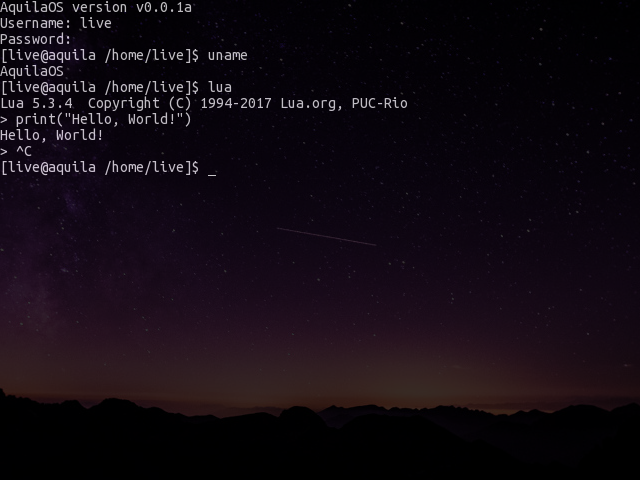
UNIX-like Operating System, including the kernel and system tools.
Intended to be fully **POSIX** compliant. Oh, and it compiles with -O3.
#### Build Instructions
Follow the instructions in this [wiki page.](https://github.com/mohamed-anwar/Aquila/wiki/Build-Instructions)
#### CPU-based Features:
##### Supported Archetictures:
> - [X] x86
> - [ ] x86-64
- [X] Multitasking
- [X] Multithreading
- [ ] SMP
#### Kernel Features:
- [X] Monolitihic kernel
- [X] Virtual Filesystem
- [ ] Supports loadable modules
#### Supported Filesystems:
- [X] initramfs (CPIO Archive filesystem, used for Ramdisk, read only)
- [X] tmpfs (Generic temporary filesystem, read/write)
- [X] devfs (Virtual filesystem, used for device handlers, statically populated, read/write)
- [X] devpts (Virtual filesystem, used for psudo-terminals, dynamically populated, read/write)
- [X] procfs (Processes information filesystem, read only)
- [X] ext2 (Basic Extended 2 filesystem, read/write)
- [ ] ext3
- [ ] ext4
- [ ] sysfs
#### Supported Devices:
- [X] i8042 (PS/2 Controller)
- [X] ramdev (Memory mapped device, generic handler)
- [X] ps2kbd (PS/2 Keyboard Controller)
- [X] console (IBM TGA console)
- [X] ata (ATA Harddisk handler, PIO mode)
- [X] fbdev (Generic framebuffer device handler)
- [X] 8250 (UART)
#### Supported video interfaces:
- [X] VESA 3.0
#### System Feautres:
- [X] newlib-3.0.0 (latest)
- [X] aqbox (Aquila Box, like busybox)
- [X] fbterm (Framebuffer based terminal)
- [X] tcc (Tiny C Compiler)
- [X] lua (Lua programming language)
- [X] kilo (Kilo text editor)
================================================
FILE: configs/clang.mk
================================================
CC := clang
CFLAGS := $(INCLUDES) \
-nostdlib -ffreestanding -m32 \
-O3 -Wall -Wextra -Werror \
-Wno-unused -Wno-unused-parameter -march=i386
AS := $(CC)
ASFLAGS := $(CFLAGS)
#LD := ld.gold
LD := ld.lld
LDFLAGS := -nostdlib -melf_i386
================================================
FILE: configs/gcc.mk
================================================
CC := i686-aquila-gcc
CFLAGS += \
-nostdlib -ffreestanding -m32 \
-O3 -Wall -Wextra -Werror \
-Wno-unused -Wno-unused-parameter -march=i386 \
-funsigned-bitfields -fuse-ld=bfd
AS := $(CC)
ASFLAGS := $(CFLAGS)
LD := i686-aquila-ld
LDFLAGS := -nostdlib -melf_i386
SYSCC := i686-aquila-gcc
SYSLD := i686-aquila-ld
================================================
FILE: configs/i386-pc.mk
================================================
include $(SRCDIR)/configs/gcc.mk
#
# Configurations
#
ARCH=i386
ARCH_DIR=i386
ARCH_I386=y
ARCH_BITS=32
#
# Boot Definitions
#
X86_MULTIBOOT=y
#
# Platform - PC
#
PLATFORM_X86_PC=y
PLATFORM_DIR=pc
# Support 8259 PIC
PLATFORM_X86_MISC_PIC=y
# Support 8253/8254 PIT
PLATFORM_X86_MISC_PIT=y
# Support i8042 PS/2 Controller
PLATFORM_X86_MISC_I8042=y
# Support HPET
PLATFORM_X86_MISC_HPET=n
# Support ACPI
PLATFORM_X86_MISC_ACPI=y
# Support CMOS
PLATFORM_X86_MISC_CMOS=y
#
# Devices
#
# Generic framebuffer (fbdev) support
DEV_FRAMEBUFFER=y
# Generic console (condev) support
DEV_CONSOLE=y
DEV_KEYBOARD=y
DEV_MOUSE=y
DEV_KEYBOARD_PS2=y
DEV_UART=y
DEV_PTY=y
DEV_MEMDEV=y
DEV_ATA=y
DEV_FDC=y
#
# Framebuffer
#
FBDEV_VESA=y
# Filesystems
FS_TMPFS=y
FS_DEVFS=y
FS_DEVPTS=y
FS_EXT2=y
FS_PROCFS=y
FS_MINIX=y
# Initramfs
INITRAMFS_CPIO=y
# Network
NET_UNIX=y
================================================
FILE: configs/i386-quark.mk
================================================
#
# Compilation flags
#
CC := $(PDIR)/../build-tools/sys/bin/i686-elf-gcc
CFLAGS := -std=gnu99 -I. -I$(PDIR)/arch/$$(ARCH_DIR)/chipset/$$(CHIPSET_DIR)/include -I$(PDIR)/arch/$$(ARCH_DIR)/include -I $(PDIR) -I $(PDIR)/include/ -nostdlib -ffreestanding -m32 \
-O3 -Wall -Wextra -Werror -funsigned-bitfields -fuse-ld=bfd \
-Wno-unused -march=i586
AS := $(CC)
ASFLAGS := $(CFLAGS)
LD := $(PDIR)/../build-tools/sys/bin/i686-elf-ld.bfd
LDFLAGS := -nostdlib -melf_i386
#
# Configurations
#
ARCH=X86
ARCH_DIR=x86
ARCH_X86=y
ARCH_BITS=32
#
# Boot Definitions
#
X86_MULTIBOOT=y
#
# Chipset - generic
#
#CHIPSET_X86_GENERIC=y
CHIPSET_X86_QUARK=y
CHIPSET_DIR=quark
# Support 8259 PIC
CHIPSET_X86_MISC_PIC=y
# Support 8253/8254 PIT
CHIPSET_X86_MISC_PIT=y
# Support i8042 PS/2 Controller
#CHIPSET_X86_MISC_I8042=y
#
# Devices
#
# Generic framebuffer (fbdev) support
#DEV_FRAMEBUFFER=y
# Generic console (condev) support
DEV_CONSOLE=y
#DEV_KEYBOARD=y
#DEV_MOUSE=y
#DEV_KEYBOARD_PS2=y
DEV_UART=y
DEV_PTY=y
#
# Framebuffer
#
#FBDEV_VESA=y
# Filesystems
FS_TMPFS=y
FS_DEVFS=y
FS_DEVPTS=y
#FS_EXT2=y
FS_PROCFS=y
================================================
FILE: configs/none.mk
================================================
CC := $(PDIR)/../build-tools/sysroot/bin/i686-elf-gcc
CFLAGS := -std=gnu99 -I. -I$(PDIR)/arch/$$(ARCH_DIR)/chipset/$$(CHIPSET_DIR)/include -I$(PDIR)/arch/$$(ARCH_DIR)/include -I $(PDIR) -I $(PDIR)/include/ -nostdlib -ffreestanding -m32 \
-O3 -Wall -Wextra -Werror -funsigned-bitfields -fuse-ld=bfd \
-Wno-unused -march=i386
AS := $(CC)
ASFLAGS := $(CFLAGS)
LD := ld.bfd
LDFLAGS := -nostdlib -melf_i386 -L /opt/aquila/lib/gcc/i686-aquila/7.3.0/
ARCH=none
ARCH_DIR=none
ARCH_NONE=y
ARCH_BITS=32
#DEV_FRAMEBUFFER=y
#DEV_CONSOLE=y
#DEV_KEYBOARD=y
#DEV_MOUSE=y
#DEV_KEYBOARD_PS2=y
#DEV_UART=y
#DEV_PTY=y
#DEV_MEMDEV=y
#DEV_ATA=y
#DEV_FDC=y
FBDEV_VESA=y
# Filesystems
FS_TMPFS=y
FS_DEVFS=y
FS_DEVPTS=y
FS_EXT2=y
FS_PROCFS=y
FS_MINIX=y
# Initramfs
INITRAMFS_CPIO=y
================================================
FILE: configs/pcc.mk
================================================
CC := /opt/aquila/bin/i686-aquila-pcc
CFLAGS += \
-nostdlib -ffreestanding -m32 \
-O3 -Wall -Wextra -Werror \
-Wno-unused -Wno-unused-parameter -march=i386 \
-funsigned-bitfields -fuse-ld=bfd
AS := $(CC)
ASFLAGS := $(CFLAGS)
LD := /opt/aquila/bin/i686-aquila-ld
LDFLAGS := -nostdlib -melf_i386
SYSCC := /opt/aquila/bin/i686-aquila-pcc
SYSLD := /opt/aquila/bin/i686-aquila-ld
================================================
FILE: configs/x86_64-pc.mk
================================================
#
# Compilation flags
#
CC := gcc
CFLAGS := -std=gnu99 -I. -I$(PDIR)/arch/$$(ARCH_DIR)/chipset/$$(PLATFORM_DIR)/include -I$(PDIR)/arch/$$(ARCH_DIR)/include -I $(PDIR) -I $(PDIR)/include/ -nostdlib -ffreestanding \
-O3 -Wall -Wextra -Werror -funsigned-bitfields -fuse-ld=bfd \
-Wno-unused \
-mcmodel=large -mno-red-zone -mno-mmx -mno-sse -mno-sse2 -z max-page-size=0x1000
AS := $(CC)
ASFLAGS := $(CFLAGS)
LD := ld.bfd
LDFLAGS := -nostdlib -melf_x86_64
#
# Configurations
#
ARCH=x86_64
ARCH_DIR=x86_64
ARCH_X86_64=y
ARCH_BITS=64
#
# Boot Definitions
#
X86_MULTIBOOT=y
#
# Chipset - generic
#
PLATFORM_X86_PC=y
PLATFORM_DIR=pc
# Support 8259 PIC
PLATFORM_X86_MISC_PIC=y
# Support 8253/8254 PIT
PLATFORM_X86_MISC_PIT=y
# Support i8042 PS/2 Controller
PLATFORM_X86_MISC_I8042=y
#
# Devices
#
# Generic framebuffer (fbdev) support
DEV_FRAMEBUFFER=y
# Generic console (condev) support
DEV_CONSOLE=y
DEV_KEYBOARD=y
DEV_MOUSE=y
DEV_KEYBOARD_PS2=y
DEV_UART=y
DEV_PTY=y
DEV_MEMDEV=y
DEV_ATA=y
#
# Framebuffer
#
FBDEV_VESA=y
# Filesystems
FS_TMPFS=y
FS_DEVFS=y
FS_DEVPTS=y
#FS_EXT2=y
FS_PROCFS=y
# Initramfs
INITRAMFS_CPIO=y
================================================
FILE: initrd/Makefile
================================================
ROOT= initrd
DIRS= bin sbin dev mnt proc tmp root
COPY= etc usr
AQBOX= aqbox
AQBOX_BIN= cat clear echo env ls mkdir mknod ps pwd sh stat uname unlink touch kill bim date
AQBOX_SBIN= login mount kbd getty readmbr reboot
# Create initrd CPIO image
initrd.img: all
cd $(ROOT); find . | cpio -o > ../initrd.img;
all: $(DIRS) $(COPY) $(ROOT)/init fbterm aqbox $(ROOT)/dev/kmsg #nuklear
$(ROOT):
$(MKDIR) -p $(ROOT)
# Inflate initrd ROOT with required directories
$(DIRS): $(ROOT)
$(MKDIR) -p $(ROOT)/$@
# Copy some files and directories into initrd ROOT
$(COPY): $(ROOT)
$(CP) -r $@ $(ROOT)/
fbterm: $(ROOT)/bin/fbterm
$(ROOT)/bin/fbterm: $(ROOT)/bin
$(CP) $(SRCDIR)/system/fbterm/fbterm $(ROOT)/bin/
$(STRIP) $(ROOT)/bin/fbterm
aqbox: $(ROOT)/bin/aqbox $(AQBOX_BIN) $(AQBOX_SBIN)
$(ROOT)/bin/aqbox: $(ROOT)/bin
$(CP) $(SRCDIR)/system/aqbox/aqbox $(ROOT)/bin/
$(STRIP) $(ROOT)/bin/aqbox
$(AQBOX_BIN): $(ROOT)/bin/aqbox
$(LN) -fs /bin/aqbox $(ROOT)/bin/$@
$(AQBOX_SBIN): $(ROOT)/bin/aqbox
$(LN) -fs /bin/aqbox $(ROOT)/sbin/$@
$(ROOT)/init:
$(MAKE) -C init/
$(CP) init/init $@
$(ROOT)/dev/kmsg:
#sudo mknod $(ROOT)/dev/kmsg c 1 11
clean:
$(MAKE) -C init/ clean
$(RM) -rf $(ROOT) initrd.img
.PHONY: all $(DIRS) clean $(COPY) fbterm aqbox $(AQBOX_BIN) $(AQBOX_SBIN) install
install: all
$(MKDIR) -p $(DESTDIR)/boot
$(CP) initrd.img $(DESTDIR)/boot
================================================
FILE: initrd/etc/hostname
================================================
aquila
================================================
FILE: initrd/etc/motd
================================================
_...__..-'
.'
.'
.'
.'
.------._ ;
.-"""`-.<') `-._ .'
(.--. _ `._ `'---.__.-'
` `;'-.-' '- ._
.--'`` '._ - ' .
`""'-. `---' ,
''--..__ `\
``''---'`\ .'
`'. '
`'.
_____ .__.__ ________ _________
/ _ \ ________ __|__| | _____ \_____ \ / _____/
/ /_\ \ / ____/ | \ | | \__ \ / | \ \_____ \
/ | < <_| | | / | |__/ __ \_/ | \/ \
\____|__ /\__ |____/|__|____(____ /\_______ /_______ /
\/ |__| \/ \/ \/
Welcome to AquilaOS!
================================================
FILE: initrd/etc/passwd
================================================
root:x:0:0:root:/root:/bin/sh
================================================
FILE: initrd/etc/rc.init
================================================
#!/bin/sh
set -x
export PATH=/bin:/sbin:/usr/bin:/usr/sbin:/usr/libexec:/usr/local/bin:/usr/local/sbin
# Mount devfs on /dev
echo mounting devfs on /dev
mount -t devfs /dev
# Populate static devices
echo populating static devices in /dev
mknod /dev/console c 5 1
mknod /dev/ptmx c 5 2
mknod /dev/kbd c 11 0
mknod /dev/fb0 c 29 0
mknod /dev/hda b 3 0
mknod /dev/hda1 b 3 1
mknod /dev/ttyS0 c 4 64
mknod /dev/mouse c 10 1
mknod /dev/kmsg c 1 11
mknod /dev/fd0 b 2 0
# Mount devpts on /dev/pts
echo mounting devpts on /dev/pts
mkdir /dev/pts
mount -t devpts /dev/pts
================================================
FILE: initrd/init/Makefile
================================================
#ARCH=i686
#SYSROOT= ../../build-tools/sysroot
#CC= $(SYSROOT)/bin/$(ARCH)-aquila-gcc
#CFLAGS= -I$(SYSROOT)/usr/$(ARCH)-aquila/include
#
#LD= $(CC)
#LDFLAGS= -nostdlib -ffreestanding -Wl,-Ttext=0x1000
#LDLIBS= $(SYSROOT)/usr/$(ARCH)-aquila/lib/crt0.o -L$(SYSROOT)/usr/$(ARCH)-aquila/lib -lc -lpthread -lm -lgcc
all: init
init: init.c
$(SYSCC) $< -o $@
clean:
rm -rf init
.PHONY: all clean
================================================
FILE: initrd/init/init.c
================================================
#include
#include
#include
#include
#include
#include
#include
#include
#include
int log_fd = -1;
int log_init()
{
log_fd = open("/dev/kmsg", O_WRONLY);
}
int _log(int level, const char *fmt, ...)
{
static char buf[512];
if (log_fd >= 0) {
va_list ap;
va_start(ap, fmt);
int len = vsnprintf(buf, sizeof(buf), fmt, ap);
va_end(ap);
write(log_fd, buf, len);
}
}
int run(char **argv)
{
int child, status, pid;
if (child = fork()) {
do pid = waitpid(child, &status, 0);
while (pid != child);
} else {
int x = execv(argv[0], argv);
_log(1, "failed to execute %s: %s\n", argv[0], strerror(errno));
exit(x);
}
return status;
}
void signal_handler(int sig)
{
switch (sig) {
case SIGTERM:
_log(1, "init: reached target reboot\n");
exit(0);
default:
/* ignore */
return;
}
}
int main(int argc, char **argv)
{
signal(SIGKILL, signal_handler);
signal(SIGTERM, signal_handler);
close(0); close(1); close(2);
open("/dev/kmsg", O_RDONLY);
log_init();
if (open("/dev/kmsg", O_WRONLY) != 2) {
_log(1, "could not open stderr\n");
}
_log(1, "init: started\n");
/* execute /etc/rc.init script */
_log(1, "init: executing /etc/rc.init script\n");
char *argp[] = {"/bin/sh", "/etc/rc.init", NULL};
run(argp);
int use_fbterm = 0, use_serial = 0;
if (argc > 0) {
char *cmdline = argv[0], *token;
while ((token = strtok(cmdline, " "))) {
cmdline = NULL;
if (!strcmp(token, "--serial"))
use_serial = 1;
else if (!strcmp(token, "--fbterm"))
use_fbterm = 1;
}
}
if (use_fbterm || !use_serial) {
_log(1, "init: starting fbterm\n");
char *argp[] = {"/bin/fbterm", NULL};
if (!fork()) {
for (int i = 0; i < 3; ++i)
close(i);
execv(argp[0], argp);
}
}
if (use_serial) {
if (!fork()) {
for (int i = 0; i < 3; ++i)
close(i);
open("/dev/ttyS0", O_RDONLY);
open("/dev/ttyS0", O_WRONLY);
open("/dev/ttyS0", O_WRONLY);
char *argp[] = {"/sbin/login", NULL};
while (1) run(argp);
//execv(argp[0], argp);
}
}
/* init can't die */
for (;;);
}
================================================
FILE: initrd/usr/share/man/man1/ccom.1
================================================
.\" $Id: ccom.1,v 1.33 2018/12/15 09:12:14 plunky Exp $
.\"
.\" Copyright (c) 2007 Jeremy C. Reed
.\"
.\" Permission to use, copy, modify, and/or distribute this software for any
.\" purpose with or without fee is hereby granted, provided that the above
.\" copyright notice and this permission notice appear in all copies.
.\"
.\" THE SOFTWARE IS PROVIDED "AS IS" AND THE AUTHOR AND CONTRIBUTORS DISCLAIM
.\" ALL WARRANTIES WITH REGARD TO THIS SOFTWARE INCLUDING ALL IMPLIED
.\" WARRANTIES OF MERCHANTABILITY AND FITNESS. IN NO EVENT SHALL AUTHOR AND
.\" CONTRIBUTORS BE LIABLE FOR ANY SPECIAL, DIRECT, INDIRECT, OR CONSEQUENTIAL
.\" DAMAGES OR ANY DAMAGES WHATSOEVER RESULTING FROM LOSS OF USE, DATA OR
.\" PROFITS, WHETHER IN AN ACTION OF CONTRACT, NEGLIGENCE OR OTHER TORTIOUS
.\" ACTION, ARISING OUT OF OR IN CONNECTION WITH THE USE OR PERFORMANCE OF
.\" THIS SOFTWARE.
.\"
.Dd March 22, 2012
.Dt CCOM 1
.Os
.Sh NAME
.Nm ccom
.Nd C compiler
.Sh SYNOPSIS
.Nm
.Op Fl gkpsv
.Op Fl f Ar features
.Op Fl m Ar options
.Op Fl W Ar warnings
.Op Fl X Ar flags
.Op Fl x Ar settings
.Op Fl Z Ar flags
.Op infile
.Op outfile
.Sh DESCRIPTION
The
.Nm
utility provides a C compiler.
The frontend is usually
.Xr pcc 1 .
It is
.Em not
intended to be run directly.
.Nm
reads the C source from
.Ar infile
or standard input and writes the assembler source
to
.Ar outfile
or to standard output.
.Pp
The options are as follows:
.Bl -tag -width Ds
.It Fl f Ar feature
Enable language features.
Multiple
.Fl f
options can be given, the following features are supported:
.Bl -tag -width Ds
.It Sy stack-protector
Enable stack smashing protection.
Currently the same as
.Sy stack-protector-all .
.It Sy stack-protector-all
Enable stack smashing protection for all functions.
.It Sy pack-struct Ns Oo = Ns Ar n Oc
Specify maximum alignment for structure members, similar to a #pragma pack
statement at the start of the file.
If no value is given, the default is 1.
.It Sy freestanding
Emit code for a freestanding environment.
Currently not implemented.
.El
.It Fl g
Include debugging information in the output code for use by
symbolic and source-level debuggers.
Currently this uses the
.Sy stabs
format, encoding information in
.Em s Ns ymbol Em tab Ns le entrie Ns Em s.
.It Fl k
Generate PIC code.
.It Fl m Ar option
Target-specific options, used in machine-dependent code.
Multiple
.Fl m
options can be given, the following options are supported:
.Bl -tag -width PowerPC
.It AMD64
.It ARM
.Sy little-endian ,
.Sy big-endian ,
.Sy fpe=fpa ,
.Sy fpe=vpf ,
.Sy soft-float ,
.Sy arch=armv1 ,
.Sy arch=armv2 ,
.Sy arch=armv2a ,
.Sy arch=armv3 ,
.Sy arch=armv4 ,
.Sy arch=armv4t ,
.Sy arch=armv4tej ,
.Sy arch=armv5 ,
.Sy arch=armv5te ,
.Sy arch=armv5tej ,
.Sy arch=armv6 ,
.Sy arch=armv6t2 ,
.Sy arch=armv6kz ,
.Sy arch=armv6k No \*(Am
.Sy arch=armv7 .
.It HPPA
.It i386
.It M16C
.It MIPS
.Sy little-endian No \*(Am
.Sy big-endian .
.It NOVA
.It PDP-10
.It PDP-11
.It PowerPC
.Sy little-endian ,
.Sy big-endian ,
.Sy soft-float No \*(Am
.Sy hard-float .
.It Sparc64
.It VAX
.El
.It Fl p
Generate profiling code.
.It Fl s
Print statistics to standard error when complete.
This includes:
name table entries, name string size, permanent allocated memory,
temporary allocated memory, lost memory, argument list unions,
dimension/function unions, struct/union/enum blocks, inline node count,
inline control blocks, and permanent symtab entries.
.\" TODO: explain units for above?
.It Fl v
Display version.
.It Fl W Ar warning
Do some basic checks and emit warnings about possible coding problems.
Multiple
.Fl W
options can be given, the following warnings are supported:
.Bl -tag -width Ds
.It Sy error Ns Oo = Ns Ar warning Oc
Enable
.Ar warning ,
and treat it as an error condition.
If a specific warning is not given, producing any warning will cause an error.
.It Sy attributes
Warn when unsupported attributes are used.
This warning is enabled by default.
.It Sy deprecated-declarations
Report whenever a symbol marked with the
.Sq deprecated
attribute is used.
This warning is enabled by default.
.It Sy implicit-function-declaration
(TODO) Require explicit prototypes for all called functions.
.It Sy implicit-int
(TODO) Warn when a function declaration lacks a type.
.It Sy missing-prototypes
Require explicit prototypes for all global function definitions.
.It Sy pointer-sign
Warn when pointer operations are done with mismatched signed and unsigned values.
.It Sy sign-compare
(TODO) Warn about comparisons between signed and unsigned values.
.It Sy strict-prototypes
(TODO) Require that function prototypes are strictly C99.
.It Sy shadow
Report when a local variable shadows something from a higher scope.
.It Sy truncate
Report when integer values may be implicitly truncated to fit a smaller type.
.It Sy uninitialized
A variable is read before being written.
.It Sy unknown-pragmas
Report unhandled pragma statements.
.It Sy unreachable-code
Report statements that cannot be executed.
.El
.Pp
Any of the above may be prefixed with
.Dq no-
in order to disable the effect.
.\"
.It Fl X Ar flags
C specific debugging where
.Ar flags
is one or more of the following:
.Pp
.Bl -tag -compact -width Ds
.It Sy b
Building of parse trees
.It Sy d
Declarations (using multiple
.Sy d
flags gives more output)
.It Sy e
Pass1 trees at exit
.It Sy i
Initializations
.It Sy n
Memory allocations
.It Sy o
Turn off optimisations
.It Sy p
Prototypes
.It Sy s
Inlining
.It Sy t
Type conversions
.It Sy x
Target-specific flag, used in machine-dependent code
.El
.\"
.It Fl x Ar setting
Enable
.Ar setting
in the compiler.
Multiple
.Fl x
options can be given, the following settings are supported:
.Bl -tag -width Ds
.It Sy ccp
Apply sparse conditional constant propagation techniques for optimization.
Currently not implemented.
.It Sy dce
Do dead code elimination.
.It Sy deljumps
Delete redundant jumps and dead code.
.It Sy gnu89
.It Sy gnu99
Use GNU C semantics rather than C99 for some things.
Currently only inline.
.It Sy inline
Replace calls to functions marked with an inline specifier with a copy
of the actual function.
.It Sy ssa
Convert statements into static single assignment form for optimization.
Not yet finished.
.It Sy tailcall
Enable optimization of tail-recursion functions.
Currently not implemented.
.It Sy temps
Locate automatic variables into registers where possible, for further
optimization by the register allocator.
.It Sy uchar
Treat character constants as unsigned values.
.El
.\"
.It Fl Z Ar flags
Code generator (pass2) specific debugging where
.Ar flags
is one or more of the following:
.Pp
.Bl -tag -compact -width Ds
.It Sy b
Basic block and SSA building
.It Sy c
Code printout
.It Sy e
Trees when entering pass2
.It Sy f
Instruction matcher, may provide much output
.It Sy g
Print flow graphs
.It Sy n
Memory allocation
.It Sy o
Instruction generator
.It Sy r
Register allocator
.It Sy s
Shape matching in instruction generator
.It Sy t
Type matching in instruction generator
.It Sy u
Sethi-Ullman computations
.It Sy x
Target-specific flag, used in machine-dependent code
.El
.El
.Sh PRAGMAS
Input lines starting with a
.Dq #pragma
directive can be used to modify behaviour of
.Nm
during compilation.
All tokens up to the first unescaped newline are considered part
of the pragma command, with the following operations being recognized:
.Bl -tag -width Ds
.It Sy STDC
Standard C99 operator follows.
Currently no C99 operations are implemented, and any directives starting
with this token will be silently ignored.
.It Sy GCC diagnostic Ar effect Qq Ar option
GNU C compatibility.
Alter the effects of compiler diagnostics.
The required
.Ar effect
should be stated as
.Sy warning ,
.Sy error
or
.Sy ignored ,
followed by the compiler diagnostic
.Ar option
in double quotes.
For example, to force unknown pragmas to always generate an error,
a standard header might include
.Bd -literal -offset 2n
#pragma GCC diagnostic error "-Wunknown-pragmas"
.Ed
.It Sy GCC poison Ar identifier ...
GNU C compatibility.
Cause an error if any of the following
.Ar identifier Ns s
subsequently appear in the code
.Pq but not in any macro expansions .
Currently not implemented.
.It Sy GCC system_header
GNU C compatibility.
Currently not implemented.
.It Sy GCC visibility
GNU C compatibility.
Currently not implemented.
.It Sy pack Ns Pq Op Ar n
Set the default maximum alignment for structures and unions, such that
members will have their natural alignment requirements clamped at this
value and may be stored misaligned.
If
.Ar n
is not given, the alignment is reset to the target default.
.It Sy pack Ns Pq Sy push Ns Op , Ar n
Push the current pack setting onto an internal stack then, if
.Ar n
is given, change the default alignment for structures and unions.
Currently not implemented.
.It Sy pack Ns Pq Sy pop
Change the pack setting to the most recently pushed value, and remove
that setting from the stack.
Currently not implemented.
.It Sy packed Op Ar n
Set the maximum alignment for the structure or union defined
in the current statement.
If
.Ar n
is not given, the default value of 1 is used.
.Pq Currently this works except Ar n is not used
.It Sy aligned Op Ar n
Set the minimum alignment for the structure or union defined
in the current statement.
.It Sy rename Ar name
Provide an alternative
.Ar name
which will be used to reference the object declared in the current statement.
.It Sy weak Ar name Ns Op = Ns Ar alias
Mark
.Ar name
as a weak rather than a global symbol, to allow its definition to be
overridden at link time.
If an
.Ar alias
is given, this will be used as the default value of
.Ar name .
.It Sy ident
Currently not implemented.
.El
.Lp
and the following target-specific operations are handled by
machine-dependent code:
.Bl -tag -width Ds
.It Sy tls
For AMD64 and i386 targets, the variable declared in the current statement
will be referenced via the
.Dq thread-local storage
mechanism.
.It Sy init
For AMD64, ARM, HPPA, i386, MIPS and PowerPC targets, when the current statement is a
function declaration, generate a reference in the
.Sy .ctors
section, enabling library code to call the function prior to entering
.Fn main .
.It Sy fini
For AMD64, ARM, HPPA, i386, MIPS and PowerPC targets, when the current statement is a
function declaration, generate a reference in the
.Sy .dtors
section, enabling library code to call the function when
.Fn main
returns or the
.Fn exit
function is called.
.It Sy section Ar name
For AMD64, ARM, HPPA and i386 targets, place the subsequent code in the named
section.
.Pq This is currently broken .
.It Sy alias Ar name
For AMD64, HPPA and i386 targets, emit assembler instructions providing an
alias for the symbol defined by the current statement.
.It Sy stdcall
For i386 targets, enable
.Dq stdcall
semantics during code generation, where function arguments are passed on
the stack in right-to-left order, and the callee is responsible for adjusting
the stack pointer before returning.
Any function result is passed in the EAX register.
On win32, the function name is postfixed with an
.Dq @
and the size of the stack adjustment.
.It Sy cdecl
For i386 targets, enable
.Dq cdecl
semantics during code generation, where function arguments are passed on
the stack in right-to-left order, and the caller is responsible for cleaning
up the stack after the function returns.
Any function result is passed in the EAX register.
This is the default.
.It Sy fastcall
For i386-win32 targets, enable
.Dq fastcall
semantics during code generation.
.Po
Currently this is equivalent to
.Sy stdcall ,
which is likely wrong
.Pc .
.It Sy dllimport
For i386-win32 targets, references to the external symbol defined by
the current statement will be made via indirect access through a
location identified by the symbol name prefixed with
.Dq __imp_ .
.It Sy dllexport
For i386-win32 targets, the external symbol declared by the current
statement will be exported as an indirect reference to be
accessed with
.Sy dllimport .
The global locator will be the symbol name prefixed with
.Dq __imp_ .
Currently this is not completely implemented.
.El
.Pp
Any unknown
.Dq #pragma
directives will be ignored unless the
.Fl Wunknown-pragmas
diagnostic is in effect.
.Sh SEE ALSO
.Xr as 1 ,
.Xr cpp 1 ,
.Xr pcc 1
.Sh HISTORY
The
.Nm
compiler is based on the original Portable C Compiler by
.An "S. C. Johnson" ,
written in the late 70's.
Even though much of the compiler has been rewritten
.Pq about 50% of the frontend code and 80% of the backend ,
some of the basics still remain.
Most is written by
.An "Anders Magnusson" ,
with the exception of the data-flow analysis part and
the SSA conversion code which is written by
.An "Peter A Jonsson" ,
and the Mips port that were written as part of a project
by undergraduate students at Lulea University of Technology.
.Pp
This product includes software developed or owned by Caldera
International, Inc.
================================================
FILE: initrd/usr/share/man/man1/cpp.1
================================================
.\" $Id: cpp.1,v 1.17 2013/02/26 19:27:38 plunky Exp $
.\"
.\" Copyright (c) 2007 Jeremy C. Reed
.\"
.\" Permission to use, copy, modify, and/or distribute this software for any
.\" purpose with or without fee is hereby granted, provided that the above
.\" copyright notice and this permission notice appear in all copies.
.\"
.\" THE SOFTWARE IS PROVIDED "AS IS" AND THE AUTHOR AND CONTRIBUTORS DISCLAIM
.\" ALL WARRANTIES WITH REGARD TO THIS SOFTWARE INCLUDING ALL IMPLIED
.\" WARRANTIES OF MERCHANTABILITY AND FITNESS. IN NO EVENT SHALL AUTHOR AND
.\" CONTRIBUTORS BE LIABLE FOR ANY SPECIAL, DIRECT, INDIRECT, OR CONSEQUENTIAL
.\" DAMAGES OR ANY DAMAGES WHATSOEVER RESULTING FROM LOSS OF USE, DATA OR
.\" PROFITS, WHETHER IN AN ACTION OF CONTRACT, NEGLIGENCE OR OTHER TORTIOUS
.\" ACTION, ARISING OUT OF OR IN CONNECTION WITH THE USE OR PERFORMANCE OF
.\" THIS SOFTWARE.
.\"
.Dd February 26, 2013
.Dt CPP 1
.Os
.Sh NAME
.Nm cpp
.Nd C preprocessor
.Sh SYNOPSIS
.Nm
.Op Fl ACEMPtVv
.Op Fl D Ar macro Ns Oo = Ns Ar value Oc
.Op Fl d Ar flags
.Op Fl I Ar path
.Op Fl i Ar file
.Op Fl S Ar path
.Op Fl U Ar macro
.Op Ar infile | -
.Op Ar outfile
.Sh DESCRIPTION
The
.Nm
utility is a macro preprocessor used by the
.Xr pcc 1
compiler.
It is mainly used to include header files,
expand macro definitions,
discard comments,
and perform conditional compilation.
.Nm
is written to comply with the
.St -isoC-99
specification.
.Pp
The
.Ar infile
input file is optional.
If not provided or the file name is
.Qq -
(dash),
.Nm
reads its initial file from standard input.
The
.Ar outfile
output file is also optional, with output written to standard
output if not provided.
.Pp
The options are as follows:
.Bl -tag -width Ds
.It Fl A
For assembler-with-cpp input: treat non-directive lines starting
with a # as comments.
.It Fl C
Do not discard comments.
.It Fl D Ar macro Ns Oo = Ns Ar value Oc
Create a macro definition before processing any input, as if a
.Lp
.Dl #define Ar macro Ar value
.Lp
directive had appeared in the source.
If
.Ar value
is not set on the command-line, then a value of 1 is used.
.It Fl d Ar flags
Modify output according to
.Ar flags ,
which can be a list of character flags.
The following flags are currently supported:
.Bl -tag -width ".Sy M"
.It Sy M
Do not process any input, but output a list of
.Dq #define
statements for all defined macros other than builtin macros
.Pq see below .
.El
.Lp
any unknown flags are ignored.
.It Fl E
Modify the exit code, if there were any warnings.
.It Fl I Ar path
Add
.Ar path
to the list of directories searched by the
.Dq #include
directive.
This may be used to override system include directories
.Pq see Fl S No option .
.Fl I
may be specified multiple times and is cumulative.
.It Fl i Ar file
Include a file before processing any input, as if a
.Lp
.Dl #include Qo Ar file Qc
.Lp
directive had appeared in the source.
.Fl i
may be specified multiple times to include several files.
.It Fl M
Instead of producing a processed C code file, output a list
of dependencies for
.Xr make 1 ,
detailing the files that need to be processed when compiling
the input.
.It Fl P
Inhibit generation of line markers. This is sometimes useful when
running the preprocessor on something other than C code.
.It Fl S Ar path
Add
.Ar path
to the list of system directories searched by the
.Dq #include
directive.
The
.Fl S
option may be specified multiple times and is cumulative.
.It Fl t
Traditional cpp syntax.
Do not define the
.Dv __TIME__ ,
.Dv __DATE__ ,
.Dv __STDC__ ,
and
.Dv __STDC_VERSION__
macros.
.It Fl U Ar macro
Undefine a macro before processing any input, as if a
.Lp
.Dl #undef Ar macro
.Lp
directive had appeared in the source.
.It Fl V
Verbose debugging output.
.Fl V
can be repeated for greater detail.
.Po
This is only available if the
.Nm
program was built with
.Dv PCC_DEBUG
defined, which is the default
.Pc .
.It Fl v
Display version.
.El
.Pp
The
.Fl D ,
.Fl i
and
.Fl U
options are processed in the order that they appear on the command
line, before any input is read but after the command line options
have been scanned.
.Pp
Files referenced by the
.Dq #include
directive as
.Qq ... ,
are first looked for in the current directory, then as per
.Aq ...
files, which are first looked for in the list of
directories provided by any
.Fl I
options, then in the list of system directories provided by any
.Fl S
options.
Note that
.Nm
does not define any include directories by default; if no
.Fl I
or
.Fl S
options are given, then only the current directory will be
searched and no system files will be found.
.Ss Builtin Macros
A few macros are interpreted inside the
.Nm cpp
program:
.Bl -diag
.It __DATE__
Expands to a quoted string literal containing the date in the form
.Qq Mmm dd yyyy ,
where the names of the months are the same as those generated by the
.Xr asctime 3
function, and the first character of dd is a space character if
the value is less than 10.
.It __FILE__
Expands to a quoted string literal containing the presumed name of
the current source file.
When reading source from standard input, it expands to
.Qq Aq stdin .
.It __LINE__
Expands to an integer constant representing the presumed line number
of the source line containing the macro.
.It __STDC__
Expands to the integer constant
.Dq 1 ,
meaning that the compiler conforms to
.St -isoC .
.It __STDC_VERSION__
Expands to the integer constant
.Dq 199901L ,
indicating that
.Nm
conforms to
.St -isoC-99 .
.It __TIME__
Expands to a quoted string literal containing the time in the form
.Qq hh:mm:ss
as generated by the
.Xr asctime 3
function.
.El
.Pp
Also see the
.Fl t
option.
.Sh EXIT STATUS
The
.Nm
utility exits with one of the following values:
.Lp
.Bl -tag -width Ds -offset indent -compact
.It 0
Successfully finished.
.It 1
An error occurred.
.It 2
The
.Fl E
option was given, and warnings were issued.
.El
.Sh SEE ALSO
.Xr as 1 ,
.Xr ccom 1 ,
.Xr make 1 ,
.Xr pcc 1 ,
.Xr asctime 3
.Sh HISTORY
The
.Nm
command comes from the original Portable C Compiler by
.An "S. C. Johnson" ,
written in the late 70's.
The code originates from the V6 preprocessor with some additions
from V7 cpp and ansi/c99 support.
.Pp
A lot of the PCC code was rewritten by
.An "Anders Magnusson" .
.Pp
This product includes software developed or owned by Caldera
International, Inc.
================================================
FILE: initrd/usr/share/man/man1/p++.1
================================================
.\" $Id: cc.1,v 1.45 2016/10/10 11:27:49 ragge Exp $
.\"
.\" Copyright (c) 2007 Jeremy C. Reed
.\"
.\" Permission to use, copy, modify, and/or distribute this software for any
.\" purpose with or without fee is hereby granted, provided that the above
.\" copyright notice and this permission notice appear in all copies.
.\"
.\" THE SOFTWARE IS PROVIDED "AS IS" AND THE AUTHOR AND CONTRIBUTORS DISCLAIM
.\" ALL WARRANTIES WITH REGARD TO THIS SOFTWARE INCLUDING ALL IMPLIED
.\" WARRANTIES OF MERCHANTABILITY AND FITNESS. IN NO EVENT SHALL AUTHOR AND
.\" CONTRIBUTORS BE LIABLE FOR ANY SPECIAL, DIRECT, INDIRECT, OR CONSEQUENTIAL
.\" DAMAGES OR ANY DAMAGES WHATSOEVER RESULTING FROM LOSS OF USE, DATA OR
.\" PROFITS, WHETHER IN AN ACTION OF CONTRACT, NEGLIGENCE OR OTHER TORTIOUS
.\" ACTION, ARISING OUT OF OR IN CONNECTION WITH THE USE OR PERFORMANCE OF
.\" THIS SOFTWARE.
.\"
.Dd June 20, 2014
.Dt CC 1
.Os
.Sh NAME
.Nm cc
.Nd front-end to the C compiler
.Sh SYNOPSIS
.Nm
.Op Fl cEgkMPSstvX
.Op Fl ansi
.Op Fl B Ns Ar prefix
.Op Fl D Ar macro Ns Oo = Ns Ar value Oc
.Op Fl d Ns Ar flags
.Op Fl f Ns Ar feature
.Op Fl I Ar path
.Op Fl include Ar file
.Op Fl isystem Ar path
.Op Fl L Ns Ar path
.Op Fl m Ns Ar option
.Op Fl nodefaultlibs
.Op Fl nostartfiles
.Op Fl nostdinc
.Op Fl nostdlib
.Op Fl O Ns Oo Ar level Oc
.Op Fl o Ar outfile
.Op Fl pg
.Op Fl pthread
.Op Fl shared
.Op Fl static
.Op Fl std= Ns Ar standard
.Op Fl U Ar macro
.Op Fl Wa Ns , Ns Ar options
.Op Fl Wc Ns , Ns Ar options
.Op Fl Wl Ns , Ns Ar options
.Op Fl Wp Ns , Ns Ar options
.Op Fl x Ar language
.Op Fl z Ar keyword
.Op Ar
.Sh DESCRIPTION
The
.Nm
utility provides a front-end to the
.Dq portable C compiler .
Multiple files may be given on the command line.
Unrecognized options are sent directly to
.Xr ld 1 .
.Pp
.\" Brief description of its syntax:
Filenames that end with
.Sy \&.c
are passed via
.Xr cpp 1
\(->
.Xr ccom 1
\(->
.Xr as 1
\(->
.Xr ld 1 .
.Pp
Filenames that end with
.Sy \&.i
are passed via
.Xr ccom 1
\(->
.Xr as 1
\(->
.Xr ld 1 .
.Pp
Filenames that end with
.Sy \&.s
are passed via
.Xr as 1
\(->
.Xr ld 1 .
.Pp
Filenames that end with
.Sy \&.S
are passed via
.Xr cpp 1
\(->
.Xr as 1
\(->
.Xr ld 1 .
.Pp
Filenames that end with
.Sy \&.o
are passed directly to
.Xr ld 1 .
.Pp
.\"
The options are as follows:
.Bl -tag -width Ds
.It Fl ansi
Synonym for
.Fl std=c89 .
.It Fl B Ns Ar prefix
Define alternate prefix path for
.Xr cpp 1 ,
.Xr ccom 1 ,
.Xr as 1 ,
or
.Xr ld 1
executables.
.\" TODO: provide an example of -B
.It Fl C
Passed to the
.Xr cpp 1
preprocessor to not discard comments.
.It Fl c
Stop after generating object code with
.Xr as 1 .
Do not link.
The resulting object output is saved
as a filename with a
.Dq \&.o
suffix unless
.Fl o
option is used.
Note: cannot be combined with
.Fl o
if multiple files are given.
.It Fl D Ar macro Ns Oo = Ns Ar value Oc
Passed to the
.Xr cpp 1
preprocessor to define
.Ar macro
with an optional
.Ar value .
.It Fl d Ns Ar flags
Debug options.
.Ar flags
is a string of characters, which signify the following actions.
.Bl -tag -width ".Sy M"
.It Sy M
Cause the preprocessor to output a list of macro definitions.
.El
.Lp
any unknown flags are ignored.
.It Fl E
Stop after preprocessing with
.Xr cpp 1 .
Do not compile, assemble, or link.
Output is sent to standard output unless the
.Fl o
option is used.
.It Fl ffreestanding
Assume a freestanding environment.
.It Fl fPIC
Generate PIC code.
.\" TODO: document about avoiding machine-specific maximum size?
.It Fl fpic
Tells C compiler to generate PIC code
and tells assembler that PIC code has been generated.
.\" TODO: document difference between PIC and pic
.It Fl funsigned-char
Tell the compiler to treat
.Sq char
types as if they were unsigned unless explicitly defined otherwise.
.Fl fsigned-char
can be used to signify the opposite behaviour.
The default for the
.Sq char
type depends on the compiler target architecture.
.It Fl fstack-protector
Tell the compiler to wrap functions with code which checks at
runtime that a stack overflow has not occurred.
When stack protection is in effect, the
.Dv __SSP__
macro will be defined.
.\" other -f GCC compatibility flags are ignored for now
.It Fl g
Send
.Fl g
flag to
.Xr ccom 1
to create debug output.
Debug information output can be disabled with
.Fl g0 .
.It Fl I Ar path
Passed to the
.Xr cpp 1
preprocessor to add header search directory to override system defaults.
.It Fl include Ar file
Tells the
.Xr cpp 1
preprocessor to include the
.Ar file
during preprocessing.
.It Fl isystem Ar path
Defines
.Ar path
as a system header directory for the
.Xr cpp 1
preprocessor.
.It Fl k
Generate PIC code.
See
.Fl fpic
option.
.It Fl L Ns Ar path
Passed to the linker, to add
.Ar path
to the list of directories searched for shared libraries.
.It Fl M
Pass
.Fl M
flag to
.Xr cpp 1
to generate dependencies for
.Xr make 1 .
.It Fl m Ns Ar option
Target-dependent options.
Multiple
.Fl m
options can be given, the following are supported:
.Bl -tag -width PowerPC
.It ARM
\-mlittle-endian \-mbig-endian \-mfpe=fpa \-mfpe=vpf \-msoft-float \-march=armv1 \-march=armv2 \-march=armv2a \-march=armv3 \-march=armv4 \-march=armv4t \-march=armv4tej \-march=armv5 \-march=armv6 \-march=armv6t2 \-march=armv6kz \-march=armv6k \-march=armv7
.It HPPA
.It i386
.It MIPS
\-mlittle-endian \-mbig-endian \-mhard-float \-msoft-float
.It PDP-10
.It PowerPC
.It Sparc64
.It VAX
.El
.It Fl nodefaultlibs
Do not link with the system default libraries (libc, etc.)
.It Fl nostartfiles
Do not link with the system startup files (crt0.c, etc.)
.It Fl nostdinc
Do not use the system include paths (/usr/include, etc.)
.It Fl nostdlib
Do not link with the system default libraries or startup files.
.It Fl O Ns Oo Ar level Oc
Enable compiler optimizations.
Currently, for levels higher than zero,
this defines
.Dv __OPTIMIZE__
in the
.Xr cpp 1
preprocessor, and passes
.Fl xdce ,
.Fl xdeljumps ,
.Fl xtemps
and
.Fl xinline
to
.Xr ccom 1 .
If no level is given the optimization level is
.Fl O1 .
Optimizations can be disabled using
.Fl O0 .
In situations where multiple optimization flags are given, the last flag is the
one used.
.It Fl o Ar outfile
Save result to
.Ar outfile .
.It Fl P
Inhibit generation of line markers in preprocessor output.
This is sometimes useful when running the preprocessor on something other than C code.
.It Fl pg
Enable profiling on the generated executable.
.It Fl pthread
Defines the
.Dv _PTHREADS
preprocessor identifier for
.Xr cpp 1 , and
adds
.Fl lpthread
to the
.Xr ld 1
linker arguments.
.It Fl S
Stop after compilation by
.Xr ccom 1 .
Do not assemble and do not link.
The resulting assembler-language output is saved
as a filename with a
.Dq \&.s
suffix unless the
.Fl o
option is used.
Note: cannot be combined with
.Fl o
if multiple files are given.
.It Fl s
Passed to
.Xr ld 1
to remove all symbol table and relocation information from the generated
executable.
This option is silently ignored if
.Nm
does not invoke the linker.
.It Fl shared
Create a shared object of the result.
Tells the linker not to generate an executable.
.It Fl static
Do not use dynamic linkage.
By default, it will link using the dynamic linker options
and/or shared objects for the platform.
.It Fl std= Ns Ar standard
Compile to the specified
.Ar standard .
Accepted values for
.Ar standard
are
.Ar c89 ,
.Ar c99 ,
.Ar gnu89 ,
.Ar gnu99 ,
.Ar gnu9x ,
and
.Ar c11 .
.It Fl t
Passed to
.Xr cpp 1
to suppress some default macro definitions and enable use
of traditional C preprocessor syntax.
.It Fl U Ar macro
Passes to the
.Xr cpp 1
preprocessor to remove the initial macro definition.
.It Fl v
Outputs the version of
.Nm
and shows commands as they are run with their command line arguments.
.It Fl ###
As per
.Fl v
except that the commands are not run, and the arguments will be quoted
if they contain unusual characters or spaces.
.It Fl Wa Ns , Ns Ar options
Comma separated list of options for the assembler.
.It Fl Wc Ns , Ns Ar options
Comma separated list of options for the compiler.
.It Fl Wl Ns , Ns Ar options
Comma separated list of options for the linker.
.It Fl Wp Ns , Ns Ar options
Comma separated list of options for the preprocessor.
.It Fl X
Don't remove temporary files on exit.
.It Fl x Ar language
GCC compatibility option; specify the language in use rather than
interpreting the filename extension.
Currently known language values are
.Sy none ,
.Sy c ,
.Sy c++ ,
.Sy assembler
and
.Sy assembler-with-cpp .
Any unknown
.Fl x
options are passed to
.Xr ccom 1 .
.It Fl z Ar keyword
Passed to
.Xr ld 1 .
Please refer to the documentation of your linker for acceptable values of
.Ar keyword .
.El
.Ss Predefined Macros
A few
macros are predefined by
.Nm
when sent to
.Xr cpp 1 .
.Bl -diag
.It __PCC__
Set to the major version of
.Xr pcc 1 .
These macros can be used to select code based on
.Xr pcc 1
compatibility.
See the
.Fl v
option.
.It __PCC_MINOR__
Set to the minor version.
.It __PCC_MINORMINOR__
Set to the minor-minor version \(em the number after the minor version.
.It _PTHREADS
Defined when
.Fl pthread
switch is used.
.It __ASSEMBLER__
Defined when input files have a .S suffix, or if the
.Fl x Ns assembler-with-cpp
option is specified.
.El
.Pp
Also system- and/or machine-dependent macros may also be predefined;
for example:
.Dv __NetBSD__ ,
.Dv __ELF__ ,
and
.Dv __i386__ .
.Sh SEE ALSO
.Xr as 1 ,
.Xr ccom 1 ,
.Xr cpp 1 ,
.Xr ld 1
.Sh HISTORY
The
.Nm
command comes from the original Portable C Compiler by
.An "S. C. Johnson" ,
written in the late 70's.
.Pp
This product includes software developed or owned by Caldera
International, Inc.
================================================
FILE: initrd/usr/share/man/man1/pcc.1
================================================
.\" $Id: cc.1,v 1.45 2016/10/10 11:27:49 ragge Exp $
.\"
.\" Copyright (c) 2007 Jeremy C. Reed
.\"
.\" Permission to use, copy, modify, and/or distribute this software for any
.\" purpose with or without fee is hereby granted, provided that the above
.\" copyright notice and this permission notice appear in all copies.
.\"
.\" THE SOFTWARE IS PROVIDED "AS IS" AND THE AUTHOR AND CONTRIBUTORS DISCLAIM
.\" ALL WARRANTIES WITH REGARD TO THIS SOFTWARE INCLUDING ALL IMPLIED
.\" WARRANTIES OF MERCHANTABILITY AND FITNESS. IN NO EVENT SHALL AUTHOR AND
.\" CONTRIBUTORS BE LIABLE FOR ANY SPECIAL, DIRECT, INDIRECT, OR CONSEQUENTIAL
.\" DAMAGES OR ANY DAMAGES WHATSOEVER RESULTING FROM LOSS OF USE, DATA OR
.\" PROFITS, WHETHER IN AN ACTION OF CONTRACT, NEGLIGENCE OR OTHER TORTIOUS
.\" ACTION, ARISING OUT OF OR IN CONNECTION WITH THE USE OR PERFORMANCE OF
.\" THIS SOFTWARE.
.\"
.Dd June 20, 2014
.Dt CC 1
.Os
.Sh NAME
.Nm cc
.Nd front-end to the C compiler
.Sh SYNOPSIS
.Nm
.Op Fl cEgkMPSstvX
.Op Fl ansi
.Op Fl B Ns Ar prefix
.Op Fl D Ar macro Ns Oo = Ns Ar value Oc
.Op Fl d Ns Ar flags
.Op Fl f Ns Ar feature
.Op Fl I Ar path
.Op Fl include Ar file
.Op Fl isystem Ar path
.Op Fl L Ns Ar path
.Op Fl m Ns Ar option
.Op Fl nodefaultlibs
.Op Fl nostartfiles
.Op Fl nostdinc
.Op Fl nostdlib
.Op Fl O Ns Oo Ar level Oc
.Op Fl o Ar outfile
.Op Fl pg
.Op Fl pthread
.Op Fl shared
.Op Fl static
.Op Fl std= Ns Ar standard
.Op Fl U Ar macro
.Op Fl Wa Ns , Ns Ar options
.Op Fl Wc Ns , Ns Ar options
.Op Fl Wl Ns , Ns Ar options
.Op Fl Wp Ns , Ns Ar options
.Op Fl x Ar language
.Op Fl z Ar keyword
.Op Ar
.Sh DESCRIPTION
The
.Nm
utility provides a front-end to the
.Dq portable C compiler .
Multiple files may be given on the command line.
Unrecognized options are sent directly to
.Xr ld 1 .
.Pp
.\" Brief description of its syntax:
Filenames that end with
.Sy \&.c
are passed via
.Xr cpp 1
\(->
.Xr ccom 1
\(->
.Xr as 1
\(->
.Xr ld 1 .
.Pp
Filenames that end with
.Sy \&.i
are passed via
.Xr ccom 1
\(->
.Xr as 1
\(->
.Xr ld 1 .
.Pp
Filenames that end with
.Sy \&.s
are passed via
.Xr as 1
\(->
.Xr ld 1 .
.Pp
Filenames that end with
.Sy \&.S
are passed via
.Xr cpp 1
\(->
.Xr as 1
\(->
.Xr ld 1 .
.Pp
Filenames that end with
.Sy \&.o
are passed directly to
.Xr ld 1 .
.Pp
.\"
The options are as follows:
.Bl -tag -width Ds
.It Fl ansi
Synonym for
.Fl std=c89 .
.It Fl B Ns Ar prefix
Define alternate prefix path for
.Xr cpp 1 ,
.Xr ccom 1 ,
.Xr as 1 ,
or
.Xr ld 1
executables.
.\" TODO: provide an example of -B
.It Fl C
Passed to the
.Xr cpp 1
preprocessor to not discard comments.
.It Fl c
Stop after generating object code with
.Xr as 1 .
Do not link.
The resulting object output is saved
as a filename with a
.Dq \&.o
suffix unless
.Fl o
option is used.
Note: cannot be combined with
.Fl o
if multiple files are given.
.It Fl D Ar macro Ns Oo = Ns Ar value Oc
Passed to the
.Xr cpp 1
preprocessor to define
.Ar macro
with an optional
.Ar value .
.It Fl d Ns Ar flags
Debug options.
.Ar flags
is a string of characters, which signify the following actions.
.Bl -tag -width ".Sy M"
.It Sy M
Cause the preprocessor to output a list of macro definitions.
.El
.Lp
any unknown flags are ignored.
.It Fl E
Stop after preprocessing with
.Xr cpp 1 .
Do not compile, assemble, or link.
Output is sent to standard output unless the
.Fl o
option is used.
.It Fl ffreestanding
Assume a freestanding environment.
.It Fl fPIC
Generate PIC code.
.\" TODO: document about avoiding machine-specific maximum size?
.It Fl fpic
Tells C compiler to generate PIC code
and tells assembler that PIC code has been generated.
.\" TODO: document difference between PIC and pic
.It Fl funsigned-char
Tell the compiler to treat
.Sq char
types as if they were unsigned unless explicitly defined otherwise.
.Fl fsigned-char
can be used to signify the opposite behaviour.
The default for the
.Sq char
type depends on the compiler target architecture.
.It Fl fstack-protector
Tell the compiler to wrap functions with code which checks at
runtime that a stack overflow has not occurred.
When stack protection is in effect, the
.Dv __SSP__
macro will be defined.
.\" other -f GCC compatibility flags are ignored for now
.It Fl g
Send
.Fl g
flag to
.Xr ccom 1
to create debug output.
Debug information output can be disabled with
.Fl g0 .
.It Fl I Ar path
Passed to the
.Xr cpp 1
preprocessor to add header search directory to override system defaults.
.It Fl include Ar file
Tells the
.Xr cpp 1
preprocessor to include the
.Ar file
during preprocessing.
.It Fl isystem Ar path
Defines
.Ar path
as a system header directory for the
.Xr cpp 1
preprocessor.
.It Fl k
Generate PIC code.
See
.Fl fpic
option.
.It Fl L Ns Ar path
Passed to the linker, to add
.Ar path
to the list of directories searched for shared libraries.
.It Fl M
Pass
.Fl M
flag to
.Xr cpp 1
to generate dependencies for
.Xr make 1 .
.It Fl m Ns Ar option
Target-dependent options.
Multiple
.Fl m
options can be given, the following are supported:
.Bl -tag -width PowerPC
.It ARM
\-mlittle-endian \-mbig-endian \-mfpe=fpa \-mfpe=vpf \-msoft-float \-march=armv1 \-march=armv2 \-march=armv2a \-march=armv3 \-march=armv4 \-march=armv4t \-march=armv4tej \-march=armv5 \-march=armv6 \-march=armv6t2 \-march=armv6kz \-march=armv6k \-march=armv7
.It HPPA
.It i386
.It MIPS
\-mlittle-endian \-mbig-endian \-mhard-float \-msoft-float
.It PDP-10
.It PowerPC
.It Sparc64
.It VAX
.El
.It Fl nodefaultlibs
Do not link with the system default libraries (libc, etc.)
.It Fl nostartfiles
Do not link with the system startup files (crt0.c, etc.)
.It Fl nostdinc
Do not use the system include paths (/usr/include, etc.)
.It Fl nostdlib
Do not link with the system default libraries or startup files.
.It Fl O Ns Oo Ar level Oc
Enable compiler optimizations.
Currently, for levels higher than zero,
this defines
.Dv __OPTIMIZE__
in the
.Xr cpp 1
preprocessor, and passes
.Fl xdce ,
.Fl xdeljumps ,
.Fl xtemps
and
.Fl xinline
to
.Xr ccom 1 .
If no level is given the optimization level is
.Fl O1 .
Optimizations can be disabled using
.Fl O0 .
In situations where multiple optimization flags are given, the last flag is the
one used.
.It Fl o Ar outfile
Save result to
.Ar outfile .
.It Fl P
Inhibit generation of line markers in preprocessor output.
This is sometimes useful when running the preprocessor on something other than C code.
.It Fl pg
Enable profiling on the generated executable.
.It Fl pthread
Defines the
.Dv _PTHREADS
preprocessor identifier for
.Xr cpp 1 , and
adds
.Fl lpthread
to the
.Xr ld 1
linker arguments.
.It Fl S
Stop after compilation by
.Xr ccom 1 .
Do not assemble and do not link.
The resulting assembler-language output is saved
as a filename with a
.Dq \&.s
suffix unless the
.Fl o
option is used.
Note: cannot be combined with
.Fl o
if multiple files are given.
.It Fl s
Passed to
.Xr ld 1
to remove all symbol table and relocation information from the generated
executable.
This option is silently ignored if
.Nm
does not invoke the linker.
.It Fl shared
Create a shared object of the result.
Tells the linker not to generate an executable.
.It Fl static
Do not use dynamic linkage.
By default, it will link using the dynamic linker options
and/or shared objects for the platform.
.It Fl std= Ns Ar standard
Compile to the specified
.Ar standard .
Accepted values for
.Ar standard
are
.Ar c89 ,
.Ar c99 ,
.Ar gnu89 ,
.Ar gnu99 ,
.Ar gnu9x ,
and
.Ar c11 .
.It Fl t
Passed to
.Xr cpp 1
to suppress some default macro definitions and enable use
of traditional C preprocessor syntax.
.It Fl U Ar macro
Passes to the
.Xr cpp 1
preprocessor to remove the initial macro definition.
.It Fl v
Outputs the version of
.Nm
and shows commands as they are run with their command line arguments.
.It Fl ###
As per
.Fl v
except that the commands are not run, and the arguments will be quoted
if they contain unusual characters or spaces.
.It Fl Wa Ns , Ns Ar options
Comma separated list of options for the assembler.
.It Fl Wc Ns , Ns Ar options
Comma separated list of options for the compiler.
.It Fl Wl Ns , Ns Ar options
Comma separated list of options for the linker.
.It Fl Wp Ns , Ns Ar options
Comma separated list of options for the preprocessor.
.It Fl X
Don't remove temporary files on exit.
.It Fl x Ar language
GCC compatibility option; specify the language in use rather than
interpreting the filename extension.
Currently known language values are
.Sy none ,
.Sy c ,
.Sy c++ ,
.Sy assembler
and
.Sy assembler-with-cpp .
Any unknown
.Fl x
options are passed to
.Xr ccom 1 .
.It Fl z Ar keyword
Passed to
.Xr ld 1 .
Please refer to the documentation of your linker for acceptable values of
.Ar keyword .
.El
.Ss Predefined Macros
A few
macros are predefined by
.Nm
when sent to
.Xr cpp 1 .
.Bl -diag
.It __PCC__
Set to the major version of
.Xr pcc 1 .
These macros can be used to select code based on
.Xr pcc 1
compatibility.
See the
.Fl v
option.
.It __PCC_MINOR__
Set to the minor version.
.It __PCC_MINORMINOR__
Set to the minor-minor version \(em the number after the minor version.
.It _PTHREADS
Defined when
.Fl pthread
switch is used.
.It __ASSEMBLER__
Defined when input files have a .S suffix, or if the
.Fl x Ns assembler-with-cpp
option is specified.
.El
.Pp
Also system- and/or machine-dependent macros may also be predefined;
for example:
.Dv __NetBSD__ ,
.Dv __ELF__ ,
and
.Dv __i386__ .
.Sh SEE ALSO
.Xr as 1 ,
.Xr ccom 1 ,
.Xr cpp 1 ,
.Xr ld 1
.Sh HISTORY
The
.Nm
command comes from the original Portable C Compiler by
.An "S. C. Johnson" ,
written in the late 70's.
.Pp
This product includes software developed or owned by Caldera
International, Inc.
================================================
FILE: initrd/usr/share/man/man1/pcpp.1
================================================
.\" $Id: cc.1,v 1.45 2016/10/10 11:27:49 ragge Exp $
.\"
.\" Copyright (c) 2007 Jeremy C. Reed
.\"
.\" Permission to use, copy, modify, and/or distribute this software for any
.\" purpose with or without fee is hereby granted, provided that the above
.\" copyright notice and this permission notice appear in all copies.
.\"
.\" THE SOFTWARE IS PROVIDED "AS IS" AND THE AUTHOR AND CONTRIBUTORS DISCLAIM
.\" ALL WARRANTIES WITH REGARD TO THIS SOFTWARE INCLUDING ALL IMPLIED
.\" WARRANTIES OF MERCHANTABILITY AND FITNESS. IN NO EVENT SHALL AUTHOR AND
.\" CONTRIBUTORS BE LIABLE FOR ANY SPECIAL, DIRECT, INDIRECT, OR CONSEQUENTIAL
.\" DAMAGES OR ANY DAMAGES WHATSOEVER RESULTING FROM LOSS OF USE, DATA OR
.\" PROFITS, WHETHER IN AN ACTION OF CONTRACT, NEGLIGENCE OR OTHER TORTIOUS
.\" ACTION, ARISING OUT OF OR IN CONNECTION WITH THE USE OR PERFORMANCE OF
.\" THIS SOFTWARE.
.\"
.Dd June 20, 2014
.Dt CC 1
.Os
.Sh NAME
.Nm cc
.Nd front-end to the C compiler
.Sh SYNOPSIS
.Nm
.Op Fl cEgkMPSstvX
.Op Fl ansi
.Op Fl B Ns Ar prefix
.Op Fl D Ar macro Ns Oo = Ns Ar value Oc
.Op Fl d Ns Ar flags
.Op Fl f Ns Ar feature
.Op Fl I Ar path
.Op Fl include Ar file
.Op Fl isystem Ar path
.Op Fl L Ns Ar path
.Op Fl m Ns Ar option
.Op Fl nodefaultlibs
.Op Fl nostartfiles
.Op Fl nostdinc
.Op Fl nostdlib
.Op Fl O Ns Oo Ar level Oc
.Op Fl o Ar outfile
.Op Fl pg
.Op Fl pthread
.Op Fl shared
.Op Fl static
.Op Fl std= Ns Ar standard
.Op Fl U Ar macro
.Op Fl Wa Ns , Ns Ar options
.Op Fl Wc Ns , Ns Ar options
.Op Fl Wl Ns , Ns Ar options
.Op Fl Wp Ns , Ns Ar options
.Op Fl x Ar language
.Op Fl z Ar keyword
.Op Ar
.Sh DESCRIPTION
The
.Nm
utility provides a front-end to the
.Dq portable C compiler .
Multiple files may be given on the command line.
Unrecognized options are sent directly to
.Xr ld 1 .
.Pp
.\" Brief description of its syntax:
Filenames that end with
.Sy \&.c
are passed via
.Xr cpp 1
\(->
.Xr ccom 1
\(->
.Xr as 1
\(->
.Xr ld 1 .
.Pp
Filenames that end with
.Sy \&.i
are passed via
.Xr ccom 1
\(->
.Xr as 1
\(->
.Xr ld 1 .
.Pp
Filenames that end with
.Sy \&.s
are passed via
.Xr as 1
\(->
.Xr ld 1 .
.Pp
Filenames that end with
.Sy \&.S
are passed via
.Xr cpp 1
\(->
.Xr as 1
\(->
.Xr ld 1 .
.Pp
Filenames that end with
.Sy \&.o
are passed directly to
.Xr ld 1 .
.Pp
.\"
The options are as follows:
.Bl -tag -width Ds
.It Fl ansi
Synonym for
.Fl std=c89 .
.It Fl B Ns Ar prefix
Define alternate prefix path for
.Xr cpp 1 ,
.Xr ccom 1 ,
.Xr as 1 ,
or
.Xr ld 1
executables.
.\" TODO: provide an example of -B
.It Fl C
Passed to the
.Xr cpp 1
preprocessor to not discard comments.
.It Fl c
Stop after generating object code with
.Xr as 1 .
Do not link.
The resulting object output is saved
as a filename with a
.Dq \&.o
suffix unless
.Fl o
option is used.
Note: cannot be combined with
.Fl o
if multiple files are given.
.It Fl D Ar macro Ns Oo = Ns Ar value Oc
Passed to the
.Xr cpp 1
preprocessor to define
.Ar macro
with an optional
.Ar value .
.It Fl d Ns Ar flags
Debug options.
.Ar flags
is a string of characters, which signify the following actions.
.Bl -tag -width ".Sy M"
.It Sy M
Cause the preprocessor to output a list of macro definitions.
.El
.Lp
any unknown flags are ignored.
.It Fl E
Stop after preprocessing with
.Xr cpp 1 .
Do not compile, assemble, or link.
Output is sent to standard output unless the
.Fl o
option is used.
.It Fl ffreestanding
Assume a freestanding environment.
.It Fl fPIC
Generate PIC code.
.\" TODO: document about avoiding machine-specific maximum size?
.It Fl fpic
Tells C compiler to generate PIC code
and tells assembler that PIC code has been generated.
.\" TODO: document difference between PIC and pic
.It Fl funsigned-char
Tell the compiler to treat
.Sq char
types as if they were unsigned unless explicitly defined otherwise.
.Fl fsigned-char
can be used to signify the opposite behaviour.
The default for the
.Sq char
type depends on the compiler target architecture.
.It Fl fstack-protector
Tell the compiler to wrap functions with code which checks at
runtime that a stack overflow has not occurred.
When stack protection is in effect, the
.Dv __SSP__
macro will be defined.
.\" other -f GCC compatibility flags are ignored for now
.It Fl g
Send
.Fl g
flag to
.Xr ccom 1
to create debug output.
Debug information output can be disabled with
.Fl g0 .
.It Fl I Ar path
Passed to the
.Xr cpp 1
preprocessor to add header search directory to override system defaults.
.It Fl include Ar file
Tells the
.Xr cpp 1
preprocessor to include the
.Ar file
during preprocessing.
.It Fl isystem Ar path
Defines
.Ar path
as a system header directory for the
.Xr cpp 1
preprocessor.
.It Fl k
Generate PIC code.
See
.Fl fpic
option.
.It Fl L Ns Ar path
Passed to the linker, to add
.Ar path
to the list of directories searched for shared libraries.
.It Fl M
Pass
.Fl M
flag to
.Xr cpp 1
to generate dependencies for
.Xr make 1 .
.It Fl m Ns Ar option
Target-dependent options.
Multiple
.Fl m
options can be given, the following are supported:
.Bl -tag -width PowerPC
.It ARM
\-mlittle-endian \-mbig-endian \-mfpe=fpa \-mfpe=vpf \-msoft-float \-march=armv1 \-march=armv2 \-march=armv2a \-march=armv3 \-march=armv4 \-march=armv4t \-march=armv4tej \-march=armv5 \-march=armv6 \-march=armv6t2 \-march=armv6kz \-march=armv6k \-march=armv7
.It HPPA
.It i386
.It MIPS
\-mlittle-endian \-mbig-endian \-mhard-float \-msoft-float
.It PDP-10
.It PowerPC
.It Sparc64
.It VAX
.El
.It Fl nodefaultlibs
Do not link with the system default libraries (libc, etc.)
.It Fl nostartfiles
Do not link with the system startup files (crt0.c, etc.)
.It Fl nostdinc
Do not use the system include paths (/usr/include, etc.)
.It Fl nostdlib
Do not link with the system default libraries or startup files.
.It Fl O Ns Oo Ar level Oc
Enable compiler optimizations.
Currently, for levels higher than zero,
this defines
.Dv __OPTIMIZE__
in the
.Xr cpp 1
preprocessor, and passes
.Fl xdce ,
.Fl xdeljumps ,
.Fl xtemps
and
.Fl xinline
to
.Xr ccom 1 .
If no level is given the optimization level is
.Fl O1 .
Optimizations can be disabled using
.Fl O0 .
In situations where multiple optimization flags are given, the last flag is the
one used.
.It Fl o Ar outfile
Save result to
.Ar outfile .
.It Fl P
Inhibit generation of line markers in preprocessor output.
This is sometimes useful when running the preprocessor on something other than C code.
.It Fl pg
Enable profiling on the generated executable.
.It Fl pthread
Defines the
.Dv _PTHREADS
preprocessor identifier for
.Xr cpp 1 , and
adds
.Fl lpthread
to the
.Xr ld 1
linker arguments.
.It Fl S
Stop after compilation by
.Xr ccom 1 .
Do not assemble and do not link.
The resulting assembler-language output is saved
as a filename with a
.Dq \&.s
suffix unless the
.Fl o
option is used.
Note: cannot be combined with
.Fl o
if multiple files are given.
.It Fl s
Passed to
.Xr ld 1
to remove all symbol table and relocation information from the generated
executable.
This option is silently ignored if
.Nm
does not invoke the linker.
.It Fl shared
Create a shared object of the result.
Tells the linker not to generate an executable.
.It Fl static
Do not use dynamic linkage.
By default, it will link using the dynamic linker options
and/or shared objects for the platform.
.It Fl std= Ns Ar standard
Compile to the specified
.Ar standard .
Accepted values for
.Ar standard
are
.Ar c89 ,
.Ar c99 ,
.Ar gnu89 ,
.Ar gnu99 ,
.Ar gnu9x ,
and
.Ar c11 .
.It Fl t
Passed to
.Xr cpp 1
to suppress some default macro definitions and enable use
of traditional C preprocessor syntax.
.It Fl U Ar macro
Passes to the
.Xr cpp 1
preprocessor to remove the initial macro definition.
.It Fl v
Outputs the version of
.Nm
and shows commands as they are run with their command line arguments.
.It Fl ###
As per
.Fl v
except that the commands are not run, and the arguments will be quoted
if they contain unusual characters or spaces.
.It Fl Wa Ns , Ns Ar options
Comma separated list of options for the assembler.
.It Fl Wc Ns , Ns Ar options
Comma separated list of options for the compiler.
.It Fl Wl Ns , Ns Ar options
Comma separated list of options for the linker.
.It Fl Wp Ns , Ns Ar options
Comma separated list of options for the preprocessor.
.It Fl X
Don't remove temporary files on exit.
.It Fl x Ar language
GCC compatibility option; specify the language in use rather than
interpreting the filename extension.
Currently known language values are
.Sy none ,
.Sy c ,
.Sy c++ ,
.Sy assembler
and
.Sy assembler-with-cpp .
Any unknown
.Fl x
options are passed to
.Xr ccom 1 .
.It Fl z Ar keyword
Passed to
.Xr ld 1 .
Please refer to the documentation of your linker for acceptable values of
.Ar keyword .
.El
.Ss Predefined Macros
A few
macros are predefined by
.Nm
when sent to
.Xr cpp 1 .
.Bl -diag
.It __PCC__
Set to the major version of
.Xr pcc 1 .
These macros can be used to select code based on
.Xr pcc 1
compatibility.
See the
.Fl v
option.
.It __PCC_MINOR__
Set to the minor version.
.It __PCC_MINORMINOR__
Set to the minor-minor version \(em the number after the minor version.
.It _PTHREADS
Defined when
.Fl pthread
switch is used.
.It __ASSEMBLER__
Defined when input files have a .S suffix, or if the
.Fl x Ns assembler-with-cpp
option is specified.
.El
.Pp
Also system- and/or machine-dependent macros may also be predefined;
for example:
.Dv __NetBSD__ ,
.Dv __ELF__ ,
and
.Dv __i386__ .
.Sh SEE ALSO
.Xr as 1 ,
.Xr ccom 1 ,
.Xr cpp 1 ,
.Xr ld 1
.Sh HISTORY
The
.Nm
command comes from the original Portable C Compiler by
.An "S. C. Johnson" ,
written in the late 70's.
.Pp
This product includes software developed or owned by Caldera
International, Inc.
================================================
FILE: initrd/usr/test.c
================================================
#include
int main()
{
puts("Hello, World!\n");
}
================================================
FILE: iso/boot/grub/grub.cfg
================================================
set timeout=5
set default=0
menuentry "Aquila" {
multiboot /kernel.elf.gz earlycon=ttyS0
module /initrd.img.gz
boot
}
================================================
FILE: kernel/Makefile
================================================
export
PDIR := $(SRCDIR)/kernel
#
# Add include pathes to CFLAGS & ASFLAGS
#
CFLAGS += \
-I. \
-I$(PDIR)/arch/$(ARCH_DIR)/platform/$(PLATFORM_DIR)/include \
-I$(PDIR)/arch/$(ARCH_DIR)/include \
-I$(PDIR)/include \
-I$(PDIR)
ASFLAGS += \
-I. \
-I$(PDIR)/arch/$(ARCH_DIR)/platform/$(PLATFORM_DIR)/include \
-I$(PDIR)/arch/$(ARCH_DIR)/include \
-I$(PDIR)/include \
-I$(PDIR)
dirs-y = core/ fs/ dev/ sys/ mm/ net/
all: $(dirs-y) arch/
.PHONY: $(dirs-y)
$(dirs-y): $(patsubst %/,%/Makefile, $(dirs-y))
@$(ECHO) " MK " kernel/$@
@$(MAKE) -C $@ $(param)
.PHONY: arch/
arch/: $(dirs-y) arch/Makefile
@$(ECHO) " MK " kernel/$@
@$(MAKE) -C $@ $(param)
.PHONY: install
install: all
@$(ECHO) "Installing kernel-$(VERSION).$(ARCH) into $(DESTDIR)/boot/kernel"
@$(MKDIR) -p $(DESTDIR)/boot
@$(CP) arch/$(ARCH)/kernel-$(VERSION).$(ARCH) $(DESTDIR)/boot/kernel
.PHONY: clean
clean: param = clean
clean: $(dirs-y) arch/
================================================
FILE: kernel/README.md
================================================
# AquilaOS Kernel
### Source tree structure
- arch/ - all arch. dependent code
- configs/ - configurations used during build
- core/ - system components that do not fit anywhere else
- dev/ - kdev and supported devices
- fs/ - vfs and supported filesystems
- include/ - generic include headers
- mm/ - arch independent memory management
- scripts/ - scripts used during build
- sys/ - core system components (processes, threads, scheduler, etc...)
================================================
FILE: kernel/arch/Build.mk
================================================
dirs-$(ARCH_NONE) += none/
dirs-$(ARCH_I386) += i386/
dirs-$(ARCH_X86_64) += x86_64/
dirs-$(ARCH_ARM) += arm/
================================================
FILE: kernel/arch/Makefile
================================================
include Build.mk
CWD != realpath --relative-to=$(SRCDIR) .
all: builtin.o $(elf)
builtin.o: $(obj-y) $(dirs-y)
@$(ECHO) " LD " $(CWD)/builtin.o
@$(LD) $(LDFLAGS) -r $(obj-y) $(patsubst %/,%/builtin.o, $(dirs-y)) -o $(BUILDDIR)/$(CWD)/builtin.o
.PHONY: $(dirs-y)
$(dirs-y): $(patsubst %/,%/Makefile, $(dirs-y))
@$(ECHO) " MK " $(CWD)/$@
@$(MAKE) -C $@ $(param)
%.o:%.c
@$(ECHO) " CC " $(CWD)/$@
@$(CC) $(CFLAGS) -c $< -o $@
%.o:%.S
@$(ECHO) " AS " $(CWD)/$@
@$(AS) $(ASFLAGS) -c $< -o $@
.PHONY: clean
clean: param = clean
clean: $(dirs-y)
@$(ECHO) " RM " $(obj-y) $(elf) builtin.o
@$(RM) $(obj-y) $(elf) builtin.o
================================================
FILE: kernel/arch/arm/Build.mk
================================================
obj-y += none.o
elf += kernel-$(VERSION).$(ARCH)
kernel-$(VERSION).$(ARCH): builtin.o
@echo -e " ELF " $@;
@$(LD) $(LDFLAGS) -Tkernel.$(ARCH).ld -lgcc -o $@
================================================
FILE: kernel/arch/arm/include/core/types.h
================================================
#ifndef _NONE_CORE_TYPES_H
#define _NONE_CORE_TYPES_H
typedef uintptr_t paddr_t;
typedef uintptr_t vaddr_t;
#include_next
#endif /* _NONE_CORE_TYPES_H */
================================================
FILE: kernel/arch/arm/include/cpu/io.h
================================================
#ifndef _NONE_CPU_IO_H
#define _NONE_CPU_IO_H
#include_next
static inline uint8_t io_in8(struct ioaddr *io, uintptr_t off)
{
return 0;
}
static inline uint16_t io_in16(struct ioaddr *io, uintptr_t off)
{
return 0;
}
static inline uint32_t io_in32(struct ioaddr *io, uintptr_t off)
{
return 0;
}
static inline void io_out8(struct ioaddr *io, uintptr_t off, uint8_t val)
{
}
static inline void io_out16(struct ioaddr *io, uintptr_t off, uint16_t val)
{
}
static inline void io_out32(struct ioaddr *io, uintptr_t off, uint32_t val)
{
}
#endif /* ! _NONE_CPU_IO_H */
================================================
FILE: kernel/arch/arm/include/mm/mm.h
================================================
#ifndef _NONE_MM_MM_H
#define _NONE_MM_MM_H
#define USER_STACK_BASE 0
#define PAGE_SIZE (0x1000)
#define PAGE_MASK (PAGE_SIZE - 1)
#define ARCH_KVMEM_BASE 100
#define ARCH_KVMEM_NODES_SIZE 0
#define LMA(n) (n)
#define VMA(n) (n)
#include_next
#endif /* _NONE_MM_MM_H */
================================================
FILE: kernel/arch/arm/kernel.arm.ld
================================================
ENTRY(_start)
INPUT(builtin.o ../../core/builtin.o ../../fs/builtin.o ../../dev/builtin.o ../../sys/builtin.o ../../mm/builtin.o ../../net/builtin.o)
OUTPUT(kernel.elf)
SECTIONS {
LMA = 0x80010000;
. = LMA;
.boot.text : ALIGN(0x1000) {
*boot*.o(.text*)
*boot*.o(.rodata*)
}
.boot.data : ALIGN(0x1000) {
*boot*.o(.data)
}
.boot.bss (NOLOAD) : ALIGN(0x1000) {
*boot*.o(*)
}
boot_end = .;
_VMA = .;
.text : AT(ADDR(.text) - _VMA) ALIGN(0x1000) {
*(.text*)
*(.rodata*)
}
.__minit : AT(ADDR(.__minit) - _VMA) ALIGN(0x1000) {
__minit = .;
*(.__minit*)
__minit_end = .;
}
.data : AT(ADDR(.data) - _VMA) ALIGN(0x1000) {
*(.data)
}
.bss : AT(ADDR(.bss) - _VMA) ALIGN(0x1000) {
*(.bss)
}
/DISCARD/ : {
*(.*)
}
kernel_end = . - _VMA;
}
================================================
FILE: kernel/arch/arm/none.c
================================================
================================================
FILE: kernel/arch/i386/Build.mk
================================================
dirs-y += boot/
dirs-y += cpu/
dirs-y += earlycon/
dirs-y += mm/
dirs-y += sys/
dirs-y += platform/
elf += kernel-$(VERSION).$(ARCH)
kernel-$(VERSION).$(ARCH): builtin.o
@echo " ELF " $(CWD)/$@;
@$(LD) $(LDFLAGS) -T kernel.$(ARCH).ld -o $@
================================================
FILE: kernel/arch/i386/Makefile
================================================
include Build.mk
CWD != realpath --relative-to=$(SRCDIR) .
all: builtin.o $(elf)
builtin.o: $(obj-y) $(dirs-y)
@$(ECHO) " LD " $(CWD)/builtin.o;
@$(LD) $(LDFLAGS) -r $(obj-y) $(patsubst %/,%/builtin.o, $(dirs-y)) -o builtin.o;
.PHONY: $(dirs-y)
$(dirs-y): $(patsubst %/,%/Makefile, $(dirs-y))
@$(ECHO) " MK " $(CWD)/$@;
@$(MAKE) -C $@ $(param)
%.o:%.c
@$(ECHO) " CC " $(CWD)/$@;
@$(CC) $(CFLAGS) -c $< -o $@
%.o:%.S
@$(ECHO) " AS " $(CWD)/$@;
@$(AS) $(ASFLAGS) -c $< -o $@
.PHONY: clean
clean: param = clean
clean: $(dirs-y)
@$(ECHO) " RM " $(obj-y) $(elf) builtin.o
@$(RM) $(obj-y) $(elf) builtin.o
================================================
FILE: kernel/arch/i386/boot/Build.mk
================================================
obj-$(X86_MULTIBOOT) += multiboot.o
obj-$(ARCH_X86_64) += x86_64_bootstrap.o
obj-y += init.o
obj-y += sys.o
================================================
FILE: kernel/arch/i386/boot/Makefile
================================================
include Build.mk
CWD != realpath --relative-to=$(SRCDIR) .
all: builtin.o $(elf)
builtin.o: $(obj-y) $(dirs-y)
@$(ECHO) " LD " $(CWD)/builtin.o;
@$(LD) $(LDFLAGS) -r $(obj-y) $(patsubst %/,%/builtin.o, $(dirs-y)) -o builtin.o;
.PHONY: $(dirs-y)
$(dirs-y): $(patsubst %/,%/Makefile, $(dirs-y))
@$(ECHO) " MK " $(CWD)/$@;
@$(MAKE) -C $@ $(param)
%.o:%.c
@$(ECHO) " CC " $(CWD)/$@;
@$(CC) $(CFLAGS) -c $< -o $@
%.o:%.S
@$(ECHO) " AS " $(CWD)/$@;
@$(AS) $(ASFLAGS) -c $< -o $@
.PHONY: clean
clean: param = clean
clean: $(dirs-y)
@$(ECHO) " RM " $(obj-y) $(elf) builtin.o
@$(RM) $(obj-y) $(elf) builtin.o
================================================
FILE: kernel/arch/i386/boot/init.c
================================================
/**********************************************************************
* Early initalization of the kernel
* (Switch to higher half kernel)
*
*
* This file is part of AquilaOS and is released under the terms of
* GNU GPLv3 - See LICENSE.
*
* Copyright (C) Mohamed Anwar
*/
#include
#include
#include
#include
#include
#include
/* Minimalistic Paging structure for BSP */
#if ARCH_BITS==32
volatile uint32_t _BSP_PD[1024] __aligned(PAGE_SIZE);
#else
volatile uint64_t _BSP_PD[512] __aligned(PAGE_SIZE);
volatile uint64_t _BSP_PDPT[512] __aligned(PAGE_SIZE);
volatile uint64_t _BSP_PML4[512] __aligned(PAGE_SIZE);
#endif
#define P _BV(0)
#define RW _BV(1)
#define PCD _BV(4)
extern char kernel_end;
char scratch[1024 * 1024] __aligned(PAGE_SIZE); /* 1 MiB scratch area */
static inline void enable_paging(uintptr_t page_directory)
{
write_cr3(page_directory);
#if ARCH_BITS==32
uint32_t cr0 = read_cr0();
write_cr0(cr0 | CR0_PG);
#endif
}
static void switch_to_higher_half(void)
{
uint32_t i;
uintptr_t entries;
/* zero out paging structure */
memset((void *) _BSP_PD, 0, sizeof(_BSP_PD));
#if ARCH_BITS==64
memset((void *) _BSP_PDPT, 0, sizeof(_BSP_PDPT));
memset((void *) _BSP_PML4, 0, sizeof(_BSP_PML4));
#endif
/* entries count required to map the kernel */
entries = ((uintptr_t)(&kernel_end) + KERNEL_HEAP_SIZE + TABLE_MASK) / TABLE_SIZE;
#if ARCH_BITS==32
uint32_t *_BSP_PT = (uint32_t *) scratch;
/* identity map pages */
for (i = 0; i < entries * 1024; ++i)
_BSP_PT[i] = (i * PAGE_SIZE) | P | RW;
/* map the lower-half */
for (i = 0; i < entries; ++i)
_BSP_PD[i] = ((uint32_t) _BSP_PT + i * PAGE_SIZE) | P | RW;
/* map the upper-half */
for (i = 0; i < entries; ++i)
_BSP_PD[768 + i] = ((uint32_t) _BSP_PT + i * PAGE_SIZE) | P | RW;
/* Enable paging using Bootstrap Processor Page Directory */
extern void enable_paging(uint32_t);
enable_paging((uint32_t) _BSP_PD);
#else
uint64_t *_BSP_PT = (uint64_t *) scratch;
/* identity map pages */
for (i = 0; i < entries * 512; ++i)
_BSP_PT[i] = (i * PAGE_SIZE) | P | RW;
/* map the lower-half */
for (i = 0; i < entries; ++i)
_BSP_PD[i] = ((uint64_t) _BSP_PT + i * PAGE_SIZE) | P | RW;
_BSP_PDPT[0] = (uint64_t) _BSP_PD | P | RW;
_BSP_PML4[0] = (uint64_t) _BSP_PDPT | P | RW;
/* map the upper-half */
_BSP_PML4[256] = (uint64_t) _BSP_PDPT | P | RW;
/* Enable paging using Bootstrap Processor PML4 */
enable_paging((uint64_t) _BSP_PML4);
#endif
}
void x86_bootstrap()
{
/* We assume that GrUB loaded a valid GDT */
/* Then we map the kernel to the higher half */
switch_to_higher_half();
/* Now we make SP in the higher half */
#if ARCH_BITS==32
//asm volatile("add %0, %%esp"::"g"(VMA((uintptr_t) 0)):"esp");
extern void early_init_fix_stack(uintptr_t);
early_init_fix_stack(VMA((uintptr_t) 0));
#else
asm volatile("add %0, %%rsp"::"r"(VMA((uintptr_t) 0)):"rsp");
#endif
/* Ready to get out of here */
extern void x86_cpu_init(void);
x86_cpu_init();
/* Why would we ever get back here? however we should be precautious */
for (;;)
asm volatile ("hlt;");
}
================================================
FILE: kernel/arch/i386/boot/multiboot.S
================================================
/**********************************************************************
* Multiboot support
*
*
* This file is part of AquilaOS and is released under the terms of
* GNU GPLv3 - See LICENSE.
*
* Copyright (C) Mohamed Anwar
*/
#include
#define ASM_FILE
#include
/*
* Multiboot definitions
*/
#if MULTIBOOT_GFX
#define MULTIBOOT_GFX_ENABLE MULTIBOOT_VIDEO_MODE
#else
#define MULTIBOOT_GFX_ENABLE 0
#endif
#define MULTIBOOT_FLAGS MULTIBOOT_PAGE_ALIGN | MULTIBOOT_MEMORY_INFO | MULTIBOOT_GFX_ENABLE
#define MULTIBOOT_CHKSUM -(MULTIBOOT_HEADER_MAGIC + MULTIBOOT_FLAGS)
/*
* Multiboot lookup header
*/
/* struct multiboot_header */
.align 8
.long MULTIBOOT_HEADER_MAGIC /* magic */
.long MULTIBOOT_FLAGS /* flags */
.long MULTIBOOT_CHKSUM /* checksum */
.long 0 /* header_addr */
.long 0 /* heload_addr */
.long 0 /* heload_end_addr */
.long 0 /* hebss_end_addr */
.long 0 /* heentry_addr */
.long 0 /* mode_type */
.long 1024 /* mowidth */
.long 768 /* moheight */
.long 32 /* modepth */
/*
* Entry point of the bootloader
*/
.global _start
_start:
movl %eax, (multiboot_signature)
movl %ebx, (multiboot_info)
and $-16, %esp /* Align stack to 16 byte */
mov $0, %ebp
cli
#if ARCH_BITS==32
.extern x86_bootstrap
call x86_bootstrap
#else
.extern x86_64_bootstrap
call x86_64_bootstrap
#endif
jmp .
.global multiboot_signature
.global multiboot_info
multiboot_signature: .long 0
multiboot_info: .long 0
/* vim: ft=gas:
*/
================================================
FILE: kernel/arch/i386/boot/sys.S
================================================
.global early_init_fix_stack
early_init_fix_stack:
mov 4(%esp), %eax
add %eax, %esp
mov $0, %ebp
ret
================================================
FILE: kernel/arch/i386/boot/x86_64_bootstrap.S
================================================
.code32
.global x86_64_bootstrap
x86_64_bootstrap:
/* Set up basic identity paging
* PML4 -> 0x0FF000
* PDPT -> 0x0FE000
* PD -> 0x0FD000
*/
/* Zero out 0xFE000 -> 0x100000 */
mov $0xFE000, %edi
mov $0x2000, %ecx
xor %eax, %eax
rep stosb
/* Setup PDPT */
mov $0x0FD000, %edi
mov $0x200, %ecx /* 512 entries */
mov $0x83, %eax
.__pdpt:
movl %eax, 0(%edi)
add $0x4, %edi
movl $0, 0(%edi)
add $0x4, %edi
add $0x200000, %eax
dec %ecx
jnz .__pdpt
/* Page Directory */
movl $0xFE000, %edi
movl $0xFD000 | 3, 0(%edi)
/* PML4 */
movl $0xFF000, %edi
movl $0xFE000 | 3, 0(%edi)
/* Set PAE and PGE */
movl $0xA0, %eax
mov %eax, %cr4
/* Point CR3 to PML4 */
movl %edi, %cr3
/* Set LME */
mov $0xC0000080, %ecx
rdmsr
or $0x100, %eax
wrmsr
/* Enable paging and protection */
mov %cr0, %eax
or $0x80000001, %eax
mov %eax, %cr0
/* Set up basic 64-bit GDT */
lgdt __x86_64_bootstrap_gdt_p
ljmp $0x8, $__x86_64_longmode
.align 4
__x86_64_bootstrap_gdt:
/* NULL segment */
.quad 0x0000000000000000
/* XR_CODE, DPL0, L segment */
.quad 0x00AF9A000000FFFF
/* WR_DATA, DPL0, L segment */
.quad 0x00AF92000000FFFF
.align 4
__x86_64_bootstrap_gdt_p:
.word . - __x86_64_bootstrap_gdt - 1
.long __x86_64_bootstrap_gdt
.code64
__x86_64_longmode:
mov $0x10, %ax
mov %ax, %ds
mov %ax, %es
mov %ax, %fs
mov %ax, %gs
mov %ax, %ss
.extern early_init
call early_init
hlt
jmp .
/* vim: ft=gas:
*/
================================================
FILE: kernel/arch/i386/cpu/Build.mk
================================================
obj-y += init.o
obj-y += gdt.o
obj-y += idt.o
obj-y += isr.o
#obj-y += smp.o
obj-y += fpu.o
obj-y += cpu.o
obj-y += arith.o
obj-y += trace.o
================================================
FILE: kernel/arch/i386/cpu/Makefile
================================================
include Build.mk
CWD != realpath --relative-to=$(SRCDIR) .
all: builtin.o $(elf)
builtin.o: $(obj-y) $(dirs-y)
@$(ECHO) " LD " $(CWD)/builtin.o;
@$(LD) $(LDFLAGS) -r $(obj-y) $(patsubst %/,%/builtin.o, $(dirs-y)) -o builtin.o;
.PHONY: $(dirs-y)
$(dirs-y): $(patsubst %/,%/Makefile, $(dirs-y))
@$(ECHO) " MK " $(CWD)/$@;
@$(MAKE) -C $@ $(param)
%.o:%.c
@$(ECHO) " CC " $(CWD)/$@;
@$(CC) $(CFLAGS) -c $< -o $@
%.o:%.S
@$(ECHO) " AS " $(CWD)/$@;
@$(AS) $(ASFLAGS) -c $< -o $@
.PHONY: clean
clean: param = clean
clean: $(dirs-y)
@$(ECHO) " RM " $(obj-y) $(elf) builtin.o
@$(RM) $(obj-y) $(elf) builtin.o
================================================
FILE: kernel/arch/i386/cpu/arith.c
================================================
/*
* https://www.ida.liu.se/~TDIU25/pintos/src/lib/arithmetic.c
*/
#include
/* Uses x86 DIVL instruction to divide 64-bit N by 32-bit D to
yield a 32-bit quotient. Returns the quotient.
Traps with a divide error (#DE) if the quotient does not fit
in 32 bits. */
static inline uint32_t divl(uint64_t n, uint32_t d)
{
uint32_t n1 = n >> 32;
uint32_t n0 = n;
uint32_t q, r;
asm ("divl %4"
: "=d" (r), "=a" (q)
: "0" (n1), "1" (n0), "rm" (d));
return q;
}
/* Returns the number of leading zero bits in X,
which must be nonzero. */
static int nlz(uint32_t x)
{
int n = 0;
if (x <= 0x0000FFFF) {
n += 16;
x <<= 16;
}
if (x <= 0x00FFFFFF) {
n += 8;
x <<= 8;
}
if (x <= 0x0FFFFFFF) {
n += 4;
x <<= 4;
}
if (x <= 0x3FFFFFFF) {
n += 2;
x <<= 2;
}
if (x <= 0x7FFFFFFF)
n++;
return n;
}
/* Divides unsigned 64-bit N by unsigned 64-bit D and returns the
quotient. */
static uint64_t udiv64(uint64_t n, uint64_t d)
{
if ((d >> 32) == 0) {
/* Proof of correctness:
* Let n, d, b, n1, and n0 be defined as in this function.
* Let [x] be the "floor" of x. Let T = b[n1/d]. Assume d
* nonzero. Then:
* [n/d] = [n/d] - T + T
* = [n/d - T] + T by (1) below
* = [(b*n1 + n0)/d - T] + T by definition of n
* = [(b*n1 + n0)/d - dT/d] + T
* = [(b(n1 - d[n1/d]) + n0)/d] + T
* = [(b[n1 % d] + n0)/d] + T, by definition of %
* which is the expression calculated below.
*
* (1) Note that for any real x, integer i: [x] + i = [x + i].
*
* To prevent divl() from trapping, [(b[n1 % d] + n0)/d] must
* be less than b. Assume that [n1 % d] and n0 take their
* respective maximum values of d - 1 and b - 1:
* [(b(d - 1) + (b - 1))/d] < b
* <=> [(bd - 1)/d] < b
* <=> [b - 1/d] < b
* which is a tautology.
*
* Therefore, this code is correct and will not trap.
*/
uint64_t b = 1ULL << 32;
uint32_t n1 = n >> 32;
uint32_t n0 = n;
uint32_t d0 = d;
return divl(b * (n1 % d0) + n0, d0) + b * (n1 / d0);
} else {
/* Based on the algorithm and proof available from
* http://www.hackersdelight.org/revisions.pdf.
*/
if (n < d) {
return 0;
} else {
uint32_t d1 = d >> 32;
int s = nlz(d1);
uint64_t q = divl(n >> 1, (d << s) >> 32) >> (31 - s);
return n - (q - 1) * d < d ? q - 1 : q;
}
}
}
/* Divides unsigned 64-bit N by unsigned 64-bit D and returns the
remainder. */
static uint32_t umod64(uint64_t n, uint64_t d)
{
return n - d * udiv64(n, d);
}
/* Divides signed 64-bit N by signed 64-bit D and returns the
quotient. */
static int64_t sdiv64(int64_t n, int64_t d)
{
uint64_t n_abs = n >= 0 ? (uint64_t) n : -(uint64_t) n;
uint64_t d_abs = d >= 0 ? (uint64_t) d : -(uint64_t) d;
uint64_t q_abs = udiv64 (n_abs, d_abs);
return (n < 0) == (d < 0) ? (int64_t) q_abs : -(int64_t) q_abs;
}
/* Divides signed 64-bit N by signed 64-bit D and returns the
remainder. */
static int32_t smod64(int64_t n, int64_t d)
{
return n - d * sdiv64(n, d);
}
/* These are the routines that GCC calls. */
long long __divdi3(long long n, long long d);
long long __moddi3(long long n, long long d);
unsigned long long __udivdi3(unsigned long long n, unsigned long long d);
unsigned long long __umoddi3(unsigned long long n, unsigned long long d);
/* Signed 64-bit division. */
long long __divdi3(long long n, long long d)
{
return sdiv64(n, d);
}
/* Signed 64-bit remainder. */
long long __moddi3(long long n, long long d)
{
return smod64 (n, d);
}
/* Unsigned 64-bit division. */
unsigned long long __udivdi3(unsigned long long n, unsigned long long d)
{
return udiv64 (n, d);
}
/* Unsigned 64-bit remainder. */
unsigned long long __umoddi3(unsigned long long n, unsigned long long d)
{
return umod64 (n, d);
}
================================================
FILE: kernel/arch/i386/cpu/cpu.S
================================================
#include
.global x86_cpuid_check
x86_cpuid_check:
#if ARCH_BITS==32
pushf
pushf
xorl $1 << 21, (%esp)
popf
pushf
pop %eax
xorl (%esp), %eax
andl $1 << 21, %eax
popf
ret
#else
/* TODO */
#endif
/*
* ISRs -- Interrupt Service Routines
*/
.global __x86_isr_int_num, __x86_isr_err_num
__x86_isr_int_num: .long 0
__x86_isr_err_num: .long 0
.macro ISR_NOERR v
.global __x86_isr\v
__x86_isr\v:
cli
#if ARCH_BITS==32
movl $0, (__x86_isr_err_num)
movl $\v, (__x86_isr_int_num)
#else
movl $0, __x86_isr_err_num(%rip)
movl $\v, __x86_isr_int_num(%rip)
#endif
jmp isr_handler
.endm
.macro ISR_ERR v
.global __x86_isr\v
__x86_isr\v:
cli
#if ARCH_BITS==32
popl (__x86_isr_err_num)
movl $\v, (__x86_isr_int_num)
jmp isr_handler
#else
push %rbx
movq 8(%rsp), %rbx
movl %ebx, __x86_isr_err_num(%rip)
pop %rbx
add $8, %rsp
movl $\v, __x86_isr_int_num(%rip)
jmp isr_handler
#endif
.endm
.macro push_context
#if ARCH_BITS==32
push %eax
push %edx
push %ecx
push %ebx
push %ebp
push %esi
push %edi
#else
push %rax
push %rdx
push %rcx
push %rbx
push %rbp
push %rsi
push %rdi
push %r8
push %r9
push %r10
push %r11
push %r12
push %r13
push %r14
push %r15
#endif
.endm
.macro pop_context
#if ARCH_BITS==32
pop %edi
pop %esi
pop %ebp
pop %ebx
pop %ecx
pop %edx
pop %eax
#else
pop %r15
pop %r14
pop %r13
pop %r12
pop %r11
pop %r10
pop %r9
pop %r8
pop %rdi
pop %rsi
pop %rbp
pop %rbx
pop %rcx
pop %rdx
pop %rax
#endif
.endm
/* Refer to
* - Intel 64 and IA-32 Architectures Software Developer’s Manual
* - Volume 3: System Programming Guide
* - Table 6-1. Protected-Mode Exceptions and Interrupts
*/
ISR_NOERR 0
ISR_NOERR 1
ISR_NOERR 2
ISR_NOERR 3
ISR_NOERR 4
ISR_NOERR 5
ISR_NOERR 6
ISR_NOERR 7
ISR_ERR 8
ISR_NOERR 9
ISR_ERR 10
ISR_ERR 11
ISR_ERR 12
ISR_ERR 13
ISR_ERR 14
ISR_NOERR 15
ISR_NOERR 16
ISR_ERR 17
ISR_NOERR 18
ISR_NOERR 19
ISR_NOERR 20
ISR_NOERR 21
ISR_NOERR 22
ISR_NOERR 23
ISR_NOERR 24
ISR_NOERR 25
ISR_NOERR 26
ISR_NOERR 27
ISR_NOERR 28
ISR_NOERR 29
ISR_NOERR 30
ISR_NOERR 31
ISR_NOERR 128
.extern __x86_isr
isr_handler:
#if ARCH_BITS==32
push_context
push %esp
mov $0, %ebp
call __x86_isr
pop %eax
pop_context
iret
#else
push_context
mov %rsp, %rdi
call __x86_isr
pop_context
iretq
#endif
/*
* IRQs -- external interrupt requists (from PIC)
*/
.macro IRQ n, i
.global __x86_irq\n
__x86_irq\n:
#if ARCH_BITS==32
cli
movl $\i, (__x86_isr_int_num)
jmp irq_stub
#else
cli
movl $\i, __x86_isr_int_num(%rip)
jmp irq_stub
#endif
.endm
IRQ 0, 32
IRQ 1, 33
IRQ 2, 34
IRQ 3, 35
IRQ 4, 36
IRQ 5, 37
IRQ 6, 38
IRQ 7, 39
IRQ 8, 40
IRQ 9, 41
IRQ 10, 42
IRQ 11, 43
IRQ 12, 44
IRQ 13, 45
IRQ 14, 46
IRQ 15, 47
.extern __x86_irq_handler
irq_stub:
#if ARCH_BITS==32
push_context
push %esp
call __x86_irq_handler
pop %eax
pop_context
iret
#else
push_context
mov %rsp, %rdi
call __x86_irq_handler
pop_context
iretq
#endif
.global x86_jump_user
x86_jump_user: /* eax, eip, cs, eflags, esp, ss */
#if ARCH_BITS==32
pop %eax /* Caller return address */
mov $0x20 | 0x3, %ax
movw %ax, %ds
movw %ax, %es
movw %ax, %fs
movw %ax, %gs
pop %eax /* eax for sys_fork return */
iret
#else
pop %rax /* Caller return address */
/* set segments */
mov $0x20 | 0x3, %ax
movw %ax, %ds
movw %ax, %es
movw %ax, %fs
movw %ax, %gs
mov %rdi, %rax /* rax for sys_fork return */
/* push registers */
pushq %r9 /* ss */
pushq %r8 /* rsp */
pushq %rcx /* rflags */
pushq %rdx /* cs */
pushq %rsi /* rip */
iretq
#endif
.global x86_read_ip
x86_read_ip:
#if ARCH_BITS==32
mov (%esp), %eax
#else
mov (%rsp), %rax
#endif
ret
.global x86_goto
x86_goto:
#if ARCH_BITS==32
pop %ebx /* Caller return address */
pop %ebx /* eip */
pop %ebp
pop %esp
mov $-1, %eax /* Return -1 -> Done switching */
jmp *%ebx
#else
pop %rbx /* Caller return address */
mov %rdi, %rbx /* rip */
mov %rsi, %rbp
mov %rdx, %rsp
mov $-1, %rax /* Return -1 -> Done switching */
jmp *%rbx
#endif
.extern internal_arch_sleep
.global x86_sleep
x86_sleep:
push_context
call internal_arch_sleep
pop_context
ret
.global x86_fork_return
x86_fork_return:
#if ARCH_BITS==32
pop_context
iret
#else
pop_context
iretq
#endif
.global return_from_signal
return_from_signal:
mov 4(%esp), %edi
mov %edi, %esp /* Fix stack pointer */
pop_context
iret
.align 8
gdt_pointer:
.word 0
#if ARCH_BITS==32
.long 0
#else
.quad 0
#endif
.global x86_lgdt
x86_lgdt:
#if ARCH_BITS==32
movw 4(%esp), %ax
movl 8(%esp), %ebx
movw %ax, (gdt_pointer)
movl %ebx, (gdt_pointer + 2)
lgdt (gdt_pointer)
ljmp $0x8, $1f
#else
movw %di, gdt_pointer(%rip)
movq %rsi, (gdt_pointer + 2)(%rip)
lgdt gdt_pointer(%rip)
#endif
1:
movl $0x10, %eax
movl %eax, %ds
movl %eax, %es
movl %eax, %fs
movl %eax, %gs
movl %eax, %ss
ret
.global x86_lidt
x86_lidt:
#if ARCH_BITS==32
movl 4(%esp), %eax
lidt (%eax)
#else
lidt (%rdi)
#endif
ret
.global x86_ltr
x86_ltr:
#if ARCH_BITS==32
movl 4(%esp), %eax
ltr %ax
#else
ltr %di
#endif
ret
/* vim: ft=gas:
*/
================================================
FILE: kernel/arch/i386/cpu/cpu.h
================================================
#ifndef _CPU_SYS_H
#define _CPU_SYS_H
#include
void x86_lgdt(uint16_t, uintptr_t);
void x86_lidt(uintptr_t);
void x86_ltr(uintptr_t);
#endif /* ! _CPU_SYS_H */
================================================
FILE: kernel/arch/i386/cpu/fpu.c
================================================
#include
#include
#include
#include
#include
#include
#include
MALLOC_DEFINE(M_X86_FPU, "x86-fpu", "x86 FPU context");
static char fpu_context[512] __aligned(16);
struct thread *last_fpu_thread = NULL;
void x86_fpu_enable(void)
{
asm volatile("clts");
write_cr0((read_cr0() & ~CR0_EM) | CR0_MP);
}
void x86_fpu_disable(void)
{
write_cr0(read_cr0() | CR0_EM);
}
void x86_fpu_init(void)
{
assert_alignof(fpu_context, 16);
asm volatile("fninit");
}
static inline void fpu_save(void)
{
asm volatile("fxsave (%0)"::"r"(fpu_context):"memory");
}
static inline void fpu_restore(void)
{
asm volatile("fxrstor (%0)"::"r"(fpu_context):"memory");
}
void x86_fpu_trap(void)
{
x86_fpu_enable();
struct x86_thread *arch = curthread->arch;
if (!last_fpu_thread) { /* Initialize */
x86_fpu_init();
arch->fpu_enabled = 1;
} else if (curthread != last_fpu_thread) {
struct x86_thread *_arch = last_fpu_thread->arch;
if (!_arch->fpu_context) { /* Lazy allocate */
_arch->fpu_context = kmalloc(512, &M_X86_FPU, 0);
if (!_arch->fpu_context) {
/* TODO */
}
}
fpu_save();
memcpy(_arch->fpu_context, fpu_context, 512);
if (arch->fpu_enabled) { /* Restore context */
memcpy(fpu_context, arch->fpu_context, 512);
fpu_restore();
} else {
x86_fpu_init();
arch->fpu_enabled = 1;
}
}
last_fpu_thread = curthread;
}
================================================
FILE: kernel/arch/i386/cpu/gdt.c
================================================
/**********************************************************************
* Global Descriptor Table (GDT)
*
*
* This file is part of Aquila OS and is released under the terms of
* GNU GPLv3 - See LICENSE.
*
* Copyright (C) Mohamed Anwar
*/
#include
#include
#include
#include
#include "cpu.h"
#if ARCH_BITS==32
static struct {
uint32_t link;
uint32_t sp;
uint32_t ss;
uint32_t _[23]; /* To know the actuall fields, consult Intel Manuals */
} __packed tss_entry __aligned(8);
#else
static struct {
uint32_t _;
uint64_t sp;
uint32_t __[23]; /* To know the actuall fields, consult Intel Manuals */
} __packed tss_entry __aligned(8);
#endif
#define TSS_BASE ((uintptr_t) &tss_entry)
#define TSS_LIMIT (sizeof(tss_entry) - 1)
#define RW_DATA 0x2
#define XR_CODE 0xA
#define TSS_AVL 0x9
#define BASE 0
#define LIMIT -1
#define DPL0 0
#define DPL3 3
#if ARCH_BITS==32
#define L 0
#define D 1
#else
#define L 1
#define D 0
#endif
static struct gdt_entry {
uint32_t limit_lo : 16; /* Segment Limit 15:00 */
uint32_t base_lo : 16; /* Base Address 15:00 */
uint32_t base_mid : 8; /* Base Address 23:16 */
uint32_t type : 4; /* Segment Type */
uint32_t s : 1; /* Descriptor type (0=system, 1=code) */
uint32_t dpl : 2; /* Descriptor Privellage Level */
uint32_t p : 1; /* Segment present */
uint32_t limit_hi : 4; /* Segment Limit 19:16 */
uint32_t avl : 1; /* Avilable for use by system software */
uint32_t l : 1; /* Long mode segment (64-bit only) */
uint32_t db : 1; /* Default operation size / upper Bound */
uint32_t g : 1; /* Granularity */
uint32_t base_hi : 8; /* Base Address 31:24 */
} __aligned(8) gdt[256] = {
/* Null Segment */
{0},
/* Code Segment - Kernel */
{LIMIT, BASE, BASE, XR_CODE, 1, DPL0, 1, LIMIT, 0, L, D, 1, BASE},
/* Data Segment - Kernel */
{LIMIT, BASE, BASE, RW_DATA, 1, DPL0, 1, LIMIT, 0, L, D, 1, BASE},
/* Code Segment - User */
{LIMIT, BASE, BASE, XR_CODE, 1, DPL3, 1, LIMIT, 0, L, D, 1, BASE},
/* Data Segment - User */
{LIMIT, BASE, BASE, RW_DATA, 1, DPL3, 1, LIMIT, 0, L, D, 1, BASE},
};
void x86_gdt_setup(void)
{
assert_sizeof(gdt, 8*256);
assert_alignof(&gdt, 8);
x86_lgdt(sizeof(gdt) - 1, (uintptr_t) &gdt);
}
void x86_tss_setup(uintptr_t sp)
{
assert_sizeof(tss_entry, 104);
assert_alignof(&tss_entry, 8);
#if ARCH_BITS==32
tss_entry.ss = 0x10;
#endif
tss_entry.sp = sp;
/* TSS Segment */
#if 0
gdt[5] = (struct gdt_entry){TSS_LIMIT & 0xFFFF, TSS_BASE & 0xFFFF,
(TSS_BASE >> 16) & 0xFF, TSS_AVL, 0, DPL3, 1,
(TSS_LIMIT >> 16) & 0xF, 0, 0, 0, 0, (TSS_BASE >> 24 & 0xFF)};
#endif
gdt[5].limit_lo = TSS_LIMIT & 0xFFFF;
gdt[5].base_lo = TSS_BASE & 0xFFFF;
gdt[5].base_mid = (TSS_BASE >> 16) & 0xFF;
gdt[5].type = TSS_AVL;
gdt[5].s = 0;
gdt[5].dpl = DPL3;
gdt[5].p = 1;
gdt[5].limit_hi = (TSS_LIMIT >> 16) & 0xF;
gdt[5].avl = 0;
gdt[5].l = 0;
gdt[5].db = 0;
gdt[5].g = 0;
gdt[5].base_hi = (TSS_BASE >> 24 & 0xFF);
#if ARCH_BITS==64
uint32_t *base_high = (uint32_t *) &gdt[6];
*base_high = TSS_BASE >> 32;
#endif
x86_ltr(0x28 | DPL3);
}
void x86_kernel_stack_set(uintptr_t sp)
{
tss_entry.sp = sp;
}
================================================
FILE: kernel/arch/i386/cpu/idt.c
================================================
/**********************************************************************
* Interrupt Descriptor Table (IDT)
*
*
* This file is part of Aquila OS and is released under the terms of
* GNU GPLv3 - See LICENSE.
*
* Copyright (C) Mohamed Anwar
*/
#include
#include "cpu.h"
#if __pragma_pack
#pragma pack(1)
#endif
static struct idt_entry {
uint32_t offset_lo : 16; /* offset 0:15 */
uint32_t selector : 16; /* Code segment selector */
uint32_t _unused : 8; /* Unused, should be set to 0 */
uint32_t flags : 5; /* Always set to 01110 */
uint32_t dpl : 2; /* Descriptor privellage level */
uint32_t p : 1; /* Present */
uint16_t offset_hi : 16; /* offset 16:31 */
#if ARCH_BITS==64
uint32_t offset_ext: 32; /* offset 32:63 */
uint32_t : 32; /* reserved */
#endif
} __packed idt[256];
struct idt_ptr {
uint16_t limit;
uintptr_t base;
} __packed idt_pointer;
#if __pragma_pack
#pragma pack()
#endif
#define DPL0 0
#define DPL3 3
/* Sets Interrupt gates in Kernel Code Segment */
void x86_idt_gate_set(uint32_t id, uintptr_t offset)
{
idt[id].offset_lo = (offset >> 0x00) & 0xFFFF;
idt[id].offset_hi = (offset >> 0x10) & 0xFFFF;
#if ARCH_BITS==64
idt[id].offset_ext = (offset >> 0x20) & 0xFFFFFFFF;
#endif
idt[id].selector = 0x8;
idt[id].p = 1;
idt[id].dpl = DPL0;
idt[id].flags = 0x0E;
}
/* Sets Interrupt gates in User Code Segment */
void x86_idt_gate_user_set(uint32_t id, uintptr_t offset)
{
idt[id].offset_lo = (offset >> 0x00) & 0xFFFF;
idt[id].offset_hi = (offset >> 0x10) & 0xFFFF;
#if ARCH_BITS==64
idt[id].offset_ext = (offset >> 0x20) & 0xFFFFFFFF;
#endif
idt[id].selector = 0x8;
idt[id].p = 1;
idt[id].dpl = DPL3;
idt[id].flags = 0x0E;
}
void x86_idt_setup()
{
idt_pointer.limit = sizeof(idt) - 1;
idt_pointer.base = (uintptr_t) &idt;
x86_lidt((uintptr_t) &idt_pointer);
}
================================================
FILE: kernel/arch/i386/cpu/init.c
================================================
/**********************************************************************
* Initalization of the kernel
* (Setup CPU structures and memory managment)
*
*
* This file is part of AquilaOS and is released under the terms of
* GNU GPLv3 - See LICENSE.
*
* Copyright (C) Mohamed Anwar
*/
#include
#include
#include
#include
#include
#include
#include
#include
#include
#include
#include
#include