Repository: a1studmuffin/SpaceshipGenerator
Branch: master
Commit: 0fe0149c9d03
Files: 5
Total size: 43.1 KB
Directory structure:
gitextract_2z2cdhdb/

├── LICENSE
├── README.md
├── __init__.py
├── build.py
└── spaceship_generator.py
================================================
FILE CONTENTS
================================================
================================================
FILE: LICENSE
================================================
================
SOFTWARE LICENSE
================
The MIT License (MIT)
Copyright (c) 2016 Michael Davies
Permission is hereby granted, free of charge, to any person obtaining a copy
of this software and associated documentation files (the "Software"), to deal
in the Software without restriction, including without limitation the rights
to use, copy, modify, merge, publish, distribute, sublicense, and/or sell
copies of the Software, and to permit persons to whom the Software is
furnished to do so, subject to the following conditions:
The above copyright notice and this permission notice shall be included in all
copies or substantial portions of the Software.
THE SOFTWARE IS PROVIDED "AS IS", WITHOUT WARRANTY OF ANY KIND, EXPRESS OR
IMPLIED, INCLUDING BUT NOT LIMITED TO THE WARRANTIES OF MERCHANTABILITY,
FITNESS FOR A PARTICULAR PURPOSE AND NONINFRINGEMENT. IN NO EVENT SHALL THE
AUTHORS OR COPYRIGHT HOLDERS BE LIABLE FOR ANY CLAIM, DAMAGES OR OTHER
LIABILITY, WHETHER IN AN ACTION OF CONTRACT, TORT OR OTHERWISE, ARISING FROM,
OUT OF OR IN CONNECTION WITH THE SOFTWARE OR THE USE OR OTHER DEALINGS IN THE
SOFTWARE.
==============================================================
LICENSE FOR CONTENT PROCEDURALLY GENERATED USING THIS SOFTWARE
==============================================================
All content procedurally generated by this software and its permutations
are licensed under Creative Commons Attribution By 3.0:
https://creativecommons.org/licenses/by/3.0/
If in doubt, please get in touch. As a rule of thumb I'm fine with anyone
using these spaceships in commercial works, but I am less okay with people
selling the spaceship models directly for commercial gain. Use common sense.
================================================
FILE: README.md
================================================
# Spaceship Generator
A Blender script to procedurally generate 3D spaceships from a random seed.
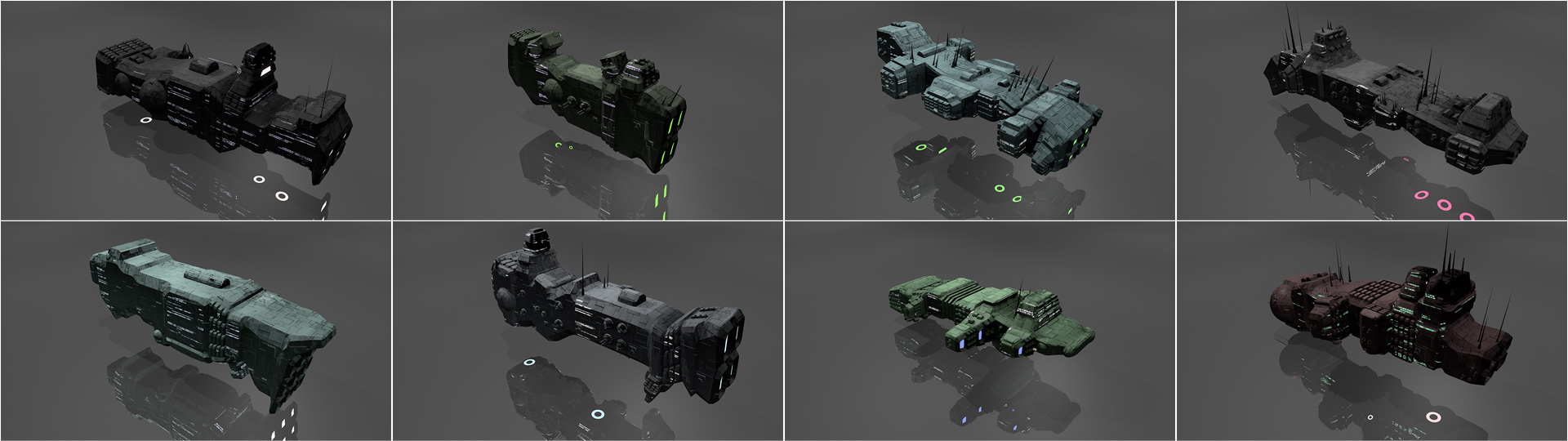
Usage
-----
* Install Blender 2.80 or greater: http://blender.org/download/
* Download newest `add_mesh_SpaceshipGenerator.zip` from the [Releases](https://github.com/a1studmuffin/SpaceshipGenerator/releases) section
* Under Edit > Preferences... > Add-ons > Install... open the downloaded ZIP file
* Under Edit > Preferences... > Add-ons enable the "Add Mesh: Spaceship Generator" script (search for "spaceship")
* Add a spaceship in the 3D View under Add > Mesh > Spaceship
* Expand the Spaceship tab that appears in the bottom left of the viewport to adjust procedural generation settings
How it works
------------
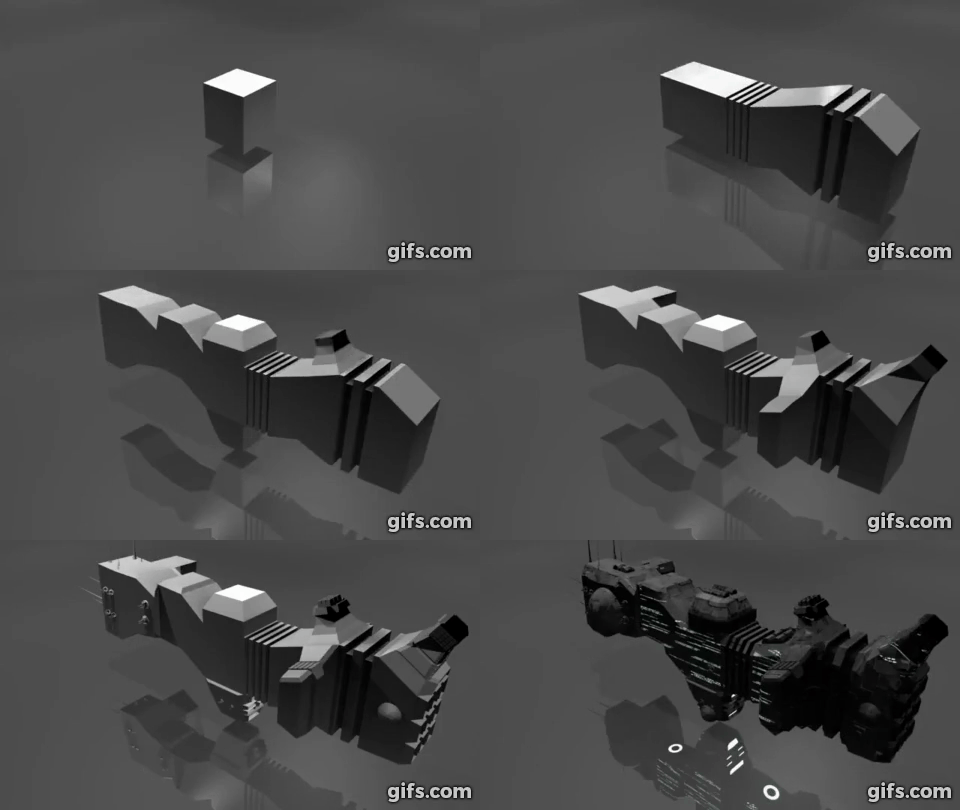
Watch on YouTube: https://www.youtube.com/watch?v=xJZyXqJ6nog
* Start with a box.
* Build the hull: Extrude the front/rear faces several times, adding random translation/scaling/rotation along the way.
* Add asymmetry to the hull: Pick random faces and extrude them out in a similar manner, reducing in scale each time.
* Add detail to the hull: Categorize each face by its orientation and generate details on it such as engines, antenna, weapon turrets, lights etc.
* Sometimes apply horizontal symmetry.
* Add a Bevel modifier to angularize the shape a bit.
* Apply materials to the final result.
* Take over the universe with your new infinite fleet of spaceships.
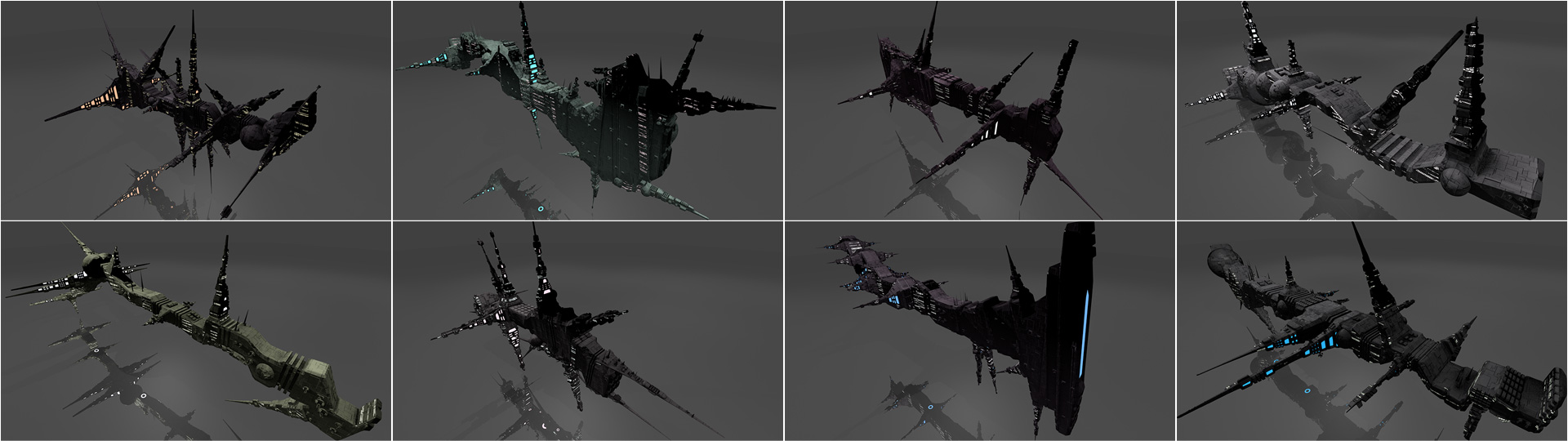
Extreme examples
----------------
The following screenshots were created using extreme values for the number of hull segments and asymmetry segments to show how the algorithm works.
Tips and Tricks
---------------
* By default the script will delete all objects starting with `Spaceship` before generating a new spaceship. To disable this feature, remove or comment out the call to `reset_scene()` around line 735 in the main function.
* You can provide a seed to the `generate_spaceship()` function to always generate the same spaceship. For example, `generate_spaceship('michael')`.
* The `generate_spaceship()` function takes many more parameters that affect the generation process. Try playing with them!
* You can replace the textures with your own ones. All textures are applied using global-space cube UVs. `hull_normal.png` is a normal map that adds extra surface "greebles". `hull_lights_diffuse.png` is an additive diffuse texture to set the color of the window lights. `hull_lights_emit.png` is an emissive texture to make the windows glow in darkness.
Credits
-------
Written for fun as part of the [/r/proceduralgeneration](https://www.reddit.com/r/proceduralgeneration/) June 2016 [monthly challenge](https://www.reddit.com/r/proceduralgeneration/comments/4mn9gj/monthly_challenge_7_june_2016_procedural/).
Released under the [MIT License].
Authored and maintained by Michael Davies.
> GitHub [@a1studmuffin](https://github.com/a1studmuffin)
> Twitter [@butterparty](https://twitter.com/butterparty)
Special thanks to [@panzi](https://github.com/panzi) for bugfixes, a proper GUI and build script. Also to [@mjrthemes](https://github.com/mjrthemes) for bugfixing, and [@LendoK](https://github.com/LendoK) for the 2.80 port.
[MIT License]: http://mit-license.org/
================================================
FILE: __init__.py
================================================
bl_info = {
"name": "Spaceship Generator",
"author": "Michael Davies",
"version": (1, 1, 3),
"blender": (2, 80, 0),
"location": "View3D > Add > Mesh",
"description": "Procedurally generate 3D spaceships from a random seed.",
"wiki_url": "https://github.com/a1studmuffin/SpaceshipGenerator/blob/master/README.md",
"tracker_url": "https://github.com/a1studmuffin/SpaceshipGenerator/issues",
"category": "Add Mesh"
}
if "bpy" in locals():
# reload logic (magic)
import importlib
importlib.reload(spaceship_generator)
else:
from . import spaceship_generator
import bpy
from bpy.props import StringProperty, BoolProperty, IntProperty
from bpy.types import Operator
class GenerateSpaceship(Operator):
"""Procedurally generate 3D spaceships from a random seed."""
bl_idname = "mesh.generate_spaceship"
bl_label = "Spaceship"
bl_options = {'REGISTER', 'UNDO'}
random_seed : StringProperty(default='', name='Seed')
num_hull_segments_min : IntProperty (default=3, min=0, soft_max=16, name='Min. Hull Segments')
num_hull_segments_max : IntProperty (default=6, min=0, soft_max=16, name='Max. Hull Segments')
create_asymmetry_segments : BoolProperty(default=True, name='Create Asymmetry Segments')
num_asymmetry_segments_min : IntProperty (default=1, min=1, soft_max=16, name='Min. Asymmetry Segments')
num_asymmetry_segments_max : IntProperty (default=5, min=1, soft_max=16, name='Max. Asymmetry Segments')
create_face_detail : BoolProperty(default=True, name='Create Face Detail')
allow_horizontal_symmetry : BoolProperty(default=True, name='Allow Horizontal Symmetry')
allow_vertical_symmetry : BoolProperty(default=False, name='Allow Vertical Symmetry')
apply_bevel_modifier : BoolProperty(default=True, name='Apply Bevel Modifier')
assign_materials : BoolProperty(default=True, name='Assign Materials')
def execute(self, context):
spaceship_generator.generate_spaceship(
self.random_seed,
self.num_hull_segments_min,
self.num_hull_segments_max,
self.create_asymmetry_segments,
self.num_asymmetry_segments_min,
self.num_asymmetry_segments_max,
self.create_face_detail,
self.allow_horizontal_symmetry,
self.allow_vertical_symmetry,
self.apply_bevel_modifier,
self.assign_materials)
return {'FINISHED'}
def menu_func(self, context):
self.layout.operator(GenerateSpaceship.bl_idname, text="Spaceship")
def register():
bpy.utils.register_class(GenerateSpaceship)
bpy.types.VIEW3D_MT_mesh_add.append(menu_func)
def unregister():
bpy.utils.unregister_class(GenerateSpaceship)
bpy.types.VIEW3D_MT_mesh_add.remove(menu_func)
if __name__ == "__main__":
register()
================================================
FILE: build.py
================================================
#!/usr/bin/env python
from os.path import abspath, dirname, join as pjoin
import zipfile
SRC_DIR = dirname(abspath(__file__))
with zipfile.ZipFile('add_mesh_SpaceshipGenerator.zip', 'w', zipfile.ZIP_DEFLATED) as arch:
for filename in [
'__init__.py',
'spaceship_generator.py',
'textures/hull_normal.png',
'textures/hull_lights_emit.png',
'textures/hull_lights_diffuse.png']:
arch.write(pjoin(SRC_DIR, filename), 'add_mesh_SpaceshipGenerator/'+filename)
print('created file: add_mesh_SpaceshipGenerator.zip')
================================================
FILE: spaceship_generator.py
================================================
#
# spaceship_generator.py
#
# This is a Blender script that uses procedural generation to create
# textured 3D spaceship models. Tested with Blender 2.77a.
#
# michael@spaceduststudios.com
# https://github.com/a1studmuffin/SpaceshipGenerator
#
import sys
import os
import os.path
import bpy
import bmesh
import datetime
from math import sqrt, radians, pi, cos, sin
from mathutils import Vector, Matrix
from random import random, seed, uniform, randint, randrange
from enum import IntEnum
from colorsys import hls_to_rgb
DIR = os.path.dirname(os.path.abspath(__file__))
def resource_path(*path_components):
return os.path.join(DIR, *path_components)
# Deletes all existing spaceships and unused materials from the scene
def reset_scene():
for item in bpy.data.objects:
item.select = item.name.startswith('Spaceship')
bpy.ops.object.delete()
for material in bpy.data.materials:
if not material.users:
bpy.data.materials.remove(material)
for texture in bpy.data.textures:
if not texture.users:
bpy.data.textures.remove(texture)
# Extrudes a face along its normal by translate_forwards units.
# Returns the new face, and optionally fills out extruded_face_list
# with all the additional side faces created from the extrusion.
def extrude_face(bm, face, translate_forwards=0.0, extruded_face_list=None):
new_faces = bmesh.ops.extrude_discrete_faces(bm, faces=[face])['faces']
if extruded_face_list != None:
extruded_face_list += new_faces[:]
new_face = new_faces[0]
bmesh.ops.translate(bm,
vec=new_face.normal * translate_forwards,
verts=new_face.verts)
return new_face
# Similar to extrude_face, except corrigates the geometry to create "ribs".
# Returns the new face.
def ribbed_extrude_face(bm, face, translate_forwards, num_ribs=3, rib_scale=0.9):
translate_forwards_per_rib = translate_forwards / float(num_ribs)
new_face = face
for i in range(num_ribs):
new_face = extrude_face(bm, new_face, translate_forwards_per_rib * 0.25)
new_face = extrude_face(bm, new_face, 0.0)
scale_face(bm, new_face, rib_scale, rib_scale, rib_scale)
new_face = extrude_face(bm, new_face, translate_forwards_per_rib * 0.5)
new_face = extrude_face(bm, new_face, 0.0)
scale_face(bm, new_face, 1 / rib_scale, 1 / rib_scale, 1 / rib_scale)
new_face = extrude_face(bm, new_face, translate_forwards_per_rib * 0.25)
return new_face
# Scales a face in local face space. Ace!
def scale_face(bm, face, scale_x, scale_y, scale_z):
face_space = get_face_matrix(face)
face_space.invert()
bmesh.ops.scale(bm,
vec=Vector((scale_x, scale_y, scale_z)),
space=face_space,
verts=face.verts)
# Returns a rough 4x4 transform matrix for a face (doesn't handle
# distortion/shear) with optional position override.
def get_face_matrix(face, pos=None):
x_axis = (face.verts[1].co - face.verts[0].co).normalized()
z_axis = -face.normal
y_axis = z_axis.cross(x_axis)
if not pos:
pos = face.calc_center_bounds()
# Construct a 4x4 matrix from axes + position:
# http://i.stack.imgur.com/3TnQP.png
mat = Matrix()
mat[0][0] = x_axis.x
mat[1][0] = x_axis.y
mat[2][0] = x_axis.z
mat[3][0] = 0
mat[0][1] = y_axis.x
mat[1][1] = y_axis.y
mat[2][1] = y_axis.z
mat[3][1] = 0
mat[0][2] = z_axis.x
mat[1][2] = z_axis.y
mat[2][2] = z_axis.z
mat[3][2] = 0
mat[0][3] = pos.x
mat[1][3] = pos.y
mat[2][3] = pos.z
mat[3][3] = 1
return mat
# Returns the rough length and width of a quad face.
# Assumes a perfect rectangle, but close enough.
def get_face_width_and_height(face):
if not face.is_valid or len(face.verts[:]) < 4:
return -1, -1
width = (face.verts[0].co - face.verts[1].co).length
height = (face.verts[2].co - face.verts[1].co).length
return width, height
# Returns the rough aspect ratio of a face. Always >= 1.
def get_aspect_ratio(face):
if not face.is_valid:
return 1.0
face_aspect_ratio = max(0.01, face.edges[0].calc_length() / face.edges[1].calc_length())
if face_aspect_ratio < 1.0:
face_aspect_ratio = 1.0 / face_aspect_ratio
return face_aspect_ratio
# Returns true if this face is pointing behind the ship
def is_rear_face(face):
return face.normal.x < -0.95
# Given a face, splits it into a uniform grid and extrudes each grid face
# out and back in again, making an exhaust shape.
def add_exhaust_to_face(bm, face):
if not face.is_valid:
return
# The more square the face is, the more grid divisions it might have
num_cuts = randint(1, int(4 - get_aspect_ratio(face)))
result = bmesh.ops.subdivide_edges(bm,
edges=face.edges[:],
cuts=num_cuts,
fractal=0.02,
use_grid_fill=True)
exhaust_length = uniform(0.1, 0.2)
scale_outer = 1 / uniform(1.3, 1.6)
scale_inner = 1 / uniform(1.05, 1.1)
for face in result['geom']:
if isinstance(face, bmesh.types.BMFace):
if is_rear_face(face):
face.material_index = Material.hull_dark
face = extrude_face(bm, face, exhaust_length)
scale_face(bm, face, scale_outer, scale_outer, scale_outer)
extruded_face_list = []
face = extrude_face(bm, face, -exhaust_length * 0.9, extruded_face_list)
for extruded_face in extruded_face_list:
extruded_face.material_index = Material.exhaust_burn
scale_face(bm, face, scale_inner, scale_inner, scale_inner)
# Given a face, splits it up into a smaller uniform grid and extrudes each grid cell.
def add_grid_to_face(bm, face):
if not face.is_valid:
return
result = bmesh.ops.subdivide_edges(bm,
edges=face.edges[:],
cuts=randint(2, 4),
fractal=0.02,
use_grid_fill=True,
use_single_edge=False)
grid_length = uniform(0.025, 0.15)
scale = 0.8
for face in result['geom']:
if isinstance(face, bmesh.types.BMFace):
material_index = Material.hull_lights if random() > 0.5 else Material.hull
extruded_face_list = []
face = extrude_face(bm, face, grid_length, extruded_face_list)
for extruded_face in extruded_face_list:
if abs(face.normal.z) < 0.707: # side face
extruded_face.material_index = material_index
scale_face(bm, face, scale, scale, scale)
# Given a face, adds some cylinders along it in a grid pattern.
def add_cylinders_to_face(bm, face):
if not face.is_valid or len(face.verts[:]) < 4:
return
horizontal_step = randint(1, 3)
vertical_step = randint(1, 3)
num_segments = randint(6, 12)
face_width, face_height = get_face_width_and_height(face)
cylinder_depth = 1.3 * min(face_width / (horizontal_step + 2),
face_height / (vertical_step + 2))
cylinder_size = cylinder_depth * 0.5
for h in range(horizontal_step):
top = face.verts[0].co.lerp(
face.verts[1].co, (h + 1) / float(horizontal_step + 1))
bottom = face.verts[3].co.lerp(
face.verts[2].co, (h + 1) / float(horizontal_step + 1))
for v in range(vertical_step):
pos = top.lerp(bottom, (v + 1) / float(vertical_step + 1))
cylinder_matrix = get_face_matrix(face, pos) @ \
Matrix.Rotation(radians(90), 3, 'X').to_4x4()
bmesh.ops.create_cone(bm,
cap_ends=True,
cap_tris=False,
segments=num_segments,
diameter1=cylinder_size,
diameter2=cylinder_size,
depth=cylinder_depth,
matrix=cylinder_matrix)
# Given a face, adds some weapon turrets to it in a grid pattern.
# Each turret will have a random orientation.
def add_weapons_to_face(bm, face):
if not face.is_valid or len(face.verts[:]) < 4:
return
horizontal_step = randint(1, 2)
vertical_step = randint(1, 2)
num_segments = 16
face_width, face_height = get_face_width_and_height(face)
weapon_size = 0.5 * min(face_width / (horizontal_step + 2),
face_height / (vertical_step + 2))
weapon_depth = weapon_size * 0.2
for h in range(horizontal_step):
top = face.verts[0].co.lerp(
face.verts[1].co, (h + 1) / float(horizontal_step + 1))
bottom = face.verts[3].co.lerp(
face.verts[2].co, (h + 1) / float(horizontal_step + 1))
for v in range(vertical_step):
pos = top.lerp(bottom, (v + 1) / float(vertical_step + 1))
face_matrix = get_face_matrix(face, pos + face.normal * weapon_depth * 0.5) @ \
Matrix.Rotation(radians(uniform(0, 90)), 3, 'Z').to_4x4()
# Turret foundation
bmesh.ops.create_cone(bm,
cap_ends=True,
cap_tris=False,
segments=num_segments,
diameter1=weapon_size * 0.9,
diameter2=weapon_size,
depth=weapon_depth,
matrix=face_matrix)
# Turret left guard
left_guard_mat = face_matrix @ \
Matrix.Rotation(radians(90), 3, 'Y').to_4x4() @ \
Matrix.Translation(Vector((0, 0, weapon_size * 0.6))).to_4x4()
bmesh.ops.create_cone(bm,
cap_ends=True,
cap_tris=False,
segments=num_segments,
diameter1=weapon_size * 0.6,
diameter2=weapon_size * 0.5,
depth=weapon_depth * 2,
matrix=left_guard_mat)
# Turret right guard
right_guard_mat = face_matrix @ \
Matrix.Rotation(radians(90), 3, 'Y').to_4x4() @ \
Matrix.Translation(Vector((0, 0, weapon_size * -0.6))).to_4x4()
bmesh.ops.create_cone(bm,
cap_ends=True,
cap_tris=False,
segments=num_segments,
diameter1=weapon_size * 0.5,
diameter2=weapon_size * 0.6,
depth=weapon_depth * 2,
matrix=right_guard_mat)
# Turret housing
upward_angle = uniform(0, 45)
turret_house_mat = face_matrix @ \
Matrix.Rotation(radians(upward_angle), 3, 'X').to_4x4() @ \
Matrix.Translation(Vector((0, weapon_size * -0.4, 0))).to_4x4()
bmesh.ops.create_cone(bm,
cap_ends=True,
cap_tris=False,
segments=8,
diameter1=weapon_size * 0.4,
diameter2=weapon_size * 0.4,
depth=weapon_depth * 5,
matrix=turret_house_mat)
# Turret barrels L + R
bmesh.ops.create_cone(bm,
cap_ends=True,
cap_tris=False,
segments=8,
diameter1=weapon_size * 0.1,
diameter2=weapon_size * 0.1,
depth=weapon_depth * 6,
matrix=turret_house_mat @ \
Matrix.Translation(Vector((weapon_size * 0.2, 0, -weapon_size))).to_4x4())
bmesh.ops.create_cone(bm,
cap_ends=True,
cap_tris=False,
segments=8,
diameter1=weapon_size * 0.1,
diameter2=weapon_size * 0.1,
depth=weapon_depth * 6,
matrix=turret_house_mat @ \
Matrix.Translation(Vector((weapon_size * -0.2, 0, -weapon_size))).to_4x4())
# Given a face, adds a sphere on the surface, partially inset.
def add_sphere_to_face(bm, face):
if not face.is_valid:
return
face_width, face_height = get_face_width_and_height(face)
sphere_size = uniform(0.4, 1.0) * min(face_width, face_height)
sphere_matrix = get_face_matrix(face,
face.calc_center_bounds() - face.normal * \
uniform(0, sphere_size * 0.5))
result = bmesh.ops.create_icosphere(bm,
subdivisions=3,
diameter=sphere_size,
matrix=sphere_matrix)
for vert in result['verts']:
for face in vert.link_faces:
face.material_index = Material.hull
# Given a face, adds some pointy intimidating antennas.
def add_surface_antenna_to_face(bm, face):
if not face.is_valid or len(face.verts[:]) < 4:
return
horizontal_step = randint(4, 10)
vertical_step = randint(4, 10)
for h in range(horizontal_step):
top = face.verts[0].co.lerp(
face.verts[1].co, (h + 1) / float(horizontal_step + 1))
bottom = face.verts[3].co.lerp(
face.verts[2].co, (h + 1) / float(horizontal_step + 1))
for v in range(vertical_step):
if random() > 0.9:
pos = top.lerp(bottom, (v + 1) / float(vertical_step + 1))
face_size = sqrt(face.calc_area())
depth = uniform(0.1, 1.5) * face_size
depth_short = depth * uniform(0.02, 0.15)
base_diameter = uniform(0.005, 0.05)
material_index = Material.hull if random() > 0.5 else Material.hull_dark
# Spire
num_segments = uniform(3, 6)
result = bmesh.ops.create_cone(bm,
cap_ends=False,
cap_tris=False,
segments=num_segments,
diameter1=0,
diameter2=base_diameter,
depth=depth,
matrix=get_face_matrix(face, pos + face.normal * depth * 0.5))
for vert in result['verts']:
for vert_face in vert.link_faces:
vert_face.material_index = material_index
# Base
result = bmesh.ops.create_cone(bm,
cap_ends=True,
cap_tris=False,
segments=num_segments,
diameter1=base_diameter * uniform(1, 1.5),
diameter2=base_diameter * uniform(1.5, 2),
depth=depth_short,
matrix=get_face_matrix(face, pos + face.normal * depth_short * 0.45))
for vert in result['verts']:
for vert_face in vert.link_faces:
vert_face.material_index = material_index
# Given a face, adds a glowing "landing pad" style disc.
def add_disc_to_face(bm, face):
if not face.is_valid:
return
face_width, face_height = get_face_width_and_height(face)
depth = 0.125 * min(face_width, face_height)
bmesh.ops.create_cone(bm,
cap_ends=True,
cap_tris=False,
segments=32,
diameter1=depth * 3,
diameter2=depth * 4,
depth=depth,
matrix=get_face_matrix(face, face.calc_center_bounds() + face.normal * depth * 0.5))
result = bmesh.ops.create_cone(bm,
cap_ends=False,
cap_tris=False,
segments=32,
diameter1=depth * 1.25,
diameter2=depth * 2.25,
depth=0.0,
matrix=get_face_matrix(face, face.calc_center_bounds() + face.normal * depth * 1.05))
for vert in result['verts']:
for face in vert.link_faces:
face.material_index = Material.glow_disc
class Material(IntEnum):
hull = 0 # Plain spaceship hull
hull_lights = 1 # Spaceship hull with emissive windows
hull_dark = 2 # Plain Spaceship hull, darkened
exhaust_burn = 3 # Emissive engine burn material
glow_disc = 4 # Emissive landing pad disc material
# Returns shader node
def getShaderNode(mat):
ntree = mat.node_tree
node_out = ntree.get_output_node('EEVEE')
shader_node = node_out.inputs['Surface'].links[0].from_node
return shader_node
def getShaderInput(mat, name):
shaderNode = getShaderNode(mat)
return shaderNode.inputs[name]
# Adds a hull normal map texture slot to a material.
def add_hull_normal_map(mat, hull_normal_map):
ntree = mat.node_tree
shader = getShaderNode(mat)
links = ntree.links
teximage_node = ntree.nodes.new('ShaderNodeTexImage')
teximage_node.image = hull_normal_map
teximage_node.image.colorspace_settings.name = 'Raw'
teximage_node.projection ='BOX'
tex_coords_node = ntree.nodes.new('ShaderNodeTexCoord')
links.new(tex_coords_node.outputs['Object'], teximage_node.inputs['Vector'])
normalMap_node = ntree.nodes.new('ShaderNodeNormalMap')
links.new(teximage_node.outputs[0], normalMap_node.inputs['Color'])
links.new(normalMap_node.outputs['Normal'], shader.inputs['Normal'])
return tex_coords_node
# Sets some basic properties for a hull material.
def set_hull_mat_basics(mat, color, hull_normal_map):
shader_node = getShaderNode(mat)
shader_node.inputs["Specular"].default_value = 0.1
shader_node.inputs["Base Color"].default_value = color
return add_hull_normal_map(mat, hull_normal_map)
# Creates all our materials and returns them as a list.
def create_materials():
ret = []
for material in Material:
mat = bpy.data.materials.new(name=material.name)
mat.use_nodes = True
ret.append(mat)
# Choose a base color for the spaceship hull
hull_base_color = hls_to_rgb(
random(), uniform(0.05, 0.5), uniform(0, 0.25))
hull_base_color = (hull_base_color[0], hull_base_color[1], hull_base_color[2], 1.0)
# Load up the hull normal map
hull_normal_map = bpy.data.images.load(resource_path('textures', 'hull_normal.png'), check_existing=True)
# Build the hull texture
mat = ret[Material.hull]
set_hull_mat_basics(mat, hull_base_color, hull_normal_map)
# Build the hull_lights texture
mat = ret[Material.hull_lights]
tex_coords_node = set_hull_mat_basics(mat, hull_base_color, hull_normal_map)
ntree = mat.node_tree
shader_node = getShaderNode(mat)
links = ntree.links
# Add a diffuse layer that sets the window color
hull_lights_diffuse_map = bpy.data.images.load(resource_path('textures', 'hull_lights_diffuse.png'), check_existing=True)
teximage_diff_node = ntree.nodes.new('ShaderNodeTexImage')
teximage_diff_node.image = hull_lights_diffuse_map
teximage_diff_node.projection ='BOX'
links.new(tex_coords_node.outputs['Object'], teximage_diff_node.inputs['Vector'])
RGB_node = ntree.nodes.new('ShaderNodeRGB')
RGB_node.outputs[0].default_value = hull_base_color
mix_node = ntree.nodes.new('ShaderNodeMixRGB')
links.new(RGB_node.outputs[0], mix_node.inputs[1])
links.new(teximage_diff_node.outputs[0], mix_node.inputs[2])
links.new(teximage_diff_node.outputs[1], mix_node.inputs[0])
links.new(mix_node.outputs[0], shader_node.inputs["Base Color"])
# Add an emissive layer that lights up the windows
hull_lights_emessive_map = bpy.data.images.load(resource_path('textures', 'hull_lights_emit.png'), check_existing=True)
teximage_emit_node = ntree.nodes.new('ShaderNodeTexImage')
teximage_emit_node.image = hull_lights_emessive_map
teximage_emit_node.projection ='BOX'
links.new(tex_coords_node.outputs['Object'], teximage_emit_node.inputs['Vector'])
links.new(teximage_emit_node.outputs[0], shader_node.inputs["Emission"])
# Build the hull_dark texture
mat = ret[Material.hull_dark]
set_hull_mat_basics(mat, [0.3 * x for x in hull_base_color], hull_normal_map)
# Choose a glow color for the exhaust + glow discs
glow_color = hls_to_rgb(random(), uniform(0.5, 1), 1)
glow_color = (glow_color[0], glow_color[1], glow_color[2], 1.0)
# # Build the exhaust_burn texture
mat = ret[Material.exhaust_burn]
shader_node = getShaderNode(mat)
shader_node.inputs["Emission"].default_value = glow_color
# # Build the glow_disc texture
mat = ret[Material.glow_disc]
shader_node = getShaderNode(mat)
shader_node.inputs["Emission"].default_value = glow_color
return ret
# Generates a textured spaceship mesh and returns the object.
# Just uses global cube texture coordinates rather than generating UVs.
# Takes an optional random seed value to generate a specific spaceship.
# Allows overriding of some parameters that affect generation.
def generate_spaceship(random_seed='',
num_hull_segments_min=3,
num_hull_segments_max=6,
create_asymmetry_segments=True,
num_asymmetry_segments_min=1,
num_asymmetry_segments_max=5,
create_face_detail=True,
allow_horizontal_symmetry=True,
allow_vertical_symmetry=False,
apply_bevel_modifier=True,
assign_materials=True):
if random_seed:
seed(random_seed)
# Let's start with a unit BMesh cube scaled randomly
bm = bmesh.new()
bmesh.ops.create_cube(bm, size=1)
scale_vector = Vector(
(uniform(0.75, 2.0), uniform(0.75, 2.0), uniform(0.75, 2.0)))
bmesh.ops.scale(bm, vec=scale_vector, verts=bm.verts)
# Extrude out the hull along the X axis, adding some semi-random perturbations
for face in bm.faces[:]:
if abs(face.normal.x) > 0.5:
hull_segment_length = uniform(0.3, 1)
num_hull_segments = randrange(num_hull_segments_min, num_hull_segments_max)
hull_segment_range = range(num_hull_segments)
for i in hull_segment_range:
is_last_hull_segment = i == hull_segment_range[-1]
val = random()
if val > 0.1:
# Most of the time, extrude out the face with some random deviations
face = extrude_face(bm, face, hull_segment_length)
if random() > 0.75:
face = extrude_face(
bm, face, hull_segment_length * 0.25)
# Maybe apply some scaling
if random() > 0.5:
sy = uniform(1.2, 1.5)
sz = uniform(1.2, 1.5)
if is_last_hull_segment or random() > 0.5:
sy = 1 / sy
sz = 1 / sz
scale_face(bm, face, 1, sy, sz)
# Maybe apply some sideways translation
if random() > 0.5:
sideways_translation = Vector(
(0, 0, uniform(0.1, 0.4) * scale_vector.z * hull_segment_length))
if random() > 0.5:
sideways_translation = -sideways_translation
bmesh.ops.translate(bm,
vec=sideways_translation,
verts=face.verts)
# Maybe add some rotation around Y axis
if random() > 0.5:
angle = 5
if random() > 0.5:
angle = -angle
bmesh.ops.rotate(bm,
verts=face.verts,
cent=(0, 0, 0),
matrix=Matrix.Rotation(radians(angle), 3, 'Y'))
else:
# Rarely, create a ribbed section of the hull
rib_scale = uniform(0.75, 0.95)
face = ribbed_extrude_face(
bm, face, hull_segment_length, randint(2, 4), rib_scale)
# Add some large asymmetrical sections of the hull that stick out
if create_asymmetry_segments:
for face in bm.faces[:]:
# Skip any long thin faces as it'll probably look stupid
if get_aspect_ratio(face) > 4:
continue
if random() > 0.85:
hull_piece_length = uniform(0.1, 0.4)
for i in range(randrange(num_asymmetry_segments_min, num_asymmetry_segments_max)):
face = extrude_face(bm, face, hull_piece_length)
# Maybe apply some scaling
if random() > 0.25:
s = 1 / uniform(1.1, 1.5)
scale_face(bm, face, s, s, s)
# Now the basic hull shape is built, let's categorize + add detail to all the faces
if create_face_detail:
engine_faces = []
grid_faces = []
antenna_faces = []
weapon_faces = []
sphere_faces = []
disc_faces = []
cylinder_faces = []
for face in bm.faces[:]:
# Skip any long thin faces as it'll probably look stupid
if get_aspect_ratio(face) > 3:
continue
# Spin the wheel! Let's categorize + assign some materials
val = random()
if is_rear_face(face): # rear face
if not engine_faces or val > 0.75:
engine_faces.append(face)
elif val > 0.5:
cylinder_faces.append(face)
elif val > 0.25:
grid_faces.append(face)
else:
face.material_index = Material.hull_lights
elif face.normal.x > 0.9: # front face
if face.normal.dot(face.calc_center_bounds()) > 0 and val > 0.7:
antenna_faces.append(face) # front facing antenna
face.material_index = Material.hull_lights
elif val > 0.4:
grid_faces.append(face)
else:
face.material_index = Material.hull_lights
elif face.normal.z > 0.9: # top face
if face.normal.dot(face.calc_center_bounds()) > 0 and val > 0.7:
antenna_faces.append(face) # top facing antenna
elif val > 0.6:
grid_faces.append(face)
elif val > 0.3:
cylinder_faces.append(face)
elif face.normal.z < -0.9: # bottom face
if val > 0.75:
disc_faces.append(face)
elif val > 0.5:
grid_faces.append(face)
elif val > 0.25:
weapon_faces.append(face)
elif abs(face.normal.y) > 0.9: # side face
if not weapon_faces or val > 0.75:
weapon_faces.append(face)
elif val > 0.6:
grid_faces.append(face)
elif val > 0.4:
sphere_faces.append(face)
else:
face.material_index = Material.hull_lights
# Now we've categorized, let's actually add the detail
for face in engine_faces:
add_exhaust_to_face(bm, face)
for face in grid_faces:
add_grid_to_face(bm, face)
for face in antenna_faces:
add_surface_antenna_to_face(bm, face)
for face in weapon_faces:
add_weapons_to_face(bm, face)
for face in sphere_faces:
add_sphere_to_face(bm, face)
for face in disc_faces:
add_disc_to_face(bm, face)
for face in cylinder_faces:
add_cylinders_to_face(bm, face)
# Apply horizontal symmetry sometimes
if allow_horizontal_symmetry and random() > 0.5:
bmesh.ops.symmetrize(bm, input=bm.verts[:] + bm.edges[:] + bm.faces[:], direction="Y")
# Apply vertical symmetry sometimes - this can cause spaceship "islands", so disabled by default
if allow_vertical_symmetry and random() > 0.5:
bmesh.ops.symmetrize(bm, input=bm.verts[:] + bm.edges[:] + bm.faces[:], direction="Z")
# Finish up, write the bmesh into a new mesh
me = bpy.data.meshes.new('Mesh')
bm.to_mesh(me)
bm.free()
# Add the mesh to the scene
scene = bpy.context.scene
obj = bpy.data.objects.new('Spaceship', me)
# scene.objects.link(obj)
scene.collection.objects.link(obj)
# Select and make active
bpy.context.view_layer.objects.active = obj
obj.select_set(True)
# scene.objects.active = obj
# obj.select = True
# Recenter the object to its center of mass
bpy.ops.object.origin_set(type='ORIGIN_CENTER_OF_MASS')
ob = bpy.context.object
ob.location = (0, 0, 0)
# Add a fairly broad bevel modifier to angularize shape
if apply_bevel_modifier:
bevel_modifier = ob.modifiers.new('Bevel', 'BEVEL')
bevel_modifier.width = uniform(5, 20)
bevel_modifier.offset_type = 'PERCENT'
bevel_modifier.segments = 2
bevel_modifier.profile = 0.25
bevel_modifier.limit_method = 'NONE'
# Add materials to the spaceship
me = ob.data
materials = create_materials()
# materials = []
for mat in materials:
if assign_materials:
me.materials.append(mat)
else:
me.materials.append(bpy.data.materials.new(name="Material"))
return obj
if __name__ == "__main__":
# When true, this script will generate a single spaceship in the scene.
# When false, this script will render multiple movie frames showcasing lots of ships.
generate_single_spaceship = True
if generate_single_spaceship:
# Reset the scene, generate a single spaceship and focus on it
reset_scene()
customseed = '' # add anything here to generate the same spaceship
obj = generate_spaceship(customseed)
# View the selected object in all views
for area in bpy.context.screen.areas:
if area.type == 'VIEW_3D':
ctx = bpy.context.copy()
ctx['area'] = area
ctx['region'] = area.regions[-1]
bpy.ops.view3d.view_selected(ctx)
else:
# Export a movie showcasing many different kinds of ships
# Settings
output_path = '' # leave empty to use script folder
total_movie_duration = 16
total_spaceship_duration = 1
yaw_rate = 45 # degrees/sec
yaw_offset = 220 # degrees/sec
camera_pole_rate = 1
camera_pole_pitch_min = 15 # degrees
camera_pole_pitch_max = 30 # degrees
camera_pole_pitch_offset = 0 # degrees
camera_pole_length = 10
camera_refocus_object_every_frame = False
fov = 60 # degrees
fps = 30
res_x = 1920
res_y = 1080
# Batch render the movie frames
inv_fps = 1/float(fps)
movie_duration = 0
spaceship_duration = total_spaceship_duration
scene = bpy.data.scenes["Scene"]
scene.render.resolution_x = res_x
scene.render.resolution_y = res_y
scene.camera.rotation_mode = 'XYZ'
scene.camera.data.angle = radians(fov)
frame = 0
timestamp = datetime.datetime.now().strftime('%Y%m%d_%H%M%S')
while movie_duration < total_movie_duration:
movie_duration += inv_fps
spaceship_duration += inv_fps
if spaceship_duration >= total_spaceship_duration:
spaceship_duration -= total_spaceship_duration
# Generate a new spaceship
reset_scene()
obj = generate_spaceship()
# look for a mirror plane in the scene, and position it just underneath the ship if found
lowest_z = centre = min((Vector(b).z for b in obj.bound_box))
plane_obj = bpy.data.objects['Plane'] if 'Plane' in bpy.data.objects else None
if plane_obj:
plane_obj.location.z = lowest_z - 0.3
# Position and orient the camera
rad = radians(yaw_offset + (yaw_rate * movie_duration))
camera_pole_pitch_lerp = 0.5 * (1 + cos(camera_pole_rate * movie_duration)) # 0-1
camera_pole_pitch = camera_pole_pitch_max * camera_pole_pitch_lerp + \
camera_pole_pitch_min * (1 - camera_pole_pitch_lerp)
scene.camera.rotation_euler = (radians(90 - camera_pole_pitch + camera_pole_pitch_offset), 0, rad)
scene.camera.location = (sin(rad) * camera_pole_length,
cos(rad) * -camera_pole_length,
sin(radians(camera_pole_pitch))*camera_pole_length)
if camera_refocus_object_every_frame:
bpy.ops.view3d.camera_to_view_selected()
# Render the scene to disk
script_path = bpy.context.space_data.text.filepath if bpy.context.space_data else __file__
folder = output_path if output_path else os.path.split(os.path.realpath(script_path))[0]
filename = os.path.join('renders', timestamp, timestamp + '_' + str(frame).zfill(5) + '.png')
bpy.data.scenes['Scene'].render.filepath = os.path.join(folder, filename)
print('Rendering frame ' + str(frame) + '...')
bpy.ops.render.render(write_still=True)
frame += 1
gitextract_2z2cdhdb/ ├── LICENSE ├── README.md ├── __init__.py ├── build.py └── spaceship_generator.py
SYMBOL INDEX (28 symbols across 2 files)

FILE: __init__.py
  class GenerateSpaceship (line 24) | class GenerateSpaceship(Operator):
    method execute (line 42) | def execute(self, context):
  function menu_func (line 57) | def menu_func(self, context):
  function register (line 60) | def register():
  function unregister (line 64) | def unregister():

FILE: spaceship_generator.py
  function resource_path (line 25) | def resource_path(*path_components):
  function reset_scene (line 29) | def reset_scene():
  function extrude_face (line 43) | def extrude_face(bm, face, translate_forwards=0.0, extruded_face_list=No...
  function ribbed_extrude_face (line 55) | def ribbed_extrude_face(bm, face, translate_forwards, num_ribs=3, rib_sc...
  function scale_face (line 69) | def scale_face(bm, face, scale_x, scale_y, scale_z):
  function get_face_matrix (line 79) | def get_face_matrix(face, pos=None):
  function get_face_width_and_height (line 109) | def get_face_width_and_height(face):
  function get_aspect_ratio (line 117) | def get_aspect_ratio(face):
  function is_rear_face (line 126) | def is_rear_face(face):
  function add_exhaust_to_face (line 131) | def add_exhaust_to_face(bm, face):
  function add_grid_to_face (line 159) | def add_grid_to_face(bm, face):
  function add_cylinders_to_face (line 181) | def add_cylinders_to_face(bm, face):
  function add_weapons_to_face (line 211) | def add_weapons_to_face(bm, face):
  function add_sphere_to_face (line 302) | def add_sphere_to_face(bm, face):
  function add_surface_antenna_to_face (line 319) | def add_surface_antenna_to_face(bm, face):
  function add_disc_to_face (line 367) | def add_disc_to_face(bm, face):
  class Material (line 392) | class Material(IntEnum):
  function getShaderNode (line 401) | def getShaderNode(mat):
  function getShaderInput (line 407) | def getShaderInput(mat, name):
  function add_hull_normal_map (line 412) | def add_hull_normal_map(mat, hull_normal_map):
  function set_hull_mat_basics (line 431) | def set_hull_mat_basics(mat, color, hull_normal_map):
  function create_materials (line 439) | def create_materials():
  function generate_spaceship (line 517) | def generate_spaceship(random_seed='',
Condensed preview — 5 files, each showing path, character count, and a content snippet. Download the .json file or copy for the full structured content (45K chars).
[
  {
    "path": "LICENSE",
    "chars": 1726,
    "preview": "================\nSOFTWARE LICENSE\n================\n\nThe MIT License (MIT)\n\nCopyright (c) 2016 Michael Davies\n\nPermission"
  },
  {
    "path": "README.md",
    "chars": 3587,
    "preview": "# Spaceship Generator\n\nA Blender script to procedurally generate 3D spaceships from a random seed.\n\n![Spaceship screensh"
  },
  {
    "path": "__init__.py",
    "chars": 2886,
    "preview": "bl_info = {\n    \"name\": \"Spaceship Generator\",\n    \"author\": \"Michael Davies\",\n    \"version\": (1, 1, 3),\n    \"blender\": "
  },
  {
    "path": "build.py",
    "chars": 584,
    "preview": "#!/usr/bin/env python\n\nfrom os.path import abspath, dirname, join as pjoin\nimport zipfile\n\nSRC_DIR = dirname(abspath(__f"
  },
  {
    "path": "spaceship_generator.py",
    "chars": 35326,
    "preview": "#\n# spaceship_generator.py\n#\n# This is a Blender script that uses procedural generation to create\n# textured 3D spaceshi"
  }
]
About this extraction
This page contains the full source code of the a1studmuffin/SpaceshipGenerator GitHub repository, extracted and formatted as plain text for AI agents and large language models (LLMs). The extraction includes 5 files (43.1 KB), approximately 10.2k tokens, and a symbol index with 28 extracted functions, classes, methods, constants, and types. Use this with OpenClaw, Claude, ChatGPT, Cursor, Windsurf, or any other AI tool that accepts text input. You can copy the full output to your clipboard or download it as a .txt file.
Extracted by GitExtract — free GitHub repo to text converter for AI. Built by Nikandr Surkov.