Repository: griffbr/ODMD
Branch: main
Commit: b348a8017479
Files: 38
Total size: 31.8 KB
Directory structure:
gitextract_0g3k5q3j/

├── .gitignore
├── README.md
├── config/
│   ├── camera/
│   │   ├── ODMS_camera.yaml
│   │   └── hsr_grasp_camera.yaml
│   ├── data_gen/
│   │   ├── ODMS.yaml
│   │   └── standard_data.yaml
│   ├── model/
│   │   ├── DBox.yaml
│   │   └── DBox_absolute.yaml
│   └── train/
│       └── train_demo.yaml
├── data/
│   ├── odmd/
│   │   ├── test/
│   │   │   ├── test_normal.pk
│   │   │   ├── test_perturb_detection.pk
│   │   │   ├── test_perturb_motion.pk
│   │   │   └── test_robot.pk
│   │   └── val/
│   │       ├── val_normal.pk
│   │       ├── val_perturb_detection.pk
│   │       ├── val_perturb_motion.pk
│   │       └── val_robot.pk
│   └── odms_detection/
│       ├── test/
│       │   ├── test_odms_detect_driving.pk
│       │   ├── test_odms_detect_normal.pk
│       │   ├── test_odms_detect_perturb.pk
│       │   └── test_odms_detect_robot.pk
│       └── val/
│           ├── val_odms_detect_driving.pk
│           ├── val_odms_detect_normal.pk
│           ├── val_odms_detect_perturb.pk
│           └── val_odms_detect_robot.pk
├── dbox/
│   ├── __init__.py
│   ├── dbox.py
│   └── model_utils.py
├── demo/
│   ├── demo_DBox_eval.py
│   ├── demo_DBox_train.py
│   ├── demo_datagen.py
│   └── demo_dataset_eval.py
└── odmd/
    ├── __init__.py
    ├── closed_form/
    │   ├── __init__.py
    │   └── closed_form.py
    └── data_gen/
        ├── __init__.py
        ├── data_gen.py
        └── data_gen_util.py
================================================
FILE CONTENTS
================================================
================================================
FILE: .gitignore
================================================
.DS_Store
*.pyc
*.swp
/data/example_generated_data/
/results/*
================================================
FILE: README.md
================================================
# ODMD Dataset
ODMD is the first dataset for learning **O**bject **D**epth via **M**otion and **D**etection. ODMD training data are configurable and extensible, with each training example consisting of a series of object detection bounding boxes, camera movement distances, and ground truth object depth. As a benchmark evaluation, we provide four ODMD validation and test sets with 21,600 examples in multiple domains, and we also convert 15,650 examples from the [ODMS benchmark](https://github.com/griffbr/odms "ODMS dataset website") for detection. In our paper, we use a single ODMD-trained network with object detection *or* segmentation to achieve state-of-the-art results on existing driving and robotics benchmarks and estimate object depth from a camera phone, demonstrating how ODMD is a viable tool for monocular depth estimation in a variety of mobile applications.
Contact: Brent Griffin (griffb at umich dot edu)
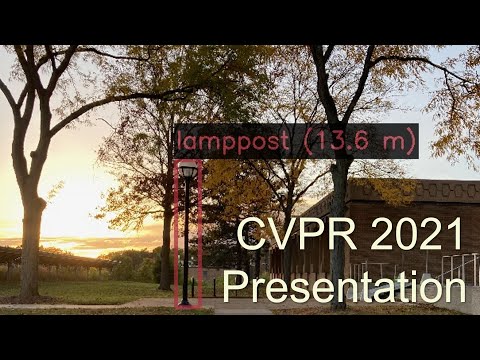
__Depth results using a camera phone.__

## Using ODMD
__Run__ ``./demo/demo_datagen.py`` to generate random ODMD data to train or test your model. <br />
Example data generation and camera configurations are provided in the ``./config/`` folder.
``demo_datagen.py`` has the option to save data into a static dataset for repeated use. <br />
[native Python]
__Run__ ``./demo/demo_dataset_eval.py`` to evaluate your model on the ODMD validation and test sets. <br />
``demo_dataset_eval.py`` has an example evaluation for the Box<sub>LS</sub> baseline and instructions for using our detection-based version of [ODMS](https://github.com/griffbr/ODMS "ODMS dataset website").
Results are saved in the ``./results/`` folder. <br />
[native Python]
## Benchmark
| Method | Normal | Perturb Camera | Perturb Detect | Robot | All |
| --------------- | --------------- | --------------- | --------------- | --------------- | --------------- |
| [DBox](https://arxiv.org/abs/2103.01468 "CVPR 2021 Paper") | 1.73 | 2.45 | 2.54 | **11.17** | **4.47** |
| [DBox<sub>Abs</sub>](https://arxiv.org/abs/2103.01468 "CVPR 2021 Paper") | 1.11 | **2.05** | **1.75** | 13.29 | 4.55 |
| [Box<sub>LS</sub>](https://arxiv.org/abs/2103.01468 "CVPR 2021 Paper") | **0.00** | 4.47 | 21.60 | 21.23 | 11.83 |
Is your technique missing although it's published and the code is public? Let us know and we'll add it.
## Using DBox Method
__Run__ ``./demo/demo_dataset_DBox_train.py`` to train your own DBox model using ODMD. <br />
__Run__ ``./demo/demo_dataset_DBox_eval.py`` after training to evaluate your DBox model. <br />
Example training and DBox model configurations are provided in the ``./config/`` folder.
Models are saved in the ``./results/model/`` folder.
``demo_dataset_DBox_eval.py`` also has instructions for using our pretrained DBox model. <br />
[native Python, has Torch dependency]
## Publication
Please cite our [paper](https://openaccess.thecvf.com/content/CVPR2021/html/Griffin_Depth_From_Camera_Motion_and_Object_Detection_CVPR_2021_paper.html "Depth from Camera Motion and Object Detection pdf") if you find it useful for your research.
```
@inproceedings{GrCoCVPR21,
author = {Griffin, Brent A. and Corso, Jason J.},
booktitle={The IEEE Conference on Computer Vision and Pattern Recognition (CVPR)},
title = {Depth from Camera Motion and Object Detection},
year = {2021}
}
```
__CVPR 2021 presentation video:__ https://youtu.be/bgEGjt9NU9w
[](https://youtu.be/bgEGjt9NU9w)
## Use
This code is available for non-commercial research purposes only.
================================================
FILE: config/camera/ODMS_camera.yaml
================================================
camera_name: Pinhole ODMS Camera
image_dim: [480,640]
fx: 240.5
fy: 240.5
cx: 320.5
cy: 240.5
================================================
FILE: config/camera/hsr_grasp_camera.yaml
================================================
camera_name: HSR Grasp Camera
image_dim: [480,640]
fx: 205.5
fy: 205.5
cx: 320.5
cy: 240.5
================================================
FILE: config/data_gen/ODMS.yaml
================================================
data_description: Z motion for ODMS
z_lim: [0.55,1]
move_max: [0,0,0.4625]
size_lim: [0.01,0.175]
move_min: [0,0,0.05]
num_pos: 10
perturb: True
std_dev: 0.001
cam_dev: 0.01
shuffle: 0.1
end_swap: True
================================================
FILE: config/data_gen/standard_data.yaml
================================================
data_description: XYZ motion based on robot-collected data
z_lim: [0.55,1]
move_max: [0.25,0.175,0.325]
size_lim: [0.01,0.175]
move_min: [0,0,0.05]
num_pos: 10
perturb: True
std_dev: 0.001
cam_dev: 0.01
shuffle: 0.1
end_swap: True
================================================
FILE: config/model/DBox.yaml
================================================
model_name: DBox
params:
hidden_sz: 128
input_obs: 1
fcs: [256,256,256,256,256,256]
fc_drop: 0
peep: True
all_loss: False
prediction: normalized
sequence_in: True
sequence_dist: True
================================================
FILE: config/model/DBox_absolute.yaml
================================================
model_name: DBox
params:
hidden_sz: 128
input_obs: 1
fcs: [256,256,256,256,256,256]
fc_drop: 0
peep: True
all_loss: False
prediction: absolute
sequence_in: True
sequence_dist: False
================================================
FILE: config/train/train_demo.yaml
================================================
batch_size: 512
train_iter: 100000
n_display: 1000
n_train_model_saves: 10
================================================
FILE: dbox/__init__.py
================================================
from .dbox import *
from .model_utils import *
================================================
FILE: dbox/dbox.py
================================================
import torch
import torch.nn as nn
import torch.nn.functional as F
import IPython, math, os
# LSTM design inspired by https://towardsdatascience.com/building-a-lstm-by-hand-on-pytorch-59c02a4ec091
def pass_arg_for_model(model_name, **kwargs):
if model_name == "DBox":
model = DBox(**kwargs)
return model
class DBox(nn.Module):
def __init__(self,input_obs,hidden_sz,n_obs,fcs=[1],fc_drop=0,peep=False,
all_loss=False):
super(DBox, self).__init__()
# LSTM.
input_sz = input_obs*7
self.idx = [[i+j for j in range(input_obs)]
for i in range(n_obs-input_obs+1)]
self.n_in_obs = input_obs
self.input_sz = input_sz
self.hidden_sz = hidden_sz
self.W = nn.Parameter(torch.Tensor(input_sz, hidden_sz * 4))
self.U = nn.Parameter(torch.Tensor(hidden_sz, hidden_sz * 4))
self.bias = nn.Parameter(torch.Tensor(hidden_sz * 4))
self.peephole = peep
self.all_loss = all_loss
if self.all_loss: self.n_predict = len(self.idx)
else: self.n_predict = 1
if peep:
self.V = nn.Parameter(torch.Tensor(hidden_sz, hidden_sz * 4))
self.cat_sz = n_obs * 7
self.init_weights()
# Linear layers.
self.n_fc = len(fcs)
self.relu = nn.ReLU(inplace=True)
self.linears = nn.ModuleList([nn.Linear(hidden_sz+self.cat_sz,fcs[0])])
for i in range(self.n_fc-1):
self.linears.append(nn.Linear(fcs[i] + self.cat_sz, fcs[i+1]))
self.linears.append(nn.Linear(fcs[-1],1))
# Dropout.
if fc_drop > 0:
self.drop = True
self.dropout = nn.Dropout(p=fc_drop)
else: self.drop = False
self.return_info = False
def init_weights(self):
stdv = 1.0 / math.sqrt(self.hidden_sz)
for weight in self.parameters():
weight.data.uniform_(-stdv, stdv)
def forward(self, x, init_state=None):
"""Assumes x is of shape (batch, sequence, feature)"""
bs, seq_sz, _ = x.size()
hidden_seq = []
if init_state is None:
h_t, c_t = (torch.zeros(bs, self.hidden_sz).to(x.device),
torch.zeros(bs, self.hidden_sz).to(x.device))
else:
h_t, c_t = init_state
HS = self.hidden_sz
#for t in range(seq_sz):
# x_t = x[:, t, :]
for idx in self.idx:
x_t = x[:, idx, :].reshape(bs, 1, self.input_sz)[:,0,:]
# Batch computations into single matrix multiplication.
if self.peephole:
gates = x_t @ self.W + h_t @ self.U + self.bias + c_t @ self.V
else:
gates = x_t @ self.W + h_t @ self.U + self.bias
o_t = torch.sigmoid(gates[:, HS*3:]) # output
i_t, f_t, g_t = (
torch.sigmoid(gates[:, :HS]), # input
torch.sigmoid(gates[:, HS:HS*2]), # forget
torch.tanh(gates[:, HS*2:HS*3]),
)
c_t = f_t * c_t + i_t * g_t
if self.peephole:
gates = x_t @ self.W + h_t @ self.U + self.bias + c_t @ self.V
o_t = torch.sigmoid(gates[:, HS*3:]) # output
h_t = o_t * torch.tanh(c_t)
if self.return_info or self.all_loss:
hidden_seq.append(h_t.unsqueeze(0))
# Linear layers.
x_cat = x.reshape(1, bs, self.cat_sz)
d_set = torch.zeros(bs, self.n_predict)
if self.all_loss: h_t_set = hidden_seq
else: h_t_set = [h_t.unsqueeze(0)]
for j, d in enumerate(h_t_set):
for i in range(self.n_fc):
d = torch.cat((d, x_cat), 2)
d = self.linears[i](d)
d = self.relu(d)
if self.drop:
d = self.dropout(d)
d = self.linears[-1](d)
d_set[:,j] = d.reshape(-1)
if self.return_info:
hidden_seq = torch.cat(hidden_seq, dim=0)
# Reshape from (sequence, batch, feature) to (batch, seq, feature)
hidden_seq = hidden_seq.transpose(0, 1).contiguous()
return d_set, hidden_seq, (h_t, c_t)
else:
return d_set
================================================
FILE: dbox/model_utils.py
================================================
import torch, os, IPython, numpy as np, yaml
from copy import deepcopy
from .dbox import *
def count_parameters(model):
return sum(p.numel() for p in model.parameters() if p.requires_grad)
def load_model(model_config, n_pos=10):
m_param = yaml.full_load(open(model_config))
m_param["params"]["n_obs"] = n_pos
# Take model configuration parameters and set up network architecture.
net = pass_arg_for_model(m_param["model_name"], **m_param["params"])
# Randomly select between both GPUs (distribute training).
gpus = ["cuda:0", "cuda:1"]
idx = np.random.randint(0,2)
try:
device = torch.device(gpus[idx])
net.to(device)
except:
try:
device = torch.device(gpus[idx-1])
net.to(device)
except:
device = torch.device("cpu")
net.to(device)
m_param["n_predict"] = net.n_predict
return net, device, m_param
def load_training_params(train_config):
train = yaml.full_load(open(train_config))
train["display_iter"] = int(train["train_iter"] / train["n_display"])
train["save_iter"] = np.linspace(0, train["train_iter"],
train["n_train_model_saves"] + 1).astype(int)
return train
def load_weights(net, weight_file):
# Load weights onto already initialized network model.
try:
net.load_state_dict(torch.load(weight_file))
except:
net.load_state_dict(torch.load(weight_file, map_location=lambda
storage, loc: storage))
return net
class BoundingBoxToNetwork:
"""
BoudingBoxToNetwork converts bounding boxes to network input.
"""
def __init__(self, m_params, n_bat=1):
"""
Args:
n_obs (int): Number of bounding box and movement inputs to network.
n_bat (int): Number of input sets batched together.
"""
self.n_obs = m_params["params"]["n_obs"]
self.bb_in = self.n_obs * 4
#self.cam_in = (self.n_obs - 1) * 3
self.cam_in = self.n_obs * 3
self.in_sz = self.bb_in + self.cam_in
self.prediction = m_params["prediction"]
self.sequence = m_params["sequence_in"]
if self.sequence:
self.seq_dist = m_params["sequence_dist"]
self.n_predict = m_params["n_predict"]
self.set_batch(n_bat)
def set_batch(self, n_bat):
# Change network input batch size.
self.n_bat = n_bat
self.tmp_in = np.zeros(shape=(n_bat, self.in_sz), dtype="float32")
self.labels = torch.zeros(n_bat, self.n_predict, dtype=torch.float)
if self.sequence:
self.inputs =torch.zeros(self.n_bat,self.n_obs,7,dtype=torch.float)
self.tmp2=np.zeros(shape=(self.n_bat,self.n_obs,7),dtype="float32")
else:
self.inputs = torch.zeros(self.n_bat,self.in_sz,dtype=torch.float)
def bb_to_labels(self, bb_3D, bb):
# Convert bounding box data to network input and labels.
idx = np.linspace(0, bb_3D["n_positions"] - 1, self.n_obs, dtype=int)
cam_idx = np.linspace(0,bb_3D["n_positions"]-2,self.n_obs-1,dtype=int)
bb = missing_detection_network_filter(bb, idx)
self.tmp_in[:,:self.bb_in] = bb["bboxes"][idx,:-1].reshape(
self.bb_in, self.n_bat).T
self.tmp_in[:,-self.cam_in:-3] = bb_3D["camera_movement"][
cam_idx].reshape(self.cam_in-3, self.n_bat).T
"""
# Temp change for recovering results from old networks.
dim = bb_3D["camera_movement"].shape
temp = np.zeros(shape=(dim[0]+1,dim[1],dim[2]))
temp[:-1] = bb_3D["camera_movement"]
temp -= temp[0]
bb_3D["camera_movement"] = temp[1:]
self.tmp_in[:,-self.cam_in:] = np.array(bb_3D["camera_movement"])[
idx[1:]-1].reshape(self.cam_in, self.n_bat).T
"""
# Convert input and labels for prediction type.
self.labels[:] = torch.from_numpy(bb["bboxes"][-self.n_predict:,-1].T)
#self.labels[:] = torch.from_numpy(bb["bboxes"][-1][-1])
if self.prediction == "normalized":
self.norm = np.linalg.norm(self.tmp_in[:,
-self.cam_in:-self.cam_in+3], axis=1)
self.tmp_in[:,-self.cam_in:] = np.multiply(
self.tmp_in[:,-self.cam_in:],(1/self.norm)[:, np.newaxis])
self.labels[:] /= np.tile(self.norm, (self.n_predict,1)).T
#self.labels[:] /= self.norm
# Sequence separates each observation for LSTM input.
if self.sequence:
self.tmp2[:,:,:4] = self.tmp_in[:,:self.bb_in].reshape(
self.n_bat,self.n_obs,4)
self.tmp2[:,:,-3:] = self.tmp_in[:,-self.cam_in:].reshape(
self.n_bat, self.n_obs, 3)
# Sequential has each movement relative to previous observation.
if self.seq_dist:
self.tmp2[:,1:,-3:] = np.diff(self.tmp2[:,:,-3:], axis=1)
self.tmp2[:,0,-3:] = 0
self.inputs[:] = torch.from_numpy(self.tmp2)
else:
self.inputs[:] = torch.from_numpy(self.tmp_in)
def missing_detection_network_filter(bb, idx):
miss_idx = np.argwhere(bb["bboxes"][idx,2]==0)
n_miss = len(miss_idx)
if n_miss > 0:
print("\nMissing %i observations! Using nearest valid.\n" % n_miss)
bb_init = deepcopy(bb["bboxes"])
for idx in miss_idx:
# Replace misssing detection with closest valid observation.
obs_idx = np.argwhere((bb_init[:,2,idx[1]]==0)==False)
try:
replace_i = obs_idx[np.argmin(abs(obs_idx-idx[0]))][0]
except:
print("No replacement!")
replace_i = 0
bb["bboxes"][idx[0],:-1,idx[1]] =bb["bboxes"][replace_i,:-1,idx[1]]
return bb
================================================
FILE: demo/demo_DBox_eval.py
================================================
"""
Demonstration of how to evaluate DBox network on ODMD.
"""
import sys, os, IPython, torch, _pickle as pickle, numpy as np
file_dir = os.path.dirname(os.path.abspath(__file__))
os.chdir(file_dir)
sys.path.insert(0,"../")
import odmd, dbox
net_name = "DBox_demo"
#net_name = "DBox_pretrained" # Uncomment to run DBox model from paper.
model_idx = -1 # Can cycle through indices to find best validation performance.
# Select dataset to evaluate.
dataset = "odmd" # or "odms_detection" for ODMS dataset converted to detection.
eval_set = "val" # or "test" once model training and development are complete.
# Select configuration (more example settings from paper in config directory).
datagen_config = "../config/data_gen/standard_data.yaml"
camera_config = "../config/camera/hsr_grasp_camera.yaml"
train_config = "../config/train/train_demo.yaml"
dbox_config = "../config/model/DBox.yaml"
# Initiate data generator, model, data loader, and load weights.
odmd_data = odmd.data_gen.DataGenerator(datagen_config)
odmd_data.initialize_data_gen(camera_config)
net, device, m_params = dbox.load_model(dbox_config, odmd_data.num_pos)
bb2net = dbox.BoundingBoxToNetwork(m_params)
model_dir = os.path.join("../results", "model", net_name)
model_list = sorted([pt for pt in os.listdir(model_dir) if pt.endswith(".pt")])
net = dbox.load_weights(net, os.path.join(model_dir, model_list[model_idx]))
# Initiate dataset information.
set_dir = os.path.join("../data", dataset, eval_set)
set_list = sorted([pk for pk in os.listdir(set_dir) if pk.endswith(".pk")])
percent_error=[]; abs_error=[]; predictions_all=[]
with torch.no_grad():
for test in set_list:
# Load data for specific set.
bb_data = pickle.load(open(os.path.join(set_dir, test), "rb"))
bb_3D, bb = bb_data["bb_3D"], bb_data["bb"]
# Run DBox with correct post-processing for configuration.
bb2net.set_batch(bb_3D["n_ex"])
bb2net.bb_to_labels(bb_3D, bb)
inputs = bb2net.inputs.to(device)
predictions = net(inputs).cpu().numpy()
if bb2net.prediction == "normalized":
predictions[:,0] *= bb2net.norm
depths = bb["bboxes"][-1][-1]
percent_error.append(np.mean( abs(predictions[:,0] - depths) / depths))
abs_error.append(np.mean(abs(predictions[:,0] - depths)))
predictions_all.append(predictions)
# Print out final results.
print("\nResults summary for ODMD %s sets." % eval_set)
for i, test_set in enumerate(set_list):
print("\n%s-%s:" % (test_set, eval_set))
print("Mean Percent Error: %.4f" % percent_error[i])
print("Mean Absolute Error: %.4f (m)" % abs_error[i])
# Generate final results file.
name = model_list[model_idx].split(".pt")[0]
data_name = "%s_%s" % (dataset, eval_set)
print("\nSaving %s results file for %s.\n" % (data_name, name))
result_data = {"Result Name": name, "Set List": set_list,
"Percent Error": percent_error, "Absolute Error": abs_error,
"Depth Estimates": predictions_all, "Dataset": data_name}
os.makedirs("../results/", exist_ok=True)
pickle.dump(result_data, open("../results/%s_%s.pk" % (name, data_name), "wb"))
================================================
FILE: demo/demo_DBox_train.py
================================================
"""
Demonstration of how to generate train DBox network on ODMD.
"""
import sys, os, IPython, torch
file_dir = os.path.dirname(os.path.abspath(__file__))
os.chdir(file_dir)
sys.path.insert(0,"../")
import odmd, dbox
net_name = "DBox_demo"
# Select configuration (more example settings from paper in config directory).
datagen_config = "../config/data_gen/standard_data.yaml"
camera_config = "../config/camera/hsr_grasp_camera.yaml"
train_config = "../config/train/train_demo.yaml"
dbox_config = "../config/model/DBox.yaml"
# Initiate data generator, model, training parameters, and data loader.
odmd_data = odmd.data_gen.DataGenerator(datagen_config)
odmd_data.initialize_data_gen(camera_config)
net, device, m_params = dbox.load_model(dbox_config, odmd_data.num_pos)
train = dbox.load_training_params(train_config)
bb2net = dbox.BoundingBoxToNetwork(m_params, train["batch_size"])
# Initiate training!
model_dir = os.path.join("../results", "model", net_name)
os.makedirs(model_dir, exist_ok=True)
criterion = torch.nn.L1Loss()
optimizer = torch.optim.Adam(net.parameters(), lr=0.001, weight_decay=0)
running_loss=0.0; ct=0
print("Starting training for %s." % net_name)
while ct < train["train_iter"]:
# Generate examples for ODMD training (repeat for each training iteration).
bb_3D, bb = odmd_data.generate_object_examples(bb2net.n_bat)
bb_3D, bb = odmd.data_gen.add_perturbations(bb_3D, bb, odmd_data)
# Network inputs and labels, forward pass, loss, and gradient.
bb2net.bb_to_labels(bb_3D, bb)
inputs, labels = bb2net.inputs.to(device), bb2net.labels.to(device)
outputs = net(inputs).to(device)
loss = criterion(outputs, labels)
optimizer.zero_grad()
loss.backward()
optimizer.step()
running_loss += loss.item()
# Print progress details and save model at set interval.
ct += 1
if ct % train["display_iter"] == 0:
cur_loss = running_loss / train["display_iter"]
print("[%9d] loss: %.6f" % (ct, cur_loss))
running_loss = 0.0
if ct in train["save_iter"]:
torch.save(net.state_dict(), "%s/%s_%09d.pt" % (model_dir,net_name,ct))
print("[%9d] interval model saved." % ct)
================================================
FILE: demo/demo_datagen.py
================================================
"""
Demonstration of how to generate new training data on ODMD.
"""
import sys, os, IPython, _pickle as pickle
file_dir = os.path.dirname(os.path.abspath(__file__))
os.chdir(file_dir)
sys.path.insert(0,"../")
import odmd
# Select configuration (more example settings from paper in config directory).
datagen_config = "../config/data_gen/standard_data.yaml"
camera_config = "../config/camera/hsr_grasp_camera.yaml"
# Other data generation settings.
n_examples = 20 # Configure for batch size if training.
save_examples = False
set_name = "example_data_gen"
# Initiate data generator.
odmd_data = odmd.data_gen.DataGenerator(datagen_config)
odmd_data.initialize_data_gen(camera_config)
# Generate examples for ODMD training (repeat for each training iteration).
bb_3D, bb = odmd_data.generate_object_examples(n_examples)
bb_3D, bb = odmd.data_gen.add_perturbations(bb_3D, bb, odmd_data)
bboxes, camera_movements, depths = odmd.data_gen.bb_to_inputs(bb_3D, bb,
odmd_data.num_pos)
"""
Use generated data to train your own network to predict depths given bboxes
and camera_movements. See paper for ideas on possible initial configurations.
"""
# Save generated examples as a static dataset (optional).
if save_examples:
result_dir = "../data/example_generated_data"
os.makedirs(result_dir, exist_ok=True)
p_data = {"test_name": set_name, "bb_3D": bb_3D, "bb": bb}
pickle.dump(p_data, open(os.path.join(result_dir, "%s.pk" % set_name), 'wb'))
================================================
FILE: demo/demo_dataset_eval.py
================================================
"""
Demonstration of how to evaluate a depth estimation model on ODMD.
"""
import sys, os, IPython, numpy as np, _pickle as pickle
file_dir = os.path.dirname(os.path.abspath(__file__))
os.chdir(file_dir)
sys.path.insert(0,"../")
import odmd
# Select dataset to evaluate.
dataset = "odmd" # or "odms_detection" for ODMS dataset converted to detection.
eval_set = "val" # or "test" once model training and development are complete.
# Misc. initialization.
n_observations = 10
set_dir = os.path.join("../data", dataset, eval_set)
set_list = sorted([pk for pk in os.listdir(set_dir) if pk.endswith(".pk")])
percent_error=[]; abs_error=[]; predictions_all=[]
for test in set_list:
# Load data for specific set.
bb_data = pickle.load(open(os.path.join(set_dir, test), "rb"))
bb_3D, bb = bb_data["bb_3D"], bb_data["bb"]
bboxes, camera_movements, depths = odmd.data_gen.bb_to_inputs(bb_3D, bb,
n_observations)
"""
Use your own depth estimation model here (to replace Box_LS):
"""
predictions = odmd.closed_form.Box_LS(bboxes, camera_movements)
percent_error.append(np.mean( abs(predictions - depths) / depths))
abs_error.append(np.mean(abs(predictions - depths)))
predictions_all.append(depths)
# Print out final results.
print("\nResults summary for ODMD %s sets." % eval_set)
for i, test_set in enumerate(set_list):
print("\n%s-%s:" % (test_set, eval_set))
print("Mean Percent Error: %.4f" % percent_error[i])
print("Mean Absolute Error: %.4f (m)" % abs_error[i])
# Generate final results file.
name = "Box_LS"
data_name = "%s_%s" % (dataset, eval_set)
result_data = {"Result Name": name, "Set List": set_list,
"Percent Error": percent_error, "Absolute Error": abs_error,
"Depth Estimates": predictions_all, "Dataset": data_name}
os.makedirs("../results/", exist_ok=True)
pickle.dump(result_data, open("../results/%s_%s.pk" % (name, data_name), "wb"))
================================================
FILE: odmd/__init__.py
================================================
import odmd.data_gen
import odmd.closed_form
================================================
FILE: odmd/closed_form/__init__.py
================================================
from .closed_form import *
================================================
FILE: odmd/closed_form/closed_form.py
================================================
# File: analytic_model.py
import os, IPython, numpy as np, yaml
from copy import deepcopy
def Box_LS(input_bb, camera_move, n_obs=10):
input_bb = missing_detection_filter(input_bb)
# Find Ax = b least-squares solution (see equation sheet for details).
n_examples = len(input_bb[0,0])
predictions = np.zeros(n_examples)
A = np.zeros(shape=(2*n_obs, 3))
A[:n_obs,1]=1; A[n_obs:,2] = 1
b = np.zeros(2*n_obs)
z = np.zeros(n_obs)
for i in range(n_examples):
w = input_bb[:,2,i]
h = input_bb[:,3,i]
z[:-1] = camera_move[:,2,i]
b = np.concatenate((w*z, h*z))
A[:,0] = np.concatenate((w, h))
try:
x = np.matmul(np.matmul(np.linalg.inv(np.matmul(A.T,A)),A.T),b)
except:
print("Warning! Matrix A.T A is not invertable! x is not solved.")
x = np.zeros(3)
predictions[i] = x[0]
return predictions
def missing_detection_filter(input_bb):
miss_idx = np.argwhere(input_bb[:,2,:] == 0)
n_miss = len(miss_idx)
if n_miss > 0:
print("\nMissing %i observations! Using nearest valid.\n" % n_miss)
bb_init = deepcopy(input_bb)
for idx in miss_idx:
# Replace missing detection with closest valid obsesrvation.
obs_idx = np.argwhere((bb_init[:,2,idx[1]]==0)==False)
try:
replace_idx = obs_idx[np.argmin(abs(obs_idx-idx[0]))][0]
except:
print("No observation at all!")
replace_idx = 0
input_bb[idx[0],:,idx[1]] = input_bb[replace_idx,:,idx[1]]
return input_bb
def bb_m_parallax(input_bb, camera_move):
# NOTE: Be sure that input number of observations is two!
in_bb = missing_detection_filter(input_bb)
# Using deltaZ neq 0 method from derivation.
# Load camera parameters. Normalize cx, cy, fx, fy by image size.
cam_file = "../config/camera/hsr_grasp_camera.yaml"
params = yaml.full_load(open(cam_file))
dim = params["image_dim"]
cx, cy = params["cx"]/dim[1], params["cy"]/dim[0]
fx, fy = params["fx"]/dim[1], params["fy"]/dim[0]
# Find x0, xf, y0, yf, w0/wf, h0/hf, and Delta X, Y from two observations.
dX, dY = camera_move[0, 0, :], camera_move[0, 1, :]
x0, xf, y0, yf = in_bb[0,0,:], in_bb[1,0,:], in_bb[0,1,:], in_bb[1,1,:]
w0, wf, h0, hf = in_bb[0,2,:], in_bb[1,2,:], in_bb[0,3,:], in_bb[1,3,:]
# Solve for depth using x and y motion parallax then average result.
depth_mpx = dX*fx / ((xf-cx) - (x0-cx)*(wf/w0))
depth_mpy = dY*fy / ((yf-cy) - (y0-cy)*(hf/h0))
# Replace Inf. values with one.
replace_idx = np.argwhere(np.isfinite(depth_mpx)==False)
for idx in replace_idx:
depth_mpx[idx] = 1
depth_mpy[idx] = 1
"""
# No deltaZ version:
depth_mpx = dX*fx / (xf - x0)
depth_mpy = dY*fy / (yf - y0)
"""
predictions = (depth_mpx + depth_mpy) / 2
return predictions
def bb_opt_expansion(input_bb, camera_move):
# NOTE: Be sure that input number of observations is two!
in_bb = missing_detection_filter(input_bb)
# Load camera parameters. Normalize cx, cy, fx, fy by image size.
cam_file = "../config/camera/hsr_grasp_camera.yaml"
params = yaml.full_load(open(cam_file))
dim = params["image_dim"]
cx, cy = params["cx"]/dim[1], params["cy"]/dim[0]
fx, fy = params["fx"]/dim[1], params["fy"]/dim[0]
# Find x0, xf, y0, yf, w0/wf, h0/hf, and Delta X, Y from two observations.
dZ = camera_move[0, 2, :]
x0, xf, y0, yf = in_bb[0,0,:], in_bb[1,0,:], in_bb[0,1,:], in_bb[1,1,:]
w0, wf, h0, hf = in_bb[0,2,:], in_bb[1,2,:], in_bb[0,3,:], in_bb[1,3,:]
# Solve for depth using w and h optical expansion then average result.
depth_oew = dZ / (1 - (wf/w0))
depth_oeh = dZ / (1 - (hf/h0))
# Replace Inf. values with one.
replace_idx = np.argwhere(np.isfinite(depth_oew)==False)
for idx in replace_idx:
depth_oew[idx] = 1
depth_oeh[idx] = 1
predictions = (depth_oew + depth_oeh) / 2
return predictions
================================================
FILE: odmd/data_gen/__init__.py
================================================
from .data_gen import *
from .data_gen_util import *
================================================
FILE: odmd/data_gen/data_gen.py
================================================
# File: data_gen.py
import IPython, os, numpy as np, yaml
class DataGenerator:
"""
DataGenerator generates random data for depth boxes.
"""
def __init__(self, data_params):
"""
Args:
data_params (dict): dictionary with the following keys and values:
z_lim ([float,float]): minimum and maximum object start depth.
move_max (list[float]): maximum position change for X, Y, Z
size_range (list[[float,float]]): minimum and maximum width and
height of object in world coordinates.
num_pos (int): number of positions that object is viewed from.
"""
self.set_yaml_params(data_params)
self.move_range = np.array(self.move_max) - self.move_min
self.z_range = self.z_lim[1] - self.z_lim[0]
self.size_range = self.size_lim[1] - self.size_lim[0]
def set_yaml_params(self, yaml_file):
self.set_params(yaml.full_load(open(yaml_file)))
def set_params(self, params):
for _, key in enumerate(params.keys()):
setattr(self, key, params[key])
def initialize_data_gen(self, camera_config):
self.set_yaml_params(camera_config)
# See derivation 200520 page 33.
cfx = self.cx / self.fx; self.xmina = -cfx
self.xminb = self.move_max[0] +self.size_lim[1]/2 +self.move_max[2]*cfx
wfx = (self.image_dim[1] - self.cx) / self.fx; self.xmaxa = wfx
self.xmaxb = -self.move_max[0] -self.size_lim[1]/2-self.move_max[2]*wfx
cfy = self.cy / self.fy; self.ymina = -cfy
self.yminb = self.move_max[1] +self.size_lim[1]/2 +self.move_max[2]*cfy
wfy = (self.image_dim[0] - self.cy) / self.fy; self.ymaxa = wfy
self.ymaxb = -self.move_max[1] -self.size_lim[1]/2-self.move_max[2]*wfy
self.xa = self.xmaxa - self.xmina; self.xb = self.xmaxb - self.xminb
self.ya = self.ymaxa - self.ymina; self.yb = self.ymaxb - self.yminb
self.fx_norm = self.fx / self.image_dim[1]
self.cx_norm = self.cx / self.image_dim[1]
self.fy_norm = self.fy / self.image_dim[0]
self.cy_norm = self.cy / self.image_dim[0]
# Check that bounds are valid.
if (self.z_lim[0] * self.xmina + self.xminb > 0) or (self.z_lim[0] *
self.ymina + self.yminb > 0):
print("\n\nData gen. bounds are not valid! Try increasing z.\n\n")
IPython.embed()
def generate_object_examples(self, n_ex):
# Find random initial and final object positions, then intermediate.
rdm = np.random.rand(n_ex * 8)
sign = np.random.randint(0,2, size=n_ex*3)*2 - 1
p = np.zeros(shape=(2,3,n_ex))
# Find initial Z position, then X(Z) and Y(Z) within the field of view.
p[0][2] = self.z_lim[0] + self.z_range * rdm[:n_ex]
p[0][0] = p[0][2]*self.xmina + self.xminb + \
rdm[n_ex:n_ex*2]*( p[0][2]*self.xa + self.xb )
p[0][1] = p[0][2]*self.ymina + self.yminb + \
rdm[n_ex*2:n_ex*3]*( p[0][2]*self.ya + self.yb )
for i in range(3):
p[1][i] = p[0][i] + sign[n_ex*i:n_ex*(i+1)] * (self.move_min[i] + \
self.move_range[i] *rdm[n_ex*(i+3):n_ex*(i+4)])
if self.end_swap:
# For greater sample diversity, switch start / end points randomly.
swap = np.argwhere(np.random.randint(0,2, size=n_ex))
p[[1,0],:,swap] = p[[0,1],:,swap]
if self.num_pos>2: p = self.add_intermediate_positions(p)
# Determine camera movement for each position.
# Note: camera movement is opposite (-1) of object movement p.
movement = (p[-1] - p)[:-1]
# Find random height and width of objects.
s = [self.size_lim[0] + self.size_range * rdm[n_ex*(i+6):n_ex*(i+7)]
for i in range(2)]
obj_examples = {"positions": p, "camera_movement": np.array(movement),
"sizes": s, "n_ex": n_ex, "n_positions": self.num_pos}
bb = self.find_image_bb_from_objects(obj_examples)
return obj_examples, bb
def add_intermediate_positions(self, p_init):
# Add intermediate object positions between initial and final pose.
n_ex = len(p_init[0][0])
rdm = np.random.rand(n_ex * 3 * (self.num_pos - 2))
dp = p_init[1] - p_init[0]
p = np.zeros(shape=(self.num_pos-2,3,n_ex))
for i in range(3):
for j in range(0,self.num_pos-2):
p[j][i] = p_init[0][i] + dp[i] \
* rdm[n_ex*(i+j*3):n_ex*(i+1+j*3)]
# Sort intermediate points to be monotonicly increasing or decreasing.
p.sort(axis=0)
descend = dp<0
p[:,descend] = p[::-1][:,descend]
p_out = np.zeros(shape=(self.num_pos,3,n_ex))
p_out [[0,-1]] = [p_init[0], p_init[-1]]
p_out[1:-1] = p
return p_out
def find_image_bb_from_objects(self, objects):
# Find image bounding boxes for each object and position.
s = objects['sizes']
bboxes = [[] for i in range(objects['n_positions'])]
for i, p in enumerate(objects['positions']):
xc = p[0]*self.fx_norm/p[2] + self.cx_norm
yc = p[1]*self.fy_norm/p[2] + self.cy_norm
w = s[0]*self.fx_norm/p[2]
h = s[1]*self.fy_norm/p[2]
z = p[2]
bboxes[i] = [xc,yc,w,h,z]
image_bb = {"bboxes": np.array(bboxes),
"n_positions": objects["n_positions"],
"n_ex": objects["n_ex"], "image_dim": self.image_dim,
"fx_norm": self.fx_norm, "fy_norm": self.fy_norm,
"bbox_format": "[xc_norm; yc_norm; w_norm; h_norm; Z]"}
return image_bb
================================================
FILE: odmd/data_gen/data_gen_util.py
================================================
# File: data_gen_util.py
import os, IPython, numpy as np
def add_perturbations(bb_3D, bb, odmd_data):
if odmd_data.perturb:
if odmd_data.std_dev > 0:
bb = bounding_box_perturbation(bb, odmd_data.std_dev)
if odmd_data.shuffle > 0:
bb = bounding_box_shuffle(bb, odmd_data.shuffle)
if odmd_data.cam_dev > 0:
bb_3D = camera_move_perturbation(bb_3D, odmd_data.cam_dev)
return bb_3D, bb
def bounding_box_perturbation(bb, std_dev):
# Add random noise to bounding box.
dev = np.random.normal(scale=std_dev,size=(bb["n_positions"],4,bb["n_ex"]))
bb["bboxes"][:,:4,:] += dev
return bb
def bounding_box_shuffle(bb, shuffle):
# Randomly shuffle a percentage of bounding boxes to learn data selection.
dim = bb["bboxes"].shape
n_shuffle = int(dim[2] * shuffle)
change_idx = np.random.choice(range(dim[2]), n_shuffle, replace=False)
replace_idx = np.random.choice(range(dim[2]), n_shuffle)
position_idx = np.random.choice(range(dim[0]), n_shuffle)
bb["bboxes"][position_idx,:4,change_idx] = \
bb["bboxes"][position_idx,:4,replace_idx]
return bb
def camera_move_perturbation(bb_3D, cam_dev):
dev = np.random.normal(scale=cam_dev,size=(bb_3D["n_positions"] - 1, 3,
bb_3D["n_ex"]))
bb_3D["camera_movement"] += dev
return bb_3D
def bb_to_inputs(bb_3D, bb, n_obs=10):
# Prepare input data based on the number of observations used.
idx = np.round(np.linspace(0, bb_3D["n_positions"]-1, n_obs)).astype("int")
input_bb = np.array(bb["bboxes"])[idx,:-1]
camera_move = np.array(bb_3D["camera_movement"])[idx[:-1]]
labels = np.array(bb["bboxes"])[-1][-1]
# Can also use more labels if training for intermediate depth:
# labels = np.array(bb["bboxes"])[:,-1]
return input_bb, camera_move, labels
gitextract_0g3k5q3j/
├── .gitignore
├── README.md
├── config/
│ ├── camera/
│ │ ├── ODMS_camera.yaml
│ │ └── hsr_grasp_camera.yaml
│ ├── data_gen/
│ │ ├── ODMS.yaml
│ │ └── standard_data.yaml
│ ├── model/
│ │ ├── DBox.yaml
│ │ └── DBox_absolute.yaml
│ └── train/
│ └── train_demo.yaml
├── data/
│ ├── odmd/
│ │ ├── test/
│ │ │ ├── test_normal.pk
│ │ │ ├── test_perturb_detection.pk
│ │ │ ├── test_perturb_motion.pk
│ │ │ └── test_robot.pk
│ │ └── val/
│ │ ├── val_normal.pk
│ │ ├── val_perturb_detection.pk
│ │ ├── val_perturb_motion.pk
│ │ └── val_robot.pk
│ └── odms_detection/
│ ├── test/
│ │ ├── test_odms_detect_driving.pk
│ │ ├── test_odms_detect_normal.pk
│ │ ├── test_odms_detect_perturb.pk
│ │ └── test_odms_detect_robot.pk
│ └── val/
│ ├── val_odms_detect_driving.pk
│ ├── val_odms_detect_normal.pk
│ ├── val_odms_detect_perturb.pk
│ └── val_odms_detect_robot.pk
├── dbox/
│ ├── __init__.py
│ ├── dbox.py
│ └── model_utils.py
├── demo/
│ ├── demo_DBox_eval.py
│ ├── demo_DBox_train.py
│ ├── demo_datagen.py
│ └── demo_dataset_eval.py
└── odmd/
├── __init__.py
├── closed_form/
│ ├── __init__.py
│ └── closed_form.py
└── data_gen/
├── __init__.py
├── data_gen.py
└── data_gen_util.py
SYMBOL INDEX (31 symbols across 5 files)

FILE: dbox/dbox.py
  function pass_arg_for_model (line 8) | def pass_arg_for_model(model_name, **kwargs):
  class DBox (line 13) | class DBox(nn.Module):
    method __init__ (line 14) | def __init__(self,input_obs,hidden_sz,n_obs,fcs=[1],fc_drop=0,peep=False,
    method init_weights (line 49) | def init_weights(self):
    method forward (line 54) | def forward(self, x, init_state=None):

FILE: dbox/model_utils.py
  function count_parameters (line 6) | def count_parameters(model):
  function load_model (line 9) | def load_model(model_config, n_pos=10):
  function load_training_params (line 30) | def load_training_params(train_config):
  function load_weights (line 37) | def load_weights(net, weight_file):
  class BoundingBoxToNetwork (line 46) | class BoundingBoxToNetwork:
    method __init__ (line 51) | def __init__(self, m_params, n_bat=1):
    method set_batch (line 69) | def set_batch(self, n_bat):
    method bb_to_labels (line 80) | def bb_to_labels(self, bb_3D, bb):
  function missing_detection_network_filter (line 126) | def missing_detection_network_filter(bb, idx):

FILE: odmd/closed_form/closed_form.py
  function Box_LS (line 6) | def Box_LS(input_bb, camera_move, n_obs=10):
  function missing_detection_filter (line 29) | def missing_detection_filter(input_bb):
  function bb_m_parallax (line 46) | def bb_m_parallax(input_bb, camera_move):
  function bb_opt_expansion (line 76) | def bb_opt_expansion(input_bb, camera_move):

FILE: odmd/data_gen/data_gen.py
  class DataGenerator (line 5) | class DataGenerator:
    method __init__ (line 10) | def __init__(self, data_params):
    method set_yaml_params (line 25) | def set_yaml_params(self, yaml_file):
    method set_params (line 28) | def set_params(self, params):
    method initialize_data_gen (line 32) | def initialize_data_gen(self, camera_config):
    method generate_object_examples (line 55) | def generate_object_examples(self, n_ex):
    method add_intermediate_positions (line 85) | def add_intermediate_positions(self, p_init):
    method find_image_bb_from_objects (line 104) | def find_image_bb_from_objects(self, objects):

FILE: odmd/data_gen/data_gen_util.py
  function add_perturbations (line 5) | def add_perturbations(bb_3D, bb, odmd_data):
  function bounding_box_perturbation (line 15) | def bounding_box_perturbation(bb, std_dev):
  function bounding_box_shuffle (line 21) | def bounding_box_shuffle(bb, shuffle):
  function camera_move_perturbation (line 32) | def camera_move_perturbation(bb_3D, cam_dev):
  function bb_to_inputs (line 38) | def bb_to_inputs(bb_3D, bb, n_obs=10):
Condensed preview — 38 files, each showing path, character count, and a content snippet. Download the .json file or copy for the full structured content (36K chars).
[
  {
    "path": ".gitignore",
    "chars": 62,
    "preview": ".DS_Store\n*.pyc\n*.swp\n/data/example_generated_data/\n/results/*"
  },
  {
    "path": "README.md",
    "chars": 3661,
    "preview": "# ODMD Dataset\nODMD is the first dataset for learning **O**bject **D**epth via **M**otion and **D**etection. ODMD traini"
  },
  {
    "path": "config/camera/ODMS_camera.yaml",
    "chars": 93,
    "preview": "camera_name: Pinhole ODMS Camera\nimage_dim: [480,640]\nfx: 240.5\nfy: 240.5\ncx: 320.5\ncy: 240.5"
  },
  {
    "path": "config/camera/hsr_grasp_camera.yaml",
    "chars": 90,
    "preview": "camera_name: HSR Grasp Camera\nimage_dim: [480,640]\nfx: 205.5\nfy: 205.5\ncx: 320.5\ncy: 240.5"
  },
  {
    "path": "config/data_gen/ODMS.yaml",
    "chars": 202,
    "preview": "data_description: Z motion for ODMS\nz_lim: [0.55,1]\nmove_max: [0,0,0.4625]\nsize_lim: [0.01,0.175]\nmove_min: [0,0,0.05]\nn"
  },
  {
    "path": "config/data_gen/standard_data.yaml",
    "chars": 231,
    "preview": "data_description: XYZ motion based on robot-collected data\nz_lim: [0.55,1]\nmove_max: [0.25,0.175,0.325]\nsize_lim: [0.01,"
  },
  {
    "path": "config/model/DBox.yaml",
    "chars": 194,
    "preview": "model_name: DBox\nparams:\n  hidden_sz: 128\n  input_obs: 1\n  fcs: [256,256,256,256,256,256]\n  fc_drop: 0\n  peep: True\n  al"
  },
  {
    "path": "config/model/DBox_absolute.yaml",
    "chars": 193,
    "preview": "model_name: DBox\nparams:\n  hidden_sz: 128\n  input_obs: 1\n  fcs: [256,256,256,256,256,256]\n  fc_drop: 0\n  peep: True\n  al"
  },
  {
    "path": "config/train/train_demo.yaml",
    "chars": 74,
    "preview": "batch_size: 512\ntrain_iter: 100000\nn_display: 1000\nn_train_model_saves: 10"
  },
  {
    "path": "dbox/__init__.py",
    "chars": 46,
    "preview": "from .dbox import *\nfrom .model_utils import *"
  },
  {
    "path": "dbox/dbox.py",
    "chars": 3539,
    "preview": "import torch\nimport torch.nn as nn\nimport torch.nn.functional as F\nimport IPython, math, os\n\n# LSTM design inspired by h"
  },
  {
    "path": "dbox/model_utils.py",
    "chars": 5100,
    "preview": "import torch, os, IPython, numpy as np, yaml\nfrom copy import deepcopy\n\nfrom .dbox import *\n\ndef count_parameters(model)"
  },
  {
    "path": "demo/demo_DBox_eval.py",
    "chars": 3060,
    "preview": "\"\"\"\nDemonstration of how to evaluate DBox network on ODMD.\n\"\"\"\n\nimport sys, os, IPython, torch, _pickle as pickle, numpy"
  },
  {
    "path": "demo/demo_DBox_train.py",
    "chars": 2109,
    "preview": "\"\"\"\nDemonstration of how to generate train DBox network on ODMD.\n\"\"\"\n\nimport sys, os, IPython, torch\nfile_dir = os.path."
  },
  {
    "path": "demo/demo_datagen.py",
    "chars": 1468,
    "preview": "\"\"\"\nDemonstration of how to generate new training data on ODMD.\n\"\"\"\n\nimport sys, os, IPython, _pickle as pickle\nfile_dir"
  },
  {
    "path": "demo/demo_dataset_eval.py",
    "chars": 1897,
    "preview": "\"\"\"\nDemonstration of how to evaluate a depth estimation model on ODMD.\n\"\"\"\n\nimport sys, os, IPython, numpy as np, _pickl"
  },
  {
    "path": "odmd/__init__.py",
    "chars": 44,
    "preview": "import odmd.data_gen\nimport odmd.closed_form"
  },
  {
    "path": "odmd/closed_form/__init__.py",
    "chars": 26,
    "preview": "from .closed_form import *"
  },
  {
    "path": "odmd/closed_form/closed_form.py",
    "chars": 3700,
    "preview": "# File: analytic_model.py\n\nimport os, IPython, numpy as np, yaml\nfrom copy import deepcopy\n\ndef Box_LS(input_bb, camera_"
  },
  {
    "path": "odmd/data_gen/__init__.py",
    "chars": 52,
    "preview": "from .data_gen import *\nfrom .data_gen_util import *"
  },
  {
    "path": "odmd/data_gen/data_gen.py",
    "chars": 5022,
    "preview": "# File: data_gen.py\n\nimport IPython, os, numpy as np, yaml\n\nclass DataGenerator:\n\t\"\"\"\n\tDataGenerator generates random da"
  },
  {
    "path": "odmd/data_gen/data_gen_util.py",
    "chars": 1744,
    "preview": "# File: data_gen_util.py\n\nimport os, IPython, numpy as np\n\ndef add_perturbations(bb_3D, bb, odmd_data):\n\tif odmd_data.pe"
  }
]

// ... and 16 more files (download for full content)
About this extraction
This page contains the full source code of the griffbr/ODMD GitHub repository, extracted and formatted as plain text for AI agents and large language models (LLMs). The extraction includes 38 files (31.8 KB), approximately 10.9k tokens, and a symbol index with 31 extracted functions, classes, methods, constants, and types. Use this with OpenClaw, Claude, ChatGPT, Cursor, Windsurf, or any other AI tool that accepts text input. You can copy the full output to your clipboard or download it as a .txt file.
Extracted by GitExtract — free GitHub repo to text converter for AI. Built by Nikandr Surkov.